

The statement from Shane Ohly announcing that Ourea Events has ceased trading reads, on the surface, like a simple apology paired with an explanation. But underneath that, it reveals something more complex. It is the end of a business in its current form, the exposure of a fragile economic model, and a moment of uncertainty for everyone tied to these events.
Read – OUREA EVENTS CEASE TRADING – A SAD DAY
For Shane and the company, this marks a decisive turning point. Ceasing to trade is not a pause or a scaling back. It is an acknowledgment that continuing would likely make the financial situation worse.
Regrettably, the current trend in entries for 2026 clearly indicates that the financial situation will only gradually deteriorate further this year. Therefore, it has become evident that continuing to trade is neither fair nor reasonable, as it risks increasing the overall debt owed to creditors, participants, and suppliers.
The reference to “professional advisors” strongly suggests that some form of insolvency process is underway, where financial and legal priorities begin to outweigh personal control. At that stage, decisions are no longer entirely in the hands of Shane, the founder. They are guided by what is fair and lawful for creditors as a whole.
Ourea Events was not a faceless operation. On the contrary. Ourea was built over fifteen years, with a strong reputation in the trail running world and a loyal international following. When something like this ends, it is not just a balance sheet that collapses. The tone of the statement reflects that. It does not read like a defensive corporate message. It reads like someone who knows people have trusted them, financially and emotionally, and feels the impact of that trust being broken. It is identity, relationships, and a sense of responsibility. You only need to turn to social media, you will see the support for Shane and Ourea. Equally, one has to acknowledge, those who have potentially lost money, are far more questioning and scathing.
At the same time, this is not necessarily the end of the events themselves. There is a careful but important distinction in the wording. The company is ceasing to trade, but there is hope that the events may continue “under a different structure or ownership.” That suggests that what Ourea created still has value. Races like the Dragon’s Back Race or Cape Wrath Ultra are not easy to replicate. They carry brand recognition, proven demand, and a distinct identity. In practical terms, that means they could be sold, licensed, or revived by another organiser. If that happens, what survives is the idea and the experience, even if the original company does not.
HARD TRUTHS
For participants, however, the situation is far more immediate and uncertain. The key issue is money already paid. Entry fees for these kinds of events are often substantial and are usually paid long in advance. When a company ceases trading under financial distress, those participants effectively become unsecured creditors. That is a technical term, but the implication is simple. They are in line behind any secured lenders, and there is no guarantee of getting their money back. However, if participants have payed by credit or debit card with fees over 100.00 UK pounds, there may be a possibility to recoup payments via “Section 75 of the Consumer Credit Act 1974: This makes the credit card provider jointly liable with the retailer if a purchase goes wrong (e.g., goods not received, faulty, or company goes bust).”
The wording of the statement reflects this reality. It avoids promising refunds and instead speaks about trying to “deliver value.” That choice of language matters. It leaves open a range of outcomes, from partial refunds to the possibility of entries being honoured by a new organiser, or credits toward future events. It also signals that a full refund for everyone is unlikely. Even in the best case, any resolution will take time. These processes do not move quickly, and participants are left in a difficult position, waiting without clear answers.
If another company steps in, there is a chance that existing entries could be recognized in some form. That might mean a transfer, a discount, or priority access. But it depends entirely on whether a deal is reached and what a new organiser is willing to take on. There is no certainty in that outcome.
Perspective – Running Races Aren’t Cheap. And That’s the Reality We Need to Accept.
Stepping back, the situation says a great deal about the wider endurance event industry. Ourea’s explanation outlines a sequence of pressures that, taken together, became unsustainable. Before the pandemic, the business was profitable, even if modestly so. Then COVID-19 removed revenue entirely for an extended period while costs and obligations remained. That alone would have been difficult to recover from. But it was followed by Brexit, which significantly reduced international participation, a key part of the customer base. At its peak, half of some events’ participants came from abroad. Losing a large portion of that audience is not a temporary dip. It is a structural change.
On top of that came inflation and the cost-of-living crisis. Event budgets are set far in advance, and prices cannot always be adjusted quickly. When costs rise by around 20 percent but entry fees lag behind, margins disappear. What emerges from all of this is a business model that depends heavily on stability. It relies on predictable demand, steady costs, and a continuous flow of advance payments. When those conditions break, the model struggles to adapt.
The decision to cease trading now, rather than continue and risk accumulating further debt, is significant. It limits the damage, even if it does not prevent it. Continuing in the hope that things might improve can sometimes make the eventual outcome worse for everyone involved, Shane certainly eludes to this in his wording. In that sense, this is a controlled stop rather than a collapse at the last possible moment.
There is also value in the transparency of the explanation, however, for those who have paid money, there is still a great deal to be clarified and there are many questions, particularly when several have referenced a second company – OUREA EVENTS HOLDINGS LIMITED – which has Shane Ohly as Director – eager participants have researched this company, and on appearance, has a balance of 150,000 UK pounds, 31st Dec 2024. Now of course, there is no context here and I have no understanding of the implications of this.
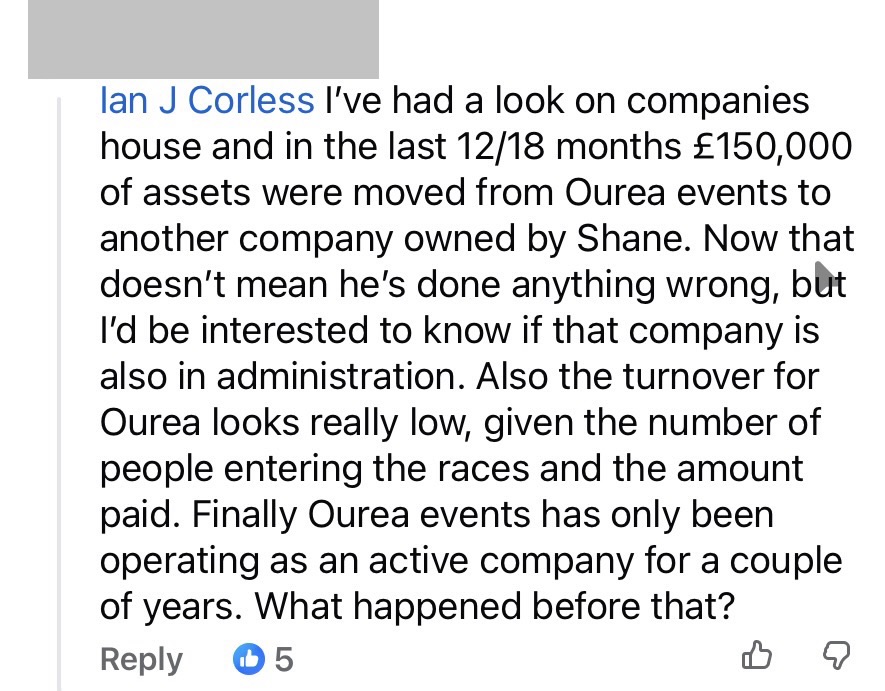
Shane does not shift blame in his statement onto a single factor or avoid the financial reality. Instead, he lays out the combination of events that led here. For participants, that does not replace lost money or cancelled plans, but it does provide context. It makes clear that this was not a sudden failure or a single bad decision, but a gradual tightening of pressure over several years.
Still, the negatives are real and immediate. Participants may lose money, and even if they do not, they lose certainty. Training plans, travel arrangements, and personal goals built around these events disappear overnight. Trust is also affected. Endurance events often depend on participants committing early, sometimes a year or more in advance. Situations like this make people more cautious, which in turn makes the business model even harder to sustain.
There are also ripple effects beyond the runners themselves. Suppliers, local communities, and small partners who depend on these events lose income. Volunteers and staff lose opportunities. What looks like a single company closing is, in reality, a small network being disrupted.
We are especially aware of participants who have already paid race entry fees for our events. By opting to cease trading at this stage, our goal is to maximise the likelihood that the events will continue under a different structure or ownership.
Looking ahead, the most likely outcome is not a simple disappearance, but a reshaping. Could Ourea reappear in 1-year using Phoenixing? – the same business or directors trade successively through a series of companies which liquidate or dissolve leaving debts unpaid – Basically, Shane and Ourea could rise from the ashes – “…cease trading and allow the business to undergo a reorganisation” If that is a plan, it better be handled very, very delicately. “The law allows owners, directors and employees of insolvent or dissolved companies to set up new companies to carry on a similar business. This is as long as the individuals involved are not personally bankrupt or disqualified from acting in the management of a limited company.” – GOV.UK
Some of these events may return under new ownership, potentially at higher prices and with more conservative structures. Others may not come back at all if they are too complex or costly to run sustainably. Across the industry, there may be a shift toward more cautious growth, more realistic pricing, and perhaps a reconsideration of how much risk is placed on participants paying far in advance.
Ourea Events, as it has existed, is likely finished. In the end, this moment sits somewhere between an ending and a transition. But what Shane and Ourea created still has value, and there is a real possibility that parts of it will continue in a different form. For now, though, the dominant reality is uncertainty.
For Shane, it is the closing of a long chapter. For participants, it is a waiting game with no guaranteed outcome. And for the wider community, it is a reminder that even well-loved and well-run events are not immune to broader economic forces.
Instagram – @iancorlessphotography
Twitter – @talkultra
facebook.com/iancorlessphotography
Web – www.iancorless.com
 IAN CORLESS
Ian, it is so good that you took up the pen like this and were able to formulate this. We got to know Shane during races, in person; I joined NT and DB at Ourea and as RD during the GTNS competition where the Netherlands formed the region together with Great Britain. It is very sad for the organization and for him personally, and a great loss for fans of these magnificent stage races. As an organizer in the Netherlands, I have always gazed in awe at the scale of Ourea with feelings of healthy jealousy; perhaps that was precisely the final blow that necessitated this decision. We wish Shane, his staff, and all the incredibly dedicated volunteers immense strength in making this difficult decision. With sporting regards, Robin & Myanou Kinsbergen – CAIRN Trails & Adventures
Yes Robin, a real shame for so many people.