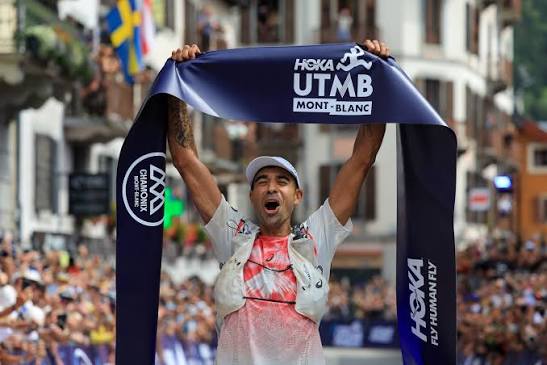
For years, UTMB has been the gravitational centre of trail running, the place where the sport’s limits are tested, stretched, and occasionally shattered. But every so often, a performance arrives that doesn’t just raise the bar; it rewrites the expectations of what is possible. Ben Dhiman’s 2026 victory is exactly that moment.
To understand the scale of his achievement, you have to rewind the clock.
The Sub‑20 Hour Question
Not long ago, the idea of breaking 20 hours at UTMB felt mythical. Pau Capell famously attempted it during the Covid era, running his solo “Breaking 20” project. It was bold, audacious, and – at the time – borderline unimaginable.
Then Jim Walmsley ran 19:37:43 on the full UTMB course.
Just like the two‑hour marathon barrier, once one athlete proves the impossible is possible, the entire landscape shifts. Suddenly, sub‑20 wasn’t a dream; it was a requirement. If you wanted to be in the top 10, you needed to be flirting with 19-hours X minutes.
In 2025, Tom Evans pushed the frontier again, clocking 19:18:58 on an adjusted course. And right behind him, a certain Ben Dhiman arrived in Chamonix in 19:51:37, announcing himself as a future problem for anyone with podium ambitions.
2026: A Race Reshaped Before the Start
UTMB 2026 was chaotic before a single step was taken. Kilian Jornet withdrew. Jim Walmsley withdrew. Tom Evans withdrew. The race lost three titans in quick succession, but the field was still stacked – Vincent Bouillard on the back of a CR at Western States, Baptiste Chassagne, Hannes Namberger, and a dozen more capable of winning on their day.
But the absence of the usual giants did something subtle: it changed the psychology of the race. The script was no longer (kind of) predictable. The hierarchy was no longer fixed.
And into that vacuum stepped Ben Dhiman.
He didn’t hide. He didn’t hedge. He didn’t offer the usual “we’ll see how the legs feel.” He said he was here to win – not with arrogance, but with the calm certainty of someone who had gone away after 2025, studied the problem, and rebuilt himself. Word from his camp suggested he had increased his climbing volume by 30%, sharpening the one area he felt had cost him the win the previous year.
He was on a mission.
A Tactical Masterpiece
What unfolded over 18 hours was one of the most controlled, intelligent, and fearless performances UTMB has ever seen.
The Early Breakaway
Dhiman ran with the lead pack through the opening hours, but around La Balme he found himself alone after speedy transitions in the feed zone. Pushing alone he expected the race to catch up, they never did. By Les Chapieux he had already carved out a meaningful gap over Baptiste Chassagne.
This was not a reckless move. It was a calculated one.
The 90km Solo Time Trial
Once in front, Dhiman committed. For more than 90 kilometers, he ran alone — no pack, no drafting, no psychological shelter. Instead of letting the solitude eat at him, he used it as fuel, stretching the elastic bit by bit until it snapped.
Hammering the Descents
His biggest weapon? Downhill aggression. He attacked descents with intent, choosing specific sections to steal time. It was biomechanical efficiency married to bravery – a runner who trusted his legs, his preparation, and his instincts.
The Broken Pole
On Grand Col Ferret, disaster struck: a trekking pole snapped. Lesser athletes lose minutes; Dhiman lost none. He went “Gandalf style” with a single pole, kept his rhythm, and still produced an incredible split time from the summit to Champex-Lac — under two hours.
Crew Efficiency
Dhiman spent 9 minutes 23 seconds in aid stations, this is arguably one of the most impressive and key stats. Just like in Ironman, when transition is a sport in itself, Dhiman has looked at speedy no nonsense transitions as free time – incredible!
A Year-on-Year Transformation
His splits compared to 2025 tell the story better than any adjective, of course, one has to keep in mind the adjusted course, nonetheless, impressive reading.
- Les Contamines:
+3:53 - Courmayeur:
+31:26 - Champex-Lac:
+1:05:04 - Vallorcine:
+1:25:31 - Finish:
+1:35:08
This wasn’t a marginal gain. It was a reinvention.
And then came the number that will echo for years: 18:16.29
Not a course record – the route was adjusted – but even with conservative corrections, his performance sits somewhere in the 18:50 to 19:10 equivalent range. That is off-the-scale running.
Trailwithben on Instagram HERE provides a nice breakdown and analysis, he estimates the time to be 18:55
The Benchmark Has Shifted Again
Dhiman didn’t just win UTMB 2026. He has changed the sport and most certainly has changed the UTMB for future years.
The question “Can anyone break 20 hours?” is gone. The new reality is harsher, sharper, and more electrifying:
To win UTMB in 2026, you must run sub‑20. To contend for the podium, you needed to aim for 19:30. And in 2027, the frontier may be sub‑19.
That is wild progression – but it’s also the natural evolution of a sport where athletes learn from each other, build on each other, and chase the ghosts of performances that once seemed impossible.
Ben Dhiman has become one of those ghosts.
His 2026 run wasn’t just a victory. It is a statement, a recalibration, and a warning to every elite trail runner preparing for 2027. And notably, when asked by Dylan Bowman on Runfreetrail ‘Can you go faster?’ the answer had no pause, ‘yes!’ – Dhiman comments that running solo allows the pace to drop in the latter stages, had he had someone pushing him, there was more to give… And on that note, roll on UTMB 2027!
_______________
Instagram – @iancorlessphotography
Twitter – @talkultra
facebook.com/iancorlessphotography
Web – www.iancorless.com


Pingback: Two Victories, Two Philosophies, One Sport Learning From Both | IAN CORLESS