Stage 1 of the 2024 MDS Fuerteventura got underway today, 33.6km and 444m+
It was a 90-minute drive from Play Itas Resort to the northern coastal location of Manjanicho Beach.
A climb from the ocean to start the day
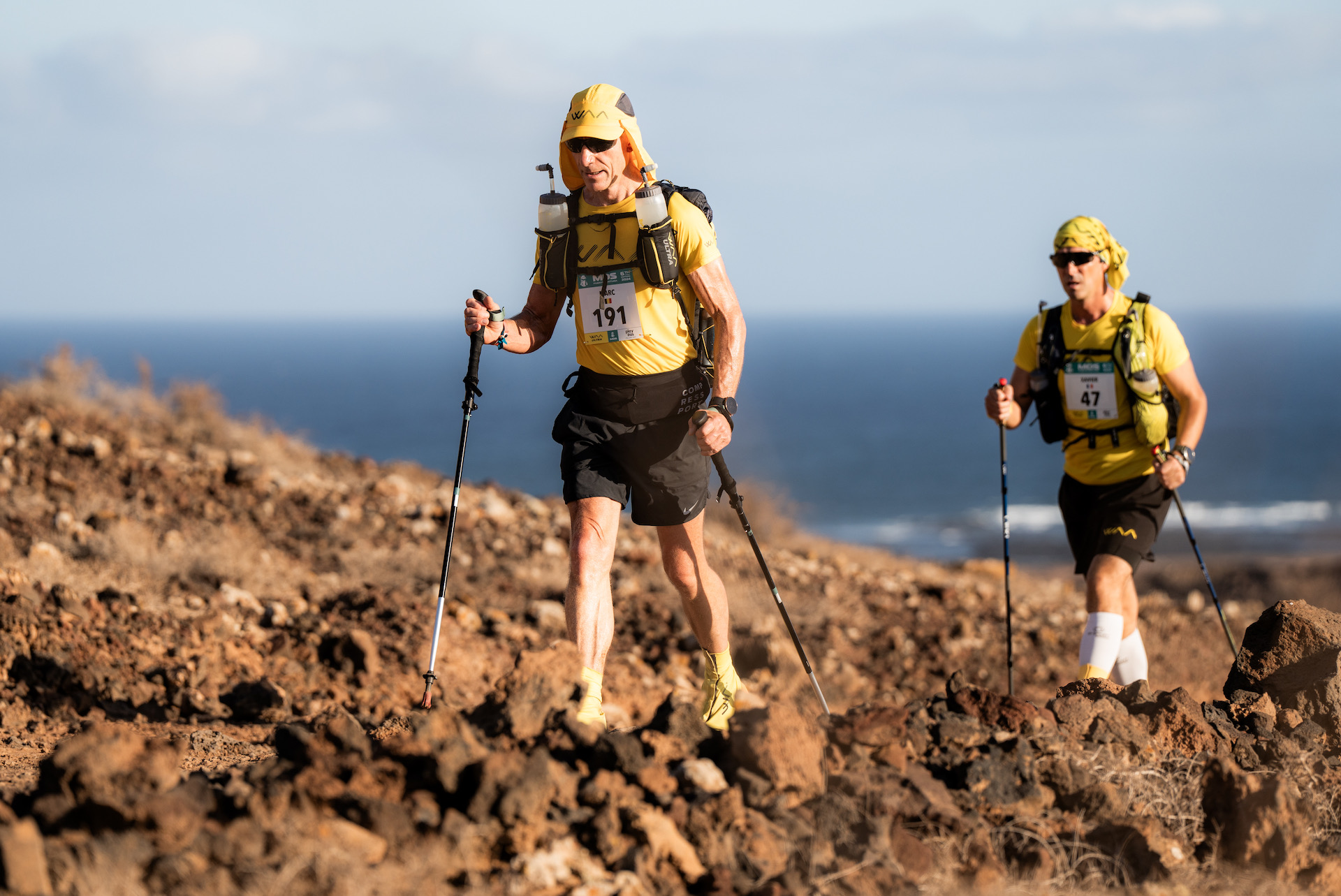
A day that offered a little of everything, starting and concluding next to the ocean, the track was mad up mostly of gravel/sand path, approximately 20% soft-sand and just a tiny amount of road crossings.
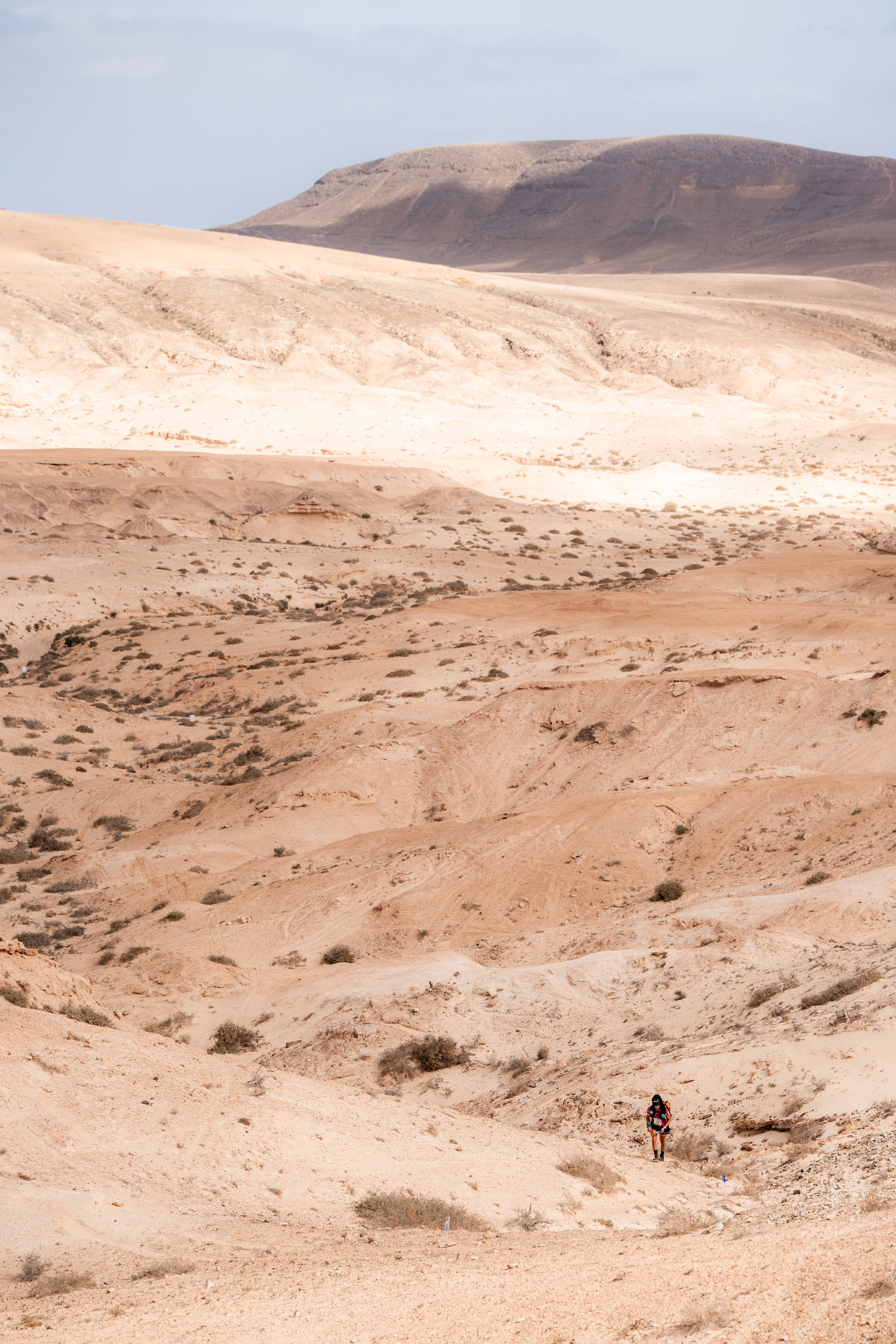
The unique landscape of Fuerteventura
Wind was present throughout the day, making the highest temperature of 28-degrees feel manageable.
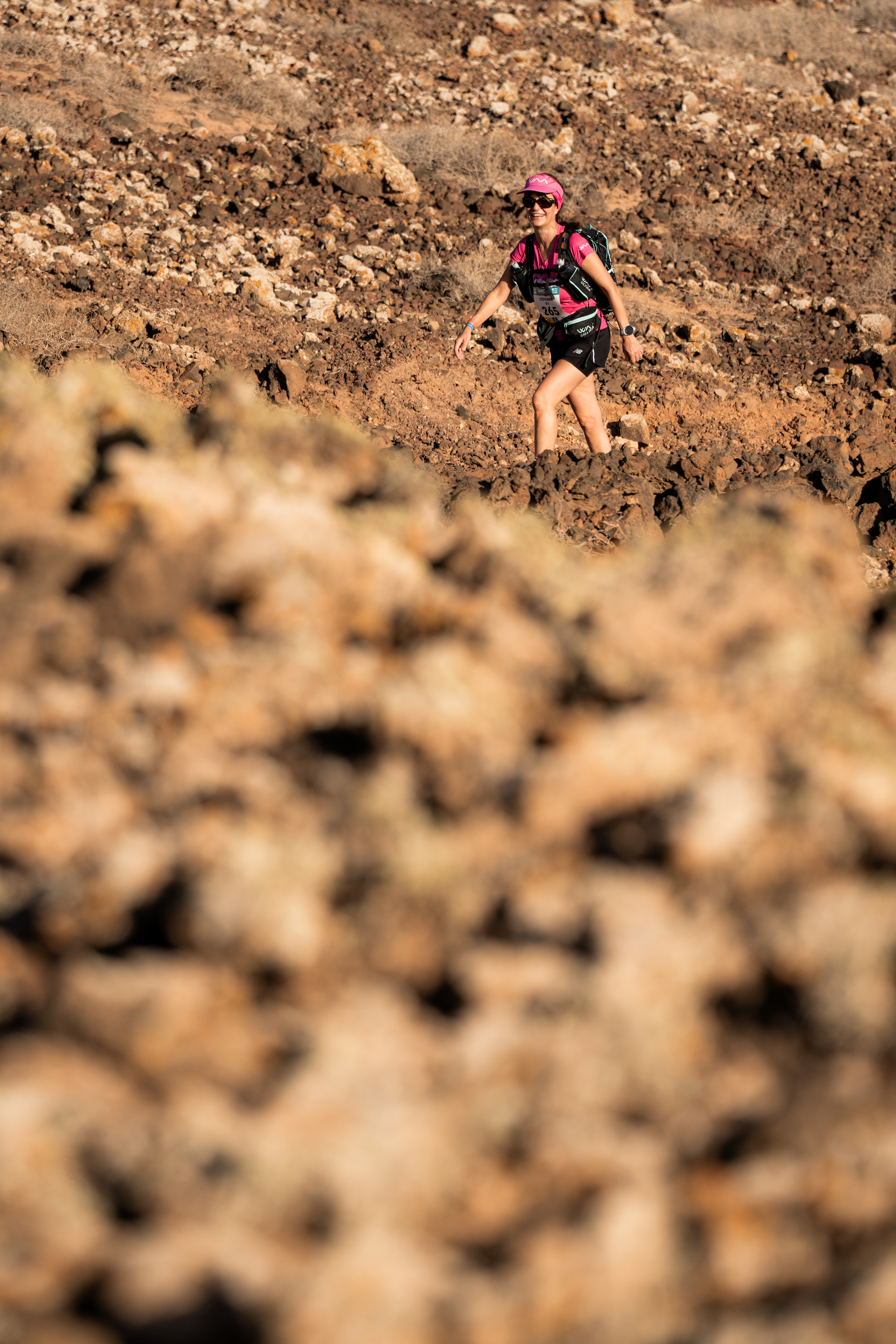
Expansive landscape
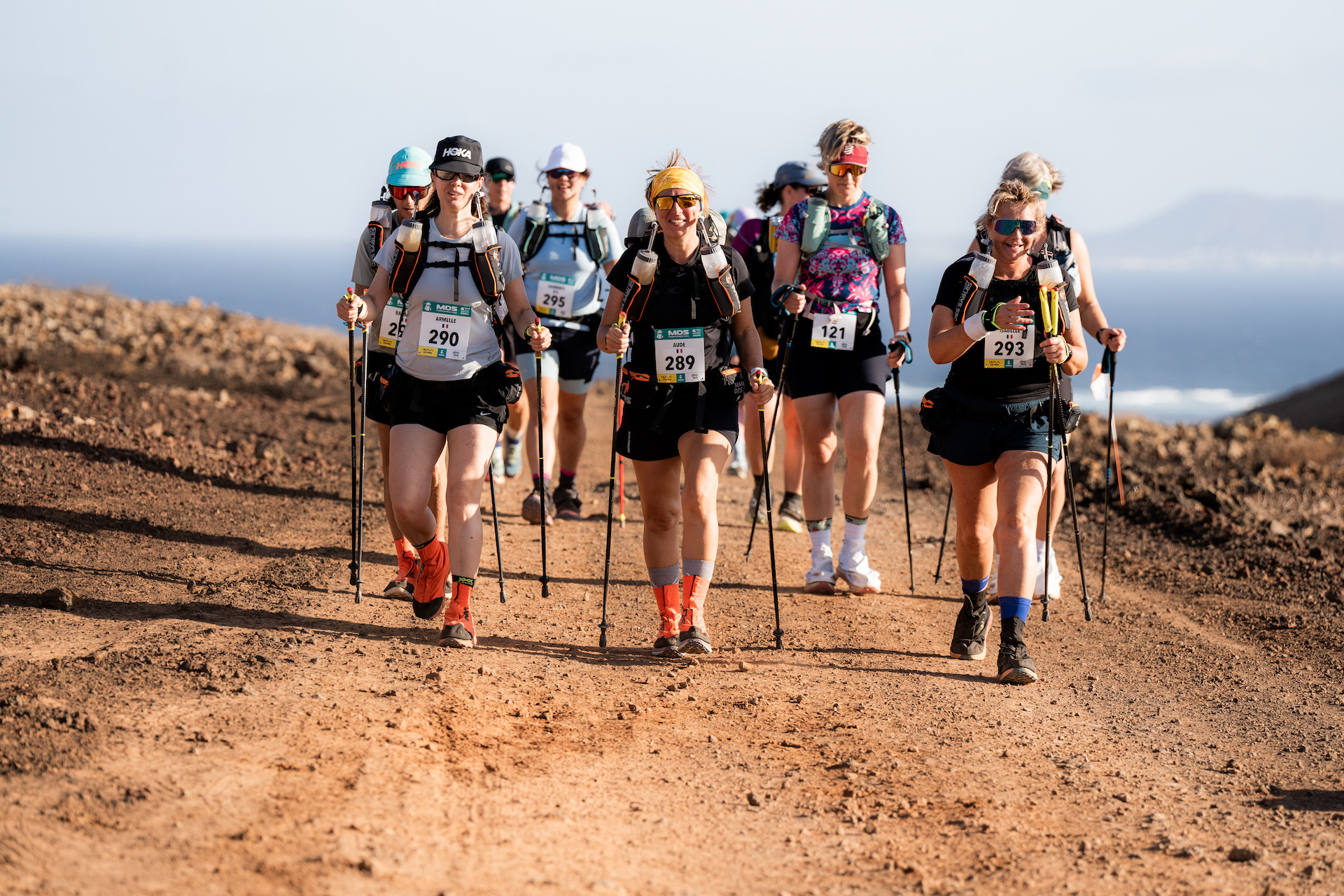
With 300 participants and record 58% women, the 6th edition of MDS Fuerteventura was highly anticipated.
Here for the women’s race
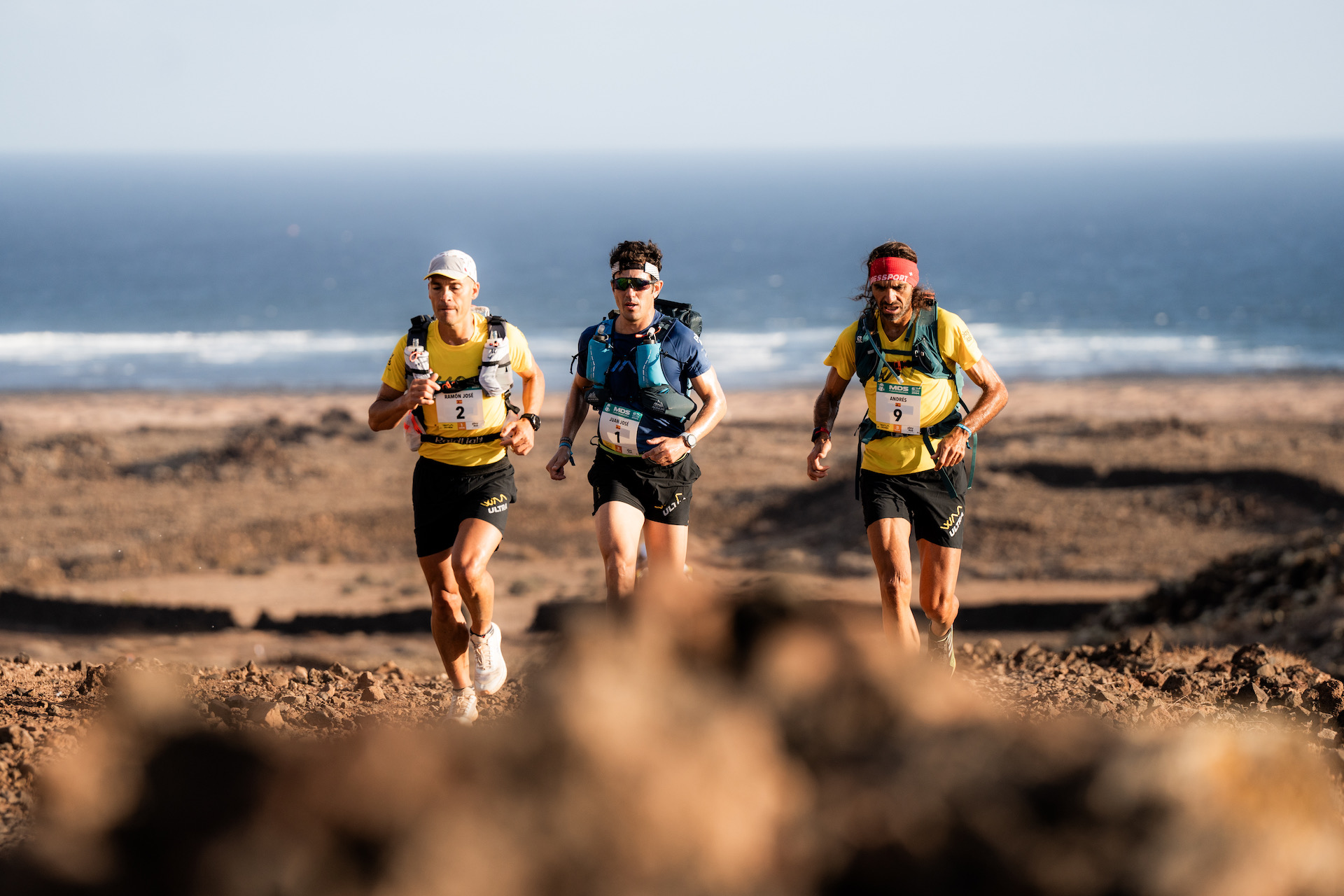
The race upfront was dominated by Juan SANTANA FERNÁNDEZ, ROGER PÉREZ and FOULQUIÉ PADILLA, the trio setting an incredible pace in the 120km race, with SANTANA FERNÁNDEZ taking the victory ahead of ROGER PÉREZ and FOULQUIÉ PADILLA placing 3rd, 2:32:18, 2:33:48 and 2:34:15 respectively.
The lead trio
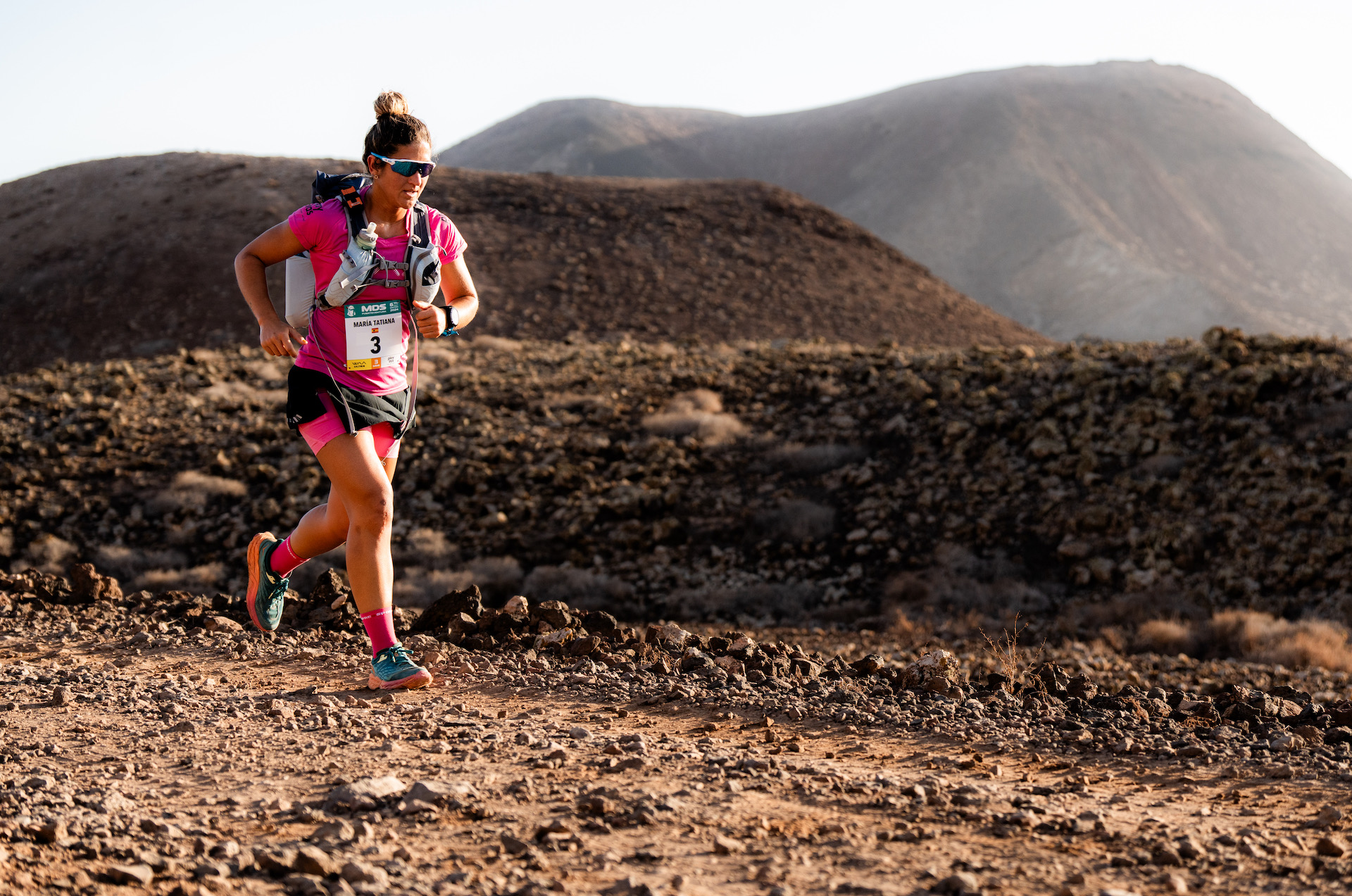
For the women, MUJICA GONZÁLEZ ran the race solo for a time trial effort and victory in 3:37:37. Behind, BOLLENGIER, and DEL RIO VALLES ran a close race for 2nd, the duo crossing in 3:52:50 and 3:53:10 respectively.
It is important to remember, MDS events offer 3-distances, 120km, 100km and 70km, stage 1 is the same for all races and then the difference comes on stage 2 when participants for MDS Fuerteventura will choose which loop to run, option 1 17.8km, option 2 40.5km and option 3 56.7km.
Volcano backdrops with 3rd place DEL RIO VALLES
Bivouac remains the same for each stage, the final stage (stage 3) the exception when the finish line brings an nd to the race and the participants return to Play Itas Resort.
With stage 1 being a longer first day, we may well see participants change options for stage 2, if they considered day 1 a little hard, they may well choose an easier option for stage 2, the choice is for them.
Stage 2 starts at 0600 and based on the distance chosen, the cut-off times for finishing will vary, midday for the short race, 1910 for the middle distance and for the long, 12:50am the following day.
Gladly for the participants, they will then have a rest day.
Since 1986, the MARATHON DES SABLES has crossed the world’s most stunning deserts with several unique concepts: the MARATHON DES SABLES THE LEGENDARY (252 km in the Sahara Desert in Morocco), the MARATHON DES SABLES (70, 100, or 120 km spread over 3 stages), and the new 2024 concept, the MDS TREK (4 stages with a total distance of up to 120 km), offering an accessible adventure with optimal comfort. These international events have seen over 50 editions in various countries such as Morocco, Fuerteventura Island, Peru, Jordan, Turkey, and offer adventures that combine running/hiking in the desert with tourism.
The internet came alive on September 23rd when Canadian Running Magazine published an article in regard to acclaimed ultra runner Camille Herron and accusations on tampering with Wikipedia content.
Facebook, X and IG was full of opinion, stories and viewpoints on the matter and SoMe is and can be a very brutal place in instances like this. I said a the time:
What followed was the removal of all of Camille’s social platforms. Thinking back, this was probably a wise move to protect Camille from the onslaught that followed. Now of course, many may well say, that the onslaught was justified. However, a response and an attempt at clarification is welcome.
I went on to clarify:
“I have said this multiple times in the last 24hrs. Also important that her running ability is not in question. This is something darker, deeper and a mental health issue which requires understanding and help. The best scenario (I think) is to acknowledge, apologize and seek help. The ultra community I believe would support her. There is something very fragile here.”
– Ian Corless via X
From wikipedia
Below, CONOR HOLT provides an explanation:
Statement:
Hello from Greece- here for the Spartathlon 153 mile race scheduled for this Saturday.
Yesterday I received a notification about a published article by Canadian Running Magazine. The author said he reached out for comment before it was published. I found an email sent Sept 20 in my spam account yesterday after the article was published! I never got a chance to say anything to the Canadian Running website before they published it. Plus we have been traveling the last few days with limited access!
For the Wikipedia part, temporun73 was the original account I created in 2016 and use to edit the page. I manage this so Camille can focus on her running and recovery.
Starting in 2023 and continuing to this day, cyber bullies by the name of Steven Walling, Liliana Uwu, C.Fred, Melcous, and some more were repeatedly editing out significant parts of Camille’s life/ biographical details.
I kept adding back in the details, and then they blocked my account in early February of this year. Nothing was out of line with what other athletes have on their pages. Wikipedia allows the creation of another account, so I created a new account Rundbowie. I was going off what other athletes had on their pages using the username Rundbowie and copying/pasting this info.
Camille had nothing to do with this. I am 100% responsible and apologize for any athletes affected by this and the wrong I did.
I was only trying to protect Camille from the constant bullying, harassment and accusations she has endured in her running career, which has severely impacted her mental health. So much to the point that she has sought professional mental health help.
I also went ahead and deactivated all of Camille’s social platforms for the time being because of the vile comments she has received.
I appreciate you reaching out to me.
Conor Holt
from wikipedia
UPDATE Thursday 26th September
On September 26, 2024 Lululemon ended its association with Herron in the wake of the Wikipedia controversy.
It’s countdown time to the 2024 MDS Fuerteventura, the 6th edition taking place from September 28 to October 5th.
The MDS format is the perfect synergy of travel, adventure and luxury.
The 2024 edition, once again, uses the Playitas Resort Hotel as a pre and post-race hub for 4 nights: two nights pre and two nights post.
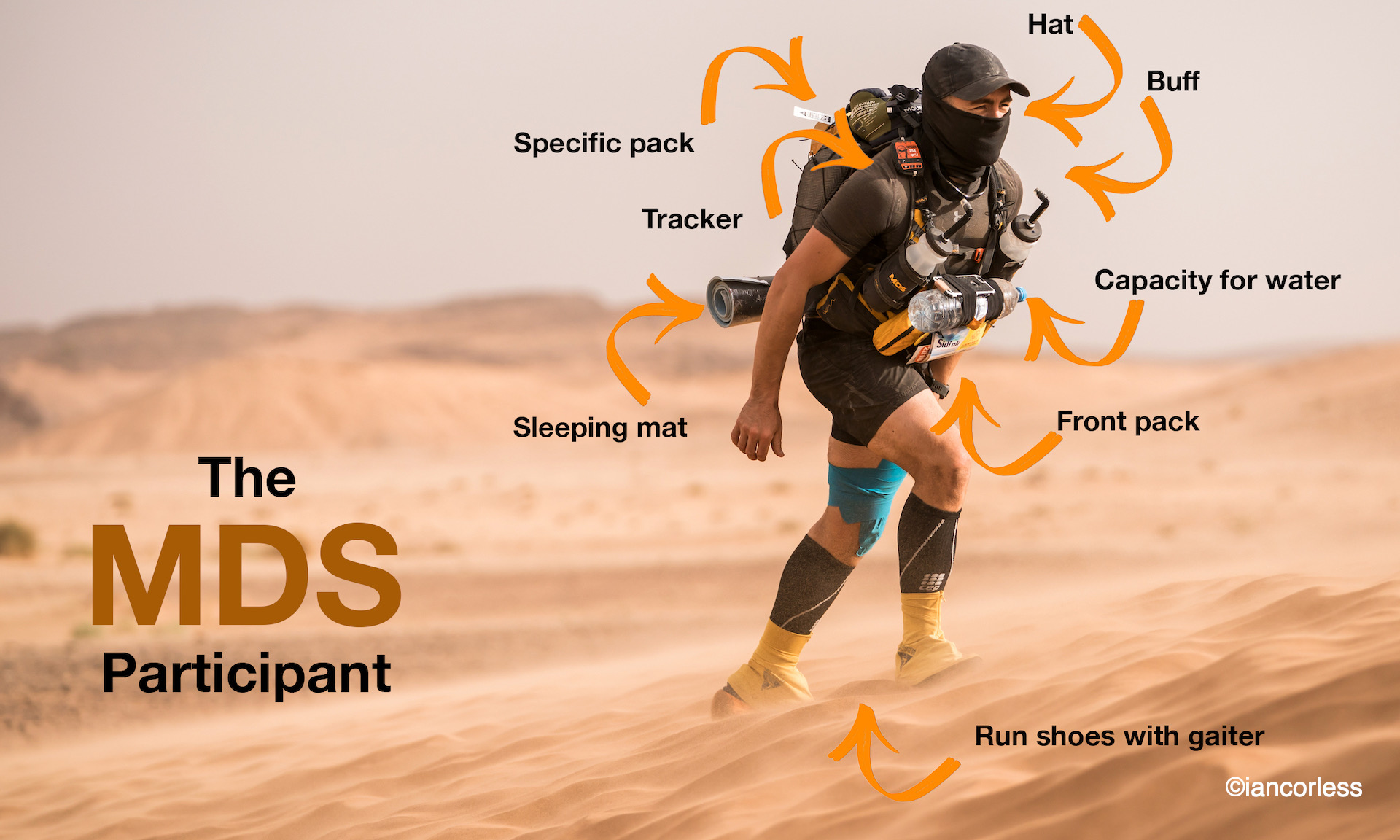
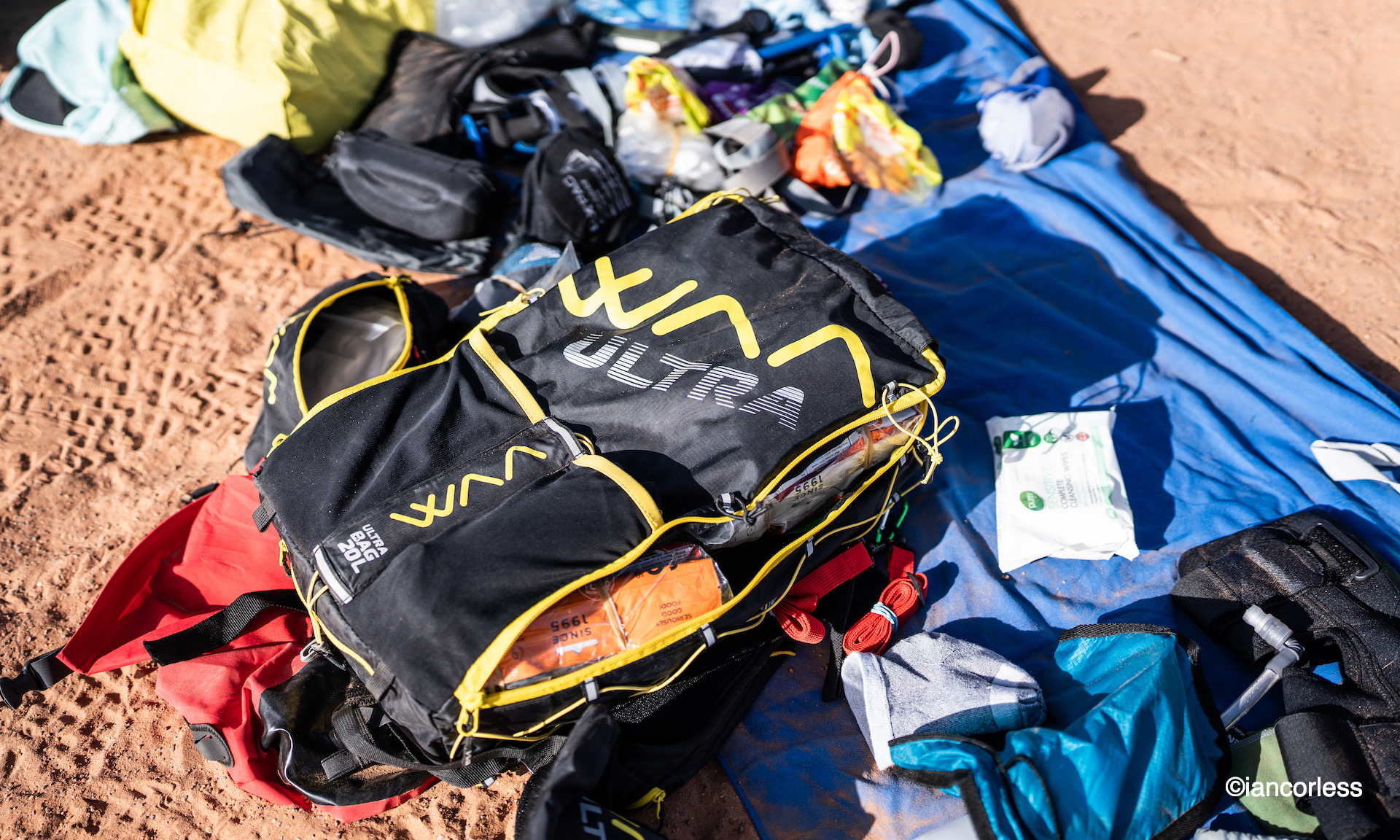
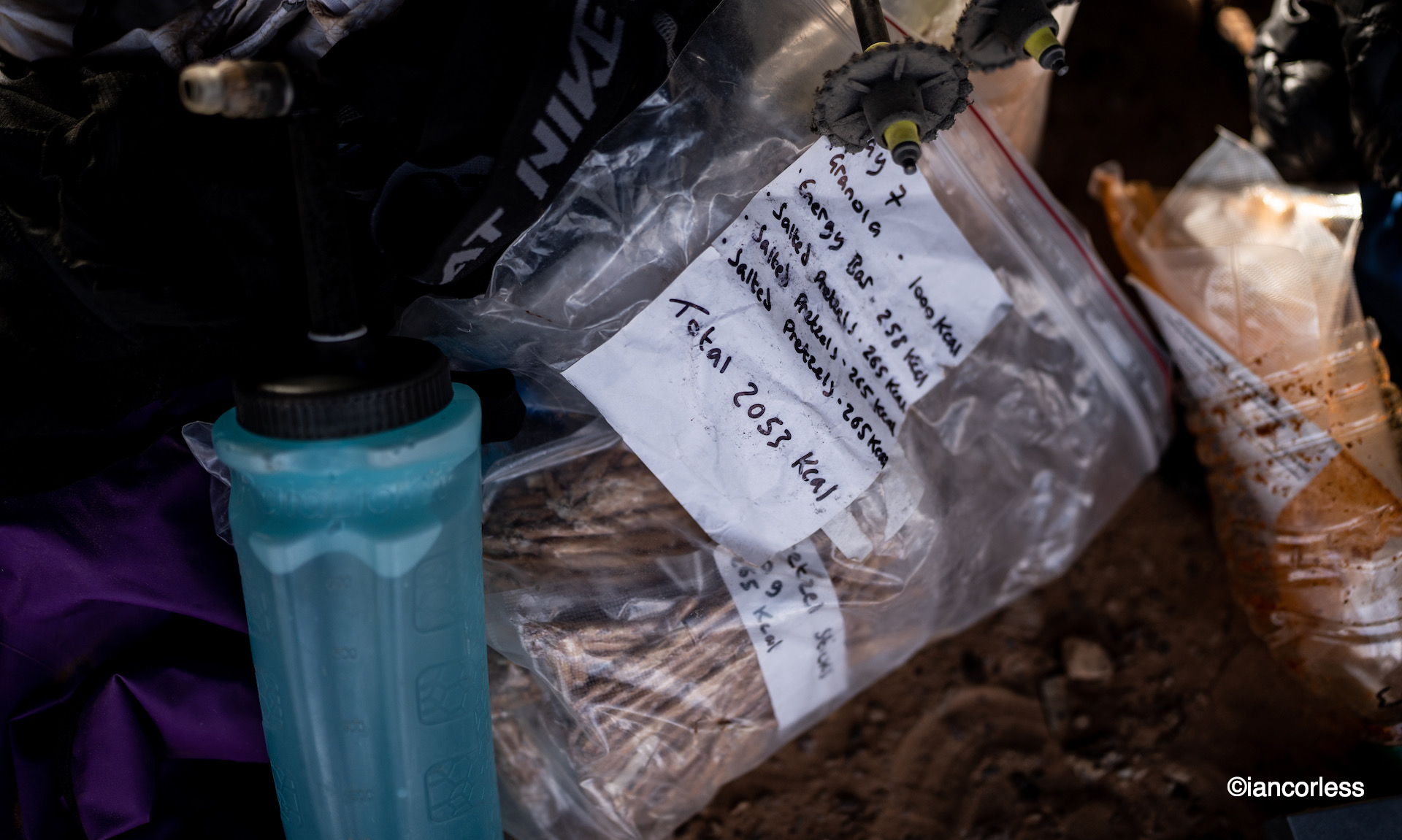
Three nights will be spent in bivouac in full self-sufficiency, the only provision provided is a tent in which to sleep and water. All other items the participant must carry, this includes all food and snacks for the duration of the event, clothes, sleeping bag, sleeping mat and any luxuries.
Day 2 and 3: breakfast, lunch, dinner. (Stage 2 and rest day)
Day 4: breakfast, lunch. (Stage 3)
If a participant requires power for phone, watch, mp3 player etc, they must provide this themselves in the form of a portable battery which they must carry.
The MDS format is the same for all events, MDS The Legendary and MDS Trek excluded.
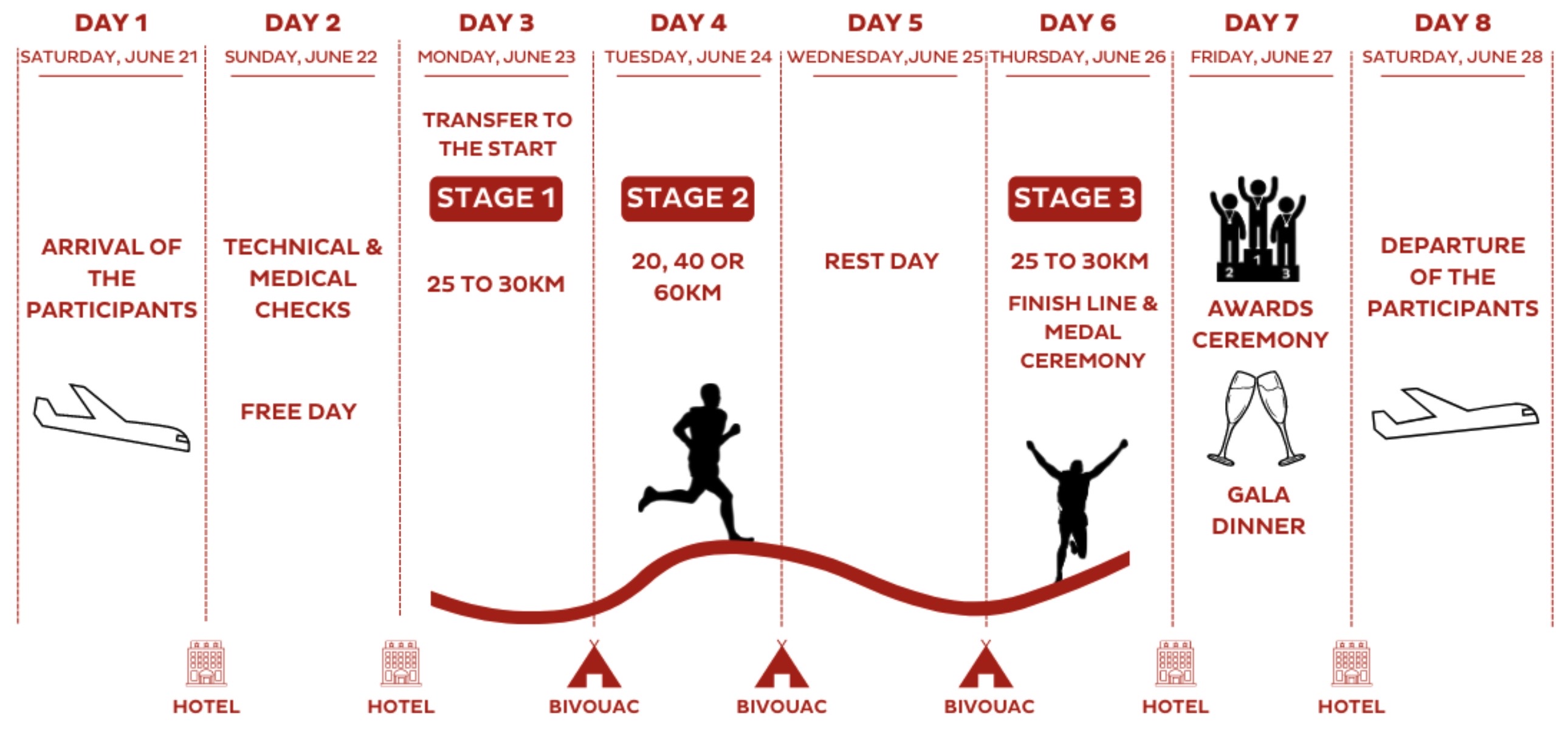
The race will take place over 4-days and 3-stages, typically broken down as follows:
Day 1/ Stage 1 between 25 and 30km.
Day 2/ Stage 2 20, 40 or 60km – the participant chooses the appropriate distance.
Day 3 Rest day
Day 4/ Stage 3 between 25 and 30km.
The race is designed so that finishing is a possibility for all, regardless of ability or speed. Importantly, if a runner does not finish, they are provided a free race entry for the following year.
The last edition of the race took place in 2022 which turned out to be a considerable challenge due extreme and unprecedented weather. 2023 did not take place due to environmental rules. So, 2024 will be a special year for MDS Fuerteventura. Notably, 300 participants will toe the line of which, 58% are women. A fantastic statistic.
The Program for the week will be as follows:
Saturday September 28
Arrival of participants and relaxed night at Playitas Resort Hotel.
Sunday September 29
Technical and medical checks followed by relaxation at Playitas Resort Hotel.
Monday September 30
Stage 1 – overnight bivouac
Tuesday October 1
Stage 2 – overnight bivouac
Wednesday October 2
Rest day – overnight bivouac
Thursday October 3
Stage 3 – followed by relaxation at Playitas Resort Hotel.
Friday October 4
Tourism and rest day followed by evening Gala dinner.
Saturday October 5
Onward travel
Playitas Resort Hotel is one of the key sports hotels in Europe. Located in the southeast of Fuerteventura, it is the perfect hub for a sports minded person, there is a gym, yoga, indoor cycling, CrossFit, pools and so much more available.
MDS Fuerteventura is closely followed by MDS Morocco, October 12-19, MDS Trek, October 20-29 and MDS Jordan, November 2-9.
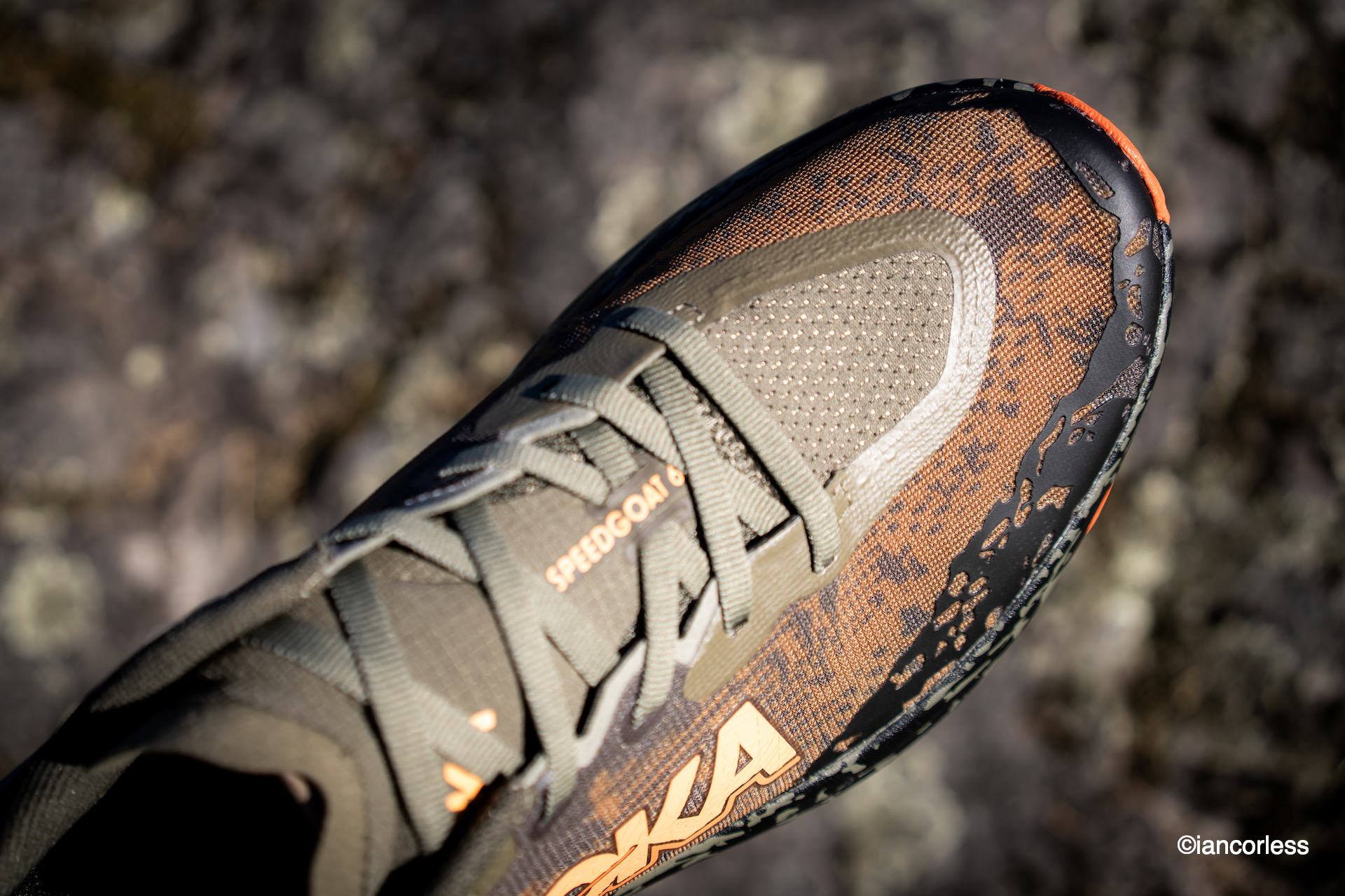
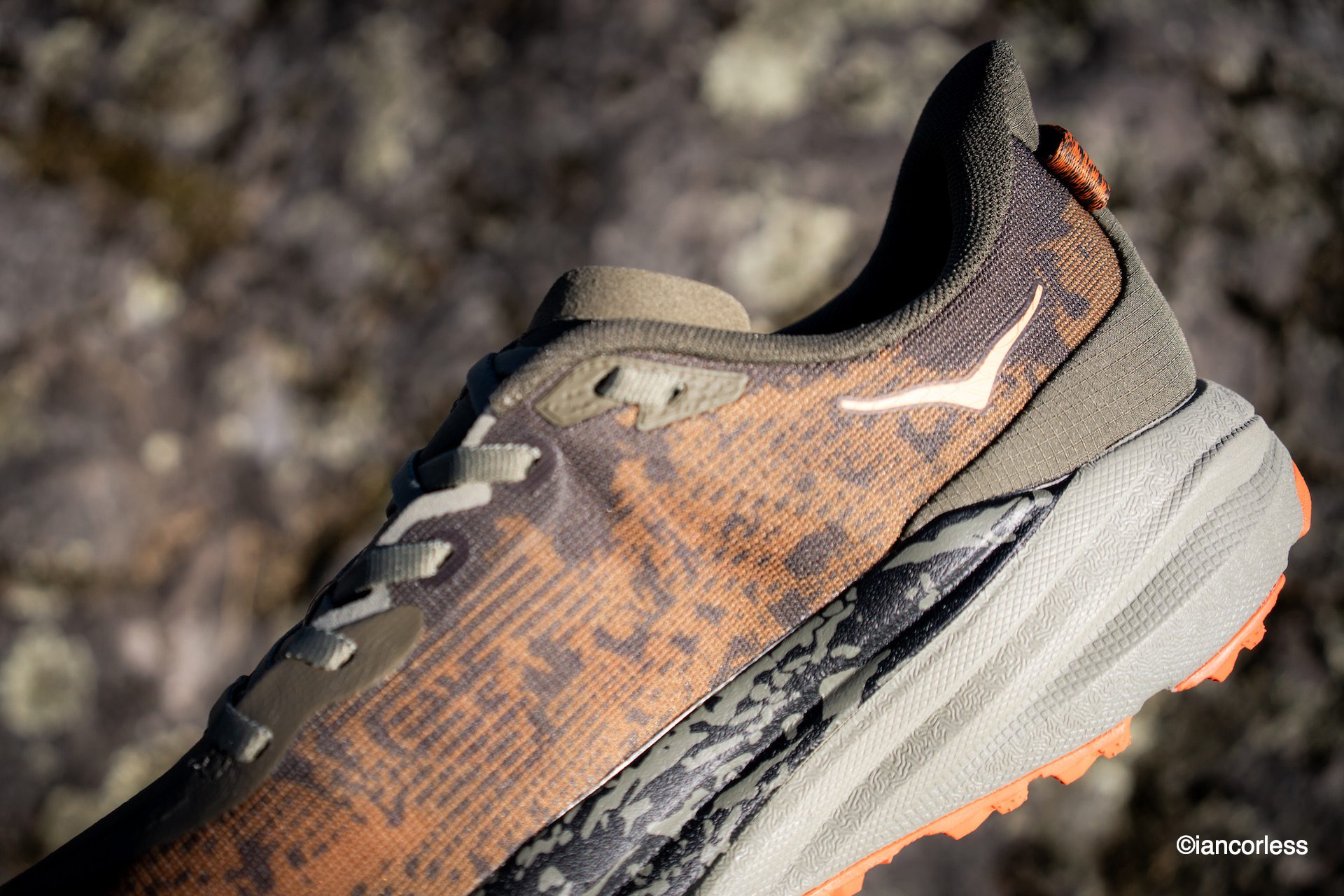
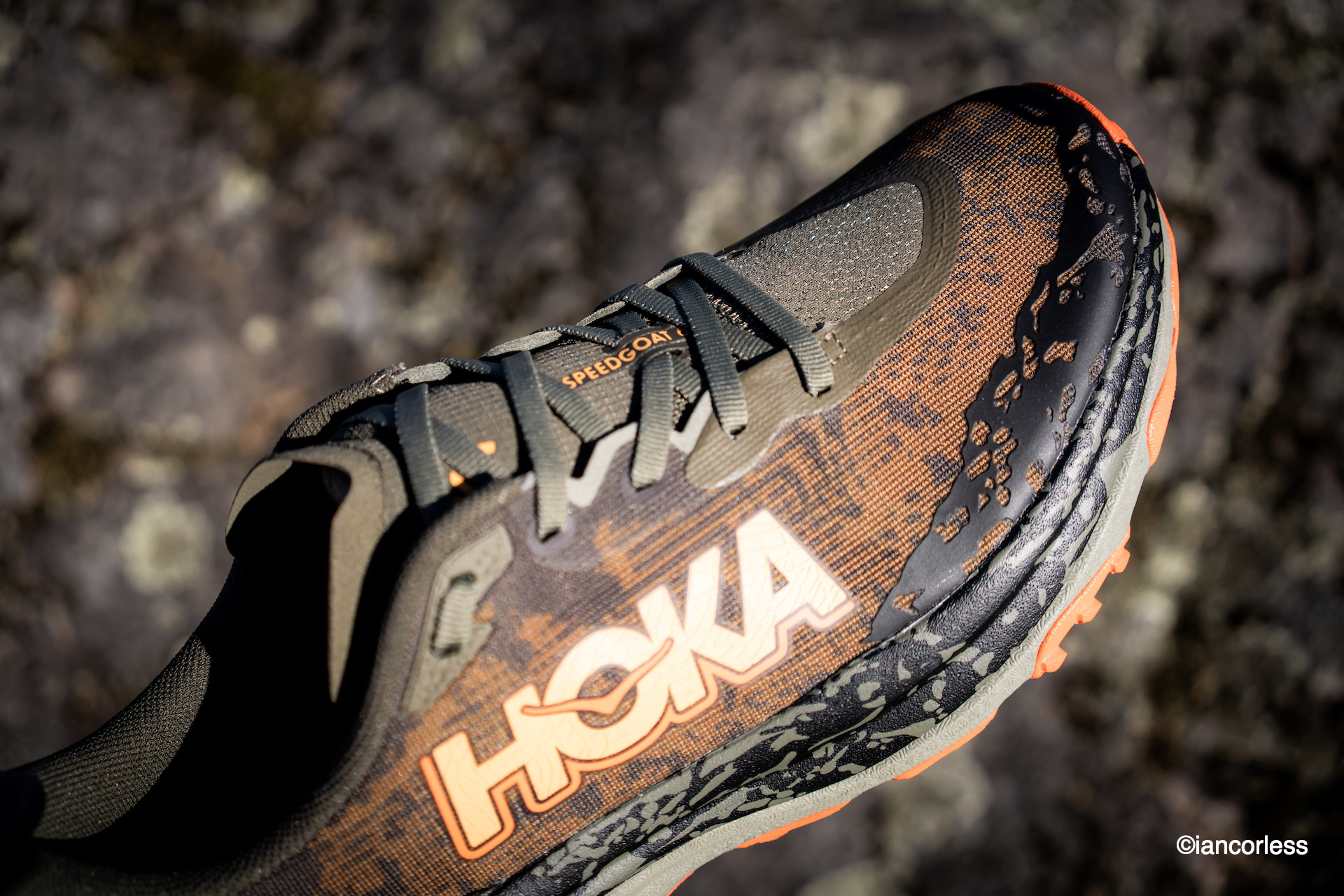
The Hoka Speedgoat needs no introduction, it is arguably, the best selling trail shoe throughout the world. It’s much loved and universally proclaimed as a great trail running shoe.
I personally was late to the Speedgoat party with version 4, followed by version 5 and now version 6. The Speedgoat 5 reached a critical point for Hoka with very mixed reviews:
There were concerns about the midsole compressing and lacking durability,
The upper had less durability.
The fit and size for some was off.
The outsole was wearing too quickly.
I personally enjoyed the Speedgoat 5. I found the combination of features absolutely fine, the upper fine which was flexible and allowed for a good fit, I did need to lock lace though. The outsole ideal and importantly, the stack height a more reasonable 33/29 which offered good stability with a 4mm drop.
Most certainly, Hoka listened to the feedback. They had to if they wanted to retain the loyal fan base, especially with many other brands releasing shoes that could not only provide competition, but even beat the Speedgoat, the Merrell Agility Peak 5 a prime example.
With the release of the Speedgoat 6, the shoe very quickly received universal acclaim with quotes such as, ‘The King is Back!’ And, ‘Speedgoat is still the GOAT.’
What is new?
Cushioning is new CMEVA foam with increase stack, 40mm at the rear and 35mm at the front and 5mm drop, 38/33 for women).
The cushioning is lighter and more responsive.
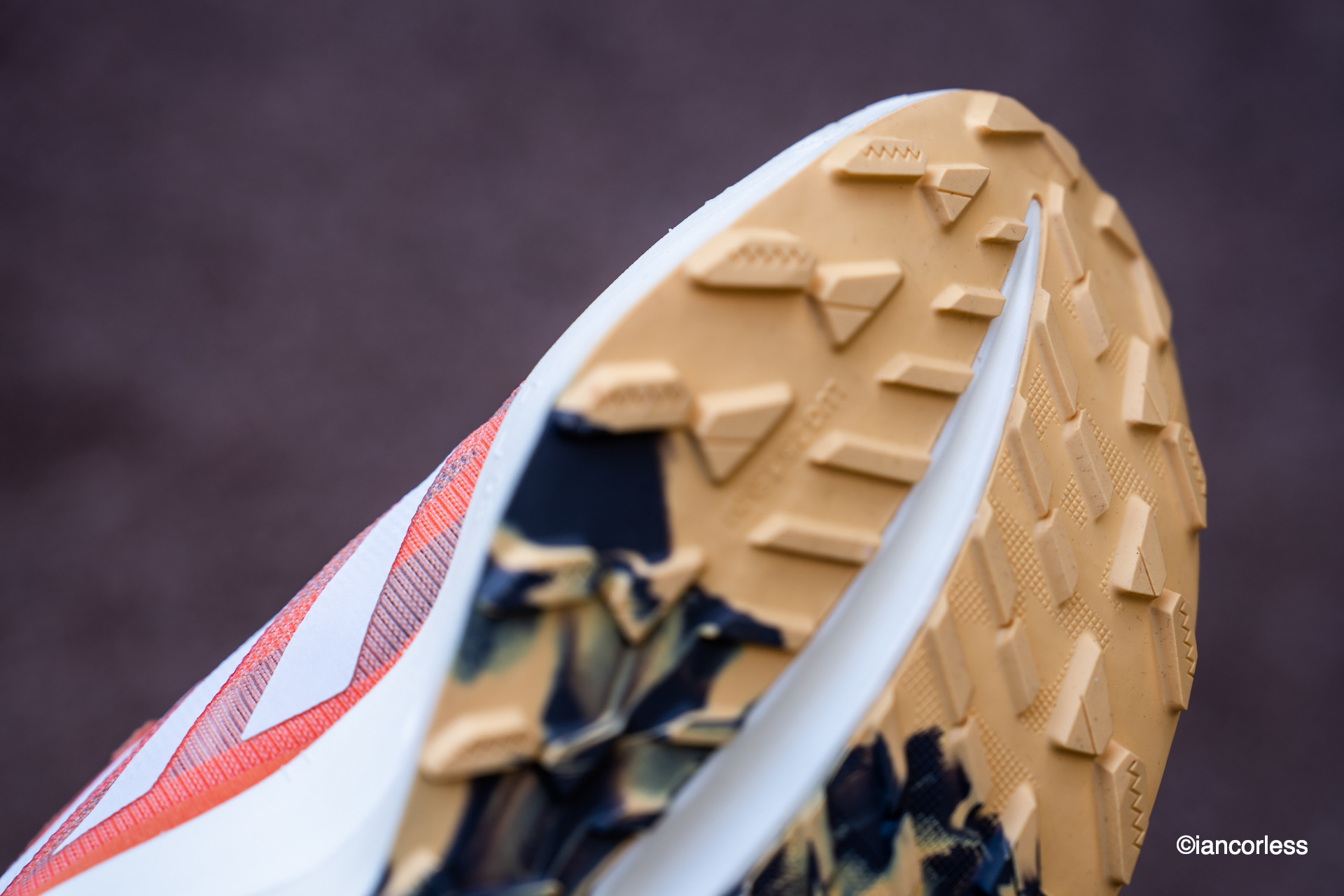
The outsole is Vibram Megagrip Traction lugs with 5mm depth and new orientation.
A new more durable upper that is Matryx like with no stretch and with an inner cage.
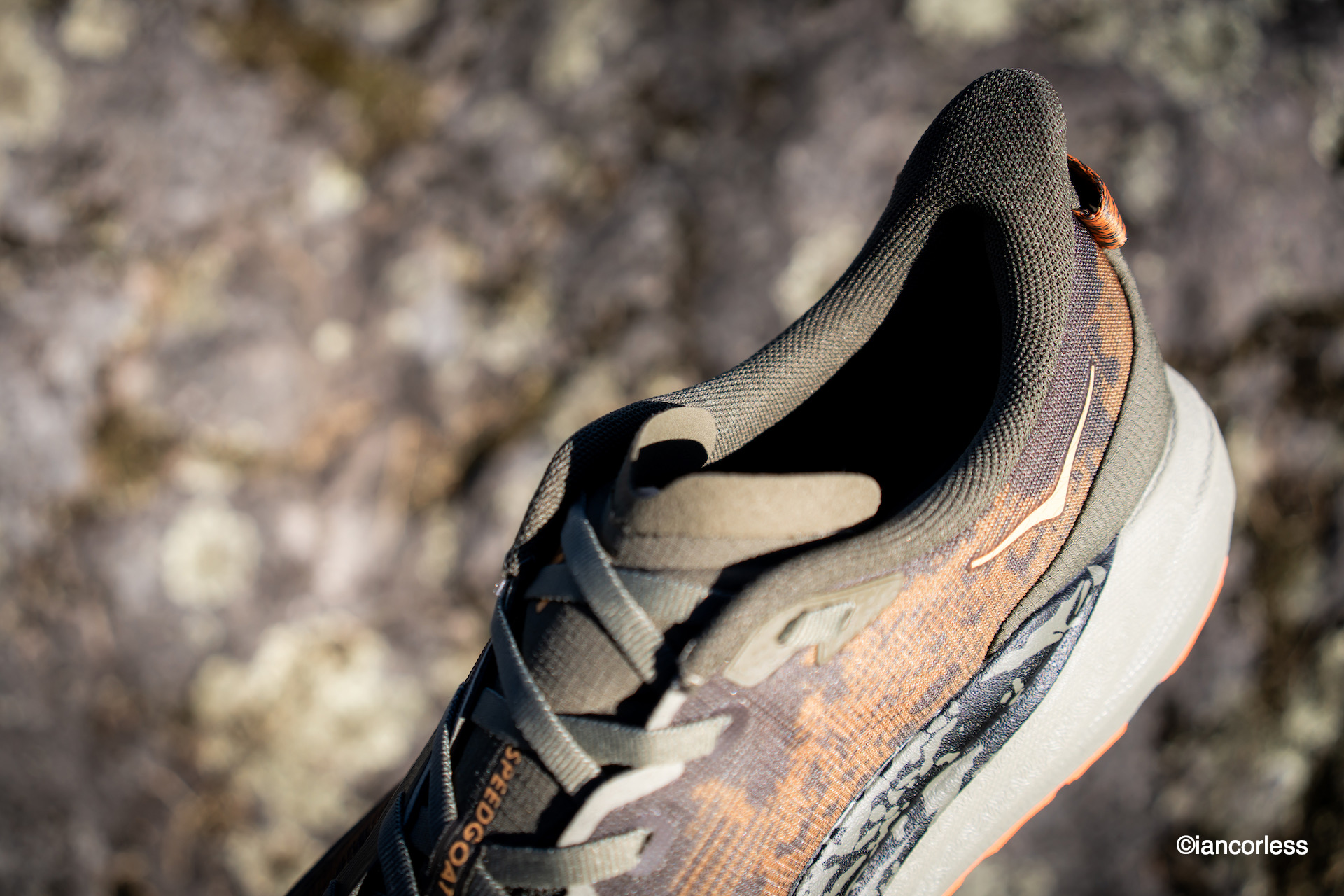
Hoka say, “We’re offering an updated underfoot experience that provides a more responsive ride with less weight. You’ll find updates to the overall construction, including a breathable woven upper, lighter, more responsive midsole compound, internal chassis, dynamic vamp, and plusher, dual-gusset tongue.”
With neutral stability, balanced cushioning all built around a wide footprint, the Speedgoat 6 is a great trail all-rounder. It is designed to provide protective cushion while maintaining a responsive toe-off for when you want to go faster.
I personally found a considerable difference when putting on the 6 and lacing them up. I immediately preferred the feel of the 5. I lock-laced (as I do on the 5) and the fit/ feel improved.
The lacing does not go as low down the shoe on the 6 and this made me feel less secure at the front, probably not helped due to the fact that the 6 has been given extra width over the 5.
The cushioning is without doubt stiffer and firmer in the 6. The 5 feels bouncy and plush but not squidgy. The 6 almost feels hard by comparison, somewhat unexpected when you consider the extra stack height.
I have to say, my first run I was not loving the shoe. I was constantly thinking, give me the 5 back. However, with 10km in the shoe, the 6 started to feel more at home on my feet and as the km’s passed, that improved. So, I would certainly say although they are good to go straight out of the box, a good run or couple of runs will help them. Ultimately, there is no special life here. They are solid, reliable, good for the long haul, but there is a lack of excitement, especially if you compare to the Merrell Agility Peak 5 and the VJ MAXx2.
There is more structure and hold coming from the new internal support chassis, this is without doubt required with the extra stack. I never had a real issue in the 5 unless on very technical terrain, but here in the 6, the 40/35 cushioning is notably different. Currently, my favourite Hoka is the Tecton X3 which has the same level of stack height as the Speedgoat 6, but for me, has considerably better feel. It’s not that I don’t like the 6, there just doesn’t feel anything special going on and ironically, I prefer the feel of the Speedgoat 5 which is counter to what Hoka say I should feel and also counter to the general Speedgoat feedback from all the fans.
The tongue of the Speedgoat 5 and 6 is not long enough making lacing and particularly lock-lacing an awkward affair and not always comfortable. This really needs addressing.
The outsole with 5mm lugs is solid on most trails. With a new configurtation and the Traction lug, it works well. There ic a comprise with a great deal of mud and I am still never confident on wet rock.
The Speedgoat 6 is a solid trail shoe that will only continue to confirm the shoes legendary status within the trail world. Speedgoat lovers will continue to love this shoe. But, if you are new to Speedgoat and comparing against other like-for-like shoes, would the Speedgoat win out?
For me no. However, it does depend on what shoes you are comparing the Speedgoat with… If it was the adidas Terrex Agravic Speed, the Hoka Speedgoat 6 is a clear winner. However, comparing against a Merrell Agility Peak 5 or a VJ MAXx2, then, for me, I would choose the Merrell for trail runs and the VJ for mountain and technical runs.
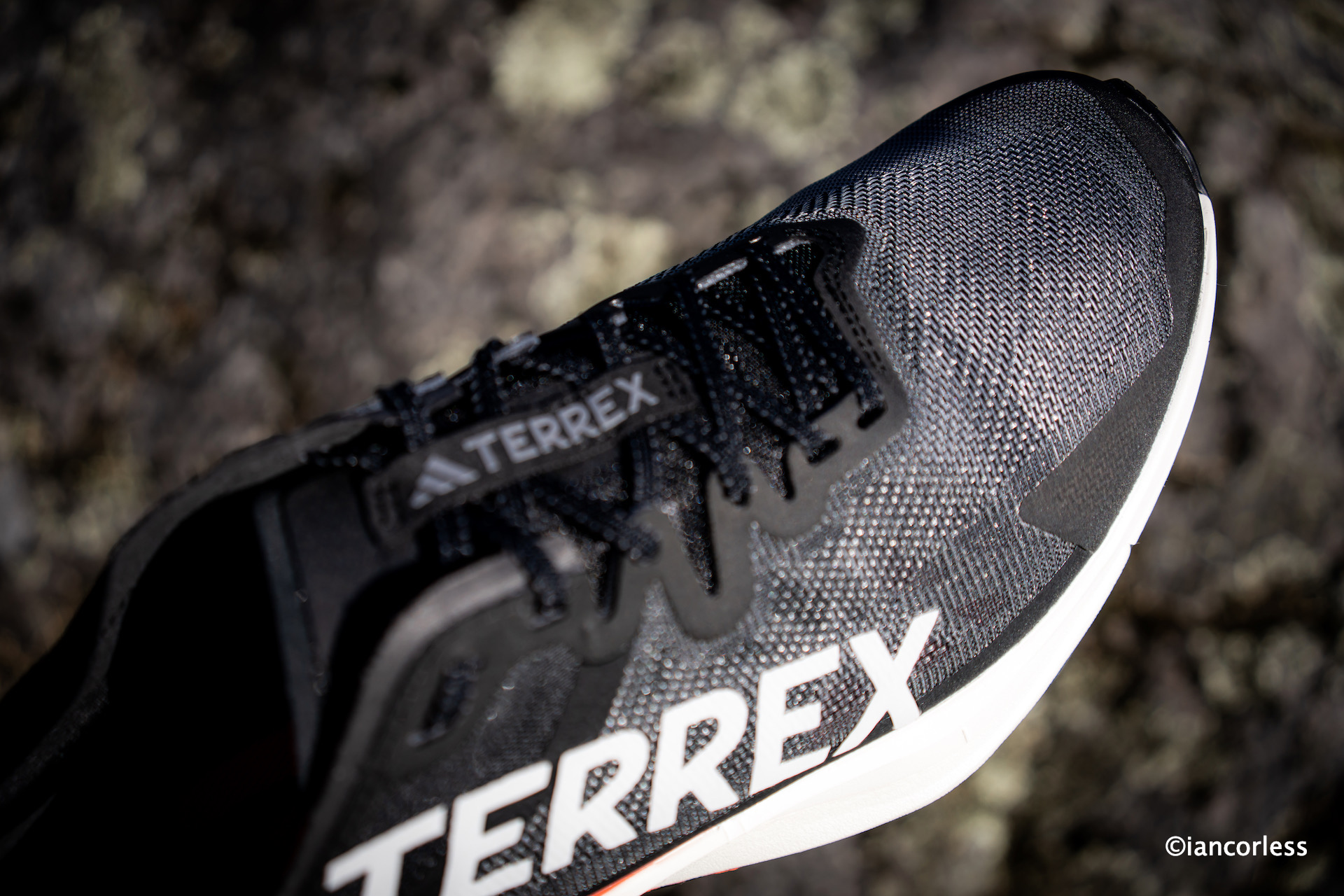
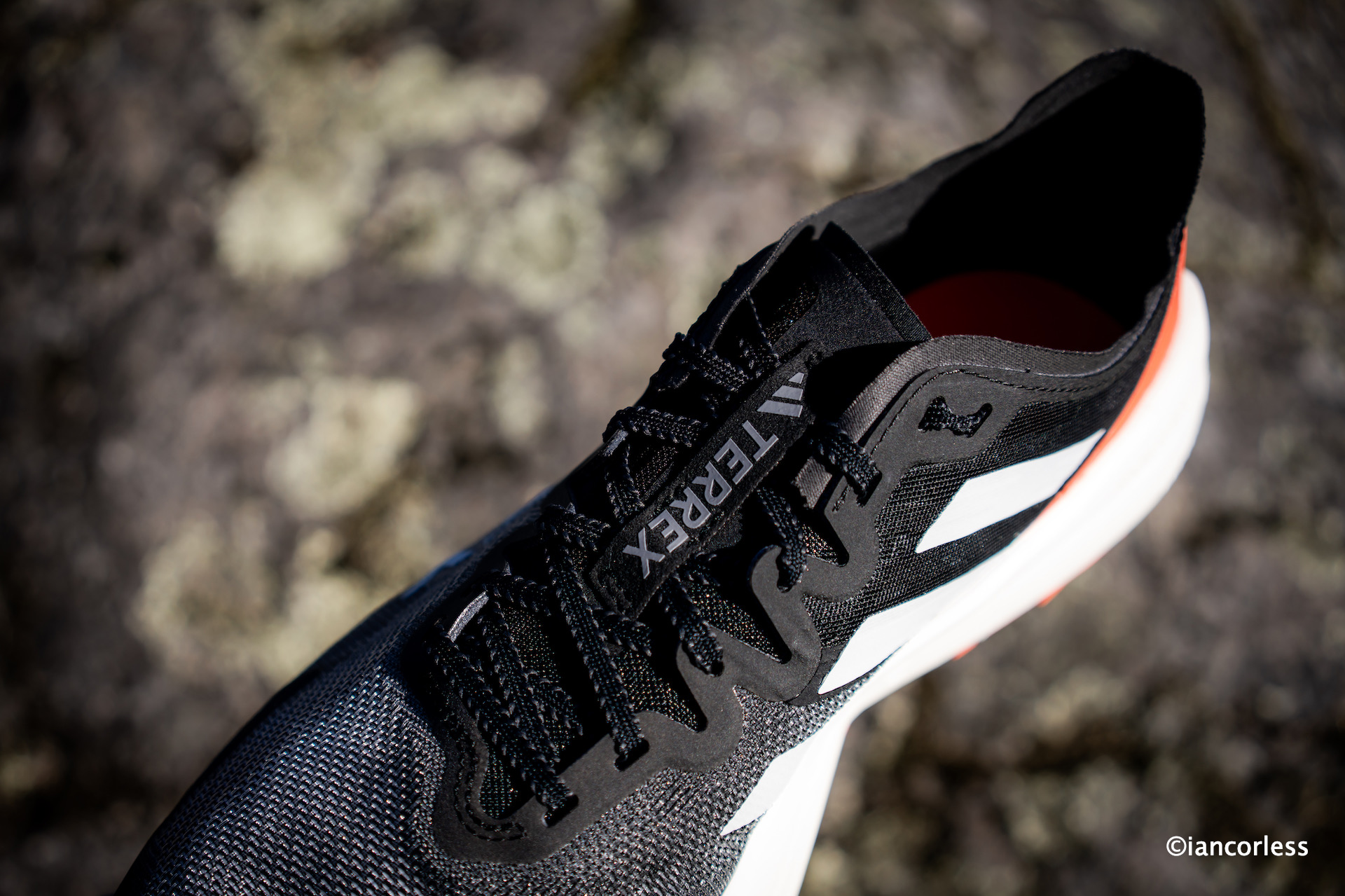
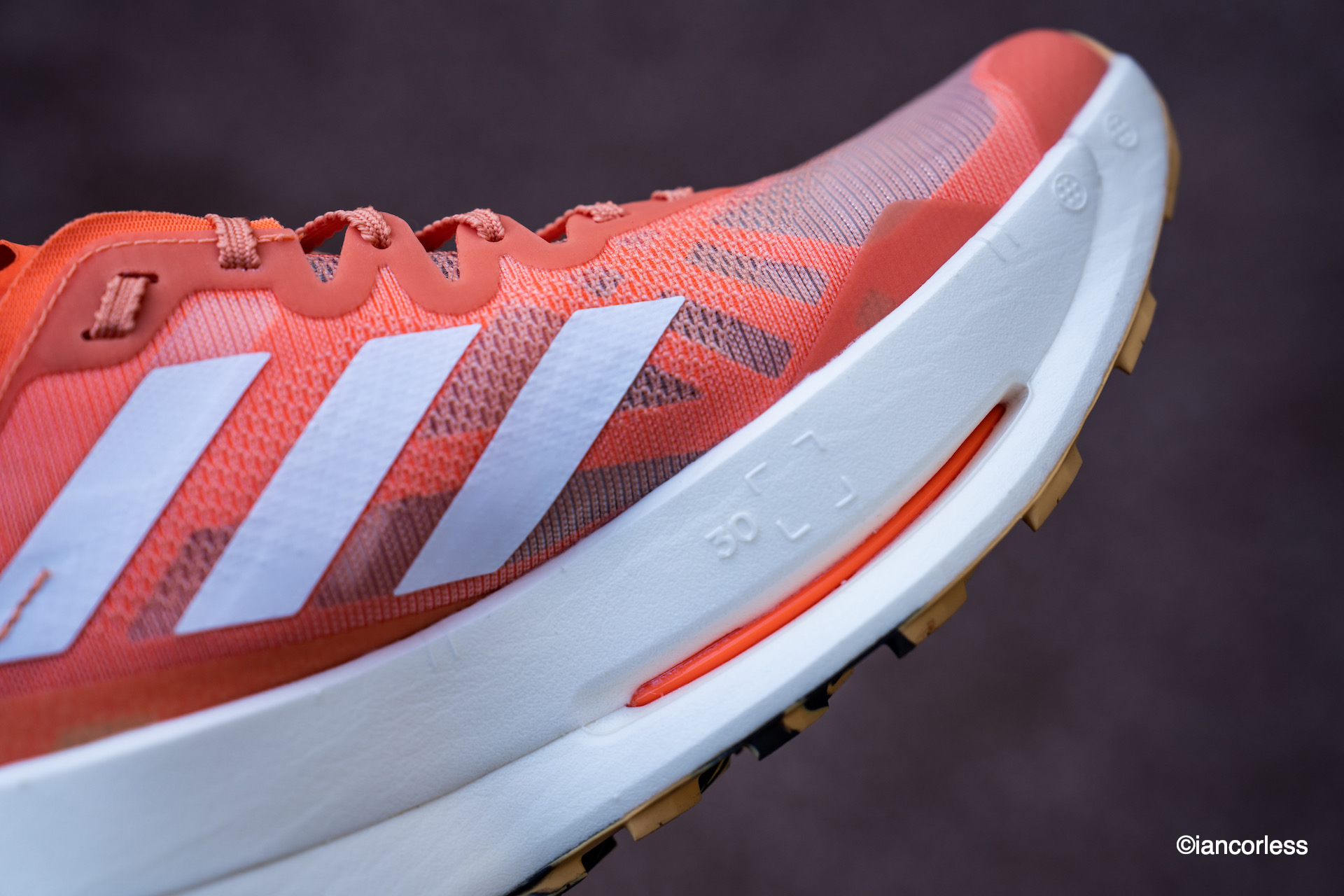
The shoes look similar when seen side-by-side but there are very obvious differences: less cushioning, not plate, less rocker and in my opinion, I love the black colorway with Terrex in bold white, a hint of orange provides some colour excitement.
The adidas Terrex Agravic Speed Ultra is a super shoe that runs fast on slick trails and is a beast for those looking for speed and the fitness to maximise the super shoe potential.
This Terrex Agravic Speed is a shoe for all and in all honesty, is a much better choice for most people looking for a trail shoe, whereas, by contrast, the Terrex Agravic Speed Ultra is only for a select few.
Despite the lower stack height, the shoe still suffers terrible stability issues on technical trail. I was really hoping that this would be less of an issue, and in all fairness, in comparison to the big brother, it is more stable, however, it is nowhere near stable enough. It’s only just a trail shoe, select the trails you run on carefully is my advice. There is a rocker, but it is nowhere near as pronounced as the Terrex Agravic Speed Ultra and the need to forefoot strike is less.
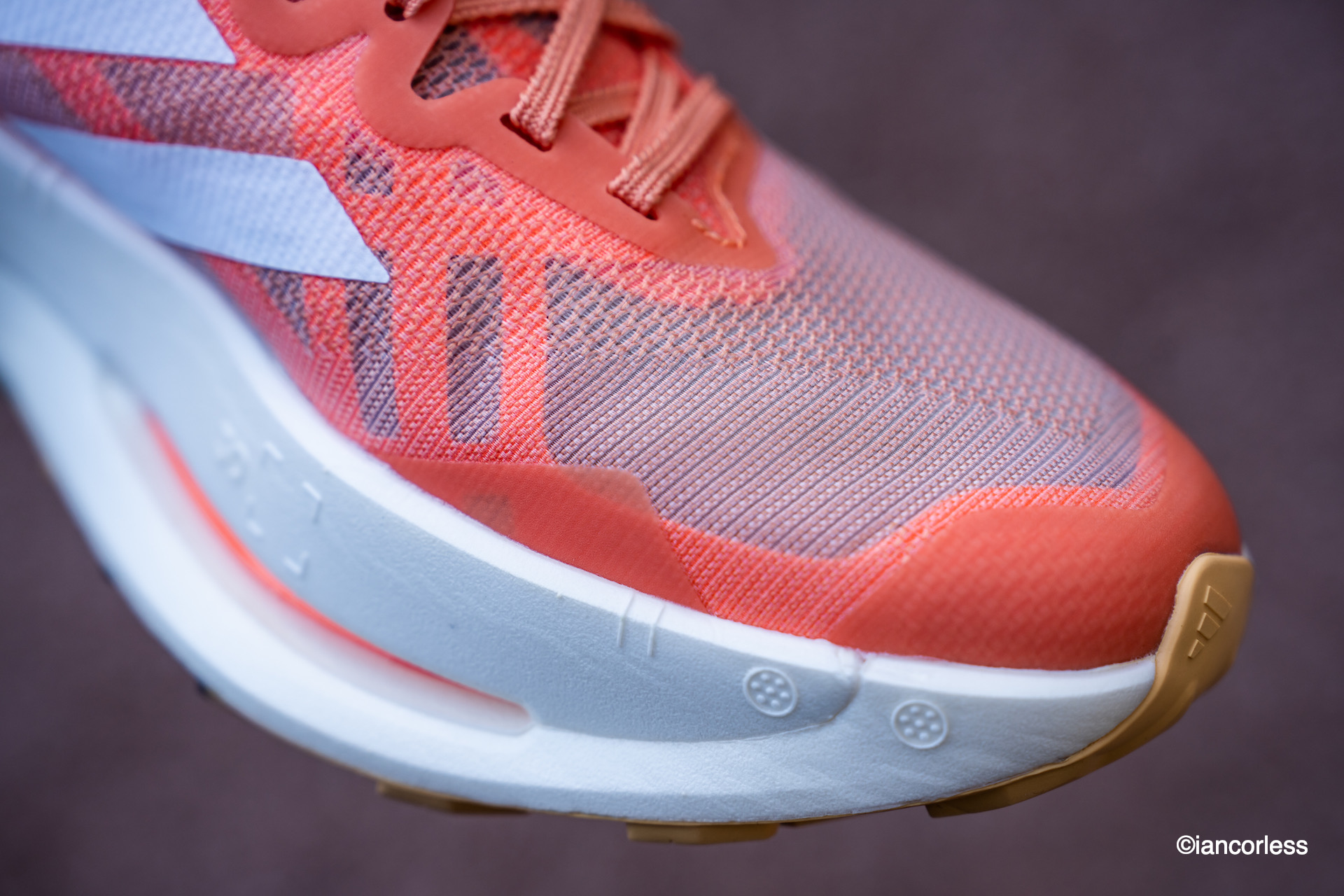
Light with a neutral fit, the upper is almost see through and very breathable. The toe box is wide and allows good toe splay. The heel area is minimal and while comfortable for me, it’s an area to be wary of. Sizing is again frustrating, you need to try them on! A gusseted tongue gives a lovely foot hold and reassurance.
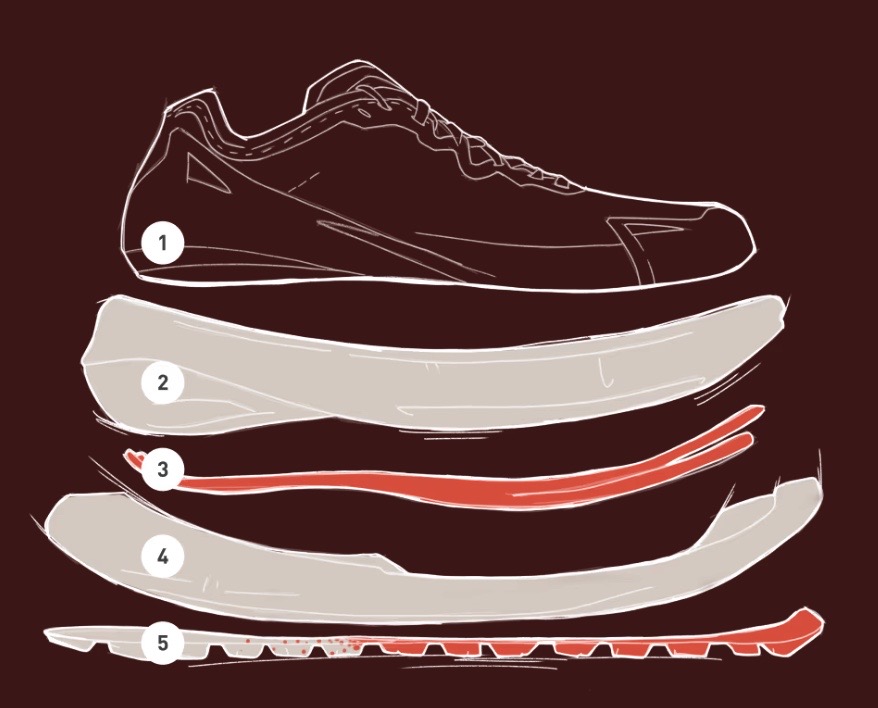
The cushioning is well balanced, soft without being squidgy and the responsiveness and propulsion is excellent. With softer foam at the bottom; Lightstrike Pro. Firmer Lightstrike on the top, this combination does add more stability but the footprint is too narrow in the middle and rear – ankle breaking warning given! When Runnning, the rocker does kick in and helps increase cadence and propulsion, but unlike the Terrex Agravic Speed Ultra, you feel more in control and able to reign the shoe in and run at a more comfortable pace. This is probably due to the considerably less stack height and the lack of any plate. Walking too is better, not ideal, but better.
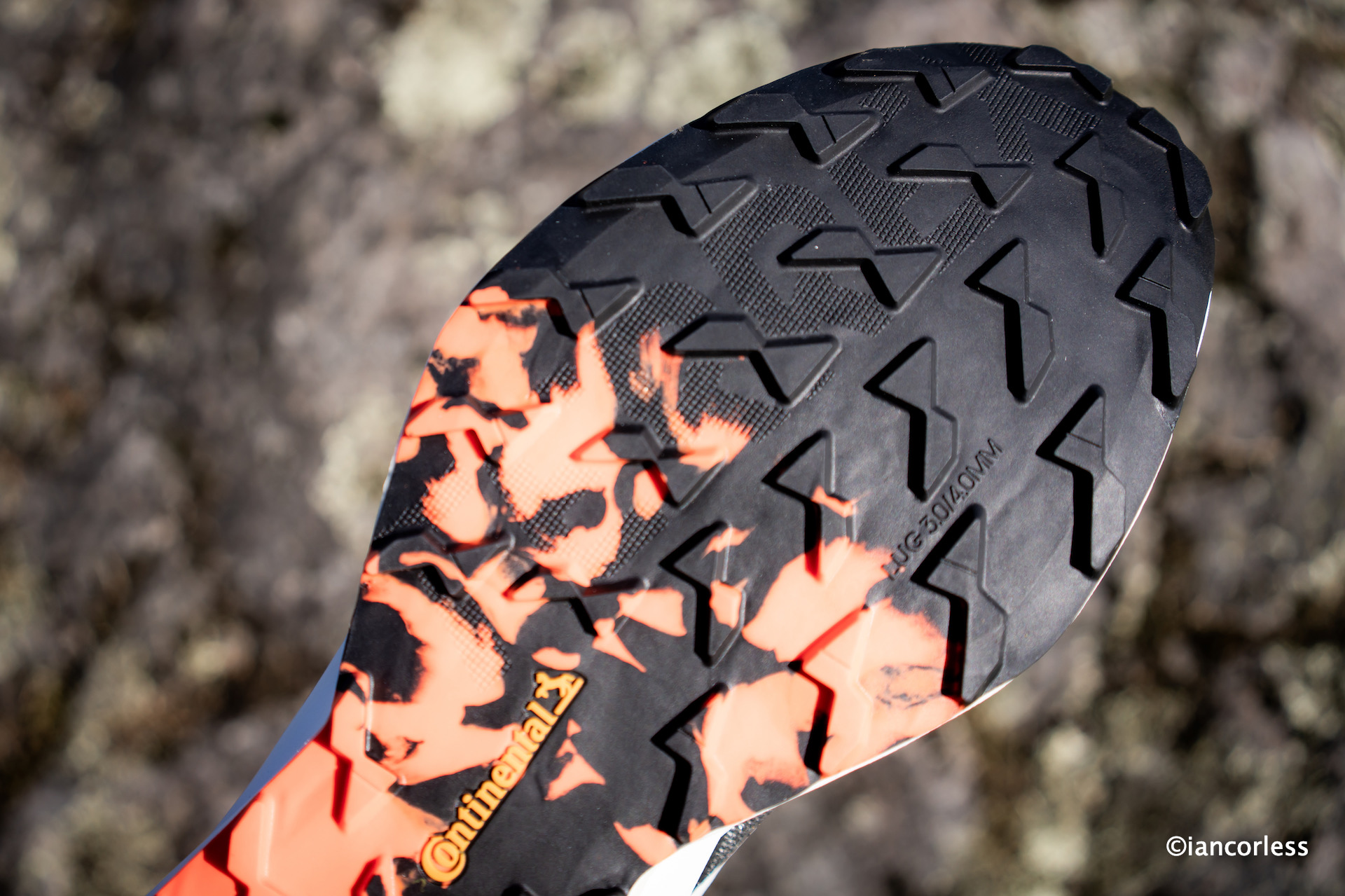
Continental outsole is good, again though, the lugs (3 and 4mm) are minimal and reduce the potential for it to be a real trail shoe. However, the grip is better than the Terrex Agravic Speed Ultra.
This shoe is arguably an update from my favourite adidas shoe, the Speed Ultra. However, with his level of stack height, there are no similarities really. It really is a subdued version of the Terrex Agravic Speed Ultra and as such, it would make a good training shoe if using the bigger brother for racing. It feels like a road shoe.
There is a great deal of positives with this shoe and as I have said previously, for most people, this is a considerably better shoe choice than the Terrex Agravic Speed Ultra.
However, there are lots of negatives.
adidas really need to sort there sizing out. There is no consistency.
They also need to understand that when a shoe is called Terrex, that means it’s a trail shoe and not an updated road shoe… The shoes need to be fit for purpose.
The ankle collar, for some, will be an issue.
The tongue needs more padding.
The footprint is woefully too narrow in the middle and the rear. Again, they are a stability nightmare, nowhere near as bad as the Terrex Agravic Speed Ultra, but it’s not great.
The outsole, again, is not aggressive enough. It’s like adidas want to make a road shoe that can just about go off-road, remain fast, but forget any technical and challenging terrain. I consider a 4mm lug a minimum, and this shoe would benefit from 5/ 6mm. But having said that, adidas would need to address the stability issues too.
Ultimately, the Terrex Agravic Speed is a good looking shoe that is ideal for faster trail running on slick or groomed trails. I have used this far more than its bigger brother as they are much more of an ‘all-rounder!’
The potential of the shoe is limited. It’s woefully unstable on technical trail, the outsole is not aggressive enough for anything other than slick trail and there are foothold issues.
So, this is a road to trail shoe, or a trail to road shoe. It’s the type of shoe that is ideal for someone who has loads of road experience and is venturing onto trail for the first time. But don’t get me wrong, there is a nice bounce, feel and propulsion to these shoes.
But, there are a great deal of shoes out there now that are a better option than the Terrex Agravic Speed. The Terrex Agravic Speed Ultra can come highly recommended as it is a super shoe that for the right person, they will reap the rewards that this shoe can offer. Here, the Terrex Agravic Speed is just another shoe with nothing unique or special to bring to the trail market. My advice would be take a look at theVJ MAXx2, this brings something special.
When Hoka released the Tecton X in 2022, I went on to say, “Tecton X for me, is the first trail shoe with carbon inserts that I have really enjoyed running in. The shoe offers protection, comfort, stability and great propulsion/ speed in a very good-looking shoe.”
That above quote still rings true. I have tried many trail shoes with plates, and none have given the feeling of the original Tecton X.
The Tecton X was followed by the X2, a shoe that I never had the opportunity to test. However, while differences existed – Lighter upper with Matryx, slightly narrower toe box and gusseted tongue, the differences were marginal.
Jump to the HOKA TECTON X3 and we are now looking at a completely different shoe!
This new incarnation regarding timeline and development, can be looked at and reviewed alongside the adidas Terrex Agravic Speed Ultra. They are both super shoes, both with plates, both with extreme cushioning and both tested (with results) by elite athletes before coming to commercial market. Read more about the Terrex Agravic Speed Ultra Here.
The Hoka Tecton X3 has been developed closely with Jim Walmsley and a prototype version of the shoe was used to gain victory at the 2023 UTMB. This prototype was then developed into a Hoka Tecton X2.5 which Jim used to win Western States in 2024 and surprisingly a commercial version of the Tecton X2.5 was made available in very limited numbers, it sold out and to my knowledge is no longer available, at least commercially. The Tecton X2.5 had more cushioning (44/39), different lacing, and having spoken to ‘those in the know’ in Chamonix, durability may well have been an issue for commercial release.
Post Western States and pre UTMB it was clear that the Hoka Tectonic X3 would be released and made commercially available just before UTMB and most certainly, there would be a great deal of buzz in and around the UTMB expo.
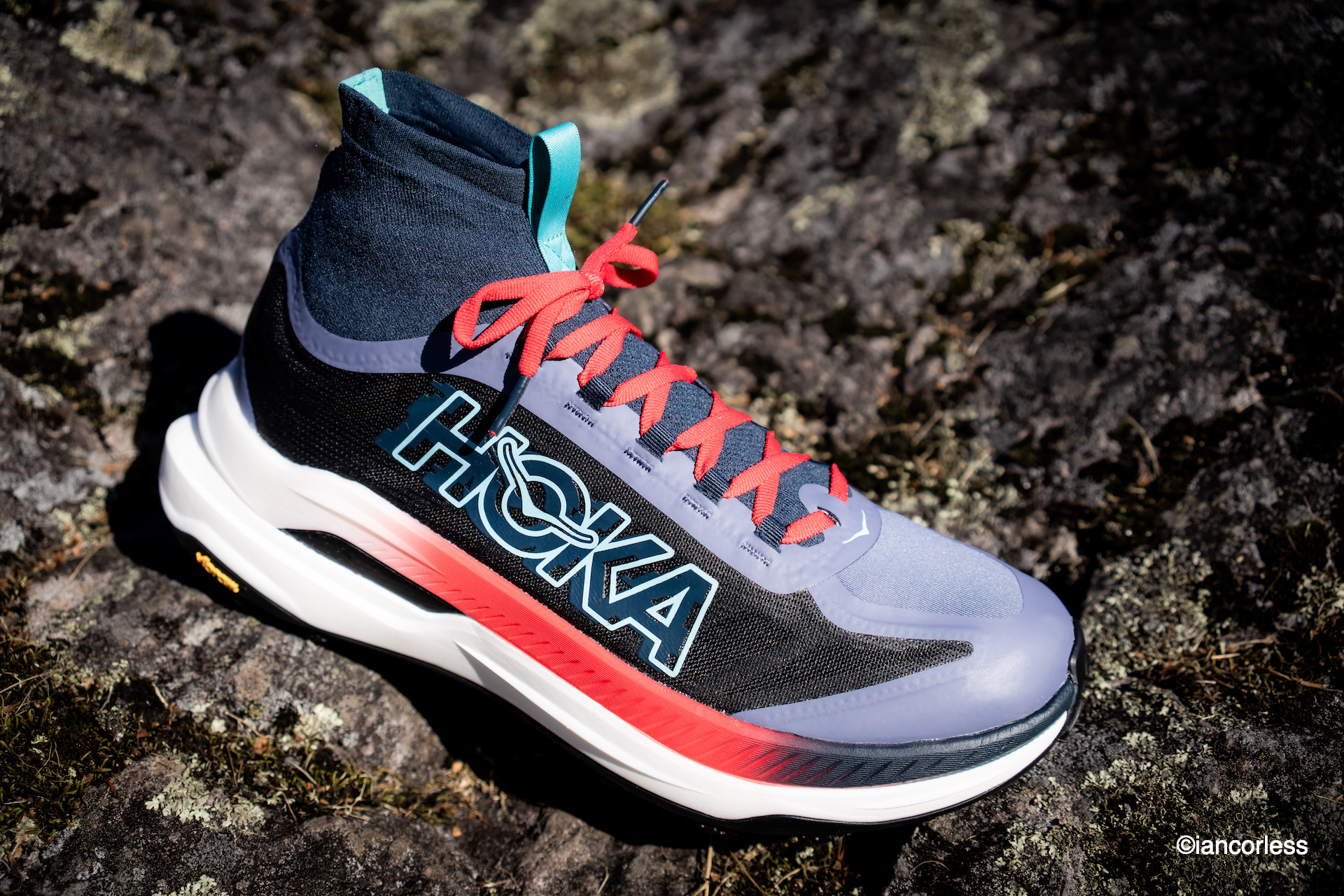
Both myself and Abelone were lucky to receive early versions (thanks to hoka.no). My shoe was in the stormy skies/ cerise colour way, Abelone received the UTMB limited edition black/ Hoka blue. I was immediately jealous, the blue/black colour way is sweet!
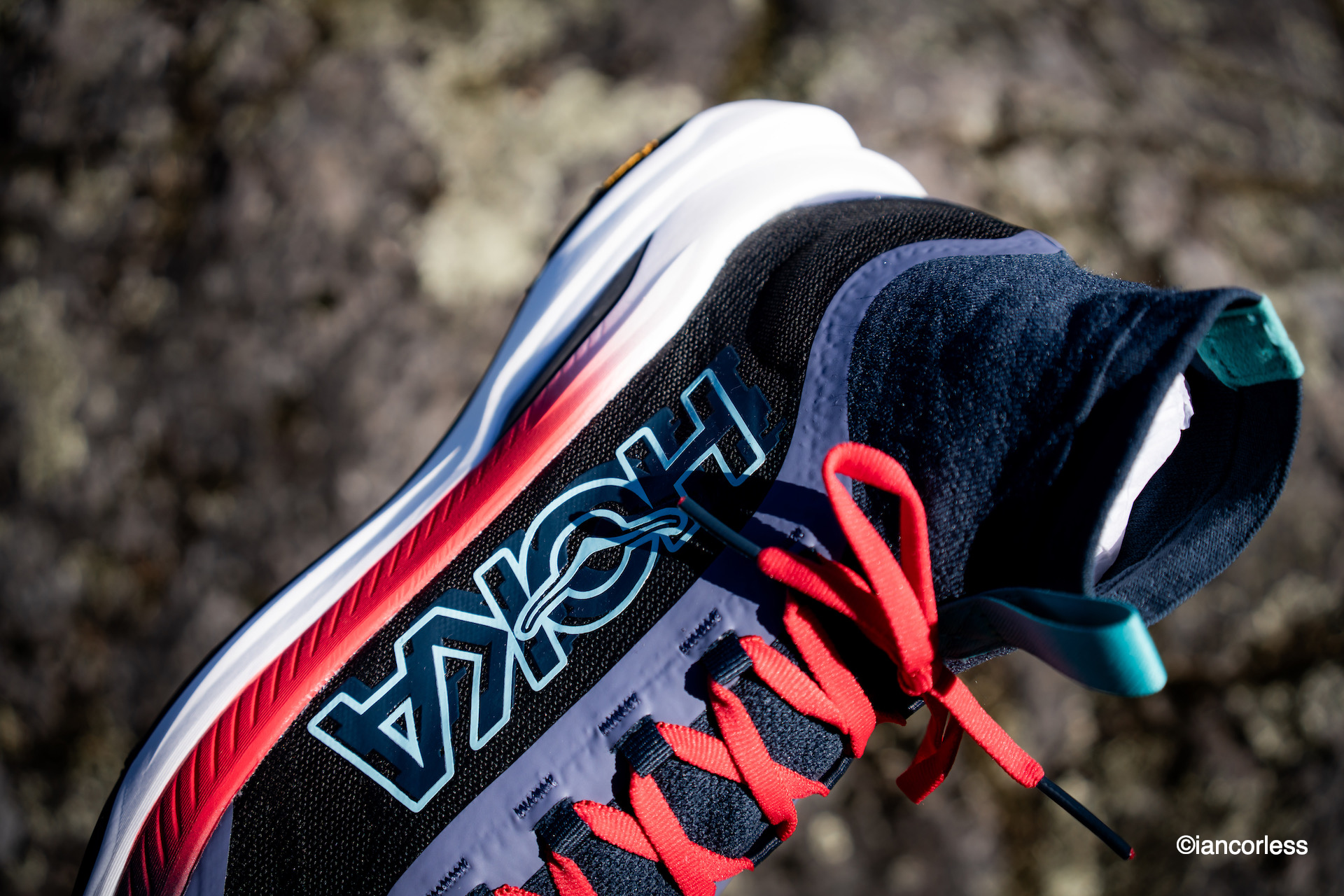
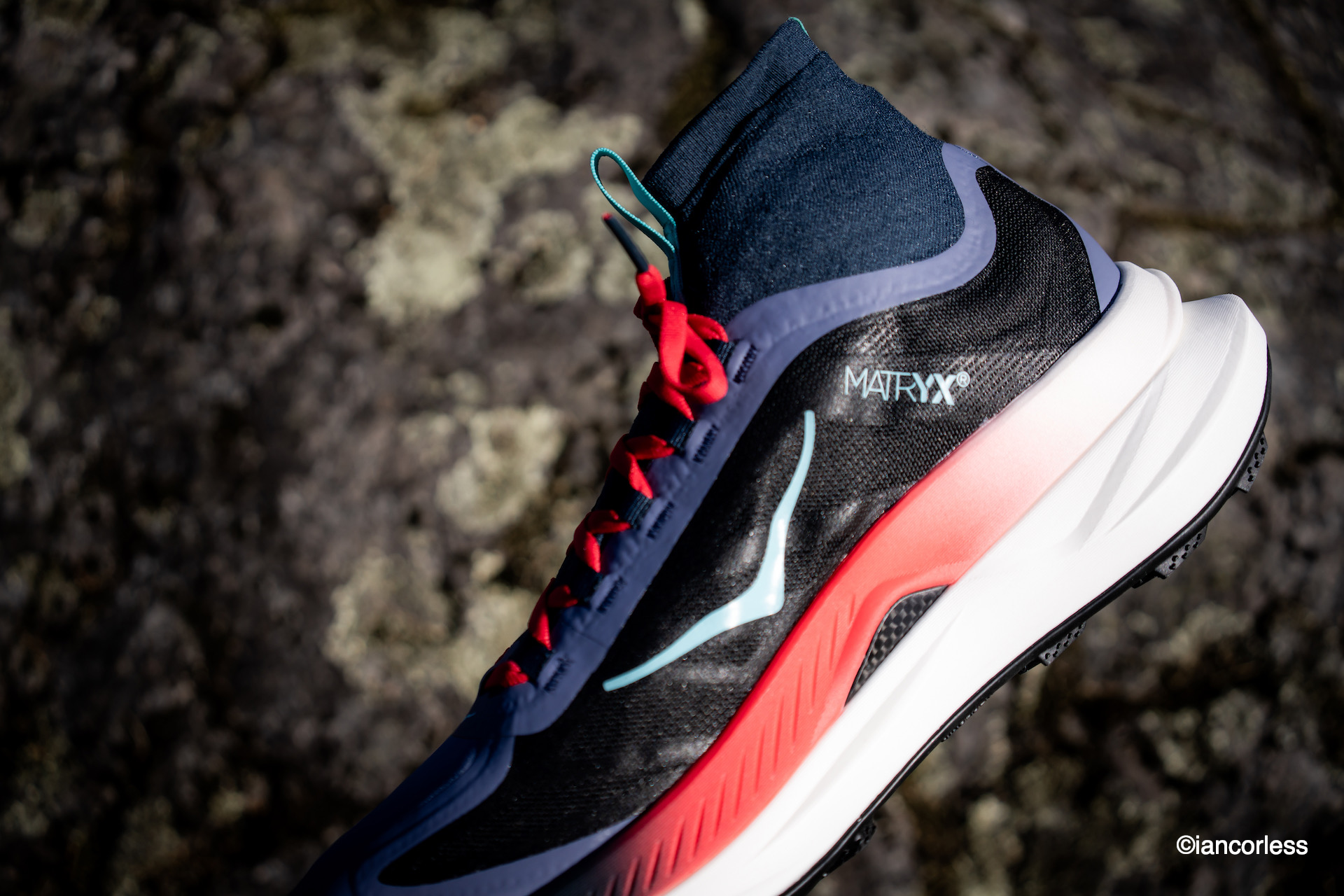
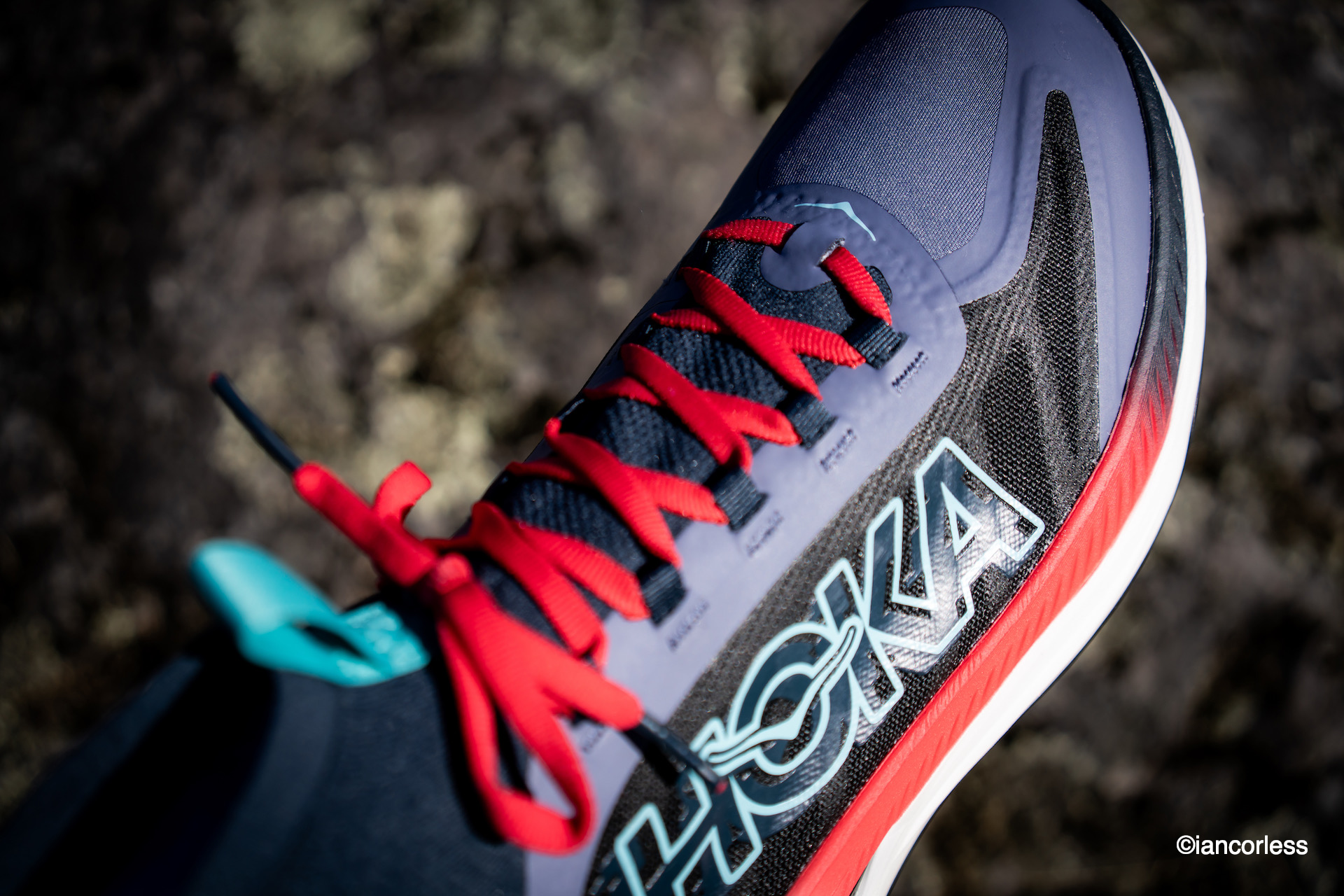
Just as we have seen on Jim’s UTMB and WSER Hoka’s, the TECTON X3 has a built-in knit gaiter which comes up above the ankle, fits very light and stops any debris entering the shoe.
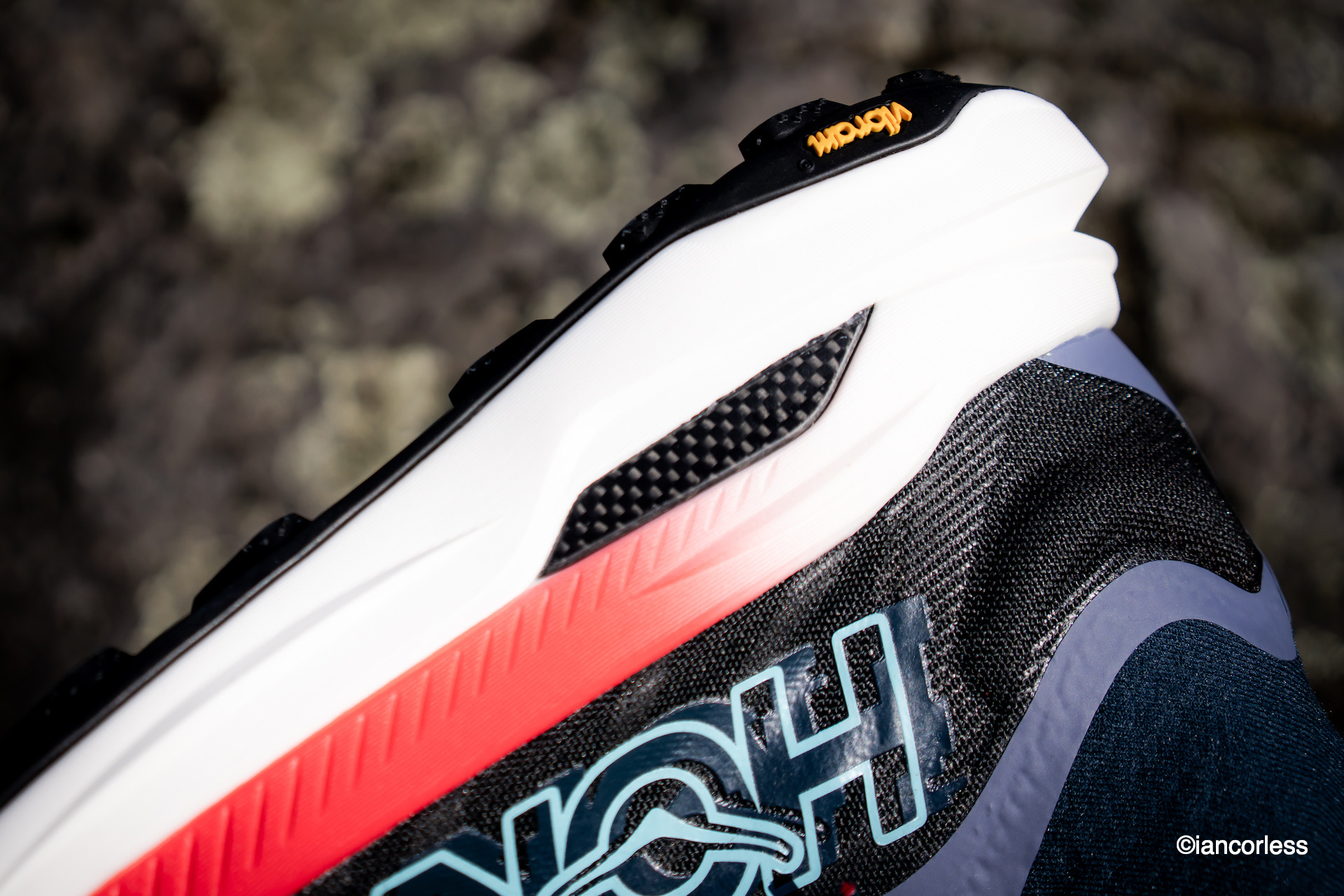
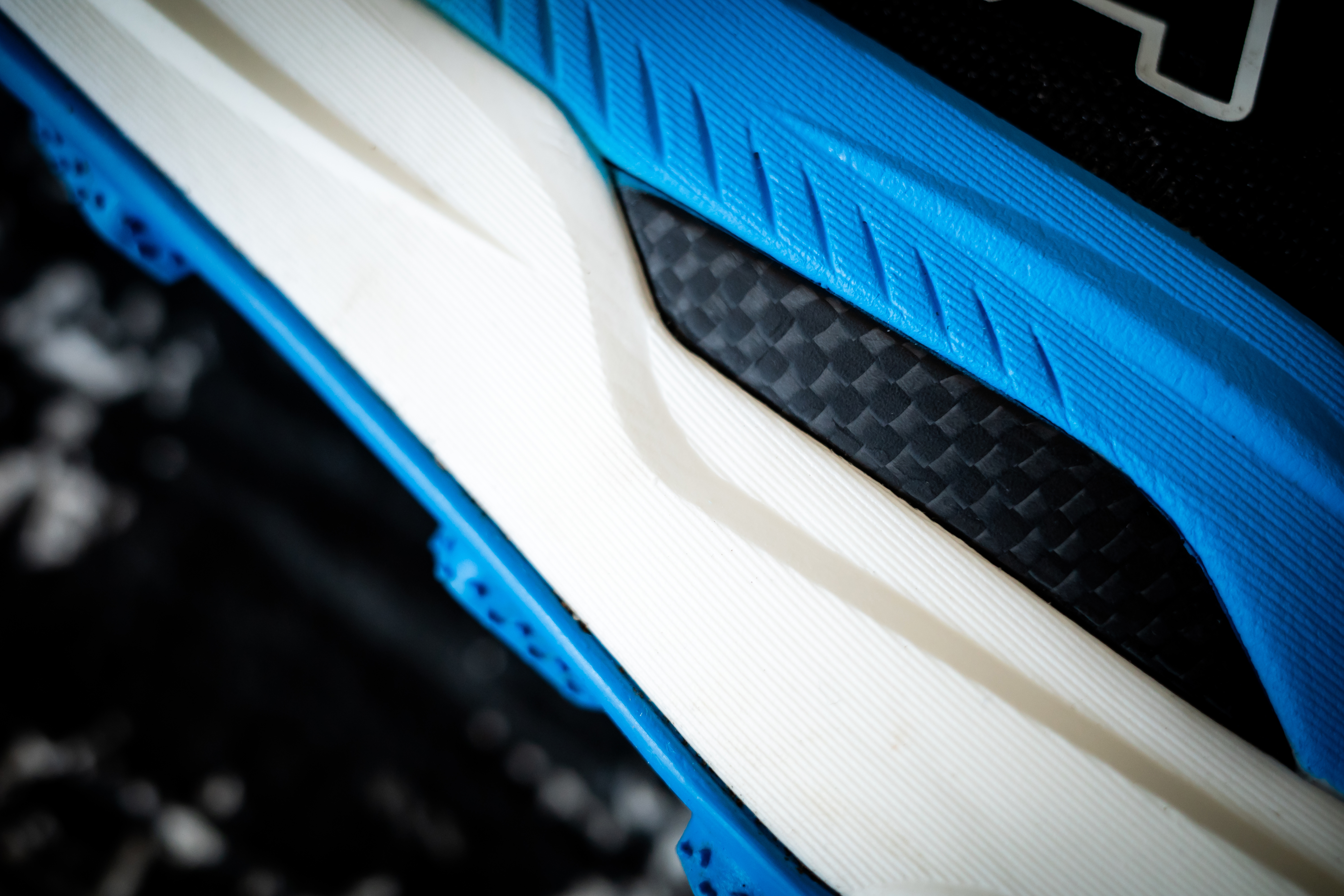
Arguably, the biggest development comes with the parallel carbon plates. They have been developed with ‘winglets’ that come up the side of the shoe, they are a game changer in making the shoe more stable.
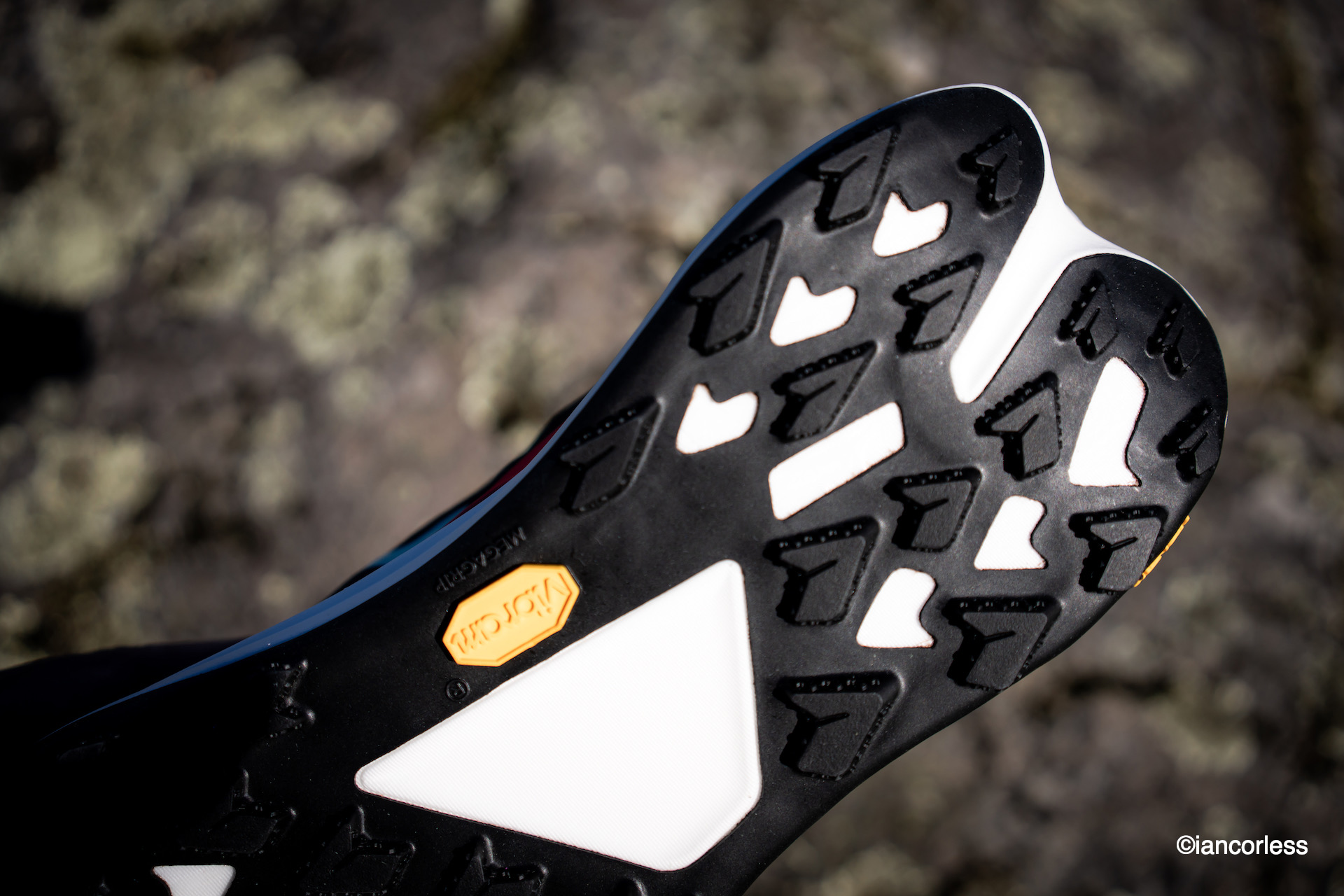
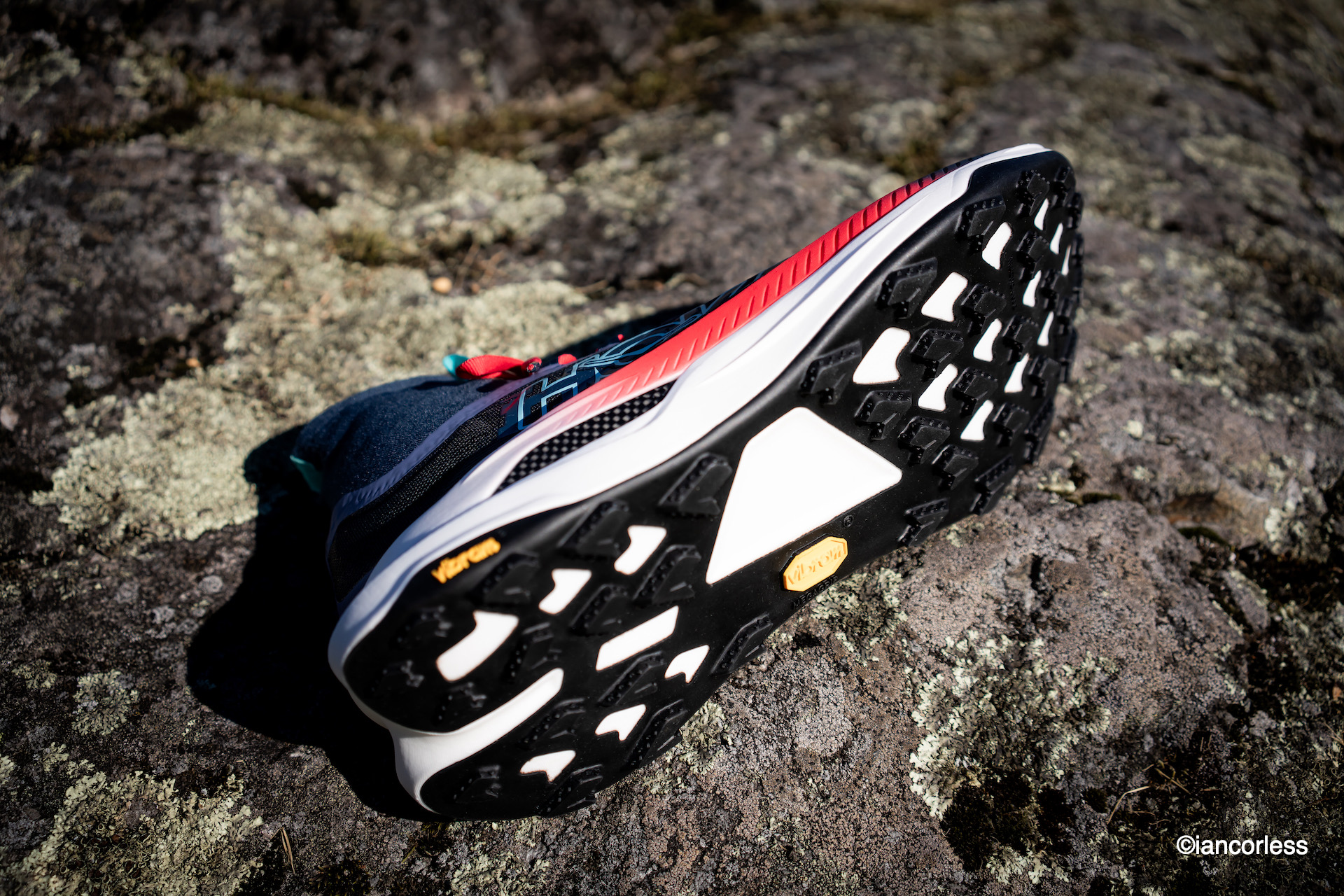
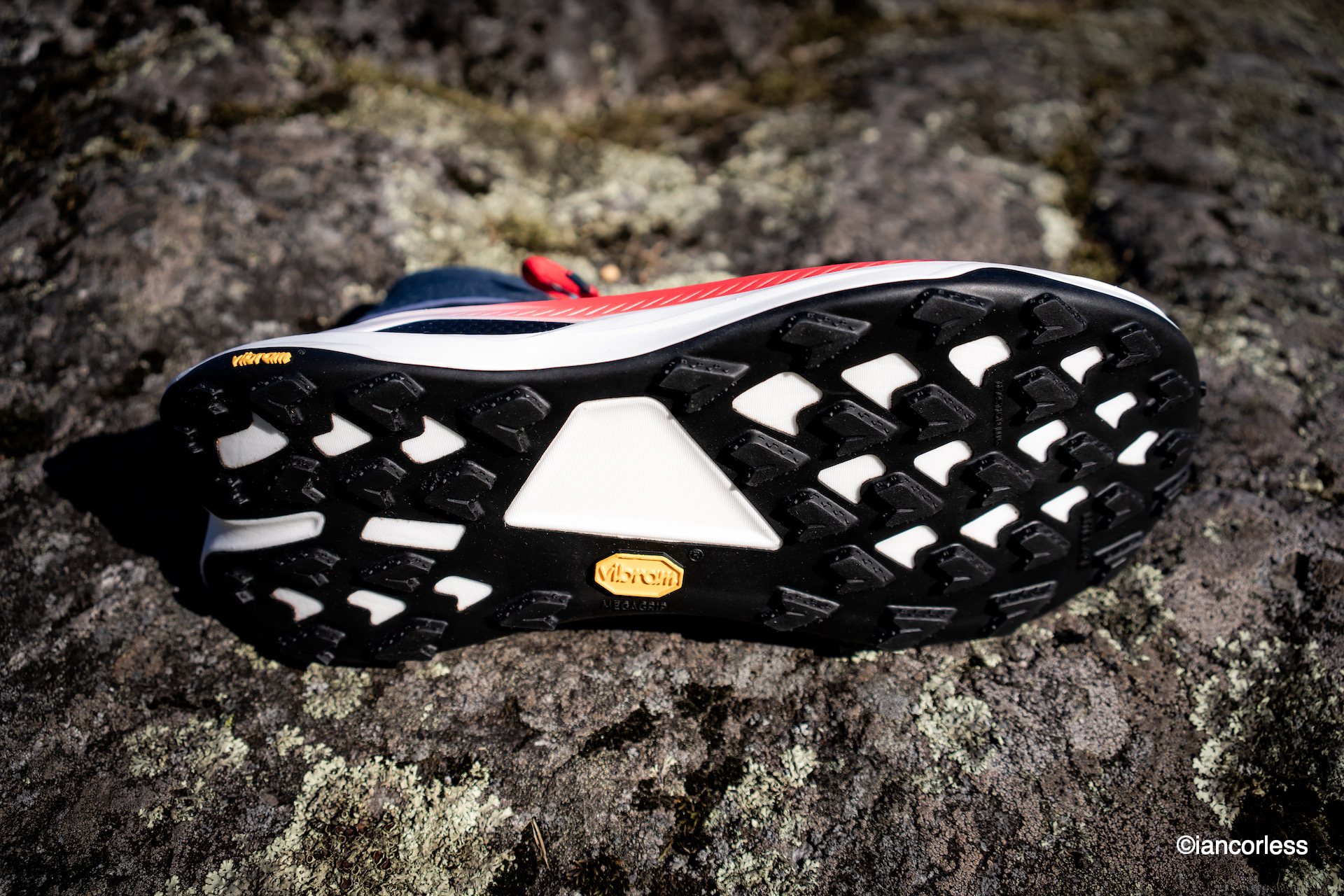
The outsole has also been developed with Vibram. This Vibram Megagrip Litebase covers more of the shoe, in comparison the Tecton X2. The lugs have also been changed to Traction Lugs with 4mm height.
The first thing I noticed was the size of the outsole. Hallelujah, Hoka completely understand that when you increase stack height, you also need to increase the size/ footprint of the outsole. This helps make the shoe stable. An incredible short coming from the new adidas Terrex Agravic Speed Ultra which is so narrow that you constantly roll left to right – the shoe has no stability, it’s a terrible shoe on challenging trail. Here, the Hoka Tecton X3 is supreme, the front is wide, the middle is wide, and the rear actually is not only wide but extends behind the shoe.
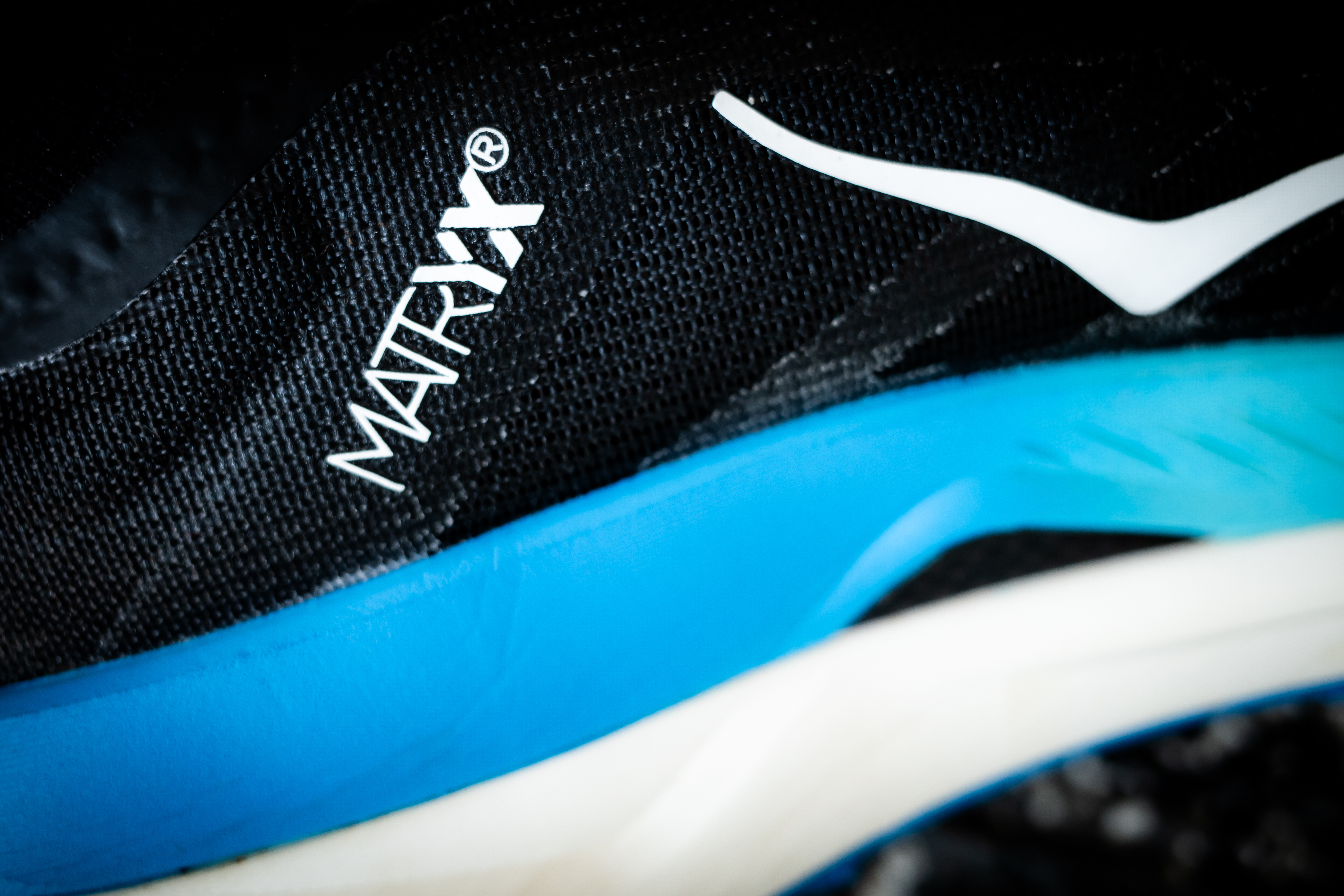
The Matryx upper is very durable and at the front of the shoe, there is great toe protection. The lacing system sits on top of the shoe and there is no tongue as the upper is an all-in-one upper. The addition of the gnit gaiter gives the Tecton X3 a unique look.
Cushioning is 40mm at the rear, 35mm at the front providing a 5mm drop, the women’s shoe is 39/34mm.
Sizing is true to size BUT due to the nature of the upper, you may want to try sizing to make sure you have the fit you require. For me, my normal run shoe size was perfect.
I was nervous about the gaiter. Nearly every shoe I have tried with a built-in gaiter I have been disappointed, either the gaiter is not tight enough or, the shoes are incredibly difficult to get on. Not so with the Tecton X3. For sure, getting the shoe on the foot requires more time and patience than a normal shoe, but it’s not problematic. Gladly, the fit around the top is tight. I absolutely love the feel of this shoe on the foot!
Another worry was the lacing. Would I be able to get the secure and locked feeling that I like with a shoe of this nature? Quite simply, yes! A great fit for me. Note I say, ‘for me,’ here. I do think that the shape will heavily influence if the Tecton X3 works for you. My foot fills and occupies the shoe, by contrast, Abelone has a long/ narrow foot, and she found that getting the correct hold/ security was difficult.
Standing up, the comfort level is a wow. They are plush but not squishy. Despite the stack height, they feel stable and secure, a consequence of the wide footprint and the new carbon plate.
The moment you start to run, you feel the bounce and propulsion moving you forward. They are a fast shoe but importantly, they are equally happy running slower and importantly (for ultra) they are extremely comfortable walking and hiking due to the wide and cushioned rear. The responsiveness is superb when climbing and the cushioning, width and carbon plates make downhill a joy.
The gaiter is fantastic, not only does it stop debris, but it adds the secure feeling of the shoe. So much so, when I have moved to other trail shoes, say the Hoka Speedgoat 6, I have really missed the gaiter. You forget you are wearing the Tecton X3 they are som comfortable.
These are a fun shoe; they are exciting and put a smile on my face.
For many years I have avoided shoes with large stack height, and this has not changed when I am running on very technical or mountain terrain, quite simply I need to be lower. However, despite 40/35 cushioning, the Tecton X3 is remarkably stable – way more stable than I anticipated. On single-track, gravel roads and non-technical trails they zip along. Amazingly, on tree routes, rocks, and uneven terrain, the stability level is considerably better than expected – the wide outsole and carbon wings really do a stunning job. Also, the parallel carbon plates can move independently, allowing the outsole to adjust the terrain underneath. There is a limit to how technical you can go, but also, one needs to consider the runner that is in the Tecton X3. If you are an experienced mountain/ technical trail runner, you may well be amazed and where you can take this shoe!
Vibram grip is universally liked, so the Tecton X3 has this covered. I personally am not always a fan of Vibram, especially on wet rock. However, this new Megagrip Litebase with traction lugs is a winner. The lugs are 4mm which is a perfect middle ground, a compromise will come in mud.
CONCLUSION
The HOKA TECTON X3 is my shoe of the year for trail running. It’s matched by the VJ Sport MAXx2 for mountain and technical trail.
Hoka have produced a remarkable shoe. There are key elements that make this stand out above all the competition. Super shoes very often are designed for and around super athletes, the adidas Terrex Agravic Speed Ultra a great example; if you are a great runner, can run fast and you have great form, the shoe is perfect. But if you are just a normal runner, the shoe can be a liability and on technical trail, it is a disaster.
The Hoka Tecton X3 is a super shoe, Jm Walmsley set a course record at UTMB, he then went on to win Western States and just recently, Vincent Couillard ran under 20-hours (19:54) to win the 2024 UTMB. Admittedly, Jim and Vincent were either in a prototype or maybe the Tecton X2.5 but there is a direct correlation to the Tecton X3.
The combination of features, cushioning, gaiter, parallel carbon plates and notably the new winglets and wide outsole make this a cushioned and surprisingly stable trail shoe.
The Tecton X3 is remarkably fast and once you get your cadence ticking over, you feel the carbon plates propelling you forward. But what is key for me is the comfort, feel and great sensations I get when running easy. They just feel great! At slower speeds the shoe feels comfortable and stable. Walking they are superb.
This may well be the first super shoe that works for any runner. That is a bold statement.
Despite all the above, the Tecton X3 will not work for some – If you have long narrow feet, you may find a compromise on fit.
The gaiter gives a secure and tight feel, this may not be for everyone.
There is one negative, due to the style of the shoe, the Matryx upper and the gaiter, the shoe does feel warmer than a normal shoe. Something I am happy to accept.
Finally, they are not cheap, however, run shoes these days seem to hover around the £200 mark, especially super shoes that push development and technology.
The adidas Terrex Agravic Speed Ultra shoe was one of the most anticipated trail shoe releases of 2024. Let’s be honest, this shoe was a long time coming…. We had seen early versions of the shoe on the podiums of Transgrancanaria, MIUT, Transvulcania, Western States, UTMB and more. There was a soft launch of the shoe at UTMB 2023 that only whet the appetite of runner’s even more, however, it was the spring of 2024 before the shoe became commercially available.
adidas did a great job of building the anticipation and it is fair to say, that until the release of this new shoe, adidas were not really considered a contender in the trail market. This new incarnation most definitely changed things and I have seen the shoes on countless runner’s feet, in countless races, all over the world in 2024.
I have been testing the Terrex Agravic Speed Ultra shoes for a year. I picked up my first pair in August 2023 and I have been through two pairs in the last twelve months.
The previous ‘Speed Ultra’ shoe is my personal favourite adidas shoe, it was developed with the input of Tom Evans and was the shoe the helped Tom place third at his first Western States. This new incarnation has nothing to do with the one that has gone before, the only connection, sadly, is the use of the Speed Ultra name. So, if you liked the first shoe, there is no guarantee you will like this new one! They are like chalk and cheese.
A whopping 42mm of cushioning at the rear, 34mm at the front gives an 8mm drop. The shoe has Energy Rods and an extremely curved rocker. The outsole is Continental rubber with 2.5/ 3mm lugs. The cushioning is Lightstrike Pro. The upper is extremely light and breathable with overlays for durability and a gusseted tongue provides foot hold and support. Sizing is hit and miss, so, I recommend trying this shoe on before purchasing to ascertain what size is correct for you.
The shoe has the ‘Terrex’ branding, which means trail running, but it feels like an adapted road shoe, if you are familiar with the Adizero range, there are similarities.
The shoe is promoted as ‘Our fastest trail running shoe yet.’ And in all honesty, it’s hard to argue with this based on the results of the adidas Terrex team in the last two to three years, and just recently, once again, we saw this shoe on the podium of Transvulcania, OCC and the CCC.
But is this shoe for you?
I must be honest here, it is definitely NOT for me. I have tested and tried to adapt wanting to really like this shoe, but I just don’t get on with it. It’s light, it has an incredible propulsion phase and it’s very fast. But…
If you go on any trail with just minor technicality, the shoe is horrendously unstable. Quite simply, it’s too high and the outsole footprint is not wide enough, especially in the middle and rear. This causes the shoe to twist left and right; they are an ankle injury waiting to happen.
The rocker is so pronounced, that walking is unpleasant. Of course, it is maybe fair to say, this is not a shoe to be walking in! But any shoe that has the ultra-tag in it’s name, will almost certainly mean that walking will be required at some point, maybe with the exception of the top athletes, for example, the adidas Terrex team!
So, is this shoe for you?
The answer is yes! If you are fast, have great running form (forefoot striking) and are training or racing on fast, single-track trails with little or no technicality. Go buy them.
However, if you are an average trail runner like me, looking for a comfortable and durable shoe that will see you through many training days or ultra races, with and without technicality, then no. This is not a shoe for you!
Just as the Nike Alphafly for road running will not make me Kipchoge, the Terrex Agravic Speed Ultra will not make me Tom Evans. The shoe may well be state of the art and fast, but they need a fast athlete inside the shoe, otherwise, they are actually more of a liability.
IN USE
This is a premium trail shoe from adidas, years of development and with a string of results from the Terrex team that makes you desire to rush out, get your own pair and run like Ruth Croft or Tom Evans and set PR’s, CR’s and top the podium of the races that you enter.
No matter how good the shoe, 99.9% of us just don’t have the Ruth or Tom natural ability to bring the best out of a super shoe like this.
This is a fast shoe, four pronged Peba Energy Rods are encapsulated between a Lightstrike Pro midsole. An extreme rocker and 42/34mm cushioning make this a beast to be unleashed. It’s a Ferrari for trail running on non-technical trail.
It is bold in looks, so much so, even the three stripes are subtle with TERREX in striking in white. There is no mention of adidas!
When you put the shoe on, you immediately feel the height and sadly, you also feel the instability. I am going to scream this again and again, the ‘footprint’ is not wide enough for the stack height of the shoe.
The foot hold from the gusseted tongue is very good and the sawtooth laces work well. However, the tongue lacks padding and when the laces are tied tight, there is pressure on the navicular bone. The heel cup is minimal but holds well. The toe box is wide and expansive which only makes the middle and the rear of the shoe feel very narrow. The rocker is immediately noticeable, you rock while standing still. If you are NOT a forefoot runner, forget this shoe. If you are a heel striker, you may as well leave this review now!
The combination of rocker, rods, cushioning and amazing propulsive phase make this shoe fly. As soon as you build cadence, the shoes start to propel you forward asking you to go faster and faster. I quite simply cannot keep up with the shoe. This is a positive if you have the fitness, speed and run form to do this.
Uphill and climbing, the shoes work exceptionally well. Downhill not so. The instability really comes to the fore and they just feel scary and unstable.
The shoes zip along and are nimble, lightweight and quick on slick trails, gravel roads and single-track.
Encounter rocks, tree routes, uneven terrain and the ride becomes worryingly unstable with constant twisting and rocking. They are not good on anything technical. The Energy Rods work like fingers, so much better than a single plate (also seen in Hoka Tecton X2 and the new X3) as it allows more adaptability and flexibility on trail, but here it doesn’t work due to the stack height and narrow footprint.
Continental rubber for the outsole is good with excellent grip, however, with 2.5/3mm lugs, this is only ‘just’ a trail shoe. But I guess that is the point! This shoe is meant to be fast for a Western States type of course where ‘grip’ is not really required. They are not for tough, technical and challenging mountain terrain.
Ultimately, don’t be fooled by the performances of the adidas Terrex team, they are superb athletes with the speed, great run form and ability to really make the Terrex Agravic Speed Ultra shine. If you are running slower, trying to walk or just out for an easy run, these shoes are clunky and awkward.
The shoe also requires adaptation. Early runs will work muscles in a different way, particularly calf and glutes. If you get these shoes, adapt over time and distance adding a day off with another shoe between runs until you feel adapted.
I this a bad shoe? Absolutely not, it is state of the art and the results of the adIdas Terrex team endorse that. A fast shoe for slick trail and on the right feet a real joy.
Sadly though, most of us are not fast, don’t have great run form and this shoe will not only be a waste of money, but ultimately may well result in in a worse performance and maybe injury, especially if trying to run on technical terrain.
The Terrex Agravic Speed Ultra is quite simply not for me!
However, should you wish to pursue an adidas shoe, the Terrex Agravic Speed (review to follow) with 34mm/ 26mm cushioning and no Energy Rods may well be a better consideration. I have used this shoe considerably more than the big brother Terrex Agravic Speed Ultra with better sensations and run feel. Sadly though, despite the reduced stack height, it is still worryingly unstable on technical ground.
Finally, if a super shoe is what you require, the Hoka Tecton X3 is a revelation. Hoka understand that if you increase stack height, you must also increase the platform on which this increased height sits. The Tecton X3 has a superbly wide base at front, middle and especially the rear with a great Vibram outsole. In addition, the two parallel carbon rods have now been developed with ‘wings’ that come up the sides of the shoe providing a considerably more stable platform. This is how a cushioned, plated super shoe should feel. Yes, it’s a super light and responsive shoe and while the adidas requires a top athlete and great running form to bring out the best of the shoe, the Hoka does not. The Hoka is superb when running fast but equally at home when running slower or walking. A full review HERE.
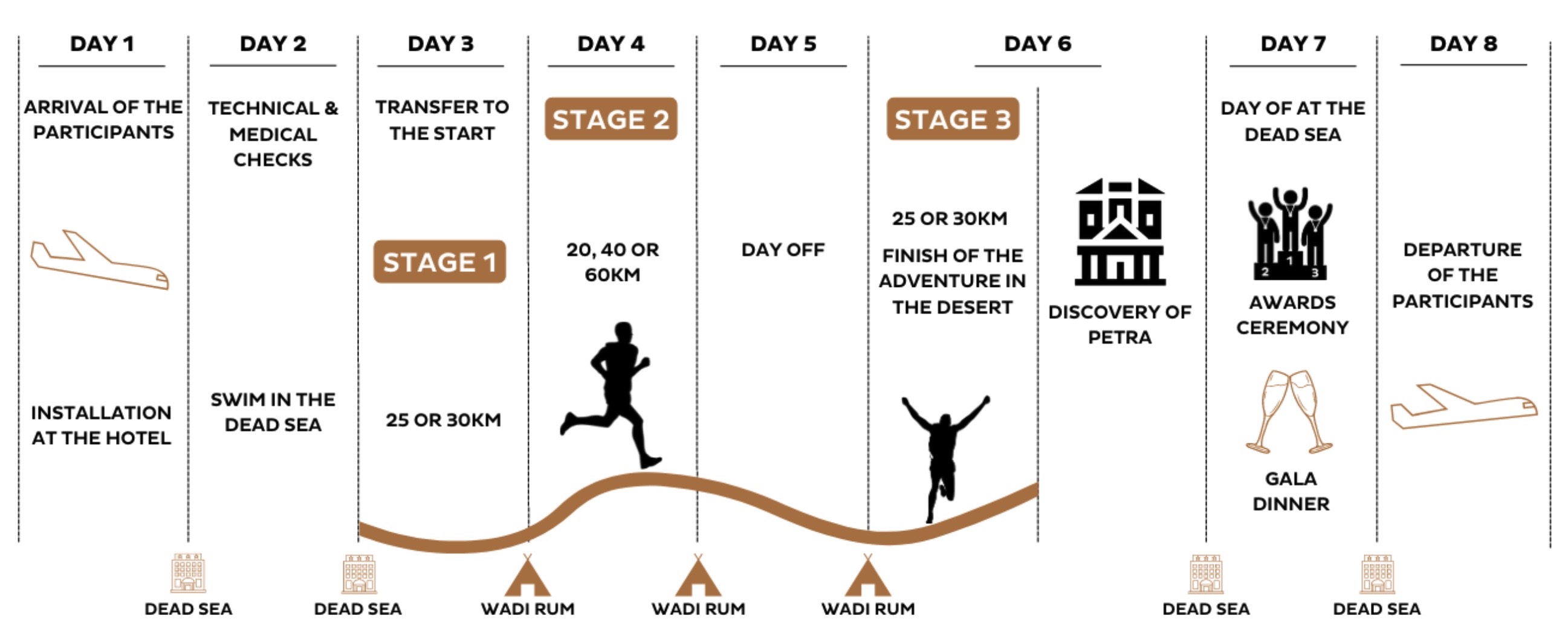
Both races will follow the classic MDS format with 3-stages taking place over 4-days. This allows participants to choose a distance of 70, 100 or 120km’s.
Day 1 will have arrival in Jordan or Turkey.
Day 2 Technical and admin checks.
Day 3 Stage 1
Day 4 Stage 2
Day 5 Rest Day
Day 6 Stage 3 followed by night at the race hotel.
Day 7 Day at the hotel and gala dinner.
Day 8 Onward travel
MDS Jordan is a firm favourite in the MDS list of races with two editions taking place in each year. May and November. A very special race that mixes the Dead Sea with the deseret of Wadi Rum.
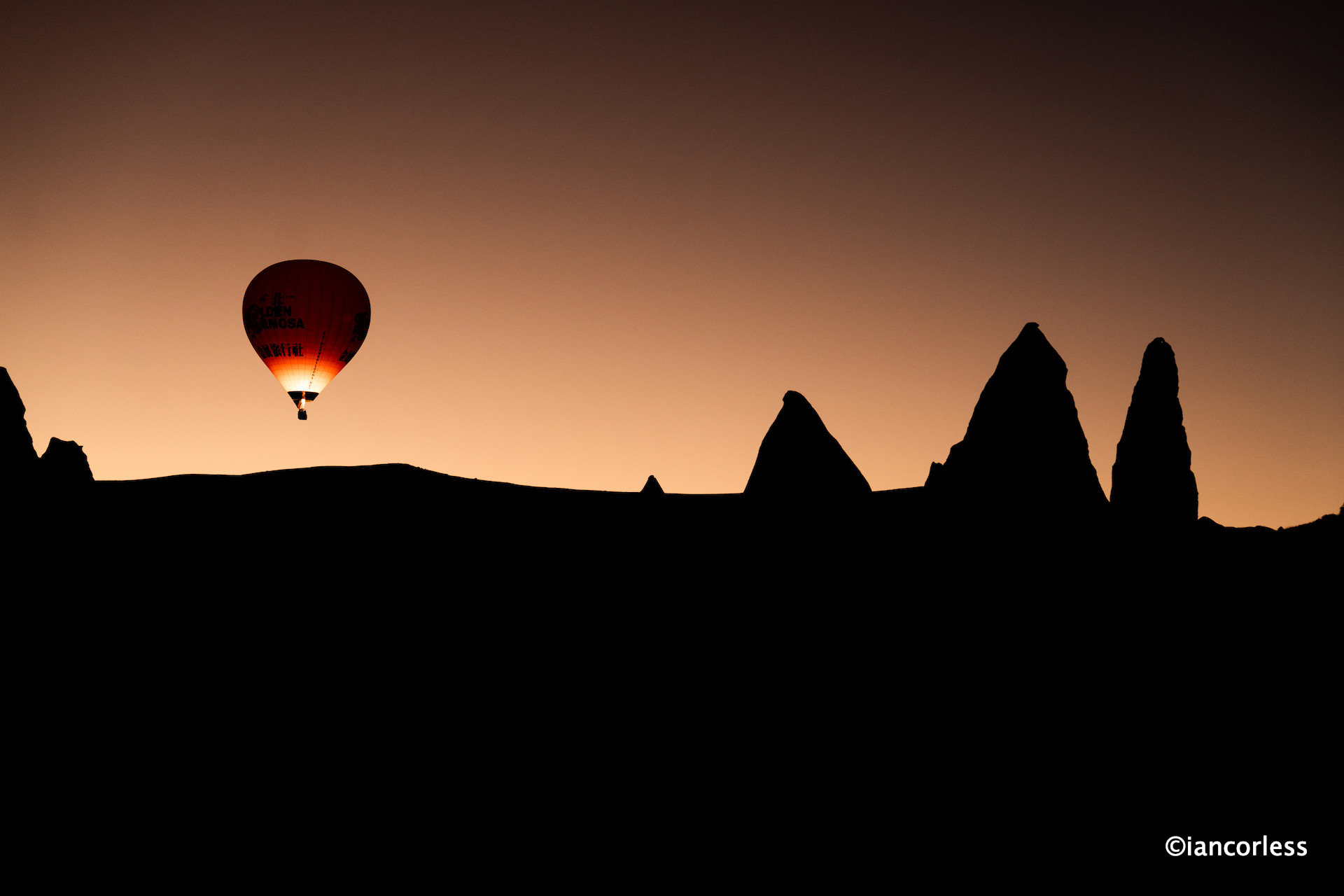
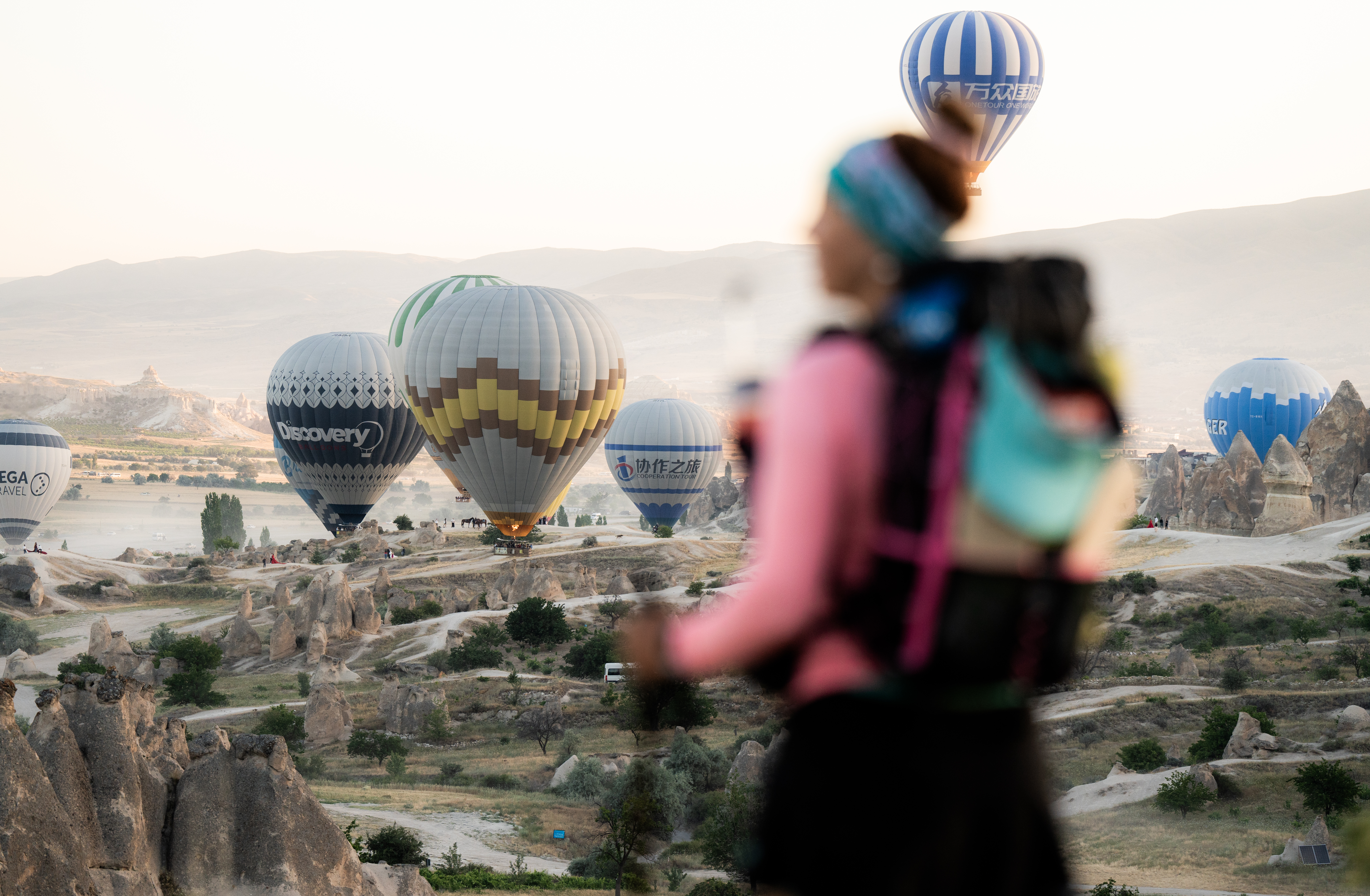
MDS Cappadocia had a first edition in 2024 and what an edition! Unique landscapes, hot air balloons and amazing light. A departure for the MDS brand with considerably less sand and more technical trails. A stunning addition to the MDS line-up.
What is the MDS?
The MARATHON DES SABLES is a unique adventure, shared by thousands of enthusiasts since 1986.
To differentiate the full distance race of 250km’s, Marathon des Sables will now be known at MDS The Legendary, reflecting the legendary status of this iconic event and its long history as a pioneer of the stage racing and multi-day format.
The ‘HMDS’ format while still follow the same protocols as before but has now dropped the ‘half’ title and moving forward, events will be called MDS Jordan, MDS Morocco, MDS Cappadocia and so on.
The MDS events are a one-week sporting adventure that combines the discovery, tavel, meeting new people and physically challenging yourself in a self-sufficient manner.
MDS format is as follows, after spending 1 or 2 nights in a hotel, you will go to the desert for 4 days of adventure and typically 3 or 4 nights in bivouac.
Once the race is over, the participants return to the race hotel offering relaxation time and a gala dinner.
The MDS exists in three different formats so that you can choose a distance based on your own personal requirements, needs and fitness:
Stage 1 : 25km to 30km
Stage 2 : 20, 40 or 60km
Rest day
Stage 3: 25km to 30k
The difference between the formats is on stage 2, where, depending on your form, you can choose 20, 40 or 60km.
During the MDS you will spend your nights in the heart of the desert, in the MDS bivouac in a tent supplied by the organisation.
The MDS is self-sufficient, you need ALL your equipment and food to last the duration of the event. Water is the only item supplied.
With all MDS events, if you do not finish, you receive a free entry for the next edition.
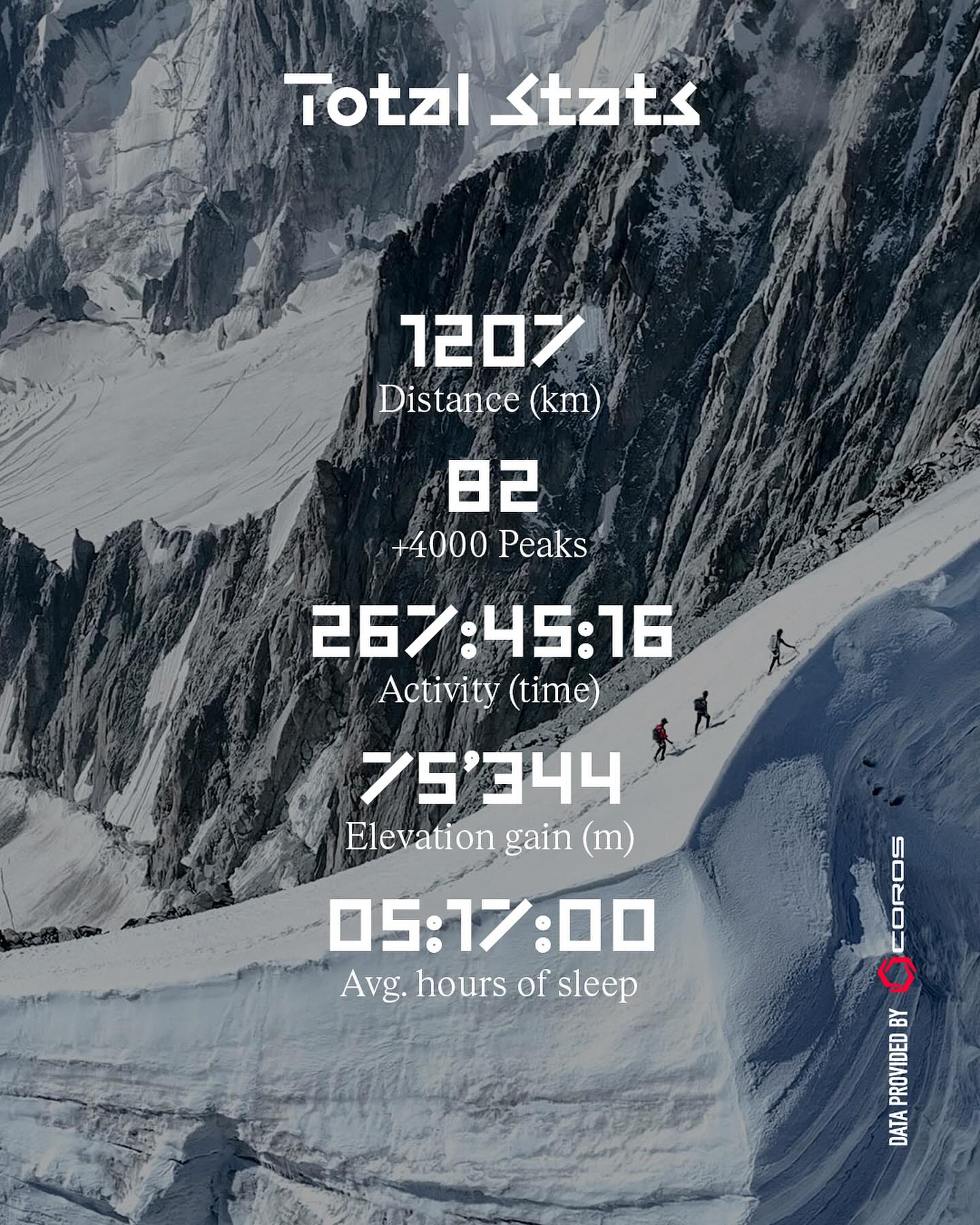
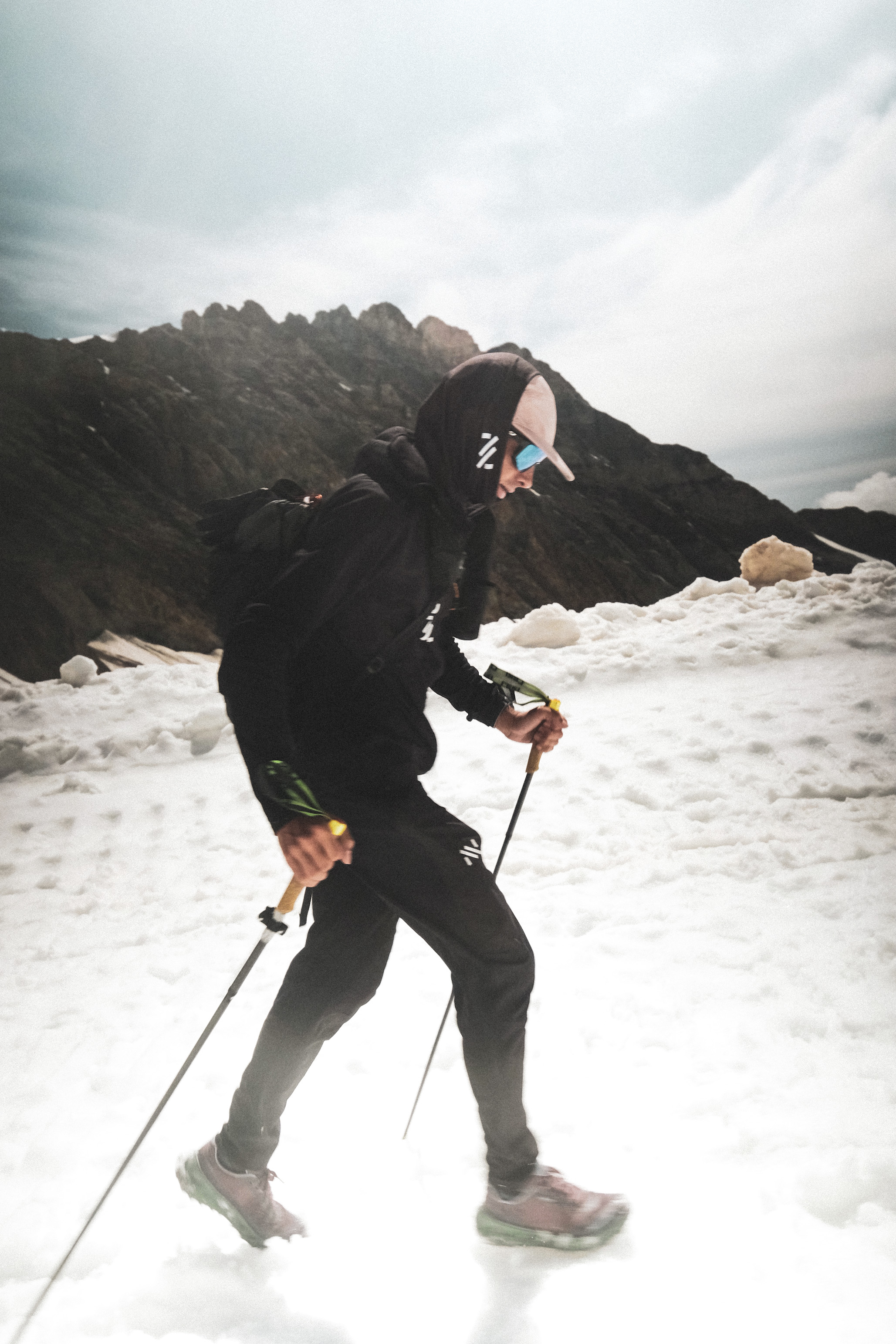
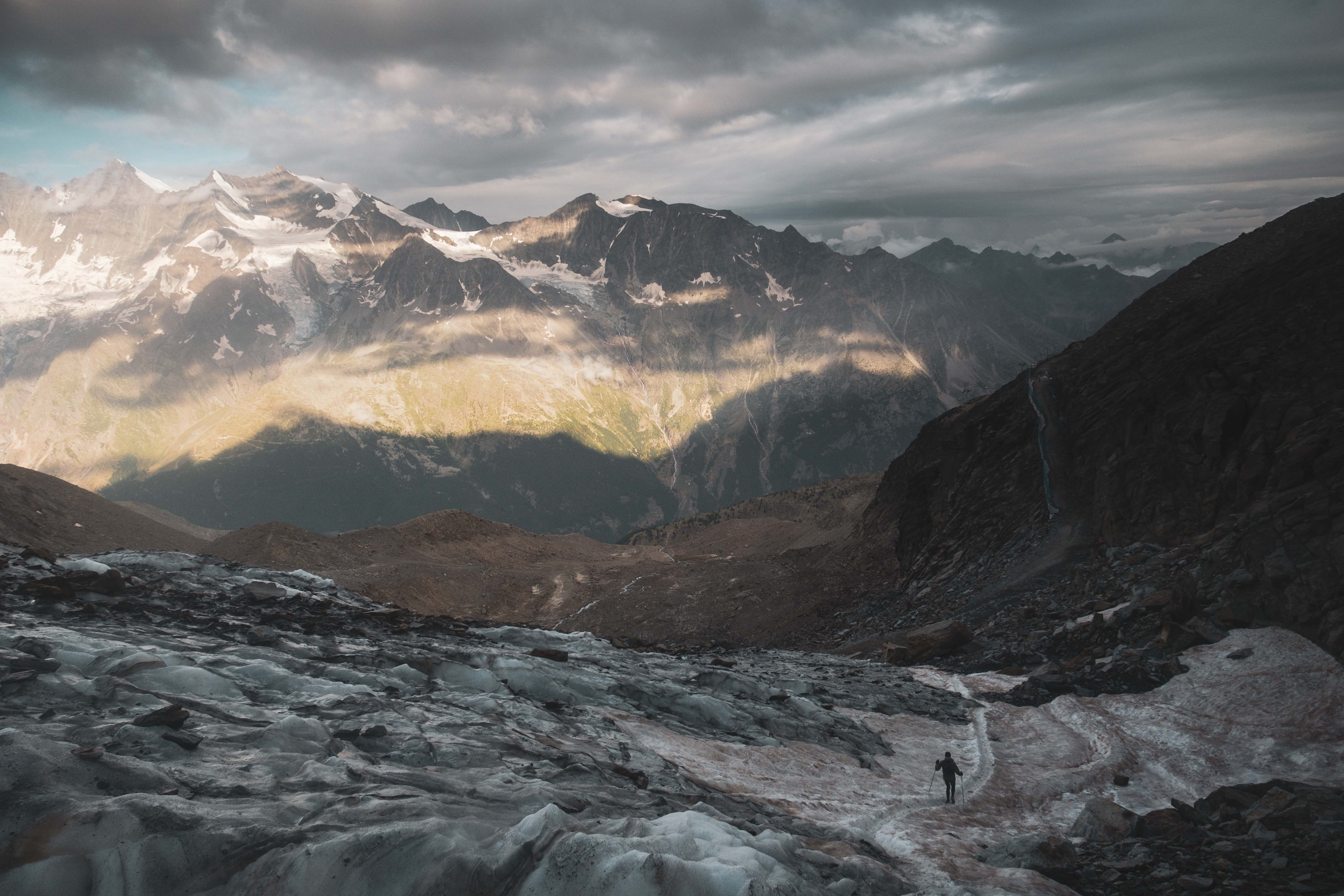
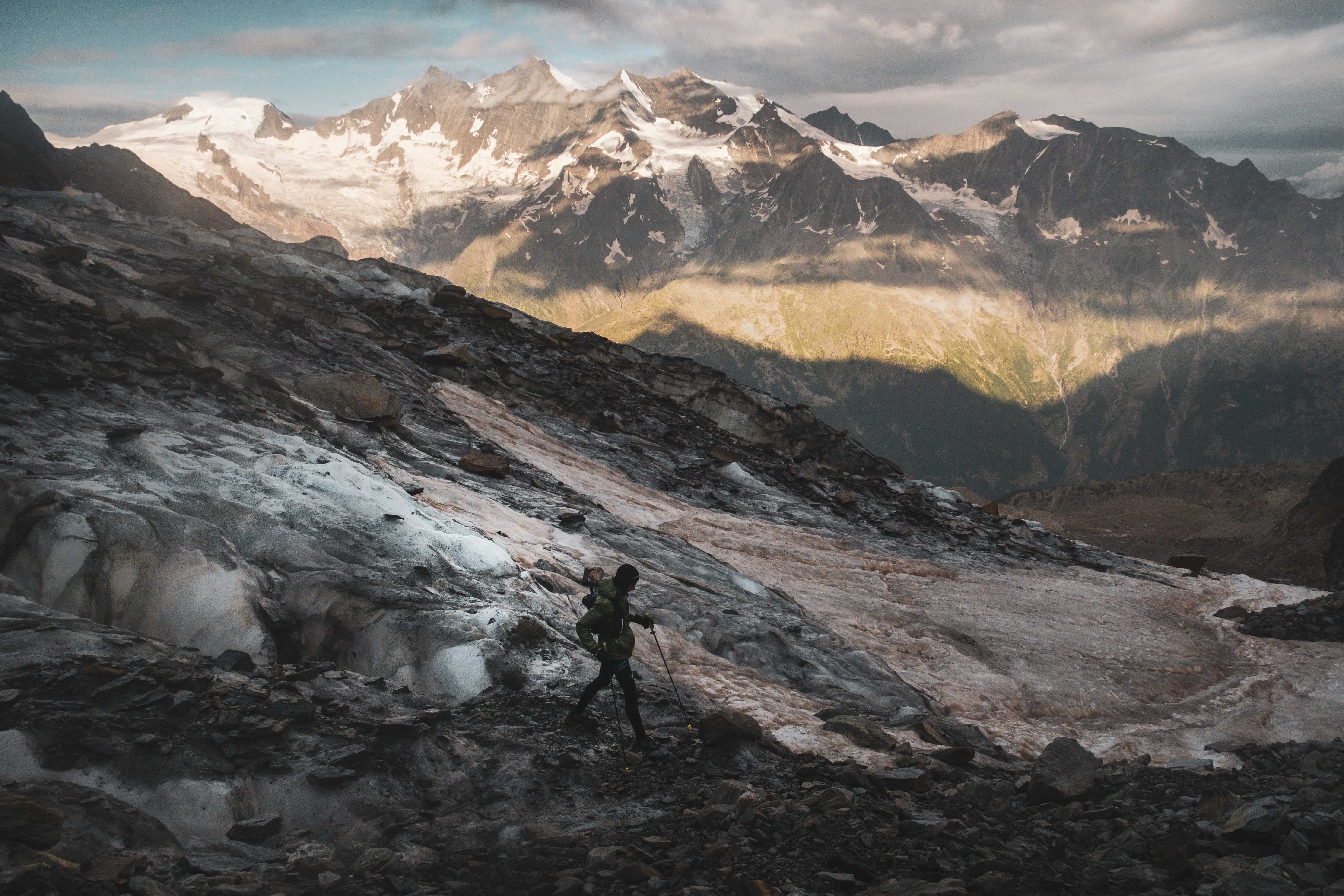
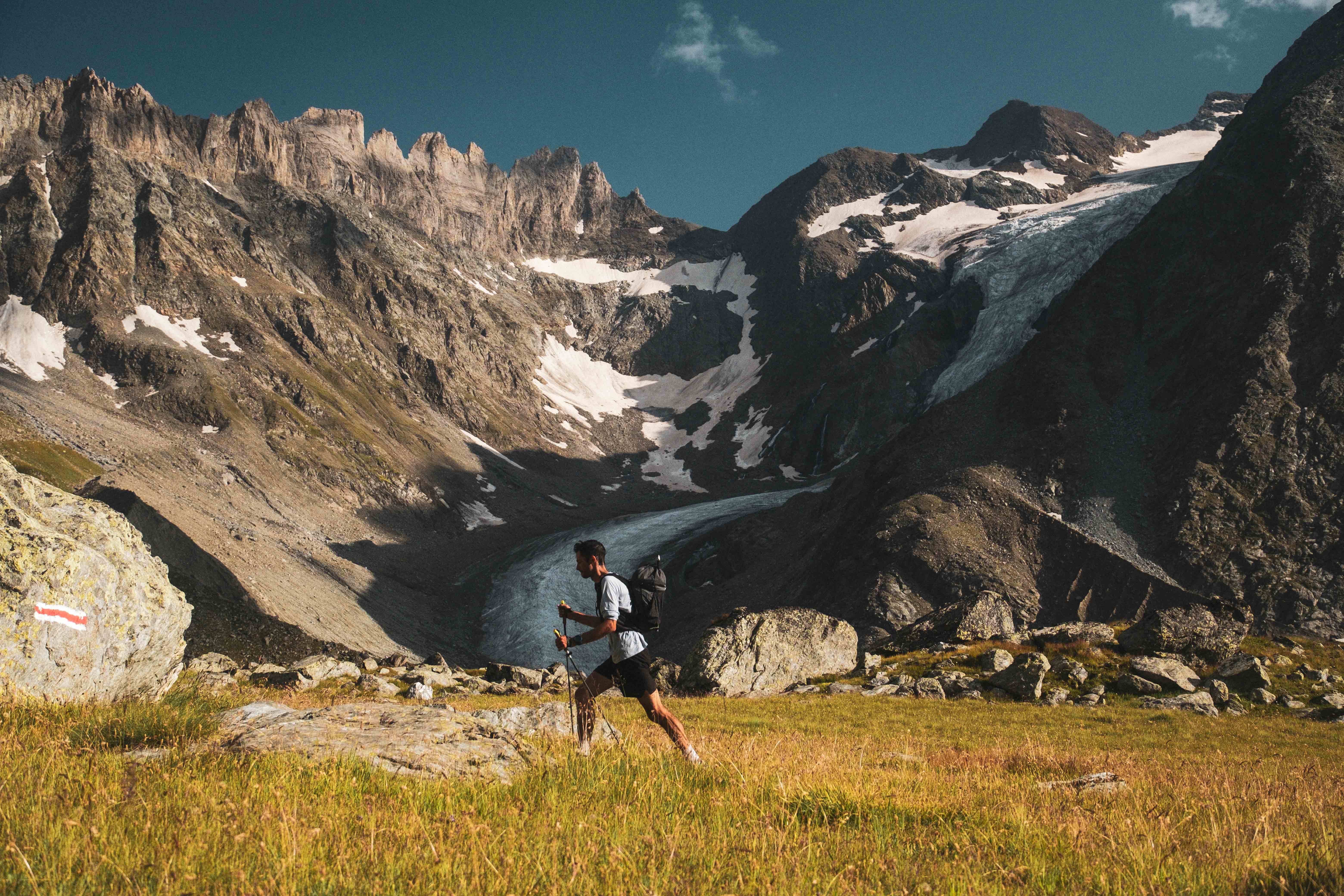
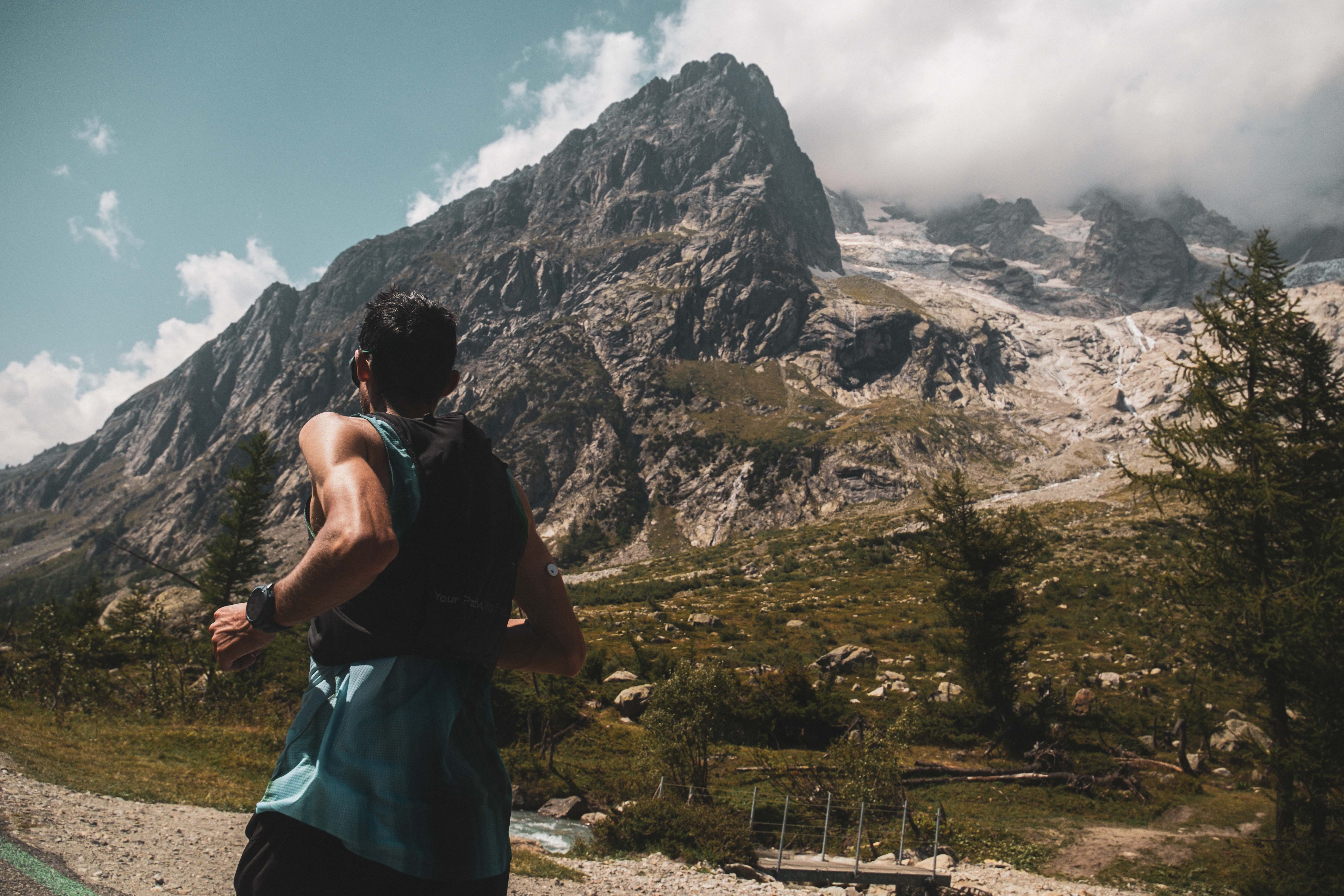
As projects go, Alpine Connections is so grand in scale, that it is hard to fully understand. Imagine connecting 82-peaks over 4000m, covering 1207km’s by human power (run, cycle, climb or walk), accumulating 75,344m+ all within 19-days and just with an average sleep of 5h 17m.
As physical and sporting achievements go, this project by Kilian Jornet, for me, is one of THE greatest sporting achievements of all time and quite correctly, it is one that will be cemented quite firmly in the legendary annals of alpinism.
“This project has been incredible; I think it’s one of the most challenging things I’ve ever done, both physically, technically, as well as mentally. Having to stay in a state of total concentration for 20 days requires a lot of energy, but it has been amazing. I remember all the sunrises and sunsets and all the friends who accompanied me in the mountains, and I am very happy and proud of what we have achieved in the last three weeks. Now it’s time to rest and process everything that has happened, because I think it will take me some time to fully appreciate it.” explained Kilian Jornet.
There is history with the 82 peaks, and many may well look at what Ueli Steck achieved in 62-days as the ‘template’ for such a challenge, his project concluded in 2015. However, in 1993 Martin Moran and Simon Jenkins did all (principal) summits in the Alps in 52 days. In 2008, Franz Nicolini and Diego Giovannini did the peaks in 60 days and just recently, Chrigel Maurer and Peter von Kanel, both from Switzerland, climbed all 82 of the 4,000m peaks in the Alps in 51 days using paraglider and foot, article here.
It may well come as no surprise that Kilian, one day, would take on this ultimate feat of alpinism, especially after his ‘Rediscovering Pyrenees’ project when he summited 177-peaks in just 8-days!
However, there was no warning or build up to this Alpine Connections project. A stunning victory at Sierre-Zinal and then Kilian announced on August 13th via social media:
“Hi everyone, I’m feeling pretty good after Sierre-Zinal, so, I’ve decided not to go home yet and enjoy the good conditions in the Alps…”
Little did we know what would follow!
Many thought a surprise UTMB start may be on the cards, I personally expected him to toe the line at Trofeo Kima… Then on August 14th, all was revealed, ‘One mountain range. One journey. This is Alpine Connections.’
At first, the 82 peaks were not announced. Quite simply, the project was described as a quest to connect as many 4000m peaks as possible relying solely on human-powered means and local resources.
I wondered, would he go for all 82 and in all honesty, we were left wondering this as each day passed until it became completely obvious that all 82 peaks were not only an objective but the timeline for this achievement would set the bar so high, that if achieved, this record would be history making.
• Alpine connections – A project by mountain athlete Kilian Jornet where he aims to connect as many 4,000-meter summits in the Alps as possible by linking peaks through ridges using only human-powered means.
• This project is a way for Kilian to explore his human limits and understand how far he can push his body both physically and mentally. For this, he will be testing himself during the activity, and the data collected will be used in scientific studies.
• The project is divided into stages that can go up to 34 hours where he combines climbing, running and cycling. Friends and family members have joined him throughout the challenge as well as a small team of filmmakers and a crew that helps with logistics.
In essence, the project is all about the constant pursuit of new goals, the creativity in approaching them and the exploration of Kilian’s own limits.
Kilian took an early start with Philipp Brugger to climb Piz Bernina (4048m), the easternmost 4000-meter peak in the Alps, located in the Swiss Engadine valley. They ran and climbed 29km with 2573m of elevation to the summit round-trip, in great conditions, before getting to the start of the first bike link-up of the adventure. Kilian then cycled more than 210km solo with almost 4000m of elevation through some iconic mountain passes, to reach the next stage of the adventure. Kilian said;
“After dreaming about this project for a while, it feels so exciting to be on the move!”
Interesting fact: Kilian will have a scientific team following him at certain points, collecting various samples and analyzing aspects like his sleep patterns.
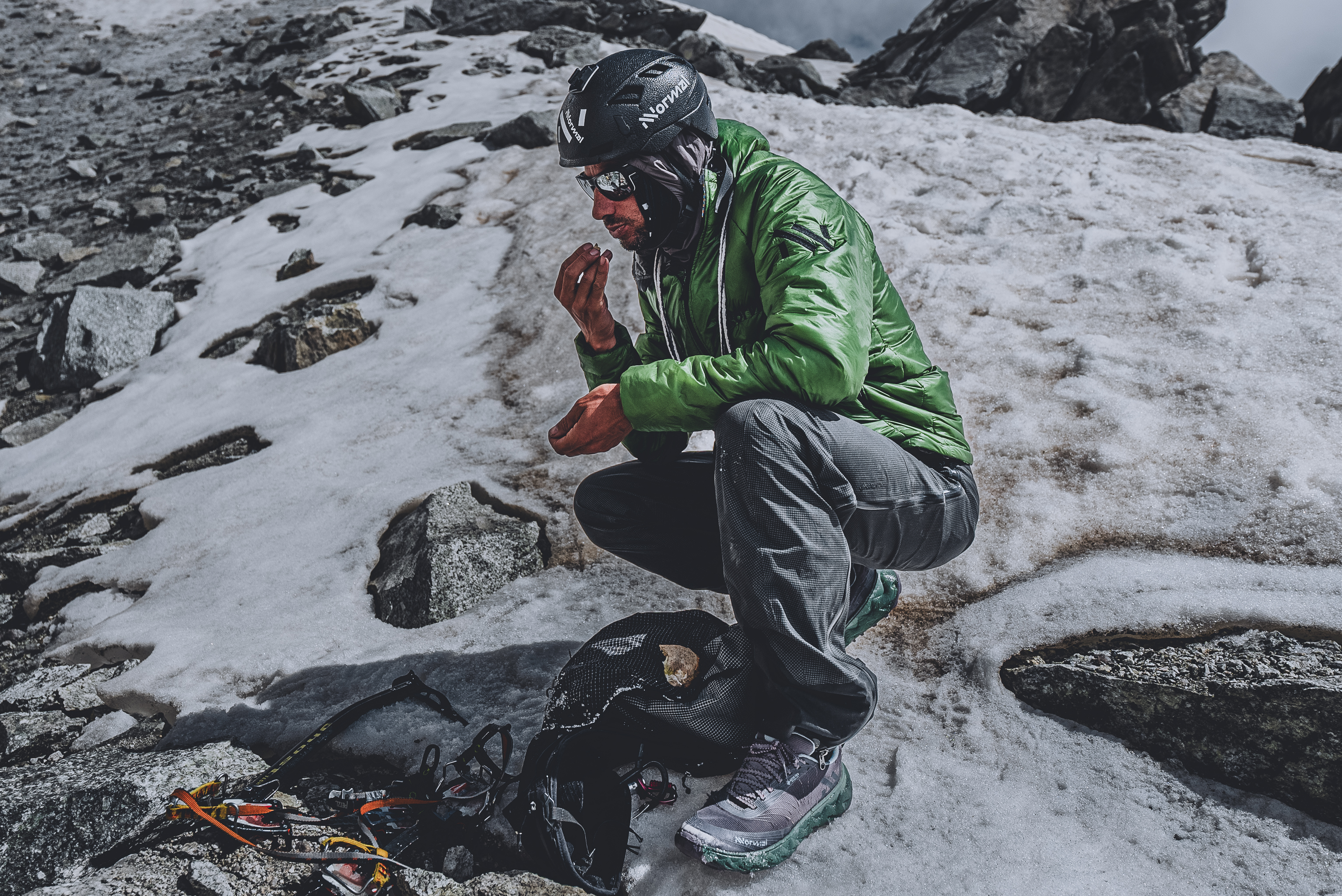
Kilian arrived in the Bernese Oberland for the next part of the project. The day started a bit later than expected because of the bad weather. Even though the conditions weren’t perfect, Kilian set off for Lauteraarhorn (4042m) and Schreckhorn (4078m), two summits linked by a ridge, then pushing to Finsteraarhorn (4274m), the highest peak of the Bernese Alps region. Overall, it was not an easy stage with challenging weather. Fortunately, Kilian was able to shelter in a hut and get a few hours of sleep before continuing. Four 4000m peaks are now done.
Interesting facts: It was a rough day out there, with the weather forcing Kilian to change his game plan. He adjusted his route to steer clear of exposed areas, tackling wet rocks, snow, and storms as he went.
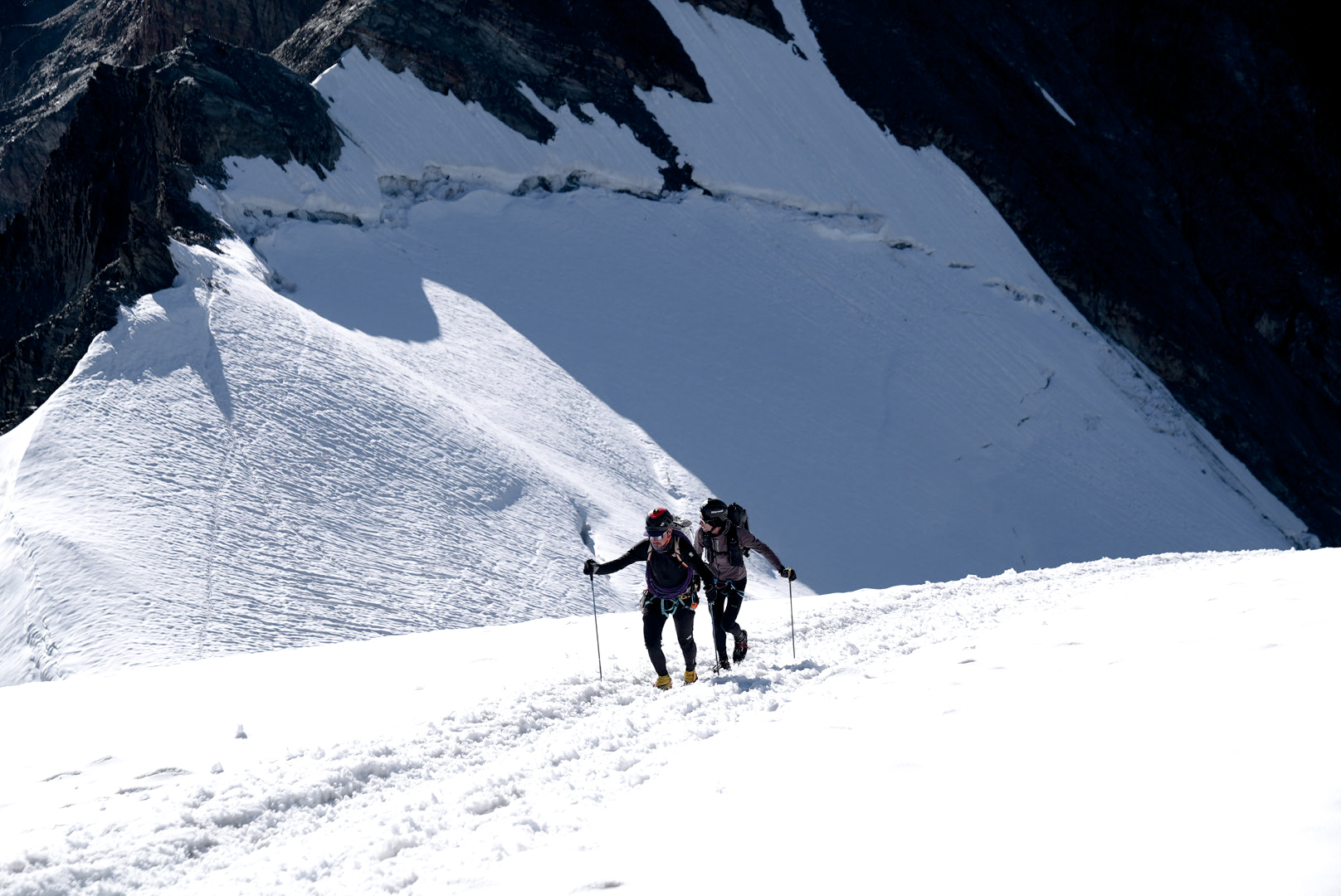
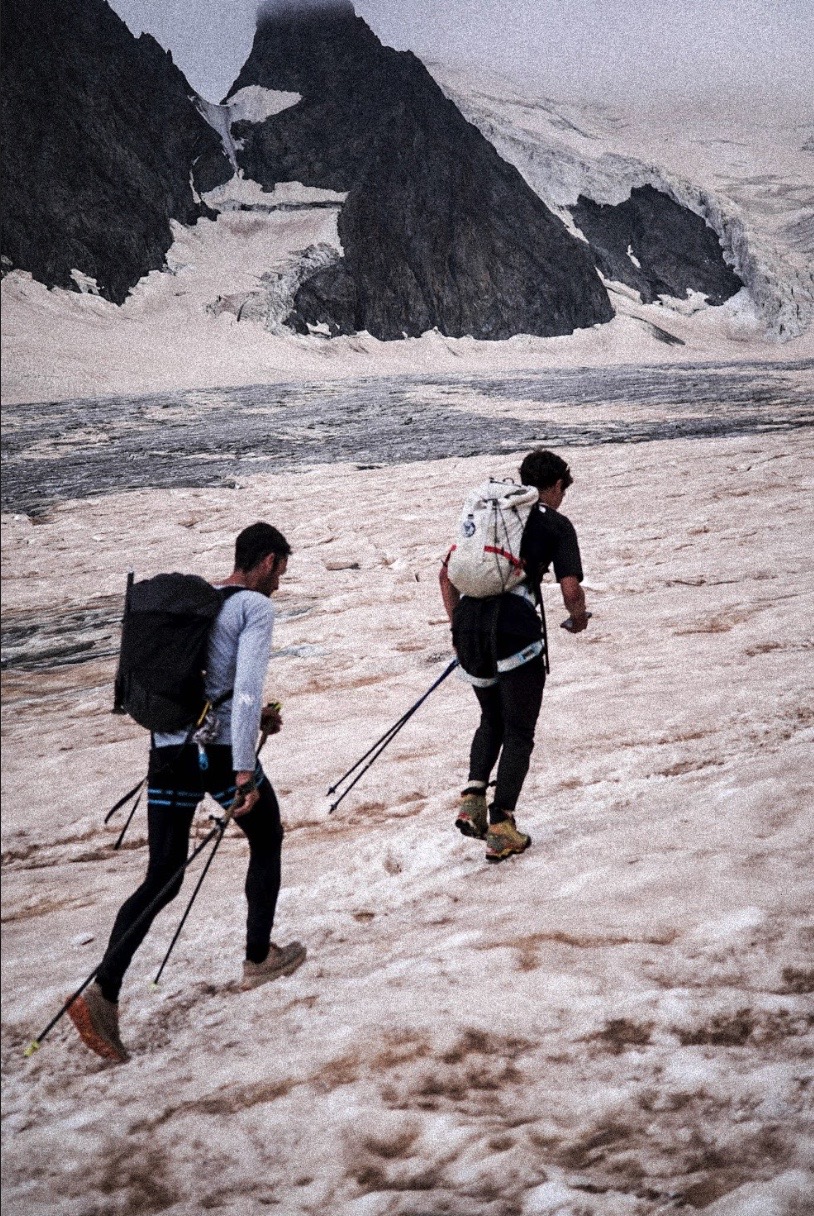
One of the toughest stages yet, with the longest continuous climb of the project so far. Kilian started from Finsteraarhorn Hut after just a few hours of sleep and managed to traverse six 4000-meter peaks. It was a long 99 kilometers with 7890 meters of elevation gain, summiting Gross Grünhorn, Hinter Fiescherhorn, Gross Fiescherhorn, Mönch, Jungfrau, and finally, a long stretch to Aletschhorn. The whole push took Kilian 32 hours and 30 minutes.
“I had to be careful since the conditions weren’t always on my side. I even had to change my route to Aletschhorn three times—once because of the rain and twice due to tricky glacier conditions. Descending from Aletschhorn, I finally reunited with the team.”
After a quick 15-minute nap, Kilian cycled 40 kilometers to link up with the next part of this adventure.
Interesting facts: Kilian has now earned 3 KOMs on Strava and completed his longest ride ever during Stage 1, covering 213.06 km with an elevation gain of 3,984 meters in just 8 hours and 50 minutes of activity.
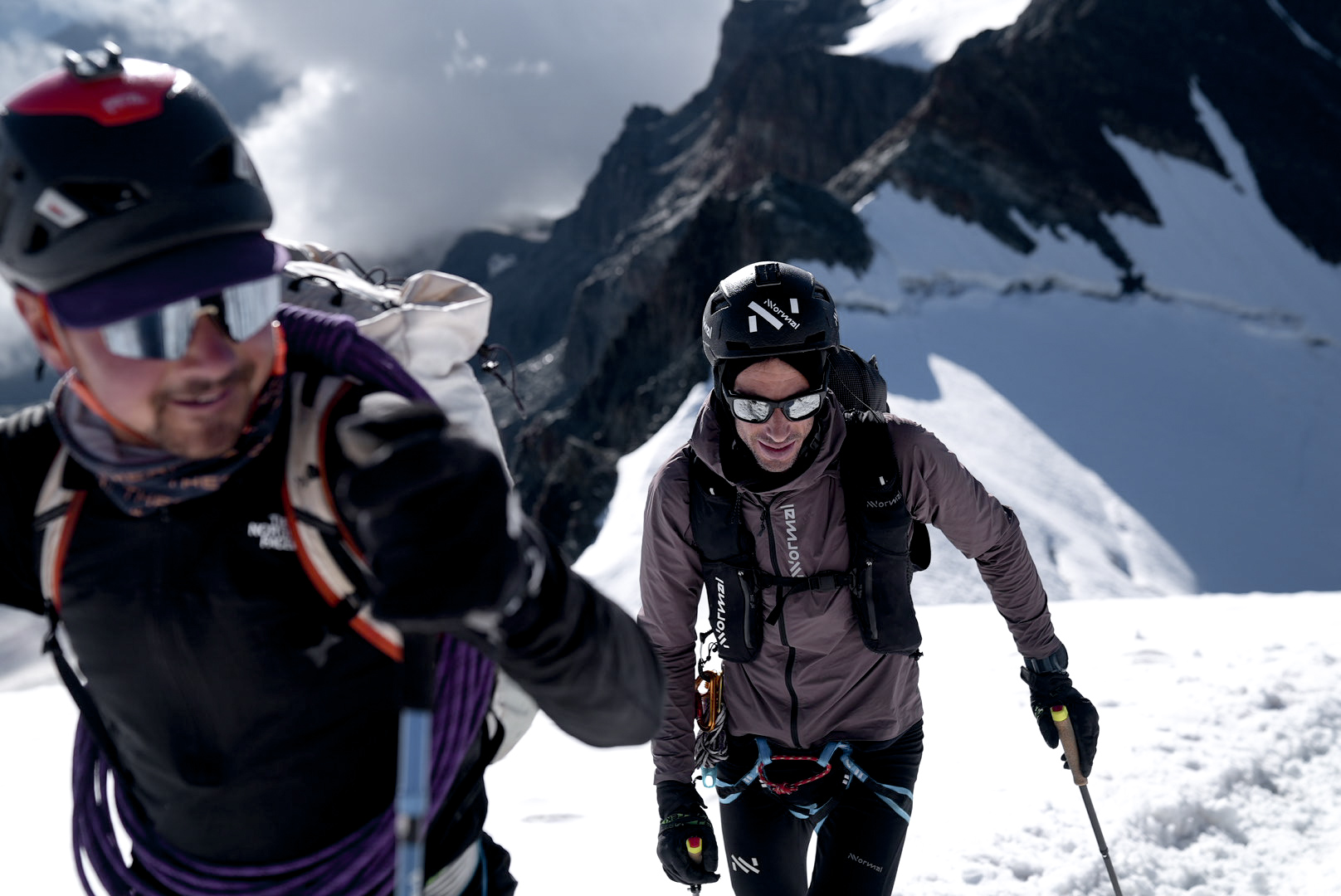
After a good night of rest, Kilian was super happy to share this climb with my friend and talented mountaineer, Matheo Jacquemond. The duo has great history, and Matheo was part of Kilian’s ‘Summits of my Life’ project. The duo set off at 3:30 in the morning to summit Lagginhorn (4010m) through its South Ridge, and Weissmies (4017m), in a 8-hours push covering 30 kilometers and 3381 meters of elevation.
“In these moments, I feel so grateful to be surrounded by a team helping me with all the logistics of the project, and experienced friends I can count on for long outings above 4000 meters in not-so perfect weather.”
After the climb, Kilian took a short bike ride to get to the end of the stage and a new afternoon of rest as the weather deteriorated again. After stage 4, Kilian had climbed twelve 4000-meter peaks.
Interesting facts: After climbing Lagginhorn and on the way back, Matheo decided to call it a day and take the gondola back, while Kilian carried out running to arrive down the valley.
“As it had been raining (and snowing on the summits) the entire afternoon and night before, I left solo at 6:15 in the morning and had another relatively “short” (8:40) day of climbing to make the most out of the conditions. Still, I am used to this “Norwegian” weather that feels just like home, so I managed to summit Dürrenhorn (4034m), Hohberghorn (4218m), Stecknadelhorn (4239m) and Nadelhorn (4327m). On the way down, I stopped to get some food at the Mischabelhütte and ran down to the valley.”
In total, 23 kilometers and 3246 meters of climbing for 4 more summits and a total of 16 4000 meters since starting the adventure.
Interesting facts: During his last adventure in the Pyrenees, Kilian lost his phone during one stage. This year, he has incorporated a phone case (and a new phone of course!) with a small string that he then attaches with a carabiner to his backpack.
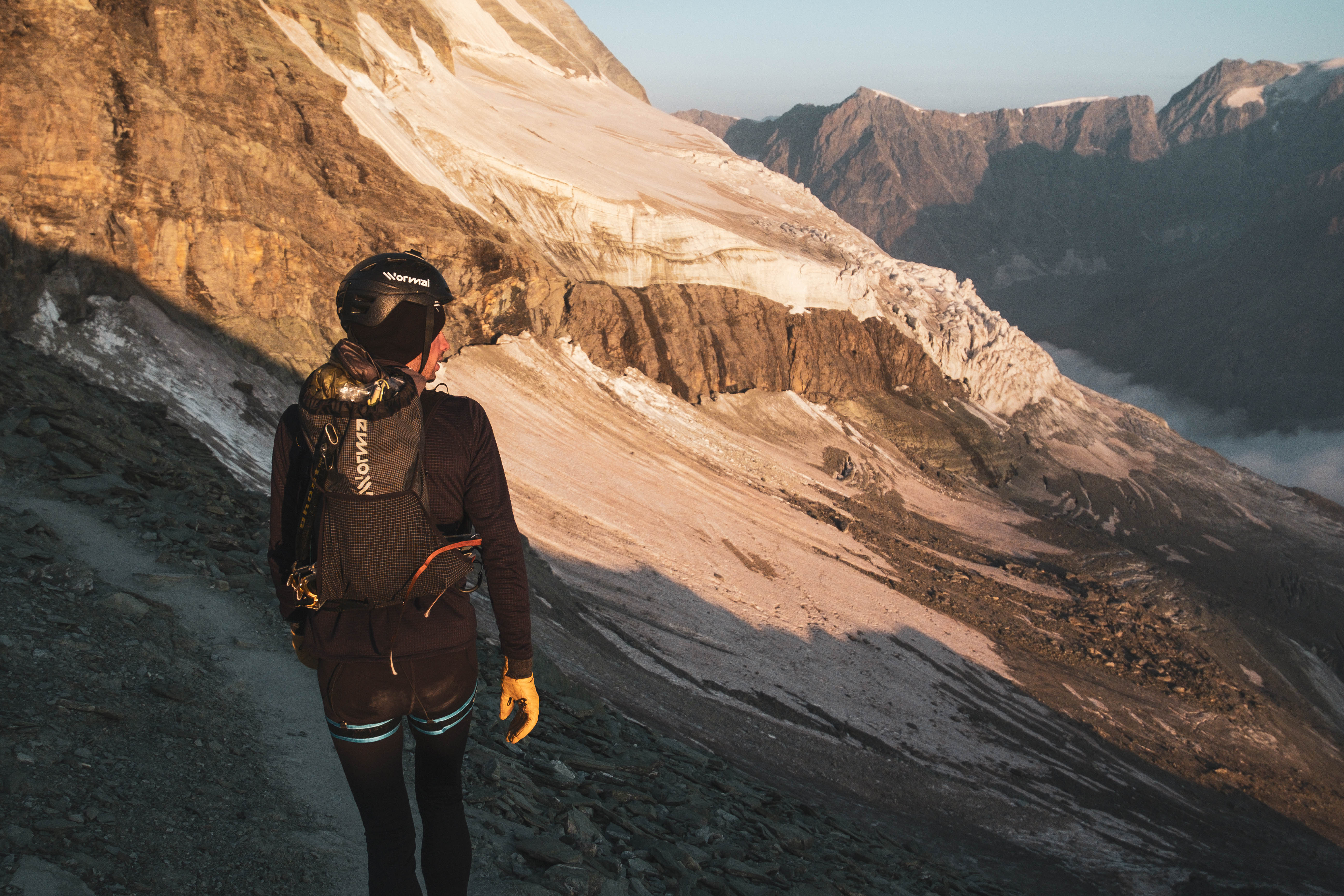
“Stage 6 of the Alpine Connections project, aiming to link as many 4000 meter peaks of the Alps as I can, got under way at 6:20 in the morning from Saas-Fe. I started climbing with Matheoconnecting the beautiful peaks of the Mischabel group: Lenzspitze (4294m), Dom (4545m) and Täschhorn (4491m), before being joined at midday by mountain guide, Genis Zapaterfor Alphubel (4206m), Allalinhorn (4027m), Rimpfischhorn (4199m) and finally Stalhhorn (4190m), ending the long day in the Monte Rosa hut for some well needed rest. It felt great to see the sun, be in good company, and to add a big day in the mountains to the adventure after dealing with uncertain weather for a bit.”
In total, Stage 6 lasted more than 21 hours, with almost 48 kilometers and more than 6000 meters of elevation, adding 7 summits to the project, for a total of 23 peaks of 4000 climbed so far.
“After 3 hours of rest in the Monte Rosa hut, I left, solo this time, at 7 in the morning for one of the big days of the project, with 18 summits of 4000 meters and above climbed in a single day.”
This traverse is known as the Spaghetti Tour, and took Kilian through Nordend, Dufourspitze, Zumsteinspitze, Signalkuppe, Pointe Parrot, Ludswighöhe, Corno Nero, Pyramide Vincent, Punta Giordani, Lyskamm E, Lyskamm W, Castor, Pollux, Roccia Nera, Breithorn (pointe 4106), Breithorn E, Breithorn central and finally Breithorn W.
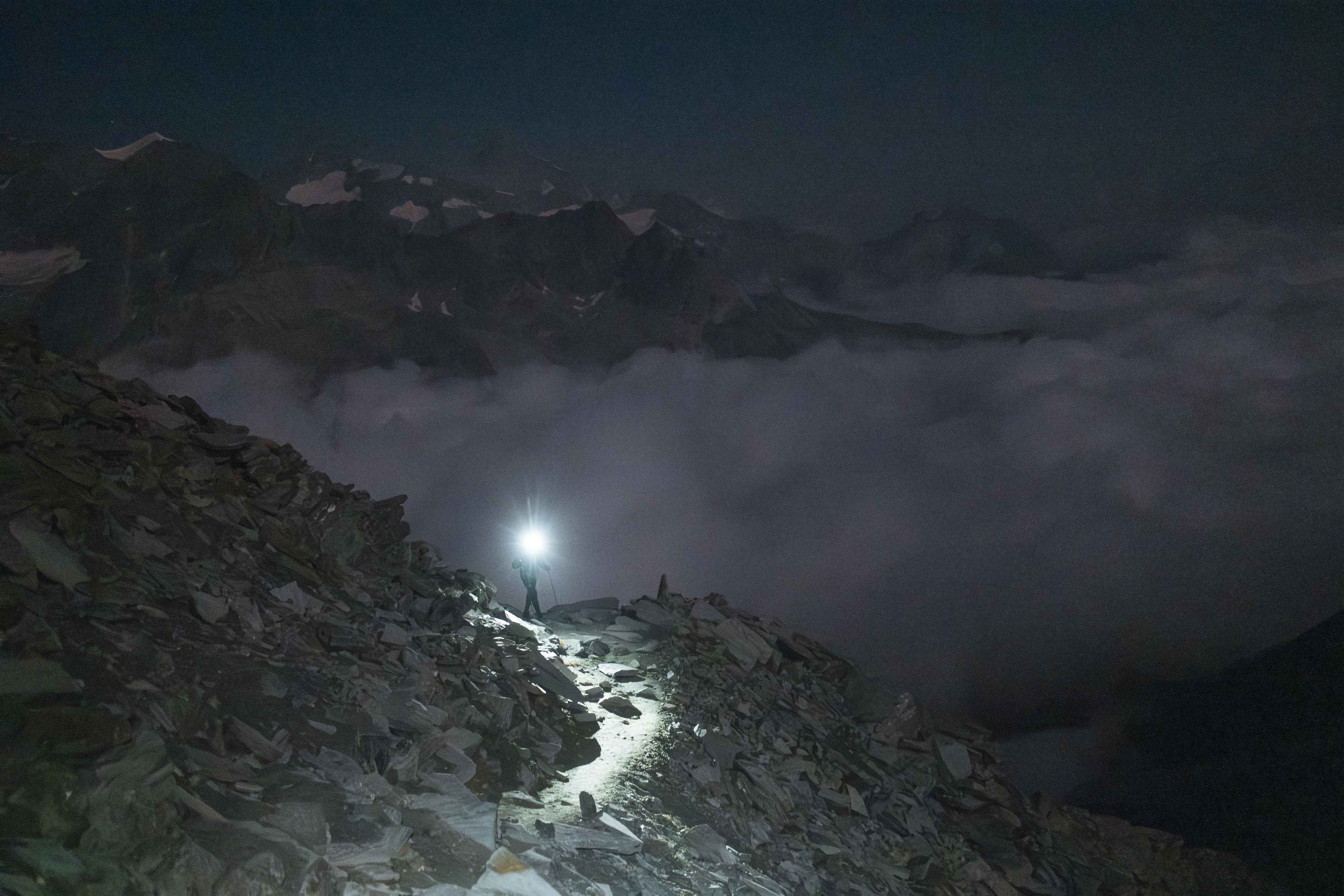
The weather was good during the day, but the warm and soft snow conditions made Kilian slower than he had originally thought, which in turn made him struggle with adequate water and food intake. The smoke from the North American fires was clearly visible up in the sky and made for a strange atmosphere at times. Fortunately, the super moon made for good visibility at night, and Kilian managed to finish the stage in 17:45, ending up at the Hörnlihütte at around 1 in the morning for a feast of eggs, soup, quinoa, tortilla, broccoli, peas and cake before crashing down.
In just 6 stages, Kilian had accumulated 41 peaks of 4000 meters since the beginning of the Alpine Connections project, crazy!
Interesting fact: At the end of Stage 7, Kilian reached Hörnlihütte. His mother, Nuria, who knew the Hörnlihütte since she had submitted the Matterhorn 46 years ago, was waiting there to meet him.
“After some rest in the Hörnlihütte, this new stage started right away with an iconic climb, Matterhorn (4478m) , which I had climbed by its North Face the last time I came here (but of course that wasn’t on the menu today!), and in 2:52:02 from the Italian side in 2013.”
Departing at 7am, Kilian was treated with a beautiful sunrise. Once again, Kilian was joined by Matheo for Dent d’Hérens (4173m) then Genis for the long walk to Dent Blanche (4358m) and the descent to Schönbielhütte.
Another long day of more than 18 hours and 3 more peaks.
Interesting fact: In 2013, Kilian did his fastest time on the Matterhorn route, ascending it from the Italian side with a time of 2:52:02.
“We stayed only two hours at the Schönbielhütte, and left towards Zinal withMatheo at 5:30 in the morning, for what was maybe the most special stage of the project for me.”
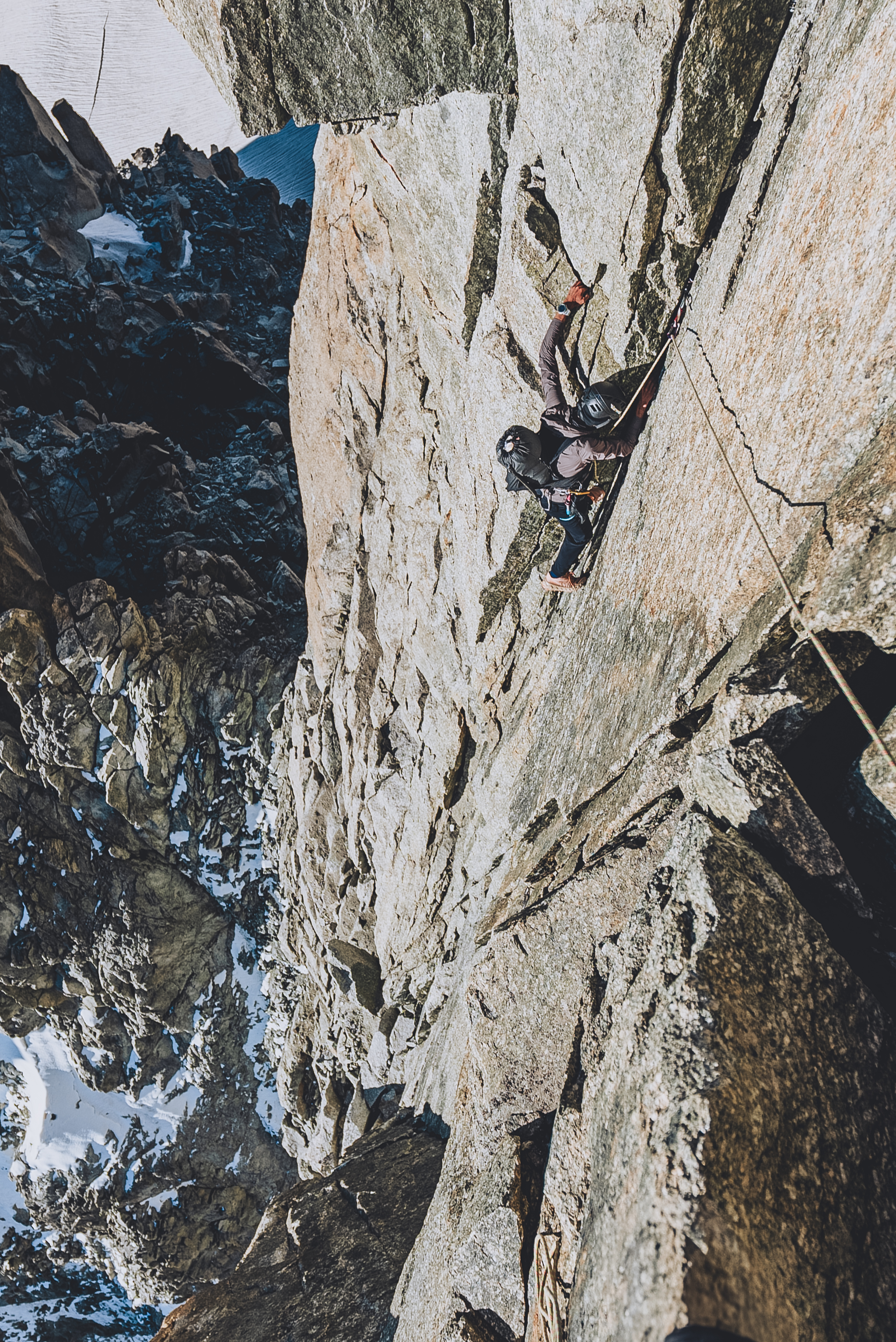
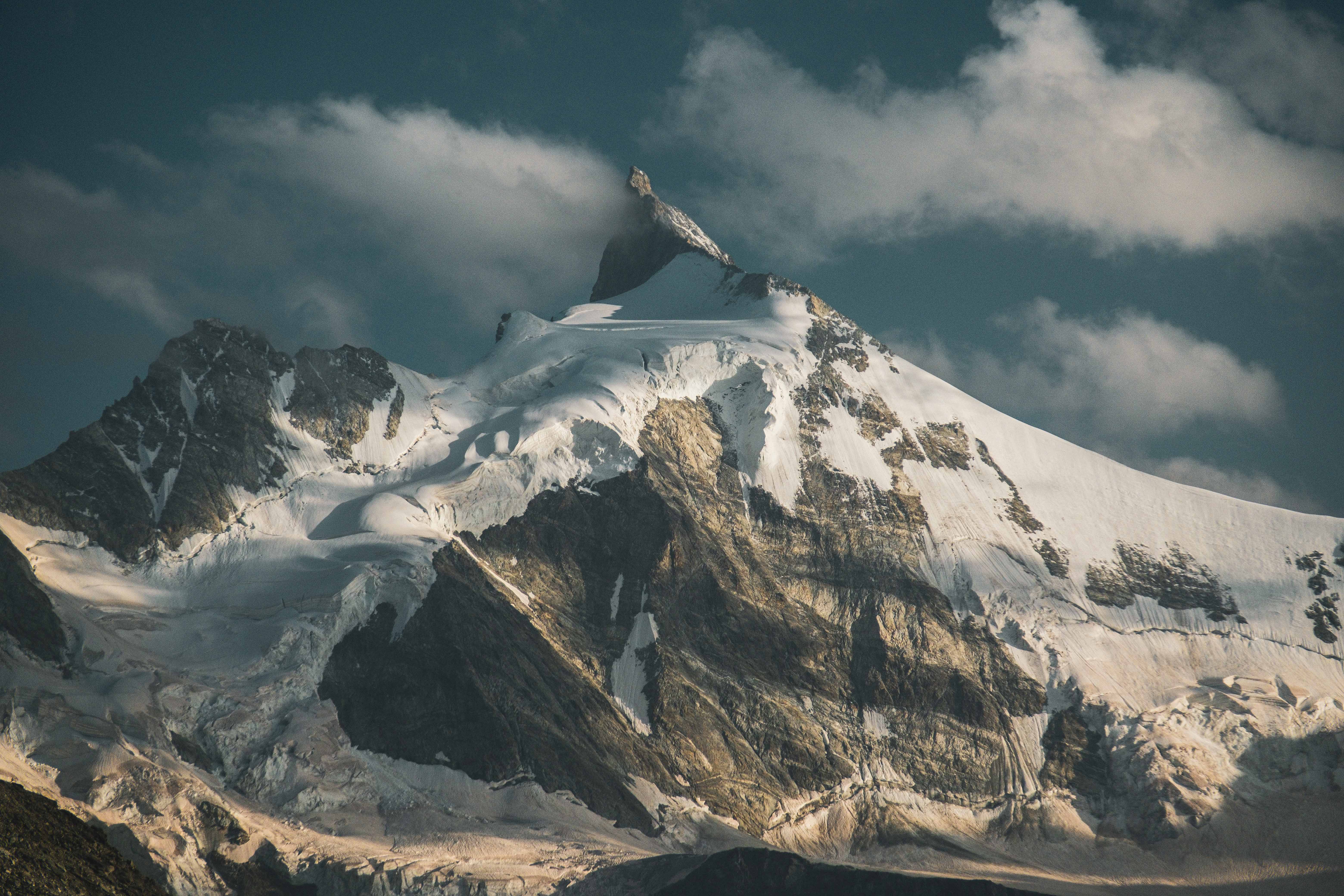
After 4 days of an average of 19 hours of activity, Kilian arrived back in Zinal, two weeks after winning the mythical Sierre-Zinal mountain race. For this last day, Kilian recorded 4 new +4000m peaks in the Alps: Ober Gabelhorn (4064m), Zinalrothorn (4221m), Bishorn (4151m) and Weisshorn (4506m), a summit that he was looking forward to at the beginning of this project.
As he explained when he arrived back to Zinal:
“To me, this was the most special stage, and I was really looking forward to it. It was the end of a five-day stage in Valais: I was very tired, and it was the most technical section in a very wild region with a lot of decision making and navigation difficulties. To me, Weisshorn is one of the most beautiful mountains here in the Alps. Catching the sun to climb the south ridge of Weisshorn was special as I was quite afraid of entering the face in the dark as it’s a big climb, very technical and very long and I needed to run all the ridges before with very poor rock and very demanding. But then, the climb to Weisshorn was one of the best moments of my life! Climbing there with this rock that is beautiful and just seeing the sunset and the broken spectrum. I was flowing, I didn’t feel any tiredness, anything. It was super, super special. And then going to Zinal that is a special place for all the races that I have done here, it was a very special day”
In Zinal, his team and his mother were waiting for him before departing for a new bike link-up. To this day, Kilian has climbed 48 peaks on the Alps, with an elevation of more than 46.203m.
Interesting fact: Kilian’s last project in the Pyrenees concluded after 8 days, 155 hours of activity, 177 +3000 peaks and 485,65 Km. Alpine Connections has already reached 9 stages, 160 hours of activity and 48 +4000 peaks. The projects are unique and not directly comparable, but it’s something remarkable!
“I started the day by a 110 kilometers bike ride from Zinal to Bourg Saint-Pierre, which took me most of the morning. I was happy to meet with Alan Tissieres for the climb to Grand Combins. We were racing together in ski mountaineering a long, long time ago. Now, he is a mountain guide, and it was nice to share a few summits with him! Grand Combins was more technical than I expected. It was a very nice climb, but it is a dangerous mountain because there’s a lot of rockfall and it’s not always easy to navigate, so I was glad not to be solo. We started towards Combin de Valsorey at sunset and climbed through the night on the glacier to Grand Combin and Combin de la Tsessette, the 49th, 50th and 51st summits of my Alpine Connections project. After a bit more than 9 hours of climbing, we were back to Bourg Saint-Pierre at around 2:30am.”
The next stage should be a stage of transition, as Kilian exits Switzerland towards the next part of the journey.
“After the Combins traverse, I arrived at 2 in the morning back to Bourg-Saint-Pierre, had a 4 hour sleep and left for an easy day, first cycling about 30k to La Fouly. On the way, I met Jules Henrigabioud, someone I’ve known from racing and ski mountaineering, who joined me on the ride and told me about a shortcut to go to Val Ferret. The Alps are a big place, but somehow, I keep running into people I know! I did a nice, easy run in the heat to Val Ferret. Over there, the weather was bad, so I took the first actual full rest day of the project. I tried to eat, drink a lot, heal the skin my hands and feet and prepare for the next long and technical push of the Alpine Connections project.”
Interesting fact: For the bike part, Kilian bumped into Jules Henri, an old friend who had competed in trail and ski mountaineering with him. After chatting for a bit, they realized they were going to the same place so decided to ride together, using a shortcut that Henri knew
“I left at midnight from our camping ground in Courmayeur, feeling good and rested, to start the climb to Grandes Jorasses with a great team: Matheo, Michel Lanne and Bastien Lardat. Even though it was the middle of the night, everyone was super happy to be here and to kick off the day in good company! All of them know the area well and I was glad to have them for the more technical climbs of the day, as the conditions can get a bit tricky in this part of the Alps.”
Kilian and the team summited the Grandes Jorasses ridge (Pointe Walker, Pointe Whymper, Pointe Croz, Pointe Elena, Pointe Margherita), then Dôme de Rochefort, Aiguille de Rochefort and finally Dent du Géant, before stopping for a break at Rifugio Torino.
After that, Kilian left the team to go solo to the Refuge du Couvercle where he arrived after an elapsed time of 18:22 hours. With 28 kilometers and 4200 meters of elevation for today, Kilian climbed 8 more 4000-meter peaks, bringing the total to 59.
Interesting fact: After passing through Rifugio Torino, Matheo, Michel and Bastien decided to stop and let Kilian continue solo to Refuge Couvercle, amazed at how hard it was to follow Kilian even after 12 stages.
“Departing at 4am from Refuge du Couvercle, I summited Aiguille Verte, Grande Rocheuse, Aiguille du Jardin and Les Droites in a 17 hours push for 24 kilometers and 3470 meters of elevation in quite technical climbing. I was glad to join the team, friends and family at Rifugio Torino to debrief such a big day and start planning the rest of the adventure”.
This brings the total to 63 summits so far. Today, Kilian He was joined by Spanish alpinist Jordi Tosas, an old friend and climbing partner, with whom Kilian did his first expedition in the Himalayas.
Interesting fact: Proof of how technical the terrain is? Kilian has already worn out two pairs of leather gloves!
“We started the day at 4:45 with Matheo and Noa Barau on the Diable ridge, one of the most beautiful rock climbs I’ve ever done, both very technical and aesthetic. This took us through Corne du Diable, Pointe Chaubert, Pointe Médiane, Pointe Carmen and L’Isolée. We pushed on towards Mont Blanc with the summits of Mont Blanc du Tacul, Mont Maudit, Mont Blanc, Dôme du Goûter and Aiguille de Bionassay, where Matheo and Noa left.”
Kilian continued solo, went back to the summit of Mont Blanc for a second time on my way back, then down on the Brouillard ridge (Monte Bianco de Courmayeur, Picco Luigi Amadeo, Mont Brouillard and Punta Baretti) accompanied with amazing sunset in the background:
“A moment that I will remember forever.”
Taking Kilian around 20 hours in total, he stopped at the bivouac Eccles for around 4 hours and waited for better conditions, before climbing some technical sections at Grand Pilier d’Angle and Aiguille Blanche de Peuterey.
One very big day in the books, with 16 new 4000-meter summits, almost 41 kilometers with 5000 meters of climb, in 29 hours and 25 minutes (not including the 4 hours sleeping at Eccles).
Interesting fact: One of Kilian’s goals for this project was to connect summits using ridges or the most logical routes. In Stage 14, for example, he faced sections that had rarely been attempted, so there wasn’t much information available. Kilian used various resources—maps, advice from friends, and input from fellow alpinists—to understand these routes before tackling them. This shows the significant time and effort he put into planning this project, which took several months. Once on the mountain, he had to constantly adapt his plan based on weather, conditions, and how he was feeling. The support of friends, guides, hut owners, and people he met along the way was crucial in these moments.
Kilian reached the summit of Gran Paradiso (4,061 m) with Mathéo and Vivien Bruchez, a long-time friend with whom he has shared numerous expeditions and steep-skied some iconic couloirs in the mountains he is now crossing in his project. After the bike section, Vivien, recovering from an injury, departed, and the group was joined by trail runner Henry Aymond and ski mountaineering world champion Emily Harrop. Together, they set up to climb the summit number 80 of this journey, which they summited in only 4 hours. This summit was less technical than the sections Kilian encountered in the Mont Blanc massif a few days ago, which allowed for a quick ascent and descent. Back from the climb, Kilian ran 21 km to cross back into France. Once in Val d’Isère, he rested for 7 hours.
Interesting fact: It took Kilian only 4h to climb Gran Paradiso, compared to the long hours spent on the Mont Blanc ridge the days before, which is a real proof of how technical the Mont Blanc is.
Stage 16 Completion
After completing stage 16 in the Ecrins massif, Kilian connected all 82 of the Alps’ 4,000-meter peaks in 19 days using only human-powered means. A mind-blowing project and a colossal challenge due to the exposure, technical difficulty, and focus it requires.
Interesting fact: Kilian set up his first FKT in Dôme des Neiges when he was 16, so finishing here feels almost like closing the circle.
In a hybrid combination of trail running, mountaineering, climbing, and cycling, Kilian Jornet has brought together everything he is passionate about in this project: the majesty of the mountains, facing the unknown, honouring alpinism and his mentors, physiological research, and the pursuit of physical and mental limits, all shared with friends and the community.
“19 days after getting started on Piz Bernina, my dream of climbing all 82 4000-meter peaks of the Alps using only human power to link them together came true on Dôme and Barre des Écrins, the westernmost of them all. This was, without any doubt, the most challenging thing I’ve ever done in my life, mentally, physically, and technically, but also maybe the most beautiful. It’s difficult to process all my emotions just now, but this is a journey that I will never forget. I want to thank again all the people who supported me or climbed with me throughout this project. It’s time to rest for a bit now!”
SUMMARY
It’s very, very difficult to summarise this achievement. In all honesty, I am not able to fully understand what Kilian has achieved. We can look at images and videos, they give a hint of the danger, the complexity, the skills required, but ultimately, we can only imagine… What I do know is, this is one of THE greatest sporting achievements of all time.
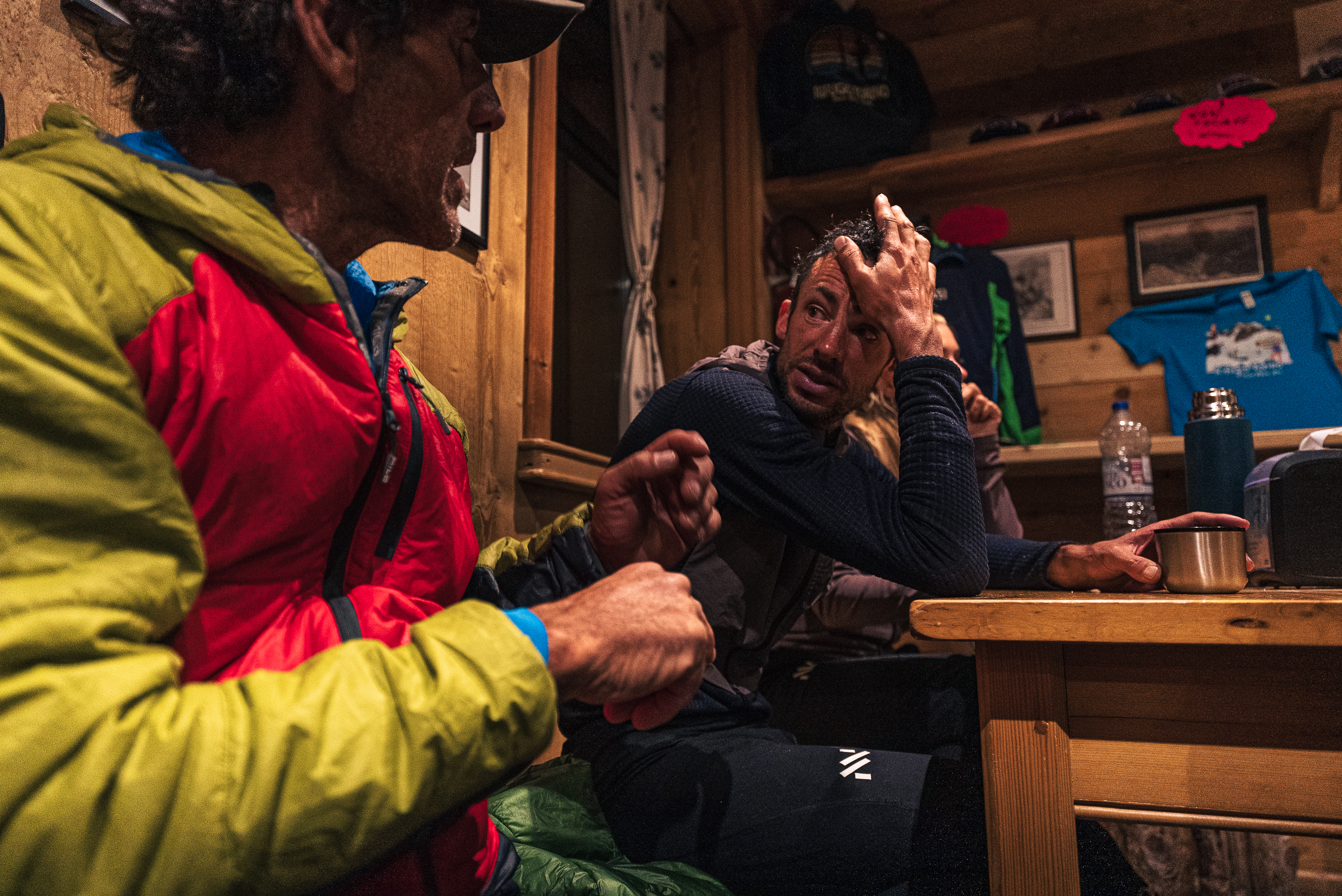
Michel Lanne, a grand star of the sport, a mountain guide and employed by the PGHM (Peloton de Gendarmerie de Haute Montagne) who joined Kilian sums it up well:
“This is the story of a friend, who decides to go on a ‘little alpine ride,’ as he calls it! Except that this spring, when he explained to me the details of this project, I am both conquered by the idea, but quite puzzled about the feasibility of such a feat! Except this old buddy had it all planned, absolutely everything! He then sends me the routes, timings, summits, planned equipment, and even his nutrition plan for a little over 2 weeks… Knowing the animal, I understand that his determination is complete, that this Titan project matches him completely, and that he is the only one capable of achieving such a feat. In the middle, we often talk about hunting the 4000! As far as Kiki is concerned, this line-up seemed so logical and natural, I’d call this a pick of 4000! Perhaps the numbers can help you understand the extent of what he just accomplished… but beyond the colossal physical performance, it is the mental and psychological aspect that struck me the most. Despite the monstrously long and challenging days, despite the fatigue and little sleep, he was able to exhibit vigilance at every moment, managed to manage nervous tension, risk and effort, constantly maintaining clarity, anticipation and vigilance beyond the norm. And leave each night with a smile, happy and eager to enjoy the mountain. Kiki, thank you for inviting me to share a small piece of your amazing adventure, with the phenomenal Matheo Jacquemond and Bastien Lardat. I have often remained silent, discreet observer of your gesture, fluid, elegant, easy, applied and mastered.”
Michel’s words mean so much, not because Kilian is a friend BUT because you fully understand the enormity of the challenge. The difficulty. The danger. The audacity of even considering this project deserves respect, to complete it in 19-days is beyond any comprehension.




























 IAN CORLESS