This edition marks the 40th anniversary of the MDS Legendary. Four decades of runners crossing the Sahara under their own power. As we move through March, I’m sharing a short series of weekly articles to help sharpen your preparation. This is the fourth of four.
By now, the nerves are real. Anticipation is building. And yes, stress might be creeping in too. That’s normal. You’re about to take on one of the toughest endurance races on the planet. But here’s the truth: the hard work is already done.
Now, the focus shifts.
Ease Back to Move Forward
It’s tempting to squeeze in one last long run. Don’t.
At this stage, there’s nothing to gain and everything to lose. Fatigue and injury are the only likely outcomes. Instead, keep sessions short and purposeful. Stay loose. Stay sharp. This is taper time. Think of it as recharging your battery so you arrive on the start line fresh, not drained.
Prepare for the Heat
If you can, use these final days to adapt to the heat. It doesn’t need to be perfect, but every little bit helps.
Hot yoga, saunas, hot baths, even treadmill sessions with extra layers can all make a difference. If you have access to a heat chamber, even better. The Sahara is unforgiving, and any adaptation you build now will pay off when it matters most.
Plan Everything, Then Simplify
Now is the time to get meticulous.
Lay everything out. Build a spreadsheet if that helps. Go item by item through your kit. Ask yourself what you truly need.
Weight matters. Every gram counts when it’s on your back for multiple days. Strip out the luxuries. Be ruthless. The goal is to go as light as possible without compromising safety or performance.
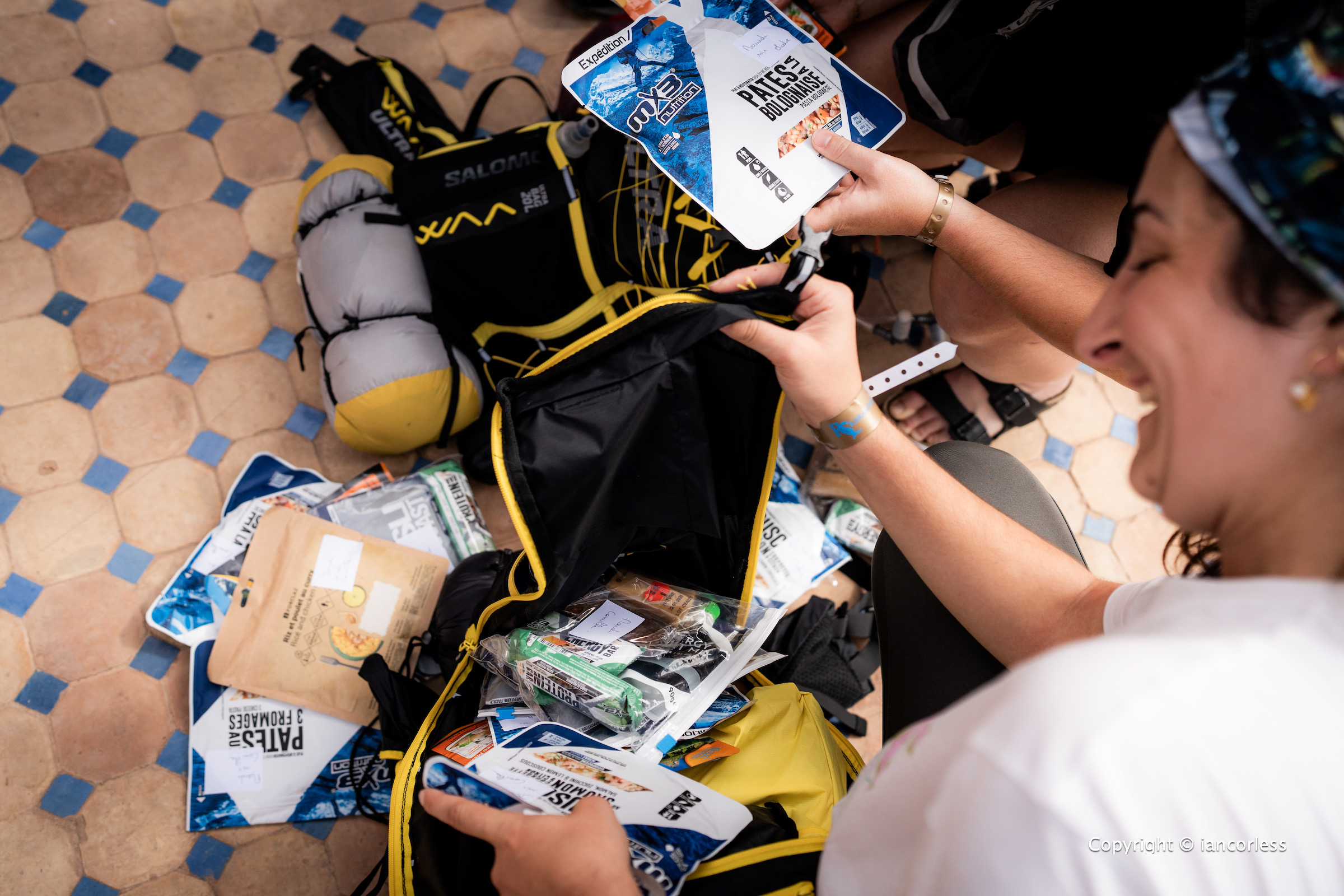
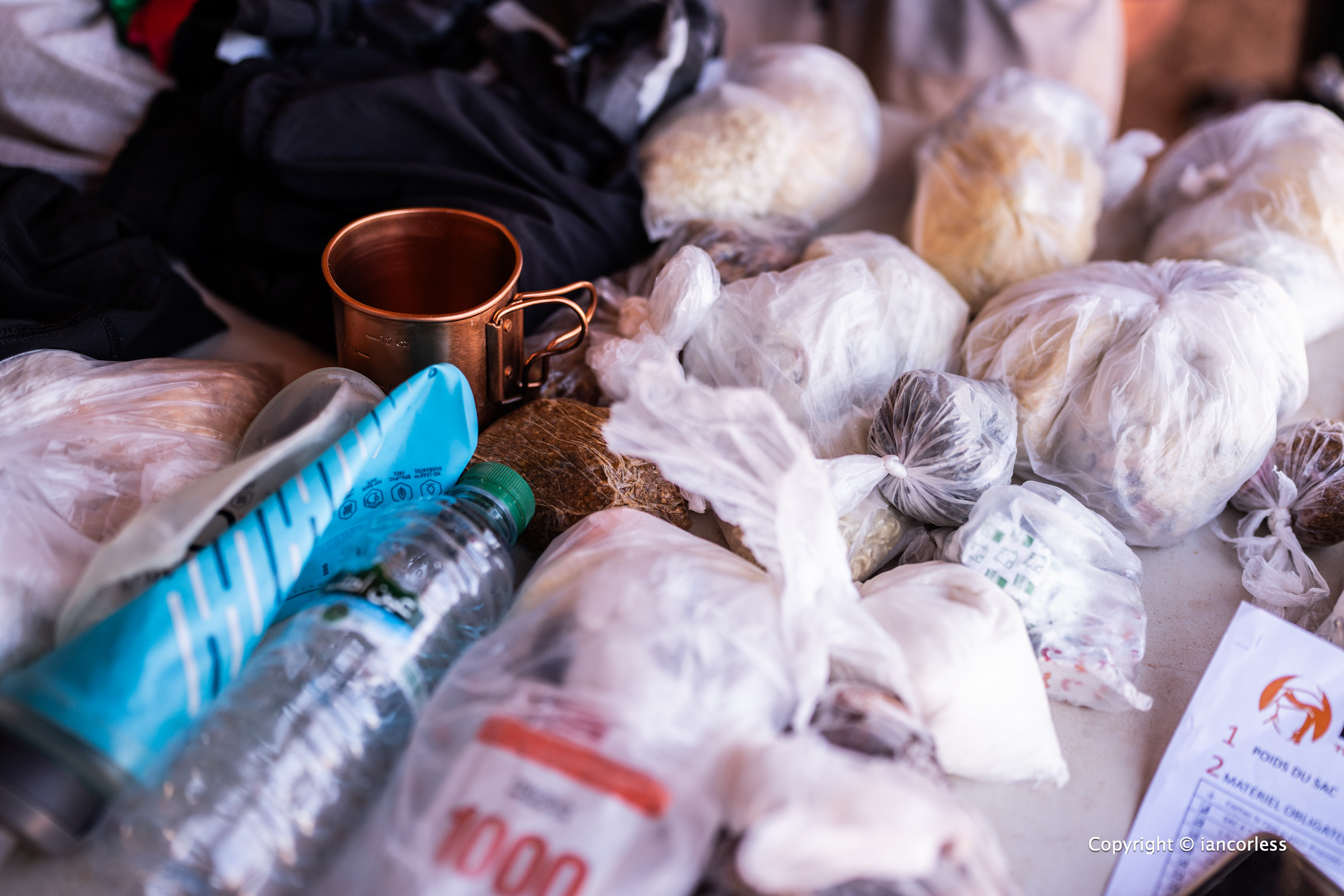
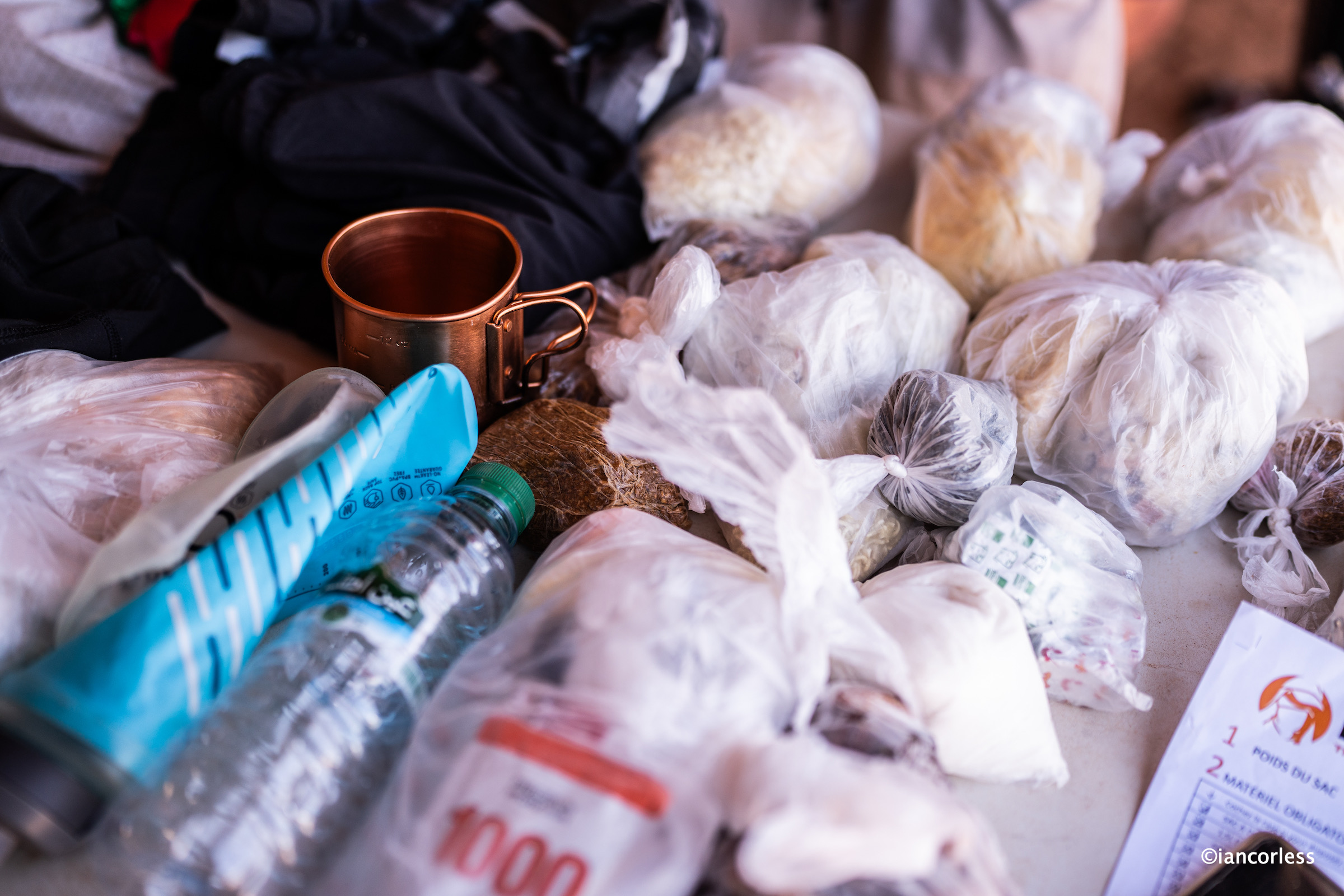
The same applies to food. Check your calories. Repack if needed. Remove excess packaging. Make sure what you carry is efficient, practical, and something you can actually eat under stress.
Get the Admin Right
Details matter here.
Medical certificates must be correct and meet all race requirements, especially your ECG. Don’t assume, double-check.
Photo by Ian Corless
Your passport needs to be valid. It sounds obvious, but it catches people out every year. Confirm your travel documents, bookings, and transfers. Know your plan from departure to arrival.
The goal is simple: remove every possible source of stress before you leave.
Travel Smart
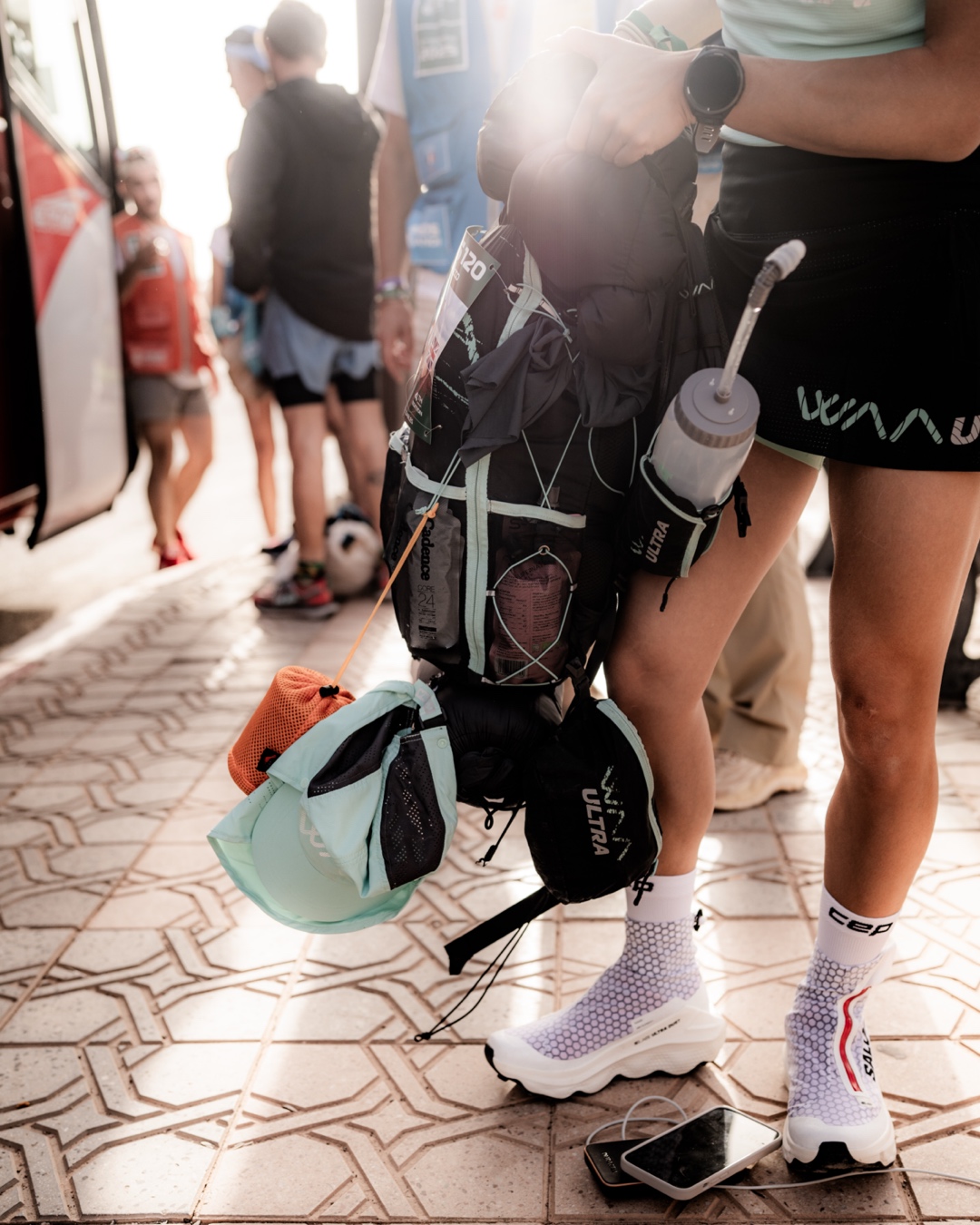
Wear your race kit when you travel. That includes your shoes and gaiters.
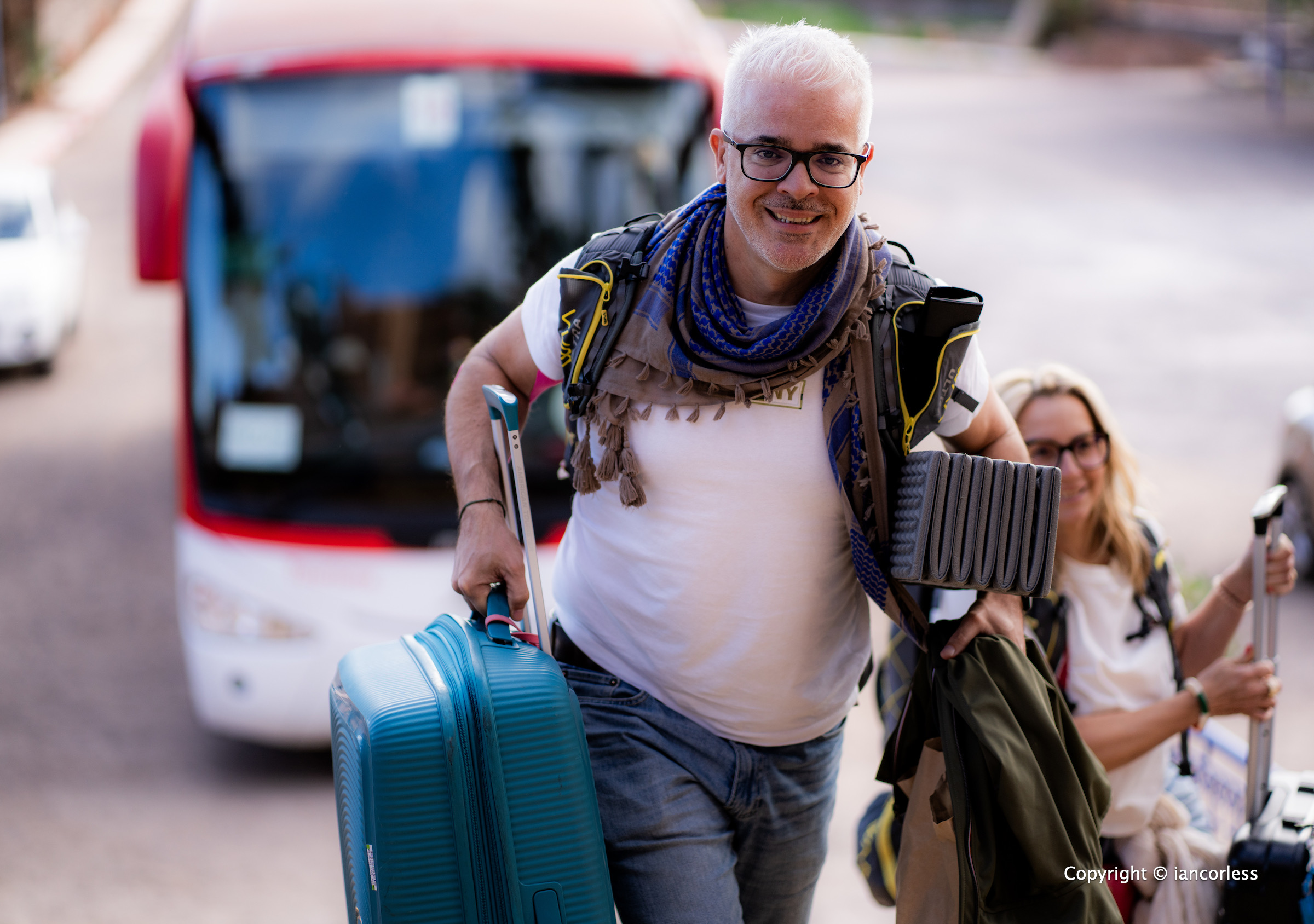
Your race pack should go as carry-on, with all essential gear inside. The only items that should go in checked luggage are those that have to, like a knife or trekking poles.
If checked luggage gets delayed, you’ll still be able to race. That’s the mindset.
Protect Your Health
This part might feel extreme, but it’s important.
Avoid unnecessary contact with others. A cold or virus now could undo months of work. Skip handshakes, hugs, and shared food or drinks. A simple “Namaste” with hands together works just fine.
Avoid salads or anything that might carry risk. Stick to well-cooked, straightforward meals. This isn’t the time to experiment with local cuisine.
Bring your own food for travel and the days before the race. Remember, you’re self-sufficient even before the start. Having familiar food and drink helps you stay relaxed and in control.
Use the Bivouac to Your Advantage
Before admin, your luggage stays with you in the bivouac. Use this.
Bring spares. Extra layers. Small options that allow you to adjust based on real conditions. The desert can surprise you, and this is your chance to fine-tune your setup before committing fully.
Be Ready
Have a clear plan for admin. Know what’s required. Be organized.
Then shift your focus forward.
Stage 1 is coming.
Photo by Ian Corless
Trust the Process
You’ve done the training. You’ve made the sacrifices. You’ve earned your place on that start line.
Now it’s about arriving calm, prepared, and ready to embrace what’s ahead.
Because this isn’t just a race.
It’s a journey. An experience that will stay with you long after the dust has settled.
Take a breath. Stay focused. And get ready for the adventure of a lifetime.
Marathon des Sables: What a Week in the Desert Really Looks Like
The Marathon des Sables has always been legendary. In 2026, it becomes something even more special.
This edition marks the 40th anniversary of the race. Four decades of runners crossing the Sahara under their own power. Forty years of stories, struggle, and unforgettable moments. To honour that history, the 2026 race will be longer, tougher, and designed to celebrate everything the event has become.
As we move through March, I’m sharing a short series of weekly articles to help sharpen your preparation. This is the third of four. The goal is simple: remove uncertainty.
When you arrive in the desert, you should know what to expect.
For many runners, especially first-timers, the unknowns can feel overwhelming. What happens when you arrive in Morocco?
How does the bivouac work?
What does a typical day look like?
And how do the logistics of such a remote race actually function?
Let’s walk through it together.
The Evolution of the Race
The Marathon des Sables has changed over the years, and many of those changes focus on reducing environmental impact.
Past participants will notice significant differences. Charter planes have been removed. More transport now happens overland. The race increasingly relies on local staff and local produce. Media presence has been reduced. A storage centre in Morocco limits the need for shipping equipment every year. Transport trucks have been reduced, and power-saving measures are everywhere, including solar energy.
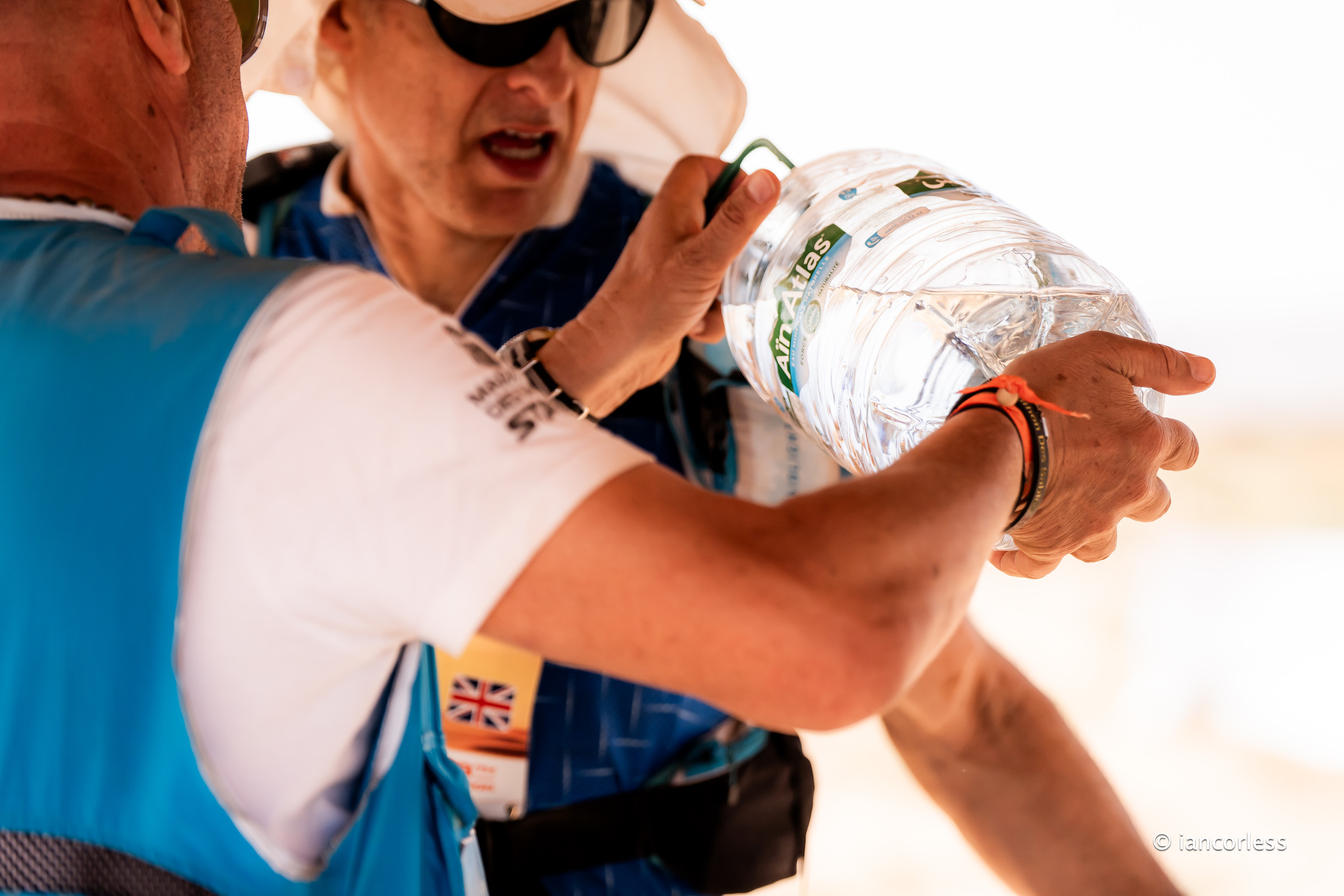
Water management has also evolved. In the past, runners received 1.5-litre bottles. Today, the race distributes 5-litre bottles, dramatically reducing plastic use during the event.
Behind the scenes is a large support structure dedicated to safety.
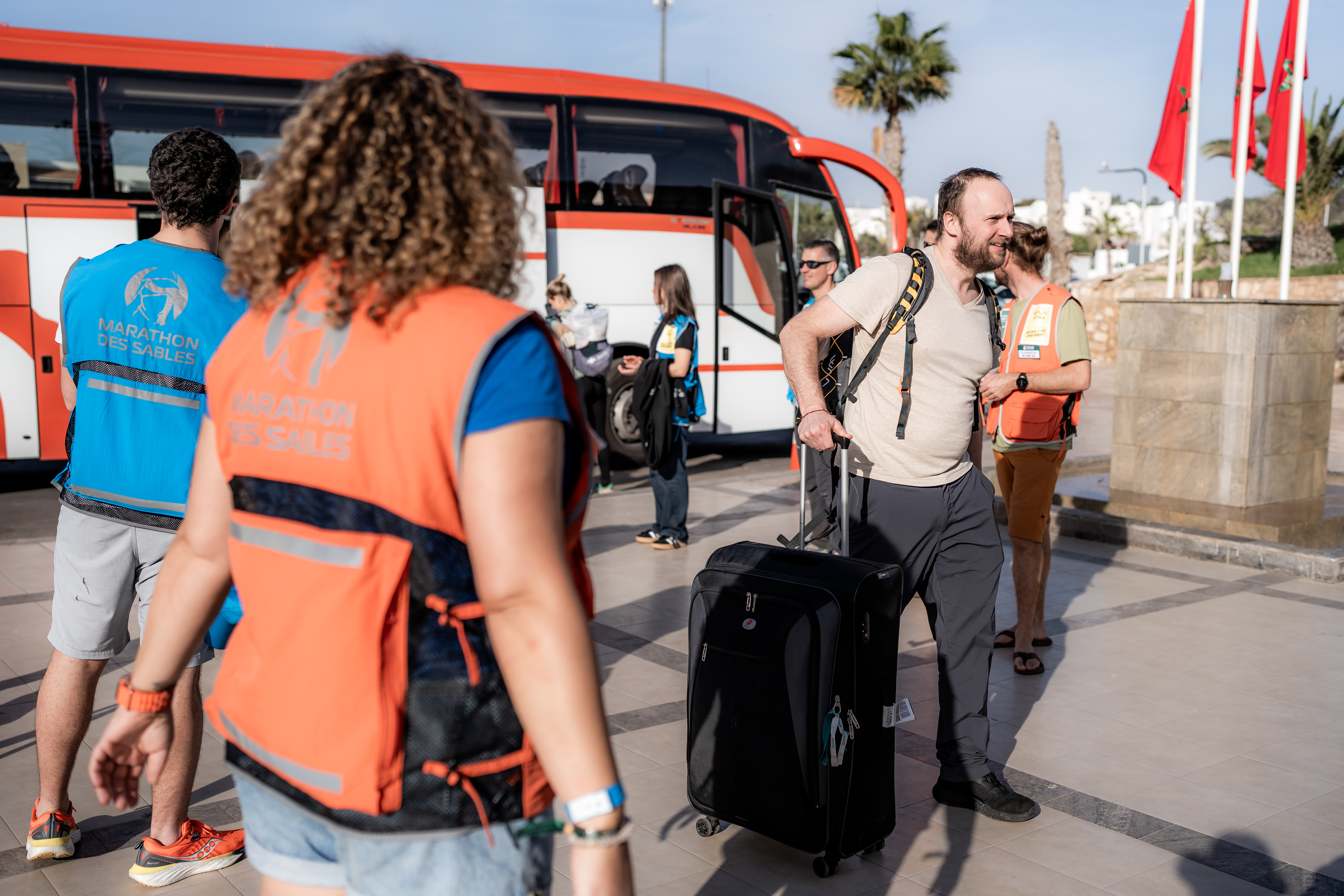
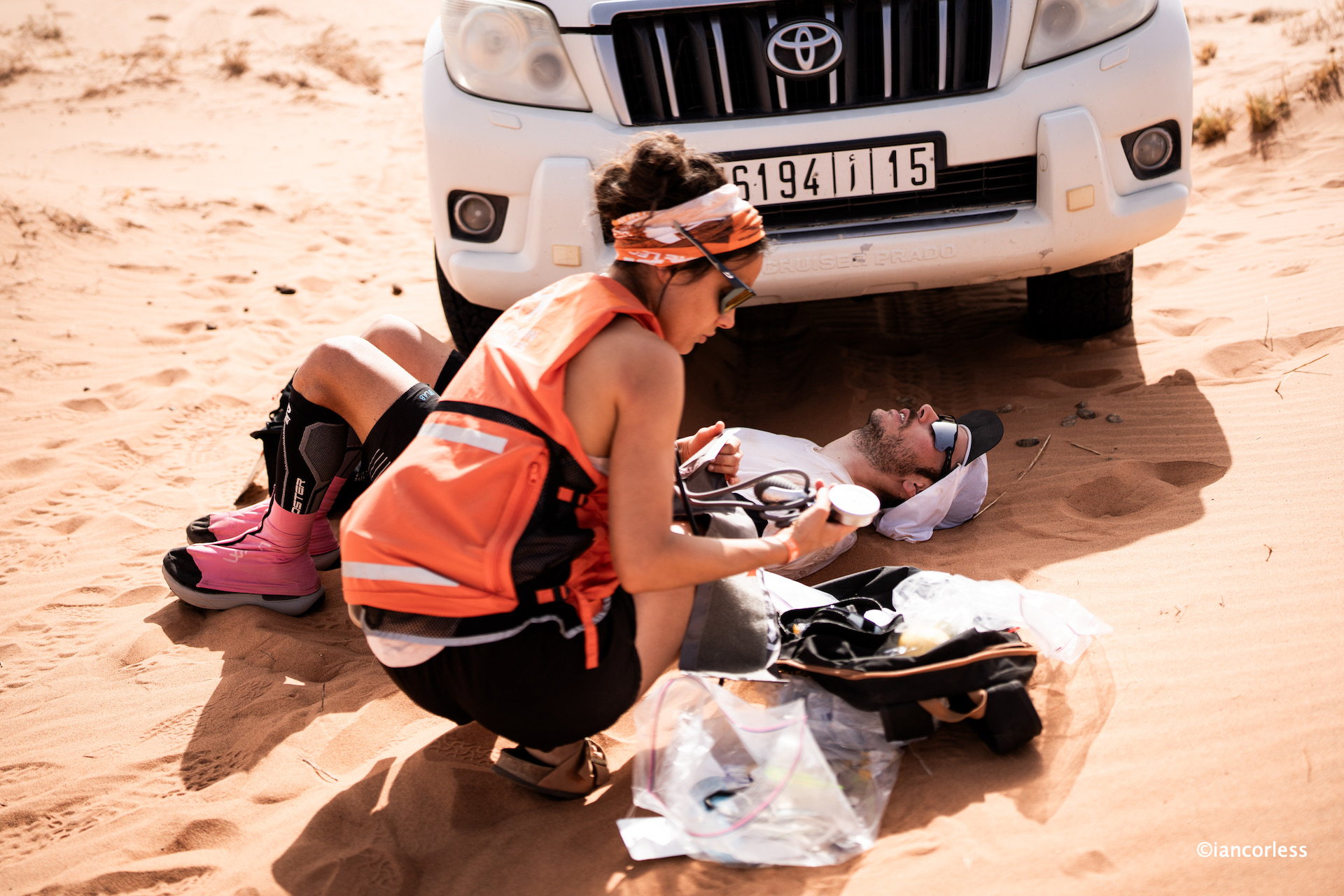
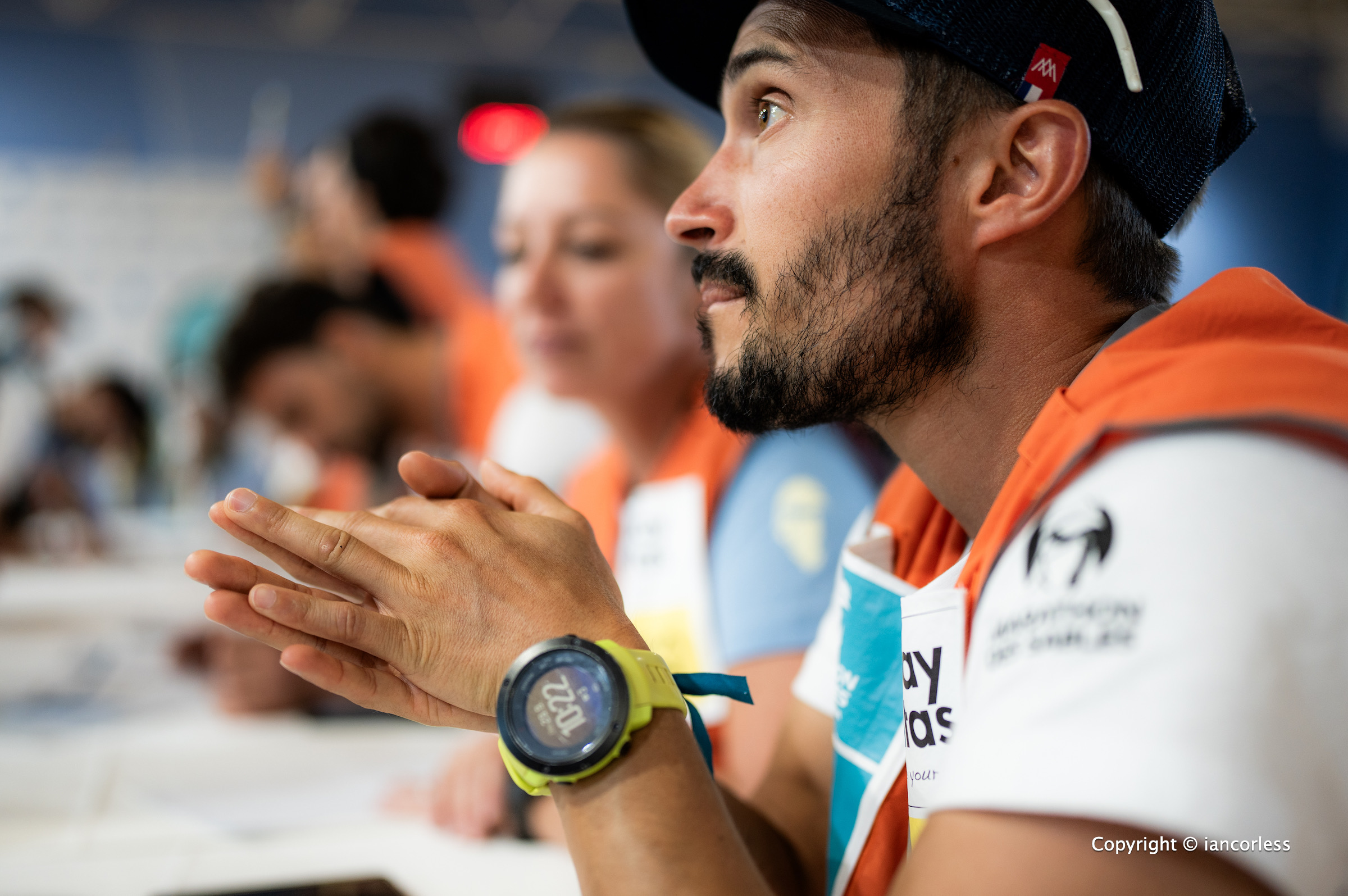
• Around 120 medical staff, known as the Orange Jackets, monitor runner safety 24 hours a day.
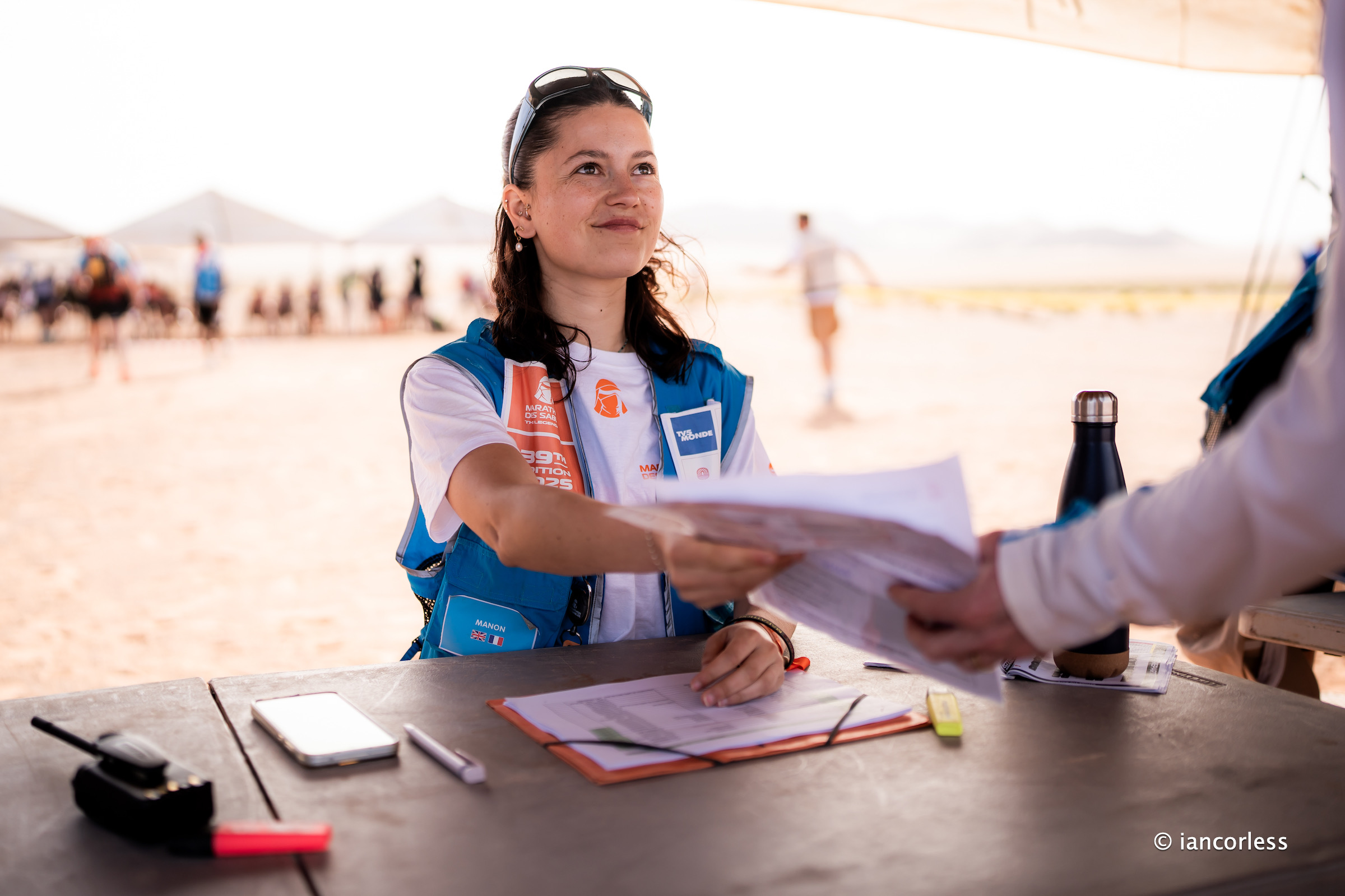
• The Blue Jackets focus on runner relations. They are present in the bivouac, on the course, and at checkpoints. If you have a question or concern, they are your first point of contact.
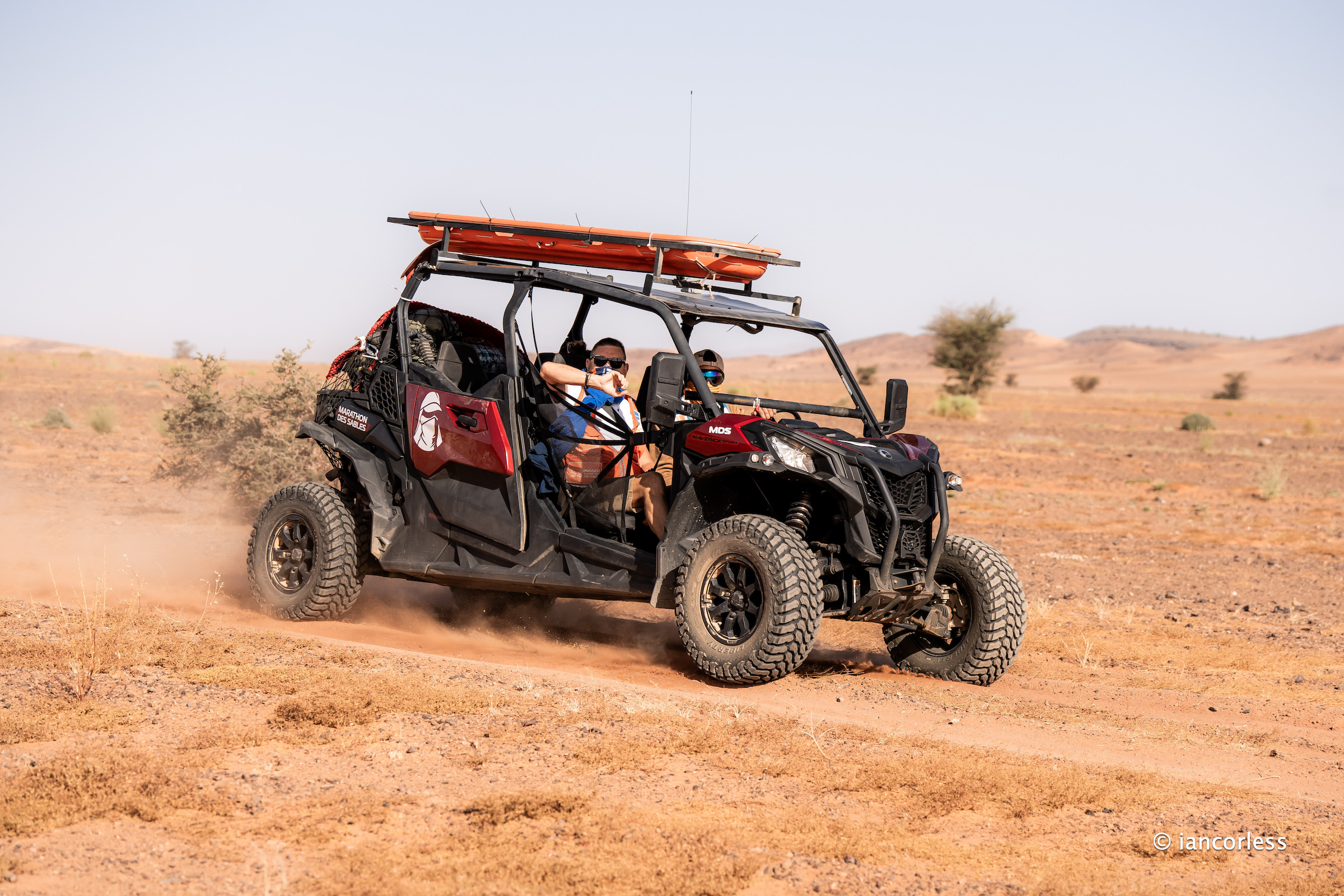
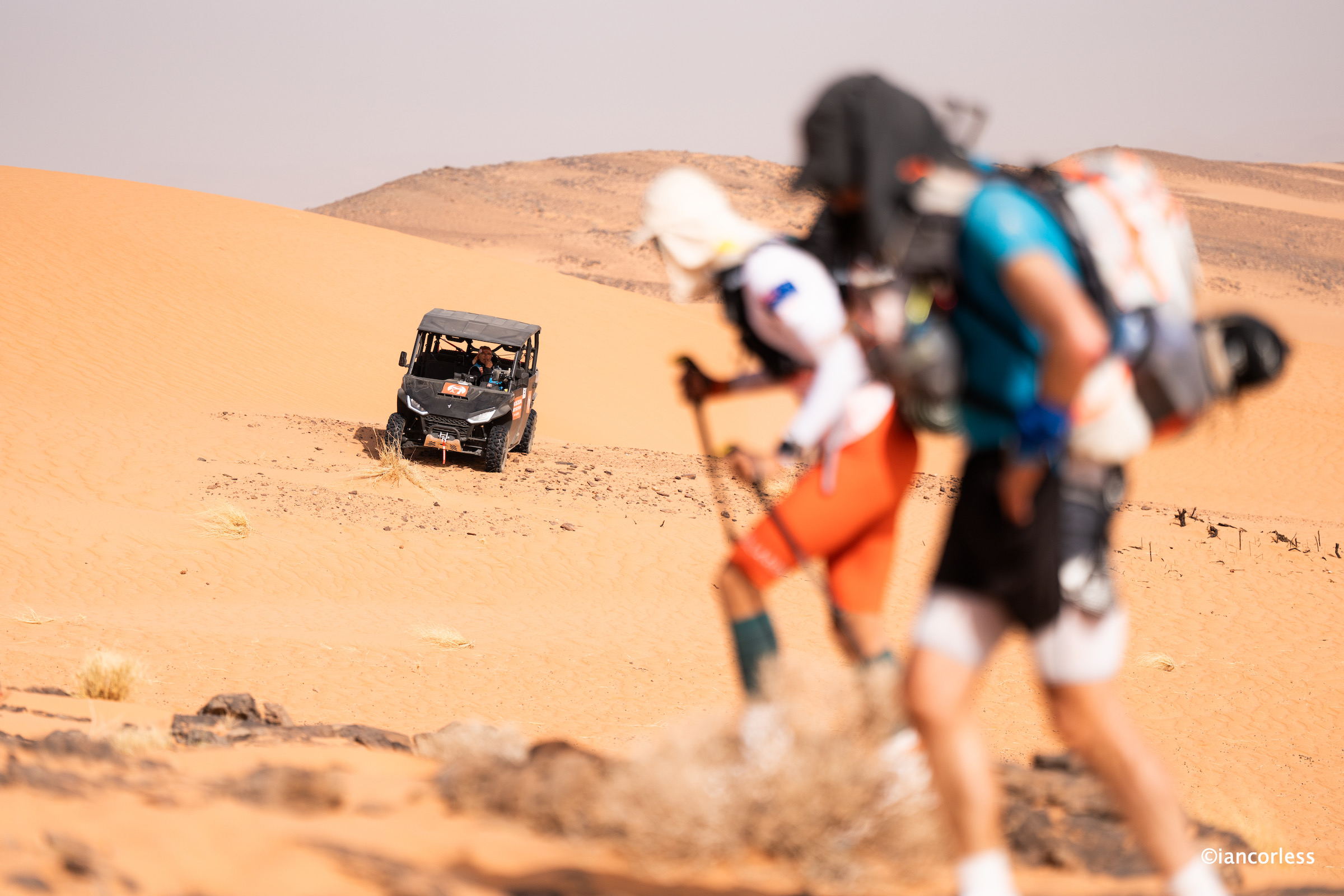
Out on the course, SSV vehicles provide rapid access across the route and carry medical professionals for immediate response. In addition, there are 12 support 4×4 vehicles and a unique system of 40 camel patrol teams. These local teams monitor specific zones and report any issues quickly.
Add to that 20 medical patrol staff on the course and another 25 blue and orange jacket team members, and you begin to see how carefully the race is supported despite its remote setting.
Arriving in Morocco
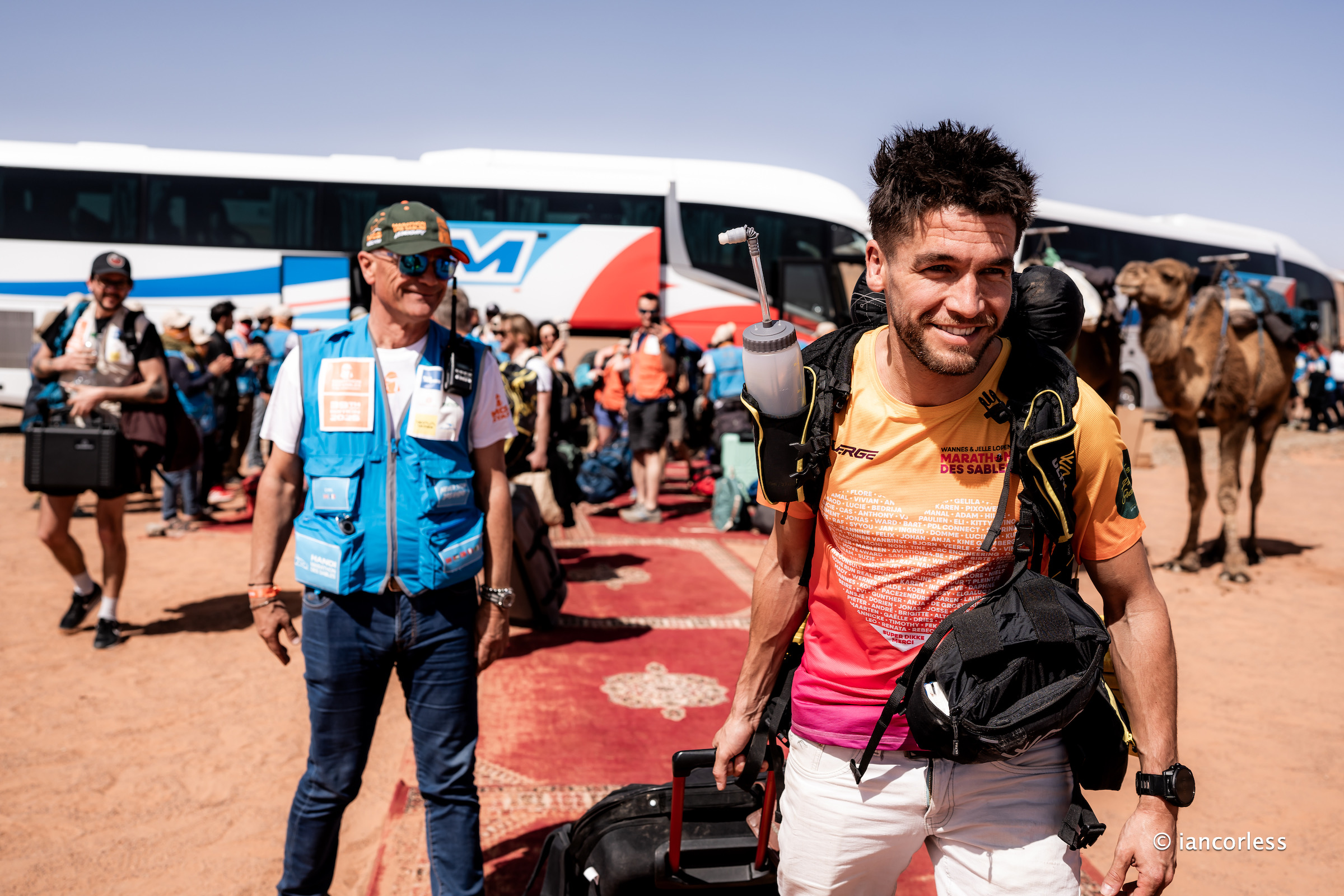
Your journey begins in Ouarzazate, the meeting point for the race.
Plan to arrive at least one day early. This gives you time to settle in and avoids unnecessary stress before the adventure begins. Hotels are your responsibility to book.
The organisation provides free transfers from Marrakech to Ouarzazate, usually departing from the airport and a designated hotel. Always check official timings before travelling.
Photo by Ian Corless
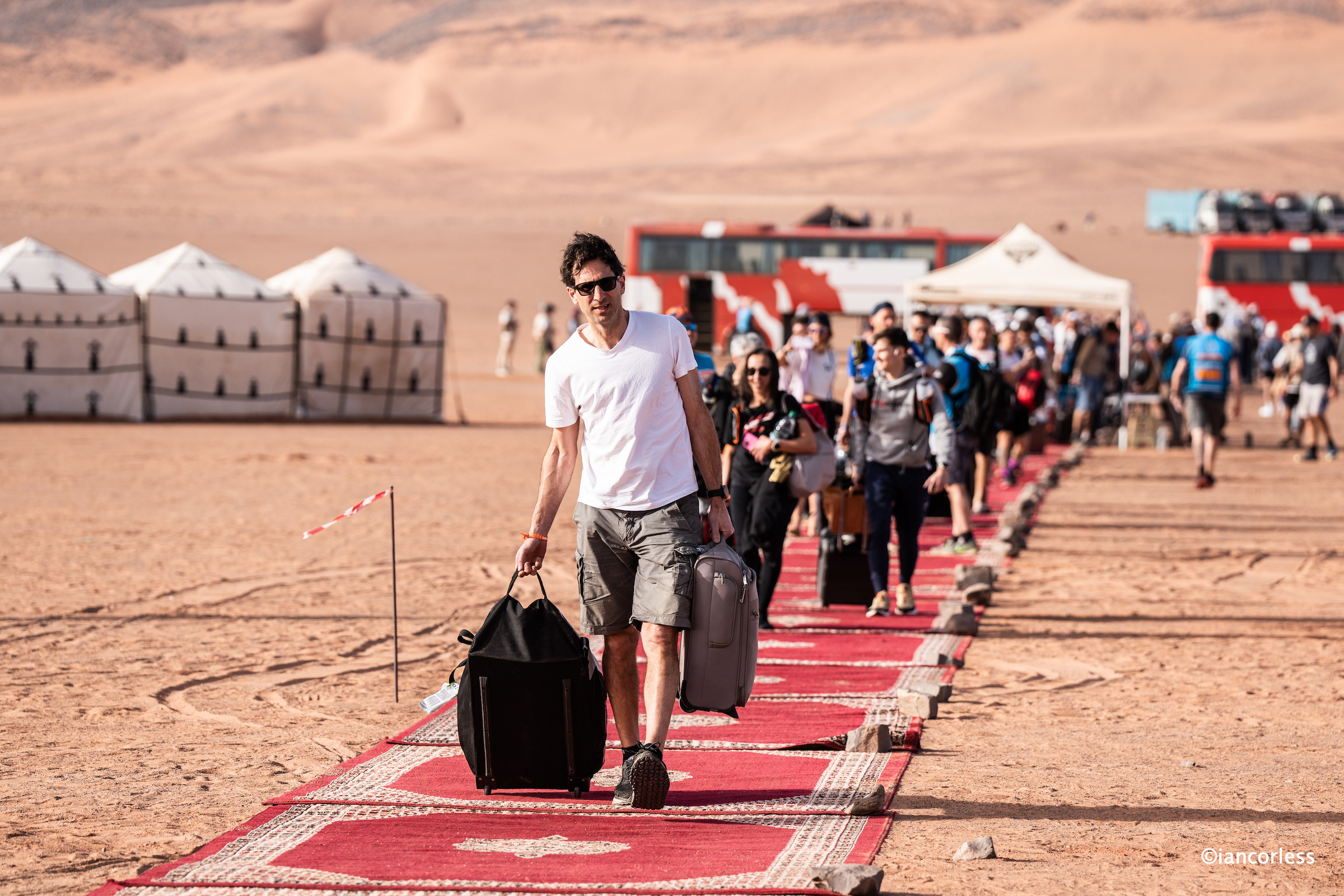
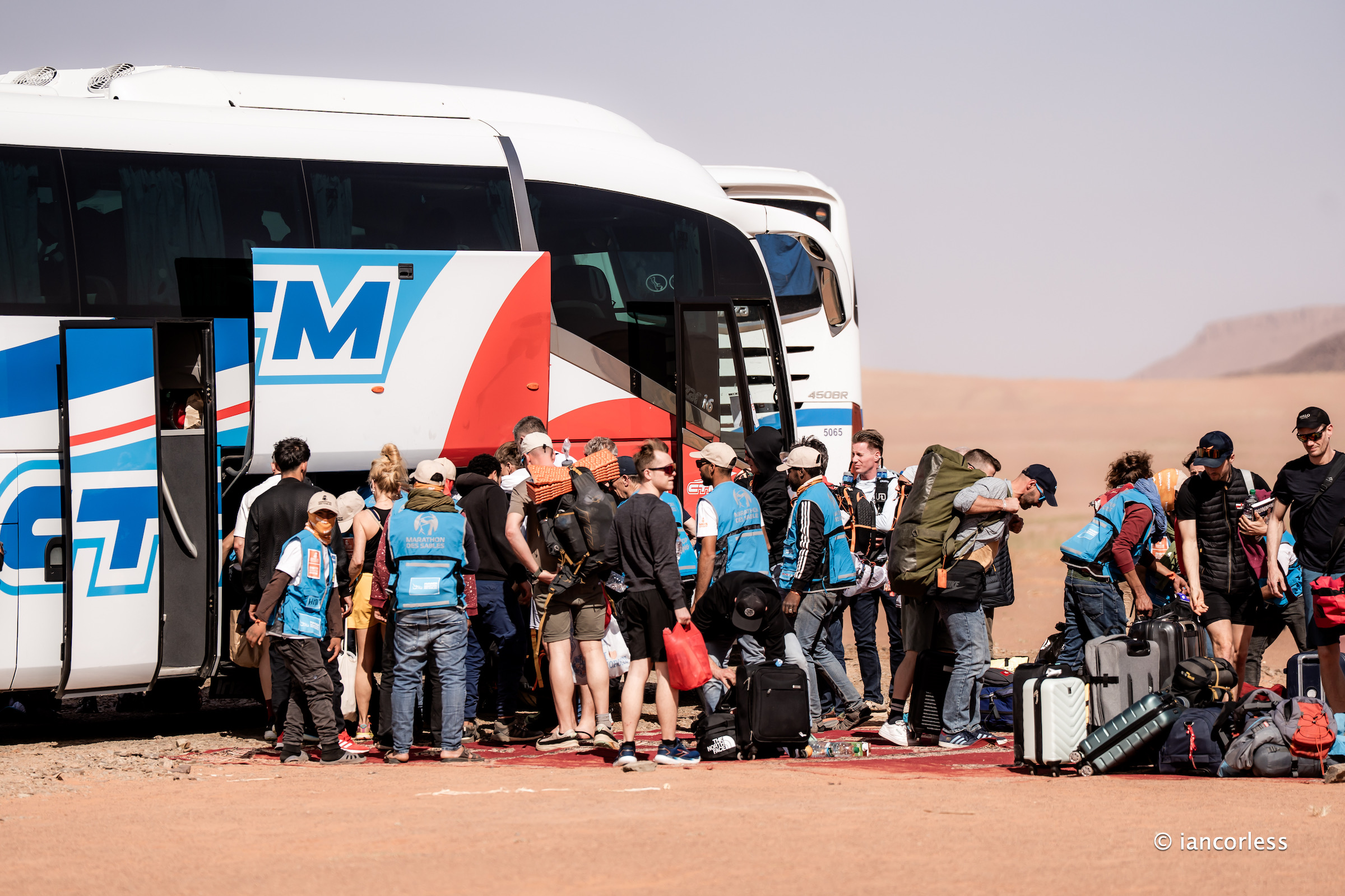
On Day 1, buses depart from Ouarzazate for the first bivouac. The journey takes roughly six hours across spectacular desert landscapes. A lunch pack is provided, but it’s wise to bring extra snacks and drinks.
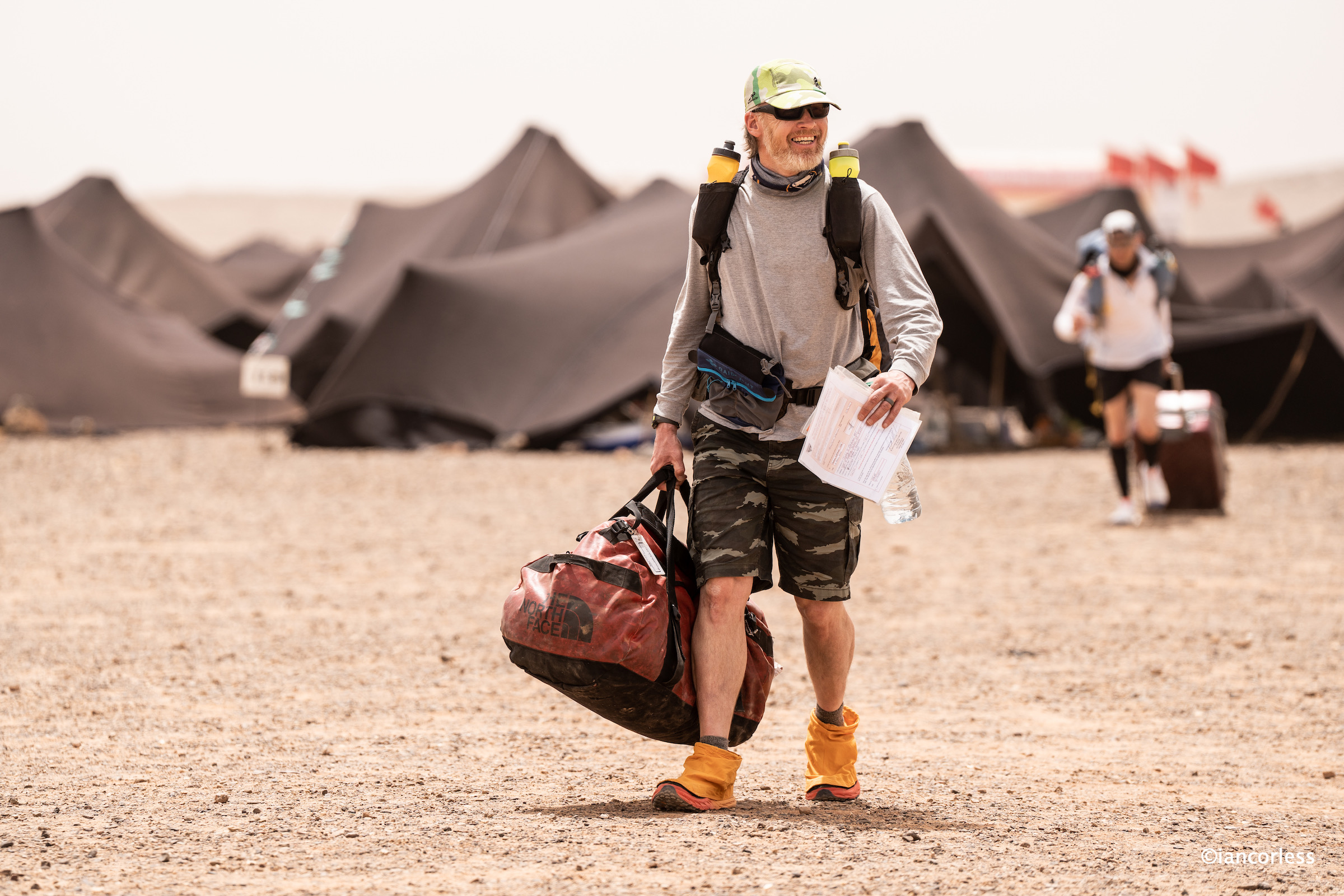
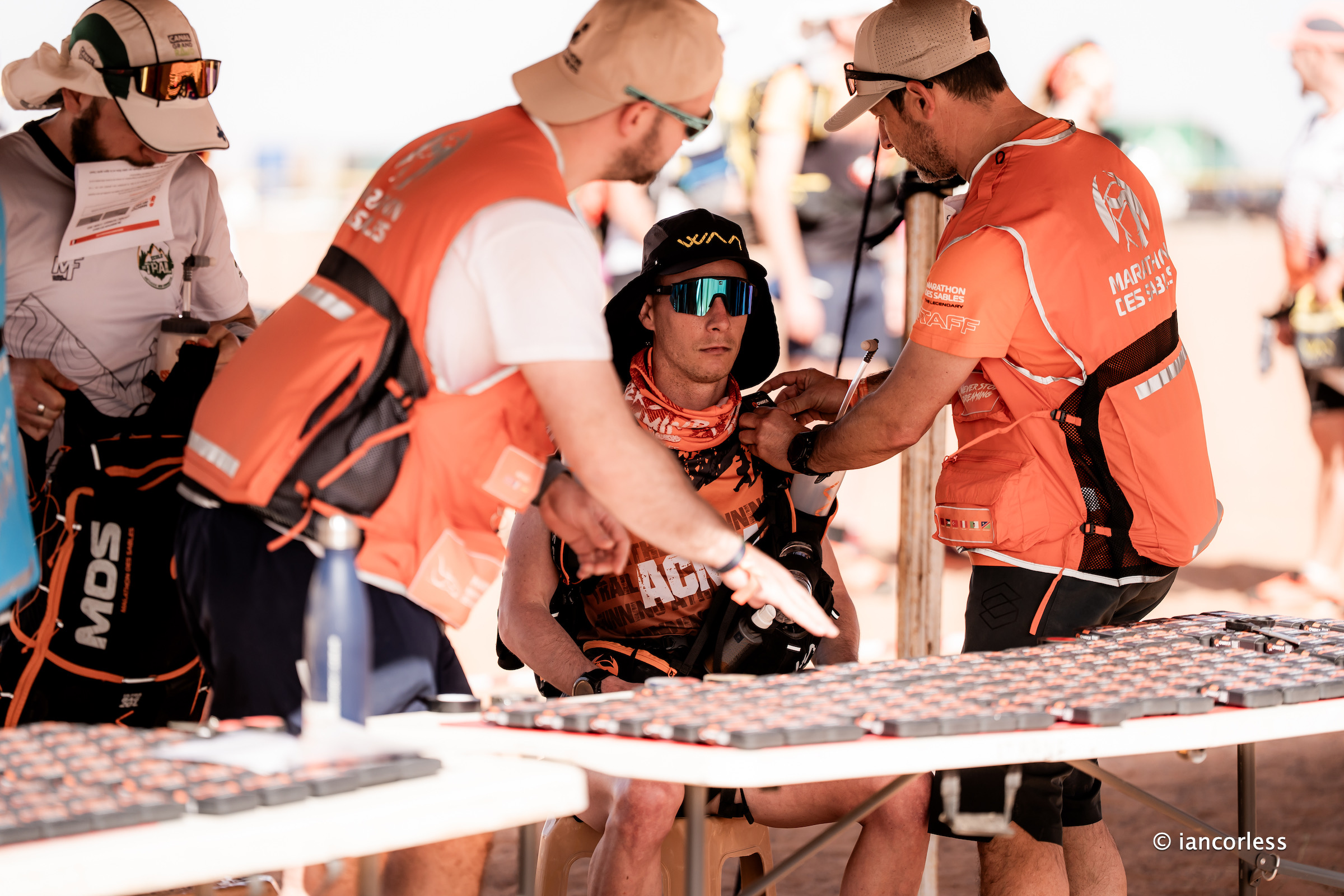
When you arrive at the bivouac, you’ll be assigned a tent number. Remember you are self-sufficient in regard to food, water is provided. For the moment, you still have access to your luggage. The following day, after administrative checks, you will deposit that luggage and begin the self-sufficient part of the race.
From this point forward, the desert becomes your home.
Life in the Bivouac
Bivouac life is simple. Very simple.
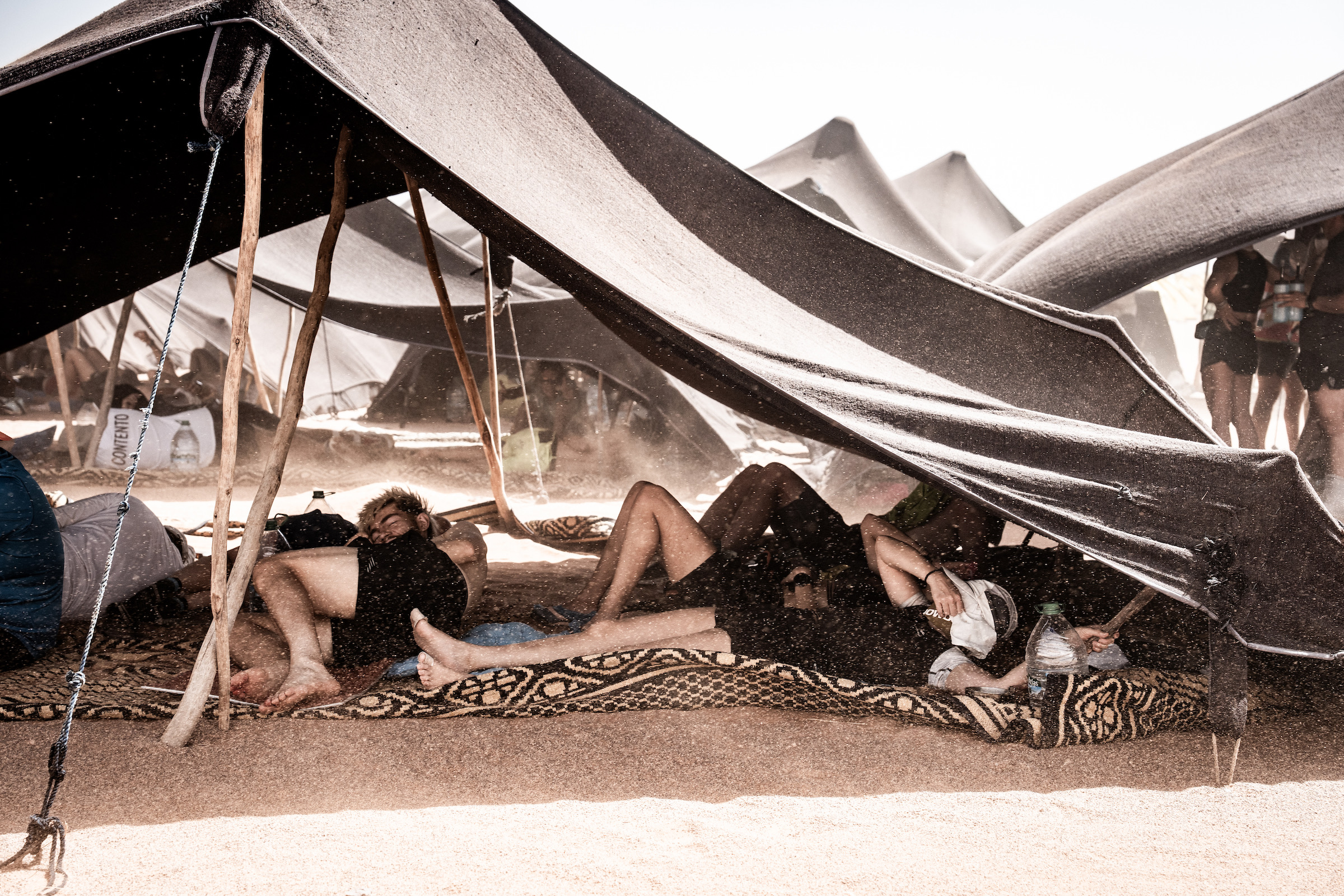
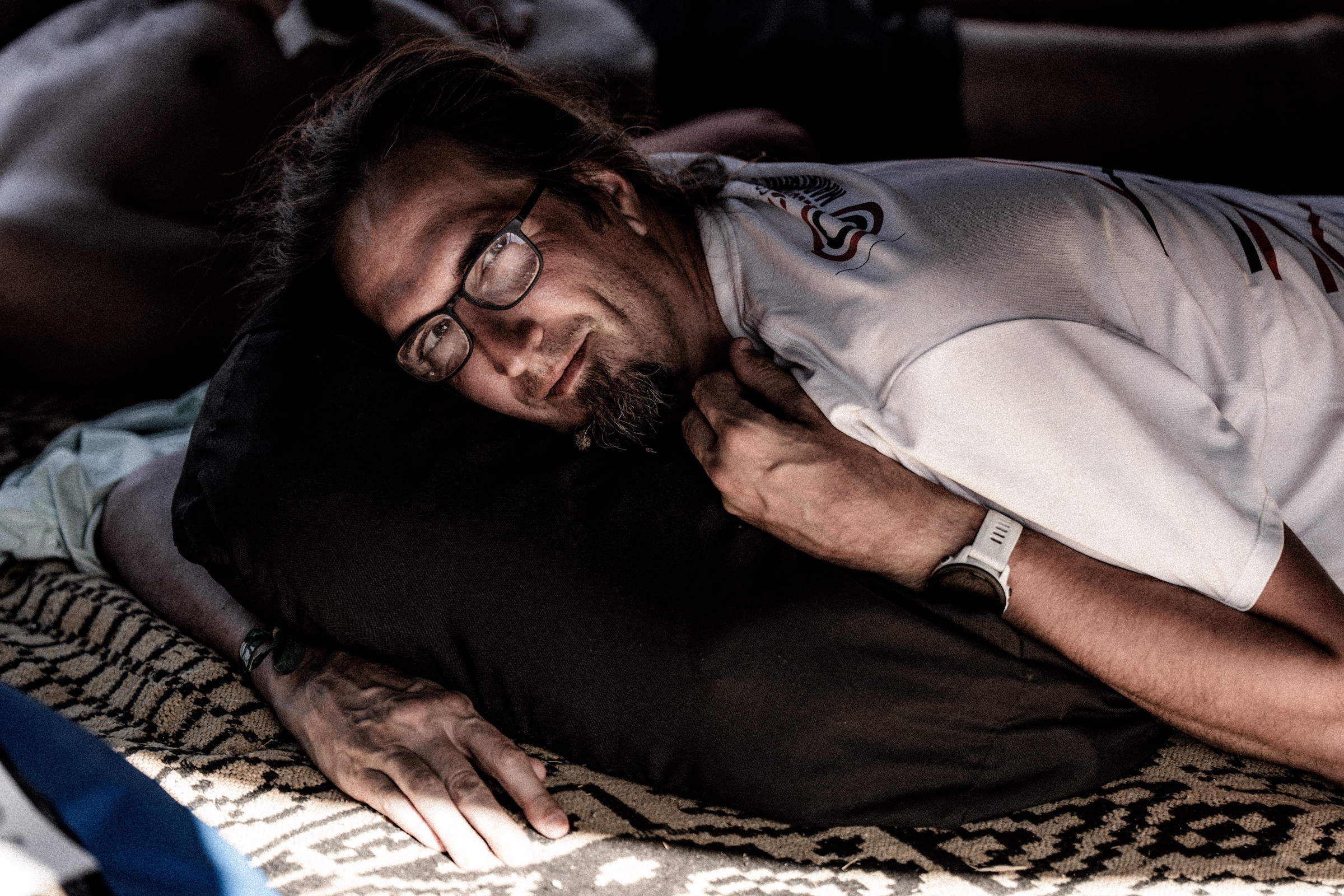
There are no showers and no power. You live under traditional desert tents with seven other runners. It can feel crowded when everyone is organising gear, so respect each other’s space and keep things tidy.
There are a few practical rules that quickly become important:
• Toilets are installed throughout the bivouac and at checkpoints.
• Some toilets are designated women-only or mixed-use, and it’s important to respect those arrangements.
• Biodegradable hygiene bags are provided and waste is separated into organic and sanitary bins.
Phones are strongly discouraged in camp. The bivouac is meant to be a place for rest, conversation, and disconnection. If you need to make an emergency call, move away from camp out of respect for others.
There is also an IP phone available for emergency calls, costing €2 per minute.
Another change from previous years is the removal of the email message system. This reinforces the race’s self-sufficient spirit and saves thousands of sheets of paper that were previously used to print messages.
Instead, runners can use Emotion Boxes to record short video messages that are sent to loved ones. You need to designate before the race who these messages will be sent to.
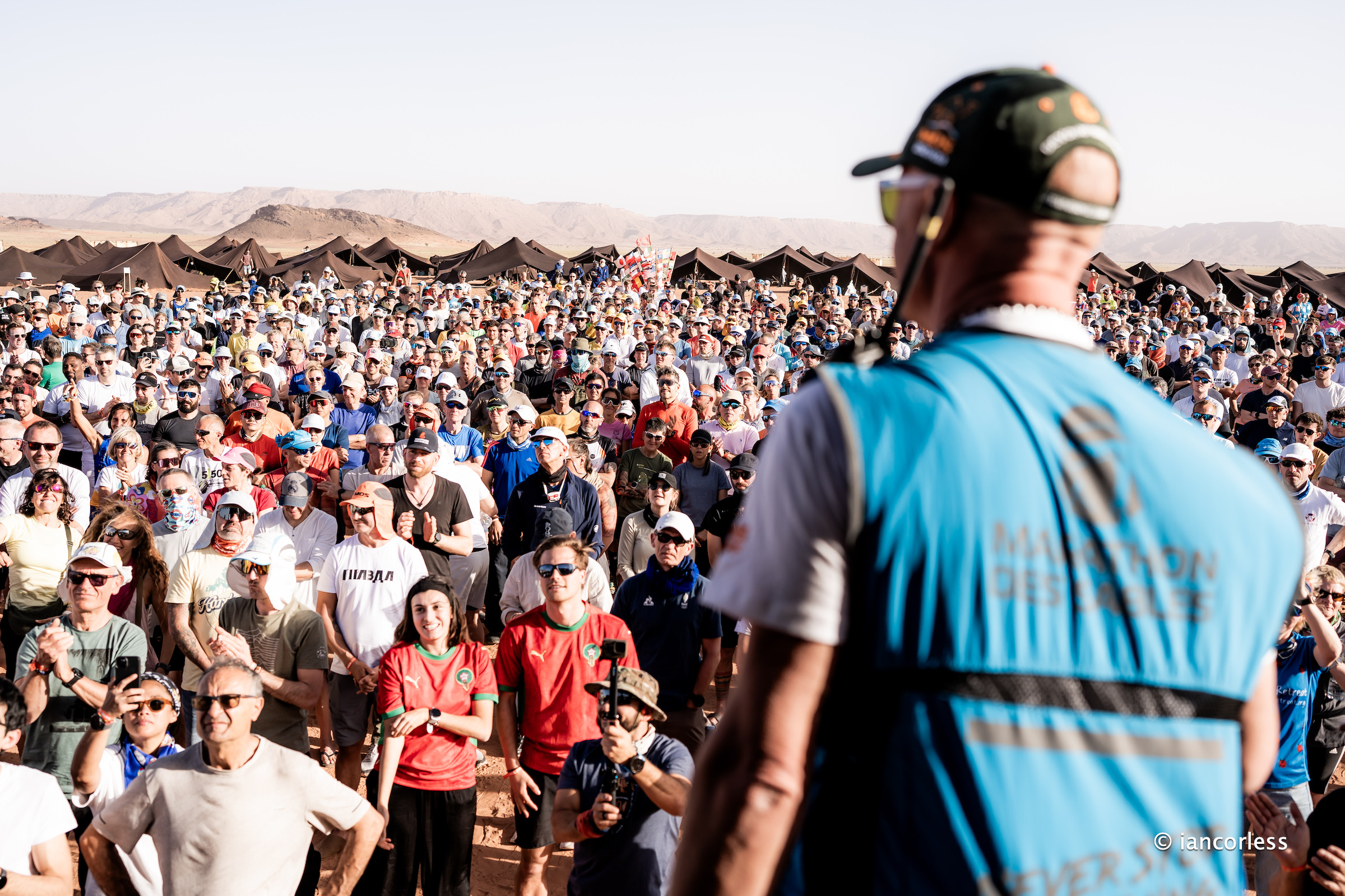
At the centre of camp sits the Info Tent, where Blue Jackets are always present. This is where you:
• collect your daily water
• ask questions
• check rankings
• access medical support if needed
Additional facilities include women’s changing cabins and sanitary products available both in the bivouac and at checkpoints.
A few other important bivouac rules:
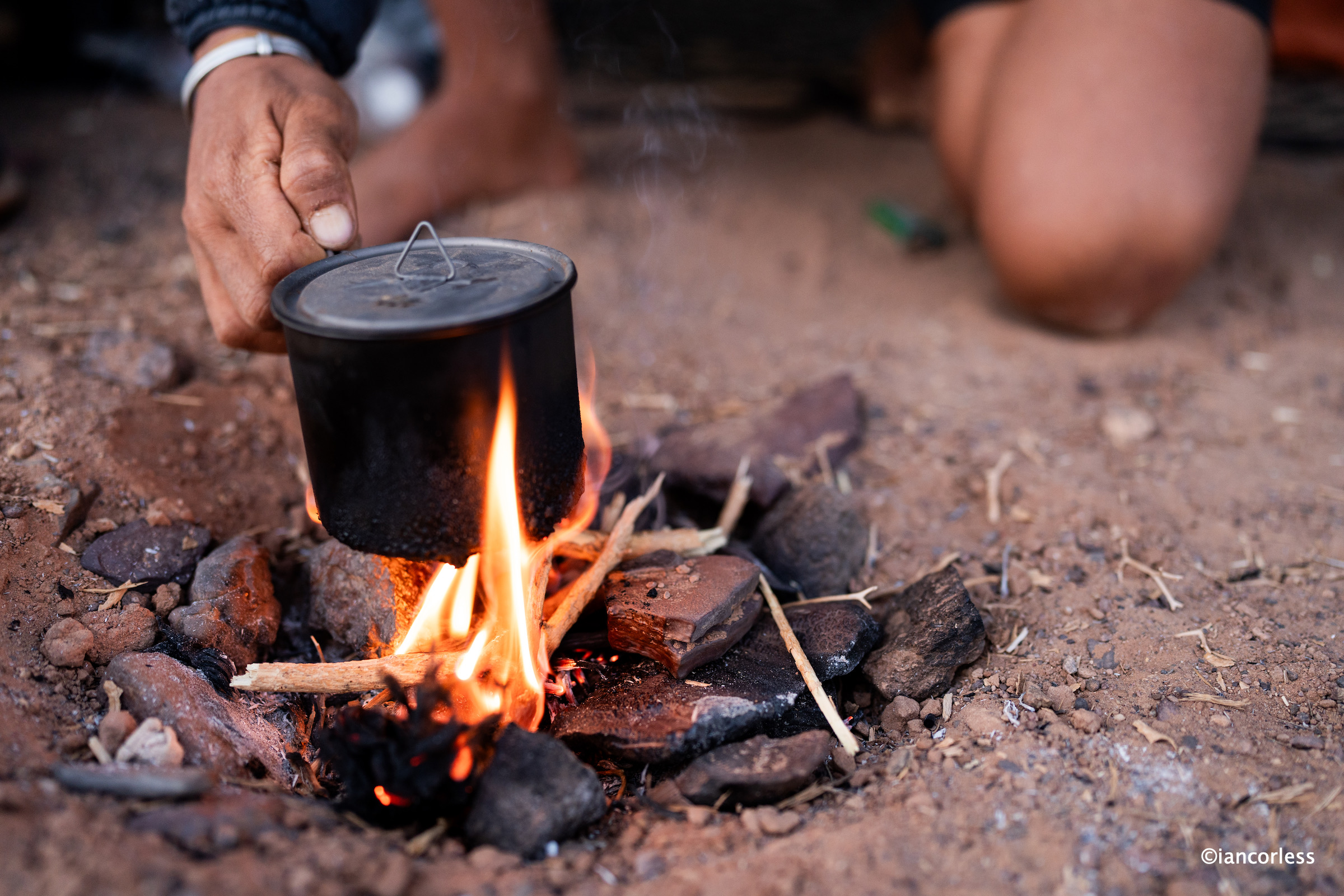
• Never light a fire within 50 cm of tents
• Do not walk barefoot
• Drop empty water bottles at designated recycling points
• On bivouac move days, return containers to the Info Tent
It may sound strict, but these rules keep the camp safe, clean, and functioning smoothly.
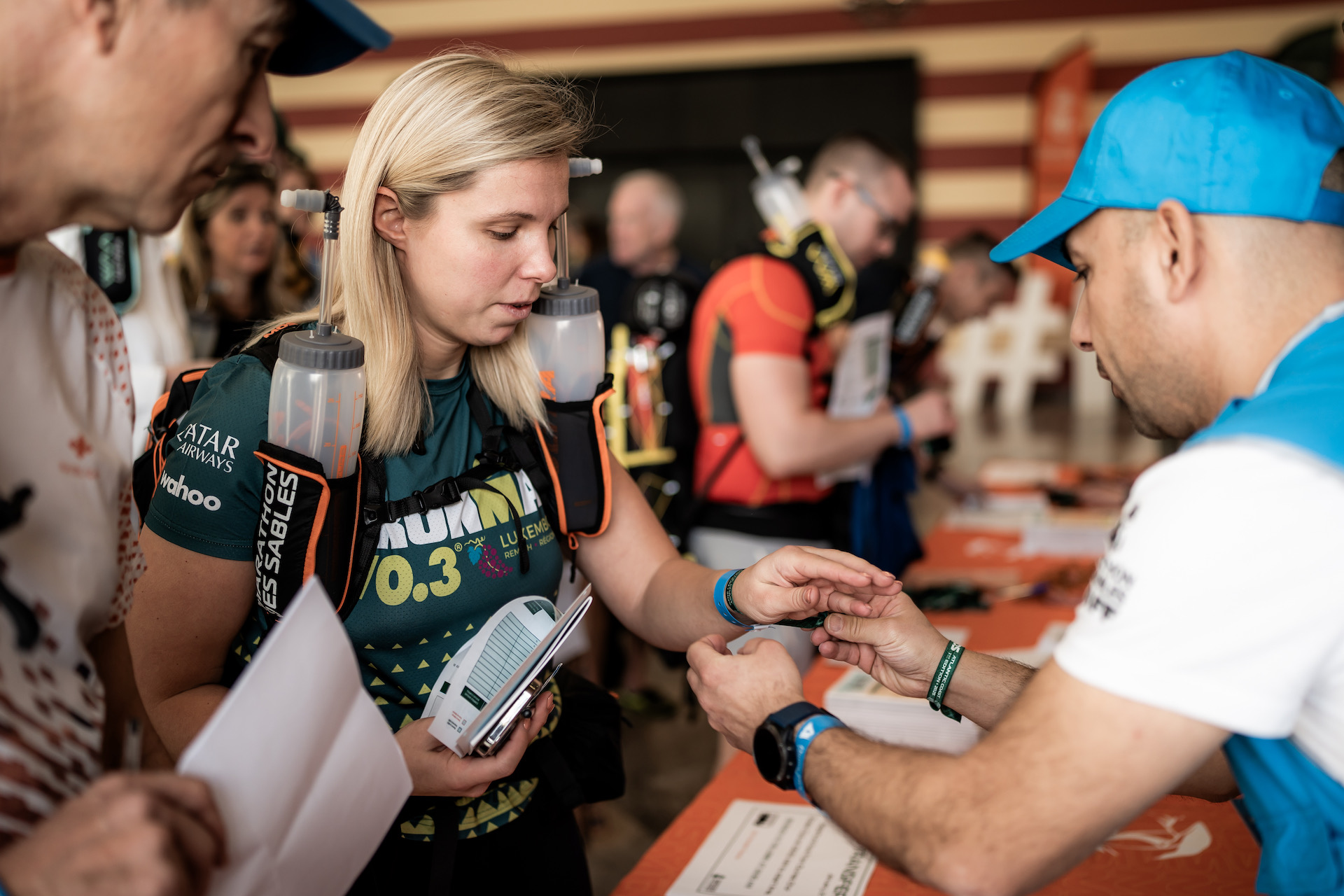
You will go through administrative, technical, and medical checks, while the MDS shop opens nearby. At the shop you can purchase WAA apparel, fire bricks and any other last-minute things you may have forgotten or need.
Each runner receives one 5-litre bottle of mineral water, which must last until the first checkpoint of the race.
Before heading to the checks, prepare the required documents:
• Passport
• Completed technical control form
• Medical certificate
• Resting electrocardiogram (ECG)
During the admin process you will:
1. Deposit your luggage (it will later be returned to you in Ouarzazate).
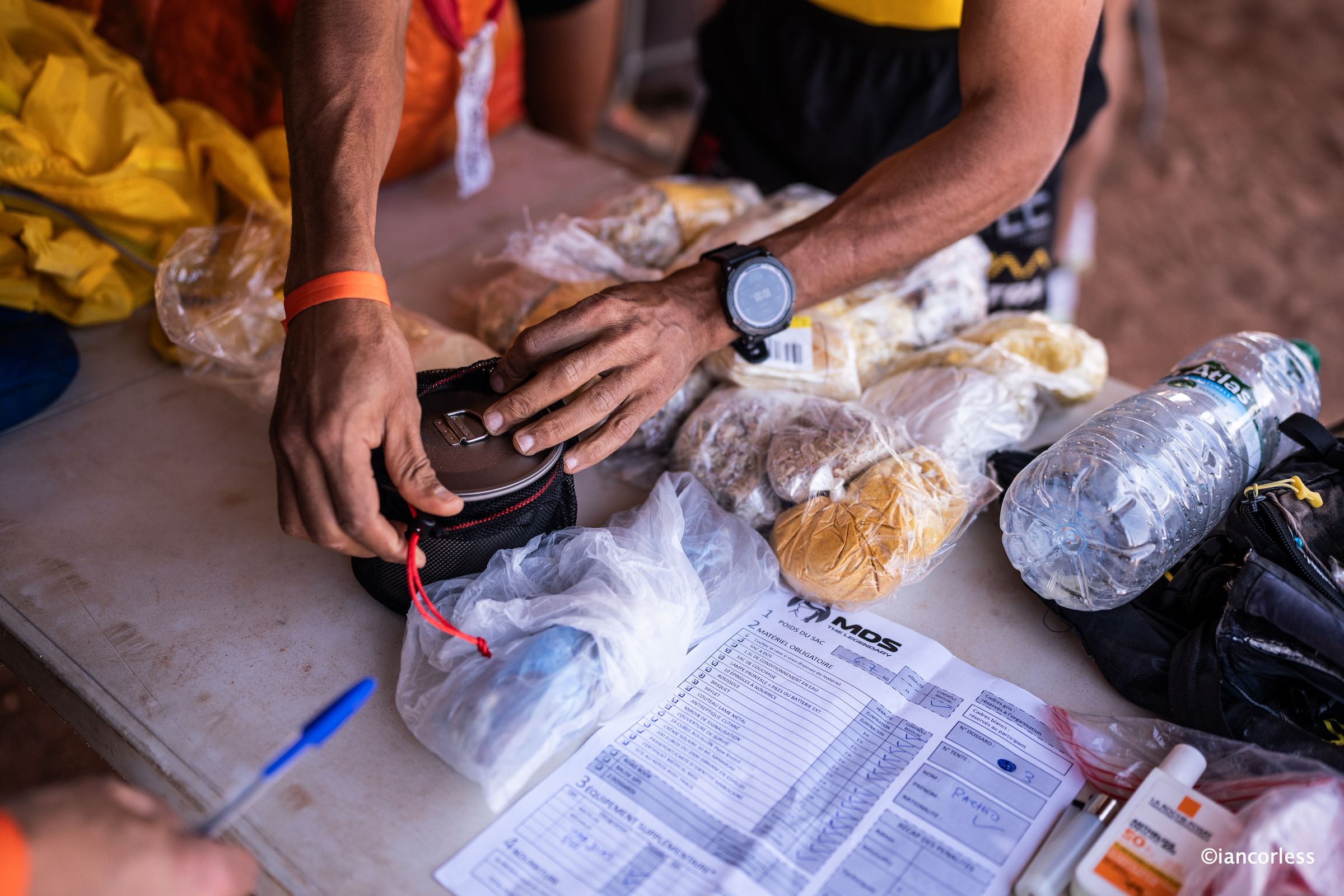
2. Present your documents and mandatory equipment.
3. Have your race pack weighed.
4. Undergo medical verification.
5. Receive your GPS beacon.
6. Submit your technical control form and receive two race bibs.
If you need to discard a personal item listed on your form later, you must inform the organisation or risk a penalty.
Later in the day:
• 4:30 PM – Stage briefing
Photo by Ian Corless
• 6:00 PM – 40th anniversary photo session
The race is now very real.
A Typical Day in the Desert
Every stage day follows a similar rhythm. Wake up will typically be around 0400 to 0500.
Breakfast is self-sufficient, using the food you’ve carried with you.
Stage tart times vary, but be prepared and ready for 05:30. If temperatures are high, the start may move earlier. Plan for at least 90 minutes of preparation before the start.
Thirty minutes before the stage begins, you must be ready. The race starts on time and no one is held back.
Out on the course, each checkpoint typically between 8-10km’s provides:
• water distribution
• medical presence
• toilets and hygiene supplies
At the finish line, you receive a 5-litre bottle of water, which must last until the first checkpoint the following day. To clarify, you need to drink, cook dinner, wash (if you can spare the water), make breakfast and fill bottles ready to last to CP1 all from the 5ltr bottle.
Each evening the Info Tent and medical clinic are open.
Safety in the Desert
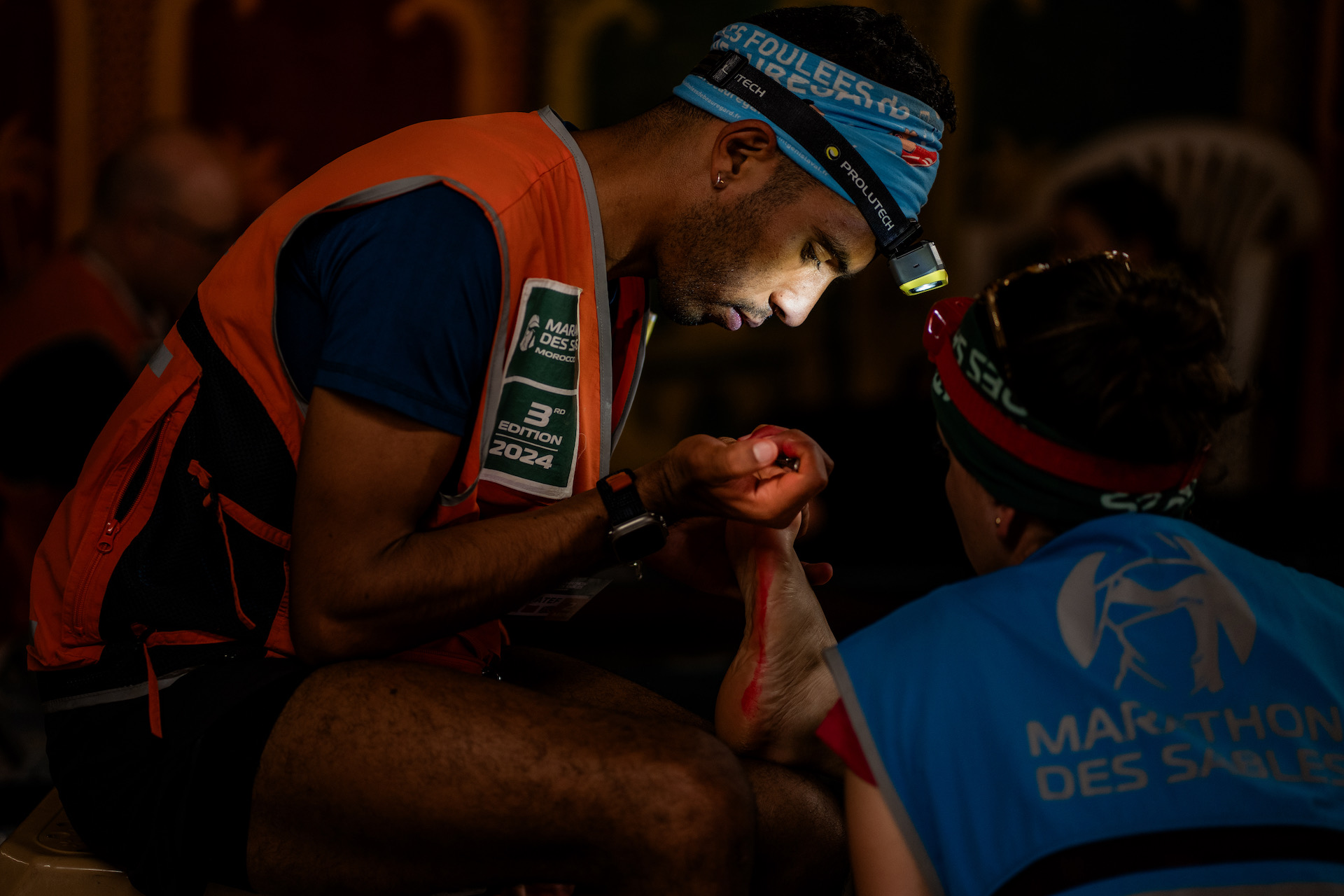
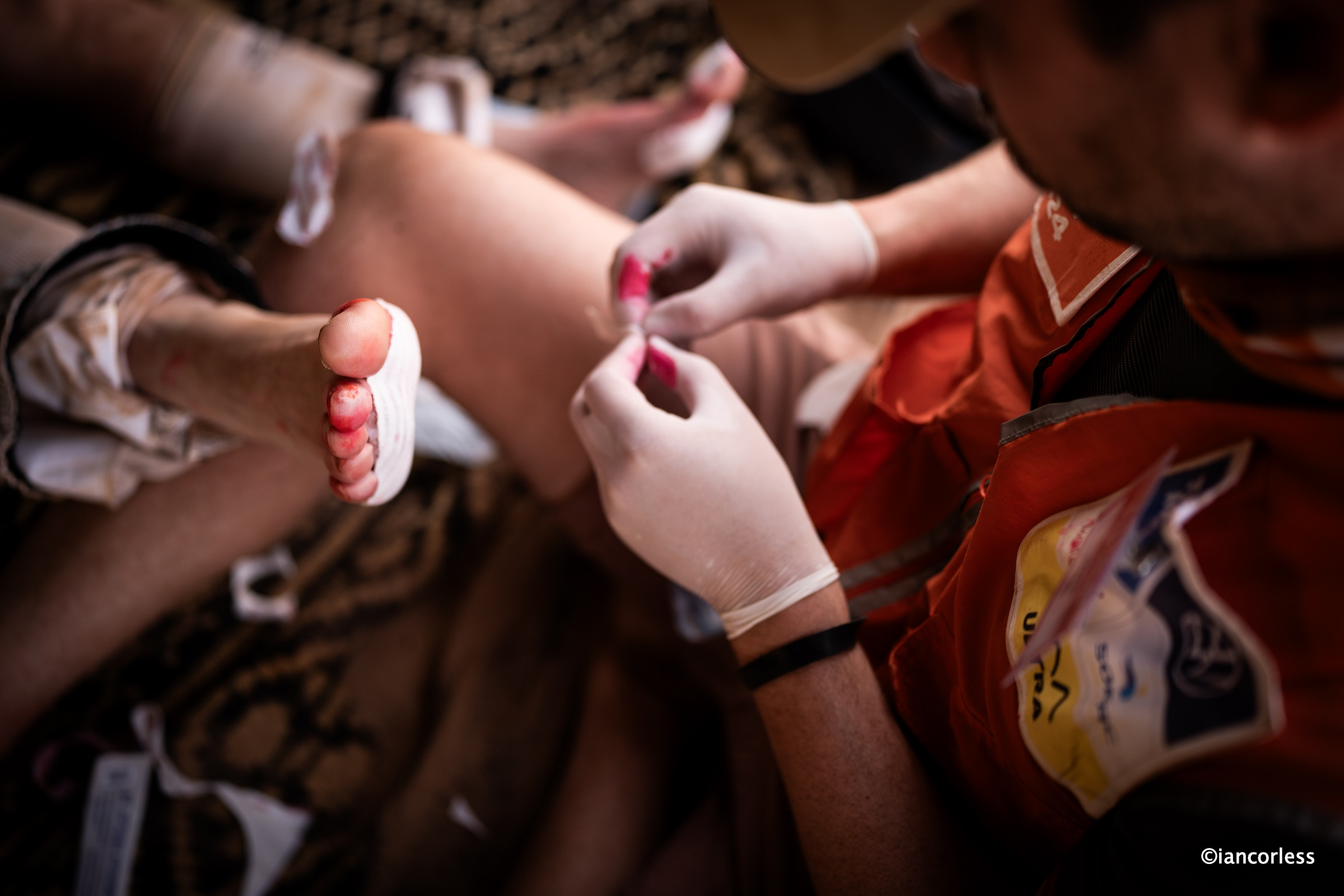
Despite the race’s self-sufficient nature, medical support is extensive. Assistance is available before, during, and after every stage. However, runners are expected to understand basic foot care, which is essential during multi-day desert racing.
For more serious problems, the Dokever medical team takes over.
If you must withdraw from the race, you must notify the organisation. In emergencies, medical evacuation will occur. For non-emergency withdrawals, transport will be arranged back to Ouarzazate, but hotel and food costs will be your responsibility.
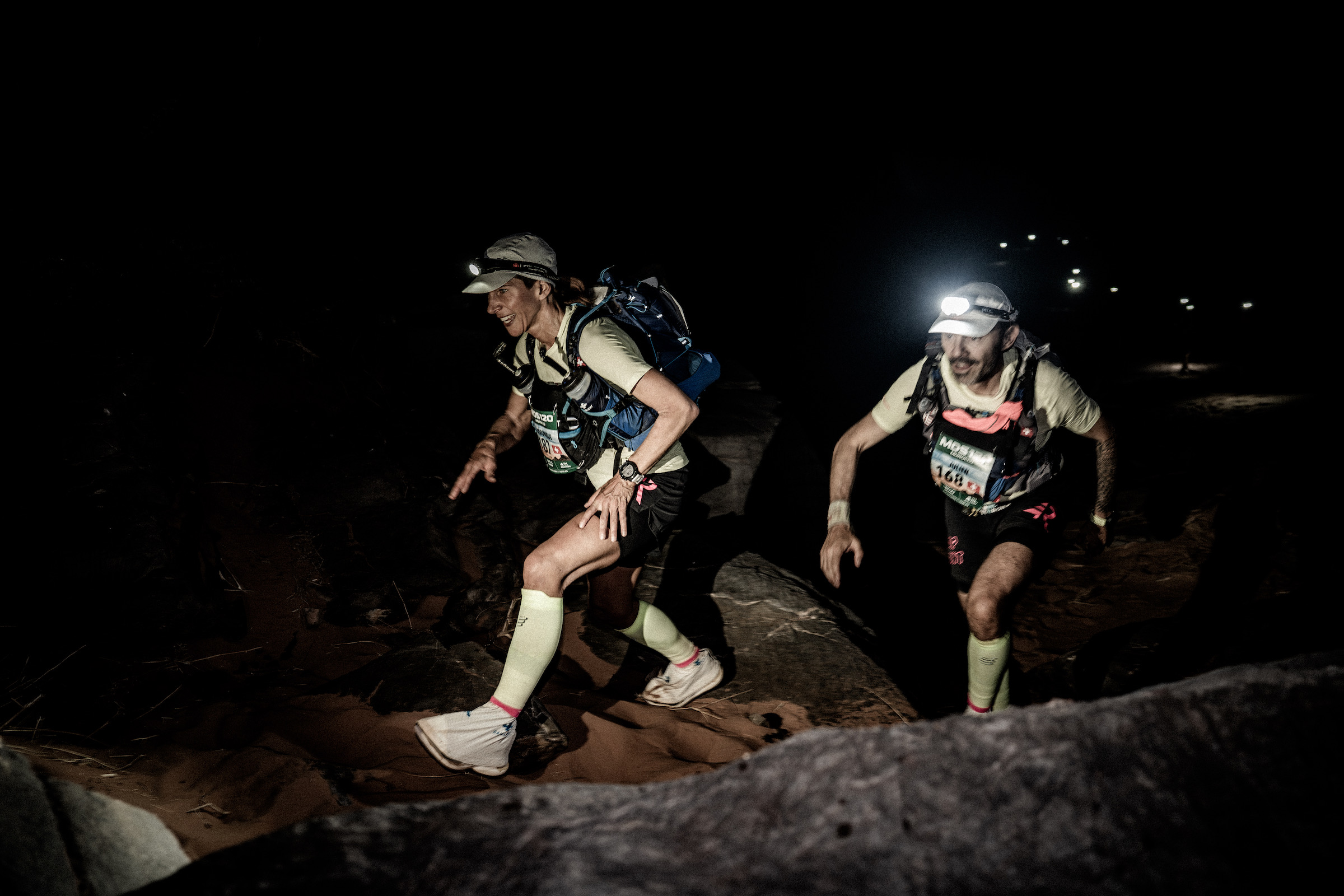
At night during a stage, headlamps are mandatory.
Navigation and Desert Conditions
The course is marked clearly and all checkpoints are mandatory. Cutting across the course is forbidden.
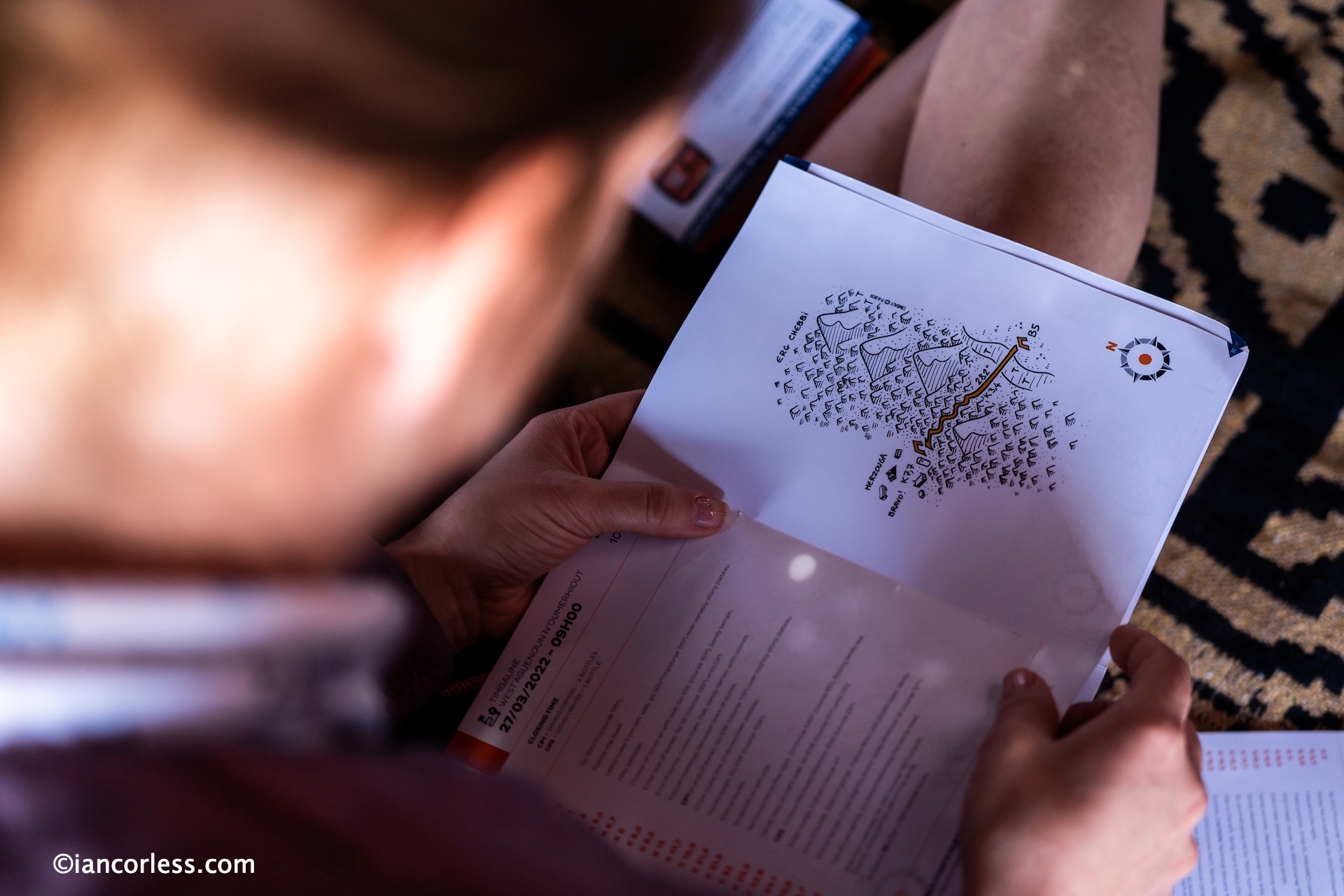
Compass headings in the road book are provided as guidance if visibility becomes poor. Know how to use a compass and take a bearing!
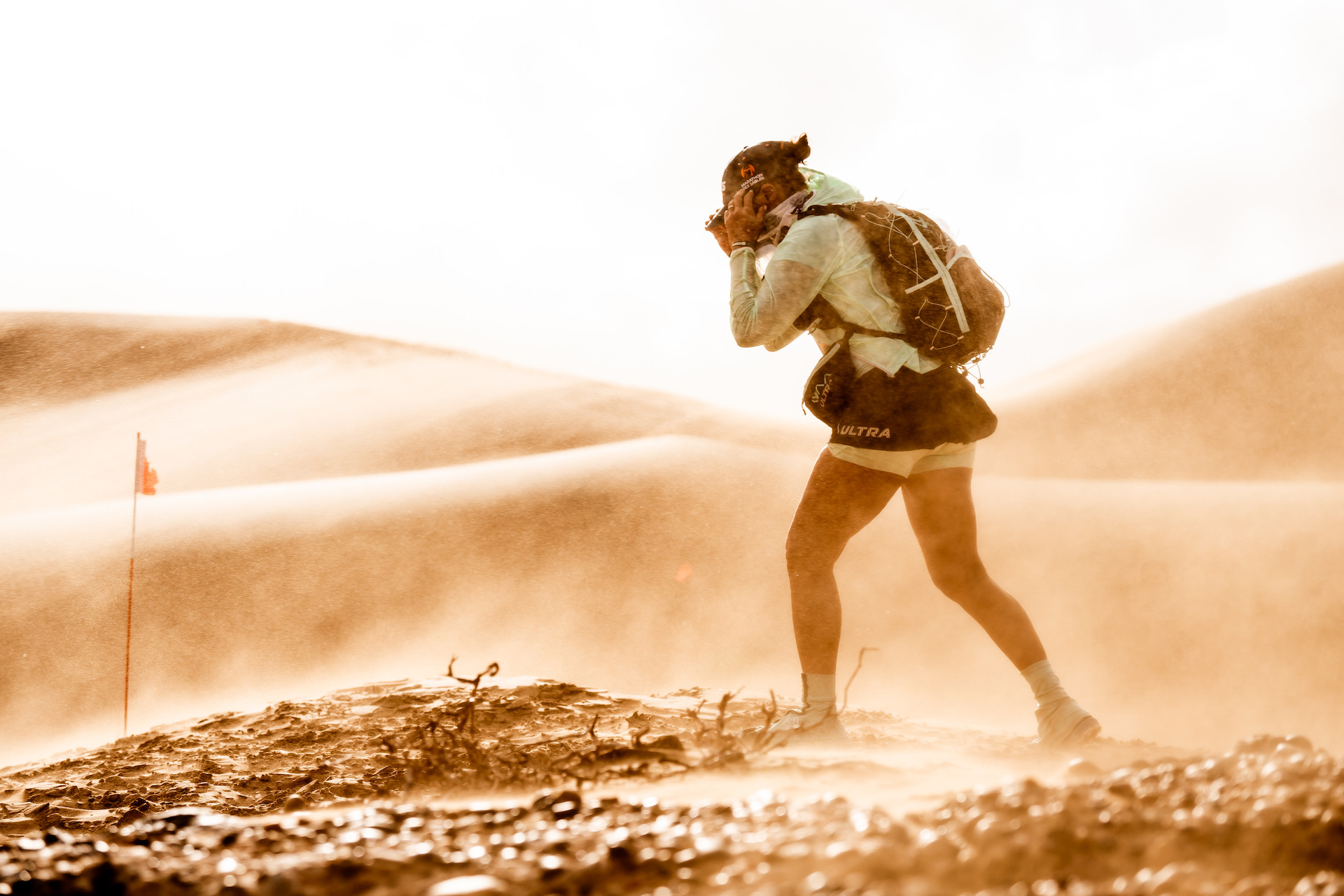
Sandstorms
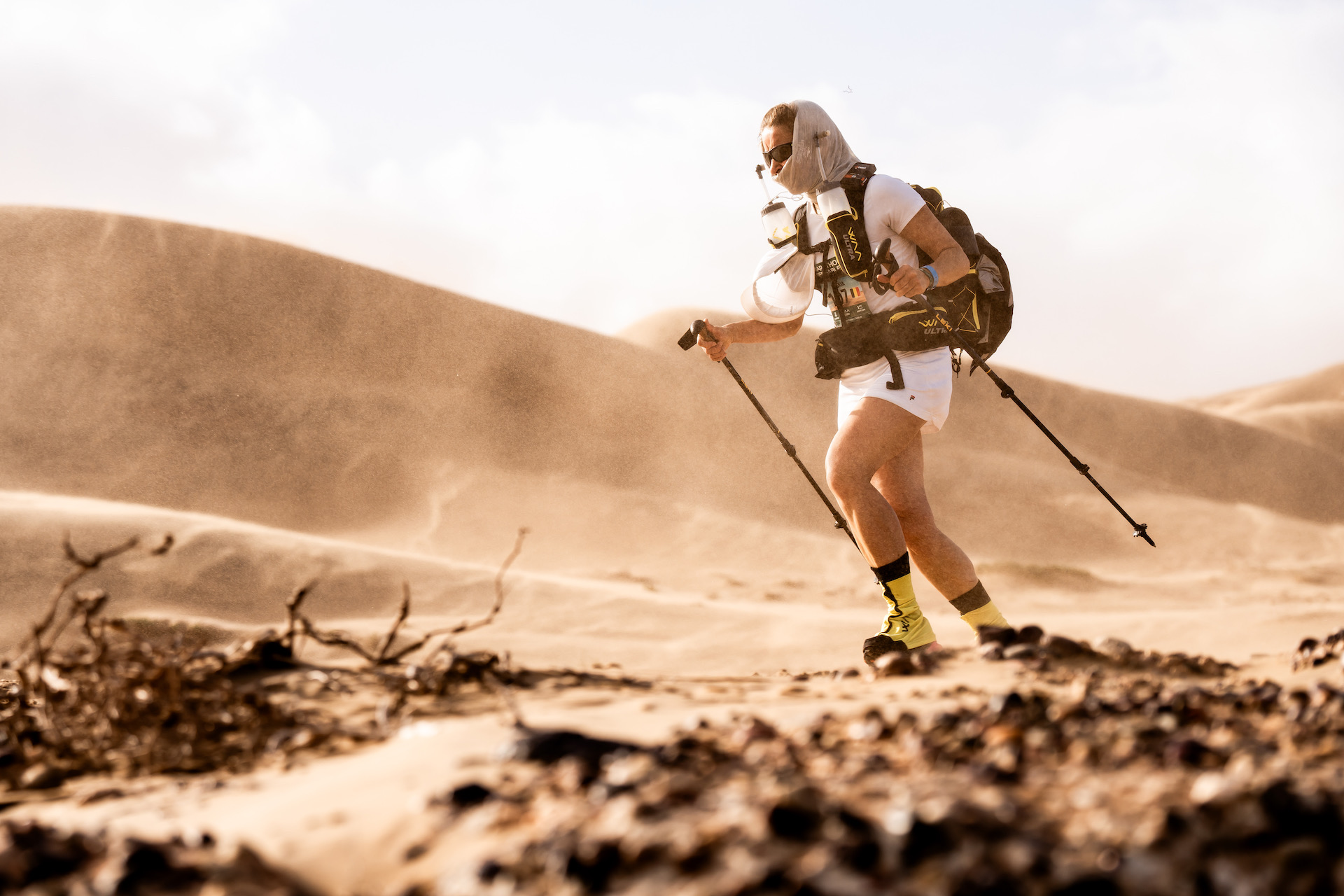
If a sandstorm arrives:
• protect your eyes – you need good glasses and ideally goggles
• cover your nose and mouth typically with a Buff or similar
• stay close to other runners
Photo by Ian Corless
If visibility drops, stop moving and immediately remove compass and take a bearing for the direction of travel. When conditions improve you can move again relying on the compass bearing to ensure you are going in the correct direction.
If you stray from the course, the organisation will receive an alert from your GPS beacon and locate you.
If You Become Lost
It is highly unlikely that you become lost at MDS, however, it is possible to stray of course and feel disorientated. If you cannot see course markings for ten minutes:
1. Stop and assess your position.
2. Climb a small rise if possible to scan the horizon.
3. Backtrack for up to ten minutes if necessary.
Remember, you have a tracker, so, MDS organisation will know where you are and will be able to find you – do not panic.
As a last resort, activate the SOS function on your GPS beacon.
Distress signals can also be made using whistle blasts or torch flashes at night
To alert SOS with a whistle, the internationally recognized distress signal is three short, sharp blasts, followed by a pause, and then repeated. While the full Morse code for SOS is three short, three long, and three short blasts, the simplified “three blasts” method is more commonly used in disaster preparedness to call for help.
To alert SOS with a torch, flash the light in a repeating pattern of three short flashes, three long flashes, and three short flashes.
Medical Requirements
All runners declare medical information during registration.
During race checks, you must present:
• an original medical certificate
• a resting ECG
Photo by Ian Corless
Failure to provide these documents results in disqualification, though emergency testing may be available on site for a €200 fee.
Medical staff specialise in sports and tropical medicine and operate throughout the race.
They also have the authority to withdraw any runner deemed medically unfit to continue.
The Stages
The 2026 race covers approximately 270 kilometres +/- across the Sahara. Total elevation gain will be around 2500m +/-
Confirmed distances will be in the road book, anticipate the following +/- km’s.
Stages include:
• Stage 1: 37 km
• Stage 2: 41 km
• Stage 3: 29 km
• Stage 4: 100 km (You have two days to complete this stage.)
• Stage 5: 42 km
• Stage 6: 21 km
Photo by Ian Corless
To complete the race properly, runners must carry enough food to provide at least 14,000 calories. Remember, this is the minimum, you may well need more than this, so, balance calorie requirement and weight carefully.
The runner is self-sufficient and must carry ALL they need for the whole race, water the only exception.
After Each Stage
Once you reach the bivouac again, recovery begins immediately. You will receive a 5ltr water allocation which must last to CP1 the next day. Stage 4 an exception due to the rest day where extra water will be allocated.
Photo by Ian Corless
Start with a recovery drink before preparing food.
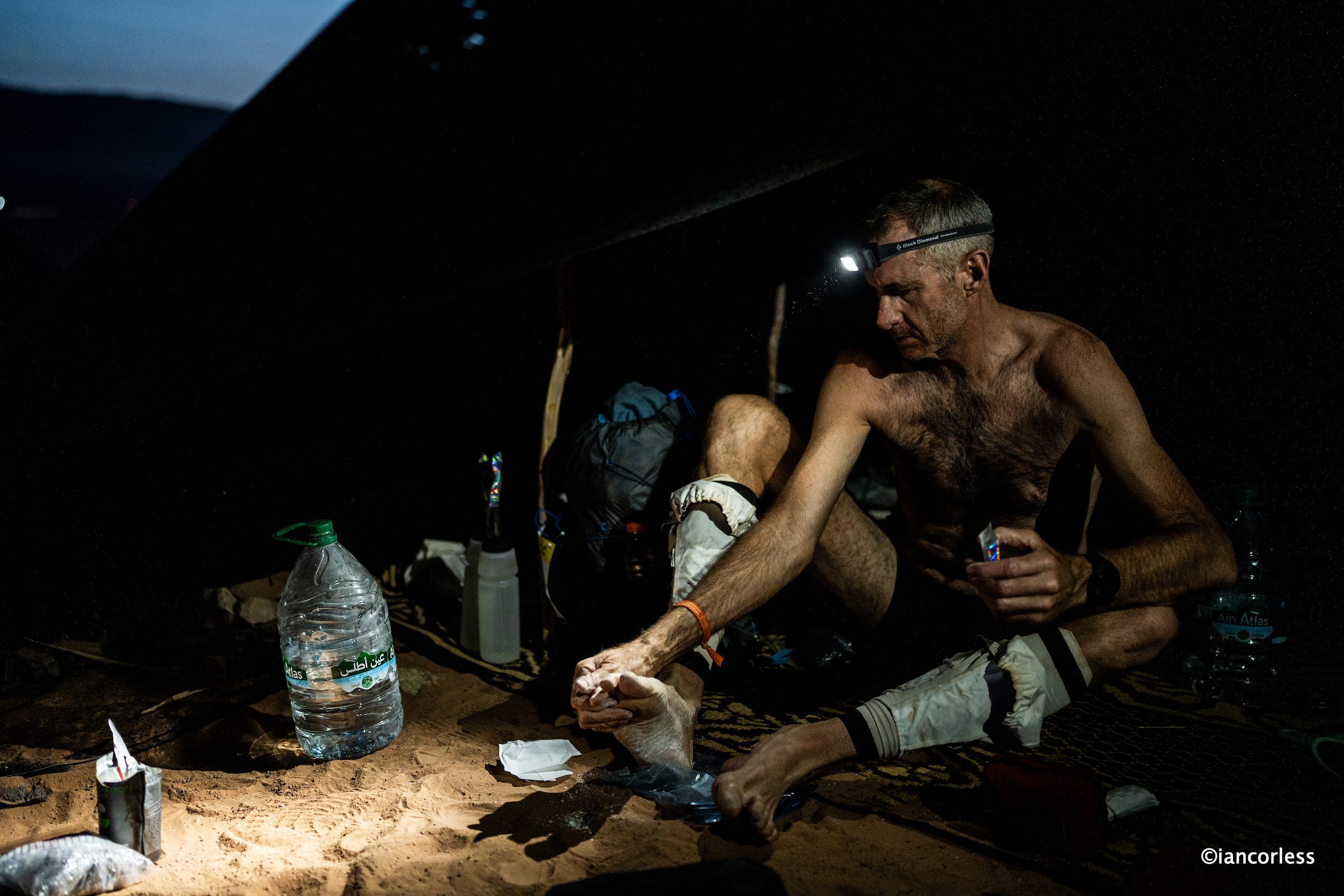
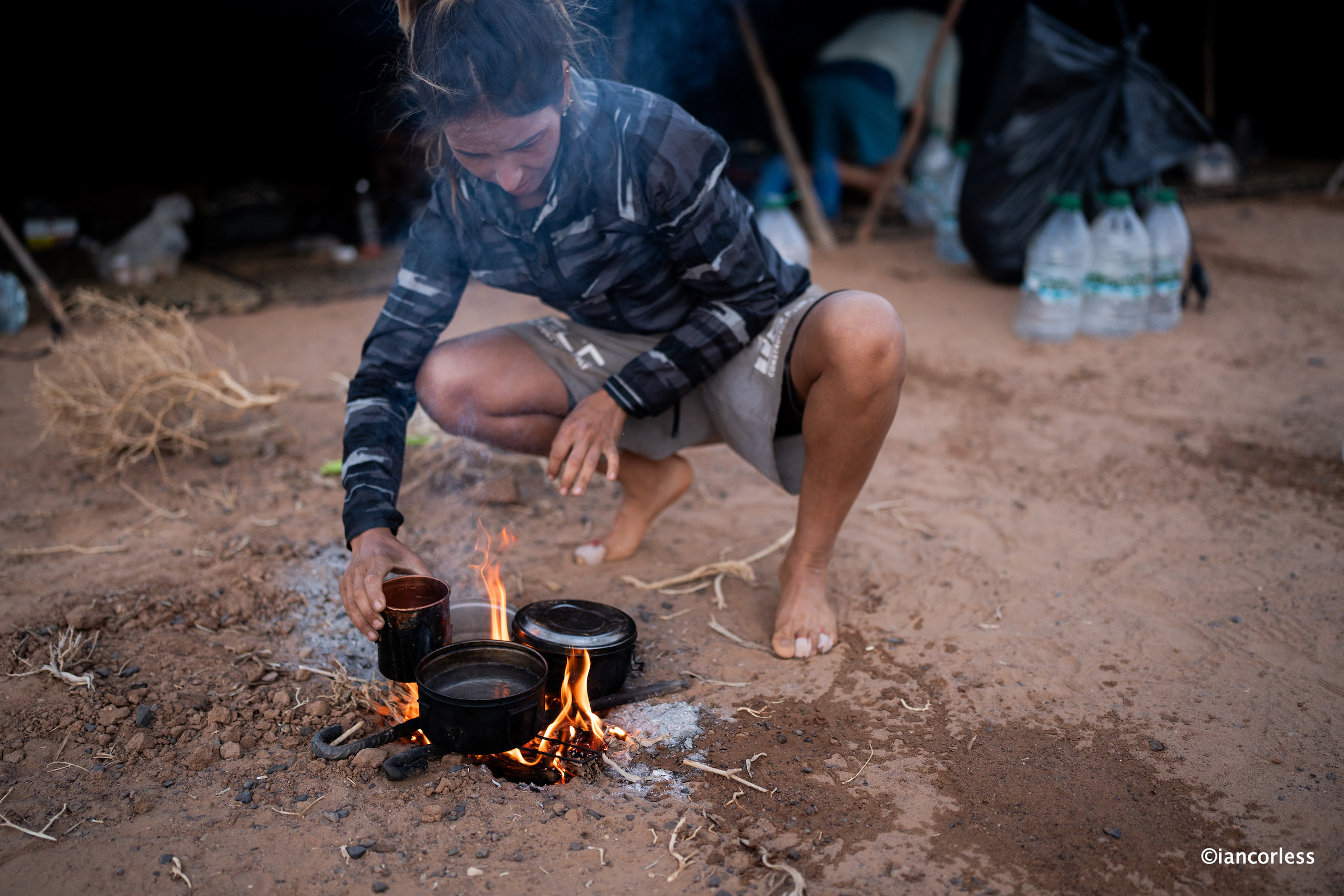
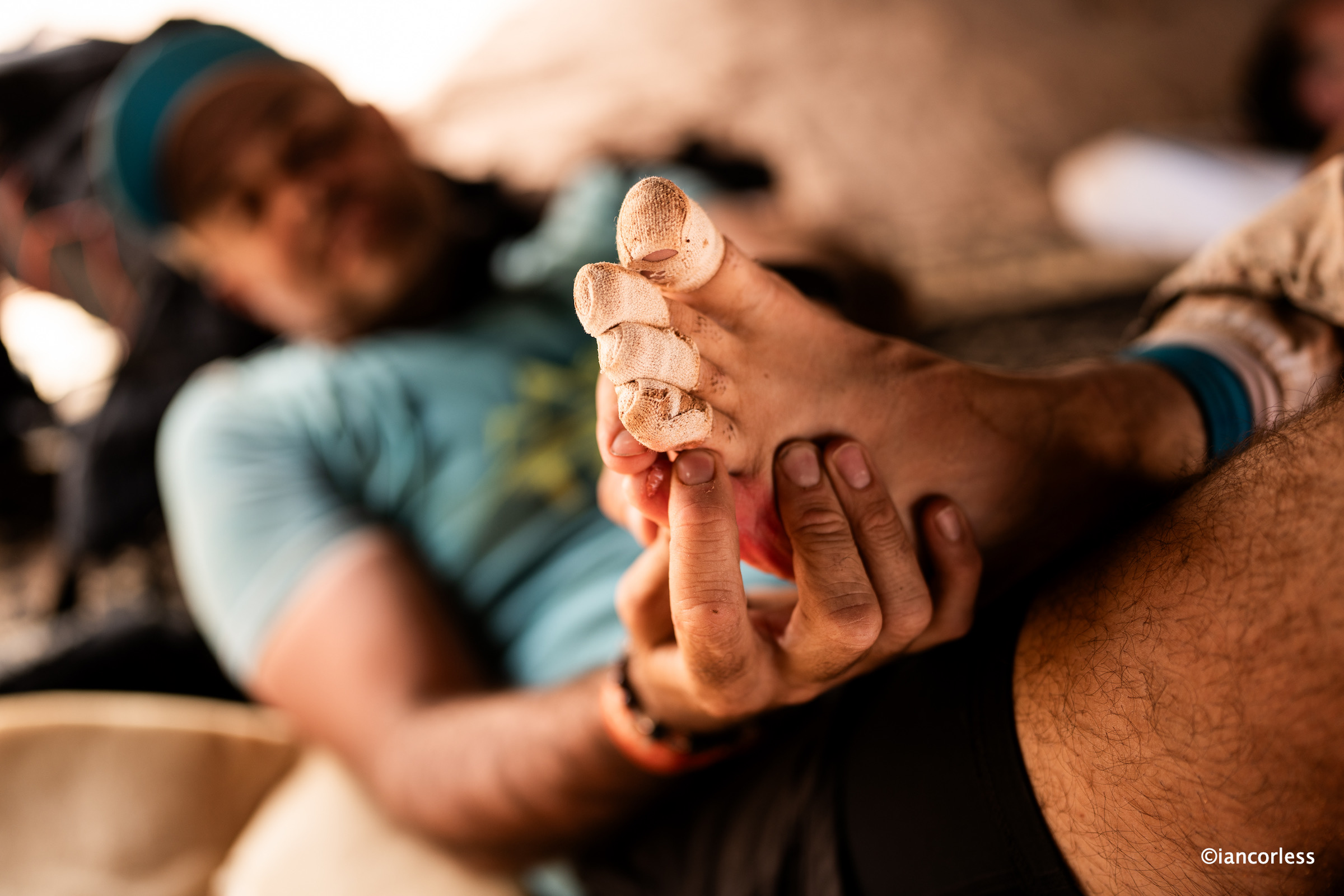
Important – take off your shoes and socks right away. Let your feet breathe and inspect them carefully while you are waiting for water to boil or, you are waiting for a meal to hydrate.
Eat a meal within 1-hour of finishing the stage.
Changing into clean or warmer clothing can make a huge difference. It allows running gear to dry and gives a mental reset for the next day. However, you also need to balance weight – keep ‘extras’ to an absolute minimum.
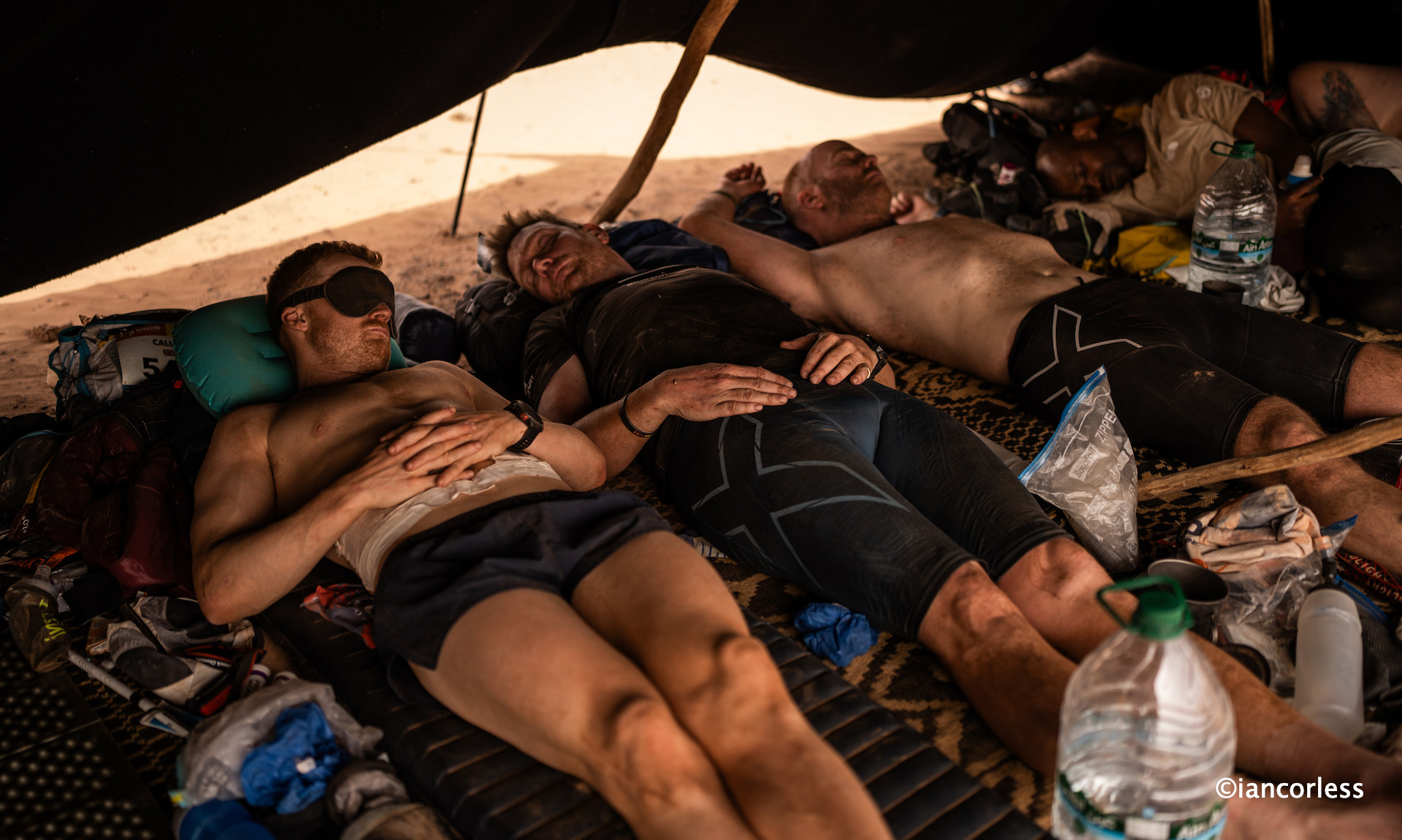
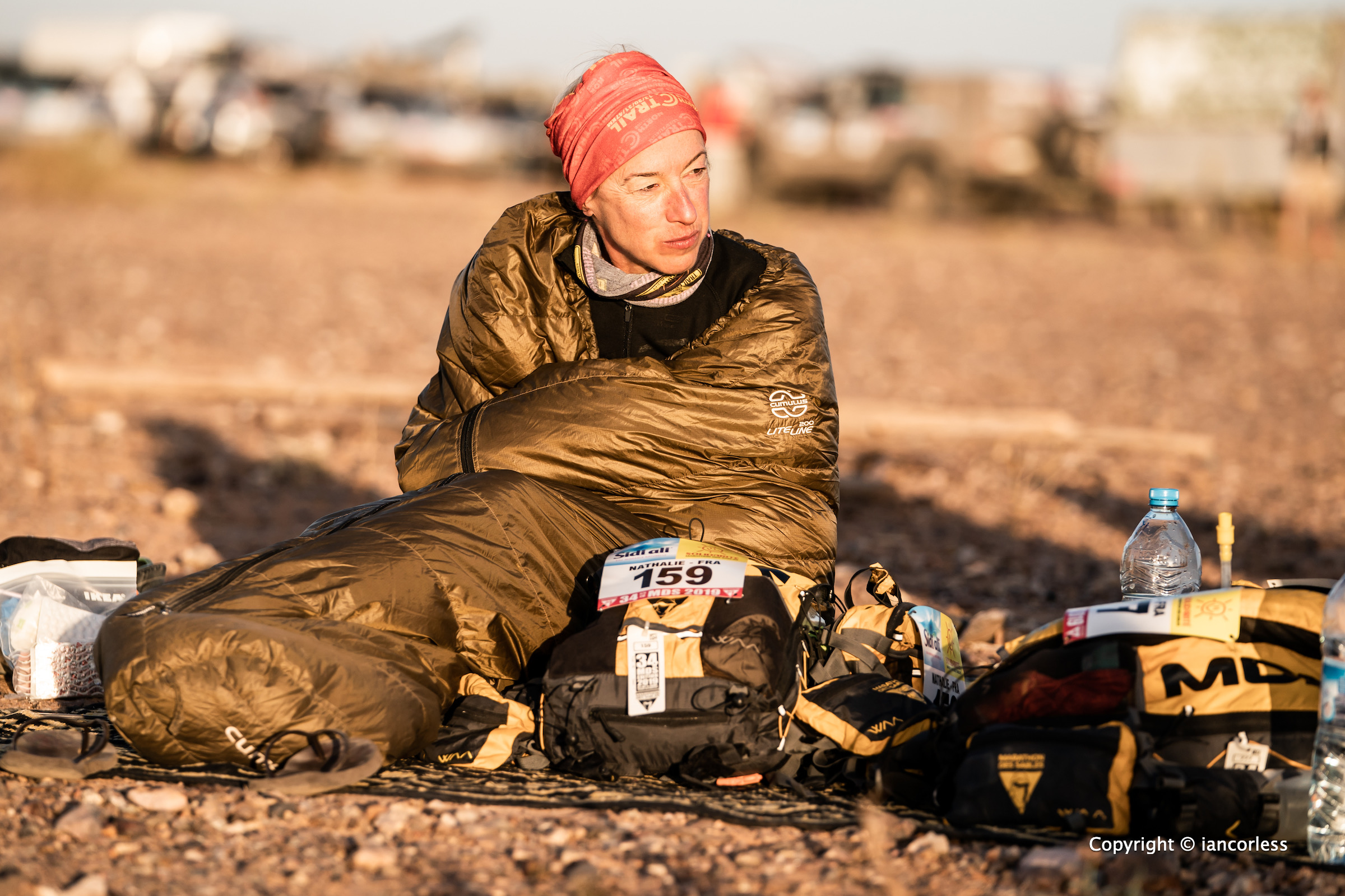
Sleep and rest is another priority. A sleeping mat helps enormously for rest, relaxation and sleep comfort. Your sleeping bag must be light but warm enough for desert nights. We are all different, so know what you need.
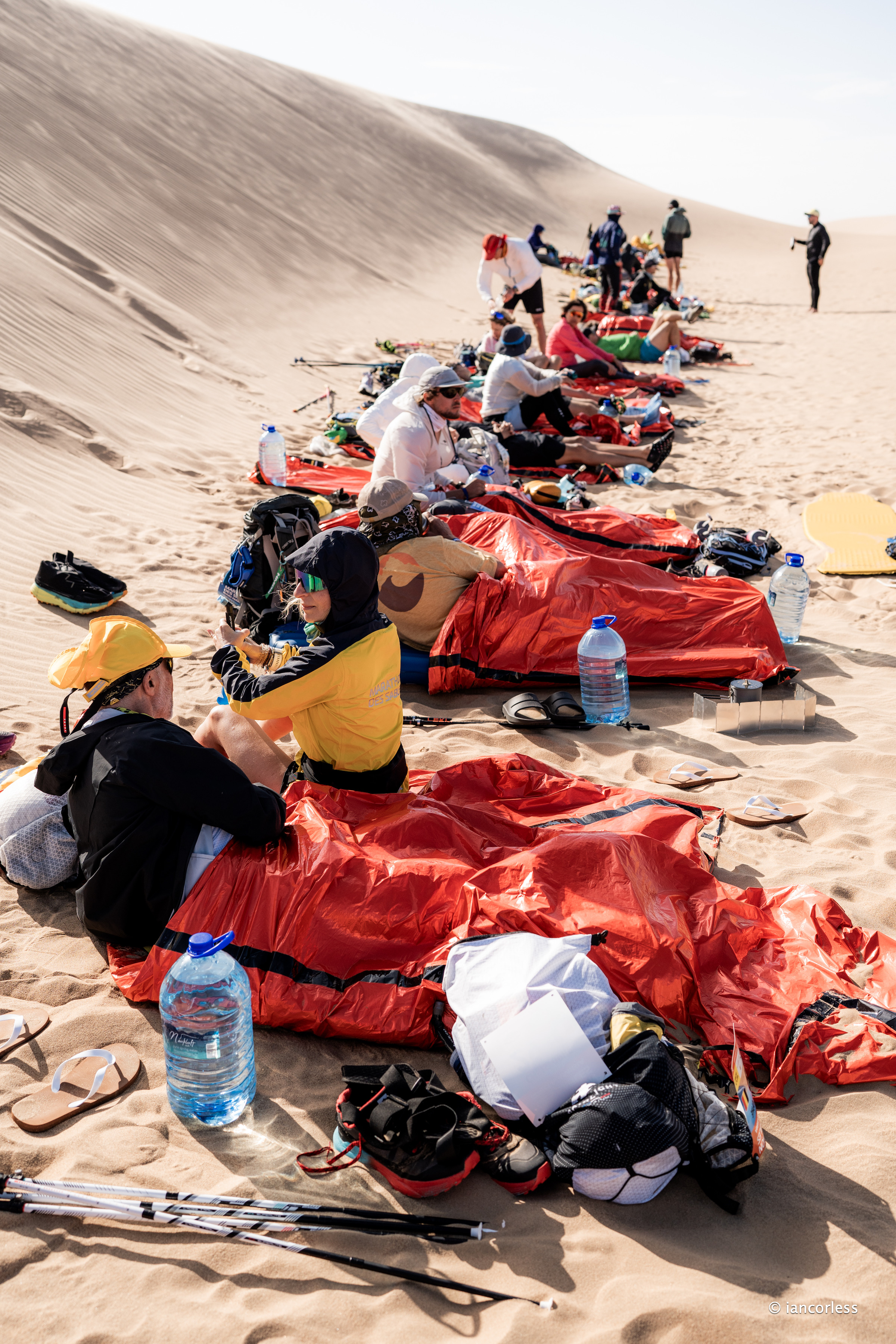
Be meticulous with your gear. Eight runners share each tent, and it can quickly become cluttered. Keep your bag packed and store items immediately after using them. Desert winds or sudden sandstorms can easily carry equipment away, especially lightweight items like sleeping mats.
Photo by Ian Corless
A Buff around your neck is invaluable. It lets you cover your nose, mouth, eyes, and ears quickly when conditions change.
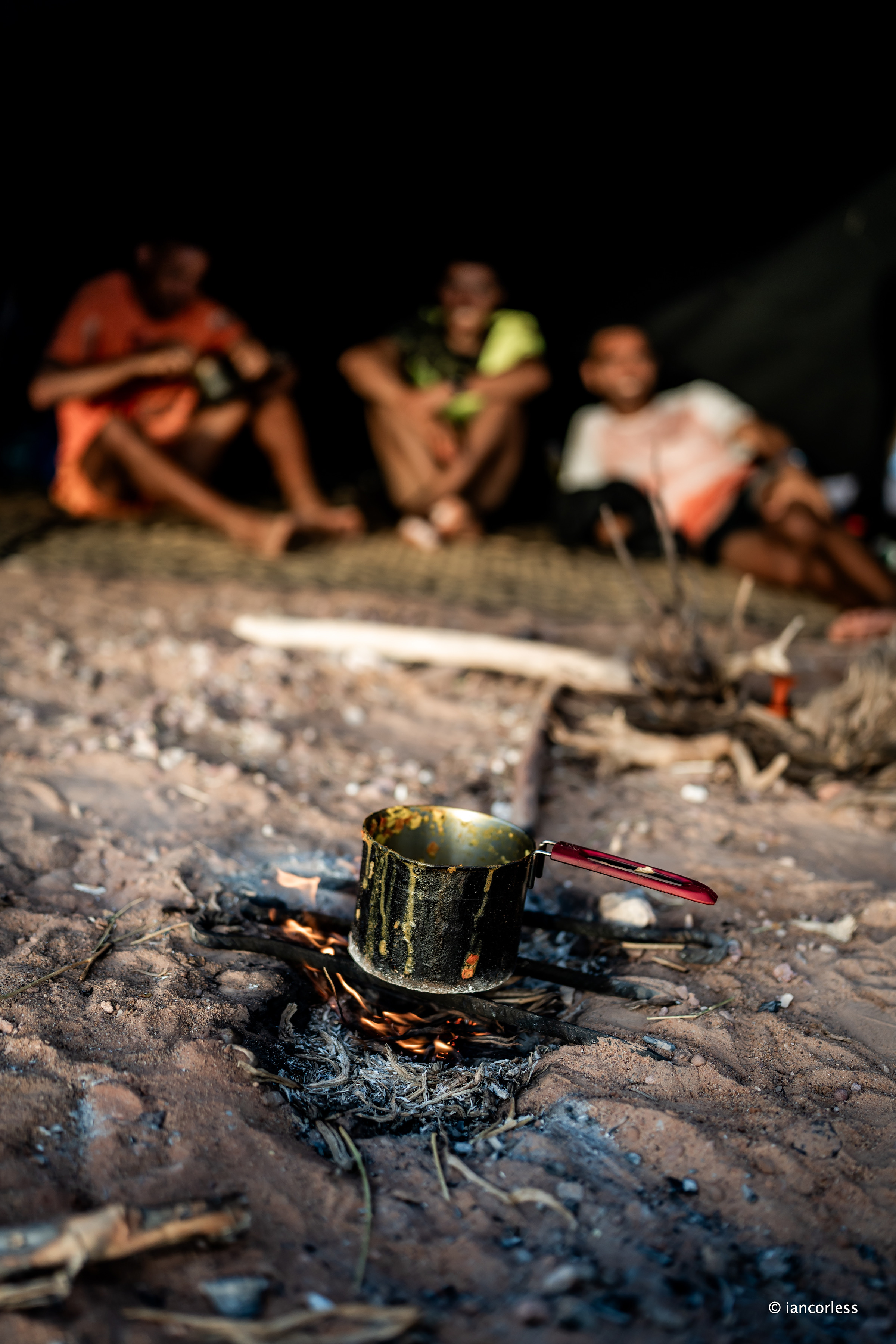
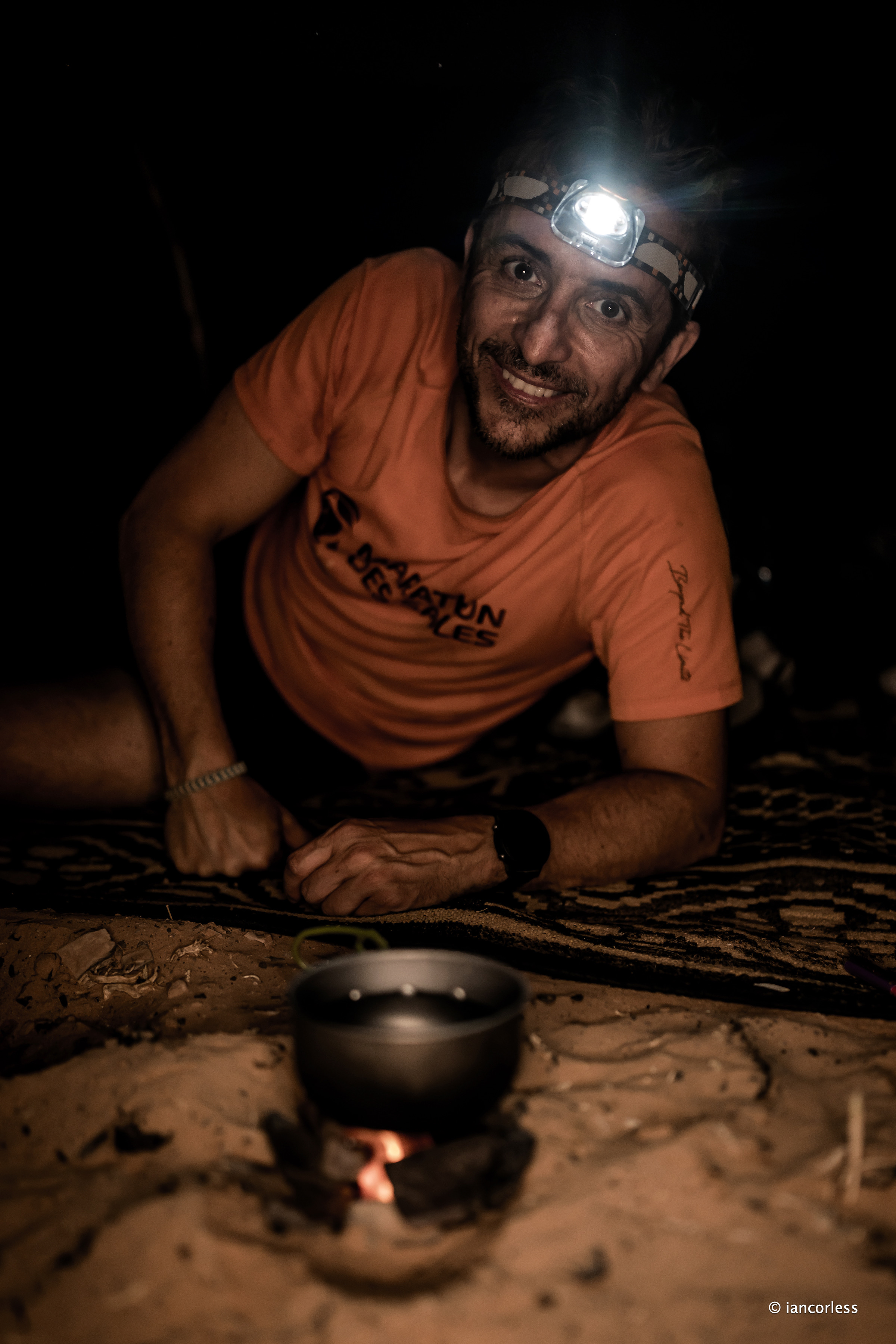
Many tent groups also create a simple cooking area using stones and small branches for fire. Often the first runner back begins preparing the cooking area for everyone else.
Over time, these small routines become part of the experience.
And the bivouac itself becomes something special.
You will share the tent with people from all over the world. You will go through highs and lows together. Some moments will be difficult. Others unforgettable.
Many runners say the friendships formed here last a lifetime.
That is the spirit of Marathon des Sables.
After the Finish on Stage 6
Cross the finish line of the final stage and you will receive your medal, water allocation, and a packed lunch.
Photo by Ian Corless
Then you board a bus back to Ouarzazate. Buses leave as soon as they are full, so, no need to hang around and wait for ages.
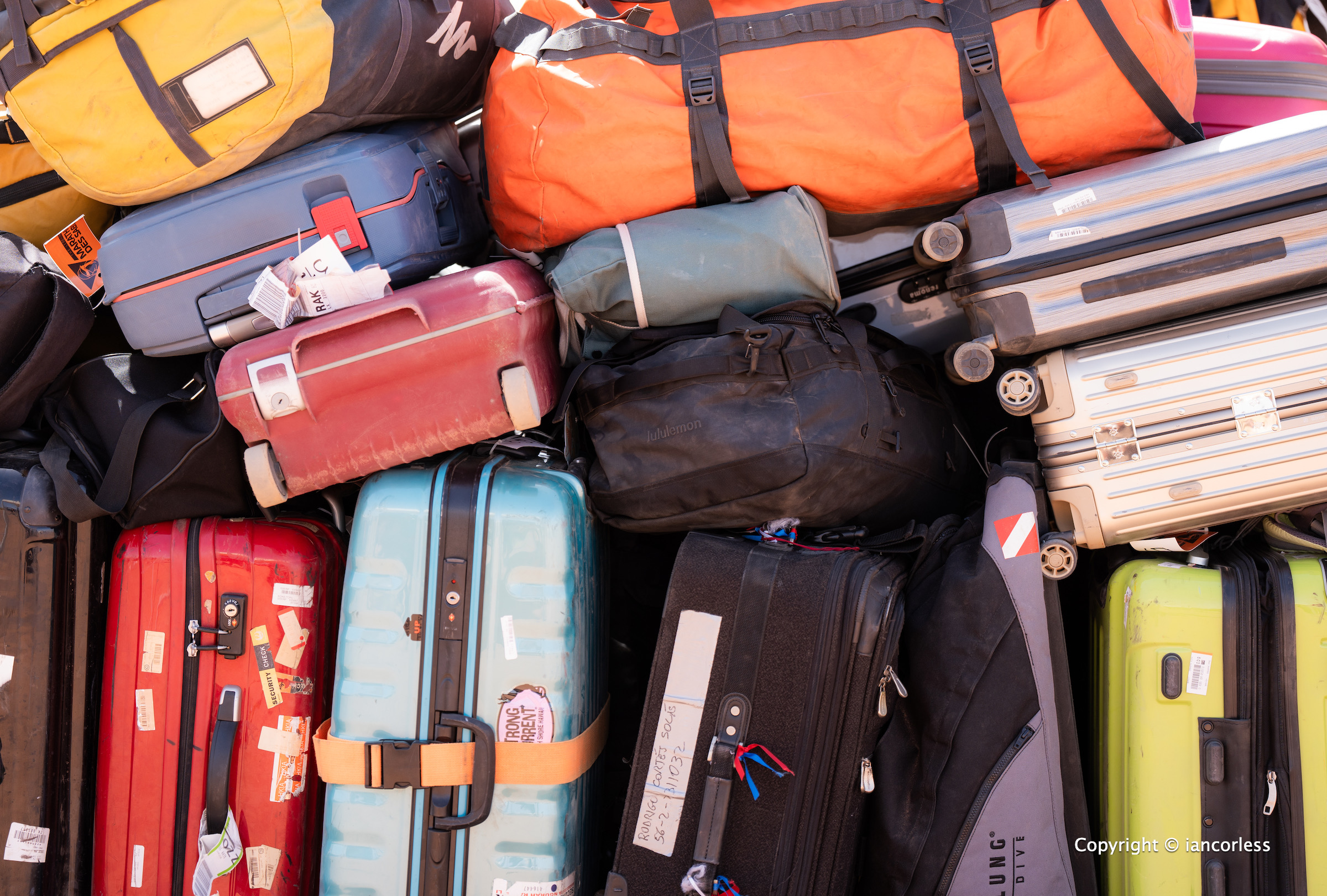
The bus will take you to your specific hotel and your luggage will be waiting at your hotel.
What comes next is simple but glorious:
a shower…
then another shower…
and maybe one more.
Clean clothes.
A real bed.
A proper meal.
The following day is free to relax and explore. Remember the MDS shop! Later in the afternoon there is a dinner, awards ceremony, and celebration party.
Photo by Ian Corless
After that, the journey home begins.
But the memories of the desert tend to stay with you far longer.
The Marathon des Sables has a way of becoming far more complicated than it needs to be. Spend five minutes online and you’ll find spreadsheets, gear breakdowns to the gram, and endless debates about socks.
Here’s the truth. It’s a multi-day race in the desert where you carry your own kit, manage your energy, and keep moving forward. That’s it.
Yes, details matter. But simplicity wins.
The 2026 Marathon des Sables – The Legendary is not just another year in the desert. It marks 40 years of the race. That alone tells you something about what’s coming. This edition matters. It will be longer, tougher, and built to celebrate the history of the event properly.
As we move through March, I will release weekly articles to help you sharpen your preparation. This is the second of four. The aim here is simple: give you clarity. No surprises. No guesswork.
Below is a broader, more grounded take on what to focus on, including some of the small, often overlooked realities that make a big difference once you’re out there.
Start With This Mindset
You are not preparing for comfort. You are preparing for control.
Control of your energy.
Photo by Ian Corless
Control of your hydration.
Control of your thoughts when things get hard.
The desert strips away noise. What’s left is you, your pack, and the next checkpoint.
1. Your Pack: Fit Over Fashion
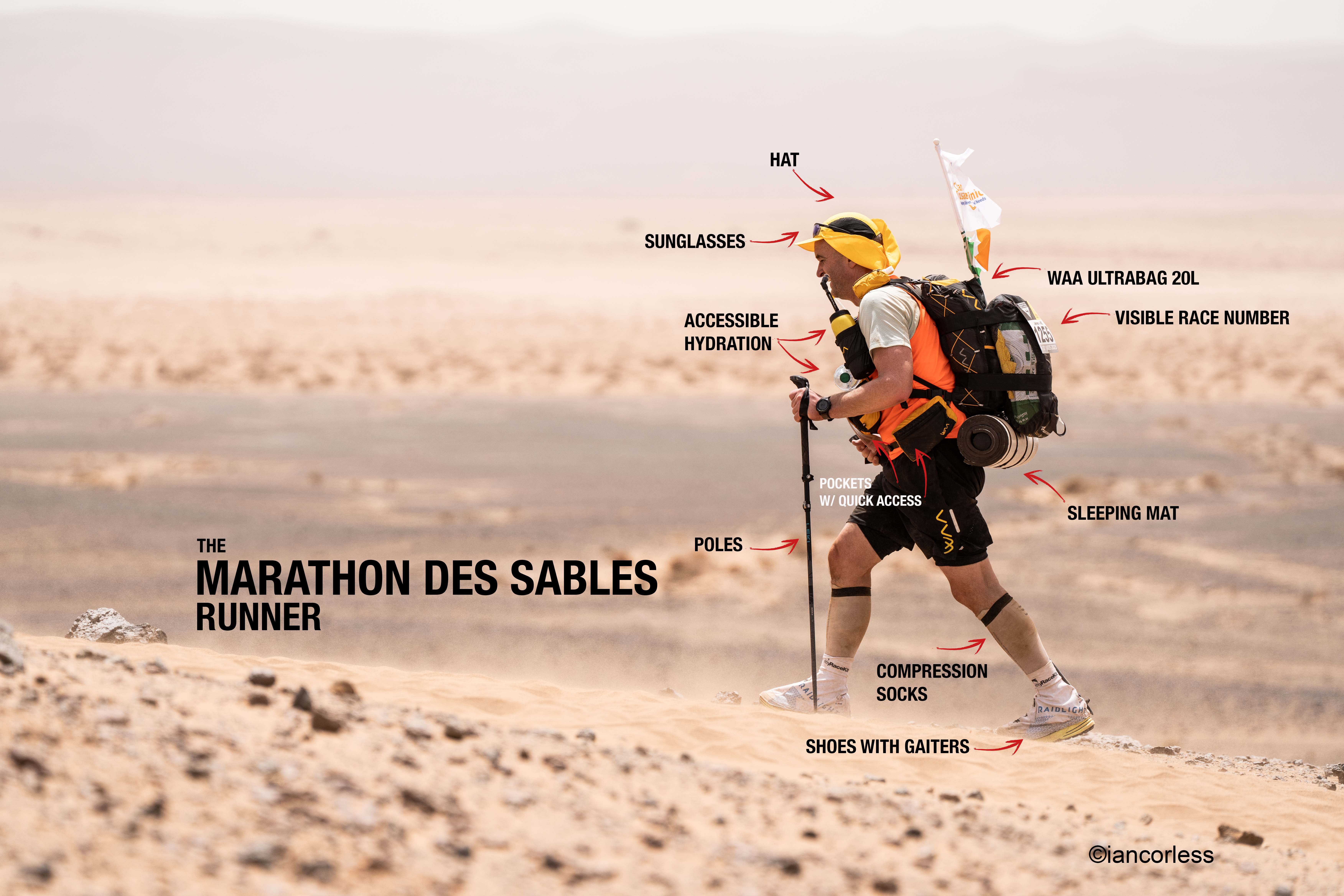
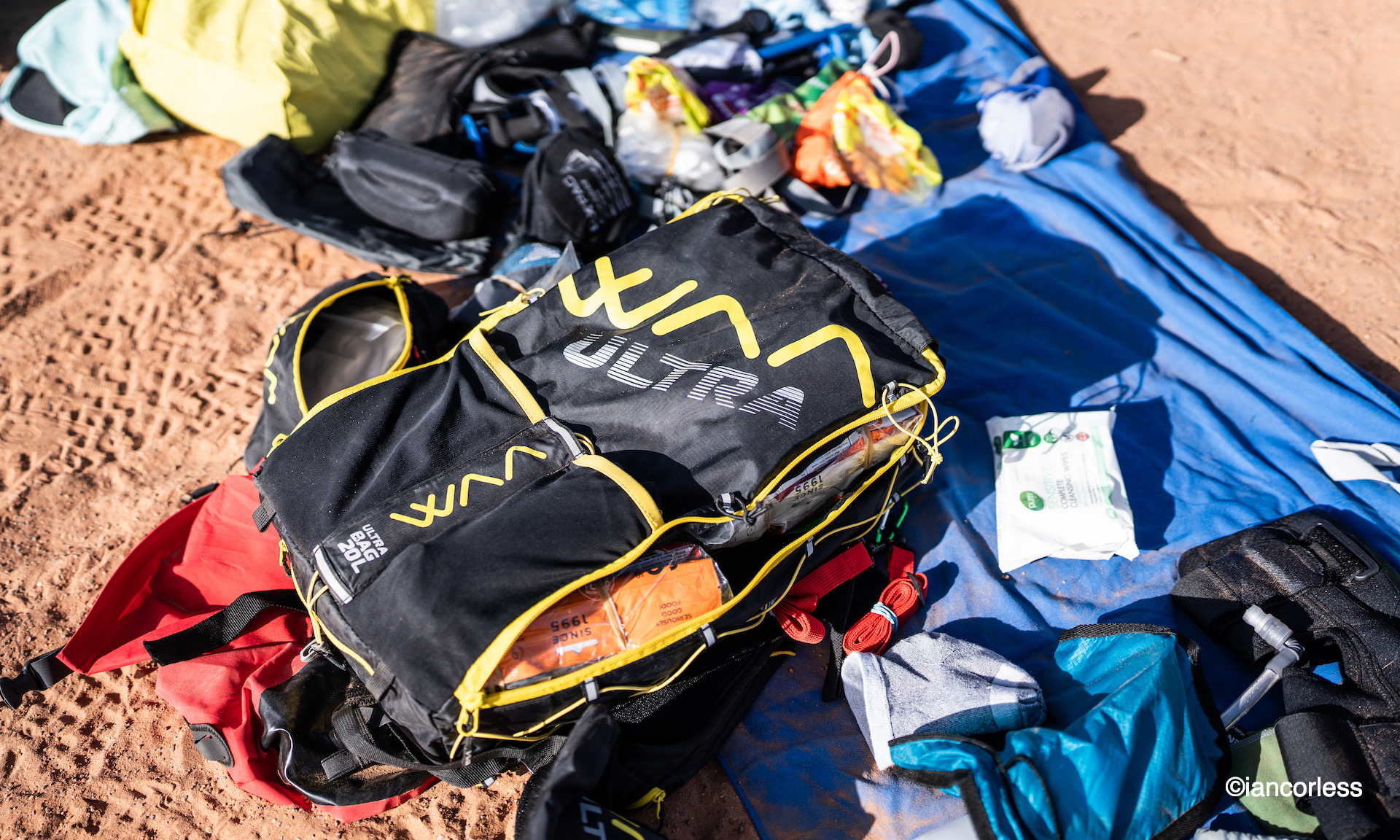
You’ll see a lot of the same packs on the start line. The WAA 20L Ultra Bag is extremely common because it was built specifically for races like this.
But popular doesn’t mean perfect.
A pack should sit close to your body without bouncing. It shouldn’t pull on your shoulders or rub your lower back raw by day three. Try it loaded. Walk in it. Run dunes in it if you can.
Photo by Ian Corless
Smaller is usually better. If you give yourself space, you’ll fill it. And once your food weight drops midweek, too much space means constant shifting and irritation.
Getting close to the 6.5 kg minimum isn’t about ego. It’s about reducing cumulative fatigue. Every unnecessary gram is lifted thousands of times over the week.
2. Sleep Is Recovery, Not Luxury
You don’t need a five-star sleep system. But you do need rest.
A sleeping bag choice should reflect how you actually sleep at home. If you’re always cold, don’t suddenly become brave in the Sahara. Cold nights drain energy quickly.
A lightweight down jacket is incredibly useful. Brands like Mont Bell, Haglöfs, Yeti, and Nordisk all make reliable options. It doubles as camp insulation and extra warmth inside your bag.
Random but important: cover your head at night. Even a simple buff makes a difference.
And yes, take a sleeping mat. After several hours in the heat, lying on hard ground feels far less heroic than it sounds.
3. Clothing: Function Only
Nobody cares what you look like by stage four.
Choose clothing you’ve already trained in. Check underarms, inner thighs, lower back, and anywhere straps sit. If something rubs slightly at home, it will tear skin in the desert.
Photo by Ian Corless
A spare pair of socks is wise. Changing into dry socks after a long stage feels surprisingly restorative.
Some runners like having a lightweight long sleeve or leggings just for evenings. It’s less about warmth and more about feeling human again after a tough day.
4. Shoes and Gaiters: Non-Negotiable
Shoes must be tested, broken in, and reliable.
Slightly wider can help accommodate swelling. But oversized shoes create movement. Movement creates friction. Friction creates blisters.
Aim for a thumbnail’s space beyond your longest toe.
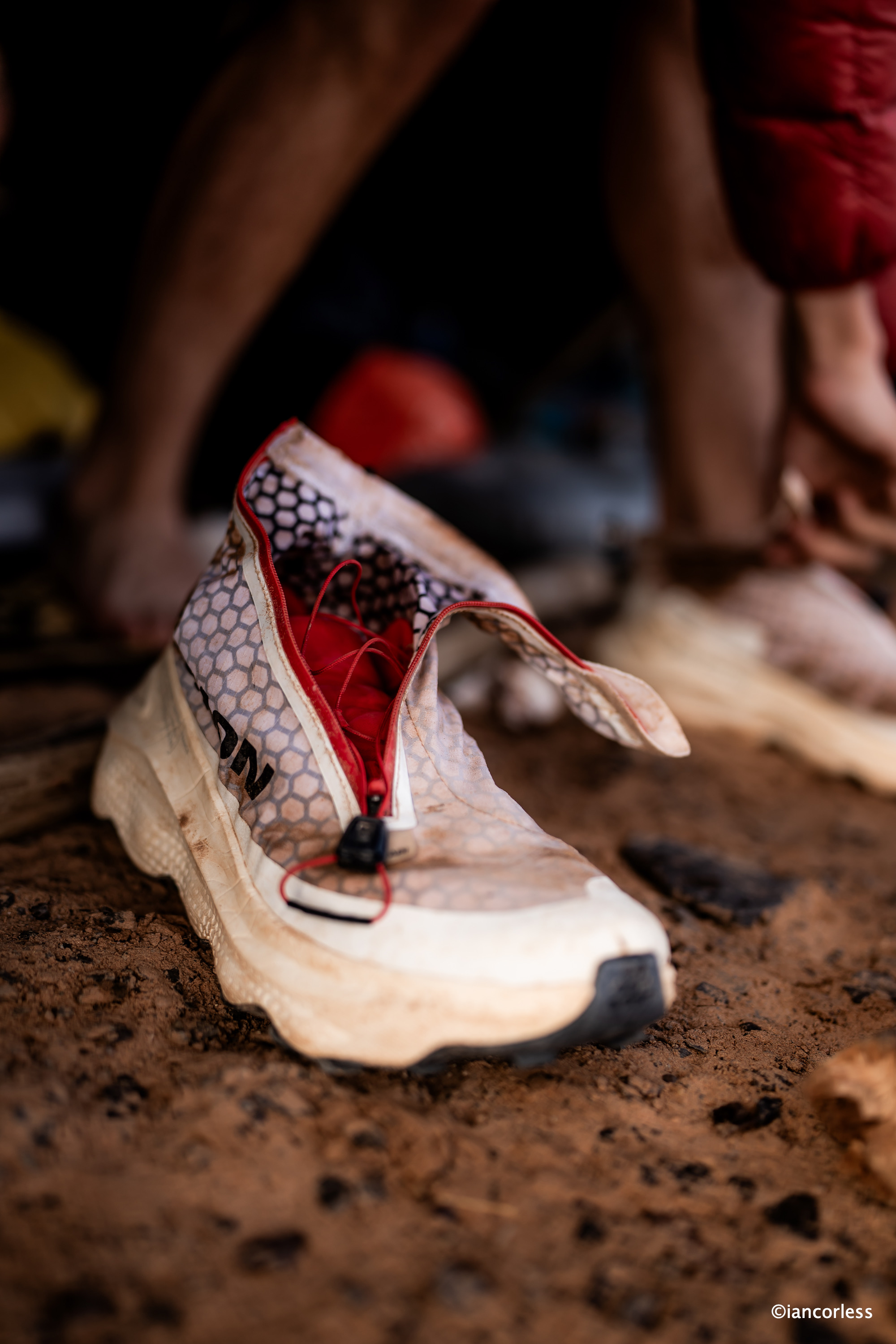
Gaiters are essential. Sand will find its way in otherwise, and constant grit inside your shoe is demoralising.
Small thought: practise emptying sand quickly and calmly. You’ll do it often.
5. Food: Think Beyond Calories
Yes, you must carry at least 2,000 calories per day.
But calories alone aren’t the whole story. Appetite changes. Sweet fatigue is real. By midweek, many runners crave savoury food.
Recovery nutrition right after each stage can speed up how you feel the next morning. Even a small protein-based drink helps.
Also consider practicality. If you skip a stove, make sure your meals work with cold water. And if you’re someone who needs coffee to function, plan for it. Tiny comforts can have a big psychological impact.
6. Water Strategy: Be Flexible
You must be able to carry at least 1.5 litres, usually via two 750 ml front bottles.
Soft flasks and bladders are lighter, but they can puncture. Rigid bottles are heavier but durable.
Have the capacity to carry an additional 1.5 litres if required. In extreme heat or on longer stages, the race has sometimes increased water allowances.
Practice drinking steadily rather than chugging. Drink to thirst before the race starts. Overhydrating early doesn’t help.
7. Salt and Electrolytes: Plan It Yourself
Salt tablets are no longer handed out.
You must start with 14 stock cubes as part of the requirements, but that’s just one element. Test your electrolyte strategy in training. Don’t experiment for the first time in Morocco.
Cramps in the middle of a long stage are not where you want surprises.
8. Your Feet: Your Entire World
If your feet fail, your race fails.
Trim nails carefully before the event. Know which socks work for you. Consider taping strategies only if you’ve tested them.
After each stage:
Remove shoes immediately.
Clean sand off.
Let skin dry.
Deal with hot spots early.
Blister management is part of the race. The medical team is experienced, but prevention is always easier than repair.
9. Heat Preparation
The final two weeks are ideal for heat acclimation.
Sauna sessions. Hot baths. Controlled heat chamber work. Even Bikram yoga.
The goal isn’t to exhaust yourself. It’s to teach your body to manage elevated core temperature more efficiently.
Arriving heat-adapted reduces stress from day one.
10. Taper Properly
In the final weeks, you don’t gain fitness. You protect it.
You want to feel slightly restless at the start line, not tired.
11. Learn to Walk Well
This surprises many first-timers.
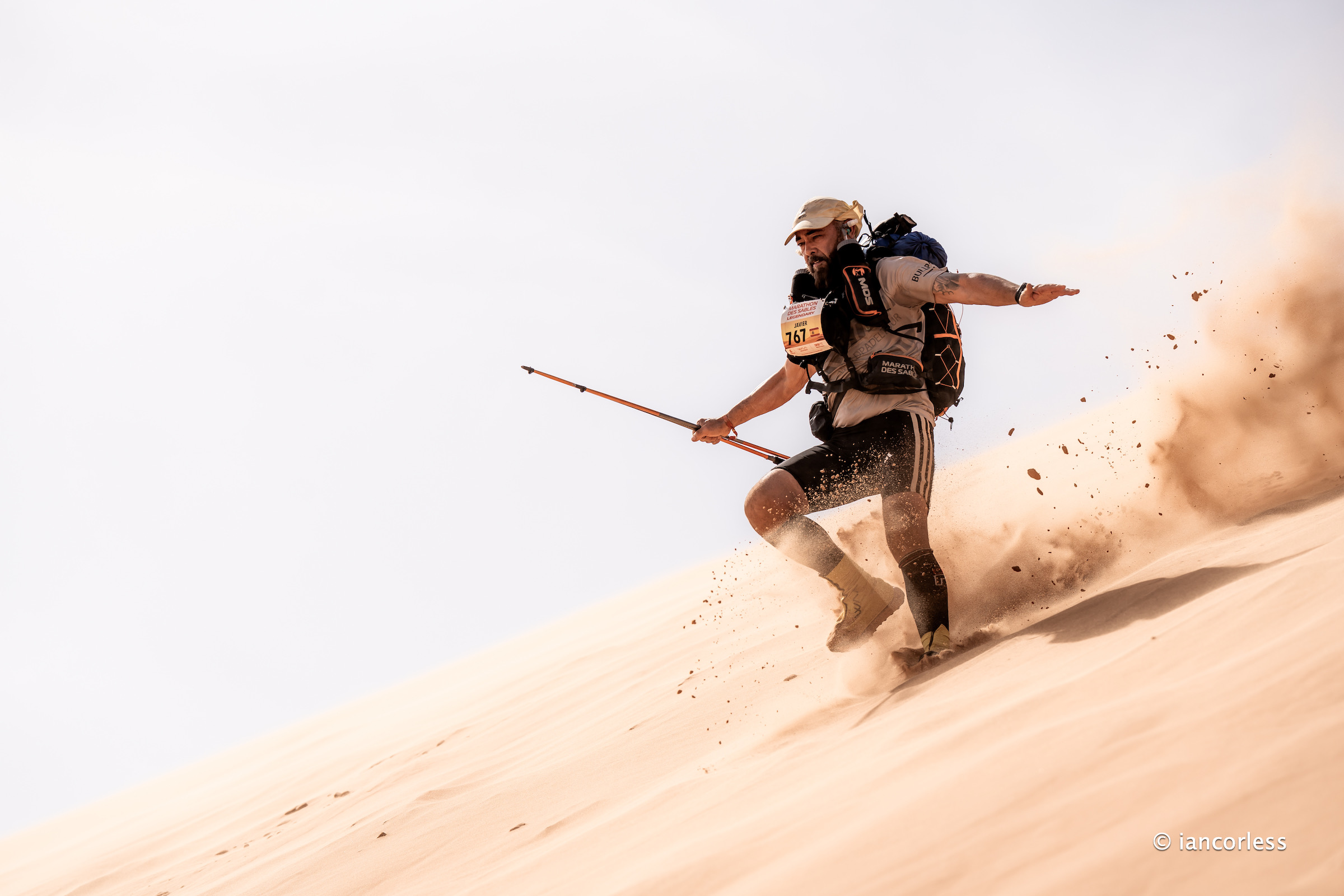
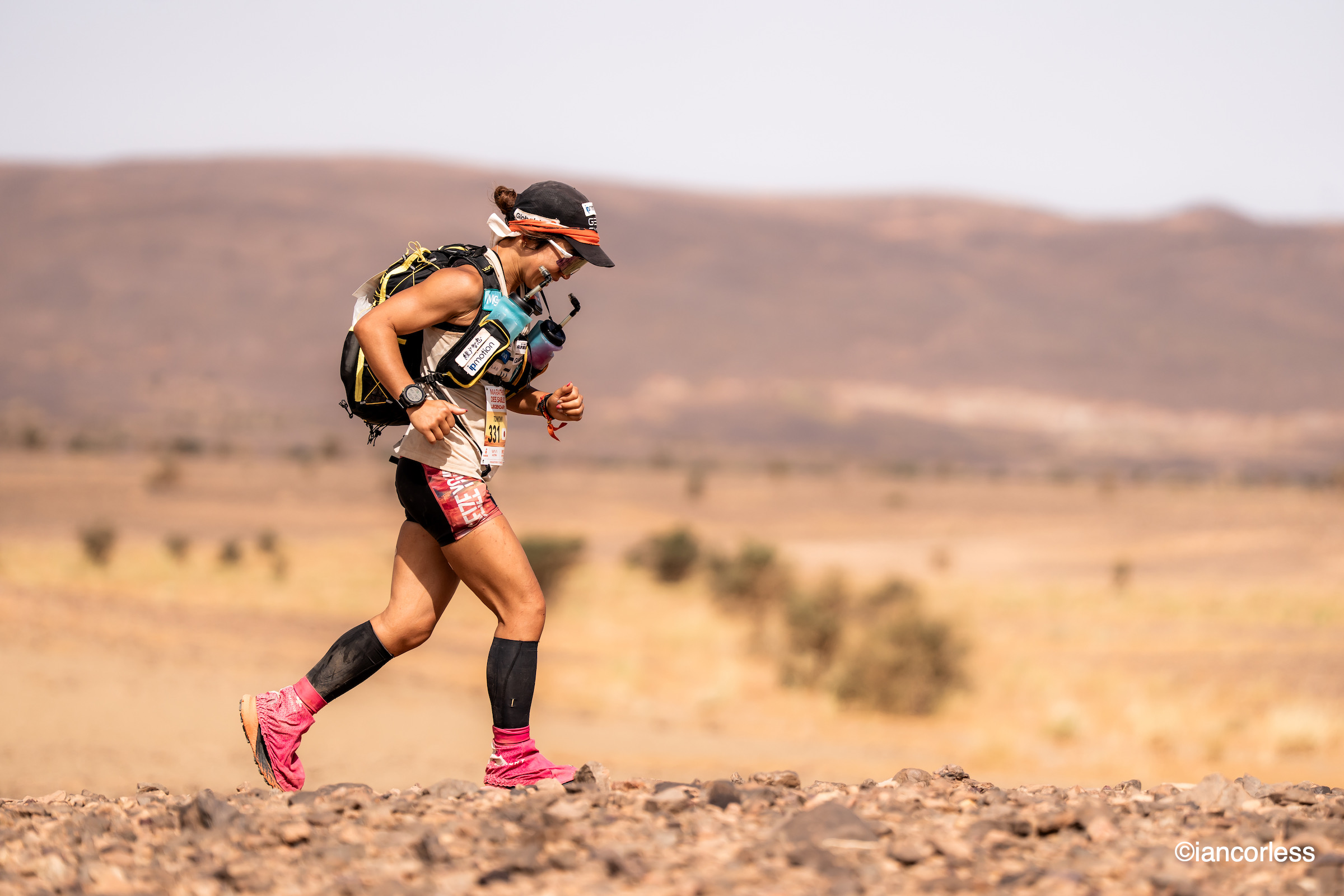
You may not run as much as you think. Dunes, heat, pack weight, and long stages change expectations quickly.
Photo by Ian Corless
Practice strong, efficient walking. Especially uphill. Keep posture tall. Use arms deliberately.
Fast walking wins time and saves energy.
12. Poles: Train With Them or Leave Them
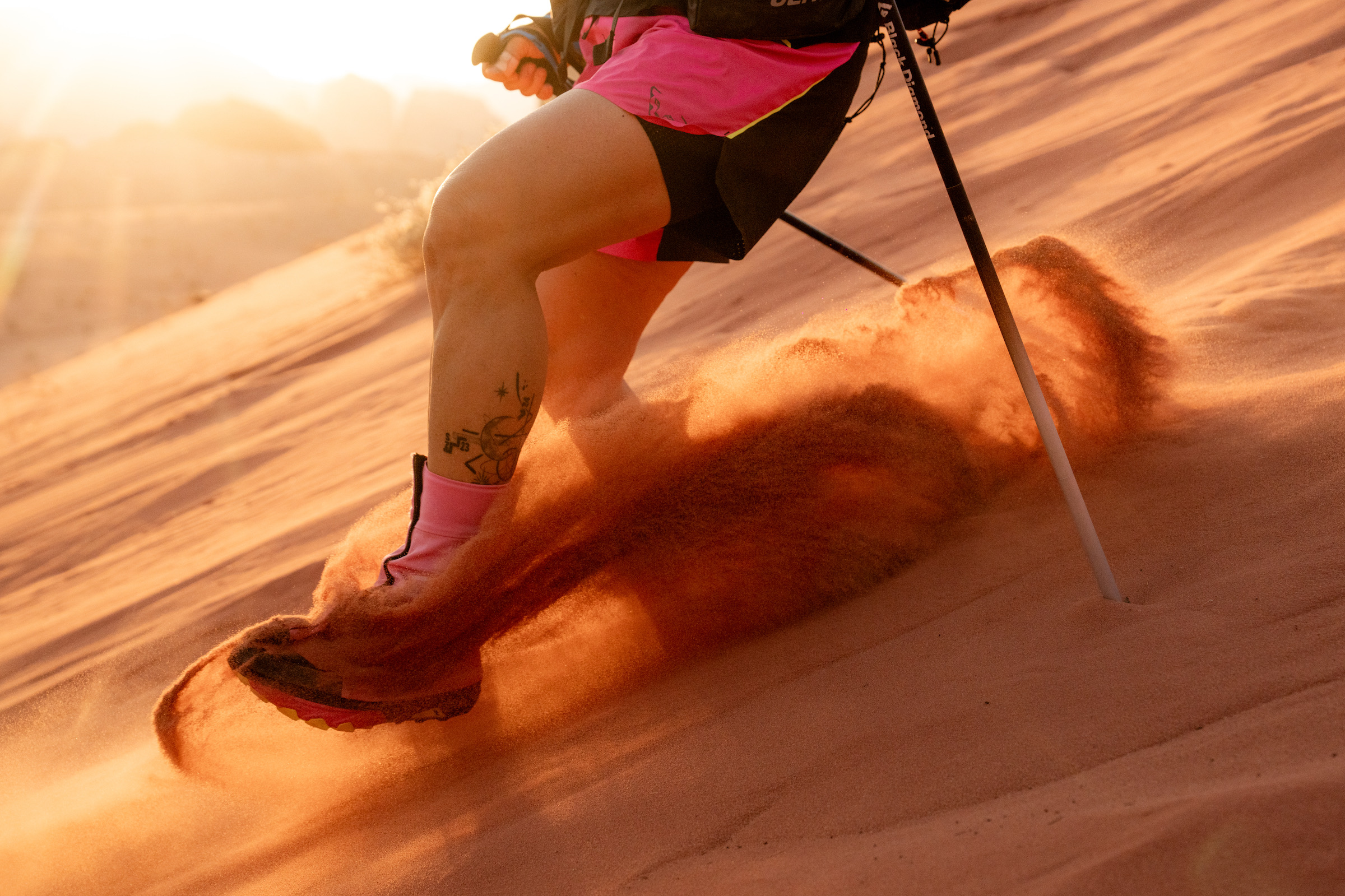
Poles can feel like four-wheel drive in soft sand and on climbs.
Lightweight folding carbon poles from brands like Black Diamond and Leki are common.
But poles only help if you’ve trained with them. Poor technique wastes energy. Good technique saves it.
13. Keep Equipment Minimal
Every “just in case” item adds up.
Ask: will this meaningfully improve my race?
Your pack should sit close to 6.5 kg. The only luxury many runners truly appreciate is a lightweight way to listen to music.
Interestingly, many also discover they don’t miss their phone at all.
14. Tent Life
You’ll share a tent with seven others.
These people become your support system. You’ll hear their breathing at night. You’ll see their low moments and your own reflected back.
Choose tent mates wisely if you can. The camaraderie becomes one of the most powerful parts of the week.
15. Travel and Admin Realities
Wear your running shoes and kit on the plane. Carry your pack as ‘carry-on’ with as much of your race kit as possibe. Lost luggage does happen.
Bring your own snacks for travel days. The transfer from Marrakech is quite long, so is the transfer to bivouac one. MDS do provide lunch packs as and when applicable, always good to be self sufficient.
The first two nights in bivouac are self-sufficient, plan accordingly for food. Take comfort items you’re happy to give away before racing begins, for example, you may take a larger/ heavier inflatable bed.
Admin day can take 1-2 hours. Bring water, snacks, sun protection, even an umbrella for shade. Stay patient.
Have additional items such as a base layer, sleeping bag liner and other items that may be on a ‘question’ list for the race. On night 1 and before you go to admin, you can make final decisions of what to and what not to take. Particularly important if you think you may be cold at night.
After bag check-in, you drop your luggage and no longer have access to extra gear. Make sure you have everything you need for the race! But full self-sufficiency only begins when the race starts, so you can enjoy small comforts until then.
Bring a simple repair kit. Zips break. Gaiters tear. The desert is unforgiving.
16. The Mental Game
At some point, you will question why you signed up.
That moment passes.
The Marathon des Sables isn’t just about endurance. It’s about staying calm when you’re tired. Staying steady when others surge. Accepting discomfort without drama.
Highs and lows are part of the rhythm. If it were easy, it wouldn’t matter.
Final Thought
The desert simplifies everything.
There’s no clutter. No constant notifications. No daily noise. Just sun, sand, wind, and the quiet focus of moving forward.
Whether you finish near the front or close to the cutoff, the experience is transformative.
It reminds you how little you actually need, and how much you’re capable of carrying.
MDS is a hark back to a more primitive time, a time without clutter and modern technology. Embrace this. Embrace the silence of the surroundings and the simplicity of placing one foot in front of the other.
The 2026 Marathon des Sables – The Legendary is not just another year in the desert. It marks 40 years of the race. That alone tells you something about what’s coming. This edition matters. It will be longer, tougher, and built to celebrate the history of the event properly.
As we move through March, I will release weekly articles to help you sharpen your preparation. This is the first of four. The aim here is simple: give you clarity. No surprises. No guesswork.
Photo by Ian Corless
The Shape of the 2026 Race
If you raced in 2025, you already experienced the longest edition in MDS history. In 2026, the format stays similar but the distance increases again.
Six stages. Seven days. All timed.
Photo by Ian Corless
In previous years, the charity stage was not timed. That changed in 2025 and continues in 2026. Every stage now counts.
The long stage returns to Stage 4, just as it did in 2025. This time it will be 100km. Read that again. One hundred kilometres across two days in the desert.
Photo by Ian Corless
While total distance has fluctuated over the years, 250km has often been the benchmark. For 2026, you should plan for approximately 270km plus or minus. It should not shock you. But it will test you.
One positive? Depending on how quickly you complete the long stage, you may have almost a full day and night to recover before Stages 5 and 6. That recovery window could be valuable.
Daily stage distances are rarely confirmed in advance. It remains unclear whether exact distances will be released before arrival in Morocco. Historically, that information is kept quiet. Still, it’s not hard to estimate how the race could look.
Photo by Ian Corless
A likely outline might be:
Stage 1: 32km (Day 1) – total 32km
Stage 2: 38km (Day 2) – total 70km
Stage 3: 36km (Day 3) – total 106km
Stage 4: 100km (Days 4 and 5) – total 206km
Stage 5: 42km (Day 6) – total 248km
Stage 6: 21km (Day 7) – total 269km
Total: approximately 269km +/-
As in 2025, expect sand. A lot of it. Expect the Merzouga Dunes. Do not expect Djebel El Otfal.
You now have a working template to mentally prepare for the challenge ahead.
Before the Race Even Starts
Your race does not begin at the start line. It begins with logistics.
Photo by Ian Corless
In the final 2 to 3 weeks before the race, taper training back so that you are fresh and strong. Also plan for heat adaptation, this could be specific heat chamber sessions or a series of sauna sessions or similar.
Photo by Ian Corless
You are responsible for arranging your own accommodation before the official transfer from Ouarzazate to bivouac one. If you fly into Marrakech, you may need a hotel there as well. There are free transfer buses from Marrakech to Ouarzazate. Arrive in Ouarzazate at least one day before required, have a good hotel night and time to relax and prepare before the transfer to the desert. MDS will confirm the dates and times for transfers etc.
From there, the structure usually follows this pattern:
Day 1 – Bus transfer from Ouarzazate to the desert bivouac. You settle in and stay overnight. This is self-sufficient. No meals are provided. Bring enough food for arrival day and admin day. There is no weight restriction at this point, so bring what you want.
Day 2 – Technical, administrative, and medical checks. Overnight in bivouac, still self-sufficient.
Day 3 – Stage 1
Day 4 – Stage 2
Day 5 – Stage 3
Days 6 and 7 – Stage 4, the 100km long stage
Day 8 – Stage 5
Day 9 – Stage 6, medal at the finish, bus transfer back to Ouarzazate. Overnight hotel with half-board.
Day 10 – Free day in Ouarzazate, awards ceremony and gala evening. Hotel half-board.
Day 11 – Airport transfers. End of the adventure.
Bivouac Reality
From the moment you step into the bivouac, you are self-sufficient. Water is provided. Everything else is your responsibility.
You must bring food and drink to cover arrival day and admin day before racing begins. You do not carry this food during the race, so be smart. Bring proper meals. Rachid, for example, makes a Tagine in camp.
You also have access to your luggage before admin checks. This is valuable. Bring spare kit, extra layers, backup options. You can fine tune your equipment in real desert conditions.
And do not assume MDS = heat. In 2025, we had rain, strong winds and sand storms.
Recent editions have shown how unpredictable conditions can be. The October MDS 120 Morocco race in 2024 saw rain and flooding. The Atlantic Coast edition had extreme wind, cold temperatures and rain. The desert is not always hot and dry. Prepare for variation.
Before admin, you can adjust your race pack. After that, your pack must meet regulations:
Minimum weight: 6.5kg excluding 1.5 lts of water.
Minimum food: 2000 calories per day.
All mandatory kit must be present.
No exceptions.
Water Strategy Has Changed
Since 2024, water provision has evolved.
Photo by Ian Corless
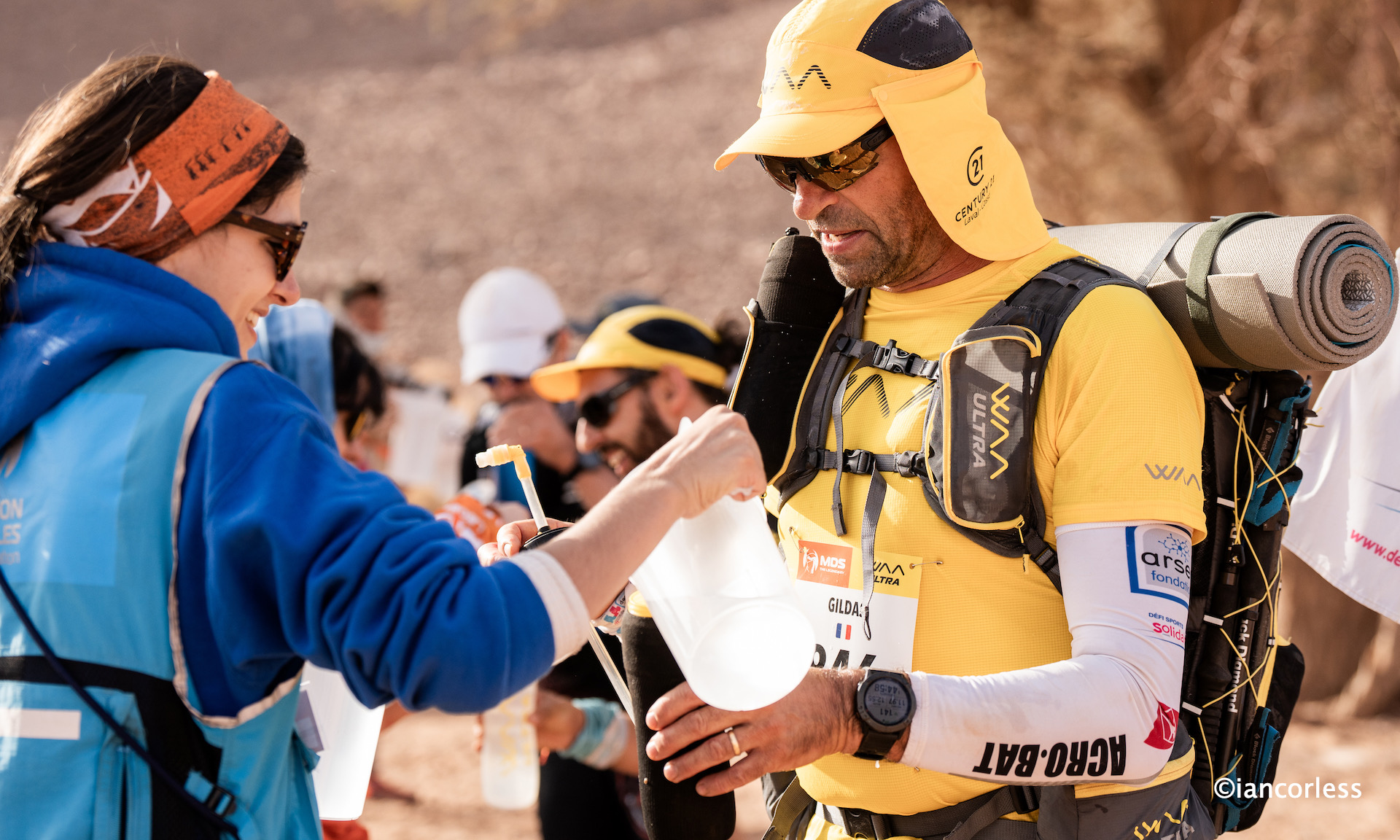
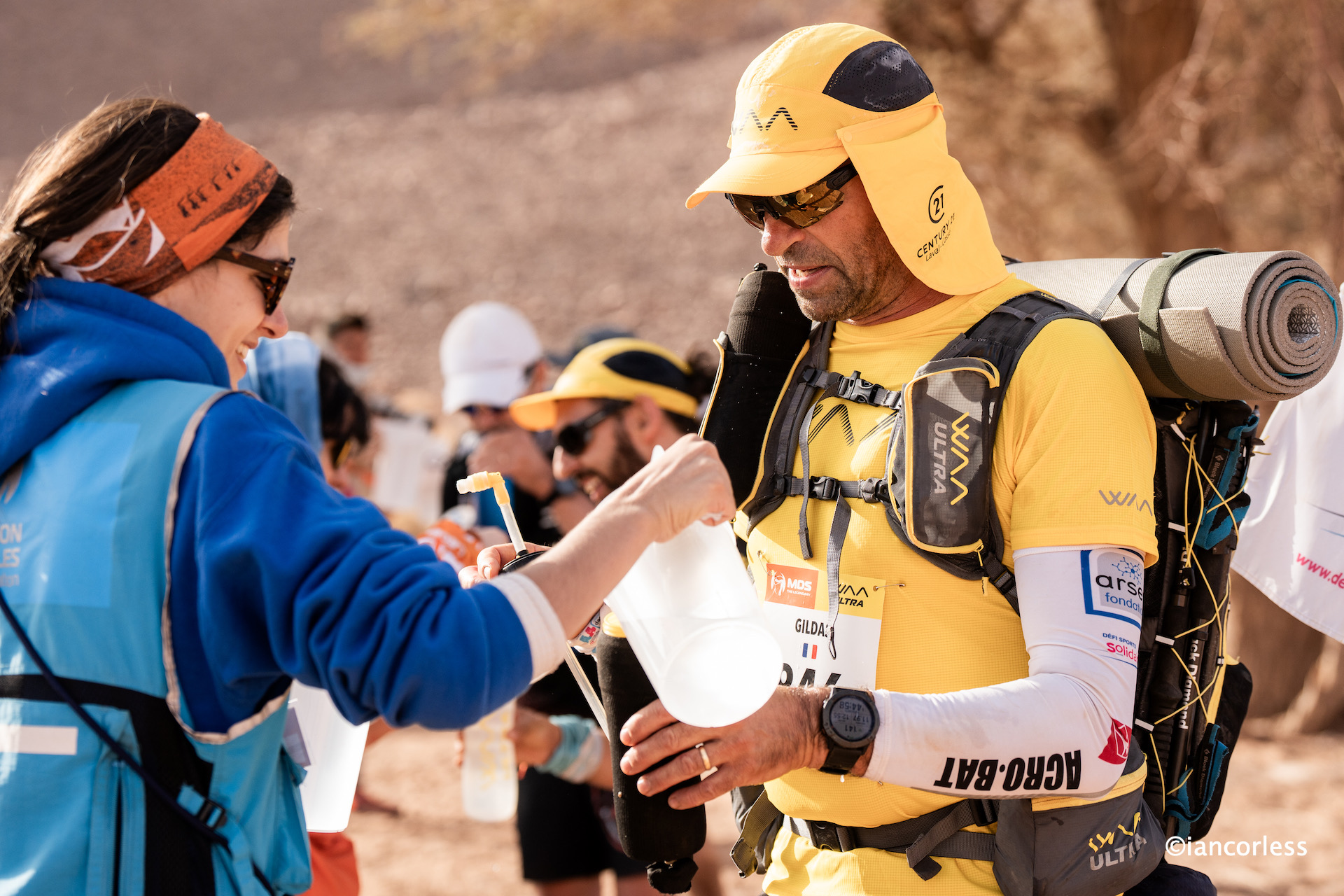
Once Stage 1 begins, water during stages is effectively unlimited. You are no longer handed sealed 1.5L bottles at checkpoints. Instead, volunteers in blue coats pour water from large containers into your bottles.
If you stand at a checkpoint and drink a full bottle, they refill it.
Typically, checkpoints are spaced around 10km apart, terrain permitting. However, if conditions demand it, additional water stations may be placed between checkpoints, for example at 5km. This flexibility is important to combat excessive heat.
Photo by Ian Corless
For the long stage, there may be a requirement to carry additional water capacity. This could be supplied in a 1.5L bottle. Plan ahead. Either have spare capacity to decant, or a system to carry a full bottle.
After each stage, water is rationed. You receive one 5L bottle. That 5L must cover:
Post-stage hydration
Dinner preparation
Breakfast preparation
Water allocation to CP1 the next day
If you want to wash, that also comes from the same 5L. Prioritize drinking and eating. Washing is optional. Hydration is not.
Salt Is Now Non-Negotiable
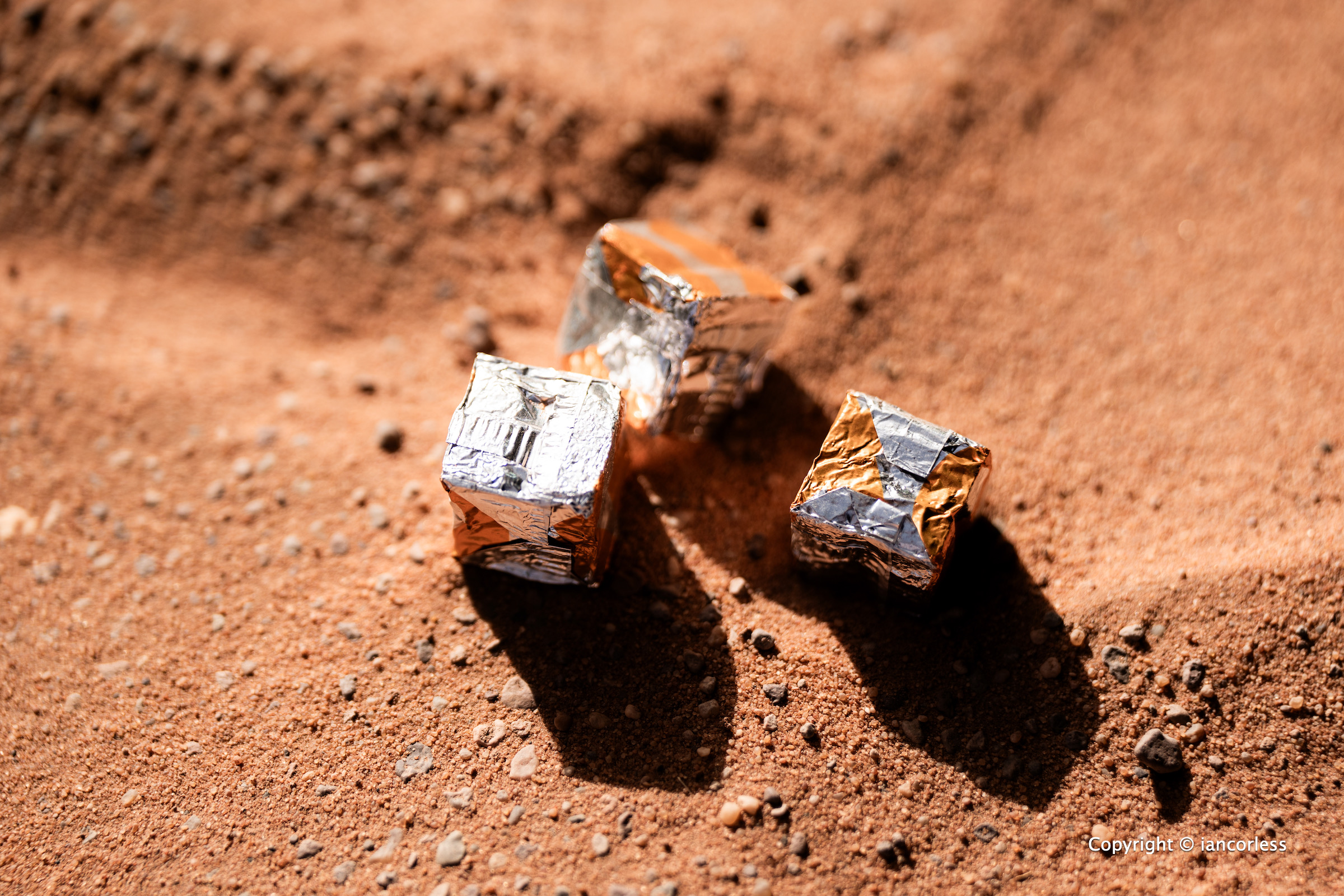
The race rules require 14 broth cubes. They are salty and mandatory.
In 2024, this change was questioned. By the end of the race, feedback was largely positive.
Not all cubes dissolve well. Test them. Many athletes use ‘Knorr’ because it dissolves reliably. Build a salt replacement strategy that works for you. This is a self-sufficient race. You must manage your own electrolyte plan.
Feet: The Deciding Factor
Along with dehydration, damaged feet are one of the main reasons people do not finish.
Your shoes must fit correctly. Your socks must suit you. You must know how to treat hot spots and blisters. Desert sand magnifies small problems quickly.
Ignore your feet at your peril.
Advice – A thumb nail of space above your longest toe is ideal. Note, I say longest toe – this may not be your big toe! A wider shoe is a good idea to allow for toe splay. If a shoe is too big, your foot will move when walking or running. A moving foot causes friction, friction means blisters.
Photo by Ian Corless
Make sure your shoes have gaiters so no sand can get in the shoe.
Safety on Course
The race operates under strict safety protocols.
Photo by Ian Corless
Fast response buggies are positioned to access difficult terrain quickly. 4×4 vehicles are spread across the course.
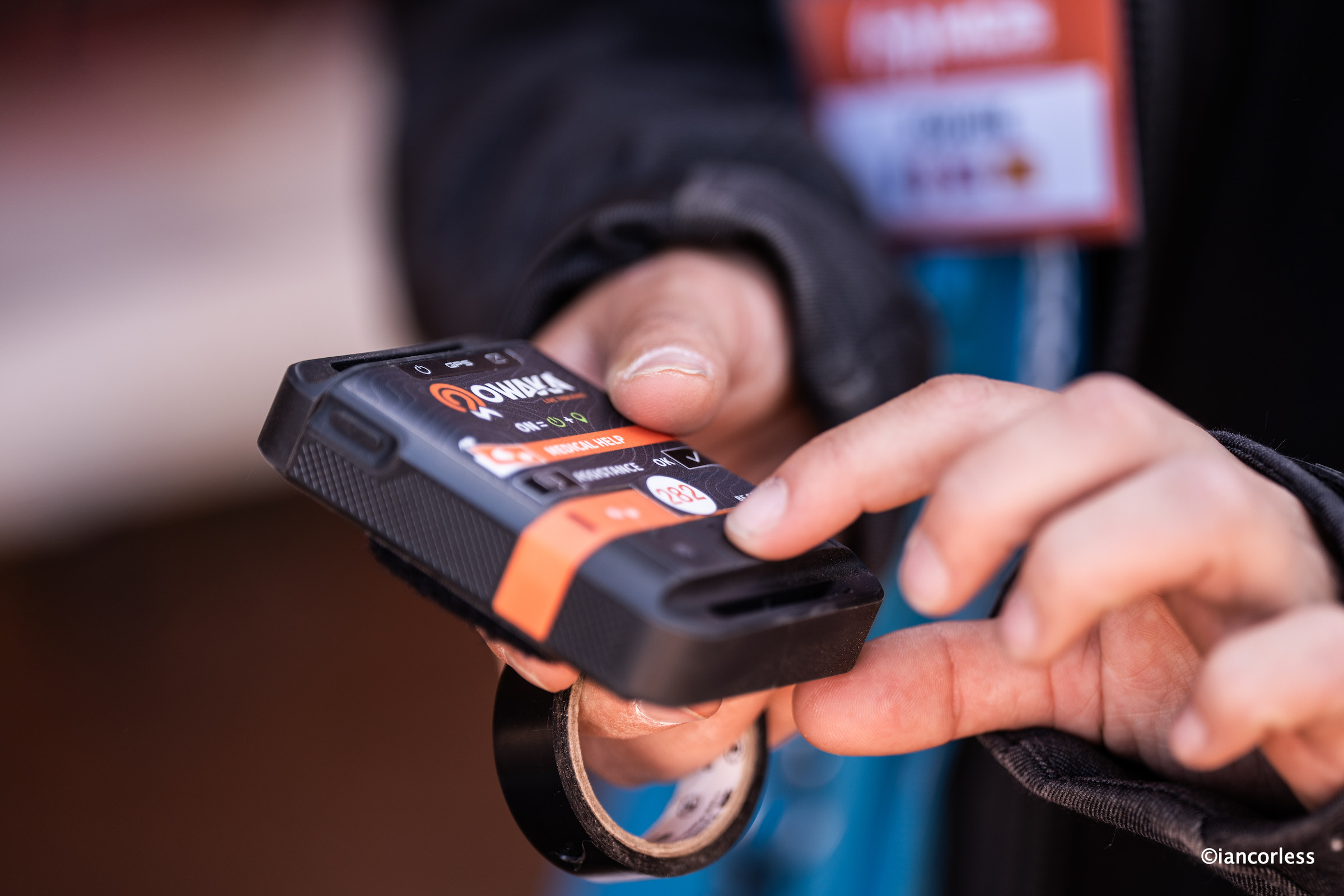
Every runner carries a tracker attached to their pack. This allows the organization to monitor your position in real time. It includes an emergency button for immediate assistance.
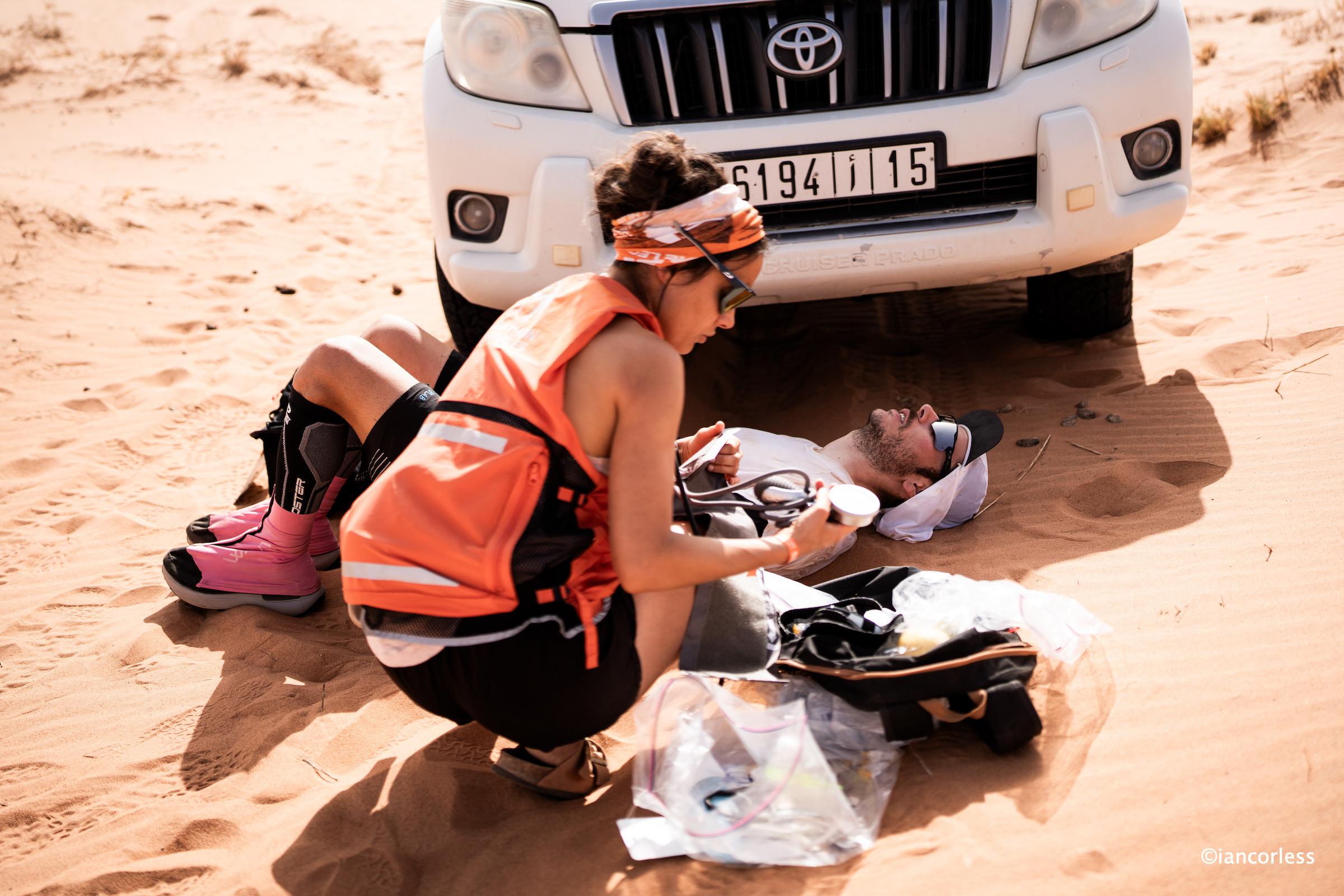
There are also medical runners on course. These are trained medical professionals competing in the race. They wear a different colour race number so you can identify them. They can provide immediate care if necessary. In addition, the full medical team is equipped to respond anywhere in the desert.
Photo by Ian Corless
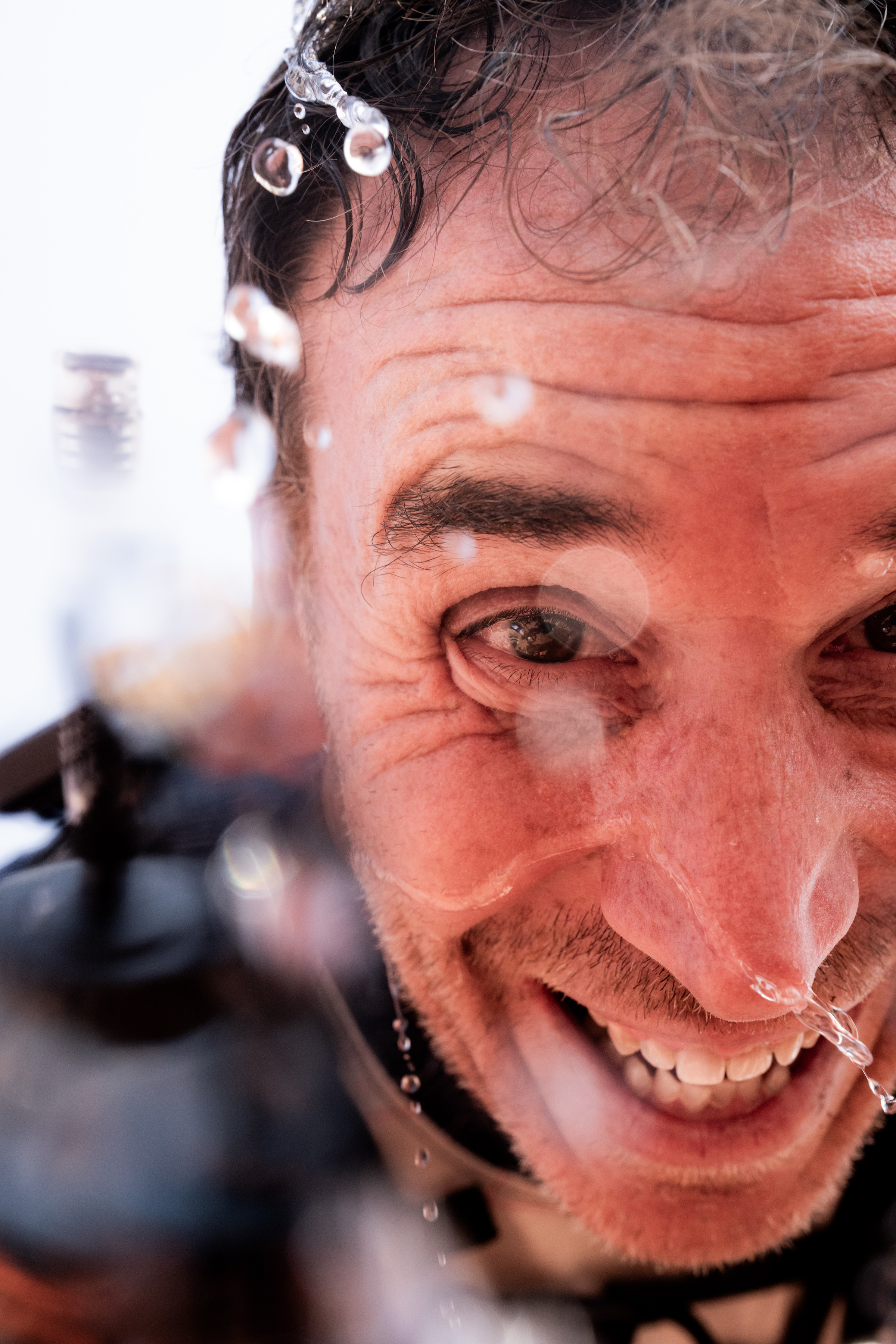
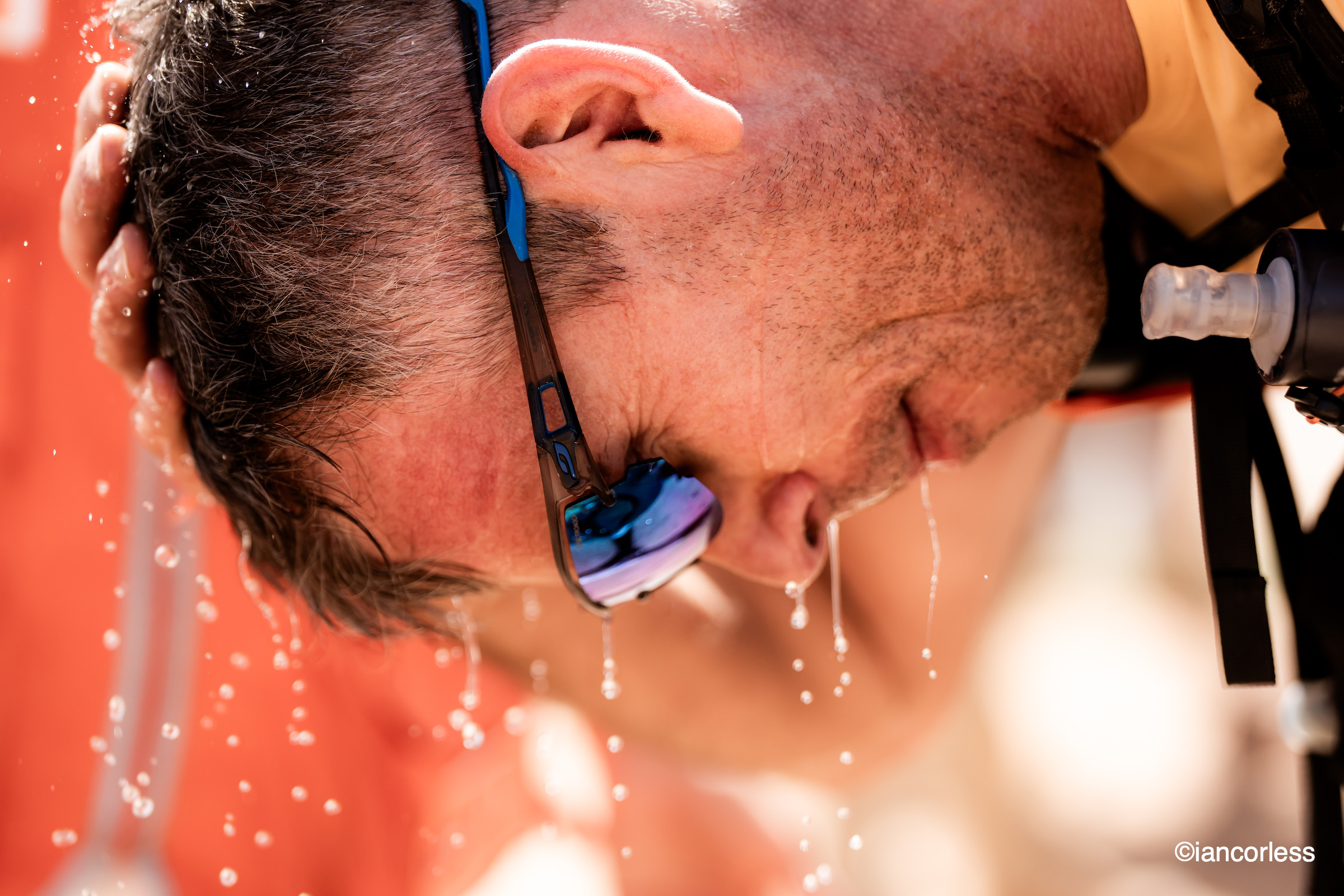
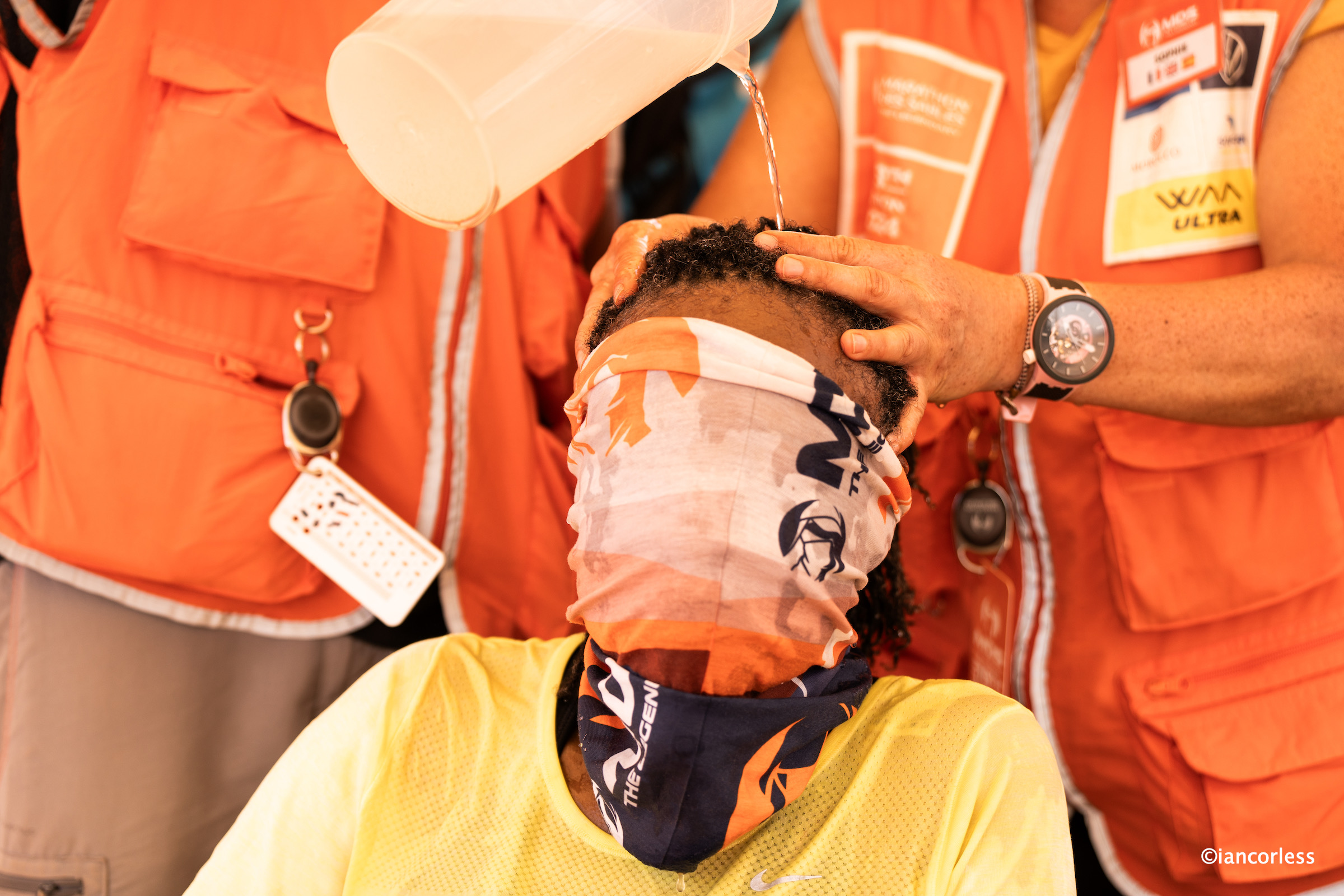
During stages, water is not rationed. If you need more, you can have it. At key checkpoints, iced water is available for cooling and is poured over your head by blue coat volunteers. Orange jackets manage medical incidents.
Mandatory Equipment Means Mandatory
You must carry:
Pack such as WAA Ultra Bag 20L
Minimum 1.5L water capacity
Sleeping bag
Head torch plus spare batteries (charger or solar charger allowed)
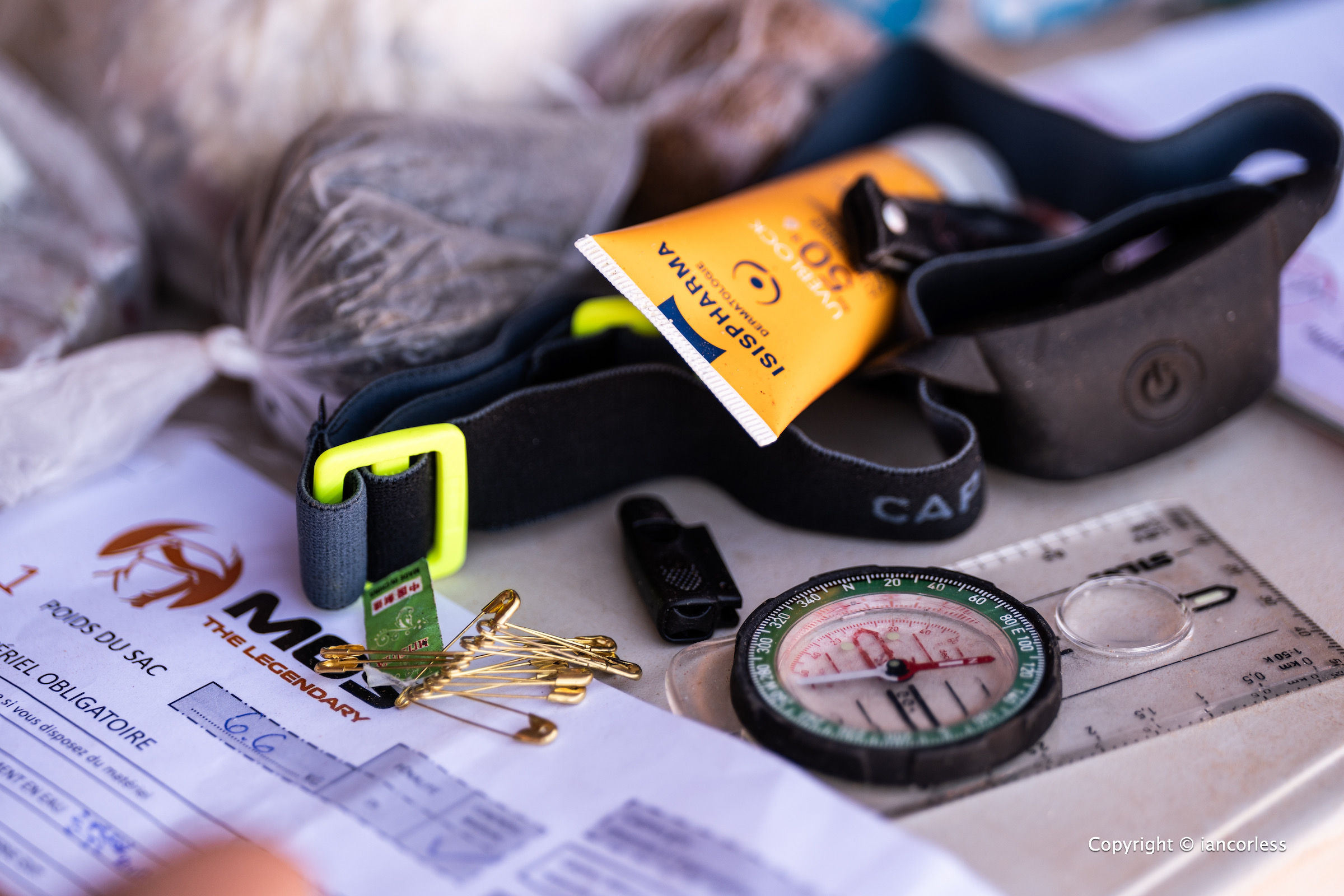
10 safety pins
Compass with 1–2 degree precision
Lighter
Whistle
Knife
Topical disinfectant
Signal mirror
Survival blanket
14 broth cubes
Sun cream
200 euros or 2000 dirhams
Passport or ID card
Original ECG document and medical certificate
Roadbook (provided on arrival)
GPS tracker
Pay close attention to deadlines and rules for ECG and medical forms. The regulations are strict.
Calories: The Real Numbers
The rules require 2000 calories per day across six stages. That equals 12,000 calories minimum to comply.
However, with the rest period during the long stage, 14,000 calories is a more realistic minimum. You may carry more. For example, a small and slight women weighing 50kg has very different calorie needs to a tall, muscular 90kg male. Understand your calorie needs.
You must be able to prove calorie totals. If you repackage food into lighter containers, keep the nutritional labels.
To break it down clearly:
Stage 1 – 14,000 calories remaining
Stage 2 – 12,000 calories remaining
Stage 3 – 10,000 calories remaining
Stage 4 – 8,000 calories remaining (long stage)
Day 5 – 6,000 calories remaining (rest day, still requires 2000 calories)
Stage 5 – 4,000 calories remaining
Stage 6 – 2,000 calories remaining
On Day 5, you may still be moving during the long stage or recovering in camp, but you still require 2000 calories. On Stage 6, you technically only need breakfast and race snacks.
Essential Personal Kit
Beyond mandatory equipment and food, you will need:
Shoes with gaiters, Velcro sewn securely in advance
Hat with potential neck cover
Sunglasses with strong protection and good fit for sandstorms or take extra goggles
Watch
Warm layer – windproof and possibly lightweight down jacket
Foot care supplies
Hygiene products
Toilet roll or wipes
Lip balm
Blindfold
Ear plugs
Spoon
Pot or bowl
Stove
Fuel cubes
Sleeping mat
Pillow
Flip flops or similar
Note – If you plan to NOT heat water, you will not need a stove of fuel cubes. However, you will still need a bowl or something similar to eat food from.
Photo by Ian Corless
For repairs, consider:
Zip ties
Gorilla tape
Super glue
Sewing kit
Cord or thin rope
Equipment can fail. Plan for that.
Final Practical Advice
Keep your pack as close to 6.5kg as possible. Extra weight adds unnecessary stress, especially in the longest edition to date with a 100km long stage.
Limit luxuries. If you take one, make it a lightweight MP3 player with reliable battery and earphones.
Accept the conditions. You may not wash. You will get dirty. You will smell. That is normal
Start conservatively. Ease into the race.
Photo by Ian Corless
Poles can make a huge difference, but only if you know how to use them properly. Front runners may not need them. Most people benefit from them.
Learn to walk efficiently. Many arrive expecting to run 80 percent and walk 20 percent. In reality, it is often reversed.
Protect your feet from day one.
Take a sleeping mat. In the desert, your job is simple: run, eat, sleep. Good sleep improves recovery. Recovery keeps you in the race.
A milestone anniversary, new formats, familiar classics, and a season that stretches from the Sahara to the Alps. Some years feel bigger than others. In 2026, the calendar alone tells you this will be one of those years for Marathon des Sables.
Forty editions after its beginnings in the Moroccan desert, Marathon des Sables has grown into a family of events that test endurance in different ways, across different landscapes, and for very different runners. Yet the heart of MDS remains the same. Self-sufficiency, shared hardship, and the quiet satisfaction that comes from moving forward when stopping would be easier.
January opens with something new and bold: MDS Ultra. Two distances. Two very clear challenges. A 100km option for runners ready to push beyond the classic stage format, and a 100-mile race for those who want to see how deep the well really goes.
Photo by Ian Corless
An opening act designed to grab attention. Long distances, sustained effort, and the mental strain that only ultra racing can deliver. For many, it will be the first real test of their winter training. For others, it will be the centrepiece of their season. What matters most is what MDS Ultra represents – It signals evolution not revolution. MDS is not standing still, even as it celebrates its past.
Photo by Ian Corless
Before January ends, the focus shifts west to the ocean for MDS 120 Atlantic Coast. Where dunes once dominated the horizon, runners now deal with open beaches, shifting sand, and the constant presence of the sea. The Atlantic Coast event has its own rhythm. Wind can play a bigger role. Footing changes by the kilometre. Temperatures can vary greatly, and yes, rain may be present? Still self-supported, still demanding, but in a way that surprises many first-timers. By the time the final runners cross the line, January has already delivered two very different expressions of what Marathon des Sables can be.
February and March bring a noticeable change of pace. No race numbers. No finish lines. Instead, preparation. The MDS team turns its attention fully toward the centrepiece of the year: the 40th edition of MDS Legendary. Four decades after the first runners set off into the Sahara, this anniversary edition carries weight. Not just for the organisation, but for the community that has grown around it.
Photo by Ian Corless
Behind the scenes, logistics are refined, routes considered, and details checked and checked again. The Legendary event is not just another race, it is a reference point for stage racing, for many, a rites of passage, and in 2026, it will also be a celebration of everything Marathon des Sables has become.
Once the Legendary edition is complete, the calendar opens up again, and the global nature of MDS takes centre stage.
MDS Raid Namibia delivers raw beauty and isolation in one of Africa’s most striking landscapes. Namibia’s vast spaces, sharp light, and unforgiving terrain strip things back to basics. This is running in its purest form, where the environment sets the rules. A unique event as teams of two challenge a more stripped back and raw experience.
From Namibia, the series moves to Turkey for MDS 120 Cappadocia. Volcanic rock formations, flowing trails, and a sense of history underfoot make this one of the most visually distinctive events on the calendar. It is demanding, but also deeply immersive, ironically, despite the ‘sables’ tag, this event is much more a trail race – something new, different and unique.
MDS Crazy Loops – a format that lives up to its name. Short loops, repeated efforts, and a psychological game that can unravel even experienced runners over 24-hours. It is less about distance on paper and more about resilience in the moment. A fun and challenging event for all abilities that takes place at iconic ski resorts within Europe during July and August. A community event that brings the MDS vibe to the mountains.
As the year moves toward its final months, the pace does not slow. If anything, it accelerates. MDS 120 Morocco returns runners to familiar terrain, but with the confidence and refinement that come from years of experience. This is the desert, revisited with fresh eyes.
Alongside it, MDS Handi continues to redefine what inclusion looks like in endurance sport. It is a powerful reminder that challenge is not one-size-fits-all, and that determination takes many forms.
For those drawn more to movement than racing, MDS Trek Morocco offers a different relationship with the landscape. Still demanding, still immersive, but with space to absorb the experience in full where all abilities are catered for and yes, there is even some luxury – larger tents, no self-sufficiency, showers and so much more…
The international push continues with MDS 120 Jordan, where desert running meets ancient history. The terrain is tough, the scenery unforgettable, and the sense of scale impossible to ignore. An iconic event and arguably one of the most desired events on the MDS calendar.
And yes, there are hints of more to come. Potential surprises remain under wraps, but if past years are any guide, they will add another layer to an already remarkable season.
Photo by Ian Corless
By the time 2026 draws to a close, Marathon des Sables will have crossed continents and climates. Morocco, Jordan, Peru, Turkey, Namibia, and Europe, with the Alps adding altitude to the mix. Each location brings its own challenges, its own stories, and its own reasons for being unforgettable.
What ties them all together is not just branding or format. It is philosophy. Self-reliance. Respect for the environment. And the shared understanding among participants that this is about more than running.
A milestone year invites reflection, but it also demands momentum. In 2026, Marathon des Sables manages both. Honouring 40 years of history while pushing forward into new territory, new formats, and new ways to test human endurance.
For runners, supporters, and the wider endurance community, it is hard not to look at the year ahead and feel a quiet sense of anticipation.
What a year it promises to be.
In addition to the above, there is the MDS Tour and MDS Clubs.
In 2026, the Marathon des Sables (MDS) reaches a milestone: its 40th “Legendary” edition. What better way to celebrate four decades of desert ultra-endurance than by rewriting the record books? Among the announcements already stirring excitement: the “long day” stage for 2026 will be extended to 100 km, making it the longest single stage ever in MDS history. This bold move not only raises the bar for what runners will face, but signals that the 40th edition aims to become a defining moment of the race’s legacy.
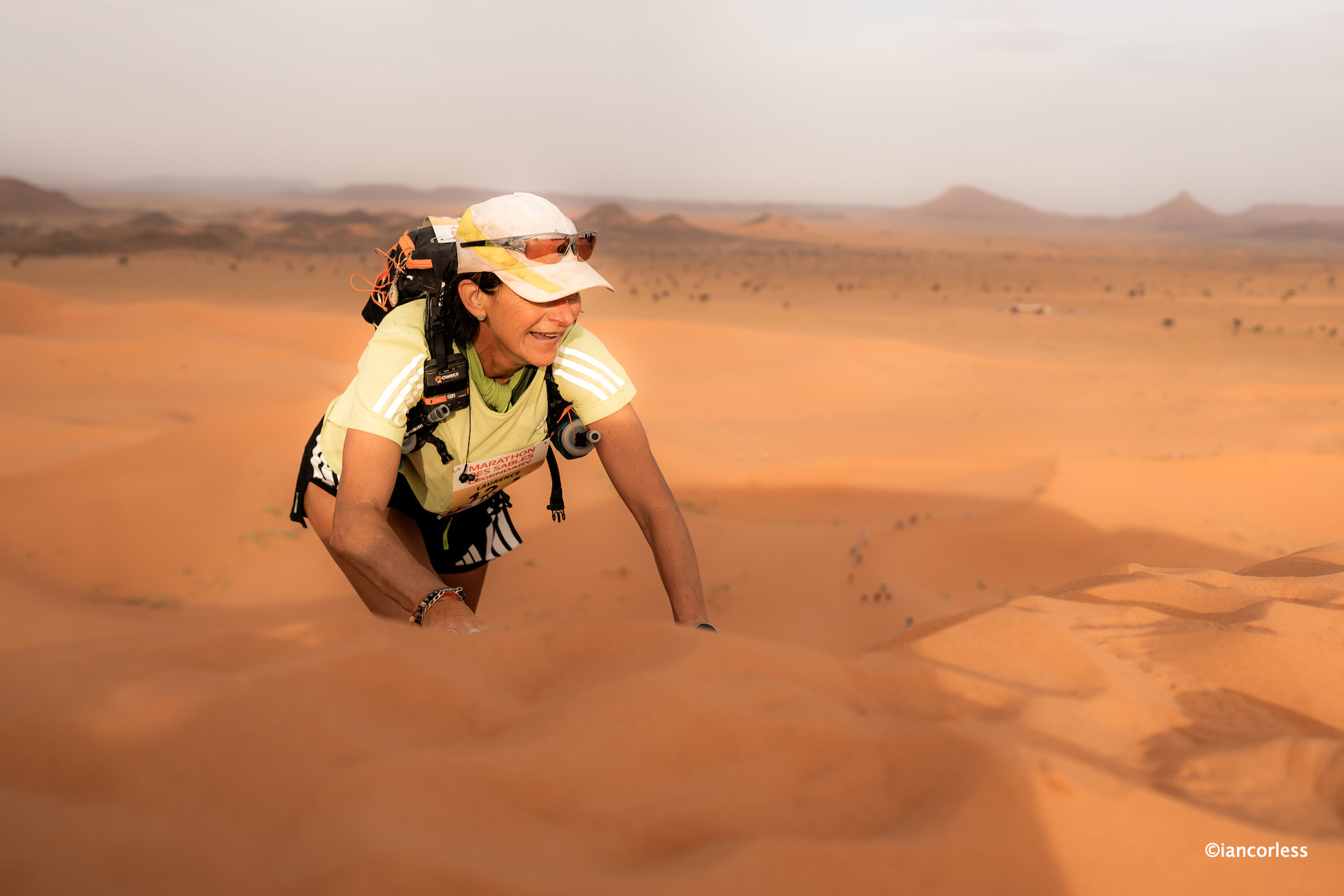
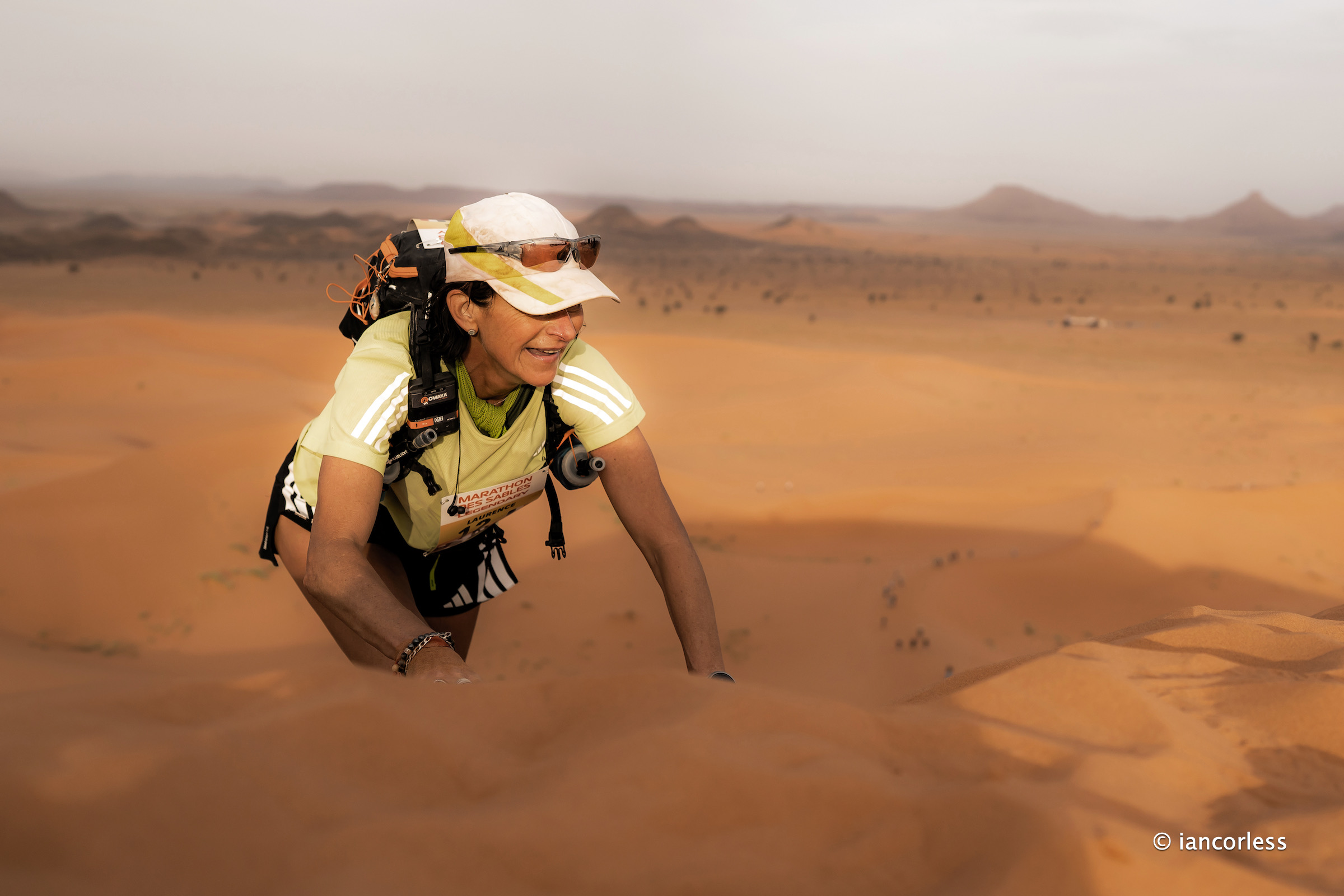
Laurence Klein, 3x MDS champion – Photo by Ian Corless
A Brief History:
The roots of the Marathon des Sables reach back to the daring vision of French promoter Patrick Bauer. In 1984, he traversed part of the Sahara on his own, over 350 km in 12 days, with no external support, an experiment in isolation and survival. Two years later, in 1986, the first official Marathon des Sables was held, with 23 participants tackling a self-supported desert crossing. The winners, Bernard Gaudin and Christiane Plumere making history.
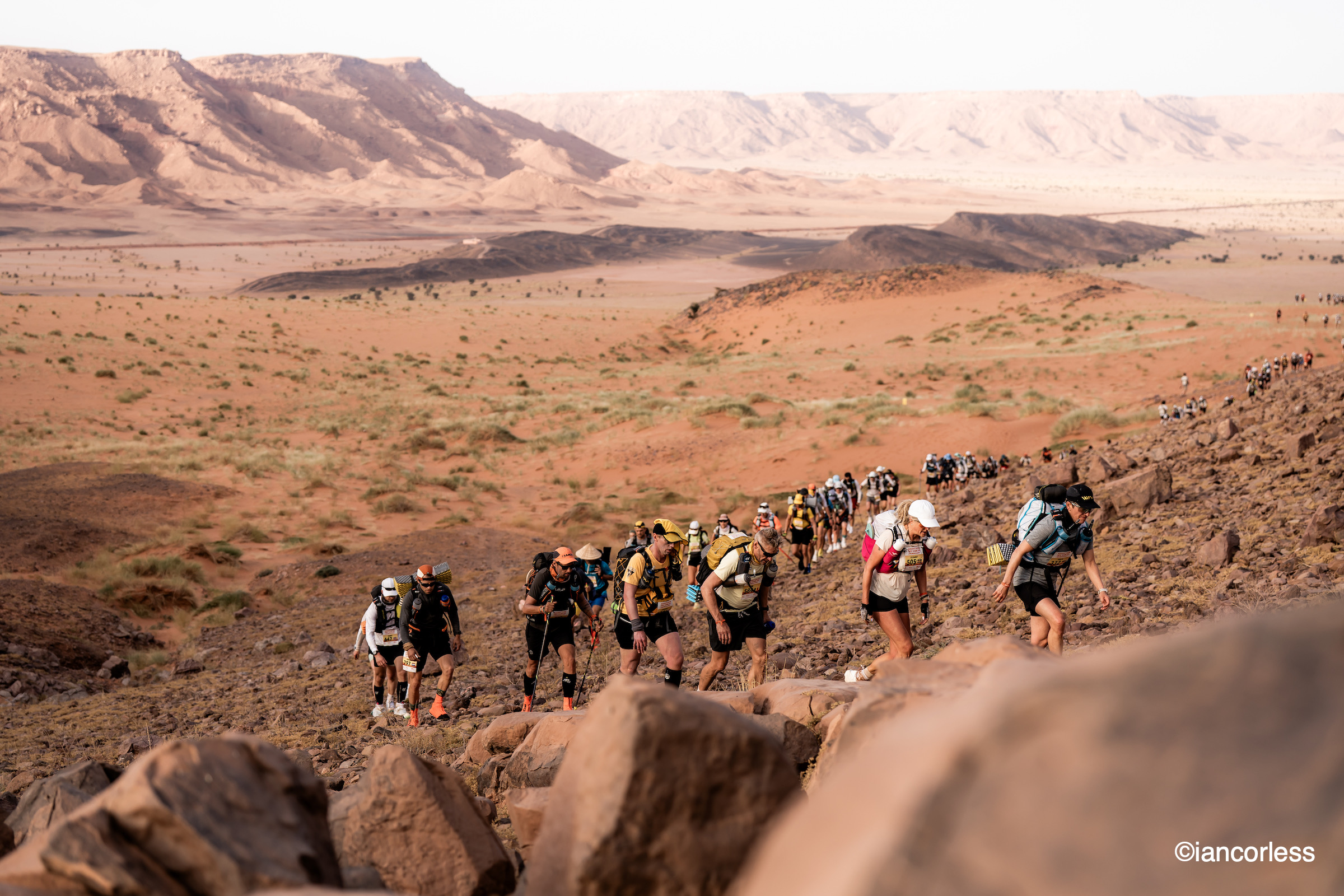
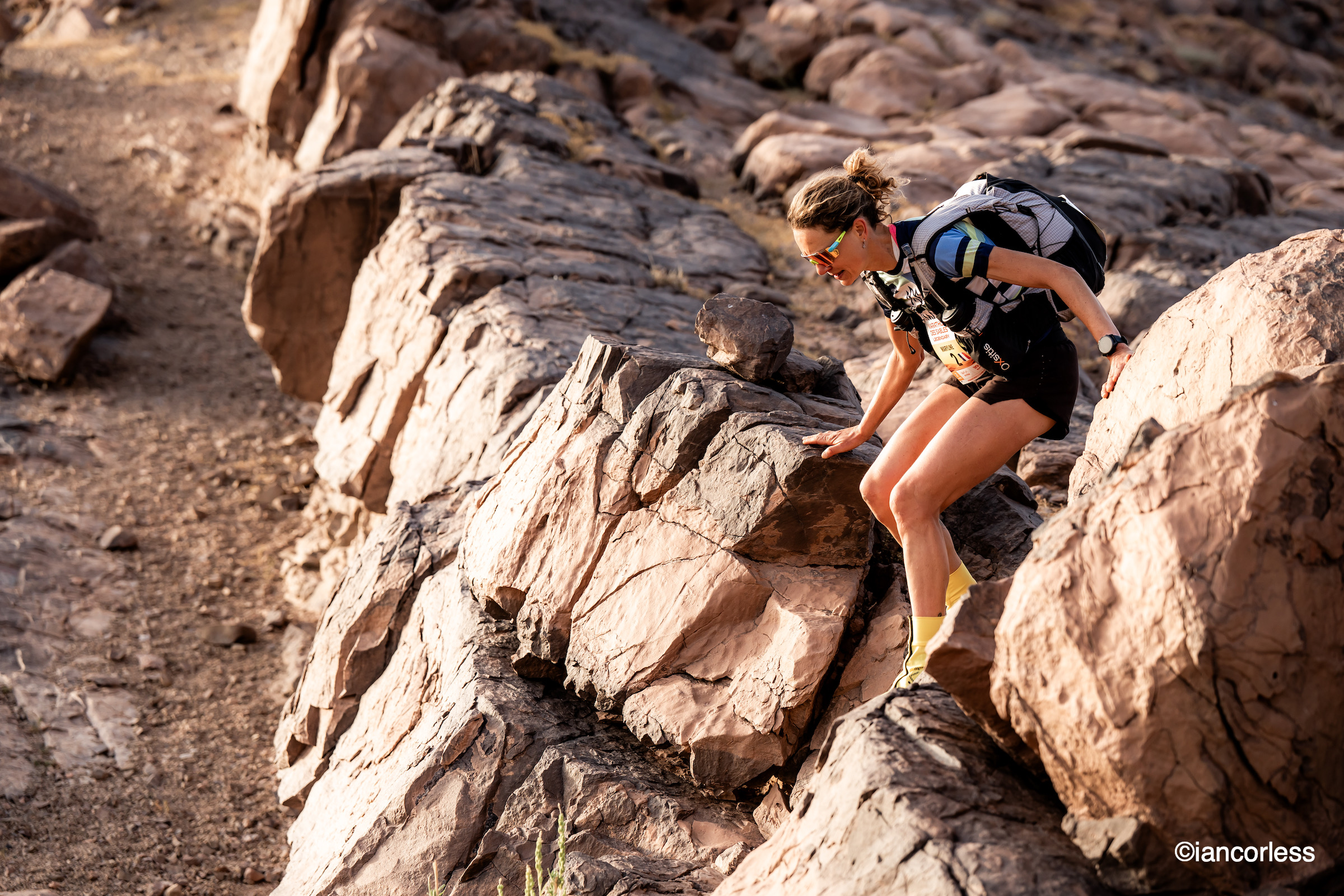
Over the years, MDS has grown from a niche extreme-race to one of the world’s most respected ultramarathons. Its signature format currently features around 250 km over 6-stages (7-days) in the Moroccan Sahara, with participants carrying their own supplies (food, sleeping gear, etc.) in full self-sufficiency – water and a place to sleep the only logistical supply. Terrain at The Legendary shifts from endless dunes, rocky plateaus, dried wadis, occasional mountains and shifting sands; daytime heat can often soar, while nighttime temperatures can drop sharply.
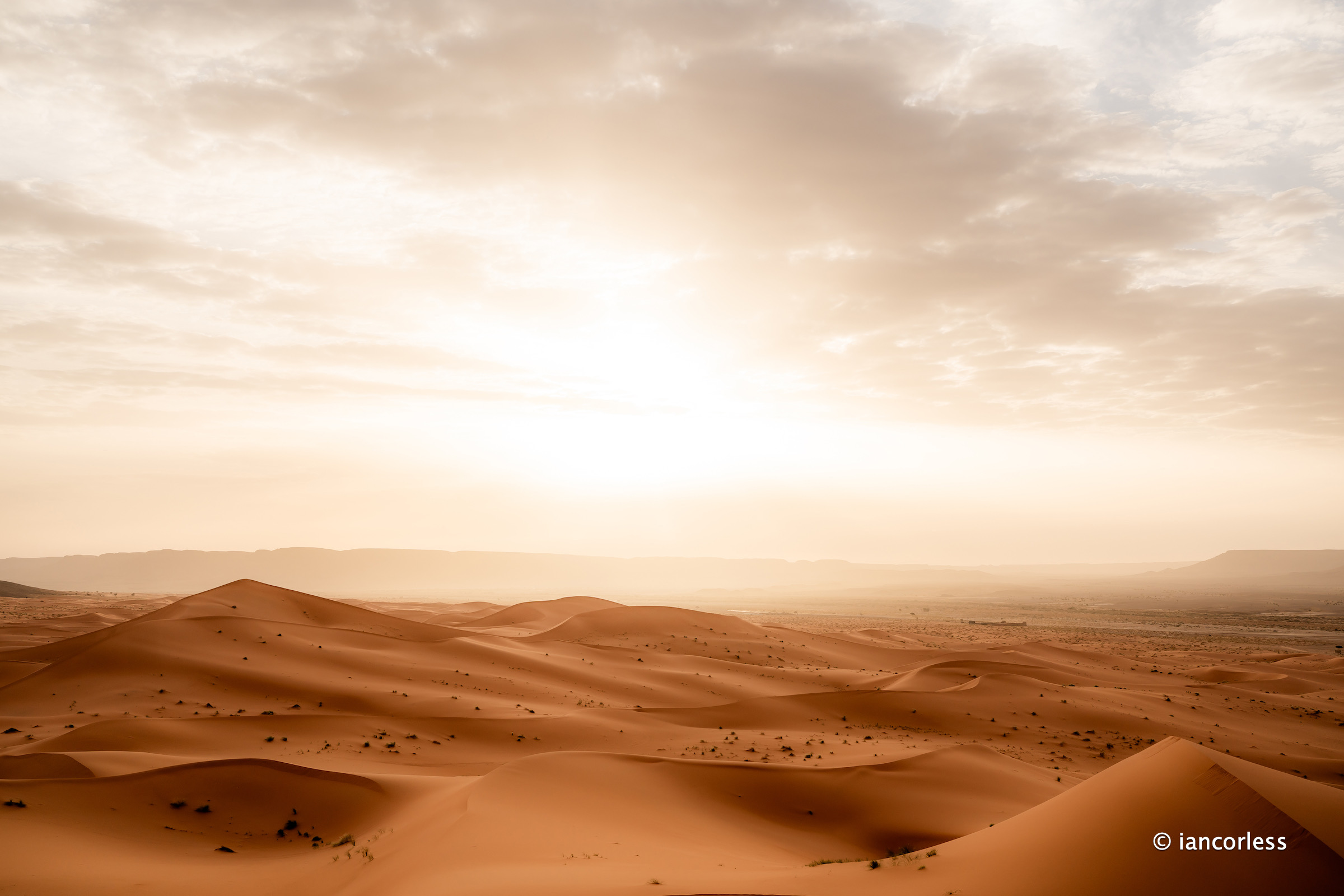
Stunning vistas at The Legendary – Photo by Ian Corless
Notably, throughout its history, MDS Legendary has always included a stage that stretches well beyond the “single marathon” distance, 80–90 km is normal to test endurance in extremes. In 2009, there was a long-stage of 92km’s…. But a full 100 km in one go will top them all.
With a passing of time, MDS Legendary has also diversified; now offering shorter formats such as MDS 120 (70–120 km), the MDS Trek variant with lighter logistics, MDS RAID and for 2026, the MDS Ultra which for the first time offers a single-stage ultra of 100km’s or 100-miles to be undertaken with a 40-hour cut-off. But the heart of the MDS remains firmly with The Legendary stage race.
The 100 km “Long Day” and What It Means
MDS will feature a 100 km long day, a stage longer than anything ever attempted in MDS history. This is more than a symbolic gesture, it’s a structural change that forces participants to rethink pacing, supplies, strategy, and mindset. Will the 40th edition of MDS The Legendary be considered the hardest ever edition? With an expected total distance of 270km +/- the answer is yes!
Photo by Ian Corless
From a participant perspective, there will be some key considerations.
Pacing will be crucial with a delicate balance between enthusiasm and energy conservation. During the day, monitoring thermal stress will be crucial.
Pack weight will be crucial – the 40th edition of MDS Legendary, now more than ever, will require participants to have the lightest possible pack without breaking the strict rules and regulations.
Food – With a long day that is in real terms approximately 10 to 25% longer than usual, the need for extra calories and how those calories are consumed will become extra important.
The mental toll will have a huge impact, that will start now with the announcement of a 100km stage – just as you prepare equipment and training, set time aside to prepare the mind for the challenge ahead. This new length will push athletes into deeper zones of fatigue, testing resilience, self-talk, and mental fortitude.
Runners will traverse more varied landscapes, perhaps crossing more dunes, rocky flats, and most certainly everyone will require more night navigation.
Announcing the 100 km day well in advance gives aspirants time to rework prep plans – use this time effectively.
Food, as always, important at MDS – Photo by Ian Corless
Why 2026 Will Be a History-Making Edition
This is not just “another year” of MDS The Legendary, several factors are aligning to make the 40th edition uniquely compelling:
Milestone Significance – Forty years is a symbolic turning point. And by choosing to mark it with the toughest-ever stage, the organisers are intentionally raising the narrative: “Legendary by name, Legendary by reputation.”
New Records, New Legends – With no past precedent for a 100 km stage in MDS The Legendary, whoever finishes that leg (especially among the leaders) will enter the record books.
Attracting Ambition – Some ultra runners chase the “most difficult” challenge. A 100 km desert stage is a headline that will draw audacious minds and bodies, possibly pushing the field performance upward.
Legacy and Storytelling – In future retellings, the 2026 MDS The Legendary will be a pivotal point, some may say, the 40th edition was when MDS truly redefined itself. It’s the kind of turning point that historians of sport may hark back to.
Amplifying the Extremes – MDS has always lived on the edge: heat, sand, navigation, resource management. By stretching one day to 100 km, the extremity is amplified. The race becomes less about surviving the day, and more about mastering it.
The Longest Ever – With a long stage of 100km, the anticipated total distance for the 40th edition will be a record breaking 270km +/-.
Photo by Ian Corless
Challenges & Risks to Keep in Mind
No radical shift comes without risks and MDS The Legendary are required to balance risk against challenge. A 100km stage has long been discussed for this iconic stage race, it’s only right that the 40th edition will personify the Legendary tag with a landmark distance. However, even the world’s top ultra runners may falter under a 100 km leg in desert conditions. Managing attrition will be critical. The required pace will be, as usual, 3.5km per-hour. And of course, the MDS blue and orange jackets will be on-hand, more than ever, to facilitate everyone crossing the line.
100% support from the MDS team – Photo by Ian Corless
Some participants may feel disadvantaged if their prior prep or experience didn’t anticipate such a long stage, but, this is why this early announcement helps – fail to prepare, prepare to fail.
Perspective: How This Compares to Classic Ultra Benchmarks
To put 100 km in context: many stand-alone ultramarathons are in the 100 km to 100-mile range. But those are often supported events, with aid stations and crew support. In MDS The Legendary, with self-sufficiency, navigation demands, and desert extremes, layering a 100 km day is far harder than a flat 100k road ultra.
In prior MDS editions, long days of 80–90 km have already pushed runners to the brink, many cross the nights and run long into another day – for 2026, this will be the ‘norm’ for nearly all the participants.
The 40th edition becomes not just “another chapter,” but a rewriting of what MDS can be.
Final Thoughts: A Legendary Promise
Photo by Ian Corless
The 2026 Marathon des Sables is setting the stage, literally and metaphorically for a landmark event. The 100 km long day announcement signals ambition, courage, and a willingness to push the narrative frontier of desert ultra-running. In addition, the implications for the overall race distance being 270k +/- adds to the drama.
For participants, 2026 will demand a rethinking of training philosophies, gear choices, pacing strategies, and mental frameworks. For the sport, it may become a reference point for what is “next level” in multi-stage desert ultras. And for storytelling, it offers rich stories:”
“Who conquered 100 km in the sands?”
“How 2026 changed MDS forever.”
Legendary by name, and with this edition, legendary by reputation in a whole new way.
Interested in a Marathon des Sables event? More informationHERE
The 2025 edition of the Marathon des Sables – The Legendary is getting close, as we journey through March, we will post weekly articles to help you fine tune your preparation.
Following on from the 2024 edition, the longest in MDS history, the 39th 2025 edition will follow a similar format and distance. The event will take place over 6-stages/ 7-days and notably, the ‘long day’ was stage 3 in 2024, for 2025 it will return to stage 4.
All 6-stages will be timed as in 2024, previously, the charity stage was not timed.
Although the race has fluctuated in distance over the years, a distance of +/- 250km’s should not come as any great surprise and training in the build up to the event should have been planned with this in mind.
6 timed stages does make a considerable difference and that should be considered. In 2024, the long day coming on stage 3 was an extra challenge, for 2025, it returns to stage 4! Depending on how fast you complete the long day, you can have a full day and night as recovery before stages 5 and 6.
Daily distances are typically never disclosed before the race and the jury is out if the distances will be announced pre arrival in Morocco, watch this space! However, it is pretty easy to guess on approximate distances.
The 2025 MDS Legendary will look (potentially) like this:
Stage 1: 32km (day 1) running total: 32km
Stage 2: 38km (day 2) running total: 70km
Stage 3: 36km (day 3 running total: 106km
Stage 4: 80km (day 4 and 5) running total: 186km
Stage 5: 42km (day 6) running total: 228km
Stage 6: 21km (day 7) running total: 249km
Total: 249km
Three key considerations:
Expect more sand, anticipate no Djebel El Otfal and expect Merzouga Dunes. With the above information, you now have at least a template and guide for which to plan around.
“…and for sure it will be tough, I am not going to tell you that it will be easy! The distance will be 250km’s, I am little unhappy because I cannot put the long stage in the third position, I loved this last year, but according to our plan, we need to move it to the fourth stage. It will be tough, very tough and really beautiful. We have some amazing places planned, 80% is new tracks. You will see places never seen before in any MDS. There will be no El Otfal, there will be lots of sand and yes, Merzouga will return.” – Cyril Gauthier
SCHEDULE
Photo by Ian Corless
Day 1: Arrival in Morocco, transfer by bus to the bivouac in the desert, installation and overnight stay in the bivouac wih self-sufficiency.
Day 2: Day of technical, administrative and medical checks. Overnight in bivouac with self-sufficiency.
Day 3: First stage, overnight in bivouac.
Day 4: Second stage, overnight in bivouac.
Days 5: Third stage, overnight in bivouac.
Day 6 and 7: Fourth stage, the long one” – lasting 2 days, overnight in bivouac.
Day 8: Fifth stage, overnight in bivouac.
Day 9: Sixth stage, medal at the finish line, then bus transfer to Ouarzazate, overnight in hotel with half-board accommodation.
Day 10: Free day in Ouarzazate, awards ceremony, gala evening. Overnight at hotel with half-board accommodation.
Day 11: End of adventure, transfer back to airport.
BIVOUAC
Remember, from the moment you arrive in bivouac you are self-sufficient. So make sure you bring food/drink (water is provided) to cover the days before the race starts. This food can be in any form and weight as you do not need to carry it, so, be creative. Rachid for example makes a Tagine in camp…!
Also remember, you have your luggage with you before the admin protocols. So, bring extra items, warm layers, spare kit etc. That way you can fine tune equipment in a real situation. Particularly helpful when judging climate conditions. DO NOT assume that it will be hot, recent history has shown that temperatures and conditions in the desert are changing – MDS Morocco in October had rain and flooding. The recent MDS Morocco Atlantic Coast had extreme wind, cold temperatures and rain. Be prepared!
ADMIN DAY
You will have your luggage with you in bivouac before admin day. You can make last minute adjustments if required. Be prepared and make sure you comply with all rules and regulations. A pack must have a minimum weight of 6.5kg PLUS water (1.5L). You must have a minimum of 2000 cals per day. You must have ALL the mandatory kit.
SALT
The new revised mandatory requirement for the race requires 14 broth cubes – these cubes are known to be salty. You have no choice here, you must have them. In 2024 many questioned the validity, however, during and post the event the general consensus was very positive. Take note here, not all cubes dissolve the same in water, so, make sure you find a cube that works such as Knorr. My advice is to plan a strategy that works for you. Listen to my podcast with Andy Blow from Precision Hydration HERE. Remember, this is a self-sufficient race, so, be prepared to be self-sufficient and have a plan/ strategy that works for you.
WATER
Another key change from 2024 is water and how it is provided. In principal, once you start on stage 1, water is unlimited. No longer are you provided 1 or 2 1.5ltr bottles at checkpoints. Now, the blue coats will pour water from jugs in to your bottles. If you stand at a CP and then drink a full bottle, it will be refilled.
Another key note to consider is that should conditions dictate or should the organisation think that additional water will be helpful, water stations may be added between CP’s. This is very important. Typically (conditions and terrain allowing) CP’s are 10km’s apart, therefore, you may heave an additional water station at say 5km’s.
The long day may (tbc) have a requirement that you can carry extra water capacity? This extra water would potentially be provided in a 1.5ltr bottle, so, either have an extra bottle to decant this to, or, have a system to carry a 1.5ltr bottle.
After the stage finishes, water is then rationed and you are provided with 1 large 5ltr bottle. This water will be needed for your hydration post stage, cooking dinner, cooking breakfast and your water allowance to CP1 the following day. If you want to wash, that also comes from the 5ltr allowance, so, make sure you drink and eat and understand what water capacity you need before taking a wash.
FEET
Along with dehydration, damaged feet are a key reason NOT to finish MDS. Make sure you have correct fitting shoes, the right socks for you and you know how to look after your feet. Read HERE and HERE.
SAFETY
MDS has strict protocols for your safety. You will see fast response vehicles (buggies) designed to gain fast access to the most difficult and challenging parts of the desert. In addition, there are 4×4 vehicles situated throughout the course.
Each runner is using a tracker attached to their pack. This allows MDS to follow you and keep an eye on your position, it also has an emergency button which notifies the MDS team of your need for immediate response and attention.
There are also medical runner’s. These are trained medical staff who will participate during the race. They will be on the course with you and in certain scenarios, they are able to provide immediate care or attention to those who need it. They have a different coloured number so you can identify them.
Medical team personnel are trained and equipped to provide immediate attention at any location within the desert.
Finally, water is not rationed during the race, so, if you need more liquid, you can have it! Also, at key CP’s, iced water is available to enable cooling. This will be poured on your head via a blue coat volunteer. Orange jackets handle medical emergencies.
MANDATORY EQUIPMENT
Needless to say, despite what some believe, but mandatory equipment is mandatory!
Pack such as WAA Ultra Bag 20L
Minimum capacity of 1.5 litres of water
Sleeping bag
Head torch and spare batteries (you can have a charger/ solar charger)
10 safety pins
Compass with 1 or 2 deg precision
Lighter
Whistle
Knife
Topical disinfectant
Signal mirror
Survival blanket
14 cubes of broth
Sun cream
200 euro or 2000 dirhams
Passport or ID card
ECG (original doc) and medical
Roadbook (supplied on arrival)
Make sure you comply with the very strict regulations and timeline in regard to ECG and medical form.
FOOD
You need ** 14,000 calories of food, 2000 calories per day. However, 12,000 is mandatory. You can of course carry more than this, but I consider 14,000 is the minimum with the rest day. You must be able to prove the calories, so, if you decant food into lighter or different packaging, make sure you keep the nutritional information.
** Adding as clarification:
2000 calories per day, it’s a 6 stage race
BUT remember the rest day.
I see the calories as below BUT YES 12,000 cals to comply with rules.
Stage 1 : 14,000 cals – Day 1
Stage 2 : 12,000 cals – Day 2
Stage 3 : 10,000 pls – Day 3
Stage 4 : 8,000 cals (the long day) – day 4
Day 5* : 6,000 cals (rest day)
Stage 5 : 4000 cals – Day 6
Stage 6** : 2000 cals – Day 7
*Day 5 you may still be running/ walking and/ or in camp for the rest day and will need 2000 cals.
**Stage 6/ day 7 you technically only need breakfast and snacks for the stage.
WHAT YOU NEED
In addition to mandatory equipment and food requirements, you need essential items to complete the race. Use the list below as a guide:
Run top (maybe with long sleeves)
Neck roll/ Buff
Run shorts/ skirt or similar
Socks (plus maybe spare socks)
Shoes with gaiters (make sure you have the gaiter velcro sewn on well in advance)
Hat (consider cover for the neck too)
Sunglasses (make sure they have good protection and if they fit well for protection in sand storms)
Watch
Warm layer (windproof and maybe lightweight down jacket)
Foot care
Hygiene products
Toilet roll/ wipes
Lip balm
Blind fold
Ear plugs
Spoon
Pot/ bowl*
Stove**
Fuel cubes**
Sleeping mat
Pillow
Flip flops or similar
**Stove and fuel only required if you plan to heat water
*Pot/ bowl or similar will be required as now it is no longer possible to cut down a 1.5ltr bottle
Recommended
Many things can happen in a self-sufficient race and yes, equipment can fail. So, think about on-the-go repairs and what you may need.
Zip ties
Gorilla tape
Super glue
Sewing kit
Cord/ thin rope
Top Tips
Keep the pack weight as close to the minimum 6.5kg as possible, additional weight is additional stress that you do not need.
Keep luxuries to a minimum, they only add weight. A super light Mp3 player (with good battery) and earphones is the only luxury I would consider.
Accept that this is a tough challenge, you will be stripped back to a survival mode. You may not wash, you will get dirty, you will get smelly. Accept it.
Start slow and ease into the race.
Photo by Ian Corless
Poles can be a lifesaver and I recommend them but you must learn to use them. Those at the front do not need poles, they can run.
Learn to walk, walk and walk. Many go to the desert with the expectation of running 80% and walking 20%. The reality is it will be the other way around.
Look after your feet and start with the correct shoes for you.
Take a sleeping mat or pad. You only need to do three things: run, eat and sleep. Sleep and comfort is important for recovery.
Make sure you check the full rules and regulations HERE
When I reached out for MDS stories, I knew I would find some remarkable people and MC is most definitely remarkable.
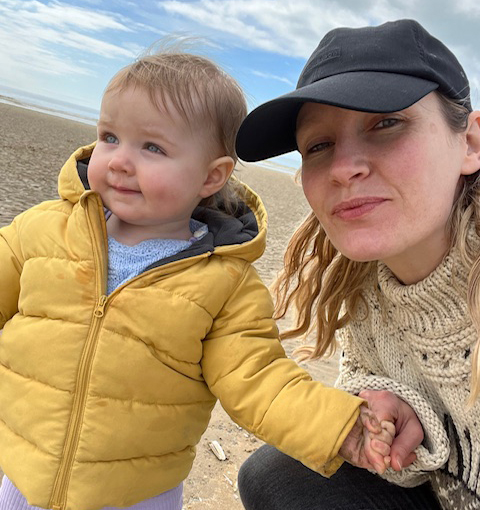
“I am MC, a 37-year old mum of two. I’m a terrible runner and not an athlete. I have never done a half-marathon until late 2023. But I am doing MDS in April.”
It was one of those introductions that had me asking, why?
“In 2015 my mum suffered a very sudden and horrific illness which left her paralysed from the neck down and reliant on a ventilator to breathe. My mum is locked in her body and has little outdoor space, so, I am doing MDS to raise funds for the Royal Hospital for Neuro-disability”
“I am running to raise money to build a new and safe garden, where residents can sit independently and share time with their families. You don’t need me to tell you that being outdoors, surrounded by nature is so incredibly important to our mental health. This new garden will change lives (my mum’s, her fellow residents’ and all the families’) and take a huge pressure off the staff who so lovingly dedicate their lives to caring for others.”

















 IAN CORLESS