

For years, entering a race has felt simple. You find an event, sign up, pay the fee, and start training. The idea that anything might go wrong rarely enters your mind, certainly from a business point of view. Of course, you may have a change of personal circumstances, an injury for example – but, the race not happening, that is rarely a consideration. Advance payments have been part of the fabric of the sport for so long that most people barely register them as a risk.
But when something disrupts that pattern, even once, it has a way of shifting how we think. For the majority, these moments feel less like a crisis and more like a quiet recalibration. A warning sign! It’s not a collapse of trust – but more a subtle change in thinking. However, if you are a runner who has made payments and lost everything – trust will be eroded and this has a huge impact in forward thinking.
In the past, Covid an exception, most runners didn’t question where their money sat after they entered a race. It was understood, implicitly, that the event would take place and that the organiser would manage whatever sat behind the scenes. The mechanics of cash flow, margins, and risk were invisible. What mattered was the start line.
Now, that invisibility has thinned a little.
It’s unlikely that large numbers of runners will suddenly start combing through company filings or attempting to assess balance sheets and viability of a company. That level of scrutiny belongs to a minority. But something more gentle may well take hold:
- A hesitation before committing far in advance.
- A second glance at unusually heavy discounts.
- A quiet preference for organisers with a long, steady track record.
- But, as recent events have shown, established and track record is not a guarantee.
- Trust will still exist, but it may become more selective.
For runners, there are also a few simple ways to reduce exposure without losing the ability to plan ahead. Insurance is the most obvious, particularly for higher-cost or international events, where cancellation cover can soften the financial hit if something goes wrong. Paying by credit card rather than debit can offer an extra layer of protection too, especially in the UK where consumer protections may allow you to reclaim funds in certain situations. Beyond that, a more risk-aware approach can help.
Hotels, travel and logistics will almost certainly be looked at with more scrutiny and less commitment. For example, using specific websites that allow booking of hotels and/ or travel where cancellations, with no impact, can be made almost days before being needed.
We may well be looking at a substantial shift in thinking, and this will impact on event organizers.
At the same time, the reality for organizers hasn’t changed. If anything, it has become more exposed. Events are expensive to stage, and most of those costs arrive early. Permits, insurance, equipment, staffing, logistics. Long before a runner crosses a start line, much of the financial commitment has already been made.
Advance entry fees are not a convenience – they are, in many cases, the mechanism that makes the event possible at all. So, what is going to happen if the runner changes the approach to booking and commitment.
That creates a delicate balance. Runners want certainty – we love to secure a place, plan ahead and formulate a plan. Organizers need commitment. If one side begins to hesitate, even slightly, the effects ripple outward.
- Cash flow tightens.
- Planning becomes less predictable.
- Decisions get pushed later.
In a system that often works twelve months ahead, even small delays in confidence can create friction.
There is a risk, at least in the short term, of instability. Not dramatic or immediate, but enough to be felt. Smaller events and newer organisers are likely to feel it most.
Yet there is another side to this. This could be turned into a positive.
Moments like this can prompt a more sustainable way of operating. Organisers may become more cautious about expansion, more disciplined in managing costs, and more focused on building financial resilience rather than chasing rapid growth.
Runners, in turn, may make more deliberate choices about where and when they commit their money. A slightly more informed participant base, paired with more transparent and measured organizers, could strengthen the ecosystem over time.
But there is something worth preserving too.
Endurance sport has always run, in part, on goodwill. There is an unspoken agreement between organiser and participant. You trust that the event will be there. They trust that you will commit early enough to help make it happen. Strip that away entirely, and something important is lost.
The likely outcome sits somewhere in between. Not a collapse of confidence, but a tempering of it. People may pause, think, and choose a little more carefully.
Organizers may work harder to earn that early commitment.
Advance payments will still happen.
Races will still fill.
Plans will still be made months, even years, in advance.
But perhaps with a slightly clearer understanding, on both sides, of what sits beneath the surface.
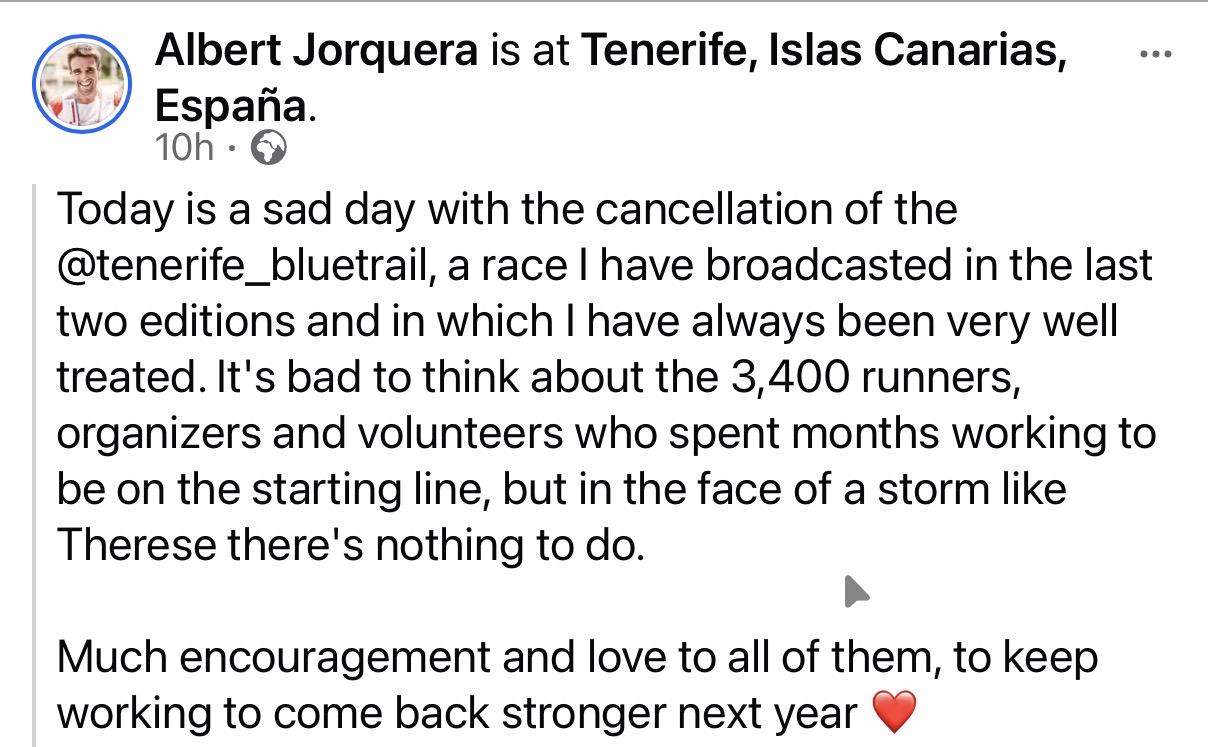
And then, just like that, overnight, A cancellation of Tenerife Bluetrail by UTMB – this brings a different kind of reality into focus. Here, there’s no financial mismanagement or organisational failure to question. It’s simply the fact that some things sit beyond anyone’s control. Safety has to come first. But the impact is still real.
Travel has happened, runner’s are in hotels, months of training has been shaped around a single date, and then, overnight, it’s gone.
Nature hits, this comes under Force Majeure – is a contractual clause freeing parties from liability when extraordinary, uncontrollable events, such as natural disasters, wars, or pandemics, make fulfilling obligations impossible – situations like this may well add another layer to how people think about committing to events in the future.
This is not a loss of trust in organizers but a growing awareness that even well-run races carry external risks that are sometimes beyond everyone’s control.
In that sense, this situation doesn’t contradict the earlier discussion, it deepens it. The question is no longer just “can this event go ahead?” but also “what happens if it can’t, for reasons no one can control?”
Will this nudge runners toward a more flexible approach? Not out of fear, but out of a clearer understanding that certainty, in endurance sport as in nature, has always been a little fragile.
Instagram – @iancorlessphotography
Twitter – @talkultra
facebook.com/iancorlessphotography
Web – www.iancorless.com
 IAN CORLESS