Much has been written about what equipment you need and require for an MDS event. In all honesty, it’s quite simple and can be broken down into 3 key sections:
What you will wear
Equipment
Food
Yes, it is that simple.
What you will wear and what equipment you need is the same for all MDS events, be that the 4-day / 3 stage MDS 120 or the 7-day / 6-stage MDS The Legendary. The only difference comes with food requirements.
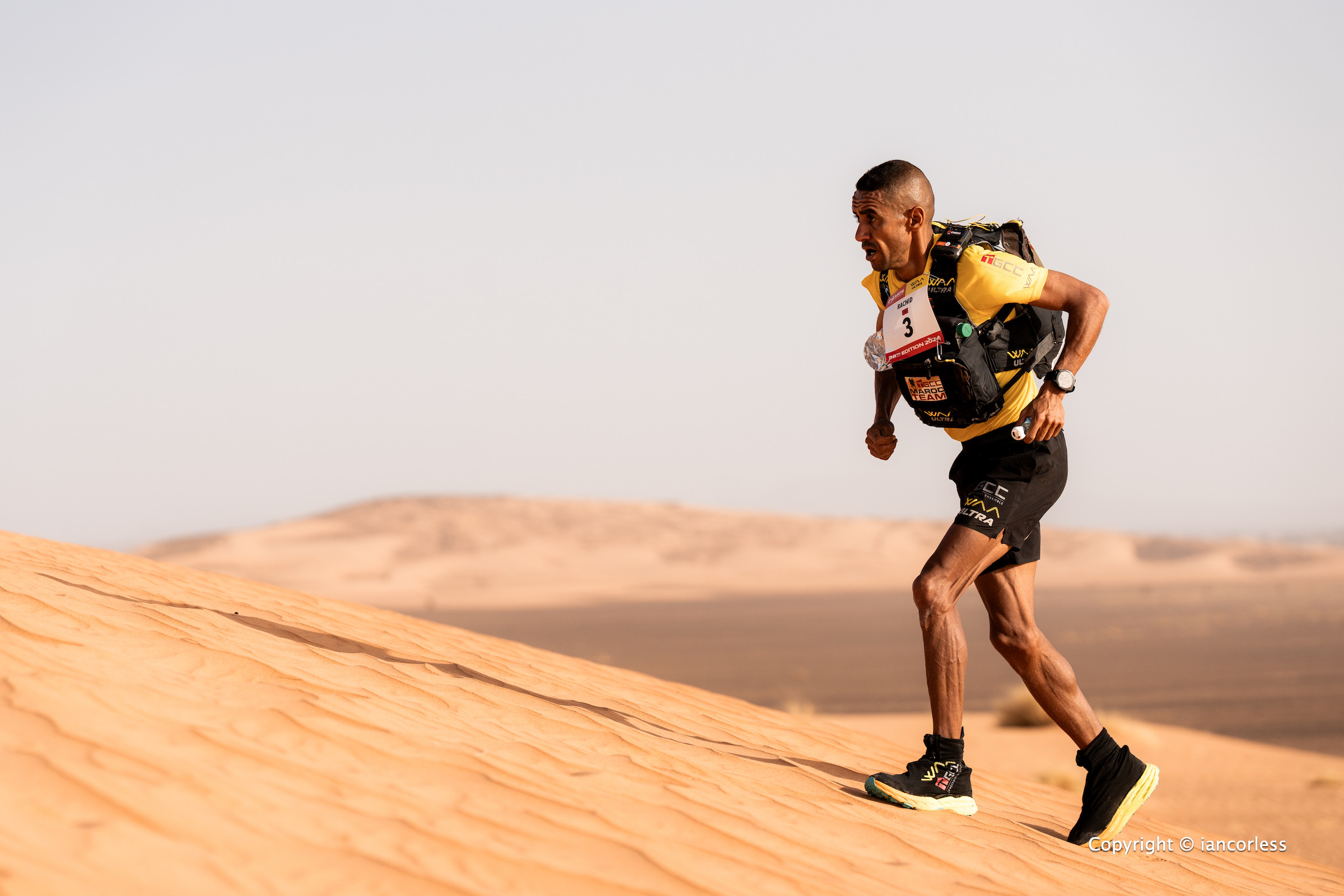
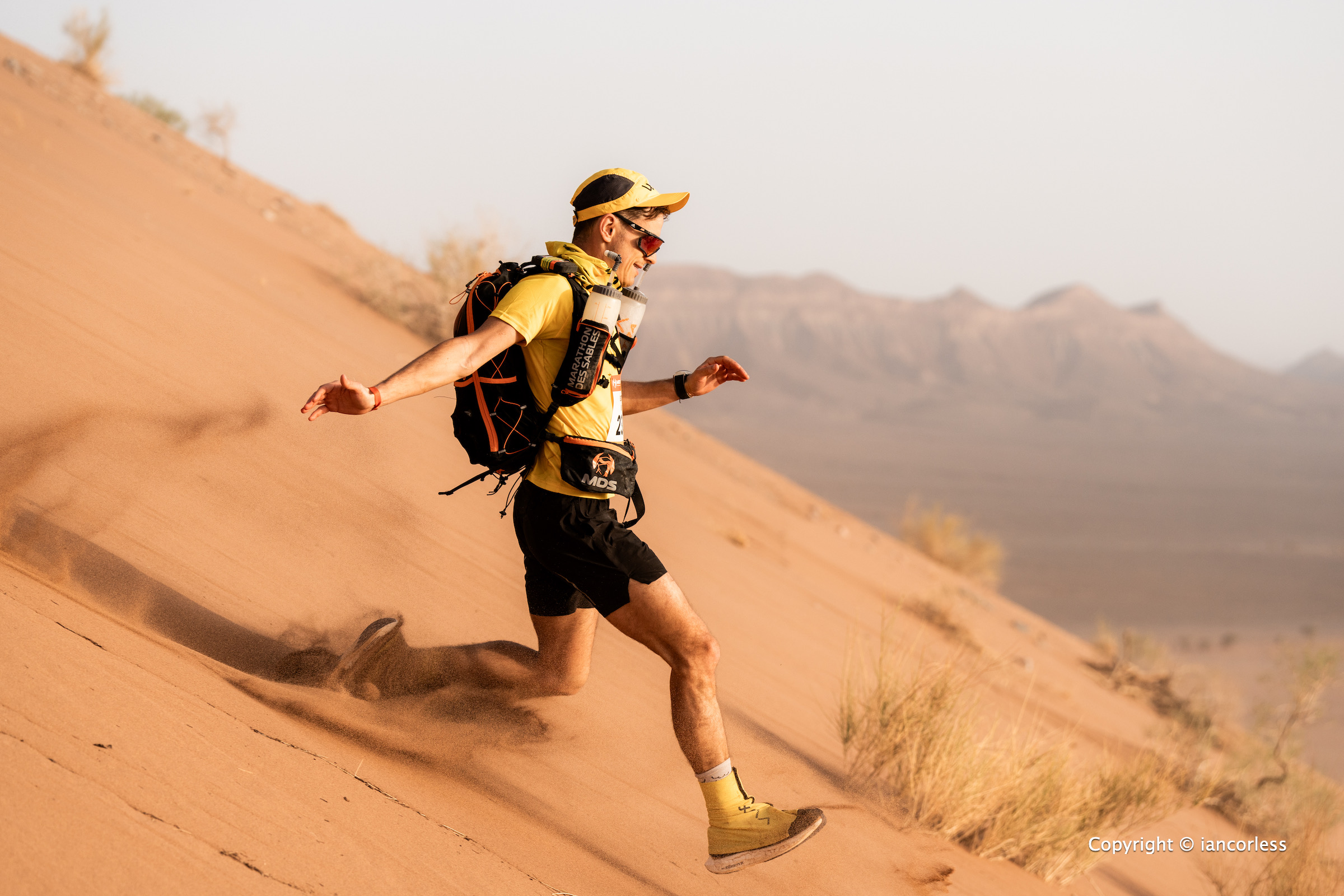
One of the many things I love about MDS is that it brings out the geek in all of us. Nothing like shopping around to find the right equipment and importantly, the lightest version. However, when it comes to clothing, there is absolutely no need to buy new items if you already have items that work and importantly cause no irritation.
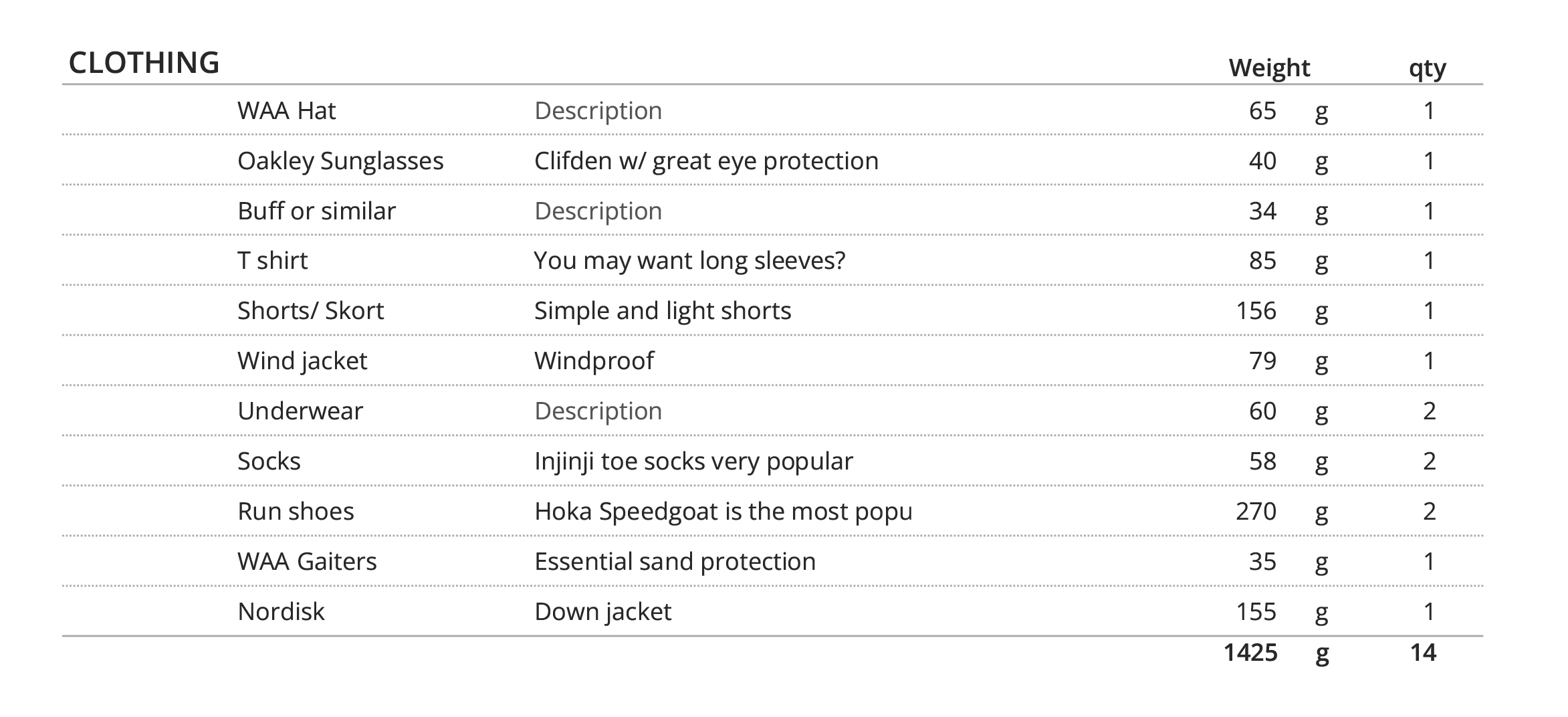
A clothing list would be as below:
You can see from the above, we go from head to toe. With the exception of a spare pair of underwear and socks, you will be wearing all these items. Total weight 1425g.
WHAT EQUIPMENT YOU WILL NEED
Equipment can be broken down into 3 sections:
Mandatory
Desirable
Luxury
Quite simply, mandatory is not open to discussion and you must have all these items as specified in the MDS rules and regulations HERE
a backpack WAA ULTRA BAG 20L or equivalent
a sleeping bag,
a head torch (200 lumens minimum) and a complete set of spare batteries or spare batteries with external/solar charger,
10 safety pins,
a compass, with 1° or 2° precision,
a lighter,
a whistle,
a knife with metal blade,
a topical disinfectant,
a signalling mirror,
an aluminium survival sheet,
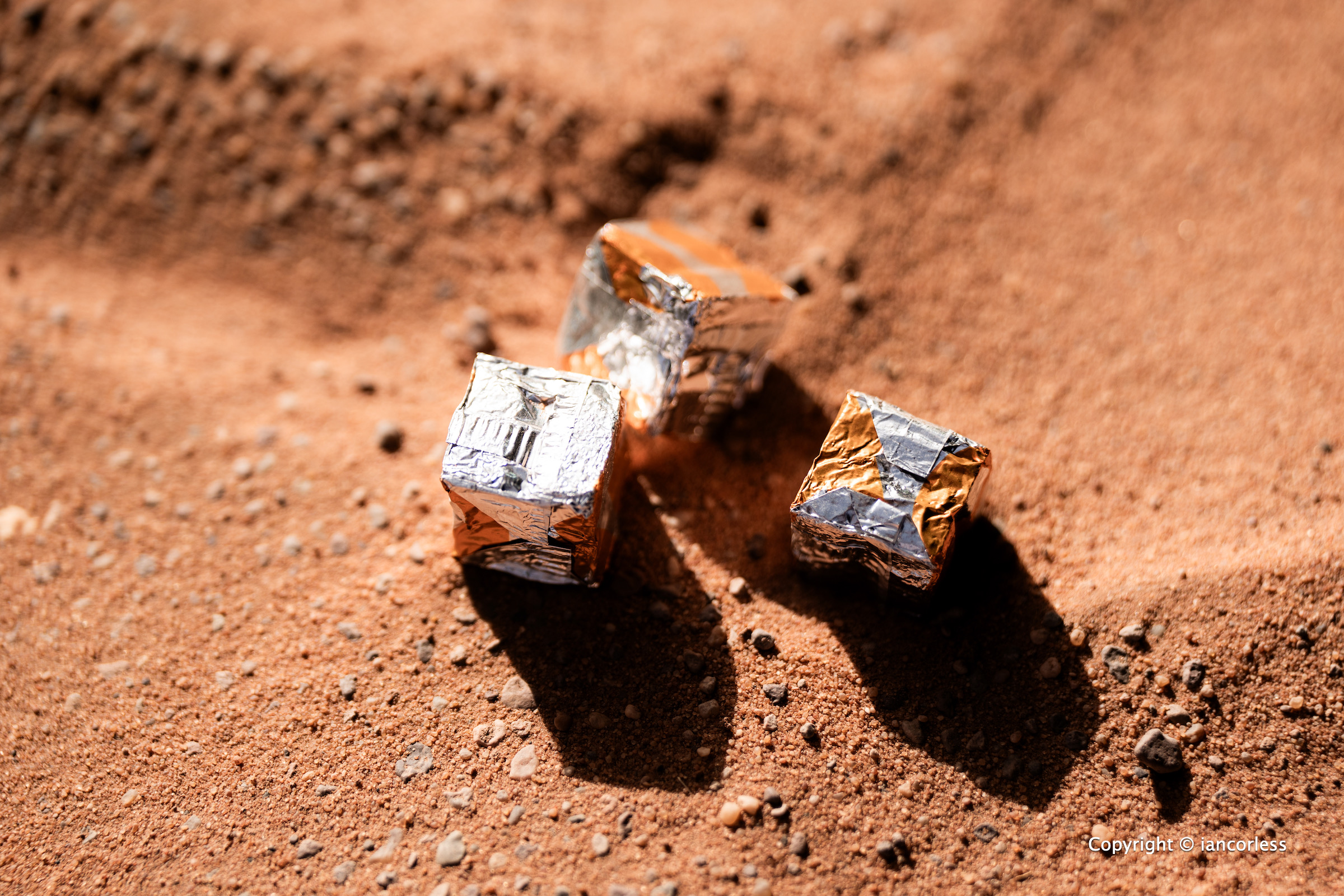
“Knorr” type cubes (2 per day) to favorize rehydration
a tube of sun cream of 50 ml minimum,
200 euros or 2,000 dirhams
the passport or for Moroccan residents, identity card valid at least until the end of the stay in Morocco. BUT for security reasons, it is strongly recommended to have a passport valid at least one month later; failing this, AOI declines any responsibility in case of problem.
the original MDS medical certificate, filled in and signed by the doctor
the original ECG and its tracing
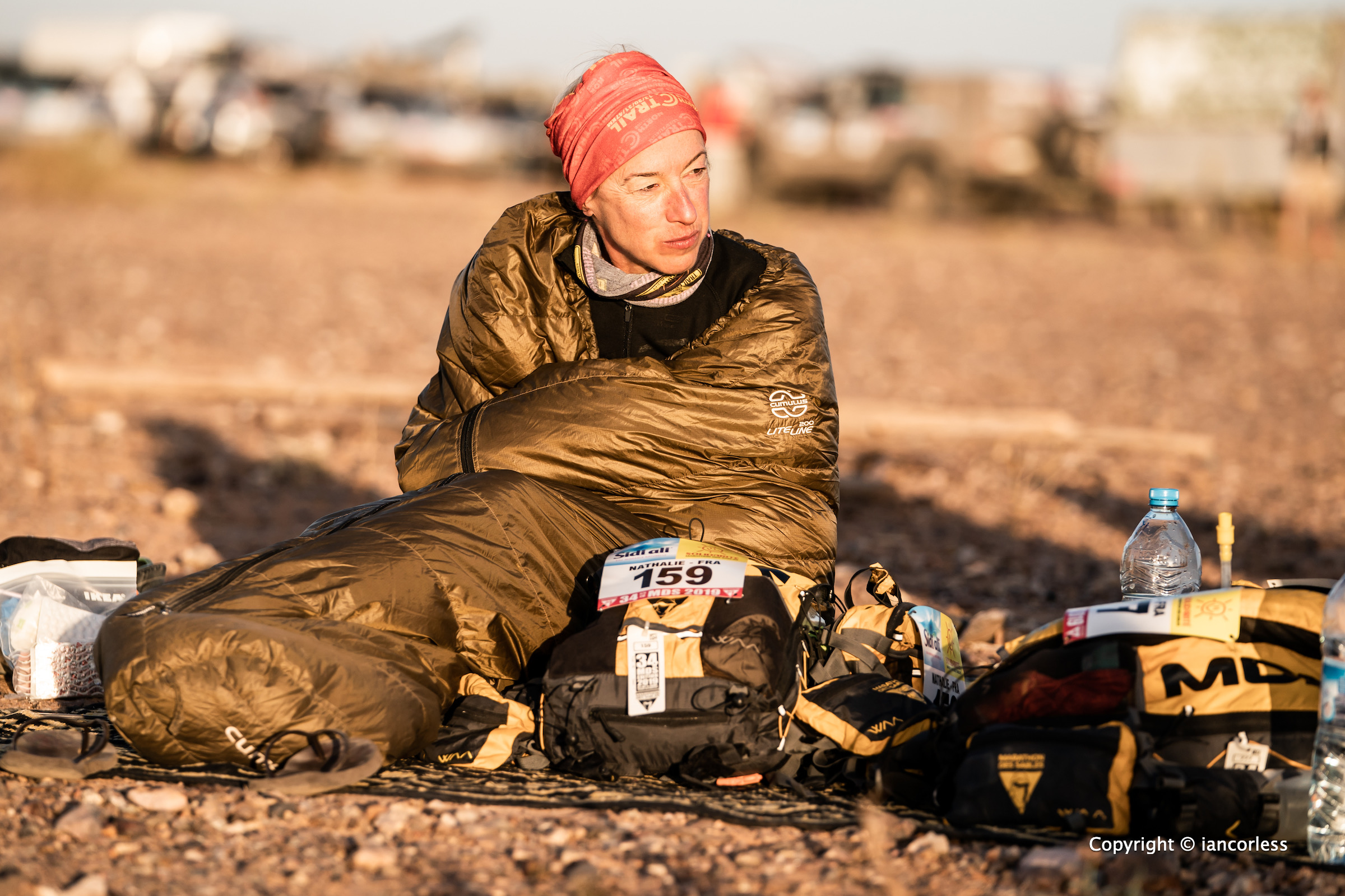
Sleeping Bag – Down Jacket – Waterproof
Take note that weather conditions and temperatures vary considerably. Also keep in mind, a small petit woman may well need warmer layers that a large man. Do you sleep hot? Do you sleep cold? When someone tells you you don’t need a sleeping bag, you don’t need a jacket, you don’t need goggles or you don’t need x, x, or x, take this advice and then ignore it. The best advice I can give, be prepared! Be prepared for all eventualities and then fine-tune equipment very close to the event, even at the event location on admin day so that you can make sure you have the appropriate equipment based on the current weather forecast. And yes, it can rain!
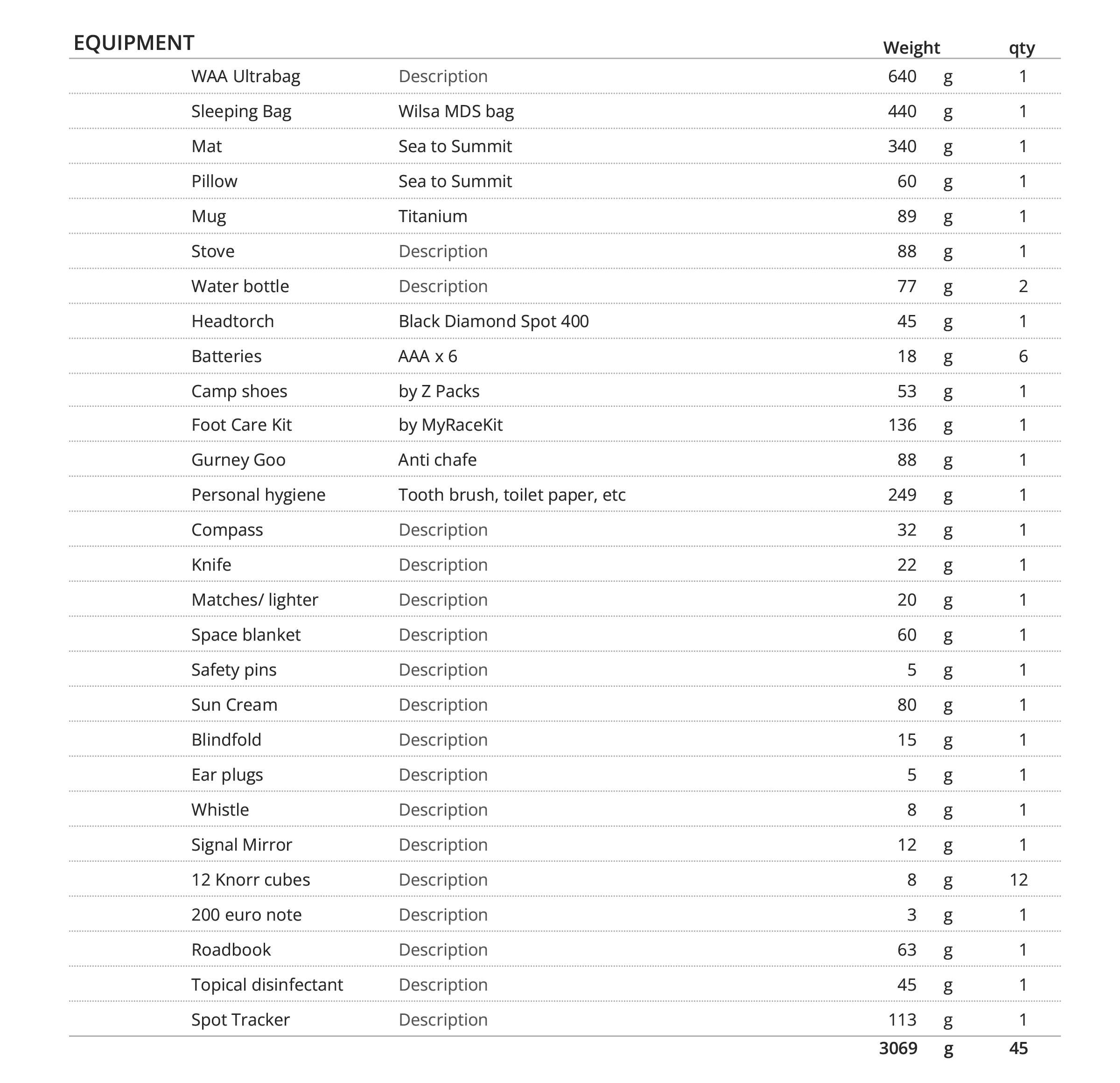
A full equipment list would look like below:
The above list weighs 3069g and this includes the MDS Road Book and the Spot Tracker, both items provided when in Morocco. You will notice there are no luxury items.
We then can look at DESIRABLE and LUXURY.
You may consider poles to be desirable, in all honesty, I think for most at MDS events, they are becoming almost essential. Of course, if you are a runner, you do not need them. Just lightweight, folding carbon poles. I recommend Leki Ultralite FX One. A watch with GPX and great autonomy such as Coros Vertix and/or Garmin Enduro. If you don’t have a watch with a good battery, you are then requiring a battery pack and for me, a battery pack falls in the luxury list.
As for luxury, you absolutely MUST keep luxury items to a minimum, I consider a phone to be luxury at an MDS event. The only item I would consider is an MP3 player with great battery life and lightweight earphones.
FOOD
MDS 120 are 4-days and 3-stages, The Legendary is 7-days and 6-stages, so, you need to adjust the requirements accordingly. The typical rule is you must have 2000-calories per day. For The Legendary this equates to 12,000 calories as a minimum requirement, however, I think you are better assuming 14,000 calories.
Food is personal, so, make sure you understand what you require and make sure you have a balance of fat/protein/ carbohydrate and make sure you have sweet/savoury based on your taste requirements. Note that as days pass, the need for sweet tends to shift to savoury. Try and test all food before racing.
Also consider if you will have hot or cold food. Not all food rehydrates well with cold water.
Also, a large man, say 6ft 2″ and 85kg will require far more food than a woman who is 5ft 2″ and 55kg. Keep this in mind and use the minimum 2000 calorie as a guide.
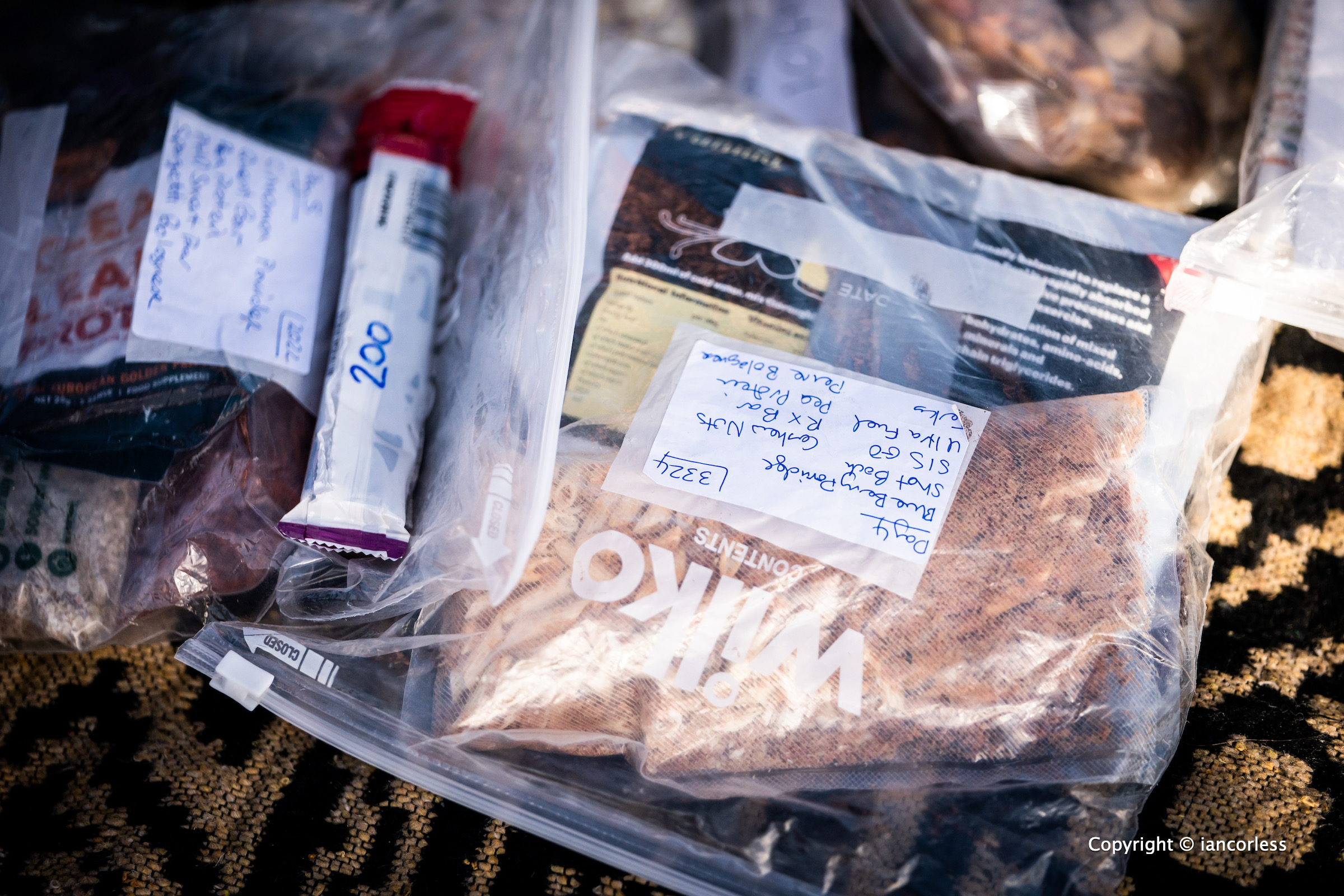
Prepare food bags, a bag per day. That way it is easy to control what you eat.
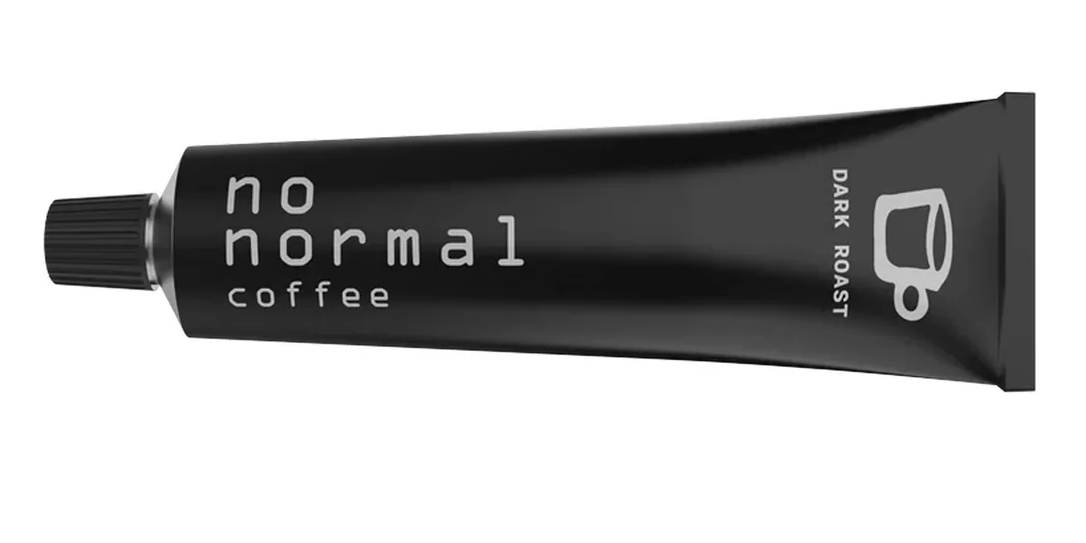
Need coffee, check out NO NORMAL. Yes, coffee in a tube.
6-stage and 7-days at The Legendary could look like above with 7-dehydrated breakfasts and dinners and then a combination of snack food for during and post each stage. Typically you can expect food to be between 4000 and 4500g. My list above comes out at 4048g.
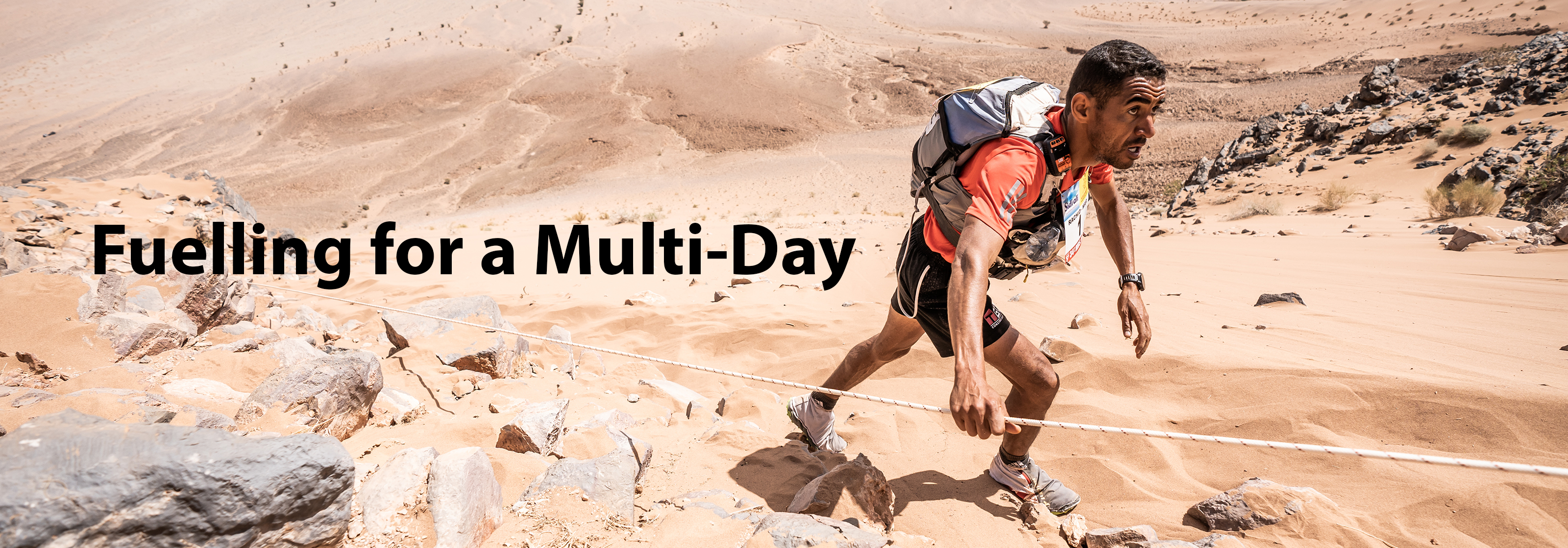
Fuelling for a Multi-Day – Marathon des Sables – The Legendary
Marathon des Sables pioneered the multi-day racing format and as such is often a key starting point when discussing a fuelling strategy for an adventure that lasts a week or longer.
Multi-day adventures require fuelling and how one obtains food can vary greatly. In principle, there are several keyways:
Self-sufficient
Semi-supported
Supported
For many, self-sufficiency poses the greater question marks and worries as there are multiple factors to consider:
How many days?
Weight?
Balance of nutrients and calories?
Hot or cold food (or both)?
Access to water?
Environment?
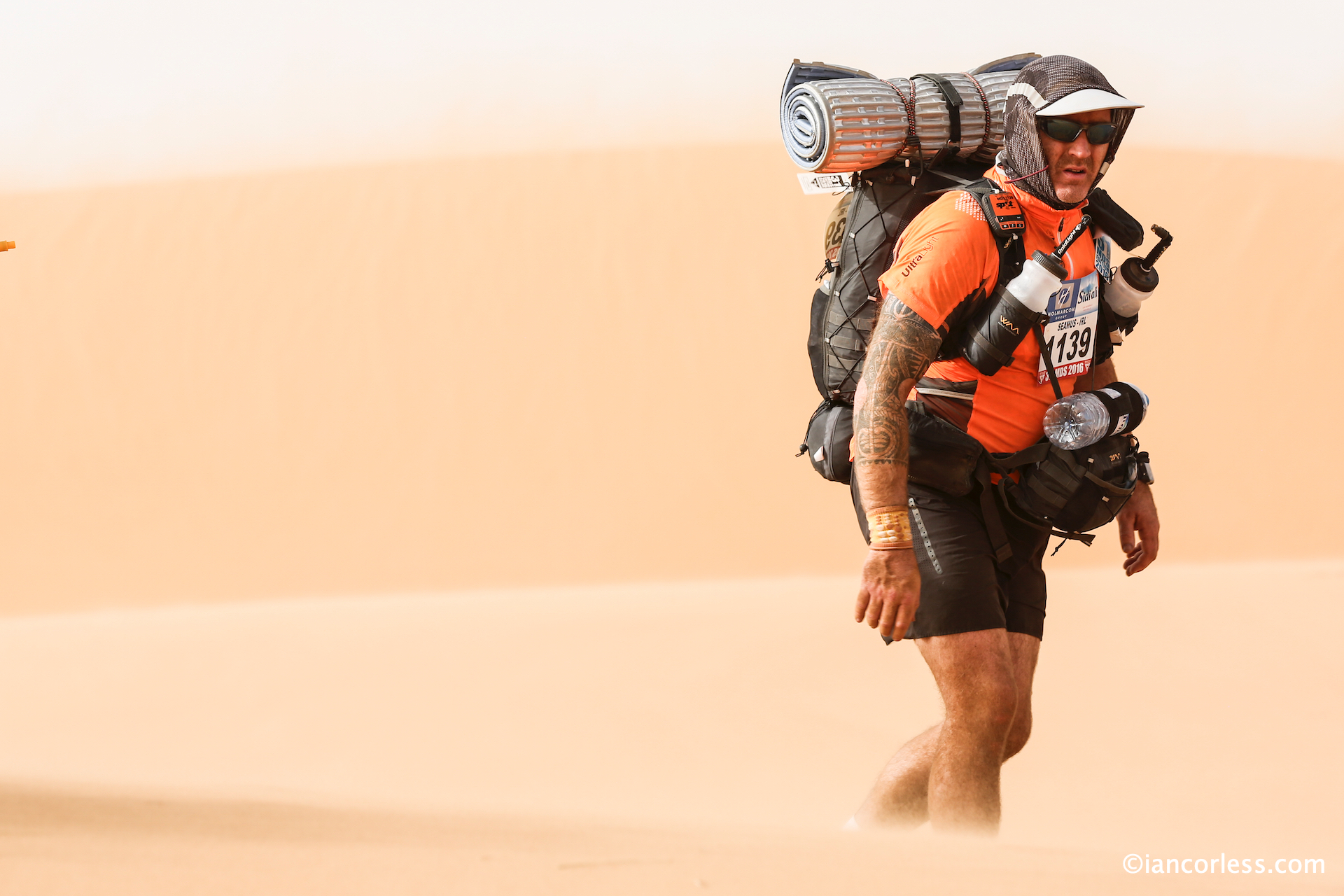
Loaded up for a week in the Sahara.
Runners are required to carry all they need to survive in a multi-day like MDS. Fuelling is essential to survive and the balance of calories v weight is a prime concern. The only things that are provided are a shelter (bivouac) which is shared with 7 other runners and water which is rationed. Since its creation in the mid 80’s, the MDS format has been copied and used as a template for other races all over the world.
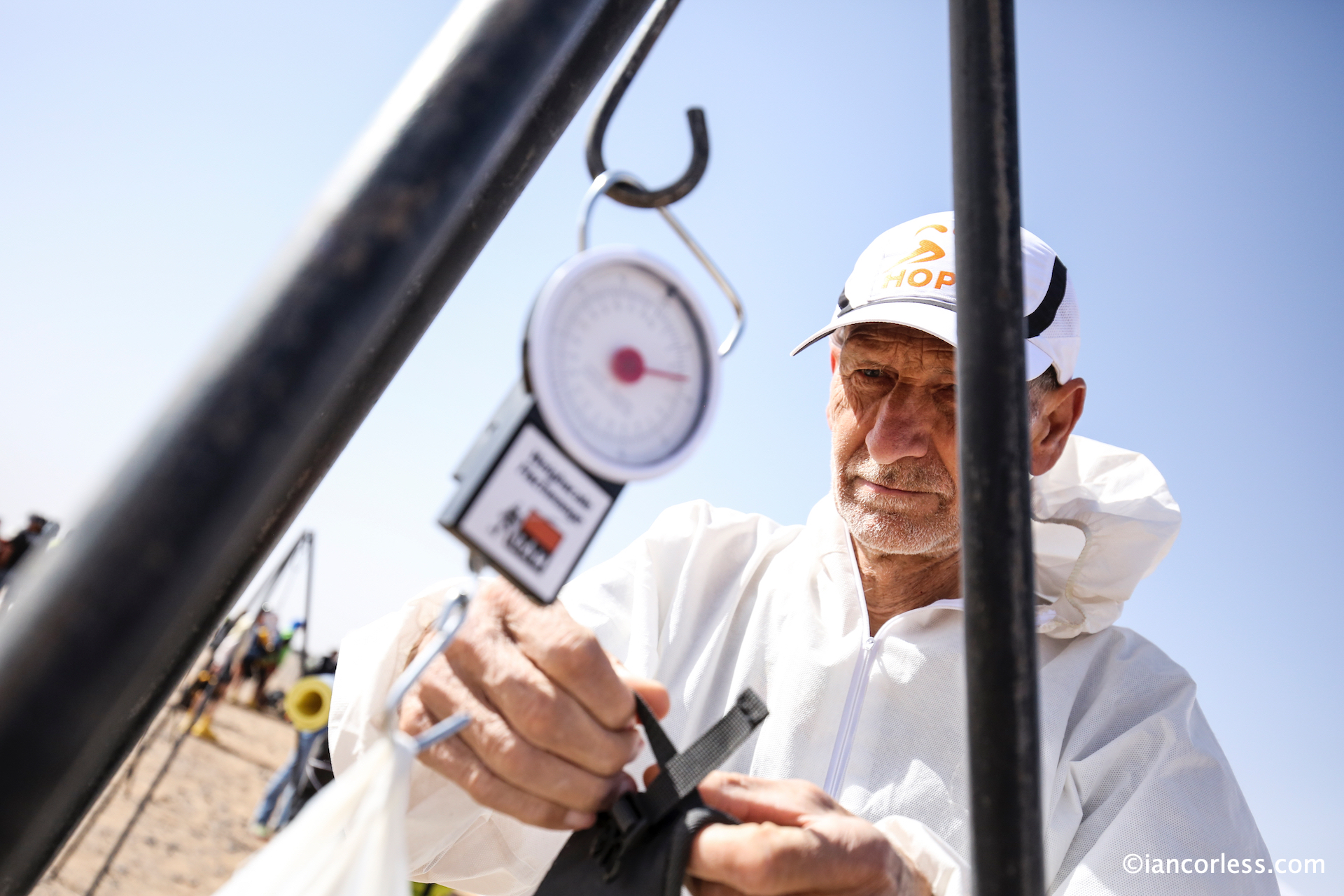
Get your pack as close to 6.5kg (plus water) as possible.
Weight is the enemy of a multi-day runner or fastpacker and therefore balancing equipment, food and water is an art form in itself. Read an article HERE about the equipment required for a race like MDS.
Food will take up most of the weight on any adventure when being self-sufficient. MDS, for example, has a minimum food requirement of 2000 calories per day, a minimum pack weight of 6.5kg and then one must add water, typically a minimum 1.5 litres (1.5kg) which makes the starting pack weight a minimum 8kg.
Food for multiple days will typically be around 4 to 5kg.
*****
Quite simply, running or walking, covering 250km over 7-days will leave the runner in a calorie deficit. Therefore, it is essential to optimise the food one takes.
FACTORS TO CONSIDER
How fast one goes does greatly impact on food choice and how calories are not only consumed but chosen. The macronutrient choices will change based on the balance of carbohydrate, protein and fat. In simple terms, a runner will burn more carbohydrates and a walker will burn more fat. Humans store enough fat to survive many days and even weeks. However, carbohydrate stores deplete quickly and need to be replenished.
Body weight, age, individual needs are important for all and males may well require more calories than a woman due size and muscle mass.
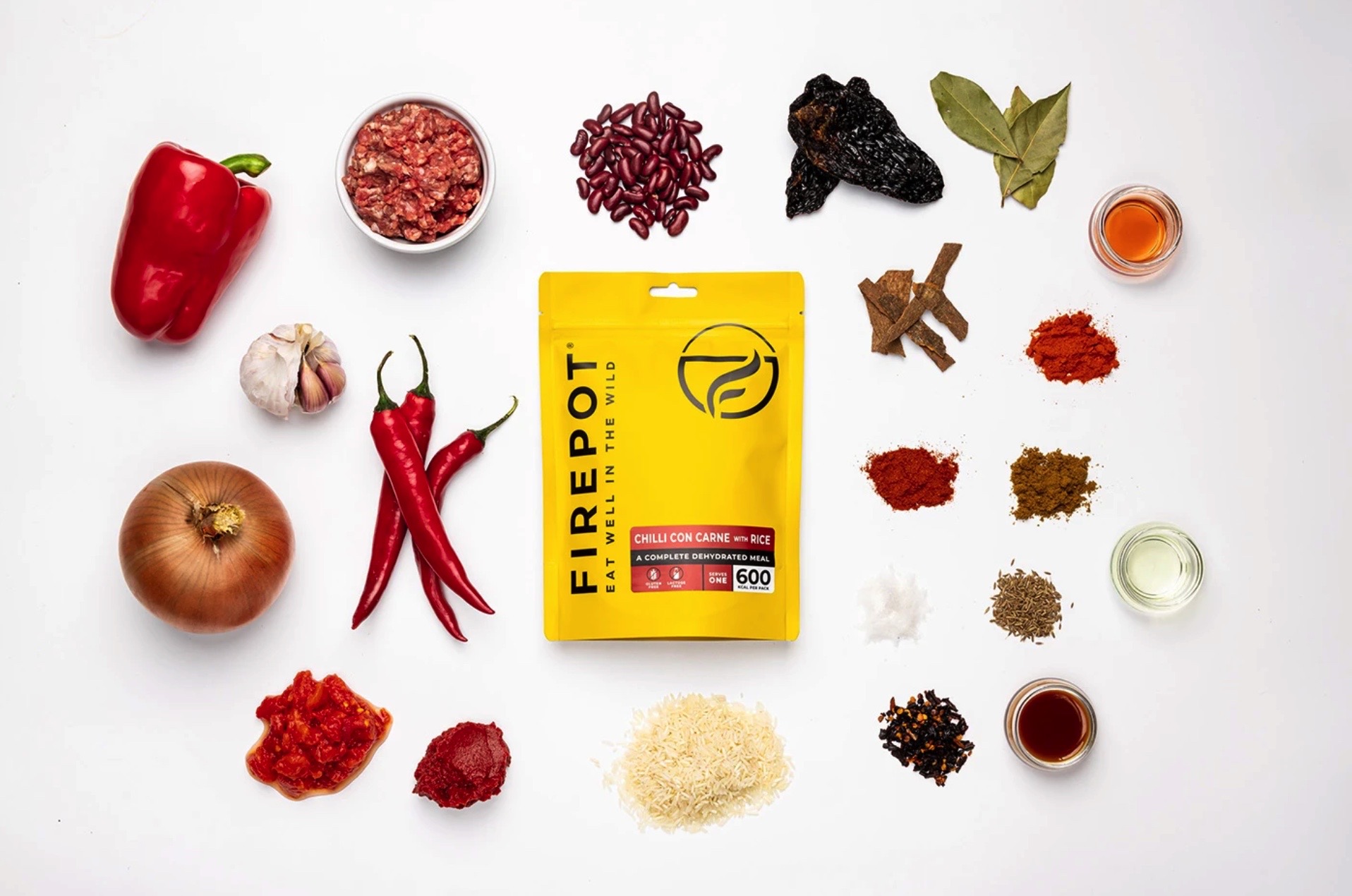
Main meals will usually come either freeze dried or dehydrated. Both processes involve removing the water from food to preserve it. Freeze-drying involves freezing the food to a very low temperature and drying it in a vacuum to remove moisture. Dehydration involves passing warm air over the surface of the food to remove moisture. Dehydration creates food that tastes like it should, with plenty of texture and flavour. It is an altogether slower and gentler process than freeze-drying. Please note though, that hydration times take considerably longer with cold water and taste can change. Test meals in advance using hot or cold water.
Firepot are a UK brand who create tasty meal by hand, using fresh ingredients and then dry each meal.
Carbohydrate, Fat and Protein are essential for balance and foods for an expedition are usually balanced specifically for the needs of an active individual. Typically, 55% carbs, 30% fats and 15% protein are considered balanced. As an indicator in regard to calories, carbohydrates have 4 calories for 1 gram, fat has 9 calories for 1 gram and protein 4 calories for 1 gram.
Remember, we are all individual and although any recommendations here provide a guide and a template, you the individual need to answer very specific questions and ultimately, you may need to seek the advice of a nutrition expert to fine tune a fuelling plan for a multi-day adventure.
As a rough guide, BMR is the number of calories a person burns in normal day-to-day activity.
Example for a 37-year-old, 6ft tall, 170-pound man.
(66+(6.2 x 170) + (12.7 x 72) – (6.76 x 37) x 1.55 = 2663 calories
How to use the equation: (66+(6.2 x weight) + (12.7 x height) – (6.76 x age) x 1.55 = 2663 calories
The ‘Harris-Benedict‘ formula takes into consideration daily activity.
Fat adapted athletes will have specific requirements and the nutritional plan will be different.
Answer the following questions:
Age?
Male or female?
Body weight?
Walker?
Walk/ runner?
Runner?
Vegetarian/ Vegan?
Am I typically a hungry person?
Am I more hungry or less hungry with exercise?
Food allergies?
Will I use hot water or cold water?
A TYPICAL DAY
Breakfast – Ideally slow-release carbohydrate, some fat and quality protein.
Starting the day with breakfast.
Running Food – This will vary on the length of the stage, up to 6-hours and you may prefer easily absorbed carbohydrates, bars and or energy in drink form. For longer stages, the addition of real food, savoury and some protein would be wise. For a very long day, for example, the long day at MDS, you may even need a meal?
Post run food (immediate) – A shake is a great way to start the recovery period as it is easily absorbed, and this should have carbohydrate and protein.
Dinner – A meal will form the basis for dinner and think about some small treats for each day, these will give you something to look forward to and help keep your palette fresh.
FOOD PLANNING AND IDEAS
Breakfast:
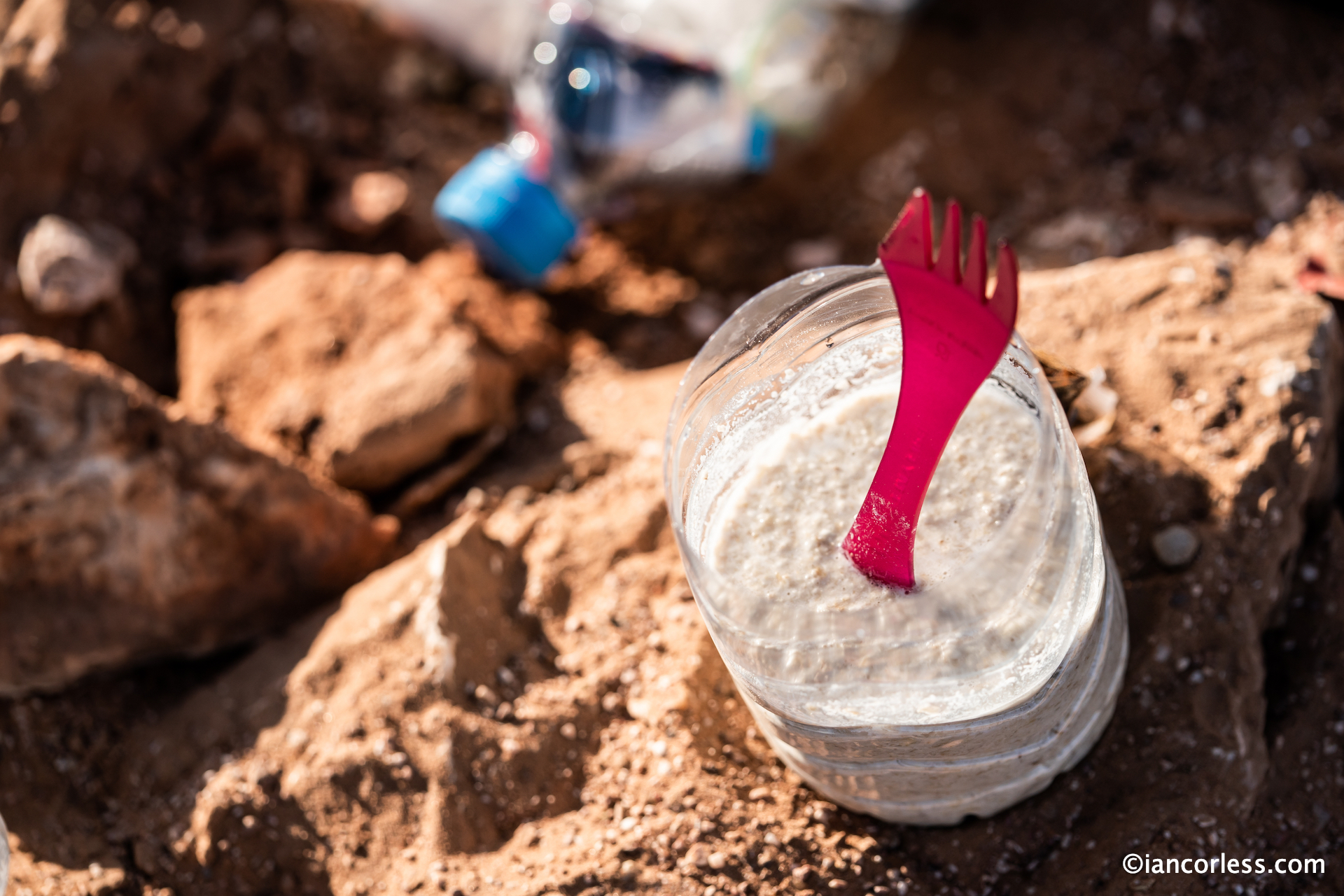
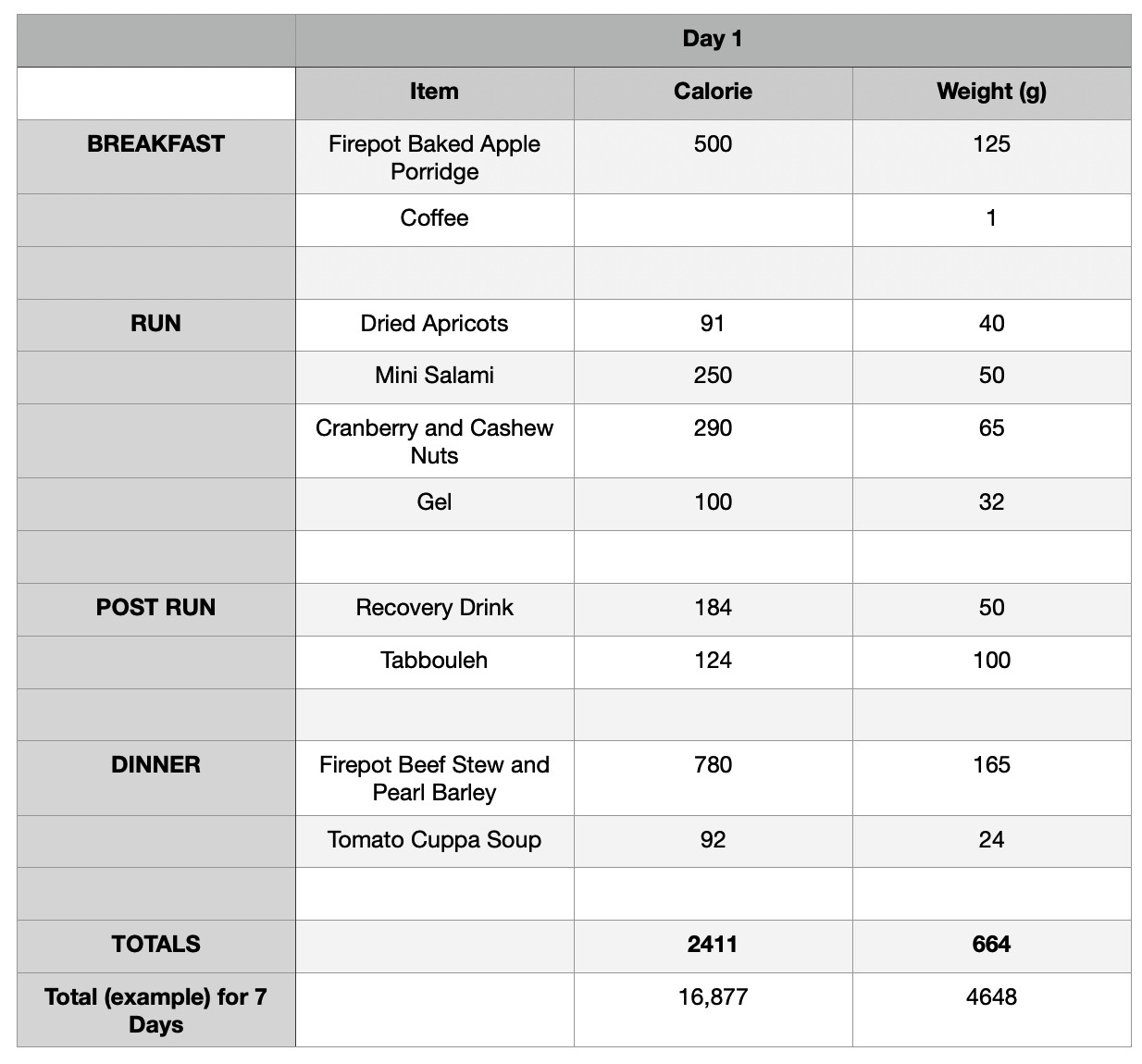
A freeze-dried breakfast is a good way to start the day. Top tip: Add the water to your breakfast at sleep time (especially if using cold water) as it will rehydrate during the night and be ready for eating in the morning. Of course, make sure it can’t be knocked over, get contaminated or damaged – that would be a disaster! Using a re-sealable plastic bag is a good idea. Example: Firepot Baked Apple Porridge is 125g with 500 calories.
Breakfast is essential to fuel the day ahead.
Muesli is popular and provides energy and fibre, it can easily be combined with a freeze-dried dairy product.
An energy bar for some works, but they often are heavy in proportion to the calories provided. However, for some, they are a perfect start to the day.
Top tip: Consider an evening meal as an alternative to breakfast. Sweet tasting food can become boring and sickly, the option to have something savoury with some spice can be a life saver.
During the run:
Runners will need typically more carbohydrate in an easy form so that they can maintain pace. By contrast, walkers will move slower, have more time to eat and easier time digesting, therefore real foods are possible. The balance is always weight v energy. Don’t rely completely on liquids, some solid food and chewing is good for the body and mind.
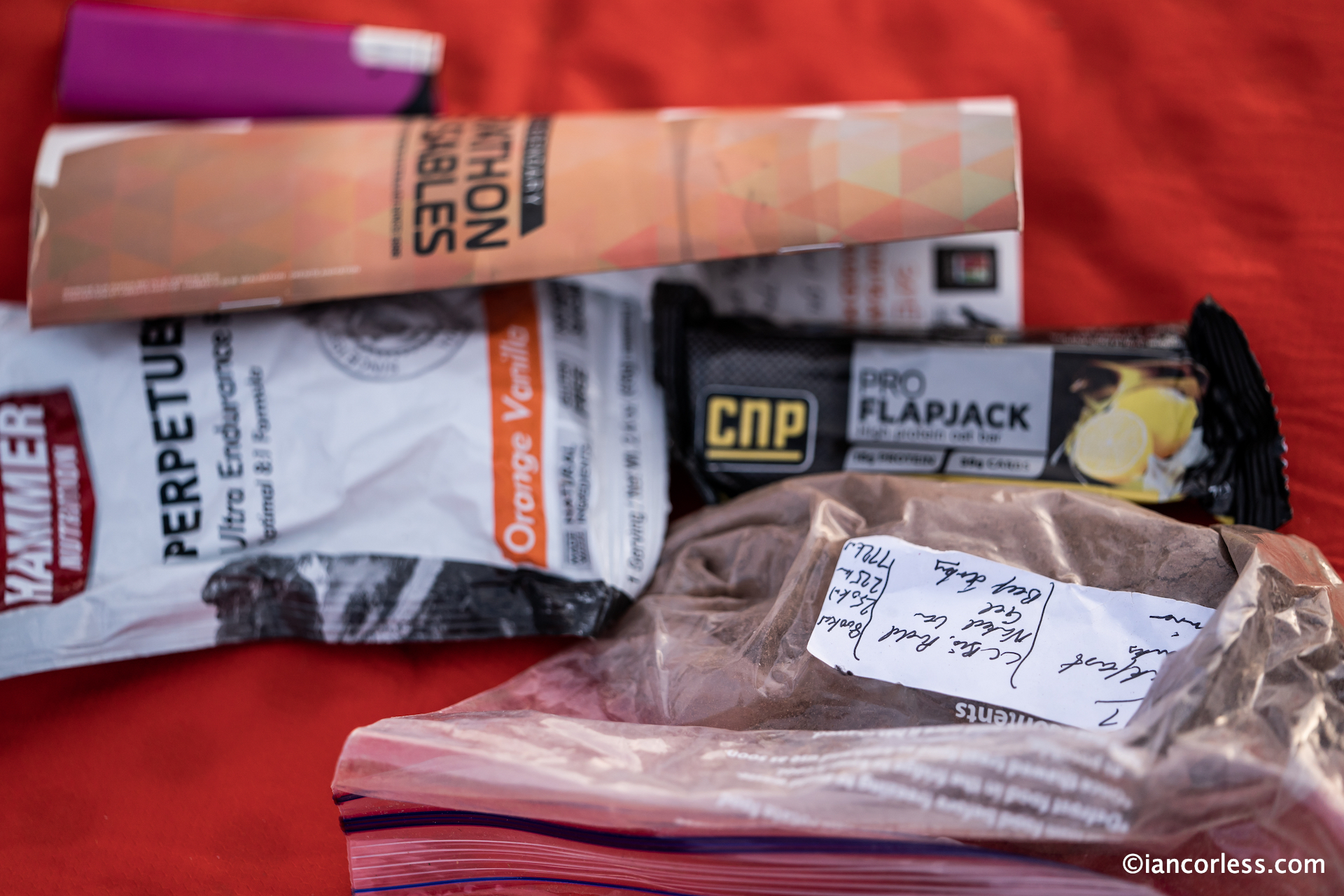
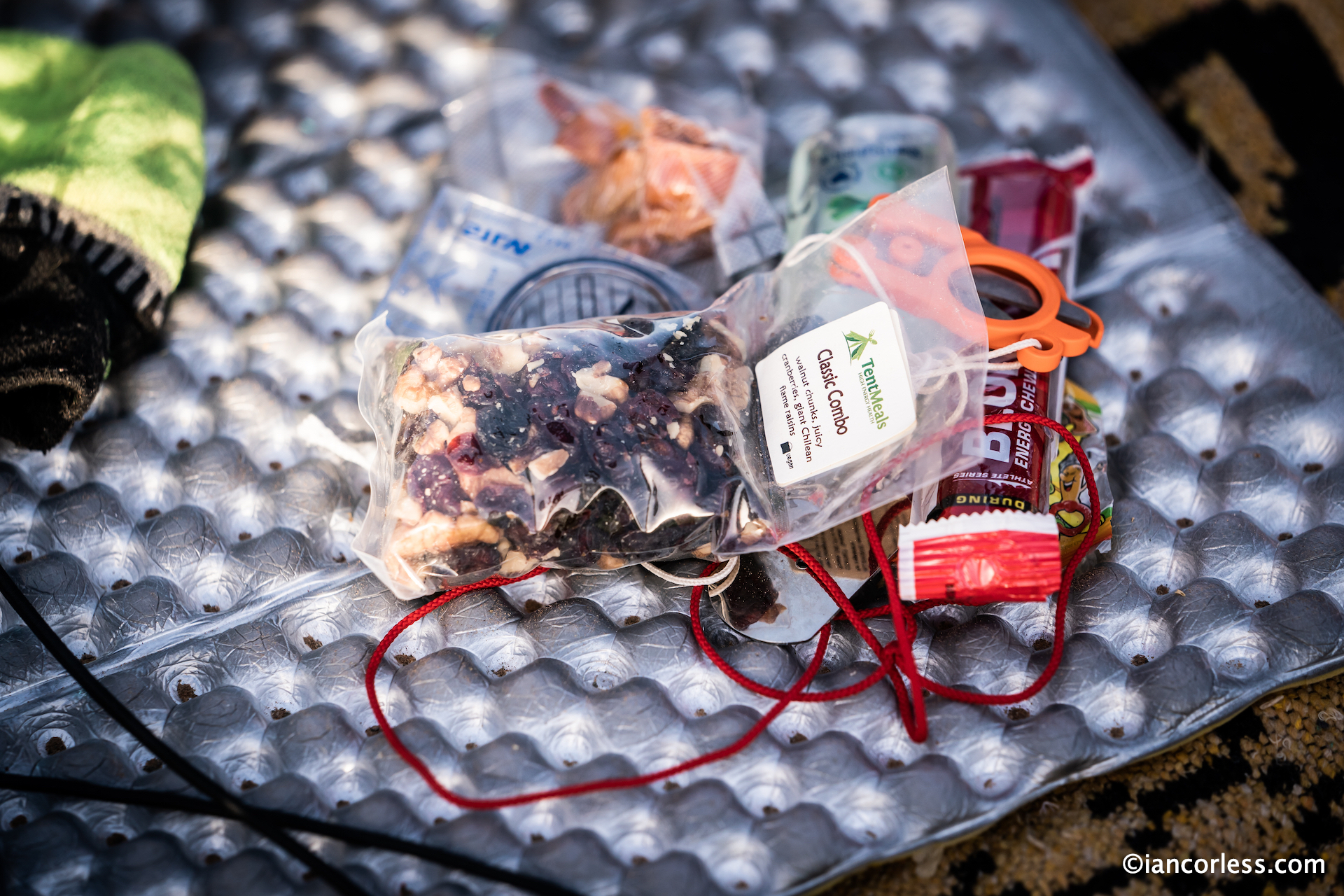
Some ‘typical’ run snacks.
Example: Gels are around 32g each. Let’s say you took 1 gel per hour. Rachid El Morabity won the 2019 MDS in 18:31. So, 19 gels would weigh 608 grams. By contrast, if the race takes you 60-hours, 60 gels would be 1920g! Not only is the weight not feasible but also the volume size would just not work.
Powders (energy drinks) that one can add to water are an easy way to get calories and nutrients. They are also considerably lighter.
Energy bars.
Beefy jerky.
Dried fruit.
Nuts such as almonds are rich in fat and calories.
Trail mix.
Dried meat.
Post run:
Back in bivouac, first priority is drink and food.
A recovery drink is the quickest way to get balanced calories immediately in the body to start replenishing the body. Have this shake as soon as possible. Then do personal admin such as feet, clothes, bed, etc. One hour post the run, consider a snack like tabbouleh as this is easily hydrated with cold water and add some protein to it – dried meat a good option.
Dinner:
A dehydrated meal will make up the main calories. Depending on the person, the need for more or less calories will vary. Some companies, Firepot a good example, provide meals in two sizes: 135g with 485 calories or 200g with 730 calories for Vegan Chilli Non Carne and Rice.
A post-dinner treat is a good idea, this could be another freeze-dried option or a low-weight and high calorie option. A sweet such as a Lemon Sherbet is a simple way to add some freshness to your mouth and palette and although has little calories, it can be a nice treat.
Top tips:
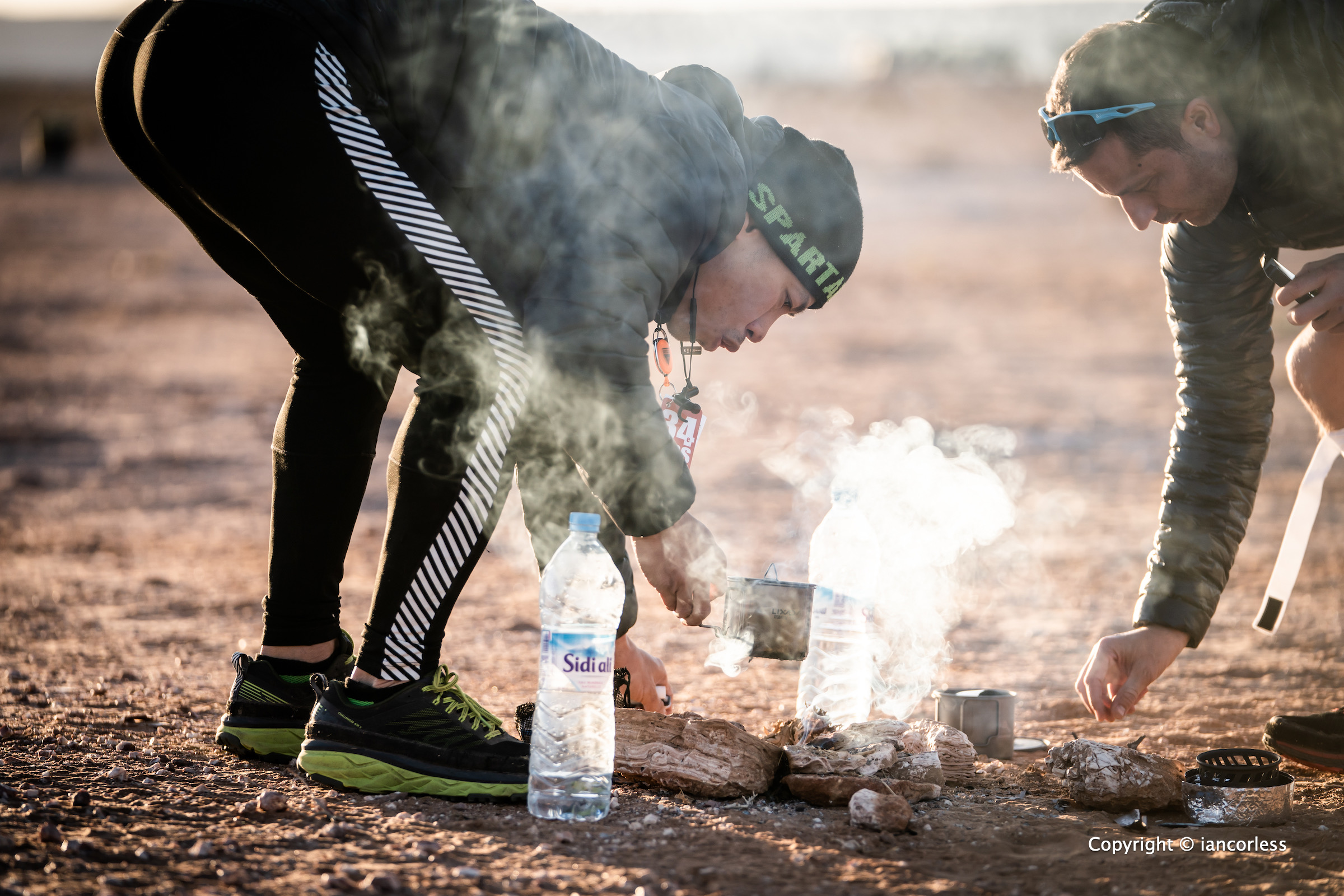
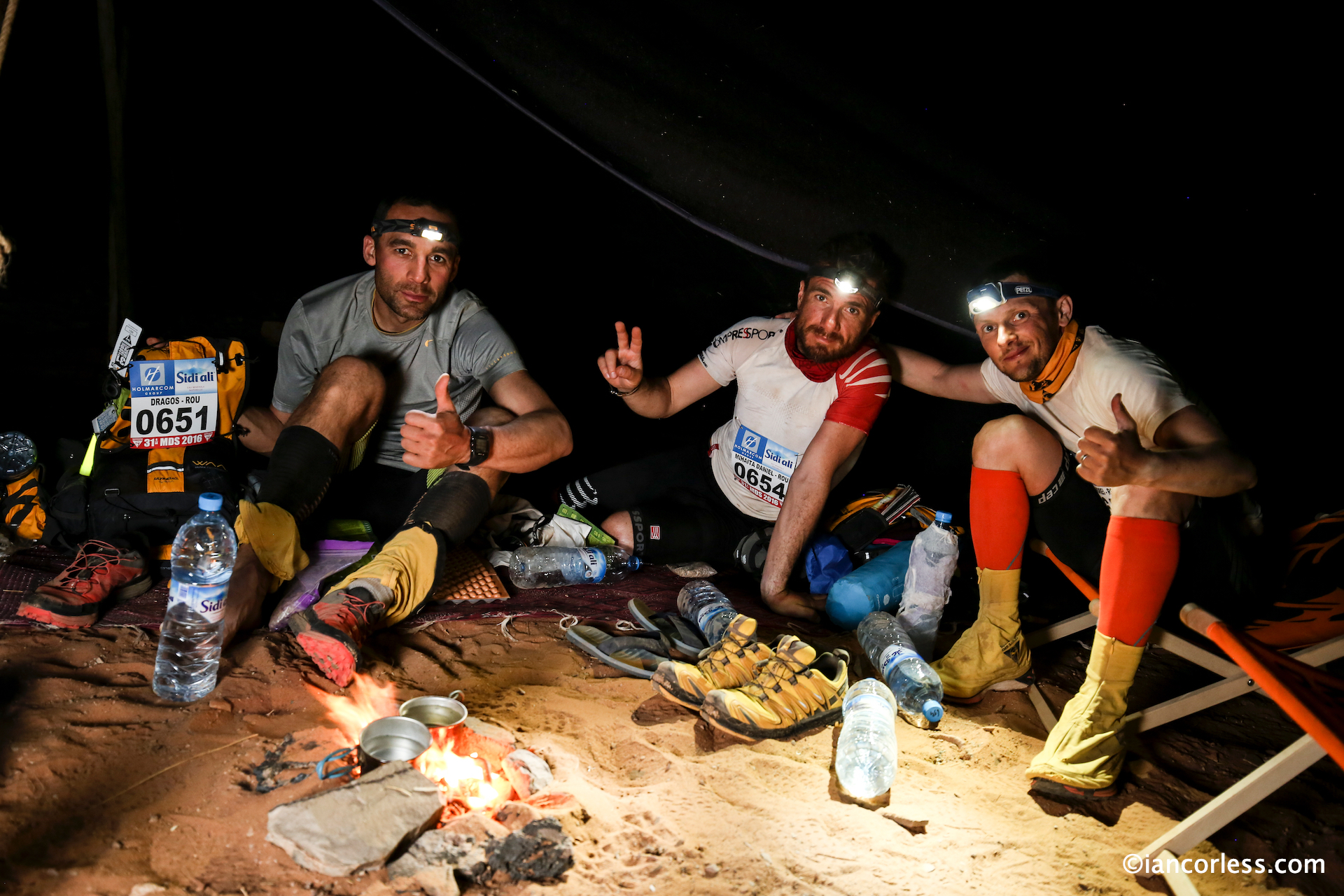
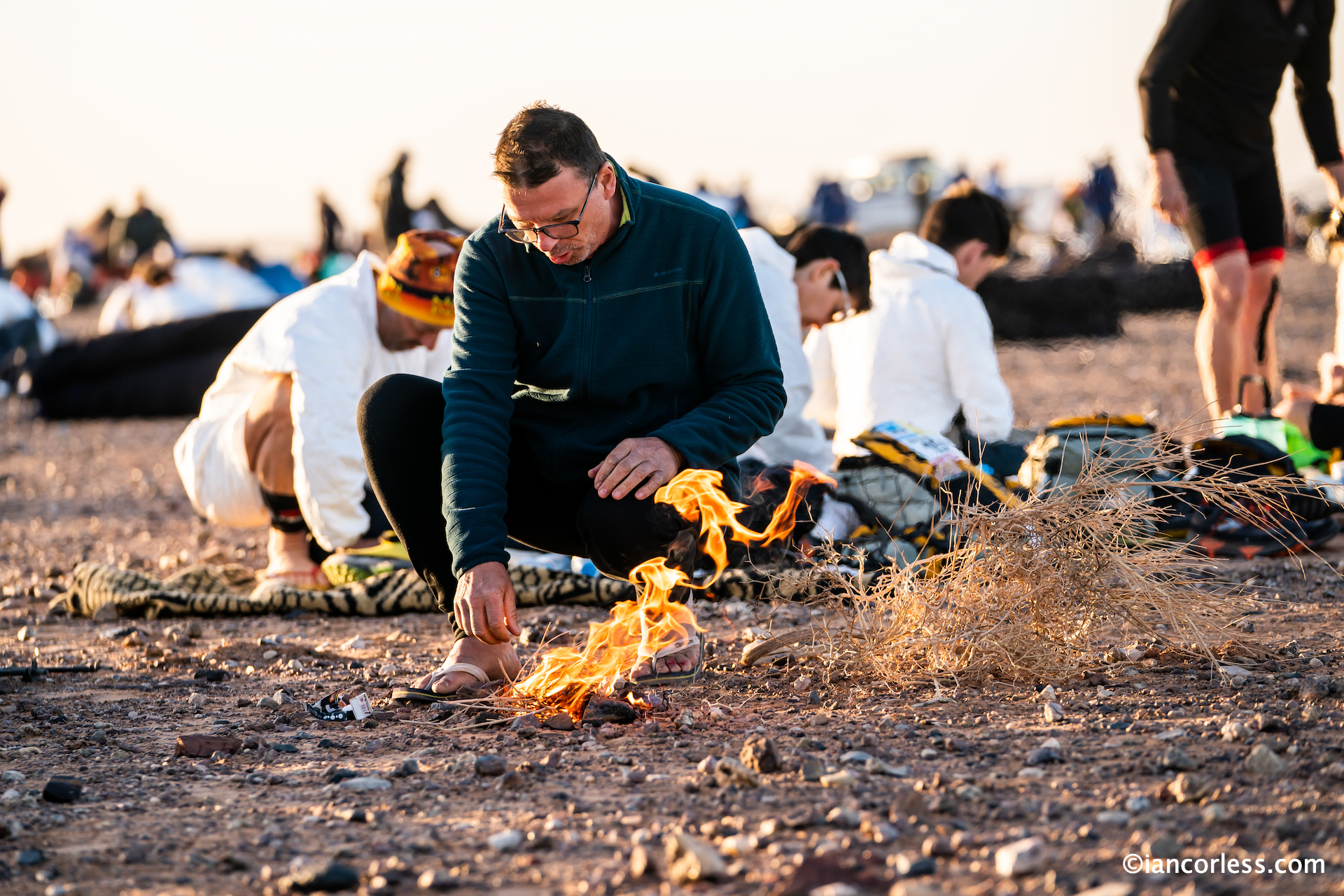
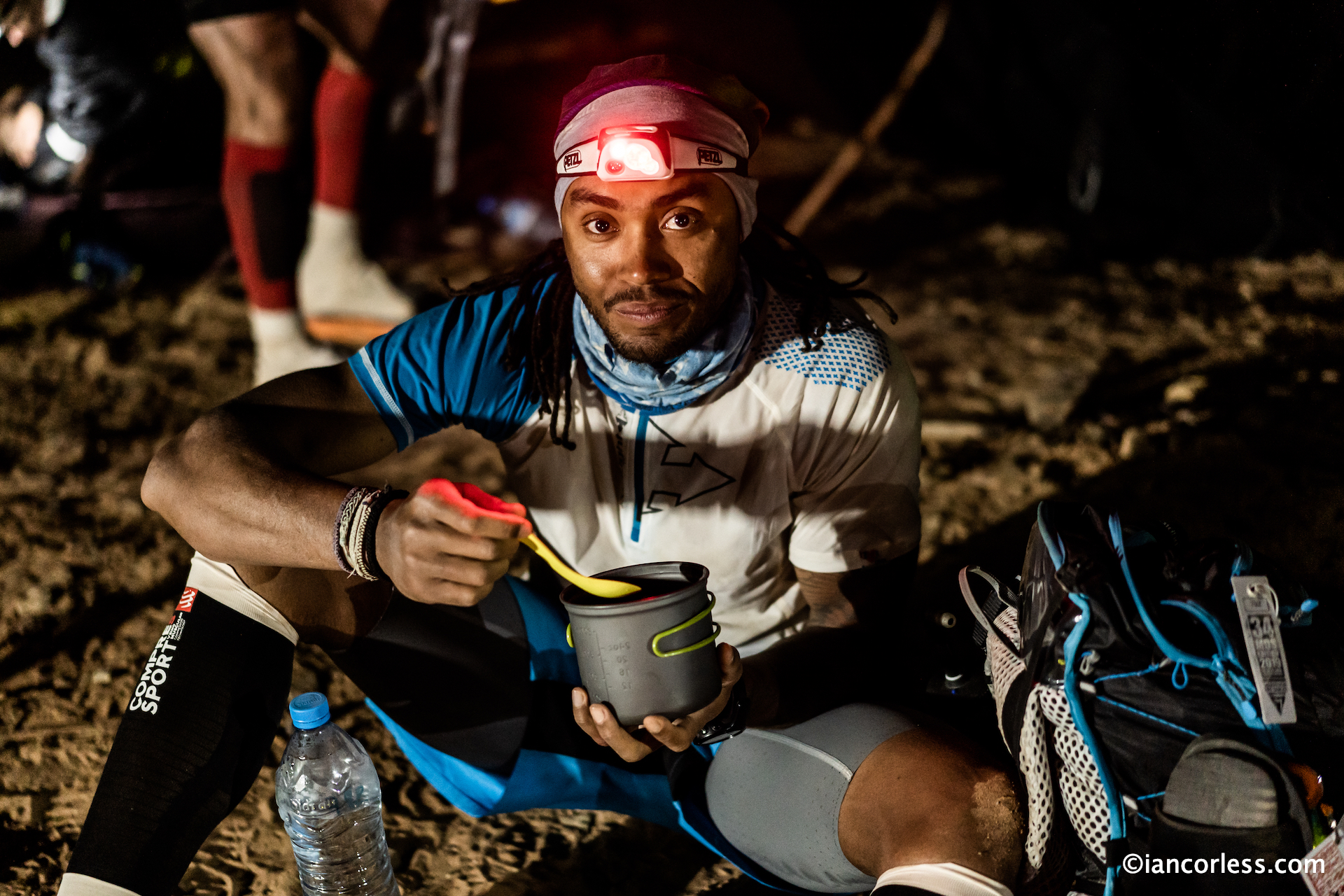
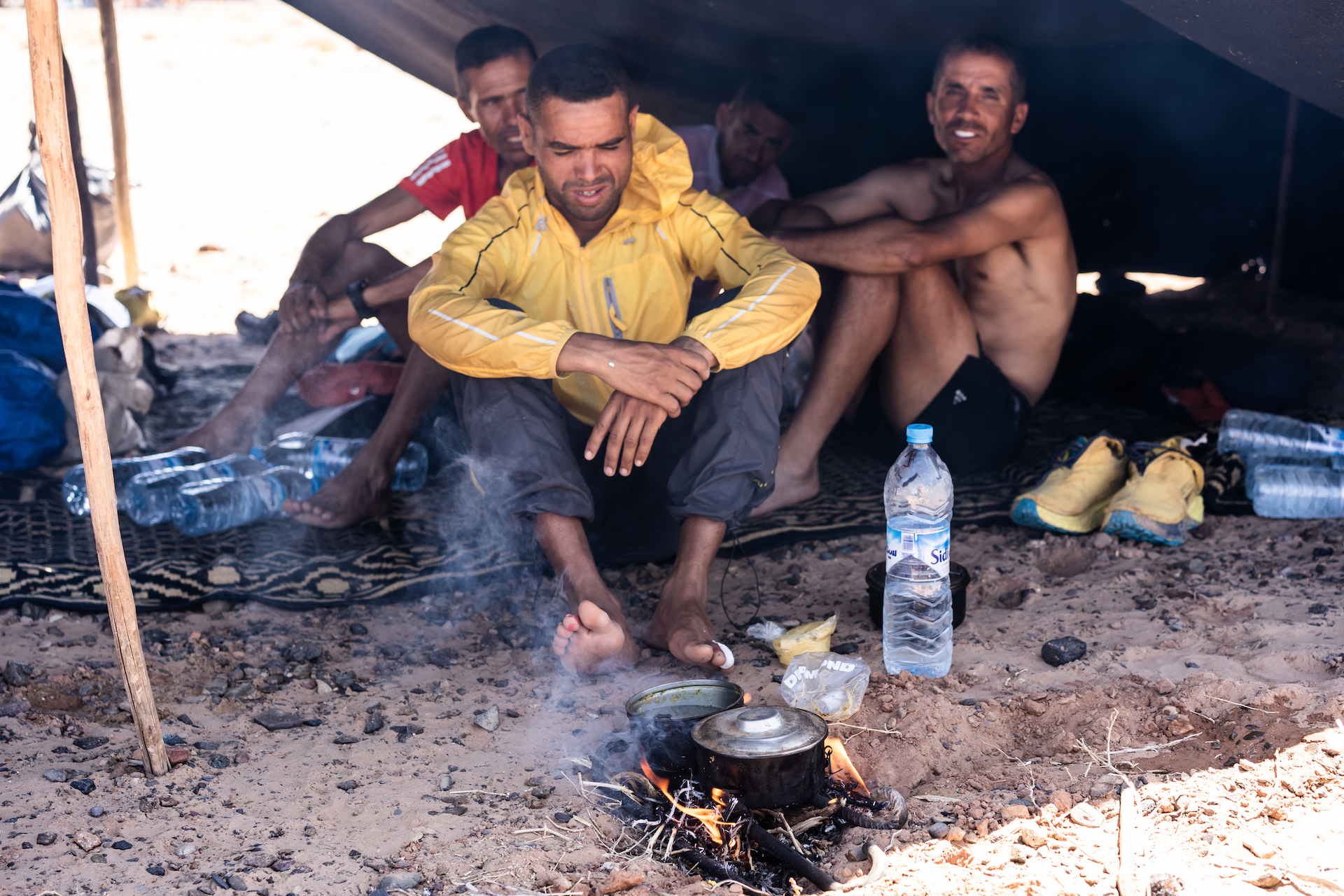
Experienced runners make a real fire to boil water.
Try everything out before any race or event. You need to know what works for you when tired and fatigued. Try to simulate race situations so you have a good understanding of your palette and your body. Test for taste, stomach and brain.
Just because you love Spaghetti Bolognese, don’t be tempted to take 7 for a 7-day race. You and your palette become bored quickly.
Be careful with spices and anything that may irritate or aggravate a digestive system that will already be under stress.
The choice of having hot water can be a deal breaker. For some, a hot coffee or tea is just essential! In addition, food is typically more pleasurable when hot and hydrates quicker with hot water. You cannot use any gas stoves at MDS so you must use fuel tablets and a small stove. However, here are some alternative ideas: 1. If you finish early in the day, leave a bottle in the sun and let it warm naturally. 2. Often, there are lots of shrubs, twigs and branches around bivouac, it is possible to make a fire, but you will still need a pot.
Water at the race is provided in 5Ltr bottle at the end of the stage this needs to last till Cp1 of the following day, so, plan water use.
Consider repackaging all your food to make the volume and weight less, if you do this, be sure to include the nutrition label in your new packaging.
Take extra food and options. When in the Sahara, you can make some final food choices.
The ‘Long day’ and following ‘Rest Day’ will require different fuelling strategies, take this into consideration.
Rules – Race rules dictate you have a minimum 2000 calories per day, that you have nutrition labels for the food that you take and that on the morning of the last day that you have 2000 calories remaining.
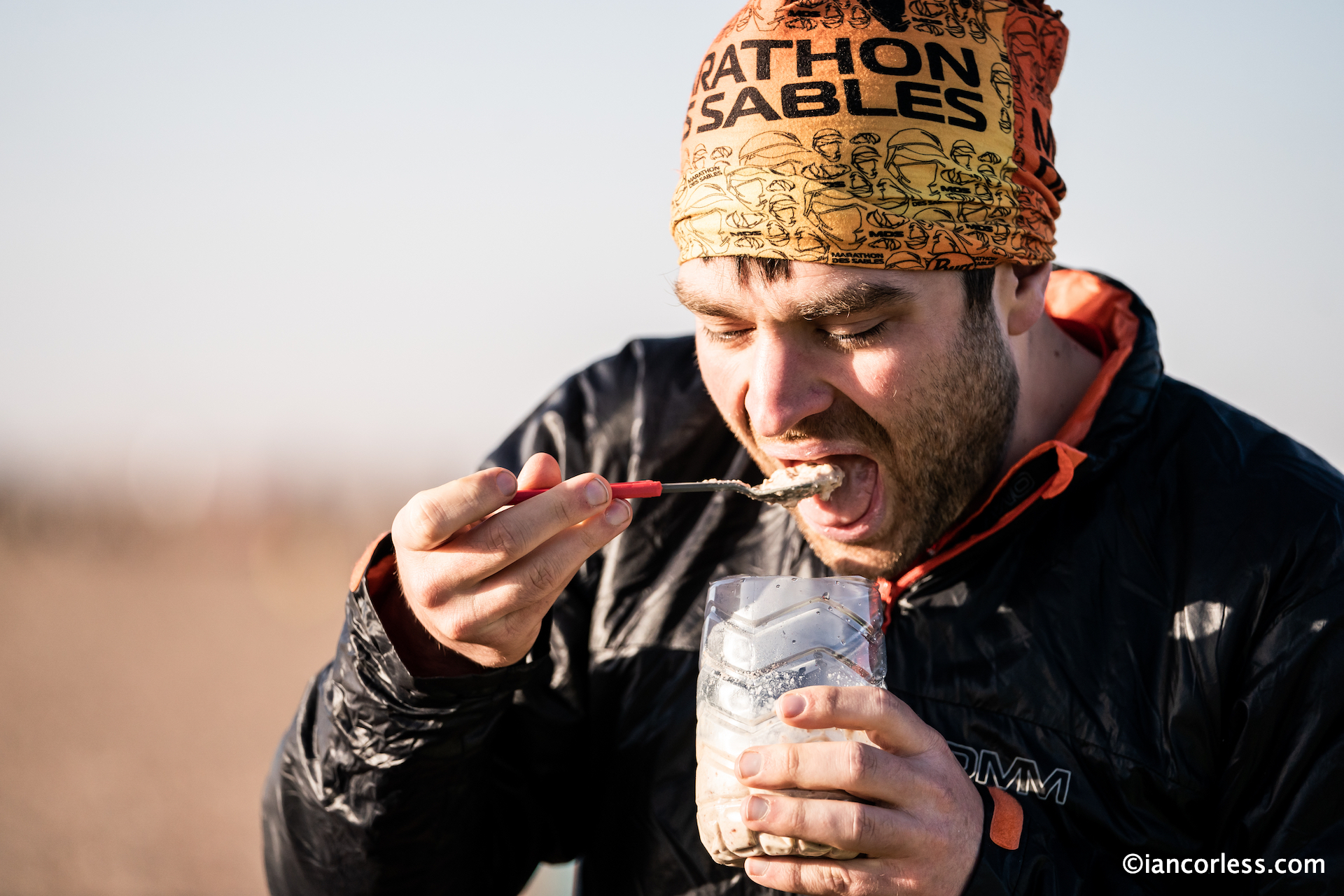
A cut down water bottle is a great food bowl.
WATER
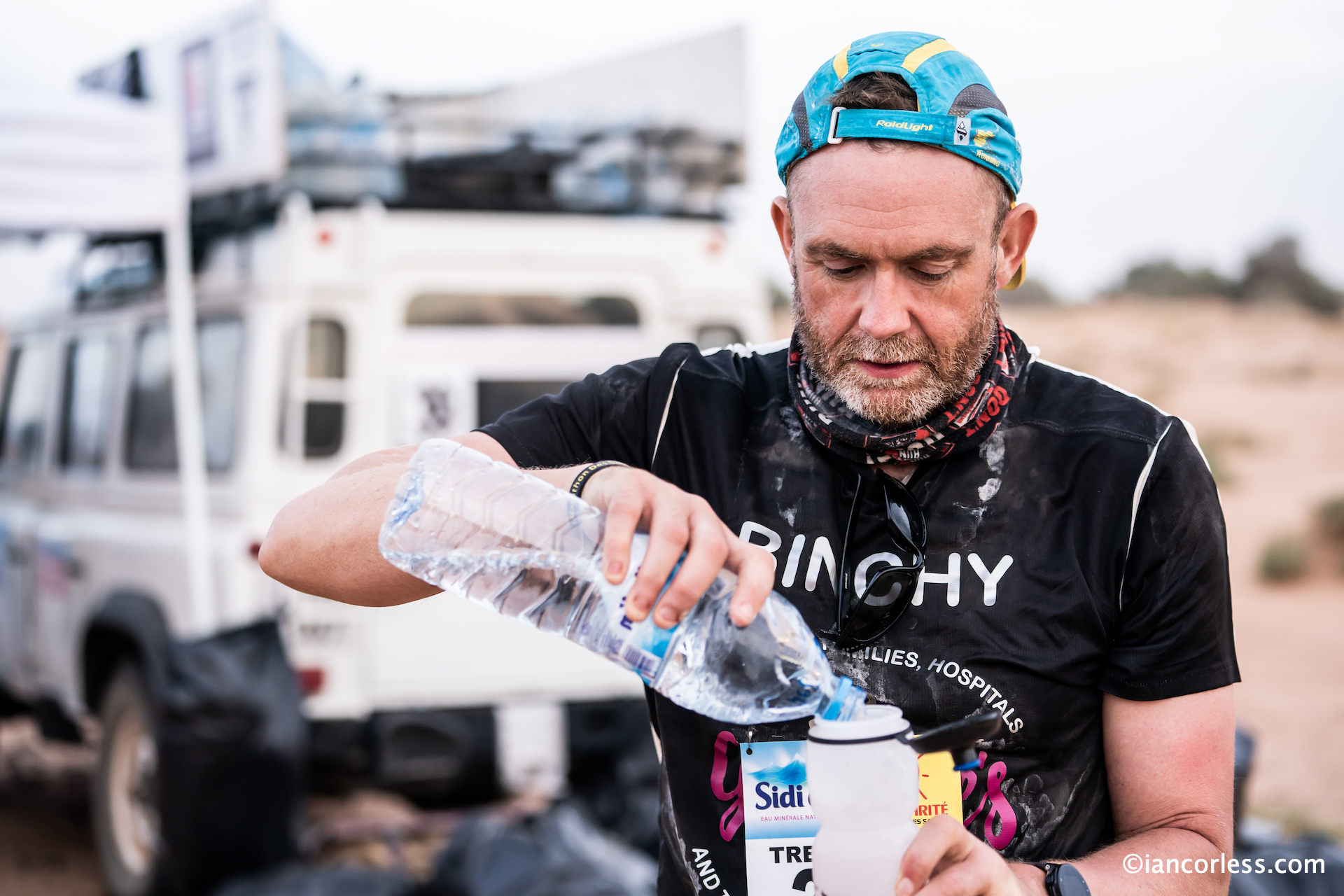
Water is the only item provided at a race such as MDS and this is rationed. You are provided water for ‘in’ camp and then this is replenished while running at Cps which are typically 10 to 12km apart. When you finish the stage, you are then allocated water to last through the night and the following morning. NOTE: This water will need to last till CP1 on the next day’s stage, so make sure you leave enough to run with.
Water is rationed and supplied at every checkpoint on the route, typically every 10km.
Water is obviously used to hydrate but you also need it for your food and if you wish to wash.
Remember you need to replace salts that are lost through sweating. Have a strategy in place. The two main reasons for a DNF are feet and dehydration.
SPREADSHEET
Create a spreadsheet so that you can see daily food items, how many calories and what the weight is. Not only is this invaluable for personal admin, but it is also a requirement for the race when at admin check.
Top Tip: Lay a day’s food out on the floor and look at it and analyse (visually) does this look enough for 1-day.
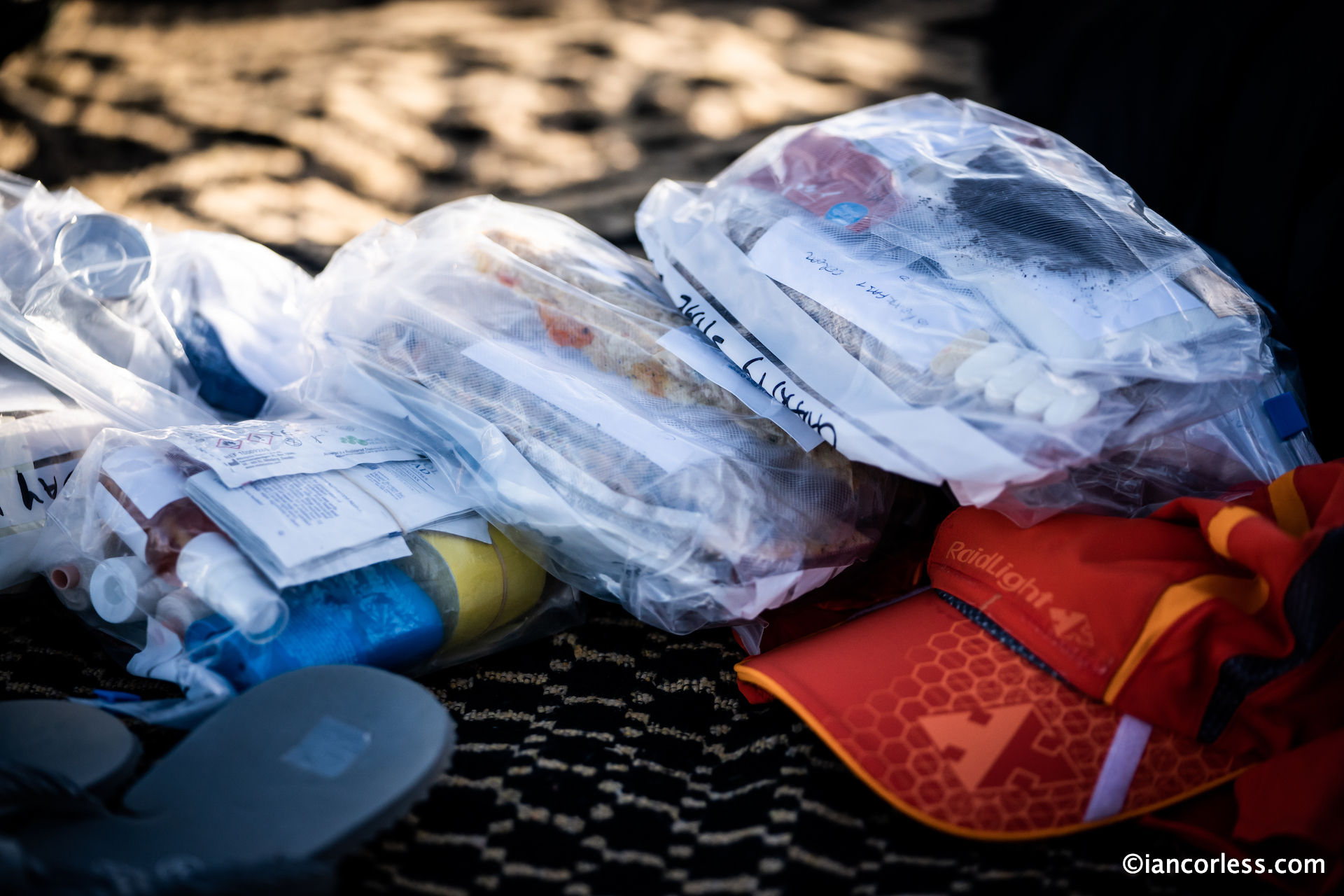
An example of fuelling for one day.Use a sealed bag for each day and then add a label showing contents and calories.
CONCLUSIONS
Getting fuelling right for any multi-day is really important, so, do the research and test everything. Have a contingency plan and anticipate the need for sweet v savoury will change.
If possible, repackage food to save weight and use clear packaging and relabel adding the name of the food, what day it is for and how many calories are inside.
Make sure you have some treats and something to look forward to.
Real food is good for the brain and the chewing motion helps satisfy our natural human desire to eat and be happy.
Remember, multi-days are only about three things: running/ walking, eating and sleeping, so, make sure you are prepared for each element accordingly.
The long day, many stop and cook a meal during the night to fuel the journey.
SUMMARY
In this article, we have looked at food for a typical desert race like Marathon des Sables that lasts for 7-days. many races follow the same format. However, different race conditions may well dictate food choices, for example, a race in snow/ ice with sub-zero temperatures will require a different strategy and the balance of carbohydrate, protein and fat can be different.
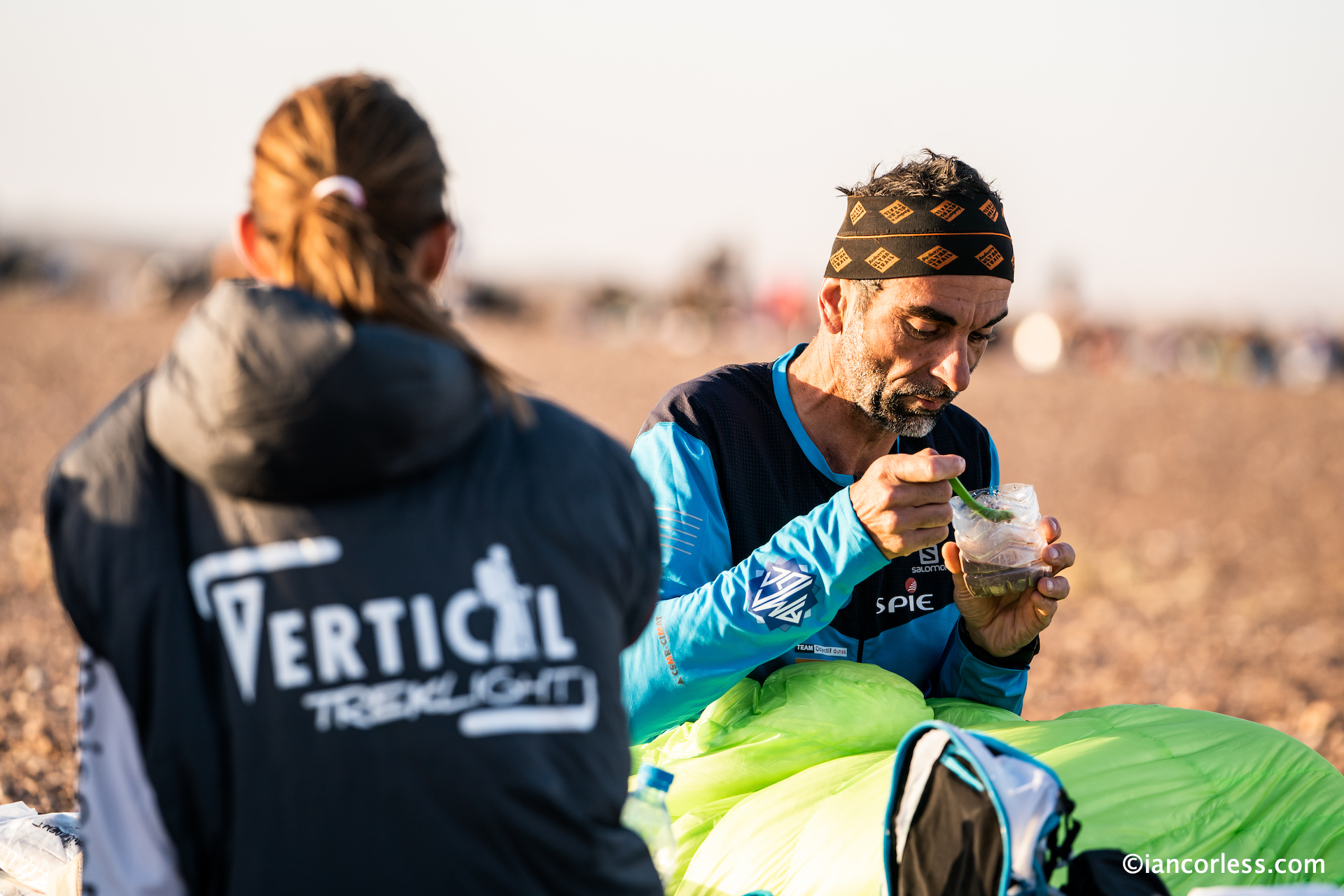
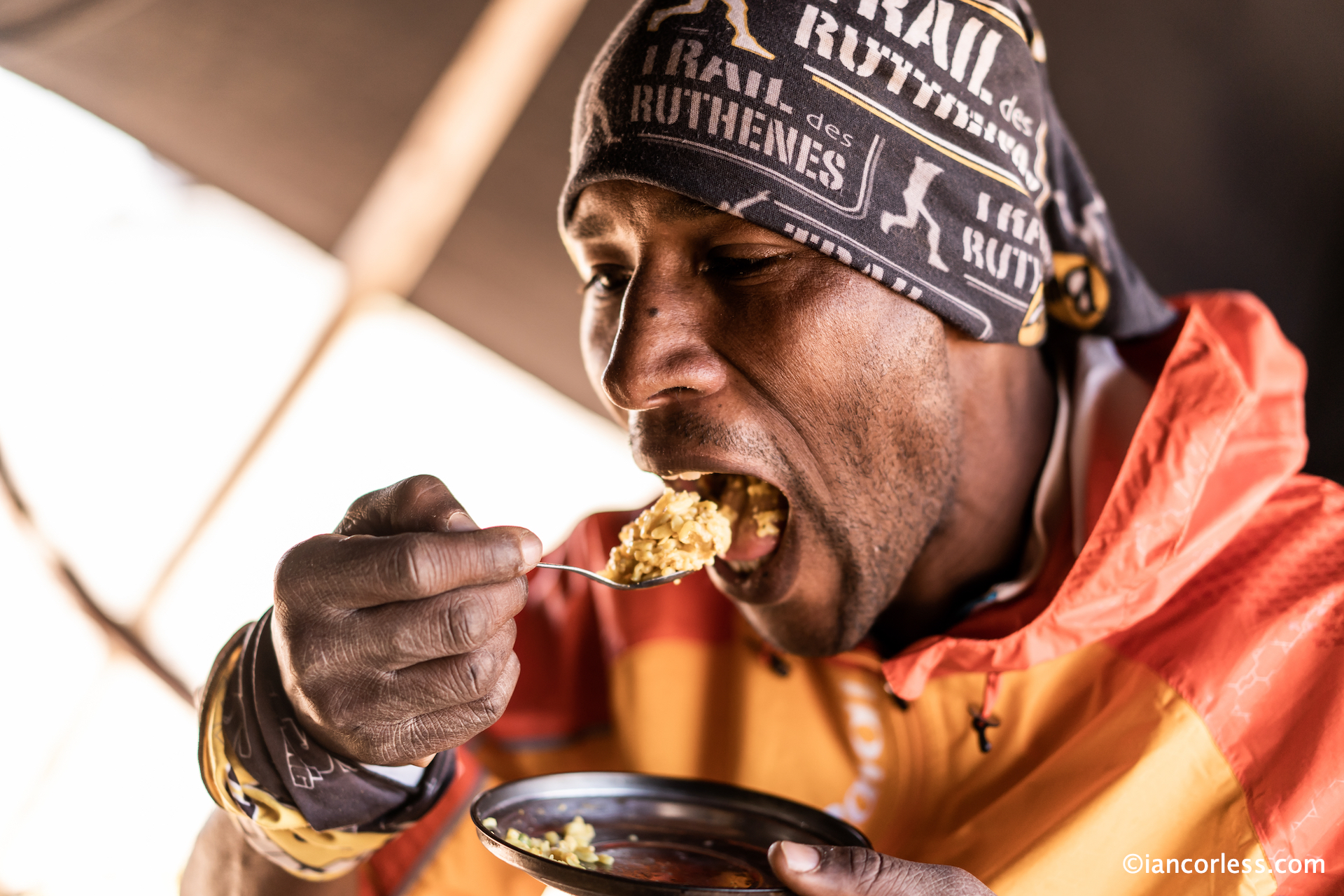
The top Moroccan runners boil water and eat hot food. Here Mohammed El Morabity.
Some races or multi-day are semi-supported, some are supported. In these scenarios, your own food may be carried for you or, it may even be provided for you? Think ahead and plan for what you may need so that you can perform as you wish with the calories you need. Especially important for vegan, vegetarian or those on specific diets. The big advantages of semi or fully supported is the not needing to carry additional weight and in most scenarios, there will be no restriction on quantity or calories. Everest Trail Race and The Coastal Challenge are two perfect examples of semi and fully-supported races,







 IAN CORLESS