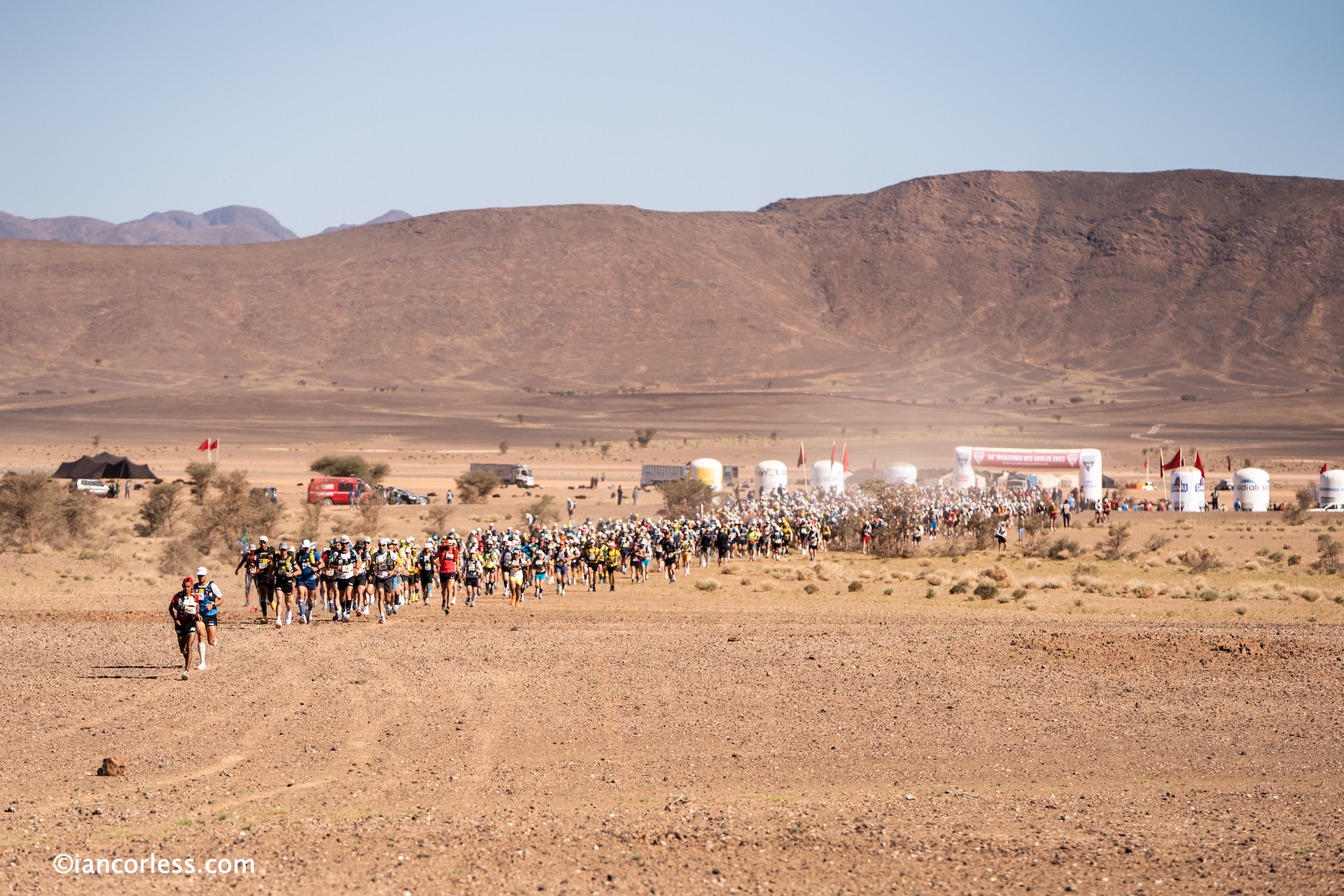
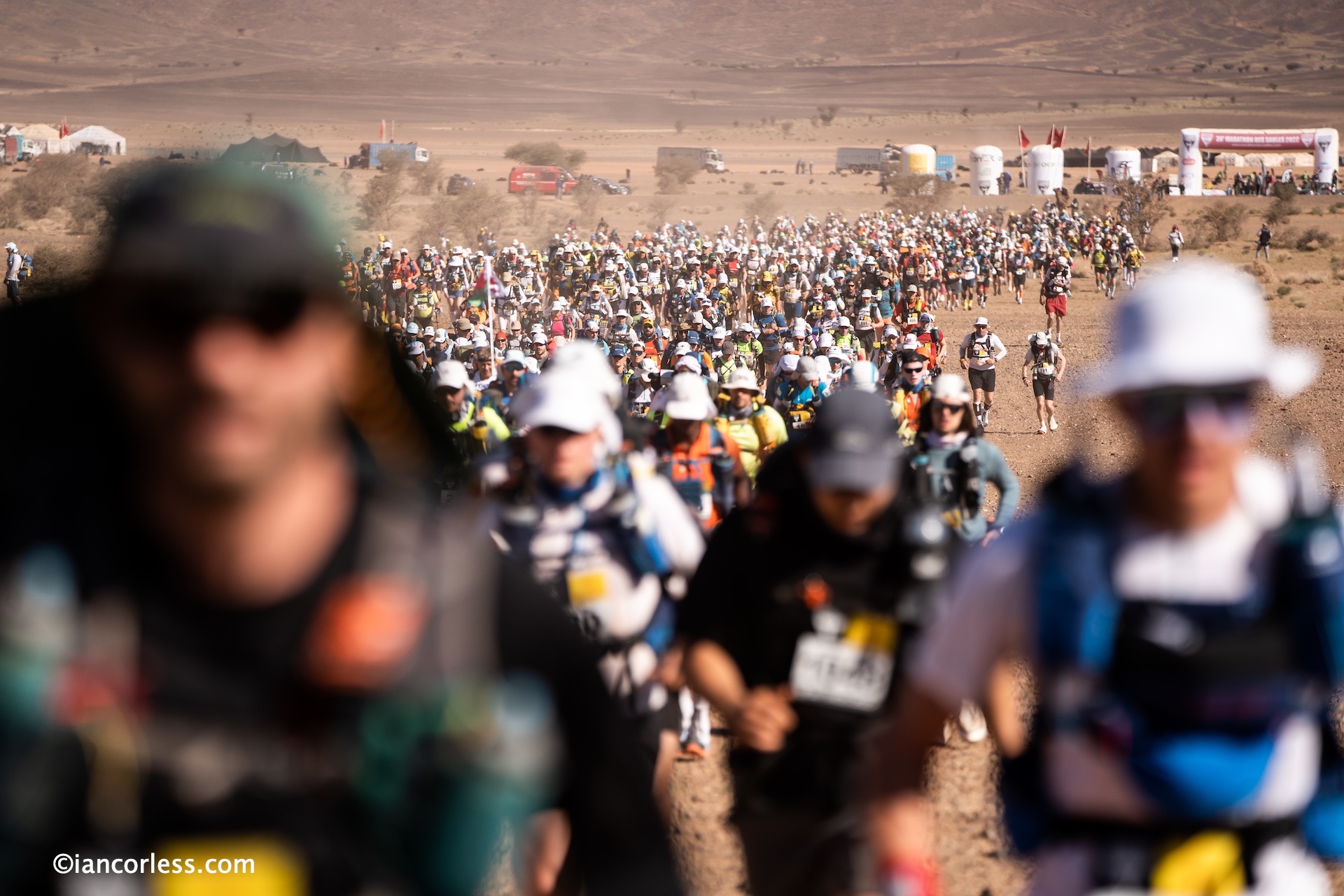
The 2022 Marathon des Sables got underway today, the 36th edition coming quickly after the 35th which took place in October 2021.
Conditions in March are very different to those encountered in 2021 with cool nights and relatively mild daily temperatures for the Sahara.
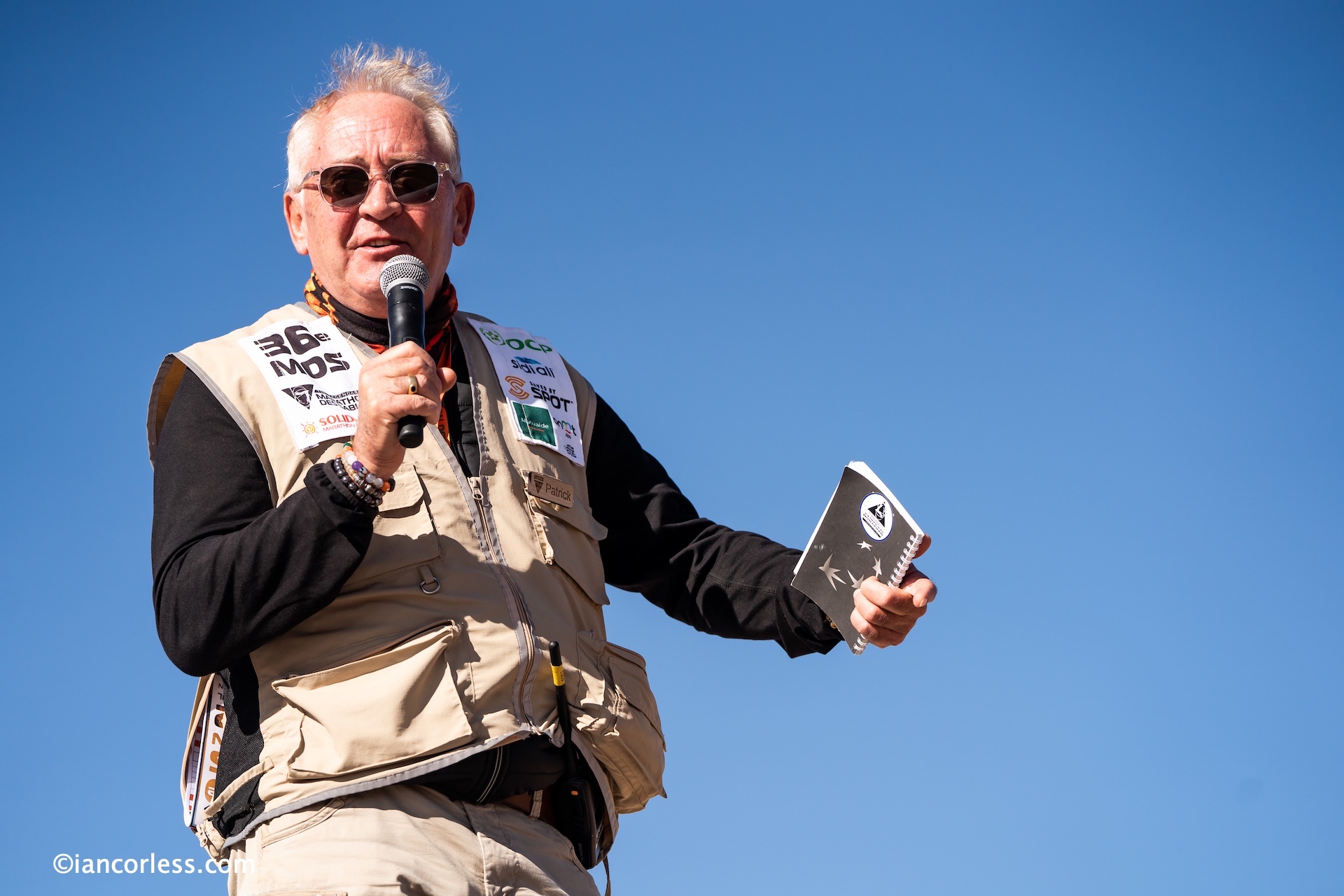
Patrick Bauer
Of course, anticipation was high in bivouac, a mixture of excitement and nerves. However, Patrick Bauer, as per usual, calmed everyone from the roof of his Land Rover with his daily morning introduction to the day. The race was underway at 0900 as planned.
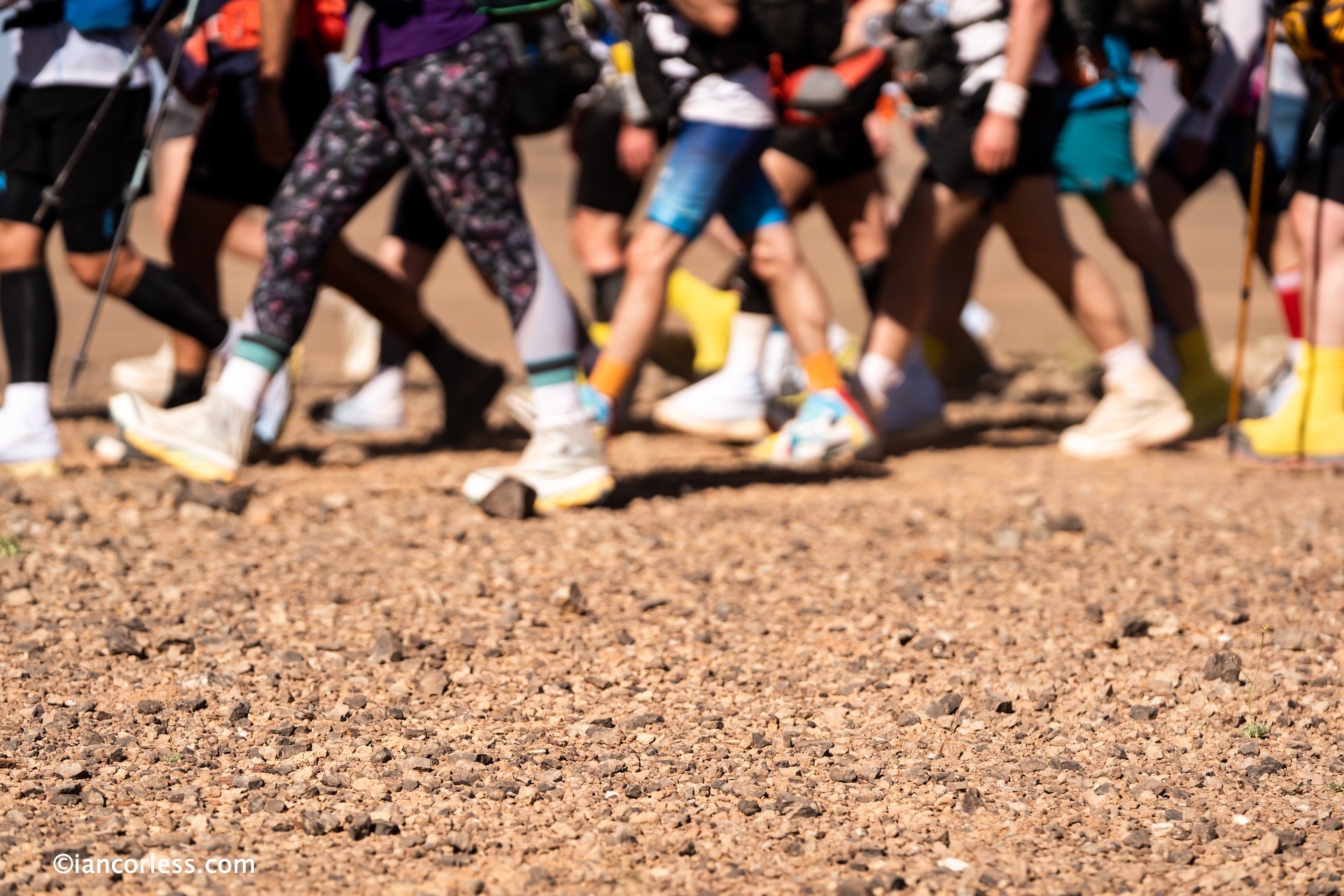
The march forward
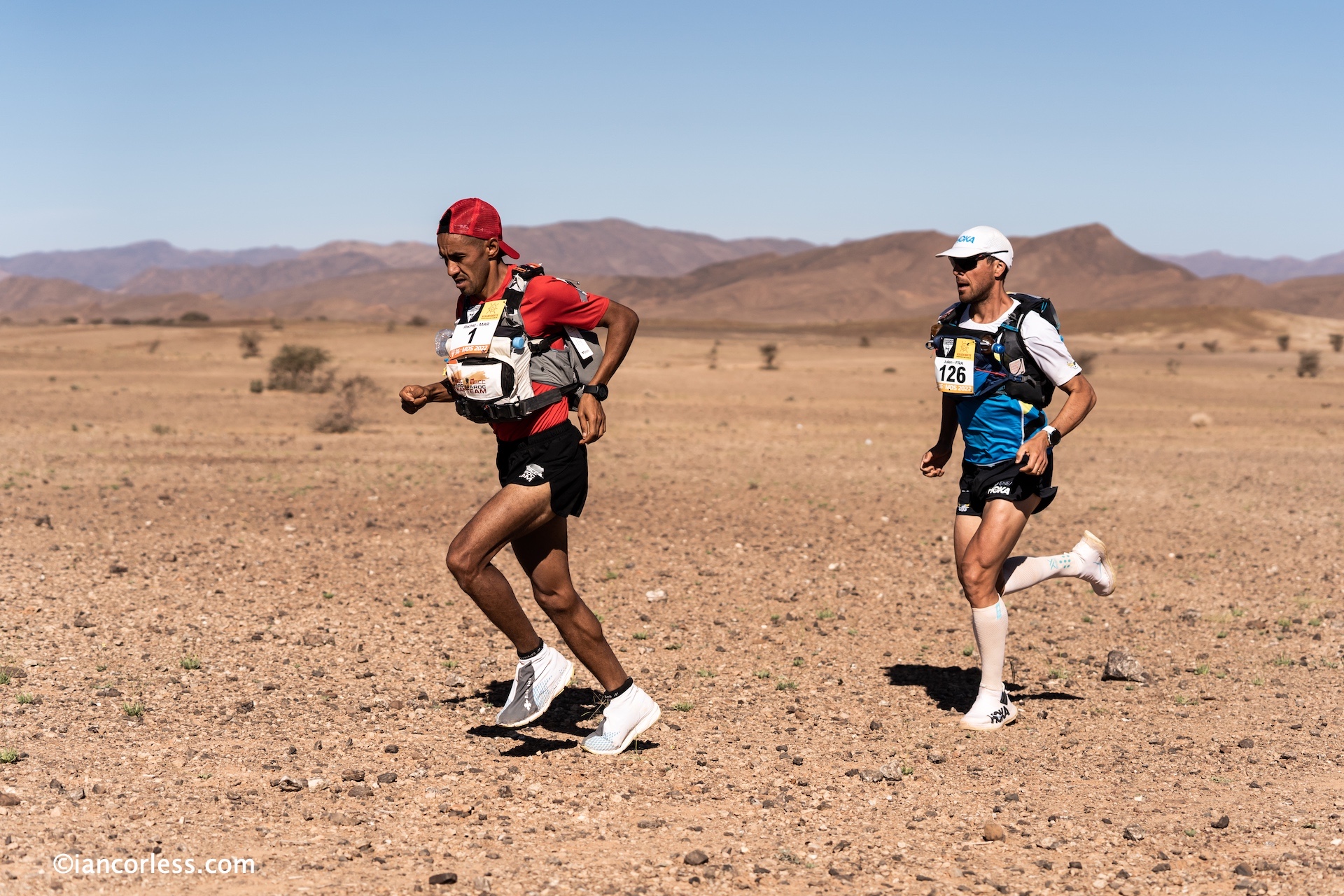
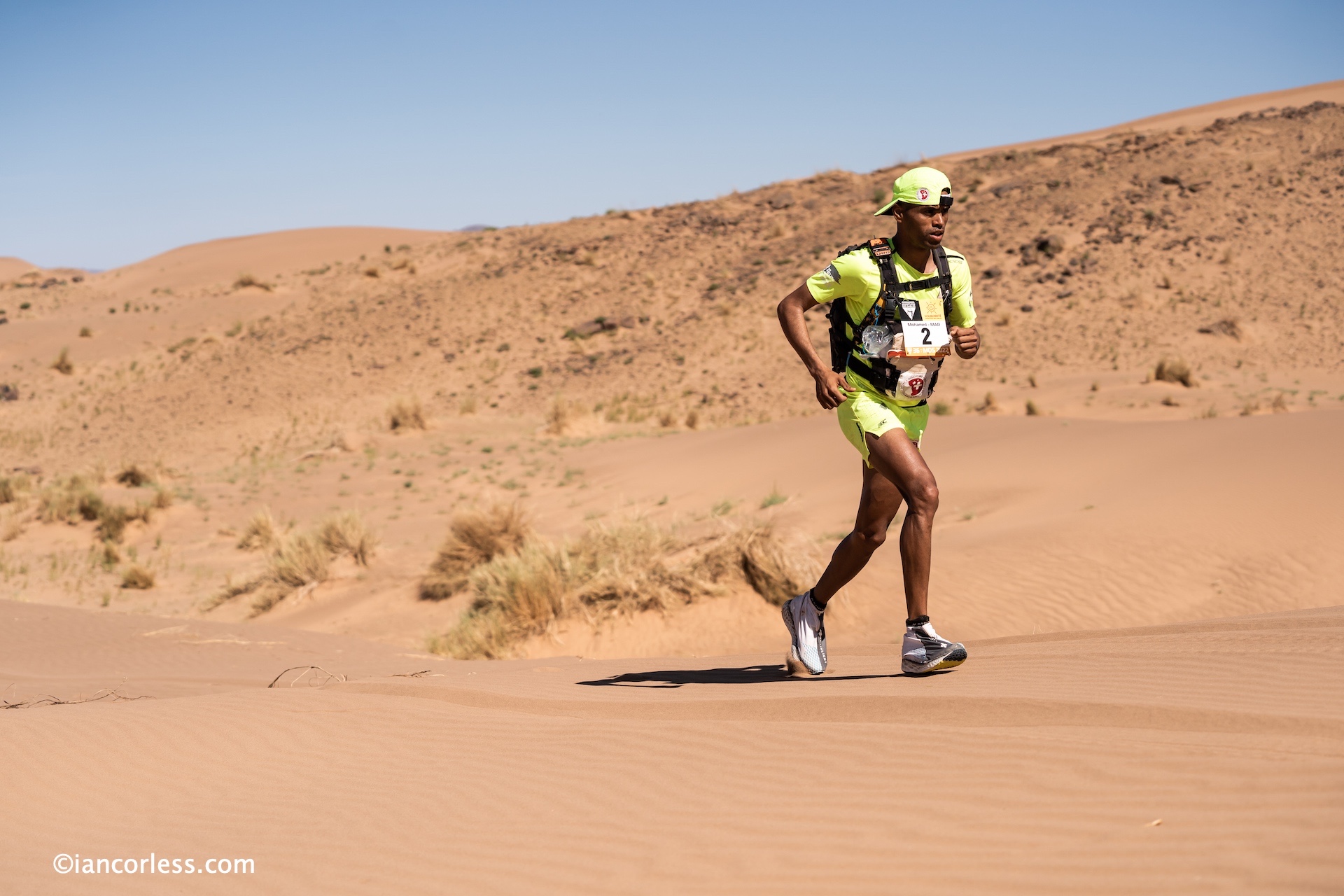
Unusually, Rachid El Morabity went to the front and set the pace. He meant business! He was followed by Julien Chorier and within 400m they had already opened a gap… This was a very unusual Rachid tactic. He usually bides his time, eases in to the day and the slowly speeds up; not today.
Rachid and Julien
Rachid started as he meant to go on and won the day! But why did he start so hard? Quite simply, in my opinion, he knows he has a race on his hands this year with Aziz Yachou who pushed him last year and had he not had a time penalty, the result just may have been different?
Aziz Yachou
After the fast start, Aziz pursued and at the line had closed the gap, Rachid 2:04:16 and Aziz 2:04:37. So close!
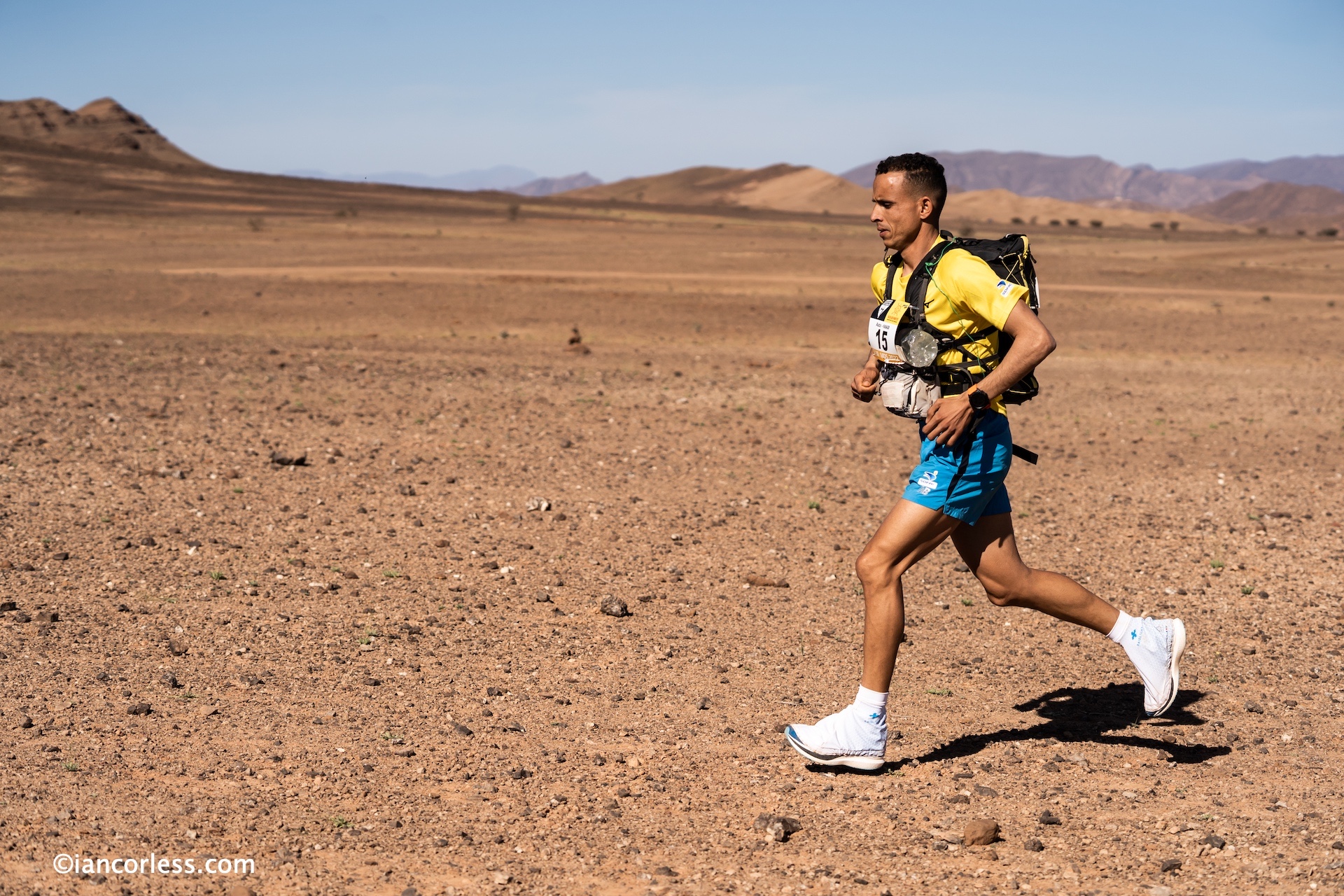
Mohammed El Morabity
Julien Chorier faded to 5th in 2:16:12 and Mohammed El Morabity after a slow start moved in to 3rd 2:10:16 with Cédric Fleureton 4th in 2:14:40.
One thing is for sure, Rachid will need to work his year and it is clear that he knew this before the start. He looked leaner and fitter, not that he has ever looked any different. But pre-race there was a different look. It’s subtle. The cheeks just a little gaunt and his legs more defined.
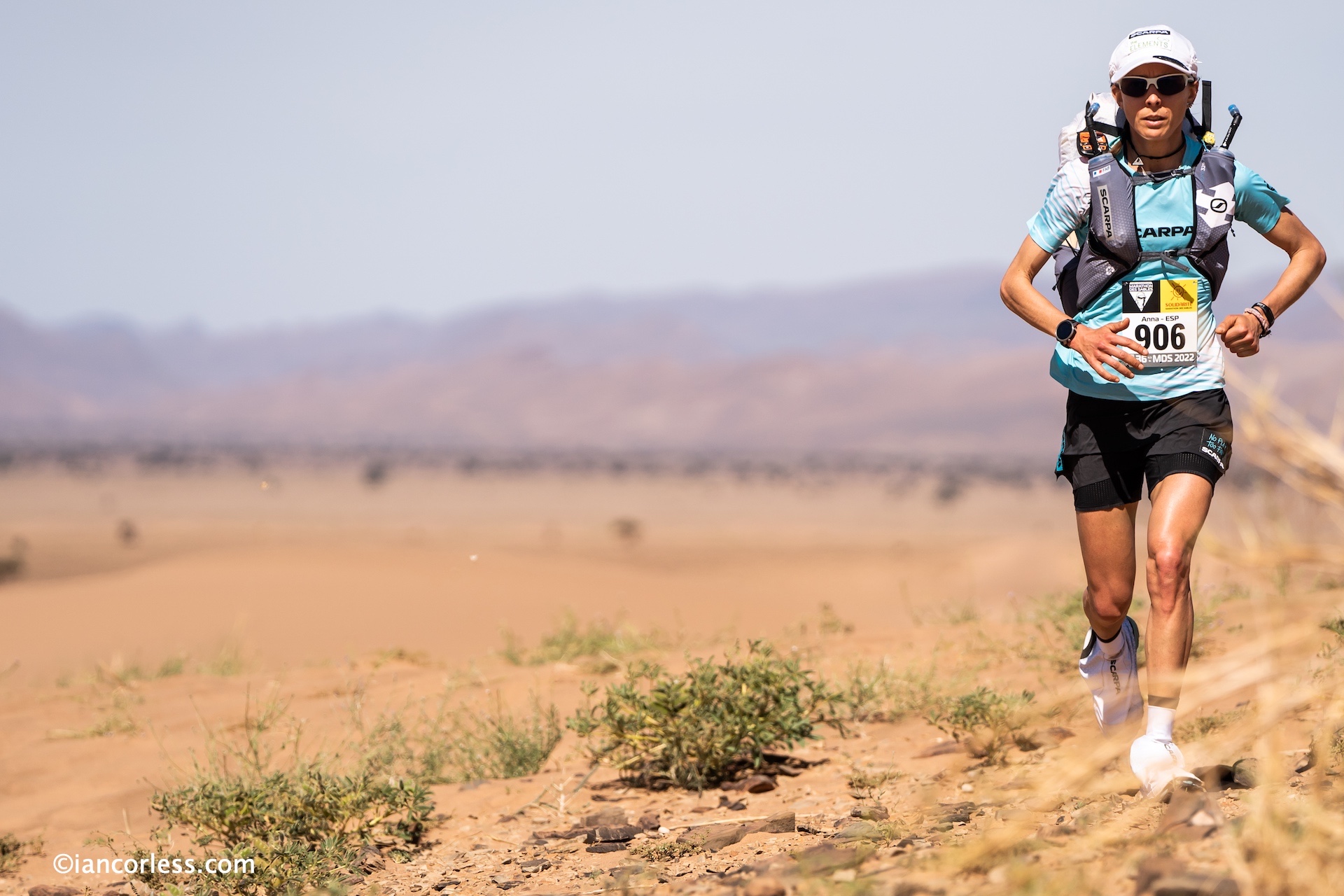
Anna Comet Pascua
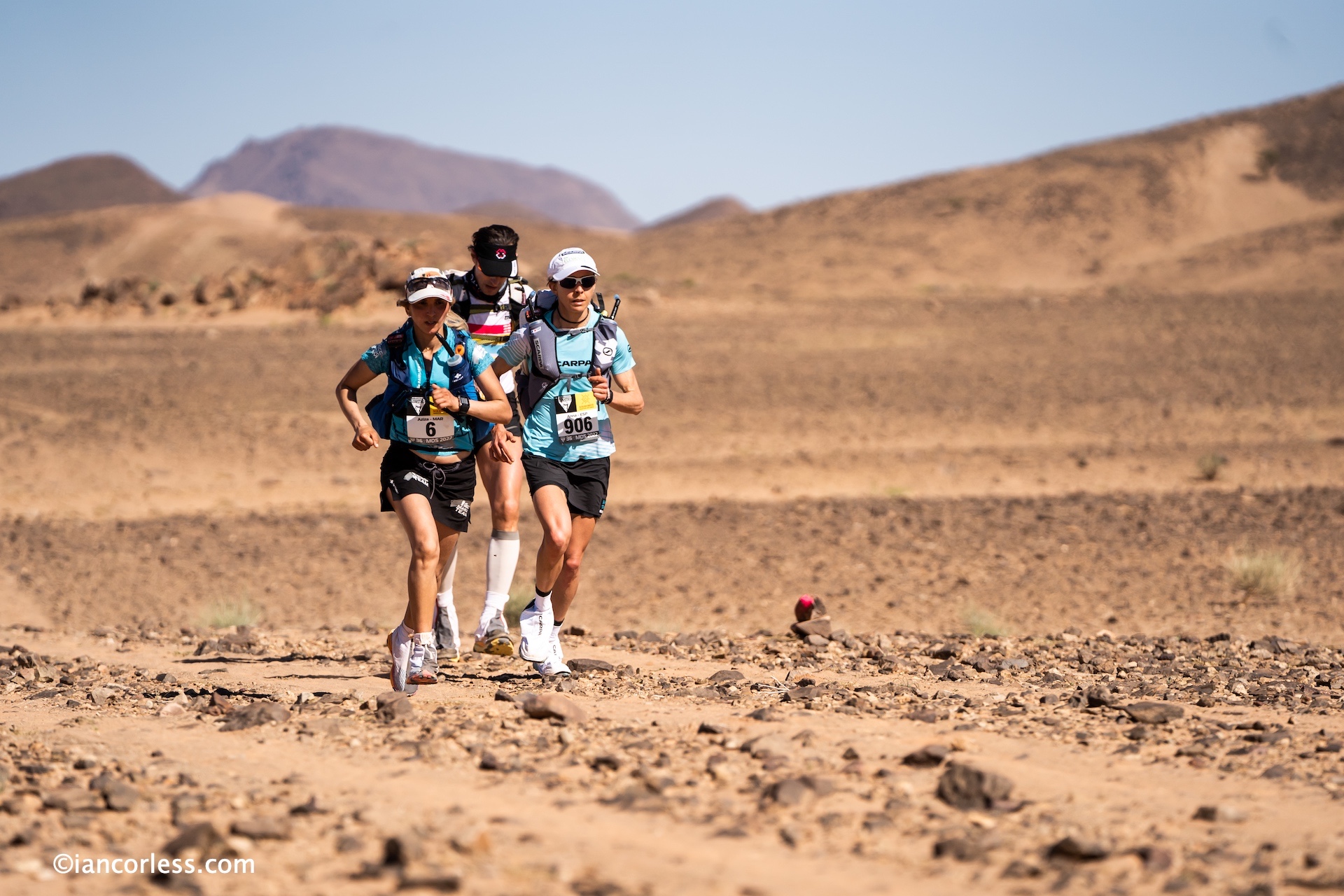
The women’s race was a different story with a more gradual start to the day with a clear strategy forming. Anna Comet Pascua came here to with the race and although she had run with others in the opening km’s, by Cp1 she had taken the lead and she went on to win the stage in 2:52:20.
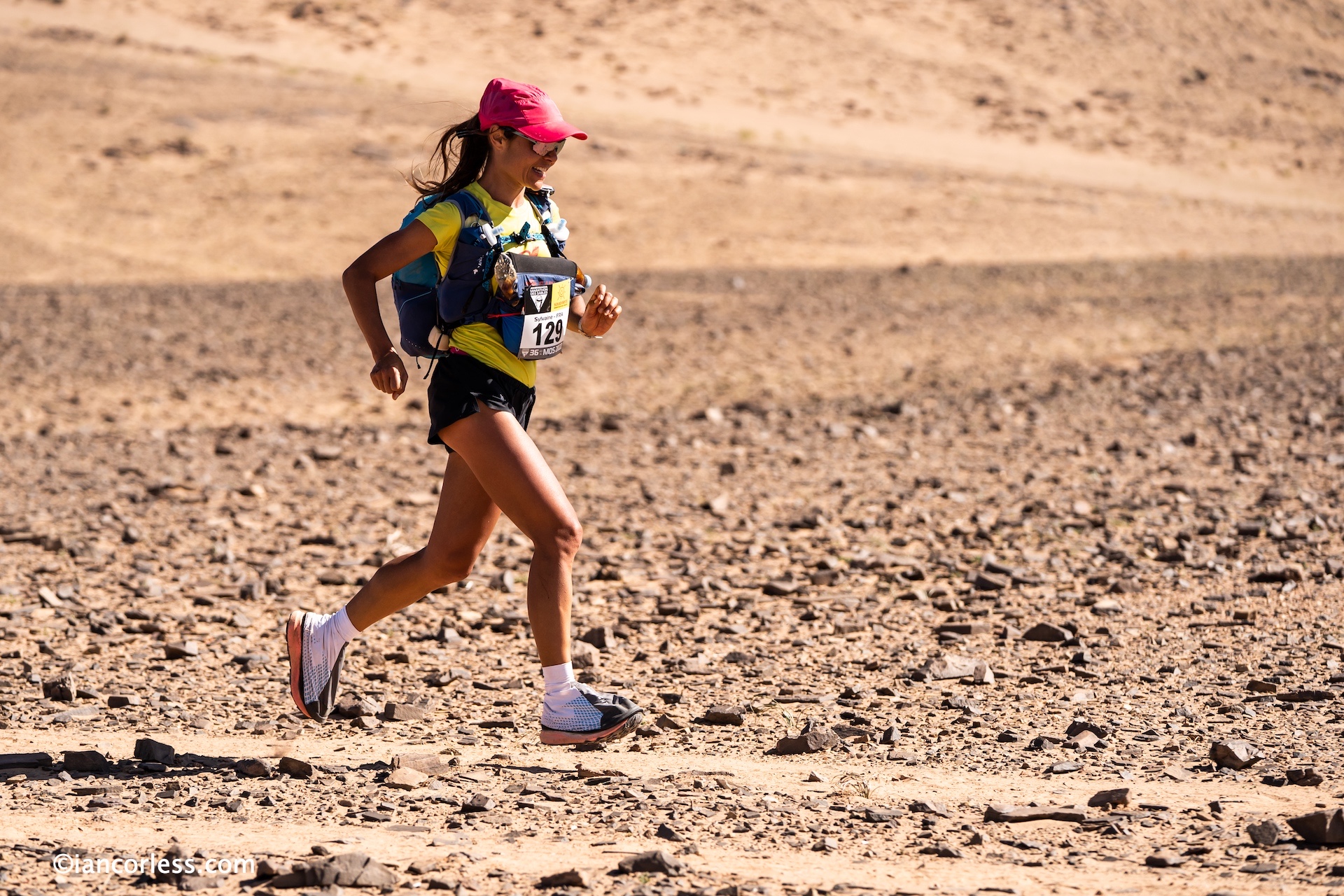
Sylvaine Cussot
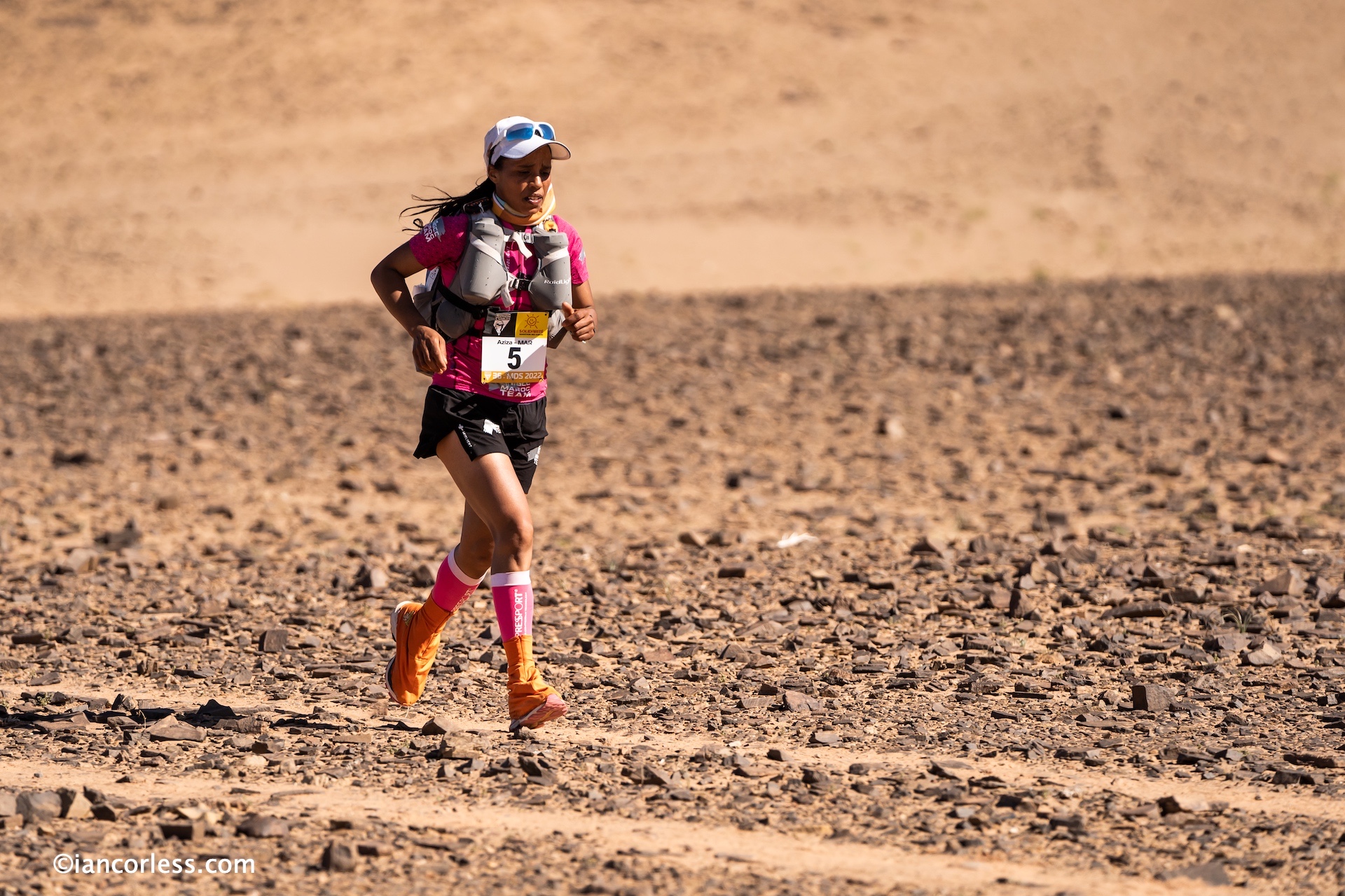
Sylvaine Cussot finished 2nd in 2:56:25 and the 2021 champion, Aziza Raji finished 3rd in 2:59:41. Amelia Culshaw from the UK was 4th ahead of multi MDS champion, Laurence Klein, 3:06:10 and 3:13:01 respectively. The women’s race is set for an exciting battle as the terrain becomes more challenging and the distances increase.
Anna and AzizaAziza 2021 champion
The stage one route was just over 30km’s, flat but had plenty of soft sand and several small hills and dunes but nothing substantial to make the day difficult. It was a good day 1 for all to ease in and for the top men and women, a fast one! Rachid’s time was incredible… We are in for a fast men’s race.
Who would have thought that Kilian Jornet would leave his sponsor, Salomon?
The duo seemed in perfect synergy:
Salomon is Kilian.
Kilian is Salomon.
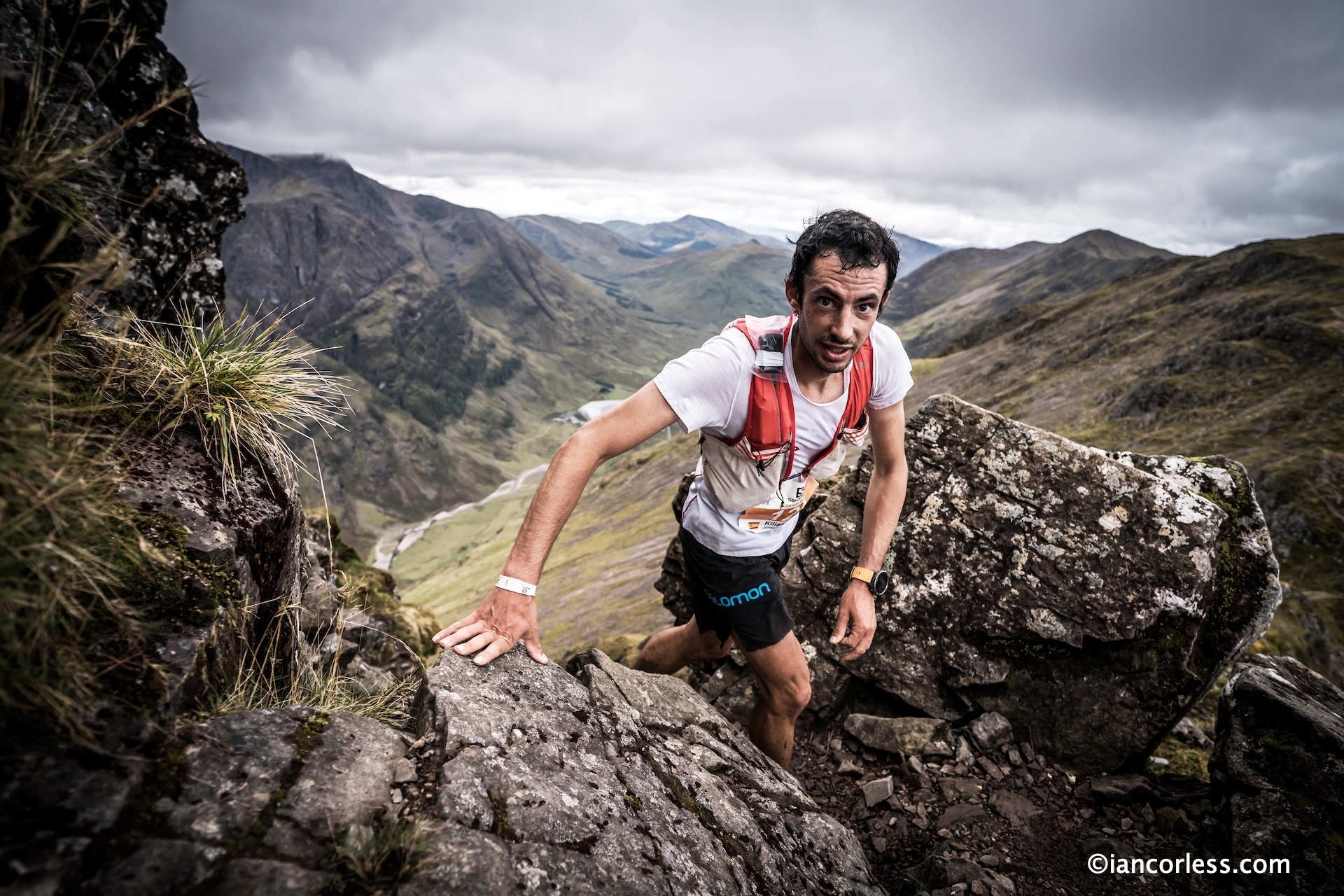
Kilian skyrunning in Scotland.
As Kilian said on the 30th November 2021, ‘I remember like it was yesterday in the summer of 2003, a friend of a friend gave me a few pairs of trail running shoes. This guy was the director of marketing for Salomon Spain. From that moment on, Salomon not only came a sponsor but a life partner…’
Together, Salomon and Kilian dreamed big… ‘From winning trail and skimo races to climbing high mountains. I was able to make dreams come true that I didn’t even believe possible, and it was in large part thanks to this team.’
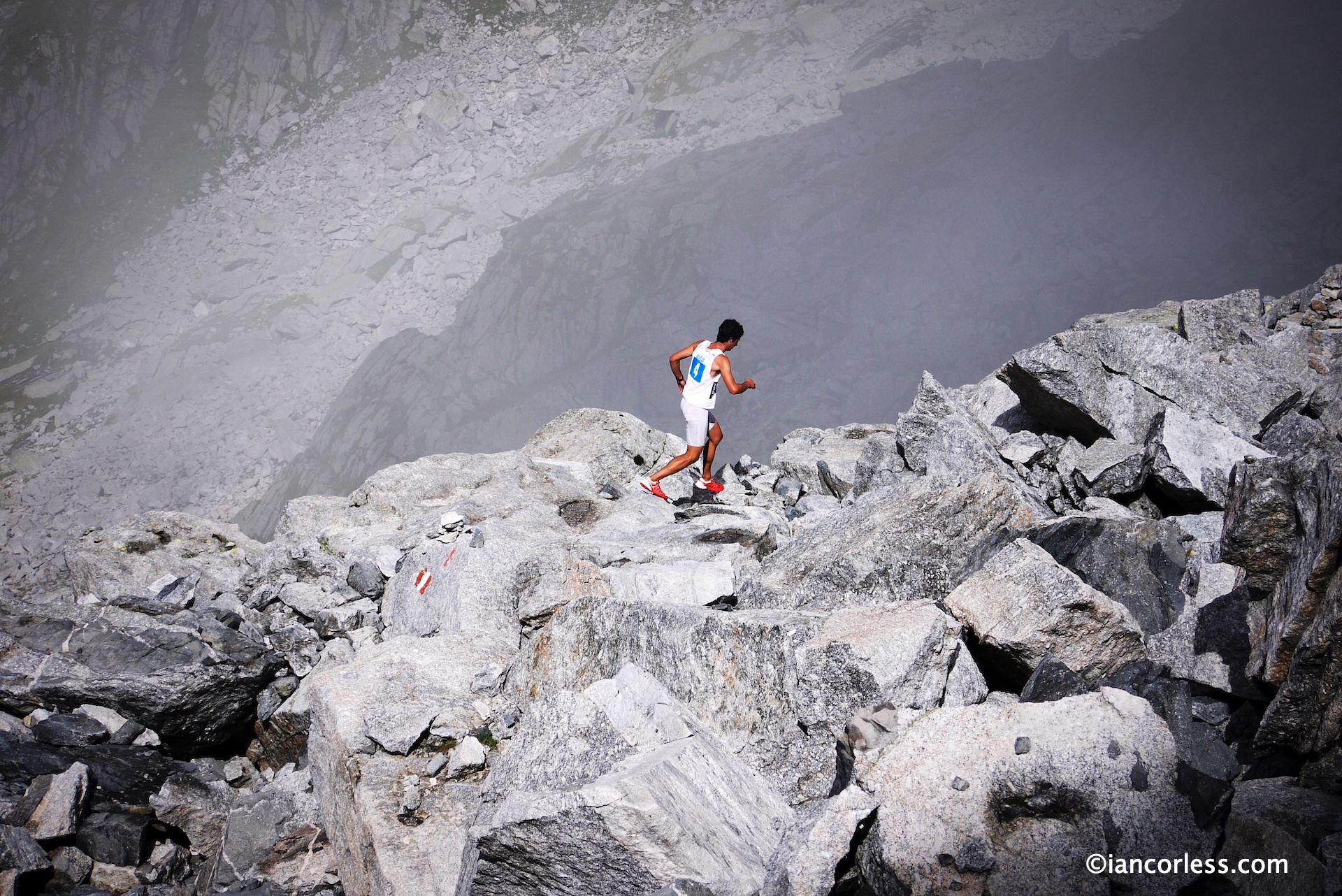
Kilian at the iconic Trofeo Kima – a skyruning classic.
For many of us, me included my journey in trail, mountain, ultra and skyrunning coincides with Kilian’s meteoric rise to be the ‘GOAT’ – Greatest Of All Time. We have absorbed his journey, jaws have dropped at his ability, we have had our minds blown by his escapades but now, a new period of history will be made.
I first met Kilian in 2012 and I feel lucky to have shared his journey, notably in skyrunning which Kilian holds very close to his heart. Ask Kilian who provided him the motivation to pursue his dreams and set goals and he will respond with, ‘Bruno Brunod, Fabio Meraldi, Marino Giacometti and Marco De Gasperi.’ This was reflected in his ‘Summits of my Life’ project and particularly his record on the Matterhorn.
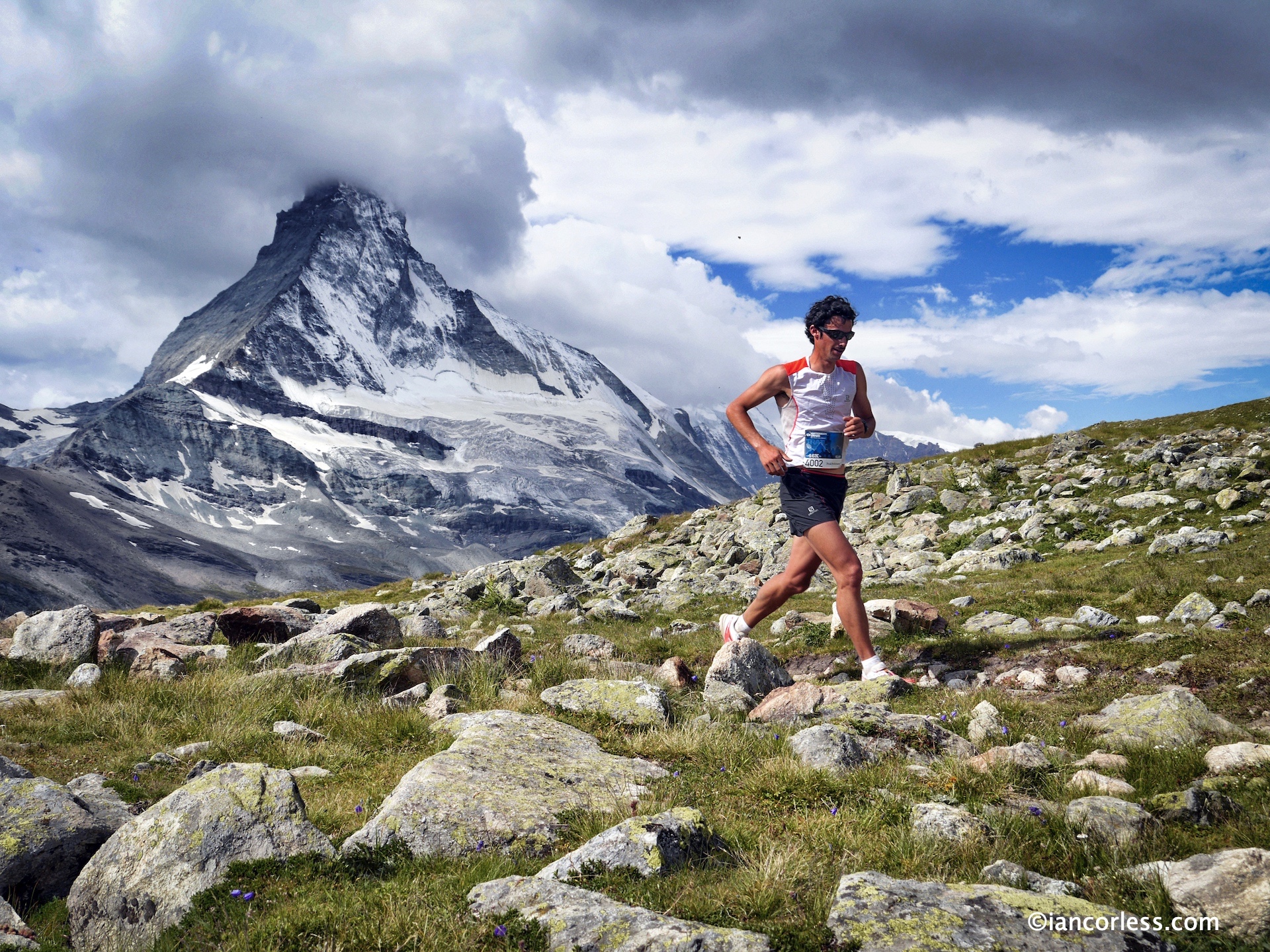
Kilian and the Matterhorn.
Since November, we have all looked back and remembered our journey with Kilian and wonder what is next?
Notably, there have been significant changes for Kilian in recent years. His relationship with Emelie Forsberg, his life in Norway and the arrival of two children most certainly would make one assess and look ahead to a different future. But importantly, the planet, environment and going ‘Green’ has been a very important part of the ‘new’ Kilian. So, it is or was fair to assume that any new project would have ecology at its core.
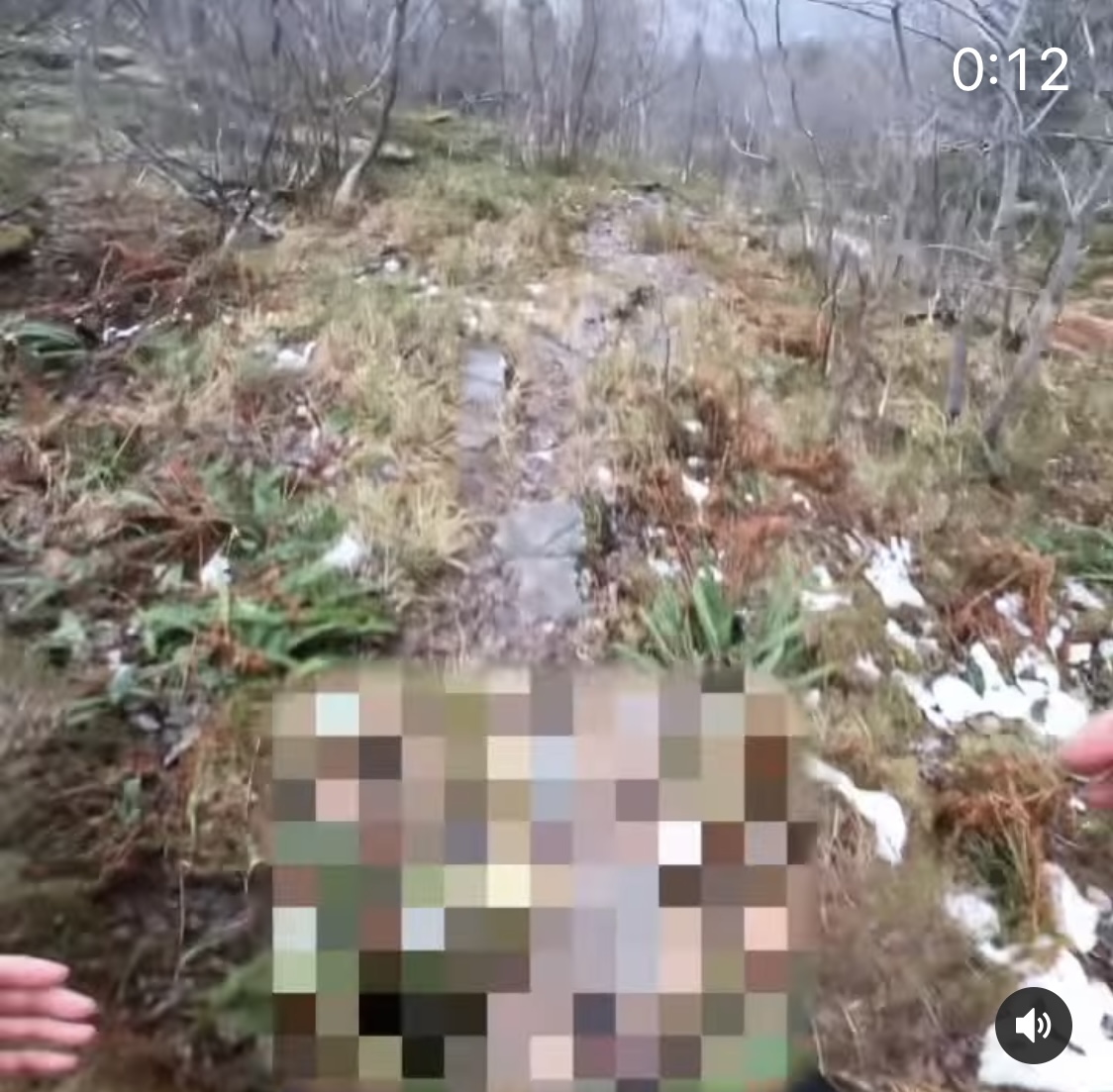
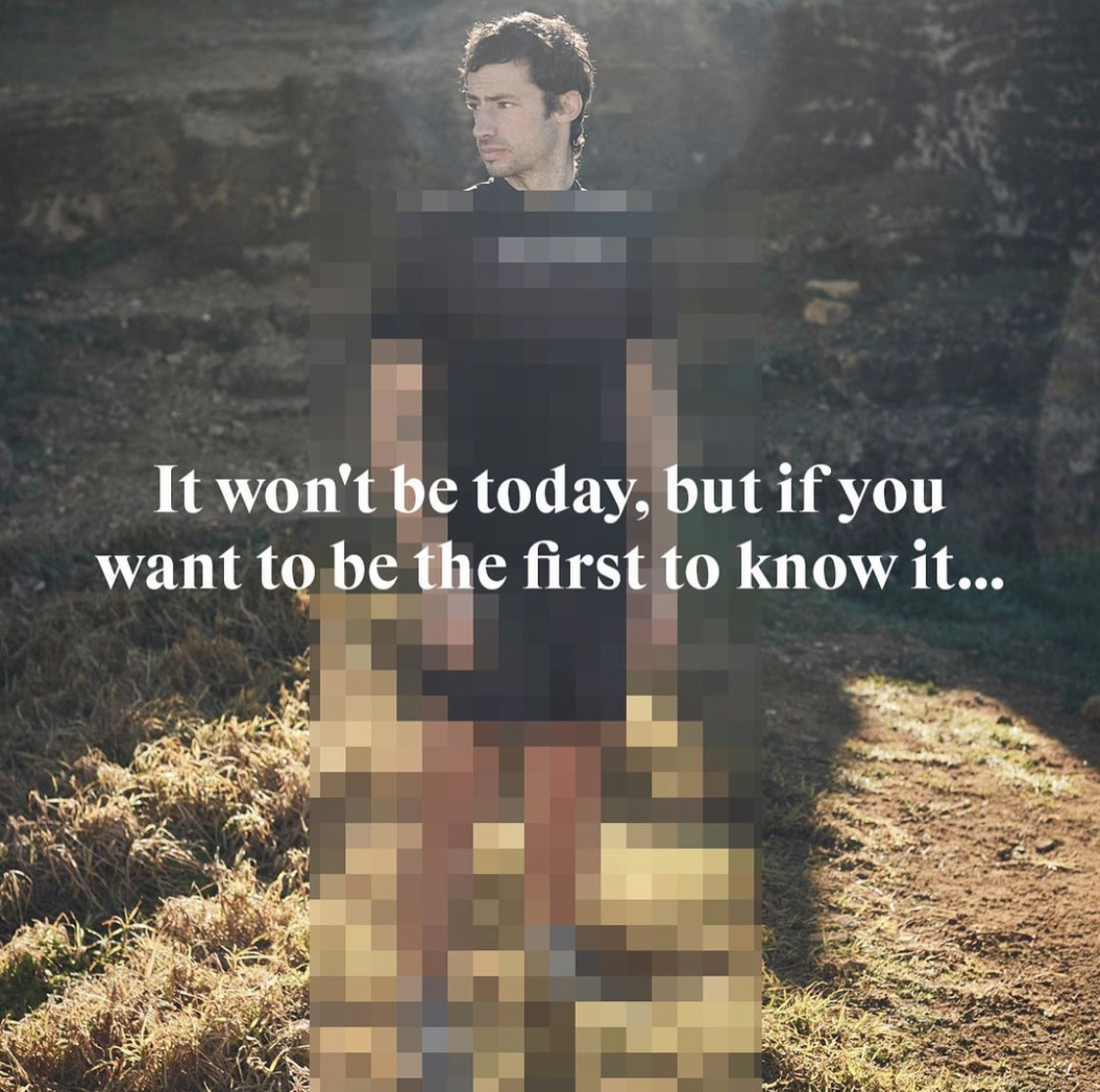
We have been teased. On the 2nd of February Kilian posted a video of him running with his shoes blurred. He called it, ‘Testing.’
On February 14th he ran a 100-mile race, the Tjörnarparsen Ultra in Skåne, much of the attention was about what was on his feet.
February 23rd he announced his 2022 calendar: Pierra Menta, Zegama, Hardrock 100, Sierre Zinal and UTMB. It was a classic KJ year starting with skimo, a return to the iconic Zegama, Hardrock 100 which is maybe Kilian’s favourite race, the fast and athletic Sierre Zinal and the surprise, UTMB.
On March 5th, Kilian announced he would no longer partner with Suunto, a significant departure as Suunto and Salomon go hand-in-hand. On March 7th, he announced he had joined Coros.
Finally, March 21st we are teased with, ‘Want to find out what’s behind the pixels of the last few months?’ There were some clues in the post, notably the sign-up details linking to The Normal Company, S.L. Which in turn links to Mountainlife SL and again links to Lymbus who manage Kilian. One thing was for sure, links to Mallorca and the brand ‘Camper.’
Well now, that future is disclosed.
It seems a lifetime since November 30th but today, March 2022, Kilian announces his project.
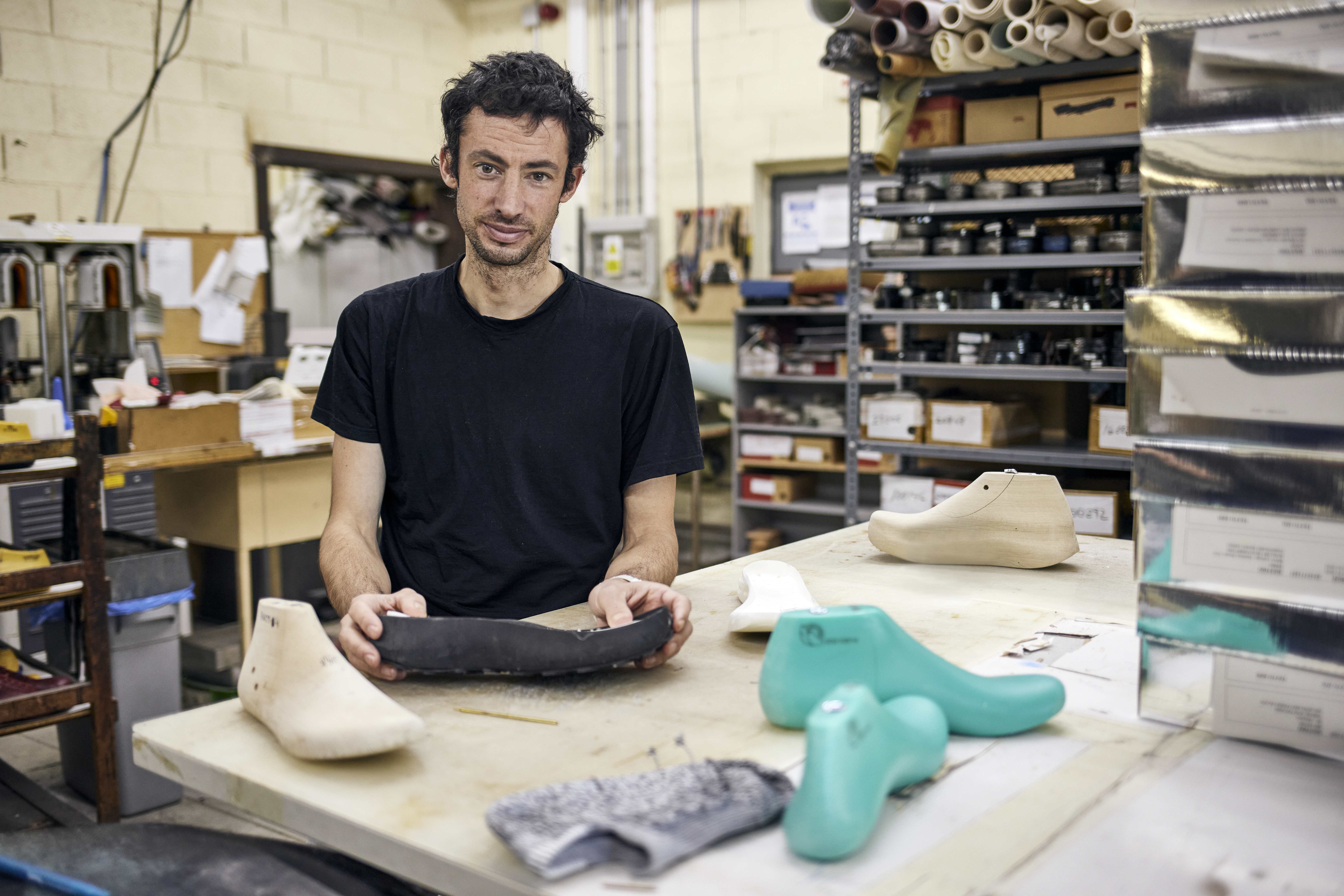
NNormal – Kilian Jornet and Camper will blaze a new trail with NNormal.
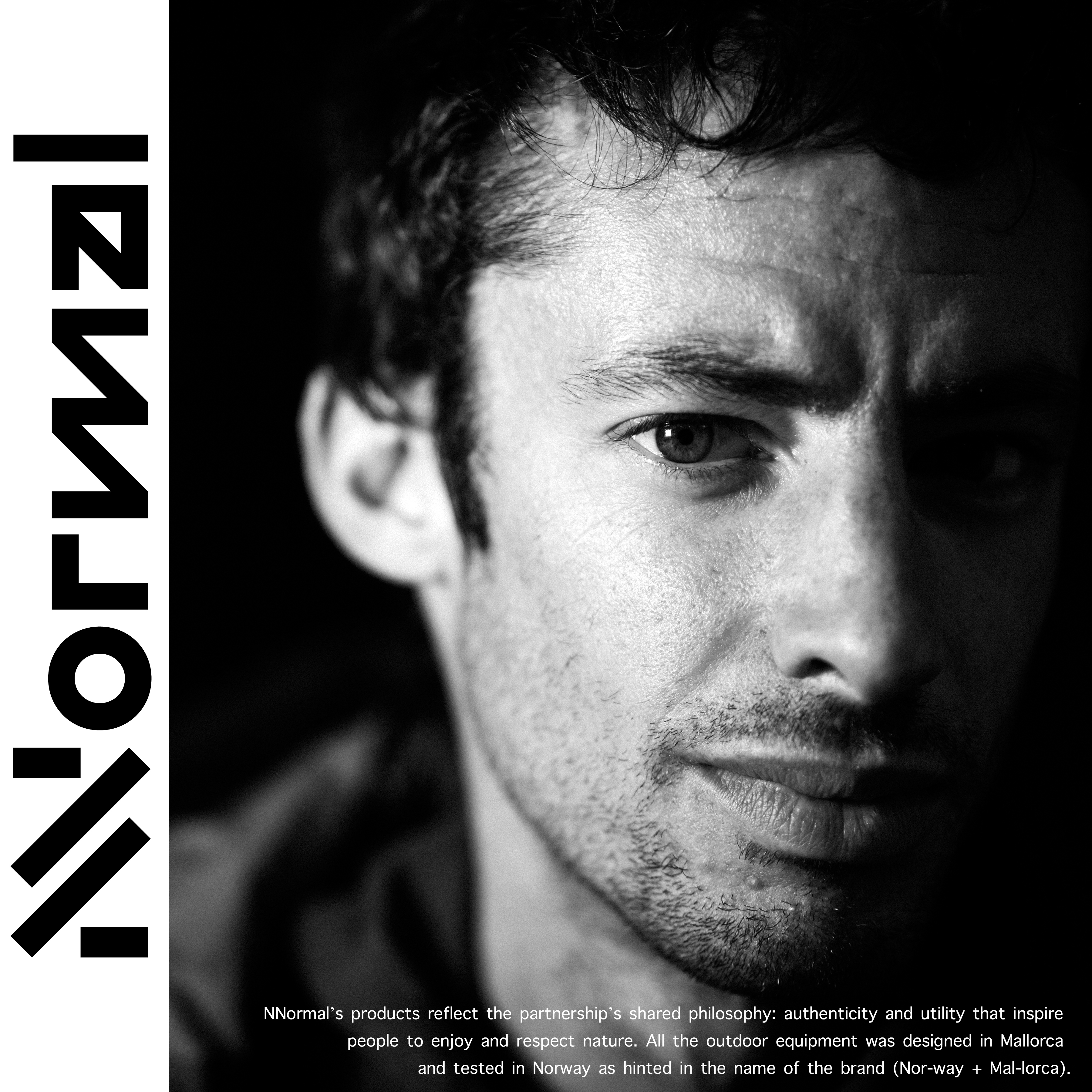
A new outdoor sportswear brand, designed and tested between the coasts of Mallorca and the fjords of Norway. The brand’s first products will be launched this Fall. The name reflects the Norway/ Mallorca (Nor-way + Mal-lorca) – designed in Mallorca and tested in Norway.
Kilian speaks on the new project:
“Sharing the same values was a strong motivation to start this project. We agreed that we need a new way of thinking and acting in relation to our environment and outdoor activities… We want to be very honest on how we produce the equipment and on the role the company wants to play for the society and the environment. This means transparency and working to avoid overconsumption by building products that are durable.”
“Building a new brand is always a very exciting adventure, although we are aware of the challenges involved… We are complementary partners of NNormal. Having the opportunity to conceive it with someone like Kilian is unique: to combine performance with personal responsibility strongly resonates with our DNA. He brings his strong product development expertise and unique vision of the outdoor world, while Camper brings innovation, shoemaking, and design know-how.”
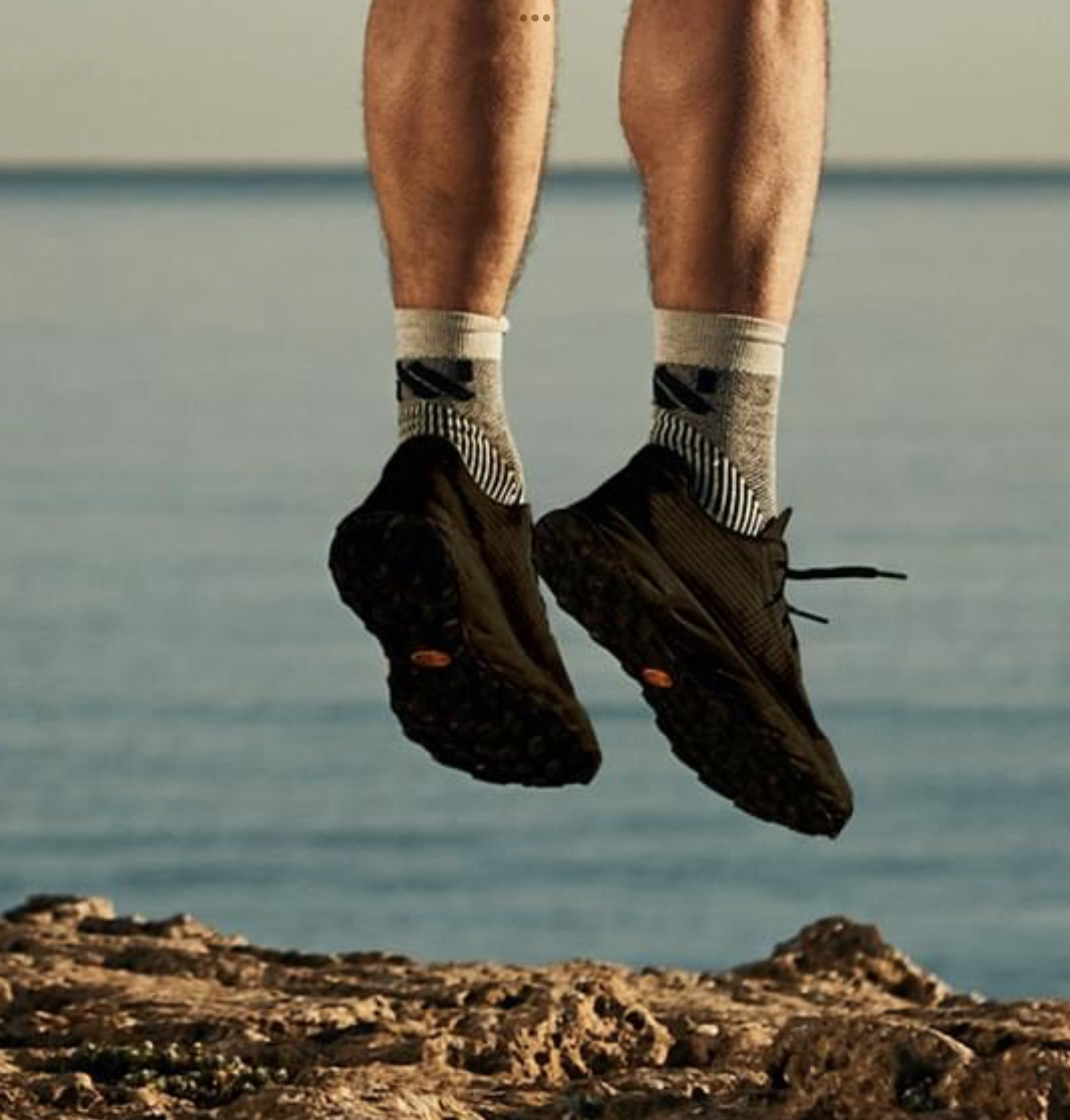
The NNormal assortment will be launched in FW22 in Europe & North America via nnormal.com and specialist outdoor and running stores. The first drop will be limited, focusing on footwear, apparel and accessories for trail running and hiking. Kilian Jornet—the first ambassador of the NNormal team which will be revealed in the coming weeks—will wear them during this year’s race season.
Welcome to NNormal. Your Path, No Trace.
THOUGHTS
As mentioned above, until early March, Kilian’s new project was a ?. However, with research, it was possible to find out certain things and all my research led to Mallorca and Camper, so, it’s interesting to see that confirmed. Tofol Castanyer is ex Salomon and lives on Mallorca – no doubt instrumental in helping Kilian. As for the new team, it goes without saying Emelie Forsberg will join NNormal but it is not confirmed. There are also some other key names linked if you know where to look… For now, I will hold those names for fear of upsetting any future announcement. However, they can be seen here: https://www.nnormal.com/en/community/
As expected, a strong reference to respecting nature and ecology is paramount and the mission statement includes a reference to products that should be repairable, reusable, or repurposed or recyclable. Camper have already pioneered this with several projects. https://www.camper.com/en_GB/content/social_responsibility
The brand wishes to explore new ways to do things with product, sustainability, business, and social responsibility.
Of course, Kilian and his team will be able to pave a new way and lead by example. That will be relatively easy with Camper backing the project. Of course, the question mark will come how paving a new way still makes the business profitable and viable.
One thing is for sure, this new project will raise a few eyebrows. Camper and run shoes are not the obvious synergy. But Camper has the money and experience and no doubt, this partnership with Kilian must go back many months if not years. A shoe takes a long time to develop, especially a shoe that Kilian will endorse.
“All talk and no action equate to nothing. We know it’s not what we say, but what we do, that defines who we are.”
To conclude, the NNormal manifesto
We run for simple reasons and with a clear mind.
1. We blaze our own trail
Someone once said, we are our dreams… and if we don’t dream, we are no longer
alive. Our unique creative path drives us to give back to people and the planet.
2. Our home is outdoors
We’re passionate about outdoor sports—but above all we’re people. Reaching
the summit is also about the emotions and memories of everyone who’s come
with us on our journey.
3. We empower simplicity
Simplicity means that with less, we can do more. The simplest solution will be
the most efficient, but also the most difficult to imagine.
4. We take responsibility
In the outdoors, just as in life, you rely on the strength of your partners. We won’t
lose our way because there is no set way. We’re responsible for all our actions,
good or bad.
5. We act louder than we speak
All talk and no action equate to nothing. We know it’s not what we say, but what
Imagine starting in the far north on a volcanic island and travelling to the southern tip by foot. During a night, a day and maybe even another night, it is possible to cross mountain peaks, run through deep valleys, past incredible rock formations, through pine forest and along dry riverbeds taking in the flagship race that makes the Transgrancanaria ‘Classic’ race – now 20-years old.
“I love Transgrancanaria because it’s the ultimate race. It has everything. Technical paths, flow paths, heat, running through the night and both terrain and time of day change. The atmosphere is top notch, both among the runners and those who cheer.” – Margrethe Fjetland Løvold
A rollercoaster, both mentally and physically, the trip will require you to dig deep, but in the process create unforgettable memories. Night trails to Teror and Artenara. The village of Tajeda. Sunrise at Roque Nublo. The steep climbing and descent to San Bartolomé de Tirajana and then the dusty, rocky and sandy trails that lead to the finish in Maspalomas.
“Transgrancanaria is a race I have dreamed of for several years. Standing on the starting line with 700 other like-minded ultra-runners in an insane mood is difficult to describe. There are people everywhere on the trail, at all hours of the day, cheering you on. One of my highlights as an ultra-runner!” – Frode Wiggen
This is Transgrancanaria! A point-to-point race that allows one to experience some of the best trails that Gran Canaria has to offer. The race is world famous and attracts thousands of runners from around the world. Here the elite gather to compete for the honor and glory in Europe’s first big race of the season.
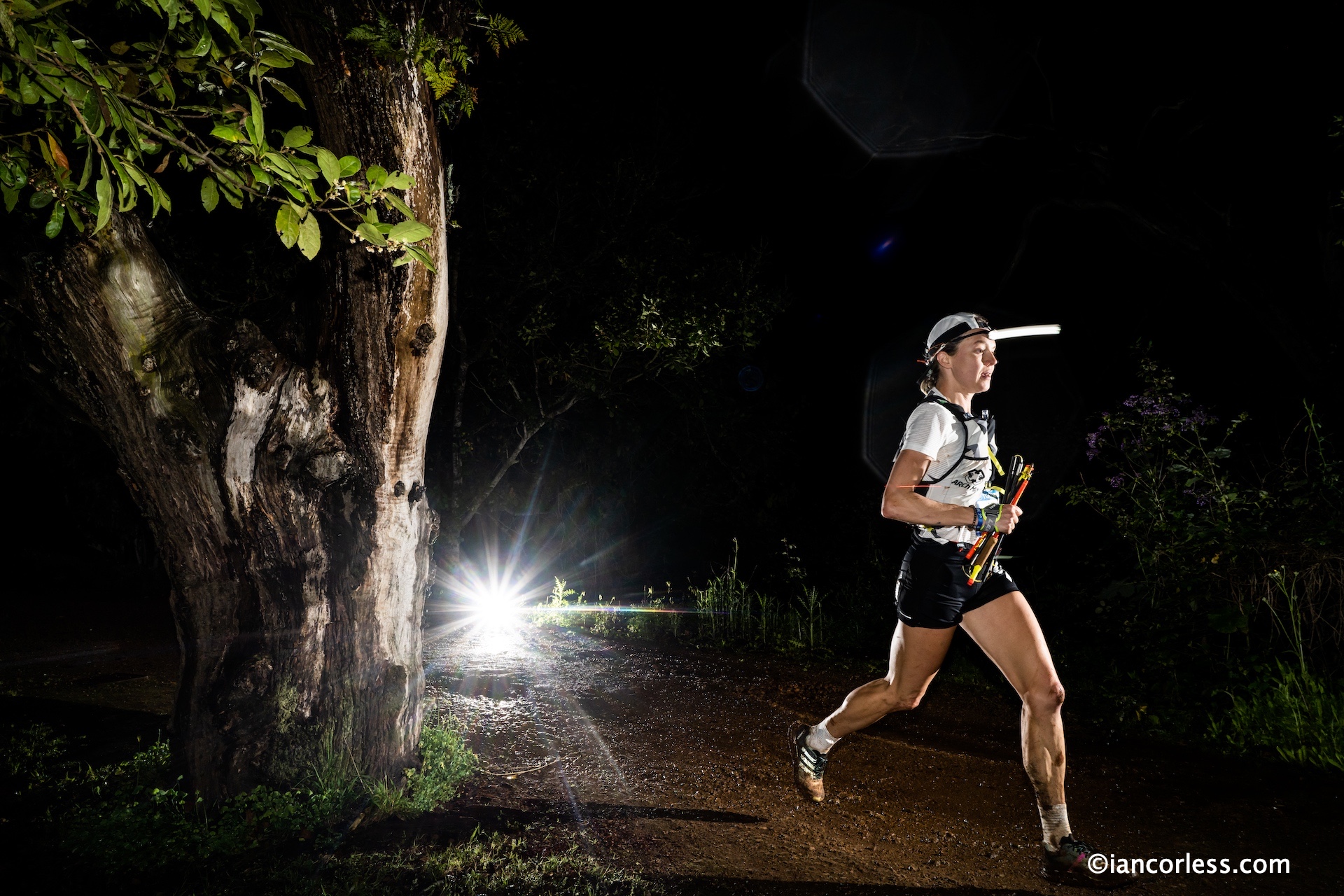
Abby Hall in the night to Teror.
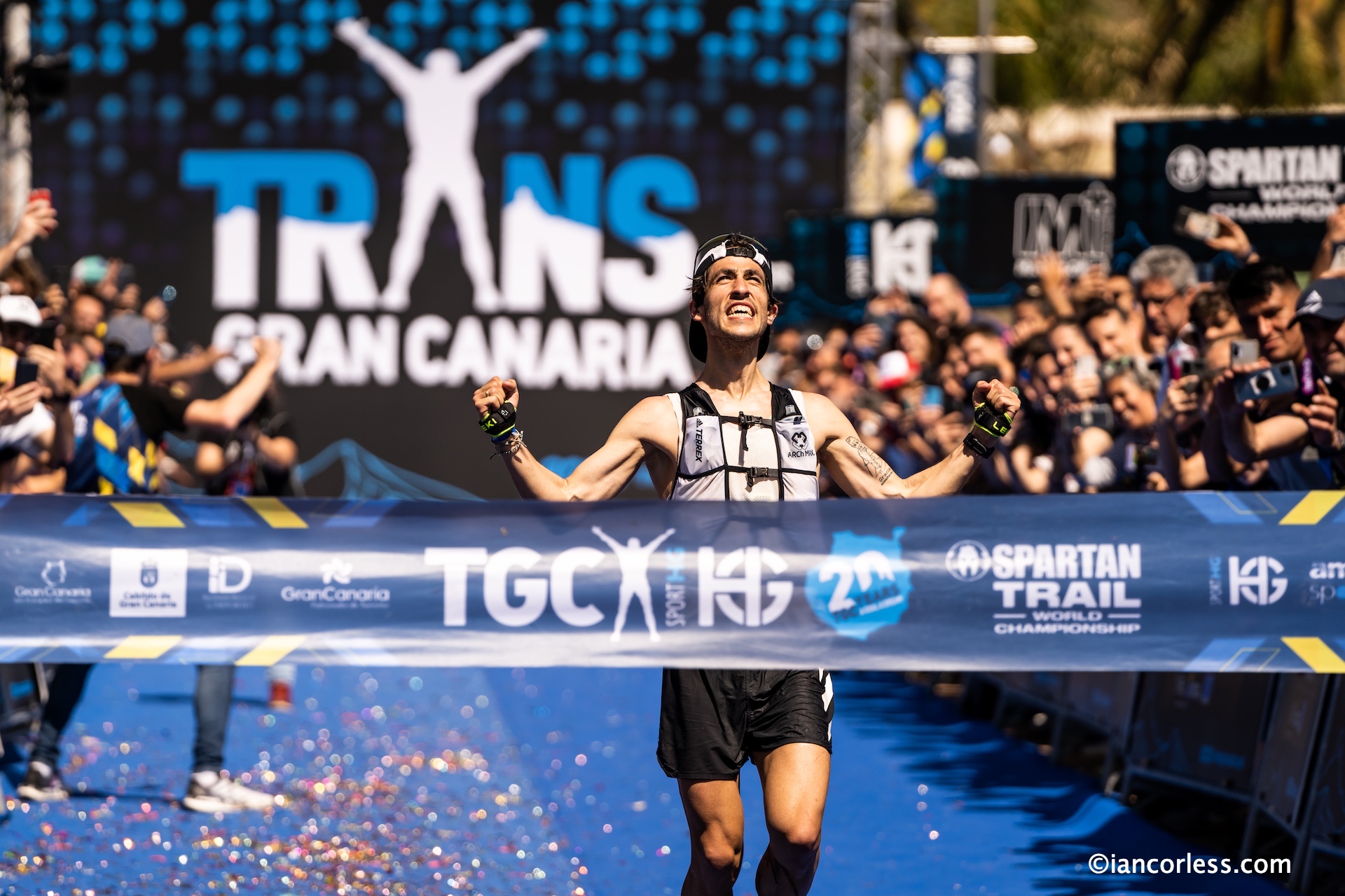
It’s a race for all, not just the elite. The 2022 edition was won by Pablo Villa and Ragna Debats, but most who start just dream of a finish. Winning in 13-hours for the 128km race is far removed from those who will battle one day and two nights to finish in under 30-hours. No matter what time, the welcome is incredible.
Pau Capell fights the cold.
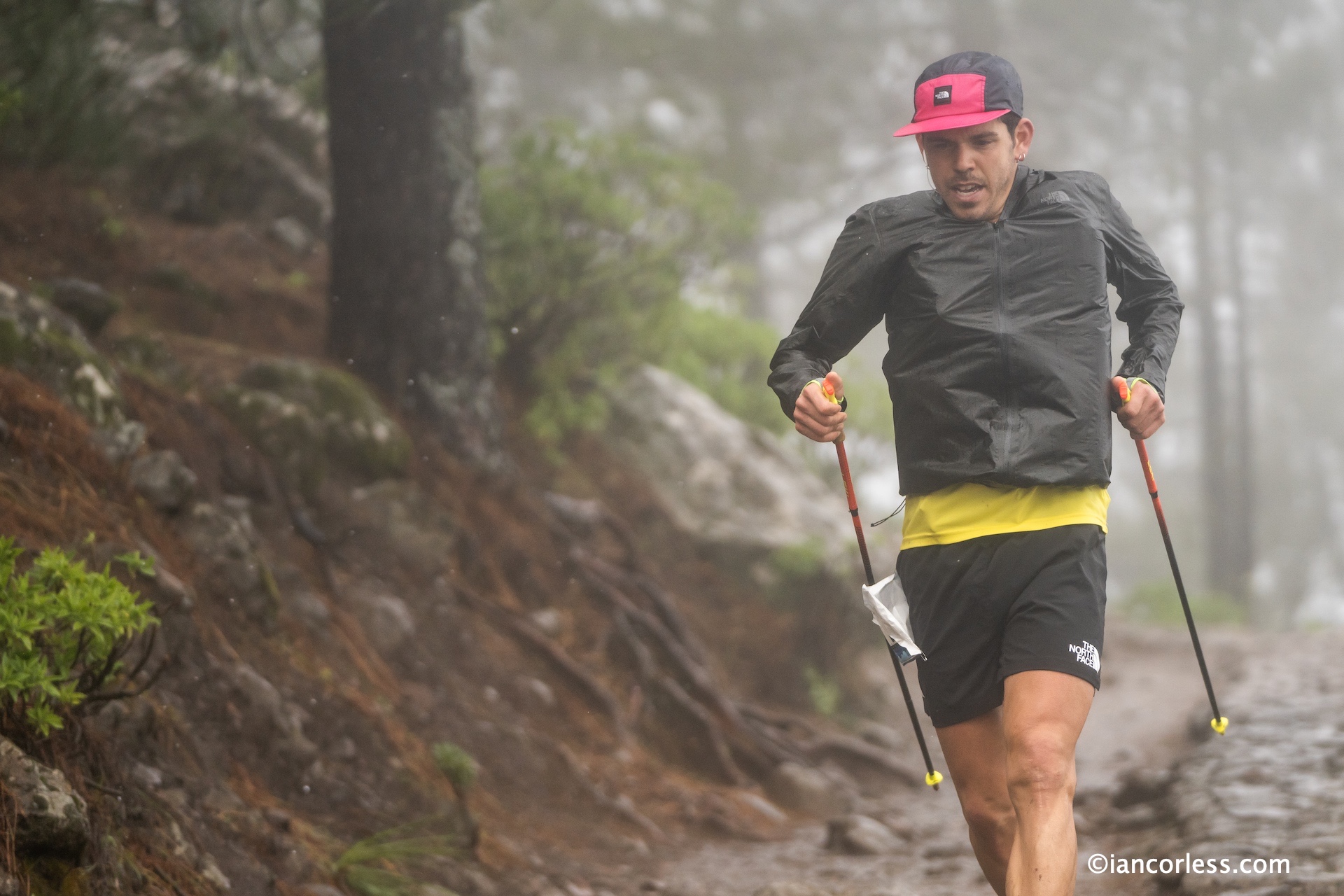
The 2022 edition will be remembered for a wild and challenging night – cold temperatures, strong winds, rain and even snow. It was a challenge for all! But soon after Roque Nublo, dropping below the cloud, the weather changed and warm sun and blue skies welcomed participants. It was unbelievable to witness and no doubt challenged each runner as they tried to adapt.
Pablo Villa – happy!
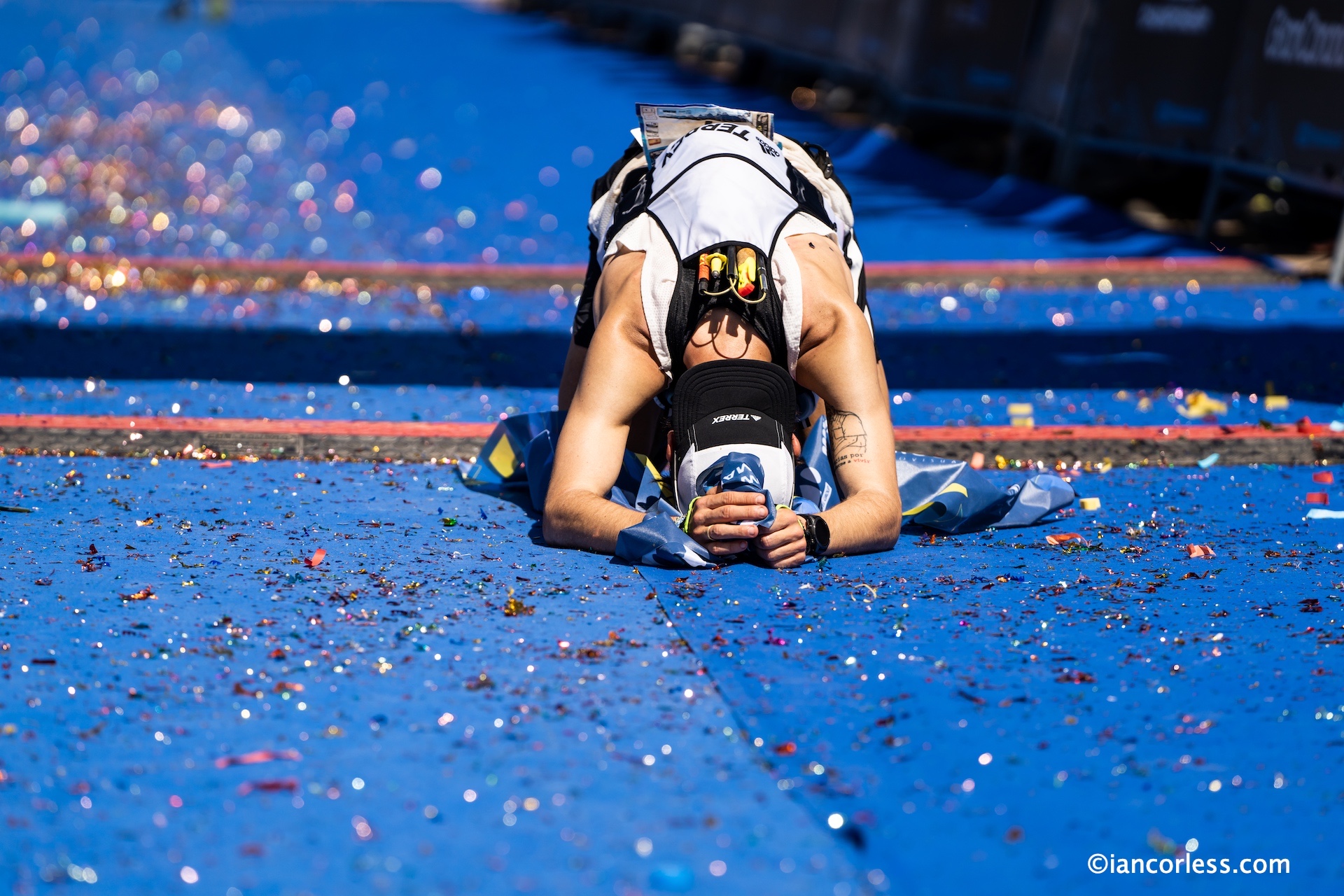
Pabo Villa paced himself through the night and took a convincing lead as daylight arrived. He was pursued by Pau Capell – the duo finished side-by-side in 2020. However, Pablo was too strong and he took an incredible win ahead of Pau and Pere Aurell.
Ragna Debats
For the women, Abby Hall lead the way through the night feeling very strong. However, Ragna Debats eventually caught the adidas athlete and passed her to forge ahead for victory in 16:21:29, a lead of 21-minutes over Abby. Claudia Tremps completed the podium.
Tom Evans – what a victory!
In the Advanced race, Tom Evans had one of those classic stories that you read in many magazines… Plagued by injury, he had some serious operations in 2021, started a long rehabilitation process and then returned to a big race and won! What a story. Aritz Egea pushed the adidas athlete but in the end, Tom was too strong, Aritz finished 10-minutes later. Matthieu Delpeuch finished 3rd.
Advanced women’s podium.
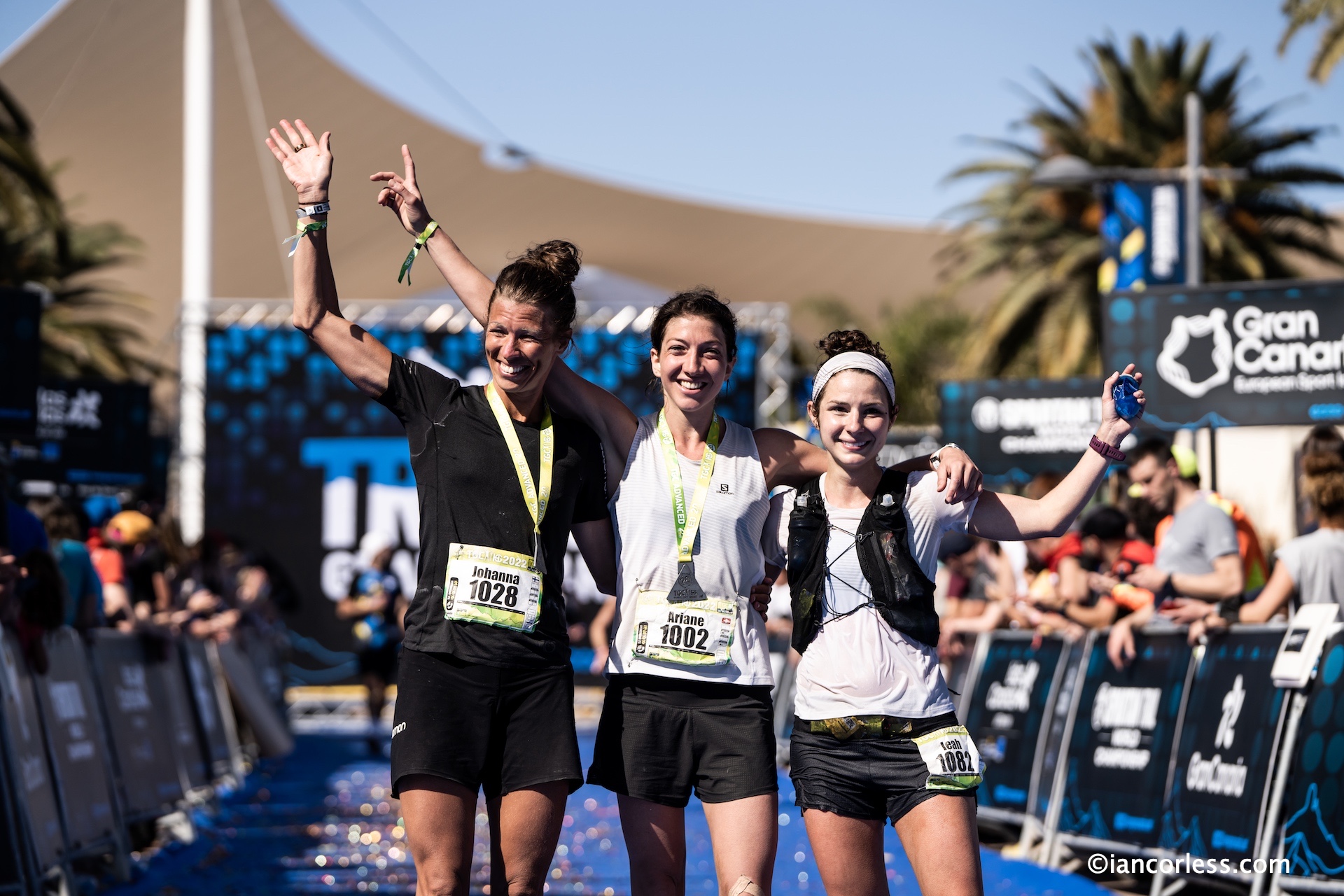
Ariana Wilhem finished ahead of Johanna Antila and Leah Yingling for a closely fought female Advanced podium.
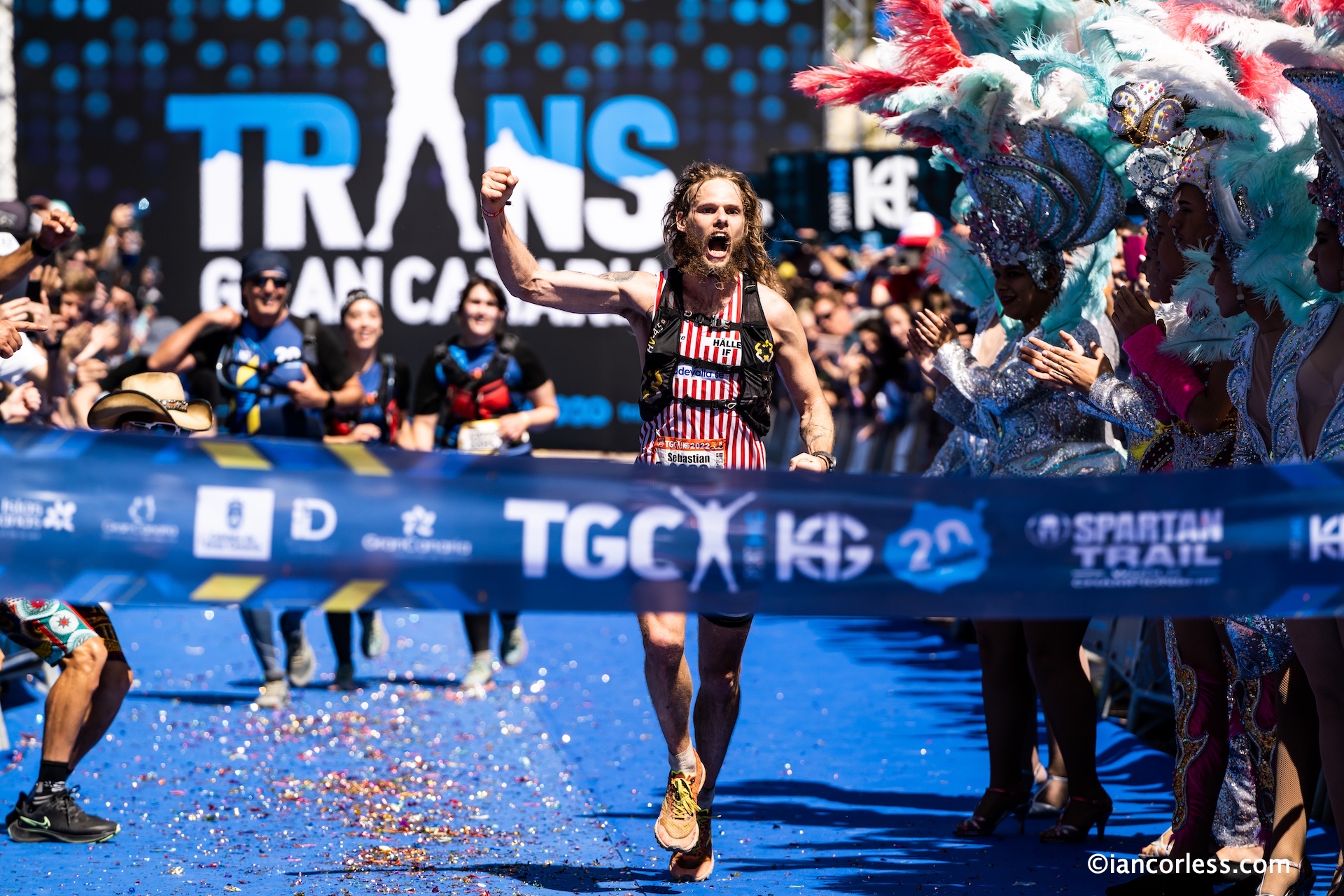
Sebastien Ljungdahl – A surprise win!
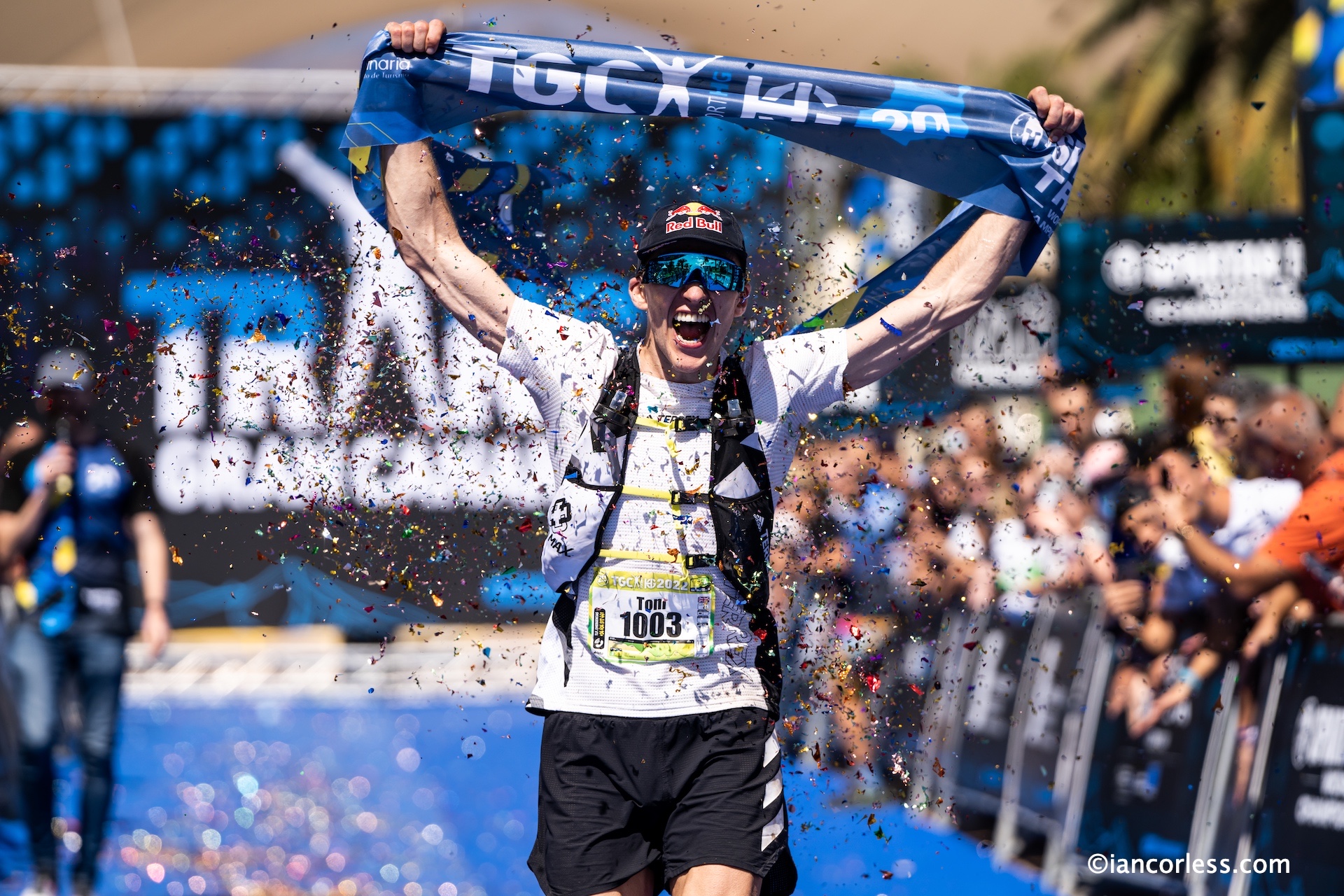
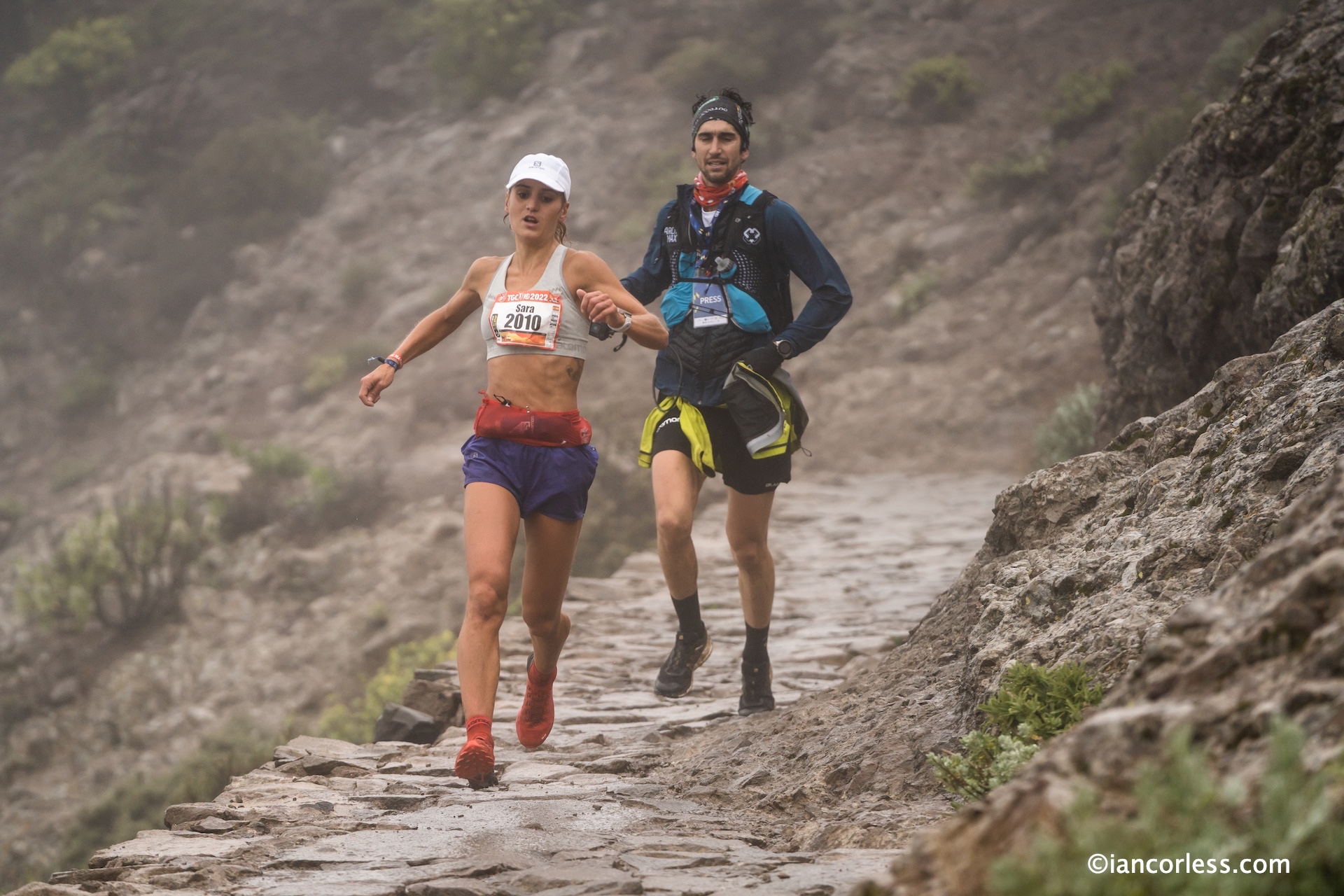
In the marathon, Sebastian Ljungdahl and Sara Alonso ran too incredible and fast performances to take victory. Sara’s performance a course record. Despite the speed, they were close races with Marten Boström and Antonio Martínez completing the men’s podium. For the women, Toni McCann had a great first race in Europe placing 2nd and Anna Comet placed 3rd.
Sara Alonso
Full results listed below.
The Classic and the Marathon races feature in the Spartan Trail World Championships.
Transgrancanaria has distances for every runner, the organization realise that a north-to-south journey is too much for many. Therefore, they offer multiple options: Advanced (62km), Marathon (43km), Starter (26km) or Promo (15km) – all taking place on sections of the full route.VK El Gigante, new for 2022, is a great 1000m climb starting from San Pedro in the Ageate area of the island.
Abelone Lyng
Experienced ultra and mountain runner, Abelone Lyng toed the line of the Advanced race after a full-on week pre-race, exploring the island.
“The weather was wild in the first 30 km with gusts of wind that almost blew me over a couple of times. We had mud and believe it or not, snow! But the last half of the race was cloudless skies and scorching sun. I liked the trail after Roque Nublo, it was steep and technical.”
The iconic Roque Nublo – a stunning backdrop.
With stunning beaches, sea, stunning weather, trails and mountains, this island in the Canaries is one of ‘the’ go-to places for racing or training. It’s no coincidence that Transgrancanaria is now in its 21st year – a clear example of why this island is a Mecca for trail and mountain runners. So, what are you going?
Heat is often debilitating for a runner. Heat cramp, heat exhaustion, dehydration, heat stroke, headaches and the desire just to stop are all very real problems.
As the summer season approaches, running in a hot climate is sometimes unavoidable, however, racing in a hot climate is relatively controllable as you will understand in advance the race, the environment and the expected temperatures one can expect.
Understanding the conditions of ones running and racing environment is crucial to make the best of all the hard training you have done. So, one needs to adapt and plan.
Heat acclimatisation takes place in a natural environment where one can specifically prepare in advance of a chosen race or project, ideally for 7-14 days before the event. For most of us though, the luxury of travelling for 14-days and having an acclimatisation holiday is not a realistic proposition.
This is where Heat Acclimation comes in. In simple terms, this is about providing heat stress in a controlled environment, typically a heat chamber, over a set period of time and sessions.
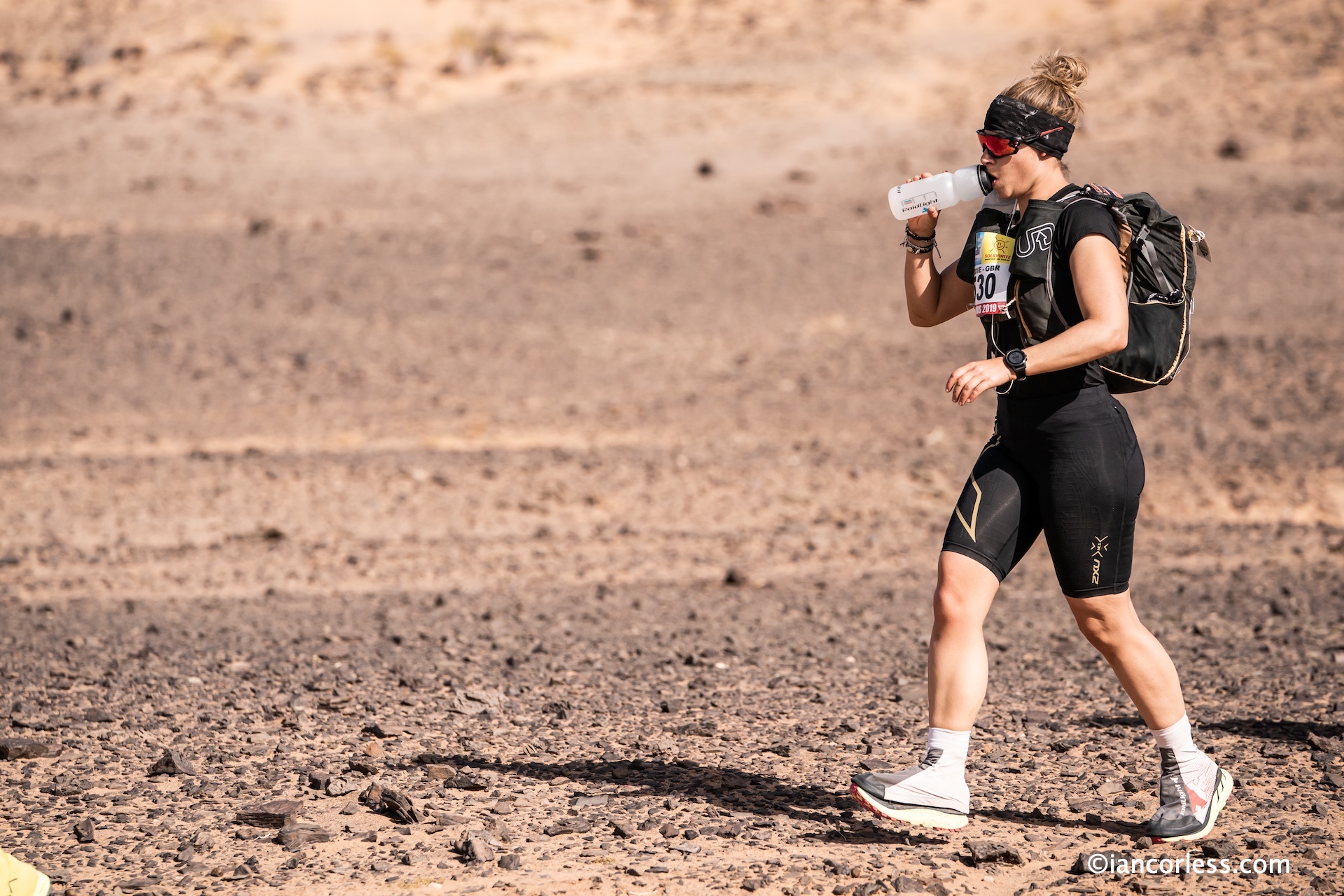
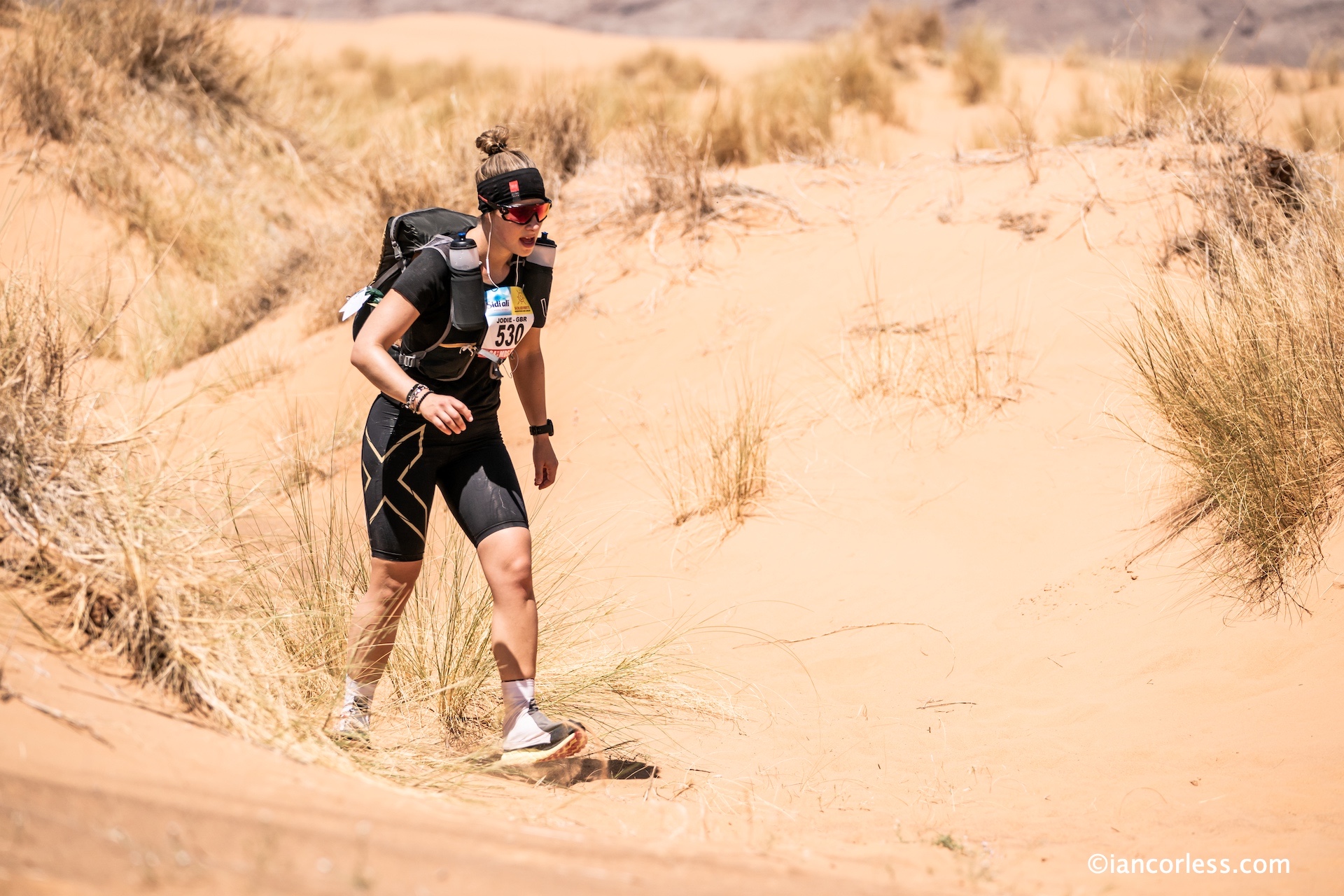
Dr Jodie Moss has specialised in heat acclimation and in the process, put her learning to real time use at the 2019 Marathon des Sables where she placed 8th woman.
Jodie at MDS
With Marathon des Sables approaching, it is timely to re-visit and gain a full understanding of what is required to acclimate to heat with an interview with Dr Jodie from July 2020.
What is it about heat that makes running so difficult?
You are imposed upon by a different challenge. What happens is you create this metabolic heat by contracting your muscles. When one runs, you use muscle mass and this generates heat. When you then exercise in a hot environment, particularly if it is greater than skin temperature, then this makes it very difficult to get rid of heat. Humans are not the most efficient mechanically, so this energy from contracting muscles, potentially around 20 to 30% of the mechanical energy being made is converted to chemical energy, that means 70%, maybe even more, needs to be eradicated in the environment. If the environment is hot, for example, the Sahara, a challenge is imposed to eradicate the heat and what often happens is is that the heat is stored and one feels hotter and this then has a cascade effect of issues and problems, physiologically and perceptually.
Physiologically:
An increase in skin temperature is likely the one which is noticed first as it is directly impacted upon by the environment. There will be an increased demand for blood flow that needs to go to muscle to provide it with oxygen/ energy to run, but also there is a competition for blood flow to the skin. In order to thermo regulate, blood is competing with muscles and skin and that creates an impact on one’s cardiovascular system. Typically, heart rate will increase due to the increased workload sending blood to muscles and skin.
Body core temperature will increase.
Sweet rate will also increase and therefore the percentage of water loss will increase and the consequence of this is dehydration – a deficit in body water with onward complications.
Perceptually:
We thermally perceive it to be a lot hotter.
You are more uncomfortable.
The feeling of needing to slow down and therefore performance is impacted.
Is heat acclimation as valid for the runner at the front, as well as the runner at the back?
In principal, yes. However, if we take Marathon des Sables as an example and the winner, Rachid El Morabity, he is a Moroccan, he lives in the environment in which the race takes place, therefore he is naturally acclimatising on all his training runs. Therefore, he has no need to acclimate artificially.
Highly trained individuals though, through training, can gain thermal adaptations, irrespective of environment. For example, if you are training everyday, particularly at a high percentage of VO2max, one will create heat this will require a higher sweat rate and therefore adaptation takes place. But, interventions should be in place both acute and chronic, to minimise the effect of environment on performance. Environment, will always have an impact on performance, no matter which athlete.
Acclimate for the heat.
When is a good time to start adapting to heat and how?
It is a consideration for close to competition, typically in a period of 7 to 21-days. Adaptation from exposure diminishes rapidly, so, there is no need to do this too far away from the chosen event.
Now of course, if one is fortunate with time, the best scenario is to travel to the race location and adapt naturally in the environment of the race. However, very few have such a luxury and this is where acclimating as opposed to acclimatising steps in.
However, budget can be an issue, so it is possible to adapt via some simple home methods. Keep one’s training as planned, say by a coach, and then add layers of clothing while training. Have a hot bath after training. One can also consider Bikram Yoga and say saunas. But, and this is a big but, while some of these interventions will have some benefit, it is not something that can be recommended completely as it is harder to prescribe and measure.
We want heat adaptation and these adaptations only occur when there is sufficient thermal strain.
As an example, one could run for an hour with layers and build heat. Then immediately have a hot bath. Water has a greater density than air and the heat inside the body would be retained and most likely increase, this would stress the system. But, the issues arise with how long does one do this… Ultimately though, this is considerably better than nothing!
By far the best way, is environmental heat chamber.
Environmental Heat Chamber
The jury is still out on what is the optimal sessions for performance gain, however, five sessions would be considered fundamental over a period of 7 to 14-days. This period has shown results of a much more fulfilled adaptation. The pseudo motor function (sweat rate) takes a little longer to occur, but all the other measurements, cardiovascular and lowering core body temp occurs quite rapidly. So, based on sweat rate, a longer period of time provides the best results.
In regard to the sessions, they could be performed every 2-days, every other day, every day and some even do 2 sessions per day. But obviously time and budget is a huge factor.
It is also important to remember that these sessions take place close to competition, so, monitoring stress and recovery is equally important.
In regard to session length, 60-minutes is usually adequate and this allows the body to get hot enough.
I get asked about adding a run pack and weight, for example, MDS is a self-sufficient race and a pack is required. On the start line, the minimum weight will be 8kg. But training with this in the heat is not necessary, but some insist as it provides security, comfort and a greater understanding of what the Sahara, as an example, may feel like. But this adds additional stress and the sessions are about heat adaptation.
The Protocol
Isothermic heat acclimation intervention is typical. We get you to exercise so that your core reaches a certain temperature. For this we use a rectal thermistor. This ensures that you meet the thermal stimulus, crucial for sessions like this.
We measure body weight naked and this allows us to monitor fluid intake and sweat rate. We can test urine to look at hydration status too. This is all about making the client aware of hydration and levels. We also want the client to leave a session re-hydrated!
A treadmill or bicycle is used. Personally, I prefer the bike as it adds less impact to the body. It’s important to remember, these sessions are about heat adaptation, they are not training sessions. A 5-minute check will include hear rate, core temperature, skin temperature, perception of thermal environment, how hot does the client think it is? And finally, I will ask how comfortable the client is. Then, the exercise will begin.
We aim for a core of 38.5 degrees in each session. This is ideal for pseudo motor and thermo functions to be maximised. It ensures that we are always controlling and meeting a fixed criteria. Measuring the thermal strain is key. It usually takes about 30-minutes to get to 38.5 degrees depending on the individual. But external factors do have an impact.
We typically see improvements by session 3. But it is important to have, say 10-minutes of each session fixed, that way we can monitor improvement and adaptation. We can gain the data here and then report back. Day 5 to day 7 will show the most improvement. So, 7-sessions.
Time can be an issue and some may prefer to squeeze two sessions per day and compress 7-days, say, into 3 or 4. This is possible and literature confirms this. Total exposure is more important than days.
Ideally, the last session would be 1 or 2-days before departure for the chosen race.
What problems can occur without acclimation and how does one mitigate it?
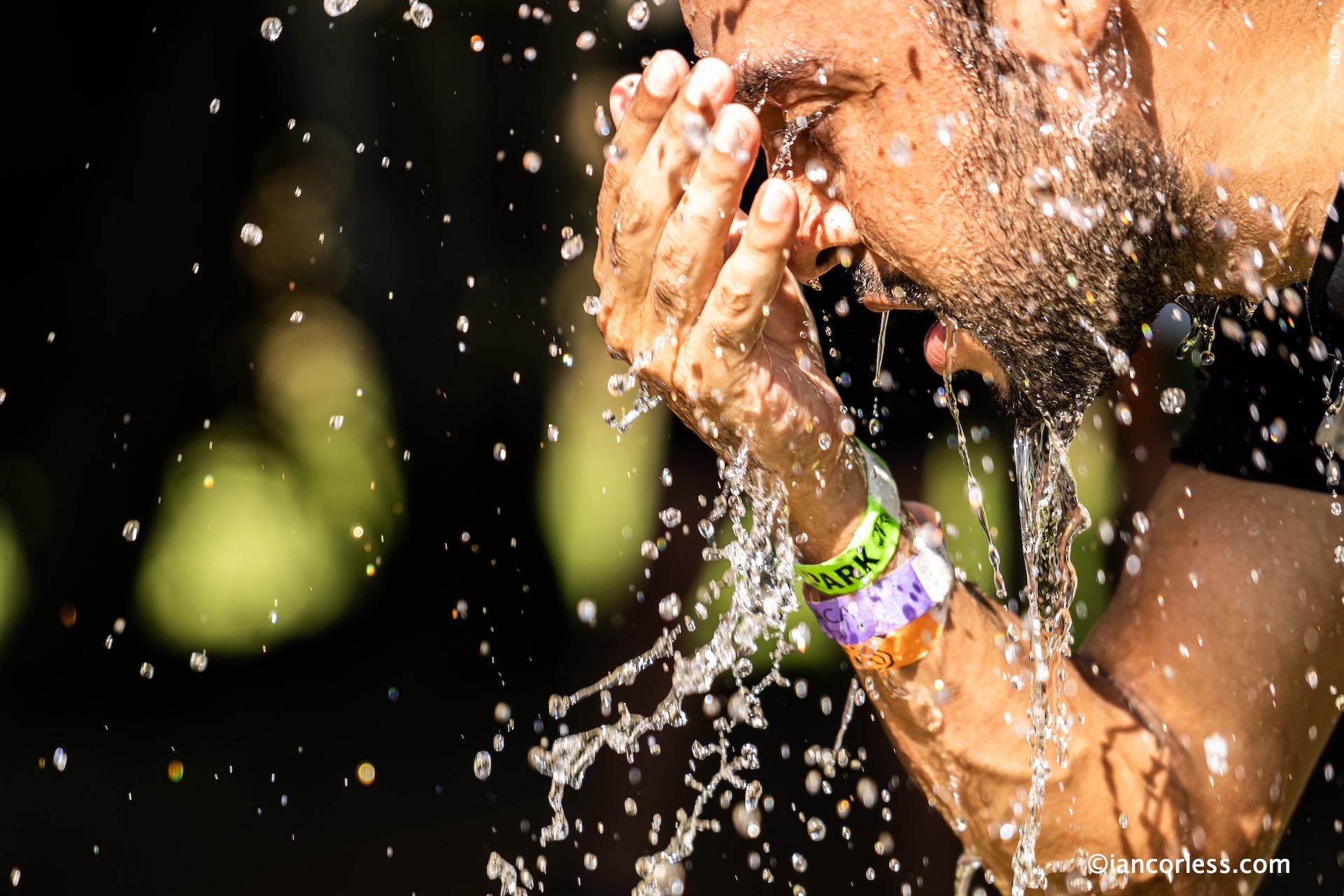
A runner will be faced with a physical and perceptual challenge that will have negative effects. They will be slower, frustrated, dehydrated and have a potential of heat stroke and ultimately they may not finish the race. If any of these elements are experienced, try to cool as much as possible, seek shade at aid stations, rest and allow the core to lower. Hydrate and use spare water to provide a perceptual cooling. Water on face, head, forearms and neck will help a little.
On a personal note:
I did not have the perfect race and that is what makes me keep signing up to race. My heat protocols were great but I compromised my training and I was surprised with 8th place. I had an amazing support system and I do have chronic heat exposure, I am also very good at getting rid of heat. I also sweat high. But I need to be careful on dehydration. I made a mistake with my pack trying to make it as light as possible but I compromised my pack integrity and this hurt my back. I look forward to going back, I hope in 2021.
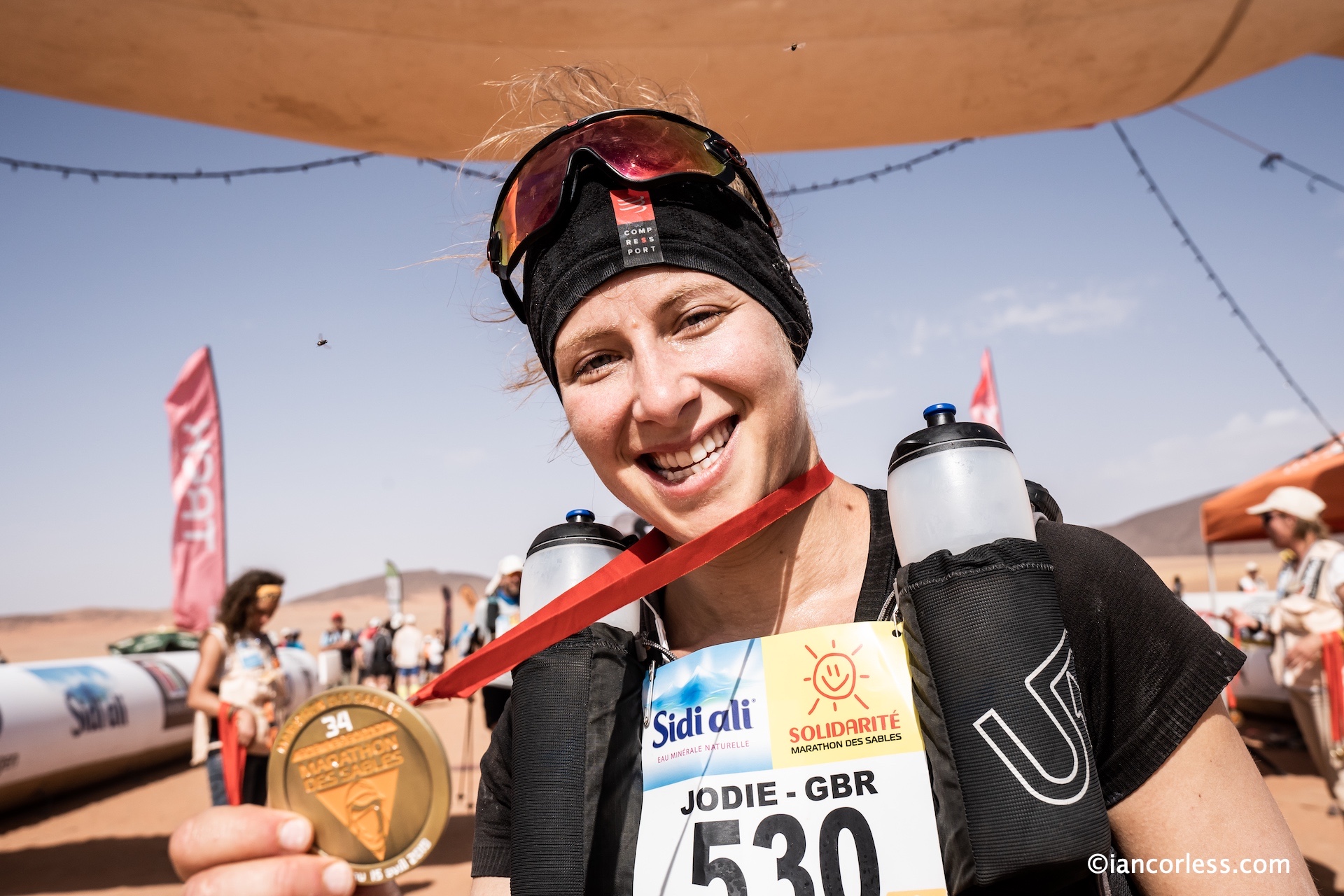
Jodie with her medal.
Top 3 tips to get ready in regard to heat and training.
1. Have a heat protocol as outlined above.
2. Test all kit and nutrition, leave nothing to chance.
3. Do not panic. Trust the training you have done. Do not increase mileage and training in the light stages. Do not risk injury or illness. Be healthy.
Pura Vida! The final and 6th stage of The Coastal Challenge is done!
The Coastal Challenge
Starting at Ganadito Beach and concluding at Ganadito Beach, the 36.4km final stage of the 2022 TCC was a tough one, with a substantial amount of extra kilometres over the usual victory loop of the iconic Drake Bay.
Long and endless beaches
This time, Drake Bay was reached after 10.7km, usually, this would be the start and end point.
At 21.3km, Cp2 SanJosecito Beach saw the lead men all together and Giudy well out on her own.
San Josecito Beach – Hayden Hawks
Agujitas at 33.3km rewarded runner’s with a sight of the finish at Ganadito Beach.
Franco Colle and Julien Chorier
For all, it was a day to enjoy, signified by the lead men running together for much of the race, the exception coming with Erick Agüero who lost the group and trailed minutes behind.
Giudy at the waterfall crossing.
Giudy Turini ran solo, no doubt looking to get the last day done as quickly as possible. Francis Davila Palacios doing the same.
Francis Davila Palacios
Stage 6 is a mini TCC encompassing, waterfalls, rainforest, plantations, dusty fire trail, water crossings, beaches, coves and the stunning Pacific as a backdrop.
Peter van de Zon ran a great race for 2nd place
Fire roads start the day, a run in a river bed, a waterfall crossing, dirt roads with countless water passes and then finally the beach arrives. The coastline weaving in and out all the way to the line.
At the end, Hayden Hawks and Giudy Turini are the 2022 TCC champions.
The men’s podium, Hayden, Peter and Erick2022 female champ, Giudy
The line was full of emotion as an epic journey has come to an end. The 2022 TCC was a huge success.
Day 5 is a long day on The Coastal Challenge and what a day! At 42km, it is shorter than previous editions of the TCC due to a change of the finish area and camping location. This, makes the last day considerably longer and much more of a challenge than in previous years.
Runners depart camp via bus for a short bus ride to the Sierpe River and ferry across to the other side.
Cp1 Portero, 11km, is reached by gravel roads and faster running. Sábalo follows at 18km and here, the gravel road gives way to more technical and challenging terrain. There is a steep climb and descent before gravel road resumes to Cp3 Ganado. Now a final technical loop, beach section and water crossing brings stage 5 to an end at Ganadito Beach.
Peter van de Zon
Much of today’s route is considered very runnable on wide gravel roads. Great if you can run, but for many, stage 5 is a tough day with tired bodies.
Peter and Hayden, head-to-head
It may come as no surprise that once again Hayden Hawks and Peter van de Zon dictated the race from the front. The duo running together for the whole day and crossing the line in 4:20:50.
The water crossing
Erick Agüero battled hard and early in the race he held a small gap. But as the race progressed, the gap opened and Erick seemed to relax, content with his 3rd place crossing in 4:50:15.
Erick Agüero
Franco Colle finished 10-minutes with Julien Chorier in 5:00:33. Franco somehow finding form in the latter stages of the race, no doubt due to adapting to the heat.
Julien ChorierJulien and Franco Colle
5:47:43, 6:05:35 and 6:43:42 were the women’s finishing times, the race once again taking the format of the previous days with Giudy Turini, Francis Davila Palacios and Courtney Hill finishing 1, 2 and 3.
Giudy TuriniFrancis Davila Palacios
Japanese runner, Tomomi Bitoh joined the race today after opening quarantine in San Jose and then being cleared with a negative PCR test. It was a bitter sweet moment for Tomomi after excitement over a trip and race in Costa Rica, for it all to be taken away at the 11th hour. She will savour the opportunity to experience some Pura Vida and a magical part of the TCC race.
Tomomi Bitoh
Tomorrow’s stage is a loop of Drake Bay – it’s a stunning day that manages to encamps all the previous 5 days in one loop. However, in previous years, this race was often a victory loop at just over 20km… Now, the last day is a challenging 37km!
Day 4 from Coronado to Palma Norte (a new finish) is a unique day – starting at sea level, the route climbs to just under 1000m in 10km and then stays high with a rollercoaster of hills dropping to just under 600m at 15km and then climbing again to 900m at 20km. From here, the runners drop to 600m at 30km and then once agin, climb to 850m before a short, sharp and very steep drop to the finish.
Hayden Hawks pushing the pace
With three aid stations, Tres Ríos at 6.1km, Guagaral at 15.5km and Donkey’s Hill at 23km, it is essential for the runner’s to ensure they have enough fluid for this tough stage. The distance 37.4km and 2414m of vertical.
Early morning had a chill and misty start and at remained that way for some time, providing the runner’s with a welcome refreshing start to the day.
Giudy Turini
The main protagonists of Hayden Hawks, Peter van de Zon, Erick Agüero and Julien Chorier marked each other over the opening 10km running side-by side.
Eventually, Hayden Hawks decided to make a move… His motive was to build some time and a gap so that he could concede some time on the more challenging and technical terrain.
Peter chasing hard
By Donkey’s Hill he had really opened the throttle and built a huge lead over Peter who chased.
Erick Agüero
Despite the terrain and challenge, Hayden stormed his way to the finish crossing in 4:18:15. Peter battled hard but in the end, the speed of Hayden on the flat and more runnable terrain could not be matched, he reached the finish in 4:25:23.
Expansive vista
Erick Agüero once again finished 3rd once again in 4:38:27 with Julien 4th in 4:46:07.
Giudy Turini
The women’s race went to the protocol of the previous days with Giudy Turini pushing from the front, holding her place and crossing the line in 6:02:17.
Francis Davila Palacios
Francis Davila Palacios played the eternal bridesmaid, always running with a smile and crossing in 6:20:52.
Courtney Hill
Courtney Hill, once again placed 3rd in 7:17:59 and today, Jennifer Schwegler placed 4th.
Tomorrow’s stage is 42km from Sierpe to Drake Bay with a new finish.
Day 3 of The Coastal Challenge kicked off at 0530 this morning and what lay ahead was a tough and challenging day of hills, technical trail, waterfalls, long dusty and stony roads and beach – all intensified by Costa Rican heat and humidity.
The early trails leaving Dominical Beach take the runners into 9.7km’s of technical river bed. It’s all rock hopping and slip sliding away on the wet and greasy surface until Cp1 Barú.
Danish ultra runner, Jakob Bloch.
Nuayaca Waterfall is no doubt the highlight of the day, if not the race. The runners arrive down a small trail and the cascade greets them, they pass through and then climb up a winding trail.
From here on in, the terrain varies from rainforest, dusty access roads and technical trail. La Florida, Cp2 at 23.4km provides hydration and nutrition before the push to Cp3, Hermosa Beach and then Uvita at 42km.
Erick tries to cool down.
Now, the heat is intense and the runners are sandwich pressed between sand and sky.
Peter at the water crossingEveryone survived…
A small technical forest section leads to a water crossing, the highway and then another trail section before road leads to a new campsite, first used in the 2021 edition. Katakolo signifies the finish.
Erick Agüero
Erick Agüero dictated the pace from the start, it comes as no surprise with his experience on the course, particularly the opening technical 10km. He was accompanied by the main protagonists, Hayden Hawks, Peter van de Zon and Julien Chorier.
Julien Chorier
At Cp2 though, Hayden and Peter had pulled away on the rollercoaster terrain and had gained a substantial 5-minute lead. Julien Chorier was now trailing the leading three and losing time.
Hermosa Beach passed and then at the water crossing, immediately after Cp4, Hayden extended a short lead over Peter; both looking strong. Erick now had lost significant time but had a huge lead over 4th, Julien.
Hayden strong and in control
At the line, Hayden had once again extended his time crossing in 5:29:16. Peter, running a solid and excellent race, crossed in 5:31:25 well ahead of the local hero, Erick who ran a time of 5:49:43.
Erick pushing to the lineGiudy was flying!
Giudy Turini once again lead from the front and never looked back. Early in the stage, she was contending a top-10 position overall and that remained the way through most of the stage, so strong was her performance. With no immediate pressure from behind and with such a convincing lead, she is pacing herself perfectly for 2022 TCC victory.
Giudy at the final water crossing
Francis Davila Palacios once again ran strong and steady for 2nd place. Consistent in the heat and terrain, barring any problems over the next three days, her 2nd overall looks secure.
Francis Davila Palacios
Courtney Hill once again followed up a solid stage 2 with a great stage 3, however, the battle with Paolo Gamboa Sanchez, for today, was truce, the due crossed the line together, a second apart.
It was a an 0330 wake up call this morning and an 0530 start. It may sound super early but believe me, the runners weren’t complaining! Most had been in bed before 8pm. The advantages of an early start are simple, it gives the runners a good 2-hours before the heat starts to take its toll. For Costa Rica, it was a chilly morning (relatively) as the runner’s departed straight in to a steep climb.
Today’s stage was a tough 41.3km with 1828m of vertical and 1953m of descending.
Julien Chorier and Peter van de Zorn
Julien Chorier, Peter van de Zorn, Hayden Hawks and Erick Agüero pushed hard on the first climb and after the summit, Julien and Peter opened a small gap over the chasing duo. Leaving the trail, gravel roads lead the way to Cp1 El Brujo at 13.1km. It was a tight race up front and the more technical trail suited Peter, Erick and Julien. Erick opened a gap!
Dos Bocas, Cp2 at 23km and Eick had taken the lead with Peter 2-minutes behind and Hayden chasing 4-minutes back. Was the Costa Rican local and TCC regular about to light up the race?
By Cp3 at Hatillo, 33km, Hayden had closed the gap with Julien not far behind. It was significant marker in the race. The heat was now full strength and ahead flat beach running to Dominical and two water crossings.
Hayden HawksDominical Beach is a haven for the local fishermen.
Hayden bided his time and pulled away, it was a clever move, he had saved something for when it mattered and the gap opened up over Erick with Peter chasing.
Peter van de Zorn
At the line, Hayden had opened up several minutes and clinched another stage victory and a solid lead. Next to appear was Erick and on his heels, Peter. The due crossing the line 35-seconds apart. A stunning day’s racing.
Julien Chorier
Julien Chorier placed 4th and Daniel Herrera Montero placed 5th, flying the flag for Costa Rica.
Daniel Herrera Montero
In the women’s race Giudy Turini followed on her stage 1 victory with a convincing performance. Before Cp1 she had already built a lead, this only increased checkpoint by checkpoint, she crossed the line well ahead of 2nd and looked comfortable in the heat.
Giudy Turini
As on day-1, Francis Davila Palacios ran the day in 2nd place, but as the day progressed and the distance lengthened, the time gap to Giudy only extended. However, at the finish she still looked strong and fresh. There is still a long way to go!
Giudy at the finish.
Paola Gamboa Sanchez who placed 3rd on day-1 struggled a little today opening the door for Courtney Hill who achieved a 14-minute gap. Paola still retaining 3rd overall after 2-stages.
Francis Davila Palacios Courtney HillPaola Gamboa Sanchez
Tomorrow’s stage, stage 3, is 50.5km and a tough one that runs from Dominical Beach to a new finish at Katakolo.
Stage Results:
Hayden Hawks 3:57:06
Erick Agüero 4:00:22
Peter van de Zorn 4:00:57
In the overall standings, Hayden has a 16-minute lead over Peter.
Giudy Turini 5:14:41
Francis Davila Palacios 5:46:35
Courtney Hill 6:26:08
In the overall standings, Giudy has a 37-minutes lead over Francis.






















 IAN CORLESS