The MDS Cappadocia returns for its second edition, bringing trail runners back to one of the most visually surreal landscapes on Earth.
Set across three demanding stages over four days, this is not your typical desert race, on the contrary, it’s a technical, high-impact trail event through ancient terrain steeped in history and visual splendour.
Runners choose between 70km, 100km, or 120km of total distance, stages 1 and 3 are the same for everyone, stage 2 participants choose 20/40 or 60km.
Each course is carved through a landscape that feels pulled from another planet.
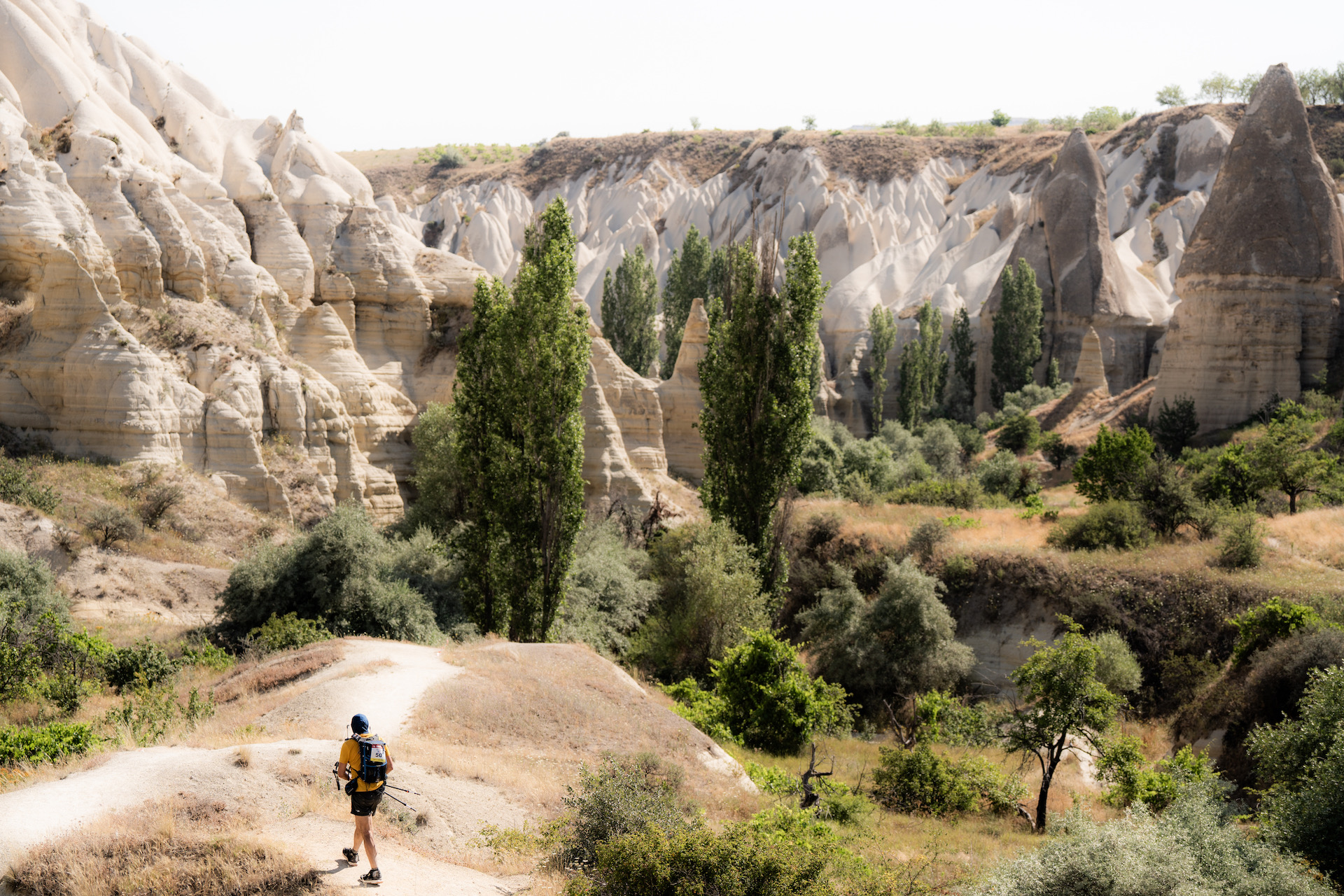
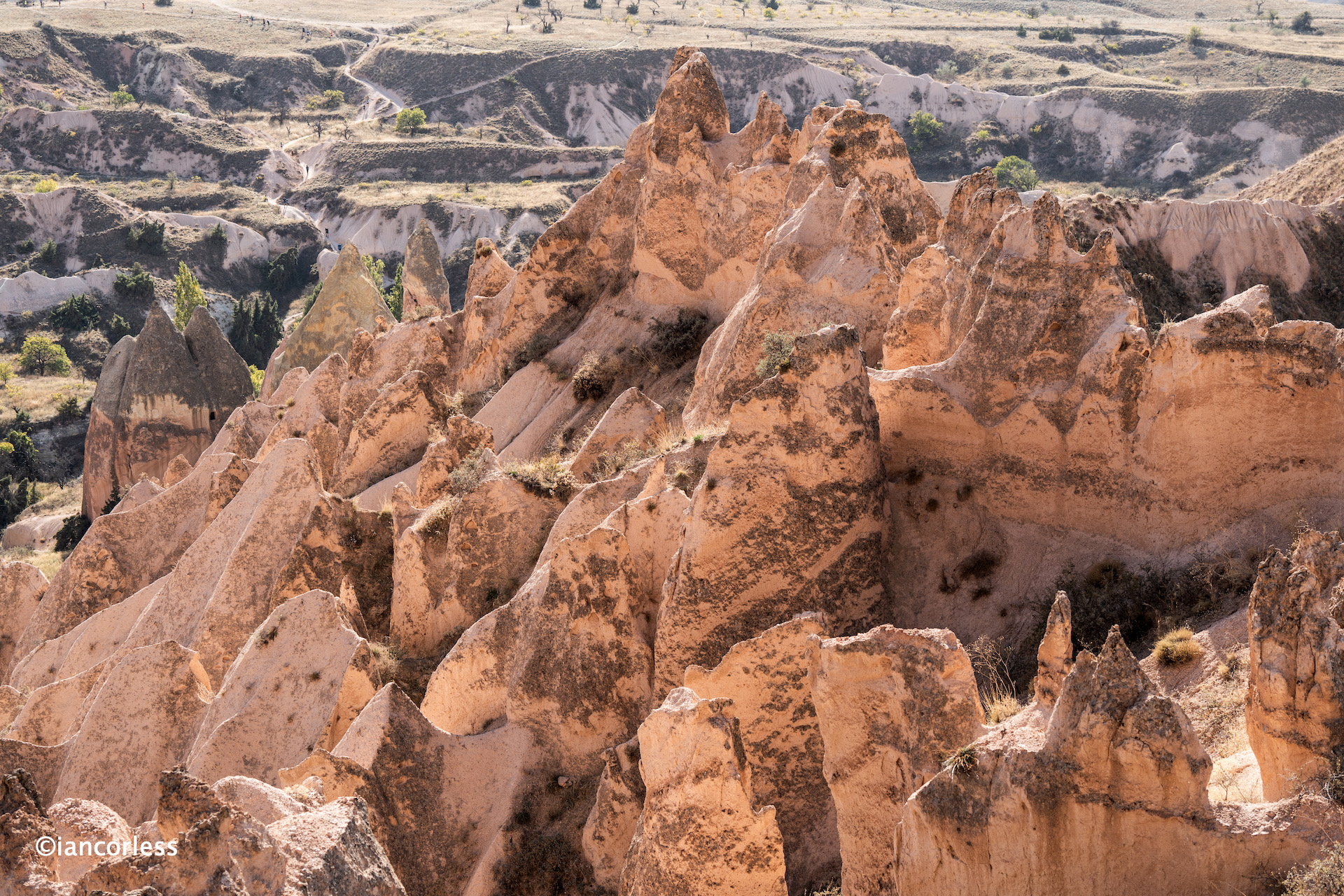
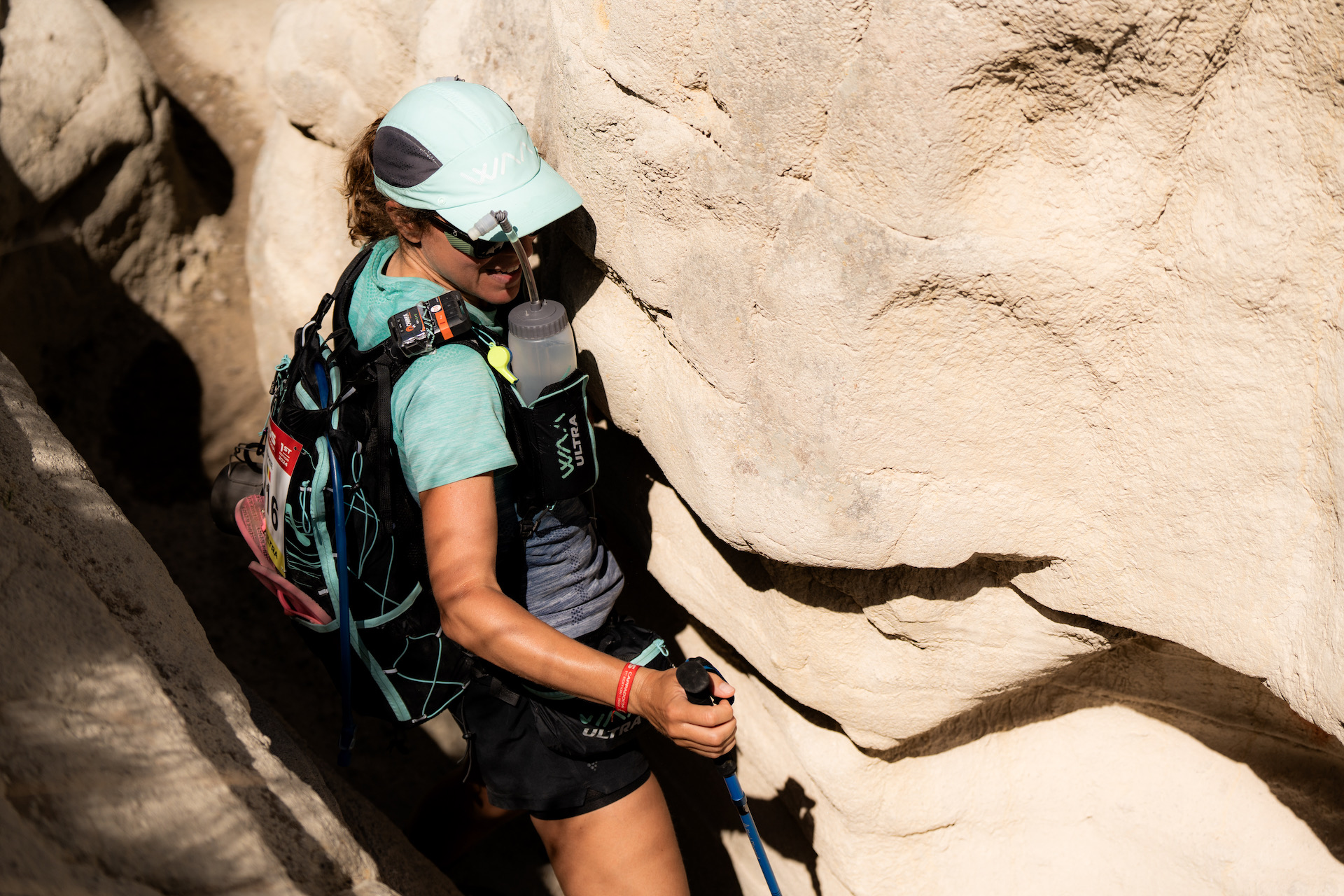
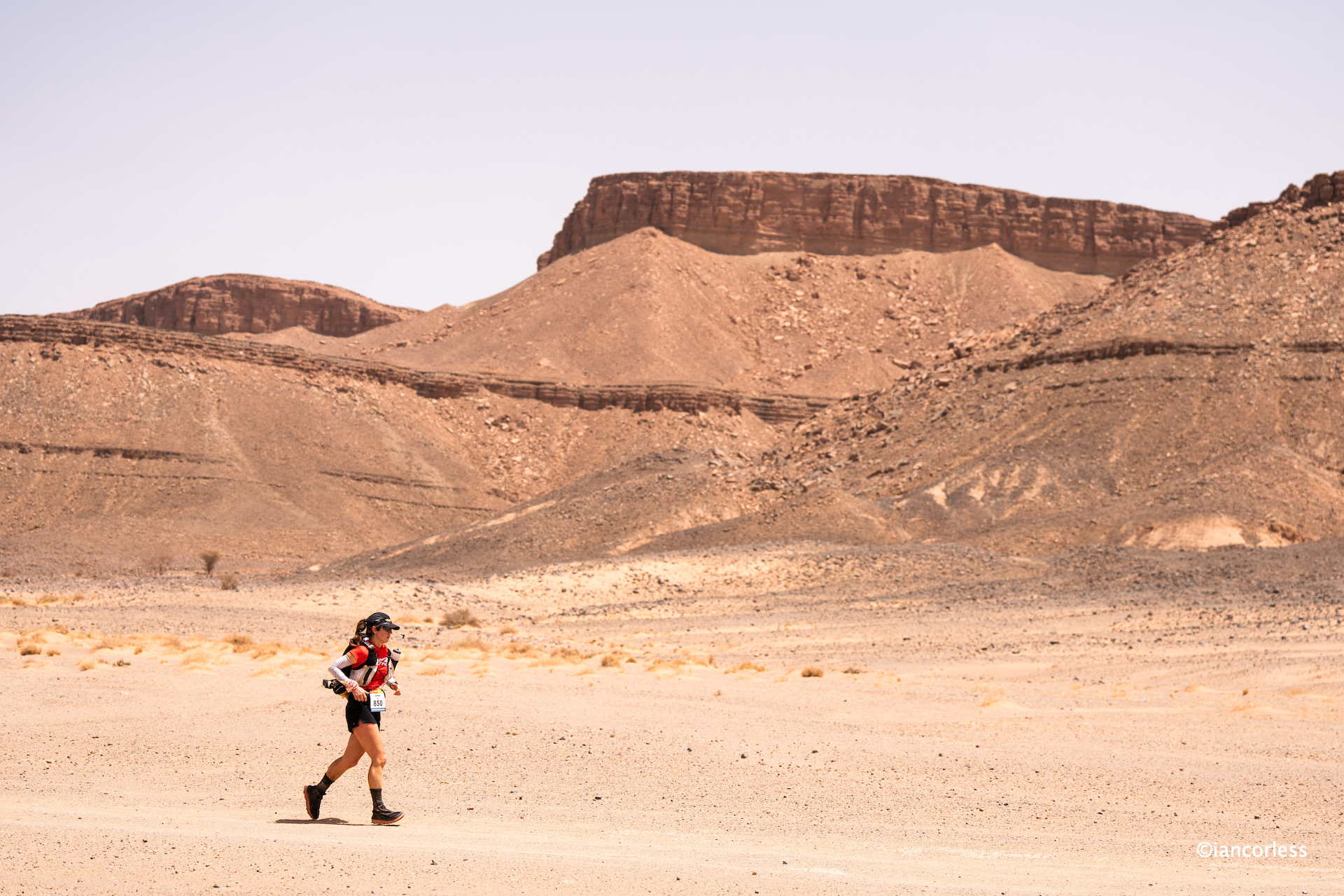
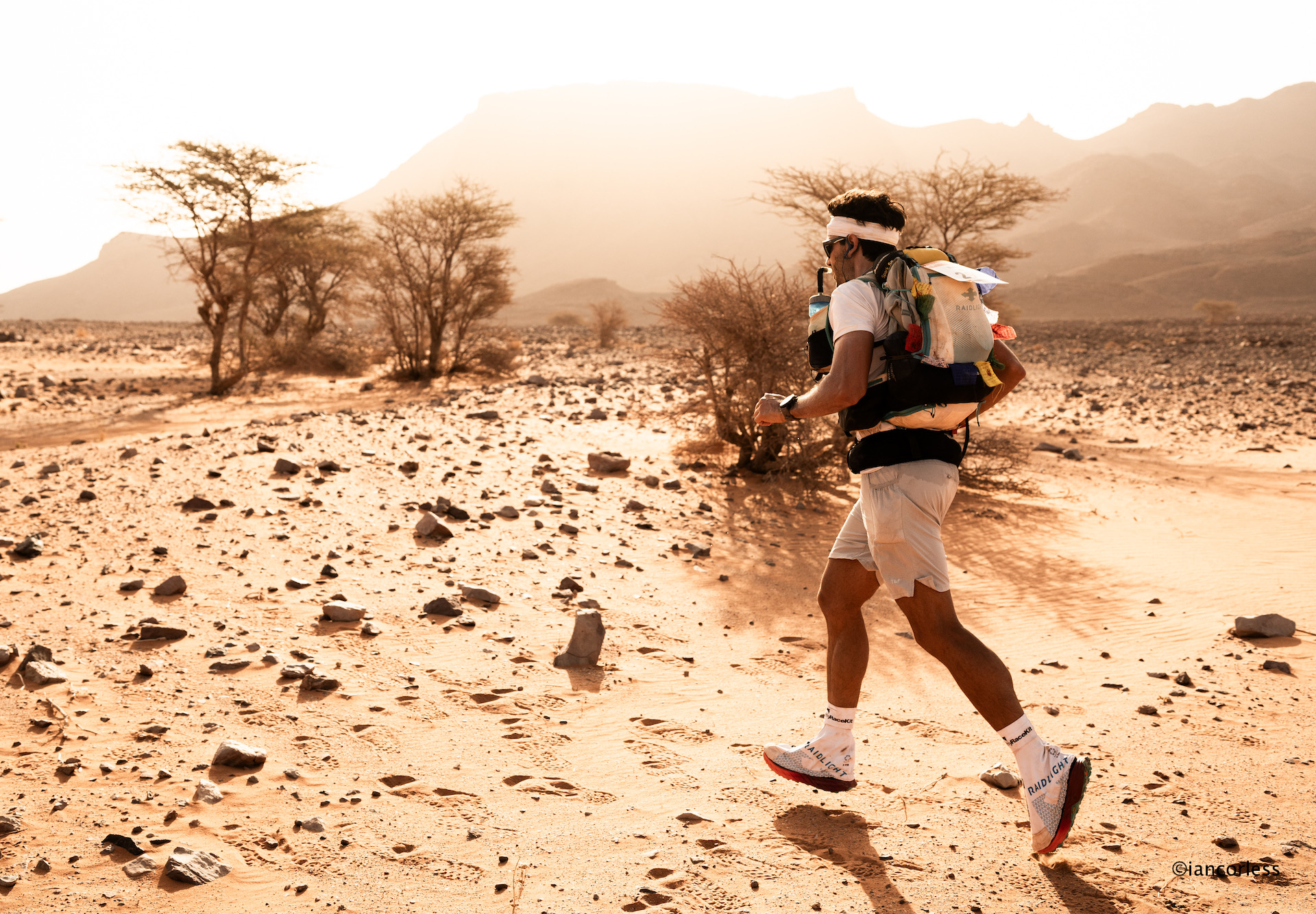
This isn’t a race of endless dunes, Cappadocia stands unique in the MDS format with no sand. It’s a test of grit over rock, gravel, and dust trails, winding through steep valleys, high plateaus, and narrow chimney-like formations.
The terrain shifts constantly. One moment you’re powering up a canyon, the next you’re cruising past thousand-year-old cave dwellings.
Cappadocia’s late summer weather is unpredictable. Days can scorch above 30°C (86°F), while nights drop sharply in temperature. As with all MDS events, participants will sleep in individual tents in a stunning location set within an amphitheatre of rock.
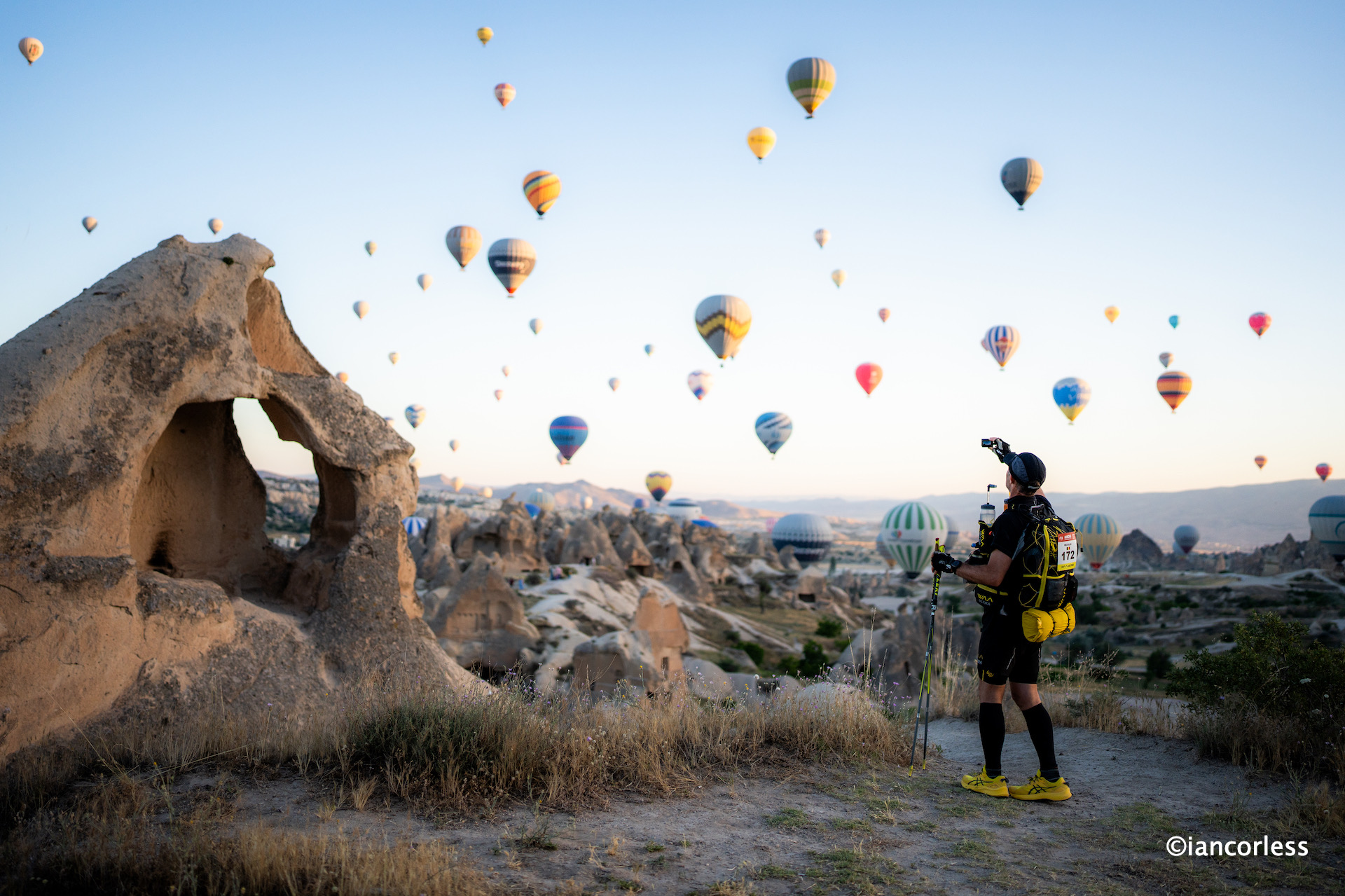
The sky, often cloudless, fills at dawn with dozens of hot air balloons, silent giants drifting above the rock spires and carved cliffs. Arguably, one of the most unique and memorable sights in any MDS event.
Whether you’re going for the 70km or pushing through the full 120km, MDS Cappadocia strips away distractions and puts the challenge squarely on participant versus the trail: raw, remote, and unforgettable.
Following on from the success of the 38th (2024) edition of Marathon des Sables – The Legendary (summary here), today the dates for 2025 are announced:
April 4th to 14th 2025.
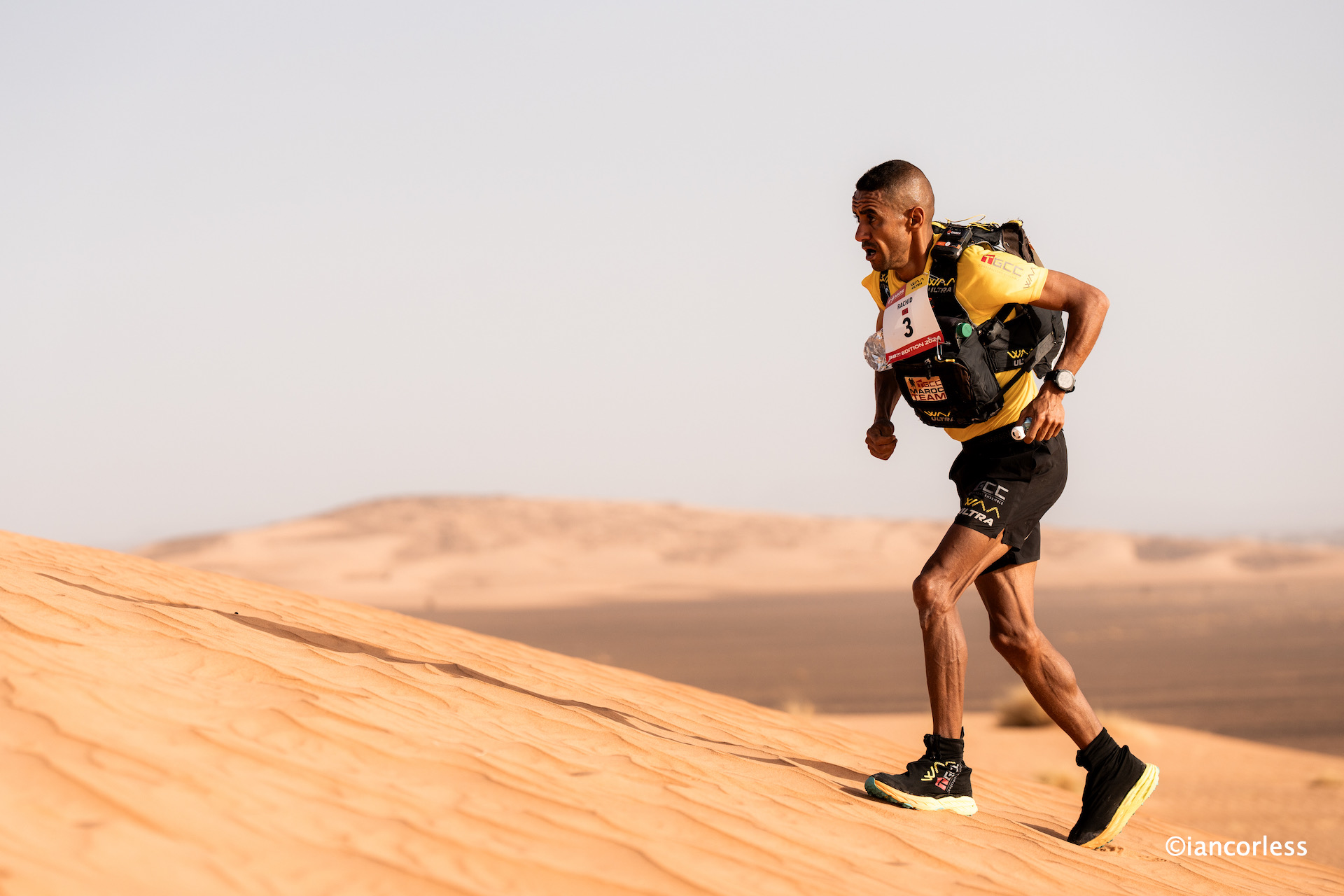
Will Rachid return in 2025 for an 11th title?
The timings will be as follows:
Apr 4 – Arrival in Morocco and meet in Ouarzazate for onward transfer to B1.
Apr 5 – Admin day.
Apr 6 – Stage 1
Apr 7 – Stage 2
Apr 8 – Stage 3 *
Apr 9 – Stage 3 continuation or rest day *
Apr 10 – Stage 4
Apr 11 – Stage 5
Apr 12 – Stage 6 and onward travel to Ouarzazate
Apr 13 – Free Day and Gala Evening Presentation
Apr 14 – Onward travel
* Based on ‘the long day’ coming on stage 3.
Currently, it is not possible to register for 2025, but entry will open on JUNE 19th 2024.
These are exciting times for the MDS brand and it is highly anticipated that entries for 2025 will flood in after the success of the most recent event which concluded just weeks ago.
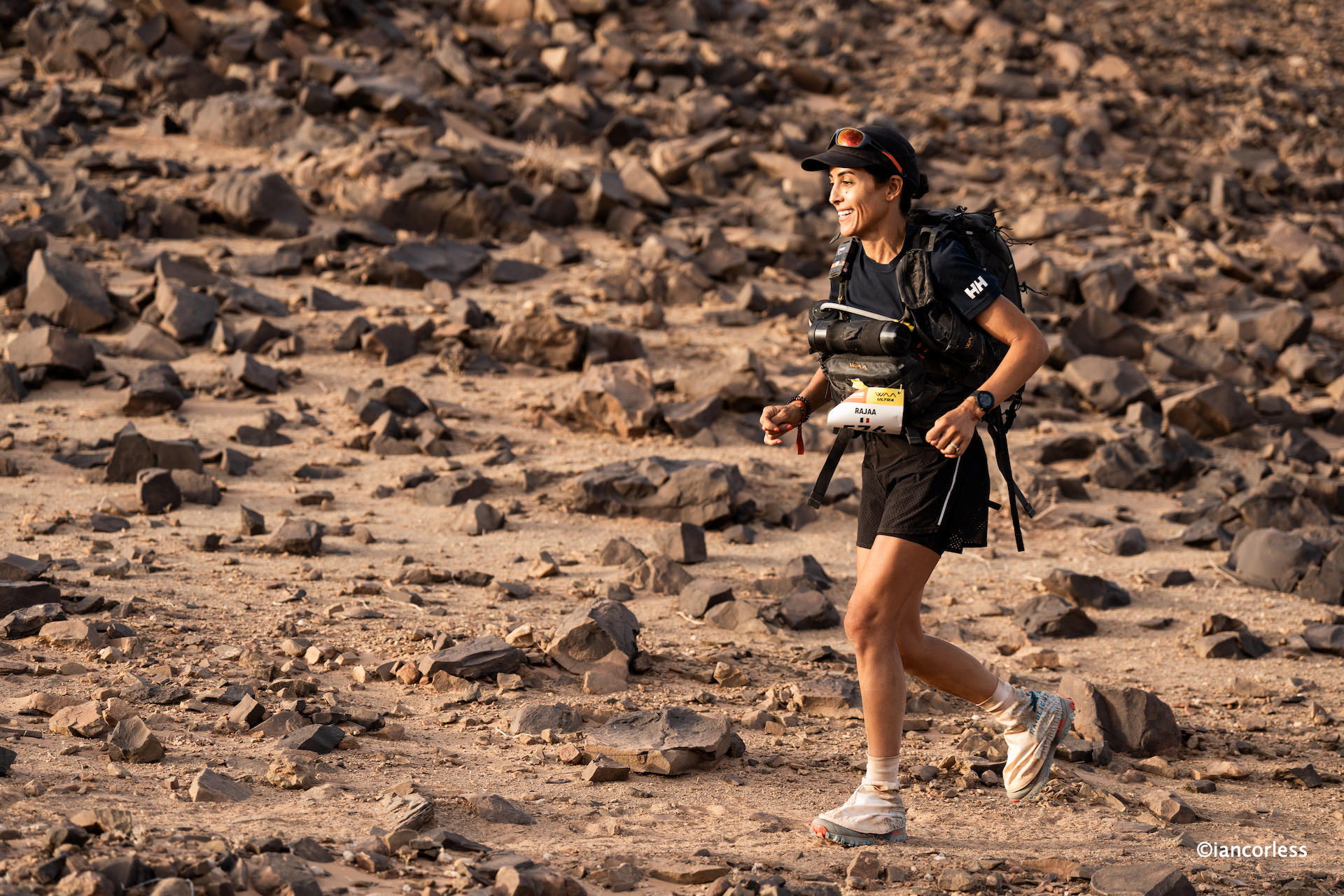
Rajaa HAMDAOUA placed 4th in 2024.
WHAT IS NEW?
PRICE
Well, first of all, the price. For 2025 there will be no additional price for UK entrants. In past years, UK entrants have paid an increased price due to staying at the Berbere Palace Hotel. This hotel will now be an ‘upgrade package’ which will bring a smile to many a UK entrant, for multiple reasons.
PRICE FOR THE FIRST 500:
€3,690/person
and €3,890/person later.
THE UPGRADE PACKAGE with Berbere Palace Hotel
€4,090/person for the first 500
and €4,290/person later.
Both offers are available to everyone, regardless of their country of residence.
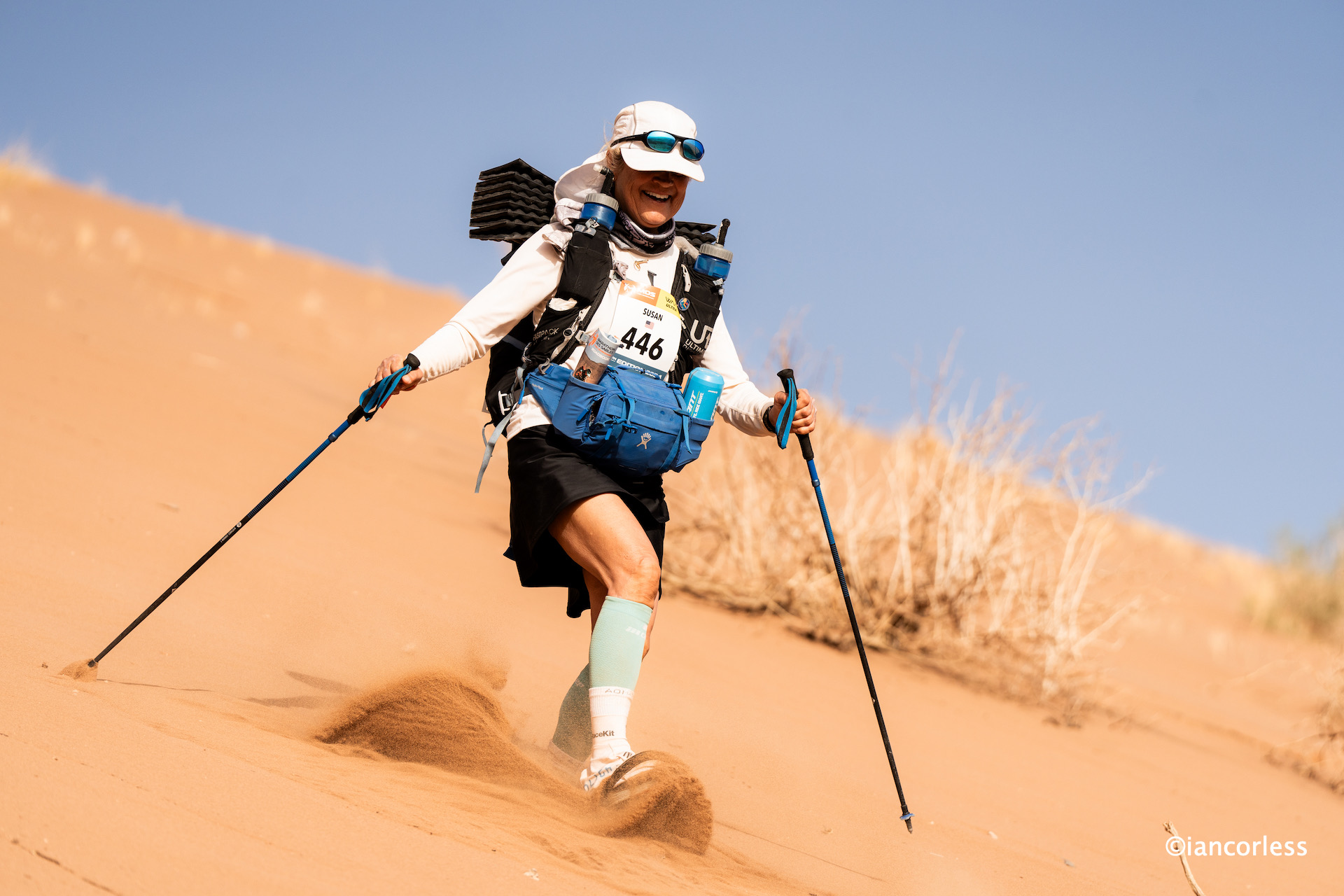
Susan Grimes from the USA.
NO CHARTER FLIGHTS FOR 2025
The meeting point will be in Ouarzazate on Friday morning, April 4, 2025.
Ouarzazate airport Fly to Ouarzazate before the race and spend one or more nights in a hotel at your expense.
Marrakech airport Fly to Marrakech the days before the race and go by *shuttle to Ouarzazate.
*Shuttles will be organized on the morning of April 2 and 3, 2025, between Marrakech and Ouarzazate (5-hour journey).
Timetable for the Marrakech / Ouarzazate shuttles on April 2 and 3 : 07:00 am: From the center of Marrakech (meeting point at the Kenzi Rose Garden hotel). 10:00 am: From Marrakech airport. 12:00 pm: From Marrakech airport.
The return trip at the end of the MDS follows the same logic.
If you wish, you can take advantage of the bus service provided between Ouarzazate and Marrakech. These buses will leave Ouarzazate at 06:00 am on April 14, so you’ll need to book a return flight from Marrakech after 2:00 pm.
A unique experience
THE EVENT
Will remain similar to the 2024 38th edition and in summary:
The total distance of the MDS The Legendary will be about 250km’s, divided into 6-stages. The exact route and distances are given at the latest in the road book which is distributed in Morocco on arrival and transfer to bivouac 1.
Self-autonomy (food) is required from immediate arrival at B1 and then race self-autonomy starts at the beginning of stage 1.
The 2024 edition was as follows:
Stage 1: 31,1 km
Stage 2: 40,8 km
Stage 3: 85,3 km (the 3rd stage takes place on 2 days)
Stage 4: 43,1 km
Stage 5: 31,4 km
Stage 6: 21,1 km
CP’s with water and iced water to cool the runner.
The MARATHON DES SABLES – The Legendary is a self-sufficient adventure. Competitors must carry all their equipment and food, except the water and the tent. Check-points are located approximately every10 km. Post stage, participants receive a water ration when arriving to the bivouac, for the evening and the morning.
Have peace of mind and benefit from free postponement insurance up to 7 days before the event, included in your registration.
A mythical crossing of the desert, 11 days of adventure in Morocco, including 9 days in the desert, a course of about 250 km divided into 6-stages, to be done by walking or running.
MARATHON DES SABLES – The Legendaryan extraordinary race and adventure.
The elation of the finish
Taking place in the southern Moroccan Sahara since 1986.
The 2024 edition of Marathon des Sables – The Legendary is over. The statistics say this is the 38th running of the race, but in reality, it is 37 plus 1 or maybe, it is really just edition 1 of a new era of the race?
There is no getting away from the fact that the departure of Patrick Bauer and the arrival of new organisation caused anxiety, worry, and many questions. In real terms, there may have been many runner’s deciding to ‘wait and see’ what happened in 2024 and if all goes well, they would enter 2025.
The worry is over.
Statistics show MDS had 867 start the race and only 60 DNF’d (did not finish) – These statistics alone are a success!
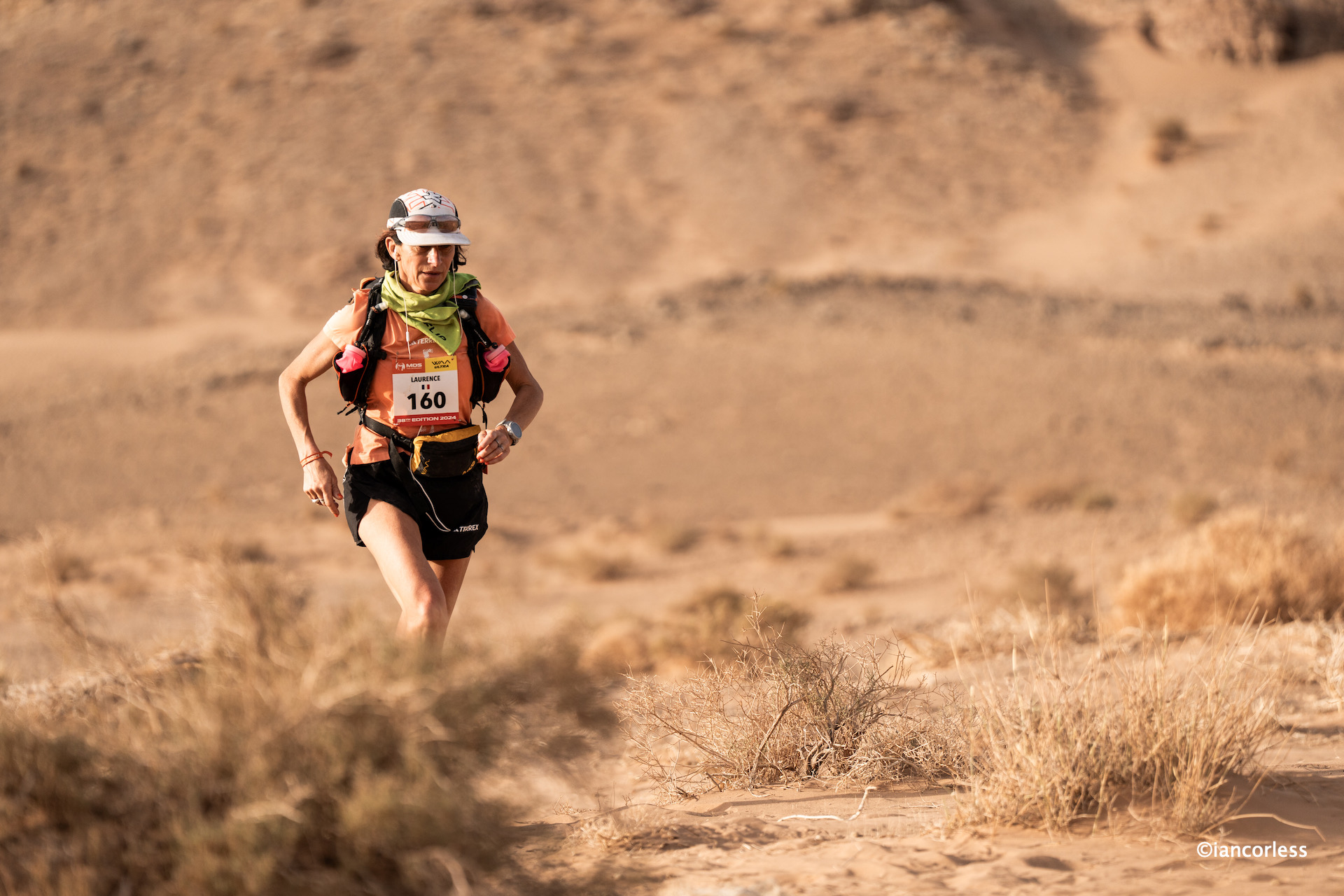
Laurence Klein, MDS legend.
Nothing is ever simple and straight forward, so, lets look at the 2024 edition.
MDS
Every year, after each edition of MDS, I write a summary article. Some are more in-depth that others. For 2024 I provide a summary here and in-time, I may well come back to this post or write a new post based on comments and feedback, so please feel free to add your experiences in the comments.
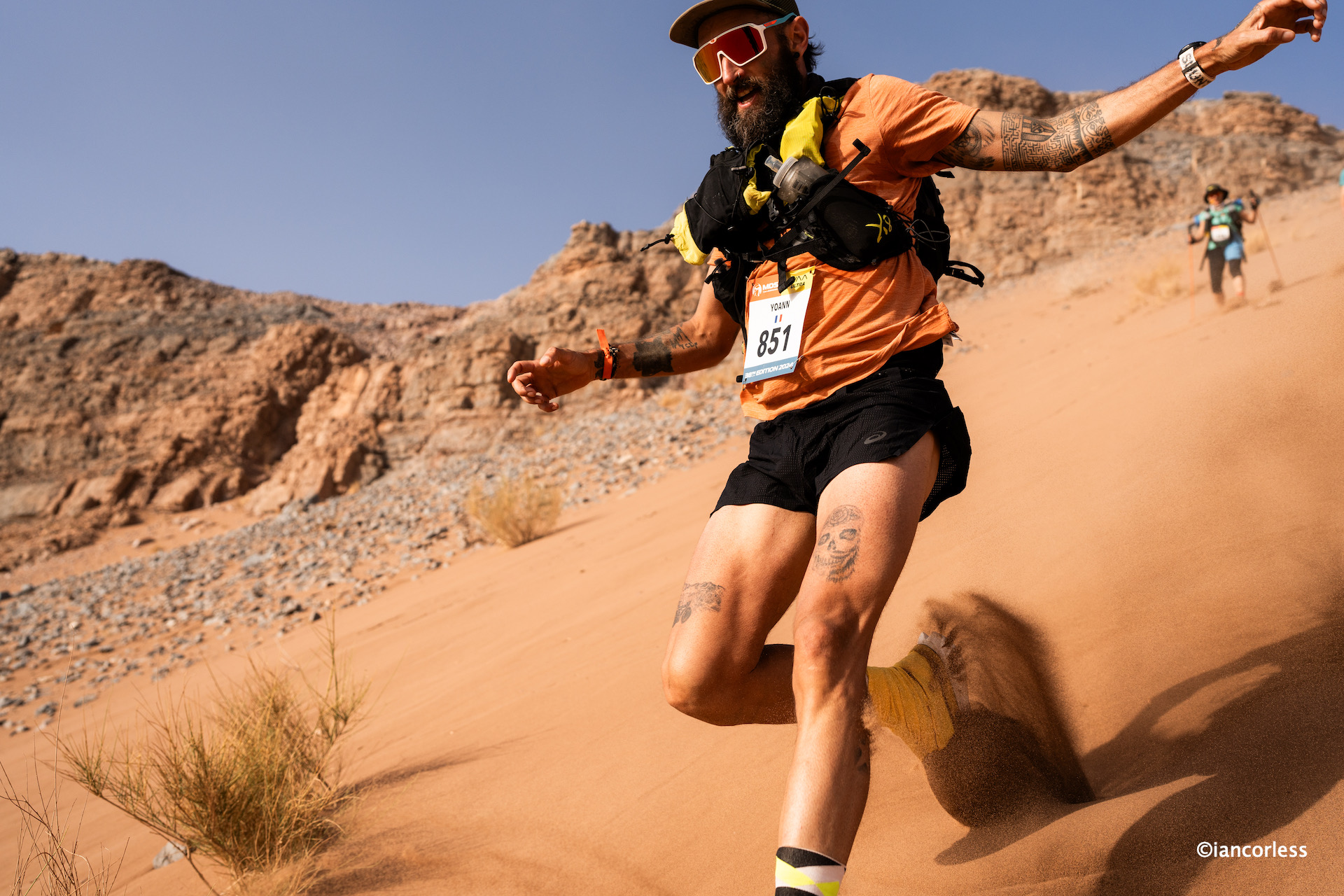
Yoann Stuck on Jebel El Otfal
There were many changes for the 2024 edition and in the build up to the race, a familiar comment was heard:
‘If it ain’t broke, don’t break it!’
Cyril Gauthier
To some extent, after 37-years, this was a valid comment, however, Cyril Gauthier, Ferdinand Charriau and others at MDS HQ thought differently. There was no spur of the moment and rash thought process, on the contrary, ideas and protocols had been tested on the HMDS format. They had seen success there and the idea, quite simply, was to bring that to MDS The Legendary.
It was a success!
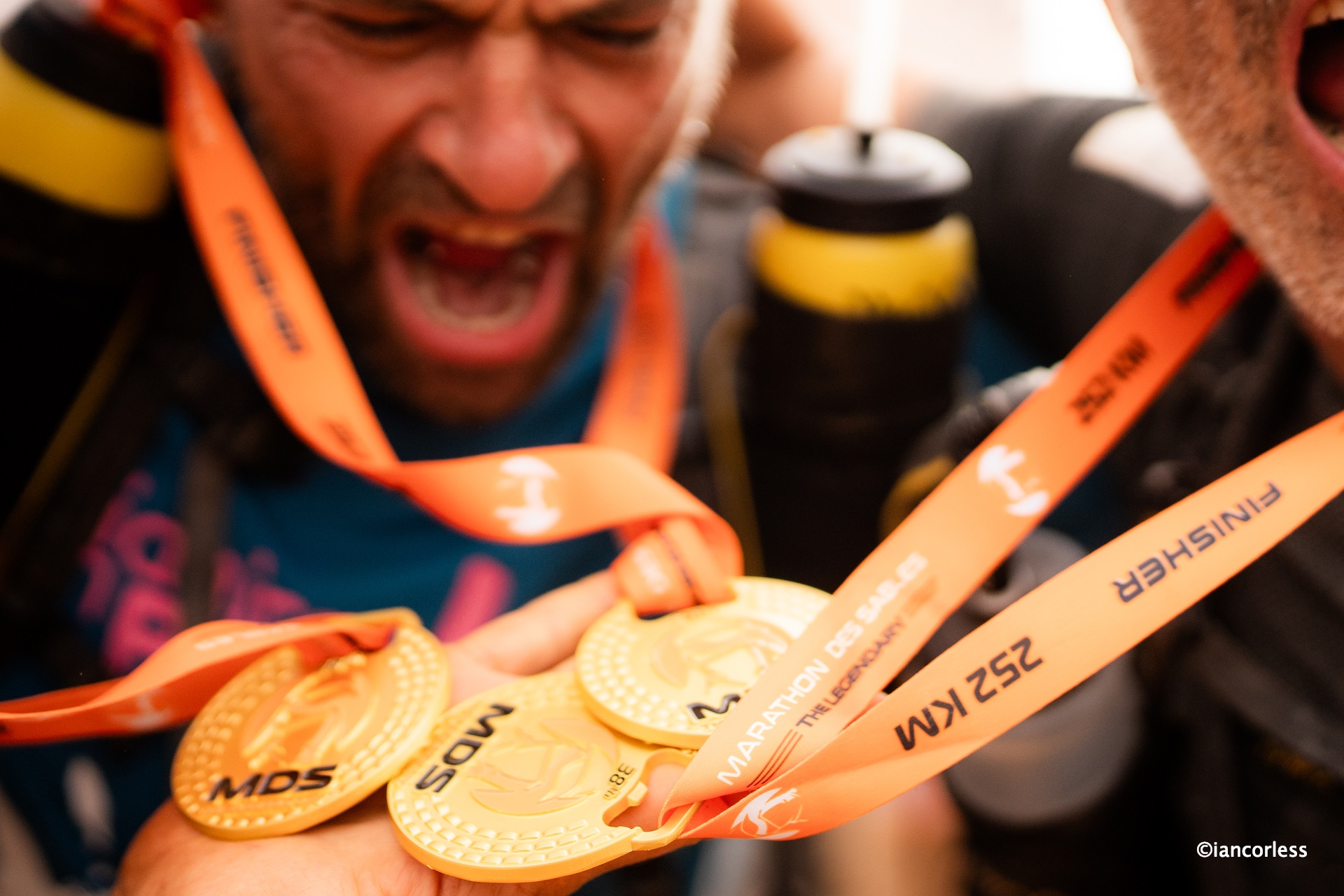
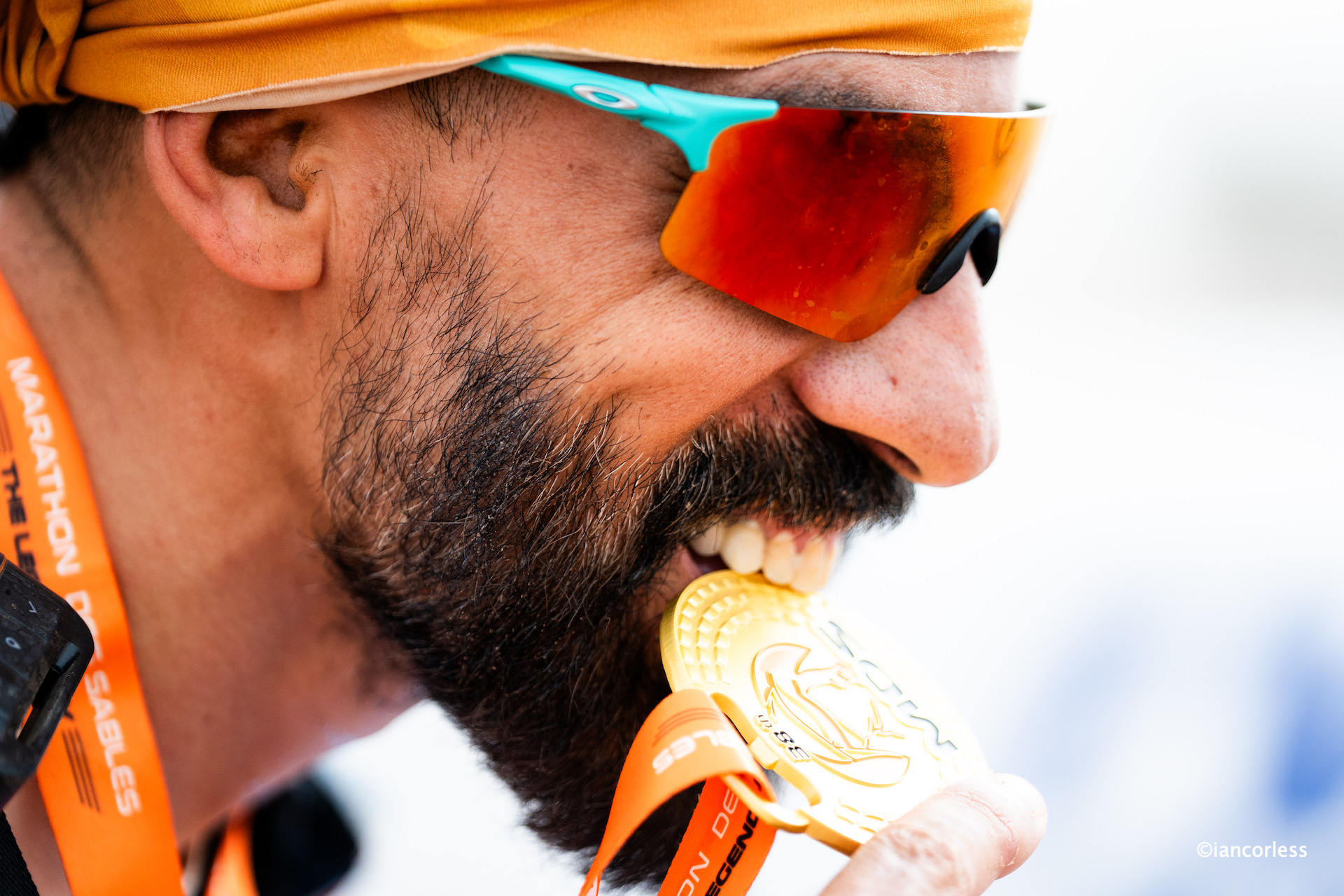
No better feeling, the medal.
All the the pre-race doubts, questions, frustration and at times anger soon disappeared as the race and the organisation unveiled the 2024 race and it’s format.
Cyril had used the term in 2023, ‘This is not revolution, but evolution.’ As the 2024 race progressed, this evolution slowly but surely converted the 867 and convinced them that the new format was a winner.
Oxo cube at CP7 on the long day, just over 10km to go.
It’s still MDS.
It is still a multi-stage run.
It’s still in the Sahara.
It’s still tough and still around 250 km’s in distance.
BUT, and this is a big BUT, there are complete changes in the way the race is now run.
THE CHANGES
Communication:
The changes start before we even get to the desert with years and finally months of planning and tweaking. I think the MDS team will confirm here that communication, information and news could have improved in the early stages but as soon as the race came close, there was a significant improvement, so, we can expect that to not only continue but get better moving forward.
Travel:
Arrival in Morocco and bust transfer to the Sahara
Travel plans and options changed in an effort to be more environmentally friendly and therefore charter planes were reduced to two and I think it is fair to say, that we can expect to see them removed completely for 2025? With travel options increasing all the time, it is now very easy to travel to Marrakech and therefore, travel options will and can be expected to be more flexible for future years. However, to facilitate travel to Ouarzazate and the race RV point, buses were provided from Marrakech and post-race for return travel.
Self-Sufficiency:
Self sufficiency is a key to the MDS experience
No catering was provided before the race as in past editions, therefore, runner’s had to provide there own food before race self-sufficiency started. While some would have preferred a catering option, ultimately it was no problem and no issue. One thing was for sure, there was little stomach upset in camp using this method. That alone is confirmation enough.
Admin Day:
Admin day was fast, slick and efficient.
Admin day in the past has been a long and laborious process that has taken 3-hours for some. This was changed completely and it was an absolute success with average processing times of 30-minutes. It was simple, fast, efficient and a game changer that resulted with less time in the sun for runner’s, less time on feet and little to no stress.
Camp:
Legends in the Sahara
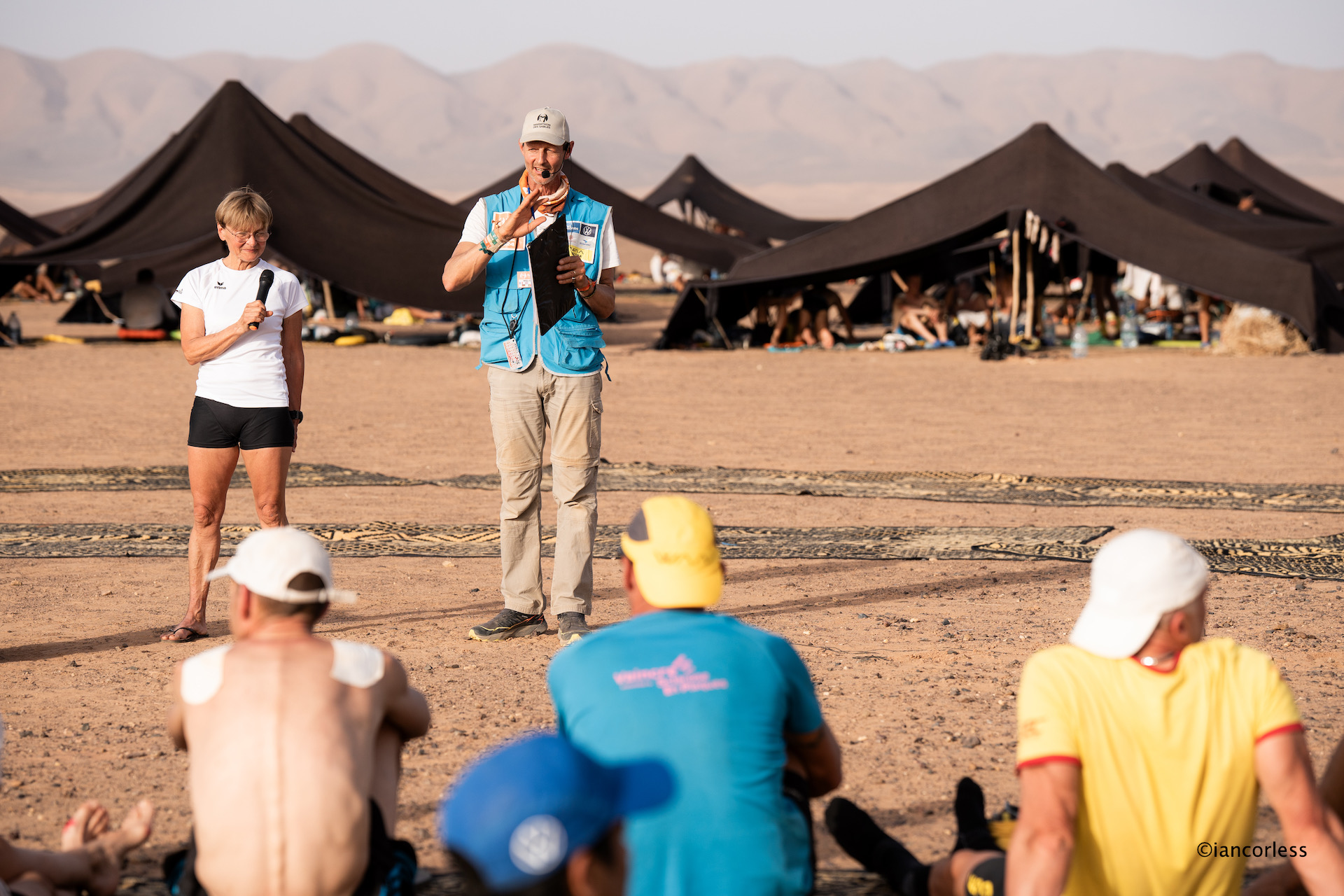
The bivouac looked the same but there was a significant change, the circles of tents were made tighter and smaller making for a much smaller space in the middle. This made for easier comms and a more comfortable, homely feel. Each evening there was a small talk called ‘Legends’ that introduced 2/3 significant people from MDS history in a casual Q&A format. This was followed with relaxation and yoga.
Early starts:
The long day with an 0600 start for the majority of the race, the top 50 started at 0800
Depending on the stage and the distance, race start times each day were earlier to allow for 2/3/4 hours of significantly cooler temperatures. The earliest start 0600, the latest start at 0800 for the top-50 on the long day.
Water:
No water rations and no 1.5ltr bottles.
Water was in abundance, not rationed and in addition to CP’s typically every 10 to 12km’s, additional water stations were added on certain stages.
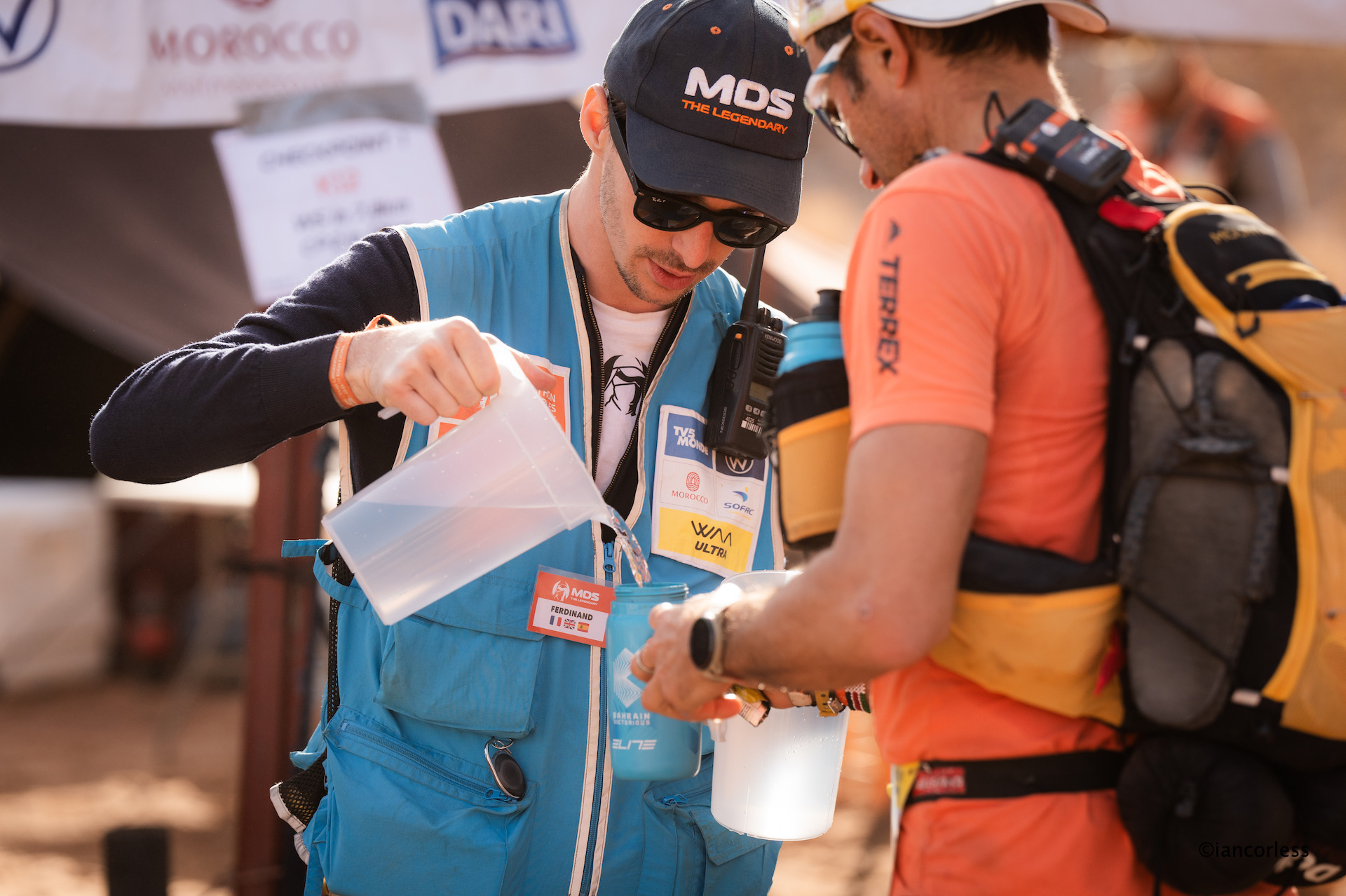
Ferdinand Charriau at CP1 on stage 2
Cold water:
No better way to cool down
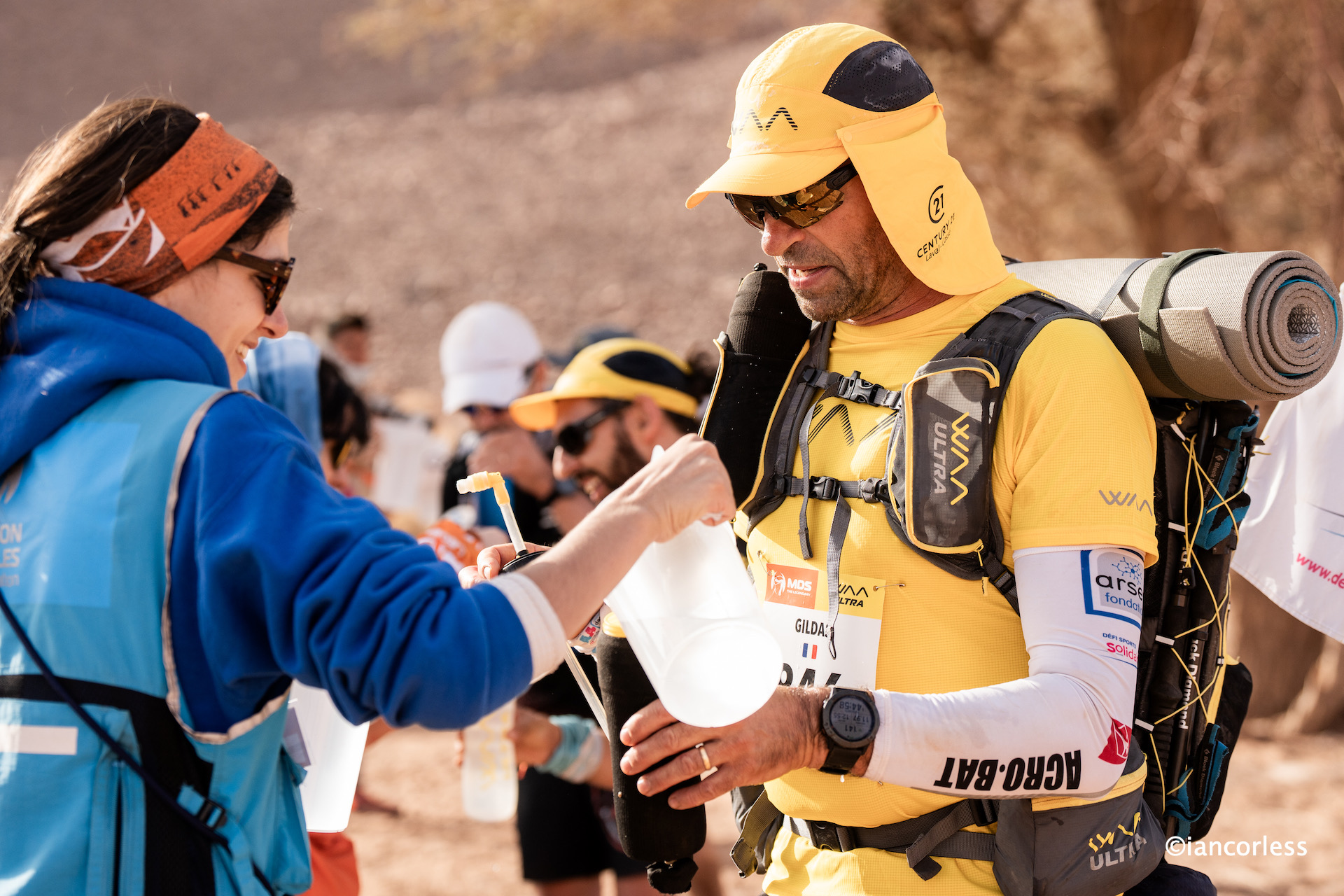
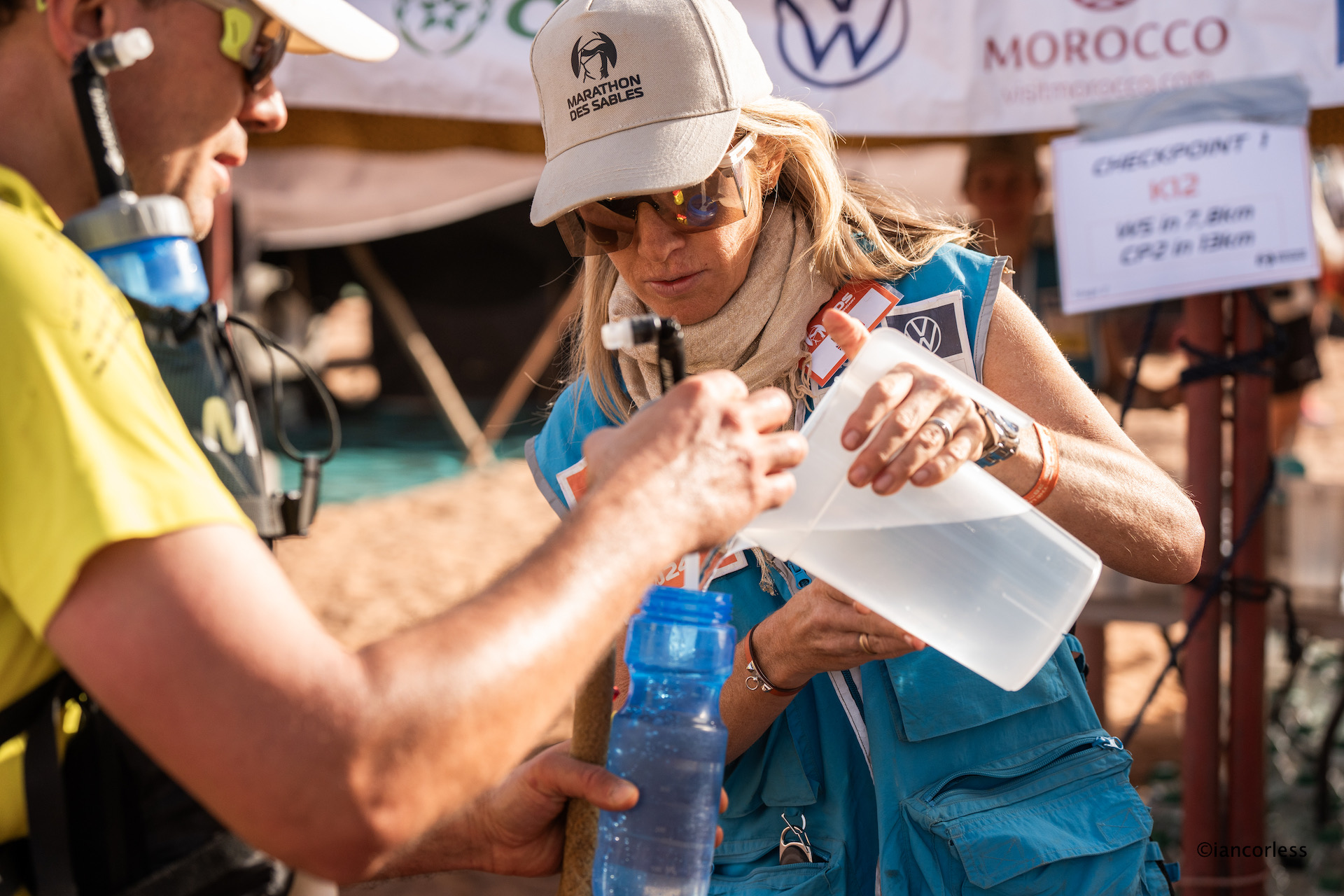
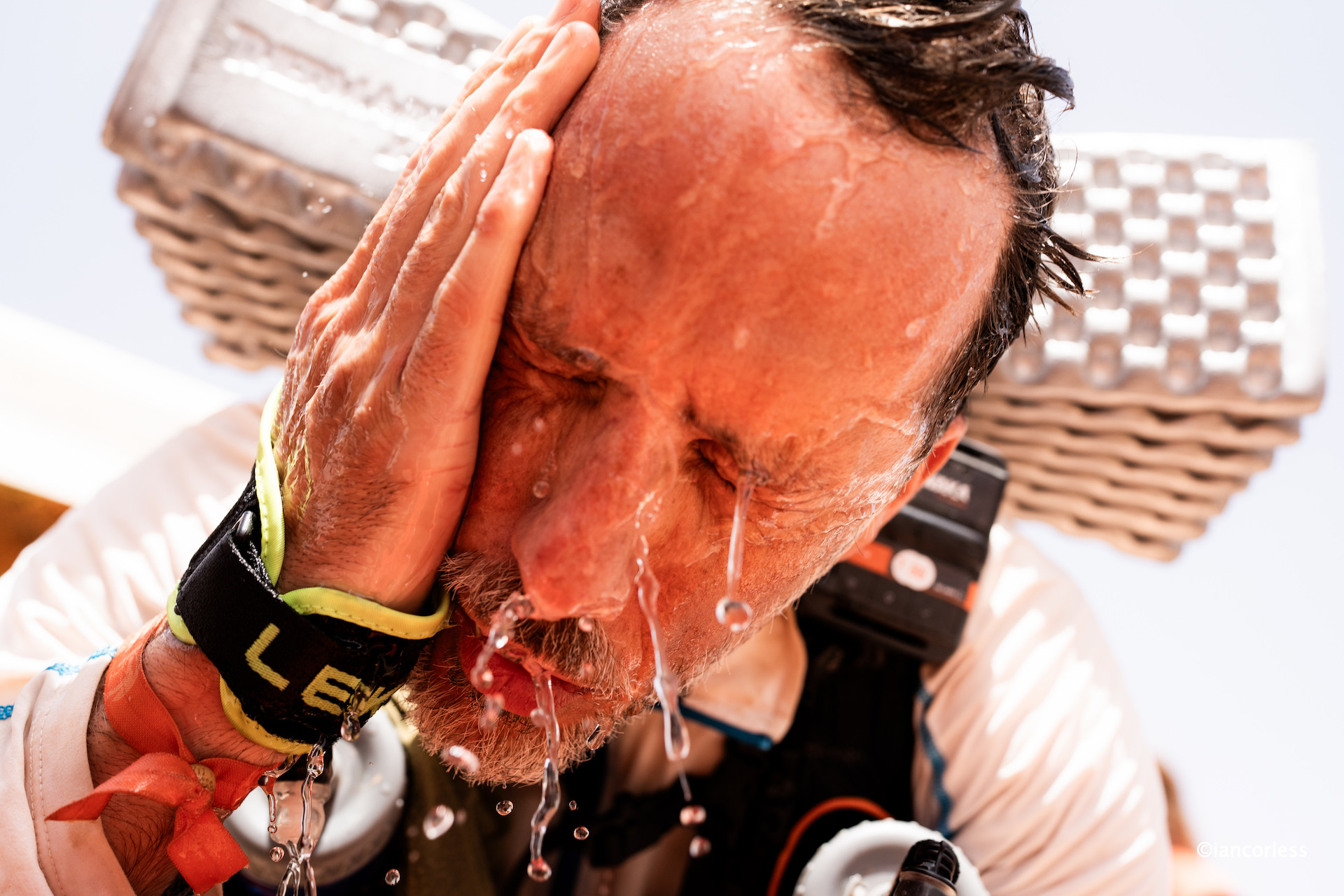
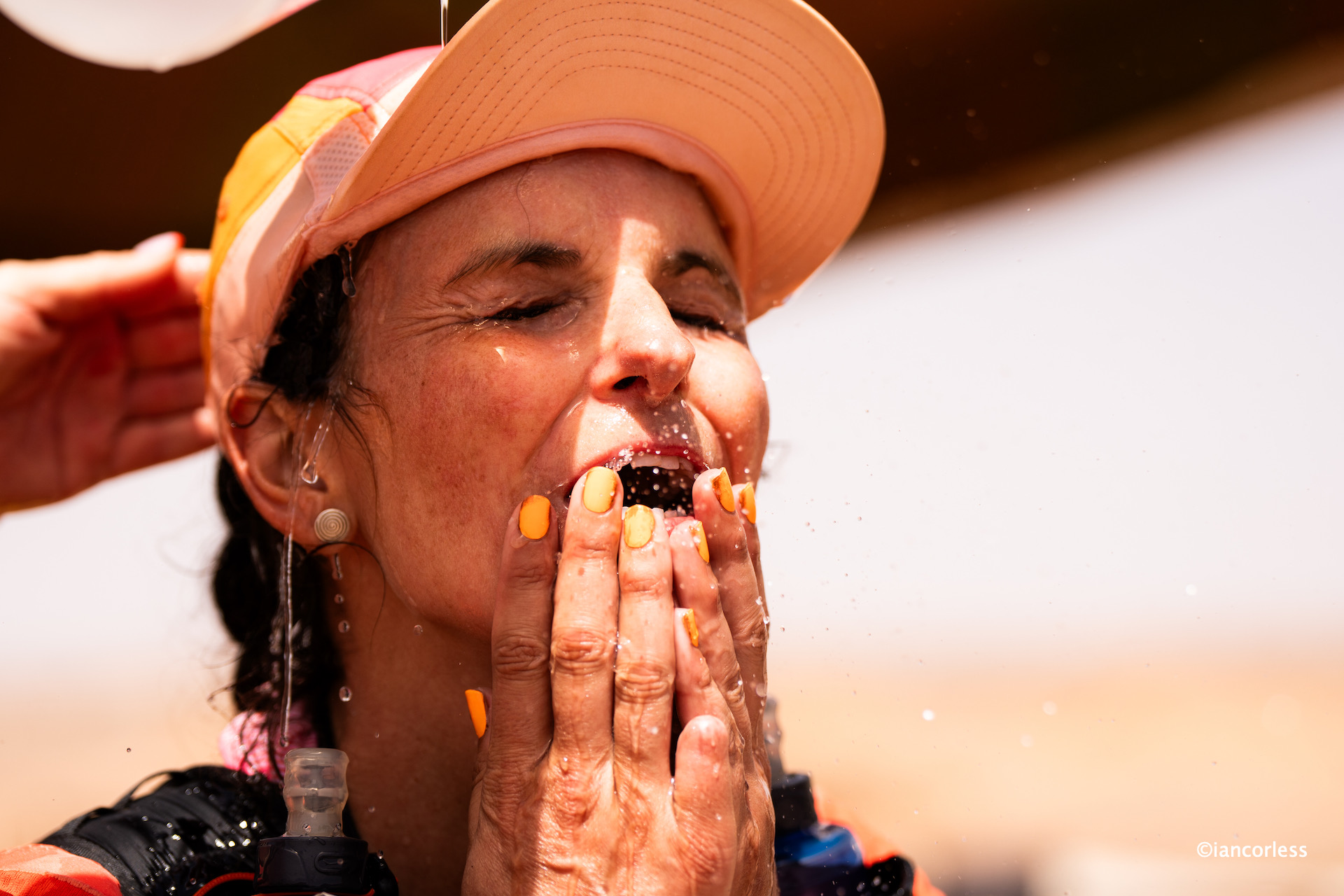
Each significant CP had cool iced water that was poured on necks and heads to help with cooling.
Staff:
It’s a team effort
Volunteers made the event a success with dedication, commitment and enthusiasm.
Safety:
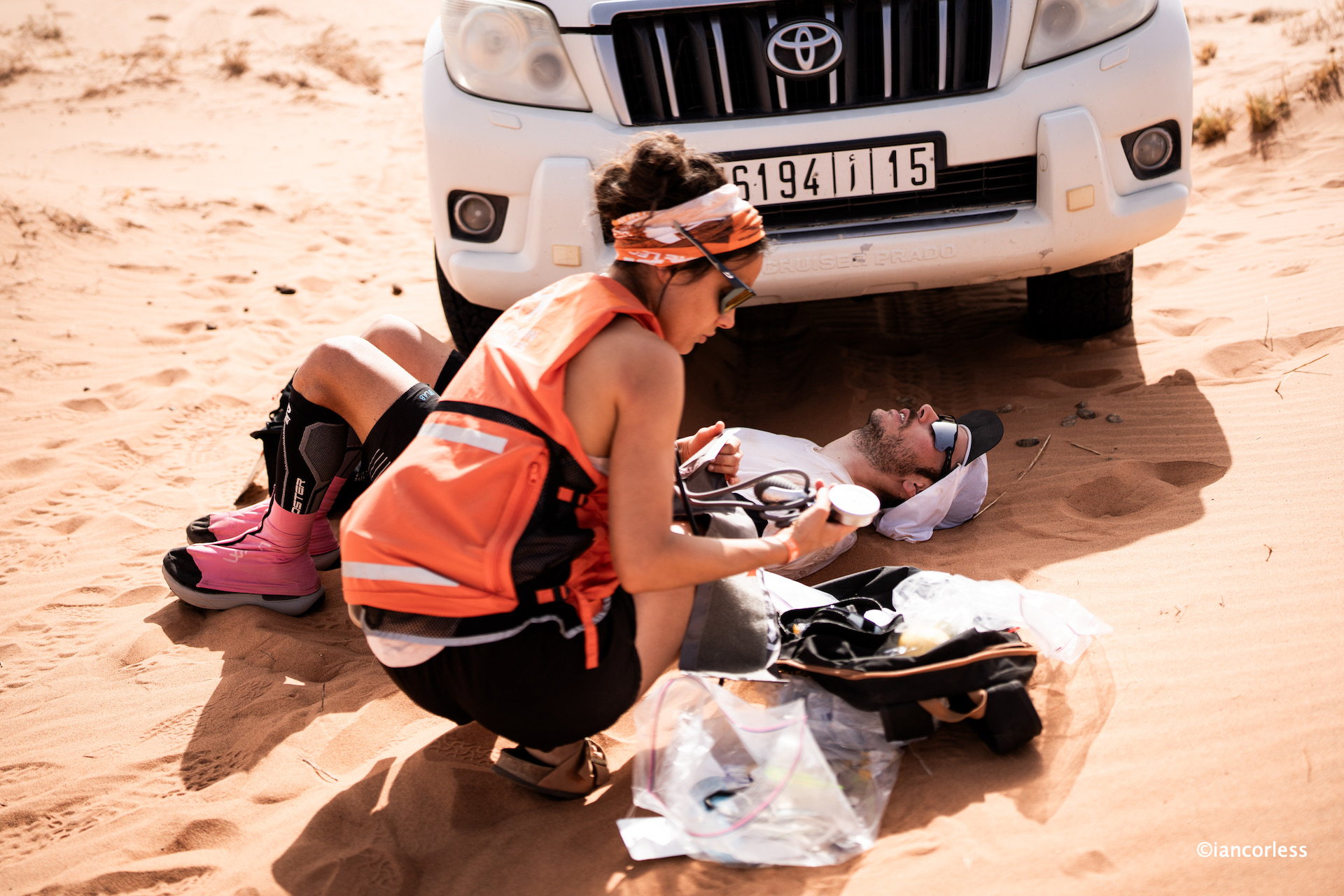
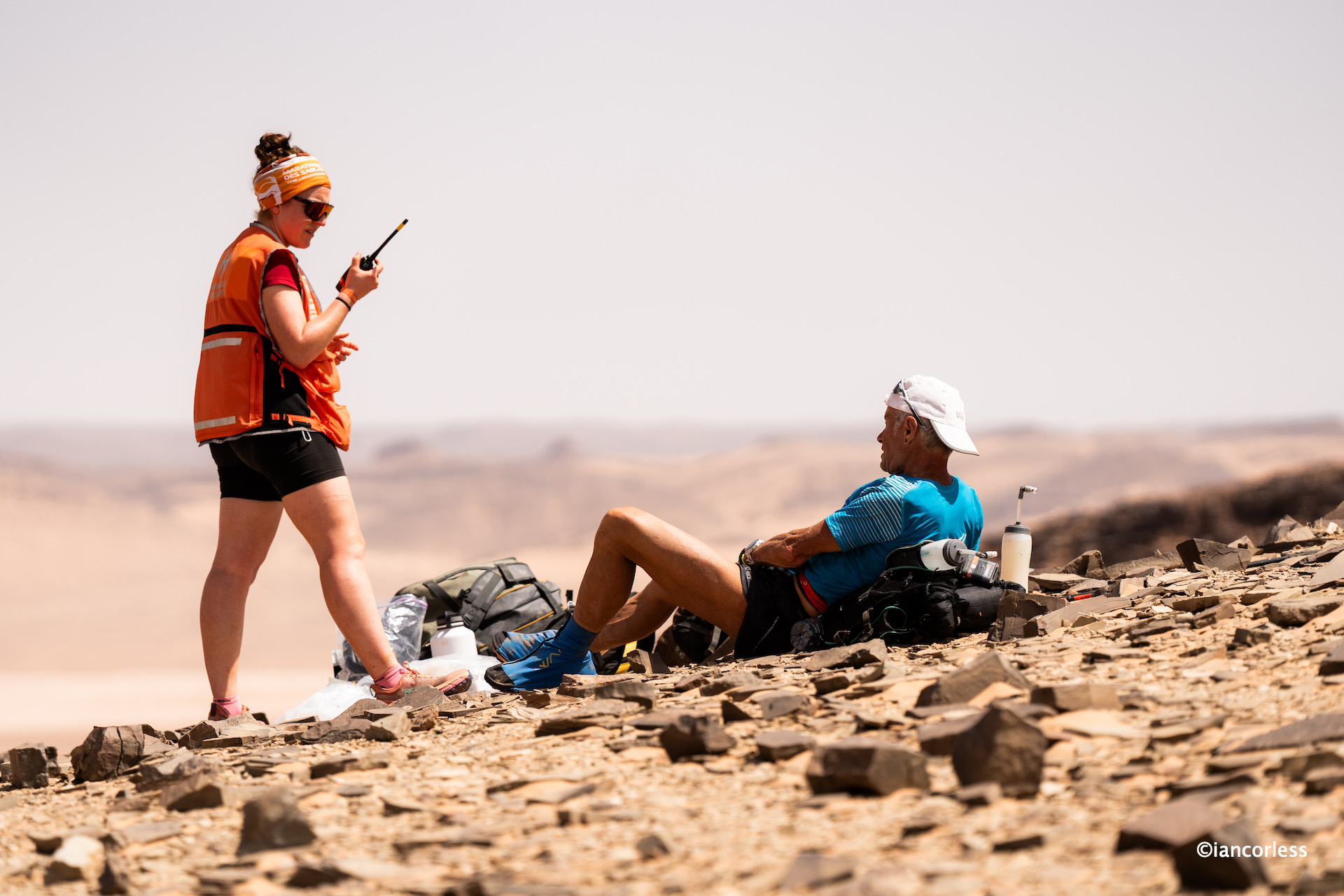
Medical teams were at CP’s, running the race and in fast response vehicles.
Much of the above: early starts, more water, water stations, cold water come in the ‘safety’ section but the race had medical runners, more fast response vehicles and more medics/ doctors.
Safety is a key element of MDS
Stock cubes:
Salt tablets were replaced with mandatory stock cubes. This caused huge controversy before the race, but, during the race I heard many comments such as, ‘stock cubes, who’d have thought it, I have grown to love them!’ Now of course, MDS is a self-sufficient race and just as one would train, test equipment, research food and so on, salt/ electrolyte replacement should also figure in this. If that is stock cubes, great! If not, make sure you have what you need. Again, only 60 DNF’s reflect that whatever was happening was working.
“I enjoyed them as either a side dish to my lunch and dinner or, on the long stage, during the stage itself. They worked for me, in addition to my own nutrition. No issues with dehydration or hyponatremia, and enjoyed something aside from the mostly sweet race nutrition.” – Stephanie Tang
“I used them in the evening, 1 as a hot “brew” and the other inside my evening meal. I did supplement the day with 1 salt tablet per hour. On the day I didn’t use 1 tablet per hour I cramped up significantly. I was on the fence of not using them, however I see the benifit and actually looked forward to my evening Knorr brew. Everyone is different but that’s just what worked for me, knowing my body and stomach.” – Maximus Baximus
Foot care:
Foot care
As per usual, foot care was provided and as the race went on, the demand increased. It’s important to remember, MDS is a self-sufficient race and so therefore, an element of self-care is required. This also helps avoid any wait. However, for those who had bad feet and needed to wait for attention, care was given to all these that needed it.
“It was my experience that you could see a medic if you were prepared to wait for one, there was also medics overseeing the self care side of things too.” – Matt Pearson
“…when you just ran 85k you don’t want to threat your own blisters.” – Stijn Vin Cauter
Tracking:
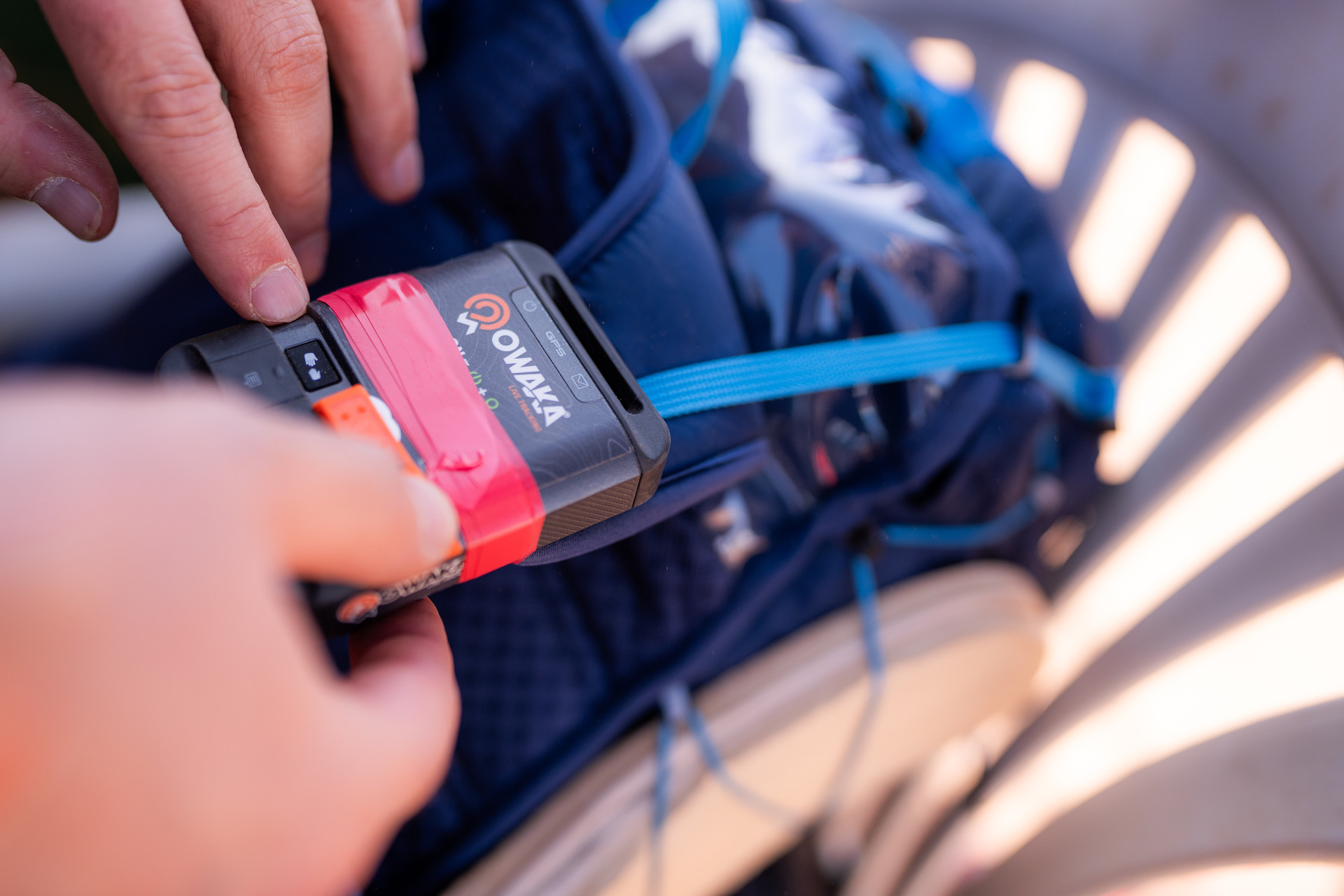
As per usual, each runner had a tracker for safety and so loved ones at home could follow.
The race format:
2024 was the longest race in MDS history. It was also 6 race days and not 5 with a charity stage. So, on paper, the race was harder…? The feared long day, typically on day 4 was now on day 3. This allowed for runner’s to be fresher, but to counter balance this, packs were heavier. In past editions, with the long day done, there was ‘just’ a marathon to do. Now, with the new format, there was still some 100 +/- km’s to go over 3 stages! The typical format of the race has been to run through the desert, point-to-point resulting in 5/ 6 bivouac. For 2024, just 3 bivouac were utilised allowing the race to concentrate on what many considered, the best part of the Sahara – it worked!
Stage 3 was stunning
MDS The Legendary
Every year, MDS has challenges. If we look at the last 4-years, the challenges have been very significant:
2020 Covid.
2021 Intense heat, norovirus and the highest DNF rate in MDS history.
2022 Cooler temperatures and even some rain.
2023 Intense heat and sandstorms.
It was very clear that the new management wanted to learn from 2020 to 2023 and make sure that the 2024 edition, as much as possible, facilitated increased safety and a higher completion rate.
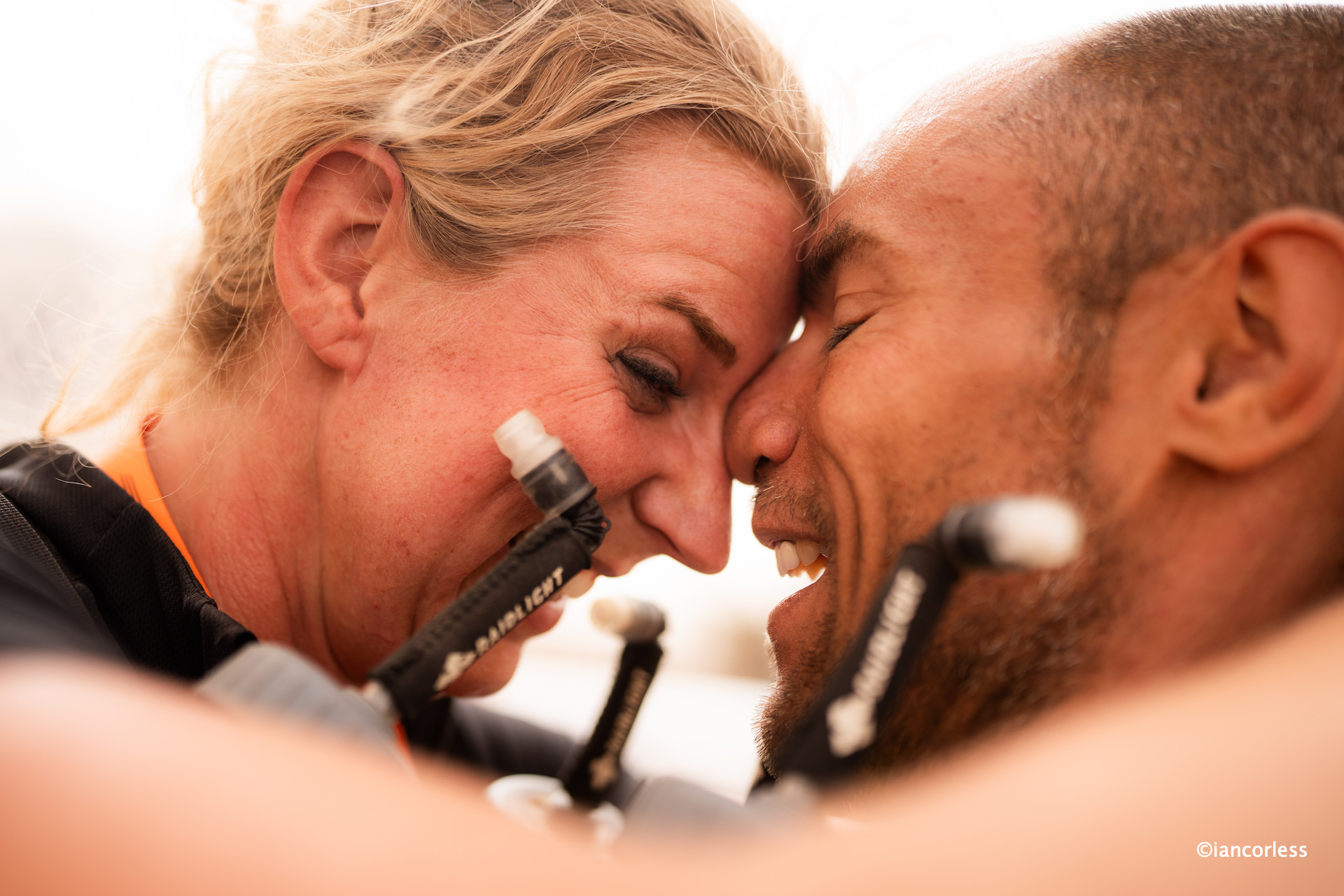
Nothing like the emotion of the finish.
The figures speak for themselves, just 60 DNF’s. A success!
Now of course, many factors come into play when discussing DNF rates and to be fair, 2024 was a good year with no excessive heat and the new protocols as discussed above. Having experienced 11 MDS, 2024 was not a hot year. For sure it had its moments, particularly on stage 3 and stage 4 between midday and 5pm, but with earlier starts, typical temps of 30-33 degrees and often wind, conditions were good.
A trickle of cold water at each CP makes a huge difference
There was an abundance of sand storms and a day did not pass without the presence of wind, some days were worse than others. However, there was never one of those full-on white out days.
Wind and sand on admin day
The route was a classic, taking in ‘the best’ of the region, the long day in particular was beautiful. Some days were easier than others, ultimately though, the route was a showcase for Morocco and the Sahara.
Epic landscape
Everyday, CP’s and the finish line was a party with motivated volunteers and music. The final day finish, at times, was like a rave with a DJ and a full-on party mode.
“First time running, so cannot compare, but absolutely loved the event . From start to finish, I have nothing but praise. Amazing staff and volunteers.” – Julianna Ambrosi
What a team of volunteers from all over the world
To sum up, the runner was placed first (correctly) and the organisation facilitated, as best as possible, a finish.
“First time for me so don’t have any comparison but having UK volunteers was great. Especially at the checkpoints when a friendly face and some words of encouragement instantly made things better.” – Si Brewington
The after party, awards, film show and celebration was top notch – a great finish.
THE RACE
Rachid, king of the Sahara
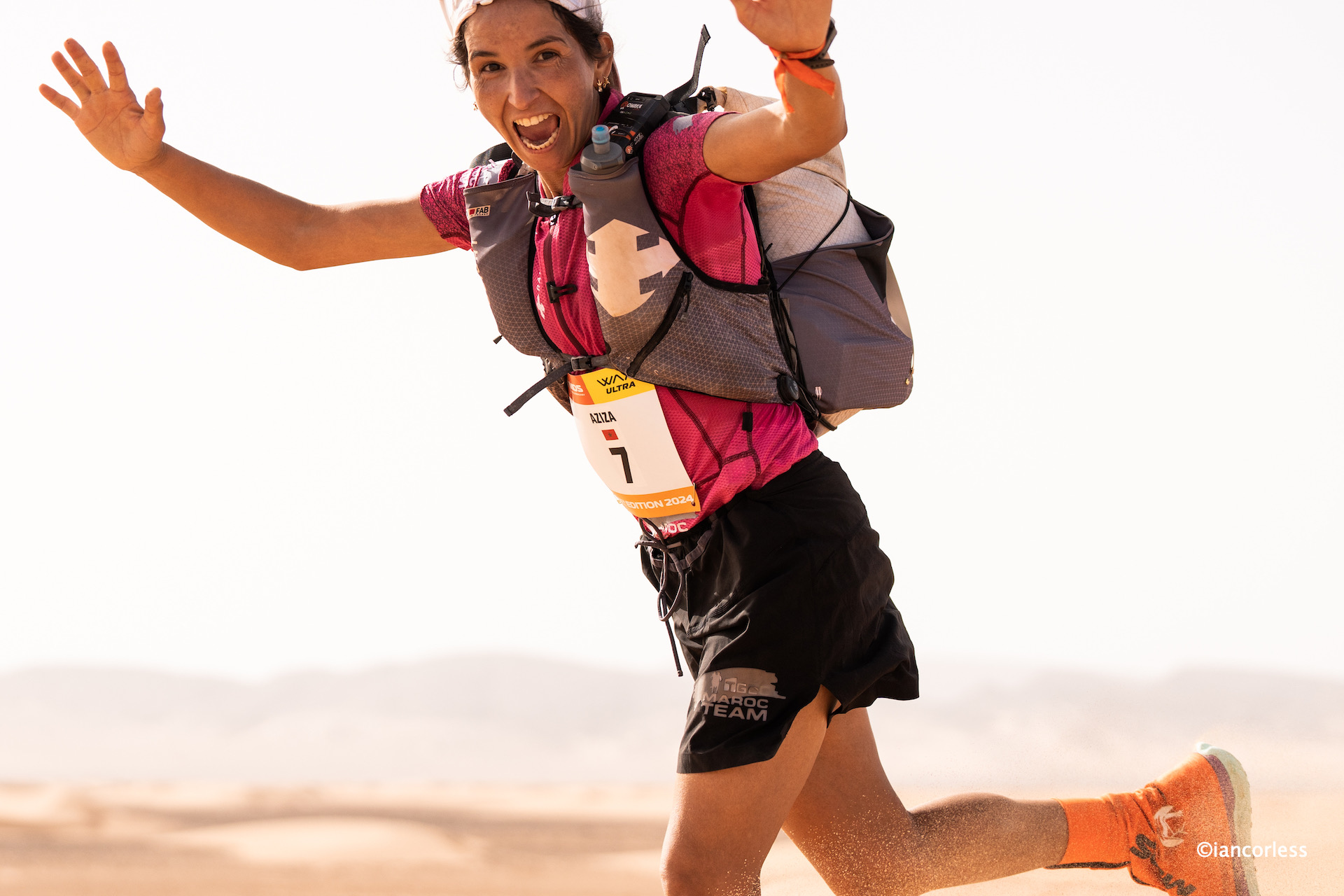
Rachid El Morabity and Aziza El Amrany were crowned champions. Rachid obtaining his 10th title and Aziza gaining her first.
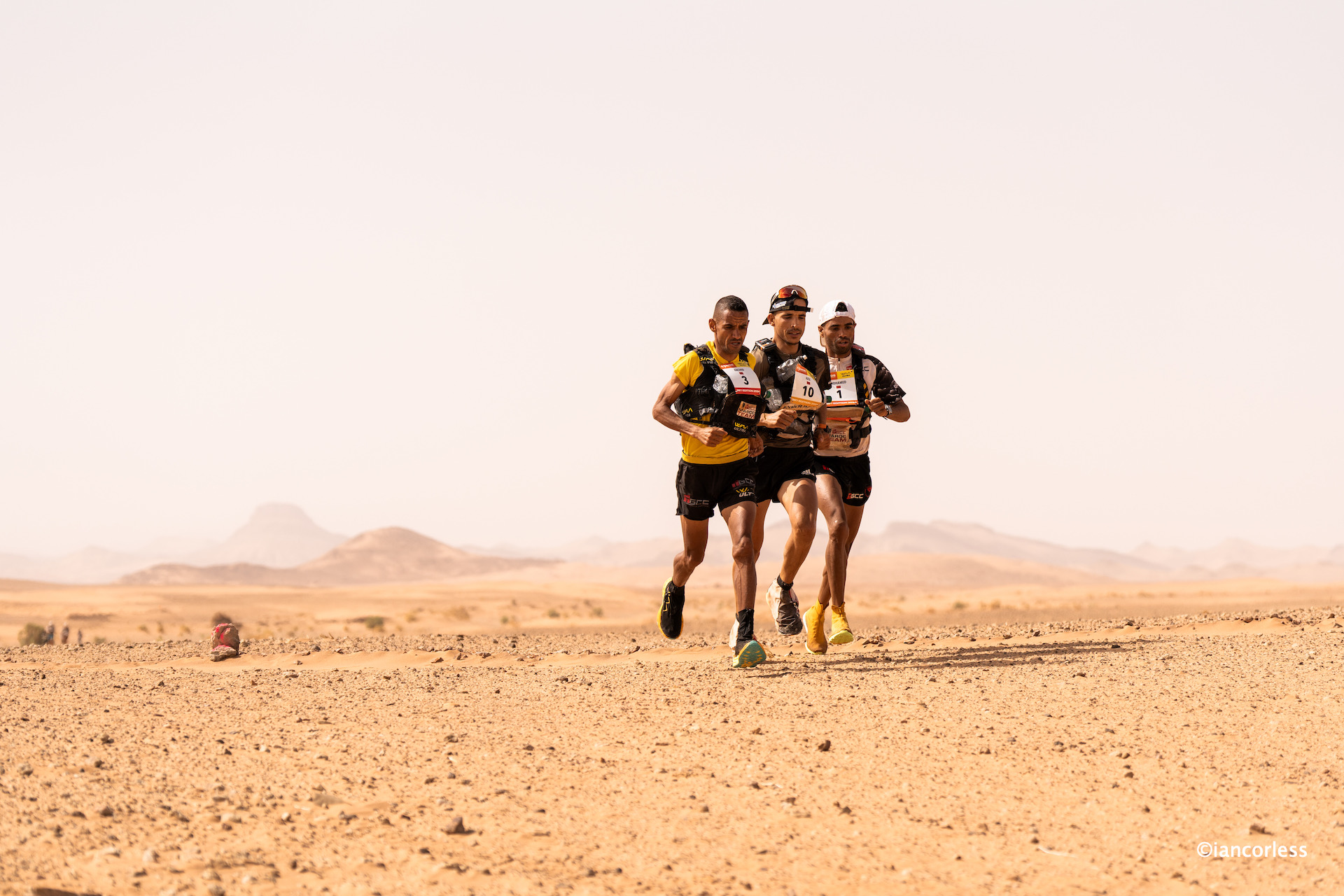
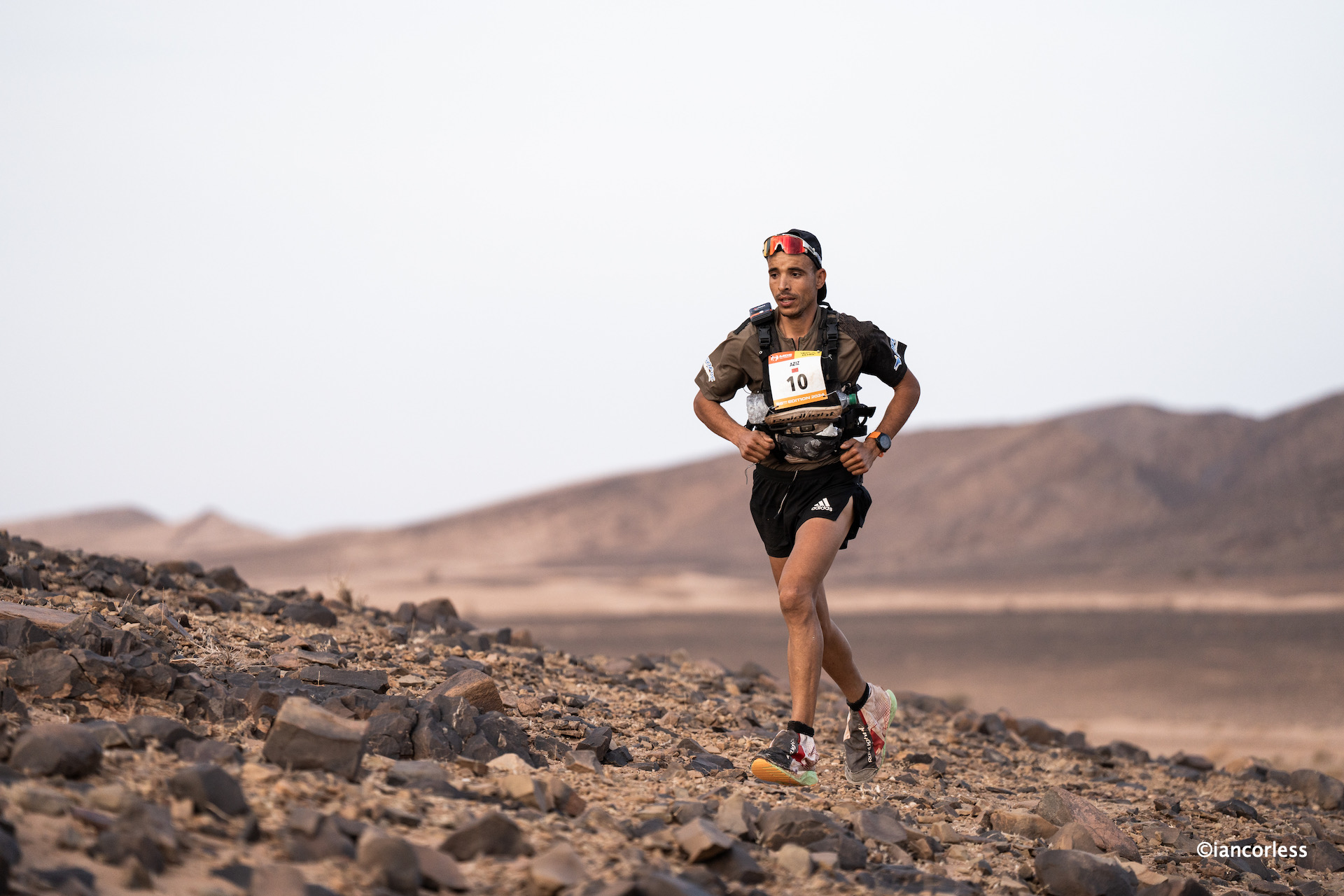
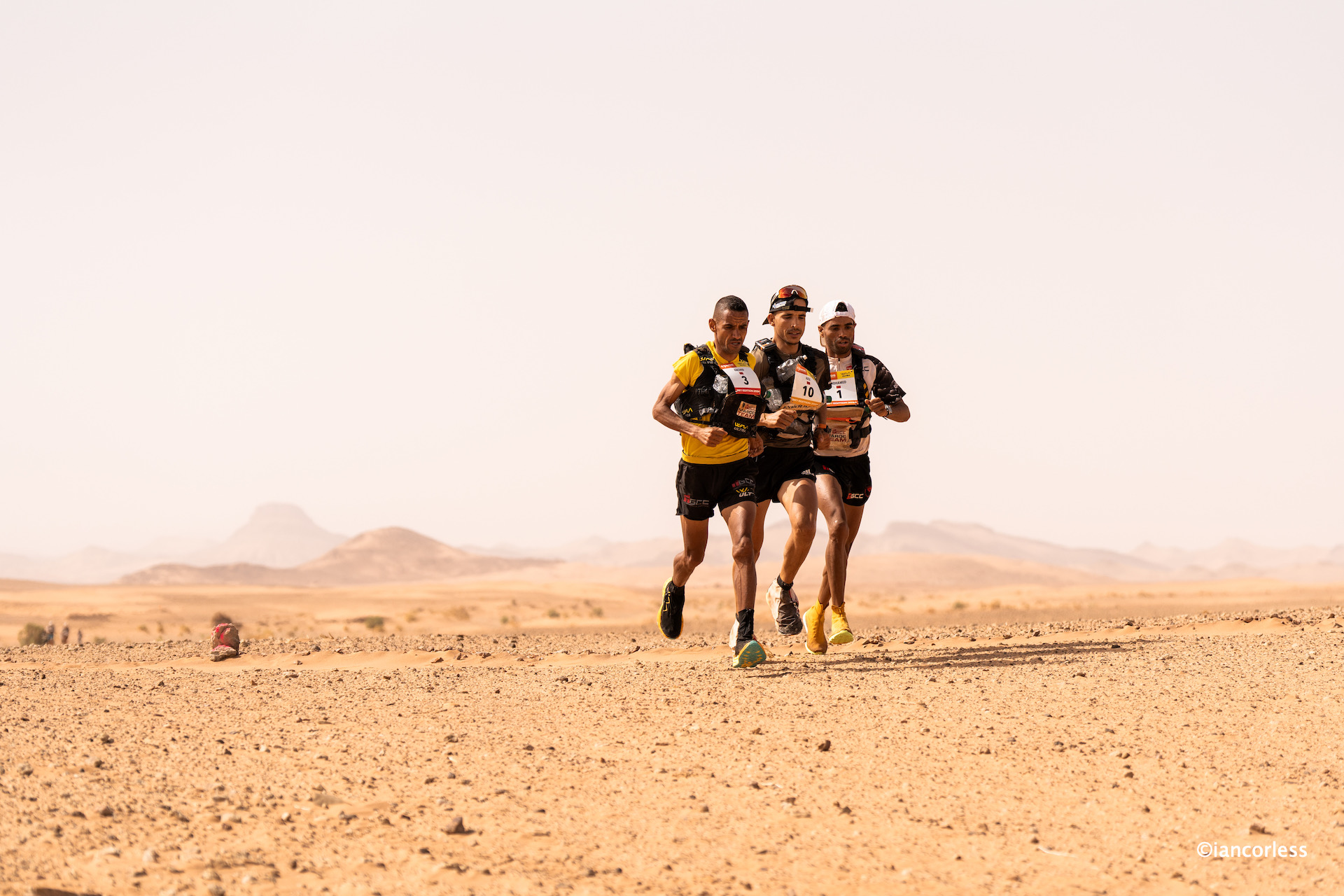
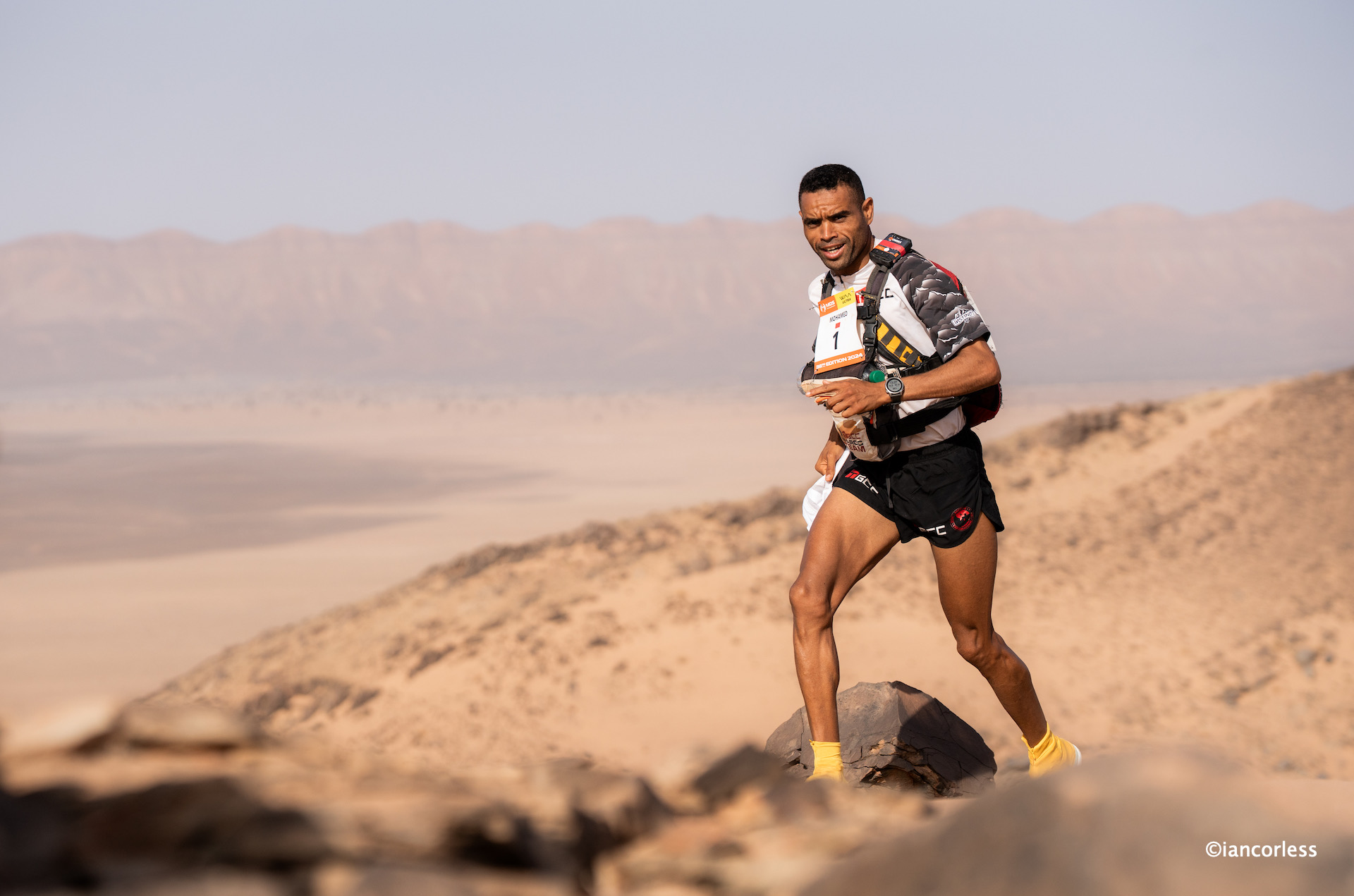
The El Morabity once again used tactics for victory, Aziz Yachou could only watch on and fight as hard as possible, hoping that one of the duo would have a bad day… Bad days never came. Mohamed ‘played’ a bad day on stage 5 to relinquish time for his brother. It was just a game, just a like chess or a domestique in cycling.
It was this close
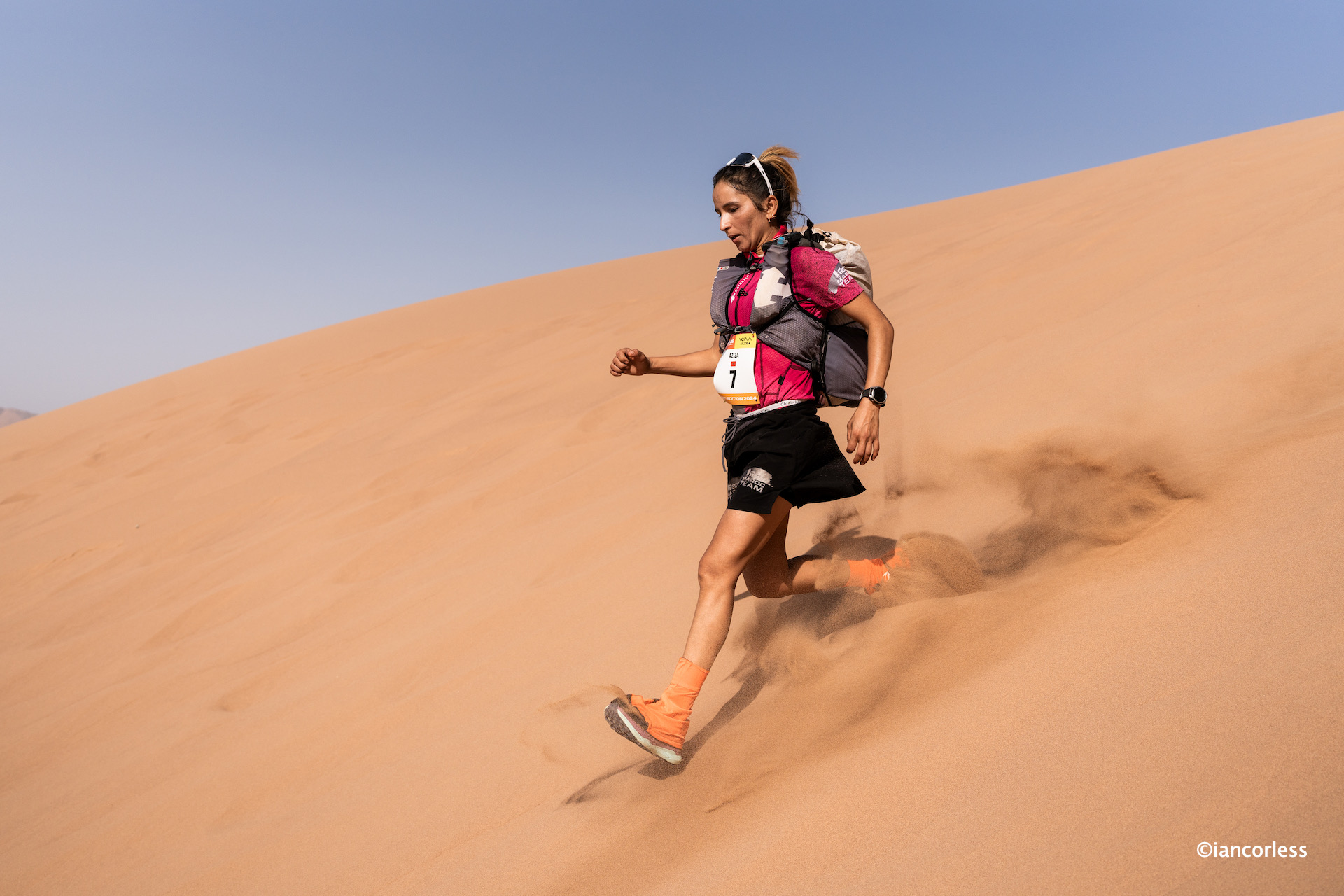
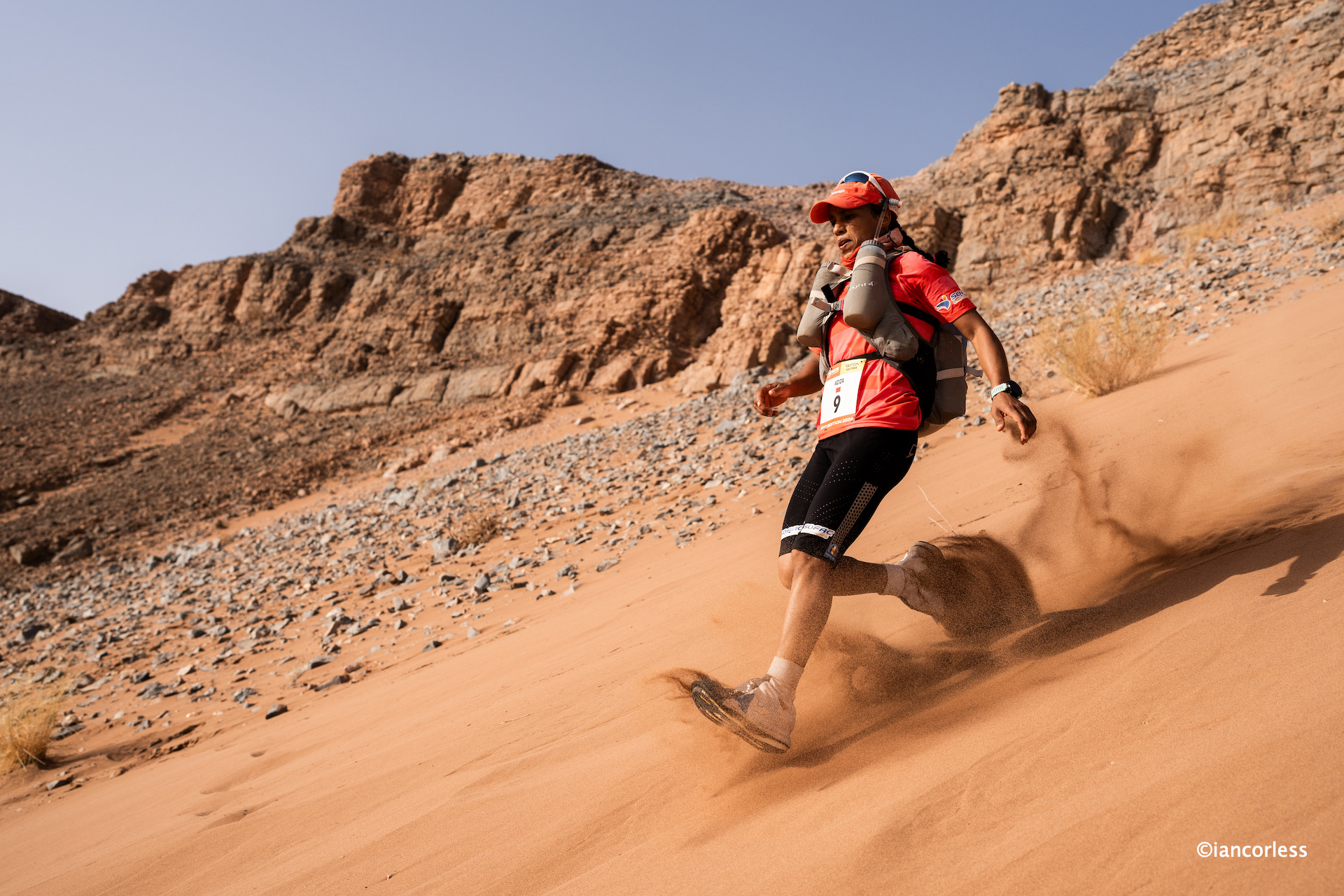
For the women, Aziza El Amrany was in a race on her own. She was head and shoulders above the competition and gave a dominant performance.
Aziza flying
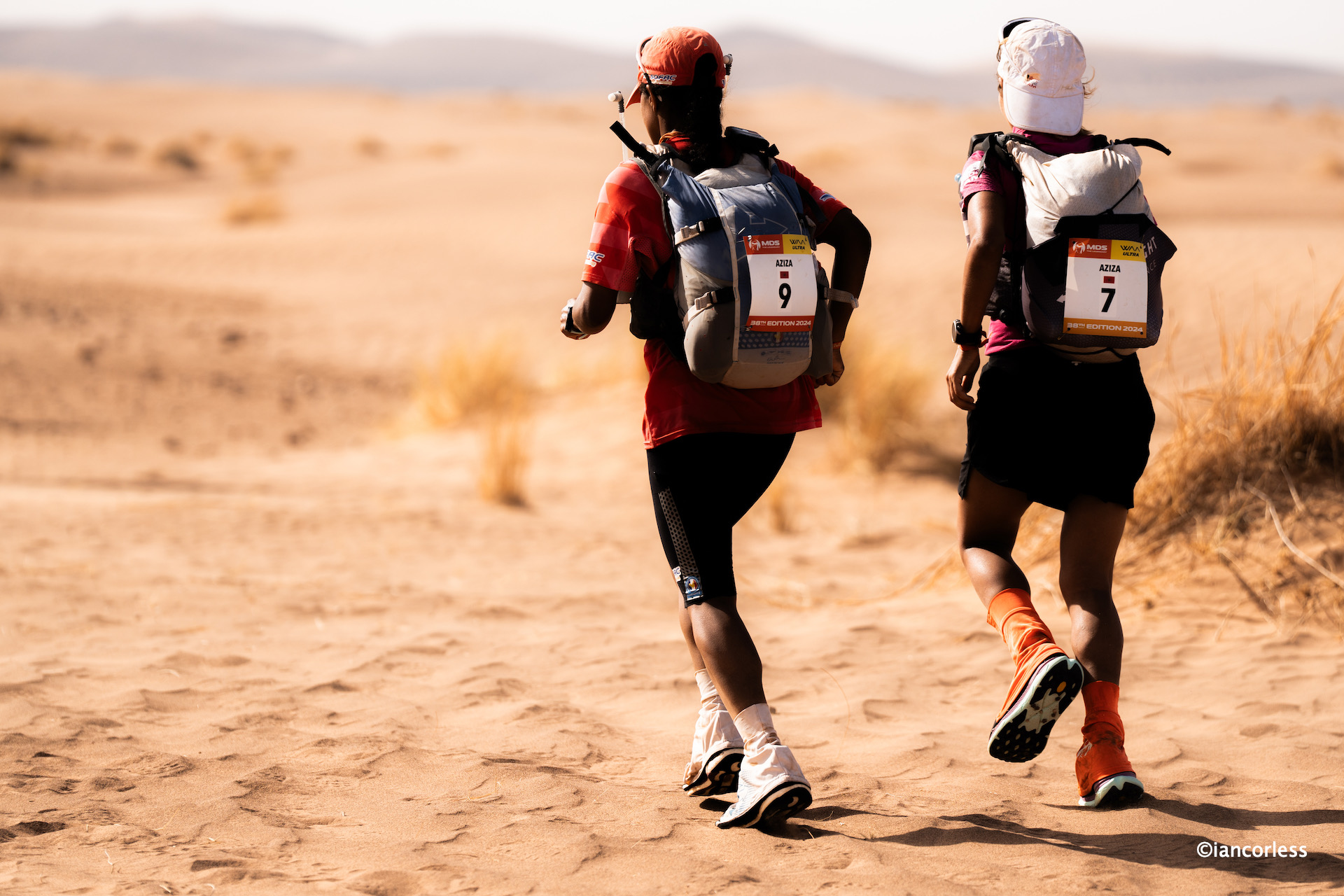
Aziza Raji, who has won MDS before and earlier in the year won Omand Desert Marathon placed 2nd and UK’s Gemma Game, once again placed 3rd. This Gemma’s 3rd time placing 3rd.
This is not an in-depth analysis of the 2024 MDS The Legendary, that will follow with more feedback and analysis. However, with thoughts and ideas fresh in the mind, it’s good to have immediate analysis and put thoughts down. I think I can safely say that the race can be summed up in one word, SUCCESSFUL.
What have I missed? I know I will have missed something, so, please let me know.
There may have been some controversy, worries and anxiety in the build up but quite quickly that evaporated.
MDS The Legendary may not be perfect yet, but for the runner, the 2024 edition came close.
If you hesitated placing an entry for 2024, my advice is to act quick for 2025. I firmly believe that once participants share their positive experiences, entries will fly in.
CALL FOR COMMENTS
I welcome you to share experiences, the highs and the lows. The positives and any negatives. The MDS will grow and become better with more feedback.
The 2024 Marathon des Sables – The Legendary is over. The race concluded with stage 6 and 21.1km to cover; challenging terrain of stony plateau, small dunes, an ascent to Jebel Mefatigbzef, wadi, and a palm grove finish – the MDS medal hard earned! Rachid El Morabity and Aziza El Amrany the champions!
Camp life
Once again it was an early start as everyone had to prepare for an 0630 start time.
Yoann Stuck
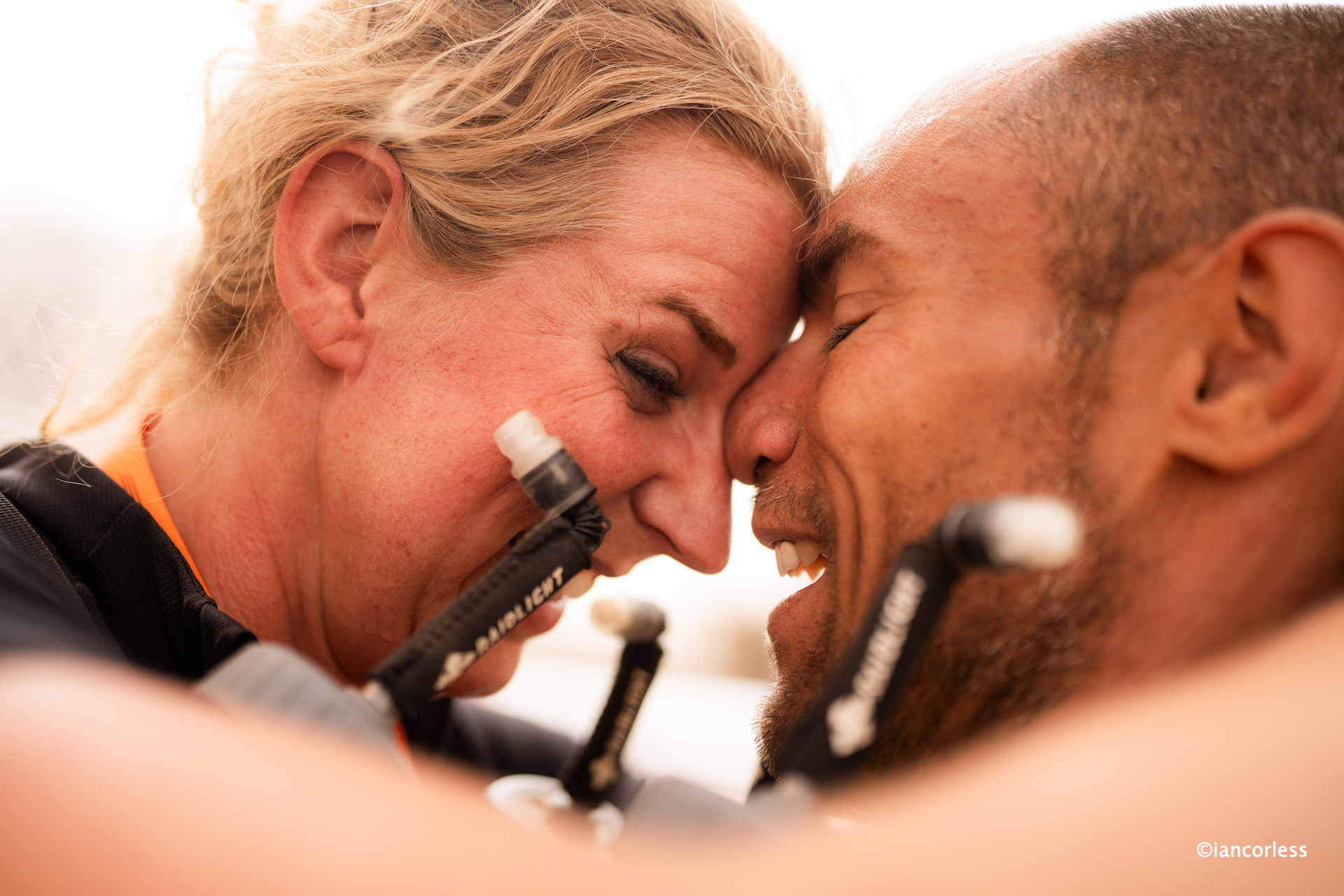
The last day was all about survival and getting the job done as quickly as possible, crossing the line and receiving the medal. The finish line for 2024 incredible, it was full of tears, emotion, relief and laughter; all accompanied by a DJ and party tunes. Quite a way to finish the race.
The medal
However, while the women’s race was decided early on and the top-3 places confirmed, the men’s race was a potential nail biter.
The El Morabity brothers had played their trump card on stage 5 and now Rachid could smell a 10th victory, however, he would need to perform at a top level to make this happen and make sure Aziz Yachou did not attack and pull back time.
The trio started fast and it stayed that way for the duration of the 21.1km’s. Aziz looking to break Rachid.
No matter how Aziz tried, Rachid responded and as the finish came in sight, the 9 times MDS champion pulled away, removed his Moroccan flag from his pack and secured a 10th victory. Mohamed eased up making sure that Rachid pulled back the required seconds to win overall, but not so many seconds that he would lose 2nd place.
Aziza El Emrany finally took the MDS top slot after many years coming close. It was great to see and one that is really deserved, she was in incredible form this year. Aziza Raji placed and for the third time, Gemma Game placed 3rd again.
The story though was all the legends who crossed the line and achieved greatness in making it through the Sahara to place a medal around their neck.
The 2024 edition has proven to be a memorable one, with a new organisation and many changes, many feared the race would lose something, not so. The opposite, the general consensus has been approval and open appreciation for what repeat MDS participants have said, ‘the best yet!’
As in any race, some don’t make the finish. For the 2024 MDS, at the time of writing, only 60 are DNF’s, this is from 867 starters.
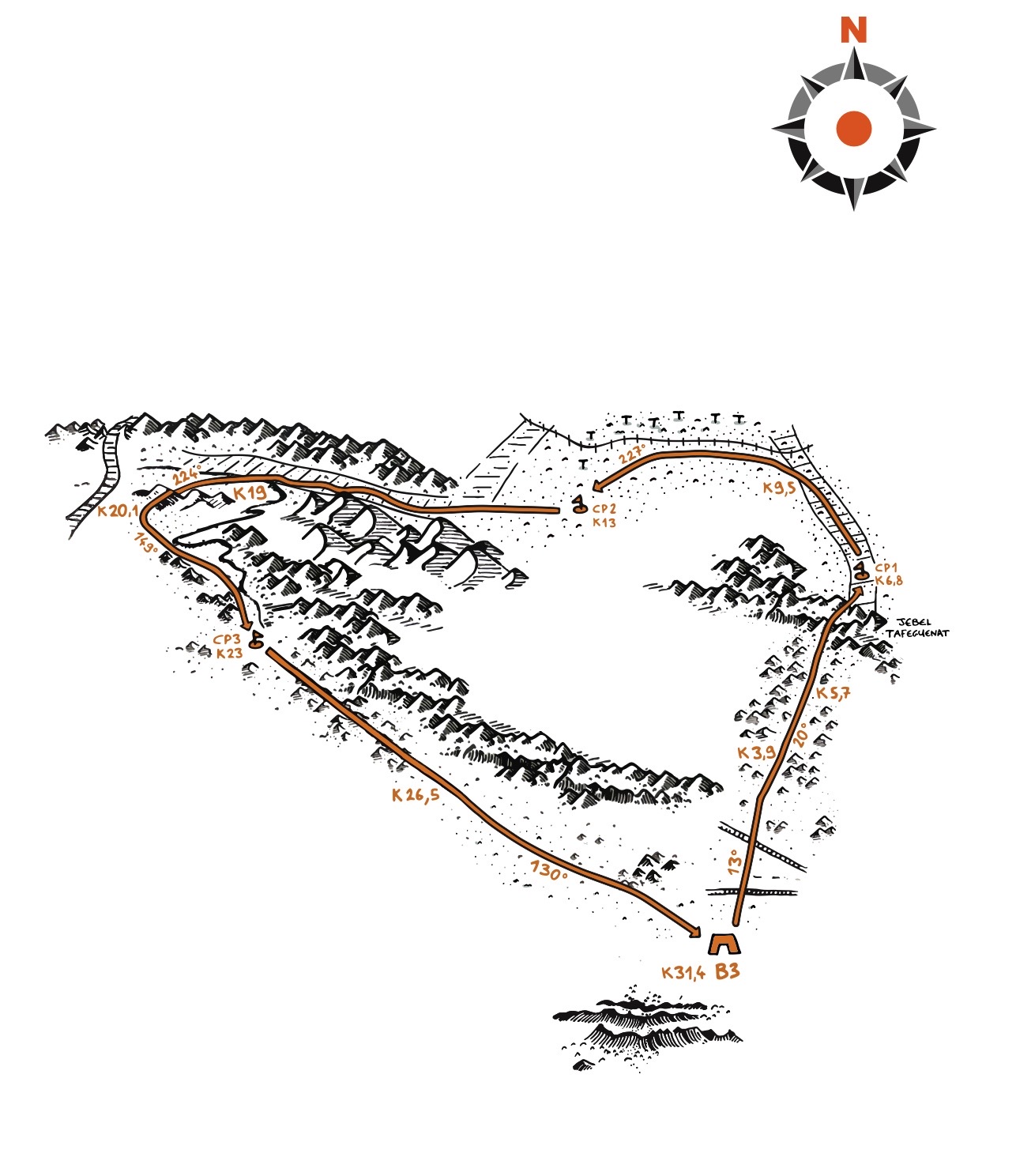
B3 and back to B3, the heart stage at 31.4km’s takes place in a new area for Marathon des Sables.
Sunrise
One could say that this is a classic MDS stage with a little of everything and while the participants may be feeling a little too tired to enjoy the views, there is much to appreciate here.
Laurence Klein
Jebel Tafeguenat a highlight followed by wadi, stony terrain and small dunes. CP’s ease the journey at 6.8km, 13km and 23km.
Easy start to the day
The day started under cloud and cool temperatures after a night of sandstorms. The early pace easy, with Rachid El Morabity and Mohamed somewhere in the middle of the pack. However, this soon changed with Aziz Yachou dictating the pace.
Rachid El Morabity followed and the race was on.
Was this the day that Mohamed El Morabity would relinquish his lead and allow his brother the opportunity for a 10th MDS title? The simple answer, yes!
Full flight
As the stage progressed, Rachid and Aziz pushed a relentless pace and Mohamed dropped farther and farther back.
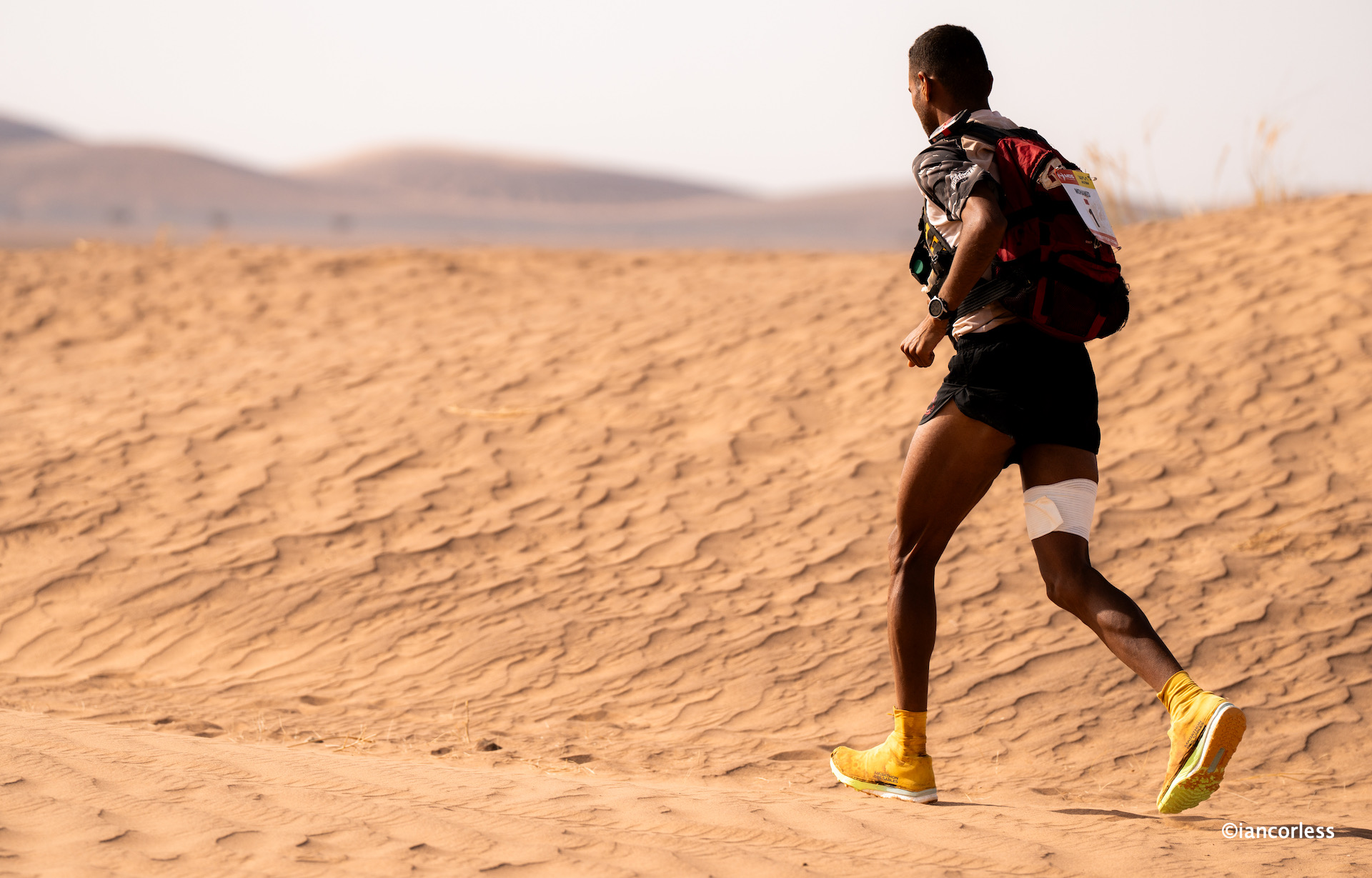
Mohamed watched the race pull away, strapping on his leg…
Within the final 8km, the duo of Rachid were at full pace, it was superb to watch as the master, Mr MDS, Rachid El Morabity opened a gap pushing at almost 17km’s and hour.
Aziz Yachou
Aziz grimaced trying to keep up. This was the make or break day and Rachid crossed the line in 2:11:43. Aziz followed with 2:12:23.
Aziz watching Rachid pull away!
Now, what time was Mohamed going to cross in? No doubt he was calculating a pace to make it all very close for the last day, his time, 3:04:06 (35th place) and 52:23 after Rachid.
The ranking going in to the last stage:
Mohamed El Morabity 19:19:39
Rachid El Morabity 19:20:14 (35 seconds behind)
Aziz Yachou 19:22:30 (2:51:00 behind)
It’s all becoming a blur.
The strategy for stage 6 is simple, Mohamed will recover from his leg problem but relinquish the 35 seconds to his brother whist also making sure he does not lose time to Aziz so that he finishes second. It has been a stunning El Morabity game plan, once again!
Aziza El Amrany and Rziza Raji
The Aziza’s ran together today and crosssed in 3:15:01. Rajaa Hamdaoua 3rd in 3:28:52 and Gemma Game 5th in 3:54:54.
Rajaa 3rd on stage
Stage 6 for the women will be casual with Azia El Amrany secure in 1st, Aziza Raji secure in 2nd and Gemma Game secure in 3rd.
It’s all getting too much for some.
You can receive daily updates and reports on this website. Follow on IG @iancorlessphotography and @mdslegendary
Time allowance 12-hours 45-minutes / 0630am and 0800 start (top 150 ranked)
The fall out from the long day is always hard. Bodies are now tired and normally, many would be saying, ‘just a marathon to go!’ But not for the 2024 edition.
Aziz Yachou
Stage 4 is 43.2km’s and to follow, stage 5 and stage 6 at 31.4km and 21.1km respectively.
Travelling north all the way to B3, this is a tough day and probably will be remembered as the soft-sand day, especially as the most challenging terrain comes at the end.
Sand and heat
With 3 CP’s at 10km, 22.9km and 30.1km, the severity of the stage is reflected with ‘additional’ water stations at 17km 37.7km.
Cooling off at the CP’s
While the early km’s allowed for easier terrain with cooler temperatures, the kick is in the tail with relentless sand and dunes from 22km all the way to the finish with increasing heat, expected at a 35-degree high, but feeling much hotter than 40-degrees for the runner’s. A tough day!
Rachid in the early 10km’s
Rachid El Morabity dictated the early pace with Aziz and Mohamed behind.
Mohamed
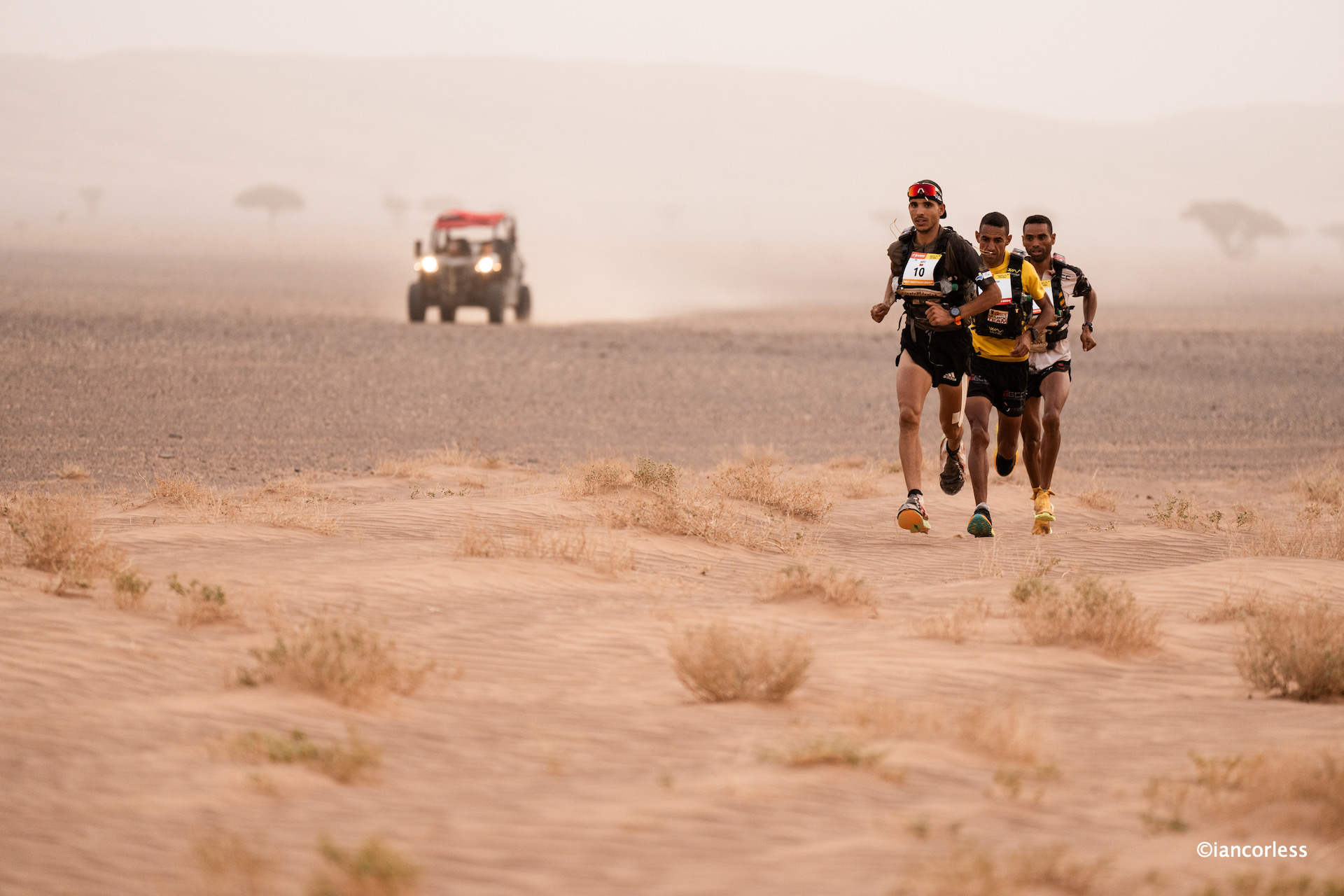
The trio mixed it up but by the halfway point they were all together.
Two company, three a crowd
In the closing 10km, Rachid made a notable kick and pulled away for the stage win, Aziz and Mohamed behind 3:13:24 for Rachid and 3:14:59 for the duo.
Aziza
Aziz E Amrany has been at another level this year and once again she dominated the stage from the front with another stage win in 4:29:41.
Aziza Raji
Aziza Raji followed looking relaxed and strong with a secure 2nd place in 4:53:08.
Adriana Moser
Sadly, 3rd placed runner Adriana Moser had to withdraw from the race at one of the CP’s opening the door for Gemma Game who has placed 3rd at MDS twice in the past; it maybe three times a charm! However, it was Rajaa Hamdaoua who was 3rd on the stage with 5:09:59.
The spectacle of the Sahara
You can receive daily updates and reports on this website. Follow on IG @iancorlessphotography and @mdslegendary
Stage 3, the feared ‘Long Day’ coming earlier in the race requires respect. Quite simply, with 3 stages still to go, energy management is key. However, it was a decision of the new organisation, to bring the long day earlier to allow participants to be fresher and have more energy for the challenge ahead. Also, with earlier starts, cooler temperatures for the early hours.
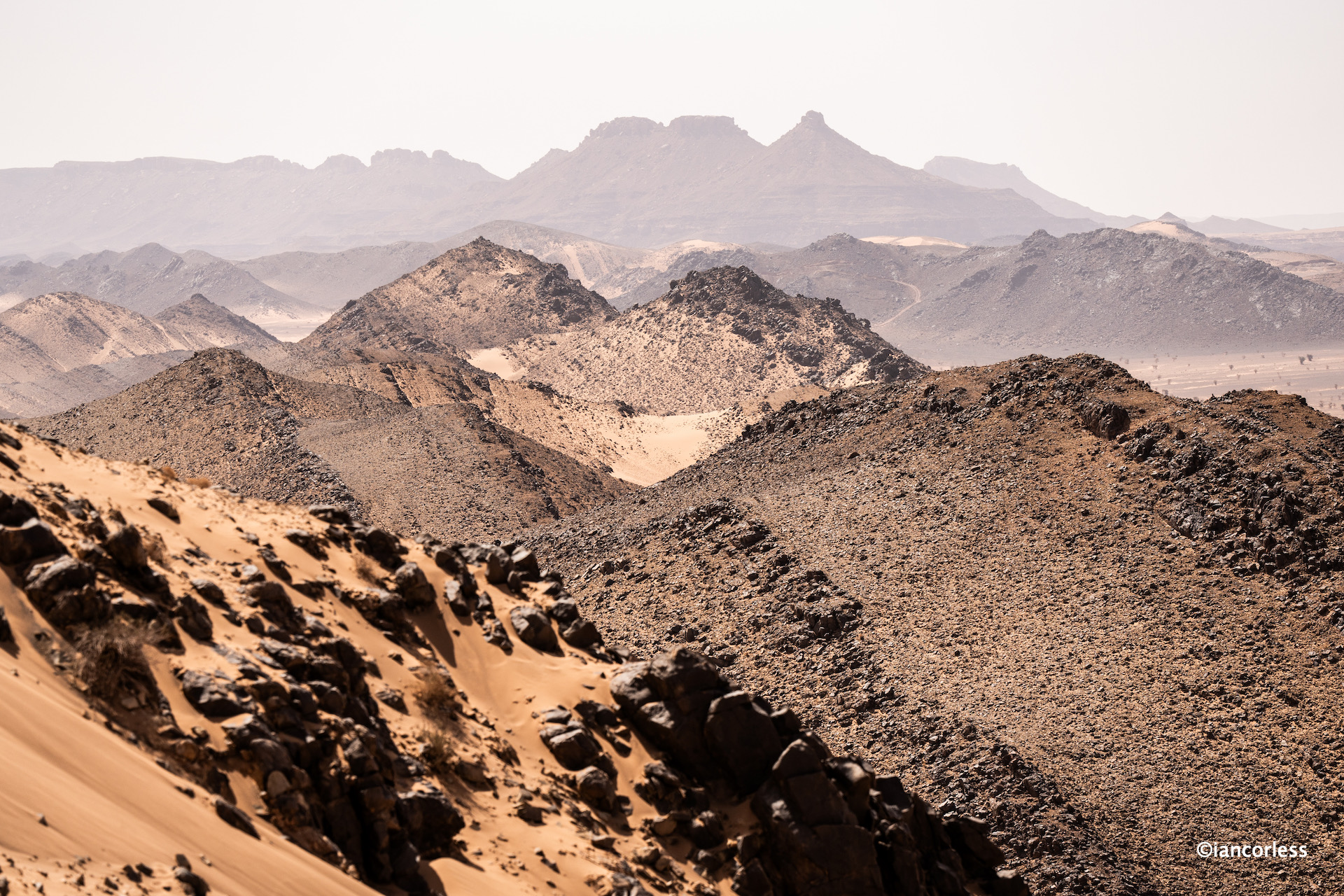
The route is a classic and arguably, I would say it is the most beautiful route of all the MDS I have experienced. It’s a tough one though!
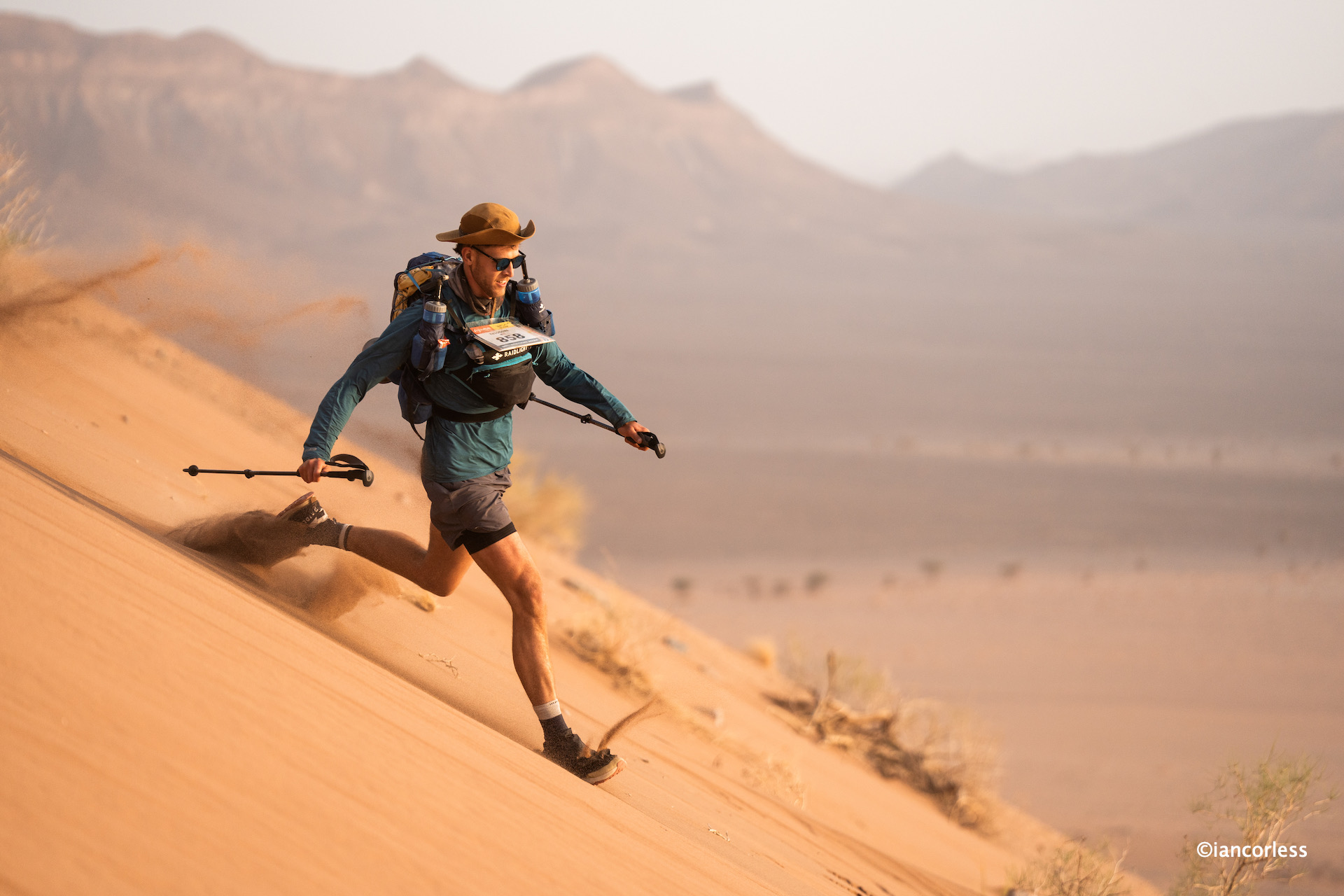
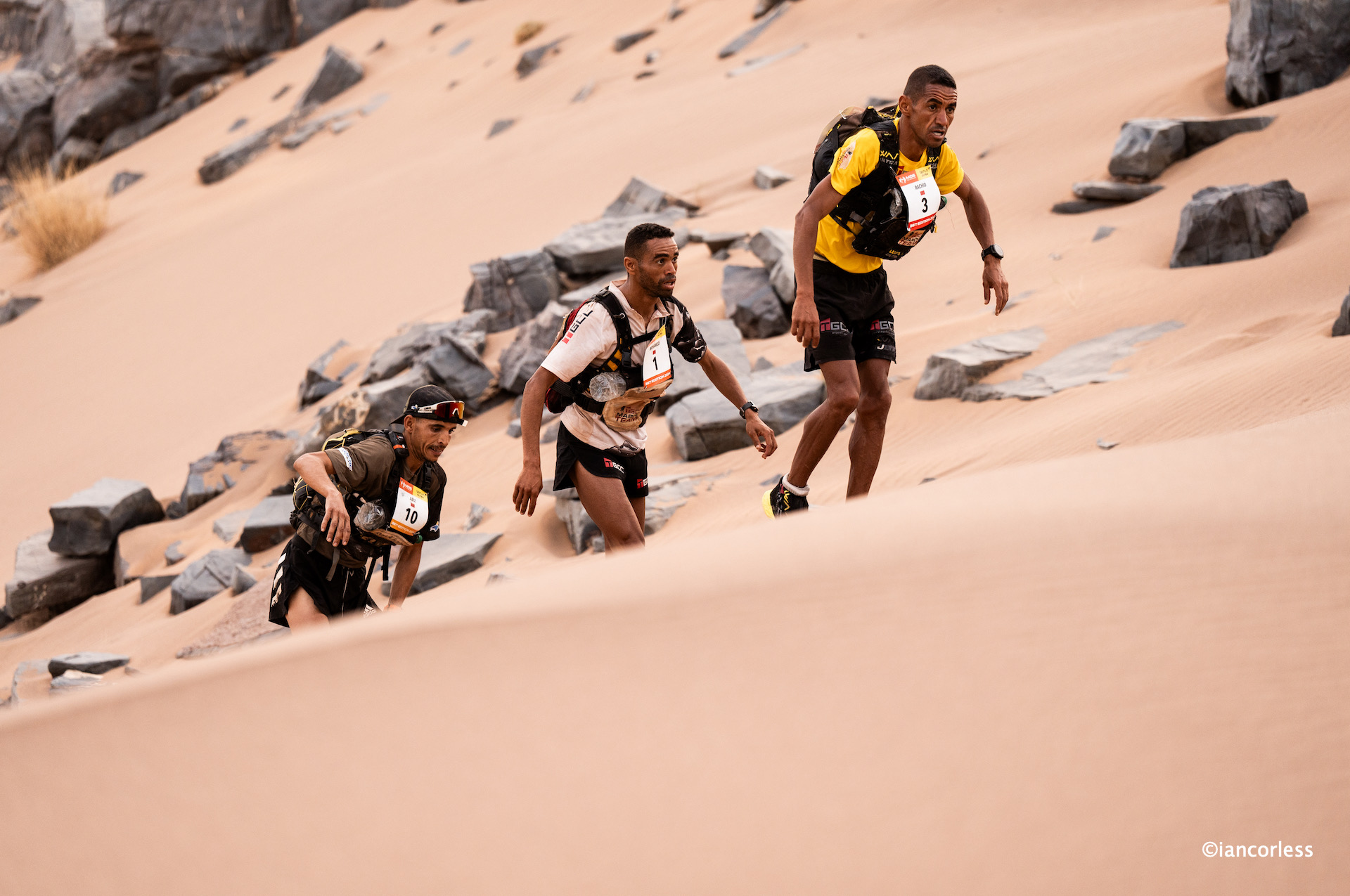
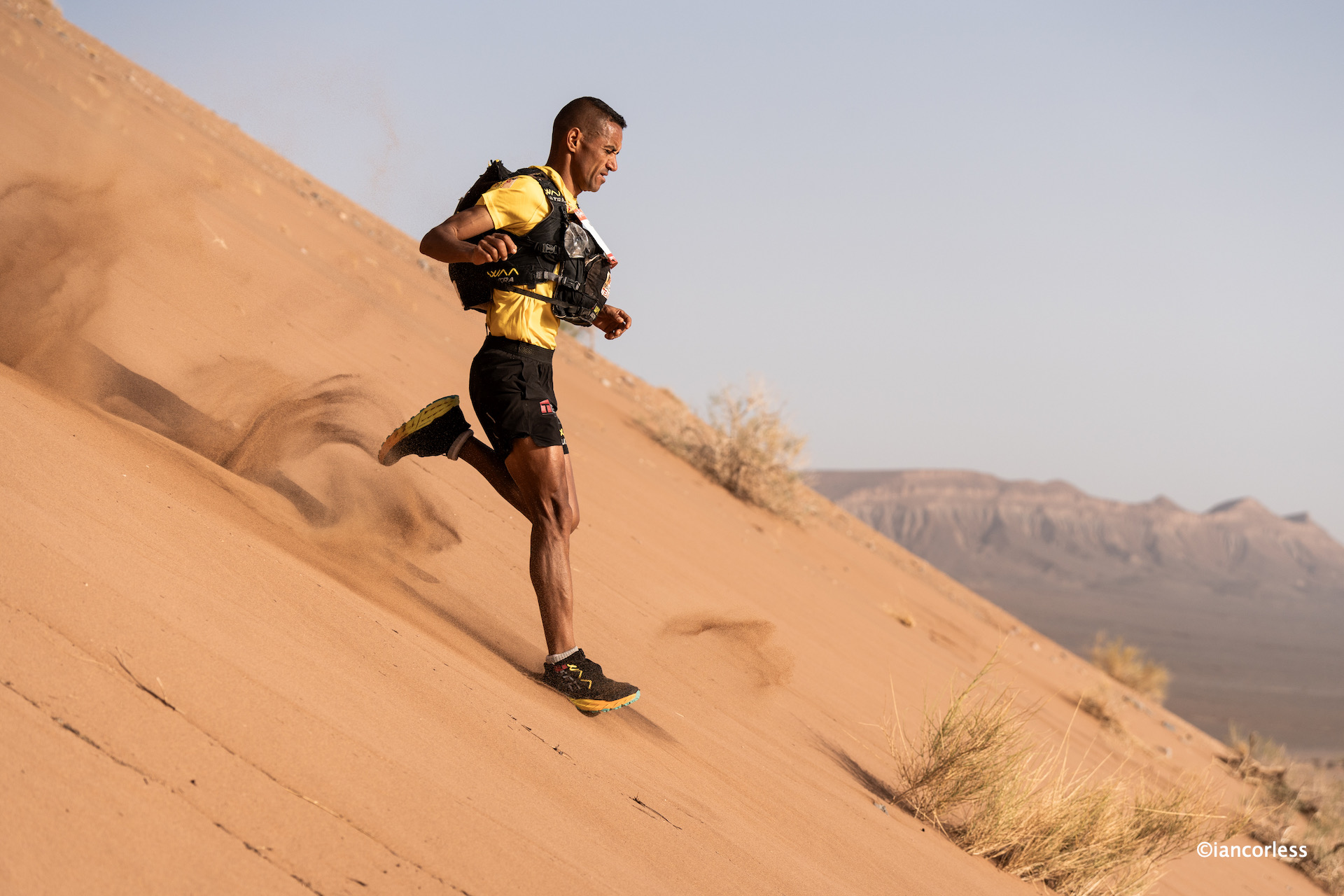
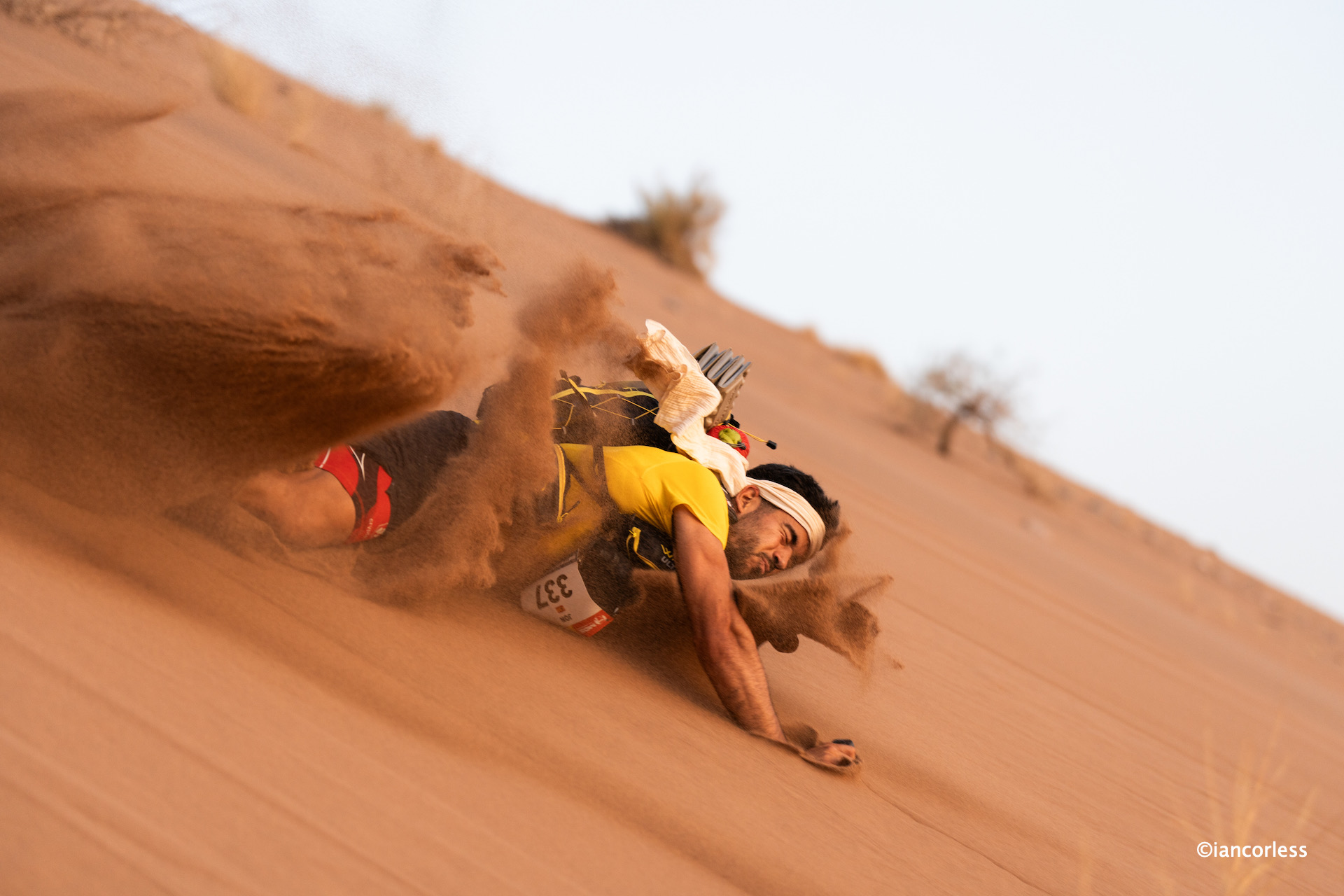
From B2 the stoney climb to the summit of Jebel El Otfal is followed by the steep and sandy descent before a long flat run along the plateau before climbing and traversing the ridge of Jebel Joha Baba Ali, for me, one the best parts of the whole race! Another ridge follows before stoney ground and sand leads the route close to Ramlia and CP5. From here, the march continues.
Magical landscape
Ba Halou, Oued Rheris, Ras Kemouna, the salt flats, the iconic El Maharch and then a return to B2. This is a highlight tour of the Sahara that mixes plateau, technical terrain and lots of soft sand.
The 0600 start
With 7 CP’s: 12.5km, 24.5km, 35.2km, 43km, 51km, 63km and 74.5km, the requirement for extra water is important and therefore at CP1, runner’s were provided an additional 1.5ltr bottle so that they could increase their carrying capacity for the stage.
The majority of the field started at 0600 and the top-50 at 0730. While the top men and women would look to push the envelope, the early starts would mean a finish in daylight. For most, this stage is about survival and many went through the night and into the next day to get the job done.
It got hot…
The winds had eased and the temperatures rose reaching a high of 33-degrees on the stage and a ”feel’ of 40-degrees during the mid afternoon. It was certainly a day that took it’s toll with many runner’s requiring attention and of course there were sadly DNF’s – a confirmed number to follow.
Starting 90-minutes after the masses, the top-50 were soon at Jebel El Otfal and the charge lead by Rachid El Morabity for the men and Aziza El Amrany for the women.
Rachid leading early on
After the first ridge, the format was the same, Rachid pusued by his brother Mohamed and Aziz Yachou, with Aziza Raji pursuing her Moroccan friend.
Mohamed takes the lead
By the second ridge, Mohamed was in the lead, Aziz followed and then Rachid, with CP2 close, a plan was coming in to action for the El Morabity brothers, but, what was it?
What followed, was a complete surprise, Mohamed opened up a lead and continued to extend time finishing in a remarkable 7:37:47.
Getting it wrong on Jebel El Otfal
Aziz and Rachid finished in 8:31:52 and 8:31:53 respectively – what just happened? There will be more news to follow on this when I get in to bivouac and discuss with the three protagonists. For now though, Mohamed had the run of his life and Rachid is unlikely (?) to win his 10th MDS.
Yoann Stuck 4th
Yoann Stuck was 4th and Hamid Yachou 5th, 8:46:30 and 9:17:21.
Aziza El Amrany – incredible run
Aziza El Amrany is on fire this year. I have never seen her race and push so hard. It’s impressive, her victory was as equally mind-blowing as Mohamed crossing the line in 10:46:10.
Aziza Raji
Aziza Raji and Adriana Moser once again placed 2nd and 3rd, 11:24:29 and 12:05:06.
Adriana Moser
Day1 passes to day 2 and now those who have pushed through the night have another day to achieve the opportunity to fight another day.
A day of pain for some
You can receive daily updates and reports on this website. Follow on IG @iancorlessphotography and @mdslegendary
Stage 2, a beautiful stage of 40.8km’s travelling north to B2. This area of the Sahara has been used on multiple Marathon des Sables and rightly so, it’s an area that offers excellent terrain and visual splendour.
Breakfast before the start
The opening km’s to 6.3km ease the runner’s into the day and then the following km’s to CP1 at 12km are a challenge that sap energy.
CP2 comes at 25km however, the inclusion of an additional water station at 19.8km makes the stage more manageable.
Cold water at the checkpoints help runner’s cool off
Although the presence of soft-sand is minimal, the terrain is hard and energy sapping. CP2 to CP3 is just 8km (33km total) and then the final run in to 40.8km concludes the day.
Sand, golden light and mountain backdrops
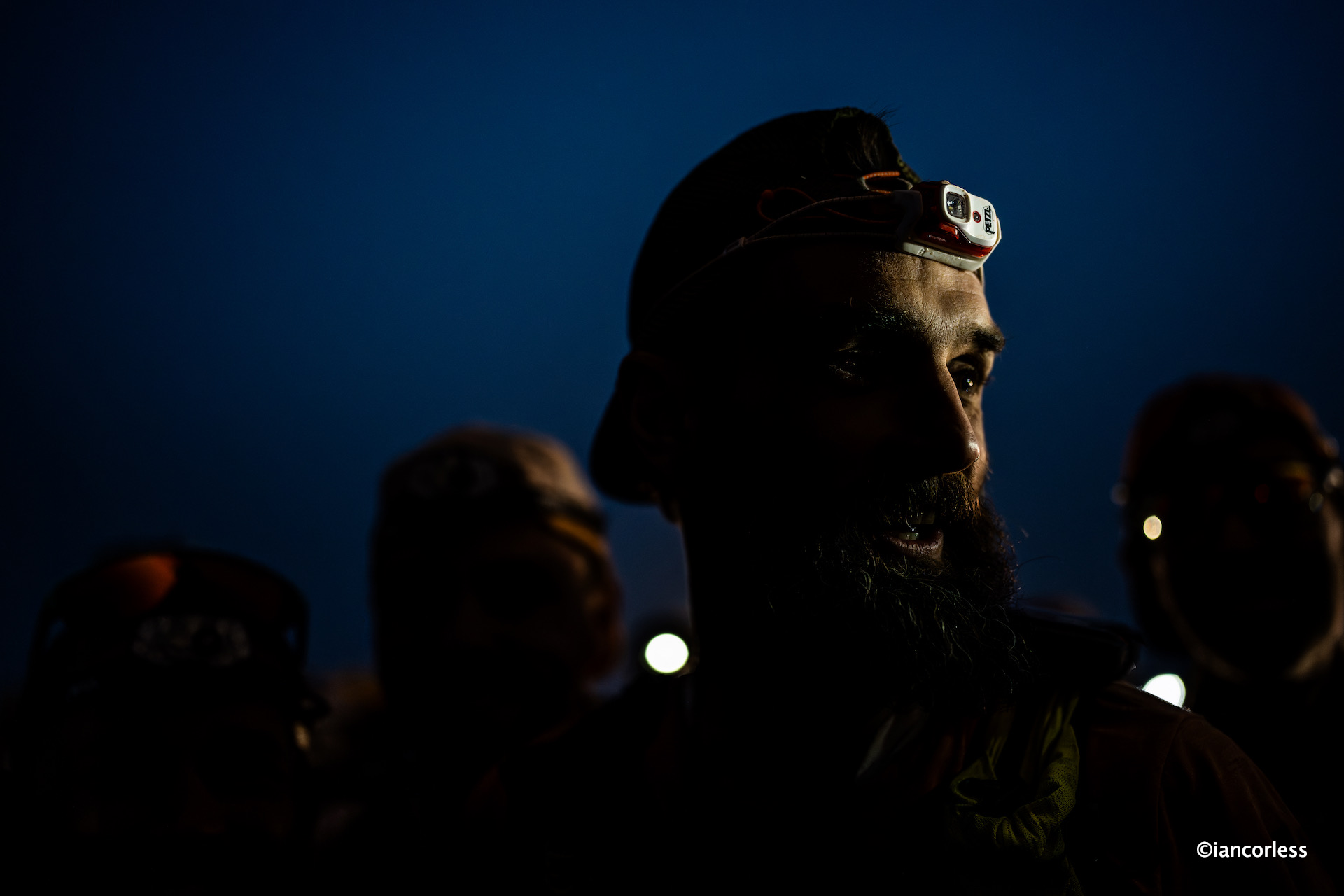
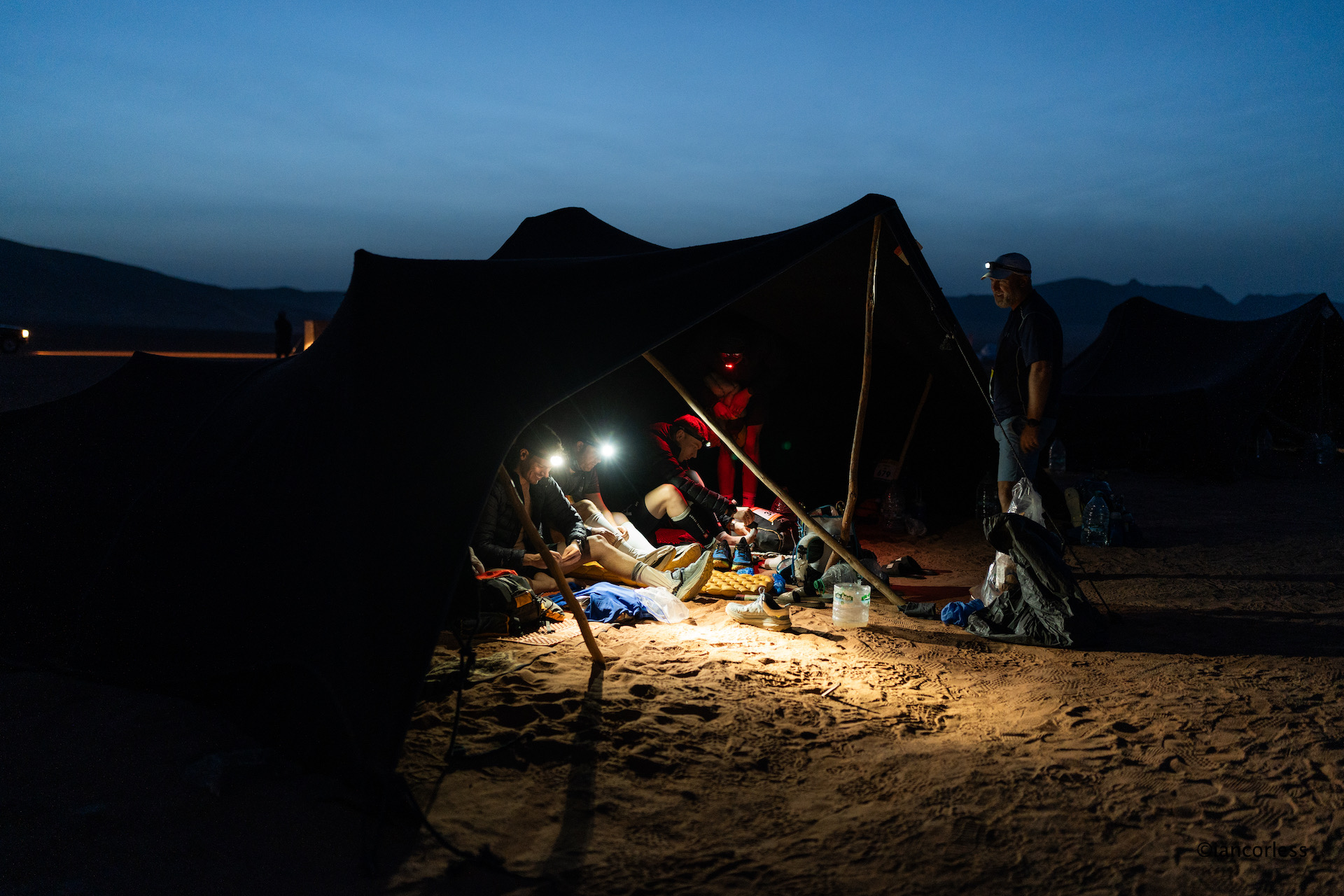
With an 0700 start, camp was alive with. head torches as runner’s prepared for the day. A mild night and finally, the wind disappeared.
Camp life
At the start, temperatures were around 12-degrees and they stayed low till around 0900 and then the mercury rose to a predicted high of 33-degrees.
The first downhill of the day for James Miller (ZA)
Although Rachid El Morabity had a lead early on, the day was very much neutralised for the top runners in Mohamed El Morabity and Aziz Yachou. They have respect for the long day on stage 3 and they all know this will be a crucial decider for potential overall victory.
A variety of terrain for stage 2
Mohamed, Rachid and Aziz all finished roughly together and with stage 2 complete, the time are 5:22:47, 5:23:14 and 5:23:16 for Mohamed, Rachid and Aziz respectively.
Aziza El Amrany unstopple for this 38th edition.
The women’s race had the same format as stage 1 with Aziza El Amrancy forging ahead for another stage win and a more substantial time gain, her time now 6:54:06 in comparison to 7:40:32 for Aziz Raji who also finished 2nd on the stage.
Adriana Moser
Adrianna Moser concluded the stage podium with a now total time of 7:51:49 with Gemma Game and Laurence Klein at 8:04:49 and 8:26:17.
Gemma Game
Stage 3 tomorrow, the long day, starts at 0600 for the majority and the top-50 at 0730. It will be tough day with no wind and rising temperatures.
You can receive daily updates and reports on this website. Follow on IG @iancorlessphotography and @mdslegendary
Now is the time to make all the final preparations for a goal that you have been building towards for 6-months, 1-year or maybe even years.
DON’T PANIC.
If you have got this far, you are in a great place.
There is time for one last key week of training, adding the final touches to make sure you are in the best shape possible, BUT, after this week you need to start easing things back, looking after yourself and allowing your body to recover, rest and get ready for what may be one of the biggest weeks of your life?
MEDICAL
Make sure you have all the medical requirements fulfilled and an up to date ECG as specified in MDS rules and regulations.
The organization’s medical certificate (to download from your online account from March 11th 2024) and the resting electrocardiogram (ECG) report plus graph, dated less than 30 days before the start of the race, i.e. from March 12th 2024, are to be presented during the administrative, technical and medical checks on 13th of April 2024. Only the original documents, dated and signed, will be accepted (unvalid photocopy). Failure to present these documents will incur penalties (see ART.27 et 28). The signature and the stamp of the doctor must be applied on them.
The electrocardiogram of effort is advised for participants over 40 years. It is not compulsory and does not replace the ECG at rest and its plan. This can be joined to the medical certificate and presented in Morocco.
TRAINING
From a training perspective, what may the next weeks looks like? Well, we are all individuals, we all have different abilities, we all have different goals, we all have different free time and the list could go on. However, I have found over the years that using a ‘percentage’ taper works across the board, irrespective of the person.
Race date: 14th April 2024
Taper schedule:
Week 4: 17th March
Week 3: 24th March
Week 2: 31st March
Week 1: 7th April
If we look at the weeks above, a taper to Marathon des Sables could look like as follows:
Week 4: 80%
Week 3: 60%
Week 2: 40%
Week 1: 20%
The percentages are based as a percentage of what would be week 5, starting 10th March. For simplicity, let’s assume that week 5 is your last big training week and it was 100km or 12-hours.
The Taper:
Week 4: 80km or 9.6 hours
Week 3: 60km or 7.2 hours
Week 2: 40km or 4.8 hours
Week 1: 20km or 2.4 hours
Importantly, keep the balance of training days the same. If you typically run 5-days a week, maintain those 5-days and reduce the volume/ intensity.
Your body needs to keep alert and active. So make sure you add some stimulus in this taper period, short periods of faster running and/ or hill work are ideal. However, do all this with the priority not to get injured. Now is not the time to get a niggle, a sprain or a problem.
ACCLIMATE
In the final two weeks of taper you need to hone in on acclimation to heat and prepare the body.
Don’t leave this to the last minute, plan ahead, especially if using a heat chamber. Heat chambers are limited and obviously, time slots are limited.
If you do not have access to a heat chamber think of other options: sauna, hot baths, bikram yoga, adding layers when running, or if you are lucky with time, arrive in Morocco early and taper in a real situation.
EQUIPMENT
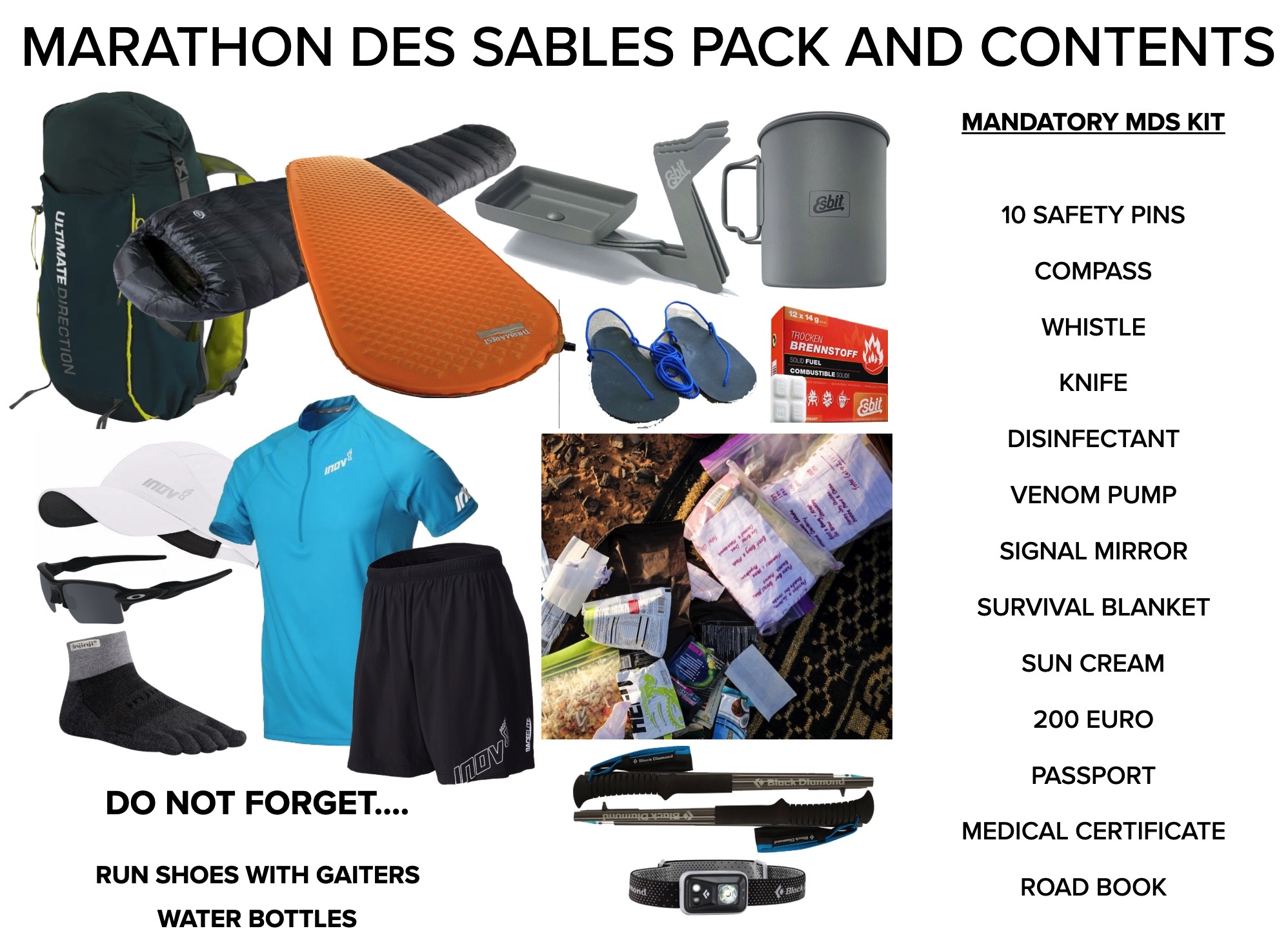
You will have been mulling over equipment for months and you may well have tweaked and changed your choices. Now, with 4-weeks to go, this is the time to make sure you have everything you need and also understand what it all weighs.
Clothes must be comfortable and not rub.
Shoes fit perfectly, give no hot spots and are suitable for the desert environment and have gaiters.
Socks work for you.
Sleeping bag is light and warm.
Sleeping mat
Food
Mandatory kit
Top Tip –
Use LighterpackHERE to list all your equipment. You can see an example HERE that I used for a trip climbing in the Atlas Mountains. This is a great way to look at everything and make sure you have nothing missing.
Keep luxuries to an absolute minimum, they only add weight.
Pack and re-pack your pack to make sure you have the most comfortable solution and importantly, you have immediate access to essential items.
Read my Top 20 Tips HERE which provides a great overview of all the things you need to consider now in this final phase.
FOOD
You need a minimum of 2000 calories per day. Lay food out for each day and have a spreadsheet that itemises everything and shows the weight and calories.
Where possible, re-package food in smaller and lighter packaging. Particularly important with dehydrated meals. Read HERE
TRAVEL
Travel in your run clothing including your run shoes with the gaiters. Yes, you are going to look somewhat ‘special’ at the airport but trust me, luggage goes missing and you do not want to be the person standing in the Sahara watching your dream slip away because of lost luggage. Equally, take your run pack with all contents for the race as carry-on. You can take pretty much take everything: food, sleeping bag, essentials etc. However, check with your airline what can and cannot go on the plane.
Put your main luggage in the hold and here you can take spares, extras and options. MDS varies considerably in temperature, we get hot and cold years. Never assume it will be hot, it may not be. Before admin day you can fine tune your ‘race kit’ with more or less layers.
Purchase food and drinks at the airport to take on the plane. Also consider when you land in Morocco, you will have an approximate 6-hour bus journey to bivouac 1, take food and drink with you for this trip.
Have cash with you, depending on which airline you use, card payments are not always possible, also, in Morocco, cash is king.
ARRIVAL
You will arrive in Morocco from London or Paris on one of the arranged flights on Friday 12th April. If you are not on one of these flights, you need to be at Ouarzazate airport (typically for 0900) on the same day.
Runners will then fill buses, road books will be given and then you transfer to the desert. Expect 6-hours.
At bivouac you will find your tent and settle in.
REMEMBER food is now NOT provided and you therefore need to feed yourself on arrival day and admin day. There are no restrictions on weight or calories here, so, take as much as you want and plenty of variety, this includes drinks. Only water will be in camp.
As mentioned above, until admin, you have your luggage with you, so, you can have more layers, a more comfortable inflatable bed and some luxuries – consider what will make these days more pleasurable and comfortable.
ADMIN DAY
On admin day, prepare all your kit and make sure you have everything prepared and ready. Also make sure you have all mandatory and essential kit. Once you have passed through admin, your luggage is taken away and you will not see it again until after the race.
Race self-sufficiency actually only starts the following day with stage 1.
Admin can take a while, so make sure you take liquid and snacks and my top-tip is take an umbrella to protect from standing in the direct heat.
As we countdown to the 2024 edition of the Marathon des Sables – The Legendary, we will be providing a series of monthly updates, articles, interviews and podcasts.
The 2024 Marathon des Sables – The Legendarywill be the longest edition in the 37-year history of the race. At 252km, the event will now take place over 6-stages/ 7-days and not 5-stages/ 6-days as announced in late 2023.
It was clear initially that the 6th stage charity stage would disappear, however, on reflection, the new organisation have decided to continue with 6-stages but this time, all stages will be timed. The charity stage in previous editions was not timed.
The infamous long day which typically took place on stage 4 will now move to stage 3 for 2024, this will be day 3 and day 4 of the race as it has an extended time allowance due to the distance.
What does the above mean for the runner?
252km’s is a long way, but the race has always been advertised as 250km’s, so, although the race has fluctuated in distance over the years, the 252km should not come as any great surprise.
The timed stages now numbering 6 and not 5 will make a big difference, especially with the long day coming on stage 3. This will mean that stage 4, stage 5 and stage 6 will need to approximately cover 100km. This makes for a tough end to the week. In past editions, the long day was feared but on completion, many had the mindset, ‘It is just a marathon to go!’ Now it will be significantly more.
The daily distances are typically never disclosed before the race and the jury is out if the distances will be announced pre arrival in Morocco, watch this space! However, it is pretty easy to guess on approximate distances.
Historically, distances for the stages are listed as follows:
Stage 1 from 28 to 35 km
Stage 2 from 28 to 39 km
Stage 3 from 28 to 39 km
Stage 4 (The Long One) from 75 to 85 km (over 2 days)
Stage 5 (Marathon Stage) of 42.195 km
Stage 6 Charity
We know the 2024 edition will be 252km, so, as a guess and guide the following will provide a good estimation, the daily figures are +/-, for example, stage 1 could be 30km and stage 2 40km.
Stage 1: 32km (day 1) running total: 32km
Stage 2: 38km (day 2) running total: 70km
Stage 3: 83km (day 3 and 4) running total: 153
Stage 4: 42km (day 5) running total: 195km
Stage 5: 36km (day 6) running total: 23km
Stage 6: 21km (day 7) running total: 252km
Total: 252km
With the above information, you now have at least a template and guide for which to plan around.
OTHER KEY CHANGES
Salt Tablets
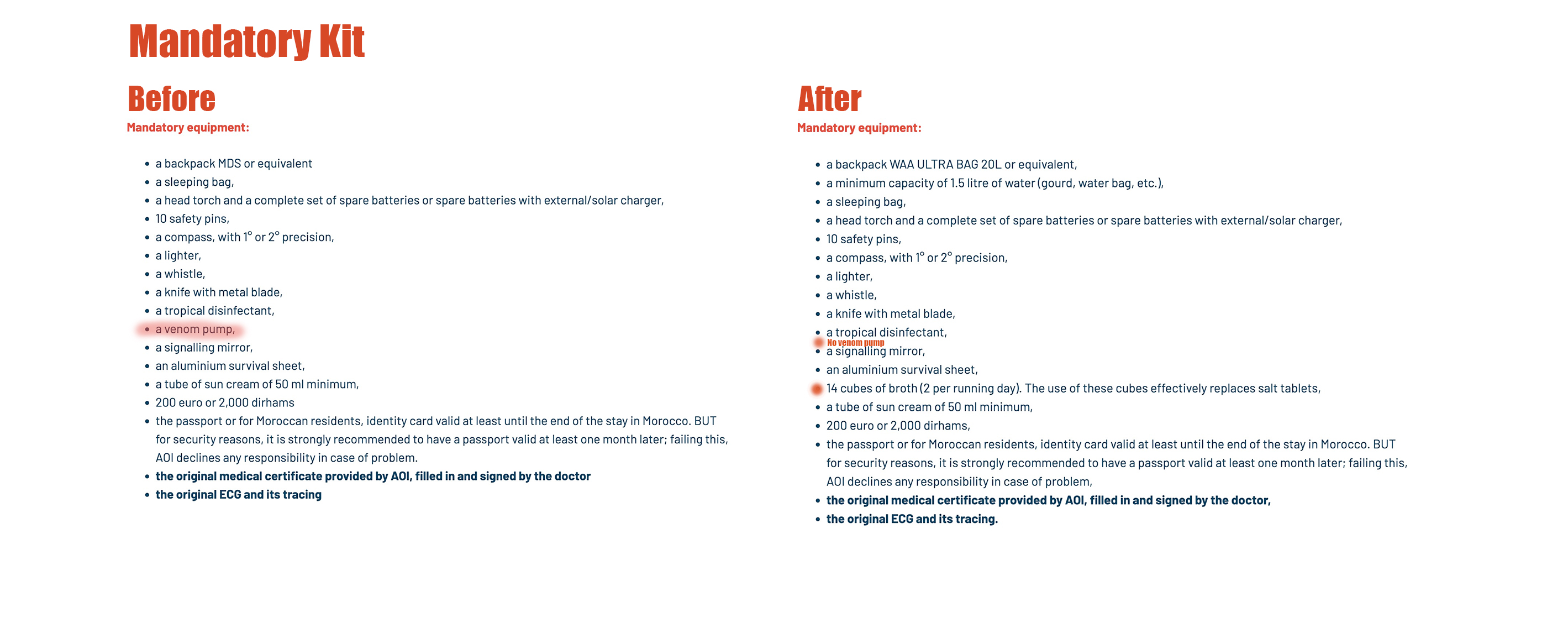
As I announced in 2023, it was my expectation that salt tablets would not be provided for the 2024 race. The new revised mandatory requirement for the race requires 14 broth cubes – these cubes are known to be salty. You have no choice here, you must have them. However, it will be your decision if you use them? My advice is to plan a strategy that works for you. Listen to my podcast with Andy Blow from Precision Hydration HERE. Remember, this is a self-sufficient race, so, be prepared to be self-sufficient and have a plan/ strategy that works for you.
Water Capacity
Another key change was the requirement for ‘A minimum capacity of 3 litres of water’ in the form of bottles, bladder etc. This has now been revised and we go back to 1.5 ltr capacity. This is a good move. Cp’s will be increased so that runner’s will only need to carry 1.5 liters. However, on the long day, an additional 1.5 ltr bottle of water will be provided either at the start or at cp1 (making 3 ltr to carry) therefore the capacity to carry 3 litres on the long day between cp’s is recommend. It is important that you think HOW you will carry this extra 1.5 ltr. Maybe you will have a bladder in or on your pack, maybe two additional 750ml bottles at the rear or if you have the front pack, you can slide the 1.5 bottle on top. It’s not recommended to run with a 1.5 ltr bottle in you hand, so, be prepared…
Water
Water during the stage will not be provided via 1.5 ltr bottles as in past editions. Water will be provided from a series of tables and manned staff with jugs to decant water to your empty bottles. Importantly, there had been concerns about where the water will come from, to clarify: 5L Bottles on CP -> Served in 2L jugs -> Served by staff in the runners’ bottles.
The exception being on the long day as mentioned above when a 1.5 ltr bottle will be provided at the start or cp1 and at the end of each stage when a 5 ltr bottle per participant is provided. This 5 ltr bottle will cover the evening after the stage, the morning of the next day and the required 1.5 ltr capacity starting the next stage to cp1. So, if you had planned to cut down a 1.5 ltr bottle to use as a bowl for dinner and breakfast, this will not be possible. You will now need a suitable pot or similar.
Checkpoints
Will be typically 2 to 7 per stage. On the long day, it is therefore a good assumption that checkpoints will be +/- 12km’s apart and hence the need to require 3 ltrs.
Mandatory Equipment
I will list here the mandatory equipment to avoid any confusion:
Pack such as WAA Ultra Bag 20L
Minimum capacity of 1.5 liters of water*
Sleeping bag
Head torch and spare batteries (you can have a charger/ solar charger)
10 safety pins
Compass with 1 or 2 deg precision
Lighter
Whistle
Knife
Topical disinfectant
Venom pump*has now been removed
Signal mirror
Survival blanket
14 cubes of broth***
Sun cream
200 euro or 2000 dirhams
Passport or ID card
ECG and medical
* new change but consider the long day when you will have 3 ltr.
** new change
*** to replace salt tablets
Food Requirement
You need 14,000 calories of food as a minimum, 2000 calories per day. You can of course carry more than this, but 14,000 is the minimum. You must be able to prove the calories, so, if you decant food into lighter or different packaging, make sure you keep the nutritional information.
You
In addition to the above you personally will need:
Keep the pack weight as close to the minimum 6.5kg as possible, additional weight is additional stress that you do not need.
Keep luxuries to a minimum, they only add weight. A super light Mp3 player (with good battery) and earphones is the only luxury I would consider.
Accept that this is a tough challenge, you will be stripped back to a survival mode. You will not wash, you will get dirty, you will get smelly. Accept it.
Start slow and ease into the race.
Poles can be a lifesaver and I recommend them but you must learn to use them. Those at the front do not need poles, they can run.
Learn to walk, walk and walk. Many go to the desert with the expectation of running 80% and walking 20%. The reality is it will be the other way around.
Look after your feet and start with the correct shoes for you.
Take a sleeping mat or pad. You only need to do three things: run, eat and sleep. Sleep and comfort is important for recovery.









































 IAN CORLESS