TRAINING for Marathon des Sables

Pyramid

Runners from all over the world are looking ahead to April and the next edition of Marathon des Sables. It’s daunting and it can be intimidating. Planning is key. All runner’s need to periodise training so that you get the most from it.

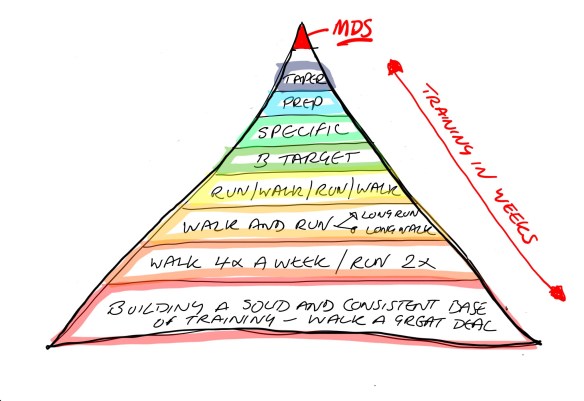
This ‘planning’ often comes in the form of a PYRAMID. The ‘classic’ pyramid training method is well established. In this article I want us to look at this pyramid in two ways by looking at two different runners.
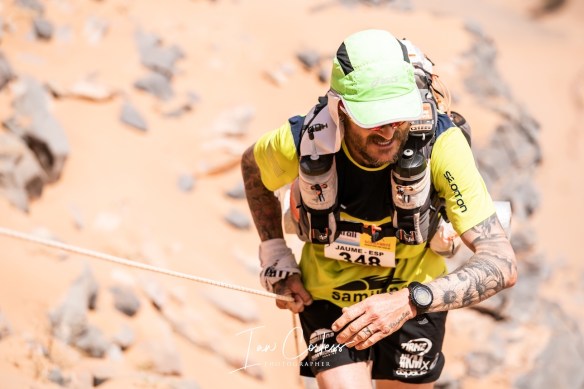
Runner 1– Runs regularly but MDS is a new target and pushes the boundaries of what they thought possible.

Runner 2– Has completed MDS or similar stage race and wants to go back and improve.

First of all, both runners need to count back. From the race date, for some, that may well be a 12-month plan, but more often than not, depending on experience and history, a 6-month block is ideal and for the well trained, a 4 to 3-month very specific block is not unrealistic.

  1. April – MDS race.
  2. March
  3. February
  4. January
  5. December
  6. November

Counting back, it’s easy to look at the objective in real terms and understand what one needs to achieve.

Read THE ULTIMATE GUIDE TO MARATHON DES SABLES HERE
iancorless_101

Depending on experience, how this plan is put together is very much dependent on the individual. However, certain key elements should be present in any training plan and this article is intended to provide the basics from which you can develop a strategy that works for you. I must stress, for you!

RUNNER 1

As stated, runner 1 “Runs regularly but MDS is a new target and pushes the boundaries of what they thought possible.”Therefore, a classic pyramid will be ideal.

See below:

Pyramid

Decide on objectives for the year, decide on Cand targets, obviously, the ultimate is MDS. Put them in a diary and ideally have a wall planner so that you have an overview of the training block, be that 12, 6 or 4-months. It’s easy to see how training looks on a planner. C should be something that one trains through, can be more challenging and have a small taper for, A is very specific such as a training camp.

For example:

  1. April – MDS race – A RACE
  2. March
  3. February
  4. January – a training camp or a mini stage race in training or official
  5. December – a marathon on trail
  6. November – could be a half marathon

MDS is a long way, typically 250km, so, base training and getting the miles in is key. I would hope that before starting any specific training plan, a base has already been established with some consistent running; say, 3 times a week. I have allocated 8 weeks for this in the plan below. Hours of easy miles progressively building to C and B targets.

The objective can be a training camp, maybe a race such as a 3-day race or a specific training long weekend to simulate race conditions.

You can’t perform well at every event and this is why C,and targets are important. Ultimately, MDS is the one in which you must perform.

As in any plan, flexibility is needed. Nothing is fixed and one must be flexible and listen to one’s body. I recommend building for 3 weeks, recovering on week 4, take things easy with reduced mileage and more rest and recovery.

Rest is really important as is consistency. Training is never about ‘one’ run but all the runs added together.

  • November and December 8 weeks – Base
  • January 3 weeks – Specific phase
  • February 3 weeks – Preparation phase
  • March 3 weeks – Peak
  • April  Taper and RACE

BE SPECIFIC

Marathon des Sables will need you to be specific.

For example:

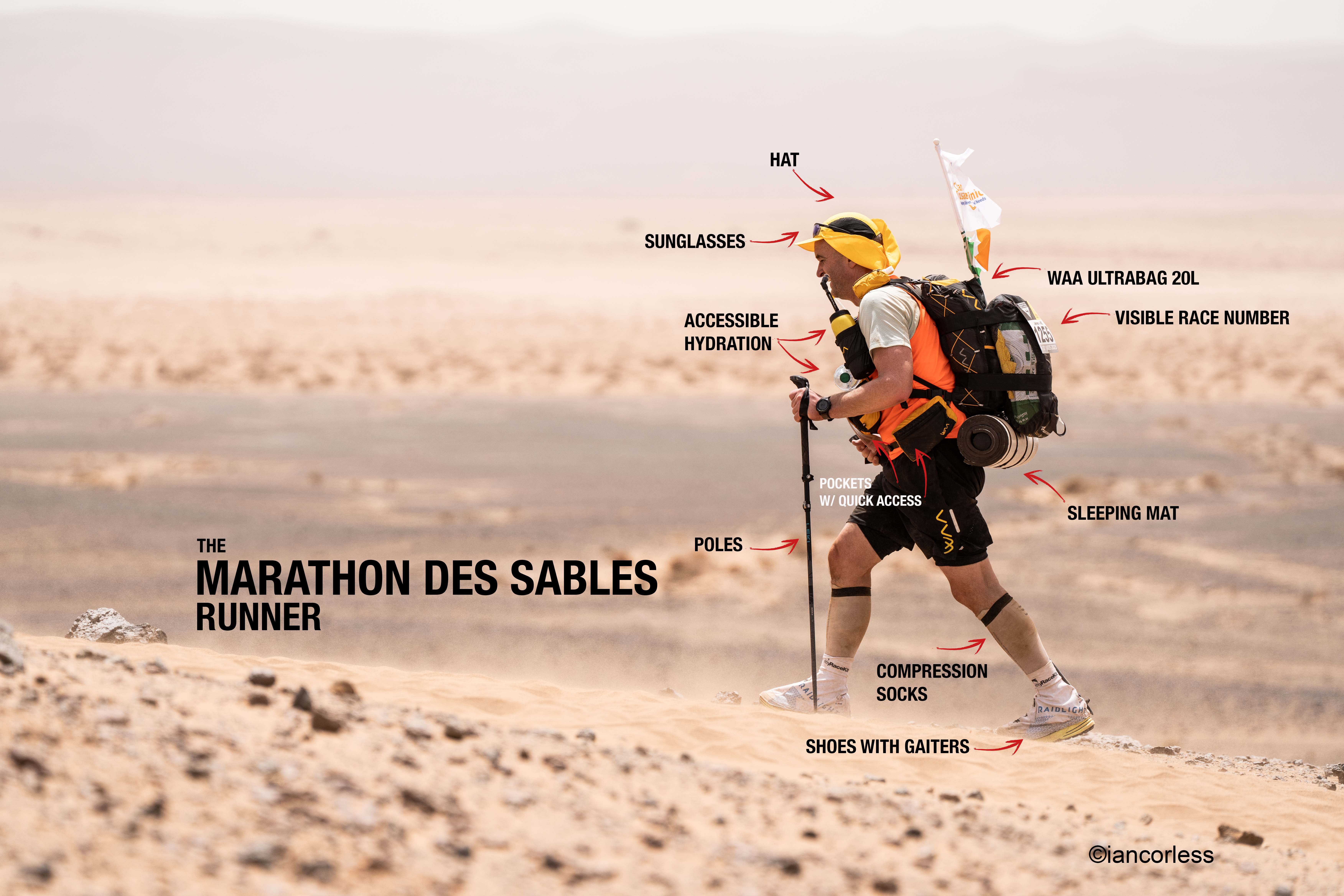
  • You will be carrying a pack that on day-1 of the race will weight at minimum, 8kg.
  • You will be racing in hot conditions.
  • You will be self-sufficient.
  • You will be compromised on calories.
  • You will almost certainly walk more than you anticipate.

The above list goes on and on and as training progresses, you should refer to the list and asses importance. For now, I would place the above list in the following priority.

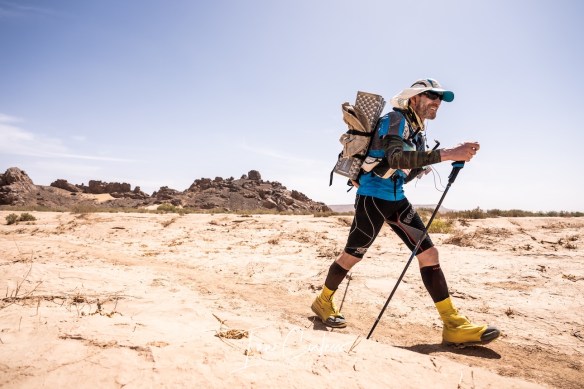
LEARN TO WALK for most participants and good walking strategy and being familiar with how to use poles are a key to MDS success.

MAKE SURE YOU LOOK AFTER YOUR FEET! HERE

As training progresses asses, one’s strengths and weaknesses and then adjust the plan.

  • Do you need to work on strength and core?
  • If you have poles, do you know how to use them?
  • Are you recovering?
  • How is your diet?
  • What is my resting heart rate, is it fluctuating?
  • Am I being specific and thinking of the race terrain and simulating it?

And so, on and so on. The above questions are a starting point. Read through the list and add your own questions to appraise what type of runner you are.

As the time progresses, not only will you feel more confident, you will be able to understand what needs to be done to achieve your goal.

RUNNER 2

As stated, runner 2 “Has completed MDS or a similar stage race and wants to improve.”

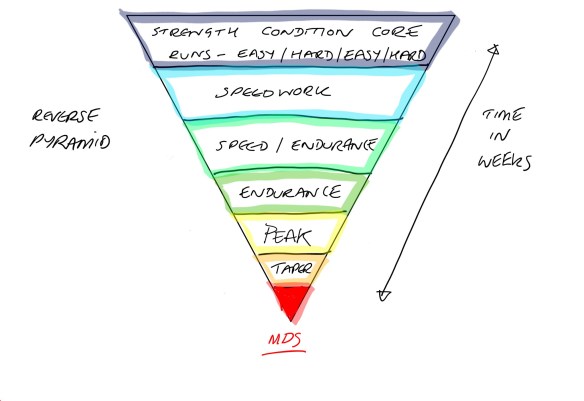
I want to throw a curve ball in here and suggest reversing the pyramid.
ReversePyramid

For runner 1, the emphasis is building a base and then slowly but surely progressing up the pyramid to the pinnacle, MDS. Speed work and faster sessions are less important as building the endurance for the event is a priority, speed will form a very small element of training.
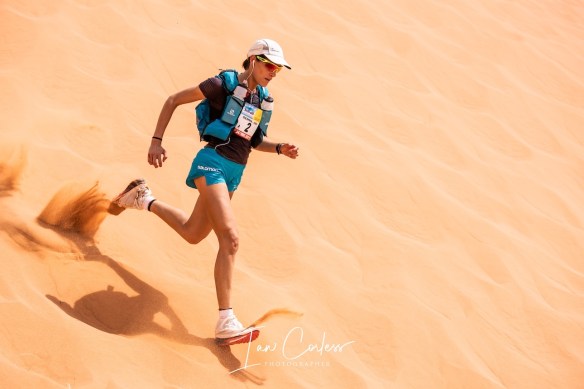
But assuming that runner 2 already has a good base of fitness. An emphasis can be placed on

  • How to improve,
  • How to be more efficient and
  • How to be faster.

So, before planning training, the following should be asked:

  • Do I lack endurance?
  • Do I lack speed?
  • Do I lack strength and core weak?
  • Was I mentally strong?

With answers to the following, one can look at the pyramid in a new way, turn it upside down and instead of putting a priority on long steady sessions early on, they can place a priority on:

  • Strength and core
  • Speedwork
  • The mental approach

Speed training is usually used to add the finishing touches to a solid block of training. But as stated, as an MDS finisher, they already have endurance, so, working on speed now is a great use of time.
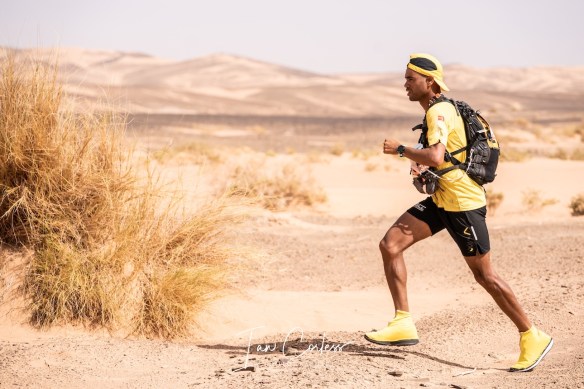
  • November and Decembert can be used to get faster and stronger.
  • January can see more endurance added with a reduction in speed work.
  • February now combines endurance and speed with additional focus on strength with hill sessions.
  • March would be the peak phase, fine tuning speed in combination with endurance.
  • April would be a final peak and then taper to the RACE.

If you are someone looking to perform and improve, you need to be more self-critical. Plan your training and periodise your training so that you are able to (hopefully) predict good form for when you want it.

As an example, your A race which could take place in January or February may be something more specific where you are also looking for a result in addition to being in prime shape for MDS.

Remember you can only hold form for a limited length of time and if you want to peak, you need to make sure that this planning stage is done early so that you understand what you are trying to achieve. It’s all about stepping stones. And make sure you consider the terrain that the race will take place on.
Finally…

This article is not a hard and fast plan, it’s a guide for you to go away, look at your targets having assessed past targets and hopefully it makes you think about future objectives so that you can plan for a successful, injury free period of running and racing.

Consistency is key and just running and walking 3 to 6 times per week already drastically increases your chance of success at MDS. Remember, other than the ‘long-day,’ most days are the 28km to 42km bracket, so, no need to go crazy on distance.

The race is 5-stages over 6-days with a maximum distance of 250km’s and the longest day being 75 to 85km. Remember though, the ‘long-day’ has almost two days to complete, so, if required, you can take a substantial break or sleep to make the distance doable.

There are many more questions to ask and points to consider when planning but these should come after getting the training plan and schedule prepared.

  • Prepare for the heat in the taper phase.
  • Planning equipment looking for the best options for you based on weight and budget.
  • Work on food for the race and fine out what you need.
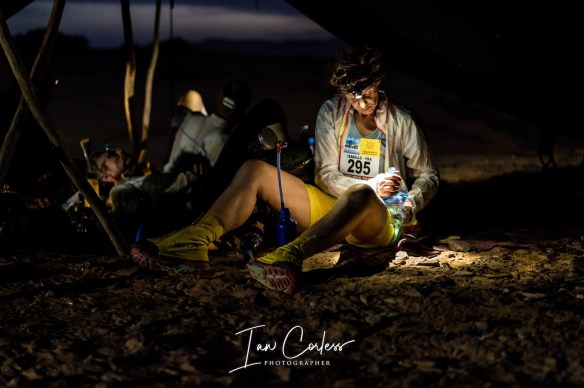
Fancy an early season multi-day TRAINING CAMP? Join us in Lanzarote January HERE

Follow on:

Instagram – @iancorlessphotography

Twitter – @talkultra

facebook.com/iancorlessphotography

Web – www.iancorless.com

Web – www.iancorlessphotography.com

Image sales –www.iancorless.photoshelter.com
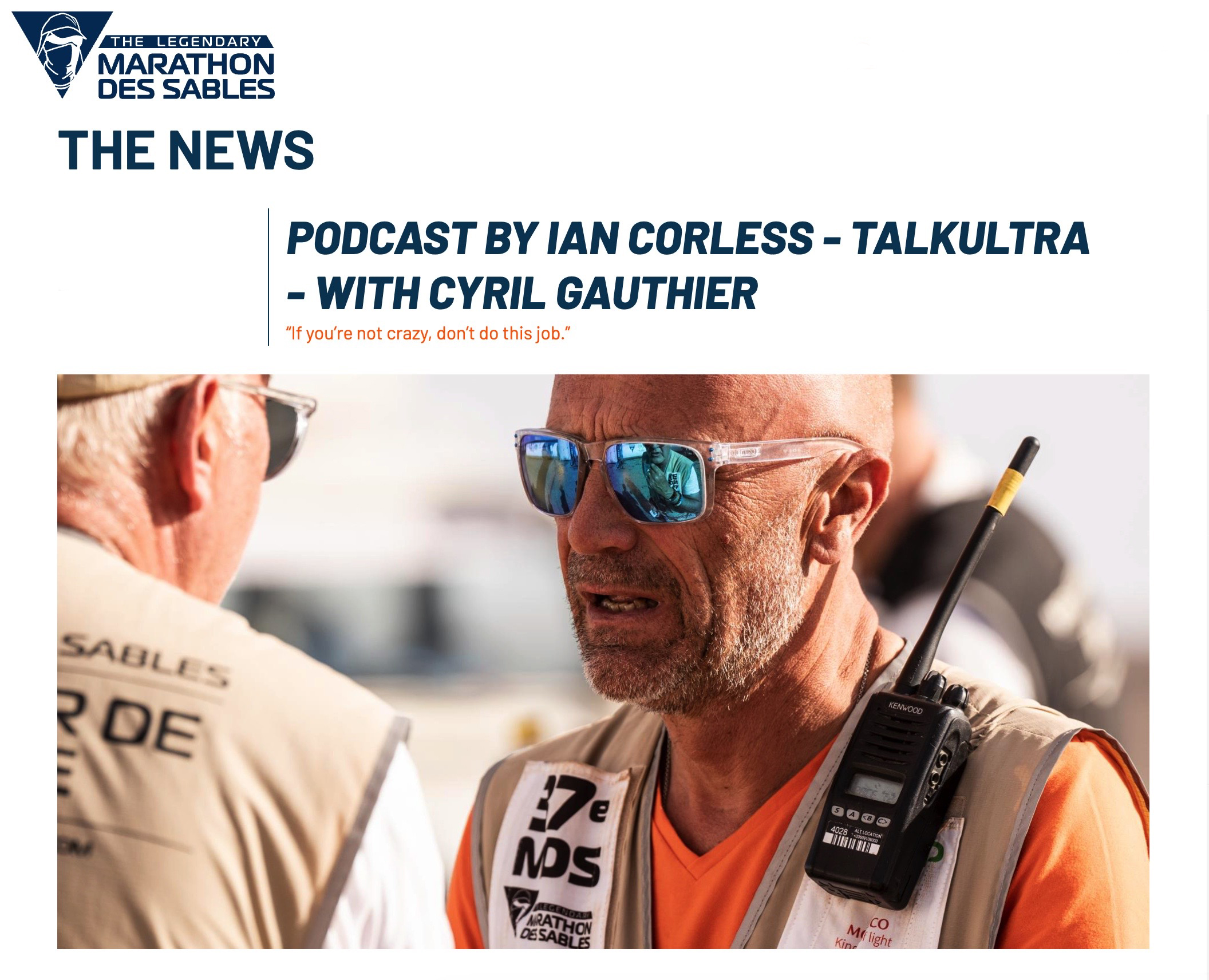
PODCAST BY IAN CORLESS – TALKULTRA – WITH CYRIL GAUTHIER

My recent podcast interview with Cyril Gauthier (available HERE) discussing the new development and progression for Marathon des Sables has now been transcribed and translated in to French. Superb job by Emmanuel Lamarle.

It is available on the marathondessables.com website by following the link HERE.

Make sure you you click on the flag (top right) as the copy will be in French or English.

Further Reading

The Ultimate Guide to Marathon des Sables – 2023 Edition

Healthy Feet For Running and Walking

©iancorless

Follow on:

Instagram – @iancorlessphotography

Twitter – @talkultra

facebook.com/iancorlessphotography

Web – www.iancorless.com

Web – www.iancorlessphotography.com

Image sales –www.iancorless.photoshelter.com

Healthy Feet For Running and Walking

Blisters, they are one of the key causes for a runner or hiker needing to stop in a race or adventure. There is no 100% guarantee that blisters can be prevented, but in most scenarios, blisters can be avoided if you are proactive.

  • First and foremost, you need strong and healthy feet.
  • Secondly, good shoes that fit correctly and are appropriate for the challenge ahead are crucial. 
  • Thirdly, socks and the correct sock for you.

What causes blisters?

The answer is really very simple: FRICTION.

If a shoe does not fit correctly, either too small or too big, two things will happen:

If the shoe is too big:

Your foot will move inside the shoe, a moving foot causes friction and friction means blisters.

“Going too big, meanwhile, means your foot shifts around in your shoe. If a shoe doesn’t lock down over your navicular bone, your foot can move back and forth with each step. The shear stress of shifting shoes and bunching socks against skin creates blisters.”

If the shoe is too small:

Your foot will be squeezed and compressed with certain key contact points touching the shoe (toes, instep, arch and so on) and this in turn will cause friction and result in blisters, aches and pains.

“Wear shoes that are too short, and your toes can butt up against the front. This contributes to the bane of runners’ existence, black and missing toenails, says Vincent. This contact can also damage toe ligaments and the metatarsals, leading to deformities like hammer toes, he says. Over time, you can also develop Freiberg’s infraction—a stress fracture of the second metatarsal—from repeated impact. Plus, squeezing your toes together too tightly forces the muscles of your foot out of alignment, Gray says. As a result, you might feel foot fatigue and develop pain in your arches.”

Read an in-depth article on HOW TO FIND YOUR RUNNING SHOE SIZE AND FIT HERE.

A simple Top-10 checklist is as follows, I recommend you try any new shoe on after you have spent time on your feet, as this allows the foot to naturally spread and be its true size.

  • Choose the correct type of run shoe for the chosen terrain: road, trail, mountain and so on. They should have the correct outsole for the required job and the correct level of protection and durability.
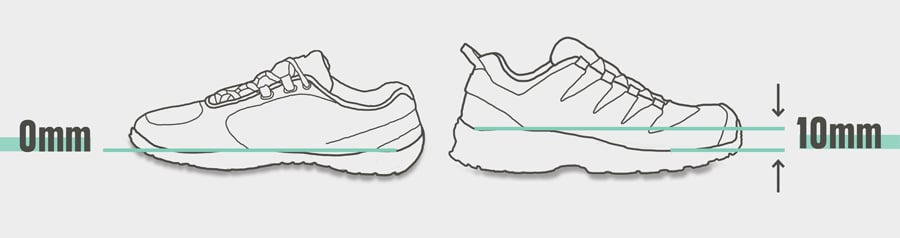
  • Take in to consideration cushioning and shoe drop.
  • It sounds obvious, but make sure the shoe feels comfortable.
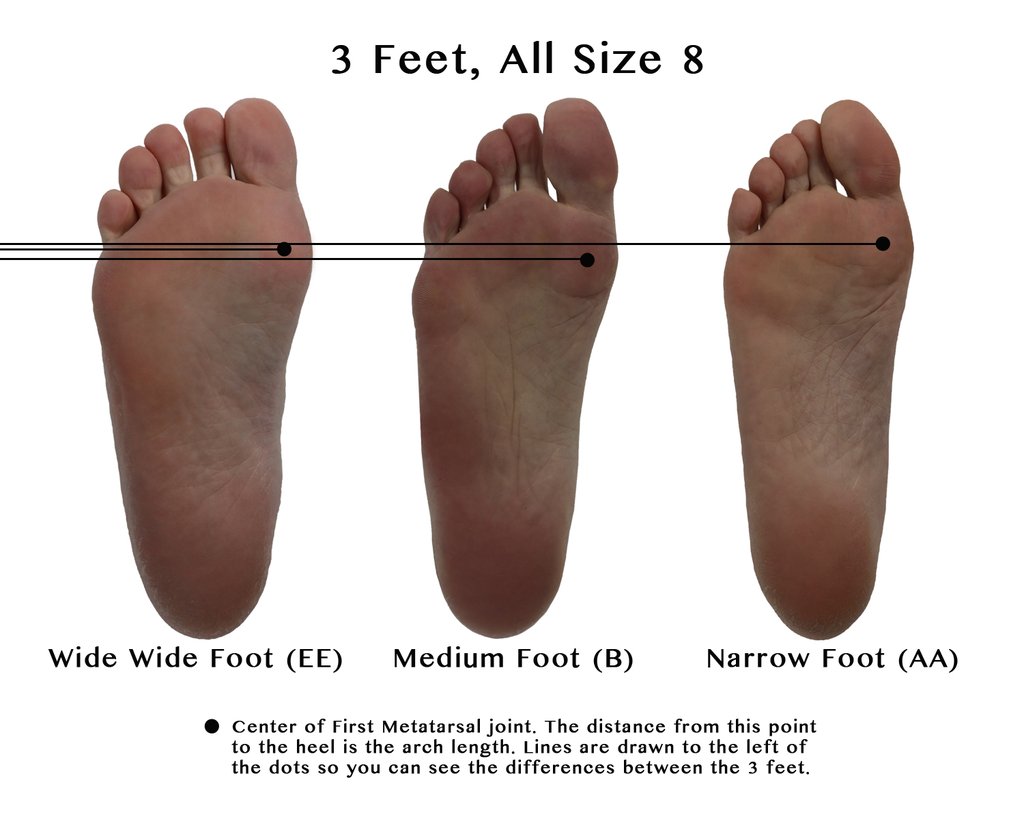
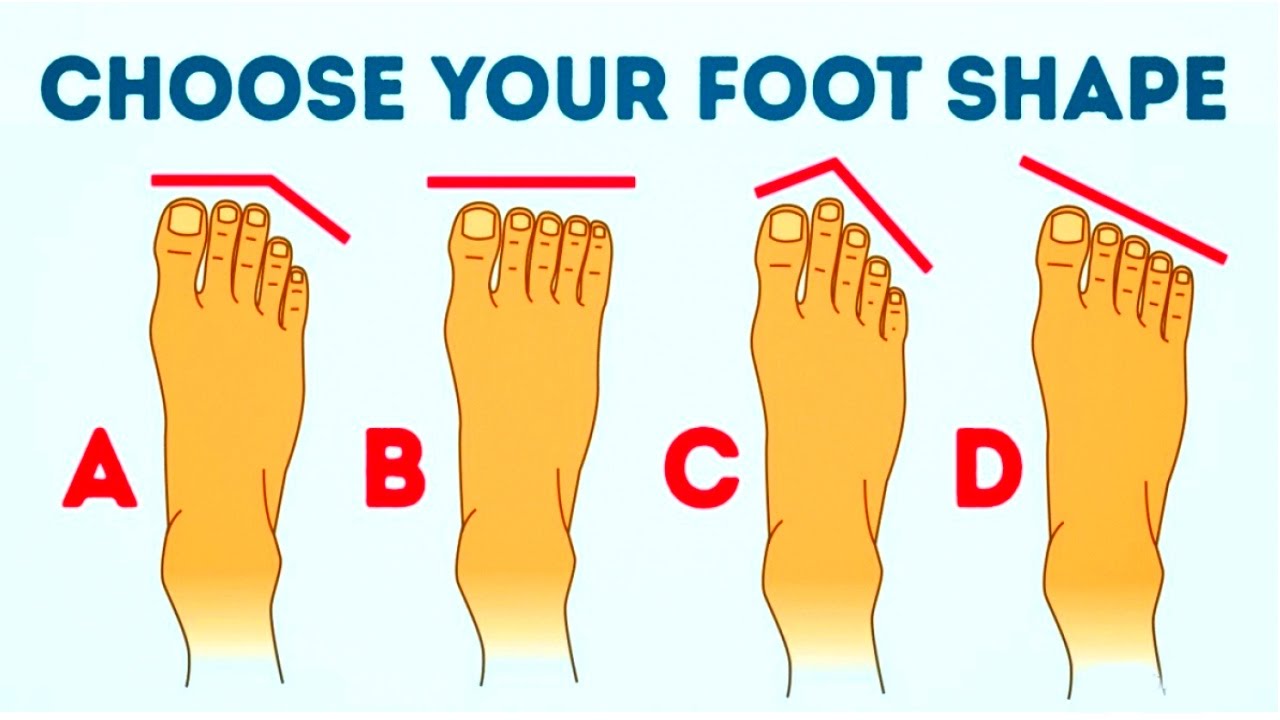
  • Your toes should have room to move BUT not too much room. A thumb nail of extra length above your longest toe is a good gauge. Note I say ‘longest toe,’ this for many is not always the big toe – Greek, Egyptian, Square or Classic foot shapes need consideration.
  • Consider your foot shape, are you a long and thin foot or a wide foot? Choose a shoe that is appropriate for your foot shape. A good example here is Altra or Topo which are much wider shoes that echo a wide foot shape. Take out the insole of a shoe and place your foot on it while wearing socks, this is a good indicator of the shoe length and fit.
Three feet, all the same shoe size but you can see the difference between wide and narrow.
  • Lace your shoes correctly and make sure that the shoe holds your foot without unnecessary movement. This should NOT be at the expense of pain on the instep because you need to over tighten the laces. Also, make sure there is no slipping at the rear when moving.
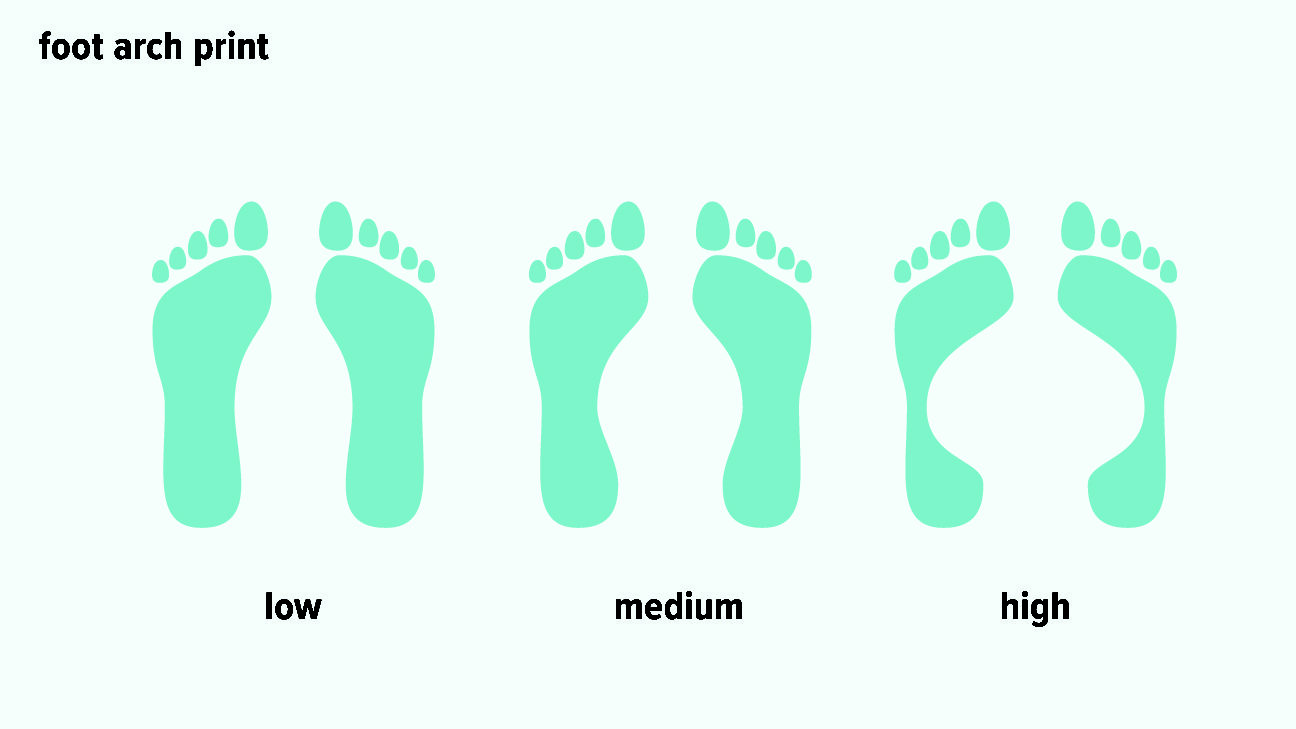
  • The arch of the foot should feel comfortable. Make your sure you know if you are neutral, supinate or pronate as this will narrow down shoe selection. Consideration are low, medium or high arch. Maybe you use an orthotic? If so you should use neutral shoes, take out the insole provided with the shoe and insert your orthotic.
  • Use your preferred socks when trying and testing shoes. Note: If you plan to double sock and pre-tape your feet, you need to try and test shoes in this way! Don’t test shoes with ‘any’ sock when you plan to use something different. Double socking AND taping may require a size bigger.
  • Make sure the shoe flexes correctly in the propulsive phase, this is the area behind the metatarsals. It should not distress the toes and equally, if a shoe is too wide, this will create bulging of the material and fabric which can cause blisters/ friction.
  • If a shoe fits you perfectly, they should be good for running straight away, however, sometimes it can be beneficial to wear a shoe in the home first, then go for a walk outside and then run.

Should you get larger run shoes?

There is no one easy answer here and many pitfalls. You will hear someone say, ‘I always buy a size bigger in my run shoes in contrast to my daily shoes.’ However, this actually provides us with no information. Why? Firstly and most importantly, we have no idea how someones daily shoes fit, they may be too small and therefore going up a size in a run shoe means they are actually in the correct size. Also, if you double sock and pre-tape, this will almost certainly require a shoe that is larger and or wider.

Quite simply, the thumb nail of width above the longest toe is an ideal measuring guide. Again, I stress, the longest toe, this is NOT always the big toe.

Should I get wider run shoes?

As with the above question, there is no one easy answer. But you will know if you have a narrow foot, medium foot or wide foot. Many shoe brands now offer a guide on the width of shoe to help you make an informed decision, this is often on a scale of 1-5, 1 being narrow and 5 being wide.

However, the width of the required shoe can change based on the run type you are doing and the duration of the run. For perspective, if you are running a technical mountain marathon over 1-2 hours, you will want a more precision fit that provides greater control and security. By contrast, if you are running a 100-mile race say over 20-hours, you need a much more relaxed fit shoe with some space and comfort.

Ultimately, you need to make a decision on the best shoe for you taking in to consideration the type of terrain you will run on and for how long.

Common mistake – You may have a shoe that you really like and due to changes in your feet, yes, feet do change. The shoe you are using is no longer the best shoe for you, maybe your feet have gone wider but not longer? To compensate for this extra width, you get the same shoe one size bigger. You have now gained extra width with the increase in size but now, the shoe is too long. What would have been better is changing shoe model or brand and getting a wider fit that may well be the same size as your old shoe.

Runner’s World have an article: “Thankfully, more running shoes feature wider designs nowadays, and manufacturers like Altra and Topo Athletic make shoes that match the curves of a foot, rather than a triangle. That’s good for your toes, which tend to be healthiest when they can splay out laterally and evenly distribute weight across your foot, according to the American Academy of Orthopaedic Surgeons.”

‘The Best Wide Toebox Running Shoes For Every Foot Shape’ HERE

The longer you run and the more time you spend on your feet, the width of the shoe plays more importance. So consider this. As an example, maybe you are running Marathon des Sables in the Sahara desert. It’s going to be hot and dry. You will run for multiple days and your feet will be under stress. Blisters are commonplace because runners don’t consider all of the above points. They incorrectly listen to the generic advice of ‘get bigger shoes’ but this only allows the runner to fall in the friction trap.

The Friction Trap – Bigger shoes allows the foot to move, a moving foot means friction, friction means blisters.

What they should consider is getting the correct fitting shoes with a thumbnail of extra length above the longest toe, and then getting a wider fit shoe to allow for toe splay and breathing space.

FEET

With the correct shoes and socks, you need healthy feet.

Manage your skin, in many scenarios, there are two thought processes: 1) Toughen the skin. 2) Soften the skin so it becomes like leather. For me, softening the skin is preferential.

Condition your feet to the challenge you will put them through. Strong muscles, ligaments, tendons and ankles make for happy feet. Competitive Edge provide a good article HERE on ‘How to Improve Foot Strength for Running.’

Trim toenails back and maintain.

Allow feet to rest and recover, shoe and sock free post exercise.

Walk around at home barefoot as this will help the conditioning process.

Products like Gurney Goo or by contrast, highly absorbent powder make for happy feet during exercise.

If you have dry and callused feet, use products such as lotions or creams to help soften the skin.

WHAT IF YOU GET BLISTERS?

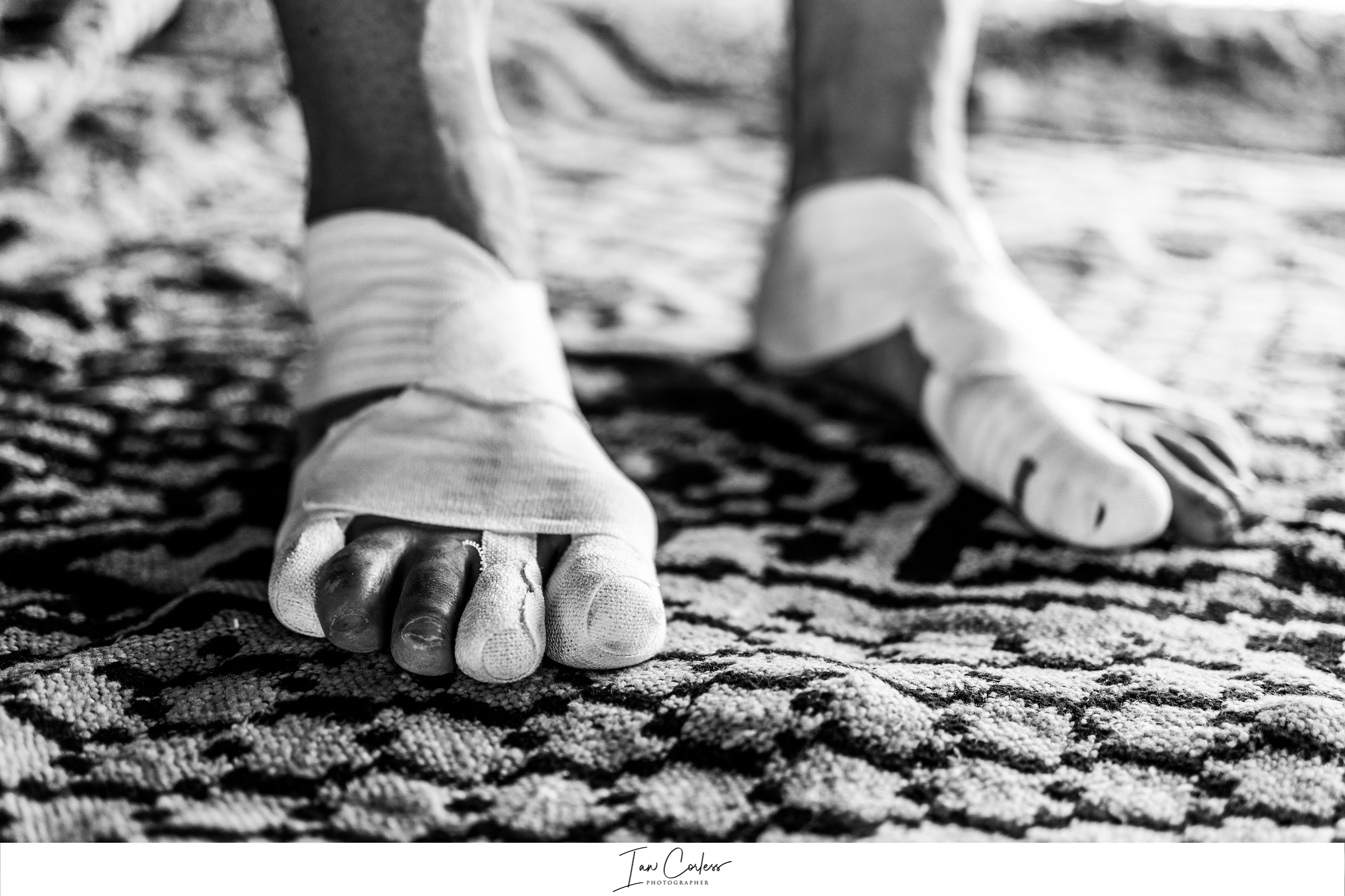
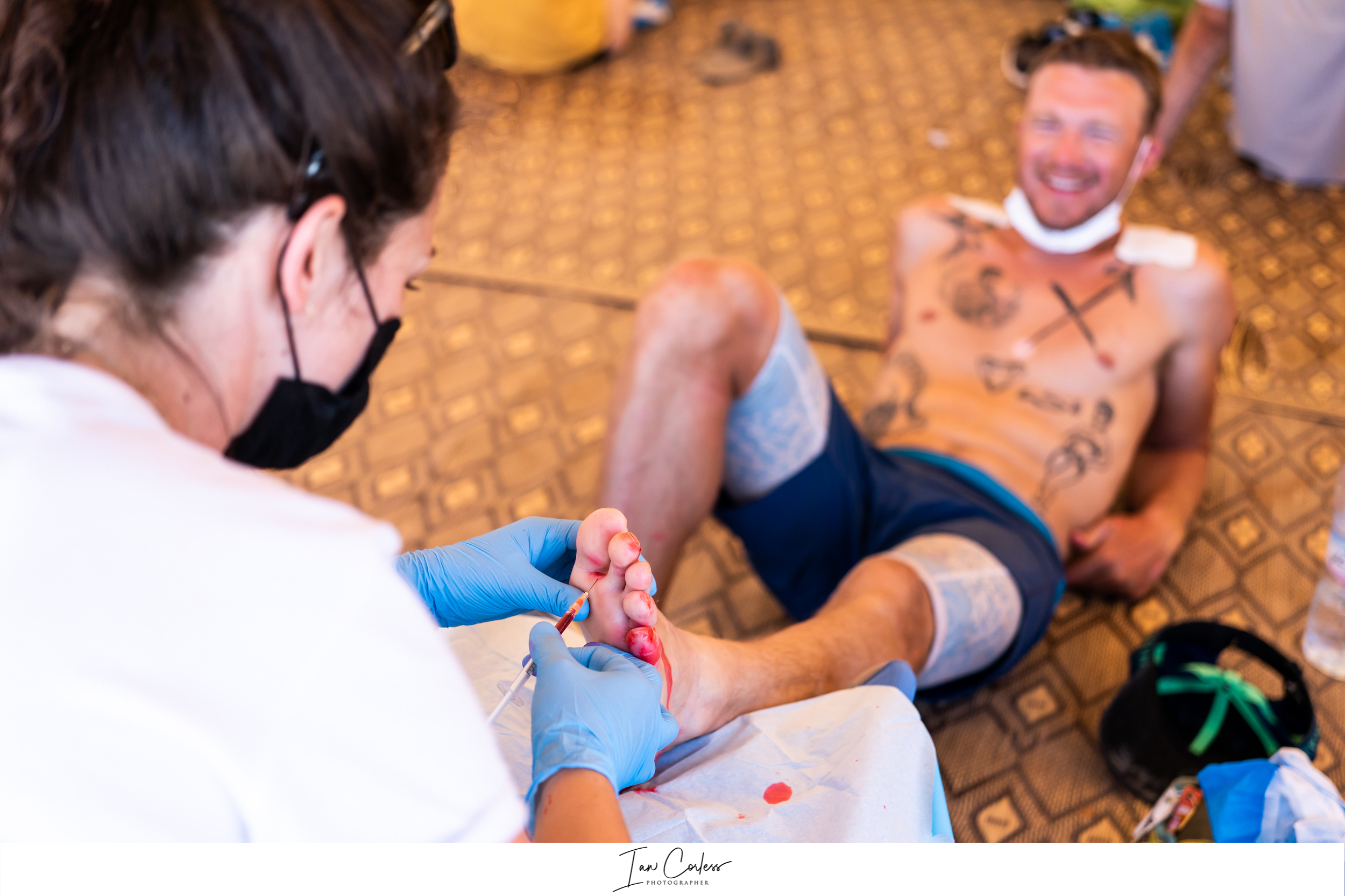
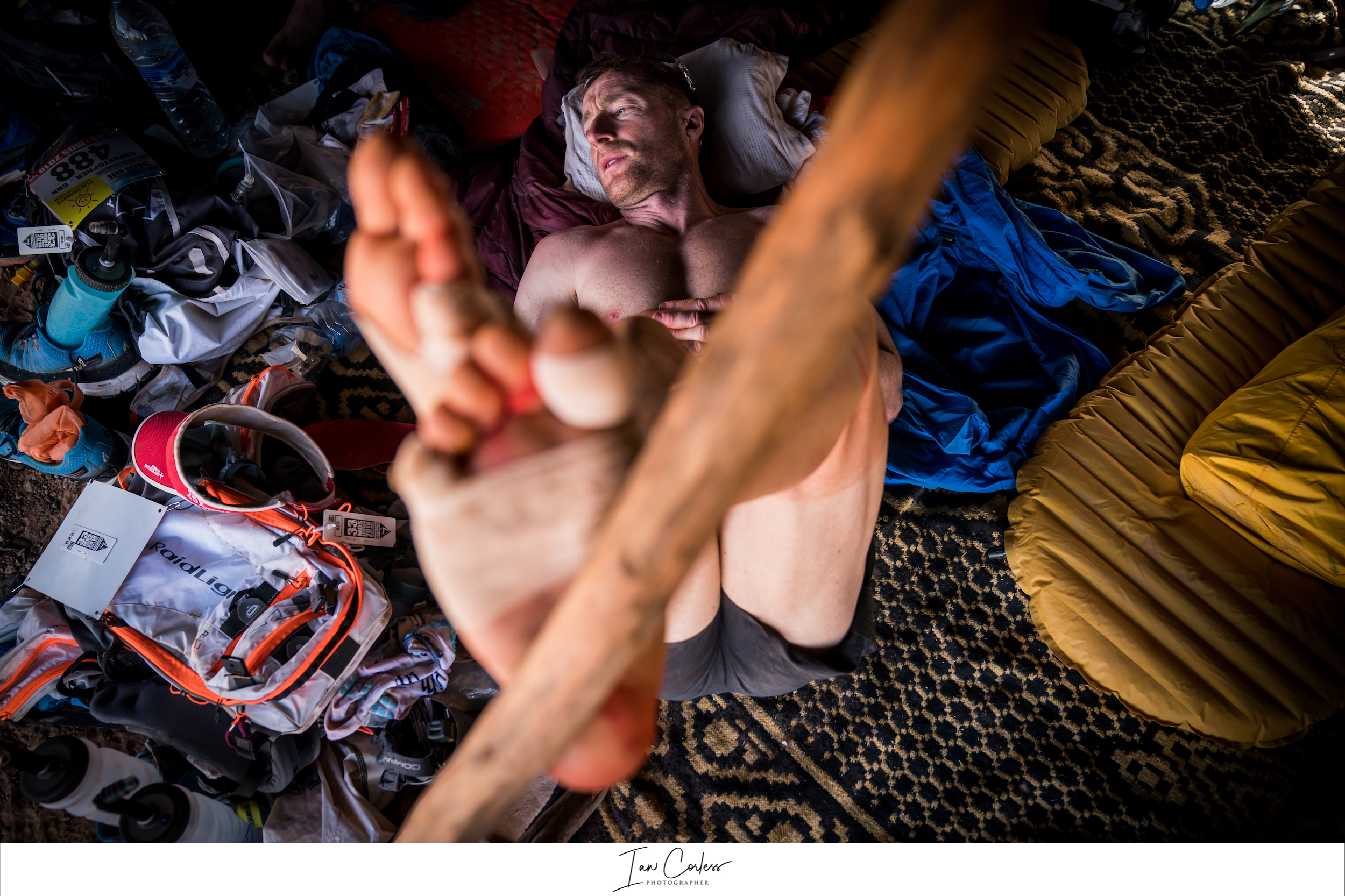
Treatment by DocTrotter medical team at the Marathon des Sables.

Quite simply, if you follow the above steps, you should have no problems.

  • Look after your feet.
  • Wear the corrects socks*
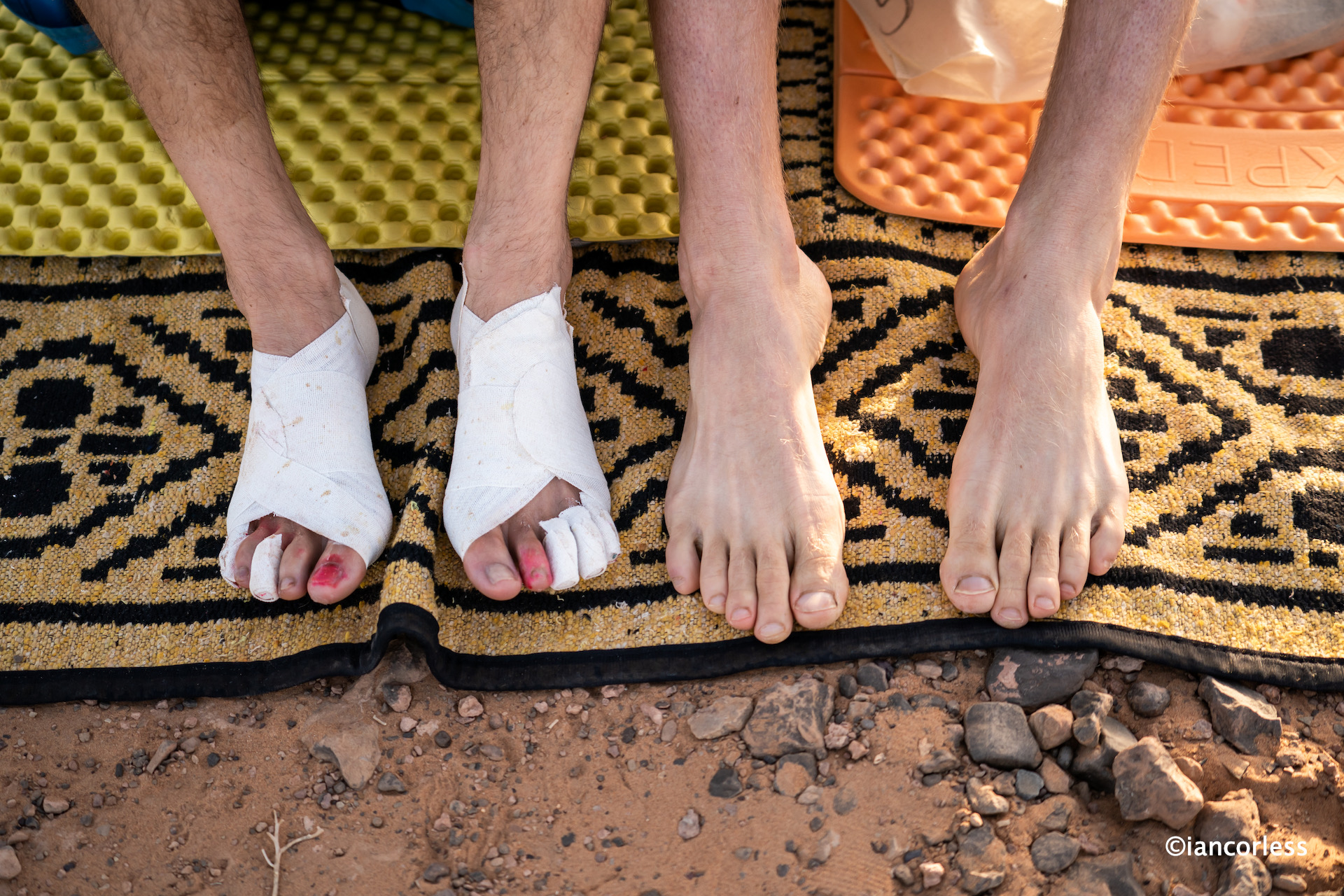
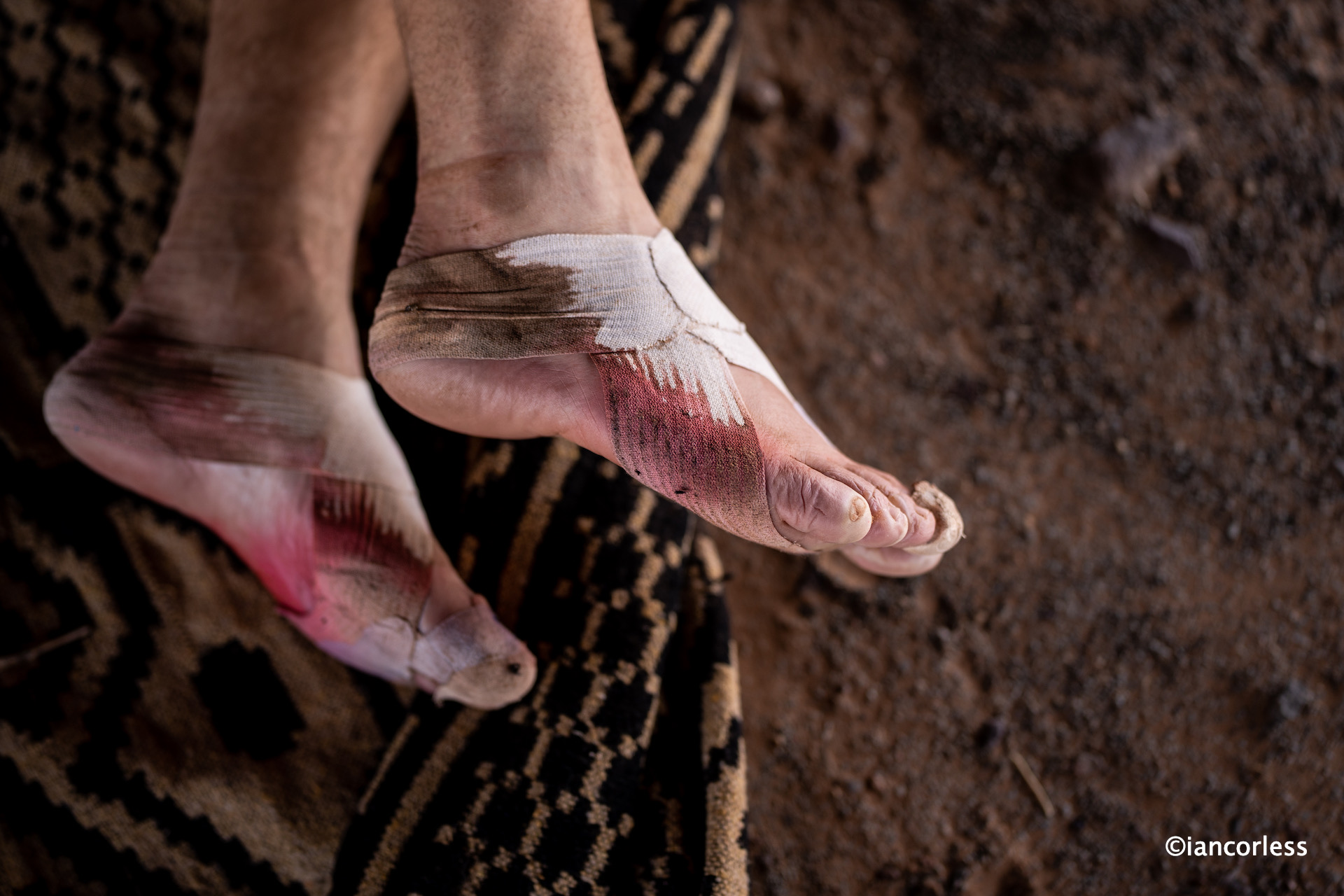
  • Pre-Tape if required.
  • Have the correct shoe for the terrain and the correct fit.

*Toe socks like those by Injinji form seamless little sleeping bags for each toe, wrapping each toe with moisture wicking, low friction fabric. They immediately stop the skin on skin rubbing. They also allow your toes to spread, grip and creep naturally providing they are used in a shoe with a wide enough toe box to allow splay. Toe socks help reduce blisters BUT if you plan on pre-taping, they may not be the best choice.

But, things can happen…

Sane Race. Same Distance. Different Results.

Be reactive, if you are prone to hot spots, blisters and so on, don’t wait for them to happen and then react, be reactive. Pre-taping is not unusual for some athletes, even with the correct fitting shoes.

Often, the first signs of a potential problem is a ‘hot spot’ which at first can be a minor irritation that can often be ignored. DO NOT ignore it. Stop. Take your shoes off and socks. Address the hot spot with applying tape.

Blisters and fixing them can be an art form. Most of us don’t prepare or plan for this as we are often taken by surprise in training or racing. This usually results in a bad training session or a ruined race, so, what can we do in advance?

PRE TAPING

You need: The correct shoes and socks with correct fit.

  • Clean feet.
  • Use alcohol wipes to remove the bodies natural oils from the skin.
  • Apply Tincture of Benzoin or a similar product, this will allow the tape to adhere better.
  • Prepare tape by cutting to correct lengths and make sure you ‘round’ the corners.
  • Apply tape (Hypafix for example) making sure there are no folds, creases, and problem areas.
  • Use a lubricant, such as Gurney Goo but importantly, find out what works for you. You may prefer powder such as Gold Bond?
  • Apply socks.

Practice.

Taping is a skill and you will not get it right first time. 

Just as you devote time to training, devote some time to foot care and go through the process.

  • Clean your feet with alcohol.
  • Apply Tincture of Benzoin.
  • Go through the process of cutting tape and applying.
  • Keep tape as smooth as possible avoiding creases and ridges. Creases and ridges will only create more friction points.
  • Do not tape too tightly as this may cause circulation problems.
  • Learn how to tape the ball of the foot and the heel area – common problem areas that require different taping methods.
  • Lubricate or powder after applying tape.
  • Roll socks on and off to avoid causing issues with the tape.

The above will only get you so far.

HOW TO TREAT BLISTERS

©iancorless

You need to do more research. Rebecca Rushton offers a great resource at

BLISTER PREVENTION HERE.

Should you pop a blister? It is usually not recommend to pop a blister as this can leave it open to bacteria, which can lead to infection. But, there are times when it is a good idea. Read HERE.

Download a guide ©rebeccarushton on BLISTER TREATMENT BLUEPRINT 2.0 HERE

Rebecca has a YouTube site HERE which is also a valuable information source.

More information:

  • Toe Blisters HERE
  • Bunions and Blisters HERE
  • Heel Blisters HERE
  • Ball of the Foot Blisters HERE
  • Blood Blisters HERE

Useful Products:

  • 2Toms Blistershield Powder
  • Gurney Goo
  • Injinji Socks
  • Fixomull Stretch Tape
  • Engo Patches
  • Armaskin Socks – To be used as the ‘inner’ sock when double socking.
  • Hydrocolloid
  • MyRaceKit Deluxe AntiChafing Kit
  • Hypafix Tape

REFERENCES:

Reference – https://www.ncbi.nlm.nih.gov/books/NBK537292/

Reference – https://www.runnersworld.com/training/a28172274/running-shoe-size/

Reference – https://www.healthline.com/health/bone-health/whats-the-difference-between-supination-and-pronation#the-foot

Reference – https://puresportsmed.com/blog/posts/what-is-shoe-drop-and-why-is-it-important#:~:text=The%20%E2%80%8B’drop’%20of%20a,the%20ball%20of%20the%20foot.

Reference – https://puresportsmed.com/blog/posts/what-is-shoe-drop-and-why-is-it-important#:~:text=The%20%E2%80%8B’drop’%20of%20a,the%20ball%20of%20the%20foot.

Follow on:

Instagram – @iancorlessphotography

Twitter – @talkultra

facebook.com/iancorlessphotography

Web – www.iancorless.com

Web – www.iancorlessphotography.com

Image sales –www.iancorless.photoshelter.com
The Ultimate Guide to Marathon des Sables – 2023 Edition

The iconic Marathon des Sables is entering a new phase, the past 37 editions have been under the aegis of Patrick Bauer, who, back in 1984, filled up a pack with food and water and trekked off alone into the Algerian Sahara to cover 350km’s on foot in a self-sufficient manner. Little did he know at the time, but this journey was the start of something incredible, the Marathon des Sables, or MDS as it is affectionately known.

Now under new ownership, the 38th edition taking place in April 2024 will see some significant changes while sticking to the main format and principles of the past 37-editions.

It is therefore timely, to update my Ultimate Guide to Marathon des Sables and acknowledge these key changes.

A recent podcast with one of the new co-owners, Cyril Gauthier, can be heard HERE.

Cyril ran the Marathon des Sables in 2009, created the brand WAA and is instrumental in the growth of the HMDS (Half Marathon des Sables) format. Moving forward, the HMDS format will no longer have the ‘half’ title, for example, HMDS Morocco will become MDS Morocco, HMDS Jordan will be MDS Jordan and the key, full distance race of the past 37-years will be called ‘LEGENDARY‘ – The Legendary Marathon des Sables.

Marathon des Sables offers more than just running, it offers a challenge, it offers something quite unique – the Sahara and the MDS strips the runner back to basics and deprives them of all luxuries so that they are stripped raw. Runners find themselves in the desert.

However, this challenge can often daunt a new participant with the challenge that is ahead and therefore, my Ultimate Guide to the Marathon des Sables is provided to settle nerves, provide initial information and provide a level of knowledge that you can use as a base from which to build your own plan and decide on what equipment to purchase and use.

DOWNLOAD THE PDF

THE ULTIMATE GUIDE TO MARATHON DES SABLES

HERE via WeTransfer or Dropbox HERE

©iancorless

Follow on:

Instagram – @iancorlessphotography

Twitter – @talkultra

facebook.com/iancorlessphotography

Web – www.iancorless.com

Web – www.iancorlessphotography.com

Image sales –www.iancorless.photoshelter.com
Cappadocia Ultra Trail 2023 Summary

Kim Schreiber victory and 3rd overall in the CMT

Quite simply, Cappadocia is unique. If you haven’t experienced the place, you need to add a trip very close to the top of your ‘to-go’ list now.

IMAGE GALLERY HERE

Iconic balloons, landscape and early morning light.

You’ll have seen the images, two in particular appear everywhere when you do a search on the internet, one will be the unique fairy towers and the other, hot air balloons gliding over the aforementioned landscape with the glow of early morning light.

Running and racing is a wonderful double edged sword, we look for new destinations to practice our sport and then when in these locations, we get to explore them in the best way possible, by foot!

Hoodoo – an epic backdrop

Salomon Cappadocia Ultra Trail, now in it’s 10th edition provides the opportunity to mix the best of both worlds.

The races start and conclude in Ürgüp (closest airport Kayseri) in Nevşehir province. It’s the perfect hub for exploration. Located at 1044m, access to key tourist attractions and hot air balloon flights, are just a phone call away, particularly if you communicate with Argeus Travel, who also happen to be the team behind Cappadocia Ultra Trail.

Other than say Montserrat, Colorado and north America, the landscape of Cappadocia is unique. The ‘Hoodoo’ (fairy chimney) actually translates to tent rock or earth pyramid is in abundance and a key feature of the landscape here. Created by earth erosion, they typically consist of soft rock topped by harder rock. These Hoodoos became home to Troglodytes (cave dweller) who carved into the formations to create a place to live. Varying in size, Hoodoo can be up to 10 storeys high and they are unique with a conical shape. Today, there are no permanent settlements but Persians, Ottomans, Romans, Byzantines and others, over time, have used these Hoodoo as shelter. Notably, Christians fleeing persecution made their homes in Cappadocia and they built churches. This was a key phase in the development of the Hoodoo, they ‘added’ to the natural structure and also built a network of underground cities and caves.

And so, Salomon Cappadocia Ultra Trail offers a unique opportunity to run through history.

With three key races, CUT at 119k,, CMT at 63km and CST at 38km, there is a race distance for all. While CUT provides the full and immersive 360 experience, the CMT arguably provides the most spectacular and concise journey. The CUT and CMT cover the same trails starting in Ürgüp and passing on a circular route through key locations such as Ortahisar, Ibrahimpasa, Göreme and the Rose and Red valley, where surreal rock formations, pinkish-red colours, and ancient cave churches make this a highlight. Ürgüp follows and the CMT concludes, for the CUT they continue on for a tough and arduous loop passing through Mustafapasa, Damsa Dam, Cemil, Taskinpasa, Karlik, Egrim Tepesi and finally Ürgüp for the finish.

The CST passes through Ibrahimpasa, Göreme and concludes in Ürgüp and while the route has its moments, it’s less spectacular than the CMT.

With over 2400 runners from over 70 nations, Cappadocia Ultra Trail has become Turkey’s key trail running event. It sets the bar for how an event should be. Talking with the team at Argeus, they have a simple philosophy, they wanted to create an event for Turkish people that was of the highest standard and importantly, affordable. The growth of the event and the landscape on offer has made this one of the key events in the world to travel to and it’s easy to see why. Ürgüp in itself has grown through the tourism generated and as such, accommodation is in abundance and much of it with a boutique style, I for example stayed inside a cave at Deer Suites.

Racing was fast and furious and the presence of the Adidas Terrex Team certainly provided a new impetus to the racing with Dmitry Mityaev and Ekaterina Mityaeva winning the CUT, Ekaterina also 3rd overall. Kim Schreiber winning the CMT and placing 3rd overall! Martin Dematteis and Dion Gorla both placing 2nd in the CST. Full results HERE.

Dmitry Mityaev

CUT – Dmitry Mityaev completed the 360 degree journey of Cappadocia in a course record time of 10:59:32 with Farkhad Isakov and Mohammadreza Jelodar placing 2nd and 3rd, 12:14:25 and 13:12:15 respectively. Ekaterina Mityaeva also set a course record 13:00:23 and placed 3rd overall, a stunning run. Ksenila Avdeeva was 2nd in 14:23:45 and Sergio Baysal 3rd in 15:24:41.

Ekaterina Mityaeva

CMT – Kim Schreiber was the star completing the 63km in 05:38:39 and placing 3rd overall. Behind, the Terrex athlete was followed by Varvara Shikanova and Aysel Yalac Dolay. 06:02:58 and 06:24:50 respectively. Mestan Turban set a blistering pace for the men and set a convincing victory in 05:03:49 followed by Irem Can Ayaz in 05:17:40 and Ryan Farrugia in 05:42:15.

Mestan Turban passing through Ibrahimpasa

CST – Alejandro Forcades and Martin Dematteis had a hard fought battle for victory, Alejandro finally crossing first in 02:39:40 to Martin’s 02:41:34. Yury Shtankov rounded the podium in 02:48:29. The women’s race also had a tight battle for victory with Simone Brick edging out Dioni Gorla, 03:25:53 to 03:26:35. Tugce Karakaya placed 3rd in 03:31:24.

Hidden caves

In addition to the stand-alone races, the CUT, CMT and CST were also done in relay format. Results CUT, CMT and CST.

Ürgüp was a stunning location and hub for the 2023 Cappadocia Ultra Trail, in conjunction with excellent organisation from Argeus, many are now already looking ahead to 2024. See you there I hope!

Magical and unique landscape.

Follow on:

Instagram – @iancorlessphotography

Twitter – @talkultra

facebook.com/iancorlessphotography

Web – www.iancorless.com

Web – www.iancorlessphotography.com

Image sales –www.iancorless.photoshelter.com
Oliena SkyTrail 2023 Summary

William Boffelli

As trail and mountain running grows worldwide, races with a 1000 or even 1000’s of runner’s are becoming normal. It’s great to see this boom and long may it continue. However, raw and local events have a place, they are a hark back to the ‘why’ we run, travel, adventure, culture and an immersive experience in a new place with new people.

View the Image Galleries HERE

Local colour

Oliena SkyTrail offers just this!

Now in its third edition, the race has grown from humble beginning to 100’s of participants over four races, VK, 17km, 24km and 50km.

Oliena

Deep inside Sardinia, the wild territory of Supramonte is explored, on foot. The beauty of this region comes in its primitive, harsh and beautiful terrain which makes up the challenge to be endured from VK to 50km. This rough terrain in softened by the people and their warmth. Rough and smooth, Oliena is a must visit destination.

Looking up from the centre of town, the church towered by an epic backdrop of mountains that is reminiscent of the Dolomites, provides a hub for the weekend of events. Saturday afternoon, the VK and 17km get underway at 1500 both taking the same trail to Prado where they then split, the 17km heading right for a wonderful trail journey back to town, the VK turning left for a steep conclusion at Punta Carabidda. Sunday, an 0700 start for the 50km and at 0900 the 24km gets underway, the two races sharing some of the same trails to and from Prado but in opposite directions.

Some would say, they are brutally beautiful.

Battle for VK first place

The VK covers 6.5km’s and 980m+ of tree covered trails until finally opening up to mountainous terrain as Prado looms. Now the terrain is tough, challenging and more technical. VK’s burn the legs and lungs and here in Oliena, Alex Baldaccini and Frederico Nicolini pushed each other to the line, crossing together in 41:06. Lorenzo Rostagno placed third. Elena Nicolini crowned the podium for the women in 54:23, also good enough for fifth overall. Camilla Calosso and Giudy Turini completed the podium.

Giudy Turini

Starting at the same time as the VK, the 17km Corassi Trail covers 1250m of vertical gain with the opening km’s matching those of the VK to Prado. From here the route heads right towards Monte Corassi (1463m) and a magical loop that eventually concludes back in Oliena. Salvatore Ragonese dominated with a 01:59:01 performance ahead of Nicolas Orrù and Davide Barattini. Lena Zellman from Germany took the top honours for the women in 02:28:42 with Valentina Nazarov second and Francesca Visconti third.

A night of rest for the runner’s, for the Oliena staff, a busy night preparing for the Sunday action.

The Supramonte backdrop

The Ultra Sky Supramonte covers 50km’s with 3700m of vertical ascent, it’s a tough race and one that would test all the participants. Going in a clockwise direction, the route concludes with a climb to Monte Corrasi but from the opposite direction of the 17km and 24km races. It came as no surprise that top skyrunner, William Boffelli dominated the race.

Franco Collé

A potential challenge from Tor des Geants record holder, Franco Colle disappeared when Franco withdrew from the race – It was just soon after Tor! Williams time of 06:03:07 an impressive conclusion to a masterclass performance. It was almost 40-minutes later when second placed Tizano Scatolin arrived. Martin Blathusiak placed third. Radka Litajova placed in the top-10 overall and won the women’s race in 08:04:21 ahead of Katerina Sulikova and Marta Poretti.

50km has steep and challenging terrain

Starting 2-hours after the 50km, the 24km Humidor SkyTrail got underway, 1700m of positive gain to be conquered.

Lorenzo Beltrami

Lorenzo Beltrami fought of a challenge from skyrunning legend, Tadei Pivk, to take victory in 02:21:02 just over 4-minutes ahead of Tadei.

Tadei Pivk

Paolo Bonanomi placed third. Pina Deiana repeated success from 2022 with another victory, stopping the clock in 03:07:17. Ivana Bruckova and Ludovia Rossi completed the podium.

Epic terrain and views

As the runner’s completed their journeys in the centre of Oliena, a party welcomed them with celebratory crowds, local atmosphere and a live band. Oliena SkyTrail may be small, but it’s big on atmosphere and emotion. For many, two days is just not enough… These mountains and trails need exploring, maybe at a more relaxed pac with a hike and picnic. There are no shortage of adventures too, a ‘must-do’ is Su Cologne for lunch, a visit to the area and canoe trip on Lago del Cedrino.

Trust me, I am going back in 2024, but this time for a week. I need to explore more.

Follow on:

Instagram – @iancorlessphotography

Twitter – @talkultra

facebook.com/iancorlessphotography

Web – www.iancorless.com

Web – www.iancorlessphotography.com

Image sales –www.iancorless.photoshelter.com
Episode 238 – MDS special with CYRIL GAUTHIER

Episode 238 of Talk Ultra – After 37-years, the iconic Marathon des Sables will move ahead with new owners, the legacy of Patrick Bauer is there for all of us to see. With new owners comes change and in this episode of Talk Ultra, we discuss these changes with co-owner and CEO Cyril Gauthier.

Cyril Gauthier with Patrick Bauer at the 37th MDS ©iancorless

This in-depth podcast discusses the history and background of Cyril Gauthier and then organically follows through to discuss the brand WAA, the growth of HMDS and the future and changes for Marathon des Sables.

UPDATE – This was not addressed in my podcast, at the time, I did not have the facts. However, post podcast I have had questions raised by some who had concern about medical support and the Doctor team, so I reached out for an answer, and I quote:

“We will try to do better than with Doc Trotter. I have been contracted with DoK Ever since the beginning of HMDS. They were also the ones who managed MDS Peru. They are among the leaders in Europe and I believe we can increase the quality. We have the same number of doctors, podiatrists and nurses: 60. I am going to modify the management of vehicles by keeping the current system but adding a rapid intervention force with SSVs. Always with the helicopter as back up.” – Cyril Gauthier

It’s suggested you read this article written Jube 2023 in advance of this recording.

Marathon des Sables 2024 #MDS – The New Features Discussed

SPOTIFY HERE

APPLE iTUNES HERE

Also available on ANCHOR

Share us on Facebook – Talk Ultra FB HERE

Tweet us on Twitter – Talk Ultra on Twitter HERE

Instagram – HERE