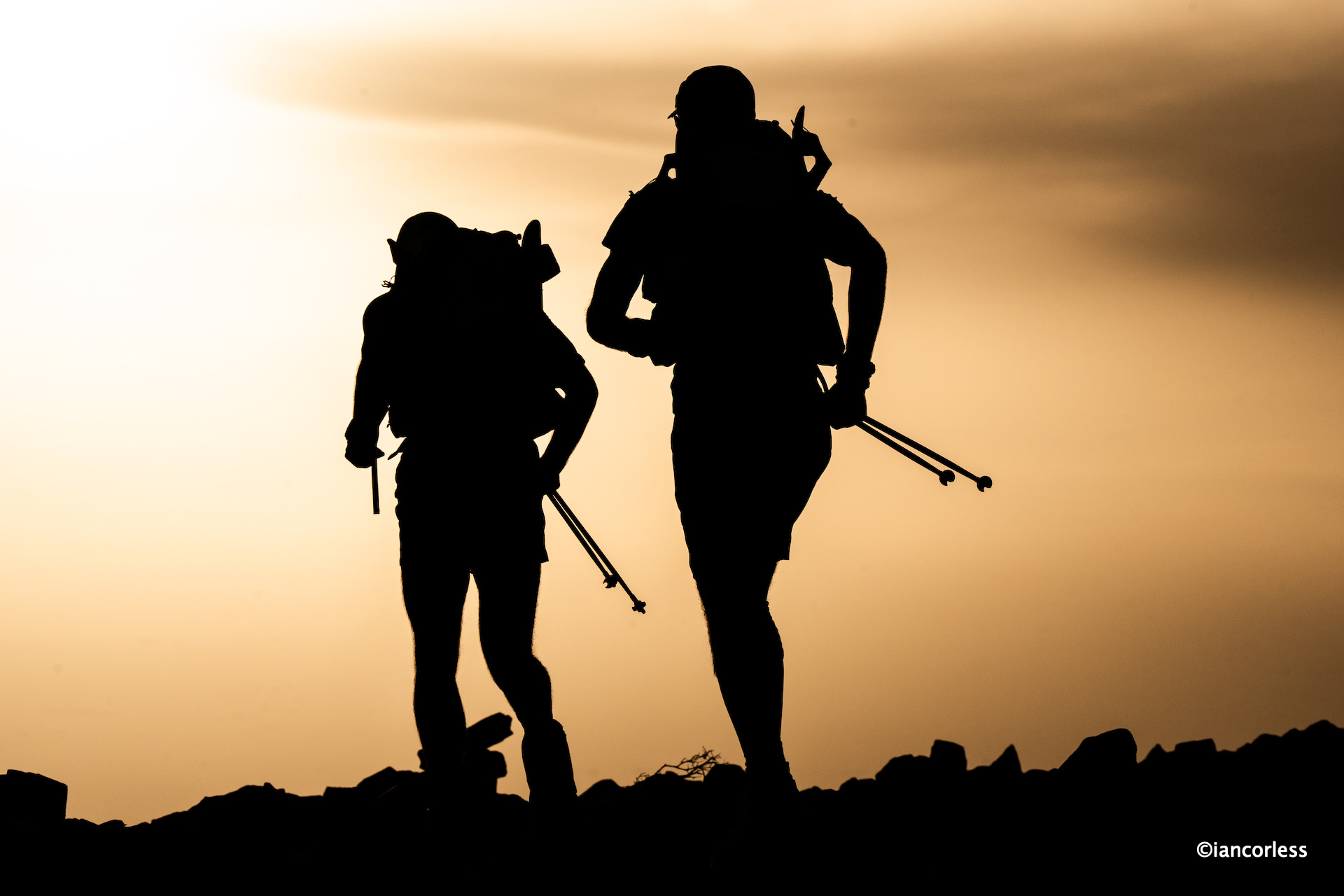
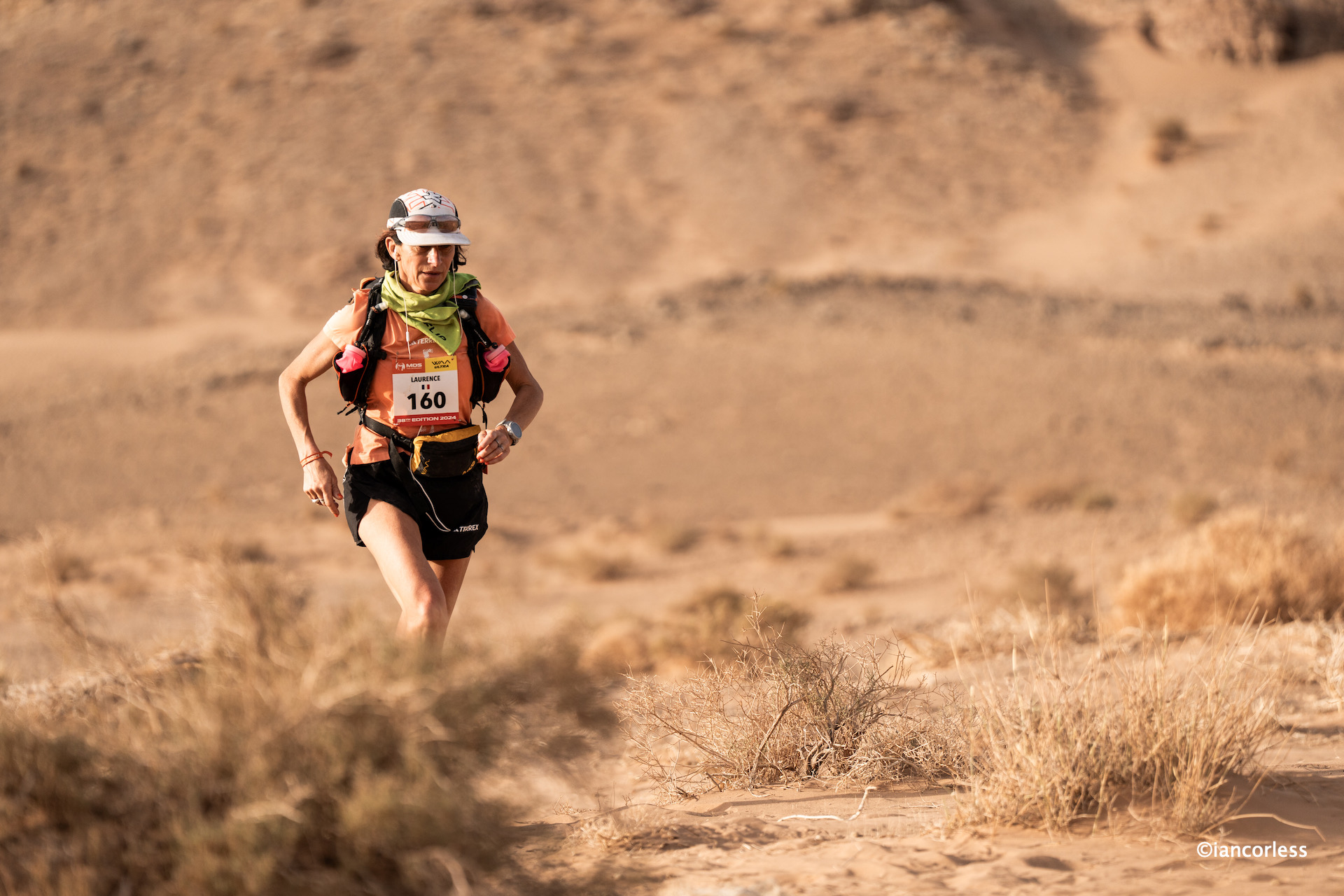
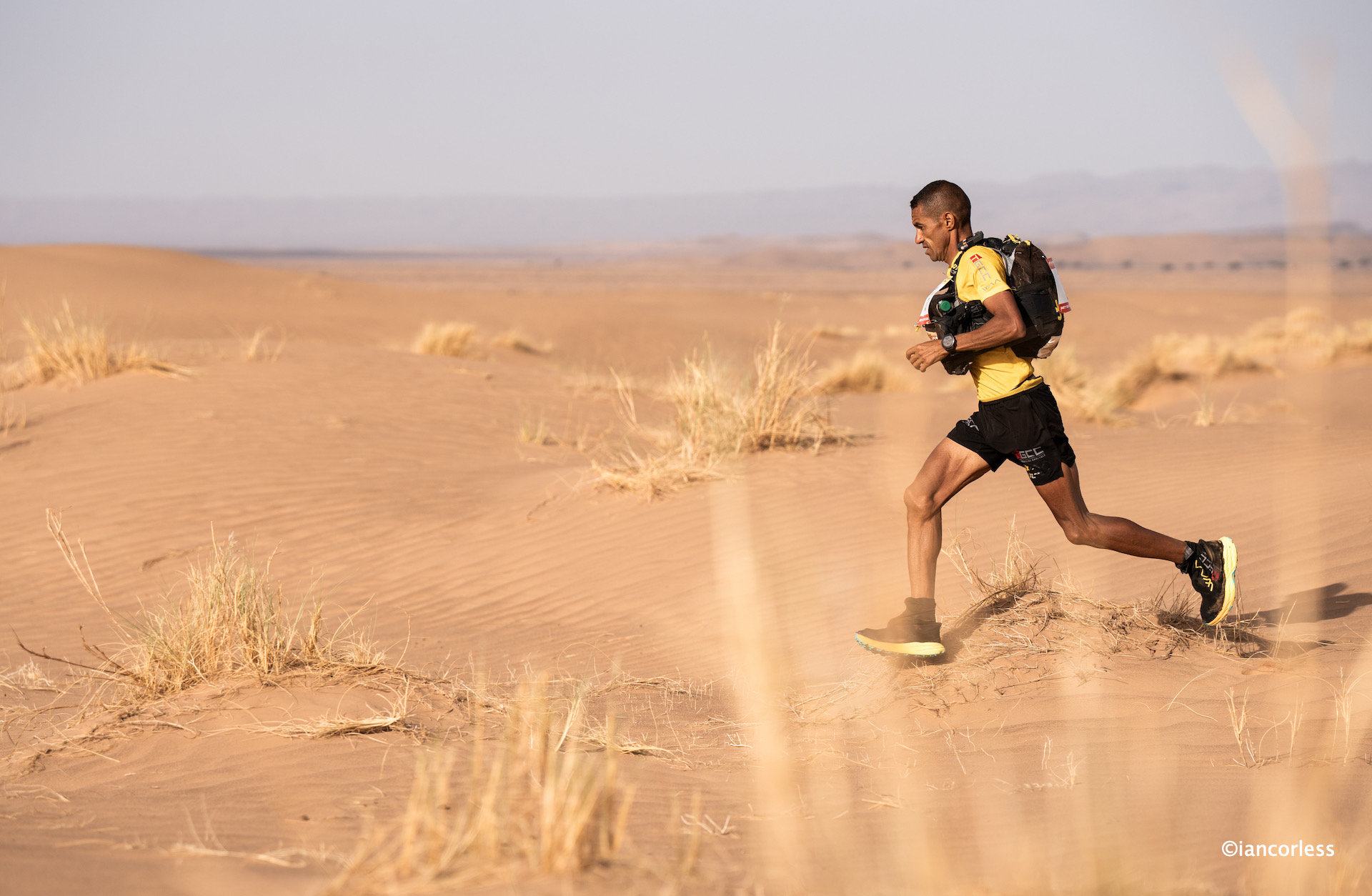
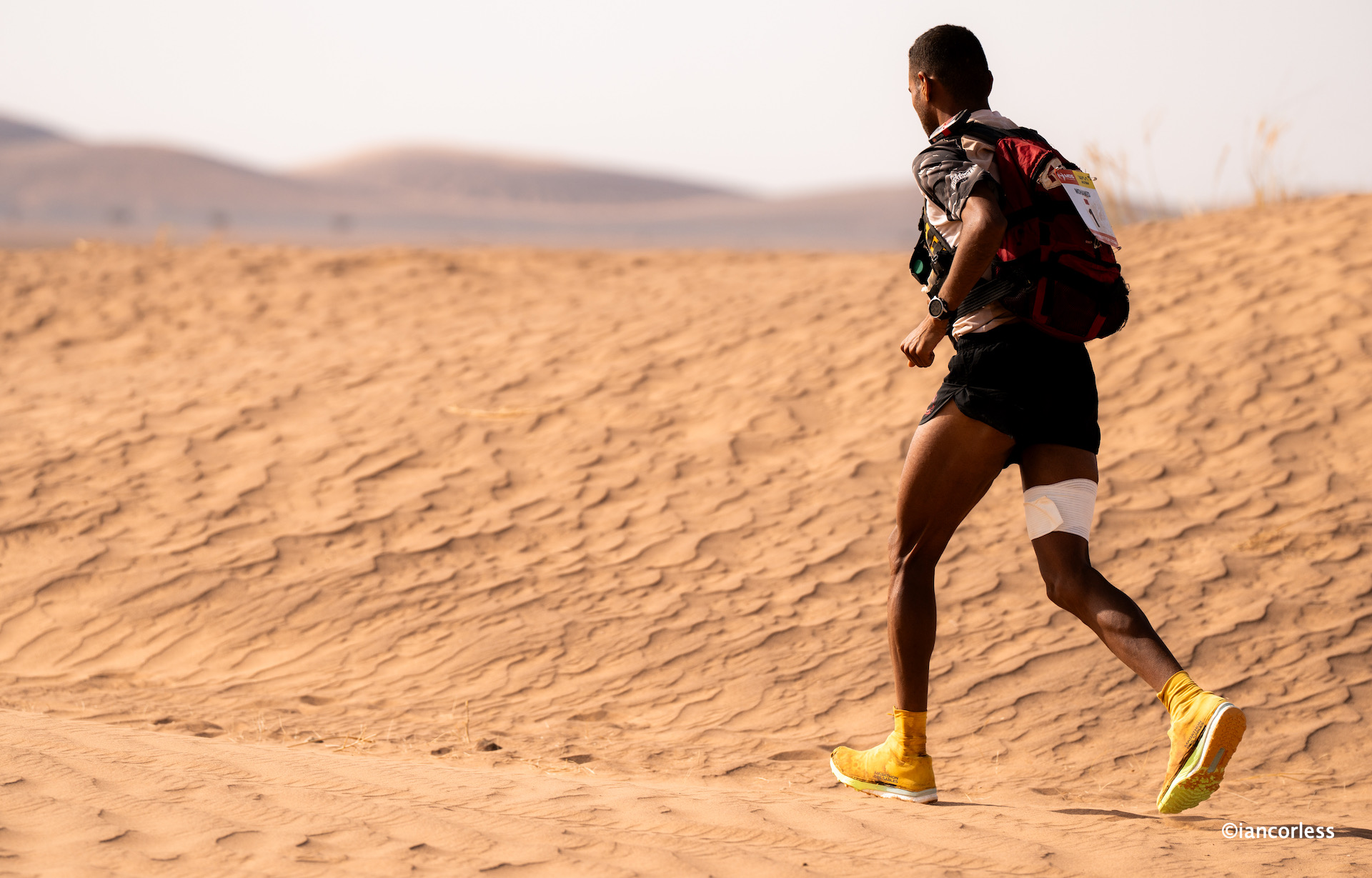
Time allowance 12-hours 45-minutes / 0630am and 0800 start (top 150 ranked)
The fall out from the long day is always hard. Bodies are now tired and normally, many would be saying, ‘just a marathon to go!’ But not for the 2024 edition.
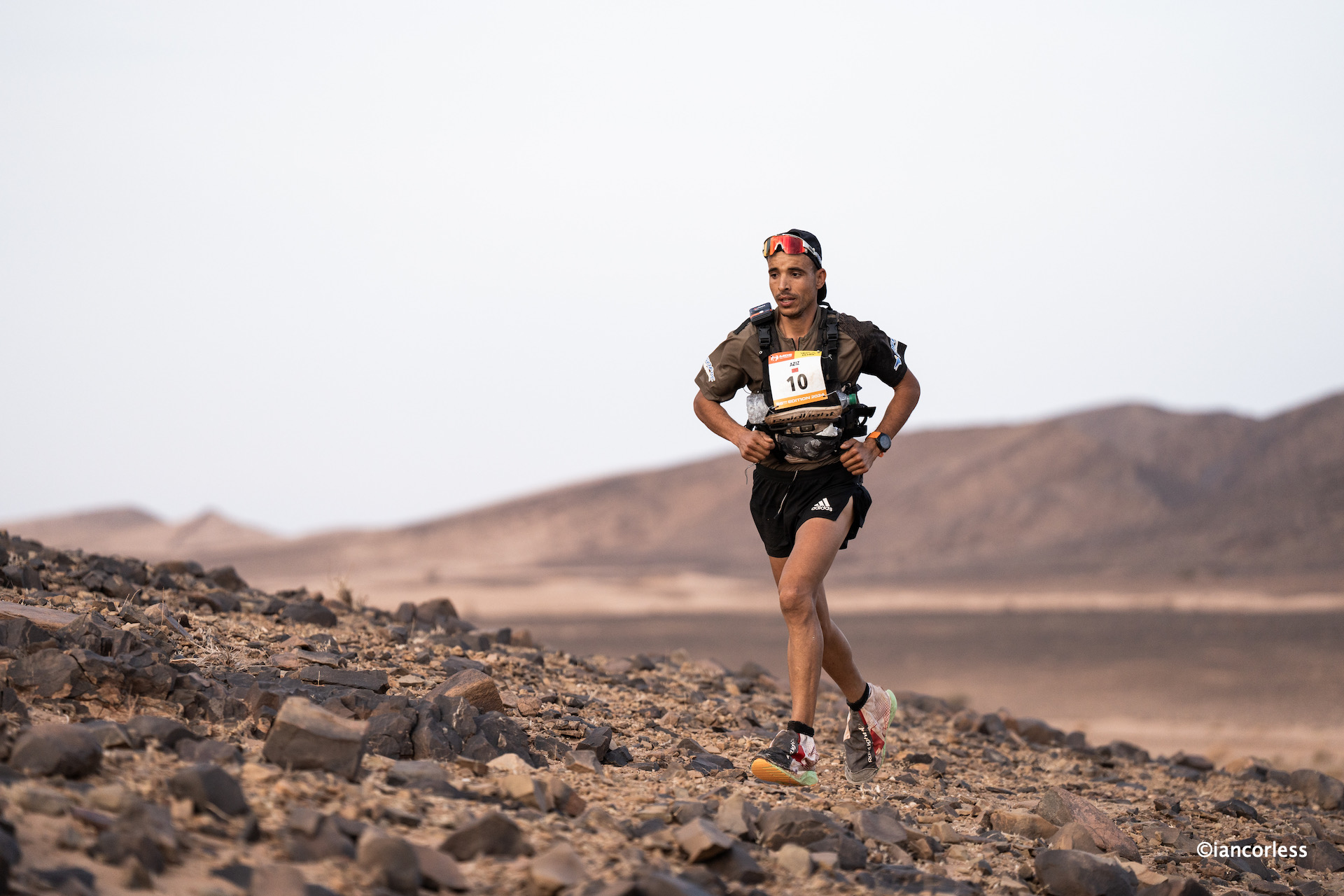
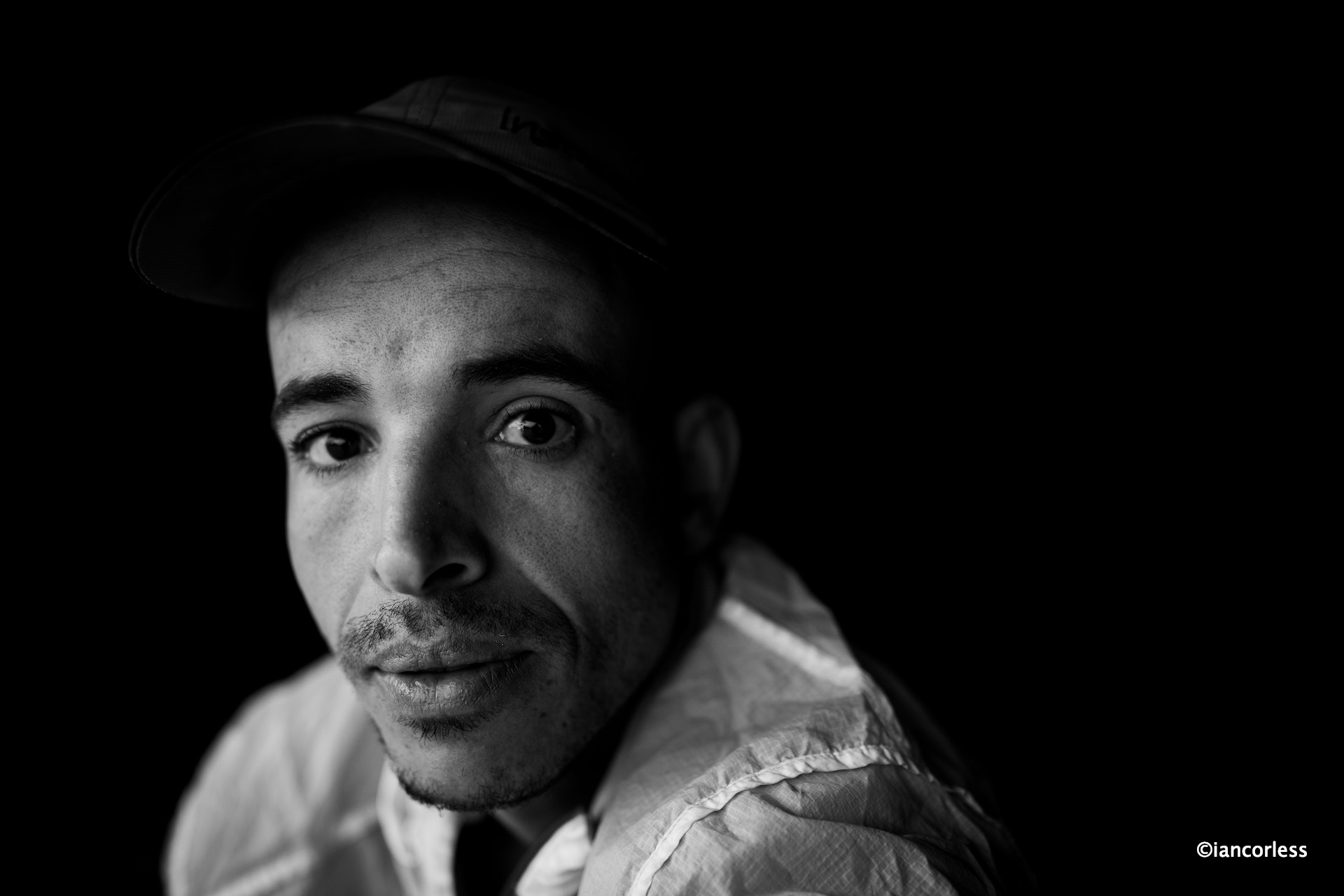
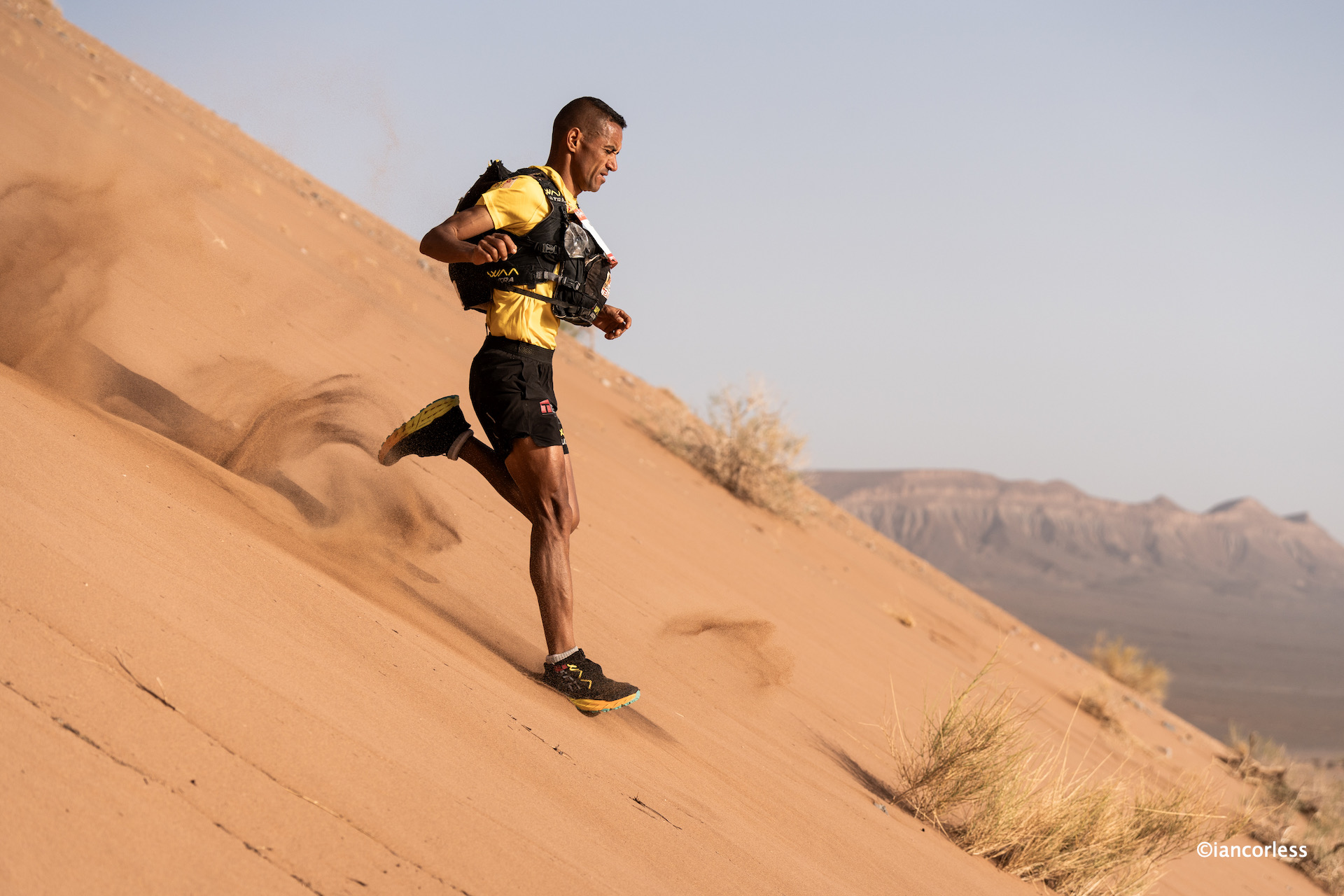
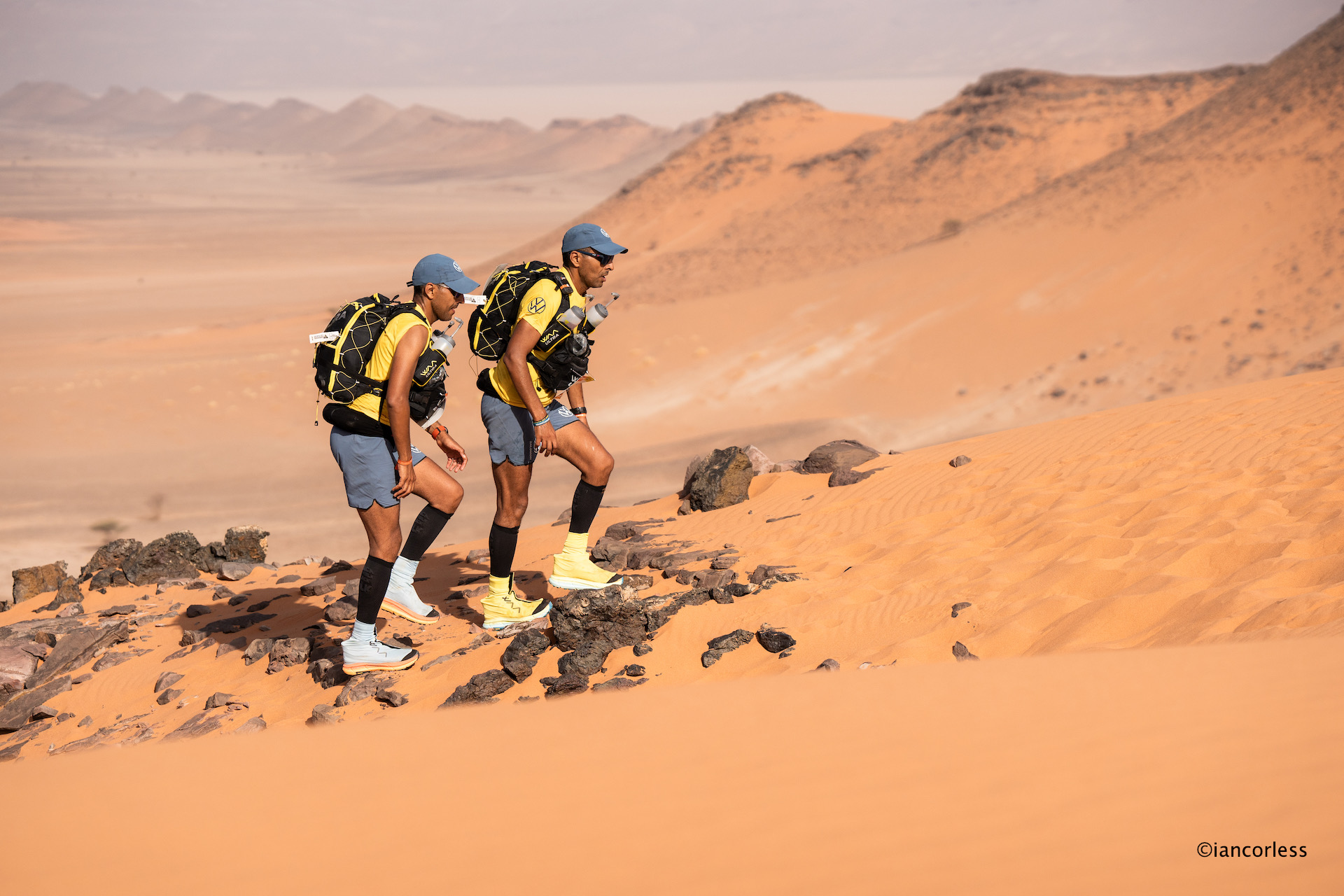
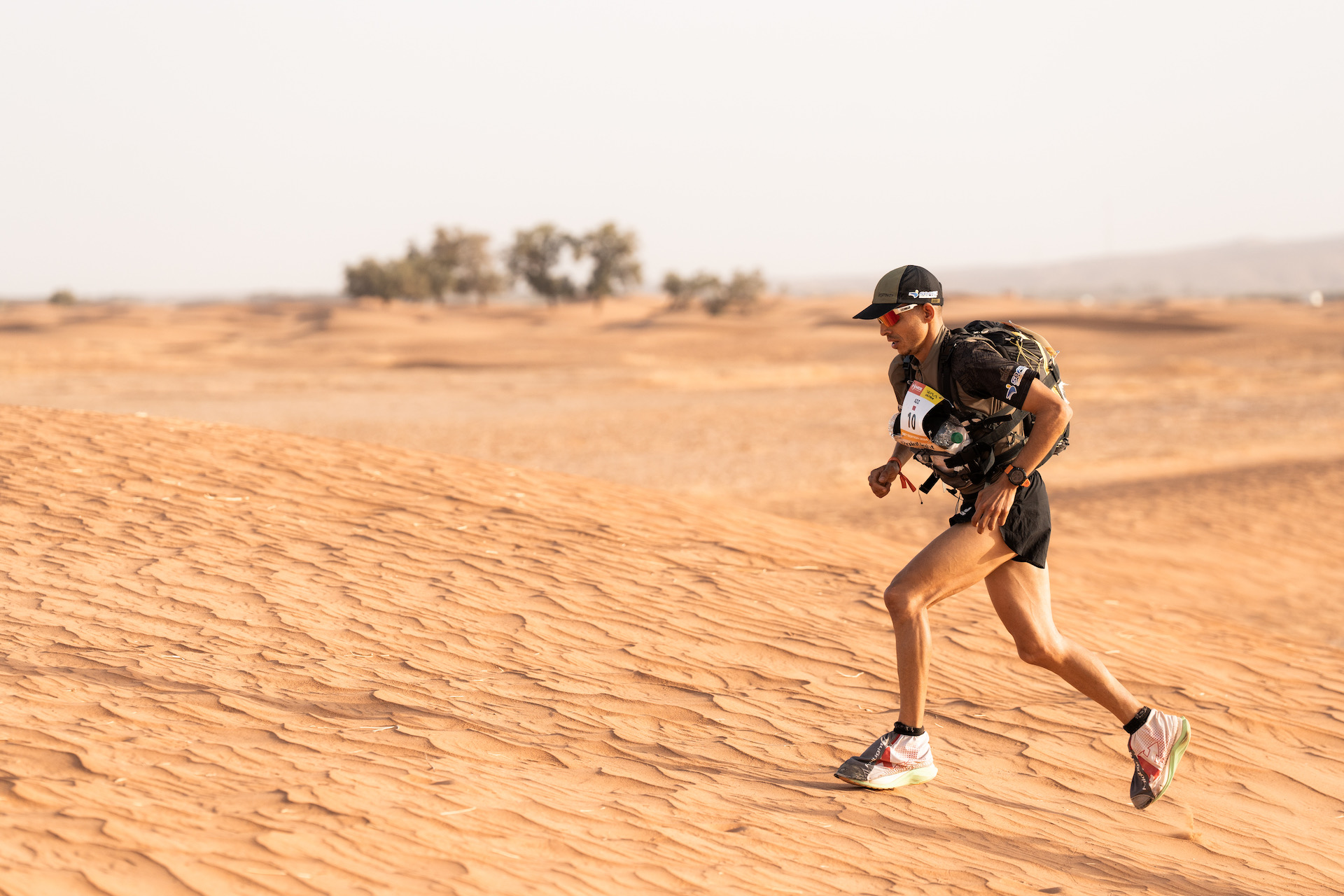
Aziz Yachou
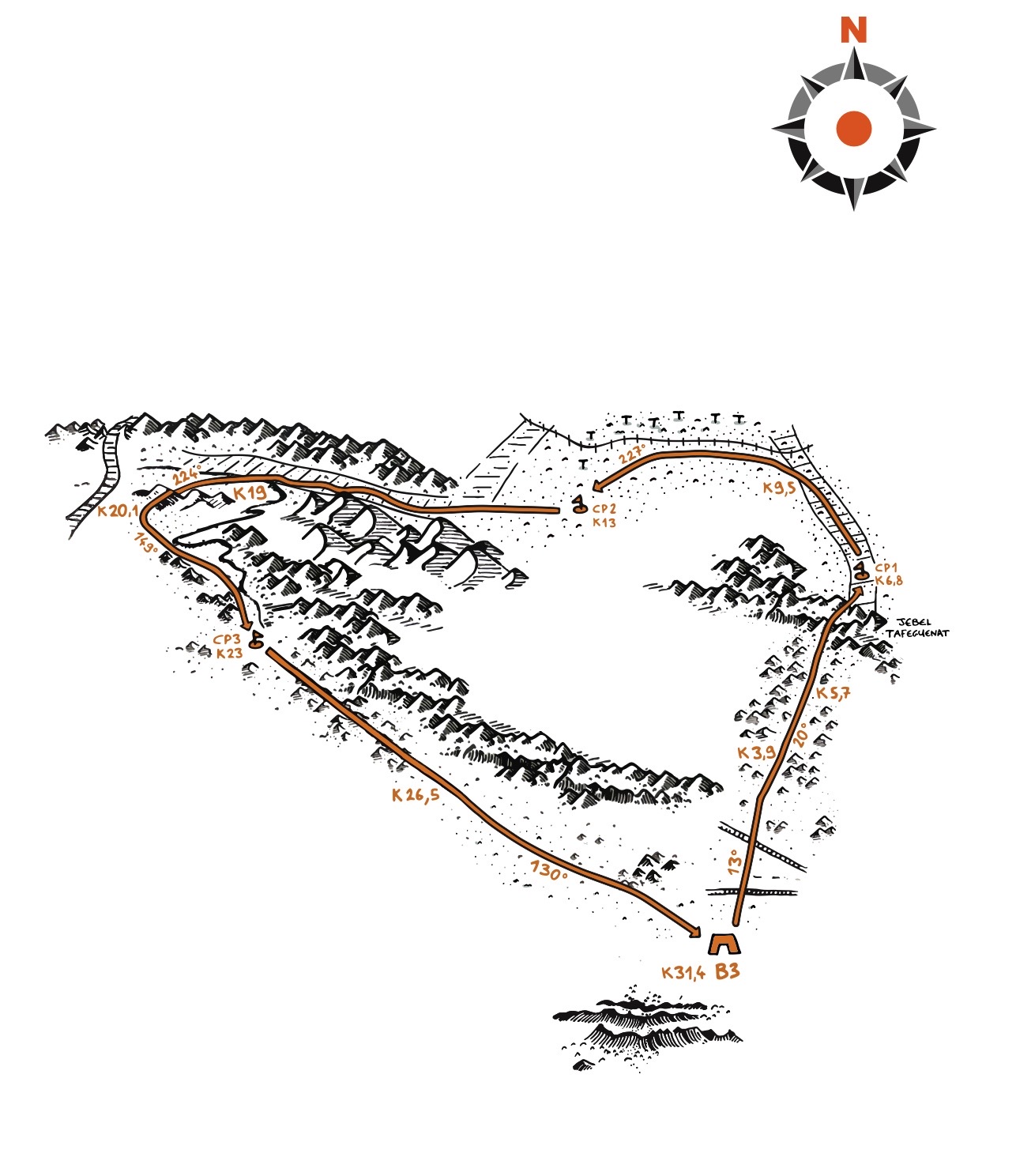
Stage 4 is 43.2km’s and to follow, stage 5 and stage 6 at 31.4km and 21.1km respectively.
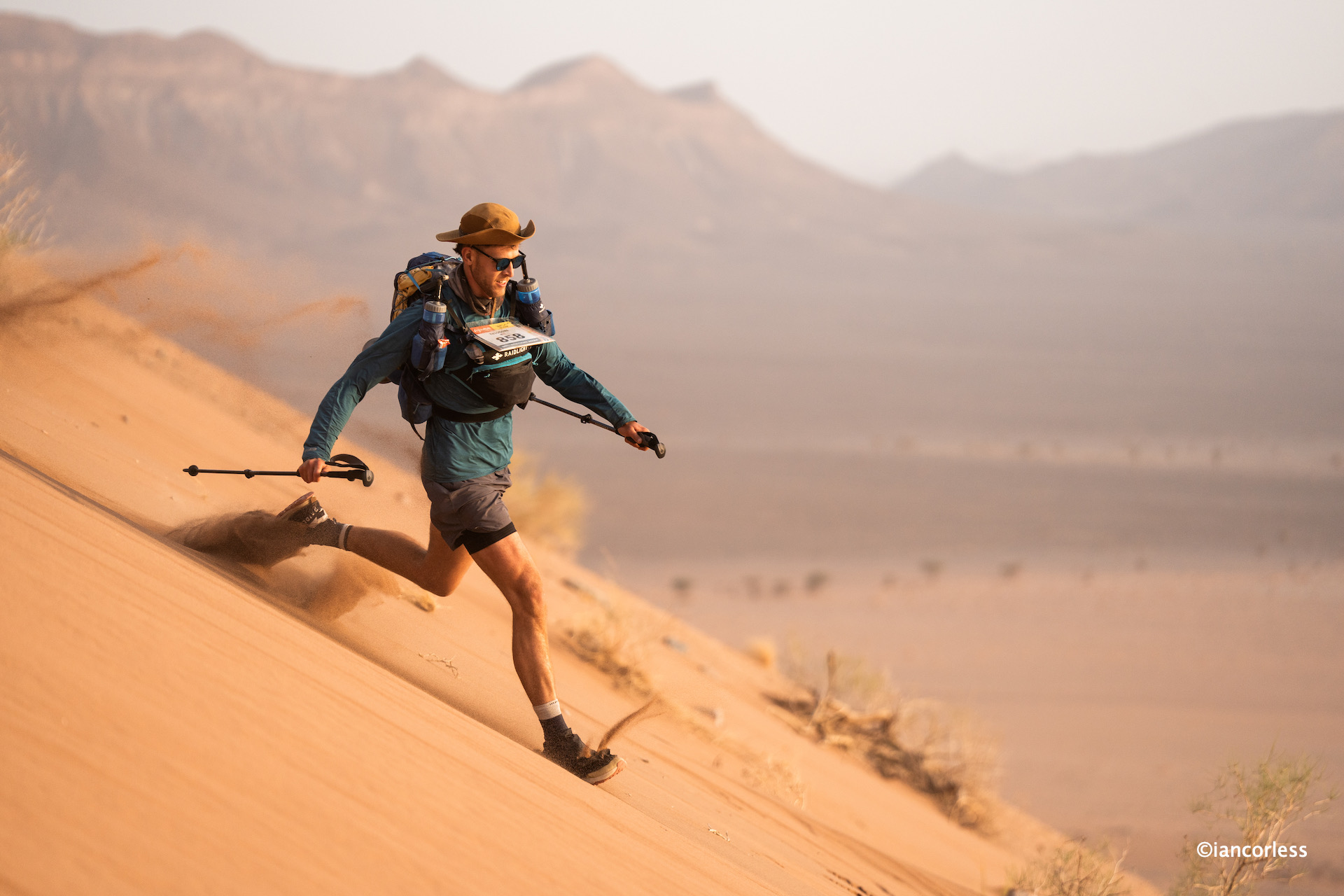
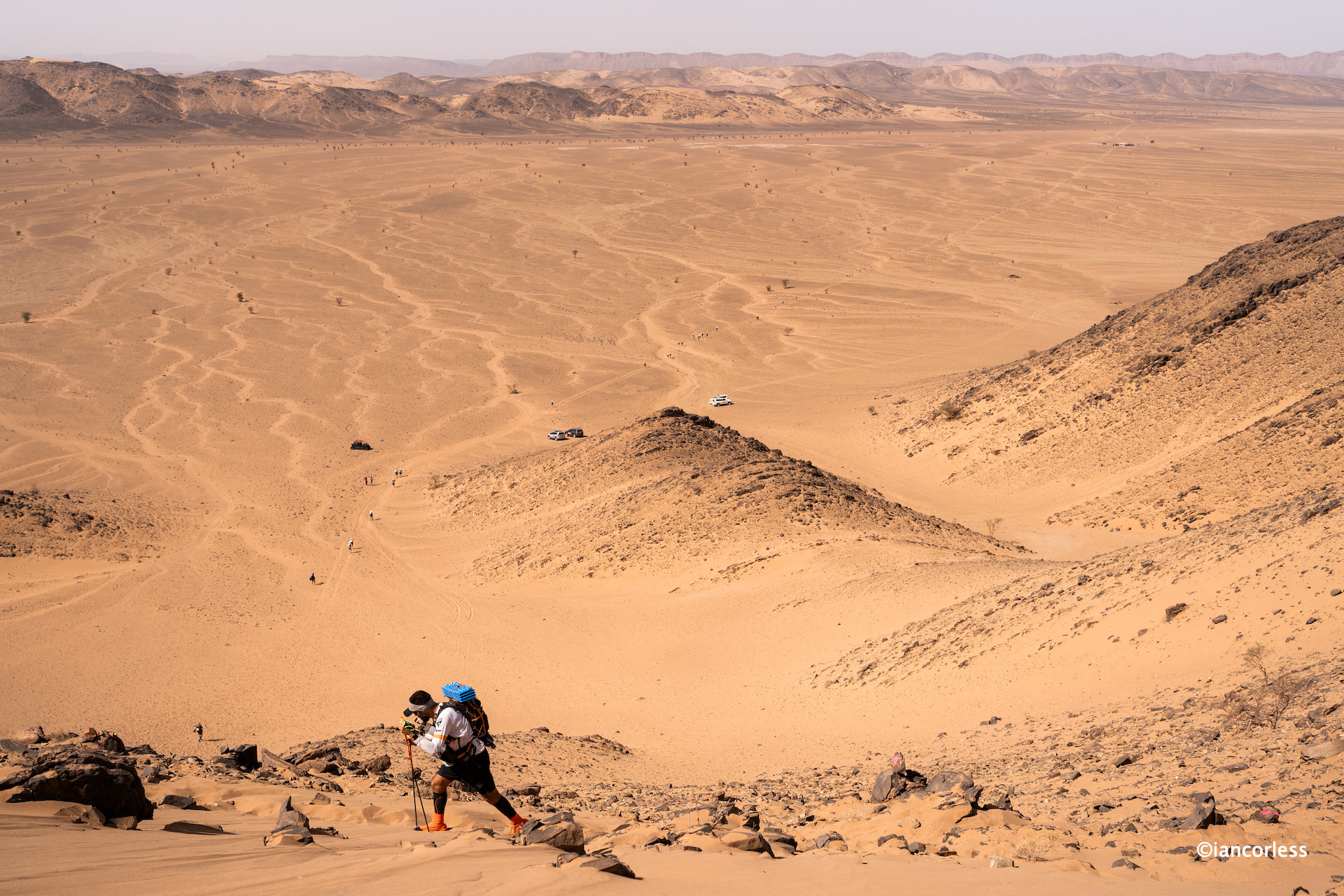
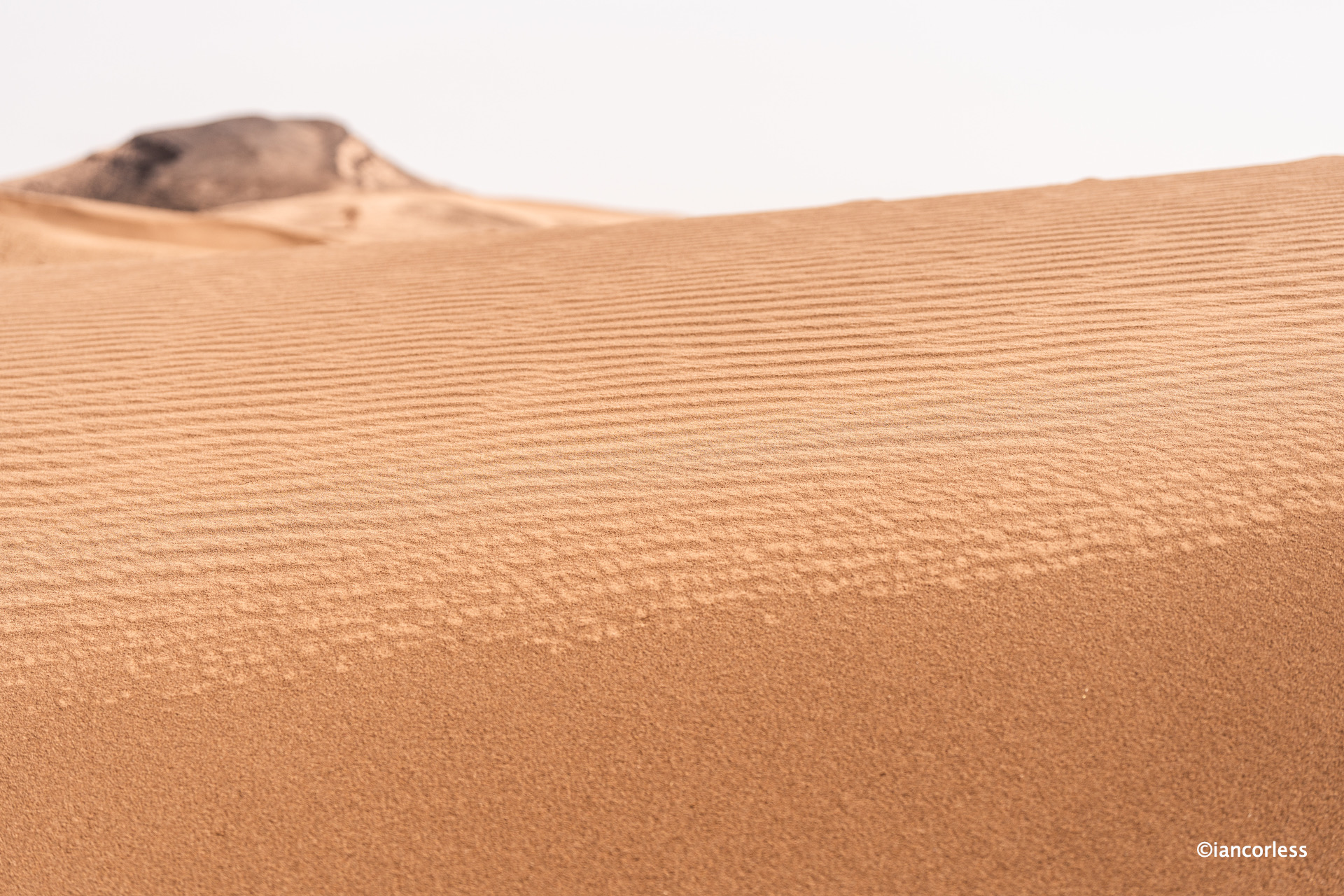
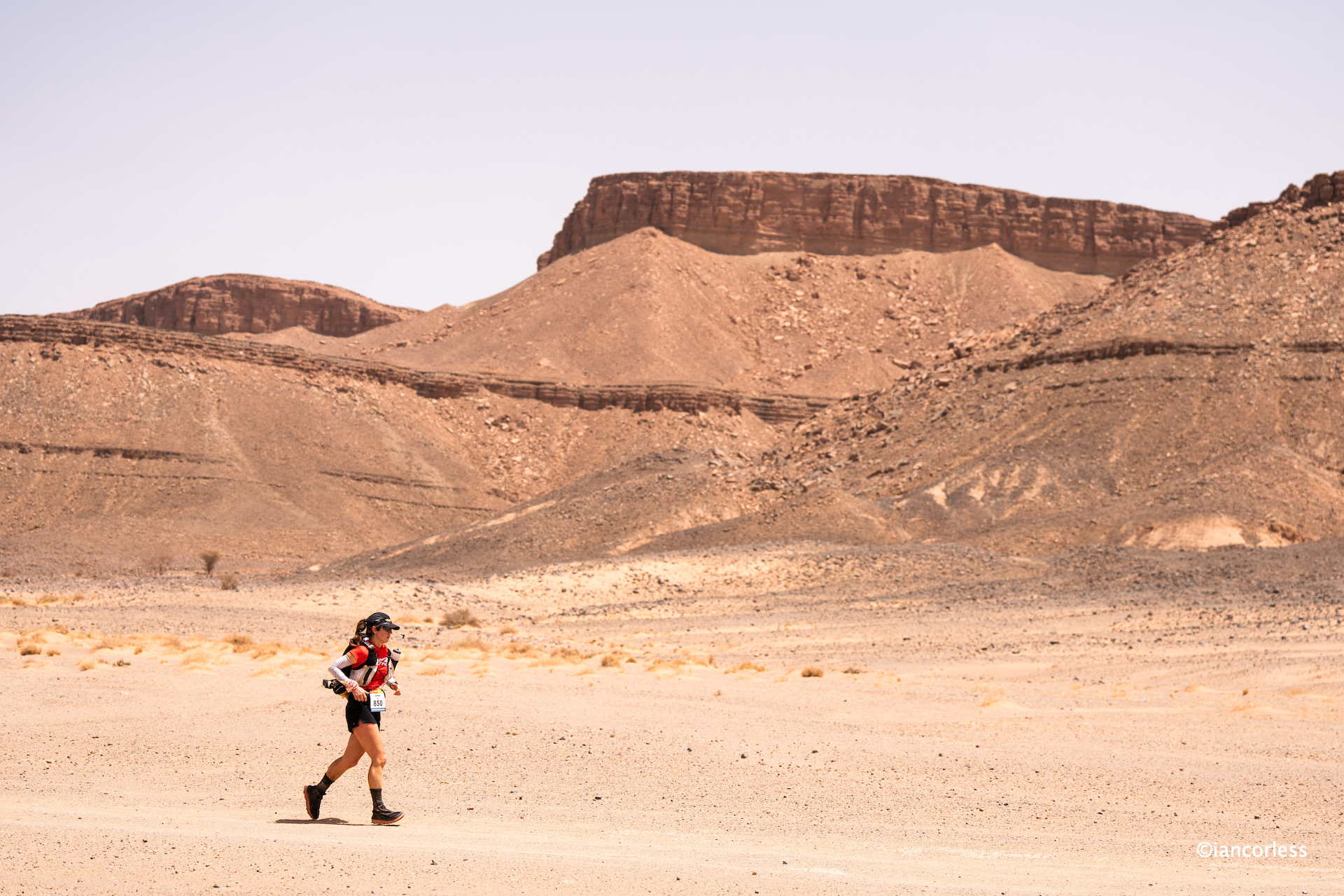
Travelling north all the way to B3, this is a tough day and probably will be remembered as the soft-sand day, especially as the most challenging terrain comes at the end.
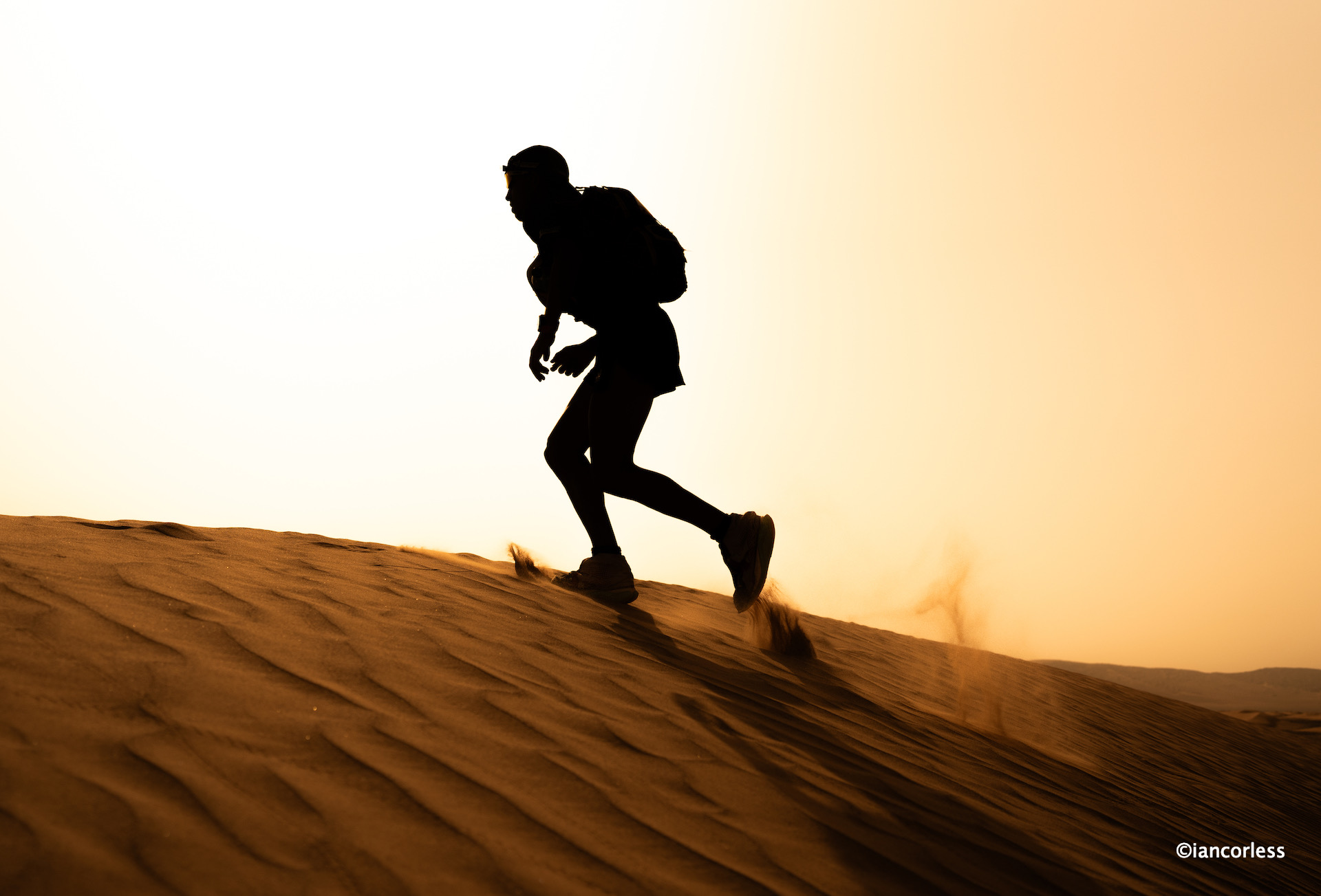
Sand and heat
With 3 CP’s at 10km, 22.9km and 30.1km, the severity of the stage is reflected with ‘additional’ water stations at 17km 37.7km.
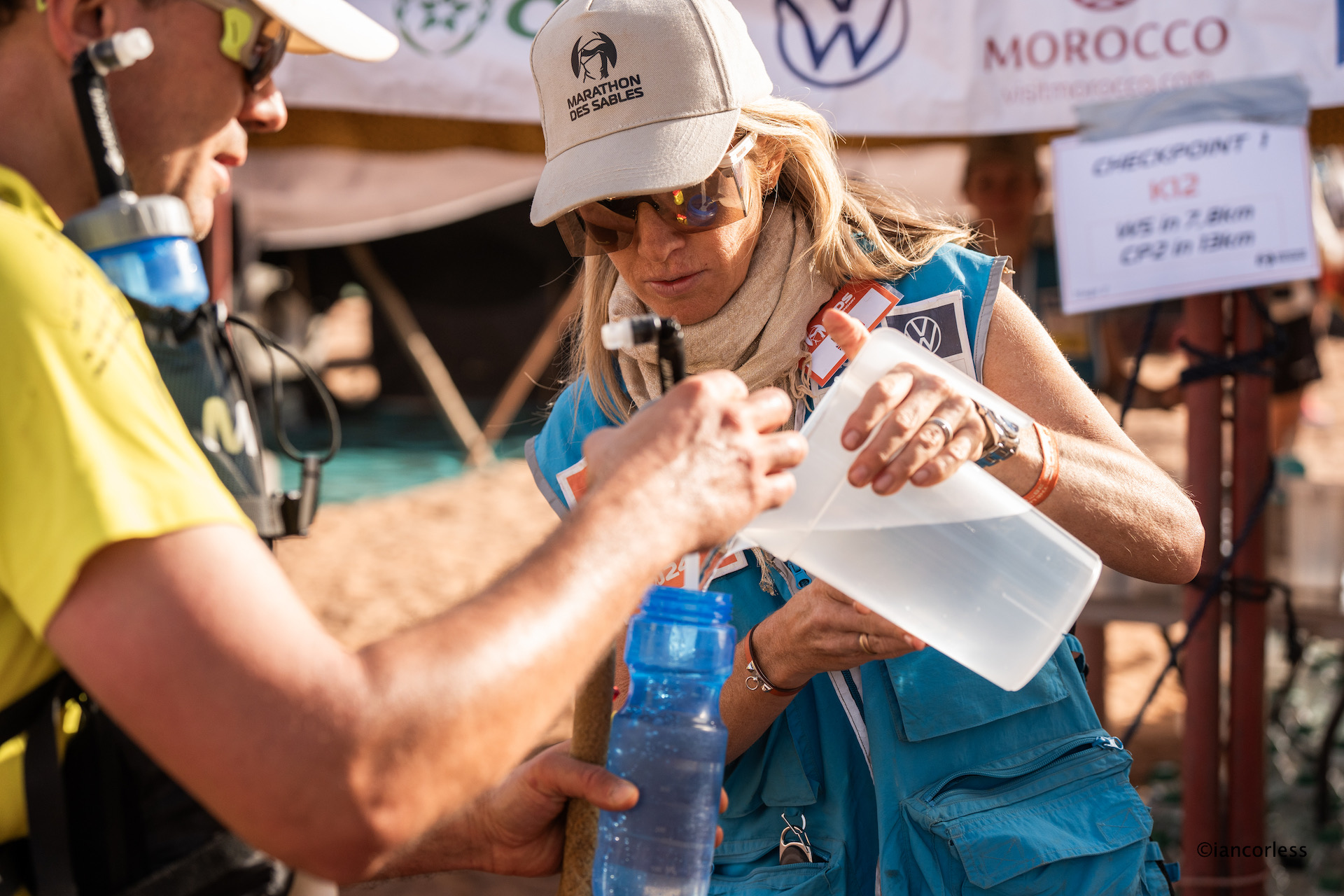
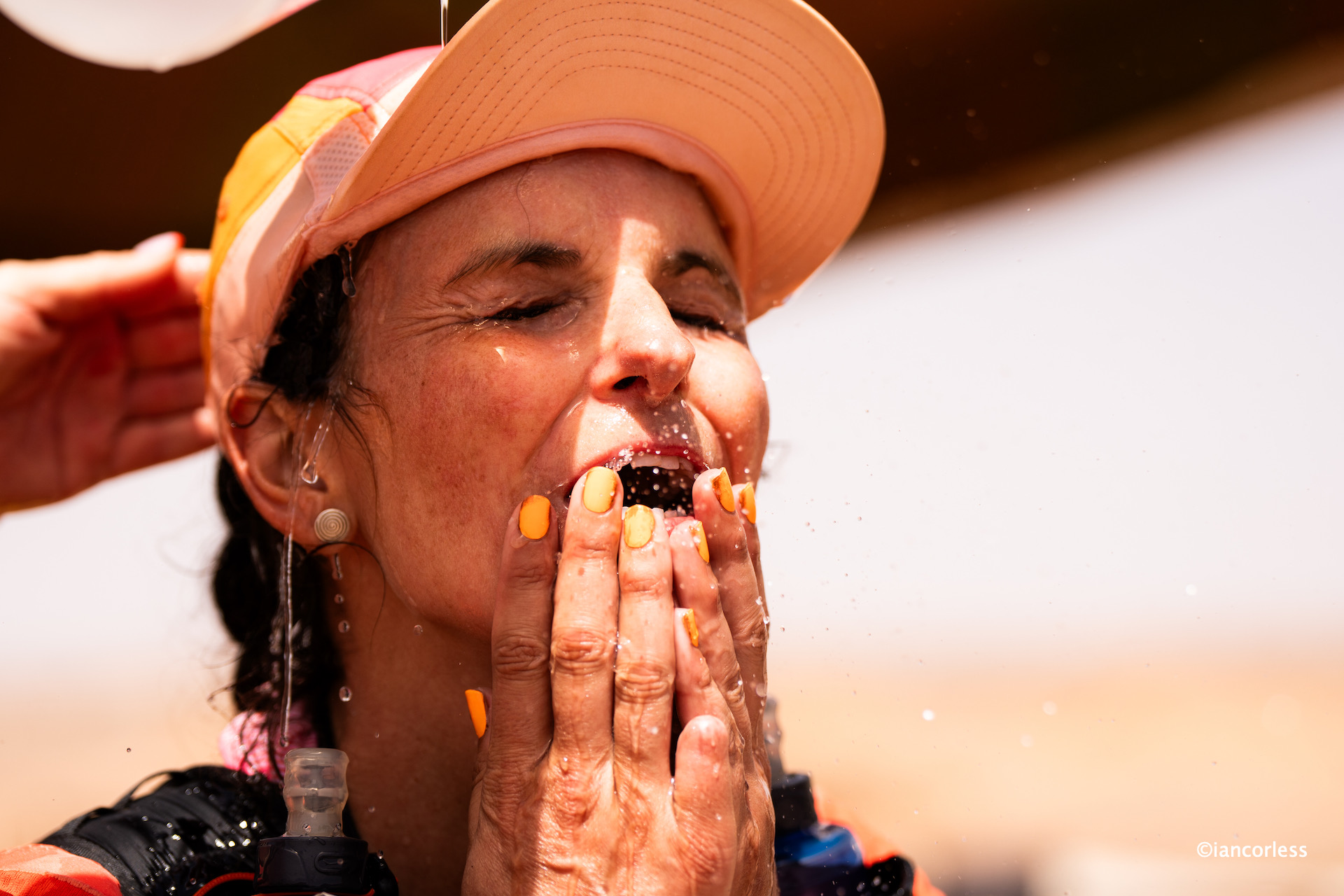
Cooling off at the CP’s
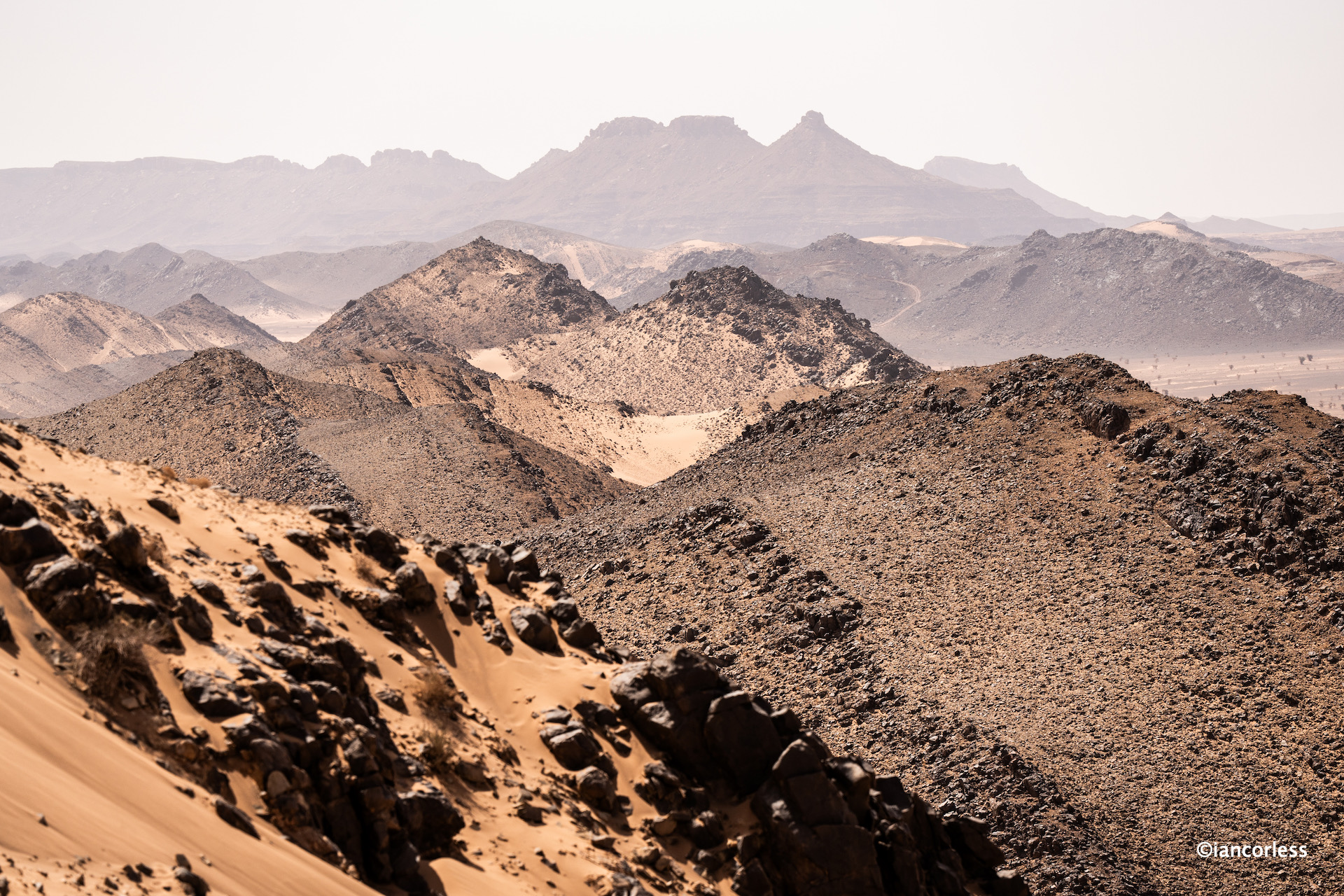
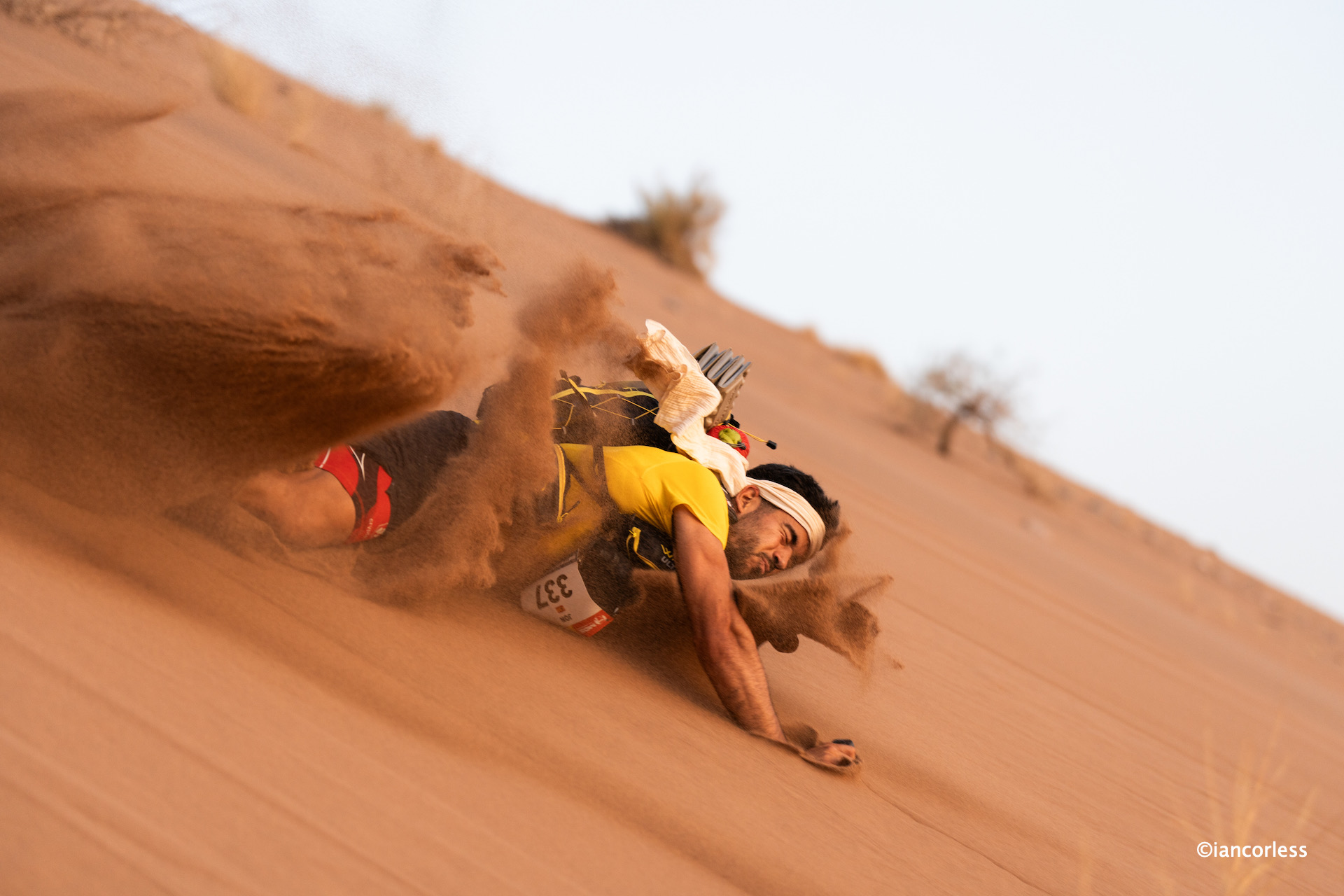
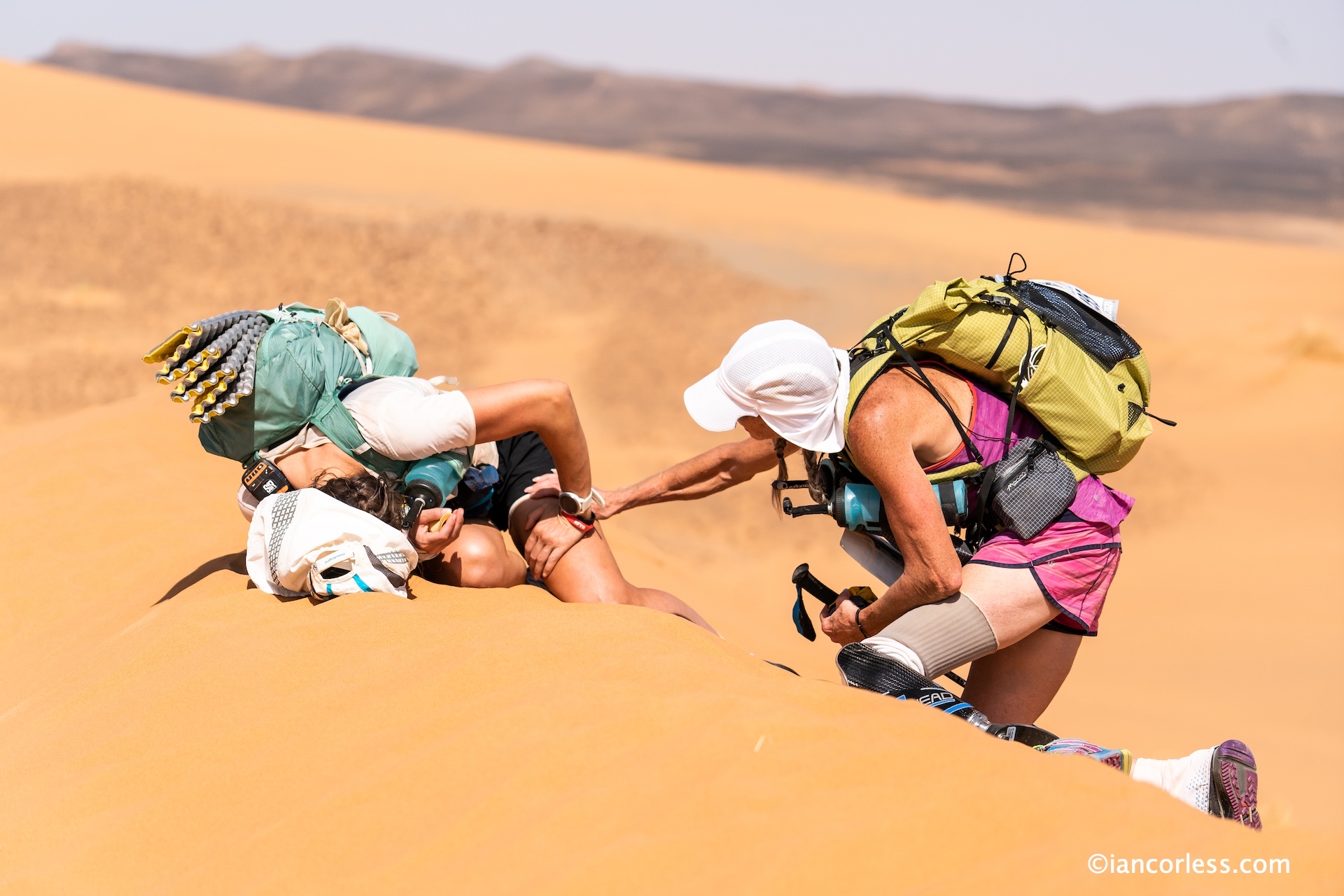
While the early km’s allowed for easier terrain with cooler temperatures, the kick is in the tail with relentless sand and dunes from 22km all the way to the finish with increasing heat, expected at a 35-degree high, but feeling much hotter than 40-degrees for the runner’s. A tough day!
Rachid in the early 10km’s
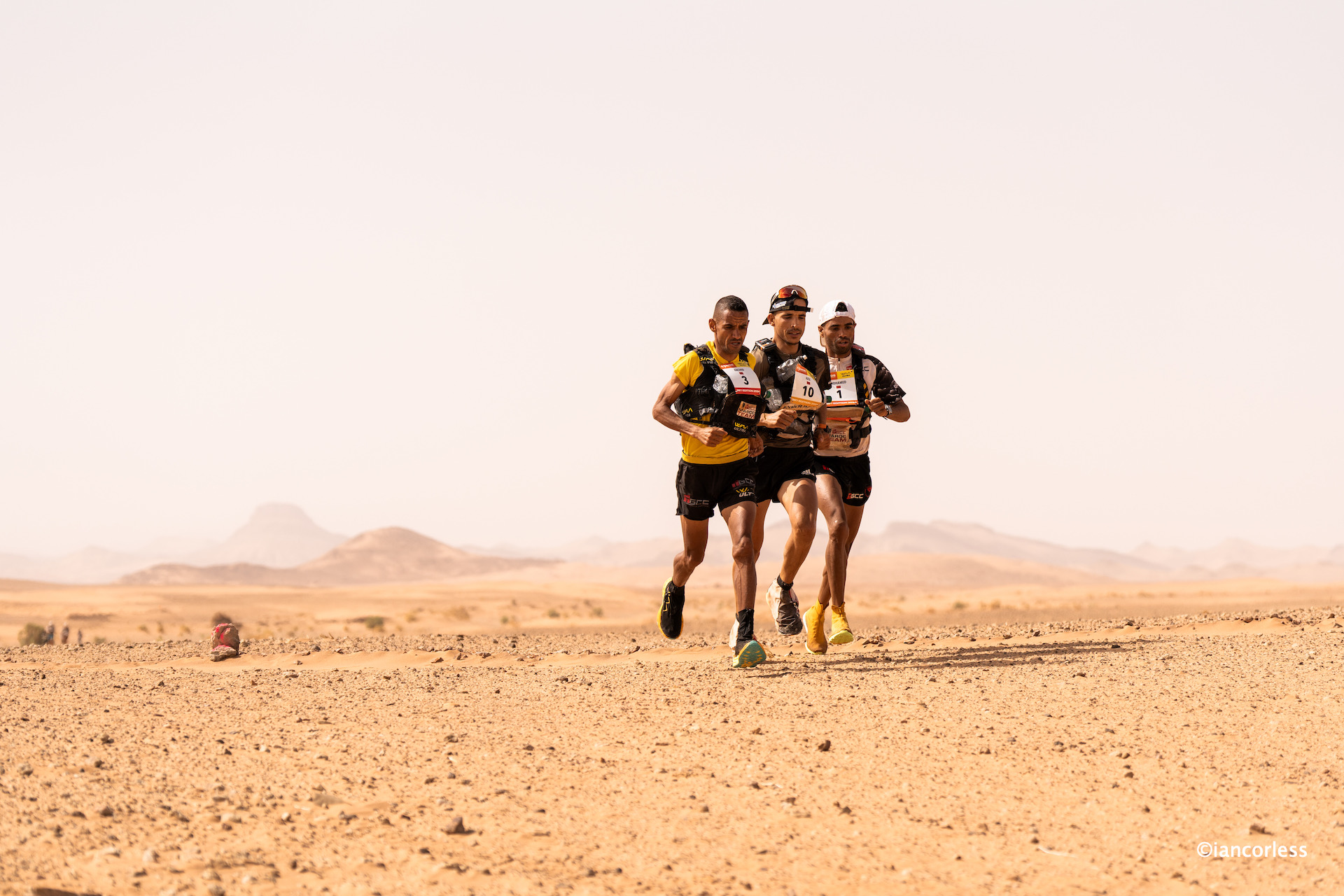
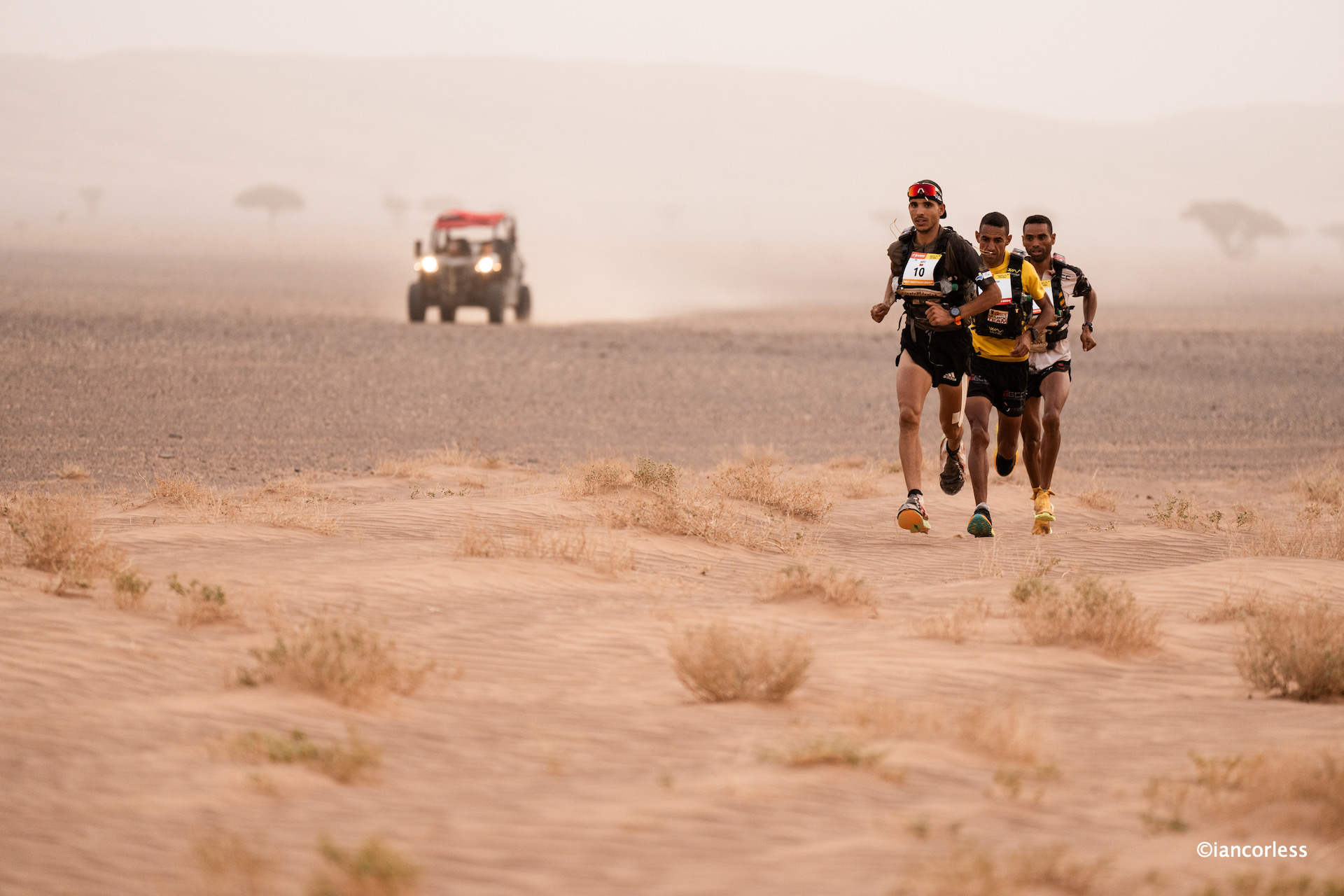
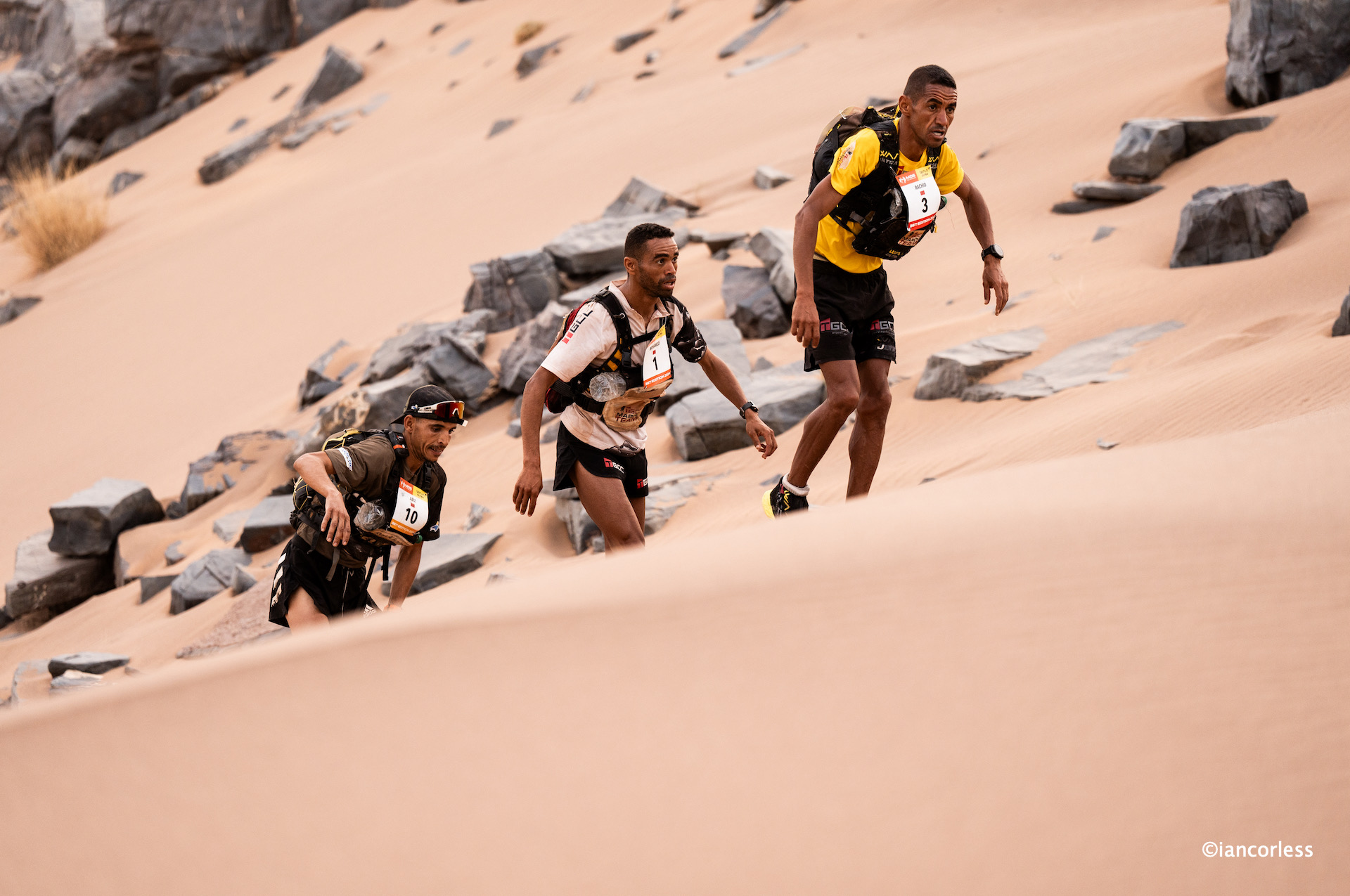
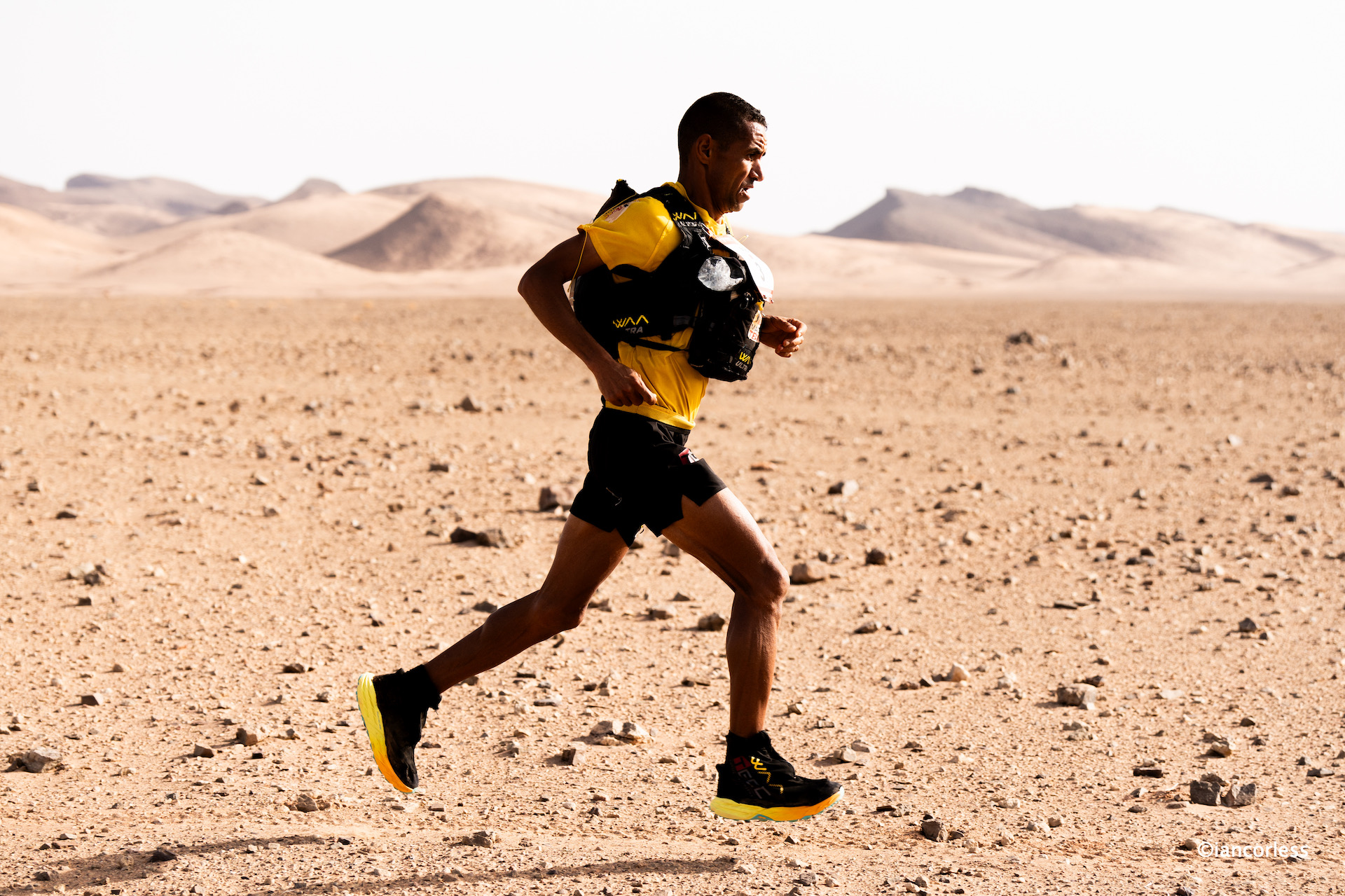
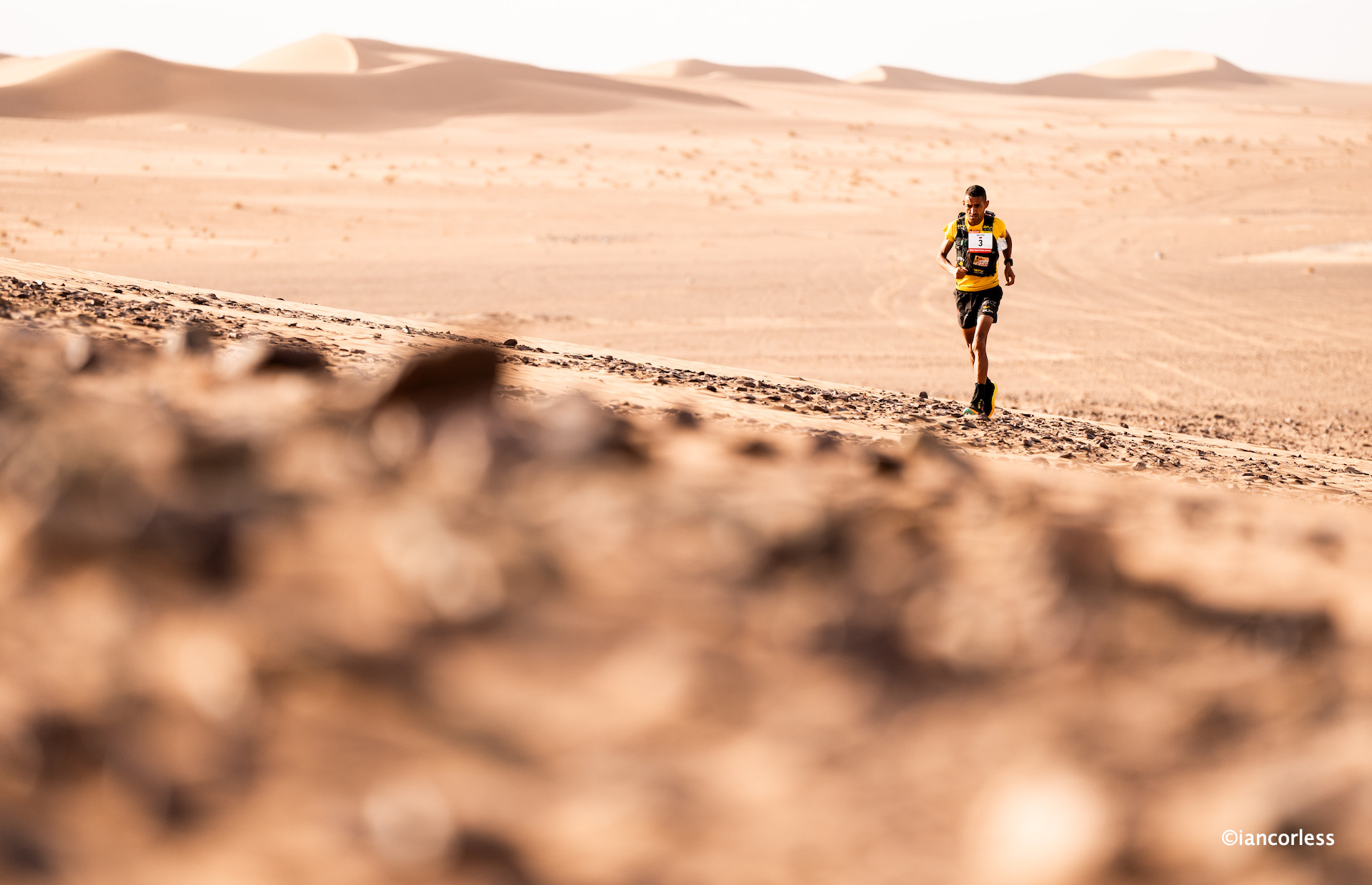
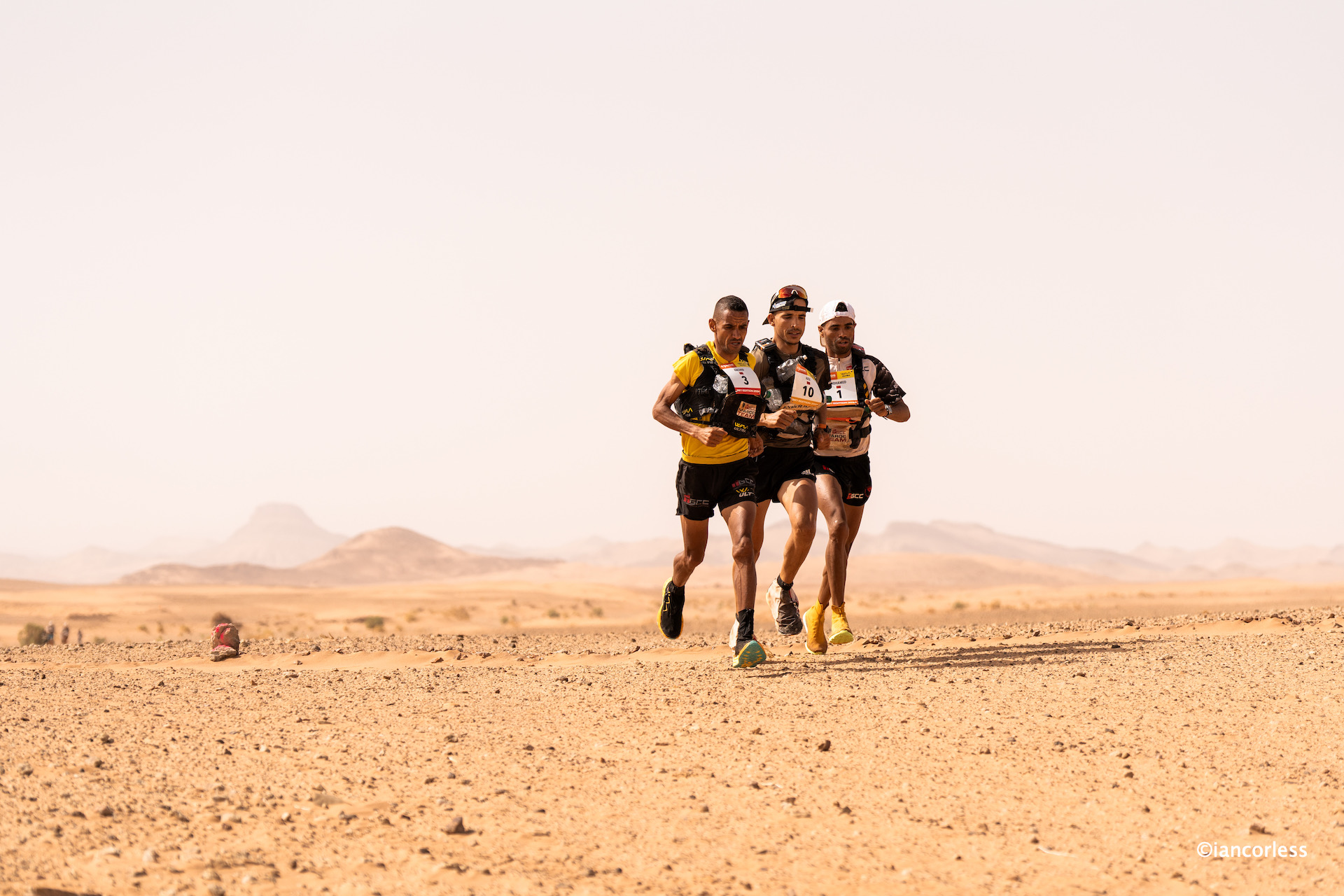
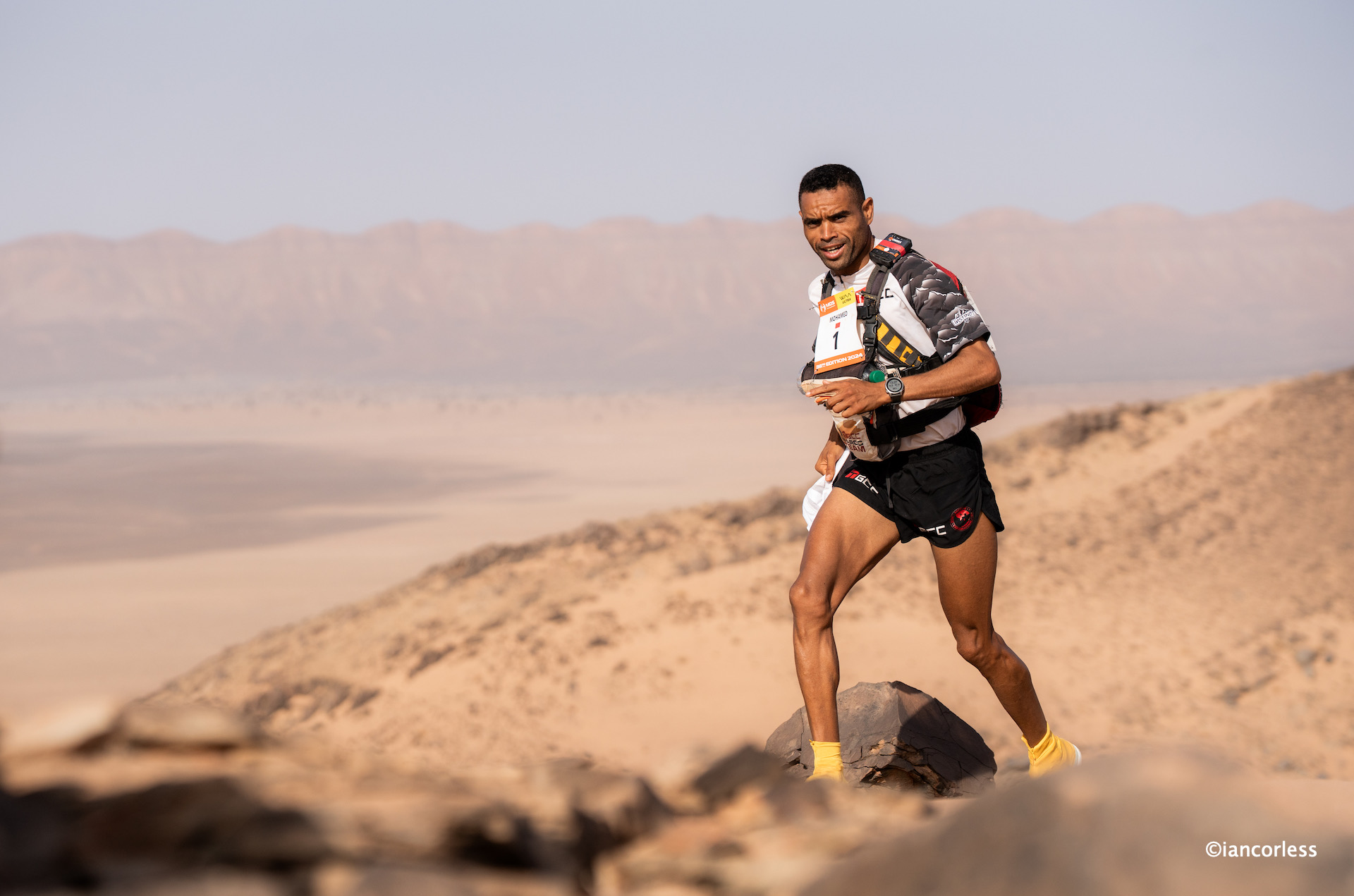
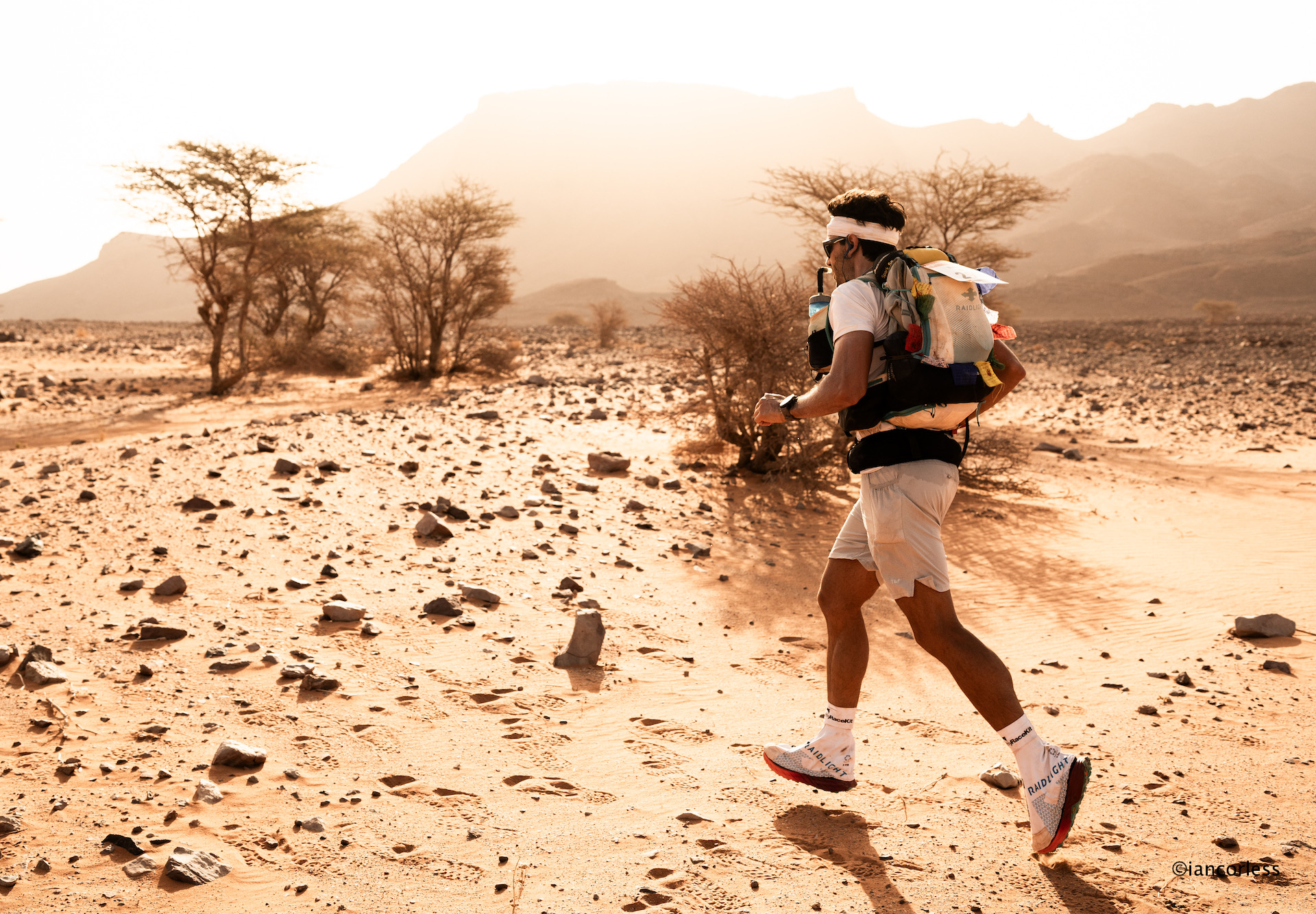
Rachid El Morabity dictated the early pace with Aziz and Mohamed behind.
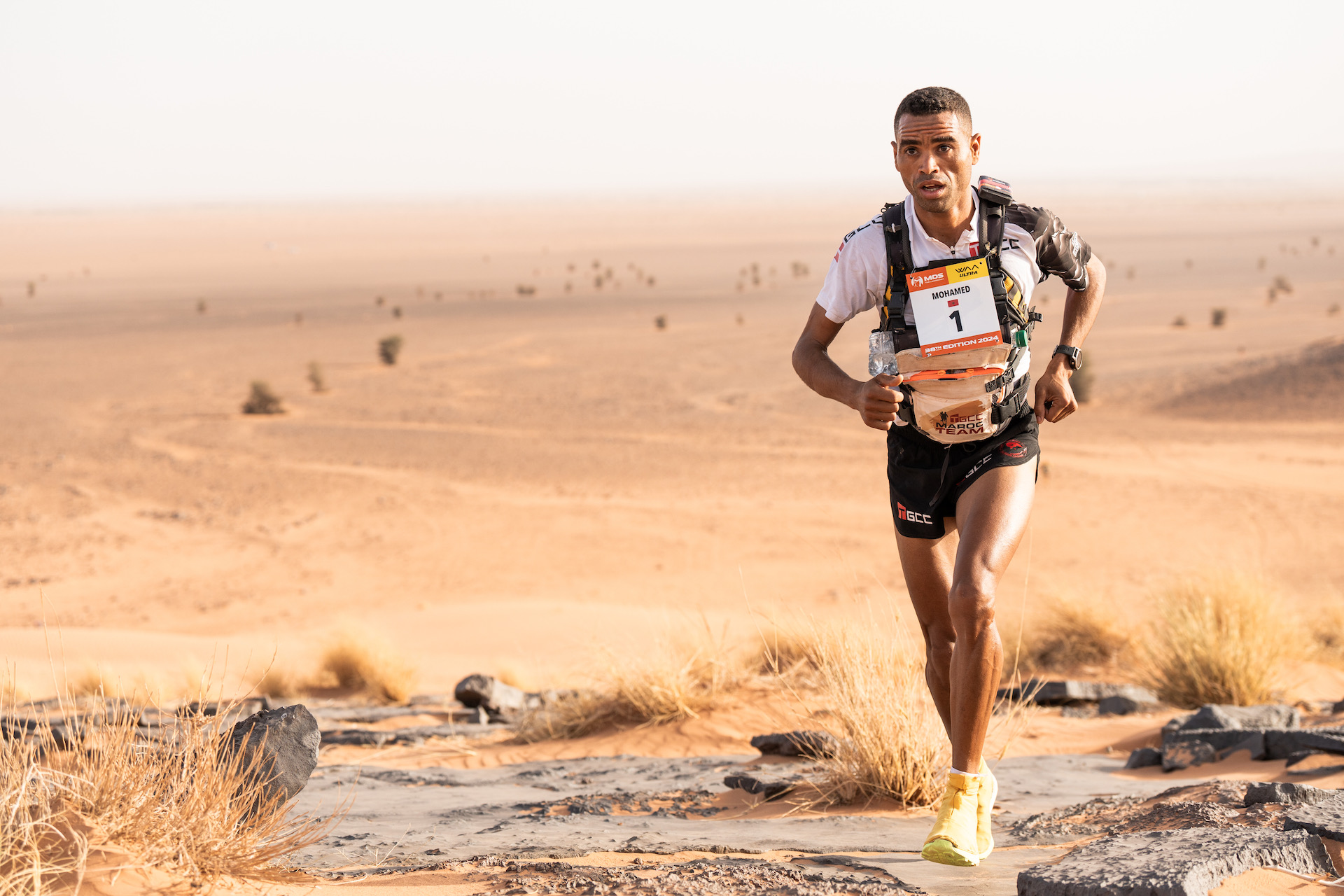
Mohamed
The trio mixed it up but by the halfway point they were all together.
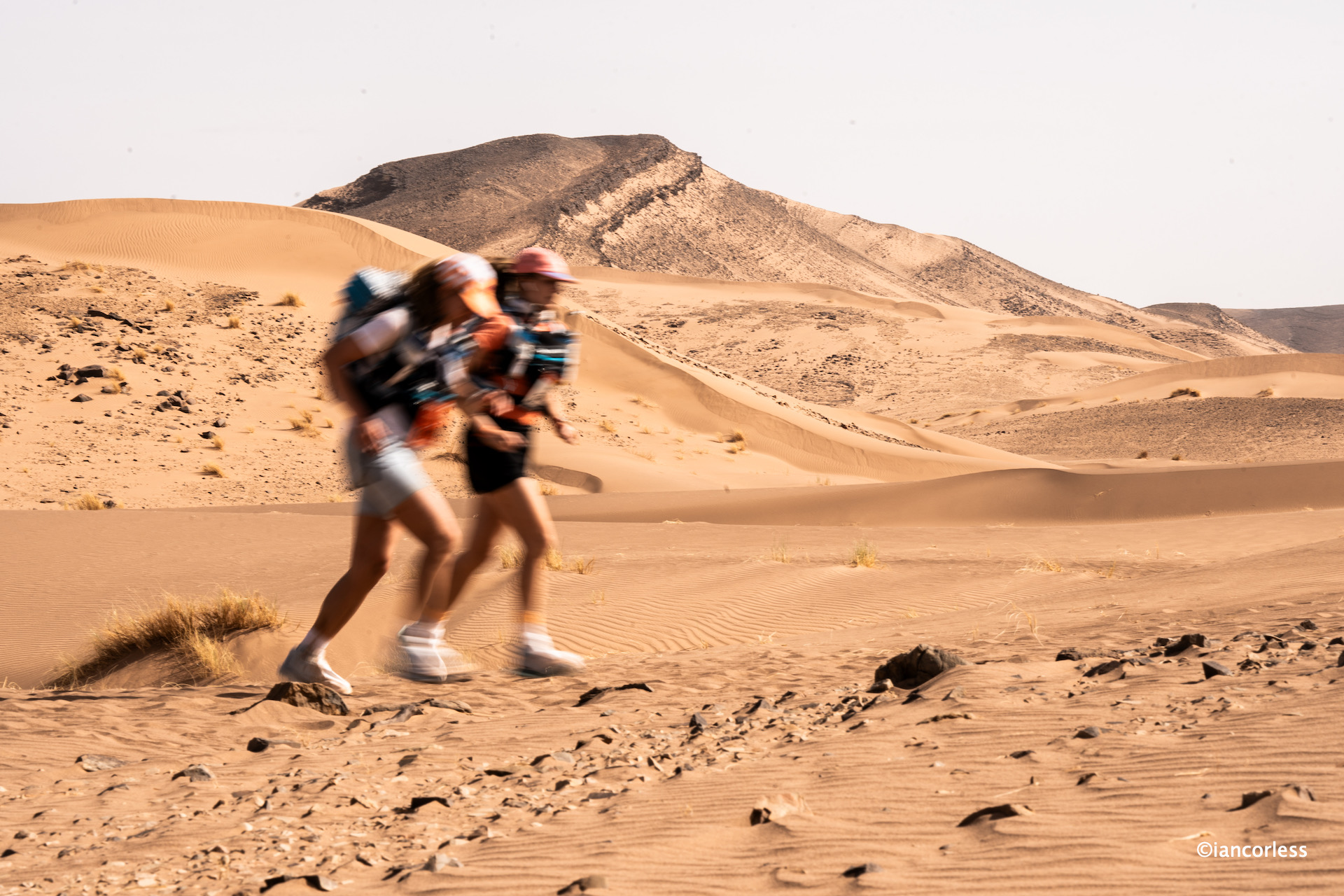
Two company, three a crowd
In the closing 10km, Rachid made a notable kick and pulled away for the stage win, Aziz and Mohamed behind 3:13:24 for Rachid and 3:14:59 for the duo.
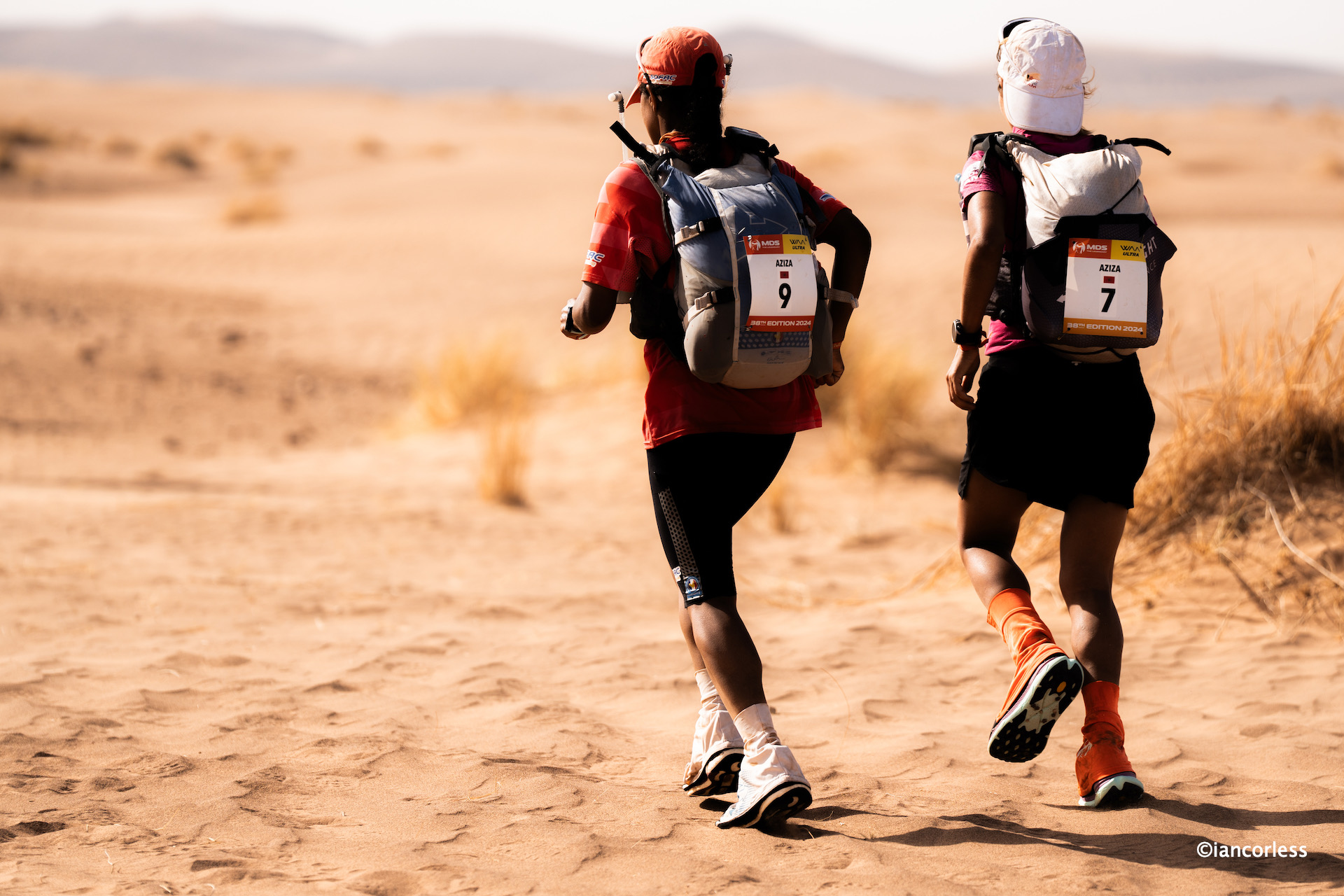
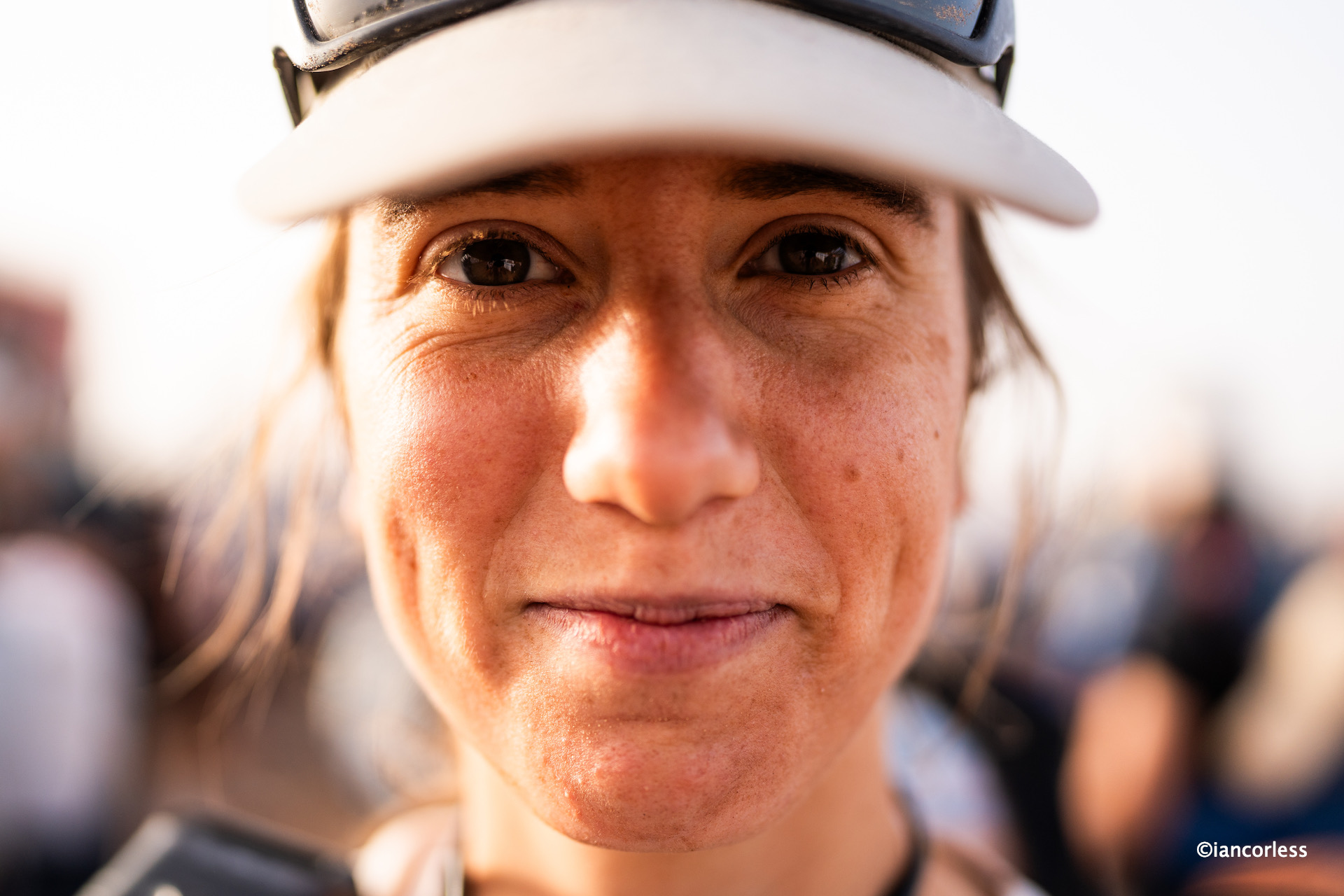
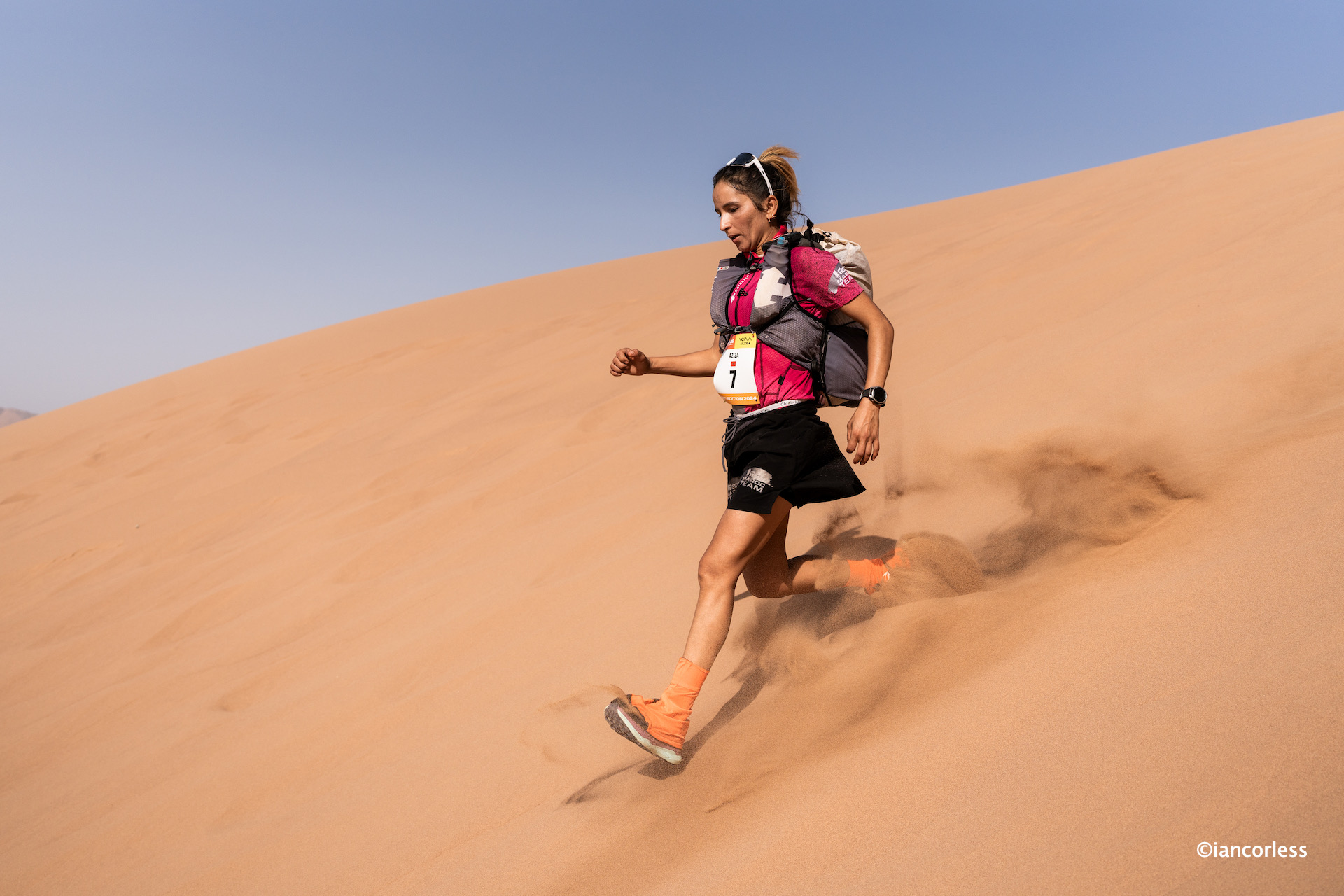
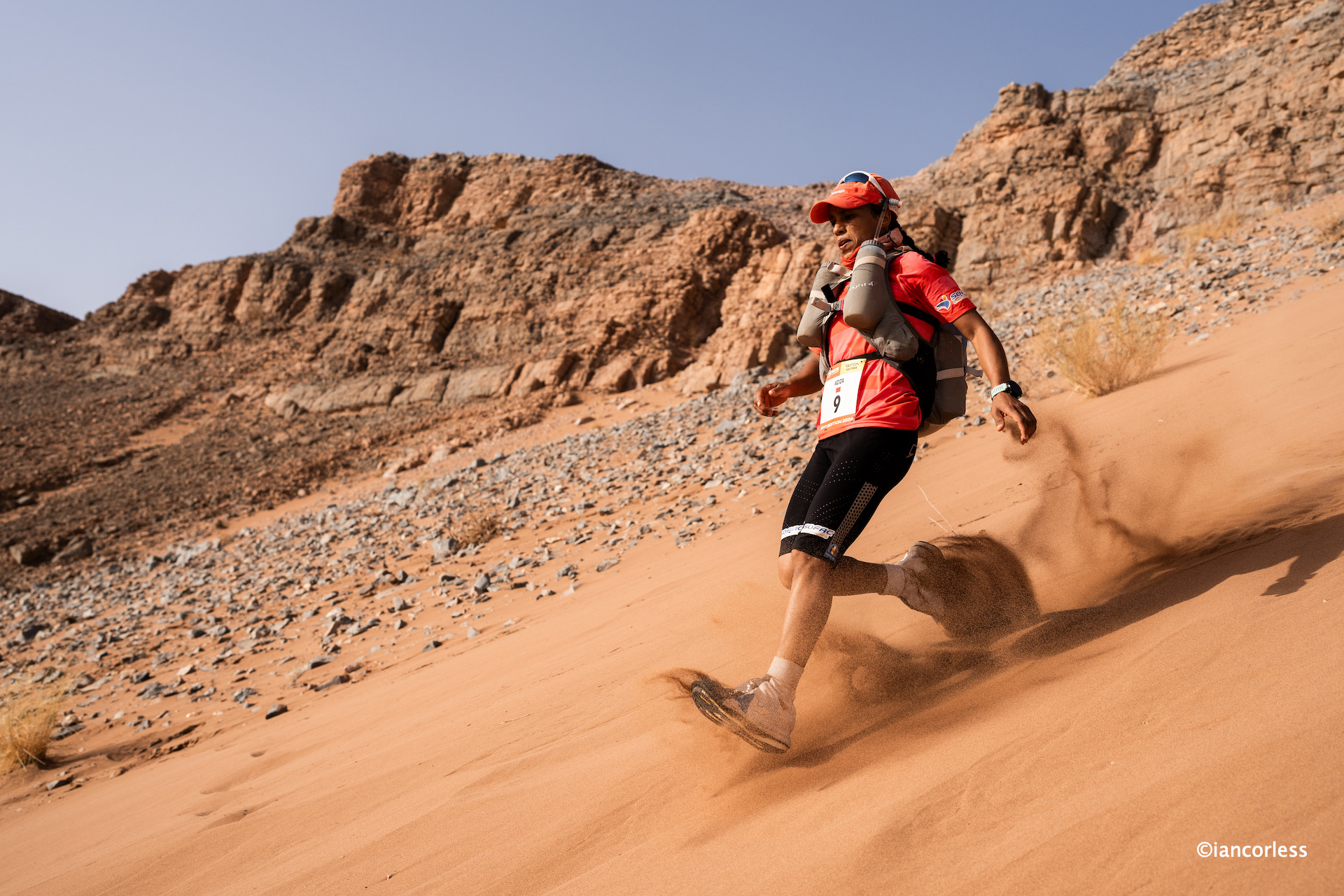
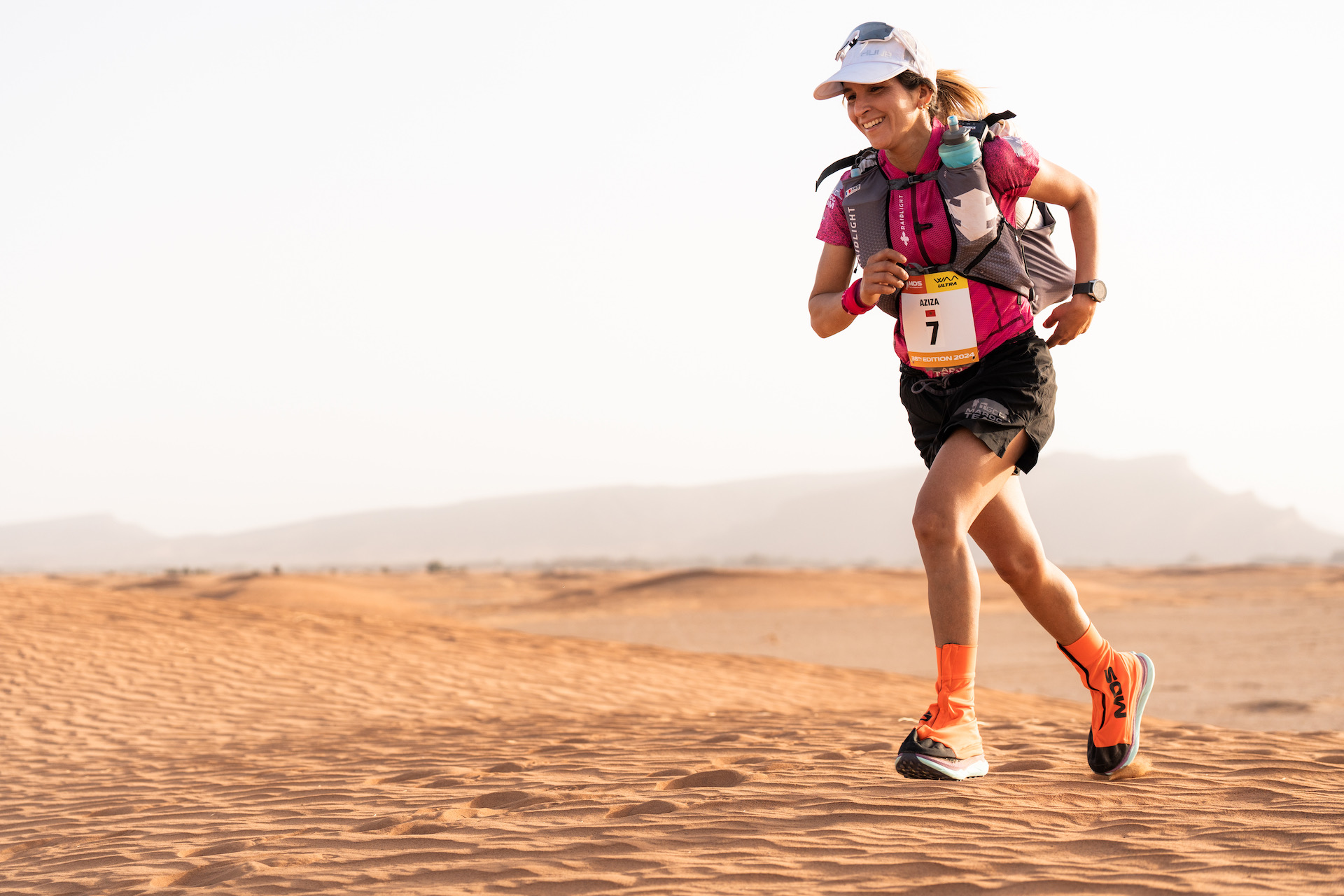
Aziza
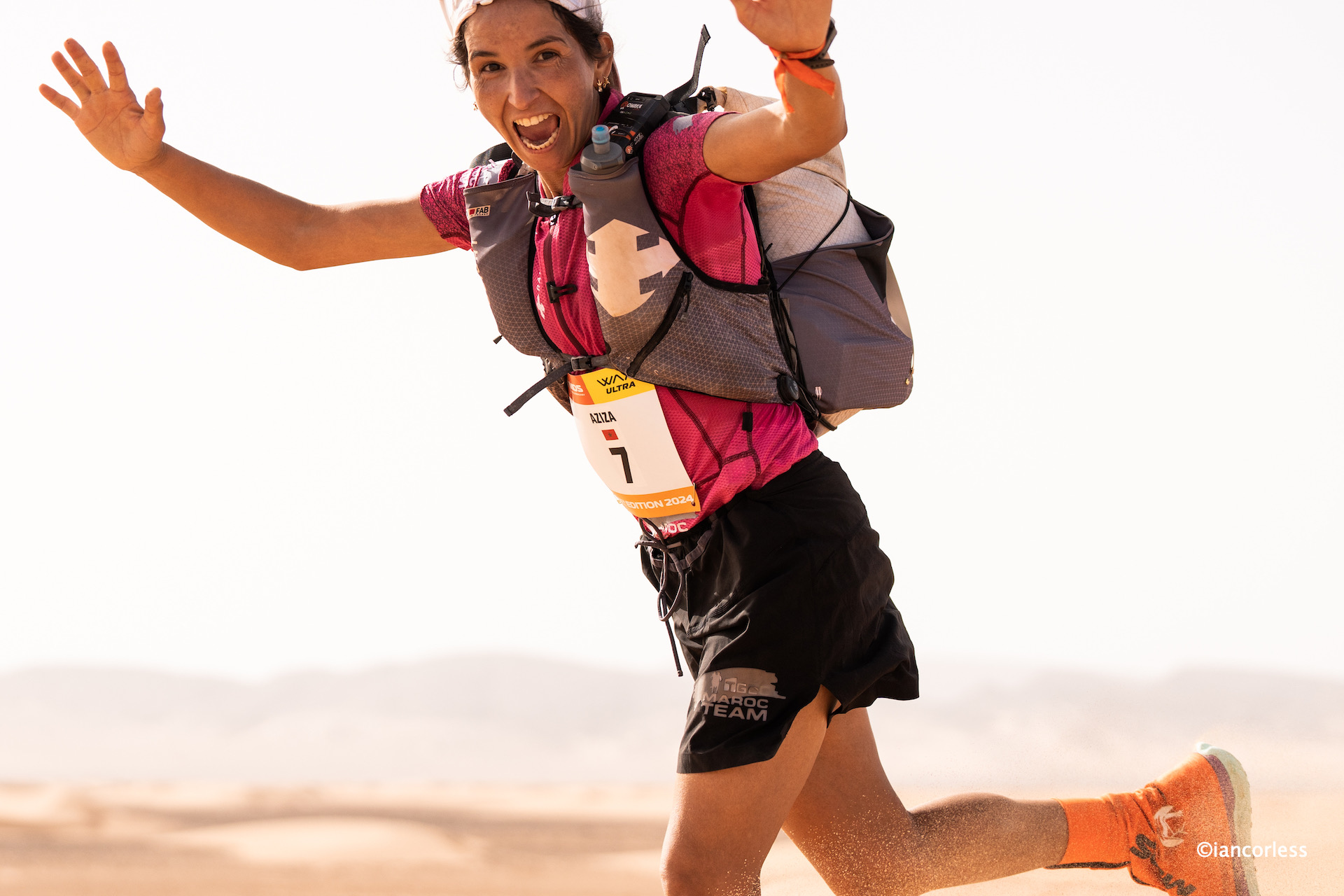
Aziz E Amrany has been at another level this year and once again she dominated the stage from the front with another stage win in 4:29:41.
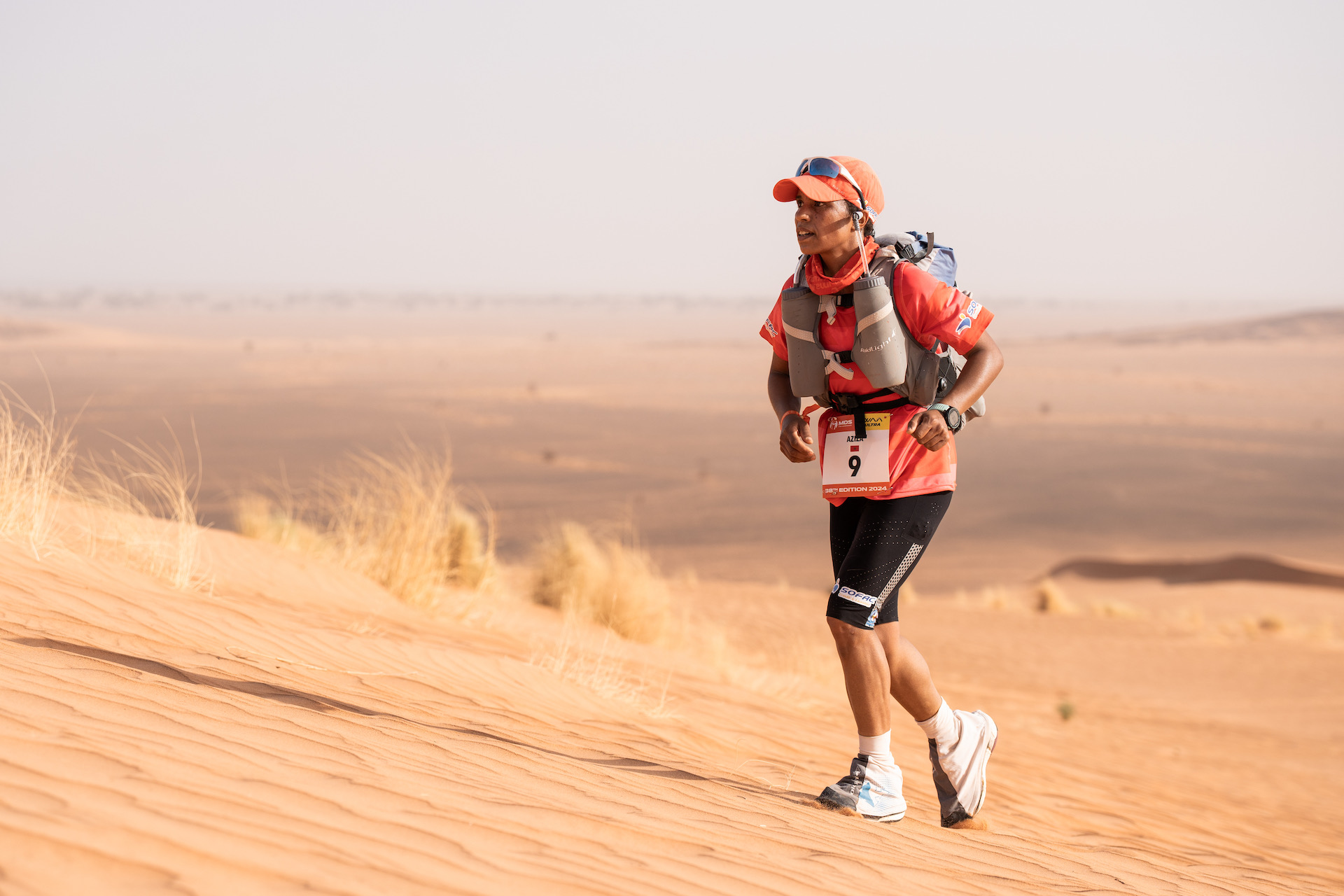
Aziza Raji
Aziza Raji followed looking relaxed and strong with a secure 2nd place in 4:53:08.
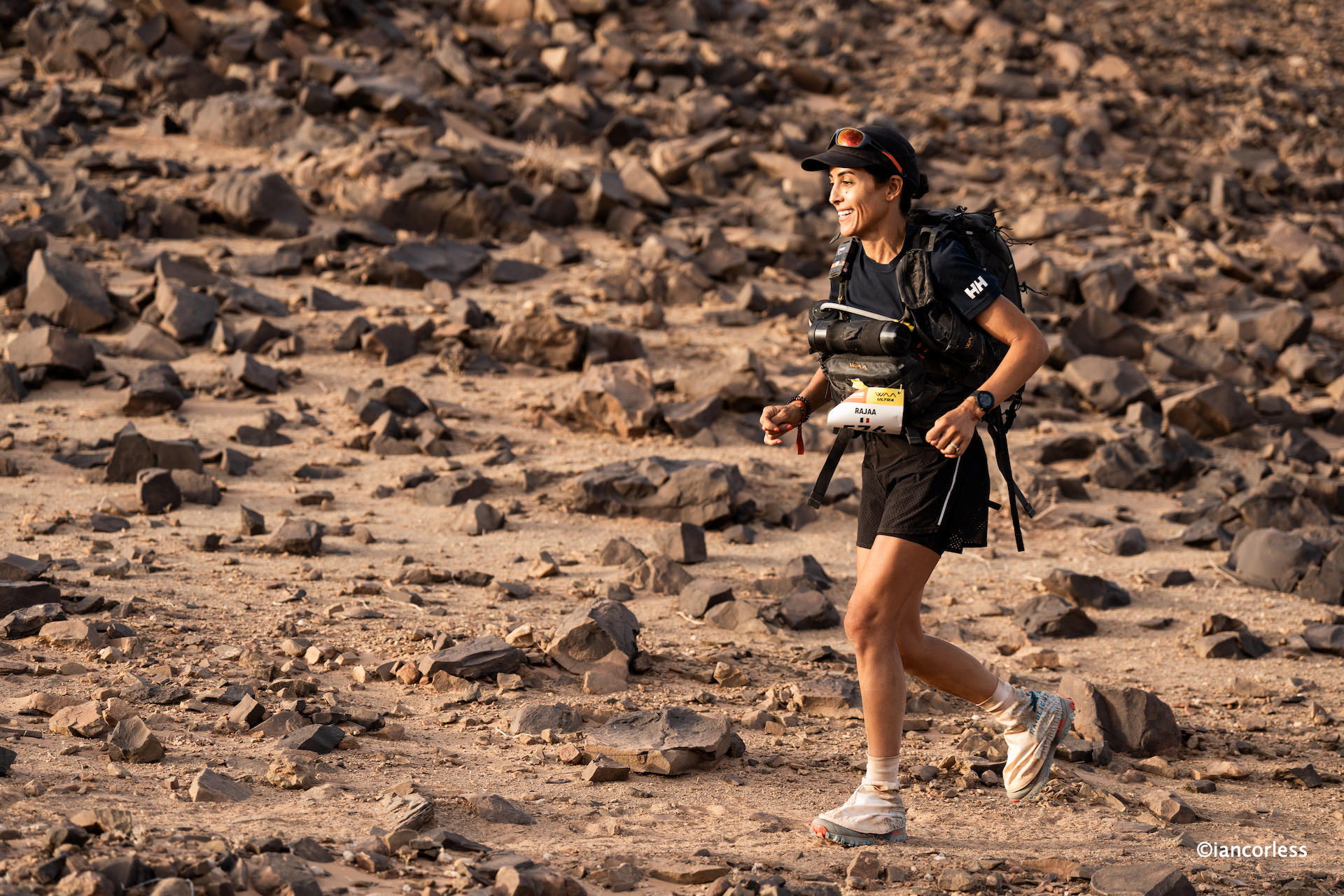
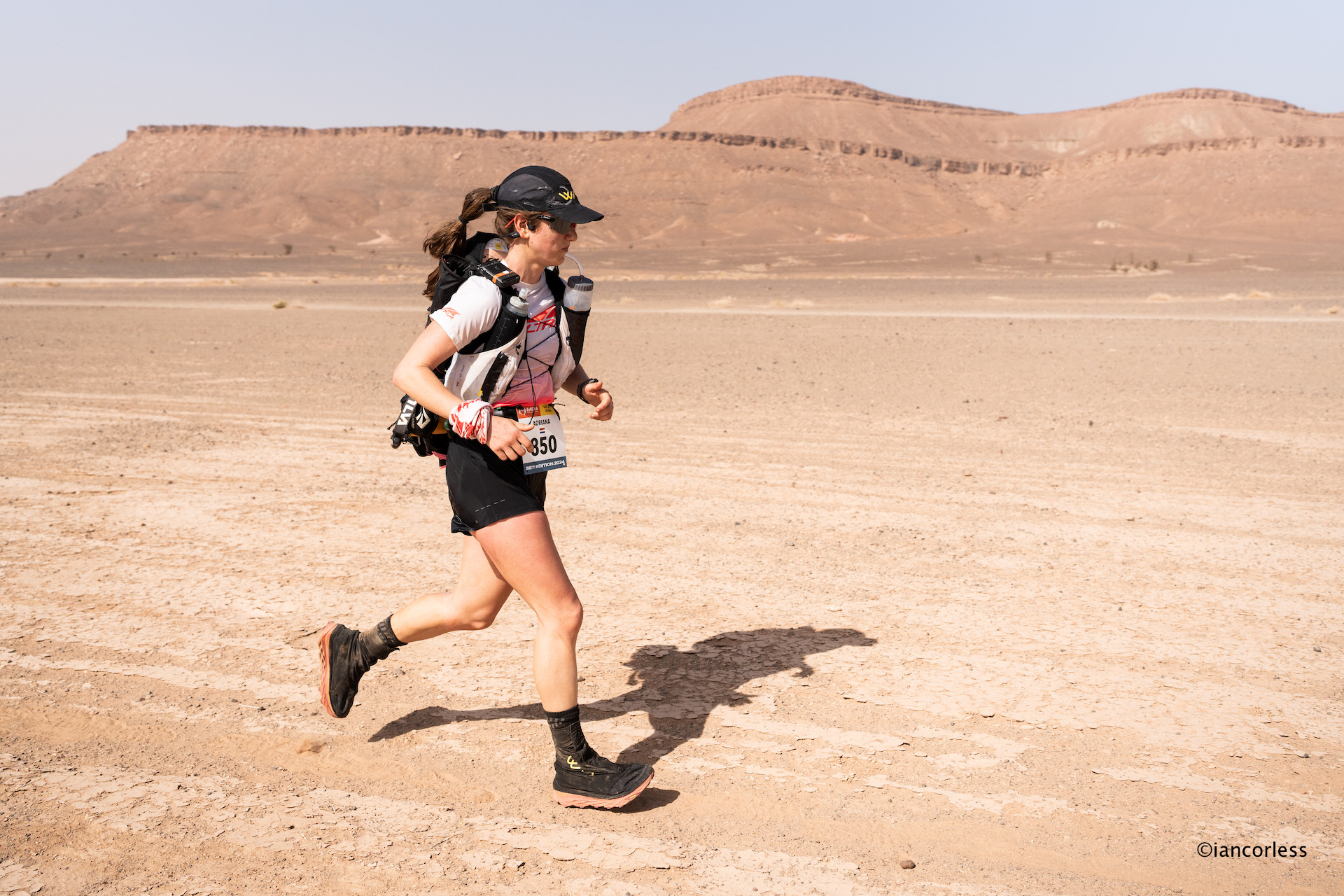
Adriana Moser
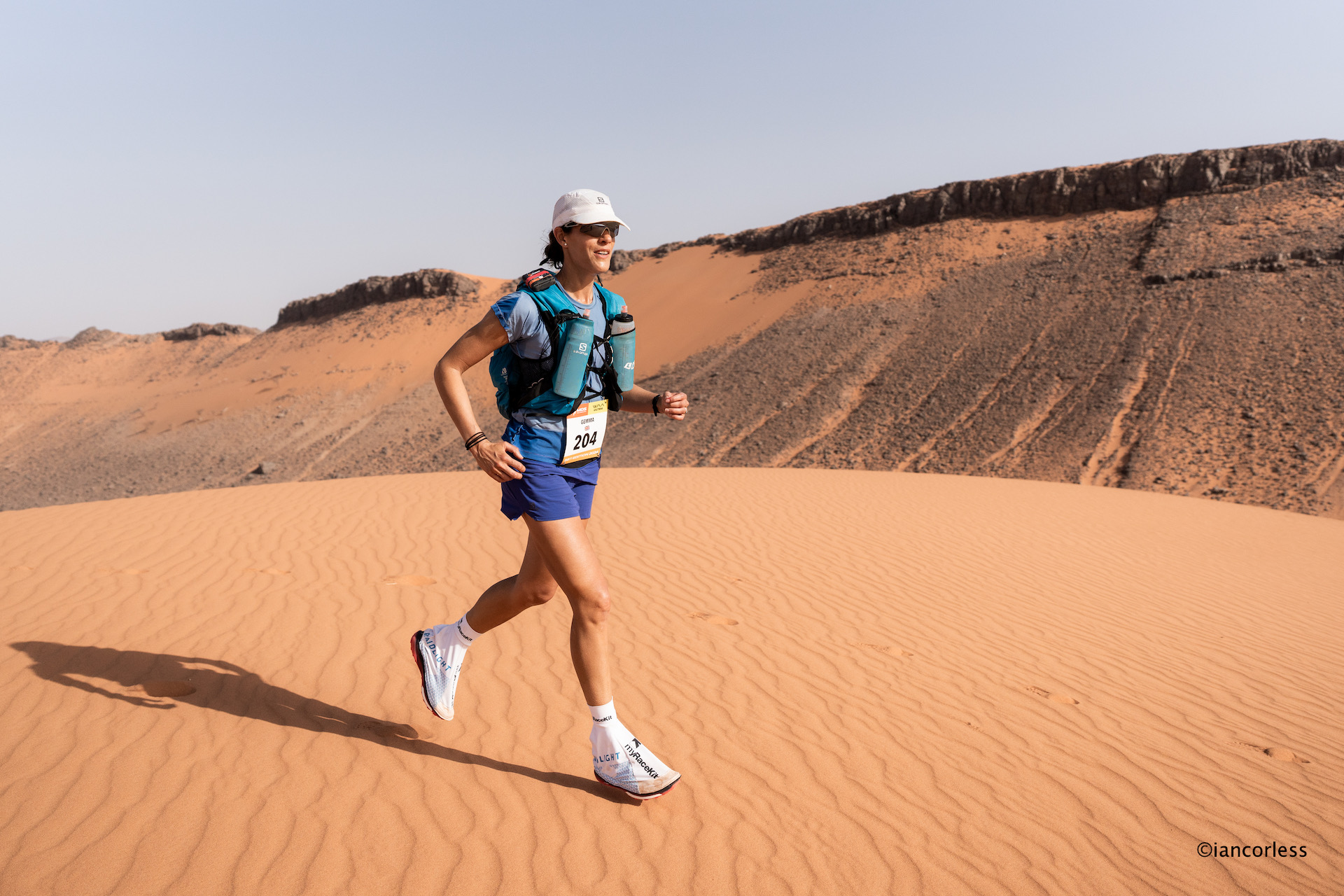
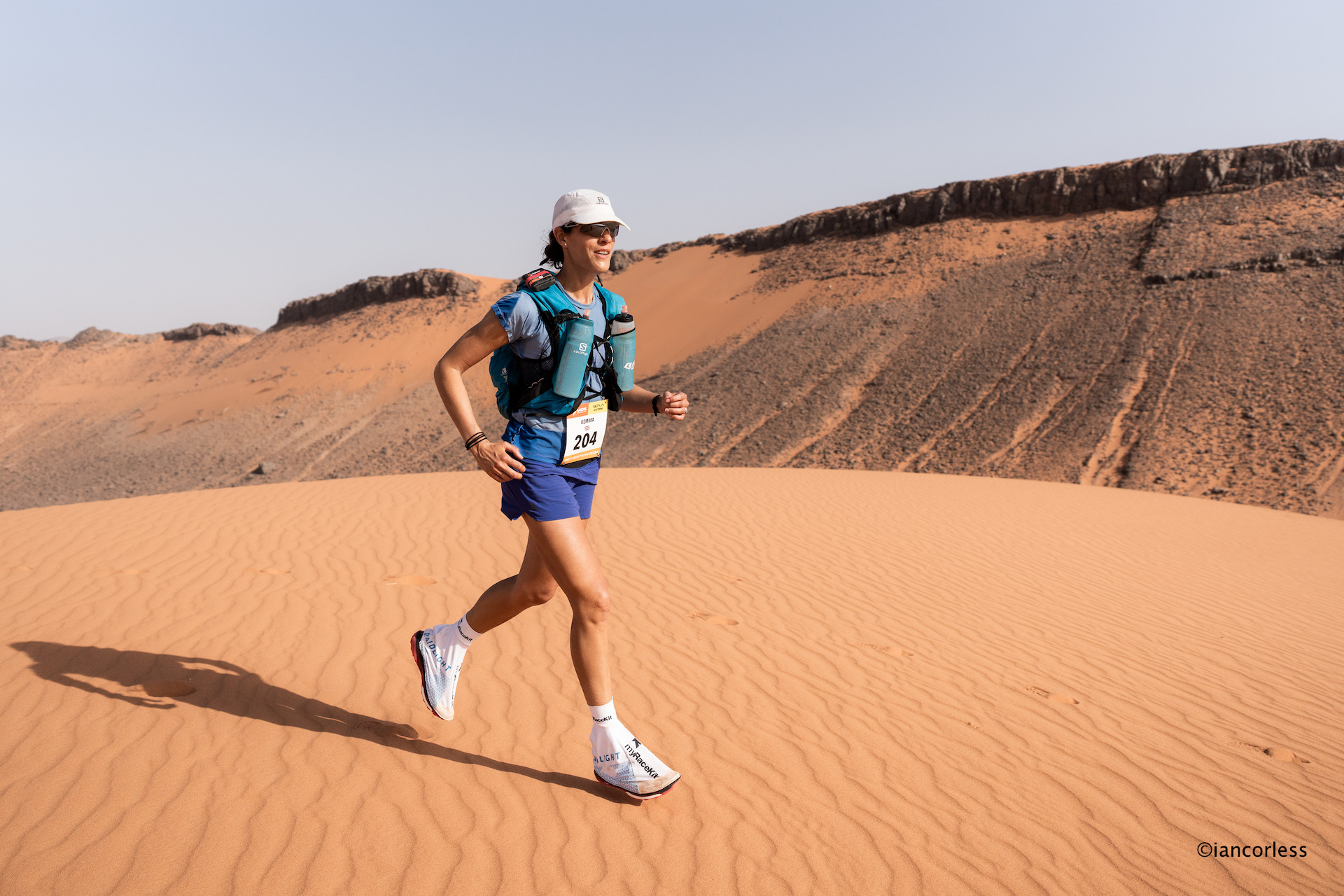
Sadly, 3rd placed runner Adriana Moser had to withdraw from the race at one of the CP’s opening the door for Gemma Game who has placed 3rd at MDS twice in the past; it maybe three times a charm! However, it was Rajaa Hamdaoua who was 3rd on the stage with 5:09:59.
The spectacle of the Sahara
You can receive daily updates and reports on this website. Follow on IG @iancorlessphotography and @mdslegendary
Stage 3, the feared ‘Long Day’ coming earlier in the race requires respect. Quite simply, with 3 stages still to go, energy management is key. However, it was a decision of the new organisation, to bring the long day earlier to allow participants to be fresher and have more energy for the challenge ahead. Also, with earlier starts, cooler temperatures for the early hours.
The route is a classic and arguably, I would say it is the most beautiful route of all the MDS I have experienced. It’s a tough one though!
From B2 the stoney climb to the summit of Jebel El Otfal is followed by the steep and sandy descent before a long flat run along the plateau before climbing and traversing the ridge of Jebel Joha Baba Ali, for me, one the best parts of the whole race! Another ridge follows before stoney ground and sand leads the route close to Ramlia and CP5. From here, the march continues.
Magical landscape
Ba Halou, Oued Rheris, Ras Kemouna, the salt flats, the iconic El Maharch and then a return to B2. This is a highlight tour of the Sahara that mixes plateau, technical terrain and lots of soft sand.
The 0600 start
With 7 CP’s: 12.5km, 24.5km, 35.2km, 43km, 51km, 63km and 74.5km, the requirement for extra water is important and therefore at CP1, runner’s were provided an additional 1.5ltr bottle so that they could increase their carrying capacity for the stage.
The majority of the field started at 0600 and the top-50 at 0730. While the top men and women would look to push the envelope, the early starts would mean a finish in daylight. For most, this stage is about survival and many went through the night and into the next day to get the job done.
It got hot…
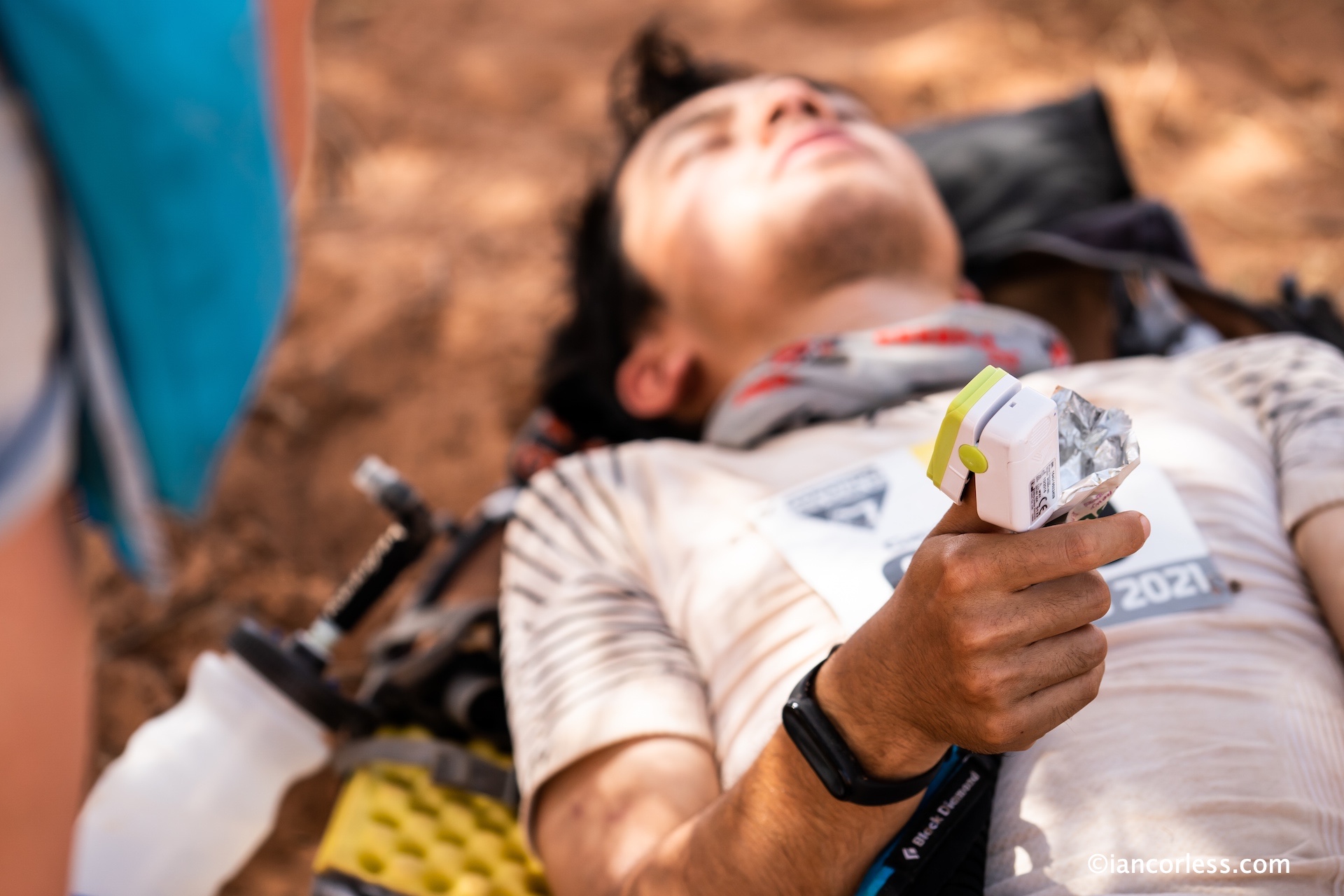
The winds had eased and the temperatures rose reaching a high of 33-degrees on the stage and a ”feel’ of 40-degrees during the mid afternoon. It was certainly a day that took it’s toll with many runner’s requiring attention and of course there were sadly DNF’s – a confirmed number to follow.
Starting 90-minutes after the masses, the top-50 were soon at Jebel El Otfal and the charge lead by Rachid El Morabity for the men and Aziza El Amrany for the women.
Rachid leading early on
After the first ridge, the format was the same, Rachid pusued by his brother Mohamed and Aziz Yachou, with Aziza Raji pursuing her Moroccan friend.
Mohamed takes the lead
By the second ridge, Mohamed was in the lead, Aziz followed and then Rachid, with CP2 close, a plan was coming in to action for the El Morabity brothers, but, what was it?
What followed, was a complete surprise, Mohamed opened up a lead and continued to extend time finishing in a remarkable 7:37:47.
Getting it wrong on Jebel El Otfal
Aziz and Rachid finished in 8:31:52 and 8:31:53 respectively – what just happened? There will be more news to follow on this when I get in to bivouac and discuss with the three protagonists. For now though, Mohamed had the run of his life and Rachid is unlikely (?) to win his 10th MDS.
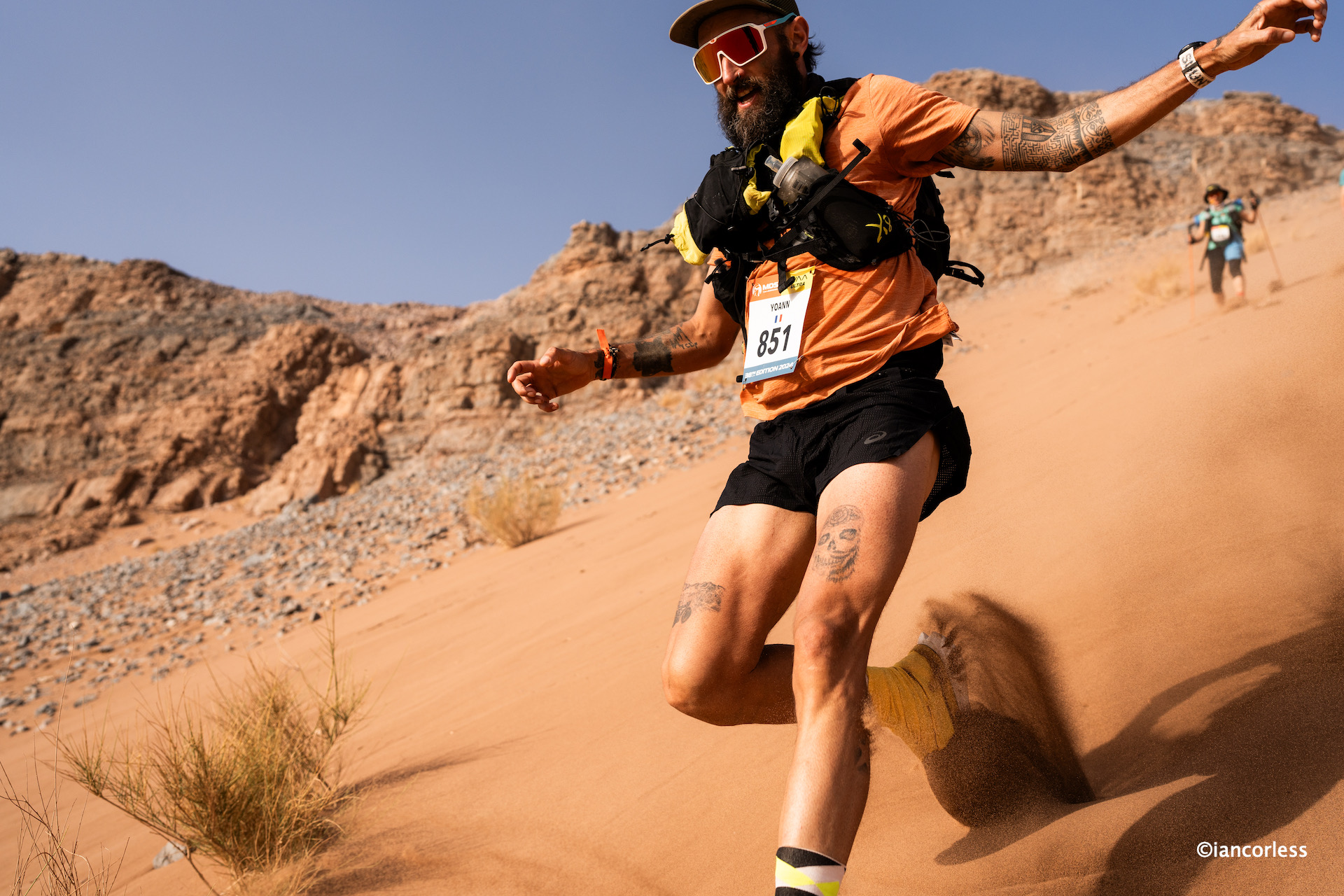
Yoann Stuck 4th
Yoann Stuck was 4th and Hamid Yachou 5th, 8:46:30 and 9:17:21.
Aziza El Amrany – incredible run
Aziza El Amrany is on fire this year. I have never seen her race and push so hard. It’s impressive, her victory was as equally mind-blowing as Mohamed crossing the line in 10:46:10.
Aziza Raji
Aziza Raji and Adriana Moser once again placed 2nd and 3rd, 11:24:29 and 12:05:06.
Adriana Moser
Day1 passes to day 2 and now those who have pushed through the night have another day to achieve the opportunity to fight another day.
A day of pain for some
You can receive daily updates and reports on this website. Follow on IG @iancorlessphotography and @mdslegendary
Stage 2, a beautiful stage of 40.8km’s travelling north to B2. This area of the Sahara has been used on multiple Marathon des Sables and rightly so, it’s an area that offers excellent terrain and visual splendour.
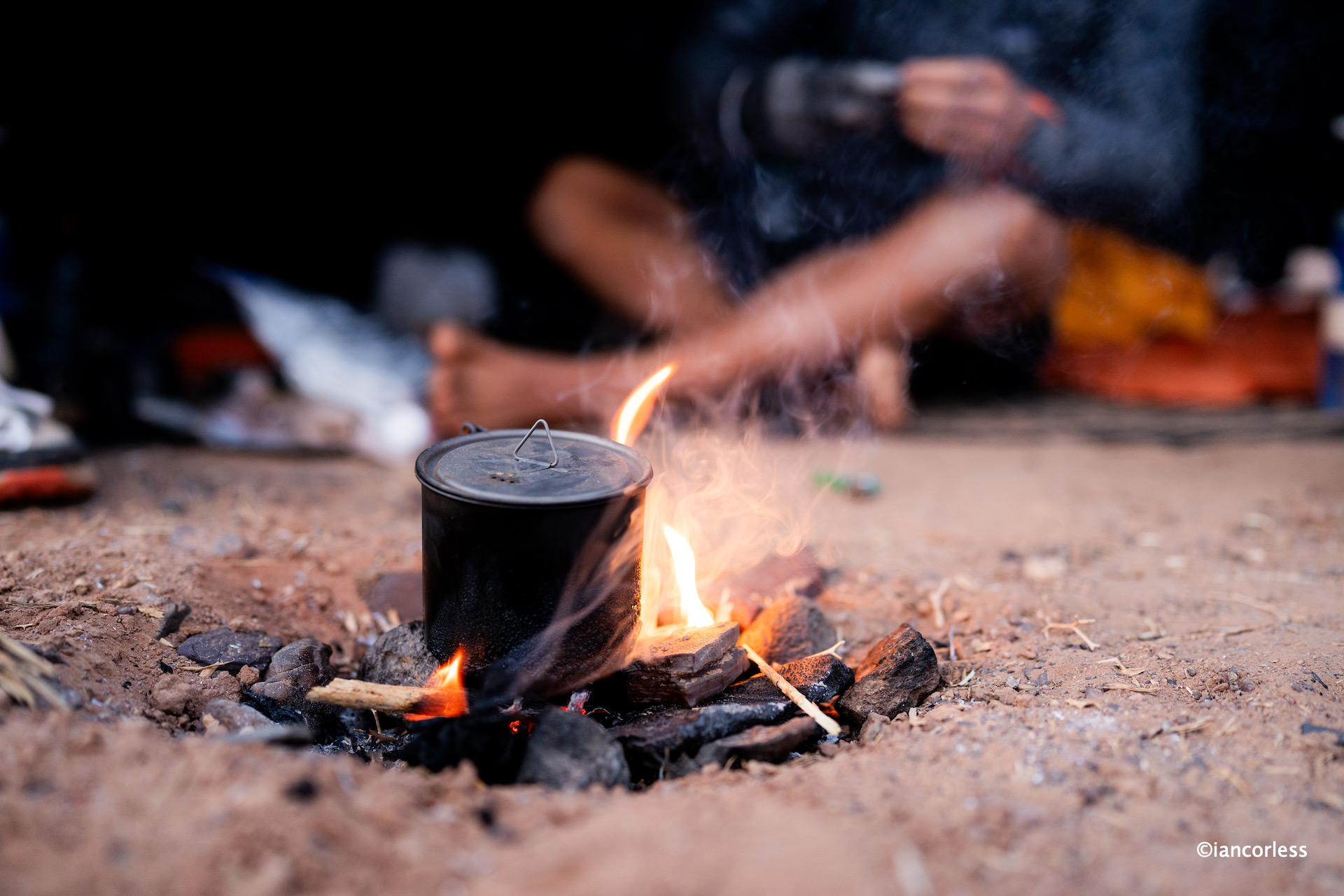
Breakfast before the start
The opening km’s to 6.3km ease the runner’s into the day and then the following km’s to CP1 at 12km are a challenge that sap energy.
CP2 comes at 25km however, the inclusion of an additional water station at 19.8km makes the stage more manageable.
Cold water at the checkpoints help runner’s cool off
Although the presence of soft-sand is minimal, the terrain is hard and energy sapping. CP2 to CP3 is just 8km (33km total) and then the final run in to 40.8km concludes the day.
Sand, golden light and mountain backdrops
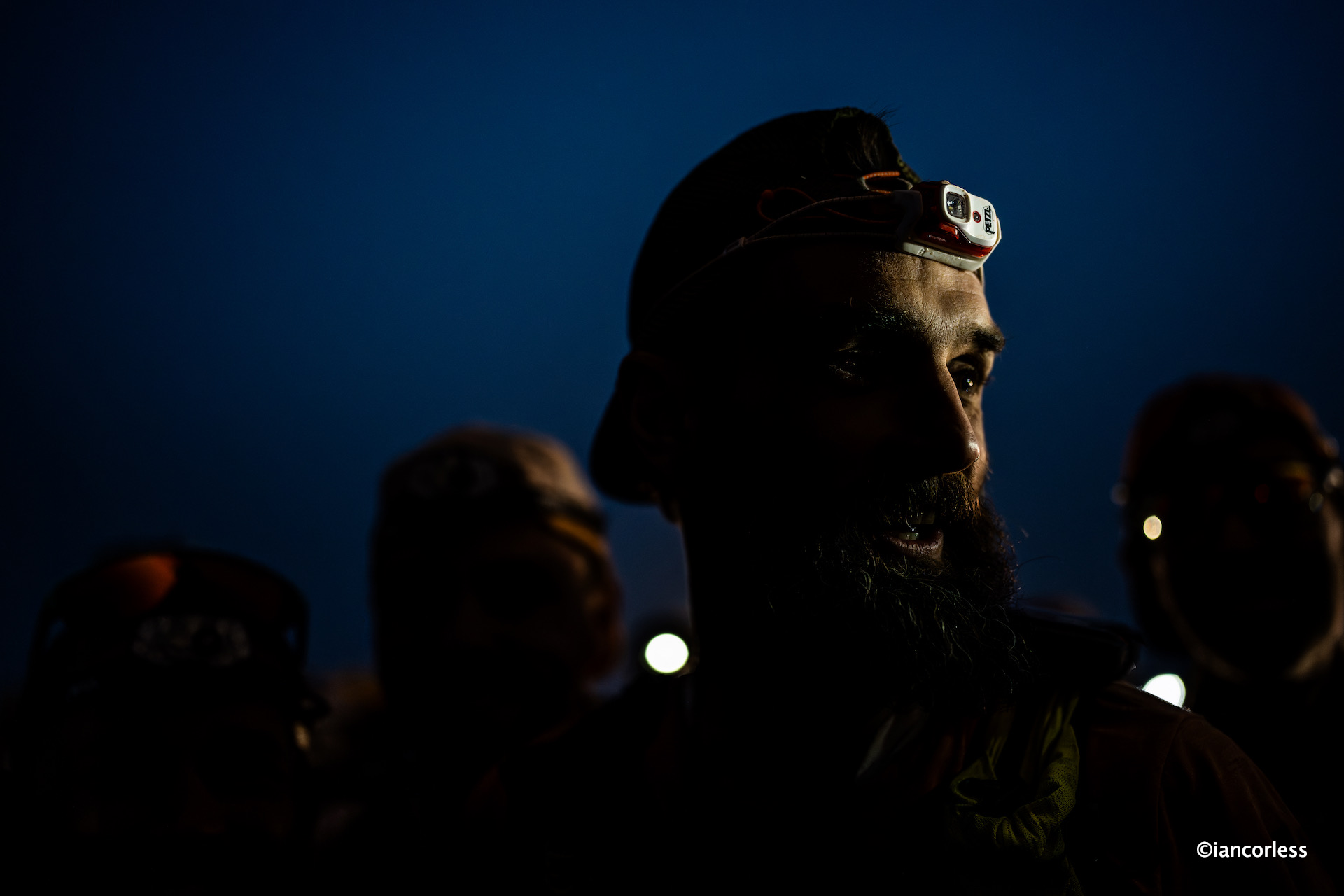
With an 0700 start, camp was alive with. head torches as runner’s prepared for the day. A mild night and finally, the wind disappeared.
Camp life
At the start, temperatures were around 12-degrees and they stayed low till around 0900 and then the mercury rose to a predicted high of 33-degrees.
The first downhill of the day for James Miller (ZA)
Although Rachid El Morabity had a lead early on, the day was very much neutralised for the top runners in Mohamed El Morabity and Aziz Yachou. They have respect for the long day on stage 3 and they all know this will be a crucial decider for potential overall victory.
A variety of terrain for stage 2
Mohamed, Rachid and Aziz all finished roughly together and with stage 2 complete, the time are 5:22:47, 5:23:14 and 5:23:16 for Mohamed, Rachid and Aziz respectively.
Aziza El Amrany unstopple for this 38th edition.
The women’s race had the same format as stage 1 with Aziza El Amrancy forging ahead for another stage win and a more substantial time gain, her time now 6:54:06 in comparison to 7:40:32 for Aziz Raji who also finished 2nd on the stage.
Adriana Moser
Adrianna Moser concluded the stage podium with a now total time of 7:51:49 with Gemma Game and Laurence Klein at 8:04:49 and 8:26:17.
Gemma Game
Stage 3 tomorrow, the long day, starts at 0600 for the majority and the top-50 at 0730. It will be tough day with no wind and rising temperatures.
You can receive daily updates and reports on this website. Follow on IG @iancorlessphotography and @mdslegendary
It’s all change for 2024 and with the race re-using several bivouac locations, the race will have a different feel and format.
Stage 1 MDS The Legendary 2024
Admin day passed yesterday and now everyone feels settled in their new home – a tent shared with 7 other souls. Camp life is becoming normal and anticipation is high. Weather has been ‘cool’ by MDS standards, however, the wind has been relentless with constant sand storms.
The start as sand blew through the Sahara
A key change for 2024 is also earlier start times to allow easier running in cooler temperatures, stage 1 with a scheduled 0700 call and 0730 start. It means morning prep and admin is taken mostly in the dark. Today was ‘chilly’ withe temperatures around 10-deg.
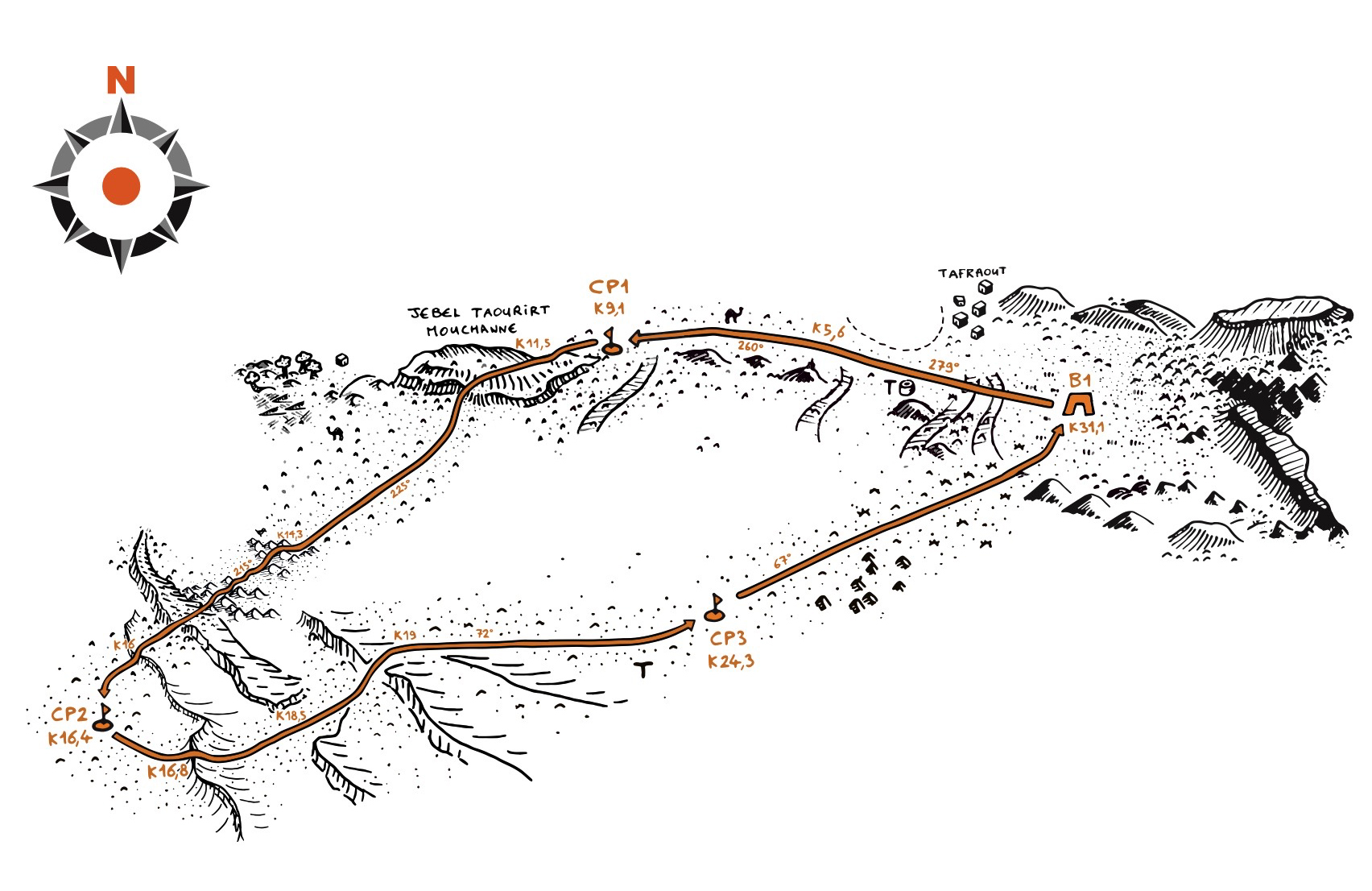
B1 located close to Tafraout offers an excellent location and this area is familiar territory for Marathon des Sables.
Rachid leading early in the race.
The distance 31.1km with 3 checkpoints coming at 9.1km, 16.4km and 24.3km. In many respects, it’s a good stage 1 with mostly hard and runnable terrain and little soft sand. A key feature around 10km’s is Jebel Taourirt Mouchanne and then challenging terrain from 14km to 19km before returning to where the stage started.
Stage 1 is always taken with caution, however, at the front of the race, an earlier start, cooler temperatures and a very runnable day could only mean one thing – a fast day! Temperatures for the early runner’s remained under 20-degs and it was midday bfore temperature reached 23-degrees with a possible high of 27-degrees.
Aziz Yachou
Uncharacteristically, Rachid El Morabity dictated the pace all the way to CP1. He usually starts slow and builds speed, not today, no doubt testing everyone else. He was closely followed by Aziz Yachou, his brother, Mohamed El Morabity and then Aziz’s brother, Hamid.
Aziza El Amrany
For the women, Aziza El Amrany dictated the pace and it was a fast pace building a large margin over the competition, notably Aziza Raji.
Aziza Raji
Quickly after CP1, Rachid eased up, and Aziz passed. Rachid then almost jogged allowing hos brother to pass and Hamid. A surprising tactic.
An early start and a low sun
From the final checkpoint, it all changed again. Now Mohamed leading the charge to the line, Rachid close behind and then Aziz, 2:11:09, 2:11:36 and 2:20:33 respectively with Hamid Yachou taking 4th ahead of Ahmed Ouikhalfen, 2:20:33 and 2:25:46.
Yoann Stuck
Top Brit was John Dewey in 6th, Yoann Stuck from France was 8th.
Aziza with a dominant performance.
Aziza El Amrany was a woman with a mission today, no doubt realising that 2024 is her opportunity for victory. She crossed the line in 2:45:54 and amazingly, past MDS winner, Aziza Raji crossed the line in 3:11:53 – a huge gap after stage 1.
Laurence Klein
Adriana Moser and Gemma Game ran much of the day together and they crossed in 3:12:53 and 3:13:45. MDS legend, Laurence Klein finished 5th in 3:23:13.
The last runner on stage 1 keeping ahead of the camels.
You can receive daily updates and reports on this website. Follow on IG @iancorlessphotography and @mdslegendary
Episode 246 of Talk Ultra is with Nicki Marsh as we countdown to Marathon des Sables – The Legendary. With a 50th birthday looming in 2024 Nicki had been toying with lots of ideas of how to celebrate… The only thing that truly excited me (and could fit around work!) was MDS. Her husband had done it in 2017 and said never again. However, it took him all of 30 seconds to agree to do it again, with Nicki!
“I have degenerative disc disease and osteoarthritis, 4 foot surgeries on and another one on the cards I am determined to keep moving. My goal for the race when we entered was to get to the start line, then do the best I can to finish, the plan was to walk. I believe setting the right goals helps you develop the right mindset and avoid disappointment.”
Episode 3 of the Marathon des Sables – The Legendary podcast is with Alexander Welch.
Alexander toed the line of the 2021 MDS but things did not go to plan… It was the year of excessive heat and Norovirus in bivouac. A year when 50% did not finish the race. However, the DNF for Alex raised some demons.
“I participated in the 2021 October edition of MDS and was medically removed at checkpoint 2 on day 3. Being only 25 years old at the time, and having never failed at anything prior, this was a massive mental blow for me.”
Falling into a downward spiral. Alexander’s life tumbled; as a coping mechanism, he turned to excessive drinking and substance abuse, this impacted on work, relationships and his own mental health.
“This went on until about November 2023 where I reached out for help of my former tent mates (4 of which are also returning in April 2024). I managed , with their support, to pull myself out of the degenerative cycle that had encapsulated my life for almost 12 months. This culminated in signing up for the MDS 2024.”
There is not much shade in the Sahara, so, don’t rely on it.
Marathon des Sables – The Legendary will soon be here and now is the perfect time to make sure that you plan for a series of protocols to acclimate to heat and the stress of heat before arriving in Morocco.
In simple terms, you need to impose heat stress on the body that will simulate the conditions you will race in when in the Sahara.
Heat exhaustion brings you to a stop and may well mean a withdrawal from the race.
Acclimation to heat should be done close to competition, ideally sub 21-days and ideally in the final 14 and 7-days. Statistics show that 5-sessions (or more) offer a more fulfilled adaptation. The pseudo motor function (sweat rate) takes a little longer to occur, but all the other measurements, cardiovascular and lowering core body temp occurs quite rapidly. However, 5-10 sessions will allow even greater adaption, and provides better results in particular with sweat rate.
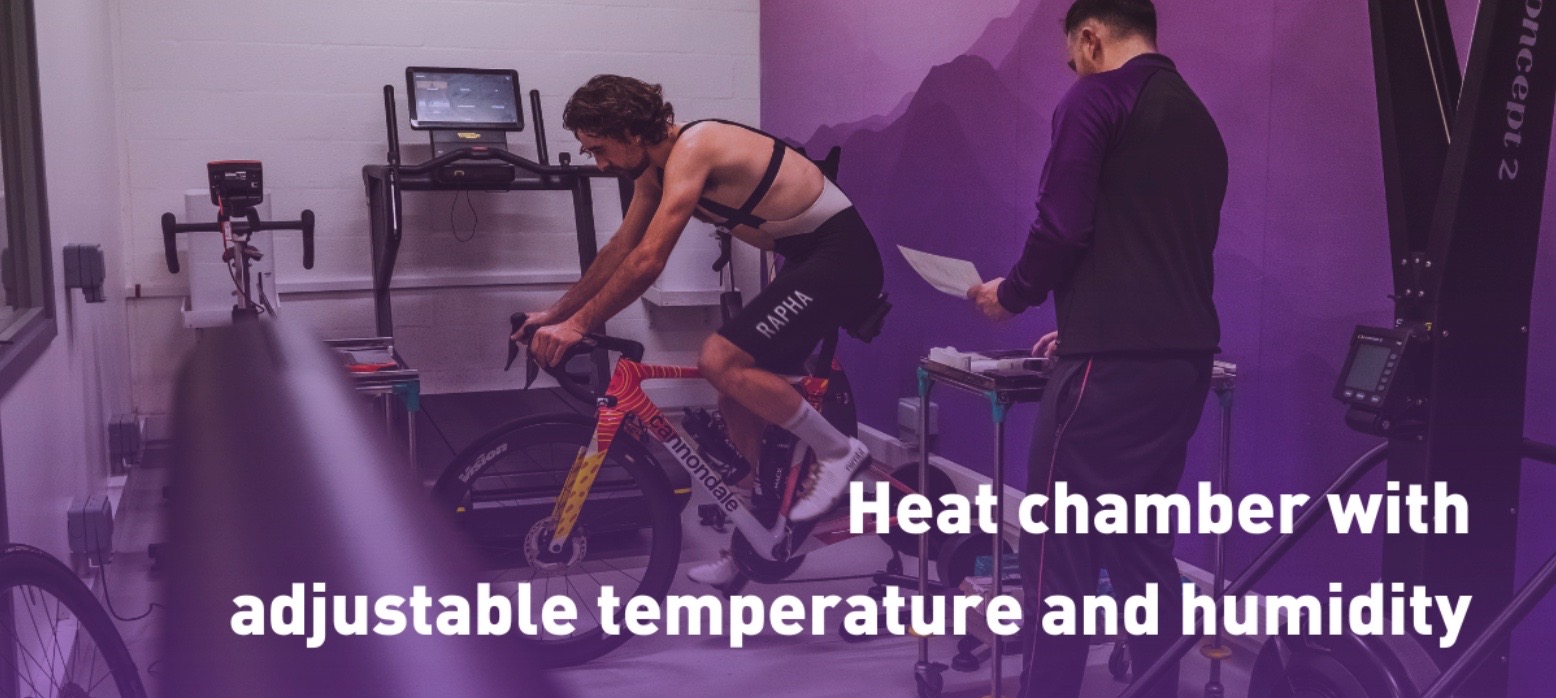
Now of course, if one is fortunate with time, the best scenario is to travel to the race location and adapt naturally in the environment of the race. Reality is though, few of us have this option and we must therefore simulate the stress of heat. The most obvious and effective protocols take place in an environmental heat chamber. Sessions could be performed every 2-days in a 14-day window. Adaptation from exposure diminishes rapidly, so, there is no need to do this too far away from the chosen event.
Expense can be an issue and therefore there are other possibilities. Keep training as planned and add layers of clothing while training. Post training, when already hot from the stresses of a run, you could then take a hot bath which will raise core temperature. One can also consider Bikram Yoga and use saunas. The reality is though, while some of these interventions will have some benefit, and most certainly, they are better than nothing, it is not something that can be recommended completely as it is harder to prescribe and measure.
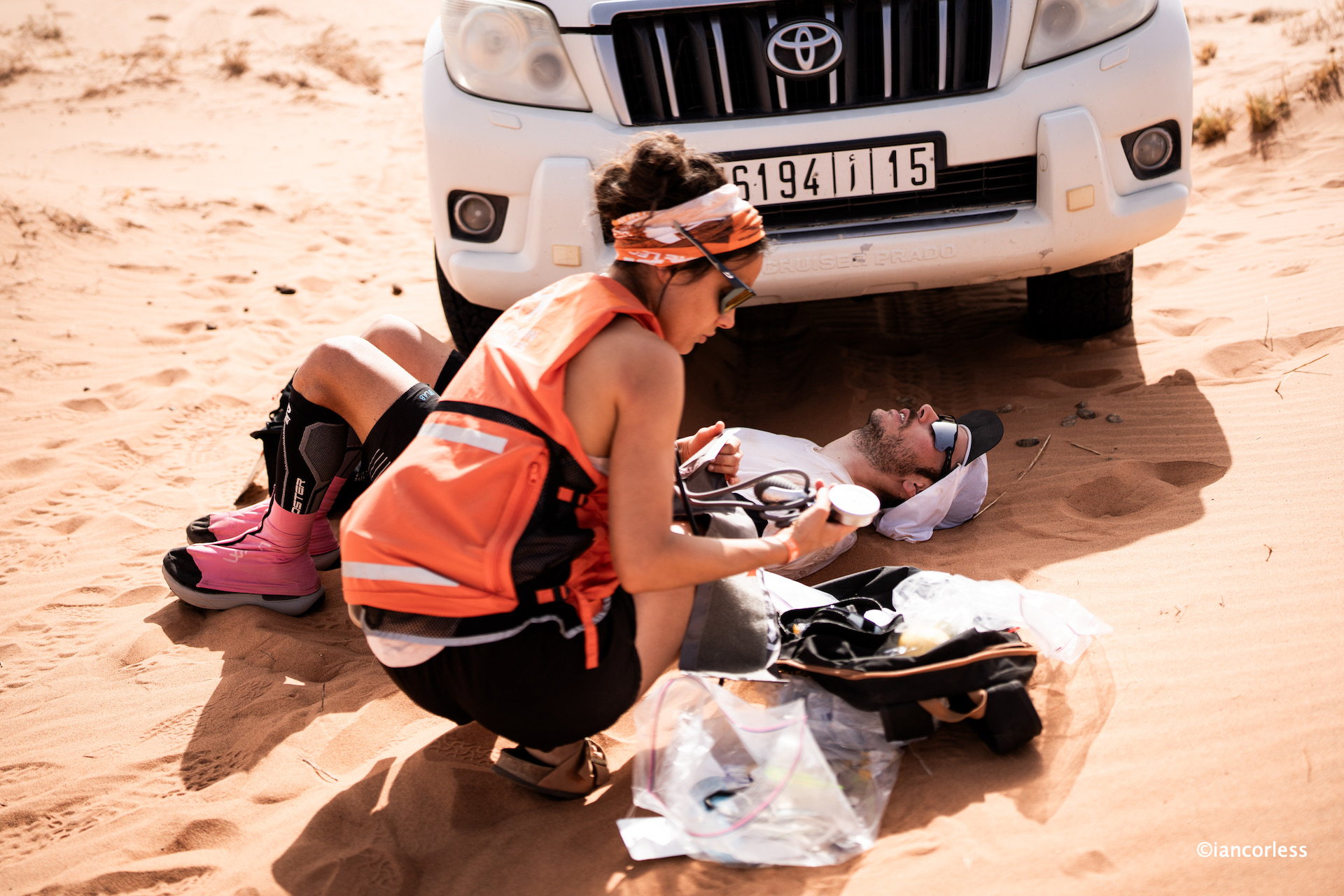
When it all goes wrong, shade and an IV drip may be required.
Environmental heat chamber
Environmental heat chamber is controlled and measured and in addition is monitored by a professional who gradually controls and analyses the stimulus to ensure maximum benefit and importantly, safety. In regard to session length, sub 60-minutes is usually adequate and this allows the body to get hot enough.
Image (c) Loughborough Sport
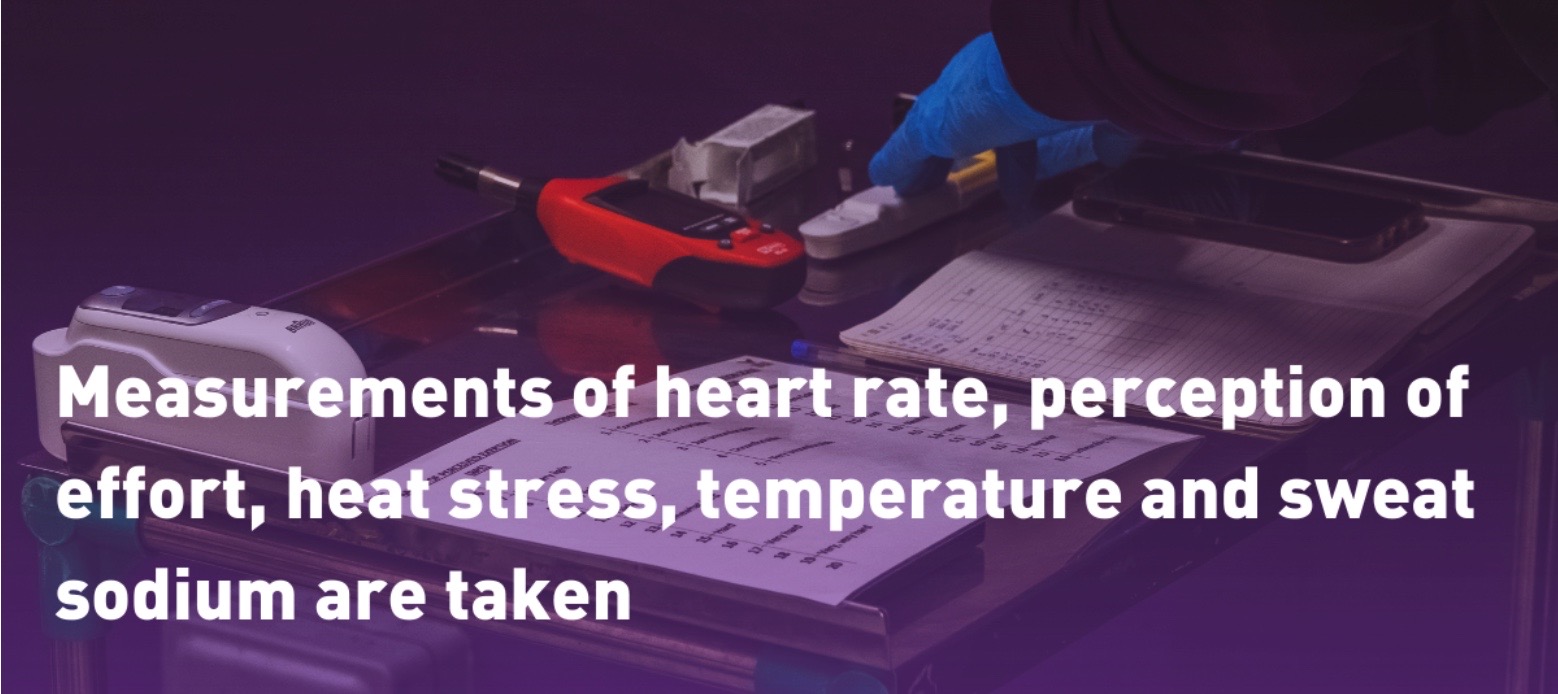
The use of a rectal thermometer is used to ensure that you reach the required thermal stimulus. Body weight is measured when naked and then this figure is used to measure fluid intake and sweat rate. Urine tests may be done to look at hydration status. It’s important that a client leaves re-hydrated after a session.
Image (c) Loughborough Sport
It’s important to remember, these sessions are about heat adaptation, they are not training sessions. A treadmill or bicycle is used and many testers prefer the bike as it adds less impact to the body and fatigue.
A 5-minute check will include heart rate, core temperature, skin temperature, perception of thermal environment, how hot does the client think it is? And finally, the tester usually asks how comfortable the client is. Then, the protocol will begin.
The target is a core temperature of 38.5 degrees in each session, which is ideal for pseudo motor and thermo functions to be maximised. Measuring the thermal strain is key. It usually takes about 30-minutes to get to 38.5 degrees depending on the individual. But external factors do have an impact. The session is about controlling and meeting a fixed criteria.
The first two sessions are often a challenge and then by session three, improvements can be noticed with the greatest improvement coming after day five with seven sessions being a great target to work towards. Total exposure is more important than days, so, if challenged for time, it is possible to do two tests per day, say AM and PM. As stressed above, the optimal time window is in the 14-days counting down to the event or race.
Loughborough Sport in the UK offer specific heat acclimation – book HERE
Do you need to acclimate to heat?
All runners in the Sahara will be faced with physical and perceptual challenges that will have negative effects on performance if not acclimated.
They will be slower, frustrated, dehydrated and have a potential of heat stroke and ultimately they may not finish the race.
Acclimating to heat pre-race prepares the body for the challenge to come!
Too hot? Cool down.
When in the race, if you experience negative effects of heat, is there anything that can be done?
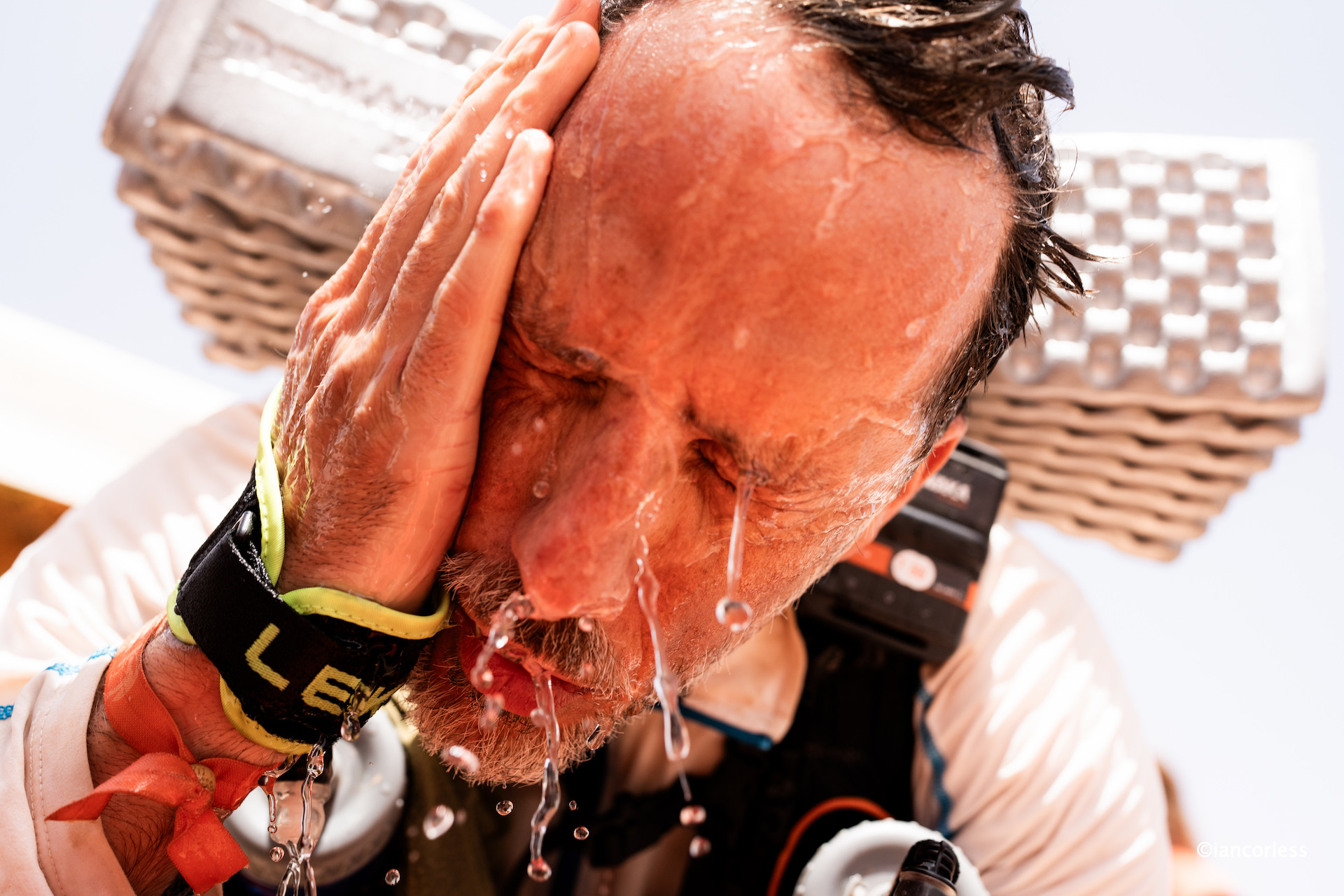
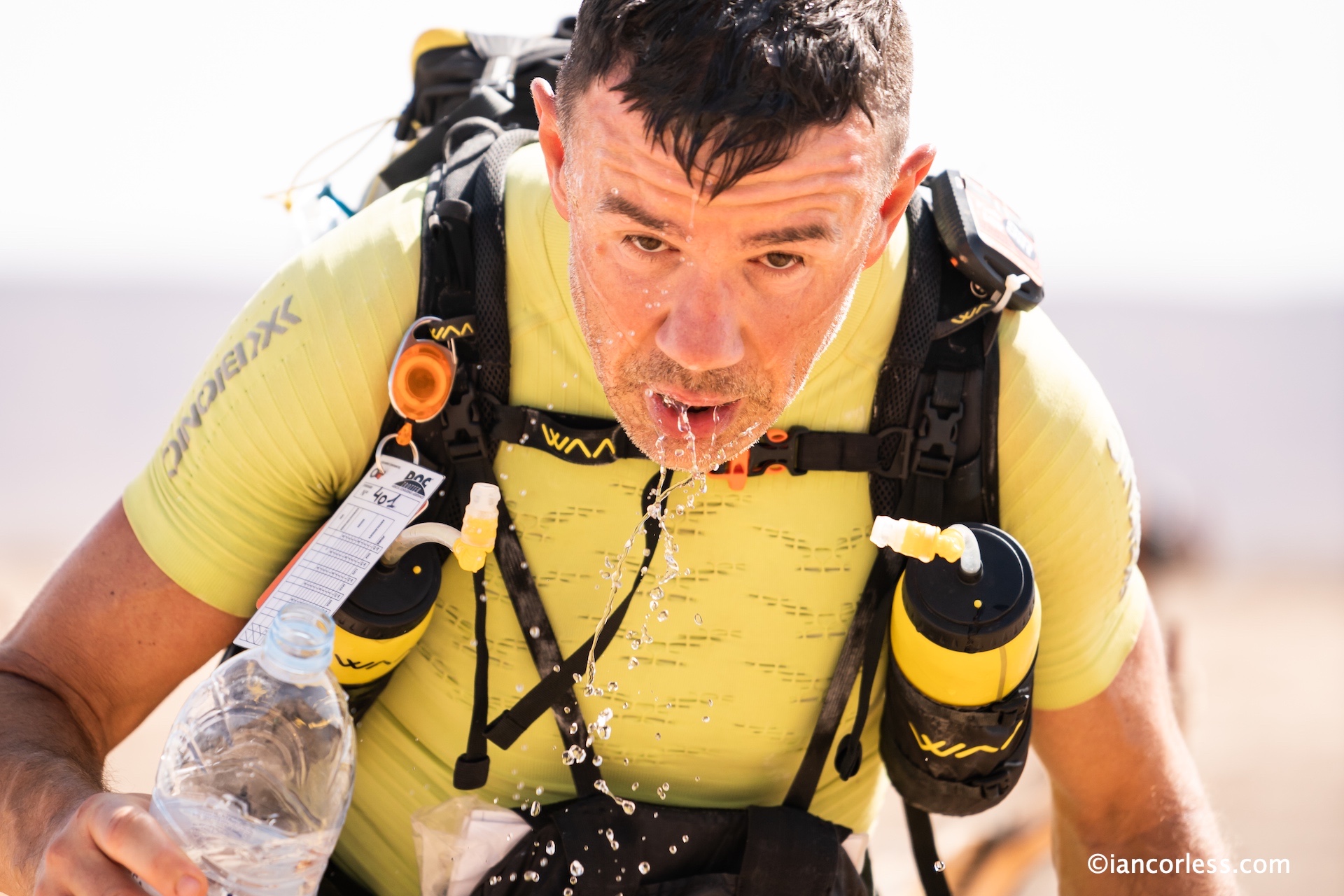
Yes, slow down, try to cool down as much as possible, seek shade at aid stations, rest and allow the core to lower. Hydrate and use spare water to provide a perceptual cooling: water on your face, head, forearms and neck will help a little with this.
Conclusion:
When one runs, you use muscle mass and this generates heat. When you then exercise in a hot environment, particularly if it is greater than skin temperature, then this makes it very difficult to get rid of heat. Humans are not the most efficient mechanically, so this energy from contracting muscles, potentially around 20 to 30% of the mechanical energy being made is converted to chemical energy, that means 70%, maybe even more, needs to be eradicated in the environment. If the environment is hot, for example, the Sahara, a challenge is imposed to eradicate the heat and what often happens is is that the heat is stored and one feels hotter and this then has a cascade effect of issues and problems, physiologically and perceptually.
Physiologically there is an increase in skin temperature as it is directly impacted upon by the environment. There will be an increased demand for blood flow that needs to go to muscle to provide it with oxygen/ energy to run, but also there is a competition for blood flow to the skin. In order to thermo regulate, blood is competing with muscles and skin and that creates an impact on one’s cardiovascular system. Typically, heart rate will increase due to the increased workload sending blood to muscles and skin. Body core temperature will increase. Sweet rate will also increase and therefore the percentage of water loss will increase and the consequence of this is dehydration – a deficit in body water with onward complications.
Trained individuals can gain thermal adaptations, irrespective of environment. For example, if you are training everyday, particularly at a high percentage of VO2max, one will create heat and this will require a higher sweat rate and therefore adaptation takes place. But, interventions should be in place both acute and chronic, to minimise the effect of environment on performance. Environment, will always have an impact on performance, no matter which athlete. So, make a plan now to adapt and acclimate in the final 14-days pre-race!
This article is based on a podcast (episode 191 of Talk Ultra) with Dr Jodie Moss PhD Sports Physiology, MSc Sports Nutrition.
You arrive in Morocco, pass through passport control, wait for your luggage, leave the airport arrivals hall and find a seat on a coach.
The MDS journey is now in full swing.
Waiting in anticipation, the Road Book (the bible) for the next edition of the race is provided and immediately pages turn, running through the mind of each participant:
“How long is the long day?”
Well, the wait is over, I can tell you. For 2024, the long day will be 85.3 km’s.
The MARATHON DES SABLES – The Legendary is breaking silence and today, we announce the daily stage distances for the 2024 edition.
Stage 1 : 31.1 km
Stage 2 : 40.8 km
Stage 3 : 85.3 km (over 2 days)
Stage 4 : 43.1 km
Stage 5 : 31.4 km
Stage 6 : 21.1 km
Total 252.8 km
Marathon des Sables typically takes place in this key area.
Taking place in the southern Moroccan Sahara since 1986; an extraordinary adventure will take place covering 252 km’s, the longest edition in the race history. Lasting 11-days with 9-days in the desert, divided into 6 stages over 7-days, a magical crossing of the Sahara walking or running.
The exact route, with maps, will once again be covered in detail in the road book, which as per usual, will be provided in Morocco whilst on the way to the bivouac one.
This is the first time that the daily distances have been disclosed before arrival in Morocco. Does this change anything? No, not really. I guess there is a reassurance knowing that the long day is not 90+ km’s.
However, with the 2024 edition being 252 km’s and over 6 timed stages, it was my prediction that this race would be a tougher challenge in contrast to those that have gone before. Therefore, to ease minds, the distances have been announced.
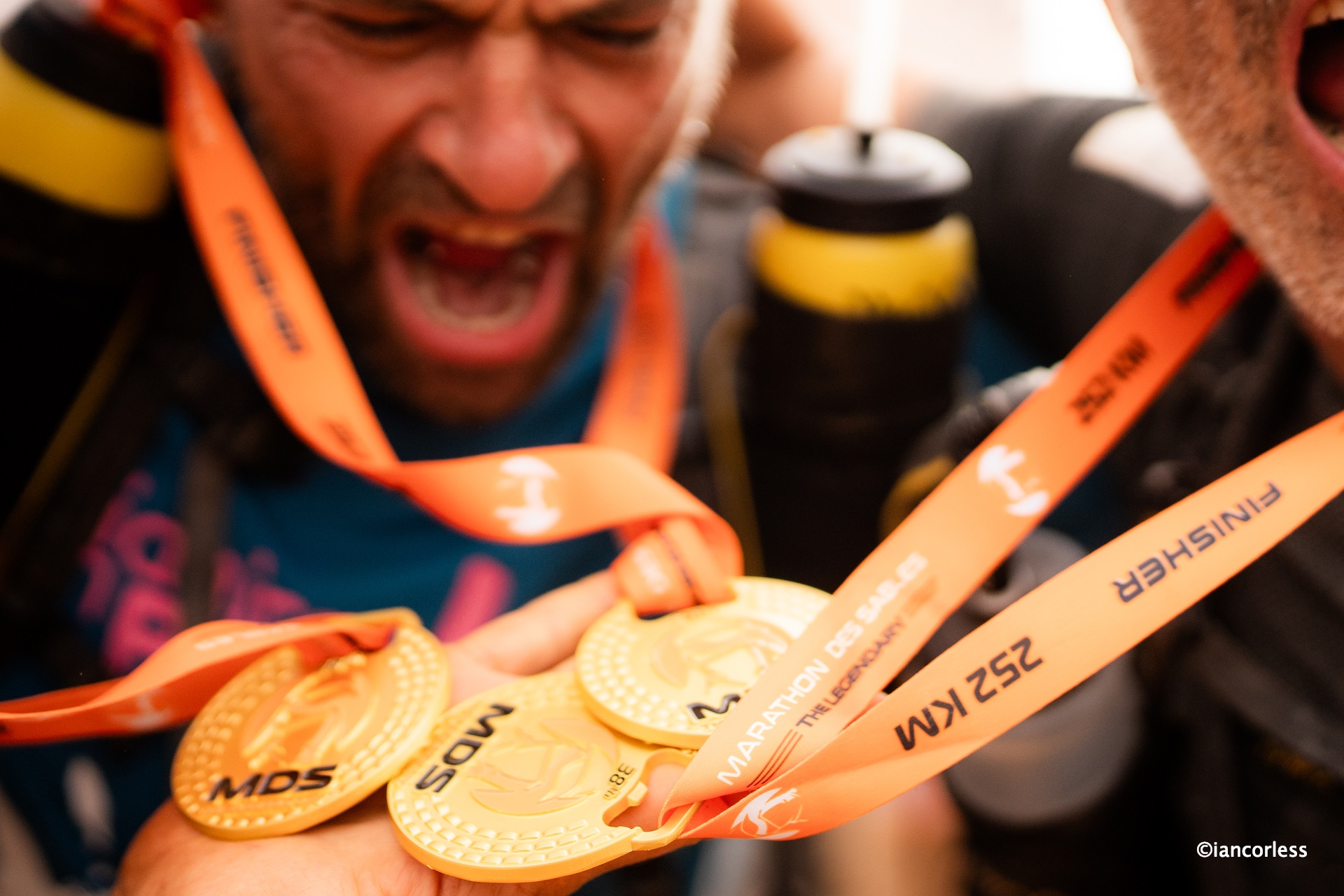
Previously, the long day would come on stage 4 (over 2 days) and it would be followed by the marathon stage. It was common thought, “Get the long day done and it’s just a marathon to go!” At the finish of the marathon, the medal would be received; job done.
Now, with the long day coming on stage 3, you still have 3-stages to run totaling 95.6 km’s. This will require a completely different mental and physical approach.
As we countdown to the 2024 edition of the Marathon des Sables – The Legendary, we will be providing a series of monthly updates, articles, interviews and podcasts.
The 2024 Marathon des Sables – The Legendarywill be the longest edition in the 37-year history of the race. At 252km, the event will now take place over 6-stages/ 7-days and not 5-stages/ 6-days as announced in late 2023.
It was clear initially that the 6th stage charity stage would disappear, however, on reflection, the new organisation have decided to continue with 6-stages but this time, all stages will be timed. The charity stage in previous editions was not timed.
The infamous long day which typically took place on stage 4 will now move to stage 3 for 2024, this will be day 3 and day 4 of the race as it has an extended time allowance due to the distance.
What does the above mean for the runner?
252km’s is a long way, but the race has always been advertised as 250km’s, so, although the race has fluctuated in distance over the years, the 252km should not come as any great surprise.
The timed stages now numbering 6 and not 5 will make a big difference, especially with the long day coming on stage 3. This will mean that stage 4, stage 5 and stage 6 will need to approximately cover 100km. This makes for a tough end to the week. In past editions, the long day was feared but on completion, many had the mindset, ‘It is just a marathon to go!’ Now it will be significantly more.
The daily distances are typically never disclosed before the race and the jury is out if the distances will be announced pre arrival in Morocco, watch this space! However, it is pretty easy to guess on approximate distances.
Historically, distances for the stages are listed as follows:
Stage 1 from 28 to 35 km
Stage 2 from 28 to 39 km
Stage 3 from 28 to 39 km
Stage 4 (The Long One) from 75 to 85 km (over 2 days)
Stage 5 (Marathon Stage) of 42.195 km
Stage 6 Charity
We know the 2024 edition will be 252km, so, as a guess and guide the following will provide a good estimation, the daily figures are +/-, for example, stage 1 could be 30km and stage 2 40km.
Stage 1: 32km (day 1) running total: 32km
Stage 2: 38km (day 2) running total: 70km
Stage 3: 83km (day 3 and 4) running total: 153
Stage 4: 42km (day 5) running total: 195km
Stage 5: 36km (day 6) running total: 23km
Stage 6: 21km (day 7) running total: 252km
Total: 252km
With the above information, you now have at least a template and guide for which to plan around.
OTHER KEY CHANGES
Salt Tablets
As I announced in 2023, it was my expectation that salt tablets would not be provided for the 2024 race. The new revised mandatory requirement for the race requires 14 broth cubes – these cubes are known to be salty. You have no choice here, you must have them. However, it will be your decision if you use them? My advice is to plan a strategy that works for you. Listen to my podcast with Andy Blow from Precision Hydration HERE. Remember, this is a self-sufficient race, so, be prepared to be self-sufficient and have a plan/ strategy that works for you.
Water Capacity
Another key change was the requirement for ‘A minimum capacity of 3 litres of water’ in the form of bottles, bladder etc. This has now been revised and we go back to 1.5 ltr capacity. This is a good move. Cp’s will be increased so that runner’s will only need to carry 1.5 liters. However, on the long day, an additional 1.5 ltr bottle of water will be provided either at the start or at cp1 (making 3 ltr to carry) therefore the capacity to carry 3 litres on the long day between cp’s is recommend. It is important that you think HOW you will carry this extra 1.5 ltr. Maybe you will have a bladder in or on your pack, maybe two additional 750ml bottles at the rear or if you have the front pack, you can slide the 1.5 bottle on top. It’s not recommended to run with a 1.5 ltr bottle in you hand, so, be prepared…
Water
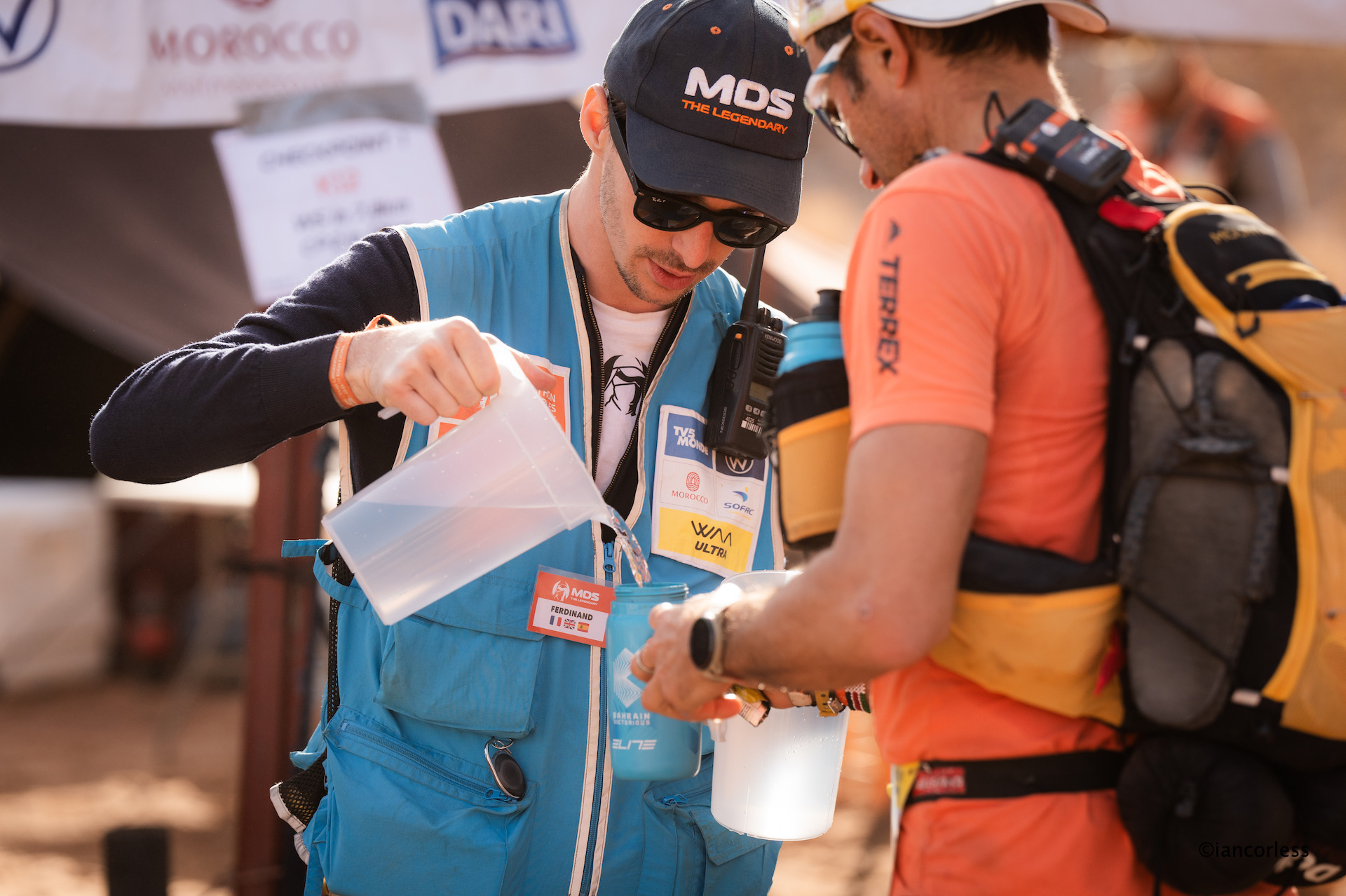
Water during the stage will not be provided via 1.5 ltr bottles as in past editions. Water will be provided from a series of tables and manned staff with jugs to decant water to your empty bottles. Importantly, there had been concerns about where the water will come from, to clarify: 5L Bottles on CP -> Served in 2L jugs -> Served by staff in the runners’ bottles.
The exception being on the long day as mentioned above when a 1.5 ltr bottle will be provided at the start or cp1 and at the end of each stage when a 5 ltr bottle per participant is provided. This 5 ltr bottle will cover the evening after the stage, the morning of the next day and the required 1.5 ltr capacity starting the next stage to cp1. So, if you had planned to cut down a 1.5 ltr bottle to use as a bowl for dinner and breakfast, this will not be possible. You will now need a suitable pot or similar.
Checkpoints
Will be typically 2 to 7 per stage. On the long day, it is therefore a good assumption that checkpoints will be +/- 12km’s apart and hence the need to require 3 ltrs.
Mandatory Equipment
I will list here the mandatory equipment to avoid any confusion:
Pack such as WAA Ultra Bag 20L
Minimum capacity of 1.5 liters of water*
Sleeping bag
Head torch and spare batteries (you can have a charger/ solar charger)
10 safety pins
Compass with 1 or 2 deg precision
Lighter
Whistle
Knife
Topical disinfectant
Venom pump*has now been removed
Signal mirror
Survival blanket
14 cubes of broth***
Sun cream
200 euro or 2000 dirhams
Passport or ID card
ECG and medical
* new change but consider the long day when you will have 3 ltr.
** new change
*** to replace salt tablets
Food Requirement
You need 14,000 calories of food as a minimum, 2000 calories per day. You can of course carry more than this, but 14,000 is the minimum. You must be able to prove the calories, so, if you decant food into lighter or different packaging, make sure you keep the nutritional information.
You
In addition to the above you personally will need:
Keep the pack weight as close to the minimum 6.5kg as possible, additional weight is additional stress that you do not need.
Keep luxuries to a minimum, they only add weight. A super light Mp3 player (with good battery) and earphones is the only luxury I would consider.
Accept that this is a tough challenge, you will be stripped back to a survival mode. You will not wash, you will get dirty, you will get smelly. Accept it.
Start slow and ease into the race.
Poles can be a lifesaver and I recommend them but you must learn to use them. Those at the front do not need poles, they can run.
Learn to walk, walk and walk. Many go to the desert with the expectation of running 80% and walking 20%. The reality is it will be the other way around.
Look after your feet and start with the correct shoes for you.
Take a sleeping mat or pad. You only need to do three things: run, eat and sleep. Sleep and comfort is important for recovery.
Stage 3 of the Oman Desert Marathon has a delayed start to ensure that participants experience the desert at night. With three waves: 10am, midday and 2pm (slower to faster runners respectively) the participants would cover the 47km stage in daylight and then transition to darkness.
Consider by race director, Said, stage 3 would include one of the most spectacular dune sections on the race, timed to coincide with the sun getting lower in the sky and for the lucky ones, maybe sunset would take place as the dune section came to an end.
Coming after the 55km long day, the later starts were welcomed and allowed for additional rest and recovery, however, the fatigue was starting to show on faces and bodies.
As the race got underway, it was clear that the men’s race would have a different approach, with Ghaith Al said pushing hard at the front, while behind, Saleh Al said and Rachid El Morabity ran together. Ultimately, it was an attempt to break Rachid. It didn’t work, but it was a valiant effort and one that rewarded Ghaith with the stage win in 5:03:39.
Behind, Saleh and Rachid ran together and crossed the line 5:10:29 and 5:10:39 respectively.
The women’s race had little drama with Aziza Raji and Aziza El Amrany running together and crossing the line in 6:56:35. The duo looked strong and relaxed. They will be a force to be reckoned with at Marathon des Sables this year.
Behind, once again, Veronique Messina ran a strong 3rd place in 7:49:56.
Albert Jorquera and Pol Makuri had a long day completing in 11:17. They are both very focussed mentally and strong physically. It has been a joy to watch the two of them work together and quite simply. Pol is an inspiration.