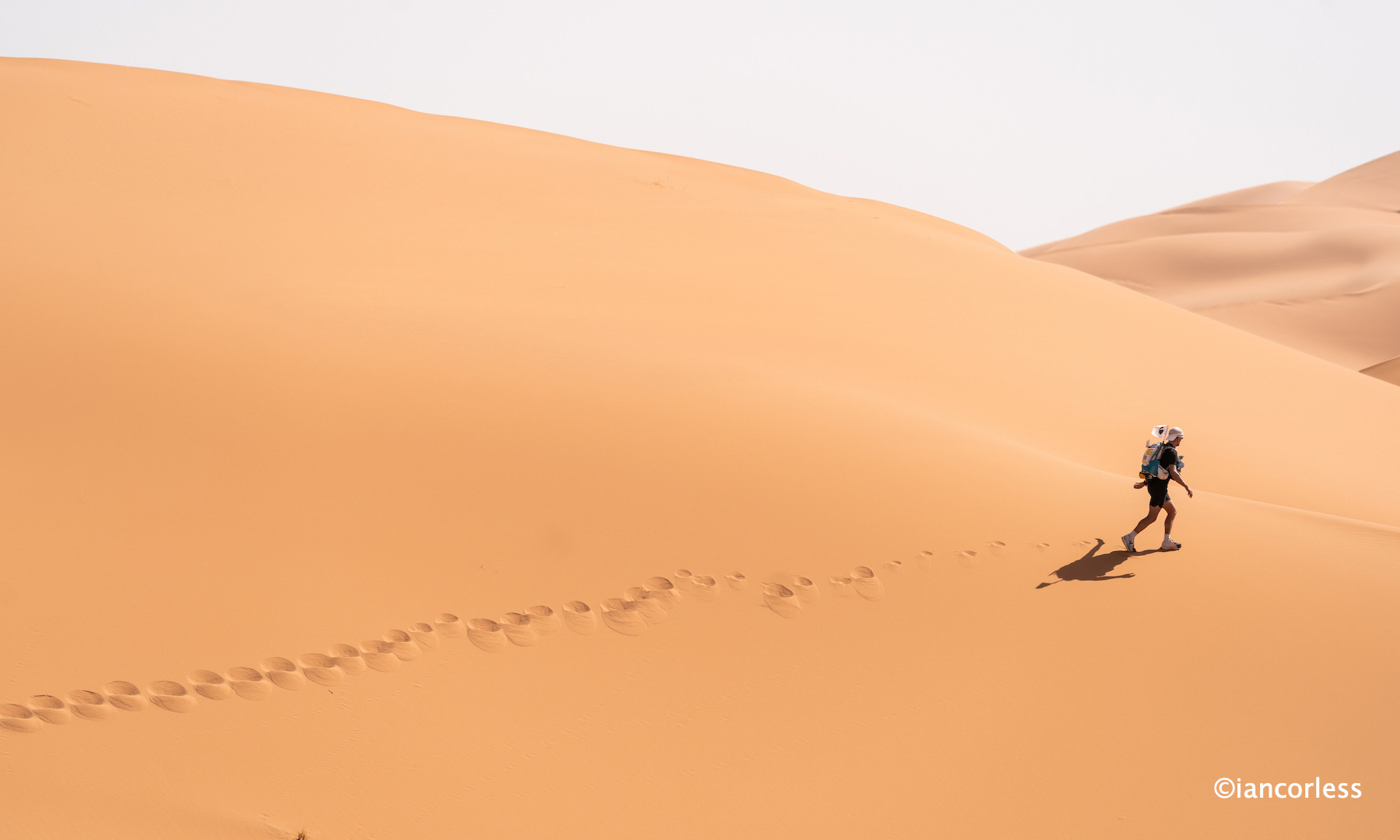
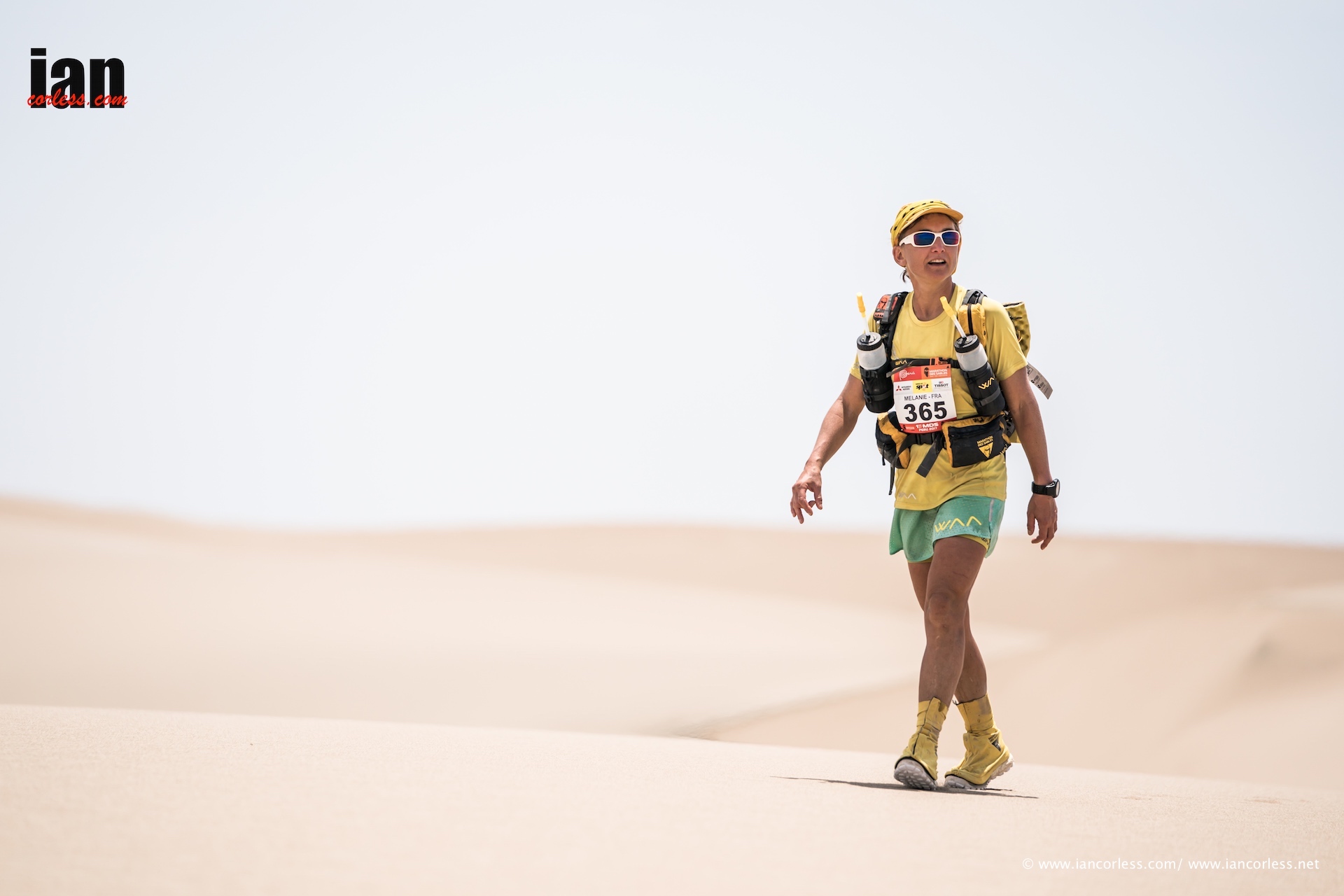
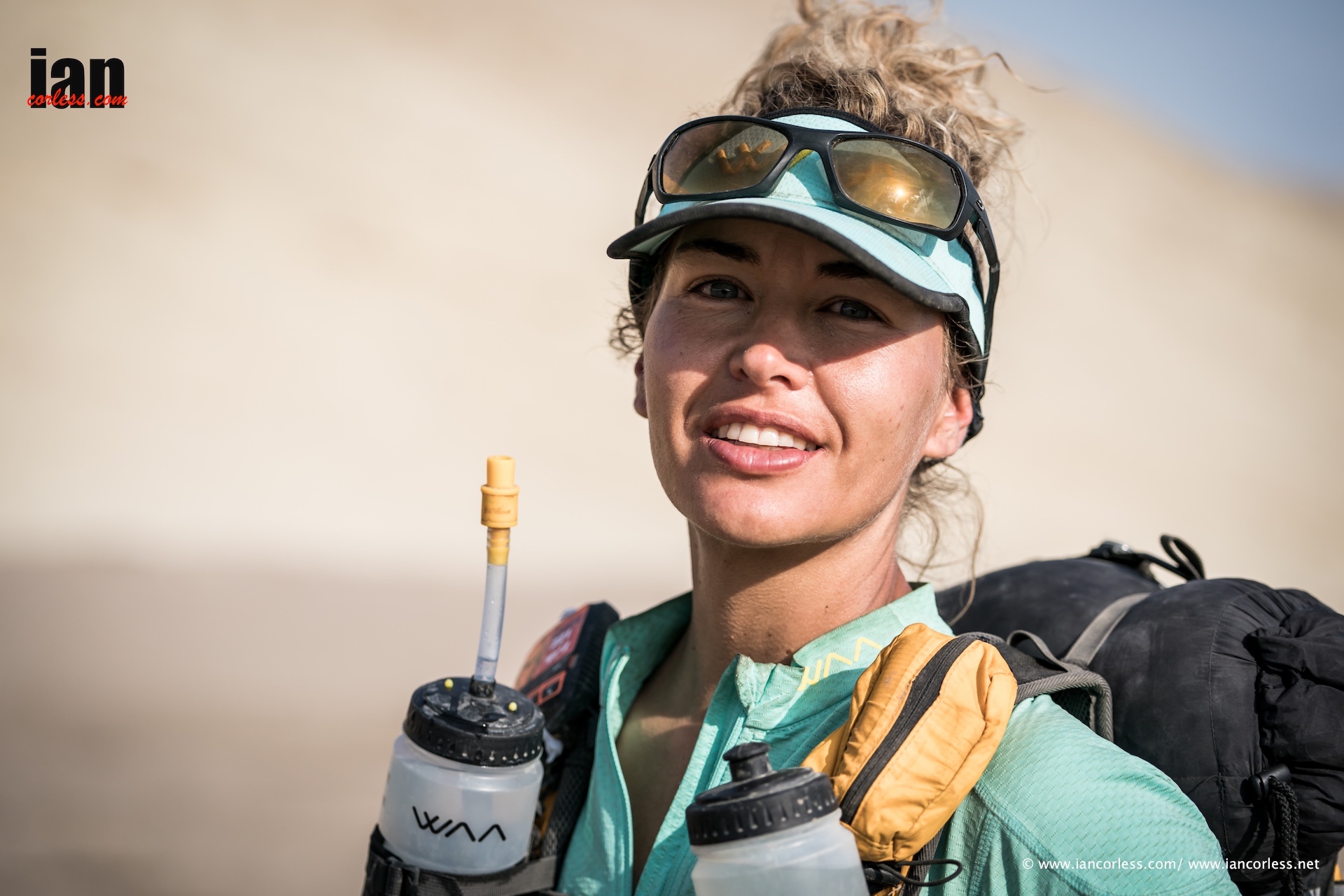
Following on from MDS Fuerteventura, the MDS team quickly transition to Morocco and the 2024 edition of MDS Morocco that will take place in the heart of the Sahara. MDS Morocco offers an adventure accessible to all kind of walkers and runners. A unique journey, where you will cross breathtaking landscapes. Far from any form of civilization, this is a unique opportunity to refocus on yourself and enjoy the simple pleasures of life.
This 3rd edition, 12th to the 19th October will see 600 participants arrive for the adventure of a lifetime in the place where the Marathon des Sables story started over 37-years ago, Morocco.
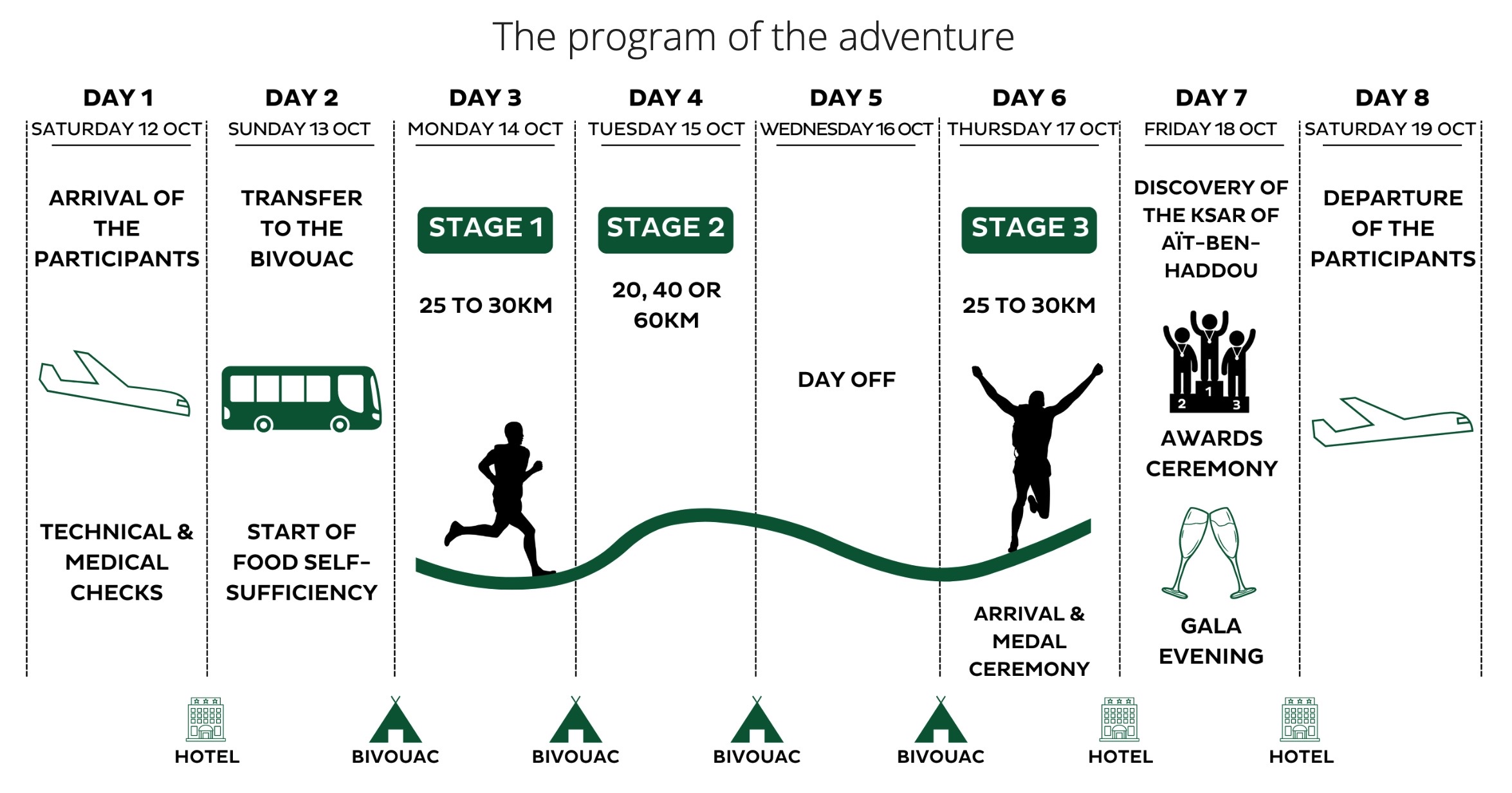
Participants will arrive in Ouarzazate on Saturday October 12th for technical and medical checks followed by a night in a hotel.
Admin and medical checks
The following day, Sunday, is the journey, via bus, to the desert (approximately 6 hours) with arrival in bivouac and the start of self-sufficiency.
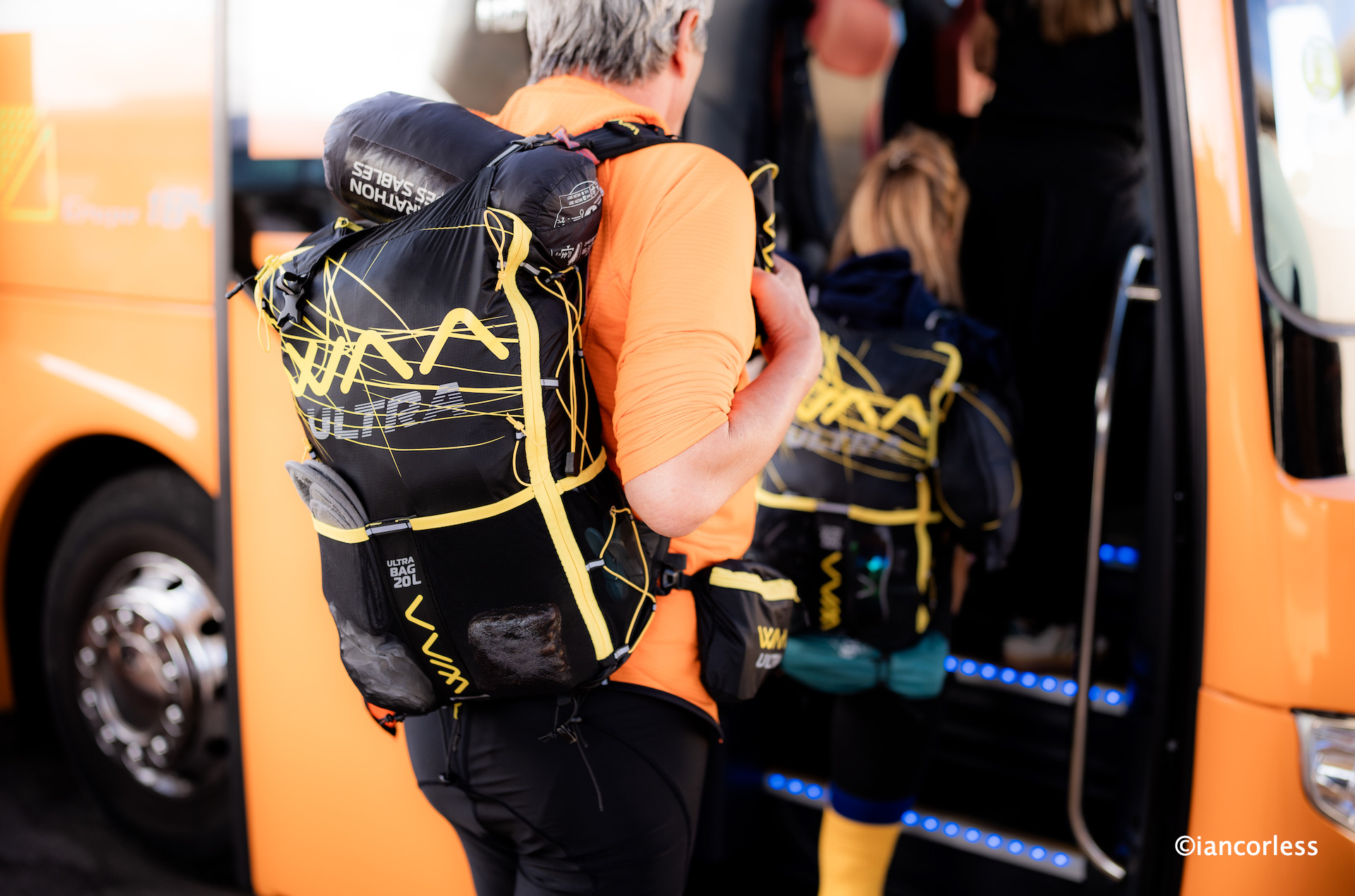
Bus transfer to the desert
Day 3, 4, 5 and 6 will have participants follow the classic MDS format of racing, 3 stages spread over 4-days.
Day 1 / Stage 1 25-30km.
Day 2 / Stage 2 choose 20km, 40km or 60km.
Day 3 Rest day
Day 4 / Stage 3 25-30km followed by transfer to hotel.
Importantly, MDS Morocco will see the addition of the NEW category, HANDI MDS which will cover 51km and 867m+
The following day provides the opportunity to visit the iconic site of Aït-Benhaddou(one of the locations of the film Gladiator). On arrival back at the hotel, time to relax and prepare for the awards ceremony and gala dinner.
Saturday 19h October is departure day.
Three sublime stages which will transport participants in the most beautiful places of the Moroccan Sahara, sleeping 4 nights in the MDS bivouac, this is the start of one of the adventures of a lifetime.
What is the MDS?
The MARATHON DES SABLES is a unique adventure, shared by thousands of enthusiasts since 1986.
To differentiate the full distance race of 250km’s, Marathon des Sables will now be known at MDS The Legendary, reflecting the legendary status of this iconic event and its long history as a pioneer of the stage racing and multi-day format.
The ‘HMDS’ format will still follow the same protocols as before but has now dropped the ‘half’ title and moving forward, events will be called MDS Jordan, MDS Morocco, MDS Cappadocia and so on.
MDS always an adventure
The MDS events are a one-week sporting adventure that combines the discovery, travel, meeting new people and physically challenging yourself in a self-sufficient manner.
Since 1986, the MARATHON DES SABLES has crossed the world’s most stunning deserts with several unique concepts: the MARATHON DES SABLES THE LEGENDARY (252 km in the Sahara Desert in Morocco), the MARATHON DES SABLES (70, 100, or 120 km spread over 3 stages), and the new 2024 concept, the MDS TREK (4 stages with a total distance of up to 120 km), offering an accessible adventure with optimal comfort. These international events have seen over 50 editions in various countries such as Morocco, Fuerteventura Island, Peru, Jordan, Turkey, and offer adventures that combine running/hiking in the desert with tourism.
MARATHON DES SABLES 2025 events are already open:
MDS Morocco – Atlantic Coast: January 25 to February 1, 2025
A rest day made all the difference for the participants of MDS Fuerteventura and stage 3 was eagerly anticipated.
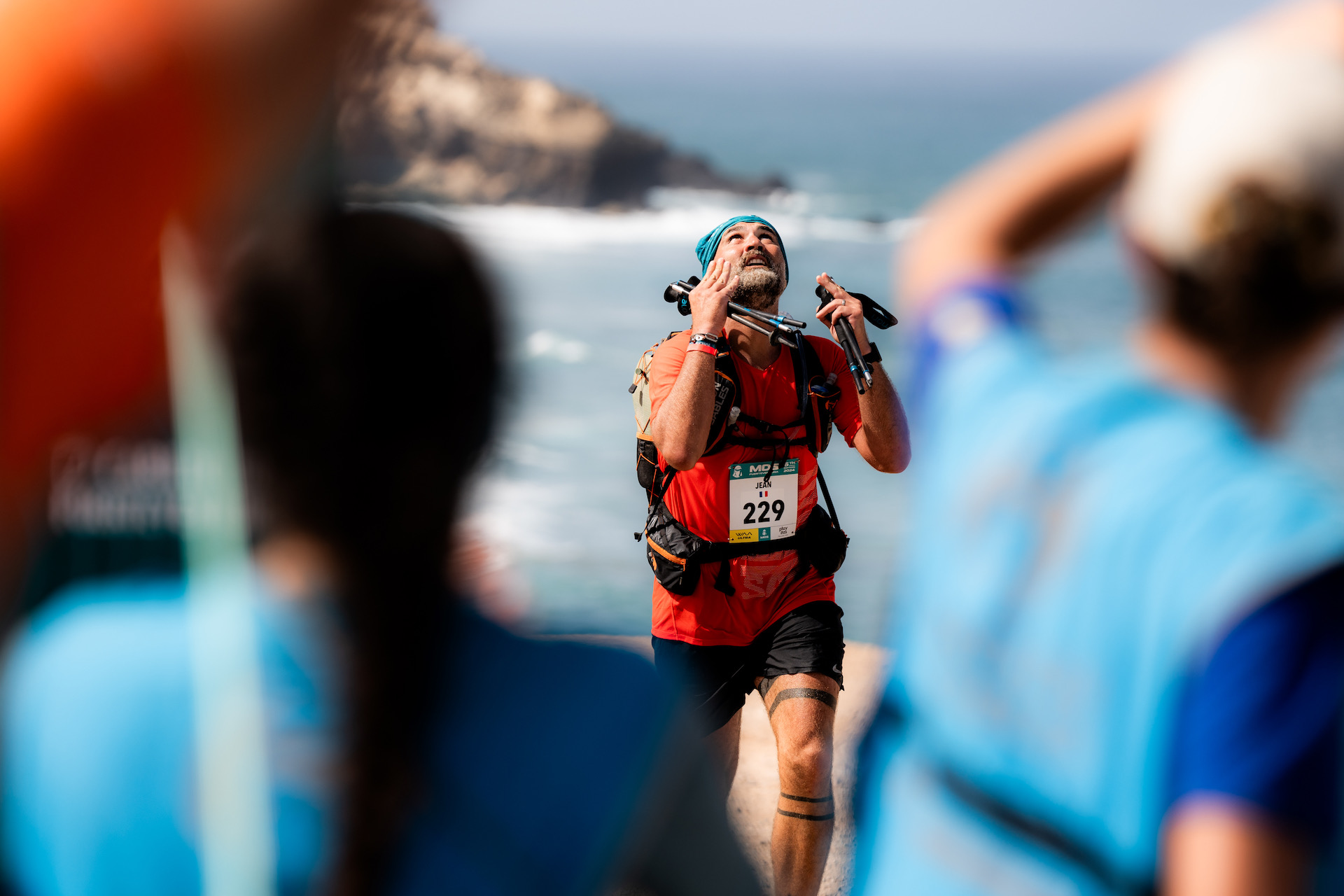
An early departure from bivouac and then a bus transfer to the start at Sotavento Beach, ahead 26.3km with 587m+ to La Pared.
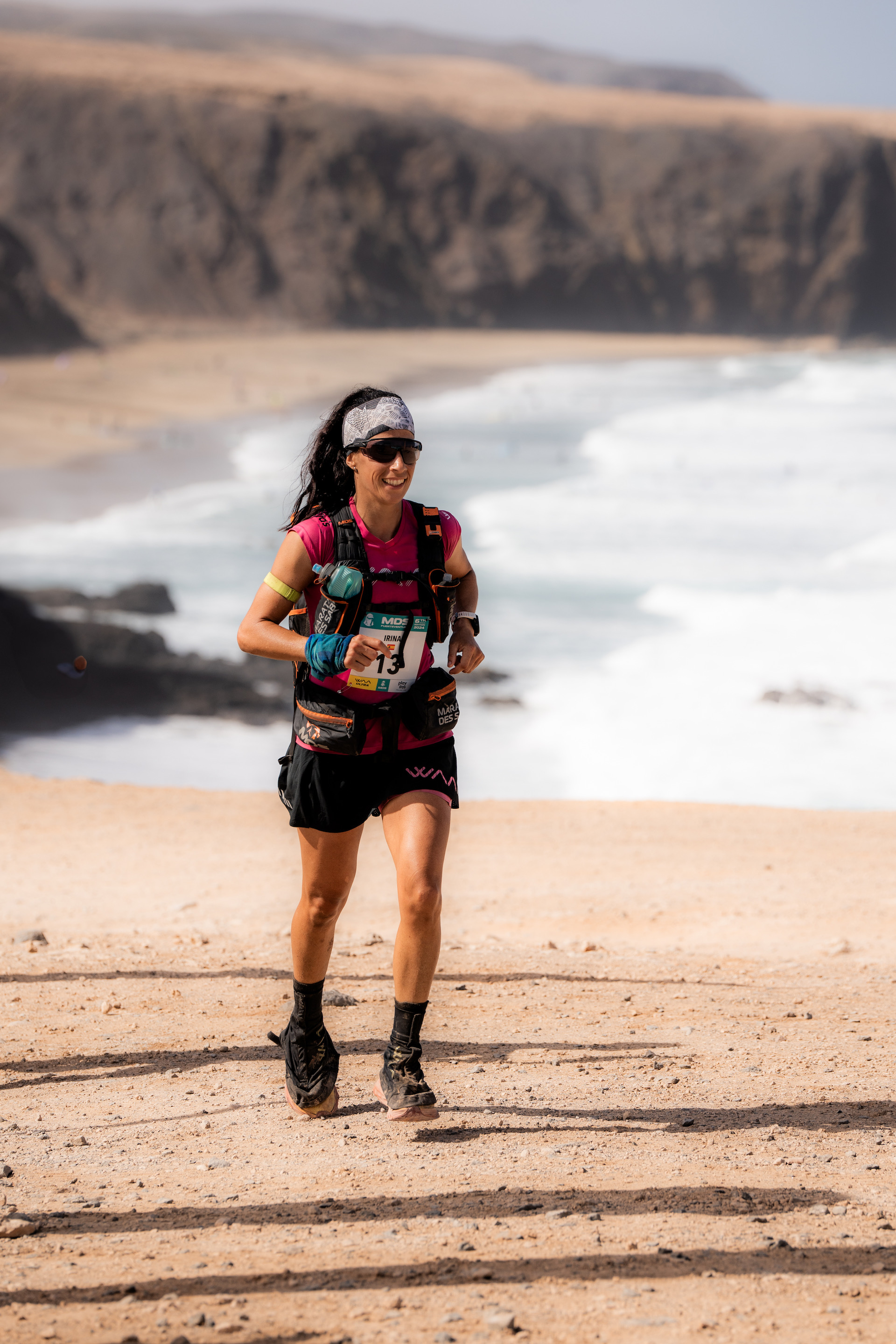
A beautiful day of sand and path passing through Jandia National Park and concluding with epic coastal cliffs and an ocean backdrop.
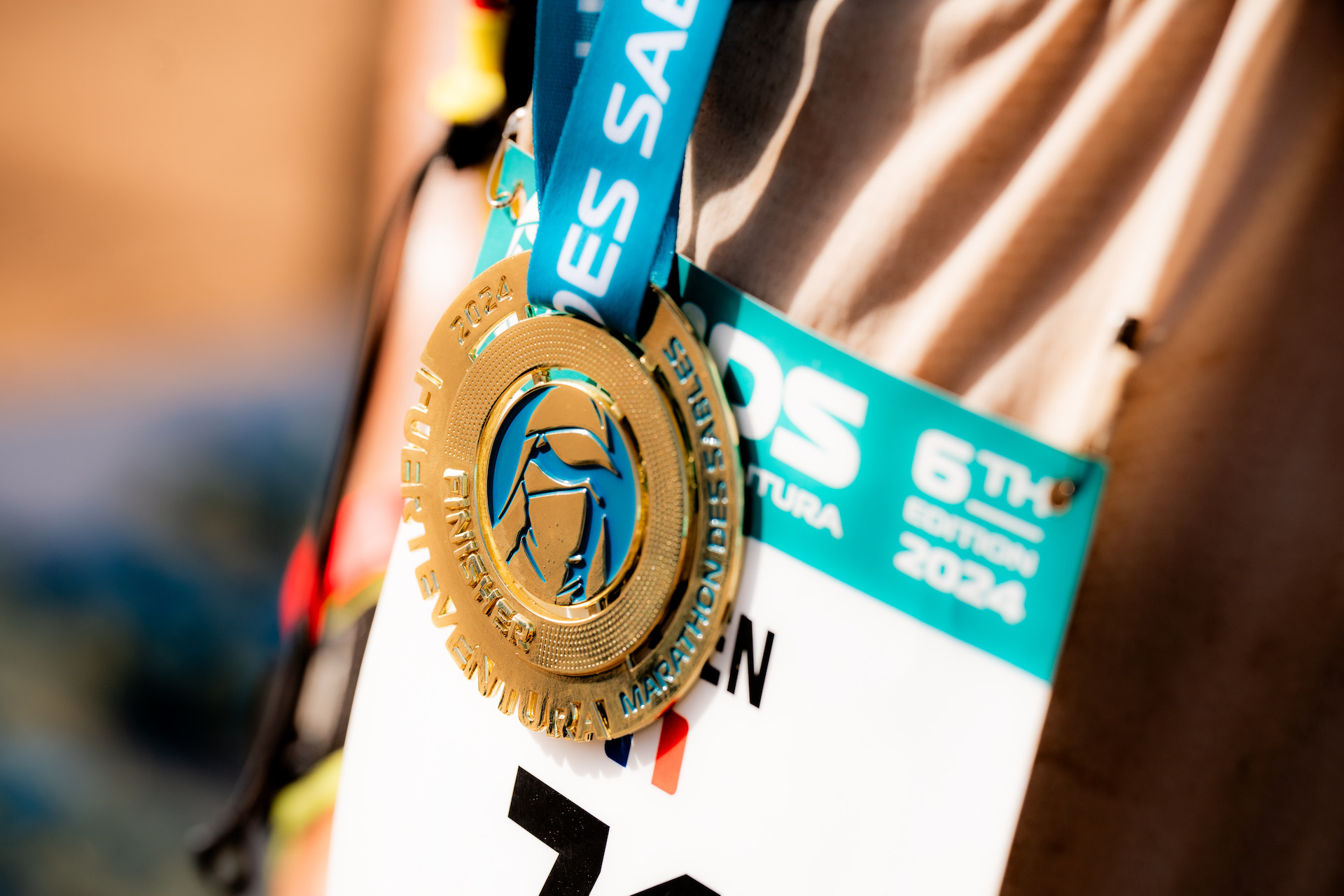
Today, was all about the medal gladly, all achieved there goal finishing before the cut-off time of 16.45, a huge success.
After the bad weather in 2022 and the missing 2023, MDS Fuerteventura is well and truly back!
In the 120km race, SANTANA FERNÁNDEZ was crowned the winner with an elapsed time of 9:36:35. FOULQUIÉ PADILLA and ROGER PÉREZ placed 2nd and 3rd, 9:40:37 and 9:48:15 respectively.
For the women, DEL RIO VALLES, BOLLENGIER and NACHARD placed 1, 2 and 3, 13:54:20, 14:47:42 and 15:47:08 respectively.
PÉREZ DE LA CRUZ 10:23:12 and MUJICA GONZÁLEZ 11:53:49 were the male and female winners of the 100km and RODRÍGUEZ MORENO 9:02:44 and MAHIQUES 8:47:49 were the male and female winners in the 70km class, with MAHIQUES the outright winner.
Full results are available HERE for 120km, HEREfor the 100km andHERE for the 70km.
Now it is time for a shower, fresh clothes, a good dinner and bed with clean sheets. Tomorrow is a day of relaxation and then a gala dinner with awards ceremony.
Since 1986, the MARATHON DES SABLES has crossed the world’s most stunning deserts with several unique concepts: the MARATHON DES SABLES THE LEGENDARY (252 km in the Sahara Desert in Morocco), the MARATHON DES SABLES (70, 100, or 120 km spread over 3 stages), and the new 2024 concept, the MDS TREK (4 stages with a total distance of up to 120 km), offering an accessible adventure with optimal comfort. These international events have seen over 50 editions in various countries such as Morocco, Fuerteventura Island, Peru, Jordan, Turkey, and offer adventures that combine running/hiking in the desert with tourism.
Stage 1 was a challenging day for many, the 33.6km proving a tough start to the 2024 MDS Fuerteventura. On the positive side, there were no DNF’s.
Stage 2 is called ‘The Long Day’ as this is the day that for 100km and 120km will prove to be the longest of the race. However, the challenge can be as much mental as physical.
An early start
Challenge 1.
After the start, almost immediately, the runner’s are given the option to to turn right and take on the 17.8kmm loop, 20 men and 63 women chose this. Alternatively, you can turn right and start the 40.5km loop. The remainder of the participants chose this.
Challenge 2.
At the end of the 40.5 km loop, you can turn right and run to the finish – 25 min and 41 women chose this.
Challenge 3.
For the brave, a left turn after the 40.5km loop provides the option to complete a final loop and the total long day distance of 56.7km – 75 men and 61 women chose this.
MUJICA GONZÁLEZ
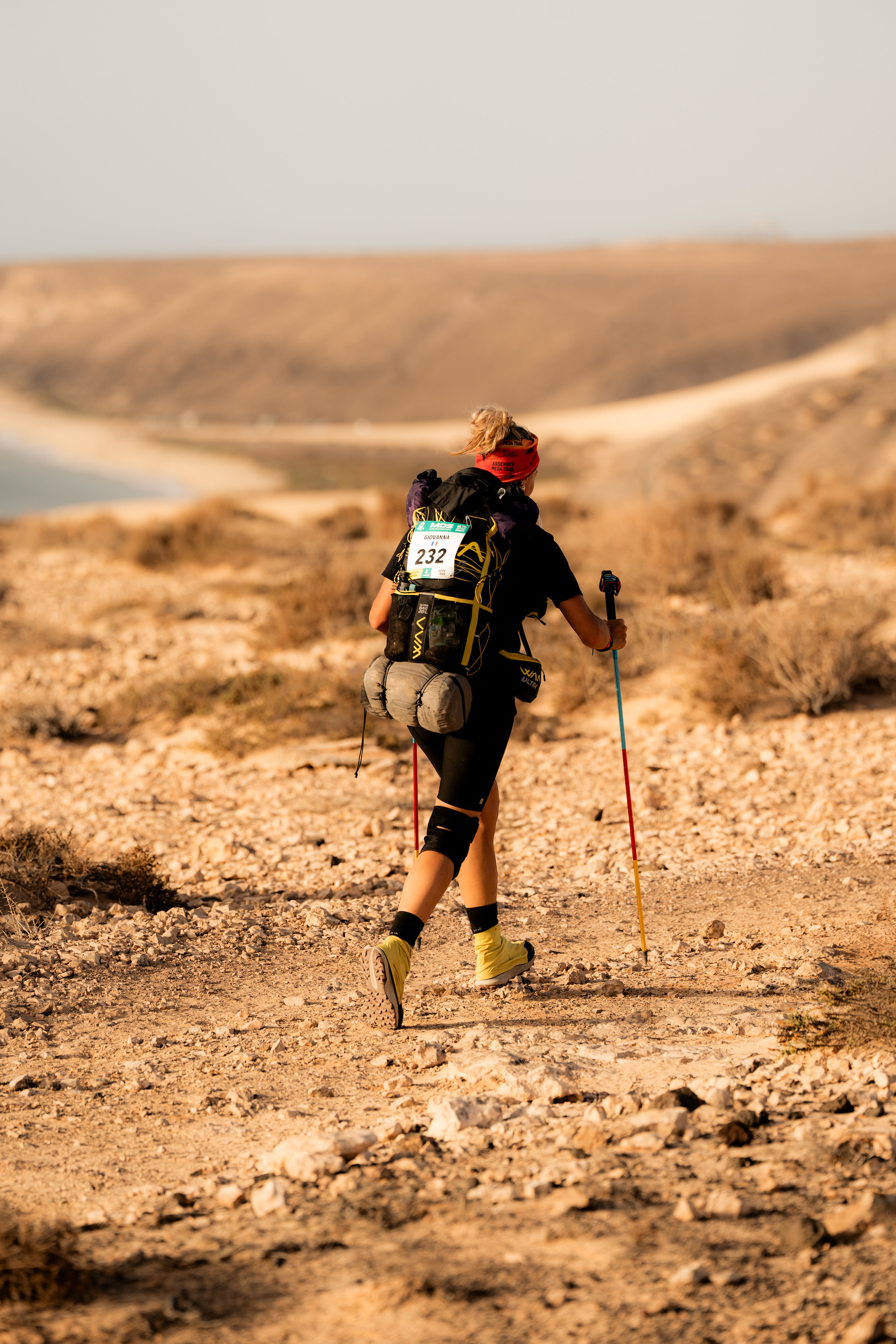
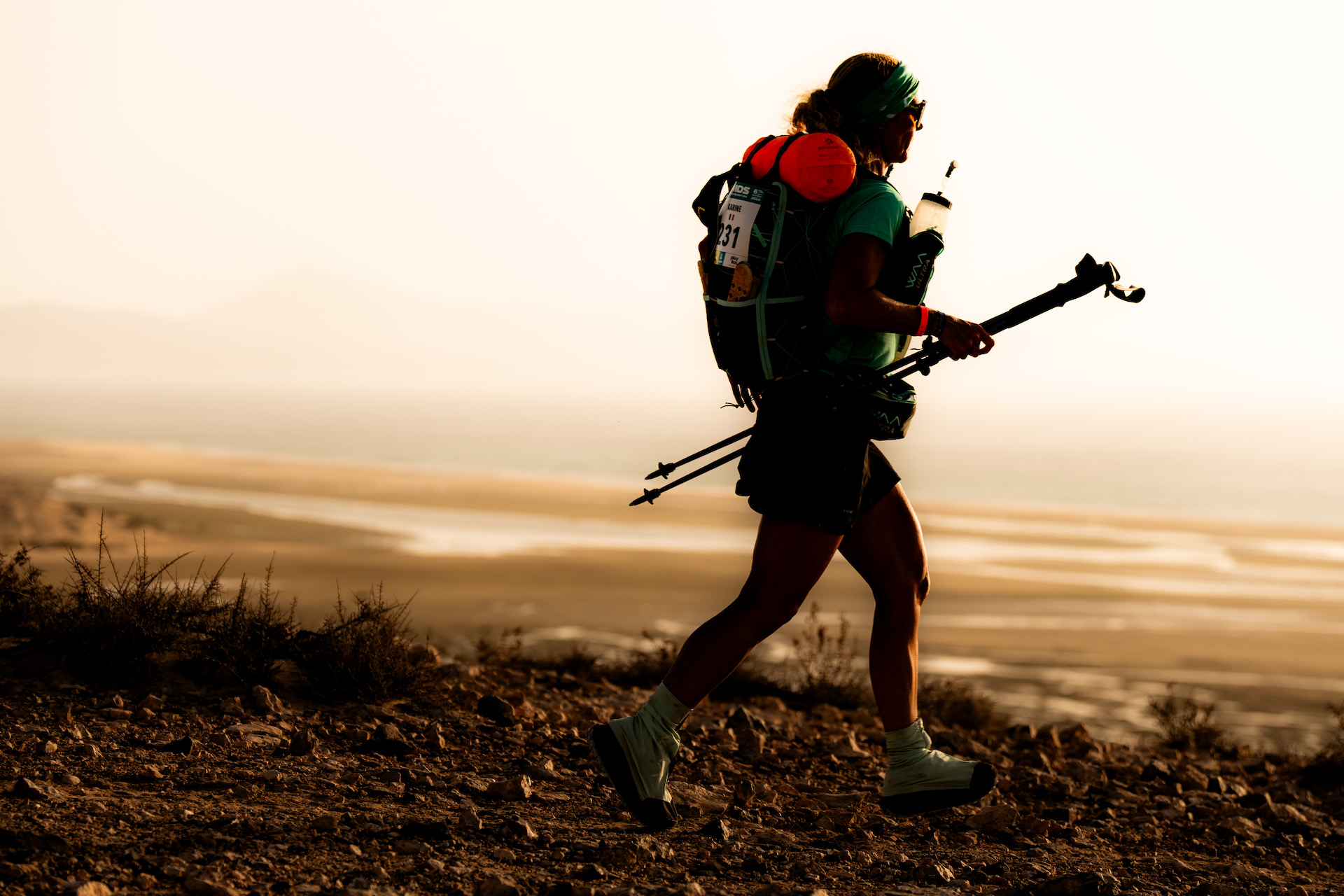
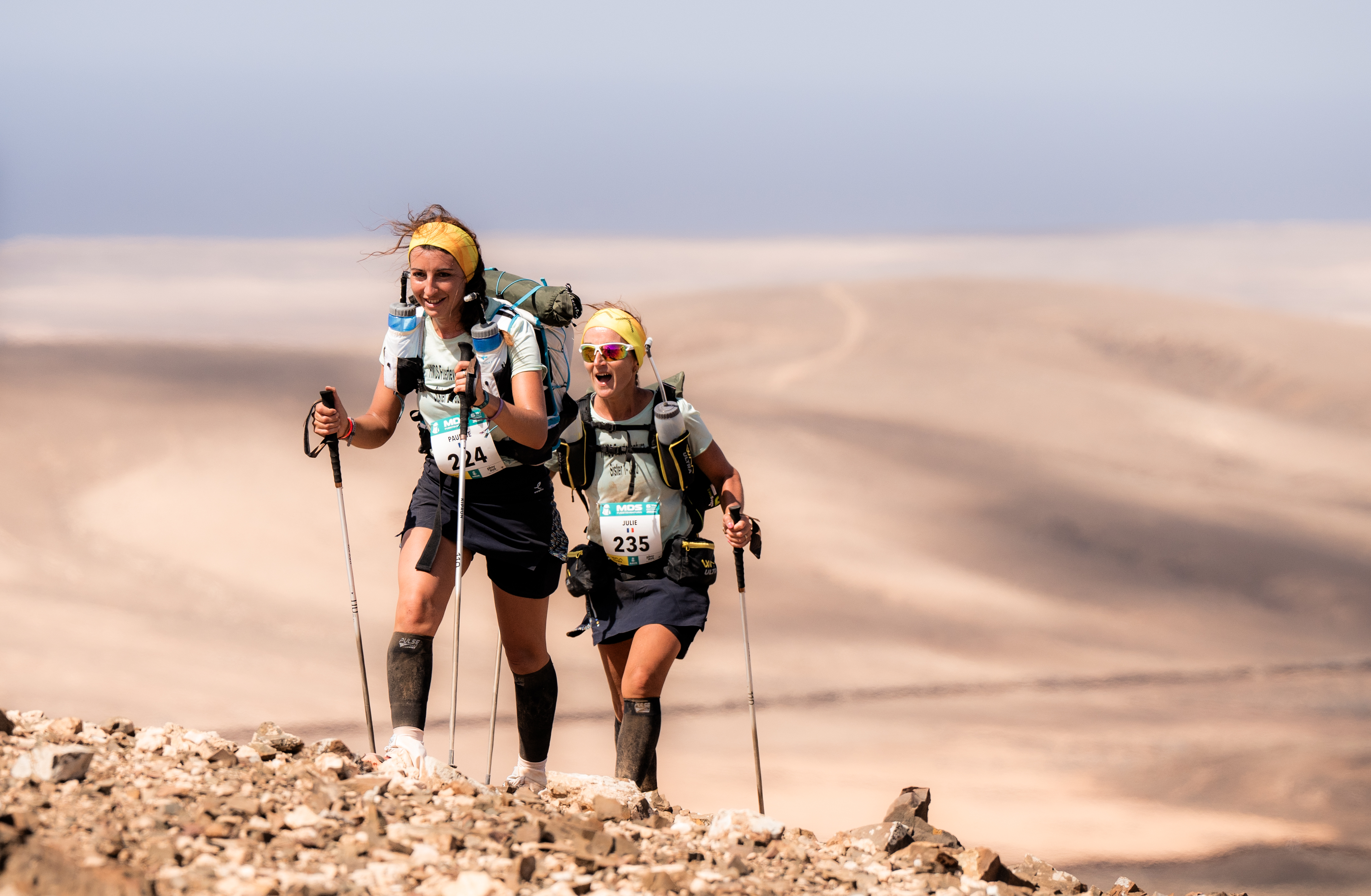
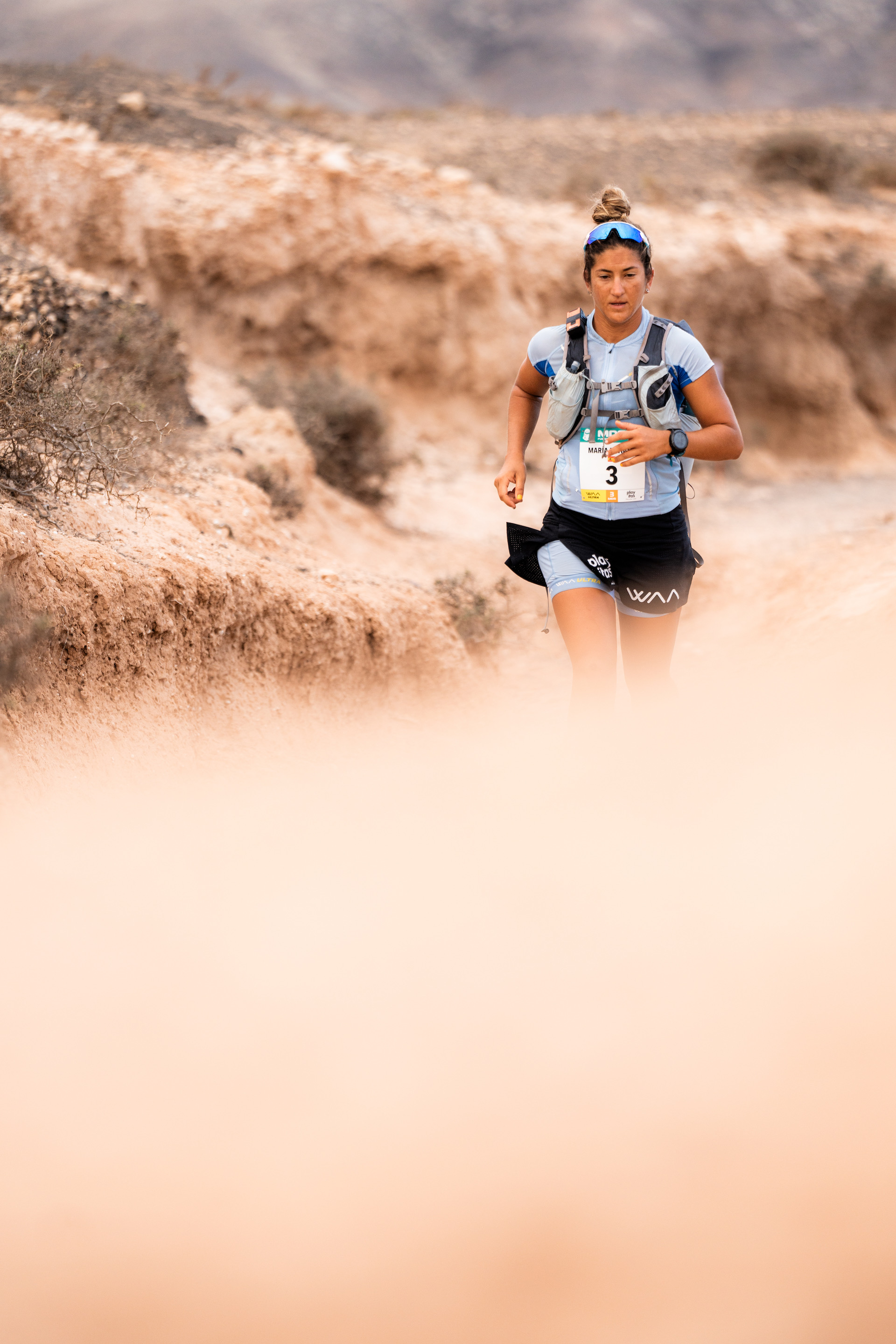
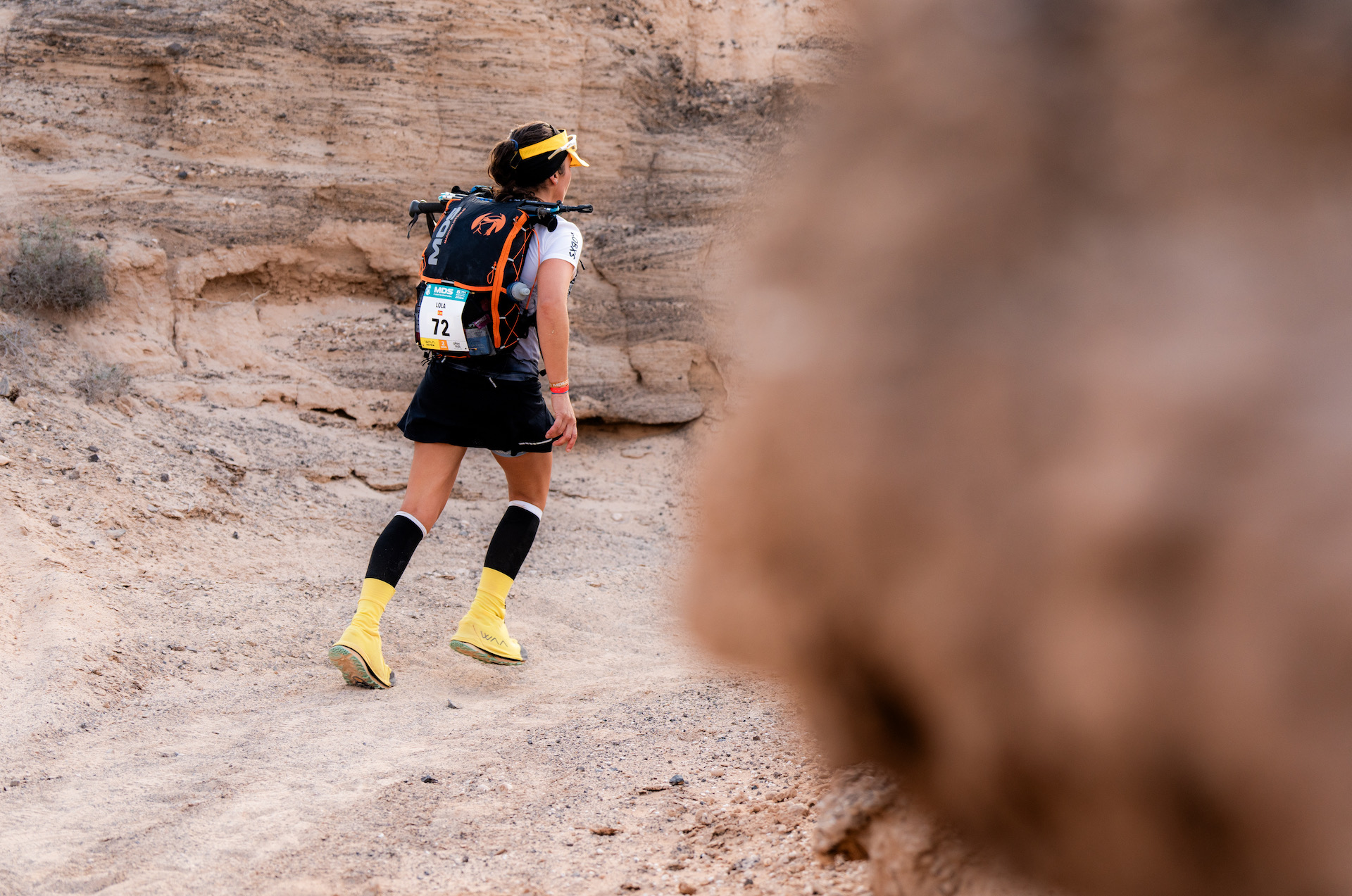
Today’s route followed a figure of 8 shape for the 120km. The terrain mostly sandy and rocky path, the need for gaiters minimal.
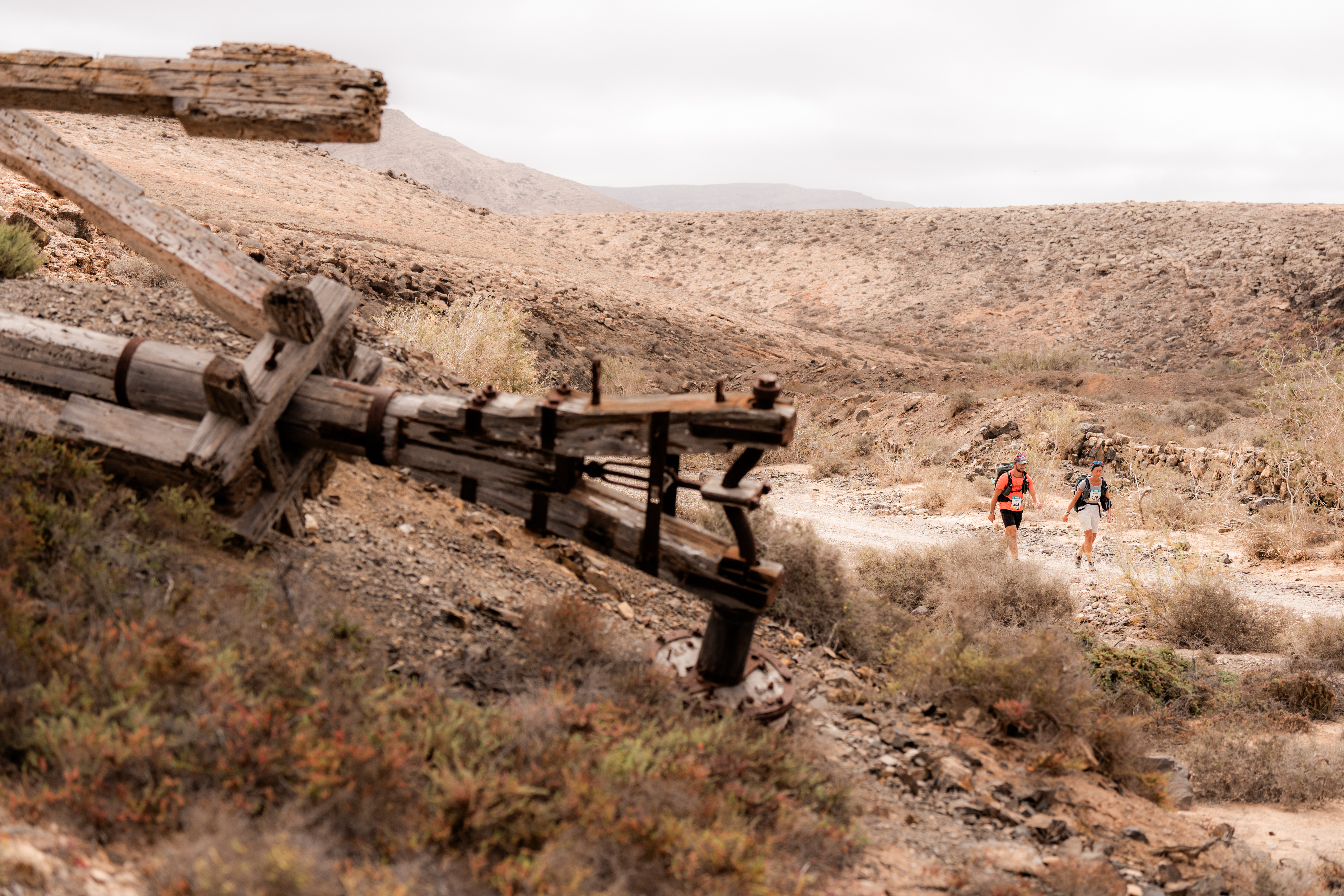
Some wonderful small canyons to run through
The day started at 0600 after a warm night under the stars. The winds had calmed but the sky was cloudy and it would remain that way until midday, when a sunny period provide some blue skies. Temperatures reached a high of 28 degrees and running conditions were good.
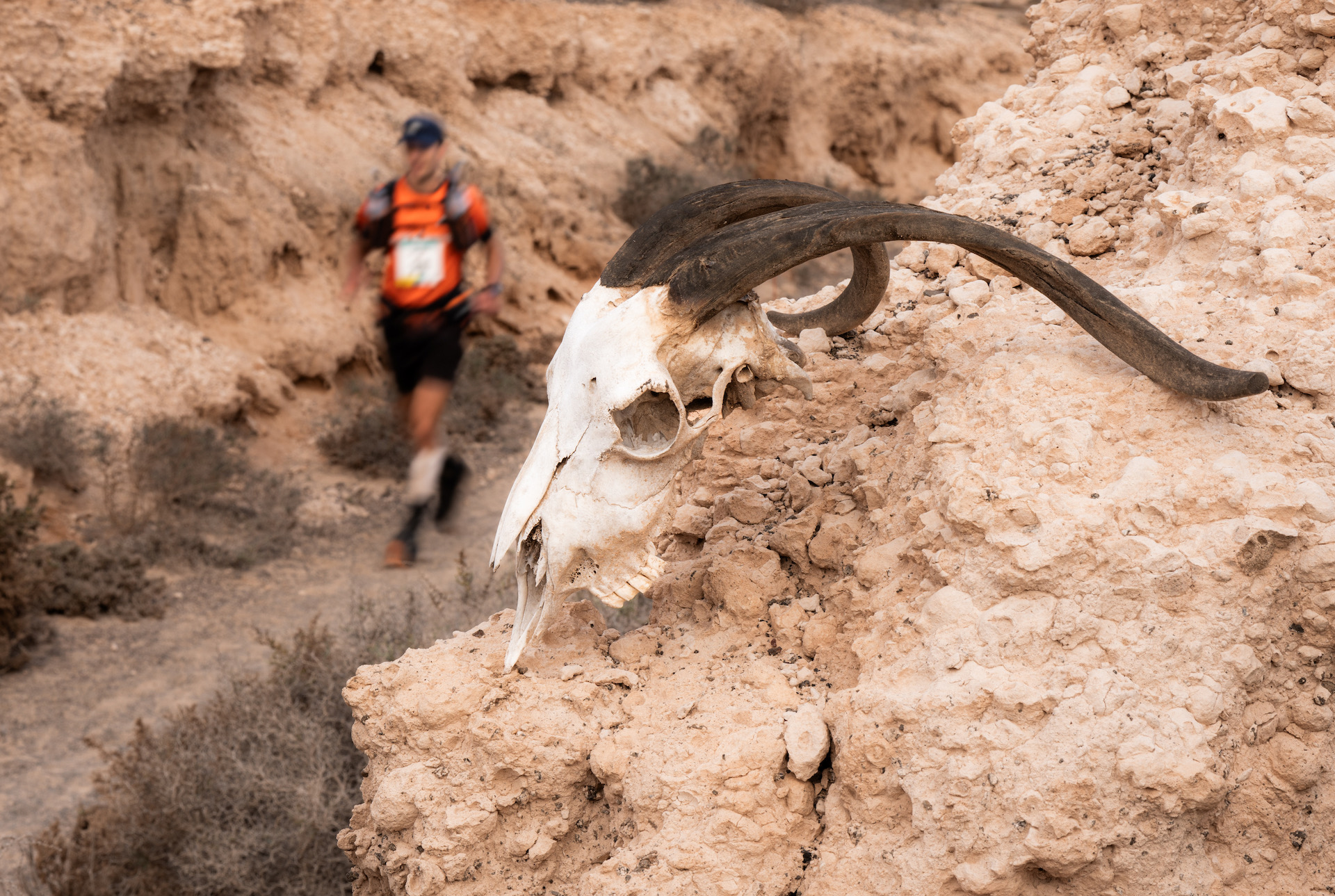
Time to grab the race by the horns
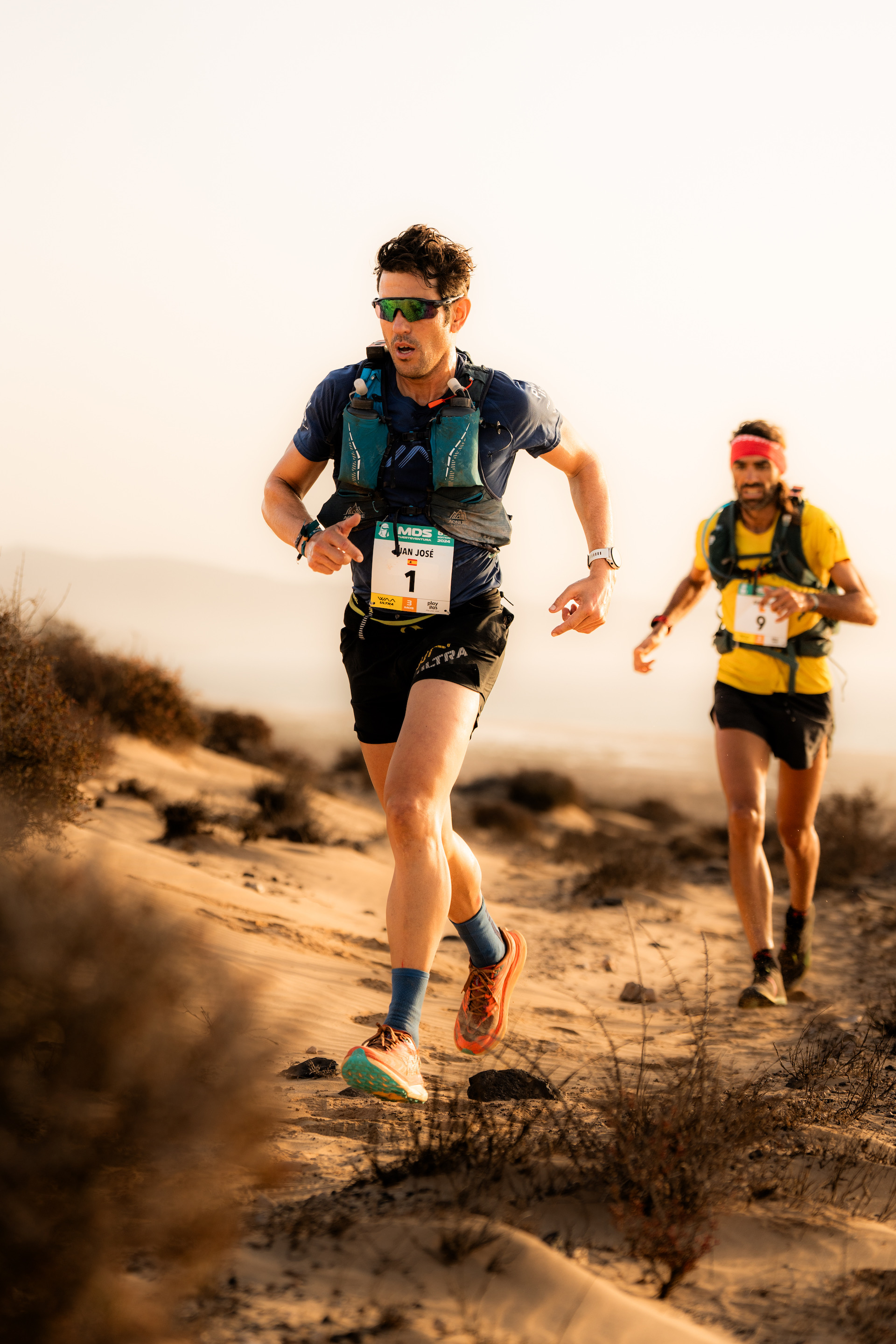
With three race distance options, rankings would change considerably during stage 2, however, in the 120km distance, the main protagonists of SANTANA FERNÁNDEZ, ROGER PÉREZ and FOULQUIÉ PADILLA would remain the same. However, today it was FOULQUIÉ PADILLA who now takes the overall lead with an elapsed time of 7:31:21 closely followed by SANTANA FERNÁNDEZ in 7:32:11. ROGER PÉREZ remains in third.
For the women, stage 1 winner MUJICA GONZÁLEZ started the day slower but then moved up through the field and is now in the women’s overall lead with a time of 8:56:08. BOLLENGIER who was 2nd on stage 1 is now 4th on GC with DEMARQUILLY moving into 2nd 9:55:47 and DEL RIO VALLES 3rd with 10:49:47.
Since 1986, the MARATHON DES SABLES has crossed the world’s most stunning deserts with several unique concepts: the MARATHON DES SABLES THE LEGENDARY (252 km in the Sahara Desert in Morocco), the MARATHON DES SABLES (70, 100, or 120 km spread over 3 stages), and the new 2024 concept, the MDS TREK (4 stages with a total distance of up to 120 km), offering an accessible adventure with optimal comfort. These international events have seen over 50 editions in various countries such as Morocco, Fuerteventura Island, Peru, Jordan, Turkey, and offer adventures that combine running/hiking in the desert with tourism.
Stage 1 of the 2024 MDS Fuerteventura got underway today, 33.6km and 444m+
It was a 90-minute drive from Play Itas Resort to the northern coastal location of Manjanicho Beach.
A climb from the ocean to start the day
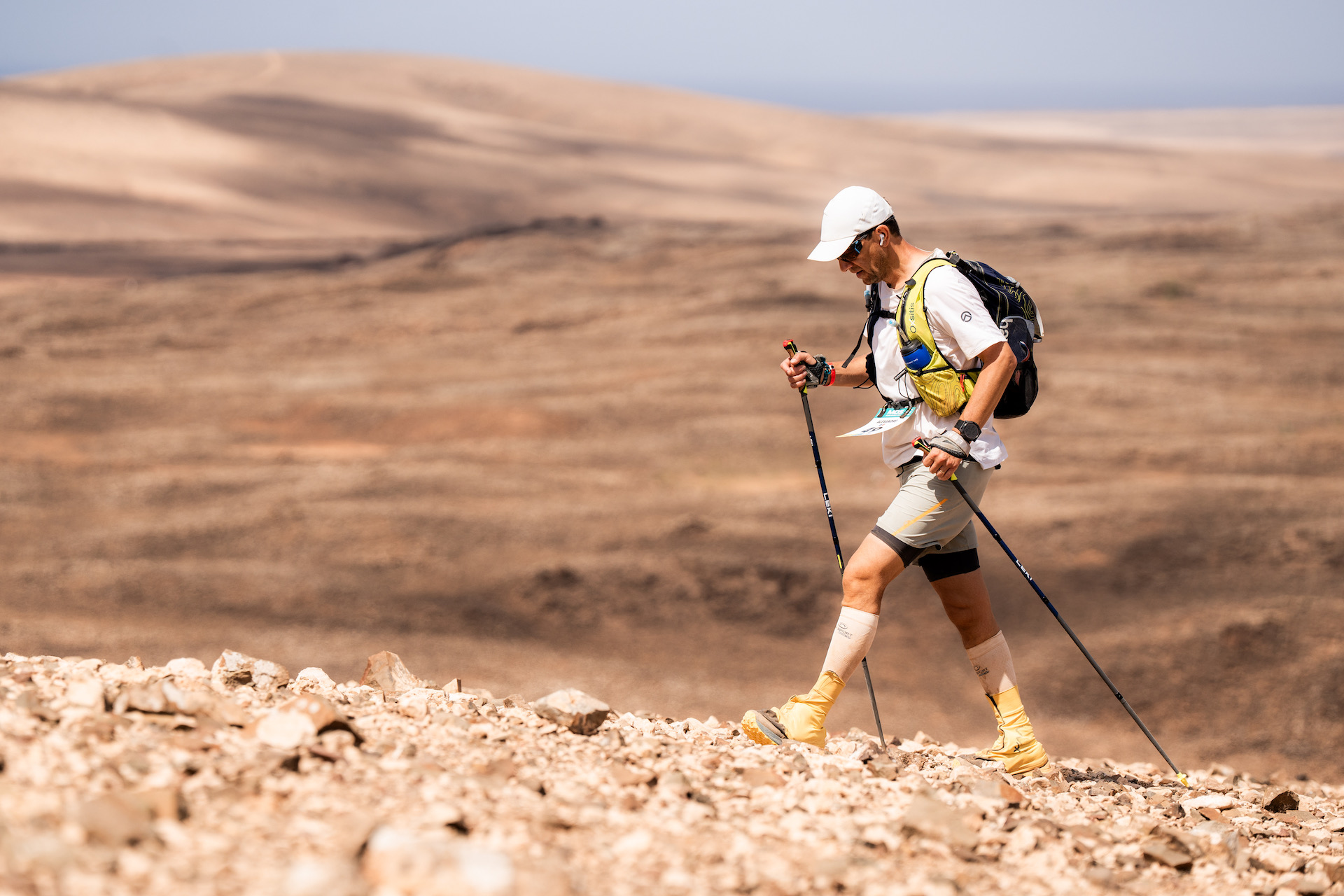
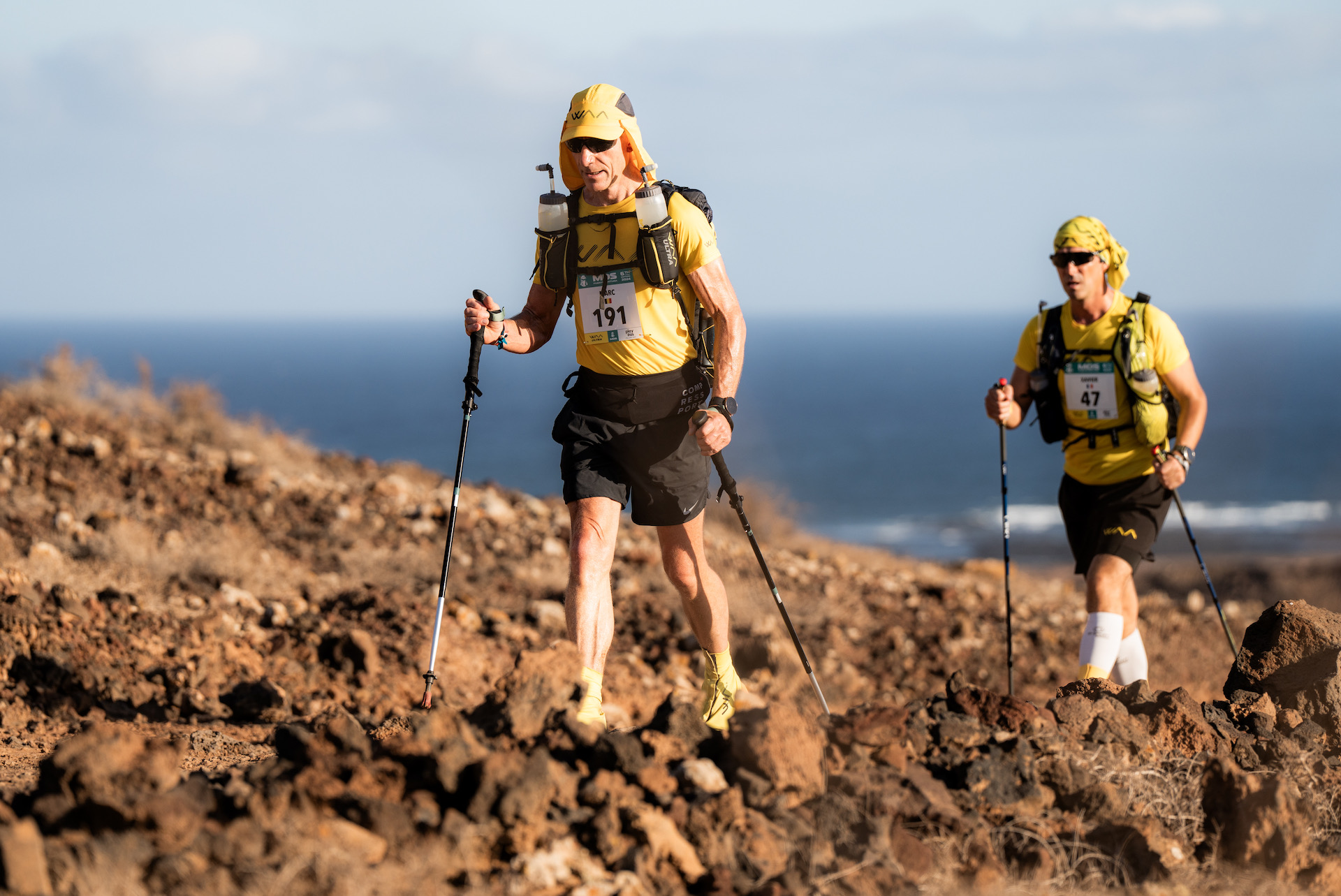
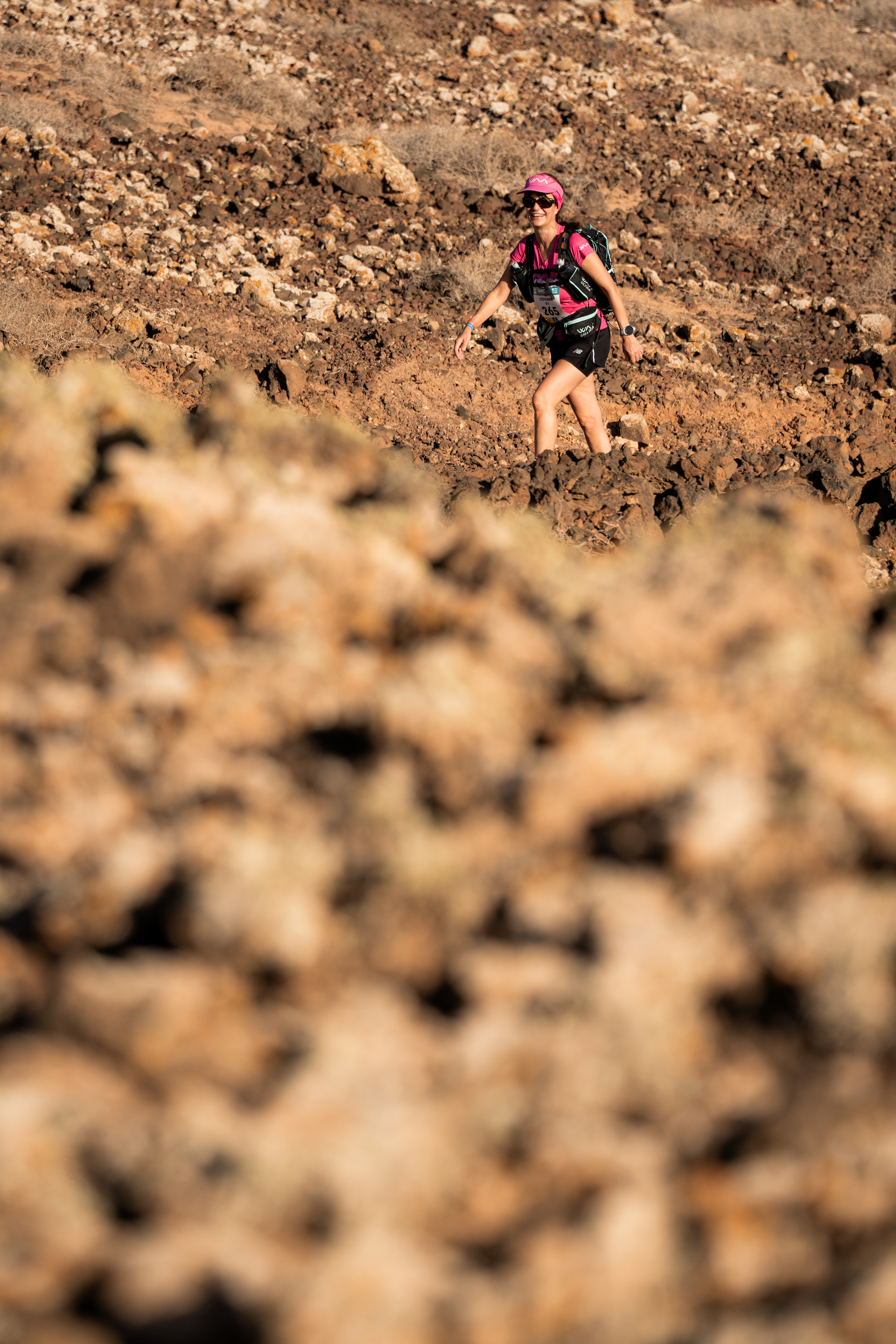
A day that offered a little of everything, starting and concluding next to the ocean, the track was mad up mostly of gravel/sand path, approximately 20% soft-sand and just a tiny amount of road crossings.
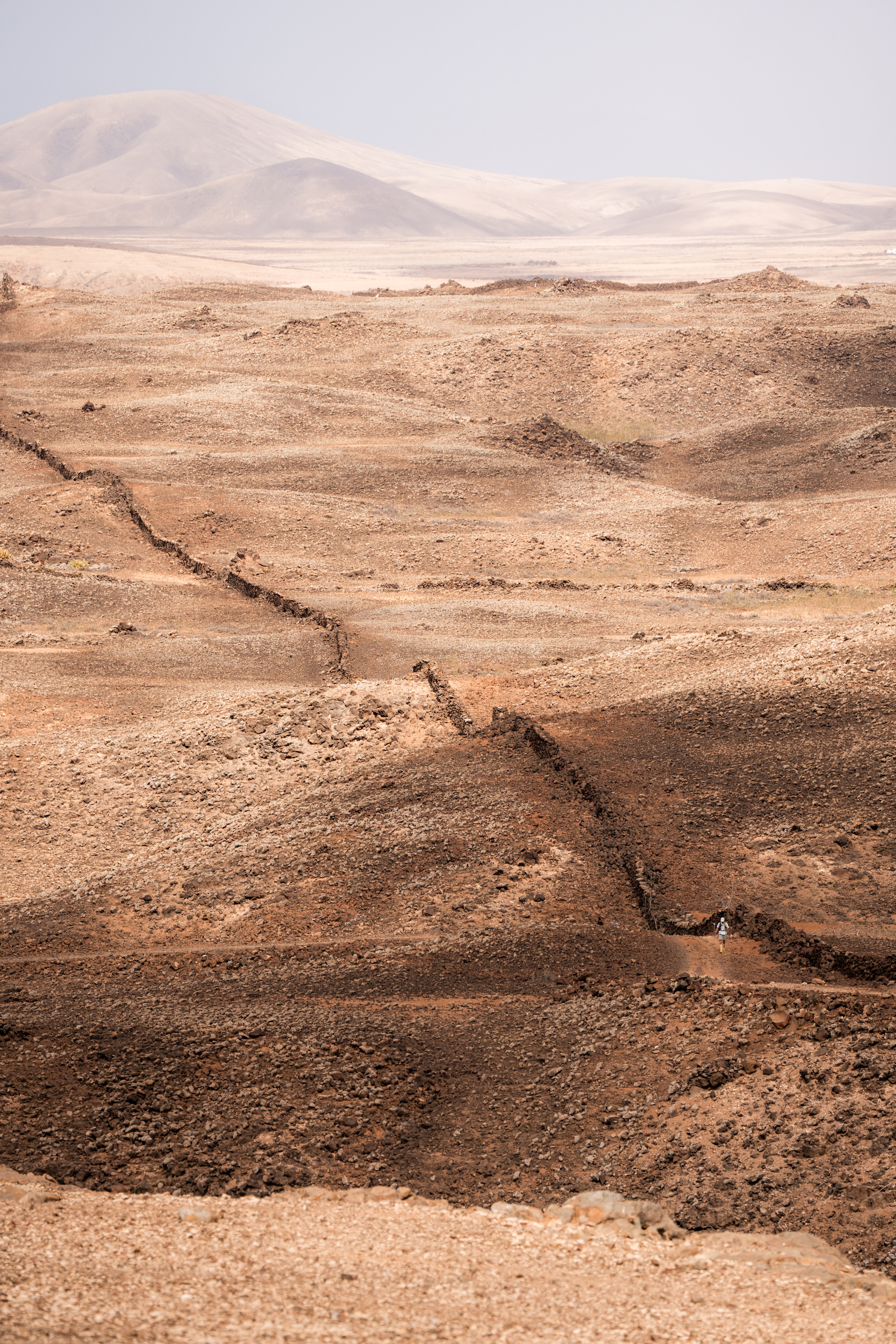
The unique landscape of Fuerteventura
Wind was present throughout the day, making the highest temperature of 28-degrees feel manageable.
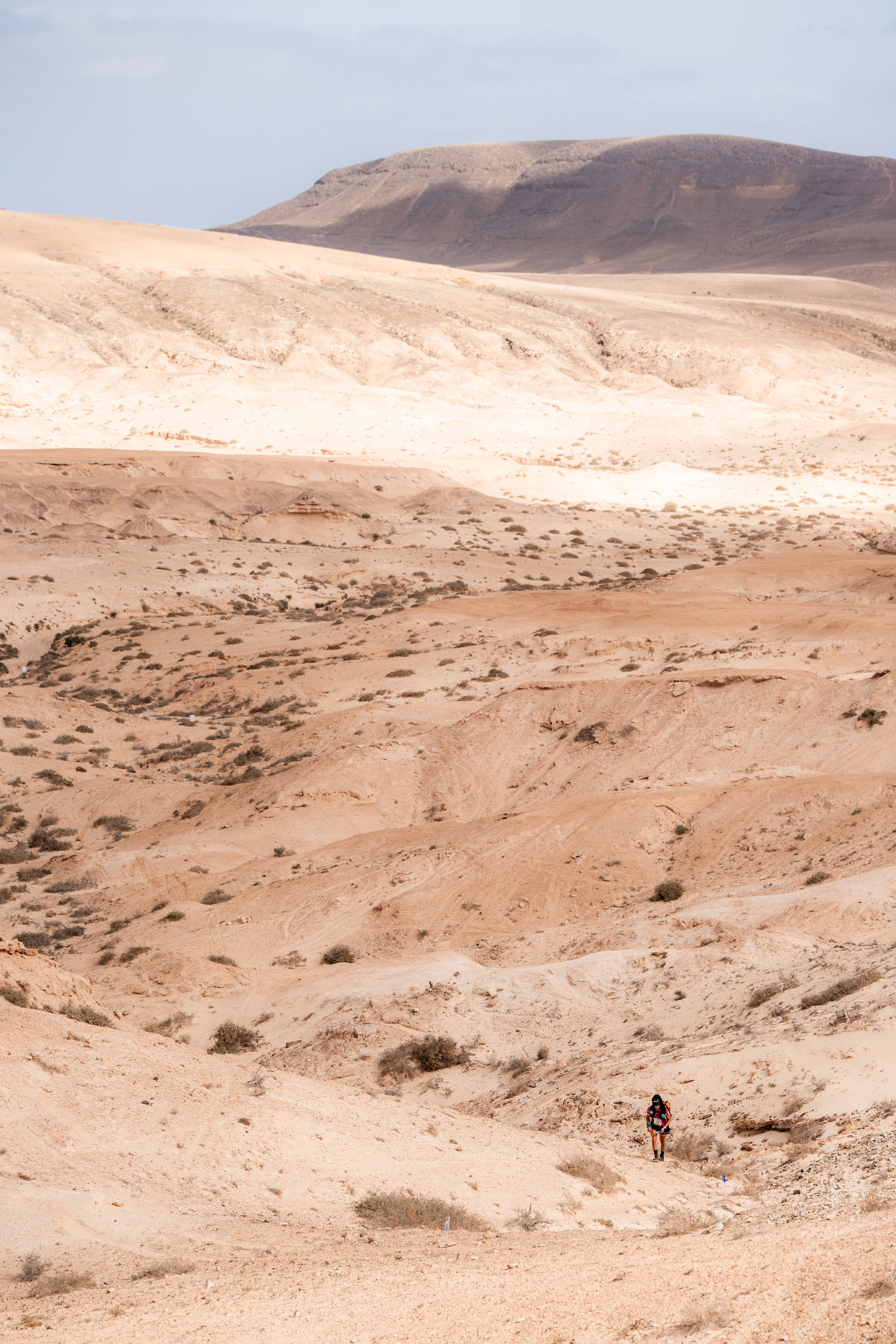
Expansive landscape
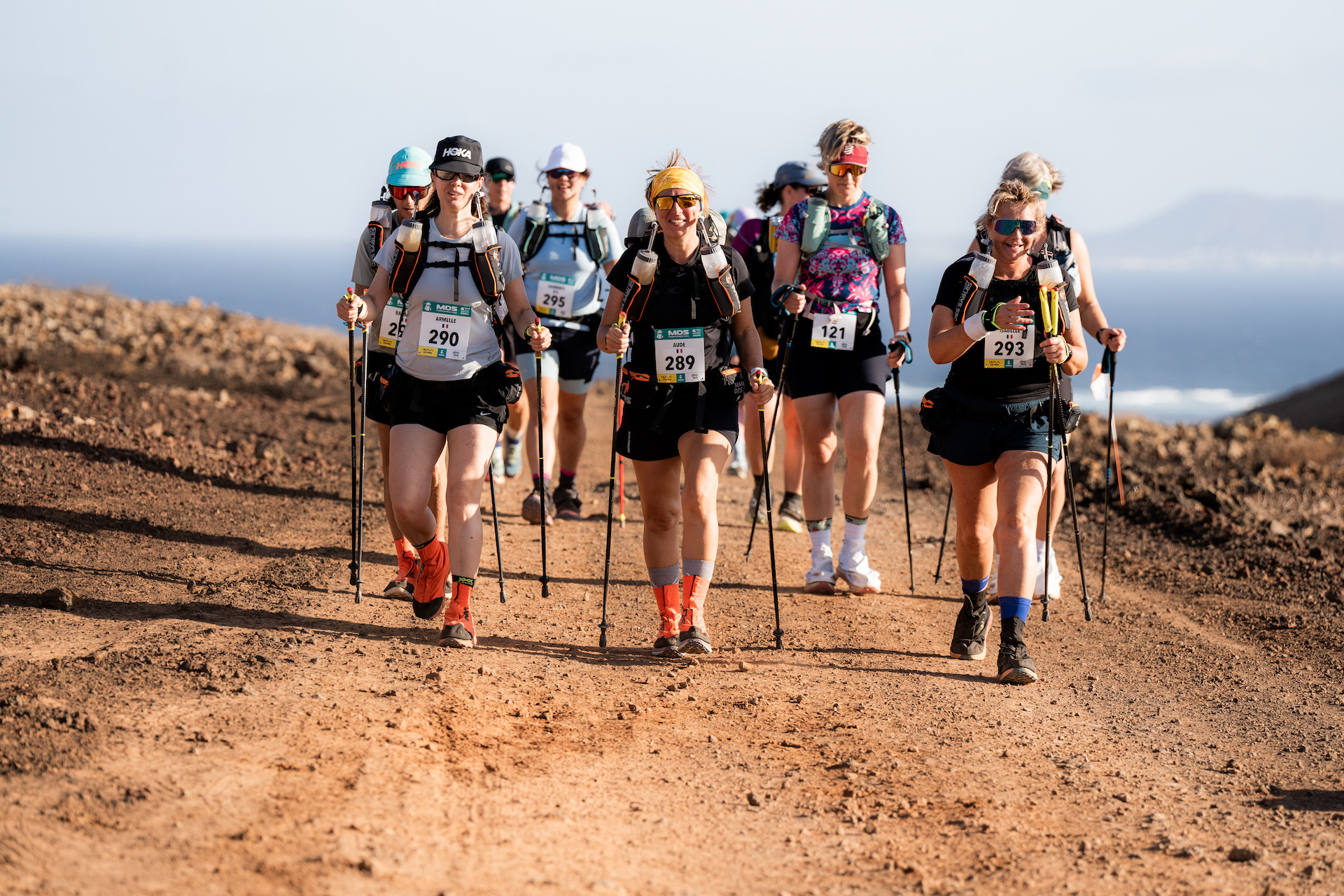
With 300 participants and record 58% women, the 6th edition of MDS Fuerteventura was highly anticipated.
Here for the women’s race
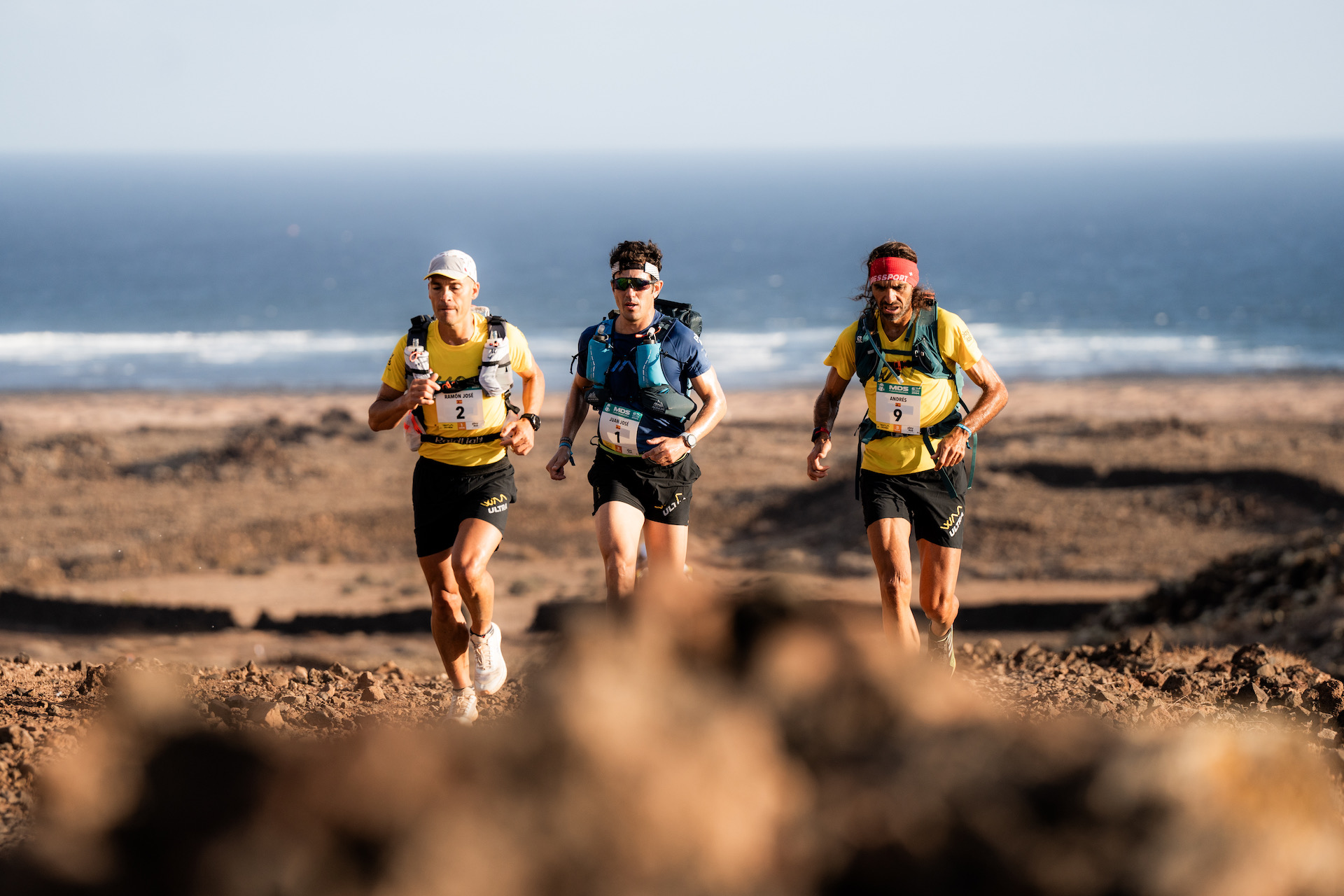
The race upfront was dominated by Juan SANTANA FERNÁNDEZ, ROGER PÉREZ and FOULQUIÉ PADILLA, the trio setting an incredible pace in the 120km race, with SANTANA FERNÁNDEZ taking the victory ahead of ROGER PÉREZ and FOULQUIÉ PADILLA placing 3rd, 2:32:18, 2:33:48 and 2:34:15 respectively.
The lead trio
For the women, MUJICA GONZÁLEZ ran the race solo for a time trial effort and victory in 3:37:37. Behind, BOLLENGIER, and DEL RIO VALLES ran a close race for 2nd, the duo crossing in 3:52:50 and 3:53:10 respectively.
It is important to remember, MDS events offer 3-distances, 120km, 100km and 70km, stage 1 is the same for all races and then the difference comes on stage 2 when participants for MDS Fuerteventura will choose which loop to run, option 1 17.8km, option 2 40.5km and option 3 56.7km.
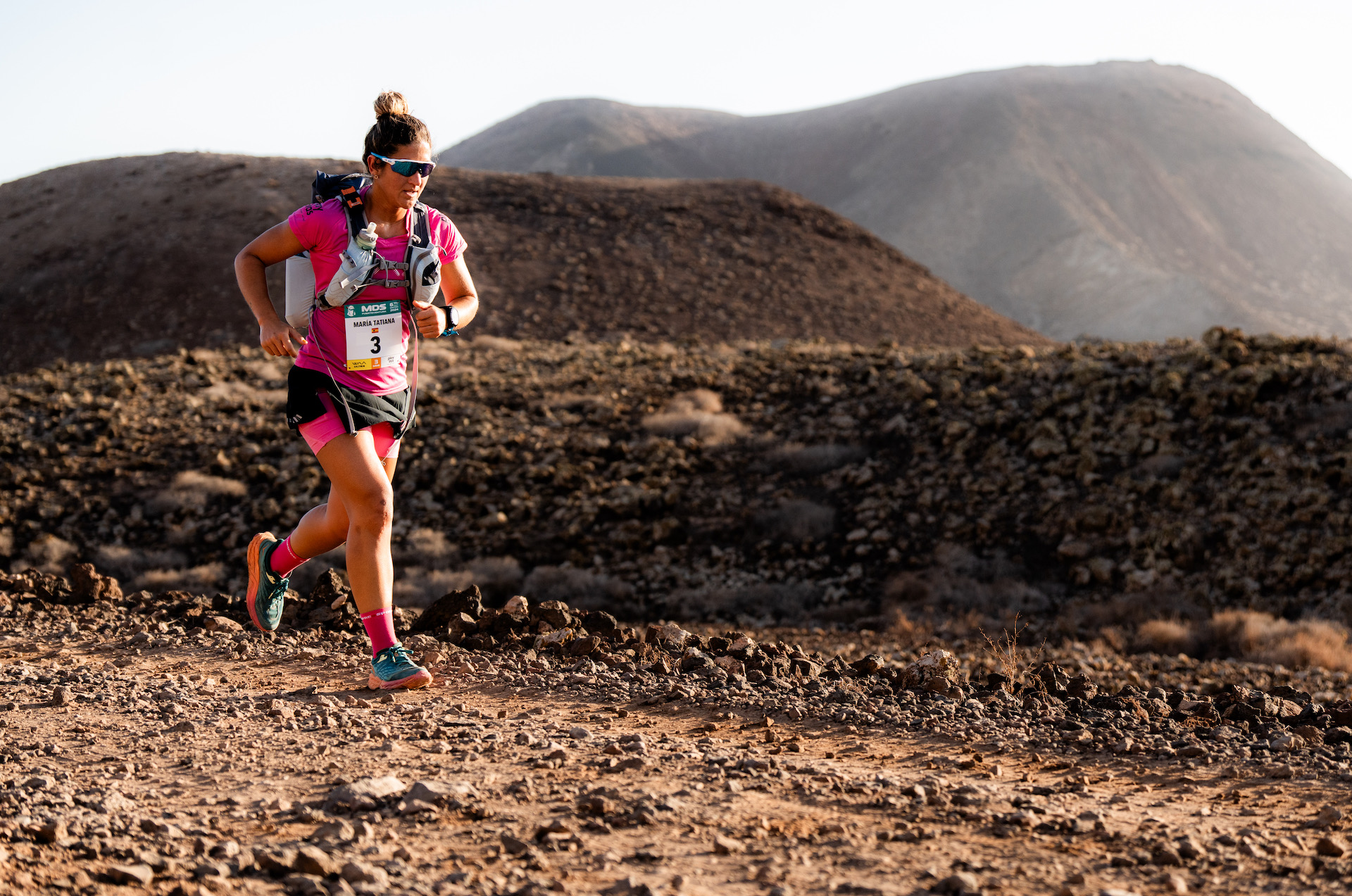
Volcano backdrops with 3rd place DEL RIO VALLES
Bivouac remains the same for each stage, the final stage (stage 3) the exception when the finish line brings an nd to the race and the participants return to Play Itas Resort.
With stage 1 being a longer first day, we may well see participants change options for stage 2, if they considered day 1 a little hard, they may well choose an easier option for stage 2, the choice is for them.
Stage 2 starts at 0600 and based on the distance chosen, the cut-off times for finishing will vary, midday for the short race, 1910 for the middle distance and for the long, 12:50am the following day.
Gladly for the participants, they will then have a rest day.
Since 1986, the MARATHON DES SABLES has crossed the world’s most stunning deserts with several unique concepts: the MARATHON DES SABLES THE LEGENDARY (252 km in the Sahara Desert in Morocco), the MARATHON DES SABLES (70, 100, or 120 km spread over 3 stages), and the new 2024 concept, the MDS TREK (4 stages with a total distance of up to 120 km), offering an accessible adventure with optimal comfort. These international events have seen over 50 editions in various countries such as Morocco, Fuerteventura Island, Peru, Jordan, Turkey, and offer adventures that combine running/hiking in the desert with tourism.
It’s countdown time to the 2024 MDS Fuerteventura, the 6th edition taking place from September 28 to October 5th.
The MDS format is the perfect synergy of travel, adventure and luxury.
The 2024 edition, once again, uses the Playitas Resort Hotel as a pre and post-race hub for 4 nights: two nights pre and two nights post.
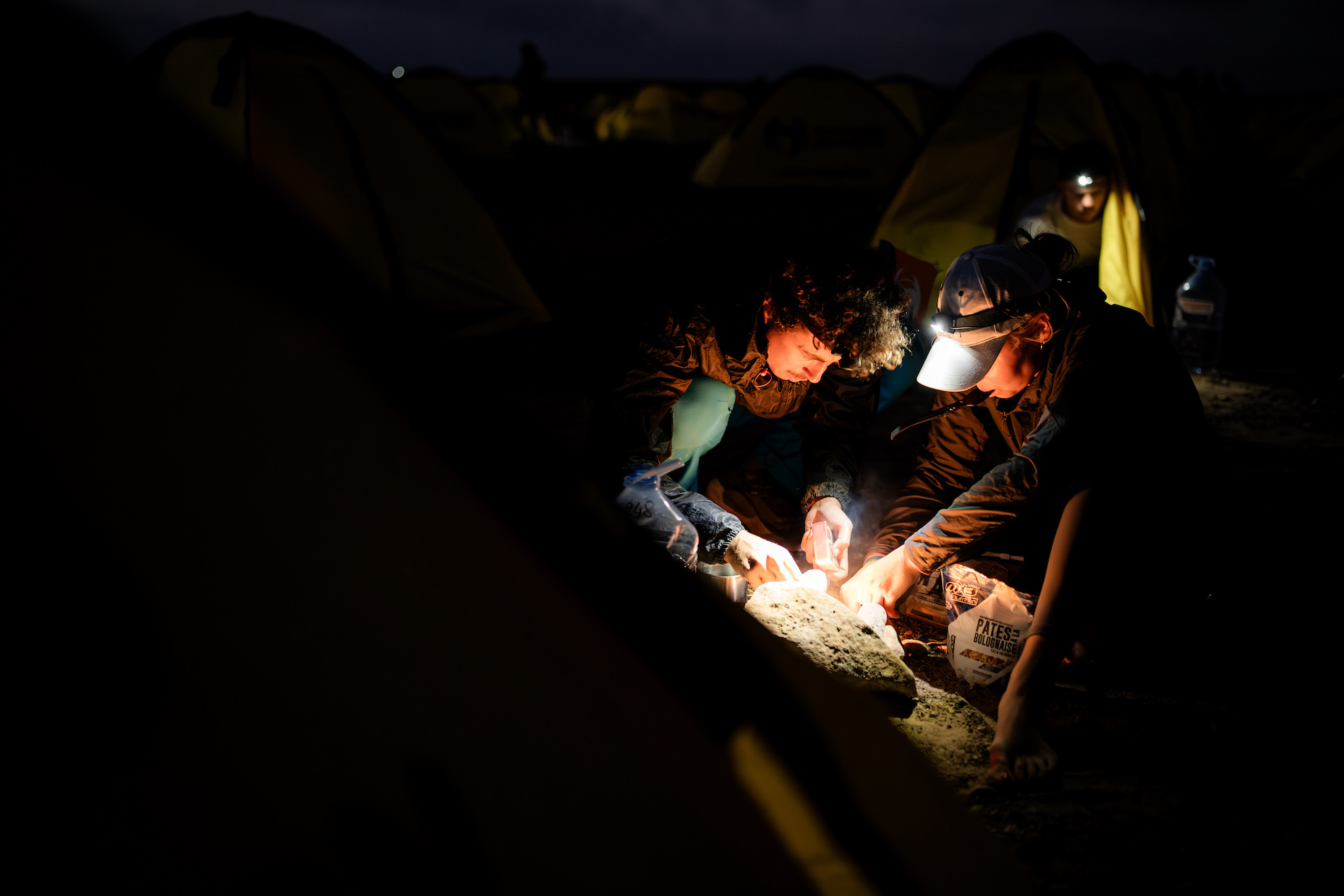
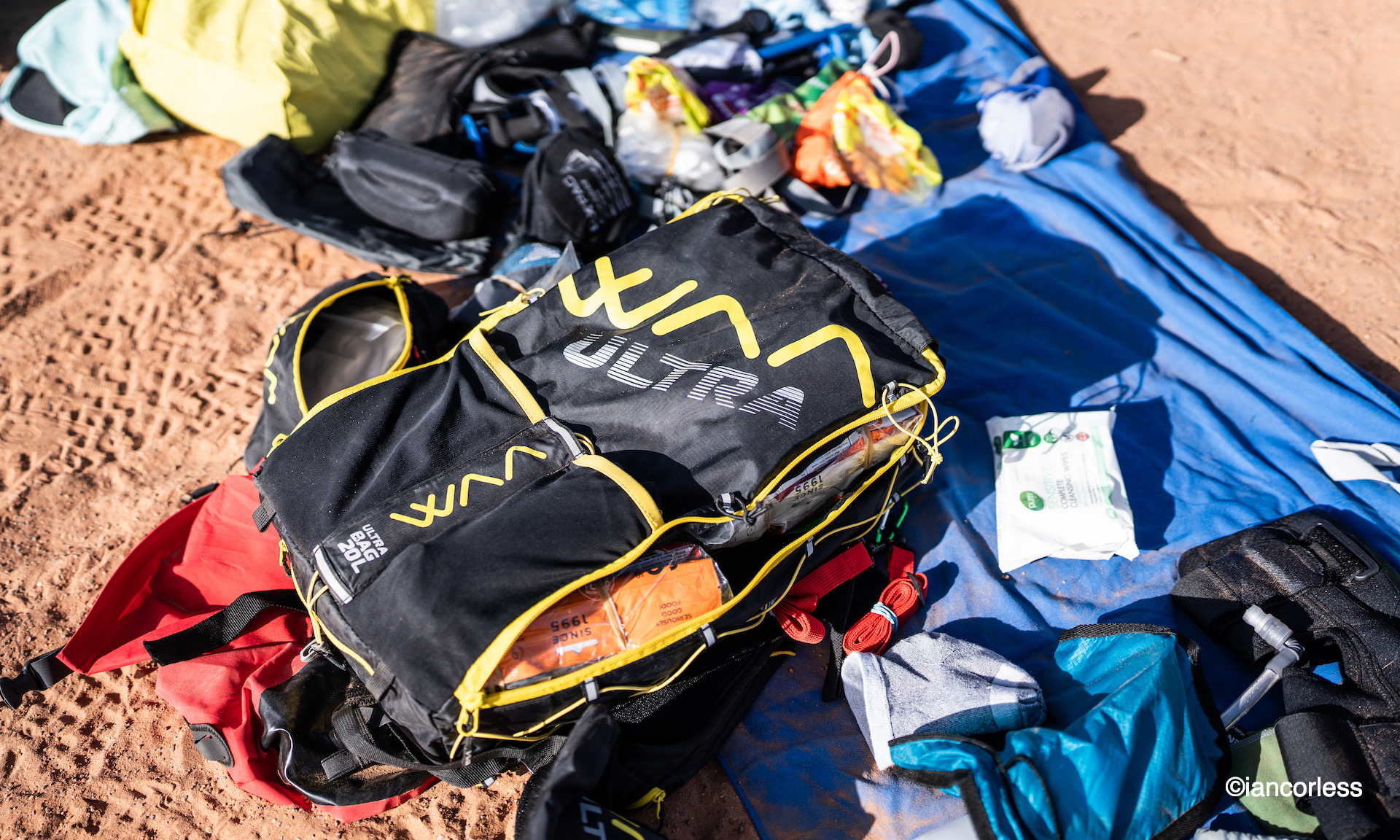
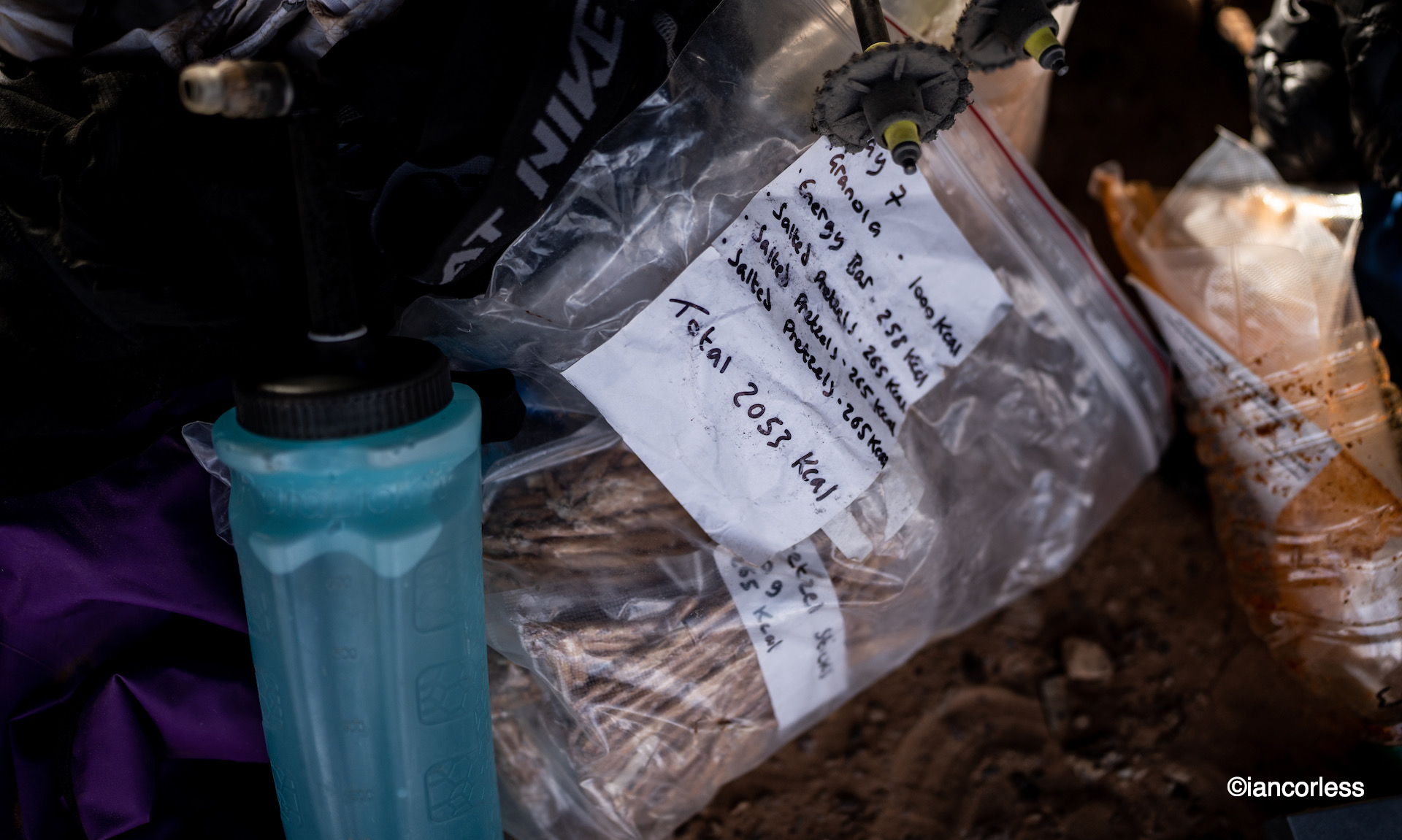
Three nights will be spent in bivouac in full self-sufficiency, the only provision provided is a tent in which to sleep and water. All other items the participant must carry, this includes all food and snacks for the duration of the event, clothes, sleeping bag, sleeping mat and any luxuries.
Day 2 and 3: breakfast, lunch, dinner. (Stage 2 and rest day)
Day 4: breakfast, lunch. (Stage 3)
If a participant requires power for phone, watch, mp3 player etc, they must provide this themselves in the form of a portable battery which they must carry.
The MDS format is the same for all events, MDS The Legendary and MDS Trek excluded.
The race will take place over 4-days and 3-stages, typically broken down as follows:
Day 1/ Stage 1 between 25 and 30km.
Day 2/ Stage 2 20, 40 or 60km – the participant chooses the appropriate distance.
Day 3 Rest day
Day 4/ Stage 3 between 25 and 30km.
The race is designed so that finishing is a possibility for all, regardless of ability or speed. Importantly, if a runner does not finish, they are provided a free race entry for the following year.
The last edition of the race took place in 2022 which turned out to be a considerable challenge due extreme and unprecedented weather. 2023 did not take place due to environmental rules. So, 2024 will be a special year for MDS Fuerteventura. Notably, 300 participants will toe the line of which, 58% are women. A fantastic statistic.
The Program for the week will be as follows:
Saturday September 28
Arrival of participants and relaxed night at Playitas Resort Hotel.
Sunday September 29
Technical and medical checks followed by relaxation at Playitas Resort Hotel.
Monday September 30
Stage 1 – overnight bivouac
Tuesday October 1
Stage 2 – overnight bivouac
Wednesday October 2
Rest day – overnight bivouac
Thursday October 3
Stage 3 – followed by relaxation at Playitas Resort Hotel.
Friday October 4
Tourism and rest day followed by evening Gala dinner.
Saturday October 5
Onward travel
Playitas Resort Hotel is one of the key sports hotels in Europe. Located in the southeast of Fuerteventura, it is the perfect hub for a sports minded person, there is a gym, yoga, indoor cycling, CrossFit, pools and so much more available.
MDS Fuerteventura is closely followed by MDS Morocco, October 12-19, MDS Trek, October 20-29 and MDS Jordan, November 2-9.
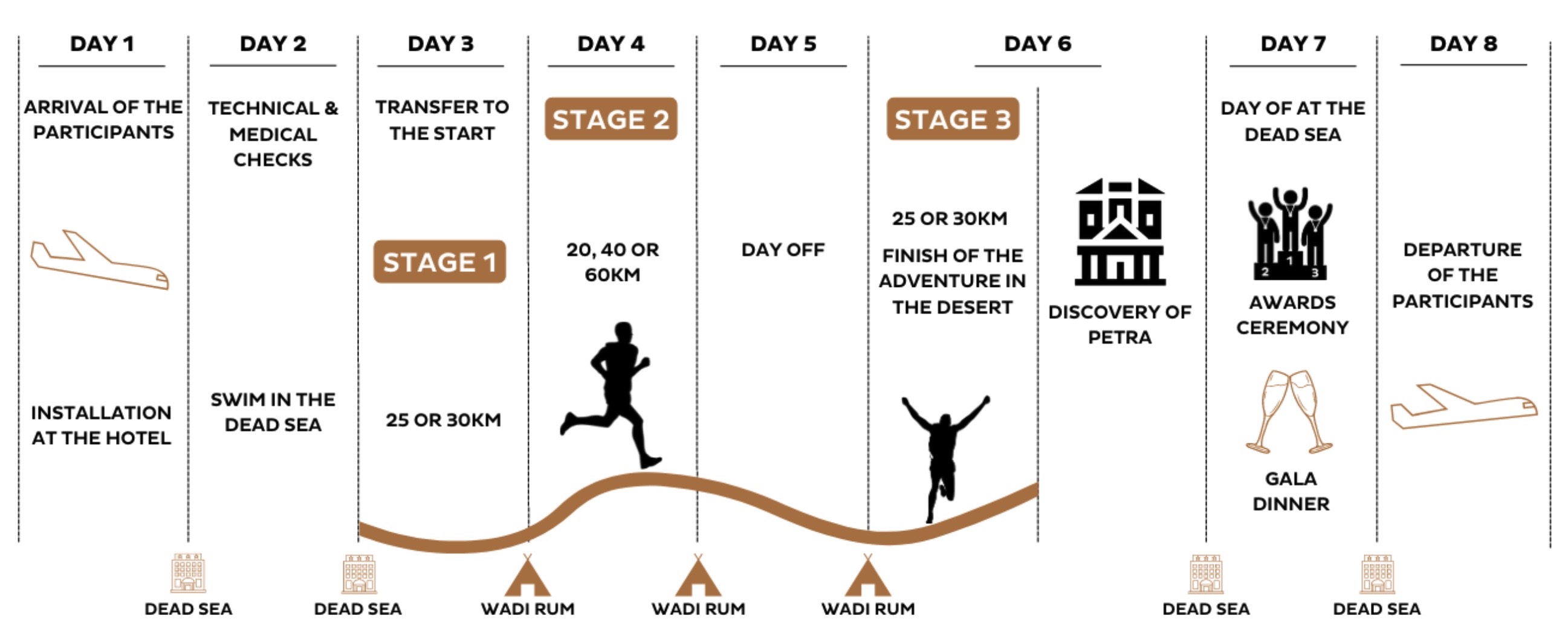
Both races will follow the classic MDS format with 3-stages taking place over 4-days. This allows participants to choose a distance of 70, 100 or 120km’s.
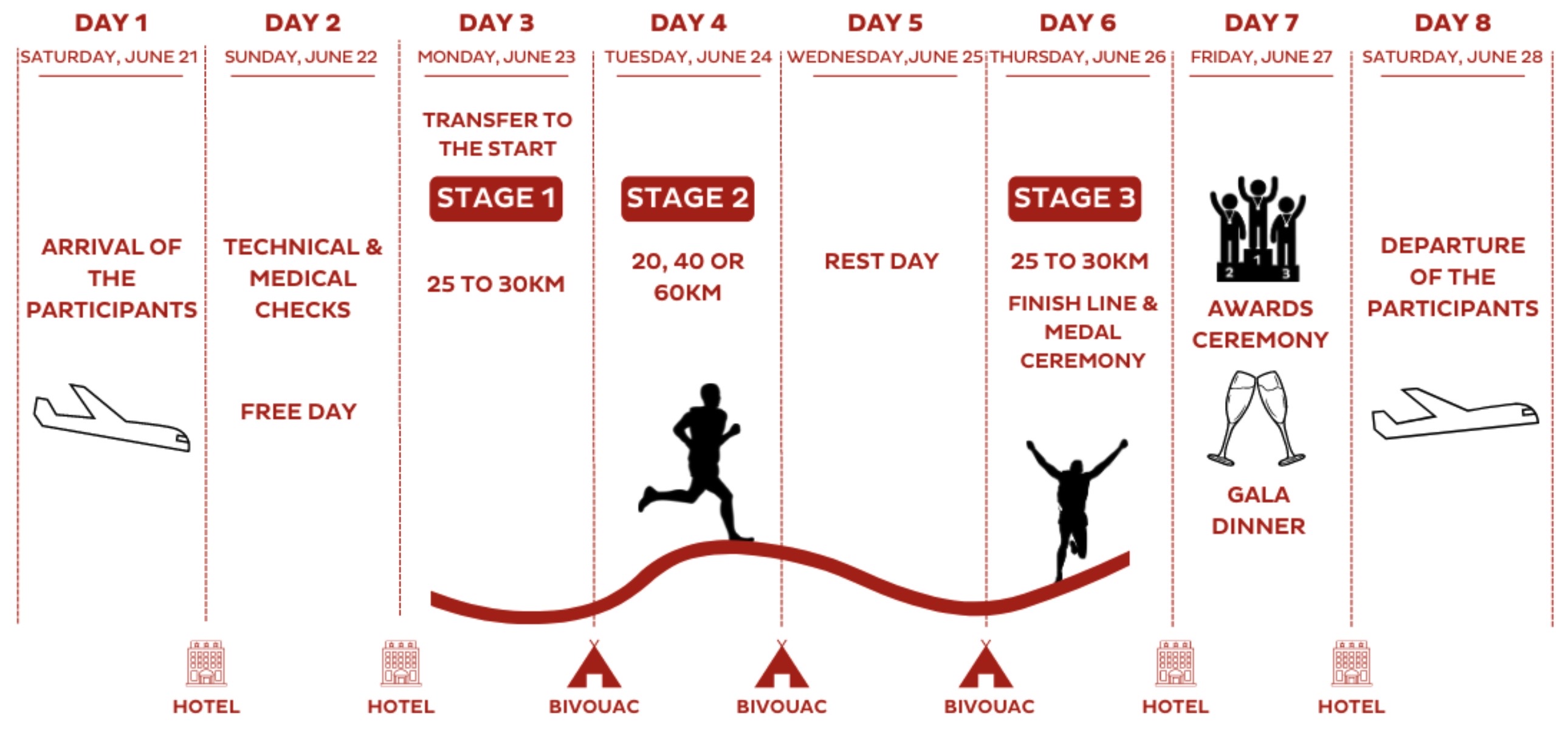
Day 1 will have arrival in Jordan or Turkey.
Day 2 Technical and admin checks.
Day 3 Stage 1
Day 4 Stage 2
Day 5 Rest Day
Day 6 Stage 3 followed by night at the race hotel.
Day 7 Day at the hotel and gala dinner.
Day 8 Onward travel
MDS Jordan is a firm favourite in the MDS list of races with two editions taking place in each year. May and November. A very special race that mixes the Dead Sea with the deseret of Wadi Rum.
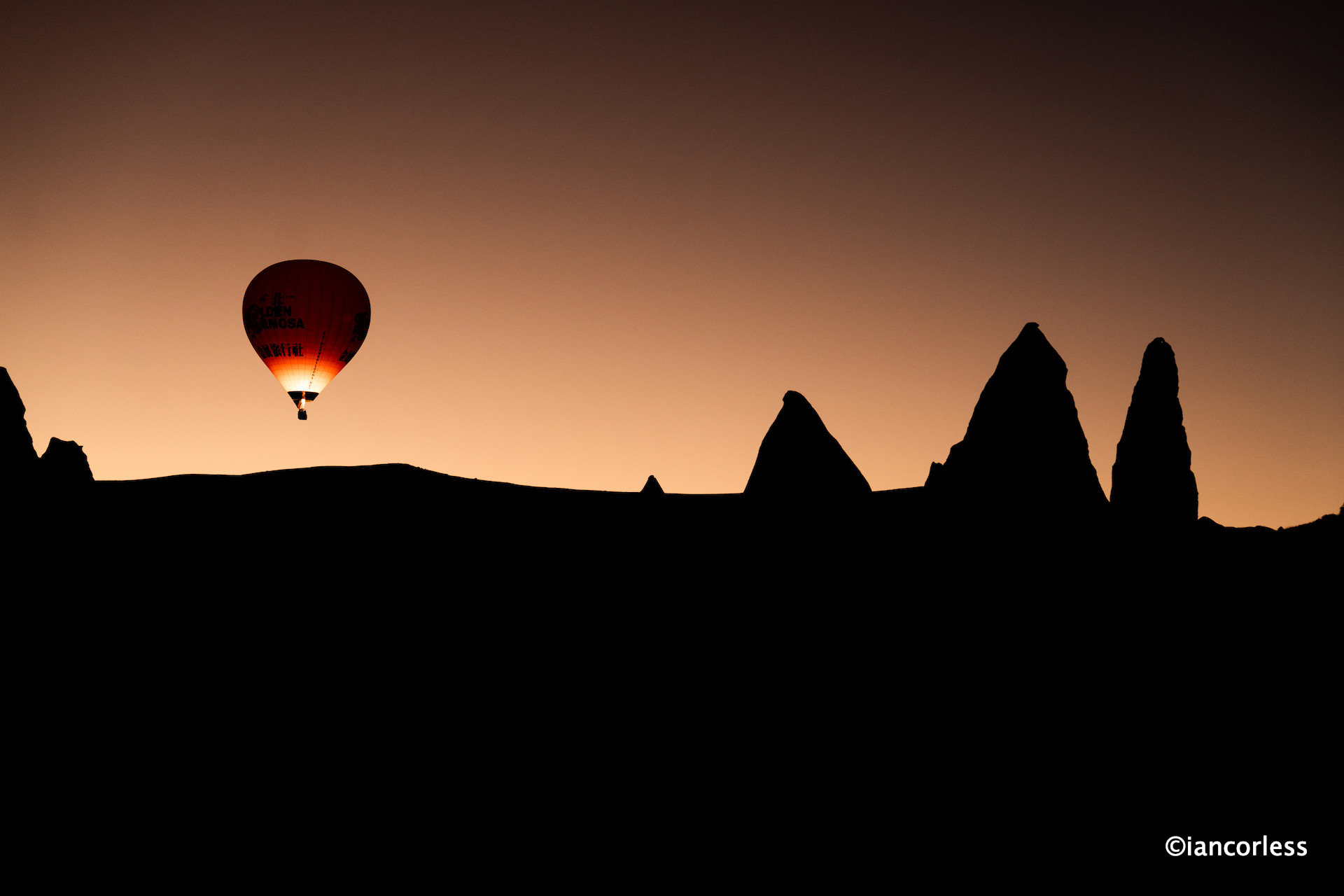
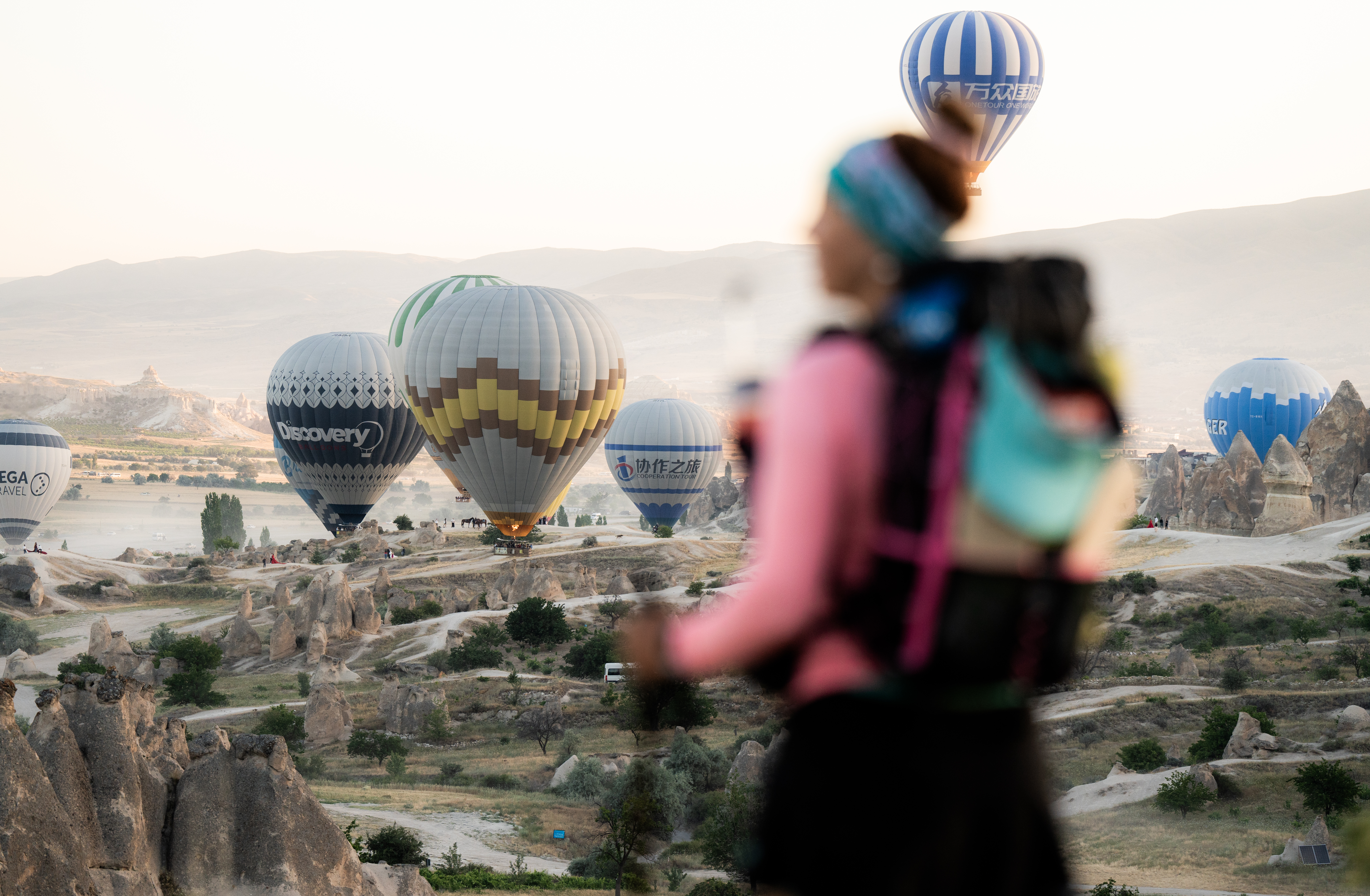
MDS Cappadocia had a first edition in 2024 and what an edition! Unique landscapes, hot air balloons and amazing light. A departure for the MDS brand with considerably less sand and more technical trails. A stunning addition to the MDS line-up.
What is the MDS?
The MARATHON DES SABLES is a unique adventure, shared by thousands of enthusiasts since 1986.
To differentiate the full distance race of 250km’s, Marathon des Sables will now be known at MDS The Legendary, reflecting the legendary status of this iconic event and its long history as a pioneer of the stage racing and multi-day format.
The ‘HMDS’ format while still follow the same protocols as before but has now dropped the ‘half’ title and moving forward, events will be called MDS Jordan, MDS Morocco, MDS Cappadocia and so on.
The MDS events are a one-week sporting adventure that combines the discovery, tavel, meeting new people and physically challenging yourself in a self-sufficient manner.
MDS format is as follows, after spending 1 or 2 nights in a hotel, you will go to the desert for 4 days of adventure and typically 3 or 4 nights in bivouac.
Once the race is over, the participants return to the race hotel offering relaxation time and a gala dinner.
The MDS exists in three different formats so that you can choose a distance based on your own personal requirements, needs and fitness:
Stage 1 : 25km to 30km
Stage 2 : 20, 40 or 60km
Rest day
Stage 3: 25km to 30k
The difference between the formats is on stage 2, where, depending on your form, you can choose 20, 40 or 60km.
During the MDS you will spend your nights in the heart of the desert, in the MDS bivouac in a tent supplied by the organisation.
The MDS is self-sufficient, you need ALL your equipment and food to last the duration of the event. Water is the only item supplied.
With all MDS events, if you do not finish, you receive a free entry for the next edition.
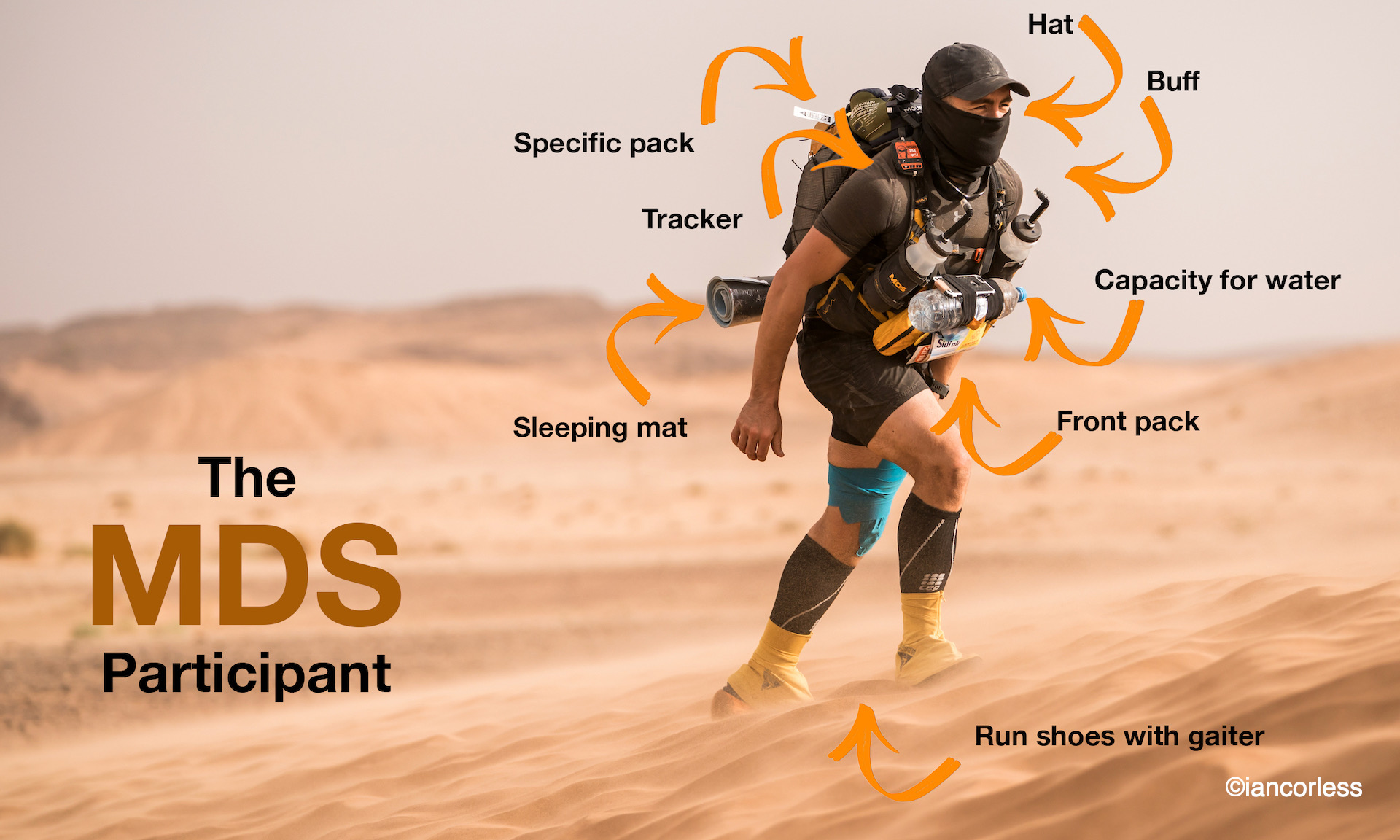
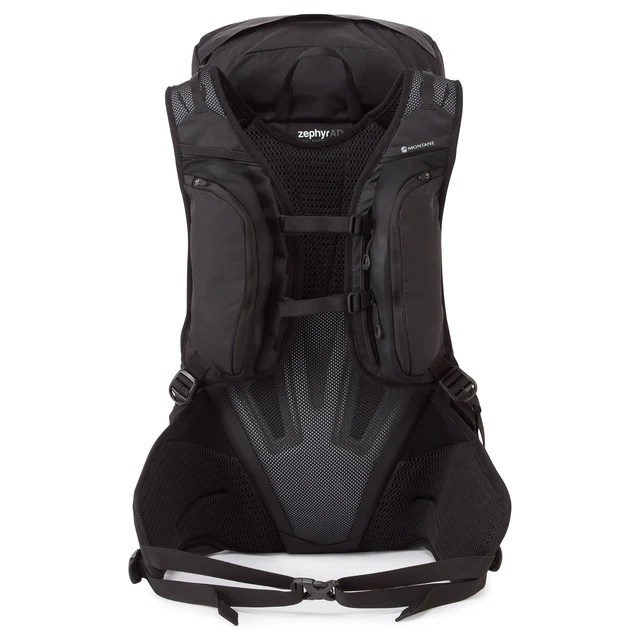
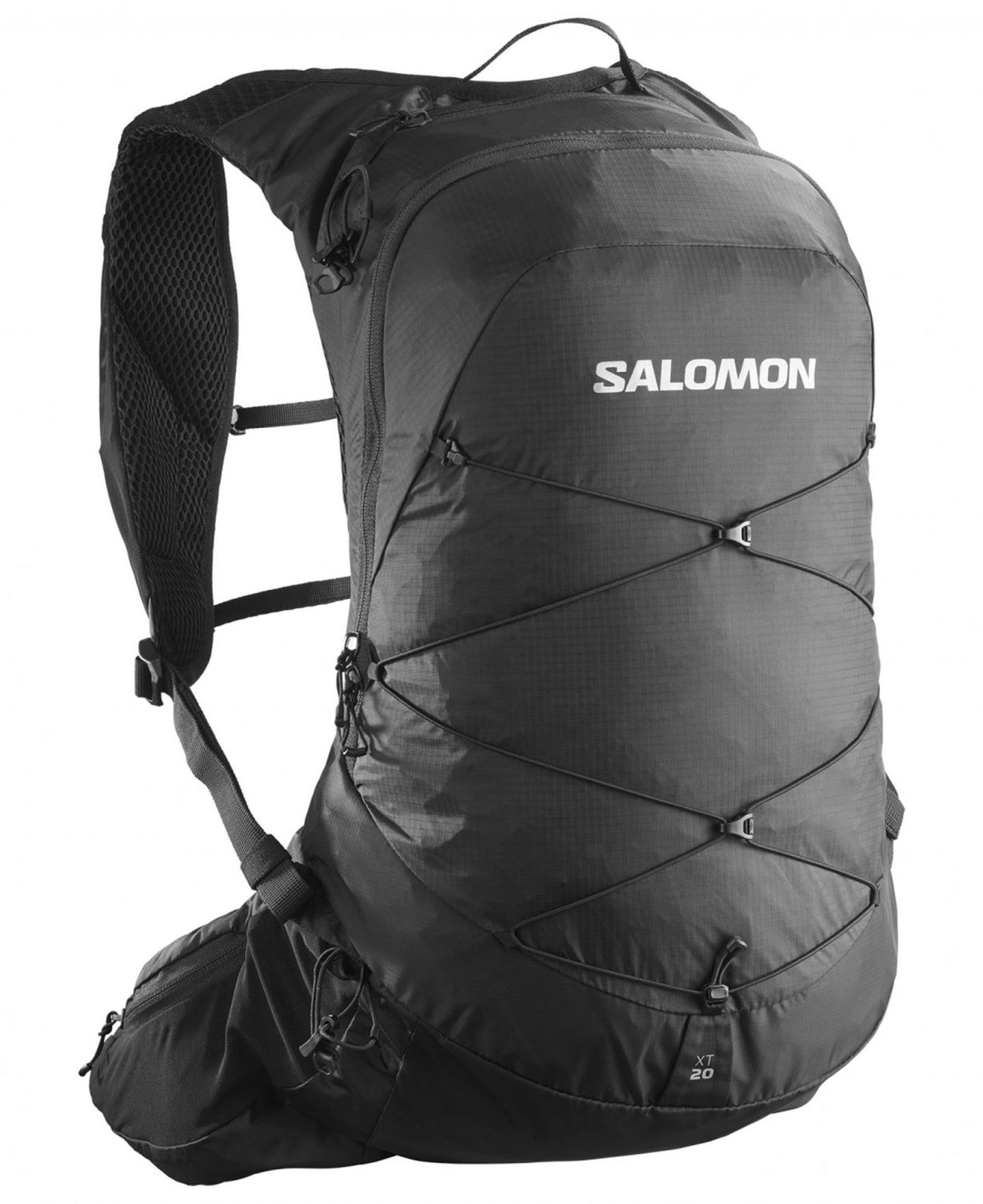
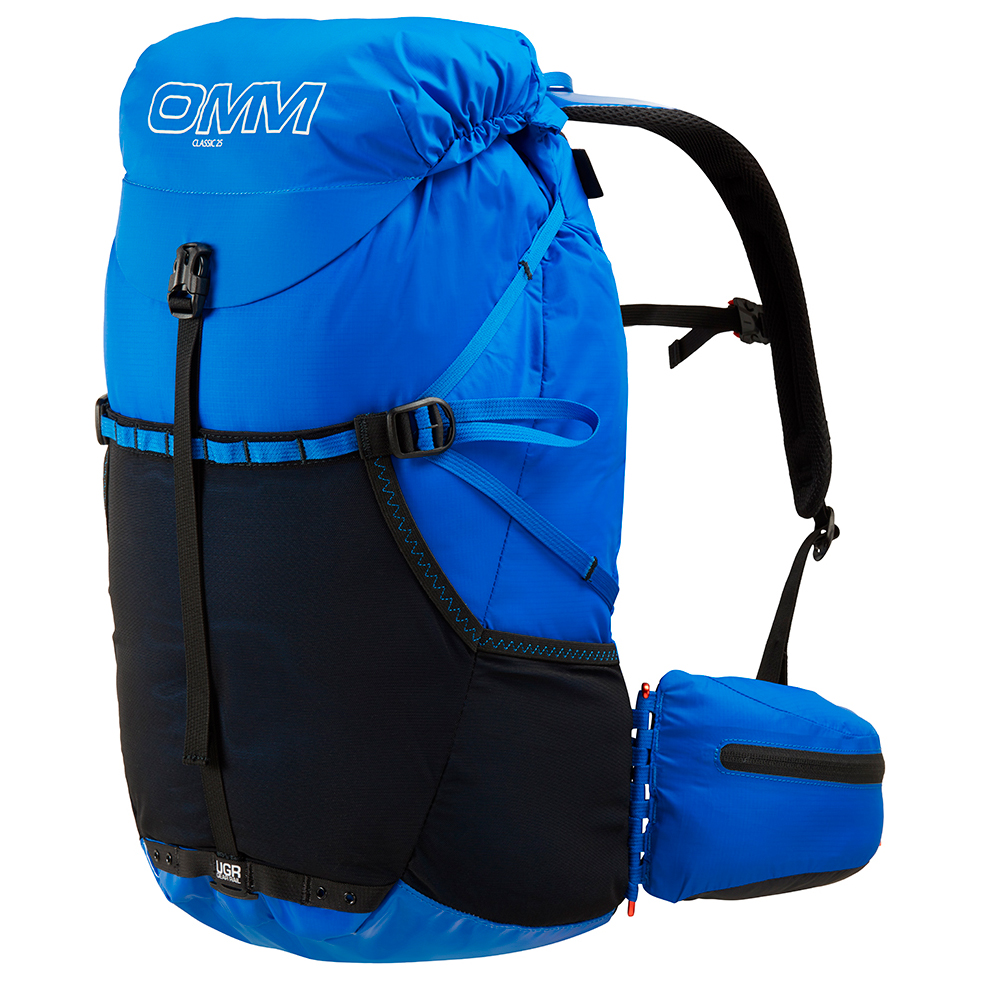
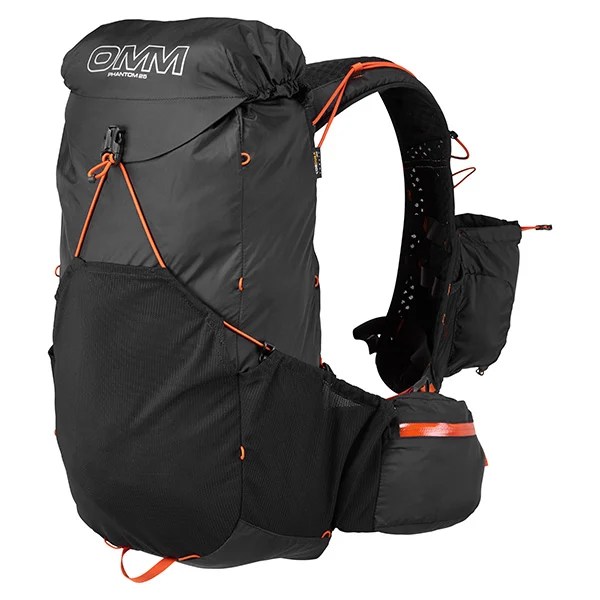
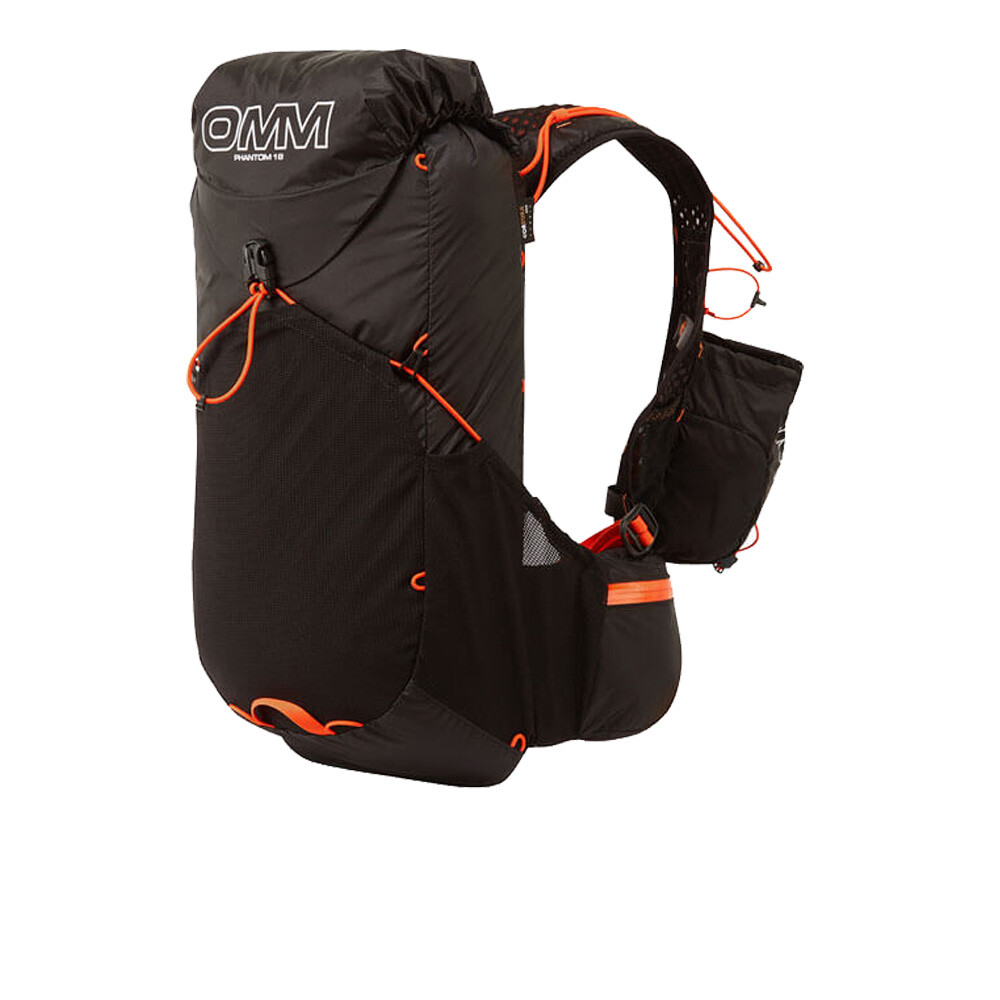
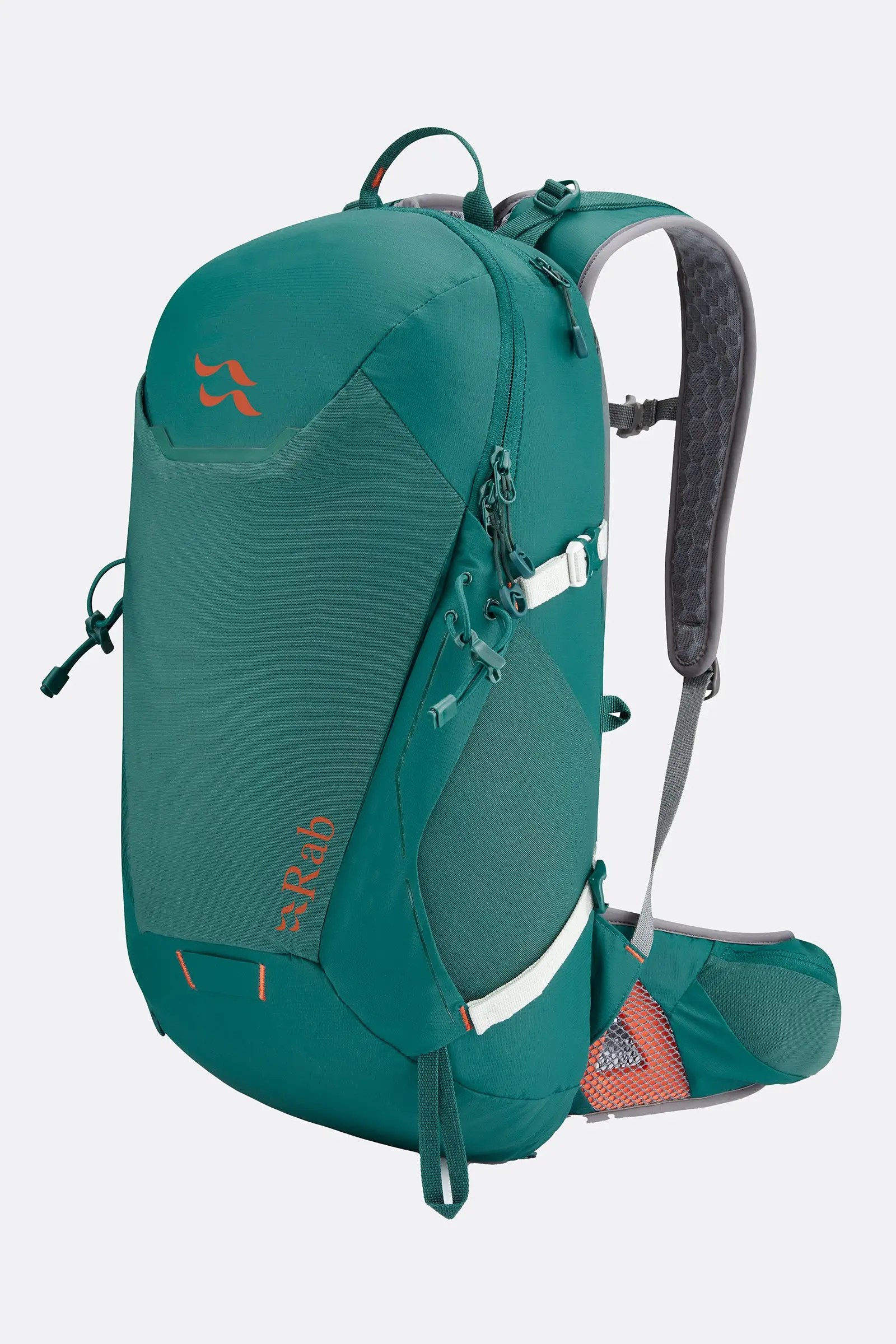
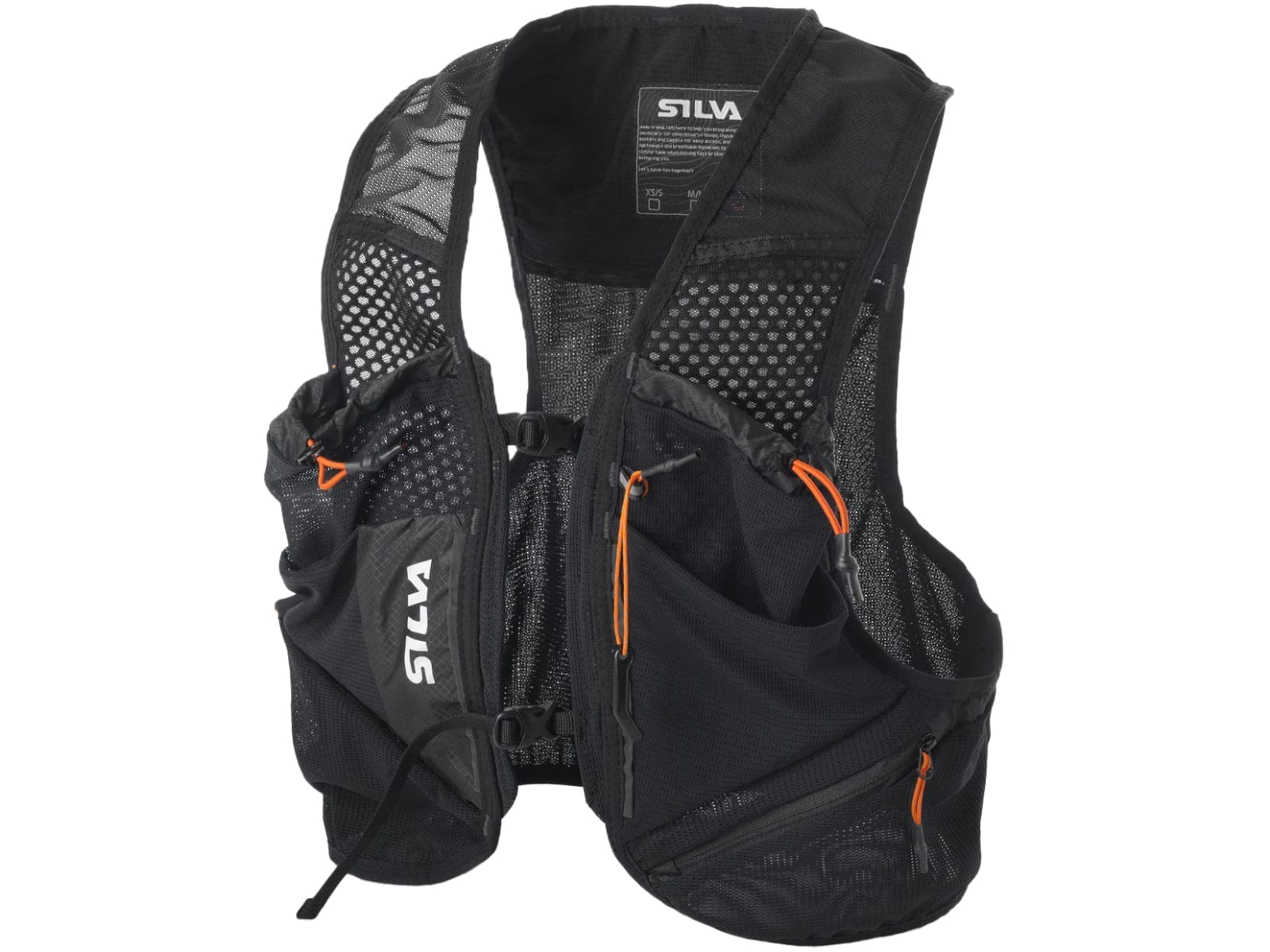
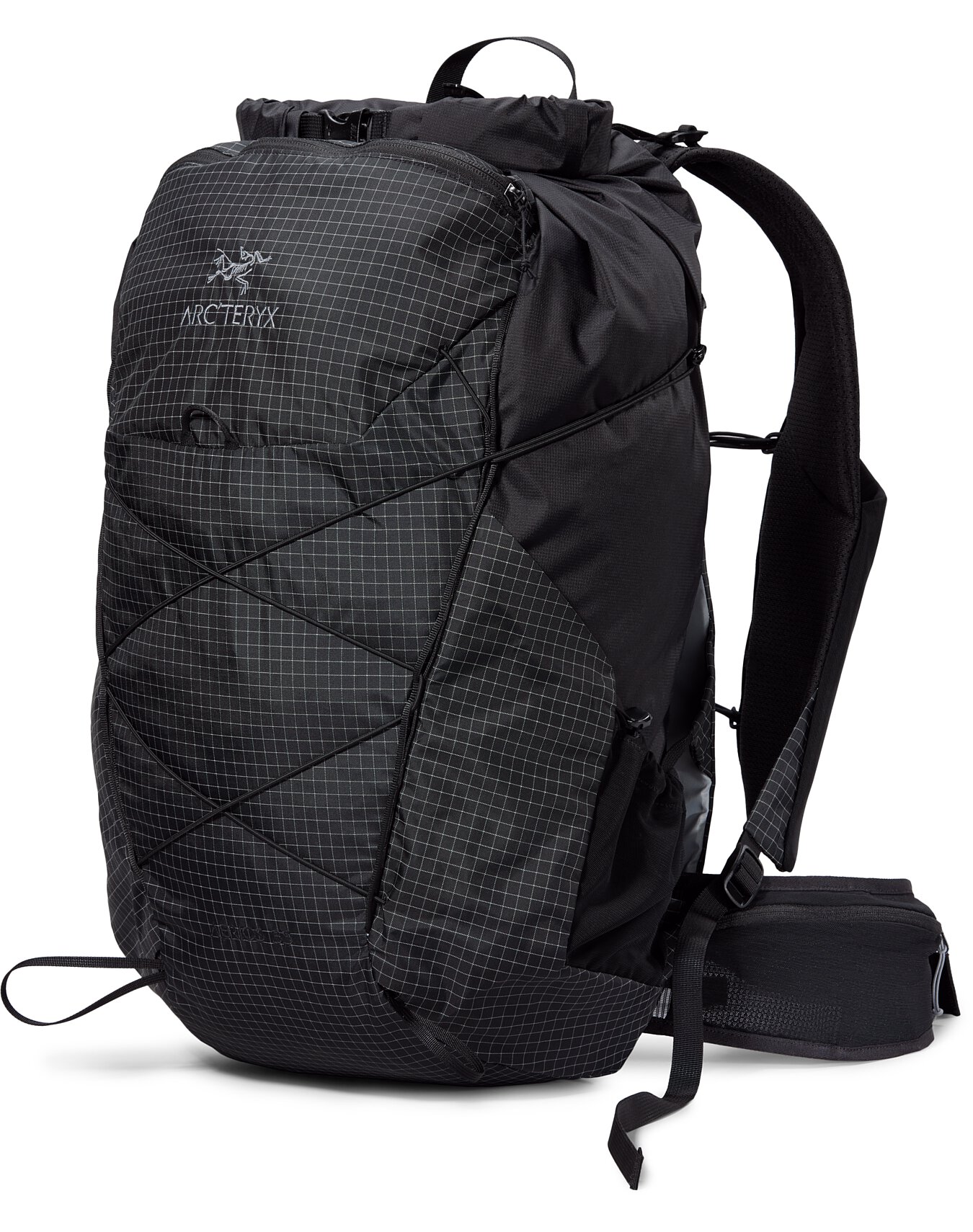
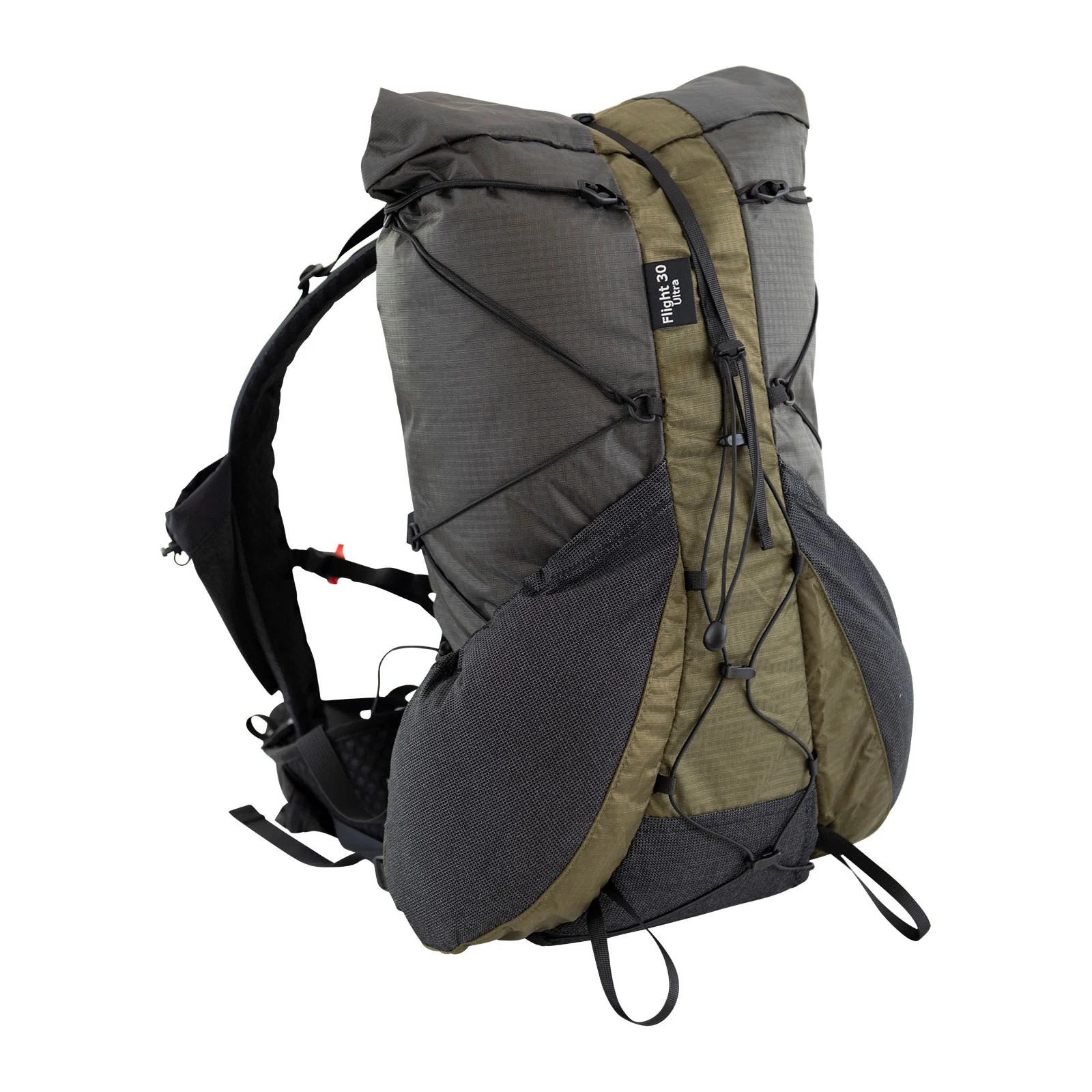
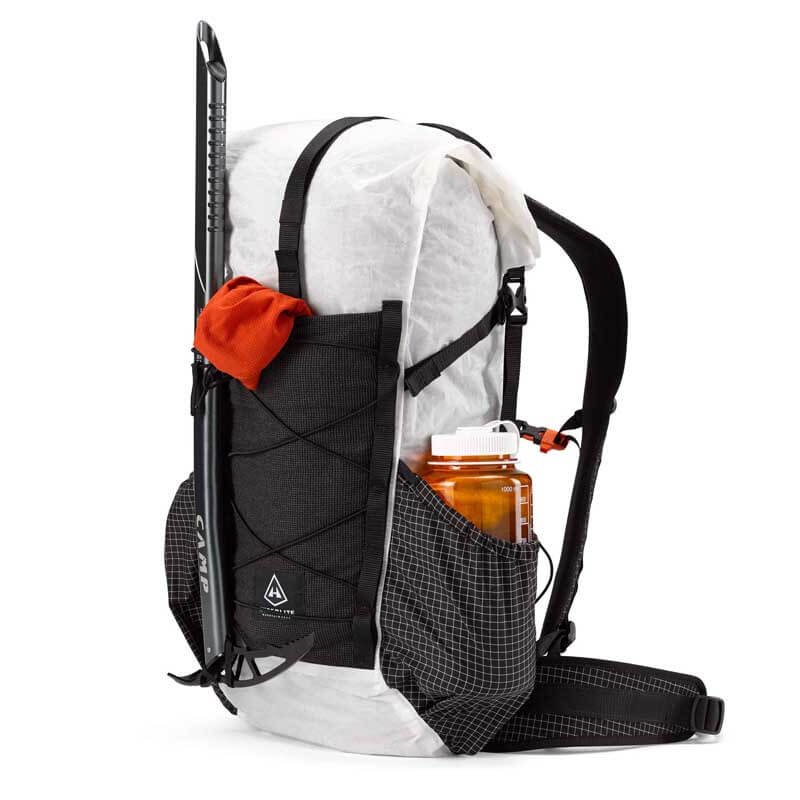
Stage racing, multi-day running and fastpacking all require a very specific pack. With the growth of multi-day running, many major brands now produce a pack or packs that are specifically designed for the task at hand. However, choosing a pack can be a daunting process due to many variables.
First and foremost, spend some time and sit down with a piece of paper and make notes of all the equipment that you need to carry. This may sound obvious, but there is a great difference in needs and demands.
For example:
Are you running in a hot or cold environment?
Do you need to carry food for the adventure or will you be able to get food on the route?
What spare clothing do you need?
What safety equipment do you need to carry?
Do you need a tent?
Do you need a sleeping bag and sleeping mat?
How much liquid do you need to carry and do you need immediate access to that liquid?
And the list goes on, so, take time to sit down and plan. This also helps you look at weight.
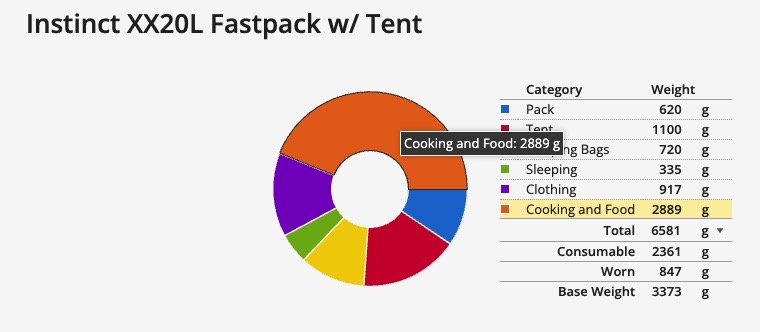
An excellent website to help facilitate this is Lighterpack– You can see an example HEREof all the contents I used when testing theInstinct XX20Lwhen I went fastpacking with a tent.
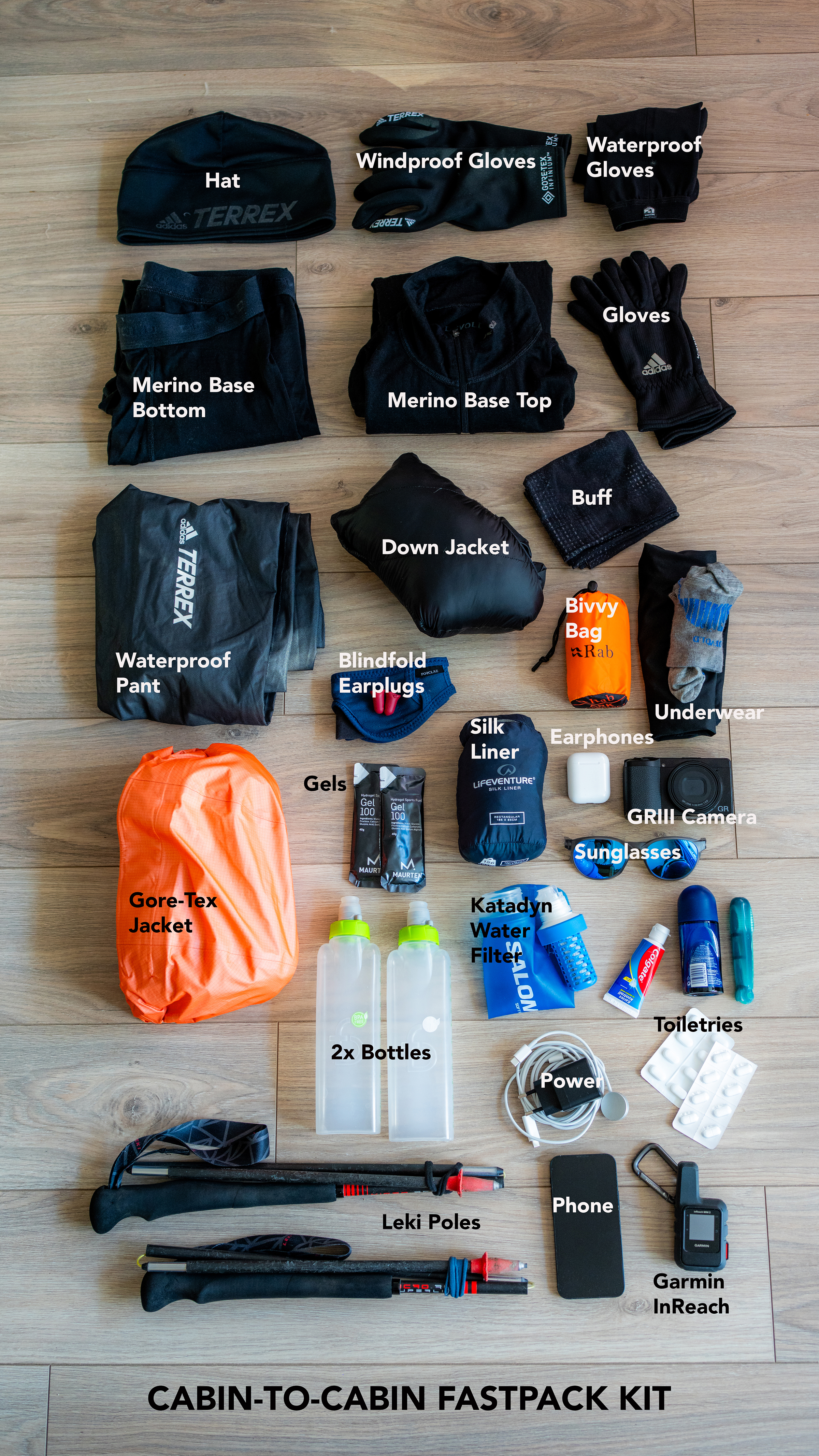
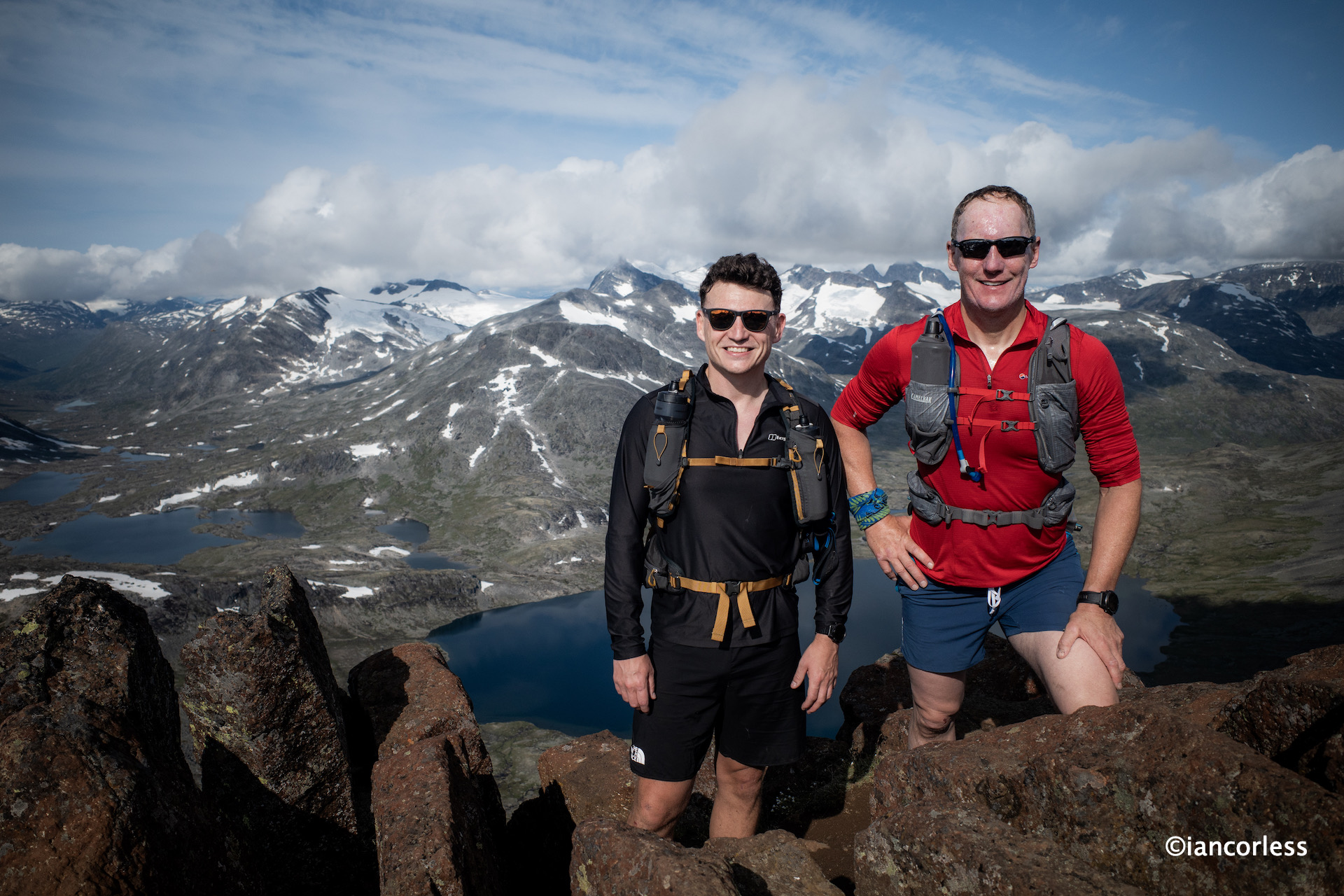
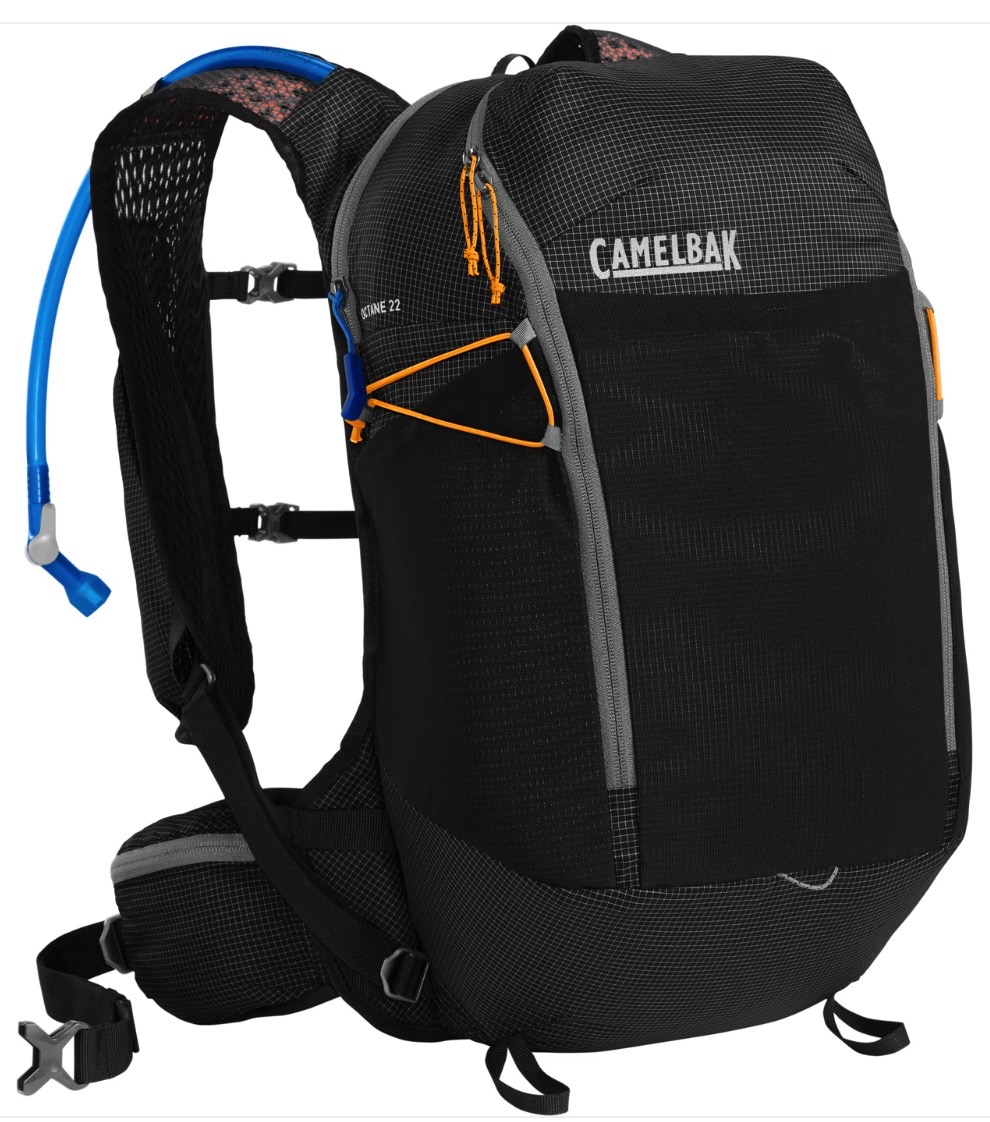
Recently I went fastpacking in Norway running from cabin-to-cabin. I did not need food (other than run snacks,) did not need a sleeping bag, just a sleeping bag liner and I could be minimal on clothing. I used the Camelbak Octane pack and the contents were as listed below:
You can see an example of my pack below and the details are as follows:
Camelbak Octane Pack 600g
adidas hat 32g
adidas gloves Infinitum 52g
Hestra waterproof gloves 53g
adidas gloves 41g
Devold merino base top 193g
Devold merino base bottom 166g
Buff 43g
Haglofs down jacket 163g
adidas waterproof pant 125g
adidas Gore-Tex jacket 272g
Rab bivvy bag 110g
Underwear 98g
Gels 81g (for emergency)
Silk liner 126g
Blindfold/ earplugs 22g
Earphones 44g
Ricoh GRIII camera 251g (a luxury)
Sunglasses 18g
Bottles x2 90g
Katadyn water filter 52g
Toiletries 196g
Power supply 138g
Phone 136g
Garmin InReach 108g
Leki poles 250g
3379g
As you can see, my pack weight was low. This allowed me to move faster and lighter for less effort.
KEY CONSIDERATIONS FOR CHOOSING A PACK
Once you have worked out what you need to carry, you can then decide what size pack you need. The best recommendation here is that it is better to have a pack that is maybe just too small. That way you will be strict on what you take and what you do not take. Of course, this decision should never be at the compromise of safety. Simply, if you have more room, you tend to take more because you can.
When doing a stage race, multi-day or fastpack, weight is the enemy, so, you need to be as light as possible.
WAA has a waist belt and optional front pocket for food/snacks and water bottle.
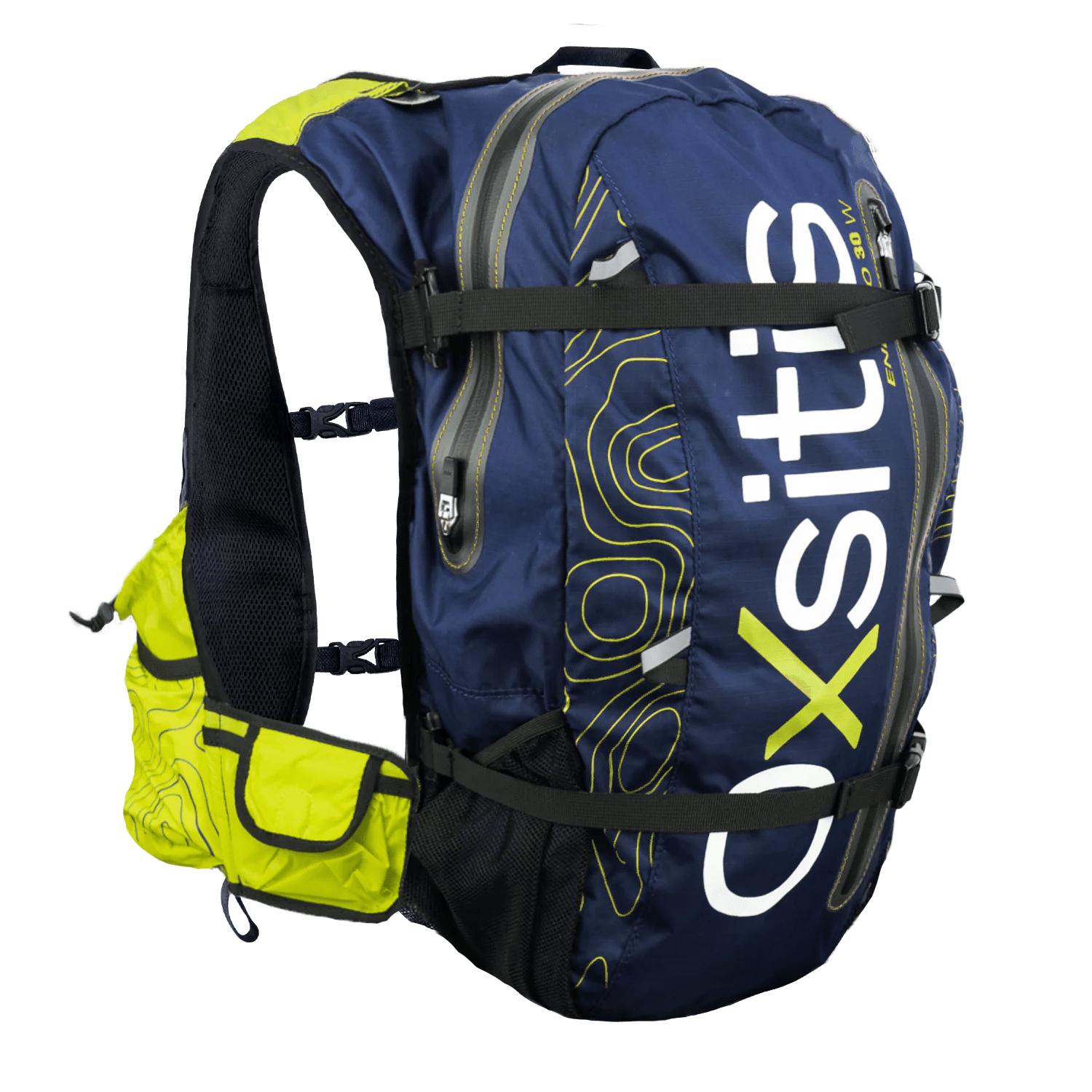
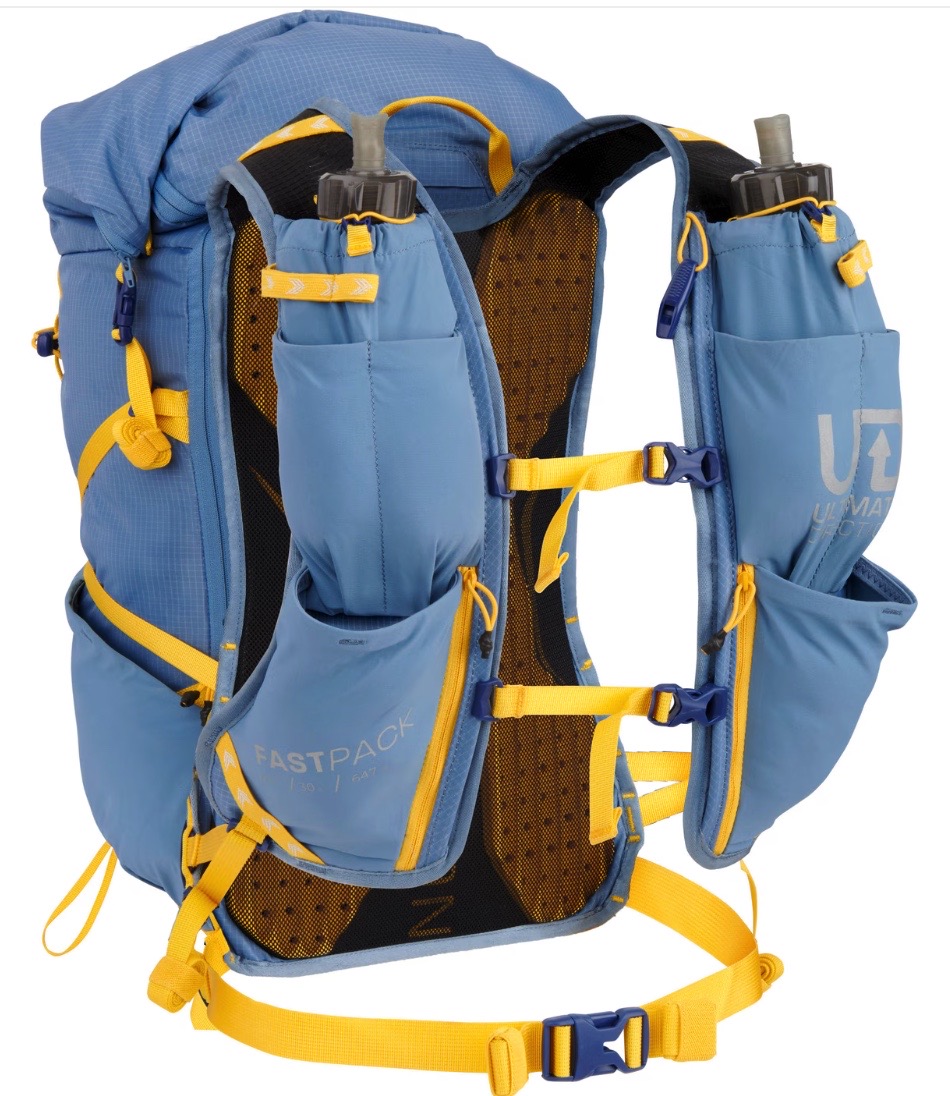
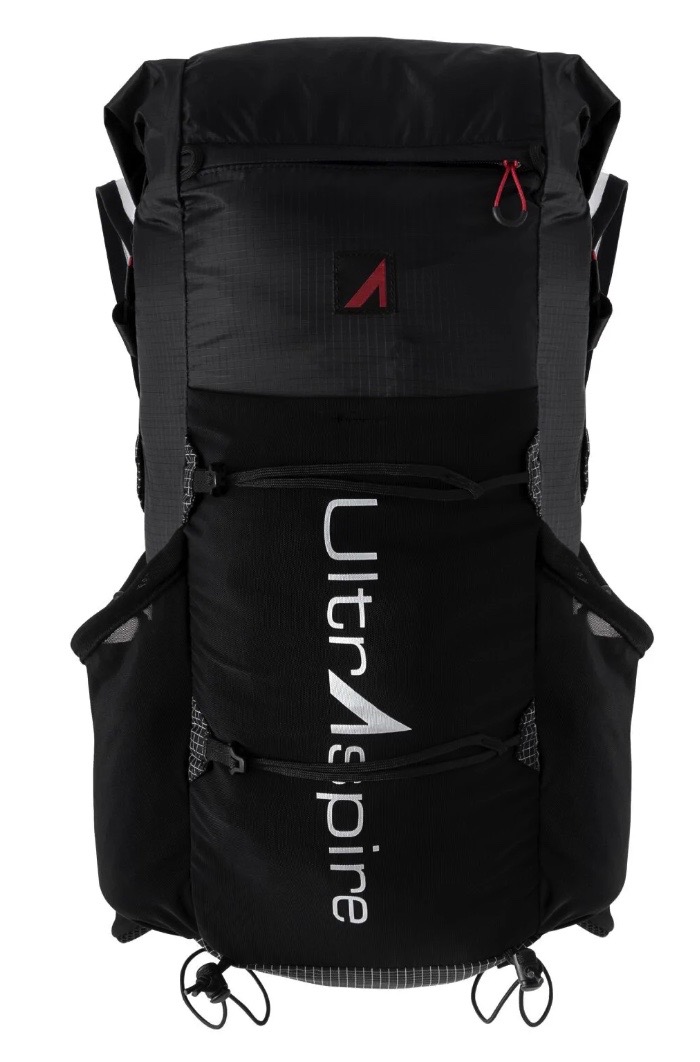
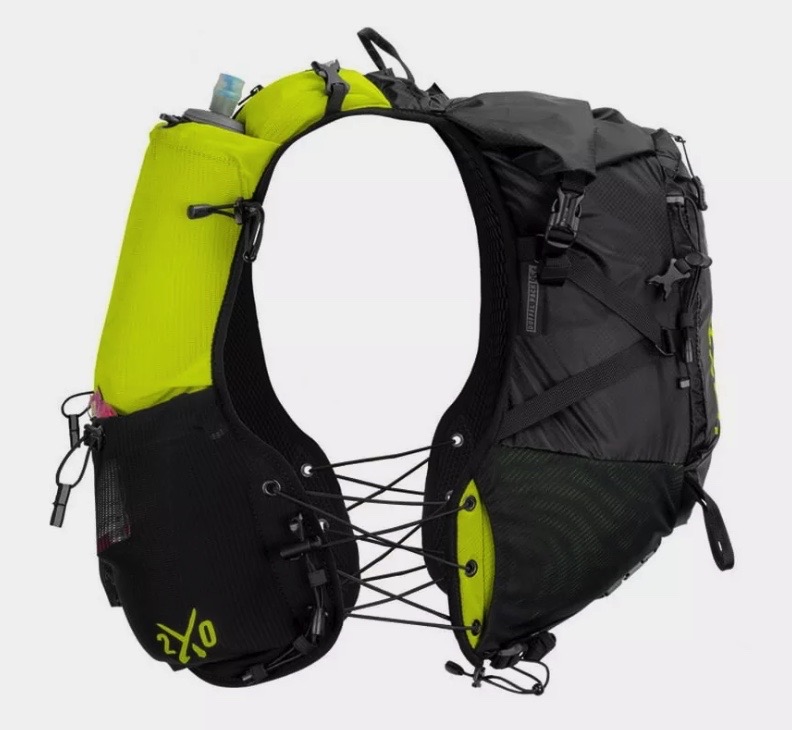
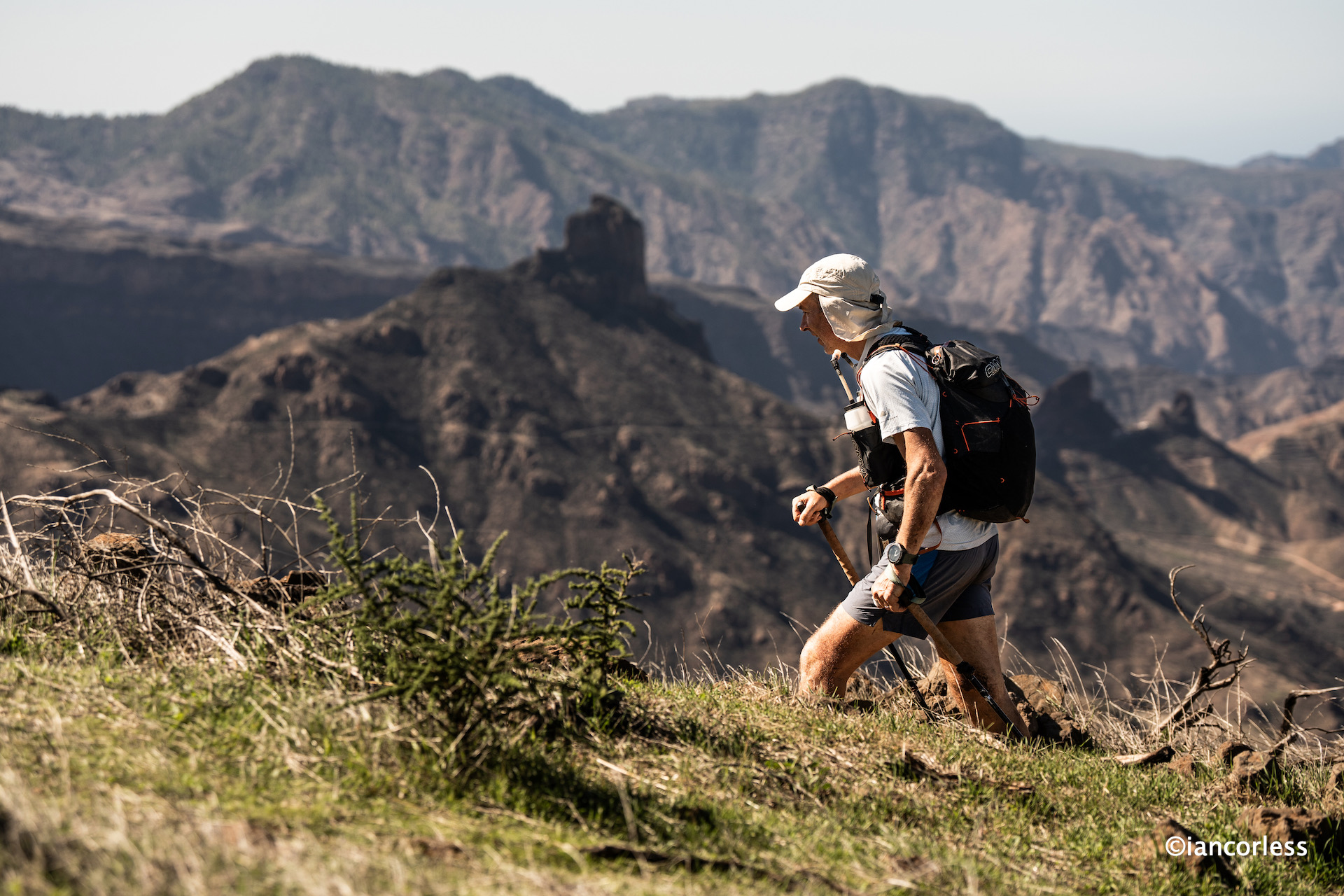
Comfort is obviously hugely important and just like shoes, packs need to fit you, cause no rubbing or irritation and feel like a piece of clothing. What works for one person will not work for another. A great example being, the needs and requirements for 152cm tall woman weighing 55kg is very different than a 182cm tall male weighing 85kg. It’s great to ask and take advice BUT you need to try packs, see how they fit and importantly when trying, add weight so you can feel how it sits on your body. Many brands do different sizes now such as S/M or L/XL and one or two brands do male/ female versions: Ultimate Direction, Osprey and Oxitis being good examples.
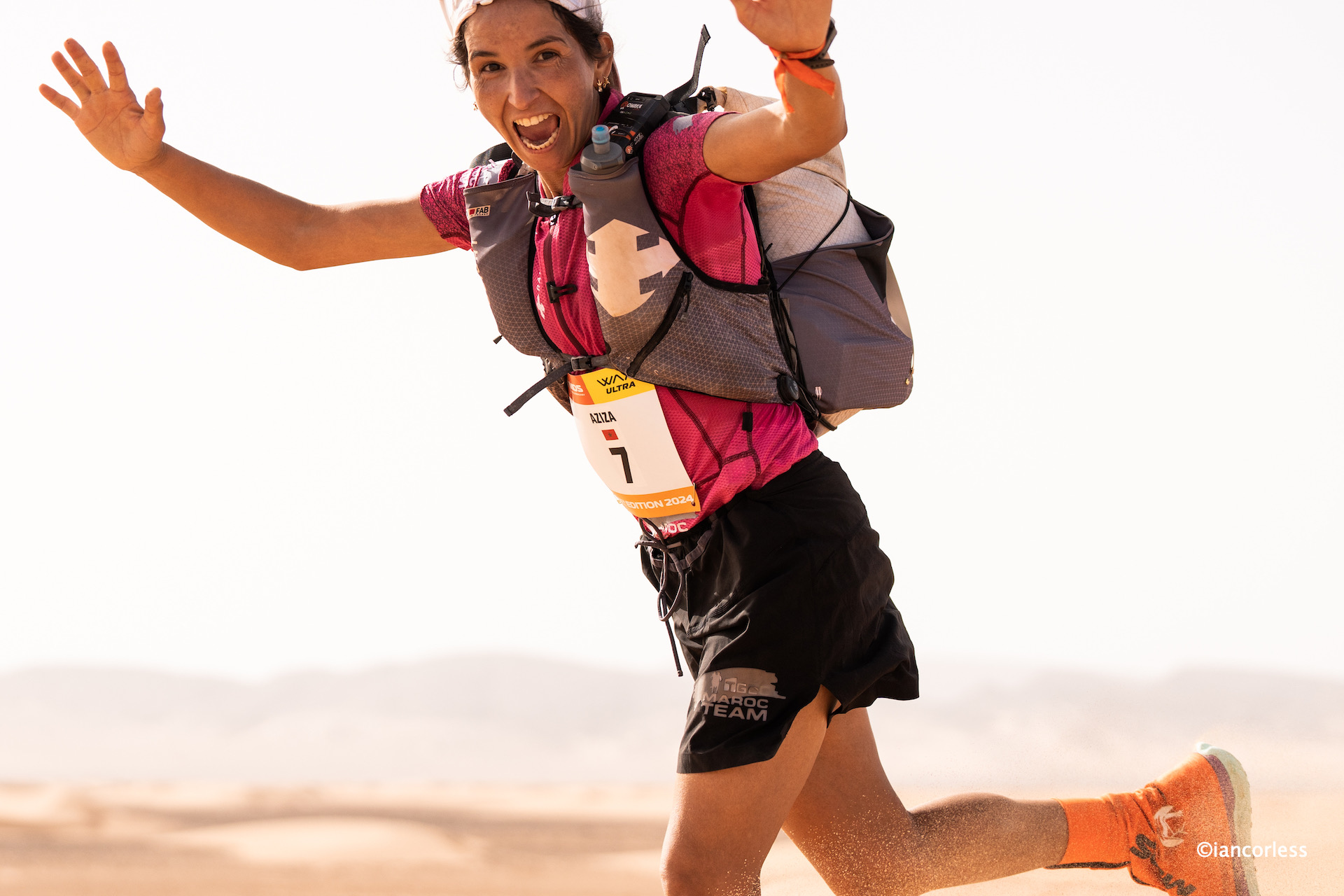
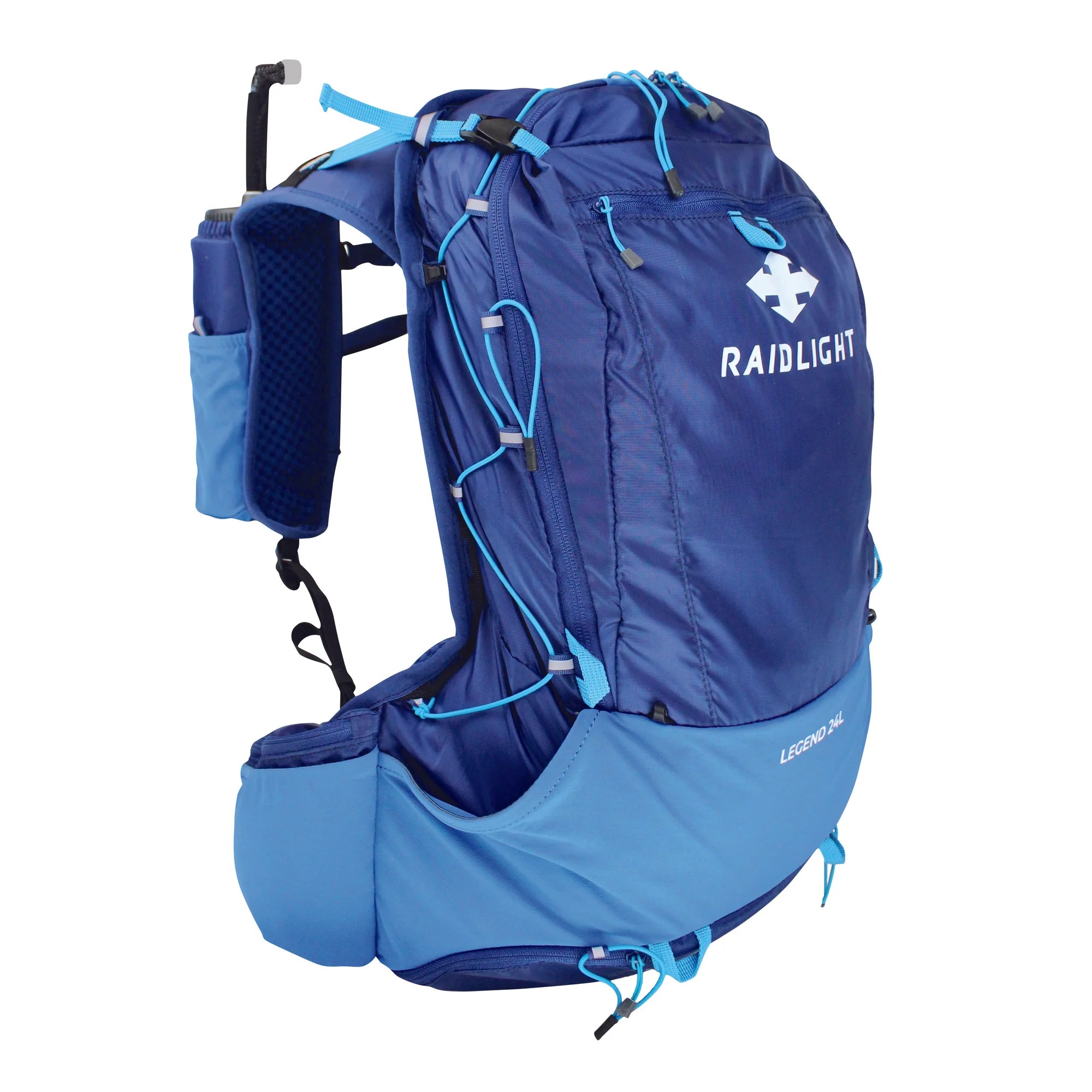
Aiziza El Amrany winner of the 2024 MDS with a Raidlight pack.
Many packs now use a ‘vest’ like system, however, when you have 8kg in the pack, does that fit and feel good? You need to know this. Look at pressure points, such as on top of the shoulders, this area can get very sore if you do not have enough padding. Also feel how it sits on your bag and check for bounce/ movement. A pack that moves too much causes friction, friction equals irritation and blisters.
A waist belt is often a great addition to help secure a pack to your body and distribute the weight load. Some love waist belts, others dislike them. I personally am a fan.
You must choose what is correct for you and don’t be afraid to go against the norm to use what is correct for you. A prime example being that a hiking pack may be the best solution for YOU. Trust this and ignore what others say. The only key things to consider: Be careful of the pack weight and make sure it is not too large in capacity.
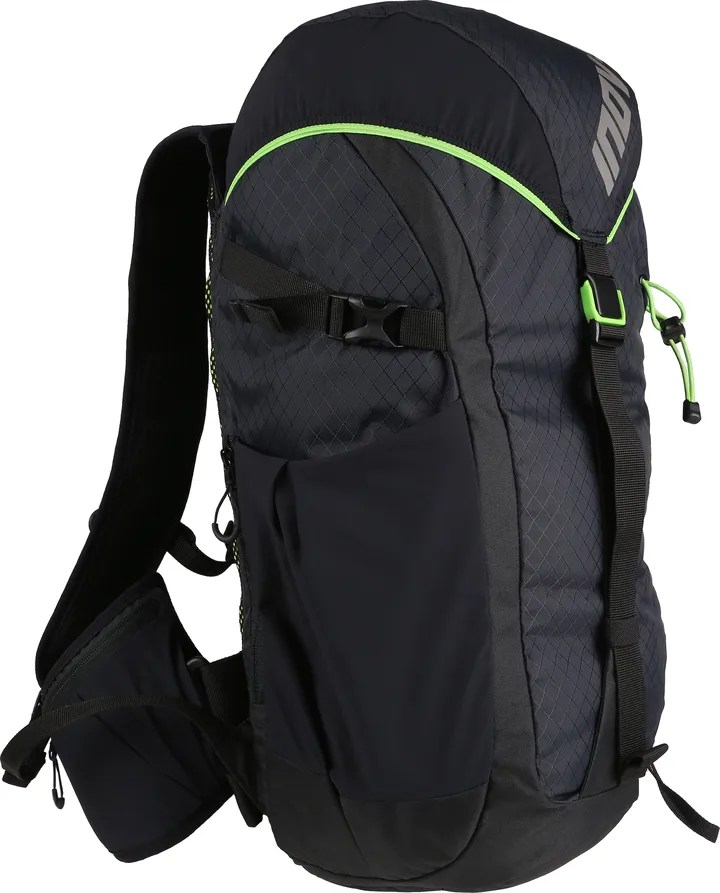
Instinct pack in action at MDS
Access to water is important, many packs now have the capacity and option to carry bottles up front. This makes drinking and refilling easy. However, this may not work for you. If that is the case, do what is right for you, if that means using a bladder, do so. The only consideration with soft flasks and bladders are the risk of puncture, but, I have used a bladder on countless adventures with no issue. Good admin is key.
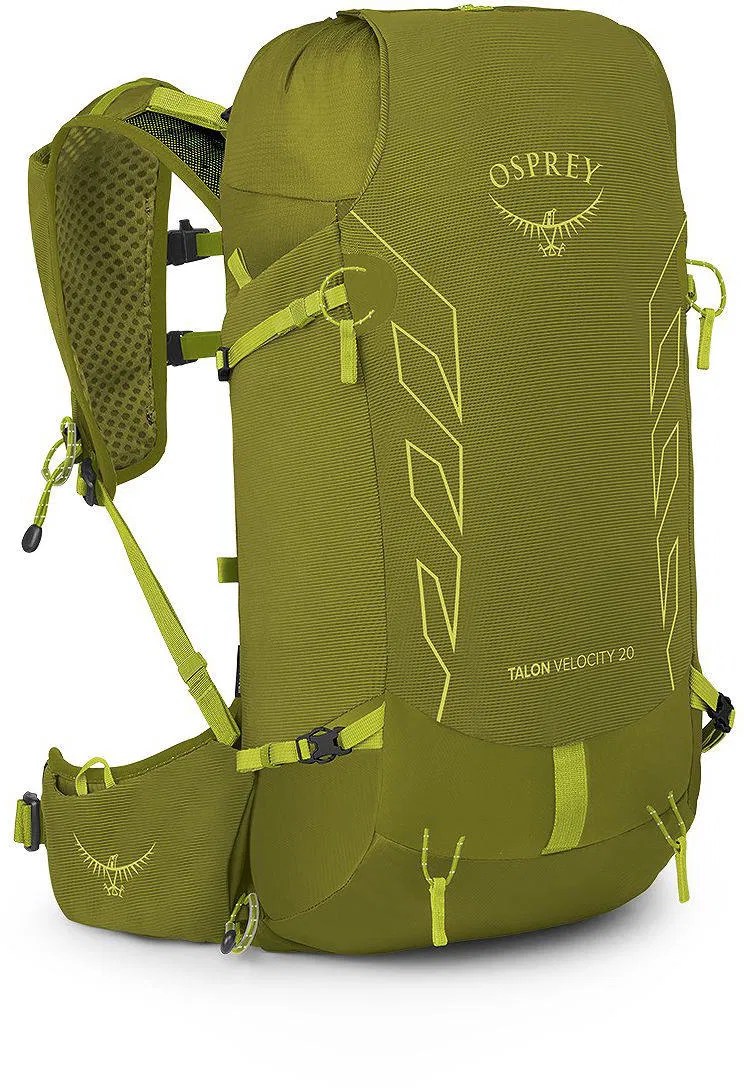
Osprey Talon Velocity and Camelbak Octane fastpacking in Norway.
If doing an adventure that is self-sufficient (such as MDS,) remember that as days pass, pack contents will become less due to eating food. So, the option to tighten, compress and make the pack smaller is a potential key consideration to stop or reduce bounce.
Finally, pack weight is important, BUT, do not go for the lightest pack if it has no durability. You need the pack to be strong, durable and reliable.
BRANDS TO CONSIDER
As mentioned, many brands now make packs or packs suitable for stage racing, multi-day or fastpacking.
If you have a brand missing from the list that you feel needs to be added, please make a comment below.
WHAT ARE THE BEST PACK OPTIONS TO CONSIDER
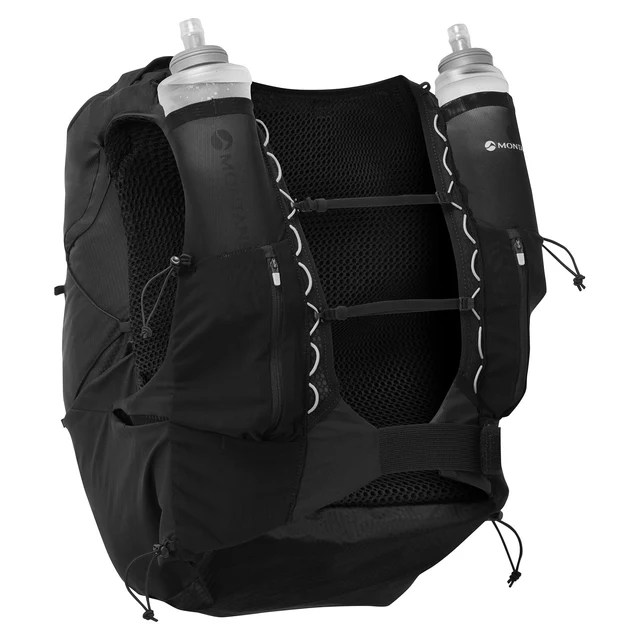
Remember, we are all individual. Every pack on the list below I have looked at, played with and tested in some capacity.
They are ALL applicable for stage racing, multi-day or fastpacking.
You may well be asking, but which do I prefer? Well, I could answer that, but if I do, am I then influencing your decision and thought process? So, for now, I will refrain from giving an opinion.
As you can see above, there is no shortage of options for packs. The main problem is testing and trying packs. Today, the internet and online purchasing provides us all great options and ease for shopping, but, I cannot emphasise enough, with a pack, go to a store, try them on, add weight and play around. Ideally, go to a store that sells many options so you can compare.
The first edition of MDS Cappadocia took place in June 2024. A unique race in a unique landscape. We speak with 71-year old Liz Ward who achieved her first MDS bling after multiple attempts.
Liz crossing the finish line to get a hard earned medal.
You can read about the stage of MDS Cappadocia below:
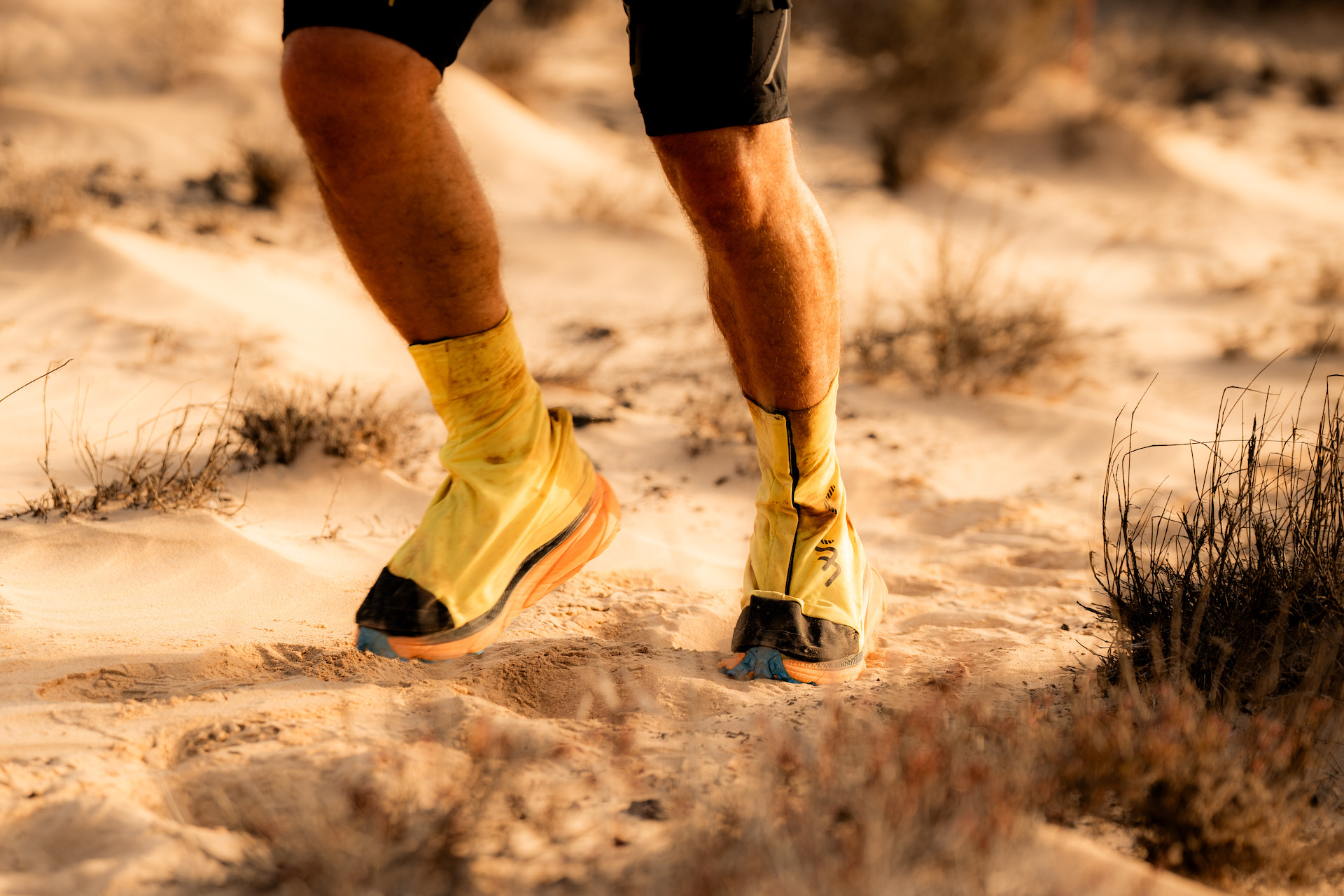
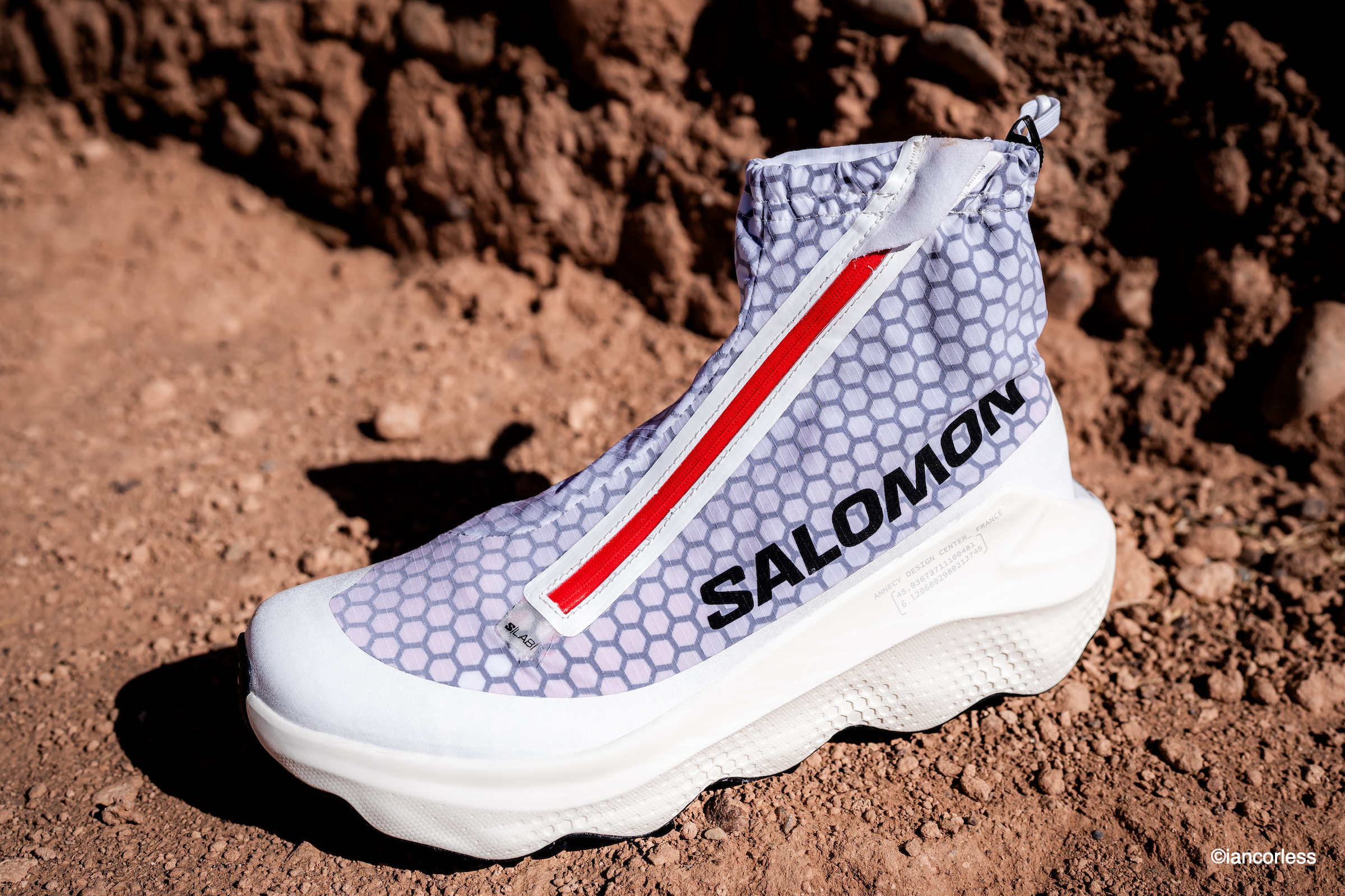
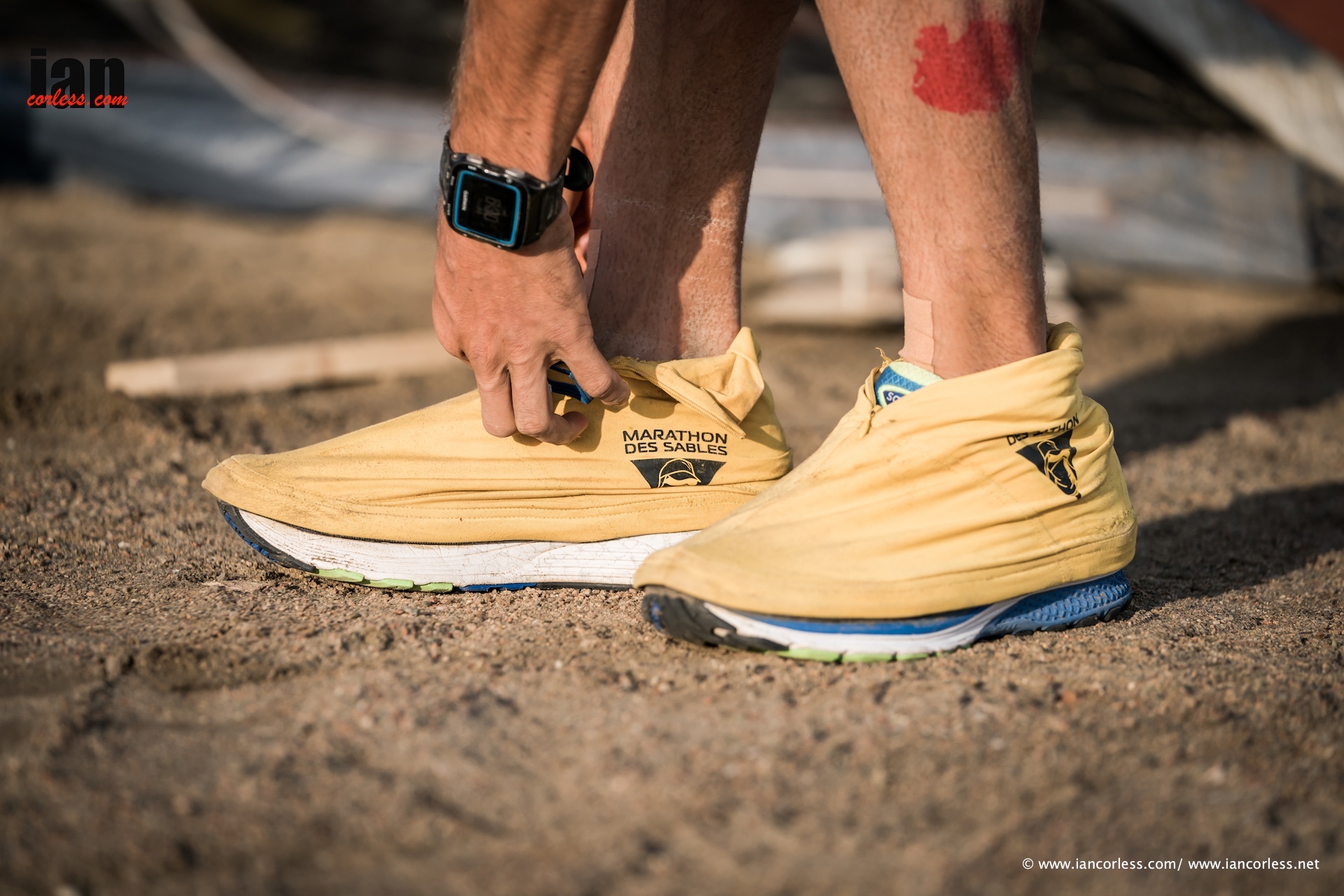
Gaiters for a desert race are an essential item. Quite simply, sand and feet are NOT friends. So, you need to do everything you possibly can to keep sand out of your shoes and keep your feet healthy and trouble free.
In 2024, Raidlight, the legendary French brand released the first mass produced desert specific shoe supplied with velcro sewn on and gaiter provided. I have tested them extensively and they are a great option if you want a one-stop and no hassle solution, my review isHERE – Raidlight Ultra Desert 4 Protect Shoe Review
In addition, Salomon joined the desert market with the Ultra Dust – review HERE – This shoe has increased in use in the last year or so and is extremely popular. From a personal point of view, the Salomon Ultra Dust would be the shoe I use.
Photo by Ian Corless
However, many of you (most of you) will be using your favourite run shoe and will need velcro sewn to your shoe. Let’s get one thing clear, do not ask, “What shoe shall I use?” We are all individuals with different body weights, gaits, needs and speed. Shoes are very specific to the person. Read an articleHEREHow to Find Your Running Shoe Size and Fit.
Every year, the same question gets asked, “Where can I get my gaiters attached to my run shoes?”
So here is a list of current resources, this list will be added to as more names/ contacts become available.
UK
Kevin Bradley is the man. He has been sewing gaiters on shoes for years. He has probably done 1000’s. Very experienced and he knows his stuff. Alex Shoe Repair, 103c Lavender Hill, London, SW11 – Telephone +44 207 2223 4931
Following on from the huge success of MDS Cappadocia, MDS add a new event to the 2025 line-up, the MDS Morocco – Atlantic Coast.
This makes three events now in Morocco, MDS The Legendary, MDS Morocco and the new MDS Atlantic Coast which only confirms that Morocco, really is a perfect destination for a desert adventure.
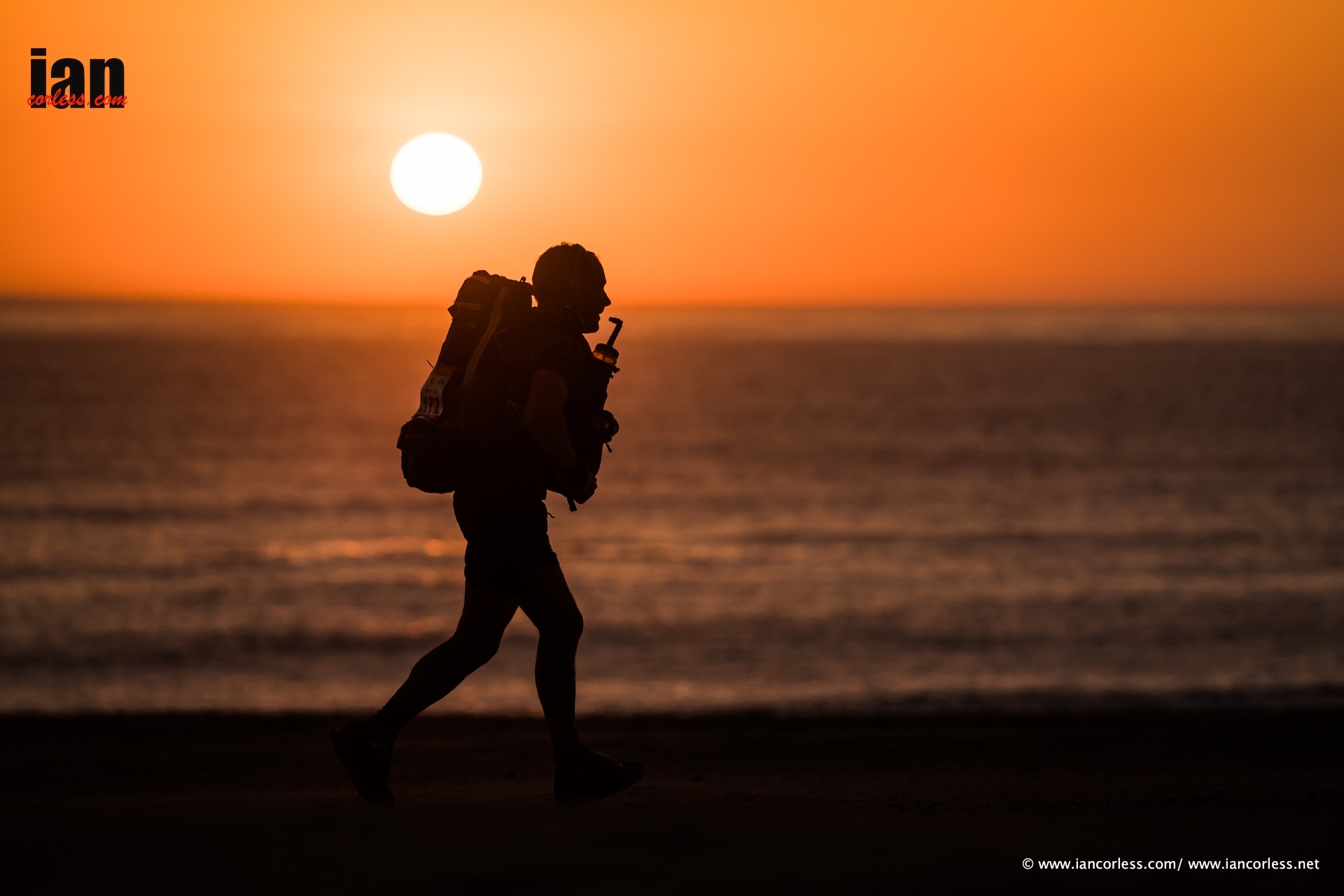
The Atlantic Coast brings something very new, white dunes, endless beaches and of course, the juxtaposition of the ocean as a backdrop bringing something very new and different to a Moroccan adventure.
The event will take place from January 25th to February 1st 2025 and as with all other MDS events, it will follow the same format, a three day race over 4-days with the option to run/ walk 70, 100 or 120km’s.
MDS events bring a very unique challenge and with the distance options that are available, you can make these events as hard or as easy as you wish. With a considerable line-up of events and destinations, MDS are now offering a great opportunity to visit new places as a run tourist.
The Atlantic Coast for sure will be a highly anticipated destination.
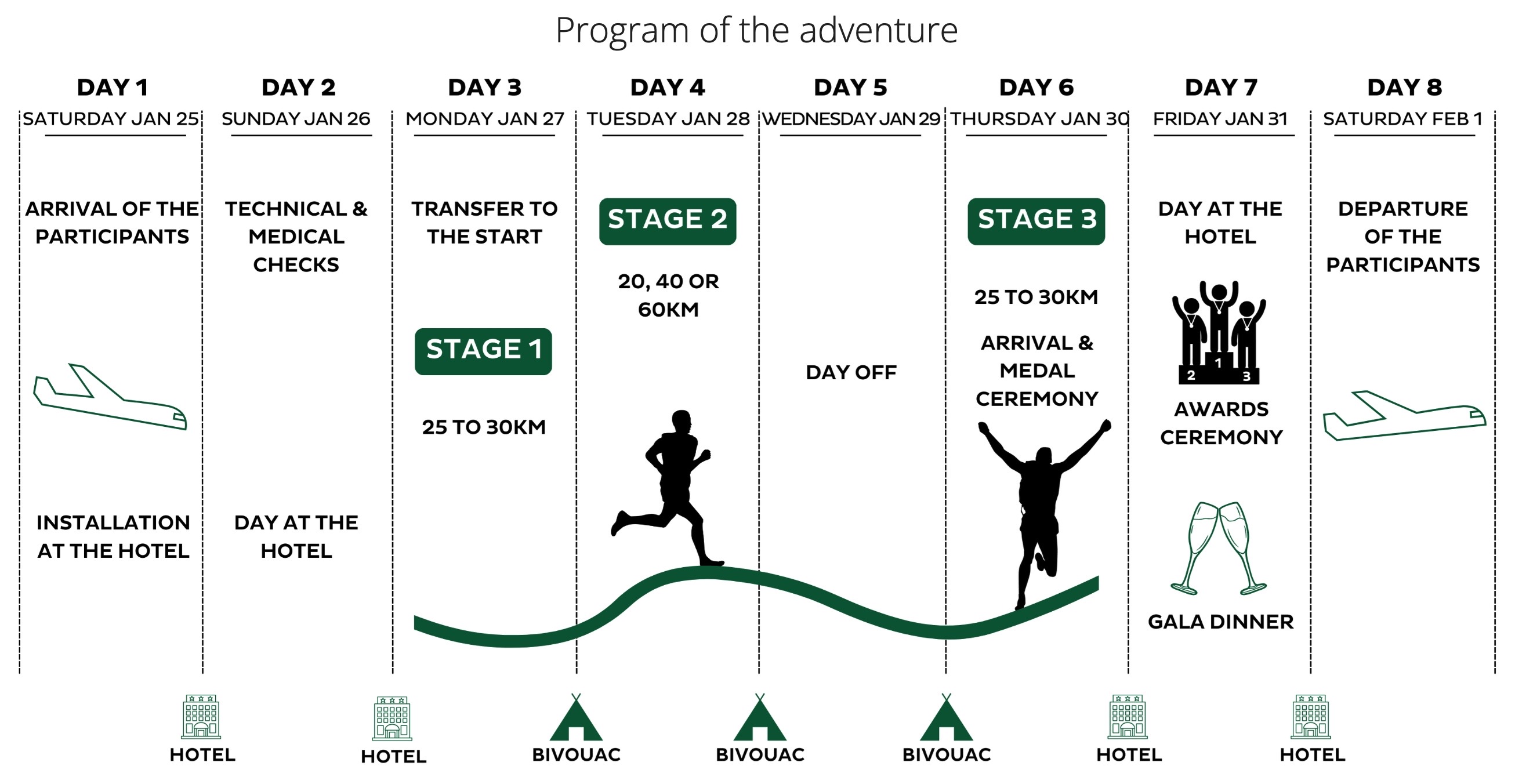
The Schedule:
Participants will need to arrive in Morocco (Marrakech or Agadir) on Saturday January 25th (or before) to meet the MDS team at a designated point for onward travel to the race hotel.
Day 2 will have technical and medical checks with a day at the hotel.
Day 3 participants will transfer from the hotel and the start of stage 1 which will be 25 to 30km. Night in bivouac.
Day 4 stage 2, the ‘long day’ of 20, 40 or 60km. Night in bivouac.
Day 5 rest day. Night in bivouac.
Day 6 stage 3 25 to 30km and then transfer to hotel. Night in bivouac.
Day 7 day at the hotel, awards in the evening and gala dinner.
Day 8 onward travel home.
Desert and ocean, a stunning mix.
Culture, adventure, tradition and relaxation, the Moroccan Atlantic Coast brings something new to the MDS line-up.
Registration opens July 17th at 12pm (UTC+2 / Paris Time) and the first 100 participants can save €300.