The Price of Trust: Rethinking How We Enter Races

For years, entering a race has felt simple. You find an event, sign up, pay the fee, and start training. The idea that anything might go wrong rarely enters your mind, certainly from a business point of view. Of course, you may have a change of personal circumstances, an injury for example – but, the race not happening, that is rarely a consideration. Advance payments have been part of the fabric of the sport for so long that most people barely register them as a risk.

But when something disrupts that pattern, even once, it has a way of shifting how we think. For the majority, these moments feel less like a crisis and more like a quiet recalibration. A warning sign! It’s not a collapse of trust – but more a subtle change in thinking. However, if you are a runner who has made payments and lost everything – trust will be eroded and this has a huge impact in forward thinking.

In the past, Covid an exception, most runners didn’t question where their money sat after they entered a race. It was understood, implicitly, that the event would take place and that the organiser would manage whatever sat behind the scenes. The mechanics of cash flow, margins, and risk were invisible. What mattered was the start line.

Now, that invisibility has thinned a little.

It’s unlikely that large numbers of runners will suddenly start combing through company filings or attempting to assess balance sheets and viability of a company. That level of scrutiny belongs to a minority. But something more gentle may well take hold:

  • A hesitation before committing far in advance. 
  • A second glance at unusually heavy discounts. 
  • A quiet preference for organisers with a long, steady track record. 
  • But, as recent events have shown, established and track record is not a guarantee.
  • Trust will still exist, but it may become more selective.

For runners, there are also a few simple ways to reduce exposure without losing the ability to plan ahead. Insurance is the most obvious, particularly for higher-cost or international events, where cancellation cover can soften the financial hit if something goes wrong. Paying by credit card rather than debit can offer an extra layer of protection too, especially in the UK where consumer protections may allow you to reclaim funds in certain situations. Beyond that, a more risk-aware approach can help. 

Hotels, travel and logistics will almost certainly be looked at with more scrutiny and less commitment. For example, using specific websites that allow booking of hotels and/ or travel where cancellations, with no impact, can be made almost days before being needed.

We may well be looking at a substantial shift in thinking, and this will impact on event organizers.

At the same time, the reality for organizers hasn’t changed. If anything, it has become more exposed. Events are expensive to stage, and most of those costs arrive early. Permits, insurance, equipment, staffing, logistics. Long before a runner crosses a start line, much of the financial commitment has already been made.

Advance entry fees are not a convenience – they are, in many cases, the mechanism that makes the event possible at all. So, what is going to happen if the runner changes the approach to booking and commitment.

That creates a delicate balance. Runners want certainty – we love to secure a place, plan ahead and formulate a plan. Organizers need commitment. If one side begins to hesitate, even slightly, the effects ripple outward. 

  • Cash flow tightens. 
  • Planning becomes less predictable. 
  • Decisions get pushed later. 

In a system that often works twelve months ahead, even small delays in confidence can create friction.

There is a risk, at least in the short term, of instability. Not dramatic or immediate, but enough to be felt. Smaller events and newer organisers are likely to feel it most. 

Yet there is another side to this. This could be turned into a positive.

Moments like this can prompt a more sustainable way of operating. Organisers may become more cautious about expansion, more disciplined in managing costs, and more focused on building financial resilience rather than chasing rapid growth. 

Runners, in turn, may make more deliberate choices about where and when they commit their money. A slightly more informed participant base, paired with more transparent and measured organizers, could strengthen the ecosystem over time.

But there is something worth preserving too.

Endurance sport has always run, in part, on goodwill. There is an unspoken agreement between organiser and participant. You trust that the event will be there. They trust that you will commit early enough to help make it happen. Strip that away entirely, and something important is lost.

The likely outcome sits somewhere in between. Not a collapse of confidence, but a tempering of it. People may pause, think, and choose a little more carefully. 

Organizers may work harder to earn that early commitment.

Advance payments will still happen. 

Races will still fill. 

Plans will still be made months, even years, in advance.

But perhaps with a slightly clearer understanding, on both sides, of what sits beneath the surface.
Screenshot

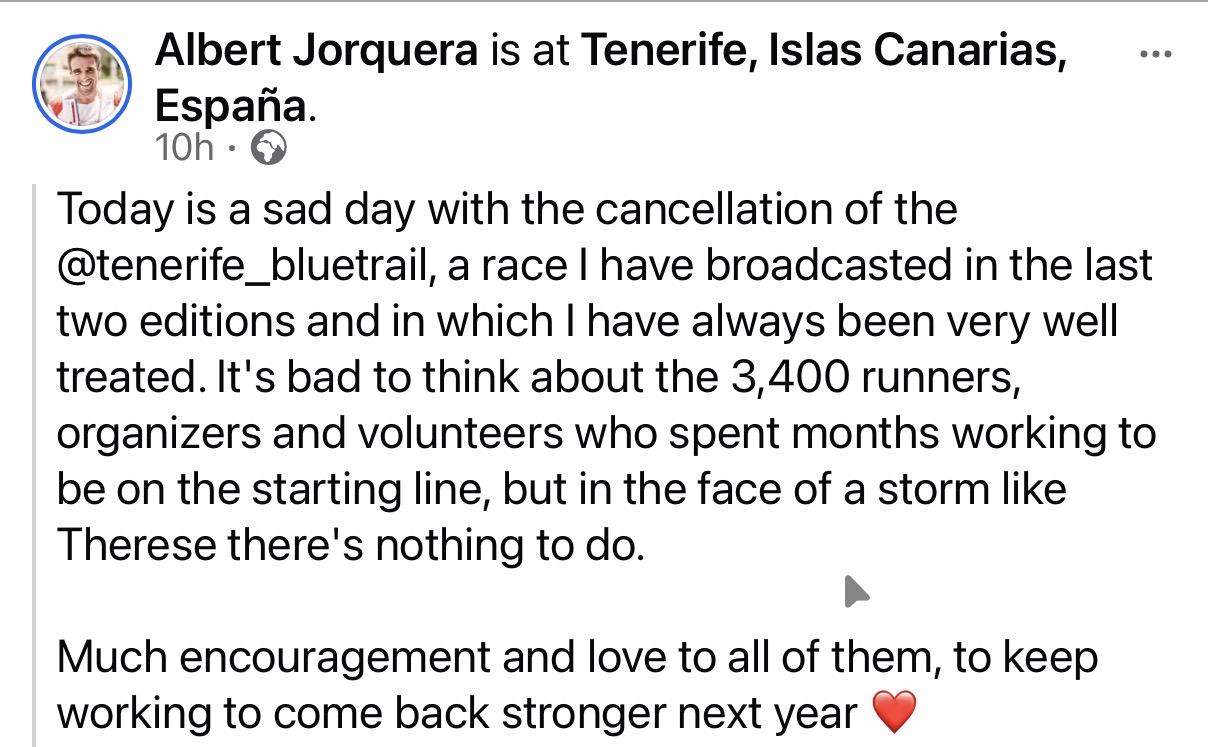
And then, just like that, overnight, A cancellation of Tenerife Bluetrail by UTMB – this brings a different kind of reality into focus. Here, there’s no financial mismanagement or organisational failure to question. It’s simply the fact that some things sit beyond anyone’s control. Safety has to come first. But the impact is still real. 

Travel has happened, runner’s are in hotels, months of training has been shaped around a single date, and then, overnight, it’s gone.

Nature hits, this comes under Force Majeure – is a contractual clause freeing parties from liability when extraordinary, uncontrollable events, such as natural disasters, wars, or pandemics, make fulfilling obligations impossible – situations like this may well add another layer to how people think about committing to events in the future. 

This is not a loss of trust in organizers but a growing awareness that even well-run races carry external risks that are sometimes beyond everyone’s control. 

In that sense, this situation doesn’t contradict the earlier discussion, it deepens it. The question is no longer just “can this event go ahead?” but also “what happens if it can’t, for reasons no one can control?” 

Will this nudge runners toward a more flexible approach? Not out of fear, but out of a clearer understanding that certainty, in endurance sport as in nature, has always been a little fragile.

Follow Ian Corless

Instagram – @iancorlessphotography

Twitter – @talkultra

facebook.com/iancorlessphotography

Web – www.iancorless.com
Web – www.iancorlessphotography.com

How to deal with Race Postponement

This article is geared toward Marathon des Sables but is valid for any race with some adjustments and specific changes appropriate to the type of race and distance.

Marathon des Sables, once again, has been postponed. Originally scheduled for April 2020, the race was moved to September 2020 amidst growing worries and concerns over Coronavirus. As September approached, the writing was already on the wall and the decision was made to focus on April 2021 – everything will be fine then, won’t it!?

December 2020 soon came and with it, increased infection rates, new variants and despite the optimism of a vaccine, the world once again crumbled under the cloud of an ever-spreading pandemic. Christmas was cancelled and the new year unfortunately had nothing ‘new’ about it, it carried far too much of the old year.

January has been a disaster and the long-term view is not good. The world once again has been in a lockdown, some far worse than others. One thing is for sure, we are all a long way from ‘normal!’ So, it came as no surprise as events were cancelled all over the world.

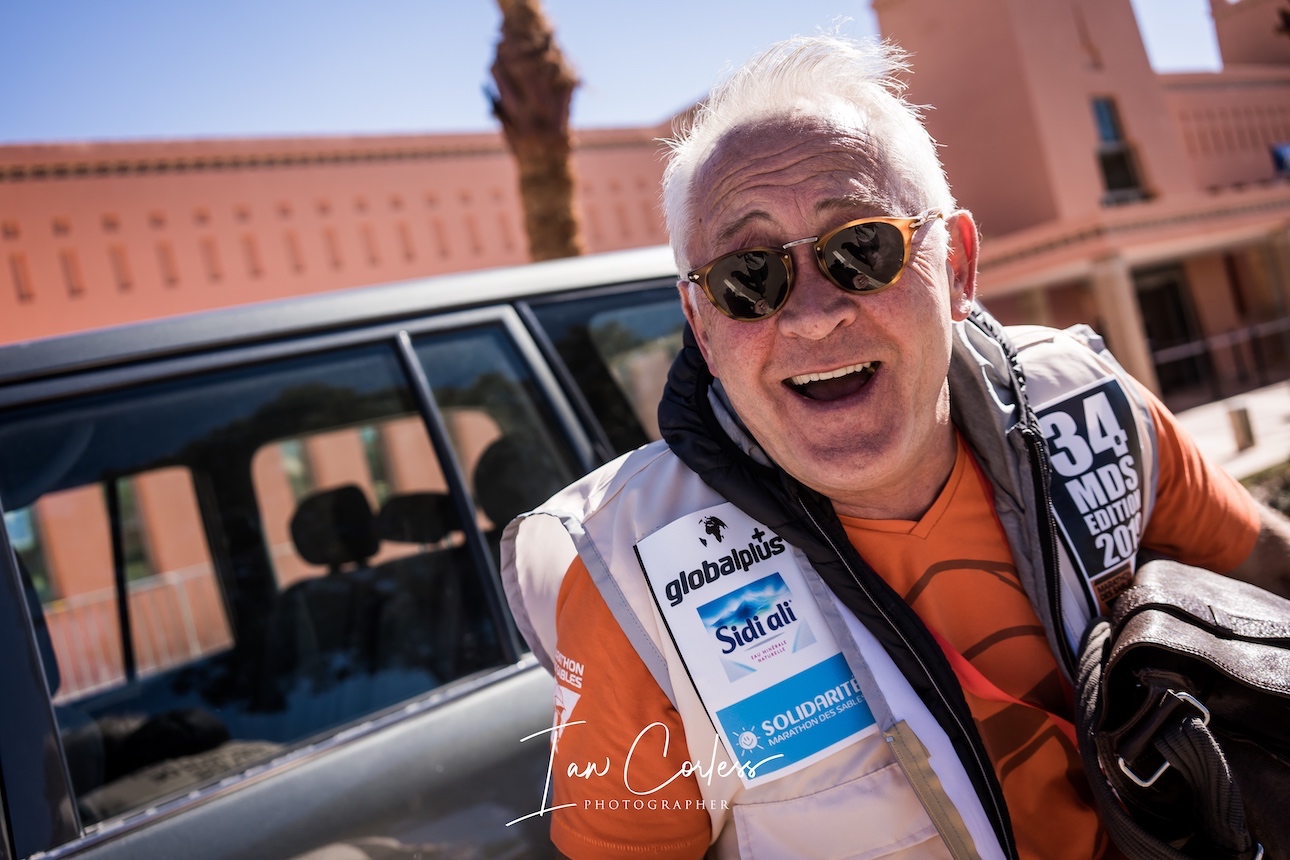
Patrick Bauer.

MDS race director, Patrick Bauer, travelled to Morocco to assess the situation and on January 22nd, the MDS was once again postponed to another time; October 1-11, 2021.

All is good… the race WILL come!

I think it’s important to clarify, here and now, that at the end of the day, when people are dying globally, for a race to be postponed, is no big deal… I think once you accept that, dealing with race cancellation, disappointments and postponements becomes so much easier. It´s only a race! And we are fortunate to be able to race. It’s a luxury. But equally, livelihoods are struggling, RD´s are losing work, all the businesses associated with races are losing work, travel companies are losing customers, hotels, restaurants, design agencies, photographers, videographers and the list goes on, are all losing their livelihoods to an ongoing escalating pandemic. So while it is only a race, have a consideration for all involved and maybe, a little understanding for the very difficult challenges everyone is facing at the moment.

The locals need MDS, our tourism and our regular trips to Morocco.

Taking MDS as an example, 2020 participants will have entered in 2019 and some may well have entered in 2018. Typically, a MDS participant will prepare for 1-year. While the initial postponement was not great, it was easy to focus on September. 

Then September was cancelled… Already, many were struggling to re-focus, but April would be it, one last push and we are good to go! 

Now, with another postponement, MDS runners are left in a void, the race is 8-months away. They are all asking, what do I do now?

Gemma Game has been on the podium of MDS multiple times. She is a busy professional with a family.

Firstly…

When things change, adjust. Don´t kick-off against what has changed. Accept what is not in your control and control what you can. Adapt, move on (with running shoes) and train differently for a while; focus on different aspects of your running, weaknesses in particular. Look at the opportunities – focus on speed, work on hill strength, build a good core, do drills, stretch, maybe try yoga? A change of focus will give a physical and mental break and will help your performance. When the time is right, resume an appropriate training plan for your chosen race. I guarantee, you will be stronger, better prepared and ready for the challenge ahead. You are lucky and fortunate that you are able to even contemplate a race like MDS.

Uncertainty is a virus in itself, it can eat away at you. Quite simply, remove negativity and question marks. The current dates for MDS are 1-11 October. Do not consider the event will not happen, plan and train accordingly.

The reality is you are already in a good place. You have been training for a great deal of time already, just imagine how much better you will be when October comes.

Training in Lanzarote on a specific Multi-Day Training Camp HERE

Importantly though, it would be fool hardy to carry on with current training levels for an October race. You run the risk of injury and/ or getting peak fitness too early. Take a break!

“One of the mistakes I see most with runners is jumping from one race specific cycle to the next, without either giving themselves enough time between races or not “focusing” on training during the time between race and “taking a break”.

– runnersconnect

Kick back, take some time off from any structured plan and do a week/ two weeks (or even a little longer) of ´how you feel´ training. In this period, take time (with a piece of paper) to assess personal strengths and weaknesses. From this list, you can use February and March to address these weaknesses while ´maintaining´ fitness. Back off any intensity, maintain some decent mileage/ hours and keep sessions moderate.

Tom Evans placed 3rd at MDS and works on strength and core to enhance his running.

Importantly, get a running MOT from an experienced physio. Address any problems now and use that ‘extra’ time for therapy, strength, stretching and core. Find any underlying problems that may cause injury.

Work on admin – food for the MDS (article HERE), pack, sleeping bag (article HERE) sleeping mat and finalise equipment choices optimising weight, size and cost. Do everything you can to make your pack 6.5kg (plus water) for the start line on October 3rd. Read a guide HERE.

Do you need a 12-week and/ or 24-week Multi-Day Training Plan perfect for a multi-day adventure or a race like Marathon des Sables? They are designed to provide you with a structured weekly plan culminating in a target event.  

View a sample week HERE from the 12-week plan. Purchase HERE.  

View a sample week HERE from the 24-week plan. Purchase HERE.  

*****

The arrival of April will give you 6-months to race date. Now is the time to re-focus. Did you have races planned? If so (and they happen) maybe now they change focus and become preparation for MDS?

Use 3-months (April, May and June) to build on the weaknesses that you have worked on in February and March and lay the foundations for the key phase, July, August and September.

“One of the most common reasons runners hit a plateau is that they don’t work on their weaknesses between races, by focusing on your weaknesses now, you’re able to make progress long-term, even without training as hard.”

– runnersconnect
Do some specific training, here Sondre Amdahl at the Lanzarote Training Camp HERE

July should be the start of a very specific MDS phase (12-weeks) where you fine-hone all the relevant skills to make the 35th MDS not only successful but awesome.

It is easy to feel deflated with another disappointment and postponement but look at this cloud with a silver lining!

Please support this website. I believe everyone deserves to read quality, independent and factual articles – that’s why this website is open to all. Free press has never been so vital. I hope I can keep providing independent articles with your help. Any contribution, however big or small, is so valuable to help finance regular content. Please support me on Patreon HERE.

Articles:

Choosing a sleeping bag for an adventure HERE

Fuelling for a Multi-Day like MDS HERE

Multi-Day Racing – It´s Not Complicated HERE

The Ultimate Equipment Guide to Desert Multi-Day Racing HERE

Top Tips to Better Multi-Day Running HERE

References Runners World and runnersconnect

*****

Follow on:

Instagram – @iancorlessphotography

Twitter – @talkultra

facebook.com/iancorlessphotography

Web – www.iancorless.com
Web – www.iancorlessphotography.com

Image sales –www.iancorless.photoshelter.com

Race Cancellations and COVID-19

As a runner, you more than likely will take time in the off-season; to sit down and plan the coming season. You will look for the ‘A’ races that hopefully will allow you to shine and achieve those personal goals – you will dedicate hours, weeks and months to prepare.

You will enter ‘B’ and ‘C’ races that will allow you to learn and adapt.

In this scenario, imagine the Race Directors who are planning the races that you will attend. Just as you plan and prepare, so do they, typically one-year in advance so that when the time comes you have a slick, well-prepared event that will allow you to achieve your goal.

Planning and working on a race really is a labour of love and yes, it’s a business.

Race Directors usually start planning immediately after the end of one event. Budgets are worked out, a timeline is put in place and then a team of people, headed by the RD, put a plan in action. This will involve route planning, course marking, providing gpx files, booking venues, planning medical care, arranging for catering, advertising the race, booking cars, maintaining a website, booking a timing system, arranging for photography/video and the list goes on…

It is endless!

To secure services, many of these items are paid well in advance of the race and in most scenarios, a non-refundable deposit will have been paid and at worst, a full balance to ensure that no problems arise.

As an event approaches, typically 8-weeks or less before the event, all invoices are paid and the RD can sit back knowing that a job is well done.

The race fee that you the runner pays doesn’t just cover the day or multiple days of the race, it covers a year or work!

Now imagine you are the RD. You have been diligent; you have crossed the T’s and dotted the I’s. You are, you think, prepared for any eventuality and then Covid-19 comes along and rips your world apart.

Read a simple guide to Covid-19 HERE

Podcast HERE and Audio Feed below

Through no fault of your own, your race is cancelled because one needs to take responsibility for the health and safety of not only runners, but staff and their teams. In many situations, this decision is often taken away from the RD as it comes from a government level.

I am asking you all to take stock of the situation, sit back and take time to reflect on the RD, the team of people involved in the race and the implications of cancelling or postponement.

I personally arrived in Hong Kong in January only to find that as my plane landed in HK, the race I was arriving for was cancelled due to the ever-changing Covid-19 virus.

So, as a runner what can you do?

First of all, there is immense disappointment for each of us on a personal level as an event that we have prepared and dreamed of is removed.

Then attention turns to several scenarios:

  • Can I change my travel plans and what will the cost be?
  • Can I get a refund on the race?
  • Will the race postpone and plan for later in the year?’
  • Will the race defer my place and give me entry next year?
  • What about my hotel booking?

The list goes on.

Let’s be clear here, the Covid-19 scenario is impacting on the world at an unprecedented level. Just yesterday, Omar Hassan writing in The Independent stated that:

‘Coronavirus will bankrupt more people than it kills – and that is a real global emergency.’

Millions of dollars have been wiped from the financial markets but this impact filters down and down to a grass roots level and the impact will be huge for all of us.

 ‘If the virus does directly affect your life, it is most likely to be through stopping you going to work, forcing your employer to make you redundant, or bankrupting your business.’

So, when asking the RD and race for a refund on race entry, please just take time to step back and think, in these special circumstances, can you afford to let that fee go so that you can at least provide an opportunity for that race to return the following year.

Most races will have insurance, but having spoken with multiple insurance experts, the general consensus is, ‘Successful claims under business interruption coverage for infection are not common… Indeed, for example, there are no reported cases in the United States regarding business interruption coverage in connection with human infectious disease epidemics or pandemics.’ – via stroock.com

Even sport specific insurance companies who look after runners/ sports people doing ‘extreme’ sports are confirming that there is no cover for disease, virus or pandemic.

In the last week, Ultra-Trail Mount Fuji, Madeira Island Ultra Trail, Ultra Skymarathon Madeira and so many more have had to pull the plug on a 2020 event. Even the iconic Marathon des Sables has had to postpone and the financial impact of this is still yet to be seen.

In the words of one Race Director, ‘When the Government cancel all Sport Events or public gatherings we are in big trouble, insurance does not cover us in case of pandemics.’

Masako Suzuki, of Ultra-Trail Mount Fuji recently sent out a press release and in it he says:

‘…we apologize for causing great trouble to racers who have been training and preparing for this race, volunteers who have participated in the course maintenance thus far, volunteers who were planning to work during the race, and UTMF supporters including sponsors, companies participating in the UTMF Expo, public and private organisations, and local people.’

The impact is far reaching, cancellations are happening everywhere, and racing is just one aspect. Schools are closing, employees are being asked to work from home, airlines are reducing flights daily and asking staff to go on unpaid leave, hotels are empty, and restaurants are closing. Covid-19 is without doubt a health crisis but it is also an economic crisis.

“It may one day be said that the coronavirus delivered the deathblow to the New World Order, to a half-century of globalization and to the era of interdependence of the world’s great nations.” – WND here

One of the key jobs of a race team is risk management, many races, UTMF, MIUT, USM and so on all started to look at logistics and emergency planning long before the decision to cancel was made. The money is spent!

So please, when you ask for a refund or deferment, just ask the question,

‘Can I let my fee go for 2020?’

And in the process, hopefully, the race you entered will be around in 2021.

It is highly likely that some races will not recover from this but we as runner’s and a community, in a small way, can help keep the sport we love alive to fight for another time.

‘I have been organising #USM for some years now with a fantastic team. We always aimed high because we were convinced, he had a SUPER event. We still do,’ João Canning Clode announced via Facebook, ‘This was the most difficult decision we had to take in all these years. But the health and safety of our athletes, teams, local community, fans and volunteers is of vital importance. We move on…’

As a closing note, we all need perspective. Covid-19 is killing people daily and my heart aches for the distress and loss from this pandemic. Italy, as an example, have been hit so very hard and they have now entered Wartime Triage. This is truly catastrophic for all. But the government have stepped up to the plate and suspended payments on mortgages. When asked about the possibility of halting mortgage payments on Radio Anch’io, Laura Castelli, the deputy economy minister, said: ‘Yes, that will be the case, for individuals and households.’ I applaud that leadership and foresight. We can all learn a lesson from this action. (Article here)

Please support this website. I believe everyone deserves to read quality, independent and factual articles – that’s why this website is open to all. Free press has never been so vital. I hope I can keep providing independent articles with your help. Any contribution, however big or small, is so valuable to help finance regular content. Please support me on Patreon HERE.

Follow on:

Instagram – @iancorlessphotography

Twitter – @talkultra

facebook.com/iancorlessphotography

Web – www.iancorless.com

Web – www.iancorlessphotography.com

Image sales –www.iancorless.photoshelter.com