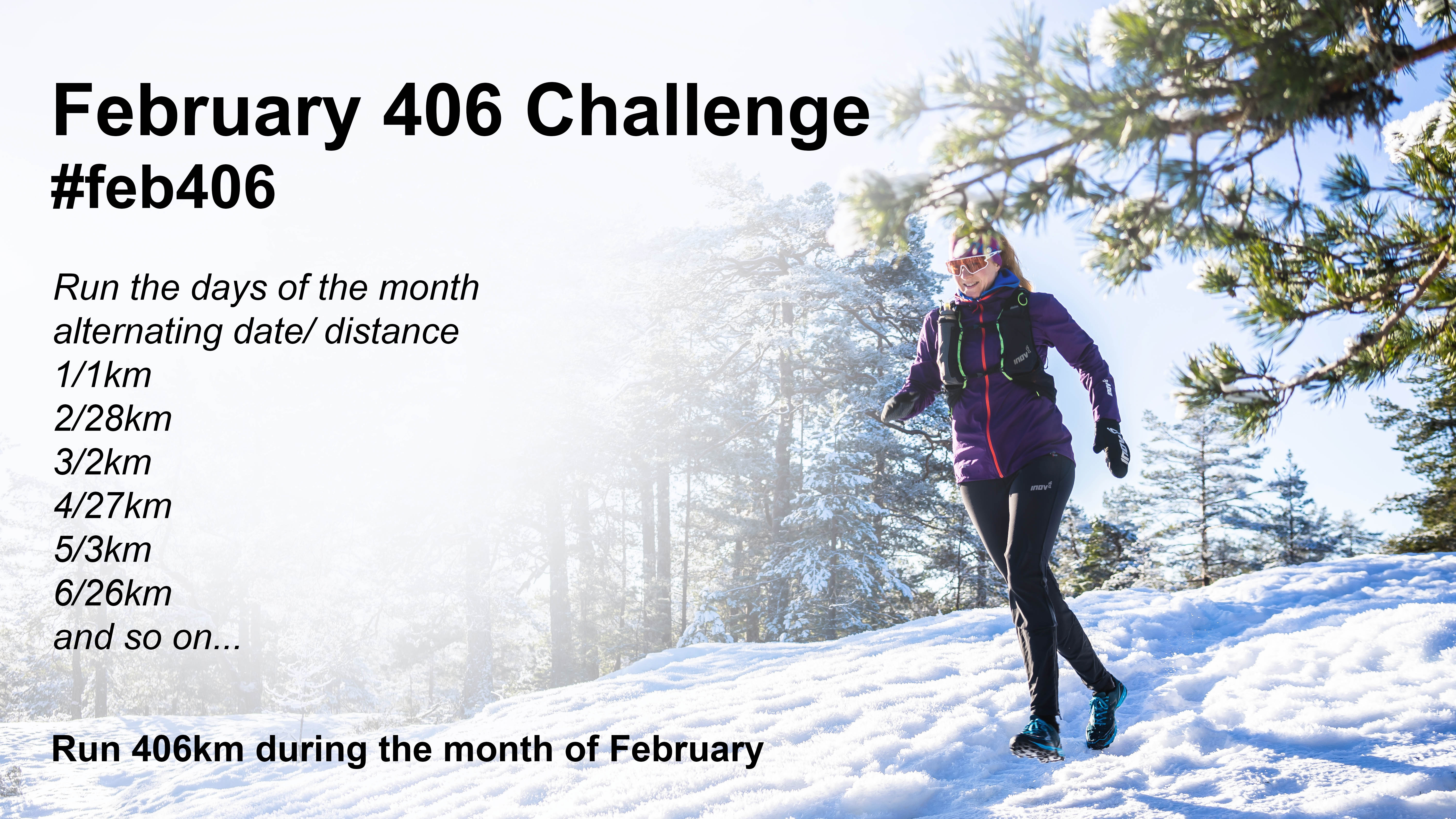
With so many races cancelled or postponed, here is a challenge for February. No awards, no prizes, just an idea to provide some incentive for February doing the #feb406 challenge.
It’s simple, this is the ideal scenario: 28 days in the month, you run the days in km’s totalling 406km and you alternate providing easier and harder days. This should balance stress and recovery. Of course, listen to your body… This is not designed to break you but push you to a new level with a new challenge.
Day 1 – 1km
Day 2 – 28km
Day 3 – 2km
Day 4 – 27km
Day 5 – 3km
Day 6 – 26km
and so on…
Option 2:
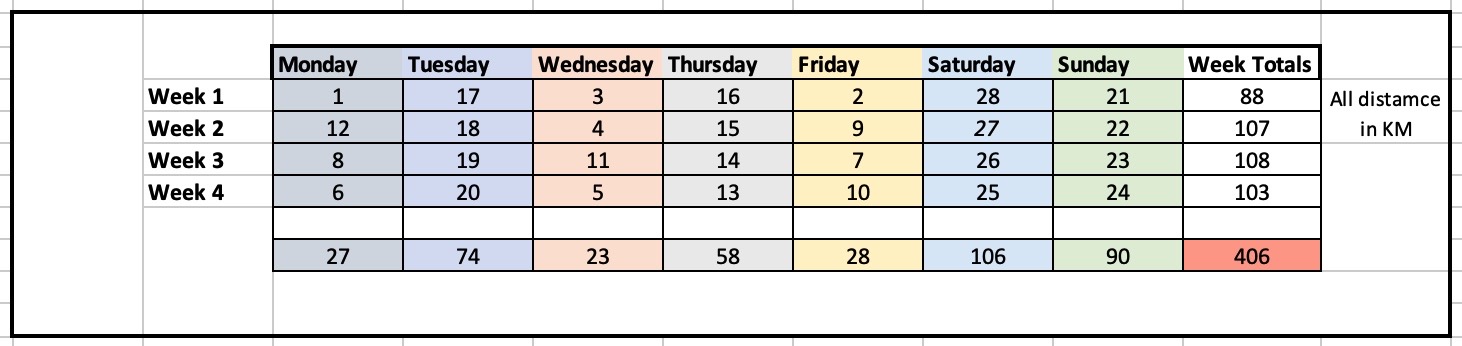
Alternatively, you could get a calendar and run any of the day date distances on any day. Use the calendar like a bingo card and tick distance off as you complete it. This may be useful if you struggle for time, for example, you could put all the longer distance, 28km, 27km, 26km, 25km and so on on weekends.
Example of how to move the distances but still run all the dates, but on sporadic days with 406km total.
Option 3:
You aim to cover 406km in February in any way that works for you.
Maybe it’s just the motivation you need. And yes, on the longer days you can split up the distance to make it easier, maybe an AM and PM run.
Download a month planner to help plan your day’s and distance.
If you’d like to join the community aspect, head along to the Multi-Day Running Group on Facebook (HERE)
Please support this website. I believe everyone deserves to read quality, independent and factual articles – that’s why this website is open to all. Free press has never been so vital. I hope I can keep providing independent articles with your help. Any contribution, however big or small, is so valuable to help finance regular content. Please support me on Patreon HERE.
This article is geared toward Marathon des Sables but is valid for any race with some adjustments and specific changes appropriate to the type of race and distance.
Marathon des Sables, once again, has been postponed. Originally scheduled for April 2020, the race was moved to September 2020 amidst growing worries and concerns over Coronavirus. As September approached, the writing was already on the wall and the decision was made to focus on April 2021 – everything will be fine then, won’t it!?
December 2020 soon came and with it, increased infection rates, new variants and despite the optimism of a vaccine, the world once again crumbled under the cloud of an ever-spreading pandemic. Christmas was cancelled and the new year unfortunately had nothing ‘new’ about it, it carried far too much of the old year.
January has been a disaster and the long-term view is not good. The world once again has been in a lockdown, some far worse than others. One thing is for sure, we are all a long way from ‘normal!’ So, it came as no surprise as events were cancelled all over the world.
Patrick Bauer.
MDS race director, Patrick Bauer, travelled to Morocco to assess the situation and on January 22nd, the MDS was once again postponed to another time; October 1-11, 2021.
All is good… the race WILL come!
I think it’s important to clarify, here and now, that at the end of the day, when people are dying globally, for a race to be postponed, is no big deal… I think once you accept that, dealing with race cancellation, disappointments and postponements becomes so much easier. It´s only a race! And we are fortunate to be able to race. It’s a luxury. But equally, livelihoods are struggling, RD´s are losing work, all the businesses associated with races are losing work, travel companies are losing customers, hotels, restaurants, design agencies, photographers, videographers and the list goes on, are all losing their livelihoods to an ongoing escalating pandemic. So while it is only a race, have a consideration for all involved and maybe, a little understanding for the very difficult challenges everyone is facing at the moment.
The locals need MDS, our tourism and our regular trips to Morocco.
Taking MDS as an example, 2020 participants will have entered in 2019 and some may well have entered in 2018. Typically, a MDS participant will prepare for 1-year. While the initial postponement was not great, it was easy to focus on September.
Then September was cancelled… Already, many were struggling to re-focus, but April would be it, one last push and we are good to go!
Now, with another postponement, MDS runners are left in a void, the race is 8-months away. They are all asking, what do I do now?
Gemma Game has been on the podium of MDS multiple times. She is a busy professional with a family.
Firstly…
When things change, adjust. Don´t kick-off against what has changed. Accept what is not in your control and control what you can. Adapt, move on (with running shoes) and train differently for a while; focus on different aspects of your running, weaknesses in particular. Look at the opportunities – focus on speed, work on hill strength, build a good core, do drills, stretch, maybe try yoga? A change of focus will give a physical and mental break and will help your performance. When the time is right, resume an appropriate training plan for your chosen race. I guarantee, you will be stronger, better prepared and ready for the challenge ahead. You are lucky and fortunate that you are able to even contemplate a race like MDS.
Uncertainty is a virus in itself, it can eat away at you. Quite simply, remove negativity and question marks. The current dates for MDS are 1-11 October. Do not consider the event will not happen, plan and train accordingly.
The reality is you are already in a good place. You have been training for a great deal of time already, just imagine how much better you will be when October comes.
Training in Lanzarote on a specific Multi-Day Training Camp HERE
Importantly though, it would be fool hardy to carry on with current training levels for an October race. You run the risk of injury and/ or getting peak fitness too early. Take a break!
“One of the mistakes I see most with runners is jumping from one race specific cycle to the next, without either giving themselves enough time between races or not “focusing” on training during the time between race and “taking a break”.
– runnersconnect
Kick back, take some time off from any structured plan and do a week/ two weeks (or even a little longer) of ´how you feel´ training. In this period, take time (with a piece of paper) to assess personal strengths and weaknesses. From this list, you can use February and March to address these weaknesses while ´maintaining´ fitness. Back off any intensity, maintain some decent mileage/ hours and keep sessions moderate.
Tom Evans placed 3rd at MDS and works on strength and core to enhance his running.
Importantly, get a running MOT from an experienced physio. Address any problems now and use that ‘extra’ time for therapy, strength, stretching and core. Find any underlying problems that may cause injury.
Work on admin – food for the MDS (article HERE), pack, sleeping bag (article HERE) sleeping mat and finalise equipment choices optimising weight, size and cost. Do everything you can to make your pack 6.5kg (plus water) for the start line on October 3rd. Read a guide HERE.
Do you need a 12-week and/ or 24-week Multi-Day Training Plan perfect for a multi-day adventure or a race like Marathon des Sables? They are designed to provide you with a structured weekly plan culminating in a target event.
View a sample week HEREfrom the 12-week plan. Purchase HERE.
View a sample week HERE from the 24-week plan. Purchase HERE.
*****
The arrival of April will give you 6-months to race date. Now is the time to re-focus. Did you have races planned? If so (and they happen) maybe now they change focus and become preparation for MDS?
Use 3-months (April, May and June) to build on the weaknesses that you have worked on in February and March and lay the foundations for the key phase, July, August and September.
“One of the most common reasons runners hit a plateau is that they don’t work on their weaknesses between races, by focusing on your weaknesses now, you’re able to make progress long-term, even without training as hard.”
– runnersconnect
Do some specific training, here Sondre Amdahl at the Lanzarote Training Camp HERE
July should be the start of a very specific MDS phase (12-weeks) where you fine-hone all the relevant skills to make the 35th MDS not only successful but awesome.
It is easy to feel deflated with another disappointment and postponement but look at this cloud with a silver lining!
Please support this website. I believe everyone deserves to read quality, independent and factual articles – that’s why this website is open to all. Free press has never been so vital. I hope I can keep providing independent articles with your help. Any contribution, however big or small, is so valuable to help finance regular content. Please support me on Patreon HERE.
Episode 202 of Talk Ultra has a chat Emily Hawgood who placed 3rd at Bandera 100km and has just joined the adidas Terrex Team.
Talk Ultra needs your help!
We have set up a Patreon page and we are offering some great benefits for Patrons… you can even join us on the show! This is the easiest way to support Talk Ultra and help us continue to create! Many thanks to our Patrons who have helped via PATREON
Haglöfs have been a premium brand for more than a century developing outstanding outdoor products that combine a strong sense of Swedish heritage with a commitment to sustainability and innovation. The launch of L.I.M (Less Is More) personified the essence of lightness. In Spring 2020, Haglöfs updated the L.I.M Series – lightweight, high-performance products that deliver uncompromised performance when taken up mountains and into the wilderness, anywhere in the world.
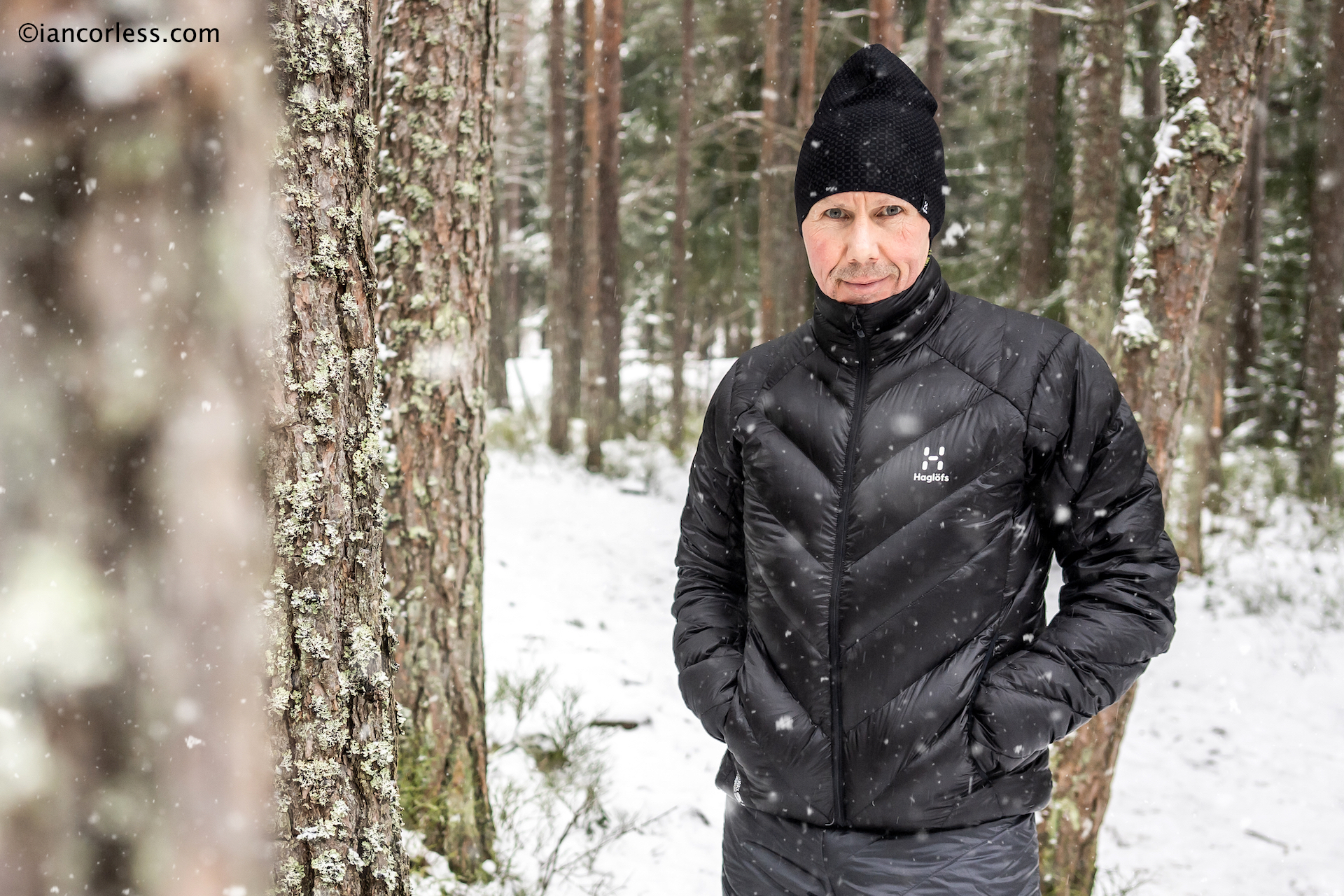
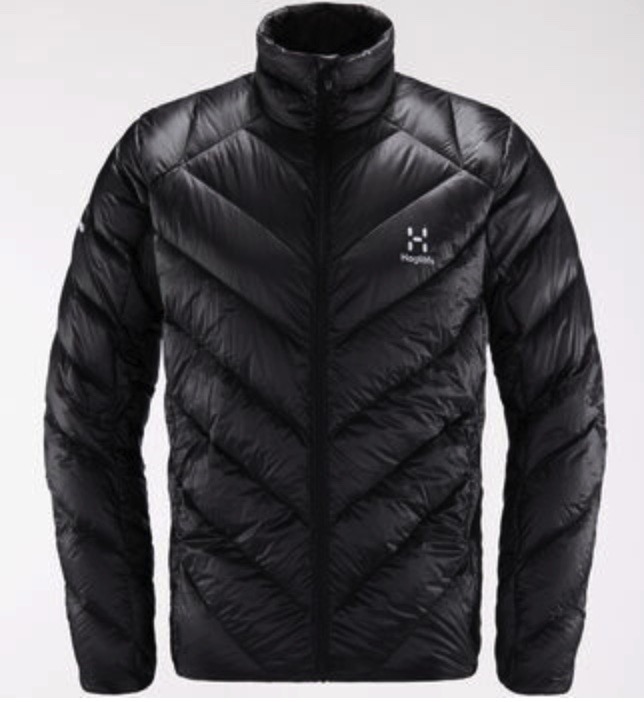
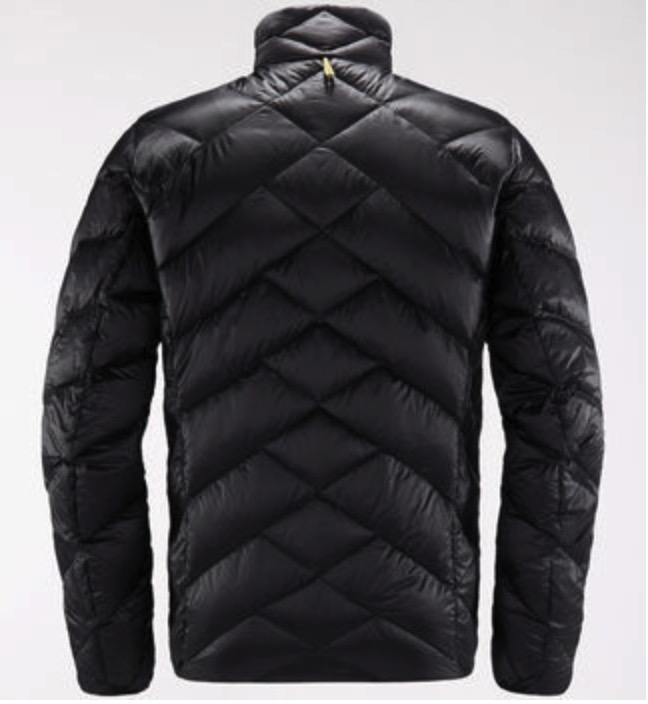
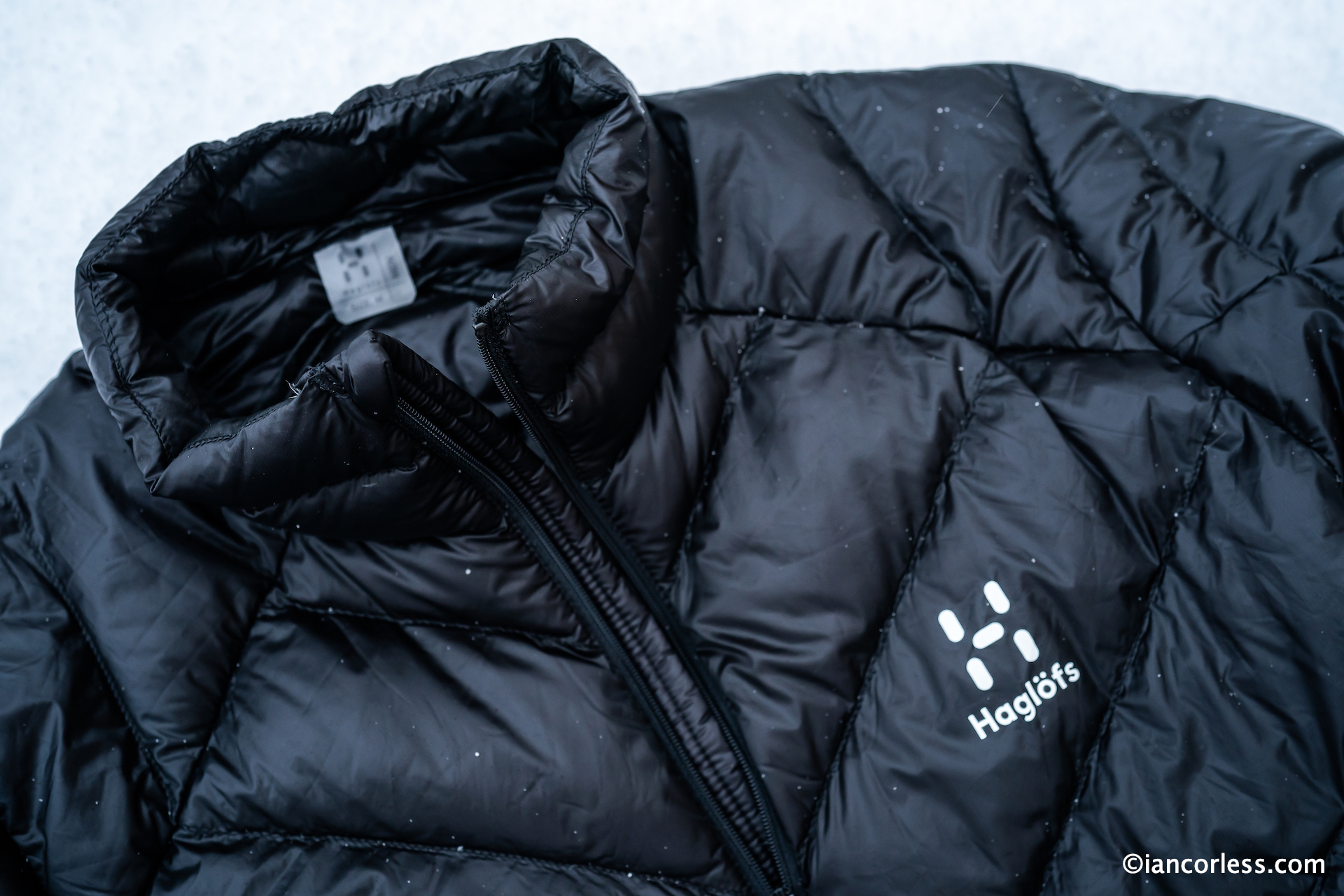
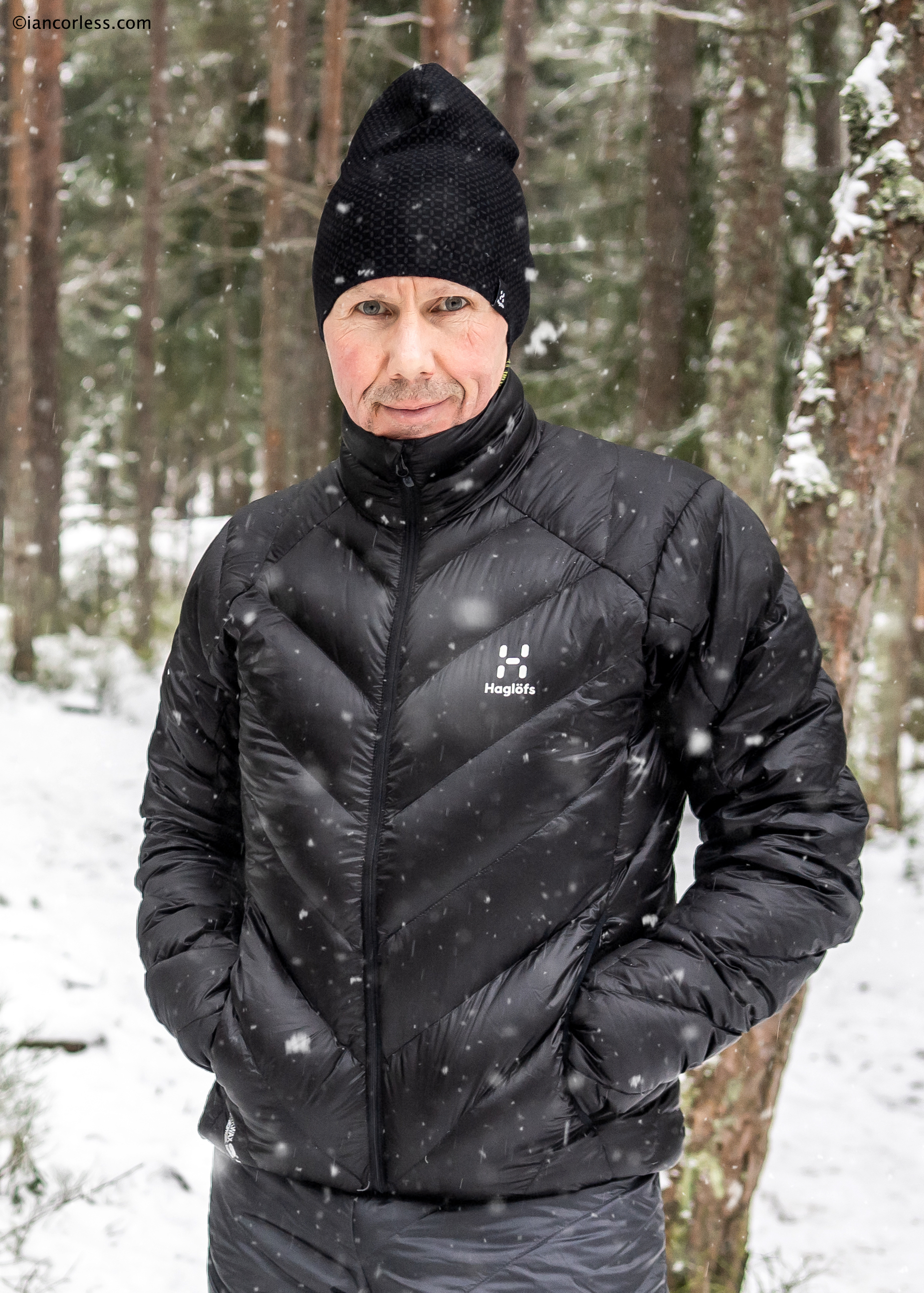
The L.I.M Essens Jacket Men is currently my go-to jacket for any running or mountain adventure, quite simply, it’s the best product I have tried. It combines three key elements perfectly: low weight, small pack size and warmth.
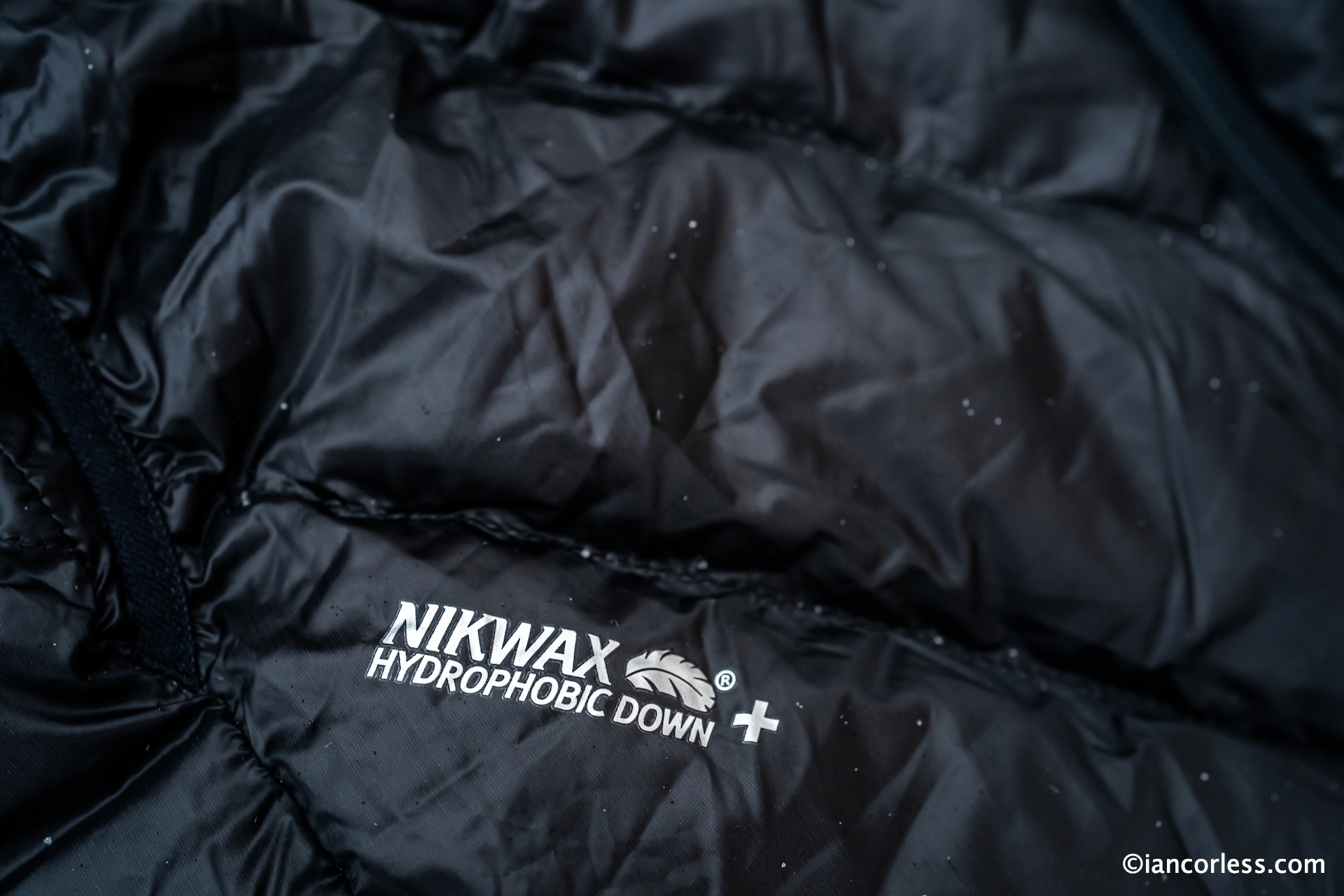
Quite simply, ‘Essens’ is the essence of lightness. The warmth and very low weight is attributed to extremely light and durable material and first-class goose down with 800 CUIN filling. Importantly, the down is treated with fluorocarbon-free DWR which works so well that the filling stays dry for up to 10,000 minutes with exposure to wet conditions.
This is a game changer… Down has always been known to have the lowest weight and smallest pack size, however, previous incarnations would mean that any wet or damp weather would leave the filling useless.
Now, with fluorocarbon-free DWR, down has all the benefits ans wet weather performance of a synthertic filling such as Primaloft, but with the huge advantages of low weight and packing size of down. The Nikwax Hydrophobic Down can be washed with an appropriate Nikwax (Nikwax Down Wash Direct) product.
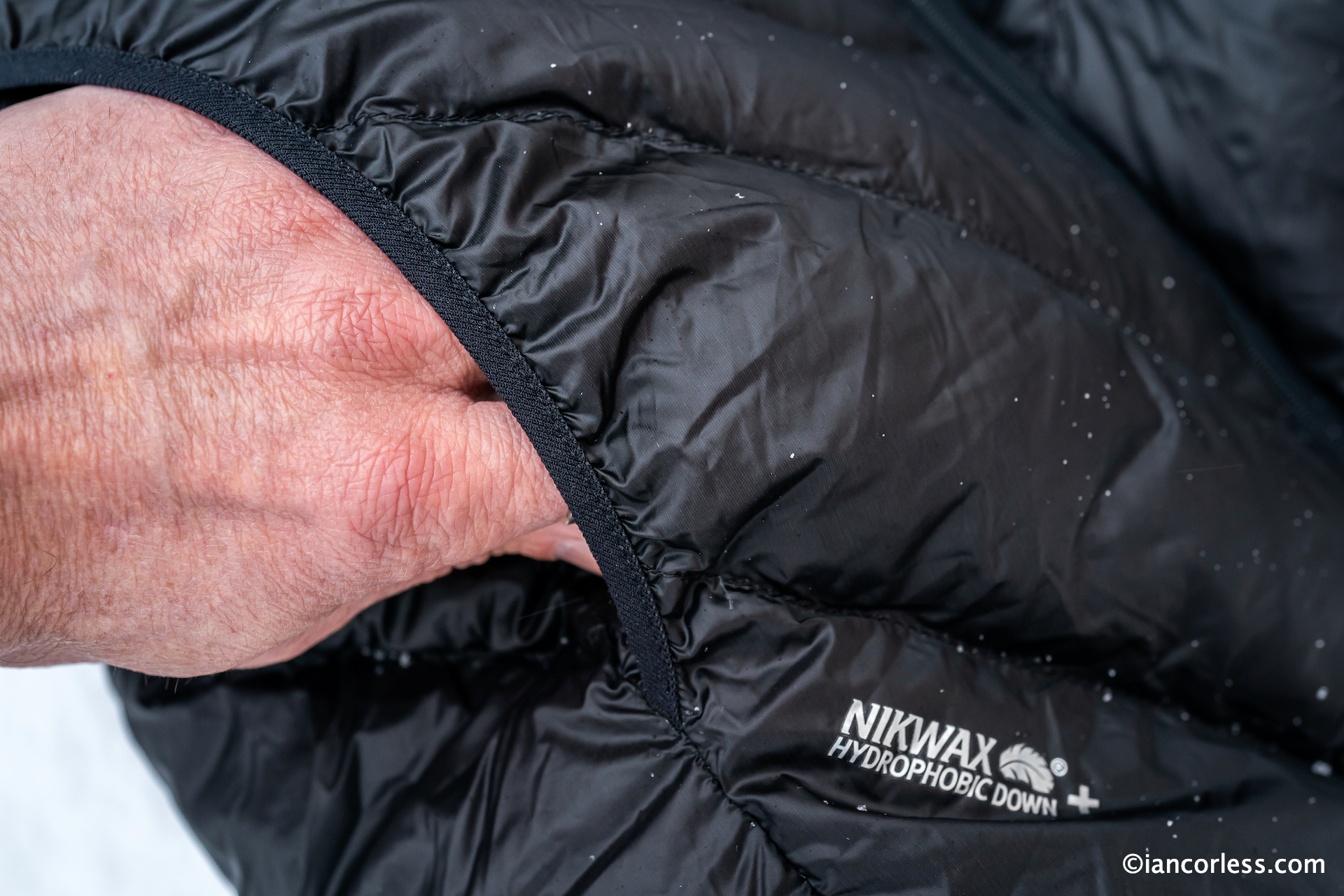
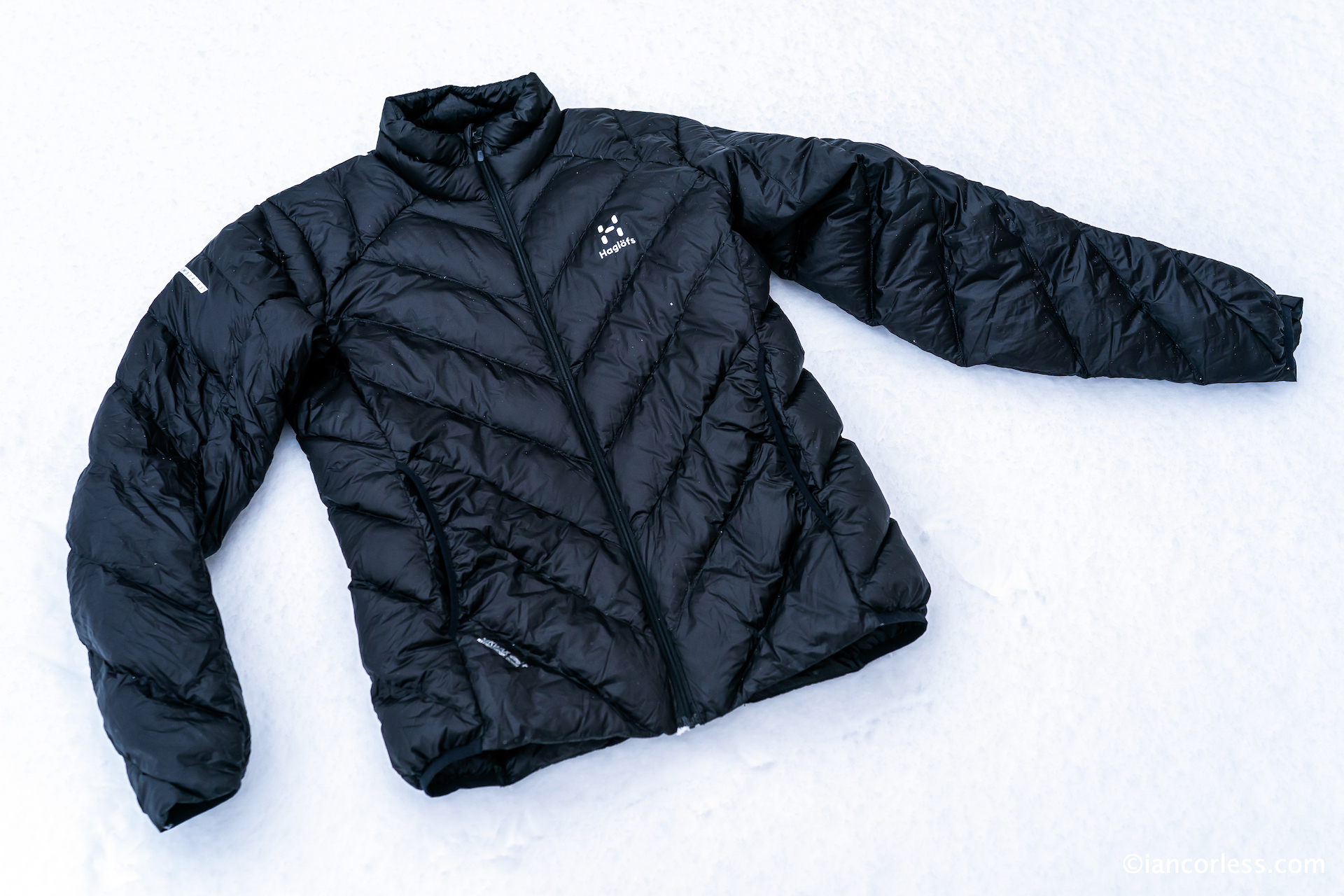
Fit is superb both in female and male versions with excess fabric reduced to a minimum. Features are minimal and notably there is no hood, no chest pocket and two hand pockets with no zips, to save weight.
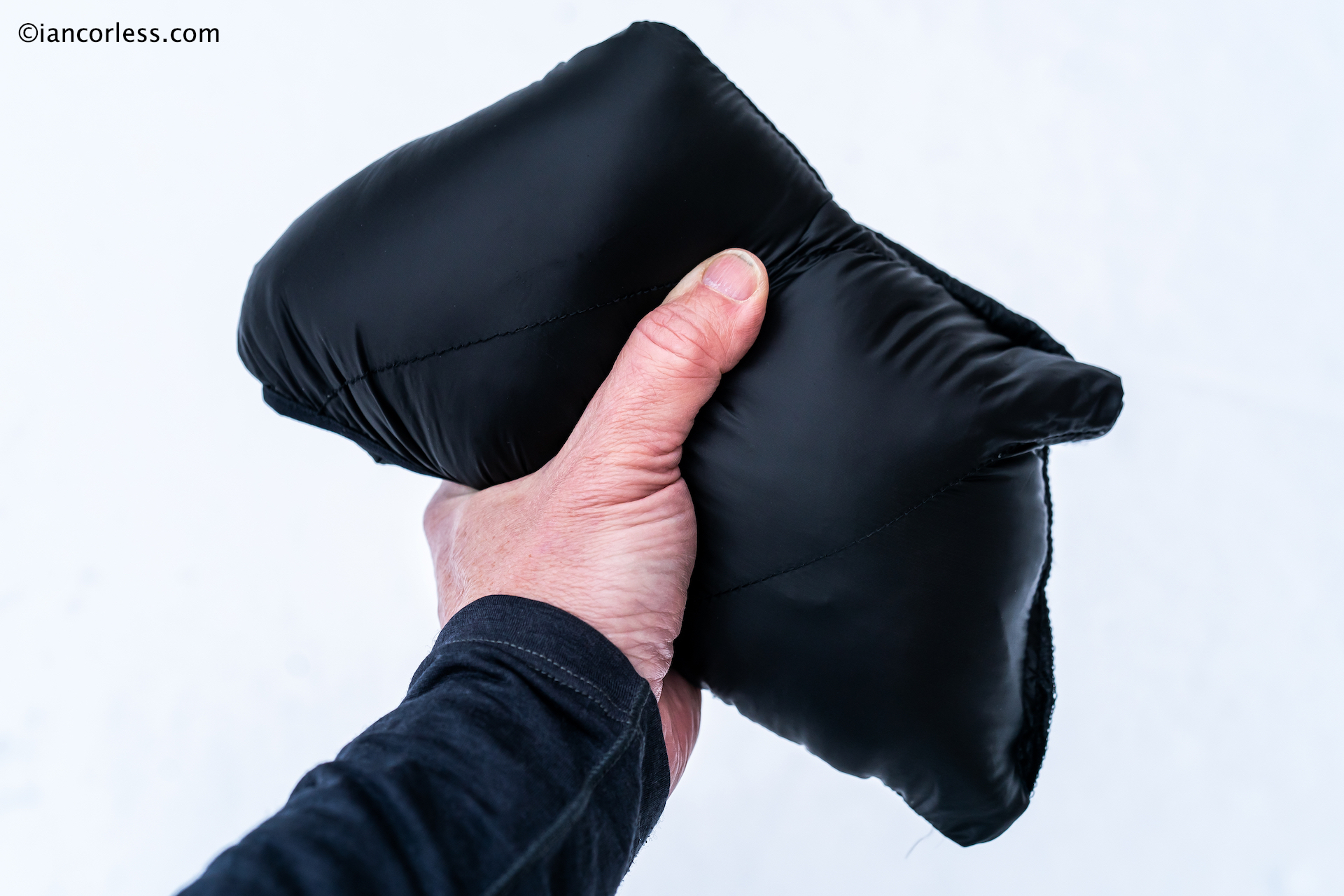
The jacket will fold and compress in to one of these pockets if required.
It has a mini-box quilted construction which ensures the down is spread evenly over the jacket leaving no cold spots. The fill is 800 CUIN. The DWR repels water and dirt making the Essens a perfect all-year round insulating layer.
A full-length zipper allows flexibility in regulatimg temperature and for cold conditions it has a high nick with chin guard. The bottom of the jacket and cuffs have a simple elastic construction to reduce drafts and maintain low weight.
IN USE
The Essens jacket has been with me on all my runs since receiving the product. I pretty much always run with a pack and due to the Essens low weight, small pack size and flexibility in all weathers, there has never been a reason not to take it. My male medium weighs 160g which is up there as one of the lightest down jackets available. The ability to maintain loft and insulation irrespective of conditions has been a game changer, be that on a run from home or more notably on a multi-day fastpack when weight v warmth is key. This is a product that works for any adventure, be that in the snowy mountains or for example on stage race like Marathon des Sables in the Sahara desert. Fit is neither slim or spacious, it seems to fit just right with enough flexibility in the arms, the back and sleeve length are optimised for outdoor use. Added to a merino base layer, it provide incredible warmth on cold days. Should you stop for a break, it provides ideal insulation to retain warmth before heading off again. On tough, challenging and wild days, the Essens is a superb insulating layer underneath a waterproof such as Haglöfs L.I.M Jacket which has minimalist design, is easy to pack, light and made from GORE-TEX Paclite® PLUS.
CONCLUSION
There is nothing to dislike in the L.I.M Essens Jacket, in all honesty it is the best I have tried. The warmth and comfort is incredible for such a lightweight jacket. The packing size and weight is difficult to beat. As I said, there is no reason not to take this on any run as it is the perfect insulating layer, irrespective of the weather.
RRP £200 available in 4-colours, sizes XS to XL male and female versions.
To clarify, this is not a paid review.
Please support this website. I believe everyone deserves to read quality, independent and factual articles – that’s why this website is open to all. Free press has never been so vital. I hope I can keep providing independent articles with your help. Any contribution, however big or small, is so valuable to help finance regular content. Please support me on Patreon HERE.
Icebug are specialists at studded shoes, be that for orienteering, trail running or winter running. The ICEBUG ROUTE is considered an entry level shoe with a combination of features designed to appeal to experienced or novice runners. I have been using the Icebug Route in rotation with several winter shoes: VJ Sport Xante, inov-8 Arctic Talon, inov-8 OROC and notably, the Icebug Pytho 5.
The Icebug Pytho 5 is solid shoe, I wrote, “works exceptionally well as an ‘all-rounder’ and is sold as such, recommended for trail running, forest running, orienteering and winter ice running.” The Pytho uses BUGrip and so does the Route.
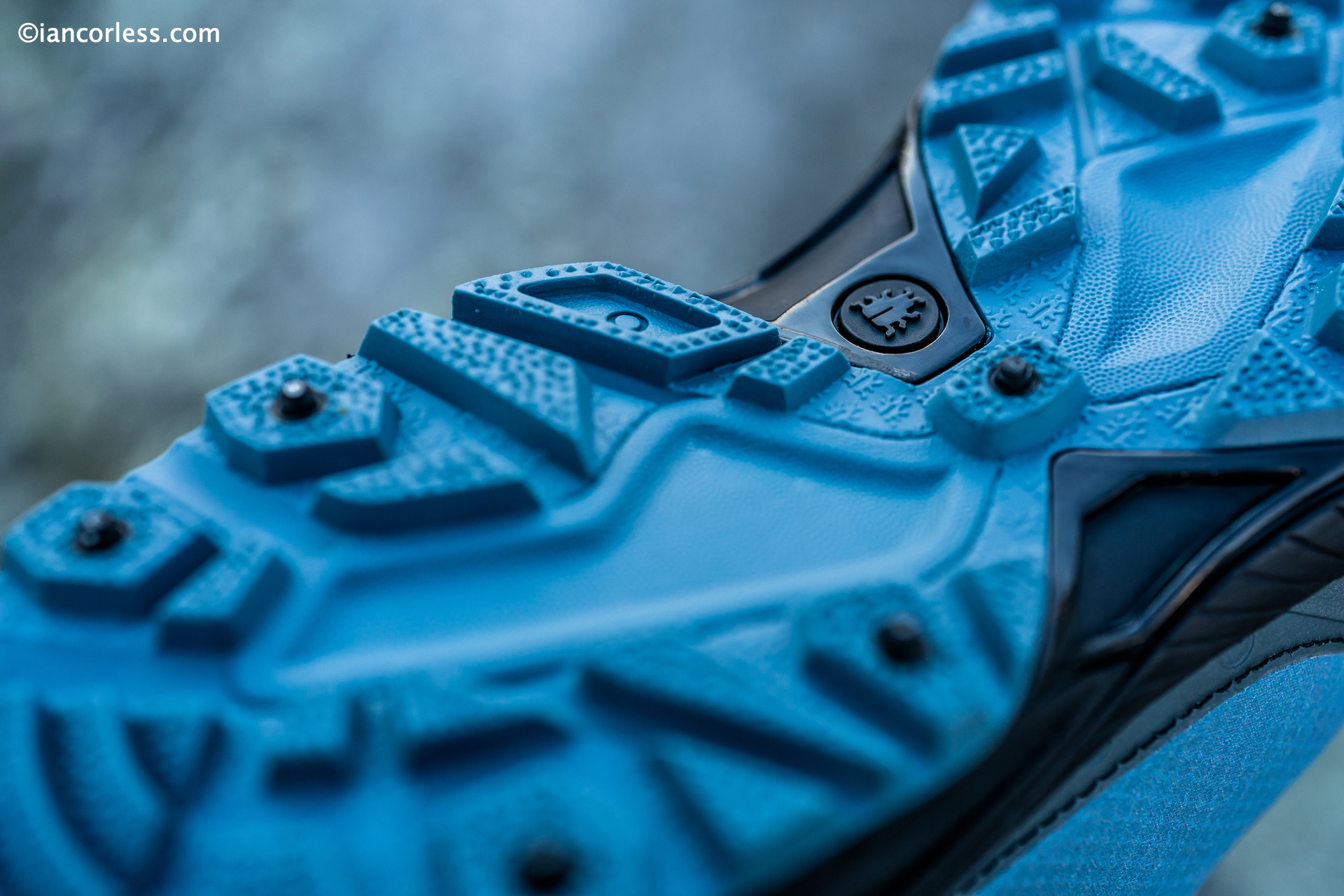
BUGrip is the secret weapon of Icebug winter shoes and it this technology that provides grip in the most demanding and slippery conditions. The outsole is made from a special rubber compound, there would be typically 15-19 studs inserted. The Pytho 5 has 17 and the Route a maximum 19. The studs work independently from each other and are not completely fixed. When weight is applied, the studs push in toward the surface of the sole. How far they are pushed in depends on the pressure exerted by the user and the resistance from the ground. Quite simply, the secret of running in studded shoes is ‘trusting’ the outsole to do its job. The more confident you are, the harder you place your foot and the more you believe in the outsole, the better the grip will be.
The Icebug Route has been somewhat of a revelation. And I say this as many of the selling points are not what I would typically look for in a shoe, notably, 12mm drop. I am a neutral runner and typically run in anything from 0 to 8mm drop.
Designed for winter road conditions, I have been using the Route on trails with rocks, tree routes covered in snow and ice, frozen lakes, iced pavements and iced single-track, so in summary, pretty much everything… I have not used them on mountain terrain.
The Route is light, for example, in comparison to the Pytho 5 they are 30g lighter and they feel it. There is a life in the Route that I did not expect and comparison to the Pytho 5, the feel is considerably more preferable.
Listed as a cushioned shoe with a comfortable feel, I can confirm the ride is very plush with great flex, bounce and still with a feel for the ground. The propulsive phase is very good with great flex around the metatarsals. The midsole is Bloom Foam, EVA with ESS stabilizer. I have not been able to find any measurements for front and rear cushioning, but based on other test shoes and experience, I would estimate 8mm front and 20mm rear – this is a guess though!
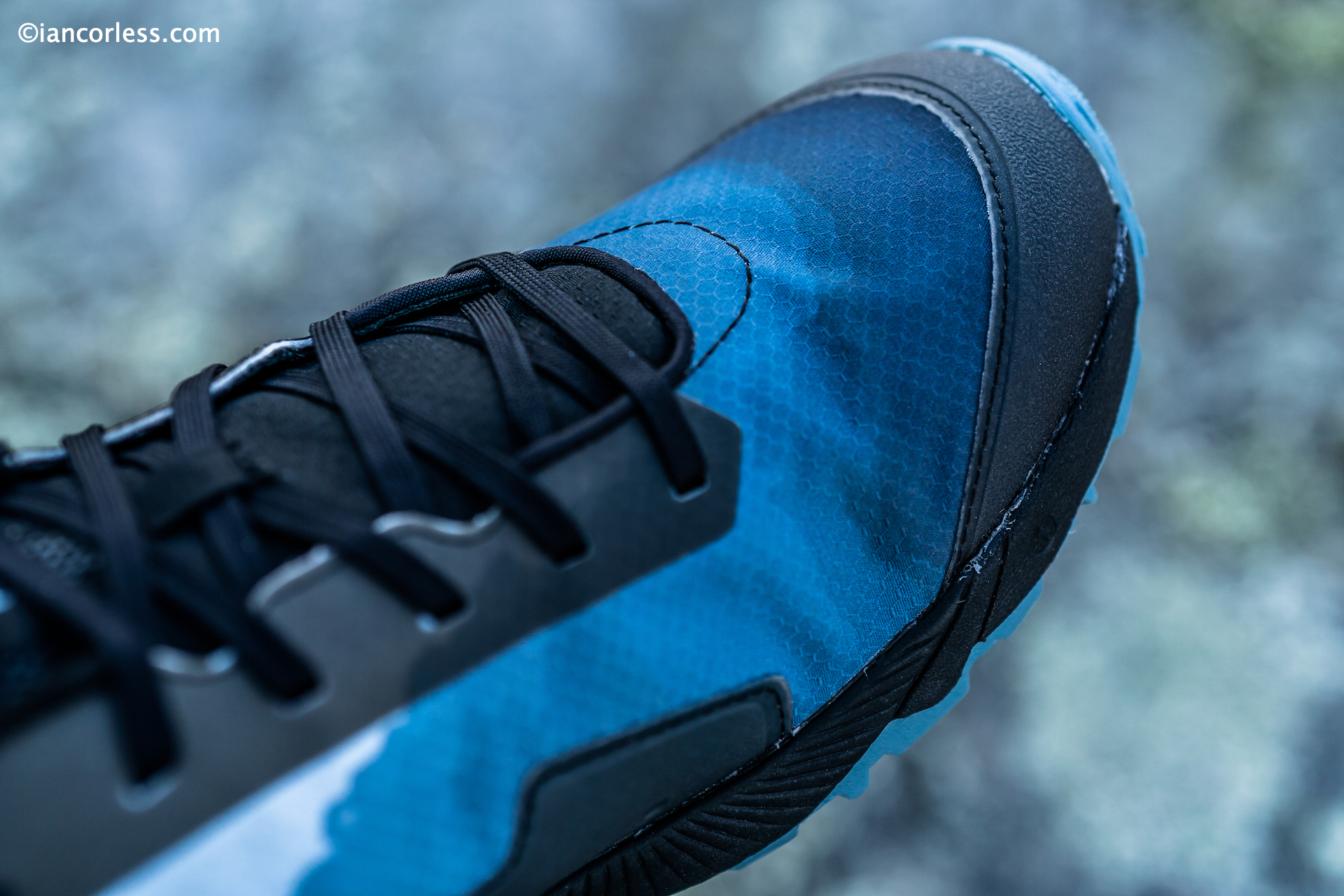
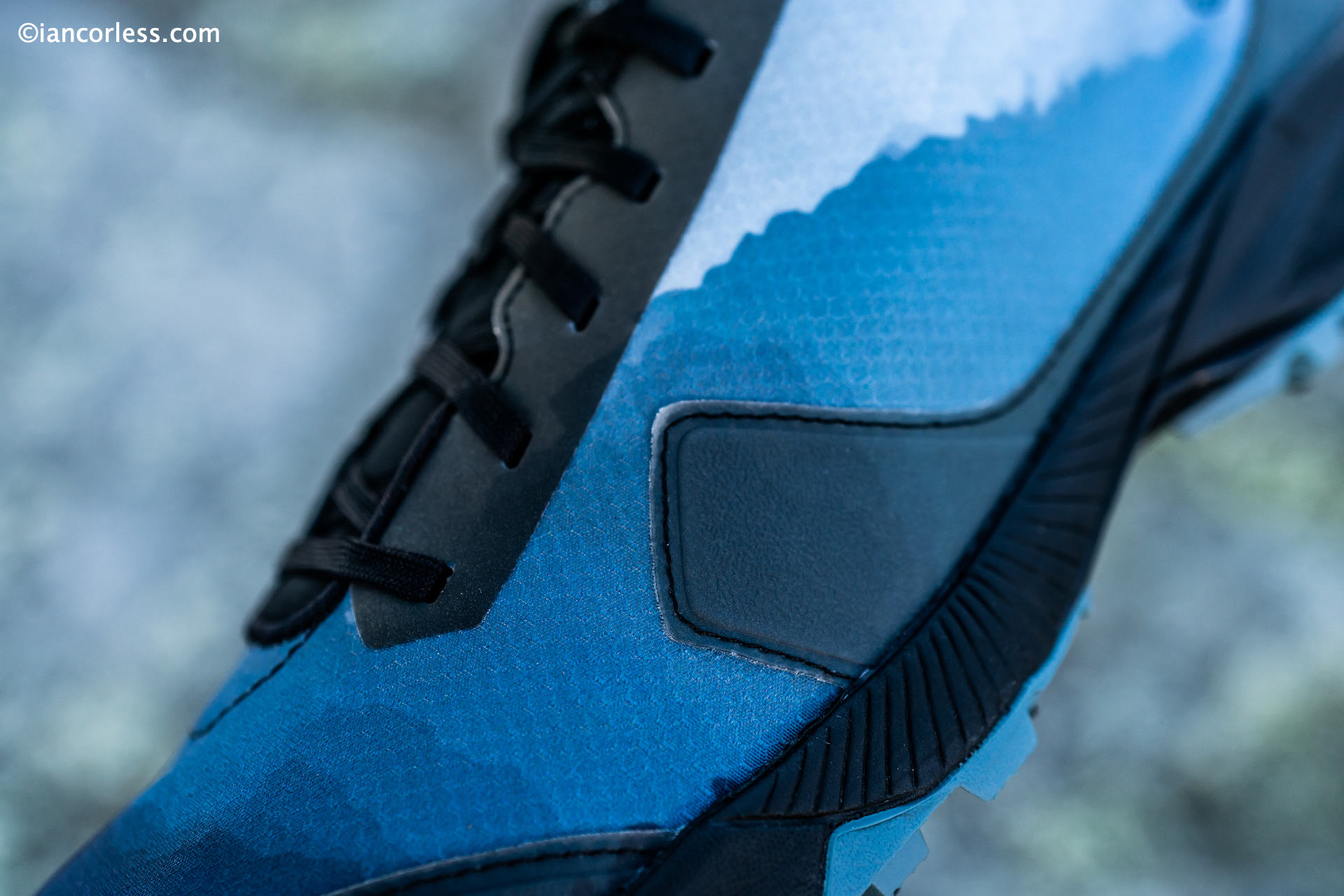
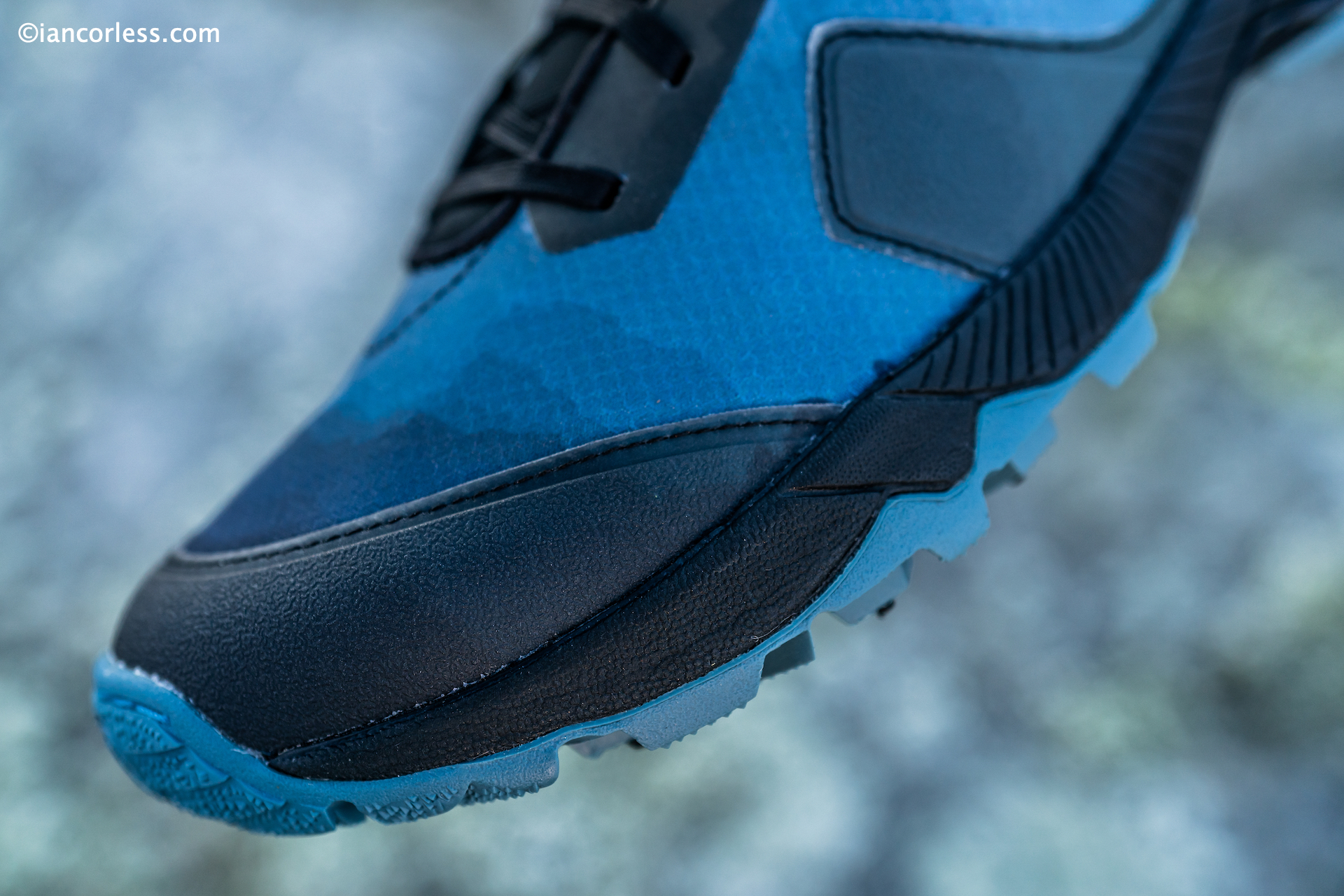
The upper is not insulated and this is a notable point, the shoes in sub-zero winter runs of snow and ice are noticeably colder than some of the competition. Top tip – I use neoprene socks as standard with temperatures below zero and this makes a huge difference, especially with the Route. Breathable is not a good selling point for a winter shoe. Made from 100% recycled polyester textile, the upper is very durable to winter conditions. Toe box protection is minimal. There are no reinforced panels on the upper and the shoe does not suffer from it.
The toe box is wide and spacious, ideal for a winter shoe allowing the toes to splay and move. You don’t want your toes squeezed in a shoe in cold weather, some space allows for blood flow.
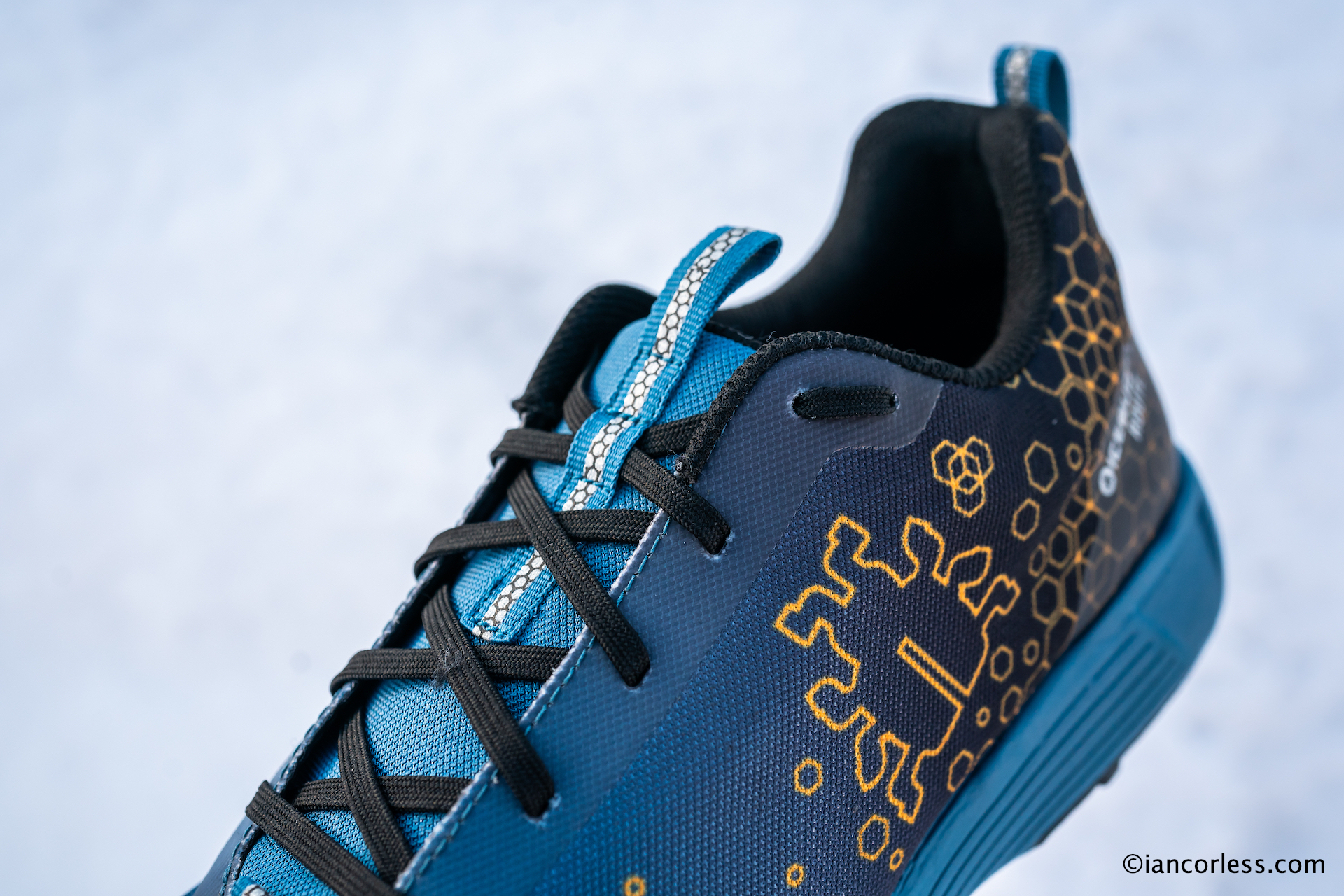
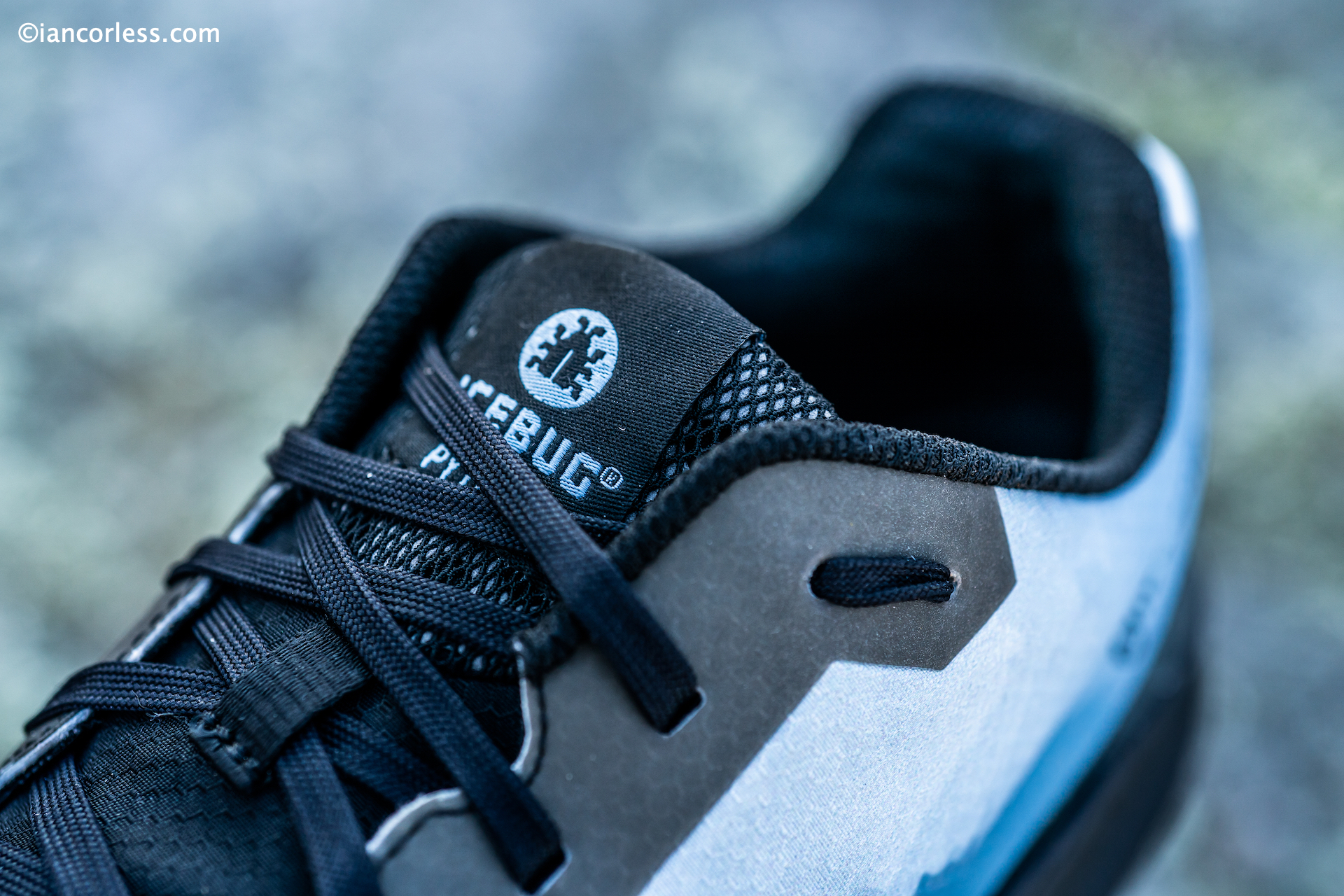
The lacing is simple with 5 eyelets on either side and an optional lock-lacing eyelet at the top. Importantly, the laces really pull and hold the foot providing reassurance on any terrain.
The heel box is comfortable, holds firm, caused no abrasion and importantly, when going uphill, causes no slipping. It’s well-padded and very comfortable.
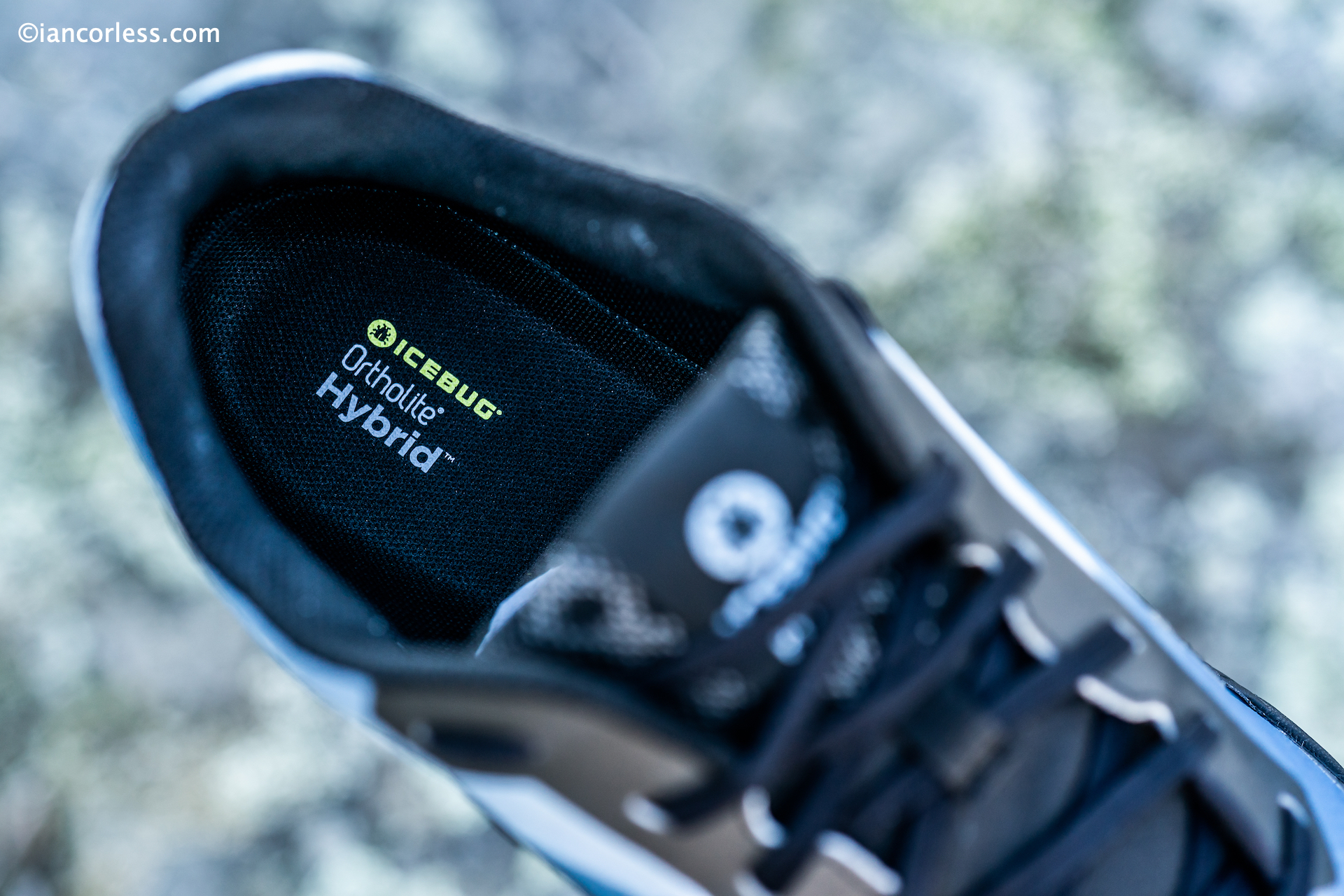
The insole is Ortholite Hybrid designed to create a cooler, drier environment inside the footwear.
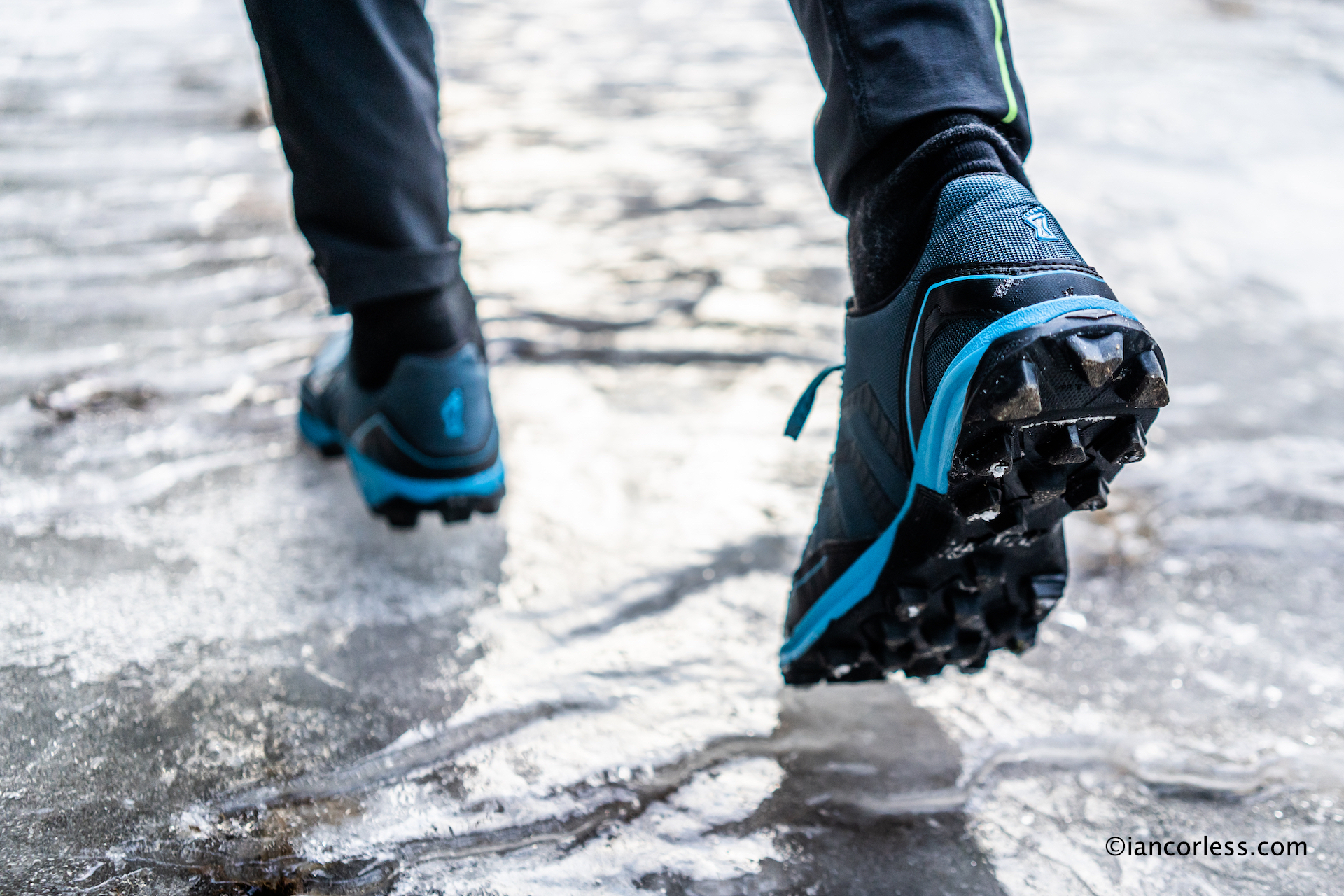
The outsole is the star of the shoe and the 19 dynamic steel studs perform superbly adjusting to the terrain and conditions providing supreme confidence. Notably, when running on road sections lacking snow or ice, the Route is still comfortable and unlike other studded shoes, I don’t feel the studs coming through to the insole. It goes without saying, that running on roads or pavements without ice or snow should be kept to a minimum. It is easy to lose studs and the BUGrip outsole is designed to work effectively with 2 or 3 studs missing. It is possible to replace studs, you just need to contact Icebug for spares. Notably with studded shoes, they work remarkable well on trail providing exceptional grip on tree roots, rocks and other obstacle; they are not just for snow and ice.
Finally, the Route has a good look with a blue fade and yellow patterned overlay including the Icebug logo.
IN USE
True to size, the Route is immediately comfortable when you slide your foot in. There is little to distract in this shoe, quite simply, lace up and off you go.
The width in the toe box is notable but not so wide that you lose feel or precision when running on more technical terrain.
Comfort is immediately noticeable from the cushioning and not at the expense of feel for the ground or flex in the propulsive phase.
Considering the shoe has a 12mm drop, I have to say, the Route did not feel out of place and at all times, on every run, has felt comfortable. This has made me very curious and I still do not have an answer? Maybe the soft snow, ice and the mixture of conditions masks the higher drop? Ultimately, the only consideration is comfort, and the Route is extremely comfortable.
The studs have been superb at providing the required grip as and when required, noticeably, in comparison to some other studded shoes, I like the way the studs adapt to the terrain and pressure from the runner to provide the grip required only when needed. Don’t get me wrong, the studs don’t disappear when there is no snow or ice, they are just not as noticeable.
The upper is surprisingly not ideal for a winter studded shoe. It’s durable, however, it lacks warmth and insulation. So, make sure you use appropriate socks for conditions. I recommend Merino socks as a base layer with a warmer sock over the top. I personally use neoprene socks as I know they work and keep my feet warm. Other options would be Merino socks with a Gore-Tex sock. Top tip – Ideally take appropriate socks when trying for size. It’s not unusual with winter shoes taking a half-size larger to compensate.
CONCLUSION
Before I used the Icebug Route I had wrongly anticipated I would not like the shoe. After all, who uses 12mm drop shoes these days? I was completely wrong. Light, cushioned, great comfort, amazing outsole and room in the toe box all combined together to make the Route one of the best winter shoes I have used. Alongside the VJ Sport Xante, they are now one of my preferred shoes. I even prefer them to arguably, in Icebug terms, the better shoe Pytho 5 which in comparison feels a little over engineered and heavy. I must clarify here, the Pytho 5 is a really great shoe. One thing the Route has taught me, is not to let shoe specs and details get in the way of how a shoe feels and runs. The Icebug Route is a really excellent winter shoe that excels on hard iced trails. The downside of the shoe is the lack of warmth in the upper which can be compensated for with good socks.
To clarify, the shoes were provided to test, as are all the shoes that I review. But this is not a paid review.
Please support this website. I believe everyone deserves to read quality, independent and factual articles – that’s why this website is open to all. Free press has never been so vital. I hope I can keep providing independent articles with your help. Any contribution, however big or small, is so valuable to help finance regular content. Please support me on Patreon HERE.
The 2021 ‘The Coastal Challenge’ is upon us! A six day, supported, 230.5km journey that takes runners from Quepos to the UNESCO heritage Drake Bay.
Over the years, TCC has grown in stature with an incredible list of athletes from all over the world, in 2020, Kaytlyn Gerbin and Cody Lind took the top honors. Unfortunately, due to Covid-19, the 2021 TCC will see a reduced capacity race that will primarily see local participants with only a very small contingent coming from other locations.
It’s fortuitous for TCC that 2018 participant and adidas Terrex athlete, Timothy Olson now bases himself in Costa Rica and therefore he will toe the line for the 2021 edition. The last time he raced at TCC he battled with Michael Wardian, Hayden Hawks, Tom Evans and Marcus Scotney. Unfortunately, Tim’s race was cut short after a bad fall on stage 4.
Tim relaxing in Costa Rica
I caught up with Tim to get his thoughts ahead of the race in February.
How was 2020 for you and how did you survive and motivate through the pandemic?
What a year, 2020 was a challenging year all around. It changed the way of life for many, I was extremely fortunate to enjoy running, good food and family right where we were living in Costa Rica. I shifted my focus from training for any particular race to just appreciating each moment I had, using running as a way to give thanks, praying for and uplifting humanity. Instead of focusing on fear and the unknown I felt motivated to spread encouragement and love.
Priorities have shifted in 2020, what changes have you personally made?
I could definitely feel many major shifts in 2020, it was solid confirmation that my priorities were in the right place. I value time with family and loved ones, supporting local/organic & regenerative farming practices, deepening my meditation and running practice and continuing to do the internal work to be the best human I can be.
Mindfulness is important for you; how did this help in 2020?
Mindfulness was the foundation in which I set my focus on daily. I started each morning of 2020 with meditation and mindfulness practice cultivating what I wanted to see in the world. I would contemplate all the drama in the world, notice how I felt and what would arise internally. Then I would take time to just sit with it no matter what arose. There were definitely dark times, I aimed to learn and grow through really feeling my emotions, taking the time to integrate life’s wild ride. I am grateful for it all and feel calm, grounded and confident as I embark on the next adventure of 2021.
Mindfulness was the foundation in which I set my focus on daily.
You are back in Costa Rica, it’s like a 2nd home – tell me why?
Right now, it is home. We fell in love with the tiny community where we live. The community here is family to me. I have some really good friends here and feel very fortunate to spend time with the working with and appreciating this rich valley. Not many trails but really challenging dirt roads to keep the training rolling. I’ll run in and through the little mountains all the way to the Ocean and then back home, stacking up lots of vertical gain and some hot kilometers onto my feet. On the way I will cool off in a waterfall enjoy a platano and take in all the beauty around me. I’m so grateful for all the amazing places I am able to run and explore but the community of mindful people makes it home.
You raced TCC in 2018, what brings you back?
Taking care of Unfinished business while celebrating this beautiful country and the joy of running. I sprained my ankle really bad here in 2018 and was not able to complete the final day. I was bummed but new I’d be back. I’m really looking forward to completing all the days. A few of the days we run through Dominical, near Nauyaca and to the Whales take and Uvita. I have run all over this area, I run close to Nauyaca daily and looking forward to sharing the trails with the local Ticos.
2021 is going to be a year of more questions, if all goes well with Covid, what are your hopes and priorities?
Lots of questions but I will keep running and doing what I love no matter what. I’m hoping to return to the US and run a long trail. I’ve been thinking about doing the Pacific Crest Trail, a 2,650mile trail that goes from Mexico to Canada through some of my favorite places in the US. The pct means a lot to me and I look forward to completing it one, I’m hoping to do this on 2021 but with Covid I have other ideas if this falls through. When I run it, I want the adventure to uplift people, motivate, raise awareness and encourage people to get outside and do whatever makes them come alive. I want to do what is nest for humanity so we will see what happens this year, but I’ll continually keep spreading good vibes.
The Race:
Stage 1 34.6km 1018m of vert and 886m of descent
Stage 2 39.1km 1898m of vert and 1984m of descent
Stage 3 47.4km 1781m of vert and 1736m of descent
Stage 4 37.1km 2466m of vert and 2424m of descent
Stage 5 49.8km 1767m of vert and 1770m of descent
Stage 6 22.5km 613m of vert and 613m of descent
Total 230.5km
Vertical 9543m
Descent 9413m
Hugging the coastline of the tropical Pacific, TCC is the ultimate multi-day experience that weaves in and out of the Talamancas, a coastal mountain range in the Southwest corner of this Central American country.
The terrain is ever-changing from wide, dusty and runnable fire trails to dense and muddy mountain trails. Runners will cross rivers, boulder, swim through rivers, pass under waterfalls, survive long relentless beaches and finally finish in the incredible Corcovado National Park, a UNESCO World Heritage site with a stunning final loop around Drake Bay before departing for their journeys home via speedboat.
Stage 1
It’s a tough day! Runners depart San Jose early morning (around 0530) for a 3-hour drive to Playa Del Rey, Quepos. It’s the only day that the race starts late and ‘in the sun!’. It’s the toughest day of the race, not because the terrain or distance, but because of the time of day! The runners are fresh and feel great. That is until about 10km and then they realise the heat and humidity is relentless. It’s a day for caution – mark my words! The 34.6km is very runnable with little vertical and technicality, it welcomes the runners to Costa Rica.
Stage 2
From here on in, it is early breakfast, around 0400 starts with the race starting with the arrival of the sun! The only way is up from the start with a tough and challenging climb to start the day. It’s a tough day with an abundance of climbing and descending and a final tough flat stretch on the beach, just as the heat takes hold.
Stage 3
It is basically 25km of climbing topping out at 800m followed by a drop to sea and a final kick in the tail before the arrival at camp. For many, this is a key day and maybe one of the most spectacular. Puma Vida.
Stage 4
It’s another tough start to the day with a relentless climb, but once at 900m the route is a roller coaster of relentless small climbs and descents, often littered with technical sections, rain forest, river crossings and boulders. At 30km, it’s a short drop to the line and the finish at 37.1km.
Stage 5
The long day but what a beauty! This route was tweaked a couple of years ago and now has become iconic with tough trails, plenty of climbing, sandy beaches and yes, even a boat trip. The finish at Drake Bay is iconic.
Stage 6
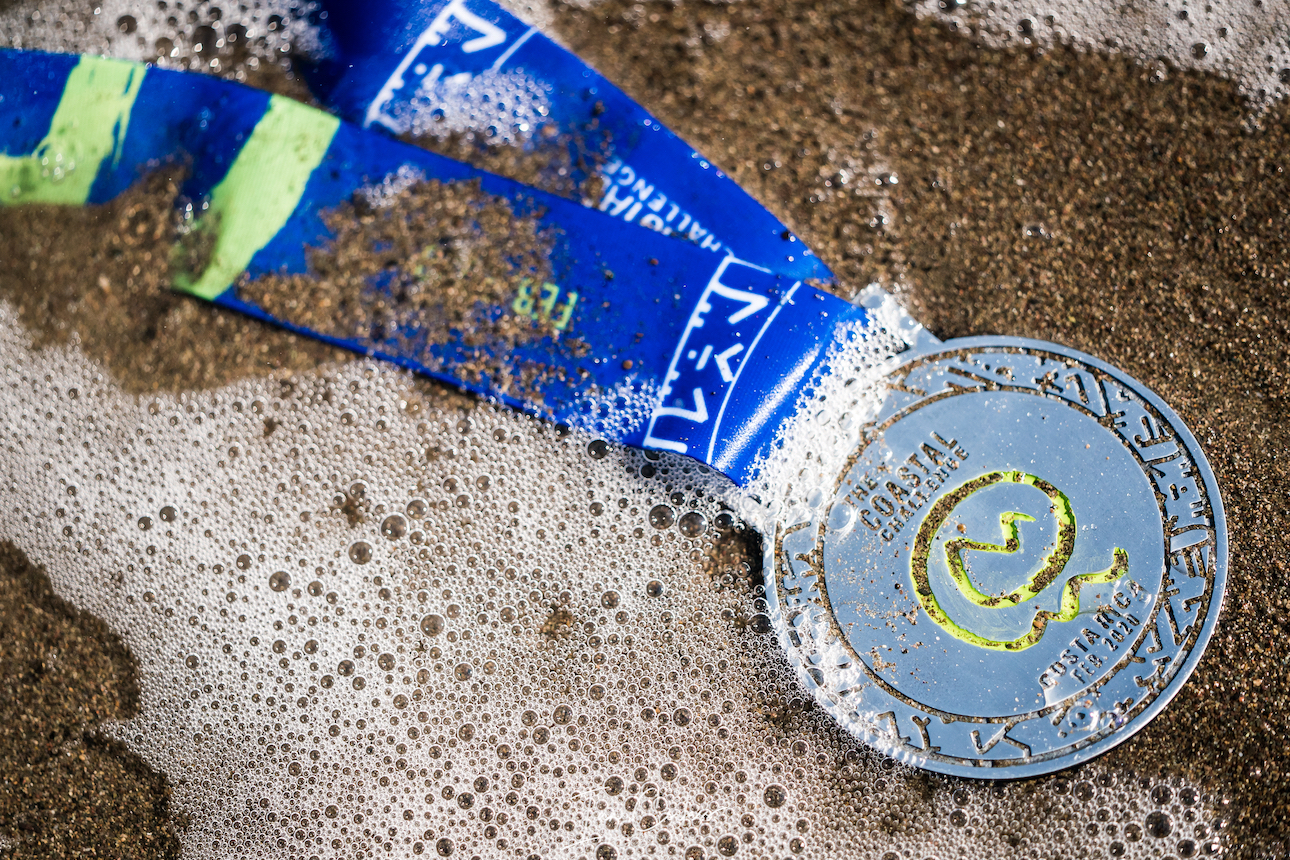
The victory lap! For many, this stage is the most beautiful and memorable. In just over 20km, the route manages to include a little of all that has gone before. It’s a stage of fun and challenges and one that concludes on the beach as a 2018 medal is placed over your head – job done!
Follow #TCC2021
Please support this website. I believe everyone deserves to read quality, independent and factual articles – that’s why this website is open to all. Free press has never been so vital. I hope I can keep providing independent articles with your help. Any contribution, however big or small, is so valuable to help finance regular content. Please support me on Patreon HERE.
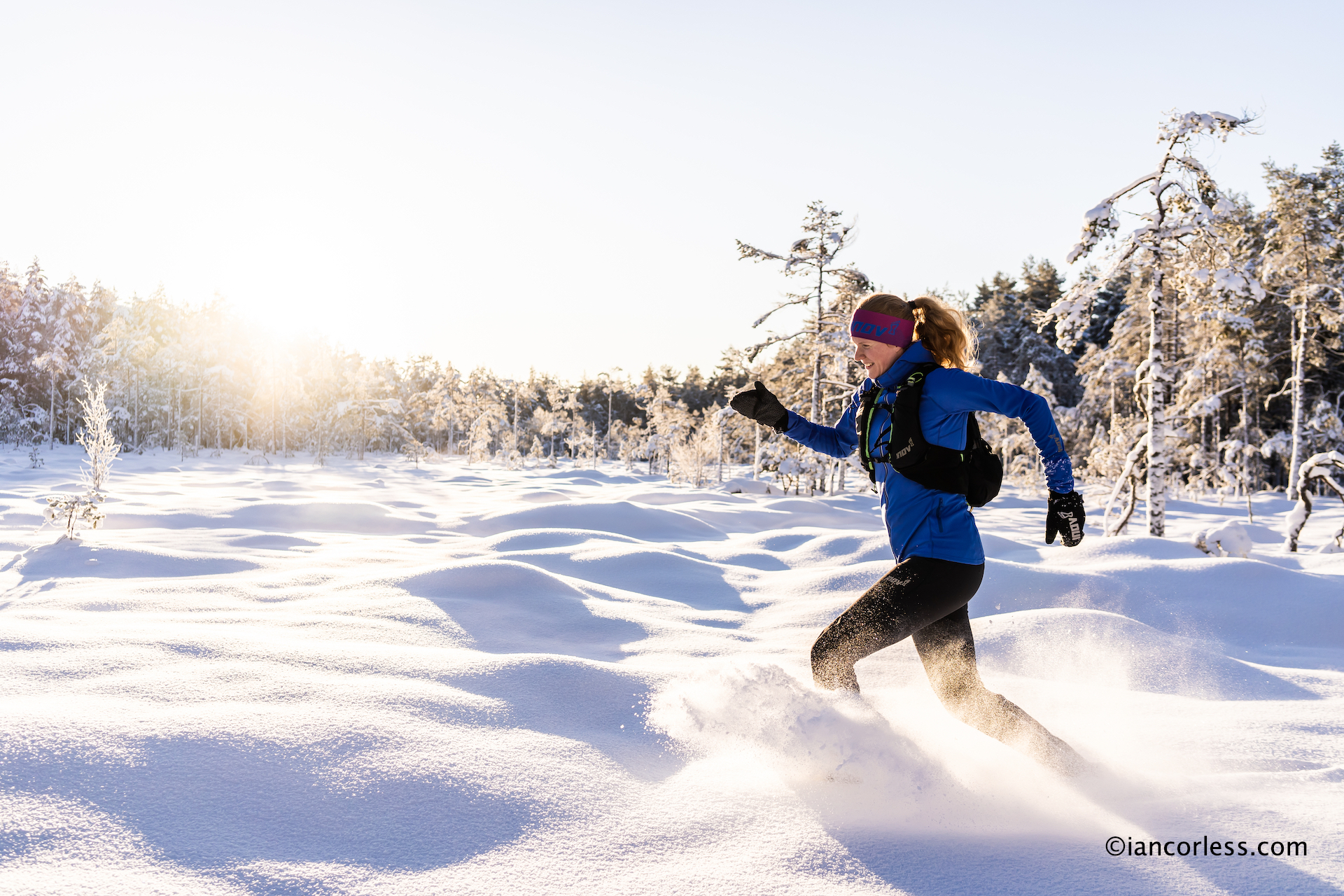
Winter running, day or night, is special that provides a very different experience to running in the hopefully warm, dry, sunny and balmy days of Spring, Summer and Autumn. In all honesty, winter running for me and many others is often preferable, just a shame we can’t have the same amount of daylight hours as Summer brings.
All running, particularly in the mountains, remote areas and particularly if going ‘solo’ brings an element of danger that must be managed. Winter and extreme conditions do increase risk from many aspects and this article is designed to help you make the correct decisions even before you start any running adventure.
EXPERIENCE
No two runners are the same and experience and knowledge are a key bonus when it comes to any running, especially in challenging conditions. So, firstly, understand yourself and your level of experience. This will make your enjoyment and comfort on any adventure enhanced. As tip, start with short days and as your experience, knowledge and understanding increases, you can then venture farther and longer. Even contemplating multi-day/ fast packing adventures. Read an article HERE.
Ask:
What am I doing?
Where am I doing it?
When I am doing it?
What are the options exist to cut short my adventure?
How remote will I be?
What are the risks involved?
What weather can I expect?
What is the worst-case scenario?
Preparation is key and assessing what ‘may’ happen on any adventure or run is crucially important to make sure that a day or multiple day’s activity remains safe.
Weather can change in minutes at any time of the year, especially in a mountain environment. In winter the changes can often be far more extreme, a cold dry day can suddenly become wet, windy with sub-zero temperatures. Hypothermia can hit in minutes. Understand this and prepare accordingly.
It’s possible to run across frozen lakes in certain parts of the world.
Solo adventures are invigorating; however, risks are increased significantly in this scenario. Sprain an ankle (or worse) and become immobilized in bad weather and this becomes a high-alert scenario. So, not only should you have equipment and apparel that will help you survive a situation like this, but you should also have technology to make you safe. A mobile phone (with enough battery) is compulsory and a tracking device, such as a Garmin InReach would be a perfect all-scenario safety device that with the press of a button can obtain SOS support. But remember, at all costs, emergency services are not a comfort blanket that allows you to cut corners. Prepare properly.
Running with a friend adds safety and a natural back-up scenario, so consider this. Women in particular may feel far more secure running in company.
When planning routes, think of short cuts, options to deviate to reduce distance/ time and never push on or let ego dictate. The trails and mountains will always be there. Turning back is a strength not a weakness.
Winter playgrounds are fantastic.
Pace, particularly on longer adventures, will typically be slower in winter due to underfoot conditions and weather conditions. In cold, icy and sub-zero temperatures, sweating is not a friend, particularly should you be forced to move slower or stop, so, think about this and regulate pace to help minimize sweat rates.
Finally, it’s always wise telling family or friends when you are going on adventure, where you are going with proposed route and when you will return. This is a great back-up to have others looking out for you. Of course, this doesn’t need to happen for a daily 5 or 10km run.
EQUIPMENT
The equipment you will use and how much equipment you will take will depend on the type of adventure you are undertaking and how long that adventure will take. This harks back to the ‘experience’ as outlined above. Needless to say, winter will almost always require you to carry more. If running on the road and in public places, make sure you can be seen with reflective items.
Keeping your core warm is essential and without doubt using a merino wool base layer (or similar) with an optional small zip neck for your body is key. Merino wool in particular has an ability to retain warmth, even when wet or damp. Top tip: Take a spare base layer in your pack on runs.
PROTECTION and WARMTH
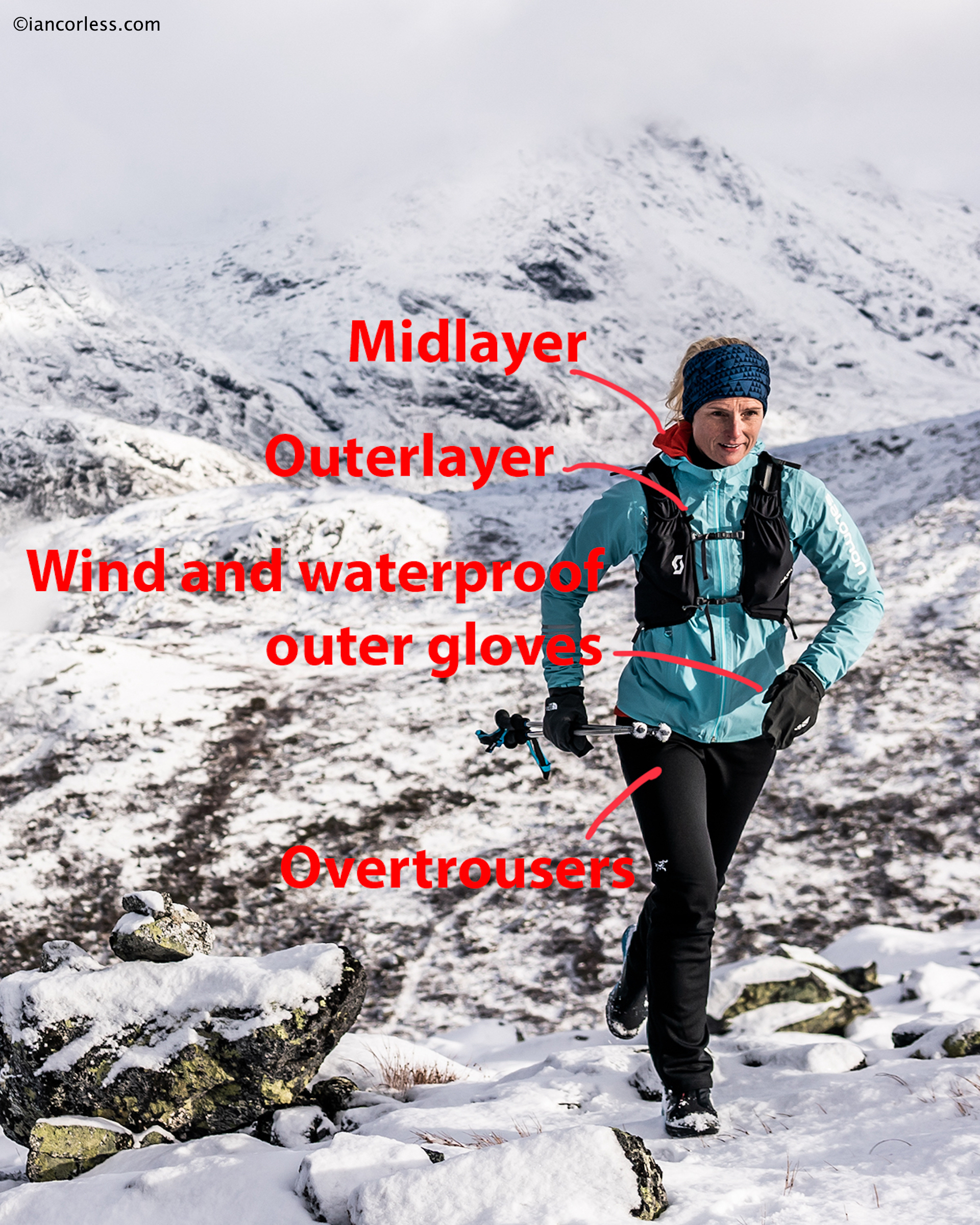
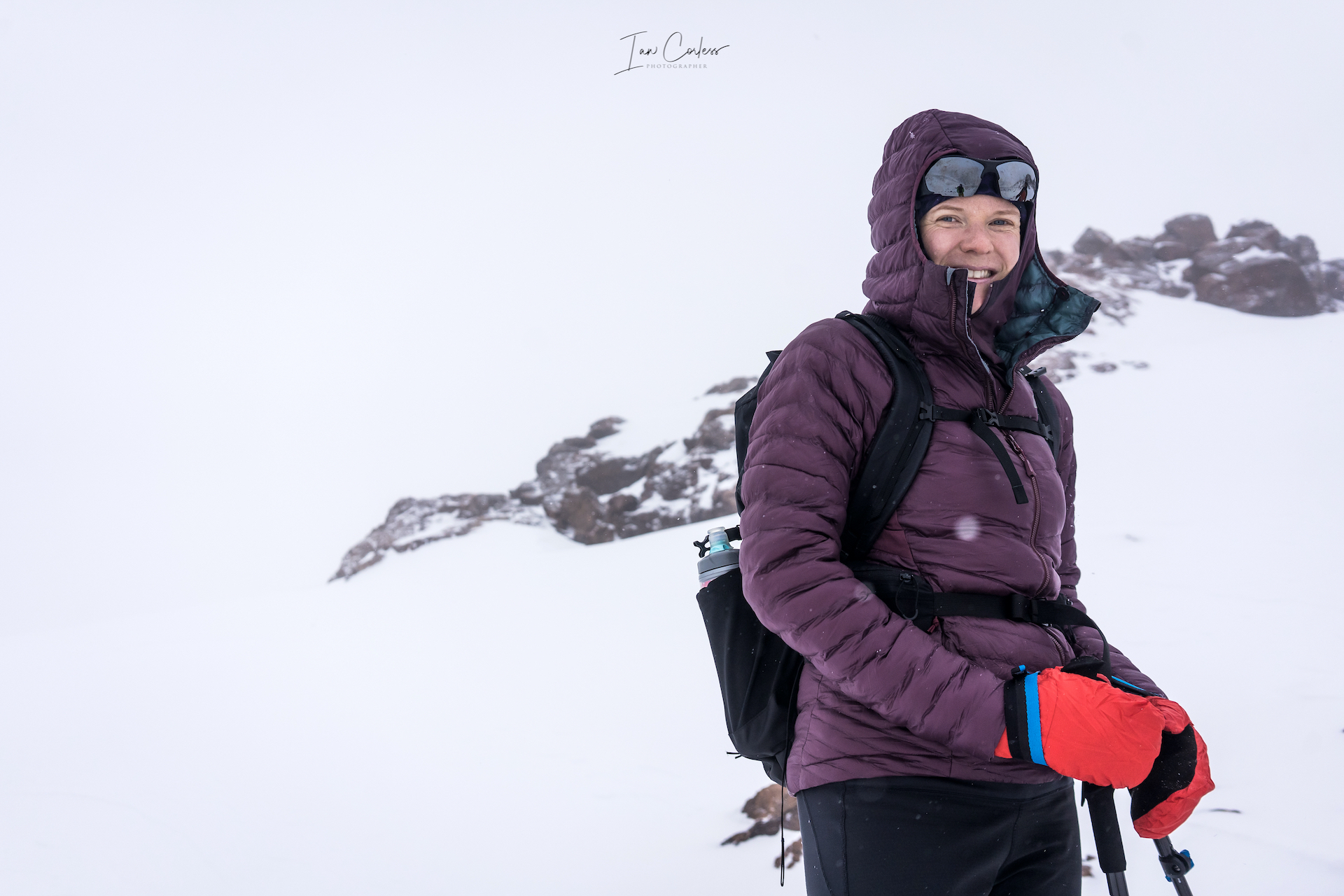
As mentioned in the ‘Getting Layered’ article, you will need to adapt the body layers for the weather you will run in and the weather that you ‘may’ encounter. A mid-layer will provide warm and this can be made of a product like Polartec, Primaloft or Down. Consider balancing warmth, size and weight. On a personal note, I use a Polartec layer as my standard warmth layer and then carry a ‘treated’ Down jacket (this can get wet and still be warm) in my pack as an essential warmth layer. The final layer will be a waterproof with taped seams, this layer will protect from extreme wind and rain. Zips on mid and outer layers add weight but they are essential for being able to regulate temperature.
HEAD
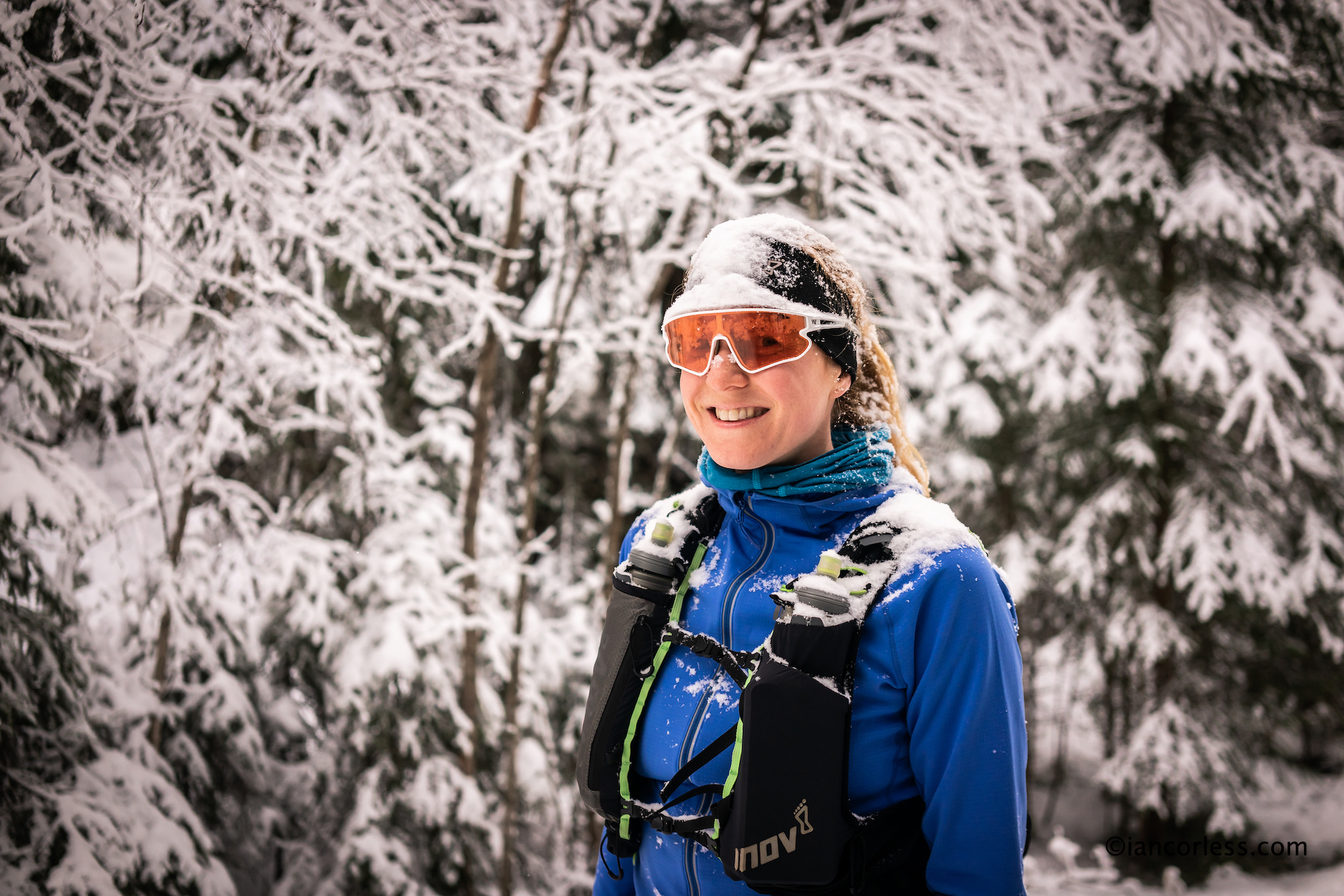
A hat is essential for retaining heat within the body, *“even if the rest of your body is nicely wrapped up, if your head is uncovered, you’ll lose lots of body heat — potentially up to 50% of it — in certain cold-weather conditions.” You can regulate temperature while running by simply adding and removing a hat. Wear a Buff or similar around your neck.
SUNGLASSES
Protect your eyes, particularly in snow. You can get specific lenses designed to enhance vision in winter conditions.
EXTREMETIES
Hands and feet are a huge problem area in winter, particularly if you suffer with Raynaud’s. Keeping your core warm immediately helps keep extremities warmer as the body naturally abandons extremities (hands and feet) to protect vital organs. For feet, just like the core, merino socks are superb starting point for warmth, even if wet. However, if you anticipate feet to get wet repeatedly and in sub-zero temperatures, you will need to think about other options. A good example being neoprene socks that are warm when dry and should you get feet wet, they are designed to retain warmth when wet by insulating the water between foot and sock. You need to be careful of trench foot should feet remain wet for too long. For hands, a merino liner sock is ideal as a starting point and then a mitt over the top adds warmth and insulation. Mitts are always warmer than gloves and if you do not require finger dexterity, they are always preferable for warmth. Consider having multiple mitts of different warmth levels to that you can adapt to the weather. Also consider longer socks that come higher than the ankle, especially important if running in snow. Top tip: Take spare gloves and socks on any run.
LEGS
Shorts are not a good idea in winter, keeping leg muscles warm is essential for comfort and the ability to function properly, so, use tights. Ultimately, you may require multiple tight options starting with a simple Lycra product and moving up to insulated tights with wind blocker. Of course, carrying a waterproof pant with taped seams is also an essential for winter. Add them to your pack and do not compromise, you may not require them for over 90% of your runs, but when you need them you need them.
SHOES
inov-8 Arctic Talon studded winter shoes.
There is no definitive winter shoe and, in many scenarios, the shoe you usually run in will work fine. However, if you have snow and ice, you will almost certainly need to consider other options. There is an in-depth article HERE but for me, a winter ‘stud’ shoe is my go-to for all my runs. In simple terms, it is often a conventional run shoe with metal studs added to provide grip in ice and challenging conditions. They are a game changer. Winter shoes are often insulated so as to keep feet warmer. Top tip: Consider socks and consider that you may wear multiple socks or thicker socks, this may require that you a larger shoe but be careful, particularly in the propulsive phase as this can make the shoe bend differently behind the metatarsals.
PACK
You will almost certainly require a larger pack for winter runs. A 12-15 ltr is probably ideal for long days and if fastpacking, 20-30 ltr would be normal. Top tip: Use dry bags inside to protect key layers and where possible use several that are different coloured, so you know which is an insulating layer and which is an outer layer.
FOOD and HYDRATION
Just like on any run, calories and hydration are essential. Winter and in particular the cold can easily make you forget to drink, make it a habit. Cold and extreme weather will also burn more calories, so, keep the fire stoked. Plan runs that take in a cafe, hut or lodge stop. If you do the latter, you need to balance losing hard earn warmth and then going back out in the cold. This is where carrying a spare base layer can be a great idea. If in remote locations, you need to consider re-supplying. Importantly, streams that provide water in summer may well be frozen in winter. Also, bottles may well freeze if exposed to sub-zero conditions, so, consider insulated bottles, using warm water and maybe keeping bottles in a pack, wrapped in clothing to retain warmth and reduce freezing possibilities.
OTHER ITEMS
The more experience you have, the greater your winter challenge may be. Always have the correct equipment, for example, ice axe, crampons, rope, harness, hand spikes, snowshoes and so on. A Bivvy bag is an essential when in remote locations for safety, in addition, always carry a head torch as a just in case scenario should a run take longer than anticipated.
Read about a winter expedition to the Atlas Mountains HERE
Equipment with tent and sleeping bag.
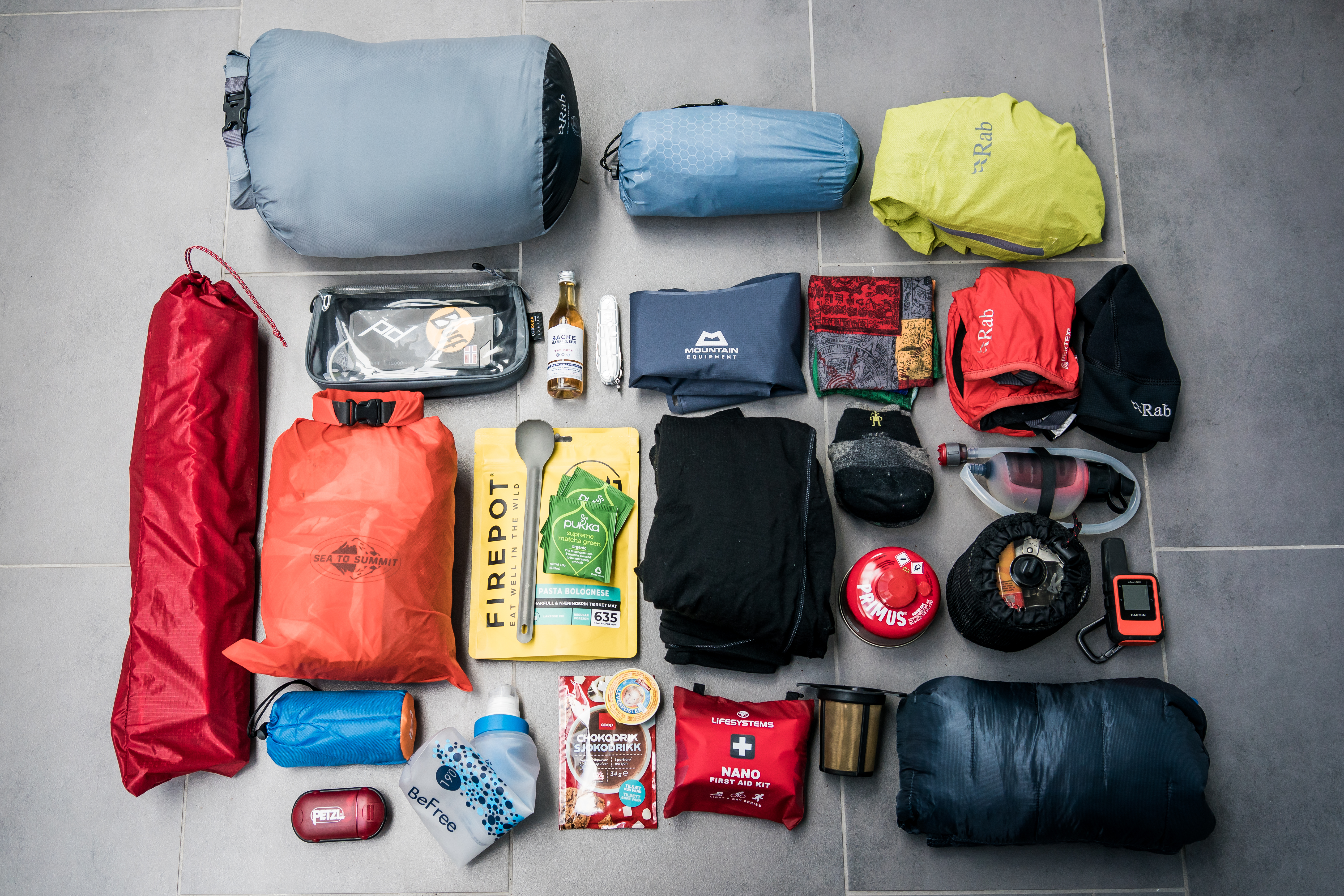
EXAMPLE EQUIPMENT LIST
As a start point, you will be wearing the following applicable to the conditions:
Base layer.
Mid layer.
Hat
Gloves.
Glasses.
Socks
Appropriate shoes.
In the pack:
Spare base layer.
Spare socks.
Spare gloves.
Insulating layer (down or primaloft)
Waterproof layers, top and bottom.
Headtorch and spare batteries.
Phone.
Tracking device.
First aid.
Bivvy bag/ space blanket.
Food.
Drink.
Battery back-up.
Heat pads for hands and feet.
FINALLY
Embrace winter. It’s a great time of year to explore. Respect the conditions and if you follow the above, you will almost certainly have safer and more enjoyable outings. Accidents do happen at any time of the year, in winter, risks do increase so respect the conditions. Accept that you will go slower in winter.
Please support this website. I believe everyone deserves to read quality, independent and factual articles – that’s why this website is open to all. Free press has never been so vital. I hope I can keep providing independent articles with your help. Any contribution, however big or small, is so valuable to help finance regular content. Please support me on Patreon HERE.
Episode 201 of Talk Ultra has a chat with #phantamsm24h runner, Simen Holvik and we discuss his 2021 July FKT plans in Norway.
Talk Ultra needs your help! We have set up a Patreon page and we are offering some great benefits for Patrons… you can even join us on the show! This is the easiest way to support Talk Ultra and help us continue to create! Many thanks to our Patrons who have helped via PATREON Donate HERE
Importantly, go to iTunes and subscribe so that you automatically get our show when it’s released we are also available on Stitcher for iOS, Android and Web Player and now Tunein. We are also on Spotify too.
Our web page at www.iancorless.com has all our links and back catalogue. Please support Talk Ultra by becoming a Patreon at www.patreon.com/talkultra and THANKS to all our Patrons who support us.
With the arrival of winter conditions, snow and ice impact on running significantly. For many, running indoors appears to be the only option, however, it doesn’t have to be that way.
Many brands now produce shoes specifically for winter running and specifically for running on ice. ICEBUG have been making specific winter shoes for many years and they are often, the ‘go-to’ shoe when it comes to challenging run conditions.
It’s important to clarify that Icebug provide multiple options when it comes to outsoles/ shoes and in many scenarios, the shoes can quite easily double up as orienteering shoes.
NewRun BUGrip – Runners on all levels, primarily seeking comfort and traction and longing for smooth runs on icy roads.
Oribi BUGrip – Many types of runners, seeking a super-light shoe with steel studs.
Rover – Almost everything and anyone. Great for running and speed hiking in harsh weather.
Spirit OLX – Orienteers, trail runners, and everyone else who wants to take their trail running to the next level.
And finally:
Pytho BUGrip – Trail runners seeking traction and comfort.
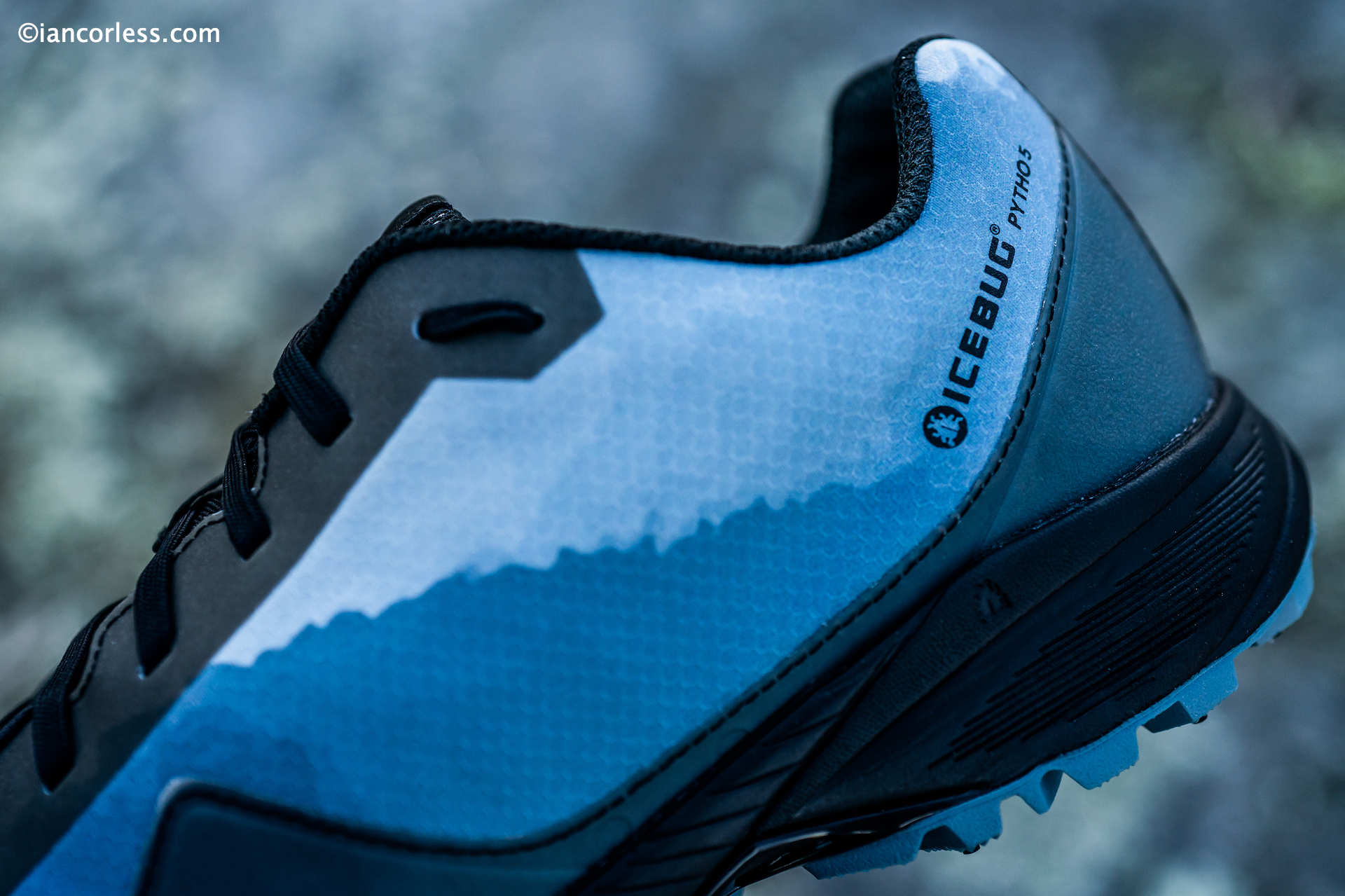
The PYTHO 5
The Pytho 5 is arguably the Icebug shoe that would appeal as an entry level for a trail or mountain runner.
It’s a shoe that works exceptionally well as an ‘all-rounder’ and is sold as such, recommended for trail running, forest running, orienteering and winter ice running.
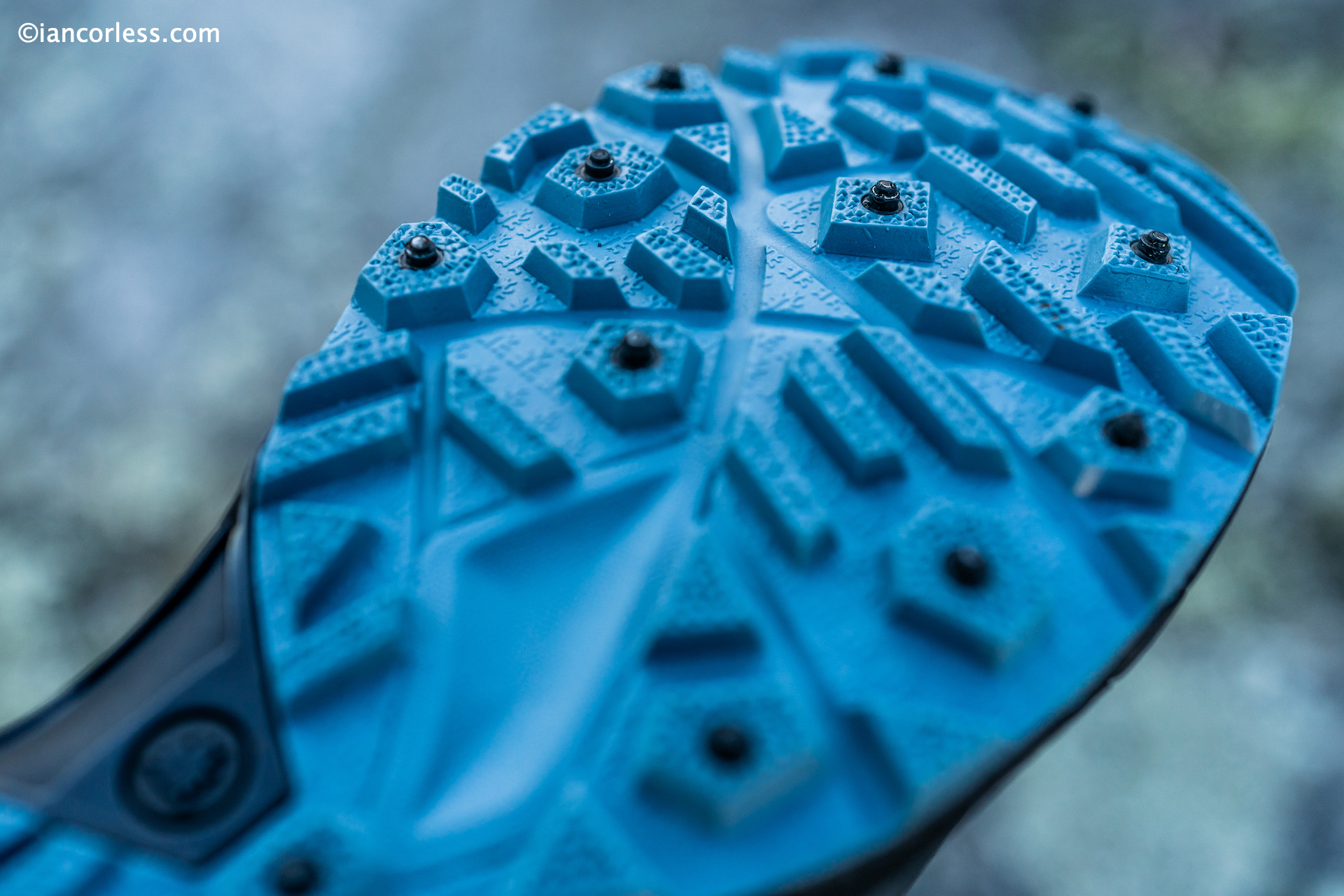
The outsole has 17 dynamic carbide tip steel studs (BUGrip®) which evenly distributed to provide the most secure and reliable grip on a multitude of surfaces. I can’t clarify enough how this outsole has made a revelation of my local forest runs which include rocks, tree roots and a variety of terrain (with or without snow/ice) and the grip has been exceptional. On rock, it has almost made me desire to use a studded shoe for all runs; no doubt why studded shoes are popular in the orienteering world.
With a 5mm drop, a medium last, a wide toe box and medium cushioning the Pytho 5 is designed for longer distance running. The midsole is foam EVA made with 20% BLOOM®.
While not the lightest shoes available (320g for UK8/ 334g for UK10) the Pytho 5 is a solid shoe built to last for tough terrain and at the same time provide comfort.
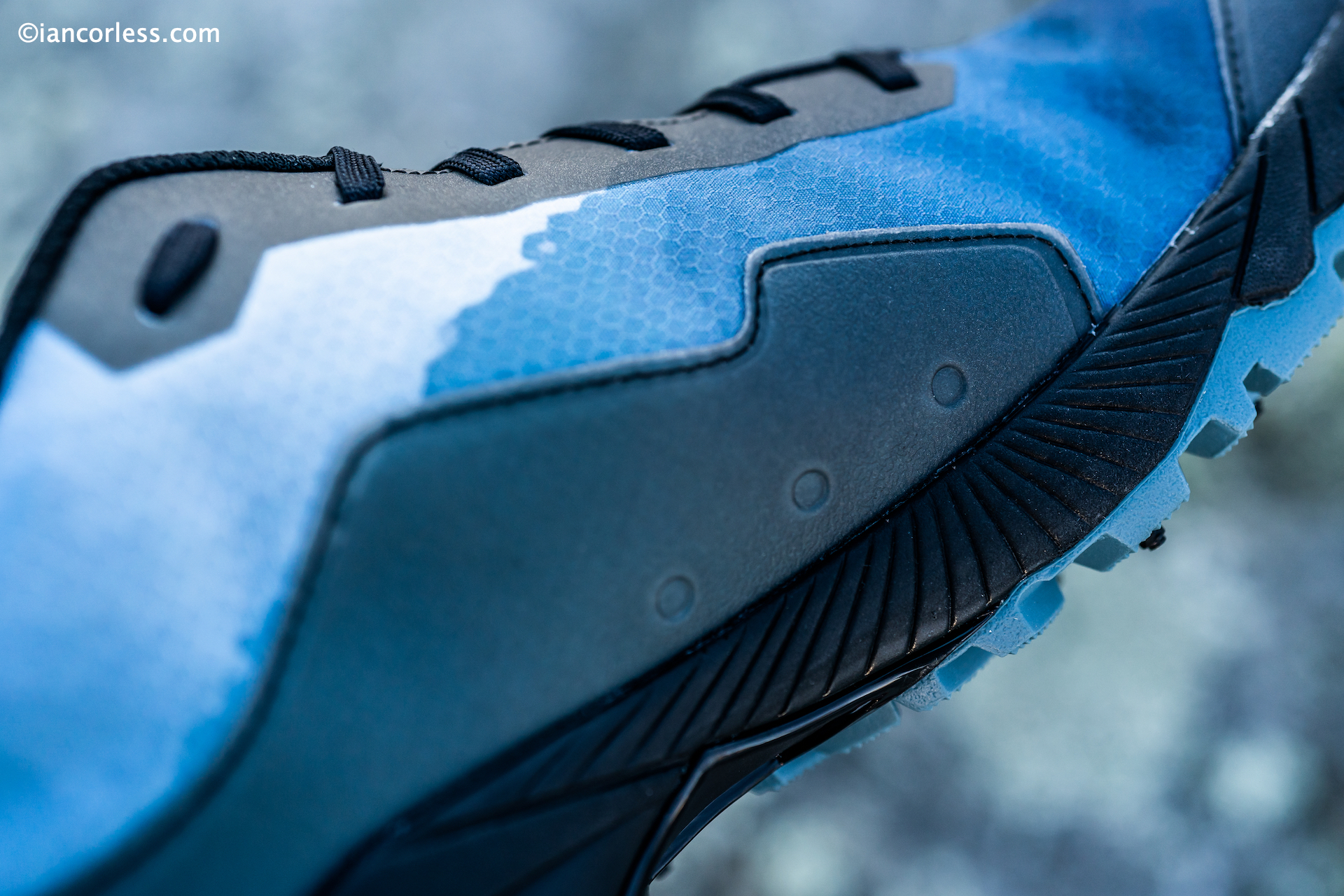
The upper, while not Gore-Tex is designed to withstand the elements resisting water and does not absorb water. It is warmer than a conventional upper and of course less breathable. However, it is not insulated. Using Merino socks and running in -10 temperatures in snow/ ice, my feet have remained warm. This is a real plus and a requirement for a winter running shoe! The upper is also extremely resilient using 100% recycled PET polyester called bluesign® with mudguard. The lining of the shoe also uses a similar dyed recycled polyester textile.
The toe box is substantial and designed to really withstand impact on any terrain.
The heel box is padded, holds secure and is comfortable. The tongue is medium padded, and the lacing has 6 eyelets on either side with the option to lock-lace if required. Hold of the foot and importantly the instep is solid and secure providing security on technical terrain.
The toe box is classed as wide and of course, how wide will depend on you and your personal needs. The intention of the wider toe box is to provide more comfort on longer runs. Also, in winter, some additional room can be important to allow for blood flow.
IN USE
The Pytho 5 is a comfortable shoe that is true to size. One important consideration in any winter shoe is getting the correct size. Many a runner will wear additional or thicker socks in the coldest months, so, keep that in consideration. I usually run in UK9.5/ EU44 and in the Pytho 5 I chose a UK10/ EU45 – I wish I hadn’t. They are actually a little too large and my normal UK9.5/ EU44 would have been perfect, even with thicker socks. I strongly recommend using Merino socks as they retain warmth even when wet. Some runners like to use neoprene socks and others a wool sock with a Gore-Tex or similar product over the top. It comes down to personal choices and understanding what works for you.
The cushioning is noticeable and importantly, if you have not run-in studs before, the feel is always a little unusually initially. It takes one good run to get a ‘feel’ for any studded shoe, especially if you have some road before getting to trail/ snow or ice. Studded shoes are noisy on road.
Once on ice and snow, the shoes come into their own offering a reassured grip that gives confidence. You NEED to trust the shoes and the grip. Again, if you have not run in studded shoes before, you may well approach ice with hesitation… Top tip is do not do this! Any studded shoe requires you to be confident, brave, trust the shoe and plant your foot hard to the ground. Force and pressure are what pushes the outsole into the ice, and this is what gives the grip. Try to run lightly and grip is compromised. The 17 studs are placed to offer grip from the heel to the toe and to accommodate run styles when going up or down. The spread is perfect. You may well find that you alter your run style slightly looking to plant your foot more evenly, the more studs on the ground, the greater the grip!
The upper is very tough and resilient and little inflexible. I certainly found it took a good 6 runs before the upper softened.
Foot hold is really good and assured which for me is essential in any off-road shoe. The toe box is wide but not excessively so and certainly does allow more toe splay but not at the compromise of precision. If I was running very technical terrain, I would prefer a more precision fit, but for general trail running they are perfect.
Importantly, remember the Pytho 5 is not ‘just’ a winter shoe. It excels on muddy, rocky and tree root terrain. You may well be surprised with how much grip this type of shoe gives. So much so that you will consider using a shoe of this style throughout the year as and when the terrain dictates. Orienteers for example use studded shoes all year.
On ice, particularly a frozen lake, the Pytho 5 glides along and they put a smile on your face. Equally, running on icy paths or roads is assured making pedestrians look at you and question how you are doing that…
CONCLUSION
The downside of any studded shoe is that they are more tiring on the body. The Pytho 5 tries to address this with more cushioning and a wider toe box, however, if you go out on hard ice terrain for many hours you will certainly feel it. That is just the way ice running is and not a criticism of the shoe.
Icebug know how to make winter shoes and the Pytho 5 is a great all-rounder that tackles winter exceptionally well. As a plus, they handle trail and notably rocks and tree routes superbly; just as an orienteering shoe should.
Ice running takes a little practice, and the top tip is trusting the shoe and the outsole. Don’t be shy and delicate, run hard and press the studs in the ground, once you do, you will have great grip that will allow you to speed along in a multitude of conditions.
Key Specifications:
Weight: 320 grams
Drop: 5 mm
Last: Medium
Studs: Studded
Usage: Running, Trail running, Winter running
Insole: Ortholite Hybrid, lined with bluesign® 100% recycled and solution dyed PET polyester
Lining: Bluesign®, solution dyed
Midsole: Lightweight EVA with 20% BLOOM® Foam. TPU stabilizer
Terrain: Ice, Snow, Trail
Torsion: Stability Flex
Outersole: Rubber with BUGrip® 17 carbide tip studs
To clarify, the shoes were provided to test, as are all the shoes that I review. But this is not a paid review.
Please support this website. I believe everyone deserves to read quality, independent and factual articles – that’s why this website is open to all. Free press has never been so vital. I hope I can keep providing independent articles with your help. Any contribution, however big or small, is so valuable to help finance regular content. Please support me on Patreon HERE.



















 IAN CORLESS