Trail running in America & mountain races in Europe

Are there really any differences when it comes to racing in Europe & America? Runners from both sides of the Atlantic have their say about trail running on both continents.

When Michel Poletti, president of ITRA, spoke recently at the presentation of the Spain Ultra Cup about what type of international race organizations would de targeted for future membership, he affirmed that the ITRA would be particularly hoping to attract “organisations with long-distance races taking place in natural scenery“. Although this definition may sound a little vague, it is in fact quite difficult to find a common denominator that might aptly describre races taking place on both sides of the Atlantic.

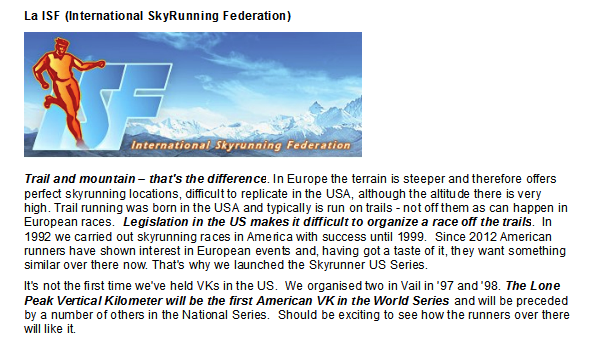
Are we talking about the same kind of race on both continents? It doesn’t seem that way from what some of our top runners have to say. In any case, surely the “variations on a theme” are what make this sport so appealing, right?  What are the differences anyway, between trail running & mountain running? According to the ISF, “The difference lies in the terminology itself: trail & montain“. 
ISF

We’ve asked some of the top runners about what it is that makes racing different on both sides of the Atlantic. Here are their answers, together with our conclusions:

American races, much faster

The main difference, which everyone seems to agree on, is the greater technical difficulty of races in Europe and the faster speed of races run in the US.

Tofol

As Tòfol Castanyer points out, this means that“American races are more runnable” suggesting that faster ultra-distance racers have the advantage, as opposed to mountain running specialists.

This difference has already been discussed in our article in Spanish, la diferencia entre trail running, fell running y carrera de montaña. In the US the sport is called “trail running“, whereas in Europe, terms such asmountain runningskyrunning or fell running (UK) are used. The term “trail running” obviously refers to the kind of track or path followed, whereas in Europe it’s all about “mountains“. Whereas “trail running” doesn’t necessarily imply elevation gains.

Heras

In Europe the elevation gains are usually greatersays Miguel Heras,I think that this difference is motivating for us Europeans when we go there, as it is for the Americans when they come over to Europe to compete.

Stricter rules in the US

Many of the races held in the US run through national parks, which follow a stricter legislation than we’re used to in Europe, regarding how hikers & runners should use the footpaths or trails. All these measures are imposed with the greater benefit of protecting the lanscape & natural habitat of the species found in the parks. This means that anyone wondering off the trail will be sanctioned (usually with disqualification), something that Europeans are simply not used to.
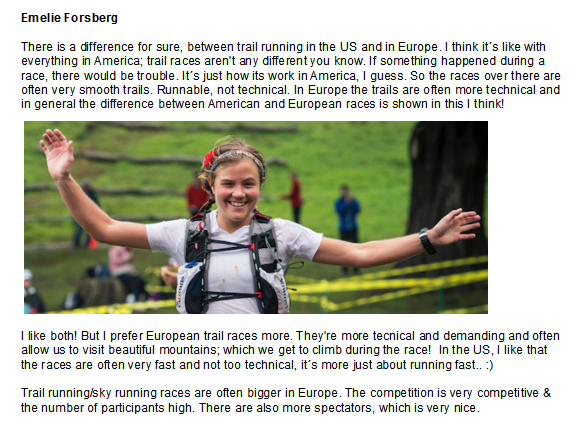
Emelie

As Emelie Forsberg jokes, “I think it´s like with everything in America; trail races aren’t any different you know“. Rules are rules!

In Europe, things are very different, where, in most cases,the race course simply follows the most direct route across the mountain.
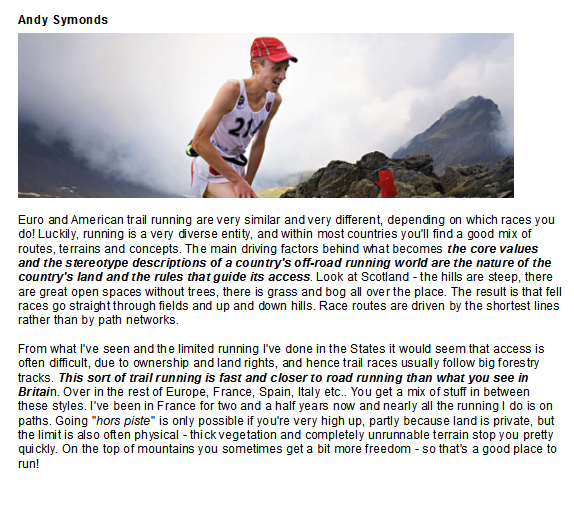
Andy

In Scotland“, for example, says Andy Symonds,” the hills are steep, there are great open spaces without trees, there is grass and bog all over the place. The result is that fell races go straight through fields and up and down hills. Race routes are driven by the shortest lines rather than by path networks”.

Consecuently, European trail runners find that they have to change their whole approach to racing, as Silvia Serafini states, “I know that in the US there are very strict rules about ‘shortcuts‘. You are out of the race if you don’t follow exactly the signed trail“. Kilian Jornet can testify to this, as he was stripped of his prize money and course record, in last year’s Speedgoat 50k for cutting switchbacks.

In Europa, it’s more competitive

So what’s Dakota Jones take on the subject? He interestingly points out that “ In America, trail running came out of a culture of hiking and mountain climbing that has its roots in solitude and escape“. Whereas, “Europeans accept mountain running more and are allowed to have more people in their races, so the scene is much more professional than anywhere else”. ” When Americans race, they are almost afraid to say they are racing, because they don’t want to betray traditional values about the purity of the sport“.

Dakota

Sportswear

In an episode of Kilian´s Quest we can see how the young Catalonian runner meets up with running legend, Pablo Vigil. It’s interesting to compare how the two are dressed; Kilian with his specialized gear  –Suunto GPS heart rate monitor, Salomon technical shorts & training shoes, while Pablo Vigilcan be found wearing the traditional runners sorts and a pair of Nike road trainers. Although this is a simple anecdote, it does undeline the point that, in general, European runners seem to get moredressed up for the occasion!

Anna Frost comments that “Clothing differs…with fashion and trends. Euro wearing more technical lycra and USA wearing looser fitting comforts.

Frosty

What’s in common? People, volunteers, the spirit of racing

There seems to be a common agreement among runners that there is one characteristic to be found on both sides of the Atlantic: the spirit of running, be it trail running in the US or fell running (UK), mountain running or skyrunning in Europe, “our mutual appreciation for the mountains & outdoor spaces”, says Alfredo Gil, Spain’s national champion. “I think we all have that in common“.
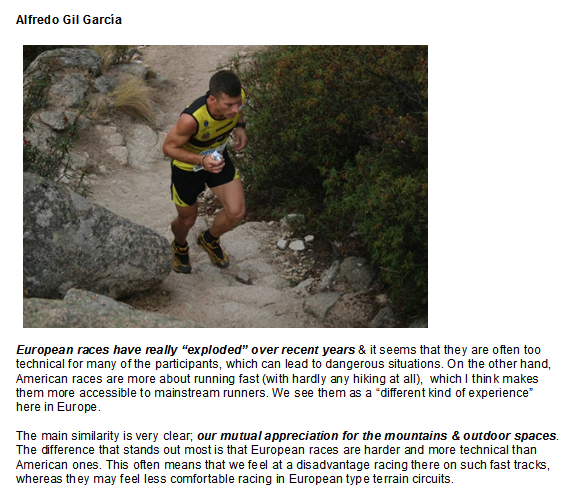
Alfredo

American, Stevie Kremer, also emphasises this point & recognizes the efforts of all the people, behind the scenes, who support the races: “both have incredible supporters and volunteers, without which these races would never be successful!”

Stevie
It seems that, as more and more runners make the jump, from one continent to another, things are changing. As Jonathan Wyatt observes, ” We see a lot of North American runners who have learnt a lot from the European style of trail running and they are excited to bring some of these elements to North America including the more technical running trails“.
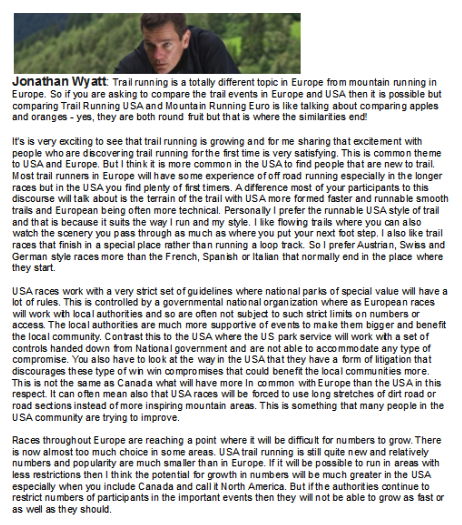
Jono

Finally, let’s just remember the words of Silvia Serafini, who defines the atmosphere of our sport perfectly, “I can’t really choose which I like most, racing in America or in Europe. I love the atmosphere, the welcome of the people, which I have found on both continents“.

Silvia


LINKS & CREDIT:

© Escrito por Nigel John Wilson / David Clavera / Pablo Cantó

This article is a re post from : corredordemontana.com

It is reproduced with the full approval of corredordemontana.com and Nigel John Wilson and has not been altered or adjusted in anyway. The original article is available HERE should you wish to view it.

It is also available in Spanish HERE

All content (inc images) ©corredordemontana.com
 

International Mountain Day

I Love Mountain iancorless.com


December 11th is International Mountain Day

The theme for 2013? “Mountains: Key to a Sustainable Future”

Covering around 27 percent of the earth’s land surface, mountains play a critical role in moving the world towards sustainable economic growth. They not only provide sustenance and wellbeing to 720 million mountain people around the world, but indirectly benefit billions more living downstream.

In particular, mountains provide freshwater, energy and food – resources that will be increasingly scarce in coming decades. However, mountains also have a high incidence of poverty and are extremely vulnerable to climate change, deforestation, land degradation and natural disasters.

The challenge is to identify new and sustainable opportunities that can bring benefits to both highland and lowland communities and help to eradicate poverty without contributing to the degradation of fragile mountain ecosystems .

Commitment and will to advance this cause were strengthened during the International Year of Mountains in 2002, and mountains have gained an increasingly high profile on agendas at all levels.

The Year also led to the adoption of resolution 57/245, in which the General Assembly designated 11 December as International Mountain Day, and encouraged the international community to organize events at all levels on that day to highlight the importance of sustainable mountain development. Content ©un.org link here

In the words of Marino Giacometti, president of the ISF, “today the World celebrates the International Mountain Day, but we all know that everyday must be the day of the mountains, the wonderful arena for our sport that we love and respect.”

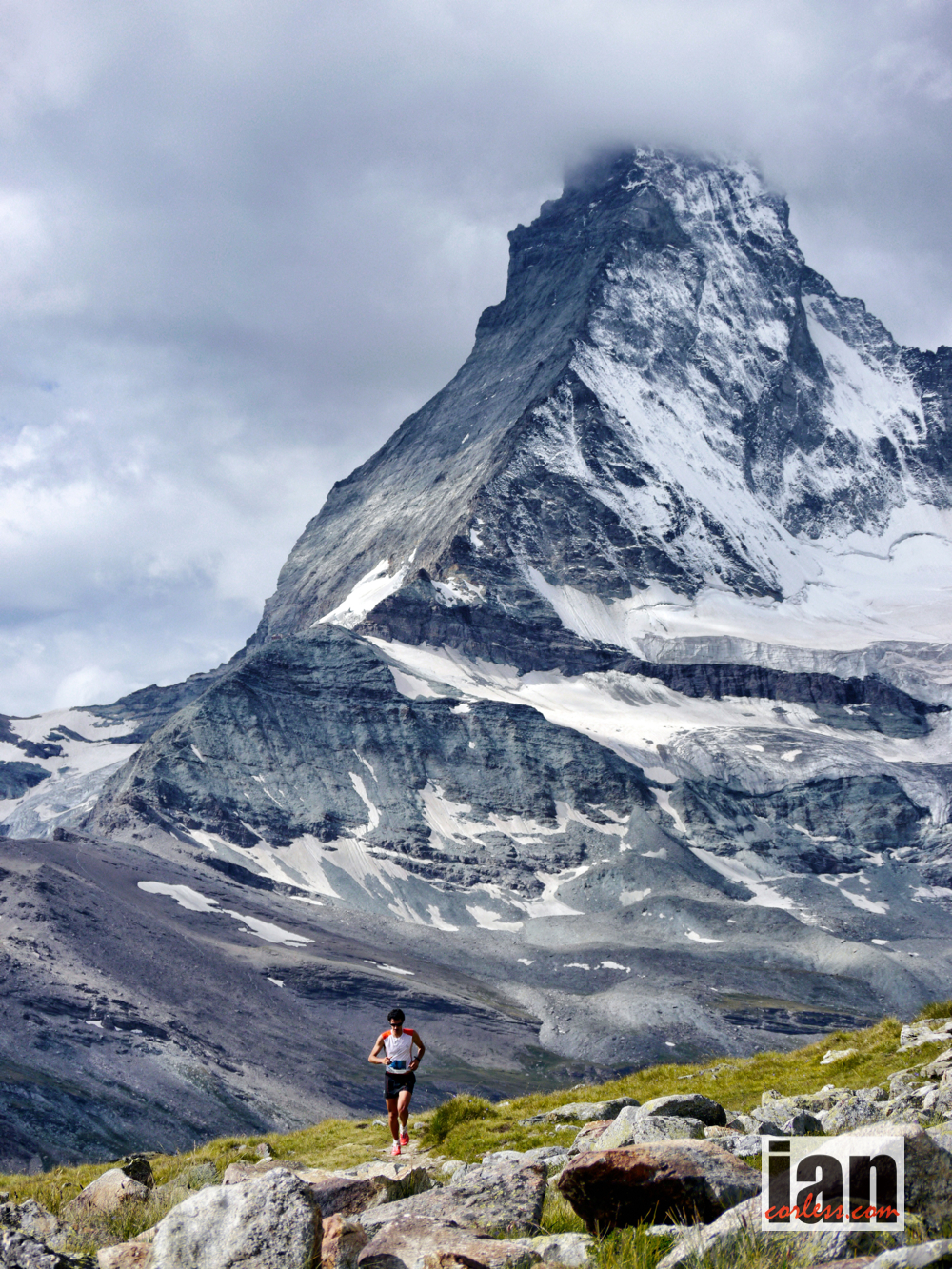
It is a pleasure for me to go back to one day last in August on the Matterhorn, the place of the first skyrunning competitions and of the first World Championship  in 1998. That day, August 21, 2013 Kilian Jornet united 20 years of our history by challenging the mythical record for the ascent and descent of Matterhorn established by Bruno Brunod in 1995 with the time of 3.14.44. With an extraordinary time of 2.52.02 Kilian celebrated the mountain and to our first skyrunning world championship title.

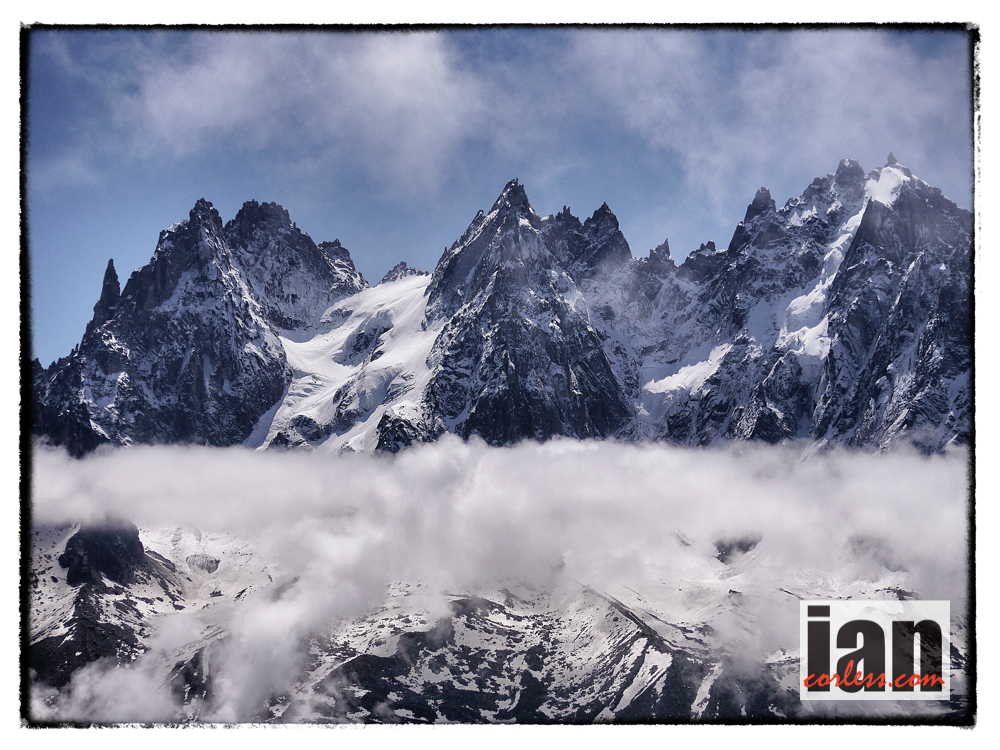
Mont-Blanc Chamonix ©iancorless.com

On the mountains of truth you can never climb in vain: either you will reach a point higher up today, or you will be training your powers so that you will be able to climb higher tomorrow.
Friedrich Nietzsche

US Skyrunning Series Announced

Cameron Clayton Transvulcania ©iancorless.com

Cameron Clayton Transvulcania ©iancorless.com

For the last two years, Skyrunning has incorporated U.S. races into its World Ultra Series, the Speedgoat 50k in 2012 and 2013, and the UROC 100k in 2013. And, just 10 days or so ago, Skyrunning announced its 2014 World Seriesand three U.S. races are included, the Speedgoat 50k and The Rut 50k in the Ultra World Series and the Lone Peak Vertical Kilometer in the Vertical World Series.

If you’re up on your social media, you’ve probably heard some rumblings about the onset of even more U.S. Skyrunning races. You might have even heard that Ian Sharman has been named the U.S. Skyrunning SeriesDirector. Today, U.S. Skyrunning announces multiple, national-level series for the U.S. which will be divided into the traditional Skyrunning disciplines: Vertical, Sky, and Ultra. What does this all actually mean? Generally speaking, it means that, if you’re from the U.S., you’ll be able to compete in Skyrunning-style races and series on your home turf. No international plane tickets needed. We’ll get to the specifics in a minute.

When asked about how and why Ian Sharman was charged with heading up the U.S. Skyrunning Series, the Executive Director and Vice President of the International Skyrunning Foundation (ISF) (Skyrunning’s governing body),Lauri van Houten, explains,

“Ian has been with us since 2012. He was at the ‘Less Cloud. More Sky’ seminar [after the 2012Transvulcania] where we presented skyrunning to a new generation and to ultrarunners who were new to the sport. He was really interested and since then was on the ISF Athletes Commission and is now also on our Management Committee as well. It was clear from the beginning that, apart from his status as a top athlete, he knows his stuff; he’s committed; he’s dynamic; he’s serious.“


READ THE FULL ARTICLE on iRunFar HERE


Tom Owens is back…

Salomon International athlete, Tom Owens is back… this weekend Tom raced in Tenerife at the K42 Canaries Anaga Marathon and took out the win!

Tom Owens Trofeo Kima 2012 ©iancorless.com

Tom Owens Trofeo Kima 2012 ©iancorless.com

Tom had an incredible season in 2012 racing and placing at a very high level in the Skyrunning World Series. He was one of the few runners to give Kilian Jornet a race. You can read my interview with him HERE.

Tom and his followers had looked forward to 2013. We all expected an improvement and a move up a notch to another level. However, disaster struck and Tom has been out of racing for much of ’13’ and several months ago had an operation.

In his recovery Tom took to cycling but stuck to his ‘off-road’ roots and participated in cyclocross racing to maintain his fitness.

Tom Owens Trofeo Kima 2012 ©iancorless.com

Tom Owens Trofeo Kima 2012 ©iancorless.com

Tom’s participation in the K42 Anaga Marathon on the lagoon side of the island may very well be a relatively low-key return to racing, however, a victory is a victory and it’s a great sign that Tom will be back in 2014. To gain victory, he did have to beat some strong competition from Raul Camara (NB), Pablo Villa (Scott), Yeray Duran and Raul Burgos.

By 33km, Tom had a commanding lead and victory was almost guaranteed from second placed runner and 2012 victor, Raul Camara.

  1. Tom Owens in 4:11:26
  2. Raul Camara 4:15:58
  3. David Joseph Lutzardo 4:23:34

In the ladies race, Buff athlete Emma Rocca was victorious in 4:55:07

Race website: http://www.k42anagamarathon.com

K42 series : http://www.k42series.com

VK? no, we will go double – Matterhorn Ultraks

Kilian Jornet, Matterhorn Ultraks ©iancorless.com

Matterhorn Ultraks experienced a successful first year in 2013 with over 1‘000 runners taking part. The 46K flagship competition was one of five races included in the Skyrunner® World Series (SWS). Time flies and after the announcement by the ISF that Matterhorn Ultraks will once again be in the “SWS14′ it is time for the team to look ahead in preparation for the second edition scheduled for August 23, 2014. 

Proceeding towards the second edition of the event, the organisers are focusing on offering the competitors an unforgettable, quality driven experience and intend to make the 2014 edition synonymous with innovation.

The courses
The proven courses – «16K», «30K» and «46K» – have been truly appreciated by the competitors and will be renewed, the «46K» remaining an official race of the „Skyrunner® World Series“ and Trail fans will discover a new course, the «2VK» that starts from Zermatt to finish in Gornergrat.

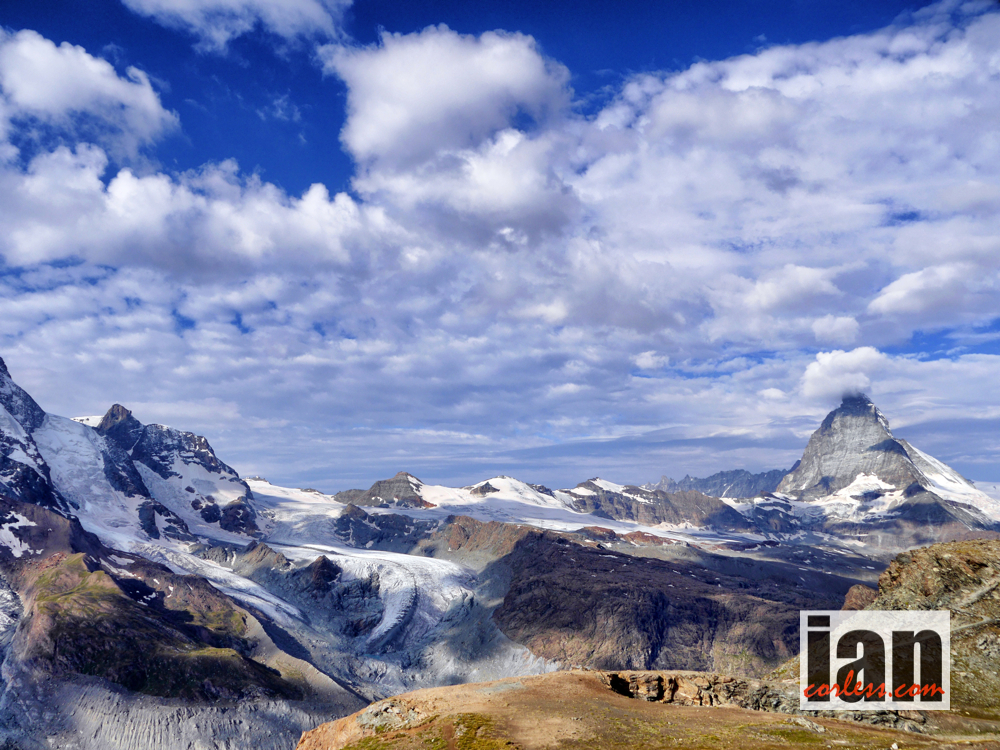
Simon Anthamatten, Race director details: ‘The 2VK focuses on the uphill running, which makes it a perfect track for those who do not appreciate downhills. The track is actually exactly the first part of the 46K and with 1‘927 m of vertical, it almost is a double vertical kilometer, hence the name. To achieve such a climb, the runners will go over 14 km to the Gornergrat where they’ll have an unbelievable view on the Monte-Rosa mountain range and the Gornerglacier.“

©copyright .iancorless.com.P1000499More innovations
The 2VK is not the only 2014 innovation. ‘We listen carefully to the competitors feedback. They were very vocal about the finisher gift and to follow their wish, every runner crossing the finish line will receive a technical t-shirt Matterhorn Ultraks Finisher‘ says Michel Hodara, member of the organising committee.

Finally, by registering to a race, competitors automatically take part to a several draws allowing to win various gifts presented by the Matterhorn Ultraks partners or stays in Zermatt. In addition, those who will be the 2nd, 22nd, 222nd, 502nd 602nd, etc. will have their registrtion fee reimbursed. ‘It is our way to celebrate the second anniversary of the race’ adds Hodara.

Registrations open online on Sunday December 8 at 4 pm via the website www.ultraks.com.

The countdown has begun to Africa’s first Ultra SkyMarathon®, the Lesotho Ultra Trail.

LUT_Gallery_1

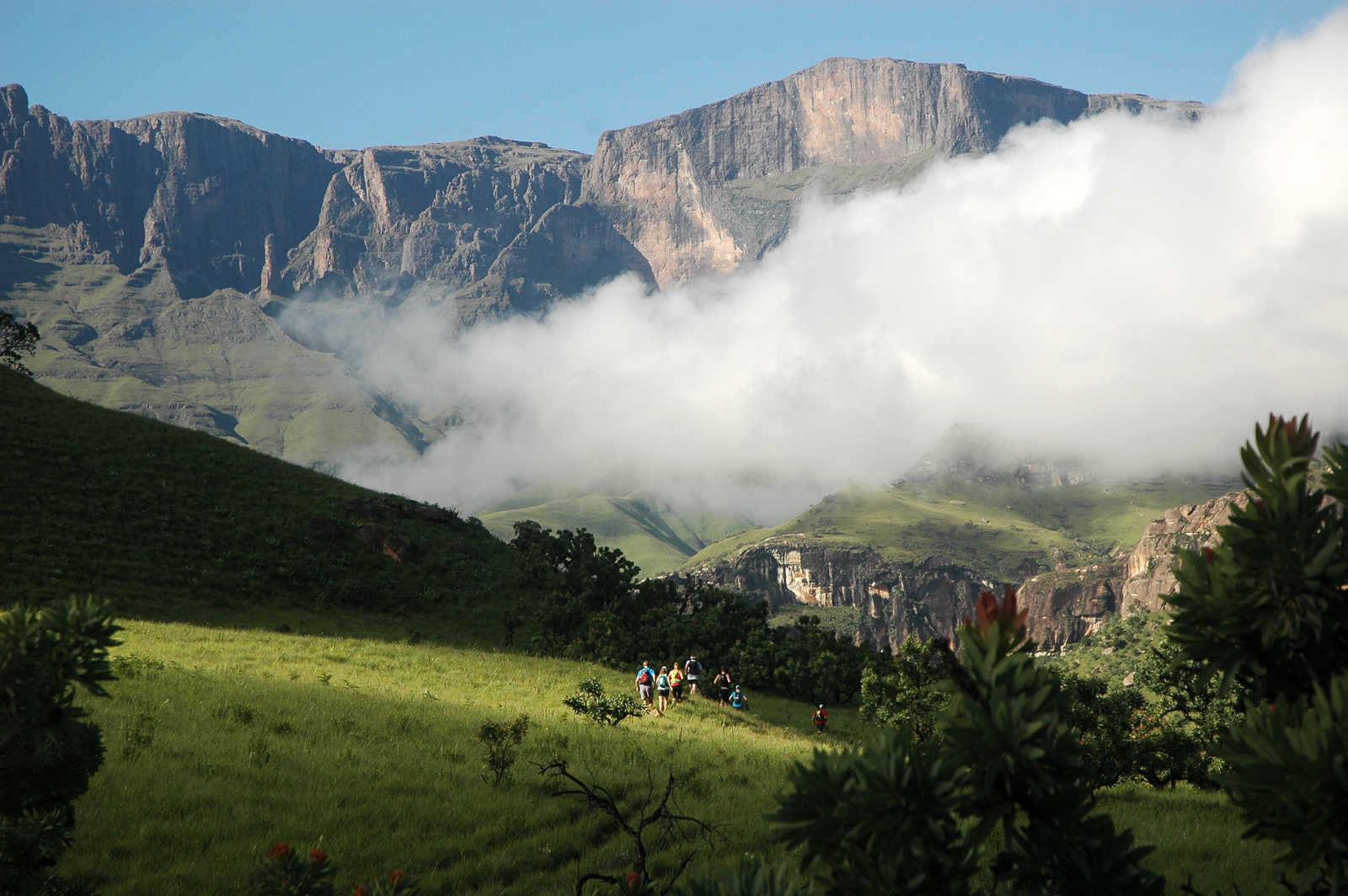
With less than 36 hours to go before the 55km ultra trail race through the Tsehlanyane National Park in the heart of Lesotho’s Maloti Mountains, anticipation is building amongst the trail running community for this, the second South Africa Skyrunning Association (SASA)-sanctioned event on the South African trail running calendar

After the success of the Matroosberg SkyMarathon® in October, skyrunning fever is running high, setting the ground for the imminent announcement of a national skyrunning series in 2014.

Presented by Maliba Lodge, KZN Trail Running and The North Face, the Lesotho Ultra Trail will see a selection of South Africa’s best trail runners facing the challenge of an ultra-distance, high altitude course boasting more than three kilometres of vertical ascent, peaking at 3155m above sea level.

LUT 1

Big names include South African trail star and winner of the Verdon Canyon Challenge in France AJ Calitz (K-Way/Vivobarefoot), mountain running legend and winner of the 2012 Otter African Trail Run Iain Don Wauchope (The North Face), 2013 SA Ultra Trail winner Nic de Beer, Stellenbosch-based mountain runner Andrew Hagen (Vibram) and Gauteng trail speedster Lucky Mia.

In the women’s field, Canadian ultra trail star Stacie Carrigan will be dicing one of the most competitive women’s contingent of any southern African ultra trail race to date, including Matroosberg SkyMarathon® winner Robyn Kime (The North face), 2013 SA Ultra trail champ Tracy Zunckel (Race Food), 2011 Otter African Trail Run winner Su Don Wauchope (The North Face) and SA ultra running legend Linda Doke (Salomon).

With Lesotho offering world class skyrunning terrain and warm hospitality, the Lesotho Ultra Trail is set to become one of the continent’s premier off-road ultras.

For more information about the race, visit www.lesothoultratrail.com of follow the race live via Twitter [www.twitter.com/lesothoultra]

Article ©lesothoultra

Feature on AJ Calitz

AJ Calitz in Europe, early 2013. Zegama-Aizkorri

AJ Calitz in Europe, early 2013. Zegama-Aizkorri

In just the last two months K-Way athlete AJ Calitz has been on the podium, won or set course records at many competitive trail races. As the year winds down, so does his racing schedule. This weekend’s 55-kilometre Lesotho Ultra Trail race will be his last for the year.

Two weeks ago Calitz took part in the annual Salomon SkyRun – only a week after winning Red Bull LionHeart.

“I didn’t expect to still feel LionHeart in my legs, but I did – unfortunately,” he says.

“SkyRun was a tough one,” Calitz says, recalling the challenging terrain and adverse weather conditions that led to the course being shortened and runners diverted off the mountain and down to safety.

After getting horribly lost between checkpoints one and two, Calitz managed to catch up to the chasing group. He stayed with them – safety in numbers.

“The weather was horrific with torrential ice-rain and winds of 100kph. It was very dangerous on the Dragon’s Back, but luckily I had all my emergency kit to keep me going.

“I really had a terrible day from the start and with the cold and navigation problems I didn’t eat as well as I should have. I felt the effects of this towards Balloch,” he explains.

Reaching Balloch he was already very cold. “I just couldn’t warm up again,” he remembers. He decided not to carry on.

But then, his K-Way teammate Annemien Ganzevoort – the leading woman runner – came in and told Calitz that she was carrying on. He decided to join her.

“If something happened to her in those conditions and I could have gone along – but didn’t – I would never have forgiven myself… and I really didn’t want to have a DNF on my first SkyRun either. So, we suited up in our K-Way mountain-trekking and cold-weather gear and carried on. We were halted by race organisation just short of Edgehill Farm though.”

“It’s amazing how weather like that can draw athletes closer together… where you switch from competing to surviving in only a few moments. I love this kind of racing. It’s not all about the winning or prize money or whatever the reason why you run, but it becomes an expedition and a truly valuable life experience,” says Ganzevoort.

While Ganzevoort takes a well-deserved rest, Calitz has one more race before he can put his feet up.

Lesotho Ultra Trail is a marked route that is 55-kilometres in distance and, staged in the Mountain Kingdom of Lesotho, the 3200-metres of accumulative ascent comes as no surprise. The course description promises stream crossings, loose rocks, steep descents and “two notable climbs”. The section between nine and 22 kilometres is run at over 3000-metres in altitude.

The men’s (and women’s) field is very competitive and Calitz is expecting to work hard to gain ground on Nic de Beer, Iain Don-Wauchope and Lucky Mia.

“I’m just going to take it as it comes,” he adds.

Although your money can be safely bet on Su Don-Wauchope or Robyn Kime for a win in the women’s race, the odds are fairly good that Linda Doke, Tracey Zunkel, Chantal Nienaber, Megan Mackenzie or Stacie Carrigan (Canada) could be up front too.

SKYRUNNING 2014 Calendar Announced – SWS14 #SWS14

Kilian Jornet Trofeo Kima 2012 ©iancorless.com

Kilian Jornet Trofeo Kima 2012 ©iancorless.com

The ISF is pleased to announce the 2014 Skyrunner® World Series. Fifteen quality races, three disciplines, the same winning formula. The 2014 Series will offer participants benefits amounting to 1,000 race slots230 free entries125 accommodation slots and 50 travel slots.

Five Sky, five Ultra and five Vertical races are distributed across six nations in three continents.

The Sky Series comprises some of the best races in the history of the sport and welcomes back Zegama, Dolomites SkyRaceCourse de Sierre-Zinal celebrating its 41st year, Zermatt’s Matterhorn Ultraks launched this year and Limone Extreme tying up the Series.

Opening the season in May will be the almost legendary Transvulcania Ultramarathon.  In its third successful year on the Skyrunner® World Series, the event will be enhanced with a spectacular “sea to sky” Vertical Kilometer®, where contestants climb up the same rugged, steep descent of the long distance race.

The Ultra Series heads over to France for a repeat of the 65 km Ice-Trail Tarentaise over the snow-covered peaks above Val d’Isère.  A Vertical Kilometer® will also take place here.  From 1996 five editions were held on the imposing Face de Bellevarde, where the first world record was set.

Utah’s Speedgoat 50K returns on the Ultra Series followed by the biennial Kima Trophy.  Probably the most emblematic skyrunning event, it will celebrate its 20th anniversary with skyrunning legends Bruno Brunod and Fabio Meraldi.

Concluding the Ultra Series in September, we welcome new entry, The Rut 50K, in Montana’s appropriately named Big Sky resort. Organised by two American Ultra running icons, Mike Foote and Mike Wolfe, it’s set to make its mark on the international scene. Here, America’s first World Series’ Vertical Kilometer® will also take place in the rugged Montana mountains.

The Italian Dolomites, home of the 2013 European Championships, are again back on the calendar with a SkyRace® and Vertical Kilometer® double.

Italy’s incredibly spectacular and gruelling Limone Extreme SkyRace® and Vertical Kilometer® will again host the World Series final in October on Lake Garda.

462 kilometres across the three disciplines are set off by no less than 36,150 metres vertical climb with inclines between 16% and 50%.

The reward for this gruelling programme? Benefits amounting to US $ 200,000$ 120,000 cash prizes, $ 25,000 World Series final prizes and $ 55,000 worth of benefits.

The rewards don’t finish here however.  There’s more in store with the new Skyrunner® card.  Details will be revealed in January 2014.

2014 Skyrunner® World Series

Team partners are a growing success story with two partnership formulas to choose from. At least ten principal outdoor brands are involved. See here for further information for team entries in the World Series.

SKY
1. SPAIN: Maratòn Alpina Zegama-Aizkorri – 42 km – Zegama – May 25
2. ITALY: Dolomites SkyRace® – 22 km – Canazei – July 20
3. SWITZERLAND: Course de Sierre-Zinal – 31 km – Valais – August 10
4. SWITZERLAND: Matterhorn Ultraks – 46 km -Zermatt – August 23
5. ITALY: Limone Extreme SkyRace® – 23 km – Limone sul Garda – October 12

ULTRA

1. SPAIN: Transvulcania Ultramarathon – 83 km, La Palma – May 10
2. FRANCE: Ice Trail Tarentaise – 65 km, Val d’Isère – July 11
3. USA: Speedgoat 50K, Snowbird, Utah – July 19
4. ITALY: Trofeo Kima – Aug 31
5. USA: The Rut 50K, Big Sky, Montana – September 14

VERTICAL
1. SPAIN: Transvulcania Vertical Kilometer® – May 8
2. FRANCE: VK Face de Bellevarde, Val d’Isère – July 11
3. ITALY: Dolomites Vertical Kilometer®, Canazei – July 18
4. USA: Lone Peak Vertical Kilometer® – September 12
5. ITALY:  Vertical Grèste de la Mughéra, Limone sul Garda – October 10

*Legend

SKY – races more than 22 km and less than 50 km long with at least 1,300m positive vertical climb (SkyRace® and SkyMarathon®)
ULTRA – races over 50 km long that exceed the SkyMarathon® parameters (Ultra SkyMarathon®)
VERTICAL – races with 1,000m positive vertical climb not exceeding 5 km distance (Vertical Kilometer®)
 

Skyrunner®, SkyRace®, SkyMarathon®, Vertical Kilometer® are registered trademarks

Press Release ©ISF

Coffee Table Book – iancorless.com

Photo BookMy 2013 Coffee Table Book is slowly coming together. It is still very early days with a great deal of designing, editing and layout work to be done within the next 7-10 days.

Once designed and a ‘test’ proof has been received, the book will be available for delivery in 8-12 days from ordering.

10×8 inches in size, landscape in format with a hardcover and dust jacket, the book will have 20-pages minimum, however, I anticipate 30-pages to be more appropriate. As you can imagine, selecting images has been a difficult task. So many to choose from…!

Content will be varied and cover locations, places, landscapes, people and of course iconic moments from the 2013 racing season. A minimum of 30 images will be included within the book.

Delivery within the UK is anticipated to be available from Dec 2nd which should allow adequate turnaround and delivery options for pre Christmas. However, at the moment, delivery outside the UK cannot be guaranteed until the New Year.

Price per book £48.00 (plus postage and package)

If you’d like to express interest or pre order, please fill out the form below and I will contact you directly. Many thanks for your support.

← Back

Thank you for your response. ✨


ISF Sky Ranking

Kilian Jornet & Marco De Gasperi Mont-Blanc Marathon ©iancorless.com

Kilian Jornet & Marco De Gasperi Mont-Blanc Marathon ©iancorless.com

The top 100 men and 50 women in the ISF Sky ranking announced today offer more food for thought after the Ultra rankingannounced earlier. Twenty-one races in five continents were selected in the Sky category.  The top 100 men count 487athletes from 37 nations while the top 50 women are calculated out of 216 athletes from 29 nations.


The overall ranking has been devised for the three skyrunning disciplines based on 54 races in 2013 (24 Ultra, 21 Sky and 10 Vertical). One of the principal aims was to take into account the quality of the field and the time relative to the winner, along with a proprietary ISF algorithm and other factors.


Some considerations on the ranking per country for the two distances:

In the Ultra distance France, Spain and USA count four, three and three athletes respectively in the top ten overall. If we take the mean value of the points of the top three ranked athletes per nation, the men’s results show Spain leading (247,649), followed by USA (245,363) and France (236,344).


The women’s Ultra ranking presents a more varied picture however, with, apart from the nations mentioned above, Sweden, Italy and New Zealand featuring. Again, taking the mean value of the top three per nation, Spain leads with (194,477), followed by France (192,846) and USA (190,065).


The Sky discipline with respect to the Ultra counts more nations in the top ten men’s and women’s rankings, with athletes fromfive nations.  Again, Spain’s prowess dominates with four men and four women in the top ten overall.  In both cases Italy, the cradle of skyrunning, boasts two men and three women in the top ten. In the men’s field, using the above mean value,Spain again leads the ranking with (262,317) followed by Italy (235,146).


The women’s Sky ranking is led by Spain (251,559) followed by Italy (234,246).


Here’s a general overview on the calculations previously published in the Ultra news:

The ranking was elaborated on the basis of the participation and results obtained by the athletes in the international races selected by the ISF.


In calculating the points, the ranking is based on a proprietary ISF algorithm specifically studied for outdoor running, taking into account a consolidated algorithm used by the International Ski Federation.


Fifty-four races were selected for the 2013 season (24 Ultra, 20 Sky and 10 Vertical) – see ISF announcement in March.  The selection was aimed at identifying the world’s most prestigious races with the greatest number of elite athletes participating, as indicated in the ISF news in January.


In each selected race, the first 30 men and first 15 women were counted. For each athlete, points were calculated on the basis of:  the final position, the time relative to the winner and the number of elite athletes ahead or behind.


The final points were calculated on the average of the three best results of the season obtained by each athlete.  For athletes who did not participate in at least three of the selected races throughout the season, a penalty of 11% was applied to those who participated in only two races, and 22% was applied to those who participated in just one.


The 2014 ranking will be based on 2013, but with a more precise indication of the elite athletes based on the previous year’s ranking.


The ISF ranking will be complete at the end of the 2015 season as the points will be calculated on the average of the previous three seasons with a weighted coefficient for each year.


The ISF assesses the yearly performances in their whole within the context of the results and performance

in each race.  As in other disciplines, it does not analyse the performance in absolute terms due to the many variables in outdoor running (vertical climb, type of terrain, climate, level of the competition… etc), the comparison between different races or different editions of the same race, would be too approximate.”


Following on from the Ultra and Sky distances, the Vertical will be announced next.  Subsequently, all the runners will be listed by country.


2013 Sky ranking

Top 100 men

Top 50 women


2013 ISF Ultra ranking

Top 100 men

Top 50 women

Article ©ISF