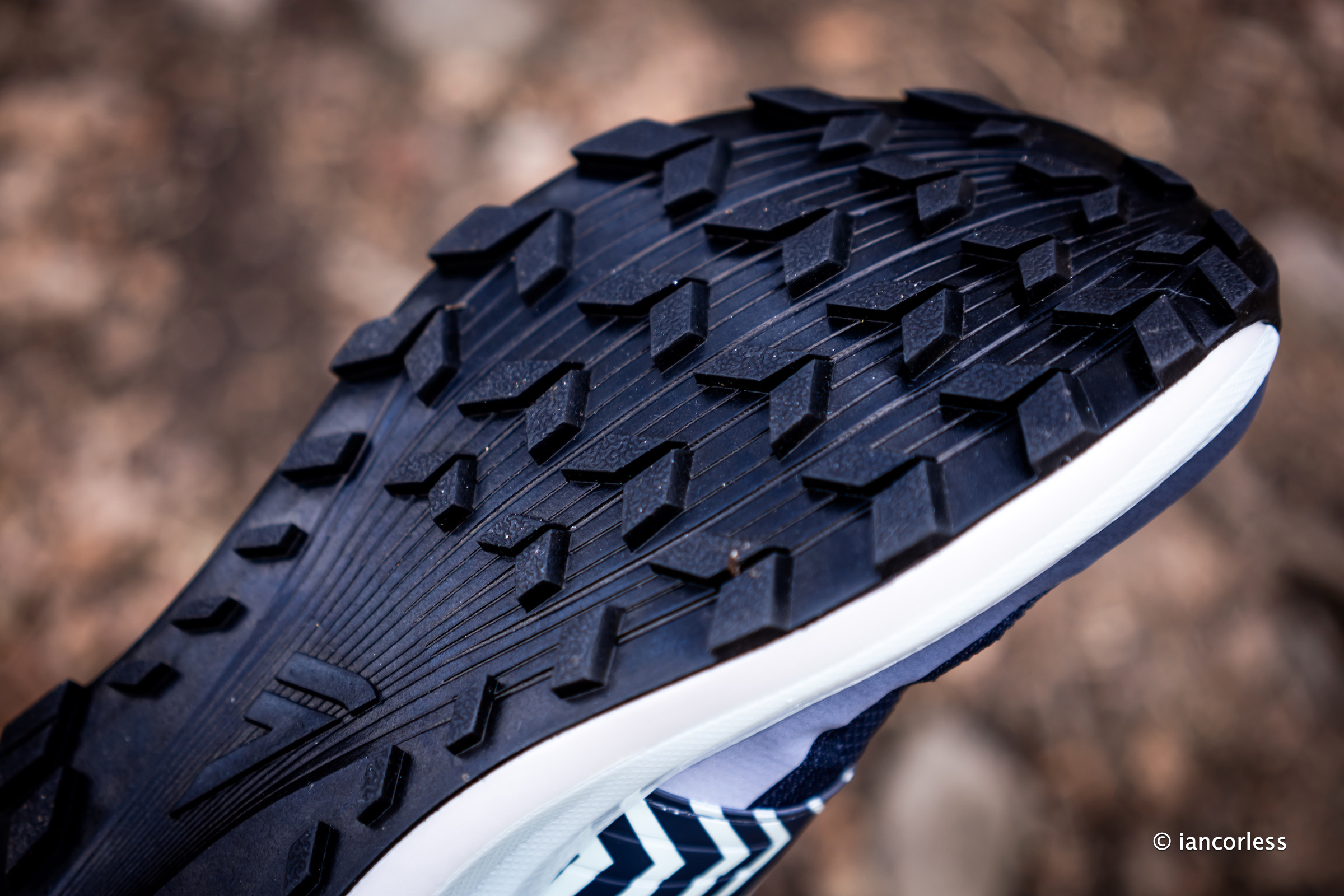
Running Shoe Grip: Why “Good Grip” Is Far More Complicated Than Most People Think

Photo by Ian Corless

“The grip is excellent.” One of the most common phrases used in running shoe reviews.

But excellent where?

On dry forest trails? Wet rocks? Muddy hillsides? Gravel tracks? Mountain ridges? Roads?

The reality is that grip is one of the most misunderstood aspects of running shoes. Much like tyres on a Formula 1 car, the best outsoles are often designed to excel in very specific conditions. The more specialised the outsole, the better it tends to perform in its intended environment. The challenge comes when runners expect one shoe to perform equally well everywhere.

The Formula 1 Tyre Comparison

Formula 1 teams do not use one tyre for every condition. They have slick tyres for dry weather, intermediate tyres for damp conditions and wet tyres for heavy rain. Each tyre is designed with a specific purpose in mind.
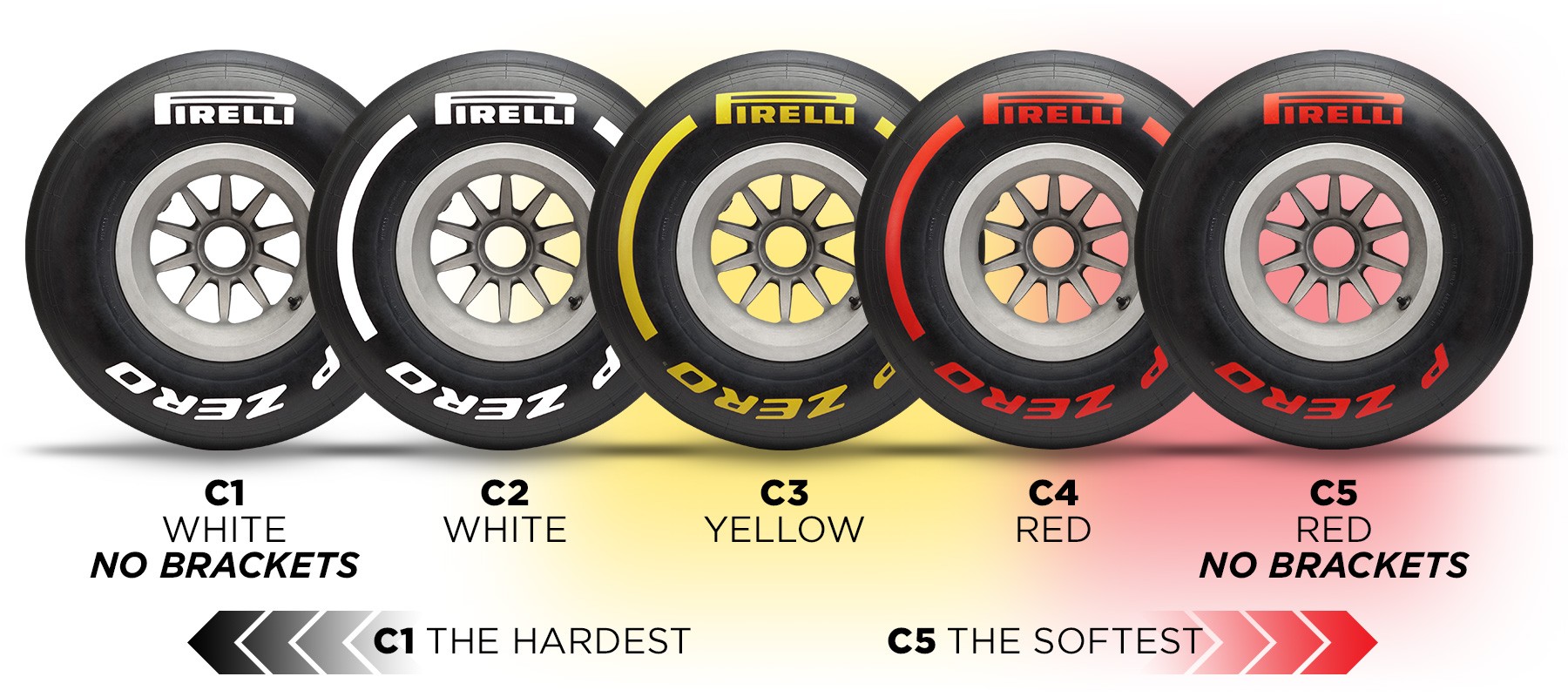
Image copyright Pirelli – a wonderful example of how we should look at run shoe outsoles.

Trail running shoes are no different.

An outsole designed for muddy fell running will almost certainly perform poorly on road sections. Likewise, an outsole designed for mixed road-to-trail use will struggle when faced with steep, wet mountain terrain.

The key point is that grip is always a compromise between different surfaces, conditions and requirements. There is no universal outsole. There are only outsoles that are better suited to certain environments than others.

Grip Is Actually Two Different Things

When runners talk about grip, they are often describing two separate characteristics.

The first is friction.

This is the ability of the rubber compound to adhere to a surface. Friction is what gives confidence on wet rock, slick roots, hard-packed trails and tarmac. It is primarily influenced by the rubber compound itself.

The second is mechanical traction.

This is the ability of the outsole to bite into a surface. Mechanical traction becomes important on mud, loose gravel, soft ground, snow and wet grass. It is primarily influenced by lug design.

Understanding this distinction explains why some shoes perform brilliantly in one environment but poorly in another.

A shoe with soft, sticky rubber may feel exceptional on wet rock but struggle in deep mud if the lugs are too shallow.

Conversely, a mud-specific shoe may offer tremendous traction on a steep hillside while feeling insecure on wet slabs because the rubber compound prioritises penetration into soft ground rather than adhesion to hard surfaces.

When someone says a shoe has “great grip”, it is worth asking whether they mean friction, traction or both.

Rubber Compound: The Foundation of Grip

The first factor that determines how well an outsole performs is the rubber compound itself.

Different brands use different compounds, each balancing grip, durability and performance in varying conditions.

Generally speaking, harder rubber compounds offer:

  • Greater durability
  • Better longevity
  • Increased resistance to wear on road surfaces
  • Reduced grip on wet rocks, roots and technical terrain

Softer rubber compounds offer:

  • Superior traction on wet rock
  • Better adhesion on slick roots
  • Increased confidence on technical terrain
  • Reduced lifespan due to faster wear

This trade-off is unavoidable.

A rubber compound that delivers exceptional grip on wet mountain rock is usually sacrificing durability somewhere else.

This is why shoes that feel incredible on technical terrain may show noticeable outsole wear after extensive road use, while harder compounds may last for hundreds of miles but feel less reassuring when conditions become wet and technical.

Lug Design: More Than Just Lug Depth

When discussing grip, many runners focus solely on lug depth.

While lug depth is important, it is only one part of a much larger picture.

The following factors all influence performance:

  • Lug depth
  • Lug shape
  • Lug spacing
  • Lug orientation
  • Lug density
  • Surface area of the lug

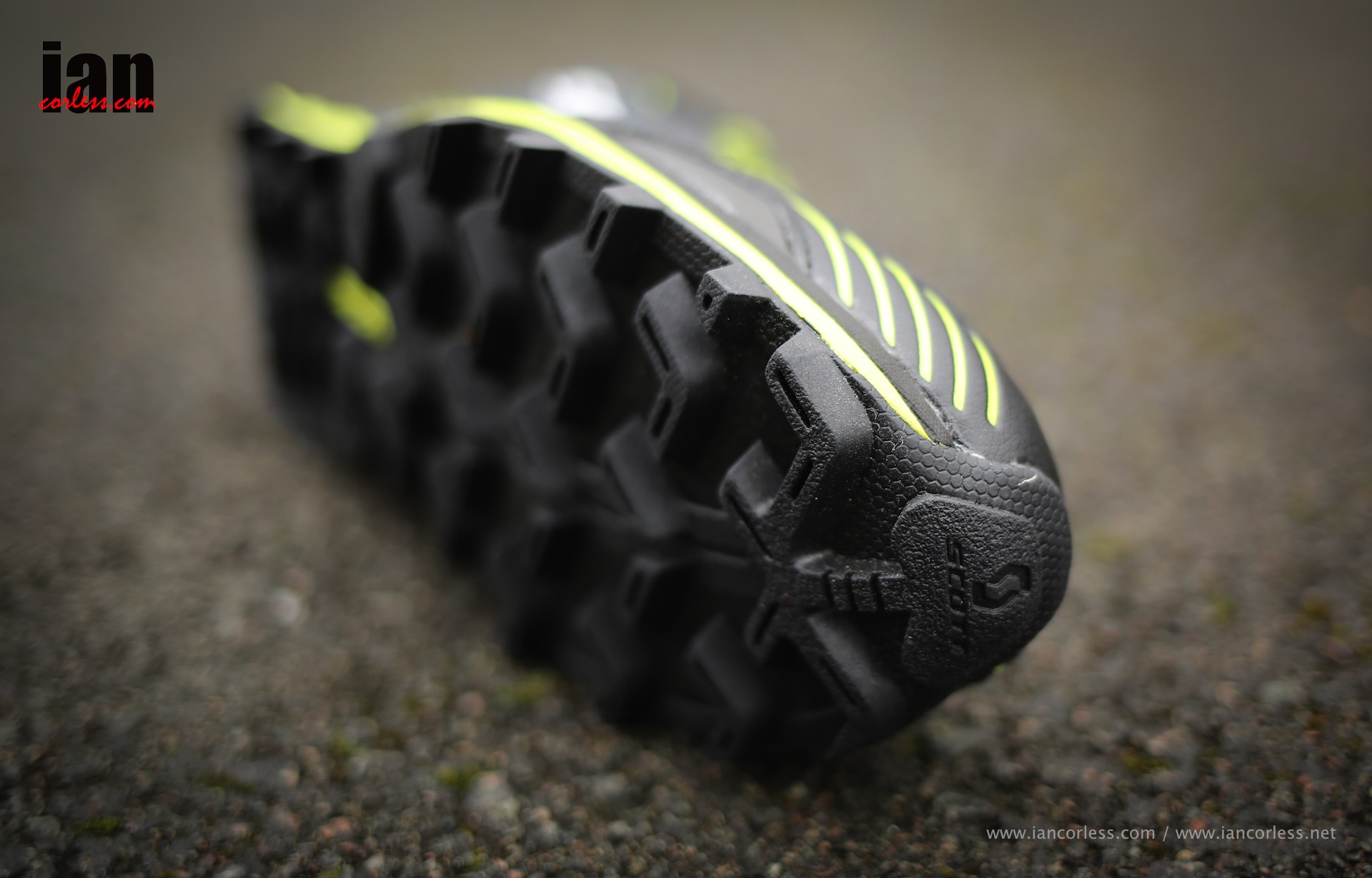
A road-to-trail shoe may use lugs around 2-3mm deep. These provide smooth transitions onto tarmac, maintain comfort on hard surfaces and offer sufficient traction on light trails and gravel paths.

A dedicated trail shoe might use 4-5mm lugs, creating a balance between versatility and off-road performance.

Meanwhile, a fell running or mud-specific shoe may feature aggressive 6-8mm lugs designed specifically to penetrate soft ground and provide maximum traction.

However, deeper is not always better.

Large, aggressive lugs can feel unstable on road surfaces, wear more quickly and reduce overall efficiency when running on hard-packed terrain.

Directional Grip: Climbing, Descending and Cornering

Grip is not simply about moving forwards. A good outsole must provide traction in multiple directions.

  • When climbing, lugs need to generate forward propulsion.
  • When descending, they need to provide braking traction.
  • When traversing slopes or cornering, they need to resist lateral movement.

This is where lug orientation becomes particularly important.

  • Forward-facing lugs often improve climbing traction by helping the shoe bite into the ground.
  • Rear-facing lugs can improve braking performance on descents.
  • Side lugs can enhance stability when cornering or running across off-camber terrain.

Two shoes may have similar lug depths but feel completely different on technical trails because of how those lugs are positioned and oriented.

Lug Quantity: When More Isn’t Better

Another overlooked aspect of outsole design is the number of lugs used. At first glance, more lugs might seem like a positive feature. More contact points should equal more grip.

Not necessarily.

A higher number of closely packed lugs can increase surface contact on firmer terrain and improve stability. However, in muddy conditions they can become a disadvantage.

Mud needs somewhere to go.

Inov-8 Mudclaw

If lugs are packed too closely together, mud can accumulate between them and effectively create a smooth layer underneath the shoe. Once this happens, traction decreases significantly.

This is why many fell-running shoes feature widely spaced lugs. The larger gaps allow mud to be shed more effectively with each stride, keeping the outsole functioning as intended.

The best mud shoes are often those that clear mud efficiently rather than simply those with the deepest lugs.

Different Surfaces Require Different Types of Grip

One reason grip is so difficult to evaluate is that every surface places different demands on an outsole.
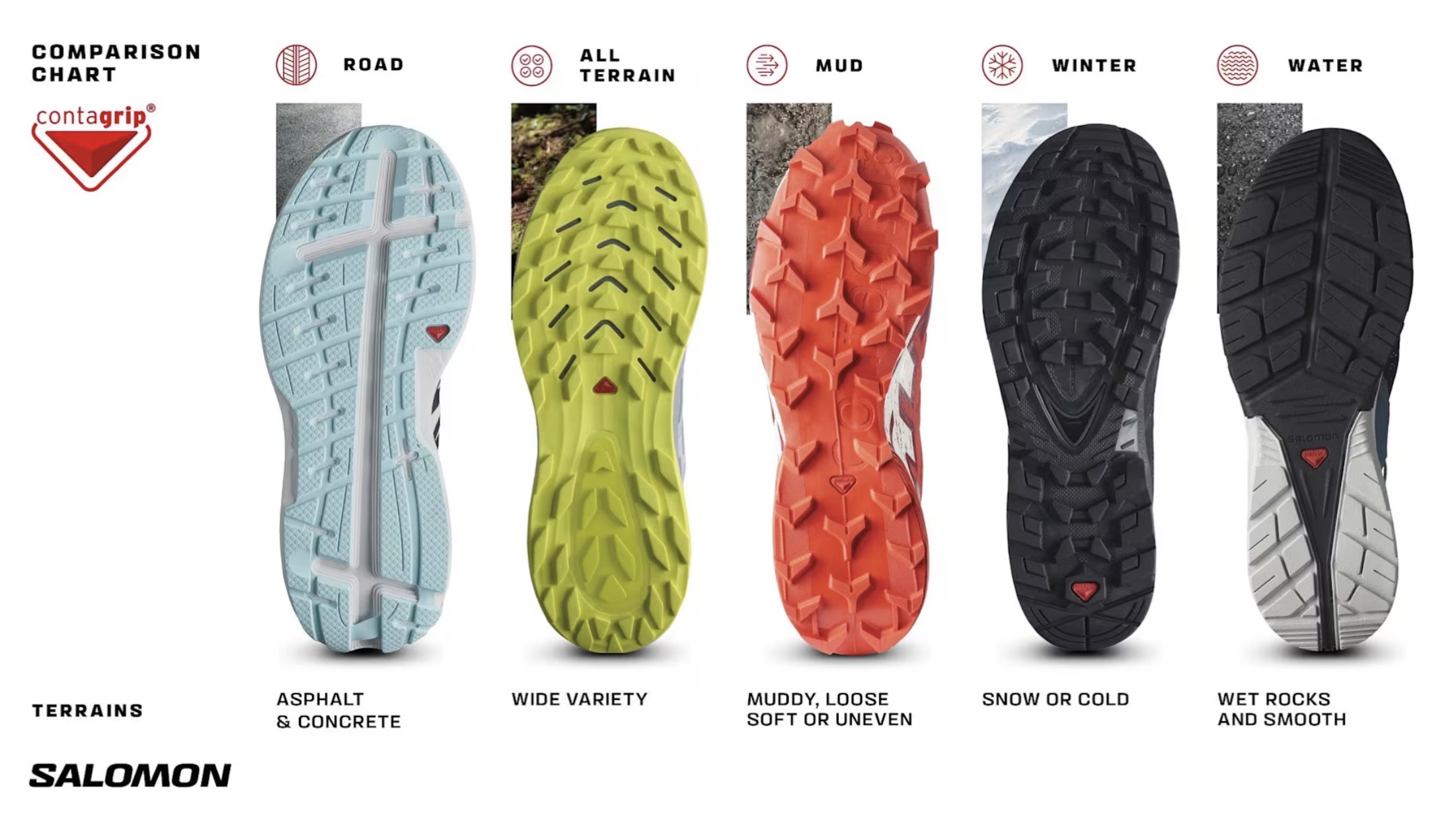
Salomon offer a good example of grip options for specific terrain – see how the road outsole is almost flat whereas the mud outsole is aggressive and spaced out – by contrast, the water outsole has large flat lugs.

Wet Rock

  • Soft, sticky rubber is often the priority.
  • Friction and size matters more than lug depth.

Dry Rock

  • Most modern trail shoes perform reasonably well.
  • Stability and confidence become more important than outright grip.

Mud

  • Deep, widely spaced lugs are critical.
  • Mechanical traction is the dominant factor.

Loose Gravel

  • Lug penetration and a stable platform help prevent slipping.

Forest Trails

  • A balanced outsole usually performs best.
  • Extreme lug depth is rarely necessary.

Road and Hardpack

  • Surface contact, comfort and durability become increasingly important.
  • Aggressive mud lugs can feel inefficient and unstable.

Understanding the terrain is often more useful than understanding the shoe.

Specialist Outsoles and Why They Matter

This is where specialist outsole compounds begin to separate themselves from the competition.

Many brands have invested heavily in developing their own proprietary technologies designed for specific environments.

Examples include:

  • adidas Continental (yes, the tyre compnay)
  • Scarpa Presa TRN series
  • Inov-8 Graphene/ STICKYGRIP and TRI-C
  • VJ Sport Superior Contact Butyl Rubber
  • La Sportiva FriXion – whites/red/blue/black and eco
  • Salomon Contagrip – road, all terrain, mud, winter and water

Some compounds prioritise wet-rock adhesion. Others focus on durability. Others seek a balance between the two.

Perhaps the best example is VJ Sport’s Butyl rubber. Among experienced mountain runners and orienteers, it has developed an outstanding reputation for wet-rock performance. In challenging mountain environments where confidence on slick surfaces is critical, specialised compounds such as this can provide a genuine advantage.

The key point is that these outsoles are often designed with a very specific purpose in mind rather than trying to satisfy every possible use case.

Outsole Flexibility and Ground Contact

Another often overlooked factor is how effectively a shoe maintains contact with the ground. Even the most aggressive outsole can only generate traction if it is actually in contact with the surface beneath it.

On uneven trails, rocky terrain and technical mountain ground, some shoes are able to conform more effectively to irregular surfaces, allowing more of the outsole to engage with the terrain.
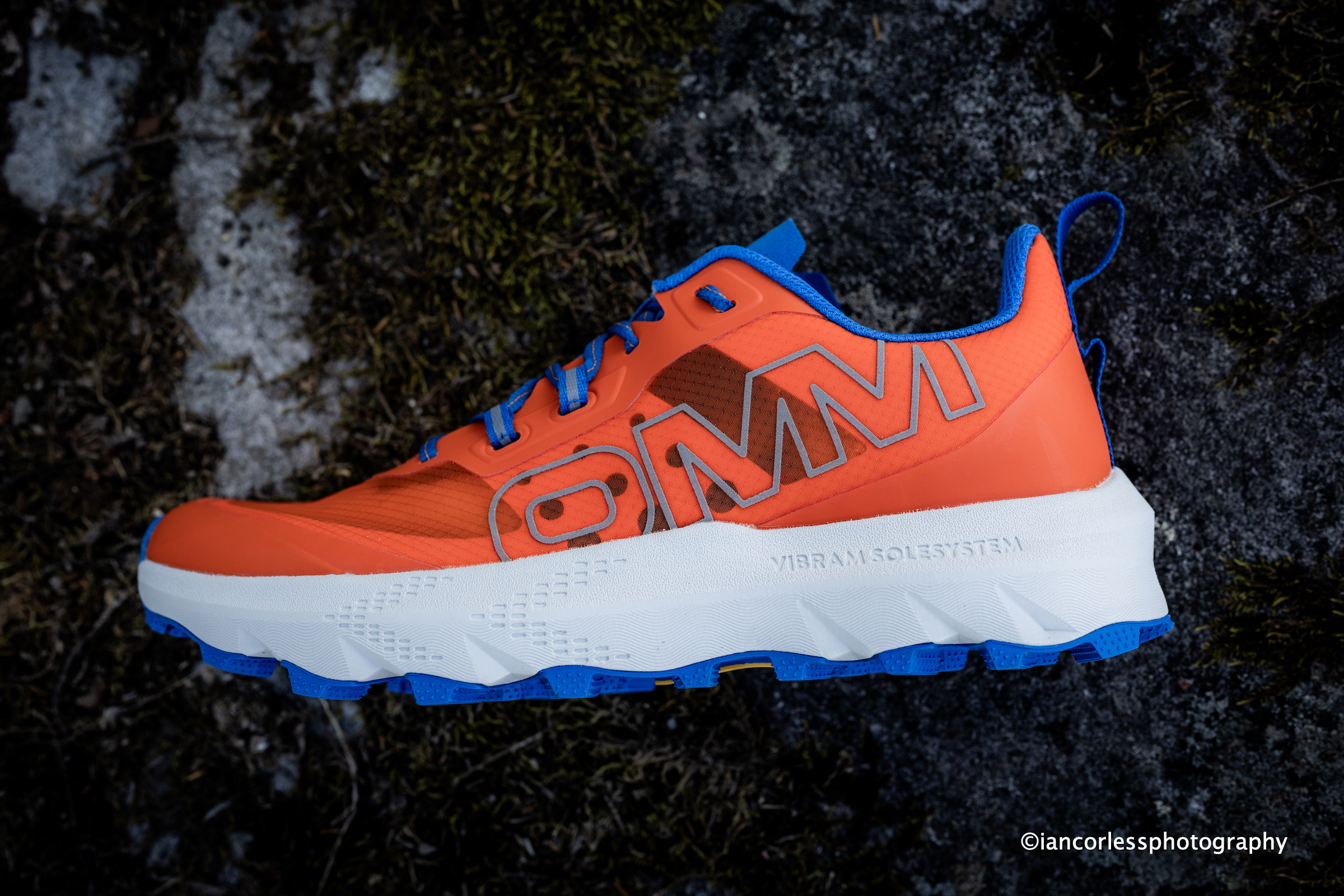
OMM Wave Geometry increases surface contact area with irregular ground.

However, flexibility is not always the answer.

A stiffer shoe may provide greater precision, protection and confidence on rocky terrain. Many mountain-running and approach-style shoes deliberately use stiffer platforms because they allow runners to edge more effectively on uneven surfaces.

Ultimately, grip improves when the shoe maintains effective contact with the terrain, whether through flexibility, torsional compliance or structural stability.

As with every aspect of outsole design, the optimal balance depends on the environment for which the shoe was intended.

The Rise of Vibram Megagrip

In recent years, one outsole has become increasingly dominant across the industry: Vibram Megagrip.

There is no doubt that Megagrip is an excellent compound. It offers an impressive balance of durability, traction and all-round performance with a pay-off on grip in wet rock conditions. It has become the default choice for many premium trail shoes for good reason.
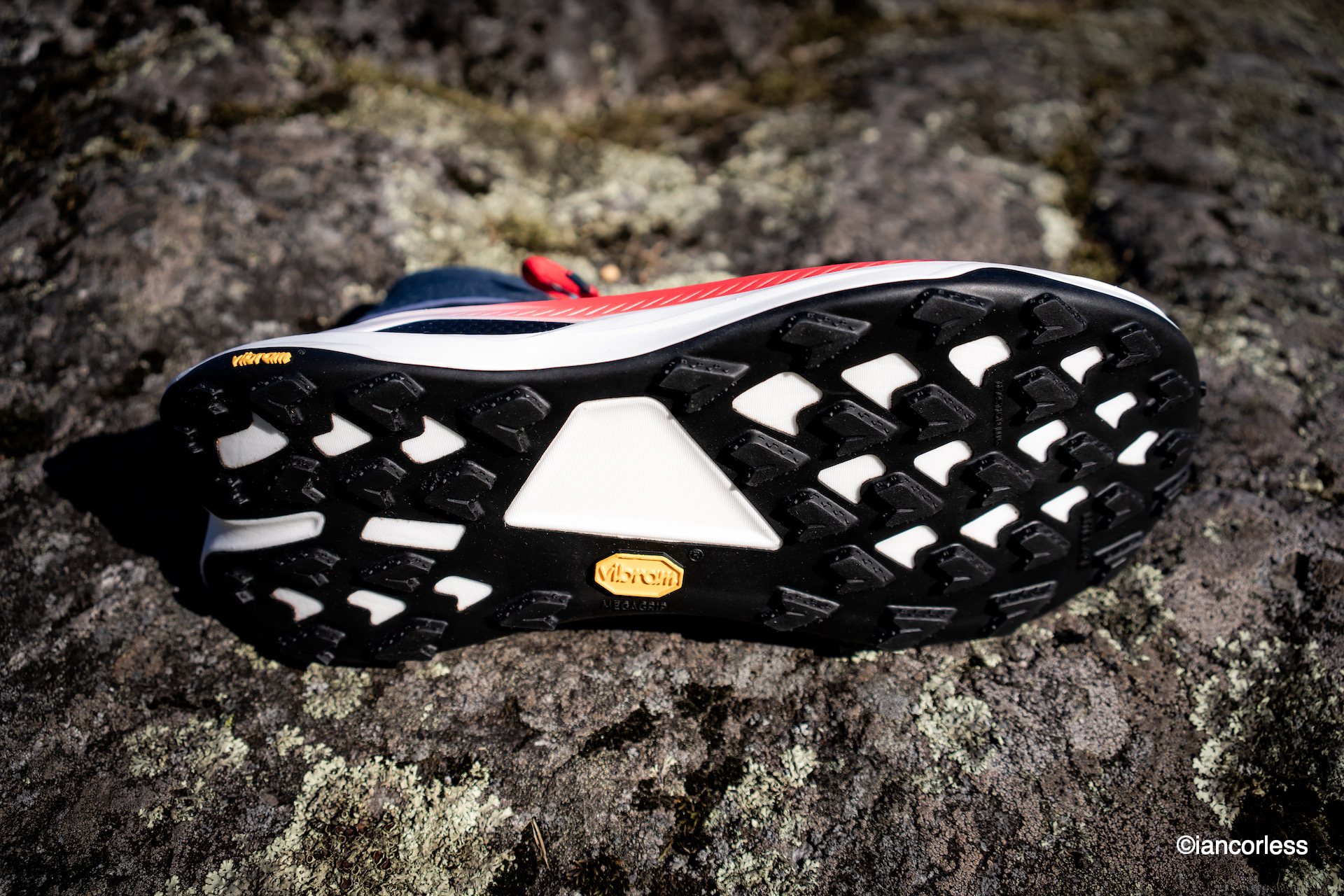
Vibram on the HOKA Tecton X3

However, the presence of Megagrip alone does not guarantee exceptional grip. Two shoes may use exactly the same rubber compound yet perform very differently in the real world.

Lug geometry, lug spacing, outsole layout, shoe flexibility and overall design remain hugely important.

As more brands adopt the same compound, the differences between shoes increasingly come down to how that compound is implemented rather than the compound itself.

Megagrip remains one of the most versatile options available, but it is only one piece of the overall grip equation.

Why “Good Grip” Depends Entirely on Where You Run

Consider two runners.

The first runs exclusively on dry woodland trails, gravel tracks and flowing singletrack.

For this runner, almost any modern trail shoe with a standard rubber compound and moderate lugs may provide perfectly adequate grip. They may genuinely believe their shoe offers excellent traction because it performs well in their environment.

The second runner starts on roads, moves onto forest trails, then climbs into steep mountain terrain featuring wet rocks, exposed roots and slippery technical sections.

Suddenly, grip becomes a much more demanding requirement.

What felt excellent in dry woodland conditions may feel completely inadequate when the terrain becomes steep, wet and technical.

This is why context matters.

A shoe that provides outstanding grip in one environment may be average in another.

The Search for the Perfect Outsole

The uncomfortable truth is that there is no perfect outsole.

The best grip comes when a runner can be highly specific about their needs and select a shoe built for those exact conditions.

  • If your running consists primarily of muddy fell races, choose a mud-specific outsole.
  • If your focus is technical mountain running, prioritise compounds that excel on wet rock.
  • If your routes combine road, gravel and moderate trails, a less aggressive and more versatile outsole may be the better solution.

The closer the outsole is matched to its intended environment, the better it will perform.

Conclusion

Grip is not a simple yes-or-no characteristic.

It is a complex interaction between rubber compound, friction, traction, lug design, lug spacing, lug depth, terrain, weather and running style.

The most specialised outsoles often provide the highest levels of performance, but only within the conditions they were designed for. Like Formula 1 tyres, they excel when used exactly as intended.

The more a shoe attempts to become a “jack of all trades”, the more compromises inevitably appear.

That said, budget must also be considered.

Running shoes have become increasingly expensive, and for many runners owning multiple pairs for different conditions is simply unrealistic. In these cases, the search for a versatile “one shoe does all” option is entirely sensible.

While such shoes may never be the absolute best in every environment, they often represent the most practical and economical choice.

Ultimately, the question is not whether a shoe has good grip.

The question is whether it has the right grip for the terrain you’re asking it to handle.

Follow Ian Corless

Instagram – @iancorlessphotography

Twitter – @talkultra

facebook.com/iancorlessphotography

Web – www.iancorless.com

Web – www.iancorlessphotography.com

Hoka Tecton X Shoe Review

©iancorless

Here I am again, writing about and reviewing ‘another’ Hoka shoe!

It’s kinda weird and I will hold my hands up and admit, Hoka have really got me interested in their shoes again. It all started with the Torrent 2 – a shoe that I absolutely love, it is one of my ‘go to’ shoes and I am now on my fifth pair.

The Torrent 2 tempted me to the Zinal, and yes, I love the Zinal.

And now, the Tecton X.

©iancorless

There is a pattern here and I admit, I am still not a fan of ‘too’ much cushioning and ‘too’ much stack height, BUT, the Torrent, Zinal and now the Tecton X firmly sit at what is now the more ‘normal’ end of cushioned shoes.

Image ©Hoka

The Tecton X has two carbon fibre plates that run parallel in the shoe (see photo above) designed to propel and push through the propulsive phase. I must admit, up to now, I have not been impressed with shoes I have tested that contain a carbon (or similar) plate. The exception being the Scarpa Goldengate Kima which is superb.

Ultimately, the addition of a plate, and I don’t mean rock plate, but carbon or similar has just added too much weight and stiffness, resulting in a lackluster and boring run.

The Tecton X is most certainly addressing this with two thin strips in contrast to one, or two, larger plates as often used in other shoes.

THE SHOE

X in the outsole for the Tecton X ©iancorless

On first impressions, the Tecton X has the impression of a Torrent 2 and Zinal merged together. This for me is a good thing!

Neutral with a 5mm drop, the Tecton X ticks the boxes. Drop on the Torrent 2 and Zinal is also 5mm. I make the cushioning 28mm front and 33mm at the rear. NOTE – The women’s shoe is 27/31mm with 4mm drop.

S, V and C ©iancorless

Once again, I am confused with the scribble on the side of the shoe:

  • S36.26
  • V701
  • C003

C’mon Hoka, what does this ‘really’ mean. S = Spring. V= Volume and C? The C is the version of carbon plate, so, in the Tecton X that is 003. In other models, the Zinal for example, the stats were: S32x19|V490|W242 (w being the weight.)

Here in the Tecton X we have: S36x26|V701|C003

Volume at 701cm³ made up of 2 different materials. ©iancorless

Spring measurement is, ‘Curvature of the shoe, measuring how high the heel and toe are off the ground.’ Basically, it is the ‘rocker’ effect. So, for the Tecton X, this means 36mm and 26mm. Don’t get confused here with drop, this does not mean a 10mm drop! But what does it ‘really’ mean?

Volume relates to the total amount of foam (cm³) in the midsole. So here in the Tecton X there is 701, considerably more than the Zinal at 490 and the Torrent 2 at 395.

I wrote in my Zinal review:

“One would assume that the higher the volume number, the more cushioned or plush the shoe would be, but that is not the case. Here in the ZINAL, the shoe has a lower profile keeping you, the runner, closer to the ground and the cushioning is firmer to provide a more efficient and speedier propulsion in the transition phase. When I wrote about the Torrent 2, the thing I liked and others liked was a firmer ride; less Hoka like, by that I mean less plush and bouncy. Here in the ZINAL that is taken one step farther and the ride is firmer. So, it’s fair to assume that plush ride Hoka fans will find the ZINAL less appealing. Whereas, by contrast, runners who prefer a more conventional shoe who have wanted to try Hoka, will find the ZINAL appealing.”

So, what does that mean for the Tecton X and the 701-volume figure?

Like the Torrent 2 and Zinal, the Tecton X uses dual-density PROFLY cushioning; Hoka blend soft and responsive foams to provide cushioning and excellent energy return. With the addition of the carbon fibre and increased volume (701) the Tecton X is ‘in theory’ faster and more responsive. It is!

©iancorless

The upper is mesh, extremely comfortable and breathable.

©iancorless

There is a protective toe rand which works well, it’s simple and not over engineered.

With a sock like fit, the Tecton X has great foot hold and comfort.

©iancorless

Lacing is via 7 eyelets and the optional 8th eyelet should you require to lock lace or similar. Hoka call this Ghillie lacing, and I had to look it up? “The trend on this shoe, Ghillie Ties. At its origin, Ghillies referred to specially designed shoes used in Irish dance, notable for their soft and supple build featuring crisscross laces across the top of the foot for flexible movement. Now, Ghillies is a laces trend sweeping across the US.”

Vibram Litebase ©iancorless

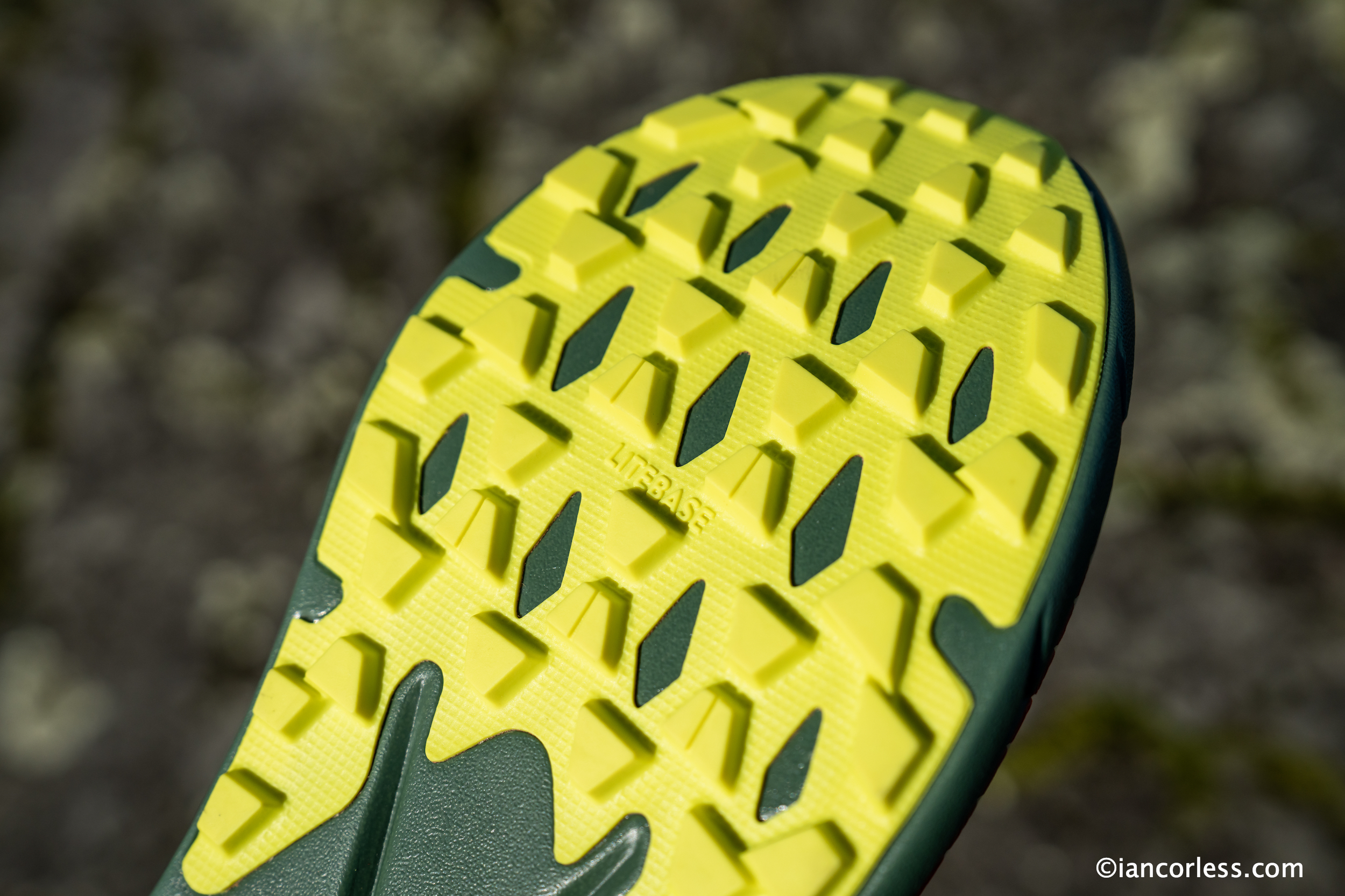
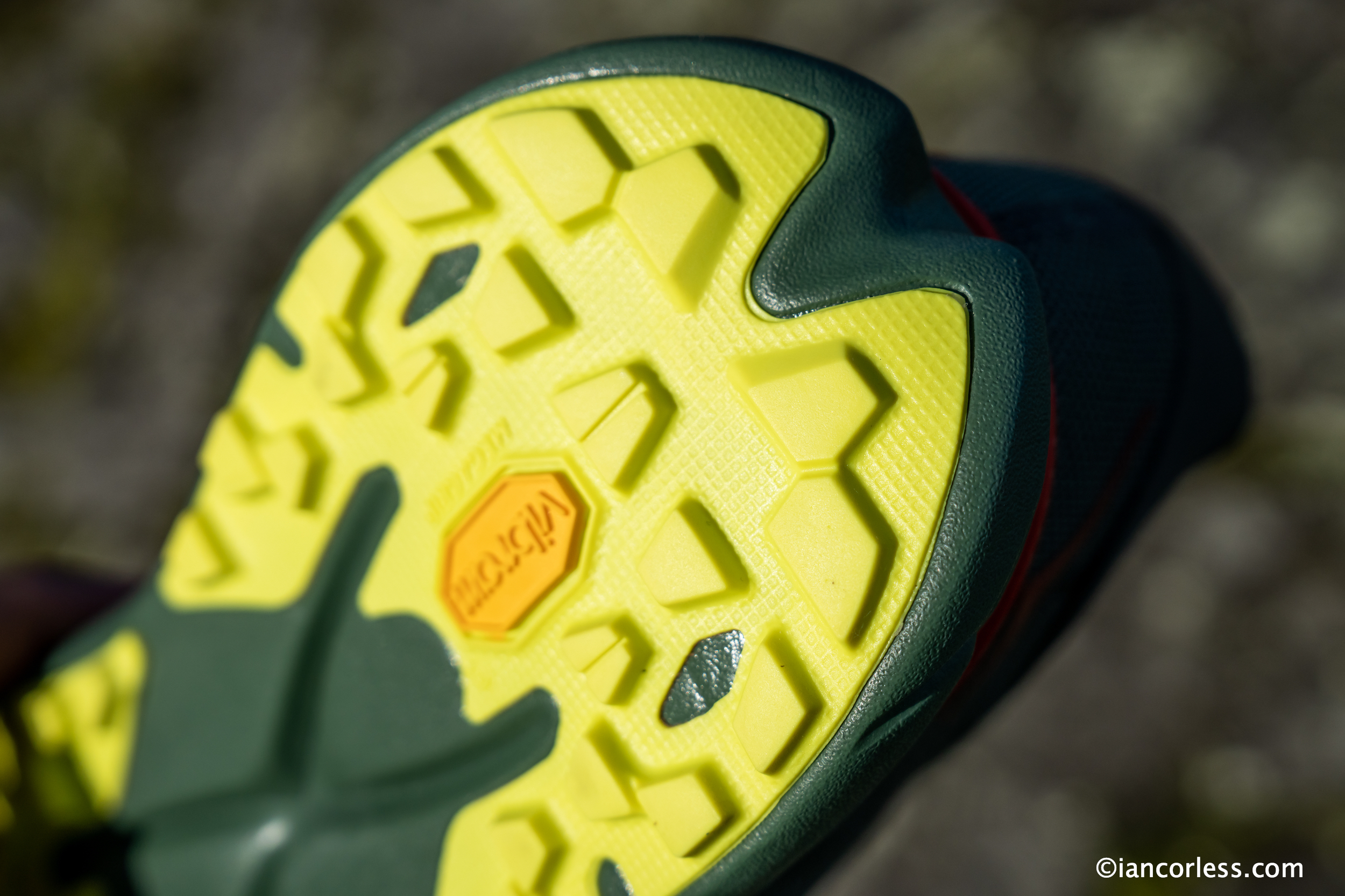
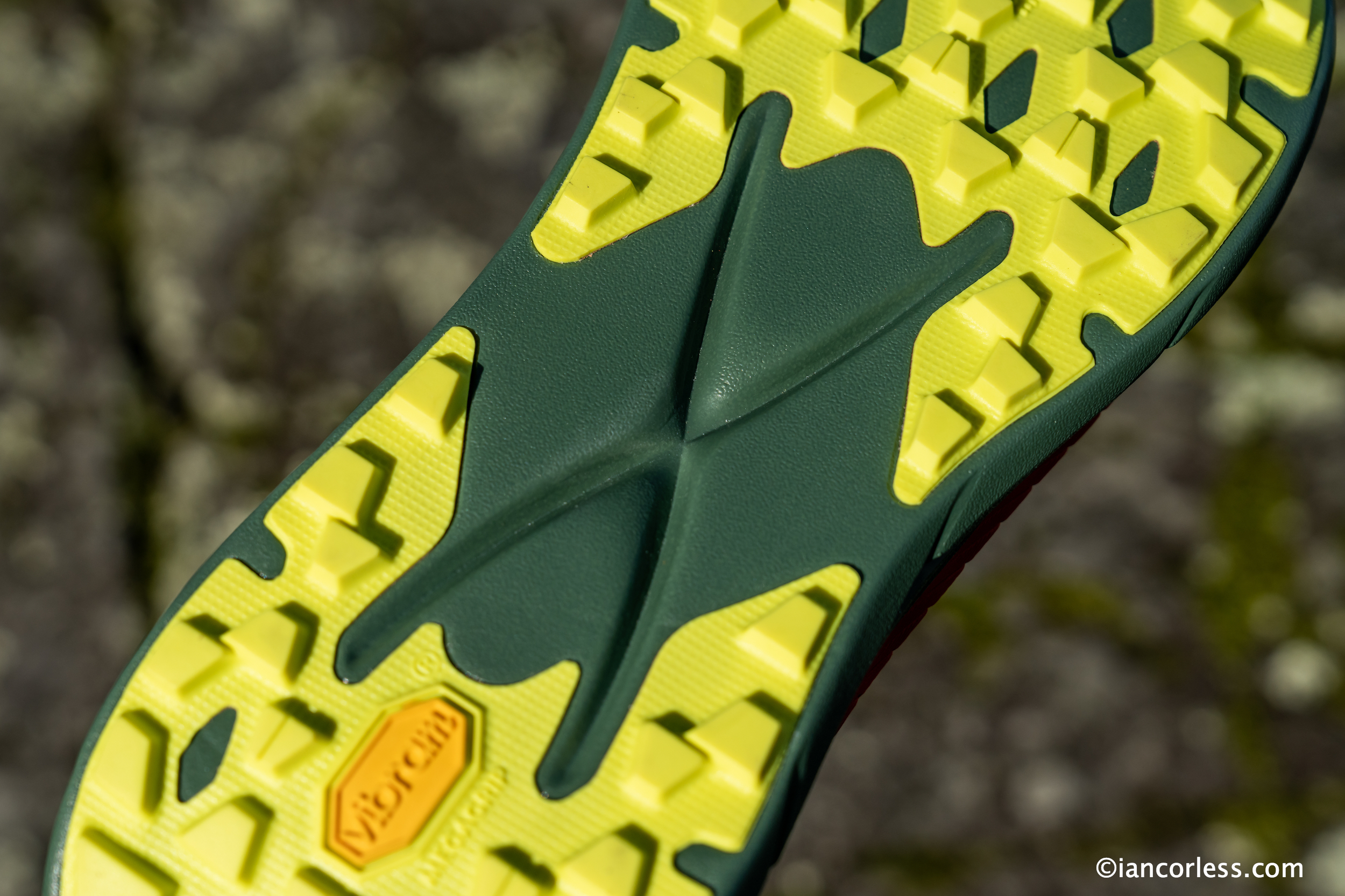
Like the Zinal, Tecton X uses Vibram Megagrip Litebase with 4mm lugs. Note, there is no outsole in the middle of the shoe. The outsole is zonal, front, and rear – this helps reduce weight.

The Tecton X is lower profile, keeping the runner lower to the ground with firmer cushioning and a more responsive ride.

IN USE

©iancorless

Fit is great and the sock like fit gives a secure hold of the foot without the need to lock lace. Fit is true to size, I am EU44/ UK9.5 and these fit perfect. Just like my Torrent 2 and Zinal. However, the fit or feel is not the same… The Tecton X fits like the Zinal around the bridge of the foot and the toe box is wider, a 3.5 on a scale of 1-5, 1 being narrow and 5 being wide.

©iancorless

I was surprised how cushioned the shoe felt just standing and in comparison, to the Zinal, they felt higher off the ground. Despite the two carbon strips, flex behind the metatarsals was ok, obviously not bendy, and flexible, but certainly acceptable, especially in comparison to other shoes with inserts.

Weight for my EU44/ UK9.5 was a crazy 269g – light for a shoe like this.

The rocker is definitely noticeable and maybe more so due to the carbon plates. It’s a pleasant feel and certainly you can see, even just by walking, how the rocker combined with the plates will propel you forward.

©iancorless

Heel box is plush and secure.

I have thrown a mixture of terrain at the Tecton X, road, gravel path, single-track, forest trail littered with tree roots, rocks, and many obstacles. I have also run in wet and dry conditions.

On the road, the shoe performs well, and I was happy with the feel for the ground. Although this shoe has more volume it has great responsiveness and cushioning. The cushioning is not bouncy/ marshmallow like, it’s just cushioned… Do you know what I mean?

Gravel trail and all good. With more miles, I could feel the shoe getting better and I was allowing myself to notice how the propulsive phase of the shoe was helping me move forward. If I increased the pace and cadence, this propulsion increased – a benefit of the carbon!

I will say now, this is without doubt the best trail shoe with carbon inserts I have tried.

The shoe feels like a normal shoe. So, although the carbon is there, I am not thinking it is there. A problem with all the other shoes I have tested. Too much weight, too much stiffness, no feel for the ground, lacking life – these points do not apply with the Tecton X – a huge plus.

©iancorless

Running downhill, I intentionally struck with the heel and there was a very definite compression in the cushioning and return in energy. Switching to mid or forefoot and once you get the rocker rolling you forward and the carbon propelling you, the benefits of the Tecton X are noticeable. I am not sure I have the fitness to maximise this, but it is noticeable.

©iancorless

There is great comfort in the shoe. You feel protected and cushioned without losing a feel for what is happening around you and the combination of dual foam in the Profly, along with the carbon offers responsiveness and protection. I was surprised that the Tecton X felt this good.

On single track I felt confident and happy that the shoe would do the job and it’s only when I moved into some thicker mud that the 4mm lugs on the outsole started to lose grip – no surprises with such a modest outsole. The Vibram Litaebase Megagrip was excellent on dry rock and most wet rock. It did struggle a little when the rock had a nice white or green layer of extra trouble to confuse and irritate the outsole, but in fairness, many shoes struggle to grip here. However, as much I like this Vibram Megagrip I am perplexed that Hoka decide NOT to put the Litebase the full length of the shoe. I know it is to safe weight, but, when on trail, running on rocks, standing on tree routes, traversing gravel or whatever, the middle of the outsole is often a key contact point, we can’t always use the heel or forefoot. I noticed this especially on tree roots when I am pretty much always using the middle of the outsole and of course, I had minimum traction with the Tecton X – it makes no sense to me! It’s the same for the Zinal, maybe I am asking too much of this type of shoe and I should accept that it should be used on more groomed trail and technical trail is for another shoe, like the Torrent 2 that has a full and more aggressive outsole.

There are many similarities to the Zinal here and if I was to explain it in simple terms, the Tecton X is a beefed-up version of the Zinal with carbon inserts. The noticeable difference would be in the structure of the Profly and the volume difference in that cushioning. The additional stack height of the Tecton X is compensated for with a wide footprint (90mm at the rear and 112mm at the front) and this helps balance the shoe, particularly on more technical trail. The cushioning is not soft and squidgy but is protective and this works well on trail. There is always a risk of roll and additional stress in a shoe with more stack but the Tecton X does a great job of reducing this; it’s not perfect though.

A comfortable shoe, with excellent protection and comfort, however, for me, the lower stack height, structure and full out outsole of the Torrent 2 wins out. The Torrent 2 has better grip, greater control on technical trail and a more ‘connected’ feeling for the ground. But having said that, I’d have no issues lacing up a Tecton X any day and I do. I find the mix and balance between the Torrent, Zinal and Tecton perfect. Although they are three separate shoes, they feel connected.

The Tecton X comes in to its own USP when on less technical and groomed trail. For example, flowing single-track with less obstacles, gravel roads and so on. Here the shoe starts to gain from increased cadence and that helps the carbon propel you forward, the more you run, the more you a propelled forward. A great shoe for say Western States (or similar)? It’s lightweight too, Hoka do this so well. Comparing to the horrendous inov-8 Trailfly G300 which weighs over 100g more per shoe for equal size. It’s fair to say that with a high price, the carbon technology and the Vibram Litebase, the Tecton X is more of a ‘special’ shoe and for many, maybe a shoe for race day. But it easily could be an everyday shoe due to its comfort and protection, it is even a great road-to-trail shoe, but I am not sure how long the Litebase outsole would last on the road? The upper is very breathable and certainly helps reduce overheating, downside, they may run a little too cool in winter. 

©iancorless

CONCLUSION

Tecton X for me, is the first trail shoe with carbon inserts that I have really enjoyed running in. The shoe offers protection, comfort, stability and great propulsion/ speed in a very good-looking shoe. It’s pricey (£175+/-) but currently, all shoes are increasing in price and if it has ‘new’ technology such as carbon, the price goes up. It’s a shoe for trail that is less technical and without doubt, it has the potential to be faster than other shoes. If you run in Hoka Speedgoat, the Tecton X would be a great shoe to place alongside and alternate: Use the Speedgoat for more technical and challenging trail and the Tecton X for faster/ groomed trail.

For me though, the Tecton X has just too much stack height, an equal problem with the Speedgoat. It’s a me thing and that is okay. Therefore the Torrent 2 wins out for me, Torrent 2 is also great value at £115.

So, while the Tecton X / Speedgoat combination would be ideal for a true Hoka user, for me, I would go Torrent 2 / Zinal (£140.) I just wish Hoka would put the Vibram Megagrip (as on the Speedgoat) on the Torrent 2.

Finally, The Tecton X is a great shoe and certainly a great addition to a shoe rotation for those specific runs when speed, comfort and extra propulsion is required. Recommended.

Follow on:

Instagram – @iancorlessphotography

Twitter – @talkultra

facebook.com/iancorlessphotography

Web – www.iancorless.com

Web – www.iancorlessphotography.com

Image sales –www.iancorless.photoshelter.com

The North Face #TNF Ultra Endurance Shoe Review

©iancorless.com_TNFUltraEndurance-3919A couple of weeks ago I took a look at the TNF Ultra TRII, I said then that TNF are really getting their act together with run shoes. The recent products from the brand have continued to impress and the addition of the ULTRA ENDURANCE adds another quality shoe that offers runners another option to tackle the trails. The current TNF line up is as follows:
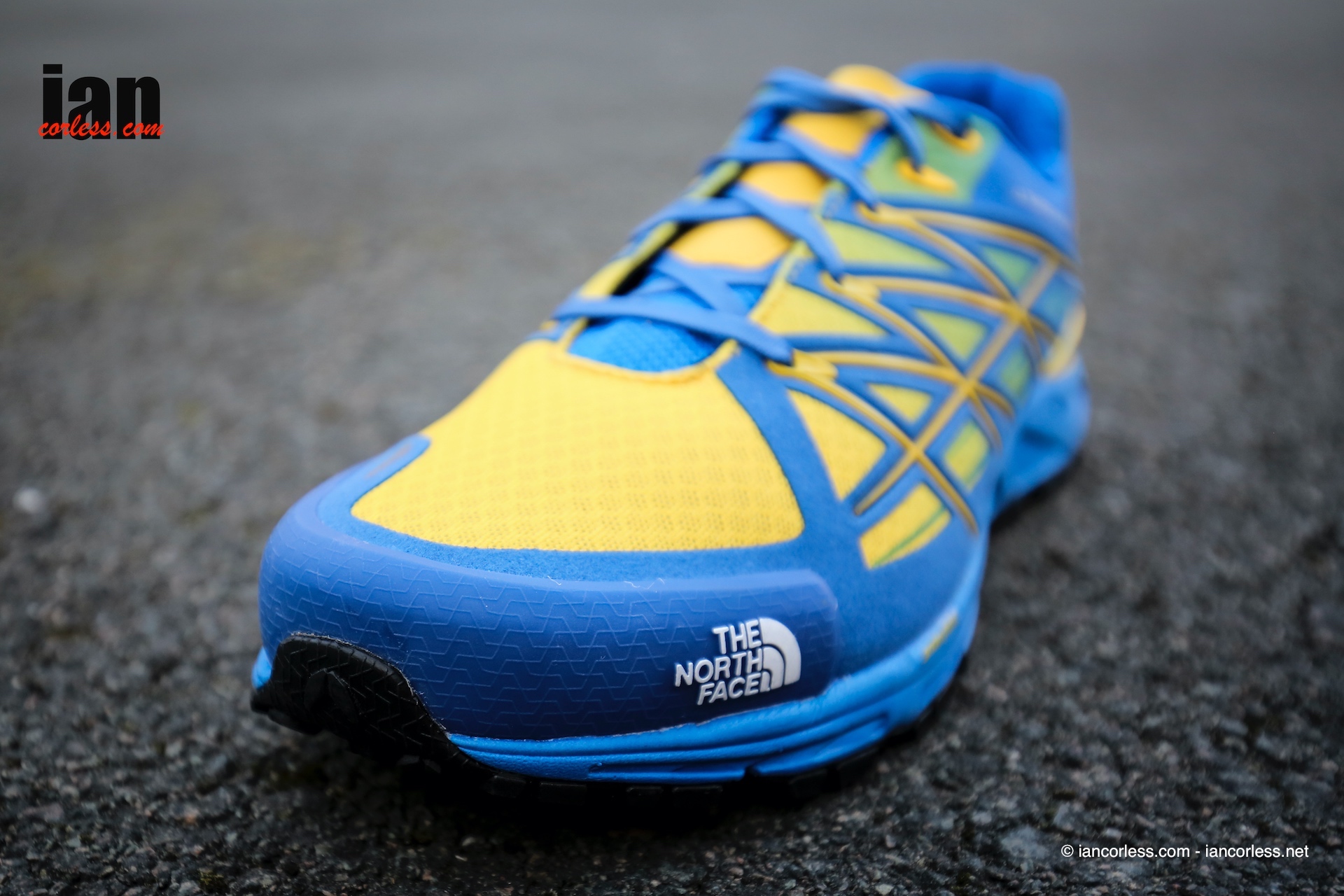
ULTRA TRII read my review HERE

ULTRA CARDIAC read my review HERE

ULTRA MT read my review HERE

and the ULTRA ENDURANCE

In a review toward the end of 2015, when I compared many leading shoes against each other (not all shoes I must stress) the Ultra Cardiac very nearly took top honours, it was just pipped by the Scott Kinabalu Supertrac. (Read the review HERE).

If I did that review now, I strongly feel that the battle between the Scott Kinabalu Supertrac and the TNF Ultra Endurance may well be even closer but the Supertrac would still get the nod from me due to the outsole which is extreme and made from a superior wet traction rubber compound that works really well on a multitude of surfaces, overall comfort and flexibility.

To provide some clarification, we need to look at the current TNF line up and see how (in simple terms) the shoes are to be used so that you can decide which shoe is for you:
ULTRA TRII – Is a dry trail, light and fast shoe for a runner who like a more minimalist feel. Cushioning is 8mm/ 16mm and It has an 8mm drop.

ULTRA CARDIAC – Is a cushioned trail/ mountain shoe that feels plush, fits snugly and works well and on dry trail, wet rock and very moderate mud. Cushioning is 12mm/ 20mm and it has an 8mm drop.

ULTRA MT – Has an aggressive outsole and is designed for off-road use in mud, mountains and demanding terrain. Cushioning is 9mm/ 17mm and it has an 8mm drop.

©iancorless.com_TNFUltraEndurance-3927

Enter the ULTRA ENDURANCE – 9mm/17mm with 8mm drop.

This new shoe from the TNF brand sits somewhere between the CARDIAC and MT and as you would expect, has an 8mm drop. I like this! But then again I would… I am a real fan of 8mm drop shoes and as I have said many times before, this drop sits in the perfect middle ground that can work for most people. TNF have obviously thought about this and hence the continuity between the ‘ULTRA’ range. It’s also fair to say that as the name suggests, the ‘ULTRA’ shoes are designed for running longer and therefore 8mm will be more forgiving.

©iancorless.com_TNFUltraEndurance-3960

Slipping the shoe on, it does feel different to the CARDIAC but more similar to the MT. This primarily due to the gusseted tongue which is secured within the shoe – this holds the foot firmer and in addition reduces the chance of debris getting in the shoe. It’s a winning combination that I love.

©iancorless.com_TNFUltraEndurance-3930

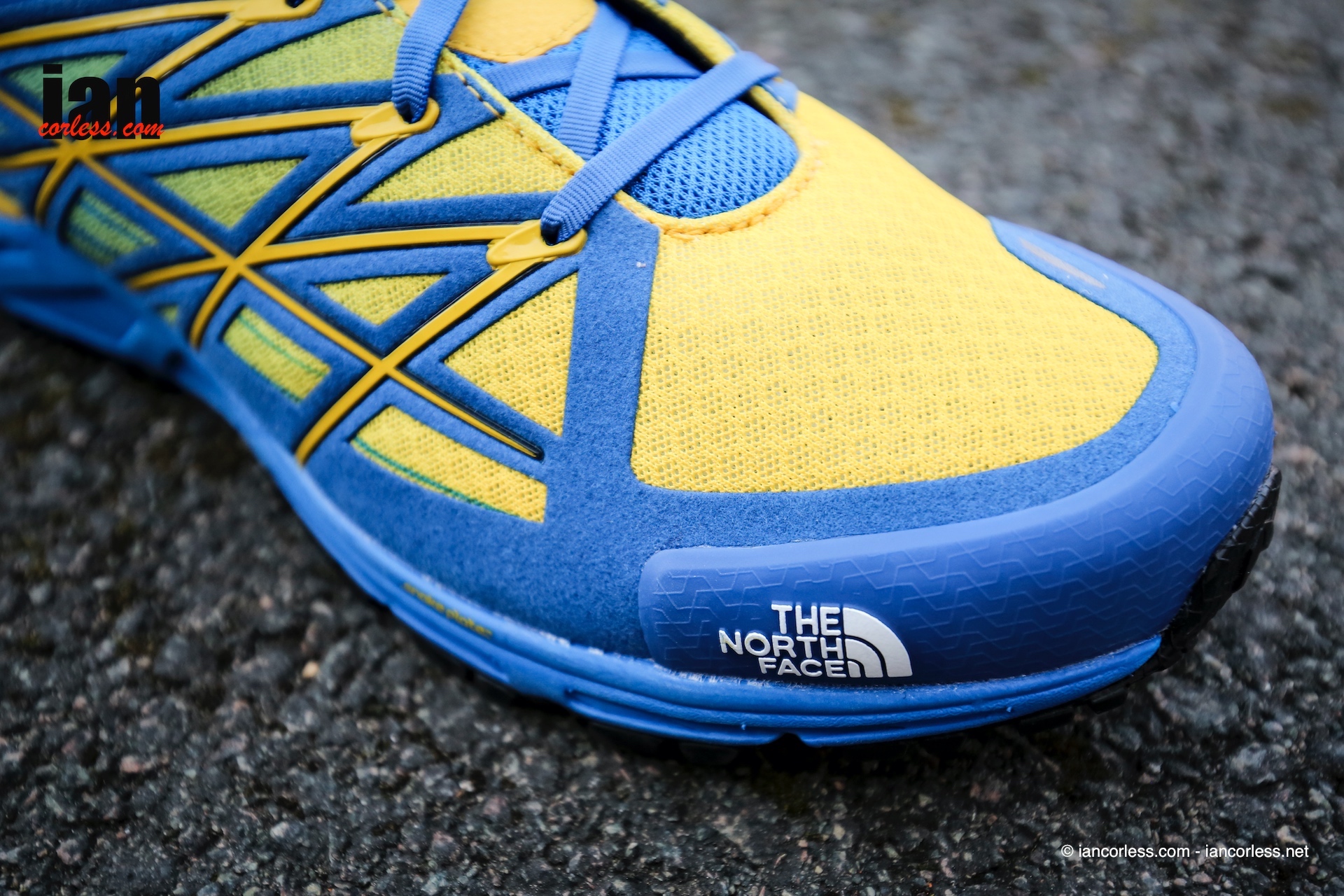
The front (toe box) is wider than both the CARDIAC and MT and therefore allows the toes to splay a little more. Protection at the front is excellent with a very reinforced toe box bumper that will definitely protect against all those unplanned collisions with rocks, stones or other debris.

©iancorless.com_TNFUltraEndurance-3948

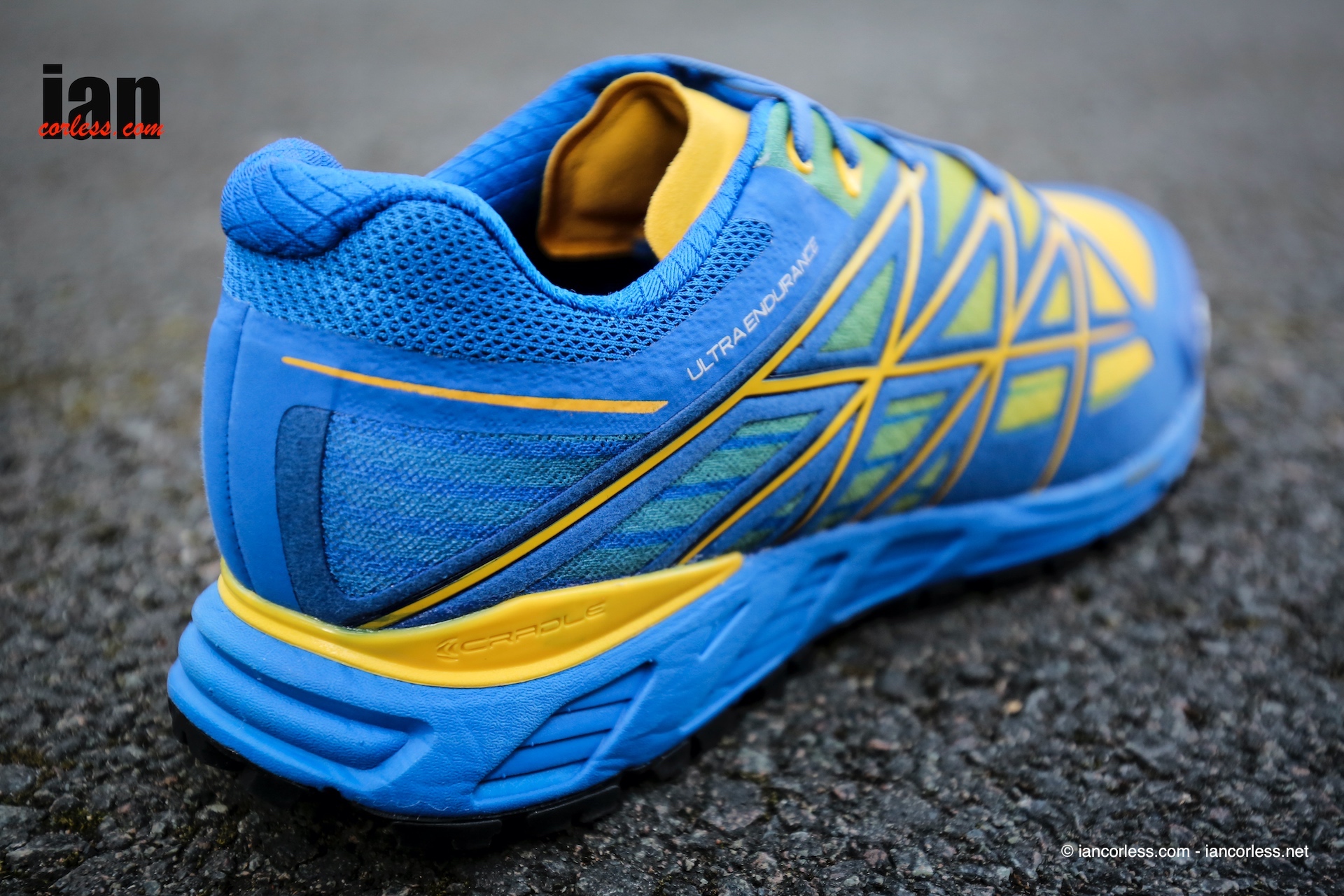
Heel box is plush, padded and holds the foot secure and has FlashDry technology.

©iancorless.com_TNFUltraEndurance-3963

Key features of many TNF shoes is ‘Snake Plate’ and the ‘Cradle,’ these two elements are present here in the Ultra Endurance and add to the overall benefits of the shoe.

©iancorless.com_TNFUltraEndurance-3941

Snake Plate adds protection to the forefoot of the shoe and protects against rocks/ impact and so on, TNF vary the plates from one shoe to the next depending on what they consider to be necessary. In other shoes this would be called a rock plate.

©iancorless.com_TNFUltraEndurance-3932

The cradle is designed to hold the rear of the foot more secure and stable.

©iancorless.com_TNFUltraEndurance-3938

The upper is breathable and most importantly seamless, therefore reducing the chance of rubbing, hot spots or the chance of blisters. The upper is welded TPU with suede overlays.

©iancorless.com_TNFUltraEndurance-3944

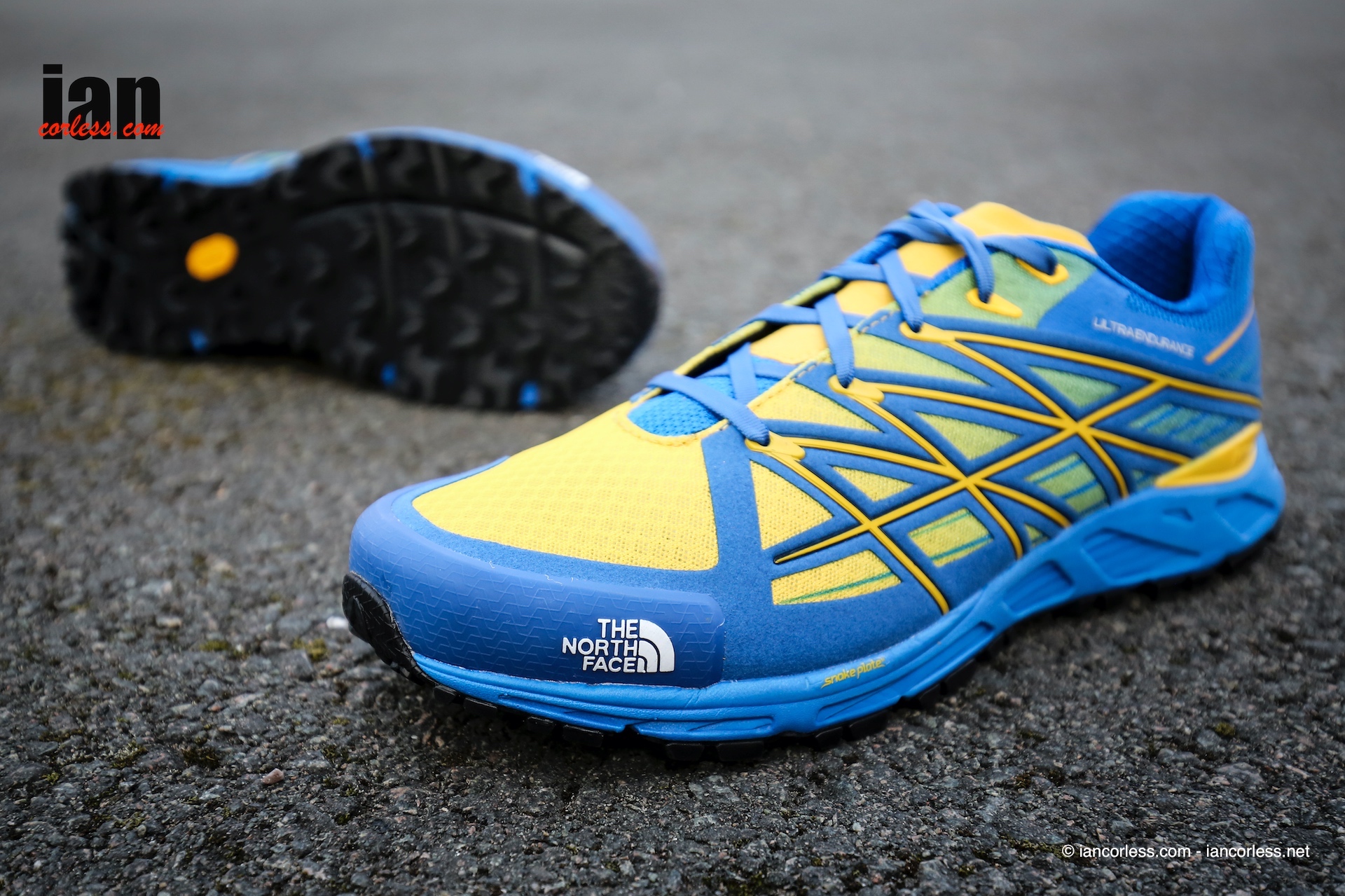
The outsole is Vibram Megagrip which is making an appearance on countless shoes in the trail world. I need to clarify here that Vibram don’t only make one Megagrip outsole (see here). They do many variations, so, please check! A classic example is the outsole on say the TNF ULTRA CARDIAC and TNF ULTRA ENDURANCE – they use Megagrip but they each have three different variations of the product. The Ultra Cardiac having a more subtle version, the Ultra Endurance a more aggressive outsole for mixed terrain and to draw comparisons, the Scott Kinabalu Supertrace (has a special Scott outsole) that is basically just aggressive, extreme and made from a superior wet traction rubber compound that works really well on a multitude of surfaces.

For example:

Ultra Cardiac outsole:

©iancorless.com_TNFUltraCardiac-7017

Ultra Endurance outsole:

©iancorless.com_TNFUltraEndurance-3946

Scott Kinabalu Supertrac outsole:

©iancorless.com_ScottSupertrac-5061

Cushioning in the Ultra Endurance is single-density compression folded EVA which does a great job of allowing you to feel the ground but provide enough cushioning for a long day out.

©iancorless.com_TNFUltraEndurance-3937

IN USE

The upper is seamless and snug and the gusseted tongue is a real pleasure which holds the foot firm. The toe box feels noticeably more roomy in comparison to say the Cardiac or MT.  The shoe feels relatively light but not super light. You really feel as though you are wearing a shoe that will take a battering. This in many respects is reflected in the shoes name, Ultra Endurance.

8mm drop for me is perfect, it provides a drop that allows me to run longer and when I can’t keep my form, the extra height allows for some compensation. As I mentioned above, this is obviously something that TNF have really thought about and the whole ‘Ultra’ range of shoes has an 8mm drop. This is also great as it means I can seamlessly move from one who to the other shoe without having a shock. A clear example of this is that I have been doing road runs in the Ultra TRII and I have been out in the really muddy stuff in the MT.

The shoe works well in mud but it’s not an out-and-out shoe for muddy trails, better get the MT if that is what you need. The Ultra Endurance is a great trail/ mountain shoe that works well and transitions from a multitude of surfaces. As I mentioned above, I believe it would give the Scott Kinabalu Supertrac a run for it’s money as a potential best ‘all rounder!’

To emphasise a point, if you were looking to but just one shoe that could handle many terrains and provide you with happy and many days out on the trail, then the Ultra Endurance would be a good place to start. It’s not a great road shoe, but it will gladly provide a cushioned and responsive ride for road sections between trail. It’s not an excellent performer in very muddy conditions but it does provide some grip that will allow you to progress. Where the shoe excels is when all these elements combine, say on a long training run, long hike or a race when you may well be mixing from road to trail, to rocks, to mud, to scree and so on, here the Ultra Endurance works so well.

It’s a shoe that excels of dry trail, rocky trail (wet or dry) and some road. It has actually become a real favourite when travelling when space is limited and I need a ‘one shoe does all’ scenario. Feel for the ground is good and has improved the more I have run. The first few runs felt a little hard and flat but the shoe bedded in nicely. The Vibram® Megragrip sole is as mentioned, almost becoming a standard feature on trail shoes. the version applied to the Ultra Endurance compliments the shoe perfectly.

Grip in mud is compromised, it always is in a shoe that is designed for trail. That is not a criticism as the shoe is definitely designed to be an all rounder. If you need out-and-out grip and a shoe that will just be used for soft-ground, mud, fells or other messy terrain, you’d be better looking at the TNF Ultra MT or a fell shoe from say inov-8 – the Mudclaw 300 for example is a great off-road shoe.
The heel box holds the foot secure with no slipping. It’s snug and reassuring.

The relatively seamless upper and sewn in tongue really holds the foot secure and has given me no hot spots. It’s a real bonus and it’s great to see that TNF are incorporating this more. For anyone who has used a Salomon S-Lab shoe with ‘endofit,’ a gusseted tongue really is just so much more comfortable. Although the TNF version is different to the Salomon version, similarities can be drawn.

The shoe has a neutral fit as does all the TNF ‘Ultra’ range and so therefore you could add an insert or orthotic if required. Drop is 8mm. Sizing is true to size, I take a UK9.5 in most shoes and my Ultra Endurance is UK9.5. However, due to the wider toe box the shoe does feel different to the Cardiac or MT so you may want to just make sure by trying in-store.

This is not the lightest shoe on the market but I don’t think that is really an issue. It’s not trying to be the lightest. What it does, is offer cushioning, protection and longevity in an attractive package that will last for many days, weeks and months. The colour-way of blue and yellow also looks pretty swish.

©iancorless.com_TNFUltraEndurance-3952

Conclusion

This shoe is a great all-rounder and may well be a perfect ‘one shoe’ purchase for anyone who is looking for something that can do many things well. It excels on dry trails and loose surfaces such as scree, stones, sand etc. Grip from the Vibram sole is good on wet rocks and the shoes transition from trail to road well and the cushioning allows for plenty of happy miles.

The Ultra Endurance can handle mud as part of a mixed terrain trail run but if you wanted an out-and-out shoe for muddy trail, this is not it. It’s a really solid shoe with some serious toe protection, a plus for anyone heading out into mountainous terrain.

I have been working with and running myself in harsh, rocky, desert like terrain in Lanzarote, La Palma and so on and I think the Ultra Endurance would potentially make a great shoe for someone participating in a multi-day race like the Marathon des Sables. The combination of features sits well, the slightly wider toe box, protection, grip and cushioning all combine to make it a great shoe for such an adventure. I will feedback on this after the 2016 Marathon des Sables where I will test the shoe daily.

To draw a comparison, I think those runners who have enjoyed the inov-8 Race Ultra 290 will find the TNF Ultra Endurance very appealing. The plus side being the TNF who has more grip.

The TNF ULTRA ENDURANCE alternative colour-way

The-North-Face-Ultra-Endurance-Shoes-SS16-Offroad-Running-Shoes-Silver-Grey-Pompeian-SS16-2

The inov-8 RACE ULTRA 290

Inov-8-Race-Ultra-290-Shoes-SS16-Offroad-Running-Shoes-Grey-Red-Black-SS16-5054167431

The downsides are minimal for me. It’s a slightly heavier shoe and I have touched on the reasons why above. Longevity in TNF shoes has been an issue in the past so I will hold judgement on this and feedback. Currently after 100+ miles of mixed terrain, the shoes are holding up well with no issues.

The North Face say: With its Vibram® Megagrip outsole, Snake Plate™ forefoot protection and Ultra Protect™ CRADLE™ stability, the Ultra Endurance will keep you tearing up the trail without tearing up your feet. CRADLE™ technology provides extra heel stability on uneven terrain, a gusseted tongue keeps loose trail debris out, while the rigid-yet-flexible ESS Snake Plate™ delivers on lightweight, heavy duty forefoot protection.

▪Welded TPU and suede mid-foot support overlays

▪Molded-TPU toe cap for protection

▪Gusseted tongue for protection from trail debris

▪Ultra Protect™ CRADLE™ heel-stability technology

▪Single-density, compression-molded EVA midsole

▪Vibram® Megagrip outsole for durable sticky traction in all conditions

▪ESS Snake Plate™ forefoot protection

▪Cushioning 9mm front/ 17mm rear

▪8 mm offset

▪Weight per shoe 260g+/- for a UK8

▪Approximate Weight Pair: 510 g

TNF Technologies explained:

Snake Plate™

The patent-pending Snake Plate™ consists of a forefoot plate that winds back and forth between the medial and lateral sides of the foot. Because it is not one solid element, it is not as uncompromisingly rigid from side to side and front to back. The result is a forefoot plate that allows the foot to do what it is physiologically designed to do: flex, bend, and contort to changing terrain. At the same time, the Snake Plate™ delivers rigidity where and when it is still needed. The thickness, composition and size of the Snake Plate™ vary from style to style as appropriate. For example, a thicker, more rigid Snake Plate™ addresses the technical, ever-changing demands of a mountain run. A thinner, more flexible Snake Plate™ reconciles flexibility with a decreased demand for protection while on smoother dirt paths.

Vibram® Outsole Technologies

The North Face® collaborated with Vibram, long respected for quality and durability, to create various outsoles (Vibram® Humbolt Outsole, Vibram® Mikeno Outsole, Vibram® Walsh Outsole, and Vibram® Rubber Outsole Compound) with superior traction, stability and protection.

Ultra Protect™

A shank plate for torsional rigidity and consistent underfoot feel.

Scott Kinabalu ENDURO – First Impressions

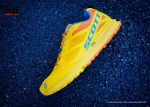
©iancorless.com_ScottEnduro-00069

Since 2012 I have been using Scott shoes, yes, Scott make run shoes in addition to bikes. I say that, because that is what I get when other runners look at my shoes and say, ‘Scott, oh, thought they made bikes?’

Since the original T2 Kinabalu, I have been a fan. I remember the original incarnation in 2012 which I used to run all over the Transvulcania course (Review HERE). Since the original model, the T2 Kinabalu has had a few tweaks and the current incarnation is the 3.0 HERE.

Scott launched the Kinabalu Supertrac (original look HERE) and this shoe went on to be my favourite shoe of 2015. I even went through many other shoes I had been testing to work out which shoe (for me) was the best. The ‘Supertrac’ won, see HERE.

As 2015 came to a close, Scott informed me of several new shoes, one being the Enduro.

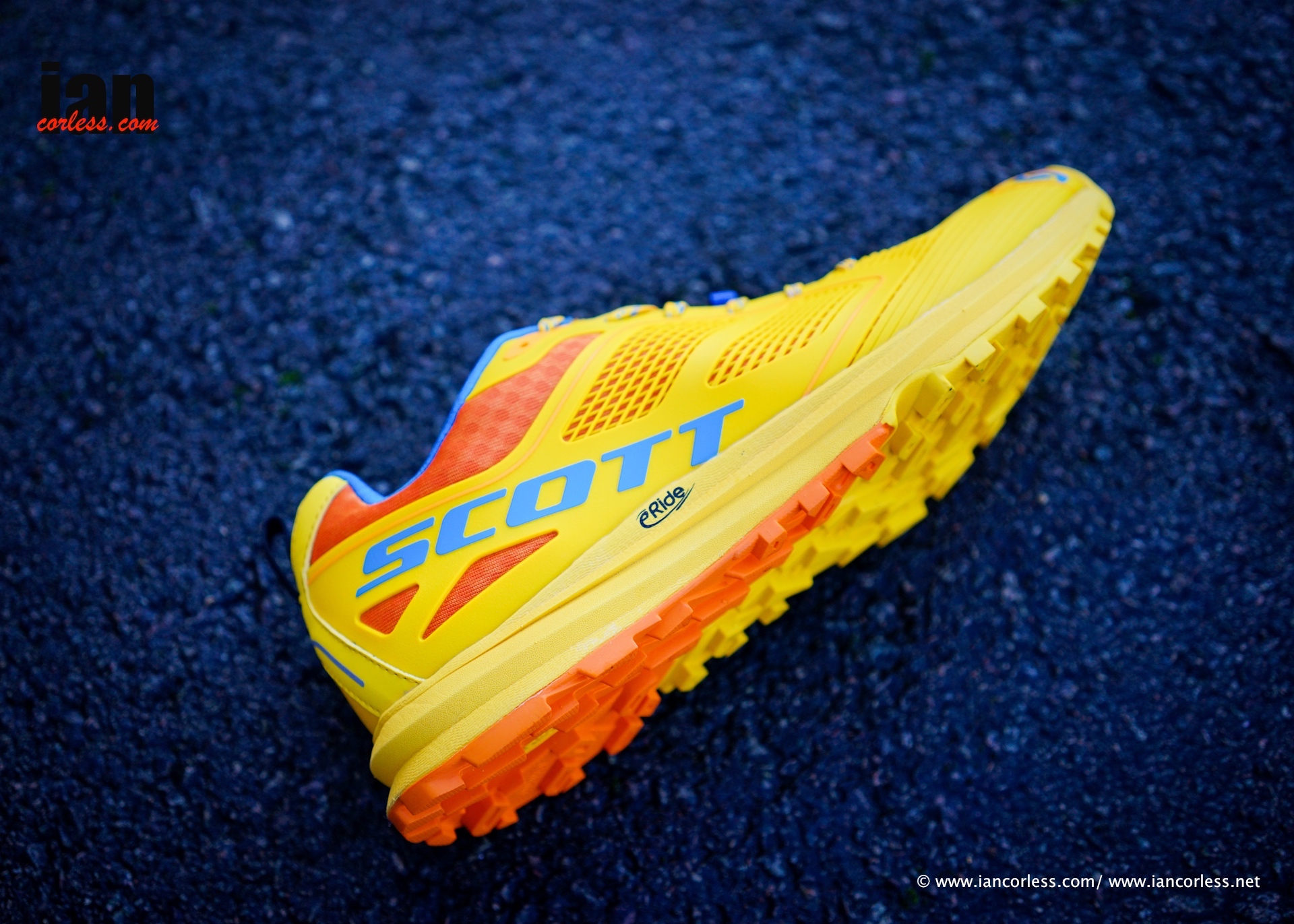
Well, the Scott Kinabalu Enduro has arrived and here are our first impressions and look.

©iancorless.com_ScottEnduro-00114

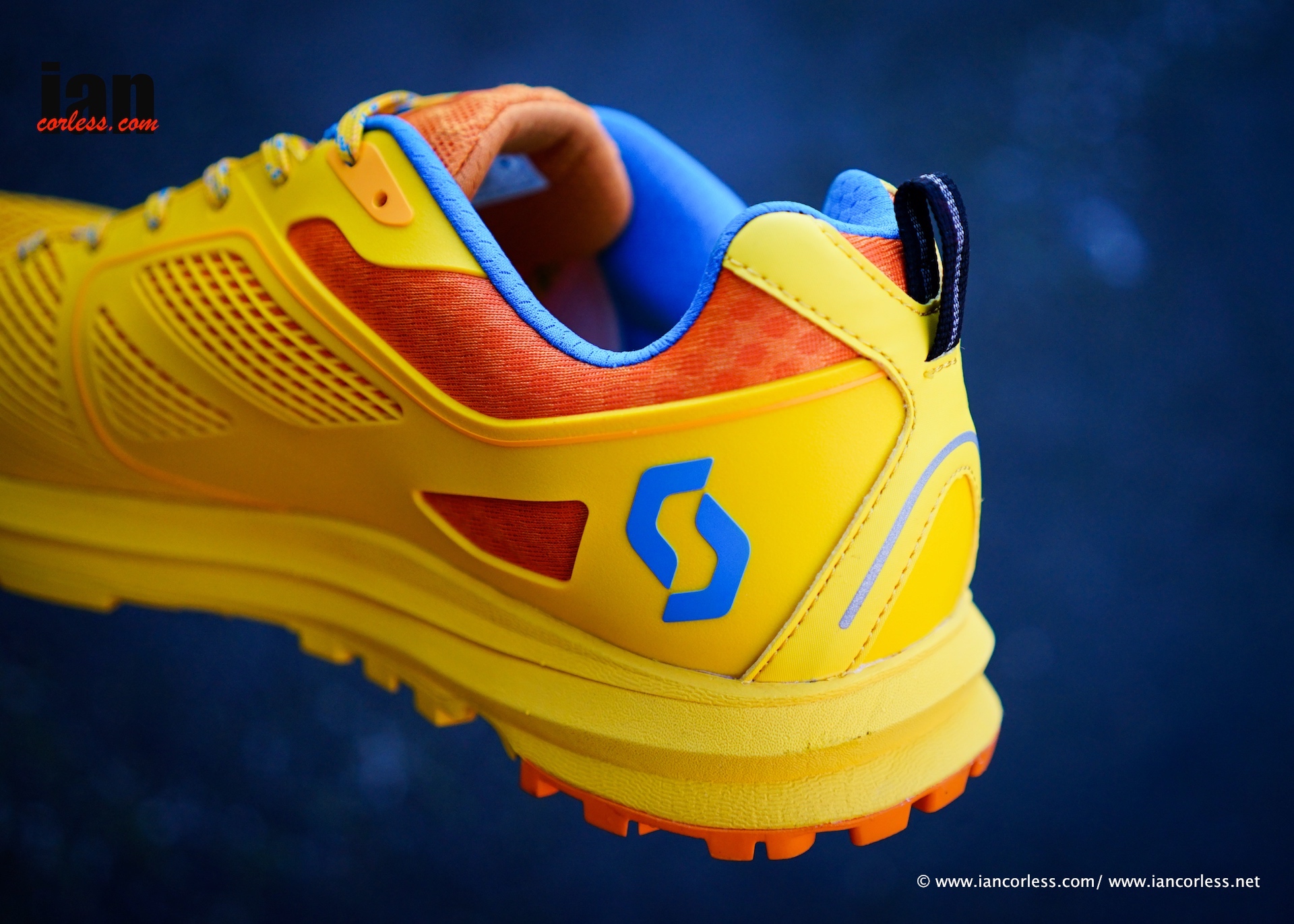
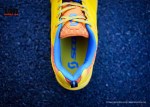
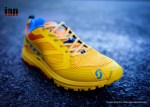
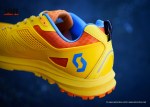
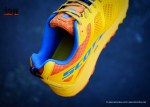
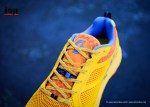
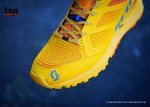
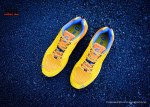
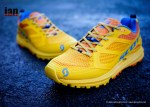
One thing is for sure, there is no hiding in the male version. Bright yellow, these shoes from the off say that they mean business. The ladies version is also bright but considering that many women wear bright apparel, I’m sure the colours will appeal. Certainly the original reaction from Niandi (who will test the ladies shoe) was wow, I LOVE the colours.

The shoes are not light. In all honesty, they were both noticeably heavy when removed from the boxes. The ladies a UK 8 weighs 380g and the mens UK9.5 weighs 418g. That is heavy; no doubt about it and I have to say initially disappointing.

Looking at the shoe closely, you soon realise why. The whole upper of the shoe has a plastic coating on top of the mesh below.

©iancorless.com_ScottEnduro-00081

I have to say, I asked why? Why is it necessary to add some much structure and protection to the upper of the shoe? Scott call this: Protective-High-Abrasion-Casing.

I took a look at Scott’s website and the description is as follows:

The brand new SCOTT Kinabalu Enduro is the latest addition to the range. The seemless one piece upper offers protection and comfort for all day adventures while the eRide tuned midsole and VIBRAM outsole provide performance and stability during your run.

Seamless upper – perfect

Protection – great

Comfort – brilliant

eRide – works, so great.

Vibram – tried and tested, so great

I still have to question though, why so heavy? My only point of question on the excellent Kinabalu Supertrac was the weight. Here Scott have beefed up the Kinabalu and made it bullet proof, it’s obviously way to early to tell but on first impressions, if you want a shoe to last and get value for money from, this may be the one!

©iancorless.com_ScottEnduro-00098

Cushioning as you would expect from Scott is good with 28mm at the rear and 17mm in the forefoot. However, these two figures cause me a little confusion, why for 2016 are Scott releasing a shoe with an 11mm drop? They dropped the ‘Supertrac’ from the Kinabalu’s original 11mm drop to 8mm drop and this for me made perfect sense. 8mm is a perfect sweet spot that appeals to many a runner and when running long it’s not too low to cause any issues. Having said that though, after just 2 runs in the ‘Enduro’ they do feel comfortable and offer a great feel. I have said this before, the ‘rocker’ system that Scott uses does give the shoes a feeling of lower drop due to the rolling action. I must point out too that I do fore foot strike so that will also help.

eRide – “Dynamic stability is the body’s own way to run efficiently and safely over uneven terrain. The eRIDE TUNED midsole has strategic flex zones to provide asymmetric flexibility and enhance ground adaptation while a EVA foam provides cushioning.”

©iancorless.com_ScottEnduro-00082

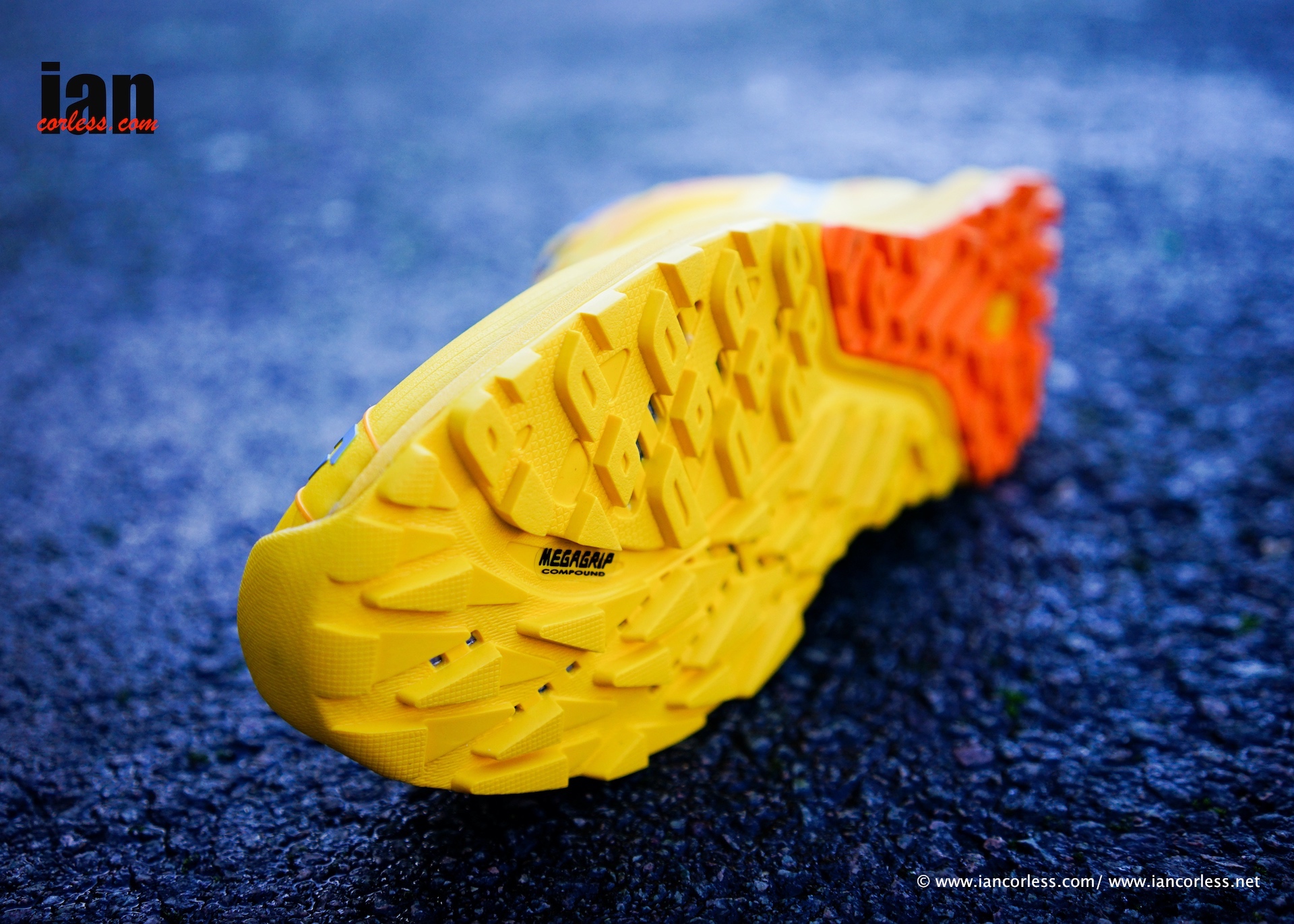
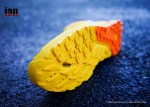
The outsole sits somewhere between the T2 Kinabalu and the Supertrac and therefore it will be a great all rounder for those who may well be looking for a ‘one shoe does all’ scenario. Made by Vibram, the outsole uses ‘MEGAGRIP’ as witnessed on the Supertrac but this version is less aggressive. From repeated year long use of the Supertrac I can confirm that this outsole is tried and tested and a favourite. This version does feels stiffer and less supple than the Supertrac version, we shall see?

©iancorless.com_ScottEnduro-00074

Lacing is standard and incorporates the ‘lace bungee’ for storing excess lace after you have tied your shoes. It’s a very simple and effective way for removing something that may catch on branches or trail obstacles.

©iancorless.com_ScottEnduro-00084

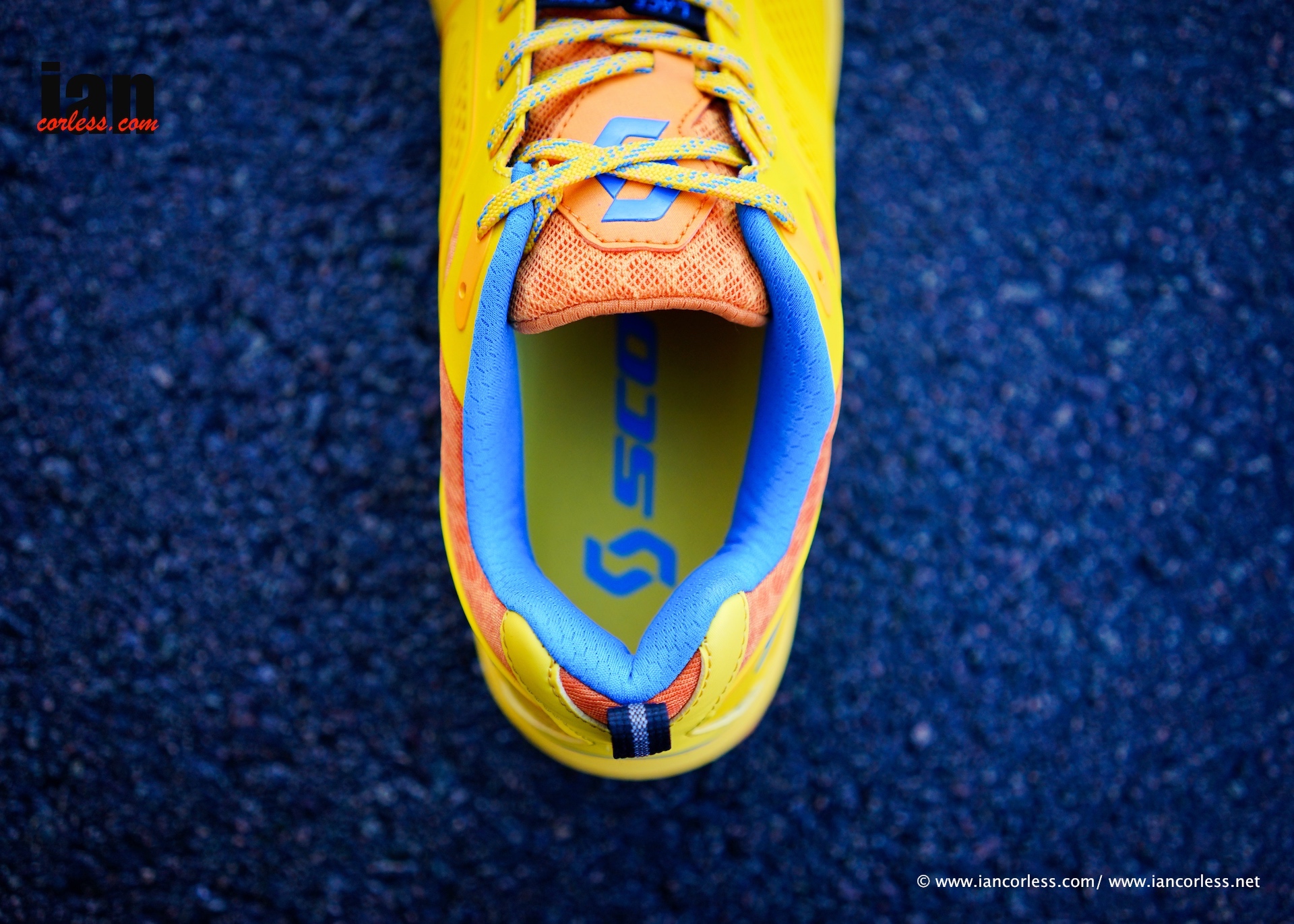
Heel box is very plush and secure. Always a key feature of Scott shoes and it really does add a secure and confident feel to the shoes.

©iancorless.com_ScottEnduro-00096

©iancorless.com_ScottEnduro-00088

©iancorless.com_ScottEnduro-00086

Sizing feels a little larger than normal. I always take a UK9.5 and the ‘Enduro’ does feel just a little more spacious, so, if you are new to Scott or if you have used Scott in the past, you may just want to check on sizing. The toe box is a little narrower than the T2 Kinabalu 3.0 and Kinabalu Supertrac and this may be why they size a little larger? If you like a wide roomy toe box, this may not be the shoe for you?

©iancorless.com_ScottEnduro-00076

Technologies:

  • Lace Bungee
  • Protective-High-Abrasion-Casing
  • Seamless-One-Piece-Upper
  • Rock-Protection-Plate
  • Vibram-Megagrip

Initial Conclusion

Our initial reaction to the ‘Enduro’ was shock. We were surprised at how ‘protected’ this shoe is. But having run in them on just 2 occasions and reflected on what Scott are trying to do, I completely understand the the addition of this shoe to the Kinabalu range. This is not a shoe to replace the T2 Kinabalu or the Kinabalu Supertrac it’s a shoe to be used in addition. So, if you like the other 2 models you will like this.

I’m still perturbed that the shoe is 11mm drop and not 8mm but it runs well; so why worry?

What’s the shoe for?

Well I guess you can use the shoe for any running, from groomed trail, fire trail to mountains. But considering the protection that has been added to the ‘Enduro,’ one has to think that this is intended for the rough stuff; rocks, snow, ice, gravel, slate and so; anything that can really batter a shoe and reduce its life.

For perspective, I recently ran for 1-month in La Palma on the Transvulcania course, I used a brand new pair of Supertrac and I used them every day, at the end of the month I threw them away. I am not saying the ‘Supertrac’ was no good, on the contrary, I love the Supertrac but the trails out in La Palma are harsh and abrasive; it eats shoes. The Enduro may well be a good shoe for a course like that due to the key elements of:

  • Protective-High-Abrasion-Casing
  • Seamless-One-Piece-Upper
  • Rock-Protection-Plate
  • Vibram-Megagrip

We will be reporting back in a couple of months after long term testing and only then will we really know how the Scott Kinabalu Enduro stacks up.

Scott shoes are available HERE