There’s a long-standing idea in the running community that races should be cheap. The logic is simple: running itself is simple. Put on a pair of shoes, head outside, and run. So when people see an entry fee for a trail, mountain, or ultra race that feels high, the reaction is often the same.
Why does it cost so much?
The truth is that the world those expectations came from barely exists anymore. Years ago, many races were small and local. They were often organised by running clubs or small community groups. The courses were modest. The participant numbers were manageable. Volunteers handled most of the work. Costs were relatively low, and so were entry fees.
Those races still exist in places, but the sport around them has changed dramatically. Trail running, ultrarunning, mountain racing and skyrunning have exploded in popularity. Courses have become longer, more remote and more technical. Participant numbers have increased. Expectations have risen. And alongside that growth has come something unavoidable: responsibility.
Modern race organisation carries real obligations.
If you put hundreds of runners into remote terrain, often in extreme weather and over difficult ground, you cannot simply mark a course and hope for the best. Safety is not optional anymore. It’s a requirement.
That means medical teams. It means coordination with mountain rescue. It means risk assessments, insurance, emergency plans and communications systems. It means trained marshals, sweep teams, and logistics that can respond quickly when something goes wrong.
All of this costs money.
Then there are the physical elements of the race itself. Start and finish areas. Timing systems. Course marking. Aid stations. Equipment transport. Permits. Land access. Environmental management. Insurance. Staffing.
Even a single-day race can involve months of preparation. Often a full year of planning. And that’s before considering the scale of many modern events.
Large trail races now operate almost like temporary cities. Hundreds or thousands of runners, staff and volunteers moving through remote areas across dozens or even hundreds of kilometres. Everything must work. Everything must be safe. None of that is inexpensive.
Now consider multi-day events.
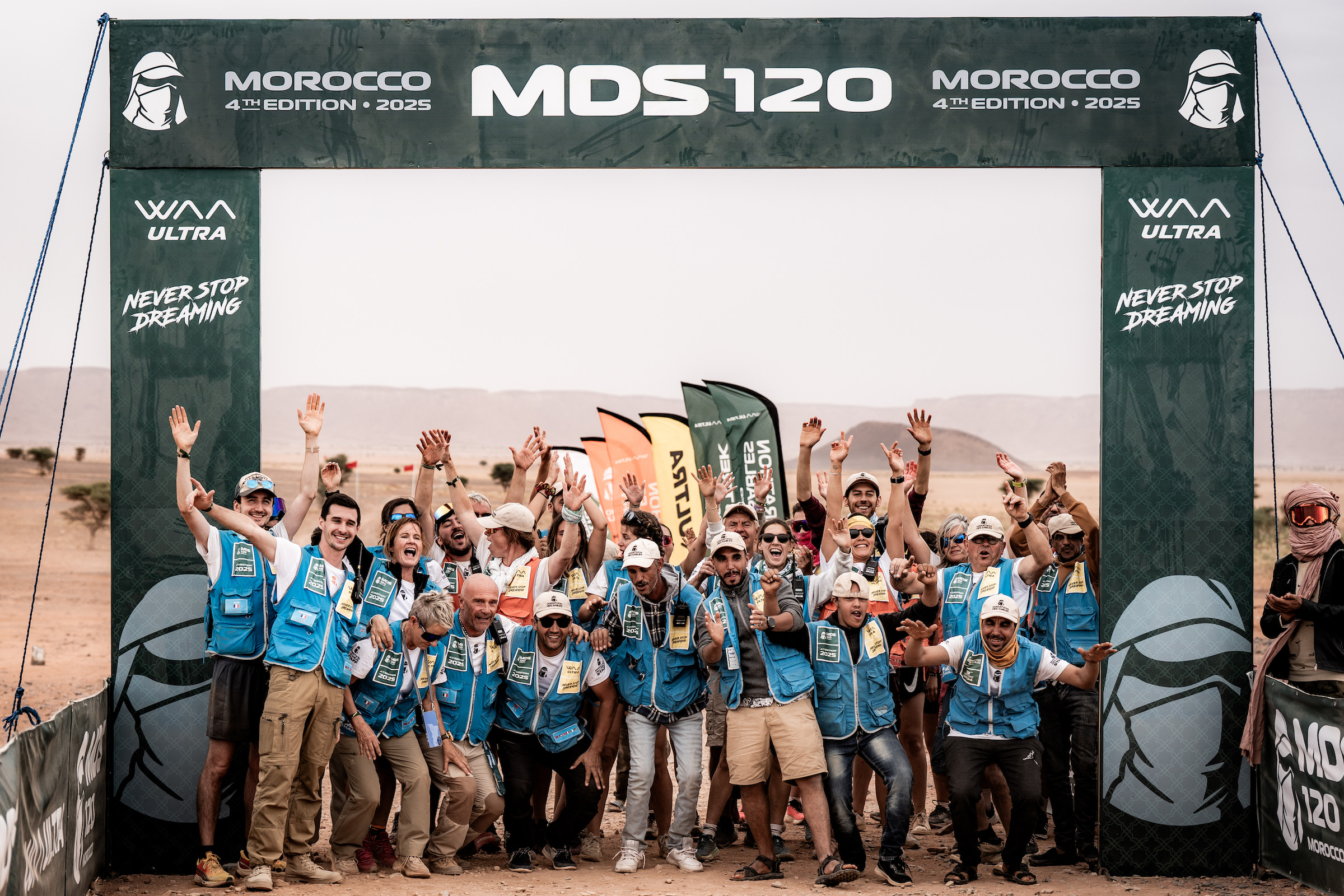
MDS 120 Morocco
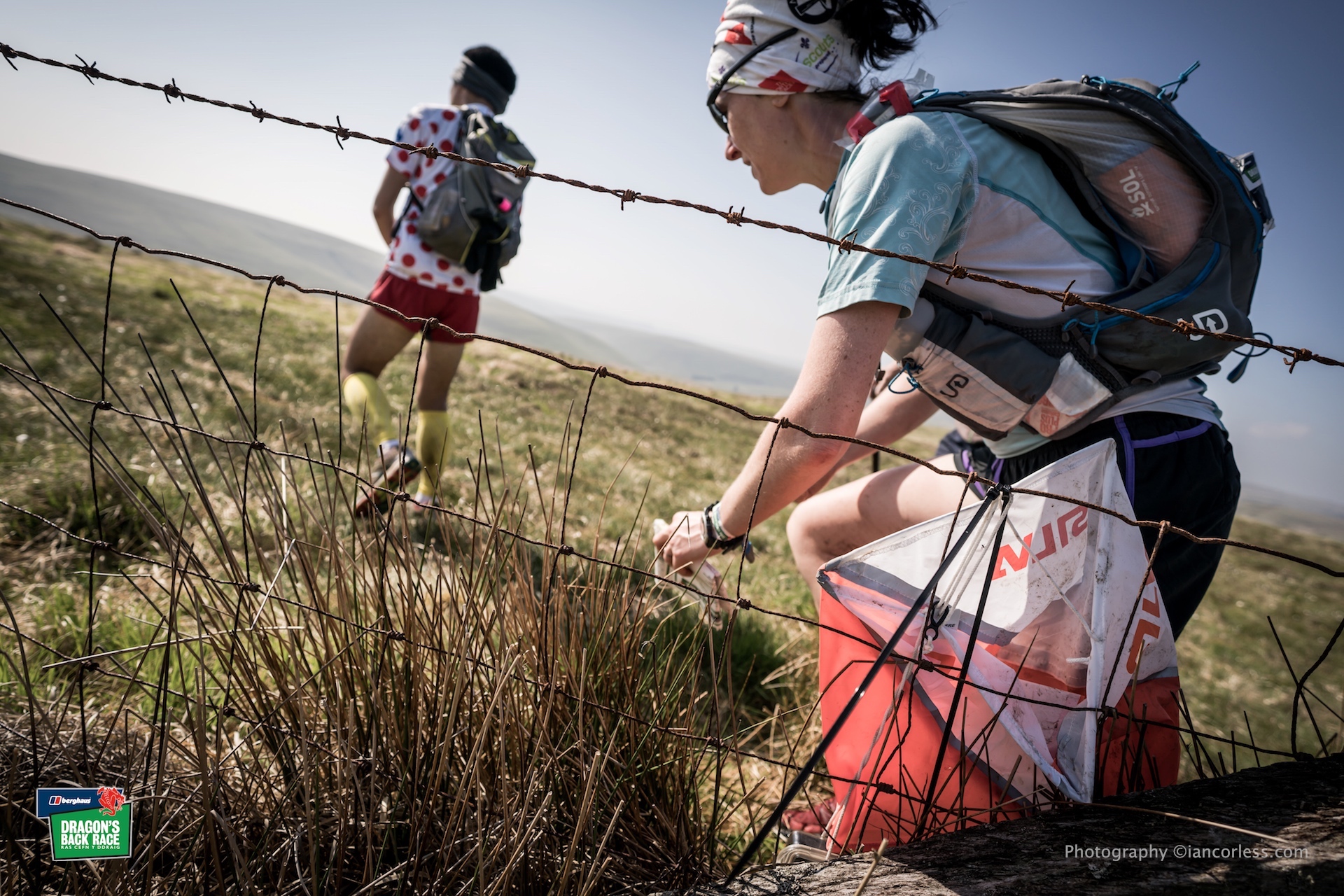
Races like the Marathon des Sables or the Dragon’s Back Race take the complexity of a one-day race and multiply it several times over and then add some! Every additional day means more logistics, more transport, more staff, more food, more safety coverage, more accommodation, more contingency planning.
Trofeo Kima – Italy
A week-long mountain race is not just a race repeated seven times. It is an expedition with hundreds of participants. Costs scale quickly. And with that scale comes risk, financial risk.
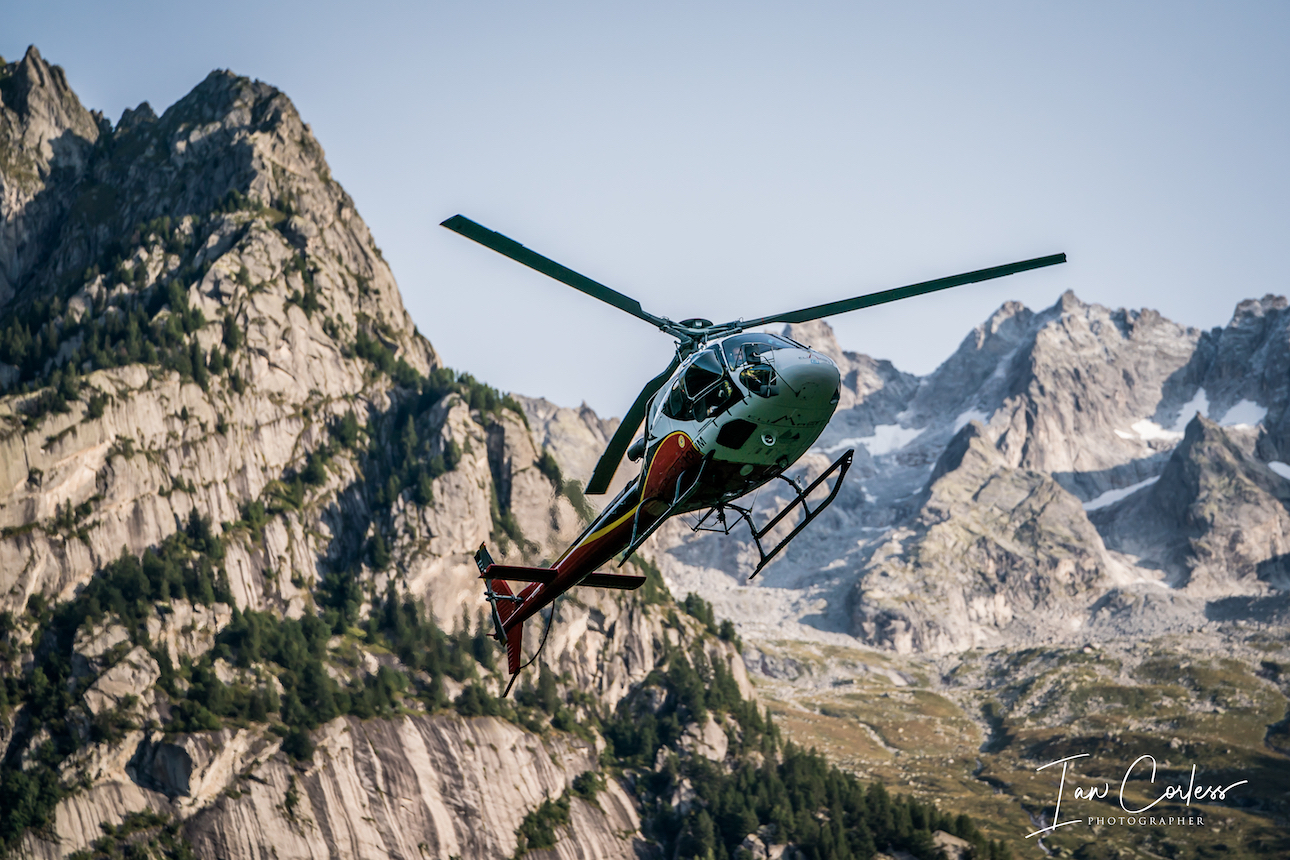
Race organizer’s carry it all – permits, deposits, infrastructure, insurance, tracking, staff contracts, transport bookings, equipment hire, maybe even helicopter cover – most of these costs are committed long before the first runner even registers.
Running races today are not informal club gatherings. They are businesses. That does not mean organisers are making huge profits. In many cases, margins are incredibly tight. Weather can disrupt events. Participation numbers can fluctuate. A single cancellation can create massive financial losses.
Which brings recent events into focus.
Cape Wrath
The closure of Ourea Events surprised many runners. Their races, including the Dragon’s Back Race and the Cape Wrath Ultra, were often described as expensive. But when you actually look at what those races involved, the pricing begins to make sense.
Multi-day racing across remote mountains with extensive safety systems, complex logistics, transport of participants and equipment across long distances with camps, food, communications and medical support – this is expensive.
Events like that are extraordinarily complicated to deliver safely. Perhaps the bigger question is not whether those races were expensive. Perhaps the question is whether they were ever truly priced to reflect what they actually cost.
There is often an expectation that race organisers should keep entry fees low, almost as if races are a community service rather than a professional undertaking. But if you organise a race today, especially in remote or mountainous terrain, you are operating a business – you have to be. No business can survive if it consistently prices its product below its true cost.
The running community may need to confront an uncomfortable reality. If we want well-organised, safe, professionally run events with excellent logistics, that comes at a price.
If we want medical coverage in remote mountains, that costs money. If we want reliable course marking, well-stocked aid stations, experienced crews, proper safety oversight and seamless logistics, that costs money too.
None of it appears out of thin air.
Of course, no one is forced to enter a race. And that’s an important point. If a race entry fee feels too high, the trails are still there. The mountains are still there. You can run the same paths any day of the week for free.
But if we choose to participate in organised races, especially the kind that now define modern trail and ultrarunning, we need to understand what it actually takes to create them.
Behind every start line is a year of planning. Behind every finish line is a huge operational effort. And behind every race number is a long list of people, equipment, safety systems and infrastructure working to make sure runners get through the experience safely.
UTMB
Running may be simple.
Organizing a race no longer is.
And perhaps it’s time the community fully recognized that.
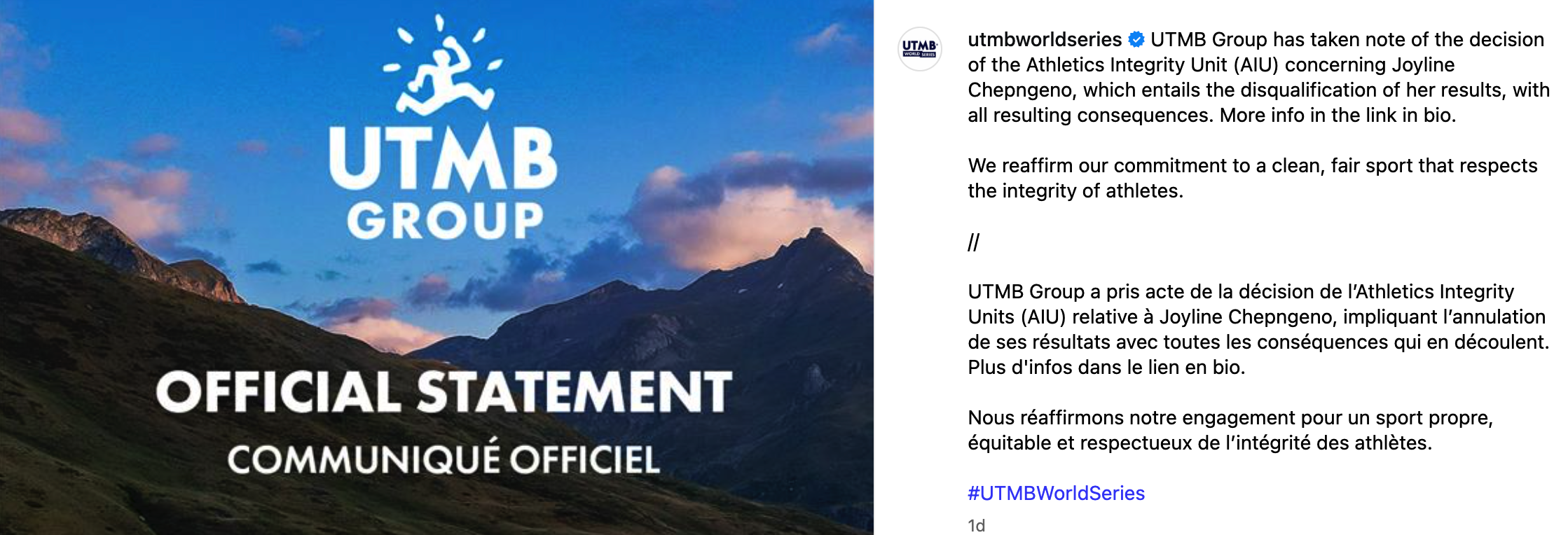
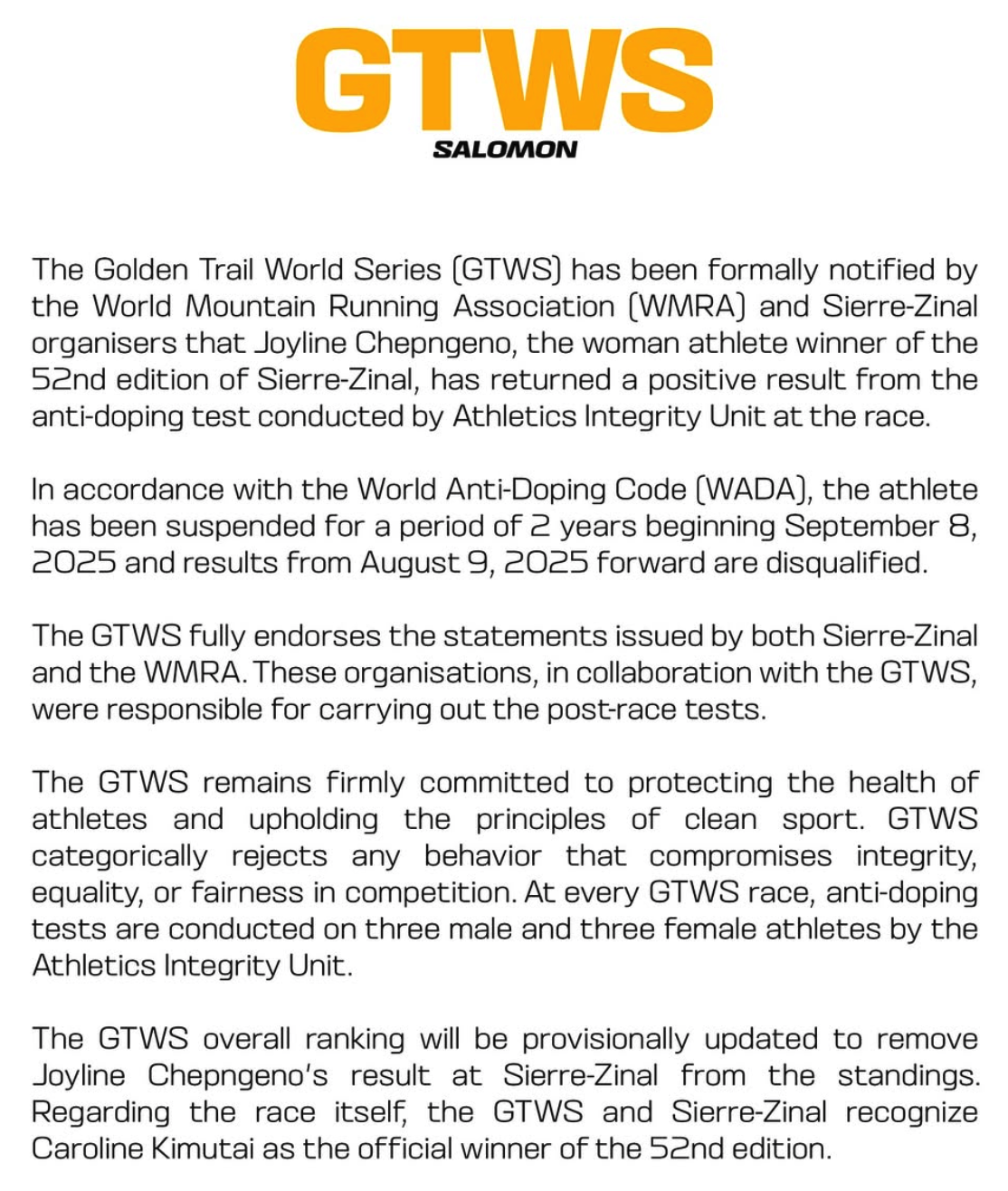
When news broke that Kenyan trail running champion Joyline Chepngeno had been banned for two years after testing positive for triamcinolone acetonide, the reactions were swift and polarised. On one side: condemnation and disbelief. On the other: questions about fairness, context, and whether the system designed to protect clean sport actually confuses athletes into mistakes.
Let me be clear, there is no place for doping in any sport, however, the Chepngeno and Angermund cases should and must make us think deeper.
Chepngeno admitted she received an injection in July, and the drug in question – a corticosteroid widely used for inflammation – sits in one of the sport’s murkiest regulatory zones. Under the World Anti-Doping Agency (WADA) code, triamcinolone is banned in-competition, unless the athlete secures a Therapeutic Use Exemption (TUE). Sounds simple enough, but in practice the rules are anything but. The case raises bigger questions: Was she naive? Did her team fail her? Was Salomon right to sever ties so quickly? And is WADA’s own ambiguity part of the problem?
“Chepngeno may have taken the injection for a genuine medical issue – inflammation, pain, or recovery – but without the right paperwork, timing, and guidance, it became a career-altering violation.”
Kenya’s Reputation and the Weight of History
Kenya has long been under the microscope for doping violations. In recent years, its athletes have faced increasing scrutiny, with dozens of cases making international headlines. This history frames Chepngeno’s case: even a whiff of doping from a Kenyan runner is quickly interpreted through the lens of systemic abuse, rather than individual misjudgment.
But this framing risks oversimplifying. Many Kenyan athletes operate in environments with limited medical oversight, inconsistent education about anti-doping rules, and managerial structures that prioritize racing and prize money over compliance. Chepngeno may have taken the injection for a genuine medical issue – inflammation, pain, or recovery – but without the right paperwork, timing, and guidance, it became a career-altering violation.
The Role of the Manager/ Coach: Protection or Neglect?
A professional runner’s manager/ coach, in this case, Julien Lyon, is more than just a race scheduler. They are, or should be, a gatekeeper for the athlete’s career:
Pros of strong management:
Ensures the athlete understands what substances are permitted.
Helps navigate the dense bureaucracy of WADA codes, TUE applications, and medical clearances.
Provides financial and legal protection when mistakes happen.
Balances competitive demands with athlete health and long-term career viability.
Cons or failures of management:
When managers are absentee or focused solely on performance, athletes are left vulnerable.
In many Kenyan cases, managers are foreign-based agents whose primary incentive is to get athletes on the start line, not to invest in their education.
A lack of day-to-day oversight means athletes may trust local doctors, clinics, or informal advice without realizing the implications.
Chepngeno’s admission that she did take the injection suggests honesty, not deception. But it also signals that no one around her flagged the risk. A competent manager should have either prevented it or ensured the correct exemptions were in place. If the manager’s job is athlete protection, this could look like a potential failure? **
“The Sierre-Zinal race organisation has announced that it has banned Chepngeno’s coach Julien Lyon and his Milimani Runners team from future competitions. It has also, according to the statement, ordered Lyon to ‘fully reimburse prize money, accommodation costs and administrative fees arising from the case – including reputational harm – owed to the Sierre-Zinal Association’.” – (c) Runner’s World
Lyon also coached the 2022 Sierre-Zinal men’s and women’s champions, Kangogo and Chesang, both of whom were later suspended and stripped of their titles for doping.
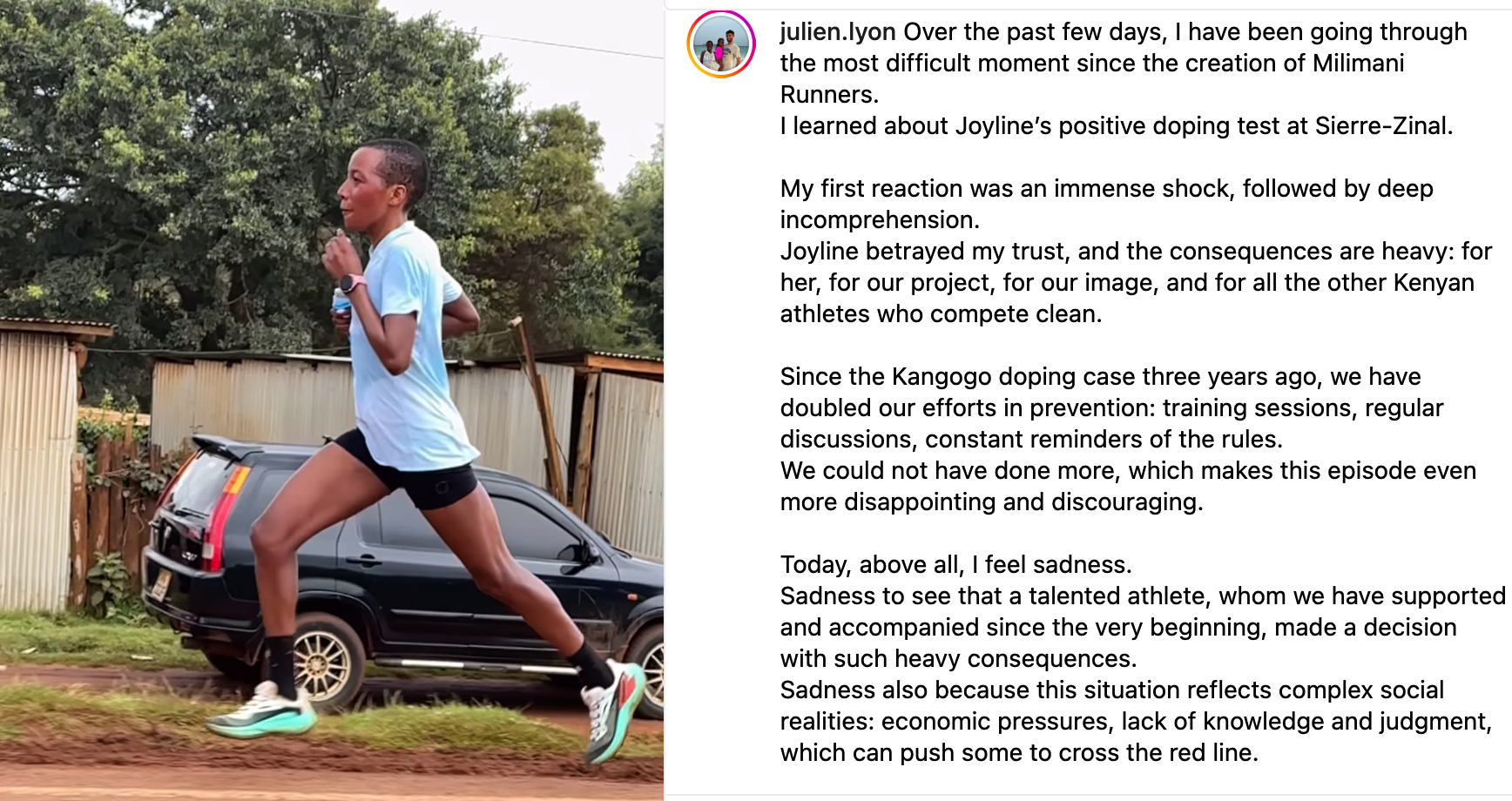
In response to Sierre-Zinal, Julien Lyon via Instagram stated: “Finally, I must respond to the serious and defamatory accusations published by the Sierre-Zinal organization. These statements are completely unacceptable. I am already devoting significant energy to restoring the facts and I have no intention of giving up.”**
Update September 13th:**
Julien Lyon has responded with a clear statement on Instagram, read HERE.
Let me be absolutely clear: • I had no knowledge whatsoever of the use of this substance. • I have never, in any way, encouraged or tolerated such an act. • I have always fought against doping and I will continue to do so.
From now on, I am already reflecting on concrete solutions: implementing more regular out-of-competition testing, even if it represents a significant cost that must be discussed with our partners, and developing closer, culturally adapted medical support in Kenya. I deeply regret that Joyline may have felt left alone with her pain and doubts. She had my full support, and I regret not being even more present for her during this difficult time. I want to ensure that Milimani Runners athletes feel supported not only in their sporting careers, but also in their health, their choices, and their education. – Julien Lyon via Instagram
The Sponsor’s Role: Salomon’s Swift Rejection
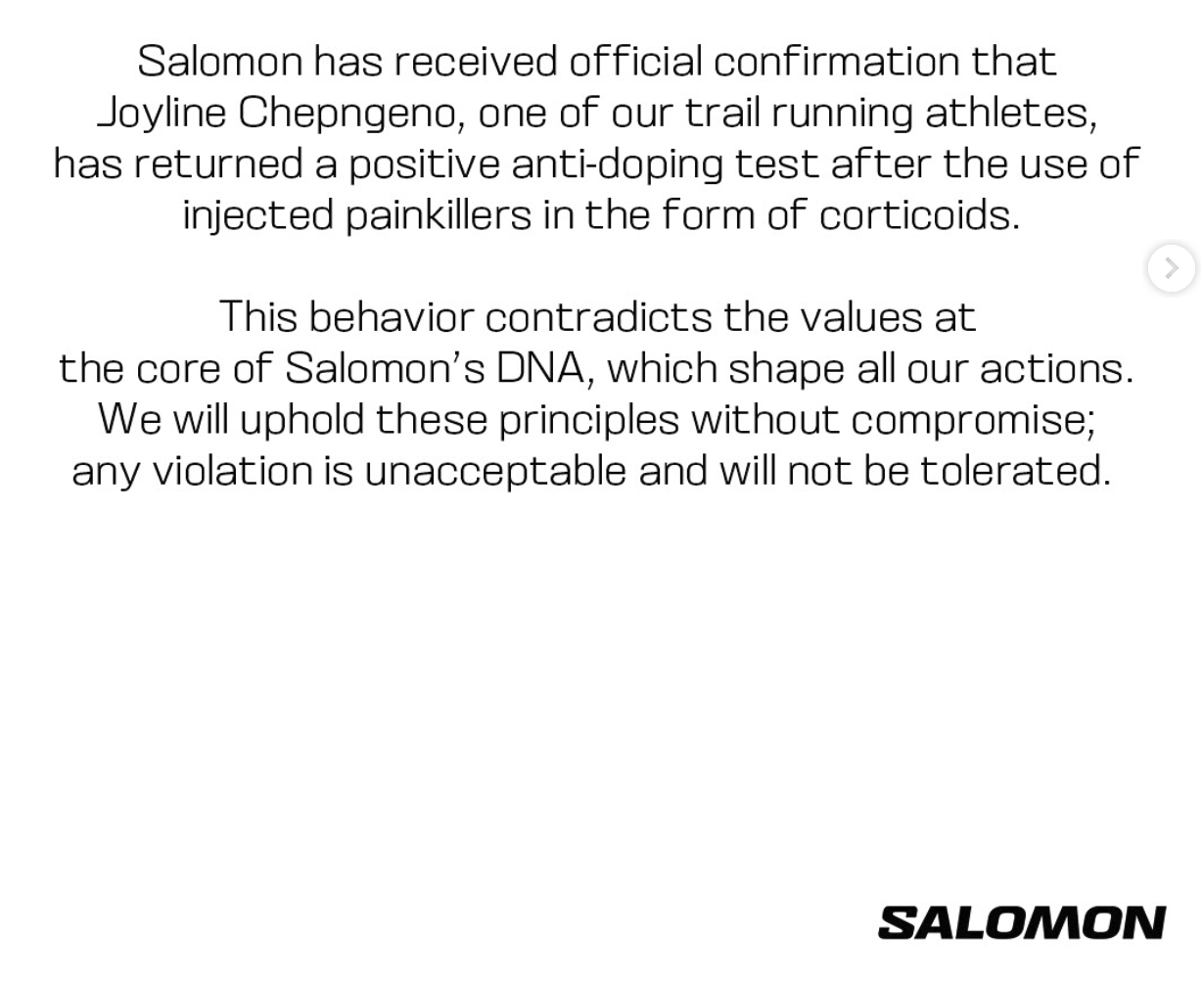
Salomon, Chepngeno’s sponsor, moved quickly to cut ties. On one level, this is understandable: brands cannot afford reputational damage in a sport that already battles questions of integrity. Corporate zero-tolerance policies are often blunt but clear: fail a doping test, and the contract ends.
But here lies the ethical dilemma. Was Salomon protecting the sport, or protecting its image? By severing ties without nuance, the brand effectively punished Chepngeno twice: once through lost income and again through public rejection. A more responsible approach might have been suspension pending investigation, or supporting her with legal and educational resources.
Sponsorship is not just about exposure and winning; it’s also about athlete welfare. When brands abandon athletes at the first sign of trouble, it signals that their investment was never truly in the human being, only in the results.
A Contrast: The Case of Stian Angermund
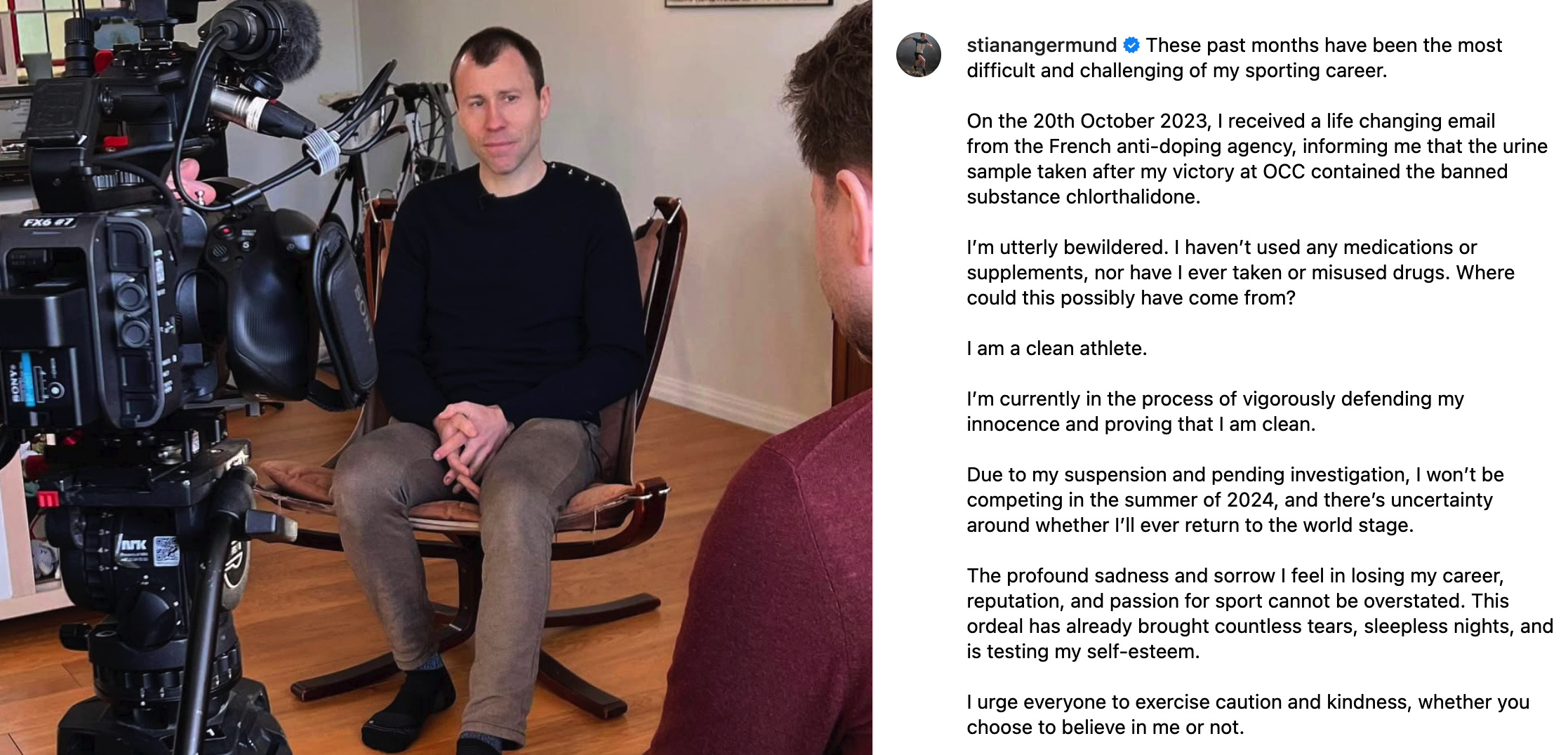
The difference in how Chepngeno’s case was received becomes starker when compared with that of Stian Angermund, one of Norway’s most successful trail runners. Angermund also tested positive in 2023 for the diuretic chlorthalidone.*
Yet the public response to Angermund was notably softer. Many in the trail running community rallied around him, framing him as a victim of circumstance, a clean athlete caught in an unfortunate situation. His protestations of innocence gained traction, with commentators and peers stressing his reputation, personality, and history as evidence of credibility.
On February 10th, 2024, the trail running world was rocked by news out of Norway – the two-time World Champion, Stian Angermund, had tested positive for the diuretic chlorthalidone. via Freetrail here.
Chepngeno, by contrast, has not been afforded the same sympathy. Instead, her case was quickly folded into the broader narrative of Kenya’s doping crisis, with far fewer voices offering the benefit of the doubt. This disparity speaks volumes about how nationality, reputation, and public image shape perception. Where Angermund’s case was seen as an anomaly in a clean career, Chepngeno’s was framed as part of a pattern – even though the substance she took is far more medically common, and her admission suggested transparency, not deception.
Sponsors and Double Standards
The sponsorship response reveals this double standard even more starkly. Salomon cut ties with Chepngeno almost immediately, distancing itself without nuance. In contrast, sponsors and partners in Angermund’s case were slower to act, with ‘some’ showing signs of support while the investigation unfolded. The messaging was different too: in Angermund’s case, words like uncertain, unfortunate, and out of character dominated coverage; in Chepngeno’s, the language leaned toward guilty, systemic, and Kenyan problem.
This isn’t just about corporate crisis management – it reflects deeper biases. Western athletes with strong reputations are given space to argue their case, while Kenyan athletes are too often treated as disposable. If sponsors only invest in results but not in athlete welfare, the sport risks reinforcing inequities that mirror global power imbalances.
WADA’s Ambiguity: Is Triamcinolone Doping or Not?
Here lies the central confusion. Triamcinolone is not an anabolic steroid. It is a corticosteroid — widely prescribed to treat inflammation and injury. In many medical contexts, it is routine and even necessary.
WADA bans it only in-competition, unless a TUE is granted. Out-of-competition, it is allowed. The catch? Athletes often receive injections or treatments without realizing where the “competition window” starts or ends. Did Chepngeno’s injection fall within the banned period? Did she even know the timing mattered?
And yes, I understand that the athlete has a responsibility to know and understand WADA rules.
The World Anti-Doping Code states the roles and responsibilities that athletes have in relation to anti-doping. So, athletes must: know and abide by the Anti-Doping Rules, policies and practices. be available for testing at all times.
The ambiguity sends mixed messages: if a substance is dangerous or performance-enhancing, why is it allowed out-of-competition at all? And if it is medically justifiable, why is the TUE process so opaque and burdensome, especially for athletes in countries with limited infrastructure?
Instead of clarity, WADA’s rules create traps. Athletes are told they are responsible for every substance in their body, but the system seems designed to catch technical errors as much as intentional cheats.
Was Chepngeno Naive?
The answer is complicated. On the surface, yes: admitting to an injection without checking WADA guidelines suggests a lack of awareness. But deeper down, her admission looks less like naivety and more like honesty. She did not hide the treatment, nor attempt to deny it. She took what may have been a routine medical step, unaware that it carried career-ending consequences.
The real naivety may not be hers but the system’s – assuming athletes across all geographies, languages, and economic realities can navigate a code written for those with legal teams and medical advisors.
Does Julien Lyon and Salomon have a responsibility? **
Financial and Moral Implications
For Chepngeno, the fallout is severe and many of you will say, good, that is how it should be.
Financial: Two years off the circuit means lost race earnings, lost sponsorship income, and a gap in her career at what should be her peak. For athletes from Kenya, whose entire family and community may rely on those earnings, the consequences are devastating.
Moral: Her reputation is damaged, regardless of intent. Once branded a “doper,” the stigma rarely fades, even if the violation was technical rather than malicious.
For the sport, cases like this erode public trust. Fans are left asking: was she cheating or simply careless? For sponsors, the financial risk increases – which in turn makes them more likely to cut ties at the first sign of trouble. And for Kenya, each case deepens the perception of systemic doping, even if the reality is far more complex.
What can be learned from this?
Contextual Justice: Not all violations are equal. Intent should matter as much as presence. Athletes like Chepngeno, who admit to treatment rather than hide it, deserve proportionate, not punitive, responses.
Clearer Rules from WADA: The line between therapeutic and prohibited must be made clearer. If triamcinolone is truly performance-enhancing, ban it outright. If it is a legitimate medical treatment, streamline TUEs and ensure athletes understand the timelines.
Better Athlete Education: Federations, sponsors, and managers need to invest in training athletes on what substances mean, how to apply for exemptions, and what to do before accepting treatment.
Stronger Manager Accountability: Managers should be held to professional standards. If their athlete tests positive due to negligence in guidance, they too should face consequences.
More Responsible Sponsors: Brands like Salomon should balance integrity with support. Cutting ties instantly might protect the logo, but it abandons the athlete. Support through due process would show real leadership.
Conclusion
Joyline Chepngeno’s ban is not just the story of one Kenyan athlete caught out. It is a case study in the tangled web of responsibility in modern sport: the athlete trying to heal, the manager who should have protected her, the sponsor that walked away, and the global regulator that still speaks in gray areas.
Was she naive? Perhaps. But more importantly, she was failed by a system that claims to protect athletes but too often punishes them for being human. Until WADA, managers, and sponsors share the burden of responsibility, athletes – especially those from vulnerable contexts like Kenya – will keep paying the highest price.
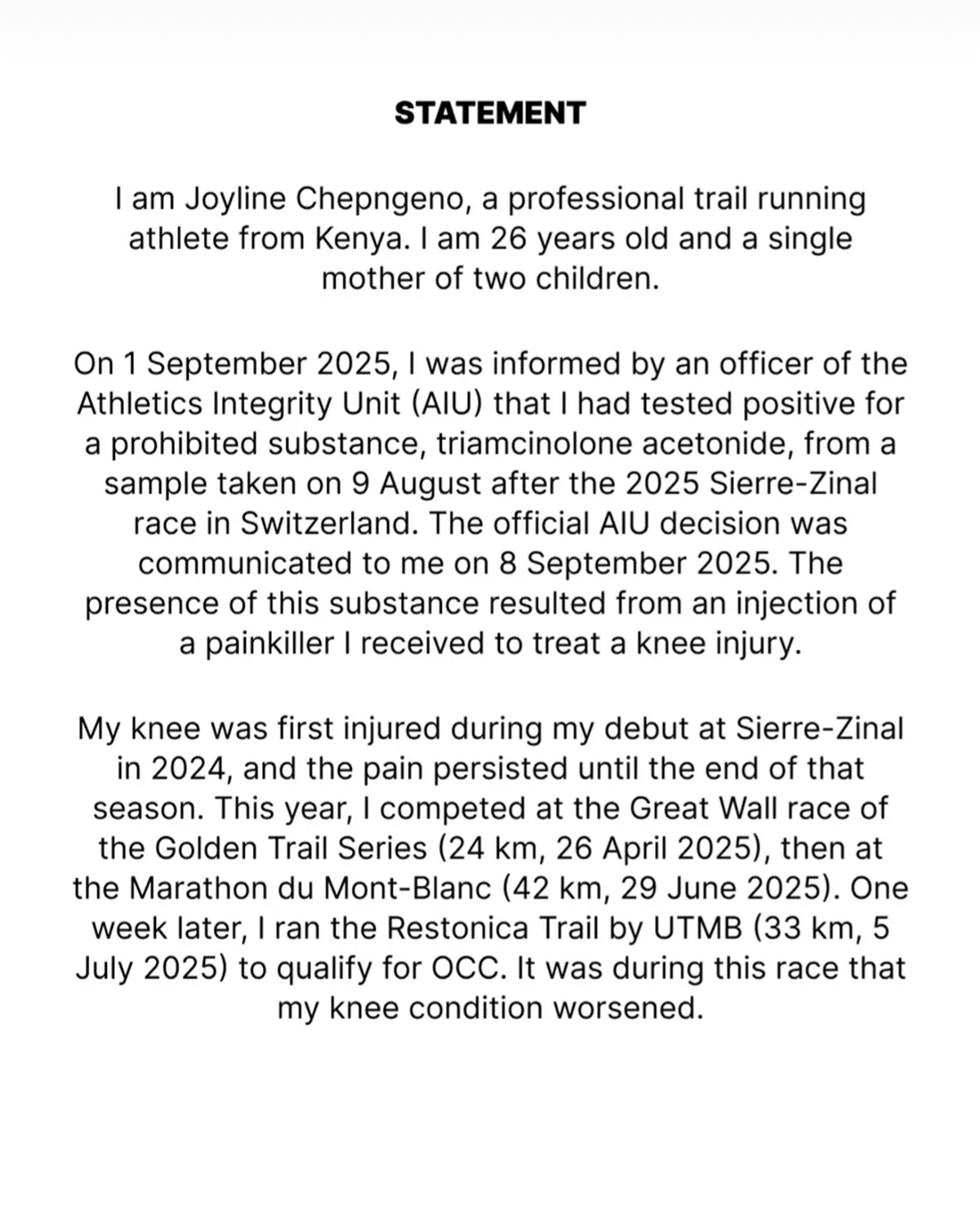
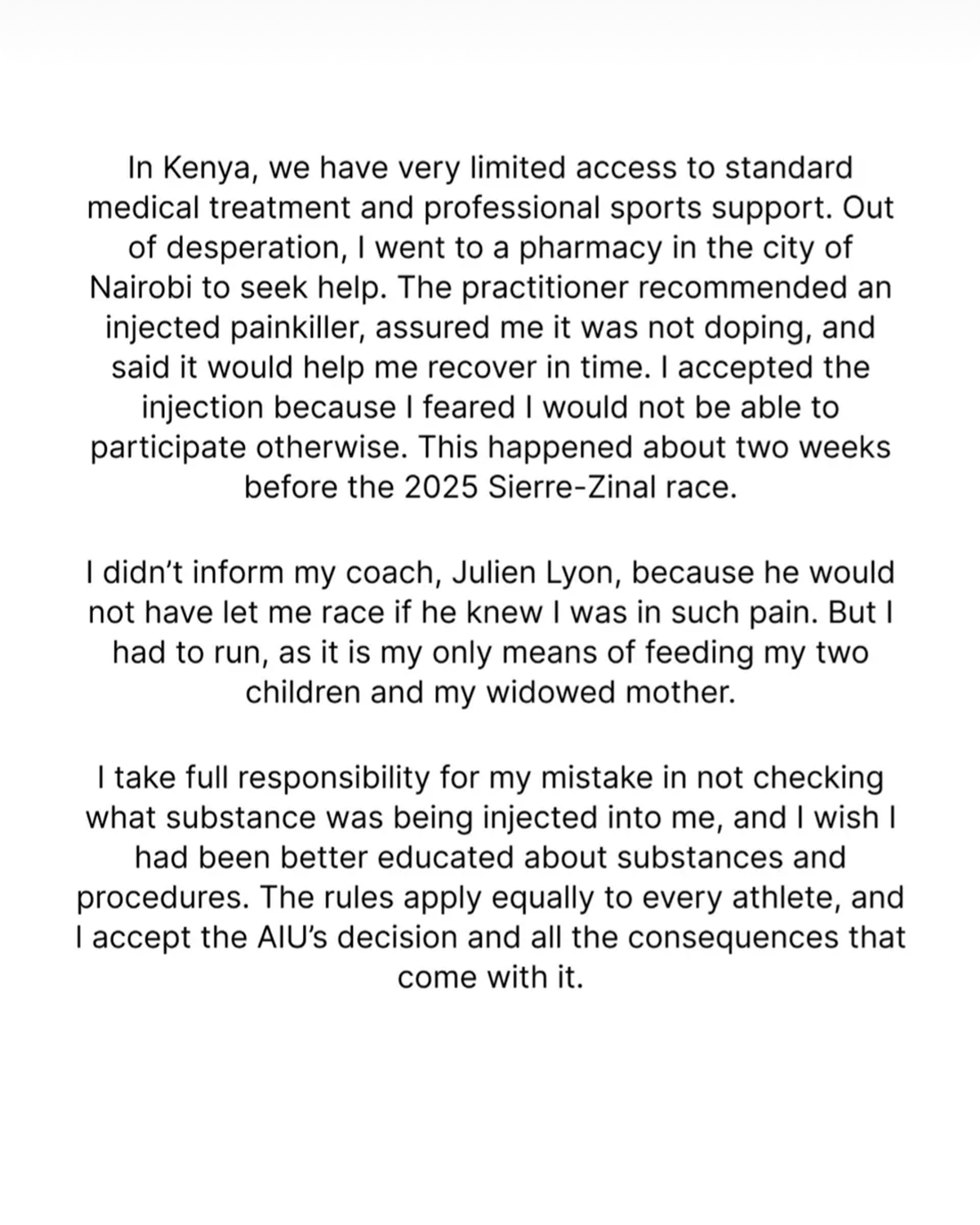
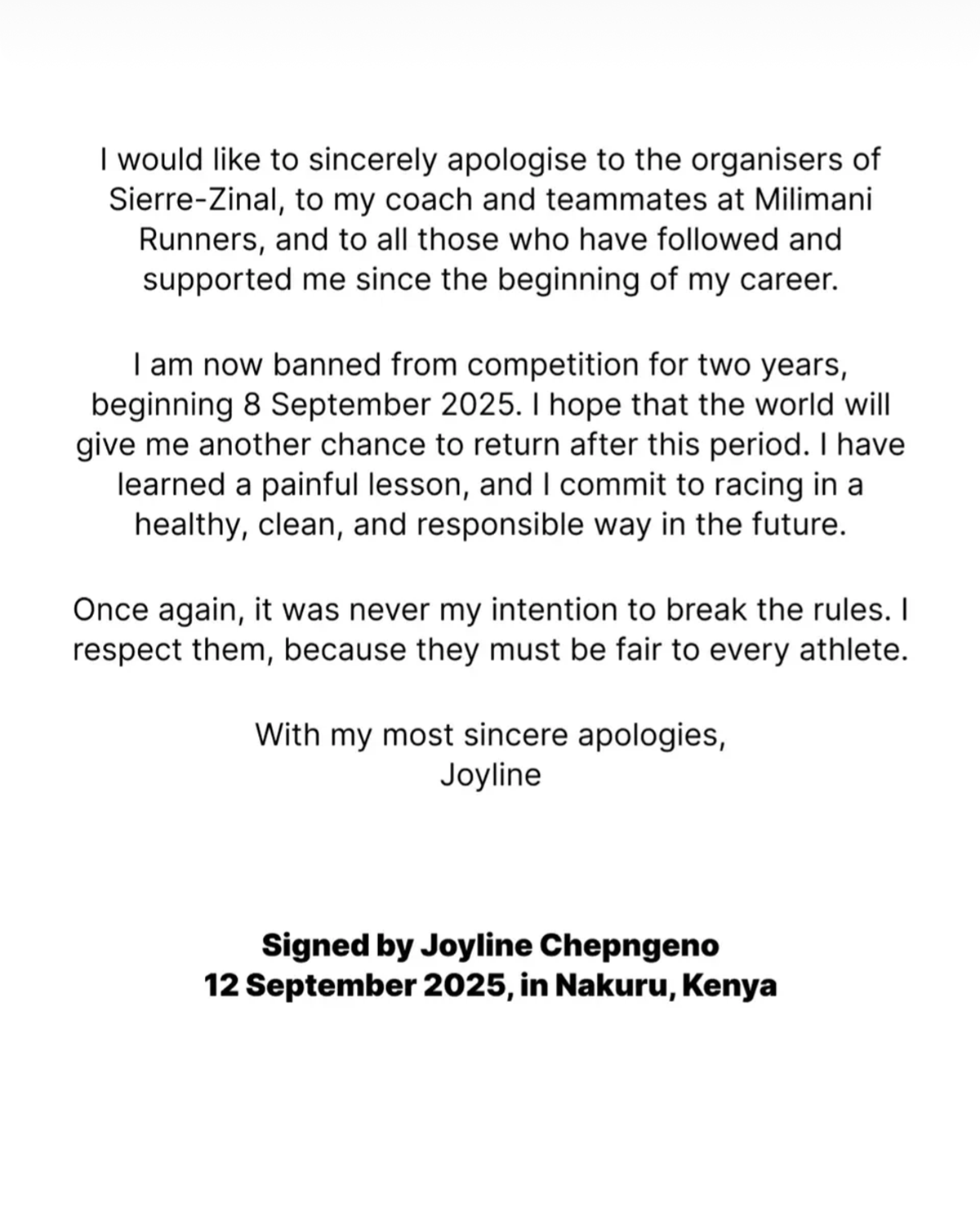
Update 12th September, Joyline Chepgneno posted on Instagram the following:
Final Note:
This article and post is designed to give a perspective to make the reader ask questions. To be clear, I am completely against doping, there is no place for doping in sport. I am well aware, for some, this article and words may make you angry – that is okay. Feel free to respond and counter with good debate and argument and be polite and professional.
** edits September 13th.
**Julien Lyon has taken exception to certain points raised in this article. Quoted below.) I stress that as a journalist, I am entitled to the right to freedom of opinion and expression, including the freedom to hold opinions without interference and to seek, receive, and impart information and ideas through any media, regardless of borders. As stipulated in article 19 in the Universal Declaration of Human Rights. However, it is important to be fair and allow all viewpoints to be considered.
“Several passages mention my name and attribute facts and responsibilities to me that are inaccurate and damaging to my professional reputation. For example: – You state that “the Sierre-Zinal organisation has announced that it has banned Julien Lyon and his team” – however, I have not received any official notification of such a decision, and no sanction has legal standing at this time. – You write “this looks like a clear failure,” implying that I failed in my duty to protect the athlete – this value judgment is not based on any objective evidence and constitutes a serious attack on my professional integrity. – The phrase “Lyon has history” suggests I have a track record of misconduct, which is defamatory. I therefore request that you either: – immediately remove these passages, or – publish a right of reply that sets the record straight.”
Of course, Julien Lyon, like anyone who reads this article, has a right to reply and the comment section is open for this.
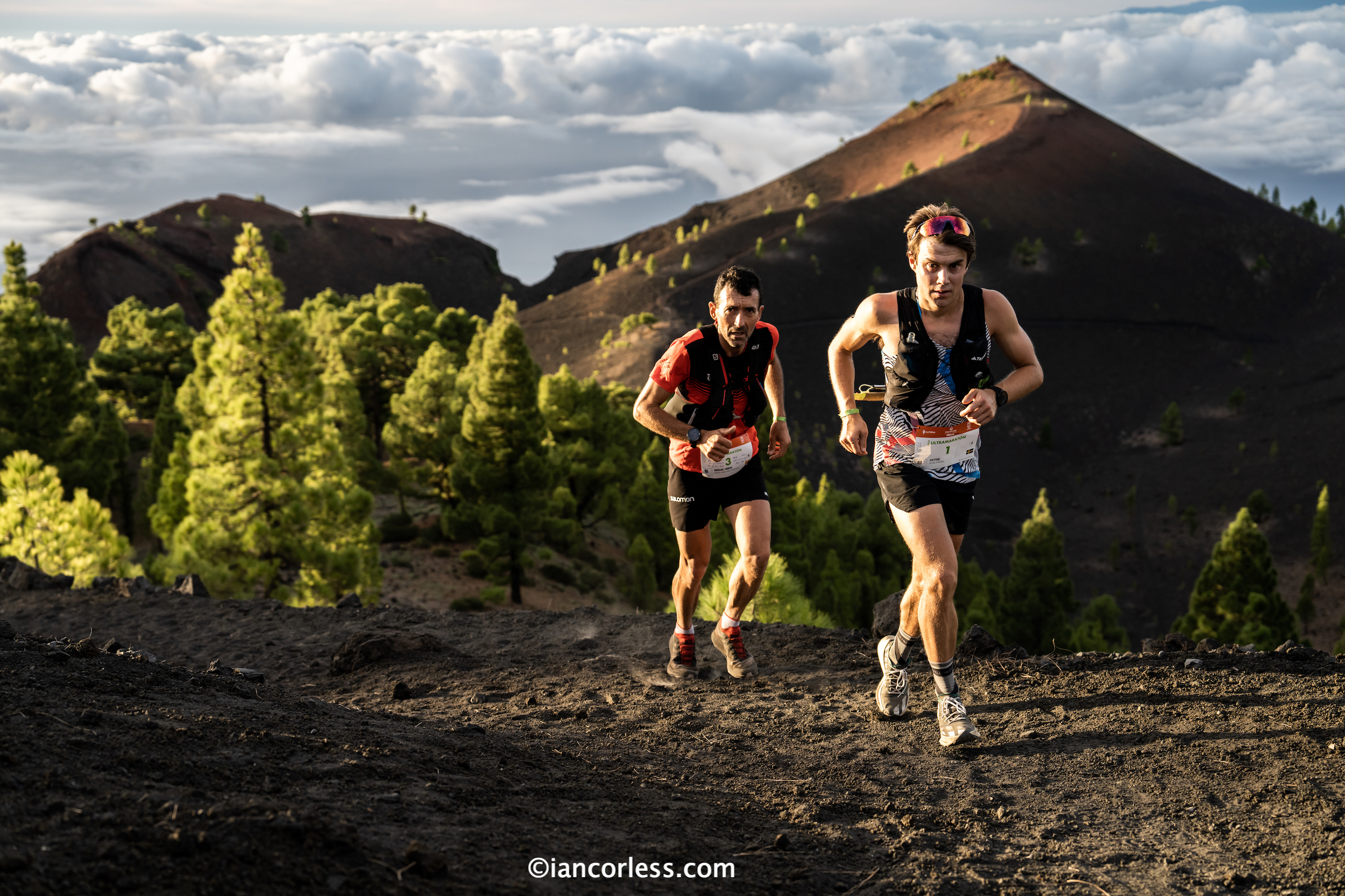
Episode 232 of Talk Ultra is a Petter Engdahl Special. After making the podium of OCC in 2021, Petter focussed his attention on the 2022 CCC – He won in a course record time. And now he has followed up with a dream victory at Transvulcania by UTMB. We talk in-depth about his training and preparation for these two incredible performances.
Importantly, go to iTunes and subscribe so that you automatically get our show when it’s released we are also available on Stitcher for iOS, Android and Web Player and now Tunein. We are also on Spotify too.
Our web page at www.iancorless.com has all our links and back catalogue.
Please support Talk Ultra by becoming a Patreon at www.patreon.com/talkultra and THANKS to all our Patrons who support us. Rand Haley and Simon Darmody get a mention on the show here for ‘Becoming 100k Runners’ with a high-tier Patronage.
Episode 231 of Talk Ultra has a chat with Tom Evans after his 3rd place at UTMB. Shane Ohly tells us about ‘Classic Rock’ and Speedgoat co-hosts and tells us about his UTMB.
Importantly, go to iTunes and subscribe so that you automatically get our show when it’s released we are also available on Stitcher for iOS, Android and Web Player and now Tunein. We are also on Spotify too. Our web page at www.iancorless.com has all our links and back catalogue. Please support Talk Ultra by becoming a Patreon at www.patreon.com/talkultra
In the last 4-days I have had around 10-hours broken sleep. That is the reality of working on multiple events during UTMB week.
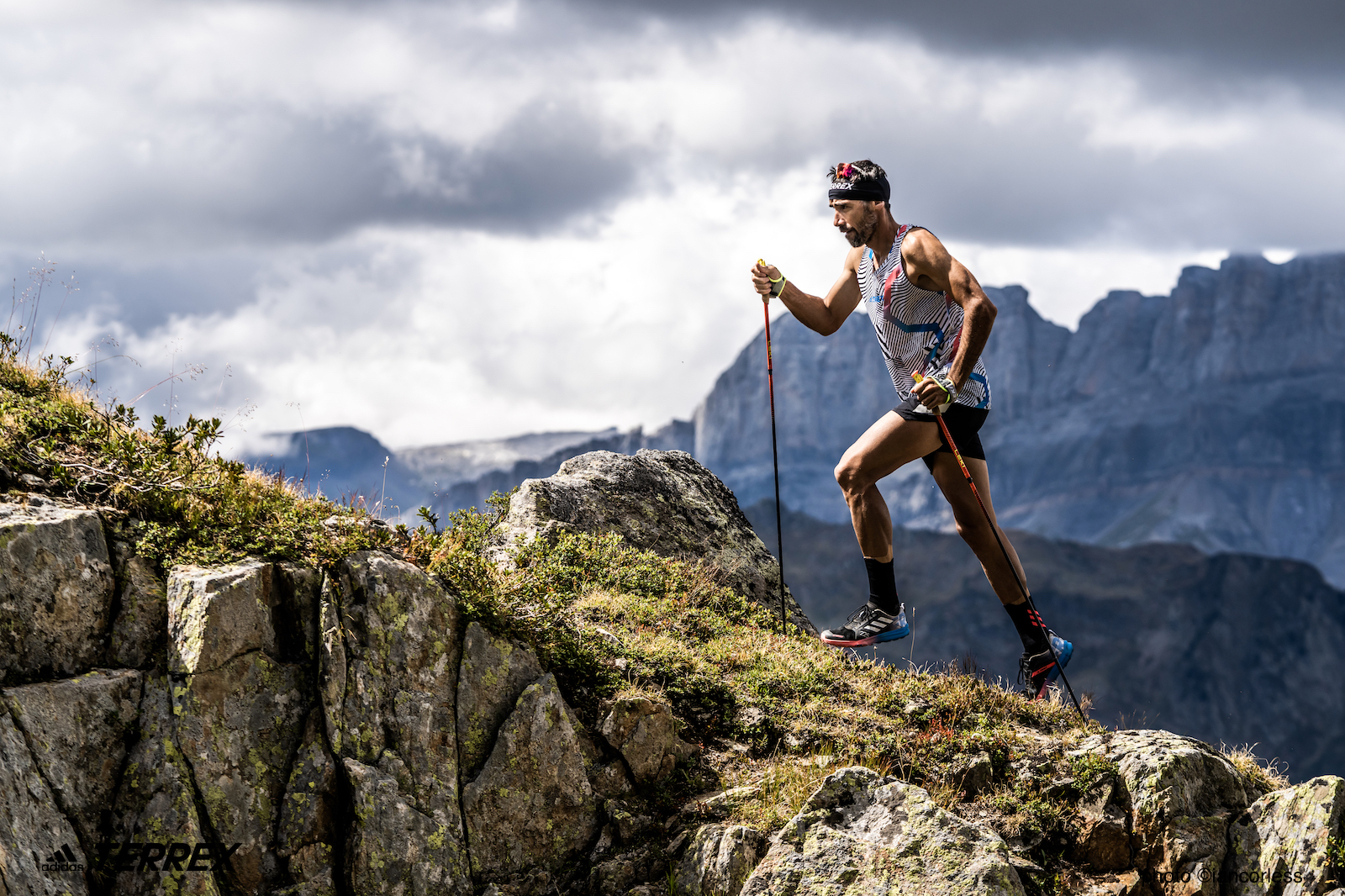
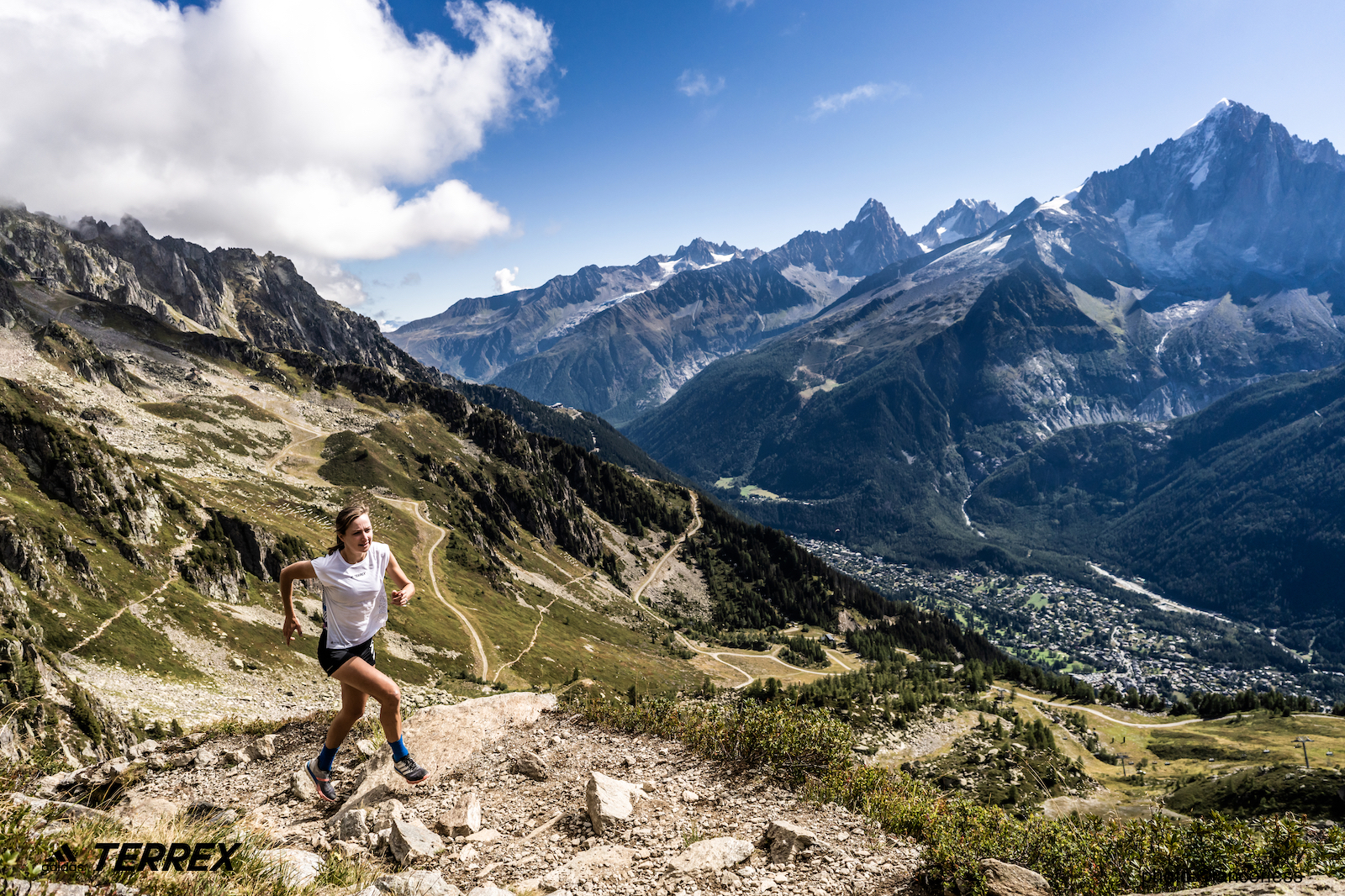
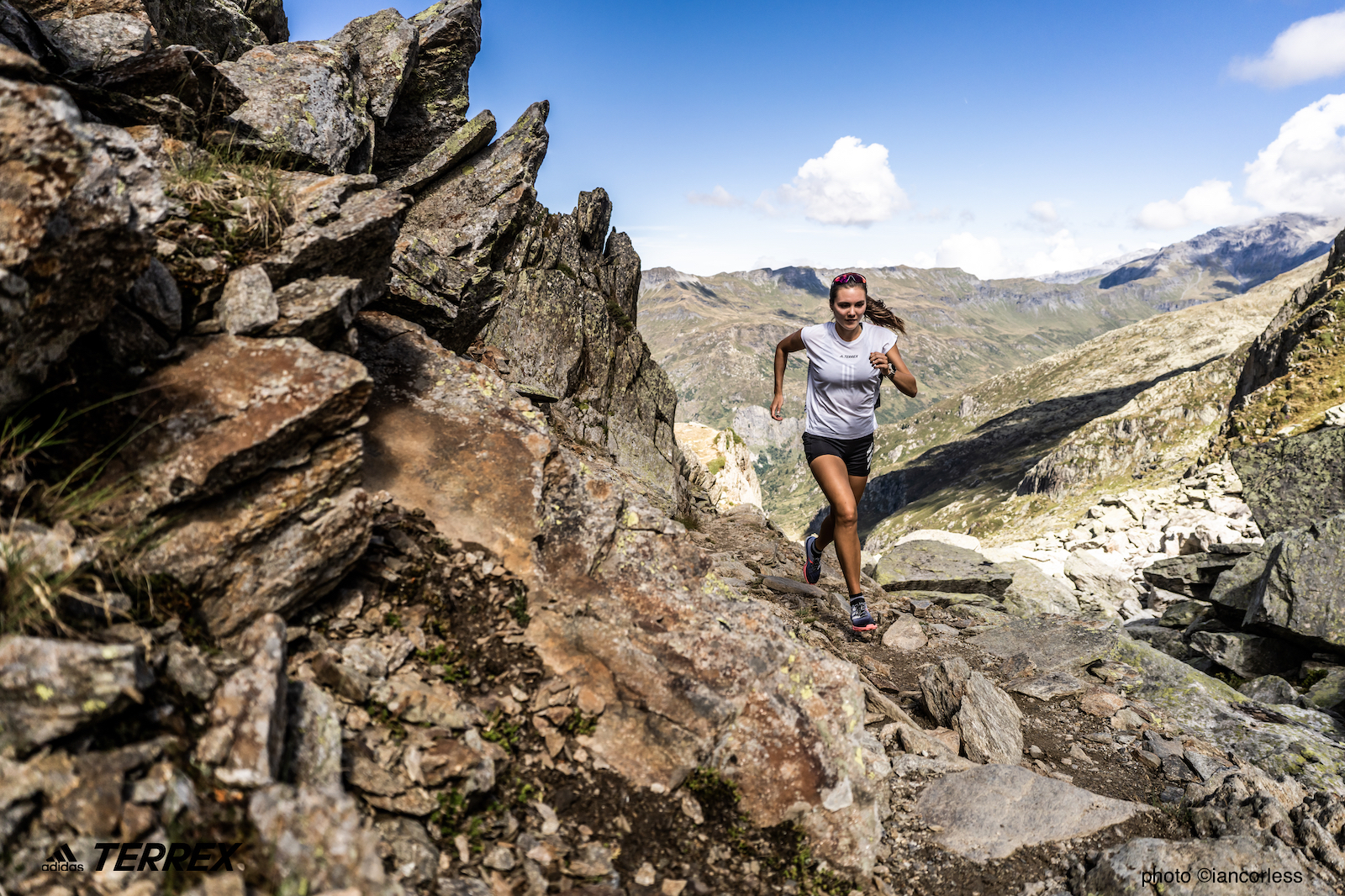
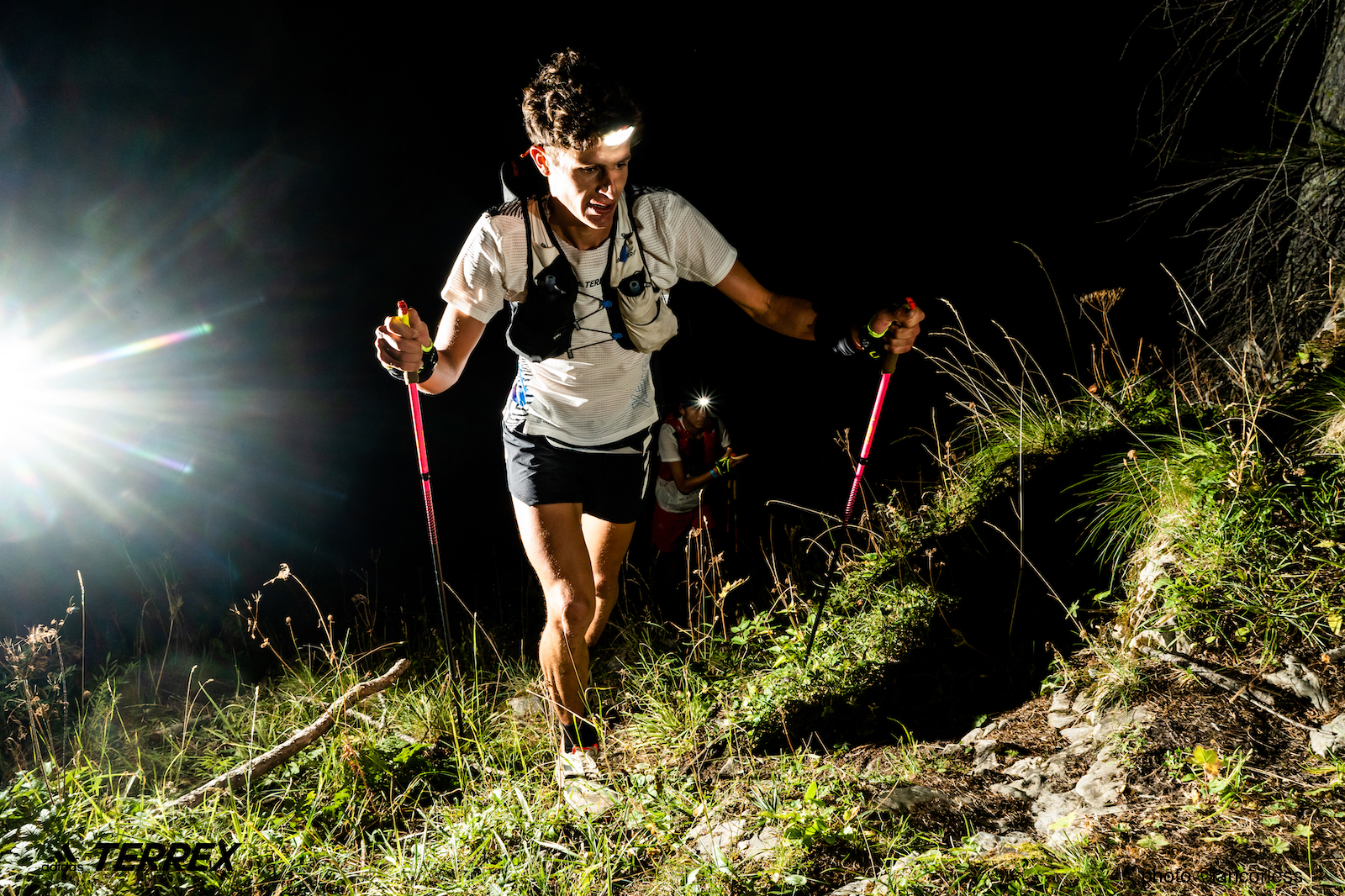
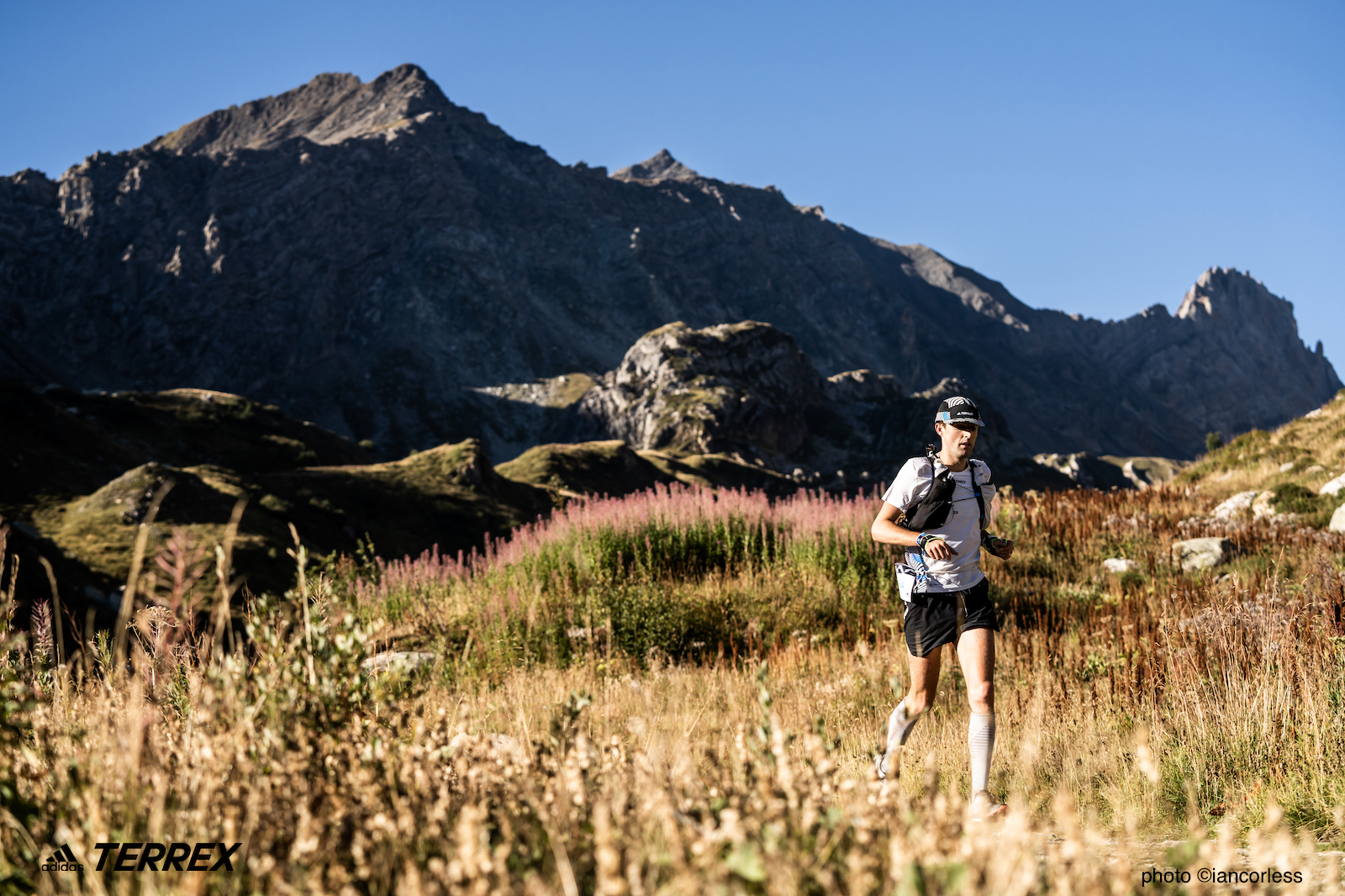
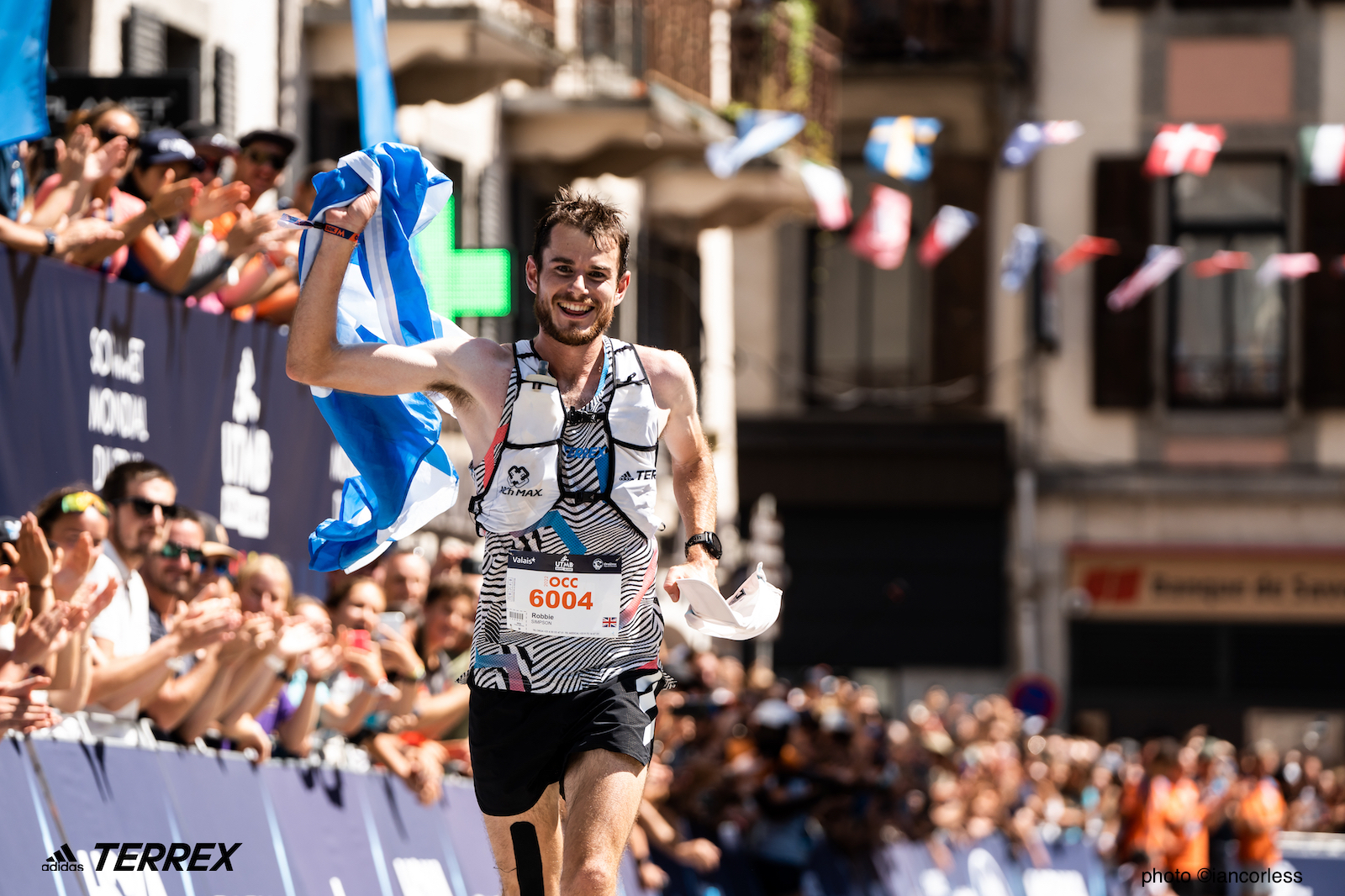
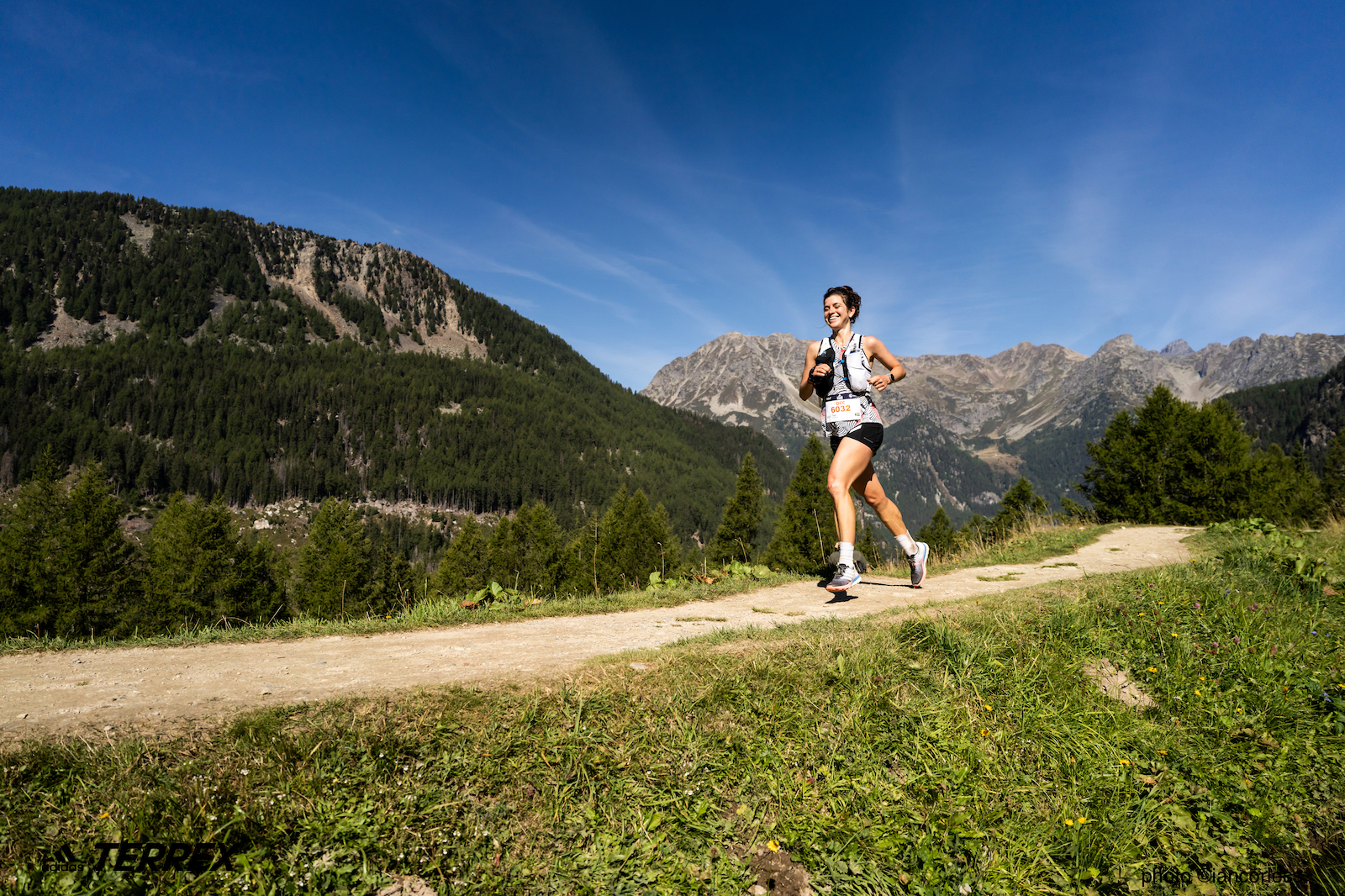
It all started though the week before, arriving in Chamonix on Thursday to join the adidas TERREX team for a full 10-day UTMB extravaganza. It was my 3rd time at UTMB with the TERREX team so I was under no illusion of what was ahead – amazing friends, quality time with athletes and crew and once the TDS got underway, little sleep.
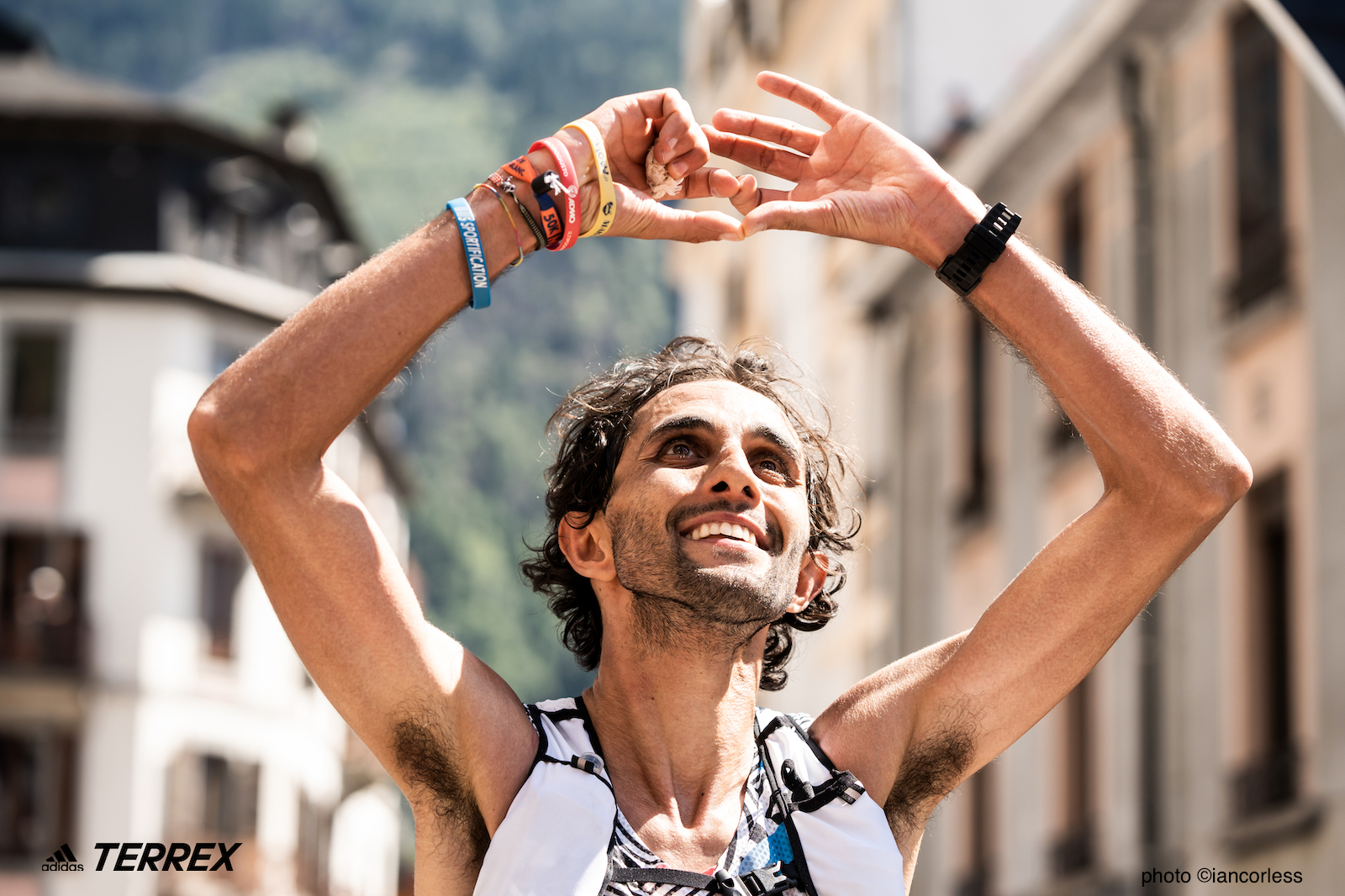
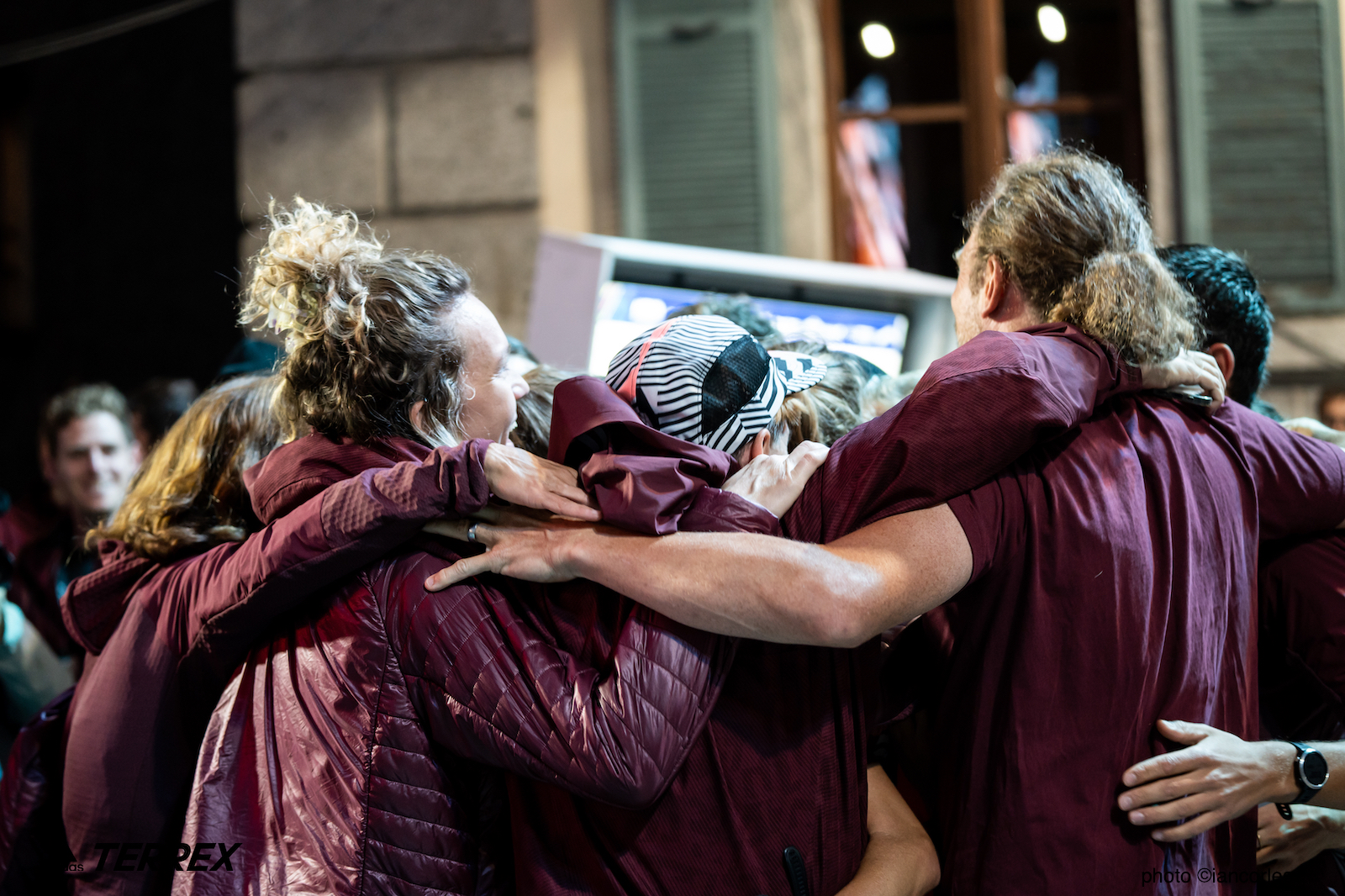
It’s a privilege and honor to work the TERREX team, I have seen them grow and grow in the sport and the ethos of #oneteam personifies what goes on before, during and after every event. Just look at the finish line footage of Emily Hawgood crossing the line to take 6th place at UTMB. The whole team was waiting, they surrounded her and unplanned, went into a frenzied bounce fest to celebrate not only an incredible run but an incredible team effort. No other pro-team does this and it’s noted by all the other media… The TERREX team are doing something very special.
You may well say I am biased. And I am not going to deny that I have a professional and working relationship with the brand. However, this is a choice. Working with the team management, the media crew and the athletes is a dream come true and one that is immensely rewarding.
adidas had once again rented multiple chalets and one huge chalet would act as a base for meeting up and all meals. The chalet had three chefs who provided meals for the entire team and in so doing, dietary needs could be looked after and the need to try to find a restaurant in Chamonix was removed. Physios were literally ‘hands-on’ every day from morning and Charlie and Robert managed the day-to-day team plans.
My emphasis pre-racing was to recorded Season 2 of ‘The Chamonix Tapes’ and provide some photo content.
UTMB week may well be what you, the fan or follower sees. But as in all these scenarios, the reality for UTMB 2022 started at the conclusion of UTMB 2021. It’s a 12-month process of building and planning.
This time last year, Tom Evans missed UTMB and instead underwent surgery not knowing if he would be able to run professionally again. However, he there and then set the goal to target UTMB 2022 as a main goal and target. He would put all the processes in place to make that happen. And oh my word, look what happened… He completed the podium with an outstanding and awe-inspiring 3rd place.
But with all the highs, the TERREX team also has lows.
TDS did not go to plan, 4-athletes hovered around the podium for much of the race only have dreams taken away. That is racing. There are no guarantees.
Sabrina Stanley, after meticulously planning and preparing for UTMB had her dream shattered even before the start of UTMB with a positive Covid test. There are no words to help here, just the unity and backing of oneteam.
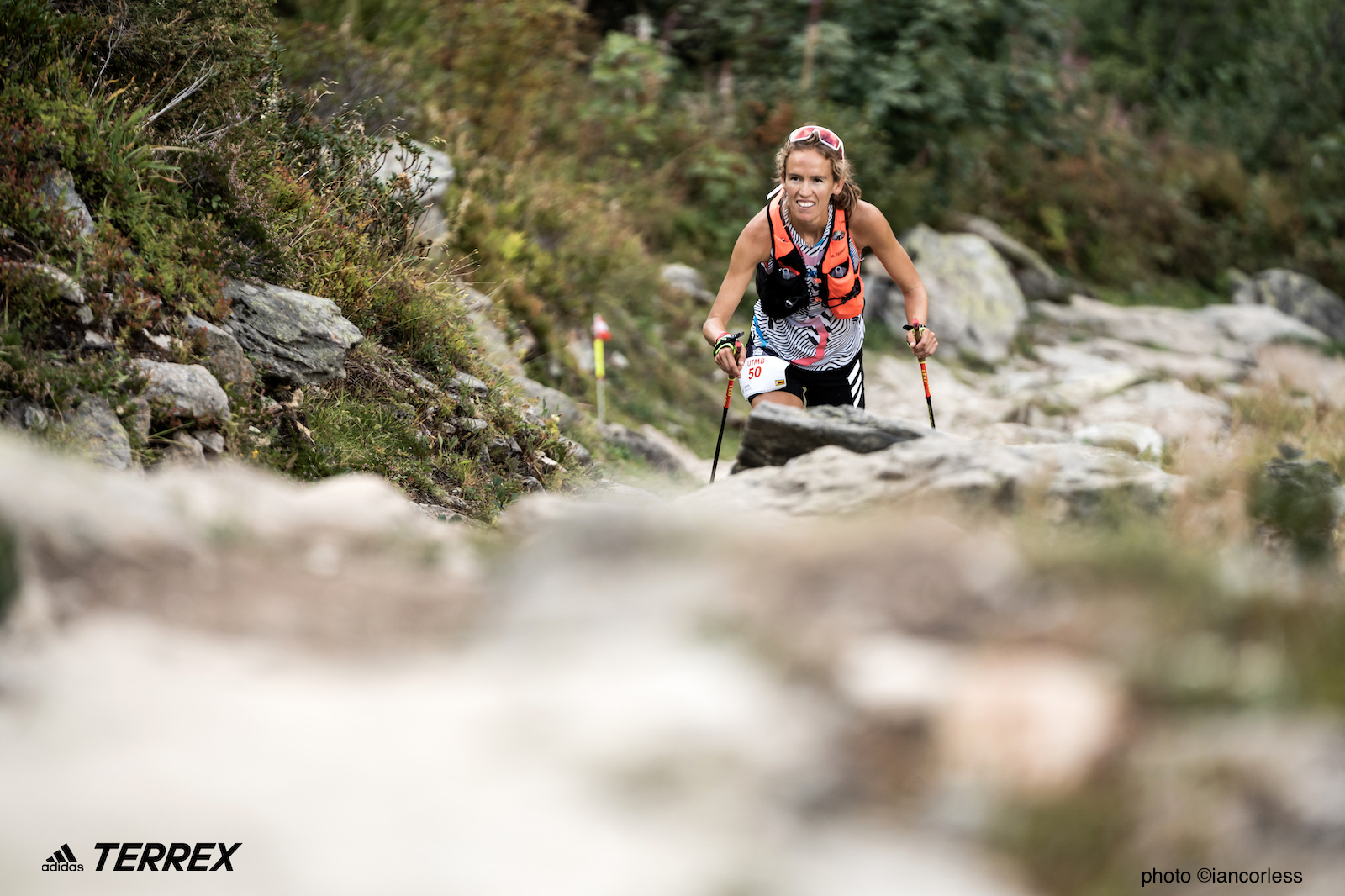
Toni Mccann placing 5, Martin Dematteis placing 10th and Kim Schreiber, Jeshurun Small, Dioni Gorla, Deborah Marti and Anna Hahner all having solid runs. The team was back on track.
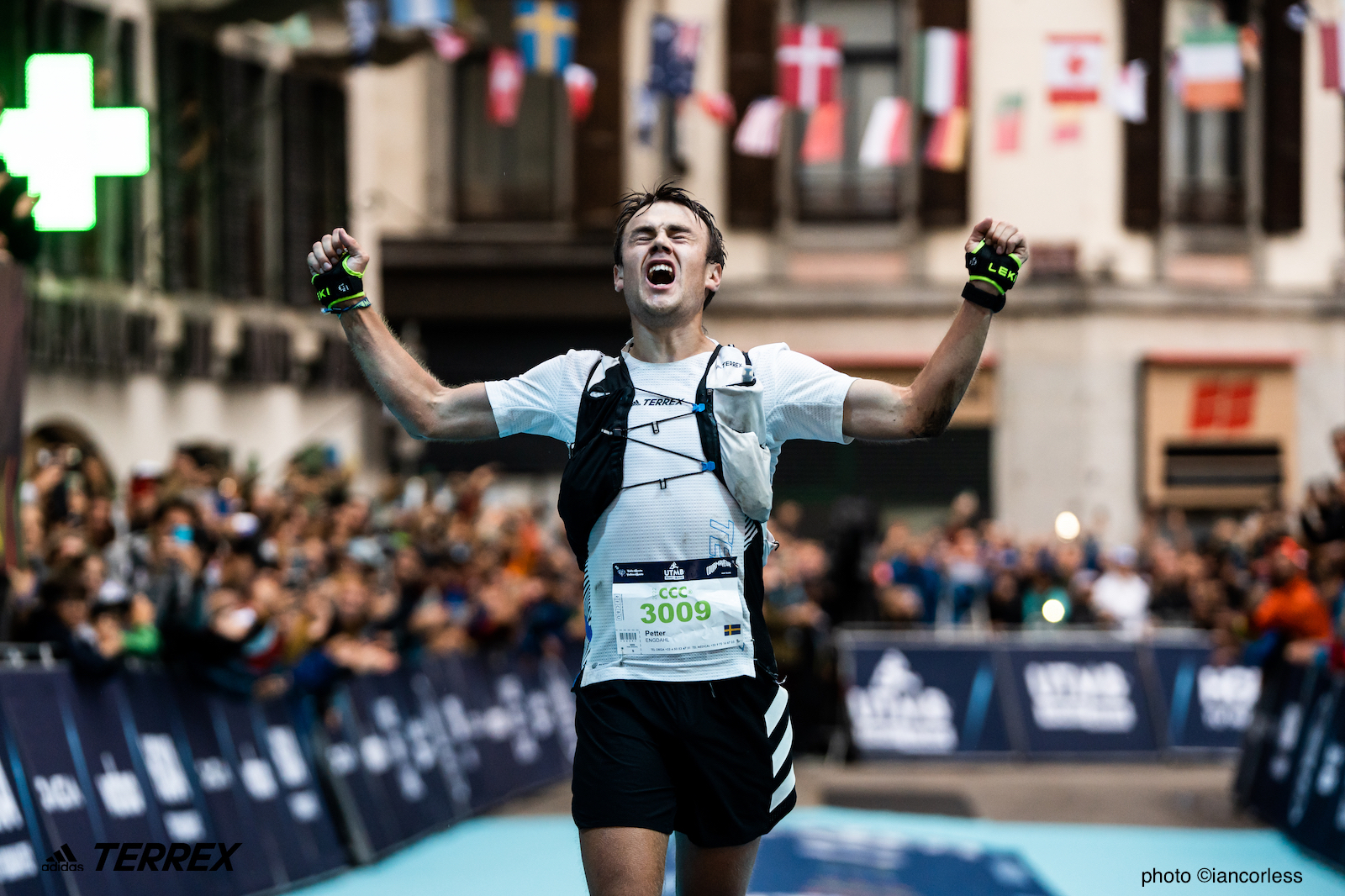
CCC was up next and it’s fair to say that myself, and the whole TERREX team were quietly confident that Petter Engdahl could produce something. Little did we know then that the Swede who lives in Norway would light the fire of the UTMB.
He blazed a trail that made the competition look on in awe as he not only won the race but set a course record. Abby Hall from the USA once again had a stellar run placing 3.
Remigio Huaman, Stephen Kersch, Taylor Nowlin and Yngvild Kaspersen all brought the three stripes home and, on each occasion, the team was waiting with hugs and applause.
The big dance, UTMB would conclude the week. The 171km loop through France, Italy, Switzerland and concluding in France has 10,000m of vertical gain, rugged terrain, variable weather and is arguably, the most competitive ultra of the year. This year, the event was off-the-scale with over 2700 participants and goodness knows how many fans and spectators.
The event is now huge! The TERREX team had Pablo Villa, Luis Alberto Hernando, Tom Evans, Emily Hawgood toeing the line and sadly, the omission of Sabrina Stanley due to Covid. It’s with noting here that a listen to ‘The Chamonix Tapes’ with Tom Evans provides a great insight not only to the event, but how to prepare for it is a ‘must’ listen. The race, despite a quality line-up was always going to be about Jim Walmsley and Kilian Jornet and for much of the race, this was the story. Jim had the lead, lost it to Kilian and and in-form Mathieu Blanchard. Kilian put the hammer down for the win against Mathieu and behind as Jim faded Tom Evans put his plan in action. He left Zach Miller who he had traded run steps with for many an hour and hunted Jim.
With Jim caught, Toms head went down, all the processes were put in place and the Brit placed 3rd in the greater ultra in the world! Tears were shed by all… It’s difficult to put into words the emotions of the finish. Tom walked in, somewhat mind-blown about what he was about to achieve, he held hands together, covered his face and then stood stock still and saluted the world. Job done! The TERREX team were in pieces with emotion.
Hours later, Emily Hawgood arrived at Col de Montes, the TERREX team lining the climb to give her one last big push to the finish. Eventually the finish came and a 6th place. Surrounded by her team, the worlds media were amazed at the unity of the TERREX team as they celebrated en-mass the success of one of their own.
This is the oneteam ethos, victories may be individual, but they are not possible without what goes on behind the scenes. We all had roles, but flexibility is key. Athletes became crew, office workers became car drivers, and everyone became a supporter both in a physical and mental capacity.
Once again, it was a real pleasure to be immersed with the adidas TERREX brand and follow closely the whole process that makes a race and team come together. We use the word family and without a doubt, the TERREX team is family. We are all #unitedbysummits
I spent much of the week with Stefan Durst but a huge thanks to Pfefferminzmich – Rapha, Andy, Yannick, Vinz and Christian.
Welcome to ‘The Chamonix Tapes’ an inside look at the adidas Terrex Team during the 2022 UTMB.
Starting on Sunday August 21st and running through to UTMB 2022, there will be a series of podcast releases for your audio pleasure in ‘The Chamonix Tapes.’
In episode 5, we speak with Tom Evans who battled a stressful injury and surgery… A process that started 12-months ago.
” What can I do, how do I control the controllables…Western States is more like a 100km in comparison to UTMB… I can’t begin to imagine how many nights I have spent without a head torch… I Can’t wait for the night… The night is coming, like it or not!”
Welcome to ‘The Chamonix Tapes’ an inside look at the adidas Terrex Team during the 2022 UTMB.
Starting on Sunday August 21st and running through to UTMB 2022, there will be a series of podcast releases for your audio pleasure in ‘The Chamonix Tapes.’
In episode 4, we speak with Taylor Nowlin who battled a stressful 2020 and 2021 working as a nurse and recovering from Covid to place top-10 at Western States.
“I think the biggest theme in the last year has been scaling back on work so that I could focus on running… I needed to be more of a professional at running.”
Welcome to ‘The Chamonix Tapes’ an inside look at the adidas Terrex Team during the 2022 UTMB.
Starting on Sunday August 21st and running through to UTMB 2022, there will be a series of podcast releases for your audio pleasure in ‘The Chamonix Tapes.’
In episode 2, we speak with Holly Page who has been fighting against long term injury.
“I started with an ankle injury in Feb 21… I had hoped to run TDS in 2021 and despite my best efforts, the injury has not gone away… Finally, I am on an upward slope!”
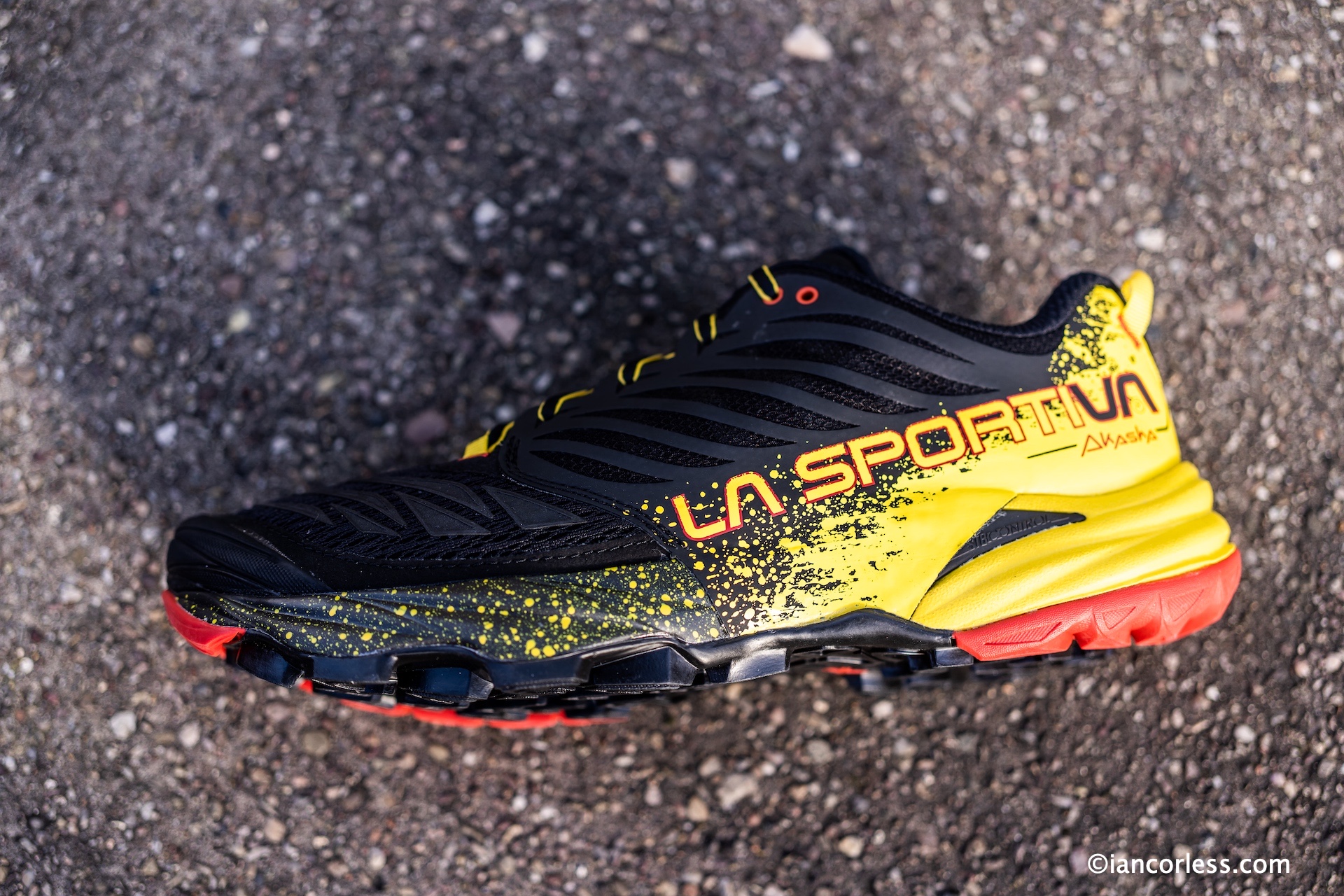
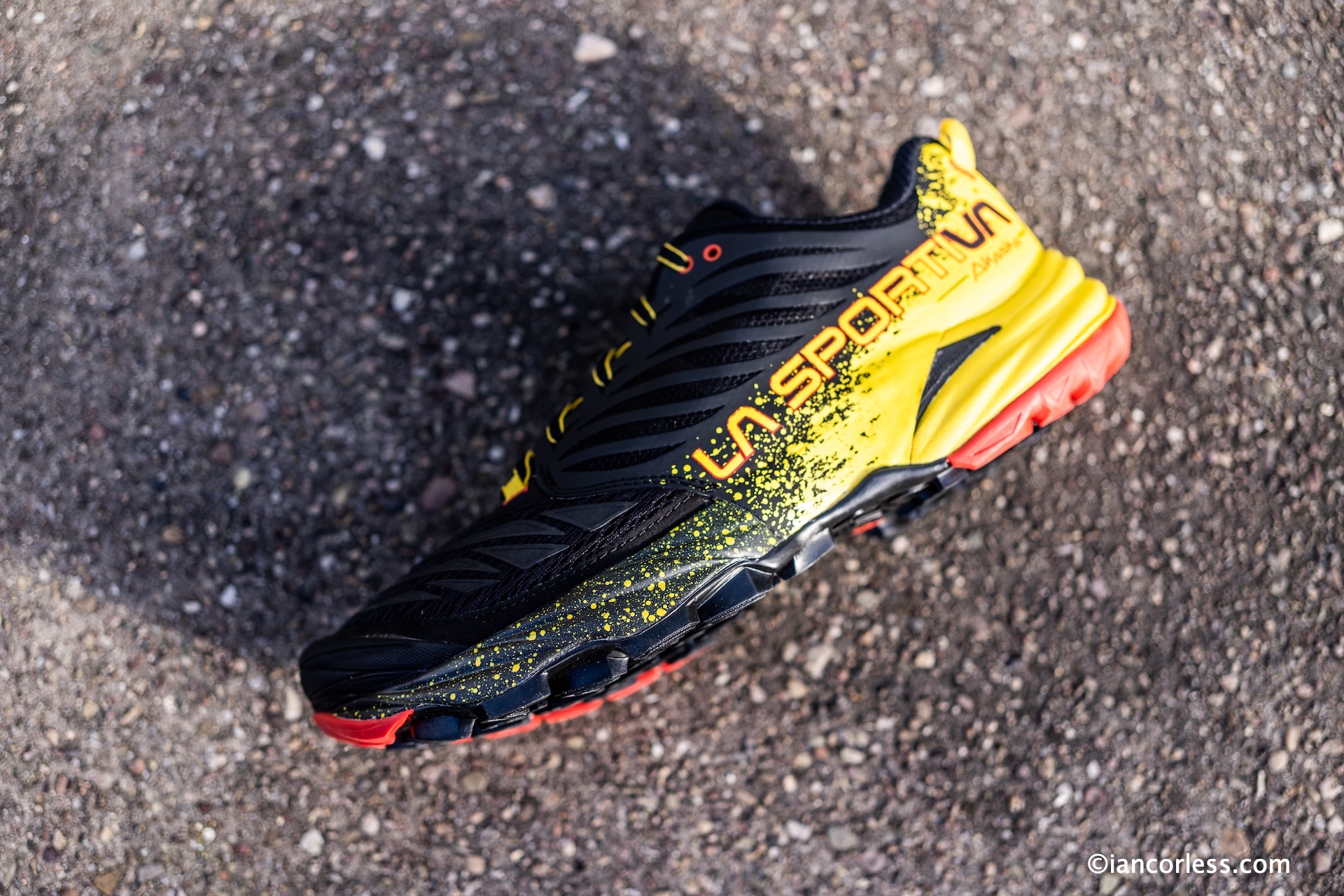
I don’t know why it has taken me so long to run in the La Sportiva Akasha? But, now that I have, I am somewhat perplexed that I have been missing an awesome shoe for months and probably years.
With 350km in the Akasha in just over 2-weeks, I can confirm that they are one of the most comfortable and reassured shoes I have used irrespective of the type of terrain or distance of run.
They are billed as a cushioned, protective and a long-distance shoe. When you first pick them up, you notice two things:
They feel bomb proof.
2. They are a little heavy.
Of course, bomb proof and additional weight go hand in hand, but if the run comfort and feel is good, a little extra weight is no real issue. Weight is 310g for UK8.
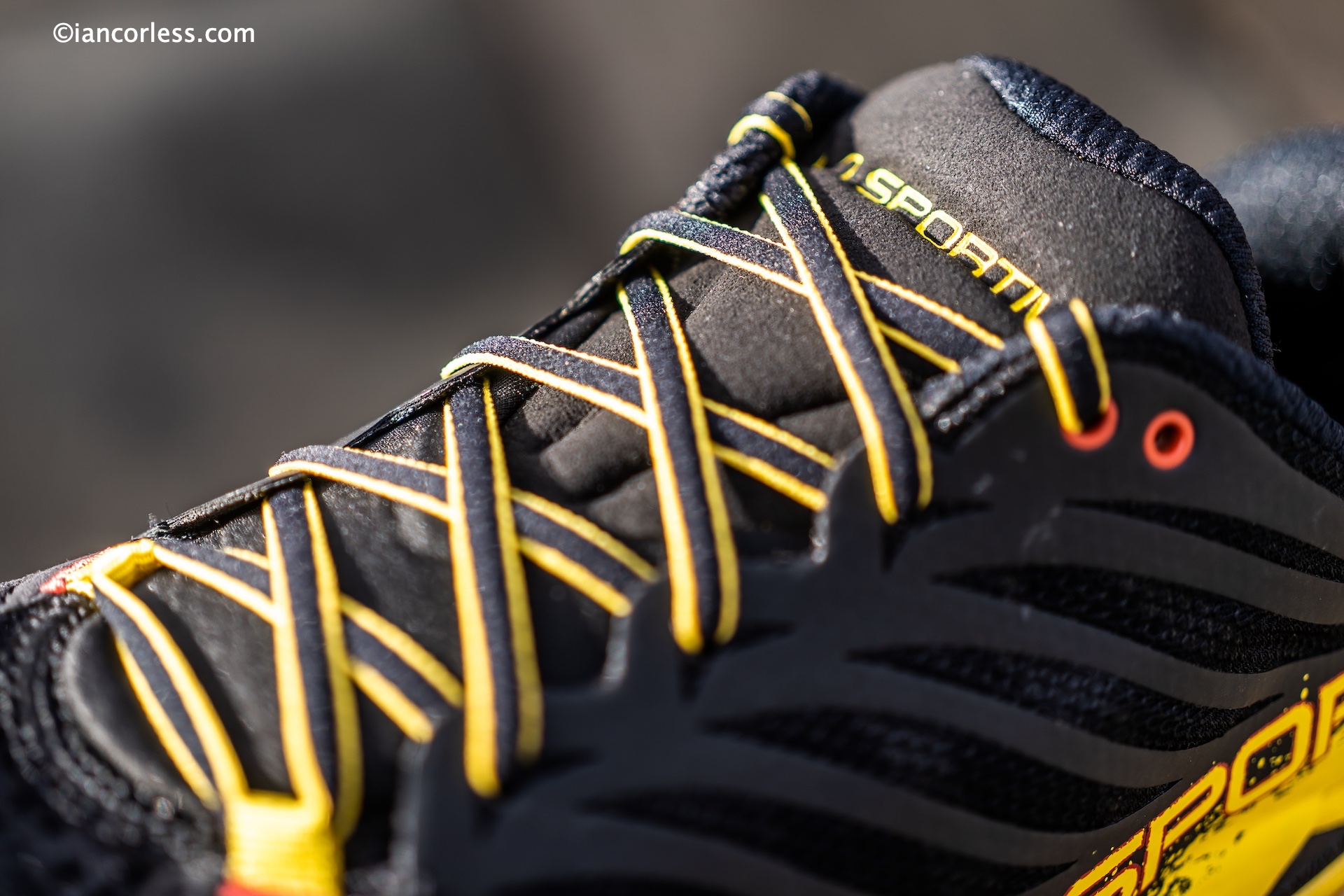
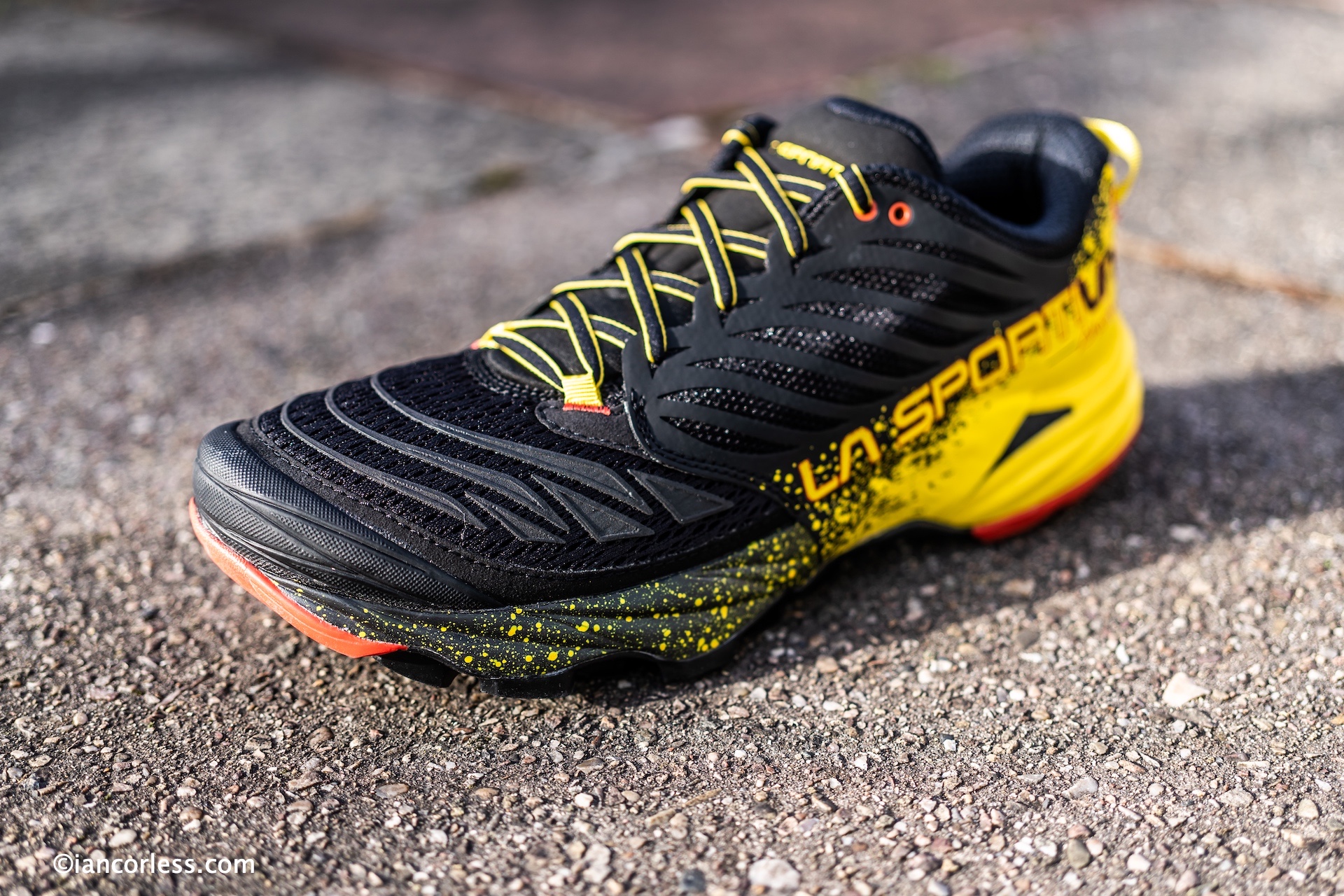
From the off, the Akasha felt immediately comfortable with a great fit, roomy toe box, but not too roomy (3 on a 1-5 scale,) very breathable upper, padded tongue, excellent lacing and foot hold and a comfortable heel box.
The cushioning is notable with 31mm / 25mm stack height for a 6mm drop and lugs are 4.5mm
The cushioning platform is noticeable and especially so when running. It is injected moulded EVA in a single density. It has stabiliser anti torsional inserts and it features the trail rocker that helps slow the transition from heel strike to toe off by isolating and deforming the heel zone separately by providiing a separation
Out if the box I went on an 18km gnarly trail run with loads of rocks and vert. The following day was a 32km run on similar terrain. The shoes were just soooo comfortable and protective. I was cursing that it had taken me so long to use the Akasha and I was already thinking to myself, I need to get another pair…! The cushioning and protection remarkably do not lose ground feel, on the contrary, it’s really good! Of course, not comparable with a more minimalist shoe but hey, the Akasha is not trying to be that!
There is no rock plate, but with this level of cushioning it is no issue. Importantly, there is a real feel for the ground and a life in the shoe. The heal area is very cushioned and bouncy. The Ortholite Mountain Running insert adds to the comfort also. Rocks, irrespective of shape caused no foot discomfort and on no occasion did I feel anything push through the cushioning to make me wince with that all to painful twinge in the bottom of the foot.
Lacing up the shoes, there is an immediate foot hold and security in the instep. This I like. I don’t like sloppy shoes with poor foot hold, especially when running on technical trail. The tongue is gusseted and has a sock-like fit, again, another real bonus!
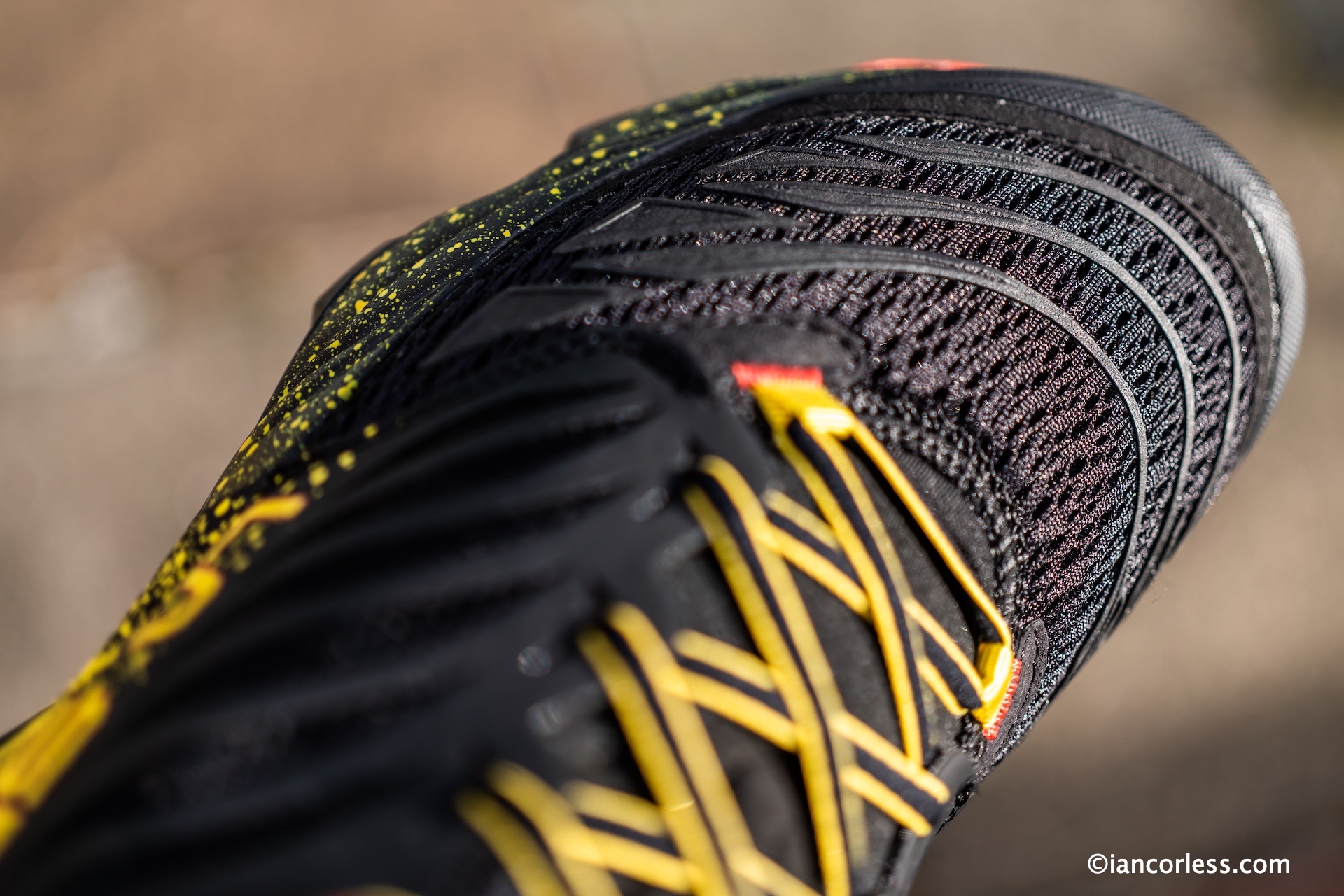
Overlays provide reinforcement of the very breathable and airy upper around the instep and at the front of the shoe. There is little to restrict the toes at the front and this has been superb when running on any type of terrain. The shoes bend beautifully and make the propulsive phase a pleasure.
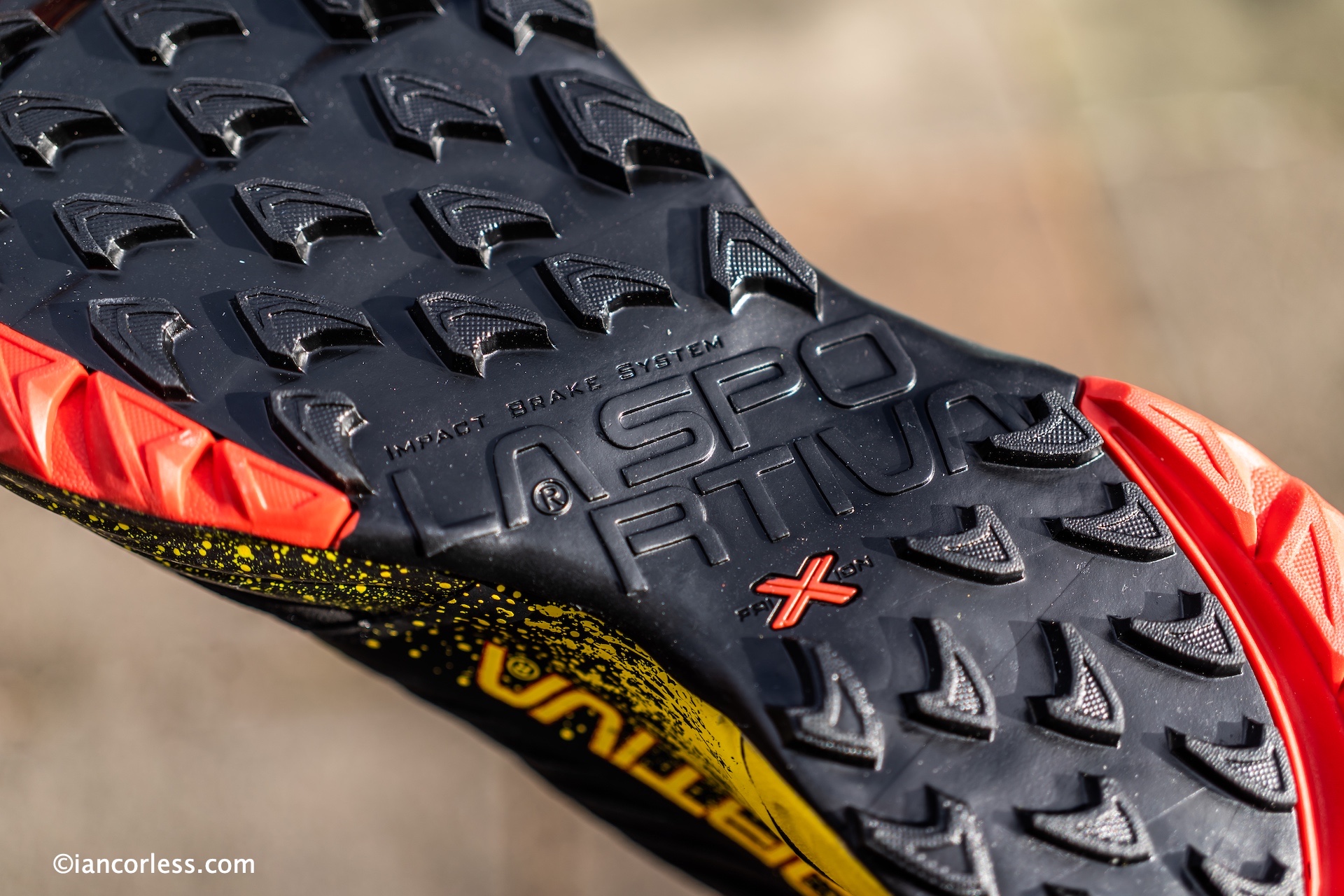
Outsole is the aggressive FriXion XT which is unique to La Sportiva and is superb. The grip (4.5mm lugs) is well spaced out to help shed mud. With a built in ‘Trail Rocker’ these Akasha really role along. You will notice red areas on the sole which have a different look to the black areas. This allows for superb heel to toe transition should it be required – depending on your run style and gait.
No matter what I have thrown at the Akasha, they have responded superbly with superb ride, excellent comfort, and superb grip. They even accompanied me on a 16km road run and even then, the performance and feel were excellent.
They are a heavier shoe, but when running in them you just don’t notice it, especially when on challenging terrain.
Regarding size, you may want to consider going a half size larger. I am pretty much always a UK9.5/ EU44 in most shoes. The La Sportiva comes as a EU442/3 (which is a UK9.5+) and they have been great with no problems. However, just recently I ordered a second pair (because I have been so happy with the first) and I ordered an EU45 which has given me just a little more space and toe room. I have yet to run in the EU45.
Summary
Soft and breathable with a slipper like comfort, reinforced upper, superb cushioning, excellent grip and a 6mm drop – The La Sportiva Akasha has been revelation.
Irrespective of the terrain, the Akasha is a shoe that you can grab for any run, and they will perform superbly, be that for a short distance trail runs or a long and lengthy mountain run. It’s a shoe that would be ideal for say UTMB or similar. Feet feel fresh for mile-after-mile in the Akasha and when running back-to-back days, I got no sore points or aches.
It’s rare that a shoe can feel so good on any terrain and yes, they may tip the scales a little heavier than some of the competition but the ride and comfort more than justifies this.
The outsole, like the upper is bombproof and offers excellent grip on trail and rock and while not recommended, it ticks along on the road with no discomfort.
There are several shoes that I go to daily, the Hoka Torrent 2 being one that I can pick up and run on pretty much any terrain and for any length of time. The Akasha has now replaced the Torrent 2 as my daily ‘go-to’ and should I travel and only be able to take one pair of shoes, the Akasha would be the choice. The adidas Speed Ultra is still up there as one of my ‘shoes of 2021’ and for faster runs on more groomed trail, the Speed Ultra would win out. The Akasha will take some beating as a ‘grab and go’ shoe though and it’s rare to find one shoe that does so much so well and in a package that will last and last.
La Sportiva have long and respected heritage in the footwear world in particular with the mountains. This heritage is apparent in the Akasha where they have made attention to detail a priority along with comfort and durability. They have avoided compromise with a little extra weight.
Key Stats
Uppers:
Breathable Air Mesh + PU leather at the rear and Dynamic ProTechTion at the toe.























 IAN CORLESS