This edition marks the 40th anniversary of the MDS Legendary. Four decades of runners crossing the Sahara under their own power. As we move through March, I’m sharing a short series of weekly articles to help sharpen your preparation. This is the fourth of four.
By now, the nerves are real. Anticipation is building. And yes, stress might be creeping in too. That’s normal. You’re about to take on one of the toughest endurance races on the planet. But here’s the truth: the hard work is already done.
Now, the focus shifts.
Ease Back to Move Forward
It’s tempting to squeeze in one last long run. Don’t.
At this stage, there’s nothing to gain and everything to lose. Fatigue and injury are the only likely outcomes. Instead, keep sessions short and purposeful. Stay loose. Stay sharp. This is taper time. Think of it as recharging your battery so you arrive on the start line fresh, not drained.
Prepare for the Heat
If you can, use these final days to adapt to the heat. It doesn’t need to be perfect, but every little bit helps.
Hot yoga, saunas, hot baths, even treadmill sessions with extra layers can all make a difference. If you have access to a heat chamber, even better. The Sahara is unforgiving, and any adaptation you build now will pay off when it matters most.
Plan Everything, Then Simplify
Now is the time to get meticulous.
Lay everything out. Build a spreadsheet if that helps. Go item by item through your kit. Ask yourself what you truly need.
Weight matters. Every gram counts when it’s on your back for multiple days. Strip out the luxuries. Be ruthless. The goal is to go as light as possible without compromising safety or performance.
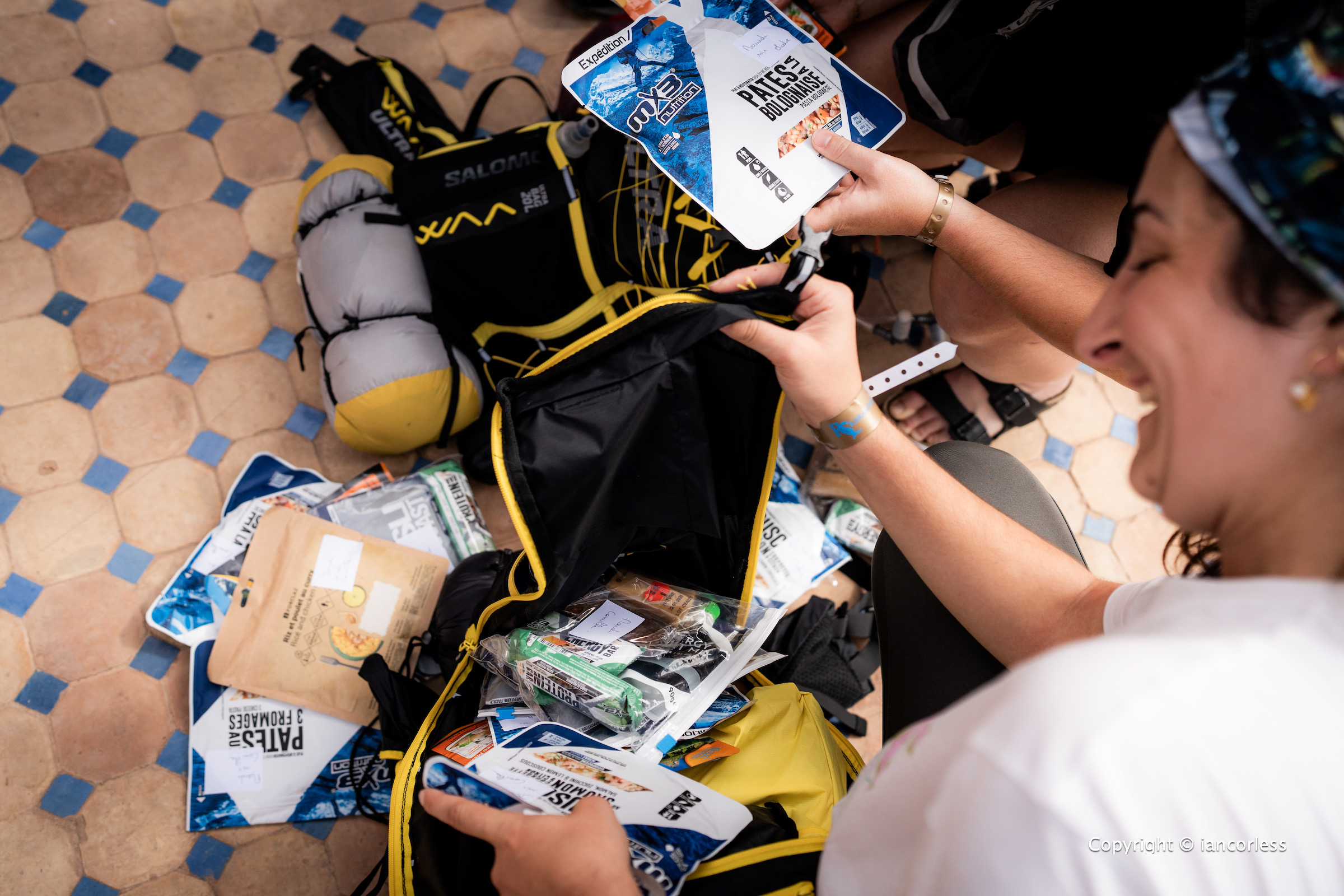
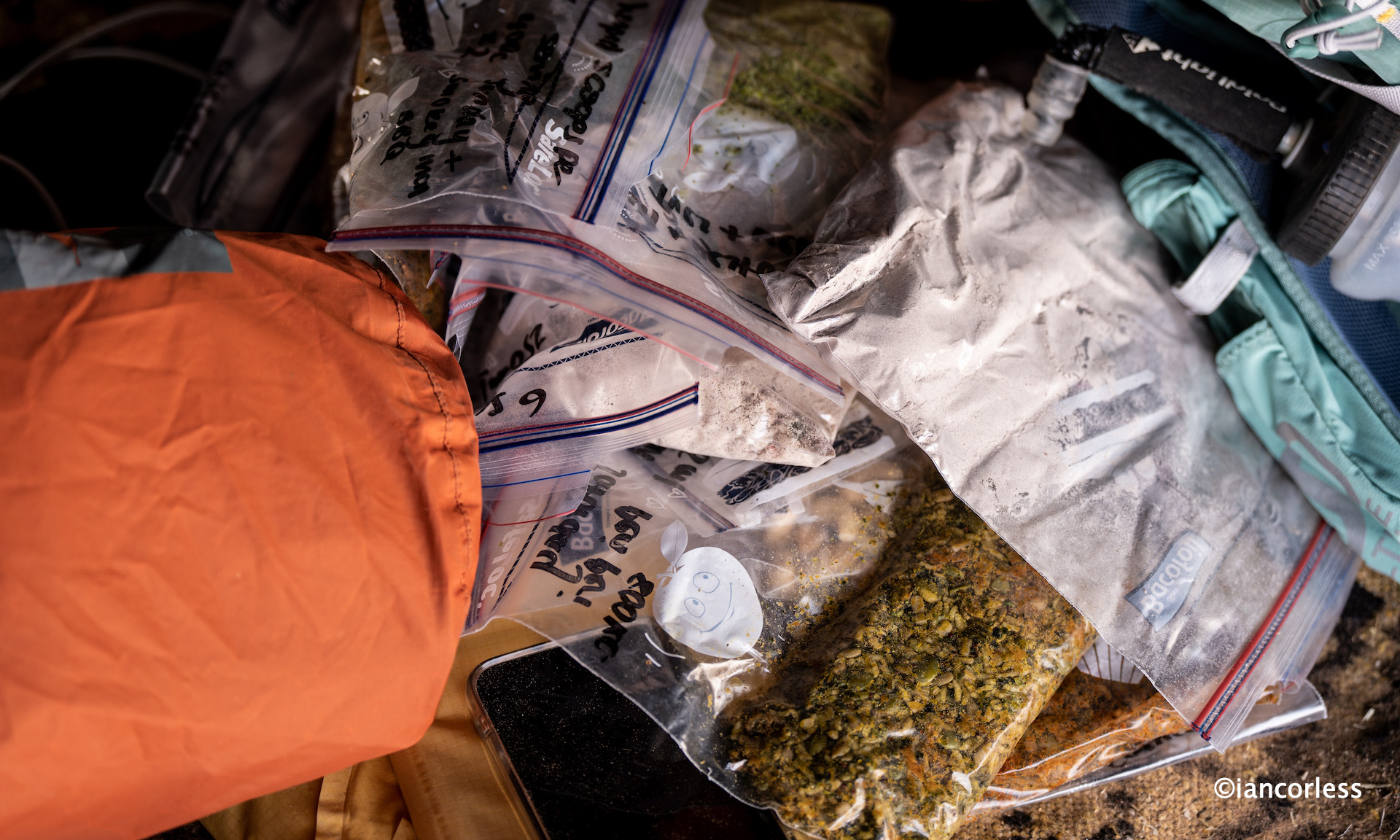
The same applies to food. Check your calories. Repack if needed. Remove excess packaging. Make sure what you carry is efficient, practical, and something you can actually eat under stress.
Get the Admin Right
Details matter here.
Medical certificates must be correct and meet all race requirements, especially your ECG. Don’t assume, double-check.
Photo by Ian Corless
Your passport needs to be valid. It sounds obvious, but it catches people out every year. Confirm your travel documents, bookings, and transfers. Know your plan from departure to arrival.
The goal is simple: remove every possible source of stress before you leave.
Travel Smart
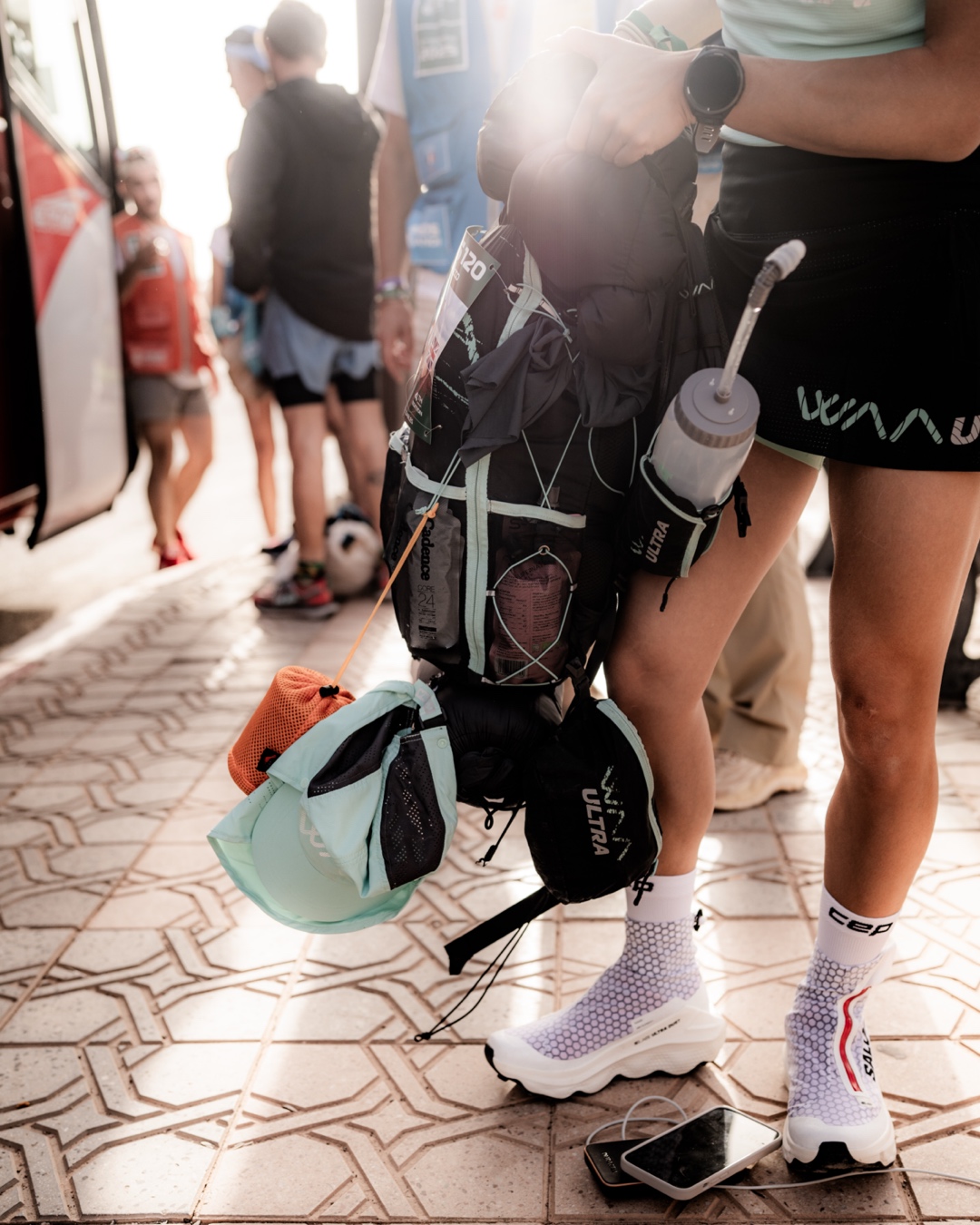
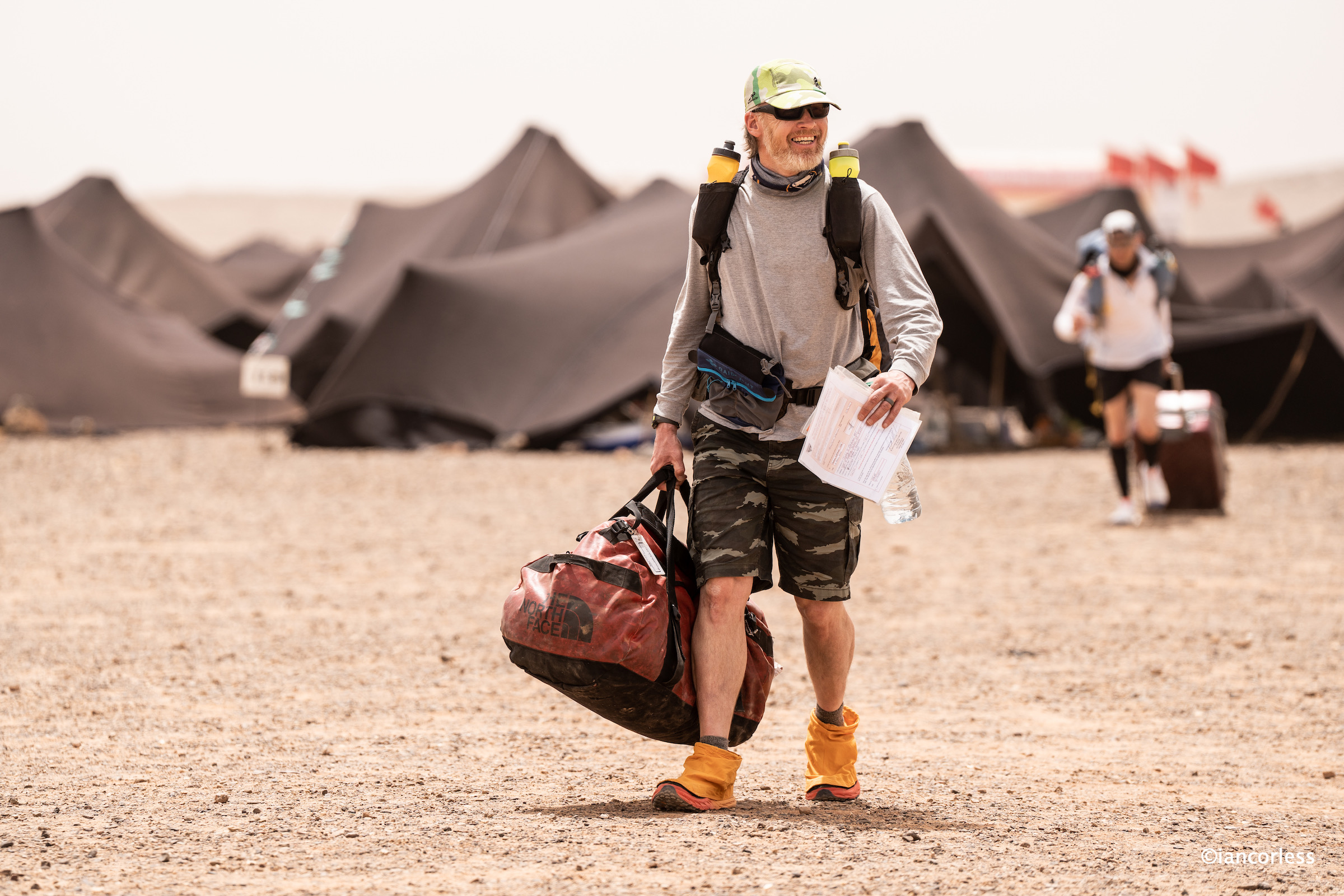
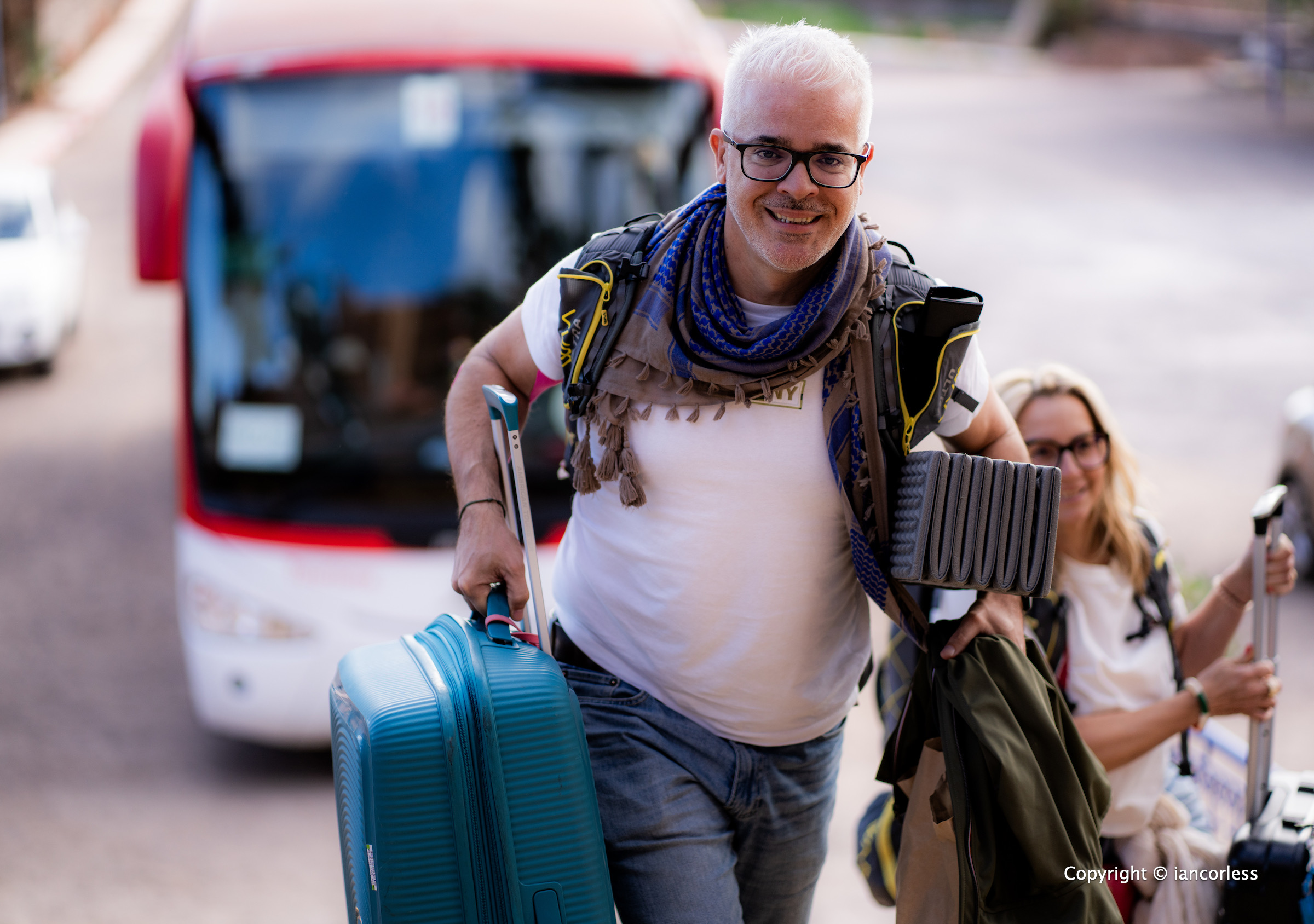
Wear your race kit when you travel. That includes your shoes and gaiters.
Your race pack should go as carry-on, with all essential gear inside. The only items that should go in checked luggage are those that have to, like a knife or trekking poles.
If checked luggage gets delayed, you’ll still be able to race. That’s the mindset.
Protect Your Health
This part might feel extreme, but it’s important.
Avoid unnecessary contact with others. A cold or virus now could undo months of work. Skip handshakes, hugs, and shared food or drinks. A simple “Namaste” with hands together works just fine.
Avoid salads or anything that might carry risk. Stick to well-cooked, straightforward meals. This isn’t the time to experiment with local cuisine.
Bring your own food for travel and the days before the race. Remember, you’re self-sufficient even before the start. Having familiar food and drink helps you stay relaxed and in control.
Use the Bivouac to Your Advantage
Before admin, your luggage stays with you in the bivouac. Use this.
Bring spares. Extra layers. Small options that allow you to adjust based on real conditions. The desert can surprise you, and this is your chance to fine-tune your setup before committing fully.
Be Ready
Have a clear plan for admin. Know what’s required. Be organized.
Then shift your focus forward.
Stage 1 is coming.
Photo by Ian Corless
Trust the Process
You’ve done the training. You’ve made the sacrifices. You’ve earned your place on that start line.
Now it’s about arriving calm, prepared, and ready to embrace what’s ahead.
Because this isn’t just a race.
It’s a journey. An experience that will stay with you long after the dust has settled.
Take a breath. Stay focused. And get ready for the adventure of a lifetime.
Marathon des Sables: What a Week in the Desert Really Looks Like
The Marathon des Sables has always been legendary. In 2026, it becomes something even more special.
This edition marks the 40th anniversary of the race. Four decades of runners crossing the Sahara under their own power. Forty years of stories, struggle, and unforgettable moments. To honour that history, the 2026 race will be longer, tougher, and designed to celebrate everything the event has become.
As we move through March, I’m sharing a short series of weekly articles to help sharpen your preparation. This is the third of four. The goal is simple: remove uncertainty.
When you arrive in the desert, you should know what to expect.
For many runners, especially first-timers, the unknowns can feel overwhelming. What happens when you arrive in Morocco?
How does the bivouac work?
What does a typical day look like?
And how do the logistics of such a remote race actually function?
Let’s walk through it together.
The Evolution of the Race
The Marathon des Sables has changed over the years, and many of those changes focus on reducing environmental impact.
Past participants will notice significant differences. Charter planes have been removed. More transport now happens overland. The race increasingly relies on local staff and local produce. Media presence has been reduced. A storage centre in Morocco limits the need for shipping equipment every year. Transport trucks have been reduced, and power-saving measures are everywhere, including solar energy.
Water management has also evolved. In the past, runners received 1.5-litre bottles. Today, the race distributes 5-litre bottles, dramatically reducing plastic use during the event.
Behind the scenes is a large support structure dedicated to safety.
• Around 120 medical staff, known as the Orange Jackets, monitor runner safety 24 hours a day.
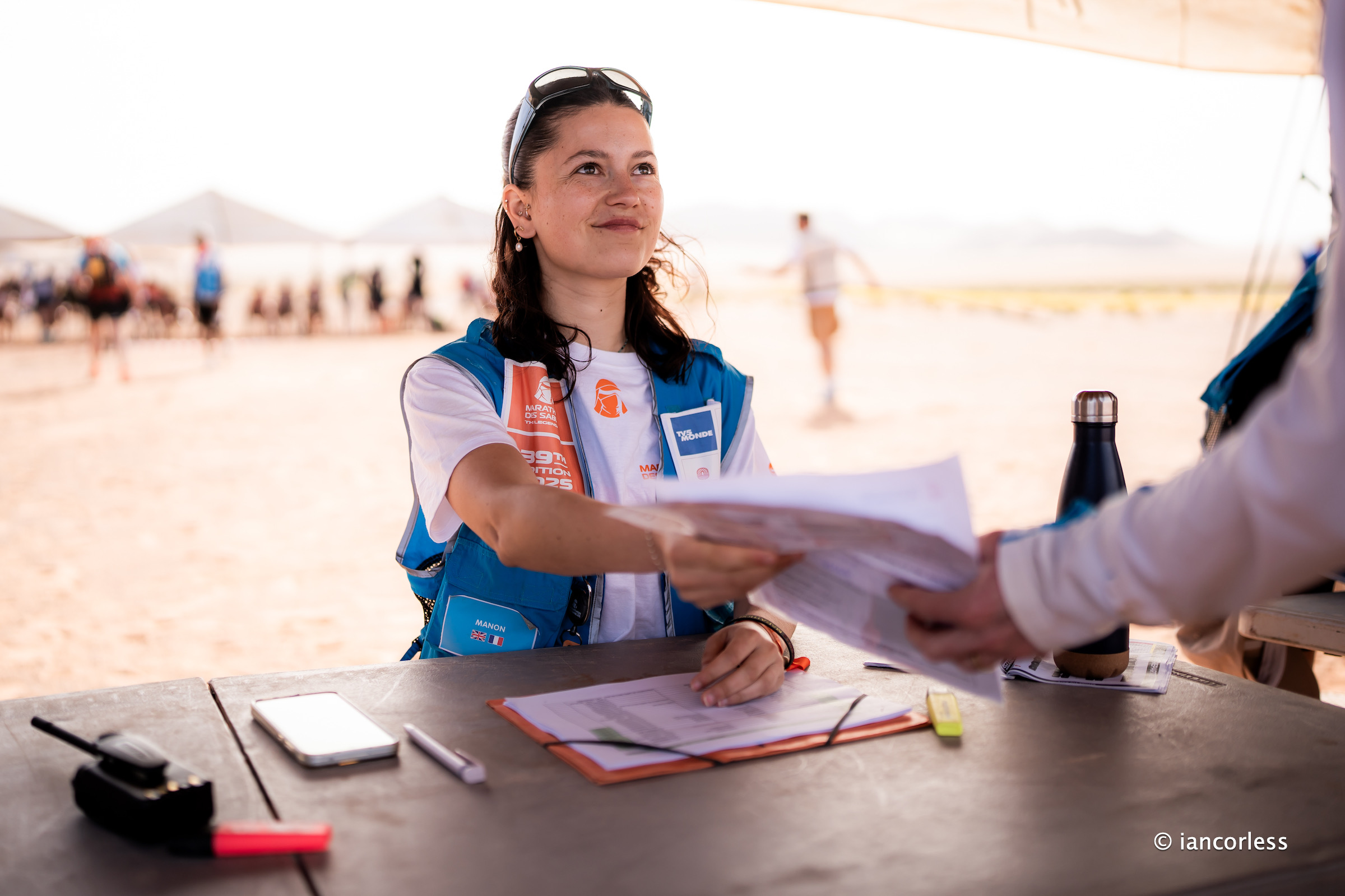
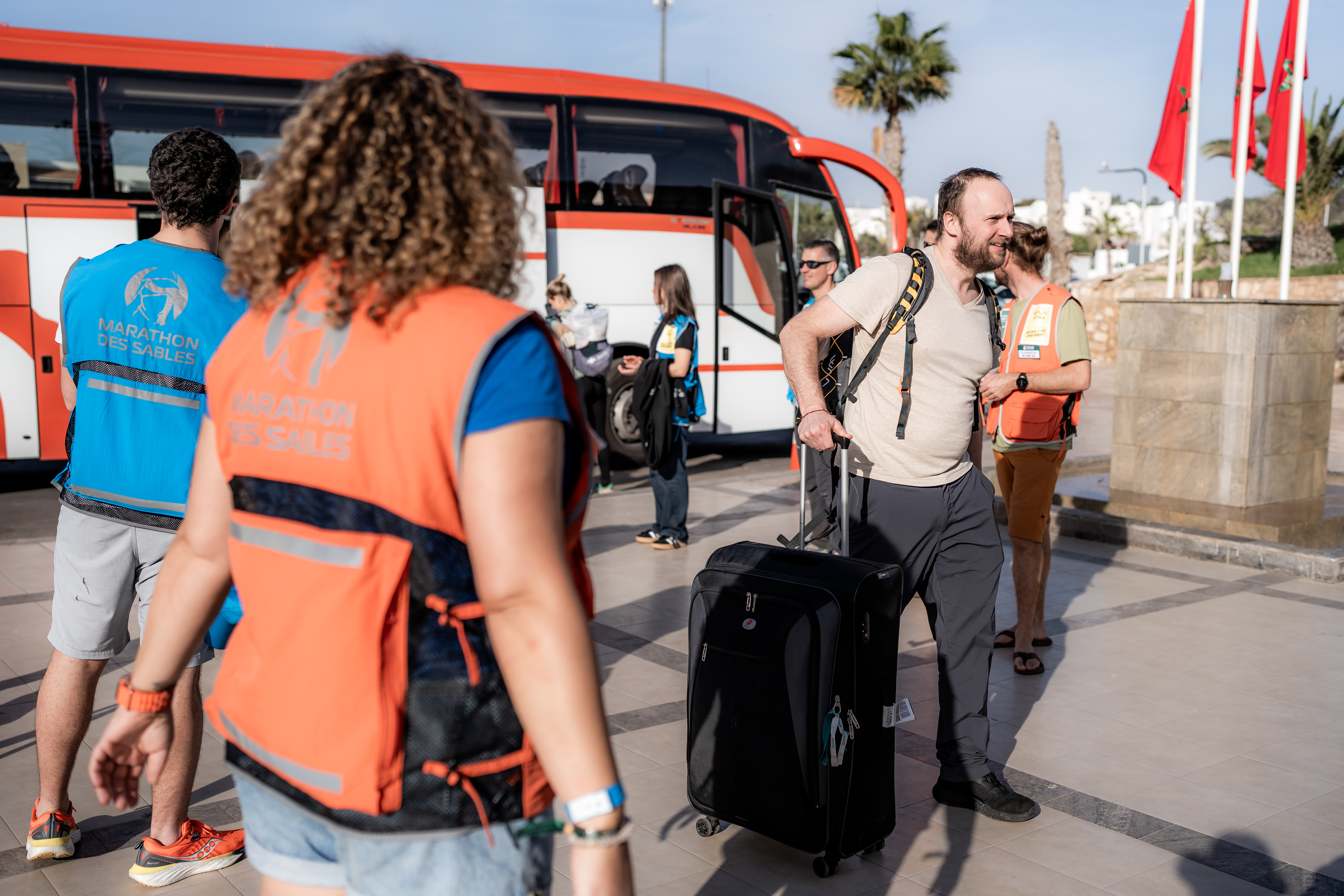
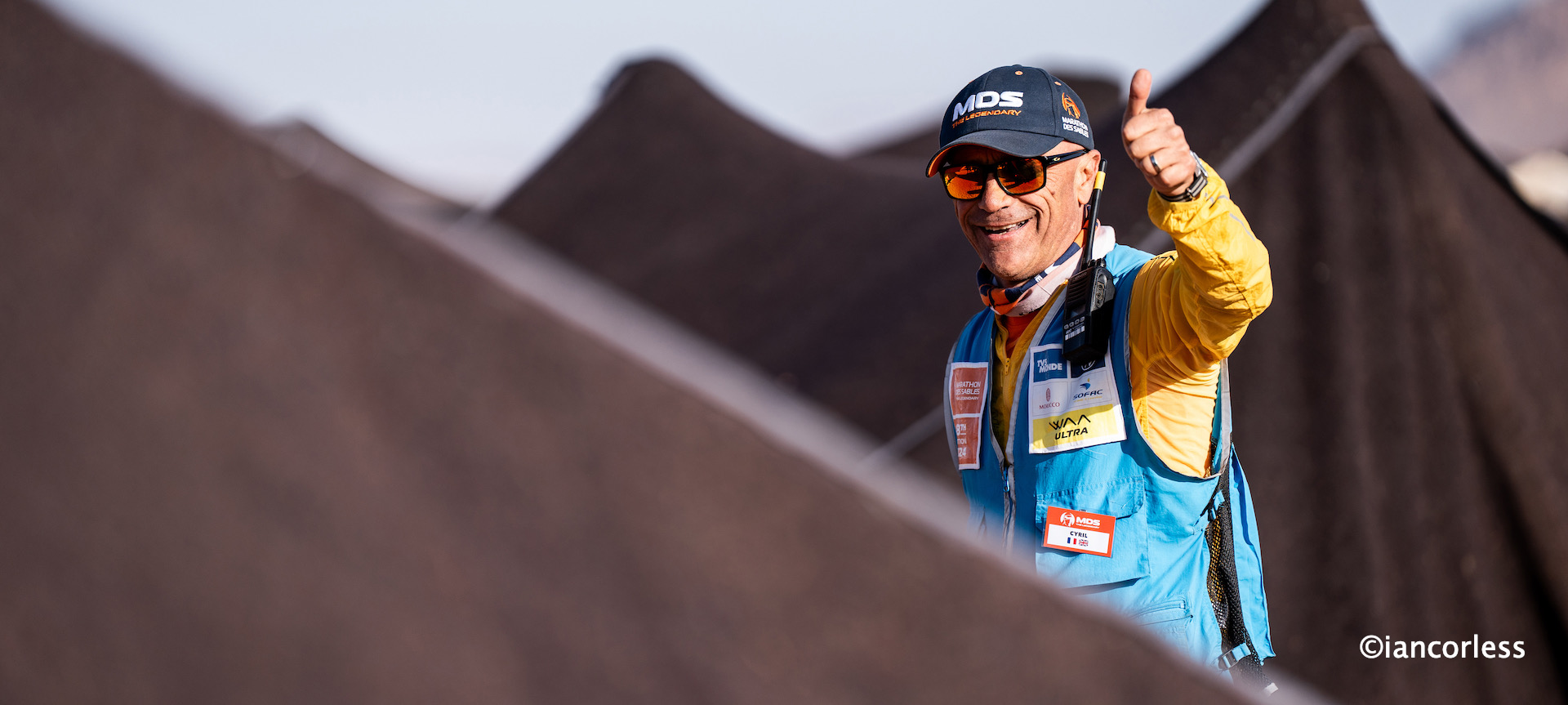
• The Blue Jackets focus on runner relations. They are present in the bivouac, on the course, and at checkpoints. If you have a question or concern, they are your first point of contact.
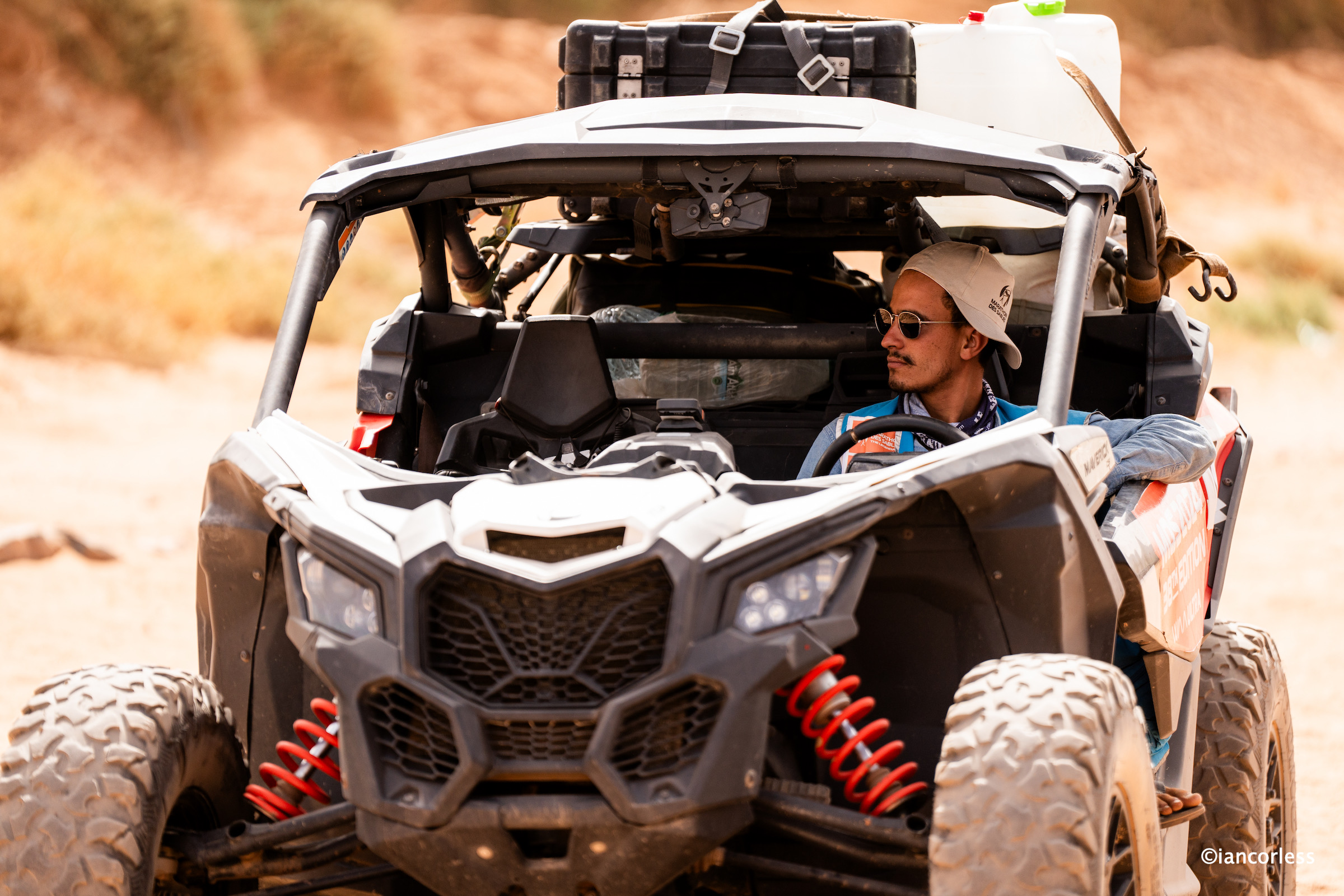
Out on the course, SSV vehicles provide rapid access across the route and carry medical professionals for immediate response. In addition, there are 12 support 4×4 vehicles and a unique system of 40 camel patrol teams. These local teams monitor specific zones and report any issues quickly.
Add to that 20 medical patrol staff on the course and another 25 blue and orange jacket team members, and you begin to see how carefully the race is supported despite its remote setting.
Arriving in Morocco
Your journey begins in Ouarzazate, the meeting point for the race.
Plan to arrive at least one day early. This gives you time to settle in and avoids unnecessary stress before the adventure begins. Hotels are your responsibility to book.
The organisation provides free transfers from Marrakech to Ouarzazate, usually departing from the airport and a designated hotel. Always check official timings before travelling.
Photo by Ian Corless
On Day 1, buses depart from Ouarzazate for the first bivouac. The journey takes roughly six hours across spectacular desert landscapes. A lunch pack is provided, but it’s wise to bring extra snacks and drinks.
When you arrive at the bivouac, you’ll be assigned a tent number. Remember you are self-sufficient in regard to food, water is provided. For the moment, you still have access to your luggage. The following day, after administrative checks, you will deposit that luggage and begin the self-sufficient part of the race.
From this point forward, the desert becomes your home.
Life in the Bivouac
Bivouac life is simple. Very simple.
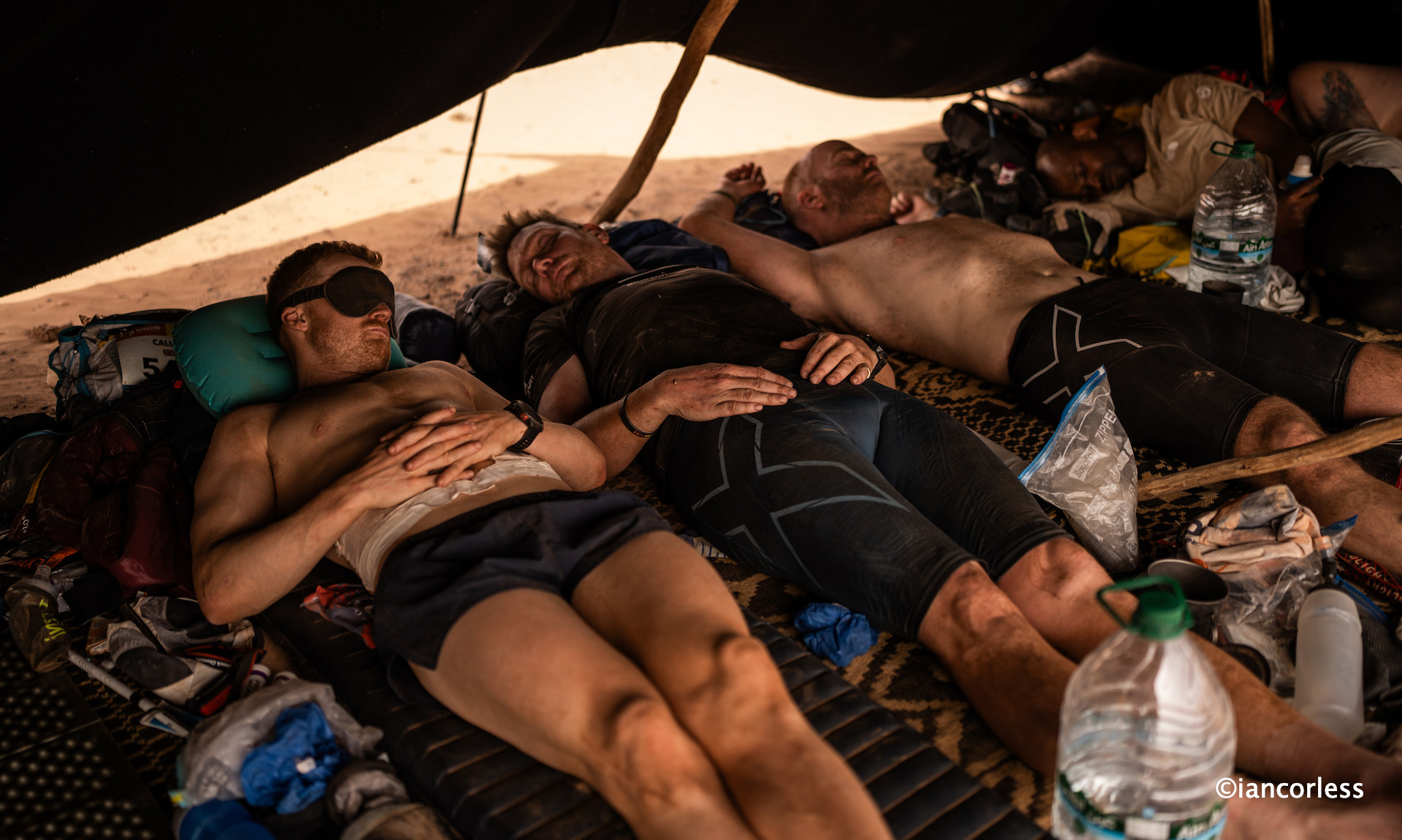
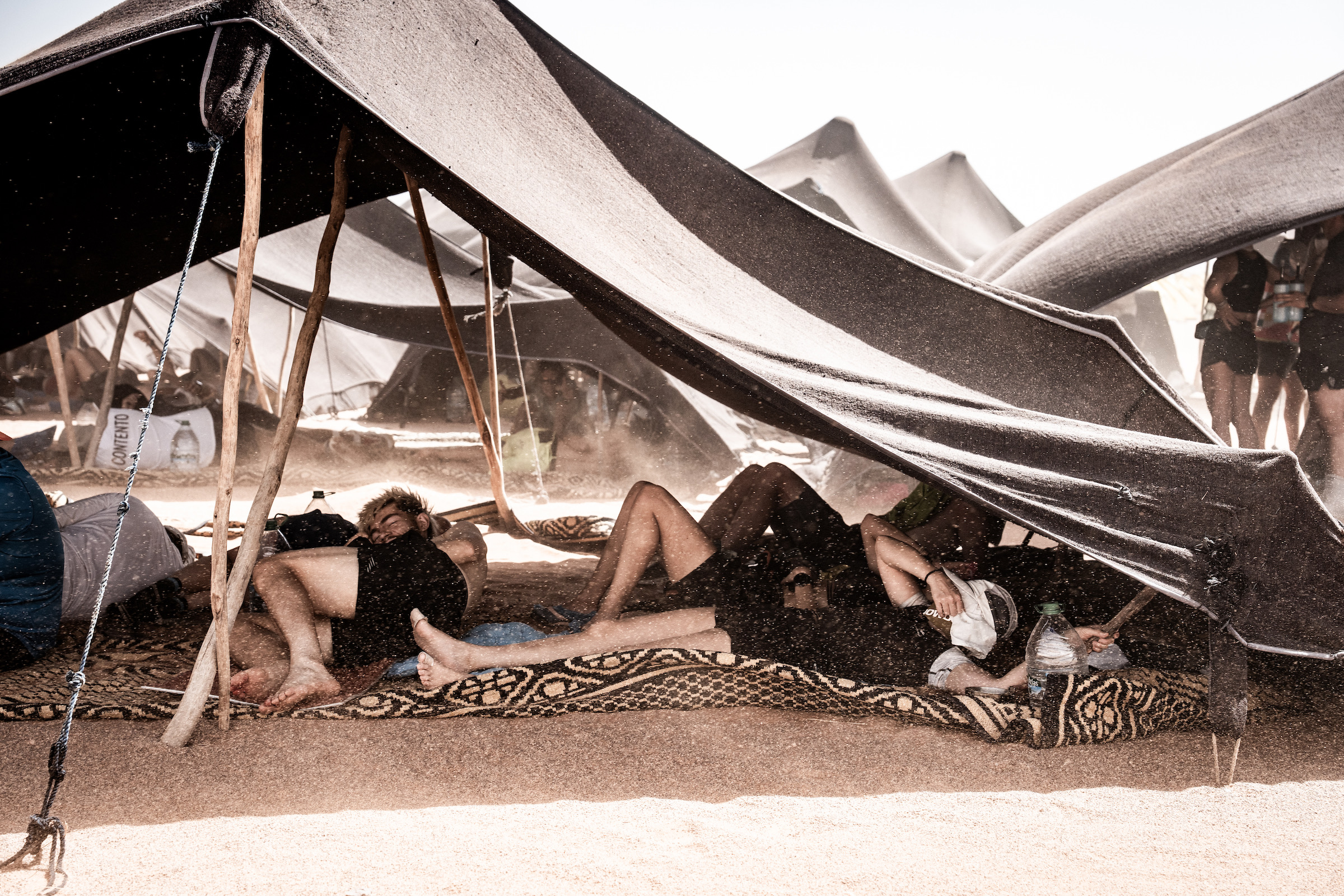
There are no showers and no power. You live under traditional desert tents with seven other runners. It can feel crowded when everyone is organising gear, so respect each other’s space and keep things tidy.
There are a few practical rules that quickly become important:
• Toilets are installed throughout the bivouac and at checkpoints.
• Some toilets are designated women-only or mixed-use, and it’s important to respect those arrangements.
• Biodegradable hygiene bags are provided and waste is separated into organic and sanitary bins.
Phones are strongly discouraged in camp. The bivouac is meant to be a place for rest, conversation, and disconnection. If you need to make an emergency call, move away from camp out of respect for others.
There is also an IP phone available for emergency calls, costing €2 per minute.
Another change from previous years is the removal of the email message system. This reinforces the race’s self-sufficient spirit and saves thousands of sheets of paper that were previously used to print messages.
Instead, runners can use Emotion Boxes to record short video messages that are sent to loved ones. You need to designate before the race who these messages will be sent to.
At the centre of camp sits the Info Tent, where Blue Jackets are always present. This is where you:
• collect your daily water
• ask questions
• check rankings
• access medical support if needed
Additional facilities include women’s changing cabins and sanitary products available both in the bivouac and at checkpoints.
A few other important bivouac rules:
• Never light a fire within 50 cm of tents
• Do not walk barefoot
• Drop empty water bottles at designated recycling points
• On bivouac move days, return containers to the Info Tent
It may sound strict, but these rules keep the camp safe, clean, and functioning smoothly.
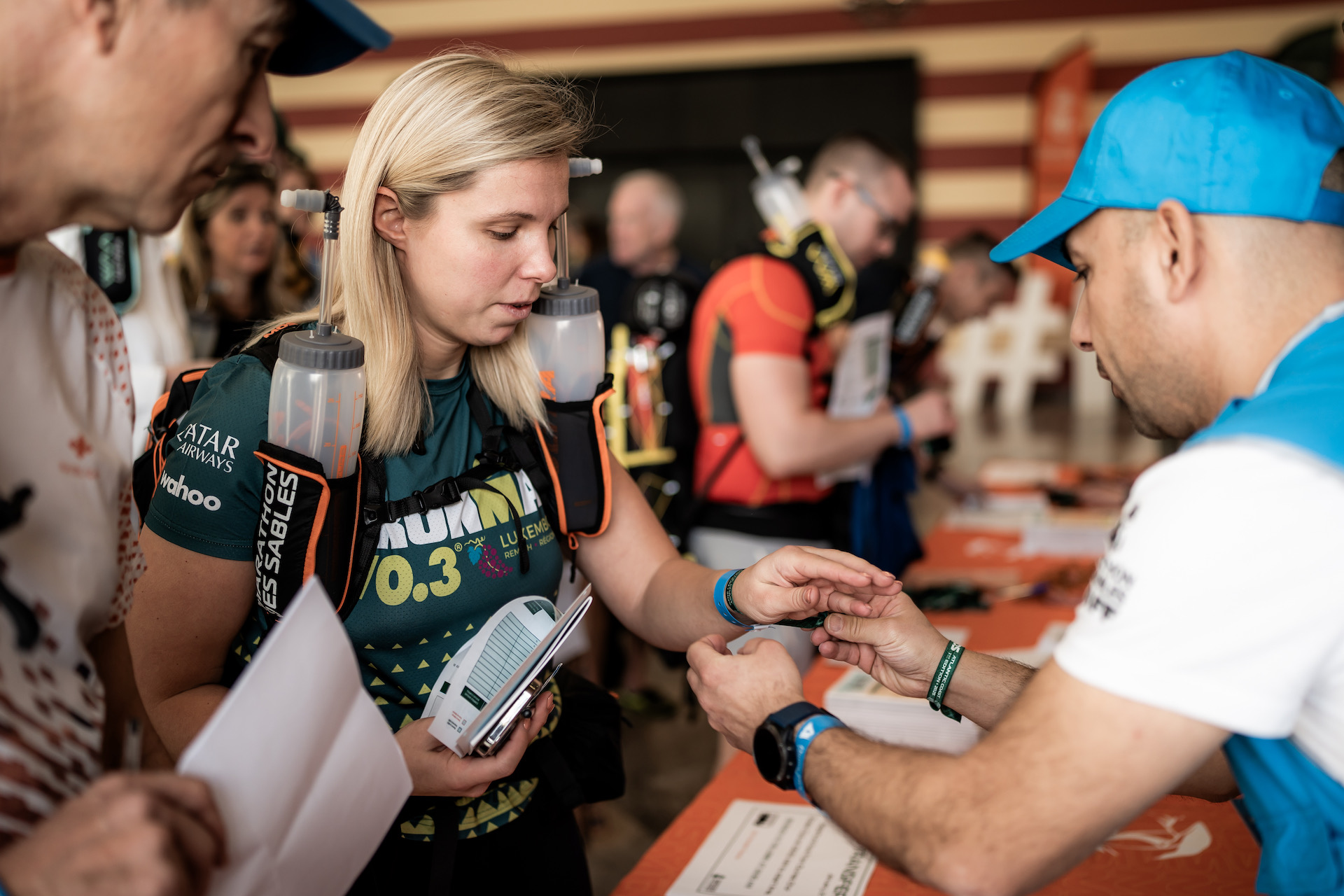
You will go through administrative, technical, and medical checks, while the MDS shop opens nearby. At the shop you can purchase WAA apparel, fire bricks and any other last-minute things you may have forgotten or need.
Each runner receives one 5-litre bottle of mineral water, which must last until the first checkpoint of the race.
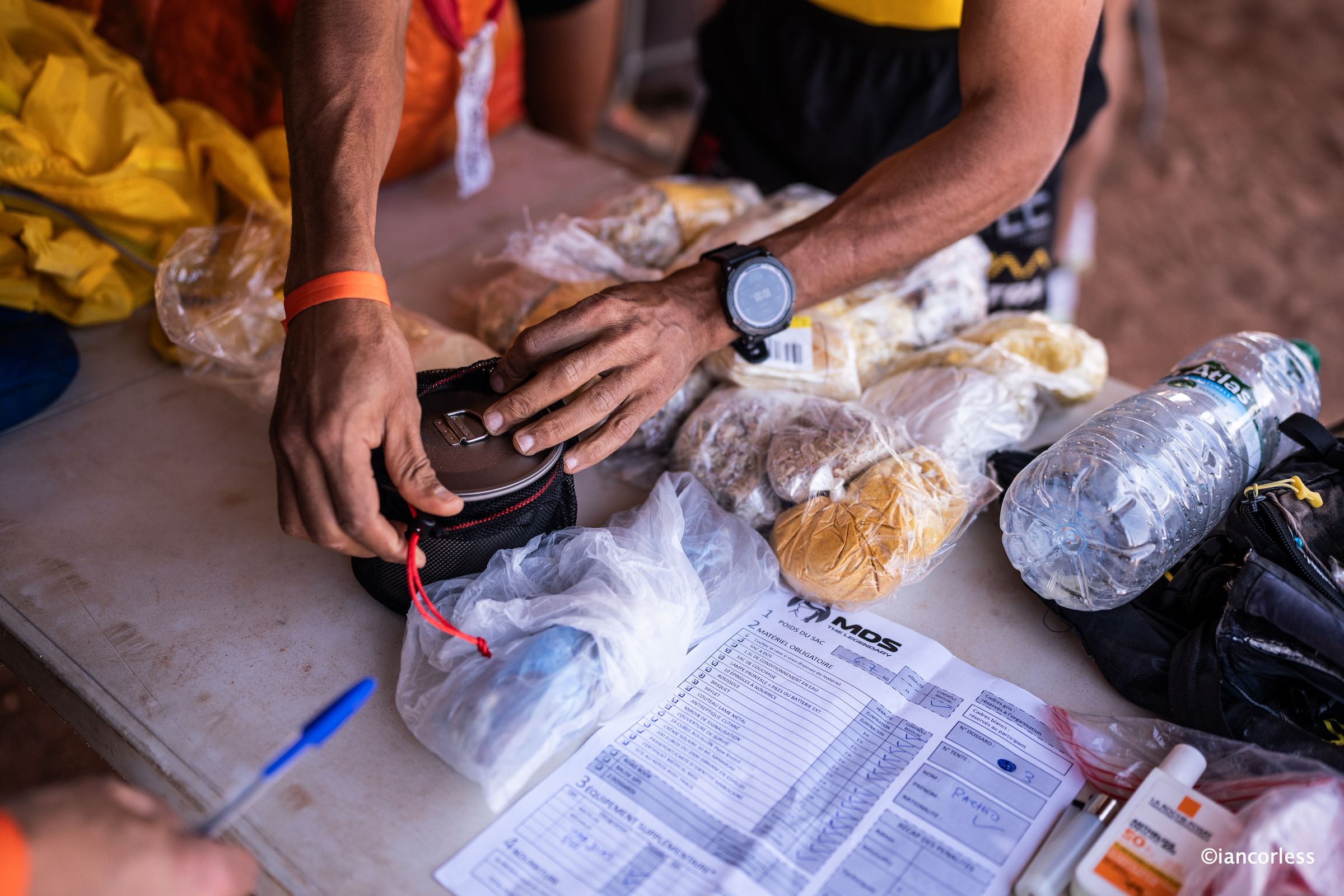
Before heading to the checks, prepare the required documents:
• Passport
• Completed technical control form
• Medical certificate
• Resting electrocardiogram (ECG)
During the admin process you will:
1. Deposit your luggage (it will later be returned to you in Ouarzazate).
2. Present your documents and mandatory equipment.
3. Have your race pack weighed.
4. Undergo medical verification.
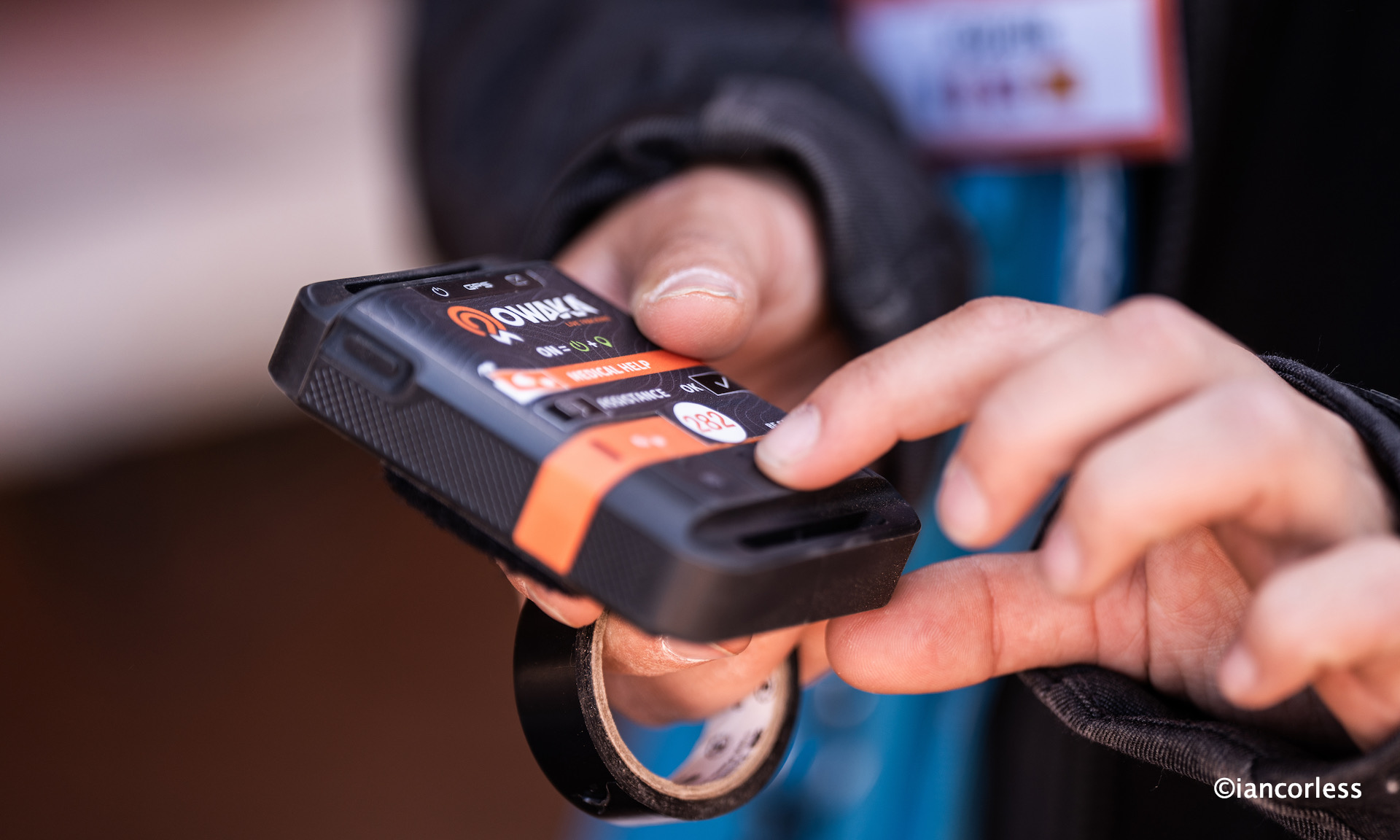
5. Receive your GPS beacon.
6. Submit your technical control form and receive two race bibs.
If you need to discard a personal item listed on your form later, you must inform the organisation or risk a penalty.
Later in the day:
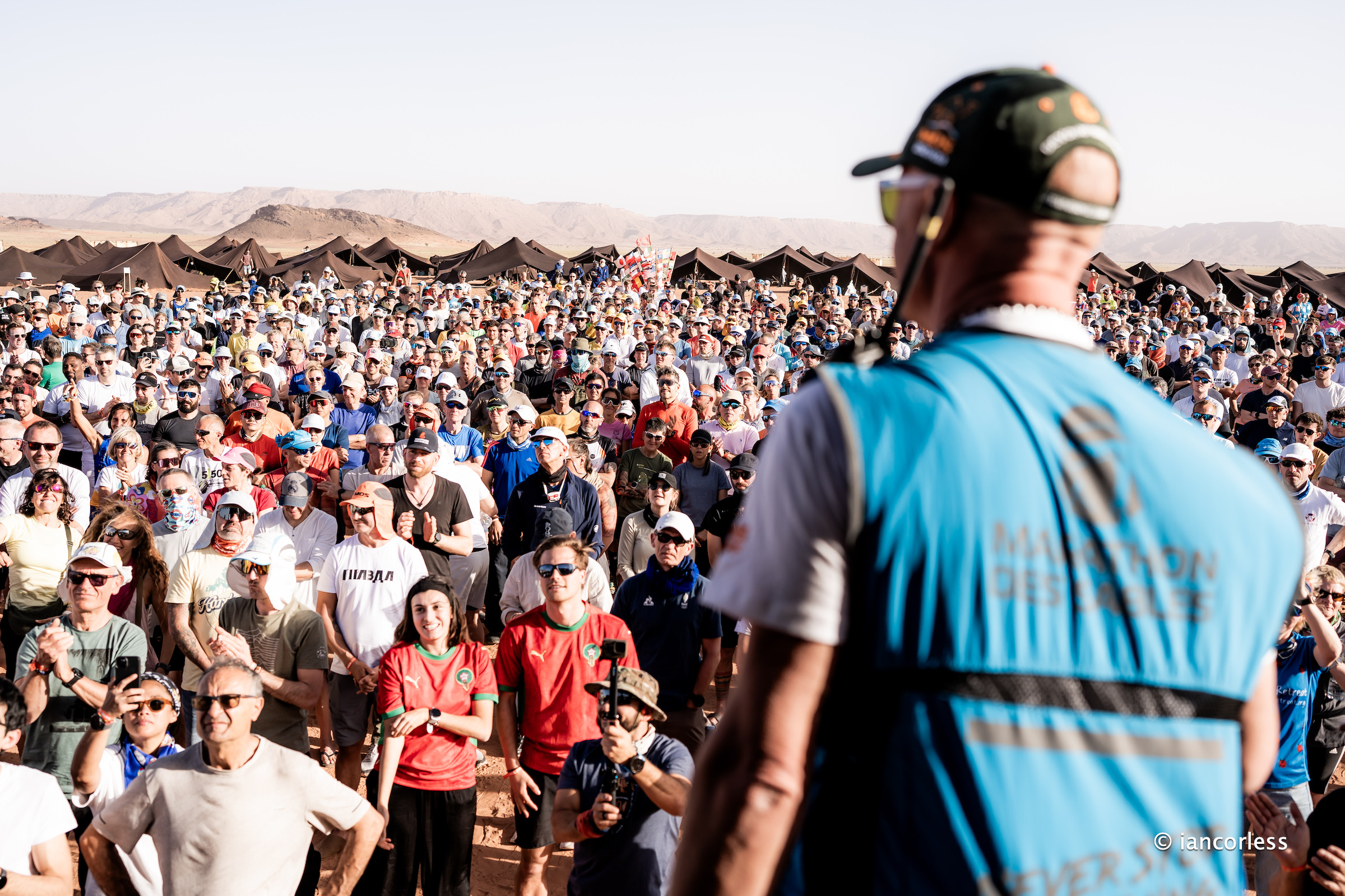
• 4:30 PM – Stage briefing
Photo by Ian Corless
• 6:00 PM – 40th anniversary photo session
The race is now very real.
A Typical Day in the Desert
Every stage day follows a similar rhythm. Wake up will typically be around 0400 to 0500.
Breakfast is self-sufficient, using the food you’ve carried with you.
Stage tart times vary, but be prepared and ready for 05:30. If temperatures are high, the start may move earlier. Plan for at least 90 minutes of preparation before the start.
Thirty minutes before the stage begins, you must be ready. The race starts on time and no one is held back.
Out on the course, each checkpoint typically between 8-10km’s provides:
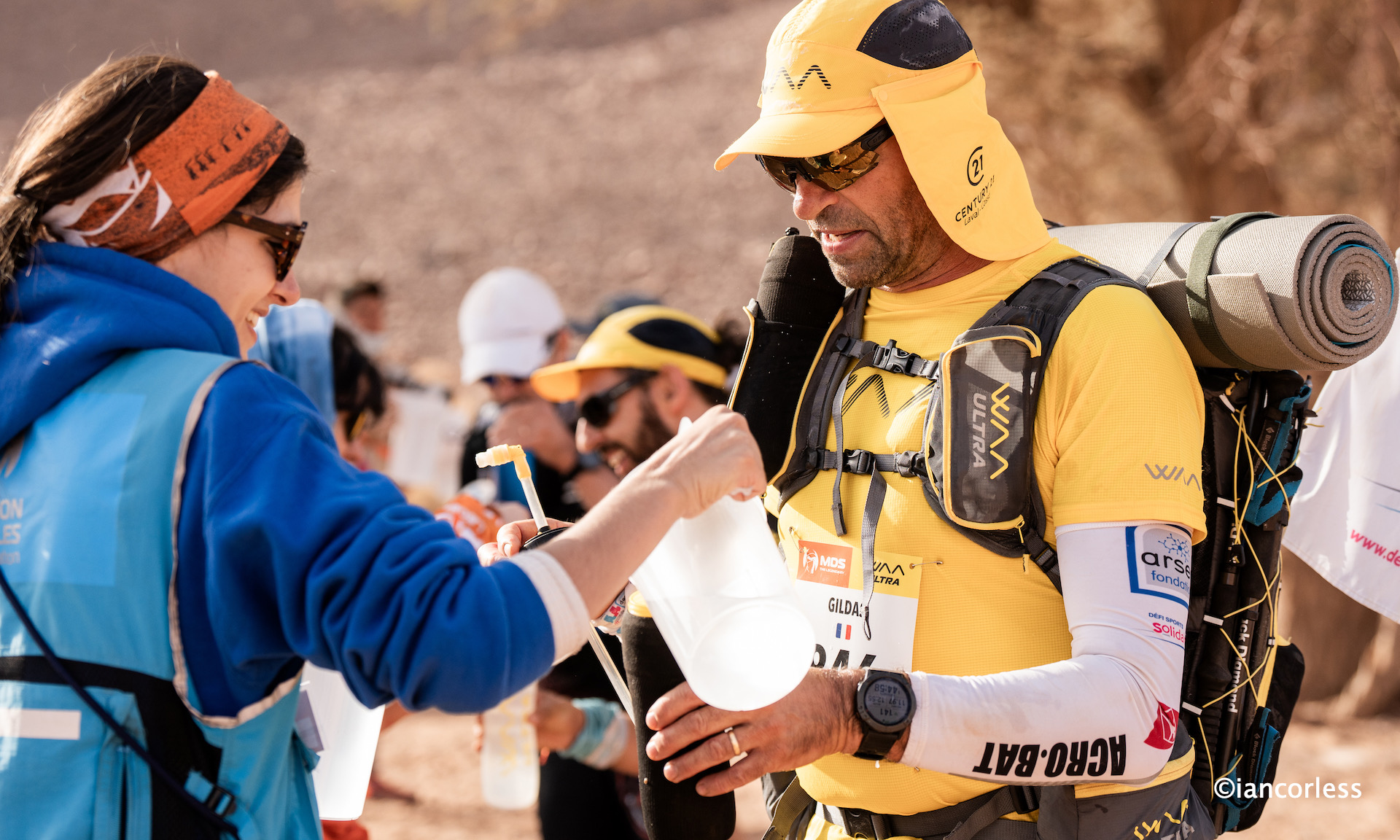
• water distribution
• medical presence
• toilets and hygiene supplies
At the finish line, you receive a 5-litre bottle of water, which must last until the first checkpoint the following day. To clarify, you need to drink, cook dinner, wash (if you can spare the water), make breakfast and fill bottles ready to last to CP1 all from the 5ltr bottle.
Each evening the Info Tent and medical clinic are open.
Safety in the Desert
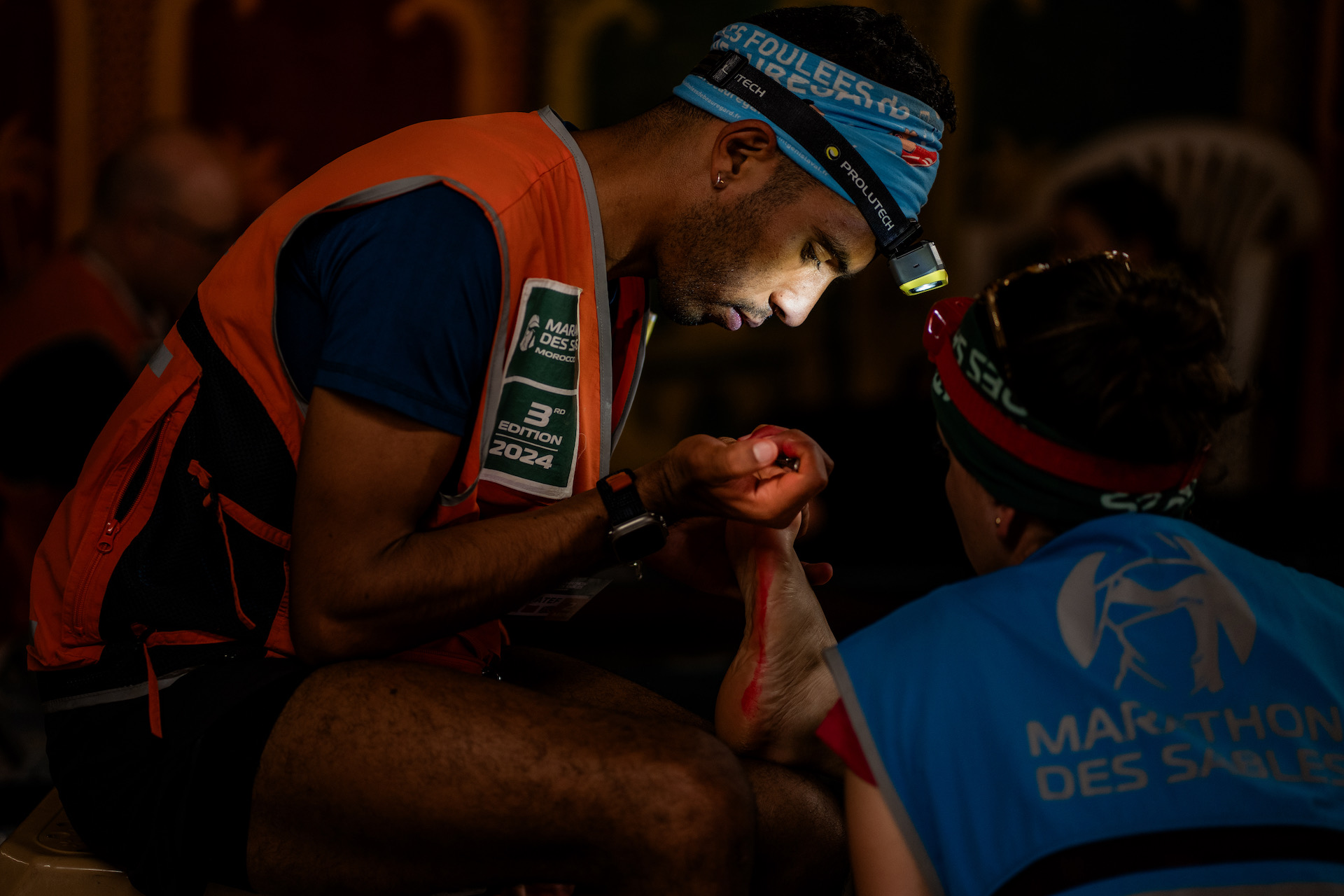
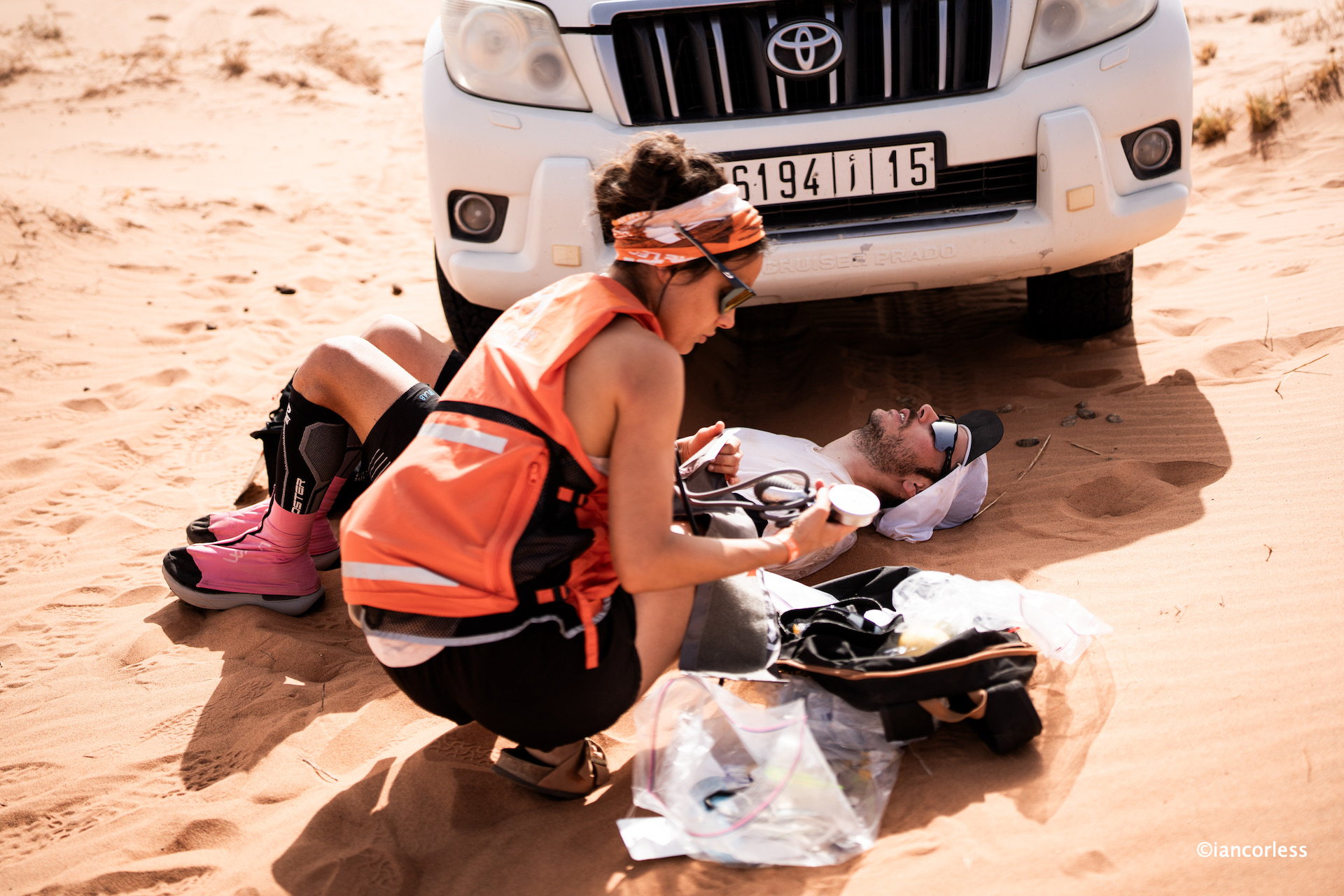
Despite the race’s self-sufficient nature, medical support is extensive. Assistance is available before, during, and after every stage. However, runners are expected to understand basic foot care, which is essential during multi-day desert racing.
For more serious problems, the Dokever medical team takes over.
If you must withdraw from the race, you must notify the organisation. In emergencies, medical evacuation will occur. For non-emergency withdrawals, transport will be arranged back to Ouarzazate, but hotel and food costs will be your responsibility.
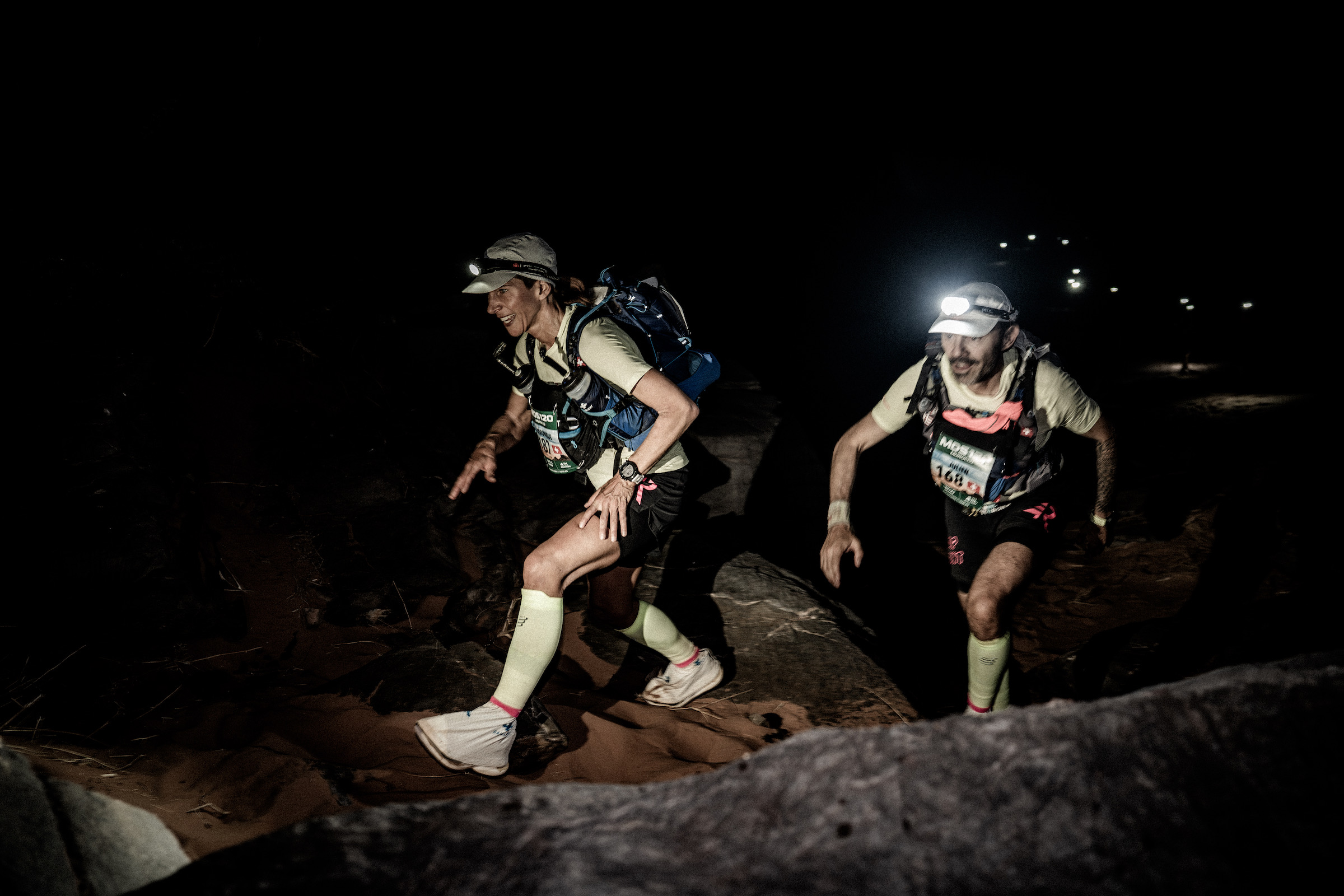
At night during a stage, headlamps are mandatory.
Navigation and Desert Conditions
The course is marked clearly and all checkpoints are mandatory. Cutting across the course is forbidden.
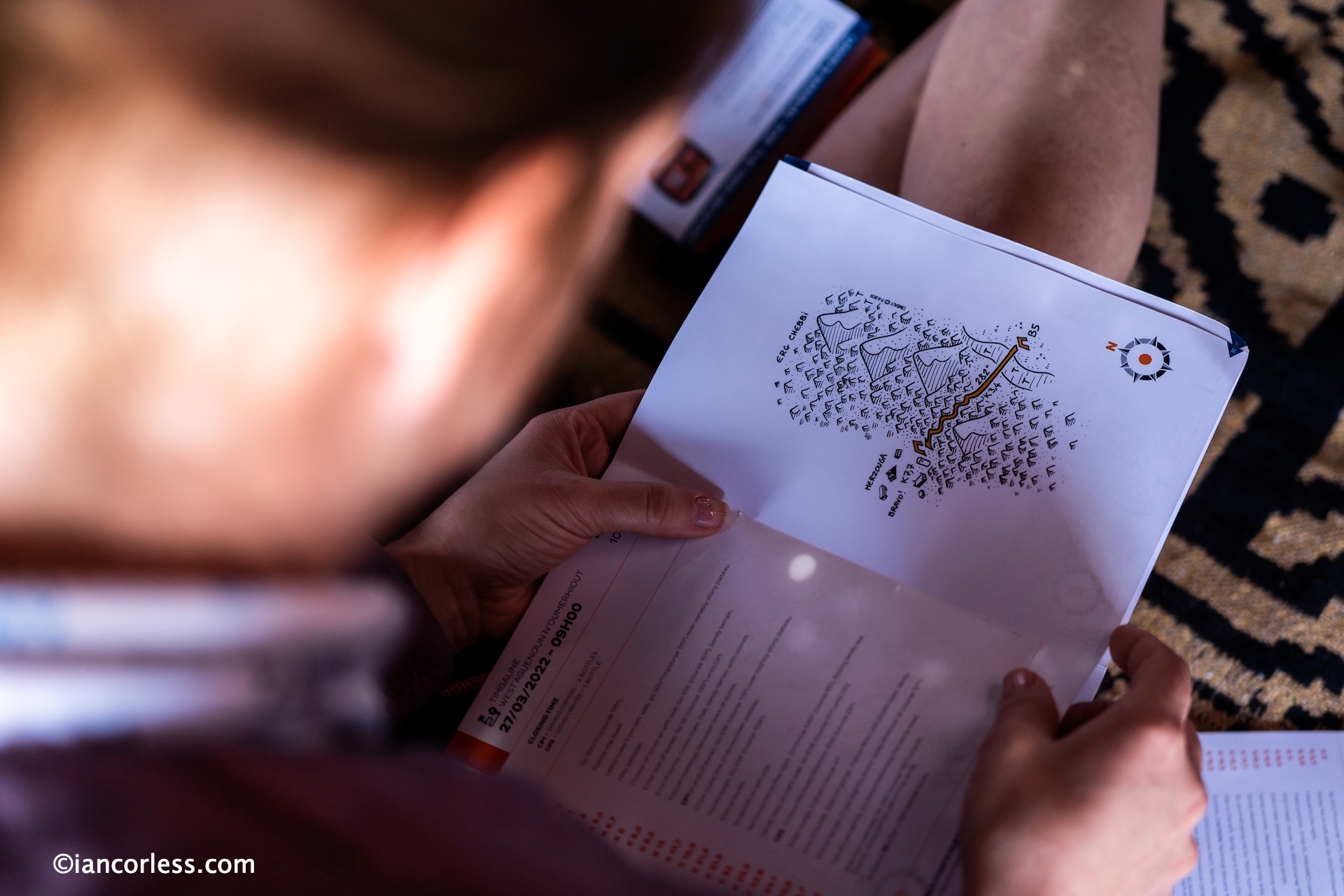
Compass headings in the road book are provided as guidance if visibility becomes poor. Know how to use a compass and take a bearing!
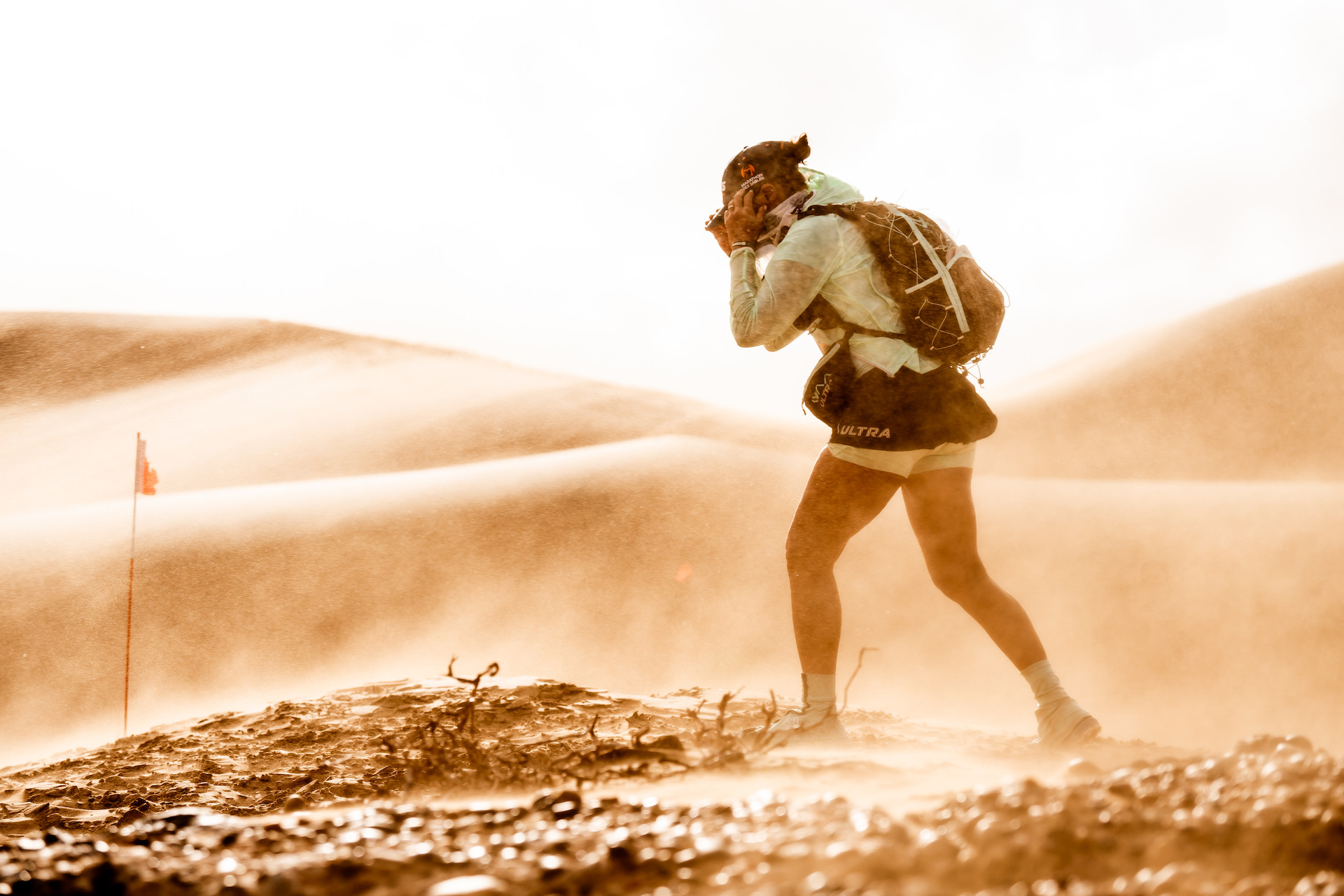
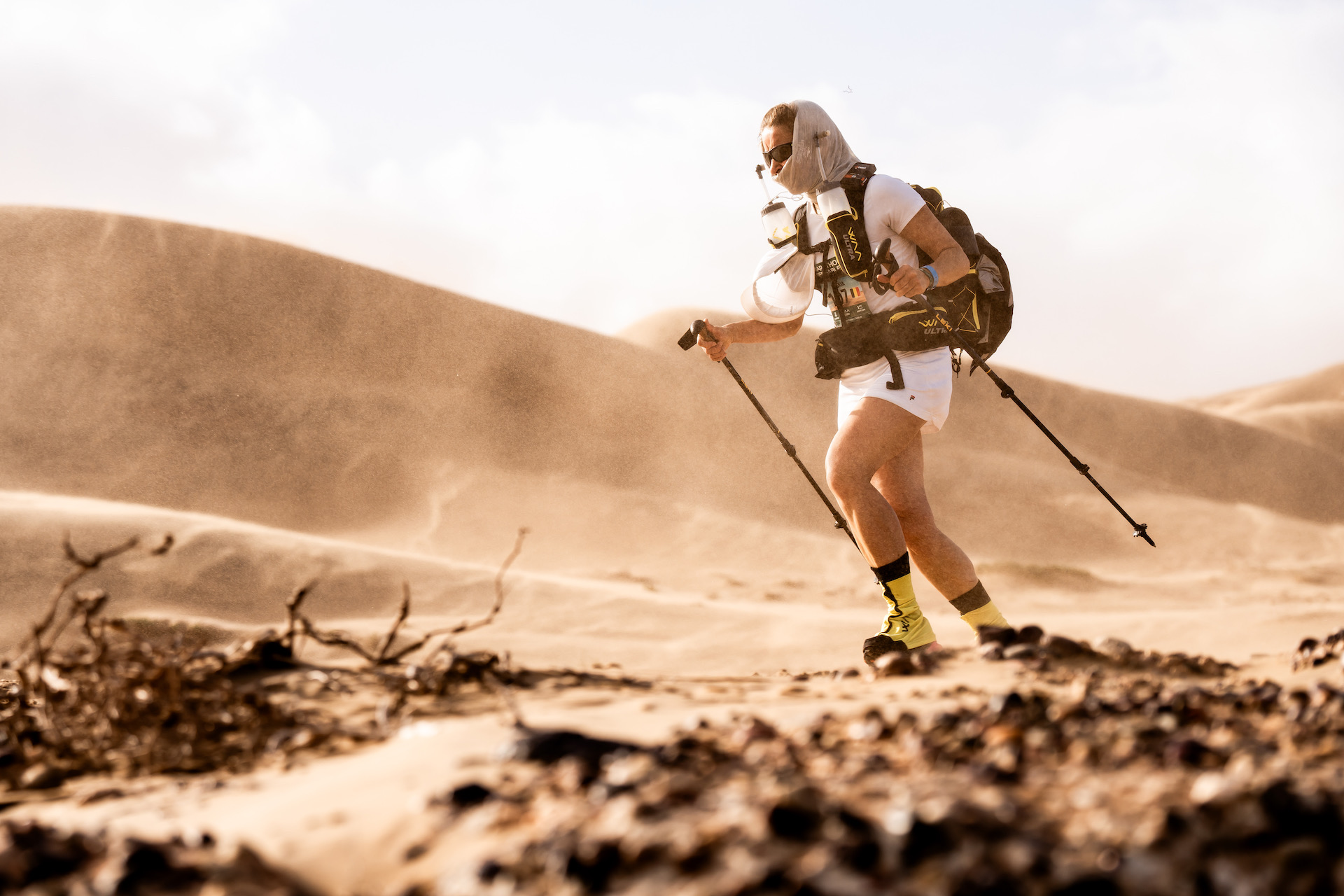
Sandstorms
If a sandstorm arrives:
• protect your eyes – you need good glasses and ideally goggles
• cover your nose and mouth typically with a Buff or similar
• stay close to other runners
Photo by Ian Corless
If visibility drops, stop moving and immediately remove compass and take a bearing for the direction of travel. When conditions improve you can move again relying on the compass bearing to ensure you are going in the correct direction.
If you stray from the course, the organisation will receive an alert from your GPS beacon and locate you.
If You Become Lost
It is highly unlikely that you become lost at MDS, however, it is possible to stray of course and feel disorientated. If you cannot see course markings for ten minutes:
1. Stop and assess your position.
2. Climb a small rise if possible to scan the horizon.
3. Backtrack for up to ten minutes if necessary.
Remember, you have a tracker, so, MDS organisation will know where you are and will be able to find you – do not panic.
As a last resort, activate the SOS function on your GPS beacon.
Distress signals can also be made using whistle blasts or torch flashes at night
To alert SOS with a whistle, the internationally recognized distress signal is three short, sharp blasts, followed by a pause, and then repeated. While the full Morse code for SOS is three short, three long, and three short blasts, the simplified “three blasts” method is more commonly used in disaster preparedness to call for help.
To alert SOS with a torch, flash the light in a repeating pattern of three short flashes, three long flashes, and three short flashes.
Medical Requirements
All runners declare medical information during registration.
During race checks, you must present:
• an original medical certificate
• a resting ECG
Photo by Ian Corless
Failure to provide these documents results in disqualification, though emergency testing may be available on site for a €200 fee.
Medical staff specialise in sports and tropical medicine and operate throughout the race.
They also have the authority to withdraw any runner deemed medically unfit to continue.
The Stages
The 2026 race covers approximately 270 kilometres +/- across the Sahara. Total elevation gain will be around 2500m +/-
Confirmed distances will be in the road book, anticipate the following +/- km’s.
Stages include:
• Stage 1: 37 km
• Stage 2: 41 km
• Stage 3: 29 km
• Stage 4: 100 km (You have two days to complete this stage.)
• Stage 5: 42 km
• Stage 6: 21 km
Photo by Ian Corless
To complete the race properly, runners must carry enough food to provide at least 14,000 calories. Remember, this is the minimum, you may well need more than this, so, balance calorie requirement and weight carefully.
The runner is self-sufficient and must carry ALL they need for the whole race, water the only exception.
After Each Stage
Once you reach the bivouac again, recovery begins immediately. You will receive a 5ltr water allocation which must last to CP1 the next day. Stage 4 an exception due to the rest day where extra water will be allocated.
Photo by Ian Corless
Start with a recovery drink before preparing food.
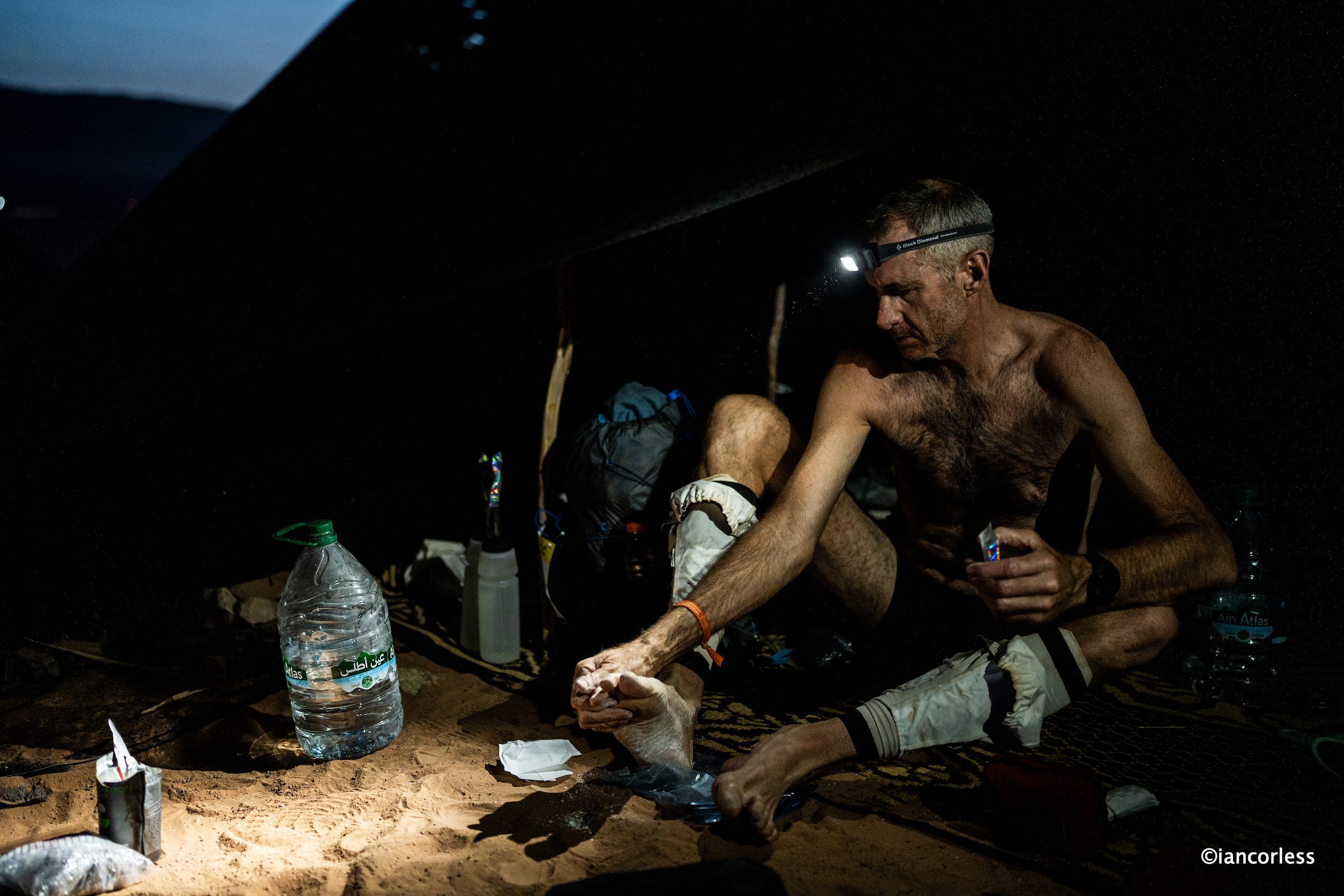
Important – take off your shoes and socks right away. Let your feet breathe and inspect them carefully while you are waiting for water to boil or, you are waiting for a meal to hydrate.
Eat a meal within 1-hour of finishing the stage.
Changing into clean or warmer clothing can make a huge difference. It allows running gear to dry and gives a mental reset for the next day. However, you also need to balance weight – keep ‘extras’ to an absolute minimum.
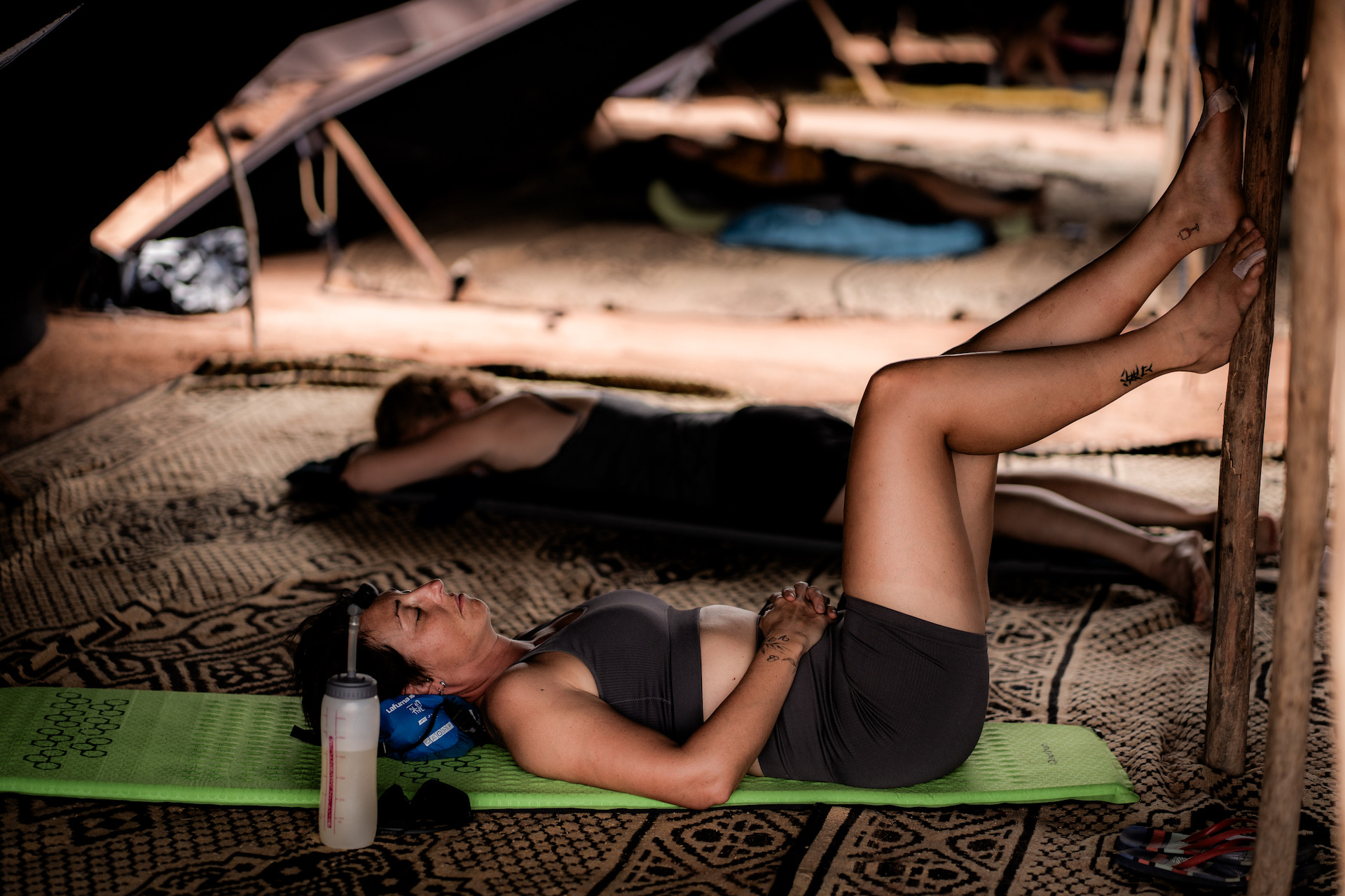
Sleep and rest is another priority. A sleeping mat helps enormously for rest, relaxation and sleep comfort. Your sleeping bag must be light but warm enough for desert nights. We are all different, so know what you need.
Be meticulous with your gear. Eight runners share each tent, and it can quickly become cluttered. Keep your bag packed and store items immediately after using them. Desert winds or sudden sandstorms can easily carry equipment away, especially lightweight items like sleeping mats.
Photo by Ian Corless
A Buff around your neck is invaluable. It lets you cover your nose, mouth, eyes, and ears quickly when conditions change.
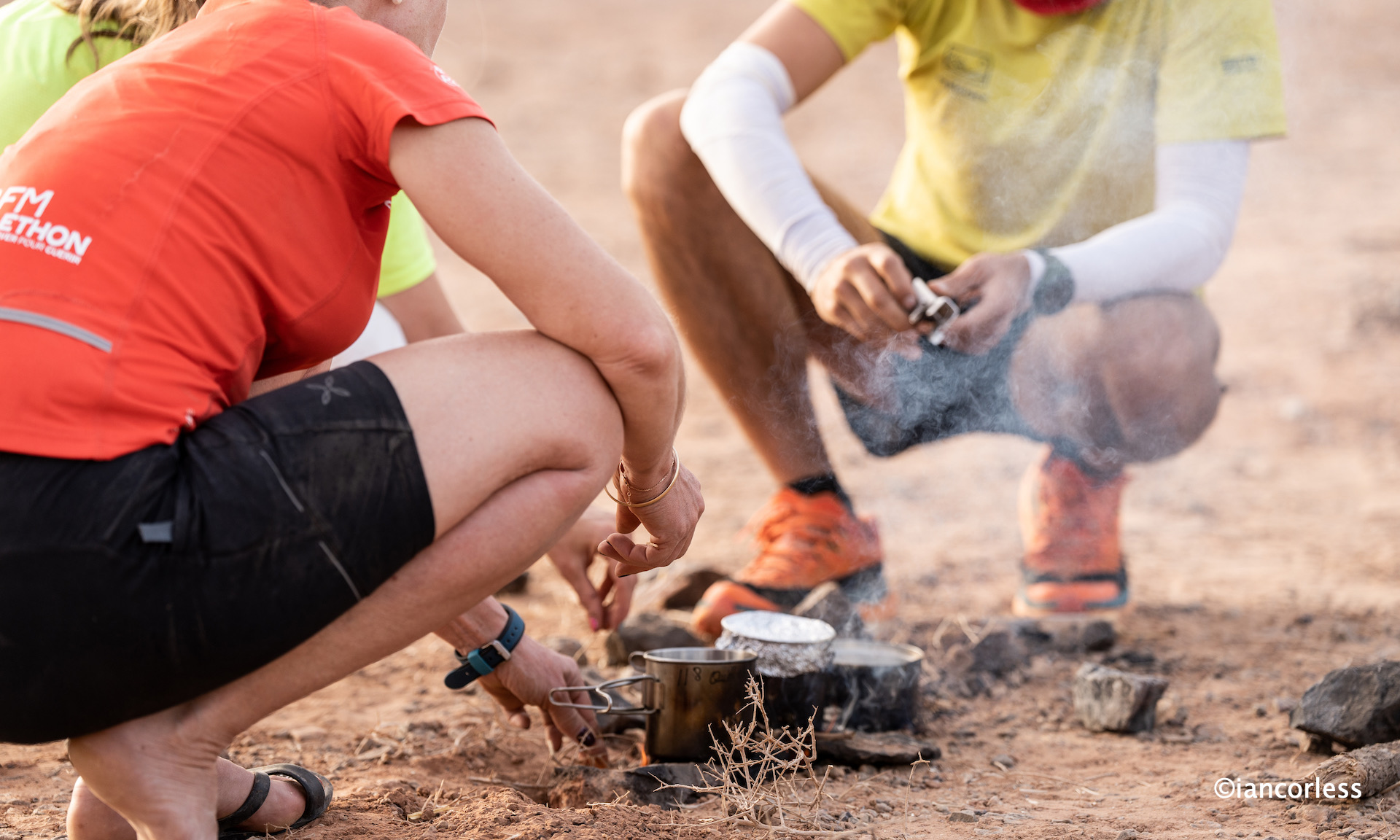
Many tent groups also create a simple cooking area using stones and small branches for fire. Often the first runner back begins preparing the cooking area for everyone else.
Over time, these small routines become part of the experience.
And the bivouac itself becomes something special.
You will share the tent with people from all over the world. You will go through highs and lows together. Some moments will be difficult. Others unforgettable.
Many runners say the friendships formed here last a lifetime.
That is the spirit of Marathon des Sables.
After the Finish on Stage 6
Cross the finish line of the final stage and you will receive your medal, water allocation, and a packed lunch.
Photo by Ian Corless
Then you board a bus back to Ouarzazate. Buses leave as soon as they are full, so, no need to hang around and wait for ages.
The bus will take you to your specific hotel and your luggage will be waiting at your hotel.
What comes next is simple but glorious:
a shower…
then another shower…
and maybe one more.
Clean clothes.
A real bed.
A proper meal.
The following day is free to relax and explore. Remember the MDS shop! Later in the afternoon there is a dinner, awards ceremony, and celebration party.
Photo by Ian Corless
After that, the journey home begins.
But the memories of the desert tend to stay with you far longer.
MDS 120 Atlantic Coast returns for 2026 with a bold 2nd edition that invites walkers and runners alike to a three-stage, four-day self-sufficient challenge along Morocco’s Atlantic shores. Competitors will take on routes of 70, 100, or 120 kilometres in total, choosing their own distance while mastering the same demanding, coast-to-coast format that has become a hallmark of the MDS family. This year’s edition follows closely on the heels of the inaugural MDS Ultra, which wrapped up just a week earlier, making the Atlantic Coast event the season’s first MDS 120 race of 2026. Participants will gather in Agadir for a seamless pre-race briefing, then linger after the finish for a relaxed post-race stay in a comfortable hotel. The event is designed for all abilities, from dedicated walkers to seasoned runners, offering a true test of endurance without sacrificing accessibility.
Photo by Ian Corless
The coastline landscape promises a mix of open beaches, wind-sculpted dunes, and rugged hinterland, delivering diverse terrain without losing the sense of adventure that draws participants back year after year. By welcoming walkers right beside runners, the event reaffirms its commitment to inclusivity while preserving the challenge that marks the MDS family. For those who crave the feel of a grand adventure without crossing continents, the Atlantic Coast edition offers a perfect balance of scenery, camaraderie, and personal achievement.
Photo by Ian Corless
What to expect on the three stages
The race unfolds over three days of stage racing, spread across four calendar days. Each participant selects their total distance – 70, 100, or 120 kilometres – and completes the corresponding combination of stage lengths. The route design emphasises a continuous, day-by-day test of endurance, and self-reliance, with the sense of discovery growing as the coastline unveils new horizons.
Expect a demanding yet spectacular mix of beach stretches, coastal dunes, rocky outcrops, and inland trails that thread along the Atlantic fringe. While the sea air and sun contribute to the challenge, the route rewards rhythm, efficient pacing, and smart planning.
As a self-sufficient event, participants rely on well-marked courses and a robust safety net. Course marshals, remote safety teams, and medical support are in place, with clear guidelines on mandatory equipment and daily checkpoints. Competitors manage their own nutrition and water, planning for the day ahead while staying mindful of weather and terrain. This combination of independence and structure is what defines the MDS 120 experience.
Photo by Ian Corless
The MDS 120 Atlantic Coast is explicitly designed to welcome a wide spectrum of abilities. If you’re a walker who can cover long distances with steady pace, or a runner seeking a new endurance benchmark, this event offers a supported, self-sufficient platform to push limits in a beautiful, accessible setting. It’s ideal for first-time MDS 120 participants seeking a well-structured introduction without compromising the sense of accomplishment, as well as returning athletes looking for a coastal contrast to Sahara routes.
Why MDS 120?
Expanded inclusivity with a broader distance range: The 70/100/120 km options enable more participants to tailor the challenge to their current level while still delivering the iconic MDS 120 experience.
Photo by Ian Corless
A fresh Atlantic coastal route: The coastline around Agadir offers new routes that emphasise coastal beauty and wind-sculpted terrain, creating a distinctive mood and pacing compared with prior editions.
Photo by Ian Corless
Athletes travel to Agadir, where a hotel base serves as the staging ground for briefing and support, with a hotel stay also planned for post-race recovery and celebration. The overall package aims to balance challenge with comfort, giving participants a strong sense of community without sacrificing the rugged essence of self-sufficiency.
A celebration of pace, place, and persistence MDS 120 Atlantic Coast 2nd edition is more than a test of endurance. It’s a celebration of pace, place, and persistence, inviting a broad range of athletes to test their limits in a setting that blends the raw beauty of Morocco’s Atlantic edge with the camaraderie and strategy that define the MDS experience. The 70, 100, and 120 km distances let participants choose a level of challenge that matches their training, experience, and appetite for adventure, while the three-stage format over four days preserves the thrill of back-to-back days on the trail.
If you’re looking for a race that marries coastline drama with self-sufficient racing, where every kilometre earned is a personal milestone and every sunset over the Atlantic is a reward, the 2nd edition of MDS 120 Atlantic Coast in Morocco awaits.
The 2025 MDS 120 Morocco roared to life this morning at 08:00 sharp under a glowing desert sunrise and clear, windless skies. Stage 1, a 25km loop through the heart of the Moroccan Sahara quickly reminded everyone why this race is not for the faint of heart.
With checkpoints at 8.5km, 12.4km, and 19.7km, the route unfolded across varied terrain that punished and amazed in equal measure.
The temperature soared early, peaking at 32°C in the shade—but shade was a rare luxury. Out in the dunes and rocky passes, it felt much hotter.
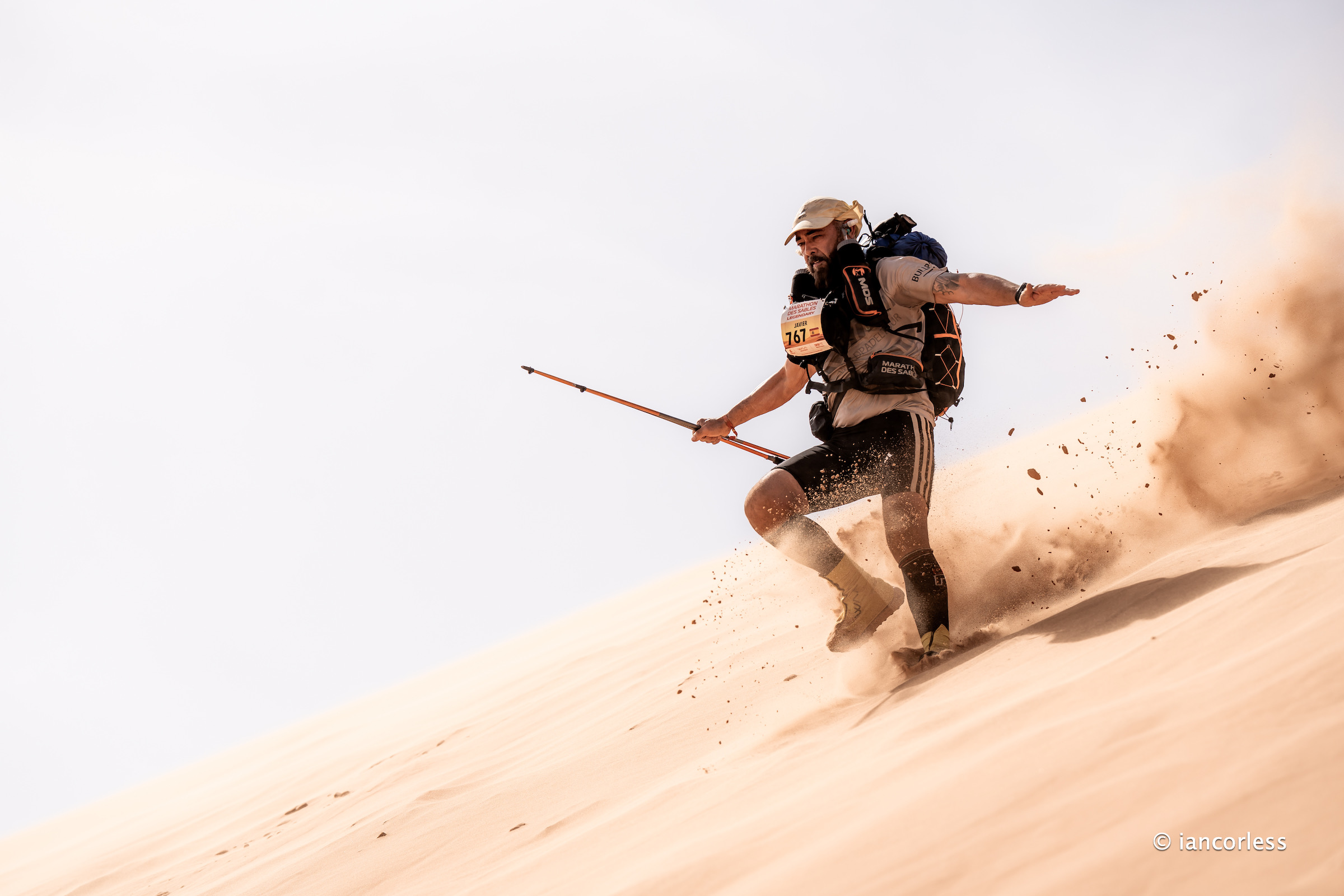
The stage featured 509 meters of elevation gain and four demanding climbs. The highest ascent, topping out at 837 meters. The route was a grind over soft sand, stony trails, and shifting ground that sapped energy and tested resolve.
Despite the brutal conditions, the elites wasted no time. As expected, Morocco’s own Rachid El Morabity cruised to victory in 02:22:37, showing his class and desert mastery once again.
On the women’s side, Véronique Mueller-Berberat delivered a commanding performance, finishing in 03:31:23.
Today was more than just a race, it was a trial by heat, sand, and elevation.
The loop offered sweeping views and raw Saharan beauty, but it demanded everything in return.
Tomorrow, the challenge deepens with Stage 2, offering three route options: 20km, 40km, or 60km.
Whether racers go short, long, or ultra, they’ll need to dig deep again—this desert doesn’t let up.
After the last-minute cancellation of MDS 120 Fuerteventura, the focus now shifts firmly to Morocco, where two cornerstone events are about to take center stage: MDS 120 Morocco and MDS Trek Morocco. Anticipation is high, the energy is back, and participants are ready for the desert challenge they’ve been waiting for.
What Are MDS 120 and MDS Trek?
The MDS 120 is a three-stage, four-day 10/100 or 120 km endurance race in the desert, modelled after the legendary Marathon des Sables but in a shorter, more accessible format. Athletes carry their food and gear, manage their effort in the heat, and experience the highs and lows of true desert racing, every kilometer tests both body and mind.
The MDS Trek shares the same landscapes and spirit as all MDS events but swaps competition for exploration. Designed for adventurers and walkers, it offers a supported trek across the Sahara, with each stage a new chance to discover the desert at a different pace. Participants are not self-sufficient, camp has more luxury and yes, even showers are possible!
The Journey Into the Desert
The adventure begins well before the start line. Most participants first gather in Marrakech, where the atmosphere is electric as athletes and trekkers from around the world converge. From there, MDS arrange transfers over the High Atlas mountains to Ouarzazate, often called the “door of the desert.”
Two hotel nights in a hotel with administration protocols, then the caravan heads deeper into the Sahara. The transfer to Bivouac 1 marks the true start of the experience: the desert horizon stretching endlessly, the iconic WAA tents awaiting, and the realization that the adventure is about to begin.
MDS 120 Morocco:
MDS Trek Morocco:
Looking Back at 2024
The 2024 editions showed the enduring strength of the MDS spirit. Morocco delivered outstanding editions and for MDS 120, there were some challenging climatic conditions with rain and flooding.
MDS Trek, was business as usual with classic Morocco weather. Participants took on dunes, jebels, and starlit nights. These moments reinforced Morocco’s reputation as the spiritual home of the Marathon des Sables.
Why 2025 Will Be Bigger and Better
In 2025, expect the same, but amplified. The organisers have doubled down on delivering unforgettable events, and the buzz suggests the community is ready for it. The MDS 120 Morocco will push competitors harder, while the MDS Trek will continue to offer an inclusive and inspiring path through the Sahara.
And Then Comes Jordan
Photo by Ian Corless
The adventure doesn’t stop in Morocco. Just weeks after the conclusion of the MDS Trek, the focus shifts east for MDS 120 Jordan, where runners and trekkers will swap the Sahara for the dramatic landscapes of Wadi Rum. It’s a quick turnaround, but for those chasing the full MDS experience, it’s the perfect continuation of a year dedicated to desert discovery.
The countdown is on.
Morocco awaits.
Interested in a Marathon des Sables event? More informationHERE
The MARATHON DES SABLES is a unique adventure of 250km’s spread over 6-stages of self-sufficiency, shared by thousands of enthusiasts, in 2026 it celebrates 40-years. In 2017, another format, HMDS was born with 70 to 120km distances, spread over 3-stages and 4-days.
Since 2024 there has been a significant changes for the MDS brand. The ‘HMDS’ format while still following the same protocols and format has now dropped the ‘half’ title and moving forward, events will be called MDS 120 Jordan, MDS 120 Morocco, MDS 120 Cappadocia and so on.
To differentiate the full distance race of 250km’s, Marathon des Sables will now be known at MDS Legendary, reflecting the legendary status of this iconic event and its long history as a pioneer of the stage racing and multi-day format.
All the races are now owned by the same team and while many may be familiar with the format and protocols for the shorter distance races, MDS Legendary since 2024 has had some significant changes.
Since 2024, MDS has expanded beyond its roots with MDS 120, the exploratory MDS TREK, the demanding MDS RAID, the mind-bending MDS Crazy Loops. and MDS ULTRA – Morocco. And the inspiring, MDS HANDI. Each one a new take on the same promise, to push the limits of what a runner can handle.
MDS EVENTS
MDS The Legendary
MDS 120 Atlantic Coast Morocco
MDS RAID Namibia
MDS 120 Cappadocia
MDS Crazy Loops – currently 2 locations in France.
MDS 120 Fuerteventura
MDS 120 Morocco
MDS Trek Morocco
MDS Handi Morocco
MDS 120 Jordan
MDS 120 Peru*
MDS ULTRA – Morocco
* Every 3-years.
WHAT IS MDS?
MDS is a self-sufficient race taking place over 3 to 6-stages.
Bivouac life.
MDS Legendary is the iconic 6-stage race (over 7-days) with a distance of 250km (+/-) based on the route, terrain and difficulty. There are no options available on distance and participants are self-sufficient for the entire race, the only exception is the provision of water and a shared tent (bivouac) with 7 other participants. An example of 2024 distances:
Stage 1 : 31.1 km
Stage 2 : 40.8 km
Stage 3 : 85.3 km (over 2 days)
Stage 4 : 43.1 km
Stage 5 : 31.4 km
Stage 6 : 21.1 km
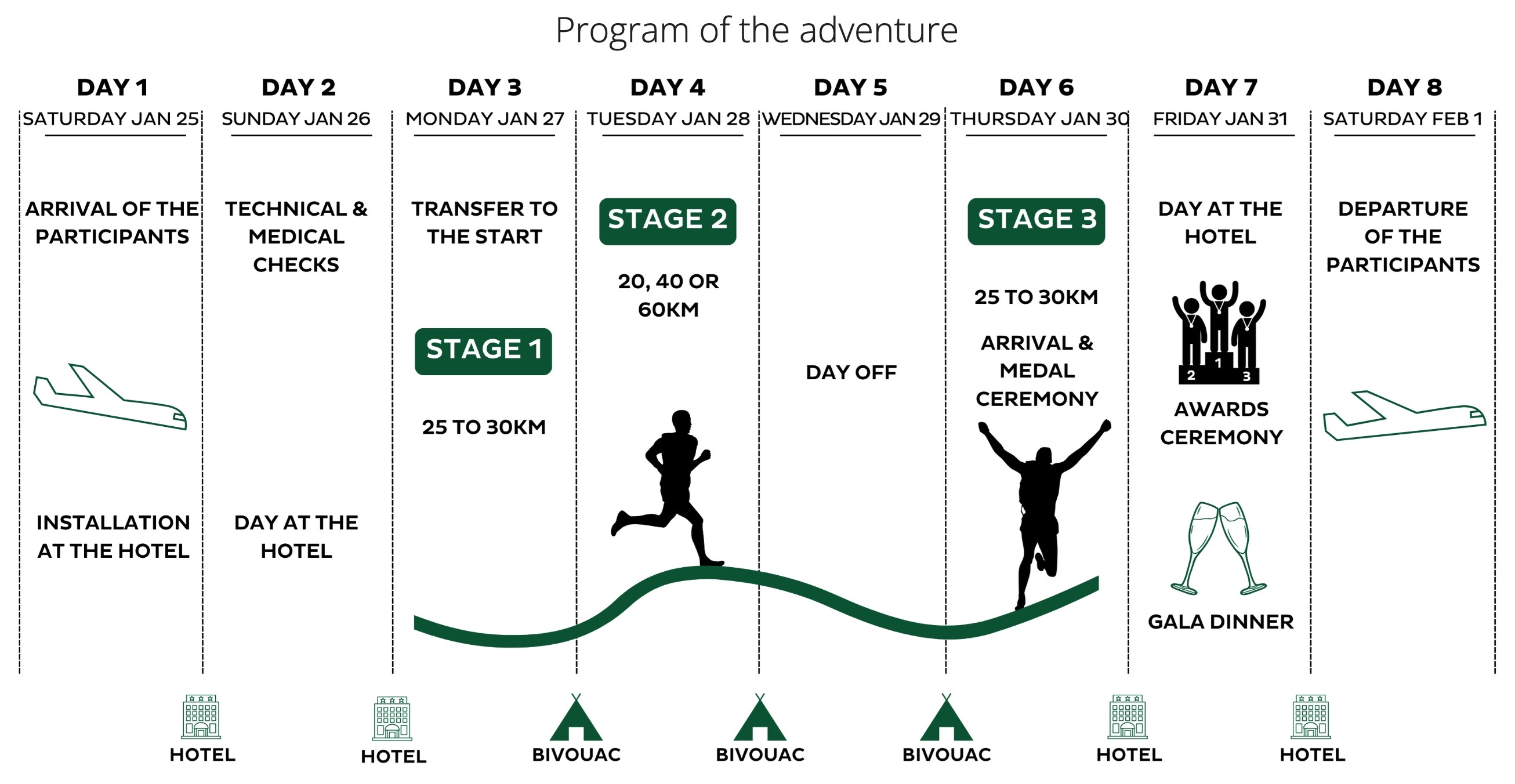
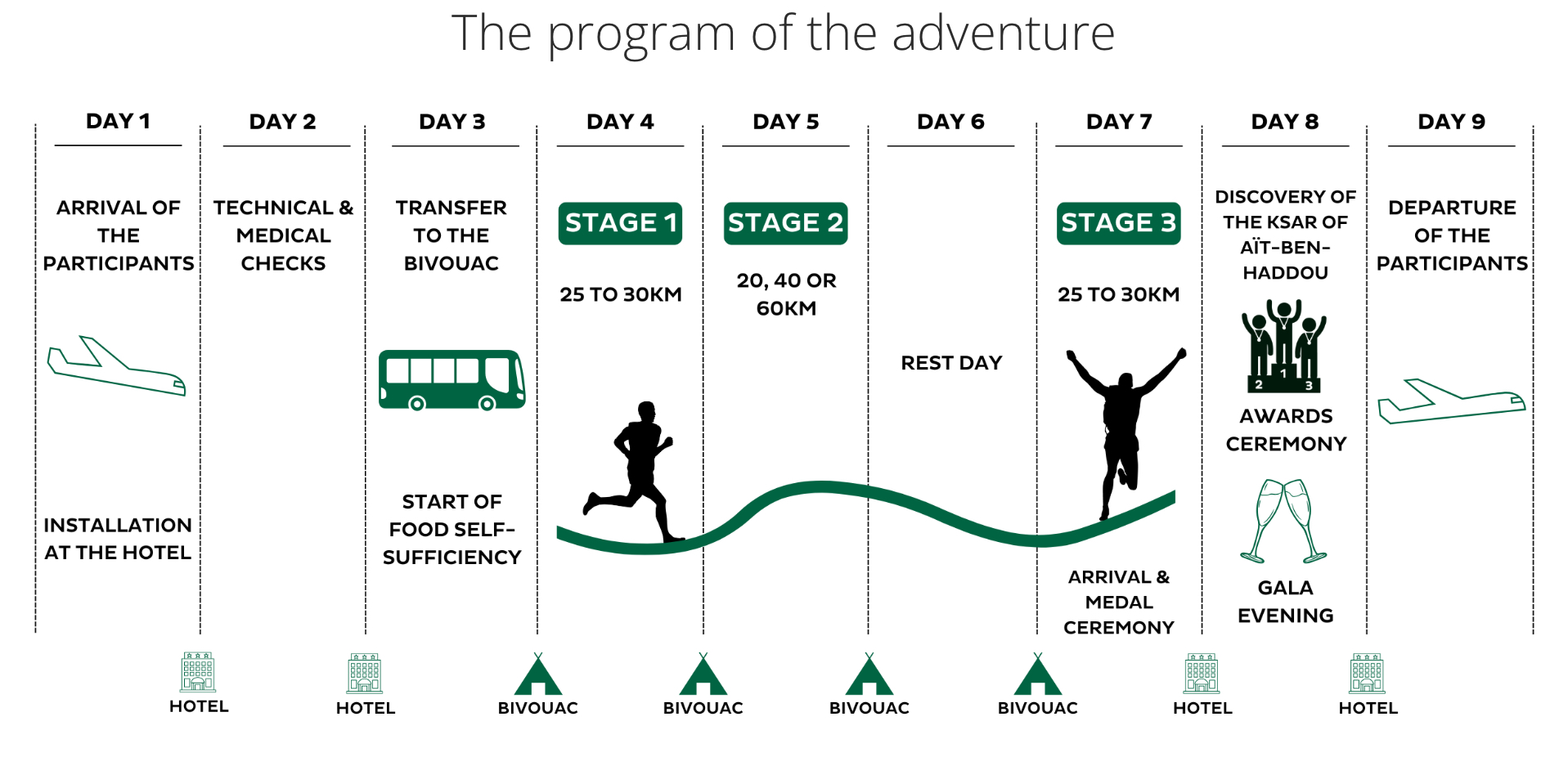
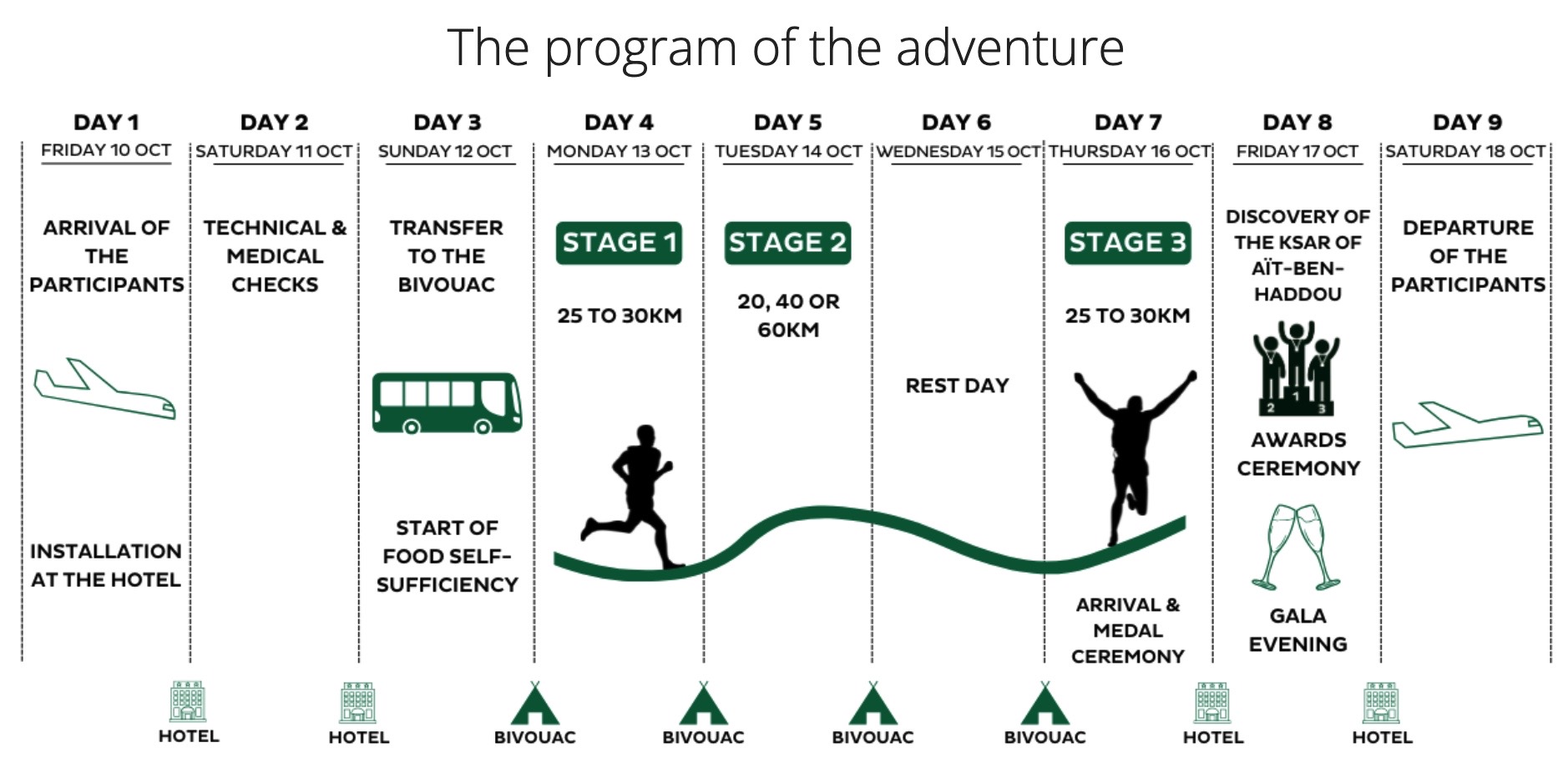
MDS120 events start at 70, 100 and 120km for the shorter race format, depending on the race destination, there are 2 or 3 distances available. To clarify, this is not 2 or 3 different races, but the same race with the option to choose what distance you run or walk. As an example, the route is divided into 3 stages (4-days), to be completed at your own pace: walking or running.
– 70 km
– 100 km
– 120 km
Here is a breakdown of each stage:
– Stage 1: 25km – 30km
– Stage 2: 20, 40 or 60km
– Stage 3: 25km – 30km
The choice of the format is made at the registration. However, you can adjust it until the time of MDS.
MDS RAID follows a similar format to MDS 120.
MDS TREK is not self-sufficient and while similar to other MDS events, the format is much more a holiday experience, ideal for first timers or those who are looking for an active travel/ relax experience. Read more HERE.
THE MDS FORMAT
MDS The Legendary and MDS 120 events follow a similar format, however, there are key differences:
MDS The Legendary is a 10-day experience
MDS 120 a 7-day experience
In both scenarios you arrange travel to the relevant destination, arriving with adequate time to meet the MDS team at a designated meeting point and time. This may mean you need to arrive one day in advance to ensure you are able to meet the schedule as stipulated. From here, the MDS team then transport you to the start of the race.
For MDS Legendary this will be a flight to Marrakech and free transport is offered to Ouarzazate.
For MDS120 / TREK / RAID and ULTRA events, the meeting point will be a specific airport for transfer to hotel.
MDS The Legendary use classic Nomad tents that hold 8-participants. By contrast, MDS120 events use individual tents organised in cells of 6. TREK has upgraded tents, RAID combines solo tents and a star night, MDS ULTRA will be hotels except when racing.
Post-race you will be transported to a hotel and an awards ceremony and gala dinner will take place.
EVENTS
MDSLEGENDARY the iconic 6-stage, 250km race celebrating 40-years in 2026.
MDS 120 (used to be HMDS) this is 3-stages over 4-days with distance options of 70/ 100 or 120km.
MDS TREK this is similar to the MDS 120 format, however, there is no self-sufficiency, more comfortable accommodation and additional facilities, an excellent introduction to the MDS.
MDS RAID an event for more experienced athletes that is undertaken in teams of two, over approximately 90-120km’s, typically, two distance options are provided. The format is similar to MDS 120 with 3-stages over 4-days. One night will be undertaken under the stars with no bivouac.
MDS ULTRA new for 2025, a 100-mile or 100km single stage race with a 40-hour cut off.
MDS CRAZY LOOPS three new events for 2025 undertaken in ski resorts, the format is to run as many loops as possible in 24-hours. The loops will be typically, 3-5km’s in length.
MDS HANDI an inspiring inclusive event to provide wheel chair athletes an opportunity to participate with team members.
Both race formats, MDS Legendary, MDS120, MDS RAID and MDS ULTRA require participants to be self-sufficient for the whole race.
What does this mean?
Quite simply, you must wear and carry all you need for your race experience with the exception of the tent / bivouac. MDS ULTRA will not require a bivouac or same kit requirements as MDS Legendary, Raid or 120.
It may sound daunting but it is not, it’s actually quite simple. You need to address the following points:
What you wear.
Equipment you need to participate.
Sleeping.
Food.
Cooking equipment. (You can purchase fuel blocks in bivouac)
Water.
WHAT TO WEAR
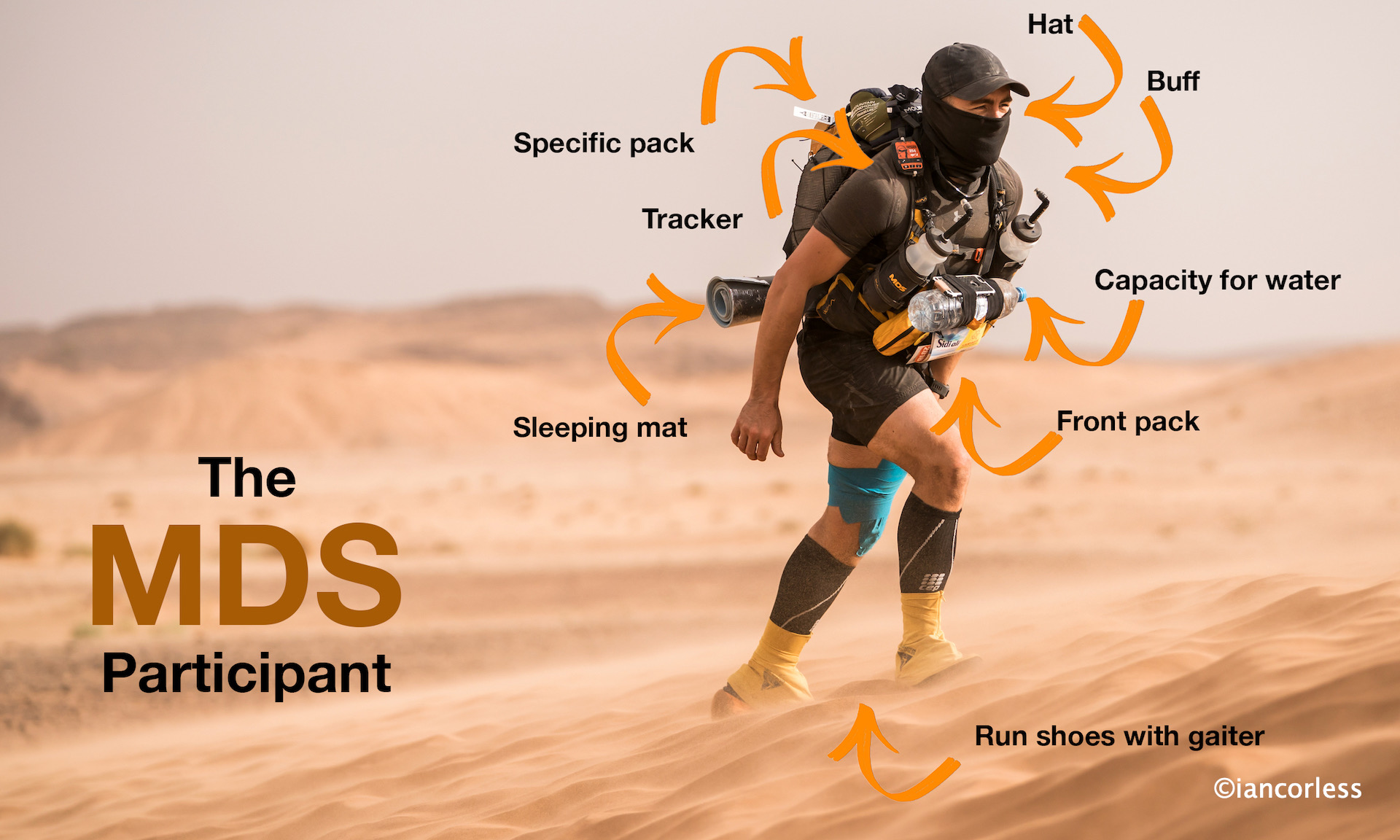
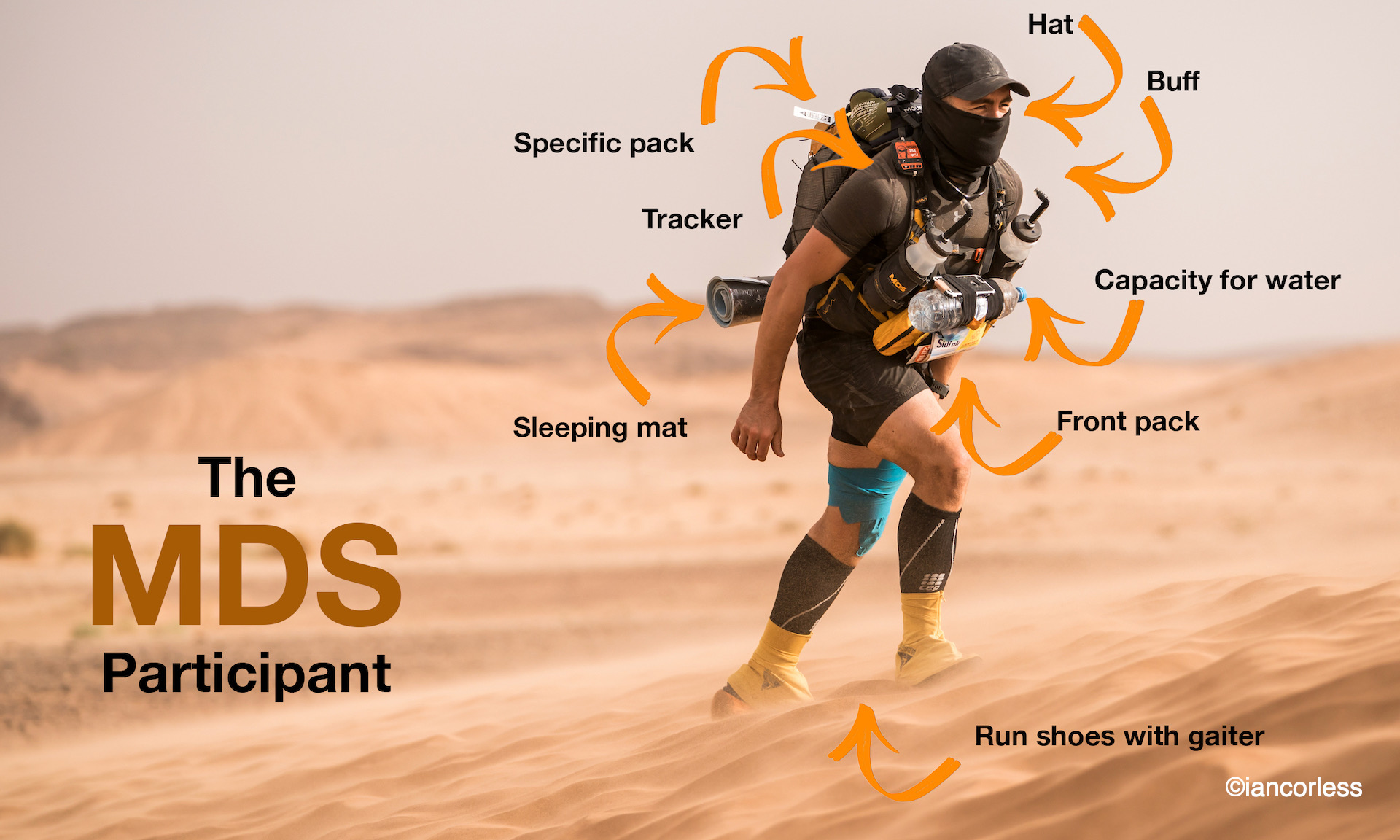
Hat to protect from the sun with optional neck protection.
Shirt (short or long sleeve) with adequate protection from the sun.
Shorts, skort or similar.
Socks.
Shoes with appropriate protection and durability for a desert environment with a gaiter (typically sewn on) to keep sand out of the shoe.
WAA is a partner for MDS have specific equipment for desert/ stage-racing.
Because you have entered a MDS event, there is no need to buy new apparel and shoes. Quite simply, if you have items that work, are comfortable, cause no problems or irritation, there is no need to change them. If it aint broke, don’t break it. Shoes always create a huge debate and please find what works for you. If you ask on any forum, you will get countless recommendations but none of those recommendations are specific to you and your needs. Read an article HERE and HERE.
Always remember that with MDS events you are either wearing or carrying everything you need for the race duration. Therefore, it is imperative that you purchase the lightest options available (based on budget) and you keep luxuries to a minimum.
Keep it simple!
MDS specify ‘mandatory’ equipment for participation as specified below:
A sleeping mat is highly recommended to protect from the ground, insulate and provide comfort.
A jacket is highly recommended (lightweight down) for cold morning and chilly nights. Many products exist. An excellent combination item is offered by PHD but it does come at a price – HERE.
Poles are for many 4-wheel drive in stage races, Leki are highly recommended.
Stove – if you plan to have hot water, you will need a cooking system like those provided by Esbit. Please note, you cannot use any gas stoves in the desert, you must use fire bricks which you can purchase at bivouac.
Pot – if you are using a stove, you will need a pot/ mug.
Spoon with long handle for eating. Such as a Spork.
Buff or neck roll.
Sunglasses are essential and think about protection in sand storms, goggles may be required.
Flip flops or similar. Many use the weight free slippers from hotels, however, they rarely withstand the desert.
Watch / GPX
Personal items: Tooth brush, toothpaste, hand gel, wipes, toilet paper, ear plugs, blind fold etc.
Emergency – Things can happen during a race, so, be prepared with some essential items such as needle and thread, superglue, zip ties, monkey tape etc. If something rips or breaks, you need to repair it.
Luxuries
MDS is and should be simple in format. Remember, you must carry everything, so, keep luxuries to a minimum. Many consider a small MP3 player, look for something small, light and with great battery.
Phones are an essential part of our daily lives, do yourself a favour and leave it at home. The liberation is extremely rewarding. Please note, phones are allowed, however, it is prohibited to telephone on the bivouac or on the course. If you want to make a phone call, you will have to move away from these places so as not to disturb anyone.
SLEEPING
A sleeping bag is mandatory, so, there is no discussion here. The combined weight of your food is the heaviest and bulkiest item, however, a sleeping bag is next. These days there are many options available and quite simply you want the lightest possible, with the smallest packing size with required warmth at a price that you can afford. Not all sleeping bags are the same, so, consider this. Down is the best filling as it is the lightest, warmest and packs small. However, ‘fill power’ is a key element of down, fill power tells you how much volume a 30-gram, or one-ounce, sample of down will take up. So, the higher the fill power, the warmer the bag will be for less weight, because that one ounce of down has larger down clusters that provide more loft and have the ability to trap more heat. These bags will be more expensive.
Brands to look at: Nordisk, Seat to Summit, Rab, PHD, Western Mountaineering, Wilsa, Lightwave and so on.
Note here, that you will also probably be taking a down jacket for warmth. This can be used as extra warmth and insulation in a sleeping bag. So, it is possible to think about getting a lighter, less warm bag and supplementing warmth with a jacket.
UK brand PHD has come up with the perfect solution with an Ultra Jacket and Desert Race Half Bag but is does come at a price. However, it is comparable with the costs of jacket and bag by Nordisk.
Sleeping mat is highly recommended. When you are not running or walking, you are sitting or lying down, comfort is key. Two options exist, inflatable or not. Inflatable provides the greatest comfort but with poor admin does have the risk of puncture. Sea to Summit provide excellent inflatable options with low weight and pack size. Exped have excellent closed-cell foam.
The MDS 120 events (TREK not included) are self-sufficient adventures. You need to bring your own food and carry it in your bag for the duration of the race.There is a requirement that you must have 2000 calories minimum per day. Please remember that from 2024, catering is not provided at MDS The Legendary and therefore you must have enough food and calories before the race starts.
Food is the heaviest item you will carry and is essential. Don’t skimp on food. Lay food out per day addressing key items:
Breakfast (be careful they are not too sweet)
Snacks while running (bars, nuts, dried meat etc)
Post-run recovery (usually liquid form is ideal)
Lunch if applicable (this could be another meal such as cous cous)
Dinner (dehydrated meal)
Evening snack (a bar)
Where possible, repackage food to make them smaller and lighter. However, make sure you keep nutritional information for the admin day. Pack food in day bags, that way it is easy to know what you have and importantly, you don’t take food you need for the next days. Keep doing this and you will be short of food at the end of the week.
Food is personal and you must find out what works for you. Remember taste chances when fatigued and in hot environments, often, sweet becomes less palatable with a preference for savoury. Dehydrated meals will often be used for key meals such as breakfast and dinner, some hydrate well with just warm water, others need hot water. So, if you are not taking a stove, test this. Basecamp food is a good website that shows what options exist. After many tests, highly recommended products are Firepot, Lyo, Tentmeals and Adventure Menu. Personally speaking, Firepot produce the tastiest meals I have tried.
Make sure you add some treats to spice up your palette.
A food list for MDS The Legendary could look like this:
Water provision, particularly at MDS The Legendary and MDS 120 has changed. In past editions, water was rationed and provided at key checkpoints in bottles, typically, 10km’s apart.
In 2024, the new organisation changed this and arguably, water is now available, as required whilst racing. It is poured from jugs by MDS staff.
In addition, intermediate water stations are added when deemed necessary to ensure competitor safety.
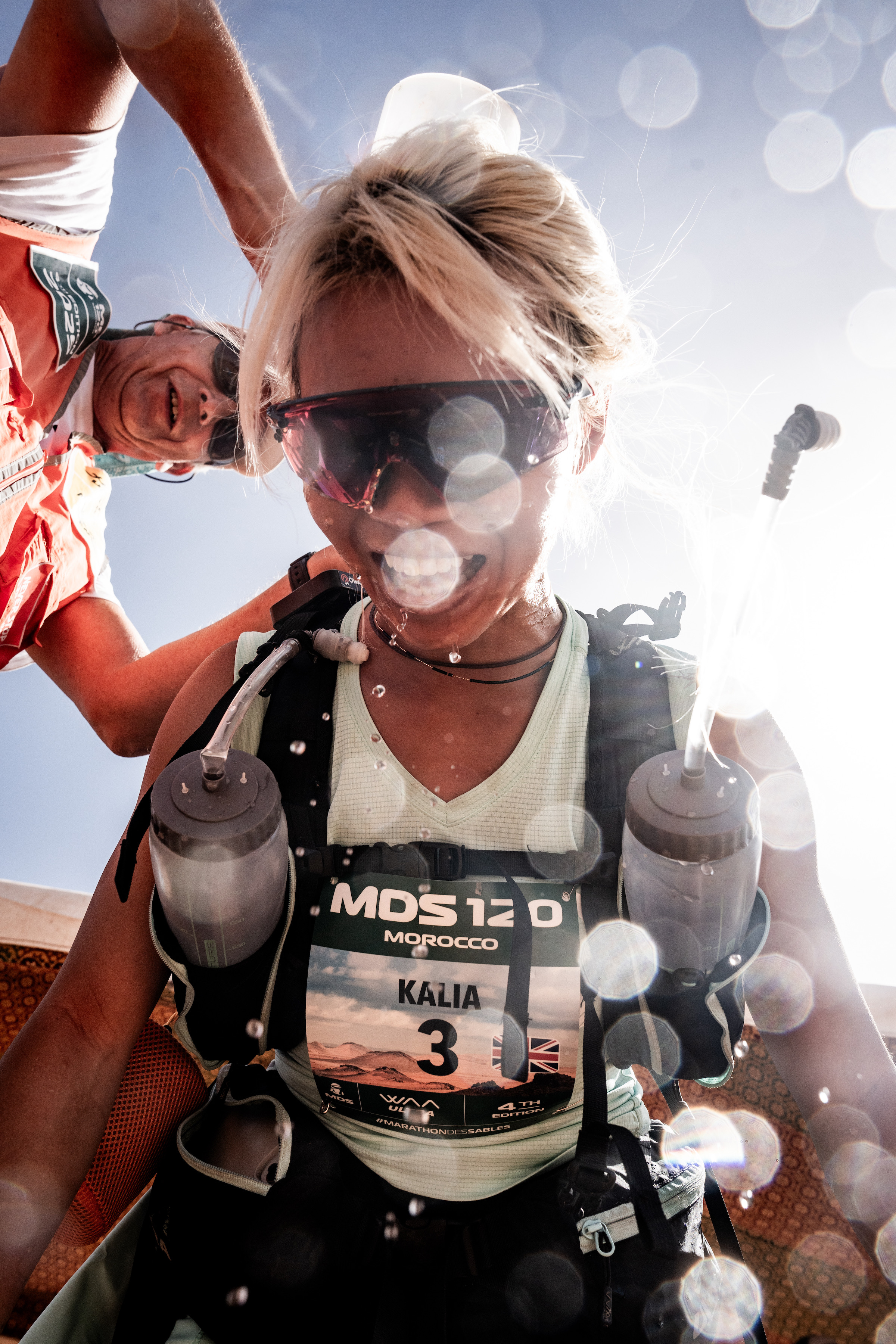
At key checkpoints, iced water is supplied and poured by MDS staff on the heads and neck to aid cooling.
Post-race, each runner is provided with a 5L bottle of water, this is used for evening cooking, breakfast and up to CP1 the next day. If you wish to wash or freshen up, this comes from the same water ration. So, prioritise food and drinking before washing.
THOUGHTS AND CONSIDERATION
MDS is available for all, be that racing snake or someone who is looking for the adventure of a lifetime. So, keep that in mind. A top runner will have his or her pack at the absolute minimum weight and will look to survive the week racing as fast as possible. They will spend the week hungry. You, for example, may wish to carry a little more weight and have some comfort during the week. Just don’t carry to much extra weight!
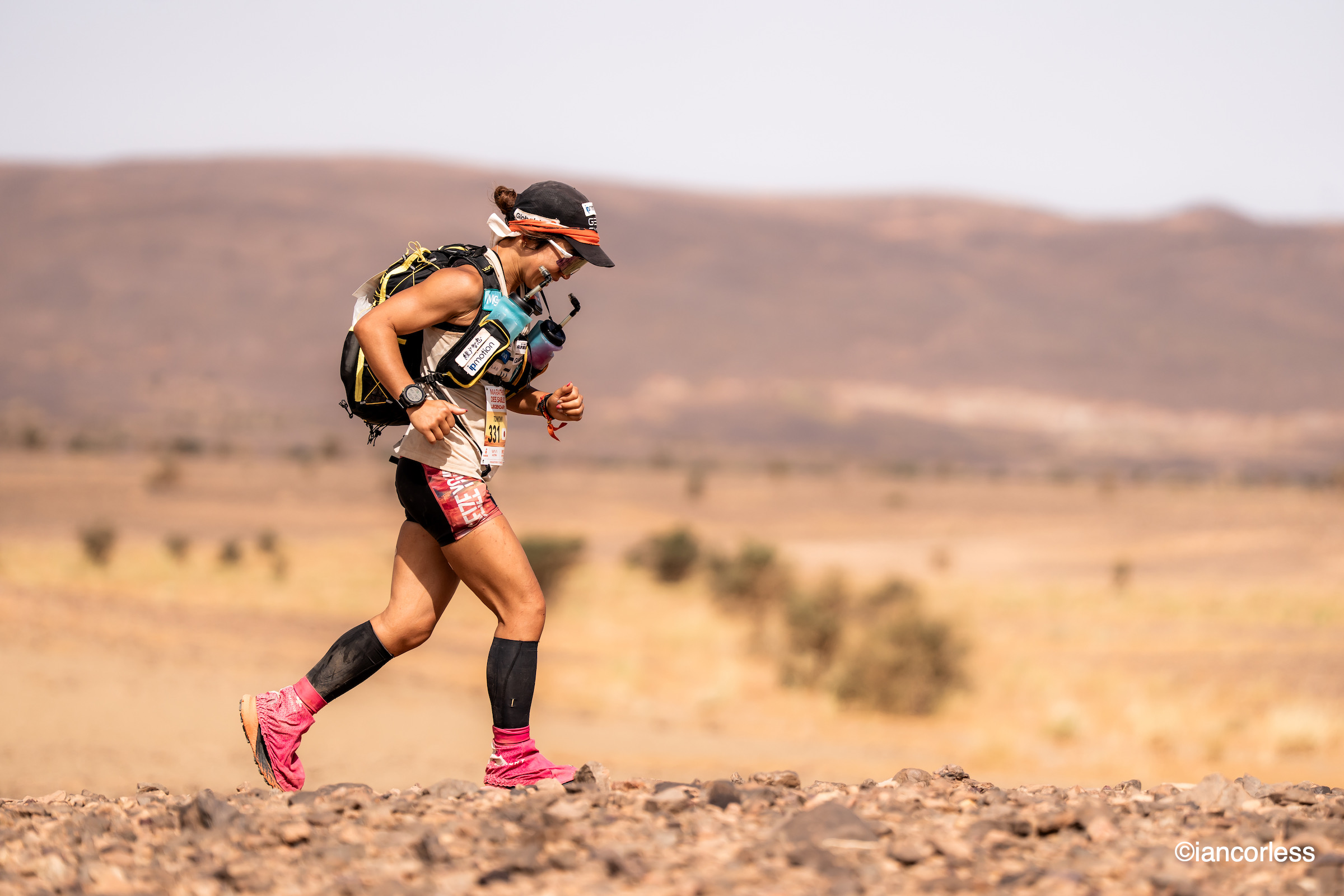
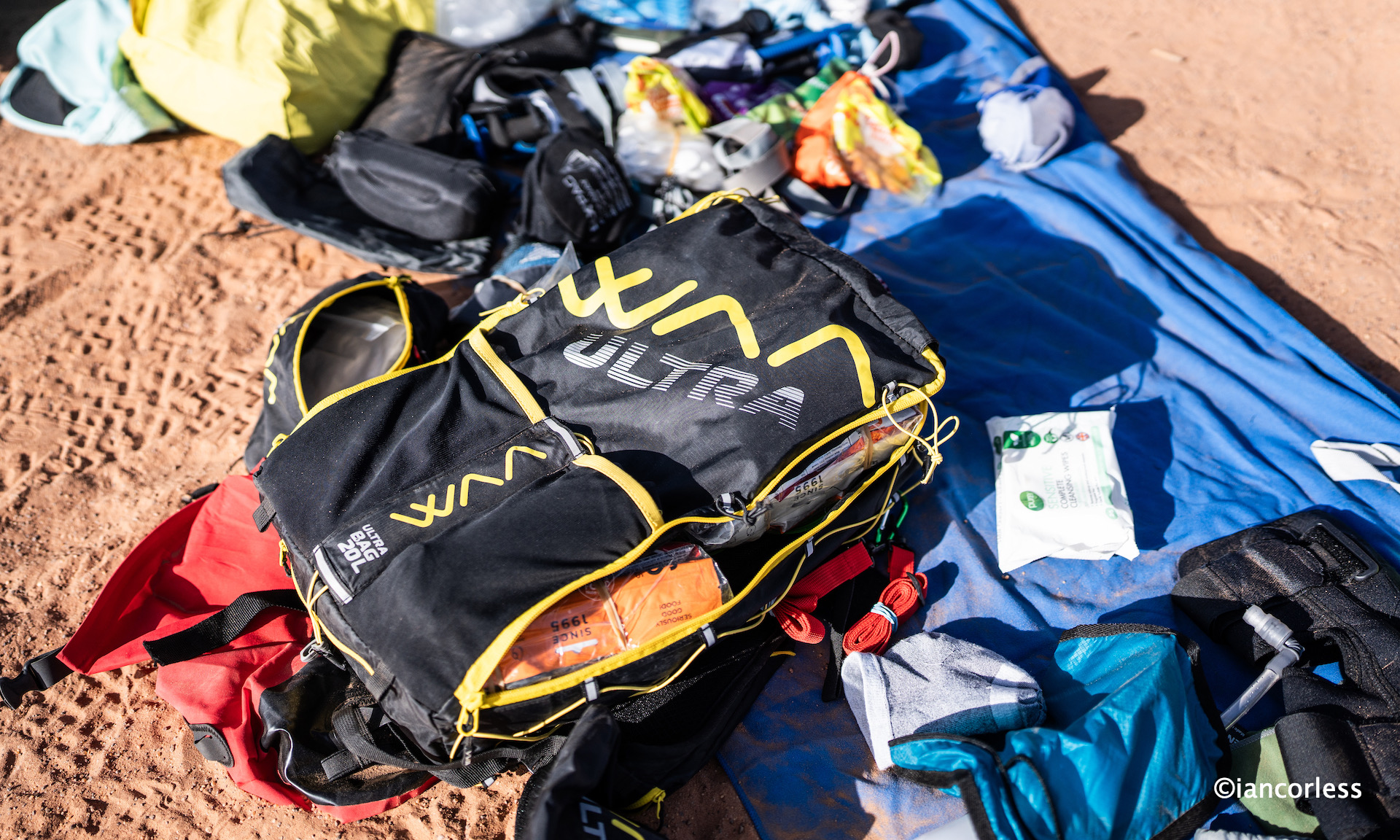
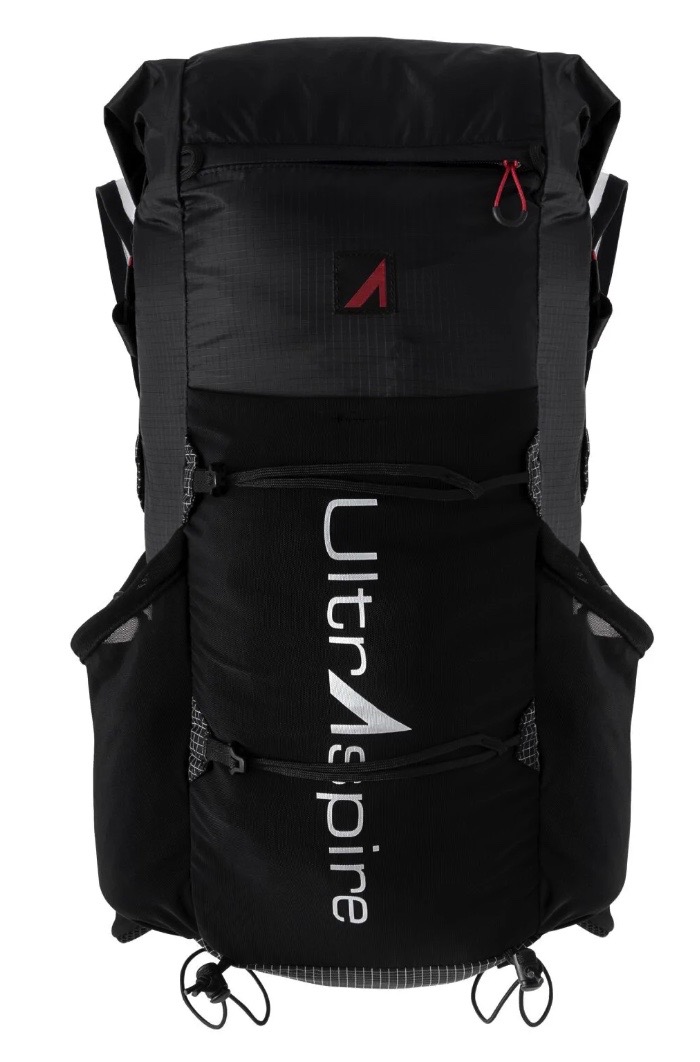
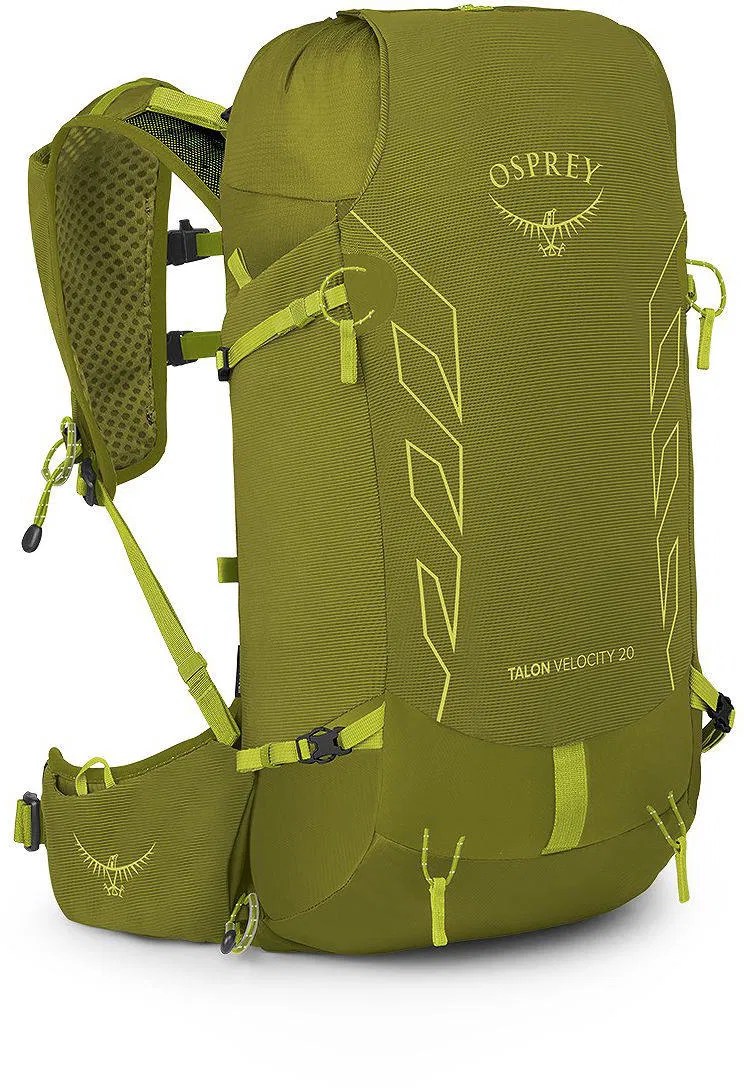
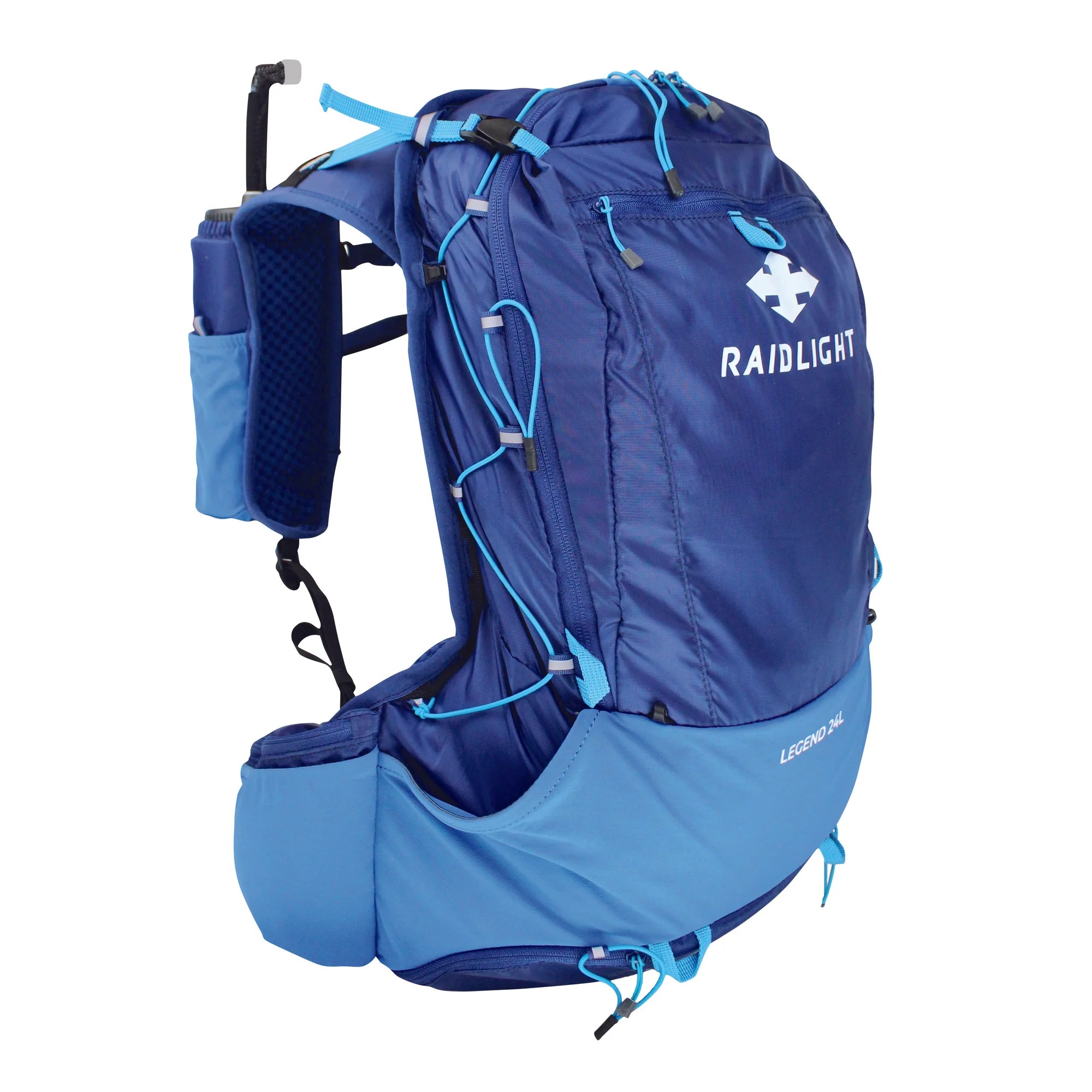
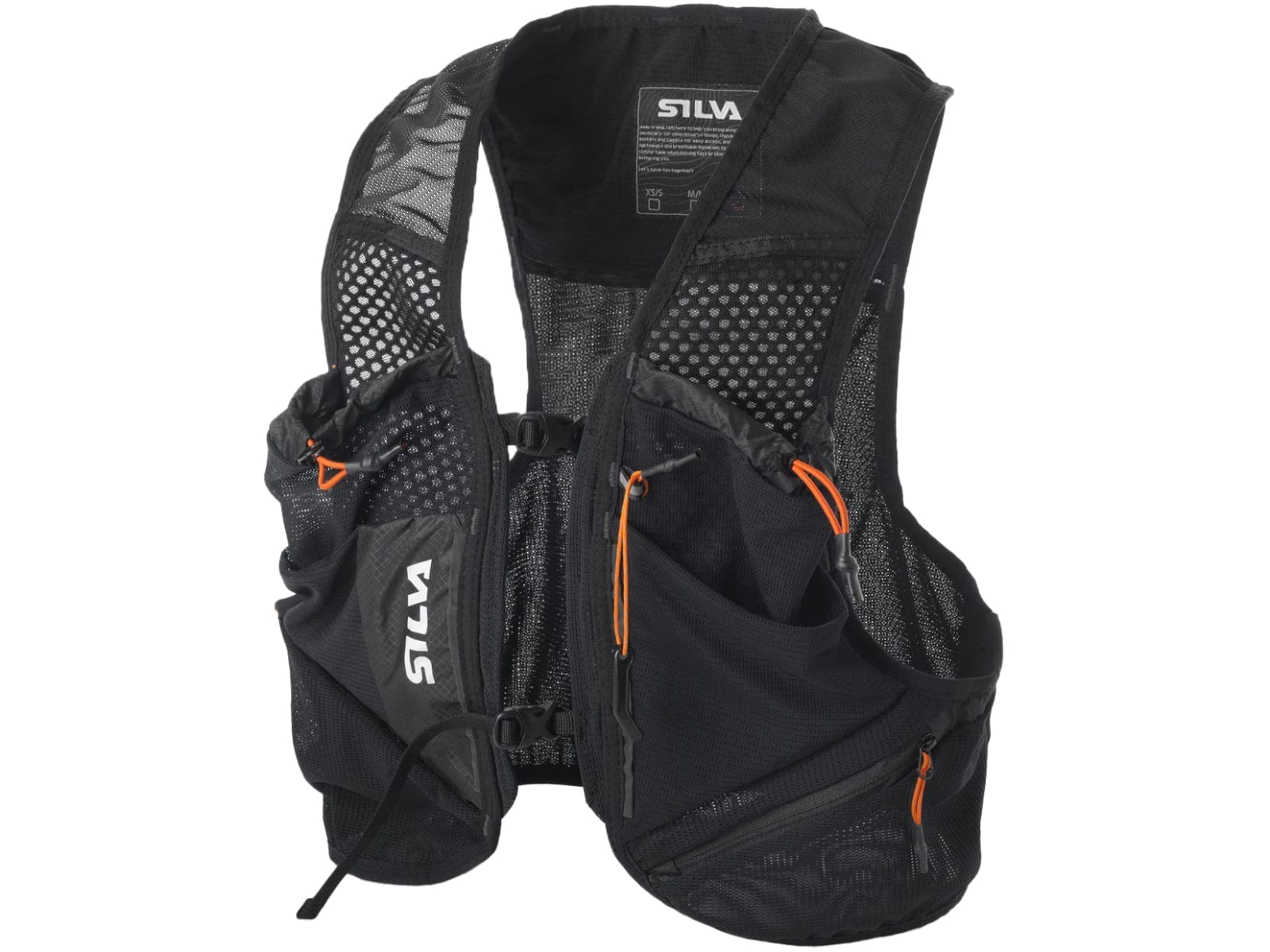
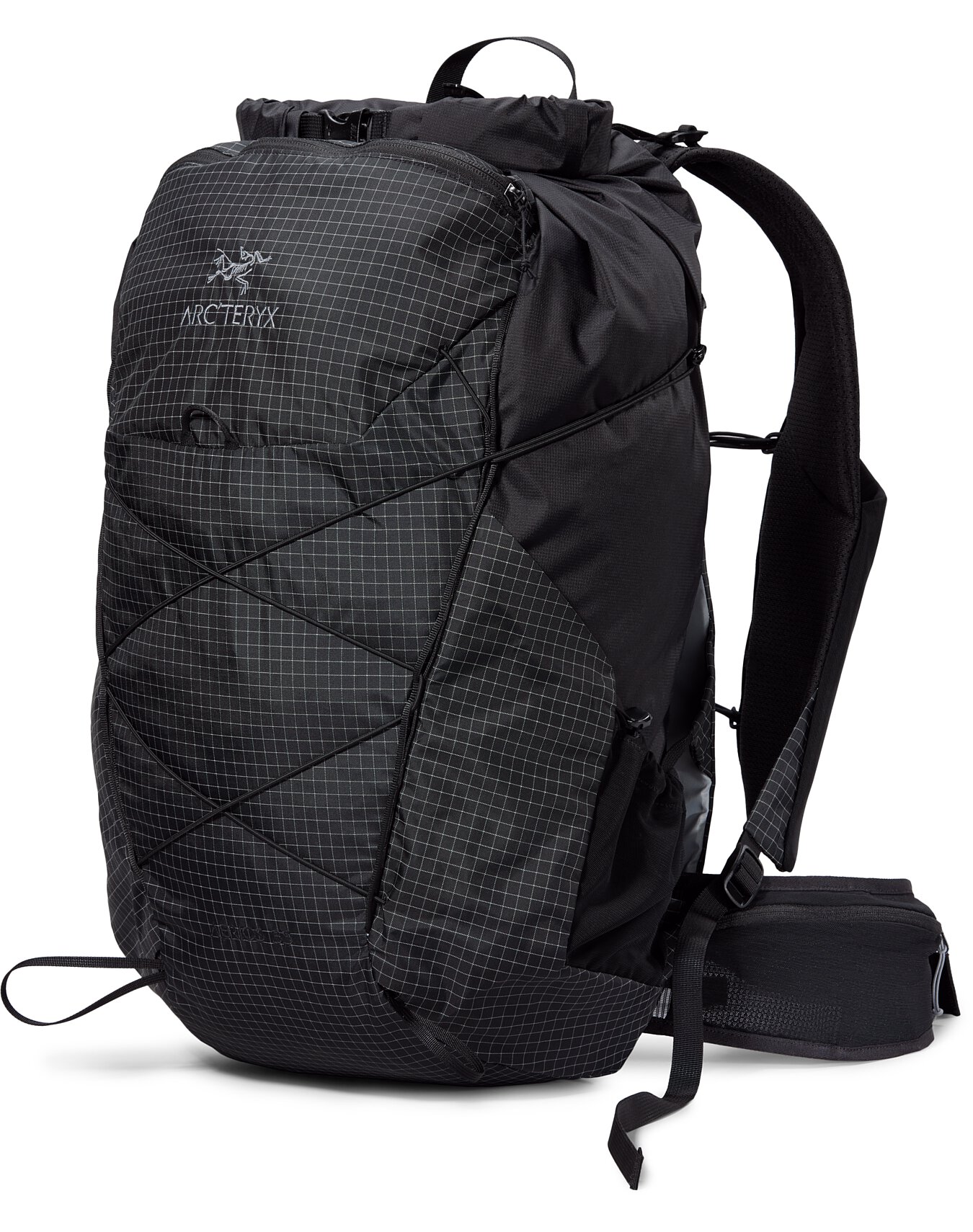
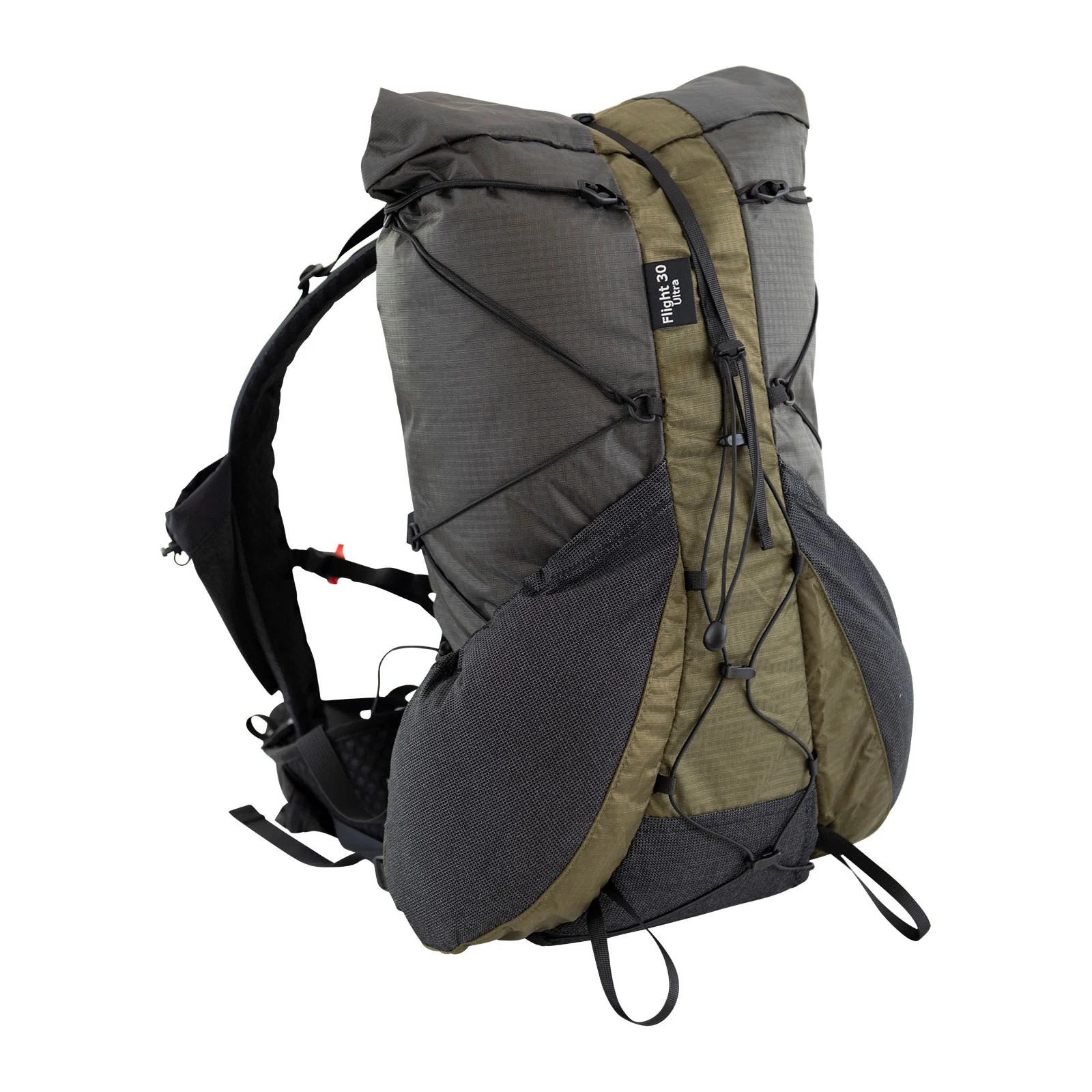
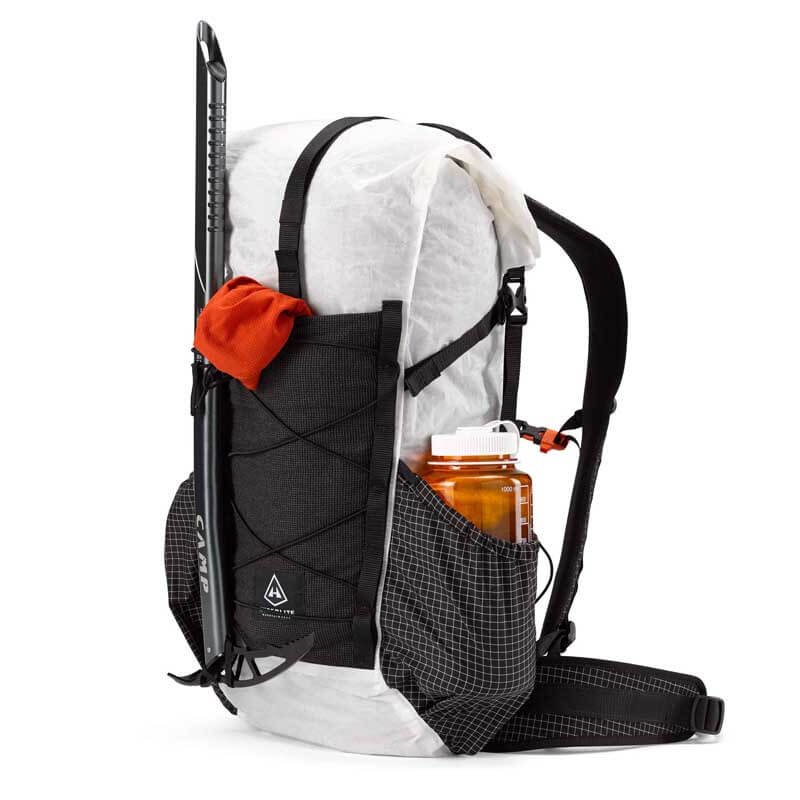
The pack you wear is a crucial item that not only must fit everything you need, but it must also be comfortable and allow easy access to drink. There is no one-stop solution here. We are all different sizes and have different body shapes, so, make sure you try options.Also remember, at the beginning of the race, your pack can be around 8kg, this adds extra pressure on the shoulders, so, make sure you have enough padding and comfort. Many packs now come with waist belts and this, for many, is a great solution not only for extra storage but weight distribution. WAA have the ultra bag which has been specifically designed for the job. Osprey have recently released the Talon Velocity 20 which in testing has been superb. Don’t be tempted to get a bag that is too large, remember, the more space you have, the more you may take.
Bottles are the obvious way to carry water, typically 2x 750ml on the chest straps. I personally really dislike this format, I find it uncomfortable and unpleasant. So, find your own solution. Bladders have always been considered a NO for MDS but I personally find the solution ideal for my multi-day adventures. If you are a ‘racer’ this is not the best solution, but for most, it is ideal. As always, bladders can puncture, so, think about this.
Shoes will always be a debate and point of discussion. Shoes are personal and must be suited to you, the individual. Consider your gait (neutral, supinate or pronate), consider time on feet, consider your weight, consider how much you will walk (and then double it) also consider shoe drop and how much cushioning you need. It’s impossible to recommend any one shoe because of these variables. You will see top runners using a lighter shoe, remember, these shoes only need to last 20-30 hours. However, you may well need a shoe for 40, 50 or 60-hours. Do you need a trail shoe? No, you don’t need a trail shoe but I would say that many trail shoes are more durable as they are designed for the rough and tumble of variable terrain. Do you need an aggressive outsole? No, you don’t, but I do think some grip is better than none and therefore I would use a trail shoe over road. Protection? Toe box protection is a good idea as deserts include lots or rocks, far more than you may think. Do I need a size bigger? Shoe sizing does depend on what is ‘normal’ for you. I always recommend a thumb nail of space above the big toe, you don’t need any more than this. Recommendations of going a size is bigger is bad advice in my opinion. A shoe that is too large allows your foot to move, a moving foot causes friction, friction causes blisters and the rest is the same old story that I see at desert races all over the world. However, I would recommend a shoe with a little more width in the toe box, this will allow for some comfort as the days progress. If you are prone to feet swelling, discomfort, blisters and so on, get a strategy sorted before you head out to your chosen race. You will need a gaiter and while not always the case, sewing velcro on a shoe can change its shape, so, consider this. There are specific desert racing shoes now available by Salomon and Raidlight.
Poles are a godsend, buy some and learn how to use them. They are 4-wheel drive.
Food is essential, make sure it works. Hot or cold water is a consideration and make sure if using meals that need rehydrating that they work with water at desert temperature. Never assume that water will always be warm because you are in the desert, just as we get hot years, we also get cool years.
Salt is needed to keep you in balance. Many foods contain salt so look to supplement that with the mandatory food cubes. Be careful here, for example, OXO works considerably better than Knorr. Do you need alt tablets? Do your research,, find out what you personally need and come up with a plan. Listen to a podcast HERE.
Feet – make sure you look after them. With the correct socks and correct shoes, there is no reason to get blisters and despite what some people say, the majority of people do not get blisters. Read Healthy for Running and Walking.
Heat is difficult and without doubt, it’s better to adapt to heat before the race. Read about Heat Acclimation by Dr Jodie Moss.
Hygiene is crucial and difficult when self-sufficient. But set up a protocol not only for your benefit but for those around you.
Luxuries keep them to a minimum.
Toilet paper is essential, make sure you have enough and compressed towels are brilliant to freshen up when you add a little water.
Take essentials on the plane and wear your run apparel and shoes. That way, should a baggage disaster happen your chances of racing improves.
Have additional items such as a base layer, sleeping bag liner and other items that may be on a ‘question’ list for the race. On night 1 and before you go to admin, you can make final decisions of what to and what not to take. Particularly important if you think you may be cold at night.
You signed up for the challenge, you wanted to be on the start line and therefore you are responsible for the outcome. Believe me, the ‘you’ that leaves the Sahara is not the same you that entered. Arguably, you change the moment you pay the deposit, the transformation process begins. Embrace the journey and apply yourself. Keep perspective, the MDS journey is an enhancement of you as a person. It’s easy to become obsessed, ultimately the majority of runners at MDS are enthusiasts, if you keep that in mind the journey will be a complete one.
Plan ahead, formulate a long term plan and don’t rush. The sooner you start this process, the greater your chance of success and the less chance of injury. Plan stepping stone races and don’t be fooled into thinking that you need to run marathons day-in and day-out. You don’t! Training is about ALL the training you do and not about anyone run.
If we exclude the top 50-100 runners (who will also walk sometimes) the majority of the MDS field spend a huge amount of time walking. Learn to walk! Believe me, it’s a huge tick in the MDS box and rest assured that if you are able to walk at a good consistent pace (barring injury or dehydration) you will finish MDS.
You are going to share bivouac with other people and you are going to have some serious highs and lows. These tent mates will pull you through and motivate you. They will become friends for life.
Legs, lungs, heart and feet will only get you so far. The mind is what will get you to the finish. Despite the hardships and pain, embrace the journey and mentally prepare for the challenge.
MDS is a magical and life changing journey, it really is a true challenge of mind and body to race over many days, irrespective if you complete or compete. It’s a hark back to a more primitive time, a time without clutter and modern technology. Embrace this. Embrace the silence of the surroundings and the simplicity of placing one foot in front of the other, eating, resting and sleeping and then doing it all again.
You can read a SUMMARY of the 2024 MDS The Legendary HERE
January 15th 2025 12:00pm (cet)three MDS events go on sale for the 2025 calendar.
MDS Fuerteventura – September 20the to September 27th.
MDS Morocco – October 10th to October 18th.
MDS Trek Morocco – October 19th to October 28th.
FUERTEVENTURA – September 20th to September 27th.
2024 was a significant year for the MDS, it saw the return of MDS Fuerteventura exploring a new part of the island and with a capped entrant list it was not only a sell out but a huge success.
You can read daily summaries of the 2024 edition and explore the route via images:
With an isolated bivouac close to the ocean, Fuerteventura brings something very special to the MDS portfolio. In many respects it can draw comparisons to MDS Peru, however, it does not have the epic dunes that the Ica desert provides. With stunning cliffs, runnable terrain and epic views, this is one race that must be experienced.
MDS Morocco follows in the footsteps and the history of The Legendary. Taking place in the same area of the Sahara, this race is ultimately a mini Legendary and as such holds a special place for all participants. The 2024 edition was notable for two reasons… Freak weather – believe it or not, rain and flooding in the Sahara! It made for a unique and special edition with some unforgettable visual stories. Secondly, the Handi category which saw wheelchair athletes take on the Sahara with the help of a team.
The 2025 edition of the race will once again pave the way for the MDS brand and the history of the race.
TREK – October 19th to October 28th.
MDS Trek was new for 2024. Combining much of what we see and experience in a normal MDS event, the TREK format added more comfort (2-person tents with mats,) no self-sufficiency (in regard to food,) showers, and after the stages, you will have the opportunity to relax with a daily massage* for better recovery, enjoy cold drinks* from the available bar, and share convivial moments in the social areas.
*extra charge locally
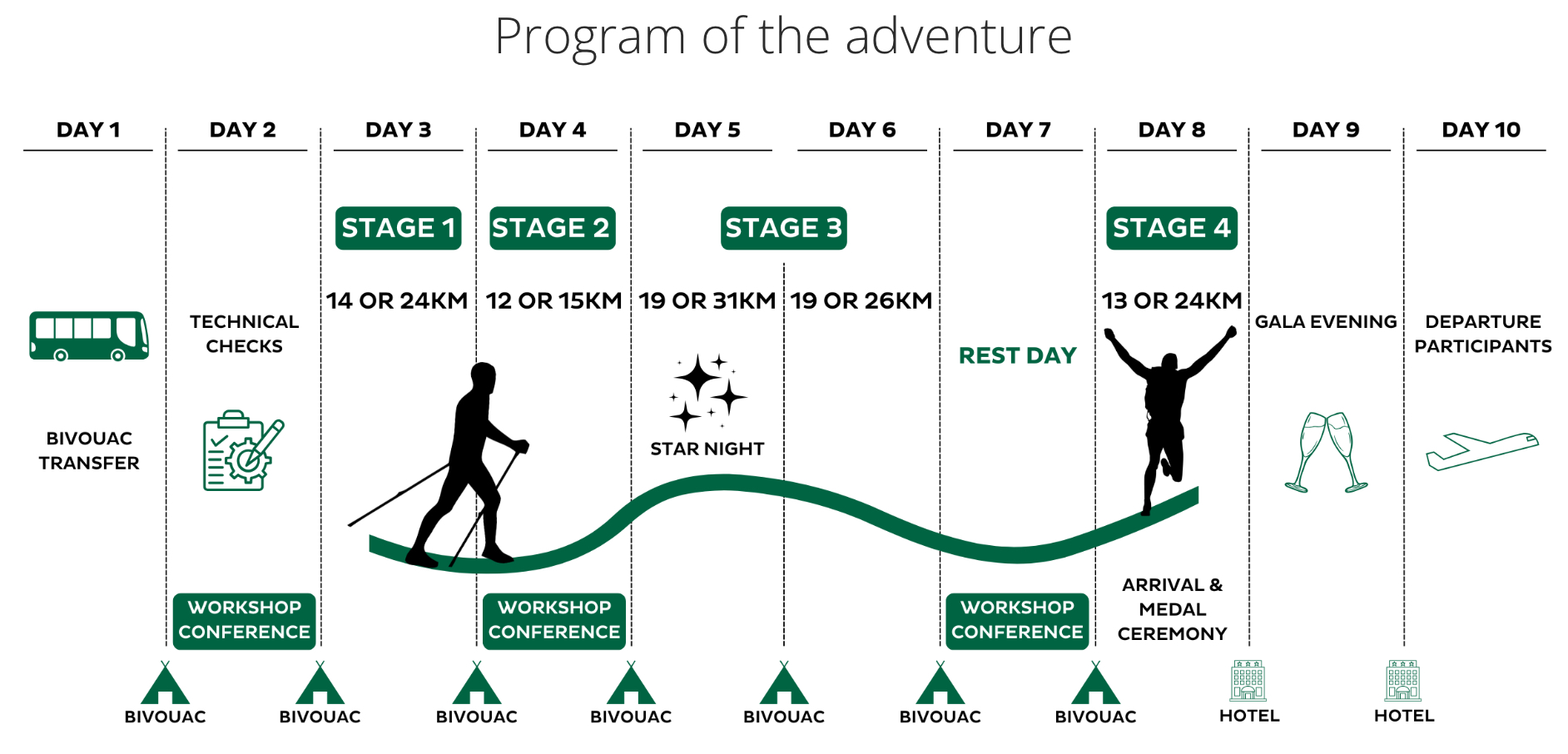
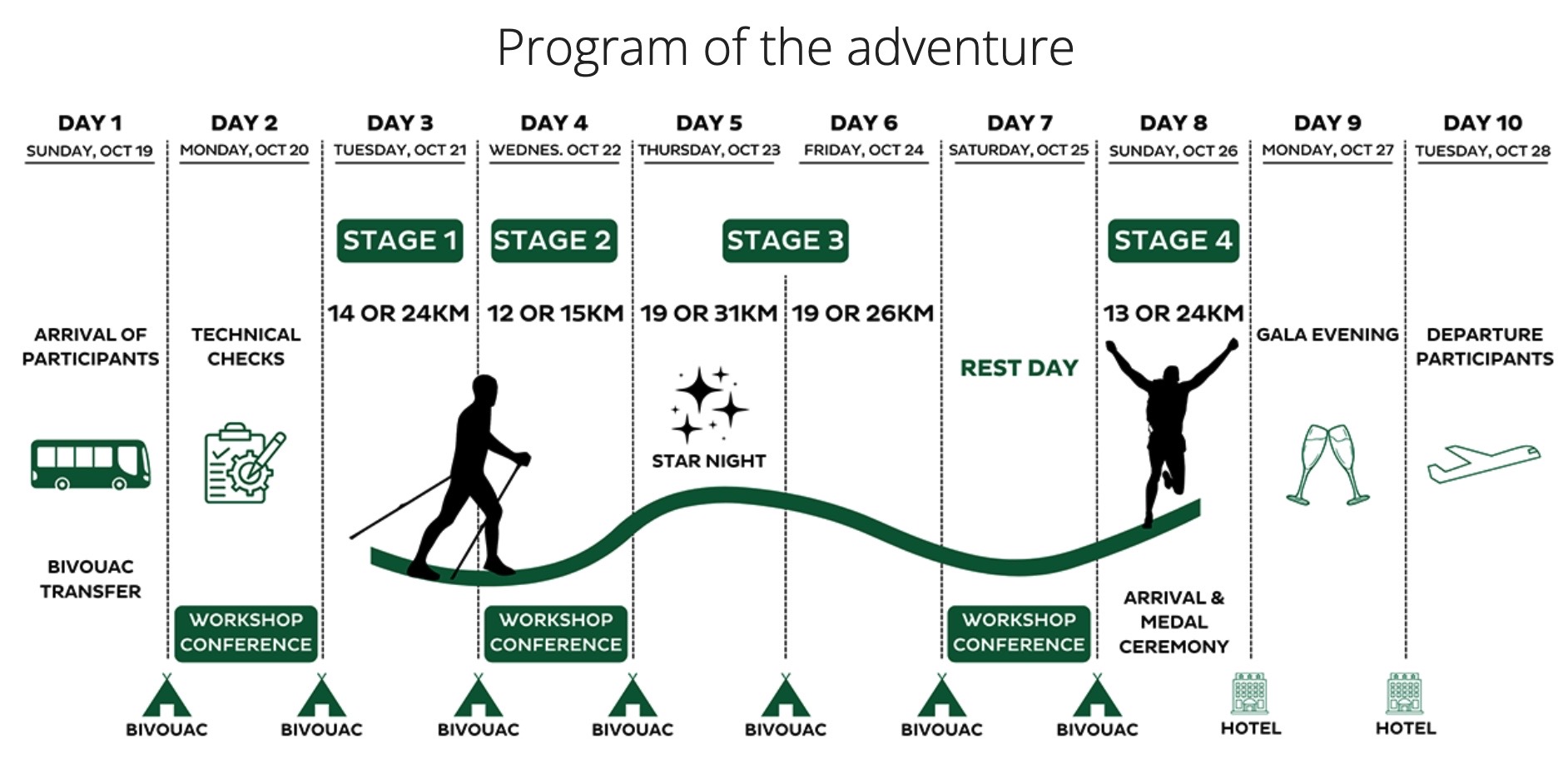
Combining mental enrichment with workshop conferences, the TREK still offers the classic MDS distances of 70-120km but at a more relaxed pace and a slightly different format due to the very special ‘star night!’
Here’s the approximate breakdown of distances:
Stage 1: 14 or 24km
Stage 2: 12 or 15km
Stage 3 – day 1: 19 or 31km
Stage 3 – day 2: 19 or 26km
Stage 4: 13 or 24km
A perfect event for those looking for an introduction to stage racing, an active holiday or just an escape with a loved one or friend. An opportunity to experience the DNA of the MDS, the 2024 edition was a huge success and returns for 2025, bigger and better! Accessible to everyone, this format is perfect for those who want to explore the desert, make new connections, push their physical limits, and all while maintaining a level of comfort.
To differentiate the full distance race of 250km’s, Marathon des Sables will now be known as MDS The Legendary, reflecting the legendary status of this iconic event and its long history as a pioneer of the stage racing and multi-day format.
The ‘HMDS’ format will still follow the same protocols as before but has now dropped the ‘half’ title and moving forward, events will be called MDS Jordan, MDS Morocco, MDS Cappadocia and so on.
The MDS events are a one-week sporting adventure that combines discovery, travel, meeting new people and physically challenging yourself in a self-sufficient manner.
MDS TREK was introduced in 2024 and is a 10-day adventure at a more relaxed pace with extra comfort, perfect for an active holiday, training or as an introduction to desert stage racing.
Since 1986, the MARATHON DES SABLES has crossed the world’s most stunning deserts with several unique concepts: the MARATHON DES SABLES THE LEGENDARY (252 km in the Sahara Desert in Morocco), the MARATHON DES SABLES (70, 100, or 120 km spread over 3 stages), and the new 2024 concept, the MDS TREK (4 stages with a total distance of up to 120 km), offering an accessible adventure with optimal comfort. These international events have seen over 50 editions in various countries such as Morocco, Fuerteventura Island, Peru, Jordan, Turkey, and offer adventures that combine running/hiking in the desert with tourism.
The 3rd edition (2024) of MDS Morocco came to a conclusion on Thursday October 17th.
What is a MDS event?
For clarity, MDS (previously HMDS) races take place over 4-days with 3-stages of running, the 3rd day is a rest day before the 4th day and stage 3. stages 1 and 3 are the same distance for all participants, typically between 20 and 30km. Stage 2 has three distance options: 20, 40 or 60km’s therefore making the MDS format adaptable to your personal ambitions, fitness and ability.
MDS The Legendary.
Legendary uses traditional Berber/ Amazigh tents
By contrast, MDS Legendary, to be known as The Legendary, is the classic full-distance race taking place over a full week. The format is 250km’s over 6-stages/ 7-days.
The race format:
MDS or MDS Legendary, you carry all you need for the race
Both formats of race are self-sufficient. Therefore, the competitor must carry all they need for the duration of the event. This includes clothes, sleeping bag, sleeping mat, food and snacks for the whole race and mandatory equipment as specified by the the organization. The only items provided are a place to sleep, for MDS events this is a single-occupancy tent and for The Legendary, a Bereber tent that holds 8 participants. In addition, rationed water is provided as specified in the race rules.
In simple terms, both races function on a very similar format. The Legendary obviously considerably harder due to the distance and duration.
MDS events provide an incredible challenge that opens the self-sufficient, stage race format to participants who would not normally take on such a challenge. For this, MDS events must be applauded and appreciated. There is a little too much ‘ultra’ snobbery that downgrades these events and I for one am glad that the ‘half’ tag (HMDS – Half Marathon des Sables) has been removed. Half had negative connotations, these events are a challenge in there own right and they should be appreciated as such.
Planning:
When planning a self-sufficient race, particularly in Morocco, you will be inundated with advice from past participants. Use caution.
I love the quote from the Baz Luhrmann song, ‘Wear Sunscreen.’
“Be careful whose advice you buy, but be patient with those who supply it. Advice is a form of nostalgia: dispensing it is a way of fishing the past from the disposal, wiping it off, painting over the ugly parts, and recycling it for more than it’s worth.”
MDS events and The Legendary have hot editions, cold editions, windy editions, sand storm editions and as with the 2024 MDS Morocco, a combination of all these elements with the addition of thunderstorms, torrential rain and yes, flooding!
Gore-Tex jacket while running in the Sahara
So, when someone tells you you don’t need a sleeping bag, you don’t need a jacket, you don’t need goggles or you don’t need x, x, or x, take this advice and then ignore it.
Flooding in the Sahara
The best advice I can give, be prepared! Be prepared for all eventualities and then fine-tune equipment very close to the event, even at the event location on admin day so that you can make sure you have the appropriate equipment based on the current weather forecast.
The 2024 MDS Morocco:
The 2024 MDS Morocco provided a unique, memorable and stunning experience, it is one that will go down in the history for the Marathon des Sables. Gladly, the rain was anticipated and in general, most participants were prepared with a jacket. Usually a jacket is worn in camp to avoid early morning chill or late night temperature drops… Imagine wearing a jacket mid-stage, in the Sahara, while rain poured down and the desert floods.
Rain cover on the WAA pack proved to be a luxury item
It’s rare that participants take additional clothes, t-shirt/ shorts for example, however, those that did were laughing on stage 1 when they could remove wet clothes, dry off and wear dry clothes.
However, there is an important caveat here, participants who did not use dry bags or pack covers (the WAA Ultra Bag has a rain cover) had wet clothes and wet sleeping bags. Important lesson, make sure you have a dry bag or rain cover to protect important items: sleeping bag, clothes, socks etc
MDS laundry as participants tried to dry equipment
Luckily, after stage 1, the weather did clear and the sun appeared making bivouac look like a laundry with clothes and sleeping bags laid out everywhere. But, had the rain persisted into the night, there would have been many miserable runners.
Stage 2, the weather cleared and the new route was excellent
The impact of the rain could not be underestimated and for stage 2 the planned routes needed to be re-worked. The original routes had sustained considerable flooding making it impossible to use the 20/40 or 60km options. This is where the MDS organization steps in. Contingency plans were activated, emergency routes were used and the MDS staff worked tirelessly to re flag the routes and put the infrastructure in place to make sure the user experience was not impacted. Bravo!
Whilst the weather did its best to make things difficult, this 3rd edition of the race also had two other unique aspects.
Handi category getting help on stage 3 in the gorge
Firstly, the inclusion of the HANDI category, 10 teams of 3 people, 2 runners/ one wheelchair athlete. Something very special this and we can only hope to see and experience more of it. Cyril Gauthier is passionate about making this work!
Secondly, a film crew were using the MDS event as a backdrop for a feature film. This actually did no impact on the race or runner experience at all, however, it did provide an extra dynamic for the MDS team to handle.
Iced water at aid stations to help cool down the runners
Stage 2 experienced some light rain early on but the weather cleared and finally the heat returned. This time though, considerably more humidity than the traditional dry heat of the Sahara. An extra challenge. For many, stage 2 is the long day with 40km or 60km. Whilst most of the 40km runners finished in daylight, the 60km went on till beyond midnight.
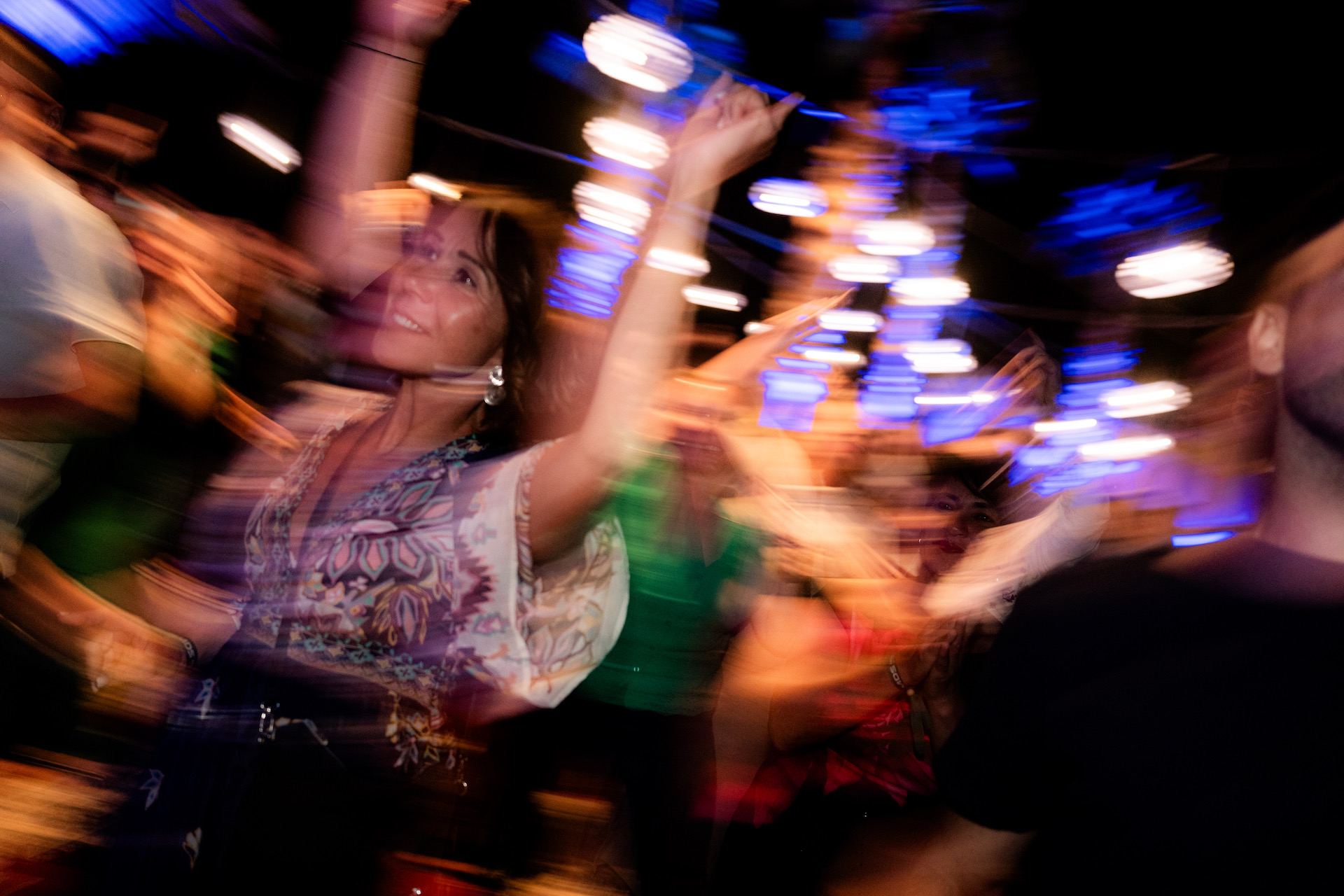
Late night finish party
However, the finish line atmosphere was electric with DJ Robin and participants and staff dancing.
Rest day recovery
The rest day coming on day 3 was welcome. The weather was once again unpredictable and variable; sometimes windy, occasionally raining but the Berber tents provided a welcome haven to protect from the elements.
Those who had problematic feet had time to have them looked after and cared for by the Dokever team.
Even the afternoon yoga session had rain, but nobody seemed to mind!
Yoga in the desert
Stage 3 was scheduled to start at 0430, this was put back to 0530 to make sure the first finisher would be in daylight. In addition, the early stages of stage 3 were completely flooded, so, another re-route was required.
Early on stage 3
And finally, for the HANDI category, for stage 3 they would do the full 25km route. Only one section, a narrow gorge coming at 11.5km would cause a problem for them, but MDS orange and blue coats were there to support and facilitate safe passage. It was a special day to experience the HANDI teams achieve these incredible goals – it was emotional.
The HANDI category was awe-inspiring to watch
Weather wise, it felt like a typical Saharan day; an awesome sunrise, temperatures rising close to 30-deg and little wind. The last competitors arrived just before 1400 hrs and everyone, including staff were back in Ouarzazate by 2000hrs.
The following day, a trip to Ait Ben Haddou, afternoon relaxation, dinner and then the awards ceremony and party.
Post awards party time
Despite incredible challenges, the 2024 MDS Morocco was a huge success, and it is for sure, one to be remembered.
The medal
Finally, while many things are transferable between any MDS event, clothing, pack, sleeping mat, sleeping bag, food etc, one thing is important and it cannot be emphasised enough, be prepared. Plan for the best and worst case scenarios, plan for intense heat, plan for the cold, and yes, you may not think it is going to rain, but this edition proved that not only can it rain, it can rain pretty much everyday and cause many problems.
Since 1986, the MARATHON DES SABLES has crossed the world’s most stunning deserts with several unique concepts: the MARATHON DES SABLES THE LEGENDARY (MDS Legendary or The Legendary) – 252 km in the Sahara Desert in Morocco, the MARATHON DES SABLES (MDS) – 70, 100, or 120 km spread over 3 stages, and the new 2024 concept, the MDS TREK (4 stages with a total distance of up to 120 km), offering an accessible adventure with optimal comfort. These international events have seen over 50 editions in various countries such as Morocco, Fuerteventura Island, Peru, Jordan, Turkey, and offer adventures that combine running/hiking in the desert with tourism.
Bivouac in the distance towered by the ominous weather
The 2024 MDS Morocco officially got underway after a day of strong winds, sandstorms and rain through the night.
With the glow of fires in bivouac, the sky was ominous and the flashes of light and sound in the distance was a warning of what was to come.
A river runs through it
Stage 1, 24.7km and 507m+ was in theory, an easier day passing through very familiar MDS territory. With 2.5km´s of easy terrain before a short sand climb and descent before a long flat section to cp1.
Climbing the early pass before the rain came
Cp1 to Cp2 contained more soft-sand and soft-sand followed as the runners climbed to the highest point via a mountain pass and then a descent all the way to bivouac.
Making a splash
The story of the day was the weather, the ominous clouds and distance sounds moved to bivouac and then reached the first mountain pass just as the last runner came through.
The fagility of nature
What followed was nothing short of a biblical downpour turning certain sections of the stage 1 route into a mud bath of flooding, rivers and streams. Cp2 was hit hard, but participants embraced the challenge. Everyone was smiles, fully understanding that they were experiencing a very unique moment in MDS history.
As quickly as the storm came, it disappeared and as the day passed, by midday, skies were blue, the sune was once again beating down and all was resumed for a typical MDS day!
Full MDS Morocco results are available to be viewed HERE
El Morabity after cp2 in the rain
Top 3 for stage 1 came as no surprise for the men with Elmouaziz and El Morabity playing a game setting up Rachid for the long stage tomorrow.
The HANDI race started with the masses and proceed for 1km before transferring via vehicle to Cp1. They then move from Cp1 to Cp2, km8.5 to km12.2 in ´race mode.´ A tough and arduous challenge moving a special wheelchair through the soft sand of the Sahara. One pushes, the other pulls. It’s incredible to see these 10 pioneering teams pave a new way in Morocco.
Inspiration from the Handi teams
Tomorrow, stage 2, which is the theoretical long day. Athletes can choose, 20km, 40km or 60km. However, after the heavy rains of today and localised flooding, there may be a change of routes.
Since 1986, the MARATHON DES SABLES has crossed the world’s most stunning deserts with several unique concepts: the MARATHON DES SABLES THE LEGENDARY (252 km in the Sahara Desert in Morocco), the MARATHON DES SABLES (70, 100, or 120 km spread over 3 stages), and the new 2024 concept, the MDS TREK (4 stages with a total distance of up to 120 km), offering an accessible adventure with optimal comfort. These international events have seen over 50 editions in various countries such as Morocco, Fuerteventura Island, Peru, Jordan, Turkey, and offer adventures that combine running/hiking in the desert with tourism.
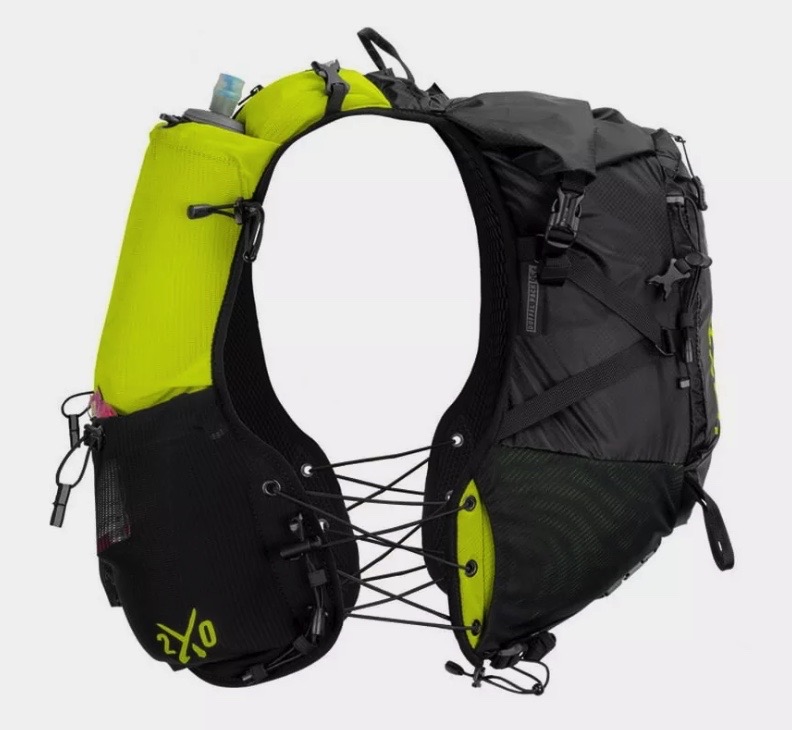
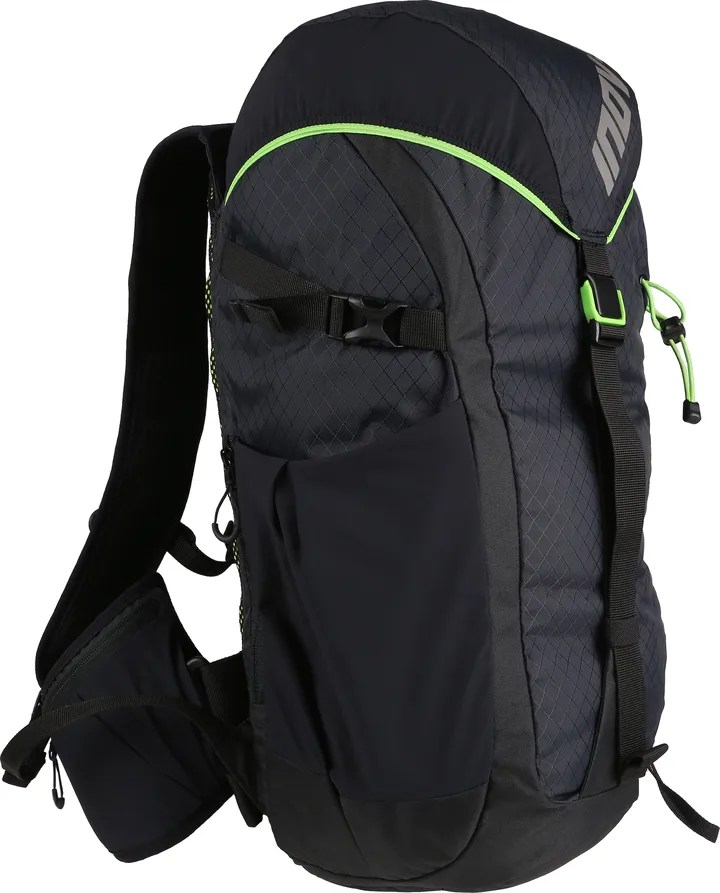
Stage racing, multi-day running and fastpacking all require a very specific pack. With the growth of multi-day running, many major brands now produce a pack or packs that are specifically designed for the task at hand. However, choosing a pack can be a daunting process due to many variables.
First and foremost, spend some time and sit down with a piece of paper and make notes of all the equipment that you need to carry. This may sound obvious, but there is a great difference in needs and demands.
For example:
Are you running in a hot or cold environment?
Do you need to carry food for the adventure or will you be able to get food on the route?
What spare clothing do you need?
What safety equipment do you need to carry?
Do you need a tent?
Do you need a sleeping bag and sleeping mat?
How much liquid do you need to carry and do you need immediate access to that liquid?
And the list goes on, so, take time to sit down and plan. This also helps you look at weight.
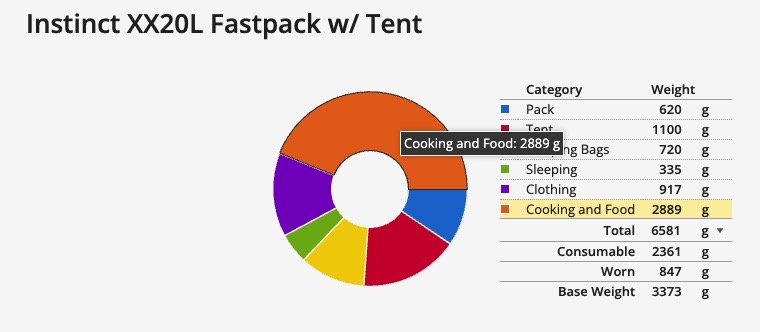
An excellent website to help facilitate this is Lighterpack– You can see an example HEREof all the contents I used when testing theInstinct XX20Lwhen I went fastpacking with a tent.
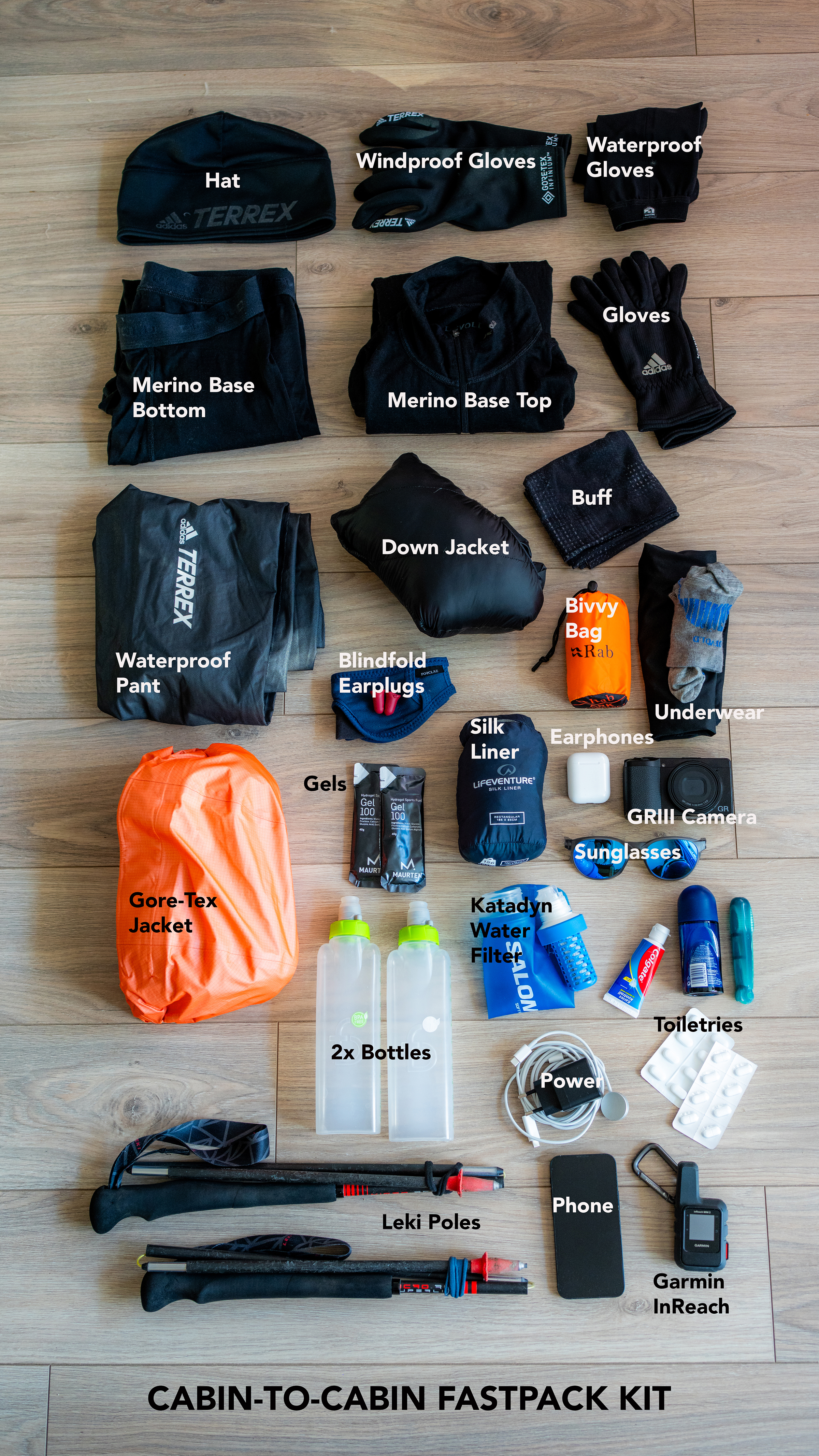
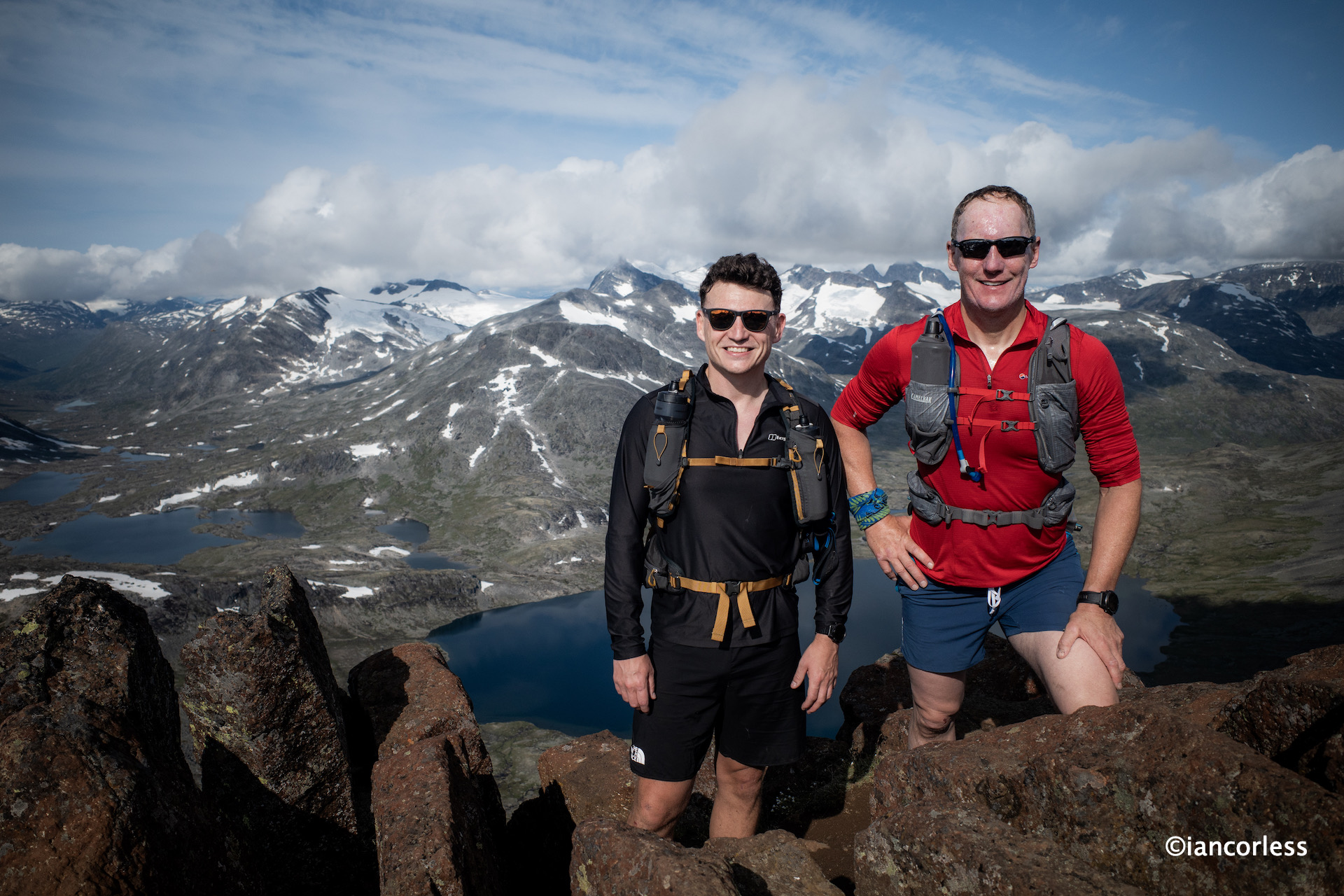
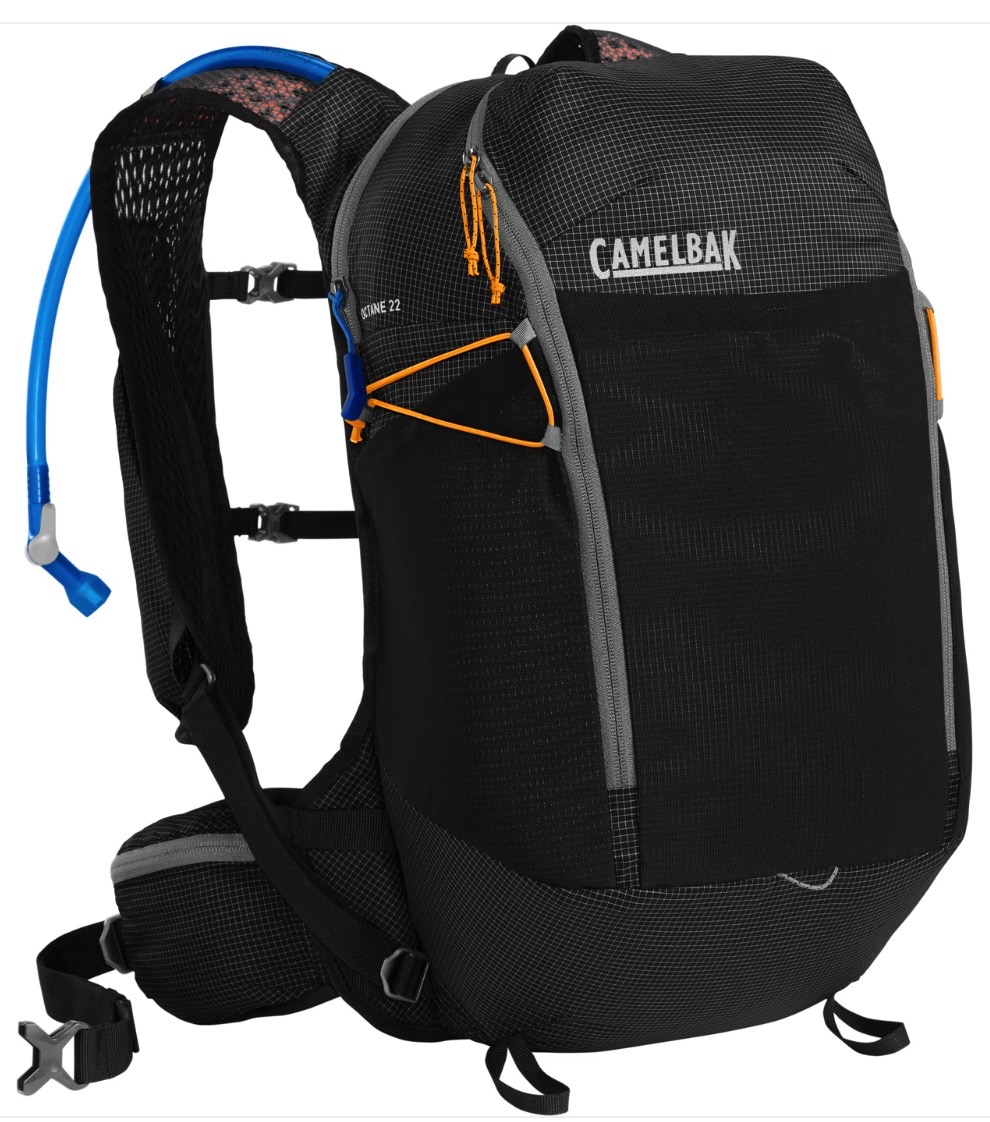
Recently I went fastpacking in Norway running from cabin-to-cabin. I did not need food (other than run snacks,) did not need a sleeping bag, just a sleeping bag liner and I could be minimal on clothing. I used the Camelbak Octane pack and the contents were as listed below:
You can see an example of my pack below and the details are as follows:
Camelbak Octane Pack 600g
adidas hat 32g
adidas gloves Infinitum 52g
Hestra waterproof gloves 53g
adidas gloves 41g
Devold merino base top 193g
Devold merino base bottom 166g
Buff 43g
Haglofs down jacket 163g
adidas waterproof pant 125g
adidas Gore-Tex jacket 272g
Rab bivvy bag 110g
Underwear 98g
Gels 81g (for emergency)
Silk liner 126g
Blindfold/ earplugs 22g
Earphones 44g
Ricoh GRIII camera 251g (a luxury)
Sunglasses 18g
Bottles x2 90g
Katadyn water filter 52g
Toiletries 196g
Power supply 138g
Phone 136g
Garmin InReach 108g
Leki poles 250g
3379g
As you can see, my pack weight was low. This allowed me to move faster and lighter for less effort.
KEY CONSIDERATIONS FOR CHOOSING A PACK
Once you have worked out what you need to carry, you can then decide what size pack you need. The best recommendation here is that it is better to have a pack that is maybe just too small. That way you will be strict on what you take and what you do not take. Of course, this decision should never be at the compromise of safety. Simply, if you have more room, you tend to take more because you can.
When doing a stage race, multi-day or fastpack, weight is the enemy, so, you need to be as light as possible.
WAA has a waist belt and optional front pocket for food/snacks and water bottle.
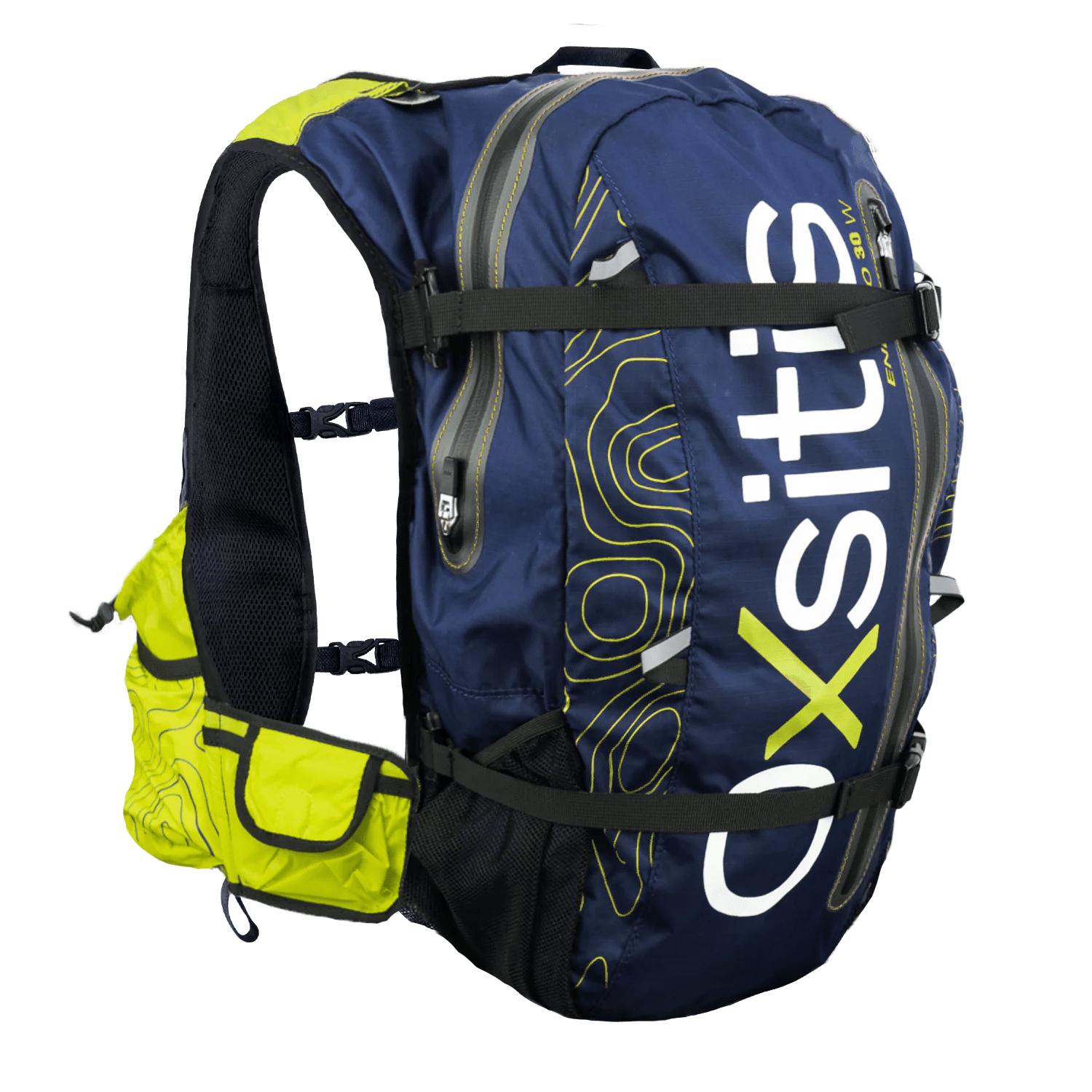
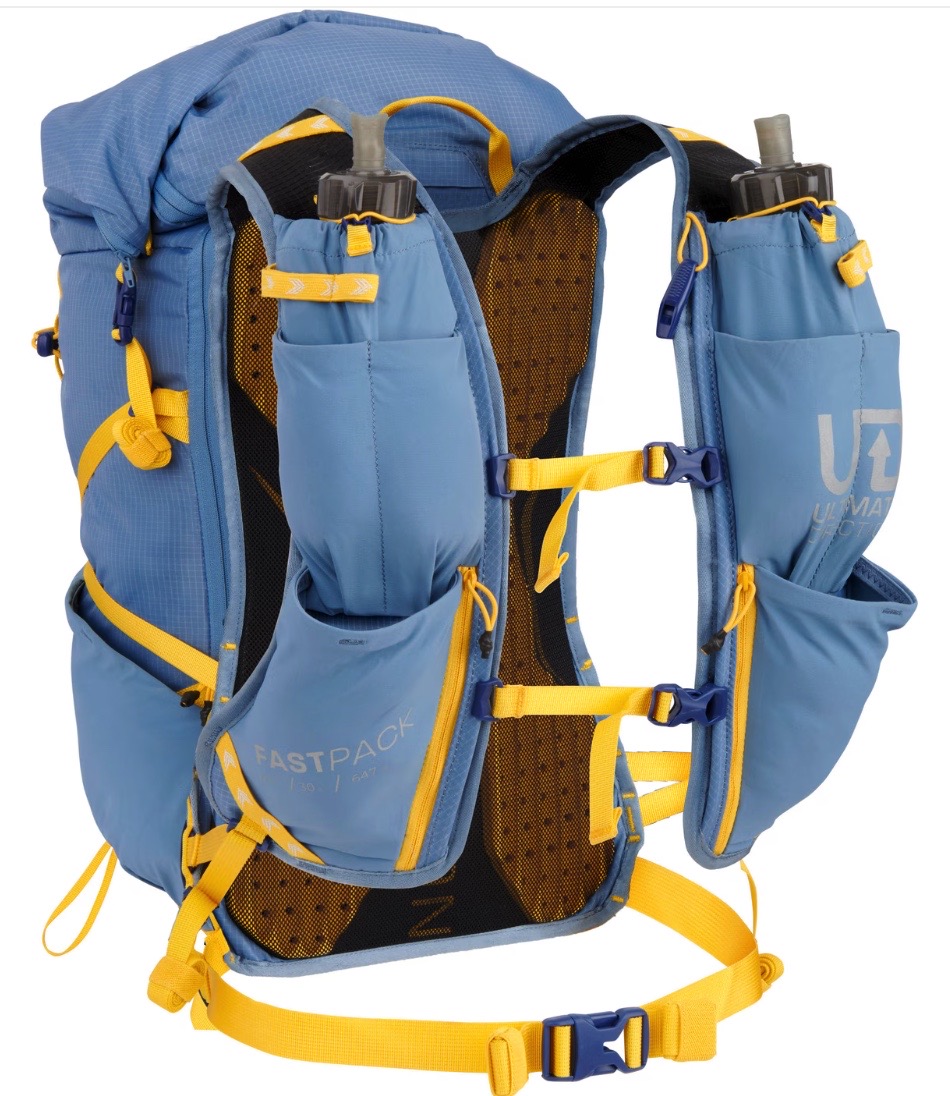
Comfort is obviously hugely important and just like shoes, packs need to fit you, cause no rubbing or irritation and feel like a piece of clothing. What works for one person will not work for another. A great example being, the needs and requirements for 152cm tall woman weighing 55kg is very different than a 182cm tall male weighing 85kg. It’s great to ask and take advice BUT you need to try packs, see how they fit and importantly when trying, add weight so you can feel how it sits on your body. Many brands do different sizes now such as S/M or L/XL and one or two brands do male/ female versions: Ultimate Direction, Osprey and Oxitis being good examples.
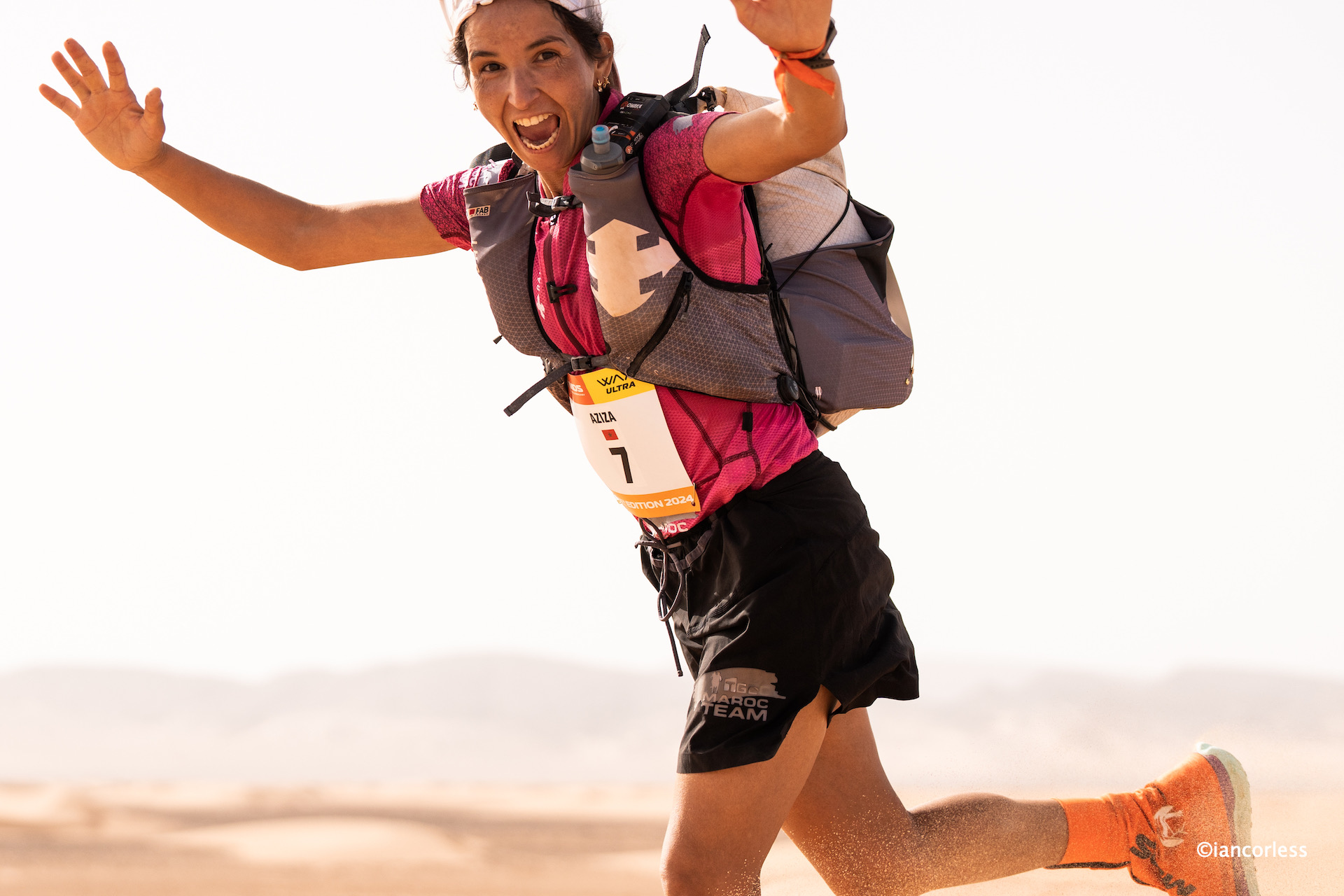
Aiziza El Amrany winner of the 2024 MDS with a Raidlight pack.
Many packs now use a ‘vest’ like system, however, when you have 8kg in the pack, does that fit and feel good? You need to know this. Look at pressure points, such as on top of the shoulders, this area can get very sore if you do not have enough padding. Also feel how it sits on your bag and check for bounce/ movement. A pack that moves too much causes friction, friction equals irritation and blisters.
A waist belt is often a great addition to help secure a pack to your body and distribute the weight load. Some love waist belts, others dislike them. I personally am a fan.
You must choose what is correct for you and don’t be afraid to go against the norm to use what is correct for you. A prime example being that a hiking pack may be the best solution for YOU. Trust this and ignore what others say. The only key things to consider: Be careful of the pack weight and make sure it is not too large in capacity.
Instinct pack in action at MDS
Access to water is important, many packs now have the capacity and option to carry bottles up front. This makes drinking and refilling easy. However, this may not work for you. If that is the case, do what is right for you, if that means using a bladder, do so. The only consideration with soft flasks and bladders are the risk of puncture, but, I have used a bladder on countless adventures with no issue. Good admin is key.
Osprey Talon Velocity and Camelbak Octane fastpacking in Norway.
If doing an adventure that is self-sufficient (such as MDS,) remember that as days pass, pack contents will become less due to eating food. So, the option to tighten, compress and make the pack smaller is a potential key consideration to stop or reduce bounce.
Finally, pack weight is important, BUT, do not go for the lightest pack if it has no durability. You need the pack to be strong, durable and reliable.
BRANDS TO CONSIDER
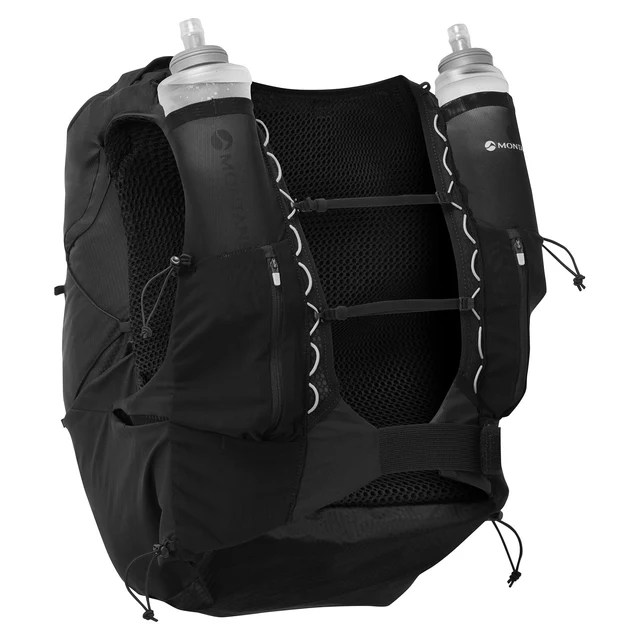
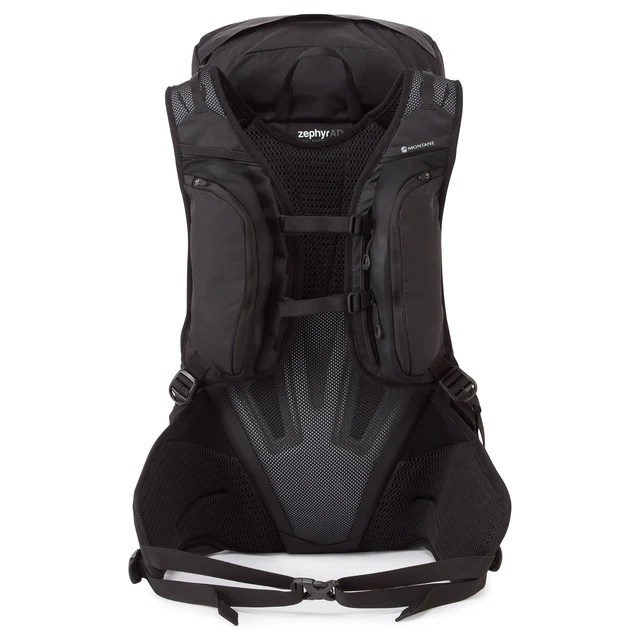
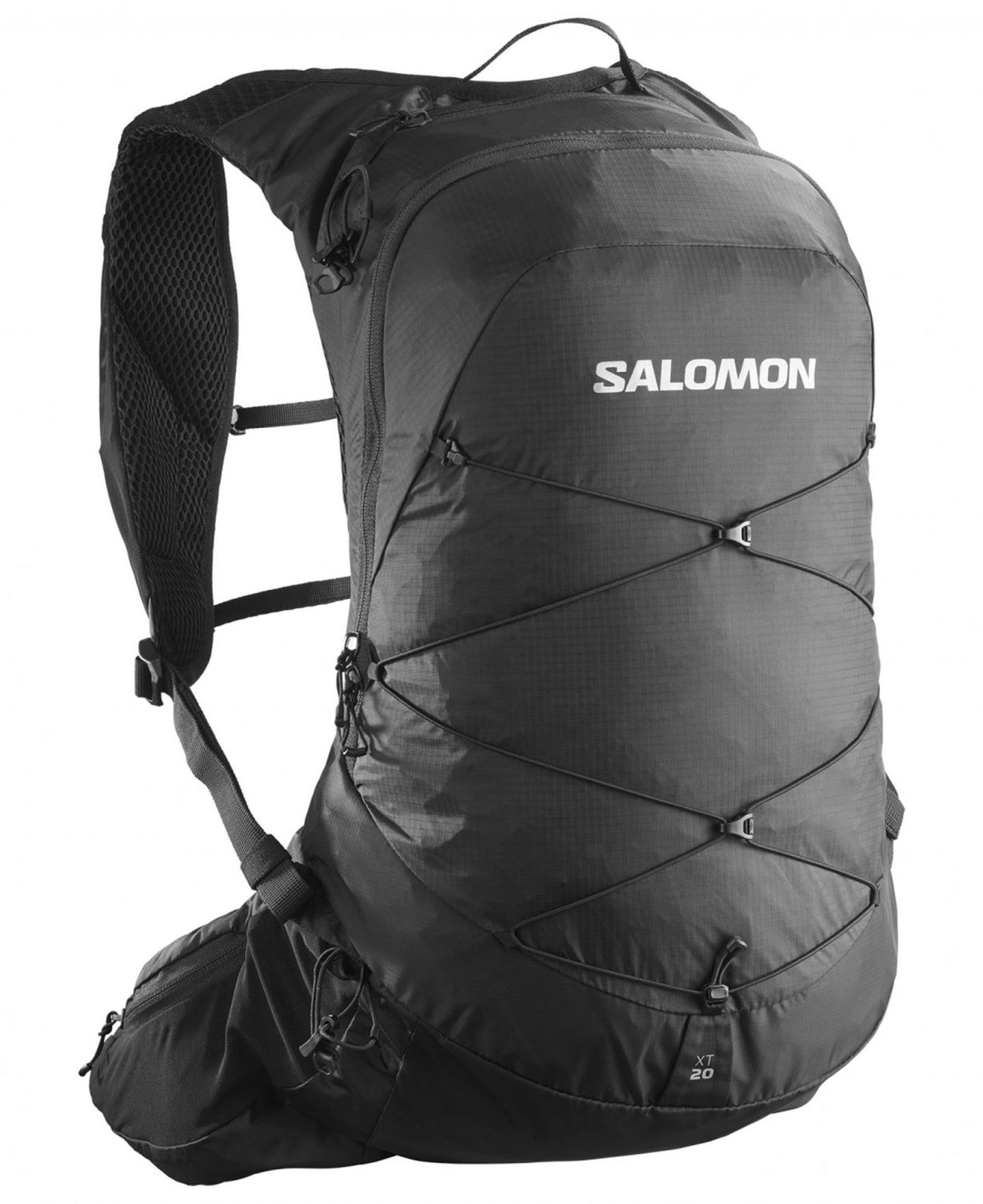
As mentioned, many brands now make packs or packs suitable for stage racing, multi-day or fastpacking.
If you have a brand missing from the list that you feel needs to be added, please make a comment below.
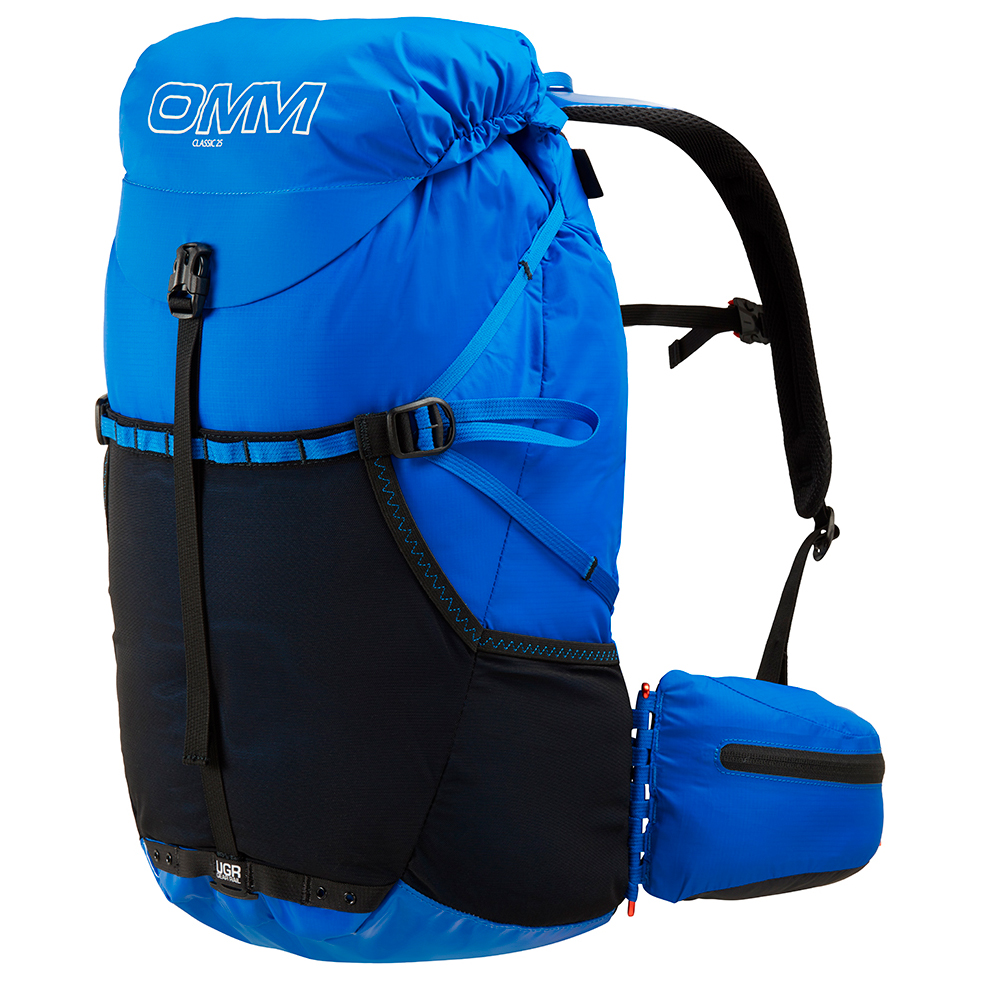
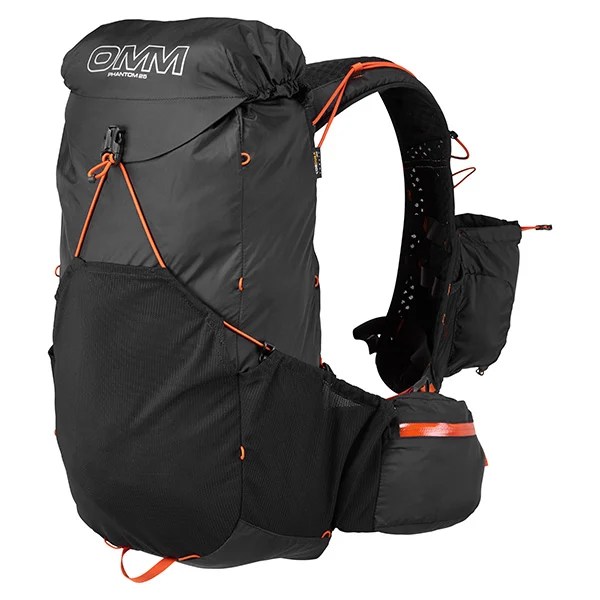
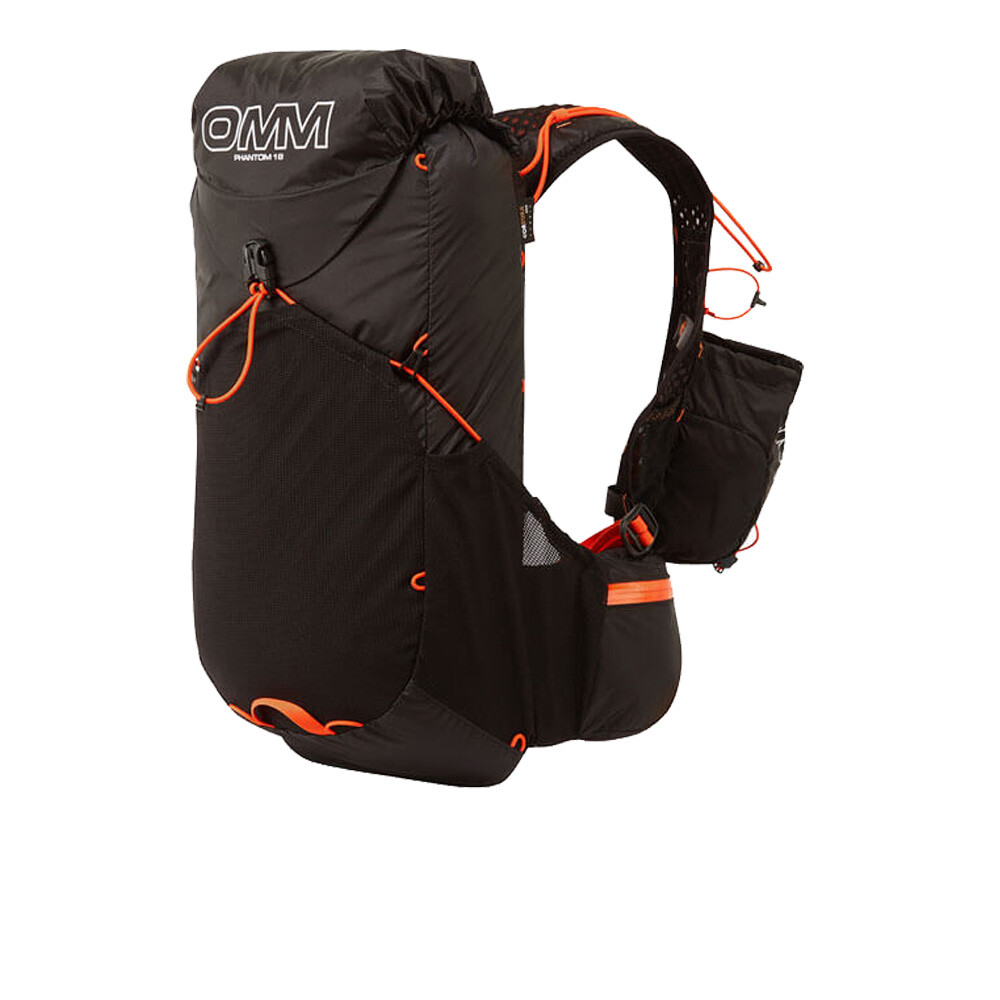
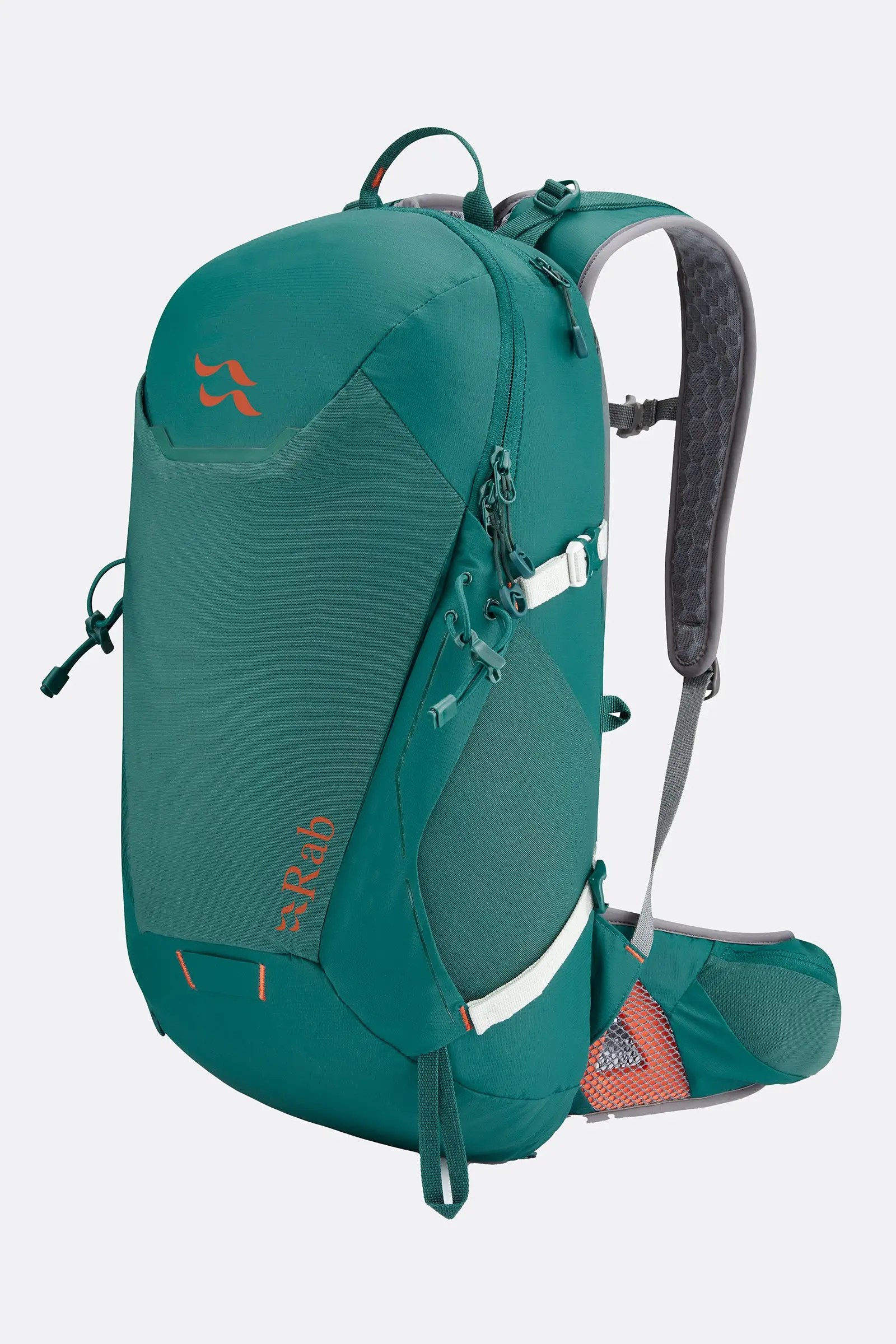
WHAT ARE THE BEST PACK OPTIONS TO CONSIDER
Remember, we are all individual. Every pack on the list below I have looked at, played with and tested in some capacity.
They are ALL applicable for stage racing, multi-day or fastpacking.
You may well be asking, but which do I prefer? Well, I could answer that, but if I do, am I then influencing your decision and thought process? So, for now, I will refrain from giving an opinion.
As you can see above, there is no shortage of options for packs. The main problem is testing and trying packs. Today, the internet and online purchasing provides us all great options and ease for shopping, but, I cannot emphasise enough, with a pack, go to a store, try them on, add weight and play around. Ideally, go to a store that sells many options so you can compare.






































 IAN CORLESS