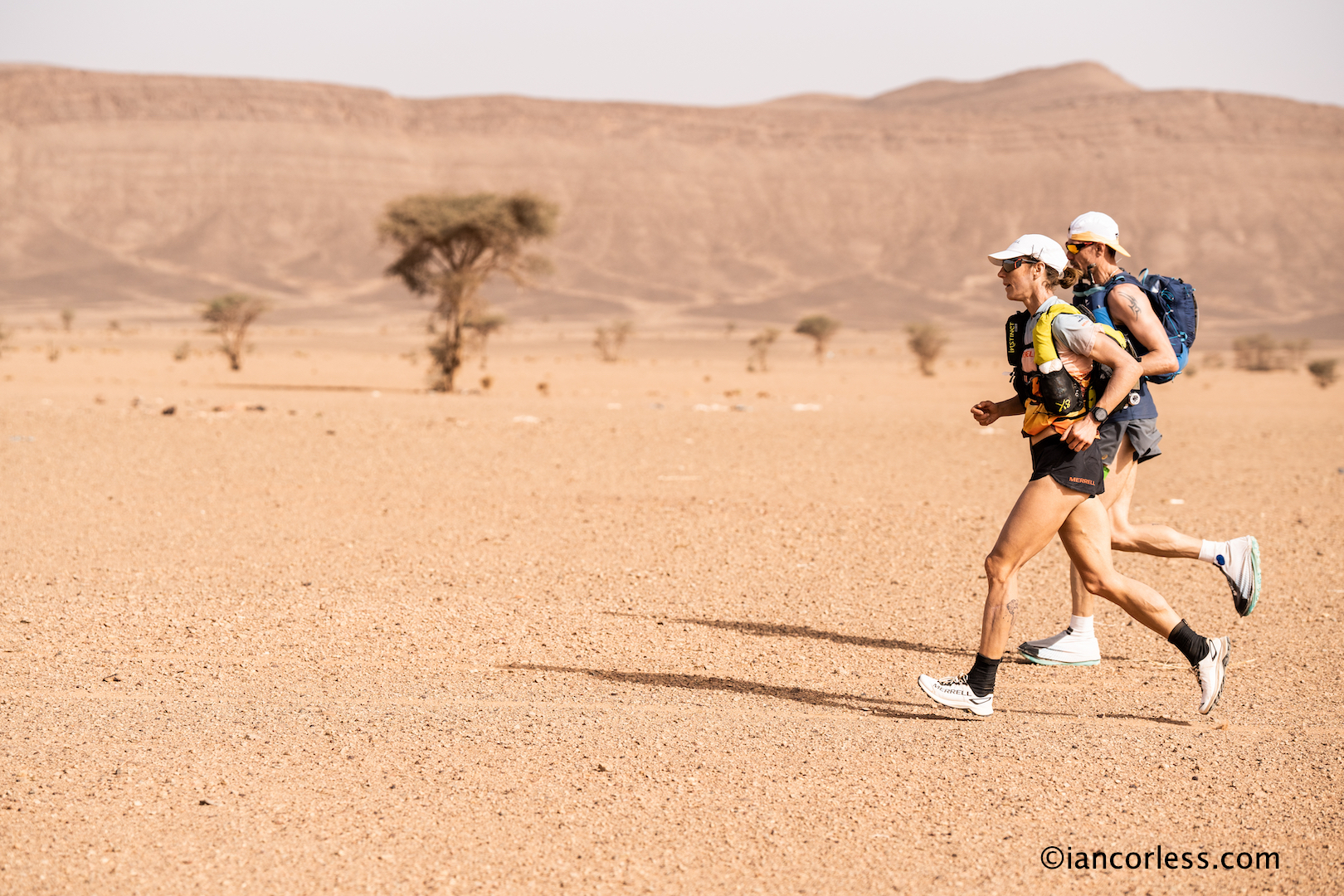
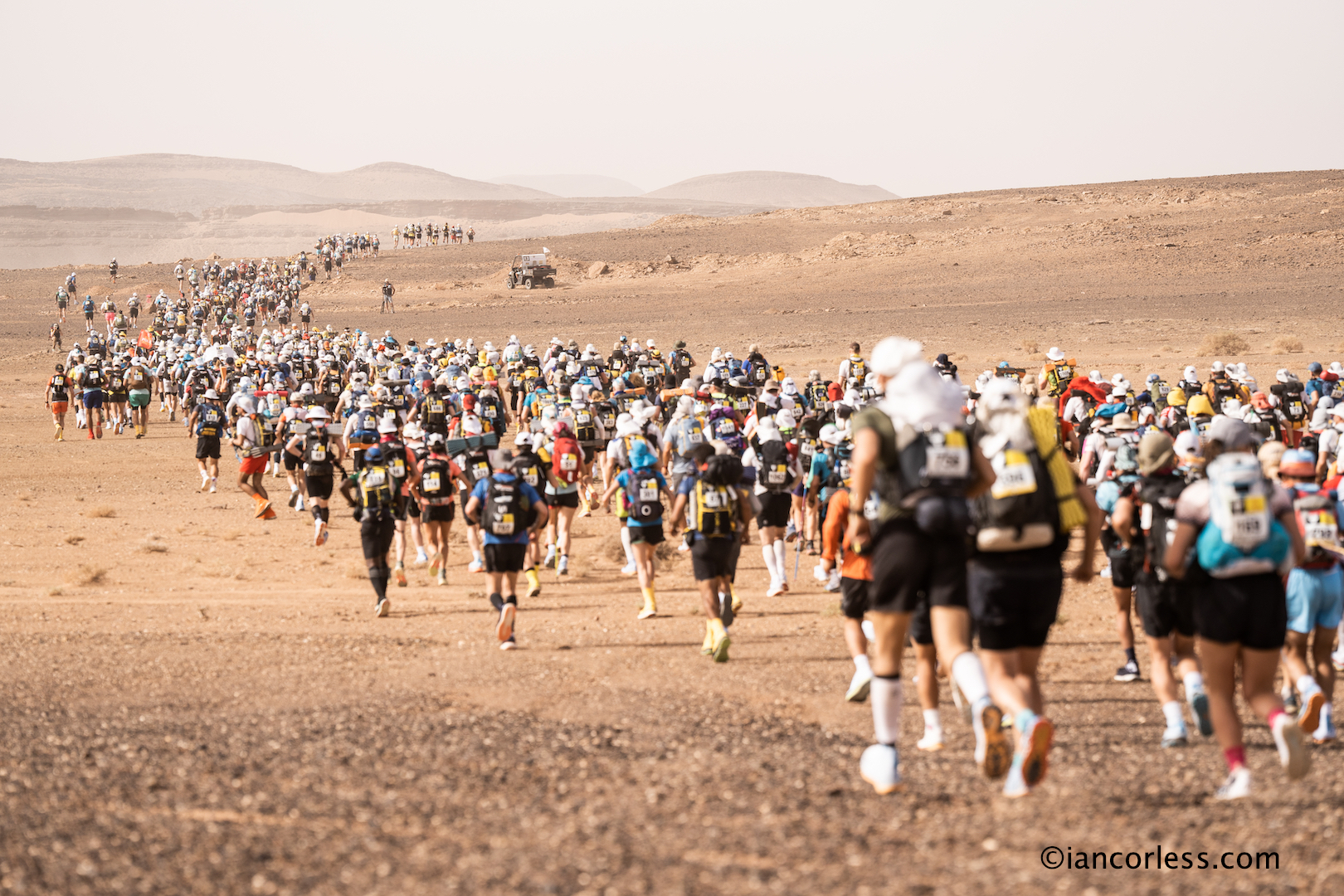
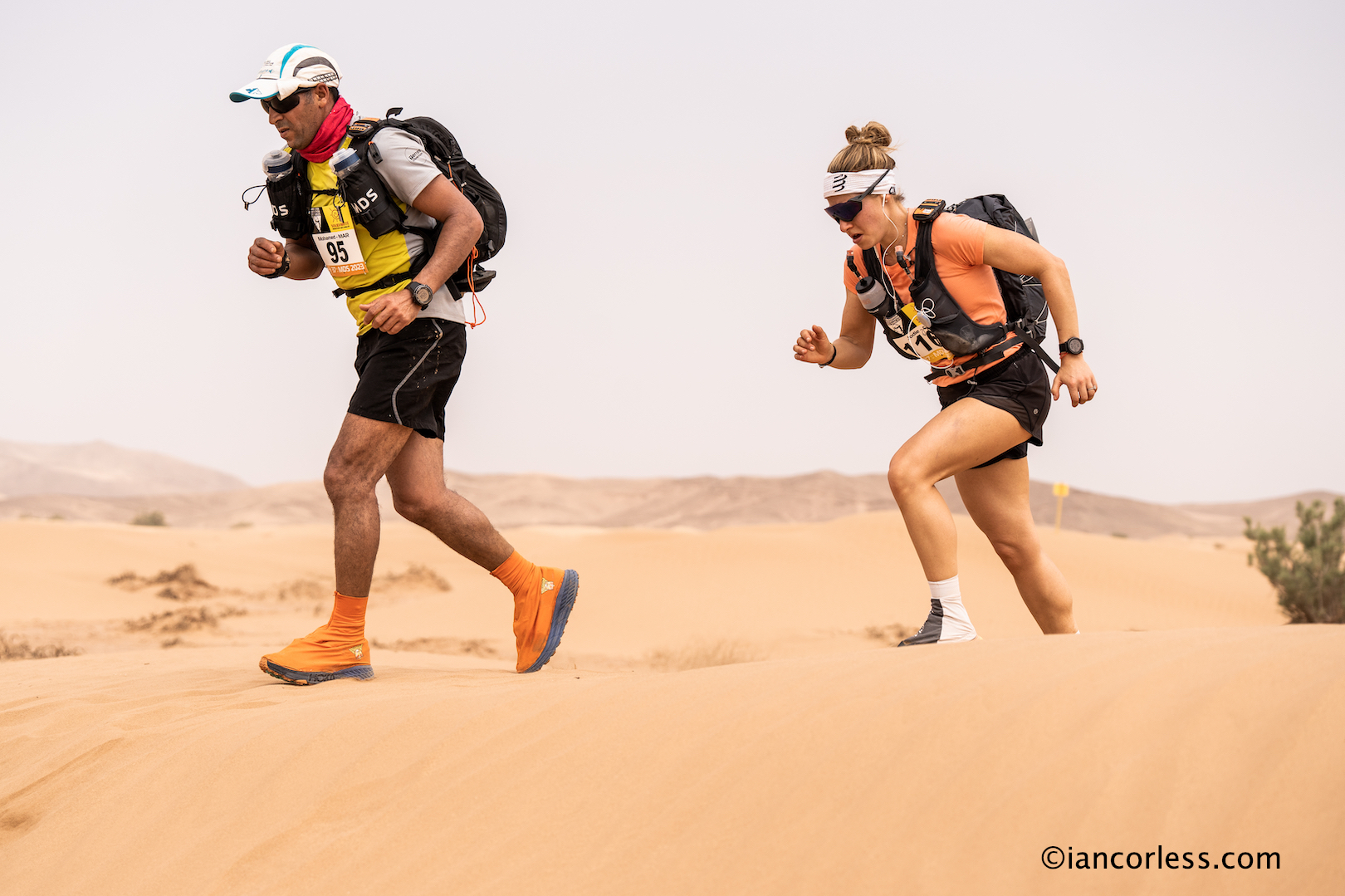
The long day at Marathon des Sables. It is always feared and rightly so. Coming on day 4, bodies are already tired and depleted. This year, the challenge is 90km, the second longest long day in the races 37th year history.
With 36 hours allowed to complete the challenge, it was going to be a tough challenge for all. The race start was brought forward by 1-hour once again, 0700 instead of 0800. The top 50 staring at 1000.
Self management is key. With aid stations approximately 10km’s apart, the race can be broken down, Cp by Cp and for most, the welcome of sunset and cooler temperatures makes travelling by foot easier.
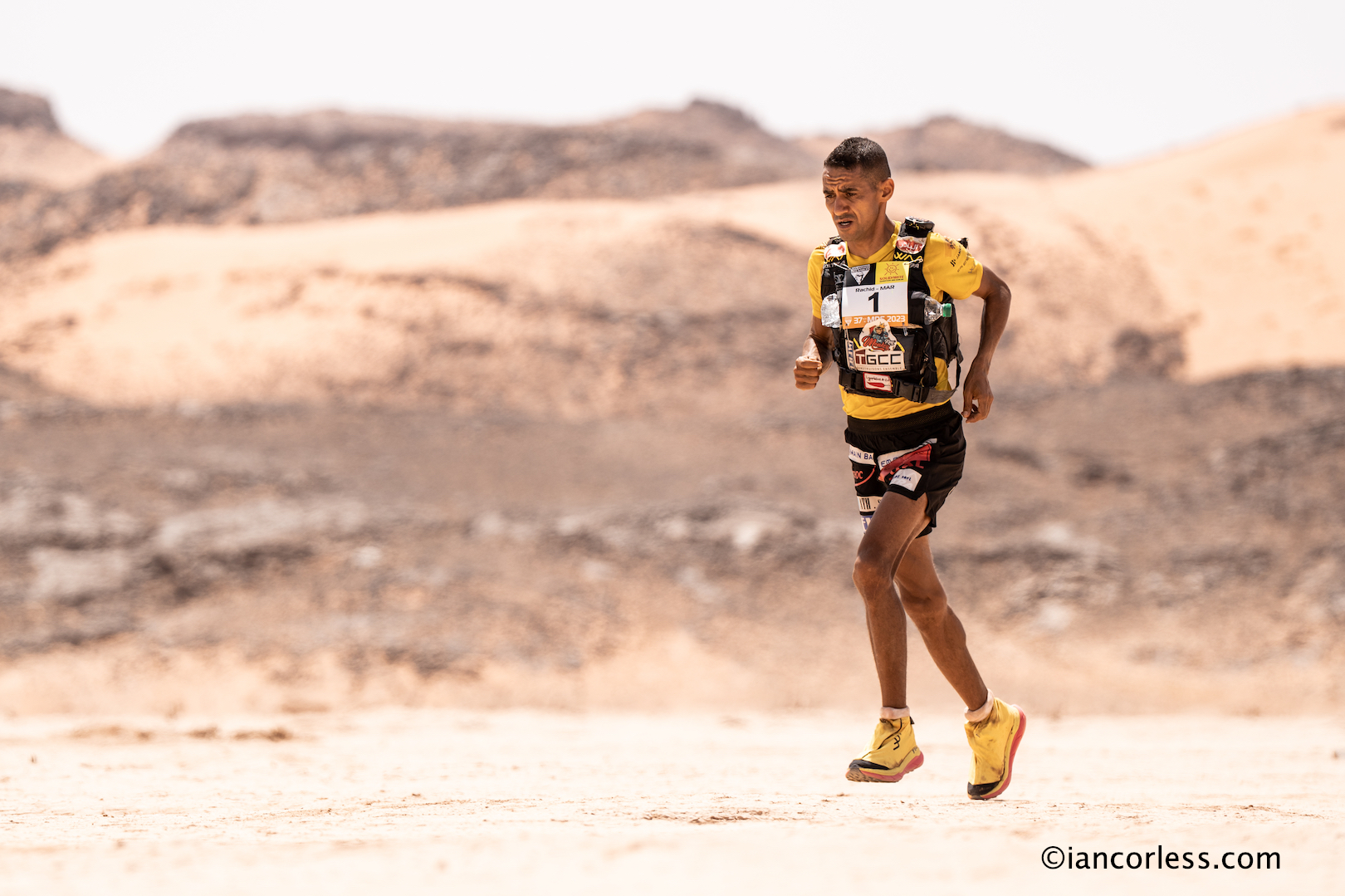
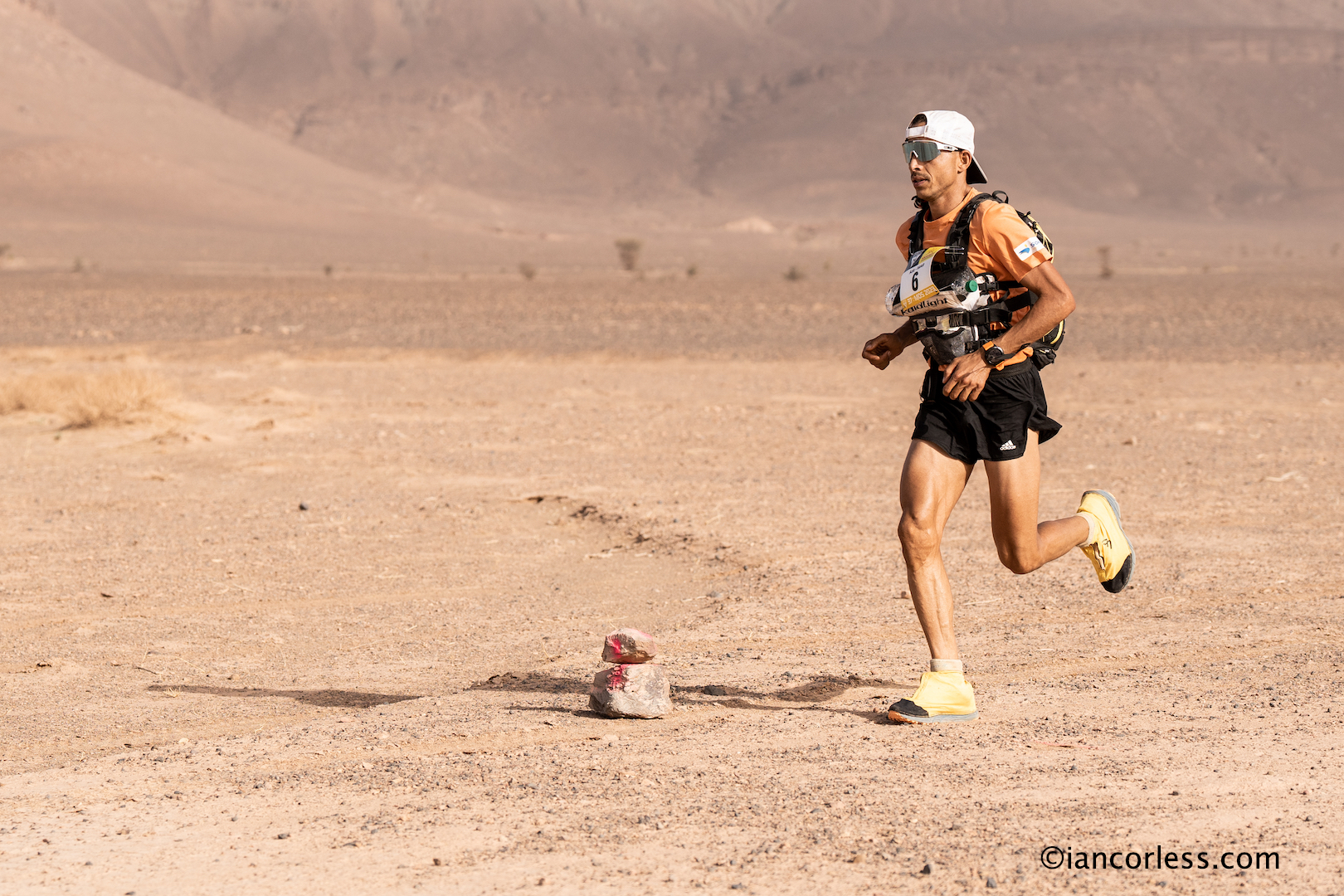
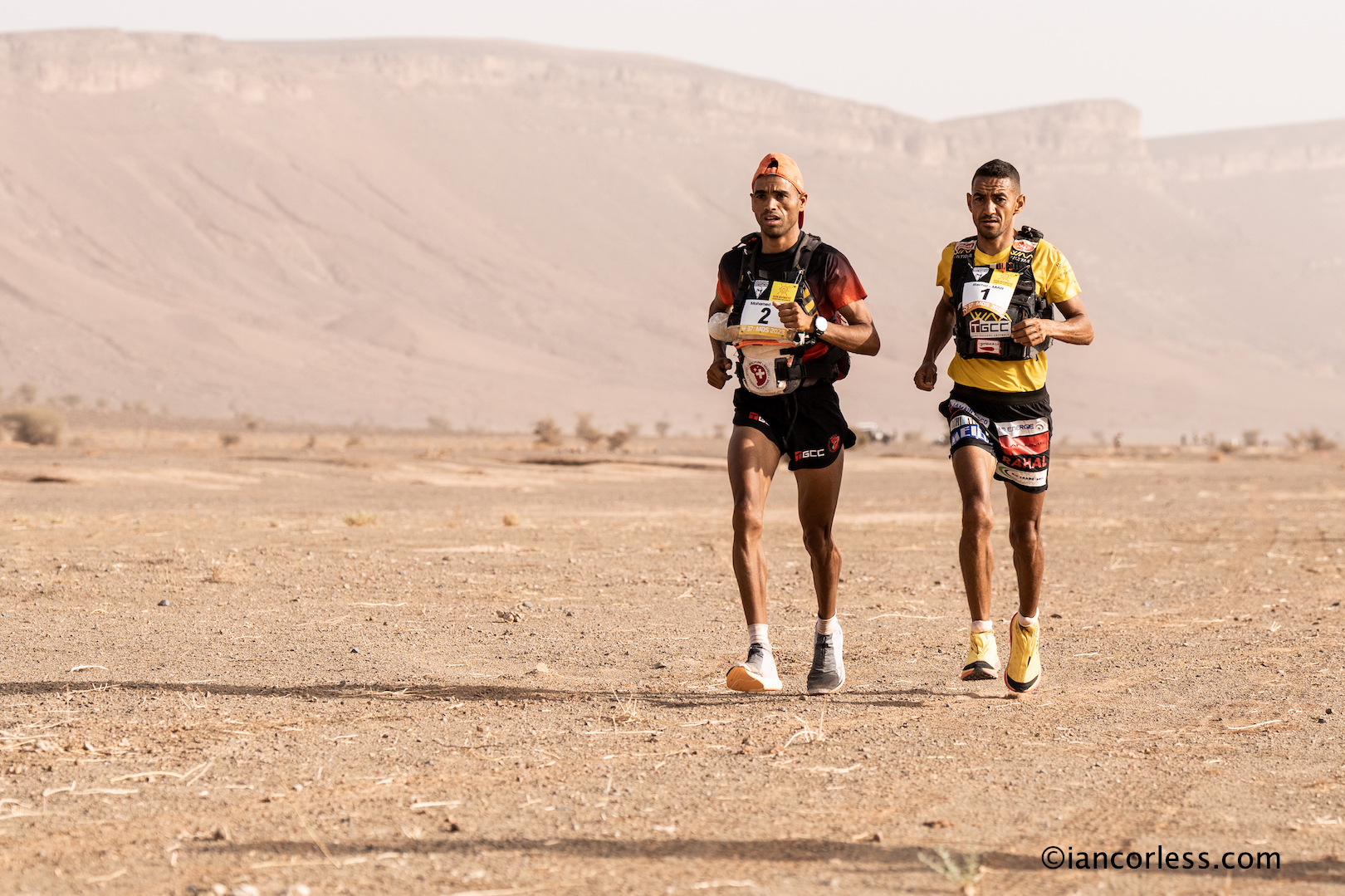
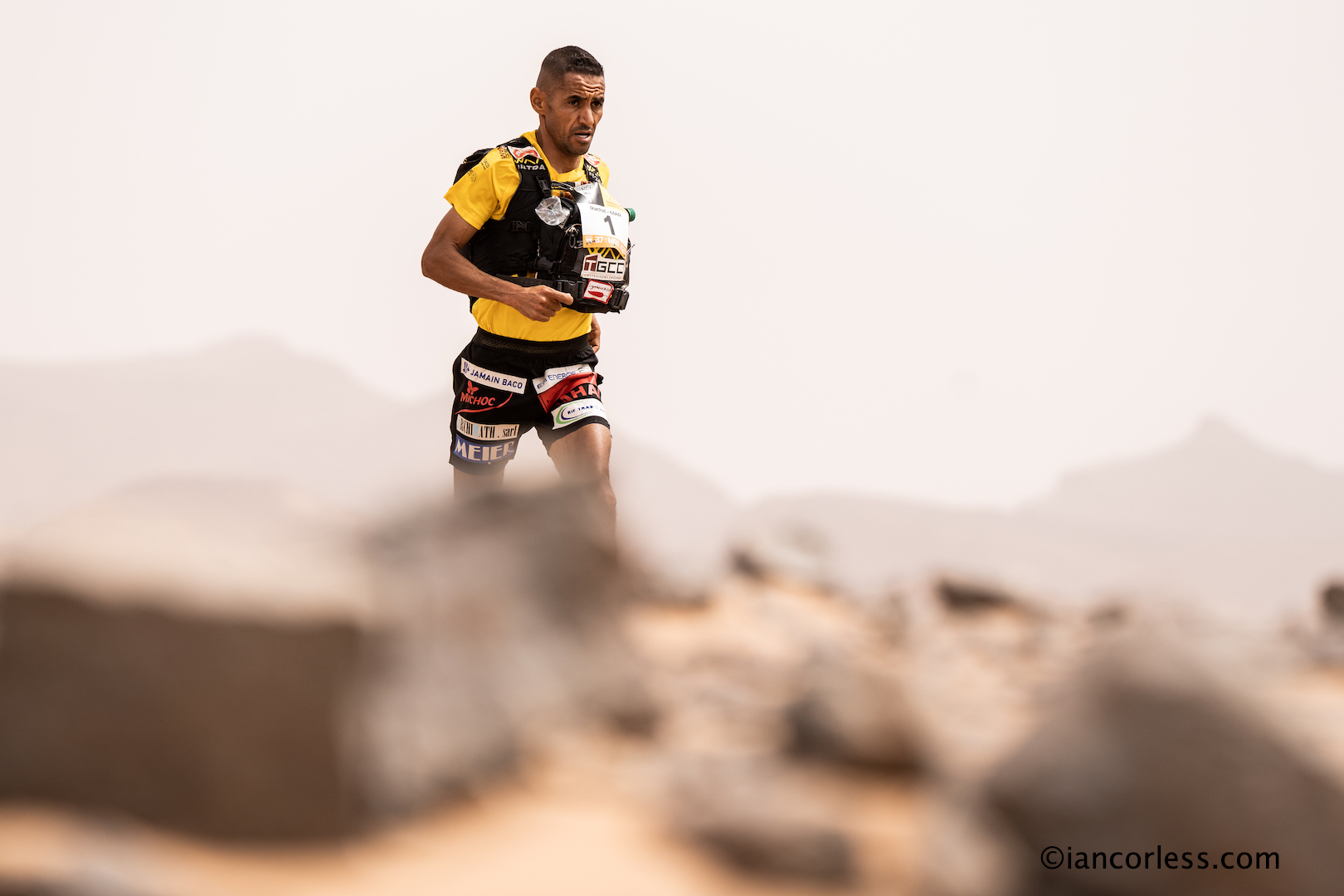
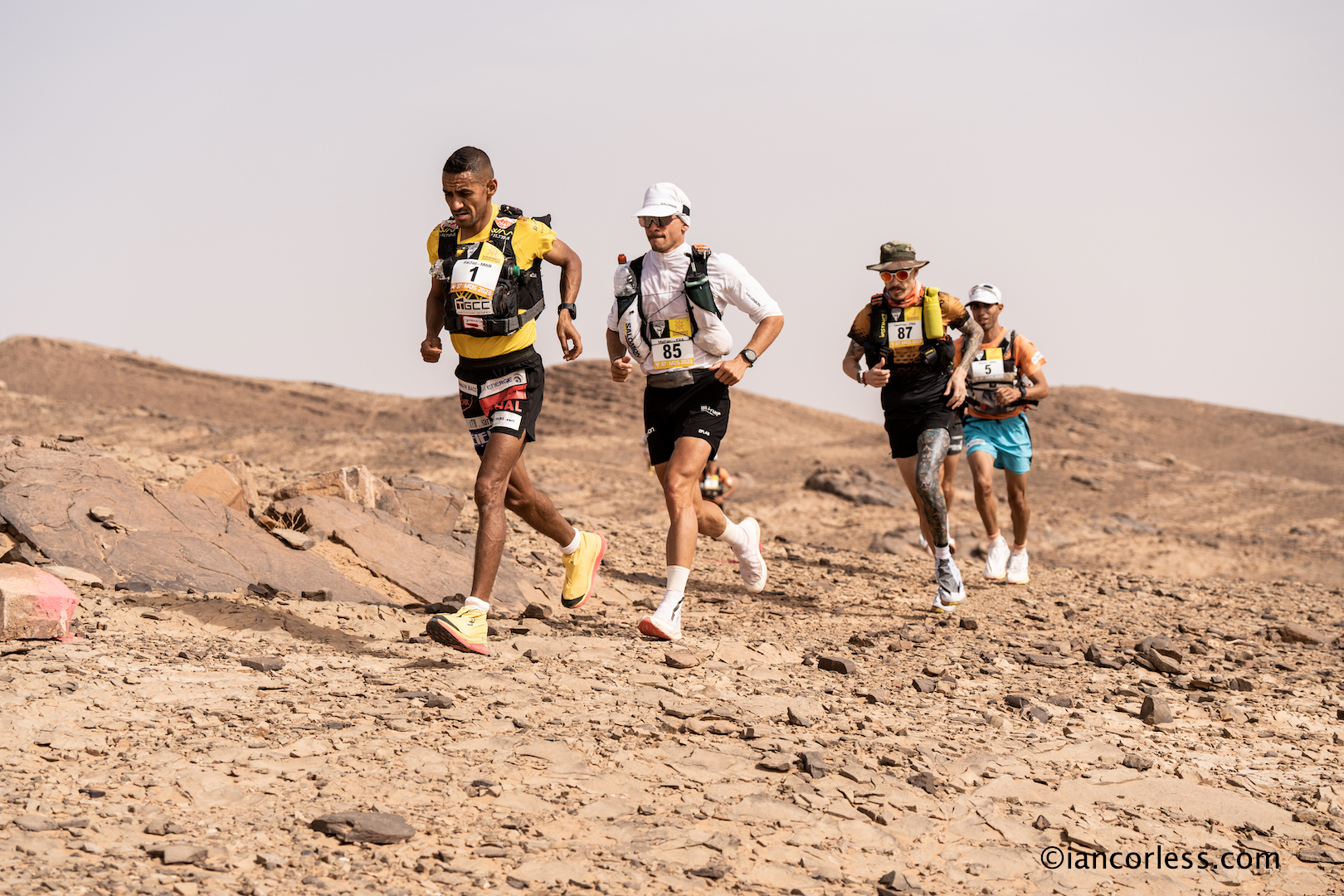
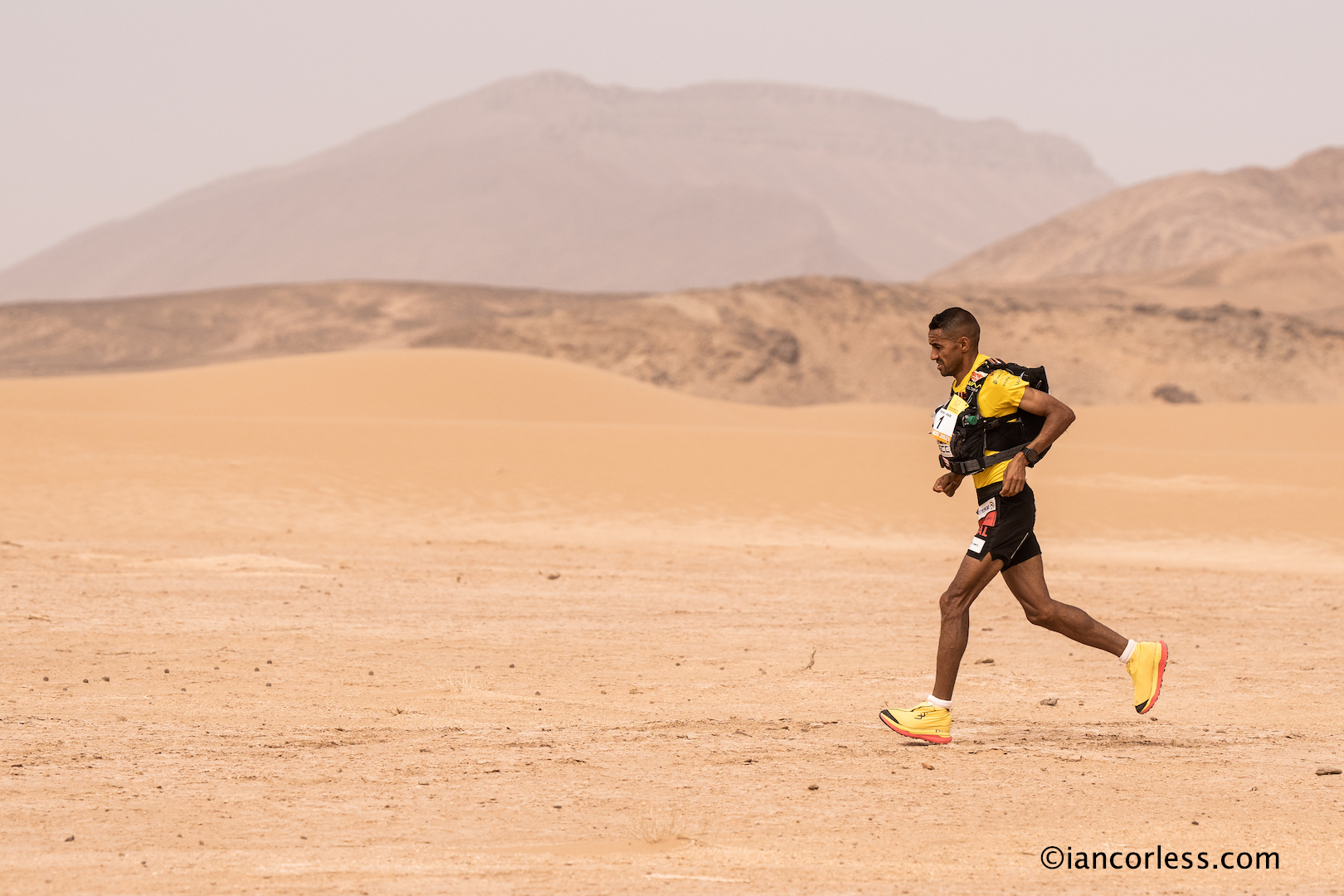
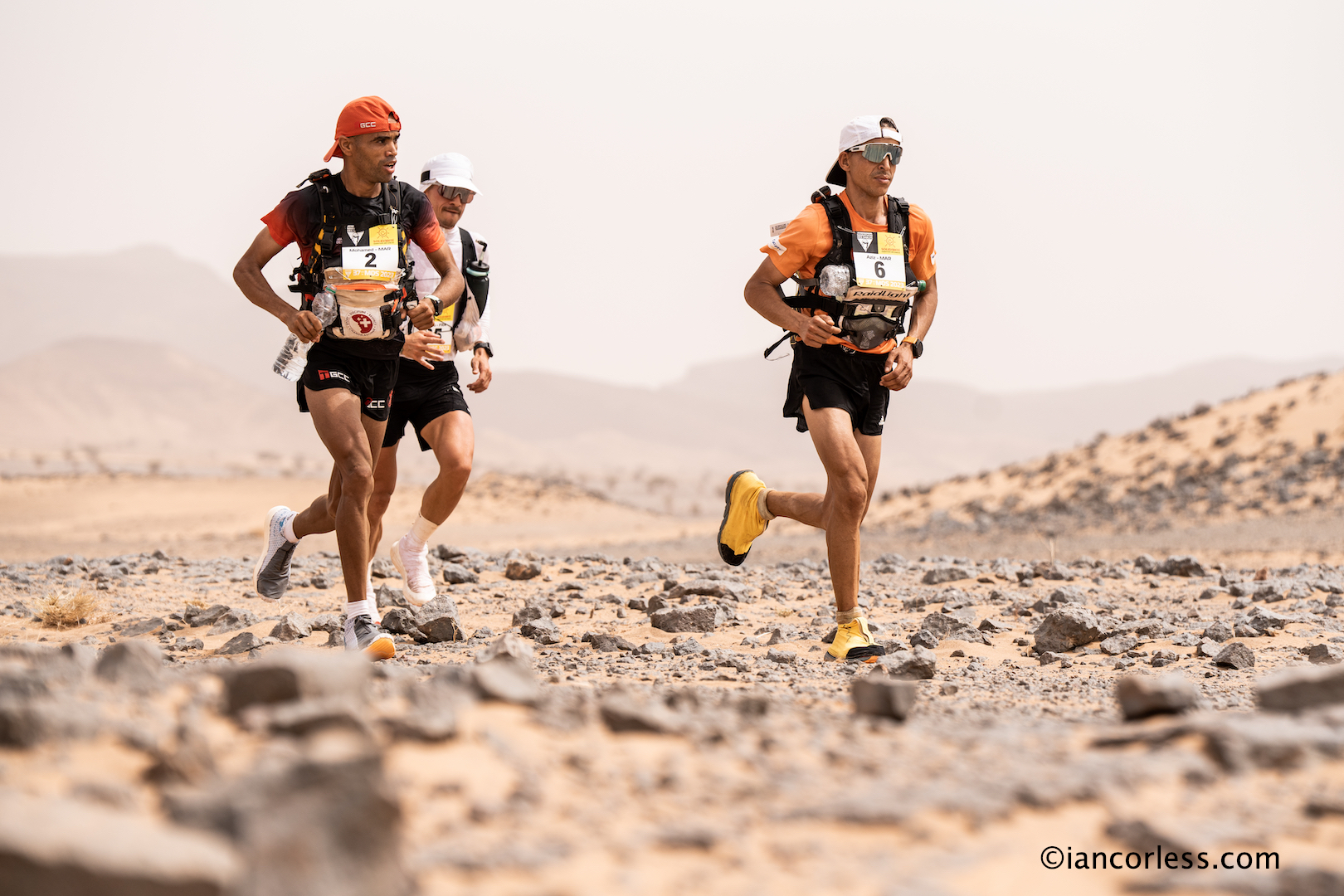
The front of the race was highly anticipated with Rachid, Mohamed and Aziz close together on the GC. But really, all eyes were on Rachid looking for a 10th victory.
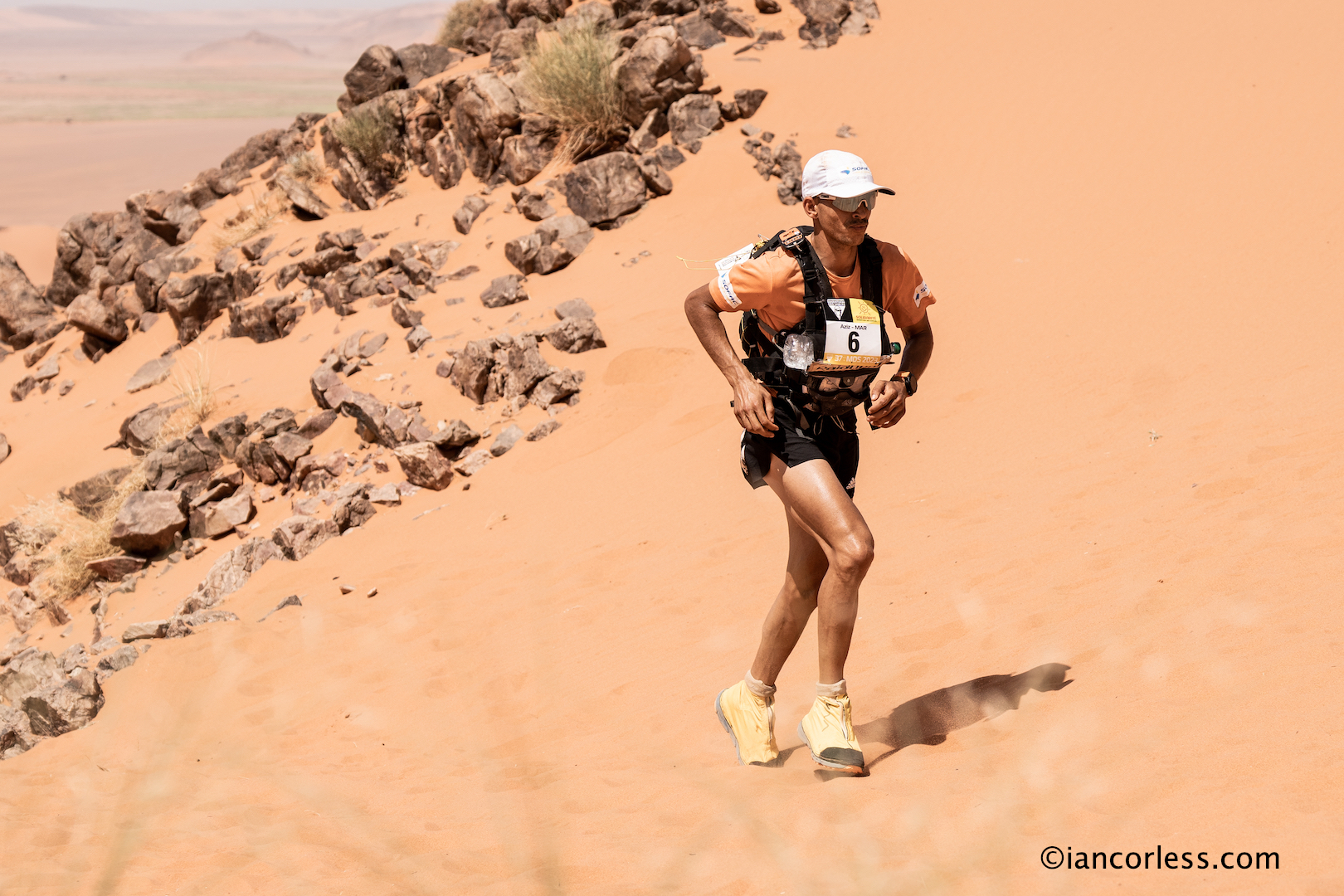
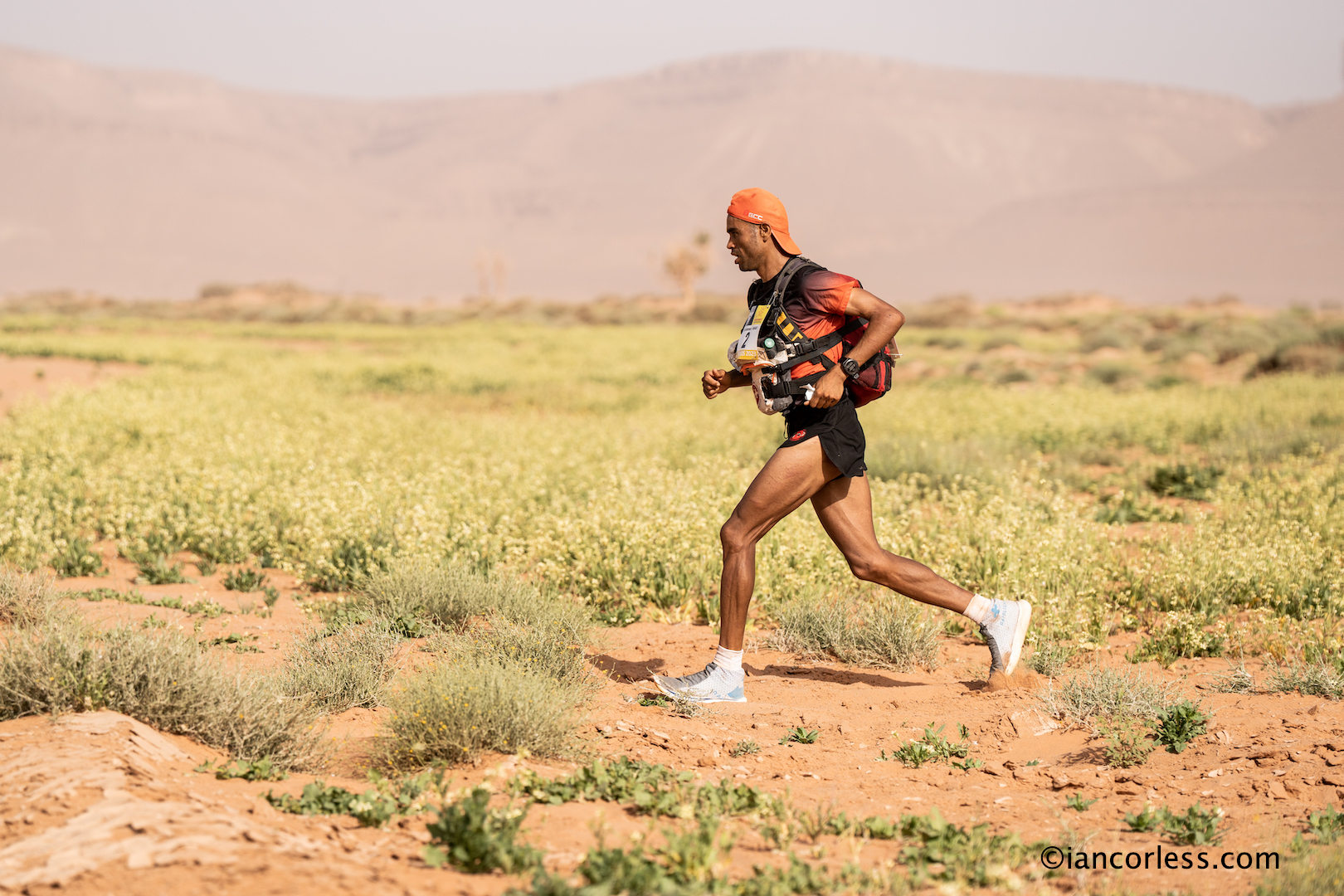
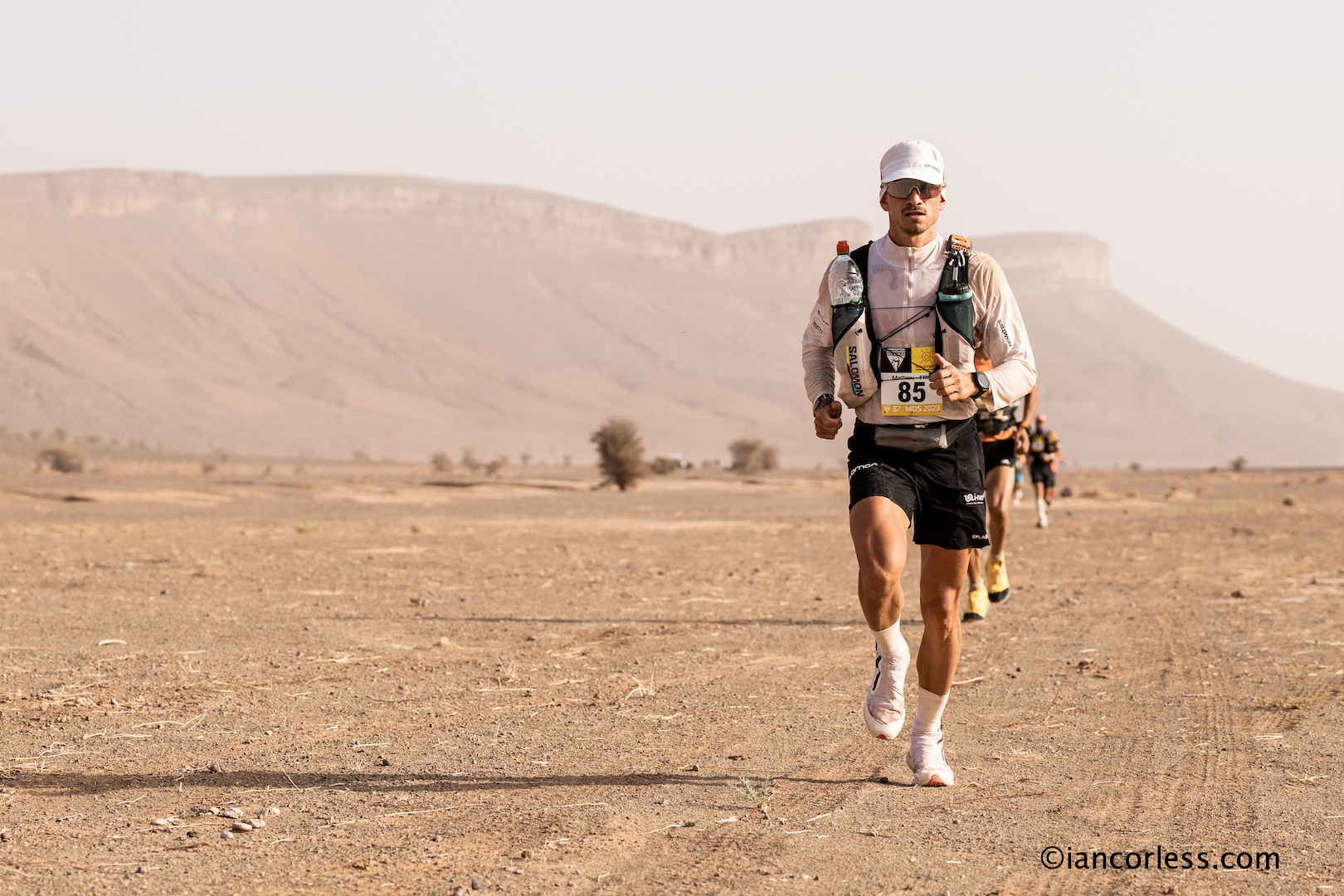
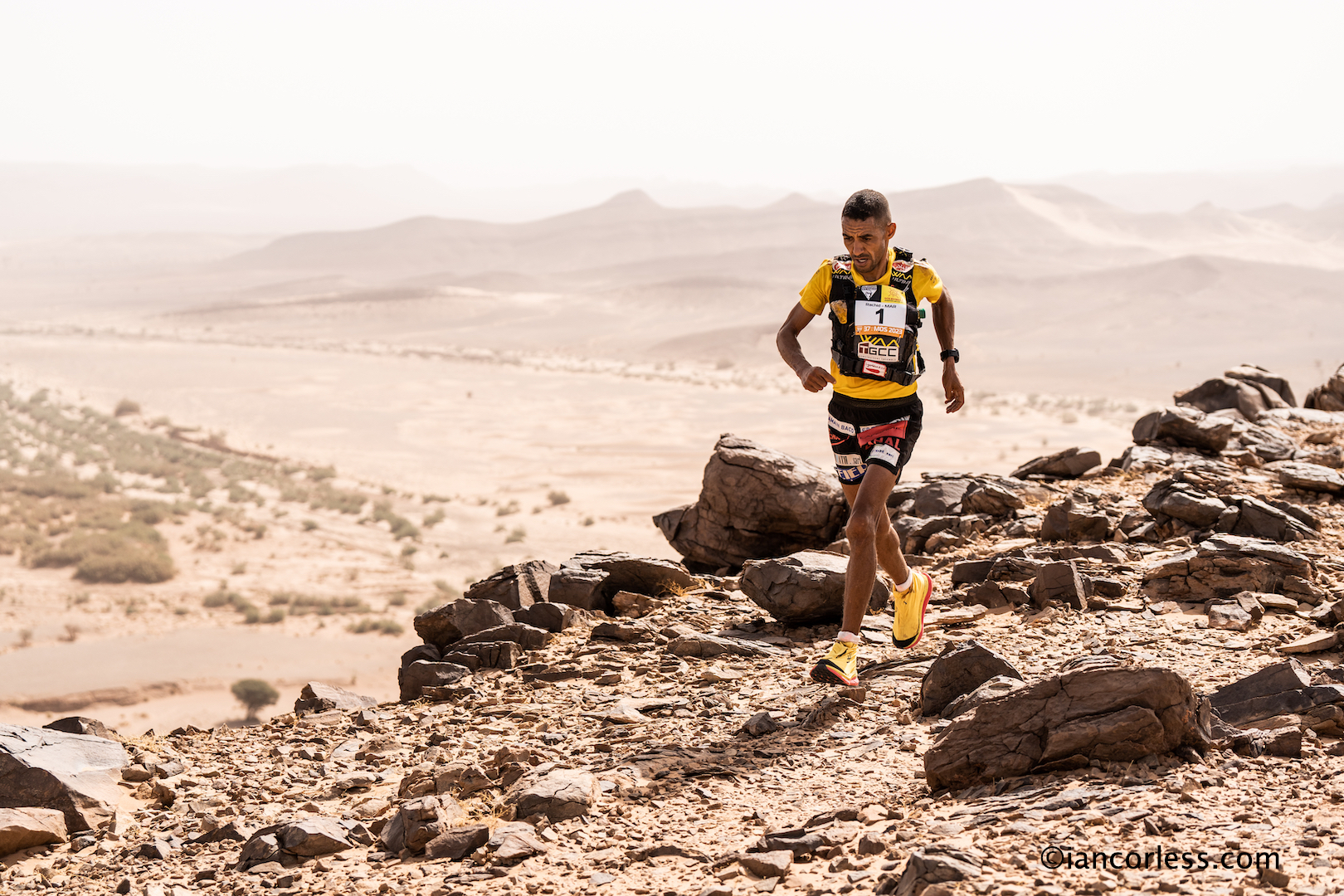
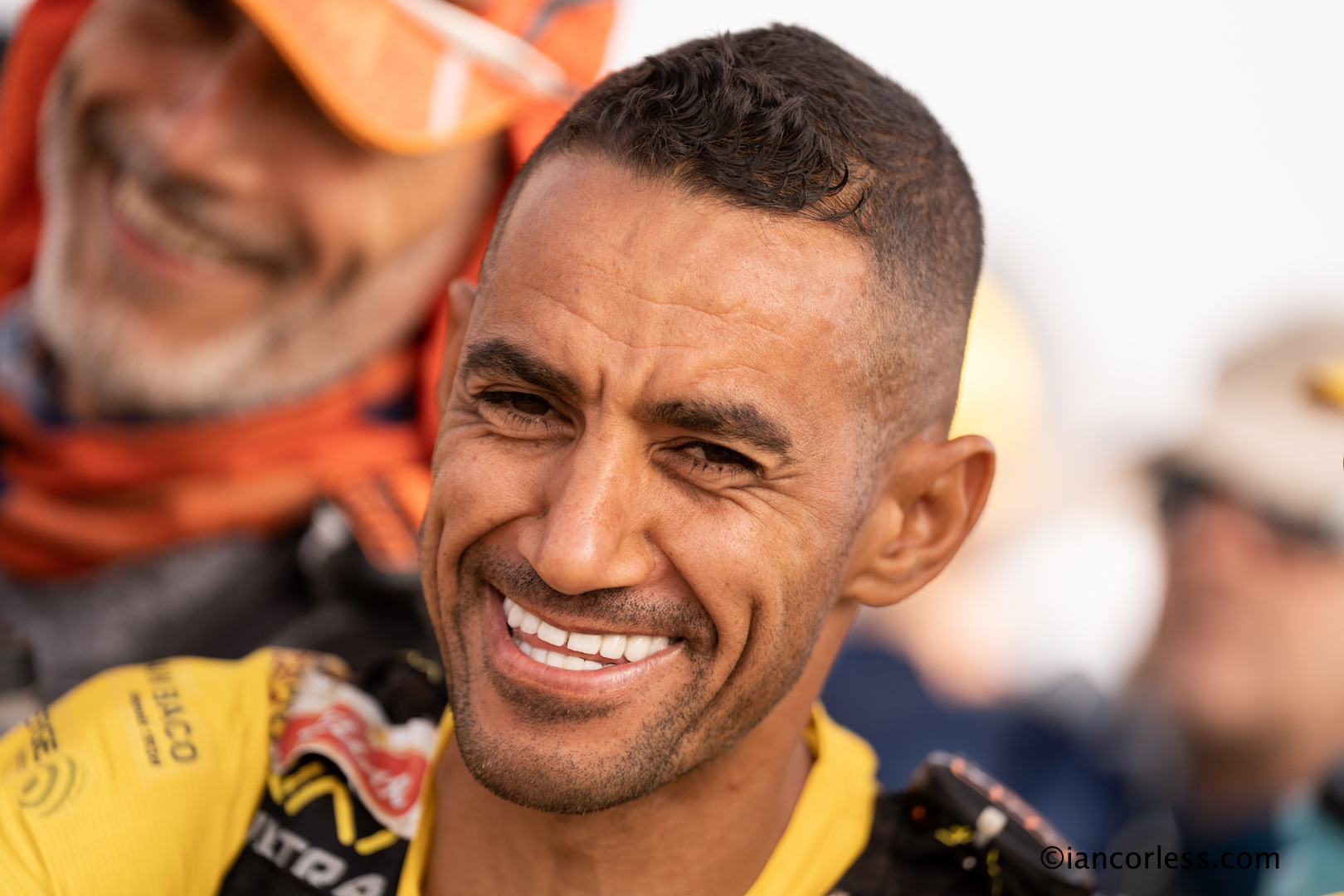
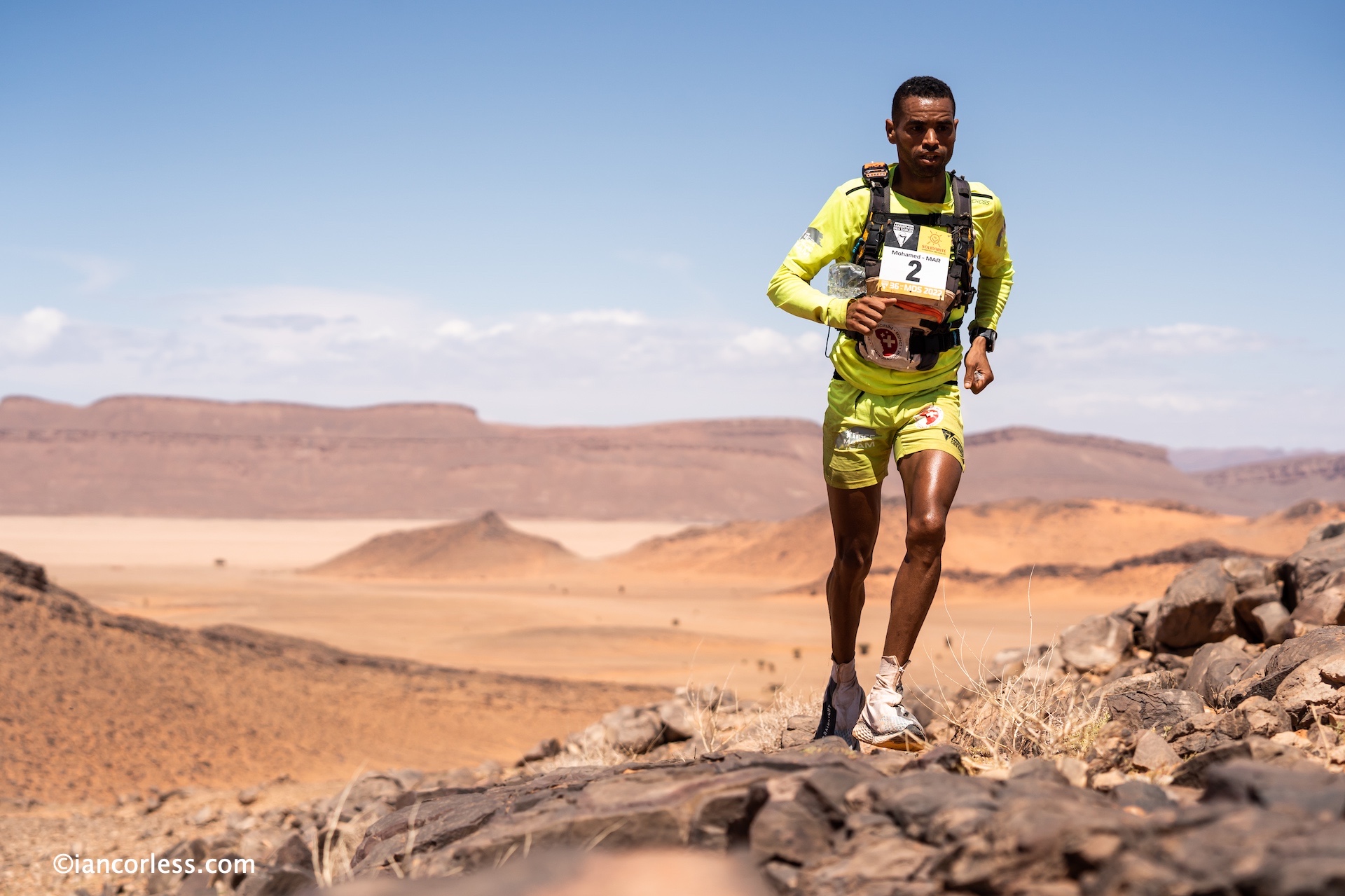
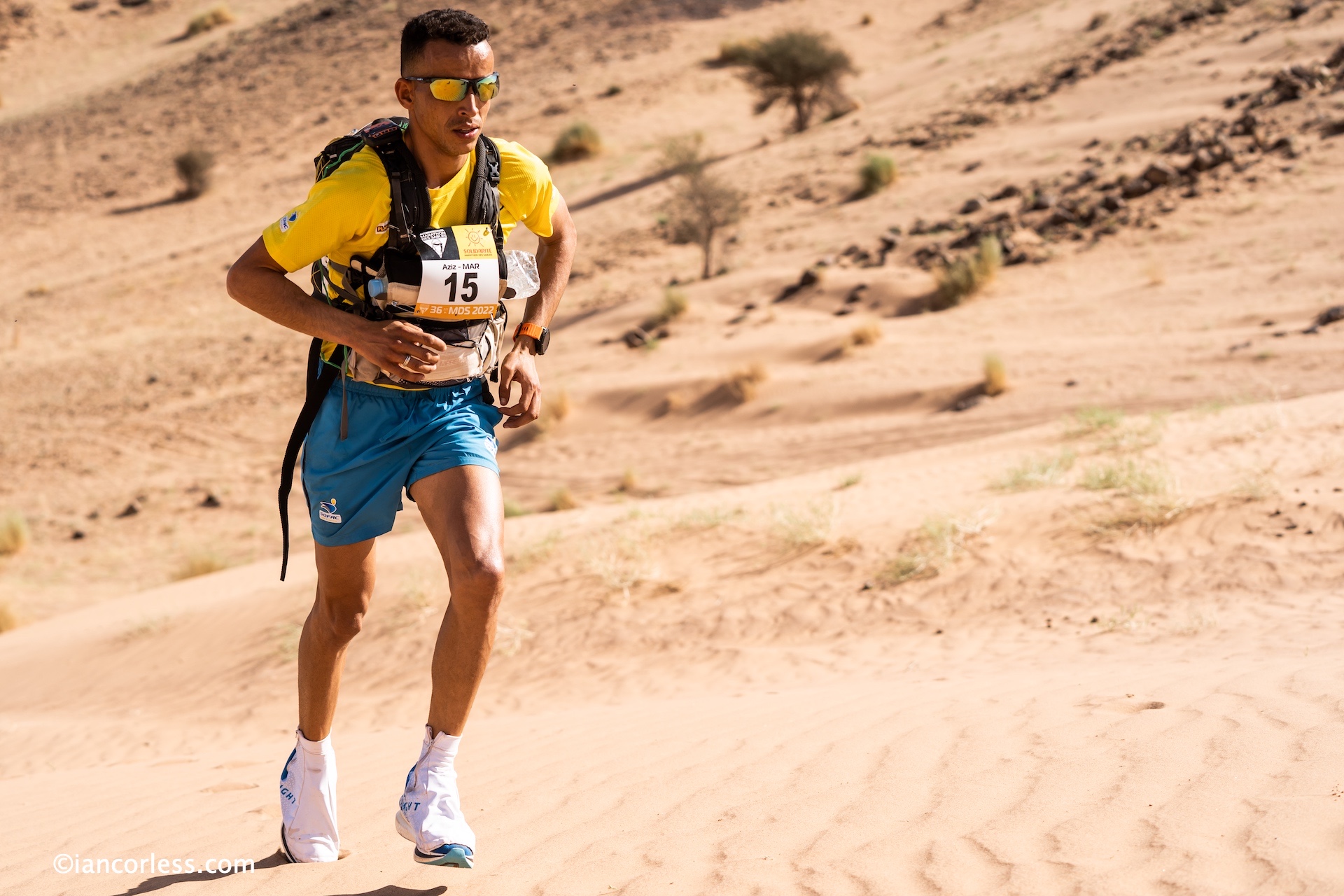
The day started with Rachid pushing the pace ahead of the other contenders but no real gaps opened up, for much of the day, the trio were close together and it stayed this way all the way to the end with Mohamed finishing 1st (8:14:39), Aziz 2nd (8:14:45) and Rachid 3rd (8:14:58), the GC staying with Mohamed as leader. It’s all to fight for come the marathon stage. Mathieu Blanchard once again ran consistency securing 4th place on GC.
Update: 1400hrs 27/04
Rachid El Morabity and Aziz El Akad both failed a mandatory kit check ahead of the stage 4 start. The reason, ‘outside assistance.’ This has resulted in a 3-hour time penalty given against Rachid and Aziz and the Morocan team will be penalised.
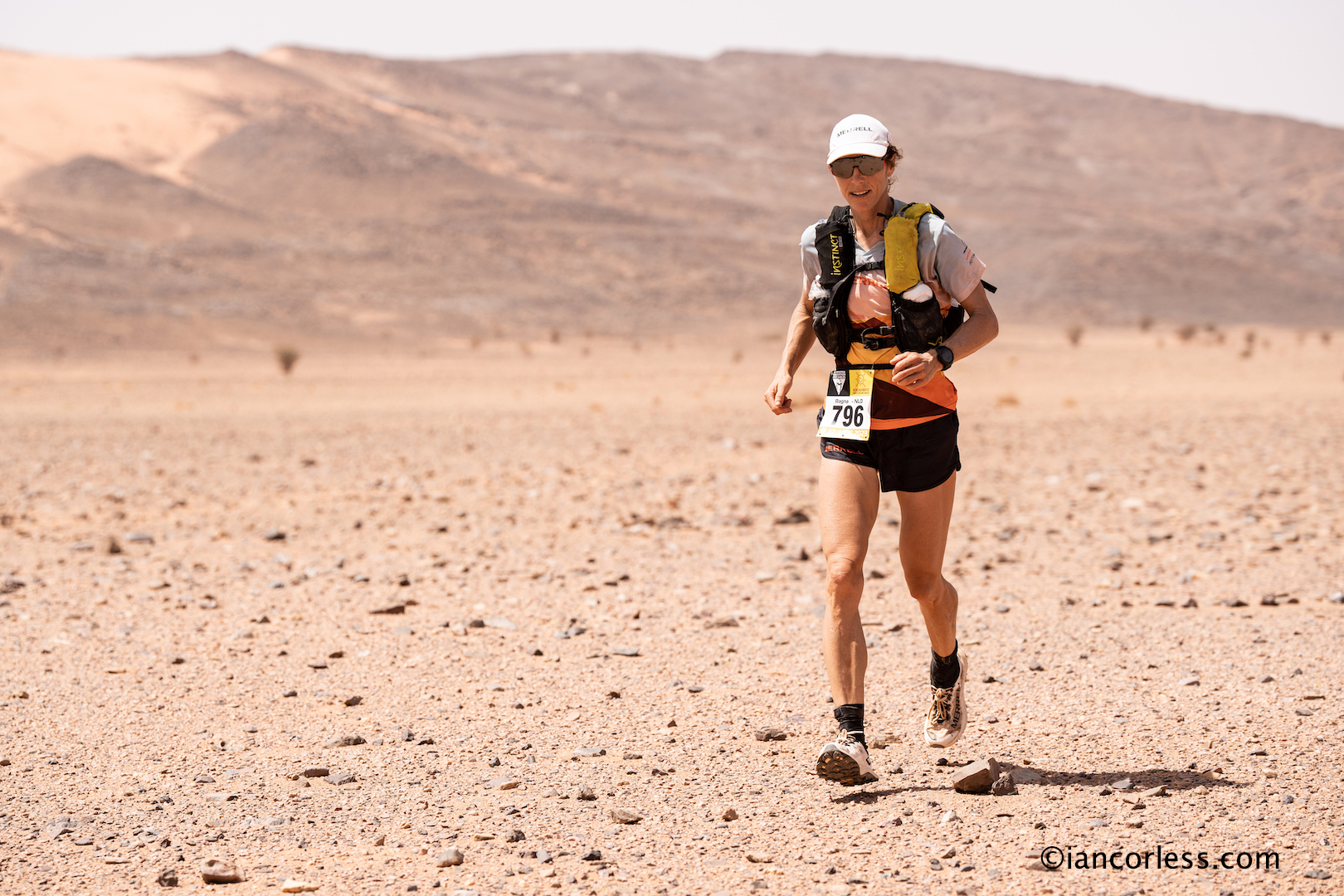
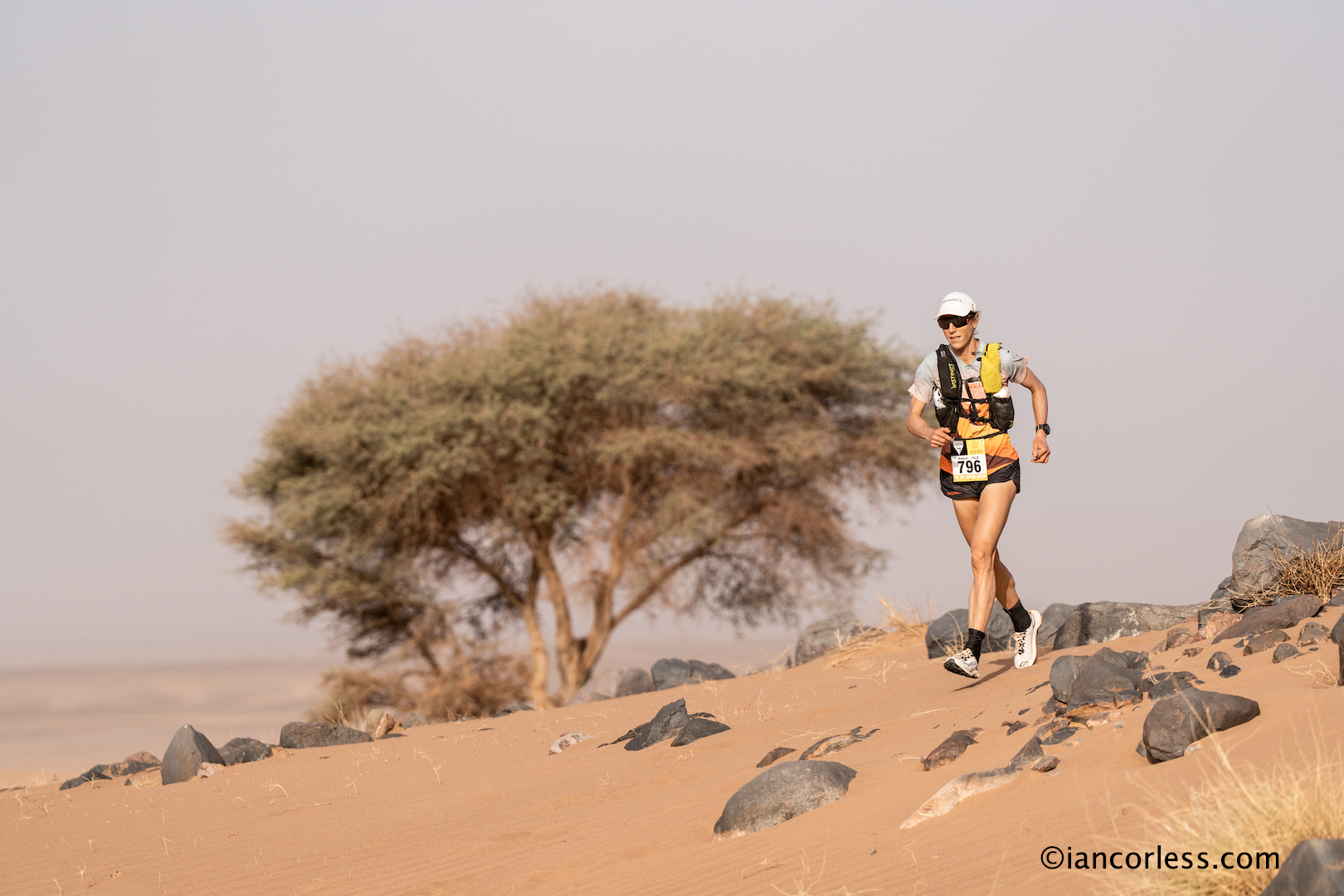
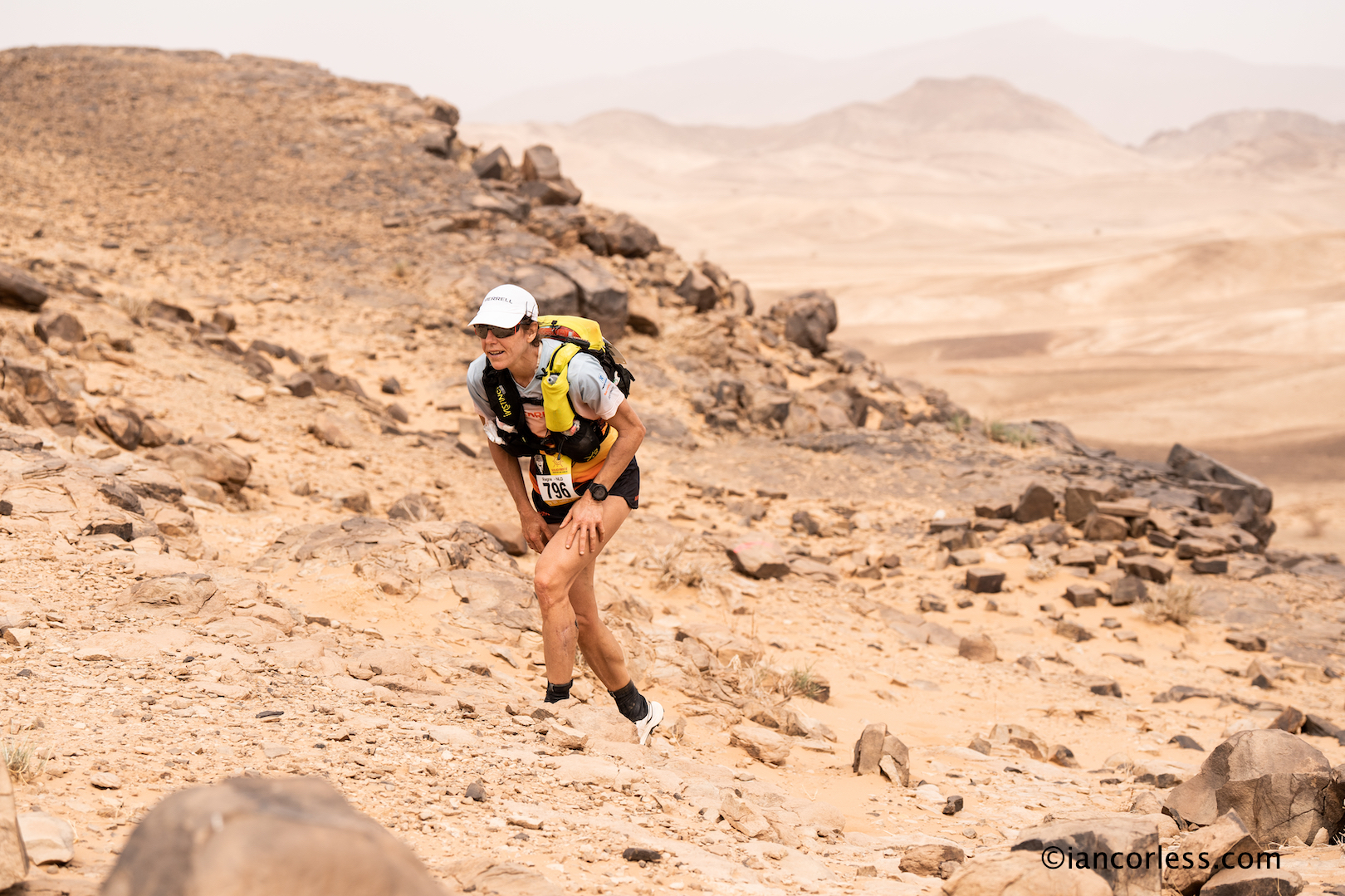
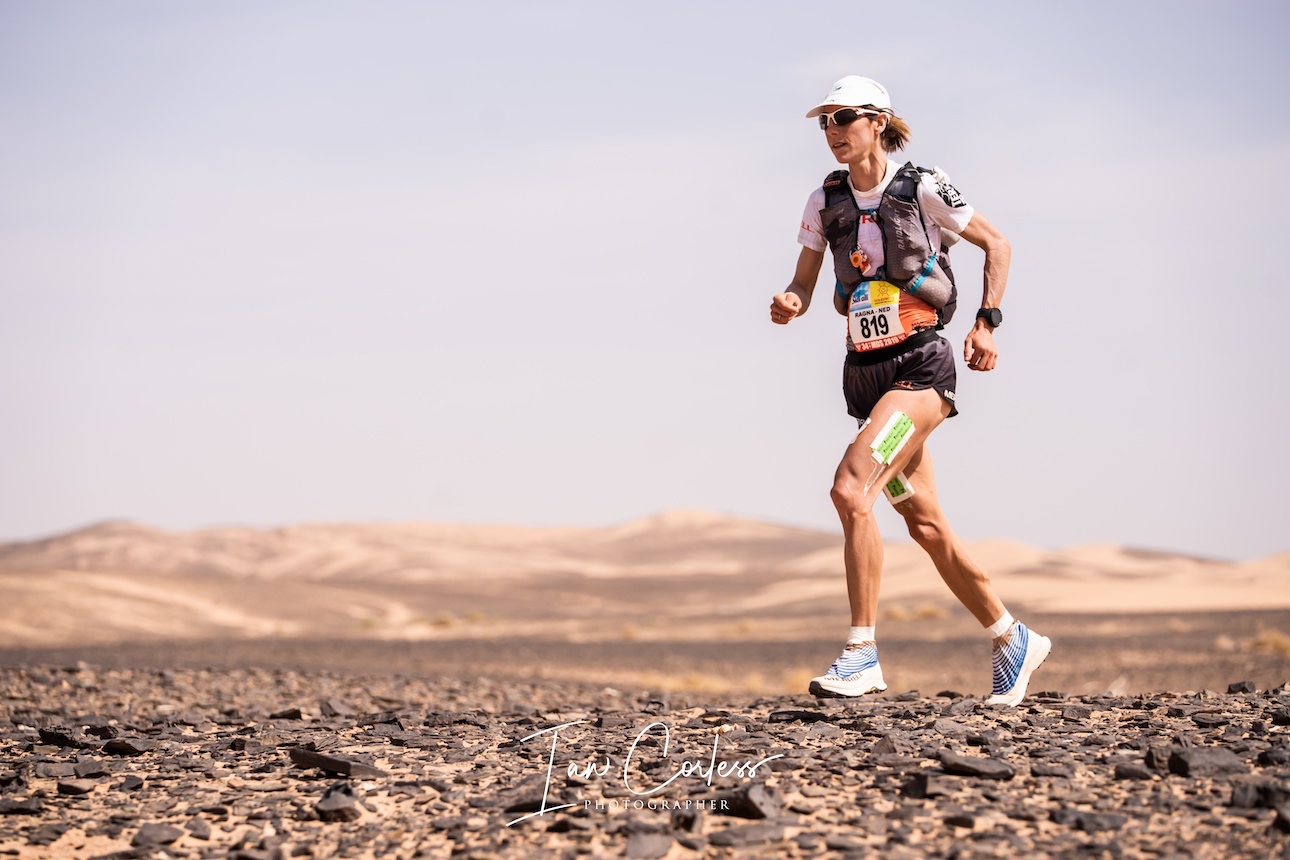
Ragna Debats had dominated the first three stages and barring disaster, was almost guaranteed victory. But, there are no guarantees in the Sahara. The terrain brutal, the heat intense and the challenge extreme.
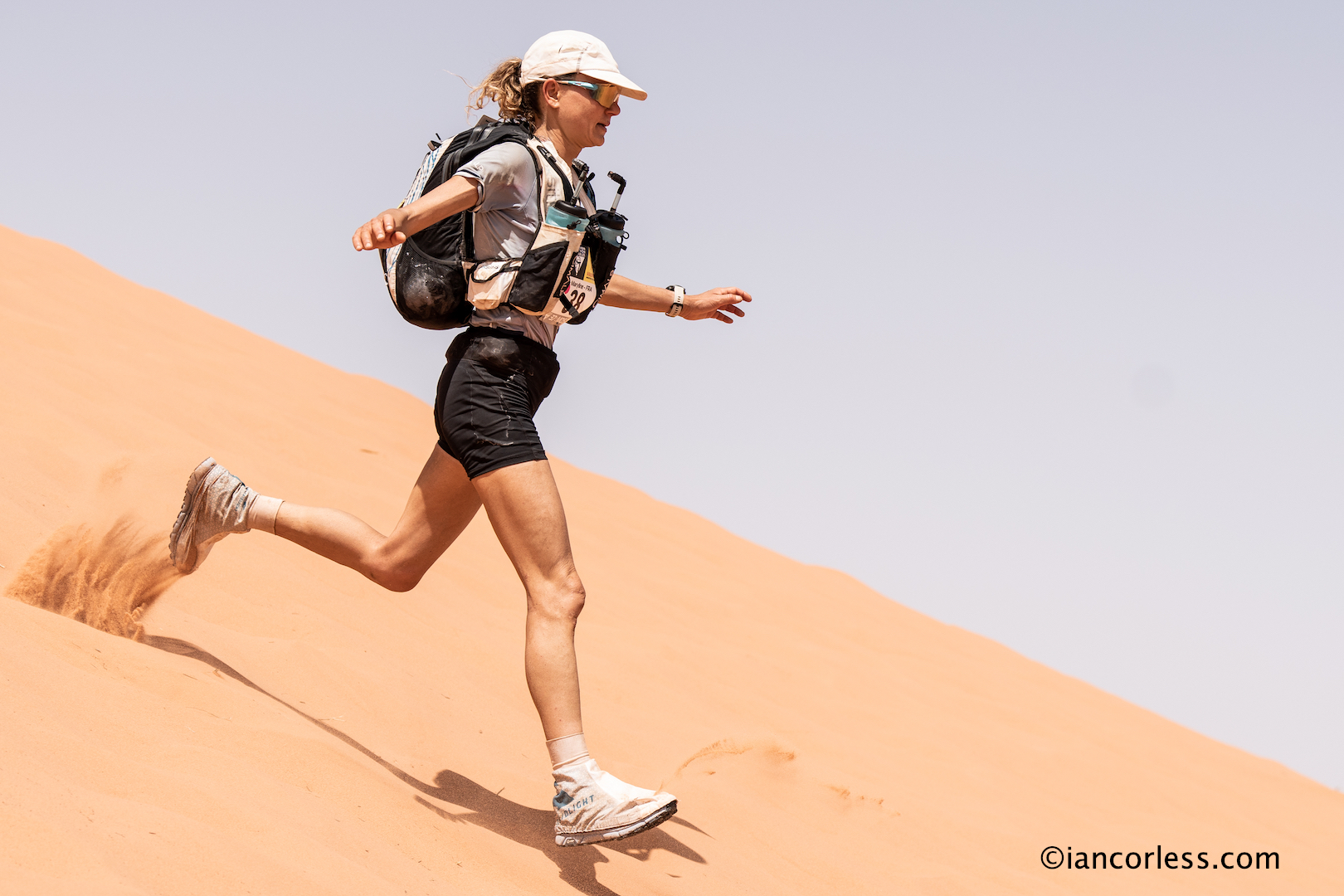
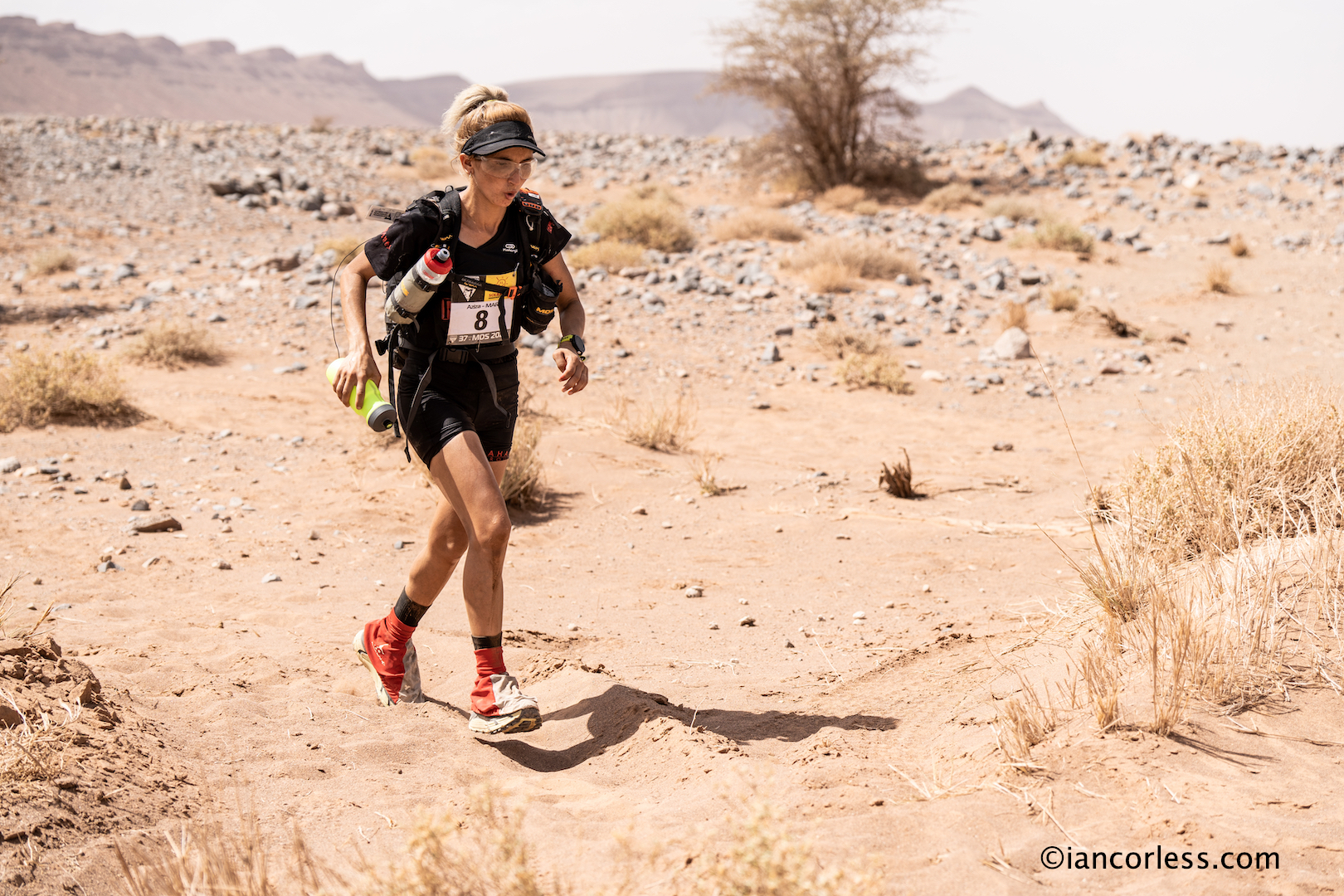
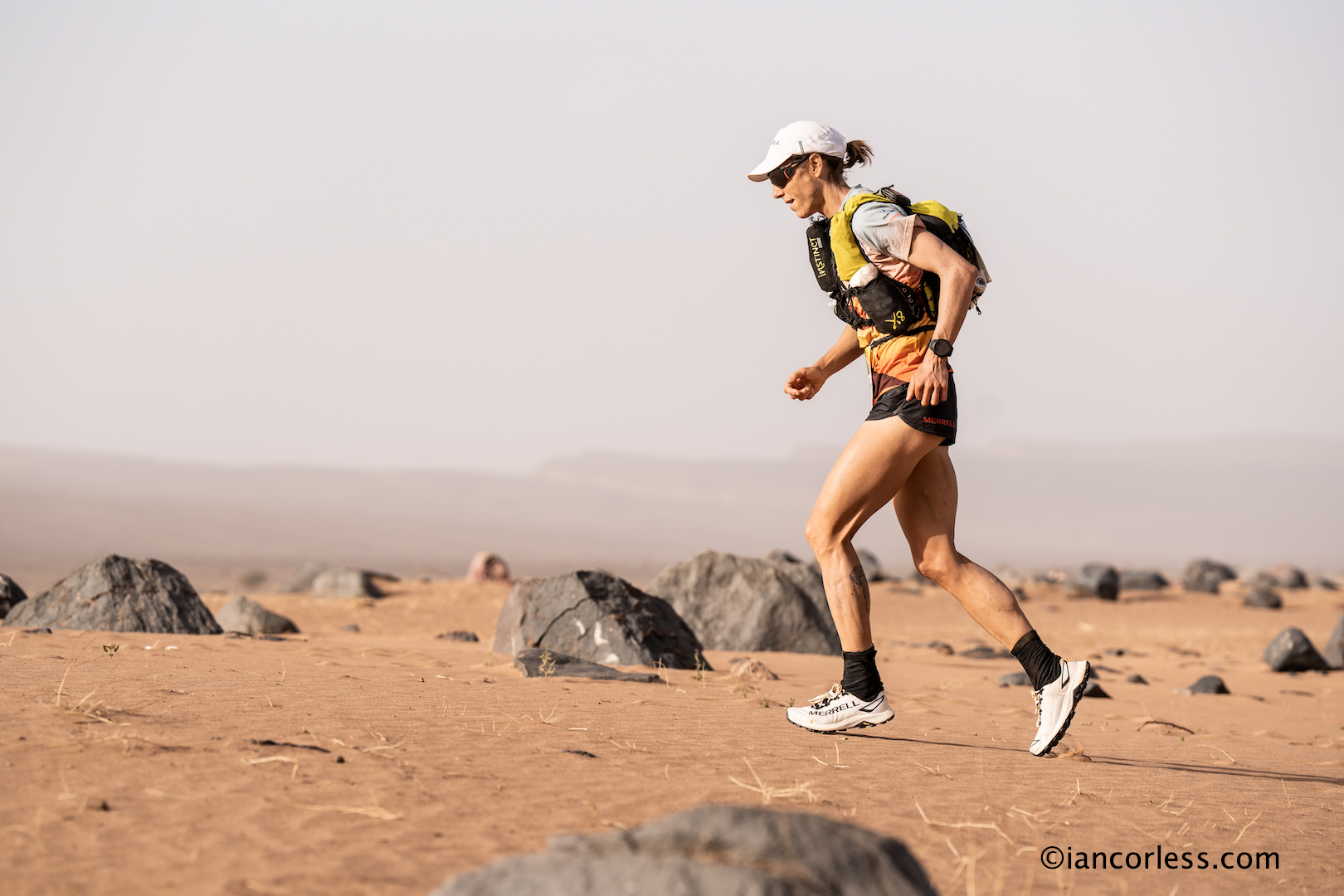
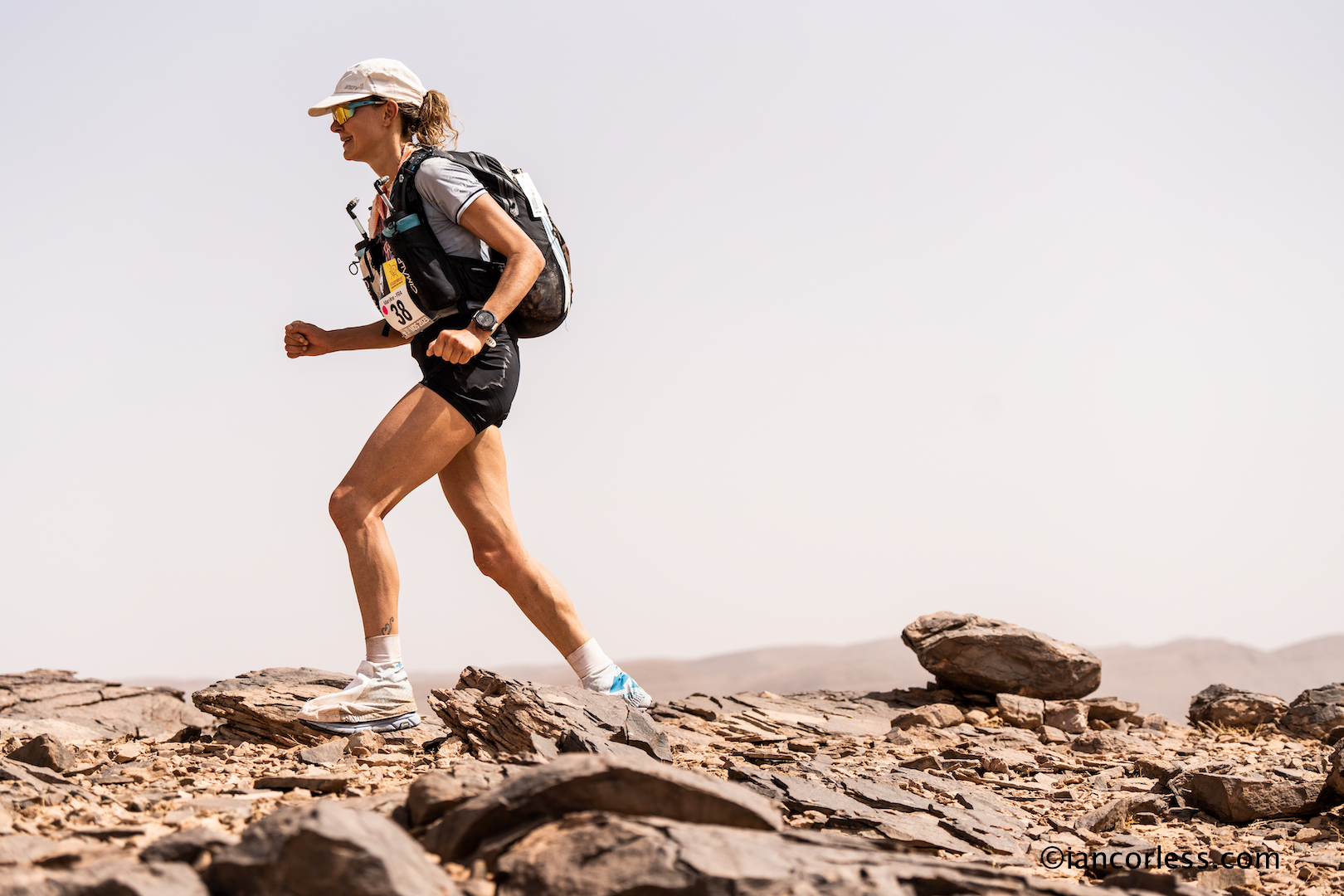
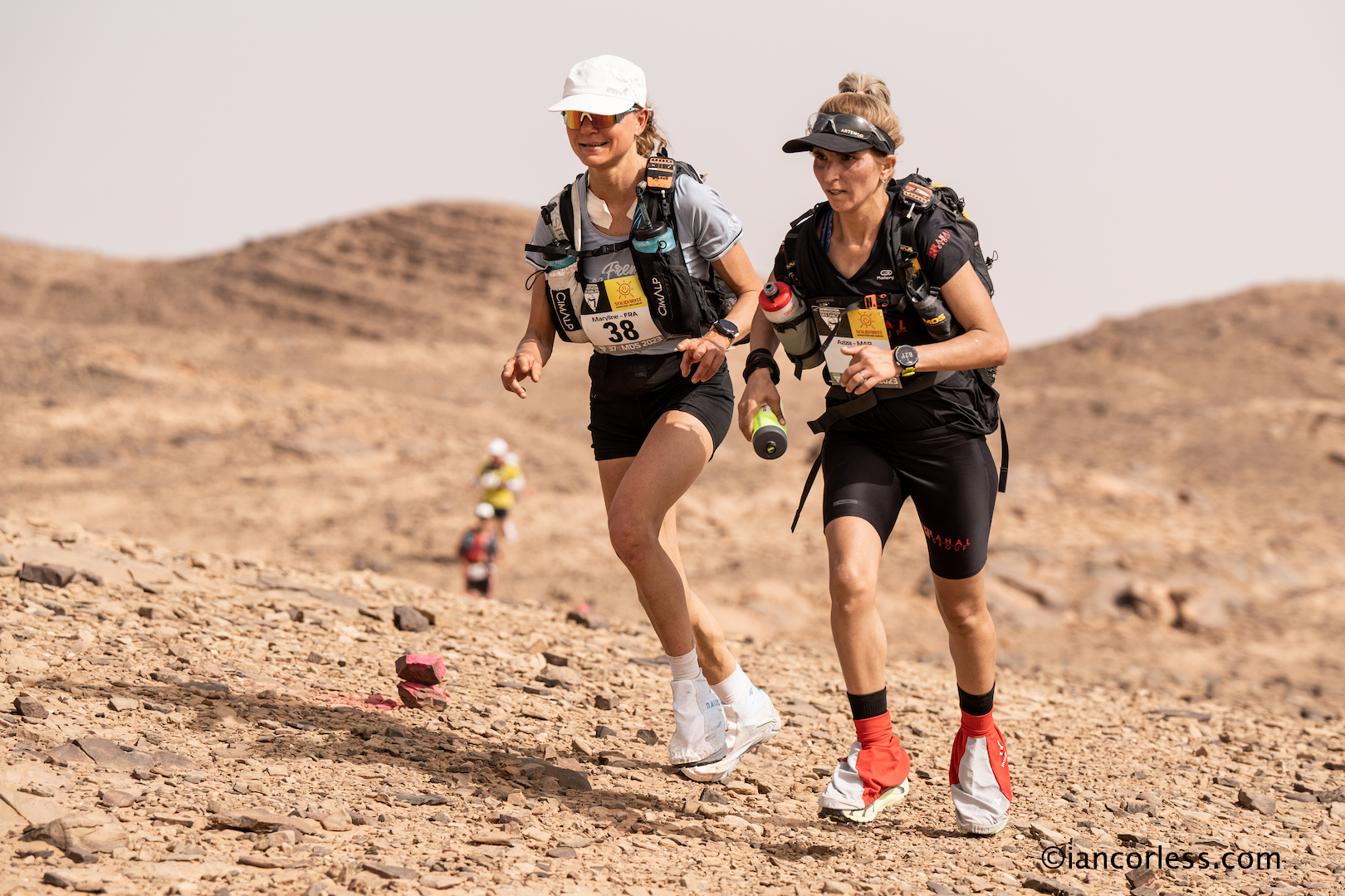
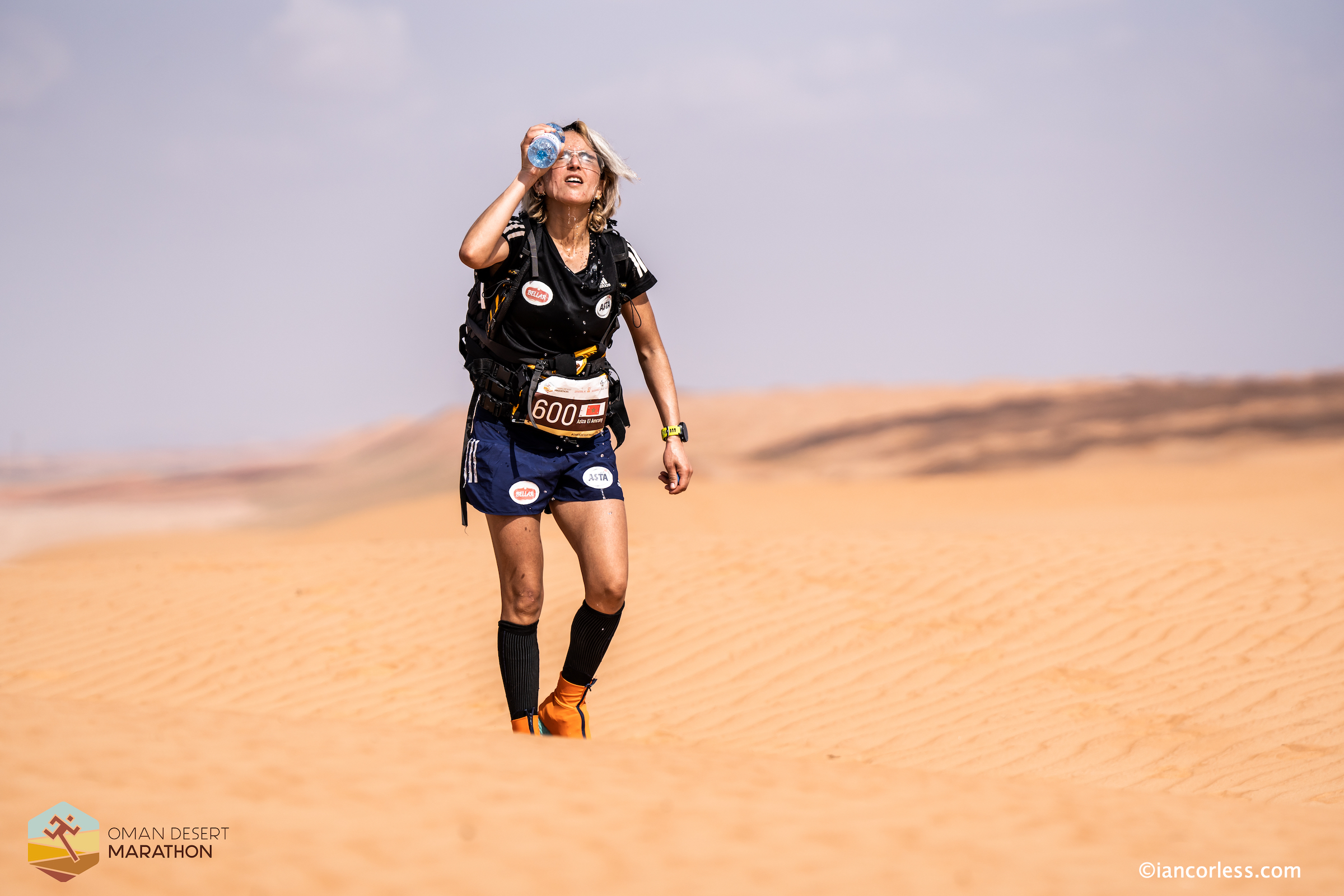
Ragna struggled early on, looking uncomfortable and lacking power. She started to fade and eventually she started to fall back with Maryline Nakache and Aziza El Amrany pulling away. The gaps opened and Maryline became the provisional leader on the trail.
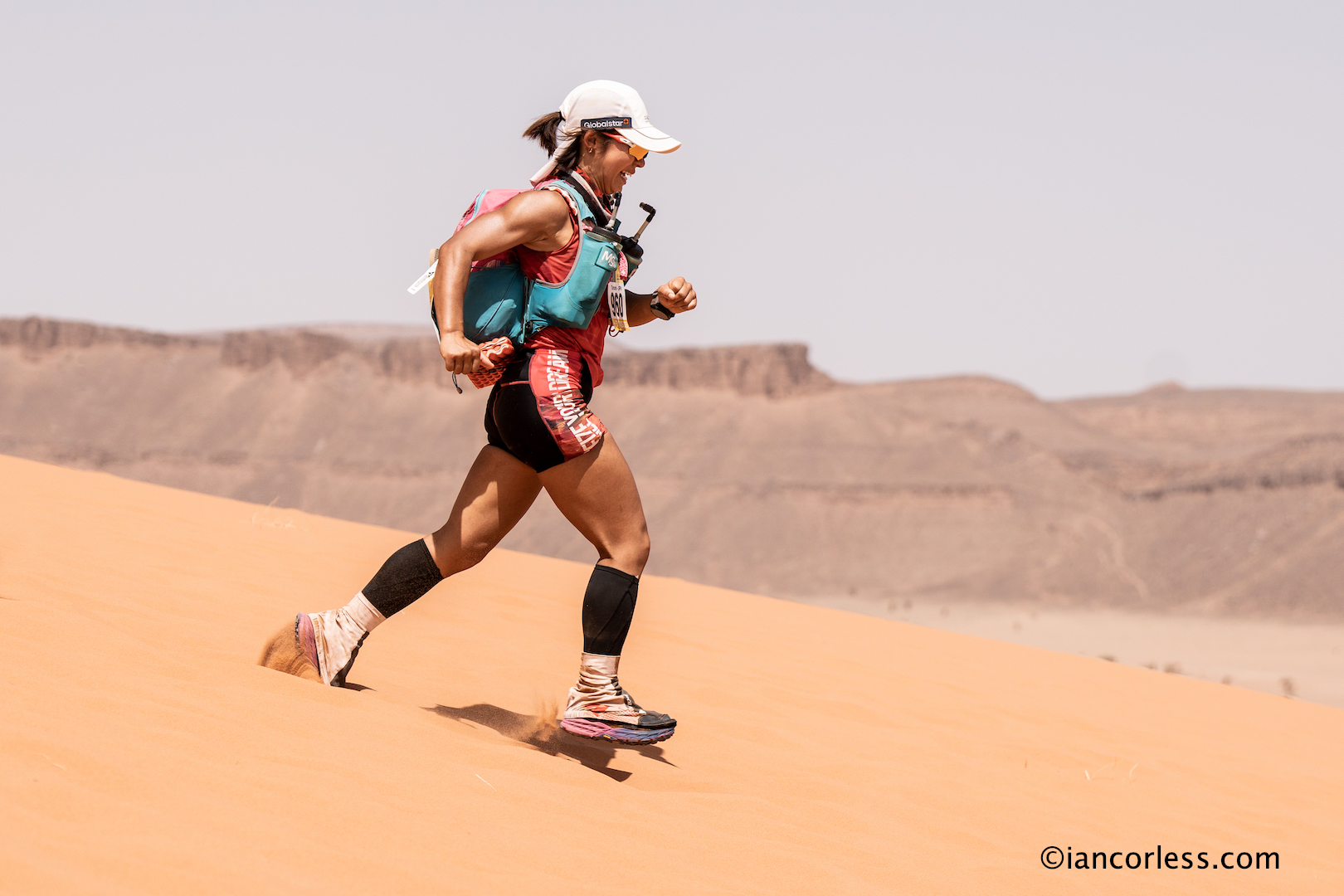
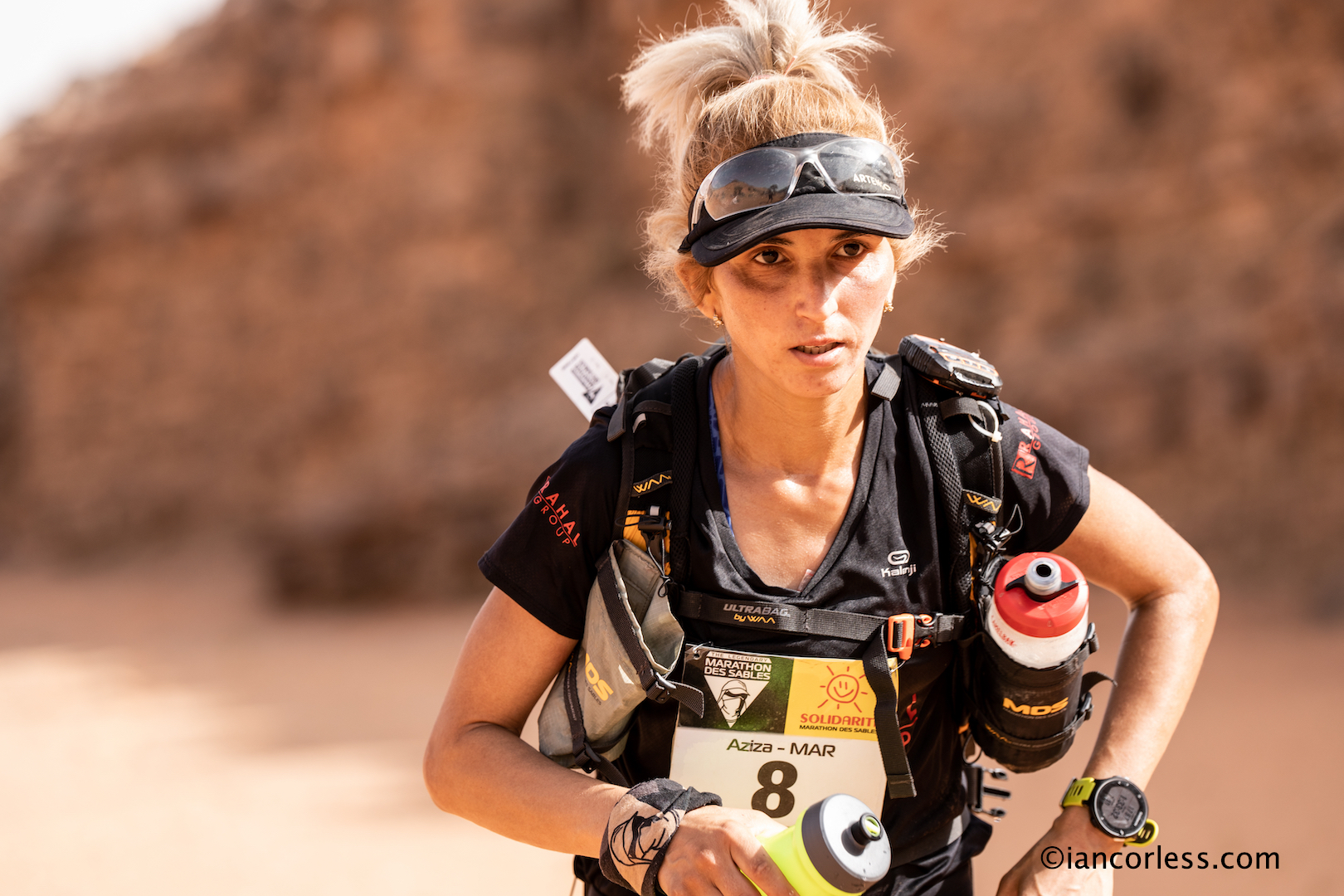
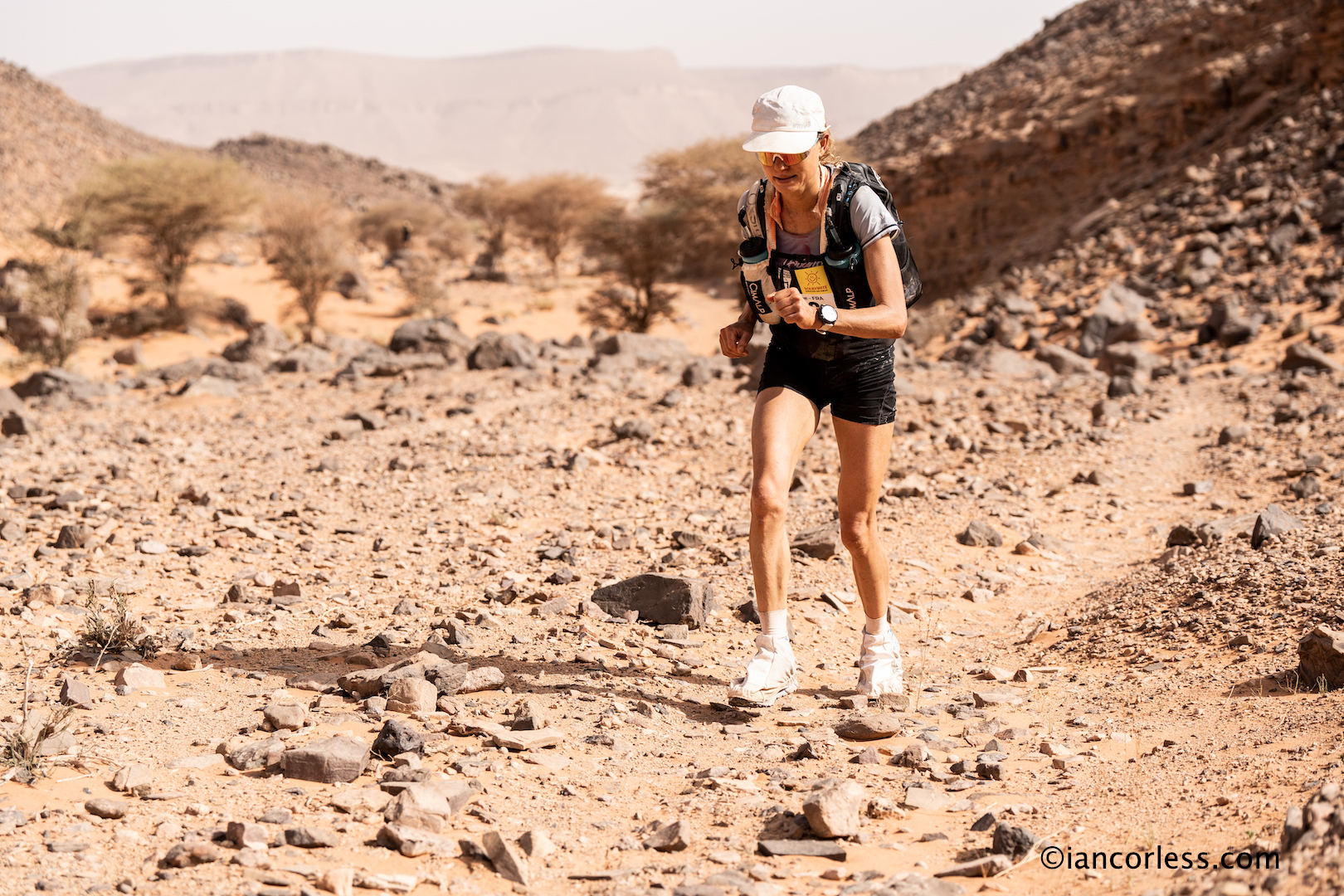
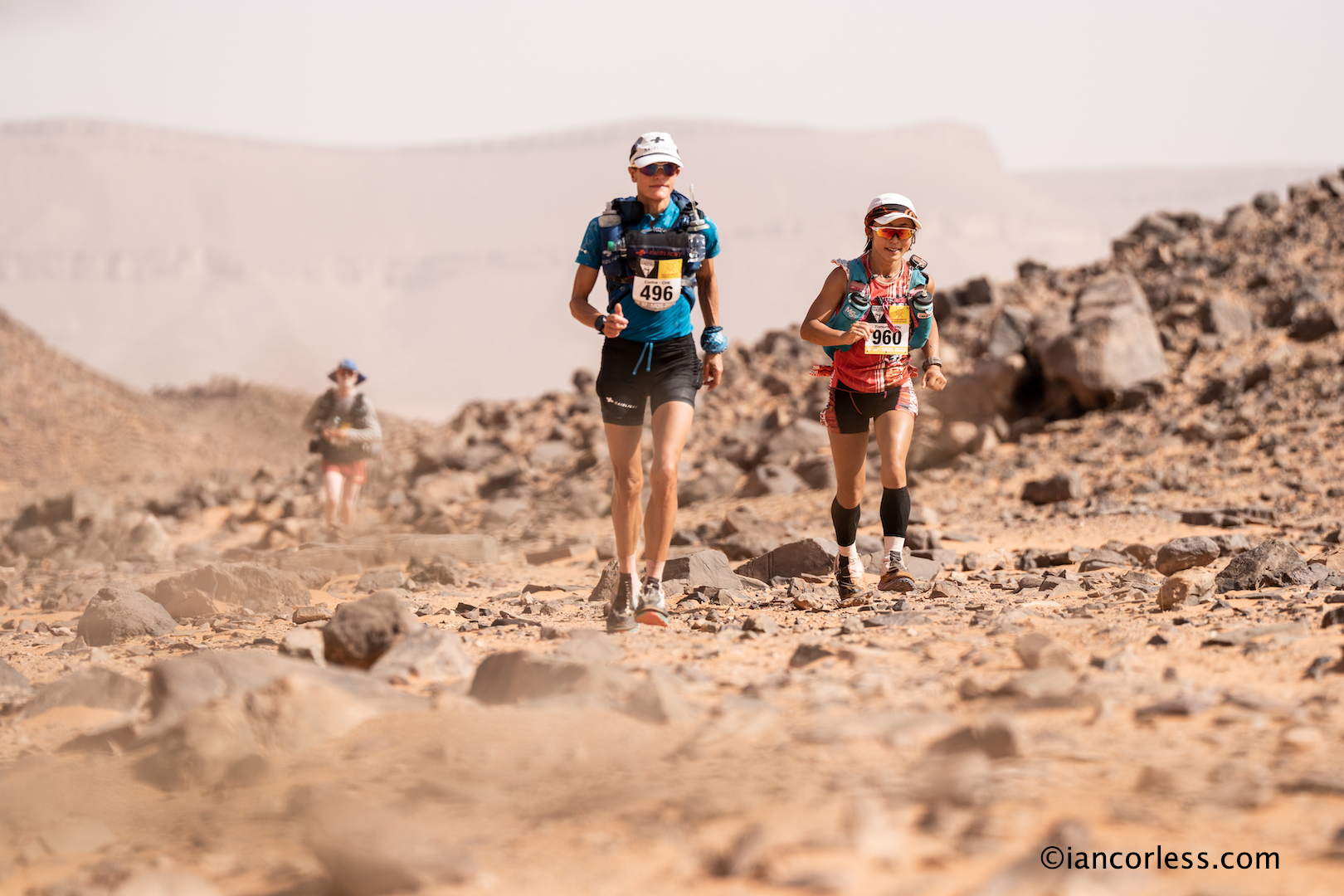
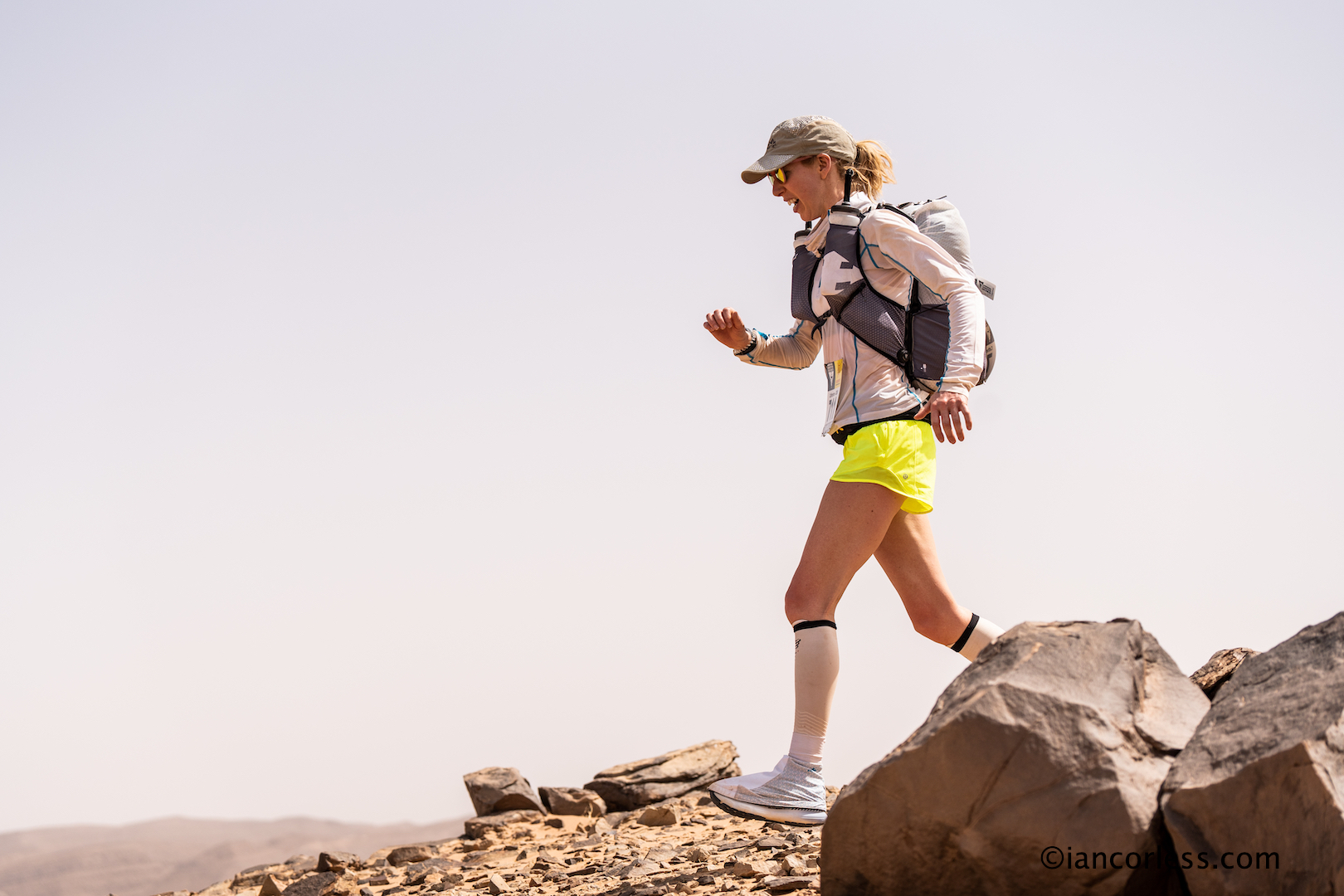
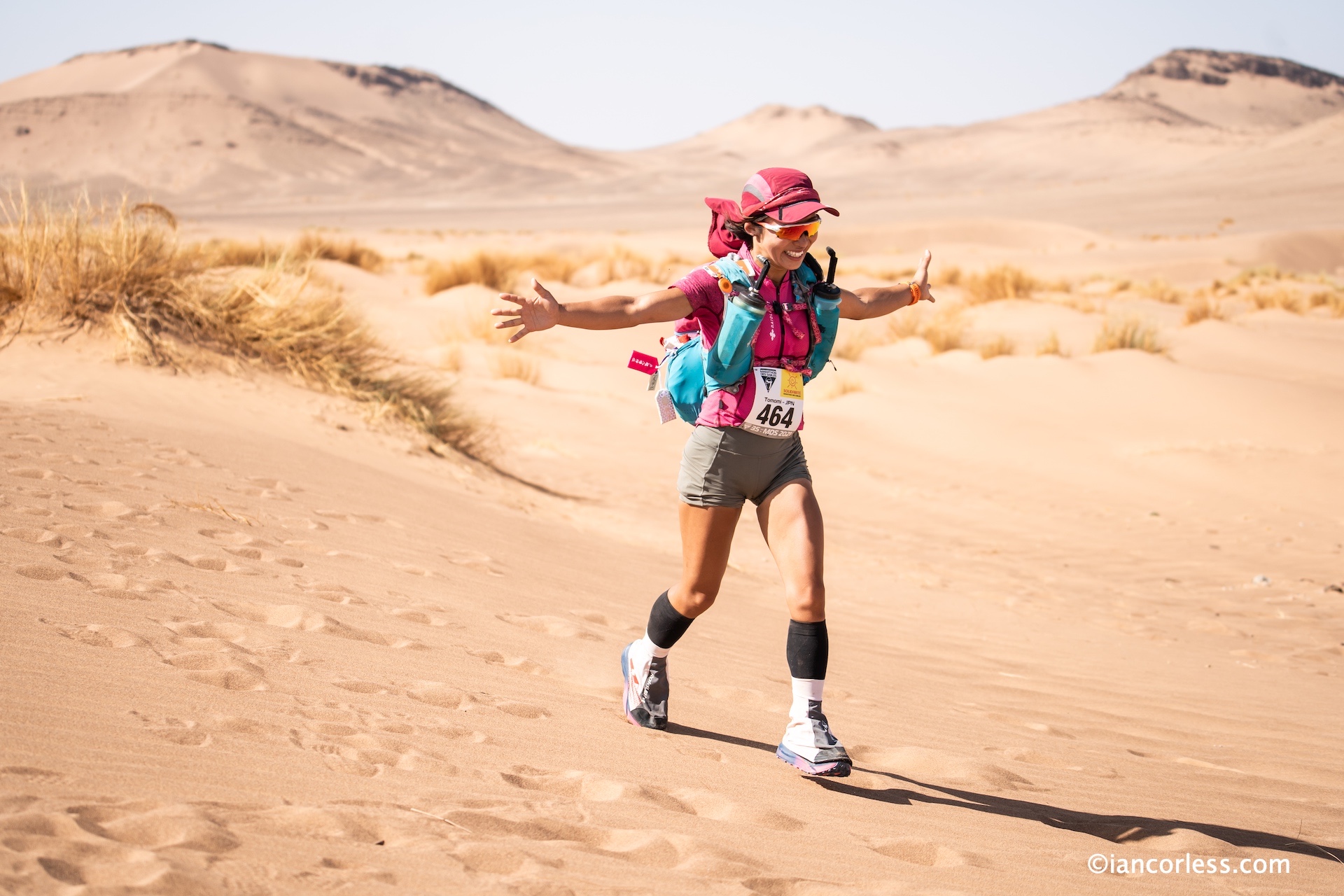
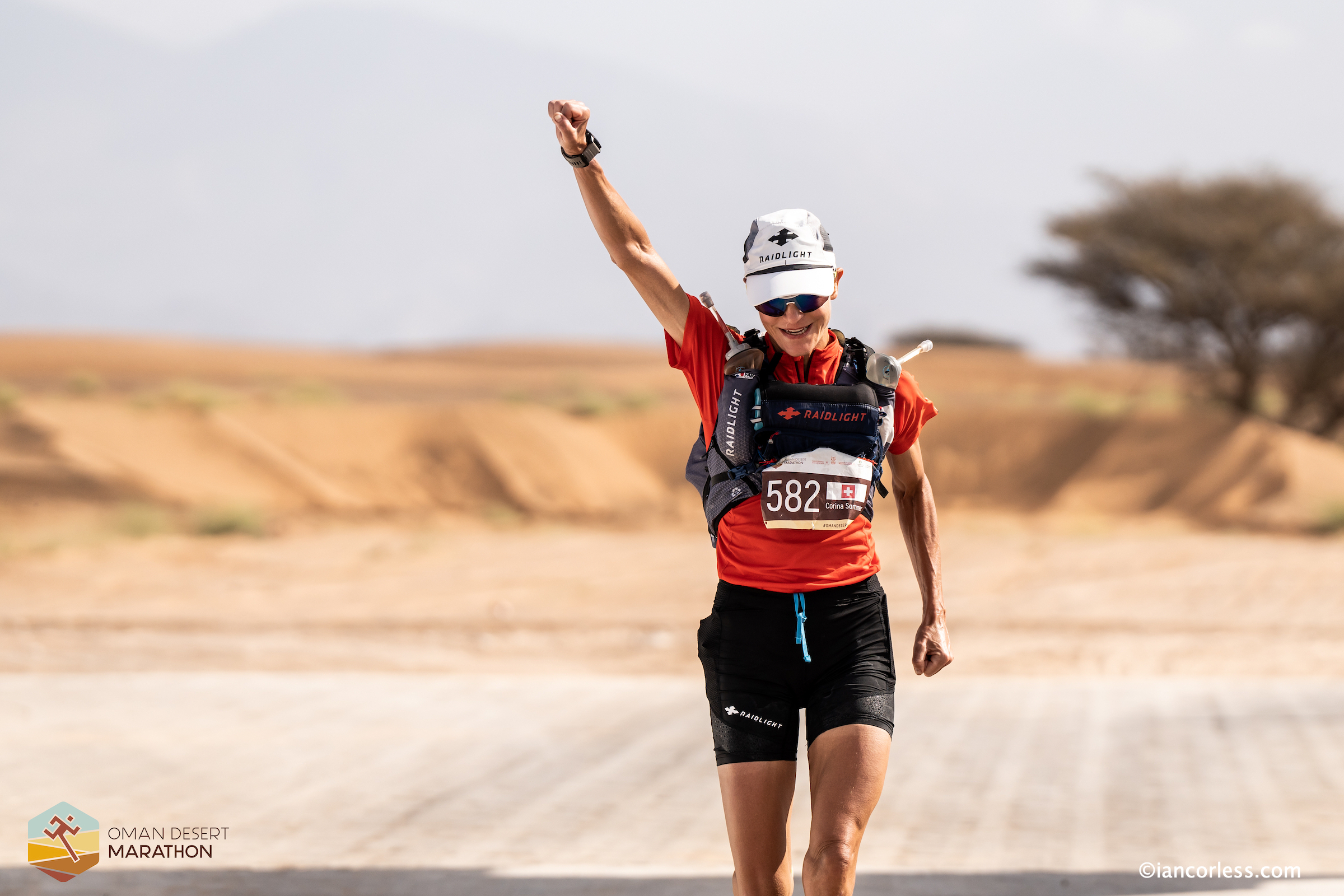
Aziza forged ahead to take a well earned stage victory in 11:44:39. Maryline is now the women’s leader of the 37th Marathon des Sables finishing stage 4 in 11:50:04. Tomomi Bitoh, Corina Sommer and Catherine (Katy) Young all moved up in the rankings. The marathon stage will be interesting!
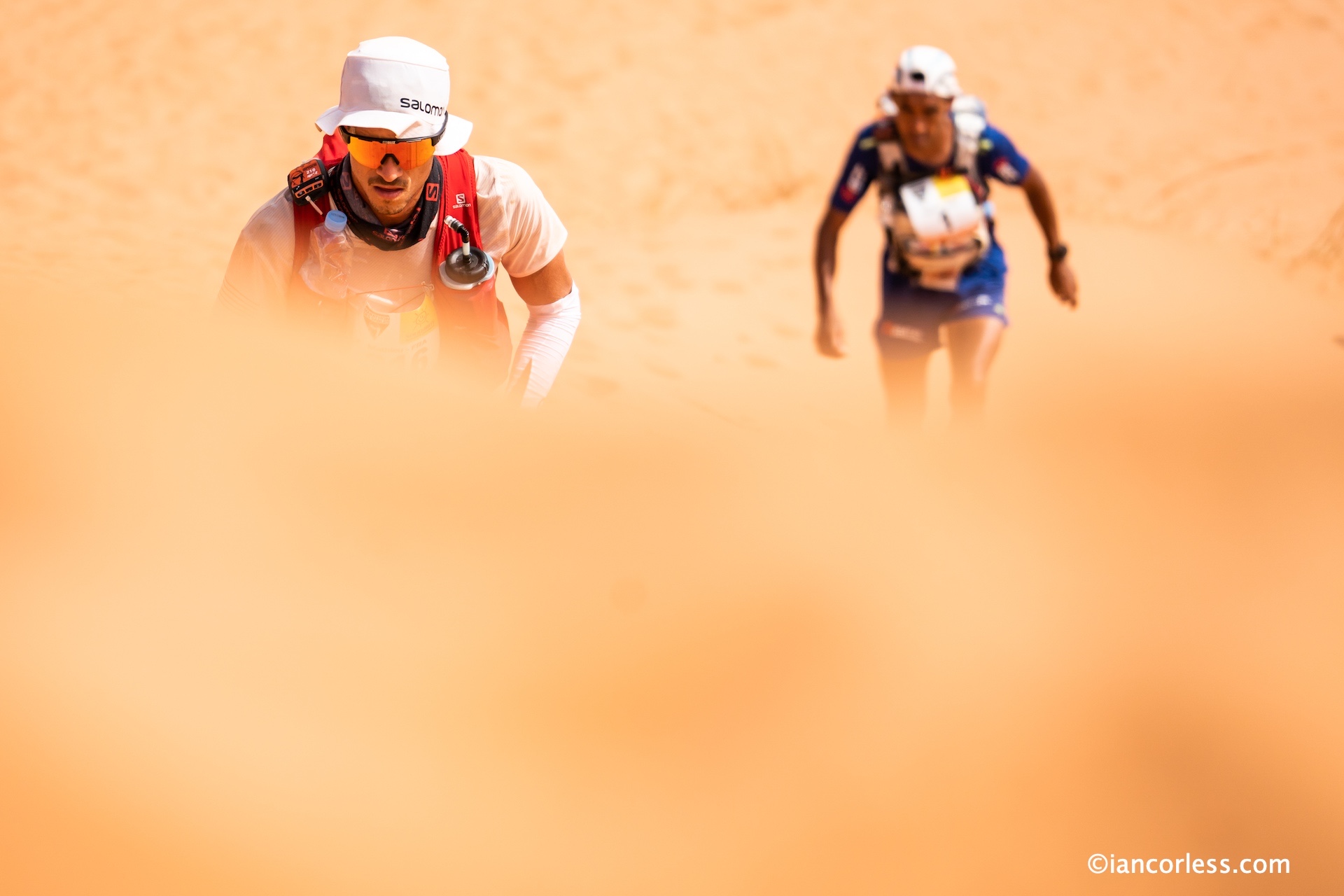
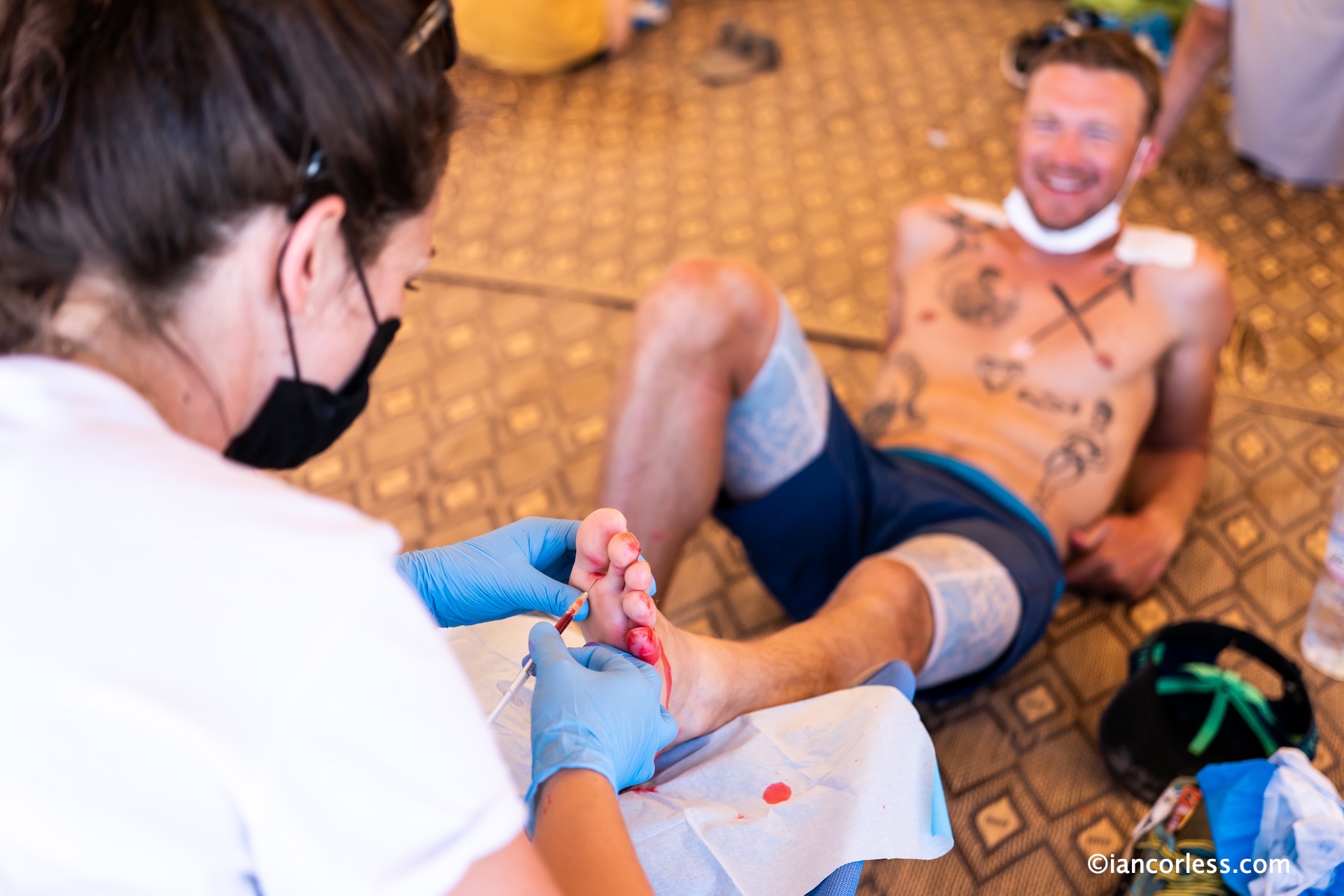
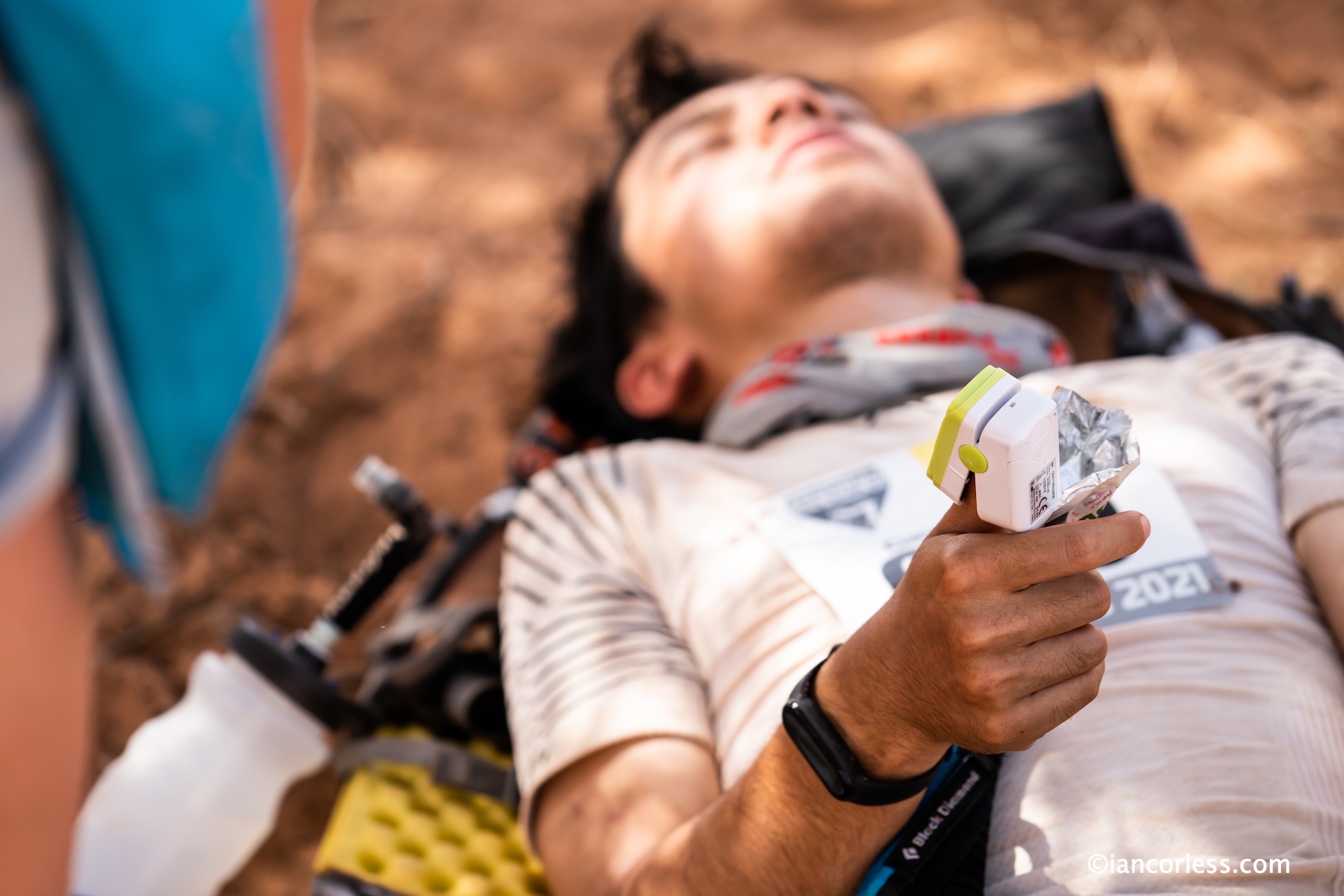
For many, today, Thursday is a rest day, recovering from the long day. But remember, runner’s have till 1700 hours to complete the stage, another day of intense heat to fight against.
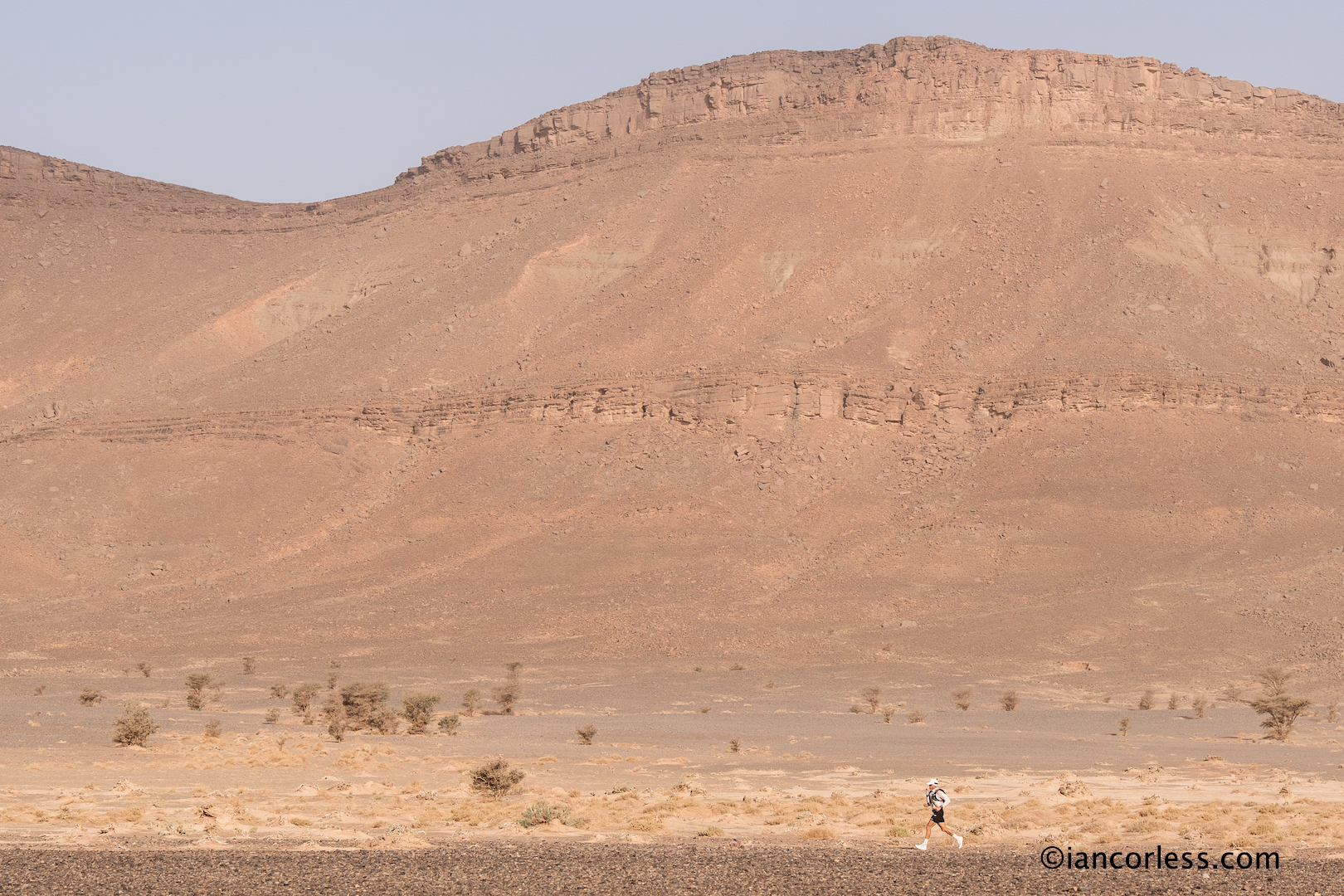
The MDS is called ‘The Toughest Race in the World,’ in 2023 it is proving to be true. The combination of distance, heat, challenging terrain, self-sufficiency and rationed water make this an ultimate challenge.
Day 2 was tough. It was a challenging route, incredibly beautiful but the added technicality, vertical gain and intense heat took its toll with many DNF’s.
The organisation made a decision to bring the stage 3 start forward by 1-hour, 0700 instead of 0800. It maybe caused some logistical, admin and timing issues for all but it was a good call.
At 34km, stage 3 had less challenges than stage 2, but still a tough day.
With flat km’s to Cp1, the pace was high and Mathieu Blanchard was a main protagonist. He often pushed the pace, closely followed by Aziz, Mohammed and Rachid.
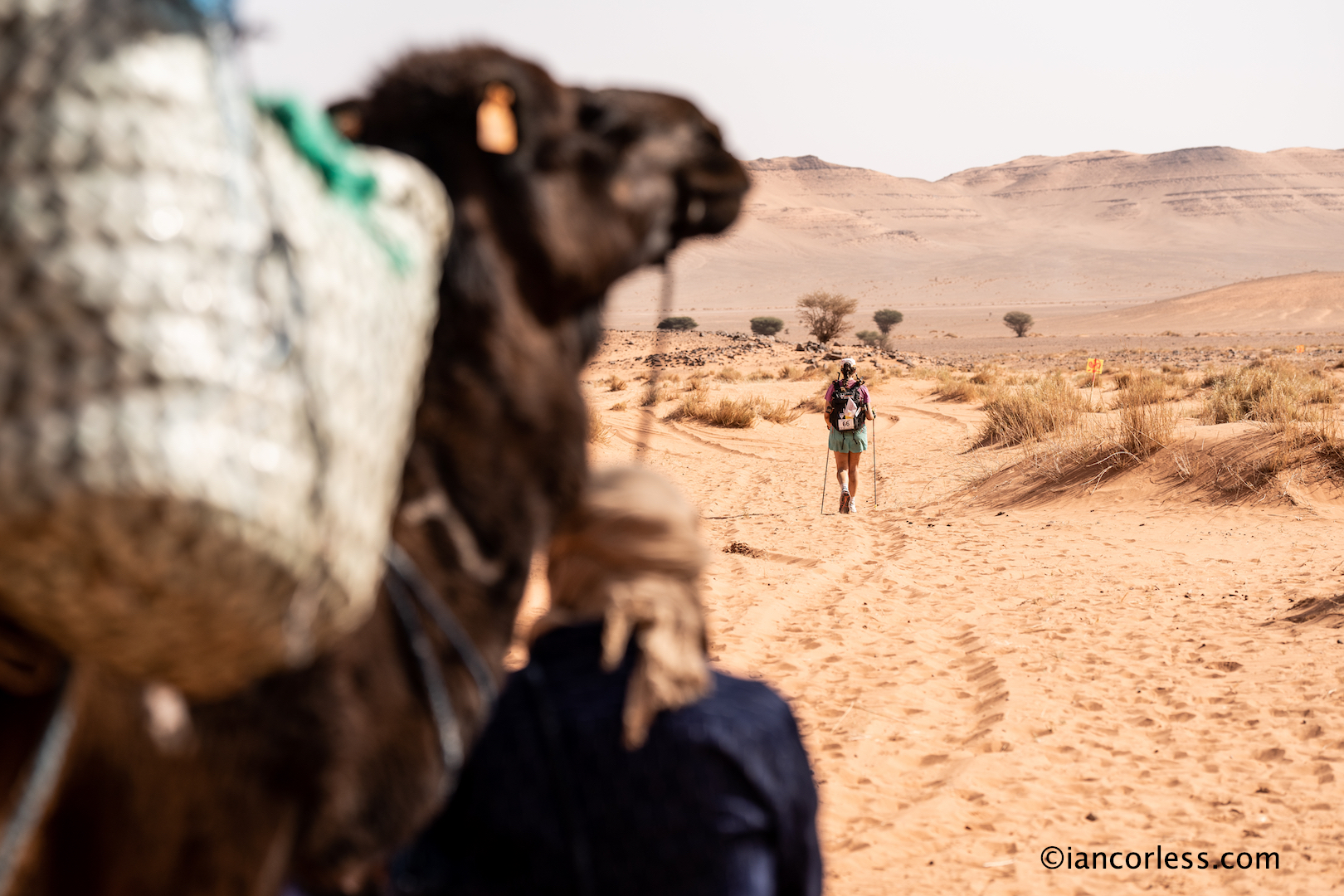
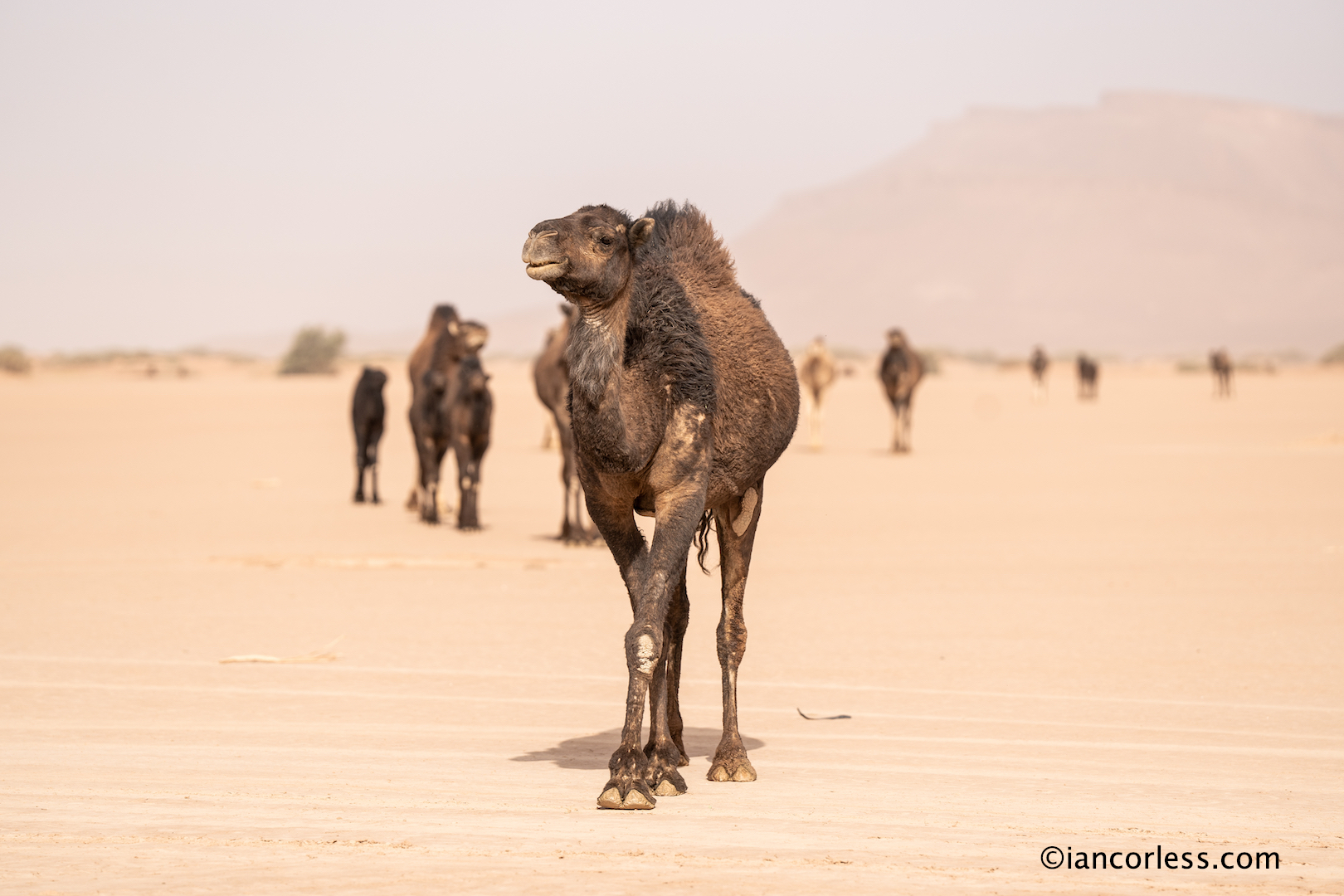
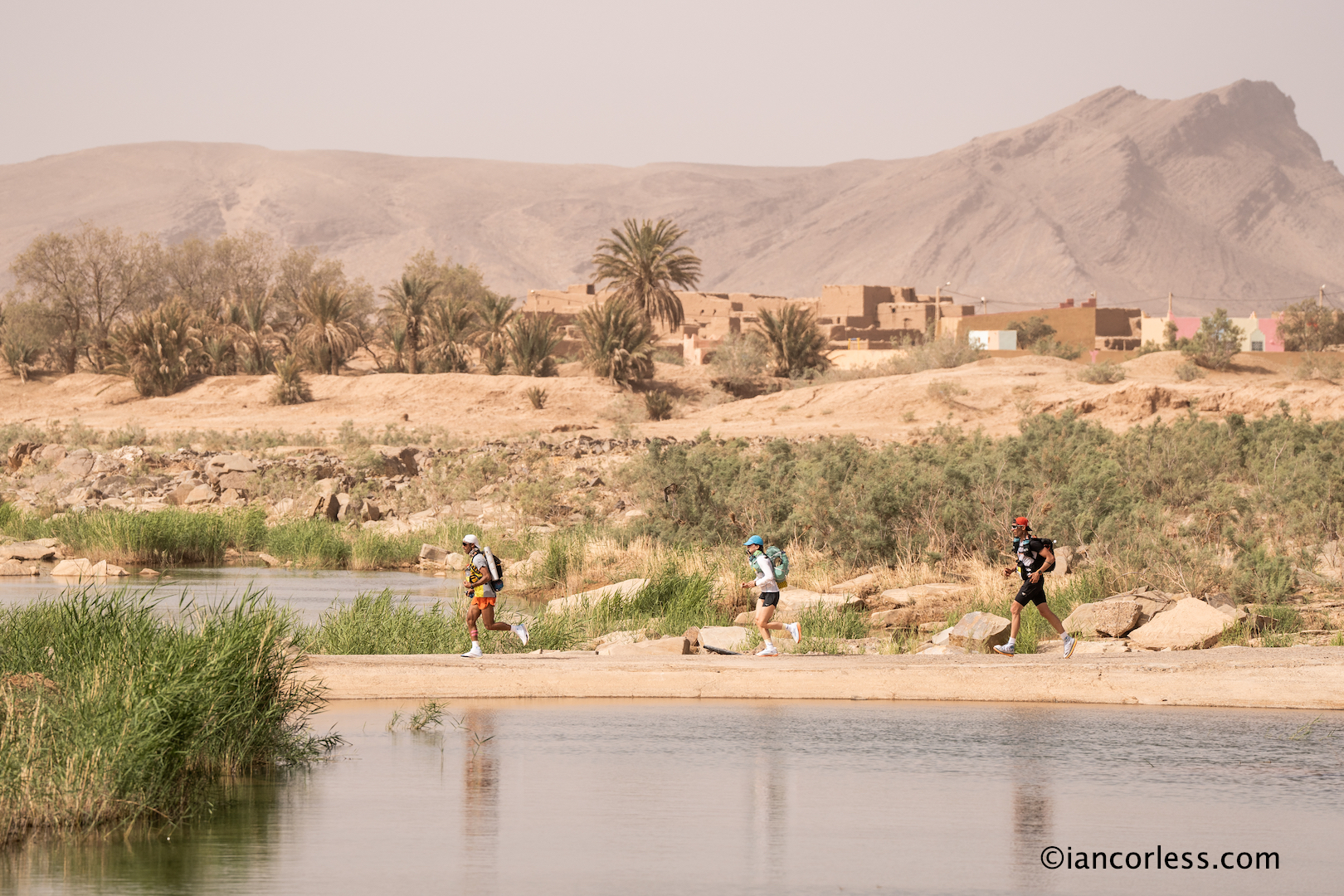
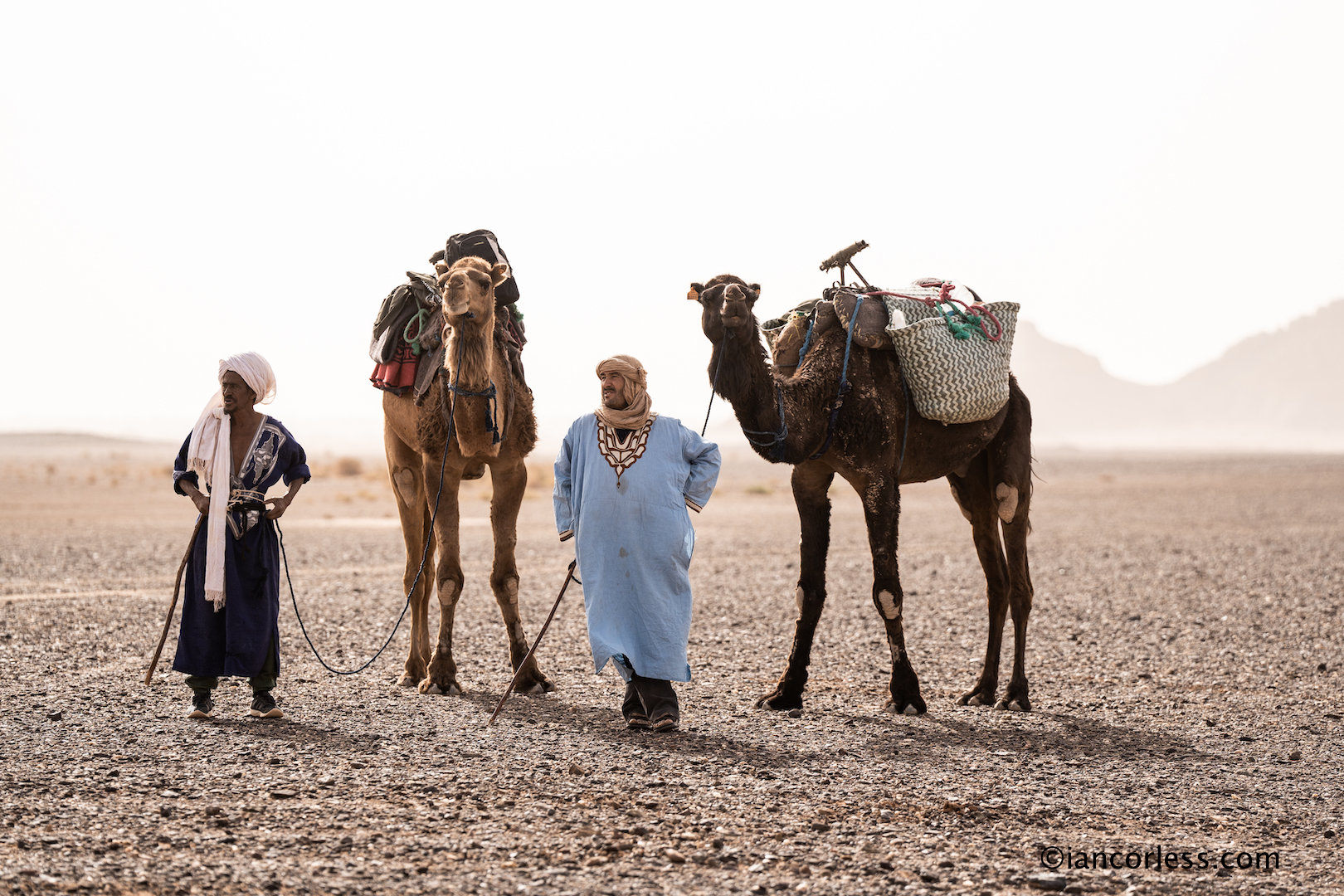
After Cp2 a resplendent area of green vegetation brought a different life to the Sahara. Camels, birds and reptiles, rare to see so much wildlife in one area.
As I expected, Mohammed attacked and not only took the stage but the overall lead. It’s what I expected. The ‘brothers’ have a plan for the long day, but, at 90km’s, anything can happen.
For the women, it was business as usual with Rgna leading. But, after Cp1 she went through a bad patch and Aziza El Amrany took over the front of the race with Ragna complaining of, ‘…feeling fine and lacking power.’
Maryline Nakache once again ran a strong and consistent stage to not only catch Aziza, pass her and put time into her, the duo finishing in 3:4104 and 3:42:36.
Tomorrow is the big day! It’s beautiful route with some MDS classics in the terrain. At 90km, it will be extremely tough for all. The race will start 1-hour earlier than planned, 0700. The top-50 will start at 1000.
It was a tough first day to the 2023 Marathon des Sables with 17 dropping out, a combination of heat, dehydration and exhaustion. Although a shorter day-2 was welcomed, it had increased technicality and vertical gain, therefore making it an equally hard day.
From the gun, Rachid went hard and immediately opened a gap. A rare tactic for him, he usually like to hold back and slowly speed up. Today, boom, he was gone. By Cp1 the carnage behind was taking hold, the pace high!
On one of the key ridges of the day, Rachid held a lead over the pursuing Aziz who was marked by Mohamed El Morabity, the brothers once again using tactics to an advantage. Mathieu Blanchard was 5th.
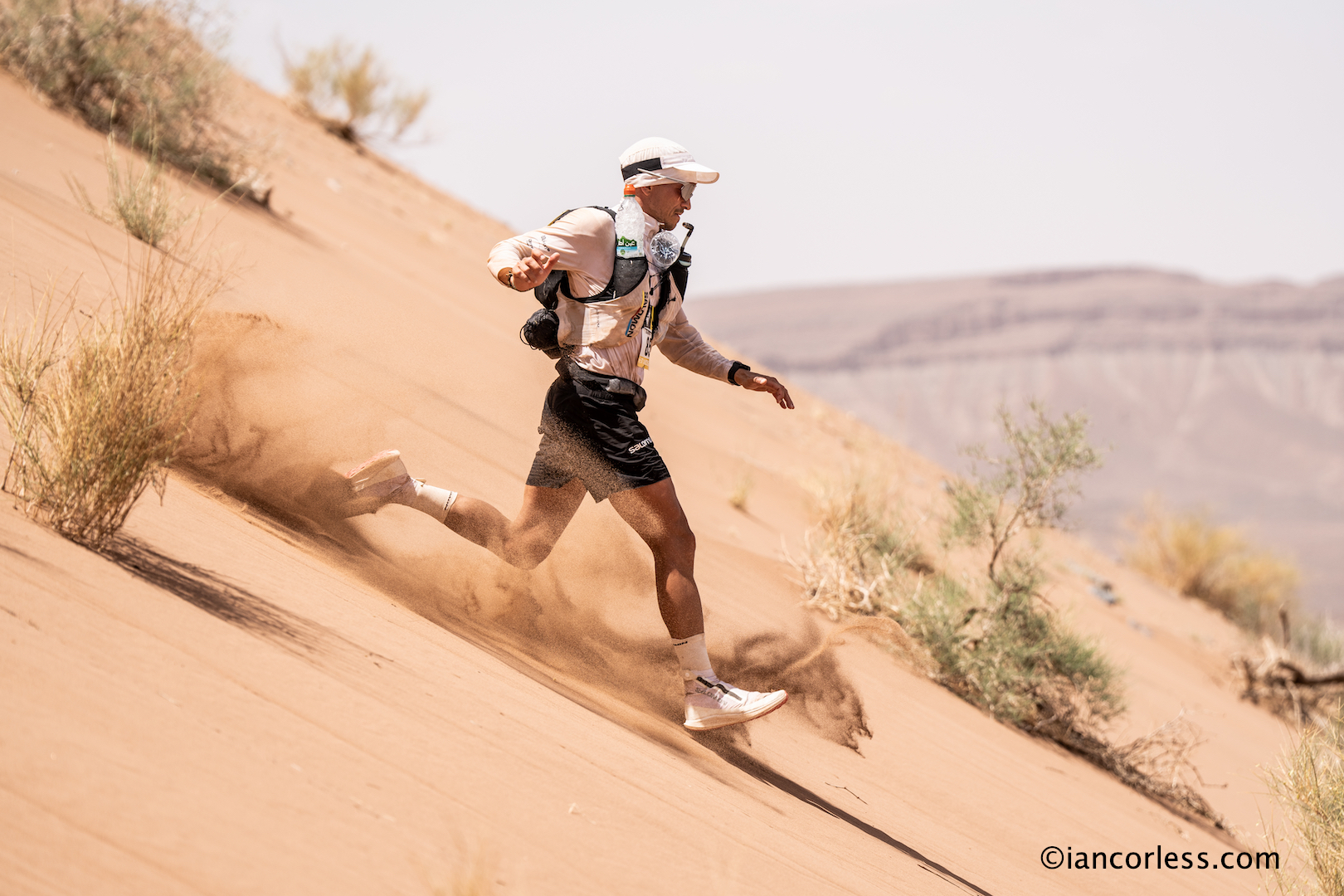
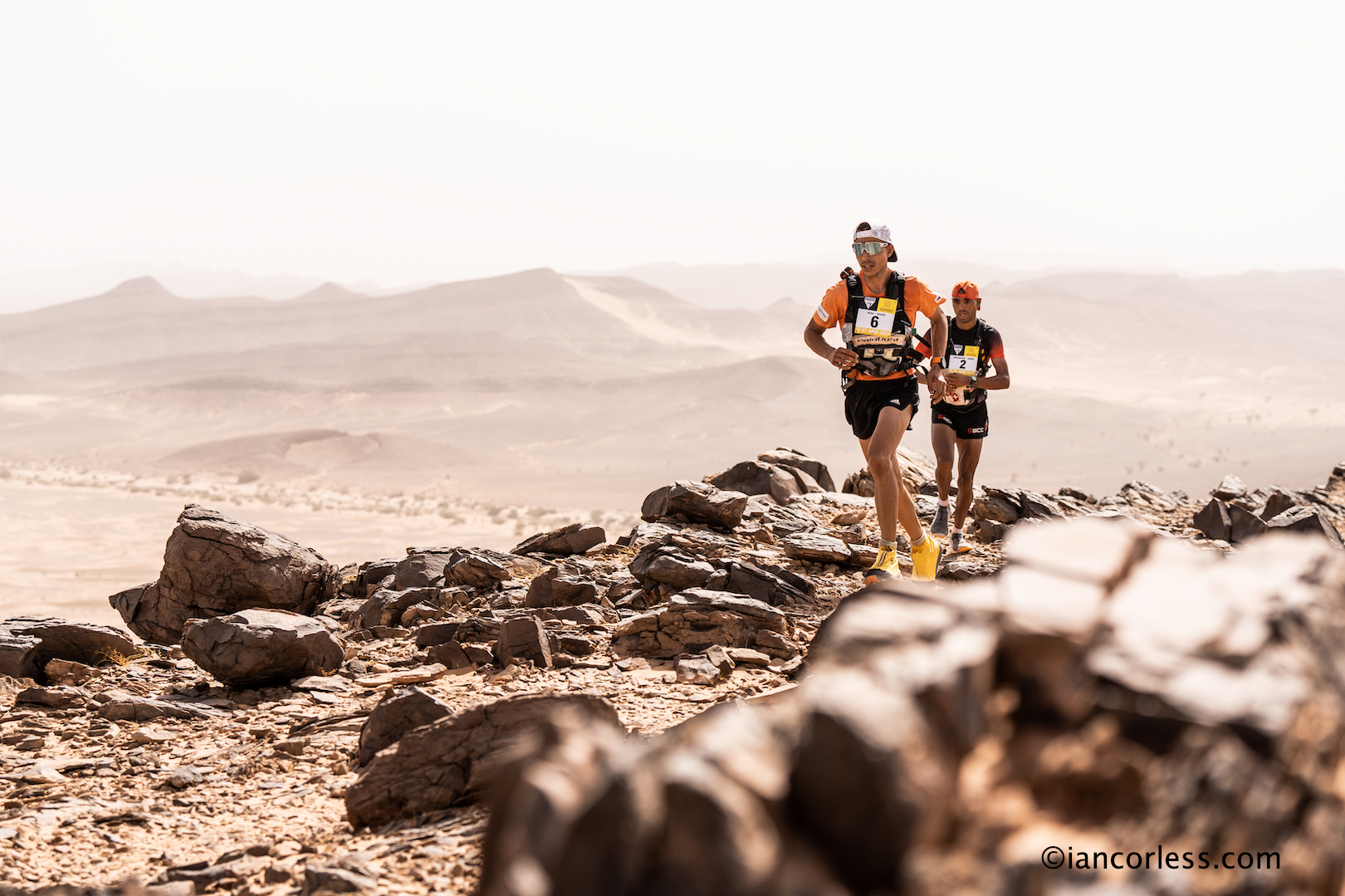
After Jebel El Otfal, the descent, following sand dunes and flat run to the line, Mohamed and Rachid switched places (a tactical move?) and Mohamed took victory in 2:29:05. Rachid followed in 2:29:30 and then Aziz 2:29:42.
What can we make of this? My thoughts are Rachid would like Aziz to think he is not as strong as he imagined, therefore casting a doubt… I wouldn’t be surprised if Rachid gave away minutes on stage 3 to the the pressure off for the long day, and then, attack!
The women’s race once again was dominated by Ragna Debats, she is too strong! Of course, the race is not over, anything can happen, especially on a 90km long day, but, Ragna, in this form is unbeatable. She crossed the line in 3:19:14.
Maryline Nakache and Aziza El Amrany ran together early in the day, but the elastic snapped and once again, Maryline pulled away to finish in 3:36:36. Wl Amrancy crossed in 3:55:55.
Notably, Jodie Moss from the UK, 4th on stage 1, finished out of the top-5 today. A tactical move? I am sure she would prefer to start in the 0800 start and not the midday start for the long day.
Stage 3 is 34.4km and in principal, will be an easier day. But the heat is strong and the challenge real.
Stats -1085 runners started stage 1, of which 228 were women. At the end of stage 2, the drop outs were nearly 100!
A beautiful calm morning welcomed the runners to stage 1 of the 37th edition of Marathon des Sables. Finally, the wait would be over and the challenge could begin.
Visilli from Russia set the early pace and pulled away with the ‘hot favorites’ behind allowing him to open a gap. Erik Clavery followed. Rachid as per usual eased in to the day, starting further back and slowly pressing the accelerator to increase speed.
But eventually, the race started to come together with the two early protagonists caught and after Cp2 Rachid started to apply the pressure. He opened a gap and behind nis brother marked Aziz Yachou and Mathieu Blanchard.
In the women’s race, as expected, Ragna Debats lead from the front and it stayed that way all the way to the line. At all times she looked relaxed, it control and running within herself, her time, 3:26:40.
Behind, Maryline Nakache pulled away from Aziza El Amrany after running together for many km’s. The French woman was to strong and she stopped the clock in 3:36:29.
El Amrany certainly suffered from earlier efforts and finished in 3:53:54, just managing to hold off Jodie Moss from the UK who closed well to finish in 3:57:47.
It was a hot day! Despite early morning cloud and occasional wind, the heat certainly took its toll with many runners arriving exhausted. Stage 2 is shorter than day 1, but, it has more climbing, more technical sections and more soft-sand. It will be a tough day.
Arrival in to the Sahara for many was harsh, with strong and relentless sand storm lasting several hours, gladly they subsided for Patrick Bauer’s welcome to the desert.
Saturday, is admin day. Each runner passes through protocols of equipment checks, health checks, bib collection and once dinner has been completed, self-sufficiency begins.
It has been a good first day with a great deal of apprehension, positivity, excitement and of course, an urge to ‘get underway!’
Stage 1 covering 36km with 2 aid stations is split in to 3 distinct sections. The early section is flat with a passing through Jebel Mech Irdane followed by soft-sand and Oued Rheris. Cp1 is followed by harde, faster terrain and small rolling hills that leads to dunettes and the arrival of Cp2. From here in, the running is good and fast to complete a potentially challenging first day of the 2023 MDS.
The 2023 MARATHON DES SABLES draws near and as usual, here is a preview of the coming edition. We will look at the top contenders for the male and female podiums, provide an overview of MDS history and look at some crazy statistics.
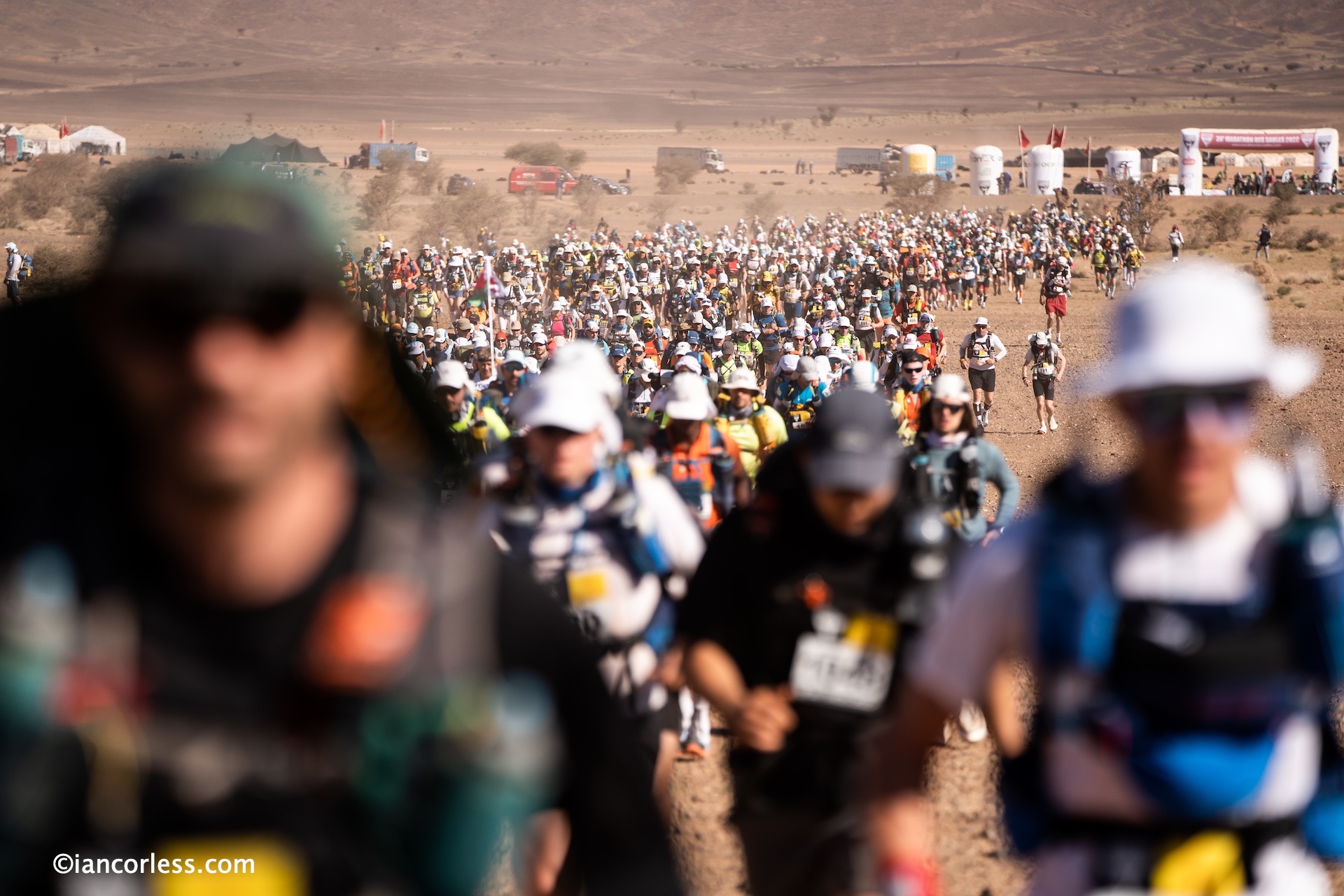
Since 1986, well over 22,000 participants have raced at the Marathon des Sables and we have record (or close to record) for 2023, with1200+/- toeing the line. As per usual, the race is multi-national with over 50 represented. The French and British providing the largest contingent.
THE TOP MEN AND WOMEN
Rachid El Morabity returns looking for his 10th victory, all eyes will be on him, but he is in for a fight! 2019 female champion, Ragna Debats returns and is without doubt the hot favourite for the top of the women’s podium.
THE WOMEN RACE
Ragna Debats
Ragna Debats dominated the race in 2019 and in recent years has become one of the top trail, ultra and skyrunner’s in the world. When in form, she is incredibly difficult to beat. In 2022 she had an incredible season with four top victories, Transgrancanaria 129km, Istria by UTMB, Montreux Trail Festival and the 100m Nice Côte d’Azur by UTMB. Ragna has had a relatively quiet start to 2023 and recently she has changed her coach of 13-years. She will be meticulously prepared for MDS 2023.
Gemma Game
Gemma Game from the UK has been on the podium of MDS twice, 2018 and 2019, on both occasions placing 3. Gemma most definitely can win MDS but, as she will tell you, she runs for fun and MDS is an escape from a very busy and hectic life with a high-powered job and family. Is she wants to, she will be on the podium again in 2023.
Manuela Socco from Belgium is not a runner I am very aware of; however, two results stand out, victory at Cappadocia Medium Trail in 2019 and Tarawera 100km in 2020. She has also represented Belgium at the Olympic Games in the marathon distance. With a 35min 10km, a 1:16 half marathon and a 2:37 marathon, she has all the running fire power to create a stir in the Sahara.
Maryline Nakache from France has a string of top results, she often wins! However, stand-out markers come from Templiers (3rd) 90km du Mont-Blanc (3rd), CCC (5th) Transgrancanaira Advanced (1st), Tenerife Blue Trail (1st), UTMB (6th) and in 2022 alone she was never out of the top-5.
Tomomi Bitoh
Tomomi Bitoh from Japan was 3 in the 2021 MDS and has recently participated in The Coastal Challenge in Costa Rica. She is an incredible personality, a fierce competitor and although the podium is a possibility in 2023, I feel that she will just be outside the top ranking.
Elise DELANNOY (France) was 18th in the 2016 MDS in 38-hours. This is a long way off the pace required to podium in 2023… But a great deal has happened since then, notably a 7th place at UTMB in 2019, so, Elise cannot be ruled out of shaking up the front of the race.
Corina Sommer from Zurich recently won the Oman Desert Marathon against Aziz Raji (past MDS champ) and Aziza El Amrany who had led the race only to have Corina run two incredibly strong days and take the victory. New to trail, she placed 18th at Templiers and 3rd at Istria by UTMB for the 68km. She will need a great week to make the podium, but it’s a distinct possibility.
Jodie Moss from the UK was 8th at MDS in 2019 and has been preparing meticulously for the 2023 edition. However, recent injury issues placed the race in question, but it looks like she will be in the Sahara, hopefully in great shape.
Ester Alves won The Coastal Challenge in 2016 and placed 3rd in 2017. She also raced MDS in 2017 but the race did not go to plan… In recent years, she has had time away from the sport, but last year, Ester raced Everest Trail Race which will have no doubt provided some great momentum for the Sahara.
Maria Semerjian has results going back to 2009 and without doubt, she enjoys the tough mountain courses, UTMB, Raid de la Reunion, Grand Raid Pyrenees, UTMF, and more… The distance won’t be a problem, however, the speed to make the top-5 may well be the problem.
Brunhilde Girardet recently won Trail de Cité de Pierres as a warmup for MDS. It’s her first edition, so, let’s see…
Wild card – Katie Young from the UK.
Laurence Klein returns, she has won MDS three times, with no disrespect to the Queen of the desert, there is no chance of victory in 2023, but she will no doubt bring colour to the race.
Currently, Aziz Raji and Aziza El Amrany are NOT on the start list, but I hope they do make it to the 2023 edition. It’s important that Morocco has female representation and of course, both of them have great potential for the top 5. Raji has won the race and El Amrany was 3rd in 2022.
THE MEN RACE
The men’s race is extremely notable in 2023 as Rachid El Morabity will look for a 10th victory. This will without doubt add an extra dynamic to the race, particularly after the superb tactics which played out in the 2022 edition.
Rachid El Morabity
Rachid El Morabity is the boss of the Sahara and the hot favourite. BUT, I believe this year will be his toughest challenge. There are multiple reasons for this… Rachid has expectation on him, this is not really an issue, he can handle that. He has raced a great deal in the past 12-months, he may be tired? The Moroccan team is probably at its weakest, especially when compared to the past ten editions, so, the support network will be less. The competition, namely Mathieu Blanchard and Aziz Yachou are a serious threat. Will Rachid win? It is very hard to bet against him, but 2023 has the potential to be the upset year.
Mohamed El Morabity
Mohamed El Morabity is the eternal 2nd at MDS and his possibilities of victory in 2023 are zero if Rachid is in good form. The only opportunity for Mohamed is if Rachid falters and he gets the green light from his elder brother to attack. In Oman Desert Marathon earlier in the year, Mohamed took victory ahead of Rachid, don’t be fooled in to thinking Mohamed was stronger, he was gifted the win as credit for April and the 2023 MDS. Mohamed can win the race, but just as we saw in 2022, he will be the super domestique for Rachid.
Aziz Yachou
Aziz Yachou is the fly in the Moroccan ointment and 1-year on, has the potential to create fireworks and upset Rachid’s dream. He was 4th in 2021 and 3rd in 2022. Last year he was worked over by the tactics of Rachid and Mohamed, he will be prepared for that this year. Little is known about his training in the early part of 2023.
Mathieu Blanchard
Mathieu Blanchard raced MDS in 2021 and finished 5th – he was hit by the bug that swept through camp just in time for the long day. One thing is for sure, after placing 2nd at UTMB in 2022, we are looking at a different Mathieu. He raced The Coastal Challenge in February and placed 2nd, he recently summited Kilimanjaro and most recently ran a 2:22 marathon in Paris. Mathieu can win MDS and the French have put a team together to potentially make that happen. Beating the Moroccans on home soil (sand) is tough, but THIS may be the year.
David KILGORE from the USA has been top-10 at Leadville 100, and recently 7th at Tarawera 50km. On paper, he is not an MDS podium contender, but he will be in the mix for the top-5.
Erik Clavery adds more fire power to the French line-up. He was 5th at MDS in 2016 and a fierce competitor. He has raced UTMB, WSER, Eiger Ultra and even 24H championships, so, he brings something special to the MDS.
Vasily Kortytkin (Russia) comes to MDS with a history in 6H and 24H races, he has PB’s of 86.493 and 260.570 respectively. He has won some trail races in Russia in 2021 and 2022, how he performs in the Sahara is a big question.
Pierre Meslet (France) placed 9th at MDS in 2021 and returns in 2023 not only to perform to the best of his ability (top-10) but to also help the French maybe win the race and also get the team prize.
Anton Samokhvalov also from Russia has been racing trail since 2014. He has a list of solid results but nothing spectacular, in 2021 he made 10th at Transgrancanaria Advanced.
Notable mentions:
Duncan Slater from the UK lost both legs during a mission in Afghanistan, he’s back this year for another medal!
Christian Ginter, dinosaur of the desert, returns for the 35th time!
Finally…
1150 runners will toe the line (1263 were registered) and the youngest runner is 16-year-old Girard Fialon (she will run with her father, Grégory) and the eldest, Henry Botha, 81!
Crazy Statistics of the MDS
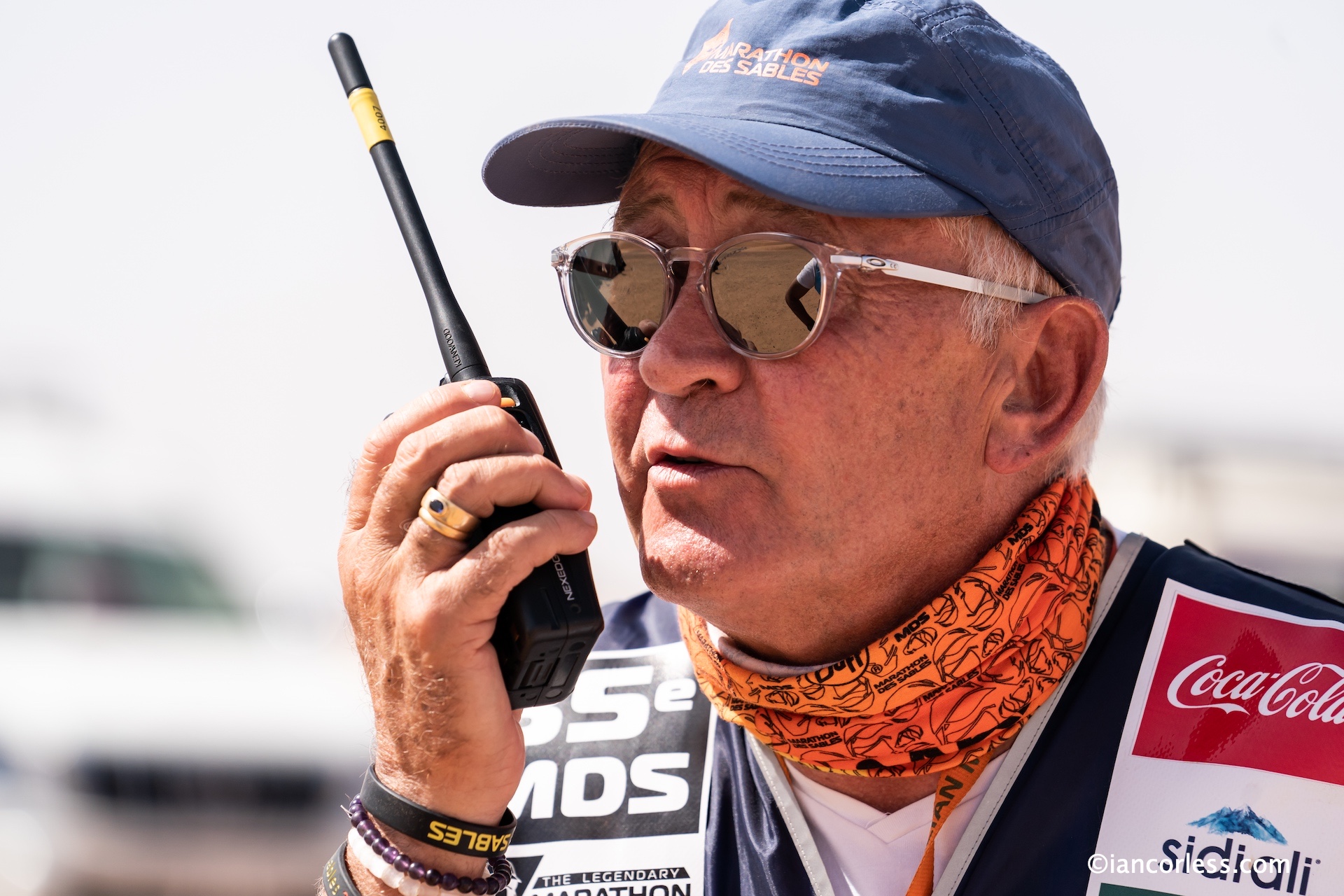
“The logistics are a big headache, and we organize every detail in advance! We’re a village of 2,000 people that must be set up and dismantled every day. We need to be self-sufficient in energy, food, water, and fuel. As one of my friends says, ‘Let’s expect the worst because the best will never surprise us!’ We also benefit from the infallible support of the Royal Moroccan Army, which makes available about 25 6WD military trucks to transport all our equipment.” – Patrick Bauer
You must see Marathon des Sables to appreciate the size and scale of the event. It’s like the largest moving circus you will ever see and it’s impressive to witness.
Following statistics provided by the Marathon des Sables office:
▪ 150 volunteers to supervise the race,
▪ 450 general support staff,
▪ 120,000 liters of bottled mineral water,
▪ 300 Berber and Saharan tents,
▪ 120 all-terrain vehicles and trucks,
▪ 2 Squirrel helicopters and 1 Cessna plane,
▪ 8 Transavia ‘MDS special’ commercial planes,
▪ 30 buses,
▪ 4 dromedaries,
▪ 1 incinerator lorry for burning waste,
▪ 5 quad bikes to monitor race environment and safety,
▪ 14 km/hr.: average maximum speed, 3 km/hr.: average minimum speed,
▪ 15 years of age for the youngest competitor and the oldest, 83!
Patrick Bauer
A brief history of the MDS
1984: At 28 years of age, Patrick Bauer decided to make for the Sahara to try to traverse a 350km expanse of uninhabited desert, on foot, alone, where he wouldn’t come into contact with a single village, oasis or watering place. Totally self-sufficient, with a rucksack weighing 35kg and containing water and food, he set off on a journey that was to last 12 days. It was the starting point of what was to become the MARATHON DES SABLES.
1986: The creation of the first MDS in the Moroccan Sahara. The 23 pioneers who took the start never imagined that their footprints would mark the start of a legendary event, which has today become a must among the major adventure sport meets. The creation of a non-mechanical competition in the Moroccan sands offers adventure runners a wealth of new prospects.
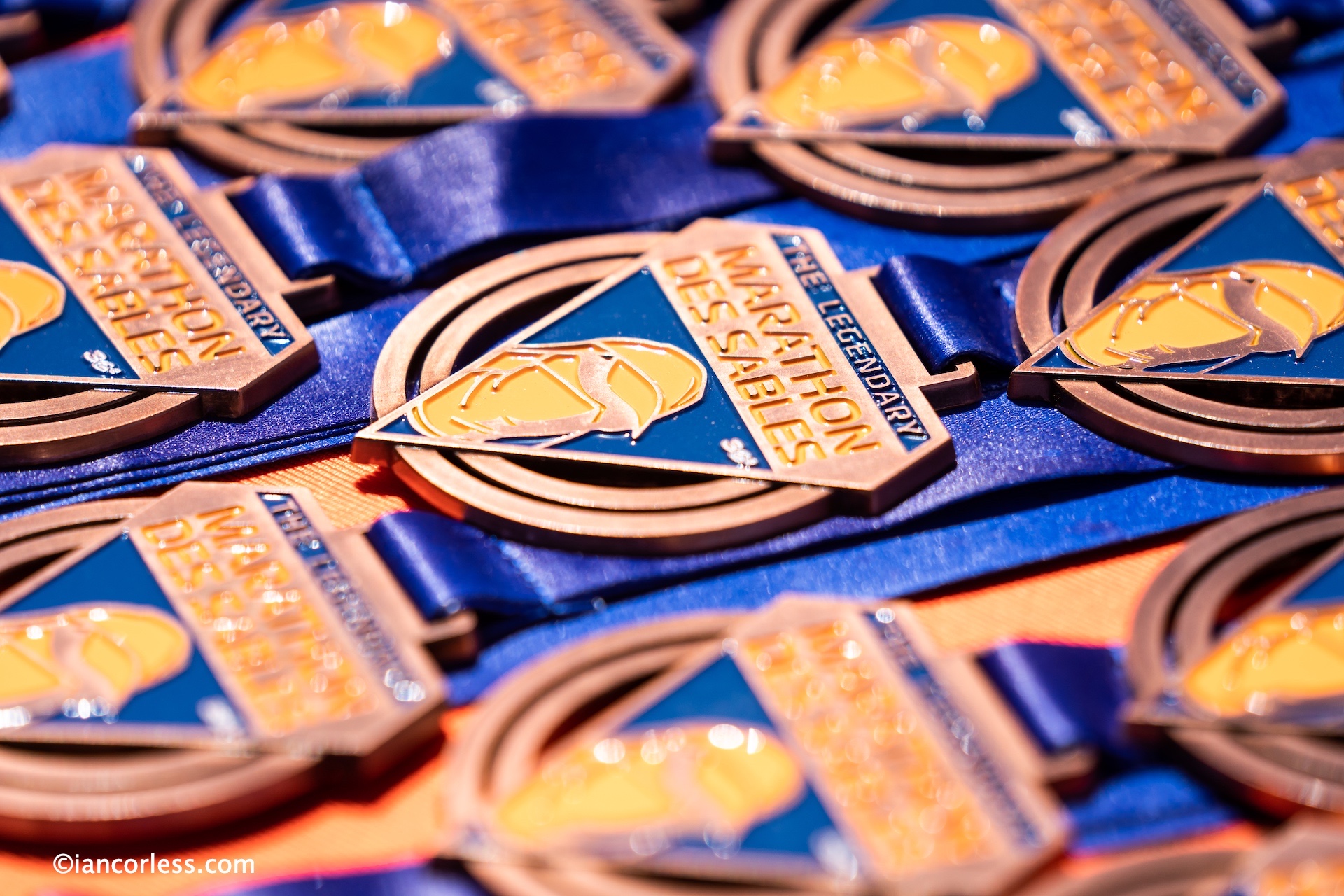
1987: Creation of the MDS logo: the face of a runner covered by a keffiyeh, the eyes protected by a pair of sunglasses and the pipette from the runner’s water container clenched between the teeth.
1989: 170 competitors take the start of the race.
1991: The gulf drama puts the MDS at a disadvantage and the financial partners withdraw. Fortunately, some runners answer the call. For these competitors, the true victory lies in meeting athletes from different backgrounds and their communion in the desert around the same goal. Sport proves once again that it can bring people together and create bonds.
1992: One and the same regulation for everyone. This year sees the establishing of unexpected draconian tests, to ensure that each participant properly transports all his or her gear from one end of the course to the other. A 30-point charter is drawn up.
First participation by the Moroccan Lahcen Ahansal
1994: Arrival of the Doc Trotters at the event.
1995: 10th anniversary. Since the start, over 1,500 men and women have left their footprint and their passion in the desert. Installation of water-pump for the inhabitants of the village of Ighef n’rifi (South of Er-Rachidia) – an idea by competitor Gilles Flamant and backed by Rolland Barthes and Patrick Bauer. Its success is to be repeated.
1996: First participation by Mohamed, a younger sibling of Ahansal. The two Moroccan brothers set off together and rank 4th and 5th respectively.
1997: This year heralds the start of the Ahansal saga. Morocco is honored with Lahcen’s first victory. He beats his two pursuers by nearly 30 minutes, despite them being international long-distance running champions.
1999: A mobile hospital on the MDS comes into being. There are around thirty practitioners on the ground, with doctors and nurses joining the caravan. A dedicated helicopter and ten all-terrain vehicles track the competitors each day. On- board these vehicles there are doctors of course, as well as high-tech equipment. The village boasts a genuine field hospital.
2000: Internet appears in the large MDS village. The organization decides to broadcast the texts and photos of the race live, day after day. The competitors can communicate with their nearest and dearest and receive messages of encouragement.
2001: For the first time the long leg, traditionally called “The 70”, exceeds the 80km barrier to reach 82km. The threshold of 240km is also surpassed since the 16th MARATHON DES SABLES spans 243km. Another first relates to the fact that there are no Moroccans on the podium this year.
2002: This edition is punctuated by a sandstorm, involving headwinds, which lasts the entire week. The doctors invent a machine for ‘low pressure cleansing’ to rinse out the runners’ eyes. Despite the difficult conditions, there are few retirements to report as the wind considerably reduces the temperature.
2005: The Luxembourg runner Simone Kayser is the first woman to win 3 MARATHON DES SABLES. For this 20th edition, the total number of runners exceeds 700 for the first time, with no fewer than 777 runners taking the start.
2006: A drying wind and very high humidity levels cause damage to the runners’ bodies. Despite additional allocations of water, a whole series of retirements ensues. There are a total of 146 retirements ultimately, which equates to double that of the previous record… Race management decides to shorten the long leg by over 10km given how tired the runners seem.
2008: The Solidarité MDS association is created. The aim: to develop projects to assist children and disadvantaged populations in the domains of health, education, and sustainable development in Morocco.
2009: MDS is disrupted by flooding and the 1st and 6th stages are not able to take place. To avoid the flood zones, the organization is obliged to improvise new legs on a day-to-day basis. In this way, the edition goes down in legend for its 3rd leg, which is the longest ever contested: 92km of sand, loose stones, and rocks… The leg even sees the retirement of Lahcen Ahansal… At the prize giving the 2 winners admit to having competed in their hardest MDS. However, it was also the shortest: 202km.
2010: For its 25th edition, the number of participations reaches a record high of 1,013 participants. It is to be the longest MARATHON DES SABLES. It spans 250 kilometers with a course considered by former entrants to be the most difficult ever organized.
2012: A dramatic turn of events on the longest leg as the then leader in the overall standing, Rachid El Morabity (MAR) injures himself one kilometer from the finish. Medical examinations reveal a serious muscular lesion in the quadriceps. After over five years on the 2nd or 3rd step of the podium, Jordanian Salameh Al Aqra secures the title.
2013: 1,027 competitors on the start line make this a new participation record. New feature: a final “Charity” stage sponsored by UNICEF and traversing the Merzouga dunes round off the race. Sportswise, Mohamad Ahansal and Megan Hicks are the champions of the 231.5km event. On a human level, all of the finishers pull off their crazy bet.
2014: 2011 winner, Moroccan Rachid El Morabity (MAR) wins the overall ranking and takes Mohamad Ahansal’s crown. In the women’s category, another American stamps her mark, Nikki Kimball. The French revelation is one Michaël Gras, 22 years of age, 8th overall and top Frenchman. A major athletics star, Moroccan Hicham El Guerrouj lines up to take the start of Saturday’s Unicef Charity leg.
2020: The Corona virus takes over the world.
2021: The Marathon des Sables returns but with an October edition due to the global pandemic. Celebrating 35-years, it is remembered as on one of the hottest editions and almost 50% not completing the race due to a possible Norovirus that swept through bivouac.
2022: Rapid El Morabity wins his 9th edition setting himself up for 10 in 2023. Sandstorms made for some difficult and challenging days.
Follow the race here with a daily update and selection of images. Also, follow on IG @iancorlessphotography.
It has been a long journey, and here you are, 14-days to the start of the Marathon des Sables.
DO NOT PANIC!
You – You signed up for the challenge, you wanted to be on the start line and therefore you are responsible for the outcome. Believe me, the you that leaves the Sahara is not the same you that entered. Arguably, you changed the moment you paid the deposit, the transformation process had already begun. Embrace the journey ahead and apply yourself. But keep perspective, the MDS journey is an enhancement of you as a person. It’s easy to become too obsessed. Ultimately the majority of runners at MDS are enthusiasts, if you keep that in mind the journey will be a complete one.
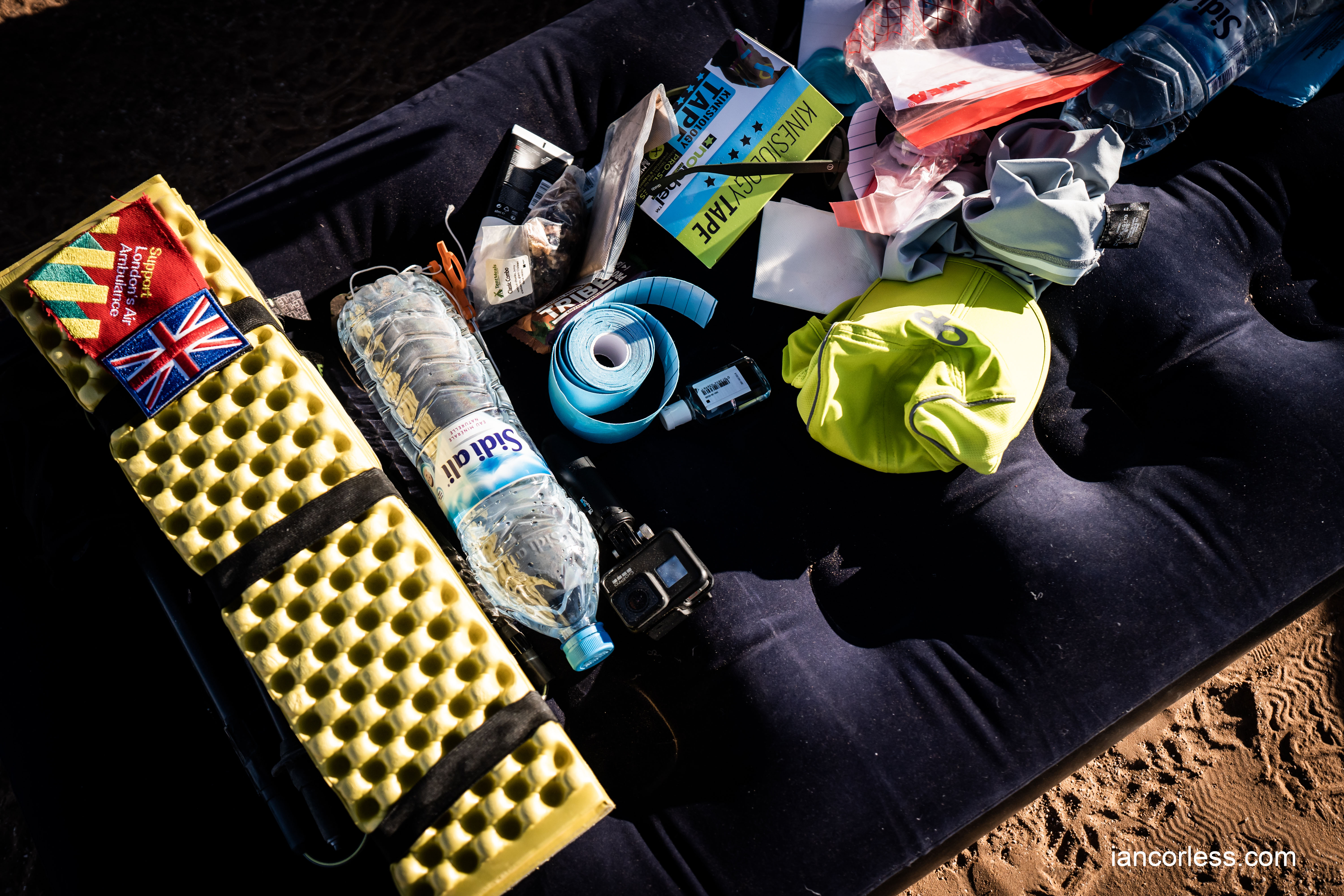
Pack – Minimum pack weight is 6.5kg plus water (8kg,) get as close to this as you can. Additional weight is additional stress and just makes the journey harder.
Friends – You are going to share bivouac with 7 other people and you are going to have some serious highs and lows. These tent mates will pull you through and motivate you. They will become friends for life. Ideally find tent mates before you head out to the Sahara and create a support network. Now, with 14-days to go is the perfect time to do this, if you haven’t already done so.
Feet – Look after them, along with dehydration, blistered and damaged feet are a key reason for failure in any multi-day race.
Extras – Mandatory kit is as one would expect, mandatory! So purchase what is on the list. You can save weight by shopping around. Simple rule; the lighter and smaller, the more expensive it will be! Optional extras are very personal and my advice would be take nothing extra other than a MP3 player and earphones.
Mental Game – The legs, lungs, heart and feet will only get you so far. The mind is what will get you to the finish. Broken individuals with bodies in tatters but mentally strong can make the finish. Despite the hardships and pain, they embraced the journey and mentally where superior in strength. It was the mind that got them to the line.
Laugh – If you laugh, you are having fun. Laugh when you hit rock bottom, why not. Laugh when you are going the toilet in a brown plastic bag and most of all laugh with and at your tent mates and fellow runners. The comradeship of MDS is quite unique, embrace it.
Heat – In the final 14-days, make sure you get some heat acclimation, bikram yoga, sauna, heat chamber, hot batch, whatever it may be, get 6-8 sessions before the race. You have signed up for a race in the Sahara, no point in complaining it is ‘too hot!’ This is the challenge you signed up for. Dehydration is one of the main causes for NOT finishing the race.
TOP TIPS BEFORE THE RACE STARTS
Take essentials on the plane and wear your run apparel and shoes. That way, should a baggage disaster happen your chances of racing improve.
Take food with you for the travel and on the plane.
The journey from the airport to bivouac 1 is now typically 1-hour or less, this helps considerably with fatigue and tiredness.
Night 1 and night 2 in bivouac are NOT self-sufficient so take extras such as an inflatable bed, food and luxuries. Don’t use them? Give them away to the berbers. May as well have 2 comfortable nights and a comfortable day before the racing starts.
Food before the race starts is by Moroccan caterers. It is excellent food BUT for some, may be too challenging for the stomach. Take options to be self-sufficient should you need to make the choice.
Admin day is slick and streamlined now, but, you may be in the sun for over 1-hour. Wear a hat, take shade (an umbrella) and have water and snacks.
Keep sun screen on and keep hydrated. No need to drink vast volumes – drink to thirst before the racing starts.
Have additional items such as a base layer, sleeping bag liner and other items that may be on a ‘question’ list for the race. On night 1 and before you go to admin, you can make final decisions of what to and what not to take. Particularly important if you think you may be cold at night.
Remember that after bag drop and check-in you have no access to any additional items, however, you only become completely self-sufficient when you start the race. With that in mind, you can have additional food and luxuries with you until day 1 kick-off, it’s a useful tip and does mean that you can have additional comfort for a good 12-hours.
Marathon des Sables is a magical and life changing journey as are most if not all multi-day races. It really is a true challenge of mind and body to race over many days, irrespective of finish time. It’s a hark back to a more primitive time, a time without clutter and modern technology. Embrace this. Embrace the silence of the surroundings and the simplicity of placing one foot in front of the other, eating, resting and sleeping and then doing it all again.
Finally, set yourself a realistic goal (that may just be to finish) so that you manage not only your expectations but pace. Way too many start off too quick and most dropouts come on days 1 and 2.
Episode 234 of Talk Ultra is a #BM100 Barkley Marathon Special with an in-depth interview with Jasmin Paris.
The 2023 Barkley Marathon concluded with three finishers, Aurélien Sanchez completing 5-loops in 58:23:12, John Kelly in 58:42:23, and Karel Sabbe becoming the ‘slowest’ finisher in 59:53:33.
John Kelly is only the third person to complete the Barkley Marathon more than once, Jared Campbell who participated in the 2023 event (who did not finish) is a three-time finisher.
For the women, Jasmin Paris became only the second woman ever to start loop 4 and the first woman to complete loop-4, albeit out of time.
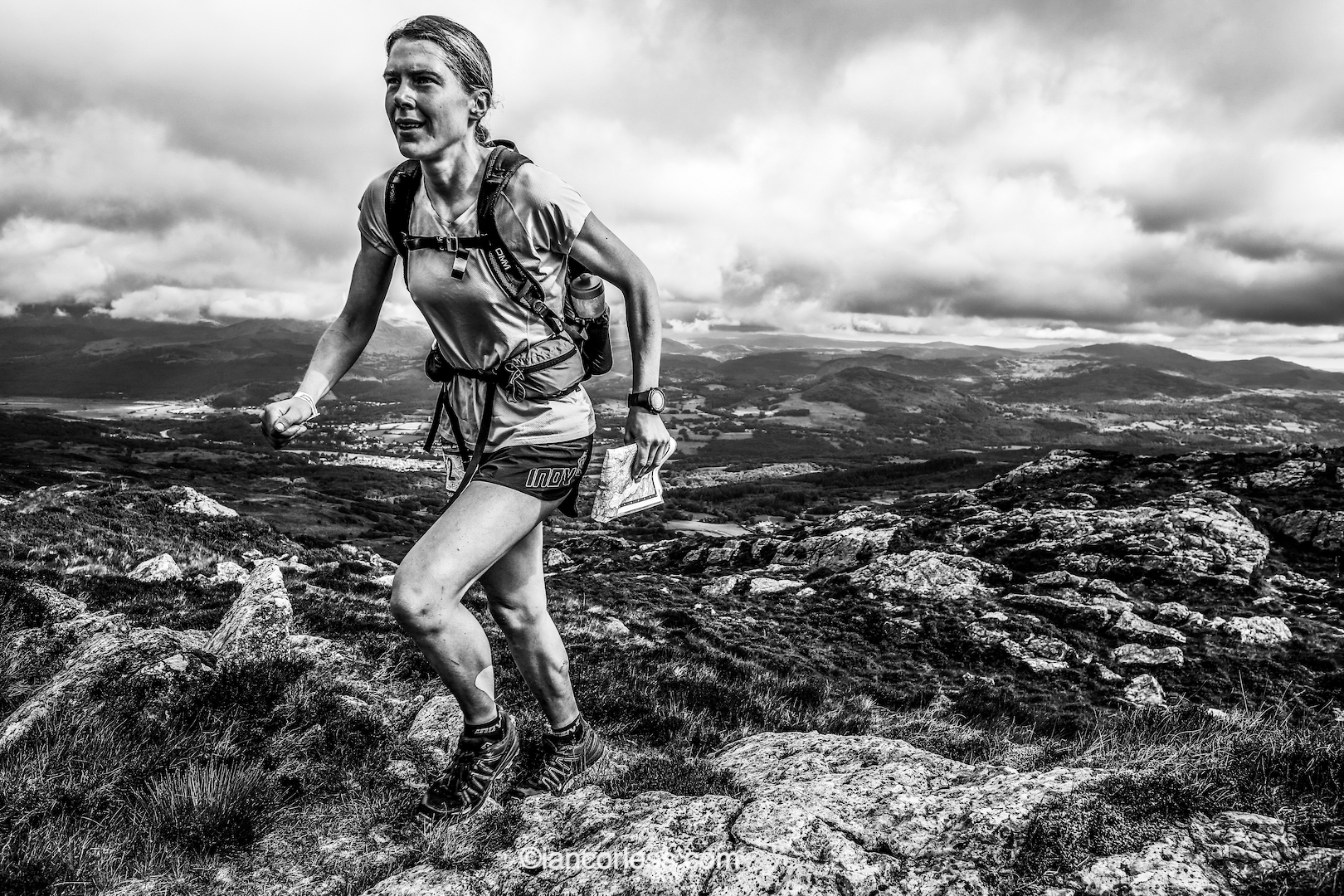
Jasmin at the 2025 Dragons Back Race which she won and placed 2nd overall.
On this weeks show, we speak in-depth about her past, her 2022 Barkley Marathon experience and of course, her 2023 record breaking run.
The interview with Jasmin starts at 00:16:30
You can listen to the show on ANCHOR by Spotify HERE
Importantly, go to iTunes and subscribe so that you automatically get our show when it’s released we are also available on Stitcher for iOS, Android and Web Player and now Tunein. We are also on Spotify too.
Our web page at www.iancorless.com has all our links and back catalogue.
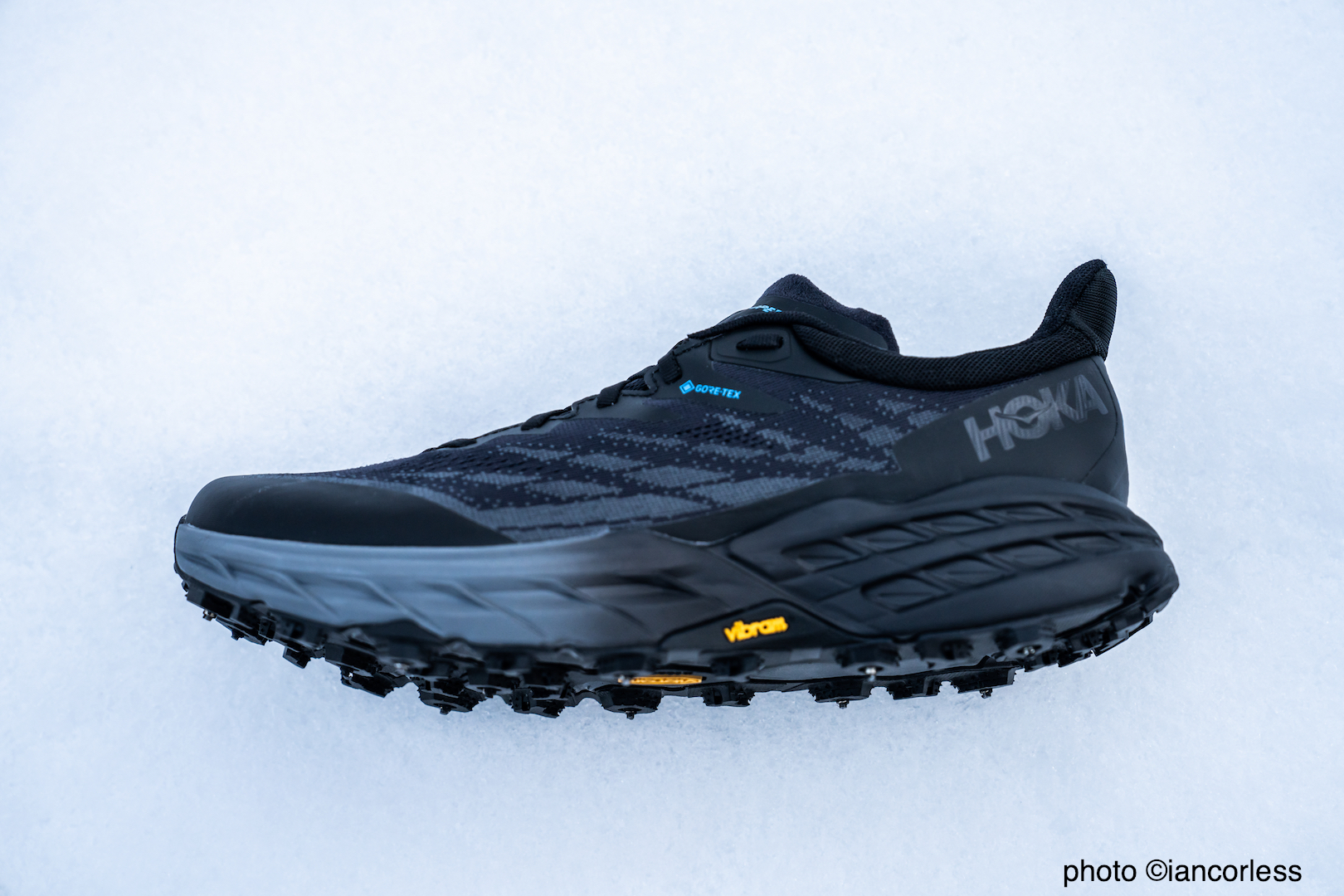
Hoka Speedgoat and the ‘5’ incarnation is arguably one of, if not THE most popular trail running shoe ever. No matter what race, what conditions, you will see countless Speedgoat shoes.
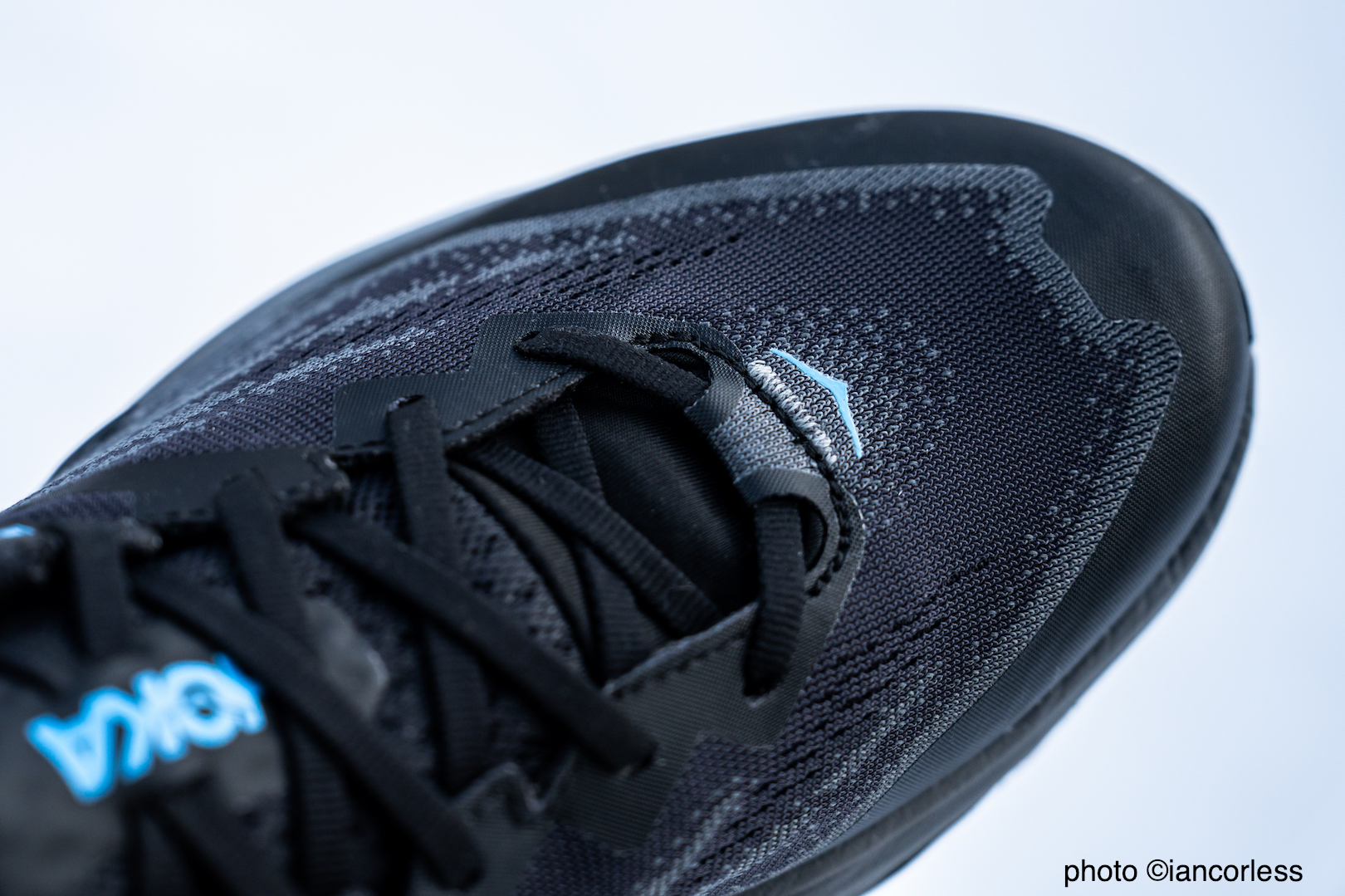
With maximal cushioning, great fitting upper, the option of different widths and an excellent Vibram outsole, it’s easy to understand why they are so popular, especially in the ultra world!
For me personally, I find the stack height just too high, especially on technical and challenging terrain; the risk of an ankle roll is too high! However, on single-track, the benefits are there if cushioning is your thing? For me, give me a Zinal or Torrent 2!
Living in Norway, once November arrives (sometimes earlier), pretty much all my runs require a specific winter shoe that has studs to maximise grip on ice. Until a few years ago, the choice was limited with unsurprisingly, Scandinavian companies such as VJ Sport and Icebug leading the way.
Now though, options from Asics, La Sportiva, Salomon, Salming, inov-8 and others are available, it only shows how the growth of running is booming and how the ‘need’ to run all-year makes it worthwhile for brands to produce a very specific shoe, that by its nature, has a limited market.
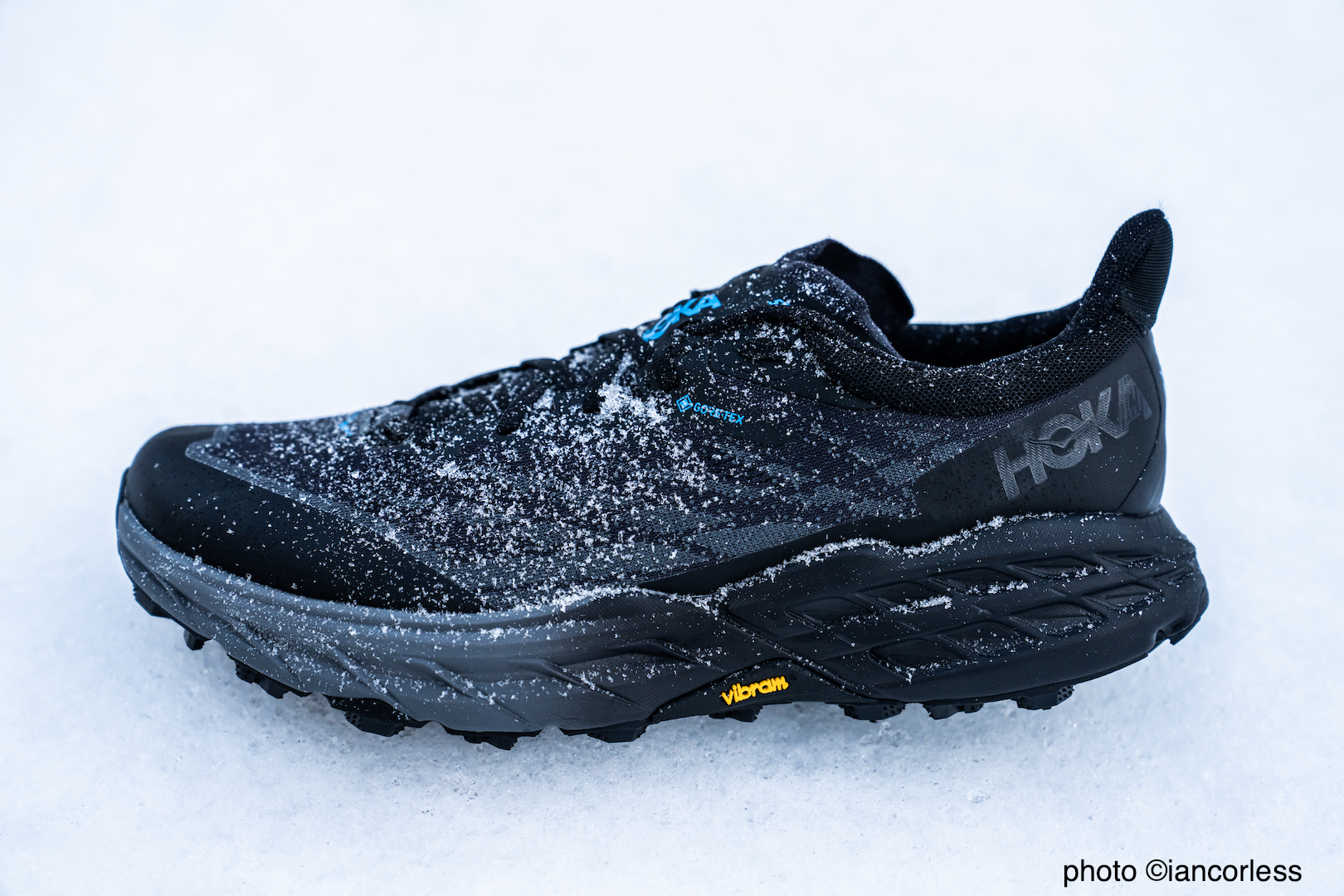
Therefore, the addition of a Hoka Speedgoat 5 with spikes is a welcome addition to the market. Certainly, adapting the Speedgoat makes sense, it is Hoka’s most popular trail shoe, so, it will certainly be popular in this version for those who need a specific shoe.
To my knowledge, this version of the Hoka is the *first (?) maximal cushioned shoe with winter spikes on the market, this alone will fill a hole in the market. It’s a welcome addition.
WINTER RUNNING
I have written many articles on winter running, read HERE. However, for clarity, I will provide a quick summary.
Not all winter running is the same and most certainly, conditions vary considerably.
Icy roads and pavement – A spiked shoe with cushioning is perfect. The outsole can be less aggressive.
Icy trails – A spiked shoe with an aggressive outsole is best.
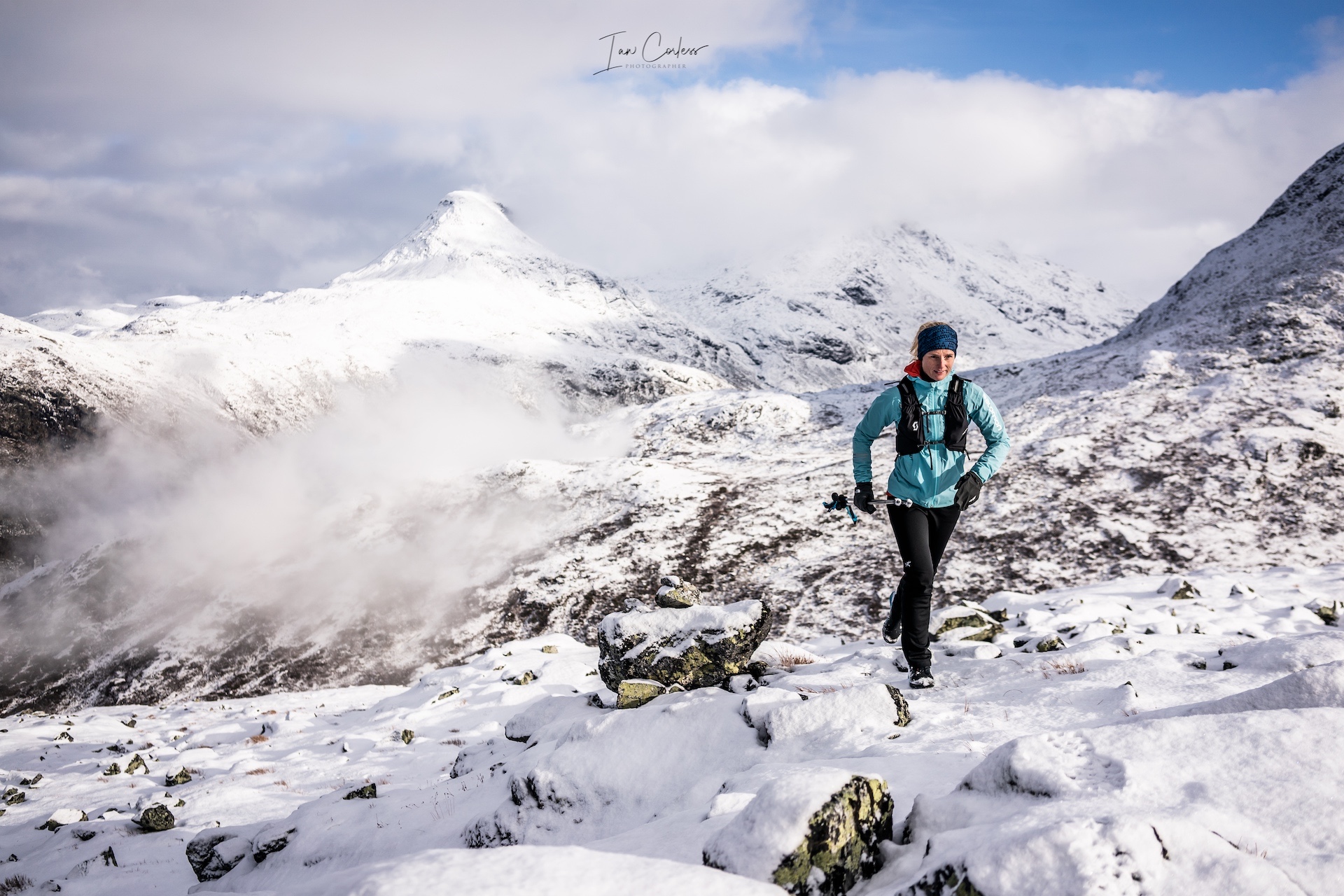
Snow and Ice – A shoe that is used for icy trails works, however, sometimes the addition of Gore-Tex is welcome and in deeper snow, a boot that comes higher over the ankle is recommended.
Snow/ Ice in mountain terrain – We now crossover into alpinism and a more specific shoe is required and depending on conditions, a more specific crampon. This can be a light micro-crampon such as Nortec or a specific mountain crampon.
Needless to say, the Hoka falls in to categories 1 and 2 and depending on conditions, may be applicable for point 3. It is most definitely not a point 4 shoe.
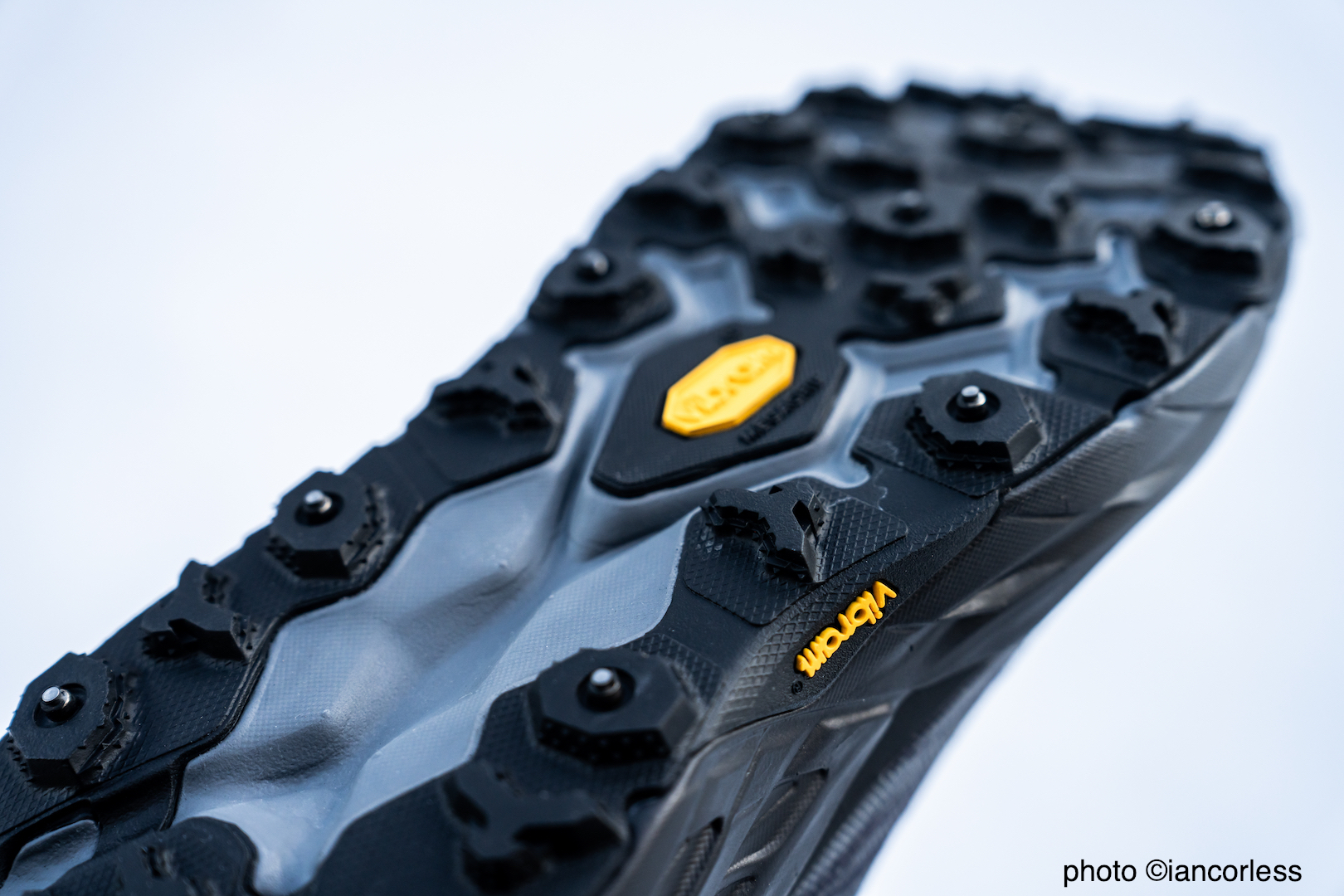
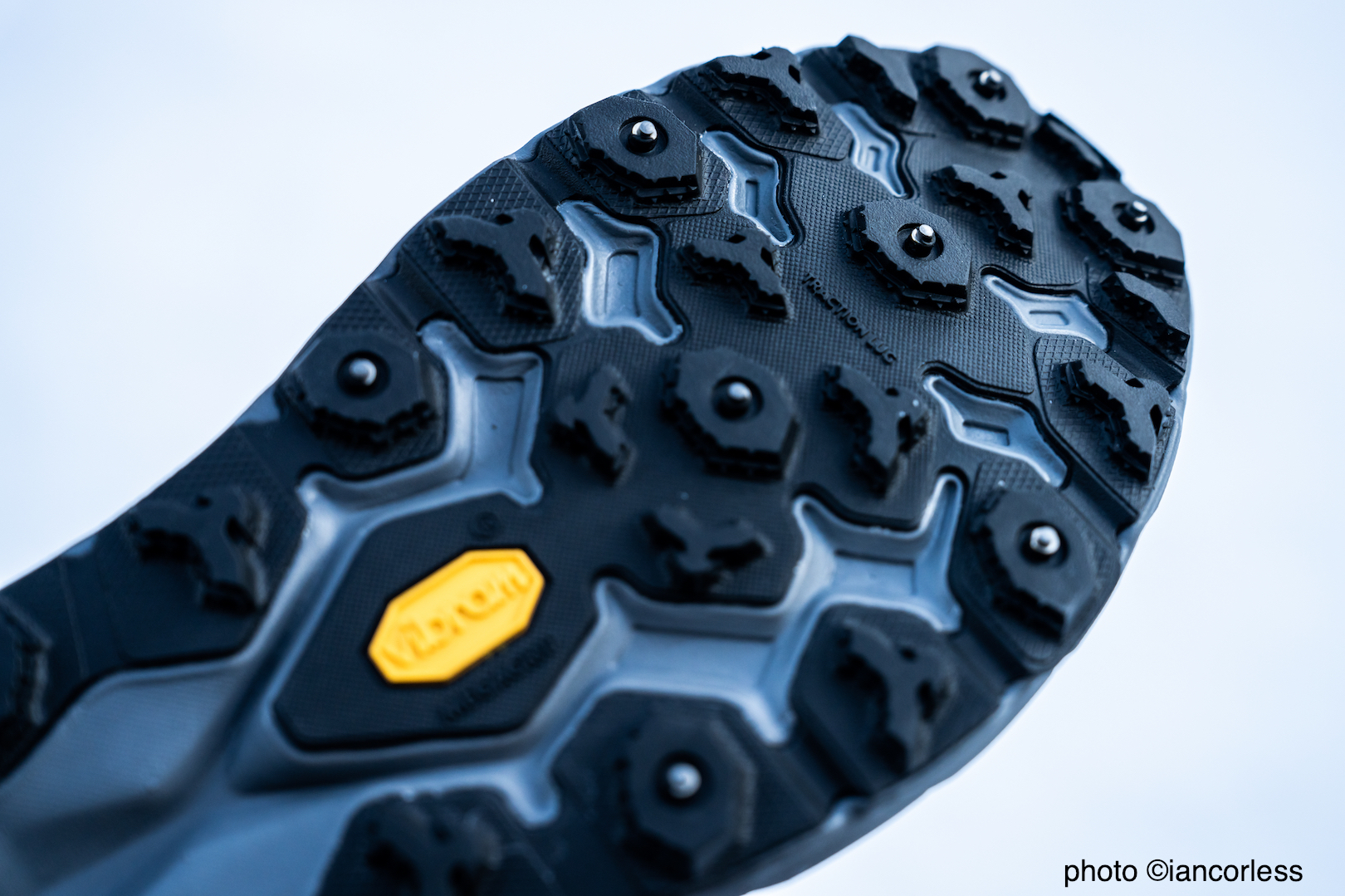
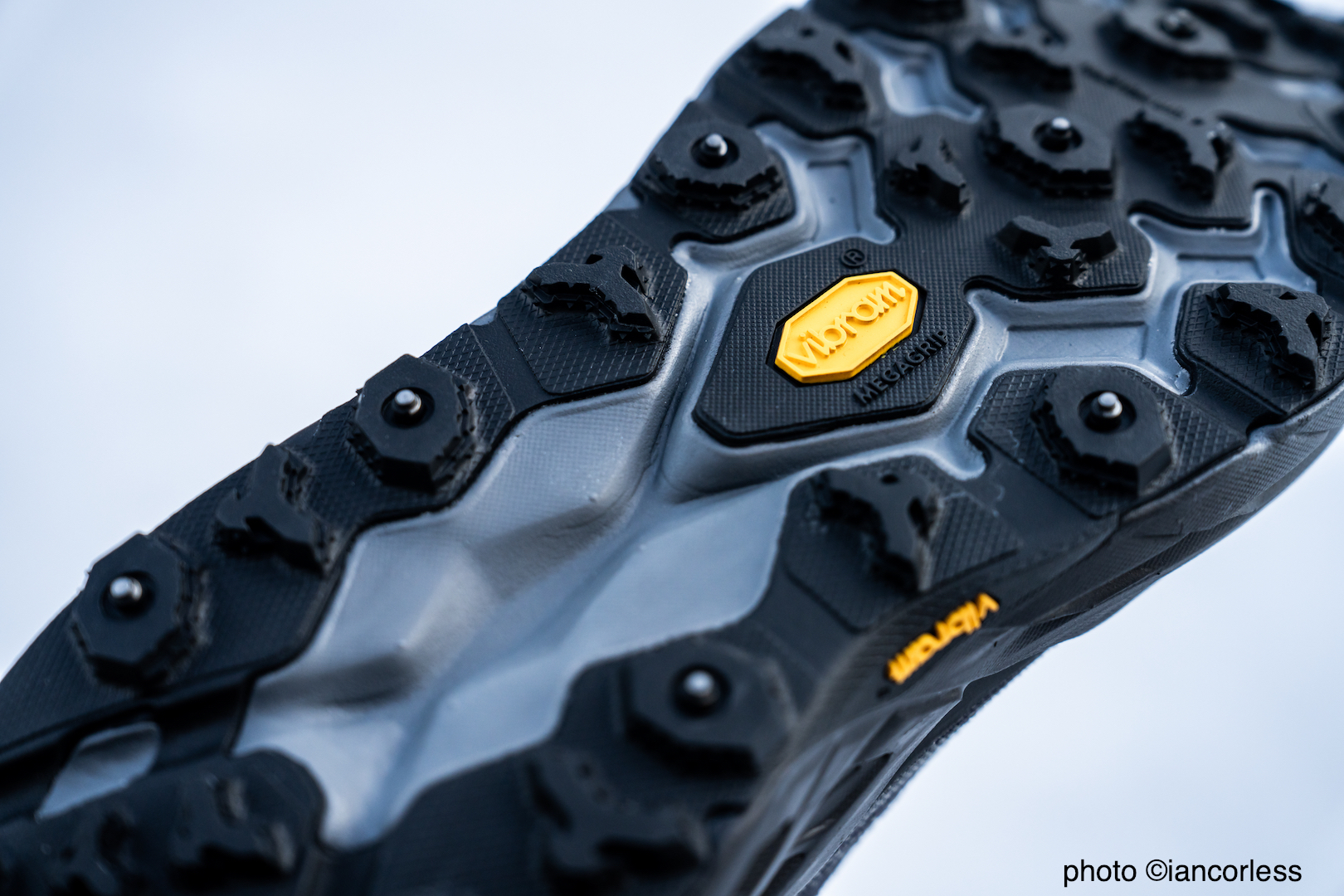
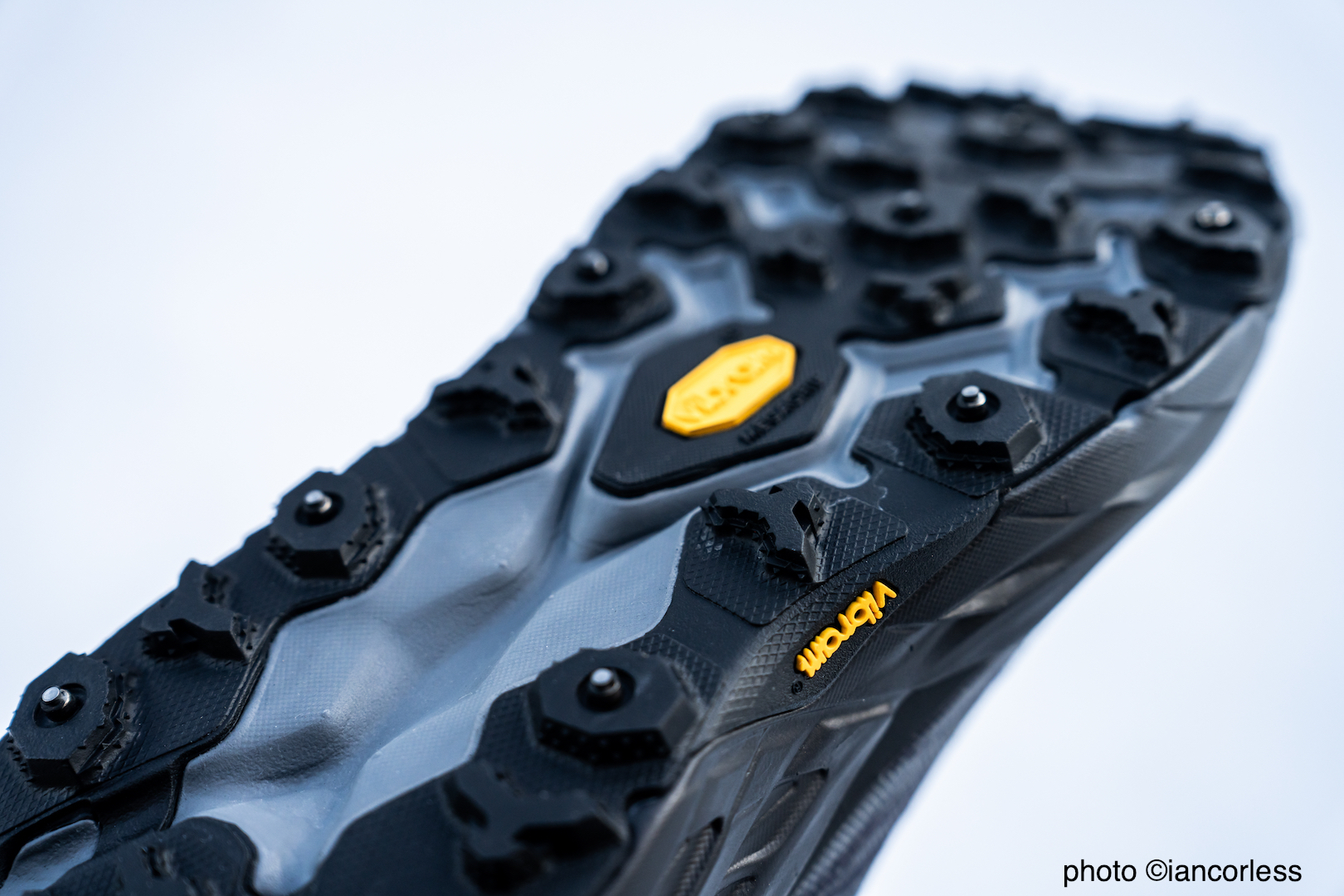
In theory, when you run on ice, your run gait should not change, but it does. For the spikes to work you firstly, need to trust that they will do the job! Secondly, you need as many spikes as possible in the ice to provide grip. So, when running on the flat, you are looking to land mid-foot as much as possible, so, all those spikes, 12 in this case, can grip. Going uphill you will use the front of the shoe, the Hoka has 8 spikes. Downhill you will use the rear (4 on the Hoka) but if very slippery, you may well find that you try to land with a flat foot. Being ‘light’ on your feet is not a benefit on ice, you need to strike the ground, stick those spikes in and then move on; this is often why ice running is more tiring.
With the above clarified in regard to usage, for me personally, I found the Speedgoat working really well on hard road and trails. The cushioning is welcome; ice running is always hard on the body. There is a great feel for the conditions, bounce and the propulsive phase is very good and the 12 tungsten carbide spikes work exceptionally well. The placement with 4 at the rear and 8 at the front. Notably, 2 are at the very front, perfect when going uphill! Importantly, ice defrosts and often you can find sections with no ice and just road and/ or trail. Many spiked shoes can feel harsh here, but the Speedgoat works well due to the additional cushioning.
On some and groomed trail with ice, the feelings and sensations are the same as road. Great feel, good cushioning, and solid grip.
On technical trails, rocks, roots, hard and rutted ice, I find the stack height too high and the shoe becomes unstable. I found myself rolling left or right and for me, it’s a potential ankle sprain waiting to happen.
In soft-snow with ice underneath, they work well, but, a lower cushioned shoe works better. After all, the snow cushions anyway, so, the extra shoe cushioning is not required. Once through the snow, the grip is good. It can be hit and miss though, but that is down to conditions and not the shoe. Ultimately, once the snow is deeper, the need for a more aggressive crampon or micro-crampon will be required, and then, you are looking at another shoe.
In very soft-snow I would be using a boot with spikes or the addition of a crampon/ micro-crampon.
A neutral shoe with a balanced feel and 4mm drop, the Speedgoat 5 is a great feeling shoe, albeit, a little on the heavier side – particularly for a Hoka. Listed weight is 349g.
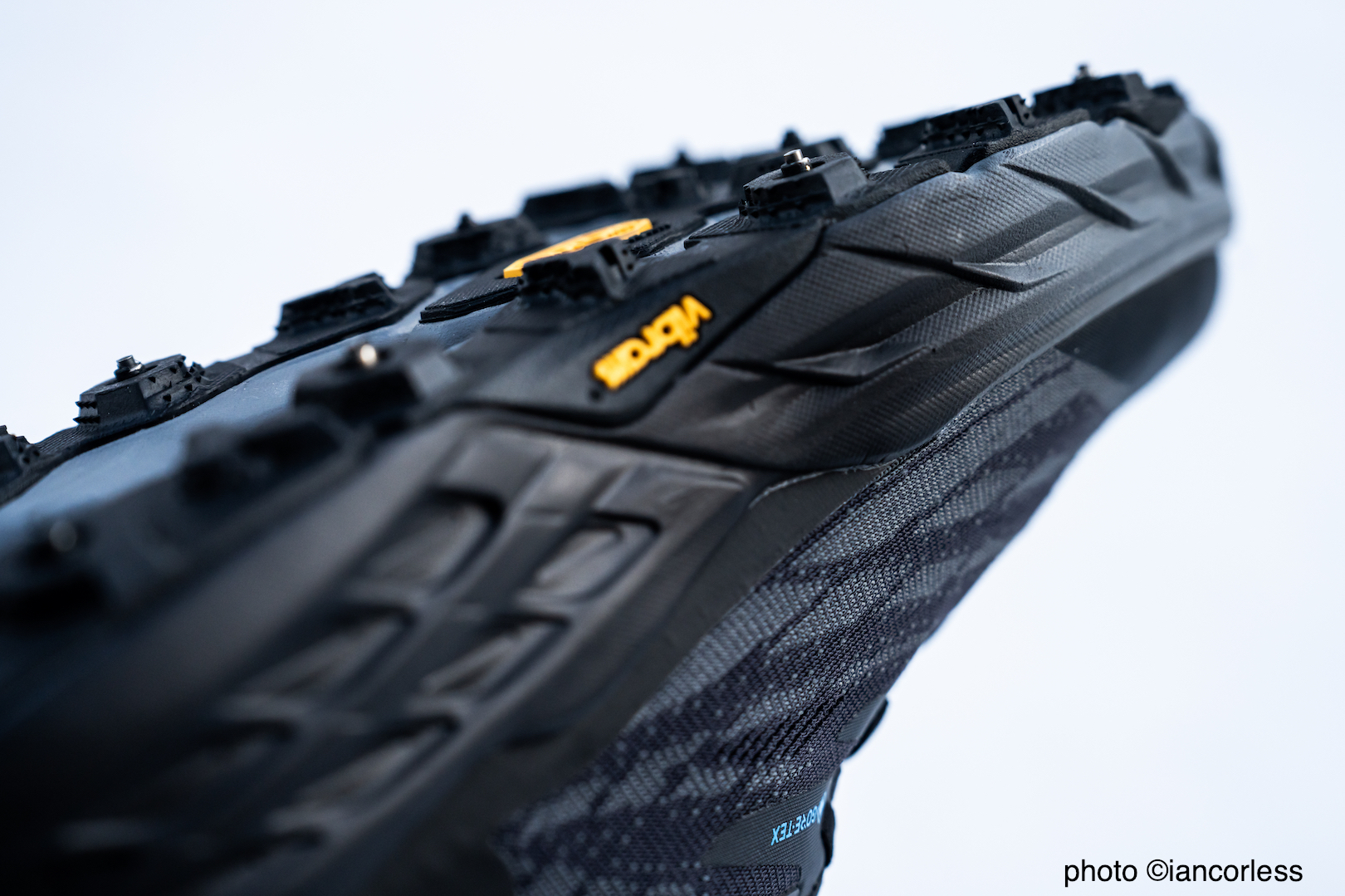
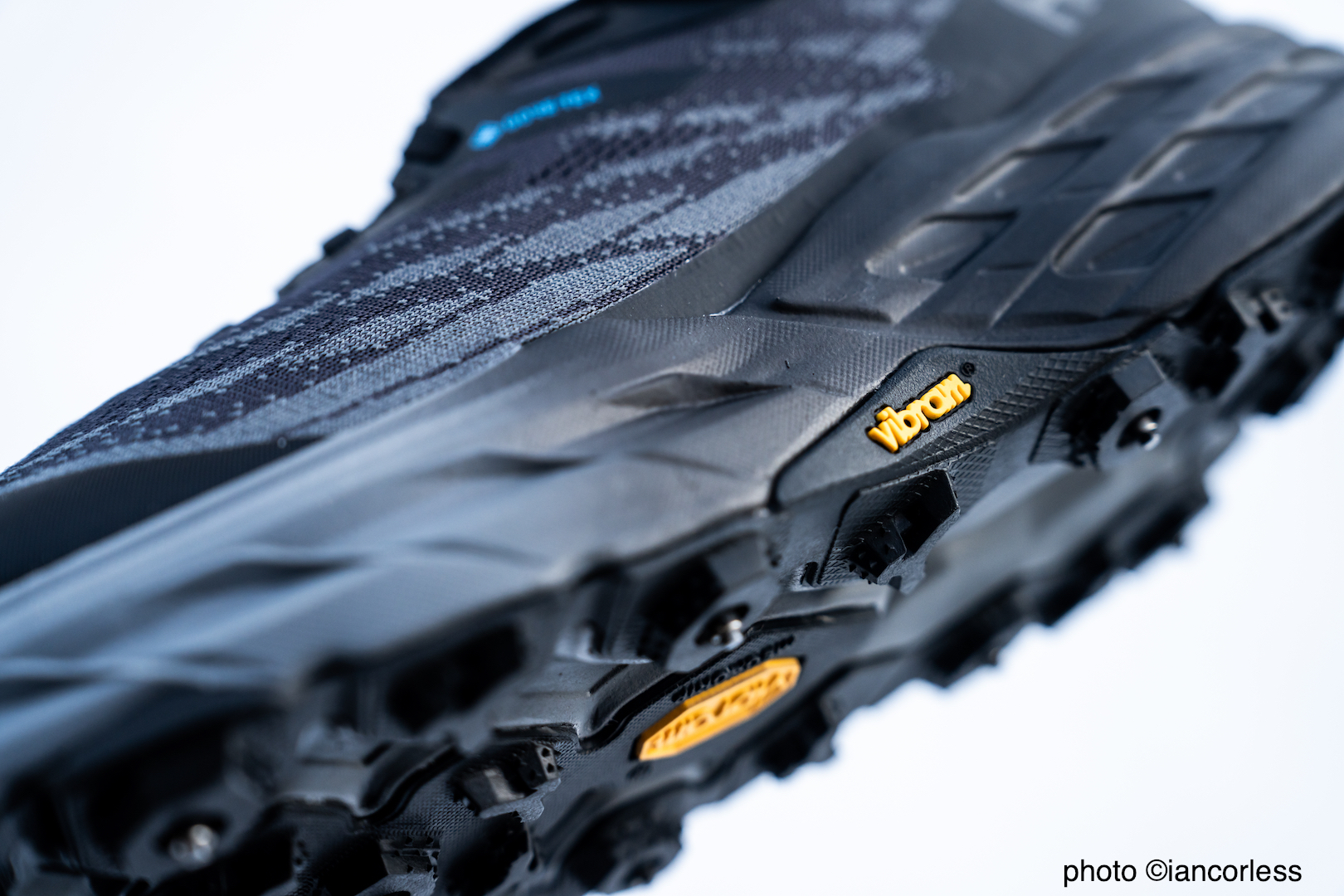
This incarnation is basically a Speedgoat 5 GTX with the addition of 12 tungsten carbide spikes to provide grip in wintry conditions, particularly ice. The spikes are set with 5mm lugs of Vbram MegaGrip.
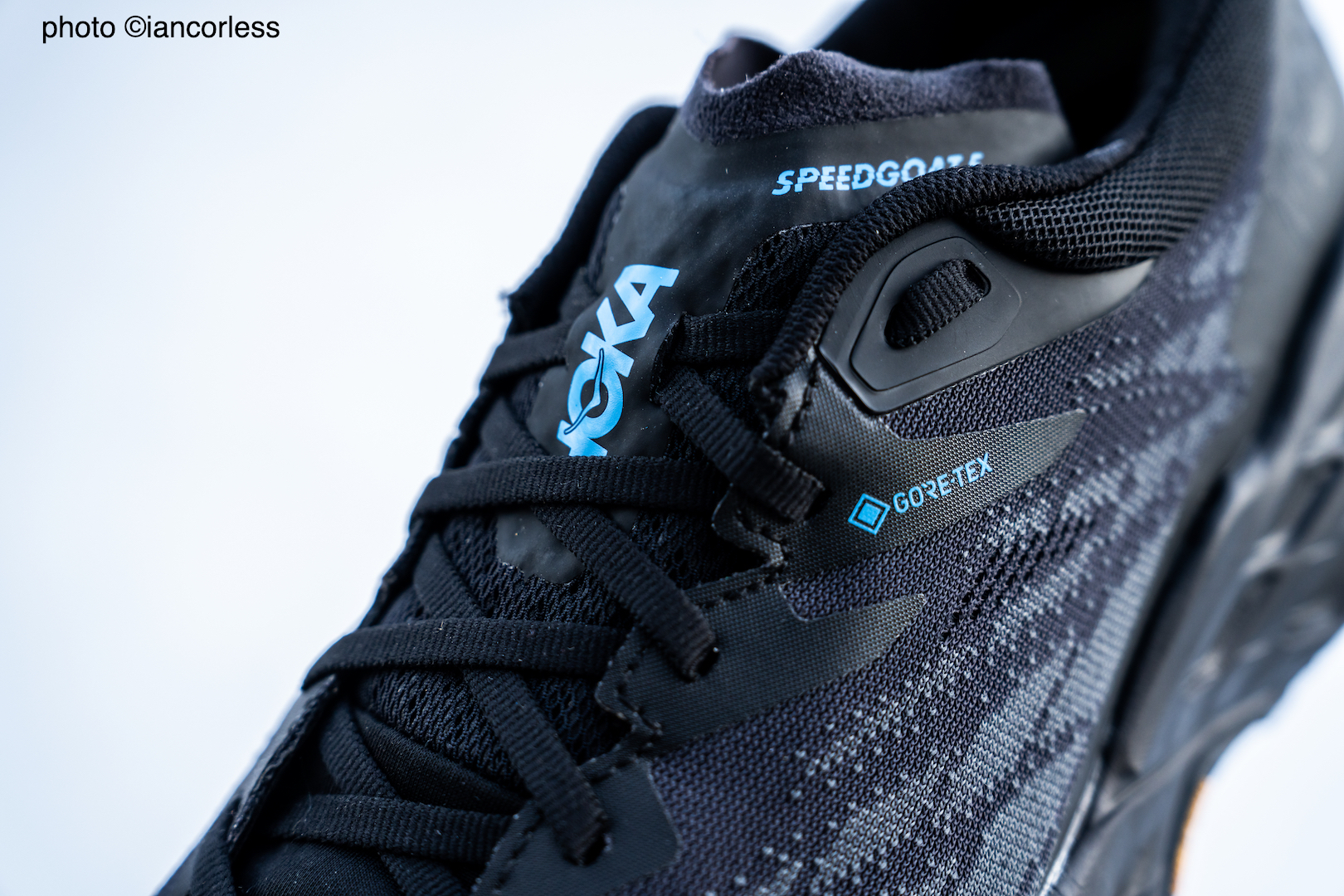
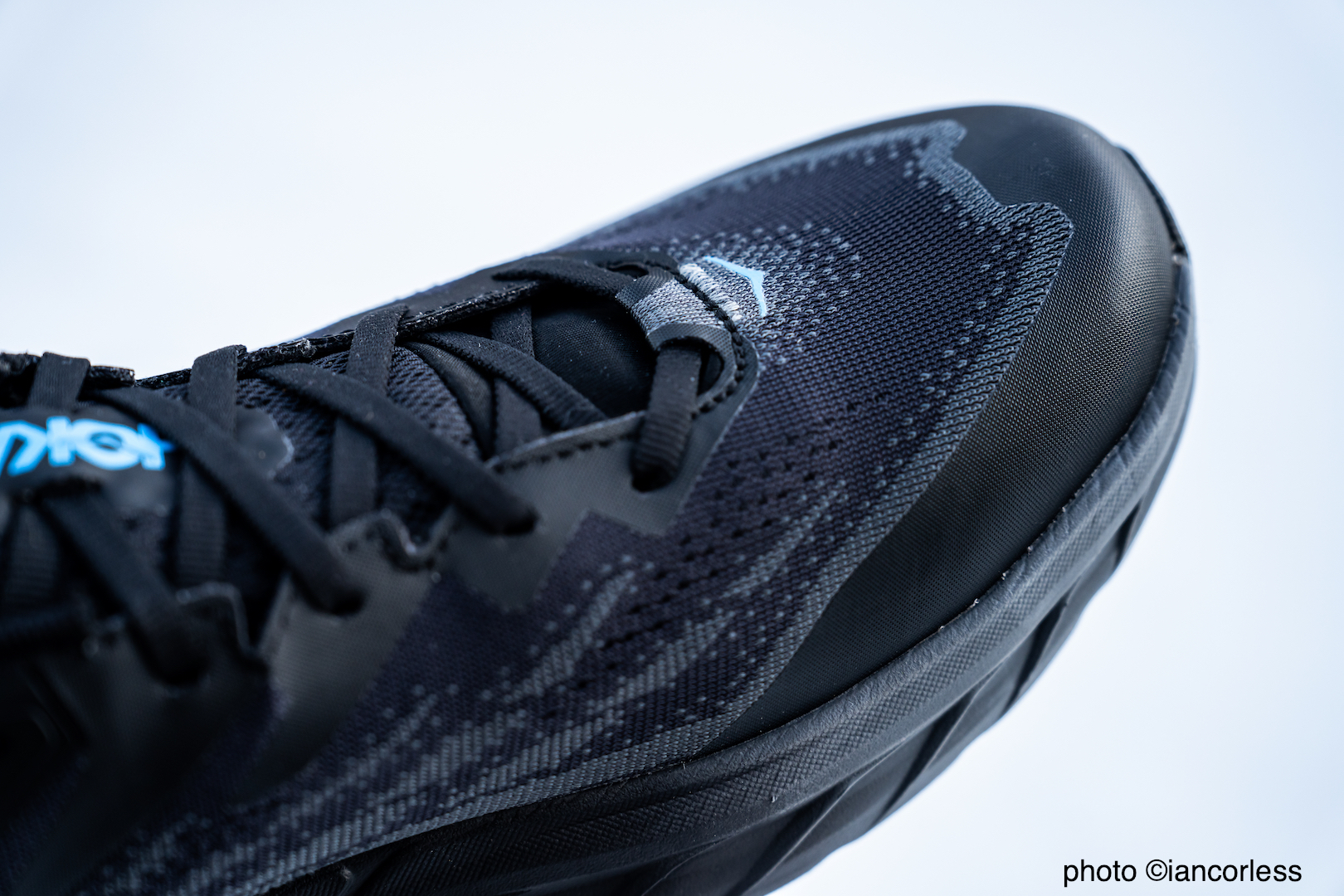
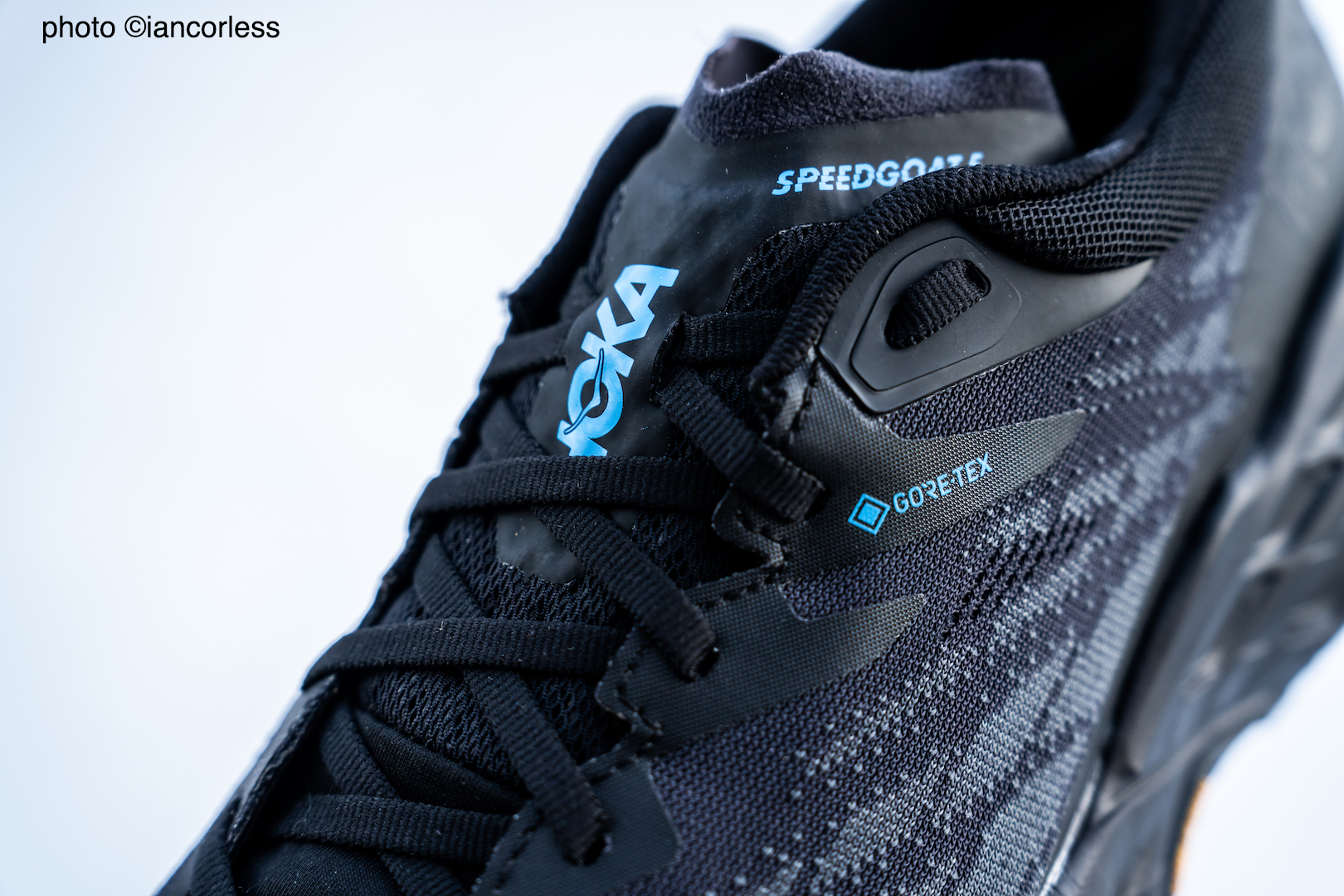
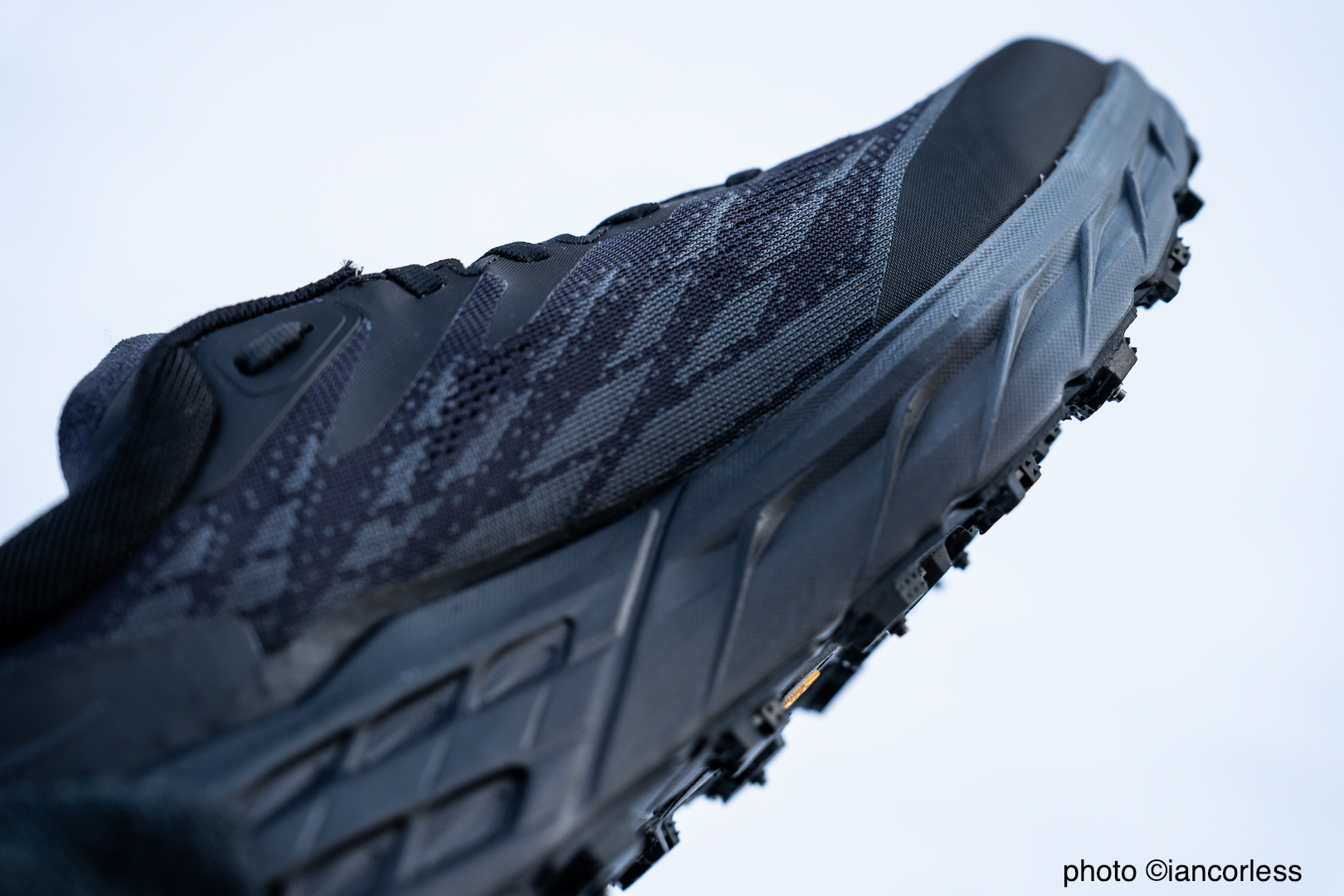
An EVA midsole, sock-liner fit, rubber toe protection and Gore-Tex mesh upper; this shoe is most definitely one to look at if you are in need of a specific winter shoe with extra cushioning.
Listed as a trail shoe (which of course it is,) it works exceptionally well on the road too. This shoe is all about providing grip on ice, so, it makes no difference if that ice is on road or trail.
The Gore-Tex upper will of course cause debate, some hate Gore-Tex in a shoe, others love it. Ultimately it works really well if one is considerate of conditions and one uses common sense. Quite simply, use a merino sock when wearing the shoe, this makes a huge difference. Accept that Gore-Tex will only keep feet warm and dry IF you do not go in anything that is deeper than the shoe… Once you are in anything that reaches the ankle, be that snow or water, it can enter the top of the shoe and therefore impact on the foot inside the shoe. If conditions are like this, you probably need to move a run boot (such as the La Sportiva Cyklon Cross GTX) or think about using a shoe without Gore-Tex. Merino socks are a must though, they retain warmth, even when wet. I have used the Speedgoat 5 in a Norwegian winter, temperatures have reached -20 and ice levels have been high. The Gore-Tex has worked perfectly in keeping my feet warm, especially when wind-chill has been high. The Gore-Tex supplies a combination of waterproofing and breathability, it’s hard to stay perfectly dry, but water does stay on the outside. Perspiration can and does escape from the inside; keeping sweat to a minimum, but that is where merino socks step in. When fresh soft-snow came, I used different shoes so as to ensure I had maximum protection from the elements.
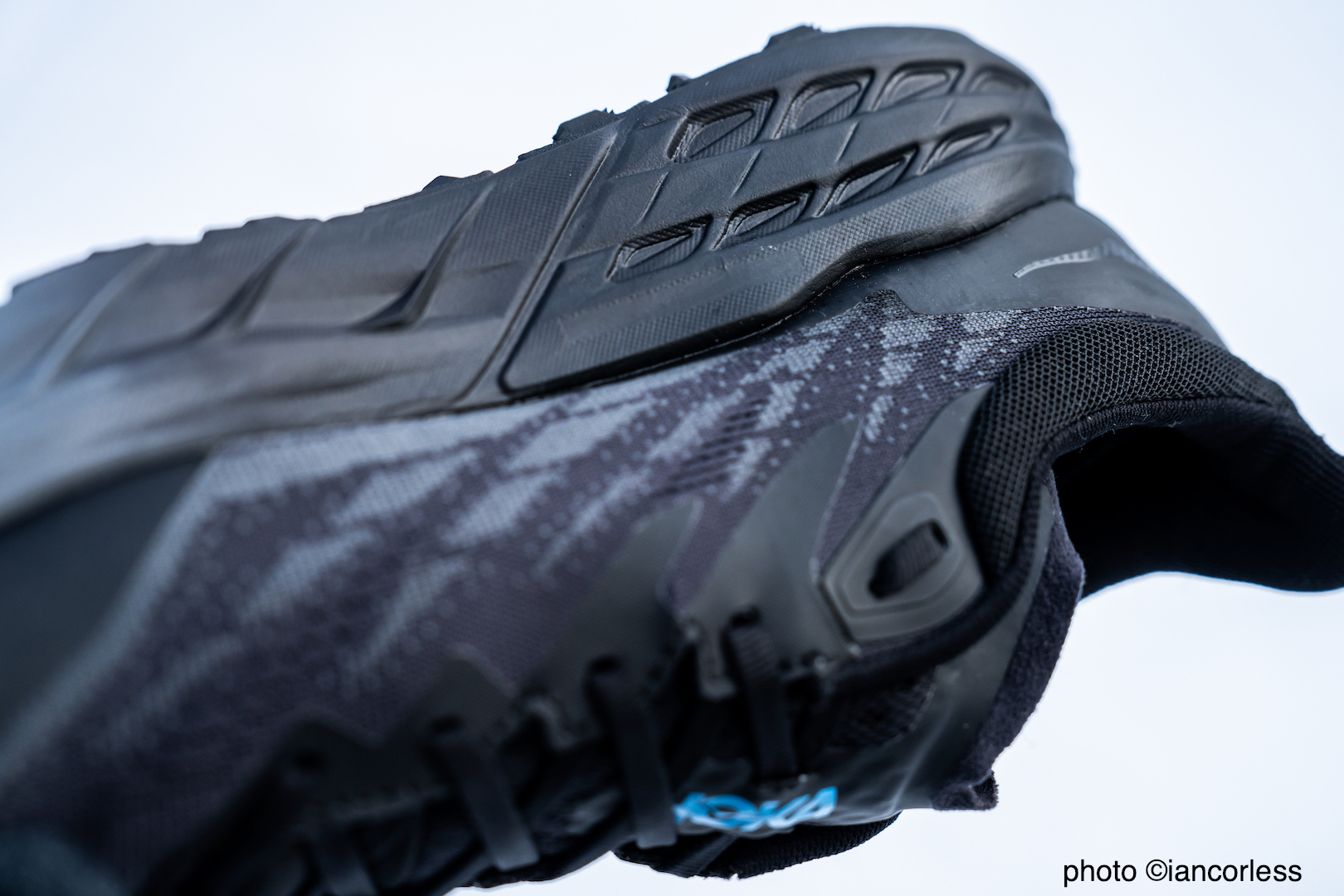
The additional cushioning (29mm/33mm) and bounce has been welcome on harder trails but on technical trails, less so, the risk of ankle roll is too high (for me.) They do keep feet comfortable and supported, maybe even more than the other Speedgoat models. Propulsion is also good through the run gait.
The wider platform is a hugh benefit in snow and ice as is a wider toe box. The more outsole on the ground, the better the grip. Talking of grip, the spikes are held in Vibram MegaGrip which is tried and tested.
It has excellent rubber compound, 5mm logs with zonal multi-directional rubber placement, so, when you need the shoe to hold on, they do. Obviously, the 12 tungsten carbide spikes add the icing on the outsole and even when there is no ice, these spikes offer stunning grip on trail – ask any orienteer!
Winter shoes are very specific and if you only run on ice a few times a year, the additional expense is probably not worth it. Get some micro-crampons and use them on your favourite trail shoes.
However, if like me, pretty much every run for weeks and months involves ice, a specific spiked shoe is a must. The feel for the ground is so much better than any ‘add-on.’ Usual caveats as in points above, 3 and 4 need consideration.
The Hoka Speedgoat 5 GTX with spikes brings something new to the market, I have many spiked shoes, this one is the first with ‘more’ cushioning. For many, it will be a god send! The shoe performs great, and if you are already a Hoka user, you will love the Speedgoat.
For me though, this shoe has it’s place and uses, I have enjoyed road runs with ice, I have enjoyed non-technical trail runs with ice BUT anything technical and/ or with additional snow, I have used another shoe. It’s a me thing!
The Speedgoat 5 GTX with spikes is ideal for any runner looking for a robust, winter trail running shoe with comfort. They have great grip on frozen terrain and come recommended.
*As a footnote, I have become aware of the Icebug Arcus which may well be worth consideration if cushioning is your thing. And, this shoe has 13 studs.
Winter 2022 and 2023 has witnessed a surge in specific shoes to handle challenging terrain. I recently reviewed the La Sportiva Cyklon Cross GTX and now the SCARPA RIBELLE RUN KALIBRA G.
Both these shoes are very specific for demanding winter, mixed terrain and extreme condition runners, especially when it is muddy, cold, wet, snowing or a combination of all four.
Both shoes offer greater protection and enhanced reliability in harsh environments.
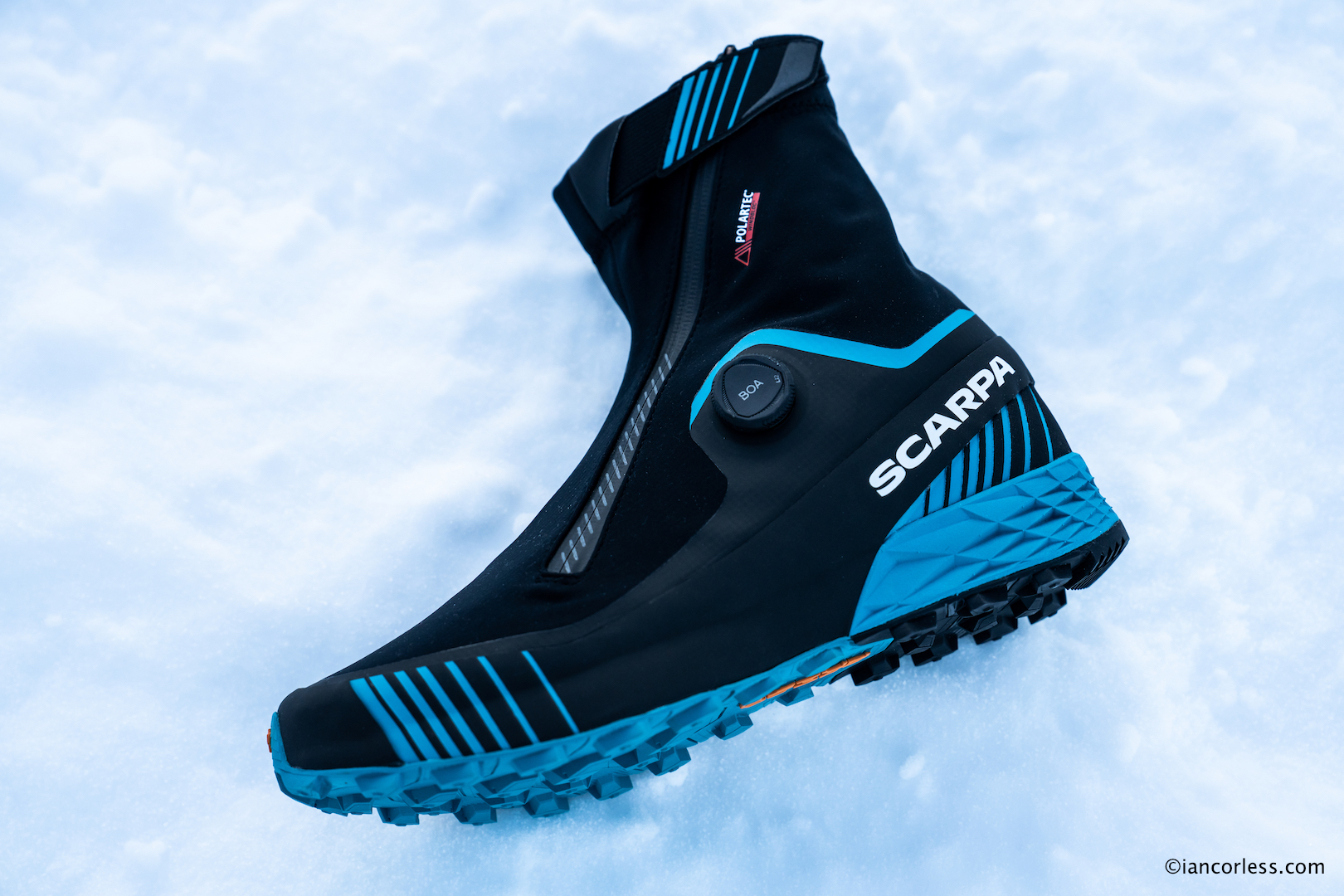
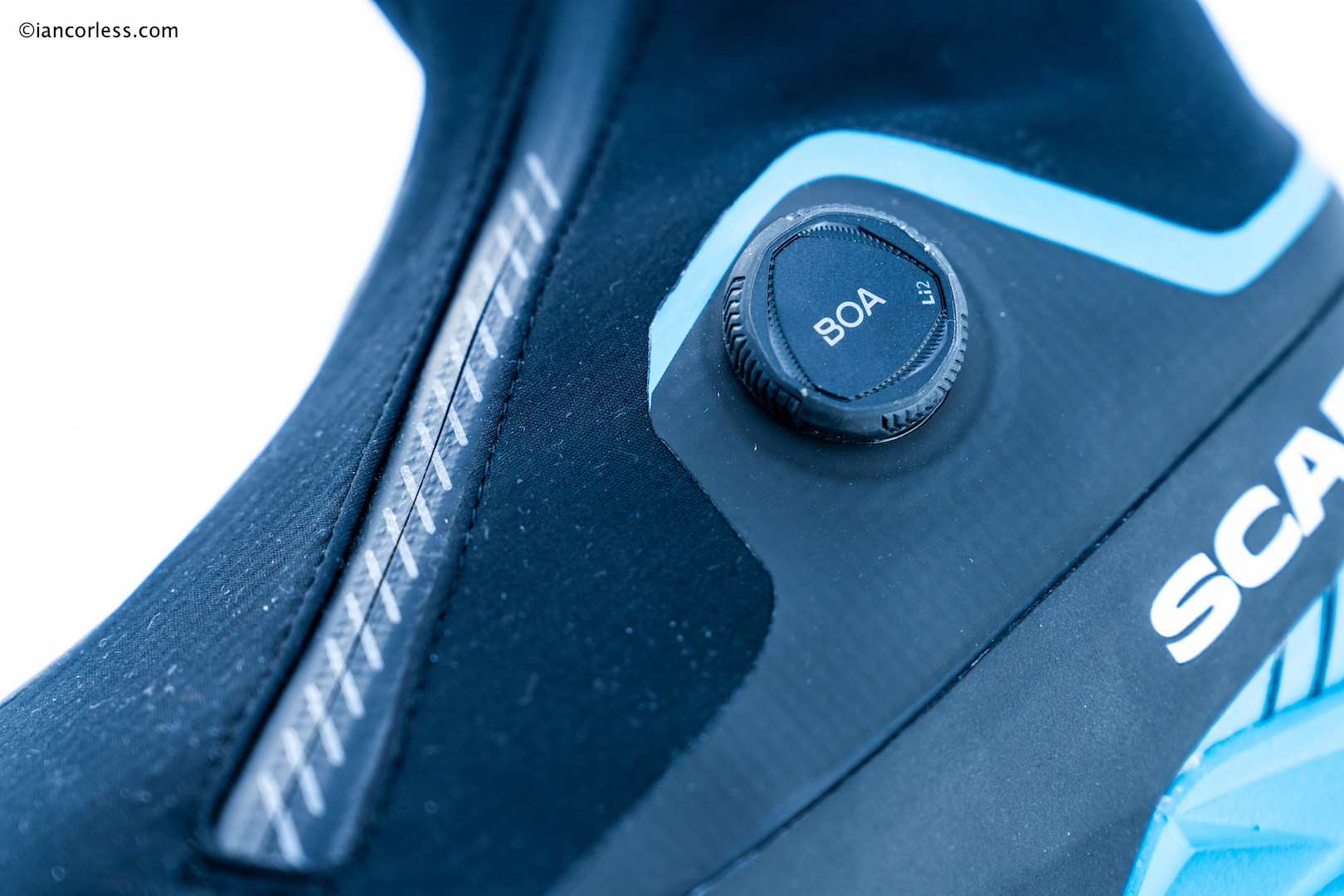
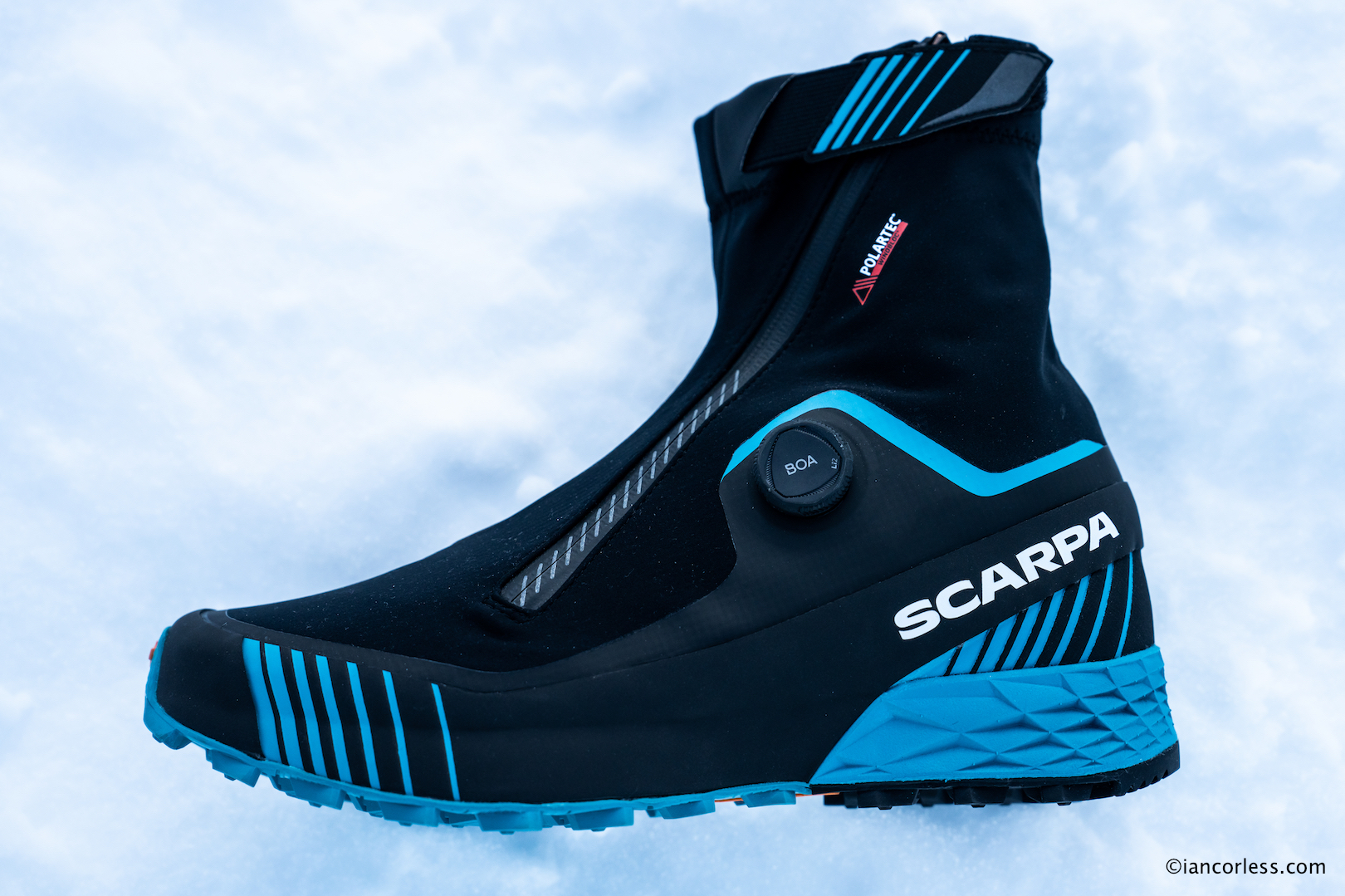
Built around the very popular and well received Ribelle Run shoe, the Kalibra G has a full gaiter and BOA® Fit System closure.
There are many similarities to the La Sportiva and it’s hard to write this review without constantly referencing the Cyklon Cross GTX as a comparison. Ultimately, if you are after a specific shoe like this, these are the two you will look at!
On first looks, they both offer great outsoles for harsh conditions, all weather protection and the BOA closure.
However, there are differences:
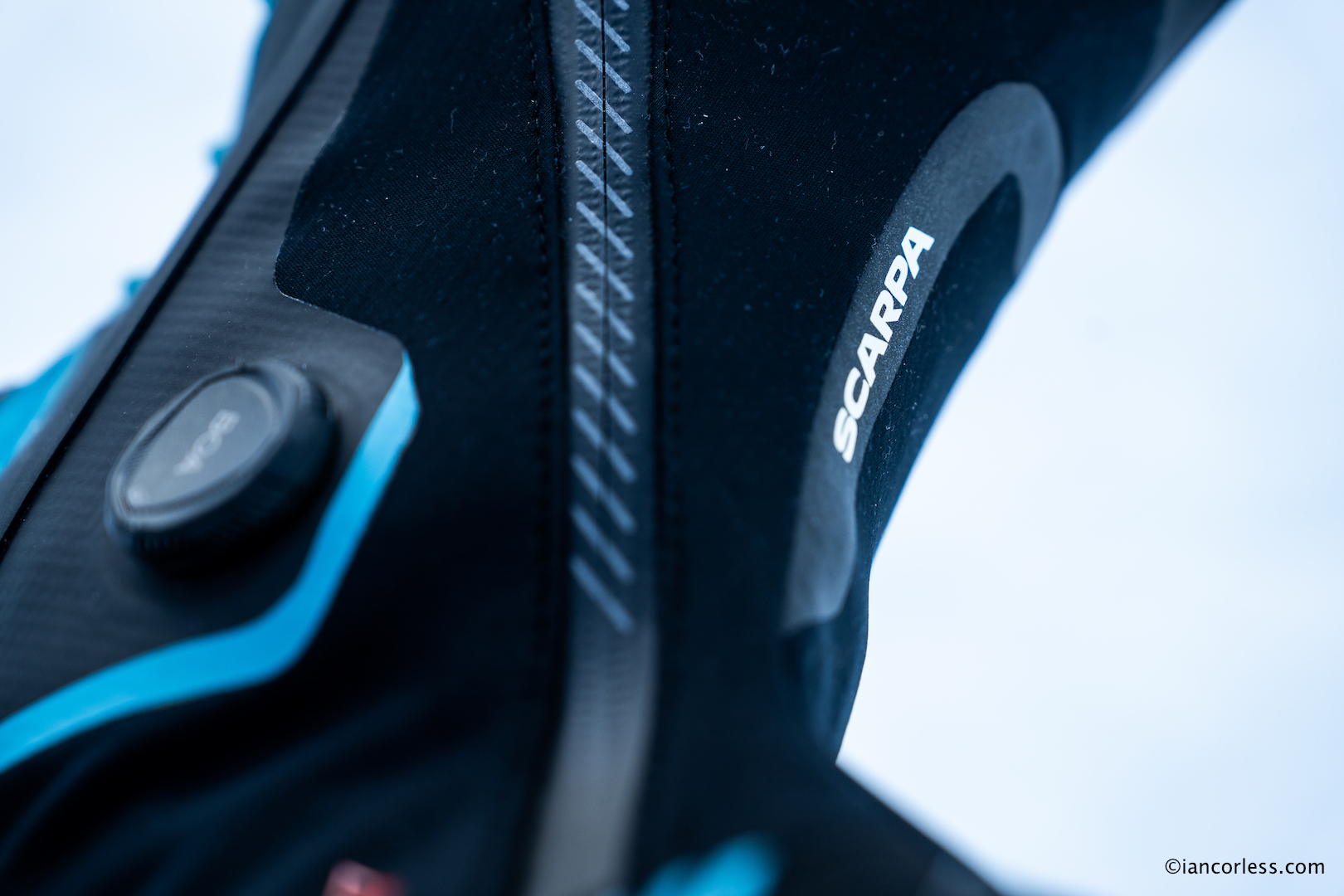
The gaiter comes higher on the Scarpa and the zip wraps-around in contrast to offering a more straight closure on the La Sportiva. There is also a velcro cuff at the top to add enhanced tightness/ closure.
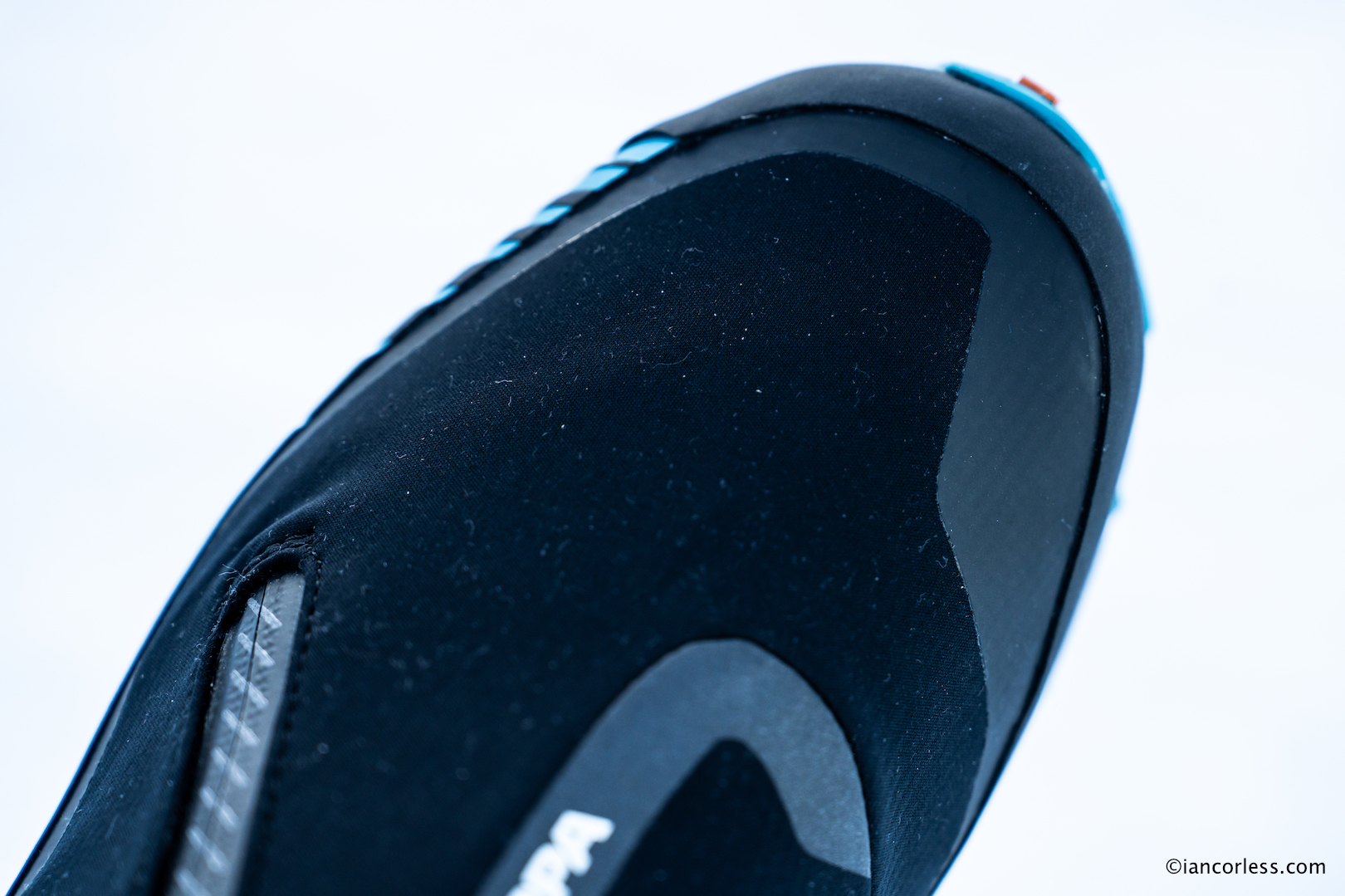
The toe box is wider offering more toe splay.
There is extra cushioning offering a more plush and bouncy ride.
The BOA system offers a wrap-around the foot with increased foot hold and security.
The drop is lower at 4mm with 20.5mm at the front and 24.5mm at the rear.
The upper includes Polartec® Windbloc® for additional warmth.
Subtle differences but they are significant and certainly offer a choice.
Blue and black, the Scarpa is a great looking shoe and when on the foot they immediately scream that they are a shoe that means business. Scarpa say that the shoe is ideal in summer or winter, however, like the La Sportiva, as much as I would like to use a shoe like this all-year around, they will just be too hot for summer! My feet have actually sweated in -4 degree walks in snow while using the Scarpa.
It’s a technical shoe for soft-ground, snow and mountain adventures. Like the La Sportiva, I had hoped for spikes, but alas no! Unlike the La Sportiva, there is no real option to ‘add’ spikes, so, in ice, you’ll need to use a micro crampon.
Fit is superb. They are true to size and maybe a touch on the larger side, but that is okay for a winter shoe as you will use thicker socks. I strongly recommend a higher sock that comes well above the ankle and is ideally made from merino wool. The Scarpa comes up high!
Lacing in both the La Sportiva and Scarpa is superb and here, the ability to adjust tightness is done from the outside, so, there is no need to open the gaiter once running. Micro adjustment is ‘on-the-go,’ via the L2 BOA – perfect for a winter shoe and yes, you can keep gloves on. The lacing, even though similar, is different. Scarpa use a Wrap360 Lace System which really does hold the foot without pressure points.
The upper of the Ribelle Run is light and breathable with mesh, TPU and a microfiber structure. It’s wrapped in a Polartec® Windbloc® polyurethane membrane that offers protection and warmth. Closure is via a waterproof zip and velcro cuff and of course the shoe is tightened via the BOA once the gaiter is zipped and closed. It all works perfectlty. In contrast to the La Sportiva, there is additional fabric that offers some space and expansion, whereas the La Sportiva is snug, secure and sleek.
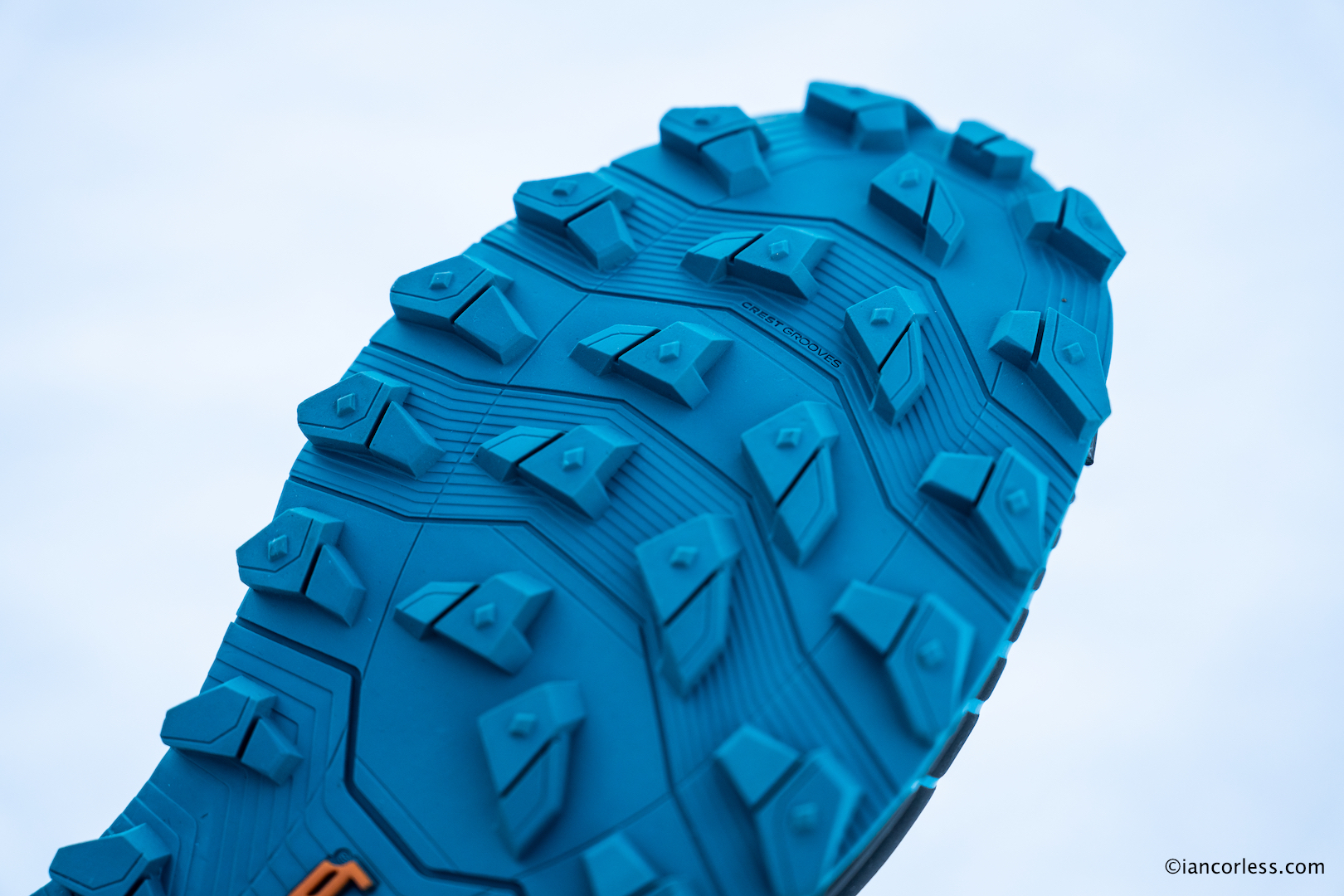
The outsole is Scrapa’s own PRESA® TRN-04 which has been specifically designed for challenging terrain. The lugs are 5mm in contrast to 7mm on the La Sportiva and quite simply, the La Sportiva wins on grip. Scarpa say that the SUPERGUM W runner will grip ice and snow – no! They work in snow great, but not ice. Studs work on ice and that applies for the La Sportiva too.
Great looks and great fit. The Scarpa is a pleasure to wear on the trail irrespective of conditions and with or without a micro-crampon. Warmth is excellent and resistance to water is superb. I had dry feet on every run. A ´WINTHERM` layer provides excellent breathability and insulates the feet from the cold. It also is designed to reflect heat in summer… They are NOT for summer! They are a very warm shoe!
It’s difficult to say how far I could run in this shoe, it’s comfortable and adequately cushioned with a constant feel for the ground. There is more room than the La Sportiva and certainly feel like an ‘all-day’ shoe. If running in mud, soft-ground and snow, you could keep going and going as the ground adds to the cushioning. On harsh, hard and rocky terrain, I still had plenty of comfort. Within the midsole is a Dynamic Stabiliser Torsion frame made of TPU. This enhances rear foot stability by wrapping under the arch, it also brings torsion control.
The grip is excellent on a multitude of terrain but in contrast to the La Sportiva, not as secure or convincing. The shoe takes a micro-crampon perfectly. I used the Camp Ice Master in really challenging conditions and the lighter/ faster Nortec Trail when conditions required. Run feel is great BUT it is never as good as a specific studded shoe. However, if fresh snow, you don’t notice any difference.
It’s a solid shoe with loads of protection. They are bulletproof and surprisingly light considering how well made they are! 384g for an EU44.5.
The inner shoe is supportive and secure (it’s excellent), and a thick gusseted tongue protects. Heel area is also great. They are supremely comfortable.
The Scarpa is a superb shoe that does the business in harsh, winter and tough conditions. They are so good, they make a great mountain shoe at any time of year. Even if they will be too warm in spring and summer. There are so many positives that it’s hard to find any negatives, however, in comparison to the La Sportiva, the outsole is not as aggressive. By contrast though, the Scarpa has more toe space, arguably a better foot-hold (but both are excellent) and more cushioning. It’s all down to personal preferences and in reality, you would need to try the La Sportiva against the Scarpa and make a decision. Both put a smile on my face and I am happy I can switch between the two! I have no problem using either shoe and during winter I have alternated between the two. If I had to make a choice, I’d struggle. The La Sportiva is great on faster runs, the Scarpa a great all-day shoe. You decide what you need!





















 IAN CORLESS