MDS to TCC – Jo Meek Interview

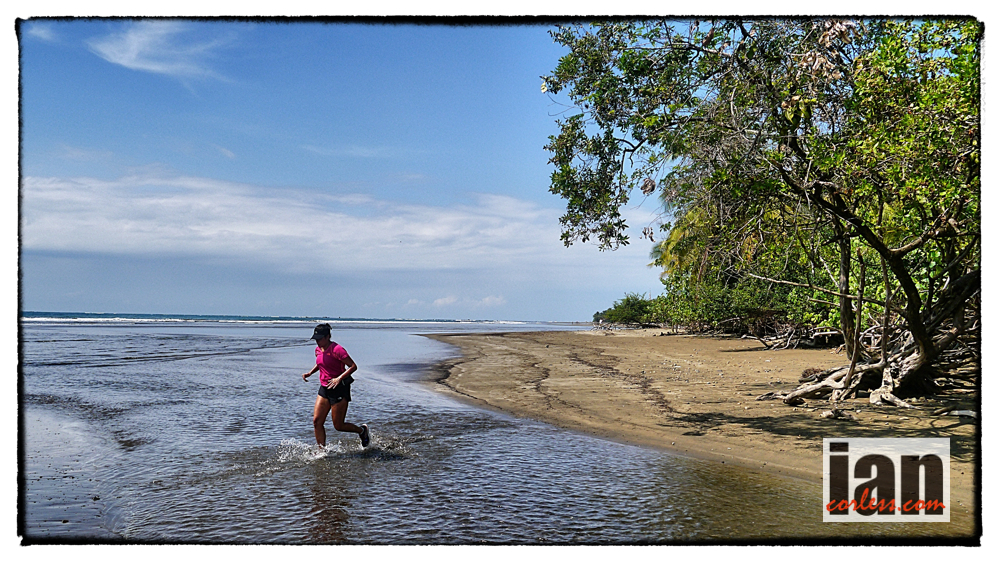
iancorless.comP1020412

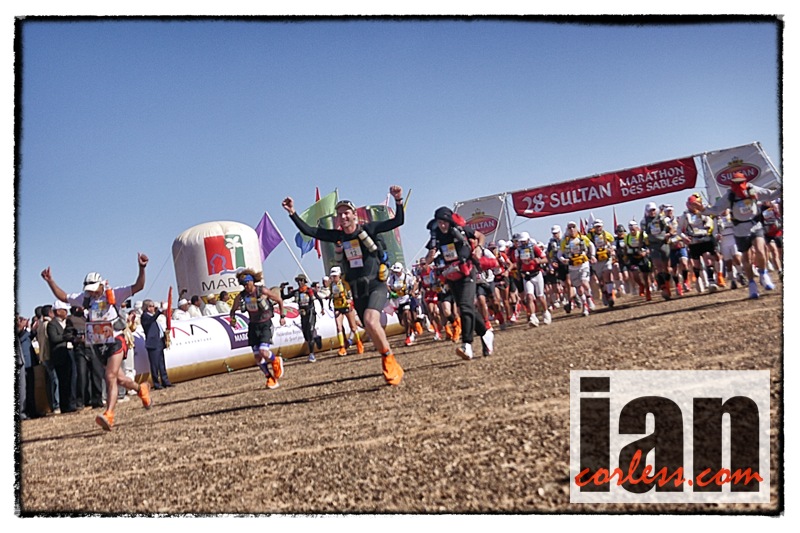
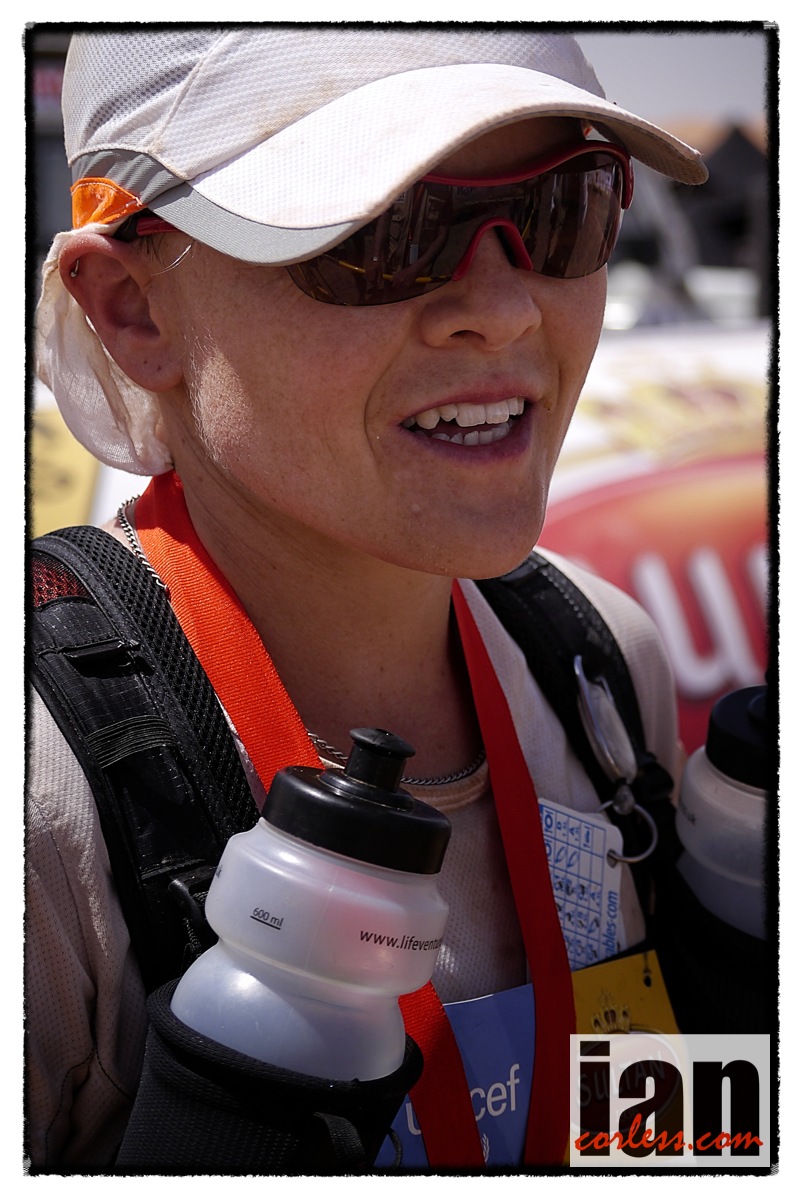
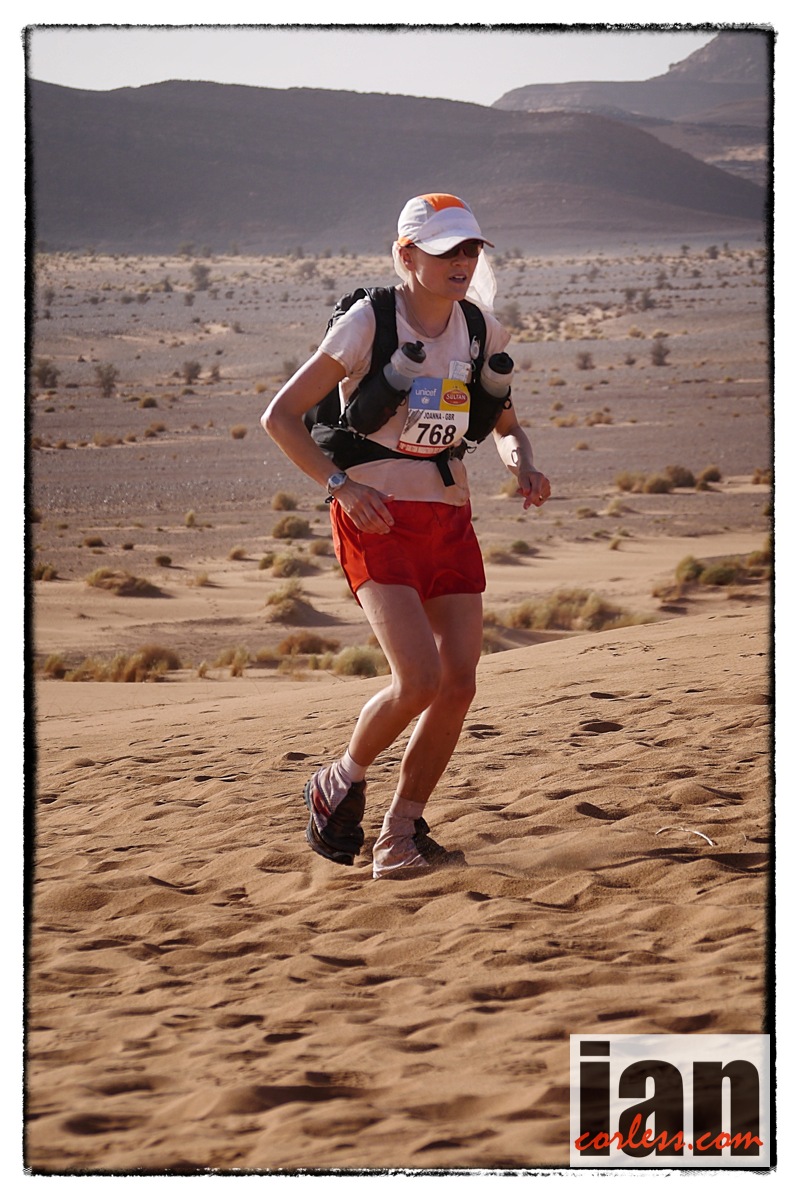
Who would have thought it, the 2013 Marathon des Sables turned out to be a great year for British performances. Danny Kendall placed the highest ever overall placing with 10th and Jo Meek placed 2nd lady overall. It was a stunning performance by a relatively unknown. Armed with a new belief in her ability, Jo will has now planned to switch from the heat of the Sahara and test herself in the heat and humidity of a Costa Rican rainforest at The Coastal Challenge. I caught up with Jo at the end of August and we had a chat about MDS and her expectations for TCC.

IC I bet April and the Marathon des Sable (MDS) seems such a long time ago?

JM Yes, it does seem ages ago. Considering I am walking now in late August in the pouring rain. It’s wet and miserable… it doesn’t seem that long ago in regard to memories. I just watched the video that was available for download and it brought it all back.

IC So sitting at home, watching everyone running in the sand with a tear in your eye?

JM Definitely no tear, I think I am happy not be running in the sand. I am still surprised how I adapted especially considering I am now at home running on the road again.

iancorless.comP1080077

IC Amazing eh that you can be in that environment, the sand, the wind, the bivouac, no washing, you are eating dried food and you adapt and then post race when we got in a luxury hotel, you said, you wished you could go back, you loved it didn’t you! You loved being in that environment. It was preferable to the clean hotel.

JM I did. Yes, I actually think I could be quite a ‘skanky’ person really. I am far happier roughing it than in luxury. I guess it sounds romantic but I like being at one with nature, eating, running and sleeping. Perfect. But I guess the other memory is the one from those clean white cotton sheets; that was quite special.

IC I have to say, the first shower, all that fresh hot water and then all the sand starts to escape from all the nooks and crannies. As you say, no more sleeping bags and a lovely comfy bed, it is quite a pleasure.

iancorless.comP1080472

JM My roll matt was about the size of A4 to keep it light and small, so my hip was pretty sore after a week in the bivouac. I have to say the cushioning of a bed was welcome.

IC The Bristh performed really well at MDS. No disrespect to you but we had no idea who Jo Meek was before MDS. We knew Laurence Klein was outright favorite and we knew Meghan Hicks was back, she had performed well previously but outside of that it was all unknown. On the first day you were up at the front and then continued to perform at the front of the race for the whole race. You had this great battle with Meghan. Laurence had a convincing lead but it all fell apart on the long day when she had to drop with dehydration. This opened it up for you and Meghan. Meghan had a great long day but I remember standing on the finish of the final day, it was the marathon distance, you nailed it. You said the marathon was your distance and you wanted to stamp your authority on it. You placed second overall, many look at MDS as one of those iconic mult- day races, how did you go from a relatively unknown to getting second. What was it in you that enabled you to focus and become so efficient in the sand?

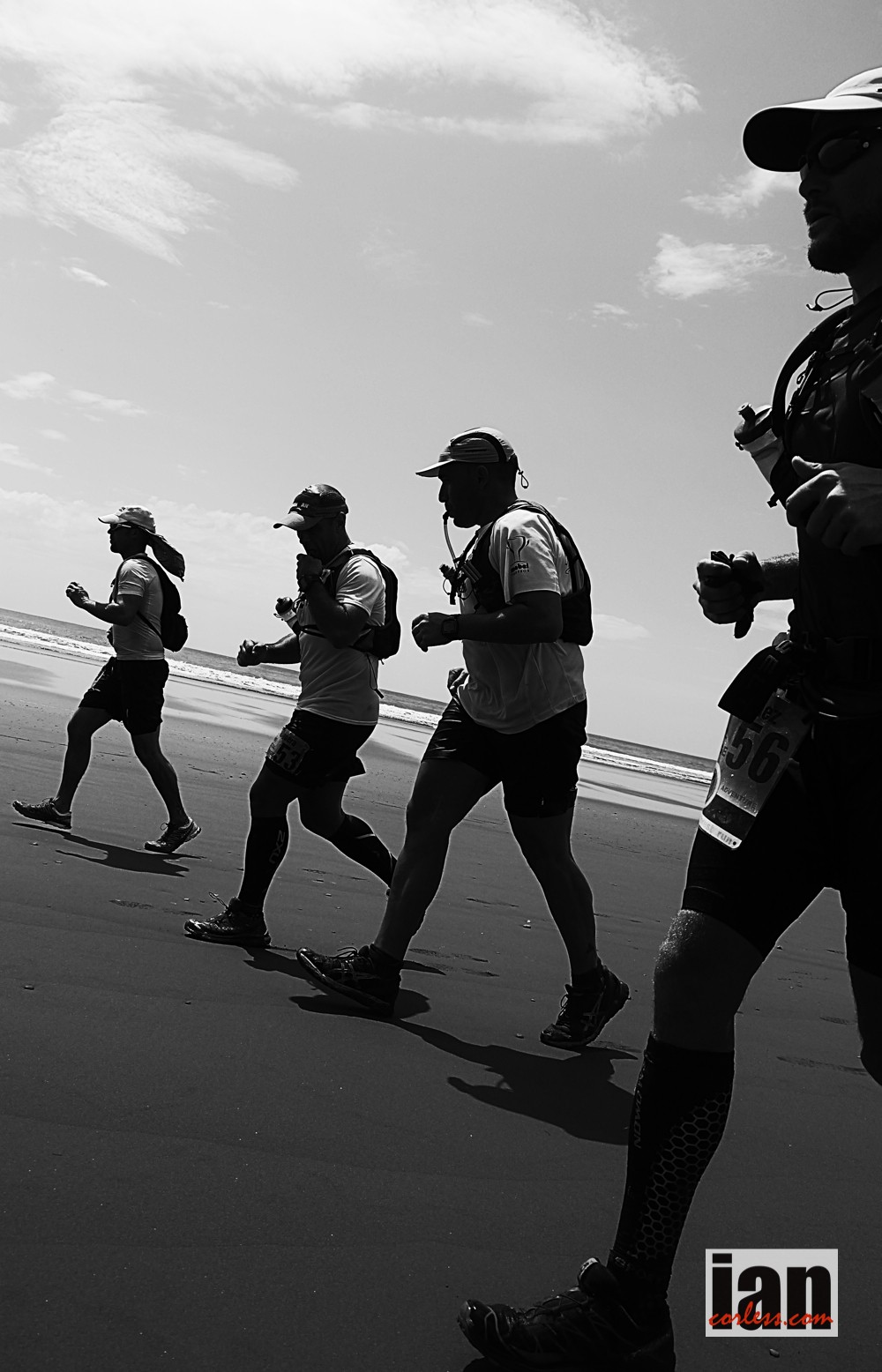
JM A few things really. I am very good at setting a training plan and sticking to it. When I race, I always race. I don’t just enter to complete it. So, looking at the conditions I set myself up in a heat chamber and did training that was specific. I didn’t want heat to be an issue so I acclimatized. What was interesting over the six days was that I became less scared of what the heat could do. On the last day I thought, what have I got to loose. I do think back now and wonder could I have gone harder but it was an unknown. I didn’t know what would happen so I played cautious. Meghan taught me a lot without her realizing it. I followed her on a couple of stages and I watched how she tracked across the sand looking for the hard sand, even if it was out of the way. She would deviate and look for the harder and faster sand. Also her style, it’s a definite technique to sand running. You don’t want to be a toe runner.

iancorless.comP1030672

IC For sure, you need a flat foot.

JM Yes, you also want to shuffle. You don’t want big strides. A little like being in the army again. I learnt lots. I learnt also from training. I had done some awful ultras that were definitely worse than MDS. One race, a 40-mile race across Exmoor and the weather was awful… they said 40 but it was 43-miles I am sure. The last 3-miles were awful.

IC That can be good, a bad training experience. If you have had some tough and hard training and the race works out easier then that has to be a good thing. It’s a real positive.

JM I had no doubt that I wouldn’t finish the race. I had said that I wanted the podium at MDS but I had no idea what I based that on.

IC To put things in perspective you are a 2:46 marathon runner. Ability and speed are there. Many would die for a 2:46 marathon but also you are in the army. Does the combination of those two things make a good MDS runner?

iancorless.com_1090372

JM I think the marathon pace and training was key in terms of the speed. I didn’t have the same endurance as Meghan over the ultra distance. Many of the days were shorter in terms of ultra distance so I knew I had that potential. In terms of tent life and conditions, maybe the army helped but that is me… I like that. The army helped with discipline; eating, drinking and so on… it was feet first, food and then wash. You need to look after yourself.

IC Give us an insight into your background, you are a roadrunner really?

JM Yes, but I do like cross-country. I came second in the Nationals. Essentially I have done road running. I started in my teens to loose weight and then just kept going. I wouldn’t say I have natural talent in terms of speed but I have something that works, particularly over distance.

iancorless.com_1090900

IC How long have you been running?

JM 18 years, maybe 20!

IC So you have a great base of running and plenty of experience?

JM Yes. I always thought that maybe I should do ultra earlier and I thought, no rush! Particularly with how you develop with age and aerobic capacity. It seemed like the correct time for MDS. As you know, you don’t just enter MDS you have to enter years in advance.

IC Post MDS you really wanted to improve your marathon time. You put yourself on that path and recently you run a half marathon but you were disappointed with the performance. Many factors can affect a race, a conclusion you have arrived at is that you are now going to pursue trail and ultra running. So, you are going to another multi stage in early 2014 but this time you are going to a Rainforest. It’s a race that I was at earlier in 2013, The Coastal Challenge in Costa Rica. Also known as the Rainforest Run. What’s the attraction?

Costa Rica

Costa Rica

JM I am always very attracted to a country that is hotter than the UK. That is a no brainer! It’s the challenge, the opportunity to compete in something so different. This race I don’t need to carry all my kit, so, unlike the MDS I will be able to just run but admittedly for repeated days. It will be interesting and it should mean I can go faster.

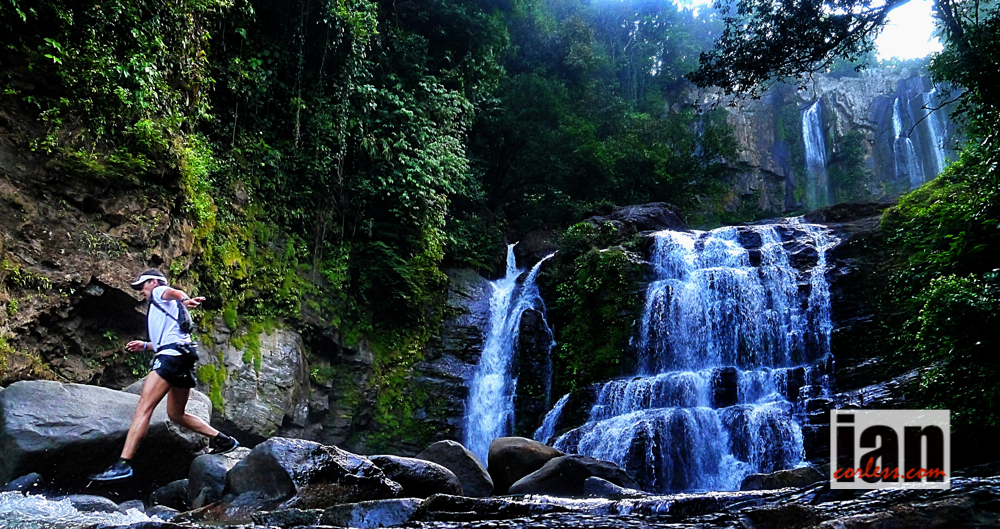
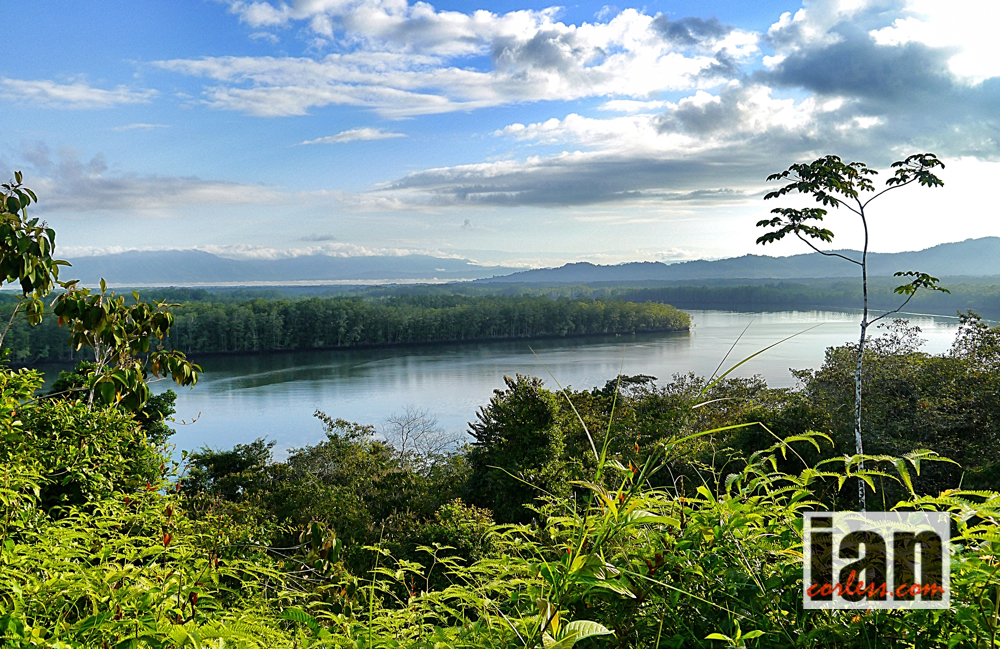
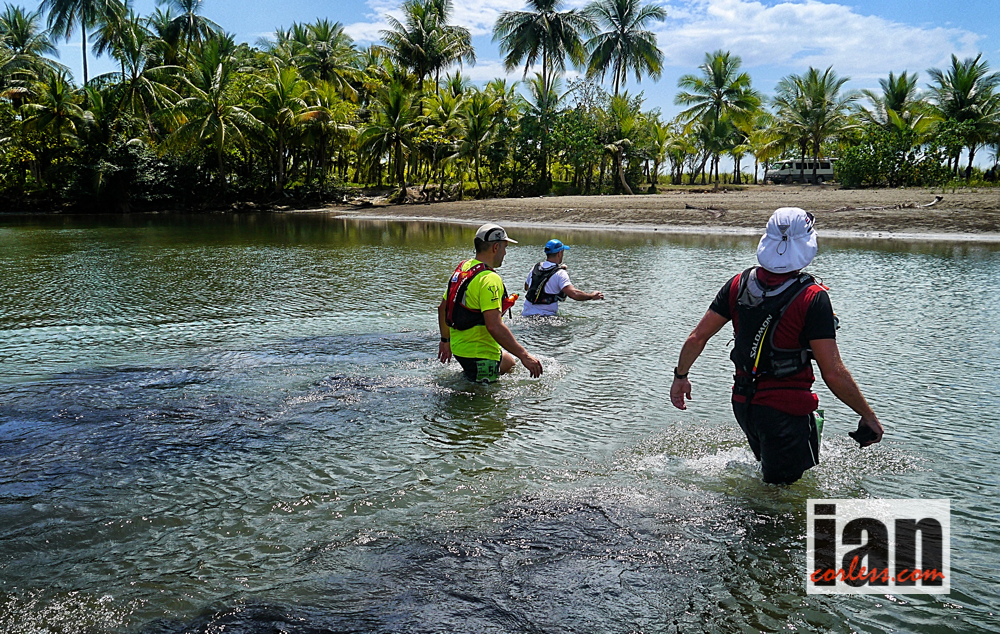
IC The race is very different to MDS. Some things carry over such as the multi day. As you say, you don’t need to carry all your kit but you do need safety kit, food, water and just essentials. But you are correct, all your clothing, tent etc is moved for you and then food is provided. It’s a hot and very humid environment and even when it rains it is not a problem, it is so warm. All the daily campsites are in beautiful idyllic places. It’s such a wonderful environment. It’s a great combination of providing daily challenging runs but with just a touch of comfort. It’s perfect for those who may want an introduction to multi day racing.

Costa Rice, The Coastal Challenge ©iancorless.com

JM In some ways it will feel easier but in an evening you will be able to eat as much as you like and so will the competition, in theory you are all the same come the following day. But at MDS it is about survival and balance. It is more about balancing and economy and how you ration your food and water.

IC The race has so much more elevation than MDS and in particular, the terrain is much more varied. You have single track, double track, rocky sections, forest, dense forest, beautiful beaches and then some tough climbs and descents. The next edition of the TCC celebrates its tenth year so it may have a little more climbing than normal, we shall see? The variety is amazing. If you are lucky, you’ll see wildlife. You hear it but don’t always get to see it.

Costa Rica, The Coastal Challenge ©iancorless.com

JM I’m so excited. I can’t wait. I have some road races to do in the coming months and then I will start my TCC training three months out. I will use a heat chamber again. The heat chamber I used for MDS prep was stuck on 80% humidity so I have an idea of what conditions will feel like and I know what my sweat rate is like.

IC Costa Rica is very humid. It is almost 100% but it is not unpleasant. You really do sweat all the time, particularly when running. You need to be on the ball and balance your hydration.

JM I like it harsh and hard conditions. In some ways, the harder the better.

Costa Rica, The Coastal Challenge ©iancorless.com

IC How do you prepare for a multi day race? In some ways you had to guess for MDS and that worked! So, what do you take away from that experience and what will you do in preparation for TCC. The longest stage is around 50k and not 80k so that will make a difference. As we have said humidity and terrain are the key differences and you won’t need to carry a heavy pack.

JM I will do far hillier off road training. For MDS I had to train with the weight too, however for TCC I will just use essential kit and I will do plenty of back-to-back training at a faster pace. I will try to replicate the race really. In some respects it won’t be too different from my marathon training. The key will be the back-to-back runs..

IC We have so many different ways to look at training. Some runner’s just head out of the door and run on feel. No time set, no distance set. It all goes on feel. Are you like this or do you have a plan that has everything planned out?

JM I work full time so I must have a plan. I don’t have the luxury to say go out and run for three hours when I feel like it. I have commitments. I get up at 05:30 and I do what I can and then I add to this at lunchtime or the evening if required. I make every session count so I fit in threshold running, speed work and so on. I need to be very specific. At weekends I have more time and if I need three days consecutive I take a day off work.

IC Do you do core stability, stretching, strength and core.

JM Oh yes, I am a proper geek when it comes to this. I am a physio too so I have no excuse. I stretch everyday, I do two strength sessions and I do two core sessions per week.

Costa Rica, The Coastal Challenge ©iancorless.com

IC Wow, you are the perfect example for all of us. So often I ask this question and I get a blank answer. We all know we should do it but few of us apply it!

JM I am disciplined and I see the benefits. You have to be disciplined but it still doesn’t stop me getting injuries.

IC Ah well, injury can be caused with so many factors.

JM For me it is usually over doing it or being tired.

IC Yes, distance and speed increase injury risk. Slower and longer has more impact but you don’t overstretch muscles or tendons. Listen to your body and all will be good.

JM I never listen to my own advice… I am lucky, we have a gym at work so it makes strength work easy. If I didn’t have that available it would maybe be harder. I have been strict with this for four to five months and I can feel the difference.

IC TCC is still months away, are you planning on doing any trail races for late season in the build up?

Costa Rica, The Coastal Challenge ©iancorless.com

JM Yes, I love to race. I will enter races, from experience, if I enter races too far in advance I get injured, so I have entered a couple of marathons on the road for training and speed. In December and January I will look for options. Of course, options are reduced and conditions will be a little different to Costa Rica.

IC Late and early season events do crop up specifically designed to help people get ready for MDS so you will have some choice. Final question, many may be reading this and they are going to MDS or they may be tempted by TCC. What advice would you give to these people?

JM It very much depends on what you want to get out of it? I shared a tent at MDS with people who wanted to just complete, they wanted to enjoy the race and that is what they did. Set an objective and train accordingly. Ultimately it is all about fun and enjoyment.

IC If you had to give three tips. Three lessons you learnt at MDS that you would take to any race.

JM Good question. I learnt specifics like running in the sand but I guess the need to watch and keep on top of nutrition. Start eating early and don’t wait. Also, keep any eye on hydration and drink to thirst and then finally enjoyment is key! You must enjoy it.

IC I am sure you’re going to really enjoy TCC and Costa Rica. Many thanks for the time and insight into your progression and have fun in the Rainforest.

JM Thanks, as you say, really looking forward to it. It will be a real adventure.

 Links and information:

  • Marathon Des Sables images available HERE
  • The Coastal Challenge images HERE
  • Entry for the Marathon des Sables is available through the UK agent HERE
  • The Coastal Challenge website HERE
WANT TO RUN THE 2014 COASTAL CHALLENGE?

5% discount available using the form below for followers of iancorless.com

← Back

Thank you for your response. ✨

*Please note I will be at the 2014 TCC reporting on the race and capturing images at the invite of the race organisation.

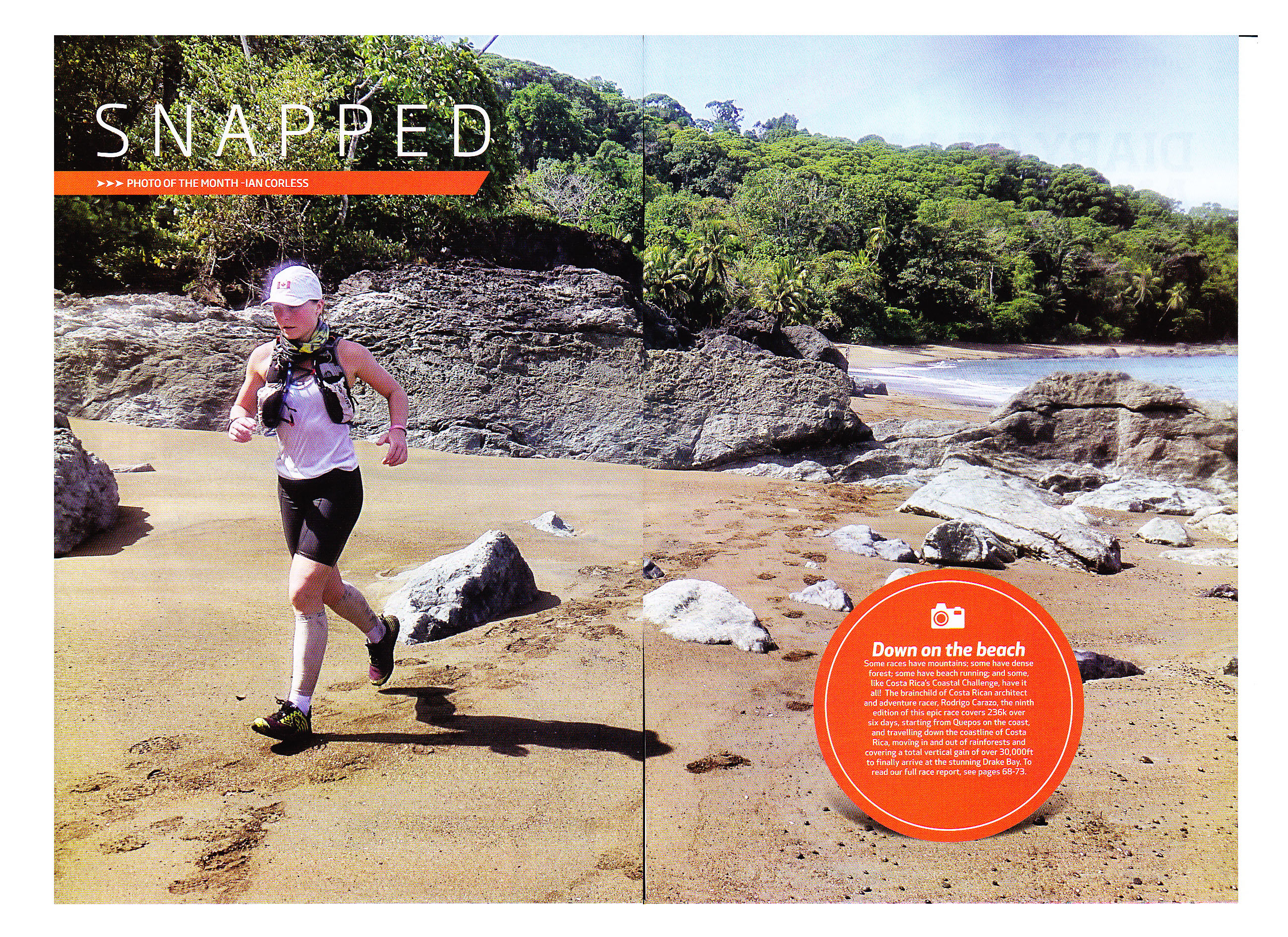
SNAPPED – Running Fitness June 2013

One of my images from the 2013 ‘The Coastal Challenge’

“Some races have mountains; some have dense forest; some have beach running; and some, like Costa Rica’s Coastal Challenge, have it all!”

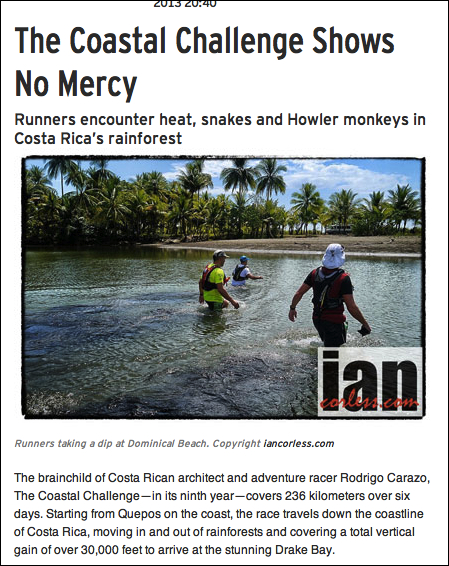
The brainchild of Costa Rican architect and adventure racer, Rodrigo Carazo, the ninth edition of this epic race covered 236k over six days. Starting in Quepos on the coast, and travelling down the coastline of Costa Rica, moving in and out of rain forests and covering a total vertical gain of over 30,000 ft to finally arrive at the stunning Drake Bay.

Entries for 2014 are now available at: www.thecoastalchallenge.co.uk

Running Fitness, June 2013

Running Fitness, June 2013

The Causeway Crossing Preview

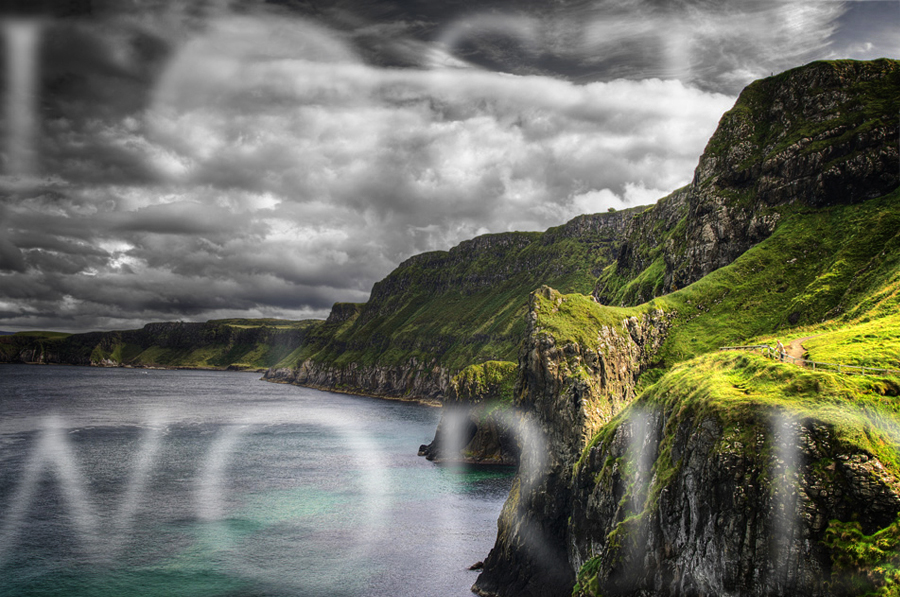
Ireland Graphic 23The Lost Worlds Causeway Crossing – three unique events along the Giants Causweay Coastline and the Moyle Way. A unique landscape – the Giants Causeway Coastline and the Moyle Way. Individuals can take part in a 25k, 50k or 100k event.

Taking place on Saturday 4 May 2013 the main event of the weekend, The Lost Worlds 100k will see a top quality line up. Most notable is the late inclusion of US based runner Dave James.

Dave has a very strong reputation on the US ultra scene. He is a USATF national champion and has run some incredible times over the 100 mile distance, his PR is 13:06:52.. He has already had an an impressive 2013. He secured another win at the multi stage,  The Coastal Challenge in Costa Rica and then just one week later raced at Fuego Y Agua to get second place behind Nick Clark. Dave loves to run and is currently in Europe in preparation to take part in the 2013 Skyrunning calendar. It is not his first time in Ireland, he represented Team USA (2011) IAU World Trail Championship. He is racing The Lost Worlds Tuscany event and just 7 days later  the Causeway Crossing. he will head to La Palma for Transvulcania, just two weeks later he will race at Zegama and then the big one! Rond del Cims in Andorra. A super tough 100 miler that has a profile that looks like JAWS dental records. Without doubt Dave will be competitive in Ireland but he has a busy diary… he is going to need to keep some powder dry.

DSC_6820

Courtesy of Ryan at Ni Running, here is an update on the local talent:

Jonny Steede (Balllymena Runners):  Jonny is a VERY strong contender in my opinion.  He has represented Northern Ireland in Mountain Running previously, then gained a lot of speed by moving to the roads (as well as still competing over the mountains).  He has really found his niche on the trails, his strength and speed will suit this course.  Jonny recently won the prestigious Wickow Way Ultra (51k) in March 2013, and is definately a future star in the Ultra world!  He really hammered a few big names in Wicklow!  This will be his first attempt at 100k, but he has put in the training for it… much of which is with well-known Irish Ultra runner Martin Rea (North Belfast Harriers) and my brother, Justin Maxwell (Larne AC), who is taking part in the Sky Running World Series this year (starting in Transvulcania).

Geoff Smyth (Unattached): Geoff was the winner of last years 100k, running 10:04:22.  He knows the course well and has also won the Causeway Coast Ultra (39miles), which covers the coastal section of the Lost Worlds course in 2011.  He won the Dervock marathon in 2:56:29 last year, this was a tough rural road marathon.  He has a road marathon PB of around 2:48, so he isn’t an ‘elite speedster’ as such, but a real ‘battler’… he will run steady and prove hard to break.  There was word that he may have picked up a niggle, but I cant confirm this!

Ivan Sadlier (Unattached):  Ivan is an experienced Ultra runner and was 3rd in 100k here last year.  In truth, he’ll only be a contender should there be drop outs or lack of depth in the field.  Mentally and physically, he’s a tough man… but it’s his speed over the distance that will be a disadvantage.  His times for some well known Ultra’s are SDW100 (100m) – 22:56:04 and Highland Fling (53m) – 10:43:00


Hanna Shields (City of Derry AC): Hannah is somewhat of a local hero to some, having conquered Everest.  She is an experienced Ultra runner knows the course well. She was 3rd in the Causeway Coast Ultra (39 miles) and 3rd in the Mourne Way Ultra (52 miles) in 2012.  She has also placed well this year, preparing for this event with a 2nd place finish at the Wicklow Way Ultra (51k) and a 3rd place finish at the Connemara Ultra (39.3m) a few weeks ago.

Of course a 50km event is also taking place, favourites are:

Jolene Mellon (Setanta Triathlon Club):  Jolene is from Ireland (Southern Ireland) and a strong contender for a podium place in the ladies 50k.  She originates from a Sportiff cycling backround but moved into Triathlons for a bigger challenge.  She went on to complete and Ironman/women event.  She is a strong runner and won the Mourne Way Ultra (52miles in 9:45:58) in 2012.  She completed the tough Cooley Legends HM last weekend as preparation for this race last weekend, she finished in 3rd place.  She won the Cooley Legends HM in 2012.  The reason I pick out this HM is because a lot of the terrain is similar to what the Causeway Crossing course will be like.

David Gamble (Seapark AC):  David has good experience in Ultra running, he is strong and a consistent top ten finisher in Ultra distance events in NI and Ireland.  He has completed the Mourne Way Ultra (52miles in 10:30:18) and the Causeway Coast Marathon on several occasions, with the terrain of the Mourne Way event and the knowledge gained during his participation in the Causeway Coast Marathon I think he could go well in the Lost Worlds event.  He has been off the radar ‘racing wise’ recently, probably getting himself into good shape for this.

A word from Tim Holmstrom

Tim Holmstrom from Lost Worlds Racing is very excited about the Irish leg of his series “We have Team Red White and Blue participating in a 4 person team relay of 100k. More info on this amazing organization here: http://teamrwb.org. Also, most exciting for me is that this series will be culminating next ummer in Greece at  Lost Worlds Meteora : 100M/50M mountain ultra. Participants will experience Meteora and an amazing part of Greece.”

When asked about The Lost World series, Tim says, “It is about World Heritage and a deliberate effort to create a singularly unique experience for our participants based on many facets. It is a chance to have meaningful cross cultural exchange in a race setting with an international field. Lost Worlds Racing also provides a window for participants into amazing cultural and historically significant places of natural beauty, as well as remarkable trails and terrain when considering our race venues. These are more than races. My hope is that they feel like a step back in time into locations that should be on everyone’s bucket list as an important part of their own earthly experience and collective heritage as humans.”

Other notable locations of the Lost Worlds Series are:- Ometepe, Nicaragua; Tuscany, Italy; Belize Crossing, Belize; Dominica Crossing, Caribbean.

The Route/ Race

All Lost Worlds Causeway Crossing events will be fully waymarked and will follow the paths, tracks, beaches and coastline of the Moyle Way and Causeway Coast Way – probably one of the most spectacular coastlines in the whole world. The entire route of the 50k and 25k events pass through magnificent coastline scenery with fine views of wide bays, sandy beaches, dramatic cliffs and offshore rocks, all of which characterise the GiantsCauseway Causeway Coast, making its beauty and uniqueness world famous. All events will run through the world famous Giants Causeway with the 100k event passing past this famous landmark twice.The 100k route also follows the route of the Moyle Way, along tracks and trails where few feet ever venture and along majestic streams and pathways which will test the fittest participant over the first 50k.

There will be a high level of support and feed stations en route. Participants in all events will use a timing system for this event and split times and finish times will be available for all participants after crossing the finish line of the event.

Links and info

I will be at the event producing race coverage and photography. Please check Facebook, Twitter and of course this website.

image

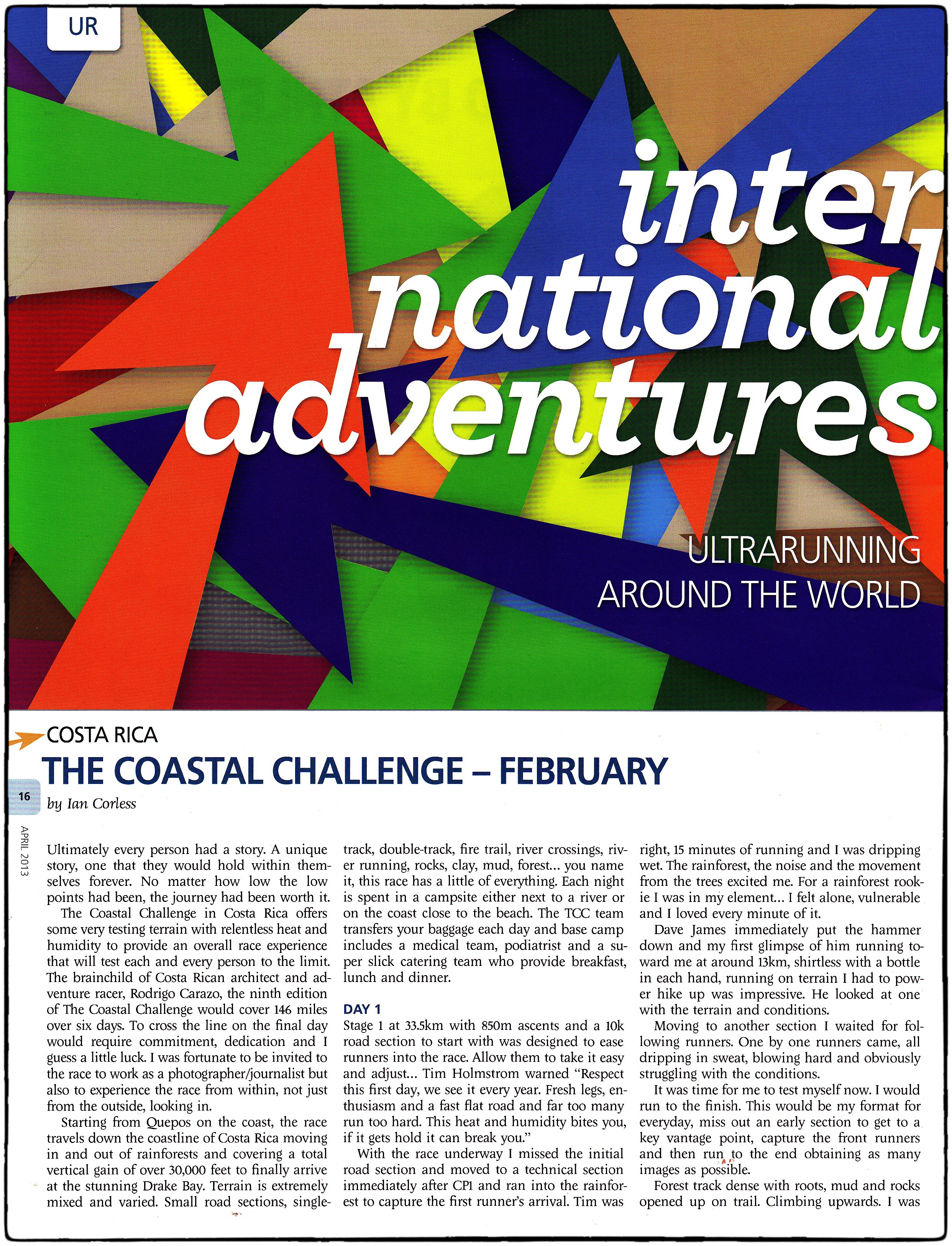
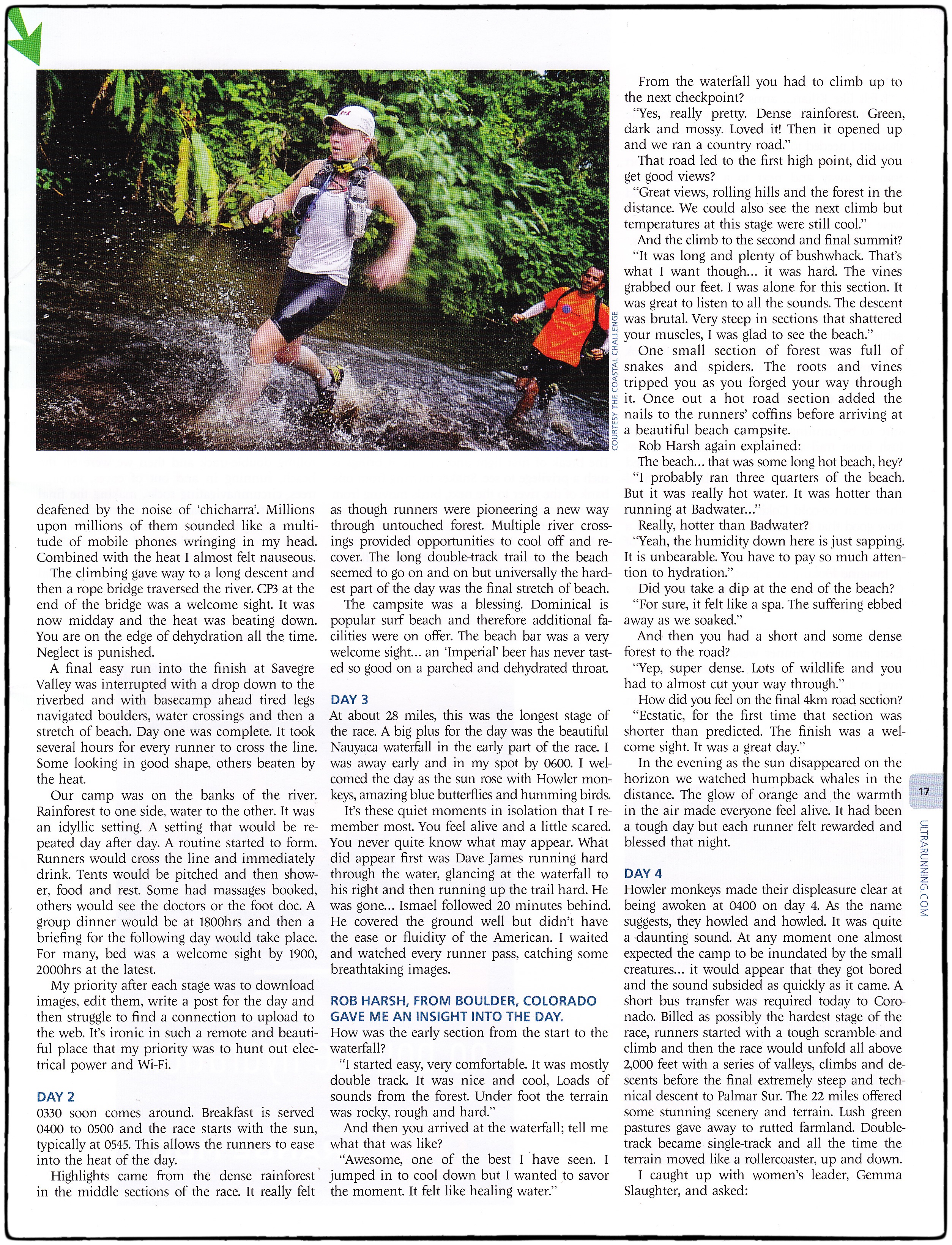
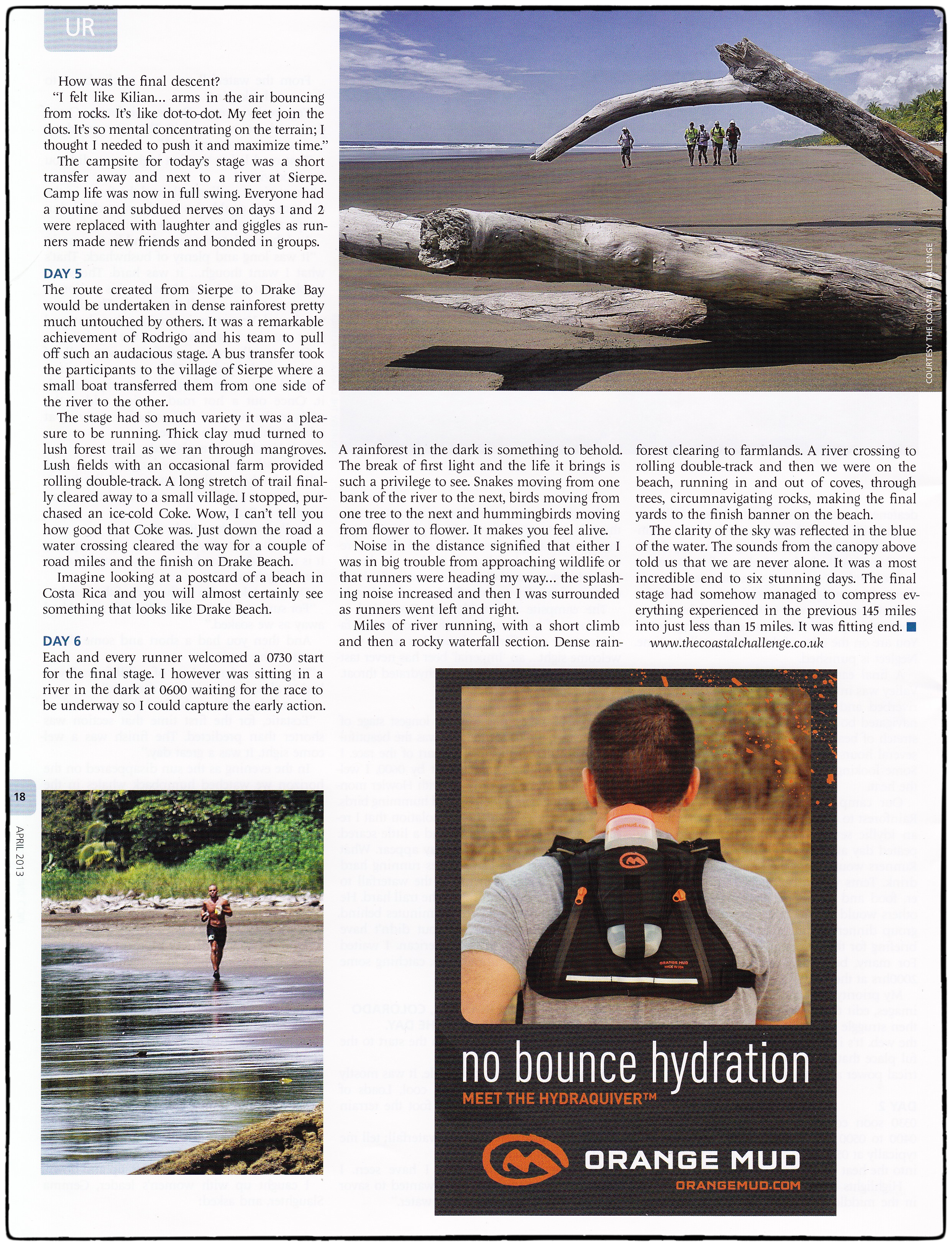
ULTRA Running Magazine Apr 2013

More coverage for the incredibly beautiful and challenging The Coastal Challenge in Costa Rica.

Entries now available for 2014 at:

  • HERE for UK entrants
  • HERE for outside UK

Ultra Running

Page 1

Page 2

Page 3

It is possible to purchase images from The Coastal Challenge for ‘personal use only’ from:

iancorless.photoshelter.com link HERE

The Coastal Challenge – in Spanish

TrailChile

The Coastal Challenge por Ian Corless

by matiasfbr on March 21, 2013

Ian Corless, presentador y creador de Talk Ultra comparte con nosotros su experiencia reporteando y corriendo en The Coastal Challenge. 236 Kilometros en una carrera por etapas que dura 6 días. Pero mejor no les cuento más. Lee el reportaje completo de Ian y sorprendete con las imágenes que ha tomado. Definitivamente una de las carreras para tener en la lista de carreras por correr. Reclina tu asiento y prepárate para un viaje a través de playas, selva, serpientes y monos con éste ultra reportaje.

Ian Corless es presentador de Talk Ultra, escribe para Running FitnessGOTRAILUltrarunning,Mud Sweat and TearsRun 24 7. Además trabaja con la Federación Internacional de Skyrunning y con la revista Trail Magazin. Si quieres conocer más sobre Ian, revisa su blog en https://iancorless.org/

The Coastal Challenge, Costa Rica 2013-03-20

Texto Original y fotografías: Ian Corless
Traducción: Diego Bonifacino
Revisión: Matías Bull

En última instancia, cada persona tenía una historia, un recuento singular que se celebraría dentro de sí mismos por siempre. A pesar de todos los bajos momentos de cada uno, el viaje valió la pena. Si fuera fácil, todo el mundo lo haría… The Coastal Challenge en Costa Rica ofrece un terreno desafiante en un calor implacable, con una humedad pegajoza que provee una experiencia que empuja a cada uno de los participantes hasta el límite. Esta novena edición, creada por el arquitecto y aventurero costarricense Rodrigo Carazo, cubrió 236 kilómetros a lo largo de seis días. Cruzar la línea de llegada requeriría compromiso, dedicación y, diría, hasta un poco de suerte. Tuve la suerte de ser invitado a la carrera para trabajar como fotógrafo y periódista, no sólo desde afuera, sino que participando de ella, desde dentro.

Para leer el resto del artículo, por favor vaya AQUÍ

To read the rest of the article, please go HERE

The Coastal Challenge – RUN247

Race report: Talk Ultra’s Ian Corless recently travelled to Costa Rica to cover the The Coastal Challenge 2013, a six day stage race

All things must come to an end…. the atmosphere around camp was a little subdued. Some participants looked relieved that they didn’t have to squeeze a pair of shoes onto blistered feet. Others seemed sad that another day on awesome Costa Rican trails didn’t await.

Some required quiet time away from the camp to walk Drake Beach as the sun welcomed a new day. Others huddled in groups telling stories of water crossings, quad busting descents and dehydration.

Ultimately every person had a story. Unique stories, personal to each participant, stories that they would hold within themselves forever. No matter how low the low points, the day after never seems so bad. If it was easy, everyone would do it. The Coastal Challenge offers some very testing terrain with relentless heat and humidity to provide an overall race experience that will test each and every person. To cross the line on the final day requires commitment, dedication and some luck.

The Coastal Challenge 2013

Photos © Ian Corless

The logistics of mobilising a camp and moving it everyday in tough terrain is nothing short of remarkable. The course marking and dedication from the TCC crew was available for all to see. This is no easy race to run, but it is certainly no easy race to coordinate. The catering team showed a dedication not often seen, rising at 0200 to have breakfast ready for 0400, break down camp, move to the next location, set up and then cook lunch ready for the runners arrival. Clear lunch and then prepare dinner all for the process to be repeated again. Respect!

Marking the course was done before the race and then every stage had TCC crew heading out in front of the race to ensure that nobody would get lost. While the race was underway, the camp crew would mobilise moving luggage, tents and all other elements of base camp and then set up again. All this in searing heat – it was tough work.

Base camp had a full medical team and feet specialists to ensure that everyone would be in the best shape possible to start the next day. It’s a really important aspect of multi stage racing and without it, many would not see the finish.

Stage races are not meant to be easy! Was the The Coastal Challenge too hard? No, of course not. Was it hard? Yes, without doubt.

The Coastal Challenge 2013

Photos © Ian Corless

Several runners at TCC had participated in Marathon des Sables several times, on questioning they all said that The Coastal Challenge was a much harder race. The combination of heat, humidity, climbing and tough technical terrain was a much greater test of mind and body.

A key aspect of this race is camp life. An opportunity to relax in beautiful locations, make new friends and sleep under the stars. Strangers by the end of day 1 became best friends by day 2. The comradeship, the willingness to sacrifice time to help another is a great thing to see. One persons’ suffering was taken on by others and the burden shared.

With the race over these friendships will continue and no doubt be renewed at other races in the future.

The excitement and beauty of 236km’s, with over 30,000ft of climbing in South American rainforest over six days was a joy to behold and conquer. The journey came to an end by boat. We left Drake Beach speeding through the ocean to our bus that would eventually return everyone to San Jose and a comfortable bed.

It was time to switch off, let the experience soak in and remember what had been achieved.

Congratulations to Dave James and Gemma Slaughter for the respective wins in the Expedition category.

Ultimately though, the credit goes to every participant who battled and endured the TCC Expedition or Adventure category. Tam Miller from Vancouver Canada summed it up for me when she said: “I feel whole and complete and I have no unfinished business”

Pura Vida!

The Coastal Challenge 2013

Photos © Ian Corless

You can read day to day blog posts here: Day 1 | Day 2 | Day 3 | Day 4 | Day 5 | Day 6

And you can view images from each day here: Day 1 | Day 2 | Day 3 | Day 4 | Day 5 | Day 6

Click here to check out the event website

Men’s results

1 David James 26:54
2 I. Dris 29:17
3 Jose Lopez 32:59


Women’s results

1 Gemma Slaughter 39:42
2 Angela Meyer 41:32
3 Irene Hale 41:38

Fuego Y Agua 2013

Ometepe

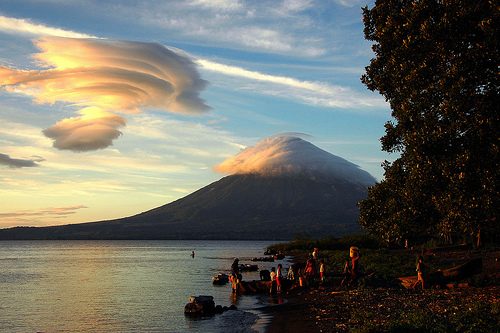
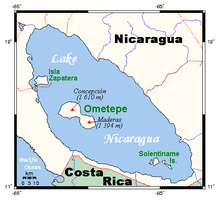
The fourth running of Ultramaratón Fuego Y Agua, features 3 races: 100 km, 50 km, and 25 km trail races. Taking place on February 16, 2013, the race this year has a very strong contingent from the US taking part. Held on Ometepe, an island known for its astonishing biodiversity with prehistoric rock carvings and a vibrant local culture. It rises out of Lake Nicaragua. It has twin volcanoes, one of which is still active. The lake is the largest in Central America and situated in the SE of Nicaragua. Ometepe is the world’s largest volcanic island in a fresh water lake, It was made a UNESCO biosphere preserve in 2010 to promote sustainable development of agriculture and ecotourism.

220px-Ometepemap

An Ultra Trail du Mont-Banc qualifier for three points.The Fuego Y Agua 100K trail race course is a rugged single-loop course. The terrain includes technical single track trail, paved road,dirt trail, technical single track trail, and the infamous “jungle gym” section where racers will navigate a chaotic web of Ometepe trees. The course includes the Volcan Maderas and Concepcion climbs and has11 Aid Stations spread throughout the course.

  • Start Date/Time: Saturday February 16, 2013, 4:00 a.m.
  • Start/Finish Location: Main Street, Moyogalpa
  • Cutoff Time: 24 hours/4:00 a.m. the next day.
  • Aid Stations: Start (Moyogalpa), San Jose Del Sur, Ojo de Agua (outbound), El Porvenir, Volcan Maderas, Monkey’s Island Merida, Ojo de Agua (inbound), Altagracia, La Flor, Volcan Concepcion, El Galillo, Finish (Moyogalpa)

*Finish in under 11 hours and receive a refund on your entry fee!

THE 2013 RACE

Dave James just one week ago dominated the 6 stage Coastal Challenge in Costa Rica. Not only did he perform at the top level everyday but racing in a rainforest in high heat and humidity will mean that he is adapted and well adjusted for the conditions in Nicaragua. He is an odds on favourite for the win providing the 236km have not fatigued him too much.

iancorless.comP1060084


The front of the race will also have the presence of Brit (based in the US) Nick Clark. Nick will be gunning for the win with Dave James but he is coming from cold temperature is the US with little time to adapt. Also, this is the first big race of the year and Nick has a very busy year ahead as he plans to Grand Slam.

iancorless.orgIancorless_transvulcania_037


Ian Sharman is also in Nicaragua but it would appear that a knee injury has raised its head and he may well not start the race. I had an email from him last night and I am just waiting confirmation on this. Of course, should Ian be fit he has the speed to be up at the front pushing the pace. However, it is still early in the year. He extended his 2012 season to the New Year and by his own admission he should have ‘stopped’ when he had planned to stop. He has run a marathon recently so watch this space.

Ian Sharman in La Palma copyright Ian Corless

Ian Sharman in La Palma copyright Ian Corless

Yassine Diboun from Oregon, Sean Meissner and the Coury brothers,  Nick and Jamil add spice at the front end of the field. I met Nick and Jamil in Costa Rica as they passed through on the way to Nicaragua. Great to hear that Nick has now been placed first option for the 24hr World Championships. Nick will be in the mix at ‘Fuego’ with that ‘leg speed’ but rumour has it Jamil will drop to the 50k distance.

What I am unsure of is what local competition will turn up and push things at the front end of the race. South America has a real talent pool of runners and one can’t underestimate the ‘severe’ conditions that this race will take place in. The heat and humidity takes some getting used to.

The course record is 11:08 held by Javier Montero set in 2009. Female record is held by Amy Sproston, 13:12 set tin 2008.

Ultrasignup link HERE

2012 results for reference HERE

The mission of Ultra Fuego y Agua is to bring responsible ecotourism to Isla de Ometepe in the form of challenging and exciting jungle races.

Our purpose for the race is to bring an event that gives back to the island without taking anything more than beautiful memories and experiences.

The word ecotourism is a form of tourism that appeals to ecologically and socially conscious individuals. Generally speaking, ecotourism focuses on volunteering, personal growth, and learning new ways to live on the planet; typically involving travel to destinations where flora, fauna, and cultural heritage are the primary attractions.

By using local guides, local food preparation, locally owned hotels and businesses, to name just a few, Ultramaraton Fuego y Agua hopes to boost the local economy and promote sustainable events on the island. For example, finisher’s trophies are locally crafted and produced by island artisans.

Runner’s and volunteers are encouraged to participate in the annual Isla Limpia trash pickup. This organized effort promotes local awareness of the island as a natural resource that must be preserved and maintained.

Portions of race entry costs and donations are used to host the Calzado Ometepe Kids Run, a children’s race for local islanders. The children’s race promotes running, fitness, healthy eating and awareness of the island as an endangered environment that must be cared for. All participants of Calzado Kids Run receive a pair of running shoes donated by supporters and participants of Ultra Fuego y Agua.

About Isla de Ometepe

Isla de Ometepe is a volcanic island (approx. 276 km sq) located on Lake Nicaragua (also known as Lago Cocibolca) in the southwestern region of Nicaragua. Two volcanoes form most of the island. Volcan Concepcion (1610 meters) is considered an active volcano but has not had a major eruption since 1957. Concepcion is thought to be the most perfectly formed volcano cone in Central America. Volcan Maderas (1394 meters) has a crater lagoon and is surrounded by cloud forest and thick jungle. Its slopes are dotted with petroglyphs and stone idols.The forests of Ometepe are full of monkeys, tropical birds, rare insects, plants and flowers. Both volcanoes are now protected as national forests. The island is full of legends surrounding the volcanoes and its former inhabitants, the Nahuatl. Ometepe literally means “two hills” in the native Nahuatl language. The fertile volcanic soil makes Ometepe an agricultural phenomenon. Coffee, cacao, beans, rice, tobacco, bananas and many other fruits are plentiful on the island.

There are two major towns on Ometepe, Moyogalpa (pop. 2900) and Altagracia (pop. 4080). The total population of the island is only about 30,000 with an economy mainly based on livestock, agriculture and tourism. See our activities section for more information on Isla de Ometepe activities.

The Story of Ometepe

As the story goes, long ago there was no Lake Nicaragua or Isla de Ometepe, only a lush valley of the gods named Valle de Coapolca. Several tribes who were hostile to each other lived around the valley and would visit it often to gather fruit and hunt game. One day, a young warrior named Nagrando met and fell in love with Ometepetl, a beautiful maiden from an enemy tribe. They tried to keep their romance a secret, but eventually Ometepetl’s father learned of the affair and vowed to kill Nagrando. The young lovers fled and hid in the forest, where they decided that the only way they could be together was by committing suicide. The pair slit their wrists and died in each other’s arms. As Ometepetl fell backwards, the sky darkened and rains flooded the valley, forming Lake Nicaragua. Ometepetl’s breasts then grew into the twin peaks of Volcan Concepcion and Volcan Maderas, and Nagrando’s body became the nearby Isla Zapatera.


Bungle in the Jungle – A guide

iancorless.comP1050500

No matter how experienced, no matter how long you have been running, you can always learn something…. My recent trip to Costa Rica and The Coastal Challenge which took place in a rainforest made me realize that I knew very little about running in heat with high humidity, running in a rain forest and also running on consecutive days in this environment.

iancorless.comP1070278

I am quite meticulous in my planning. I like to tick boxes, cross ‘to do’s’ off a list and feel content that when I am at an airport travelling to a race that I feel that I have done everything I possibly can to get the best out of myself and the race when I arrive at my destination.

iancorless.comP1070287

Costa Rica was nothing like this….

I only found out I was going about four weeks before, so, that 12-20 week training plan that I would have created to then taper into an event didn’t exist. I was realistically just a week or two weeks away from the taper. When you add to this that since January 2012 I hadn’t been training due to knee issues. Of course I had been ‘working out’ but I hadn’t been training. Nothing specific. Training had consisted of runs every other day with the longest being at 2hrs 15m, other days had been cross training, plenty of time on the stairmaster and stretching and core.

My brief was not to race at The Coastal Challenge. This was a good thing, however, I was working as a journalist and my need to document, photograph and experience the course would mean getting involved.

screenshot_163

My plan was simple. Start the day on the course at a great advantage point, photograph the front runners and then run to the end capturing more images, experience the terrain and then write up and download photos at the end of the day. Simple!

In addition to running we would be staying in a different campsite each day. Luggage and tents would be transferred ahead and food was provided.

iancorless.comP1050310

So what did I learn?

Pacing & Hydration: Costa Rica is hot and humid. Oh yes, hot and humid. Coming from a UK winter the shock is pretty drastic. But I found it manageable. You certainly need to adjust many things and you need to make those adjustments on day one. In simple terms you need to ‘slow down’ and ‘hydrate’ more. Within 10-15 minutes of exercise your body is soaked and your clothing is completely wet.

iancorless.comP1060672

It stays that way all day so get used to it. Sweat rates vary but in the excessive humidity and adding exercise to this it is fair to assume that 750ml + will be required per hour. Replacing electrolytes will also be important so look into what works for you. Runners used a combination of ‘adding’ electrolyte to water or taking salt tabs. Day one of our race started with a 10k road section, in retrospect this was designed to ease the runners into the terrain and heat/humidity, however, I think it actually allowed to many fresh runners to run too quick right from the gun.

iancorless.comP1050728

By the time they reached CP1 and the start of the jungle many were already in trouble… they didn’t know it at that point but they certainly knew it in the final 25% of the day. By pushing too hard at the beginning of the day they couldn’t then pull back the deficits in the latter stages  and suffered. By the end of day one, the race had several drops and a far too large group suffering from dehydration.

Feet: Oh boy. Multi stage races are renowned for damaging feet but really this shouldn’t happen. If you look after your feet, have the correct socks and the correct shoes it should all be straightforward. Of course unexpected things can happen such as a little rubbing and the odd blister BUT at TCC I saw people with literally no skin left on bruised and damaged feet. I am actually amazed that some of these runners managed to finish the race. The rainforest will guarantee several things:

  • Your feet will be hot
  • Your feet will be wet regularly
  • Your feet will be twisted and turned
  • Over the six days you will run/walk over 200k

iancorless.comP1060512

With the above in mind you need to plan accordingly. This race is not self sufficient so this is a big advantage. Why? Well for a start you can bring several run shoes. I took the two ‘styles’ of shoe, Salomon Speedcross 3 and TNF Hayasa,

photo 3

I had two pairs of each. One my correct size and the other pair a ½ size larger (just in case). A larger shoe will allow some room should my feet expand. The two styles of shoe also allowed me options in regard to ‘grip’. The Speedcross is far more aggressive than the Hayasa. Certainly something with an aggressive tread suited the environment.

photo 2

Socks, like shoes are personal but I am a firm believer in Injinji socks. Each toe is in its own ‘little pocket’. This for me reduces the possibility of problems or issues and over the 6 days of the race I never got one blister! The race had a foot doctor. Without him some runners would have been out of the race. If you have this option, take advantage.

iancorless.comP1080841

In training understand what you will be doing at your race. Practice walking, running, climbing, descending and run with wet feet. Find out what does and doesn’t work. Get the mistakes out of the way before you start the race.

I did not tape my feet prior to running and I added no Vaseline. After each day the first thing I did was to remove socks and shoes, clean them and the wear flip flops to allow them to breath.

*note – many of the runners who had problems had worn shoes too big. They had expected feet to expand but on day one and day two, the ‘larger’ shoes had allowed the foot to move within the shoe and consequently the foot had blistered. I am a firm believer that the shoe should ‘fit’. Excessive movement is a recipe for disaster.

iancorless.comP1060516

Clothing:  Six days racing means six sets of kit. As far as I was concerned. It’s a simple strategy. You run in one set, get showered and cleaned up, put another set on to relax post run and then you use that kit the next day. I was fortunate that The North Face did provide me with some clothing but not six days worth.

Stage 6 TCC_Snapseed

I added my existing TNF stock to the pile. Clothing is personal but the key elements for the jungle are comfort and the ability to wick sweat. I wore T-shirts instead of vests to cover my shoulders (always vulnerable) and I wore loose baggy shorts. It’s not rocket science but shirts with a mesh back certainly help with breathability, especially if using a pack. Race winner, Dave James wore no top! I don’t recommend this… it works for him but his skin looked well adjusted to the sun and I am sure he applied protection too.

iancorless.comP1080627

Dave also wasn’t using a pack, he used hand bottles only. Ladies have a multitude of kit options available to them, ‘looks’ can be far more important to some than functionality. However, simple functionality works best (in my opinion). Some ladies wore ‘strappy’ tops that offered minimal coverage on the shoulders and after 5+ hours on the trails the inevitable would happen… very unusual tan lines and some sunburn.


TNF Mica 1 Tent

TNF Mica 1 Tent

Equipment: This race was supported with feed stations. We had no ‘essential’ kit needs other than carrying adequate liquid supplies. Dave James was the only person in the race who used just hand bottles. Everyone else used a pack of some description. In my opinion, some used packs that were way too big and heavy. I am not sure what some people were carrying but the heat, humidity and long days on the trail should mean ‘minimal’ is a priority. Bladders or bottles? I have to say I am a bottle fan. Bladders are just too awkward.

northface-enduro13-2012-med

I used the TNF Enduro 13 pack with two bottles that sit on the waist. In the pack I was carrying two cameras inside and one camera which I added to the waist belt. However, this pack can also take a bladder too. So, if required I could have carried 3 liters. Had I been ‘racing’ I most certainly would have done this on the two long stages as feed stations were wider apart. Always best to stick to just water in a bladder to avoid problems with taste and bacteria. In regard to ‘essential’ kit I had a whistle, first aid kit, some food, purification tablets, phone, cash, small pocketknife and additional sun cream. With regular feed stations and such a hot climate it really wasn’t necessary to carry anything else.

iancorless.comP1060664

Tips on the trail: Run in the shade whenever you can. I found that as the day got hotter it was effective to run all shaded sections and then reduce pace or power walk in the open sun sections to regulate temperature.

On hills I power walked as fast as I could. On some sections of the course, depending on your run style and ability, ‘poles’ may well have been useful.

iancorless.comP1080883

Descents on the whole were easy, however, one stage in particular was brutal. It’s always a good idea to practice going down hill. Poles again may have been useful BUT vegetation can be very thick and poles would have got caught and may very well have been an additional hazard. Remember that you want to reduce fatigue and impact as much as possible. This is not a one-day race but a six-day race. Short steps reduce the impact.

Utilize all water on the course! Any chance you get, submerge yourself in water crossings, wet your head, wet your neck and take a minute to let your core temperature drop before moving on. The route has plenty of opportunities for this, it’s crazy not to take advantage of it. I

iancorless.comP1060860

f you find ‘flowing’ water that is not near farmland then use it to drink. Many runners did this and as far as I know, nobody had issues. I carry ‘purification tablets’ just in case. Better safe than sorry.

iancorless.comP1080816

Feed stations are important. Always refill your bottles and take on energy. If you are struggling take some time out. Five minutes in the shade can make a world of difference.

iancorless.comP1060328

Depending on your ability, ‘buddying up’ is a great idea. If your plan is to maximize the experience and not race then buddy running can make the experience far more rewarding and potentially less stressful. The course was exceptionally well marked but you could go off course and many did. A buddy is a nice security blanket. In actual fact, 2nd and 3rd placed ladies in the 2013 edition buddied for the last two stages.

You are in a jungle so wildlife is all around you. You hear it all the time but the reality is that you see very little. All wildlife is far more scared of us than we are of them. Main issues may come from snakes or spiders. In thick vegetation its wise to look at foot and hand placement just to make sure!

iancorless.comP1050684

Calf guards (or compression) on one or two stages would have been good. I personally prefer not to have additional skin coverage so that I can keep cool, however, one stage in particular had undergrowth that was well above knee height and it did cut, graze and irritate my legs.

Camp life: Camp was a great place. You had very little to worry about as food and drinks are provided. It becomes a social mecca in the sun. Sites were strategically placed next to the sea or a river so you could swim or cool down that way. All sites had toilet and shower facilities (some better than others). Important factors were:

  • Tent/ Hammock
  • Clothes
  • Kit

iancorless.comP1060484

Tents that pitch ‘inner only’ are essential. It is so hot you need nothing else. Of course, it is a rainforest so make sure you bring the flysheet just in case. Other than a few short showers we had no rain (unusual apparently). I use a small one man tent, the TNF Mica 1 and it was perfect. I had an sleeping matt and inflatable pillow. I didn’t use a sleeping bag but I did take a ‘sleeping bag liner’ for any potentially cold or chilly nights. I slept in my next day run kit.

Your clothes and kit are outside all night, so, the organization recommend  ‘spacepackers’ they are waterproof containers that hold all your kit. They are a good idea but hopeless for travel. One or two people had large ‘Stanley’ toolboxes that had wheels and a pull handle; much better idea.

iancorless.comP1060489 iancorless.comP1060685

I used a TNF ‘Basecamp’ bag which was waterproof and easy to transport. I also had a TNF waterproof rucksack. It was essential. In this I stored my computer, cameras, cables, phone, microphone, etc, etc. I can’t recommend this pack enough.

Waterproof Pack

Waterproof Pack

I had a full medical kit that included everything that I would need. It had all sorts of medication, scissors, tapes, creams, antiseptics etc to cover pretty much all eventualities. The race does have a medical team and foot doc but you should be responsible for all the essentials.

I carried very little additional clothing. I had lightweight long travel pants, travel shorts, hat with neck cover and some lightweight shirts all supplied by Arc’teryx. Perfect!

Arcteryx

I had one lightweight showerproof/ windproof jacket should it be required. I didn’t need it at any point during or after the racing but San Jose before and after the race was much cooler. It came in handy then.

Flip flops or similar are essential!

I had one towel, a travel towel that you can get from any ‘outdoor’ store. Small pack size and dries quickly.

RECOVERY: Important. After each stage, recover. Drink, eat, look after your feet and then get some time with your legs in cool water and elevate. Find some shade and relax. Get a massage if it’s a possibility. At the TCC they had a team of masseurs.

Extras: Don’t get too involved in the racing. The course (and others) has so much to see and experience that you don’t want to get to the end and it be a blur. I feel very fortunate that I ran with cameras and had a job to do. I had to stop, look around, decide on photo opportunities and often wait. I really feel as though I experienced the rainforest. I will never forget sitting in the middle of a river at 0600 one morning waiting for the runners to run towards me. I saw birds, snakes, monkeys and I heard so much more… special moments that all added to the experience.

Stage racing is all about bonding and making friends. I am pretty sure that every runner left with so many more new friends. Go into these experiences with open arms and you will leave with them full.

Understand that before you start you will need to dig deep. This may be a holiday but it is no picnic. The Coastal Challenge is a tough course. The dnf’s and drop downs to the shorter Adventure category confirm this. But it is achievable for everyone. If you get day one and day two right, three, four, five and six fall into place. It’s not meant to be easy. If you understand that, the outcome will be a positive one.

Essential Kit:

  • Run shoes 2 pairs
  • Run kit for six days – tops, shorst and socks (I recommend 6 sets)
  • Rucksack that can hold 2-3 litres – bottles/ bladder or both
  • Medical supplies
  • Food for on the trail
  • Whistle
  • Sun Cream
  • Electrolytes
  • Hat
  • Sunglasses
  • Travel Towel
  • Tent that pitches inner only
  • Waterproof bag or box for all kit
  • Additional waterproof bag for electronics
  • Phone
  • Pocket Knife
  • Money
  • Credit Card

Optional Kit:

  • Run Poles
  • Gaiters
  • Sleeping bag
  • Music (ipod or similar)