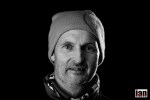
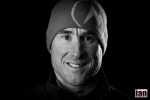
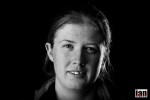
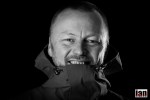
Maffetone Formula for better endurance performance by Marc Laithwaite

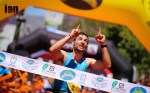
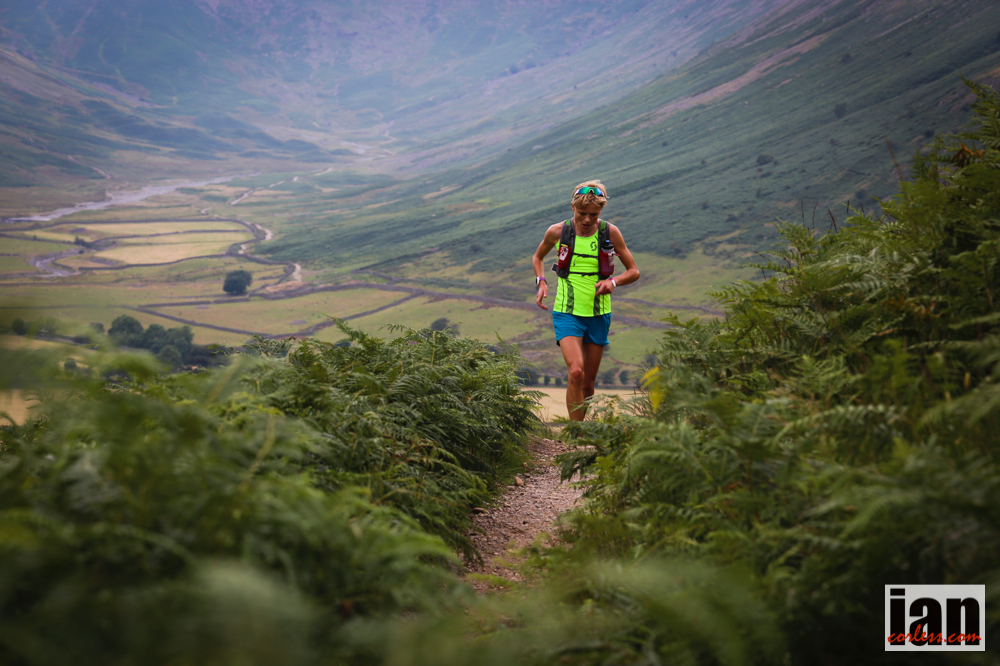
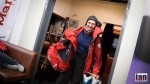
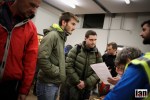
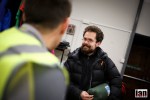
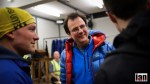
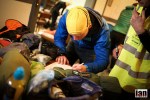
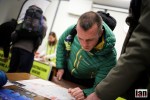
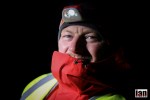
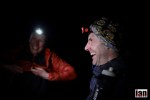
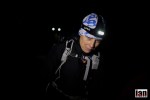
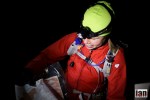
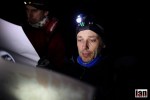
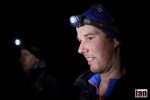
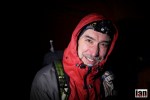
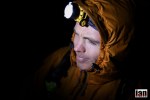
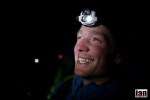
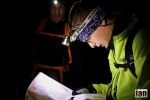
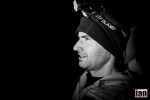
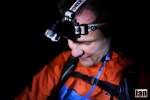
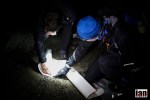
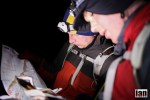
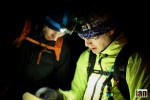
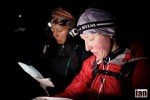
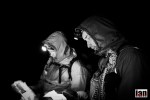
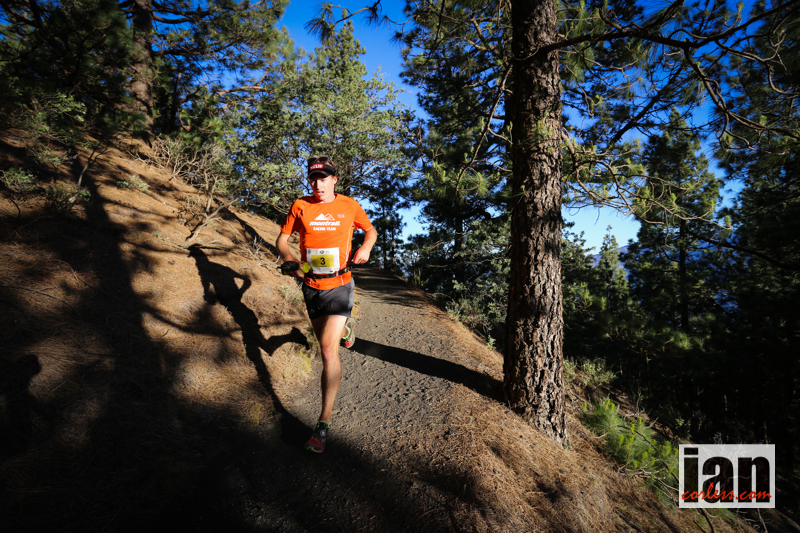
Marc Laithwaite at Lakeland 100/ 50 2014

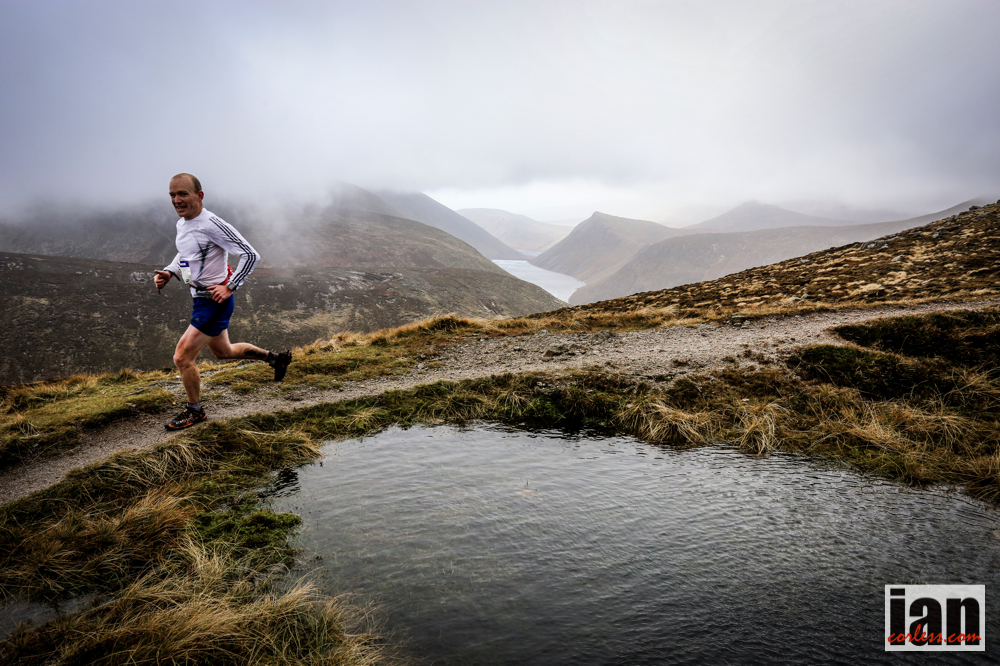
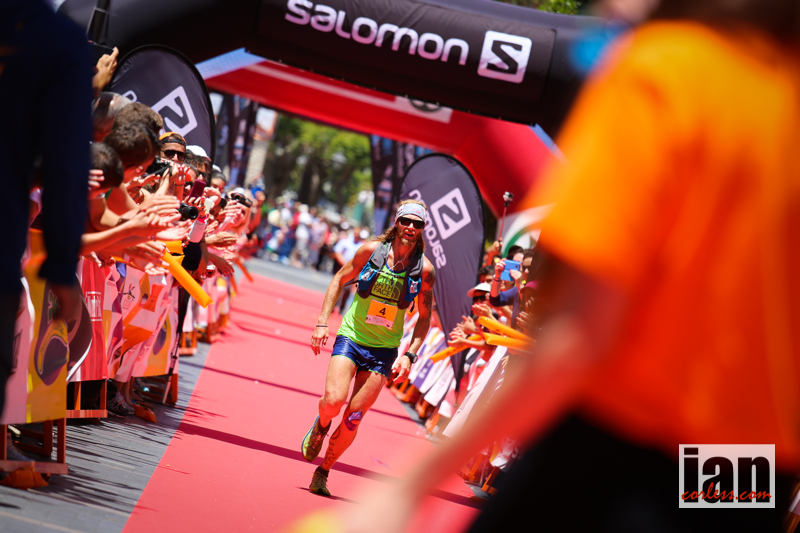
Marc Laithwaite at Lakeland 100/ 50 2014

In a new series of articles, Marc Laithwaite (The Endurance Store), endurance coach and regular contributor to Talk Ultra podcast will provide insight in how you can become a better endurance athlete by training smart and eating for performance.

In the first article, we look at the Maffetone Formula also known as ‘MAFF.’


The term ‘aerobic base’ is used widely in endurance sports but what exactly does it mean? To build aerobic base athletes will generally do long and slow distance to gain specific benefits, we consider those 2 key benefits to be as follows:

  1. Conditioning – Your legs deal with a great amount of impact every time they hit the ground, which causes muscle damage. In turn, this muscle damage will slow you down. The only way to prevent this muscle damage is to become accustomed to ‘time on your feet’. Hence, by slowing down and running long distances at a slower pace, you will ‘harden your legs’ and prevent damage. If you run too hard during your ‘base training runs’ you will not be able to run far enough to get the required ‘time on feet’ so slowing to the correct intensity is critical. It’s important to note that this applies to cycling also, whilst the impact isn’t the same, the repeated action of pedalling means that your muscles will break down, your hips will become tight and your back will ache!
  2. Metabolic Adaptation – Your muscle fibres will adapt and more closely resemble the ‘slow twitch variety’. One of the key changes is the ability to use fat as a fuel source and also to use less energy overall. These combined changes mean that you are less likely to run out of fuel during longer distance exercise. If you can change your muscle fibres so running out of fuel is unlikely, combined with your ‘hardened legs’ which don’t become damaged easily, you are ready for some serious endurance action.

So how slow should I run?

It’s very common for endurance athletes to get the ‘training zone’ thing very wrong. The key thing to remember is that variation is critical, so easy sessions to develop base should be easy and high intensity sessions to develop power should be extremely hard. Many athletes tend to drift into the middle ground where no training is really easy, no training is really hard, but pretty much everything is ‘moderately hard’.

What is the Maffetone Formula?

Made famous by Mark Allen who won the famous Iron War with Dave Scott in 1989. Allen had repeatedly failed to beat Dave Scott, always running out of fuel in the marathon stage. He turned to Maffetone who revolutionised his training, with the principal aim of enhancing fat burning to make him a more effective runner. Maffetone employs a maximum aerobic heart rate above, which you cannot exercise. Initially, athletes find it very frustrating as they will be running very slowly, but over time there are large benefits to be had as the base aerobic system improves.

What’s the Formula?

Subtract your age from 180.

Modify this number by selecting among the following categories the one that best matches your fitness and health profile:

If you have or are recovering from a major illness (heart disease, any operation or hospital stay, etc.) or are on any regular medication, subtract an additional 10.
If you are injured, have regressed in training or competition, get more than two colds or bouts of flu per year, have allergies or asthma, or if you have been inconsistent or are just getting back into training, subtract an additional 5.

If you have been training consistently (at least four times weekly) for up to two years without any of the problems just mentioned, keep the number (180–age) the same.

If you have been training for more than two years without any of the problems listed above, and have made progress in competition without injury, add 5.

For example, if you are thirty years old and fit into category (b), you get the following:

180–30=150. Then 150–5=145 beats per minute (bpm).

If it is difficult to decide which of two groups best fits you, choose the group or outcome that results in the lower heart rate. In athletes who are taking medication that may affect their heart rate, those who wear a pacemaker, or those who have special circumstances not discussed here, further individualization with the help of a healthcare practitioner or other specialist familiar with your circumstance and knowledgeable in endurance sports may be necessary.

Two situations may be exceptions to the above calculations:

  • The 180 Formula may need to be further individualized for people over the age of sixty-five. For some of these athletes, up to 10 beats may have to be added for those in category (d) in the 180 Formula, and depending on individual levels of fitness and health. This does not mean 10 should automatically be added, but that an honest self-assessment is important.
  • For athletes sixteen years of age and under, the formula is not applicable; rather, a heart rate of 165 may be best.

Once a maximum aerobic heart rate is found, a training range from this heart rate to 10 beats below could be used as a training range. For example, if an athlete’s maximum aerobic heart rate were determined to be 155, that person’s aerobic training zone would be 145 to 155 bpm. However, the more training at 155, the quicker an optimal aerobic base will be developed.

Completing the Test:

Completing the test is simple, for running find a flat 3 miles course or complete 20 minutes. The simplest way is to find a running track as this makes distance measuring easier. Warm up for 15 minutes within the Maffetone Training Zone and then run 3 miles within the Maffetone Training Zone and record your time. You could use a flat circuit on road and use a GPS but variations in GPS accuracy mean that a running track is more accurate. Record your time for the 3 miles and preferably record your time for each of the mile splits. For the bike, it’s best done on a calibrated turbo training or riding to power. Warm up for 15 minutes in Maffetone Training Zone, then ride 30 minutes within the Maffetone Training Zone and measure average power or distance completed. Remember that the turbo and power meter needs to be calibrated or the accuracy is poor.

Practicalities:

You may find the run pace very slow and frustrating, if so, then you should take this as a positive, your base is very poor and you therefore have plenty of improvement to make for the 2015 season!! All of your easy mileage running should be done in the Maff Training Zone and the test can be repeated every 4-8 weeks. You should see an increase in speed and distance for the same heart rate as your base fitness improves. If you keep getting quicker, then don’t worry about speed work until the Maffetone training reaches a plateau. Develop your base as much as possible at the start of the year for maximum gains later.

On the bike, heart rate is generally lower than it is during running, so you’ll find the test a little less frustrating. In reality, the Maffetone Training Zone for cycling should be adjusted by reducing it between 5-10 beats (my opinion – you might want to incorporate it). This test is based on 180 minus age and we all know that maximum heart rate varies from person to person (220 minus age to calculate maximum has been widely criticised), but just go with it and try the formula, nothing is perfect!

We’d be keen to hear your feedback, go and give the test a try and let us know your progress. If you found this article useful, please share with your friends and re-post on Facebook or Twitter!

– Marc Laithwaite

About Marc:

Sports Science lecturer for 10 years at St Helens HE College.

2004 established The Endurance Coach LTD sports science and coaching business. Worked with British Cycling as physiology support 2008-2008. Previous Triathlon England Regional Academy Head Coach, North West.

In 2006 established Epic Events Management LTD. Now one of the largest event companies in the NW, organising a range of triathlon, swimming and cycling events. EPIC EVENTS also encompasses Montane Trail 26 and Petzl Night Runner events.

In 2010 established Montane Lakeland 50 & 100 LTD. This has now become the UKs leading ultra distance trail running event.

In 2010 established The Endurance Store triathlon, trail running and open water swimming store. Based in Appley Bridge, Wigan, we are the North West’s community store, organising and supporting local athletes and local events.

Check out the endurance store HERE

Endurance Store Logo


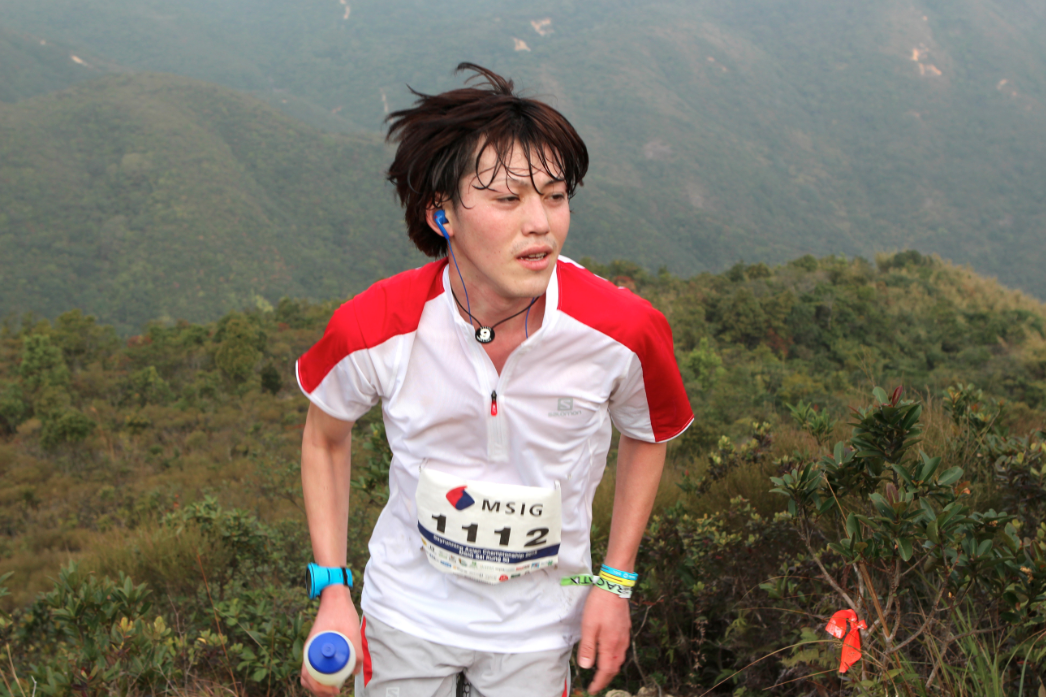
MSIG Sai Kung 50 Skyrunning Asian Championships race report

Screen Shot 2015-02-07 at 18.23.52Hong Kong is certainly full of surprises and the MSIG Sai Kung Skyrunning race was no exception, with results going against the odds and also against form.

Certainly the most significant surprise for a visitor to Hong Kong is the presence of hills and forests. Actually the towering, high-rise, tightly packed urbanised area, full of flashing neon and determined taxi drivers, that is synonymous with Hong Kong represents a tiny fraction of the area that Hong Kong covers. Forty five minutes drive out of the city is the Sai Kung Screen Shot 2015-02-07 at 18.24.30Country Park, the venue for today’s race: a seemingly vast area thickly covered with vegetation made up of extremely steep hills tumbling down to beaches and the sea. It was on these hills that 2000m of vertical ascent was packed into 28km on extremely steep and in some places technical trails.

Screen Shot 2015-02-07 at 18.24.20The race was scheduled to start at 7am and the sun rose on a grey overcast and thankfully cool morning for the four races taking place over 13km, 24km, 28km and 50km.

The first to set off were the 28km and 50km races.

In the shorter distance, the men’s favourite was considered to be Marco de Gasperi, but with athletes such as Tom Owens, and Martin Gaffuri lining up with him, it was never likely to be a cake-walk. In the 50km the same was true: whilst Yan Long Fei was considered to be the favourite by many, Samir Tamang, David Byrne, Luke Nelson and Blake Hose plus others were never going to give in easily.Screen Shot 2015-02-07 at 18.24.00

For the women, Elisa Desco and Stephanie Jiminez were considered the pre-race favourites for the 28km race, whilst in the 50km Kasie Enman, Wyan Chow Pui Yan, Dong Li and Mira Rai were the ones to watch.

The race

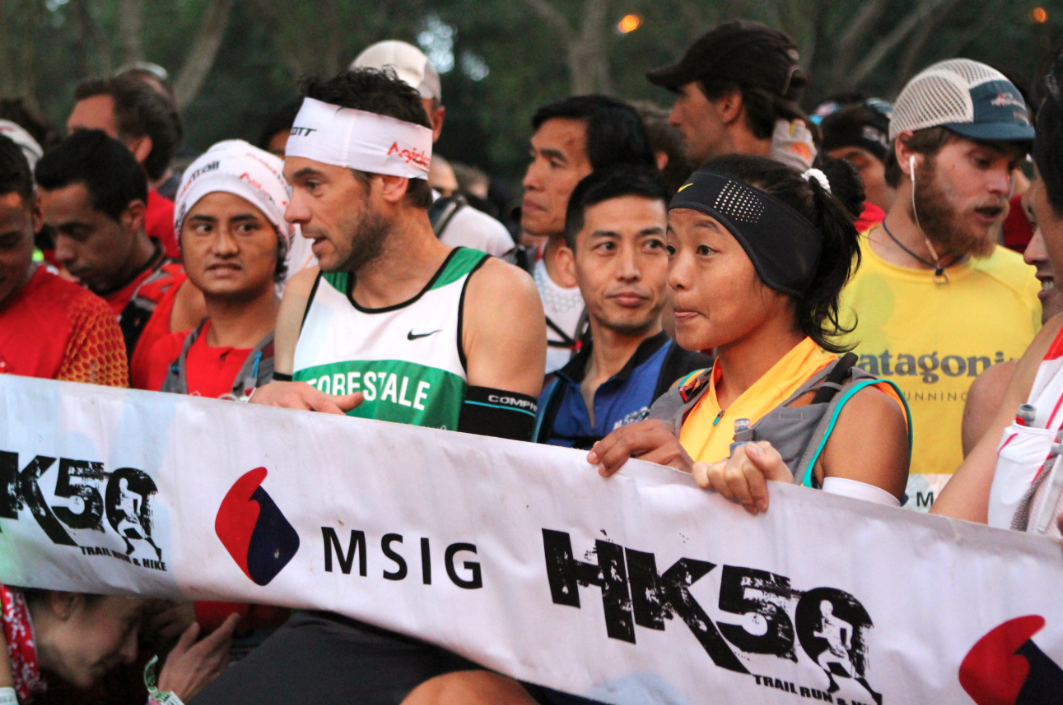
The start of the 28km and 50km races happened at the same time and involved a very fast downhill road section, before the first climb started towards the trails that would make up the majority of the races.

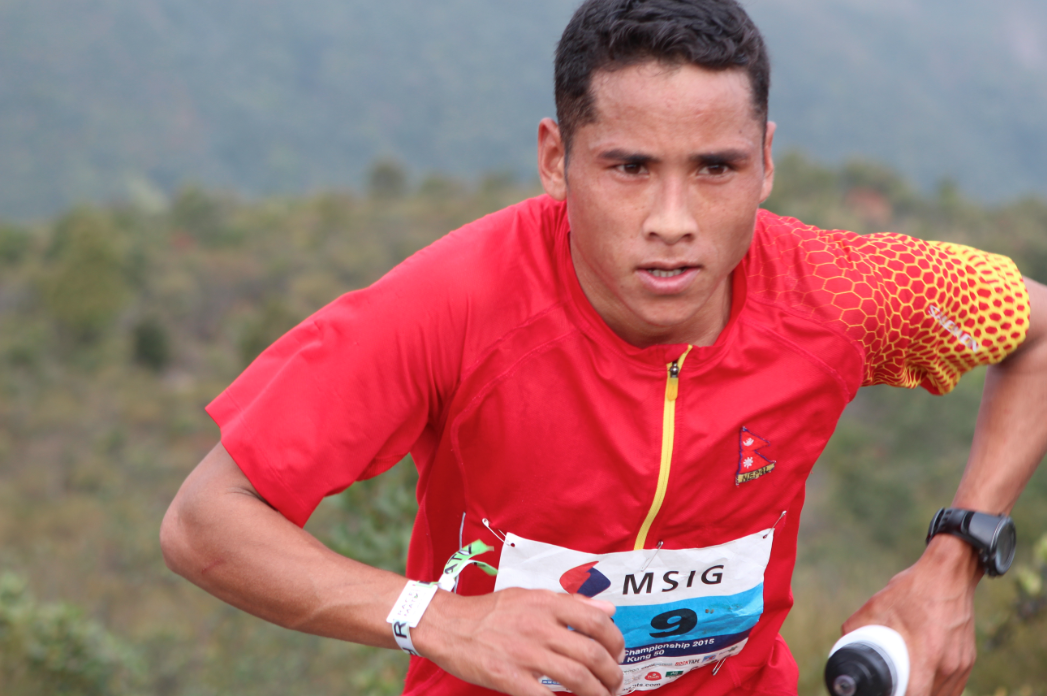
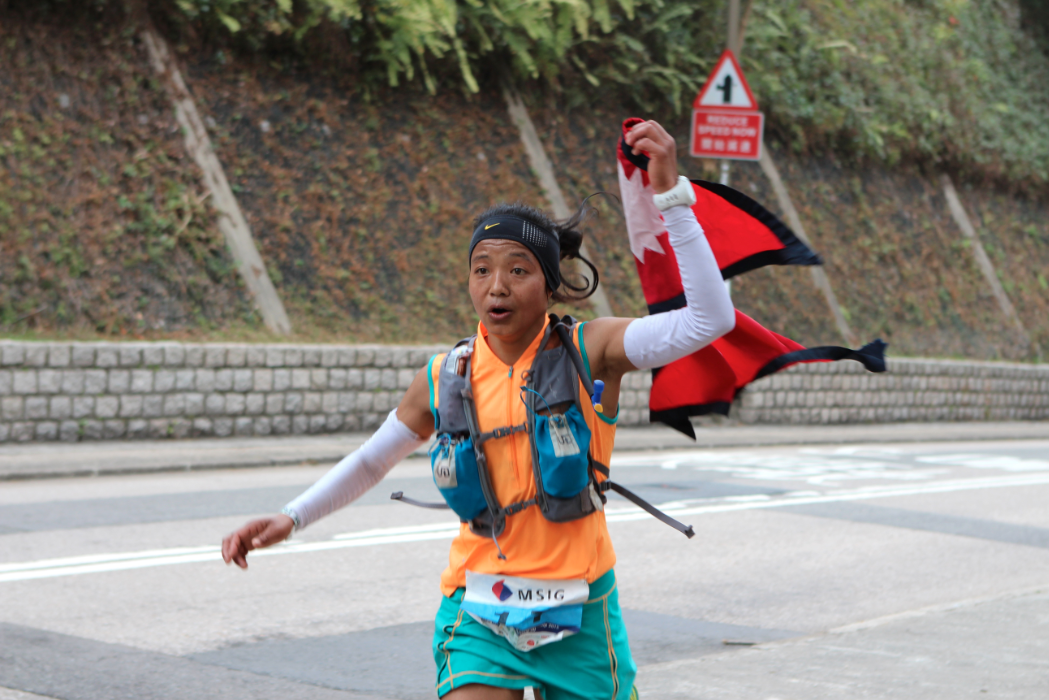
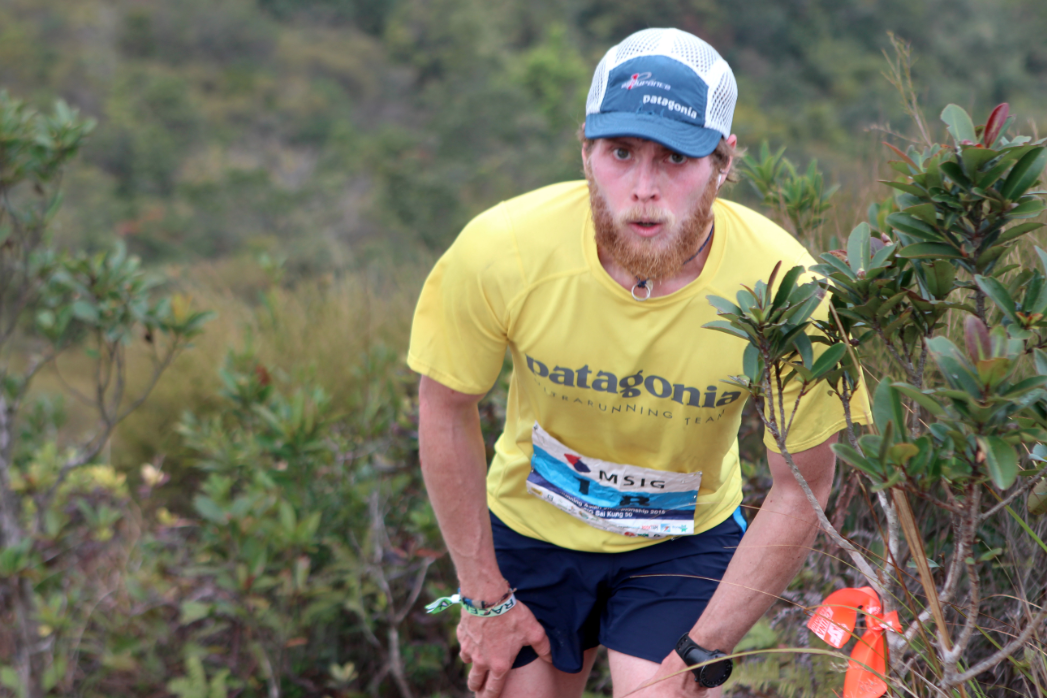
Samir Tamang from Nepal in the 50km race

Samir Tamang from Nepal in the 50km race

Perched just above the third check point before the two races split at around 22km, we were getting snatches of news. Especially about the race leaders who we were hearing were having some problems staying on the course. Before we caught sight of the runners we knew that 28km pre-race favourite de Gasperi has taken a wrong turn and lost time on two Japanese runners who had taken the lead.

By the time the runners reached us, we could see that de Gasperi’s mistake had indeed cost him and the Japanese pair of Dai Matsumoto and Kondo Yoshihito were in control with only around 6km left to go.

Dai Matsumoto in the 28km race

Dai Matsumoto in the 28km race

Indeed from that point to the end, the positions remained the same, with Dai winning in 2:49:23, Kendo second in 2:51:41seconds and a disappointed de Gasperi in third in 2:54:32, who rued taking a wrong turn. He said after the race “I made a mistake by missing the course and I realized it until I saw Dai, the Japanese runner coming in front of me running down the hill. I probably wasted 4 minutes until I found the right way. If time can turn back, I would do everything to avoid the mistake.”

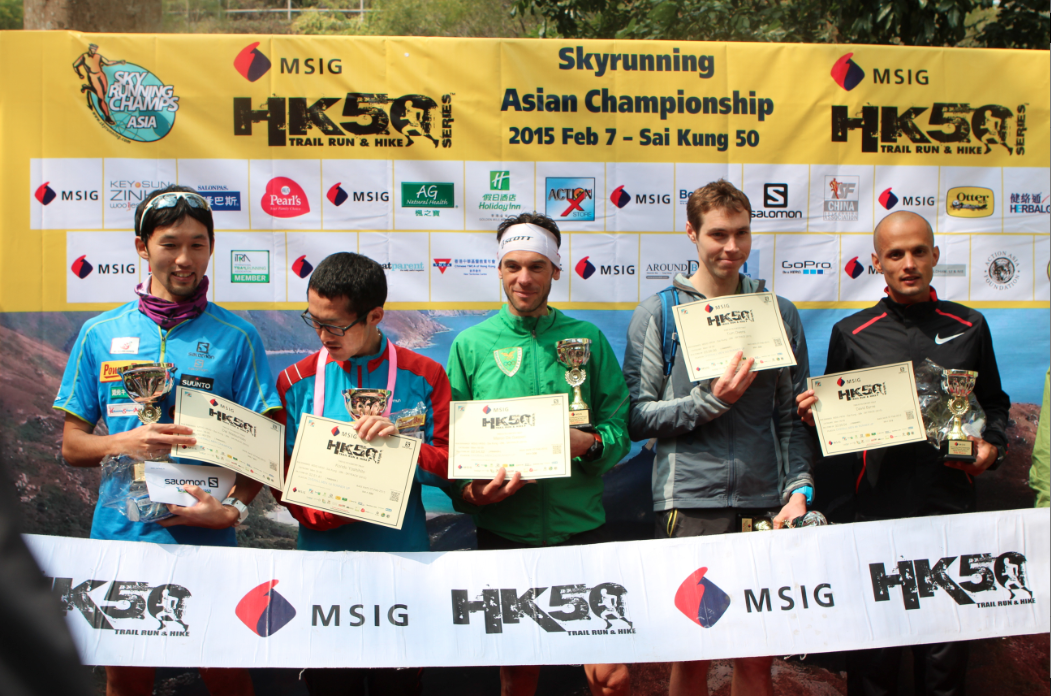
In the men’s 50km race Nepalese runner Samir Tamang won 4:58:40. After the race he said ‘Such an honor to become the champion, but I didn’t finish the course within my estimated time. I have been to Hong Kong once before for a 100k race and this is my first 50k in HK. It marked a good start of the year in 2015!’ Tamang was followed in by Yan Long Fei from China in 5:11:50 ‘I chose to follow some of the strong runners as usual and I guess I followed the wrong person this time. I realized there were two people ahead of me at the very last bit of the race and that was too late for me to overpass them both. I enjoyed the race overall especially the view at the hilltop.’ The final spot on the podium was taken by Spanish runner Cristofer Clemente in 5:15:07.

Screen Shot 2015-02-07 at 18.25.34

Elisa Desco on her way to victory in the women’s 28km race

Screen Shot 2015-02-07 at 18.25.43

Stephanie Jiminez in the 28km Skyrun

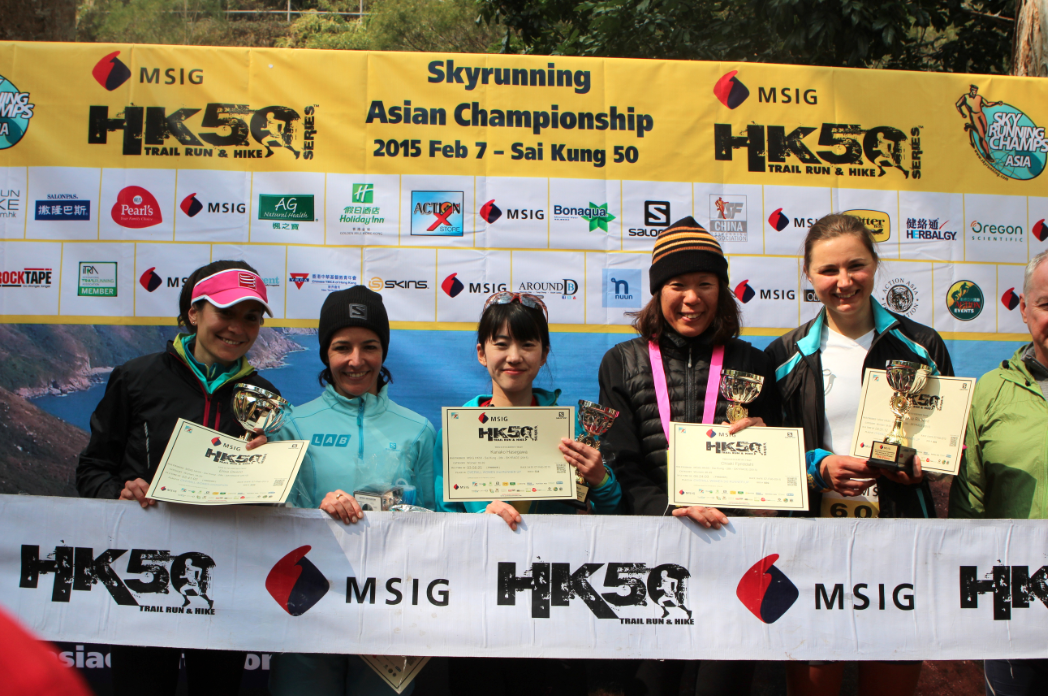
For the women, the 28km race went with the predictions, with Elisa Desco narrowly beating Stephanie Jiminez in 3:41:02. Desco said afterwards ‘The course is very challenging for me because there were lots of up hills and down hills. Unlike those in Italy, we usually climb up one main mountain. I’m not used to the hilly terrain and it makes the course very technical to me.’ Finishing the trio was Japanese runner Kanako Hasegawa in 3:56:25.

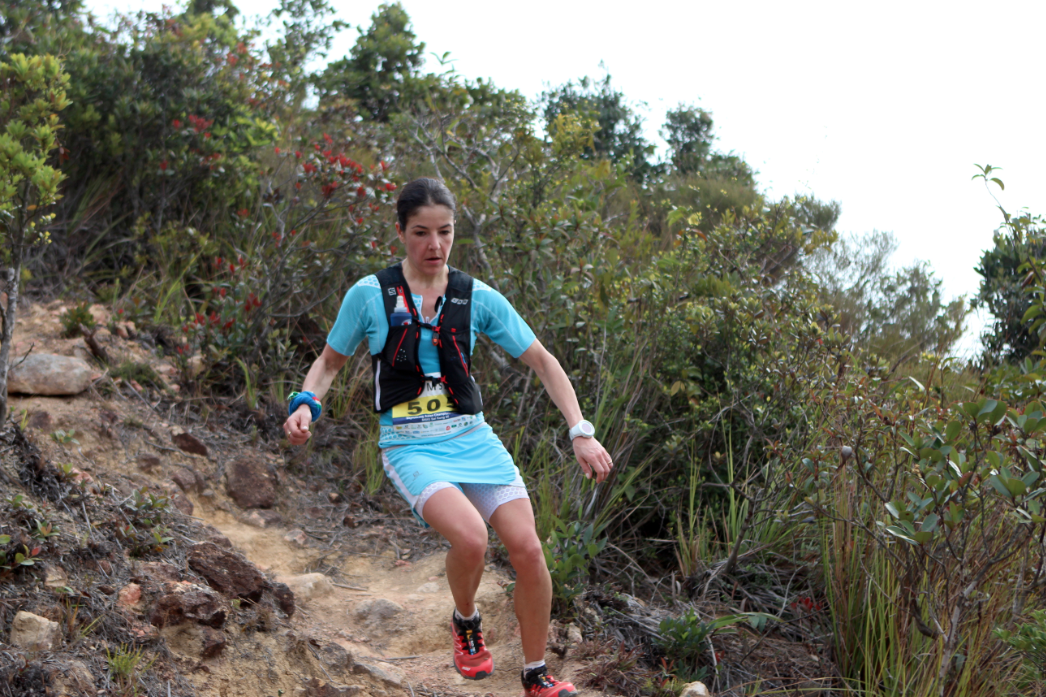
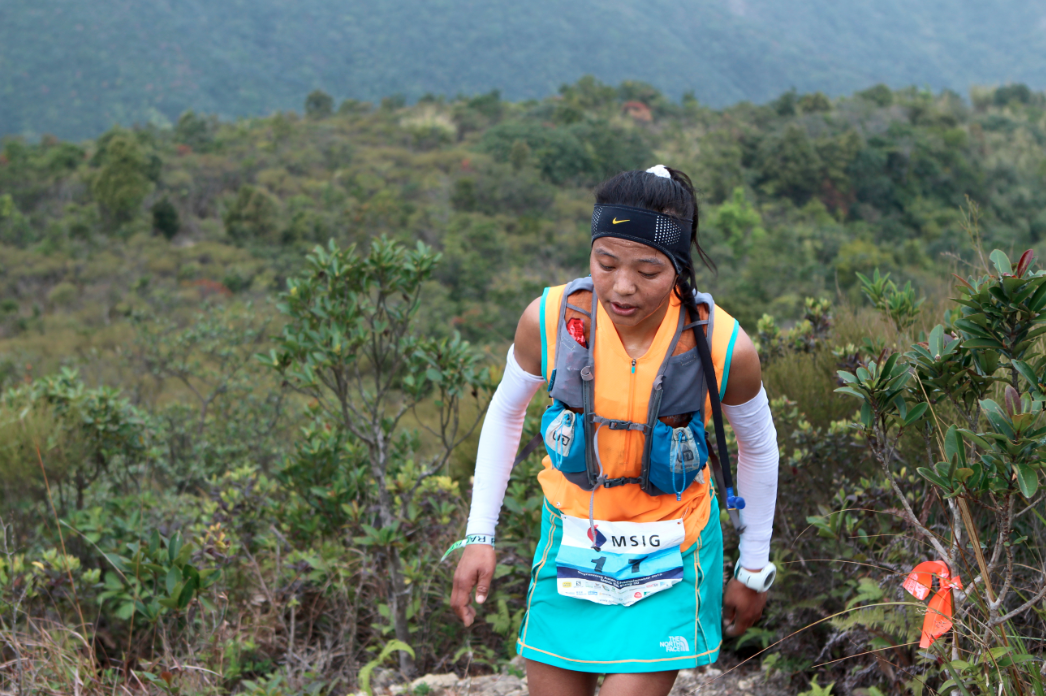
In the women’s 50km race, it was Mira Rai from Nepal who backed up a win in the HK50 with a completely dominant performance, elegantly skipping up the brutal climbs and down the technical descents to win in 5:39:31 over an hour ahead of China’s Dong Li in second and Kasie Enman in third.

Screen Shot 2015-02-07 at 18.26.03

Mira Rai winning the women’s 50km race

For complete results click here.

The responses

Screen Shot 2015-02-07 at 18.26.13 Screen Shot 2015-02-07 at 18.26.21Whilst there were a few runners who went off course which caused frustration, the general feeling was that the race was a great way for many to start the year. The route was technical and exciting with many of the more experienced runners saying that it was a ‘true’ Skyrunning race.

As a part of the new way that the Skyrunning series will be decided, there were valuable points scored for some today and for others it was a chance to bounce back from lacklustre ends to 2014 or injury.

Whatever the racer’s take on the Sai Kung 50, it was a great way to see a different side to Hong Kong and a superb way to ensure that Asia has an even stronger place on the world trail running map.

Screen Shot 2015-02-07 at 18.25.51

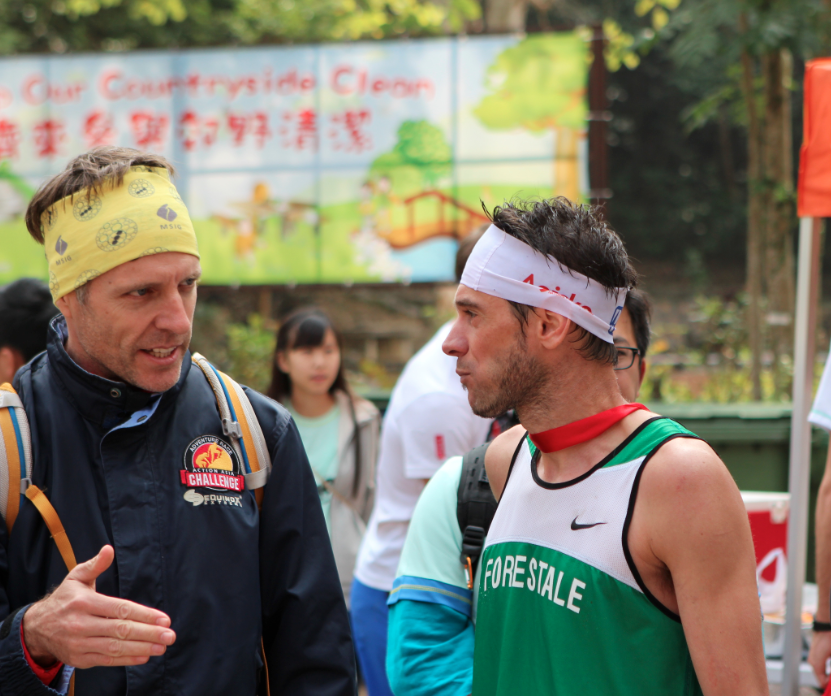
Race director Michael Maddess and Marco de Gasperi discuss the race after the action has finished

Screen Shot 2015-02-07 at 18.25.16

Luke Nelson

Screen Shot 2015-02-07 at 18.25.25 Screen Shot 2015-02-07 at 18.25.07

Screen Shot 2015-02-07 at 18.24.50

MSIG Sai Kung 50 & Skyrunning Asian Championships: pre-race interviews

Hong Kong is certainly a place of contrasts. A pre-breakfast run along the waterfront this morning saw the whole city shrouded in a thick, yellow smog which softened the outlines of the masses of skyscrapers and high-rise apartment blocks. People bustle along the pavements whilst taxis and buses fill every meter of the chaotic roads. Even the water between the mainland and the island is crammed with boats of all sizes ferrying people or freight around seemingly 24 hours a day. Not really a promising place for a Skyrunning race then…

But an hour out of the city and Sai Kung is a leafy, charming place with a vibrant sea port and – more importantly perhaps – towering forest covered hills rising from the sea shore to the sky. Suddenly the potential for a challenging Skyrunning race and the Asian Championships is revealed.

Just after lunch Simon had a chance to catch up with a few of the elite athletes looking to make an impact on this race early in the season:

Tom Owens

Screen Shot 2015-02-06 at 22.12.27After a ruptured ankle tendon in 2013, Tom was actually happy with how he raced in 2013 and enjoyed including some long races that the surgically repaired ankle dealt with without a problem. When I asked Tom why he chose to race the Sai Kung race, he said that he had already planned on taking some time off in February to go on a warm weather training camp, to get away from the freezing temperatures that he has been enduring in Scotland all winter. As soon as the opportunity to race in Hong Kong came up, Tom changed his plans to be here.

Tom also said that after a winter of cyclo-cross and cross country racing, he thought that tactically, getting a Skyrunning race under his belt early in the season would give him an advantage later in the year.

Simon asked Tom about how cyclo-cross has played a part in his training and Tom admitted that although he really enjoys it, he is technically not as strong as he’d like to be having only taken up the sport in the last couple of years. But Tom thinks that it has given him a physical and psychological edge that he needed after his surgery.

Martin Gaffuri

Screen Shot 2015-02-06 at 22.12.45Martin is a French resident although he is soon moving to Switzerland for work, so coming to Hong Kong for a race is a great opportunity to escape the snow and run in relatively warm conditions.

The Sai Kung race also represents a chance for Martin to return to the sport he loves after a hiatus in 2014. He feels that his best result last year was in Tarawera, but around racing the 80km World Champs in Chamonix, where he came 17th, Martin lost motivation for his running and took time off, only really returning to the sport towards the end of the season with a tilt at the Rut where he took a tumble off the trail.

With his new full-time job about to start, Martin is looking forward to having some structure, aiming for more quality over quantity. This makes the 28km race in Sai Kung a perfect chance to test his legs on a relatively shorter course.

Elisa Desco

Screen Shot 2015-02-06 at 22.13.31Elisa told Simon that this is her first season Skyrunning. In fact until last year she had not raced more than 20km. She said that Zegama was a fantastic new experience for her and that, along with her brilliant run at the World Championships in Chamonix, have surprised her and given her added motivation to train and race.

Looking ahead Elisa is racing the shorter Skyrunning series in 2015 and then thinks that she might start to consider tackling some longer races. But for now she thinks that her speed on relative short distances – her road marathon debut was a very impressive 2:36 – will mean that she can compete with the best of them on the trails in the hills.

Marco De Gasperi

Screen Shot 2015-02-06 at 22.13.18On reflection Marco believes that he may have been over-trained in 2014. He told Simon that for a few crucial months in the middle of the year he felt very tired and weak. Thankfully now he has fully recovered and has trained consistently – ensuring that he isn’t over-training – so that he is ready for the Sai Kung event, which Marco sees as a significant race and a great way to start the Skyrunning season.

Sat in Sai Kung town in a cafe today, Marco looked remarkably relaxed and told Simon that whilst he is wary of the other elite athletes on the start line tomorrow, he is also not stressed and is looking forward to the trails.

Marco has an eye on races beyond the Sai Kung event. He wants to be in best possible share to race Zegama later in the year and he knows that he needs to measure out his efforts so that he can get the best from himself at the right moments.

The action starts at 7am in Hong Kong and Simon will be on the course following events. You can keep up-to-speed on twitter and check back for a race report soon.

SALOMON S-LAB SENSE ULTRA SET and SALOMON S-LAB SENSE SET
©iancorless.com_Salomon-7704

A new year and new products! Nothing is more eagerly awaited than a new offering from Salomon and today I take a look at two new race vests from the French brand, the S-LAB SENSE ULTRA SET and the S-LAB SENSE SET.

Race vests have become the norm in racing now and it’s east to see why. When the product works (and some don’t) they fit like a piece of clothing, they don’t move, they cause no chaffing and they provide easy and immediate access to everything you need while still pushing the pace. I honestly don’t know who first came up with the ‘vest’ concept, what I do know is I always remember Kilian Jornet finishing and winning UTMB and holding his vest above his head!

Salomon vests and the S-LAB ADV SKIN HYDRO 12 SET can be seen in long distance races all over the world. Tweaked from one model to the next and the current incarnation has moved away from using a bladder to front mounted soft flasks. With a huge capacity, it’s often considered as one of the most ideal packs to hold all mandatory kit for a long distance race. The pack is lighter and utilises all the key features that one needs including that snug form fitting hold on the body. However, 12L capacity is not needed for shorter and faster races.

Enter the S-LAB SENSE ULTRA SET and the S-LAB SENSE SET.

It’s unusual in a review that I would review two packs at once, however, these two packs are so similar that a separate review is not necessary. So, I am reviewing the SENSE ULTRA SET and I will note comments and changes as appropriate for the SENSE SET.

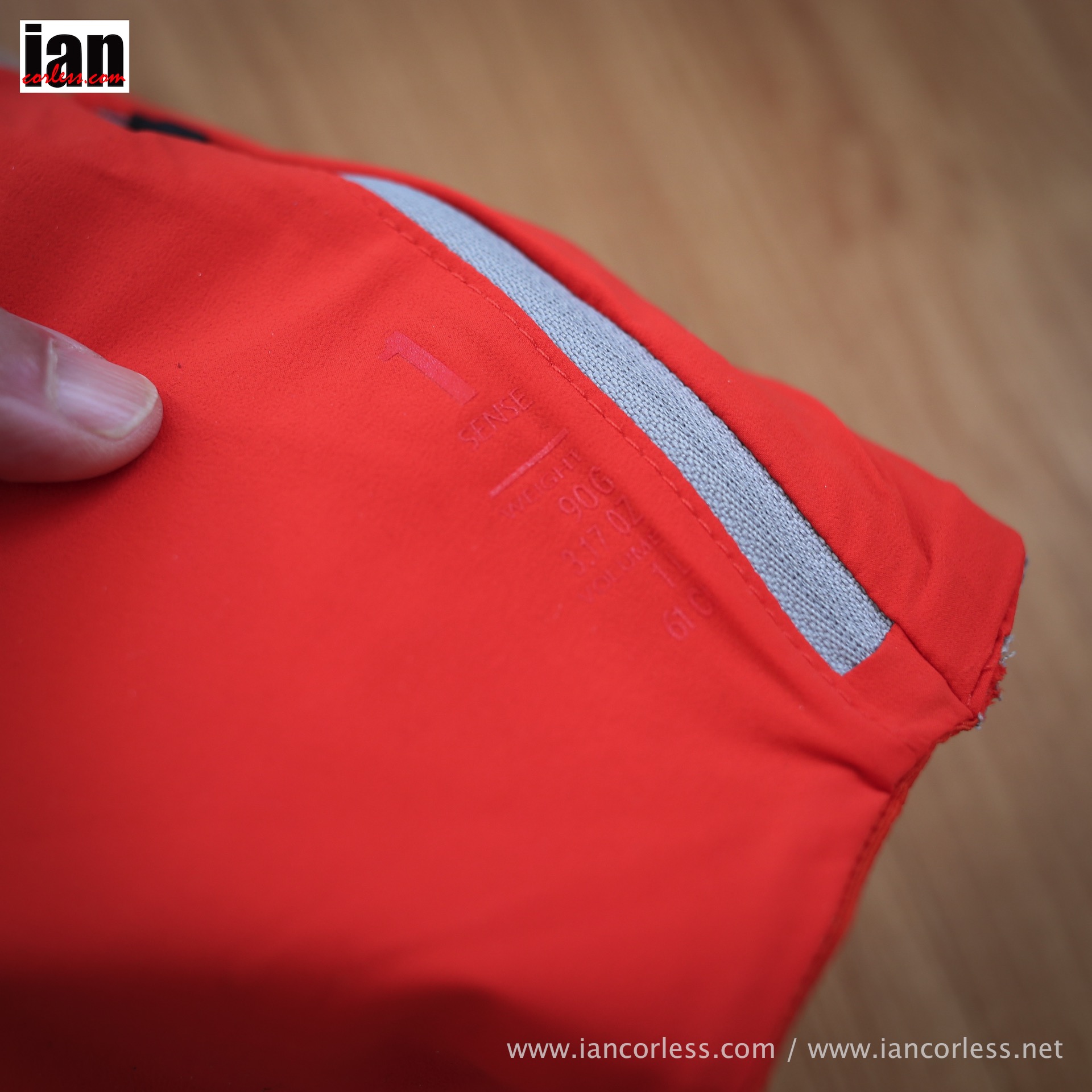
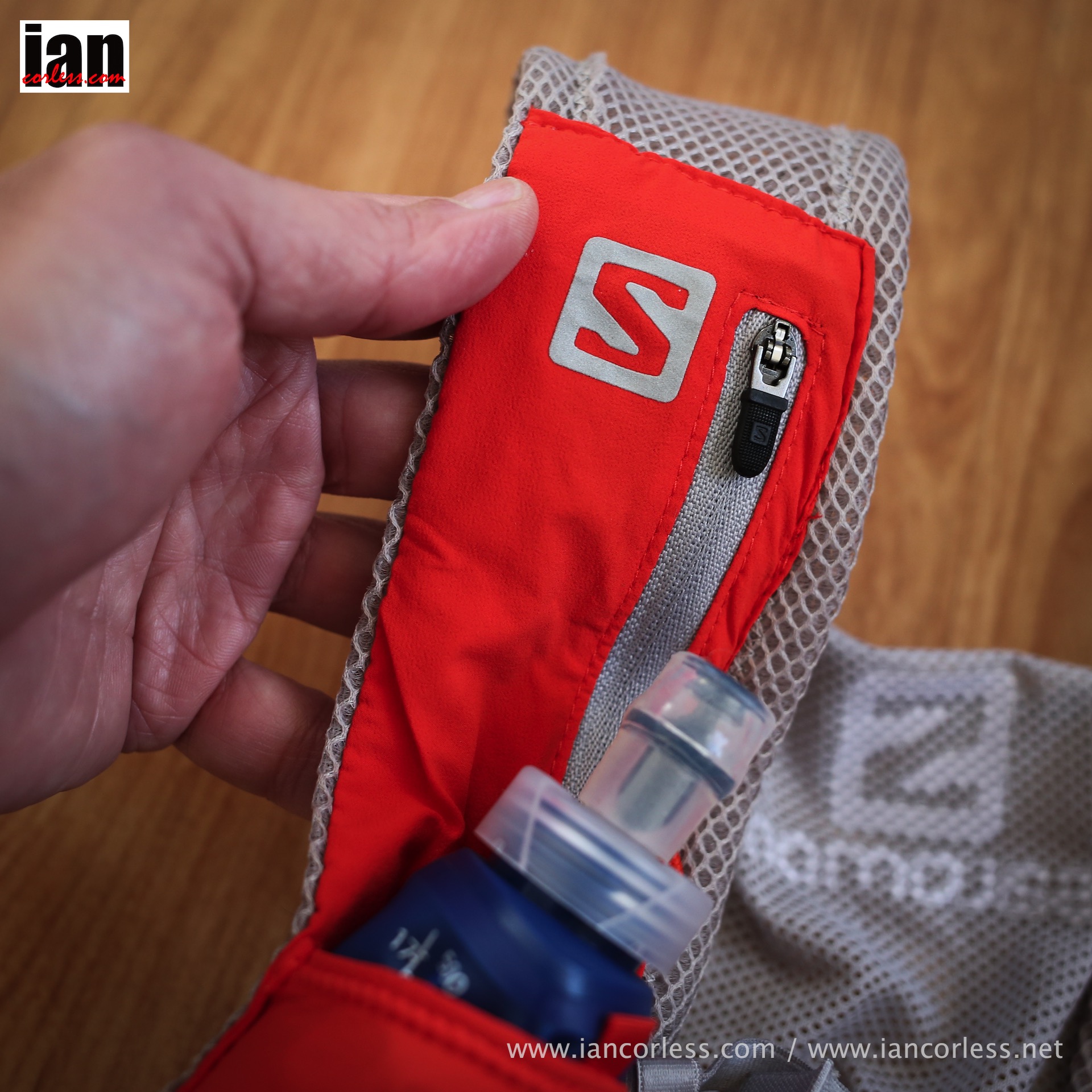
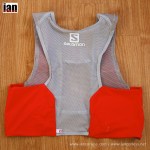
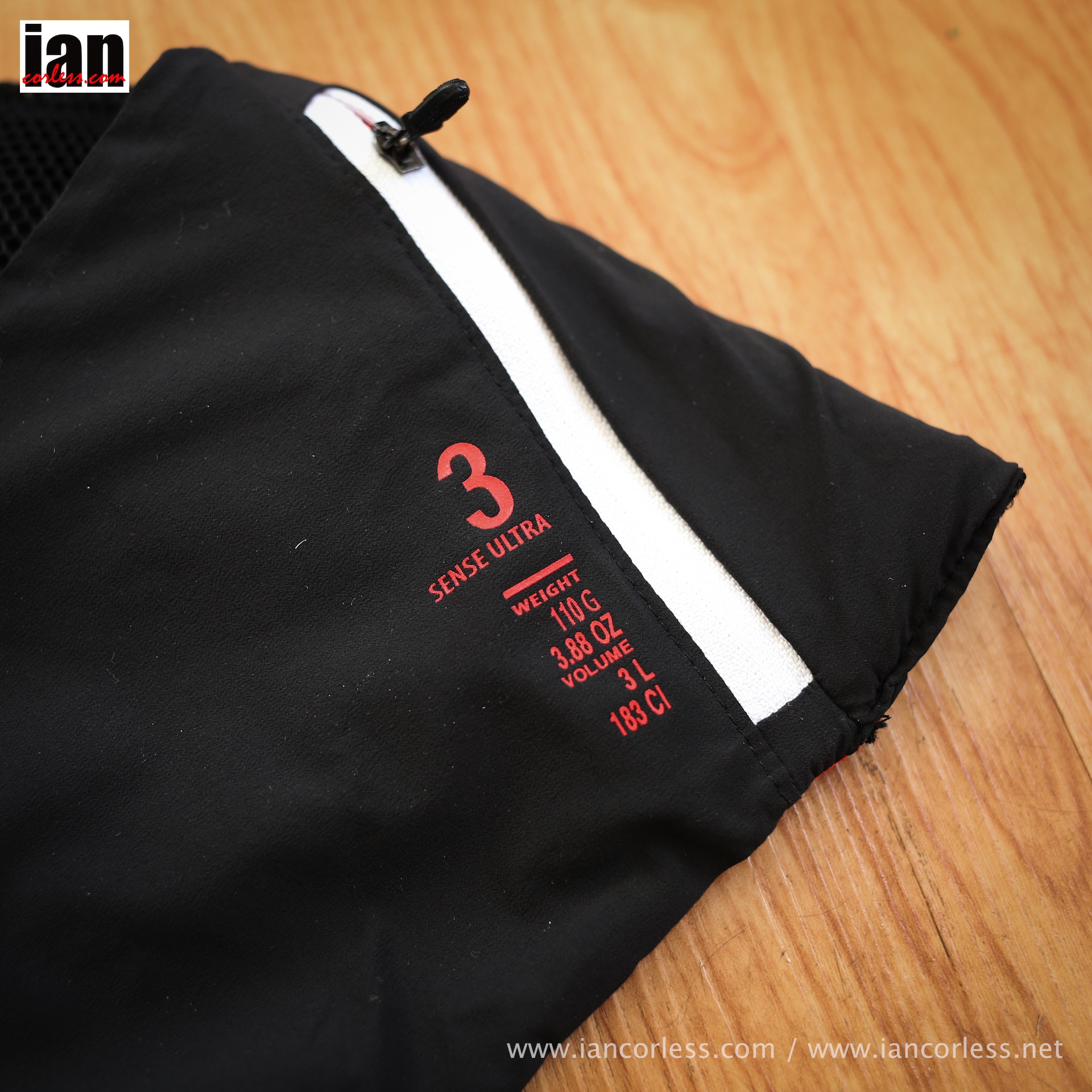
So what is the difference? Simple: weight and capacity. The SENSE ULTRA SET has a 3L capacity and weighs a  110g. The SENSE SET has a capacity of 1L and weighs 90g. I am pleased to say that my two test packs are different colours, the 3L is black and the 1L is red. That’s going to make things easier.

©iancorless.com_Salomon-7741©iancorless.com_Salomon-7796


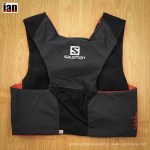
Both packs are identical at the front and differ at the back. This is where capacity is removed or added, so, let’s look at the front first.

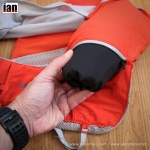
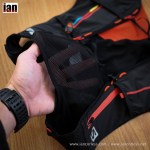
©iancorless.com_Salomon-7704


This is a really sweet pack! The layout is great, comfort is awesome and the capacity is ideal for any run when mandatory kit is minimal.

Key features:

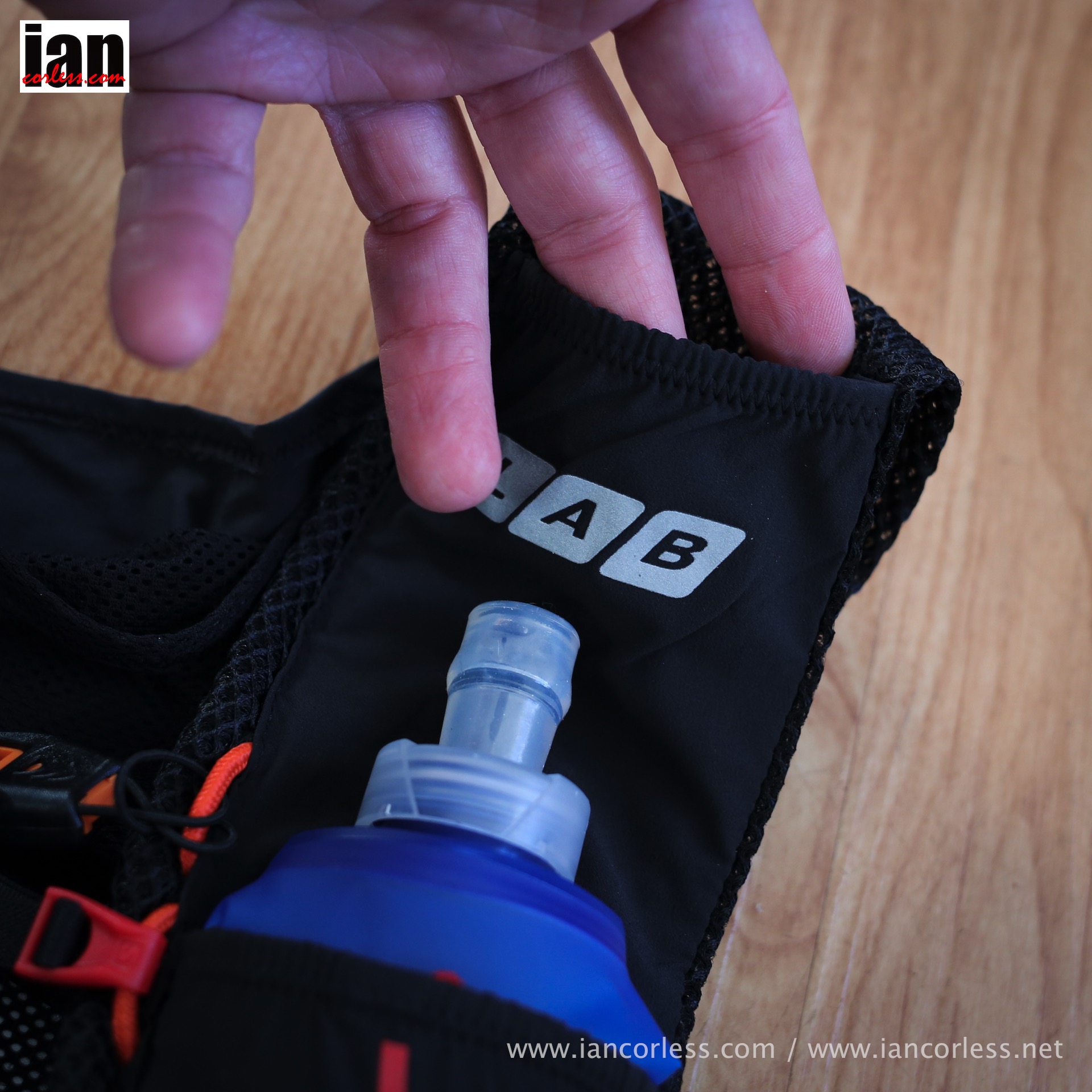
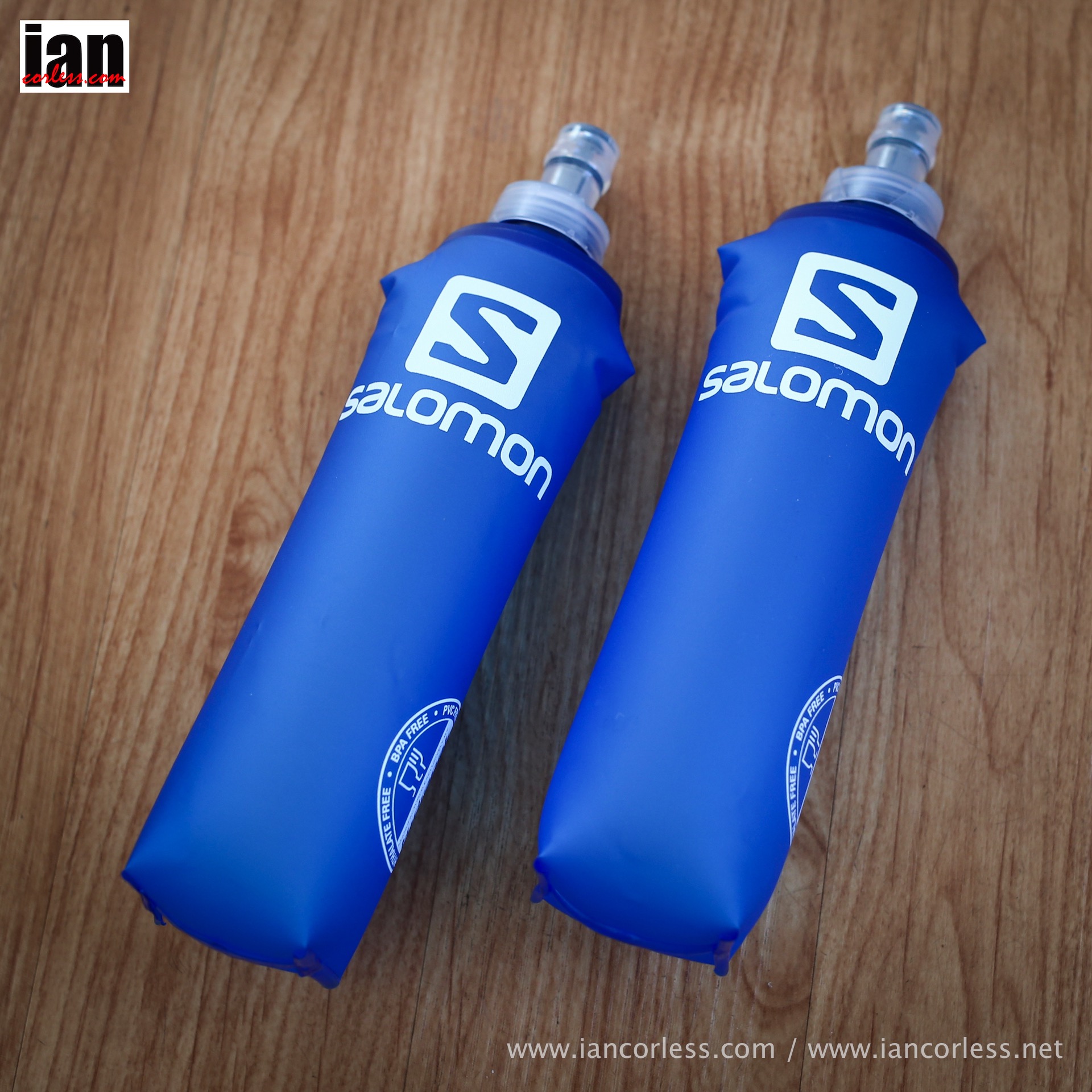
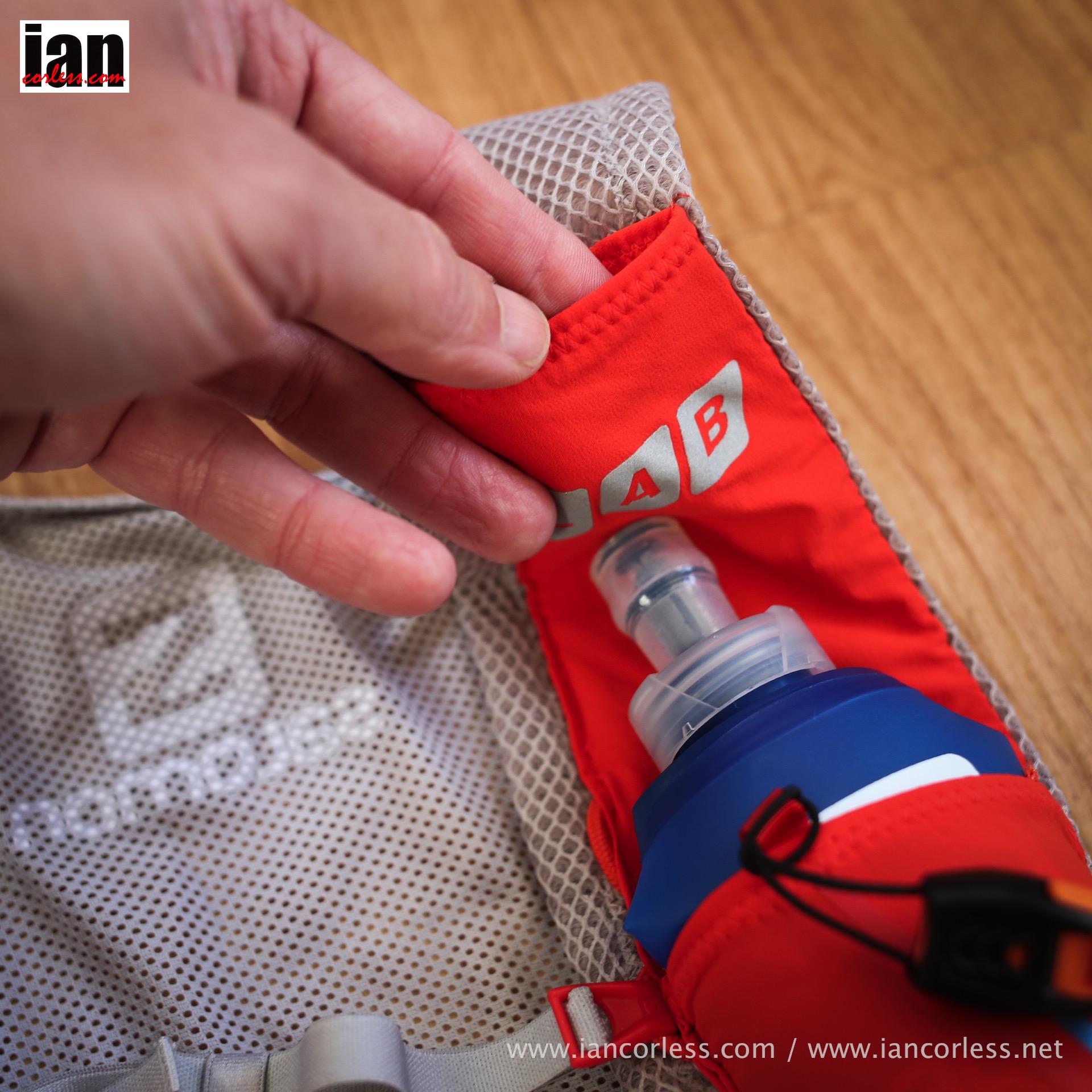
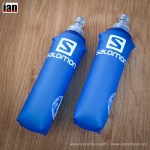
Two 500ml soft flasks in two stretch pockets.

©iancorless.com_Salomon-7704

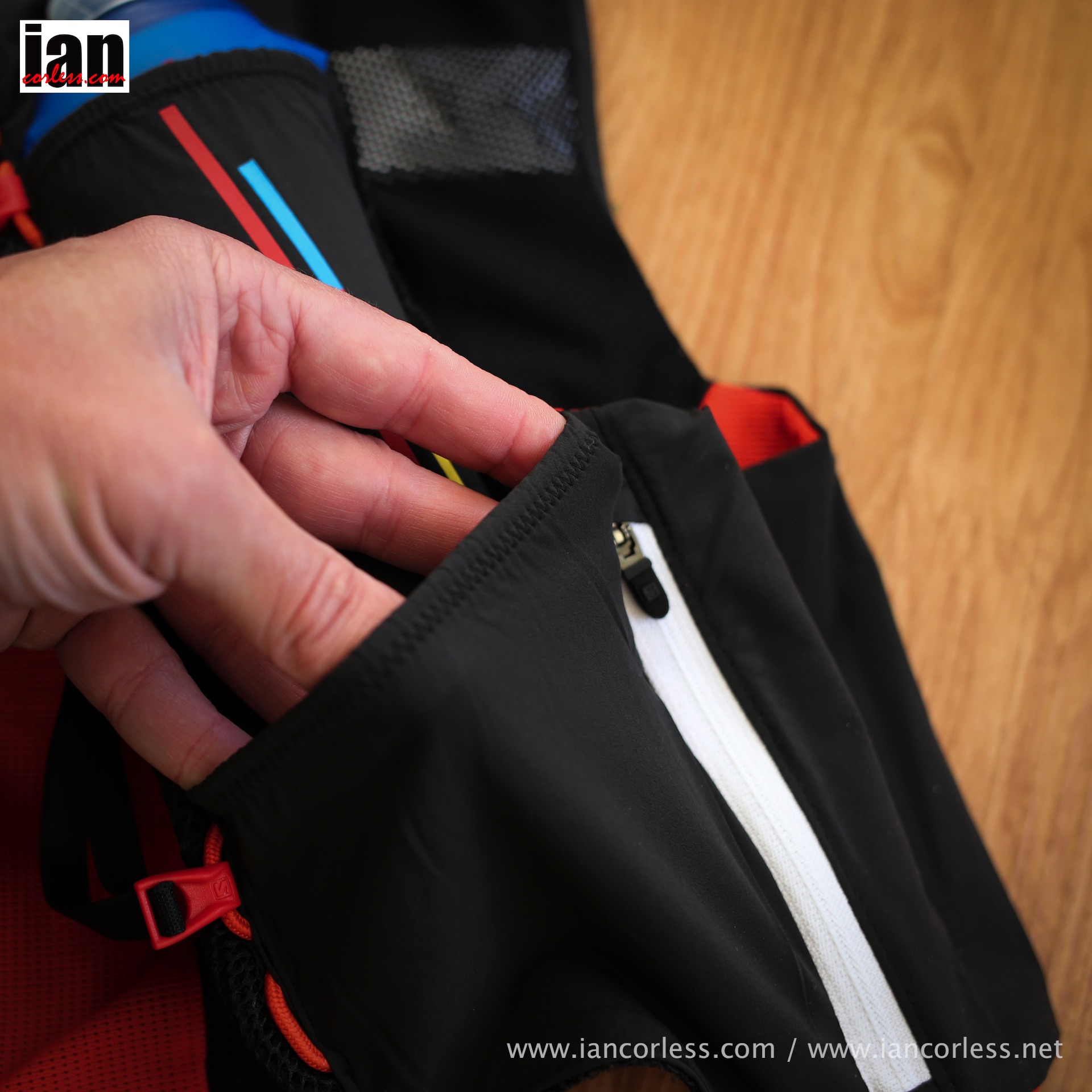
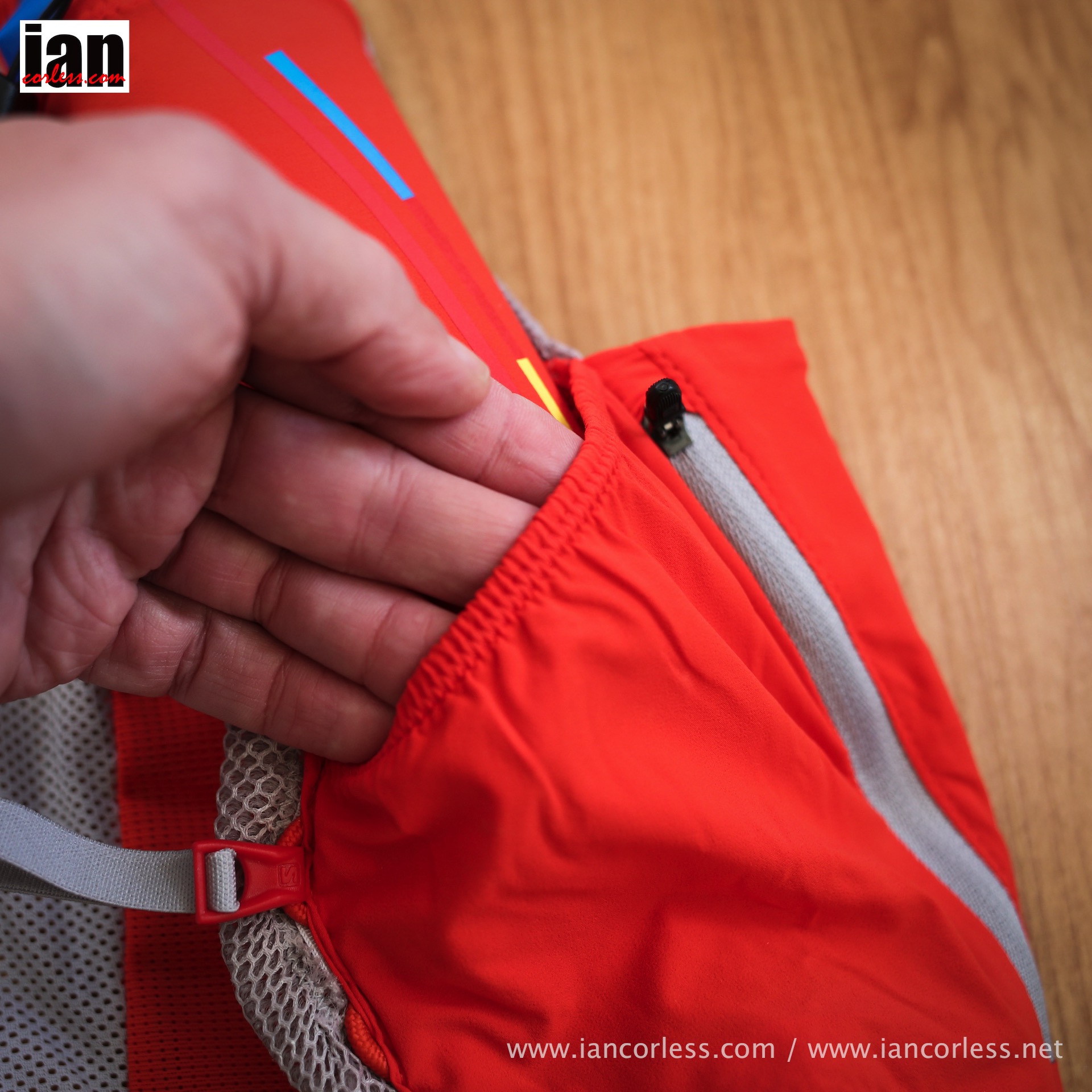
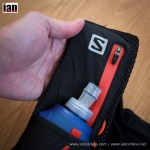
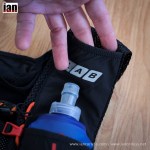
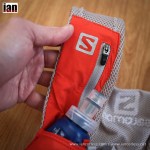
Two dump pockets (open ended but elasticated at the top) at the bottom of the soft flasks

©iancorless.com_Salomon-7720

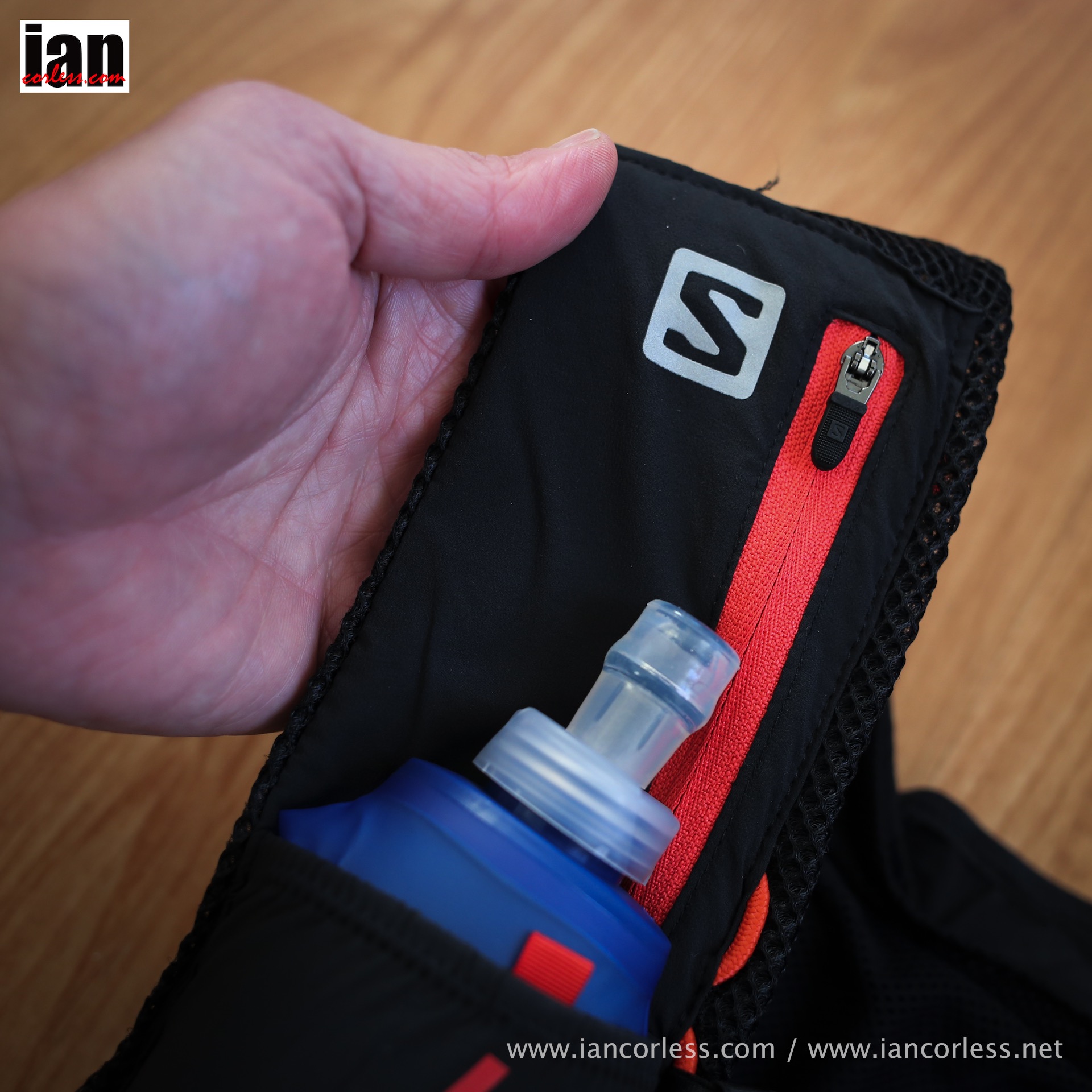
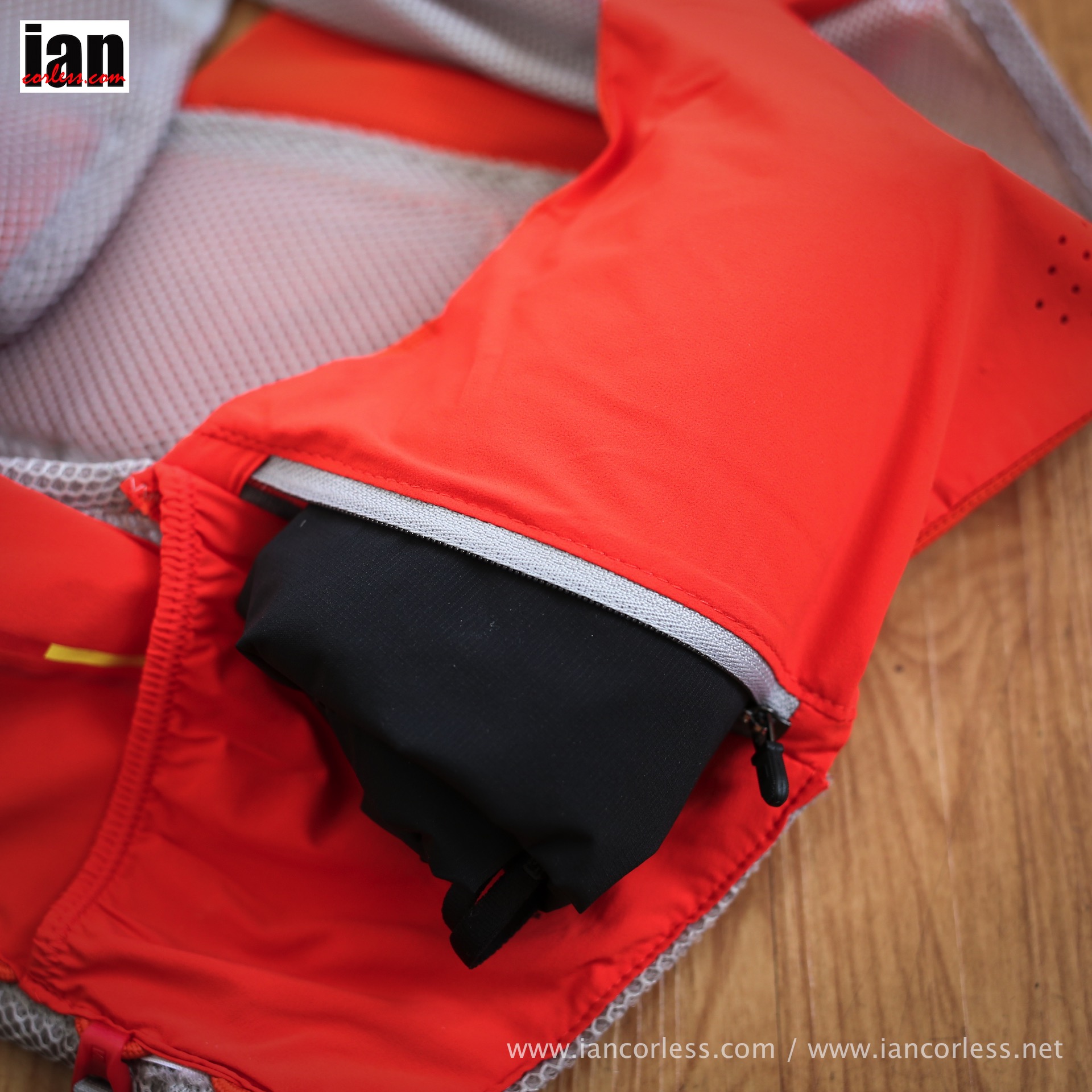
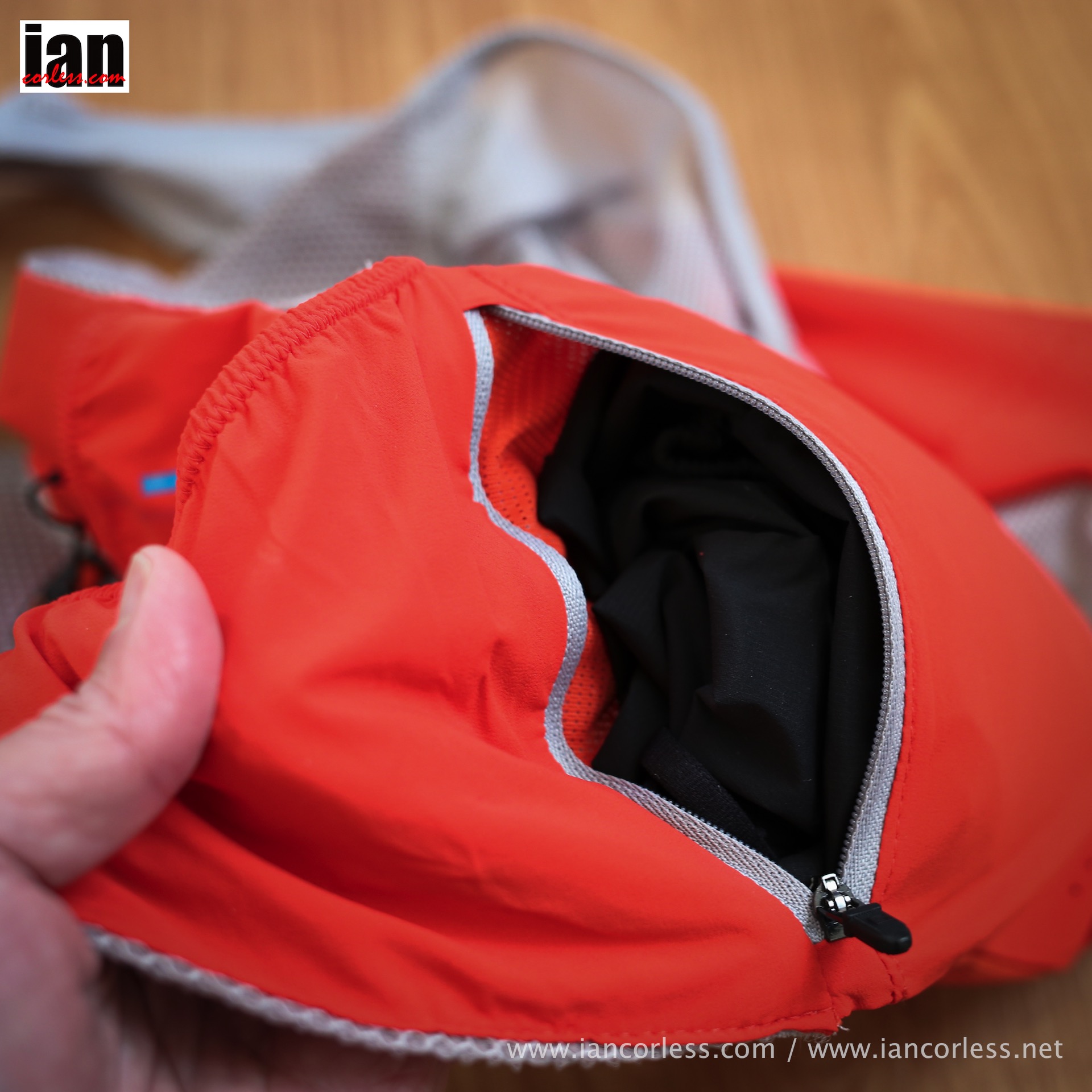
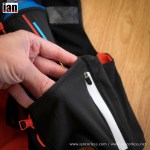
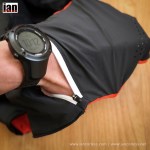
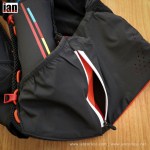
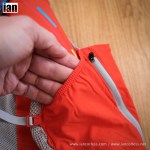
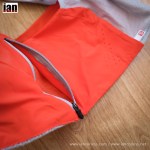
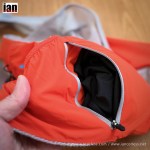
Two zipper pockets (on each side) with large capacity made from a stretch fabric.

©iancorless.com_Salomon-7722 ©iancorless.com_Salomon-7724

Open ended stretch pocket on the left shoulder strap above the bottle.

©iancorless.com_Salomon-7711


Zipper pocket on the right shoulder strap above the bottle.

©iancorless.com_Salomon-7710


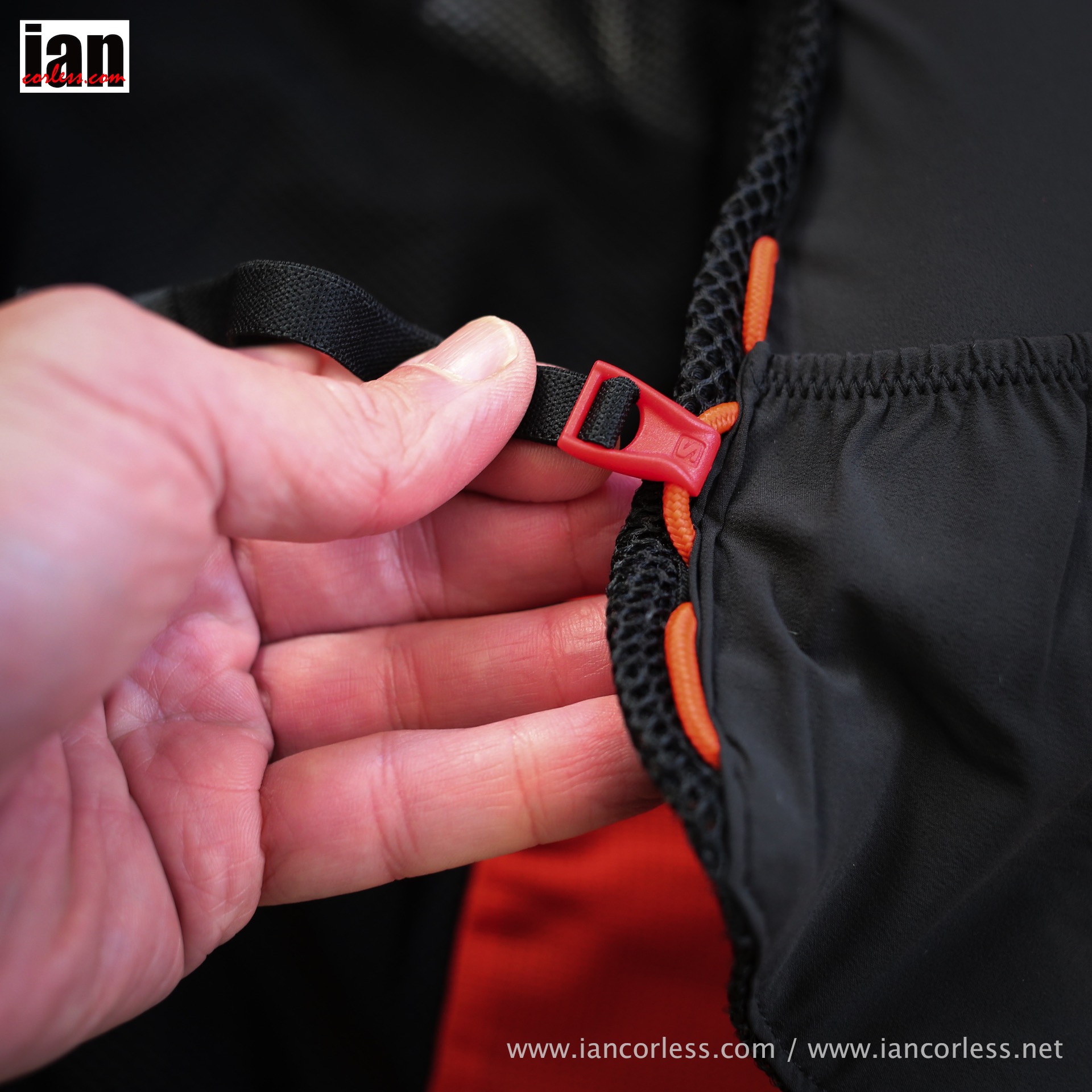
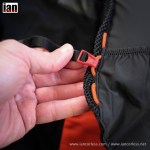
Adjustable fitting system (left to right) with three upper and lower settings.

©iancorless.com_Salomon-7713

Whistle.

©iancorless.com_Salomon-7707

In Use

I have the M/L fit and it’s quite simply the most comfortable pack I have ever worn. The pack hugs the body, it does not rub and importantly under the armpits and around the neck area the cut is wide to avoid any nasty rubbing.

The soft flasks sit on the chest and do not bounce. You can drink from the bottles without removing them when required, however, I haven’t been able to do that running. I need to stop, lean over, bite the bottle, take a drink and then push on…  Soft flasks and tight fitting stretch pockets make for a tricky combination. The soft flasks and the way they fit on the body are perfect, but trying to add a full bottle back to the pocket can be tricky. With practice it does get easier and a tip is to blow back into the bottle once you have taken a drink. This inflates the bottle and makes it more rigid. I personally have always preferred bottles over bladders and soft flasks and Salomon’s positioning make this combination the best I have tested.

©iancorless.com_Salomon-7756

The upper zipper pocket will fit a phone or a gps device. I personally use and old style waterproof phone when racing and that fits perfectly. However, on training runs I have taken an iPhone 5 in a waterproof casing. So, capacity is ideal. The pocket is tight and stretchy and therefore whatever you put in is held tight with no bounce, another plus!

©iancorless.com_Salomon-7775

On the opposite side the open ended stretch pocket is also large enough to hold a phone but is ideally suited for maybe food items or a music player.

©iancorless.com_Salomon-7772

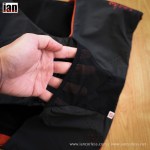
The two open ended dump pockets on either side of the pack below the bottles are large enough to hold multiple gels and bars and/ or items such as gloves, hat, buff or anything similar. To give you an idea of capacity, I could fit a beanie and gloves in one side and four/ five gels or bars on the other side. Ultimately it means you have plenty of room for energy when racing. Access is dead easy. Just put your hand in and pull the items out.

©iancorless.com_Salomon-7779

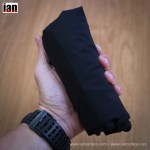
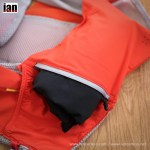
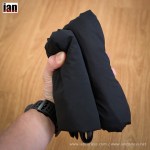
The two zipper pockets are the secret weapon on both packs. I am amazed at how spacious these pockets are. Depending on the race you are doing and also dependant on your own personal preferences; the zipper pockets will actually hold a taped seam waterproof jacket in one side and taped seam waterproof trousers in the other side!

©iancorless.com_Salomon-7832 ©iancorless.com_Salomon-7836


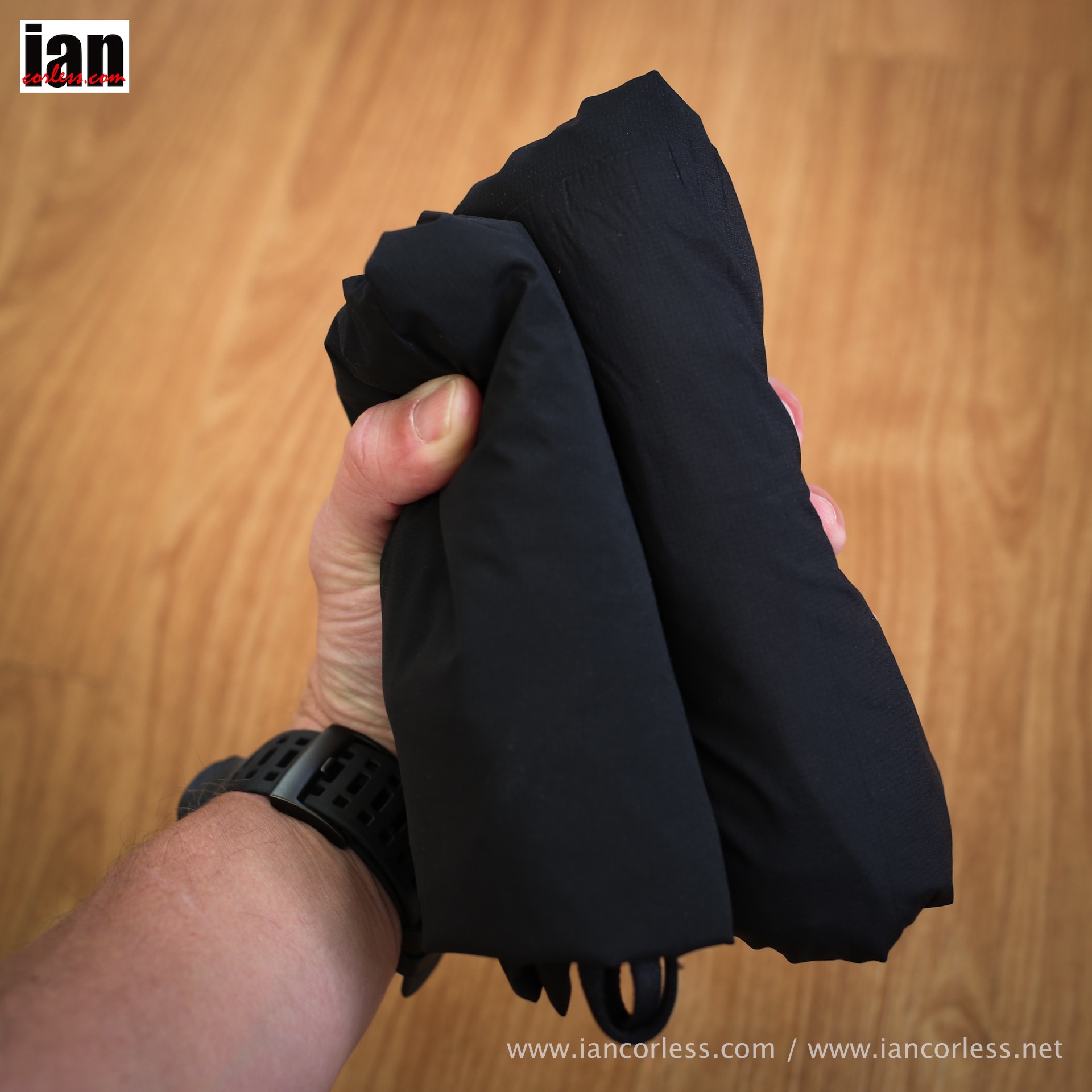
Salomon provided me the  S-LAB HYBRID JACKET and S-LAB HYBRID PANTS (both medium) to test (review to follow later) and these items folded up and fitted in both packs perfectly.

©iancorless.com_Salomon-7847

Considering the SENSE SET pack is only 1L capacity, this is remarkable. Lets just look at the facts, you can fit in:

  • Jacket
  • Trousers
  • Phone
  • 1L of fluid
  • 4-10 bars or gels
  • Hat and gloves
  • and then other extras such as Mp3, space blanket or other small items.

The SENSE ULTRA SET adds extra capacity at the rear in the form of two pockets. The SENSE SET is just a highly breathable and lightweight pack with no extras.

©iancorless.com_Salomon-7793

A ‘kangaroo pocket’ on the on the lower third of the rear of the pack provides an easy access open ended pocket that can be added to or taken from whilst moving. The pocket is quite small and would take a windproof jacket or food items.

©iancorless.com_Salomon-7732


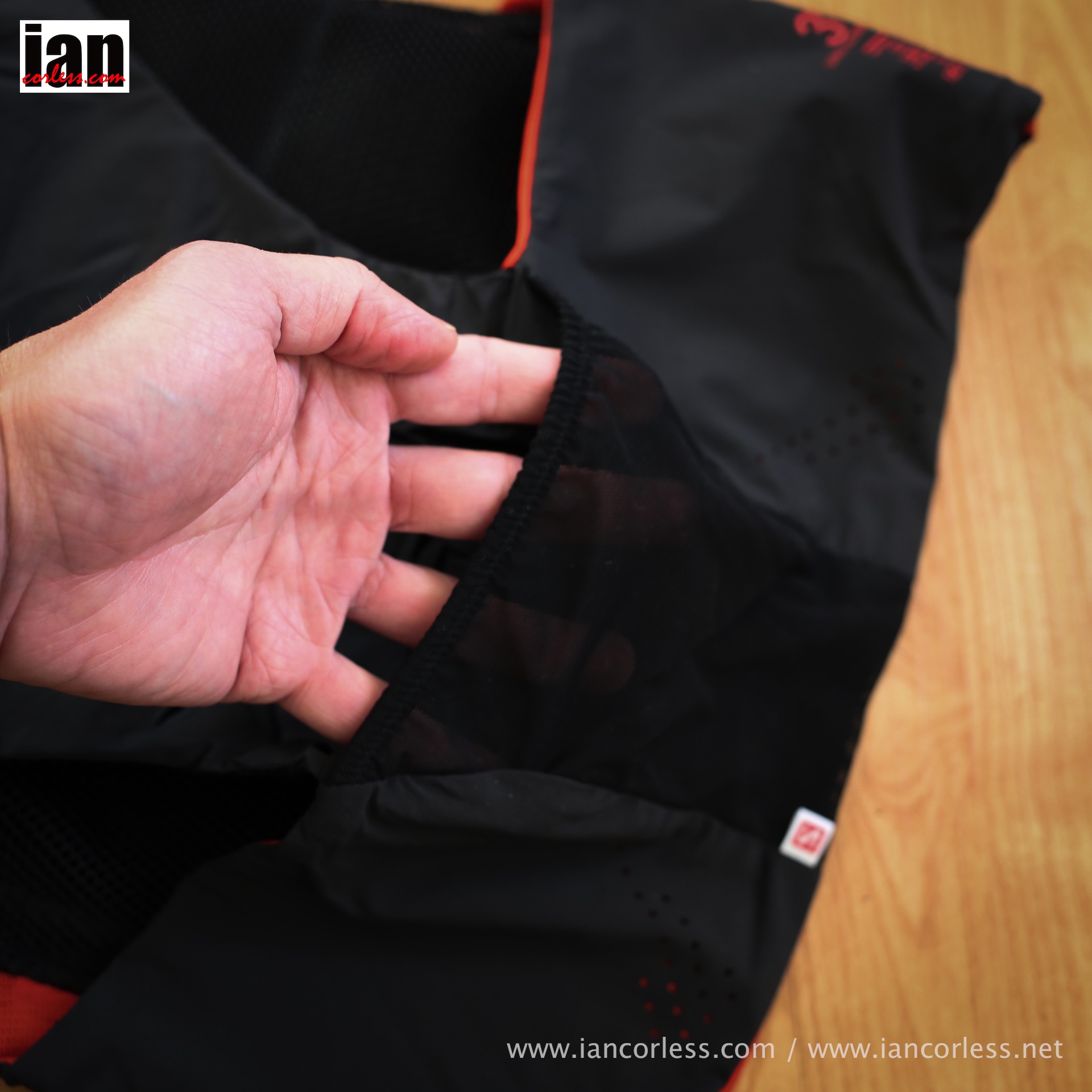
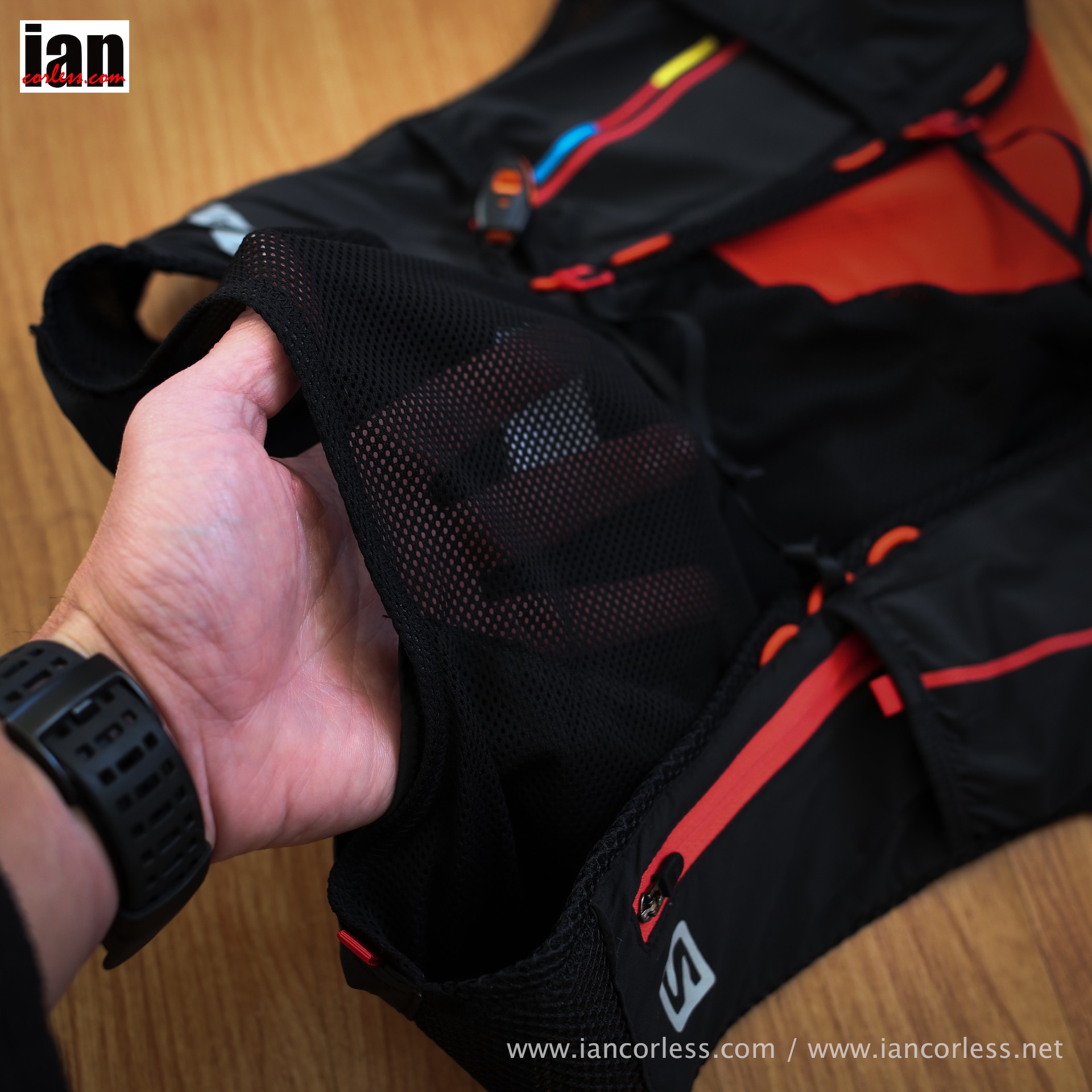
The mesh back panel is actually two layers and makes an open ended deep pocket that can actually be accessed without removing the pack. It’s surprisingly roomy and should you decide not to add a jacket and trousers to the zipper pockets, this pocket can hold both items. Yes, it’s that roomy!

When running, it was easy to reach over, place my hand in the pocket and pull out my jacket. Of course, it was easier to do this if I stopped BUT this vest is very much designed about moving fast and light. It’s a performance product and as such, should you have the need to be quick… this product will allow you that comfort!

©iancorless.com_Salomon-7748

©iancorless.com_Salomon-7729

I have reviewed many products and last year I reviewed the stripped down inov-8 race vest (review here). This for me was a great product. I loved the feel of it, I loved the capacity and I loved its usability when running. For me though, Salomon have upped the game with the SENSE ULTRA SET and the SENSE SET and produced two sublime products that are a joy to wear and use.

Considering the minimal differences between the two vests, I would almost certainly recommend that the SENSE ULTRA SET is the ideal purchase. From Salomon’s perspective, it almost feels an indulgence to have a 1L and 3L version. The added cost and added capacity of the 3L makes far more long term sense for me and lets face it, if you are running really long races, you will probably have the 12L product (or similar) anyway.

On a final note, I am seriously impressed with the capacity of both packs. The SENSE SET at 1L holds a ridiculous amount of kit for something so minimal that I question if 1L capacity is correct? The SENSE ULTRA SET wouldn’t hold all the required items for a race like UTMB but it wouldn’t come far off if you were keeping items to a minimum. That said, the SENSE ULTRA SET makes a perfect and ideal pack for racing any distance (even 100-miles) when all you need is some liquid, food, jacket, trousers, hat, gloves, space blanket, phone and a few other small items. It’s arguably the perfect pack!

Pros:

  1. Soft flasks are a dream
  2. Capacity on the front of both packs is incredible
  3. Zipper pocket is great for valuable items
  4. Open ended dump pockets great for items that you need all the time – food, hat, gloves and so on.
  5. Zipper pockets have amazing capacity
  6. You could wear the products against your skin
  7. On the SENSE ULTRA SET the rear capacity is superb and a real eye opener
  8. Weight is amazing
  9. Price is good £100 for SENSE ULTRA SET and £85 for SENSE SET

Cons:

  1. Soft flasks can be tricky to get back in the open ended pockets
  2. I am not sure how the pack would fit for lady users. The bottles would potentially sit in just the wrong place?
  3. The ‘kangaroo’ pocket on the SENSE ULTRA SET is small
  4. These are lightweight products and durability ‘may’ be an issue?

Conclusion:

I love these two packs. They actually make wearing a pack a pleasure rather than a chore and that is a real bonus. Capacity is quite mind blowing in both products and the SENSE ULTRA SET makes the most logical purchase choice as it provides more usage options. I actually found it difficult to come up with ‘cons’ for these packs they are that good!

Check out Salomon HERE


Salomon LogoSALOMON S-LAB SENSE ULTRA SET
©iancorless.com_Salomon-7704

Ultra-lightweight running pack designed by Salomon Athletes. The Salomon S-LAB Sense Ultra Set weighs in at 110g and is designed to carry the bare essentials in absolute comfort with a 3L capacity.

  • Motion fit trail
  • Sensifit
  • Soft twin link
  • 2 zippered pockets
  • 1 chest pocket
  • 2 soft flask
  • Zipper phone pocket
  • 2 stretch pockets
  • Back compartment
  • Kangaroo pocket
  • soft rim
  • Reflective
  • Whistle

SALOMON S-LAB SENSE SET

©iancorless.com_Salomon-7759

Ultra-lightweight running pack designed by Salomon Athletes. The Salomon S-LAB Sense Set weighs in at under 100g and is designed to carry 1L of the absolute bare essentials.


  • Motion fit trail
  • Sensifit
  • Soft twin link
  • 2 zippered pockets
  • 1 chest pocket
  • 2 soft flask
  • Zipper phone pocket
  • 2 stretch pockets
  • soft rim
  • Reflective
  • Whistle

Great Britain and Northern Ireland Team announced – IAU World Trail Championships 2015

©iancorless.comIMG_9596UTLD2014

Jo Meek at Lakeland 50

News from ©britishathletics.org.uk

A 12-strong Great Britain and Northern Ireland team has been selected for the IAU World Trail Championships, Annecy, France on Saturday 30 May. Ricky Lightfoot, champion in 2013 will lead the team.

Ricky recorded a time of 5:36.03 two years ago but struggled with injury in 2014. When in form, Ricky is an unstoppable force on the trails and he will be looking to build his fitness in the coming months to top the podium in Annecy.  Paul Giblin was the highest placed Briton at the IAU World 100km Championships in Doha last November where he placed 11th, a great performance! Paul also won and broke the course record at the West Highland Way race in 2014. He is going to be one to watch, for sure.

Kim Collison at Mourne Skyline MTR

Kim Collison at Mourne Skyline MTR

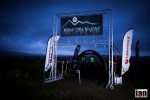
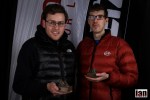
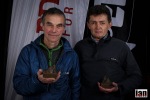
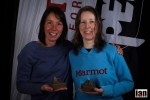
Also joining the strong senior men’s team will be 2014 Lakeland 50 winner Kim Collison who just this last weekend stormed to victory with Adam Perry at the Marmot Dark MountainsPaul Raistrick was the 2011 Commonwealth Ultra-trail running Championships 12th place finisher. Tom Owens had an incredible return to form in 2014 and placed highly at all the Skyrunner World Championship events. In just over one week, Tom will ine up in Hong Kong for the Sai Kung, the first race in the Skyrunning Continental ChampionshipsLee Kemp will also be endeavouring to place highly in the field and guide the team to a podium placing.

Tom Owens at Trofeo Kima

Tom Owens at Trofeo Kima

Jo Meek needs no introduction to readers of this website. I have been talking Jo up ever since meeting her at Marathon des Sables in 2013 and what she has achieved since is quite incredible. In 2014, Jo won the TCC in Costa Rica, won Iznik Ultra, placed 5th at Comrades, won Lakeland 50 and then placed fourth at the IAU World 100km Championships in Qatar. Needless to say Jo is one to watch in Annecy.

Holly Rush will join Jo and after some excellent runs in 2014, in particular a great showing at La Course Templiers (against a strong field) a win at Ultravasen and part of the Asics Outrun the Sun team.  Lizzie Wraith is the Lakeland 100 course record holder and was a recent victor of the 3×3 in the UK. Without doubt, Lizzie will be looking to peak for Annecy. Sarah FawcettSarah Morwood and Bonnie Van Wilgenburg add plenty of experience to the women’s team.

Bonnie Van Wilgenberg at Lakeland 50

Bonnie Van Wilgenberg at Lakeland 50

The full Great Britain & Northern Ireland team for the IAU World Trail Championships in Annecy, France:

Senior Men:

Ricky Lightfoot
Paul Giblin
Kim Collison
Tom Owens
Lee Kemp
Paul Raistrick

Senior Women:

Jo Meek
Holly Rush
Sally Fawcett
Lizzie Wraith
Sarah Morwood
Bonnie Van Wilgenburg

Marmot Dark Mountains 2015 – Provisional results and Images

©iancorless.com_MDM2015-0511

The heavens opened the day before the Marmot Dark Mountains and the promise of a snowy course disappeared with each rain drop.

In many respects it was a shame. Many, including me, was excited by the prospect of a night time race with cold chilly temperatures, a clear sky and a layer of the white stuff. However, it was not to be!

More importantly, the 2015 Marmot Dark Mountains took place with no rain… yes, no rain! Conditions were less than perfect though. The ground was sodden with the previous days torrential rain and melted snow and although the evening started relatively calm the wind increased hour-by-hour and by the early hours of the morning, the wind and wind chill was having an impact on everyone.

Taking place in the Howgills, runners started to race at 1900-hours with elite duo Alex Pilkington and Tim Higginbottom first off! Kim Collison and Adam Perry departed at1940-hours and it was immediately apparent that they were on a mission!. Completing the top trio, Steve Birkinshaw partnered with Jim Mann and they departed at 2000-hours chasing the other runners down.

What followed was a masterclass of navigation and speedy running from Collison and Perry. They blazed a trail around the Howgills and the ‘projected’ best case scenario finish time of 11-hours was blown out the fells when the finish line dibber confirmed a time of 8-hours and 34-minutes. Quite incredible.

Higginbottom and Pilkington had had some problems early on finding a control. Equally, Birkinshaw and Mann had also had a  problem. However, Birkinshaw said after the race that his form was just not up to running at the required pace. Hardly surprising after his Wainwrights record.

There were four linear courses that follow the standard Elite, A, B and C format of ordinary mountain marathons and two score format courses. Feedback post race was excellent and a dry night on the fells was extremely welcome.

Results below are provisional and will be confirmed by Ourea Events asap.

Elite

1st Kim Collison / Adam Perry 08:34:54

2nd Steve Birkinshaw / Jim Mann 10:41:46

A

1st and 1st Mix Catherine Litherland / Ross Litherland 09:49:54

2nd Andy Thompson / Rob Brown 10:10:35

3rd Chris Baynham-Hughes / Max Wainwright 10:51:05

1st Women and 4th Steph Jones / Sally Ozanne 11:26:51

1st and 1st Vet Bryan Stadden / Andy Creber 09:15:33

2nd and 2nd Vet Tim Martland / Jim Allen 09:51.35

3rd Jamie Rennie / David Rennie 10:02:02

C

1st Greg Weatherhead / Kevin Drew 07:55:21

2nd James Parratt / Neil Garrido 09:21:14

3rd and 1st Mix Emma Van Der Gucht / James Pawson 09:34:30

Long Score

1st David Adcock / Ben Turner 404 in 10:00:33

2nd and 1st Mix Digby Harris / Kirsty Hewitson 295 in 09:55:28

3rd and 1st Female Jo Gillyon / Catherine Evans

4th and 1st Vet Simon Caldwell / Carmen Elphick

Short Score

1st, 1st Mix, 1st Vet Jonathan Aylward / Kate Boobyer 235 in 07:38:37

2nd and 2nd Mix Scott Collier / Anne Edwards 235 in 07:42:15

3rd Darryl Watton and Andy Bell

The Howgill Fells are hills in Northern England between the Lake District and the Yorkshire Dales. The fells are bounded by the River Lune to the north by upper reaches of the River Lune and to the east by the River Rawthey. The Howgill Fells include two Marilyns: The Calf – 2,218 ft (676 m) and Yarlside – 2,096 ft (639 m) and a number of smaller peaks, including five Hewitts. Parts of the southern Howgill Fells lie within the Yorkshire Dales National Park, though they have been within the modern county of Cumbria since the county boundary changes in 1974. They were originally shared by the West Riding of Yorkshire and WestmorlandThe name Howgill derives from the Old Norse word haugr meaning a hill or barrow, plus gil meaning a narrow valley. – wikepedia

Ourea_Events_Logo(600)

Hernando, Jones and Olson for Transvulcania La Palma 2015

©iancorless.com.IMG_8491Transvulcania14

It’s only January and already the world of Skyrunning is hotting up with the announcement that 2014 Transvulcania La Palma champion and Skyrunning Ultra Distance World Champion, Luis Alberto Hernando will return to the island to defend his crown.

Luis Alberto Hernando had an incredible 2014 and his return to Transvulcania is eagerly anticipated. A true champion, the tough and challenging course is one that he relishes, however, Luis will not have things his own way!

©iancorless.com.IMG_7531Transvulcania14

Salomon Running new signing, Dakota Jones won the race in 2012 and he is back once again to test himself. Dakota raced in 2014 but had a disappointing race (his words) placing 10th. With a new team and definite plan to race theSkyrunner® World Series and Skyrunner® Continental Series, I think it is fair to say that the American will push Luis all the way to the line.

©iancorless.com.IMG_8884Transvulcania14

Timothy Olson loves the trails on the island of La Palma. In the past couple of years he has made the island his families home as he prepares meticulously for the race. Timothy is very clear, a podium place is a main objective. He came close in 2013 with 4th place and last year he placed 8th.

More athletes will be announced in the coming weeks and months as we all anticipate the 2015 Skyrunning Transvulcania La Palma.

 Check out the Skyrunner® World Series calander HERE

Check out the Skyrunner®  Continental Series 2015 HERE

Check out Skyrunning HERE

Transvulcania La Palma website HERE

Marmot Dark Mountains™ Howgills 2015 – Race Preview

Marmot Dark Mountain - FINAL (BLACK)

Marmot Dark Mountains™ is the only overnight winter mountain marathon and the 3rd edition of the race will take place on Saturday 24th January in the Howgills.

The Howgill Fells are hills in Northern England between the Lake District and the Yorkshire Dales. The fells are bounded by the River Lune to the north by upper reaches of the River Lune and to the east by the River Rawthey. The Howgill Fells include two Marilyns: The Calf – 2,218 ft (676 m) and Yarlside – 2,096 ft (639 m) and a number of smaller peaks, including five Hewitts. Parts of the southern Howgill Fells lie within the Yorkshire Dales National Park, though they have been within the modern county of Cumbria since the county boundary changes in 1974. They were originally shared by the West Riding of Yorkshire and WestmorlandThe name Howgill derives from the Old Norse word haugr meaning a hill or barrow, plus gil meaning a narrow valley. – wikepedia

screenshot_468

This year’s elite course is a tough one, with a potential 3000m of elevation gain and an optimum distance of 53km. Famous for their steep rounded hills, the Howgills will be a tough challenge. Having viewed weather forecasts the organisers have issued a stern warning to all the competitors about the challenging nature of the terrain and event.

Needless to say, mandatory kit will be checked prior to the event.

©iancorless.com.©iancorless.com.P1100141

Marmot Dark Mountains™ is a true test of mountain craft for experienced mountain runners. Challenging terrain, night navigation and a wintery environment will test each runner over the variety of courses available: Elite, A, B, C, Short Score and Long Score.

©iancorless.com_IMG_5450Marmot24_2014_

“Marmot Dark Mountains™ takes the classic two-day mountain marathon format and gives it a new… darker twist.” said Race Director, Shane Ohly. “Rather than two days of running with an overnight camp in between, Marmot Dark Mountains™ packs everything into one winter’s night!”

Steve Birkinshaw

Three of the UK’s leading teams are of particular interest in the 2015 event: Steve Birkinshaw and Jim Mann, Chris Near and Tim Higginbottom and Kim Collison and Adam Perry.

Kim Collison at Mourne Skyline MTR

Kim Collison at Mourne Skyline MTR

Runners will start to race at 1900-hours and  Chris Near and Tim Higginbottom will be first off! The dynamic duo have won practically every elite mountain marathon and they have held various long distance mountain running records. In 2014, Near and Higginbottom missed the race due to last minute illness, they will be looking for victory in 2015.

Steve Birkinshaw needs no introduction. His incredible Wainwrights record in 2014 was a highlight of the year for many a trail, mountain, fell and ultra runner. Steve’s partnership with Jim Mann is fitting as Mann holds the record for the winter Bob Graham Round. Birkinshaw won the 2014 event when partnered with Tom Gibbs, so the pressure will be on! Birkinshaw and Mann start at 2000-hours chasing the other runners down.

Kim Collison and Adam Perry will be a tough pair to beat and setting off at 1940-hours. Collison won the first Marmot Dark Mountains in 2013 (running with Alex Pilkington) and finished the 98km Fellsman with Perry in first place last year. The duo are evenly matched and are considered favourites by many!

©iancorless.com.©iancorless.com.P1100347

Offering a range courses to suit a range of abilities, every year there has been a small but steady increase in the number of participants.

“The event kicks-off on the Saturday evening with the longest classes setting off first for dusk-to-dawn racing. The shorter classes will set off later in the evening with the aim of most competitors finishing within an hour or so of each other the following Sunday morning. This makes for an exciting finale as all the courses and most of the competitors converge on the finish as dawn breaks.”

There are four linear courses that follow the standard Elite, A, B and C format of ordinary mountain marathons and two score format courses.

This year there will be two manned checkpoints in the Howgills that competitors on the various courses may visit and the organisers intend to post updates to the event website as the night of racing unfolds.

©iancorless.com.©iancorless.com.P1100383

Follow the race at Ourea Events HERE

Marmot Dark Mountains HERE

OureaEventsLogo(500x500-cropped) copy

SCOTT Trail Rocket 2.0 (2015) Shoe Review

©iancorless.com_Scott-8036


Following on from the extremely successful and popular T2 Kinabalu (review HERE and ladies review HERE) Scott have produced an out and out trail running race shoe aptly named the Trail Rocket. The original Trail Rocket (Feb 2014) when released gained plenty of initial praise. I praised them! However, it soon became apparent that the sole had some serious issues. The black nodules as seen on the image below literally would just come off. For me, my shoes did last a while before I had issues, however, some runners had problems within 50-miles.

Scott Trail Rocket Sole

The new 2015 shoe has addressed this issue and the sole is now far more resilient and long lasting.

©iancorless.com_Scott-8046

The orange section of the sole is now a moulded compound and the grip is not ‘added’ as in the previous model. So if you have used the Trail Rocket in the past, like them but refused to go near them again because of longevity issues, don’t worry, Scott have addressed this!

If mud is your thing the Trail Rocket is not for you. The Trail Rocket 2.0 is for fast running on hard pack trails, rocks, gravel and so on. They can withstand a little mud but not too much. They perform well on wet ground but the compound used in the orange section of the sole is relatively hard and on occasion I have felt the shoe slip. It’s only a minor slip but nonetheless it does make you take a breath and then you question what will grip be like later in the run?

©iancorless.com_Scott-8044

Following the trend for low drop shoes, the Trail Rocket 2.0 has a 5mm heel to toe drop in comparison to the 11mm drop of the T2 Kinabalu. The T2 Kinabalu is still a favourite shoe of mine even though it has an 11mm drop. This is mostly due to the ‘rocker’ sole which makes the shoe feel lower than it actually is. You can see one of the 2015 T2 Kinabalu 3.0 colour ways below.

Scott T2 Kinabalu 2015

Scott T2 Kinabalu 2015

The upper of the Trail Rocket 2.0 is very breathable with a slightly narrow toe box (precision) and a snug heel compartment that provides a solid and secure fit. Toe protection is okay but not great.

©iancorless.com_Scott-8052

Sizing is true to size, however, if you are going without socks you may want to check what works for you. Lacing is solid and depending on your preferred lacing method the shoe holds firm to the foot and is extremely comfortable.

©iancorless.com_Scott-8051

The laces provide a real secure and tight hold and once tied they hold firm and don’t come loose. An elastic bungee (Lace Locker) holds and retains any  excess lace.It’s a really practical solution that was missing on the original Trail Rocket. It’s a simplistic solution to a problem that exists for all runners unless you use Salomon!


The Trail Rocket 2.0 is lightweight and versatile and designed for maximum performance for racing and fast training. The minimalistic design in combination with the eRide™ Technology promotes an efficient, natural and fast running style.

©iancorless.com_Scott-8057

Arguably, the eRide™ (rocker) may not required for this model of shoe as a 5mm drop will almost certainly mean that your run form should already be good and mid to forefoot landing is normal. However, should you be transitioning to lower drop shoe (say from 8mm) the eRide™ will help guide you on your way.

eRide

As you would expect, the shoes weigh in at a light 260g (UK9) which is obviously due to the minimalist design and Aerofoam.

Aerofoam

Forefoot cushioning is 17.5 and rear cushioning 22.5 providing a shoe that still provides good cushioning and protection. How far can you run in them? Well it very much depends on your form, adaptation and technique. Without doubt I think we will see many efficient runners covering 100-miles in this shoe, however, for many the Trail Rocket 2.0 will be ideally suited for fast running on trail races up to 50-miles.

©iancorless.com_Scott-8040


The Trail Rocket 2.0 has a ‘Rock-Protection-Plate’ too reduce any impact from obstacles on the ground and cushioning is good. I have had few issues with ‘feeling’ the ground beneath me.

Slipping the shoe on you have that confirmed comfort feeling inherited from the T2 Kinabalu, so, it’s fair to say that if you are a fan of its beefier brother you are going to like the Trail Rocket.

Overall comfort is great and you zip along feeling very light and fast. The shoe has great flexibility. They encourage you to move quicker, lighter and faster with increased cadence.

A real bonus is how good the shoe feels on road and/ or tarmac. Many of us need to transition to trail either by connecting roads or maybe you need to access trail with a jog to and from home? The Trail Rocket handles this well. It’s too early to say in testing what impact this will have on the wear and longevity of the sole.

The Trail Rocket is definitely a shoe for faster training sessions. Certainly if you are new to ultra racing or looking to complete rather than compete, the Trail Rocket may not be the shoe for you.

I really like the Trail Rocket. I enjoyed the first incarnation and had the sole not let me down I would have continued to use them. SCOTT may have an uphill battle convincing previous Trail Rocket owners back… that would be a shame! The 2015 edition of the shoe is exactly as before but now the shoe has a sole that can keep pace with your running.

Read about eRide HERE

©iancorless.com_Scott-8055

Read about Aerofoam HERE

Pros

  1. Light.
  2. Low drop (5mm).
  3. Breathable.
  4. Great lacing and ‘Lace Locker’.
  5. eRide and Aeroform and buzz words but they work.

Cons

  1. Maybe too light for some runners.
  2. Potentially too narrow in the toe box, so, if you like roomy shoes make sure you try these first.
  3. Previous model sole had real issues so runners are going to need to be convinced.

Specs:

  • Drop 5mm
  • Upper – mesh with synthetic overlays
  • Lower – eva/ rubber

Scott Running website HERE

logo

CYCLING for RUNNERS – Girl What Cycles (3)

©iancorless.com_CarrMill-7280

“I love running cross country….

On a track, I feel like a hamster.”- Robin Williams

I’ve always felt the same as Robin Williams about the indoor trainer. To me, training indoors on a bicycle is just like running on a track or treadmill. Yet, like track and the treadmill, cycling indoors can provide a huge advantage to your training if used in a structured way.

©iancorless.com©iancorless.com_cyclingforrunners-4115

First and foremost when the weather is horrendous (like it is in the UK at the moment) you can get a good workout indoors in a warm, safe and controlled environment. I am new to cycling and although not inexperienced, braving winter conditions on a bike would be a step too far for me at the moment. This is where the home trainer becomes a useful piece of equipment.

©iancorless.com_Scott-7365

I can still get my fix for the outdoors with my running… to be honest, I love running in cold temperatures but I also incorporate one treadmill session which allows for faster running (hills or intervals) with some fast-paced loud music which is difficult to do outside.

screenshot_160

In a research project at John Moores University, researchers found that when participants exercised to faster-paced music they “chose to accept, and even prefer, a greater degree of effort”. As well as enhancing performance, music lowers the perception of effort. It dulls or masks some of the pain associated with training. We know from scanning the brain that when athletes are played loud upbeat music there is an increase in activity in the ascending reticular activating system.

For all these reasons I have also been using the home trainer to get in some recovery training after racing or long run sessions. At the beginning of December I completed a 72km trail race at night in sub-zero temperatures. Conditions were very muddy, icy in some parts, with a head-on wind to contend with and as it was at night with poor visibility, the going was tough. Also I forgot to mention I flew out to Lyon on the Saturday, picked up my number, took a shuttle to the start in St Etienne, started the race at midnight, ran to Lyon through the night and flew back to London on Sunday, took a coach, another train ….All a bit crazy and exhausting to say the least. Over the next 2 days following the race, I suffered DOMS (delayed onset of muscle soreness). This meant no running for a few days. I had a fun run planned in Paris the following weekend so I decided to use cycling as “active” recovery. Like running on the treadmill you can quickly get hot very quickly on an indoor trainer. I set myself up near an open window to allow for some ventilation. If you were doing a hard session, an indoor fan would also be a good idea.

Recovery is all about spinning my legs, easing away muscle soreness, getting the blood flowing and I suppose not having too much structure. However, I find indoor training easier if I have a plan to follow and music!

©iancorless.com_Scott-7329

Hints ‘n’ Tips

  • Use your own bicycle. I am using my SCOTT bike fixed to my indoor trainer via the rear wheel. This is perfect as I do not compromise on my cycling position which I have worked hard to make perfect.

©iancorless.com_Scott-7360

  • Use your normal cycling shoes and pedals

©iancorless.com_Scott-7316

Suunto Ambit 2

  • Have water available
  • Use a fan or train near an open window
  • Have a towel handy – you will sweat
  • Use music or a TV for stimulus

Need some free music to help you with your indoor session? Try HERE for 50minutes of audio. I personally recommend that you make your own playlist that is specific for your session. Using something like iTunes makes this really easy. Alternatively, a company like Audiofuel provides specific music mixes with or without coaching.

Session 1:

Length : 44 min        

  • Warm-Up : 10min in a very easy gear allowing me to ‘spin’ at a cadence of 90
  • Main Set: 24min alternating 3min at 90 cadence and 3min at 110 cadence. Gearing should be easy and light to allow your legs to spin around. The faster cadence session of 110 allows me to concentrate on cycling technique using the up and down of the pedal stroke and adds souplesse to my legs.
  • Cool Down: 10min easy gear at a cadence of 90

Session 2:

Length: 35min

  • Warm-up: 10min in a very easy gear spinning at 90 cadence
  • Main set: 15min broken down into 30sec at 90 cadence and 30sec at 120 cadence
  • Cool Down: 10min very easy gear at 90 cadence

©iancorless.com_Scott-7351

Initially you will find your legs struggling to get used to using different muscle groups in this recovery work-out. The aim is not to PUSH the gears or have resistance. We don’t want to stress sore muscles. These two sessions are all about spinning legs with an easy gear on the bike and allowing the muscles to recover. This is what is so great about cycling… you can exercise in a non weight bearing way. However, the increased cadence sessions of 110 and 120 will allow you to raise your heart rate.

I shall be doing a turbo session at least once a week as active recovery in my build up to my next long distance run, Paris Mantes 50km towards the end of January. This will be followed by a week off running but 2 turbo sessions before a trip to Costa Rica and the opportunity to run The Coastal Challenge stage race.

Happy New Year and remember, cycling is great for running if used sensibly.

Join us on STRAVA

TIS-Strava-Logo-big-square-600x340-e1354741369637

Thanks to SCOTT SPORTS and SUUNTO for the support and backing

Print

Check out SCOTT HERE

Suunto_logo [ConveWHITE_rted]

Check out SUUNTO HERE