The Coastal Challenge – Oxygen

TCC RAINFOREST ROUTE V1

December 20th, 2012

Question“Ian, are you free the first 10 days of February?”

Answer “I leave Spain today and I am back in the UK late tonight. I have a busy morning on Saturday and I have some interviews to do Saturday afternoon but I will be free around midday to chat if you are? Alternatively drop me an email. Hope you are well? February should be okay, lets discuss.”

Reply “Great, so you can go to Costa Rica for the multistage ‘Coastal Challenge'”

Answer“Erm, yes! of course”

So, with just 4 weeks to prepare I was suddenly thrust into a week in the jungle. A whole new experience for me but one that I am so excited about! The Coastal Challenge.

I would normally be thinking to myself this is awesome. I get to go to Costa Rica, take part in a 6 day multistage, take photos, write an article and of course get some interviews. Unfortunately my long term knee injury is going to stop that… 225km over 6 days will just be too much and of course, I am not fit! Well, not race fit.

But as I said to my client and the RD, I think it is important to go these events and see it from both sides. If I am taking part, I wont see what is happening at the front of the race. I wont see ‘the race’ for the win. I also wont see the logistics and planning that go into a race like this. My trip is all about understanding every aspect of this race. So I am happy. I plan to dip in and dip out of stages but ultimately report on and bring back a whole series of images and stories that I can relate back to readers and listeners worldwide.
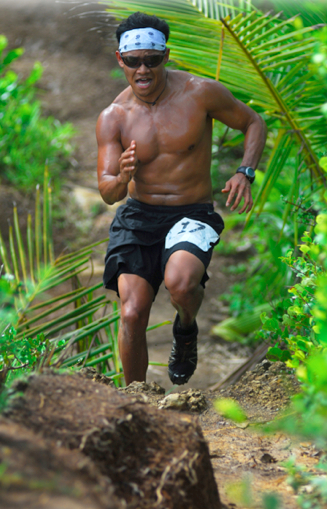
The Coastal Challenge, Costa Rica

The first question I had was, can I die?

Heat Illness and Dehydration

Individuals who are not well conditioned traveling in hot, humid environments are susceptible to both heat illness and dehydration. Heat illness includes both very benign conditions such as heat rash as well as life threatening conditions including heat stroke. Participants should carry enough liquids to ensure hydration during the event. It is important to eat and drink appropriate amounts of liquids with electrolytes during the event to reduce the incidence of hyponatremia. Water has not been an issue in previous Coastal Challenge’s, however, this year portions of the race will be through agricultural areas that will require purification before drinking.

Plants and Animals

There are 135 species of snakes in Costa Rica with 17 being considered dangerous. Mostly these are members of the Viper, Coral and Boa families. The best prevention is watching your path and being aware.

Water Safety

While the water in Costa Rica is generally considered among the safest in Central America, traveler’s diarrhea does occur. It is advised that any water be treated prior to drinking unless its safety can be guaranteed. Speak to your Family Physician about treatment issues (Pepto Bismol, Antibiotics, etc.)

Sun

February is considered the dry season so expect warm temperatures with average highs of 20-25C/70-85C depending on altitude. Furthermore the race will be going through some of the driest areas of Costa Rica. Proper sunscreen is essential (SPF 15 or greater) with enough to last multiple daily applications for the entire race.

Okay okay, that sounds okay… the chances of survival are pretty good. So then, what is The Coastal Challenge?

  • 225km
  • Costa Rica
  • Supported stage race
  • 6 stages
  • February 2013

The “Rainforest Run” promises to be spectacular and challenging. The course has been designed to emphasize point-to-point racing, which will put the “finish line” at or near camp at the end of each day’s race. The course is measured and will be marked. You will be given accurate course measurements and maps (Google Maps, Nat Geo maps) with route profiles for terrain, approximate distances and elevation gain or loss.

Set along Costa Rica’s tropical Pacific coastline and weaving into the Talamancas, a coastal mountain range in the southwest corner of Costa Rica. The race finishes near the border of Panama in a small and serene fishing village that until recently was only accessible by fishing boat.

Mountain, trail, rainforest, single track, across ridges, highlands and coastal ranges. We will run along beaches, rocky outcrops, reefs, river estuaries and the race finishes in the Corcovado National Park, one of the premier rainforest experiences in the world. A Unesco World Heritage site it defies description.

The course has a total elevation gain of more than 34,000 feet.

What is a Rainforest?

Rainforests are forests characterized by high rainfall, with definitions based on a minimum normal annual rainfall of 1750–2000 mm (68-78 inches). The monsoon trough, alternatively known as the intertropical convergence zone, plays a significant role in creating the climatic conditions necessary for the Earth‘s tropical rainforests.

Around 40% to 75% of all biotic species are indigenous to the rainforests.[1] It has been estimated that there may be many millions of species of plants, insects and microorganisms still undiscovered in tropical rainforests. Tropical rainforests have been called the “jewels of the Earth” and the “world’s largest pharmacy“, because over one quarter of natural medicines have been discovered there.[2] Rainforests are also responsible for 28% of the world’s oxygen turnover, sometimes misnamed oxygen production,[3] processing it through photosynthesis from carbon dioxide and consuming it through respiration.

The undergrowth in a rainforest is restricted in many areas by the poor penetration of sunlight to ground level. This makes it easy to walk through undisturbed, mature rainforest. If the leaf canopy is destroyed or thinned, the ground beneath is soon colonized by a dense, tangled growth ofvinesshrubs and small trees, called a jungle. There are two types of rainforest, tropical rainforest and temperate rainforest.

Logistics

The race is supported. This makes a big big difference. Although the race has a similar format to the Marathon des Sables, the big difference is that you do not need to carry your kit whilst running. This multistage is very much a race from the sense that the runners can race light and fast. The top runners will keep it minimal, hand bottles or a small pack. However, for most participants they will carry a pack with some ‘essentials’ and of course a bladder or bottles.

Base camp is set up by the race team. They transport the participants baggage to the finish of each day. Runners can sleep in a hammock or tent.They provide food (apparently excellent) and they also provide a series of check points and feed stations during the race.

After asking several questions, I was told by Rodrigo Carazo the following:

‘In regards to the race, it is a VERY HUMID race, plus it is also VERY HOT, if you have been to MDS, our conditions feel worse in terms o humidity, it rarely gets above 35 degrees but he humidity factor makes it feel hotter. But dont worry the sights and race course and race atmosphere really make the heat a minor issue in regards to the experience, but nonetheless it makes for a very demanding race and it is very rewarding once the race  is finshed!!!!
 
Once the race begins we provide everything you need for the next seven days except your specific racing food. We provide all meals, a highlight of our race you will see, and on course we provide water gatorade, fruits , nuts, sandwiches and cookies, but we dont provide energy bars or similar. At night you will be staying in campsites so bring your tent-with rainfly just in case ( its the tropics!) and a sleeping mattress. Some people bring sleeping hammocks.
Also bring plenty of running and beach clothes, you will need them as after every stage you will end up full of mud and bathed in sweat!! Do not bring shoes or socks you haven’t tried or raced with, this is because your feet will be constantly wet and humid, and blisters could be your worse enemy! Also bring a lot of sun protection, we see a lot of people coming from winter in their home countries leaving back with very sexy ruby red tans!!!!
 
We transport all you gear daily in a duffel bag or action packer plus your tent.”
 
Simple!
Okay, loads of run kit, loads of beach clothes, mattress, tent etc etc etc… I have 4 weeks!
I make a couple of calls and send a few emails and BIG thanks need to be expressed here to The North Face and Arc’teryx.
Both companies have stepped in at the 11th hour and have provided me with a selection of kit that will help me on the trip.
The North Face have provided a tent, luggage and a selection of run clothing. Arc’teryx have provided travel and relaxation clothing.
The North Face
TNF Mica 1 Tent

TNF Mica 1 Tent

The Mica 1 tent will be excellent as I can pitch just the ‘inner’ allowing me to potentially remain a little cooler in the ridiculously hot and humid climate.

The North Face

  • Single Track Hayasa Shoes
  • GTD shorts
  • GTD LS top and SS top
  • Waterproof Pack
  • Enduro 13 Pack w/ bottles
  • Mica 1 Tent

Arc’teryx 

Arcteryx

  • Incendo Short
  • Motus Shirt
  • Neutro Vizor

Race Schedule

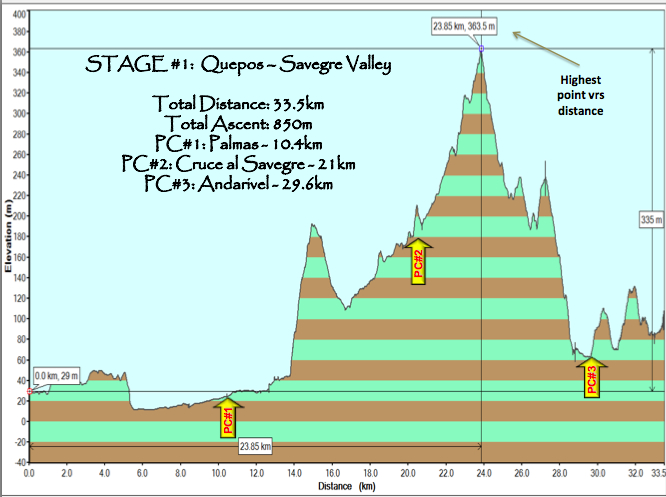
TCC stg 1

TCC stg 2

TCC stg 3

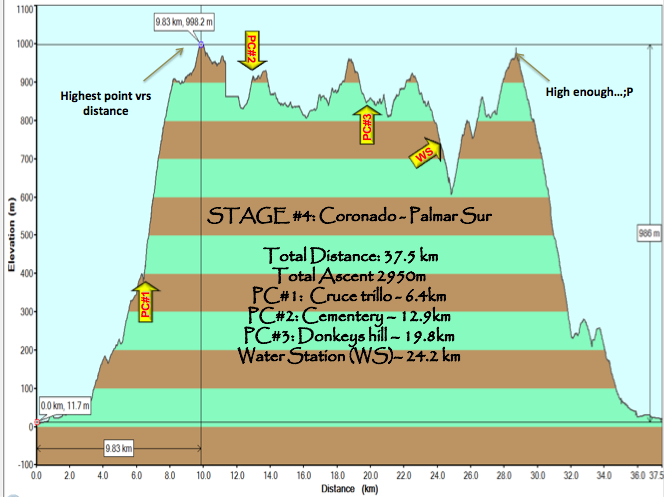
TCC stg 4

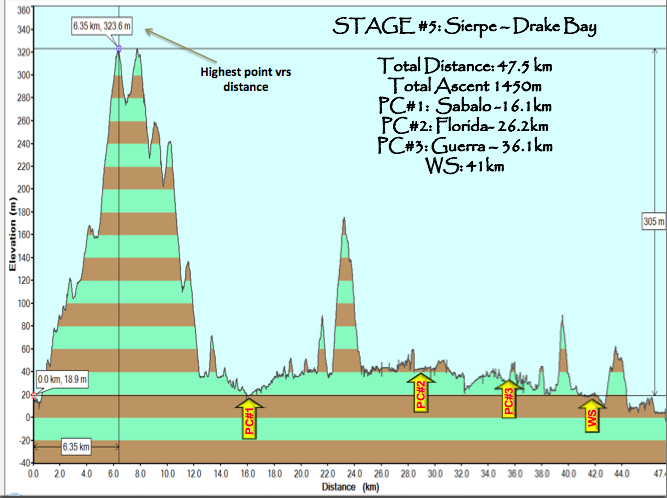
TCC stg 5

TCC stg 6

One’s to watch

  • Dave James from US – interview with Dave James on episode 27 of Talk Ultra HERE
  • Jen Segger from CA
  • Roiny Villegas from CR
  • Ligia Madrigal from CR
  • Ismael Dris from Spain

Footnotes

FEET CARE by John Vonhof

Conditioning Your Feet

In the same way you train your legs and cardiovascular system, you need to condition your feet for the rigors 150 miles of The Coastal Challenge in Costa Rica. In short, that means training your feet in simulated race conditions. Train on somewhat similar terrain—sand, rocks, trails, hills, and in water. Knowing in advance how your feet will respond to these conditions will help you anticipate problems before they occur. Strengthening your ankles will help prevent sprained ankles common to uneven terrain and trails. Add in some walks or runs of longer amounts and vary your distance. The more miles you can get on your feet the stronger your feet will be.

Shoes

When selecting shoes, make sure your toes have wiggle room and your heels are snug with little up and down movement. Shoes with mesh may be cooler but tend to allow trail debris and sand into the shoe. Don’t start the race with worn out shoes. Make sure the shoes fit well and have space for swollen feet and toes.

Socks

Athletes should wear moisture-wicking socks. Try a few types of socks and decide whether a single sock, a thin liner with an outer sock, or two socks are the best for your feet. Remember if wearing more than one pair, more space is required inside your shoes so be sure your shoes are sized big enough. Plan on several changes of socks. The Injinji toe socks place each toe into its own little sock and might be a good move if you are prone to toe blisters.

Gaiters

Gaiters keep sand, grit and gravel, and trail debris out of your shoes and socks. There are many commercially made gaiters available to purchase or make your own. Those with a breathable material are preferred. Styles which attach to the shoe’s upper are preferred over those with the strap under the shoe since they make it easier to change socks.

Skin Preparation

The most beneficial step you can take to prevent problems is to reduce your calluses. Treating blisters under calluses is difficult and sometimes impossible. Use a callus file after showering or use callus remover creams to soften the skin.

Toenail Preparation

Untrimmed nails catch on socks putting pressure on the nail, causing blisters and black toenails, and cut into other toes. Toenails should be trimmed regularly, straight across the nail. Leave an extra bit of nail on the outside corner of the big toe to avoid an ingrown toenail. After trimming, use a nail file to smooth the top of the nail down toward the front of the toe and remove any rough edges. If you draw your finger from the skin in front of the toe up across the nail and can feel a rough edge, the nail can be filed smoother or trimmed a bit shorter.

Blister Prevention

If stopping to rest on the trail, take your shoes and socks off to air your feet, elevating them if possible. If near water, cool your feet with a quick soak. Use a silicone-based lubricant, like Hydropel or Sportslick which helps drive moisture away from your skin and reduces friction between your feet and shoes. Empty your socks of rocks and debris that can cause blisters, sores, abrasions, and cuts. If prone to blisters, consider taping your feet before problems develop.

Blister Treatment

Attend to hot spots when they develop to prevent them from turning into blisters. Cover these with tape to eliminate friction. Blisters should be drained and covered with Spenco 2nd Skin, Blister Block, or Compeed, and then tape. Your feet must be cleaned of all lubricant and oils for the patch to stick. If using a pin to drain the blister make several holes. If using a small scissors, make two small “V” cuts. Make the holes or cuts at a

point where foot pressure will expel any additional fluid build-up. Try to keep the skin on the roof of the blister. After applying a patch, roll your socks on and off to avoid disturbing the patch. Practice applying blister patches on areas of your feet most prone to problems.

Your Foot Care Kit

Wise competitors carry a small foot care kit in their packs. It doesn’t have to be big but it has to be right for your feet and small enough to fit in a Ziplock bag. I’d recommend a small container of Zeasorb powder or BodyGlide lubricant, alcohol wipes to clean oils off the skin before applying a blister patch, tincture of benzoin wipes, a small Ziplock bag with 1-inch Spenco 2nd Skin patches, a sewing needle and thread to drain blisters, and at least two yards of Leukotape wrapped around a small pencil. Duct tape can be substituted for Leukotape if you prefer. Of course it goes without saying that carrying a blister kit is useless if you don’t know how to use the materials. Use the time between now and the race to learn how to patch blisters and tape your feet before an event.

Foot Care at the End of the Day

After each day’s segment, proper care of your feet can help prepare you for the next day.

Using lightweight flip-flops around camp will allow your feet time to air and heal. If possible, soak your feet in cool water. Elevate your feet when resting. Rotate your socks to keep your feet as dry as possible and wash dirty socks. If your feet swell, you may have to remove your insoles. Use Super Salve, Bag Balm, Brave Soldier Antiseptic Healing Ointment, or a similar ointment to keep your feet as healthy as possible.

John Vonhof – Fixing Your Feet: Prevention and Treatments for Athletes, 3rd edition, June 2004
www.footworkpub.com

Essential Medical Kit

  • Alcohol hand rub or equivalent. Have 2 X 100ml bottles available.
Take one with you on run or event.
Use on every occasion that you use the toilet/ wash room. Use before and after eating food.
  • Use often Moist toilet tissues or baby wipes
  • Friars Balsam (Tinc Benz Co) 100mls in leak proof bottle.
  • Cotton buds around 20 kept in a plastic zip bag
  • Fleecy web in rolls or sheets
  • Zinc oxide tape or duct tape.
  • Compeed
  • Antiseptic liquid 100ml in leak proof bottle
  • Antiseptic dry spray 200ml
  • Sterile large bore needles x 10
  • Alcohol wipes, small x 20
  • Zinc oxide tape x 1 roll 5cm wide
  • Steristrip various sizes
  • Vasaline or Sudacrem
  • Adhesive remover or Zoff
  • Zeasorb powder or talcum powder
  • Small pair of dressing sicissors
  • Latex gloves
  • Gauze swabs
  • Sun screen and lip balm
  • Rehydrate salts or equivalent
  • Antibiotic cover
  • Just to clarify a point about running shoes, running shoes should be good fitting and not too big. You can bring a size bigger just in case your feet swell but do not start with them. Bring sandles/ flip flops for around camp in the evening.

Finally….

Spiral

The Coastal Challenge chose the spiral symbol because of its simple and transcendent beauty. Many of the most universally recognized meanings attached to the spiral seem relevant to the adventure in which you are about the take part. To many cultures the circular motif signifies centeredness, tranquility and balance.

Also a basic element in Western ideography, the clockwise spiral is strongly associated with water, power, life, the earth or sun, time, a journey, independent movement, and migrations of tribes, all things that will most definitely shape your life over The Coastal Challenge

 Visit the race website HERE

I will be updating my blog daily with a report and photos. Also check the Talk Ultra Facebook page and Twitter feed for any updates as they happen…..

Providing I can get a signal in the rainforest.

About Mountain Running…

Yes, I openly admit I work for Skyrunning and I attend the events that they organize. I love the philosophy, the courses and the people.

To be honest, I love our sport. Don’t we all?

The WMRA – World Mountain Running Association, are once again making sure that WE understand what Mountain Running is and I guess what Mountaineering, Orienteering and Skyrunning is…

Taken from the WMRA website – link HERE

Mountain Running is Athletics. Differences with Mountaineering, Orienteering and Skyrunning.

To distinguish the sport of mountain running from mountaineering or orienteering or skyrunning we can look at the philosophy of each sport.

The philosophy of mountaineering is based on contact with and challenge to nature. The time factor is only important in relation to our planning and safety. Climbers seek their adrenalin rush climbing on rock faces, looking for new routes and overcoming the danger inherent in their sport. A considerable amount of technical equipment, (ropes, pitons, etc) is needed. It is a question of combat between man and nature.

The philosophy of orienteering is to work out the quickest router between two points. Speed is important but it is useless without map-reading, compass, and route finding skills. In a few competitions, orienteering moves out of the forest, its natural habitat, and onto the mountains but its philosophy is still distinct from that of mountain running.

The philosophy of skyrunning seems to be an adventure on the mountain, trying extreme difficulties: in fact skyrunning is the discipline of running in the mountains above 2.000 meters, where the incline exceeds 30% and the climbing difficulty does not exceed II° grade. Ski poles and hands may be used to aid progress.

The philosophy of athletics, in our case mountain running, is based on the time factor, how to reach the finish taking the defined way as fast as possible. This is the objective of those who take part in competitive mountain running. Courses are designed to eliminate danger. No equipment is needed, no ropes, no compass. Athletes find their challenge in matching their speed against that of other runners, a competition between man (woman) and man (woman).

Are we clear?

Just to make sure:

2013diack.jpgWMRA Council: definition of mountain running for IAAF Rule Book

During the final day of meetings for the WMRA Council in Monte Carlo, the definition of mountain running was discussed at length which resulted in proposed language for a new rule to appear in the IAAF rule book: this new rule numbered 251 could replace actual rule 250.10.
It was agreed by the Council that there are extreme variations in conditions in which Mountain running is practiced worldwide. The difference between very successful and unsuccessful events often lies in the natural characteristics of the venue and the abilities of the course designer.
The proposed rule from the WMRA Council is intended as a guide and incentive to assist countries to further develop Mountain running.
Guidelines are included to support worldwide race directors in the organization and logistics of their events.
The proposed rule will be forwarded to the IAAF for consideration with hopes for final approval by the IAAF Congress in August 2013, at Moscow.
The rule would then appear in the IAAF Rule Book

Anton Krupicka training in Winter

Copyright Joel Wolpert

Copyright Joel Wolpert

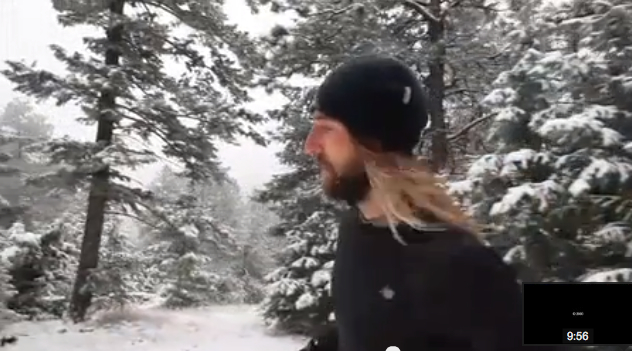
‘Running Times’ correspondent Joel Wolpert caught up with trail runner Anton Krupicka to see how he runs through the Colorado winter.

YouTube link HERE – filmed Feb 2011

As do all of Wolpert’s films, this one features local music: songs by Denver, Colorado bands The Lumineers and Paper Bird.

https://www.youtube.com/watch?feature=player_embedded&v=kjDLorXfkao

Marco Olmo – The Runner

trailsinmotion

TRAILS IN MOTION Film Festival

Big shout out here to my buddy, James at GoTrail for getting this incredible project off the ground and showcasing some of the best in trail movies.

I am eager to see the Marco Olmo film, ‘The Runner‘ but I am equally stoked to see that friends, Dean & Greg from The African Attachment will be showing ‘Collective Dreams‘. Collective Dreams is a film that delves into the professional world of trail running – a sport rapidly growing and changing around the world. At its core, trail running is a solitary pursuit born out of a love of the mountains. The film follows a group of individuals finding their way in this new professional world and, as they learn and gain experience, they are brought together by this common bond as a team and as friends.

The Trails in Motion Film Festival is a project aimed at creating an artistic and engaging platform to showcase the imaginative and awe-inspiring trail running film productions of both local and international film makers.

The objective is to not only capture the true spirit of trail running through the screening of high quality films and documentaries, but ultimately develop an exciting social and visual experience for everyone who shares a connection with the trail and a deep appreciation for the creative expression of others.

An initiative by GoTrailmedia

Ryan Sandes


Guest Host – Ryan Sandes

It has only taken four short years for ultra-marathon ace Ryan Sandes to rise to the very top of his game, earning the prestigious honor of winning all four of the 4Deserts events. He received this record-breaking accolade after a first place result in the Last Desert event in Antarctica at the end of 2010. The human running machine from South Africa led the 250km event from start to finish, battling challenging sub-zero temperatures and treacherous conditions with ice underfoot on the hilly course.

With his focus now shifted to some of the world’s premier single staged 100 kilometer and 100 mile endurance races, Ryan continues to work hard at achieving his goals, all the while maintaining the balance of life. More recently, Ryan’s achievements have included a win at the 2011 Leadville Trail 100, the 2012 TNF100 in Australia, a second place finish at the 2012 Western States 100 as well as a record breaking run through the Fish River Canyon in Namibia towards the end of 2012.

FILM LINE UP

Emilie Lecomte | portrait of a trail runner

Runtime: 6 minutes

Directed by: scenario-s.com

Produced by:  Quechua & Montagne TV


Il Corridore | The Runner

headline_2013

Runtime: 52 minutes

Directed by: Paolo Casilas and Stefana Scarafia

Produced by:  BODA’


Mountain Of Greatness

Runtime: 24 minutes

Directed by: Andrew King

Produced by:  D4 Productions


Collective Dreams | The Documentary

Runtime: 26 minutes

Directed by: Dean Leslie

Produced by:  Greg Fell


HEADLINE FILM

Marco Olmo – The Runner

Runtime: 52 minutes

Directed by: Paolo Casilas and Stefana Scarafia

Produced by:  BODA’

Marco Olmo is a living legend of extreme ultra-running. In his “previous lives”, as he says, he has been a farmer, a truck driver and a workman. Running has became his reason for living, the way to take revenge on his hard destiny. At the age of 58 he has became Ultra-trail World Champion, winning the Ultra Trail du Mont Blanc in France, the hardest and most important endurance race in the world. make no mistake about it, this is no easy feat: over twenty hours of uninterrupted running, 167 km (over 100 miles) and a circumnavigation of the tallest mountain in Europe. An almost unimaginable specialty, where mental and physical training and personal motivations are fundamental.
Despite age, physical problems and always younger and more prepared opponents, he doesn’t want to stop. For one year he prepares for the new edition of the Ultra Trail du Mont Blanc. This competition, which for two consecutive times has consecrated him as the champion, could become the last of his career. Marco must win, to show himself that he can still do it.
This is his story.

Meet the Film Makers HERE


Is it a bird? Is it a plane?

NO, it is the ATV 19+

Copyright Reebok

Copyright Reebok

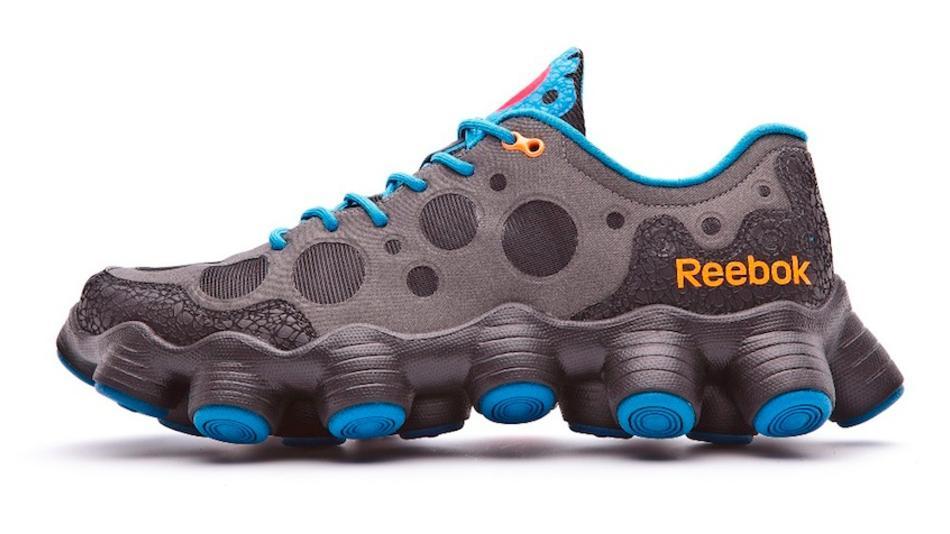
Just when you think you have seen it all… run shoes with five toes, run shoes that look like a goat hoof or shoes that are built on inches of marshmallow and then Reebok bring us the ATV 19+. Lets face it, Reebok don’t really have a great reputation for ‘great’ run shoes. Will this nippled alien beast change that?

I haven’t seen these shoes yet. But they are about to be released onto the world on Feb 1st. Are we ready for it? I have no idea…

Bill McInnis, head of advanced innovation at Reebok thinks we are. Apparently he is a former NASA scientist! He says:

“The ATC 19+ has 19 bumps (hence the name) on the bottom of the shoe which are designed to grip as much terrain as possible each time you move. ATV? ‘All Terrain Vehicle’ – In other words, the shoe is designed to  mimic how a real ‘ATV’ grips any terrain that is put beneath its wheels. The shoes ‘dig’ through the top layer of the surface and get traction on the layer underneath”

https://www.youtube.com/watch?v=LMsPej0LIP8&feature=player_embedded

Jury is out on this one… on first impressions I can’t imagine it working too well in the wet, particularly on roads/ pavements or in the mud. But hey, I shouldn’t jump to conclusions… just because they look weird doesn’t mean that they wont perform.

Lets see what happens after Feb 1st!

Reebok ATV19

Copyright Reebok

As a footnote. I have just seen this YouTube clip. Oh dear… any credibility that Mr McInnis gave the shoe in his ‘clip’ above seems to disappear rather quickly here.

Episode 27 – Talk Ultra

Episode 27 Talk Ultra


Episode 27 of Talk Ultra – Fast man of the moment, Sage Canaday tells us about how he got into running and all about his transition to ultra. Joe Grant gives us an update on how his prepartion is going for his attempt at the 350 mile Iditarod Trail Invitational in Alaska. We also speak to Dave James who had a win at Coldwater Rumble recently and heads out to The Coastal Challenge in Costa Rica on Feb 1st. We have talk tainining, a year in the life of, the news, a blog, a Meltzer Moment, up and coming races and we have the start of a new special on the build up to the 2013 Marathon des Sables.

00:00:00

00:00:45 Start

00:10:00 ‘A year in the life of…’ – this week it is Tyler’s turn to tell us what he has been up to since Christmas.

00:21:35 The News


00:33:20 An interview with Dave James who had a recent win at the Coldwater Rumble and heads out to The Coastal Challenge on Feb 1st 2013.

Email from Andrew Bentley  – Following the tragedy in Glencoe this last weekend four climbers killed, is there any chance would you be able to put a shout out about this http://www.justgiving.com/Luke-Bradley Chris Bell was a keen bike and triathlon racer, winning numerous races, some of which I was fortunate enough to be his team mate for. Chris was always the faster one- his dedication to being fast was unmatched. 

01:00:23 Back to the News

01:05:00 Joe Grant needs no introduction… his 2nd place at the 2012 Hardrock was a great result. In February 2013 he will be taking part in the 2013 350m Iditarod Invitational Trail. He gives us an update on how his preparation is going.

01:37:50 Back to the News

01:43:30 Blog – Gary Robbinshttp://www.gary-robbins.com

01:44:10 Talk Training with Marc Laithwaite – running as we get older.

02:13:22 Interview with Sage Canaday

As a 2-time Olympic trials qualifier, Sage has competed at a national class level.  In 2007 he was the youngest participant in the Olympic marathon trials at the age of 21.

A native of Oregon, Sage ran for Newberg High School and placed 13th in the state cross country meet his senior year. Determined to run DI in college, Sage traveled across the country to run for LetsRun.com co-founder Robert Johnson at Cornell University. At Cornell Sage not only qualified for the 2008 US Olympic trials marathon (junior year) – he also won the Ivy League Conference title for 10,000m on the track and qualified as an individual for the 2007 NCAA Championships in cross country.

Sage ran as a Brooks-sponsored elite runner on the post-collegiate Hansons-Brooks Distance Project team from August of 2009 to February 2012.  His running resume from their website can be found here. During his time at Hansons, Sage placed 17th overall at the 2010 Bank of America Chicago Marathon (8th American in the race), and placed 5th in the 2011 Rock n’ Roll New Orleans Mardi Gras half marathon with a personal best time of 1:04:32. Sage also ran a personal best marathon time  of 2:16:52 at the Rock ‘n’ Roll San Diego Marathon that year (2011). In his final race wearing the Hansons singlet, Sage placed 43rd in the US Olympic Trials marathon in Houston with a 2:18:24.

At the start of 2012 Sage started ultra marathons and trail running. In his ultra debut had earned a 2nd place overall finish at the Chuckanut 50k in Bellingham, WA in March after missing a turn and running off course for 8 minutes. In June 2012, Sage won the Mt. Washington Road Race in 58:27…the fastest time ever by an American on the all uphill course. In July 2012 Sage won the White River 50 in 6:16 and bettered Anton Krupicka’s course record by over 9 minutes on the 50 mile course.

Sage looks to continue competing at a high level on the roads and trails at distances from the half marathon to 100k for the rest of the year with a focus on representing the US at the 2012 World Mountain Running Championships in Italy.

Sage’s Personal Bests and Career highlights: 

  • 1500m: 3:55 (2009)
  • Mile: 4:17 (2009)
  • 3k: 8:22   (2009)
  • 5K: 14:29 (2009)
  • 8k: 23:48 (2008)
  • 10k: 29:47 (2009)
  • 10-miles: 49:01 (2011)
  • Half Marathon: 1:04:32 (2011)
  • Marathon: 2:16:52 (2011)

03:00:50 A Meltzer Moment with Speedgoat Karl

03:06:20 Marathon des Sables spécial with Stuart Rae

03:21:05 Up & Coming Races

03:22:40 Close

03:26:06 end

http://traffic.libsyn.com/talkultra/Episode_27_Canaday_Grant_James.mp3

Libsyn – feed://talkultra.libsyn.com/rss

Website – talkultra.com

Testing the Hayasa

The North Face Single Track Hayasa

I have been testing the The North Face Single Track Hayasa on a varied terrain for a couple of weeks now. My initial review of the shoe can be read HERE

First thing you will notice is that my initial shoes were blue! No, no miracle. I made a comment in my review that I had gone a half size larger. My normal size is UK9.5 and I had taken a UK10. I did express a concern that I thought the additional half size may very well be too much. I was correct.

My first test in the shoes, a hilly 6 miler had my foot moving just a little too much within the shoe. Nothing terrible, nothing uncomfortable but it just didn’t feel quite right.

So, I am now in a UK9.5 and they feel ‘sweet’. Actually like the black and yellow too!

The Hayasa has a 10mm drop but is low to the ground and as such it still promotes a very mid to forefoot run technique. The lacing I love. It would appear the laces have an element of ‘elastic’ within them so not only can you pull the shoe tight on your foot but once tied the laces don’t come loose. A real bonus. However, the laces are way too long… not a problem, I cut mine down and then just melted the ends with a match so they wouldn’t fray. The shoe is ‘very’ breathable and actually on some of the recent really icy days, on occasion they felt a little cold (perfect for hot weather then). The toe box is roomy and the upper is light and holds the foot secure.

Still early days but I have now done seven runs in them, two on the road (one 6 mile and one 10 mile) two trail runs (both 8 miles) and two snow/ice runs with YakTrax attached (7 miles and 10 miles).

I am really enjoying the Hayasa. You are close to the ground so you can really feel a connection with the surface and this promotes good technique. On the road they feel light, responsive and although the grip is more than a conventional road shoe I haven’t felt any negative effects. On trail, again the connection with the ground and the feel is superb, however, when the ground gets muddy the grip fails. It certainly is a shoe for a more compact, harder or dry trail. The surprise has been on the snow and ice. Admittedly I have YakTrax attached so that negates the sole but what I have loved is the connection with the ground from such a light shoe. You really notice the benefits when running through soft snow or hard icy trail… the Hayasa provides immediate feedback allowing you to adapt to the terrain accordingly. The Snake Plate I am sure is really adding to this.

Cushioning is good for such a lightweight shoe. Considerably more testing and runs to be done but at this early stage it’s a big thumbs up.

Snake Plate™The patent-pending Snake Plate™ consists of a forefoot plate that winds back and forth between the medial and lateral sides of the foot. Because it is not one solid element, it is not as uncompromisingly rigid from side to side and front to back. The result is a forefoot plate that allows the foot to do what it is physiologically designed to do: flex, bend, and contort to changing terrain. At the same time, the Snake Plate™ delivers rigidity where and when it is still needed. The thickness, composition and size of the Snake Plate™ vary from style to style as appropriate. For example, a thicker, more rigid Snake Plate™ addresses the technical, ever-changing demands of a mountain run. A thinner, more flexible Snake Plate™ reconciles flexibility with a decreased demand for protection while on smoother dirt paths.

Check out the The North Face HERE

Trail Relays – a new concept

Ragnar Relays by Salomon
We are excited to announce Ragnar Trail Relays presented by Salomon — the world’s first overnight trail relay series.


It’s time to go off-road on some of nation’s most majestic trails. Each stop in the trail relay series features a two-day outdoor adventure as teams run looped trails at national parks and outdoor resort venues. Each race has a central location where runners will take off with staggered start times, run one of three loops of varying difficulty, then return to handoff to their next teammate. That central area, called Ragnar Village, will feature a Salomon and Suunto tent where runners can check out the latest trail running gear, including shoes, outdoor watches, apparel and hydration packs, and get trail running tips from Salomon pro staff. Suunto is Ragnar Trail Relay’s official timing sponsor and sister brand to Salomon, and will manage the race start and finish times at each event. Teams will typically finish the 120-ish mile course in 20 hours on average.

“Our passion for trail running drives us to grow the sport,” says Ashley Williams, vice president of marketing at Amer Sports Americas. “Yet as we continue to develop products, one thing stands out as a key to this growth– team. Now, by combining the trail running expertise of Salomon and Suunto with the team bonding of Ragnar, everyone wins.”

Ragnar Trail Relays will debut April 26-27 at the Zion Ponderosa Ranch near Zion National Park, Utah. Additional 2013 calendar dates include:

• April 26-27, Zion Ponderosa Ranch (Zion National Park, Utah)

• June 7-8, Big Bear Lake (Morgantown, West Virginia)

• July 26-27, Sierra at Tahoe (Lake Tahoe, California)

• August 23-24, Snowbasin (Huntsville, Utah)

• October 18-19, McDowell Mountain (Scottsdale, AZ)

• November 15-16, Vail Lake Resort (Temecula, California)

You can register at www.ragnartrail.com


Tarawera Ultramarathon

Tarawera trails set for world-class endurance test on March 16 2013

Tarawera Logo

It’s a ridiculously long-distance running race on some of the most beautiful trails in New Zealand’s North Island.

The 100 kilometre Vibram Tarawera Ultramarathon will be run on the magnificent bush tracks and forestry roads from Rotorua to Kawerau on Saturday March 16.

One of the world’s toughest endurance running races, it’s the brainchild of Paul Charteris. The Rotorua event organiser launched ‘the Tarawera’ 5 years ago and for many of the world’s best off-road distance runners, it has quickly become a ‘must-do’.

“The quality of the field is amazing,” says Charteris, with a grin. “The 2013 Tarawera Ultra will be the most competitive long distance running event in New Zealand since the 1990 Commonwealth Games marathon.”

It’s a bold claim.
“The race sold out months ago and the 430-strong field is stacked with the world’s best,” says Charteris to back this up. “The winners of nearly every major international ultra marathon race will be on the start-line.”

A lot of top Kiwi runners will also be in the field, defending local honour.

“The ultra-racing world is keen to see how 21-year-old Barefoot Inc sponsored, Ruby Muir from Napier will handle the distance”, continues Charteris. “She’s unbeaten – including winning her first ever ultra distance run when she stormed away from the field at the 2012 60k Kepler Challenge in Te Anau.”

Muir is expected to receive stiff competition from Dunedin’s Anna Frost, widely regarded as the top female trail runner in the world last year. Frost’s Salomon Racing teammates, Emelie Forsberg from Sweden and Candice Burt from the United States will also be on the start line, along with Australia’s Beth Cardelli.

Copyright Ian Corless

Copyright Ian Corless

Cardelli won the last eight events she entered in her home country.

The top of the men’s field is a fleet-footed freight train of long-distance talent.

Mick Donges from Katoomba Australia is back to defend his 2012 Tarawera title against Christchurch’s Vajin Armstrong. The Kiwi finished second over the 100km distance the past two years and is keen to go one better.

Colorado-based runner Anton Krupicka, who ran a relay leg at Tarawera last year, has already fired a warning shot, posting online that he’s coming back to New Zealand for the win.

“This year, I’m looking forward to the technical trail between Humphries Bay and Tarawera Falls most of all,” says Krupicka. “The whole section from Okataina Lodge to the Falls will definitely be a highlight of the day, especially cruising at race pace.”

Copyright Ian Corless

Copyright Ian Corless

UPDATE* on Anton Krupicka posted on his blog site:

“I decided over a week ago to not make the trip down to New Zealand for the Tarawera 100K in 10 days, and despite my hip showing significant improvement I know it was the right choice. I’ve done no long runs of any type since December and don’t have any desire to travel all that way to muddle through 62 miles with poor fitness and a very likely chance of re-injuring myself”

Other top runners to watch will be Brendan Davies, Australia’s ultra runner of the year and Timothy Olson, Jason Schlarb, Rickey Gates and Sage Canaday from the United States. France’s Francios D’haene and Greg Vollet lead the European contingent.

2970-undefined

Interviews are available on Talk Ultra as listed below:

  • Brendan Davies episode 23
  • Timothy Olson episode 12
  • Anton Krupicka episode 19
  • Anna Frost episode 3 and 9
  • Emelie Forsberg episode 28 (future show)

Olson and D’haene won the two biggest races in the world during 2012. Olson won the Western States 100-mile endurance run in California in record time and
D’haene won the coveted Ultra Trail Mont Blanc title in his home country, with over 2000 runners in the field.

Canaday throws some freakish speed into the mix. A 2:16 marathoner, he has recently switched to ultra distance racing and became the United States 100km trail champion just last week. You can listen to an interview with Sage Canaday on Talk Ultra episode 27.

For Race Director, Charteris, it’s been a dizzying few weeks.

“It’s like organising a local bicycle race and having half of the Tour de France peloton show up for the ride,” says Charteris, as he scoped out a section of the course in Rotorua’s world-renowned Whakarewarewa Forest. “It’s humbling – and frankly, scary.”

Rotorua is renowned for hosting a number of international sporting events.

In 2006 the UCI Mountain Bike & Trials World Championship were in Rotorua and the Single Speed World Champs were held in the Whakarewarewa Forest in 2010.

On race day, running shoes will replace wheels on many of the same trails.
“A beautiful environment and superb athletes – it really is a recipe for a fabulous day of racing,” enthuses Charteris.

“And with this sort of fierce competition, there will be a large national and international media following for this race. It will be a big week for the region.”

UTMB press release

2013 will continue to see the international success of the four events of the The North Face® Ultra-Trail du Mont-Blanc®! Yet again this year trail-runners from the world over will be at the rendezvous, keen to attend to face the challenge, and despite the increase in the number of qualification points necessary this year (7 instead of 5 for the UTMB®, 2 instead of 1 for the CCC®).

As in 2012, 3 600 candidates were unable to validate their registration this year due to lack of places.

UTMB® [Ultra-Trail du Mont-Blanc®] : 3 countries – 168 km and 9 600 meters of vertical gain in semi-autonomy. 2300 runners at the start on Friday at 16:30 from Chamonix to Chamonix in 46 hours max.

CCC® [Courmayeur-Champex-Chamonix] : countries – 100 km and 5 950 meters of vertical gain in semi-autonomy.    1 900 runners at the start on Friday at 9:00 from Courmayeur to Chamonix in 26 hours max.

TDS® [sur les Traces des Ducs de Savoie] : 119 km and 7 250 meters of vertical gain in semiautonomy. 1400 runners at the start on Wednesay at 7:00am from Courmayeur to Chamonix in 33 hours max.

PTL® [la Petite Trotte à Léon] : 3 countries – 300 km and 24 000 meters of vertical gain in complete autonomy. A non-stop adventure race without rankings open to 80 teams Start on Monday at 22:00 from Chamonix to Chamonix in 138 hours

Registration figures

Pre-registration was closed on the January 8th with a record number of 10 105 candidates (of whom 10.3% were women) for the 4 events of the The North Face® Ultra-Trail du Mont-Blanc®.

The UTMB® and the CCC® were over subscribed. It is obvious that the organisation are proud of the popularity and success of the event but a serious draw was necessary and will mean that numerous trail-runners will have to postpone their dream for at least another year.

It is worth remembering that those who were unlucky in the 2012 draw were able to register without going through the draw this year. The limit of numbers for each event meant that there was a draw for the UTMB® and the CCC®. 2 500 requests for registration for the UTMB® and 1 100 for the CCC® were not able to be accepted this year.

The TDSTM registers a score in permanent progression, with more than 1 300 requests. It may, taking into account over-booking, accept round 500 runners form the more than 3 600 unlucky in the draw for the UTMB® or the CCC®.

Full card equally for the PTLTM for which registration closed on January 3rd, with 88 teams registered.

A reminder that each race is limited to the number of participants possible in order to respect the quality of the race for the runners, the security, the environment and the quality of the organisation.

The The North Face® Ultra Trail du Mont Blanc® races are welcoming 74 nations:

A record number in the field of open country races!

International participation is as always important with a record level of 49.6% who are not French.

In the lead France with only 50.4%. Then there is Spain with (9.5%) and Italy (8.9%). It is worth noting that Japan is in 5th position with 3.6% of the participants.

The nations represented are : Albania / Algeria / Andorra / Argentina / Australia / Austria / Belgium / Belarus / Bolivia / Brazil / Bulgaria / Canada / Chile / China / Colombia / Costa Rica / Croatia / Czech Republic / Denmark /  Ecuador / England / Estonia / Finland / France / Gabon / Germany / Greece / Hungary / Iceland / Indonesia / Iran / Ireland / Israel / Italy / Japan / Jordan / Latvia / Lithuania / Luxembourg / Malaysia / Malta / Mexico / Moldavia / Monaco / Morocco / Netherlands / New Zealand / Niger / Northern Ireland / Norway / Peru / Philippines / Poland /  Portugal / Rumania / Russia / Scotland / Serbia / Singapore / Slovakia / Slovenia / South Africa / South Korea / Spain / Sweden / Switzerland / Thailand / Turkey / Ukraine / Uruguay / Venezuela / United States of America / Wales / Zimbabwe

A world-wide success which confirms the The North Face® Ultra-Trail du Mont Blanc® as a trail-running event which has become a dream for trail runners from all over the world.