Recently I have been writing a series of posts about training and starting a new year of running on the right foot, no pun intended. A recent post called, ‘Planning a Running and Racing Year’ HERE.
Base training is something that all endurance athletes are familiar with, it’s about laying a strong aerobic foundation for the coming years racing. But if you are an experienced ultra runner I question if you need to base train. For me, flipping things on the head now would be a good idea. Drop the distance and time on feet and go short and fast, get some speed back in those one- paced legs and become a fast ultra runner later in the year. Read a post, ‘To Base Train Or To Not Base Train’ HERE that discusses these points.
But if you are new to running, new to ultra running or are coming from shorter and faster running, say 5k, 10k and half marathon, base training is for you.
Ultimately at this time of the year (and all times) we should ask:
What we’re doing and why?
What are the real reasons for doing any training?
What are the actual objectives we are trying to achieve?
Without understanding your objectives, you will never be able to understand how to structure your training and maybe more importantly, you won’t know when you have achieved your goal so that you can then move to the next phase.
Since 2012 I have been using Scott shoes, yes, Scott make run shoes in addition to bikes. I say that, because that is what I get when other runners look at my shoes and say, ‘Scott, oh, thought they made bikes?’
Since the original T2 Kinabalu, I have been a fan. I remember the original incarnation in 2012 which I used to run all over the Transvulcania course (Review HERE). Since the original model, the T2 Kinabalu has had a few tweaks and the current incarnation is the 3.0HERE.
Scott launched the Kinabalu Supertrac (original look HERE) and this shoe went on to be my favourite shoe of 2015. I even went through many other shoes I had been testing to work out which shoe (for me) was the best. The ‘Supertrac’ won, see HERE.
As 2015 came to a close, Scott informed me of several new shoes, one being the Enduro.
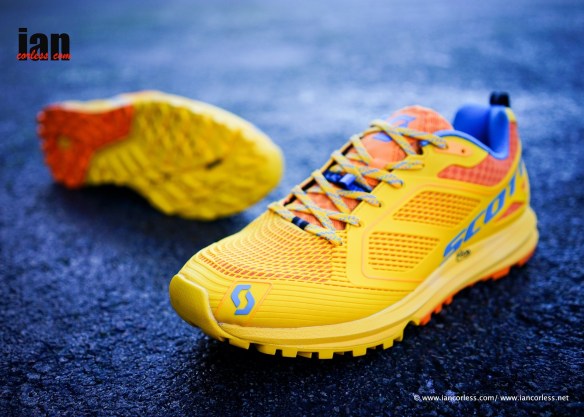
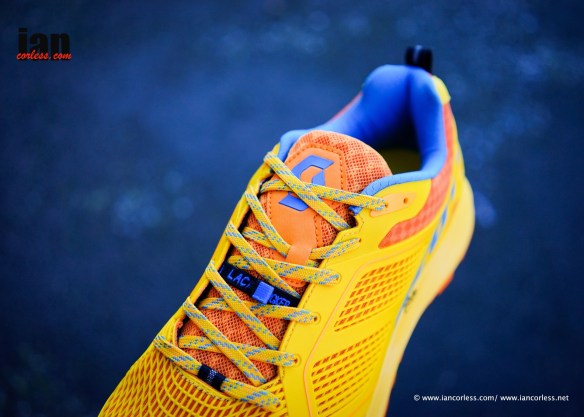
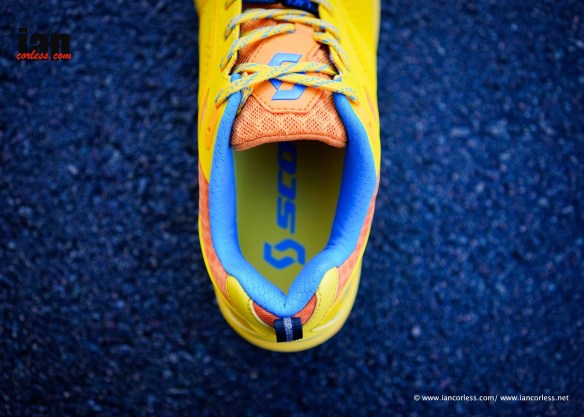
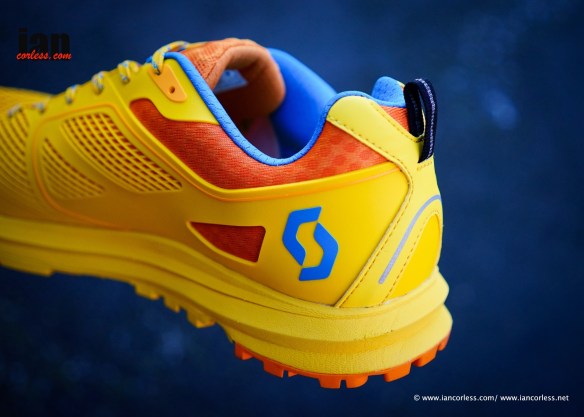
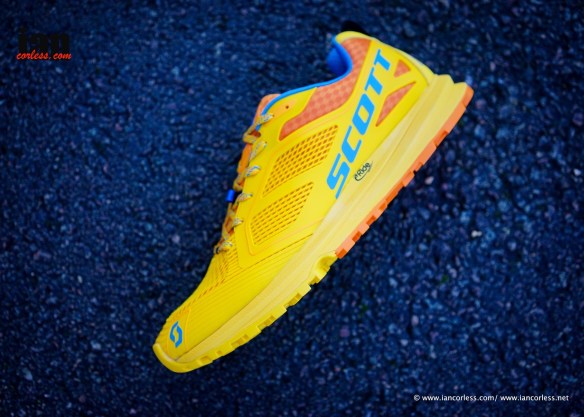
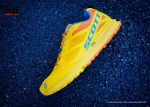
Well, the Scott Kinabalu Enduro has arrived and here are our first impressions and look.
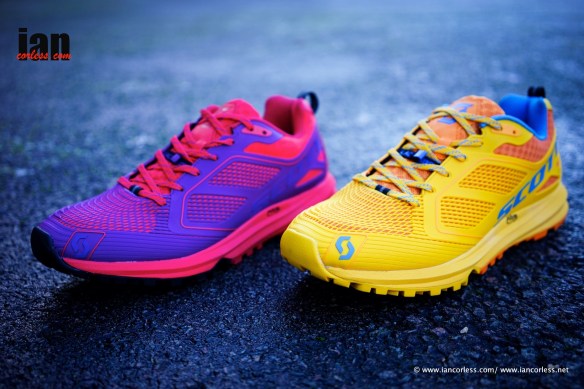
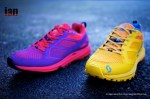
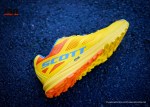
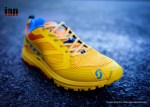
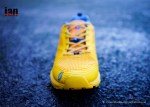
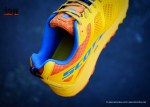
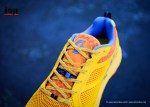
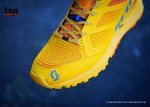
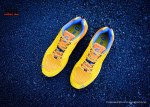
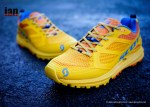
One thing is for sure, there is no hiding in the male version. Bright yellow, these shoes from the off say that they mean business. The ladies version is also bright but considering that many women wear bright apparel, I’m sure the colours will appeal. Certainly the original reaction from Niandi (who will test the ladies shoe) was wow, I LOVE the colours.
The shoes are not light. In all honesty, they were both noticeably heavy when removed from the boxes. The ladies a UK 8 weighs 380g and the mens UK9.5 weighs 418g. That is heavy; no doubt about it and I have to say initially disappointing.
Looking at the shoe closely, you soon realise why. The whole upper of the shoe has a plastic coating on top of the mesh below.
I have to say, I asked why? Why is it necessary to add some much structure and protection to the upper of the shoe? Scott call this: Protective-High-Abrasion-Casing.
I took a look at Scott’s website and the description is as follows:
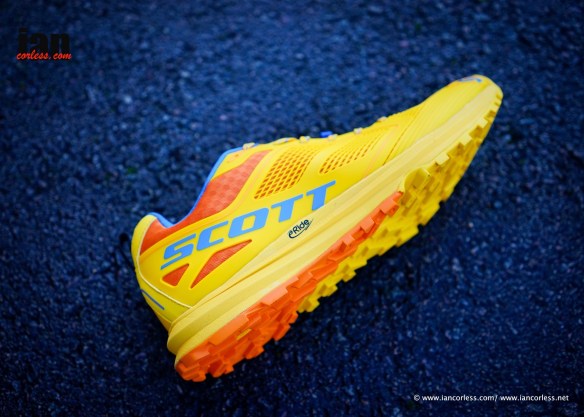
The brand new SCOTT Kinabalu Enduro is the latest addition to the range. The seemless one piece upper offers protection and comfort for all day adventures while the eRide tuned midsole and VIBRAM outsole provide performance and stability during your run.
Seamless upper – perfect
Protection – great
Comfort – brilliant
eRide – works, so great.
Vibram – tried and tested, so great
I still have to question though, why so heavy? My only point of question on the excellent Kinabalu Supertrac was the weight. Here Scott have beefed up the Kinabalu and made it bullet proof, it’s obviously way to early to tell but on first impressions, if you want a shoe to last and get value for money from, this may be the one!
Cushioning as you would expect from Scott is good with 28mm at the rear and 17mm in the forefoot. However, these two figures cause me a little confusion, why for 2016 are Scott releasing a shoe with an 11mm drop? They dropped the ‘Supertrac’ from the Kinabalu’s original 11mm drop to 8mm drop and this for me made perfect sense. 8mm is a perfect sweet spot that appeals to many a runner and when running long it’s not too low to cause any issues. Having said that though, after just 2 runs in the ‘Enduro’ they do feel comfortable and offer a great feel. I have said this before, the ‘rocker’ system that Scott uses does give the shoes a feeling of lower drop due to the rolling action. I must point out too that I do fore foot strike so that will also help.
eRide – “Dynamic stability is the body’s own way to run efficiently and safely over uneven terrain. The eRIDE TUNED midsole has strategic flex zones to provide asymmetric flexibility and enhance ground adaptation while a EVA foam provides cushioning.”
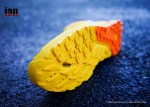
The outsole sits somewhere between the T2 Kinabalu and the Supertrac and therefore it will be a great all rounder for those who may well be looking for a ‘one shoe does all’ scenario. Made by Vibram, the outsole uses ‘MEGAGRIP’ as witnessed on the Supertrac but this version is less aggressive. From repeated year long use of the Supertrac I can confirm that this outsole is tried and tested and a favourite. This version does feels stiffer and less supple than the Supertrac version, we shall see?
Lacing is standard and incorporates the ‘lace bungee’ for storing excess lace after you have tied your shoes. It’s a very simple and effective way for removing something that may catch on branches or trail obstacles.
Heel box is very plush and secure. Always a key feature of Scott shoes and it really does add a secure and confident feel to the shoes.
Sizing feels a little larger than normal. I always take a UK9.5 and the ‘Enduro’ does feel just a little more spacious, so, if you are new to Scott or if you have used Scott in the past, you may just want to check on sizing. The toe box is a little narrower than the T2 Kinabalu 3.0 and Kinabalu Supertrac and this may be why they size a little larger? If you like a wide roomy toe box, this may not be the shoe for you?
Technologies:
Lace Bungee
Protective-High-Abrasion-Casing
Seamless-One-Piece-Upper
Rock-Protection-Plate
Vibram-Megagrip
Initial Conclusion
Our initial reaction to the ‘Enduro’ was shock. We were surprised at how ‘protected’ this shoe is. But having run in them on just 2 occasions and reflected on what Scott are trying to do, I completely understand the the addition of this shoe to the Kinabalu range. This is not a shoe to replace the T2 Kinabalu or the Kinabalu Supertrac it’s a shoe to be used in addition. So, if you like the other 2 models you will like this.
I’m still perturbed that the shoe is 11mm drop and not 8mm but it runs well; so why worry?
What’s the shoe for?
Well I guess you can use the shoe for any running, from groomed trail, fire trail to mountains. But considering the protection that has been added to the ‘Enduro,’ one has to think that this is intended for the rough stuff; rocks, snow, ice, gravel, slate and so; anything that can really batter a shoe and reduce its life.
For perspective, I recently ran for 1-month in La Palma on the Transvulcania course, I used a brand new pair of Supertrac and I used them every day, at the end of the month I threw them away. I am not saying the ‘Supertrac’ was no good, on the contrary, I love the Supertrac but the trails out in La Palma are harsh and abrasive; it eats shoes. The Enduro may well be a good shoe for a course like that due to the key elements of:
Protective-High-Abrasion-Casing
Seamless-One-Piece-Upper
Rock-Protection-Plate
Vibram-Megagrip
We will be reporting back in a couple of months after long term testing and only then will we really know how the Scott Kinabalu Enduro stacks up.
Trail and fell running fans need no introduction to inov-8, for just over 10-years the brand has been very much pioneering the way for the off road market. In recent years the brand has tweaked and launched new models and currently the Mudclaw 300 (Review HERE) , X-Talon 212 (Review HERE) and Terraclaw are my favourite shoes.
I’ve said this before, I always have respected inov-8’s very logical approach in not only providing a shoe design in different drops but also making it very easy, at first glance, to see what drop the shoes are. The arrows on the back clearly signify with 1, 2 or 3 arrows. In simple terms, 1 is low, 2 is medium and 3 is higher; typically 3, 6, 9mm drop.
In the last 18-24 months, the launch firstly of the RACEULTRA (Review HERE) in 4mm (270) and 8mm (290) drops and most recently the TERRACLAW (Review HERE) in 4mm (220) and 8mm (250) drops have certainly revived that ‘middle’ ground for the ions-8 brand.
I have been very much on the middle ground with the RACEULTRA despite it’s incredible popularity. For example, at the 2015 Marathon des Sables, I saw many people using the shoe because it neither had too much or too little tread and most importantly it has a wide toe box. I find the shoe just lacked feel, it lacked responsiveness.
The TERRACLAW followed suit and for me is a far better shoe than the RACEULTRA, it has a more aggressive outsole that is great for off road (when not too muddy) but it equally handles hard trail and rocks well and some road. It’s a responsive shoe, lightweight, comfortable and gives great feel for the ground. If you like a wide toe box too, the shoe has loads of room, even for a Hobbit’s foot… maybe too much room for some. I find the additional room great when it’s flat but less so when going up or downhill. But hey, this is all personal. Ultimately a good shoe.
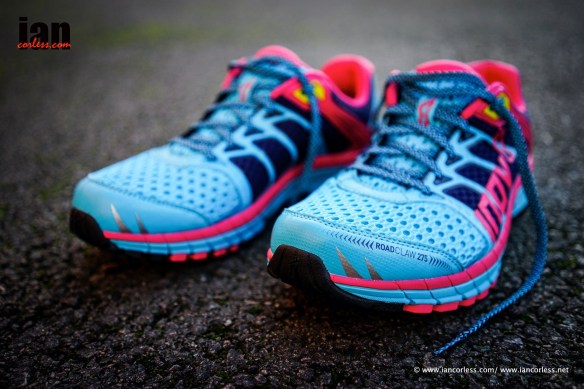
So now for 2016, inov-8 are looking to get their claws back into the road market with the ROADCLAW 275.
inov-8 have made road shoes before currently on the website they have the ROAD-X-XETREME 220 and 250. These shoes most definitely appealed to the out-and-out road runner. The imminent launch of the ROADCLAW 275 signifies a departure for the brand in terms of road shoe as it obviously has a very similar look and feel to the RACEULTRA.
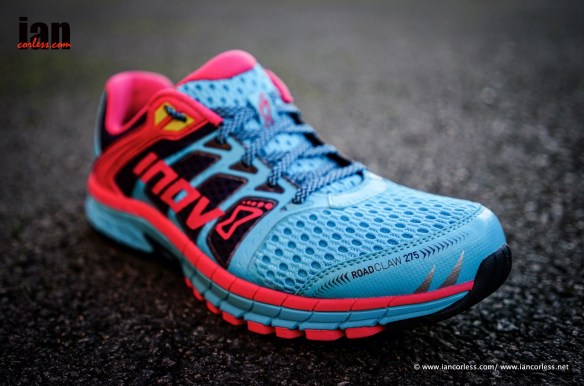
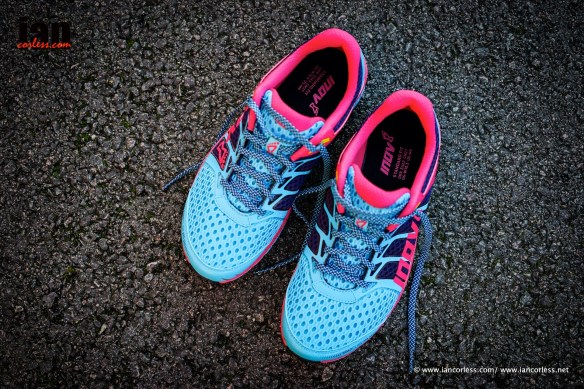
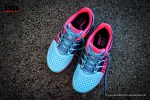
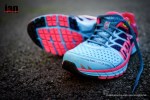
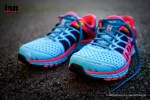
For clarification, the colour way is for ladies.
On first impressions, the shoe looks and feels very much like the RACEULTRA, maybe too similar? However, as you look closely you start to notice the differences.
The upper is a more open mesh to allow the foot to breathe.
The toe box although still wide narrows a little quicker.
Toe protection from the bumper is less.
The lacing is wider.
Support on the upper both on the left and right side is a little more substantial.
Although a neutral shoe it feels as though there is a little support for the arc – just a little?
The heel box is a touch wider but still offers a snug fit.
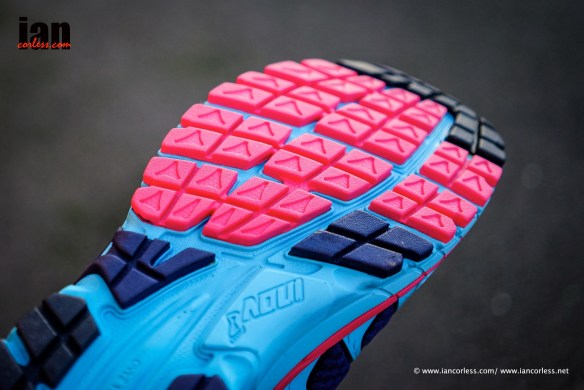
The outsole is completely redesigned, as you would expect and uses 2 different compounds, in this shoe, black and pink to offer grip where required.
The shoe has ‘META-FLEX’ at the fore of the shoe a DYNAMIC FASCIA BAND both present in the RACEULTRA.
Drop is 8mm which for me is perfect.
Weight 275g as the name suggests for sample size UK8
It’s early days running in the shoe and currently it’s being tested on road, dry trails and treadmill. Initial feedback is good and certainly if you are a RACE ULTRA fan and need a road shoe, this is one for you.
We have to say, on first impressions we thought the outsole looked a little aggressive for a road shoe but hey, I guess that is why it’s called ‘ROADCLAW.’. However, when running all feels good, particularly on the current wet and mildly slippery roads and pavements.
As we get more miles in the shoe, we will come back and provide a detailed report on the pros and cons of this new inov-8 shoe. It’s certainly an interesting step for the brand and it makes one question, what else have they got up their sleeves for 2016?
You can read more and find out about inov-8 HERE
INOV-8 ROADCLAW 275
New for 2016, the ROADCLAW brings together all inov-8 has learned in the mountains to deliver an ultra-smooth ride with the company’s iconic grip in a road shoe. No matter how rugged the road, the ROADCLAW is the master of its terrain.
ULTRA SMOOTH RIDE: Run effortlessly over any road conditions with inov-8’s unique POWERFLOW midsole technology. POWERFLOW delivers 10 per cent better shock absorption and 15 per cent better energy return than standard midsoles.
MAXIMUM POWER TRANSFER: inov-8’s iconic grip has now been optimised for road running. This means every ounce of energy generated by the body is transferred to the road through the outsole. With inov-8’s three-rubber TRI-C compound delivering industry-leading traction throughout the gait cycle.
ULTIMATE SECURITY: Feel 100 per cent sure footed on any road with grip and stability delivered through an inversion of our claw cleat lug design.
This is Episode 103 of Talk Ultra. A very happy new year! Talk Ultra is 4 years old and to signify this landmark we are bringing you 4 interviews from our back catalogue, one from 2012, 2013, 2014 and 2015. In addition, we may well bring you a few sounds, music and memories.
Niandi is back with me….
The La Palma story continues – watch our GoPro story of tackling the Transvulcania route (GR131) over 2 days HERE
La Palma, (Transvulcania) photo galleries can be viewed HERE (more to follow)
00:01:31 Show Start
00:26:45 NEWS
00:28:30Remember the 10 Commandments?
00:32:16Remember the Christmas Do’s and Dont’s from 2013? Don’t mention Mingling
Guess what, very little news… but hey David Laney and Magdalena Boulet were voted ultra runners of the year via UltraRunning Magazine.
The incredible Ed Ettinghausen aged 53 ran 481.86 miles at the Across the Years 6-day to beat David Johnson’s 450.37. Full results from the weekend are HERE
00:50:49 MUSIC The Comrades special is still maybe one of our most popular shows and I am pleased to say we have had countless messages about how we inspired so many to run this iconic race. Episode 8 way back in 2012. A magic show and too long to replay here but due to popular demand here is Shozolossa – I can’t listen to this without a tear in my eye and we interviewed the Comrades King –
00:53:01 INTERVIEW Bruce Fordyce
In episode 48, we featured Nepal and the Everest Trail Race, hiking down a mountain on the 2nd day I was joined by Nepalese children who sand for me… pure magic!
And in the last episode in the wee hours of a December morning I walked the streets of La Palma with Niandi listening to the amazing sounds of Divinos san Francisco.
01:24:19 INTERVIEWOkay our first interview comes from 2012 and it is from Episode 12 and the inspiring and mind blowing story of Timmy Olson.
02:16:44 INTERVIEWIt may come as no surprise but in 2013, episode 43 I interviewed Kilian Jornet just a day after his incredible Matterhorn Summit record.
02:52:21 INTERVIEWEpisode 57 in 2014 provided an inspiring interview with David Johnston about his incredible Iditarod Trail Invitational record breaking run.
03:42:24 INTERVIEWAnd finally, the Jureks from episode 95. Scott and Jenny nailed the AT and provided one of the most insightful and entertaining interviews ever.
Believe me, choosing 4 interviews from 4 years has been incredibly tough. I can’t tell you how many amazing memories and moments there are. It has been incredible to refresh my mind by looking back. Please go back to the archives and take a look – Ryan Sandes, Marshall Ullrich, Gordy Ainsleigh, Eliie Greenwood, Max King, Lizzy Hawker, Anna Frost and so on and so on…
05:01:35 INTERVIEWConsidering Niandi is co-hosting it only seems appropriate that we give you a bonuss interview from Episode 78 with legendary, Sir Ranulph Fiennes
Marc Laithwaite and myself have often discussed in ‘Talk Training’ on Talk Ultra Podcast about BASE TRAINING.
Coming from cycling backgrounds, Marc and myself where used to getting in the miles over the winter months as this was imperative to a great season of racing. We had the term, ‘winter miles makes summer smiles.’
But bike racing for us both was often fast, furious and long, so we needed to be complete cyclists. Endurance for the long ride, speed for when the racing really started and the ability to attack, ride fast and open up a gap on the competition. Base training in December, January, February and March was essential.
But as an ultra runner, what does base training mean for you? Do YOU really need to go out and lay base miles now for a stronger racing season? Is that not what you did while racing; you ran slow and steady. Think about it, racing for most ultra runners is not about accelerations, fartlek, making a break and so on, it’s about aiming for a strong and consistent performance over the duration of the event to produce not only the best performance but the fastest time.
Over the years Marc has wrote about the benefits of base training and how it should be conducted for greatest effect. It should be slow, it should be long and the heart rate should be controlled to burn fat etc. As mentioned above, Marc and myself have also discussed and recommended that ultra runners, ‘reverse the pyramid.’
We have posed the question, ‘Does base training have any benefit to endurance athletes?’
Would ultra runners gain more from doing high intensity training throughout the winter to raise their maximal output?
Is base training the way forwards or is shorter and higher intensity workouts better? More interesting is that in the last couple of weeks, Marc has seen 2 posts, one from Brett Sutton and one from Training Peaks, both supporting the ‘reverse pyramid’ (doing short and hard in winter and then going longer in the summer). This is the first time Marc has seen blogs supporting ‘reverse pyramid’ so clearly it’s catching on and for once he and I may get a little more support on the matter.
Even Competitor.com resorted to the same old information in a recent web post (article HERE) but I quote:
“Aerobic endurance is the key to everything else in running. You can’t get the most out of the hard repeats, hill workouts and tempo runs until you’ve built the base to handle them. Plus, physiologically you can make bigger gains in aerobic endurance and capacity than you can in any other training zone.” – Ben Rosario, head coach of Northern Arizona Elite, Flagstaff, Ariz. – Quote link HERE
“A properly executed base phase provides a platform of fitness from which distance runners can draw throughout racing season. An aerobic development phase like this is also critical to connective-tissue strengthening, giving an athlete the ability to work harder and at higher intensity with less risk of injury.” – Pete Rea, head coach, ZAP Fitness, Blowing Rock, N.C. – Quote link HERE
You can’t tarnish everyone with the same brush.
Here’s the key point that you must take away with you: one single approach is not suitable for everyone. The articles by Brett Sutton and Training Peaks and those quoted above, whilst informative and correct, were suggesting that ‘everyone’ should use one method; reverse or base training. This is pretty standard and the problem often lies with many coaches. Most coaches tend to be in one camp or another, either they are the reverse pyramid followers (minority) so everyone they coach follows reverse pyramid, or they believe in base and foundation, so everyone they coach follows base training during the winter months.
Coaches and runners need to realise that there’s more than one way to skin a cat and we are all individuals and hence we need to ensure that we are following the correct programme. It’s also confusing for you as an athlete, if you hear 2 opposing views, you ask the question, ‘which one is correct and which one do you follow?’
Endurance sports are very simple and you need to ask 2 key questions:
1. How fast can you go?
2. How long can you keep it going for?
Okay, so let’s consider 2 people training for a spring marathon.
1. Sandra and Michael have run 17 marathons with a PB of 4 hours 20 minutes. They run marathons and ultra distance events and can run until the cows come home but have no change of pace. In fact, they both have 10k PB’s set during a half marathon race. Sound like anyone you know?
2. Rita and John are track runner by trade, they were 1500m runners at county level but rarely go above 10k. Whilst they may be rapid, endurance is not their strength. The marathon is going to be a real challenge for them as the distance is well beyond their comfort zone.
Here you have 2 classic extremes, the plodder and the burner. Sandra and Michael would benefit far more from reversing the pyramid and spending a winter, trying to reduce 5k and 10k times. Once the speed is in place, they can then increase their long runs and learn how to ‘keep it going’ for the full marathon. Rita and John have ample speed, but they have no base fitness. The classic winter base training model would therfore work much better for both of them as it has for many others before them.
The classic base model tends to work best for fast people with poor endurance, that’s who it was initially invented for. That’s also the classic model for athletics, when 1500m runners are too slow, they step up to 10k, when they’re too slow for 10k they step up for marathon. These are fast runners, who need to add endurance.
But you as an ultra runner do base training while racing, no? You are more inline with Sandra and Michael.
If you’re running multiple marathons but you struggle to get below 9 minute miles, base training is not going to work for you. No amount of slow mileage will make you a quicker runner, it’ll just allow you to keep running slower for longer.
So how does this help me?
You need to assess yourself as an athlete and ask the 2 simple questions:
1. How fast can I go?
2. Can I keep it going?
Are you a burner, plodder of somewhere inbetween? The classic base training pyramid can be used to great effect, but so can the ‘reverse pyramid’ method. You, as a runner just need to work out which programme over the winter period to follow. Neither one is better or worse, they’re different, just like you and me.
If you are based in the UK, Marc Laithwaite can provide a more accurate assessment of your personal strengths and weaknesses via sports science assessment. You can BOOK HERE.
*This article is a combined article by Ian Corless and Marc Laithwaite
About Marc:
Sports Science lecturer for 10 years at St Helens HE College.
2004 established The Endurance Coach LTD sports science and coaching business. Worked with British Cycling as physiology support 2008-2008. Previous Triathlon England Regional Academy Head Coach, North West.
In 2006 established Epic Events Management LTD. Now one of the largest event companies in the NW, organising a range of triathlon, swimming and cycling events. EPIC EVENTS also encompasses Montane Trail 26 and Petzl Night Runner events.
In 2010 established Montane Lakeland 50 & 100 LTD. This has now become the UKs leading ultra distance trail running event.
In 2010 established The Endurance Store triathlon, trail running and open water swimming store. Based in Appley Bridge, Wigan, we are the North West’s community store, organising and supporting local athletes and local events.
I took a look back at 2015 this morning and picked an image to represent the races I have attended. It has been quite a year; from the rainforests of Costa Rica, the heat of the Sahara, the wilds of South Africa, the humidity of Hong Kong and of course so many amazing and wonderful races in Europe. A huge thanks to everyone for making 2015 great. Roll on 2016 and many more great races, experiences and inspiring moments.
A big thanks to all my clients, followers of this website, listeners to my podcast, Talk Ultra and of course all the many races and racers worldwide.
Strength training by nature involves high resistance for a short period of time, it’s important that you don’t rush your routine, you must provide adequate rest between exercises. Don’t turn this routine into a ‘circuit training session’ moving quickly from one exercise to the next. I’m not questioning the benefits of circuit type training, but to develop strength, there must be adequate recovery between exercises for maximal lifting.
Periodisation Made Simple
Periodisation is simply breaking your training into blocks. You probably do this already, winter being your base phase. In a similar way, you should periodise your strength training. If you were to start your strength training at the beginning of December, that gives you 6 months to reach the end of May, which for most is the beginning of the summer season. Here’s the simple guide to the exercise routine and your periodisation plan:
Base Phase, Weeks 1-8
The objectives for the base phase are:
1. Learn the exercises so technique is perfect
2. Reduce risk of injury by improved joint stability
3. Develop basic conditioning as a platform to progress from
1. The routine should be completed twice per week and repetitions for all free weights exercises should be 12-15. For core stability exercises such as plank etc, the ‘time’ should be whatever you can manage whilst holding perfect form.
2. Learning the technique is critical for all of the exercises. If you have never done free weight exercises, the basic technique will be challenging. For weeks 1-4, minimise the weight and learn the exercises to perfection. Don’t simply start adding weight / resistance, learning the movement is a critical part of your development. Weeks 1-4 is ALL ABOUT TECHNIQUE AND MOVEMENT.
3. During weeks 5-8 increase the load / weight for the exercises gradually, repetitions should stay at 12-15. It’s impossible to predict the actual ‘weight/kg’ you should be lifting, this is something that you will have to work out for yourself. Don’t overload during weeks 5-8, your technique must remain perfect.
Strength Phase, Weeks 9-16
1. You need to increase resistance during this phase, without losing technique. To develop strength you need to reduce the repetitions and use a heavier weight. Weeks 9-12, complete 3 sets for each exercise and your repetitions should be 12/9/6, increasing the weight slightly each set. Weeks 13-16m complete 3 sets for each exercise and your repetitions should be 10/6/4, increasing the weight each set.
2. Over this period you aim is to increase resistance, you should do this when you feel ready. Some people will increase every week, others may need a couple of weeks before progressing.
3. You should change exercises slightly in strength phase to focus on larger muscle groups.
Power and Plyometric Phase, Week 17-24
1. The strength work will continue with an emphasis on explosive power. You should continue to progress the exercises and increase the resistance, using lower repetitions. By completing the exercises more quickly, in an ‘explosive manner’ you will switch focus to ‘power’. Use a moderate weight to warm up then complete 3 sets for each exercise and your repetitions can drop as low as 6/4/2 increasing the weight each set.
2. Plyometrics will be introduced, this is particularly important for running performance. Plyometric activities will include jumping, hopping etc. For cyclists, you can introduce sports specific explosive power. This is done by combining your strength work with explosive, high resistance, short duration sprinting on a static bike. Introduce the plyometrics gently and build over 8 weeks. Complete 3 sets of each plyometric exercise, building the intensity (e.g. jumping higher / harder) throughout each set.
If you have a free weights routine already in place, you can apply the above principles to your schedule right now. Make sure you’ve read parts 1 & 2 HERE and HERE before starting this program.
Starting the program in January? No problem, as with any plan you need to adjust and adapt so that your plan works inline with your racing objectives and racing calendar.
About Marc:
Sports Science lecturer for 10 years at St Helens HE College.
2004 established The Endurance Coach LTD sports science and coaching business. Worked with British Cycling as physiology support 2008-2008. Previous Triathlon England Regional Academy Head Coach, North West.
In 2006 established Epic Events Management LTD. Now one of the largest event companies in the NW, organising a range of triathlon, swimming and cycling events. EPIC EVENTS also encompasses Montane Trail 26 and Petzl Night Runner events.
In 2010 established Montane Lakeland 50 & 100 LTD. This has now become the UKs leading ultra distance trail running event.
In 2010 established The Endurance Store triathlon, trail running and open water swimming store. Based in Appley Bridge, Wigan, we are the North West’s community store, organising and supporting local athletes and local events.
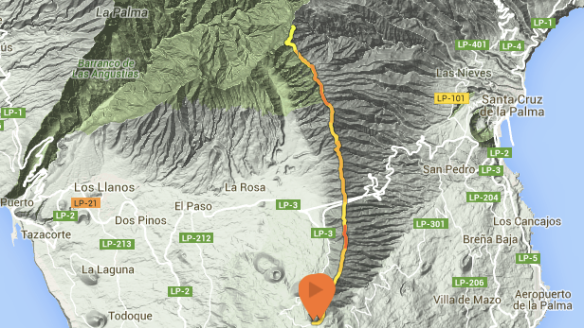
Yesterday, I planned a little outing with Niandi. No plans really, in all honesty, we didn’t even know which section of the Transvulcania course we would go on. The main problem with running on the Transvulcania course is logistics. In real terms, you always need to run out-and-back routes.
We ended up going to El Pilar, an early and key aid station that comes approximately one third into the Transvulcania race. It’s about a 50-min drive from Tazacorte (where I am staying) which is the end of the GR131 route before the final push up to Los Llanos and the finish of the Transvulcania race.
El Pilar allows easy access to the Volcano Route section and a direct option back to the coast and Fuencaliente lighthouse, as such, it is the route most people take.
We decided to go north, head out of El Pilar and follow the GR131 into the Cumber Nueva in the direction of Roques de los Muchachos.
Leaving El Pilar, looking out to the west you get to see Los Llanos, Tazacorte and the sea in the distance. These tropical, muddy, forest trails provide the Transvulcania runners some of the easiest running so far in the race but eventually this comes to an end at Reventon Pass and the climb up to Punta de los Roques.
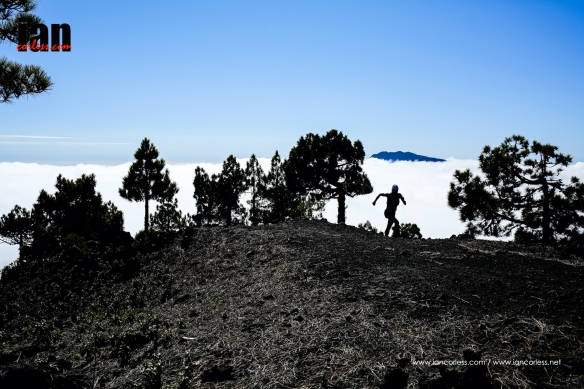
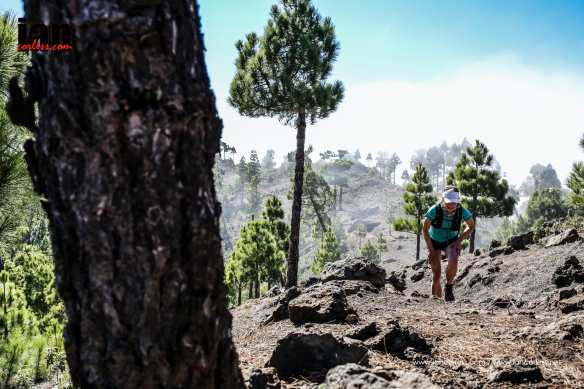
The Cumbre Nueva and following sections are for me one of the most stunning sections of the Transvulcania route. From Reventon Pass to Punta de los Roques in particular is stunning! Onwards to Pico de las Nieves, the trails open up and the push to Roques de los Muchachos leads to the final drop to Tazacorte . Mixing rocky terrain with stunning vegetation, the route is incredible from a running and visual perspective. It is also very prone to an inversion; where the cloud drops below the high points creating a stunning almost dream like backdrop.
The mist comes in, visibility is reduced, the temperature drops and suddenly you feel like you are in a different place. You question, ‘will the good weather come back?’
Then suddenly, you break through the cloud, the white fluffy clouds are below and a wonderful blue backdrop adds an amazing palette to run or walk against.
Single track trails of good running constantly creep up beyond 2000m to Punta de los Roques and the Refugio. Here stunning views of the Caldera de Taburiente are possible and off in the distance, the observatories of Roques de los Muchachos can be seen.
Around every corner a surprise. It doesn’t matter if you are running or walking, these trails offer so much.
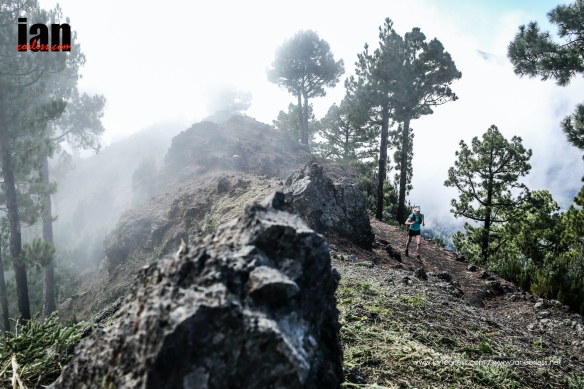
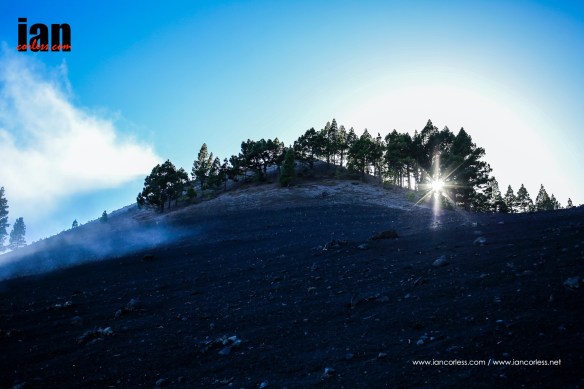
The Transvulcania route is always a constant surprise and I am always amazed at how the terrain, weather, vegetation and views change as you move through the route. Our day in the Cumber Nueva was a special one, topped off with this stunning image as Niandi ran around a mountain corner, the inversion clearly visible and if one image sums up skyrunning, this may be it.
You can view daily images from our stay in La Palma HERE
Dear all, a heartfelt Merry Christmas to all those who have made 2015 a very special year.
It has been quite a journey. All the races, race directors, runners, teams, sponsors and of course. all the followers of this website who view my images, read my words, listen to Talk Ultra and get involved in this wonderful and crazy sport.
I thank you all and wish you a very Merry Christmas from the trails of La Palma.
This is Episode 102 of Talk Ultra. Happy Christmas everyone! We speak with Mike Bialick about that storming 100 mile run, Sally McRae talks all about her running and finding balance and we have a tribute to fellow photographer, Mark Gillett who sadly passed away. Niandi co-hosts.
00:01:31 Show Start
00:19:10 NEWS
Divinio San Francisco, walking the streets of La Palma HERE
Running the Caldera de Taburiente rim, Roques de los Muchachos HERE
DESERT SOLSTICE INVITATIONAL
Zach Bitter ran 11:40:55 for 100-miles – he went through 50 in 5:33 and 100k in 6:58 he broke his own 100 record by 7min but missed the world record which is still a good chunk of time away.
Katalin Nagy dropped from the 24-hour but won the 100 in 14:48 and set a US Track record for 200k in 19:19:05
BARCELONA 24HR
Well done to Marco Consani winning #barcelona24 with 256km (159miles) course record and PB. Now that’s awesome and a long way!
Finally we want to thank you for all the support over the last 12-months. Difficult to believe that another year has passed. We wish you all a very Merry Christmas and we hope 2016 is awesome!






















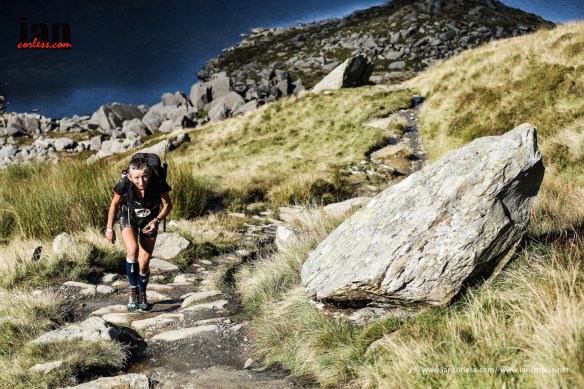

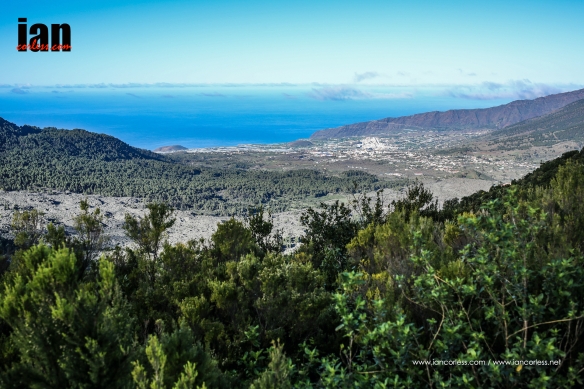
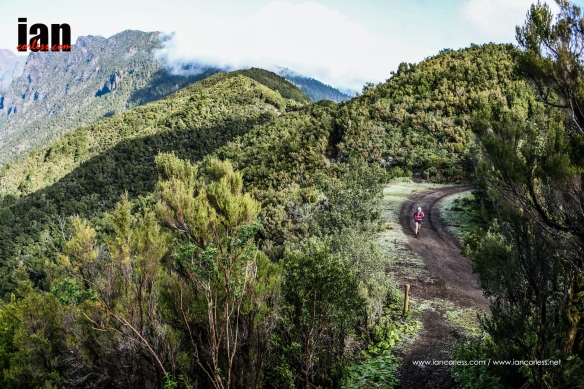


 IAN CORLESS