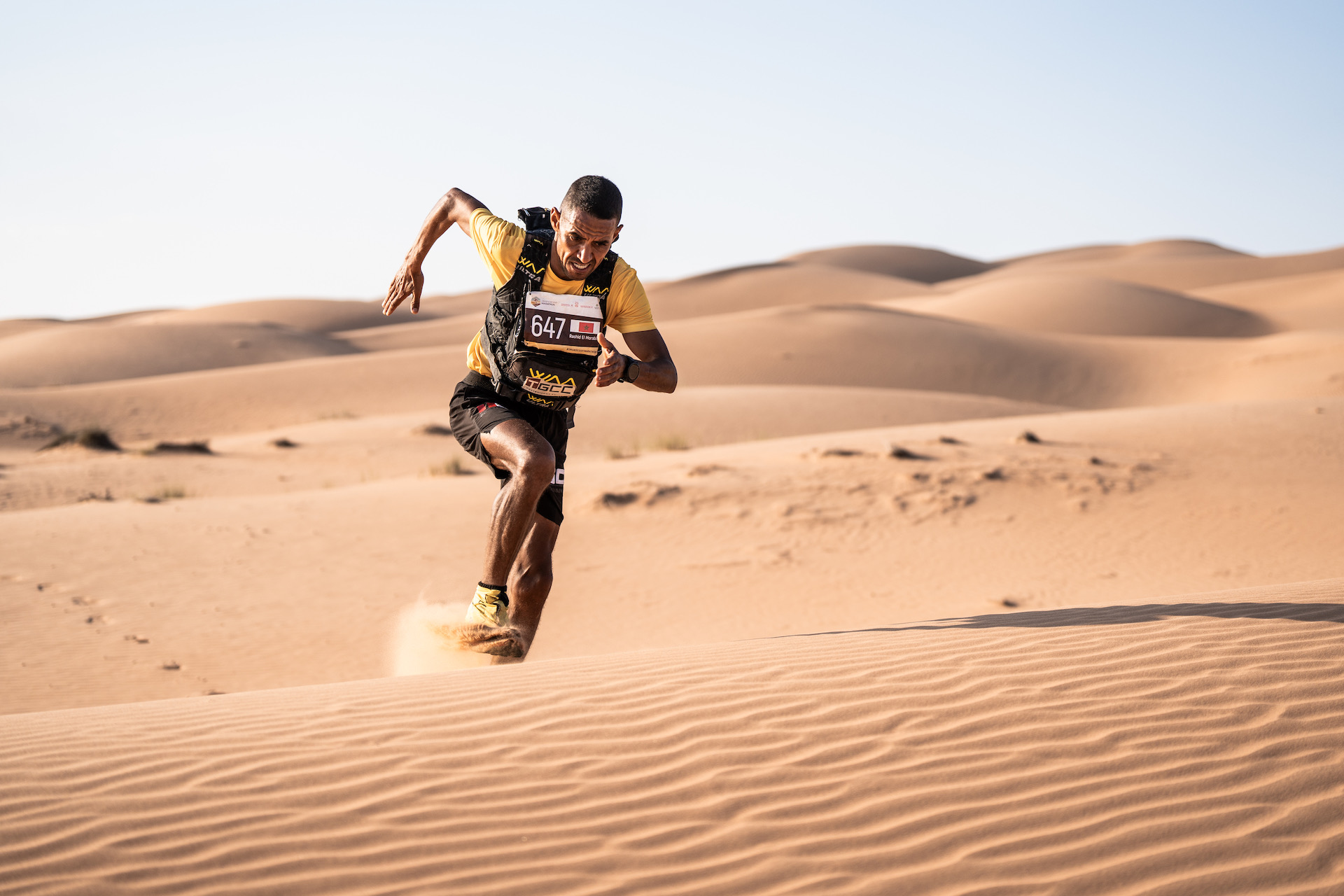
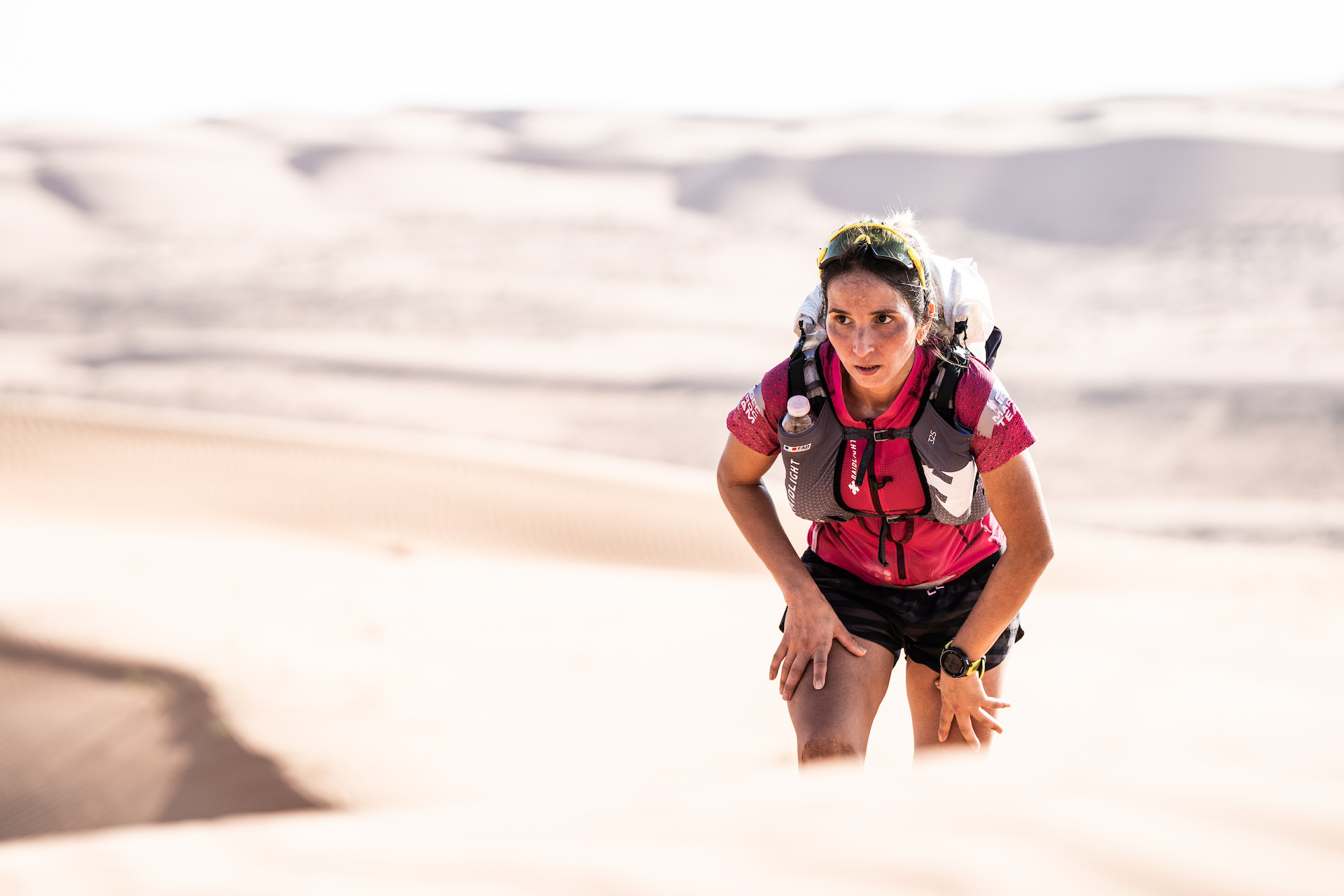
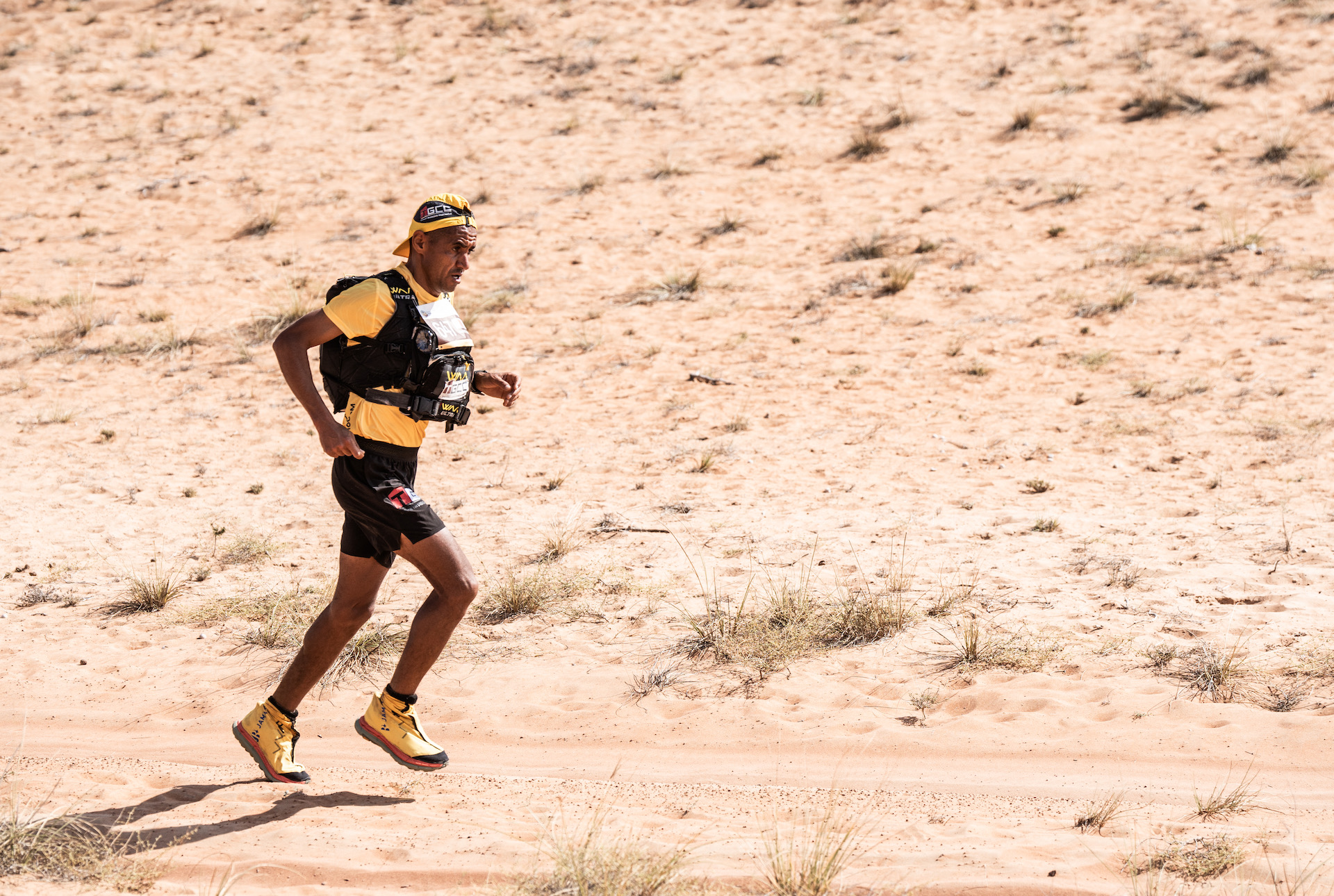
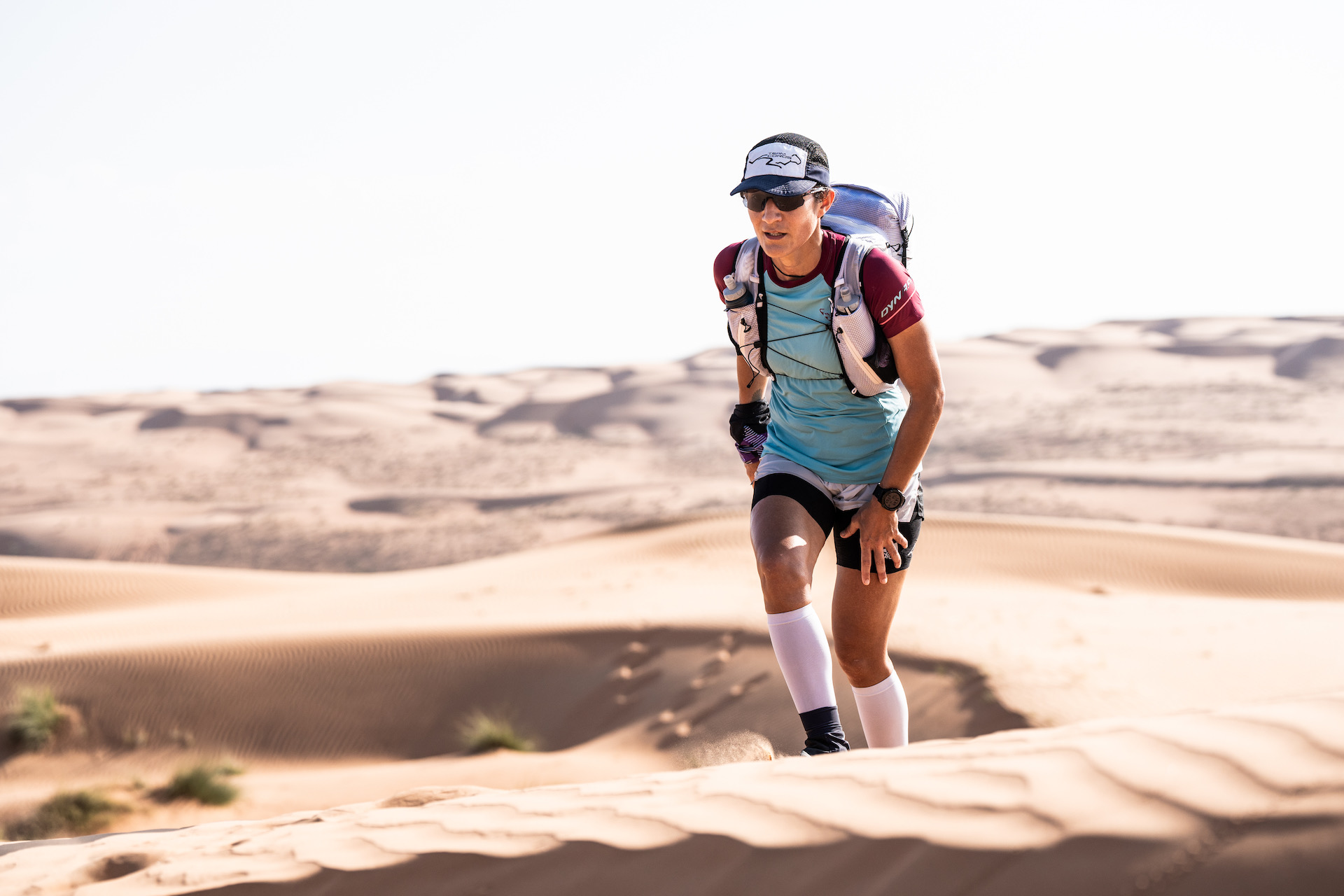
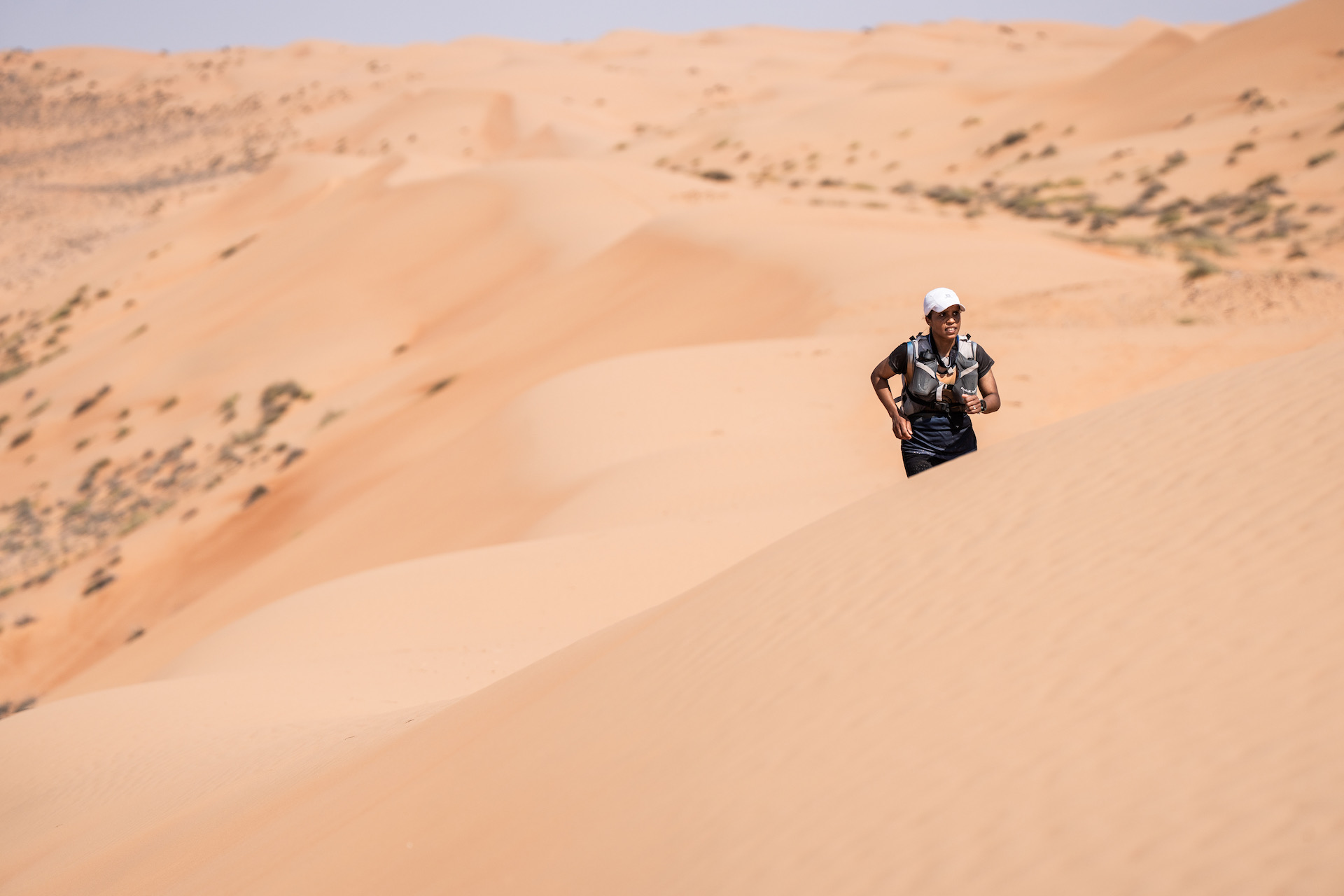
The 2024 Oman Desert Marathon concluded at Jawharat Bidiah Resort, 165km’s travelled over 4-days and Rachid El Morabity and Aziza Raji are the champions covering the total race in 16:06:49 and 23:13:32 respectively.
Going into the last 21km stage, the end result was never in question, both Rachid and Aziza had built 20-minute plus leads and all they had to do was run a calm and measured last day.
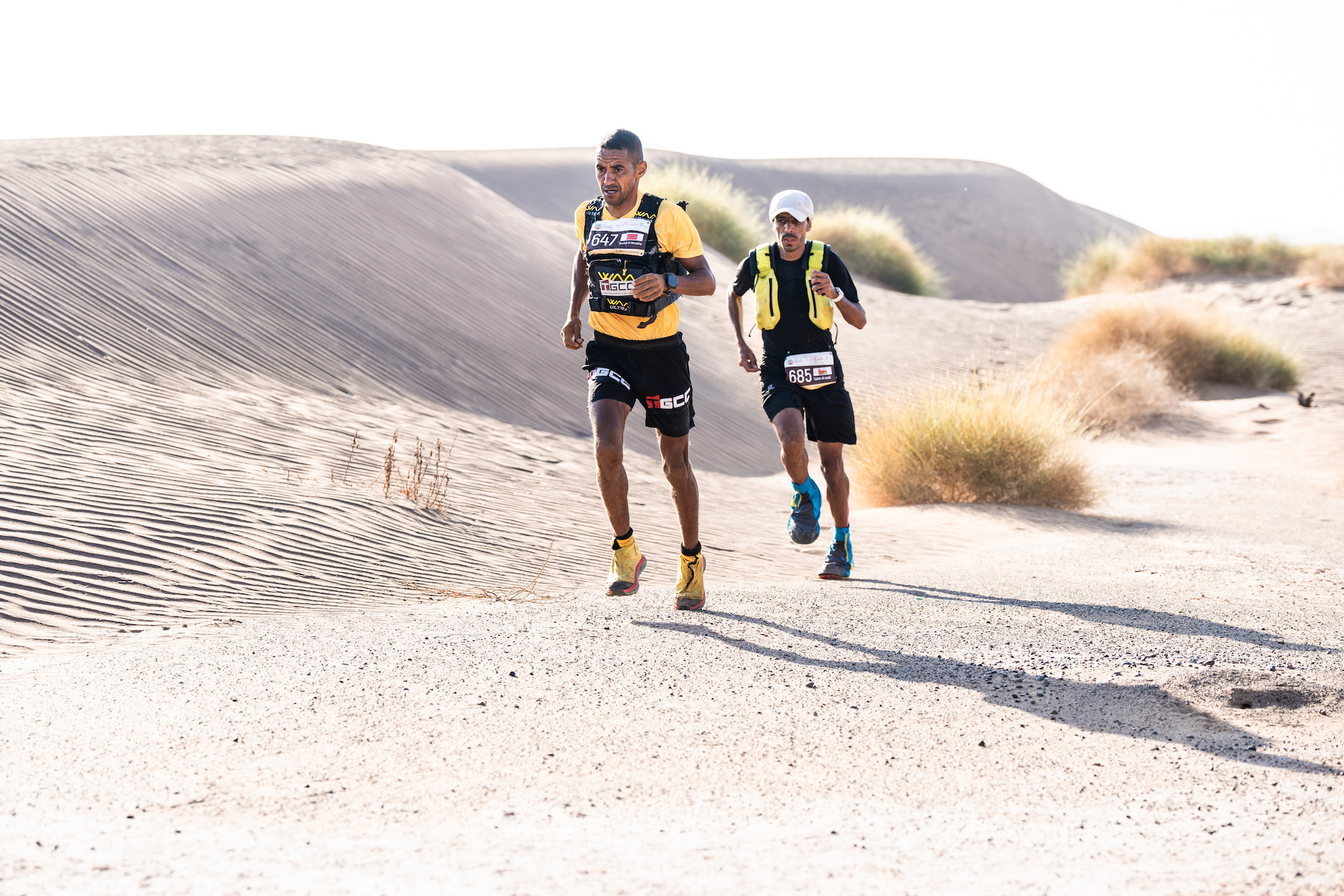
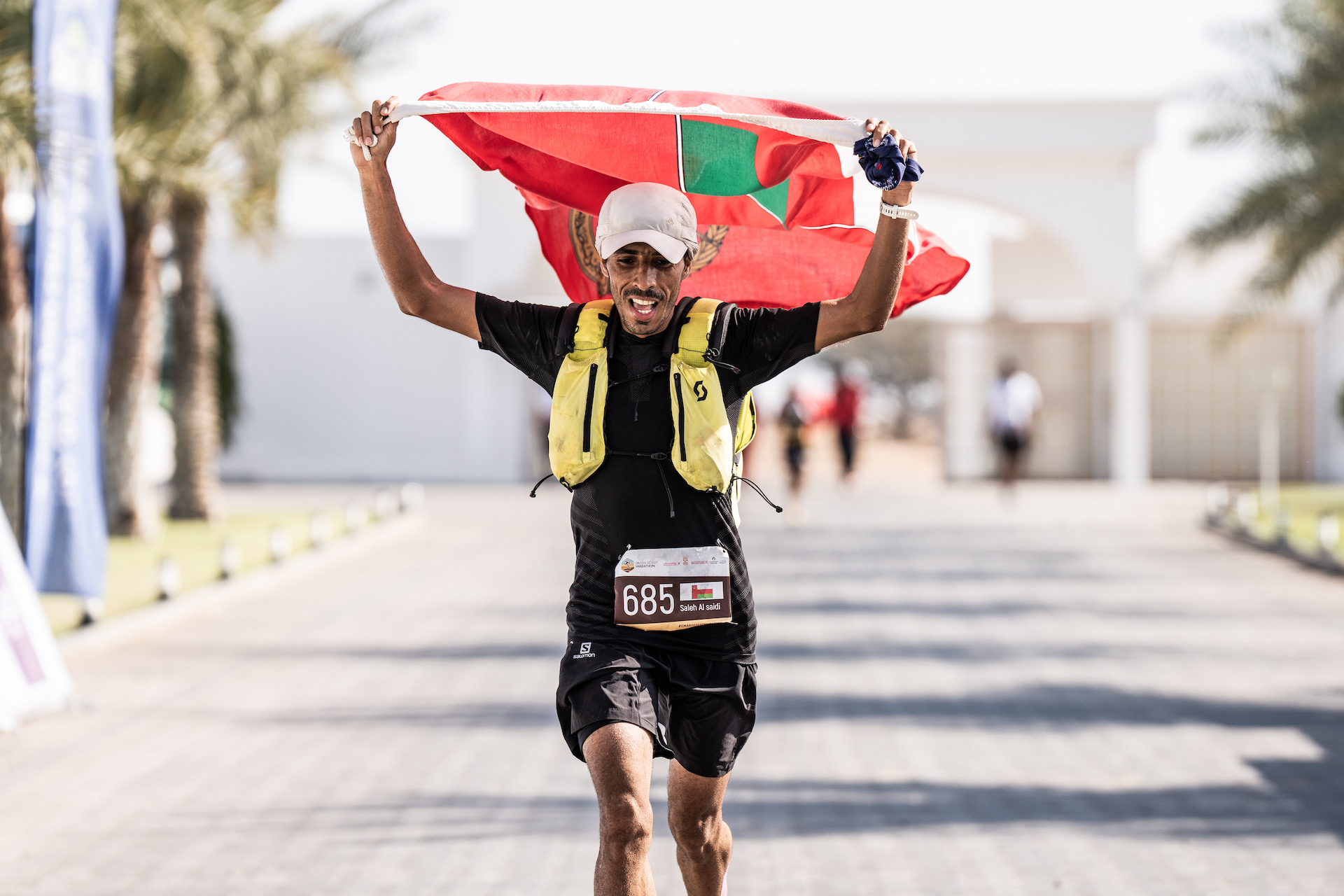
However, Saleh Al saidi pushed the pace continuously, maybe, just maybe in the back of his mind he thought he could break Rachid?
In the closing km, Rachid eased back and gave Saleh a final stage victory for the home crowd and the Army Team which he respresents.
In third place, Ghaith Al saidi. The brothers ran an incredible race and at times placed Rachid under pressure, however, Rachid for now is just too strong and experienced.
For the women, the Aziza Team were dominant and after Raji built the lead early on, El Amrany was content to run by her side.
In third place was Veronique Messina who each day consistently covered the km’s with commitment, determination and a smile. A great run in 25:38:53.
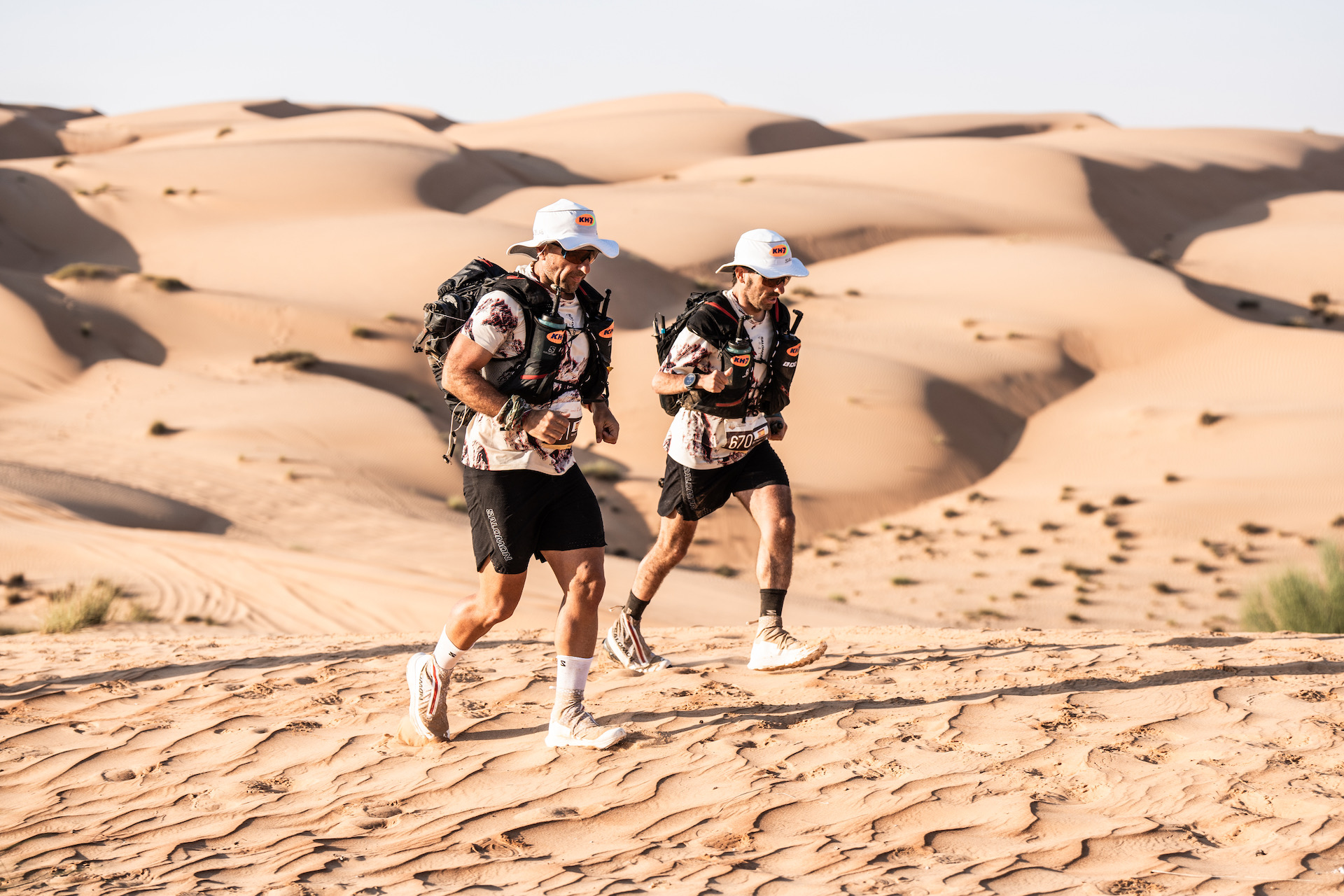
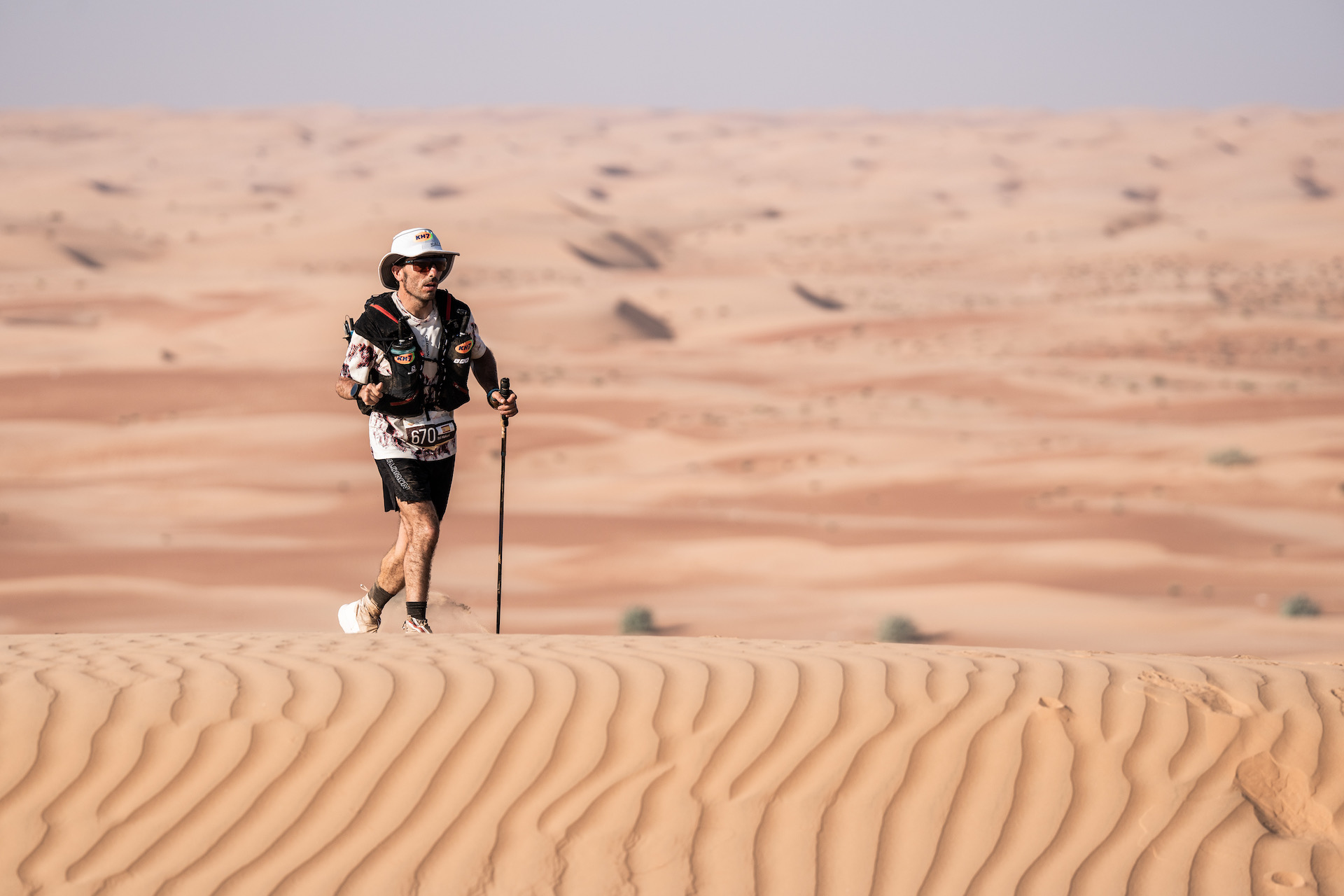
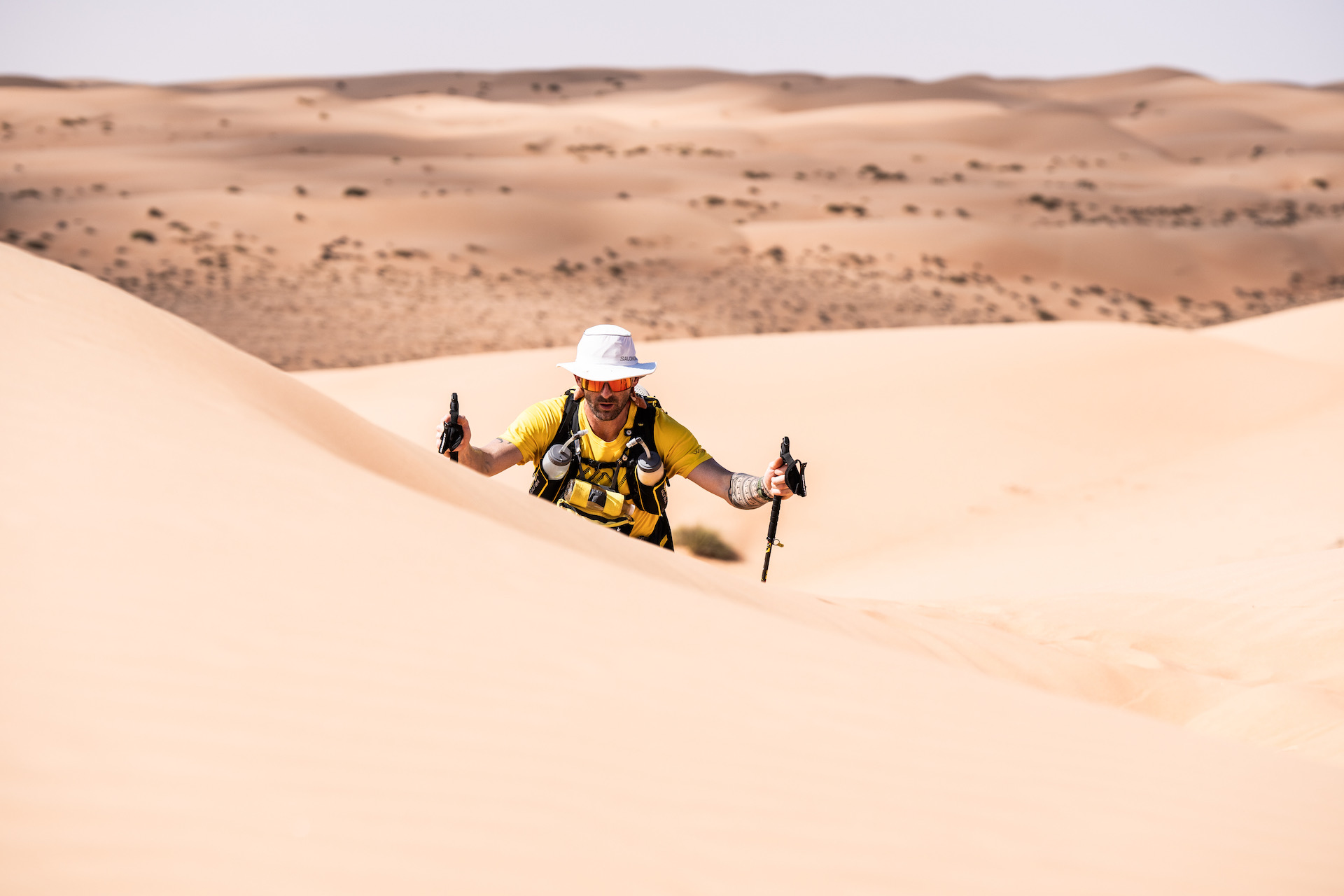
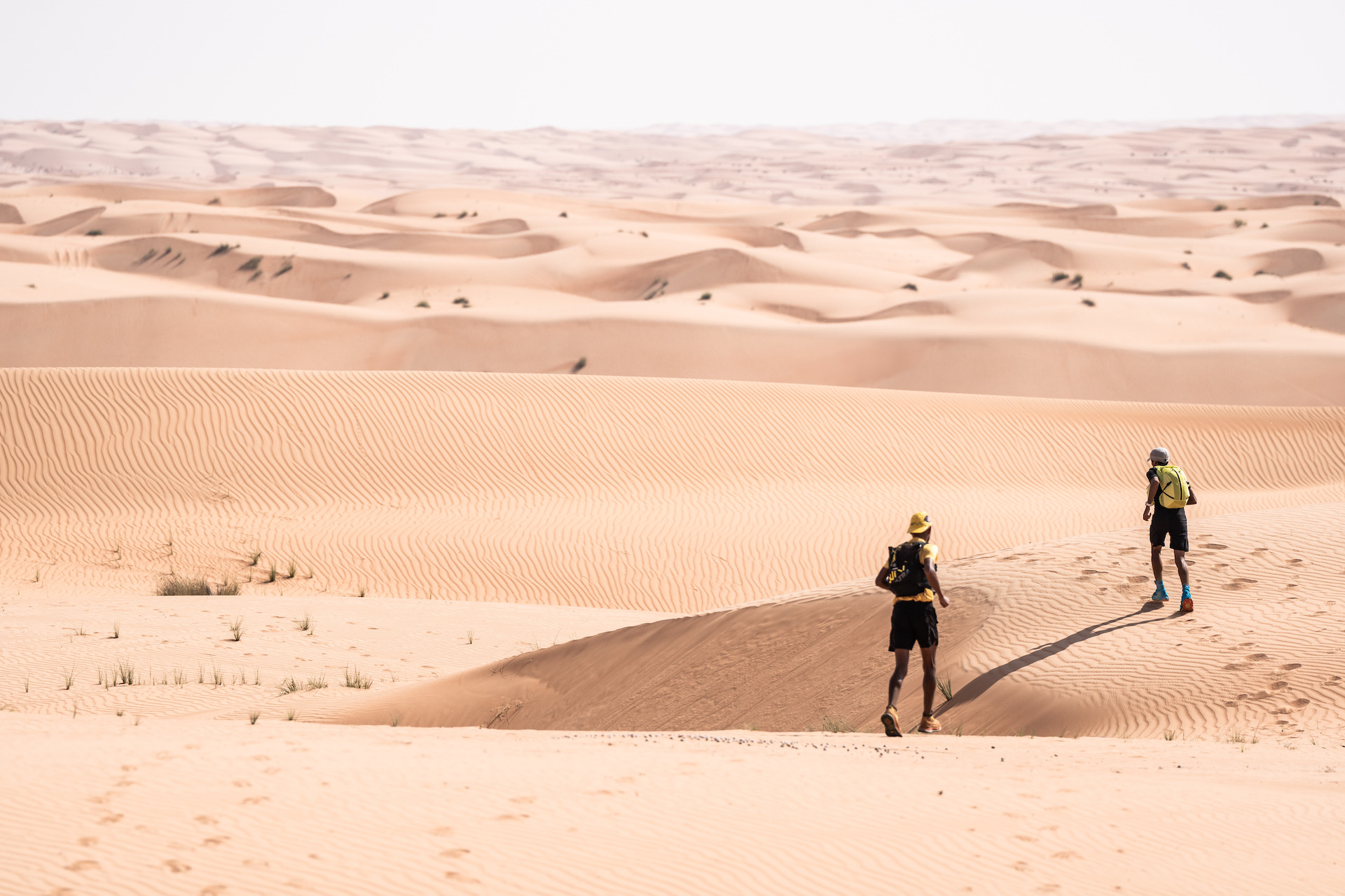
In total, thirty participants completed the race from twelve nationalities. With the race almost completely sand, the race is considered considerably harder than Marathon des Sables. This was confirmed by Rachid, “Here it is all sand, it’s slower and more tiring. Only the last day has some easier and harder terrain on which to move quicker and easier.”
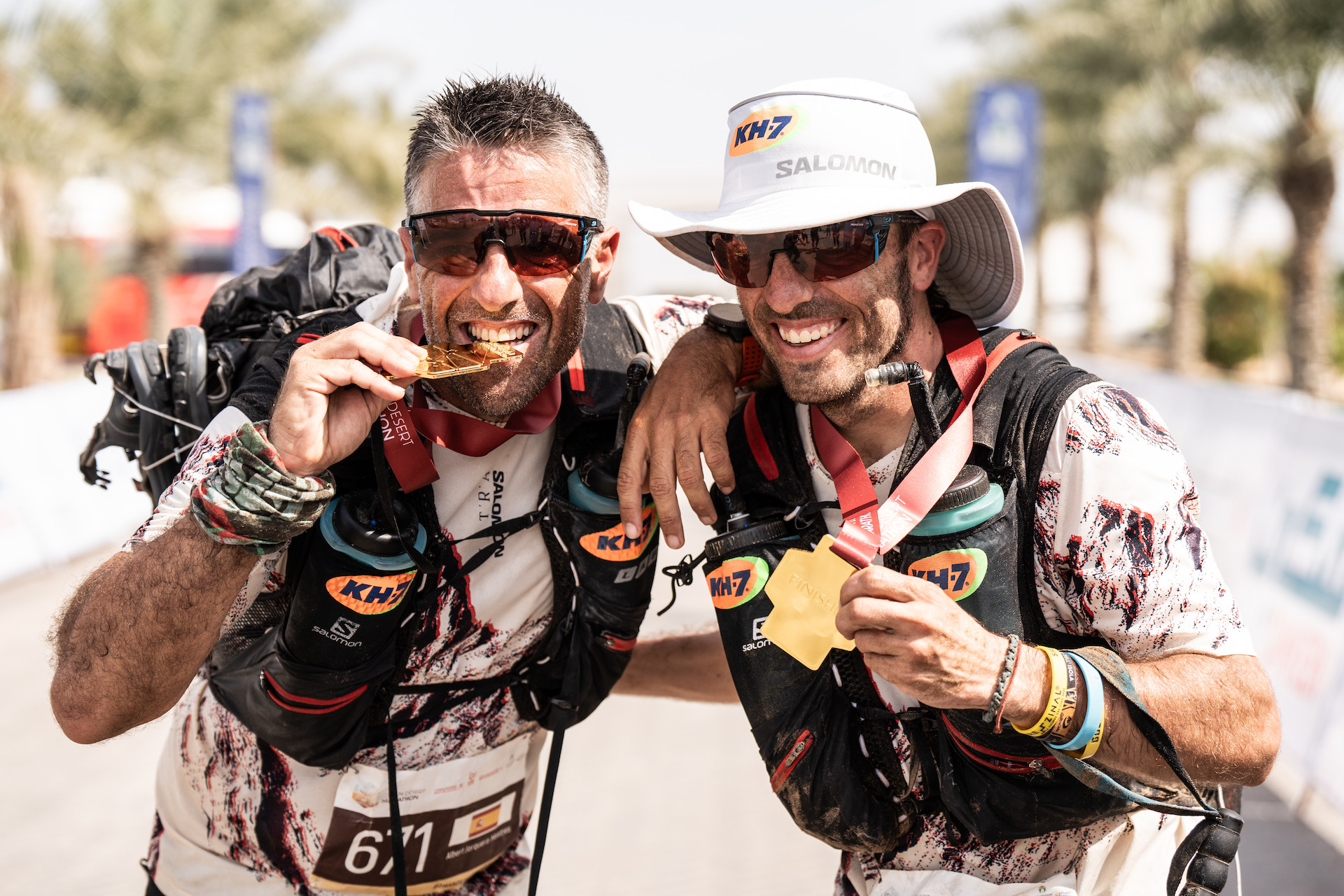
While it is difficult to pick out individuals in such a tough race, Pol Makuri has inspired everyone during the week. His commitment and dedication has been an inspiration. His completion of the event brought tears to many an eye, especially his friend and teammate, Albert Jorquera.
Rachid and Aziza may well have crossed the finish line the fastest, but a winner and champion comes in many forms and Pol Makuri is a prime example.
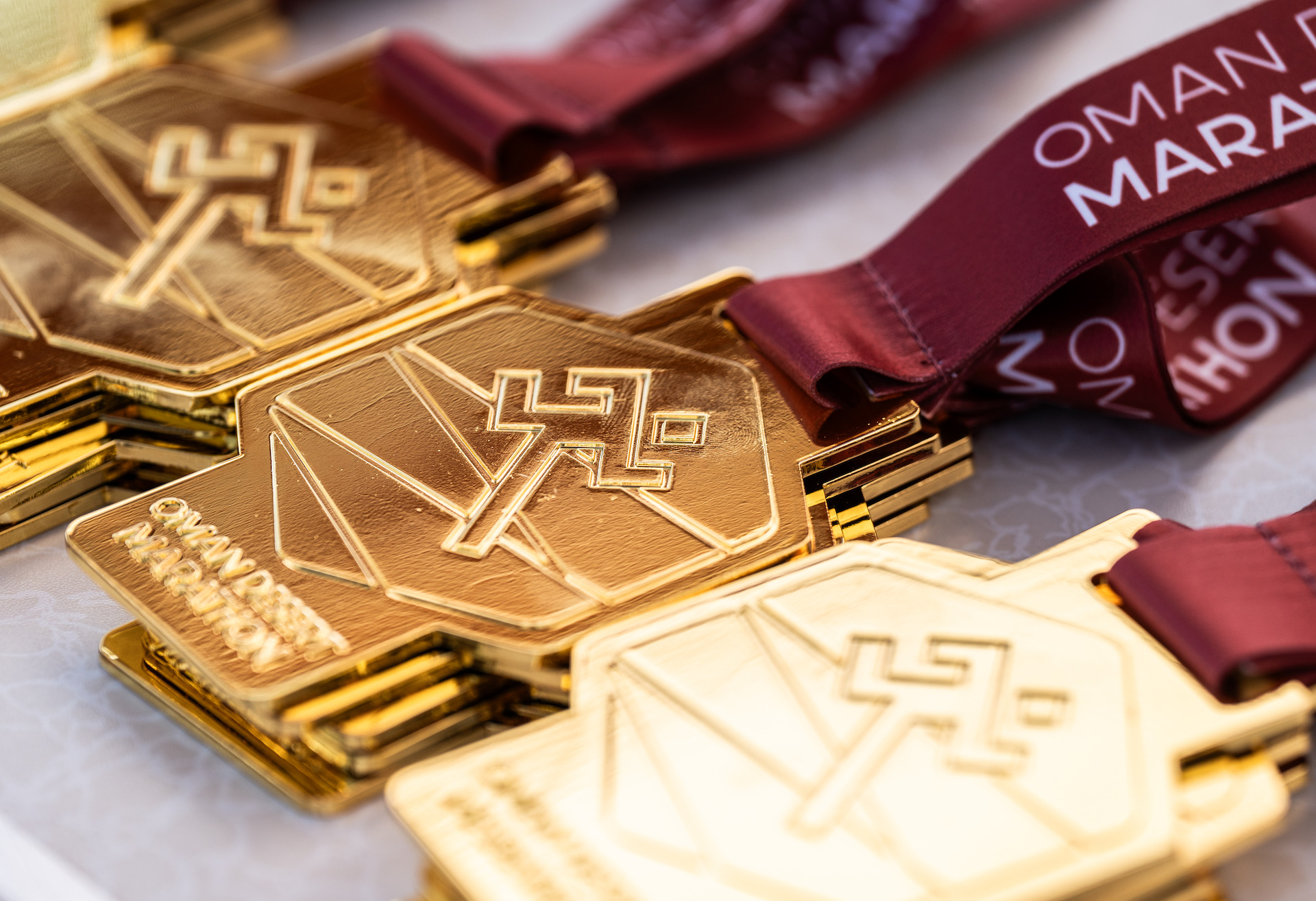
Each medal was hard earned and yes, as in many races some did not reach the finish. However, they were there at the finish line to cheer the others on, no doubt being inspired to return and try again.
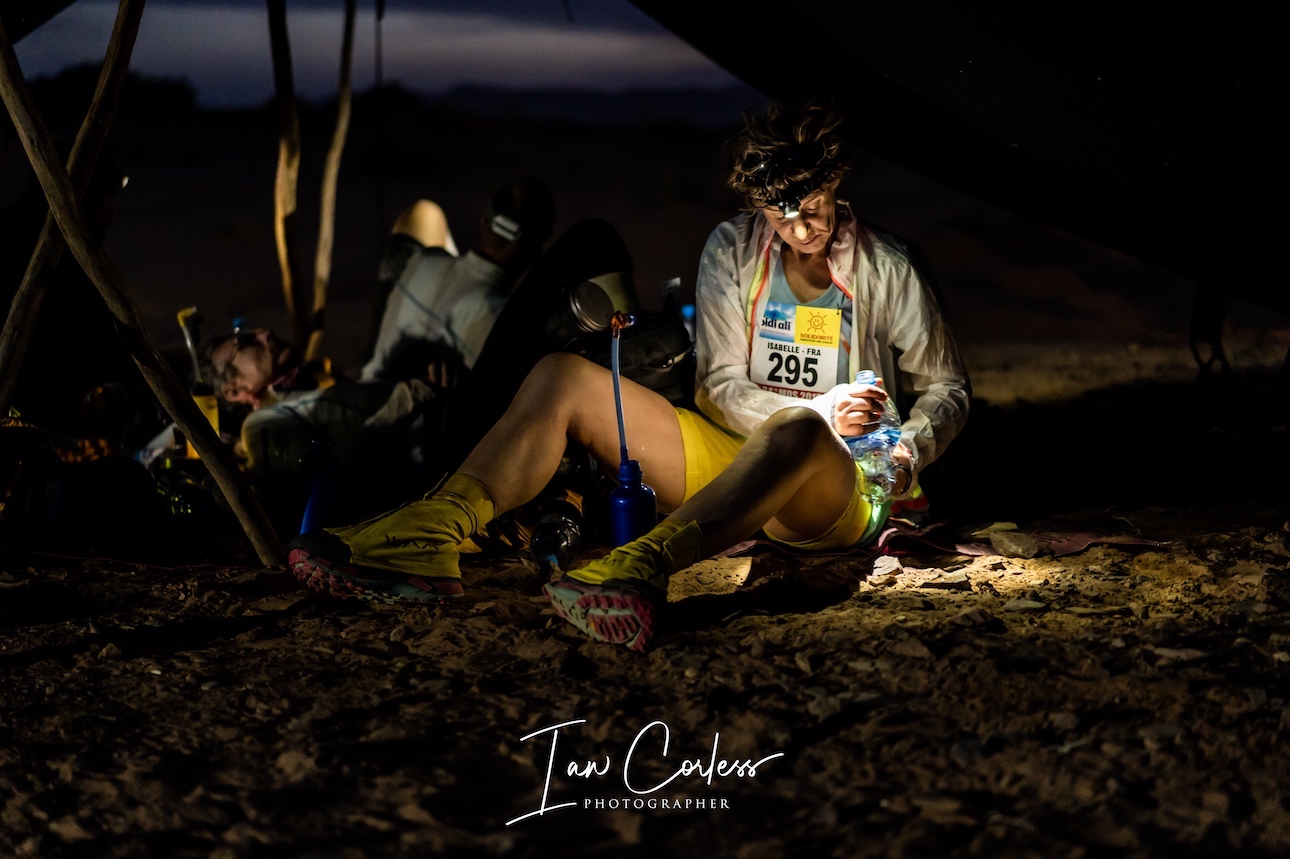
Stage 3 of the Oman Desert Marathon has a delayed start to ensure that participants experience the desert at night. With three waves: 10am, midday and 2pm (slower to faster runners respectively) the participants would cover the 47km stage in daylight and then transition to darkness.
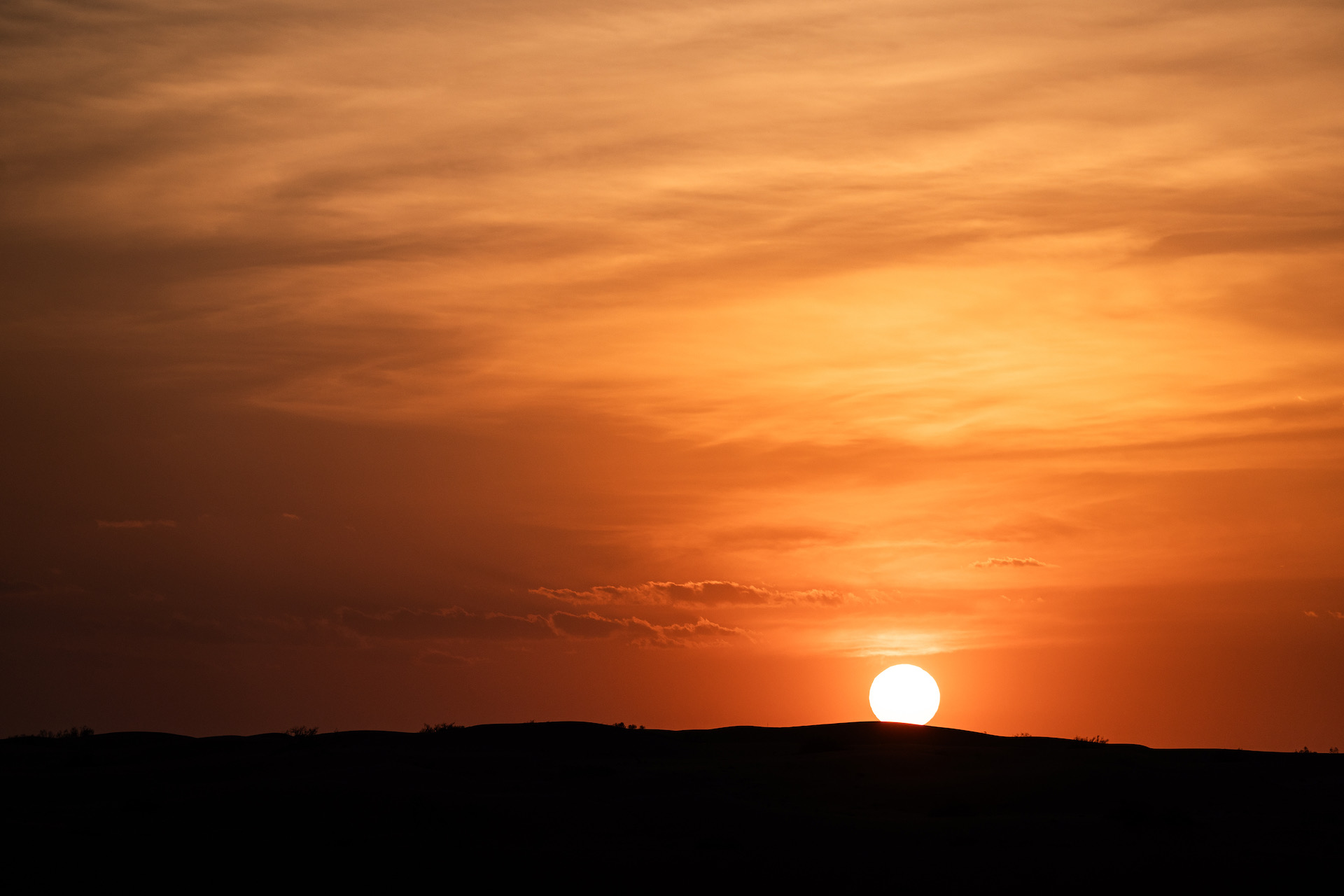
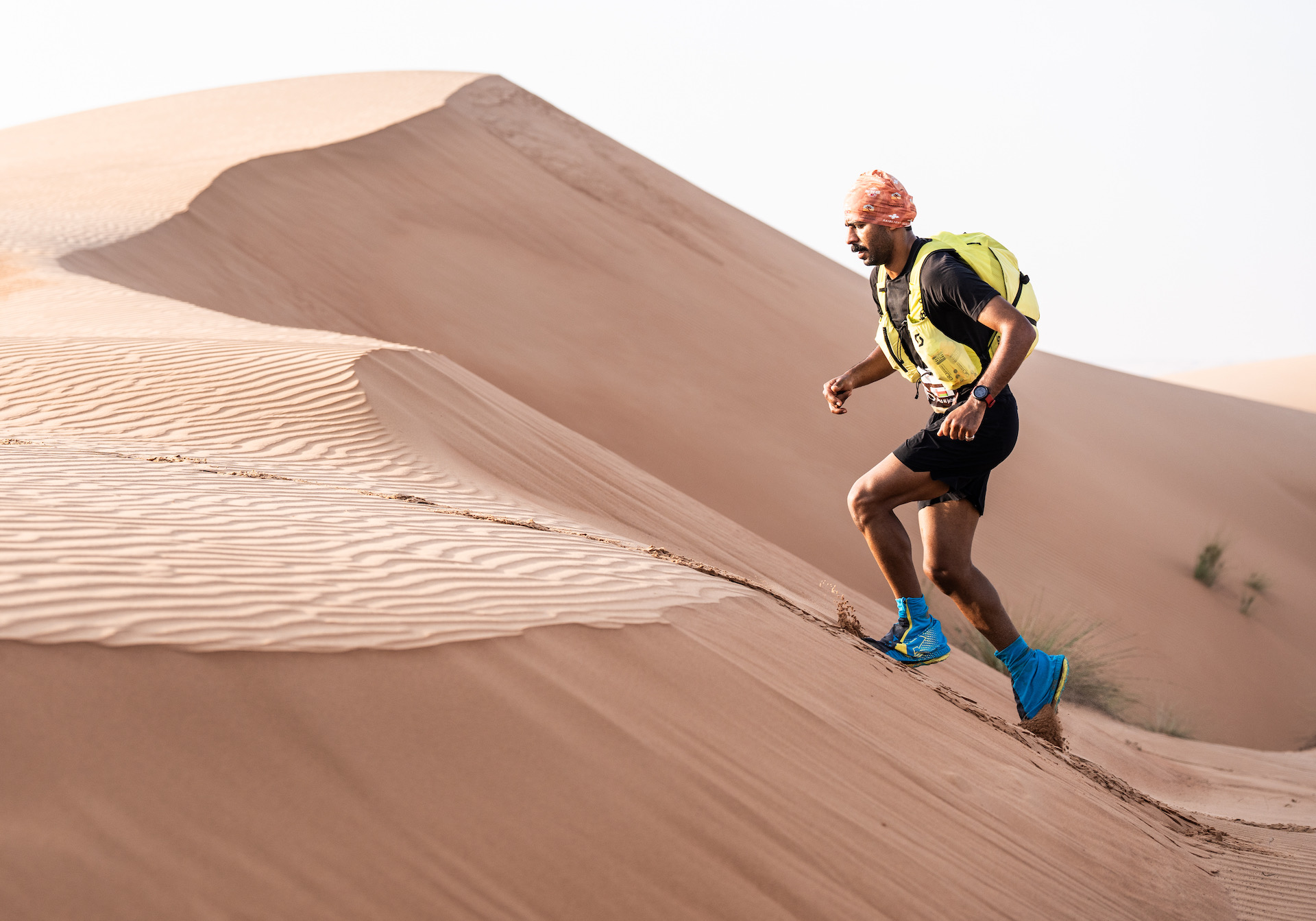
Consider by race director, Said, stage 3 would include one of the most spectacular dune sections on the race, timed to coincide with the sun getting lower in the sky and for the lucky ones, maybe sunset would take place as the dune section came to an end.
Coming after the 55km long day, the later starts were welcomed and allowed for additional rest and recovery, however, the fatigue was starting to show on faces and bodies.
As the race got underway, it was clear that the men’s race would have a different approach, with Ghaith Al said pushing hard at the front, while behind, Saleh Al said and Rachid El Morabity ran together. Ultimately, it was an attempt to break Rachid. It didn’t work, but it was a valiant effort and one that rewarded Ghaith with the stage win in 5:03:39.
Behind, Saleh and Rachid ran together and crossed the line 5:10:29 and 5:10:39 respectively.
The women’s race had little drama with Aziza Raji and Aziza El Amrany running together and crossing the line in 6:56:35. The duo looked strong and relaxed. They will be a force to be reckoned with at Marathon des Sables this year.
Behind, once again, Veronique Messina ran a strong 3rd place in 7:49:56.
Albert Jorquera and Pol Makuri had a long day completing in 11:17. They are both very focussed mentally and strong physically. It has been a joy to watch the two of them work together and quite simply. Pol is an inspiration.
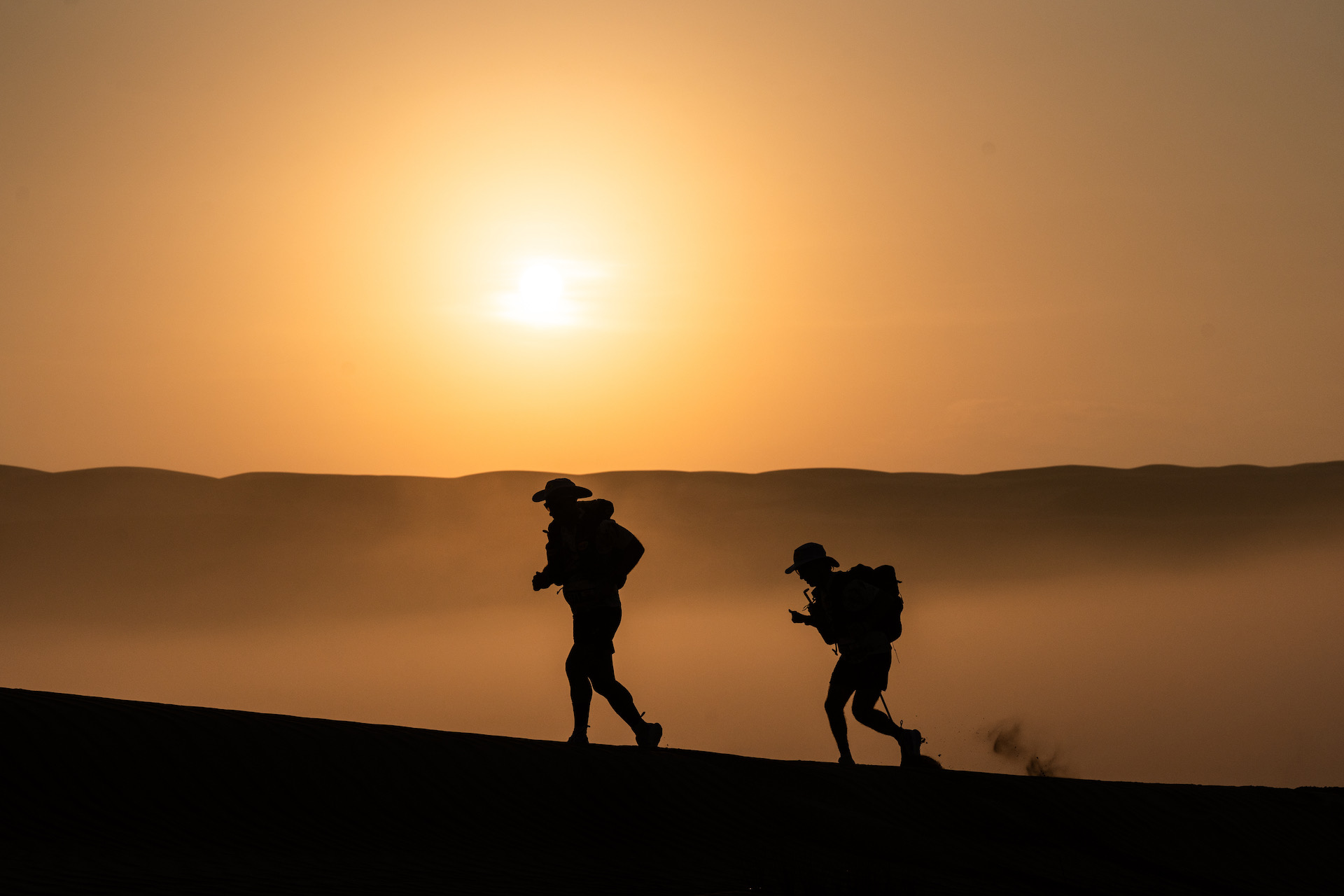
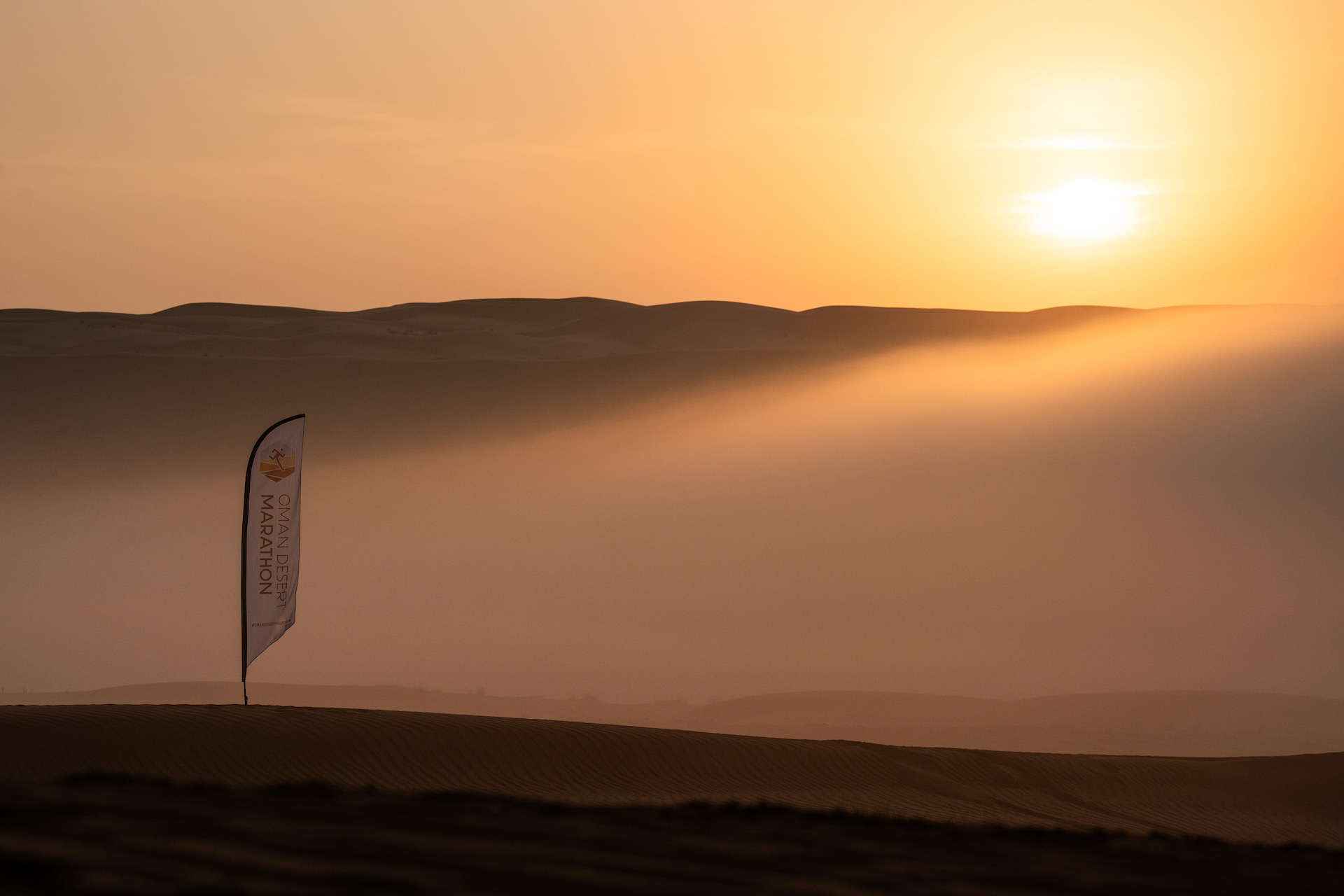
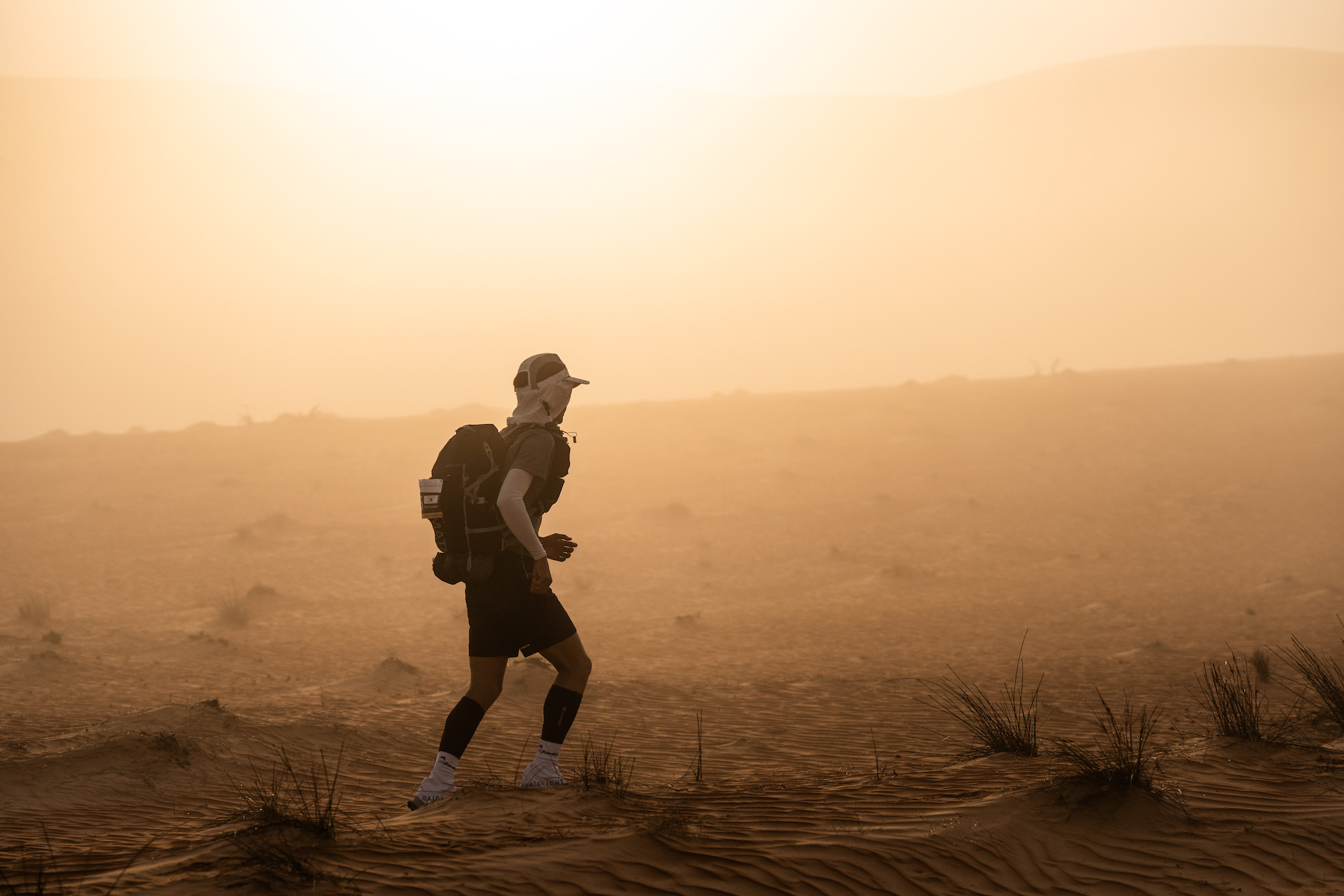
Day 2 of the Oman Desert Marathon and after day 1, there was some anxiety. At 55km’s long, the stage was set to be tough. A planned 0630 start with sunrise, would provide participants with extra time in daylight. However, the weather had different plans. An inversion came in during the night and early morning reducing visibility in the valley to zero, the start was delayed 1-hour.
At approximately 0730, the runners were on the way despite some lingering mist. However, the mist was guaranteed to disappear quickly and it did. While it lasted, it gave an eerie feeling to the desert.
Sadly, Mohammed El Morabity was a DNS today. He was tired and feeling under the weather after long delayed travel and a tough first day. Although sad to see a competitor leave, I am sure Salah Al Saidi and Evgenii Glyva were somewhat happy to have one less El Morabity brother to deal with.
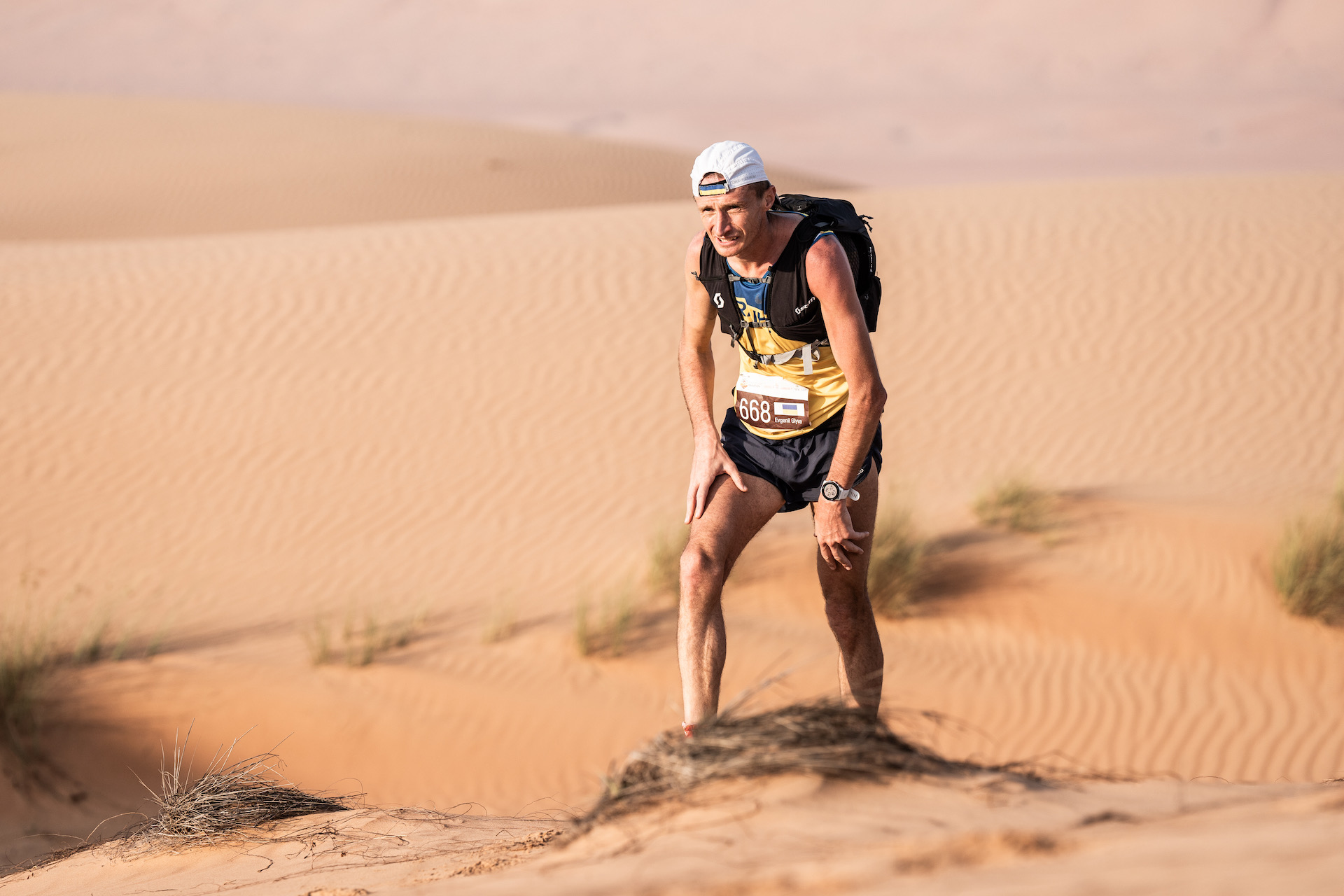
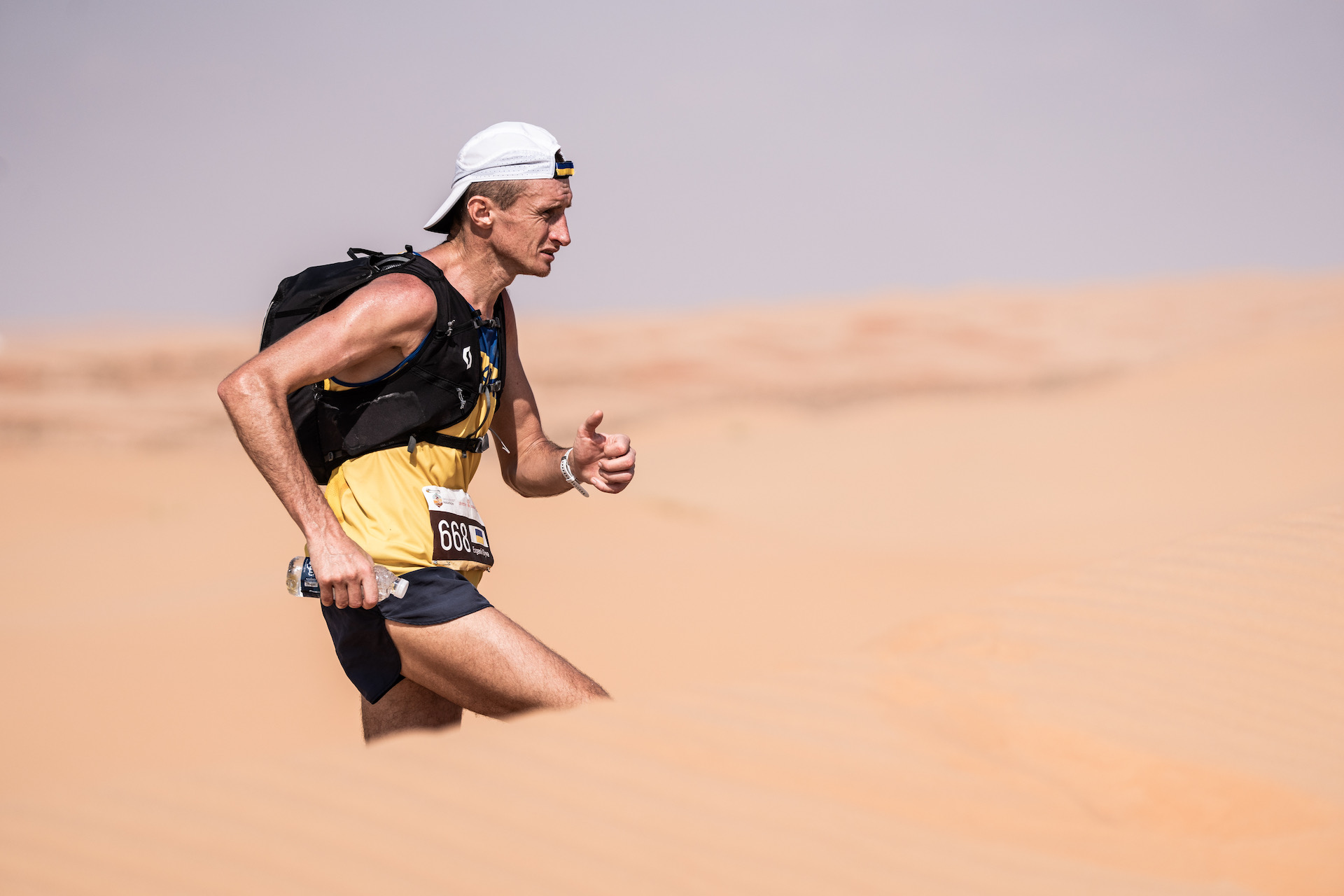
Having run a very strong stage 1, Salah Al Saidi took the race to Rachid pushing the pace. As always, Rachid started easy and looked relaxed while following and Evgenii was pushing to hold the pace.
For the women, Aziza Raji must have felt very confident after her stage 1 performance and huge gap. By contrast, Aziza El Amrany was probably wondering how she could pull back any time? Kathleen Leguin who was a pre-race favourite had suffered with sickness on stage 1 but started the day feeling better and the trio ran together with Veronique Messina behind.
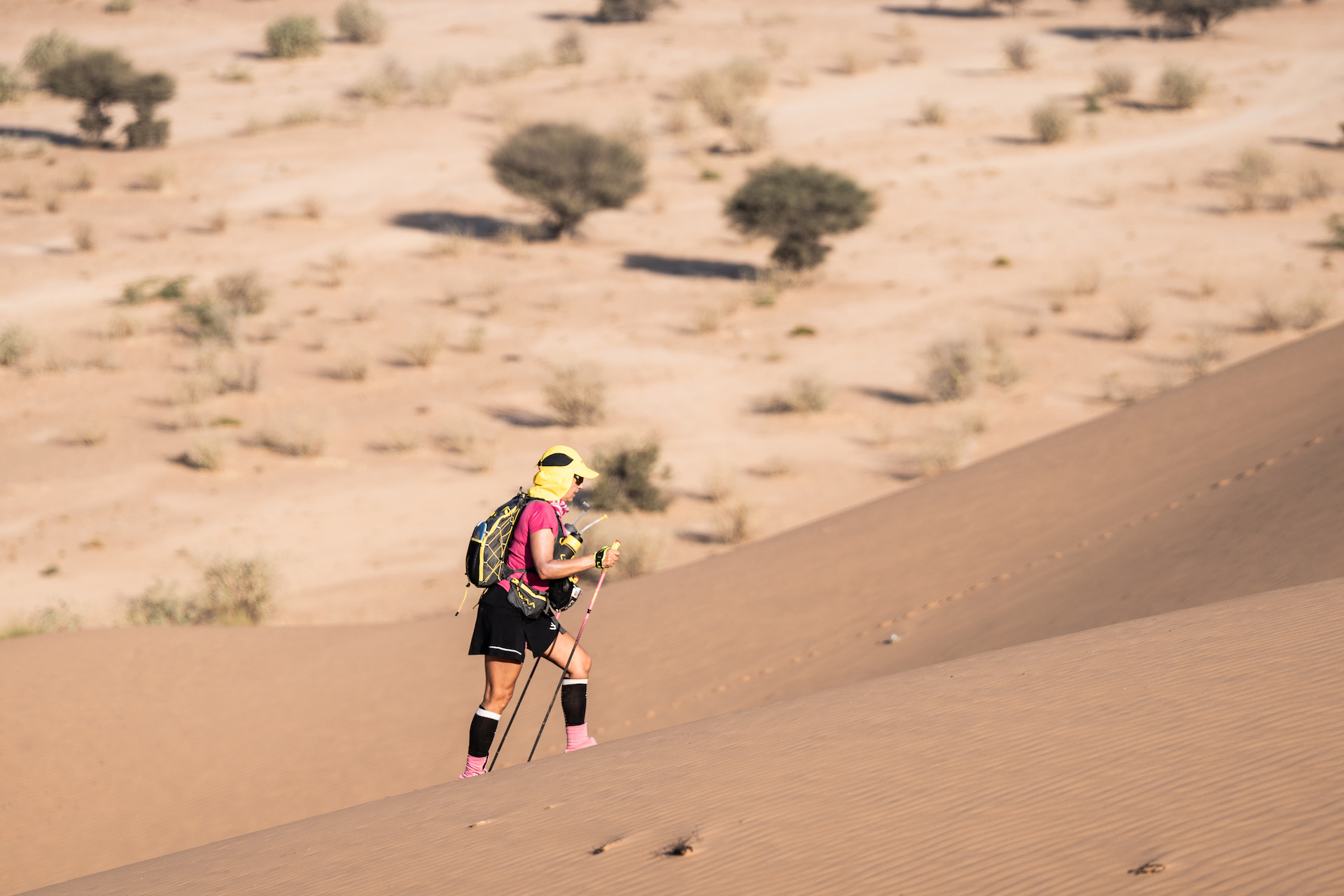
Despite 55km’s, stage 2 was billed as a more runnable and easier day, it wasn’t. There was a great deal of soft-sand, several dune section and lots of heat. It was all too much for Kathleen and sadly she withdrew from the race at cp3.
It is never easy to tell if Rachid is suffering, but today there seemed some signs of fatigue and tiredness at cp3. He left with Saleh but looked happy to hold back and let the pace be dictated.
However, in a typical Rachid move, he finally applied pressure and opened a gap crossing the line in 5:47:24 to Saleh in 6:07:43. Evgenii finished 3rd in 6:23:13.
The two Aziza’s were playing truce today and duo ran together all day, Raji happy not to loose anytime to El Amrany and at the same time share the desert with a friend.
With Kathleen out of the race, Veronique finished 3rd, the times of the top 3 8:31:06 and 8:31:07 for El Amrany and Raji, 9:04:37 for Veronique.
Results HERE and GC ranking HERE.
Albert Jorquera and Pol Makuri were battling the day and due for an early evening finish, in darkness.
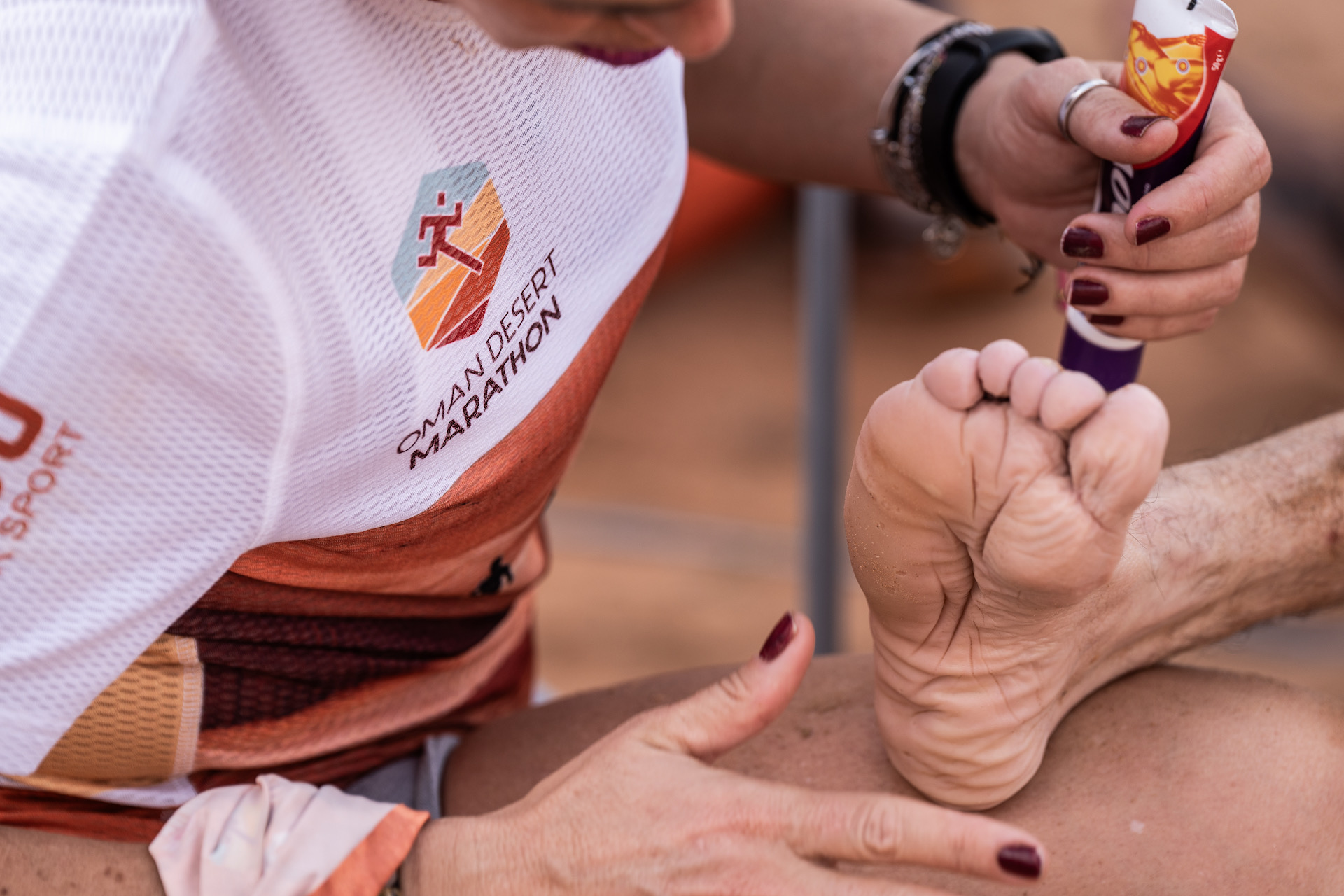
A long stop at cp3 allowed Pol to get some treatment for his feet and recharge ready for the push to the line; he’s one tough guy!
Tomorrow is stage 3, the night stage. The runner’s will start in two waves. The first around midday, the second early afternoon and they will go in to the night over roughly a marathon distance.
Navigating a different route to the 2023 Oman Desert Marathon, stage 1 of the 2024 edition proved to be a tough challenge and one that saw the lead change in the latter stages to provide victory for Aziza Raji and Rachid El Morabity.
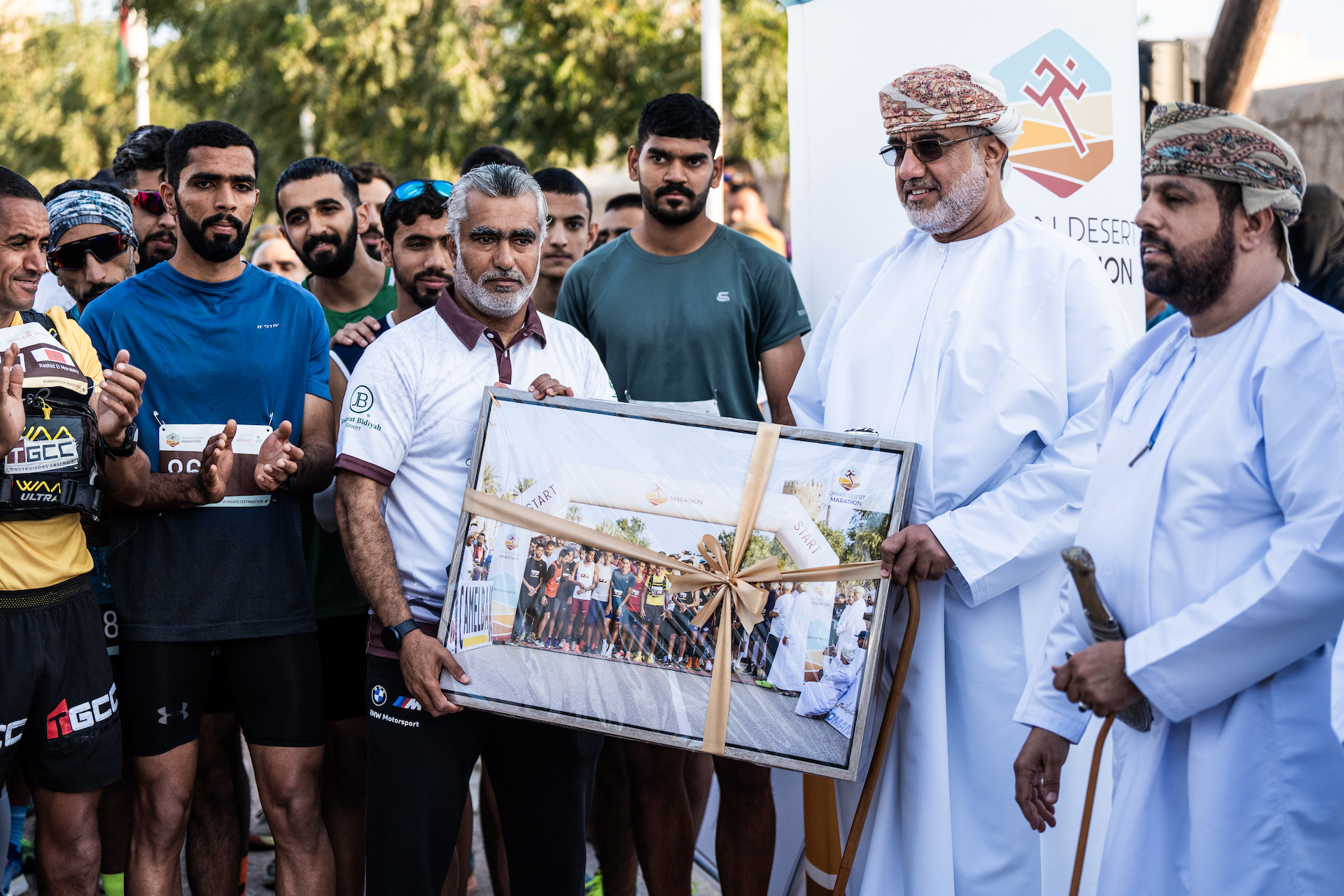
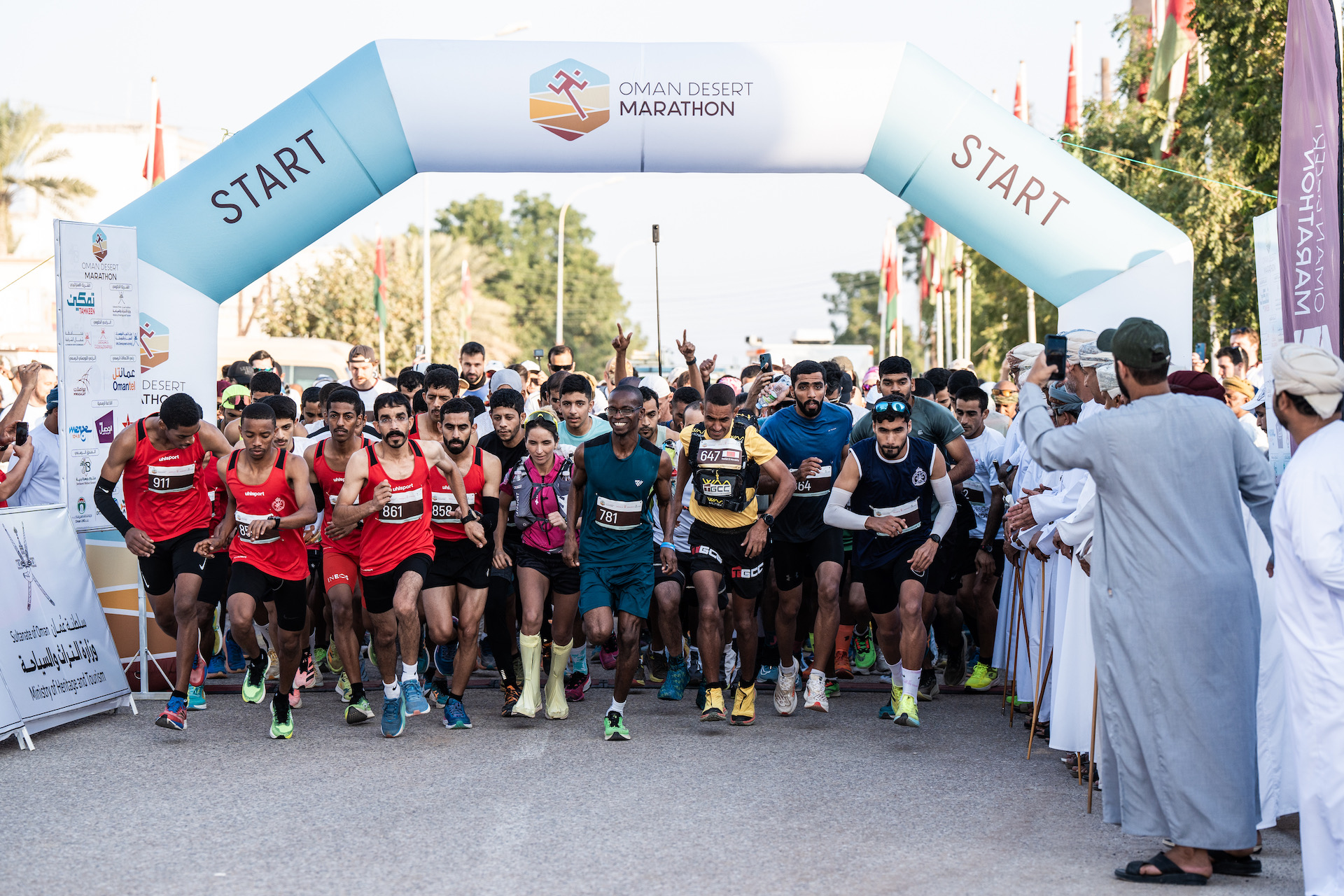
Starting in Bidiyah with a gala presentation of local dignitaries and local music, the event had a mass start for the 4-stage race, marathon, 21km, 10km and 5km.
The main event, the 4-stage 165km race navigating an almost circular route back to Bidiyah was initially lead with a charge from last year’s champion, Mohamed El Morabity with Khalid Al Jabri and Evgenii Glyva.
For the women, an in-form Aziza El Amrany forged away at the front looking very strong and focused.
As per usual, Rachid El Morabity paced himself with a relatively slow start keeping the other three protagonists in sight.
Behind Aziza, Aziza Raji and the French lady, Kathleen Leguin were both looking strong and relaxed.
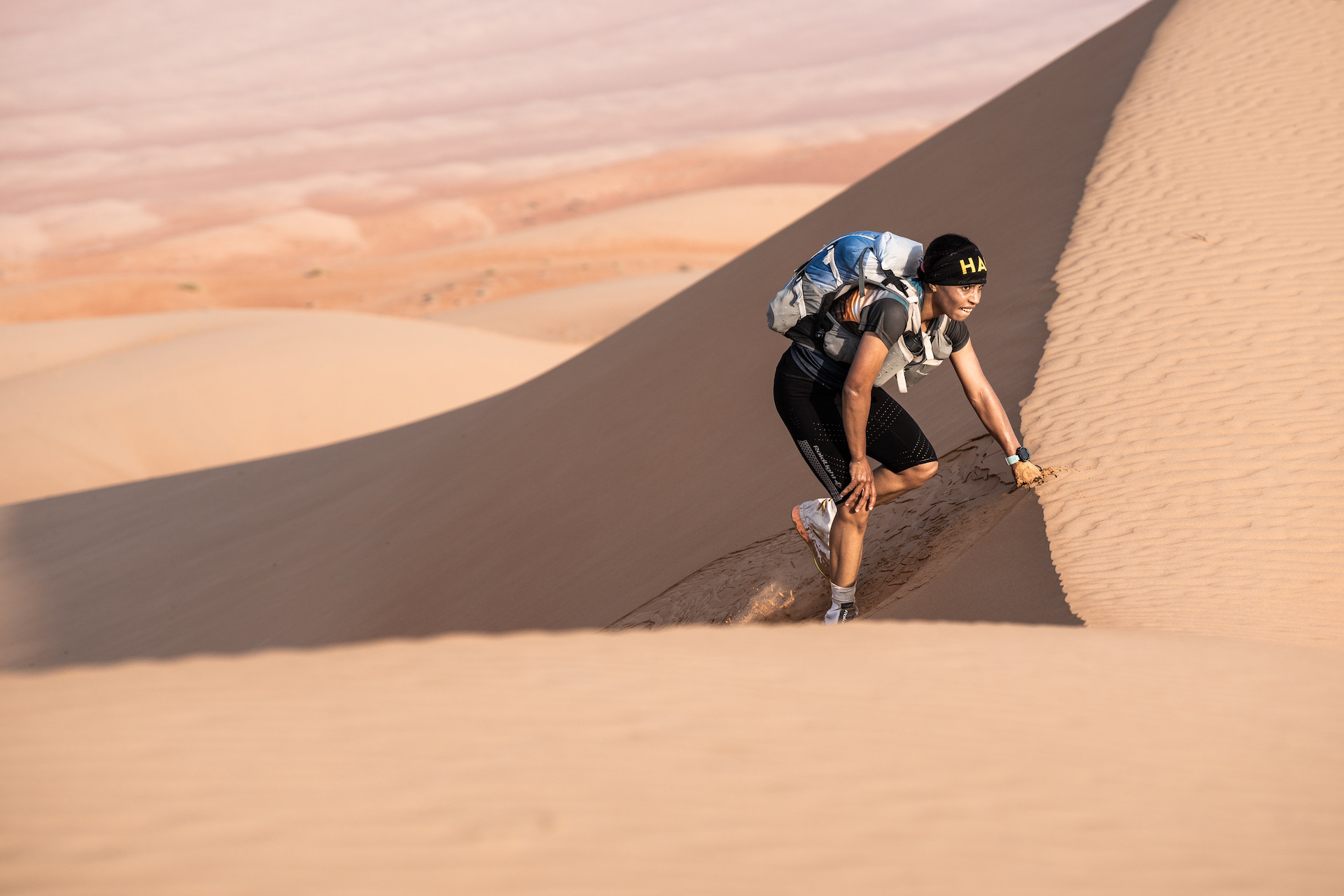
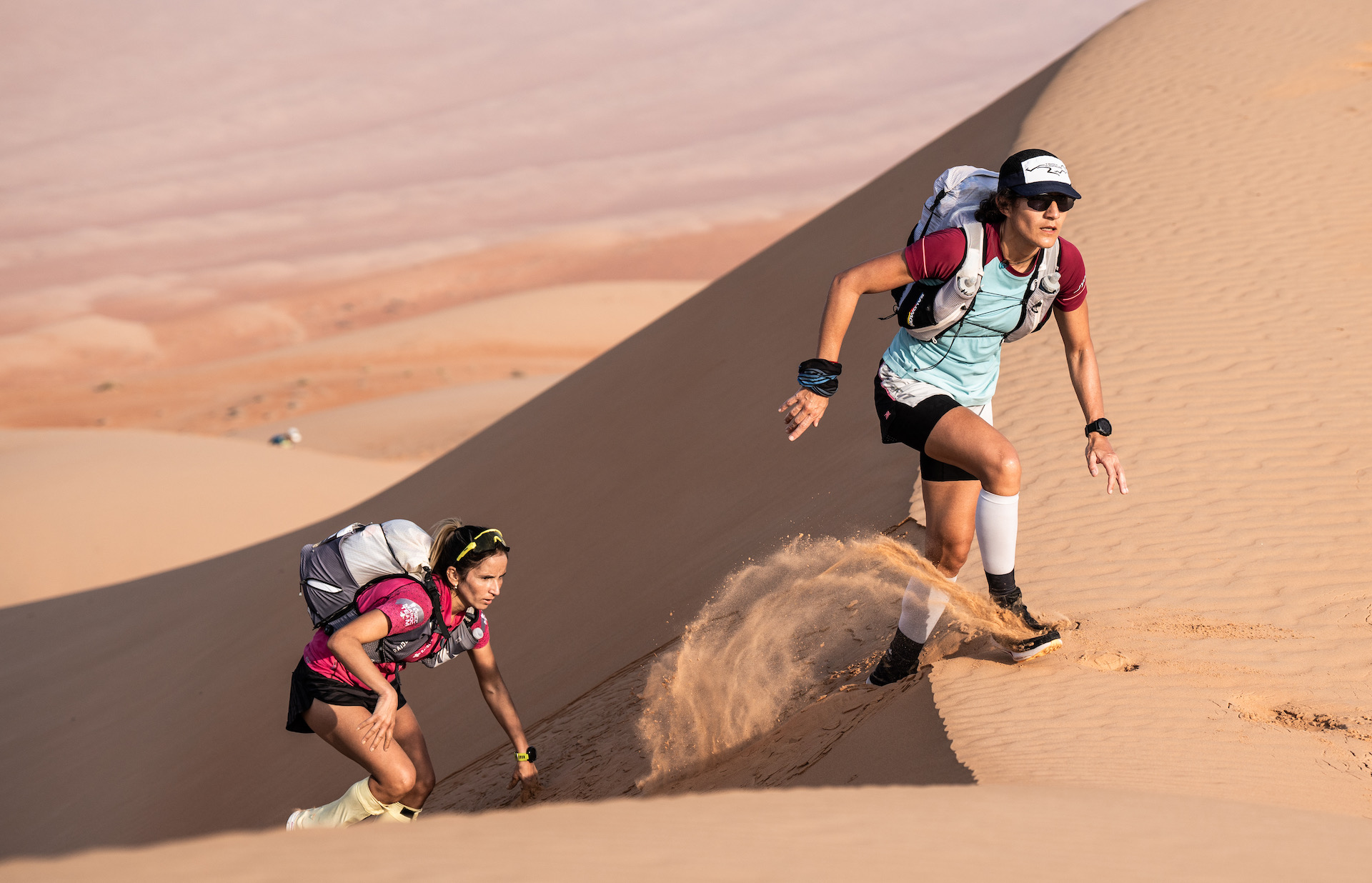
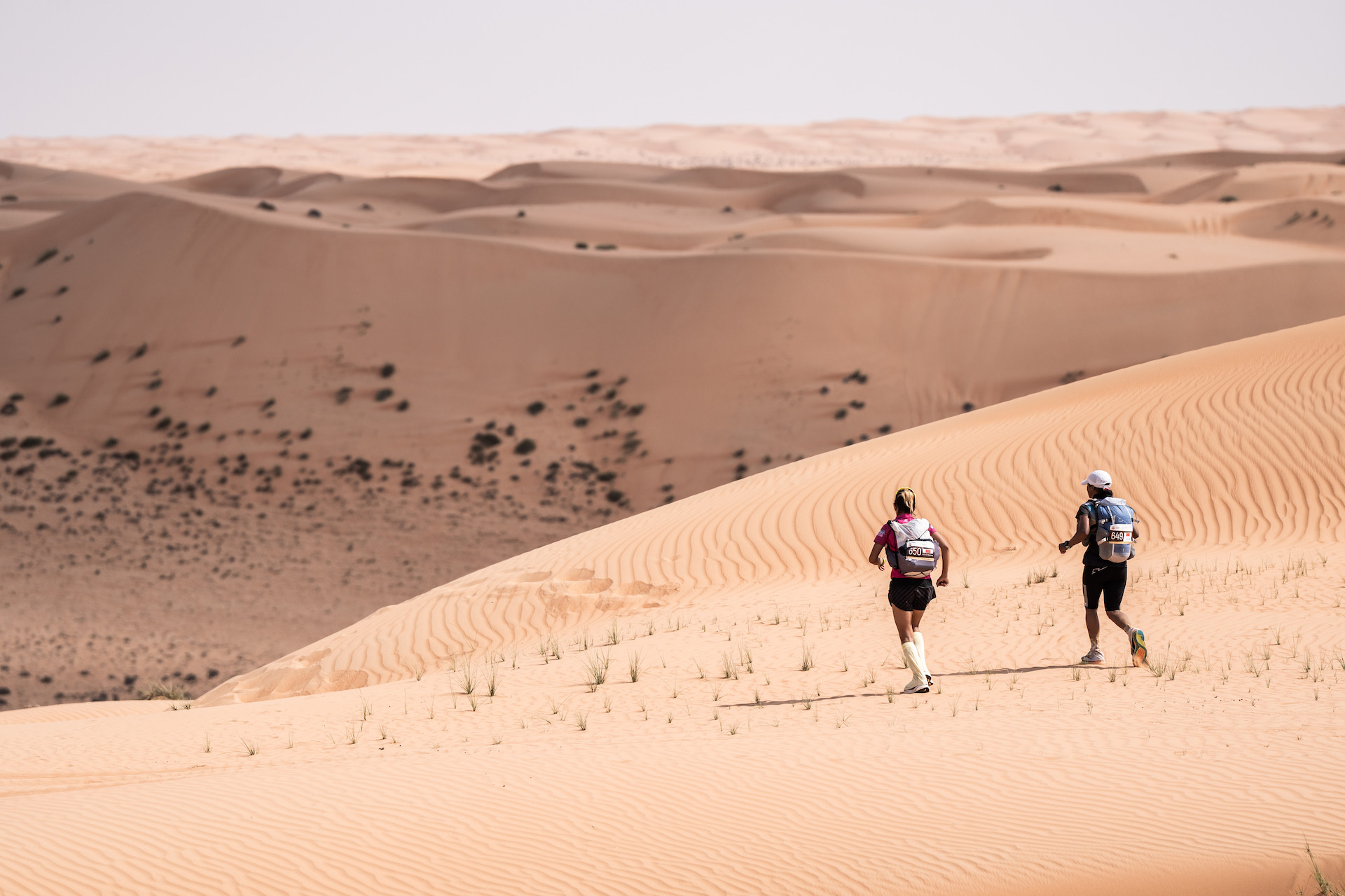
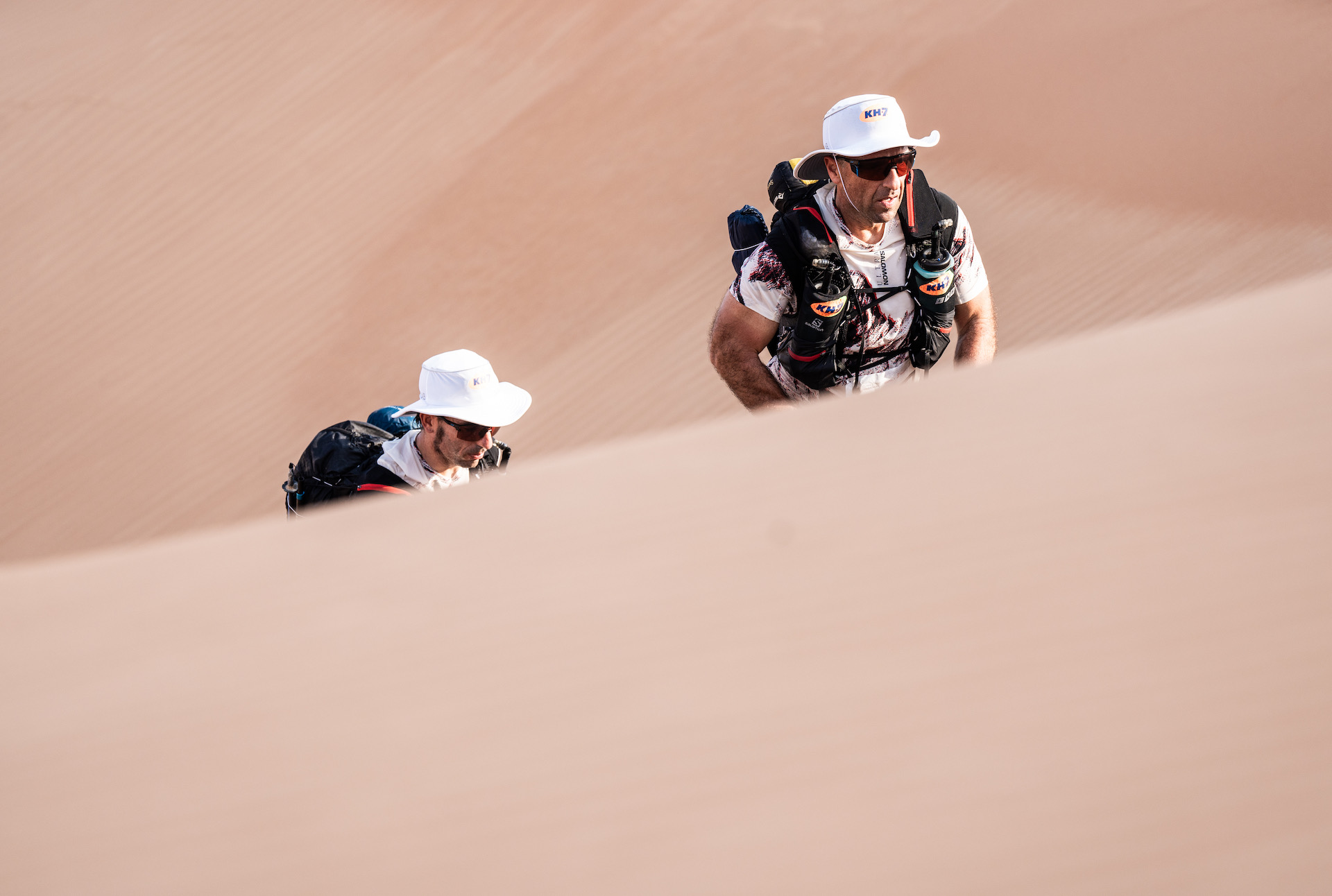
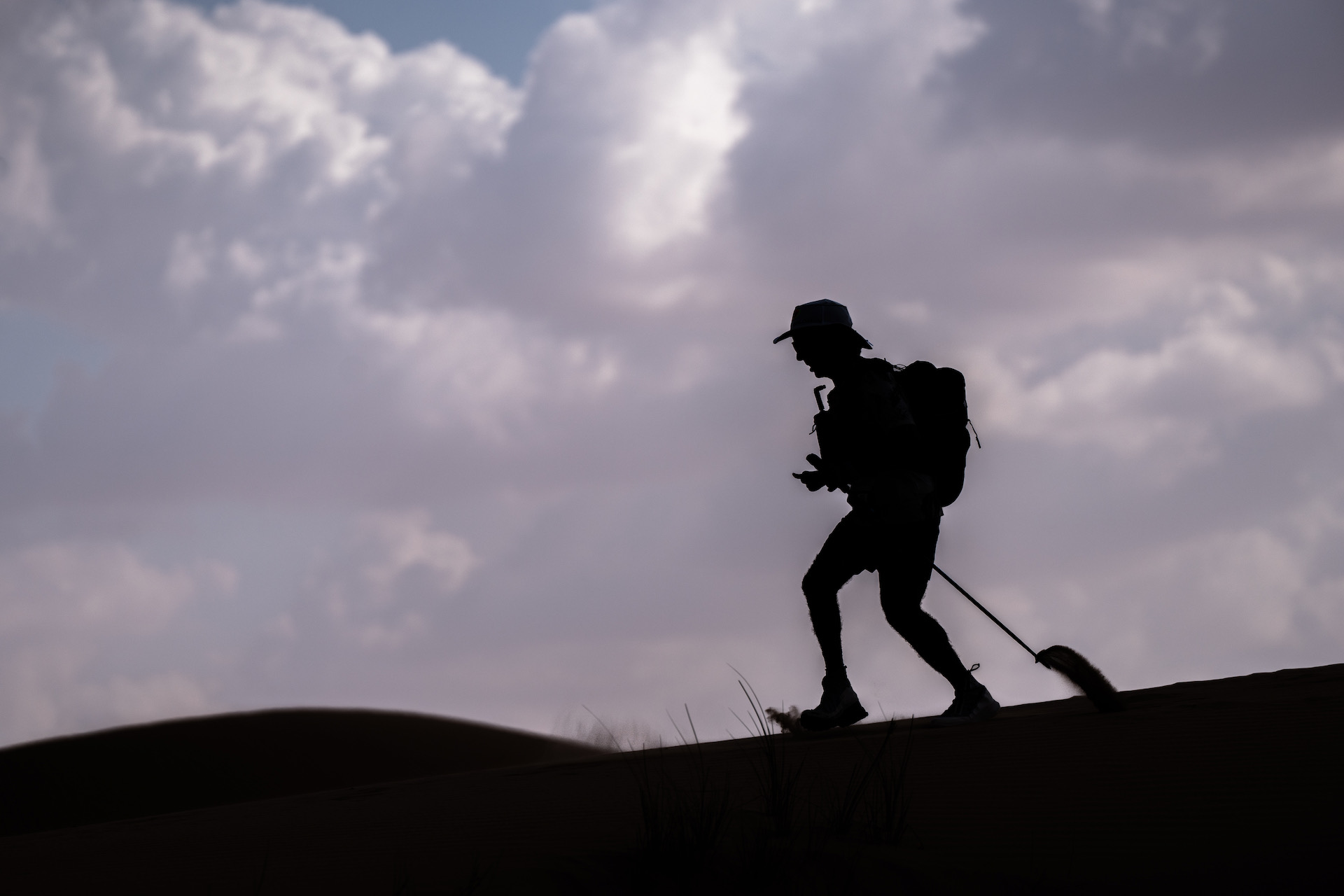
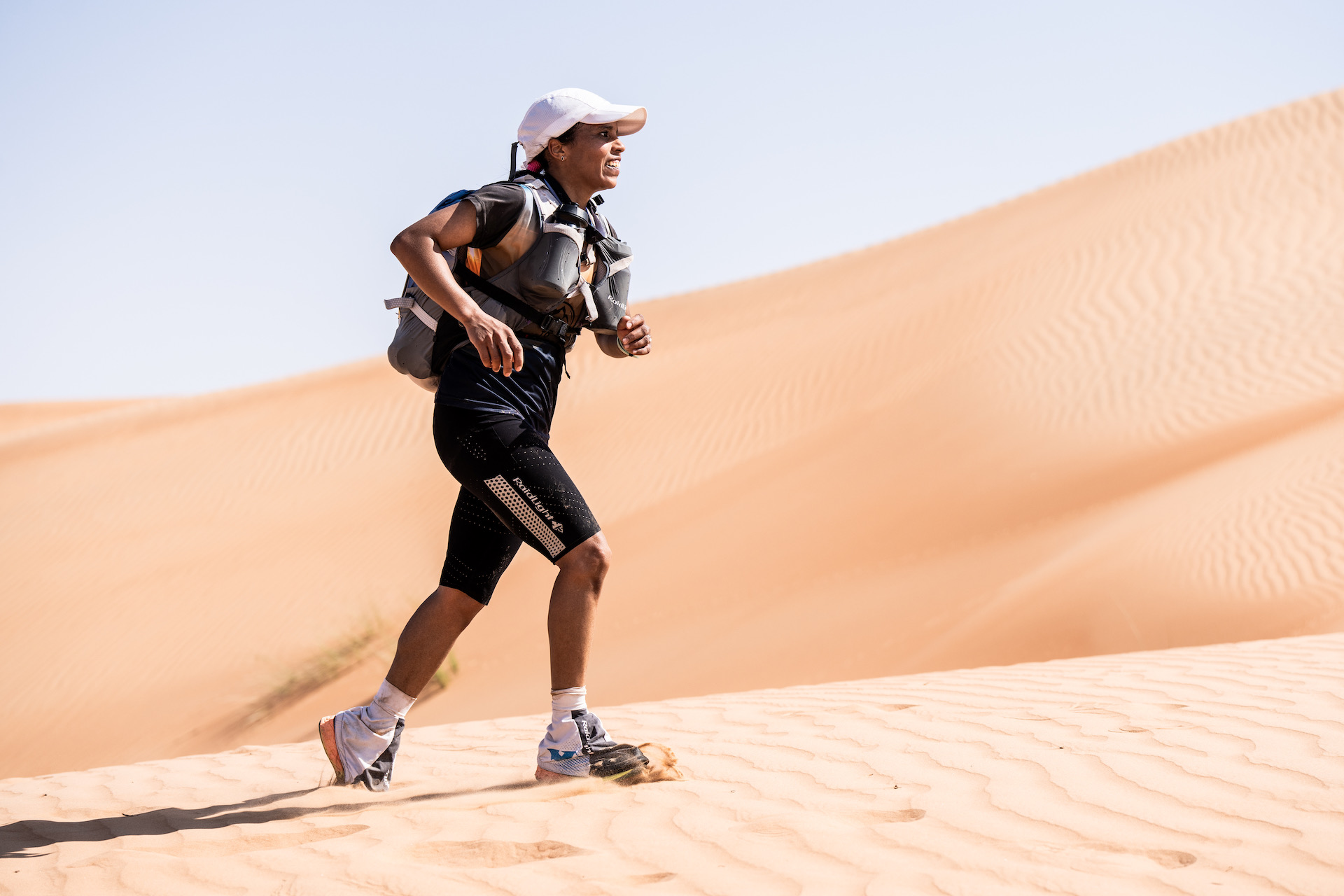
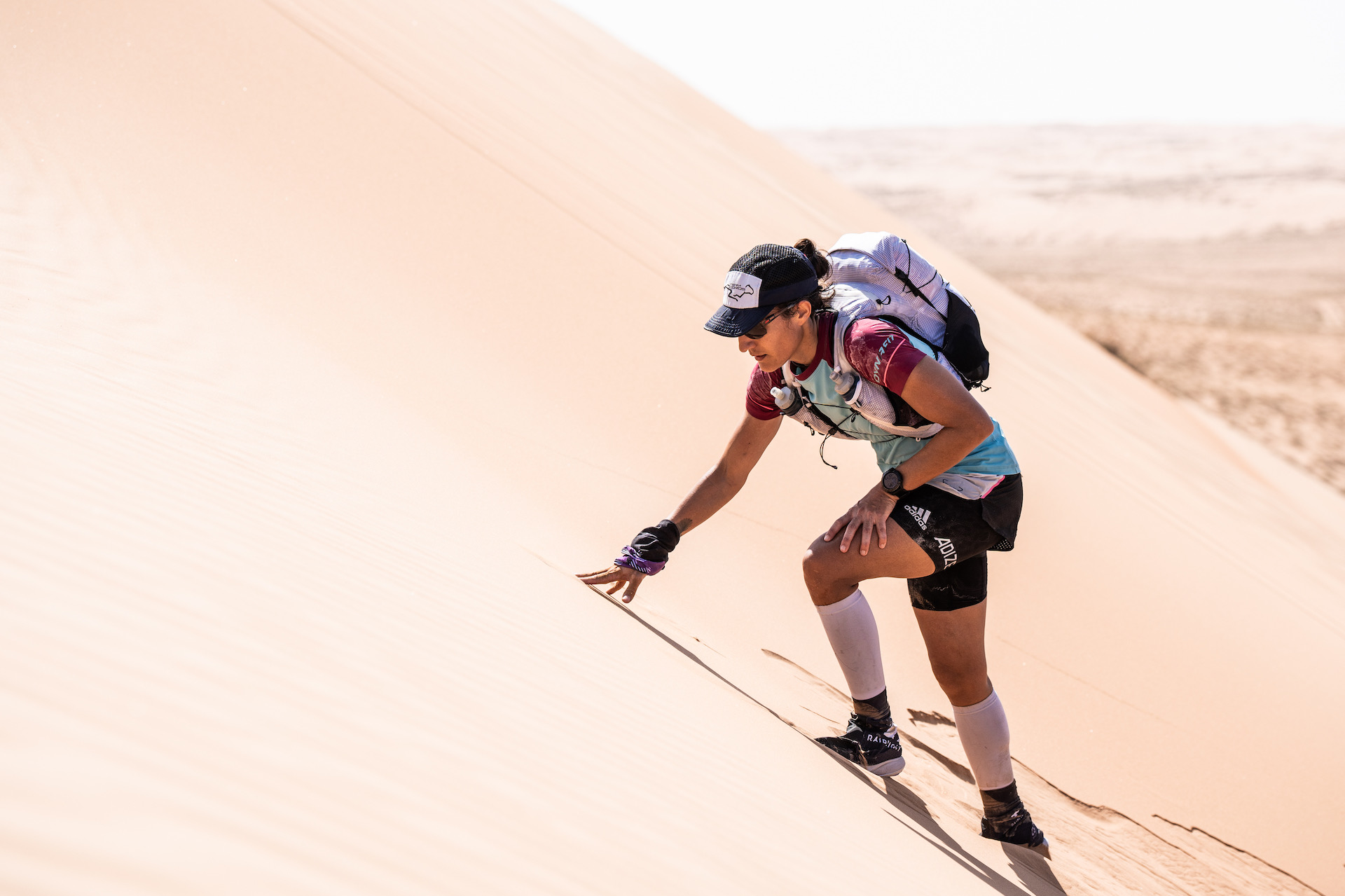
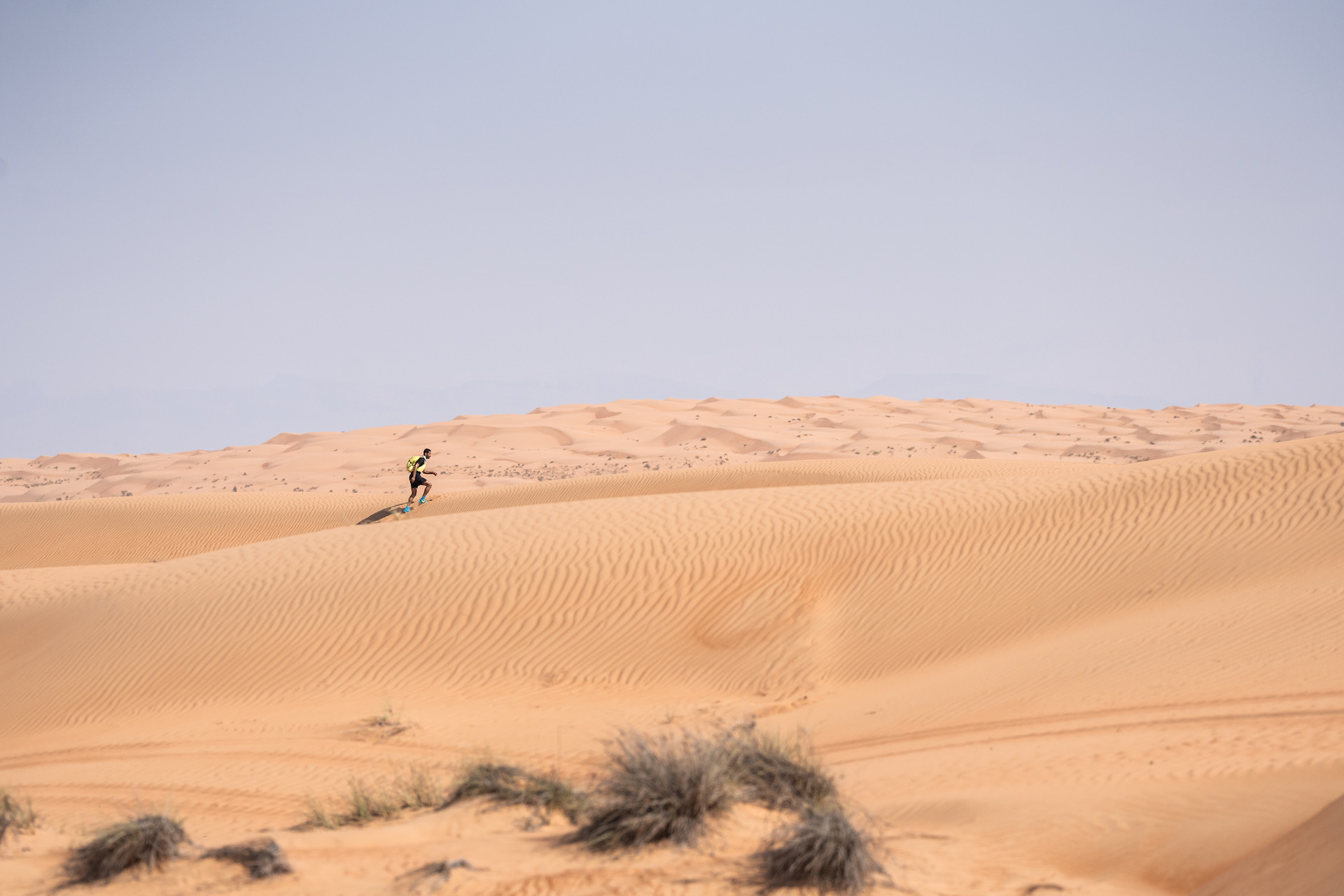
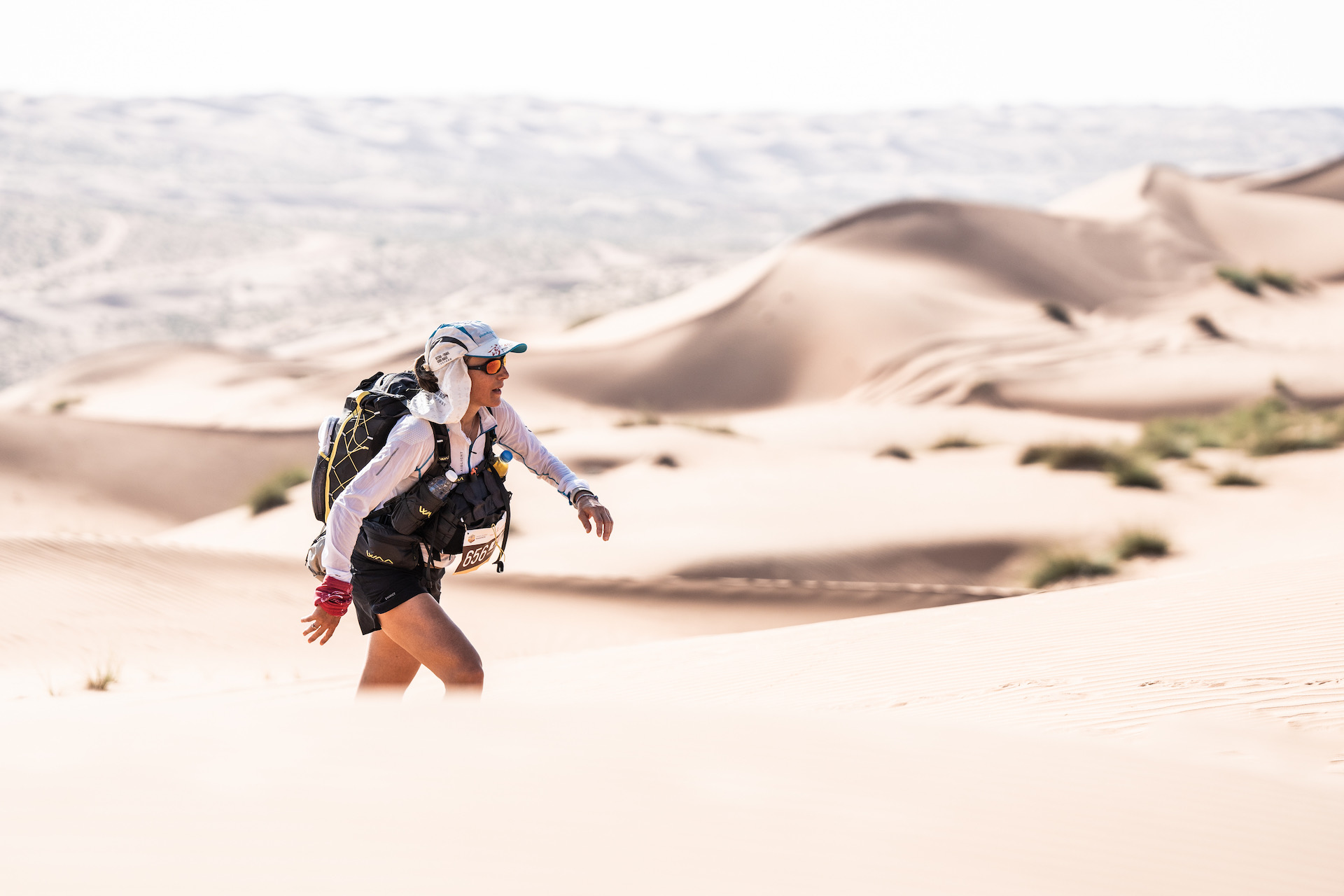
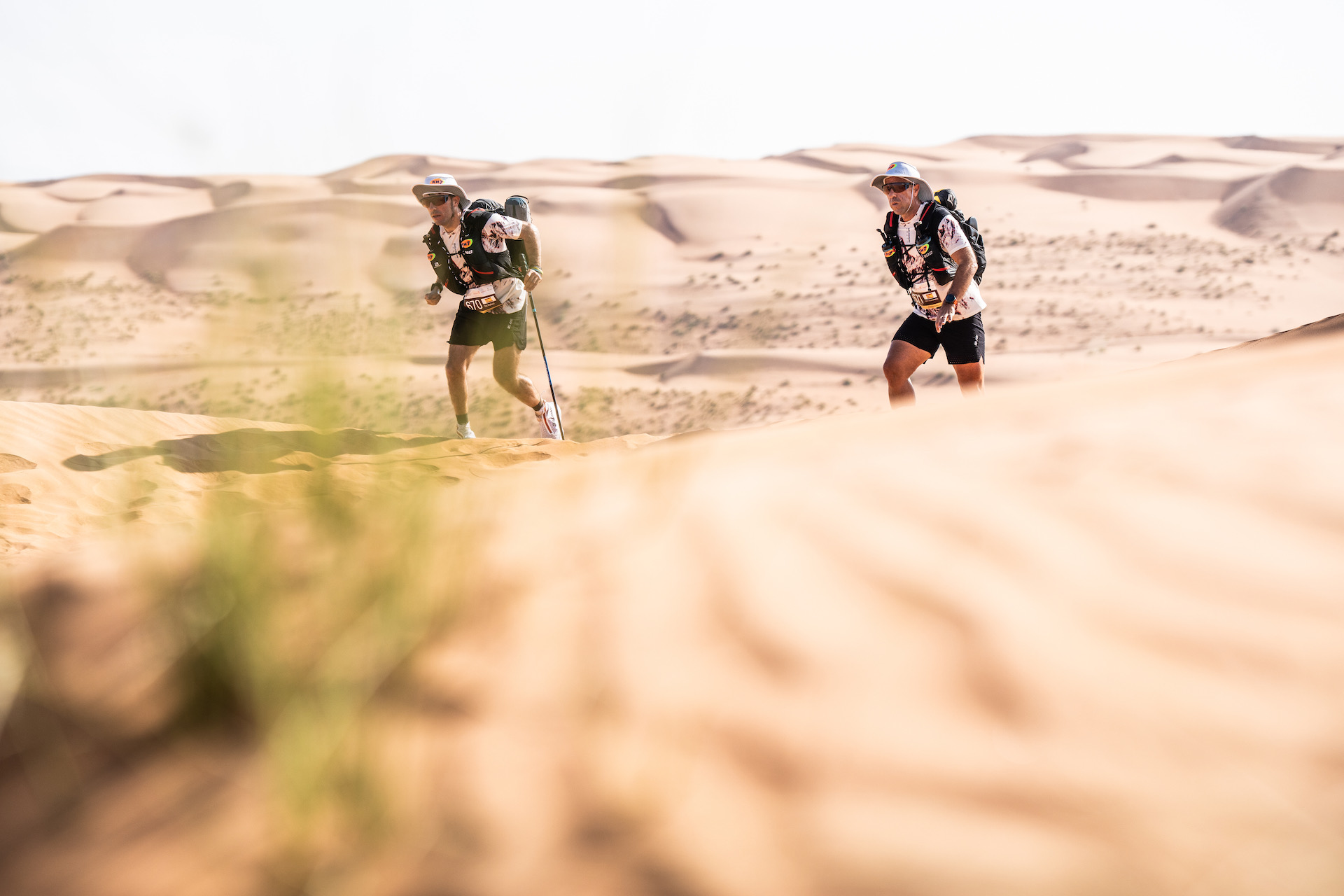
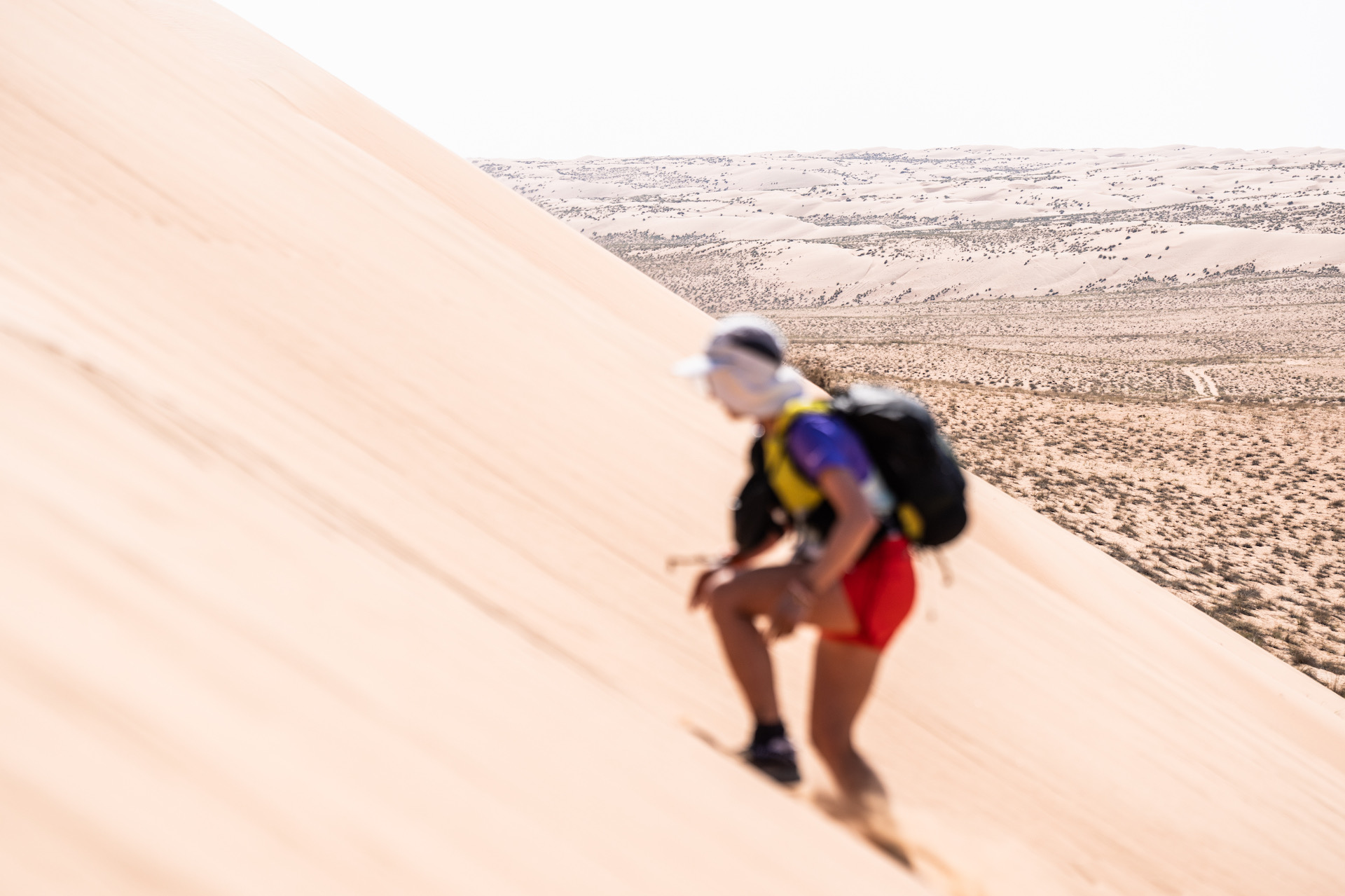
The opening 25km, post-race, was considered to be ‘easy’ in comparison to the tough and challenging terrain that followed; relentless soft-sand, dunes and rollercoaster terrain that sapped the body of strength, especially as the heat of the day came.
It was here that Aziza El Amrany relinquished the lead to Aziza Raji who looked much more relaxed in the challenging terrain.
Kathleen was also suffering, climbing a steep dune she had continuous moments of sickness and at the summit, she sighed, just 9km to go.
Rachid had now made his move and behind Mohamed El Morabity was fighting hard to hold a very strong Salah El Saidi, no doubt hampered by long travel and a very late arrival before race day.
The 2023 champion could not match the pace and finished 3rd, 3:39:20, 3:39:54 and 3:41:29 separated the men, making for an exciting stage 2.
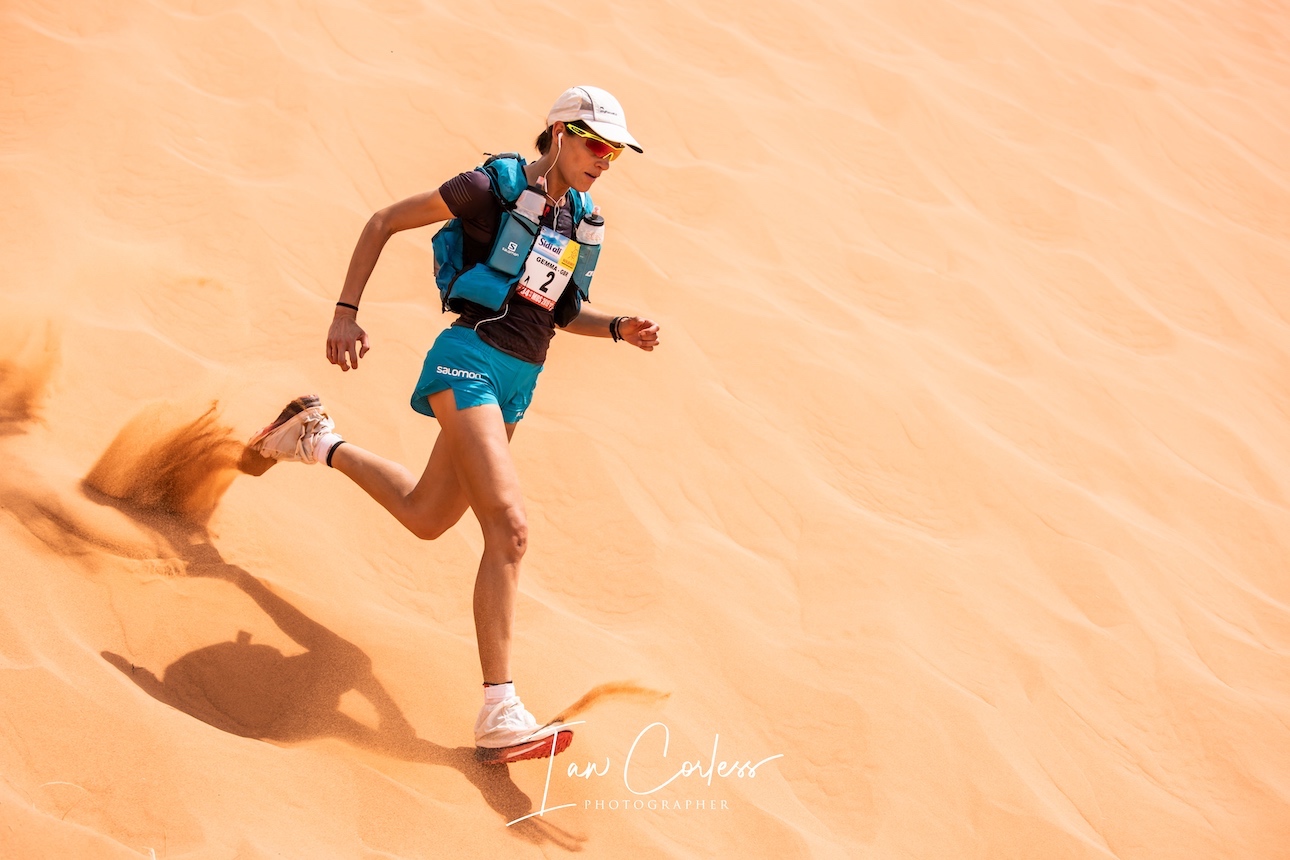
Aziza Raji was super strong in the latter stages of the day and crossed the line in 5:22:36. Aziza El Amrany arrived in a surprising 5:49:18 and Kathleen was overtaken by Veronique Messina to finish 3rd in 6:18:55.
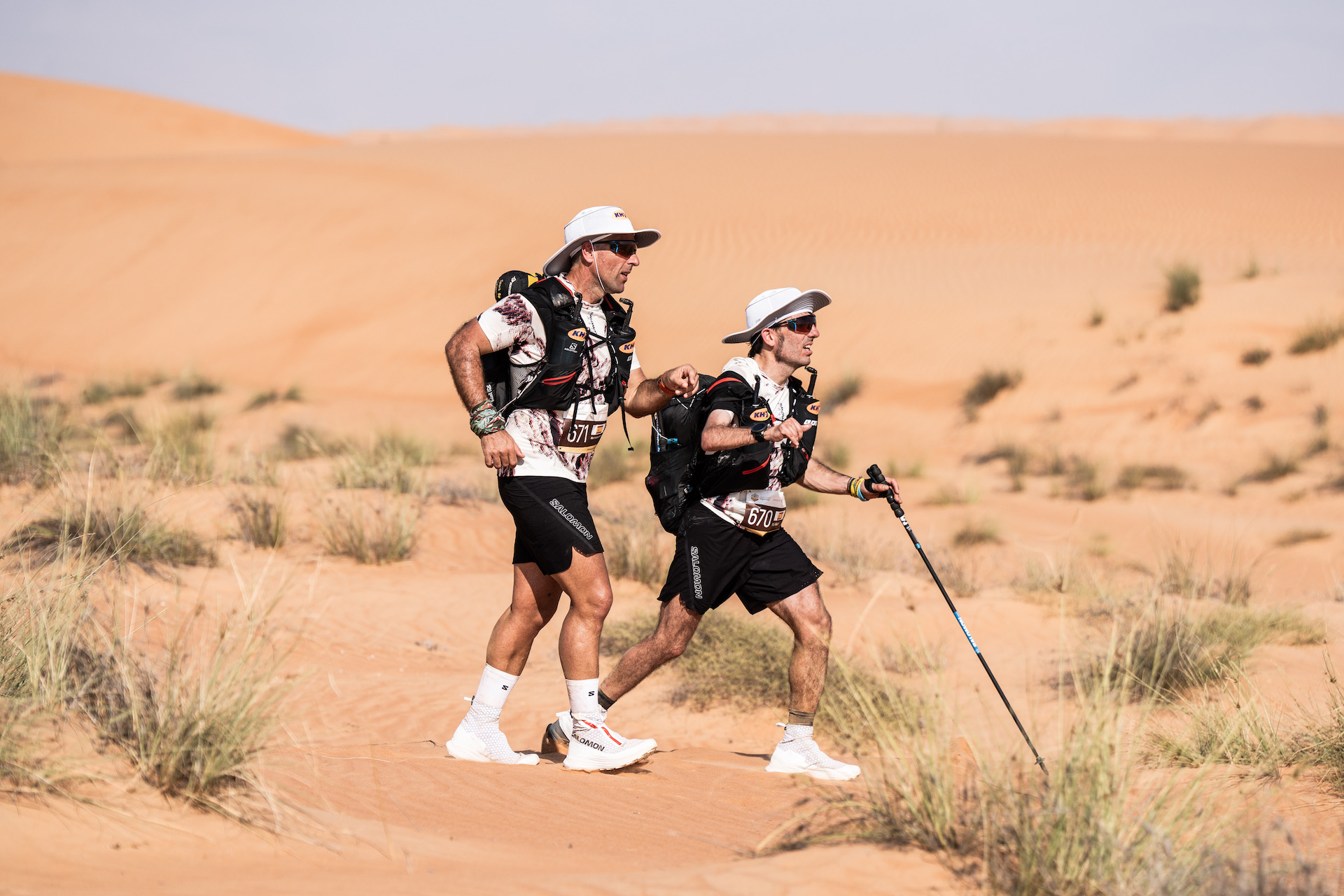
While the fast raced at the front, as in every race, stories begin to form behind. A notable one, Albert Jorquera who raced here in Oman in 2023, who this year runs with Pol Makuri who has Cerebral Palsy in the right side of his body. An inspiration to watch!
The duo finished the day in a brilliant time of 7:41.49, 19th and 20th.
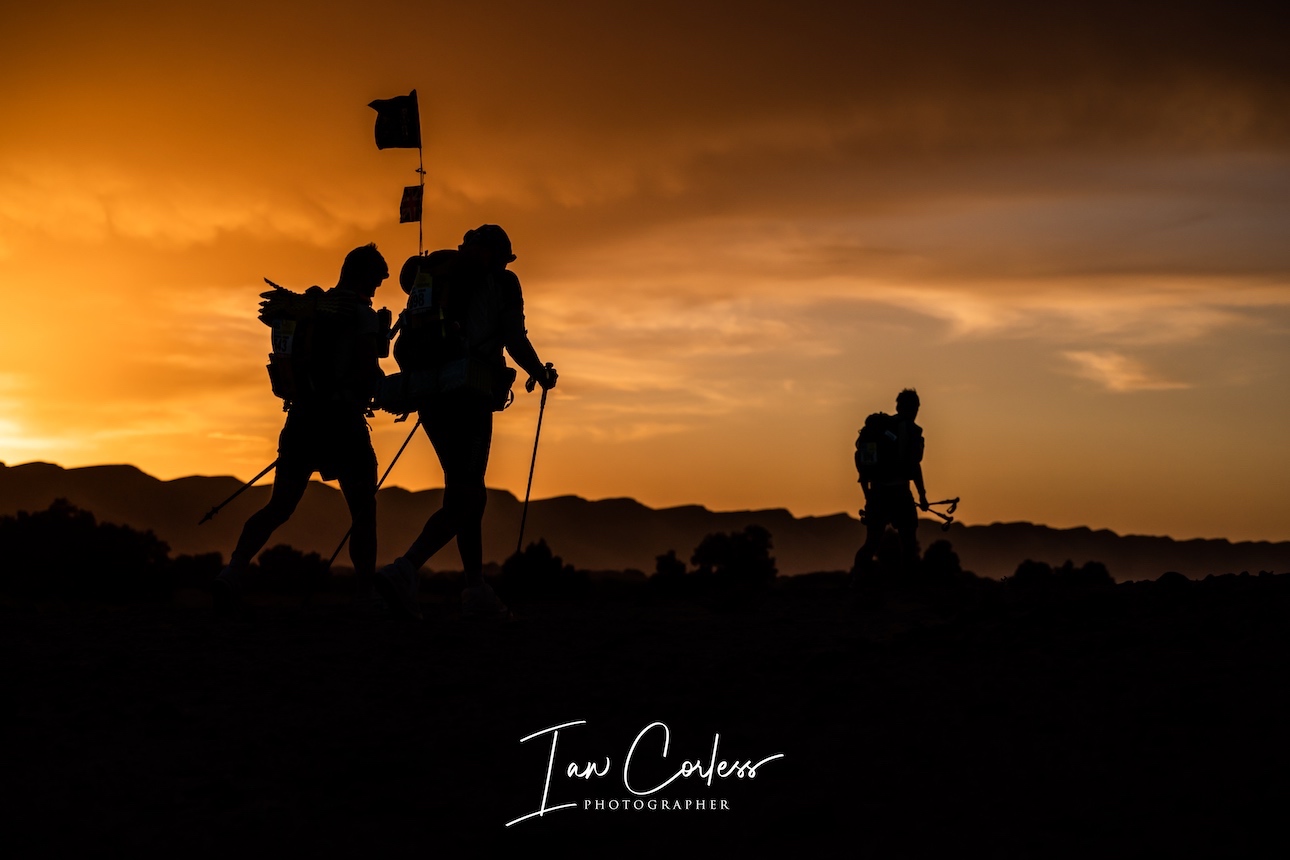
As darkness arrives, the battle for the line continues. It’s been a tough first day here in Oman.
It is that time of the year, for many of us, when the ground is covered in snow and ice. Don’t be tempted to go out for a run in normal shoes, it will not end well and potentially, if you fall bad, keep you away from running for the whole of the winter season.
Purchasing a specific winter shoe may seem like an indulgence, but trust me, you will not complain when you use them, the run experience is so much more enjoyable then any other option available. Read an article on Running Ion Ice Here.
VJ Sport are renowned for the best grip on the planet with their incredible butyl outsoles, the reputation also extends to winter with their star studded winter studs.
I have just received the new Sarva Ace which is VJ’s most cushioned and comfortable star studded winter running shoe that they have ever produced.
The Ace is VJ’s first winter running shoe to feature the PerFOAMance midsole , which provides more comfort and cushioning than the previous EVA midsoles, making winter runs on ice and packed snow easier on your feet.
VJ’s innovative Fitlock system provides an optimal fit for the shoe by locking the foot. It also provides extra protection by protecting the arch from the impacts the foot encounters while running.
Grip, comfort and foothold, there are no better shoes than VJ Sport. The iRock, XTRM, MAXx and the recent Ultra offer something for all.
In winter, the need for a specific shoe for ice can be an essential requirement, particularly in Scandinavia when snow/ ice running can start in October and last till November. Depending on how much ice you encounter will depend on your need for a specific shoe. If you only get a few days of ice, the cost of a specific shoe would be hard to justify. But, if like me, pretty much every run I do for weeks and months on end need a specific shoe, it’s money well spent. And trust me, specific ice running shoes are a world apart from any run shoe with an ‘add-on’ mini crampon.
VJ have also been integral in my shoe choice using the Xante, Xero 5 and Icehero, all shoes offering key VJ features with the addition of winter studs for grip on ice.
VJ have just released a new shoe, the VJ Sarva ACE.
Quite simply, it’s the most comfortable ice running shoe I have ever tried. VJ have really pushed the barriers with this shoe and listened to the feedback of runners and answered two key points:
Wider toe box.
More cushioning.
VJ SARVA ACE
Light-weight, cushioned, wider fit, great foothold and superb comfort, the VJ Sarva ACE takes the previous VJ SARVA shoes to a new level. This shoe is so comfortable, I have already emailed VJ asking for this shoe to be made without studs. It would be a perfect shoe to run alongside the ULTRA, especially with the wider toe box.
The new ACE has 17 studs, 8mm drop with 17mm/ 25mm cushioning and more importantly, a considerably wider toe box (5 on the fit scale) which makes them ideal for winter allowing the user to utilize warmer and thicker socks to ensure warm feet and increased blood flow with room for toes to splay.
My UK10/ EU44.5 are 340g and my recommendation is to go up a size. My normal run shoe size is UK9.5/ EU44 but I have found with VJ, that I need a larger shoe. I did wonder with the ACE if this would be a mistake due to the wider toe box, it wasn’t!
Those who have used VJ before will know how amazing the foothold is from FITLOCK, a feature on all VJ shoes. It provides a tight and secure feel and offers support and stability. It makes the shoes feel like part of the foot.
VJ’s SCR (Superior Contact Rubber) is the best on any terrain, be that wet or dry. Like other brands, VJ add metal studs to the outsole to ensure grip in the most challenging terrain for winter. VJ’s studs are star shaped and comparison to other studs, they offer increased grip due to extra corners. The Butyl outsole has 4mm lugs.
No shoes are perfect and, in the past, VJ uppers have shown some wear, particularly in the flex area behind the metatarsals (a common weak area in many shoes) which has torn. In this shoe, VJ are using a new durable one-piece upper that is waterproof.
IN USE
The two key features are the toe box and cushioning. The toe box is ALTRA like, it is wide, very obviously foot-shaped and a huge departure for VJ. I must admit, I was a little worried they would be too wide. Not so, the run experience is superb.
The cushioning, again, a departure for VJ. This shoe has a life and a comfort that I had hoped the ULTRA would have. Ice running can be hard and harsh, VJ have listened to feedback and now made a shoe that offers comfort and cushioning to ease this impact. Like I said above, I want this shoe without studs for dry trail running. They are notably bouncy, particularly in the rear. Ice running does require you to change gait slightly, the more contact points with the ground, the greater the grip.
Lacing up, the Fitlock takes hold and they quite simply just encapsulate your foot giving the most secure feeling. The tongue is also very well padded reducing any stress or pressure on the navicular bone. The option to lock-lace is welcome with the additional eyelets at the top. I like aces tight and really holding the foot, however, in winter you need to make sure laces are not too tight and reducing blood flow. A lack of blood flow will make for cold (colder) feet. The laces gladly stop early allowing great flex at the front and not inhibiting the important propulsive phase.
The heel box, for me, does not hold as well as other VJ shoes and this is currently the only negative part of the shoe. I have found lock-lacing corrects this. Without lock-lacing I was getting just a little movement. It did not cause problems, but it did play on my mind. Having said that, it has never put a question in mind about using or choosing this shoe.
Out on the trails running in soft snow, ice and a plethora of mixed terrain, the ACE does exactly what you’d expect. The wider food print adds to a wider and more stable footprint on snow. The studs on ice grip remarkably well. The key with any winter shoe is trusting the shoe will do the job. Impact is your friend as is confidence. The two go together.
The added cushioning is a key highlight for me, and they are ideal for longer outings, particularly when running on harder trails or continuous ice. The comfort level is high… Not something that is usual for winter shoes. The wider toe box only adds to this package. Toes are able to move allowing for increased blood flow and therefore warmth, also helped by the waterproof upper.
SUMMARY
Winter shoes for many are a luxury, it all depends on how much snow or ice you get. If you do get regular ice, a specific bespoke shoe for winter running is so much better than any ‘add-on’ micro spikes.
The ACE has more cushioning, a wider toe box and great grip. It’s currently one the best specific ice shoe out there.
The only current downside of the ACE is the hold in the heel area. It’s not perfect and therefore makes this shoe a 9/10 and not an outright 10/10.
On a recent work trip I had a run shoe disaster. To cut a long story short, I was left with no run shoes.
Dropping in to the best run store I could find, I was rest assured with a great selection of trail shoes and gladly, they had options from which to choose. It would have been easy to purchase shoes I have already owned used and liked, and in all honesty, had they had a pair of Hoka Torrent I would have got them; a great all-rounder.
I needed a shoe with cushioning, protection, and a good outsole.
As it happens, I had three excellent choices and none of the shoes I had used before, a NNormal Tomir (23/31), a Hoka Speedgoat 5 (29/33) and a Merrell Agility Peak 5 (25/31), based on stack heights, three very comparable shoes. Interestingly the NNormal with 8mm drop, the Hoka with 4mm drop and the Merrell sitting in the sweet spot of 6mm.
I will be honest, I was instantly drawn to the NNormal, I had been waiting to test a pair for sometime and in my head, before trying any of them on, I had already made up my mind. I am getting the NNormal.
However, slipping them on, they just didn’t make me smile. The lacing was less than optimal, foothold was kinda ok but the overall feel was lifeless. The Hoka Speedboat 5 by contrast had life, had great foothold and was just solid. That’s it, I will get the Speedgoat…
But then the assistant said, you should really try on the Merrell, particularly if you like the Hoka.
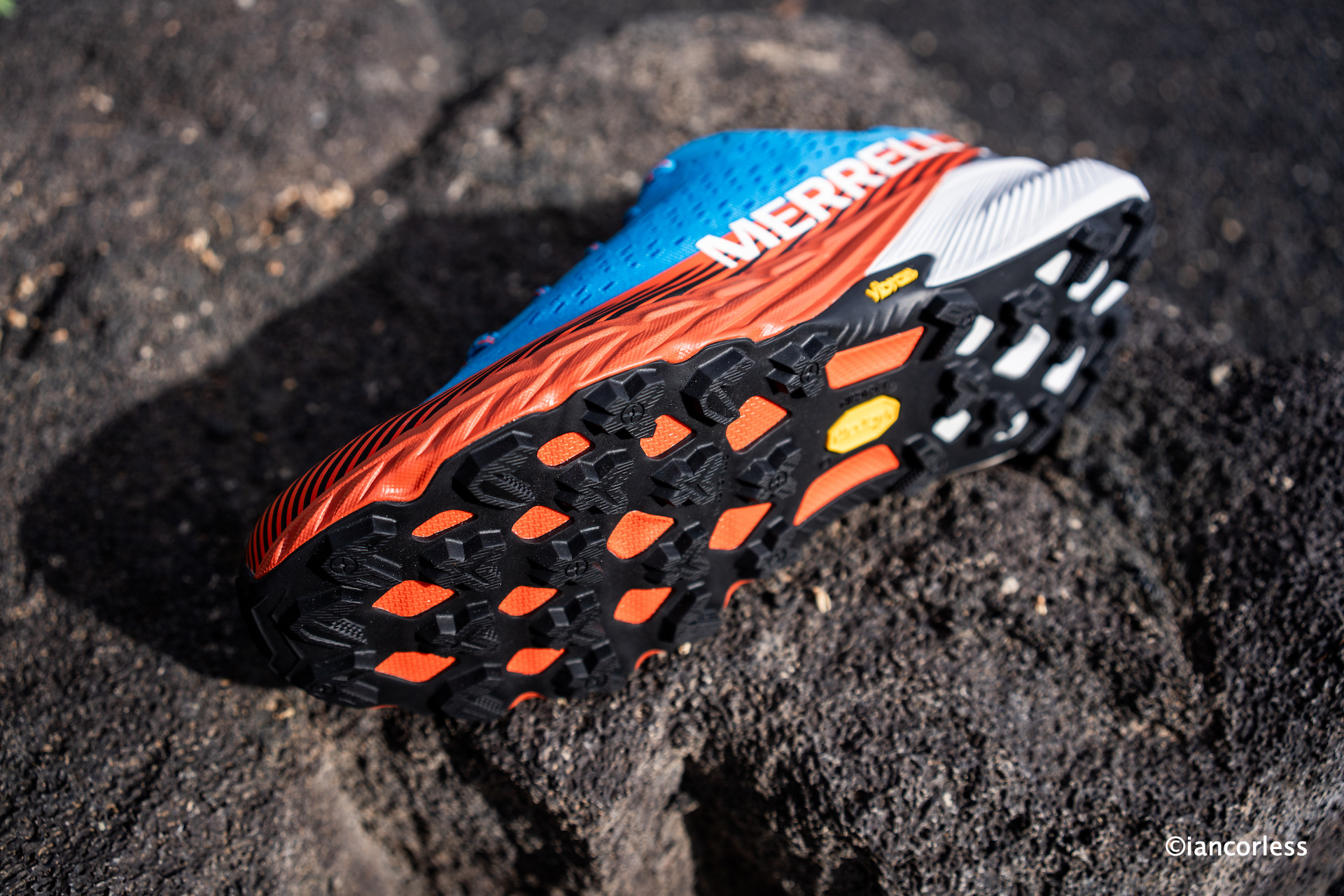
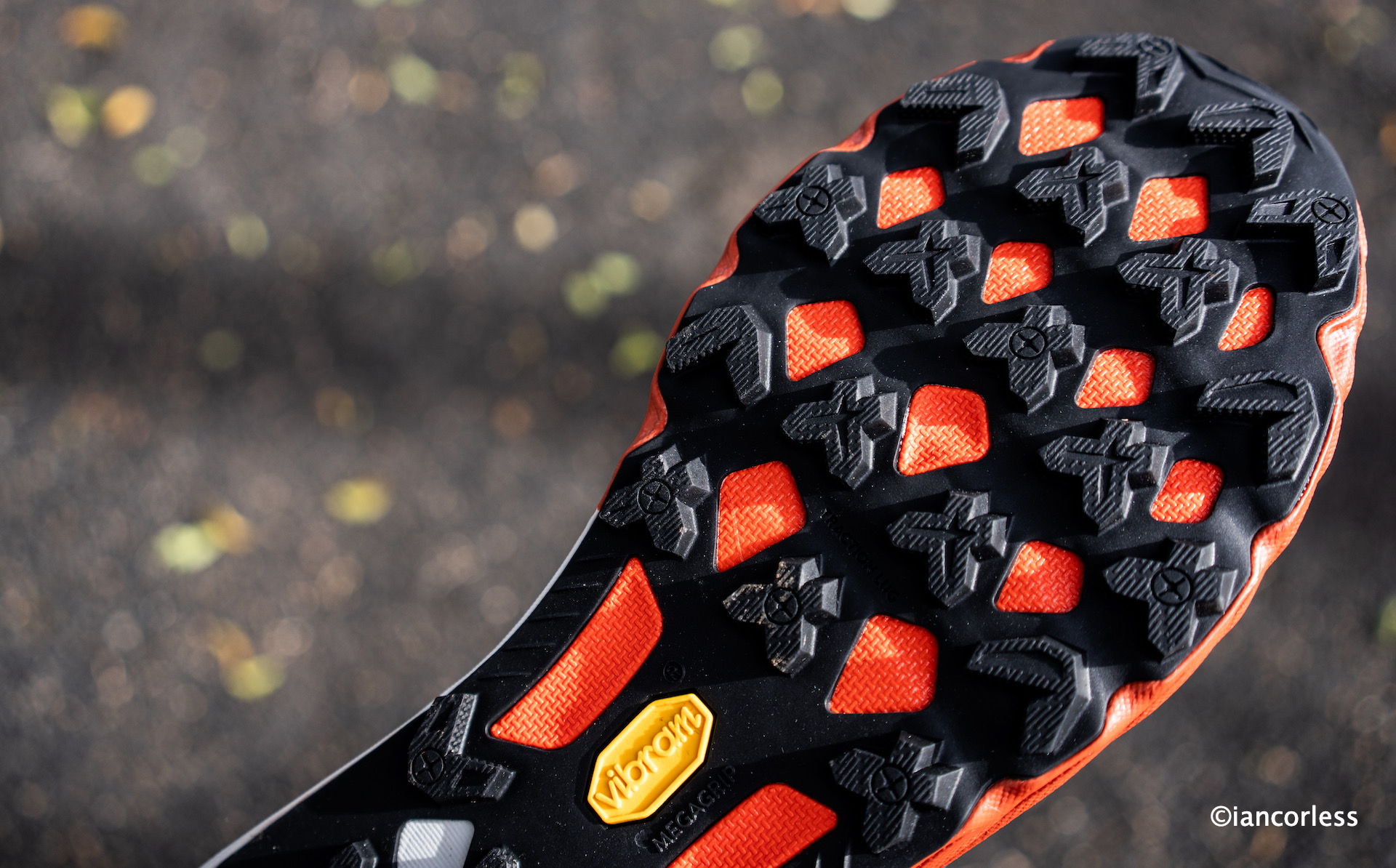
So, I slipped the Agility Peak 5 on whoa, what a revelation. Foothold superb, heel comfort excellent, toe box space great and there was a bounce and life not present in the other two. The addition of Vibram Magagrip added to the package, to be fair, this was on the other two shoes too, but here on the Agility Peak 5 it was aggressive and with 5mm lugs.
I purchased the Merrell.
MERRELL
I had heard a great deal about Merrell shoes, nearly all of it positive, so, I don’t really know why it had taken me so long to eventually get a pair. Certainly trying on against the NNormal and Hoka only confirmed that my decision was coming too late, I had been missing out!
Superb cushioning 25mm front, 31mm rear.
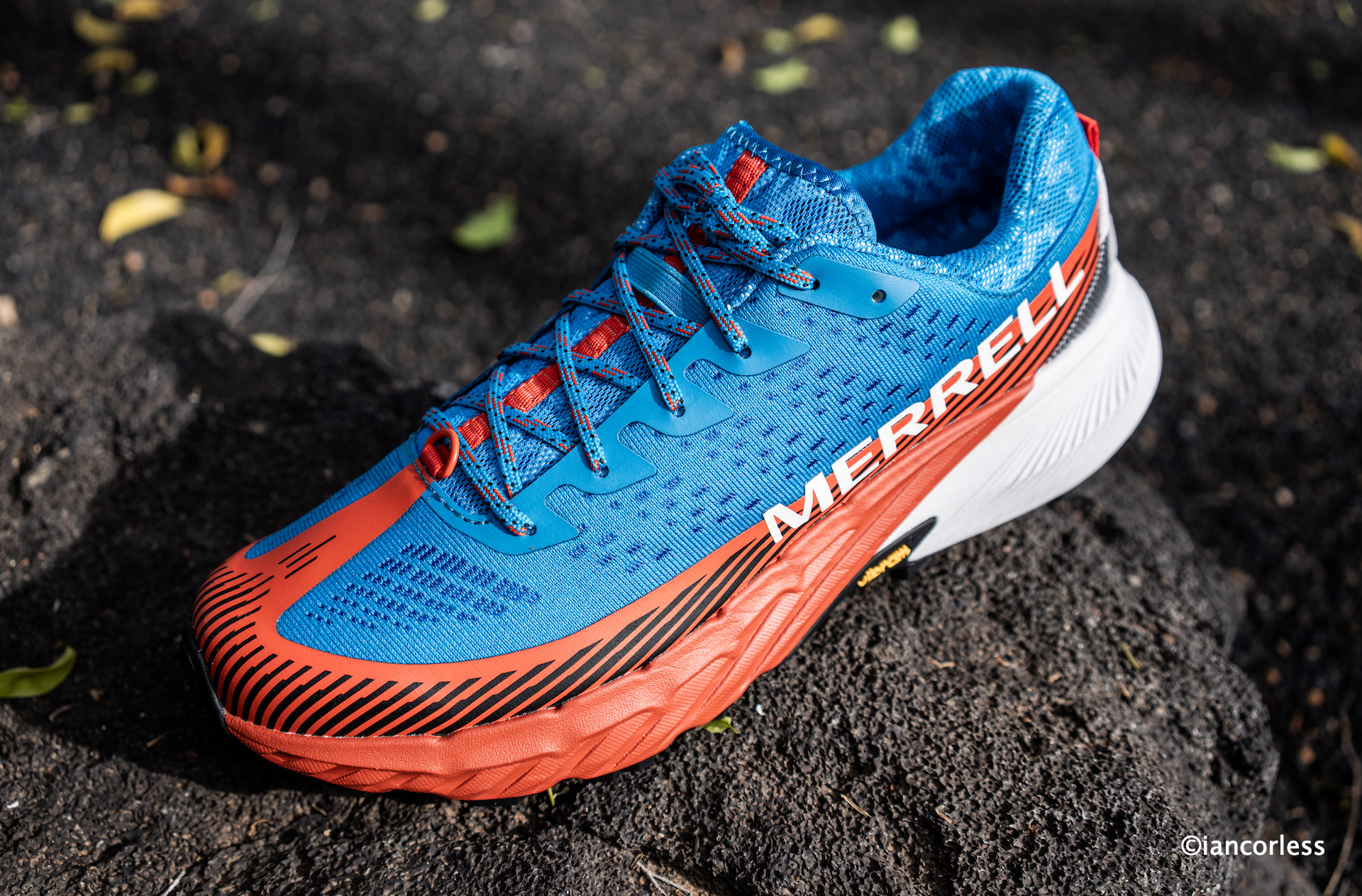
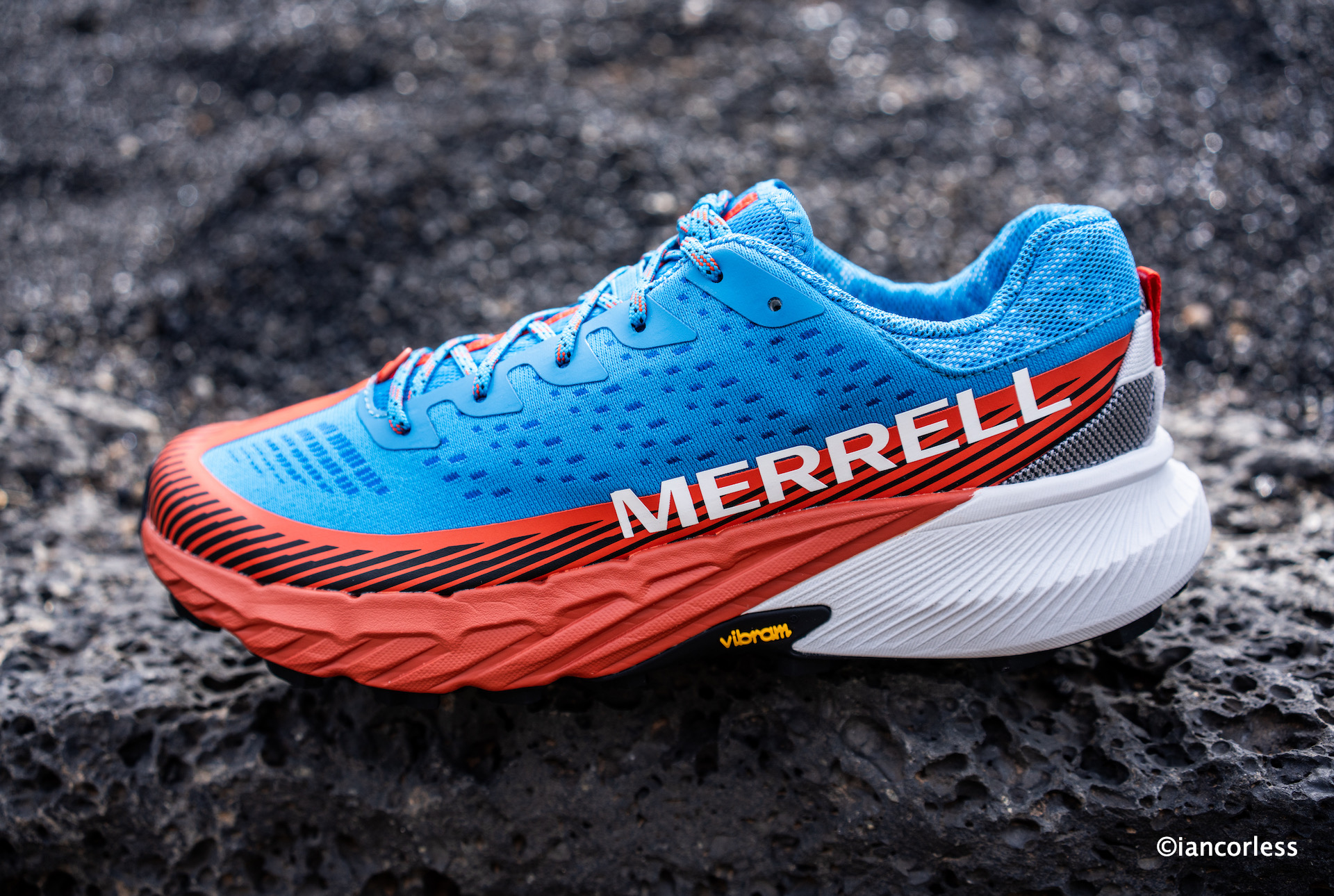
A great looking shoe that means business. The side profile, the outsole and 5mm lugs, a visible rock plate, it’s clear that this is shoe is for the rough stuff.
Red rock plate showing through the Vibram MegaGrip outsole.
When a shoe is in version 5, I always get a little nervous. The plus side is this is a shoe that works and is loved, otherwise Merrell would not adapt, change and make a new version. But sometimes, the ‘need’ to make new version can sometimes spoil what was good about the previous ones. Having not tried an Agility Peak before, I was a blank canvas – a good thing!
THE SHOE
With reduced weight, increased rocker, increased heel grip and comfort, this shoe on paper was ticking all the boxes.
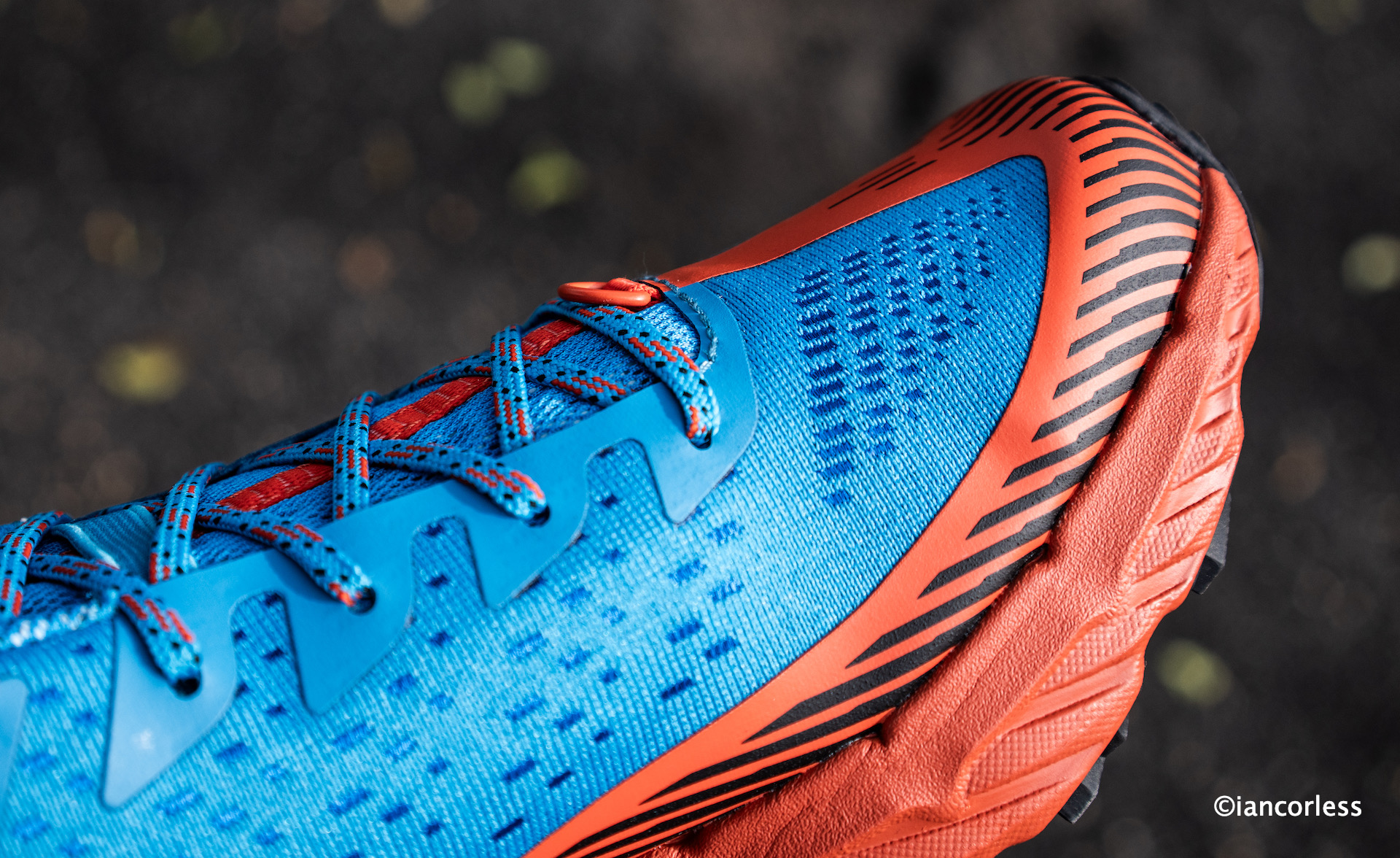
A breathable upper, excellent lace placement, gusseted tongue, a toe cap protection, EVA foot bed, FloatPro foam midsole, rock plate, a Vibram Megagrip outsole with 5mm traction lugs.
5mm lugs by Vibram MegaGrip.
A D-ring gaiter attachment at the front and velcro attachment at the rear,
Velcro tab at the rear for gaiter.
The Agility Peak 5 is a feature packed shoe. A 6mm drop with cushioning 25mm at the front and 31mm at the rear makes this a shoe ideal for long days out in gnarly terrain.
Slipping the shoe on I had an instant comfort factor that made me smile, I knew immediately I was going to like this shoe.
Great lacing and D-ring for gaiter.
Lacing up, foot hold was superb without any nasty pressure on the navicular bone. Holding the rear of the shoe.
Lifting my foot, there was no slippage and the gusseted tongue just added to the cozy comfort factor.
Spacious toe box.
The toe box is spacious, a 3, maybe a 4, on a scale of 1-5 with 5 being wide and spacious.
Standing up, there was a definite bounce and life as I moved backwards and forwards, up and down.
IN USE
I was committed and out-of-the-box I went straight in to a gnarly coastal run over very rocky and abrasive terrain, 37km and 1531m+. It was a great test! The Agility Peak 5 excelled.
The notable takeaways were all-day comfort and protection.
I never had to adjust the laces, my foot was held secure all day. The cushioning allowed for great ground feel but not at the compromise of comfort, especially with the rock plate protecting from all the sharp rocks and obstacles.
At 25/31mm in cushioning, I was concerned that maybe I would be a little too high from the ground, but this shoe has a wide footprint and this compensates for the additional stack height wonderfully. I had no rolling issues at all.
Notably, when walking and hiking, the bounce and comfort at the rear of the shoe was superb. When running, the flex behind the metatarsals was ideal giving a great propulsive phase. The toe box allowing enough space for toe splay but not at the compromise of precision. When climbing, my foot was secure, no movement, a combination of the new heel cup and the rear sling lock.
The outsole by Vibram is tried and tested, MegaGrip appears everywhere, but this is the first time I have used or seen the 5mm lug version and it is brilliant. The grip was superb. I have yet to try in the wet!
Was there a downside? In all honesty, no. It’s arguably the most complete shoe I have tried in a very long time and if I was to be picky, for a shoe that is so obviously designed for rough stuff, the toe bumper could maybe be a little more protective.
Despite the mean business looks, the Agility Peak 5 has plenty of life, speed and comfort for those wonderful single-track runs with little or no technicality. The rocker helping to propel you forward with excellent comfort.
Fitting true to size, this shoe is one of the best I have tried and tested.
CONCLUSION
Shoe technology gets better all the time and now there are sooooo many good shoes, it’s often difficult to pick a best one. Of course, this is a great position to be in. I have countless shoes that I would be happy to run in on any given day. But, some shoes have very specific uses. If I wanted guaranteed mountain grip in wet and dry, I would choose a VJ MAXx. I I wanted a fast shoe for single-track, I’d go for an Adidas Speed Ultra. If I wanted a just one shoe that could do all things and do them well, my choice has normally been a Hoka Torrent, that is until the Merrell Agility Peak 5 cam along.
The rock plate and grip is excellent.
This shoe has been a revelation. All day comfort, great grip, great foot hold, fast when you need them to be, secure when the terrain demands it and all wrapped up in an excellent good looking package.
The Agility Peak 5 is my shoe of 2024! A shoe that has balanced cushioned comfort with speed and versatility for all running, be that on trail or mountain terrain.
Episode 240 of Talk Ultra and we talk with Eoin Keith who took on the 269.3km counter-clockwise journey of 360 The Challenge in Gran Canaria organised by Arista Eventos.
What is 360 THE CHALLENGE?
360º The Challenge is an individual, self-sufficiency challenge. It is intended to be completed before the time limit the organization will state. Participation in this challenge will be strictly individual.
Participants must dominate some necessary techniques to be accepted in the race: orientation, capability of supporting drastic changes of weather conditions, ability to assist other runners in case of emergency, tolerance to fatigue and lack of sleep and food.
The course will not be marked. The runners must follow the track that the organization will handle before the race.
The challenge will be completed in self-sufficiency. Runners must plan their own resting periods and feeding hours. Along the course, they will have basecamps where they will be fed and have the chance to rest.
Runners can purchase food and beverage in any other stores they have along the course.
External assistance will only be allowed in the basecamps. Any external assistance the runners receive during the track will be punished.
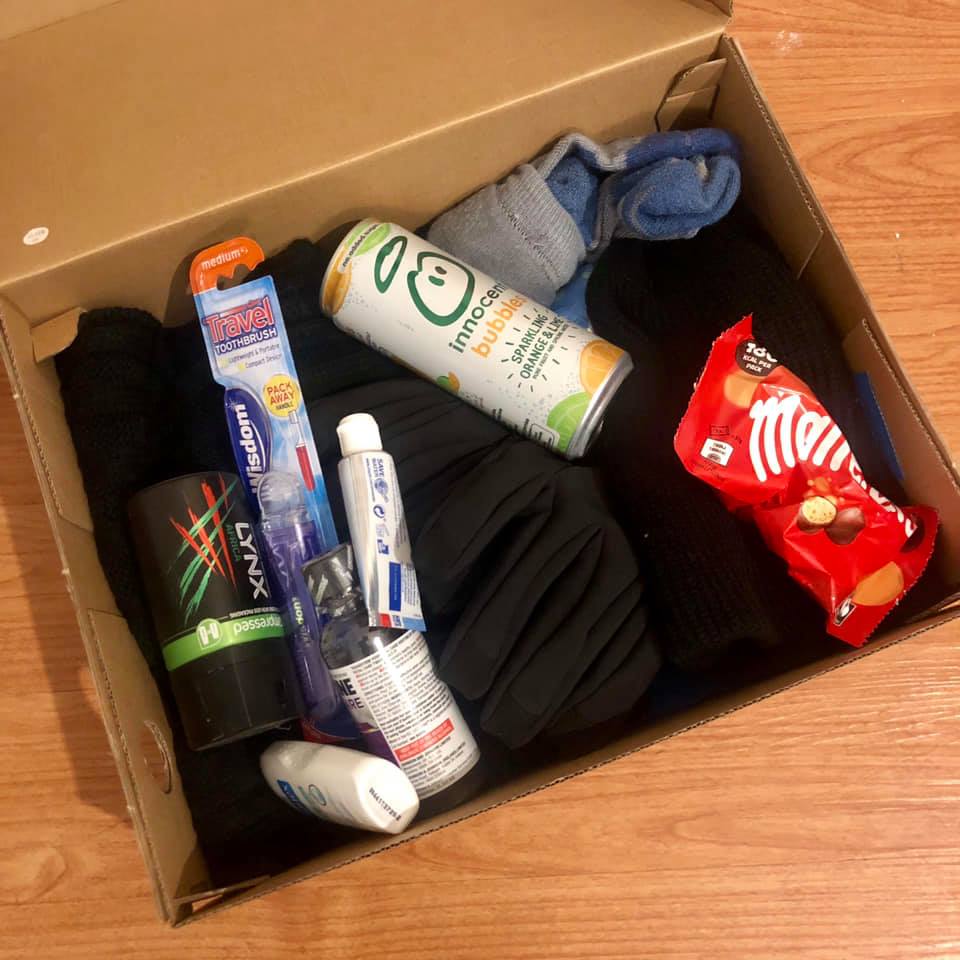
December is here and this is a great opportunity to give back, albeit in a relatively small way, by filling an empty shoe box with essential items that will help someone who is less fortunate.
Importantly, if donating the box to a charity organisation and not an individual, make sure you mark the box if it is for a male/ female and adult or child.
What you add to the box is of course entirely up to you, but here are some ideas:
Toothpaste/brush
Deodorant
Razor
Soap
Body wash
Feminine hygiene products
Socks
Hat
Scarf
Gloves
Brush/comb
Chocolate/ sweets
Biscuits
Pocket tissues
Pocket size puzzle/pen
Small activity (for example Rubix Cube)
and whatever else…
Donate said box to a charity, homeless person, or wherever you see fit.
Trust me – your December and Christmas will feel so much better!
Episode 239 of Talk Ultra is with Andy Blow from Precision Fuel and Hydration. Staying hydrated with fluids, maintaining healthy levels of minerals (electrolytes) is all part of the process of being a distance runner, particularly when sweating excessively for long periods of time. It’s easy to get this wrong and in this podcast, Andy discusses this in-depth providing key points of information that should be followed up and tailored for the individual.
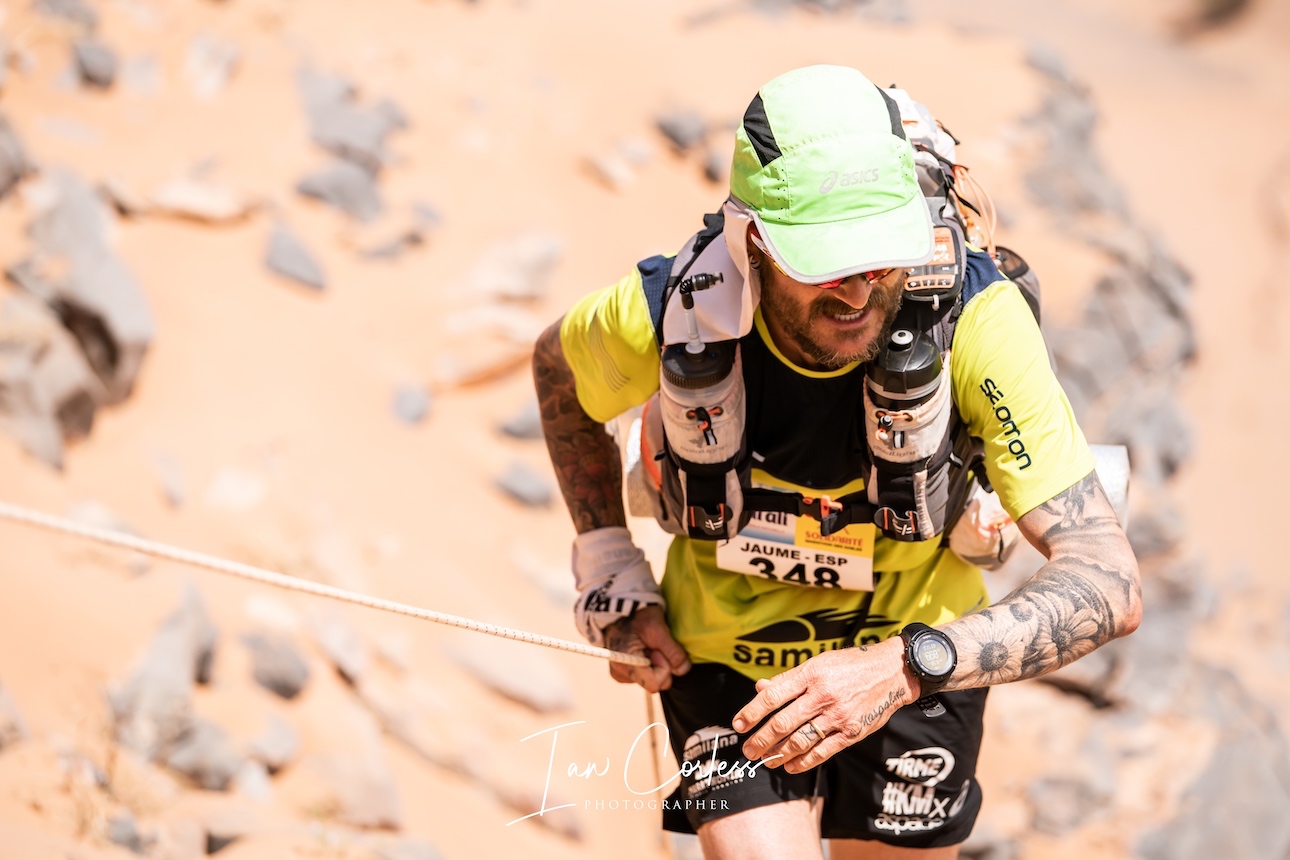
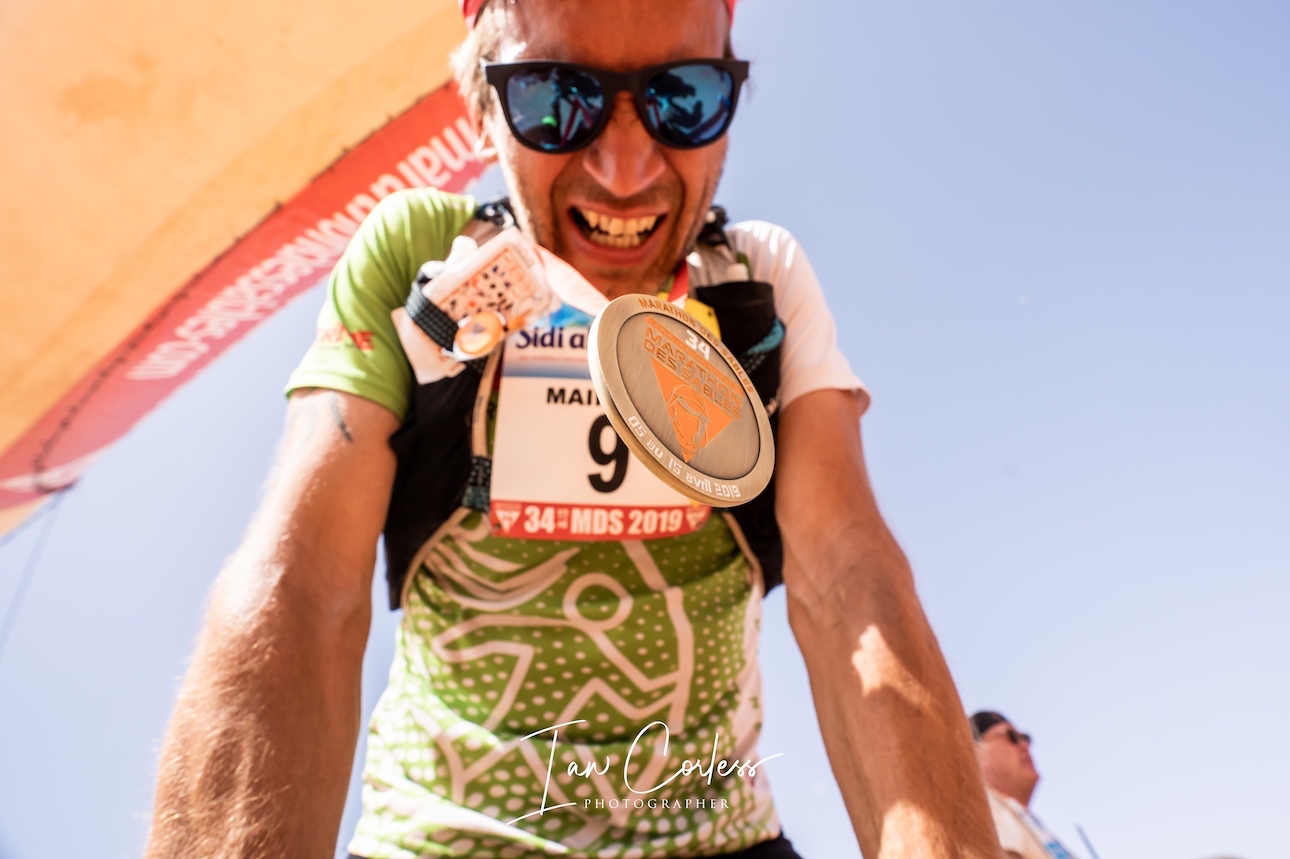
Runners from all over the world are looking ahead to April and the next edition of Marathon des Sables. It’s daunting and it can be intimidating. Planning is key. All runner’s need to periodise training so that you get the most from it.
This ‘planning’ often comes in the form of a PYRAMID. The ‘classic’ pyramid training method is well established. In this article I want us to look at this pyramid in two ways by looking at two different runners.
Runner 1– Runs regularly but MDS is a new target and pushes the boundaries of what they thought possible.
Runner 2– Has completed MDS or similar stage race and wants to go back and improve.
First of all, both runners need to count back. From the race date, for some, that may well be a 12-month plan, but more often than not, depending on experience and history, a 6-month block is ideal and for the well trained, a 4 to 3-month very specific block is not unrealistic.
April – MDS race.
March
February
January
December
November
Counting back, it’s easy to look at the objective in real terms and understand what one needs to achieve.
ReadTHE ULTIMATE GUIDE TO MARATHON DES SABLES HERE
Depending on experience, how this plan is put together is very much dependent on the individual. However, certain key elements should be present in any training plan and this article is intended to provide the basics from which you can develop a strategy that works for you. I must stress, for you!
RUNNER 1
As stated, runner 1 “Runs regularly but MDS is a new target and pushes the boundaries of what they thought possible.”Therefore, a classic pyramid will be ideal.
See below:
Decide on objectives for the year, decide on C, B and A targets, obviously, the ultimate is MDS. Put them in a diary and ideally have a wall planner so that you have an overview of the training block, be that 12, 6 or 4-months. It’s easy to see how training looks on a planner. C should be something that one trains through, B can be more challenging and have a small taper for, A is very specific such as a training camp.
For example:
April – MDS race – A RACE
March
February
January – A a training camp or a mini stage race in training or official
December – B a marathon on trail
November – C could be a half marathon
MDS is a long way, typically 250km, so, base training and getting the miles in is key. I would hope that before starting any specific training plan, a base has already been established with some consistent running; say, 3 times a week. I have allocated 8 weeks for this in the plan below. Hours of easy miles progressively building to C and B targets.
The A objective can be a training camp, maybe a race such as a 3-day race or a specific training long weekend to simulate race conditions.
You can’t perform well at every event and this is why C,B and A targets are important. Ultimately, MDS is the one in which you must perform.
As in any plan, flexibility is needed. Nothing is fixed and one must be flexible and listen to one’s body. I recommend building for 3 weeks, recovering on week 4, take things easy with reduced mileage and more rest and recovery.
Rest is really important as is consistency. Training is never about ‘one’ run but all the runs added together.
November and December 8 weeks – Base
January 3 weeks – Specific phase
February 3 weeks – Preparation phase
March 3 weeks – Peak
April Taper and RACE
BE SPECIFIC
Marathon des Sables will need you to be specific.
For example:
You will be carrying a pack that on day-1 of the race will weight at minimum, 8kg.
You will be racing in hot conditions.
You will be self-sufficient.
You will be compromised on calories.
You will almost certainly walk more than you anticipate.
The above list goes on and on and as training progresses, you should refer to the list and asses importance. For now, I would place the above list in the following priority.
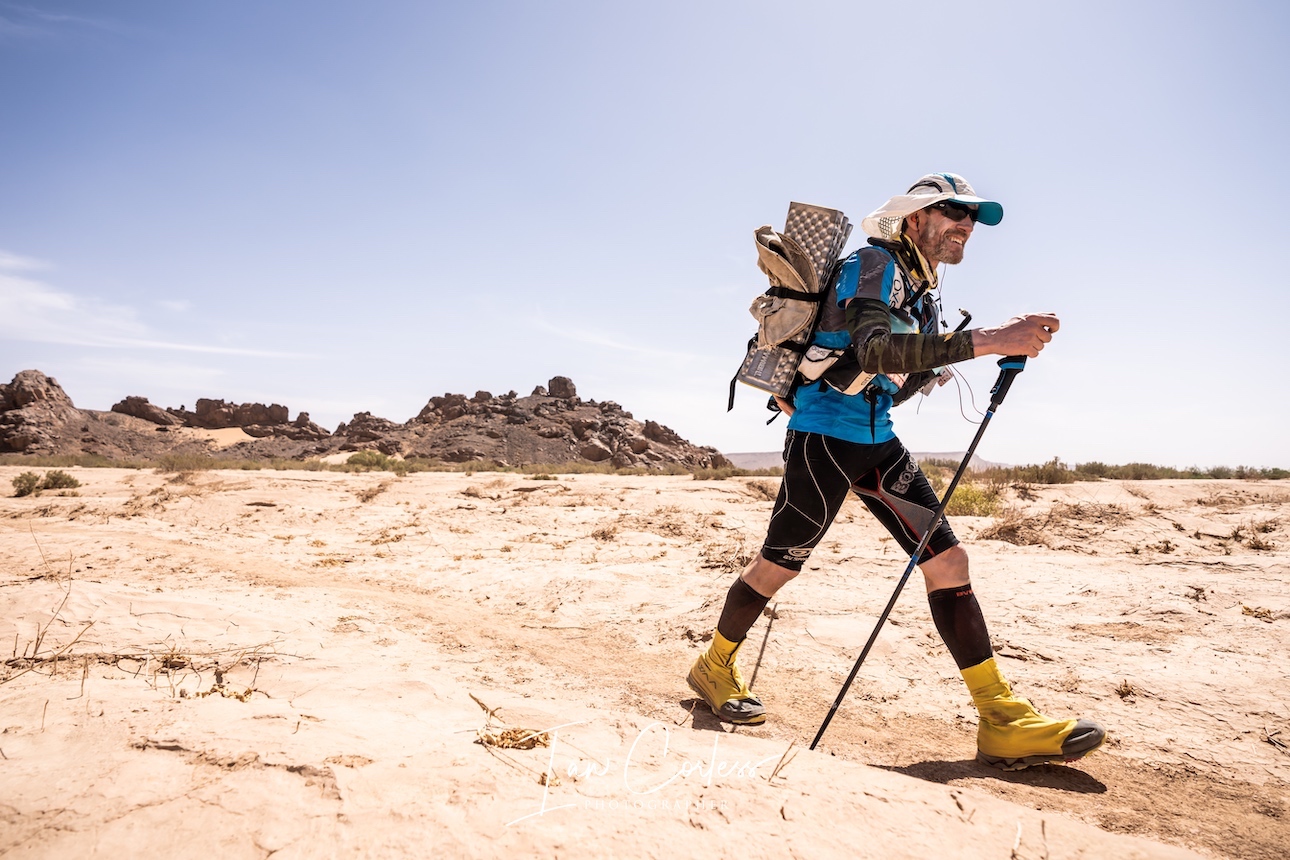
LEARN TO WALK for most participants and good walking strategy and being familiar with how to use polesare a key to MDS success.
As training progresses asses, one’s strengths and weaknesses and then adjust the plan.
Do you need to work on strength and core?
If you have poles, do you know how to use them?
Are you recovering?
How is your diet?
What is my resting heart rate, is it fluctuating?
Am I being specific and thinking of the race terrain and simulating it?
And so, on and so on. The above questions are a starting point. Read through the list and add your own questions to appraise what type of runner you are.
As the time progresses, not only will you feel more confident, you will be able to understand what needs to be done to achieve your goal.
RUNNER 2
As stated, runner 2 “Has completed MDS or a similar stage race and wants to improve.”
I want to throw a curve ball in here and suggest reversing the pyramid.
For runner 1, the emphasis is building a base and then slowly but surely progressing up the pyramid to the pinnacle, MDS. Speed work and faster sessions are less important as building the endurance for the event is a priority, speed will form a very small element of training.
But assuming that runner 2 already has a good base of fitness. An emphasis can be placed on
How to improve,
How to be more efficient and
How to be faster.
So, before planning training, the following should be asked:
Do I lack endurance?
Do I lack speed?
Do I lack strength and core weak?
Was I mentally strong?
With answers to the following, one can look at the pyramid in a new way, turn it upside down and instead of putting a priority on long steady sessions early on, they can place a priority on:
Strength and core
Speedwork
The mental approach
Speed training is usually used to add the finishing touches to a solid block of training. But as stated, as an MDS finisher, they already have endurance, so, working on speed now is a great use of time.
November and Decembert can be used to get faster and stronger.
January can see more endurance added with a reduction in speed work.
February now combines endurance and speed with additional focus on strength with hill sessions.
March would be the peak phase, fine tuning speed in combination with endurance.
April would be a final peak and then taper to the RACE.
If you are someone looking to perform and improve, you need to be more self-critical. Plan your training and periodise your training so that you are able to (hopefully) predict good form for when you want it.
As an example, your A race which could take place in January or February may be something more specific where you are also looking for a result in addition to being in prime shape for MDS.
Remember you can only hold form for a limited length of time and if you want to peak, you need to make sure that this planning stage is done early so that you understand what you are trying to achieve. It’s all about stepping stones. And make sure you consider the terrain that the race will take place on.
Finally…
This article is not a hard and fast plan, it’s a guide for you to go away, look at your targets having assessed past targets and hopefully it makes you think about future objectives so that you can plan for a successful, injury free period of running and racing.
Consistency is key and just running and walking 3 to 6 times per week already drastically increases your chance of success at MDS. Remember, other than the ‘long-day,’ most days are the 28km to 42km bracket, so, no need to go crazy on distance.
The race is 5-stages over 6-days with a maximum distance of 250km’s and the longest day being 75 to 85km. Remember though, the ‘long-day’ has almost two days to complete, so, if required, you can take a substantial break or sleep to make the distance doable.
There are many more questions to ask and points to consider when planning but these should come after getting the training plan and schedule prepared.
Prepare for the heat in the taper phase.
Planning equipment looking for the best options for you based on weight and budget.
Work on food for the race and fine out what you need.
Fancy an early season multi-day TRAINING CAMP? Join us in Lanzarote January HERE






















 IAN CORLESS