After the extraordinary sell-out of the three Skyrunning World Championship events in Chamonix, France, we’re pleased to announce the slots available for countries participating.Eighteen medals and individual world titles are at stake in each discipline – Vertical, Sky and Ultra, and a further six for thecombined titles based on the best results of the Vertical KM and Mont-Blanc Marathon.
Three more medals will be awarded to national teams based on the best results of three men and one woman across all three disciplines.
A total of twenty-seven glittering medals and a €25,000 prize purse await the champions of these prestigious competitions which, for the first time, include the Ultra distance.
More than 30 nations will participate and, unlike the previous Championships, dominated by Italy, Spain and France, “new” skyrunning nations like Australia and New Zealand, Czech Republic, Japan, Poland, South Africa and USA are raring to show their talent and make their mark in Chamonix.
The “test run” for the new Mont-Blanc 80K course was held in June, together with the KM Vertical and the Mont-Blanc Marathon which were Skyrunner® World Series races.
So, here’s the low down on the three World Championship races:
June 27 – the Mont-Blanc 80KM features a challenging 6,000 metres of vertical climb along ridges, over snow fields and traversing glaciers in a point to point loop.
Records: Francois D’Haene with Michel Lanne, 9h45’57” and Caroline Chaverot, 13h10’05”, 2013.
June 27 – short and steep, the Vertical KM points 1,000 metres skywards. A timed race, it will test your VO2 max to the limit.
Records: Saul Antonio Padua,34’34” and Christel Dewalle in 41’33”, 2013 .
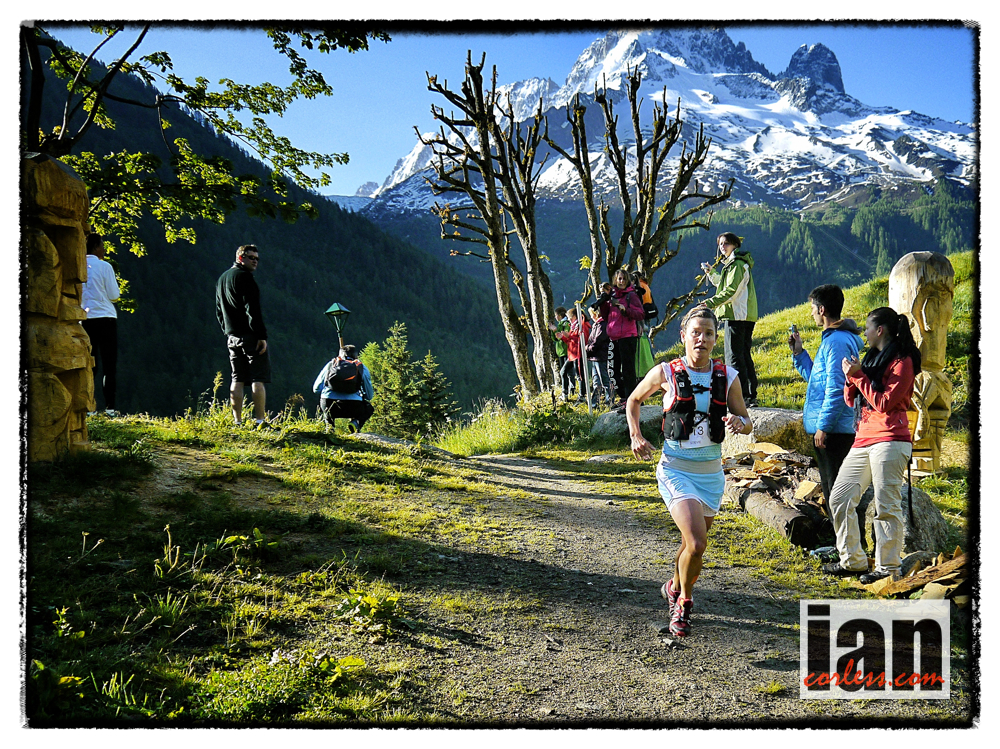
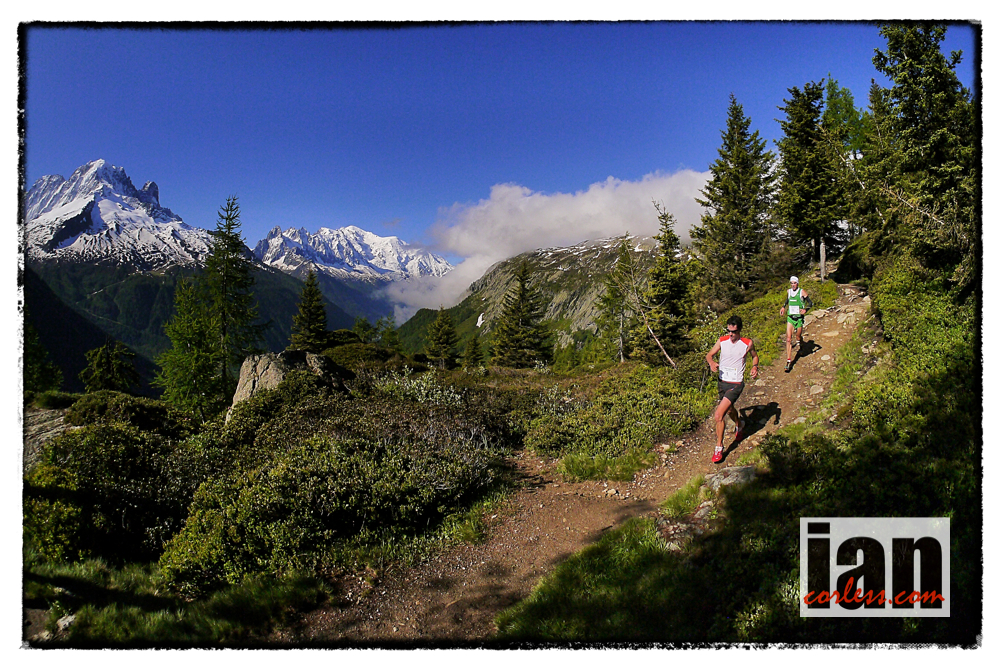
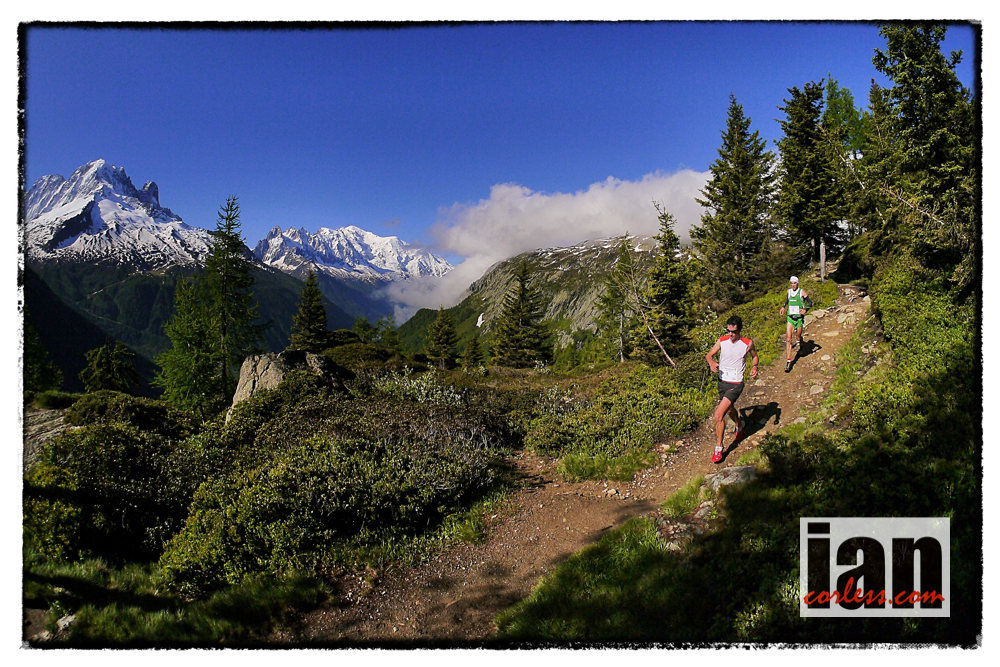
June 29 – The Mont-Blanc Marathon – the 42 km course starts in Chamonix and finishes at 2,016m altitude, gathering 2,511m elevation gain and 1,490m on the downhill, this beautiful trail offers some of the best scenery of the Mont Blanc massif. Records: Kilian Jornet, 3h30’41”, 2013 and Stevie Kremer, 4h03’20”, 2013.
Chamonix, it is fair to say, is probably the most iconic and spectacular sports arena to stage a World Championship. The expert organisers are the Club des Sport de Chamonix, which manages year-round major international sports events.
Held every four years, the 2014 Skyrunning World Championships will represent the second edition since the inauguration of the ISF in 2008 and the first time with the ultra distance, attracting long distance runners from around the world.
Marino Giacometti, ISF President, commented: “We’re proud to present the World Championships in Chamonix and, with the support of the Club des Sport, we’re confident the events will be a perfect showcase for skyrunning and draw the best athletes in the world for some intense competition.”
ISF Member countries and countries wishing to participate should submit the Team Entry Form below.
As promised earlier in the year, a ranking has been devised for the three skyrunning disciplines based on 54 races in 2013 (24 Ultra, 20 Sky and 10 Vertical). One of the principal aims was to take into account the quality of the field and the time relative to the winner, along with a proprietary ISF algorithm and other factors.
Today we announce the top 100 men out of 613 selected from 38 nations in 24 races across five continents. The top 50 ranked women are named out of 273 from 27 nations . Subsequently, all the runners will be listed along with the Sky and Vertical rankings to be published later.
Here’s an overview:
The ranking was elaborated on the basis of the participation and results obtained by the athletes in the international races selected by the ISF.
In calculating the points, the ranking is based on a proprietory ISF algorithm specifically studied for outdoor running, based on consolidated algorithms used by the International Ski Federation.
Fifty-four races were selected for the 2013 season (24 Ultra, 20 Sky and 10 Vertical) – see ISF announcement in March. The selection was aimed at identifying the world’s most prestigious races with the greatest number of elite athletes participating, as indicated in the ISF news in January.
In each selected race, the first 30 men and first 15 women were counted. For each athlete, points were calculated on the basis of : the final position, the time relative to the winner and the number of elite athletes ahead or behind.
The final points were calculated on the average of the three best results of the season obtained by each athlete. For athletes who did not participate in at least three of the selected races throughout the season, a penalty of 11% was applied to those who participated in only two races, and 22% was applied to those who participated in just one.
The 2014 ranking will be based on 2013, but with a more precise indication of the elite athletes based on the previous year’s ranking.
The ISF ranking will be complete at the end of the 2015 season as the points will be calculated on the average of the previous three seasons with a weighted coefficient for each year.
The ISF assesses the yearly performances in their whole within the context of the results and performance in each race. As in other disciplines, it does not analyse the performance in absolute terms due to the many variables in outdoor running (vertical climb, type of terrain, climate, level of the competition… etc), the comparison between different races or different editions of the same race, would be too approximate.
It has been a long season… the 2013 Skyrunner World Series came to a close in early October on the shores of Lake Garda at the impressive Limone Extreme race. The Skyrunner ULTRA title had been concluded just weeks earlier in Vail, Colorado at the Ultra Race of Champions (UROC) but at Limone Extreme, VK and SKY champions were crowned confirming the closure of an incredible 2013 season.
It would be nice to sit back, relax and reflect. Oh no, time stands till for nobody, the 2014 Skyrunner World Series needs to be confirmed and announced, in addition, 2014 has the Skyrunning World Championships taking place in Mont-Blanc (here) at the Mont-Blanc Marathon weekend. Champions, male and female will be announced for the distances of VK, SKY and ULTRA.
An exciting year awaits!
Luis Alberto Hernando at Matterhorn Ultraks
The growth os Skyrunning has exploded in the past 2-years, the catalyst, Transvulcania La Palma in May 2012. Arguably, the worlds ‘best’ descended on a small island in the Canaries and although the ULTRA distance was new to Skyrunning, a transformation was made and suddenly, Skyrunning became the next big thing! The foresight of Marino Giacometti (President ISF) and Lauri Van Houten(Executive Director ISF) was rewarded with a big thumbs up from all who attended!
Skyrunning today is growing and at an alarming rate. The Skyrunner World Series has now established itself as one of ‘the’ series to do and we are seeing this reflected in the diversity of the nations taking part but also the diversity in the athletes. We are seeing many runners participating in several disciplines and in certain scenarios, such as Kilian Jornet, we are also seeing them crowned champion in multiple disciplines.
We are not only seeing the ‘regulars’ perform. Skyrunning are being rewarded with new athletes and teams, take a look at Arc’teryx and inov-8. They have taken the bull by the horns and seized an opportunity, not only have they created teams to perform at this high level but they have created apparel and shoes that work in this demanding sport. In 2013, Arc’teryx had UK based athlete, Tessa Hill create some stunning results in the VK and SKY distance, in addition, inov-8 had great success with UK based Anna Lupton and with Alex Nichols (USA) who placed third on the Skyrunner SKY World Series podium.
For years, the UK have provided a hard core of athletes who have raced and won on this world stage; Angela Mudge, Ricky Lightfoot, Andy Symonds, Tom Owens and so on… in many respects, these UK runners progressed from a minority sport in the UK, ‘Fell Running’ and participated in a minority sport in Europe called ‘Skyrunning’.
That is all changing and the time is now right, for the UK to progress and not only create a UK based series but also create stimulus within the UK to encourage UK based runners to travel to Europe and farther afield to experience Skyrunning on a global scale.
Salomon athlete, Andy Symonds sums it up very well,
‘Skyrunning was born in Italy, twenty years ago. For me it’s always represented the best of European and until recently – mainly Italian – racing. It’s about racing high up, on real mountains, on real mountain terrain. The fun comes from the race courses which go to summits, along exposed ridges, gaining incredible views, and from moving fast in a competitive environment over this sort of terrain.
The UK may lack the altitude of the Italian Alps, but that doesn’t mean that we can’t do the same thing on our own moderately sized mountains, fells and hills! It’s great to see the sport branching out of Italy, with national series now launching in France, Australia/NZ the UK and no doubt shortly elsewhere.
The future of proper mountain running will probably lie in the hands of the Skyrunning Associations and I’ll be supporting that growth and hoping to help guide things in a good direction!’
It is early days for Skyrunning UK and 2014 will almost certainly be a transformative year. We are well aware that Skyrunning in the UK will be a challenge… we don’t have too many 2000m+ peaks! However, as Andy says, ‘The UK may lack the altitude of the Italian Alps, but that doesn’t mean that we can’t do the same thing on our own moderately sized mountains, fells and hills!’
To that end, an athlete commission has been created to help guide the sport within the UK from a grass roots level. We already have established and respected runners signed up and confirmed:
Ricky Lightfoot (Salomon)
Anna Lupton (inov-8)
Tom Owens (Salomon)
Ben Abdelnoor (inov-8)
Andy Symonds (Salomon)
Within the coming weeks, several other athletes will be added to the commission and this will guarantee that the direction of Skyrunning in the UK is not only in good hands but will also consider the well established traditions of fell and trail running.
Skyrunning UK will work in harmony and respect existing races and traditions within the UK.
To interact and get involved, please make sure you:
An all new season of Salomon Running TV! On October 30th, 2013 season 3 of Salomon Running TV begins and it promises to offer a completely new look on the sport we love so much. With a variety of characters and stories that span the globe — join us on our journeys and adventures!
I don’t think many words are needed here… I think we can all find something in this and relate to it.
“I love technical running… from what I hear, the closest running to the type of running that I like to do is European Skyrunning” Ruby Muir
Ruby Muir is one of New Zealand’s most promising young trail runners. At just 21 she had won the Kepler, Tarawera Ultra and nearly every other event she’d entered. This is the story of how she discovered running, what drove her to it and how it has helped her heal. This film was shot in one day at Eskdale Mountain Bike Park near her home in Hawkes Bay, New Zealand.
Race dates: Friday June 27th, Saturday 28th and Sunday June 29th, 2014
Kilian Jornet and Marco De Gasper in the 2013 edition
The Club des Sports de Chamonix is ready for an on-line ‘race’ with registration opening next Tuesday! Each year the phenomenon amplifies and regardless of the race format, inscriptions are filling faster and faster. In 2013 the Marathon was full in just 8 days and the other races within a month…
The organizers are expecting record participation …even more so due to the fact that among the 6 races offered by the Club des Sports de Chamonix, three of them will count for the Skyrunning World Championships! The world’s best runners are expected alongside thousands of amateur athletes who hope to finish the Marathon or the Mont-Blanc 80Km race!
Tuesday October 15: Registration opens
It is therefore next Tuesday at 13:00 that inscriptions open for the 6 races of the Mont-Blanc Marathon weekend. A sprint start for adept participants for one of the major trail running races in the Chamonix Valley.
All information concerning registration can be found here.
Skyrunning World Championships
The Skyrunning World Championships are organized every four years and in 2014 the bid was won by the Club des Sports de Chamonix for this important international event!
Founded in 1995, and renowned in 2008 the International Skyrunning Federation organized the first Skyrunning World Championships in 2010 in Canazei, Italy for two events: the Vertical Km and the Marathon. For the second World Championships being held in Chamonix a new distance, an ultra represented by the Mont-Blanc 80km race, is also on the program.
An addition that will mark Chamonix but also Skyrunning, who together inaugurate this new distance at the foot of the Mont-Blanc where the beauty and technical difficulty of the course already guarantee its success!
The different distances will either be run individually or by team with the title of World Champion for each category.
Marino Giacometti, President of the International Skyrunning Federation says “We are proud to present the Skyrunning World Championships in France, in Chamonix Mont-Blanc. We are convinced the events at the foot of the Mont-Blanc will be a perfect showcase for our sport and provide an athletic line-up without equal.”
Three distances, three events on the Skyrunning World Championship program:
– Mont-Blanc 80KM: Trail in semi-autonomy. Distance of 80km with 6000meters of vertical gain
– Mont-Blanc Marathon: Trail in semi-autonomy. Distance of 42km with 2511 meters of vertical gain and 1490meters of descent
– Mont-Blanc Vertical KM: Time-trial event. 3,8km distance with vertical gain of 1000meters.
Three titles will be awarded:
– World Champion title for each of the three races
– Combined World Champion title: cumulative results in at least 2 events
– Nations ranking by teams of 4 (3 men and 1 woman)
Friday June 27, 2014 at 4:00am – Limited to 1000 participants – TRAIL in semi-autonomy
Distance of 80km with positive vertical gain of 6000m
Mont-Blanc Marathon
2014 Skyrunning® World Championships
Salomon Skyrunner France Series 2014
Sunday June 29, 2014 at 7:00am – Limited to 2000 participants -TRAIL in semi-autonomy
Distance of 42km with positive vertical gain of 2511m
Mont-Blanc Cross
Saturday June 28, 2014 at 8:30am – Limited to 1500 participants -SHORT TRAIL in semi-autonomy
Distance of 23km with a positive vertical gain of 1454m
Vertical KM
2014 Skyrunning® World Championships
Friday June 27, 2014 at 4:00pm – Limited to 400 participants – Time Trial
Distance of 3,8km with a positive vertical gain of 1000m
Mont-Blanc 10km
Saturday June 28, 2014 – Introductory Trail – Distance of 10km on the cross-country ski trails, accessible to all runners regardless of their ability level. Limited to 1000 participants
Mini Cross
Saturday June 28, 2014 – Children’s races between 800m-3km in the Bois du Bouchet
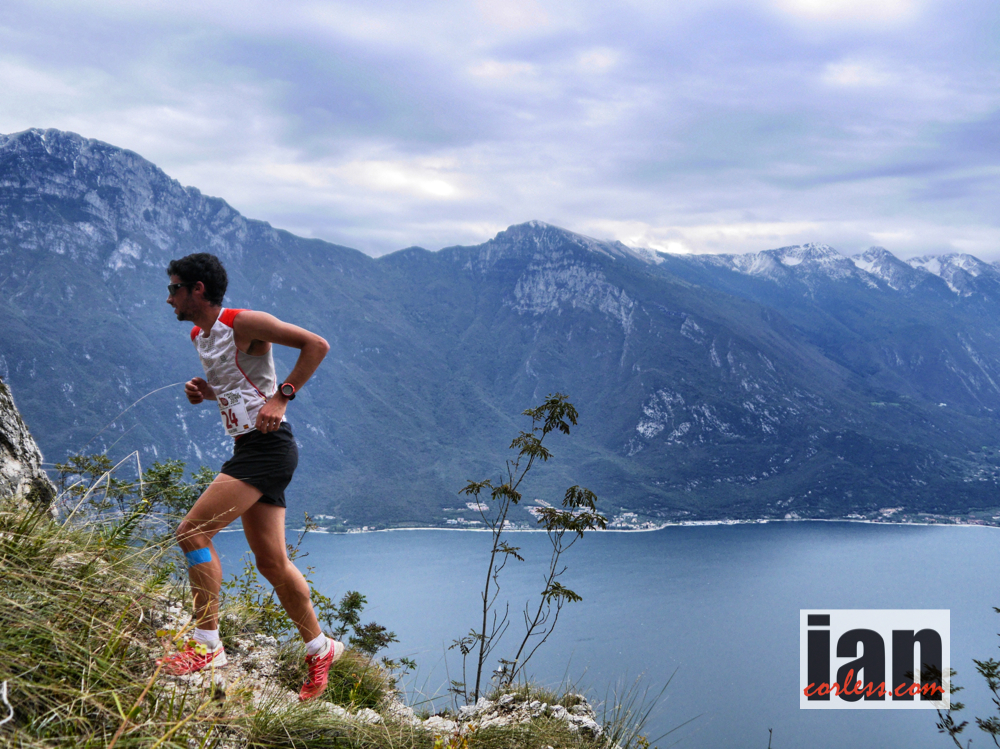
It was always going to be a classic race… the male SKY Skyrunner World Series title was sewn up with a dominant Kilian Jornet securing maximum points form three out of five qualifying races. However, the ladies race was a completely different story. Just ten points separated the leader, Emelie Forsberg from fellow Salomon teammate, Stevie Kremer.
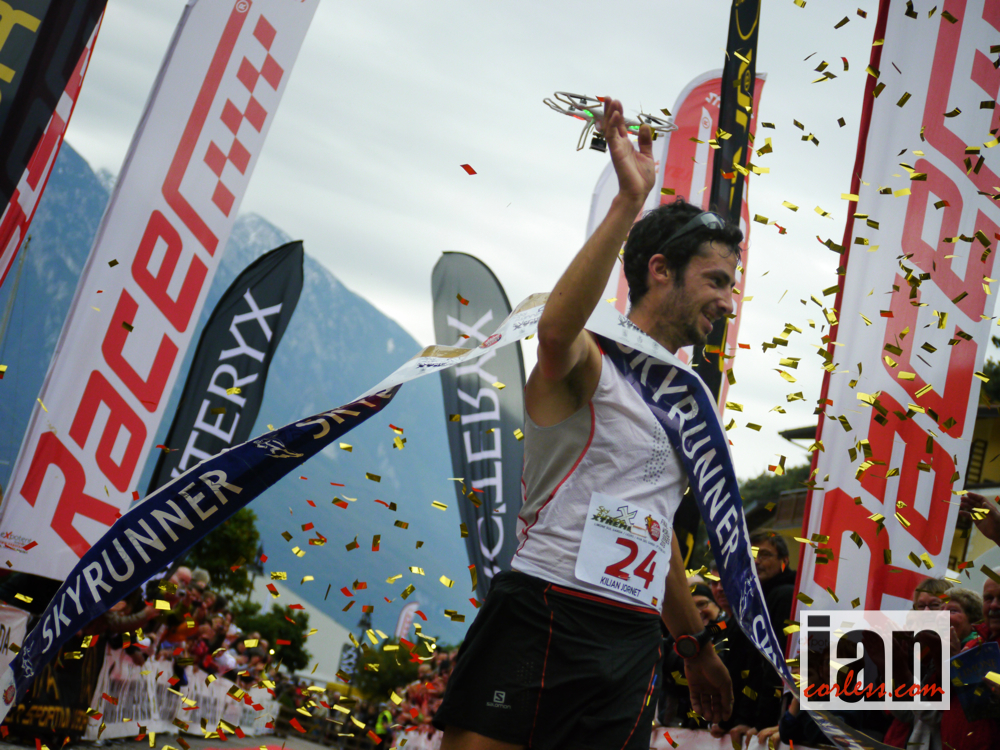
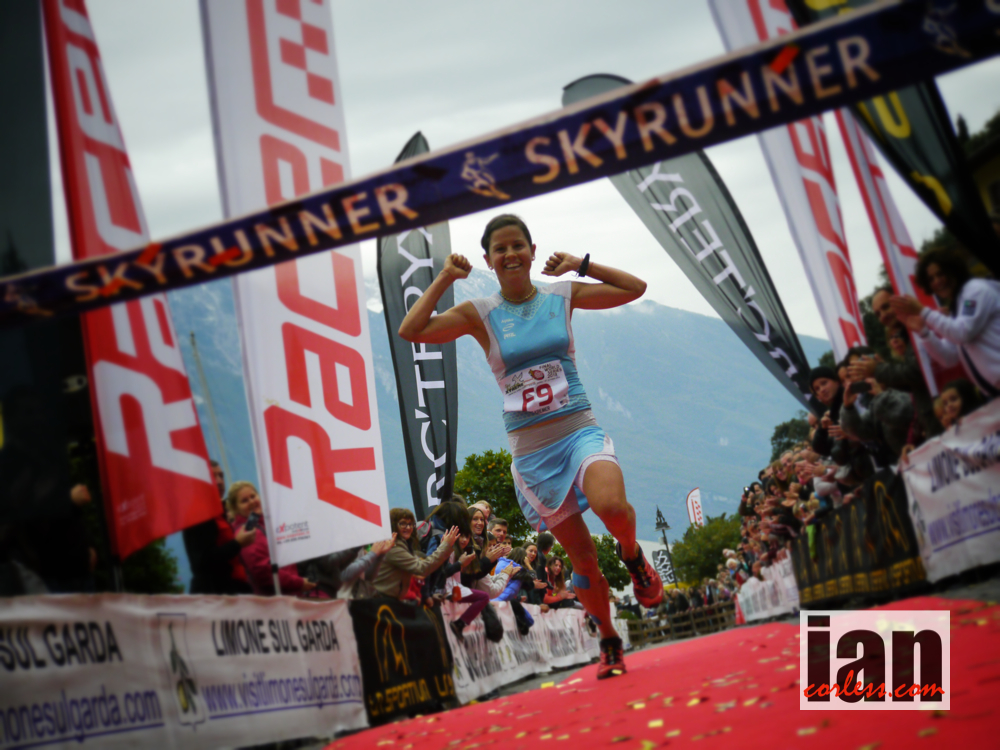
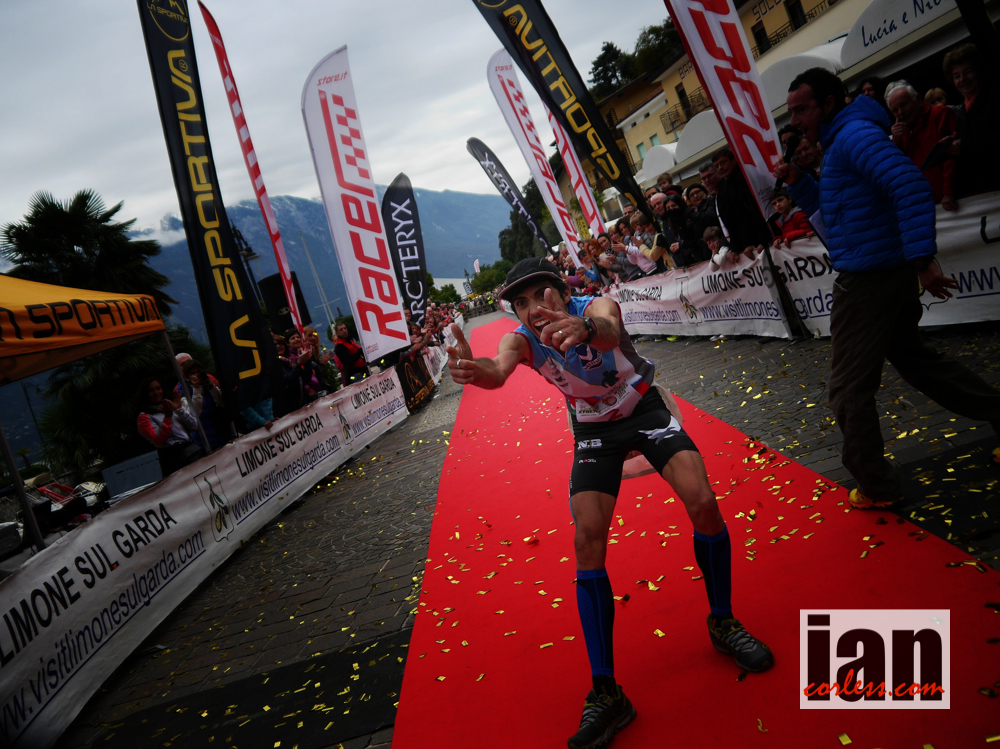
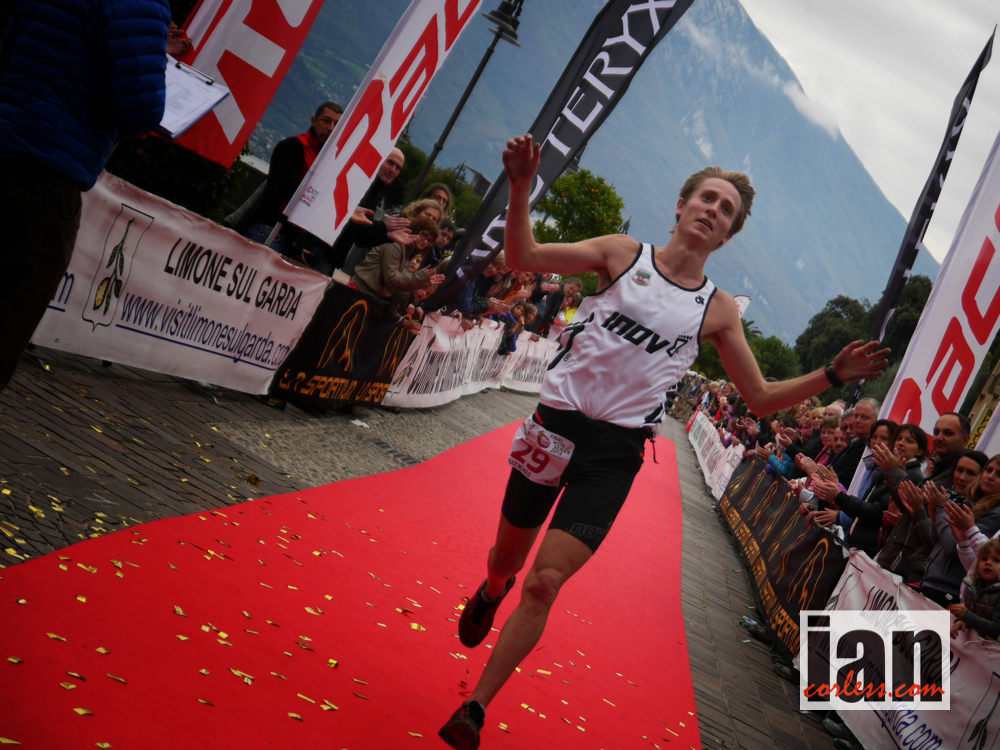
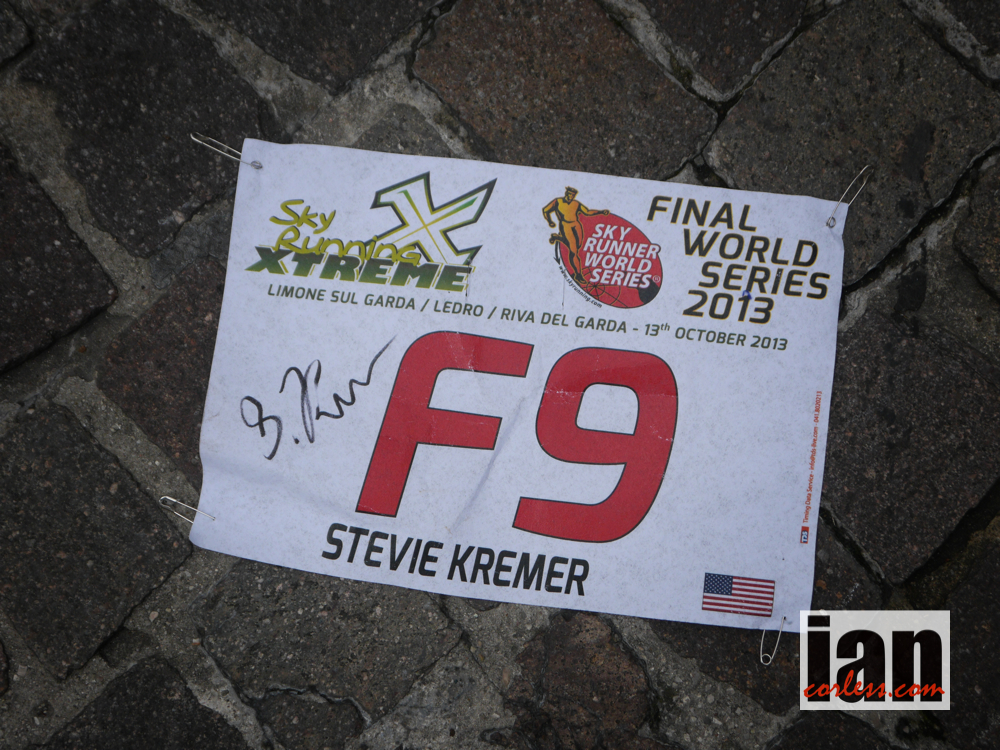
At the finish line on the shores of Lake Garda, Kilian Jornet once again proved his supremacy with another stunning victory. For the ladies, Stevie Kremer confirmed her incredible mountain running and descending ability to take not only the victory in Limone but also the Skyrunner World Series title.
We have witnessed some incredible performance in the 2013 Skyrunner World Series over three distances; VK, SKY and ULTRA. Limone Extreme provided a stunning close to the 2013 season and we are left with some well-established names confirming that they are true champions but in addition, we have several new names on the Skyrunning scene that will most certainly build anticipation for the 2014 season.
Antonella Confortola leading on the first climb
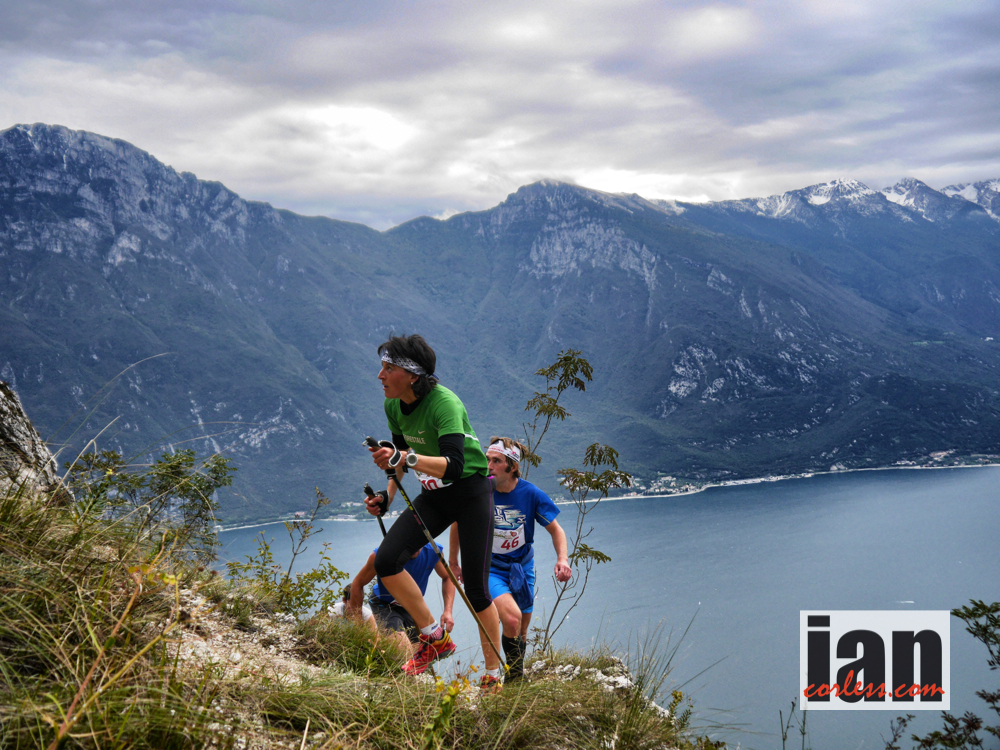
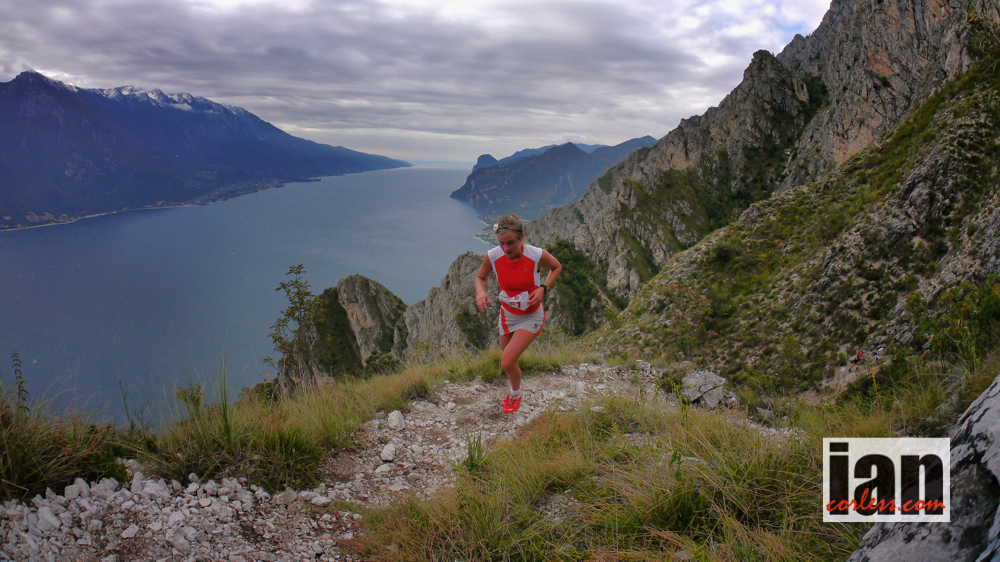
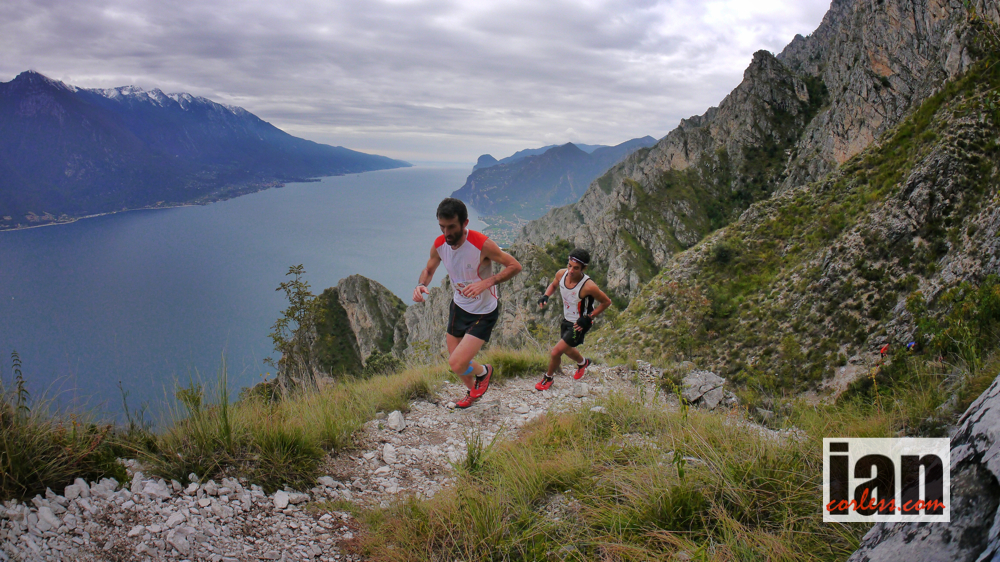
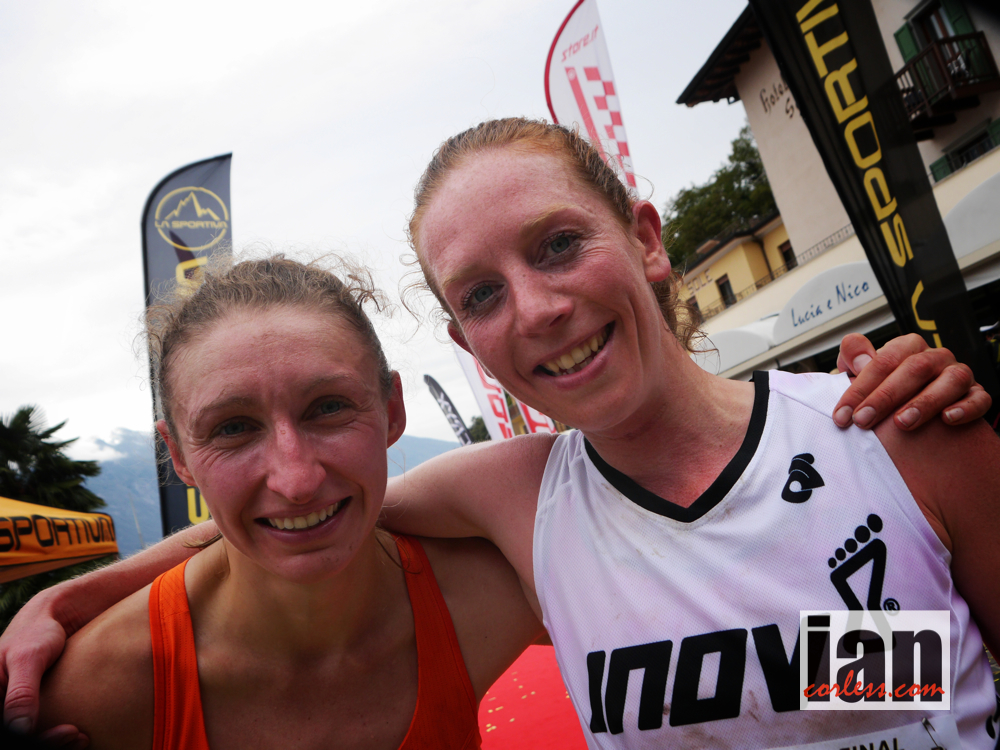
Antonella Confortola after taking second place in the VK on Friday night had been unsure if she would start the Sky race on Sunday. Start she did and using her impressive abilities at climbing she led the way on the long steep and technical climb. Stevie Kremer followed closely in second and Emelie Forsberg was third and already loosing some ground. Emelie has had an incredible season and just over one week ago took victory and the overall Skyrunner World Series title for the Ultra distance. UROC in Colorado was Emilie’s first 100k-race and as such, she openly admitted it had taken far more out of her than she anticipated.
Stevie by contrast had raced a couple of shorter races the weekend before and arrived at Limone ready for action. After alternating the lead with Antonella, Stevie finally made her move and although she says that she can’t descend very well, she used every ounce of her ability to hold off Antonella and Emelie to win by over seven minutes. On the line Stevie said, “I was running down that final descent scared, it was twisty and technical but I just didn’t want to look back. I ran as fast as I could. It worked!”
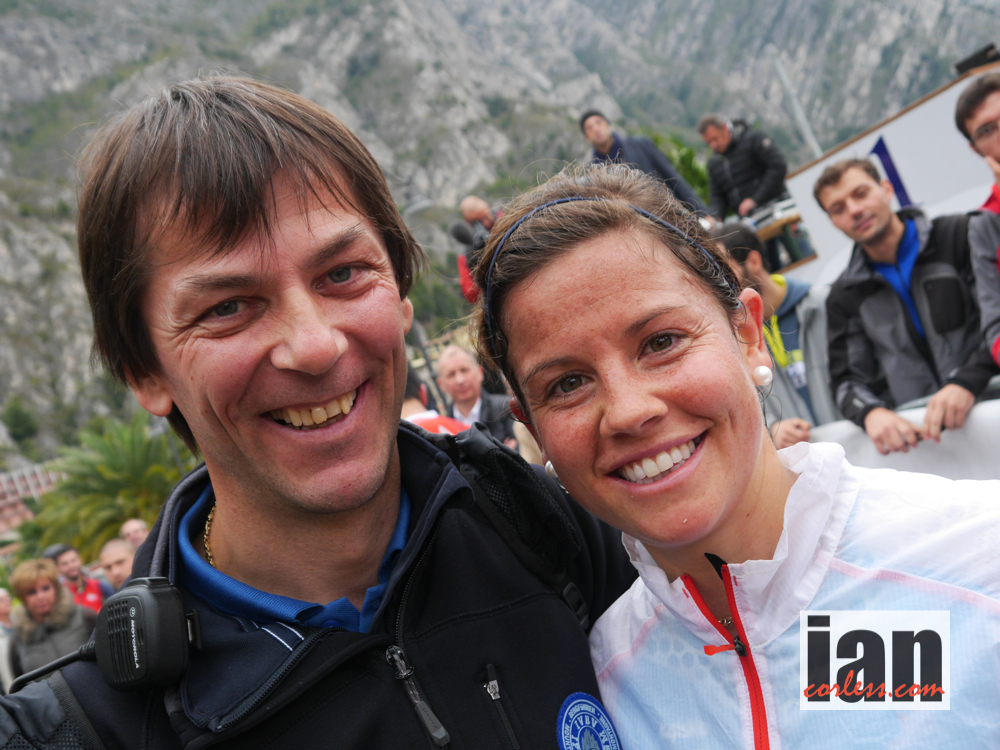
Stevie Kremer with Skyrunning legend and Limone course designer, Fabio Meraldi
Kilian Jornet bided his time in the men’s race but when he made his move he just pulled away and secured not only another impressive victory, but also another World Series title. Kilian didn’t have it easy though.
On the first climb, new signing for inov-8, David Schneider led the way followed by Aritz Egea and Ionut Zinca. Salomon team manager, Greg Vollet (finally finished eleventh)was showing some stunning climbing ability holding a top five place along with up and coming star, Zaid Ait Malek from Morocco all the way to the summit.
Greg Vollet leading Zaid Ait Malek
One of the pre race favourites and second overall in the Skyrunner World Series, Luis Alberto Hernando was having a tough day protecting an injury, however true to his great sportsmanship he soldiered on knowing full well that I had no possibility to make a top ten position. A true champ!
Luis Alberto Hernando
Kilian made his move and a battle followed for the second and third podium places. Ionut Zinca finally pulled away from Aritz Egea and finished just one minute behind Kilian and thirty seconds ahead of Artiz. Showing great potential for 2014 season, David Schneider turned a few heads with a great fourth place with Zaid Ait Malek fifth.
Ionut Zinca second place
The 2013 season has shown some incredibly diverse and consistent performances, Alex Nichols from the US in his first season participating in the Skyrunner World Series placed eighth at Limone Extreme and this elevated him to third overall in the World Series.
Alex Nichols third overall in the Skyrunner world Series
A similar story for Arc’teryx athlete, Tessa Hill, not only did she have a great VK on Friday but she placed fourth on the day. Anna Lupton (inov-8) from the UK also proved that fell/mountain runners can perform with the best on high and technical mountain courses in Europe.
Tessa Hill with fellow Brit, Anna Lupton
The influx of new names such as Thorbjorn Ludvigsen and Leire Aguirezabala and responding great performances show all of us that Skyrunning is not only in a great place for the future but that the participants are eager for true mountain courses that test the mind as well as the body,
Roll on 2014!
IMAGES from the Limone Extreme race are available to view HERE or purchase HERE
“The purest form of mountain running … getting to the top of a mountain and back down again as quickly as possible. It’s the athlete versus the mountain. It’s not for the faint‐hearted. It’s definitely a significant challenge and the athlete needs to know what they are doing.’’ Marcus Warner
For the very first time, Australia has a new trail running event which is part of the internationally prestigious Skyrunning brand that attracts top athletes to the top of the world, where earth and sky meet.
Officially launched today, the Buffalo Stampede in the Victorian alpine country is expected to attract a bumper field of talented local and overseas runners as it forms the foundation stone of a planned Australia‐New Zealand Skyrunning series.
To be staged on April 5 and 6 next year (2014), it is hoped that ultimately the Buffalo Stampede will join the elite list of Skyrunning World Series events like the Mont Blanc Marathon in France, Speedgoat 50 in the USA and the Mount Elbrus Vertical Kilometre in Russia.
Skyrunning as a recognised discipline traces its roots back to Italian mountaineer Marino Giacometti and fellow enthusiasts who started pioneering races and records on famous European peaks like Mont Blanc in the 1990s.
Today the sport is managed by the International Skyrunning Federation and features superstars like Spanish alpine master Kilian Jornet.
Marcus Warner, the president of Skyrunning Australia and New Zealand, says the Buffalo Stampede embodies what Skyrunning is all about: “The purest form of mountain running … getting to the top of a mountain and back down again as quickly as possible. It’s the athlete versus the mountain. It’s not for the faint‐hearted. It’s definitely a significant challenge and the athlete needs to know what they are doing.’’
The Buffalo Stampede, Warner says, will finally “put Australia on the map’’ of Skyrunning because it will finally convince overseas runners that Australia possesses the terrain to stage a serious mountain running challenge. “Elevation is really what drives the difficulty of it. [The organisers] have really sought out the most extreme mountain in Australia that really embodies Skyrunning because of how steep it is. Nearly 5000m [of elevation gain] over 75km is up there with some of the best races in the world. [Elite overseas runners] are going to go away pretty sore and pretty beat up from this race.’’
Lauri Van Houten, Executive Director of the ISF had this to say, “Of course we’re very excited about the launch of ANZ skyrunning in the capable hands of Marcus Warner and his associates and with the support of an ambassador like Anna Frost. In global terms Skyrunning has been active in Malaysia and the Philippines for many years and more recently, South Africa and China. Australia and New Zealand was included as an ISF member at our last General Assembly and, as the home of many great runners, they can’t help but make their mark on the sport!”
The Buffalo Stampede has been organised by Sean Greenhill from the respected outdoor adventure company Mountain Sports.
A passionate trail runner himself, Greenhill already stages popular trail running events like the Glow Worm Tunnel Marathon and the Sydney Trailrunning Series.
He chose Mount Buffalo National Park in Victoria as the venue for the Buffalo Stampede Ultra SkyMarathon (75km) and Buffalo Stampede SkyMarathon (41.4km) because it is one of the few areas in Australia where he could satisfy the exacting Skyrunning rules about vertical gain.
No other runs in Australia over similar distances will have as much climbing as the Buffalo Stampede Ultra SkyMarathon (4545m) and the Buffalo Stampede SkyMarathon (2924m).
“I can’t think of a marathon in Australia that comes within 500m of gain of the Mount Buffalo SkyMarathon,’’ Greenhill says. “They are, in terms of elevation gain over distance, the most difficult events of their kind in Australia.’’
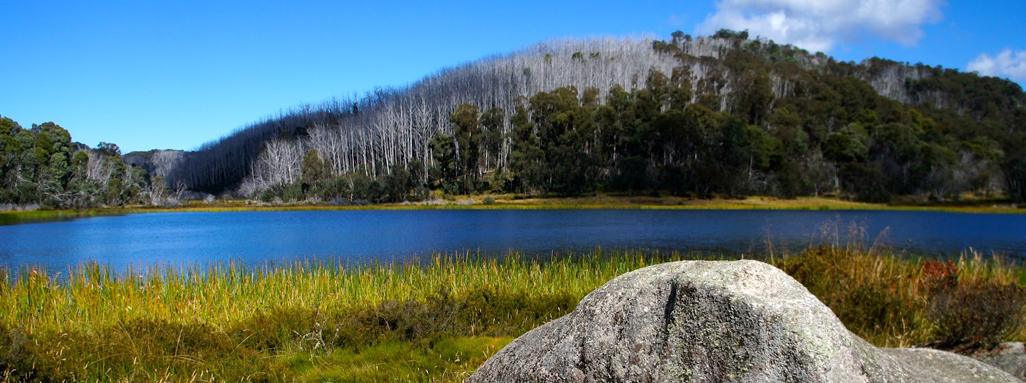
And because it is the eroded magma chamber of an extinct volcano, Mount Buffalo boasts a spectacular granite terrain like no other peak in the Snowy Mountains.
Greenhill also chose Mount Buffalo because it allows him to start the Buffalo Stampede events in the beautiful town of Bright, which he loves for its alpine scenery, fine food, local produce, boutique beer and outdoor sports culture.
Clayton Neil, the manager for economic development with Bright’s Alpine Shire Council, said: “We see the Buffalo Stampede as a really strong addition to our events calendar that really aligns with where we are heading. It embraces being active in nature and living life outside. Bright has always been a popular place for people who love the outdoors and this event takes that to another level.’’
Although the Buffalo Stampede races will be among Australia’s toughest, they are open to entry from anyone, with no qualifying needed.
Up for grabs in the Buffalo Stampede are tickets to the 2014 Skyrunning World Championships to be held next June in the famed French alpine resort of Chamonix, at the foot of Mont Blanc
A three‐day Buffalo Stampede training camp based in Bright will be hosted by top Australian trail runners Brendan Davies and Hanny Allston from January 17 to 19.
Davies raced in the Skyrunning Mont Blanc Marathon this year and will be competing in the Buffalo Stampede Ultra SkyMarathon in April in the hope of winning a ticket back to the slopes of Mont Blanc for the Skyrunning World Championships.
Davies, a Mountain Sports ambassador for the Buffalo Stampede, said: “The Skyrunning label brings with it a lot of credibility. It puts [Australia] on the world map as a destination for the world’s elite trail runners. For Australian runners, it gives us the capacity to dip our feet into the Skyrunning series without having to travel overseas. It’s just a plus for the sport. I see it as a real positive for everyone. I’m going to be going all out for that race.’’
Race Stats:
Ultra Stampede
75.5km
Elevation gain 4545m
Elevation loss 4545m
Max altitude 1380m
8 aid stations
15 hour cut off
Stampede Marathon
41.4km
Elevation gain 2924m
Elevation loss 1941m
Max altitude 1380m
4 aid stations
10 hour cut off
Go to www.buffalostampede.com.au for more details about the Buffalo Stampede.
Sean Greenhill is available for interviews on 0409 047 714 or via sean@mountainsports.com.au
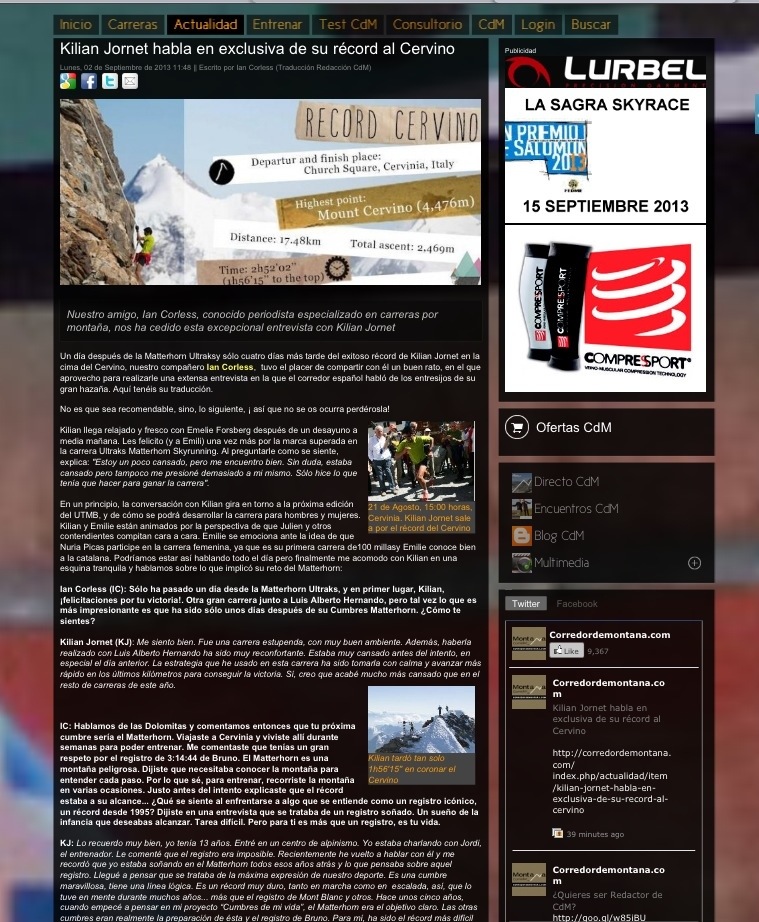
It’s the day after the Matterhorn Ultraks and just four days after Kilian Jornet’s successful attempt on the Matterhorn Summit record attempt from Cervinia. It has been quite a few days for this iconic mountain and although Kilian has excelled on both occasions, we all know, the mountain is still the boss.
Kilian arrives with Emelie Forsberg looking relaxed and fresh after a late breakfast. I congratulate him (and Emelie) once again on topping the podium at the Skyrunning Matterhorn Ultraks race and ask him how he feels, ‘I am a little tired but feel good. I was certainly tired in the race but I didn’t push too hard. I just did what I needed to do to win the race’.
Our conversation turns the TNF UTMB and we discuss how the race will unfold for the men and women. Kilian and Emelie are animated at the prospect of Julien Chorier, Miguel Heras, Anton Krupicka and the other contenders going head-to-head. Emelie gets excited at the thought of Nuria Picas in the ladies race, it’s her first 100-mile race and of course Emelie knows the Catalan well. We could talk all day but eventually I settle down with Kilian in a quiet corner and we discuss the Matterhorn.
IC: It’s the day after the Matterhorn Ultraks, firstly Kilian, congratulations on your win! Another great race with Luis Alberto Hernando but maybe what is more impressive is that it comes just a couple of days after your Matterhorn Summits. How are you feeling?
KJ: I feel good. It was a super good race with a great atmosphere. To run with Luis Alberto Hernando was super nice. I was very tired before the race, particularly the day before. I used a strategy for the race to take it easy and take the win in the last kilometers. Yes, I think I was much more tired than in other races this year.
IC: We spoke in the Dolomites and we discussed then that your next Summit would be the Matterhorn. You travelled to Cervinia and you lived here for weeks to train. You had the utmost respect for Bruno’s record of 3:14:44. The Matterhorn is a dangerous mountain. You said you needed to learn the mountain, to understand every step. I think in that time you went up and down the mountain multiple times. Just before your attempt you said that the record was in your grasp… what is it like to look at something that is perceived as being an iconic record, a record from 1995, you said in a quote that it was a record you had dreamt of. Something from childhood that you wished you could achieve. It is a massive undertaking. For you it is more than a record, it’s your life.
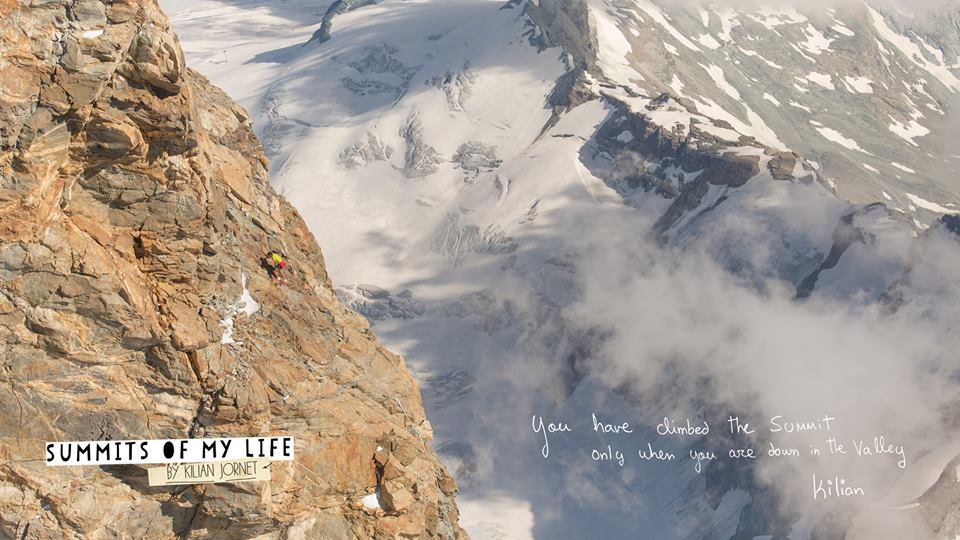
KJ: I remember it well; I was 13 years old. I entered into a mountaineering center; I was talking to Jordi, the trainer. I said at the time that the record was impossible. I spoke to Jordi recently and he reminded me that I was dreaming about the Matterhorn all those years back and about the record. I thought it was the ultimate expression of our sport. It’s a beautiful summit. It has a logical line. It is a hard record, it is push running and climbing, so, it was in mind for many years… more than Mont Blanc and all the other records. About five years ago when I started to think about Summits of my Life, the Matterhorn was my goal. The other summits were really preparation for the Matterhorn and Bruno’s record. For me, it was the most difficult record in Skyrunning and mountain running. For example, Pikes Peak is not Skyrunning. I was really afraid, not of the mountain as I was climbing a lot but of the time. I summited the Matterhorn nine times before the ascent. The first time you climb you become aware of what is possible. You go up and down and say, wow, this is the time I need to beat. After going up and down nine times I think okay, I know the mountain, I am not going to fall, I know this mountain well. I was aware of where I could go hard and where I needed to go easy. However, the morning of the attempt I was nervous. I thought to myself, will I do this record or will I do four hours?
IC: A few people asked why you made the attempt at 3pm; it seems quite logical that the Matterhorn is a busy mountain so I assume the mountain would have been less busy?
KJ: Yes for sure. It is a busy mountain when conditions are good. When I climbed nine times I saw hardly anyone, just two or three teams. I was alone. The week of the attempt we had good days with warm and dry conditions and everyone was on the mountain. Over one hundred teams! So, I was talking with all the guides and the helpers. We asked the question, what do we do? So many people on the mountain and it would have been impossible. My first idea was to start between 7-8am but it would have been crazy to pass people. We decided to start later. It was the perfect decision. It was warm at the summit and I wore just a t-shirt and nobody was in the way. Everyone was going down or in the hut. I just had the safety guides to help. It was perfect!
IC: In the build up to the record, you actually met up with Bruno Brunod. Did he go on the mountain with you or did you just talk about your attempt?
KJ: Bruno said he never climbed the Matterhorn after his attempt. We met in Cervinia and discussed his record. What conditions he had, how he prepared, how he was mentally and then we discussed the rope, the short cuts and how he made time. It is funny, Bruno stopped running in 2003 but last year he started running again and he is now preparing Tor des Geants. He never ran long distances; he was afraid. I said, c’mon man, you are strong, and you can do well in these races.
IC: So, Bruno has gone from no running to doing one of the longest races on the calendar, I guess when you are Bruno Brunod you don’t do things by half. When you go on the mountain to learn and understand, what process does that involve? Do you have several options to attempt the summit and therefore you try them or do you have a defined route and then you put that route in your mind so that you know every step. You know you can push in one place and you won’t slip in another place?
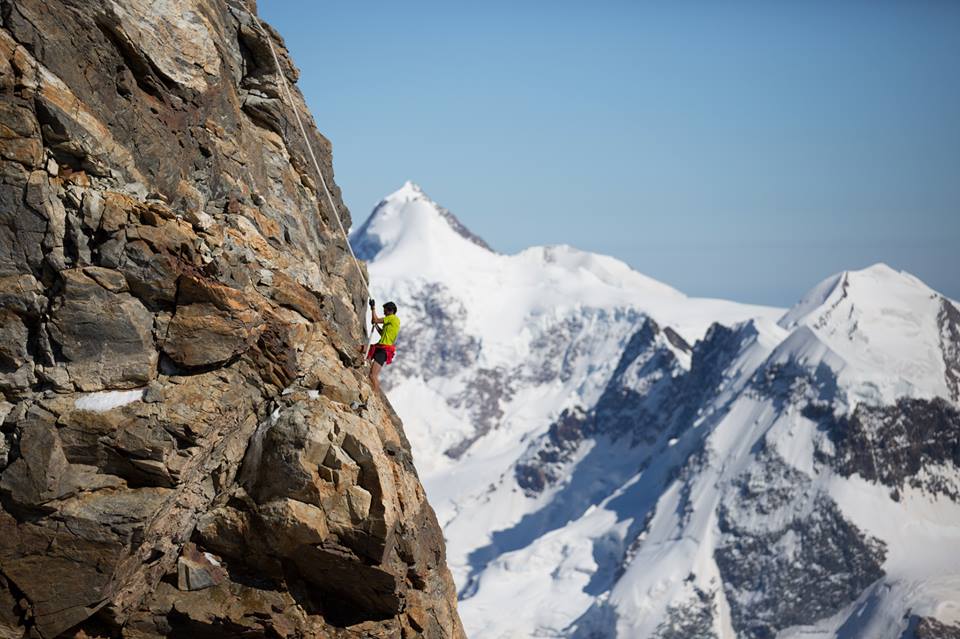
KJ: It’s one route. The Lion Ridge is the classic route and the fastest. It is the historical route and the same as Bruno used and those before him. You work out the differences but it is a thin ridge, you have several places that you can pass but yes, it is about planning. It is about knowing where to put your feet, knowing where to push and when not. I think you need to understand the mountain. You have parts in the west and north face and they are thin in the ridge and you can have ice. If you go in the morning you will have ice. If you go after 10am then this will be water so you can go there. You need to spend time to understand how it works, to understand the mountain and its life. Always in the north face it was icy, so I was aware I needed more care. On the west side I could push harder as the rock was warm and the rubber of my shoes would have better grip. It is important to spend time and understand that exactly. For example, if it is cold or windy, my shoes don’t grip the same as a warm day. I need to know this so I know exactly where to go. It is super important to understand the mountain and how the weather conditions are.
IC: On the face of it, people look at you and think you are very relaxed and casual. I know, I have seen you work and I have seen you study a mountain, you know the history, you go into in depth research to make sure these attempts are correct and that you know what you are doing. It is obviously very important. You have mentioned a simple thing like shoe rubber. Did you have special shoes?
KJ: Yes I tried different rubbers. I always used the Salomon Sense but I had different soles, different grades of rubber. For the attempt I used a softer rubber for grip. In the snow any shoe glides. You just need the technique of a flat foot and the ability to push.
IC: What is great about these attempts in comparison to Bruno, for example, in 1995 I guess Bruno stood in the square in Cervinia and just a few people were around probably having a beer, but Marino Giacometti and Lauri Van Houten were instrumental in Bruno’s attempt. They helped finance it, they arranged the safety, they arranged a helicopter and of course they got involved in your attempt. Fortunately for us we had the opportunity to have Seb Montaz follow the process, for those who know Seb, he is like your self a master of his craft. We have had some great glimpses of your summit; short videos are already on YouTube. Clips of you running a ridge jumping a crevice, or sliding down snow. It brings what you do into perspective. We can talk about you going up and down the Matterhorn but it’s easy to think, ok! But we may not have an idea of the difficulty or danger. These videos convey this. It is an important aspect. Is it a way to record you achievement but is it also a way to attract people to the mountains and also let people understand the beauty and danger?
KJ: It is the second for sure. It is not about my achievement. When I stop it will be in my mind. It is more a learning process. It enables the people to join us in the mountain and it enables everyone to understand. It’s beautiful, it is nice but it is also very difficult. It takes preparation, we do take some risks but the videos help motivate and inform. The way I go the mountain is possible but you need to learn. For me, my summit was the Matterhorn; I understood my capacity, my ability and my technical skill. I accept the risk. For everyone else it may be here or close to the home. We want to show and share that you can be light in the mountains and hopefully more people will understand. I go naked to the mountain.
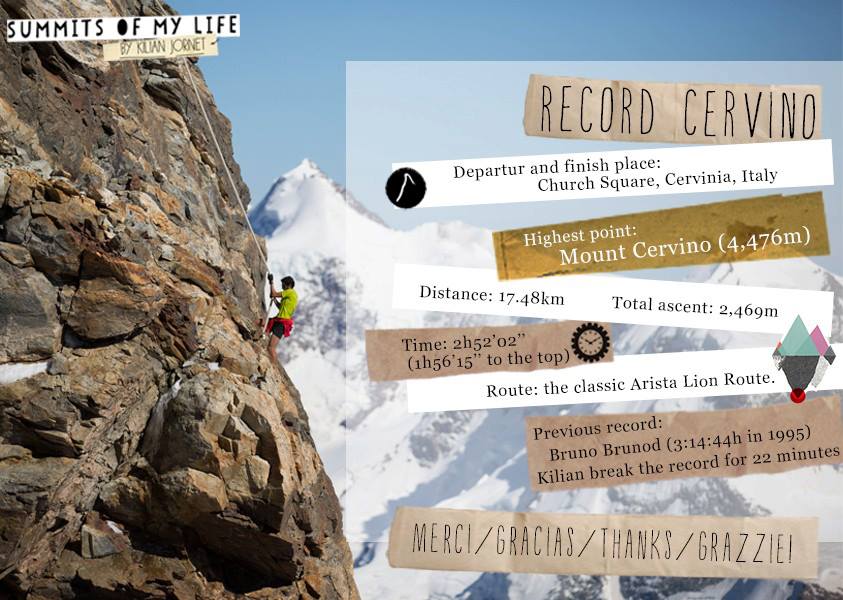
IC: The actual record. You started 3pm from Cervinia. You are in Salomon Sense, shorts, T-shirt and a jacket around your waist. You look like you are going for a run… of course that is what you are doing! You start and in the early stages it is easy and then it becomes tricky, technical, you have ropes, ridges, faces to ascend and so on, how do you process the attempt in your mind. Did you have specific targets, so, did you know what time you wanted to be at a certain place or do you go on feel? I know in the early stages you only had about 3 minutes on Bruno’s record, it was maybe a little too hot but once past a certain point you really opened up time. Of course on the descent you came down super quick. You did 2:52:02 instead of 3:14:44. I believe Bruno predicted 2:52! Were you surprised?
KJ: I was really surprised. When Bruno said 2:52 I said, no way. I was thinking, I might break the record by 2-3 minutes maximum. Maybe 3:10 would be a good time? During my practice runs I never ran fast because in the hard parts you don’t want to go hard. It’s like a lottery and taking numbers… you leave taking numbers for race day! The only time I went faster was the second day when I trained. I thought, wow, maybe I can beat Bruno’s time. If I am close to Bruno’s time then I can go faster. I spoke to Seb Montaz on the morning of the attempt, he said if you are at the summit within 2 hours it will be so good, you will have time for the downhill. I said, yeah I will be so very happy. When I started the summit attempt it was the afternoon so this was good at the top because it was warm, however, it was warm in the valley too. I don’t like warm. I started with a good pace but it was hard to find the strength. I saw lots of people and friends. Bruno was shouting at me, ski friends shouted, guides from Cervinia, Nuria Picas was there and so on… they gave me energy. I said to myself, I must keep going, I must push. I had Bruno’s time in my mind but I had no prediction of what I could do.
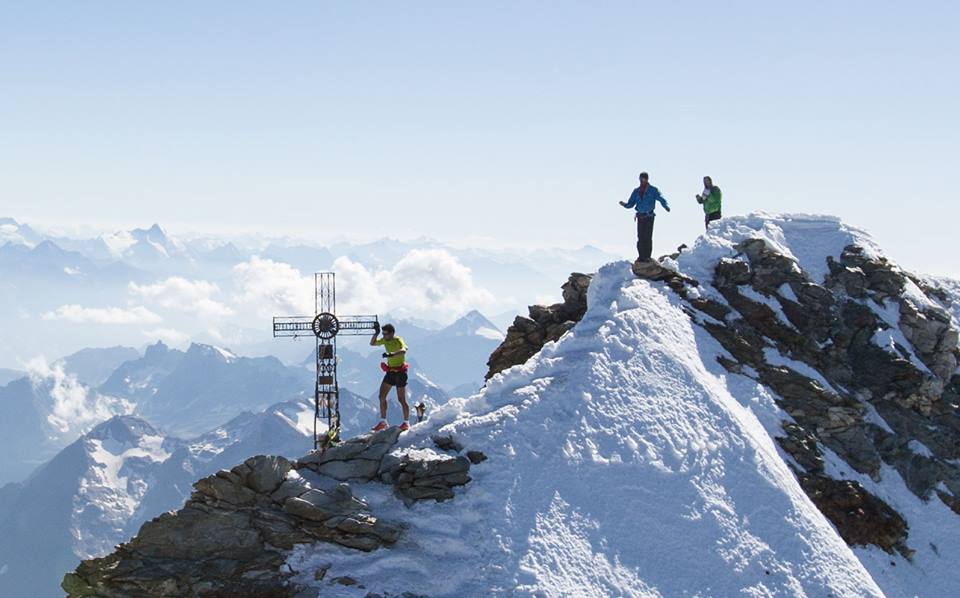
I was close to Bruno’s time until the Leone Col then the ridge starts and then I came into my own. It is where I love to run. It’s technical, you need to climb and you need to push. It is exposed. I love to be exposed on the mountain. From here I was not moving fast but fluid. This is the way to move in this terrain, if you go fast and you go more than you can you will have an accident. Moving fluid allows me to move quickly. I started to gain time all the way up to the summit. I looked at my watch and I saw I was almost 12 minutes in front of Bruno’s time, I said to myself, wow, this is incredible. It is possible! Okay, I said, I can do it. I was happy but I could not disconnect. It is a long down hill to Cervinia; I needed to be sure of every step. The boss of the guides in Cervinia said to me at the summit, you can do it! I started down in deep concentration. I was enjoying it so much; I love to run the technical sections. You don’t push with your legs; you push with your mind. Where to put your feet, where to put your hands, when to glide, when to go faster, when to stop, this is what I love, I was enjoying it so much. When the most technical part stopped, I realized I was almost 20 minutes in front of Bruno; so, the last part was just pushing to the finish.
IC: Myself and many other people were very worried about the Matterhorn. We respected the mountain and we anticipated that you would push; pushing brings danger, so when you got to the summit and you knew you were ahead of Bruno’s time did that mean that the descent was easier, you took less risks than if the time had been very close.
KJ: Yes of course. If I had been at the summit in 2:10 I wouldn’t have come down at the speed I did. I would have taken more risks. I also think that this doesn’t work! Many people who saw me said that I was going down very fast, they said I looked really fluid and that I wasn’t taking risks yet I was very fast. I think this is the way to go down the mountain. If you take risks the body position is different, you can’t glide as well and so on. You lean back and this slows you. If you feel confident, you can go fast. I think maybe I could have gained 6-7 seconds by taking risks. It’s nothing! These 6 or 7 seconds may have been my life… I knew the route very well and I had no need to take additional risks. I just wanted to be confident. My mother was on the mountain and she had bad memories of when she climbed the Matterhorn for the first time but if you climb again and again, you know it’s risky but it isn’t necessary to take risks, it is about being confident.
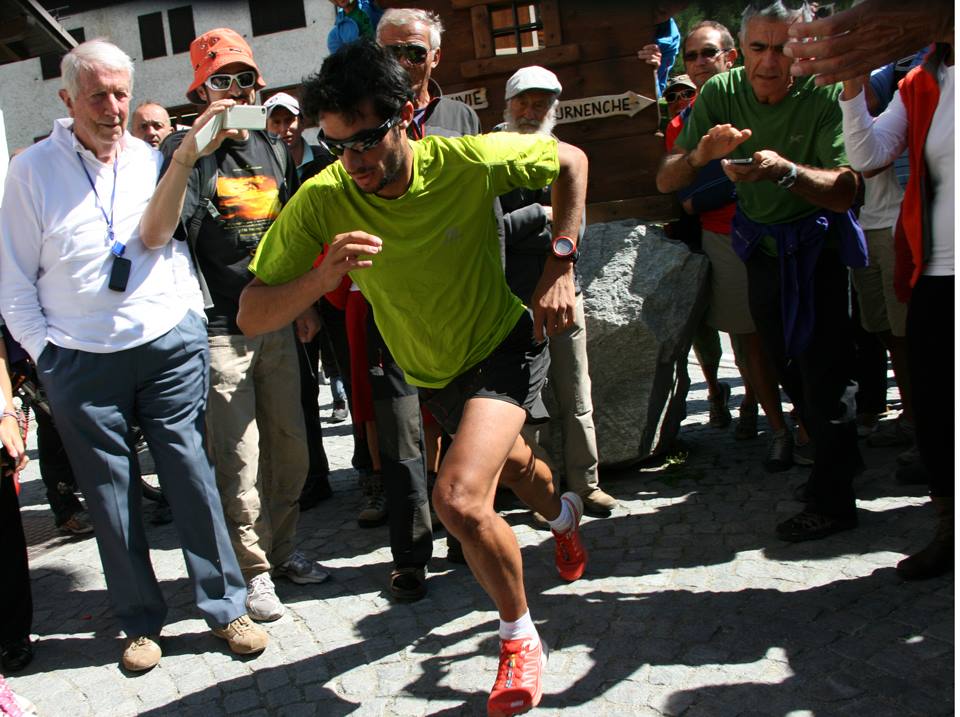
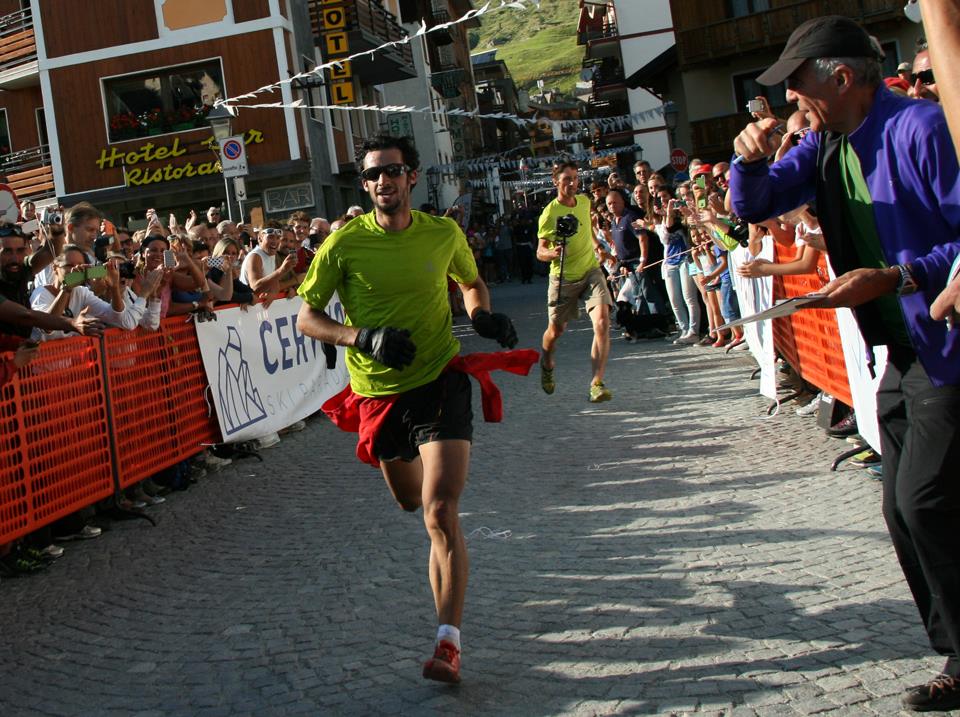
IC: When you arrived in Cervinia, it was like the end of a race. It was incredible. The barriers were out. It was almost like the race finish here in Zermatt. Did this surprise you?
KJ: Yes, I was completely surprised. I was in Cervinia for three weeks sleeping in my van in preparation for the attempt. I was surprised by the reception by everyone. For example, the first day I climbed the Matterhorn I was with Emelie. We climbed with running shoes and when we reached the top, the mountain guides said, ‘wow, you are going with run shoes. Congratulations. Do you want to try the Matterhorn record, can we help you? Tell us the day, we want to help you’. There is not another place that is like this, we usually get the response of, ‘What are you doing here in run shoes, this is ridiculous’. Not in Cervinia, they wanted to help us right from the start. Every time I climbed it was so open, the support was great. I was always asked, ‘tell us what day you go and we will help. We want to be on the mountain to help and support you’. It was the same for the hotels in Cervinia, they offered me showers or they said if I needed anything such as Internet that I could use the Wi-Fi. It was an incredible ambience. People were happy that I was in Cervinia to do the record and they got behind me. I think this was the most beautiful part of the record. I went just with my van, I was alone to climb but everyone was supporting the team and myself. It was so easy then to do the record. The day before my attempt, I made a call to the mountain rescue and said, ‘Tomorrow I go’. He replied, ‘Okay, how many people do you need? We will put people in the mountains for safety in case you have a mistake’. He called the mountain guides and they said, okay, we will put people here and here. The guides had finished work at midday on Wednesday and then they returned to the mountain to support me. It is unique. The reception was so fantastic.
IC: It was incredible the level of support you got. Knowing you, you would have quite happily got out of your van, started in the square and returned with no fuss. Marino Giacometti made a very good point, these record attempts do need to be verified, it does need an element of proof that you do go to the top and do come back down. Of course we are not questioning your honesty. But for future records a structure needs to be in place. I guess if we set a standard for the future it can only be a good thing. Does that mean for future attempts such as Elbrus in Russia, will you start to incorporate this system.
KJ: Yes, I know I need someone to do the chrono and I am aware I need someone at the summit. For Mont Blanc, I had people from the Tourist Office to confirm my attempt and I had guides at the summit. I also have the gps files on my Suunto. At the Matterhorn it wasn’t an issue, we had everyone in place and it was almost taken out of my hands. For example, Marino Giacometti did the chrono in Cervinia but the guides etc. were fully behind the attempt and they verified the route. My chrono was radioed to all the guides on the mountain so my progress could be monitored. It is important to be true. It is just like doping control… it is about integrity, my intentions are 100%, it is important to do a record in the correct way. I am aware that many ‘FKT’s have no control, I personally believe in the people but when you see the world and see the problems, I am aware of the issues of how people can not be honest.
IC: What was great about this attempt, because you had a team of people up the mountain, we had time checks back that meant that we could Tweet and Facebook times to the world. This was so exciting. Social media became alive following you. I think we stopped so many people from working. They wanted to follow. It is interesting from my perspective because it is what I do, but I guess the concept of someone running up and down a mountain and that message being sent around the world, some may think, why is that interesting? But it is so exciting; the updates had people glued to your progress. Can you relate to it or do you just think about the mountain?
KJ: When I am on the mountain. I am 100% focused. I need to be in my moment and think about where I put my feet, how fast do I go. If my mind wanders I will loose time or maybe my life, so I was super focused on moving as quickly as possible. It is just the mountain and I. The social media and the photography I leave to others. For example, Seb was in the helicopter but I never saw or heard it even though he was so close. This is because I needed to be 100% committed. I think this is nice. In racing I think for the last three years I have managed my effort and therefore I don’t need to focus as much but this was completely different. It was like the first time I raced ten years ago when I was super focused. It is a super nice feeling.
IC: Certainly social media has made what you are doing so accessible which is great for us but it is also great for you and everyone else involved. I guess now your energy focuses on Russia and Mt Elbrus?
KJ: Yes, I need to relax a little first…
IC: You said that to me last time, when I interviewed you in the Dolomites. You told me you wouldn’t race for a month and then you went to Sierre-Zinal.
KJ: Ah yes, I was close to Sierre-Zinal, it was just the other side of the Matterhorn, so it was good training. Plus it was the 40th edition. Now I take a couple of weeks with no racing but I will train a lot, I love that; I need to do it to be alive. I will train but not race until UROC in the US. I will focus on Elbrus for the next few weeks; I want to go to Russia before UROC, maybe the 15th September. I will plan around that date and train at altitude.
IC: So does that mean you will do the Elbrus summit before UROC?
KJ: Yes, I think so. After UROC I have Skyrunner World Series,Limone Extreme and the then Diagonale des Fous, so, after this I want a break.
IC: You say a break, does that mean ski mountaineering?
KJ: It means one week of no training and then I will be in the mountains for November and December but I won’t race.
IC: Okay, we will follow you and see if you do race… Kilian it has been fantastic for you to give me so much time to talk about the Matterhorn. It’s great to get such an insight. Finally, when are we going to see the full edited Seb Montaz movie of this year or the recent summit?
KJ: We are working on it and of course we will work more after Elbrus. November and December will see much of the work being done in edit, so we hope before the end of the year. Maybe late December?
“It is a technical mountain. Bruno Brunod has a record of 3:14:44. It is a technical route that is not difficult BUT if I fall, I will die! I need to know the route very well, I need to spend time on the mountain, and I need to learn every step.” Kilian Jornet, July 2013.
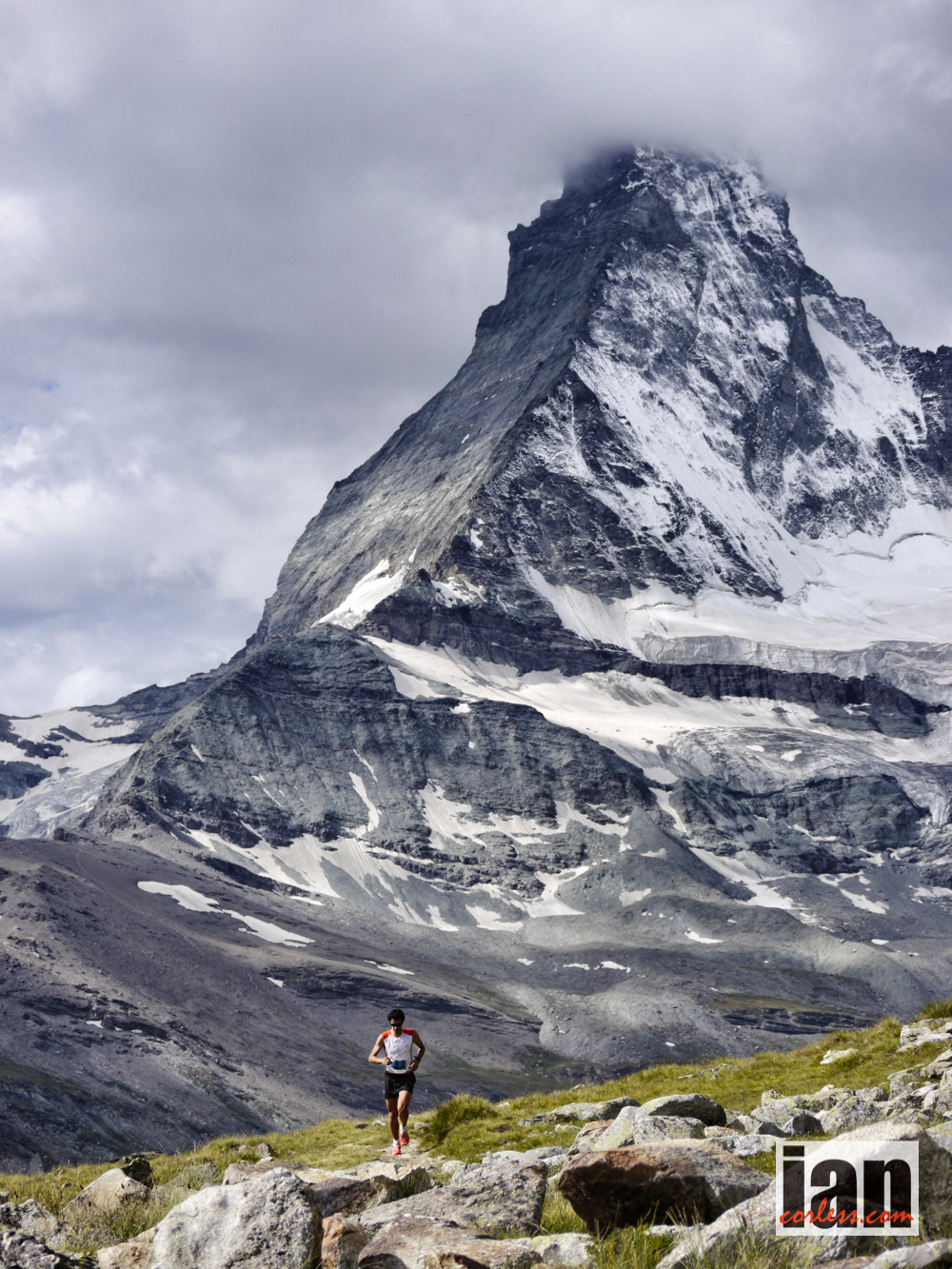
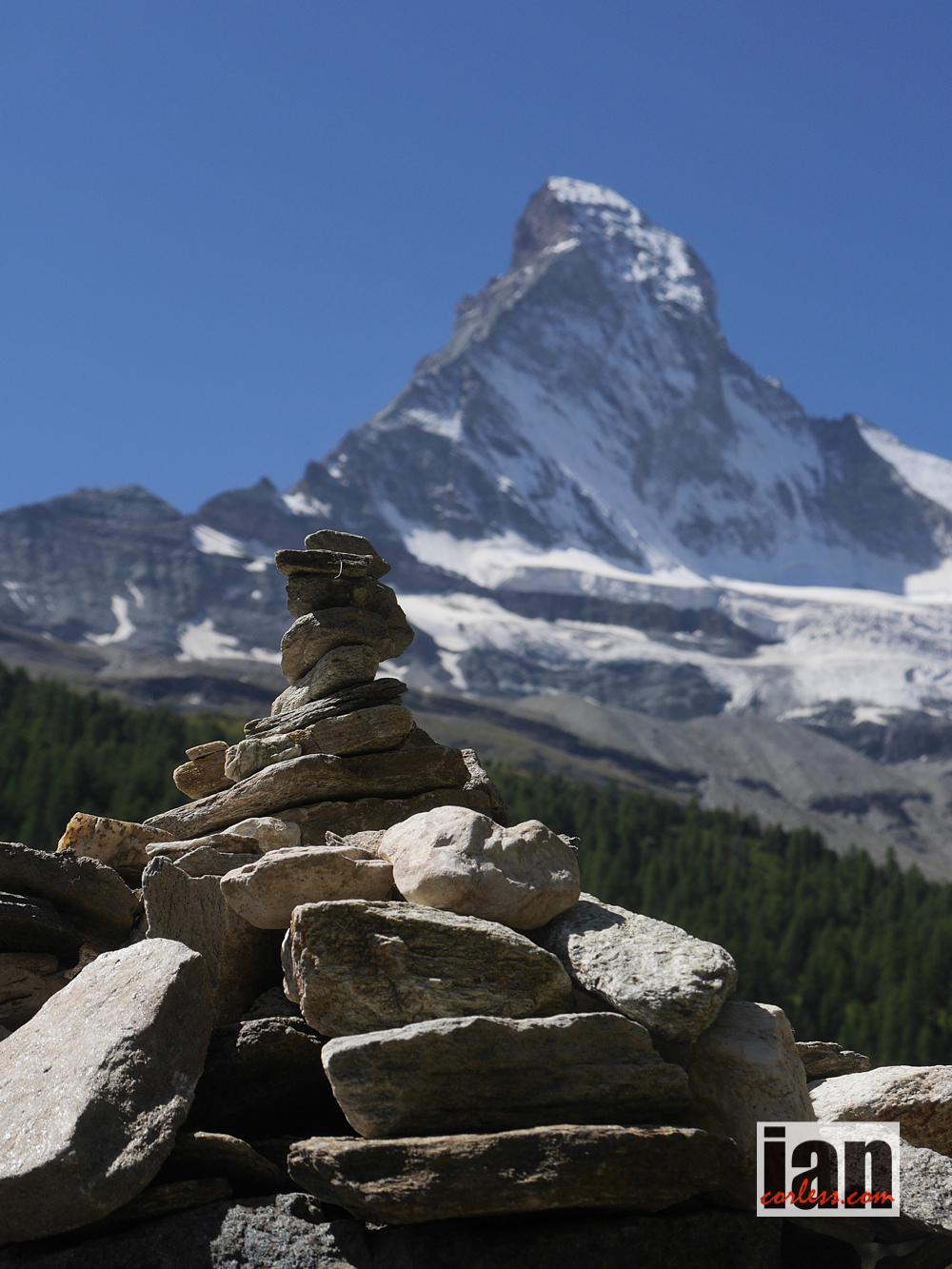
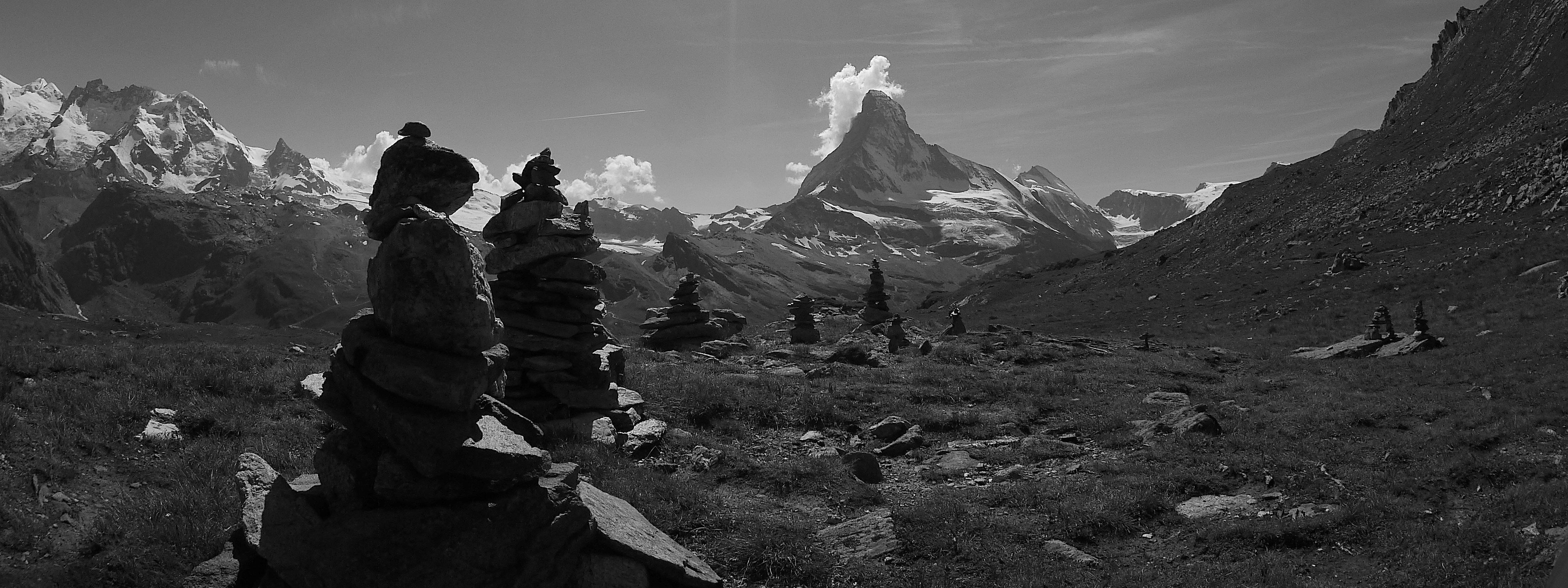
Monte Cervino (Italian) or Mont Cervin (French) or Just the Matterhorn is a mountain on the border between Switzerland and Italy. At 4,478 meters (14,690 ft) high, it one of the highest peaks in the Alps. It consists of four steep faces, striking above the glaciers that surround it. Overlooking the town of Zermatt it is an iconic mountain and possibly ‘the’ most photographed mountain in the world. It is a mountain that dreams are mad of. Kilian Jornet is no different, “I have been dreaming about this record since I was 15”.
Ironically, the Matterhorn was one of the last great Alpine peaks to be climbed and the first ascent by Edward Whymper in 1865 brought an end to the ‘Golden age of alpinism (The period between Alfred Wills ascent of the Wetterhorn in 1854 and Whymper’s ascent of the Matterhorn in 1865, this period saw many peaks in the Alps have first ascents)
Since 1865 to 1995 it has been described as one of the deadliest peaks in the Alps, over five hundred lives have been lost in this 130yr period. I guess the first ascent in 1865 showed us the danger potential when four climbers fell to their deaths on the descent.
The Matterhorn has two distinct summit, both situated on a 100-metre-long rocky ridge: the Swiss summit with a height of 4,477.5 meters (14,690 ft) on the east and the Italian summit with a height of 4,476.4 meters (14,686 ft) on the west. Their names originated from the first ascents, not for geographic reasons, as both are located on the border. Each summer a large number of mountaineers try to climb the Matterhorn via the northeast Hörnli ridge, the most popular route to the summit.
Small patches of snow and ice cling to the faces of the Matterhorn, but the faces are steep and regular avalanches occur. Snow hurtles down the four sides and accumulates on the glaciers at the base of each face.
Four main ridges separate the four faces of the Matterhorn and therefore it offers four distinct routes. The least difficult technical climb and by far the most popular is the Hörnli Ridge, which lies between the east, and north faces and it faces the town of Zermatt. The Zmutt Ridge (west), between the north and west faces is, according to Collomb, “the classic route up the mountain, it’s the longest ridge and also the most disjointed.
The Lion Ridge, lying between the south and west face is the Italian normal route. It is the shortest route on the mountain and has fixed ropes in place but many think it to be a far superior climb, particularly when compared to Hörnli Ridge. Furggen Ridge is the final offering, it is the hardest offering and in good conditions is not too difficult, and it does however have a reputation.
J.J and J.P Maquignaz made the first ascent of the Italian ridge as it is climbed today in 1867 but Kilian Jornet had his eyes on Bruno Brunod’s record set in 1995 when he did Breuil-Cervinia to the Matterhorn summitand back in an astonishing time of 3:14:44. In addition, Bruno also has the record for climbing the Matterhorn, again from Breuil-Cervinia just to the summit in a time of 2:10.
Back in 1995, Skyrunning president, Marino Giacometti and Executive Director, Lauri Van Houten were not only present but also helped finance Bruno’s attempt. Lauri still says how the thought of it, “brings shivers down my back”. Lauri and Marino both acknowledge the danger and undertaking that Kilian had given himself. “I remember standing in the square in Cervinia and about 3 hours 10 min had elapsed. There was a real buzz and noise and then somebody shouted, he’s coming! We all ignored it; we thought it couldn’t be possible… but minutes later Bruno appeared. It was a magical moment, one I will never forget”, says Lauri.
Bruno is very much considered the father of Skyrunning. His exploits, to this day seem to go beyond human limit. Without doubt, Kilian Jornet is in the same mold and in real terms, Bruno has lead the way for what Kilian now wants to achieve with his Summits project. Kilian’s final Summit will be Everest. Bruno himself attempted Everest; he however gave up when at a height of 8.200mt (26,900 feet) due to very hard weather conditions.
Bruno’s passion and time is now focused on his construction company, however, just recently he joined Kilian on the Matterhorn as he prepared for his Matterhorn attempt. Two masters together discussing the mountain. Without doubt, Bruno played a big part in the successful attempt by Kilian and ironically he predicted a time of 2:52:00. Maybe Bruno knows Kilian better than Kilian?
Bruno’s records:
Matterhorn uphill and downhill from Cervinia in 3:14
Monte Rosa uphill and downhill from Gressoney in 4:45
Aconcagua uphill and downhill in 5:57
Kilimanjaro uphill on the Marangu Route in 5:38
Mount Elbert uphill in 1:54
Three times winner of the Becca di Nona SkyRace (2002 – 2003 – 2004)

 After the extraordinary sell-out of the three Skyrunning World Championship events in Chamonix, France, we’re pleased to announce the slots available for countries participating.Eighteen medals and individual world titles are at stake in each discipline – Vertical, Sky and Ultra, and a further six for thecombined titles based on the best results of the Vertical KM and Mont-Blanc Marathon.


 IAN CORLESS