A milestone anniversary, new formats, familiar classics, and a season that stretches from the Sahara to the Alps. Some years feel bigger than others. In 2026, the calendar alone tells you this will be one of those years for Marathon des Sables.
Forty editions after its beginnings in the Moroccan desert, Marathon des Sables has grown into a family of events that test endurance in different ways, across different landscapes, and for very different runners. Yet the heart of MDS remains the same. Self-sufficiency, shared hardship, and the quiet satisfaction that comes from moving forward when stopping would be easier.
January opens with something new and bold: MDS Ultra. Two distances. Two very clear challenges. A 100km option for runners ready to push beyond the classic stage format, and a 100-mile race for those who want to see how deep the well really goes.
Photo by Ian Corless
An opening act designed to grab attention. Long distances, sustained effort, and the mental strain that only ultra racing can deliver. For many, it will be the first real test of their winter training. For others, it will be the centrepiece of their season. What matters most is what MDS Ultra represents – It signals evolution not revolution. MDS is not standing still, even as it celebrates its past.
Photo by Ian Corless
Before January ends, the focus shifts west to the ocean for MDS 120 Atlantic Coast. Where dunes once dominated the horizon, runners now deal with open beaches, shifting sand, and the constant presence of the sea. The Atlantic Coast event has its own rhythm. Wind can play a bigger role. Footing changes by the kilometre. Temperatures can vary greatly, and yes, rain may be present? Still self-supported, still demanding, but in a way that surprises many first-timers. By the time the final runners cross the line, January has already delivered two very different expressions of what Marathon des Sables can be.
February and March bring a noticeable change of pace. No race numbers. No finish lines. Instead, preparation. The MDS team turns its attention fully toward the centrepiece of the year: the 40th edition of MDS Legendary. Four decades after the first runners set off into the Sahara, this anniversary edition carries weight. Not just for the organisation, but for the community that has grown around it.
Photo by Ian Corless
Behind the scenes, logistics are refined, routes considered, and details checked and checked again. The Legendary event is not just another race, it is a reference point for stage racing, for many, a rites of passage, and in 2026, it will also be a celebration of everything Marathon des Sables has become.
Once the Legendary edition is complete, the calendar opens up again, and the global nature of MDS takes centre stage.
MDS Raid Namibia delivers raw beauty and isolation in one of Africa’s most striking landscapes. Namibia’s vast spaces, sharp light, and unforgiving terrain strip things back to basics. This is running in its purest form, where the environment sets the rules. A unique event as teams of two challenge a more stripped back and raw experience.
From Namibia, the series moves to Turkey for MDS 120 Cappadocia. Volcanic rock formations, flowing trails, and a sense of history underfoot make this one of the most visually distinctive events on the calendar. It is demanding, but also deeply immersive, ironically, despite the ‘sables’ tag, this event is much more a trail race – something new, different and unique.
MDS Crazy Loops – a format that lives up to its name. Short loops, repeated efforts, and a psychological game that can unravel even experienced runners over 24-hours. It is less about distance on paper and more about resilience in the moment. A fun and challenging event for all abilities that takes place at iconic ski resorts within Europe during July and August. A community event that brings the MDS vibe to the mountains.
As the year moves toward its final months, the pace does not slow. If anything, it accelerates. MDS 120 Morocco returns runners to familiar terrain, but with the confidence and refinement that come from years of experience. This is the desert, revisited with fresh eyes.
Alongside it, MDS Handi continues to redefine what inclusion looks like in endurance sport. It is a powerful reminder that challenge is not one-size-fits-all, and that determination takes many forms.
For those drawn more to movement than racing, MDS Trek Morocco offers a different relationship with the landscape. Still demanding, still immersive, but with space to absorb the experience in full where all abilities are catered for and yes, there is even some luxury – larger tents, no self-sufficiency, showers and so much more…
The international push continues with MDS 120 Jordan, where desert running meets ancient history. The terrain is tough, the scenery unforgettable, and the sense of scale impossible to ignore. An iconic event and arguably one of the most desired events on the MDS calendar.
And yes, there are hints of more to come. Potential surprises remain under wraps, but if past years are any guide, they will add another layer to an already remarkable season.
Photo by Ian Corless
By the time 2026 draws to a close, Marathon des Sables will have crossed continents and climates. Morocco, Jordan, Peru, Turkey, Namibia, and Europe, with the Alps adding altitude to the mix. Each location brings its own challenges, its own stories, and its own reasons for being unforgettable.
What ties them all together is not just branding or format. It is philosophy. Self-reliance. Respect for the environment. And the shared understanding among participants that this is about more than running.
A milestone year invites reflection, but it also demands momentum. In 2026, Marathon des Sables manages both. Honouring 40 years of history while pushing forward into new territory, new formats, and new ways to test human endurance.
For runners, supporters, and the wider endurance community, it is hard not to look at the year ahead and feel a quiet sense of anticipation.
What a year it promises to be.
In addition to the above, there is the MDS Tour and MDS Clubs.
The MARATHON DES SABLES is a unique adventure of 250km’s spread over 6-stages of self-sufficiency, shared by thousands of enthusiasts, in 2026 it celebrates 40-years. In 2017, another format, HMDS was born with 70 to 120km distances, spread over 3-stages and 4-days.
Since 2024 there has been a significant changes for the MDS brand. The ‘HMDS’ format while still following the same protocols and format has now dropped the ‘half’ title and moving forward, events will be called MDS 120 Jordan, MDS 120 Morocco, MDS 120 Cappadocia and so on.
To differentiate the full distance race of 250km’s, Marathon des Sables will now be known at MDS Legendary, reflecting the legendary status of this iconic event and its long history as a pioneer of the stage racing and multi-day format.
All the races are now owned by the same team and while many may be familiar with the format and protocols for the shorter distance races, MDS Legendary since 2024 has had some significant changes.
Since 2024, MDS has expanded beyond its roots with MDS 120, the exploratory MDS TREK, the demanding MDS RAID, the mind-bending MDS Crazy Loops. and MDS ULTRA – Morocco. And the inspiring, MDS HANDI. Each one a new take on the same promise, to push the limits of what a runner can handle.
MDS EVENTS
MDS The Legendary
MDS 120 Atlantic Coast Morocco
MDS RAID Namibia
MDS 120 Cappadocia
MDS Crazy Loops – currently 2 locations in France.
MDS 120 Fuerteventura
MDS 120 Morocco
MDS Trek Morocco
MDS Handi Morocco
MDS 120 Jordan
MDS 120 Peru*
MDS ULTRA – Morocco
* Every 3-years.
WHAT IS MDS?
MDS is a self-sufficient race taking place over 3 to 6-stages.
Bivouac life.
MDS Legendary is the iconic 6-stage race (over 7-days) with a distance of 250km (+/-) based on the route, terrain and difficulty. There are no options available on distance and participants are self-sufficient for the entire race, the only exception is the provision of water and a shared tent (bivouac) with 7 other participants. An example of 2024 distances:
Stage 1 : 31.1 km
Stage 2 : 40.8 km
Stage 3 : 85.3 km (over 2 days)
Stage 4 : 43.1 km
Stage 5 : 31.4 km
Stage 6 : 21.1 km
MDS120 events start at 70, 100 and 120km for the shorter race format, depending on the race destination, there are 2 or 3 distances available. To clarify, this is not 2 or 3 different races, but the same race with the option to choose what distance you run or walk. As an example, the route is divided into 3 stages (4-days), to be completed at your own pace: walking or running.
– 70 km
– 100 km
– 120 km
Here is a breakdown of each stage:
– Stage 1: 25km – 30km
– Stage 2: 20, 40 or 60km
– Stage 3: 25km – 30km
The choice of the format is made at the registration. However, you can adjust it until the time of MDS.
MDS RAID follows a similar format to MDS 120.
MDS TREK is not self-sufficient and while similar to other MDS events, the format is much more a holiday experience, ideal for first timers or those who are looking for an active travel/ relax experience. Read more HERE.
THE MDS FORMAT
MDS The Legendary and MDS 120 events follow a similar format, however, there are key differences:
MDS The Legendary is a 10-day experience
MDS 120 a 7-day experience
In both scenarios you arrange travel to the relevant destination, arriving with adequate time to meet the MDS team at a designated meeting point and time. This may mean you need to arrive one day in advance to ensure you are able to meet the schedule as stipulated. From here, the MDS team then transport you to the start of the race.
For MDS Legendary this will be a flight to Marrakech and free transport is offered to Ouarzazate.
For MDS120 / TREK / RAID and ULTRA events, the meeting point will be a specific airport for transfer to hotel.
MDS The Legendary use classic Nomad tents that hold 8-participants. By contrast, MDS120 events use individual tents organised in cells of 6. TREK has upgraded tents, RAID combines solo tents and a star night, MDS ULTRA will be hotels except when racing.
Post-race you will be transported to a hotel and an awards ceremony and gala dinner will take place.
EVENTS
MDSLEGENDARY the iconic 6-stage, 250km race celebrating 40-years in 2026.
MDS 120 (used to be HMDS) this is 3-stages over 4-days with distance options of 70/ 100 or 120km.
MDS TREK this is similar to the MDS 120 format, however, there is no self-sufficiency, more comfortable accommodation and additional facilities, an excellent introduction to the MDS.
MDS RAID an event for more experienced athletes that is undertaken in teams of two, over approximately 90-120km’s, typically, two distance options are provided. The format is similar to MDS 120 with 3-stages over 4-days. One night will be undertaken under the stars with no bivouac.
MDS ULTRA new for 2025, a 100-mile or 100km single stage race with a 40-hour cut off.
MDS CRAZY LOOPS three new events for 2025 undertaken in ski resorts, the format is to run as many loops as possible in 24-hours. The loops will be typically, 3-5km’s in length.
MDS HANDI an inspiring inclusive event to provide wheel chair athletes an opportunity to participate with team members.
Both race formats, MDS Legendary, MDS120, MDS RAID and MDS ULTRA require participants to be self-sufficient for the whole race.
What does this mean?
Quite simply, you must wear and carry all you need for your race experience with the exception of the tent / bivouac. MDS ULTRA will not require a bivouac or same kit requirements as MDS Legendary, Raid or 120.
It may sound daunting but it is not, it’s actually quite simple. You need to address the following points:
What you wear.
Equipment you need to participate.
Sleeping.
Food.
Cooking equipment. (You can purchase fuel blocks in bivouac)
Water.
WHAT TO WEAR
Hat to protect from the sun with optional neck protection.
Shirt (short or long sleeve) with adequate protection from the sun.
Shorts, skort or similar.
Socks.
Shoes with appropriate protection and durability for a desert environment with a gaiter (typically sewn on) to keep sand out of the shoe.
WAA is a partner for MDS have specific equipment for desert/ stage-racing.
Because you have entered a MDS event, there is no need to buy new apparel and shoes. Quite simply, if you have items that work, are comfortable, cause no problems or irritation, there is no need to change them. If it aint broke, don’t break it. Shoes always create a huge debate and please find what works for you. If you ask on any forum, you will get countless recommendations but none of those recommendations are specific to you and your needs. Read an article HERE and HERE.
Always remember that with MDS events you are either wearing or carrying everything you need for the race duration. Therefore, it is imperative that you purchase the lightest options available (based on budget) and you keep luxuries to a minimum.
Keep it simple!
MDS specify ‘mandatory’ equipment for participation as specified below:
A sleeping mat is highly recommended to protect from the ground, insulate and provide comfort.
A jacket is highly recommended (lightweight down) for cold morning and chilly nights. Many products exist. An excellent combination item is offered by PHD but it does come at a price – HERE.
Poles are for many 4-wheel drive in stage races, Leki are highly recommended.
Stove – if you plan to have hot water, you will need a cooking system like those provided by Esbit. Please note, you cannot use any gas stoves in the desert, you must use fire bricks which you can purchase at bivouac.
Pot – if you are using a stove, you will need a pot/ mug.
Spoon with long handle for eating. Such as a Spork.
Buff or neck roll.
Sunglasses are essential and think about protection in sand storms, goggles may be required.
Flip flops or similar. Many use the weight free slippers from hotels, however, they rarely withstand the desert.
Watch / GPX
Personal items: Tooth brush, toothpaste, hand gel, wipes, toilet paper, ear plugs, blind fold etc.
Emergency – Things can happen during a race, so, be prepared with some essential items such as needle and thread, superglue, zip ties, monkey tape etc. If something rips or breaks, you need to repair it.
Luxuries
MDS is and should be simple in format. Remember, you must carry everything, so, keep luxuries to a minimum. Many consider a small MP3 player, look for something small, light and with great battery.
Phones are an essential part of our daily lives, do yourself a favour and leave it at home. The liberation is extremely rewarding. Please note, phones are allowed, however, it is prohibited to telephone on the bivouac or on the course. If you want to make a phone call, you will have to move away from these places so as not to disturb anyone.
SLEEPING
A sleeping bag is mandatory, so, there is no discussion here. The combined weight of your food is the heaviest and bulkiest item, however, a sleeping bag is next. These days there are many options available and quite simply you want the lightest possible, with the smallest packing size with required warmth at a price that you can afford. Not all sleeping bags are the same, so, consider this. Down is the best filling as it is the lightest, warmest and packs small. However, ‘fill power’ is a key element of down, fill power tells you how much volume a 30-gram, or one-ounce, sample of down will take up. So, the higher the fill power, the warmer the bag will be for less weight, because that one ounce of down has larger down clusters that provide more loft and have the ability to trap more heat. These bags will be more expensive.
Brands to look at: Nordisk, Seat to Summit, Rab, PHD, Western Mountaineering, Wilsa, Lightwave and so on.
Note here, that you will also probably be taking a down jacket for warmth. This can be used as extra warmth and insulation in a sleeping bag. So, it is possible to think about getting a lighter, less warm bag and supplementing warmth with a jacket.
UK brand PHD has come up with the perfect solution with an Ultra Jacket and Desert Race Half Bag but is does come at a price. However, it is comparable with the costs of jacket and bag by Nordisk.
Sleeping mat is highly recommended. When you are not running or walking, you are sitting or lying down, comfort is key. Two options exist, inflatable or not. Inflatable provides the greatest comfort but with poor admin does have the risk of puncture. Sea to Summit provide excellent inflatable options with low weight and pack size. Exped have excellent closed-cell foam.
The MDS 120 events (TREK not included) are self-sufficient adventures. You need to bring your own food and carry it in your bag for the duration of the race.There is a requirement that you must have 2000 calories minimum per day. Please remember that from 2024, catering is not provided at MDS The Legendary and therefore you must have enough food and calories before the race starts.
Food is the heaviest item you will carry and is essential. Don’t skimp on food. Lay food out per day addressing key items:
Breakfast (be careful they are not too sweet)
Snacks while running (bars, nuts, dried meat etc)
Post-run recovery (usually liquid form is ideal)
Lunch if applicable (this could be another meal such as cous cous)
Dinner (dehydrated meal)
Evening snack (a bar)
Where possible, repackage food to make them smaller and lighter. However, make sure you keep nutritional information for the admin day. Pack food in day bags, that way it is easy to know what you have and importantly, you don’t take food you need for the next days. Keep doing this and you will be short of food at the end of the week.
Food is personal and you must find out what works for you. Remember taste chances when fatigued and in hot environments, often, sweet becomes less palatable with a preference for savoury. Dehydrated meals will often be used for key meals such as breakfast and dinner, some hydrate well with just warm water, others need hot water. So, if you are not taking a stove, test this. Basecamp food is a good website that shows what options exist. After many tests, highly recommended products are Firepot, Lyo, Tentmeals and Adventure Menu. Personally speaking, Firepot produce the tastiest meals I have tried.
Make sure you add some treats to spice up your palette.
A food list for MDS The Legendary could look like this:
Water provision, particularly at MDS The Legendary and MDS 120 has changed. In past editions, water was rationed and provided at key checkpoints in bottles, typically, 10km’s apart.
In 2024, the new organisation changed this and arguably, water is now available, as required whilst racing. It is poured from jugs by MDS staff.
In addition, intermediate water stations are added when deemed necessary to ensure competitor safety.
At key checkpoints, iced water is supplied and poured by MDS staff on the heads and neck to aid cooling.
Post-race, each runner is provided with a 5L bottle of water, this is used for evening cooking, breakfast and up to CP1 the next day. If you wish to wash or freshen up, this comes from the same water ration. So, prioritise food and drinking before washing.
THOUGHTS AND CONSIDERATION
MDS is available for all, be that racing snake or someone who is looking for the adventure of a lifetime. So, keep that in mind. A top runner will have his or her pack at the absolute minimum weight and will look to survive the week racing as fast as possible. They will spend the week hungry. You, for example, may wish to carry a little more weight and have some comfort during the week. Just don’t carry to much extra weight!
The pack you wear is a crucial item that not only must fit everything you need, but it must also be comfortable and allow easy access to drink. There is no one-stop solution here. We are all different sizes and have different body shapes, so, make sure you try options.Also remember, at the beginning of the race, your pack can be around 8kg, this adds extra pressure on the shoulders, so, make sure you have enough padding and comfort. Many packs now come with waist belts and this, for many, is a great solution not only for extra storage but weight distribution. WAA have the ultra bag which has been specifically designed for the job. Osprey have recently released the Talon Velocity 20 which in testing has been superb. Don’t be tempted to get a bag that is too large, remember, the more space you have, the more you may take.
Bottles are the obvious way to carry water, typically 2x 750ml on the chest straps. I personally really dislike this format, I find it uncomfortable and unpleasant. So, find your own solution. Bladders have always been considered a NO for MDS but I personally find the solution ideal for my multi-day adventures. If you are a ‘racer’ this is not the best solution, but for most, it is ideal. As always, bladders can puncture, so, think about this.
Shoes will always be a debate and point of discussion. Shoes are personal and must be suited to you, the individual. Consider your gait (neutral, supinate or pronate), consider time on feet, consider your weight, consider how much you will walk (and then double it) also consider shoe drop and how much cushioning you need. It’s impossible to recommend any one shoe because of these variables. You will see top runners using a lighter shoe, remember, these shoes only need to last 20-30 hours. However, you may well need a shoe for 40, 50 or 60-hours. Do you need a trail shoe? No, you don’t need a trail shoe but I would say that many trail shoes are more durable as they are designed for the rough and tumble of variable terrain. Do you need an aggressive outsole? No, you don’t, but I do think some grip is better than none and therefore I would use a trail shoe over road. Protection? Toe box protection is a good idea as deserts include lots or rocks, far more than you may think. Do I need a size bigger? Shoe sizing does depend on what is ‘normal’ for you. I always recommend a thumb nail of space above the big toe, you don’t need any more than this. Recommendations of going a size is bigger is bad advice in my opinion. A shoe that is too large allows your foot to move, a moving foot causes friction, friction causes blisters and the rest is the same old story that I see at desert races all over the world. However, I would recommend a shoe with a little more width in the toe box, this will allow for some comfort as the days progress. If you are prone to feet swelling, discomfort, blisters and so on, get a strategy sorted before you head out to your chosen race. You will need a gaiter and while not always the case, sewing velcro on a shoe can change its shape, so, consider this. There are specific desert racing shoes now available by Salomon and Raidlight.
Poles are a godsend, buy some and learn how to use them. They are 4-wheel drive.
Food is essential, make sure it works. Hot or cold water is a consideration and make sure if using meals that need rehydrating that they work with water at desert temperature. Never assume that water will always be warm because you are in the desert, just as we get hot years, we also get cool years.
Salt is needed to keep you in balance. Many foods contain salt so look to supplement that with the mandatory food cubes. Be careful here, for example, OXO works considerably better than Knorr. Do you need alt tablets? Do your research,, find out what you personally need and come up with a plan. Listen to a podcast HERE.
Feet – make sure you look after them. With the correct socks and correct shoes, there is no reason to get blisters and despite what some people say, the majority of people do not get blisters. Read Healthy for Running and Walking.
Heat is difficult and without doubt, it’s better to adapt to heat before the race. Read about Heat Acclimation by Dr Jodie Moss.
Hygiene is crucial and difficult when self-sufficient. But set up a protocol not only for your benefit but for those around you.
Luxuries keep them to a minimum.
Toilet paper is essential, make sure you have enough and compressed towels are brilliant to freshen up when you add a little water.
Take essentials on the plane and wear your run apparel and shoes. That way, should a baggage disaster happen your chances of racing improves.
Have additional items such as a base layer, sleeping bag liner and other items that may be on a ‘question’ list for the race. On night 1 and before you go to admin, you can make final decisions of what to and what not to take. Particularly important if you think you may be cold at night.
You signed up for the challenge, you wanted to be on the start line and therefore you are responsible for the outcome. Believe me, the ‘you’ that leaves the Sahara is not the same you that entered. Arguably, you change the moment you pay the deposit, the transformation process begins. Embrace the journey and apply yourself. Keep perspective, the MDS journey is an enhancement of you as a person. It’s easy to become obsessed, ultimately the majority of runners at MDS are enthusiasts, if you keep that in mind the journey will be a complete one.
Plan ahead, formulate a long term plan and don’t rush. The sooner you start this process, the greater your chance of success and the less chance of injury. Plan stepping stone races and don’t be fooled into thinking that you need to run marathons day-in and day-out. You don’t! Training is about ALL the training you do and not about anyone run.
If we exclude the top 50-100 runners (who will also walk sometimes) the majority of the MDS field spend a huge amount of time walking. Learn to walk! Believe me, it’s a huge tick in the MDS box and rest assured that if you are able to walk at a good consistent pace (barring injury or dehydration) you will finish MDS.
You are going to share bivouac with other people and you are going to have some serious highs and lows. These tent mates will pull you through and motivate you. They will become friends for life.
Legs, lungs, heart and feet will only get you so far. The mind is what will get you to the finish. Despite the hardships and pain, embrace the journey and mentally prepare for the challenge.
MDS is a magical and life changing journey, it really is a true challenge of mind and body to race over many days, irrespective if you complete or compete. It’s a hark back to a more primitive time, a time without clutter and modern technology. Embrace this. Embrace the silence of the surroundings and the simplicity of placing one foot in front of the other, eating, resting and sleeping and then doing it all again.
You can read a SUMMARY of the 2024 MDS The Legendary HERE
The sand is settling, the 2025 and 39th edition of Marathon des Sables The Legendary is over.
Quite simply, a hugely successful edition with 95% completion rate and good time vibes felt throughout the Sahara and beyond.
OVERVIEW
Cyril and Olivier with Michael from the USA – Photo by Ian Corless
The transition from 2023 to 2024 was not an easy one. The take over of MDS from Patrick Bauer and into the hands of Cyril and Olivier had created some concern and anxiety. Most certainly, the build up to the 2024 (38th) MDS had many concerns for participants that were vocalised on social media. However, after the 2024 event, all these worries and concerns were extinguished with an incredibly successful event and high finish rate. You Can read Marathon des Sables – The Legendary : 2024 Summary HEREshould you wish.
Nothing like a MDS start – Photo by Ian Corless
From May 2024 to April 2025 the build up to the 39th Legendary edition was seamless. The successful running and completion of MDS (3-stages over 4-days at 70/100 or 120km) events in Cappadocia, Fuerteventura, Jordan, Morocco, Atlantic Coast and the introduction of Trek and Handi only confirmed the growth, development, upward learning curve and the MDS team bonding and progression.
All of the concerns and worries for the 38th edition of Legendary played out on social media were not present for the 39th edition. There is a couple of reasons for this I believe:
The 38th edition had been a huge success and therefore worries and concerns were answered.
The pro-active communication from the MDS team improved considerably.
Runner testimonies from the 2024 event confirmed that the ‘new’ MDS team and the changes made were all positive.
Evolution, not revolution was the quote that Cyril Gauthier had used in 2023 this was played out in 2024 and then consolidated upon in 2025.
Arrival in the desert – Photo by Ian Corless
THE 2025 EVENT
Welcome to the Sahra – Photo by Ian Corless
Post-race questionnaires are extremely important for the MDS team. Cyril and Olivier very much take all the comments, absorb them, digest them and then move forward with new plans. If a new plan does not work and the participants confirm this, then it is changed. If a new plan works, it is retained. There are no one-stop easy solutions, MDS is an ever-growing and ever-changing event that must constantly be a chameleon to the ever-changing demands and needs of participants.
TRAVEL
Photo by Ian Corless
A key change for 2025 was in transportation. Two key points:
The core MDS team, based mostly in Paris, travelled to Morocco via train, boat and coach, taking 3-days and not using airplane travel. For 2025, this was a one way journey, a test, to see how feasible and practical this form of travel is. The general consensus from those who did it is/ was extremely positive. General comments were around this being an adventure in its own right, a brilliant opportunity to share more time with colleagues, a great opportunity to work while travelling and so on… I think we may well see this grow into something bigger for 2026!
In 2024, plane travel arranged by the MDS organisation was reduced to a minimum. For 2025 it was eradicated all together. Therefore, participants could no longer take the option of a MDS charter plane but had to arrange flights themselves. This is no big deal with so many flight options available, especially with MDS offering a free transfer coach service from Marrakech to Ouarzazate and post-race, a free transfer service back to Marrakech.
SELF-SUFFICIENCY
Photo by Ian Corless
Catering by the MDS organisation once in the Sahara was removed in 2024, this was reasoned for 2025. To clarify, when the buses leave Ouarzazate for the desert, self-sufficiency begins for the travel day, the fist night in bivouac, the following day (admin day), the evening and then, the following day, the race starts and ‘race’ self-sufficiency begins. There is a difference between the two forms of self-sufficiency as the travel day and admin day you can bring as much or as little as you like. Quite simply, it’s not part of the mandatory race minimum requirement of 2000 cal minimum per day. You can bring tinned food, drinks, wine, beer, caviar…. Whatever you wish! It’s a no brainer to be able to look after your own food requirements and quite simply it greatly reduces the possibility of food related health issues that could potentially ruin a race.
ADMIN DAY
Photo by Ian Corless
The procedures for admin day were changed for the 2024 edition and they were a huge success. This system was retained for 2025 making the process seamless, fast and considerably less painful than the procedures that had gone before.
Photo by Ian Corless
BIVOUAC
Photo by Ian Corless
In principle, it may well look the same, however, there are changes for the very observant. Firstly, the circles that make bivouac are smaller and tighter making the camp much more of a community. In 2025 there were new ‘women only’ tents for those who would prefer this option. On some days, in the middle of bivouac, yoga/ stretching was possible, circle of legend talks and yes, even a big fire.
WATER
Photo by Ian Corless
The provision of water was drastically changed in 2024 and this was retained for 2025. During the race there is no rationing of water. As you arrive at a CP, water is decanted into your bottles via MDS blue jackets who pour the water from jugs. This water comes from large 5ltr bottles. Quite simply, you can have 2x 750ml bottles filled, you can then drink one and it will be refilled if required – a game changer.
Photo by Ian Corless
Post-race you are provided with 1 large 5ltr bottle, the is rationed. So, this water must provide hydration post-race, be used for dinner/ breakfast and it must be used to fill your bottles to take you to CP1 the following day.
ICED WATER
Photo by Ian Corless
CP’s have MDS orange or blue jackets who will pour iced water over your head to enable cooling. It’s a small simple step that makes a huge change that ultimately helps facilitate completion of the Legendary.
ORANGE AND BLUE JACKETS
Photo by Ian Corless
The MDS would not happen without this amazing team of people. The energy, the enthusiasm, the constant good vibes make the runner the number one priority and YES, these people make the difference between finishing and not finishing. They are 100% switched on with the sole purpose to get every runner across the line. You can get a feeling of how important the blue and oranges are by taking a look HERE on Facebook.
Photo by Ian Corless
Orange jackets are the medical team who make sure that participants are looked after 100%. They are there for you, no matter what the issue. You will see them on the course at CP’s, in fast response vehicles, in 4×4’s and of course in the medical tents in bivouac.
SAFETY
Photo by Ian Corless
Any MDS event has risks associated with it. We are often in harsh environments, in challenging conditions, we have varying climate conditions and of course, we have runner’s and staff pushing the limit of what is humanly possible. Safety is taken very seriously and how safety is managed is an ever-changing and developing process.
Countless 4×4’s – Photo by Ian Corless
Legendary had more fast response vehicles, more medical professionals on course, there were 10 medical professional runner’s who did the course and there was a new mobile medical unit for 2025 which is state of the art. There was also the inclusion of the ‘Orange Squad’ – a medical team who do the course the opposite way so that they are able to see runner’s coming toward them and should there be a problem, they can help immediately.
Fast response – Photo by Ian Corless
Each runner is issued with a Spot Tracker and this allows the MDS team to monitor each runner on the course and importantly, they have an SOS button which if pressed, will receive a medical response vehicle in minutes.
Fitting SPOT – Photo by Ian Corless
Feet are always an issue and of course, the medical tent is there to facilitate foot repair in bivouac. It’s important to be self-sufficient and look after your feet yourself, however, as and when necessary, a medical professional is always there to help.
RACE BRIEFINGS
Race start times are very important and pre 2024, the race start time was somewhat unpredictable. This changed in 2024 and was upped to another level in 2025 with every stage starting exactly on time! It may sound like a small thing, but knowing you will be underway as scheduled makes planning so much easier. If it says 0600 start, you know it starts at 0600.
Another change was the addition of an English speaking announcer – yes, it was me! This was the idea of Cyril and we instigated and tested this at Atlantic Coast in January, it worked. So, for Legendary and moving forward, an English briefing will take place and then be translated into French and not the other way around. Stage 6 race briefing may well go down in history as the best. Mood was already high with the final stage ahead, nut hen we had participant, Reujen Lista join us on stage for a ‘live’ version of Highway to Hell – it was epic!
Highway to Hell ‘live’ – Photo by Florian
WEATHER
The weather took its toll – Photo by Ian Corless
As always, weather plays a key part in any MDS event. However, we are most definitely feeling the impacts of ever changing climatic conditions. It was always assumed that MDS will be hot and unbearable, history is showing that is not the case. Recently, particularly in Morocco, we have experienced difficult weather: MDS Morocco in October had torrential rain and flooding, the recent MDS Atlantic Coast in January had cooler temperatures, some rain and the last day had full-on sand storms. The 2025 Legendary started calmly and tranquil, it was looking to be a classic race, it was sunny, hot, but not too hot and the winds were relatively calm. That all changed come stage 4 (the long day) with cloudy skies and cooler temperatures in the day. During the night the winds increased, rain came and without doubt, from 2100 hrs the conditions were difficult and challenging. Especially for those who were moving through the night looking to get the long day done. CP’s had cold participants taking shelter looking to get warm and continue the journey. This weather continued through the rest day. Stage 5 had a mix of everything but the heat never came and stage 6 was cloudy, cool and with intermittent rain. There is a very big lesson that needs to be learned, I did say this before Legendary, but now, post-race, I can only say it more, you need to be prepared for bad weather! A good jacket is now essential, so much so, I do think that it should be added to mandatory kit. I also think it wise to make sure that you are able to keep key items, such as sleeping bag, dry during bad weather. Many had wet sleeping bags during the long day which can effectively make them useless, depending on what filling is inside.
THE ROUTE
Photo by Ian Corless
Legendary is now 6-stages over 7-days and this is a huge difference. Pre 2024, the race was 5-stages and stage 6 was a non-times ‘solidarity’ stage for charity. It’s hard to argue against the charity side of this, however, a non-timed 6th stage was pointless.
Photo by Ian Corless
The race is now 6-stages timed and raced.
Photo by Ian Corless
For 2024, the ‘long day’ was moved to stage 3. For 2025, it was moved back to stage 4. The main reason for this was due to the course and the start/ finish point.
Photo by Ian Corless
2024 participants, as always, tried to stress that the 2024 edition was/ would be harder than 2025. Of course it’s nonsense. Comments like, ‘Argh, but here was more vertical gain in 2024!’ were unfounded as the people who made these comments had obviously not done due diligence, the reality is the 2024 Legendary was 252.9km’s and the 2025 event was 250km. Vertical gain was almost identical, 2024 was 2788m+ and 2025 was 2710m+
Photo by Ian Corless
In many respects, the 2025 edition was more ‘classic MDS’ with a marathon after the rest day.
Photo by Ian Corless
The route was notably different for some key reasons. The Sahara is vast and of course, needs to be explored more. Due to runner demand and logistical reasons, certain features have become almost ‘essential’ when running Legendary. However, Cyril and the team wanted to change that and therefore, there was no Jebel El Otfal in 2025, there was a return to Merzouga Dunes and while the route travelled in similar areas of the Sahara, the track was approximately 80% new. There were some great ‘new’ additions such as the huge dune on stage 4 and the stage 5 route was very special.
Photo by Ian Corless
THE RACE
Rachid – Photo by Ian Corless
Rachid El Morabity once again took victory securing his 11th and in the process he set a record for the most victories. It’s an incredible achievement to have this level of consistency over so many years. It’s fair to say, the level of competition at the front end of the race was less in 2025. The only real person who could upset Rachid was Hamid Yachou, he unfortunately withdrew mid-race with injury. We could argue all day if Mohamed El Morabity could beat Rachid, the simple fact is, it would not happen. However, as we look ahead to 2026, will Mohamed take over the Rl Morabity reigns? Mohamed is 10-years younger than Rachid and therefore, he has great potential ahead. Also, the inclusion of the 3rd and younger El Morabity, Mbark, should not be looked over.
Maryline – Photo by Ian Corless
For the women, 2023 Legendary champion, Maryline Nakache returned and she was on fire. No, she was untouchable. For perspective, Maryline finished 3rd on GC for the long day and at the end of the race, was 4th on GC with the closest time to Rachid, by a woman, in the history of the race. Quite incredible. Aziza El Amrany won the race in 2024 and for 2025 she was 2nd, she looked great throughout, despite an arm injury, however, she was no match for Maryline. Tomomi Bitoh placed 3rd, she has placed 3rd before. However, Annelies Brak would have placed 3rd had she not received a 2-hour time penalty for non-compliance of mandatory kit.
Rachid completed the race in 20:55:47 and Maryline in 23:57:20. A total of 847 participants crossed the finish line, the last male Tomohito Hirai in 75:49:27 and the last woman, Nemoto Yuzuki in 74:31:01.
Reujen Lista rocking the awards – Photo by Ian Corless
Transfer back to Ouarzazate was easy and seamless with coaches filling with participants and leaving asap. Of course, a hotel, many showers, buffet food and a nice clean bed always feels amazing after the Sahara. The awards dinner turned into an impromptu rock concert with a participant, Reujen Lista, singing 3 songs on stage, the last, of course, was Highway to Hell. It was a fantastic way to end what was a legendary LEGENDARY.
The 2025 and 39th edition of MDS The Legendary came to a conclusion with a 21.1km stage under cloudy skies with occasional rain.
A hard won reward – Photo by Ian Corless
The weather did not dampen the spirit of the runner’s though, they were elated, excited and happy knowing that no matter what, today, they would cross the final finish line and receive a medal.
The atmosphere on the start line was electric, especially with an unplanned live version of Highway to Hell by Reujen Lista.
Aziza 2nd – Photo by Ian Corless
The stage concluded at the iconic Merzouga Dunes and in reality, all the racing was done, at least for the top-3 positions in the men’s and women’s races.
Rachid El Morabity would be crowned champion for the 11th time, a record!
Maryline – Photo by Ian Corless
Maryline Nakache would be crowned champion for the 2nd time, this year though, her victory is extra special, she ranked 4th overall, an incredible result. Also notable, her time, was just over 2-hours slower than Rachid, 23:57:20 to Rachids’ 20:55:47.
Mohamed, Mbark and Rachid, unstoppable brothers – Photo by Ian Corless
For perspective, the last finisher was Tomohito Hirai in 75:49:27 and the last female finisher was Sarah Thomas Britton 74:01:23.
Tomomi 3rd – Photo by Ian Corless
An incredible 847 were crowned ‘Legends’ when they crossed the line, a 95% success rate.
Emotion – Photo by Ian CorlessEmotion – Photo by Ian CorlessEmotion – Photo by Ian Corless
The 39th edition will be remembered for a calm ‘classic’ MDS start, temperatures were good, the wind was low and the skies were blue.
Photo by Ian Corless
However, on stage 4, the long day, the winds increased under what was a cooler and cloudier day. By 2100 hours the wind was roaring, sand was blowing everywhere and suddenly heavy rains came making the conditions horrific for those out on the course and difficult for those in camp.
Photo by Ian Corless
The cooler weather stayed for stage 5, however, it did brighten in the afternoon only to become windy once agin.
Stage 6 was cloudy and wet at the start and it remained that way for most of the day. The rain came, went, and came back again.
Photo by Ian Corless
In brief summary, the 39th edition route introduced competitors new areas of the Sahara and stage 2 was considered the hell stage with a great deal of soft sand. Conditions were variable, despite the strong winds and some rain, cooler temperatures certainly made the race more manageable.
The emotion on the finish line was electric, as always, from first to last, a whole rane of emotions were witnessed, the glow of a medal making the 6-stage, 250km journey a memorable life changing one.
The awards ceremony in Ouarzazate, may well have been the most memorable yet. The film was shown to a huge applause and then, we were all treated to a live performance by Reujen Lista who performed three songs, the last one, of course, Highway to Hell!
Photo by Ian CorlessPhoto by Ian CorlessPhoto by Ian Corless
The feared ‘long day’ finally arrived, an 82.2km point-to-point adventure that would take the runner’s on a voyage of discovery as they explored the limits both physically and mentally.
A day with two starts, the majority of the field departing at 0600 and the top-50 inc the top-5 women leaving at 0730.
The 0600 start – Photo by Ian Corless
Darkness and the glow of head torches accompanied the early starters to CP1 and then they were confronted with the Ouzina Dune at 13km’s, a steep wall of sand that had to be climbed and then descended.
Epic landscape – Photo by Ian Corless
The terrain now mixed some sand, rocky plateau, stones and it remained this way all the way to the finish line. Nearly all participants were very happy with the terrain exclaiming it was ‘runnable,’ especially with overcast skies and lower temperatures.
Varying terrain – Photo by Ian Corless
As darkness came, the weather changed and the wind began to increase from the south. Storms arrived before midnight and they persisted for hours, on and off, creating tough sand storms, at time hard rain and quite simply, extremely challenging conditions.
Midnight finish – Photo by Ian Corless
The arrival of a new day gave life to the runner’s who were still on the close, approximately 100.
Photo by Ian Corless
Pushing to the line, they endured physical pain, mental fatigue and they willed their bodies to achieve a remarkable finish. The last participants, Fung Yee May and Mathew Barrie, arriving just before 1300 in the afternoon, 30-hours, 36-minutes and 52-seconds. For perspective, this was 22-hours and 41-minutes after the first woman and 23-hours and 28-minutes after the first man.
Last finishers – Photo by Ian Corless
At the front of the race, the top male contenders, Rachid, Mohamed and Hamid ran together to the large dune at 13km’s and then Rachid opened a gap.
Rachid – Photo by Ian Corless
Mohamed marked and ran with Hamid enabling Rachid to pull away. The gap opened up. By CP5 the gap was 8-minutes.
Rachid at CP – Photo by Ian Corless
By the finish line, Rachid’s margin opened to 10-minutes 09-seconds bringing hime once again in to the race lead position.
Mohamed and Hamid – Photo by Ian Corless
At CP 5 it was apparent that Hamid was having some problems. He took longer than usual and he watered his legs. Mohamed left alone.
Later, Hamid withdrew from the race with injury allowing Ahmed Ouikhalfen to move into 3rd.
Stage 4 results:
Rachid El Morabity 07:08:13
Mohamed El Morabity 07:08:22
Ahmed Ouikhalfen 08:15:45
Maryline – Photo by Ian Corless
For the women, Maryline Nakache ran a masterclass race that may well rank as one of the best days ever for a female participant. She pushed the pace and not only did she finish almost 1-hour ahead of the 2024 MDS The Legendary champion, Aziza El Amrany, Maryline placed 3rd overall on the stage in 07:55:35 – remarkable!
Aziza – Photo by Ian Corless
Aziza El Amrany ran a strong day, she looked great, but she was no match for the French woman, she finished 2nd in 08:49:20.
Tomomi – Photo by Ian Corless
Annelies Brak, once again had a great day finishing 3rd in 09:43:18, however, the previous day, she failed a mandatory kit check and received a 2-hour penalty, a crazy mistake which will no doubt cost her a podium place.
Annelies – Photo by Ian Corless
Tomomi Bitoh, who has been on the MDS podium previously ran a solid day for 4th in 10:02:07 and this result moves her to 3rd on the female ranking.
Stage 4 results:
Maryline Nakache 07:55:35
Aziza El Amrany 08:49:20
Annelies Brak 09:43:18
Photo by Ian Corless
With 2-stages to go, 42.2km and 21.1km, there is much to race for, especially in the women’s race. Maryline and Aziza are secure in 1st and 2nd, however, 3rd is open for a challenge, just 1-hour separates Tomomi, Francesca Canepa and Annelies.
OVERALL RANKING after Stage 4
Maryline Nakache 18:18:38*
Aziza El Amrany 19:55:33
Tomomi Bitoh 23:00:51
*Note – Maryline is 4th on GC.
Rachid El Morabity 15:48:29
Mohamed El Morabity 15:52:16
Ahmed Ouikhalfen 17:13:48
Tomorrow, stage 5, a classic 42.2km marathon with 424m+ which after the long day, will come as a welcome ‘shorter’ distance.
The wait was over, after 2-nights in bivouac, nearly 1000 participants were released into the Sahara at 0730am to the sound of ‘Highway to Hell!’ The 2025 MDS The Legendary was underway.
Photo by Ian Corless
Anticipation was high and the enthusiasm electric on the start line. For many, the MDS The Legendary is a life time dream, reflected with 80% of the start field first time participants at the event.
Photo by Ian Corless
With 32km’s to cover and 312m+ of vertical gain, the stage was designed to ease the participants into the 39th edition, the time allowance, 9-hours and 10-minutes.
Sunrise was spectacular and wind blow the participants from behind for the first half of the course, sadly, it would be a headwind for the return.
Photo by Ian Corless
As expected, Rachid El Morabity lead the charge from the line with Hamid Yachou close. For 2025, Aziz Yachou will not race, Rachid’s greatest rival.
Rachid leads Hamid early on – Photo by Ian Corless
Behind, Amed Ouikhalfen, Mbark El Morabity and Mohamed El Morabity followed.
For the women, the 2024 Legendary champion, Aziza El Amrany set the pace at the front.
She was followed by the 2023 Legendary champion, Maryline Nakache with Gemma Game and Tomomi Bitoh following.
Tomomi – Photo by Ian Corless
The pace at the front was fast, very fast and the main contenders were at CP1 in close to 30-minutes. Rachid pushed the pace opening a gap and constantly looking behind to asses the damage.
Mohamed – Photo by Ian Corless
Rachid’s brother, Mohamed, was now moving through the field looking to make contact at the front.
Aziza was pushing hard, but Maryline was closing the gap having settled into her pace. Ragna Debats, 2019 Legendary champion was also easing into the race looking to gain ground on Gemma Game.
At the front, coming into CP3, Mohamed was now running with Rachid and Hamid was chasing, the brothers, once again were playing the tactical game to secure another victory for Rachid.
Rachid and Mohamed – Photo by Ian Corless
In the closing kilometers, Mohamed opened a gap and won the stage in 02:20:29, Rachid finished in 02:21:37 and Hamid 02:23:11.
Hamid – Photo by Ian Corless
I would read nothing in the victory of Mohamed, it is not a reflection of greater ability over his brother Rachid, purely a tactical game to secure victory for the elder brother and a record 11th title.
Aziza – Photo by Ian Corless
Maryline and Aziza ran side-by-side matching each others stride perfectly approaching CP3, would the elastic snap?
Maryline – Photo by Ian Corless
Yes! Maryline opened a gap and pushed the pace winning in 02:58:22 and 6th overall.
Ragna – Photo by Ian Corless
Aziza faded in the final km’s and crossed in 03:08:12.
Photo by Ian Corless
Ragna finished 3rd in 03:17:14, and with this podium, we have 3 past MDS Legendary champions battling for the 2025 title.
Photo by Ian Corless
The terrain of the day was classic Sahara, a mix of flat rocky plateau, small sand and rock climbs and a mix of small dunes. A great introduction.
Photo by Ian Corless
Mood throughout the race was high, everyone was happy to have just started the 2025 journey, the anticipation high for the 5-stages to come. The youngest competitor 18, the oldest 76, a true reflection of everything that is great about the sport.
Tomorrow, stage 2 is 40km’s and we leave the bivouac of the last days to a new bivouac in a new part of the Sahara. A point-to-point day that will test everyone with a great deal of soft sand.
You are in the final 2-weeks for MDS The Legendary.
With this in mind, we follow up the conference calls that took place on Friday March 21st with a summary.
First and foremost, the conference calls were recorded and you can view them on YouTube, the english version is as below.
SUMMARY NOTES AND KEY POINTS
The adventure will be here soon, do not worry, keep calm, 80% of you are first time participants.
Here we will go over the key information about the race.
Logistics
Passport – keep it handy and make sure you don’t forget it! Make sure you have at leat 6 months validity.
Wear race clothing for travel including shoes and gaiters.
Take RACE PACK with all contents as carry-on luggage, this includes the food. The only items you must check-in are poles and knife/ scissors etc.
MDS admin send you a procedure via newsletter in case your checked bag gets lost.
There will also be a pre-race shop at bivouac if needed, this will not have an exhaustive amount of equipment, but it may help in an emergency.
What happens when you land in Marrakech?
At the airport as you exit, after baggage collection, there will be a welcome area on April 2 and 3rd look out for the MDS team wearing orange and blue gilets.
Board your bus
Bus schedule:
KENZI ROSE: April 2 & 3 – 7:00 AM
RAK AIRPORT: April 2 & 3 – 10:00 AM
RAK AIRPORT: April 2 & 3 – 12:00 PM
The drive to Ouarzazate is approximately 4-hour ride + mid-way break MDS will provide a snack. If you have special dietary needs, you should have submitted that on our website. You’re welcome to bring your own snack if that makes you feel more comfortable.
Drop-off at hotels in Ouarzazate – all buses stop at all hotels:
El Baraka
La Perle du Sud
Berbère Palace
Karam Palace
You’ll spend 1 or 2 nights there depending on your booking. Our staff will be present in the main hotels in Ouarzazate if you need anything.
April 4
Transfer to the bivouac
Meet at 7:30 AM in Ouarzazate to board the bus from either:
Karam Palace
Berbère Palace
6-hour transfer
1 break during the ride, lunch pack will be provided BUT I recommend you purchase items in Ourarzazate to take with you, remember dta 1 and day 2 in bivouac is self-sufficient.
REMEMBER you are self-sufficient with food BEFORE the race starts. So, you need to take adequate food, snacks etc. There is no restriction here as you carry this in your luggage.
➤ Arrival at the bivouac with your suitcase and all your gear
➤ You’ll be assigned an 8-person tent – tent numbers will be shared next week
➤ Arrival briefing
➤ Sleep
IMPORTANT – You have luggage with you this night, a great opportunity to fine tune what you will take when racing. If it is cold, you can pack extra layers. If hot, you can maybe take less.
April 5
Technical checks stay in your bivouac tent and a member of the MDS team will come to your tent and tell you when to go. Expect this to take approximately 1-hour.
You will drop your luggage at the technical check. you will not see or have access to luggage until AFTER the race when you return to Ouarzazate.
Rest in camp and prepare for the race.
April 6–12
Race Stages You’ll discover the stage details in the roadbook, given to you when boarding the bus on April 4.
The long stage will be the 4th stage.
The race will be 250km’s over 6-stage / 7-days.
A typical stage:
Early starts so you will be getting ready in the dark.
Checkpoints every 10km (+/-) with unlimited water
We recommend carrying an extra soft flask for flexibility – but remember, you carry it!
Each CP has shaded rest zones
Orange-vest staff to help if needed for any medical issue
Cold water available to cool your neck (bring a neck gaiter!)
Feminine hygiene products available at bivouacs and on course
Minimum pace is 3.5 km/h – no stress, go at your own rhythm.
End of the stage: You can refill your bottles + get a 5L water bottle to last to CP 1 the following day.
EQUIPMENT
Review the list of mandatory equipment
First night at the bivouac: Good opportunity to test how cold it gets.
Bring a proper sleeping bag,
Have with you warm layers, light down jacket, etc.
Sleeping mat is highly recommended
Make sure you have tried and tested shoes with gaiters
Foot care – trim your toenails before the race – not too short, not too long. A pedicure can be a good idea.
Bring socks you’re used to, and maybe a spare pair.
Foot care during the race:
Clean and let your feet breathe after each stage.
If you feel a blister or small injury, go see the medics immediately – don’t wait!
Rain?
Keep a rain jacket and a rain cover for your bag in your WAA pack – just in case.
Protect yourself from the sun: Hat, sunscreen, sunglasses – don’t neglect anything!
Clothing: Test your gear beforehand to avoid surprises One race outfit + one bivouac outfit is enough
Fire starter bricks – available in the pre-race shopMENT
Before the race: Food for the evening of April 4 and the full day on April 5 – whatever you like.
During the race: Plan 7 days of food: breakfast, lunch, dinner. For the last stage, only breakfast + snacks for the stage are needed. A lunch pack will be given on the return bus.
So, you need roughly 20 meals, totalling around 12,000 to 14,000 calories minimum.
Strategy – Test your meals and drinks in advance! Don’t bring 3 or 4 of the same meal unless you’re sure you like it.
Backpack weight It adds up quickly – aim to be as close to the minimum 6.5kg as possible. This does NOT include water.
Medical Advice Hygiene rules:
Never drink tap water.
Don’t share bottles or cups.
Avoid raw vegetables at hotels or elsewhere.
Stick to cooked food before and after the race.
Your digestive system will be sensitive.
Heat and stress can also cause minor digestive issues.
Don’t panic – mild diarrhea is often just your body adjusting (and it might even make you lighter!).
Limit physical contact at the bivouac.
Wash hands frequently – especially before eating or after using the toilet.
Use hand sanitizer often.
Tips for a safe race:
No self-medication If you feel unwell, don’t self-medicate.
Avoid NSAIDs like ibuprofen, Voltaren, etc. – they can cause serious complications during intense effort.
Talk to the medics instead.
No COMPEED® for blisters They melt into your skin in the desert heat and make treatment harder.
Hydration Drink according to thirst – don’t over hydrate.
Drink two diluted bouillon cubes per race day.
MDS do not provide salt tablets as they’re not recommended.
Treat pain early The earlier, the better – avoid complications.
Listen to your body Fatigue, dizziness, pain – speak to an Orange Vest!
Medical Form One week before the MDS Legendary, you’ll receive a medical questionnaire from: no-reply@logicoss.net. Filling it out is mandatory to help the medical team take care of you during the event.
Race Tracking
Friends and family can follow you on the MDS website
Live tracking page
Live webcam
EMOTION BOXES
Satellite phone
There will be some connection spots – but we recommend disconnecting and enjoying the moment.
Final stretch:
Stop training. If possible get some heat acclimation – sauna, heat chamber, hot yoga etc
Don’t stress.
Once you’re in Morocco, we take care of everything.
Enjoy it!
Any questions? Call us.
A full recap will be emailed to you next week with all these details.
It is two weeks to go, finally the big target is in your grasp, MDS The Legendary 2025 is waiting! To all intents and purposes, your training is now done. You will not get fitter in these last 14-days, only more tired, more stressed and potentially injured. Accept that the work is done, other than some easy runs or walks to keep moving and some planned heat acclimation, use the extra time that would have been used for training as planning time.
DON’T PANIC!
If you have got this far, you are in a great place.
When you break the race down, here are my TOP 20 TIPS of what to focus on for Marathon des Sable – The Legendary.
Photo by Ian Corless
MEDICAL
Make sure you have all the medical requirements fulfilled and an up to date ECG as specified in MDS rules and regulations. There can be no compromise here. The MDS medical time, quite correctly, are adamant that all protocols must be adhered to. This is for your safety.
The organization provide a medical certificate which you must download and you must have a resting electrocardiogram (ECG) report plus graph, dated less than 30 days before the start of the race.
The original documents are to be presented during the administrative, technical and medical checks on the admin day in bivouac. Failure to present these documents will incur penalties (see ART.27 et 28).
Note:
The signature and the stamp of the doctor must be applied on them.
Only the original documents, dated and signed, will be accepted (photocopy is not valid).
TRAINING
Well, we are all individuals, we all have different abilities, we all have different goals, we all have different free time and the list could go on. Importantly, keep the balance of training days the same. If you typically run 5-days a week, maintain those 5-days and reduce the volume/ intensity.
The Taper:
Week 2: 40km or 4.8 hours
Week 1: 20km or 2.4 hours (race week)
Your body needs to keep alert and active. So make sure you add some stimulus in this taper period, short periods of faster running and/ or hill work are ideal. However, do all this with the priority not to get injured. Now is not the time to get a niggle, a sprain or a problem.
ACCLIMATE
In the final two weeks of taper you need to hone in on acclimation to heat and prepare the body.
Don’t leave this to the last minute, plan ahead, especially if using a heat chamber. Heat chambers are limited and obviously, time slots are limited.
If you do not have access to a heat chamber think of other options: sauna, hot baths, bikram yoga, adding layers when running, or if you are lucky with time, arrive in Morocco early and taper in a real situation.
EQUIPMENT
You will have been mulling over equipment for months and you may well have tweaked and changed your choices. Now, with 2-weeks to go, this is the time to make sure you have everything you need and also understand what it all weighs.
Clothes must be comfortable and not rub.
Shoes fit perfectly, give no hot spots and are suitable for the desert environment and have gaiters.
You need a minimum of 2000 calories per day. Lay food out for each day and have a spreadsheet that itemises everything and shows the weight and calories.
Where possible, re-package food in smaller and lighter packaging. Particularly important with dehydrated meals. Read HERE
TRAVEL
Runner’s are required to be at Ouarzazate Airport on the morning of Friday April 4th. Travel is for you to plan, flights are no longer provided by the MDS organisation, however, they do offer a free transfer service from Marrakech.
To get to Morocco and Ouarzazate, you can arrive at various airports:
Ouarzazate airport – Fly to Ouarzazate before the race and spend one or more nights in a hotel (at your own expense), then come to one of the meeting points on the morning of April 4. You must arrive no later than April 3.
Marrakech airport – Shuttles will be organized on the morning of April 2 and 3, 2025, between Marrakech and Ouarzazate (5-hour journey).
Travel in your run clothing including your run shoes with the gaiters. Yes, you are going to look somewhat ‘special’ at the airport but trust me, luggage goes missing and you do not want to be the person standing in the Sahara watching your dream slip away because of lost luggage.
Take your run pack with all contents for the race as carry-on. You can take pretty much take everything: food, sleeping bag, essentials etc. The only items you cannot take are run poles and knife-
Take spare items in your hold/ ckeckin luggage. MDS varies considerably in temperature, we get hot and cold years. Never assume it will be hot. You have the opportunity in bivouac to fine tune equipment before admin.
Purchase food and drinks at the airport to take on the plane. Also consider when you land in Morocco, you will have an approximate 6-hour bus journey to bivouac 1, take food and drink with you for this trip. However, MDS do ptovide you with a packed lunch.
Have cash with you, depending on which airline you use, card payments are not always possible, also, in Morocco, cash is king.
ARRIVAL
Runner’s are required to be at Ouarzazate Airport on the morning of Friday April 4th see above.
Runners will then fill buses, road books will be given and then you transfer to the desert. Expect 6-hours.
At bivouac you will find your tent and settle in.
REMEMBER food is now NOT provided and you therefore need to feed yourself on arrival day and admin day. There are no restrictions on weight or calories here, so, take as much as you want and plenty of variety, this includes drinks. Only water will be in camp.
As mentioned above, until admin, you have your luggage with you, so, you can have more layers, a more comfortable inflatable bed and some luxuries – consider what will make these days more pleasurable and comfortable. Importantly, you can fine tune your race pack with more or less layers based on the weather forecast and conditions.
ADMIN DAY
On admin day, prepare all your kit and make sure you have everything prepared and ready. Also make sure you have all mandatory and essential kit. Once you have passed through admin, your luggage is taken away and you will not see it again until after the race when you return to Ouarzazate.
Race self-sufficiency actually only starts the following day with stage 1.
Admin used to be a long and lengthy process, however, the system changed in 2024 and it was fast and seamless. Make sure you have a drink and snacks while waiting. A top tip is carry an umbrella to protect you in case of a very hot day.
RACE
The race will be 6-stages over 7-days. The distance will be 250km’s and the long day will be stage 4. There will be no Djebel El Otfal and Merzouga Dunes are back. Cyril Gauthier described the route as very beautiful and very tough. There will be a great deal of soft sand. Listen to a podcast where this is all discussed Countdown to MDS The Legendary 2025 – Two
“…and for sure it will be tough, I am not going to tell you that it will be easy! The distance will be 250km’s, I am little unhappy because I cannot put the long stage in the third position, I loved this last year, but according to our plan, we need to move it to the fourth stage. It will be tough, very tough and really beautiful. We have some amazing places planned, 80% is new tracks. You will see places never seen before in any MDS. There will be no El Otfal, there will be lots of sand and yes, Merzouga will return.” – Cyril Gauthier
Ease in to the race. Respect the challenge ahead. A slower and calmer pace on stage 1 and 2 will be rewarded on stage 3 and especially on stage 4, the long day. Remember after the long day you have a rest day. Stage 5 will almost certainly be a marathon, stage 6 a half marathon, plan for this physically, mentally and make sure you eat well to have the energy.
AFTER THE RACE
You will cross the finish line and be given a medal.
You will then be requested to board coaches that will be waiting for you. As each bus fills, it will depart for Ouarzazate, expect a 6-7 hour journey. A packed lunch will be provided.
On arrival in Ouarzazate, you will go to your hotel, your luggage will be waiting and then you have free time, dinner will be at your hotel.
The following day is a free day. In the evening it will be the awards ceremony.
Departure day, please make sure you check details for transfers to Marrakech if that is applicable for you.
Interested in another MDS event in 2025?
A full calendar of dates and destinations are available HERE
The 2025 edition of the Marathon des Sables – The Legendary is getting close, as we journey through March, we will post weekly articles to help you fine tune your preparation, here is article two.
Cyril Gauthier provides one hour of his time to discuss all things MDS, the introduction and growth of HANDI and TREK. New events such as MDS RAID MAMIBIA, MDS PERU and importantly, THE LEGENDARY.
One thing is for sure, the 2025 and 39th edition is looking to be one for the memory banks. With 80% new tracks, no El Otfal and the return of Merzouga, Cyril gives a warning, ‘make sure you take the 2 to 3-weeks before the race easy!’
“…and for sure it will be tough, I am not going to tell you that it will be easy! The distance will be 250km’s, I am little unhappy because I cannot put the long stage in the third position, I loved this last year, but according to our plan, we need to move it to the fourth stage. It will be tough, very tough and really beautiful. We have some amazing places planned, 80% is new tracks. You will see places never seen before in any MDS. There will be no El Otfal, there will be lots of sand and yes, Merzouga will return.” – Cyril Gauthier
Listen to the audio below
The show is available on SPOTIFY, iTUNES and all the other main podcast outlets.
Interested in another MDS event in 2025?
A full calendar of dates and destinations are available HERE
The 2025 edition of the Marathon des Sables – The Legendary is getting close, as we journey through March, we will post weekly articles to help you fine tune your preparation.
Following on from the 2024 edition, the longest in MDS history, the 39th 2025 edition will follow a similar format and distance. The event will take place over 6-stages/ 7-days and notably, the ‘long day’ was stage 3 in 2024, for 2025 it will return to stage 4.
All 6-stages will be timed as in 2024, previously, the charity stage was not timed.
Although the race has fluctuated in distance over the years, a distance of +/- 250km’s should not come as any great surprise and training in the build up to the event should have been planned with this in mind.
6 timed stages does make a considerable difference and that should be considered. In 2024, the long day coming on stage 3 was an extra challenge, for 2025, it returns to stage 4! Depending on how fast you complete the long day, you can have a full day and night as recovery before stages 5 and 6.
Daily distances are typically never disclosed before the race and the jury is out if the distances will be announced pre arrival in Morocco, watch this space! However, it is pretty easy to guess on approximate distances.
The 2025 MDS Legendary will look (potentially) like this:
Stage 1: 32km (day 1) running total: 32km
Stage 2: 38km (day 2) running total: 70km
Stage 3: 36km (day 3 running total: 106km
Stage 4: 80km (day 4 and 5) running total: 186km
Stage 5: 42km (day 6) running total: 228km
Stage 6: 21km (day 7) running total: 249km
Total: 249km
Three key considerations:
Expect more sand, anticipate no Djebel El Otfal and expect Merzouga Dunes. With the above information, you now have at least a template and guide for which to plan around.
“…and for sure it will be tough, I am not going to tell you that it will be easy! The distance will be 250km’s, I am little unhappy because I cannot put the long stage in the third position, I loved this last year, but according to our plan, we need to move it to the fourth stage. It will be tough, very tough and really beautiful. We have some amazing places planned, 80% is new tracks. You will see places never seen before in any MDS. There will be no El Otfal, there will be lots of sand and yes, Merzouga will return.” – Cyril Gauthier
SCHEDULE
Photo by Ian Corless
Day 1: Arrival in Morocco, transfer by bus to the bivouac in the desert, installation and overnight stay in the bivouac wih self-sufficiency.
Day 2: Day of technical, administrative and medical checks. Overnight in bivouac with self-sufficiency.
Day 3: First stage, overnight in bivouac.
Day 4: Second stage, overnight in bivouac.
Days 5: Third stage, overnight in bivouac.
Day 6 and 7: Fourth stage, the long one” – lasting 2 days, overnight in bivouac.
Day 8: Fifth stage, overnight in bivouac.
Day 9: Sixth stage, medal at the finish line, then bus transfer to Ouarzazate, overnight in hotel with half-board accommodation.
Day 10: Free day in Ouarzazate, awards ceremony, gala evening. Overnight at hotel with half-board accommodation.
Day 11: End of adventure, transfer back to airport.
BIVOUAC
Remember, from the moment you arrive in bivouac you are self-sufficient. So make sure you bring food/drink (water is provided) to cover the days before the race starts. This food can be in any form and weight as you do not need to carry it, so, be creative. Rachid for example makes a Tagine in camp…!
Also remember, you have your luggage with you before the admin protocols. So, bring extra items, warm layers, spare kit etc. That way you can fine tune equipment in a real situation. Particularly helpful when judging climate conditions. DO NOT assume that it will be hot, recent history has shown that temperatures and conditions in the desert are changing – MDS Morocco in October had rain and flooding. The recent MDS Morocco Atlantic Coast had extreme wind, cold temperatures and rain. Be prepared!
ADMIN DAY
You will have your luggage with you in bivouac before admin day. You can make last minute adjustments if required. Be prepared and make sure you comply with all rules and regulations. A pack must have a minimum weight of 6.5kg PLUS water (1.5L). You must have a minimum of 2000 cals per day. You must have ALL the mandatory kit.
SALT
The new revised mandatory requirement for the race requires 14 broth cubes – these cubes are known to be salty. You have no choice here, you must have them. In 2024 many questioned the validity, however, during and post the event the general consensus was very positive. Take note here, not all cubes dissolve the same in water, so, make sure you find a cube that works such as Knorr. My advice is to plan a strategy that works for you. Listen to my podcast with Andy Blow from Precision Hydration HERE. Remember, this is a self-sufficient race, so, be prepared to be self-sufficient and have a plan/ strategy that works for you.
WATER
Another key change from 2024 is water and how it is provided. In principal, once you start on stage 1, water is unlimited. No longer are you provided 1 or 2 1.5ltr bottles at checkpoints. Now, the blue coats will pour water from jugs in to your bottles. If you stand at a CP and then drink a full bottle, it will be refilled.
Another key note to consider is that should conditions dictate or should the organisation think that additional water will be helpful, water stations may be added between CP’s. This is very important. Typically (conditions and terrain allowing) CP’s are 10km’s apart, therefore, you may heave an additional water station at say 5km’s.
The long day may (tbc) have a requirement that you can carry extra water capacity? This extra water would potentially be provided in a 1.5ltr bottle, so, either have an extra bottle to decant this to, or, have a system to carry a 1.5ltr bottle.
After the stage finishes, water is then rationed and you are provided with 1 large 5ltr bottle. This water will be needed for your hydration post stage, cooking dinner, cooking breakfast and your water allowance to CP1 the following day. If you want to wash, that also comes from the 5ltr allowance, so, make sure you drink and eat and understand what water capacity you need before taking a wash.
FEET
Along with dehydration, damaged feet are a key reason NOT to finish MDS. Make sure you have correct fitting shoes, the right socks for you and you know how to look after your feet. Read HERE and HERE.
SAFETY
MDS has strict protocols for your safety. You will see fast response vehicles (buggies) designed to gain fast access to the most difficult and challenging parts of the desert. In addition, there are 4×4 vehicles situated throughout the course.
Each runner is using a tracker attached to their pack. This allows MDS to follow you and keep an eye on your position, it also has an emergency button which notifies the MDS team of your need for immediate response and attention.
There are also medical runner’s. These are trained medical staff who will participate during the race. They will be on the course with you and in certain scenarios, they are able to provide immediate care or attention to those who need it. They have a different coloured number so you can identify them.
Medical team personnel are trained and equipped to provide immediate attention at any location within the desert.
Finally, water is not rationed during the race, so, if you need more liquid, you can have it! Also, at key CP’s, iced water is available to enable cooling. This will be poured on your head via a blue coat volunteer. Orange jackets handle medical emergencies.
MANDATORY EQUIPMENT
Needless to say, despite what some believe, but mandatory equipment is mandatory!
Pack such as WAA Ultra Bag 20L
Minimum capacity of 1.5 litres of water
Sleeping bag
Head torch and spare batteries (you can have a charger/ solar charger)
10 safety pins
Compass with 1 or 2 deg precision
Lighter
Whistle
Knife
Topical disinfectant
Signal mirror
Survival blanket
14 cubes of broth
Sun cream
200 euro or 2000 dirhams
Passport or ID card
ECG (original doc) and medical
Roadbook (supplied on arrival)
Make sure you comply with the very strict regulations and timeline in regard to ECG and medical form.
FOOD
You need ** 14,000 calories of food, 2000 calories per day. However, 12,000 is mandatory. You can of course carry more than this, but I consider 14,000 is the minimum with the rest day. You must be able to prove the calories, so, if you decant food into lighter or different packaging, make sure you keep the nutritional information.
** Adding as clarification:
2000 calories per day, it’s a 6 stage race
BUT remember the rest day.
I see the calories as below BUT YES 12,000 cals to comply with rules.
Stage 1 : 14,000 cals – Day 1
Stage 2 : 12,000 cals – Day 2
Stage 3 : 10,000 pls – Day 3
Stage 4 : 8,000 cals (the long day) – day 4
Day 5* : 6,000 cals (rest day)
Stage 5 : 4000 cals – Day 6
Stage 6** : 2000 cals – Day 7
*Day 5 you may still be running/ walking and/ or in camp for the rest day and will need 2000 cals.
**Stage 6/ day 7 you technically only need breakfast and snacks for the stage.
WHAT YOU NEED
In addition to mandatory equipment and food requirements, you need essential items to complete the race. Use the list below as a guide:
Run top (maybe with long sleeves)
Neck roll/ Buff
Run shorts/ skirt or similar
Socks (plus maybe spare socks)
Shoes with gaiters (make sure you have the gaiter velcro sewn on well in advance)
Hat (consider cover for the neck too)
Sunglasses (make sure they have good protection and if they fit well for protection in sand storms)
Watch
Warm layer (windproof and maybe lightweight down jacket)
Foot care
Hygiene products
Toilet roll/ wipes
Lip balm
Blind fold
Ear plugs
Spoon
Pot/ bowl*
Stove**
Fuel cubes**
Sleeping mat
Pillow
Flip flops or similar
**Stove and fuel only required if you plan to heat water
*Pot/ bowl or similar will be required as now it is no longer possible to cut down a 1.5ltr bottle
Recommended
Many things can happen in a self-sufficient race and yes, equipment can fail. So, think about on-the-go repairs and what you may need.
Zip ties
Gorilla tape
Super glue
Sewing kit
Cord/ thin rope
Top Tips
Keep the pack weight as close to the minimum 6.5kg as possible, additional weight is additional stress that you do not need.
Keep luxuries to a minimum, they only add weight. A super light Mp3 player (with good battery) and earphones is the only luxury I would consider.
Accept that this is a tough challenge, you will be stripped back to a survival mode. You may not wash, you will get dirty, you will get smelly. Accept it.
Start slow and ease into the race.
Photo by Ian Corless
Poles can be a lifesaver and I recommend them but you must learn to use them. Those at the front do not need poles, they can run.
Learn to walk, walk and walk. Many go to the desert with the expectation of running 80% and walking 20%. The reality is it will be the other way around.
Look after your feet and start with the correct shoes for you.
Take a sleeping mat or pad. You only need to do three things: run, eat and sleep. Sleep and comfort is important for recovery.
Make sure you check the full rules and regulations HERE
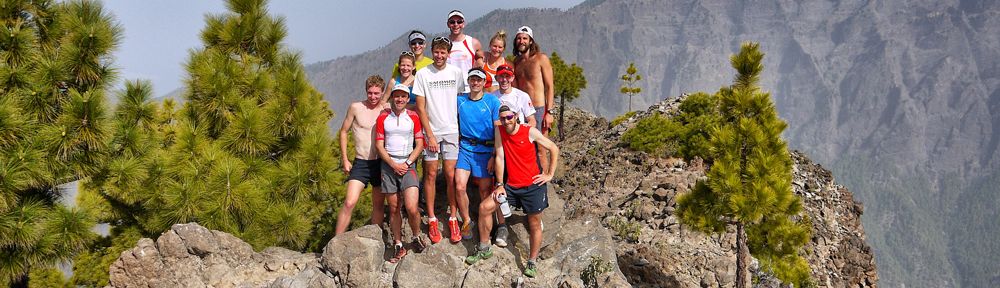
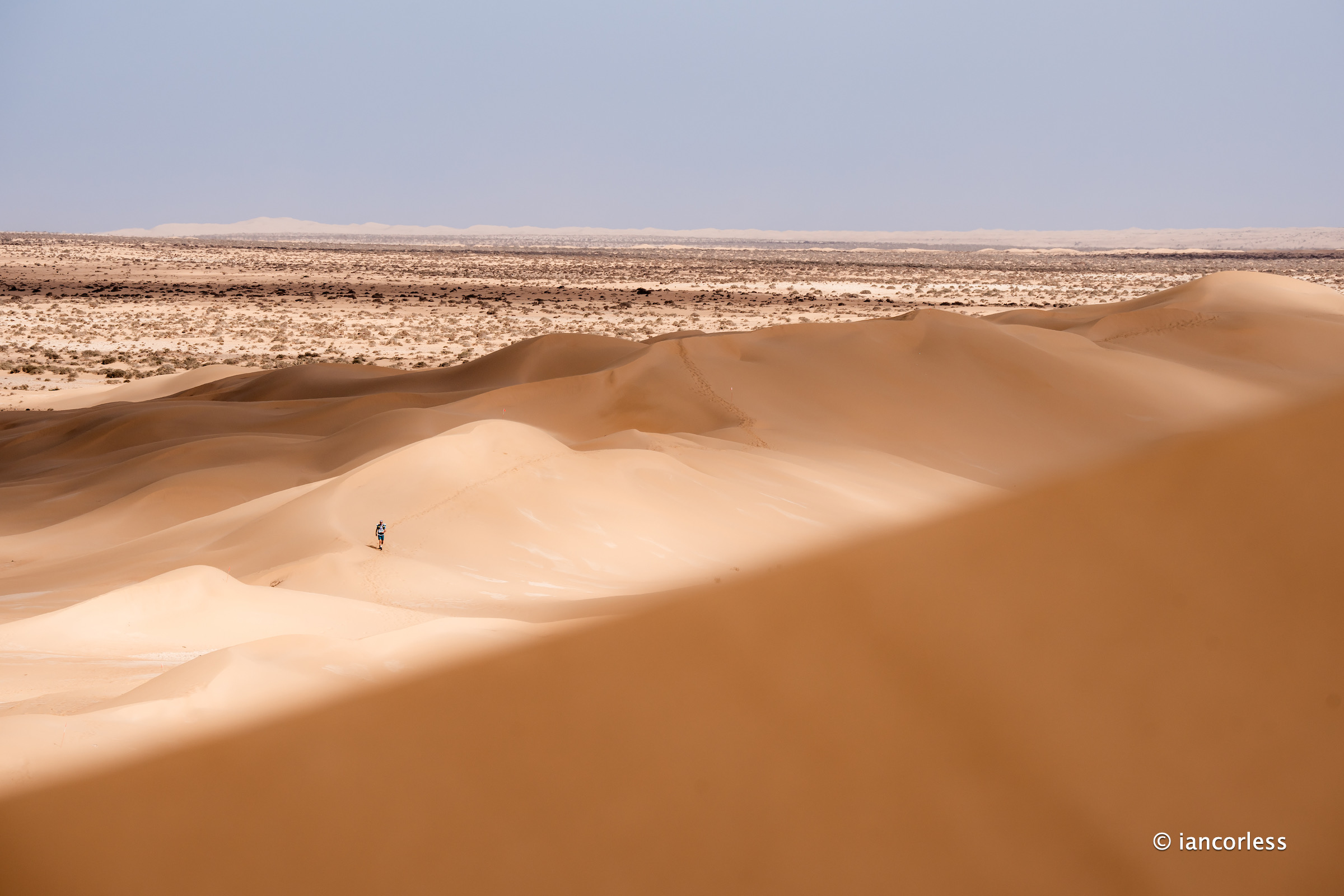
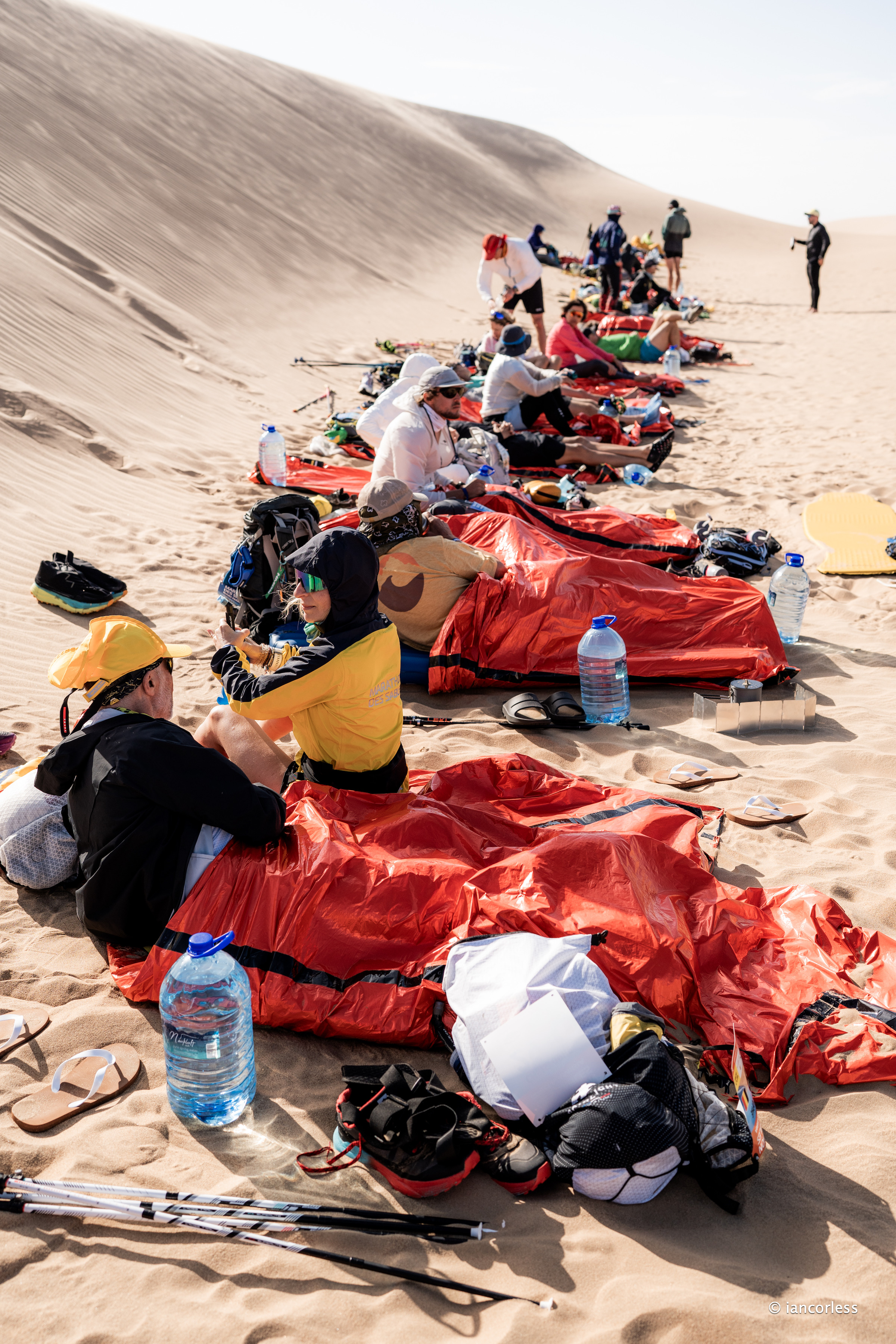
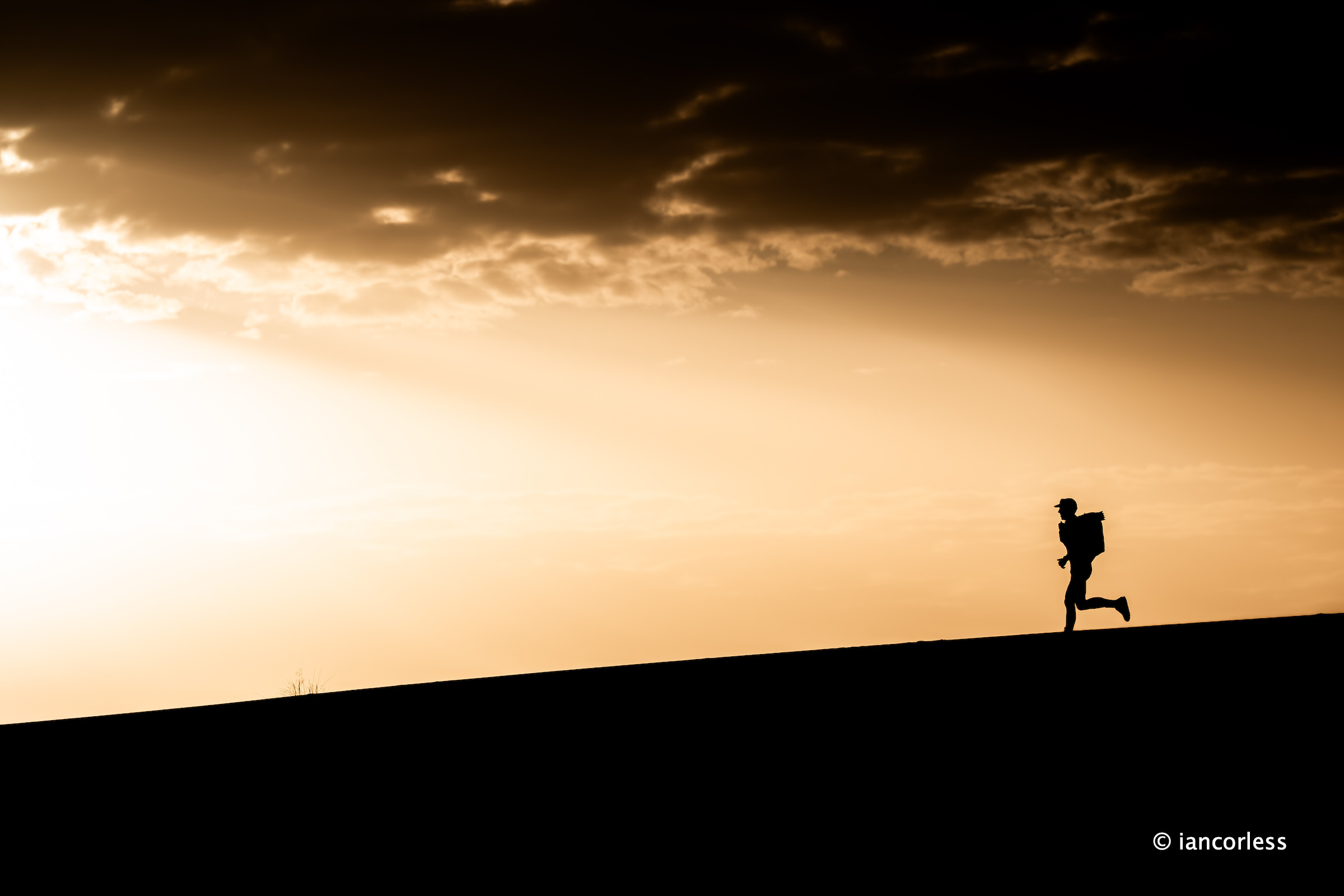
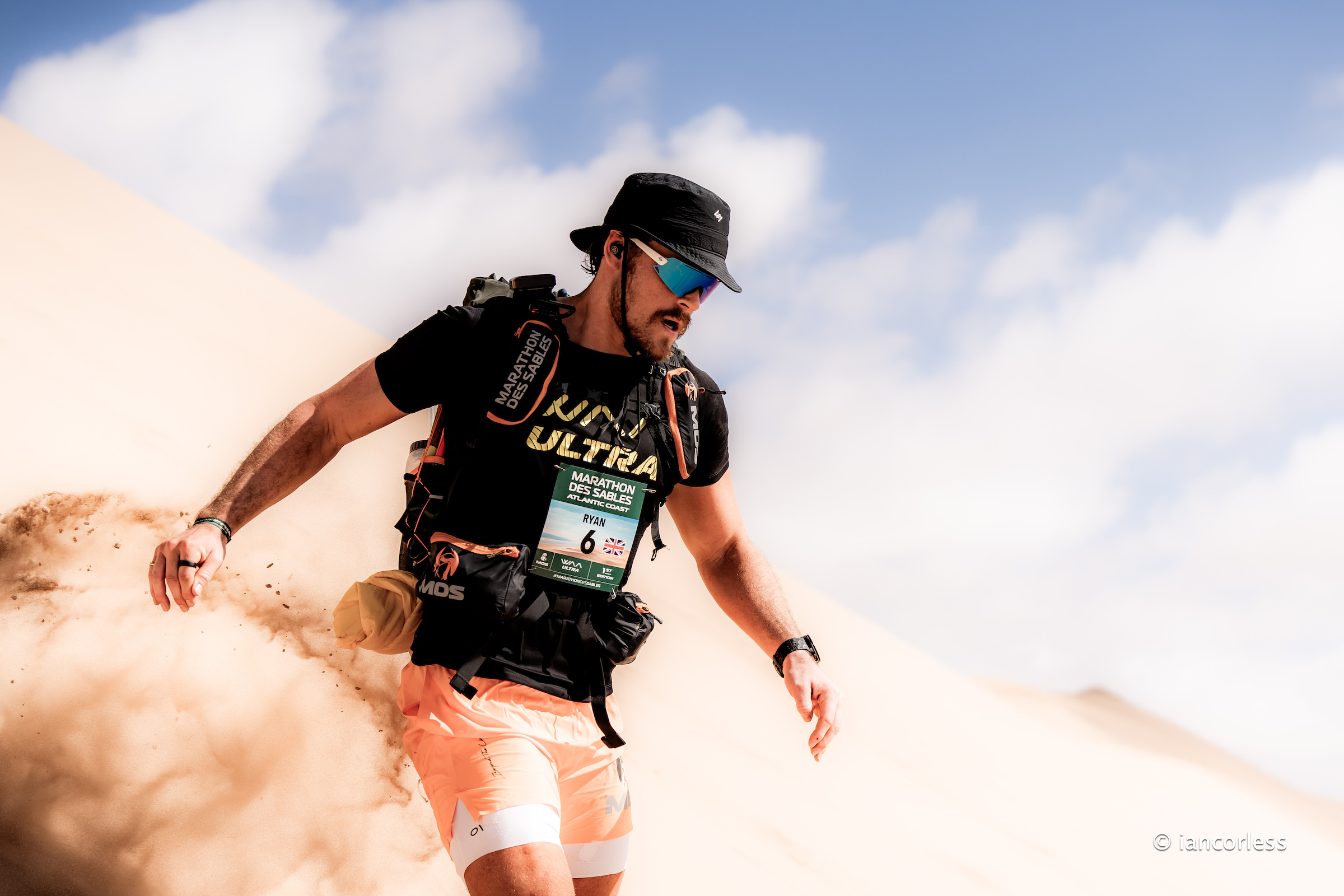
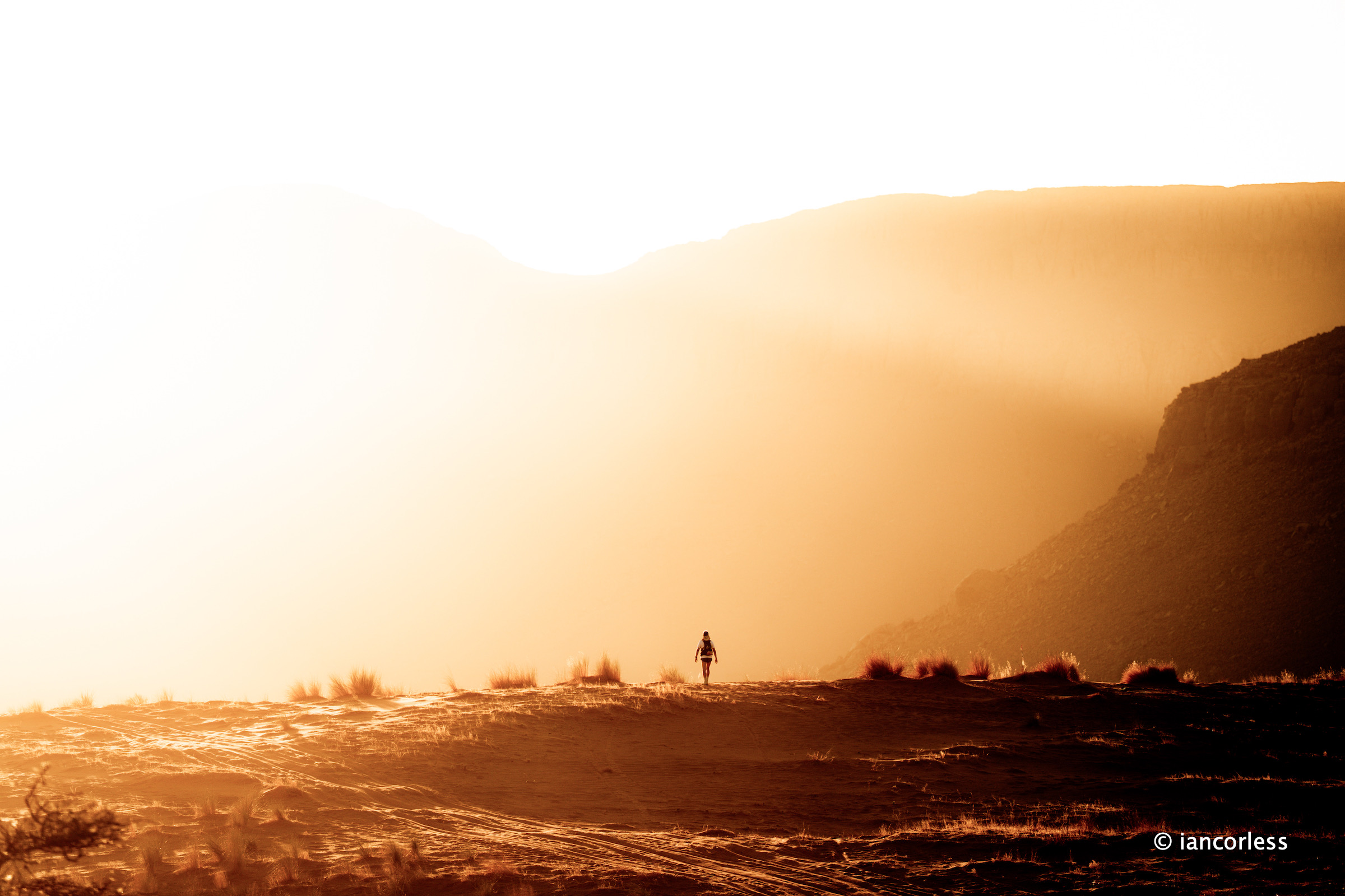
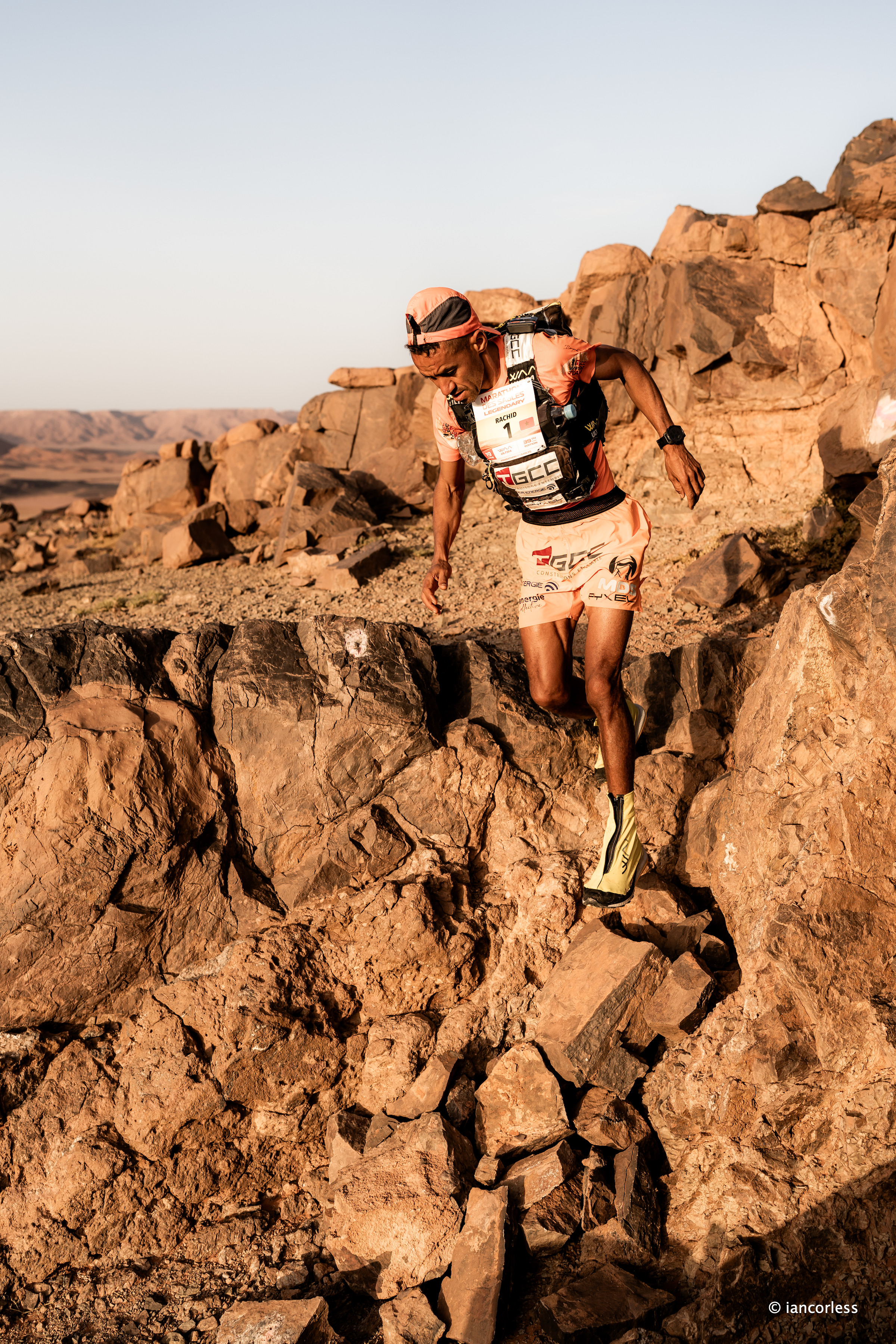
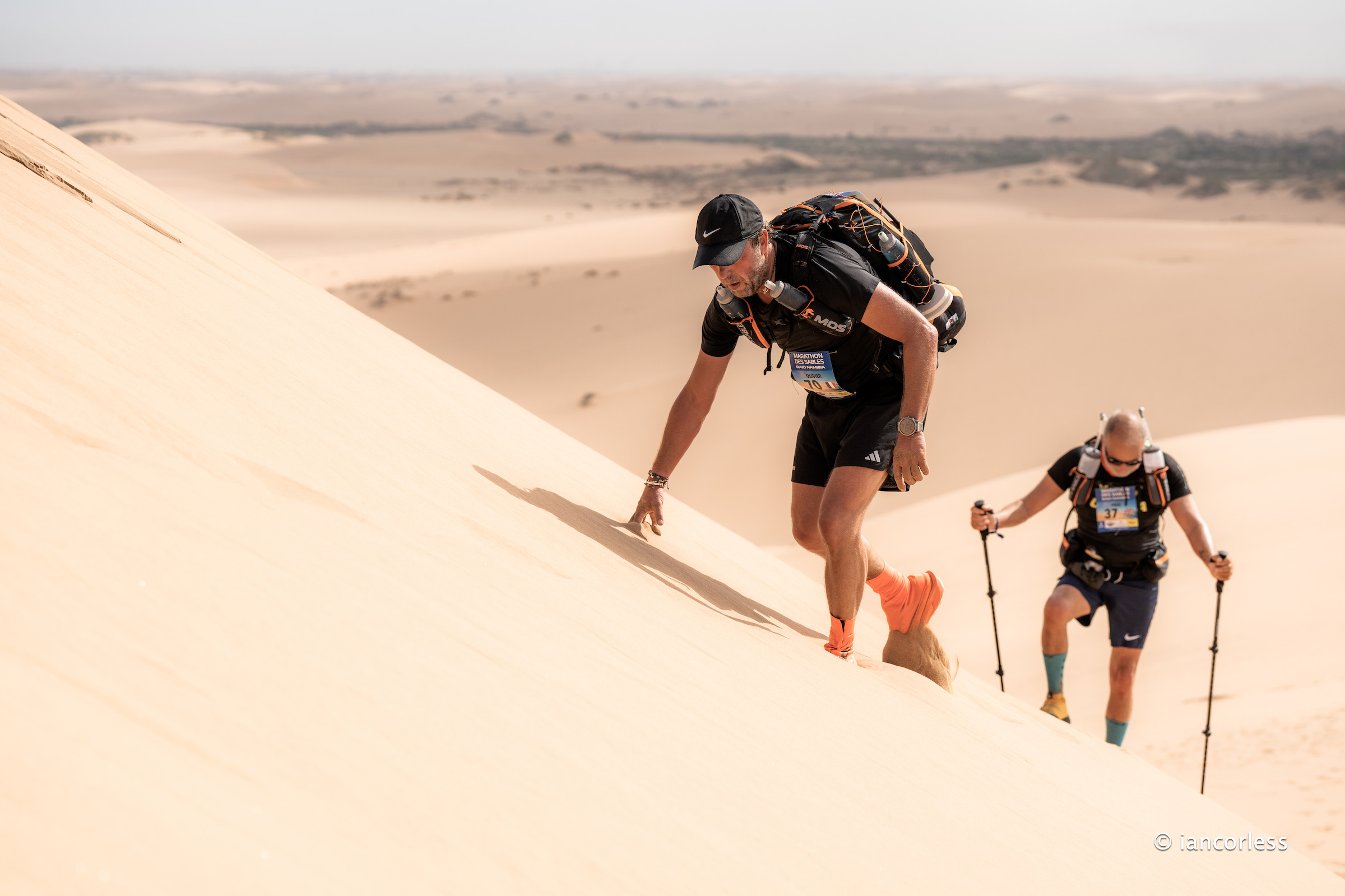
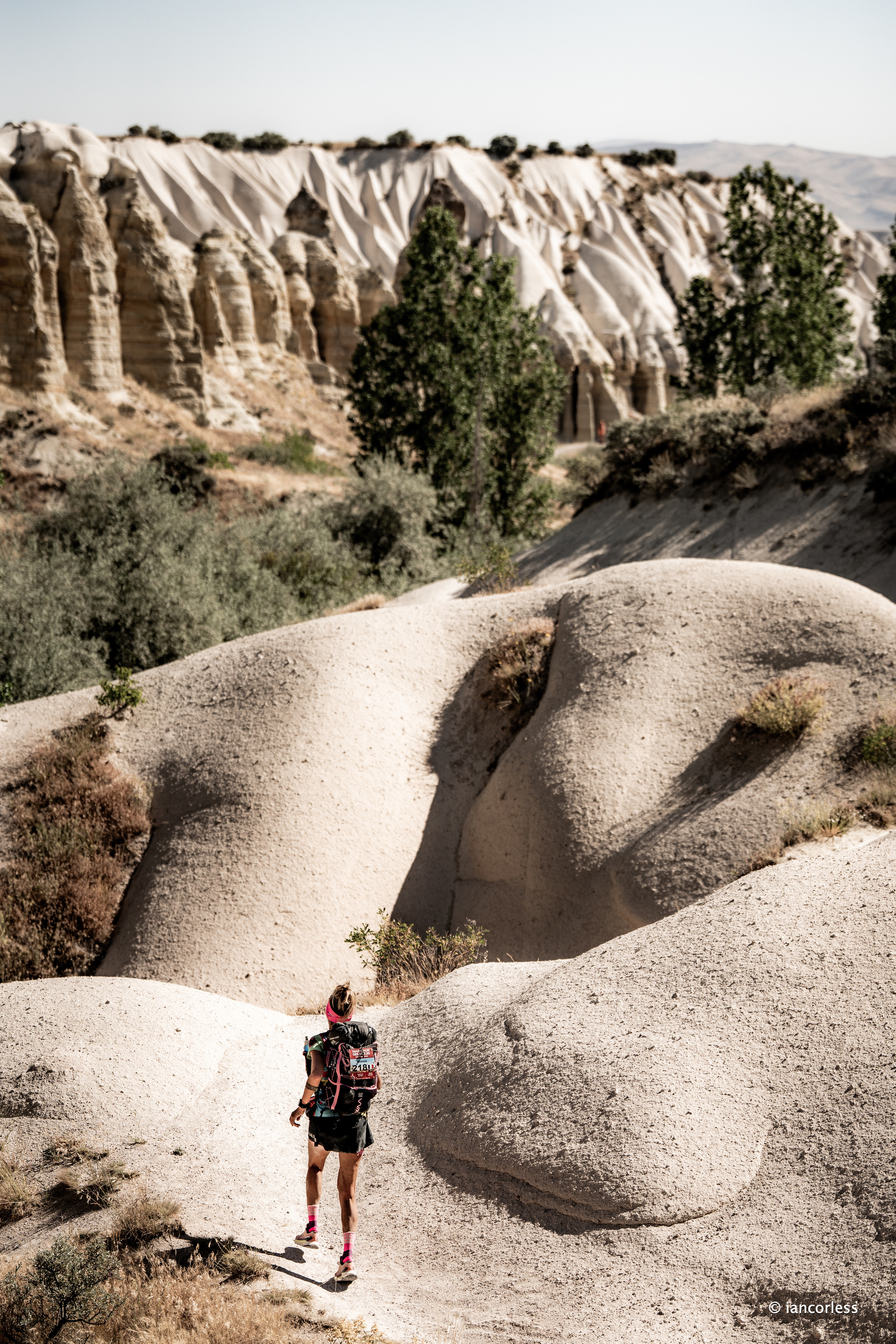
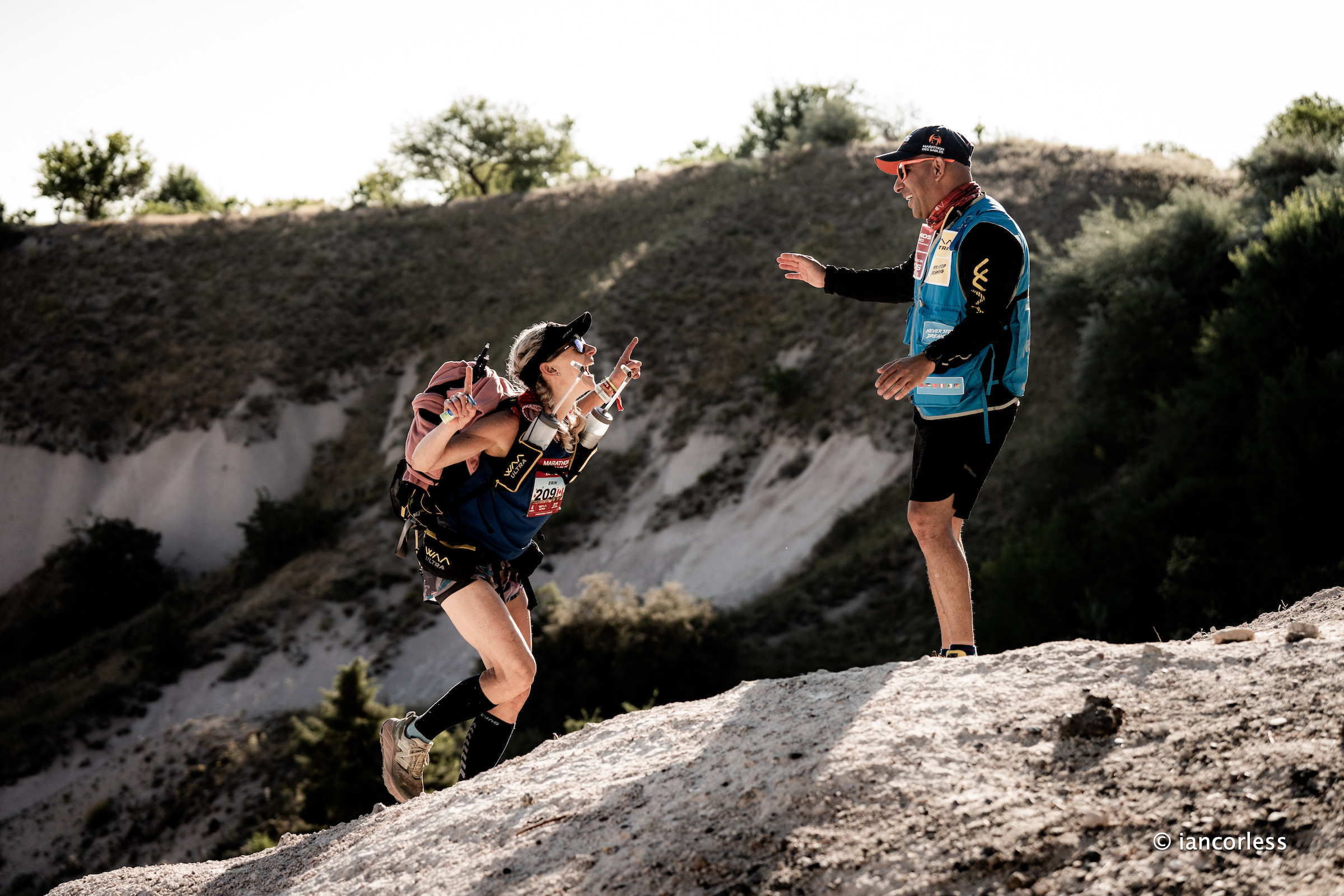
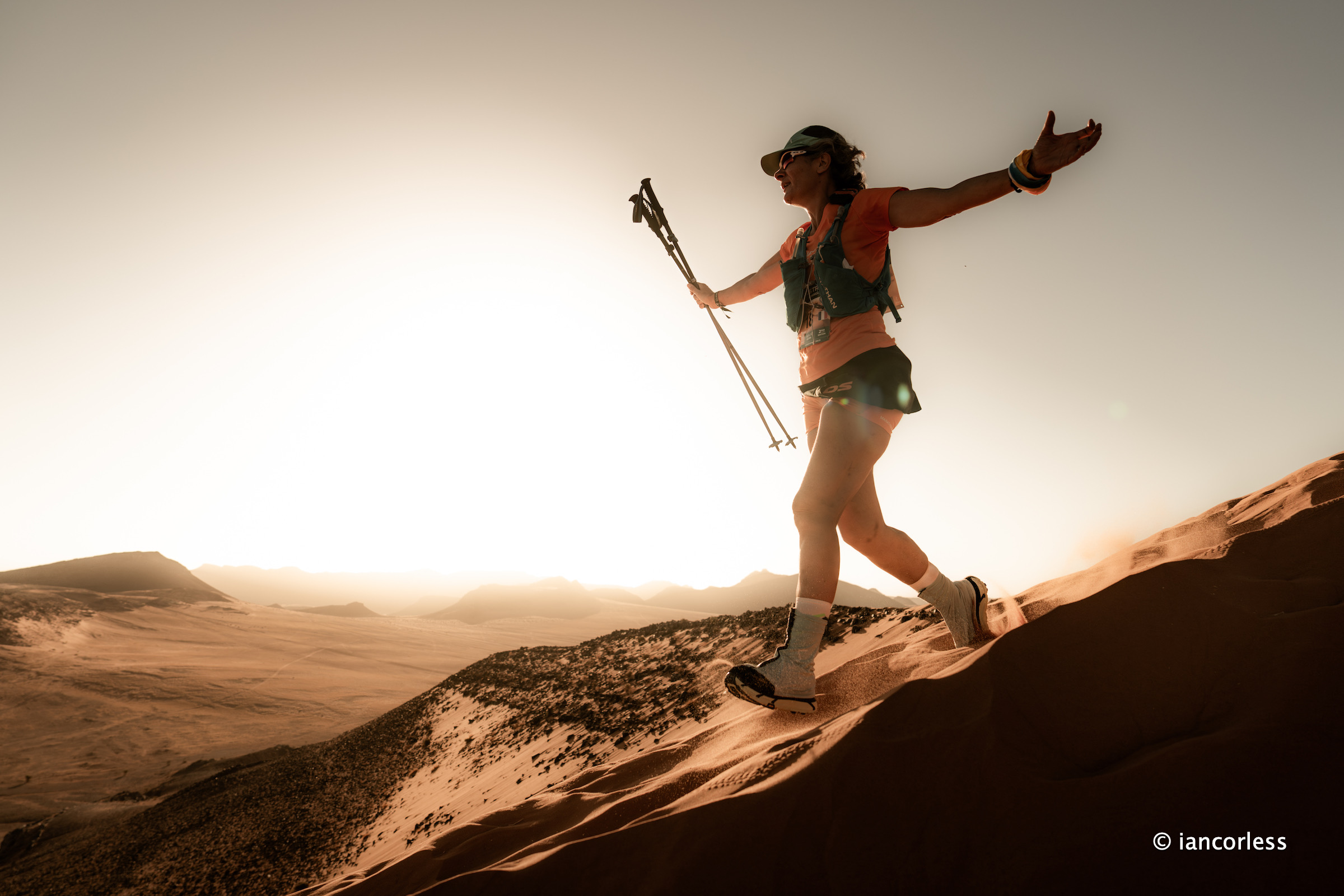
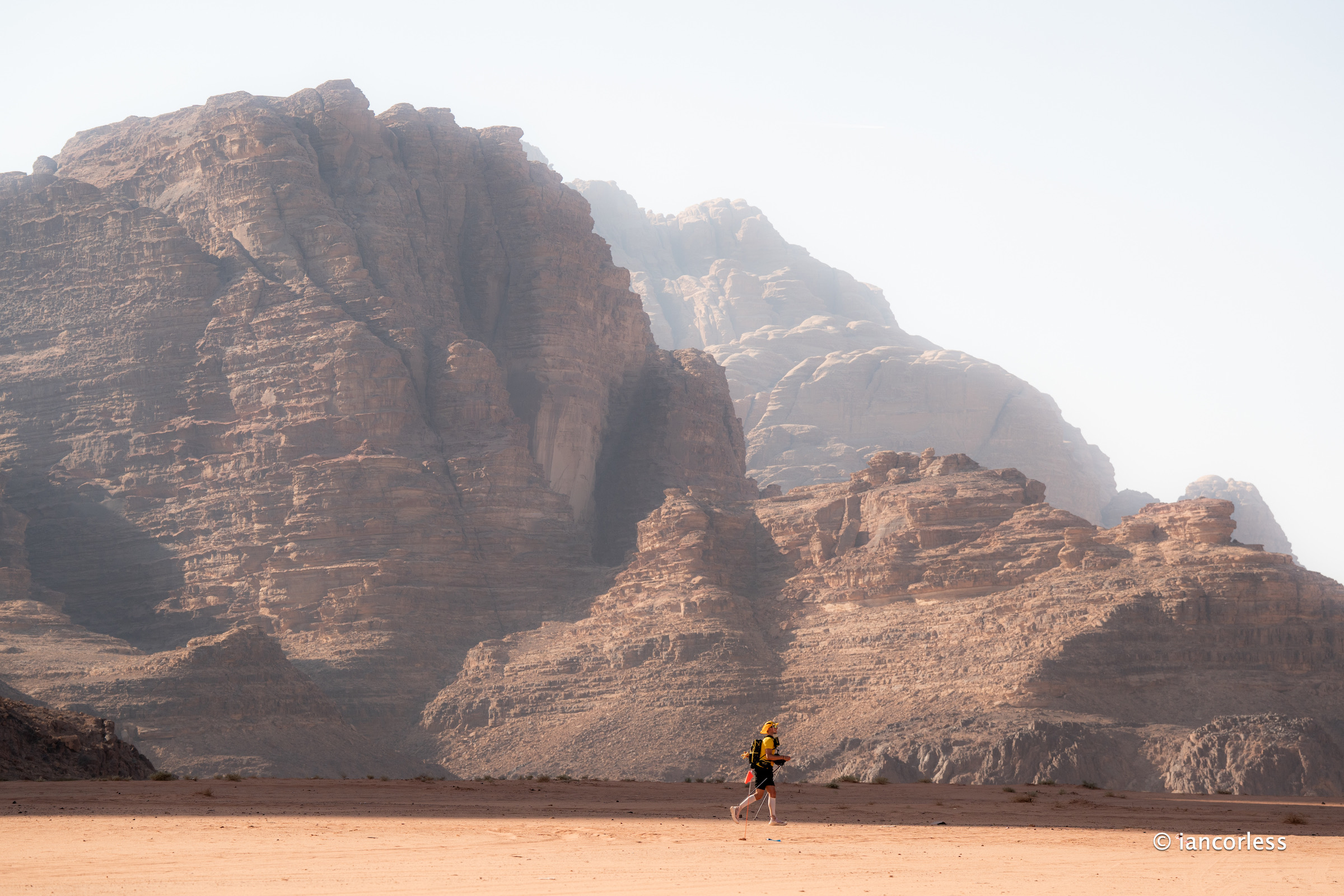
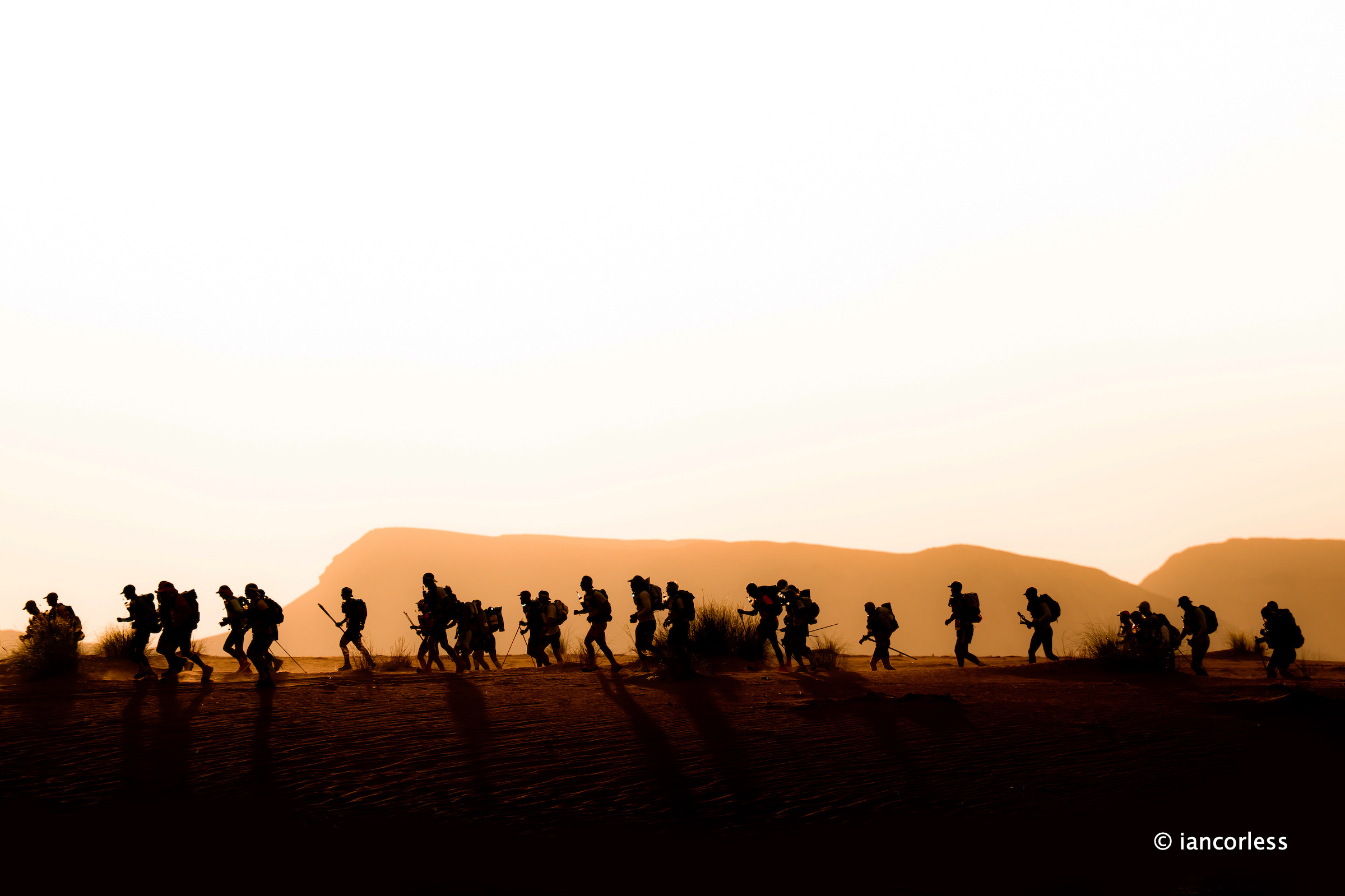
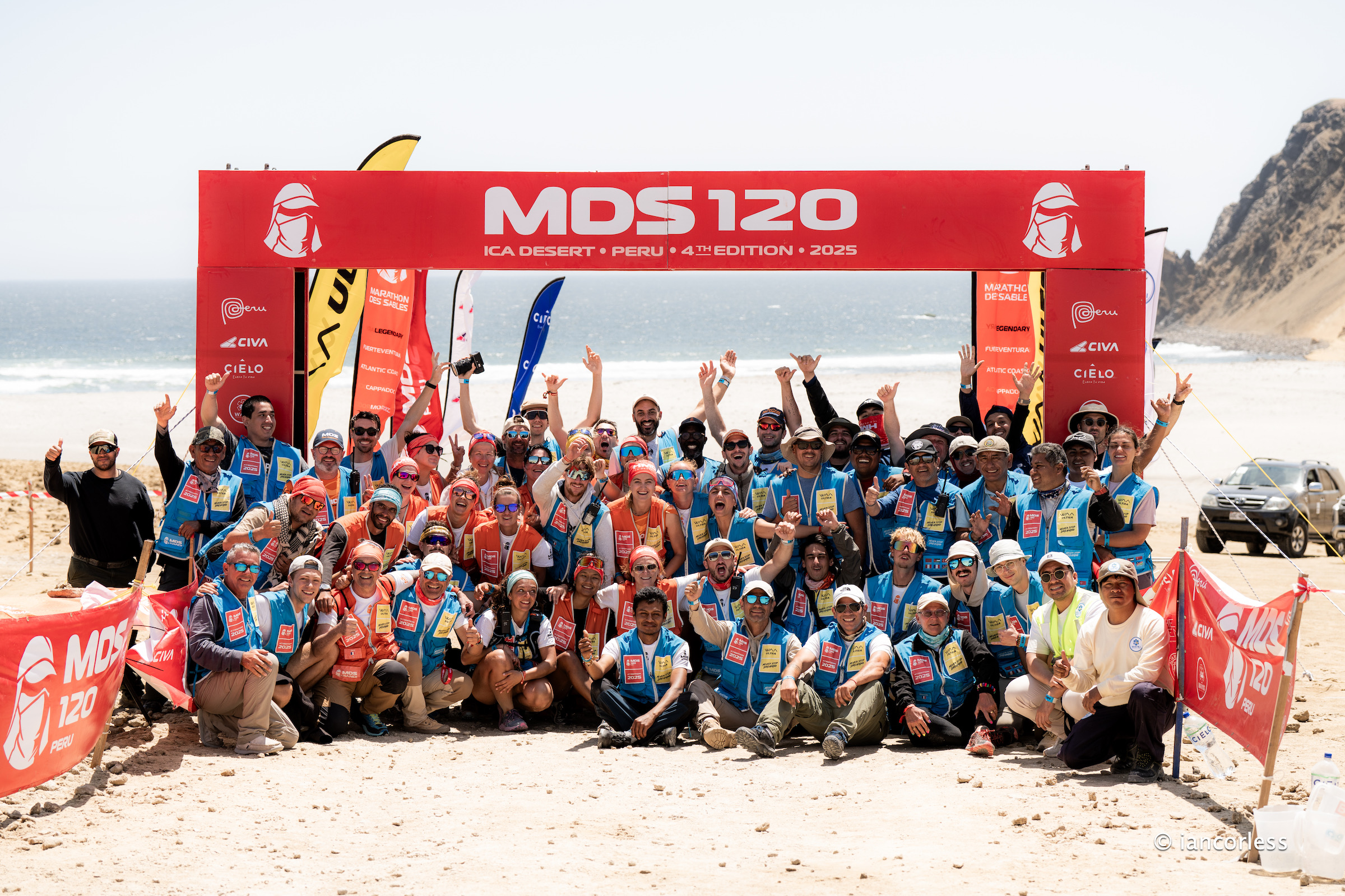

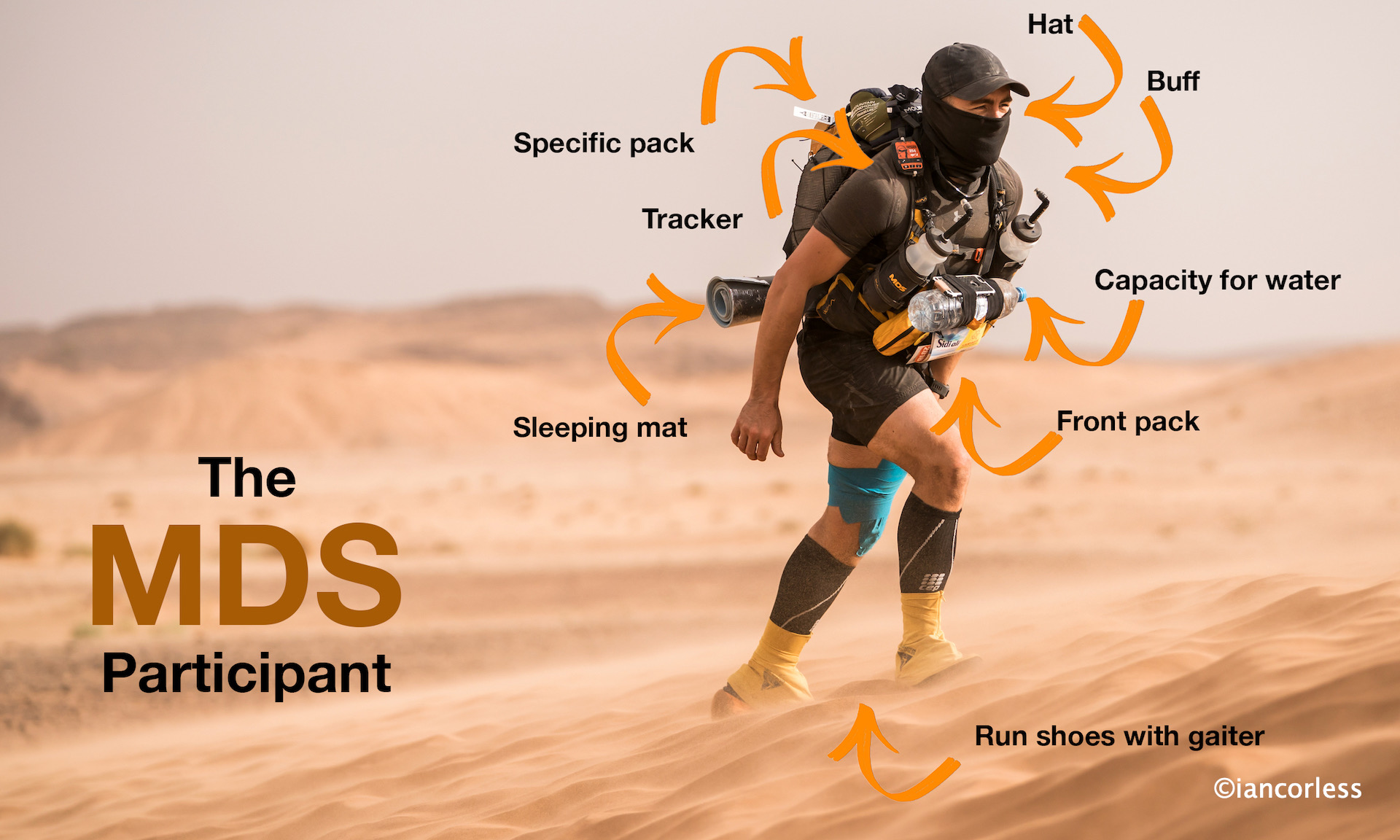
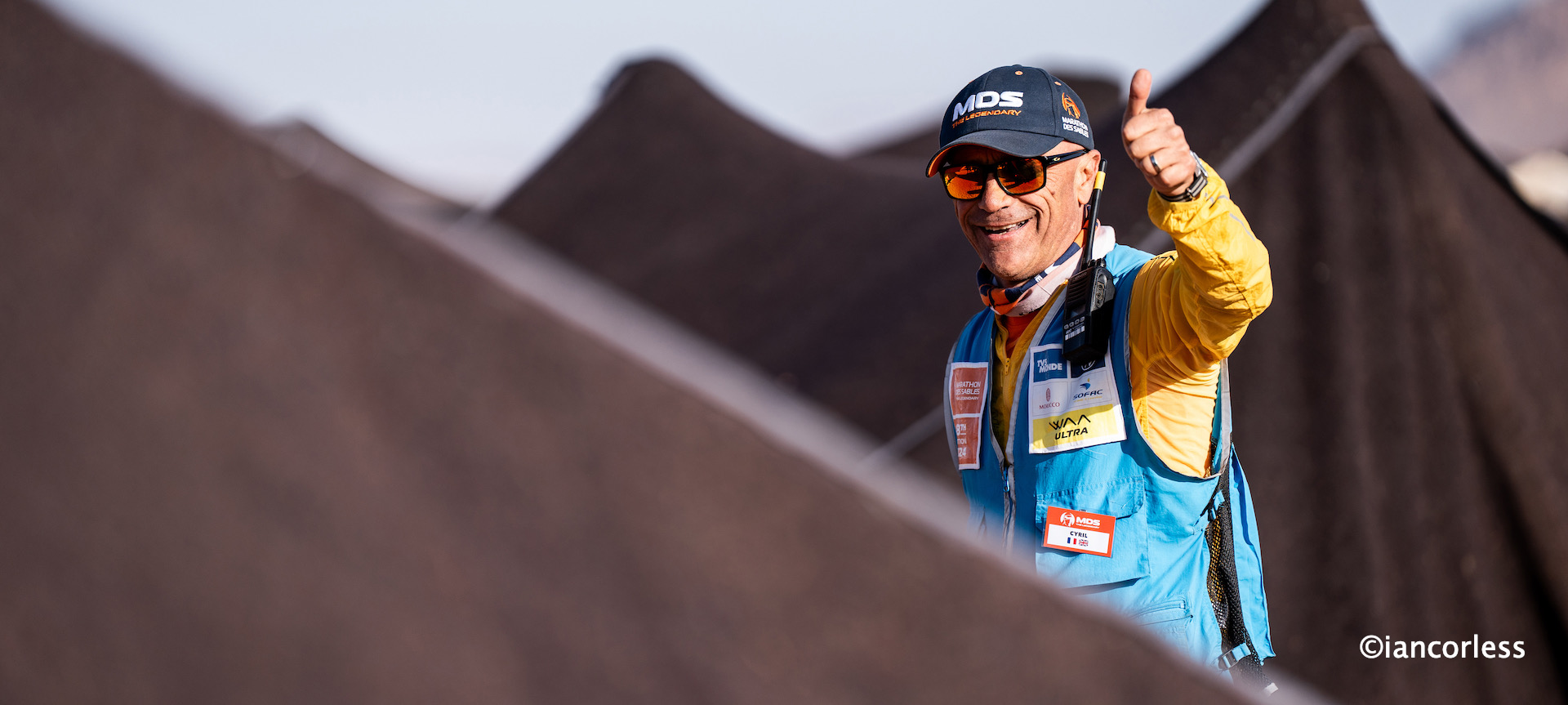
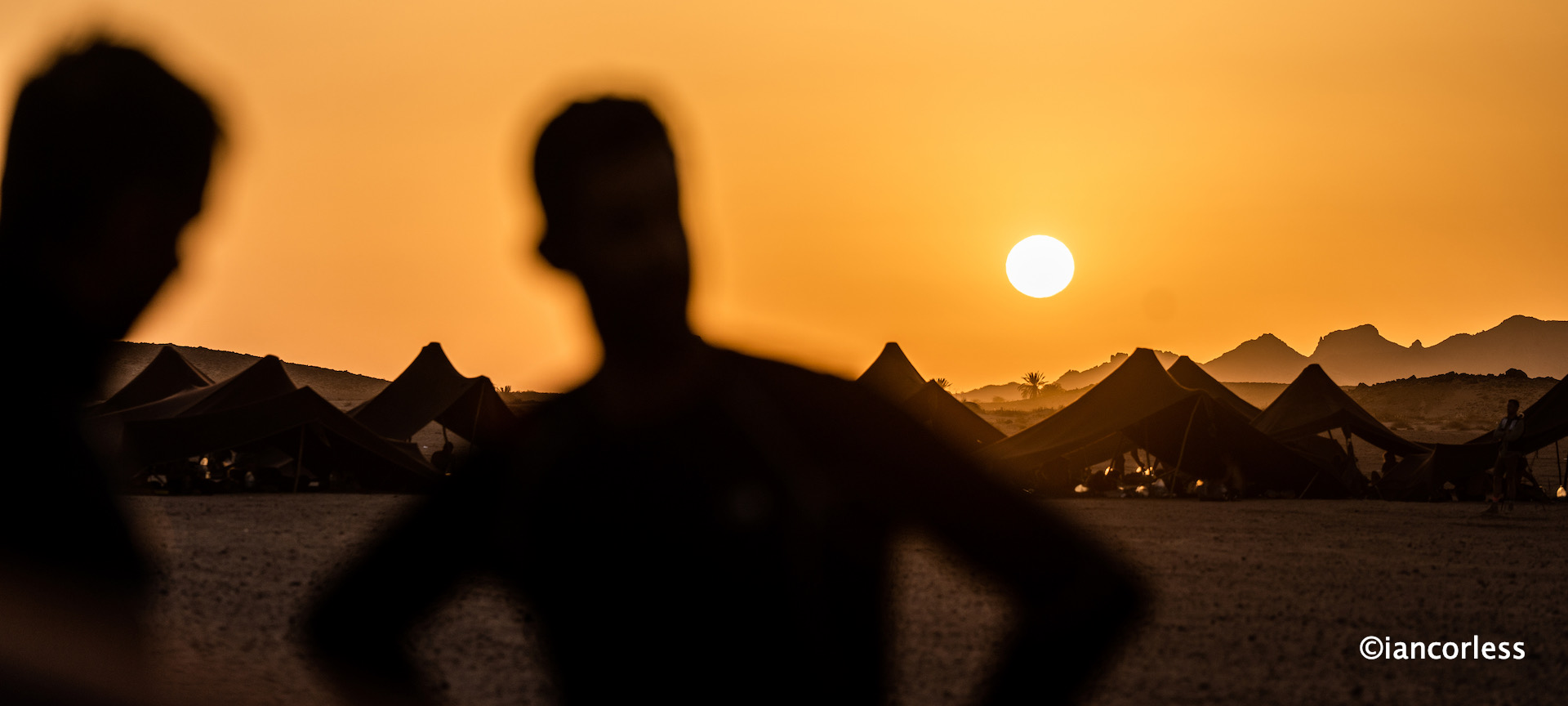

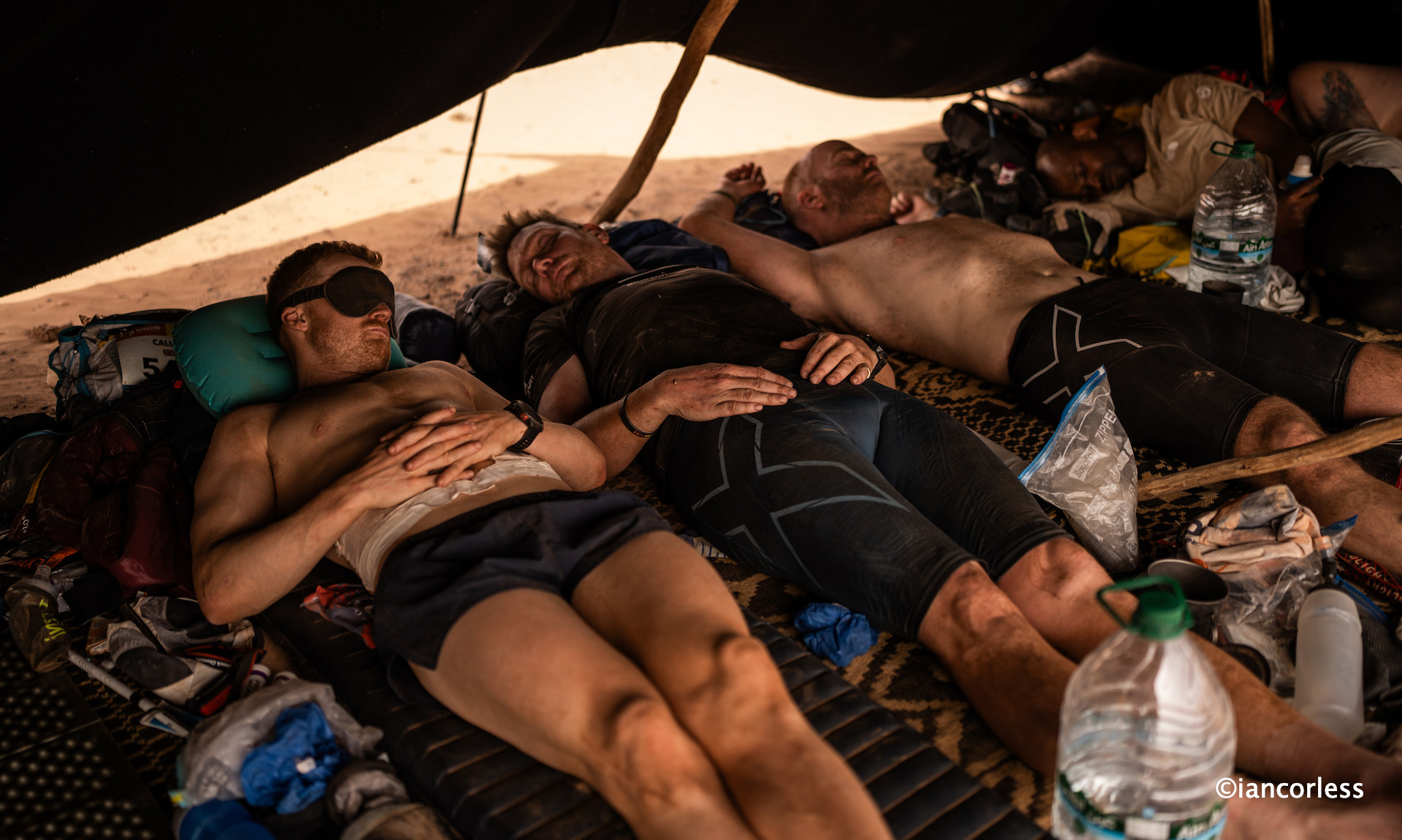
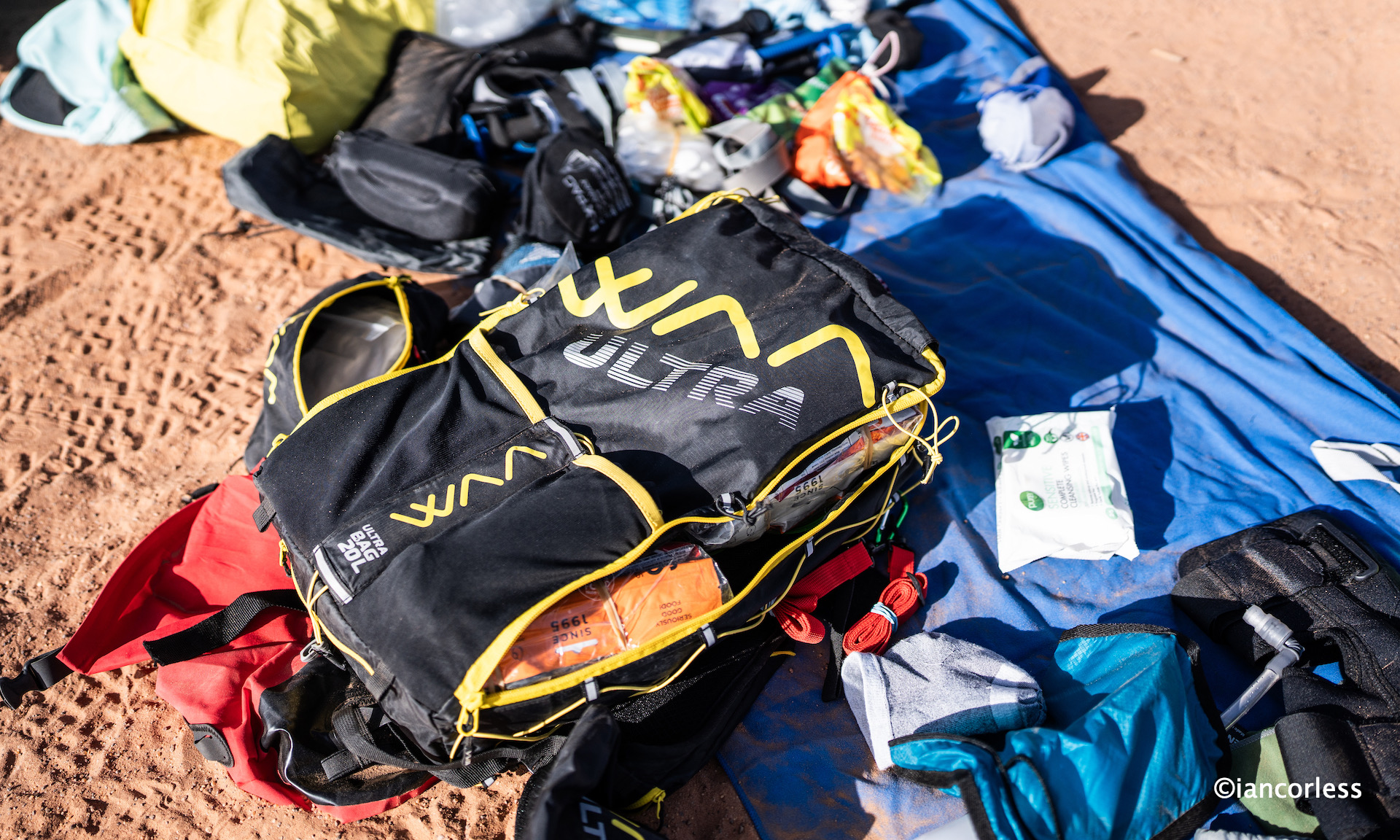

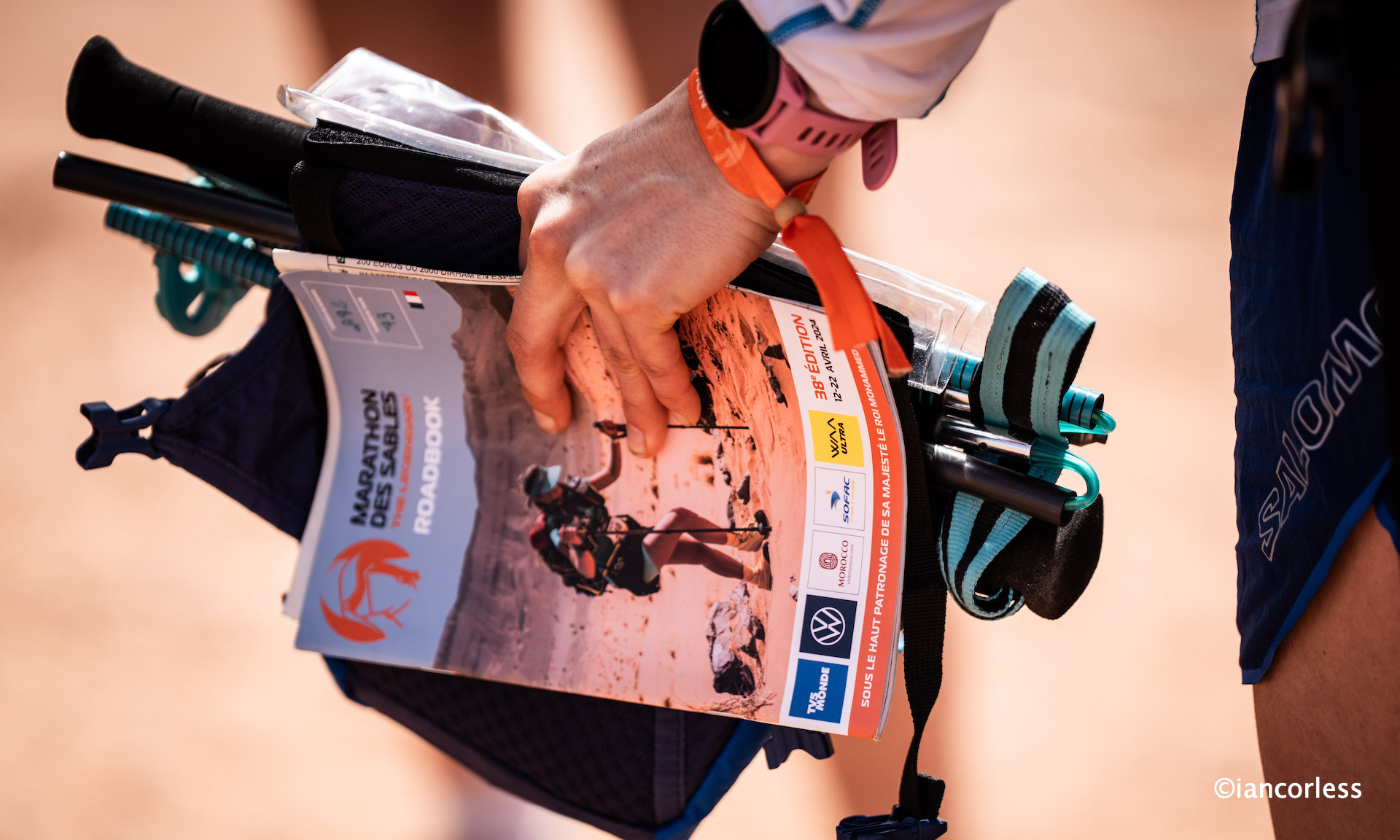
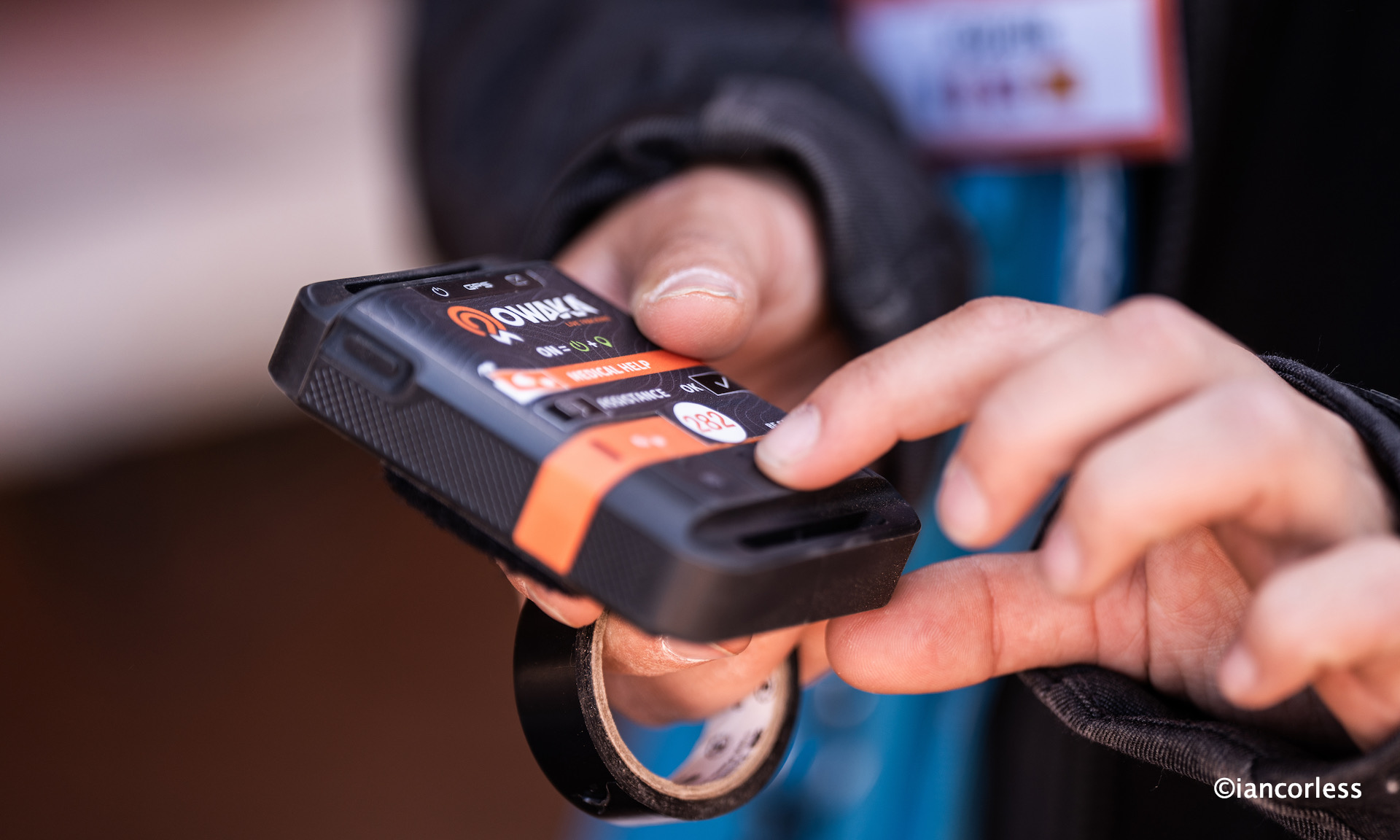

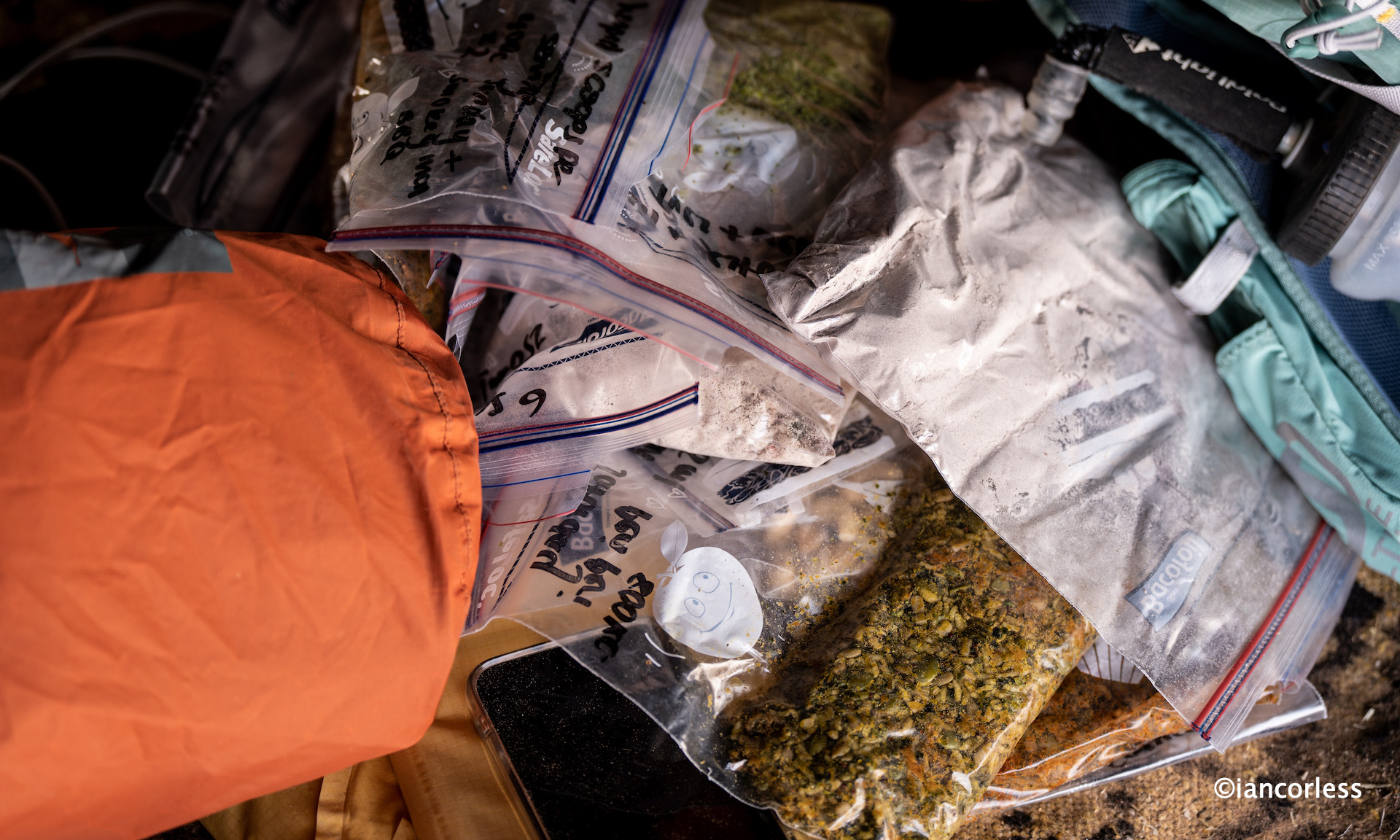
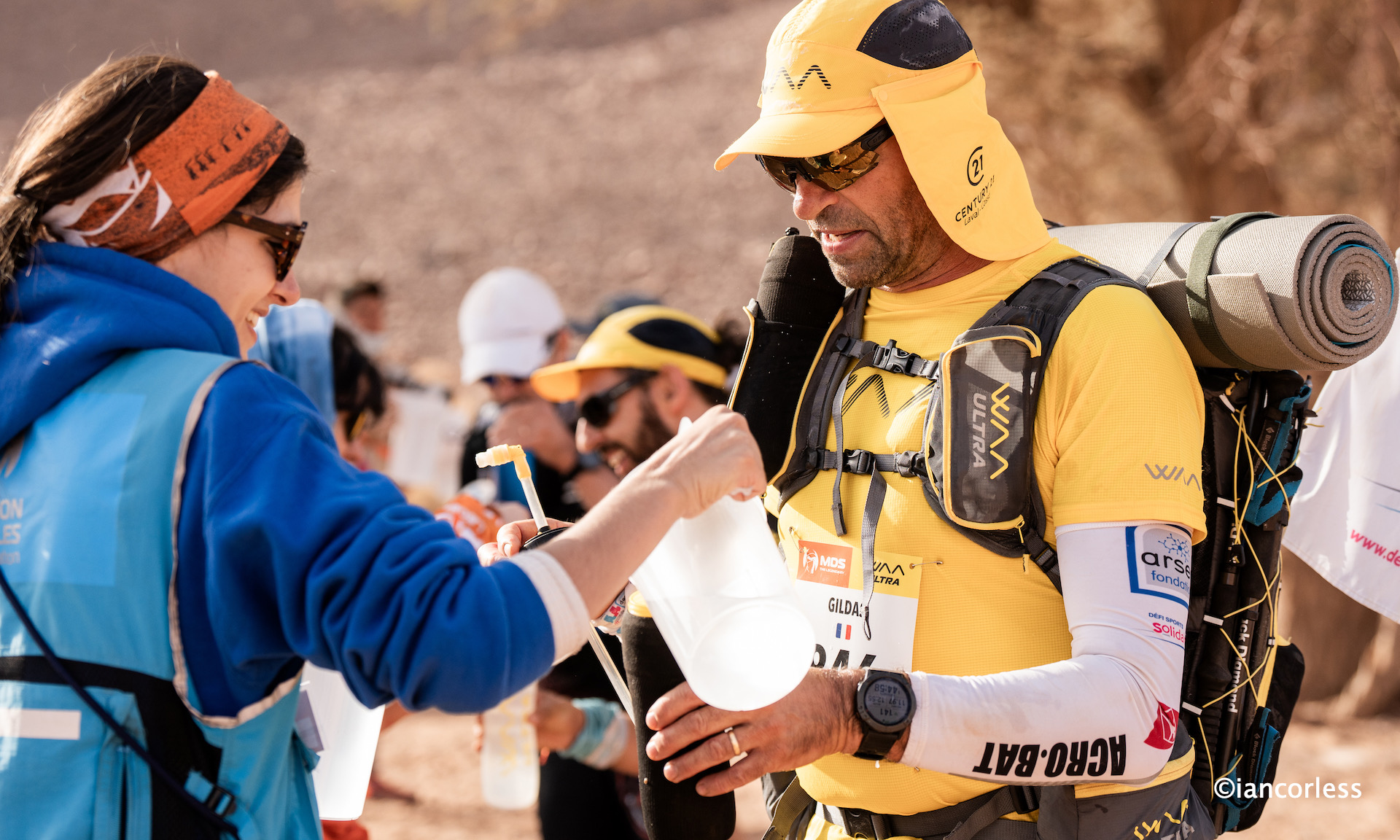


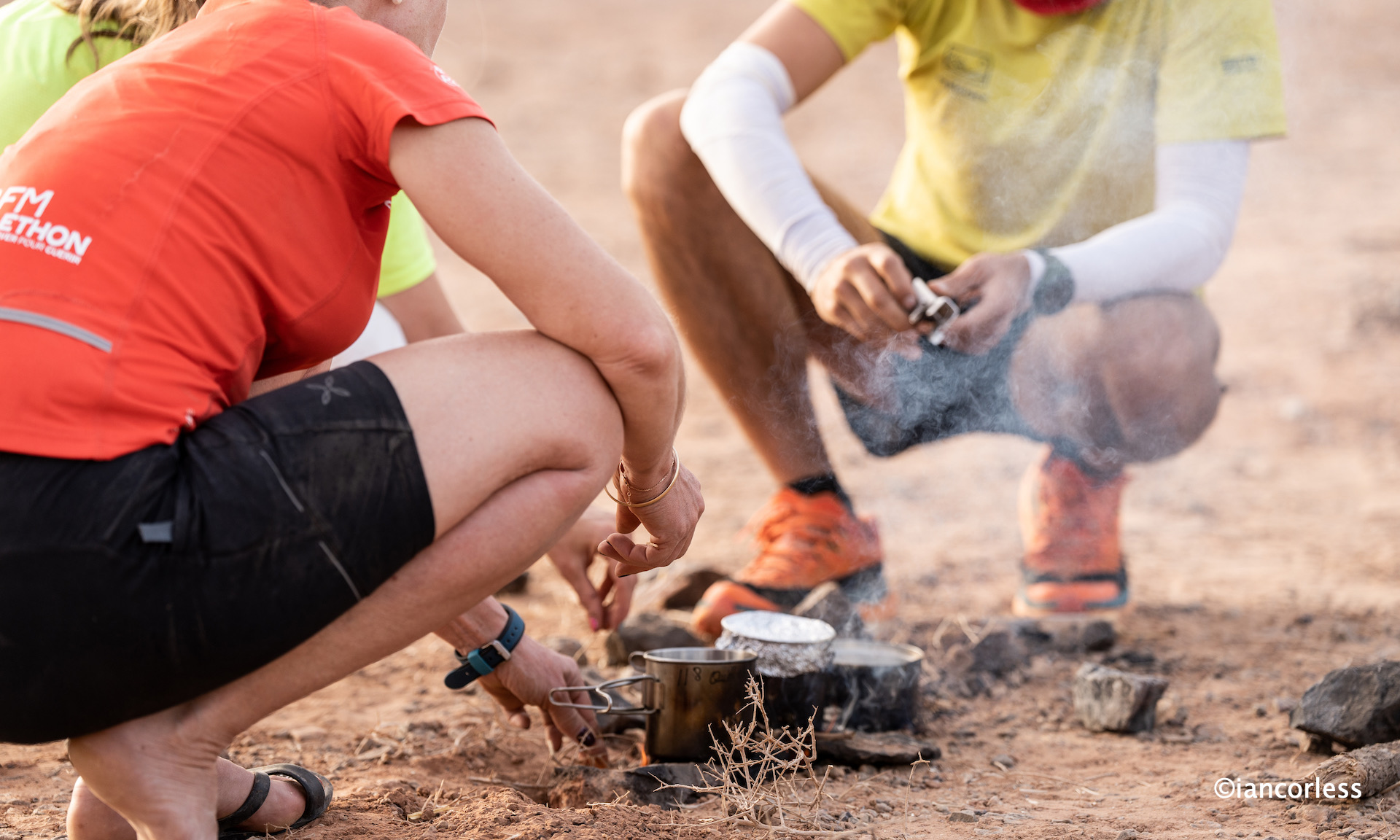


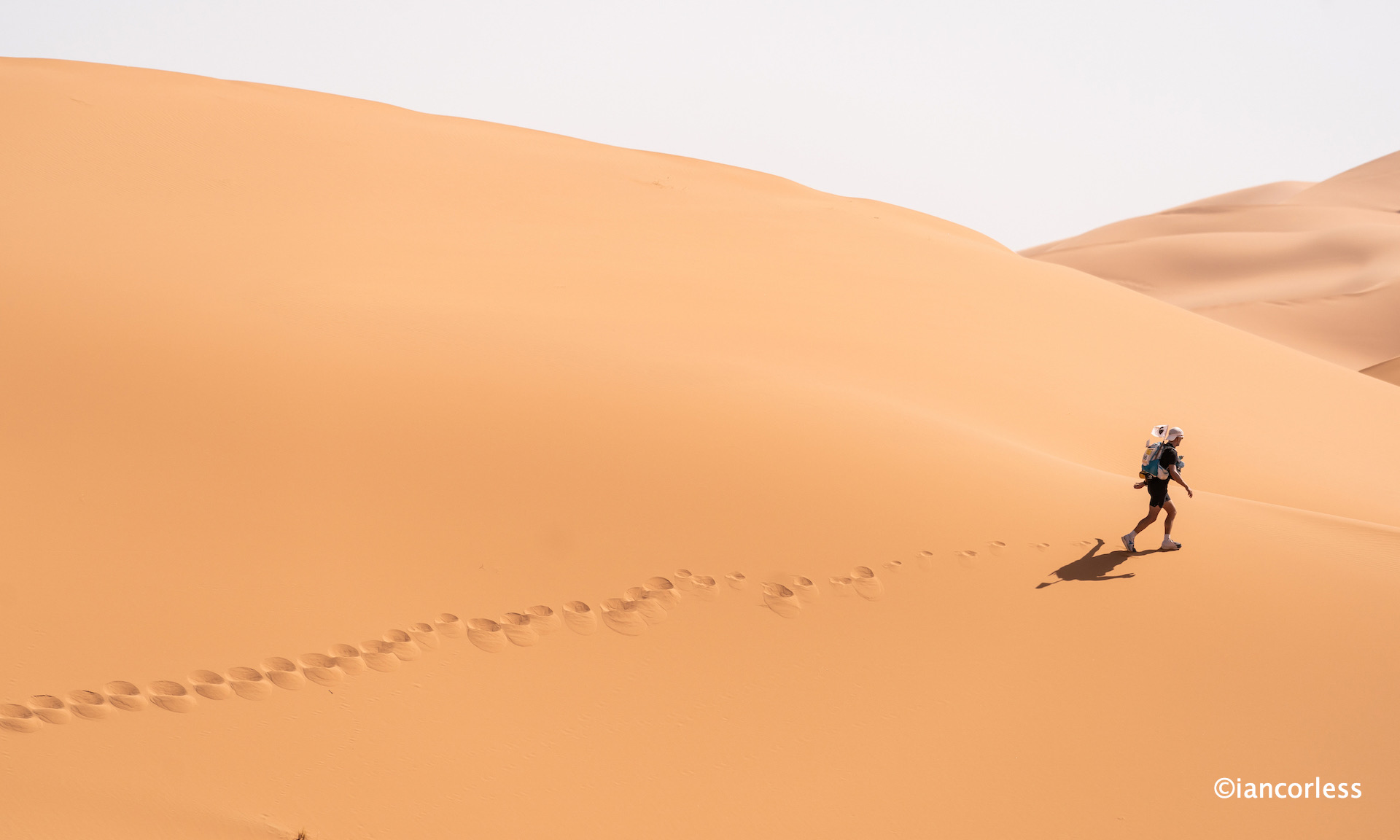


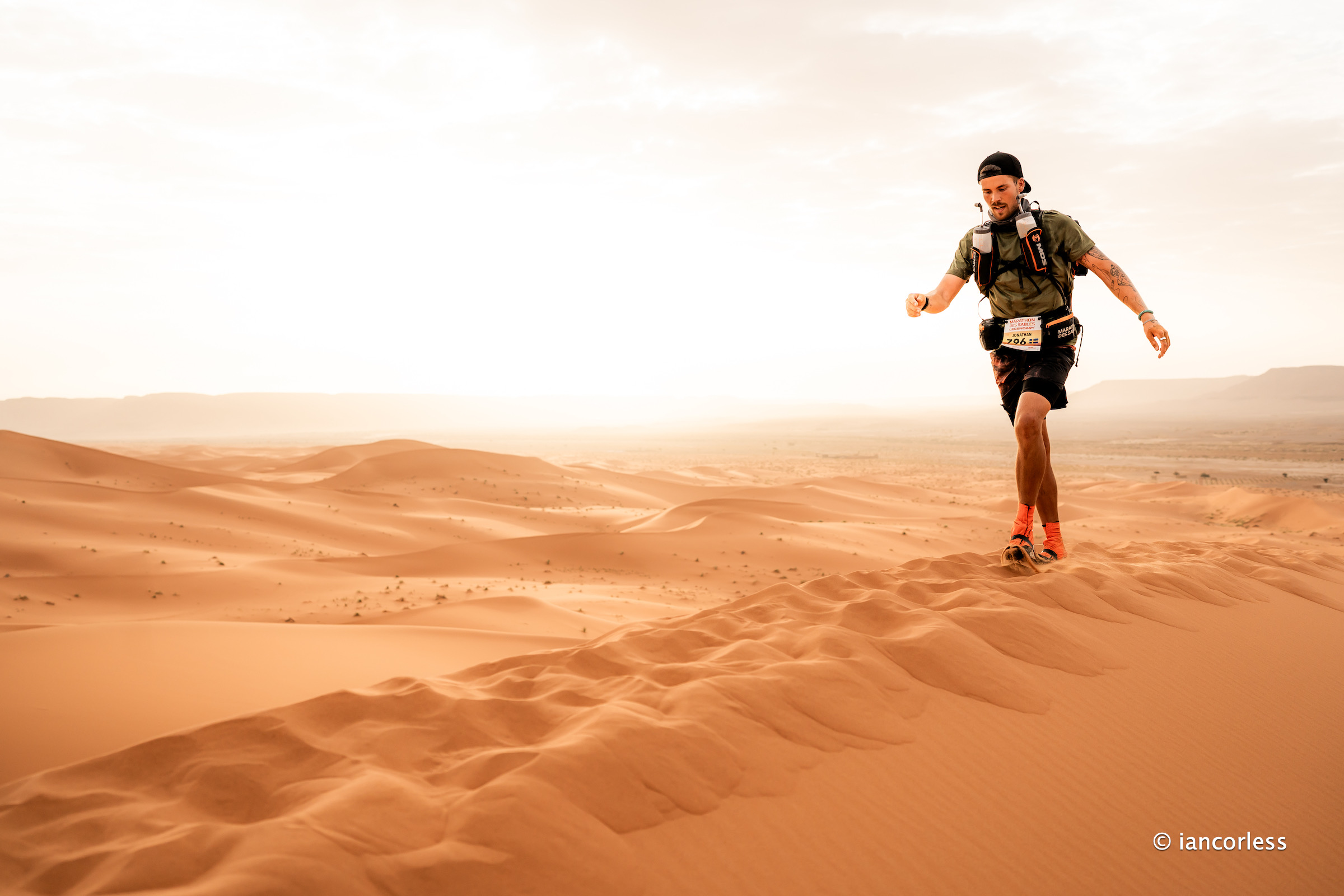

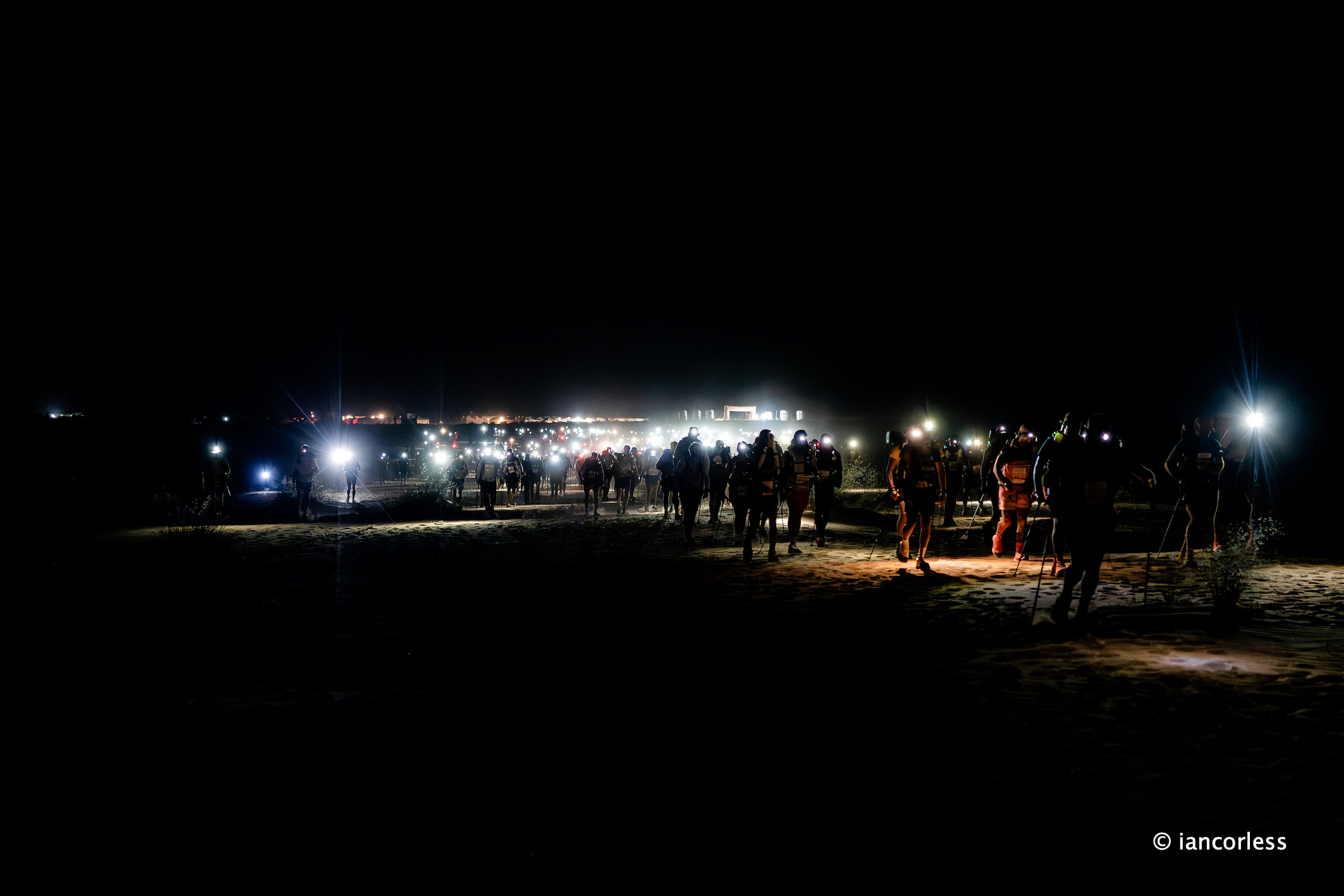
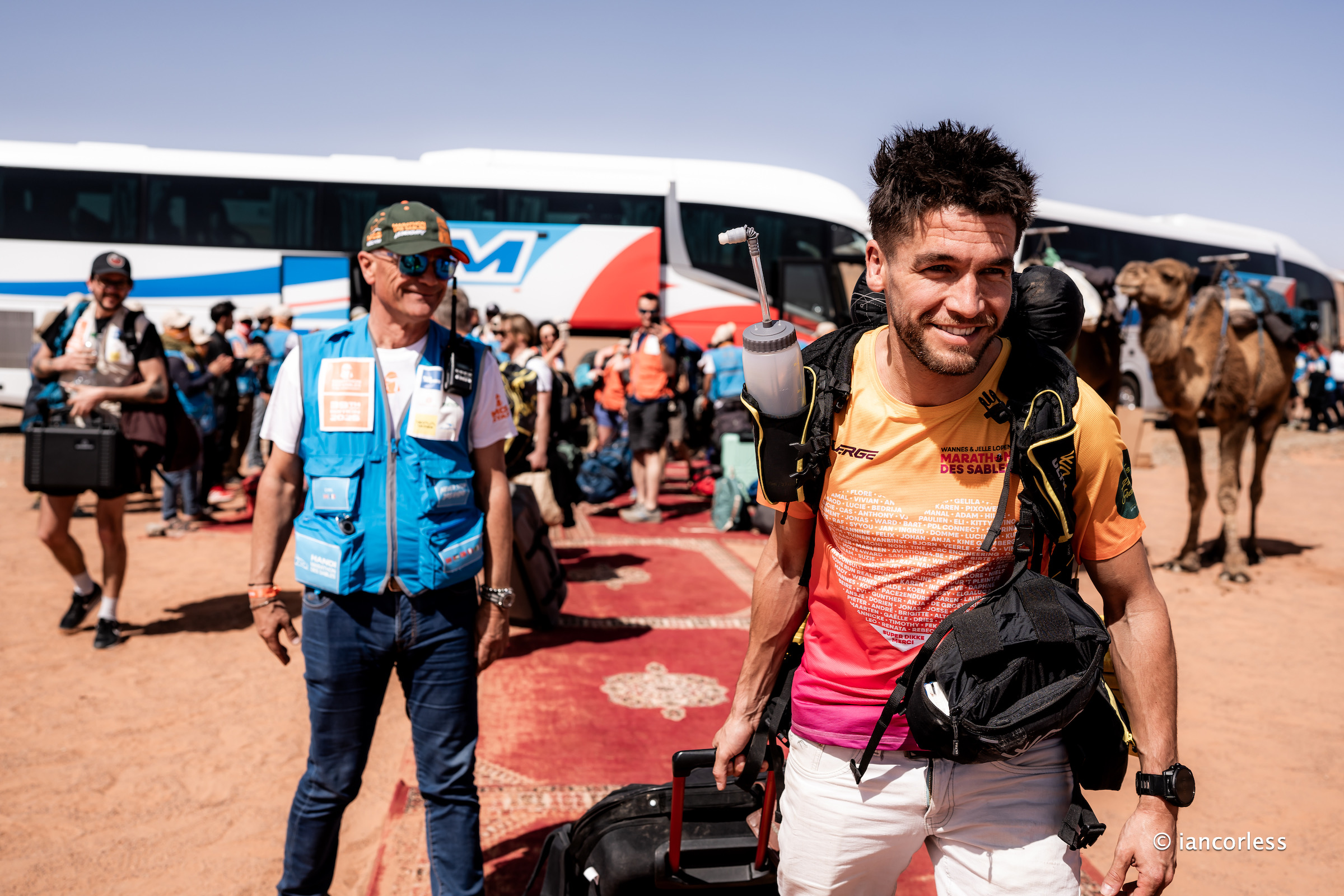
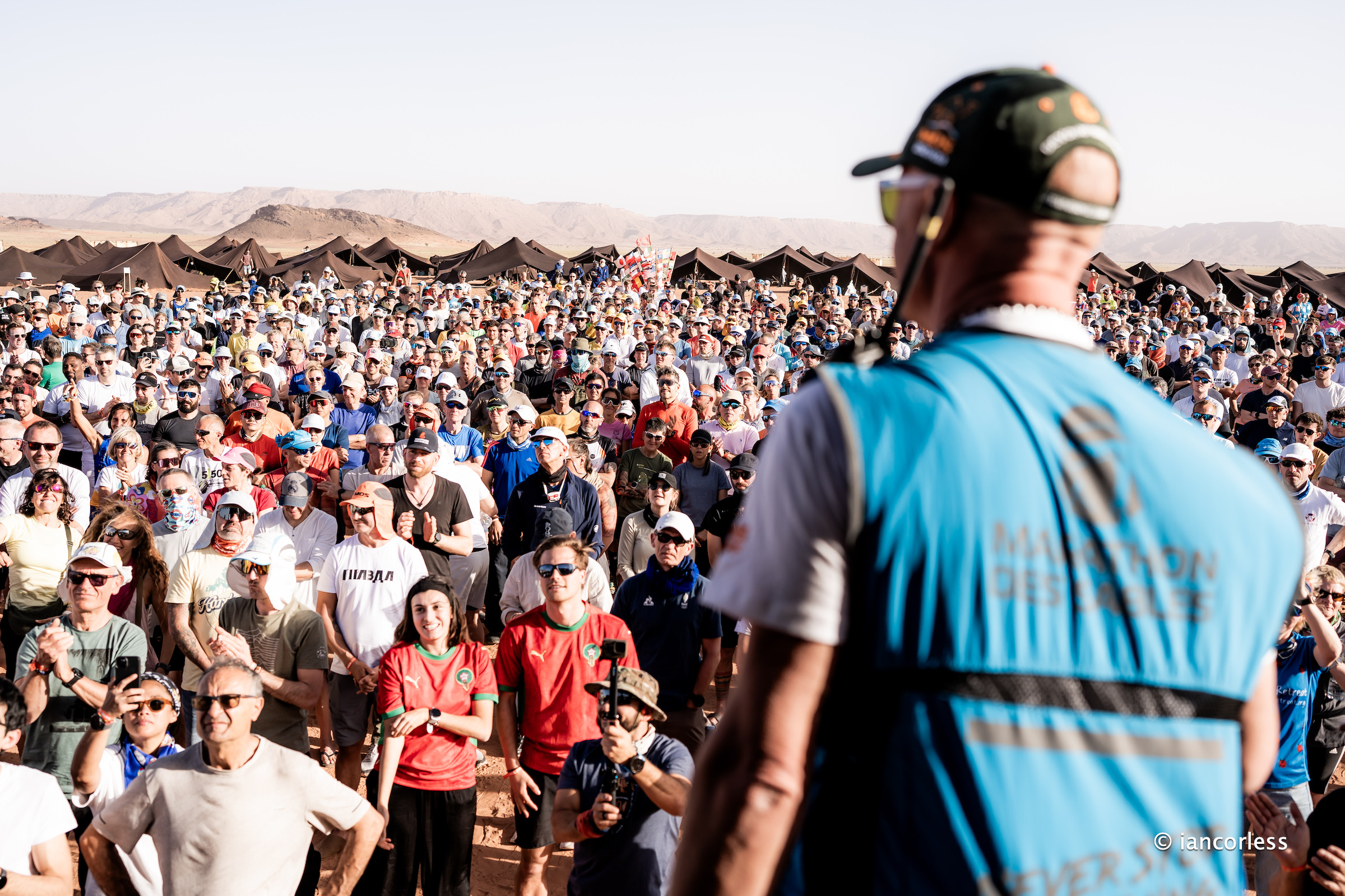
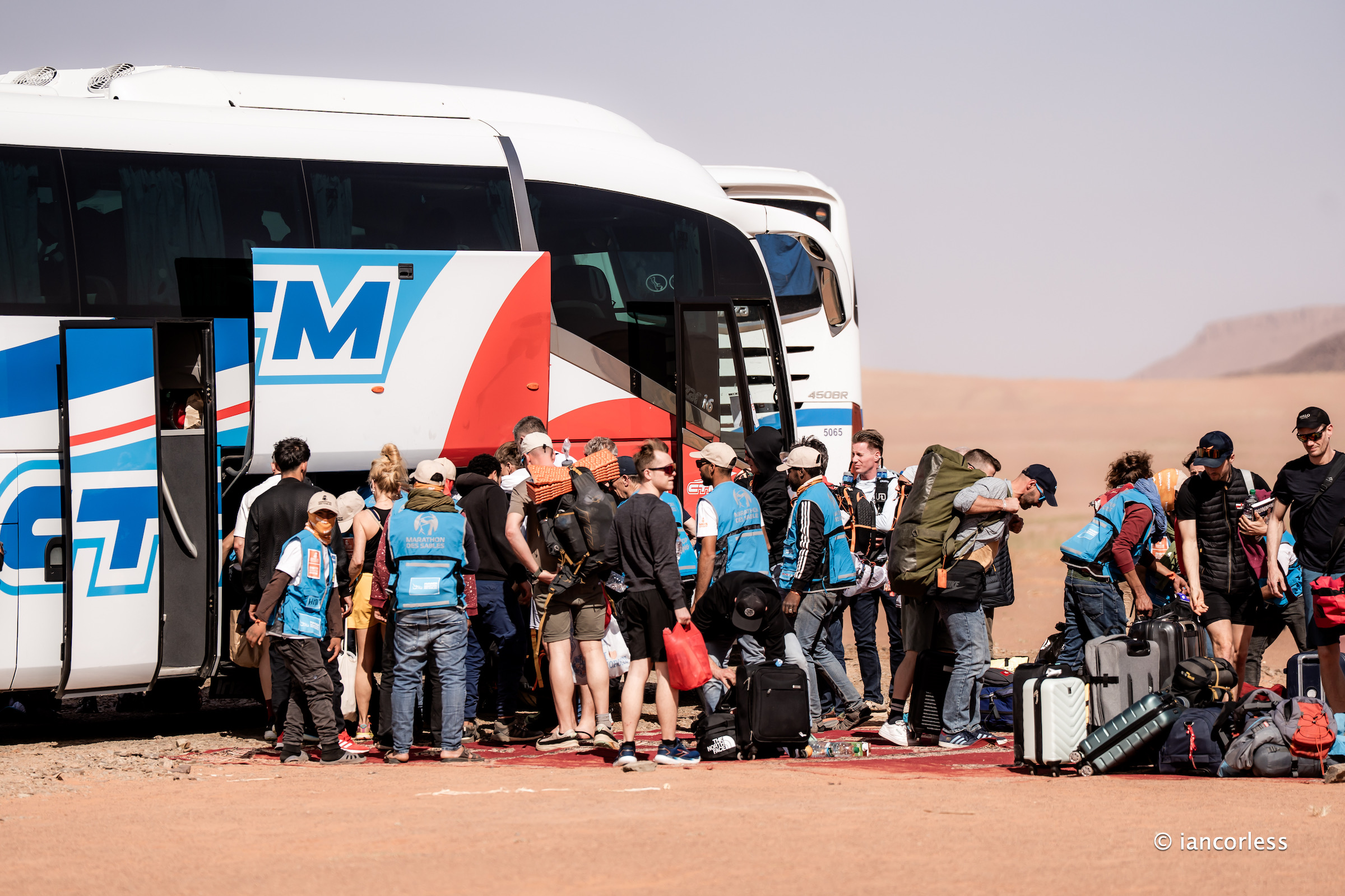
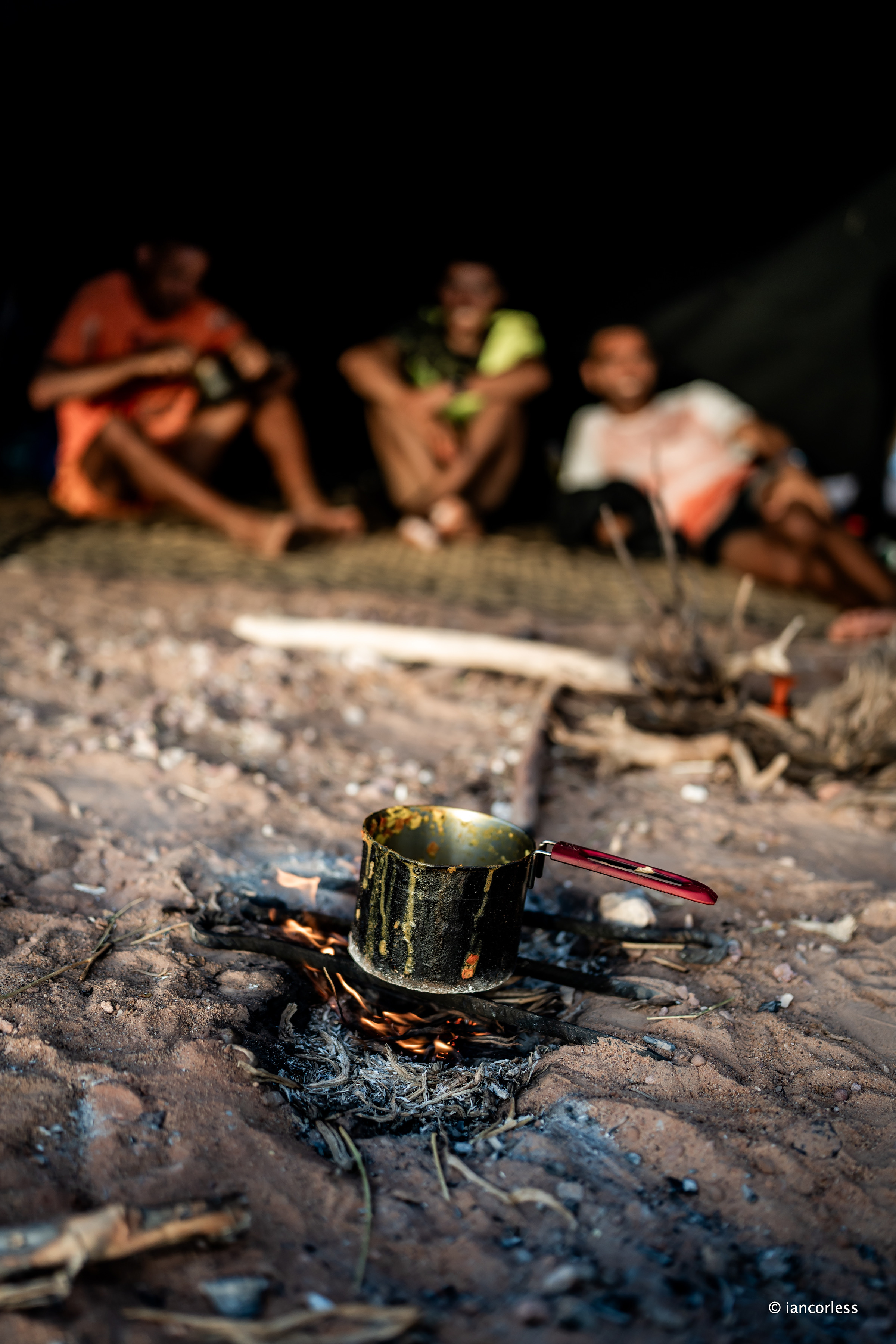
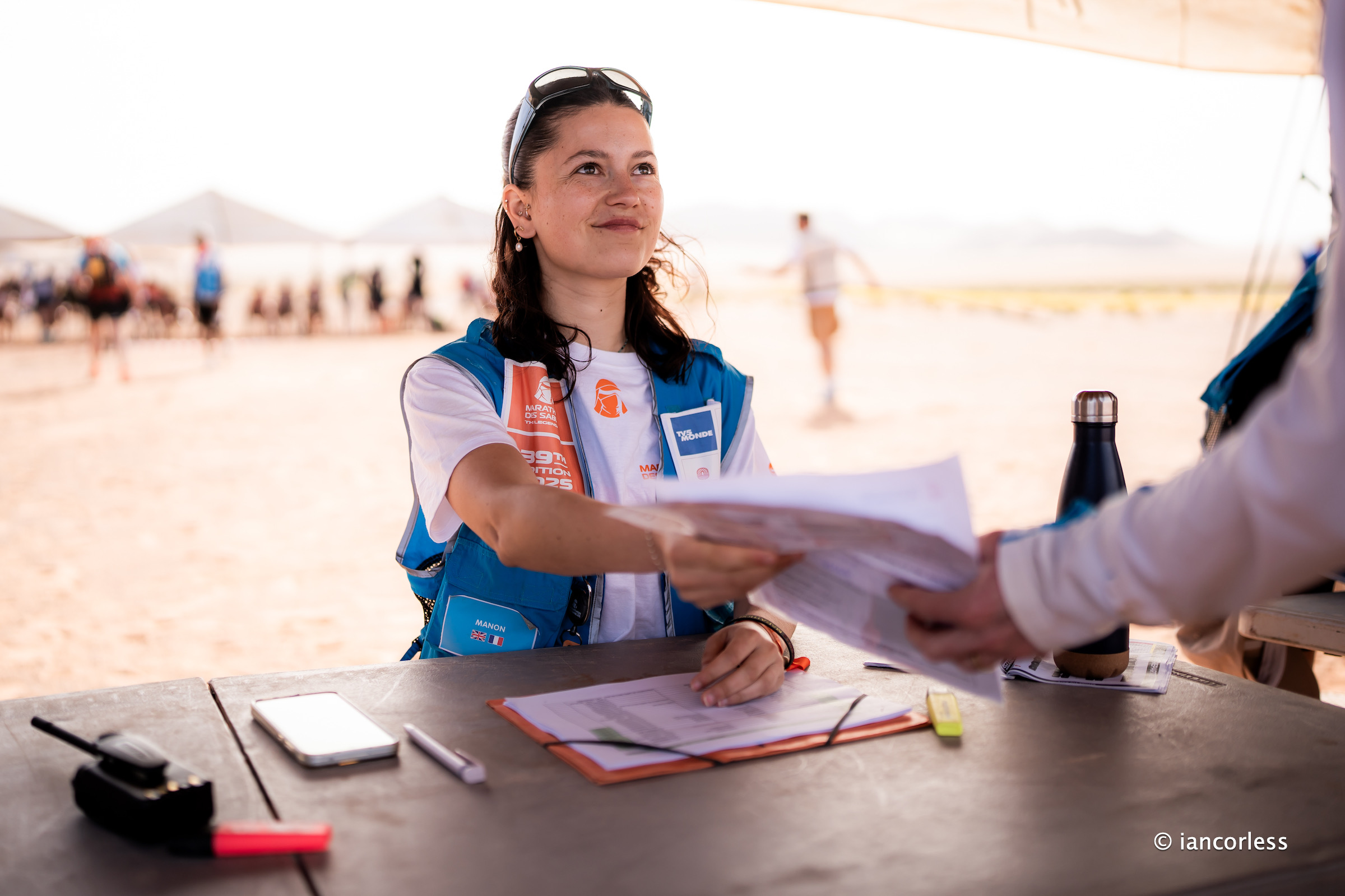
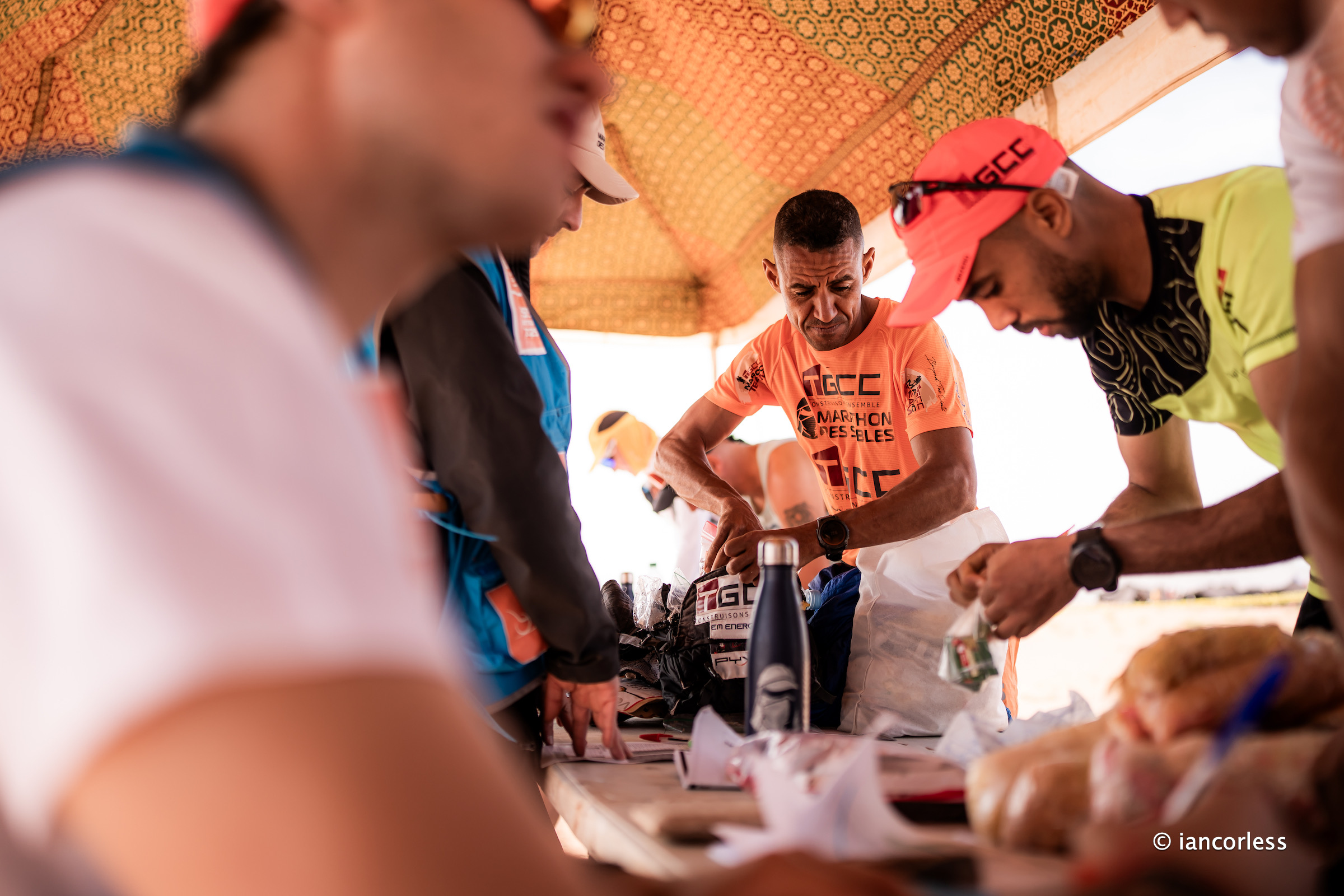
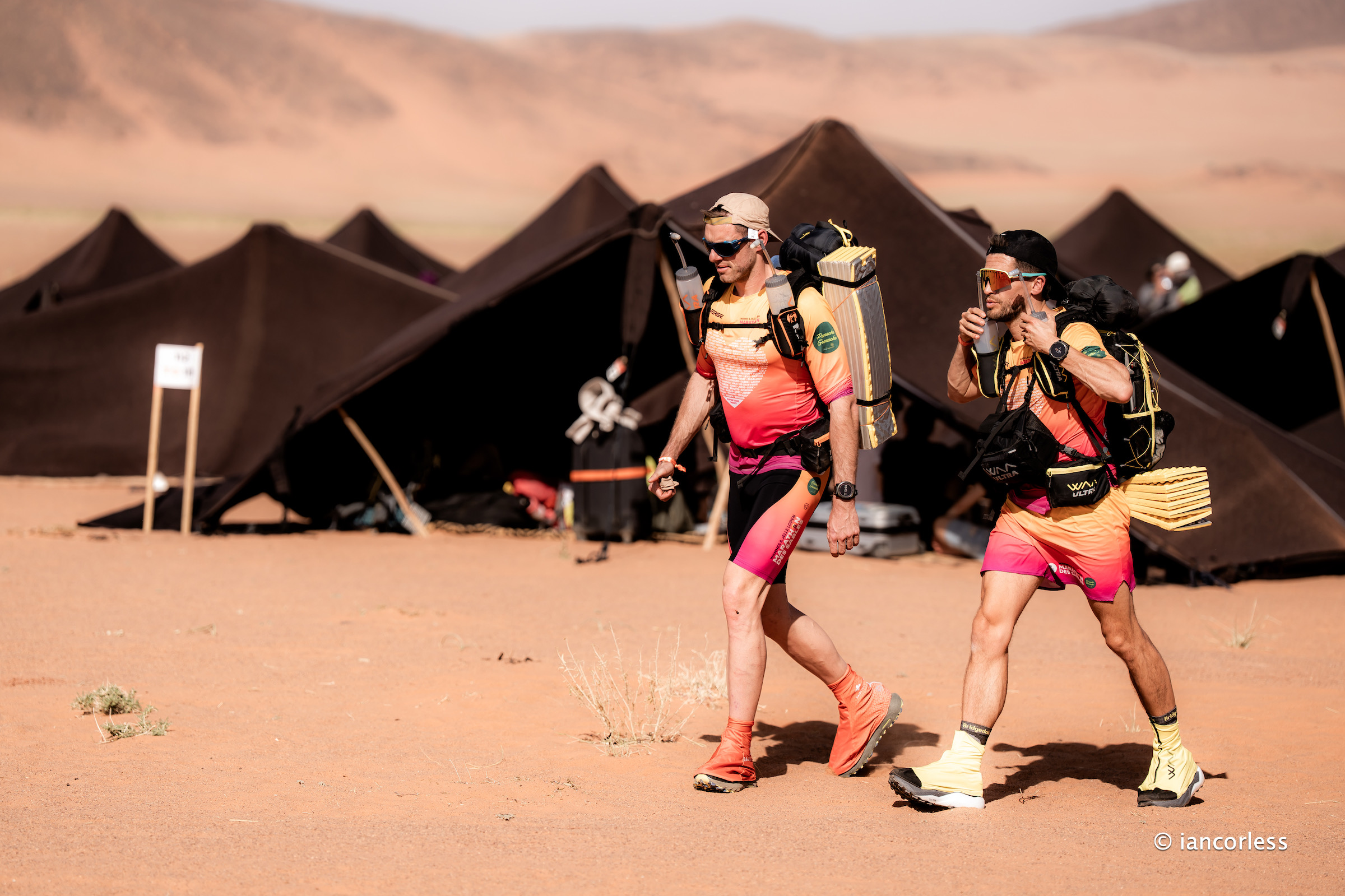
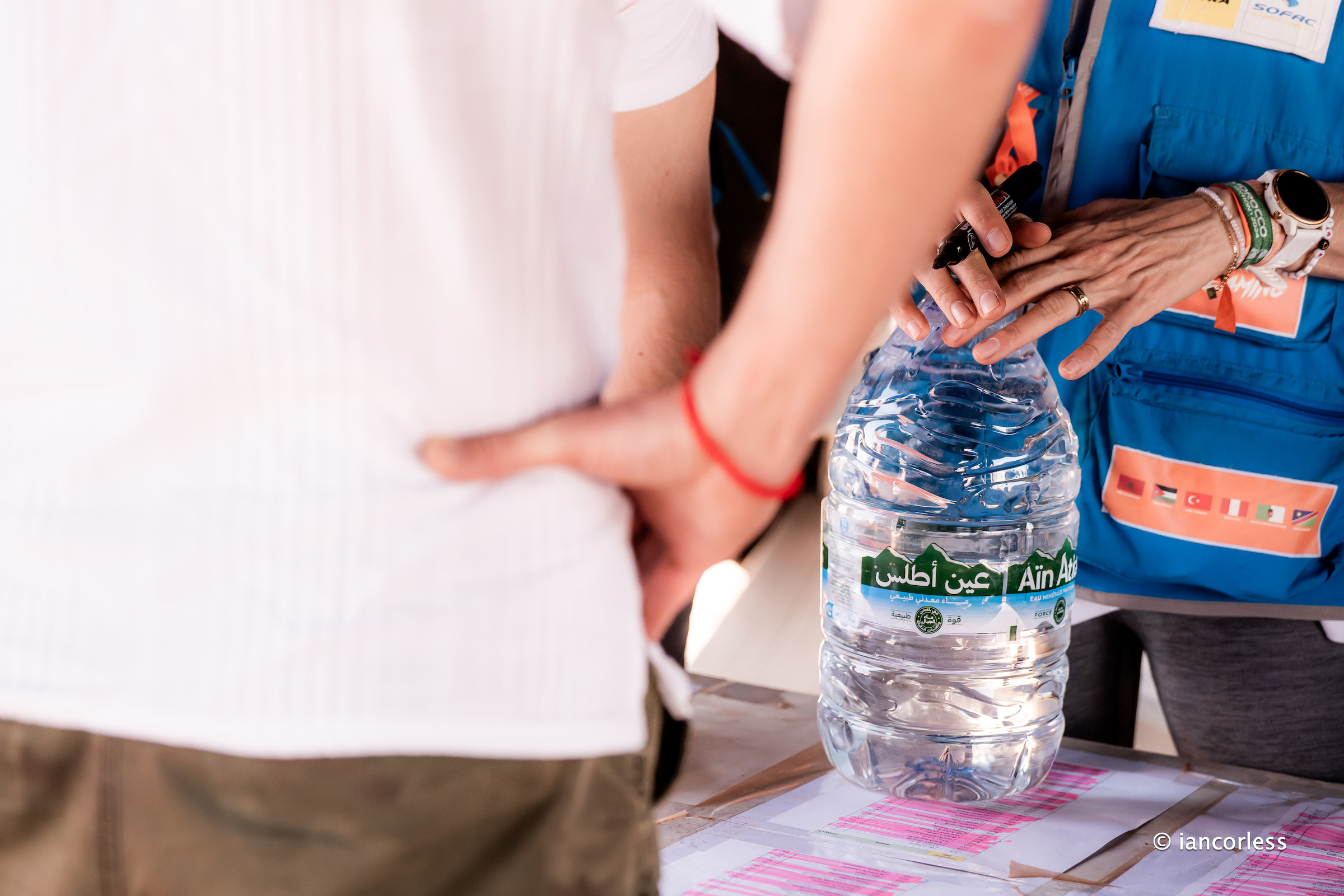
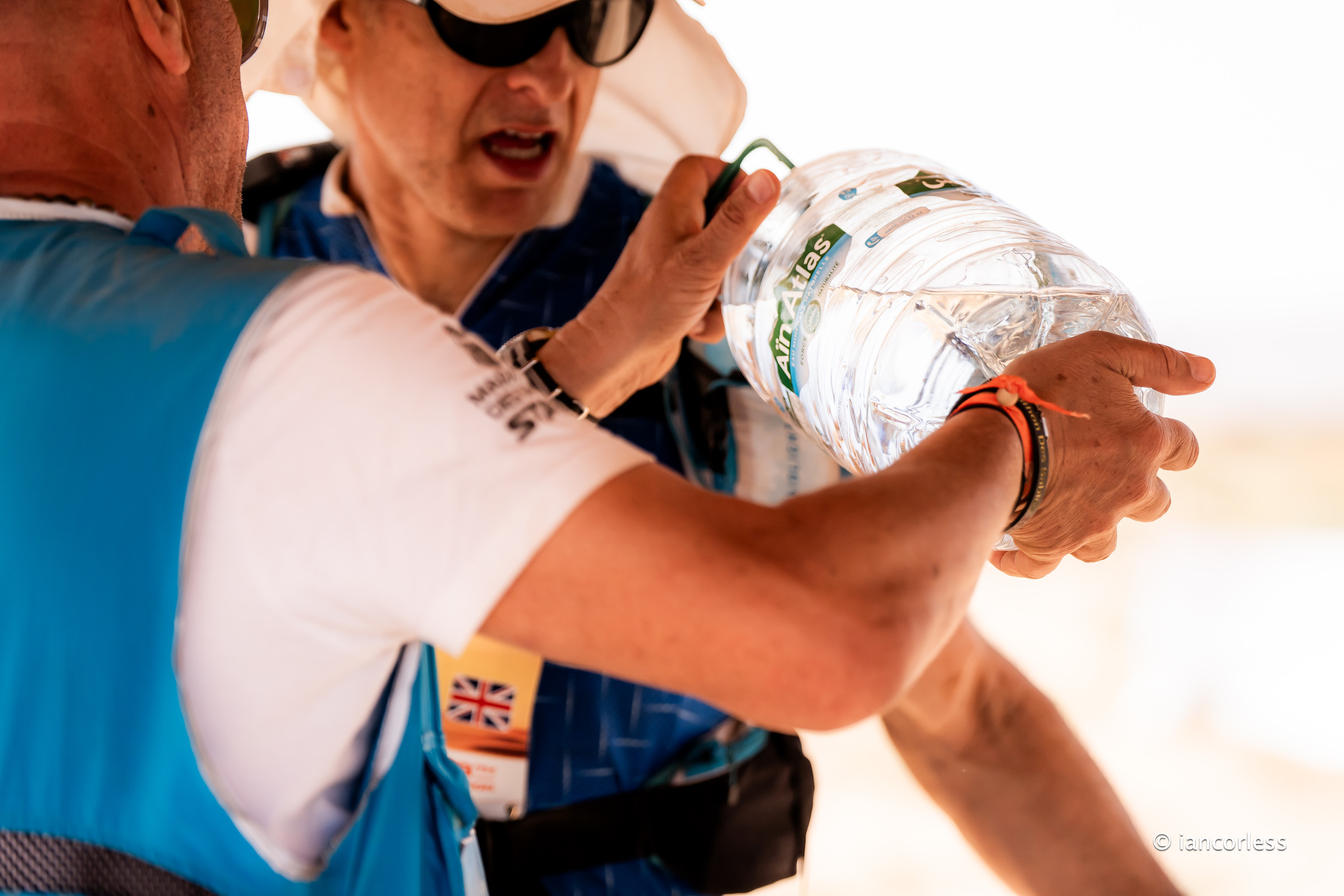
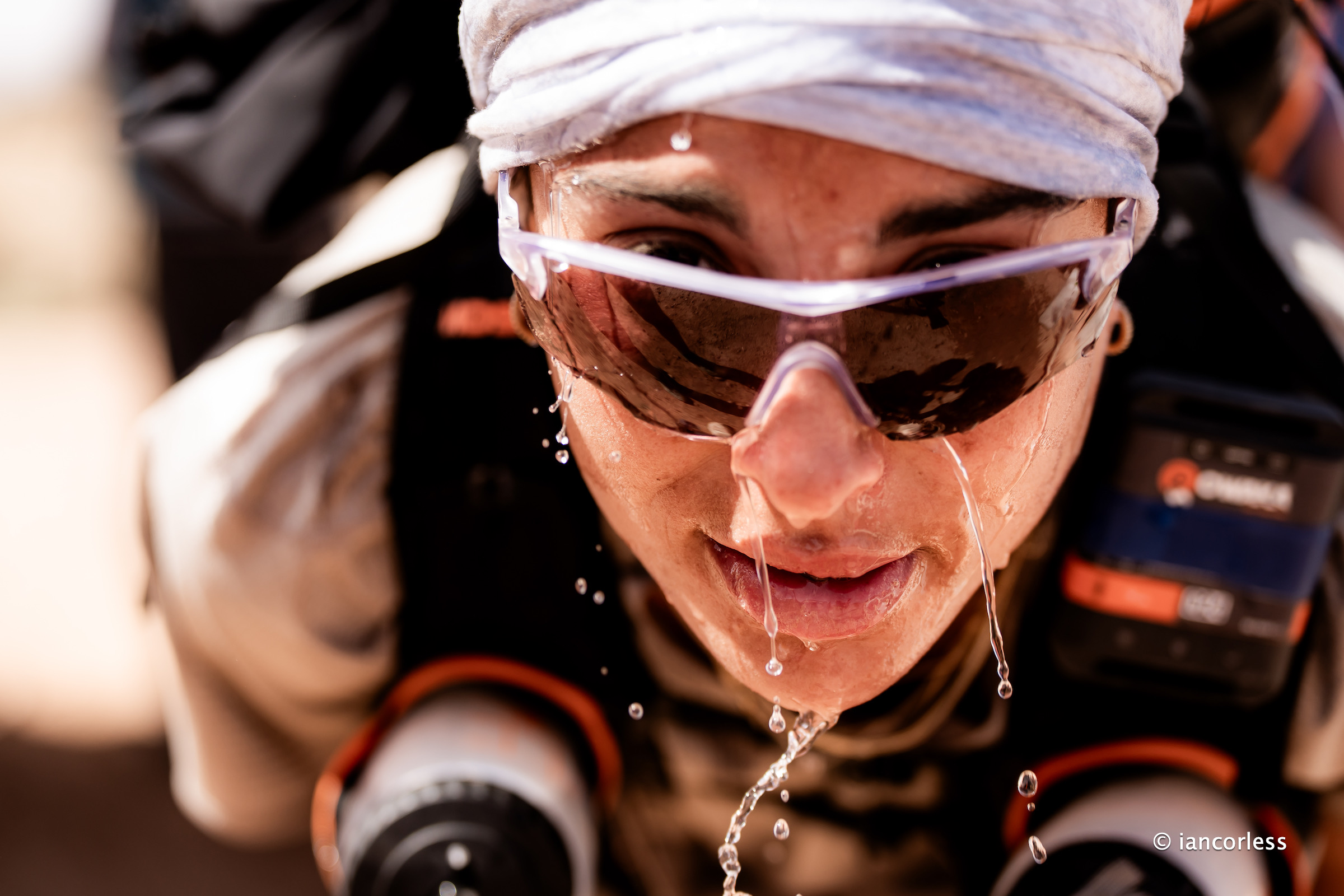
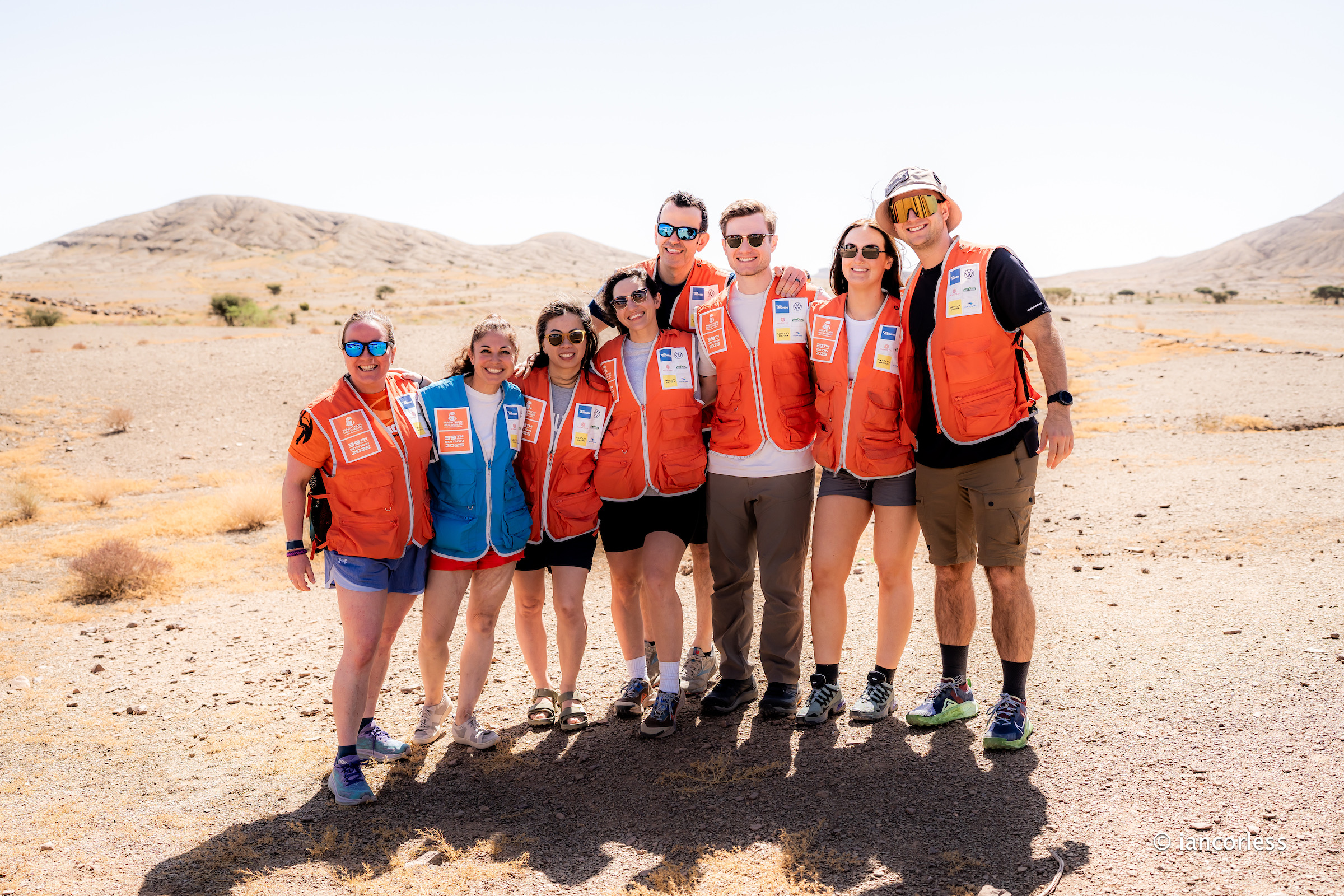
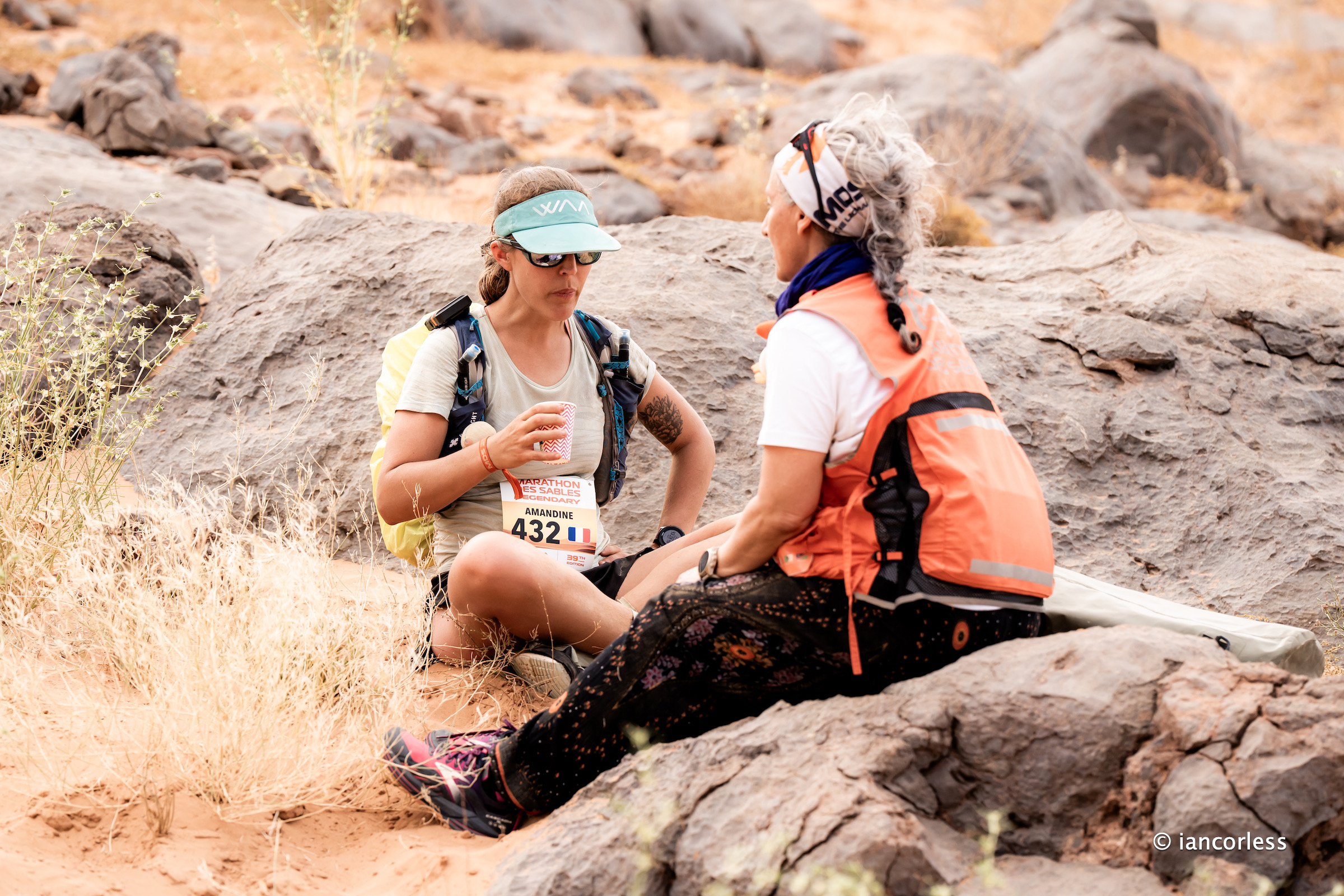
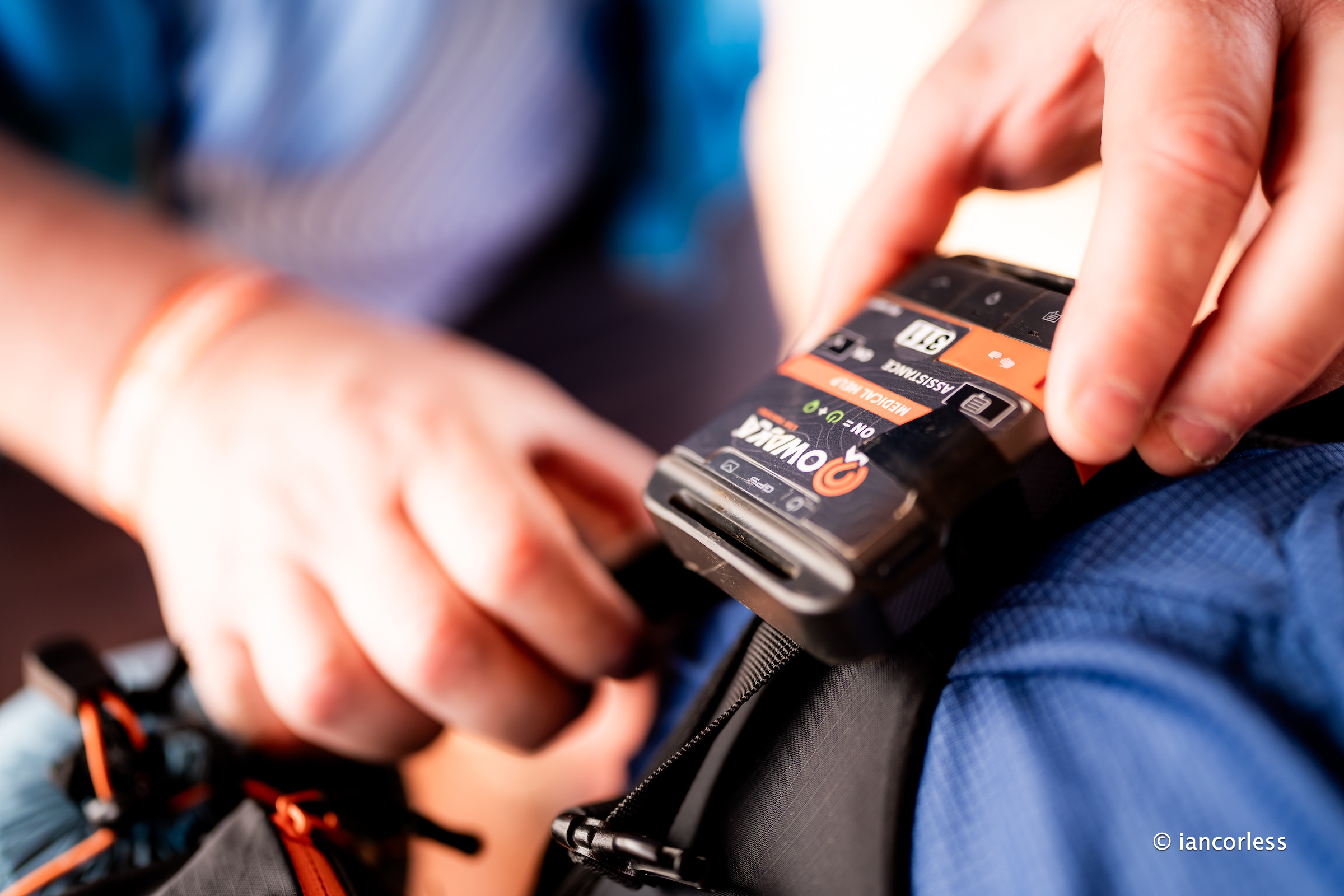
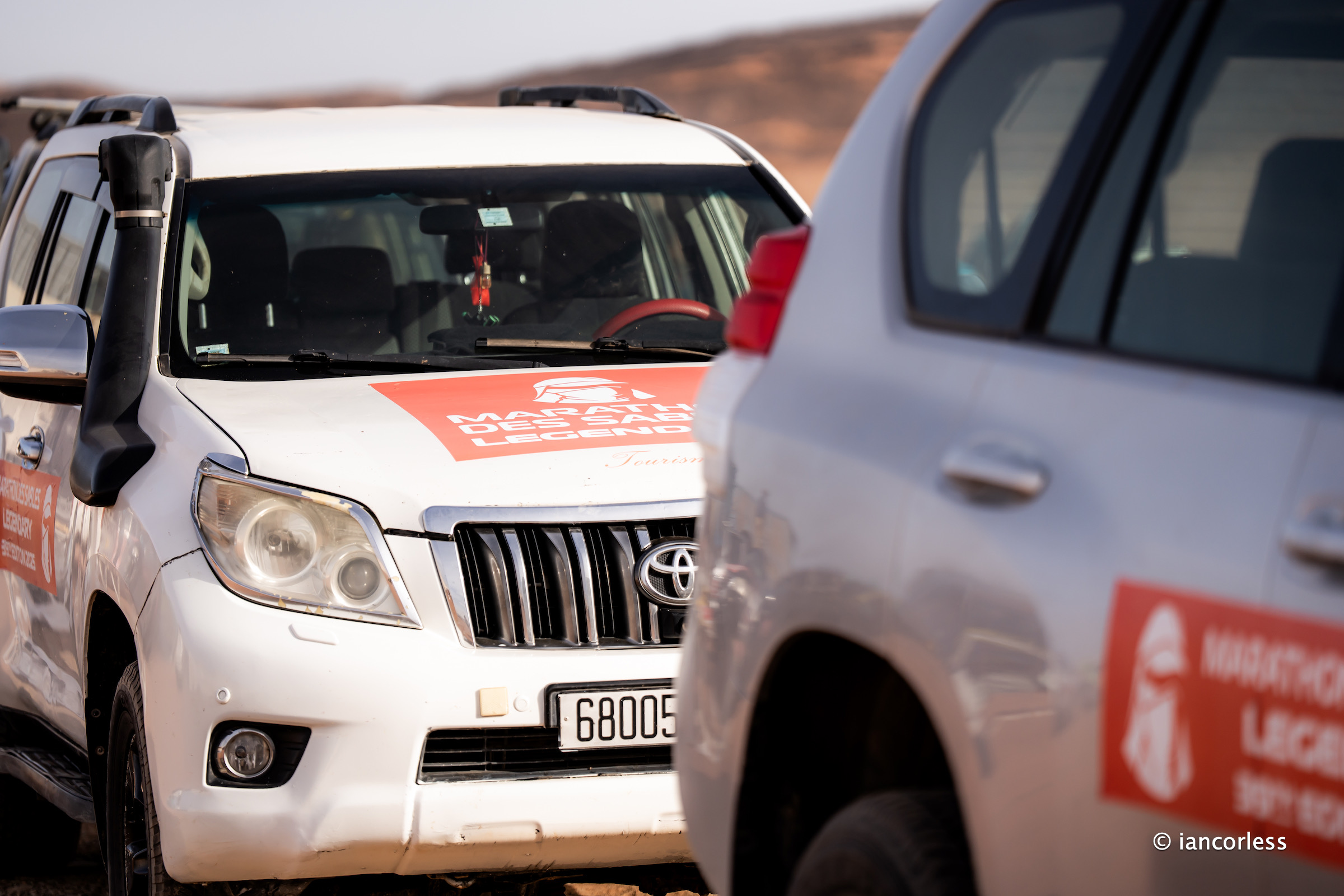
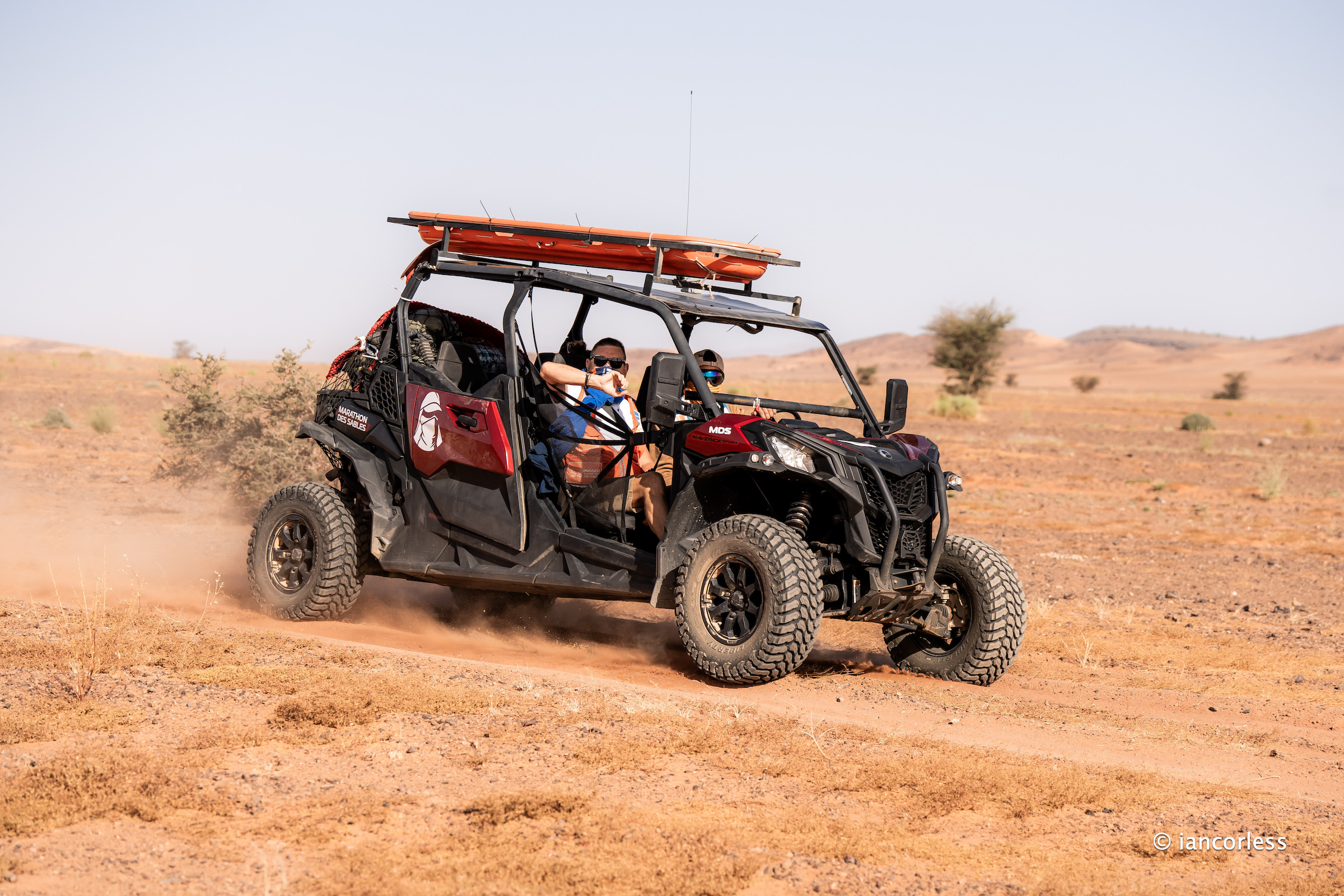
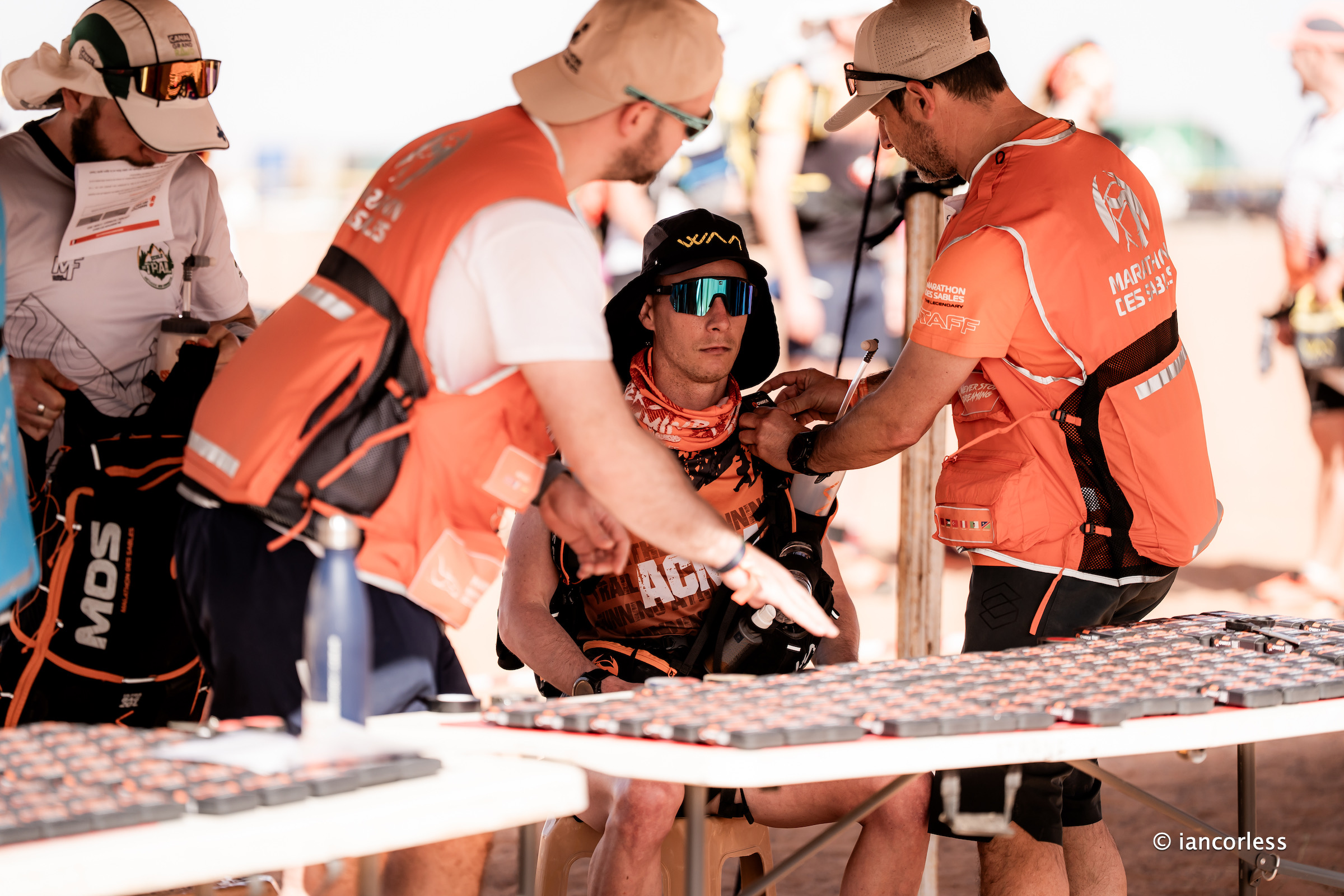
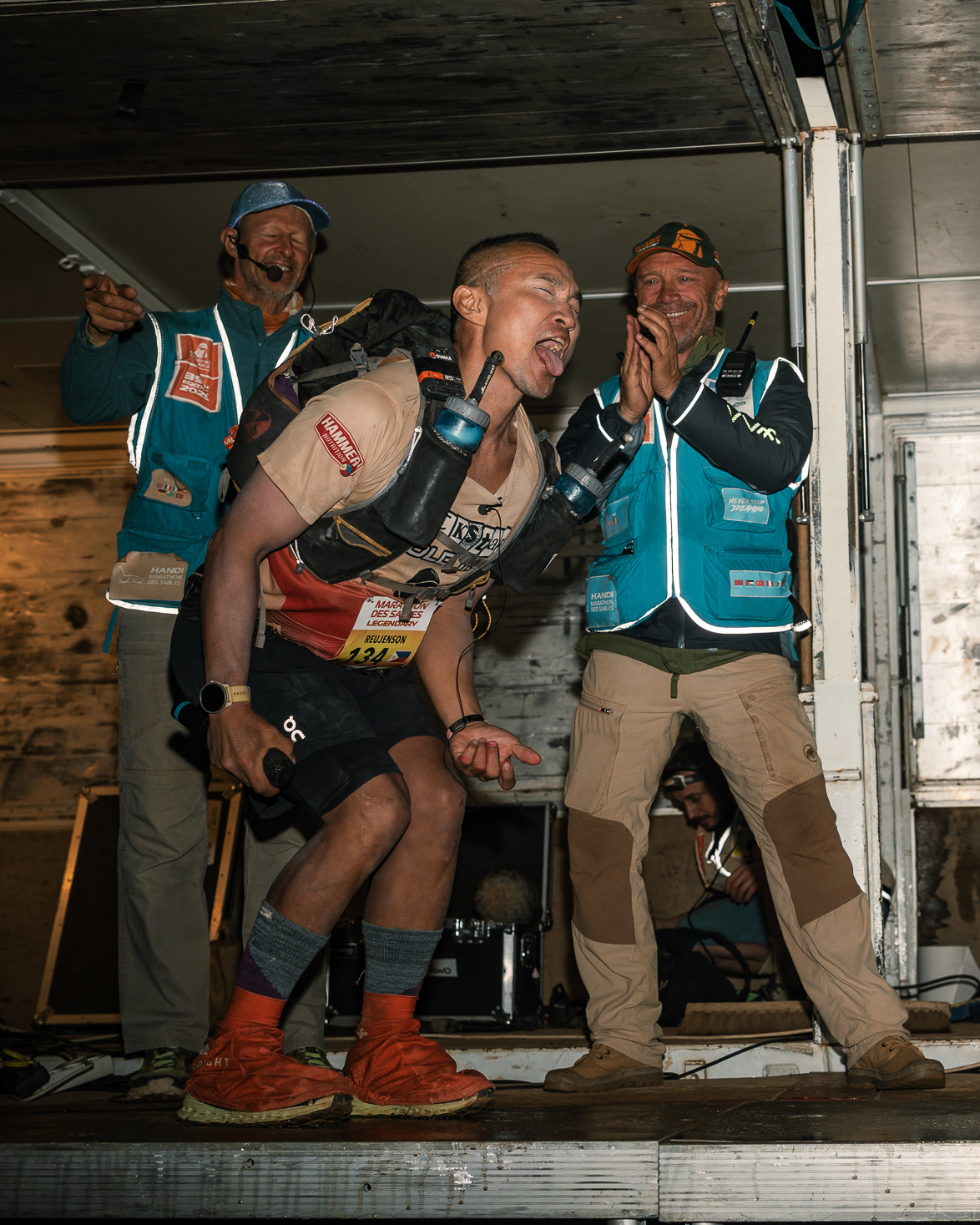
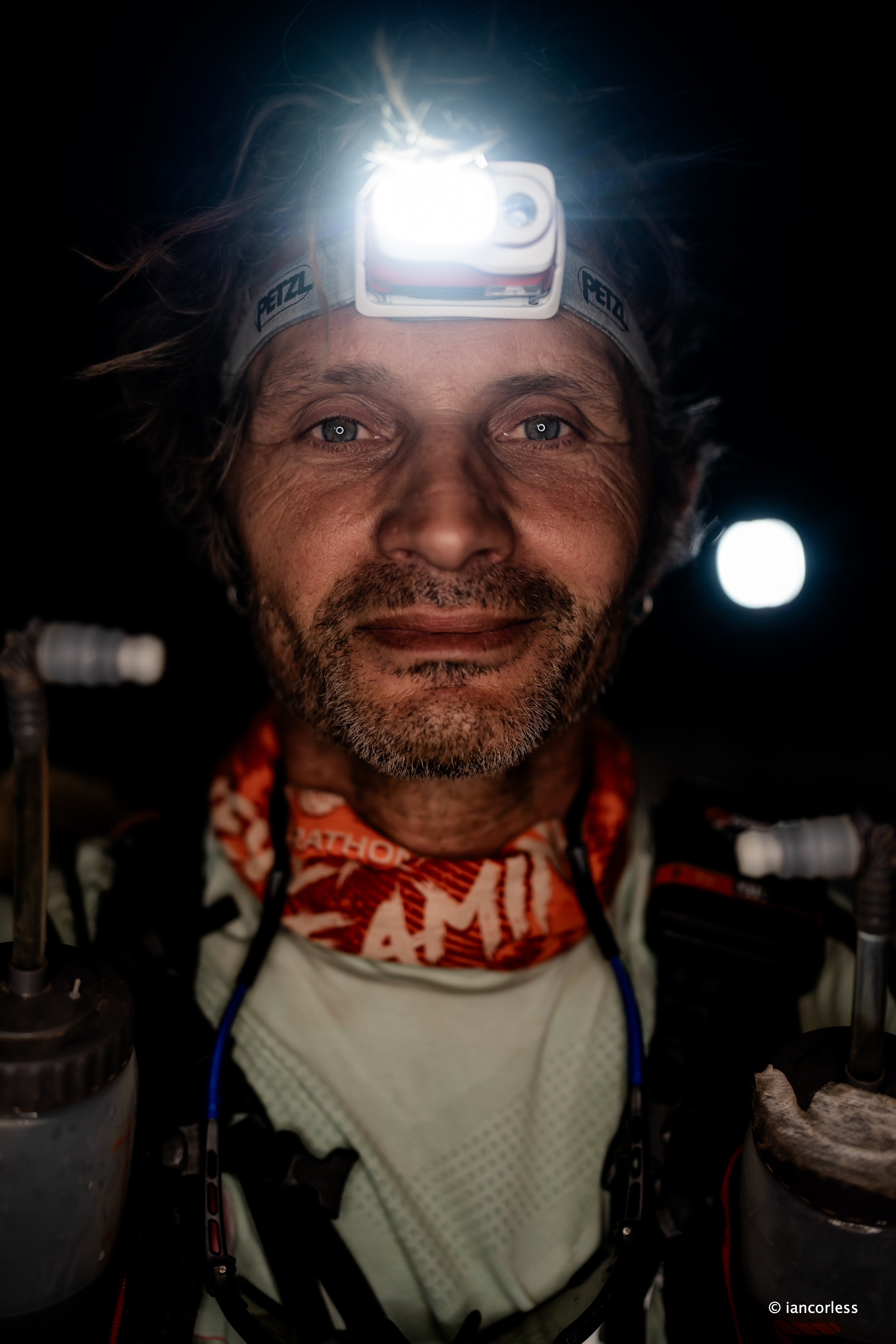
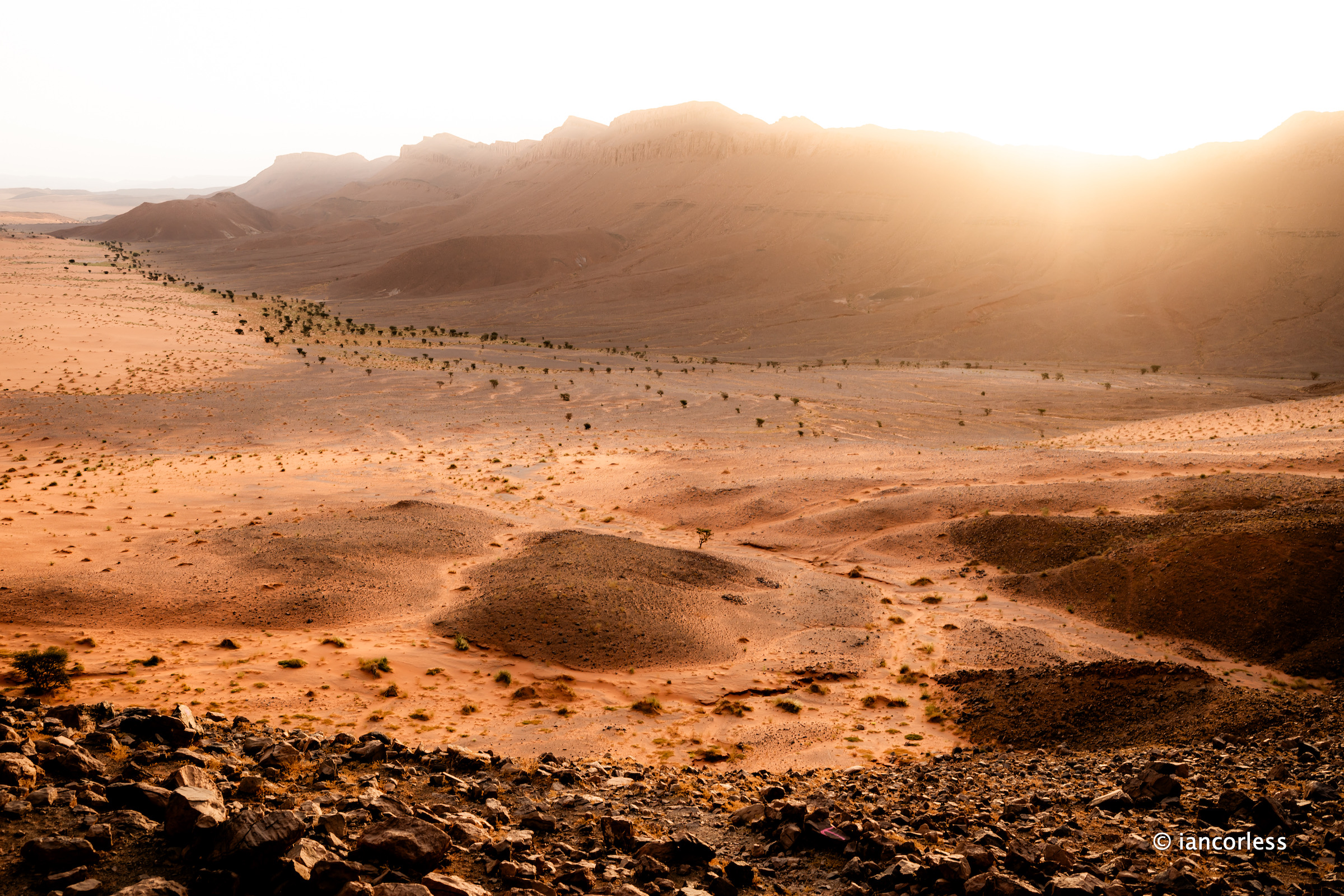
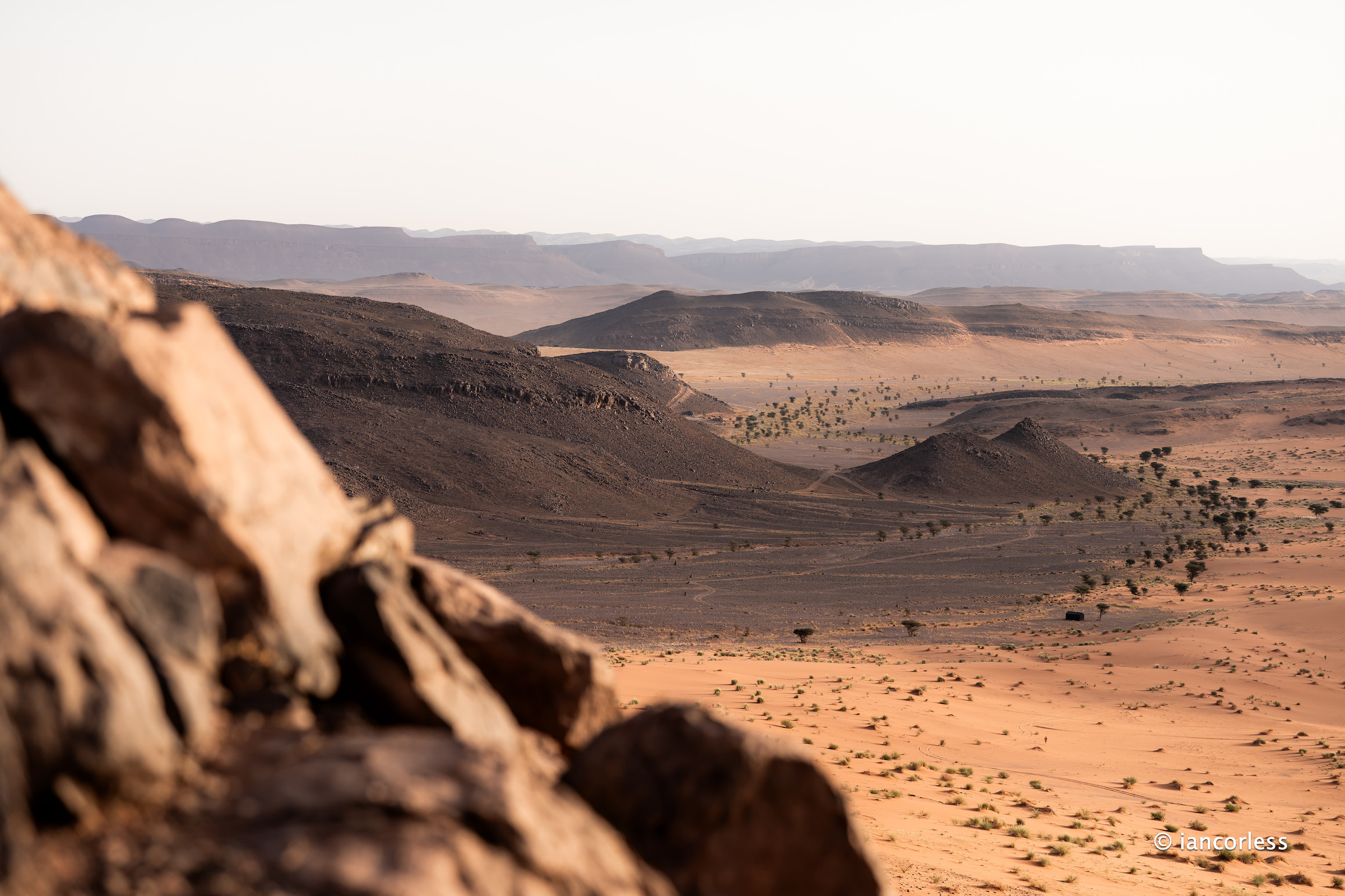
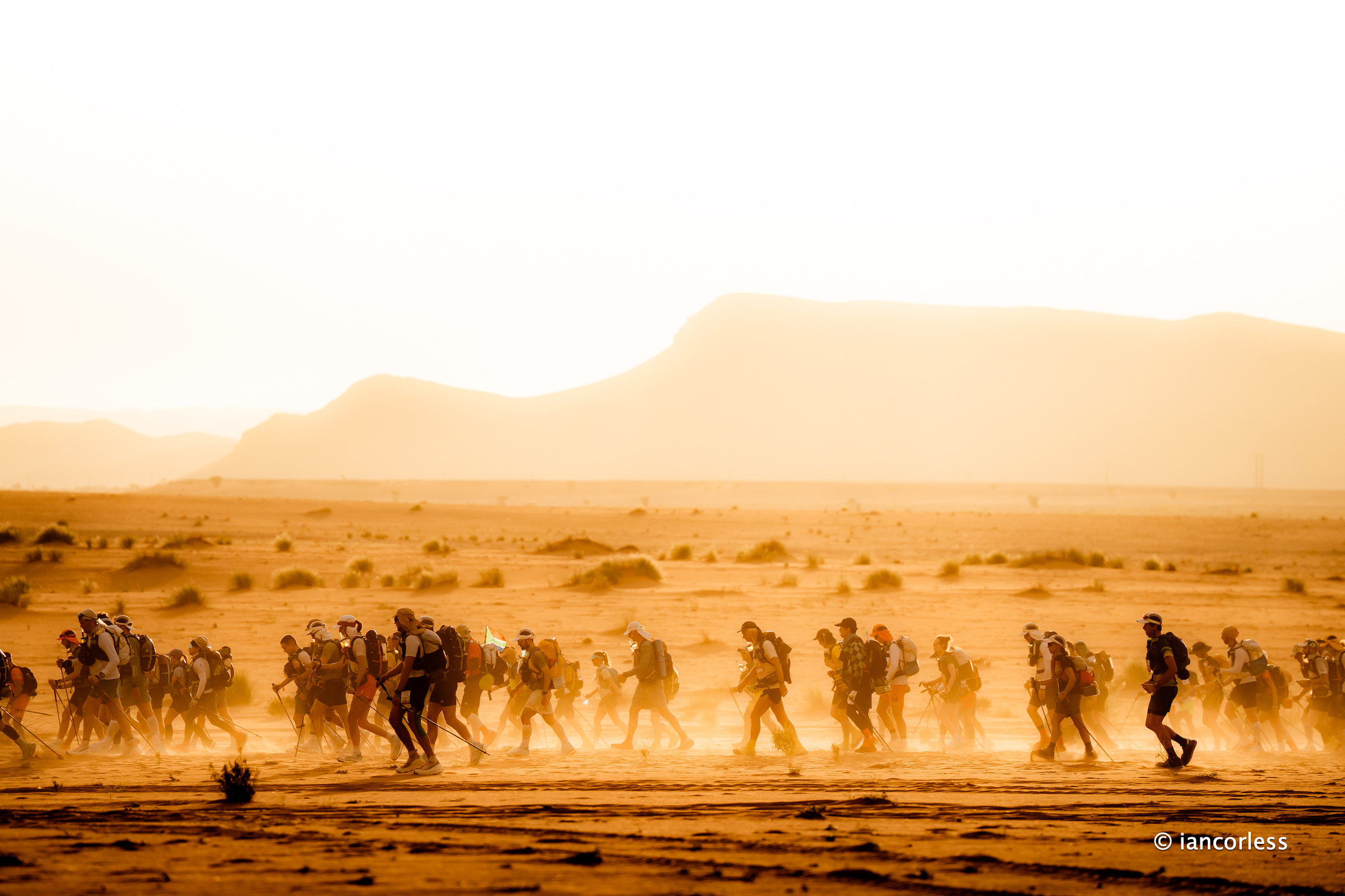
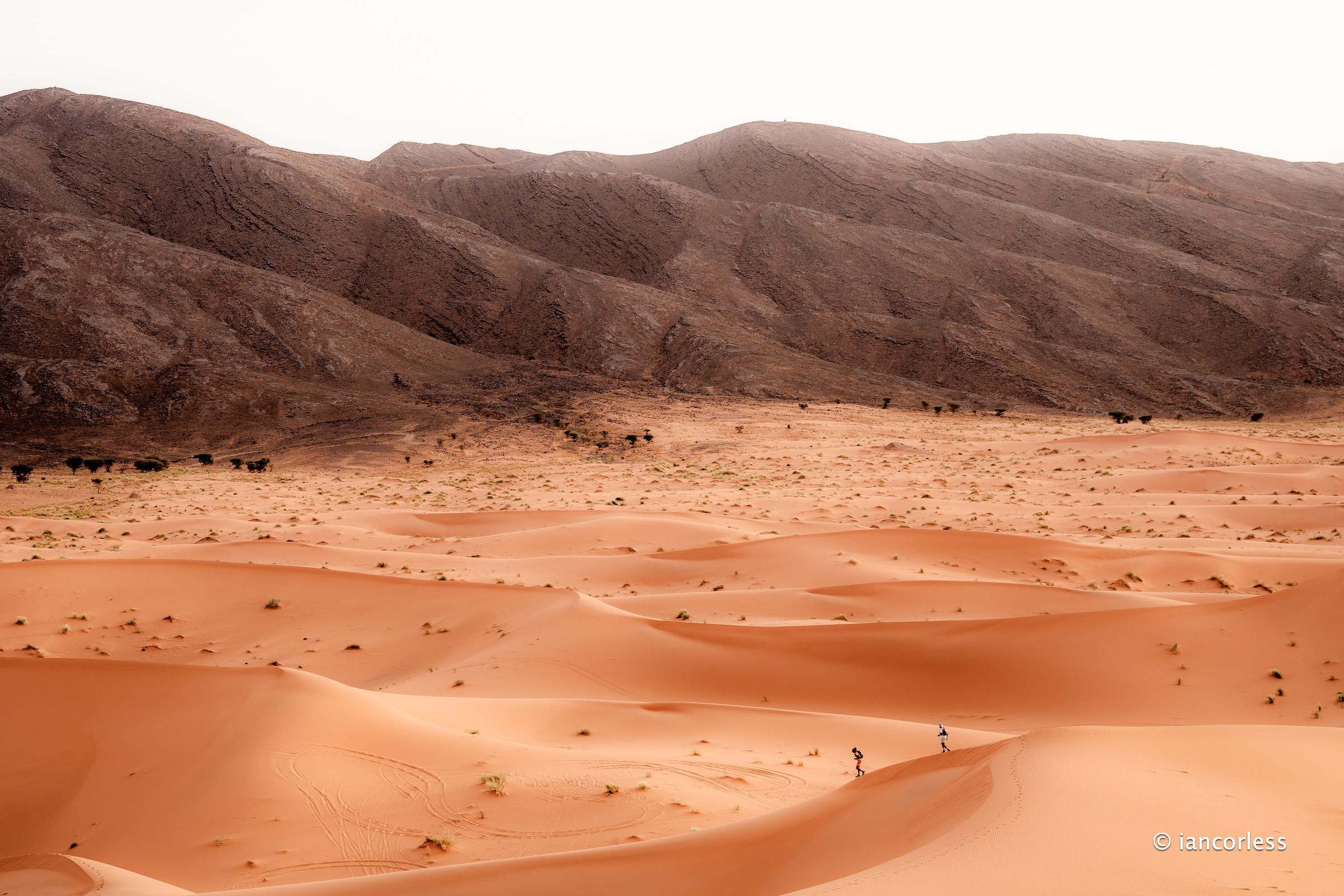
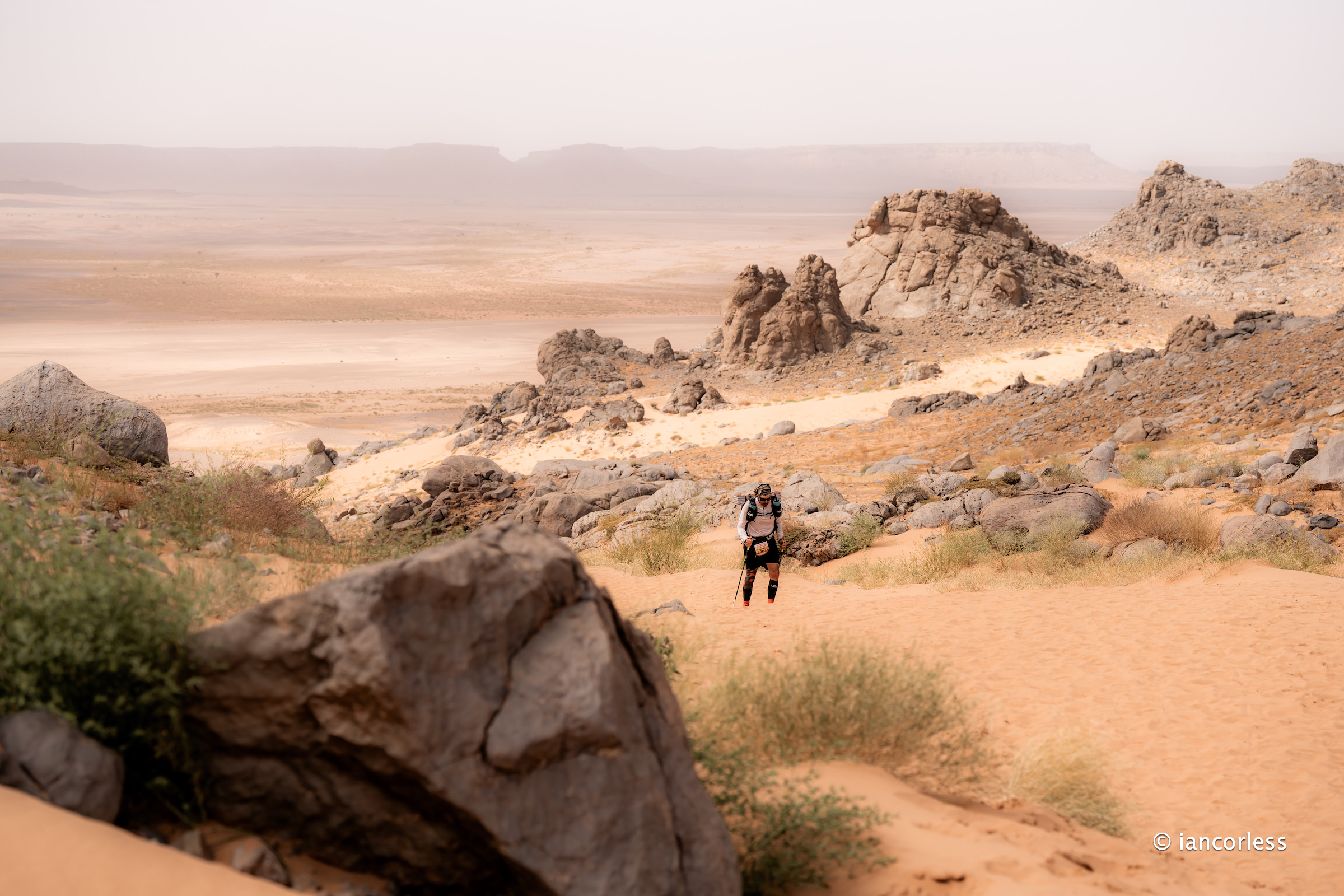
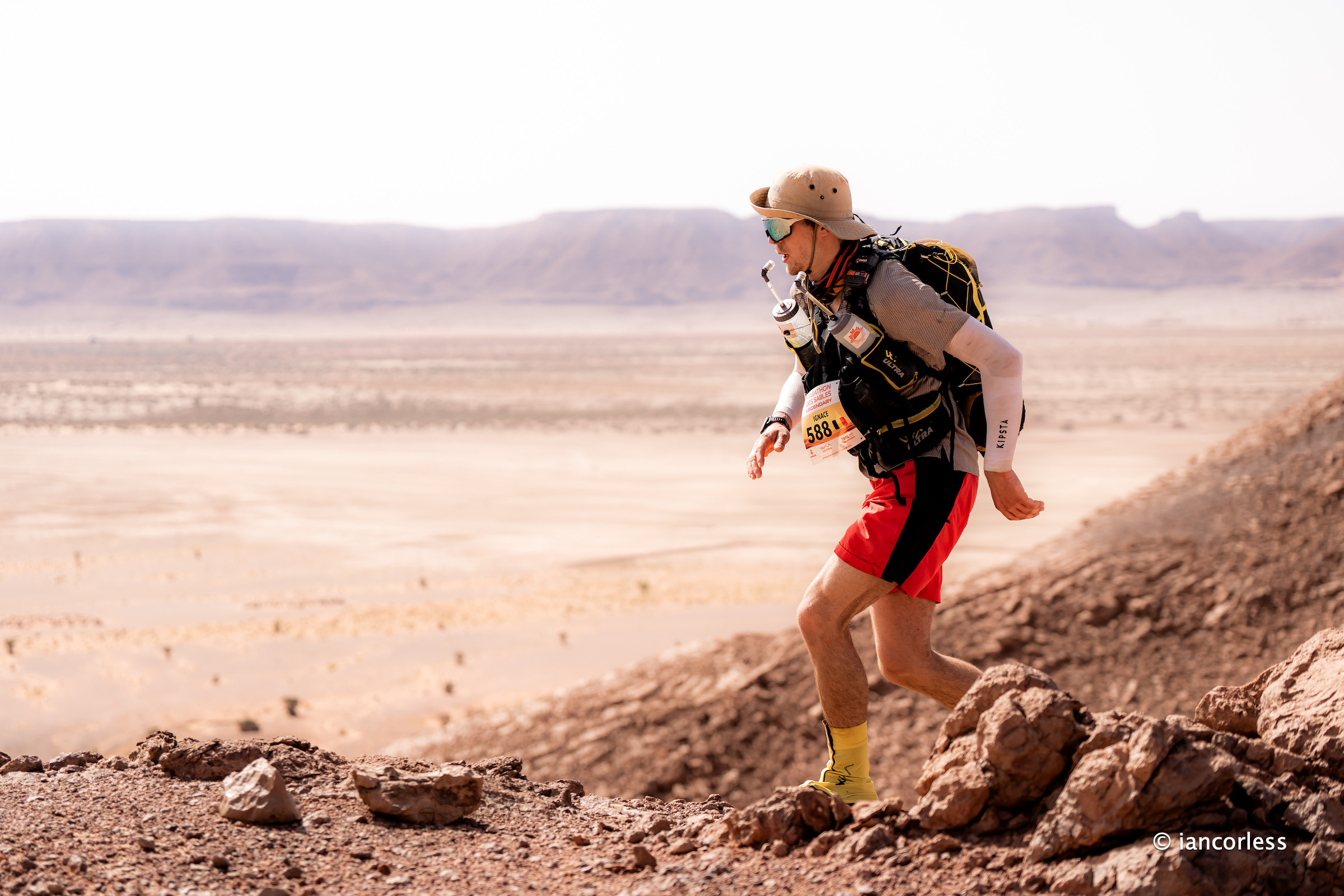
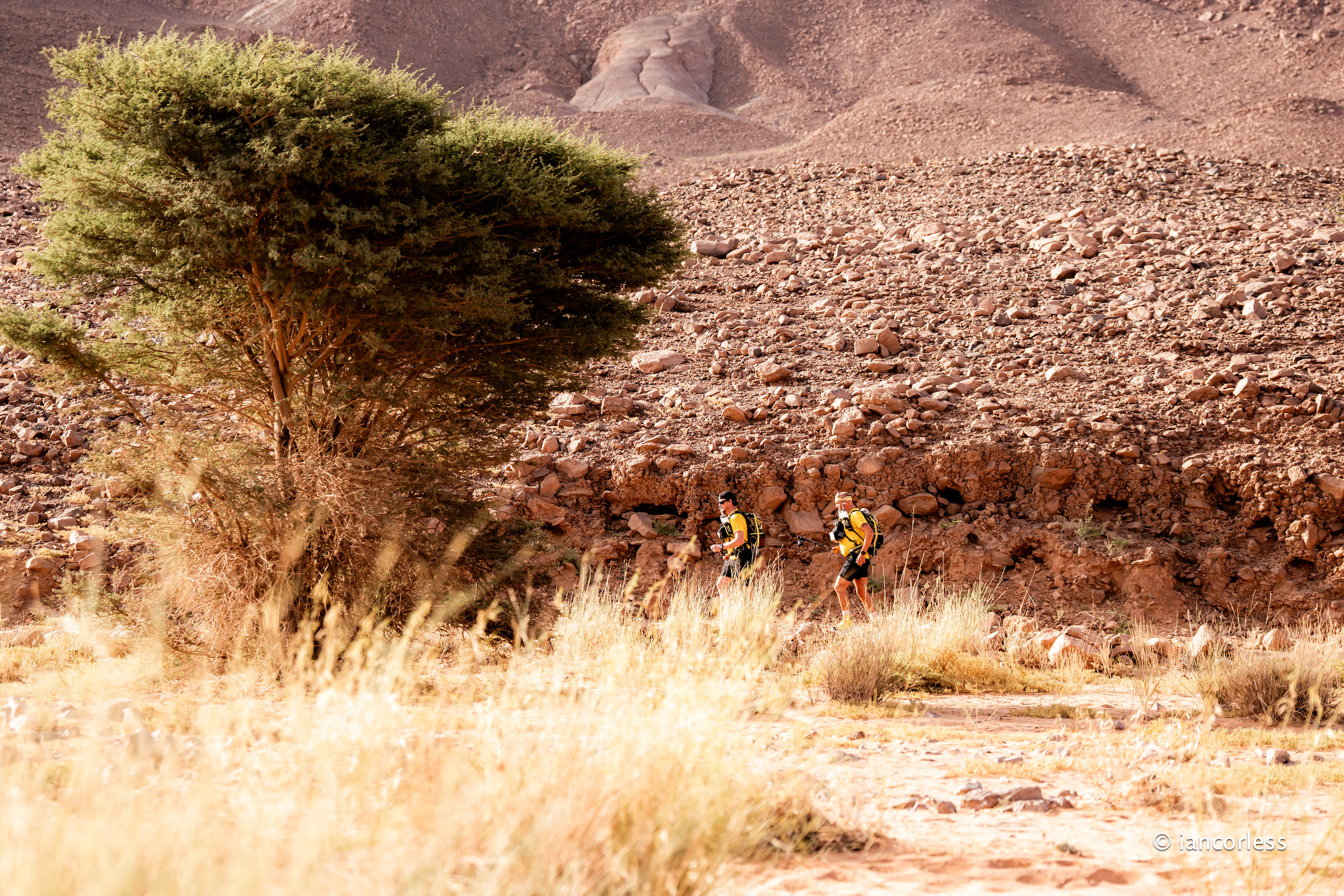
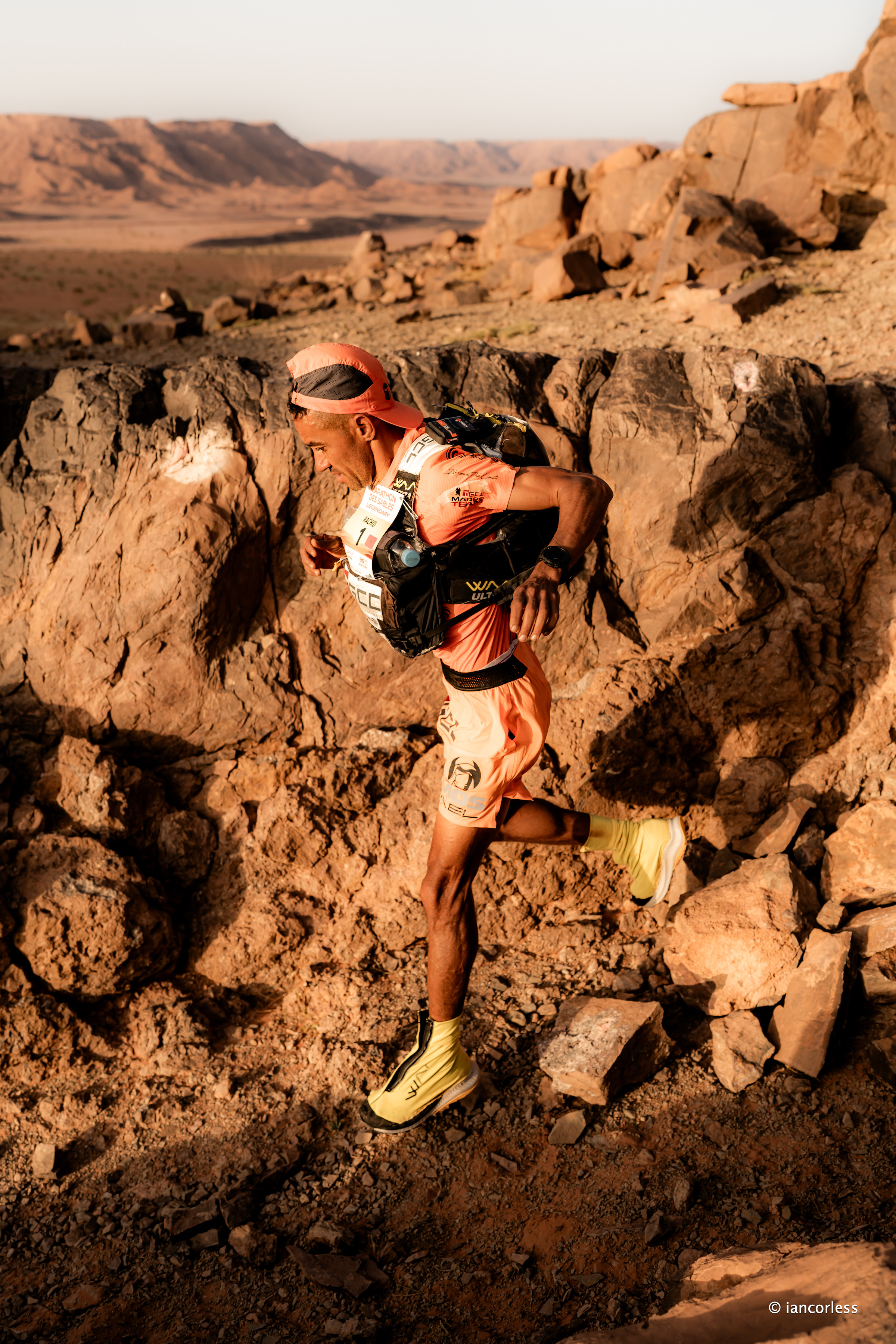
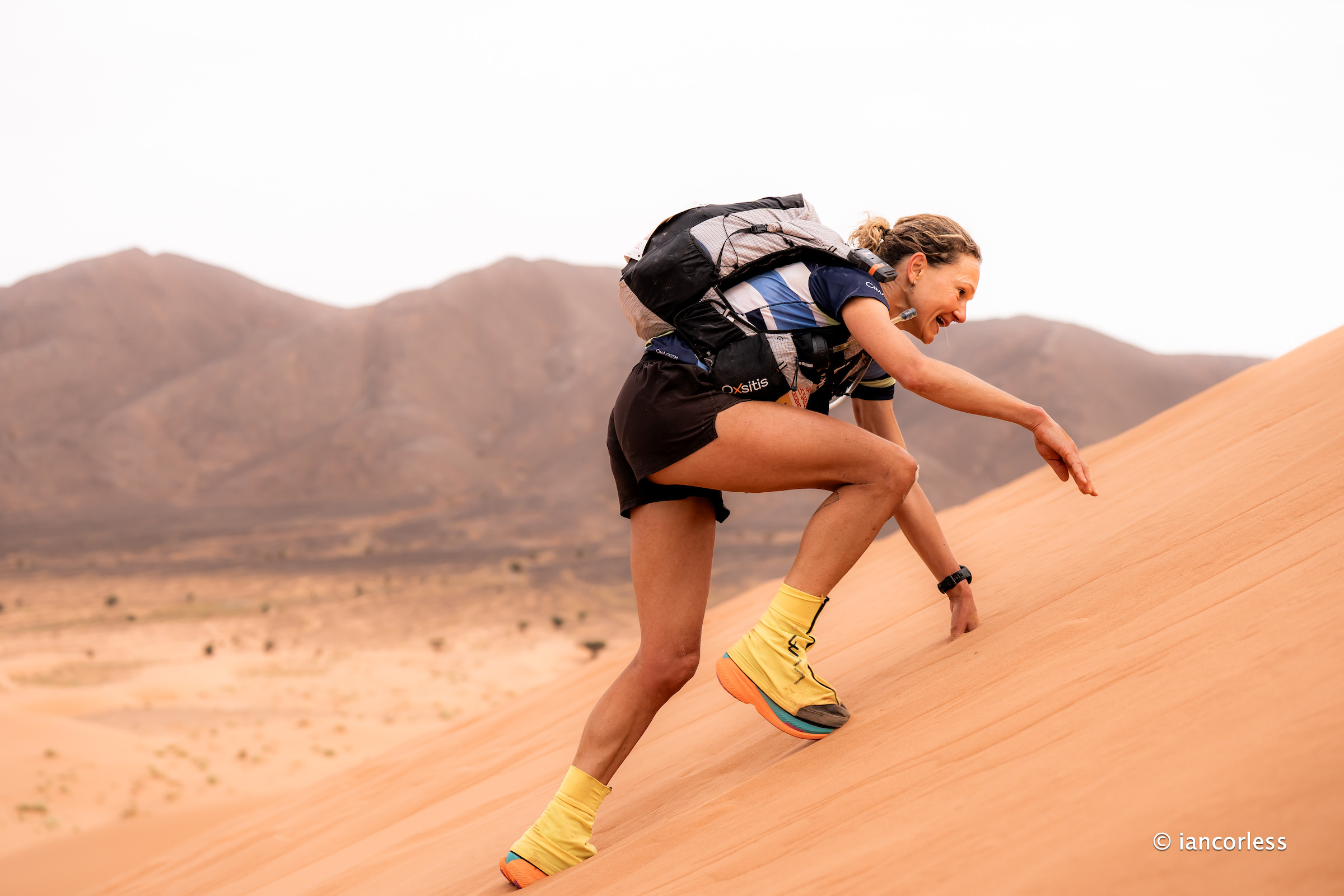
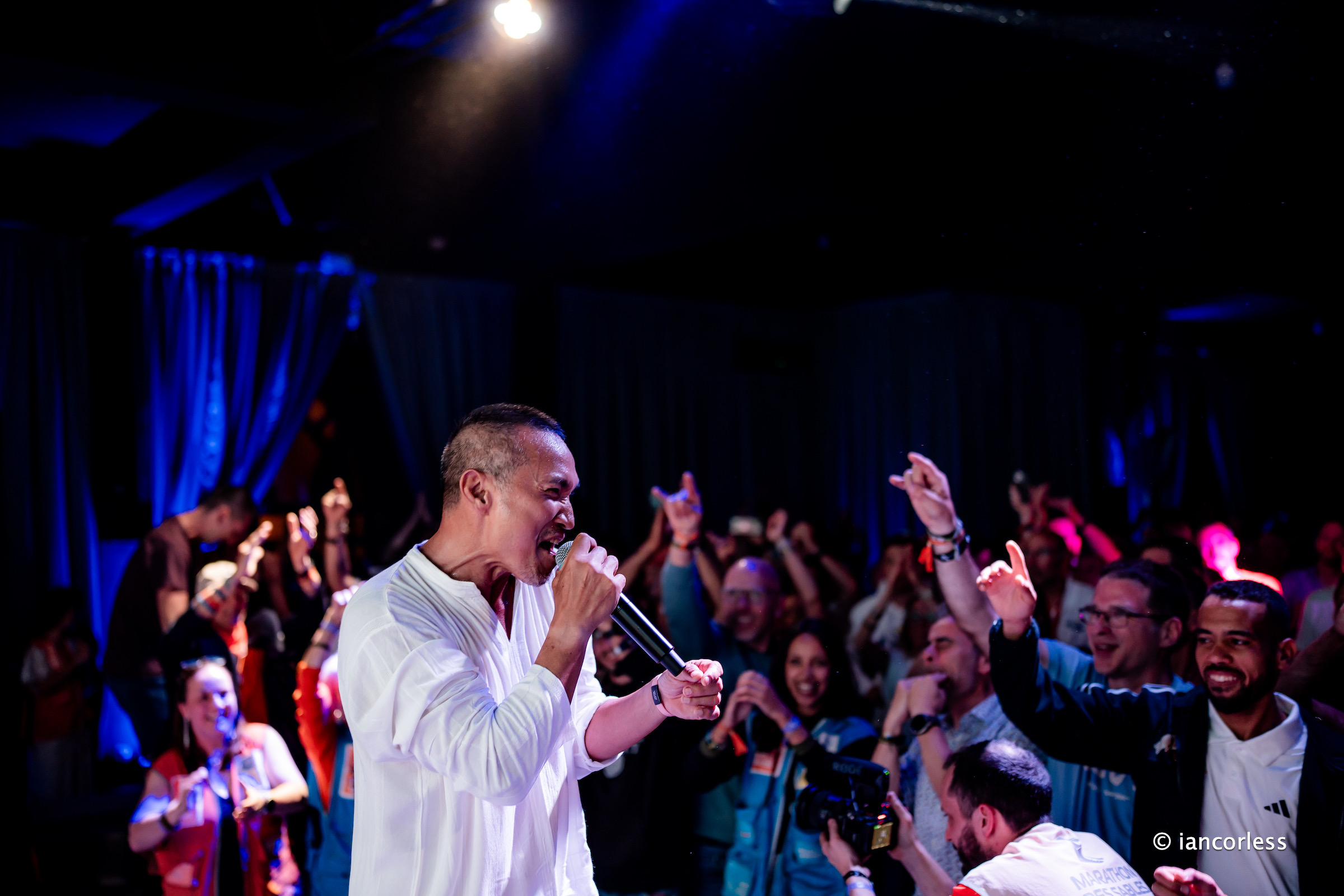
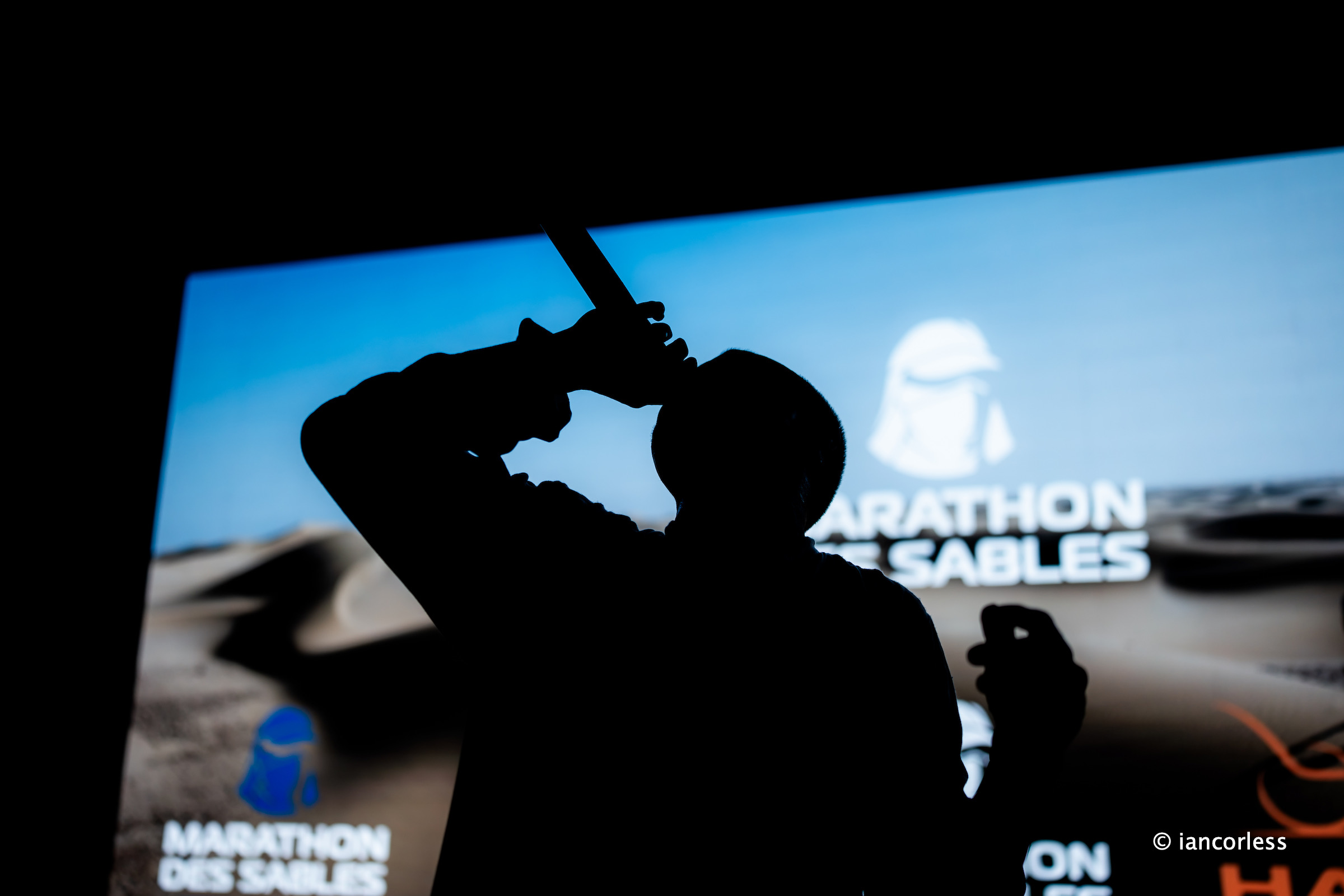
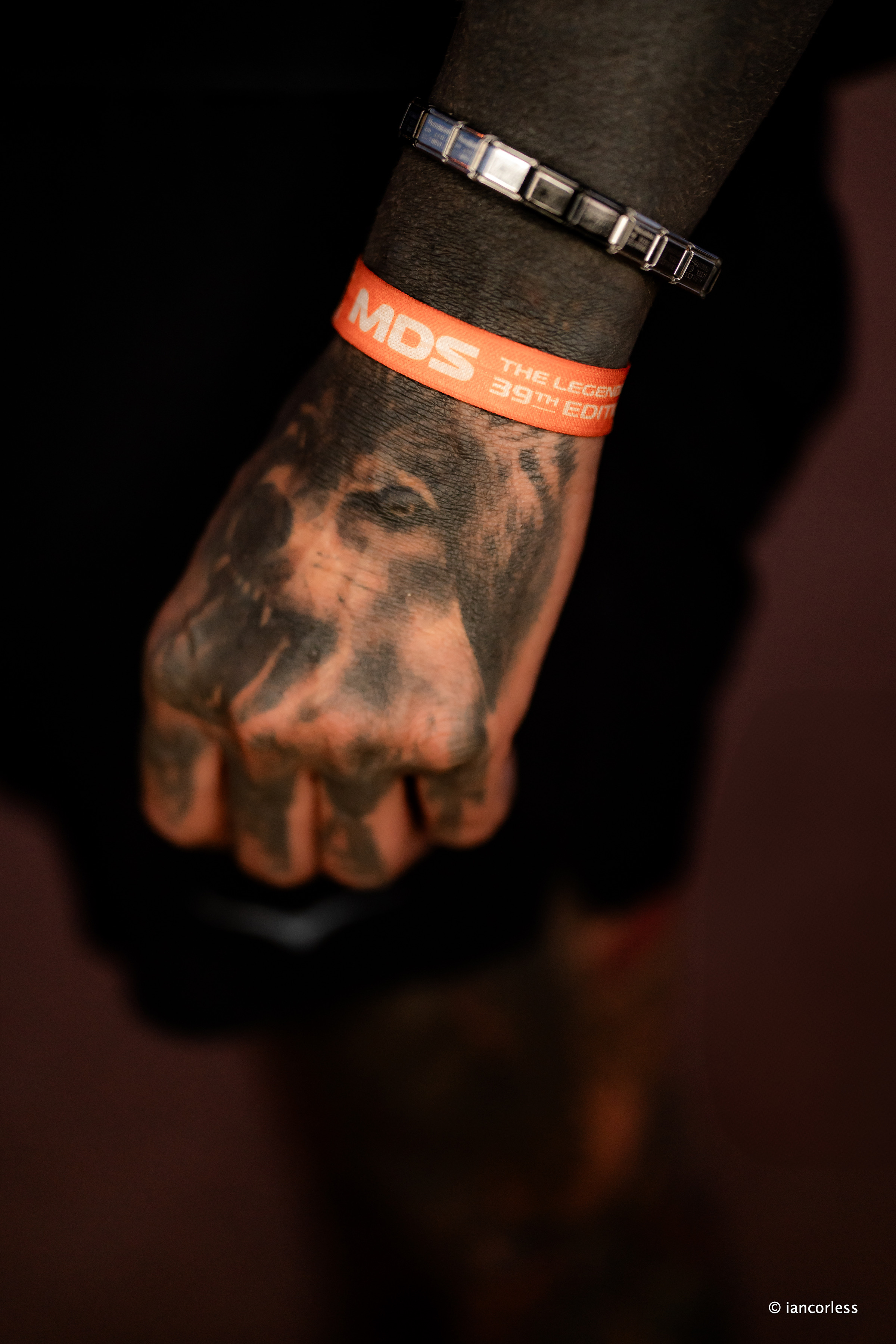
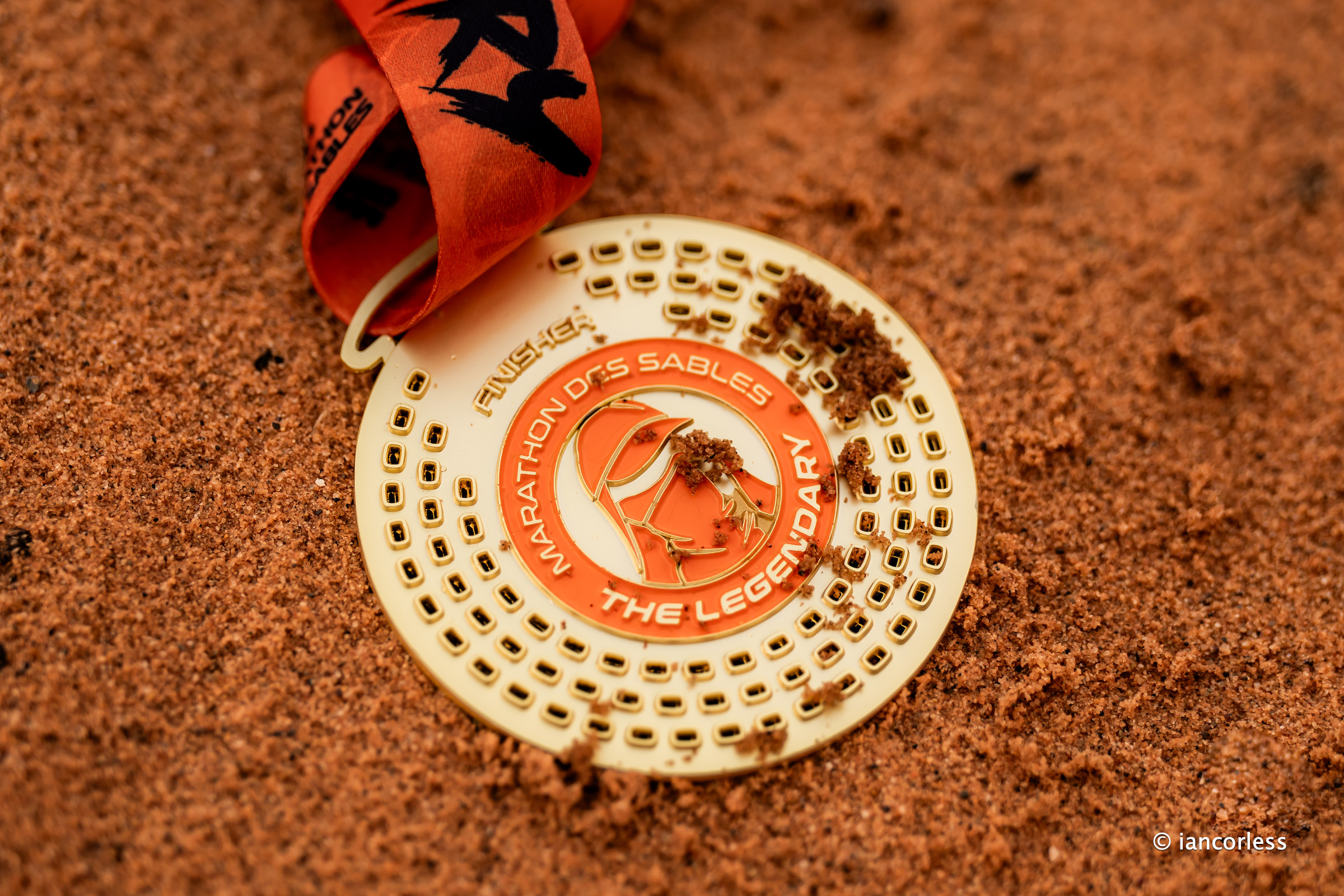

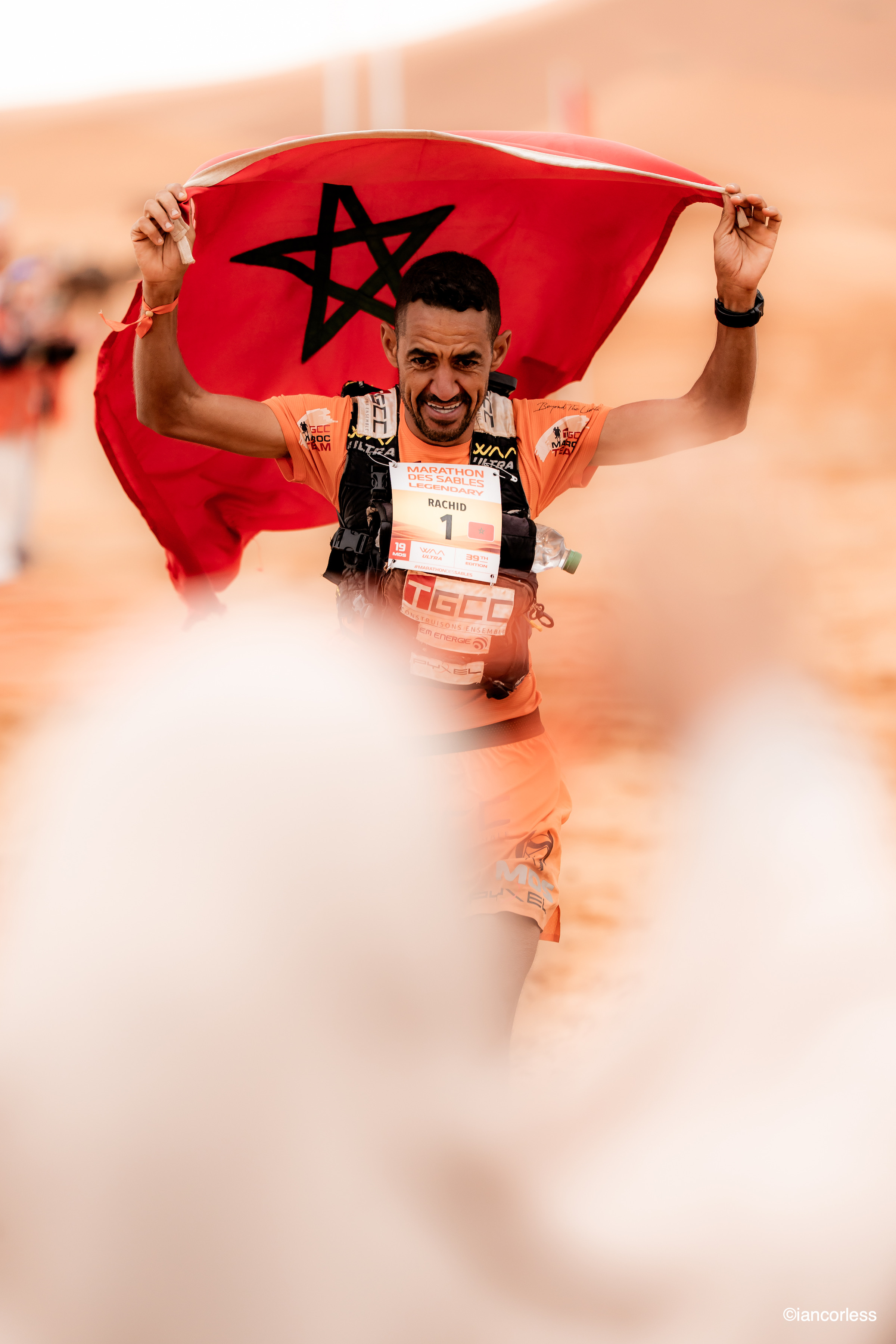
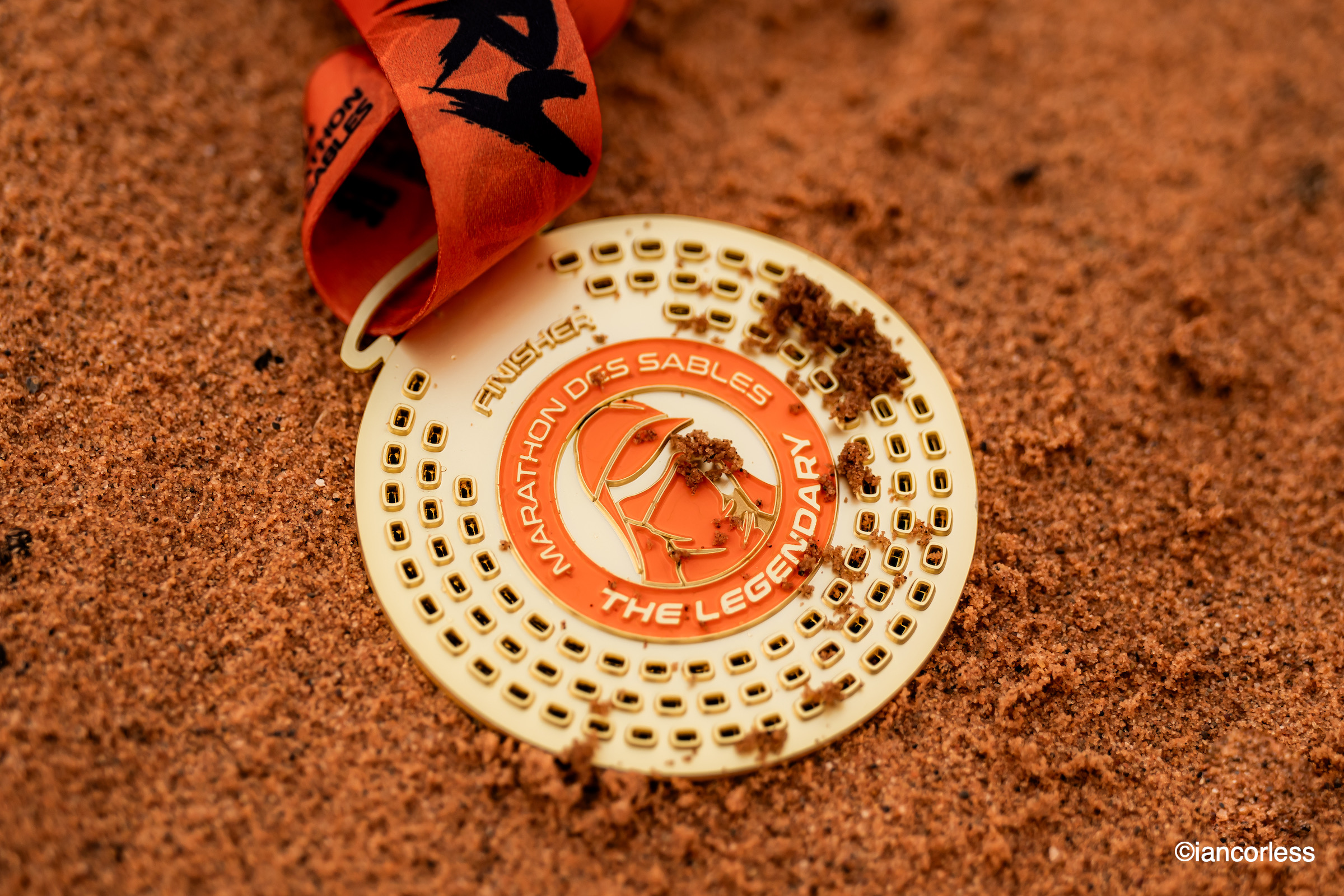
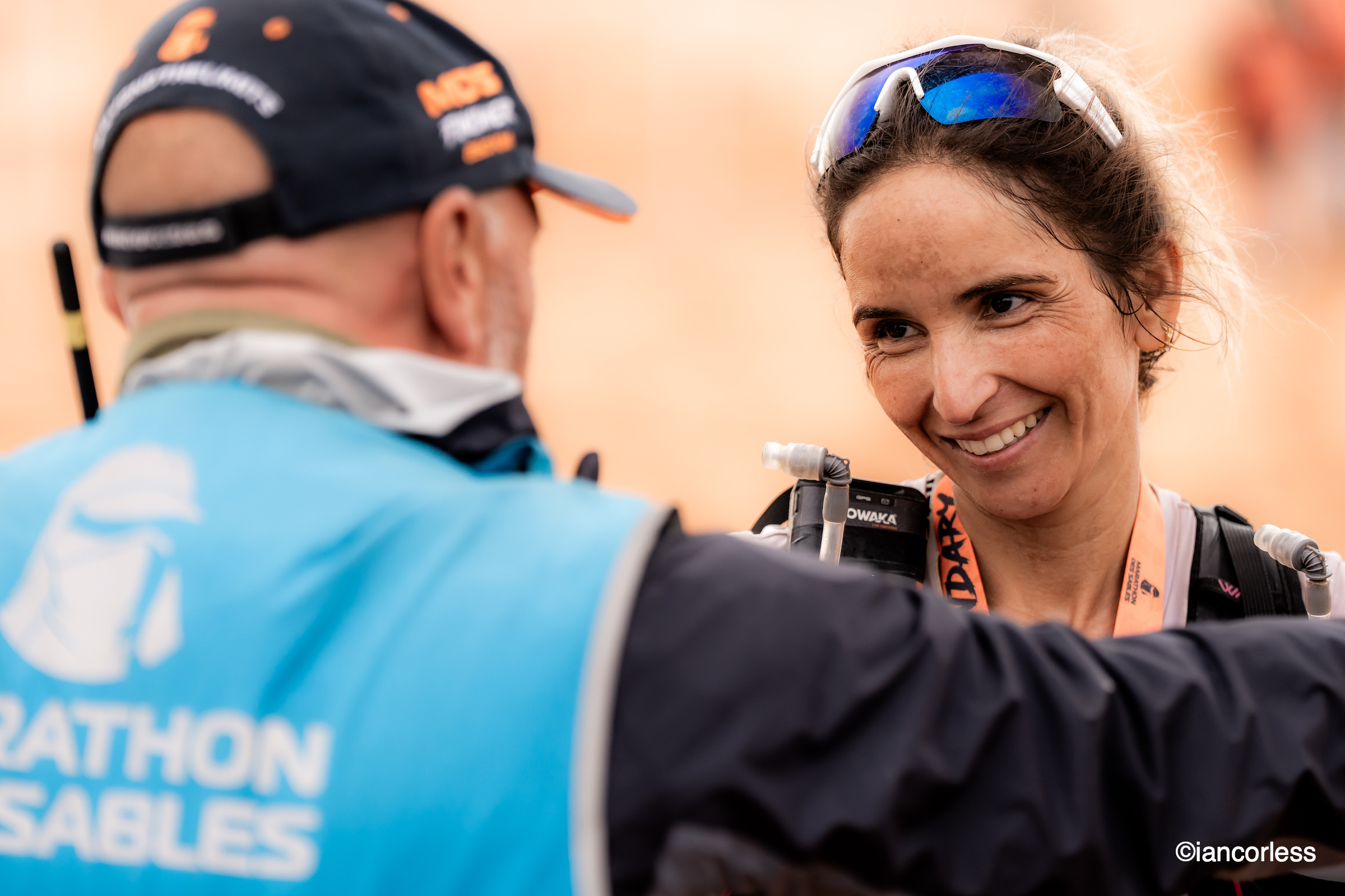
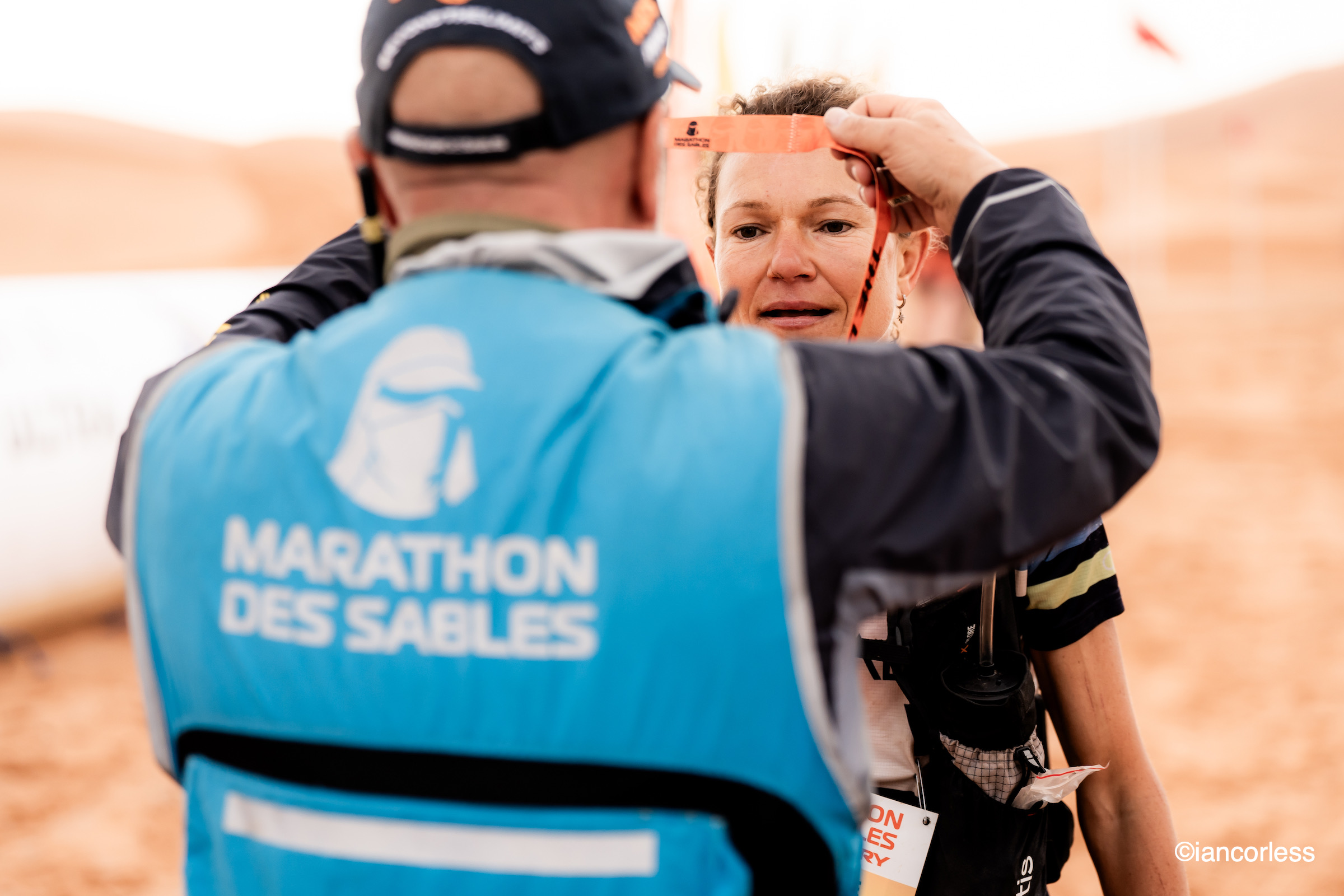
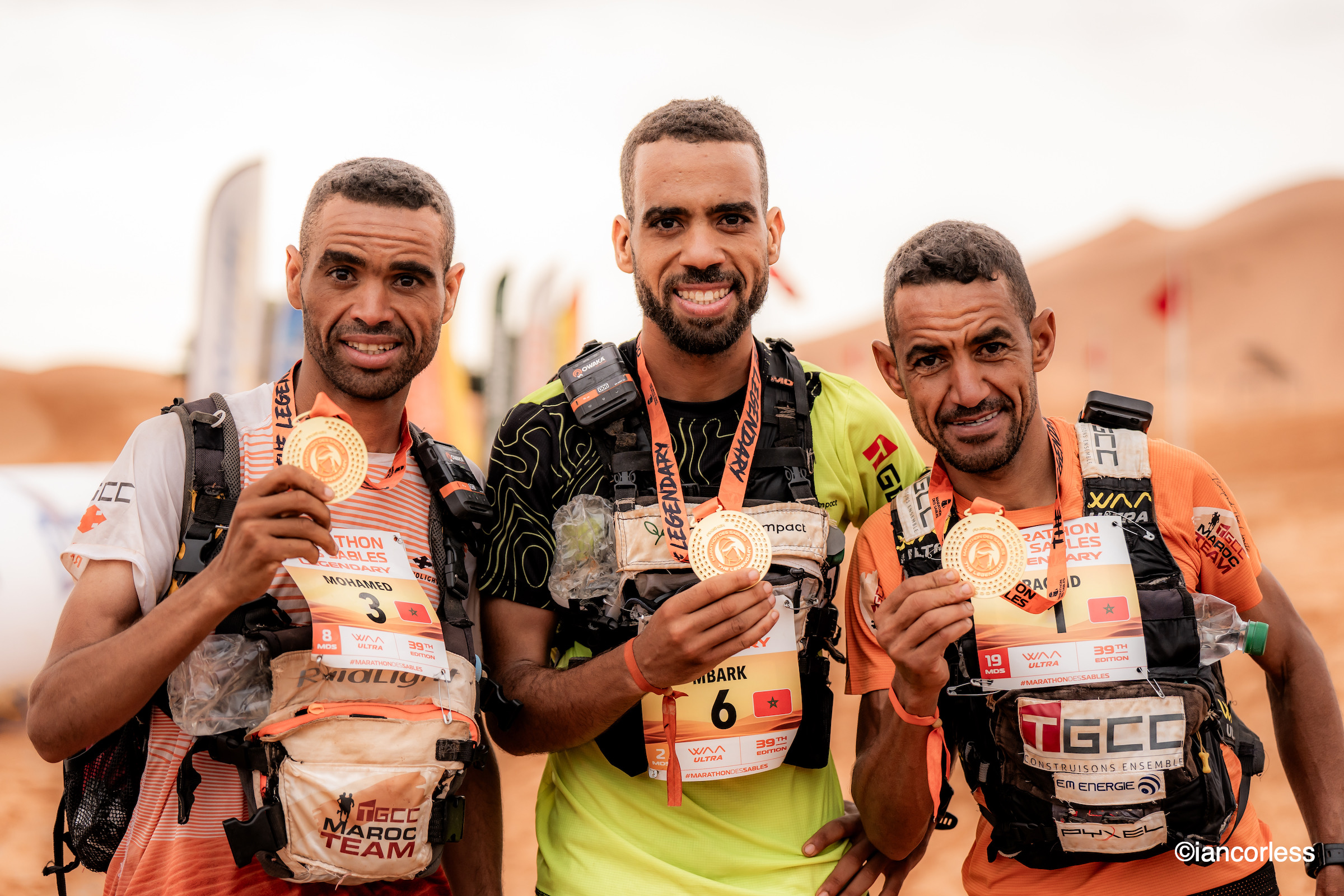
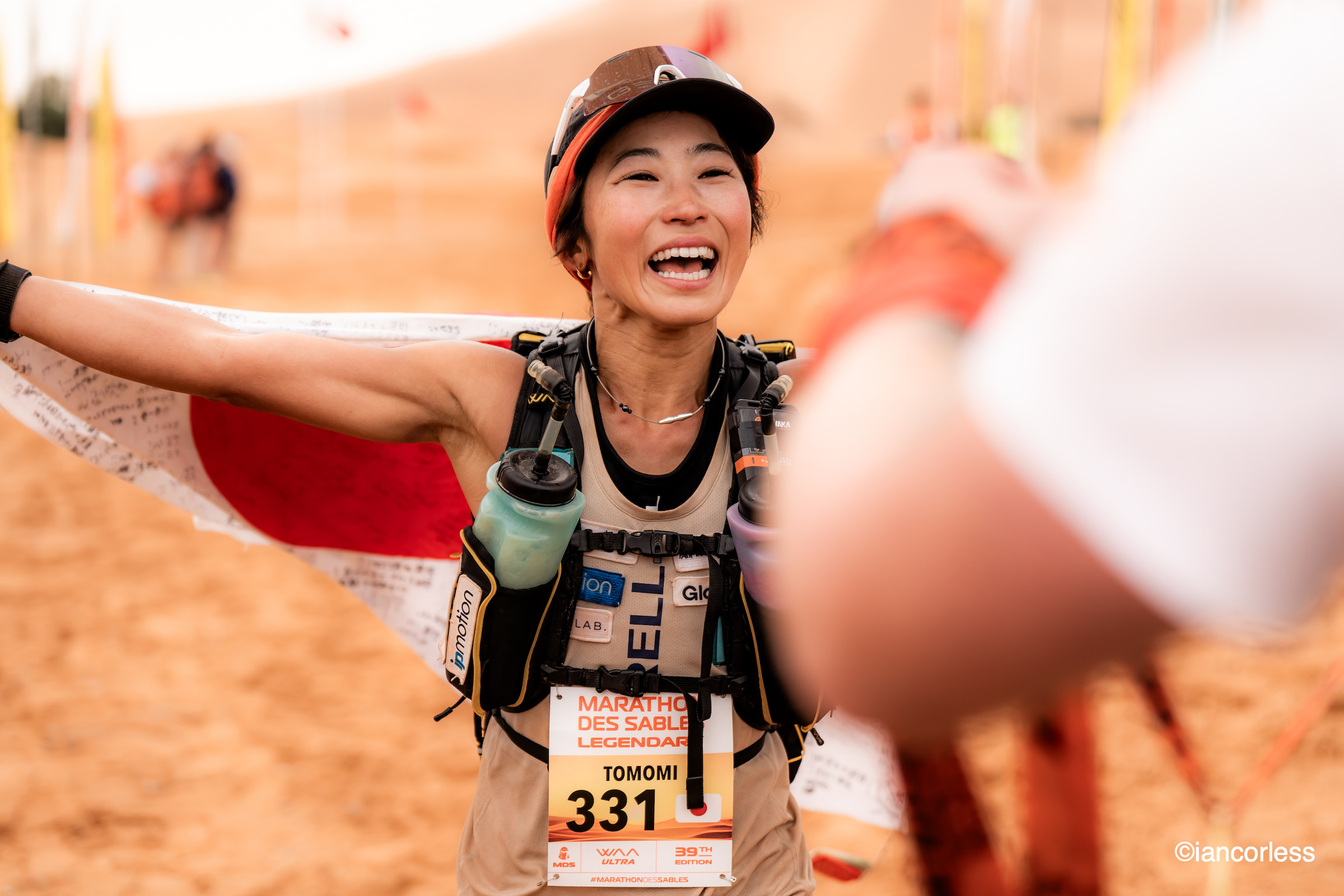
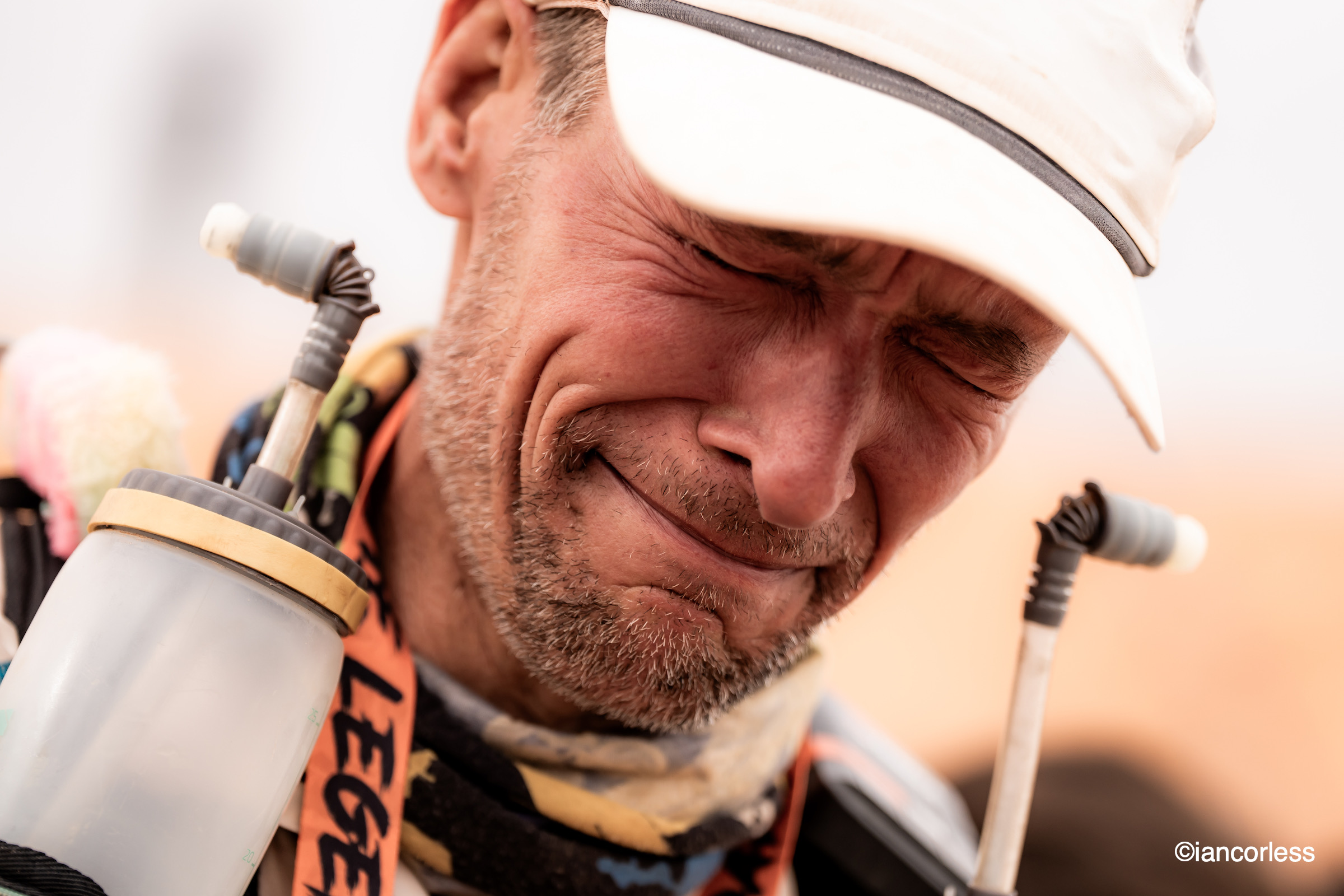
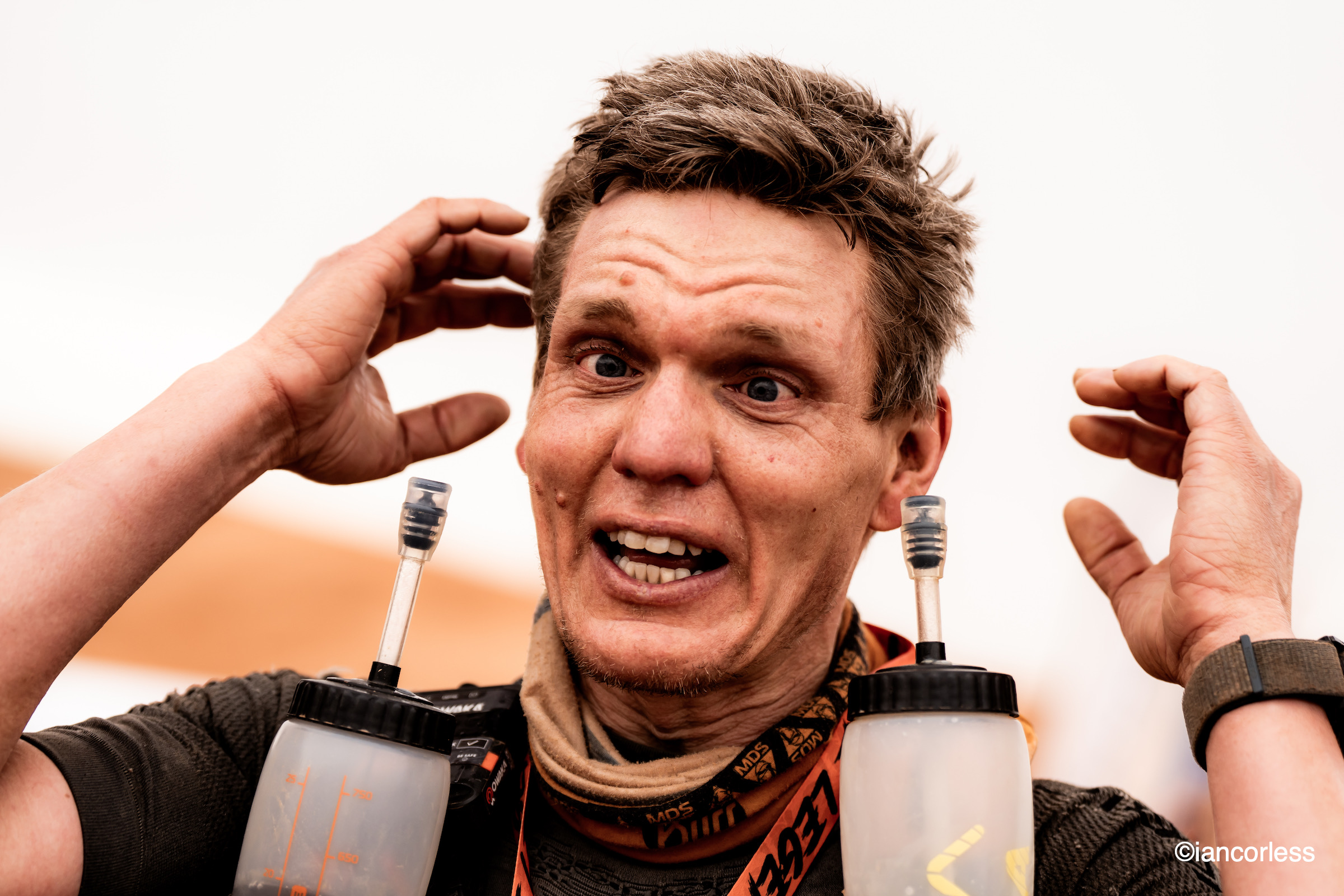
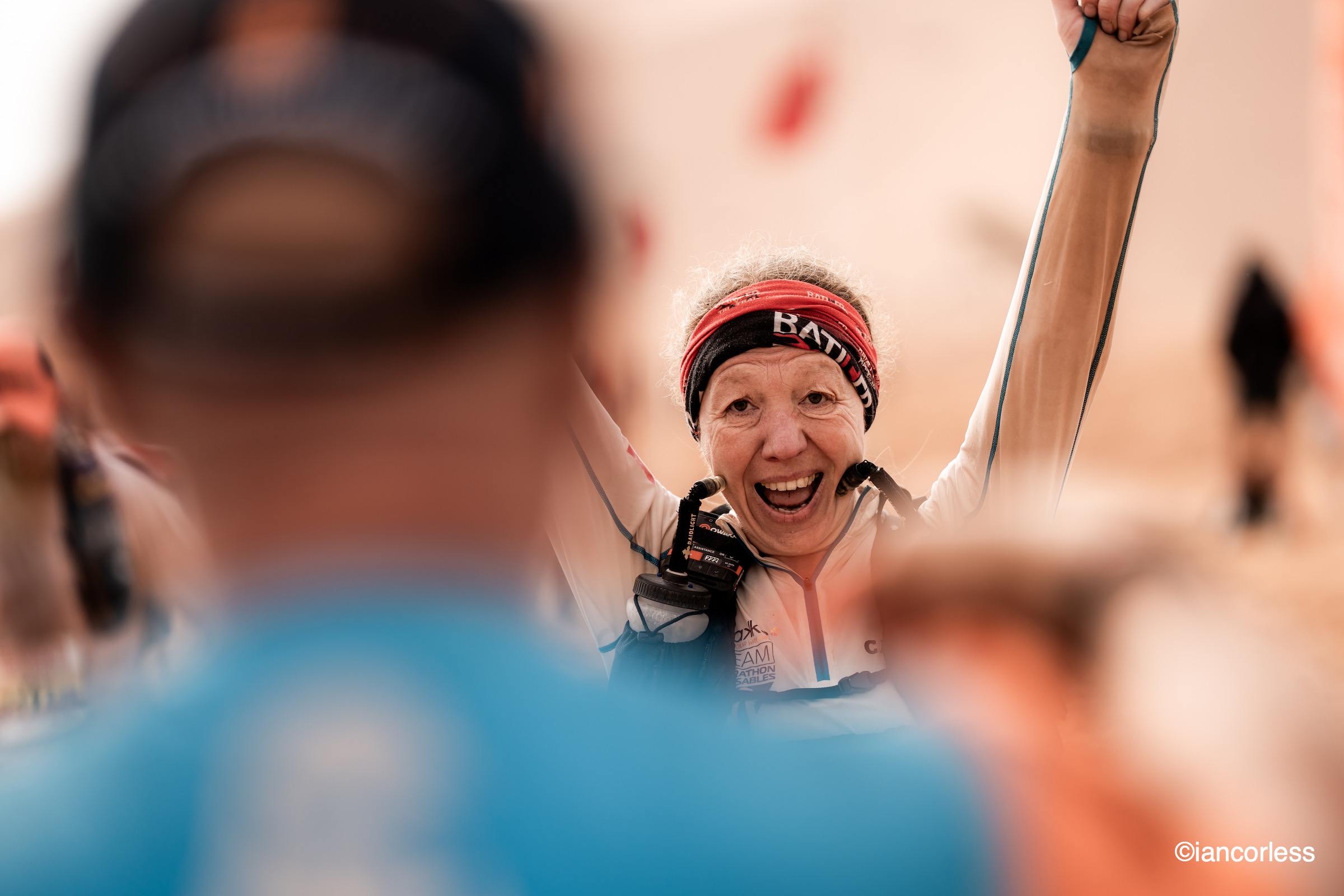
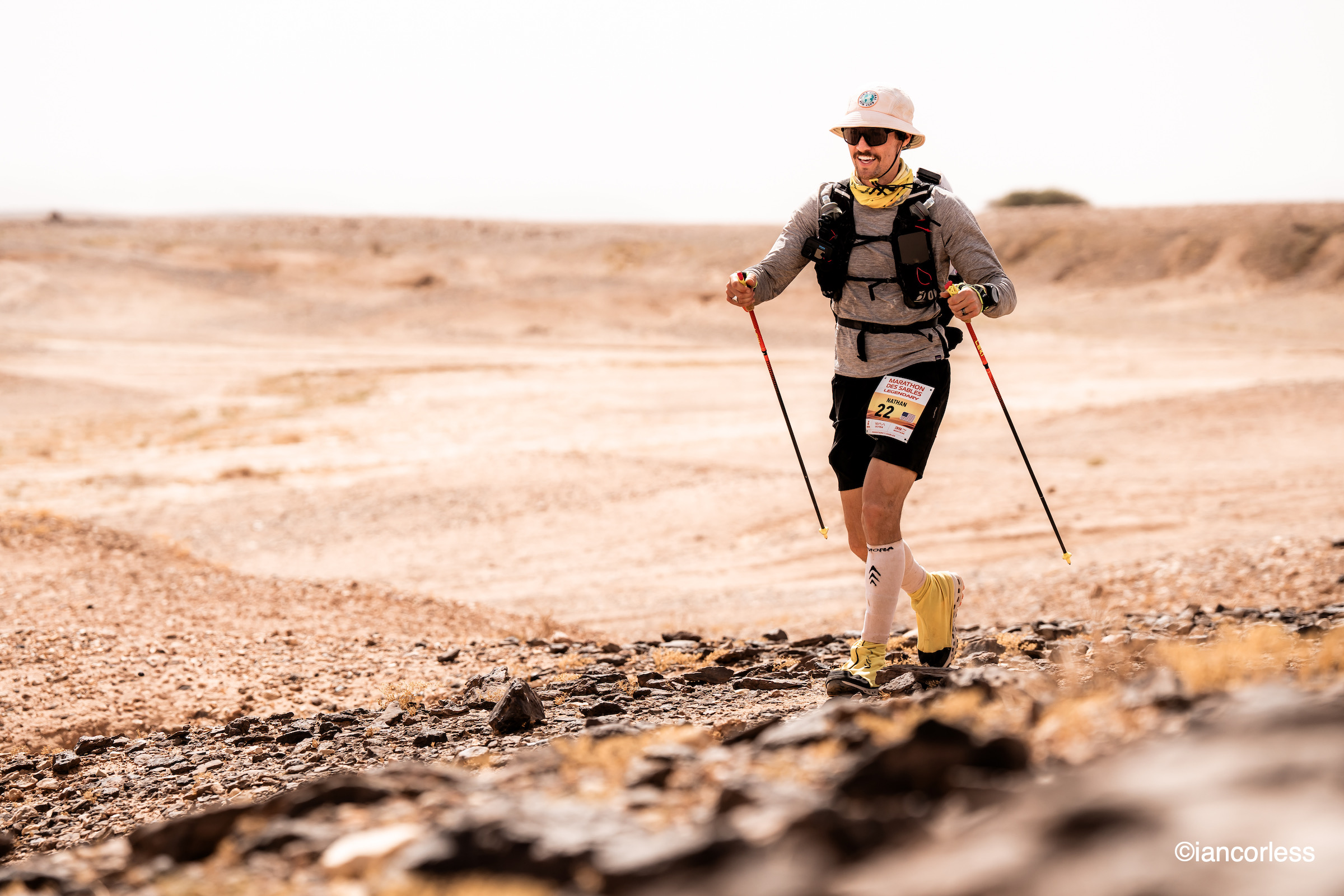
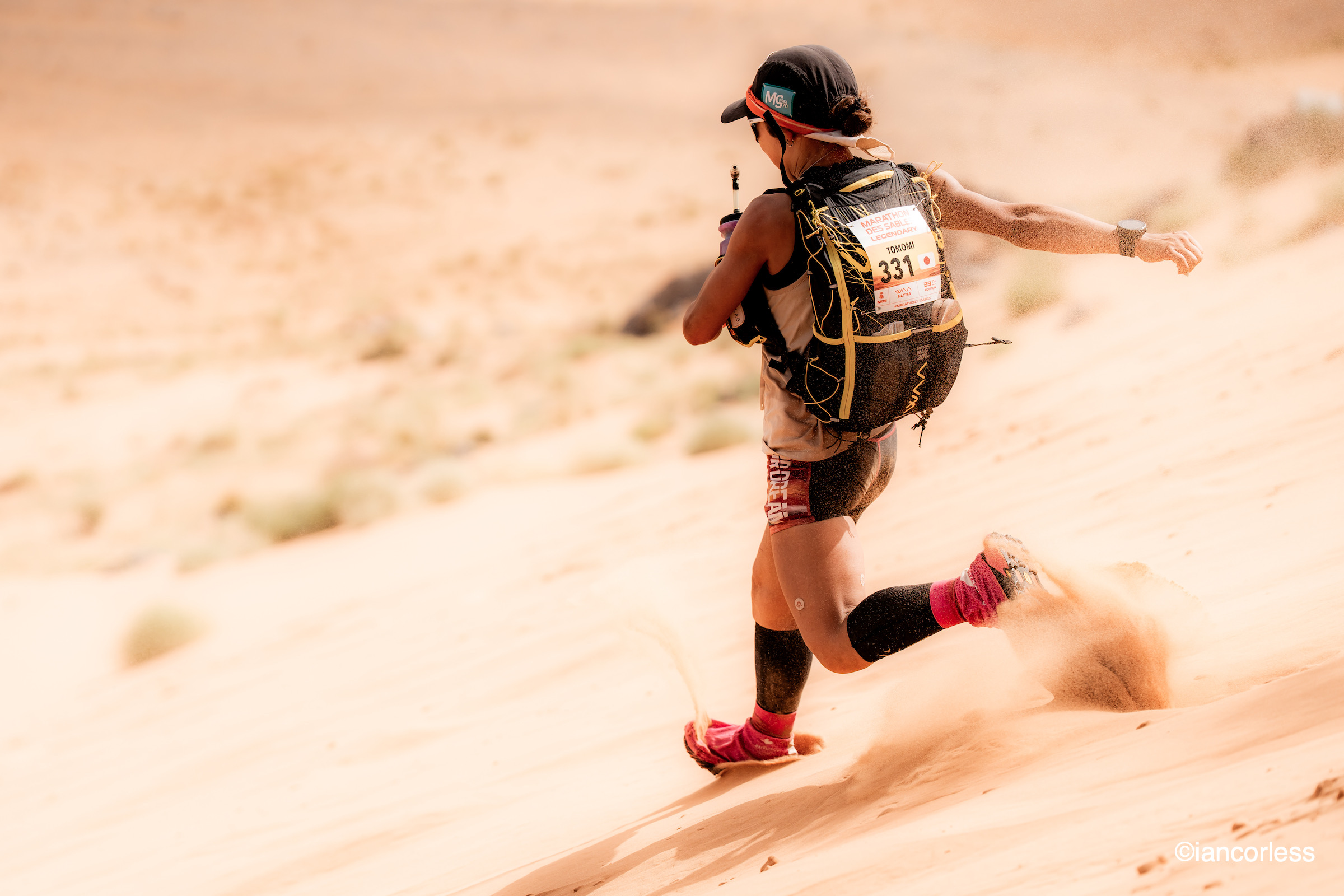
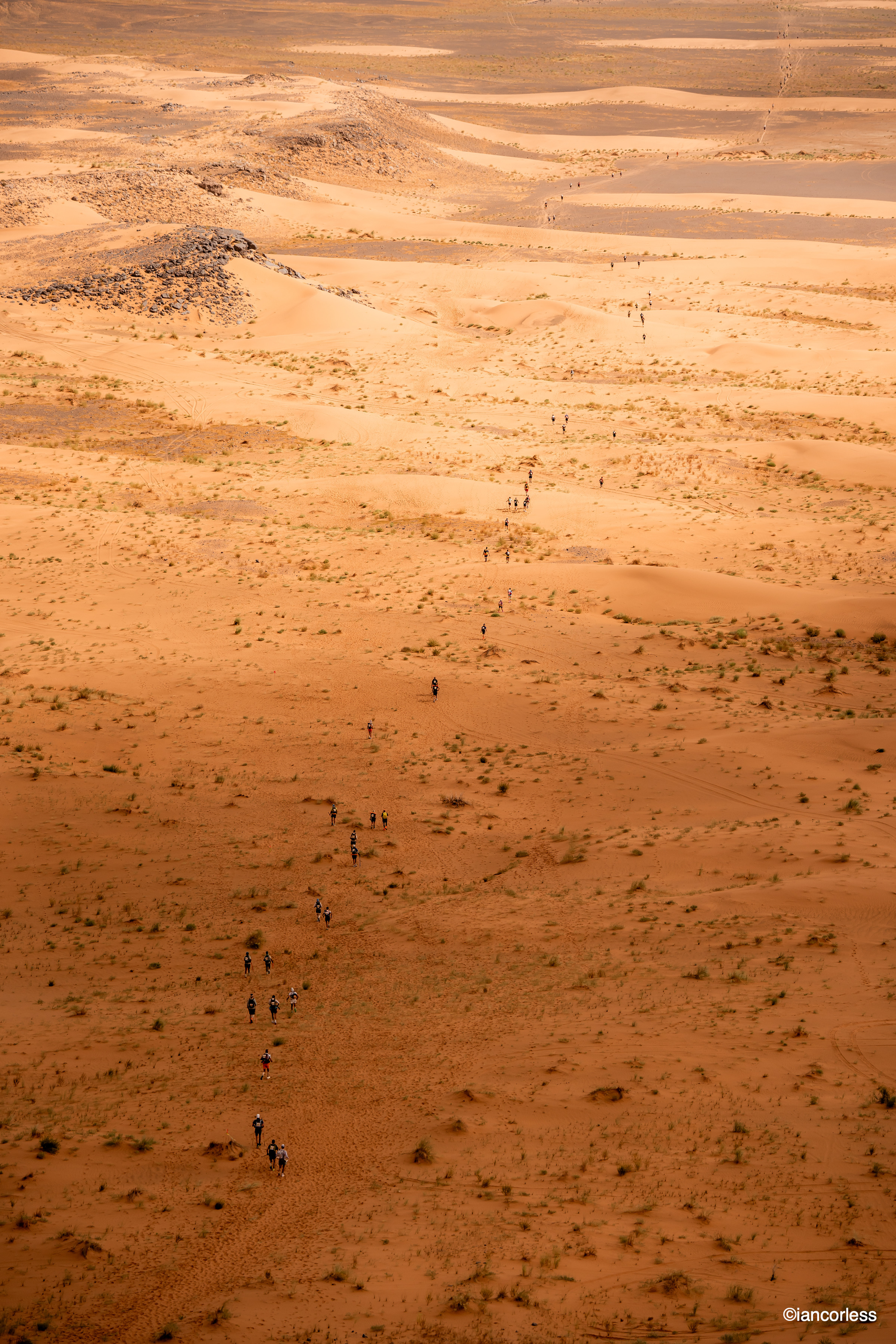
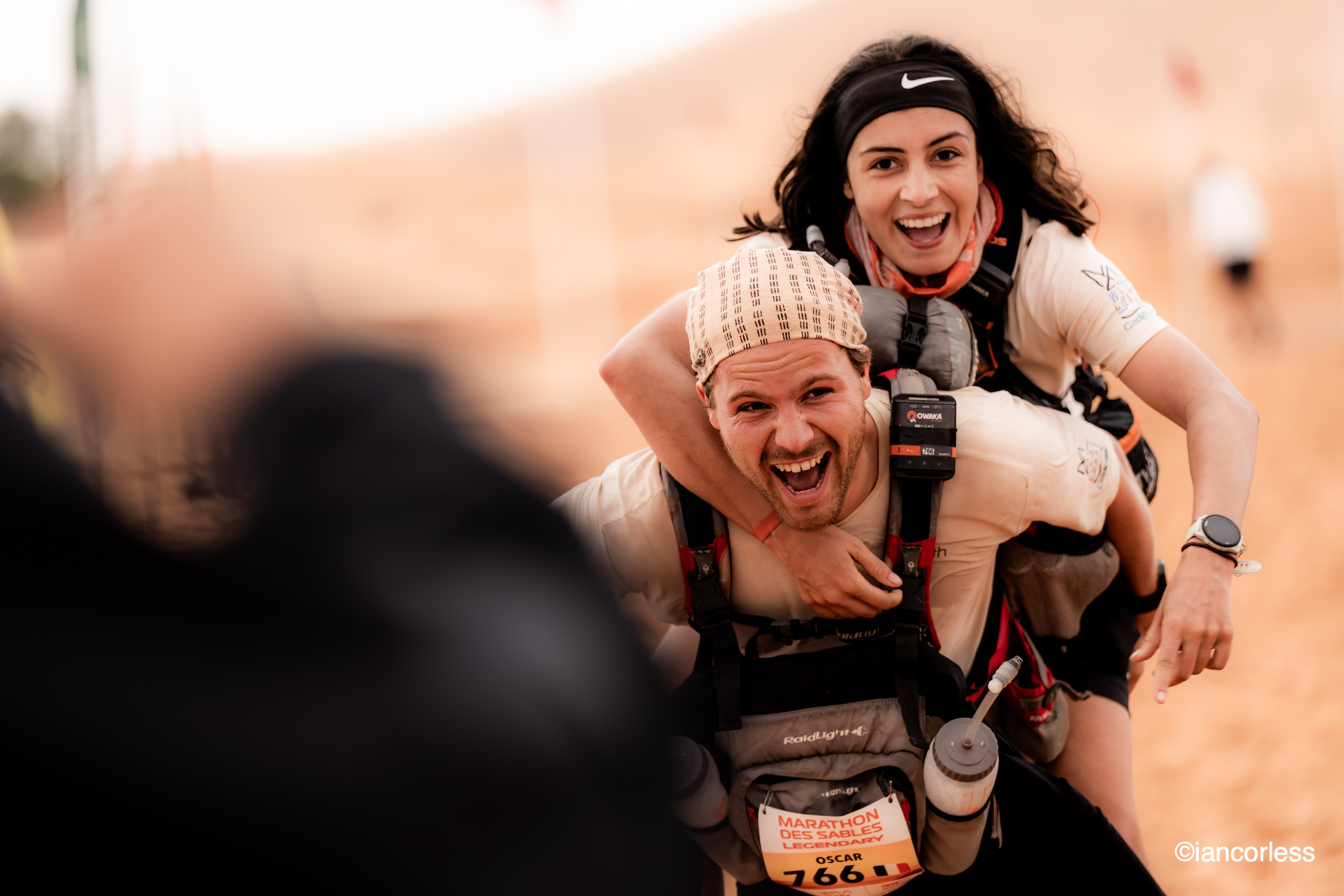
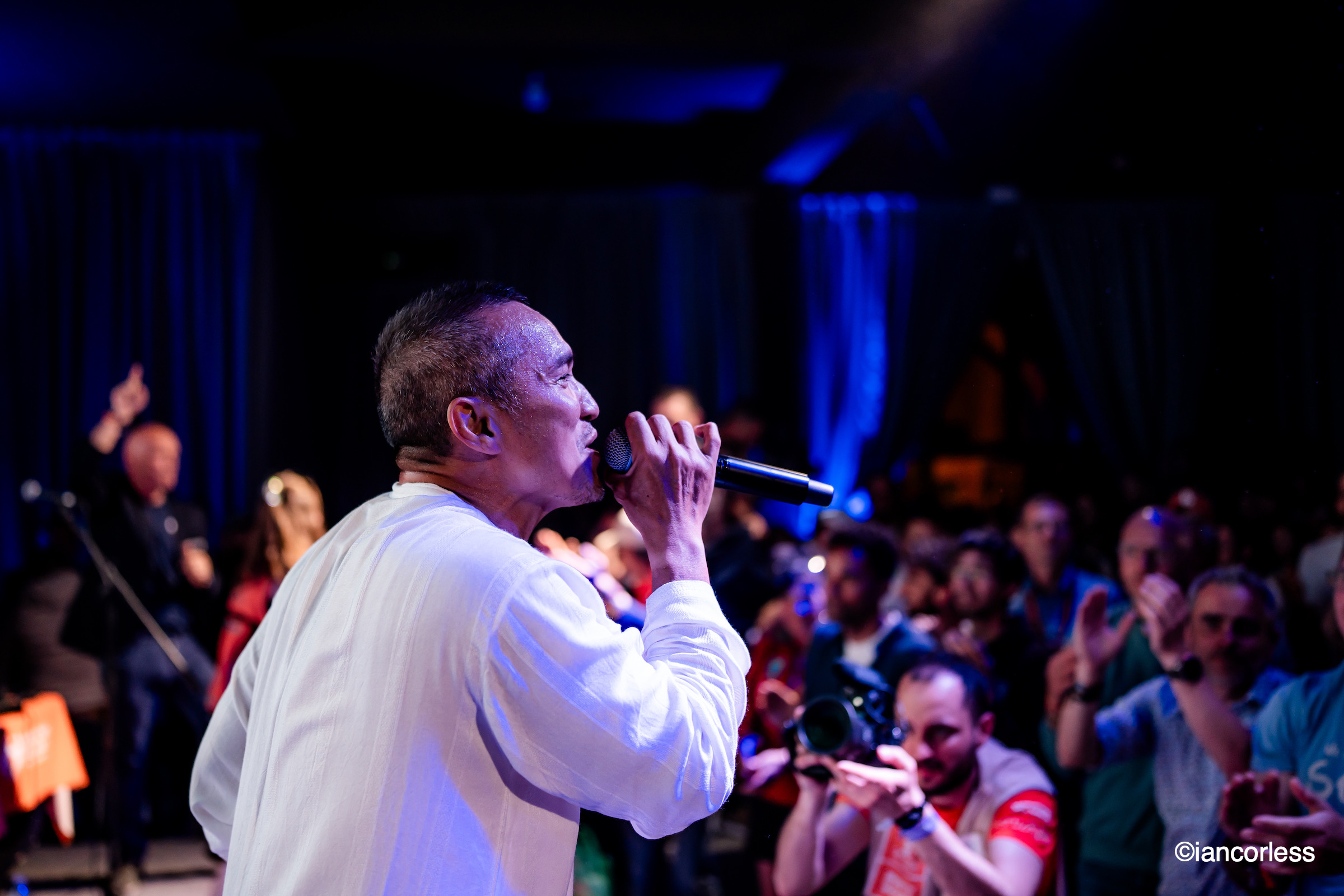
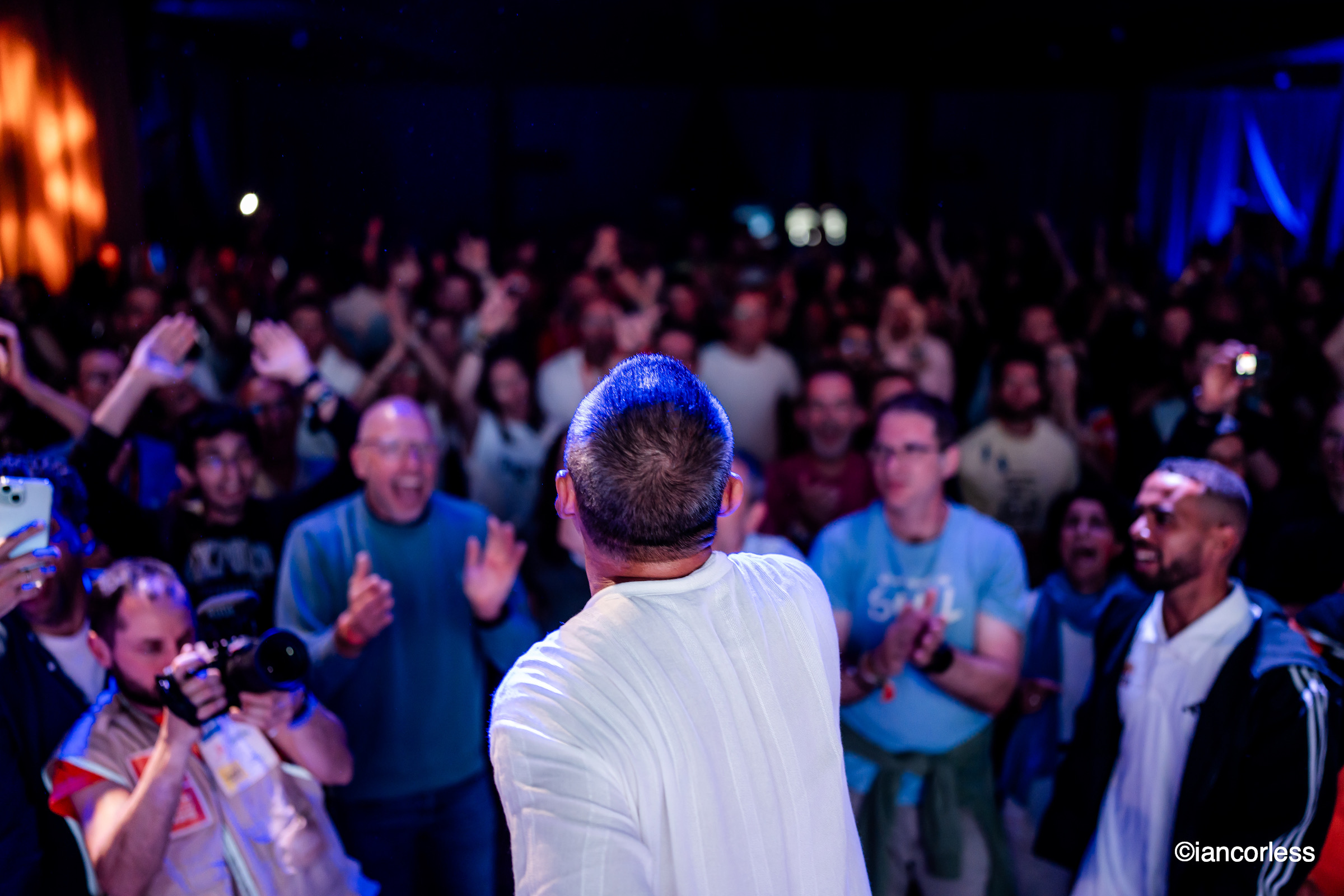

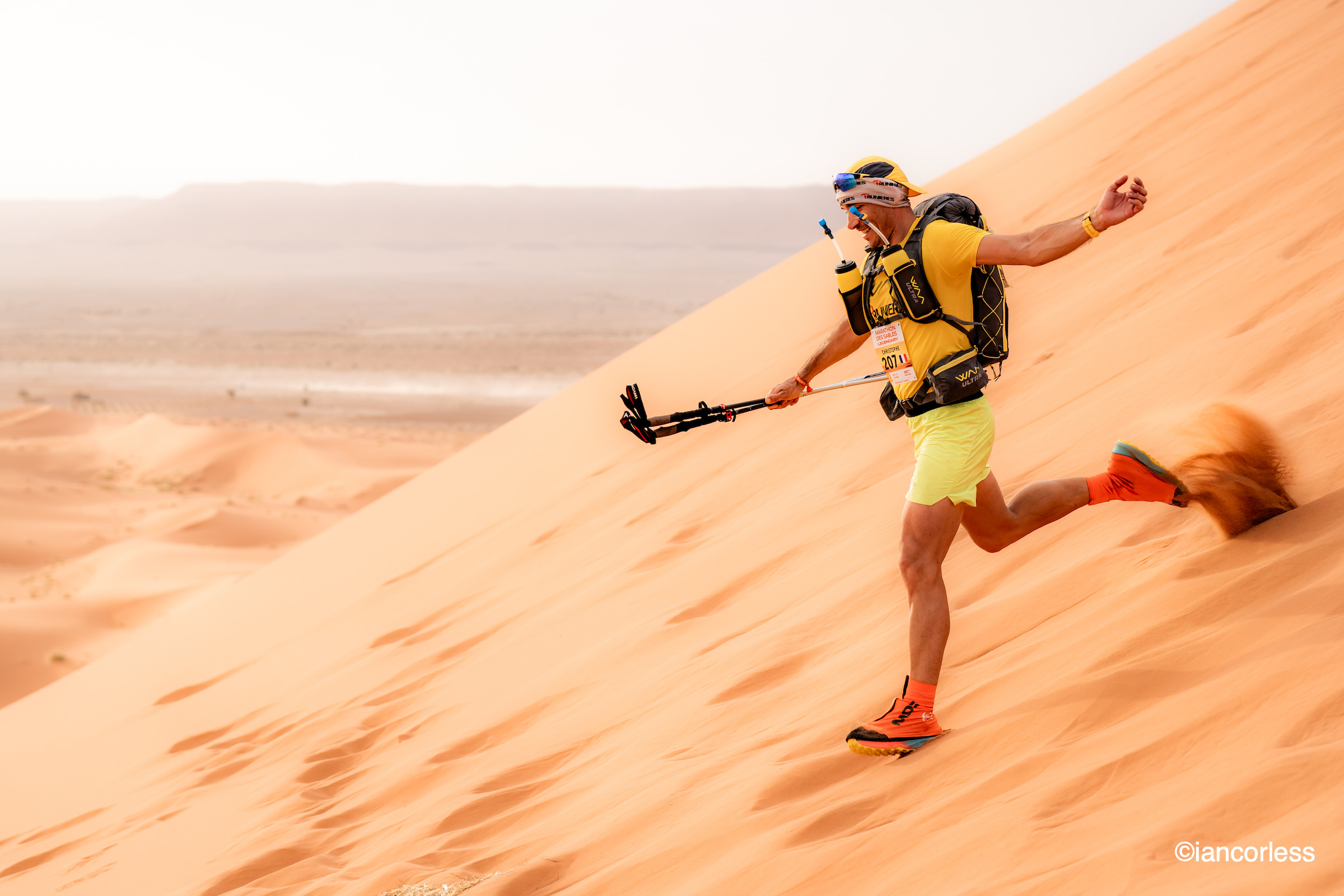
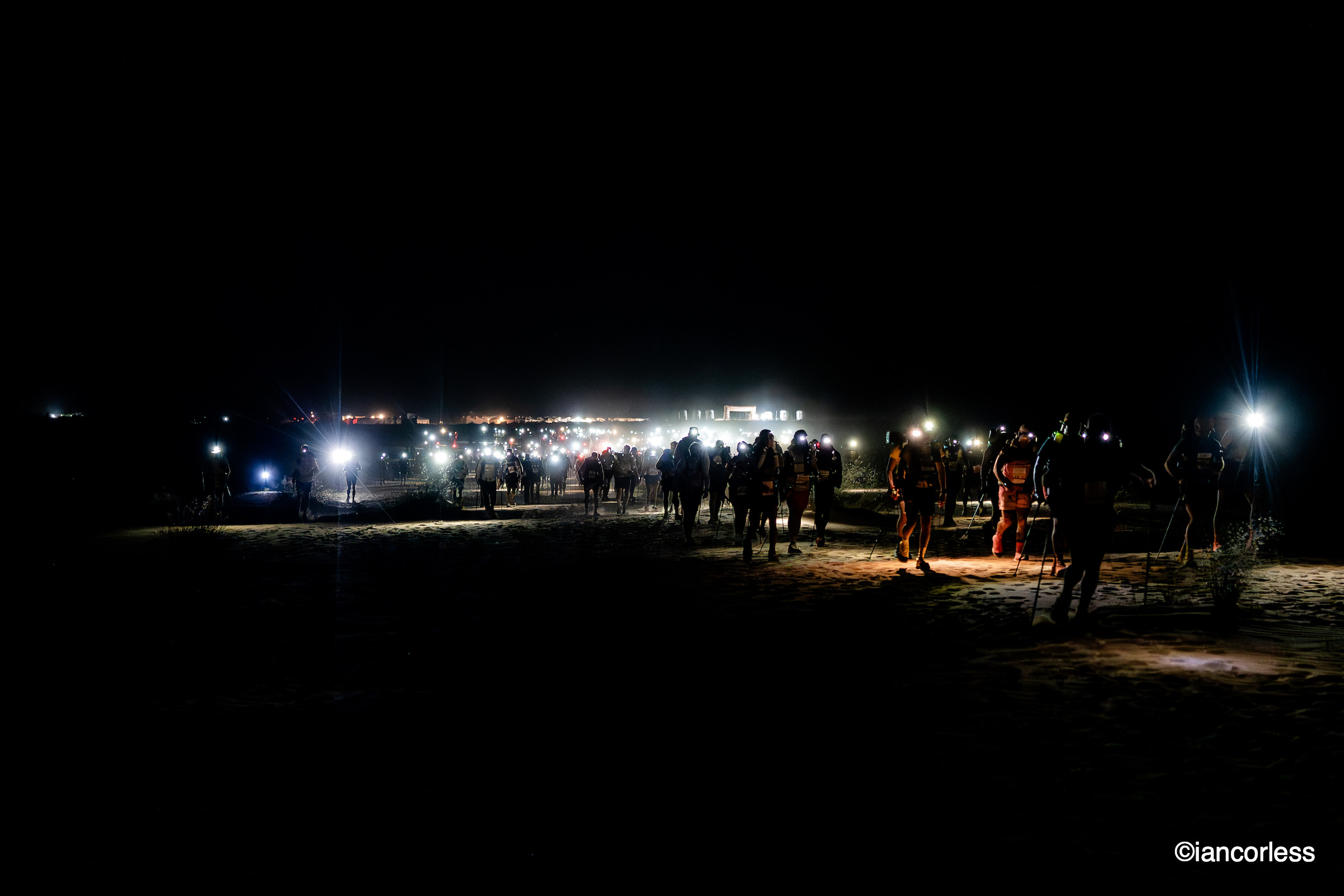
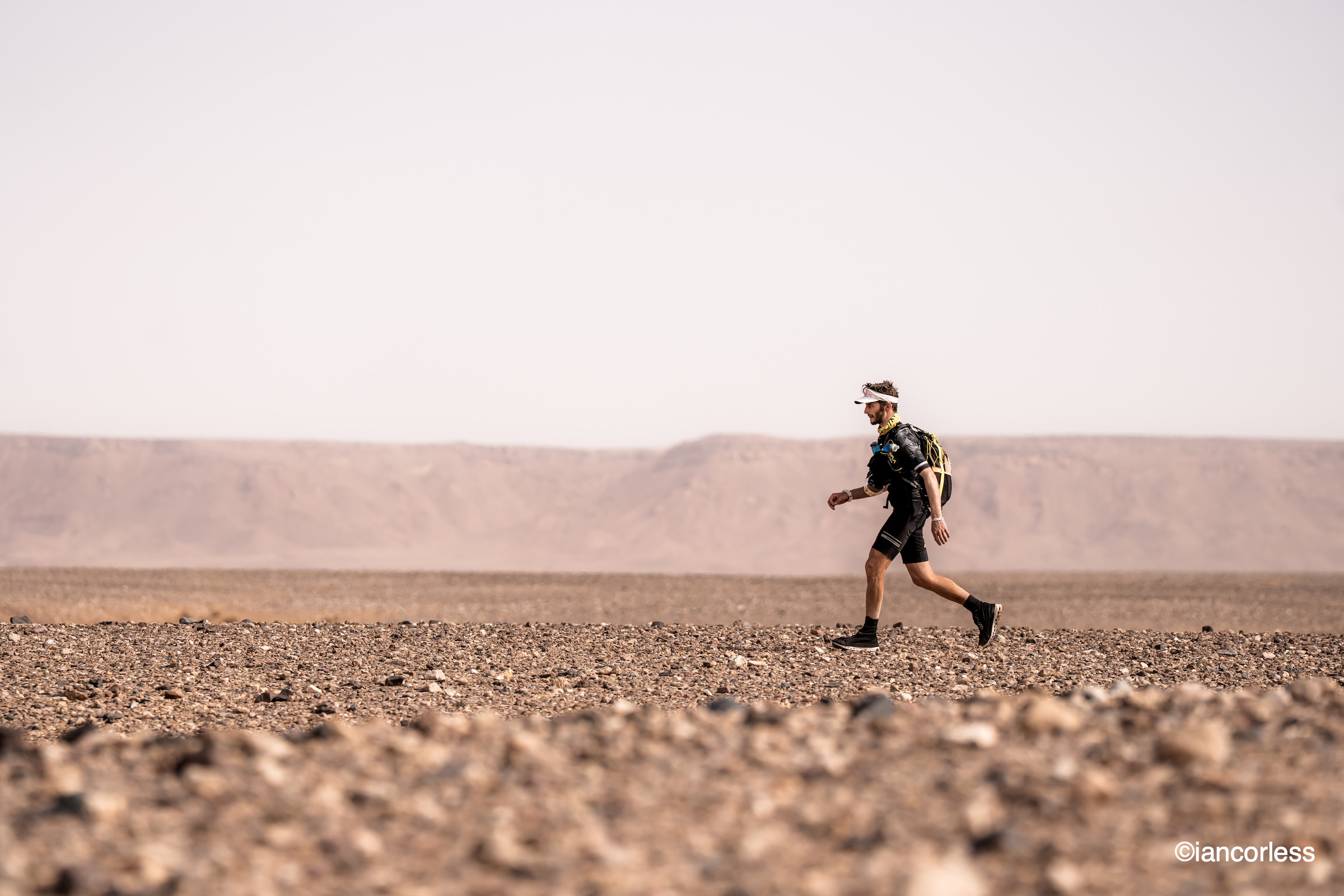
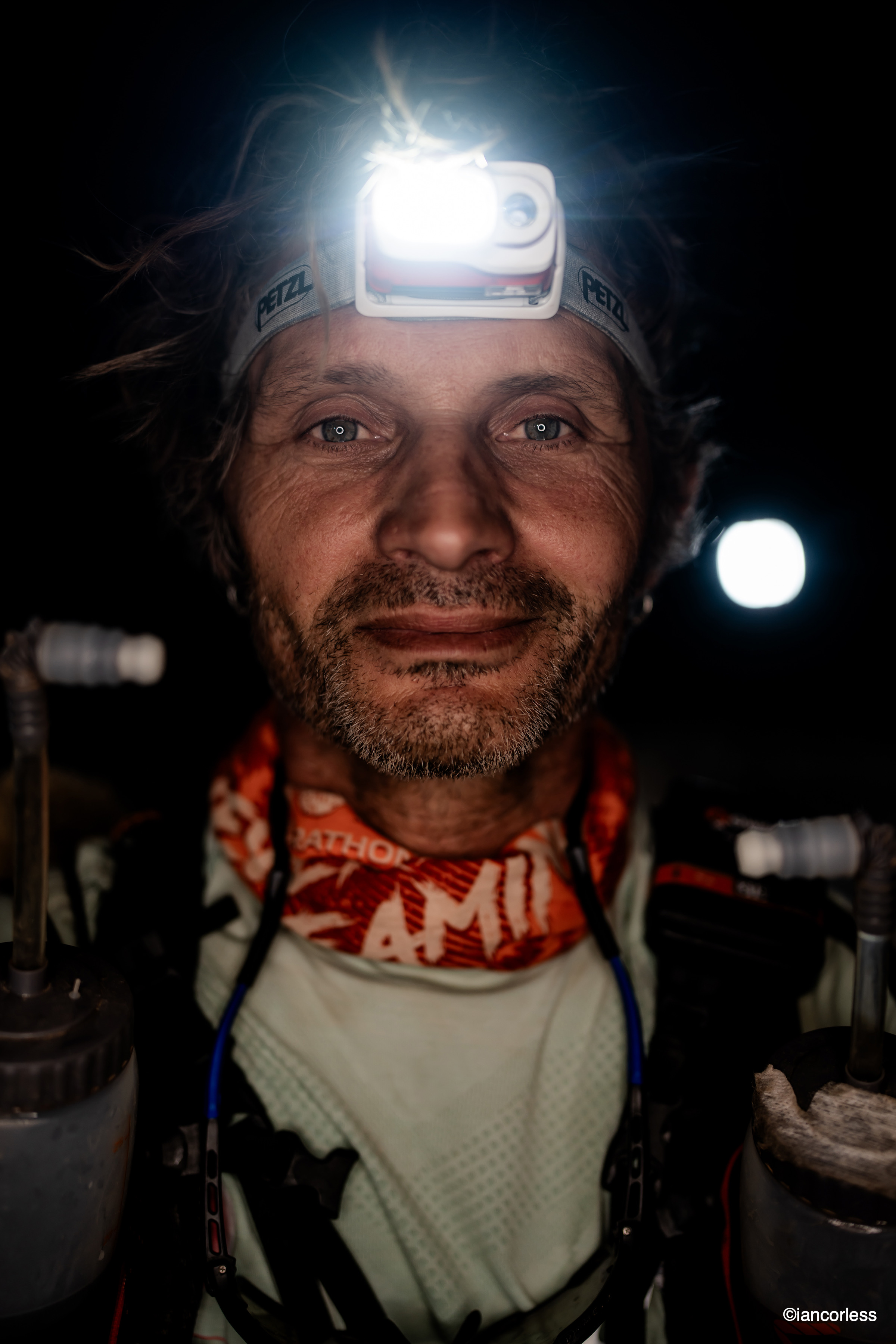
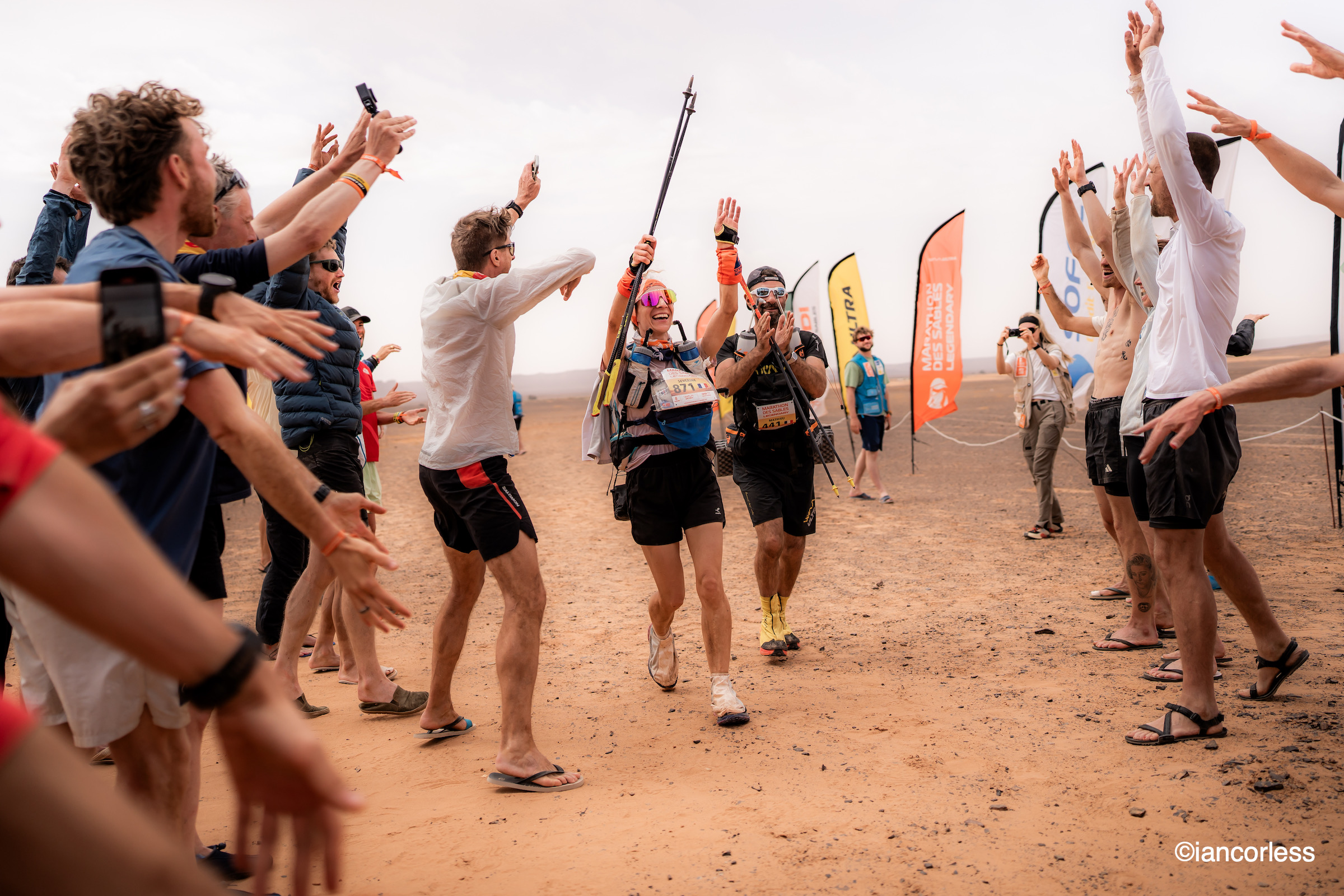
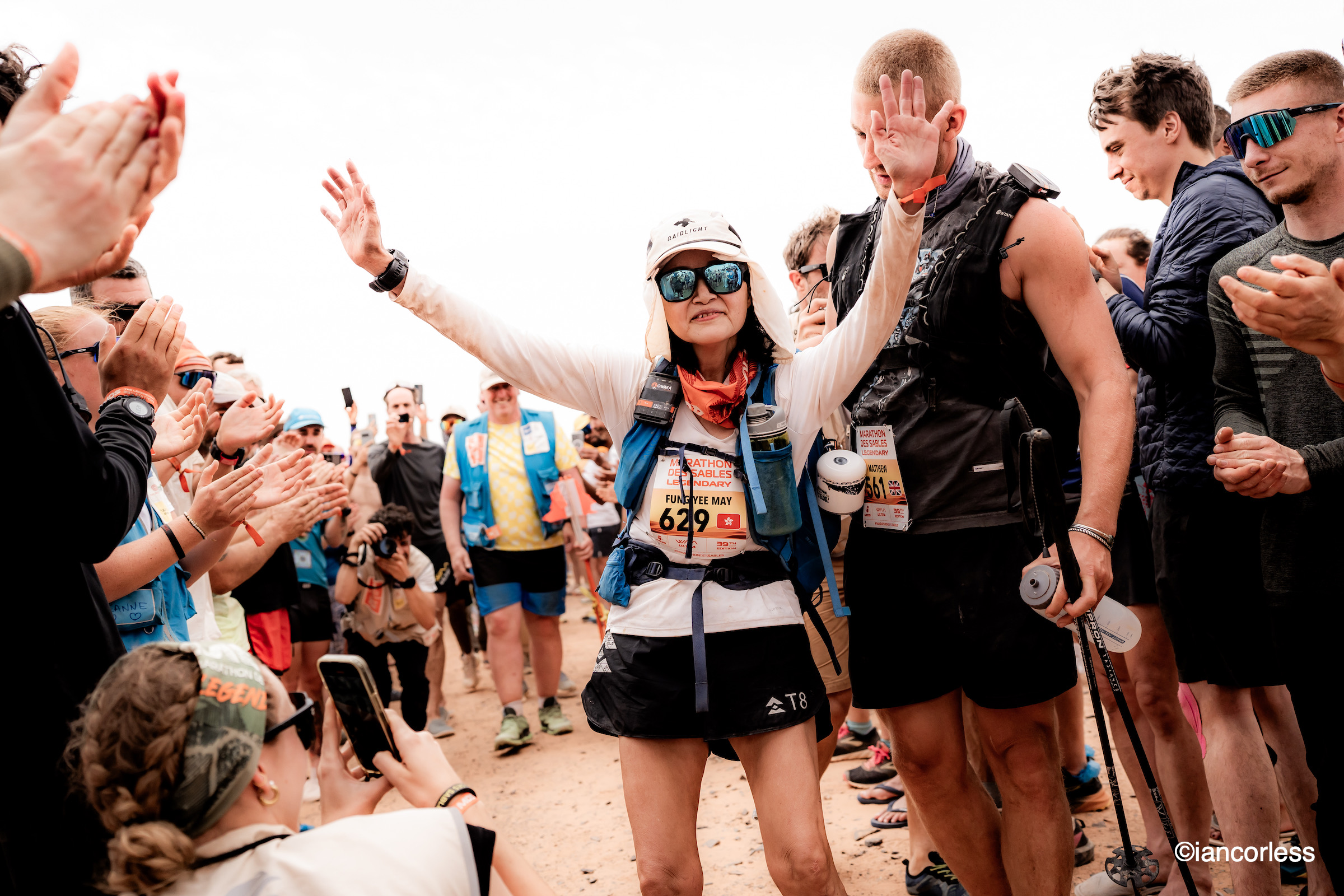
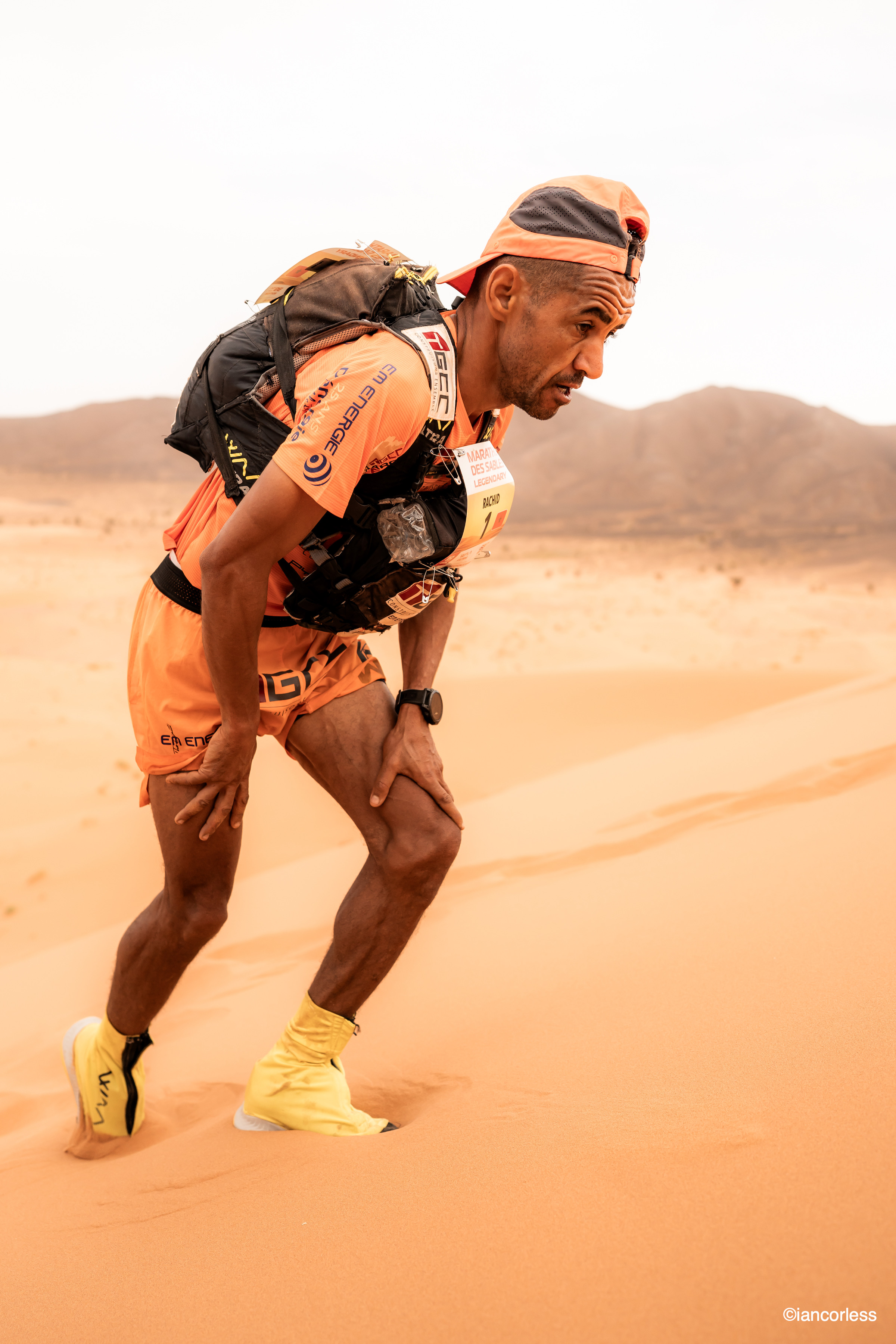
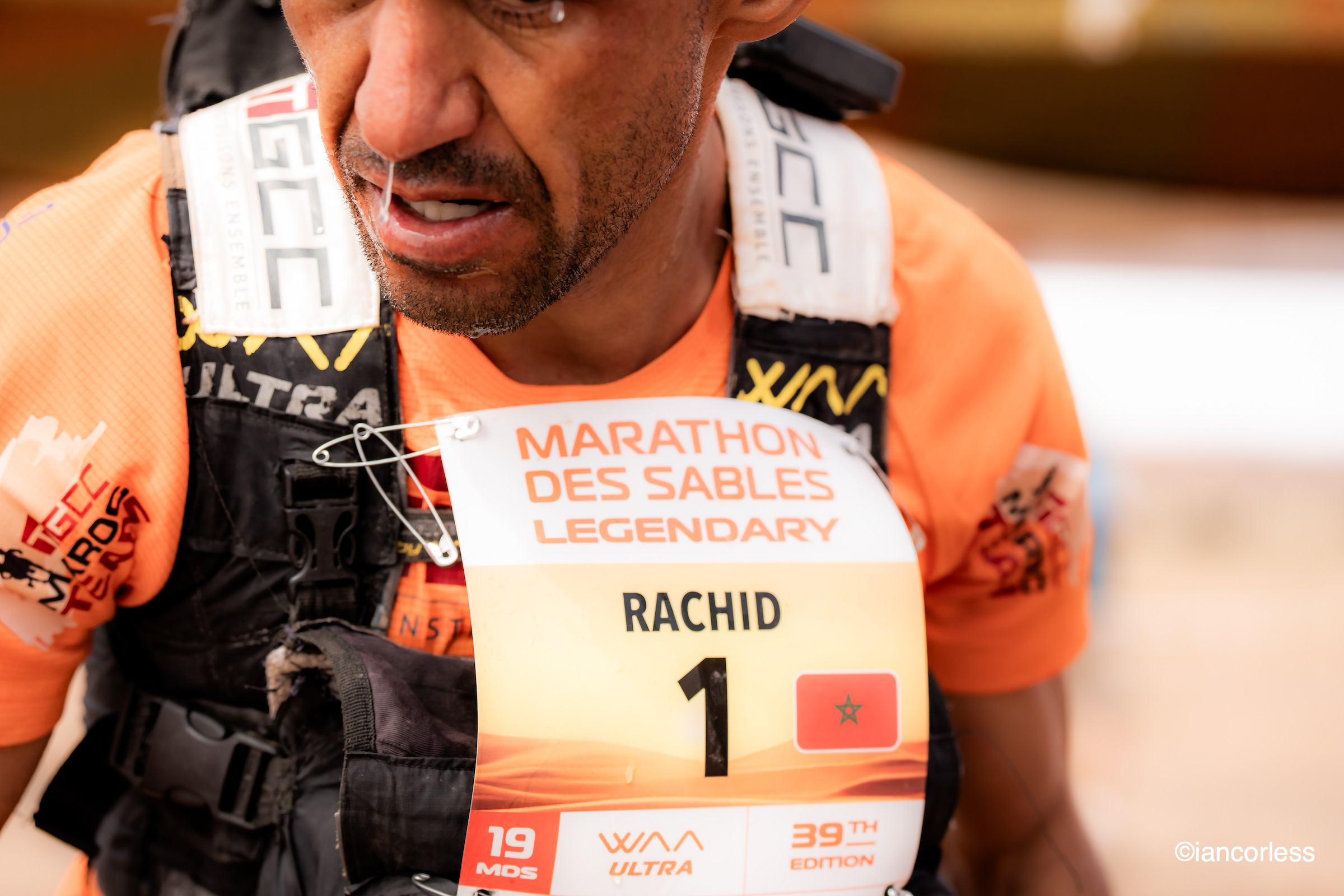
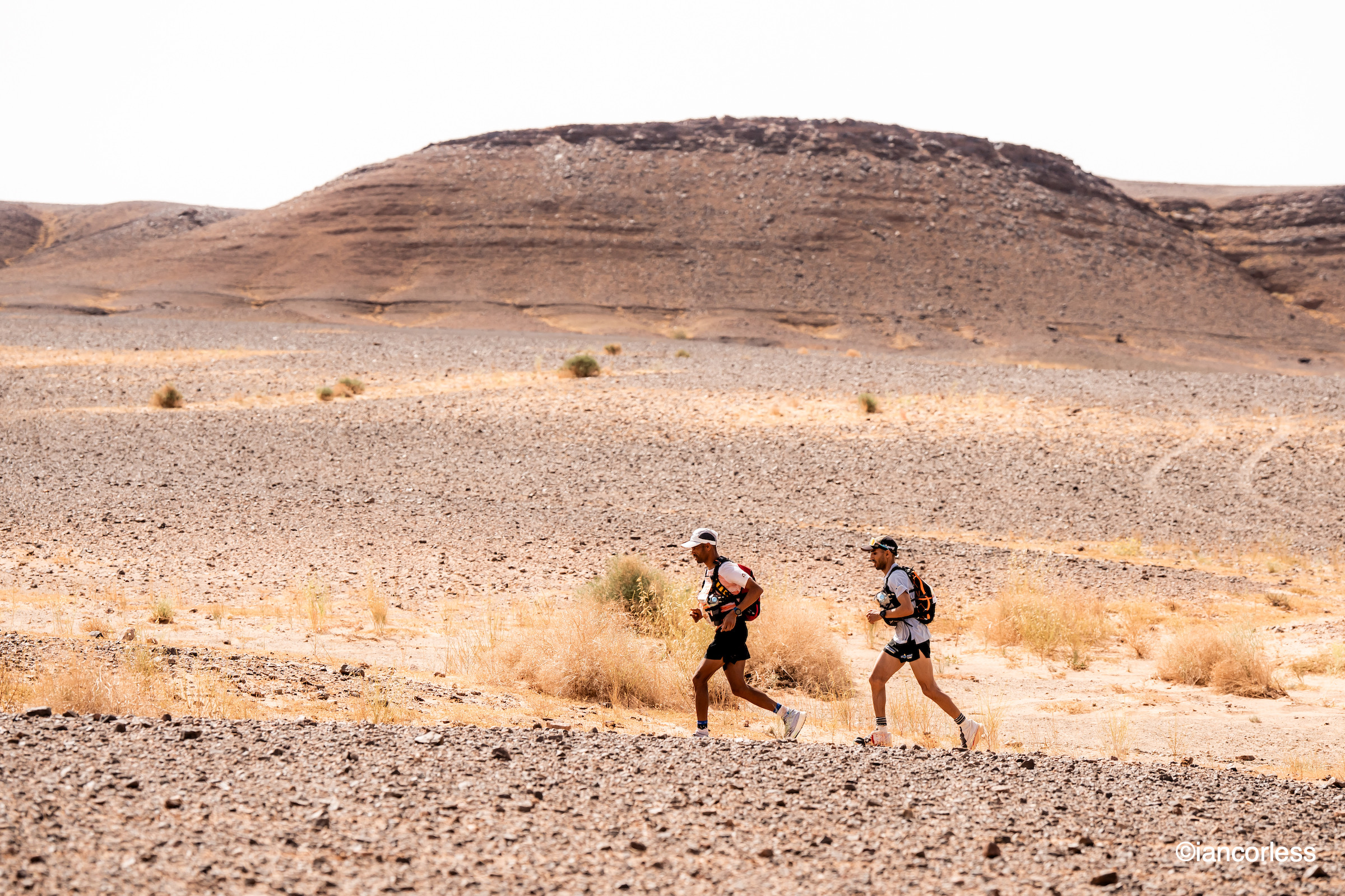
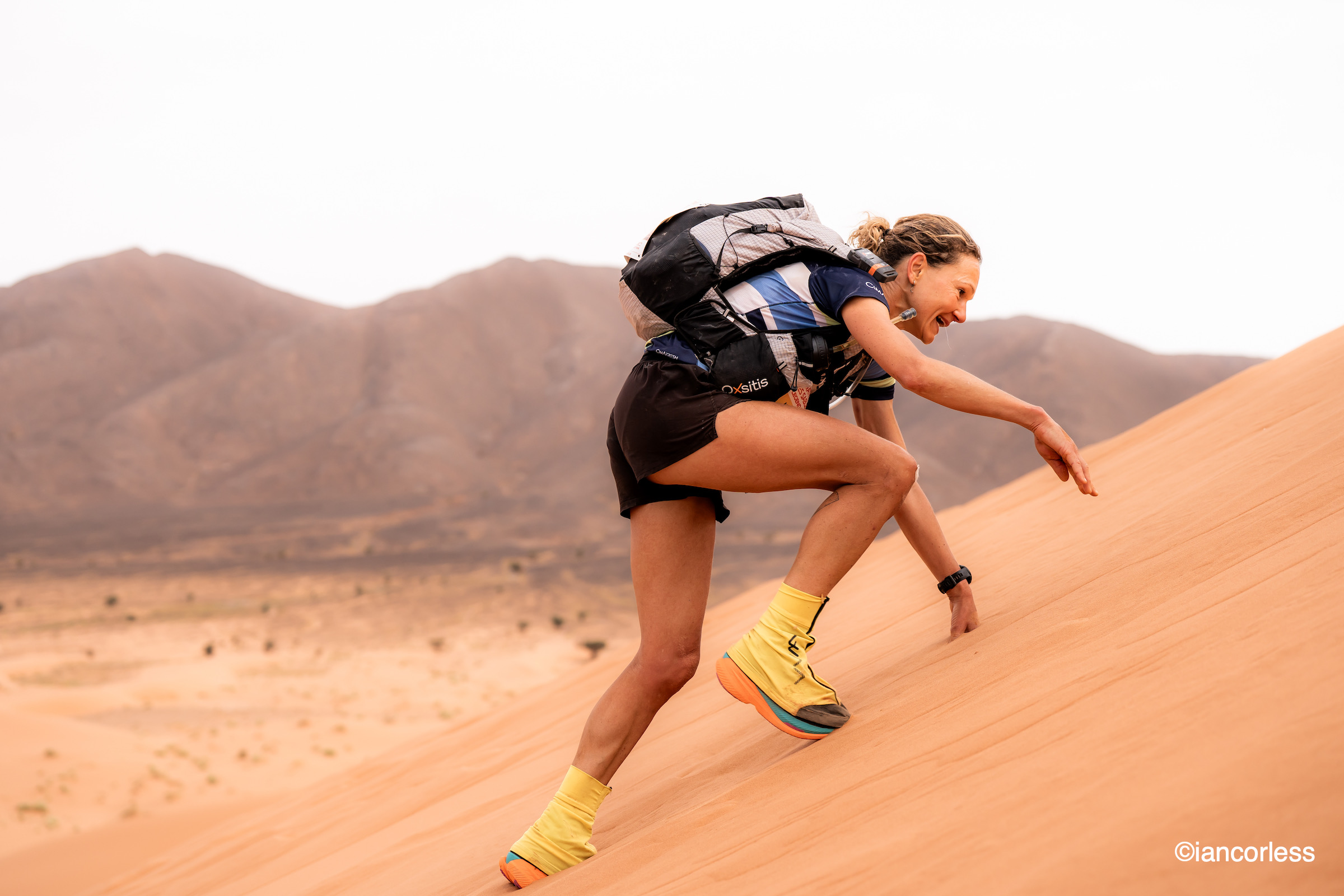
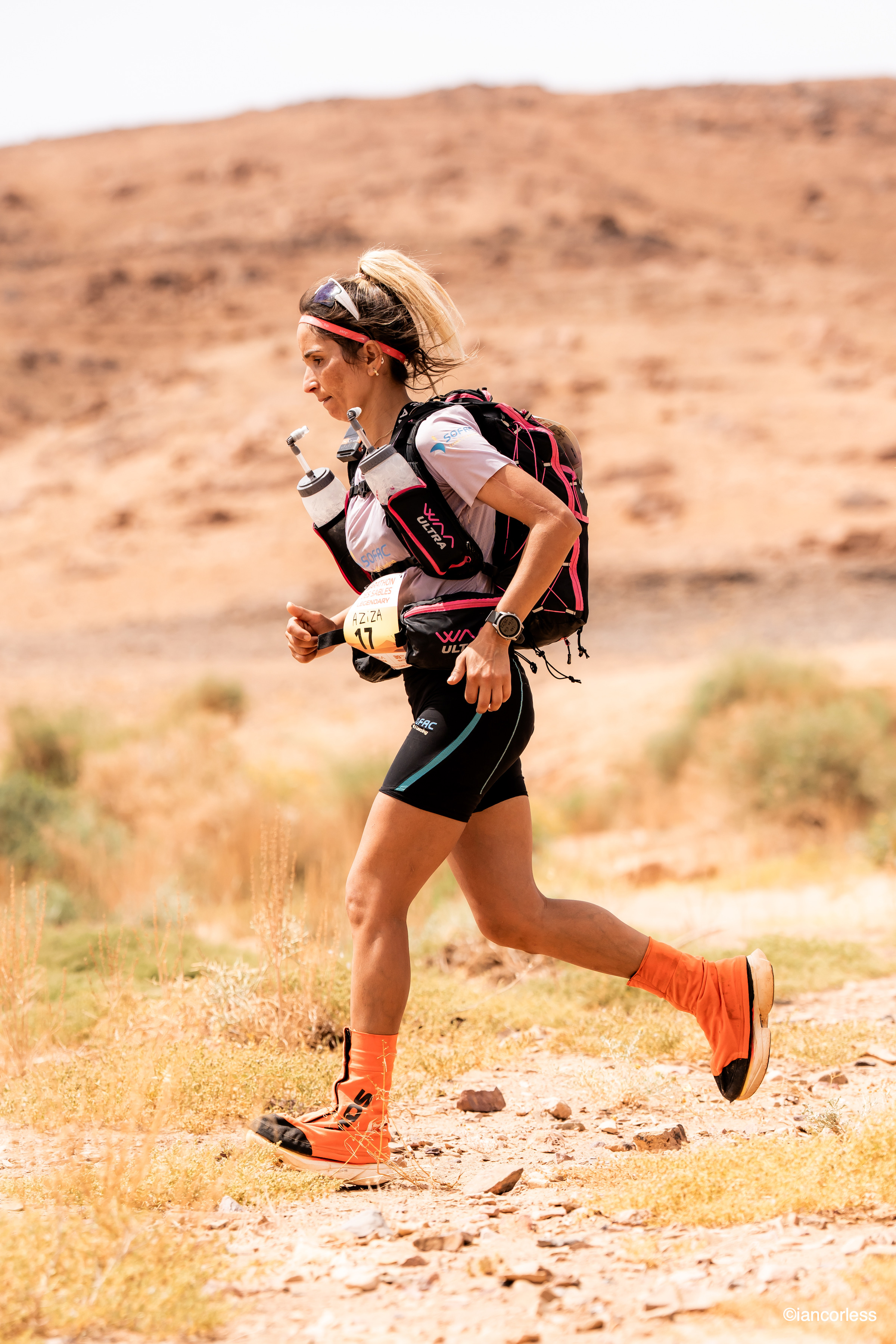
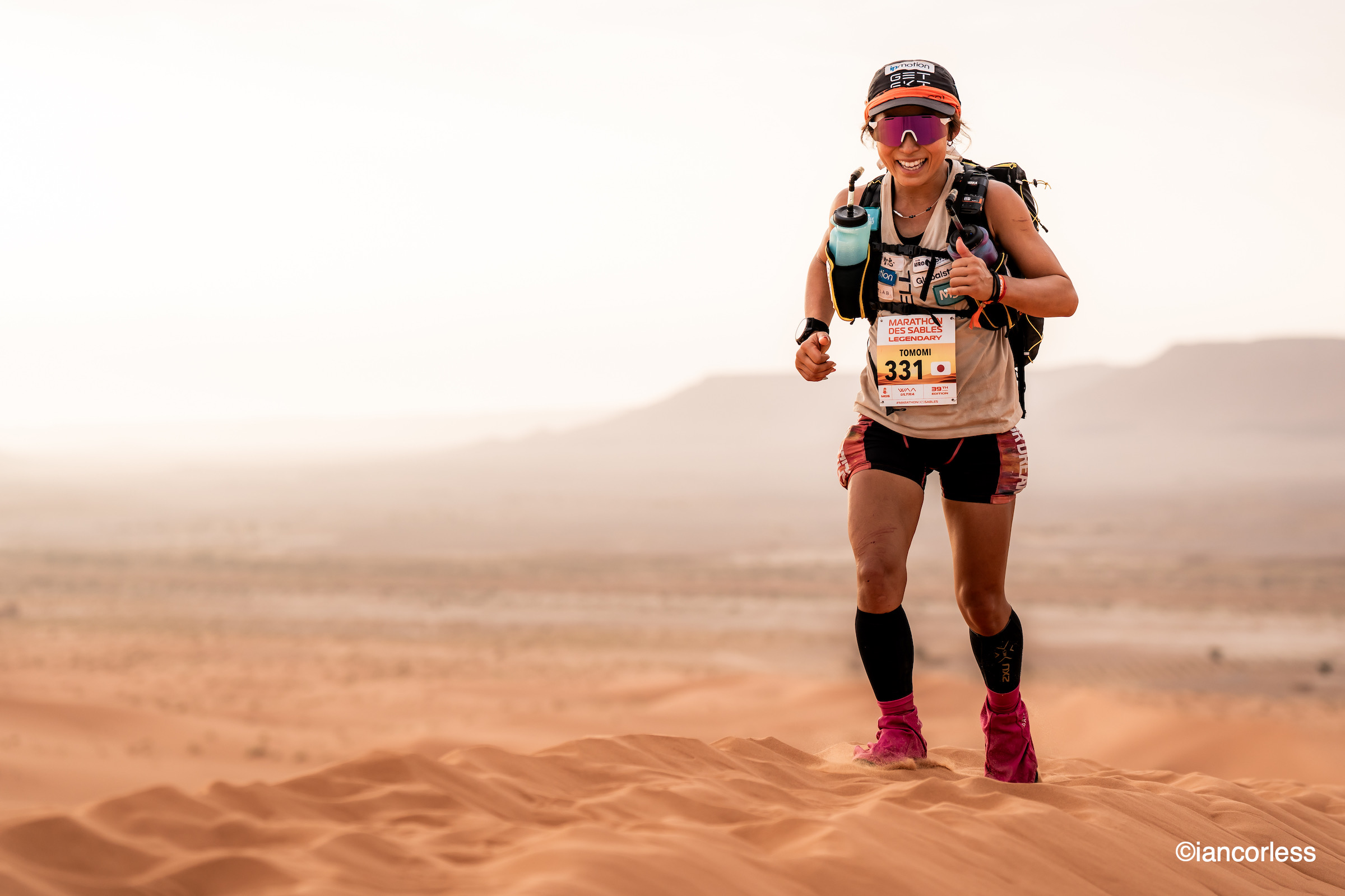
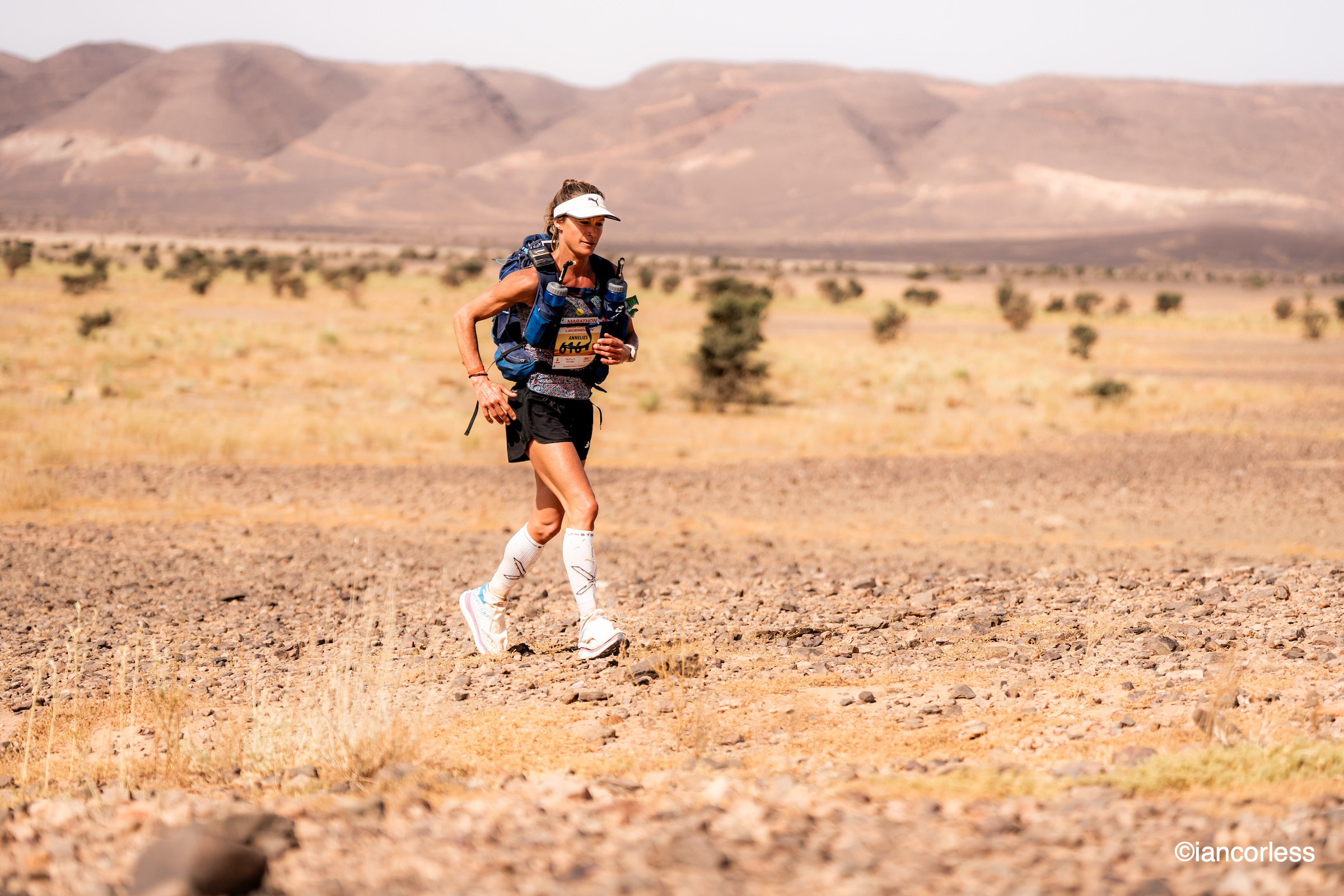
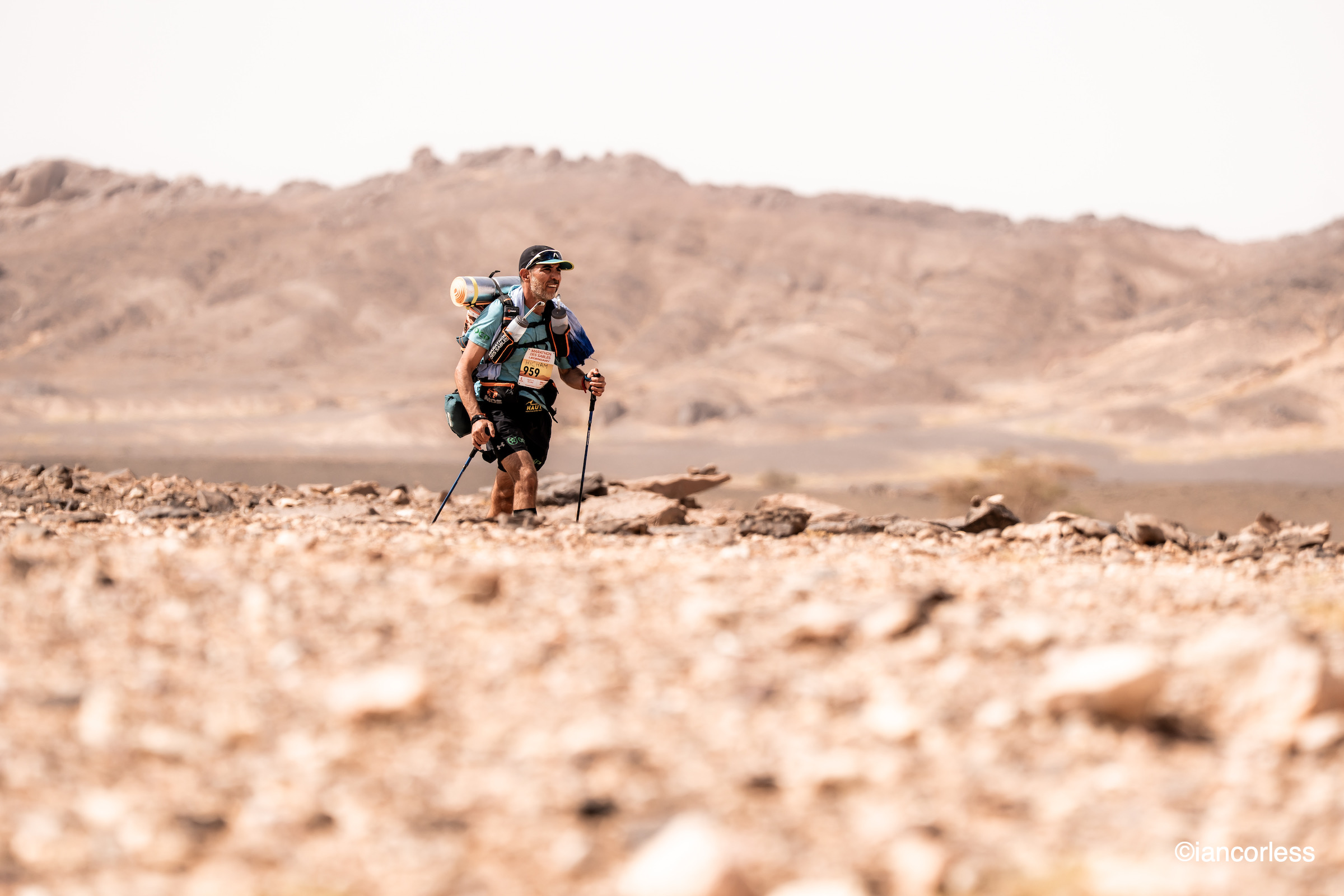


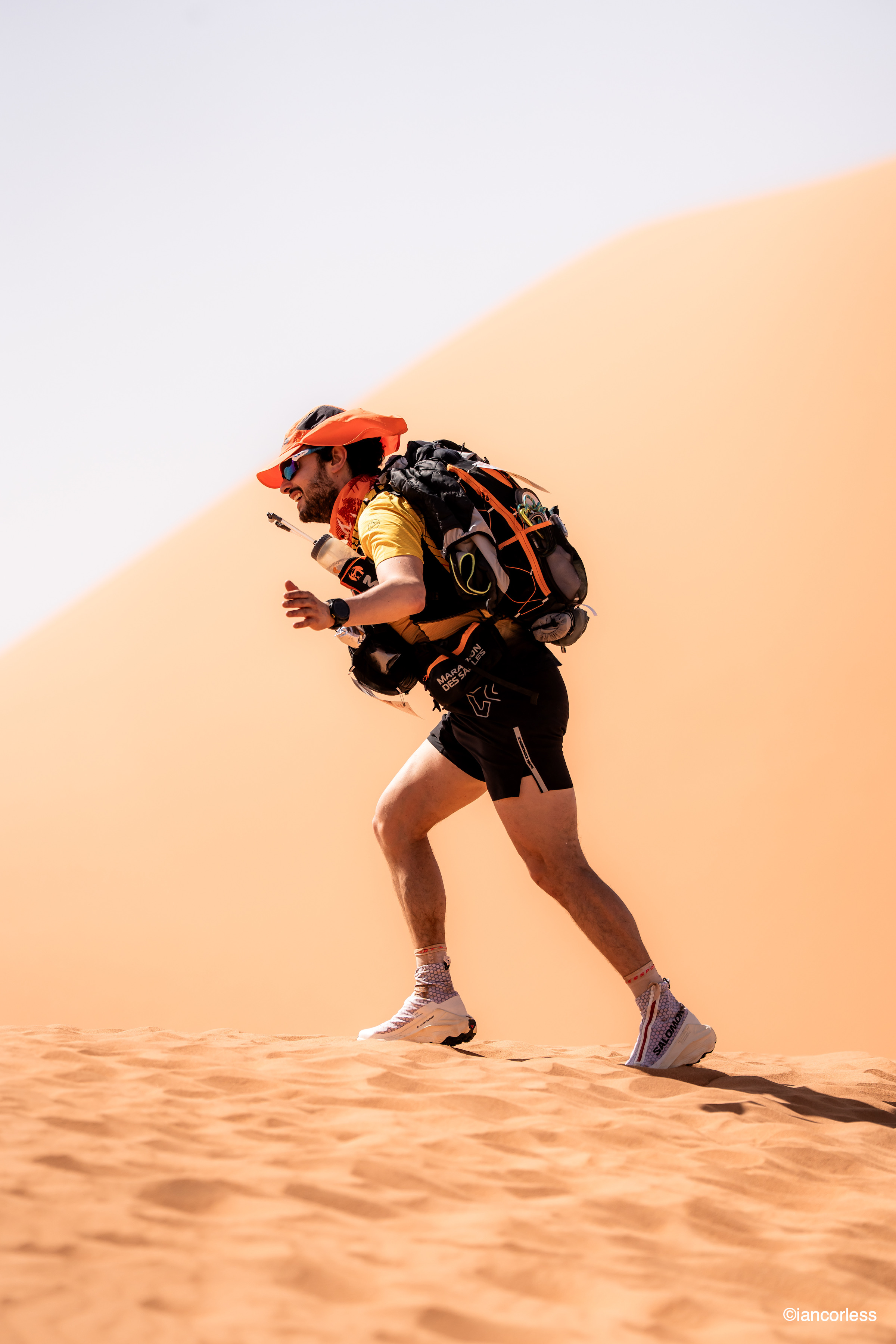
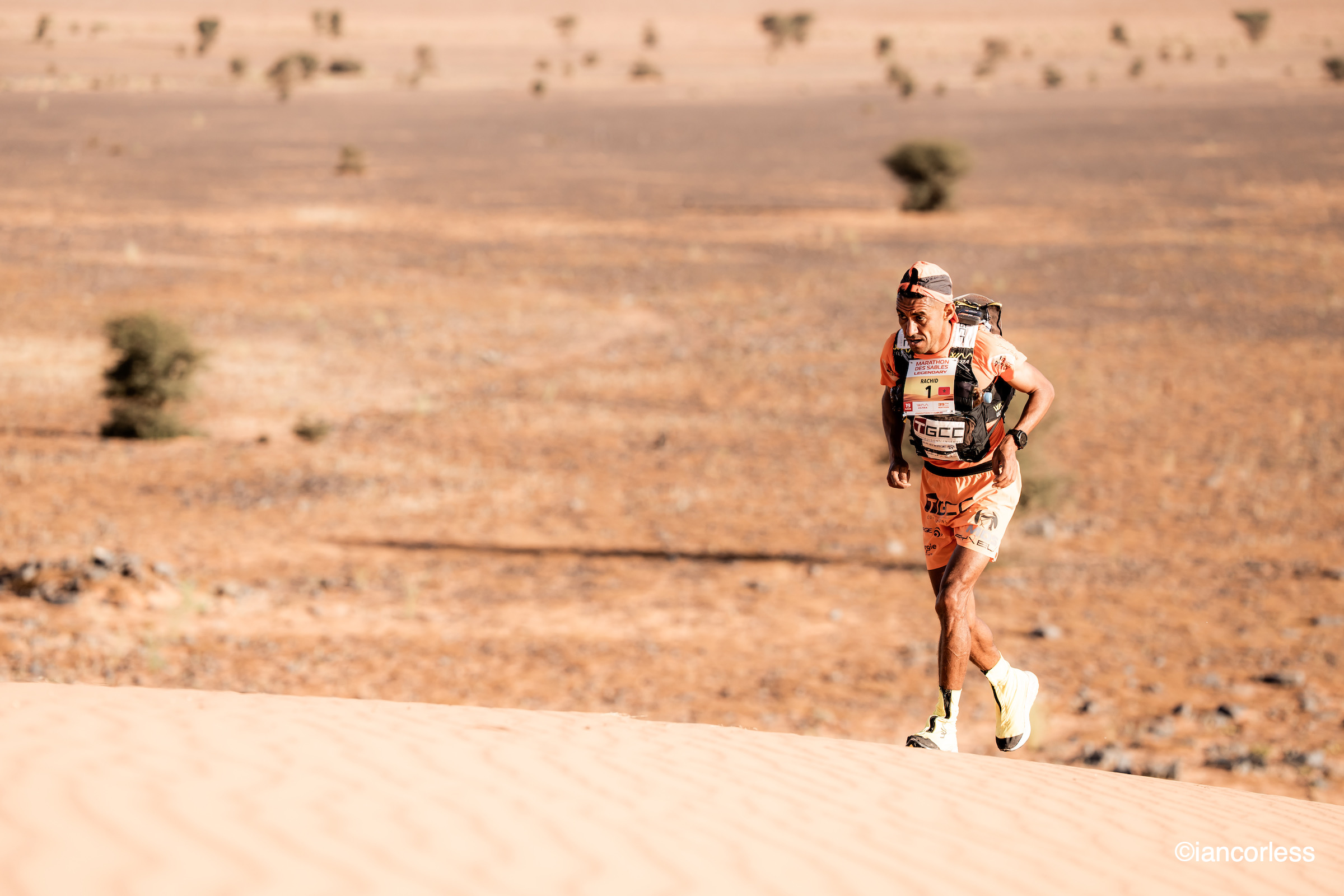
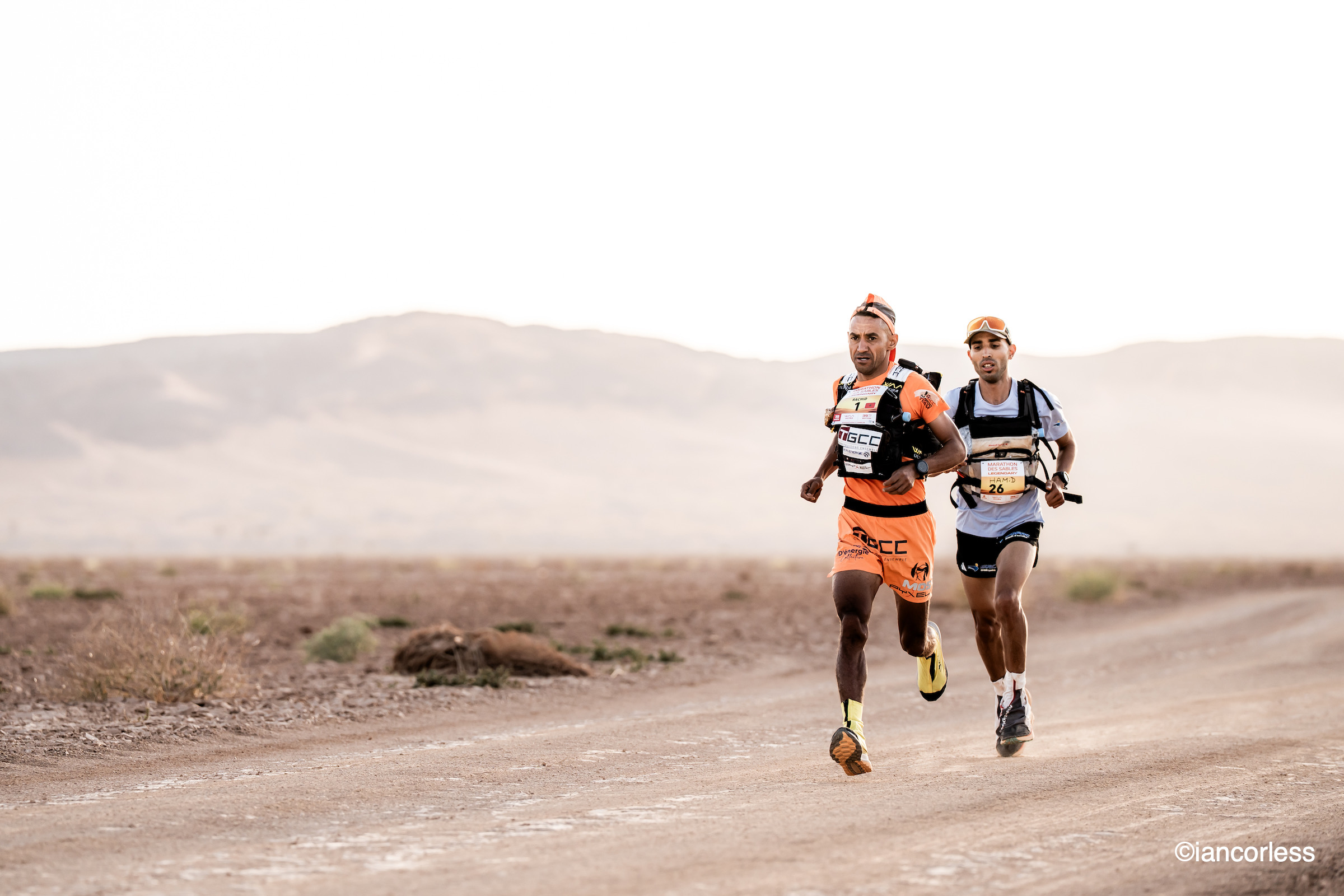
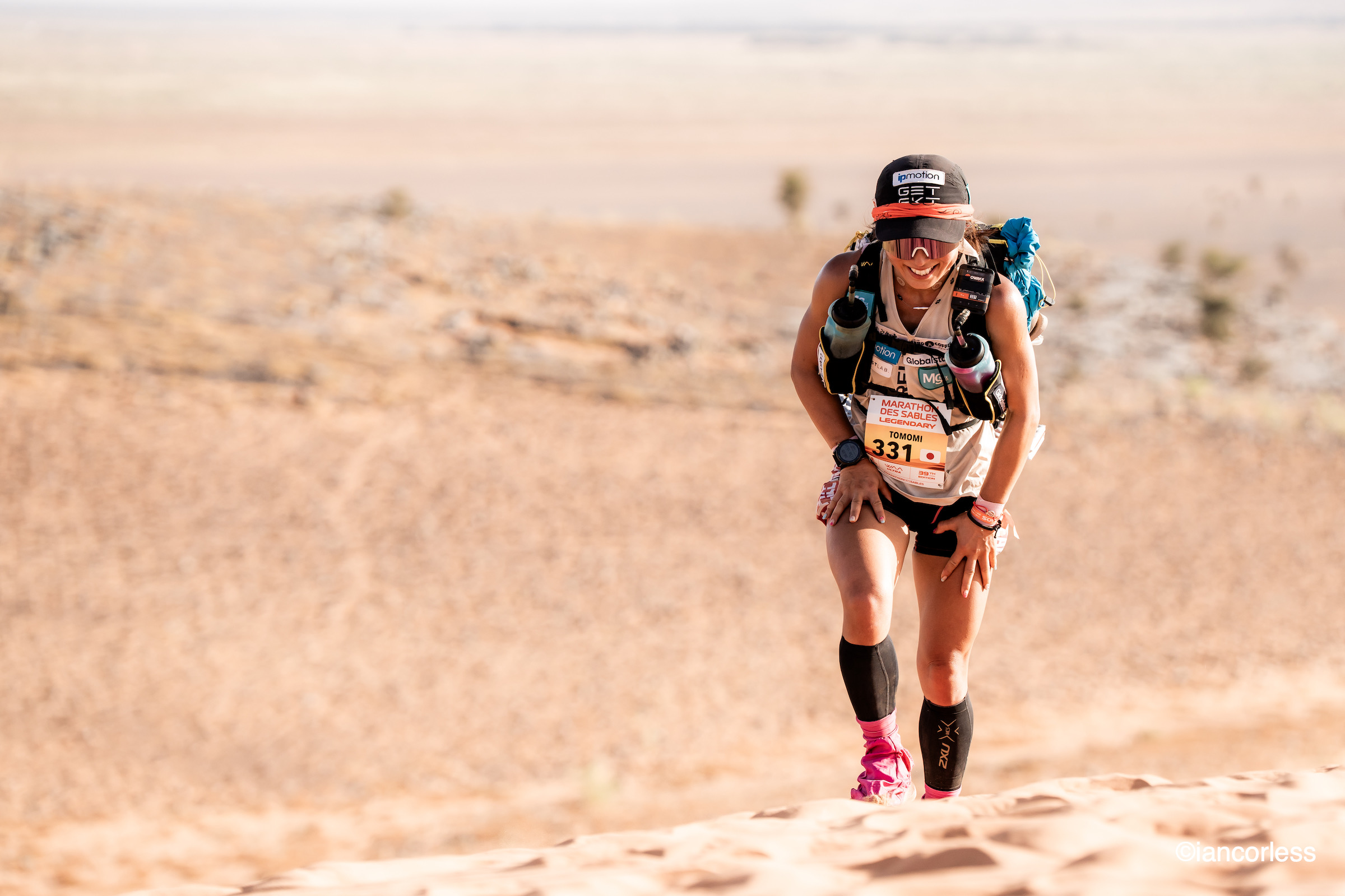

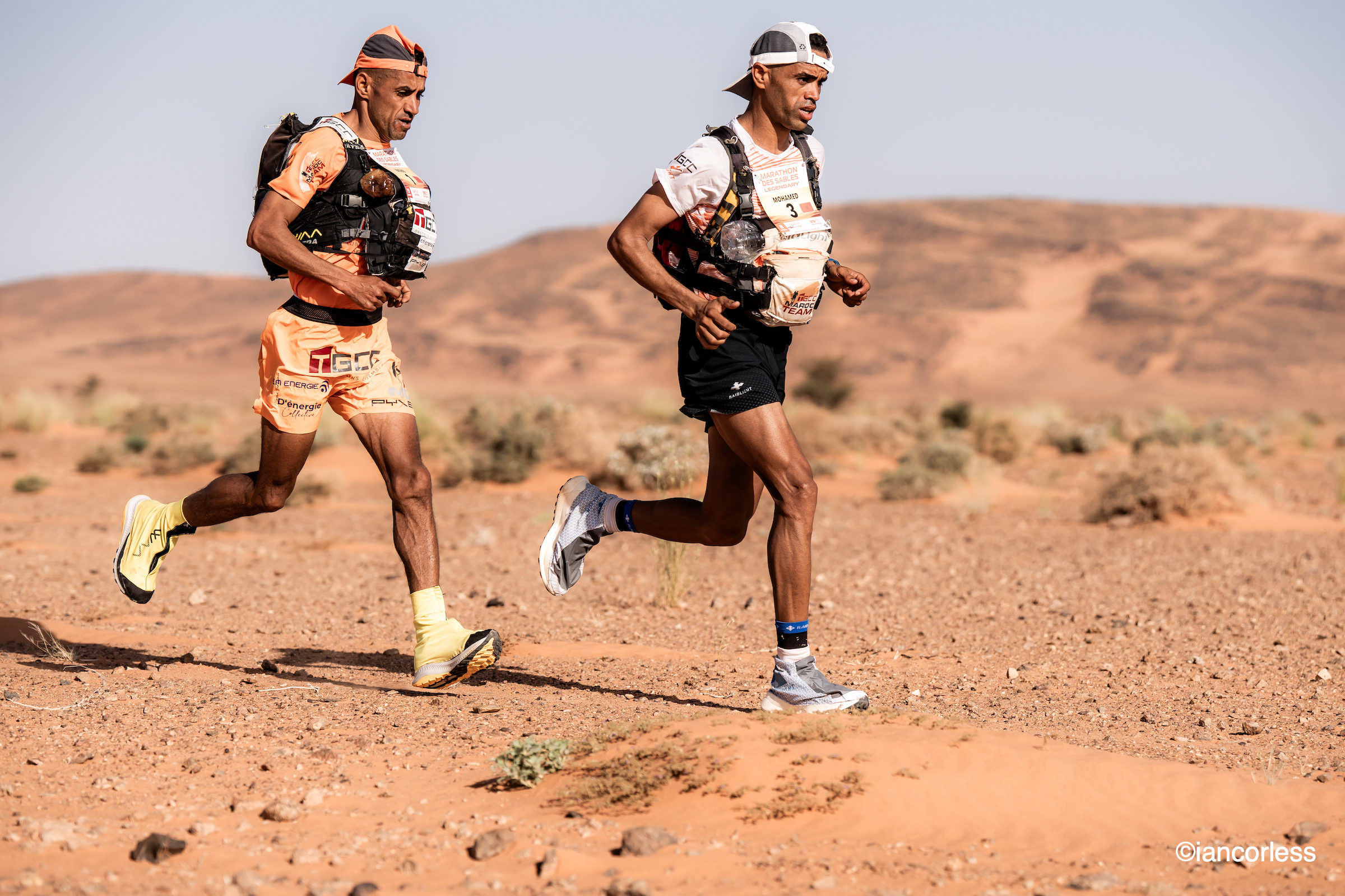
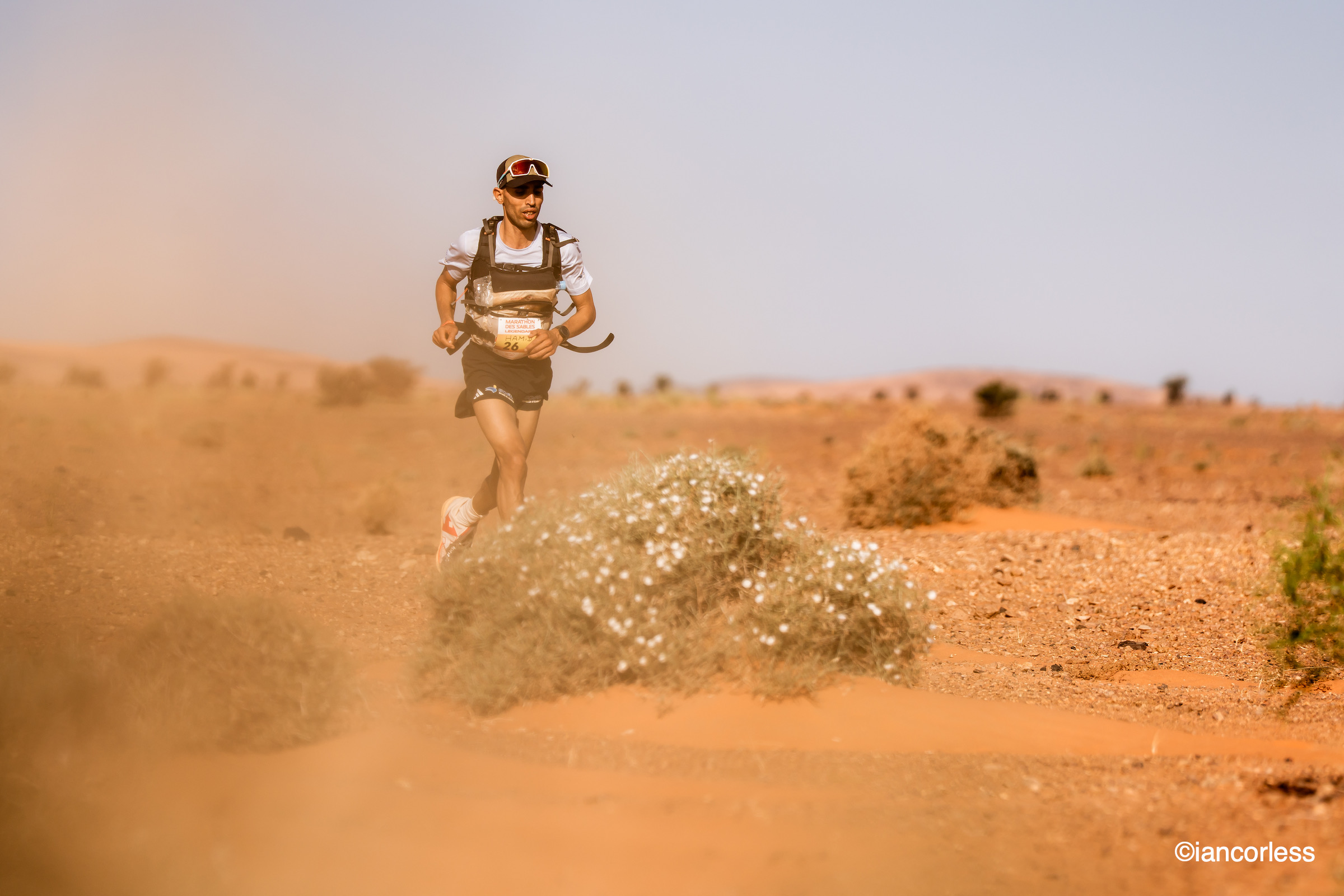
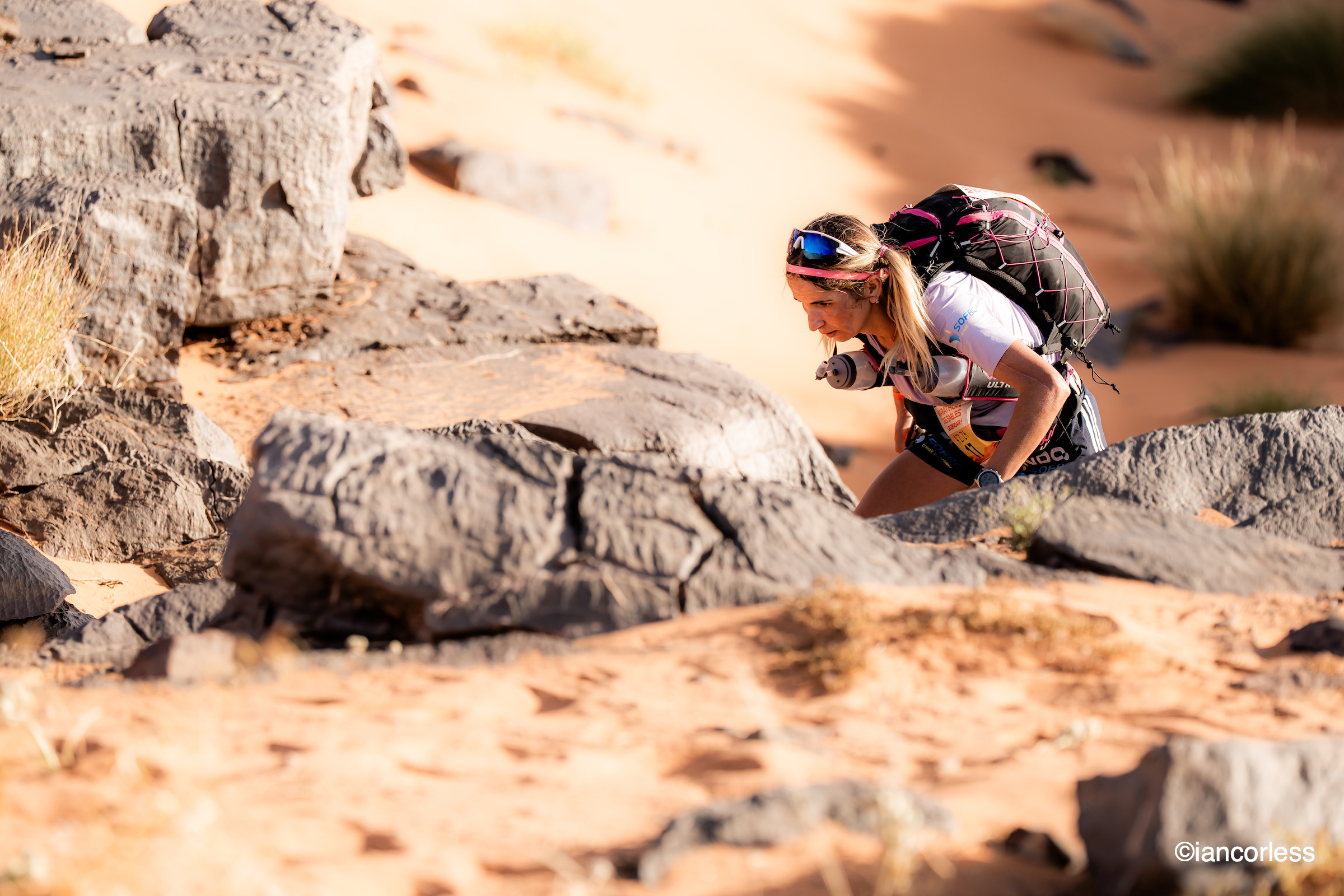
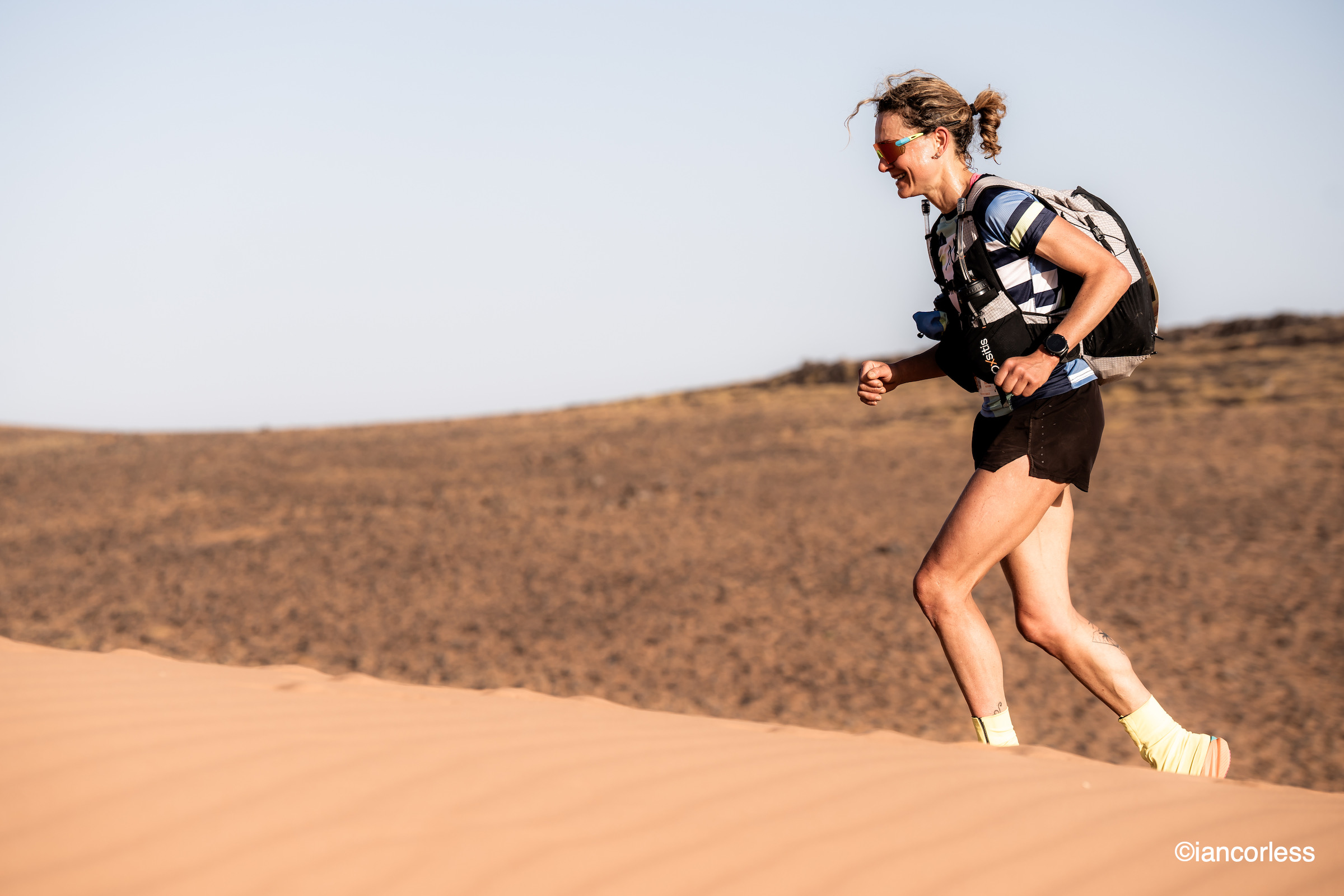
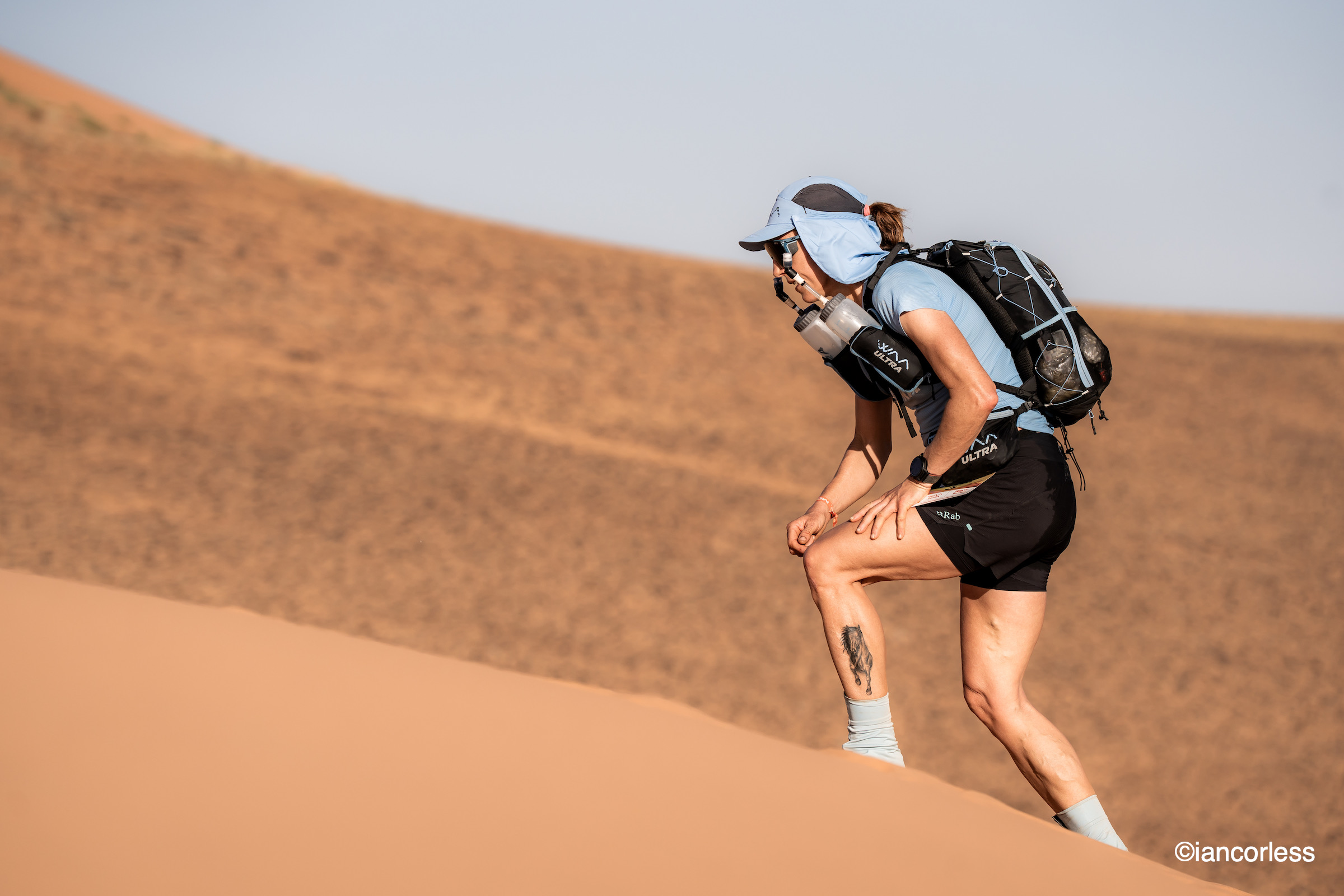

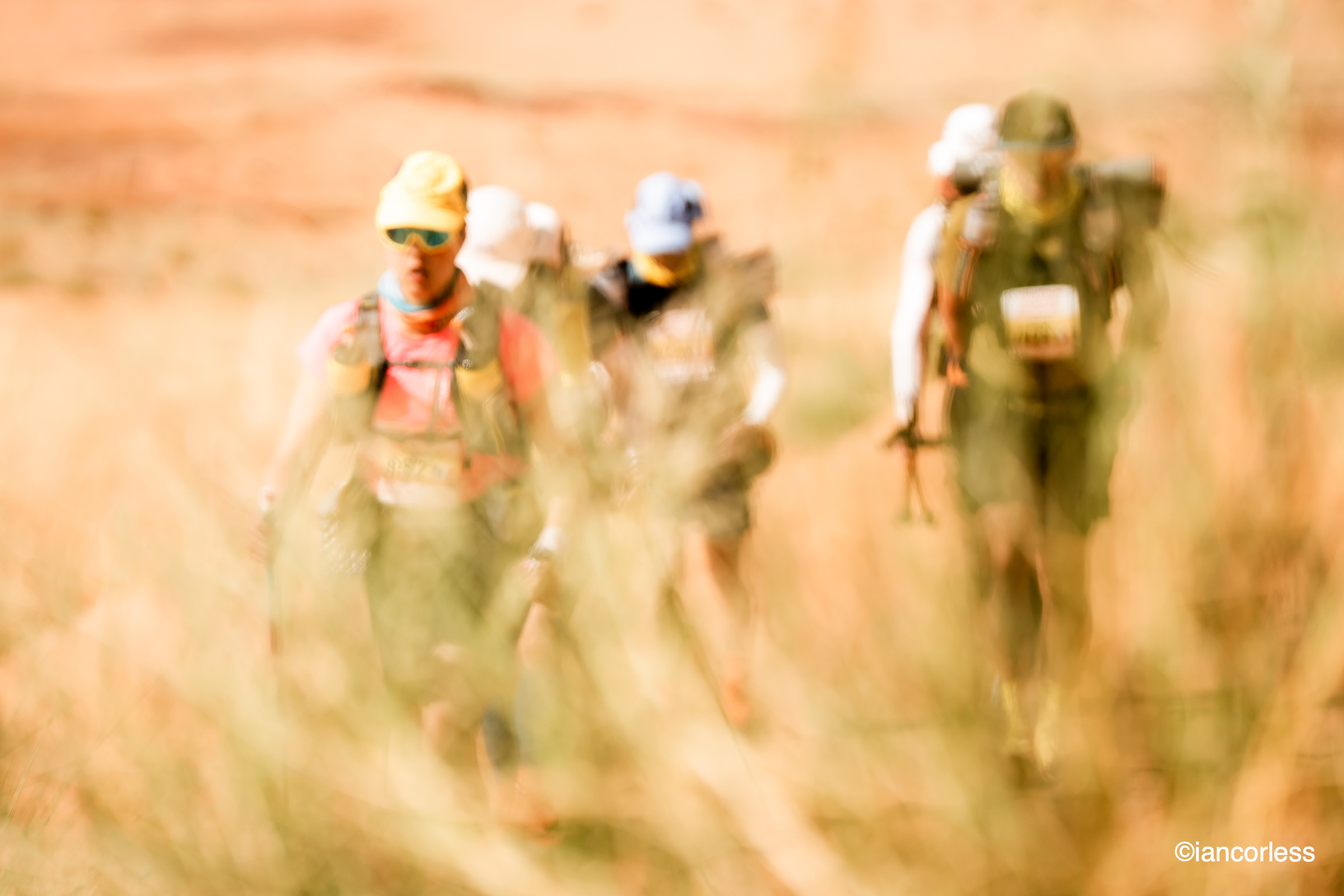
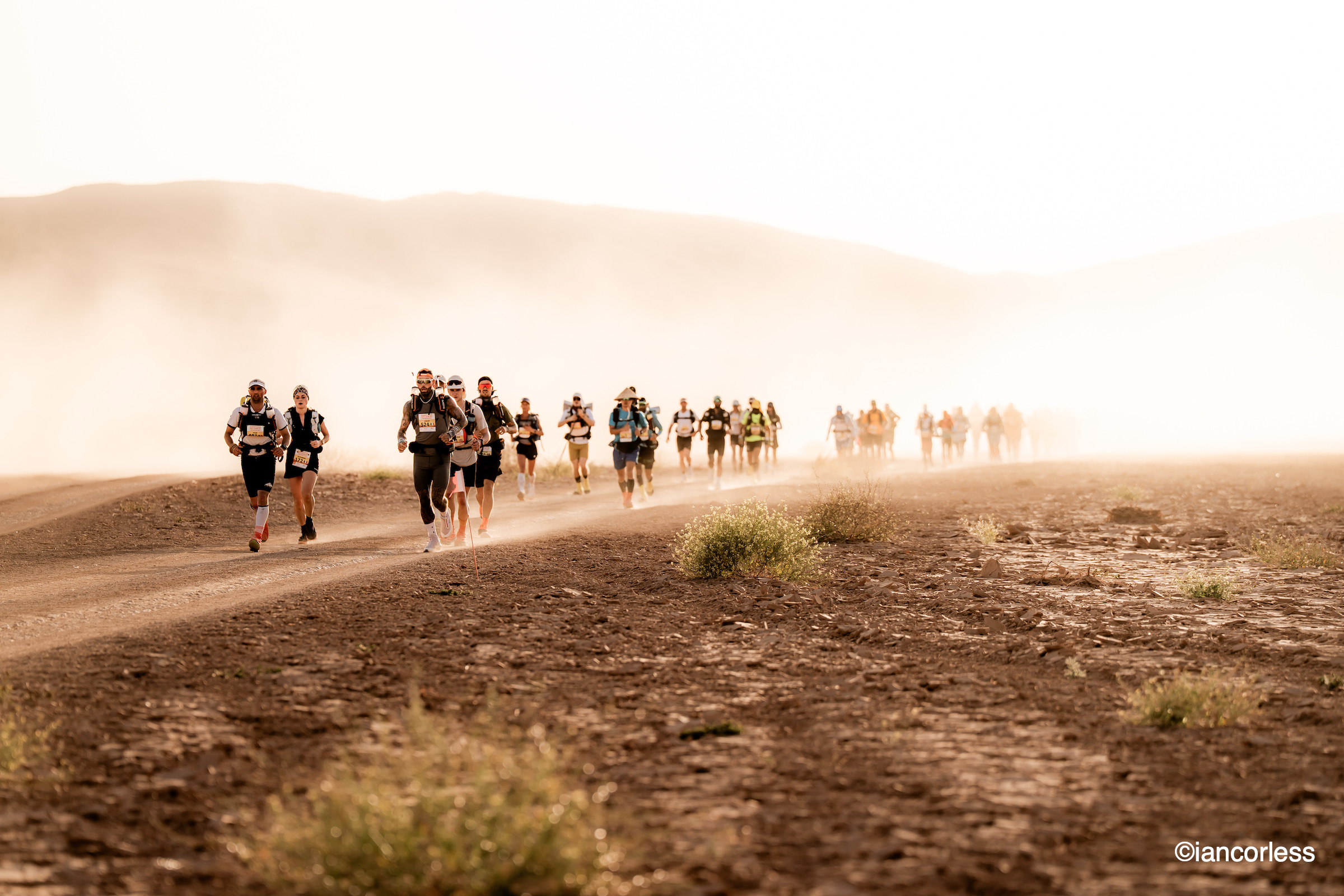
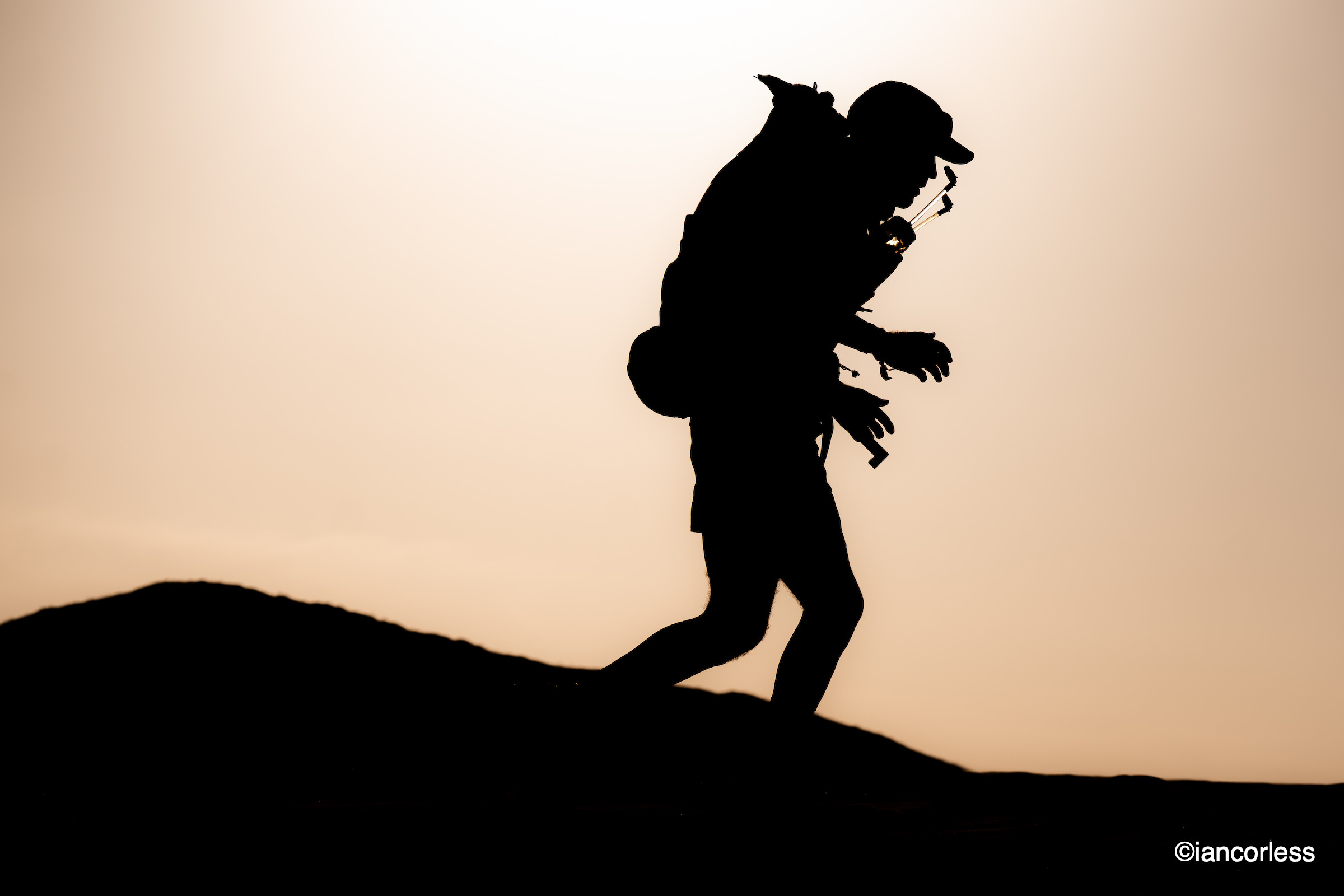
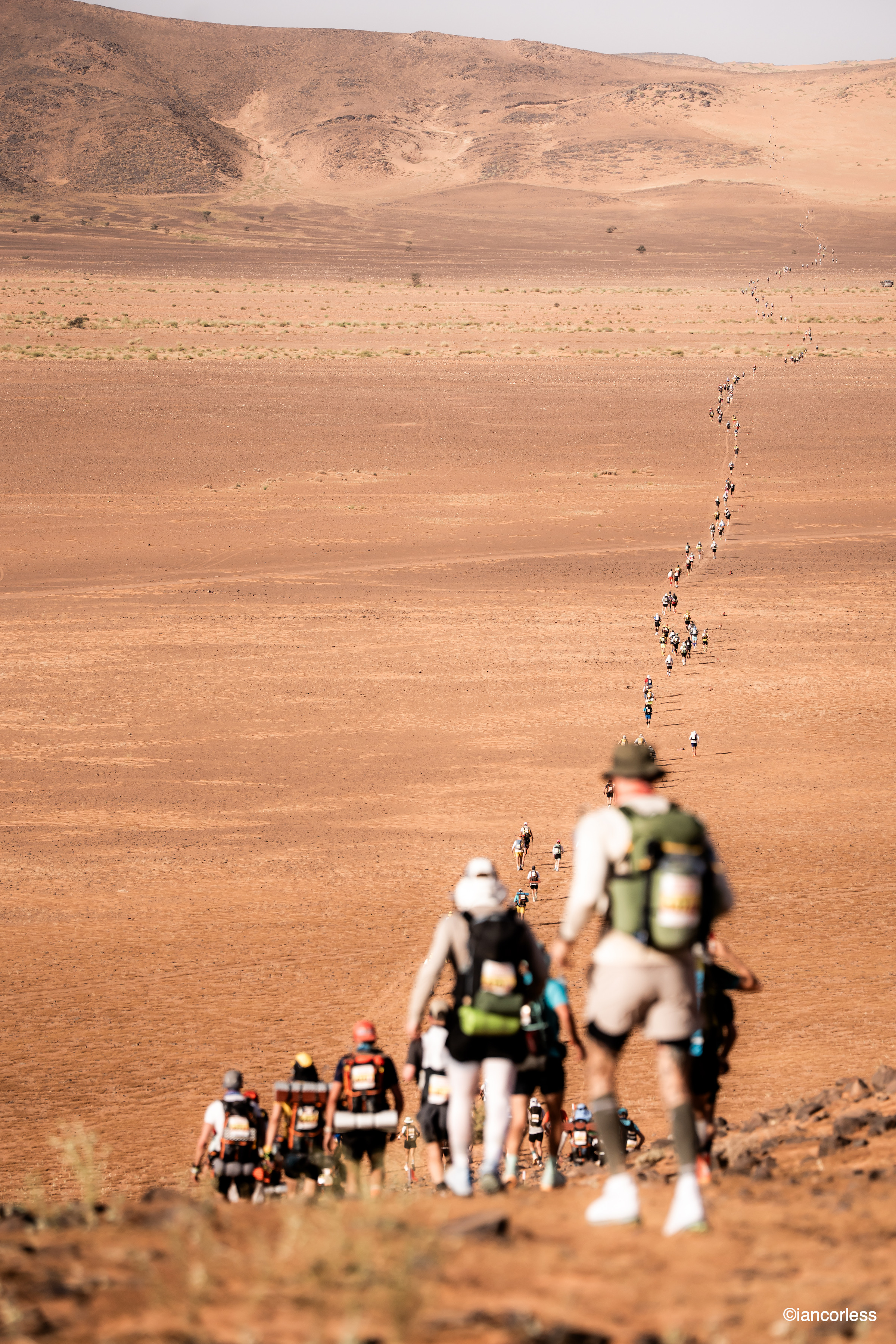


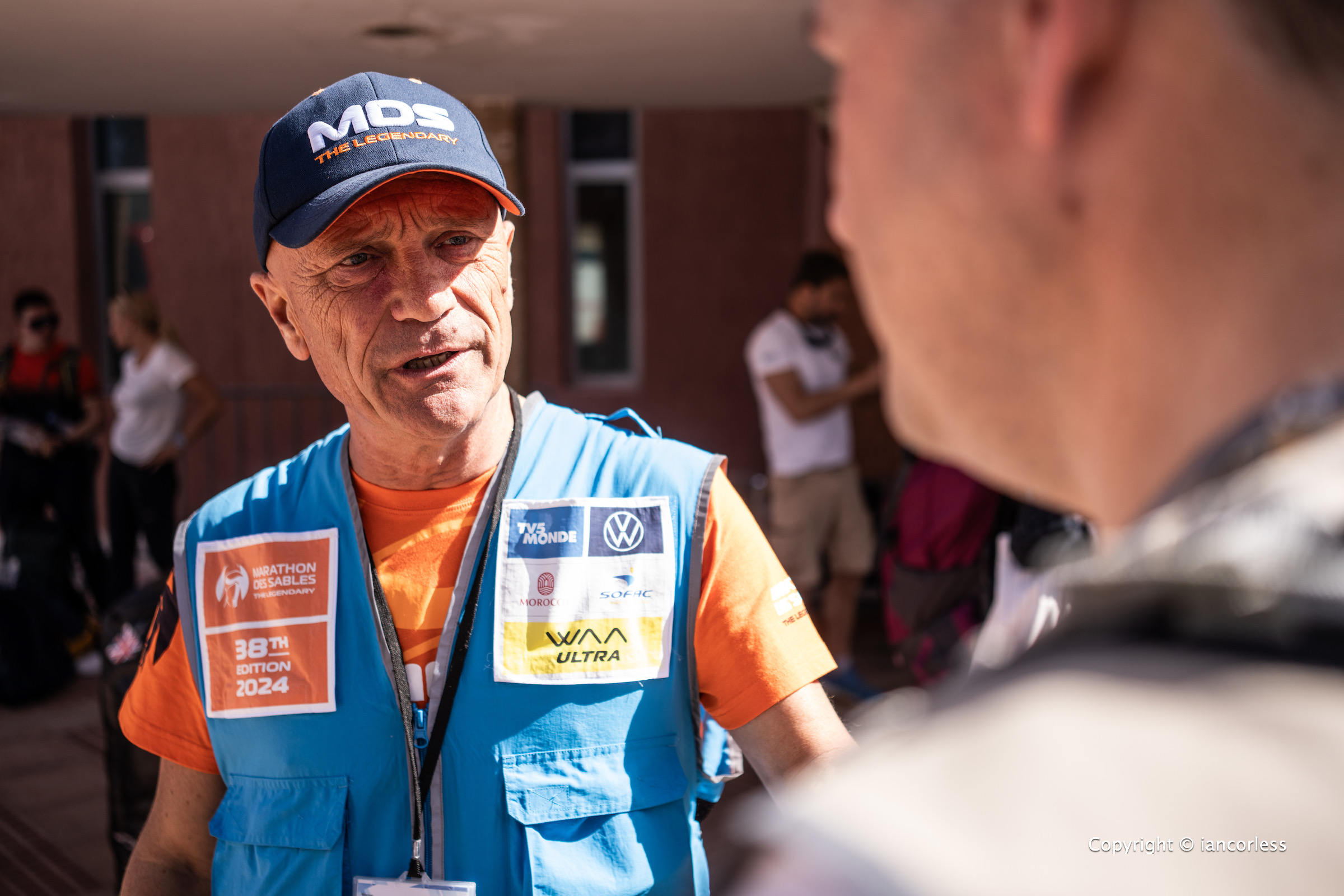
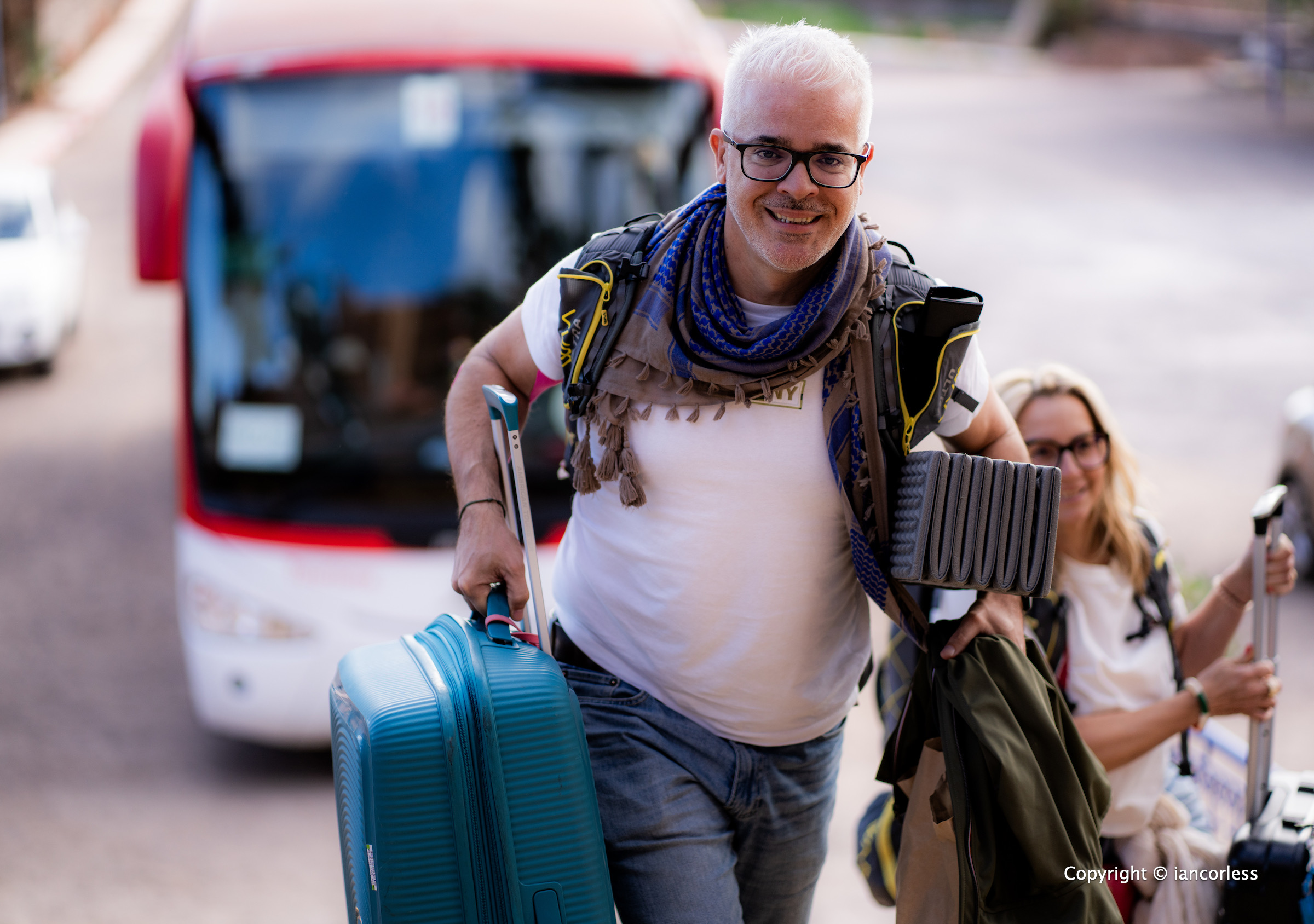
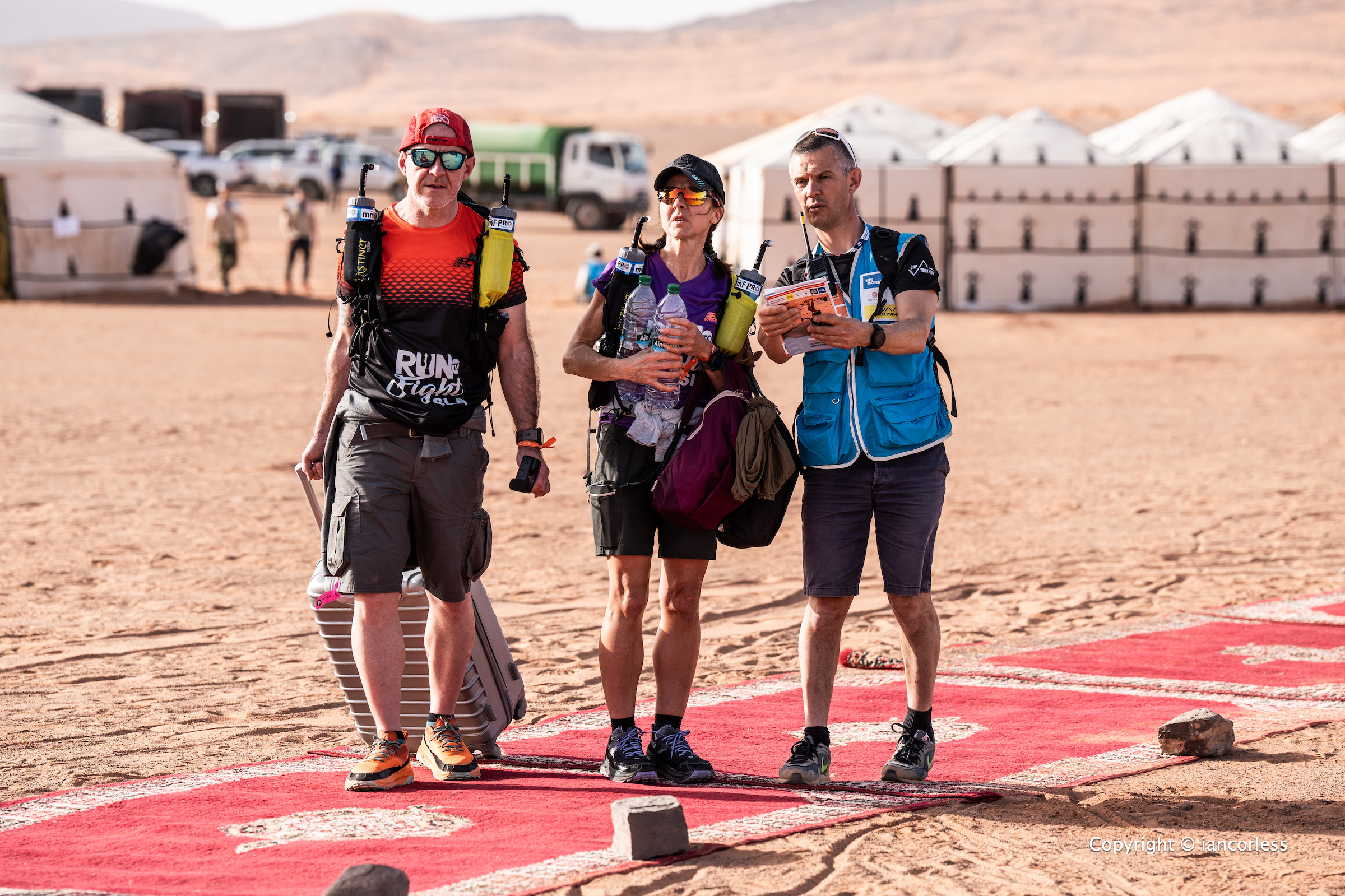
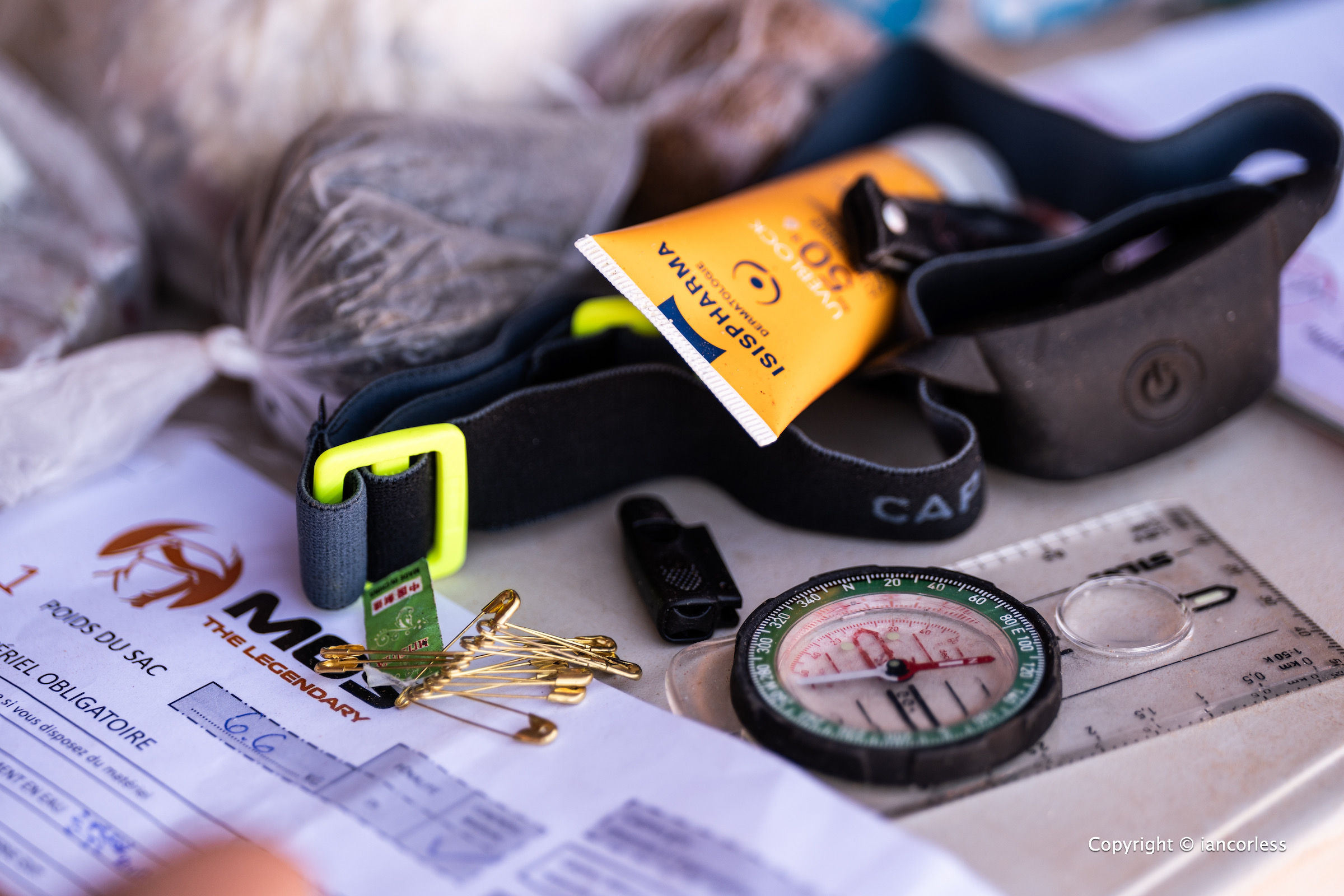

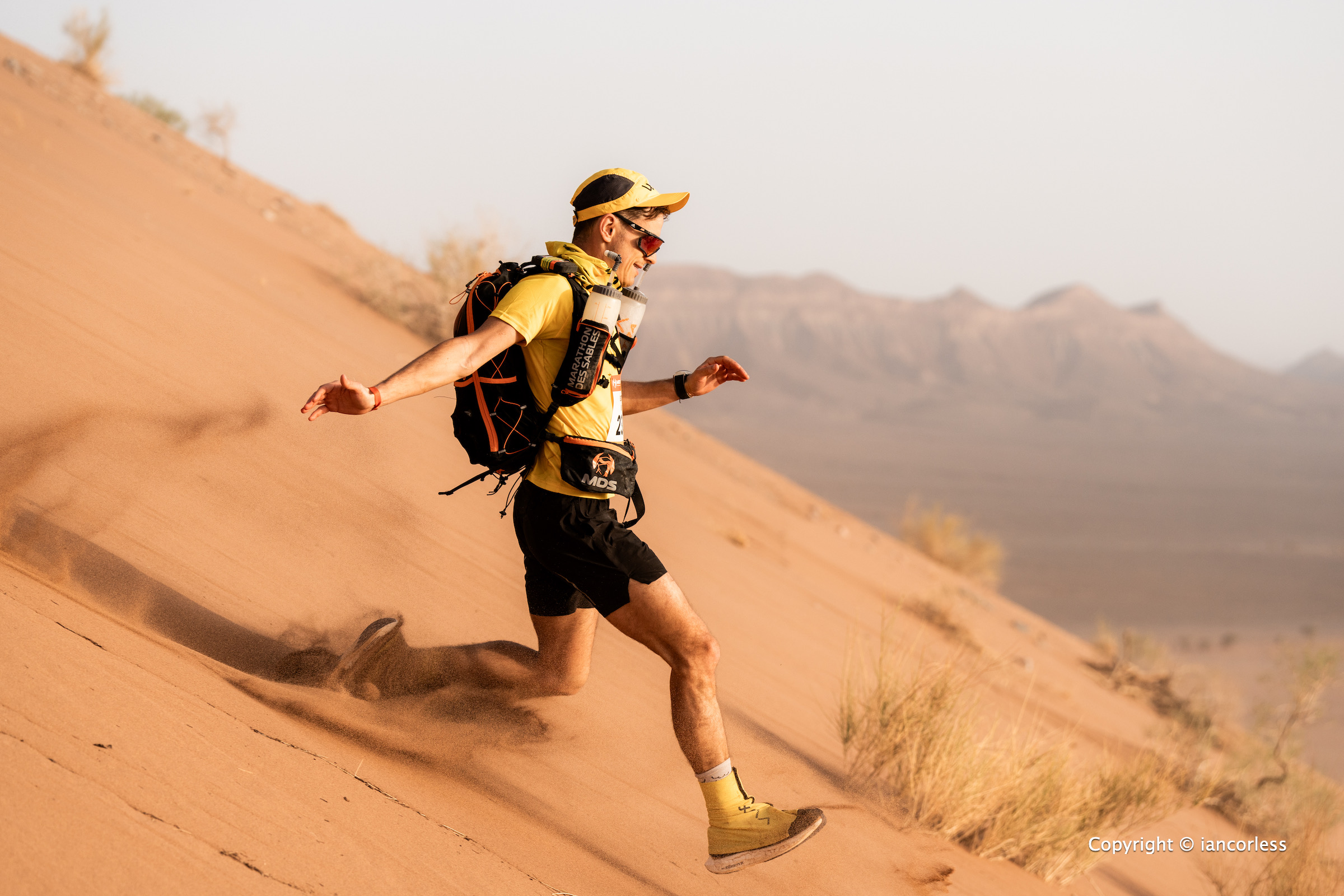
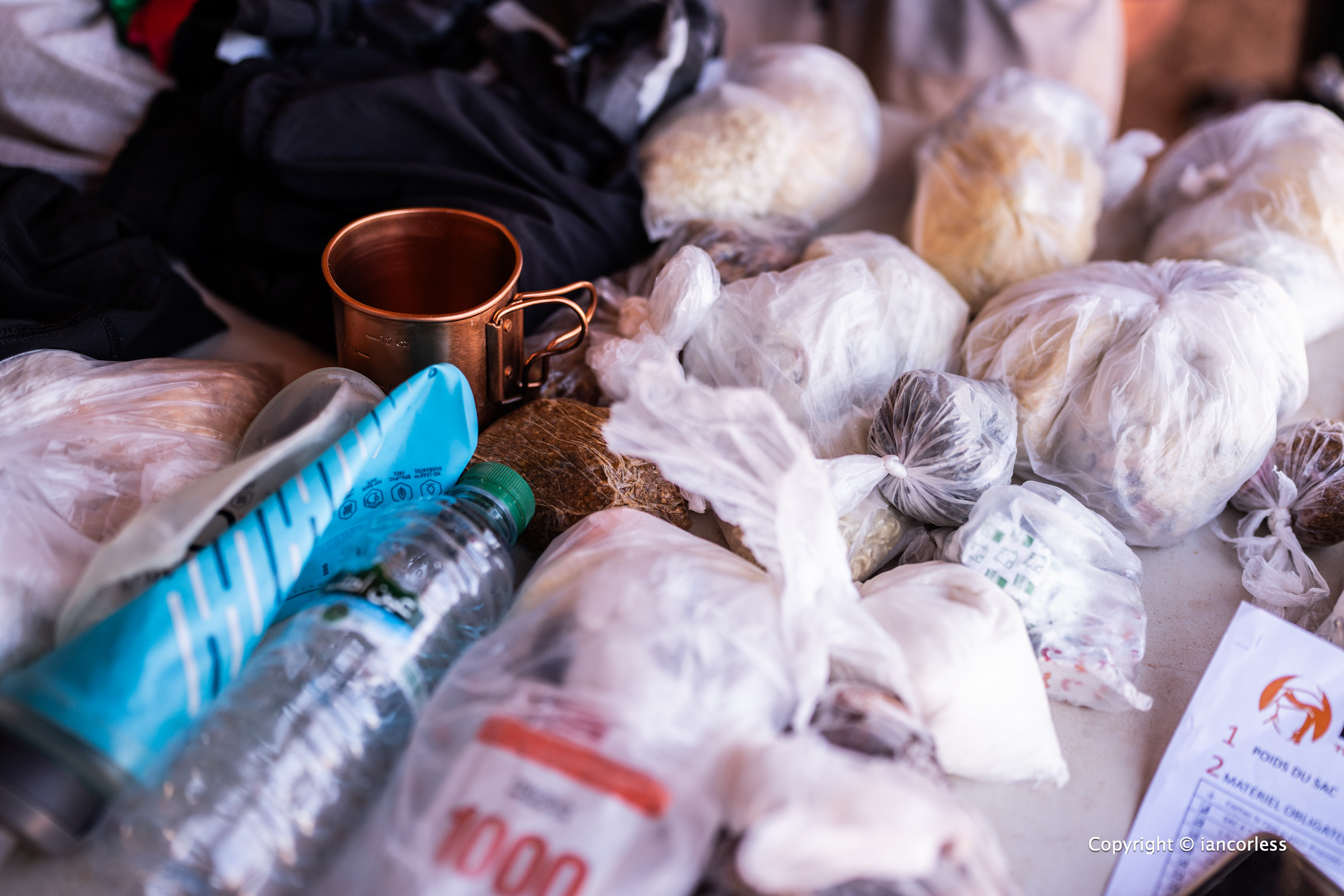
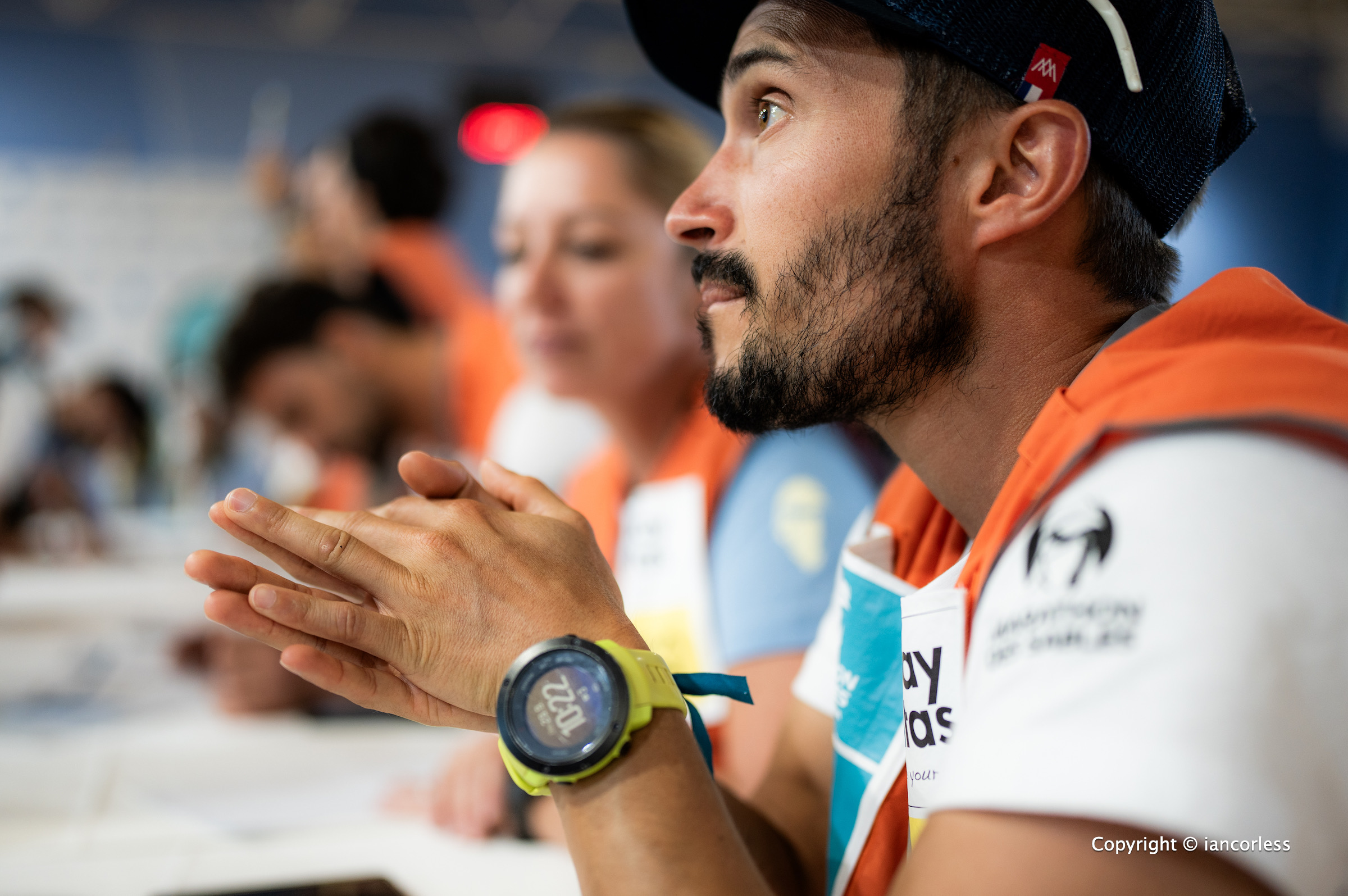
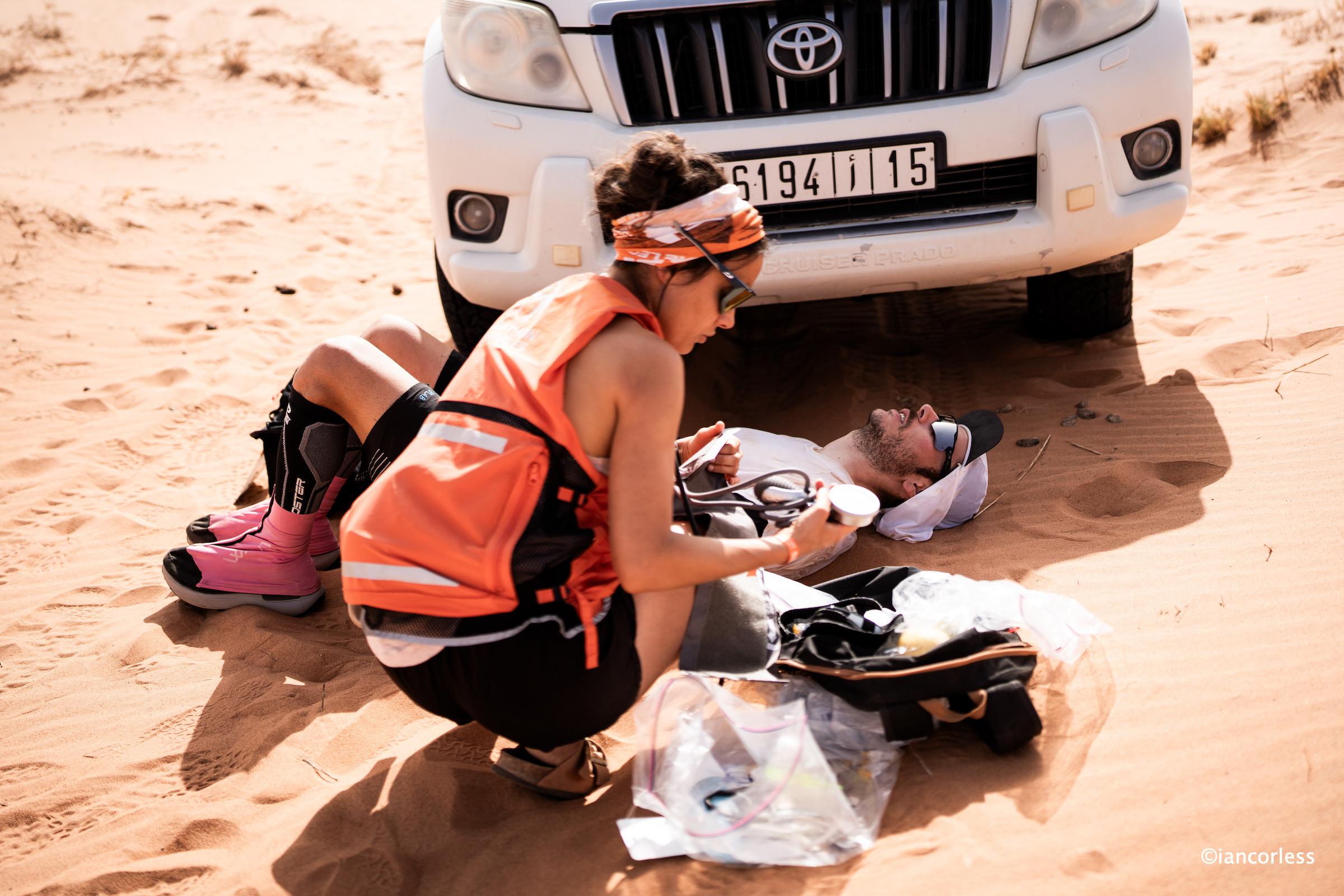
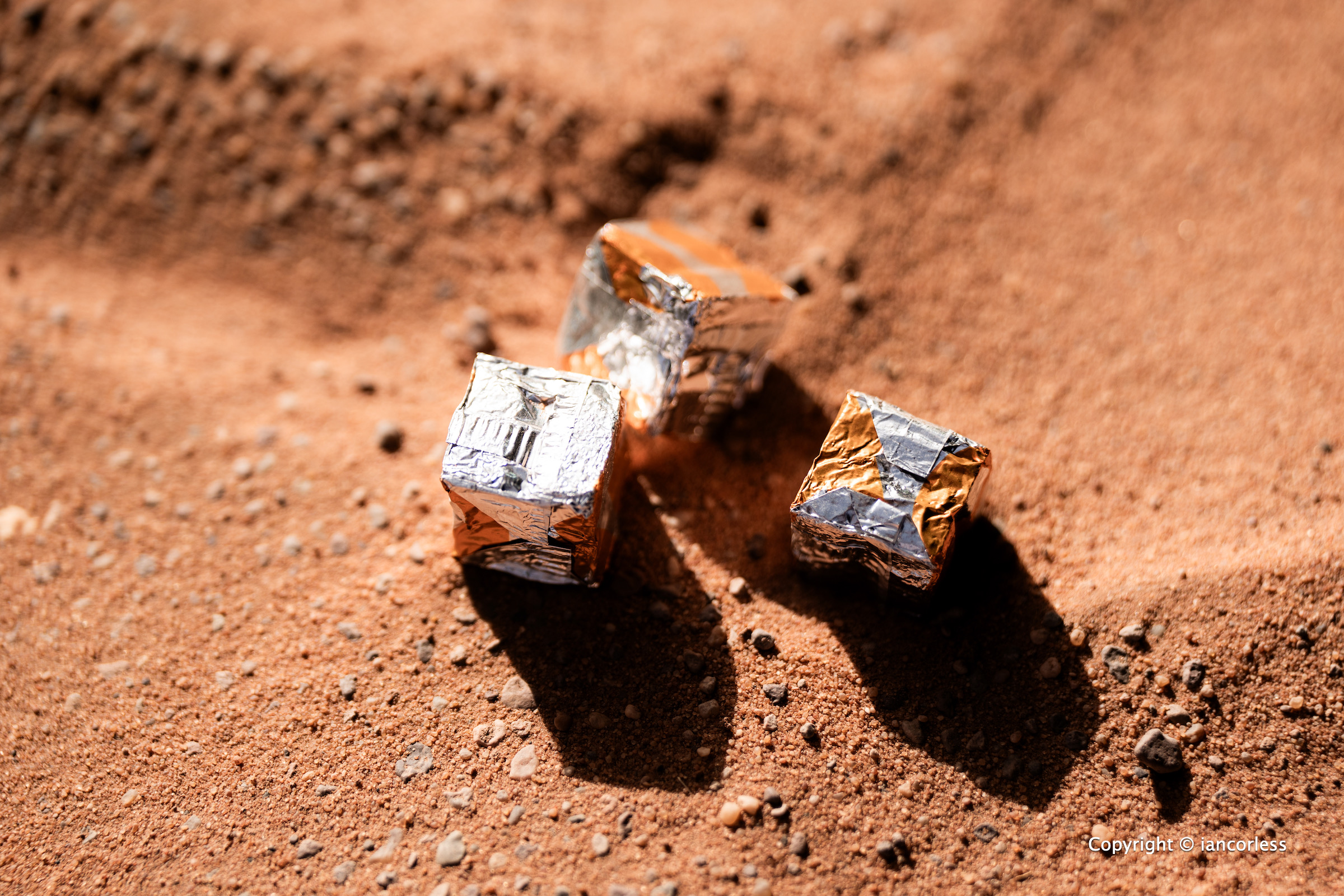
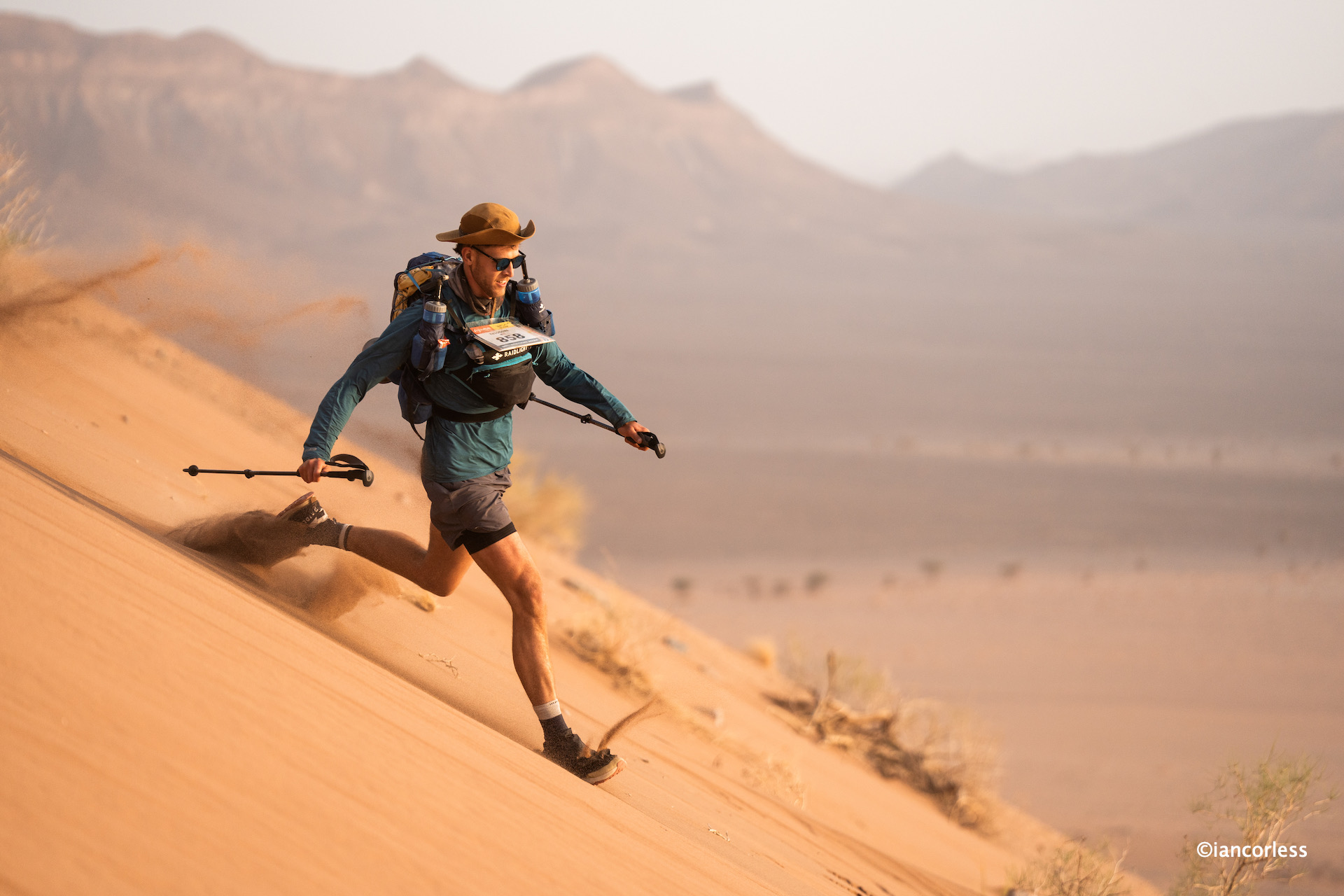

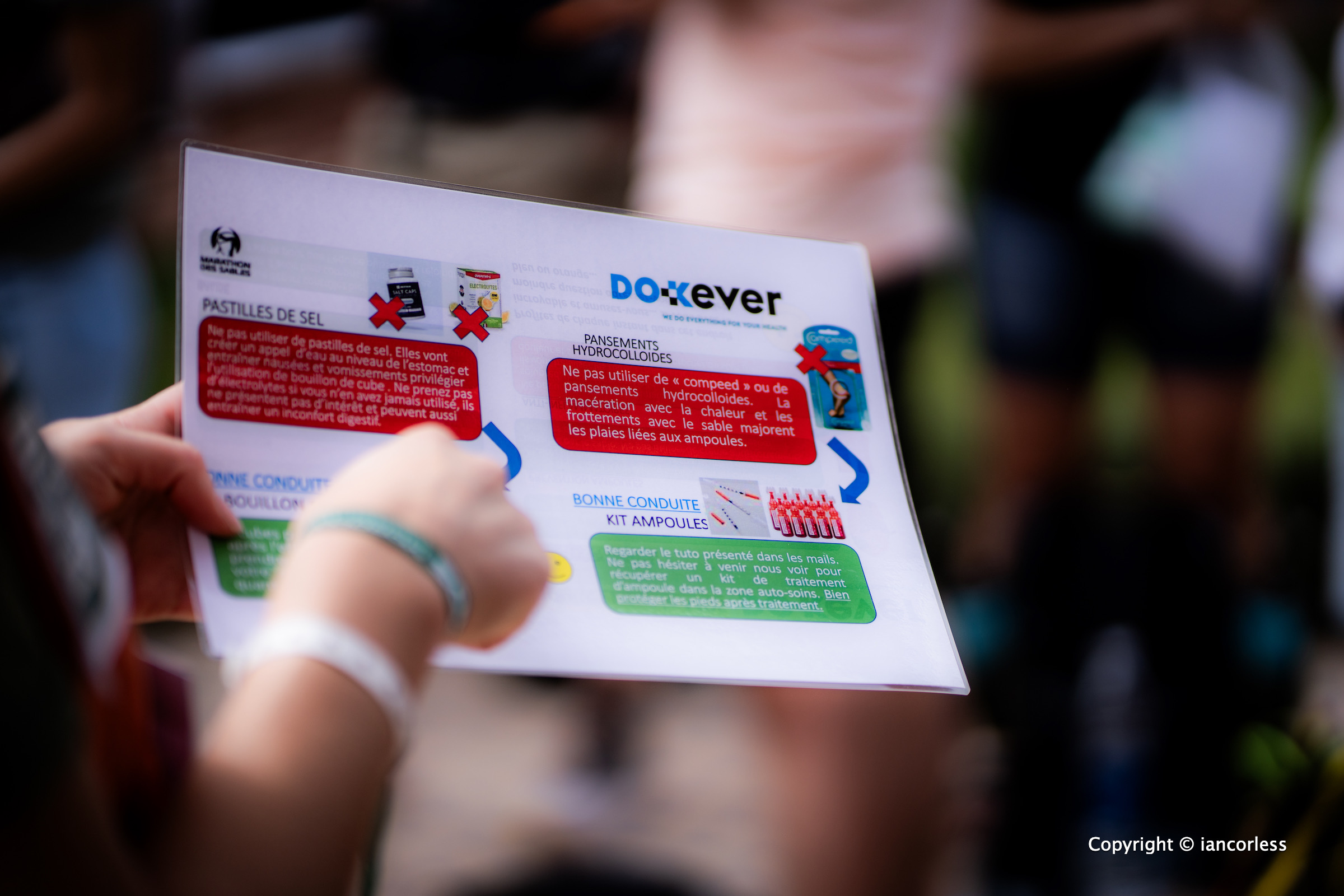

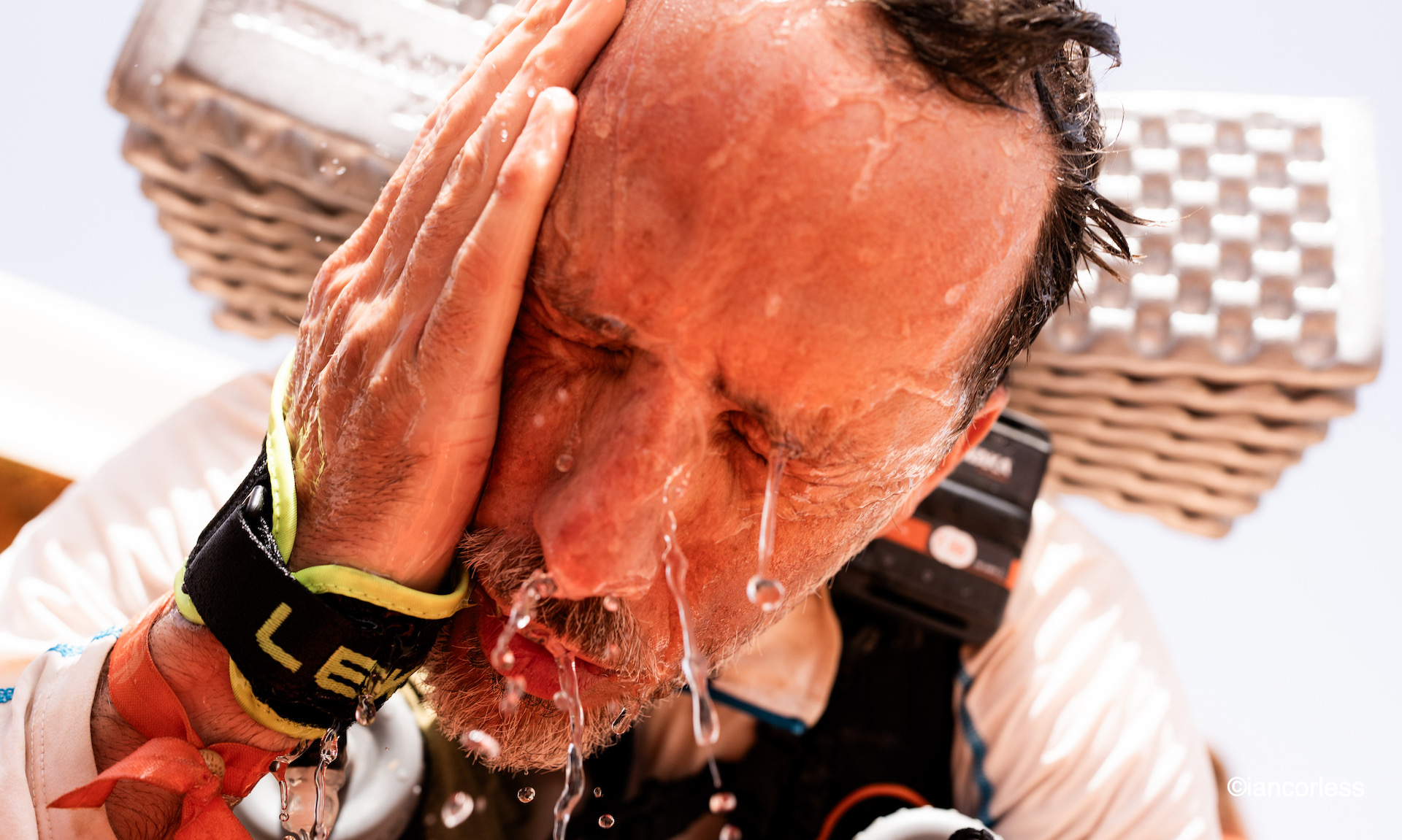
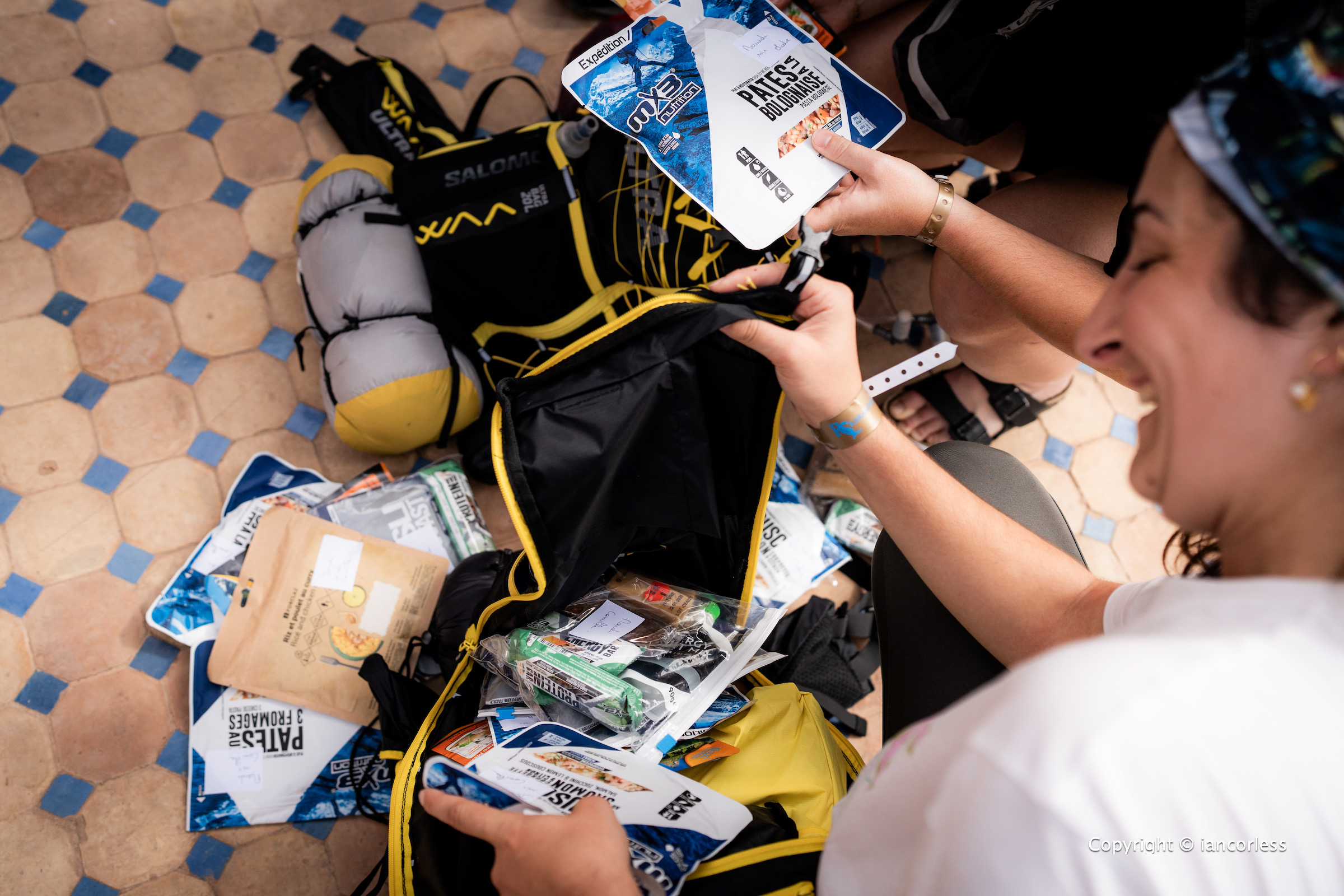
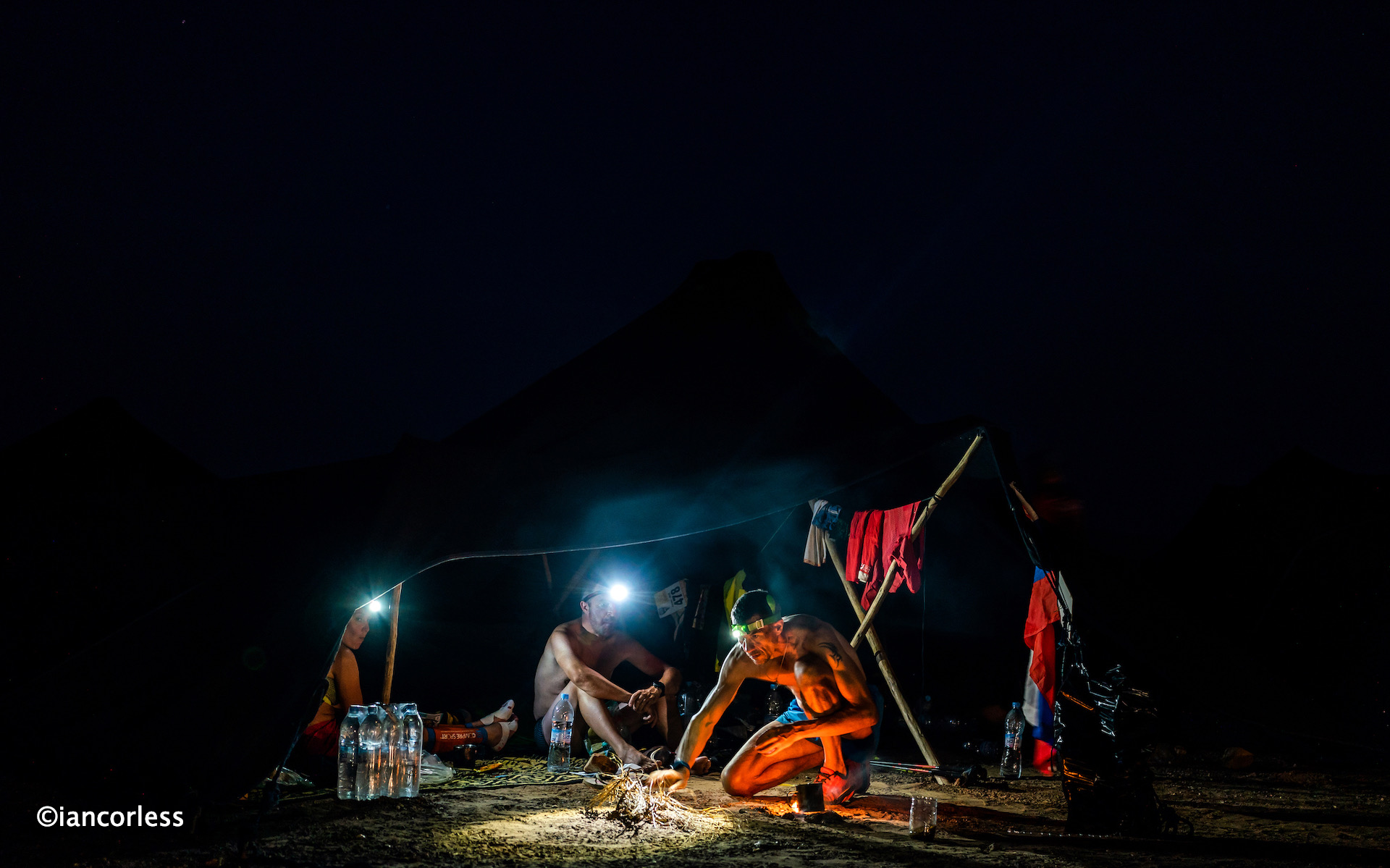

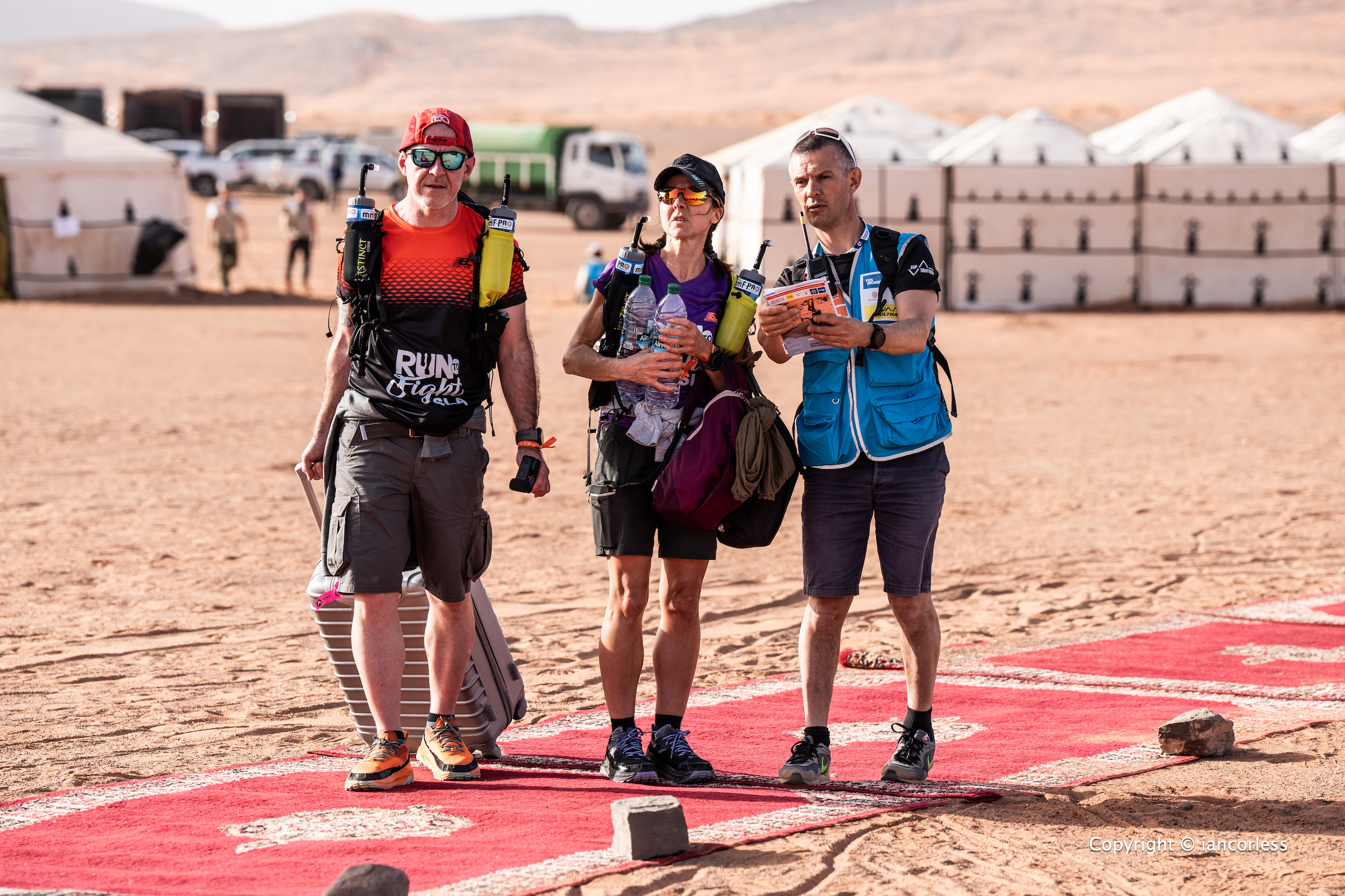
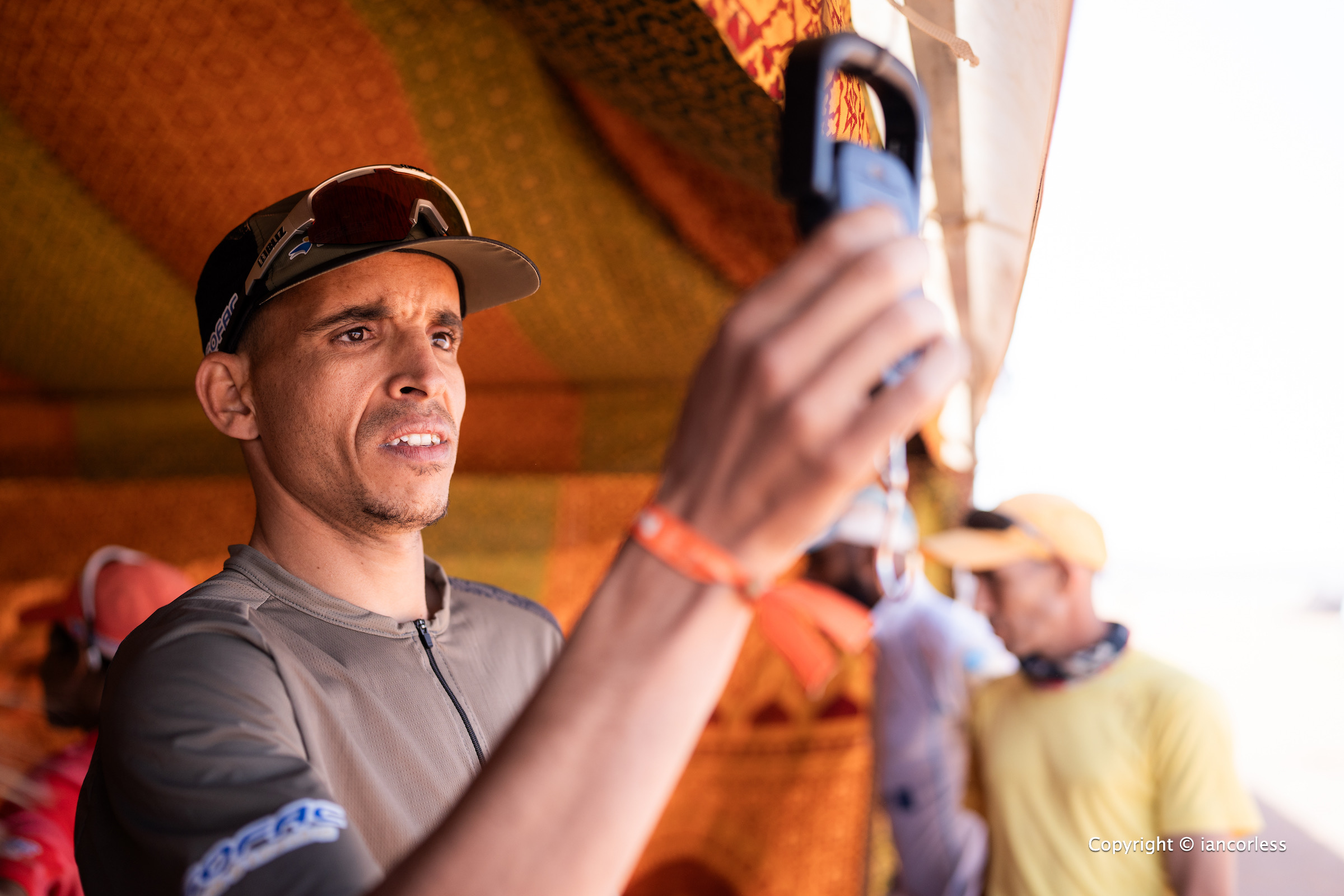
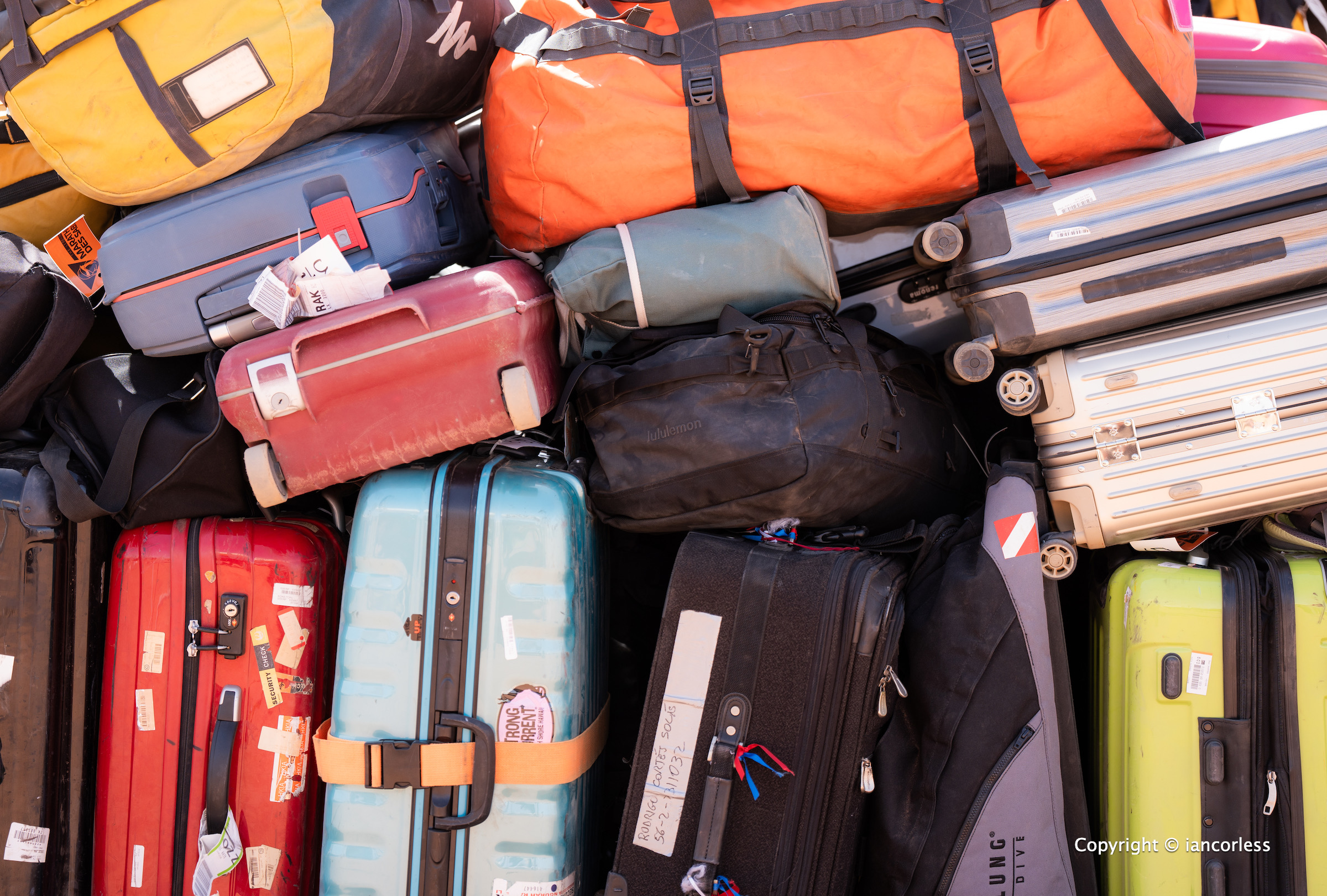

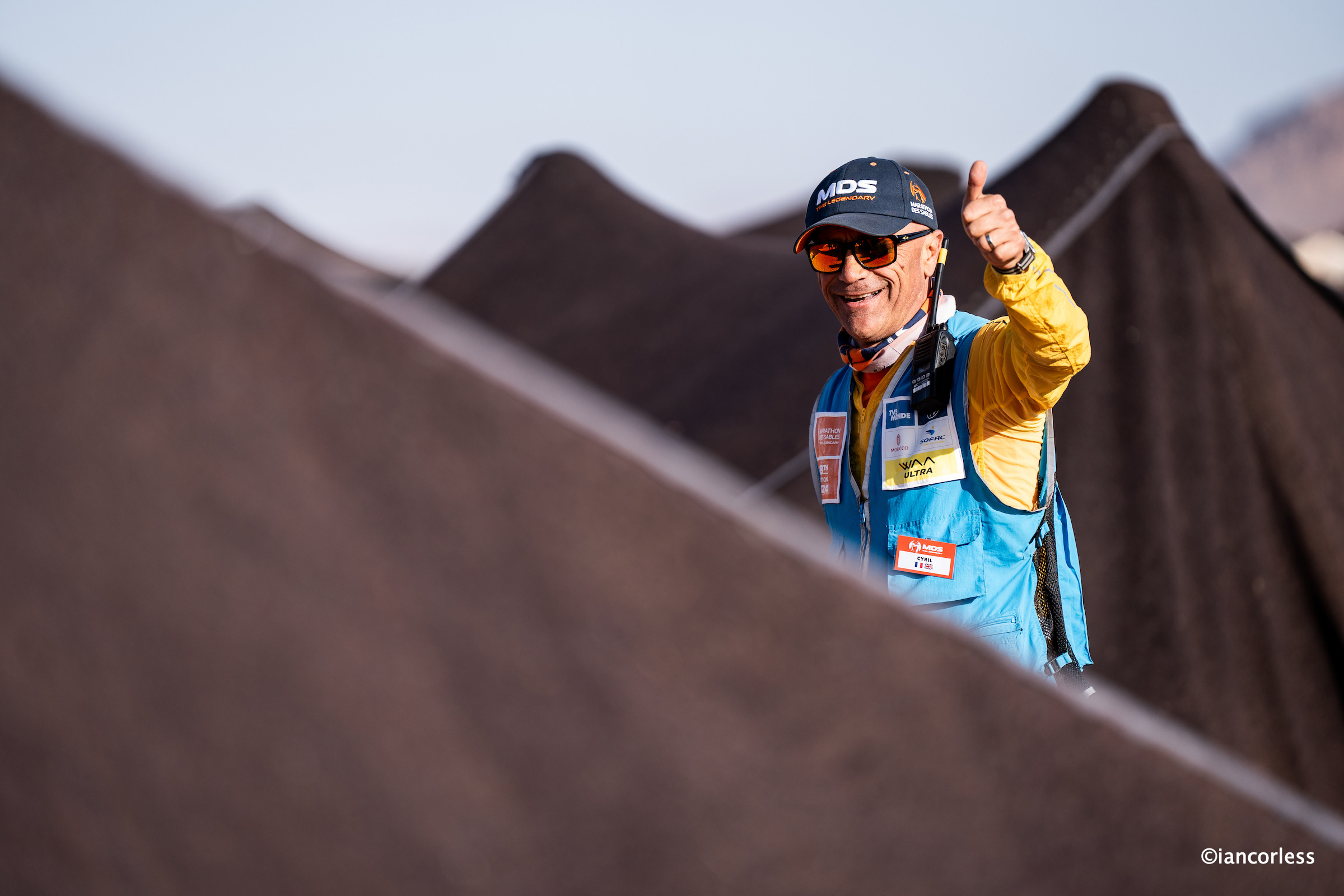

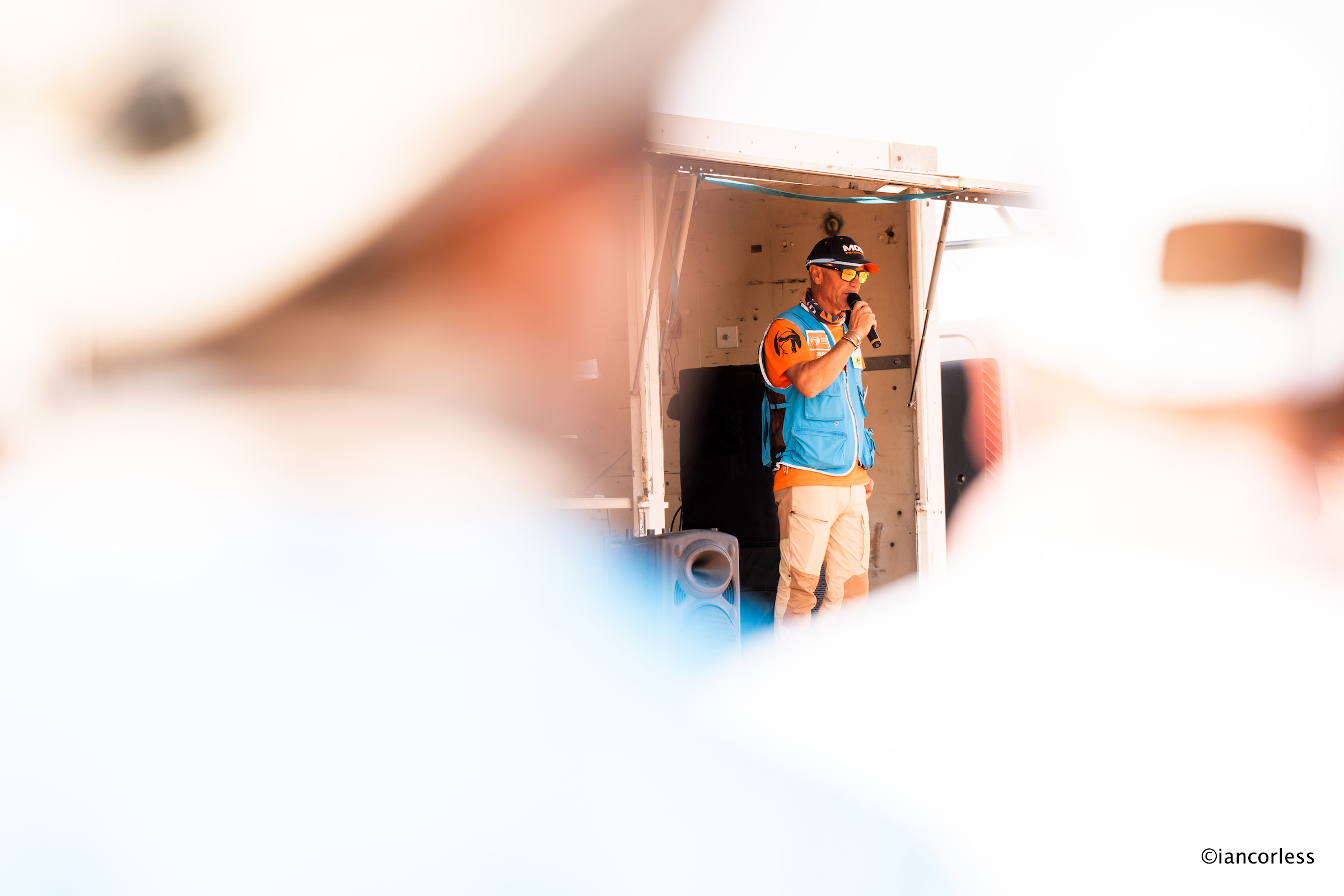
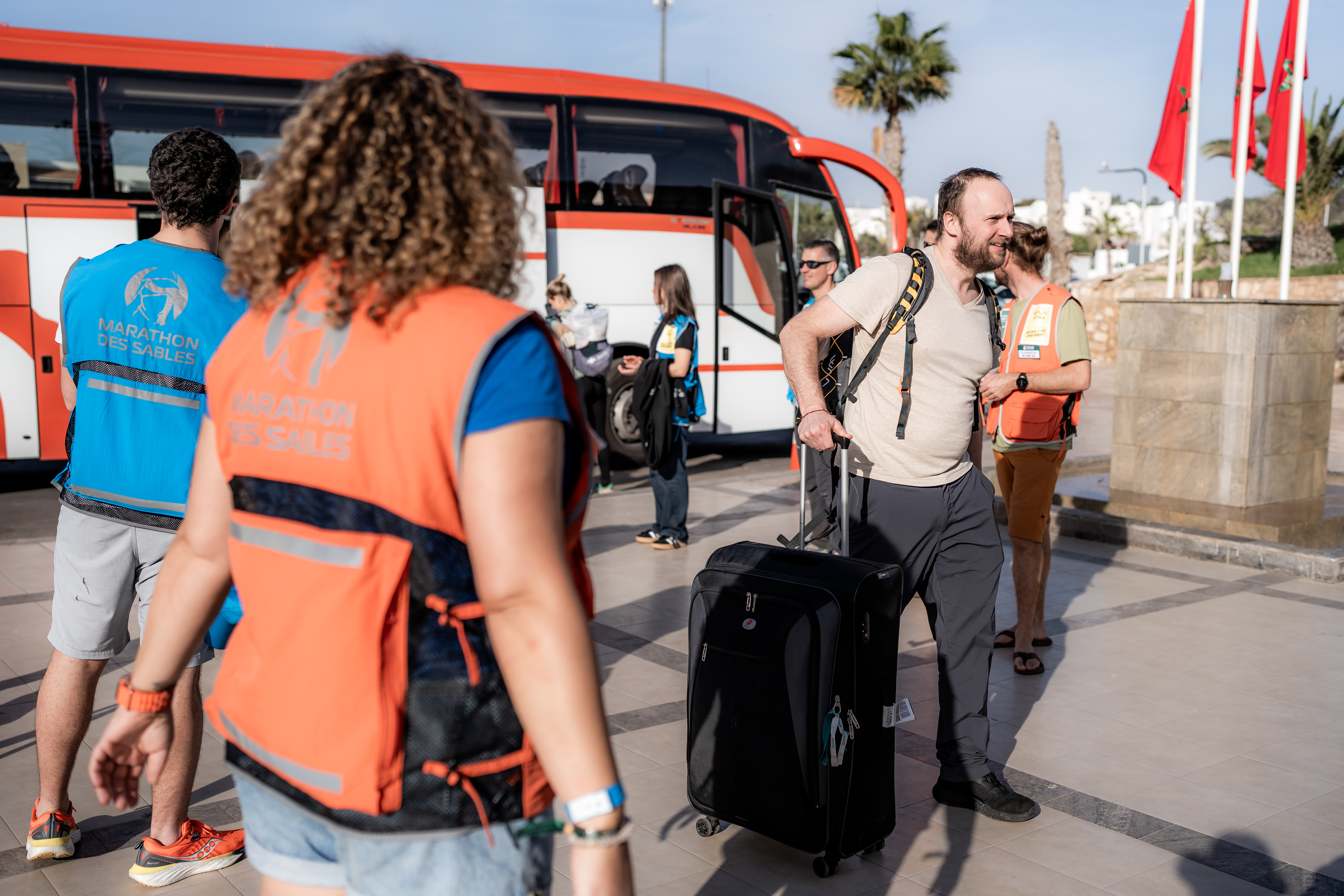
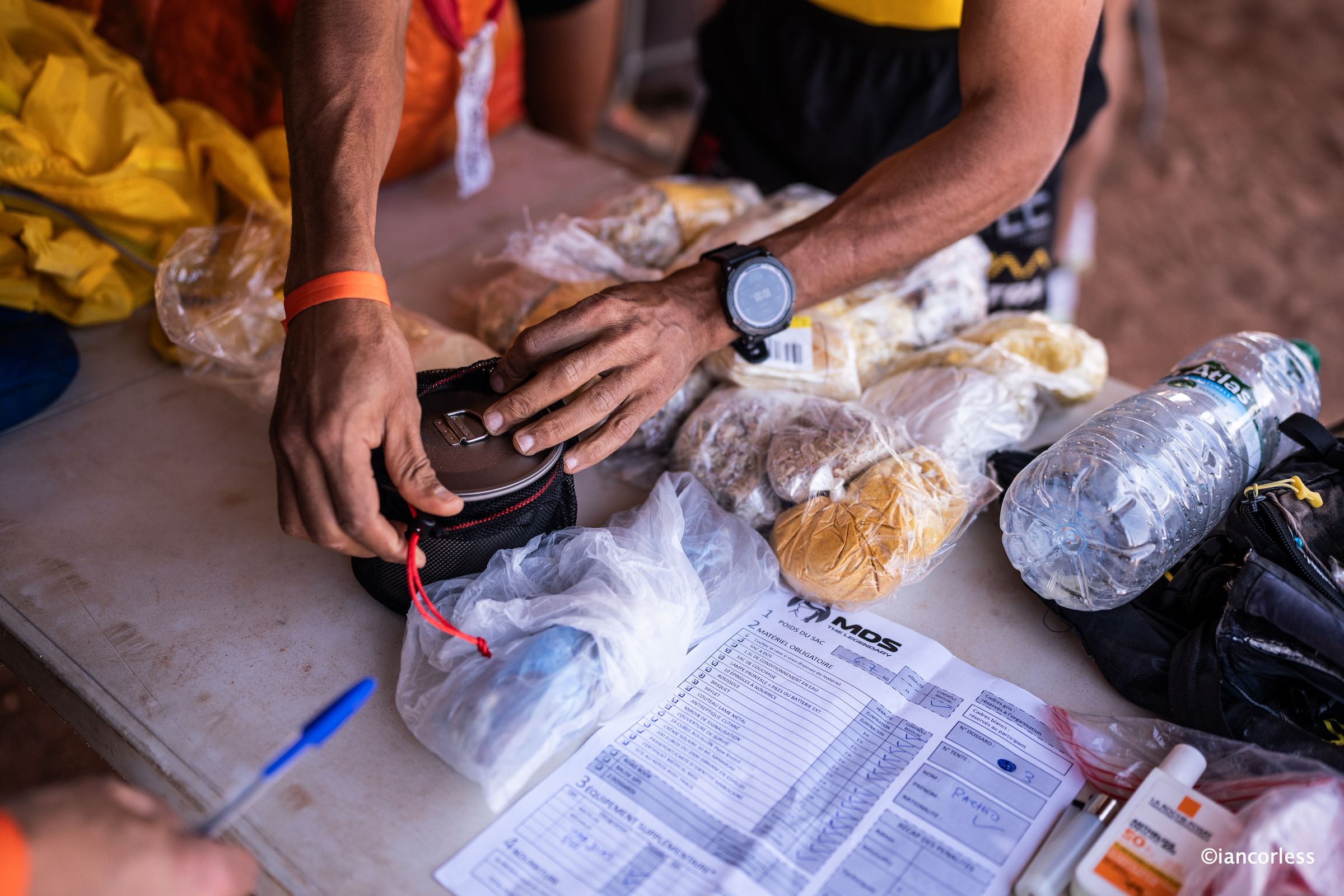
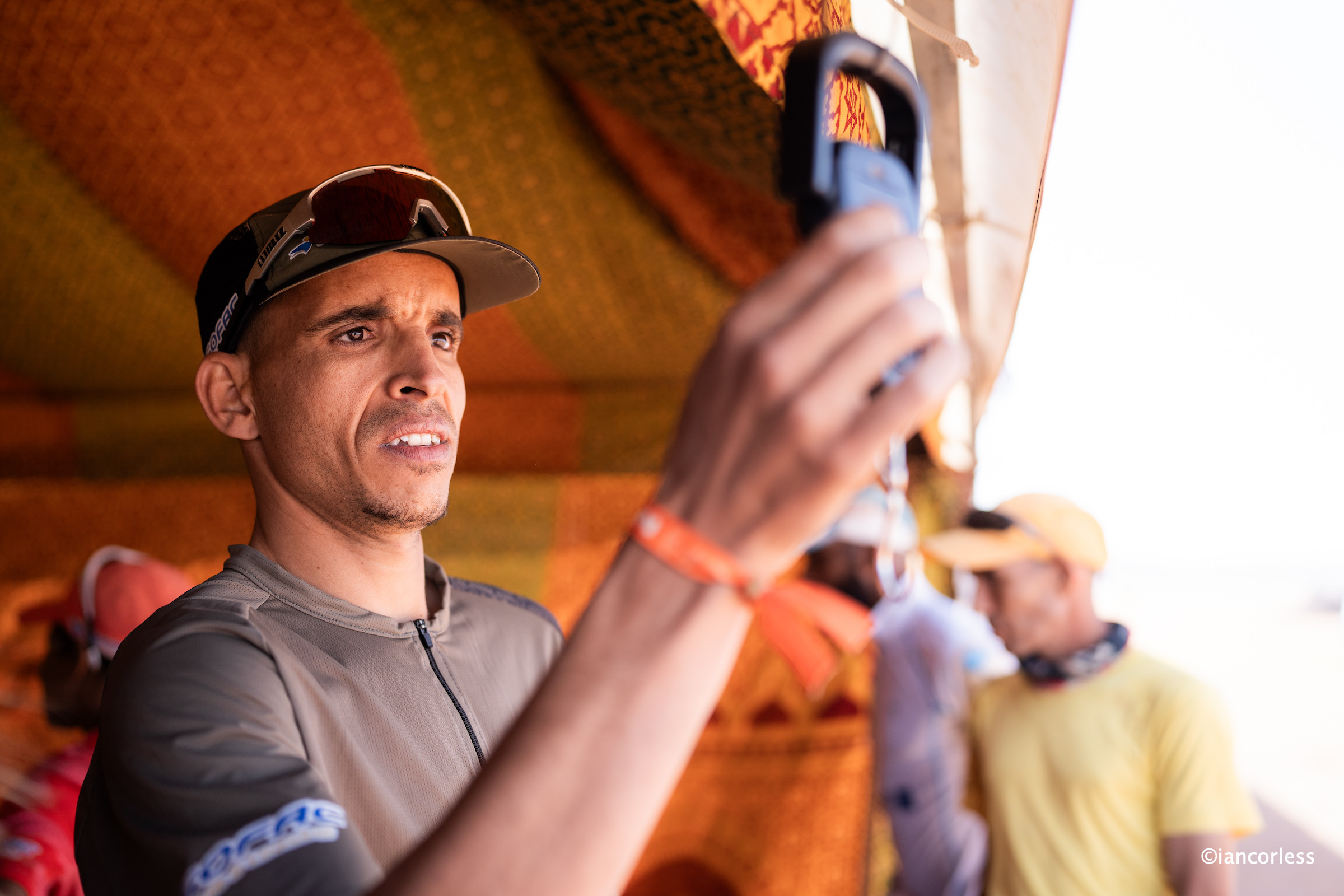
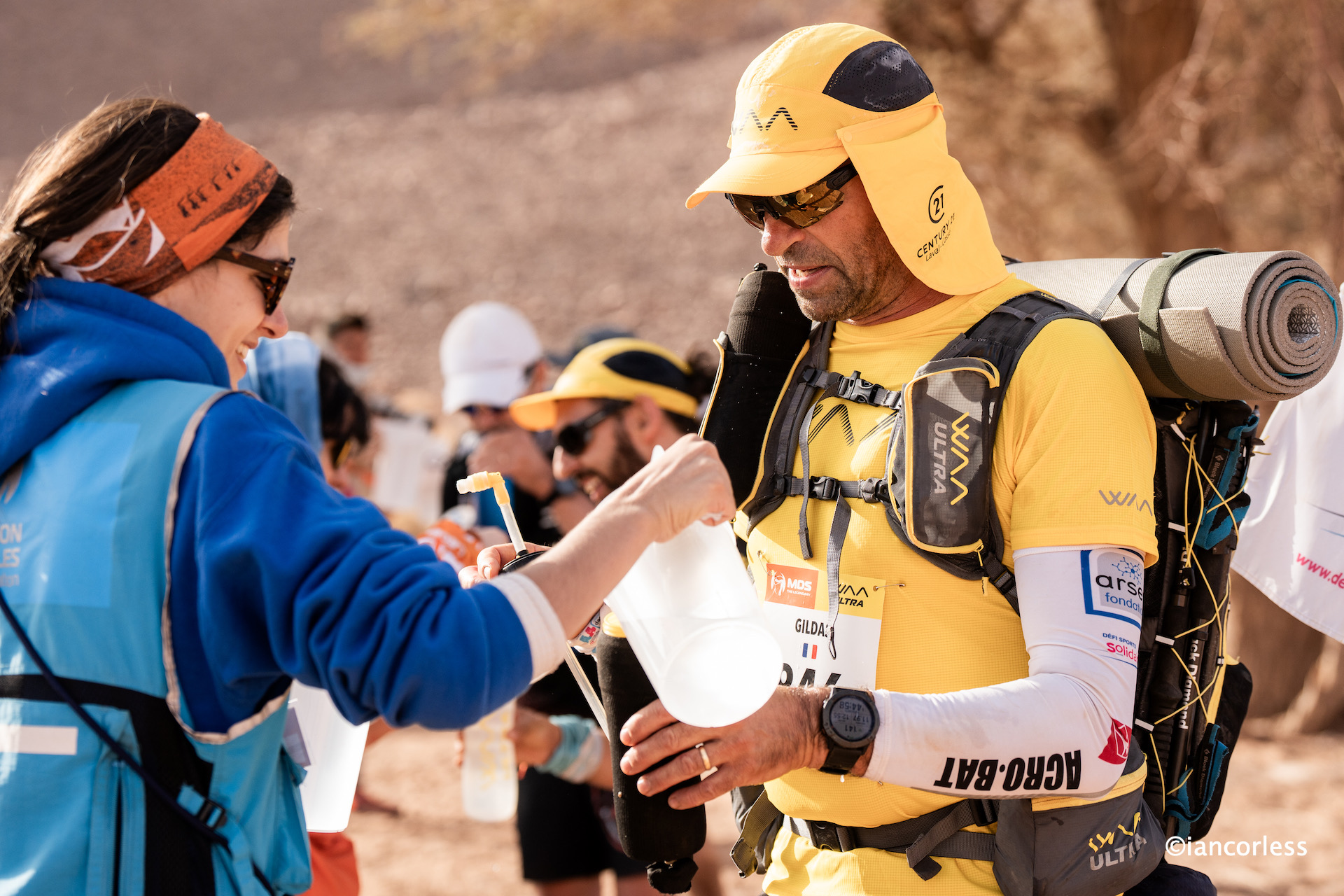
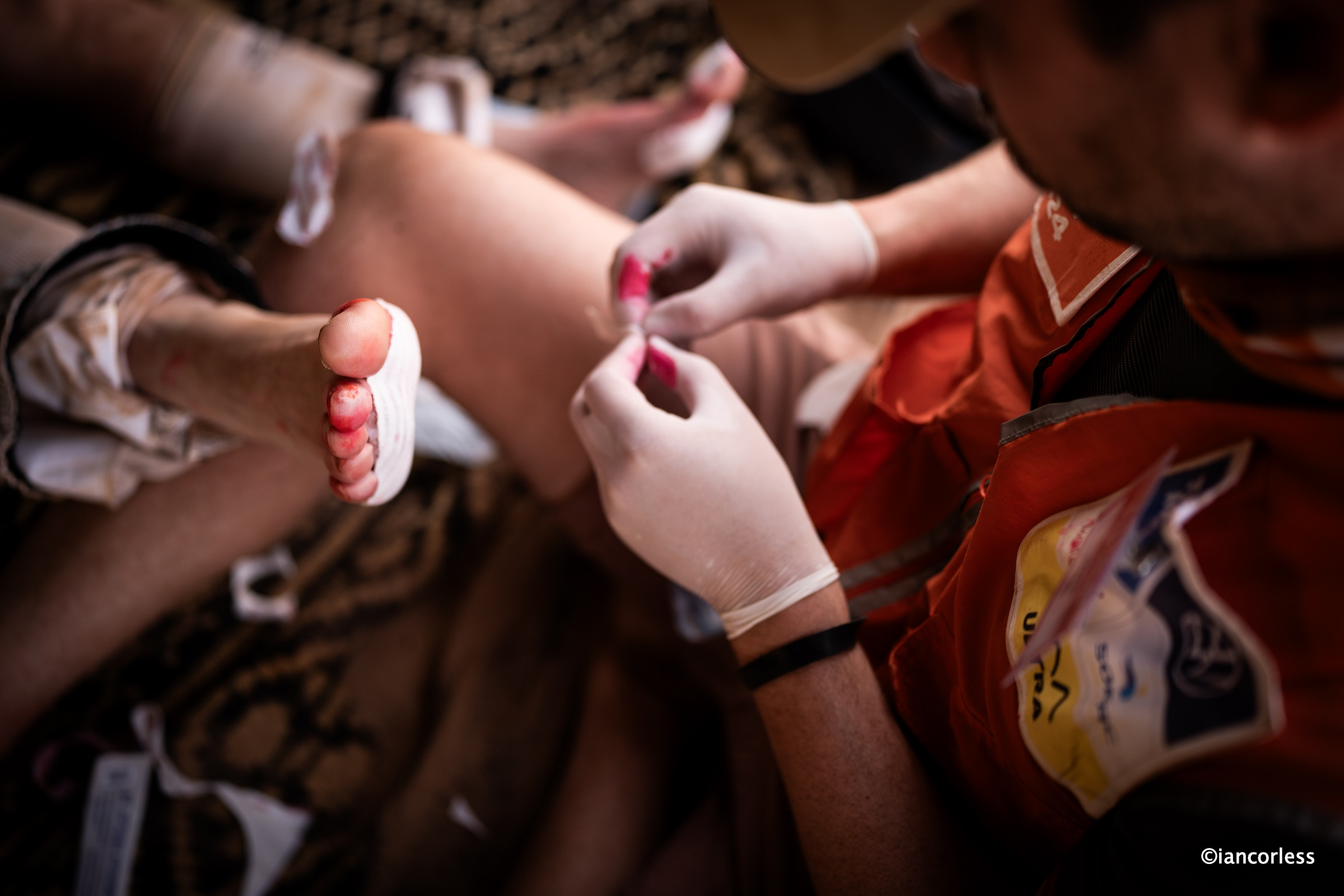
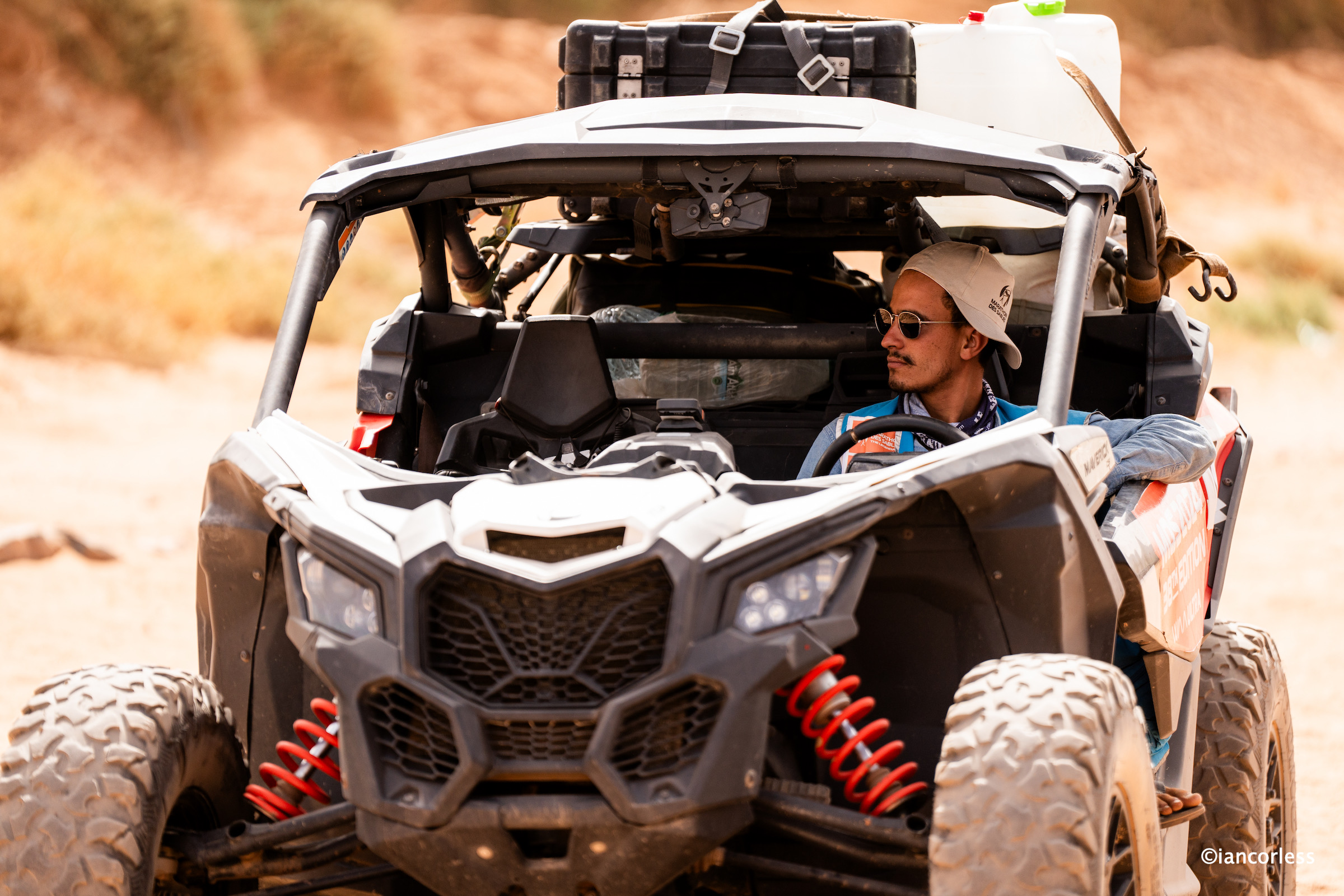
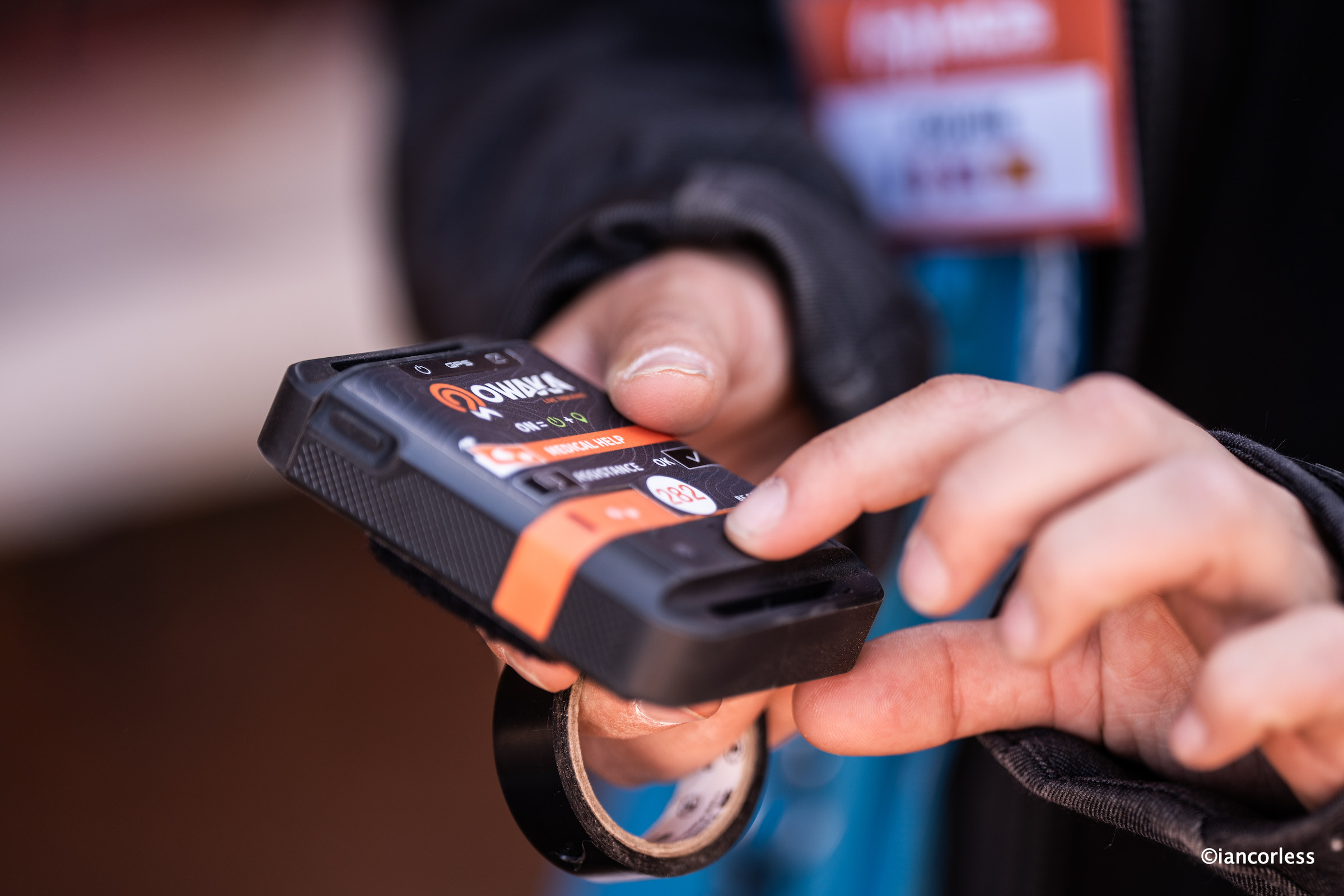
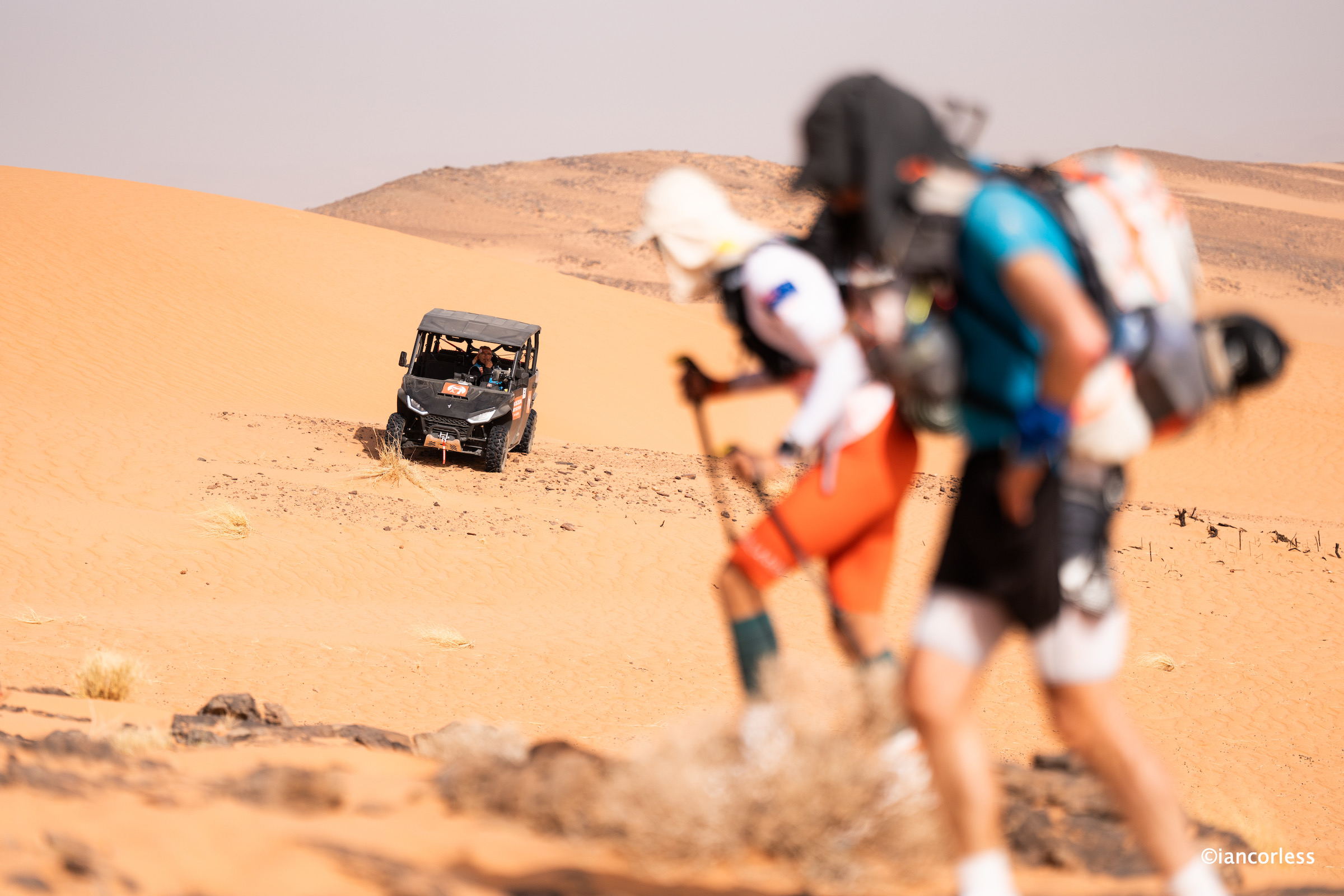
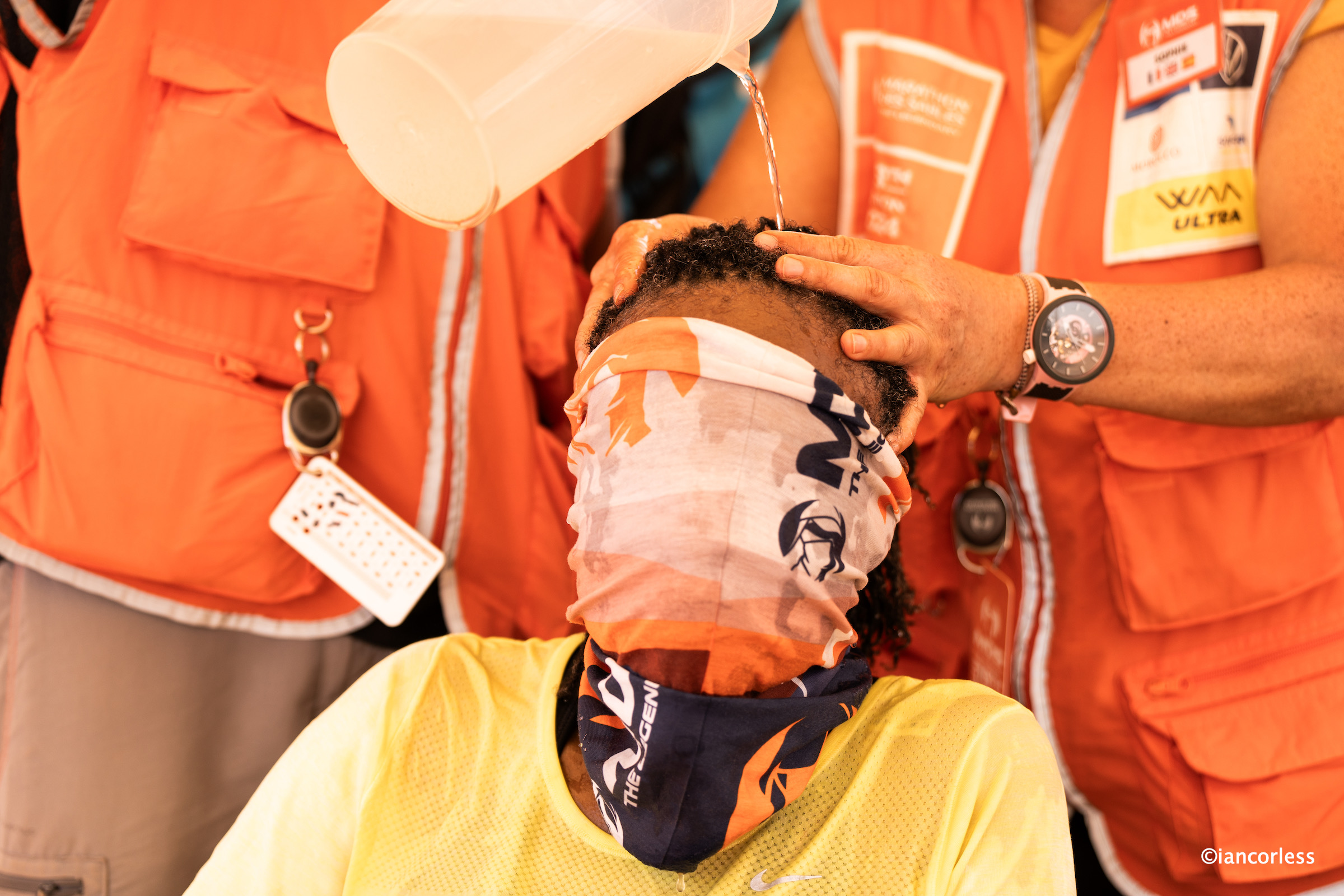
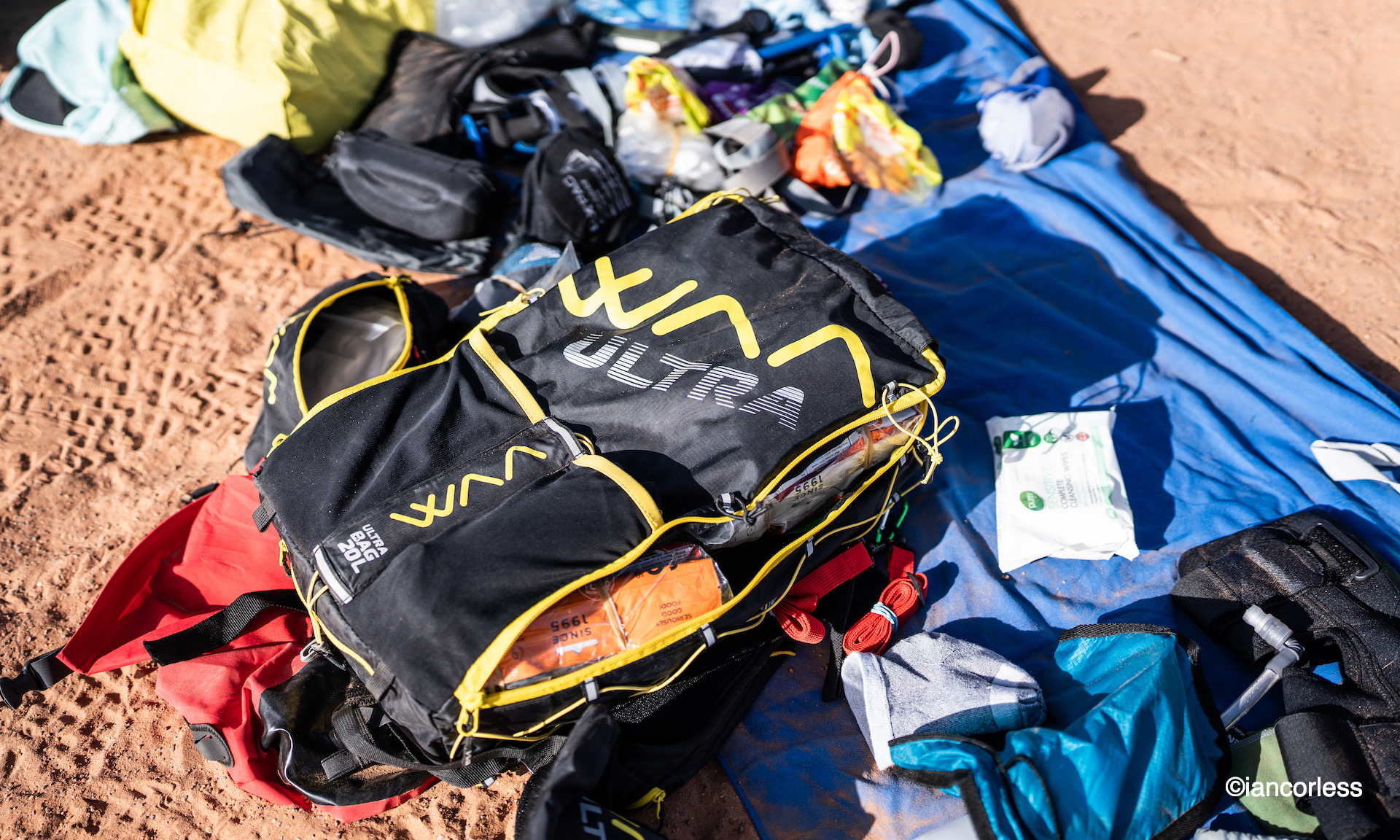
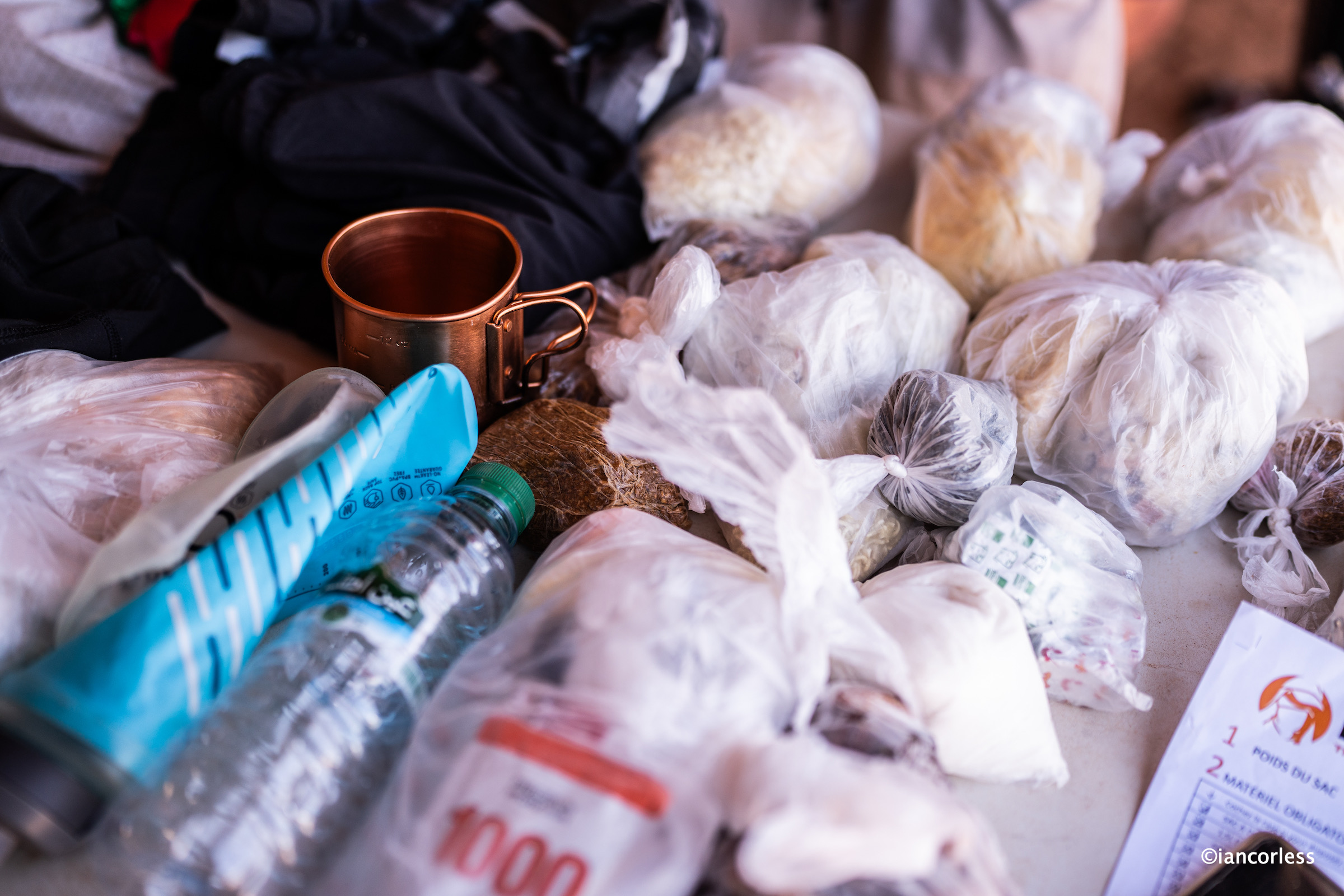
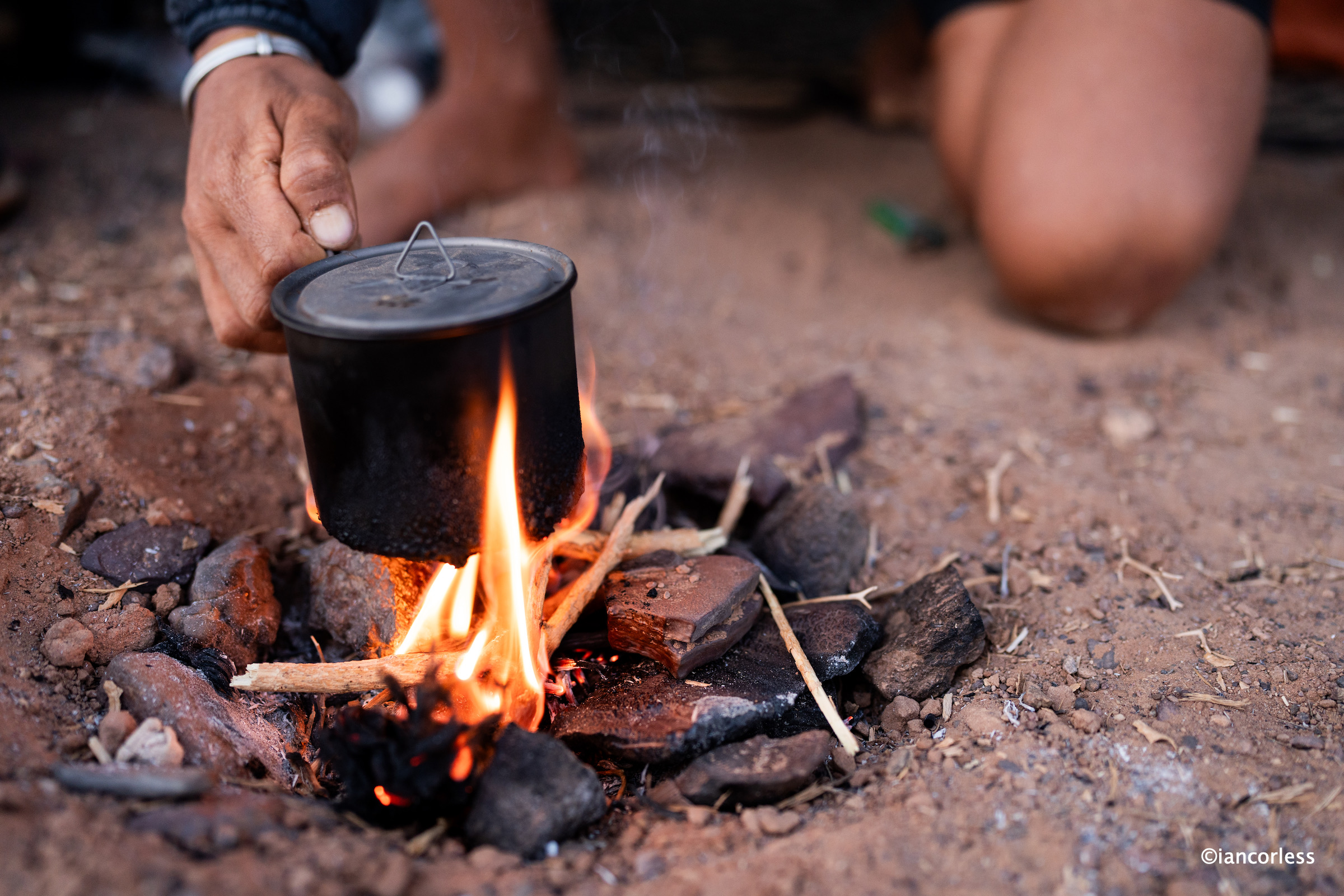
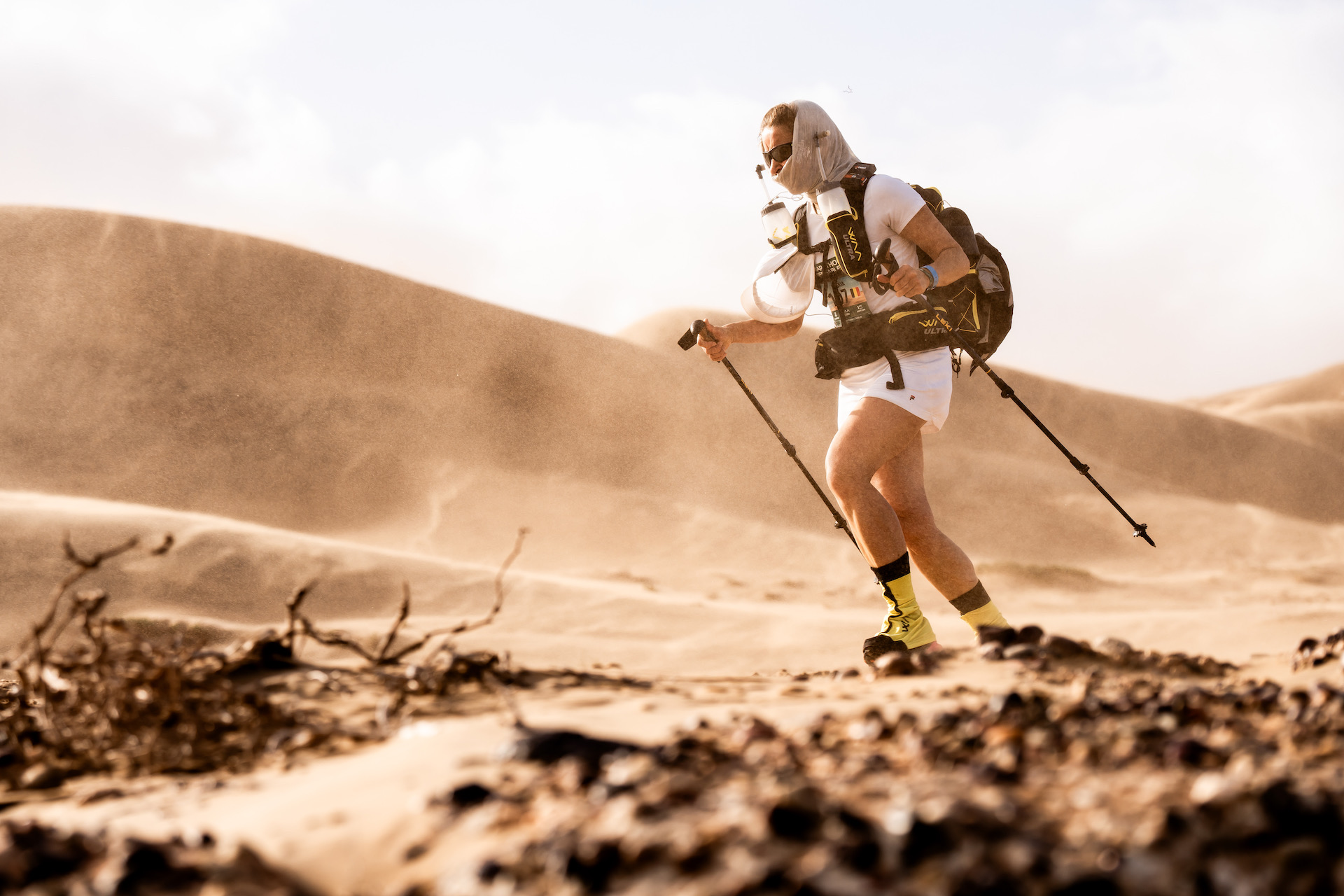

 IAN CORLESS