The Coastal Challenge – February 13th to February 20th, 2027
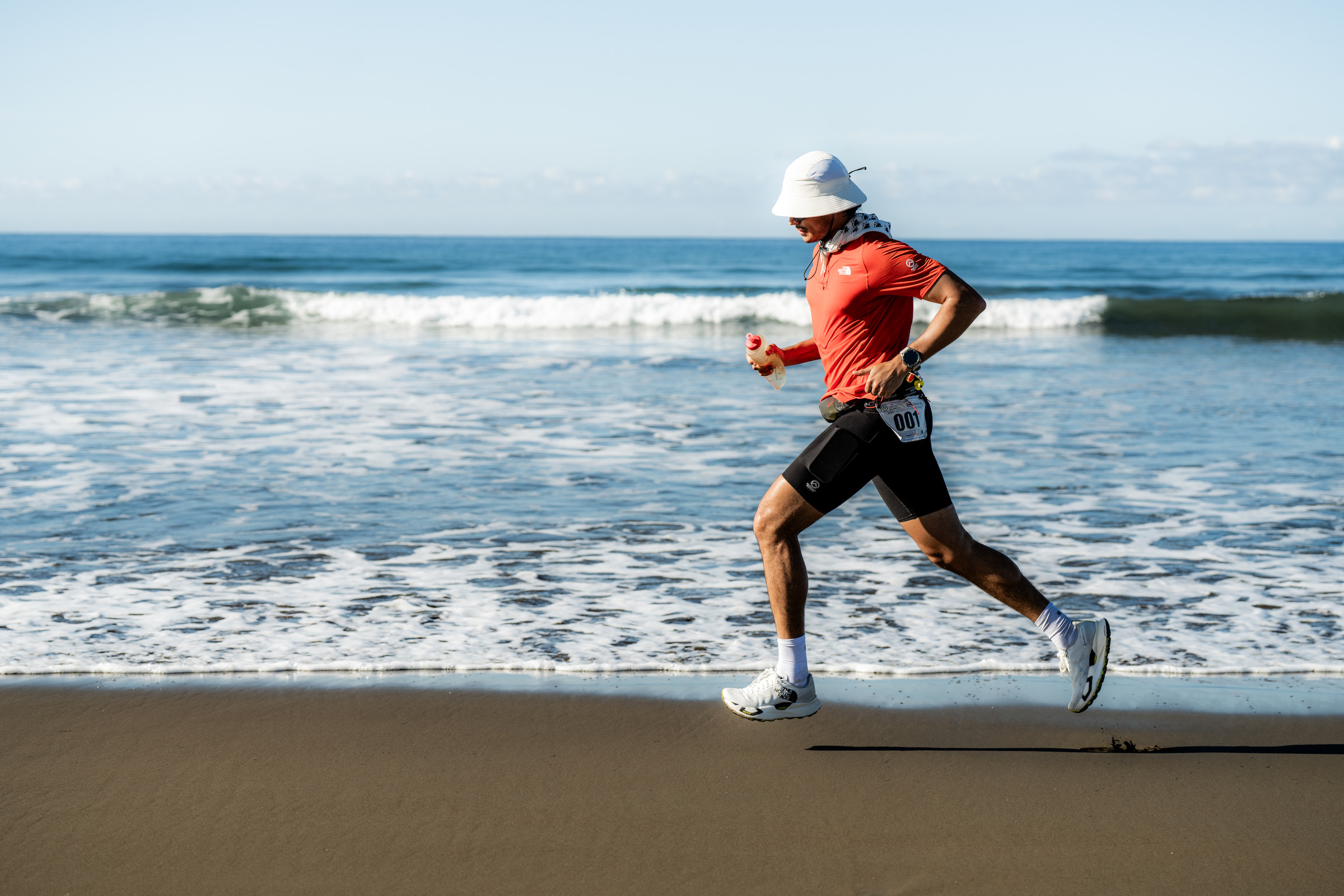
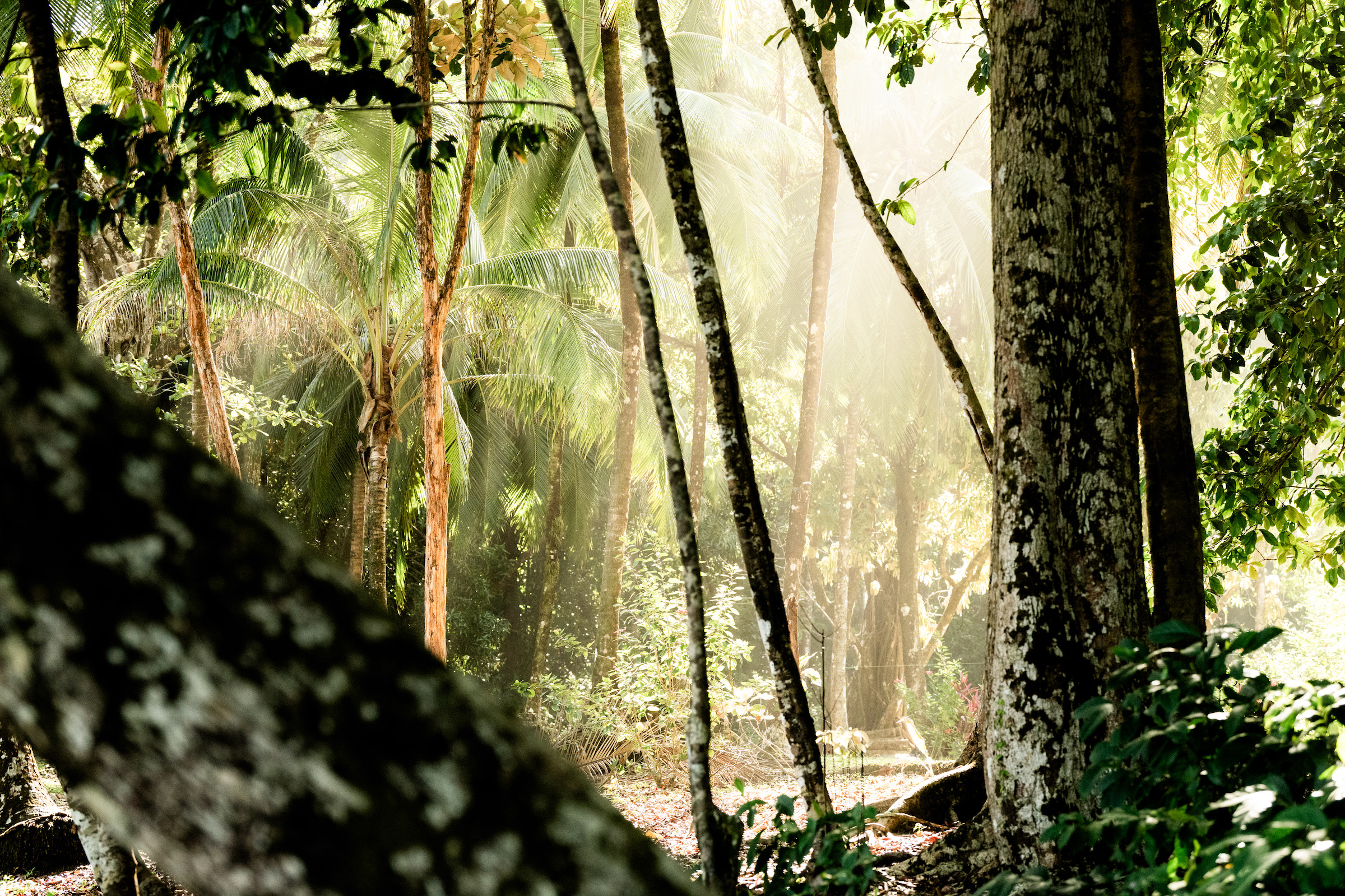
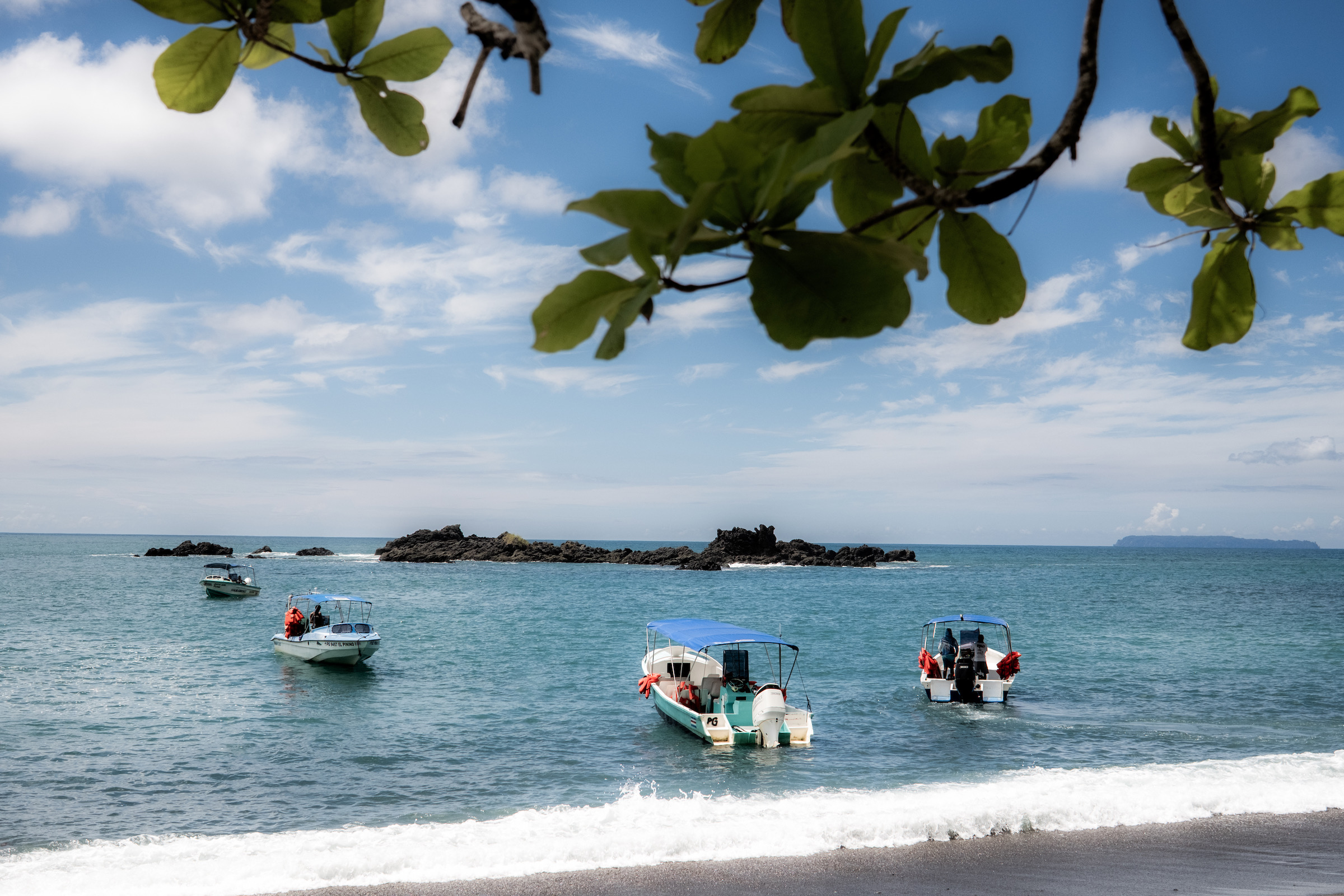
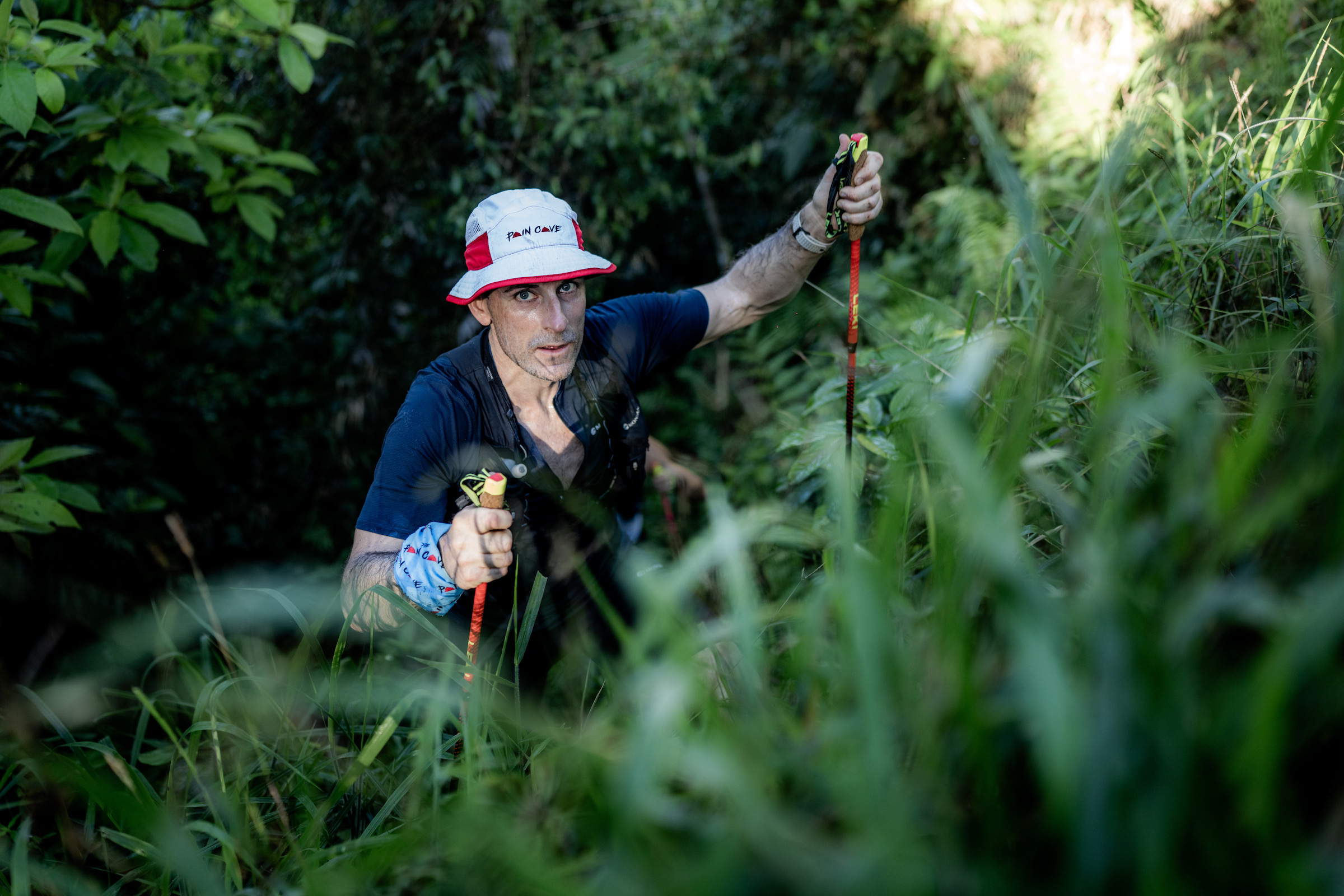
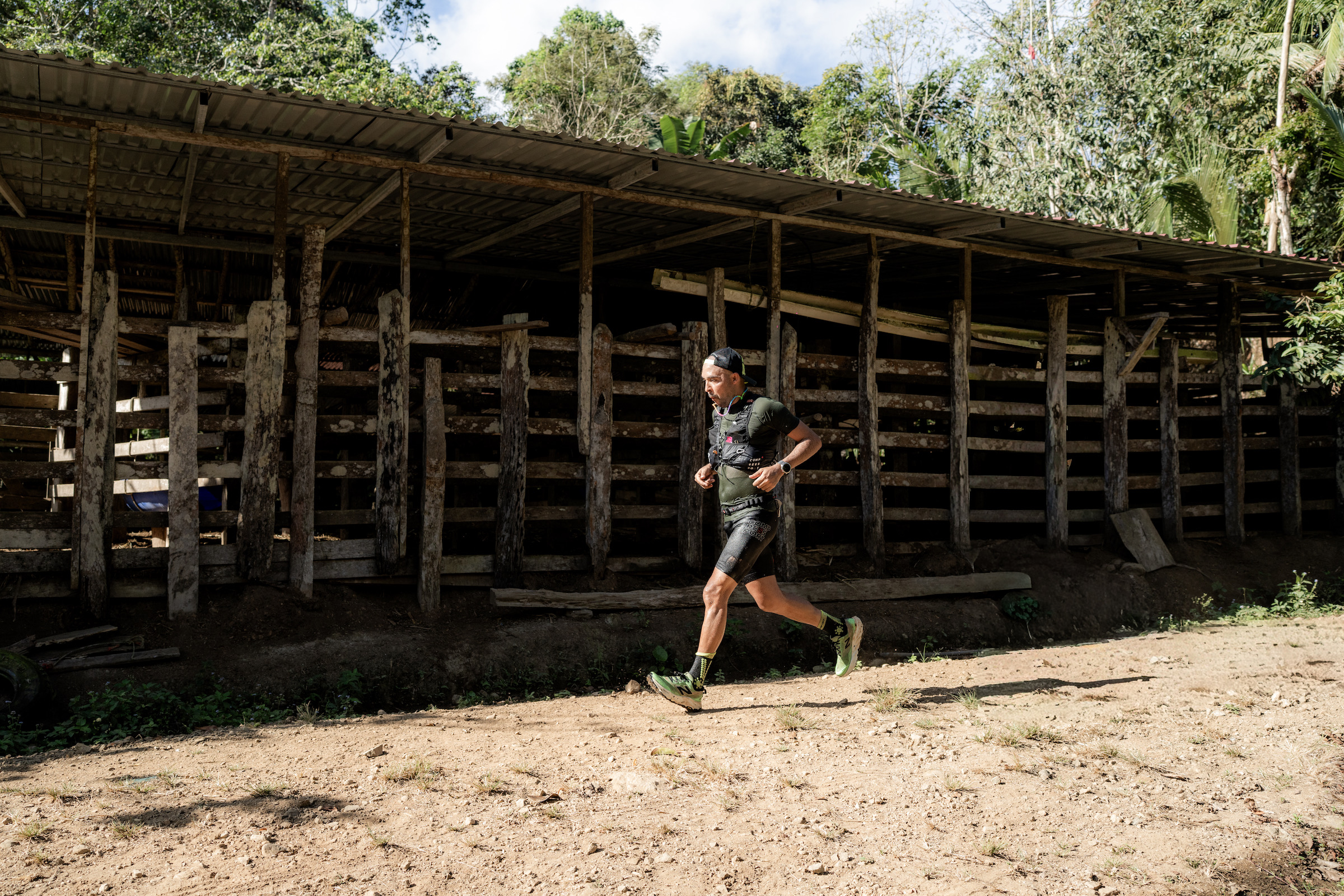
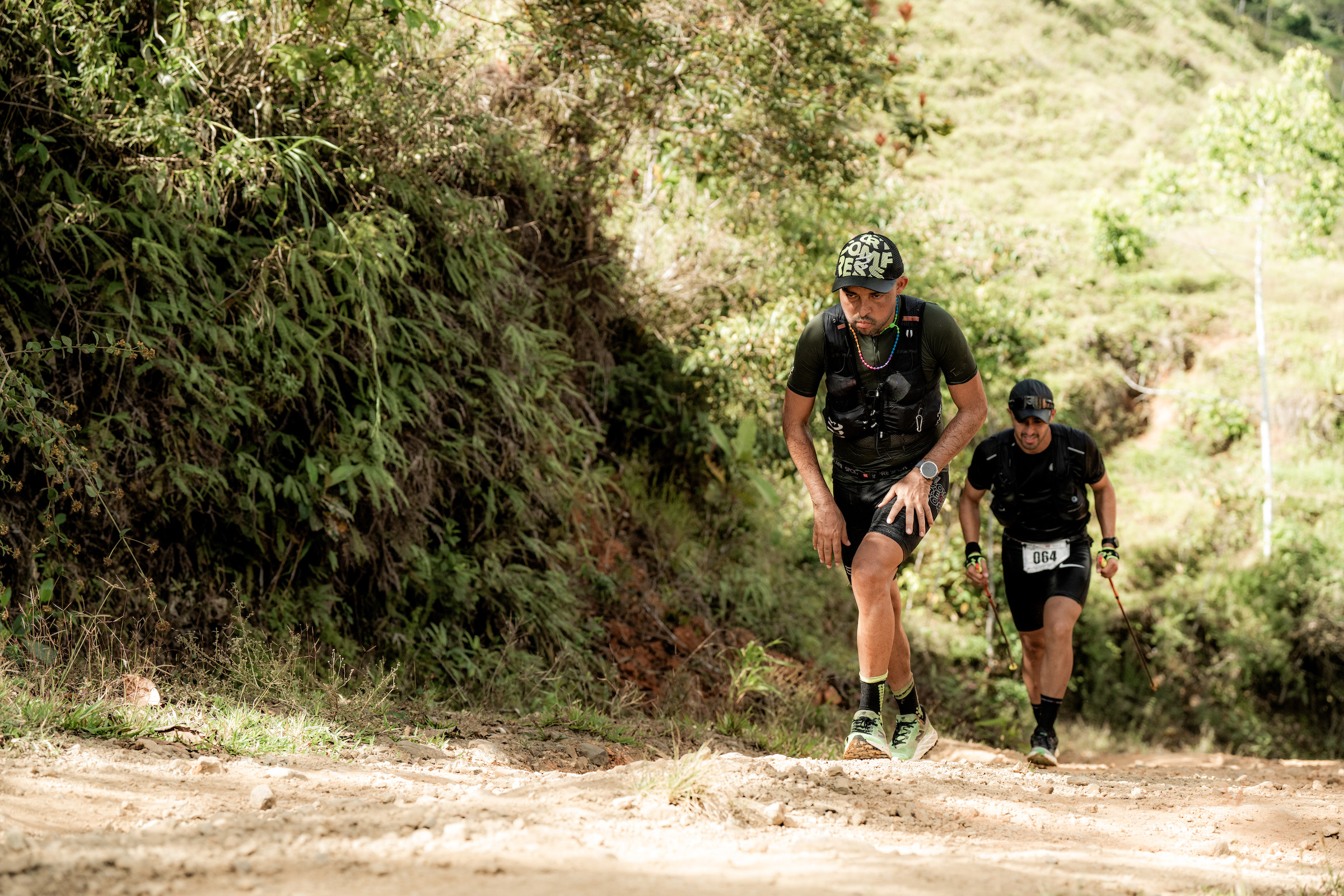
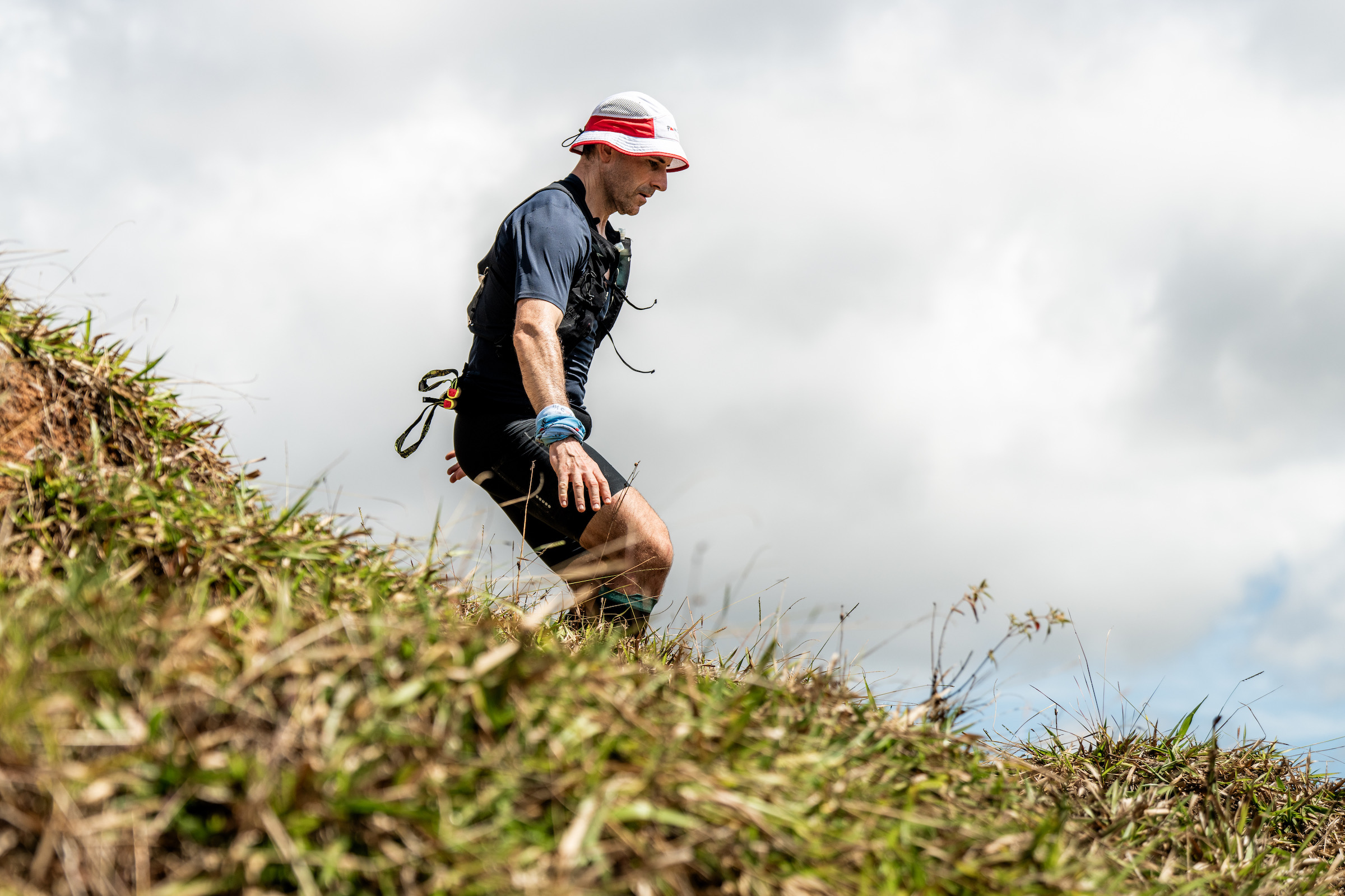
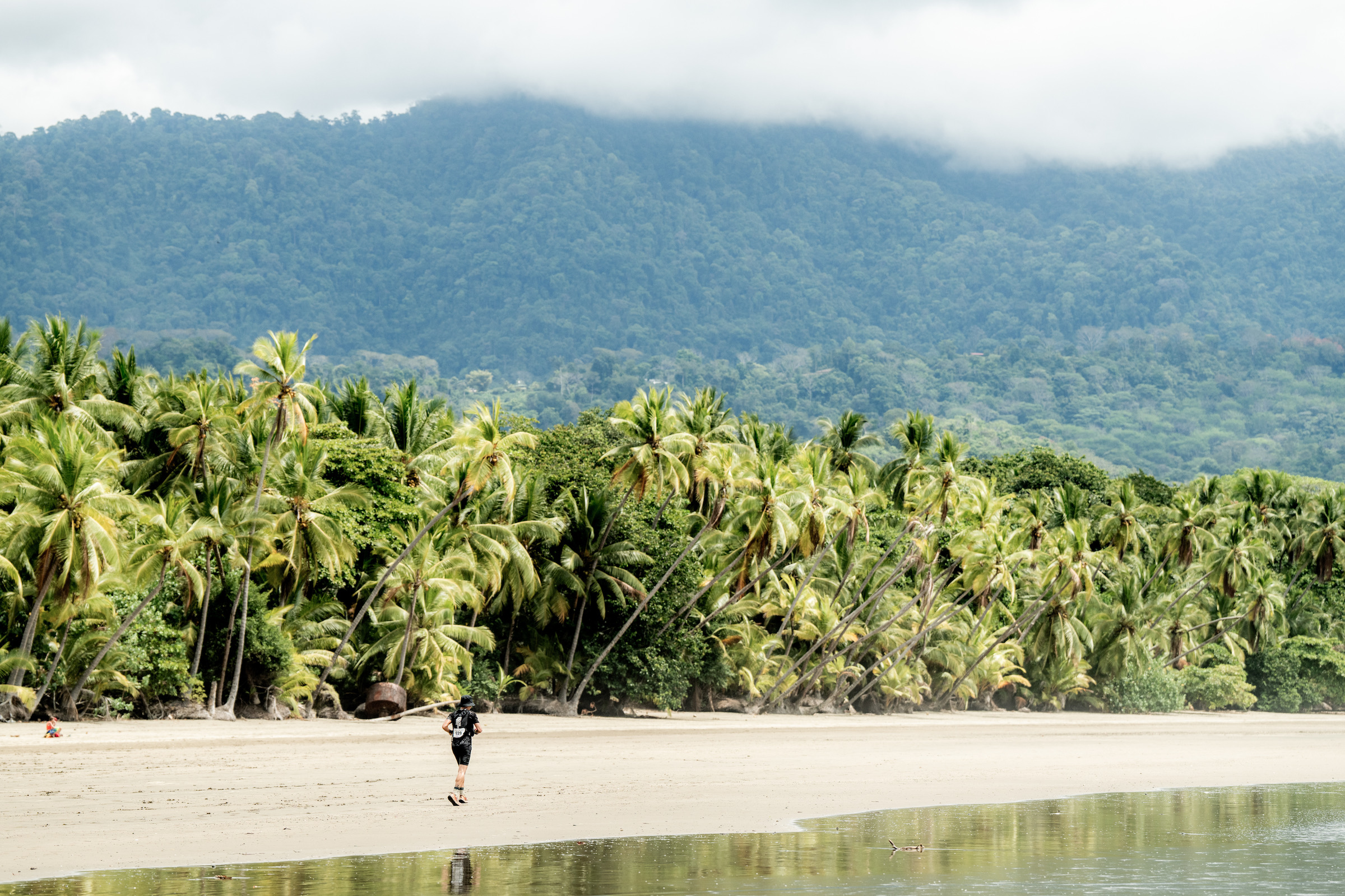
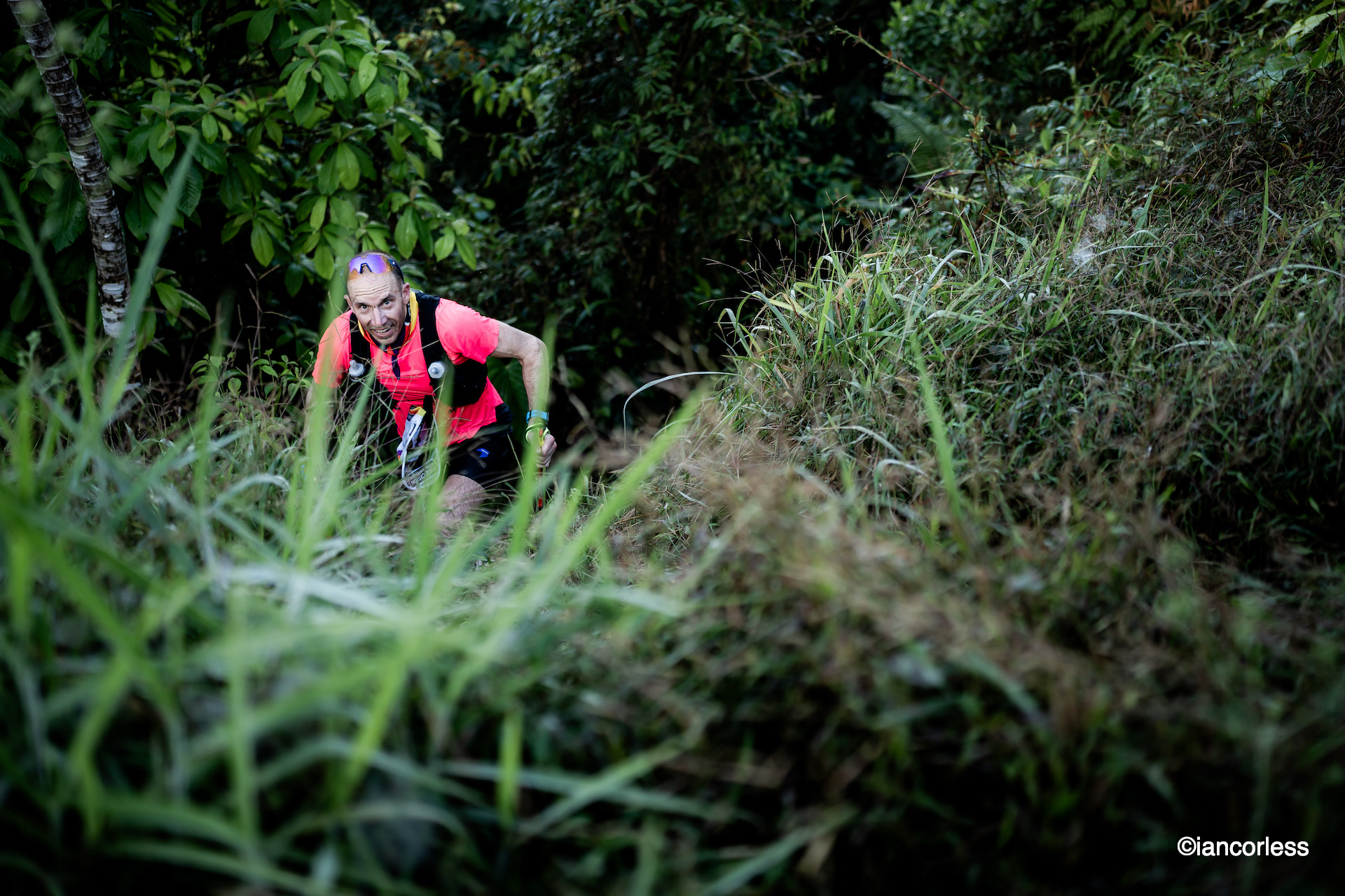
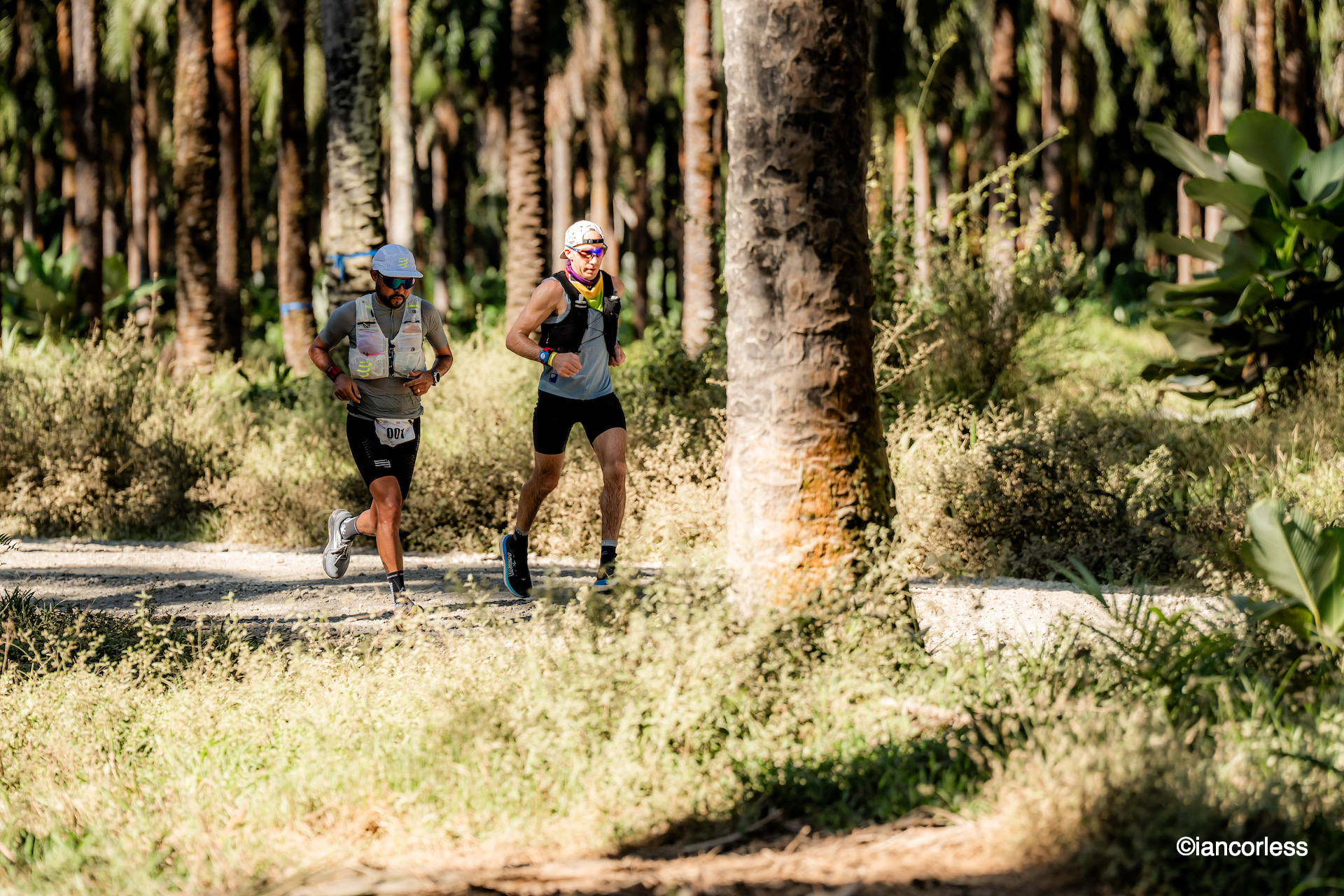
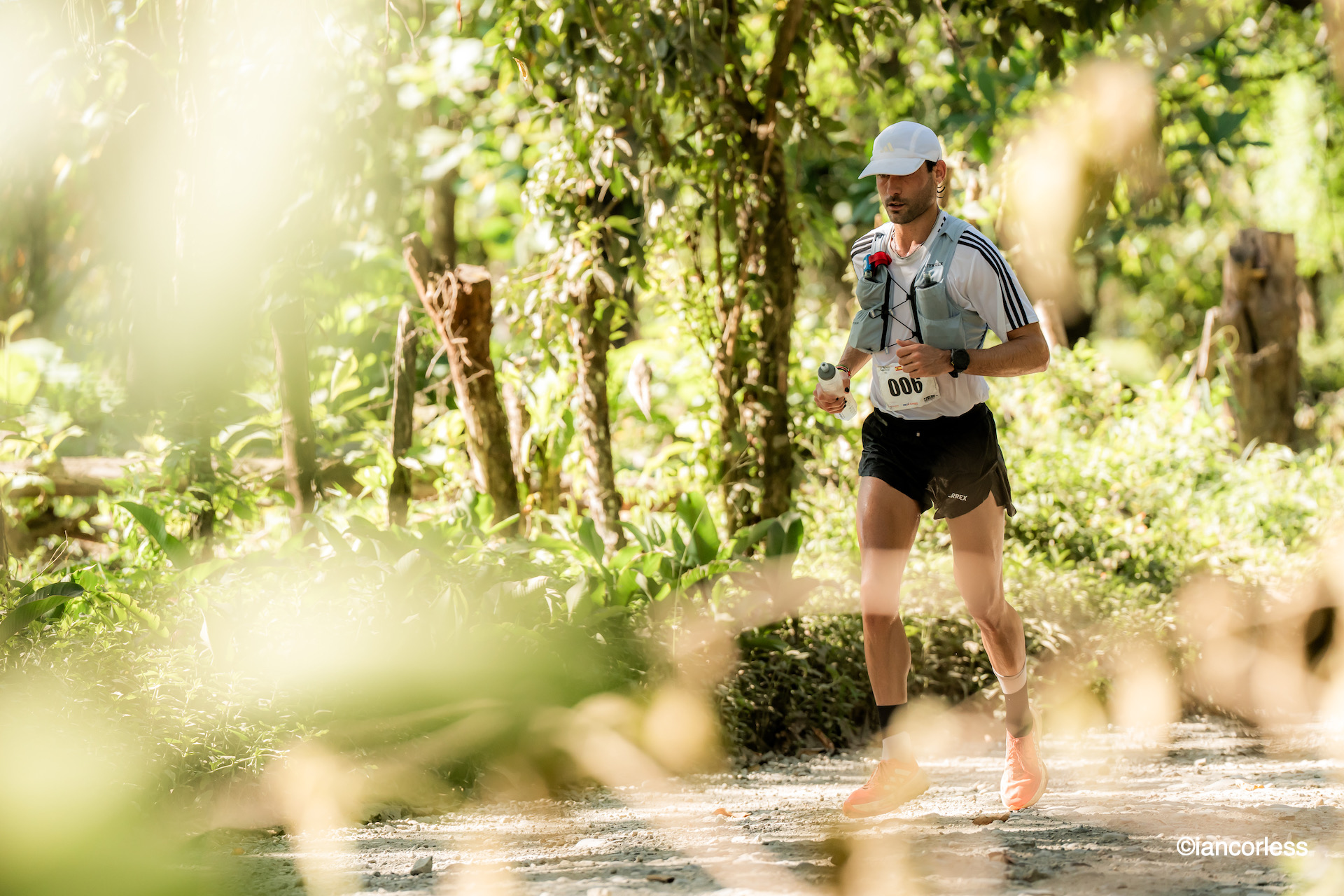
The Coastal Challenge Costa Rica is a six-stage, six-day race along Costa Rica’s Pacific coastline. It’s tough, humid, beautiful, and unpredictable in the best possible way. You’ll run through rainforest trails, cross rivers, climb steep hills, and move along stretches of tropical beach where the ocean feels close enough to touch.
This is not a single-day effort. It’s a week of managing energy, staying consistent, and adapting to changing terrain. Some days feel fast and flowing. Others demand patience and grit. By the time you reach the final stage, you’ll have covered ground that most visitors never see.
Two Race Options: Expedition and Adventure
You can choose between two distances: Expedition and Adventure. Both events run over the same six days and share the same start and finish week. Stages 1 and 6 are almost identical for both races, so everyone begins and ends the journey together.
The difference lies in Stages 2, 3, 4, and 5.
The Expedition race is the full challenge. Longer stages, greater cumulative distance, and a bigger daily physical demand. It’s designed for experienced endurance runners who want the complete test.
The Adventure race offers considerably shorter stages on days 2 through 5. That adjustment makes the event accessible to a much wider range of participants. It’s ideal for runners who prefer a steadier pace, and especially for those who plan to hike or walk sections of the course.
‘Adventure gives the best of both worlds, I got to race in Costa Rica and see the awesome trails, views and terrain, but I also got more time to relax and enjoy camp and the Pura Vida lifestyle.’ – Abelone Lyng
Adventure doesn’t mean easy. The terrain and climate are the same. But the shorter distances allow more time for rest, recovery, and simply taking in the surroundings. You’ll have space to soak up the Pura Vida lifestyle, connect with other runners, and enjoy the unique atmosphere that makes this race special.
Whether you choose Expedition or Adventure, you’ll experience the same wild coastline, the same supportive race community, and the same sense of achievement at the finish.
Ready to Sign Up?
The 2027 race entry is $3,050.
Using the link below, Ian Corless is able to offer a $200 discount, bringing your entry down to $2,850.
If you’ve been thinking about a multi-day race but weren’t sure which one, this is a strong place to start. Six days. A world-class course. Two distance options that make the challenge accessible without losing its edge.
We’ll see you on the start line in February 2027.
More reading
THE COASTAL CHALLENGE COSTA RICA : A 2026 PERSPECTIVE ON ONE OF THE WORLDS TOUGHEST RACES – HERE
You can read daily summaries from the 2026 edition HERE
The Coastal Challenge Costa Rica pulled runners away from the coastline and into the high farmlands of the country’s interior. It was a bruising day, 37.7 kilometers with 2,613 meters of climbing for the Expedition category.
No hiding from it. The terrain rolled relentlessly, climbing and plunging through rough rural tracks and exposed hillsides before dropping toward the finish in Palma Norte. It was a stage built to test already tired legs, and it did exactly that.
Men’s Race
Erick Aguirre ran smart. With a solid overall lead, there was no need to take risks. He spent the day alongside Jesus Cerdas, the pair moving steadily across the harsh terrain. They crossed together in 6:05:43, controlled and composed.
Behind them, the real battle unfolded.
Jon Shield fought all day. For much of the stage he sat in fourth, but he never let the gap grow. Gradually he reeled in Martin Alonso Mena. The two arrived at the line almost inseparable after more than six and a half hours of racing. Shield edged it by just three seconds, 6:38:26 to 6:38:29. A long day decided by the smallest of margins.
Women’s Race
Denise Zelaya continues to run her own race. Calm, consistent, and completely dominant, she finished in 7:29, well clear of the field.
Janina Beck followed in 8:27, with Floribeth Perez completing the podium in 8:59. On a day that punished everyone, Zelaya once again showed control and strength.
Adventure Category
The Adventure course was shorter at 12 kilometers, but still far from easy. Sammy Francis ran solo again, crossing in 3:39:22 with another composed performance. In the women’s race, Laura Zuniga finished in 4:13:45, gaining more time on Toni Clark and steadily building her advantage.
*Please note – Adventure times need to deduct 1:49 from the times
With four stages complete, fatigue is real. The coastal humidity has been replaced by exposed climbs and rolling farmland. Every step now carries the weight of the days before.
The Boruca region of southern Costa Rica feels different from the postcard version of the country. This is not manicured resort coastline or dense jungle trails pressed flat by tourists. It is rural, working land, shaped as much by history as by weather.
The Boruca people, one of Costa Rica’s remaining Indigenous communities, have lived here for generations, known for their hand-carved masks and fiercely preserved traditions.
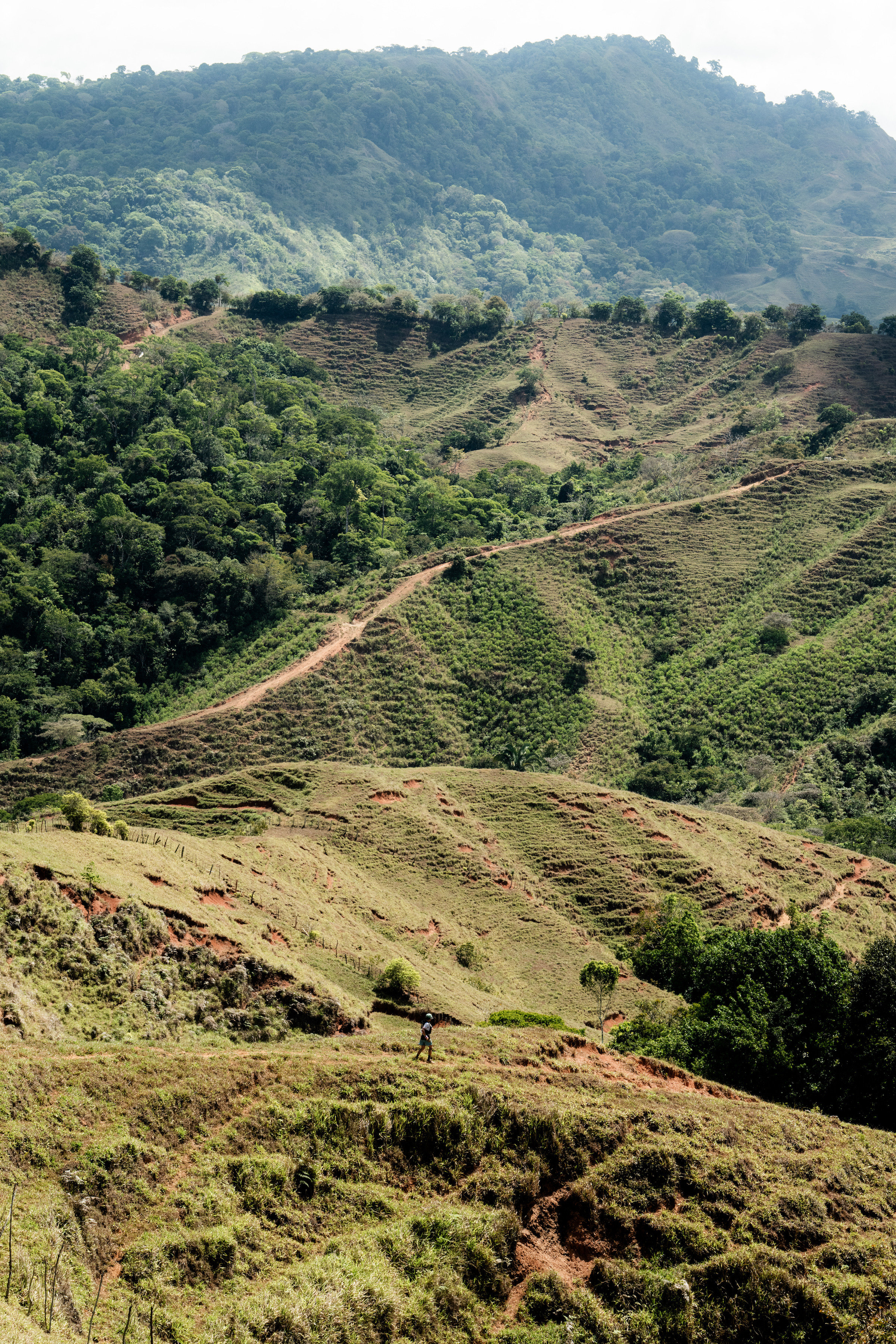
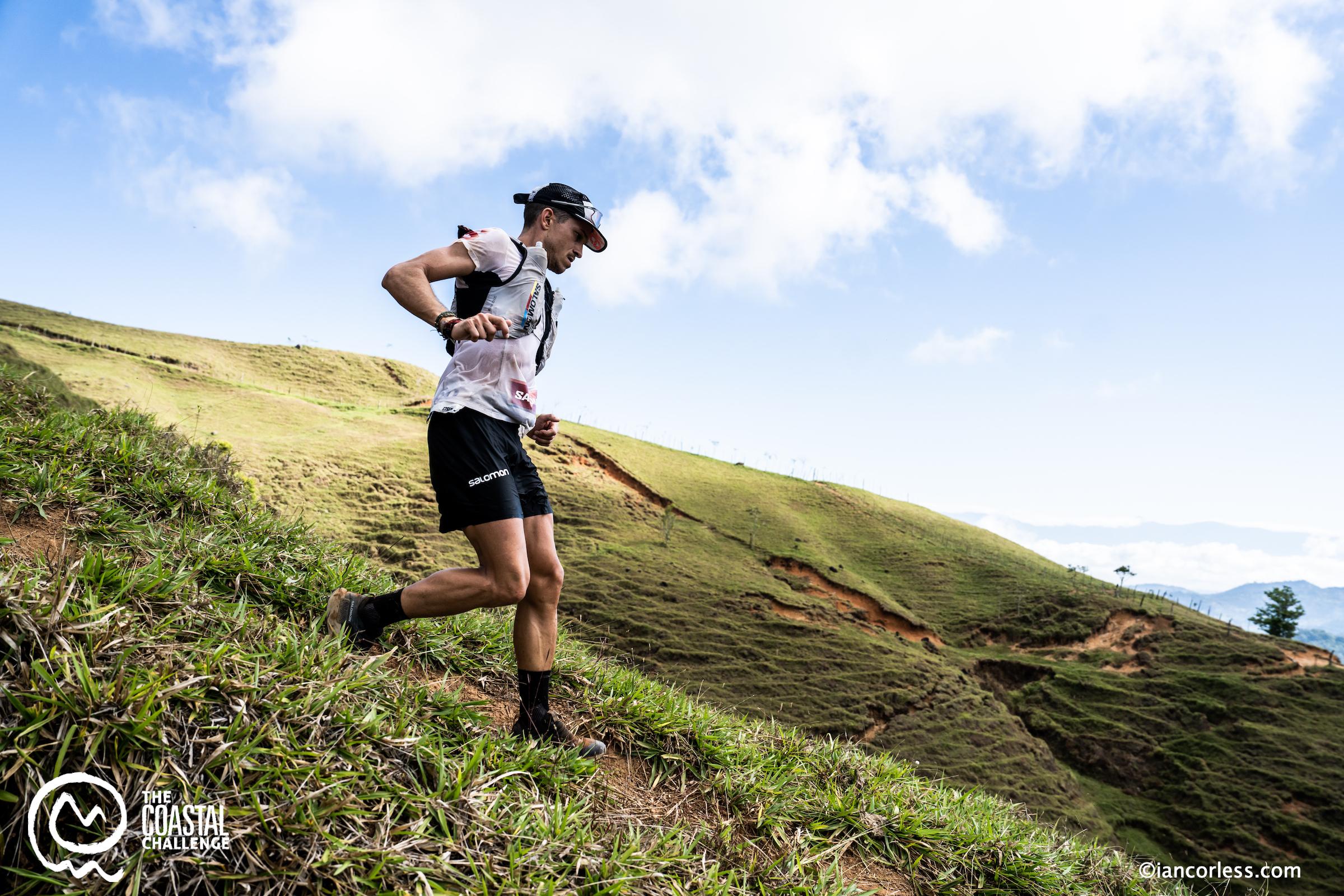
Around their villages the land rolls outward into open pasture and patchwork farmland, where cattle graze on steep green hills and small family plots cling to uneven slopes. The terrain is restless. Long climbs rise without rhythm, dirt roads bake under the sun, and sharp descents cut down into river crossings and humid low pockets before rising again.
It is a landscape that looks soft from a distance, all green folds and misty ridgelines, but up close it is rugged and unforgiving. The soil can be loose, the heat heavy, and the gradients relentless. In the high farmlands near Palma Norte, you move through open exposure rather than forest cover, feeling the scale of the land around you. It is beautiful, but it demands respect.
Stage 3 of The Coastal Challenge Costa Rica is always circled in red. The Queen Stage. The day that defines the race. The stage that strips things back to effort, patience, and decision-making. On paper it is long and brutal. On the ground, it is something else entirely.
The morning stars with the coast, in the quiet half-light where the jungle still holds the night. Runners gathered with headlamps flickering, shoes already damp from the humidity. The air was heavy but mercifully cooler than previous days. Low cloud sat over the hills. It would prove to be a gift.
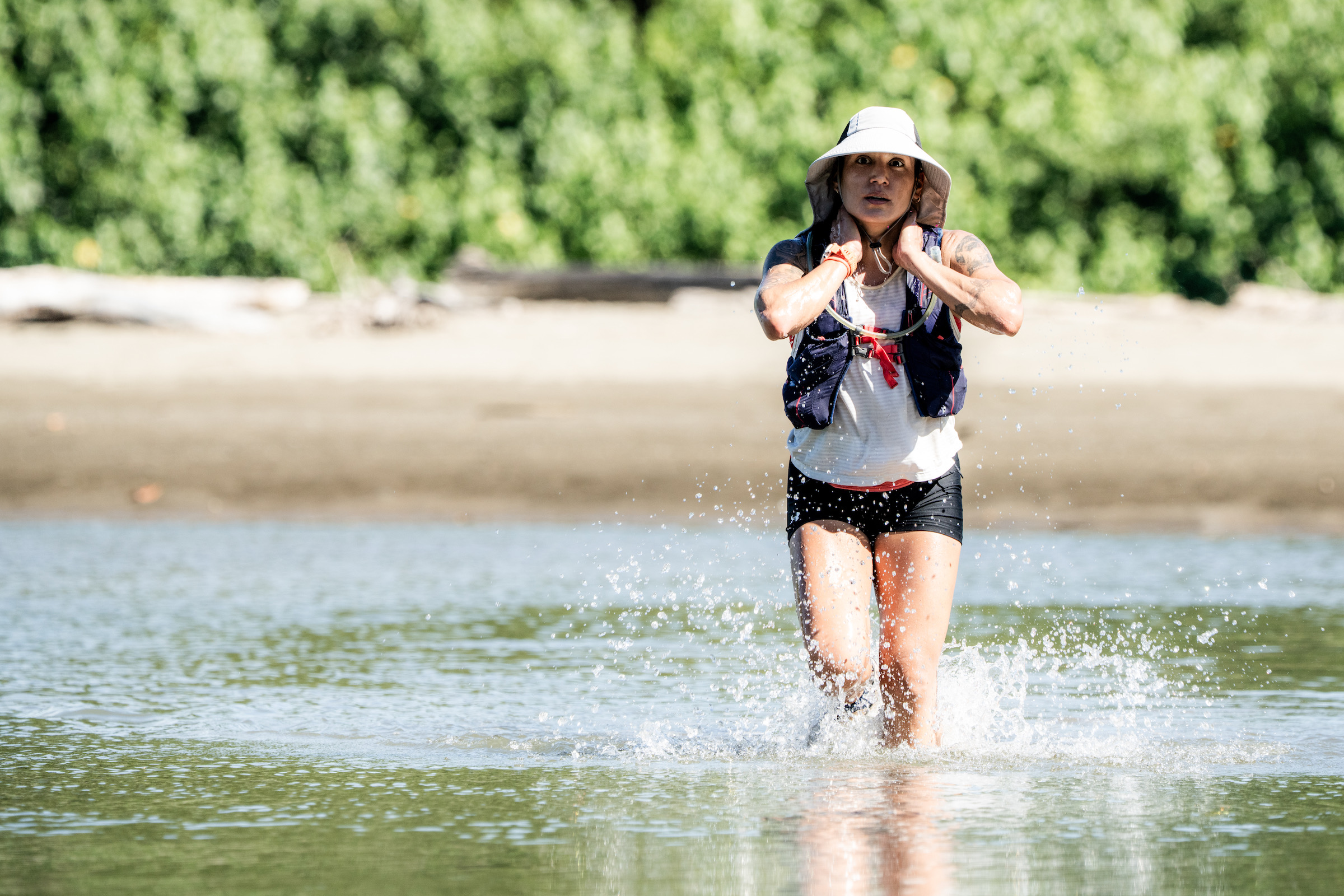
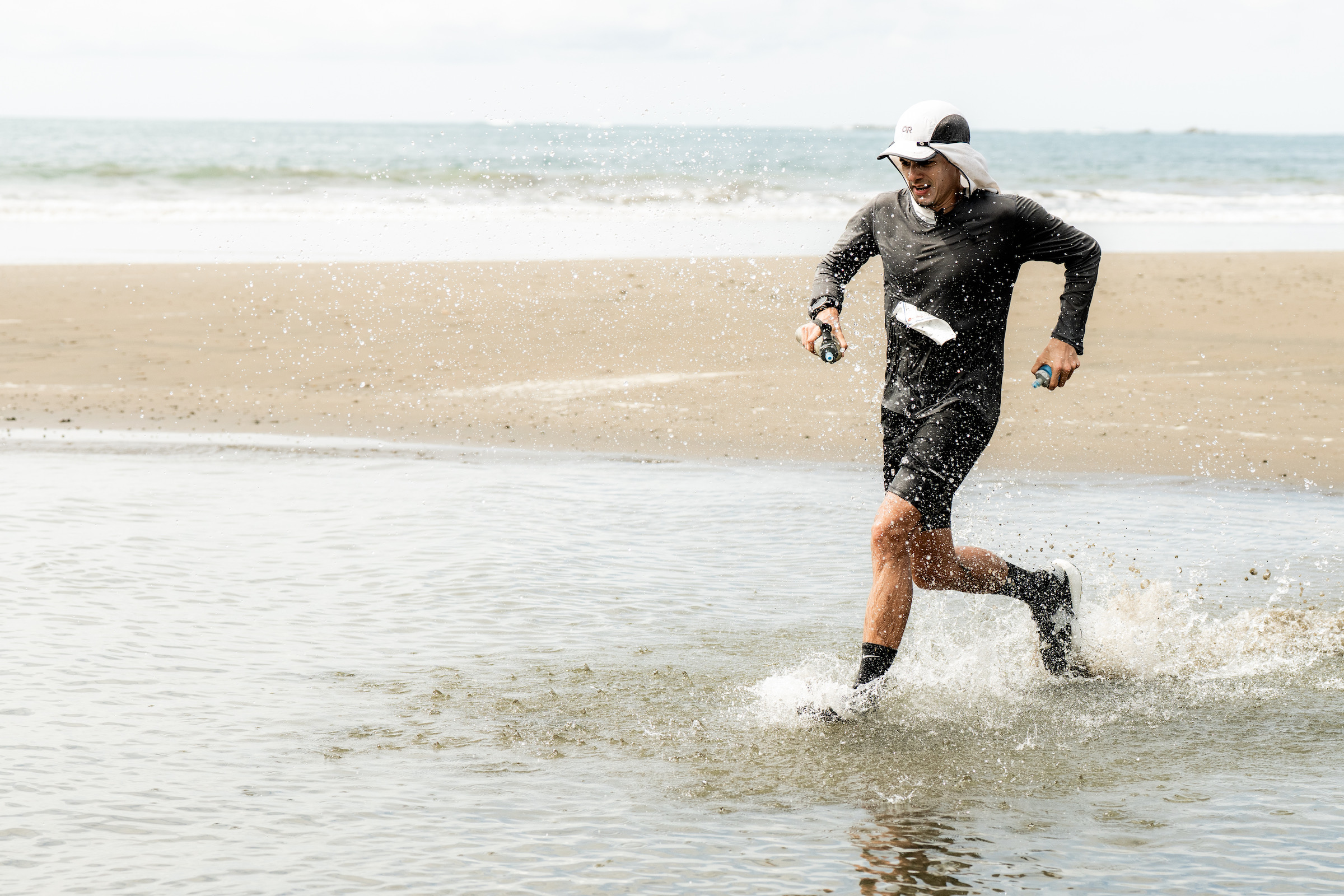
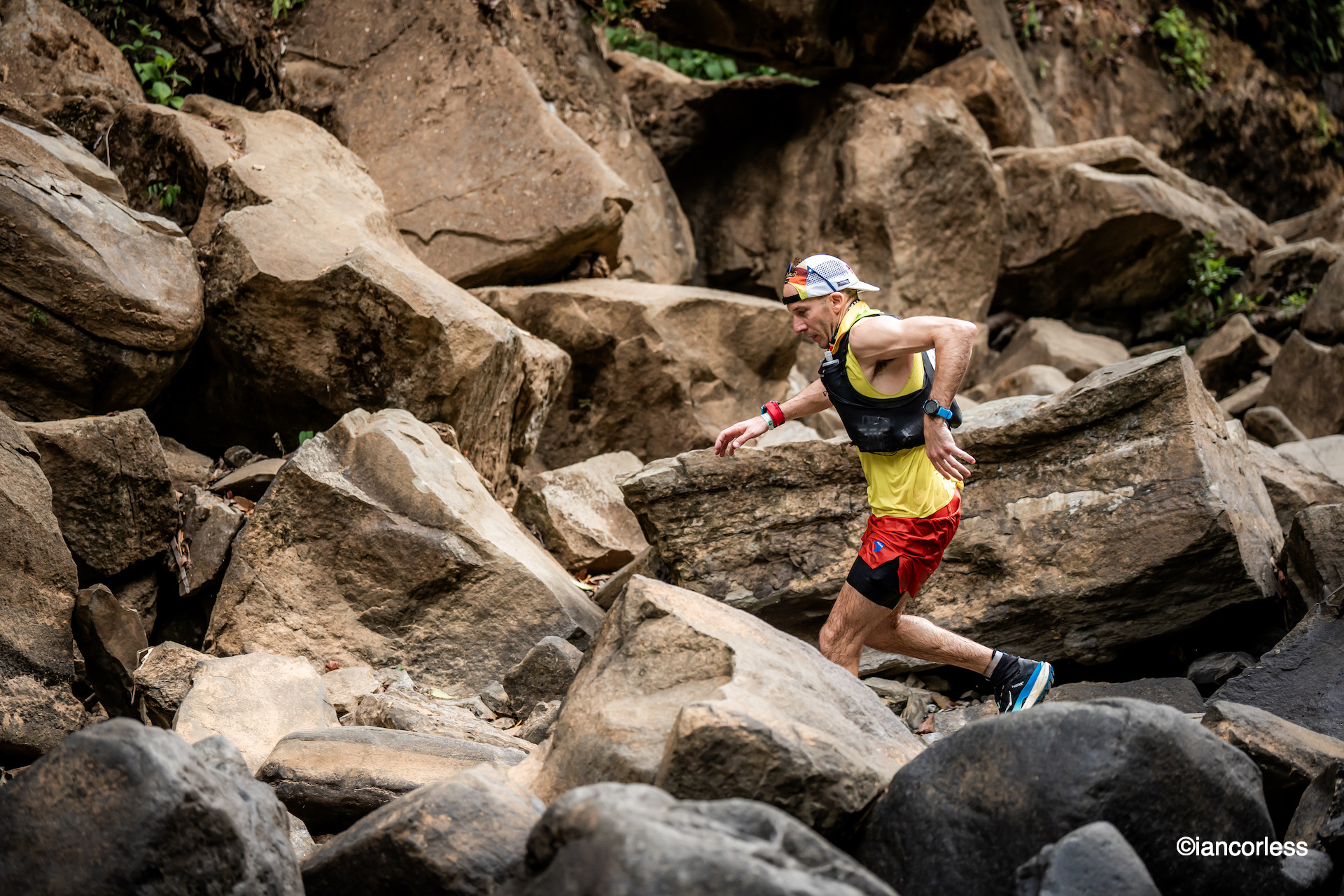
Almost immediately, the course dropped into a wide riverbed. This opening section is deceptive. It looks runnable, even friendly. Pale stones, shallow flowing water, open sky above. But riverbed running is never free speed. Every step shifts. Ankles work overtime. Shoes fill with water within minutes. The rhythm becomes uneven, a constant negotiation between pace and balance. Some runners hopped rock to rock, trying to keep their feet dry. Others accepted the soak and drove straight through, splashing forward with purpose.
The sound here was distinctive. Footsteps slapping water. Heavy breathing echoing off the valley walls. Occasional shouts as someone slipped or laughed at the futility of staying clean. This was Costa Rica announcing itself early.
As the river narrowed, the trail began to rise. Jungle closed in. Thick green walls pressed close, vines hanging low, the smell of wet earth and vegetation everywhere. Heat built quickly once the climbing started, but the cloud cover held. No direct sun. No baking. For this stage, that mattered more than almost anything.
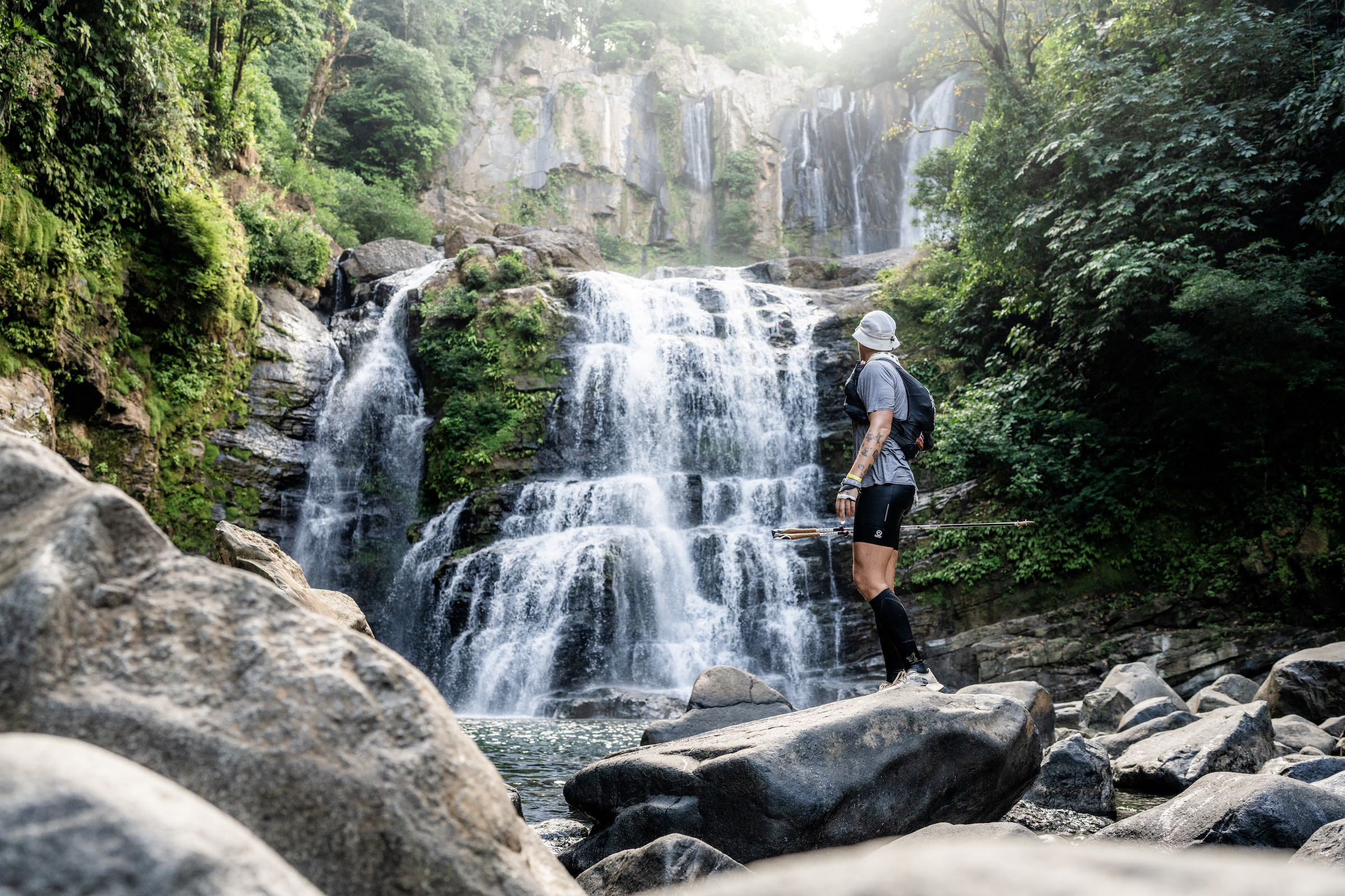
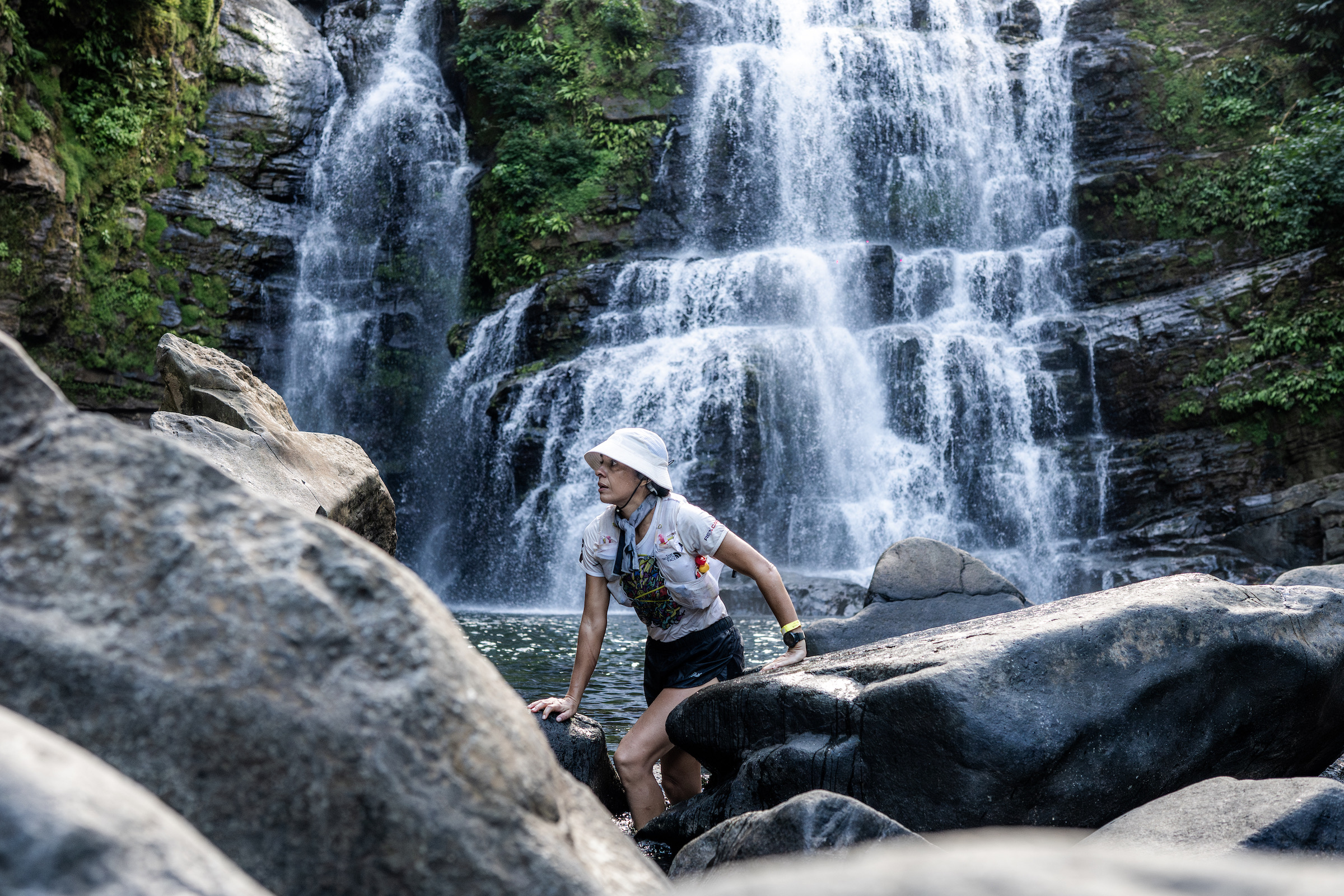
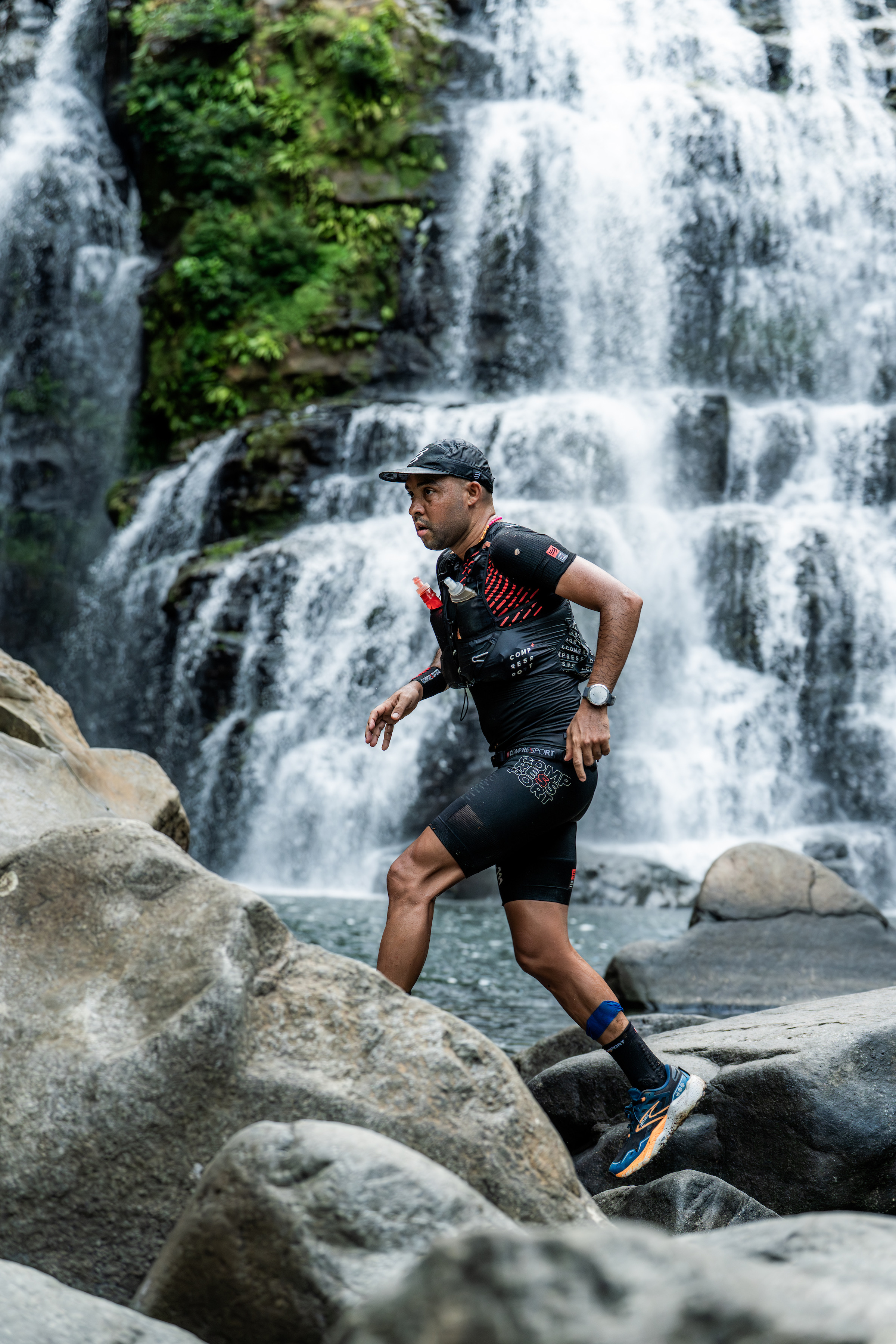
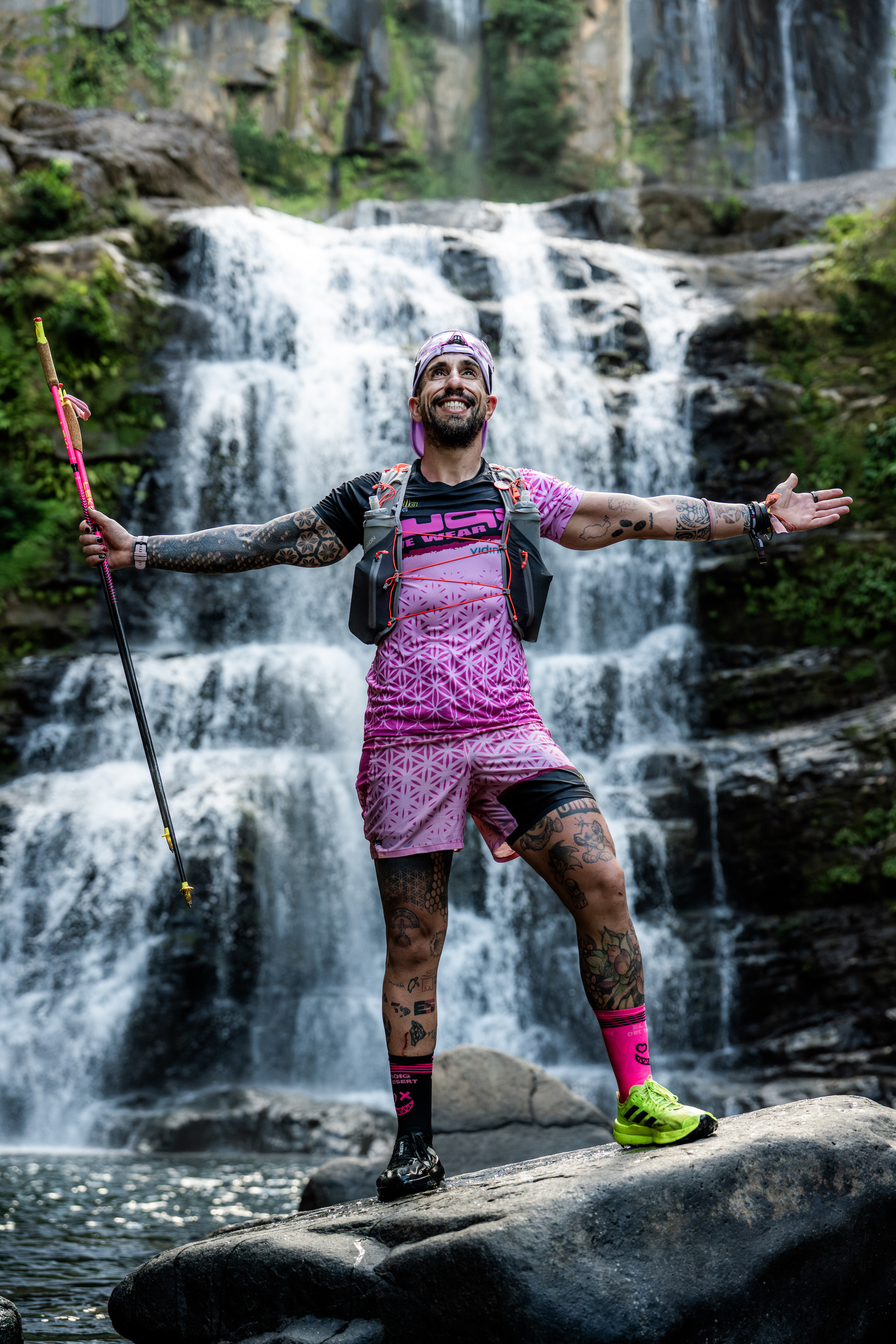
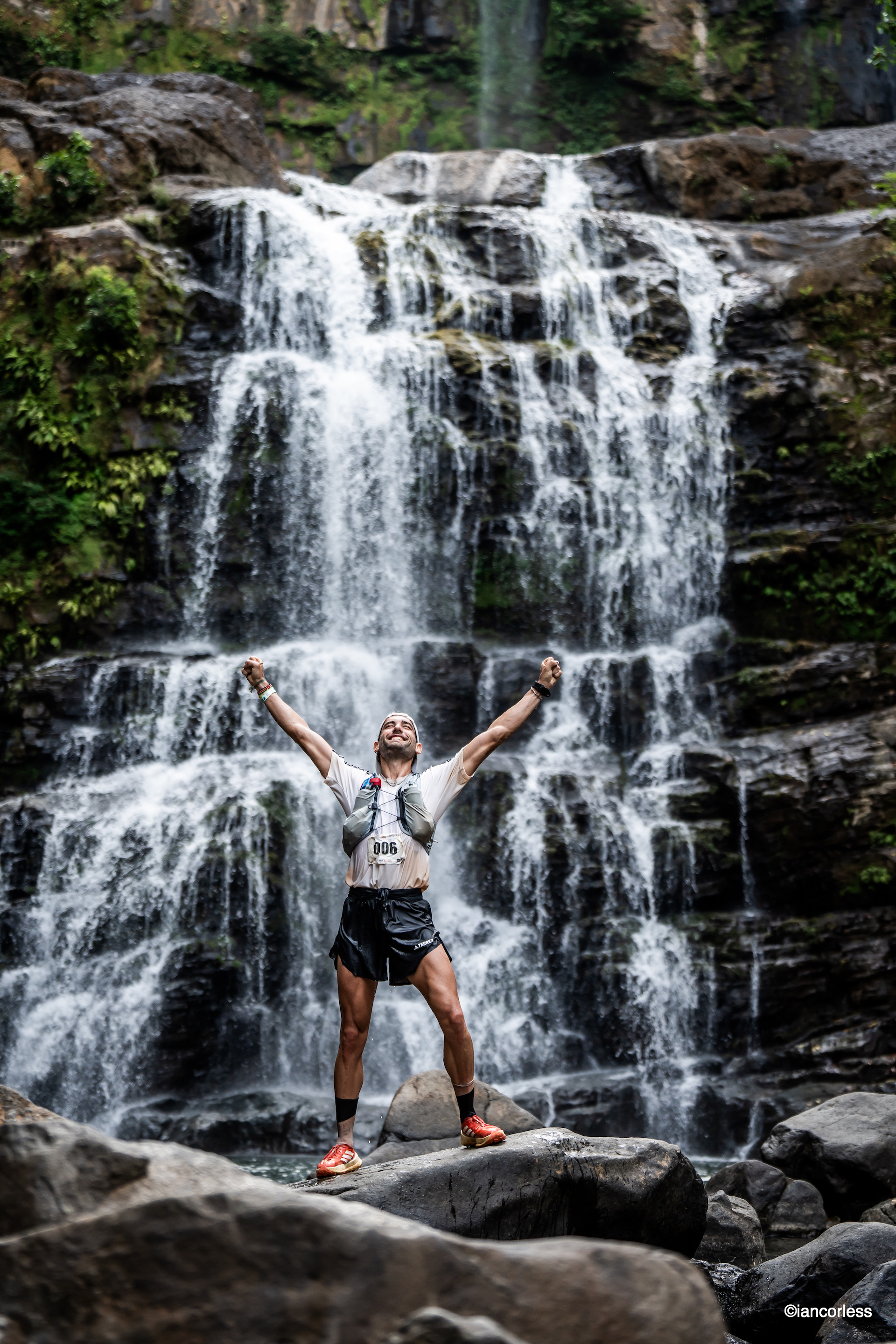
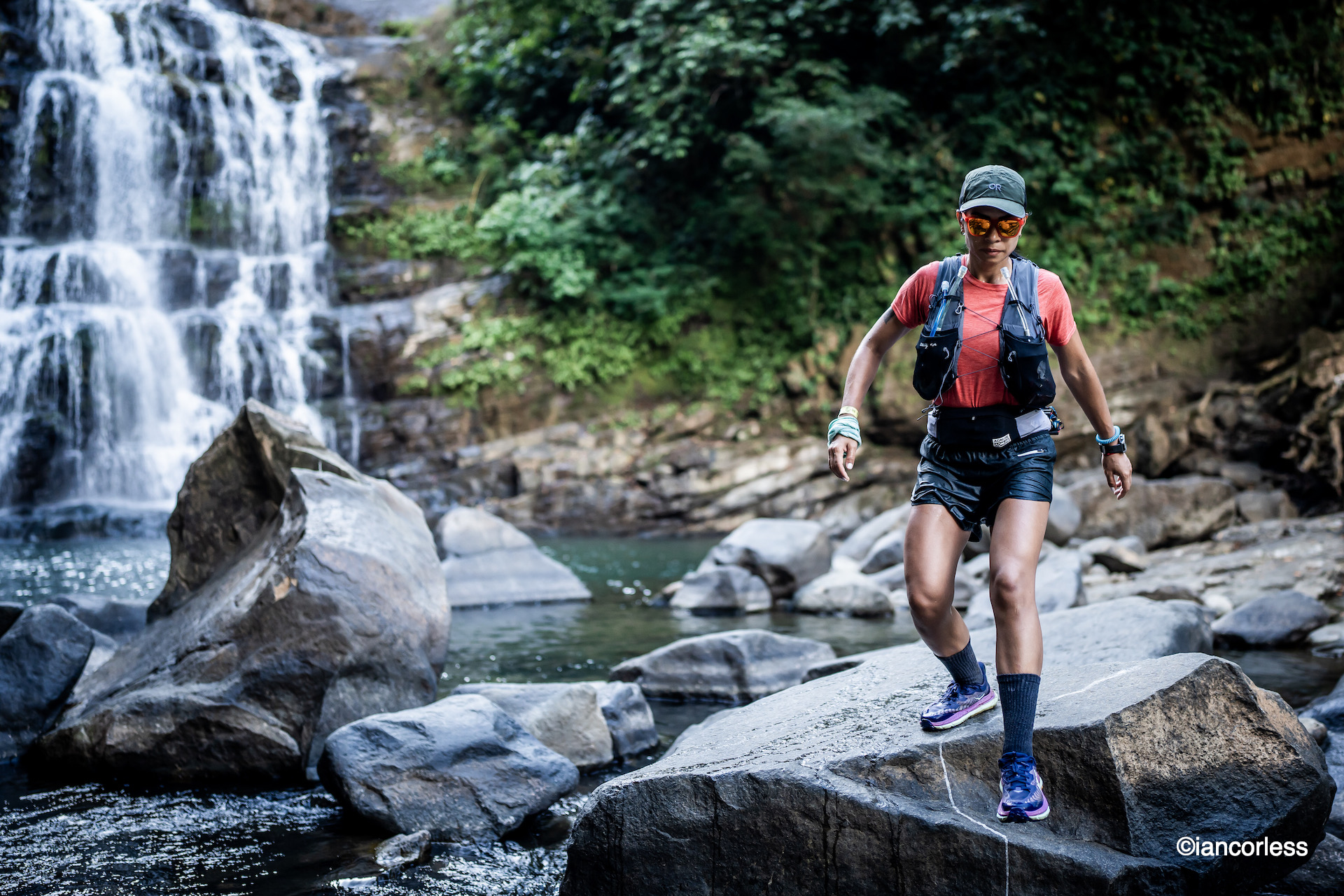
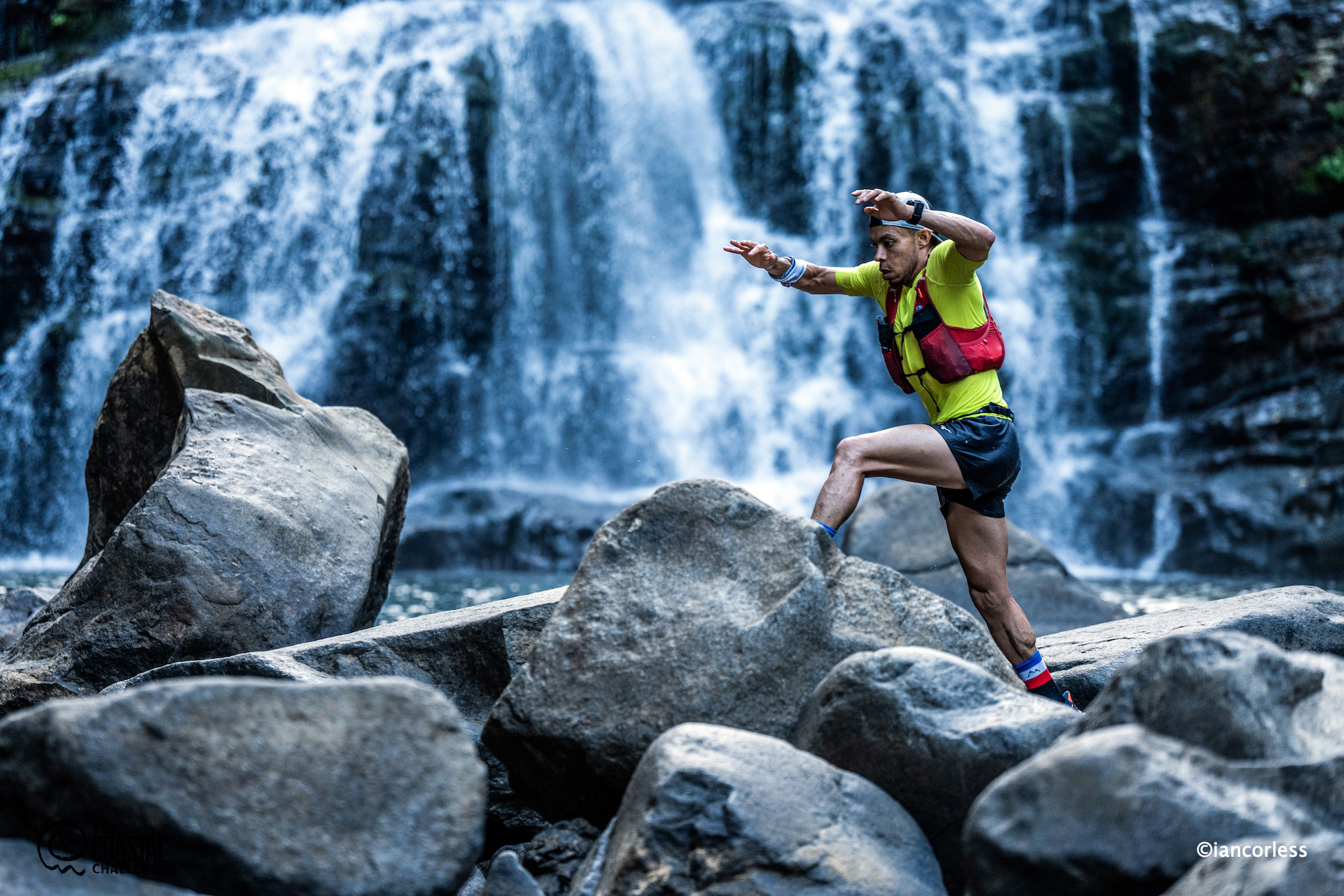
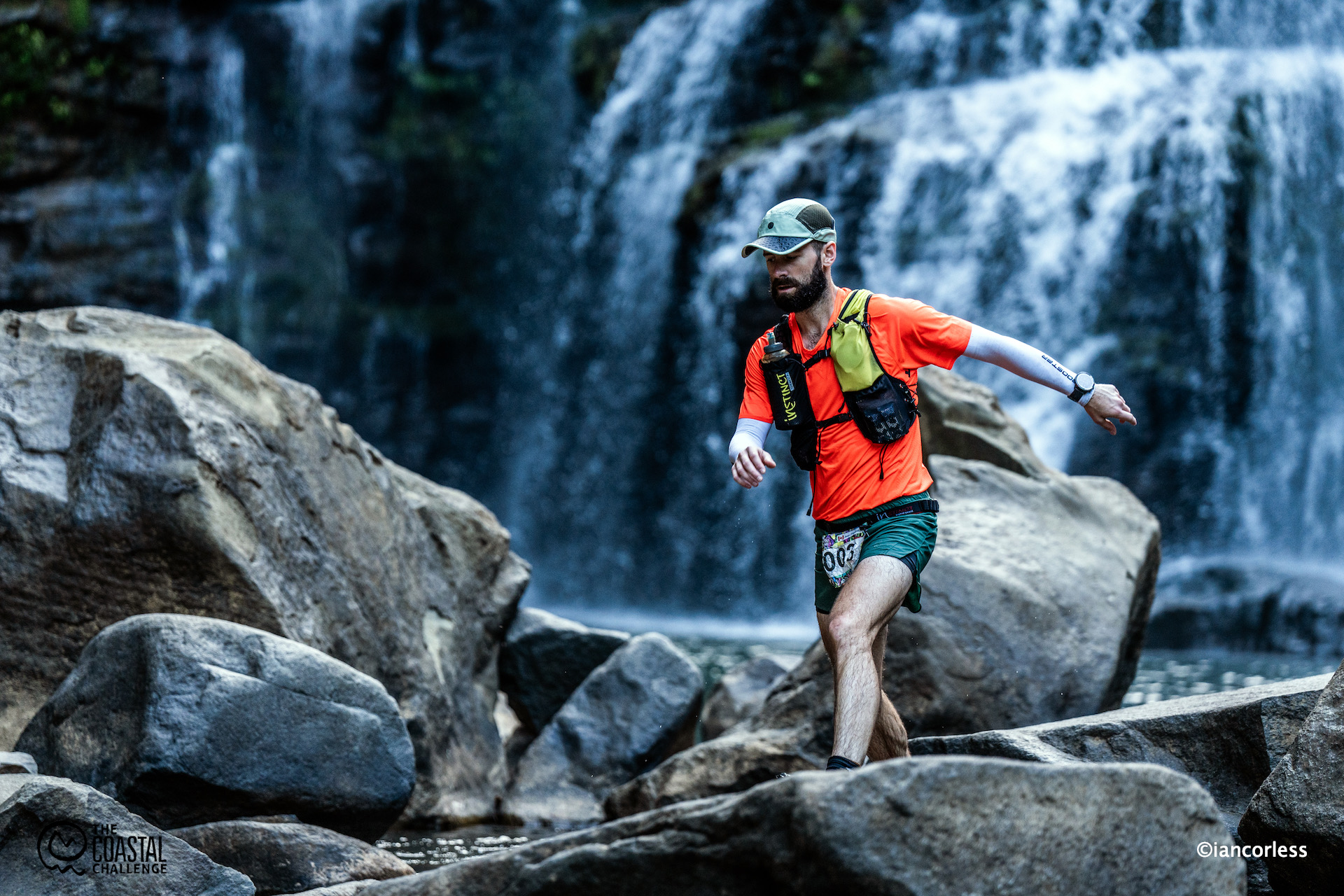
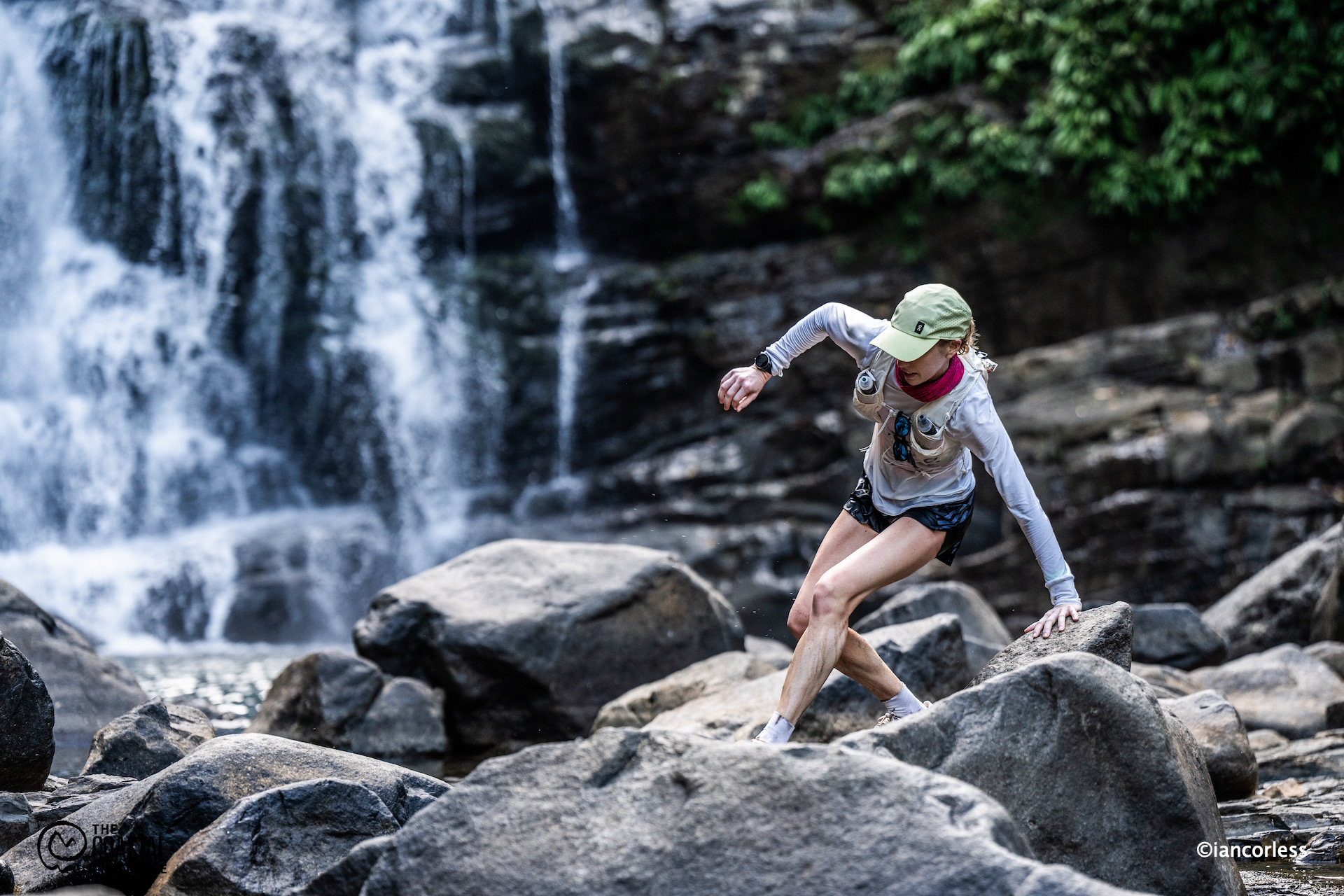
Few race courses pass somewhere this iconic. The roar of the falls could be heard long before they were seen, a deep, constant thunder. Mist hung in the air. The trail twisted along the edge, offering brief, almost cinematic glimpses of white water crashing down into turquoise pools far below. Volunteers stood grinning, clapping runners through, knowing exactly how cruel it is to pass somewhere so beautiful with no time to stop.
The climbs around the waterfalls were short but sharp. Legs were already feeling the cost of the riverbed. Breathing became laboured. Sweat mixed with spray from the falls. It felt primal. Raw. A reminder that this race is as much about environment as distance.
After Nauyaca, the stage changed character again. The trail rolled relentlessly. Up. Down. Some long climbs you can settle into. No extended descents to recover. Just constant undulation through jungle, farmland, and rough tracks. This is where the Queen Stage earns its reputation.
The terrain was hard and punishing. Exposed dirt roads baked under thinning cloud. Narrow singletrack where roots and rocks waited to catch tired feet. Every rise felt unnecessary. Every dip stole momentum. It was a section that demanded discipline. Go too hard, and the coast would destroy you later. Hold back too much, and you’d bleed time you’d never get back.
At the front, Erick Aguero was putting on another master class.
Aguero’s racing here is never flashy. No surges for the crowd. No dramatic moves. Just relentless forward motion. Smooth cadence. Perfect pack management. He ran like someone who knows this land, understands the humidity, respects the distance. While others visibly fought the course, Aguero flowed with it. By the time the terrain began to open and the air shifted, his advantage was already established.
Eventually, after hours inland, something changed. The breeze arrived first. Salty. Cool. Then the light brightened. And suddenly, unmistakably, the coast appeared.
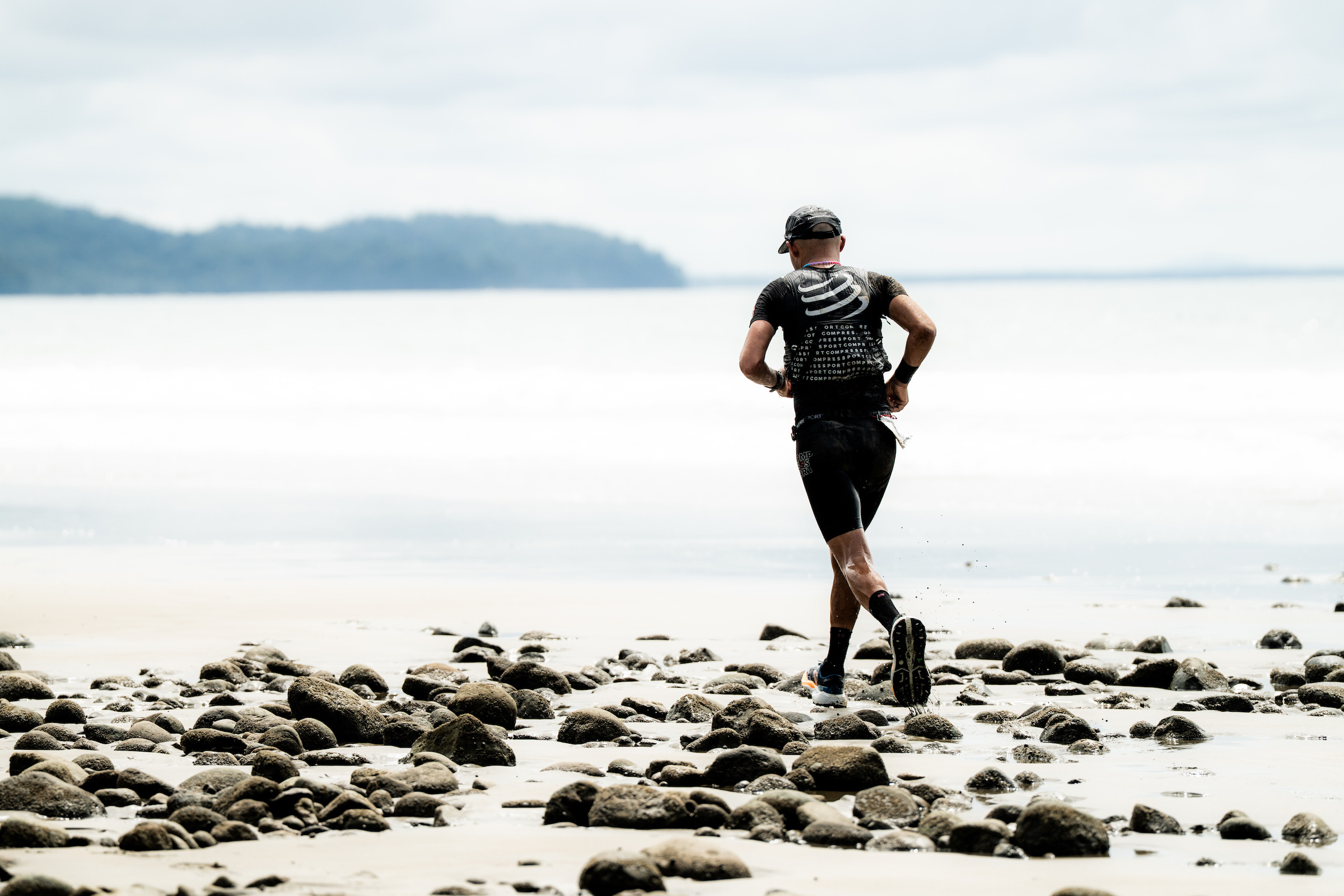
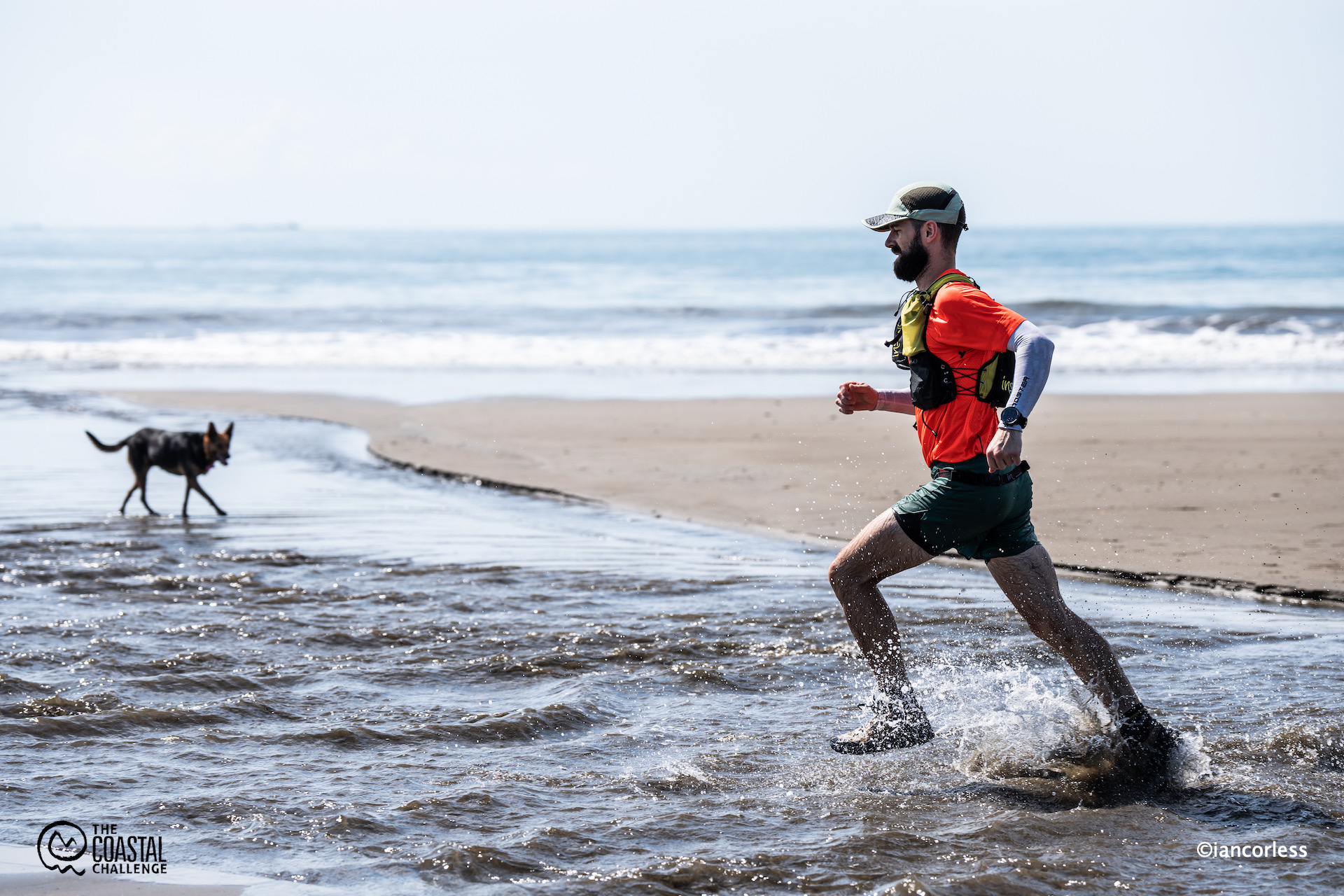
This transition is one of the great moments of the race. Jungle gives way to open sky. The sound of waves replaces insects. The vastness of the Pacific stretches out ahead. Runners hit the sands near the start of the Adventure course, knowing the end is closer now, but also knowing that beaches come with their own price.
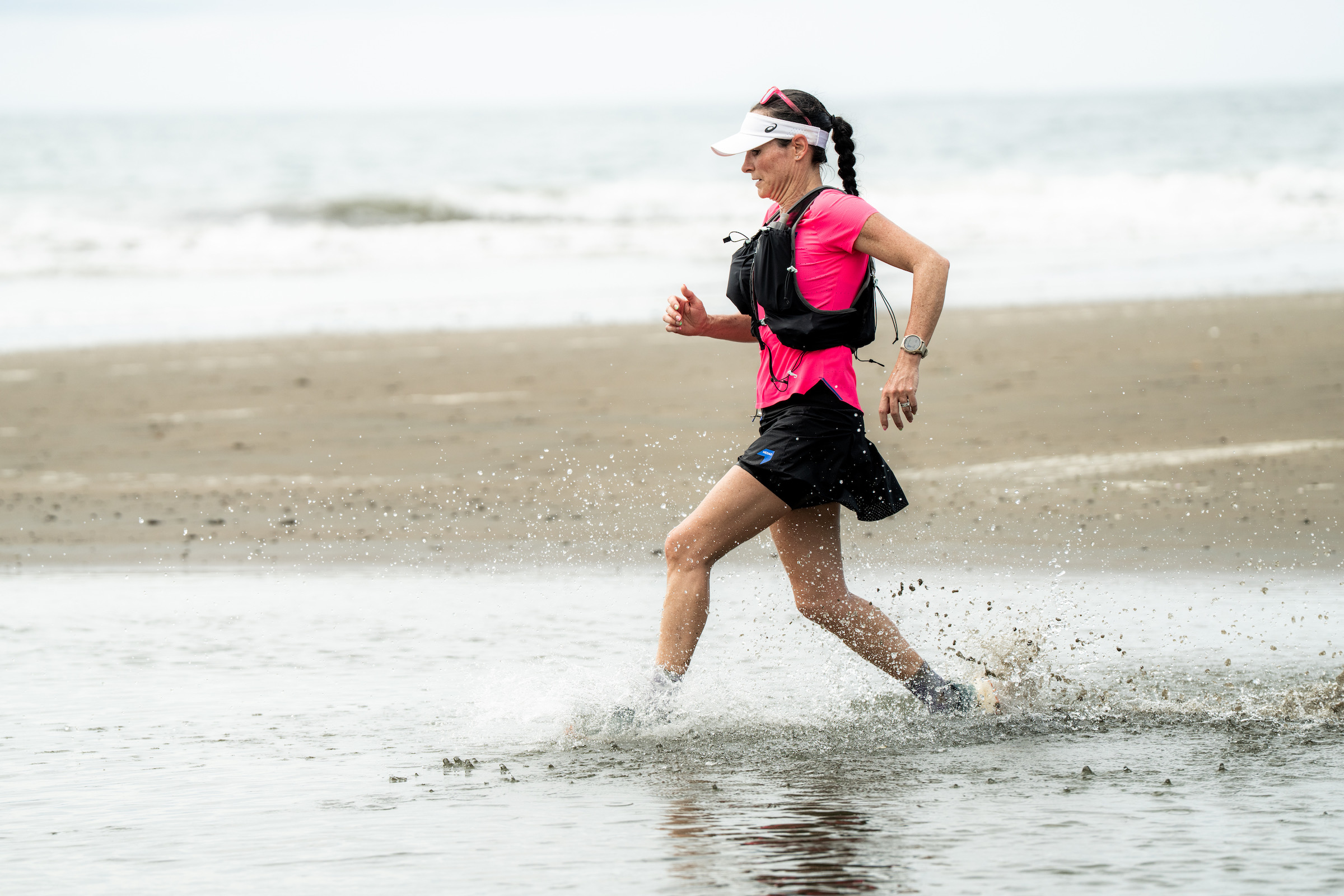
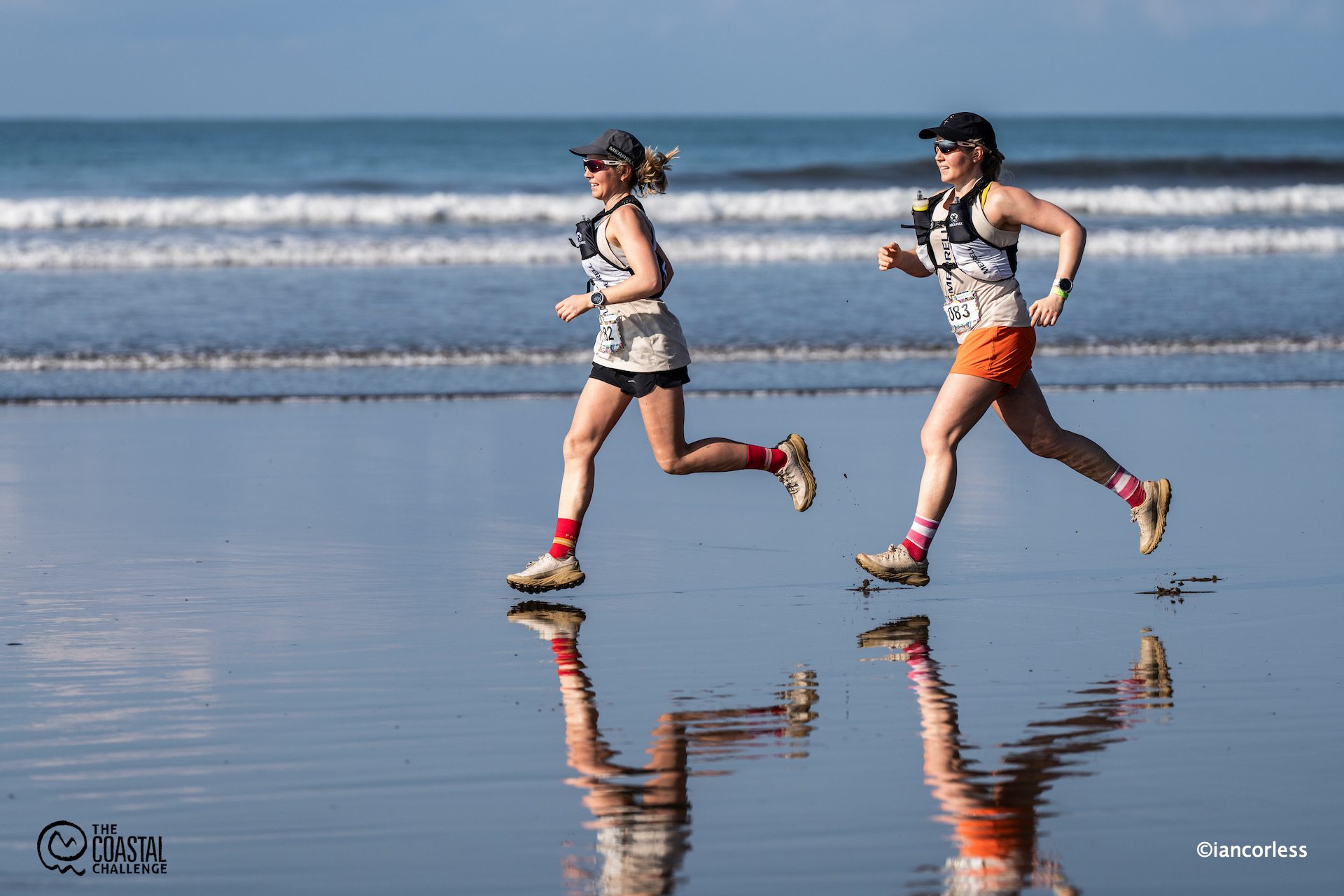
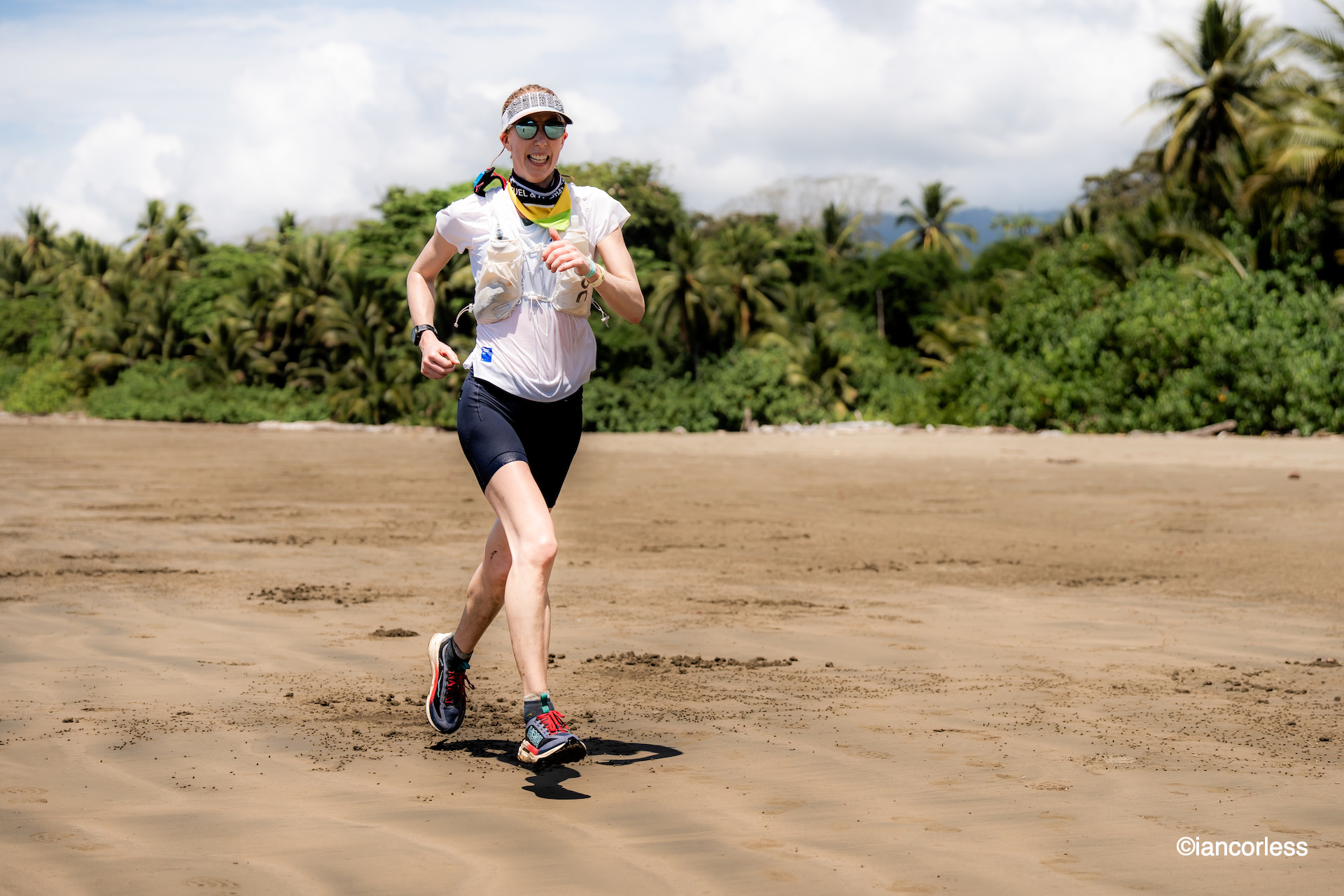
The sand was soft in places, compact in others. Feet sank, calves screamed. The trail wove along the coastline, ducking in and out of shaded sections, then back onto open beach. Offshore, the famous Whale Tail formation of Marino Ballena National Park stood out clearly, a natural landmark that feels almost surreal when you’re deep into a long race.
There was beauty here, but also vulnerability. The sun broke through the cloud intermittently. Reflections off the water were harsh. Runners could smell salt on their skin. Aid stations felt like lifelines. Ice, cola, encouragement in multiple languages.
The final kilometres into Ballena Village were a test of stubbornness. Legs heavy. Feet blistered. Packs lighter but shoulders sore. The finish line came slowly, deliberately, making runners earn every step.
Aguero crossed first in 6:26:41, calm, composed, as if he had expected nothing else. Behind him, Jon Shield fought hard to secure second in 6:54:50, holding off a strong late push from Joe Matheson, who finished just over a minute later in 6:56:02. All three looked spent. All three knew they had survived the hardest day.
In the women’s Expedition race, the story was familiar. A repeat of the previous stage with a dominant Denise Zelaya in control from the front. No drama. Just execution. On a day like this, consistency matters more than heroics. Janina Beck finished 2nd 8:57:19 with Vanessa Duran 3rd in 9:34:11.
In the Adventure category Laura Zuñiga crossed in 5:40:27 with Toni Clarke close behind 5:45:42, it’s a battle between the two, and Kristel polet 5:46:04 in 3rd. For the men, once again Sammy Francis lead Alberto Gil, 5:20:23 and 5:22:28 respectively. Roberto Solano was 3rd in 5:40:20.
Stage 3 didn’t just shuffle the leaderboard. It revealed it. It exposed weaknesses, rewarded patience, and reminded everyone why The Coastal Challenge is respected worldwide. Long after the finish line buzz faded and runners collapsed into shade with food and cold drinks, the Queen Stage lingered
Stage racing has a way of exposing everything. Fitness, patience, preparation, and mindset all get tested, not just by distance, but by what happens between the stages. Terrain is only part of the story. How you recover, rehydrate, eat, sleep, and reset day after day matters just as much.
Photo by Ian Corless
Back in 2016, comparisons between The Coastal Challenge and Marathon des Sables were unavoidable. A decade on, those comparisons still come up, but the conversation has matured. These races now stand on their own terms.
Marathon des Sables strips runners back to survival basics: self-sufficiency, rationed water, shared bivouacs, and total responsibility for your own race. That’s its identity, and it’s why it remains iconic.
The Coastal Challenge is different. It’s not self-sufficient, but that doesn’t make it easier. In many ways, it’s more demanding. The Costa Rican rainforest, the coastline, the heat, the humidity, and the relentless terrain combine into something that feels far less predictable and far less forgiving.
What The Coastal Challenge Looks Like Today
The race remains a point-to-point journey across Costa Rica’s wild south-west, traditionally running from Quepos to Drake Bay, followed by a final loop stage in and around Corcovado National Park.
The format has remained consistent: six days, six stages, each with its own character. Distances and elevation are substantial, especially when you factor in heat, humidity, and terrain. There are some changes to the route and now, in 2026, I consider the route to be more challenging, especially with a longer stage 6.
Gladly, there is an ADVENTURE category and while stage 1 and stage 2 are almost the same, the distances for stages 2, 3, 4 and 5 are notably shorter:
Stage 2: 16.8km 280m+
Stage 3: 15.2km 200m+
Stage 4: 12.5km 552m+
Stage 5: 23km 1117m+
Total distance 136.4km’s 3901m+
None of these numbers tell the full story. Beach running, river crossings, jungle trails, fire roads, steep climbs, and long descents all feature. Every day feels different. Every day asks something new.
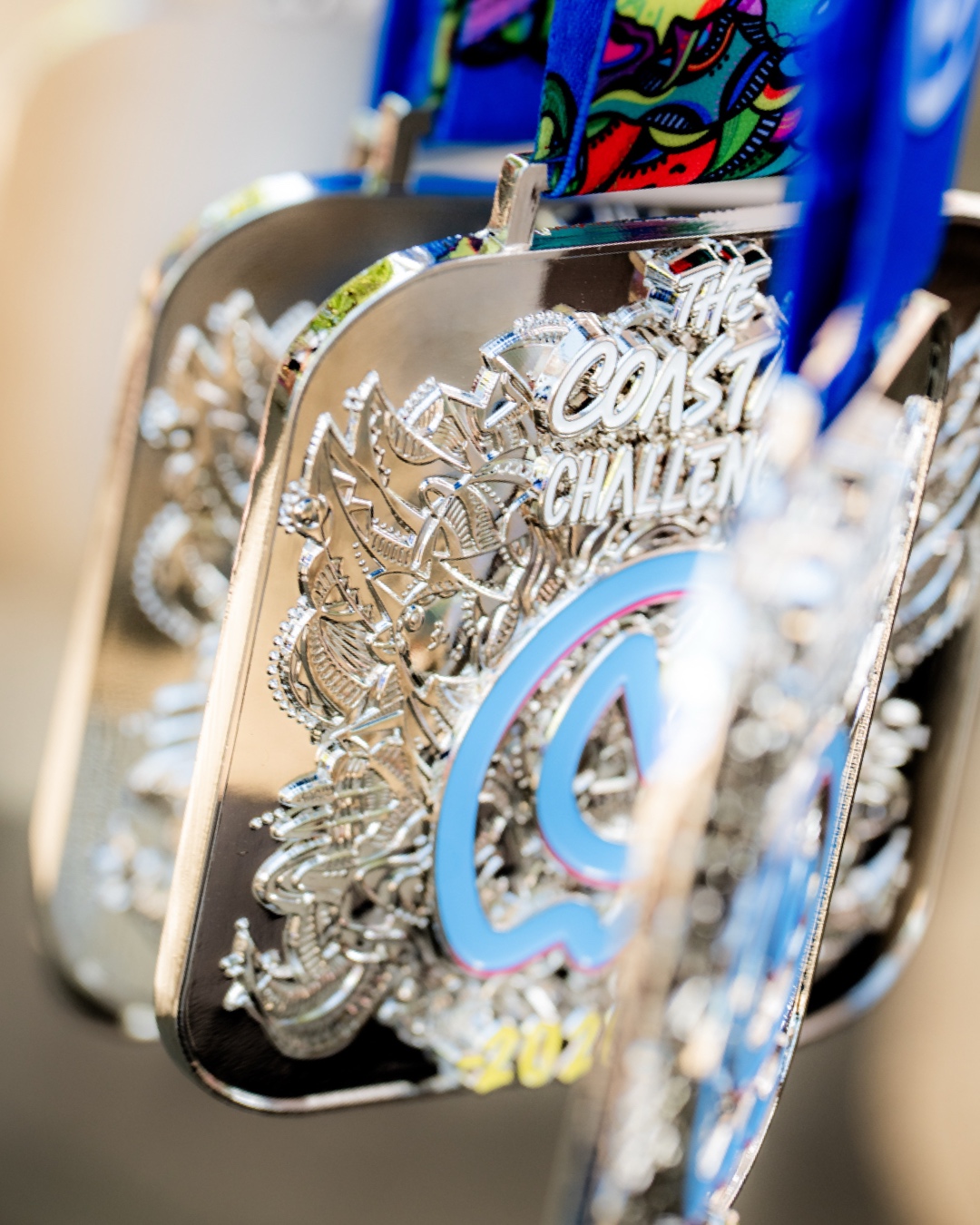
NOTE: It is possible to move from EXPEDITION to ADVENTURE during the race, however, you will not receive a medal.
Is TCC Harder Than Marathon des Sables?
Photo by Ian Corless
The honest answer is still: yes and no.
Where TCC Is Easier
• You are not self-sufficient. You carry only essentials during the stage.
• Aid stations provide water and basic food.
• Your main kit bag is transported daily.
• You sleep in your own tent.
• Food is provided morning, post-stage, and evening.
• Camps are often in stunning locations, sometimes with cold drinks available.
• The terrain is relentlessly varied and often technical.
• Elevation gain and loss are constant and cumulative.
• Fire roads punish tired legs.
• Beach running is deceptively draining, both physically and mentally.
• Heat is relentless.
• Humidity regularly sits above 75%.
• Your feet are wet every single day.
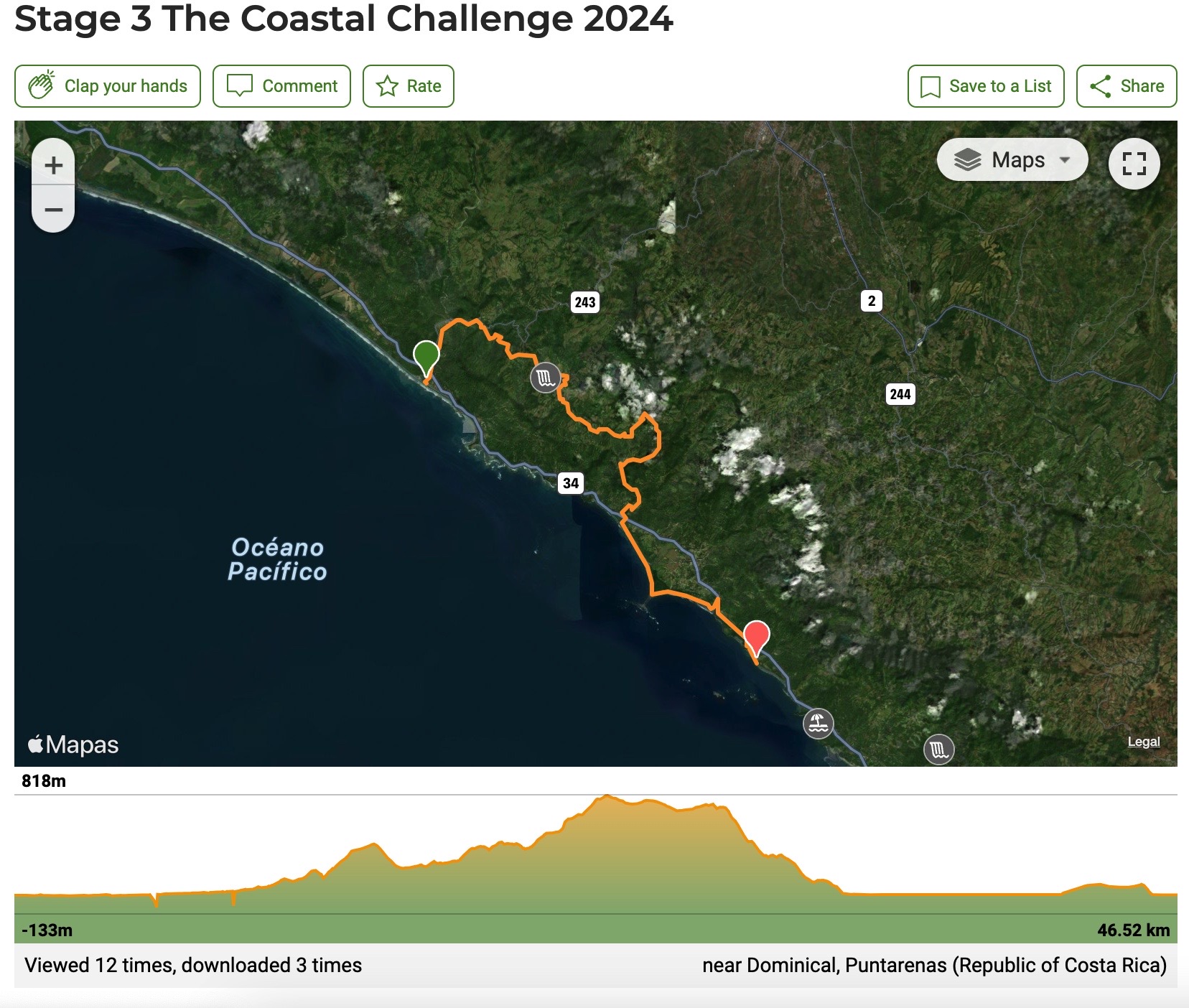
• The long day may be “only” 47 km, but add 1754 m+ of vertical, technical trails, and jungle heat, and it becomes one of the hardest stages you’ll ever run.
This race doesn’t grind you down with deprivation. It wears you down with exposure.
Packing for Success in a Modern TCC
Because your kit is transported daily, you can afford to be comfortable. Waterproof storage remains essential. While the race still recommends Action Packer-style boxes, they’re awkward for international travel. Most experienced runners now opt for a robust waterproof duffel or roll-top bag, with internal dry bags for organisation.
You’re racing in a rainforest. Rain is not hypothetical.
Bring 6–8 full run kits. The system is simple and still works best:
• Run in one kit.
• Finish, shower, change.
• Sleep in the next day’s run kit.
Breathable fabrics are essential. Shoulder coverage matters more than people expect. Sun exposure combined with sweat and salt can destroy skin over six days. Hats are non-negotiable. Neck coverage is smart. Minimal strappy tops often look appealing but lead to brutal sunburn patterns.
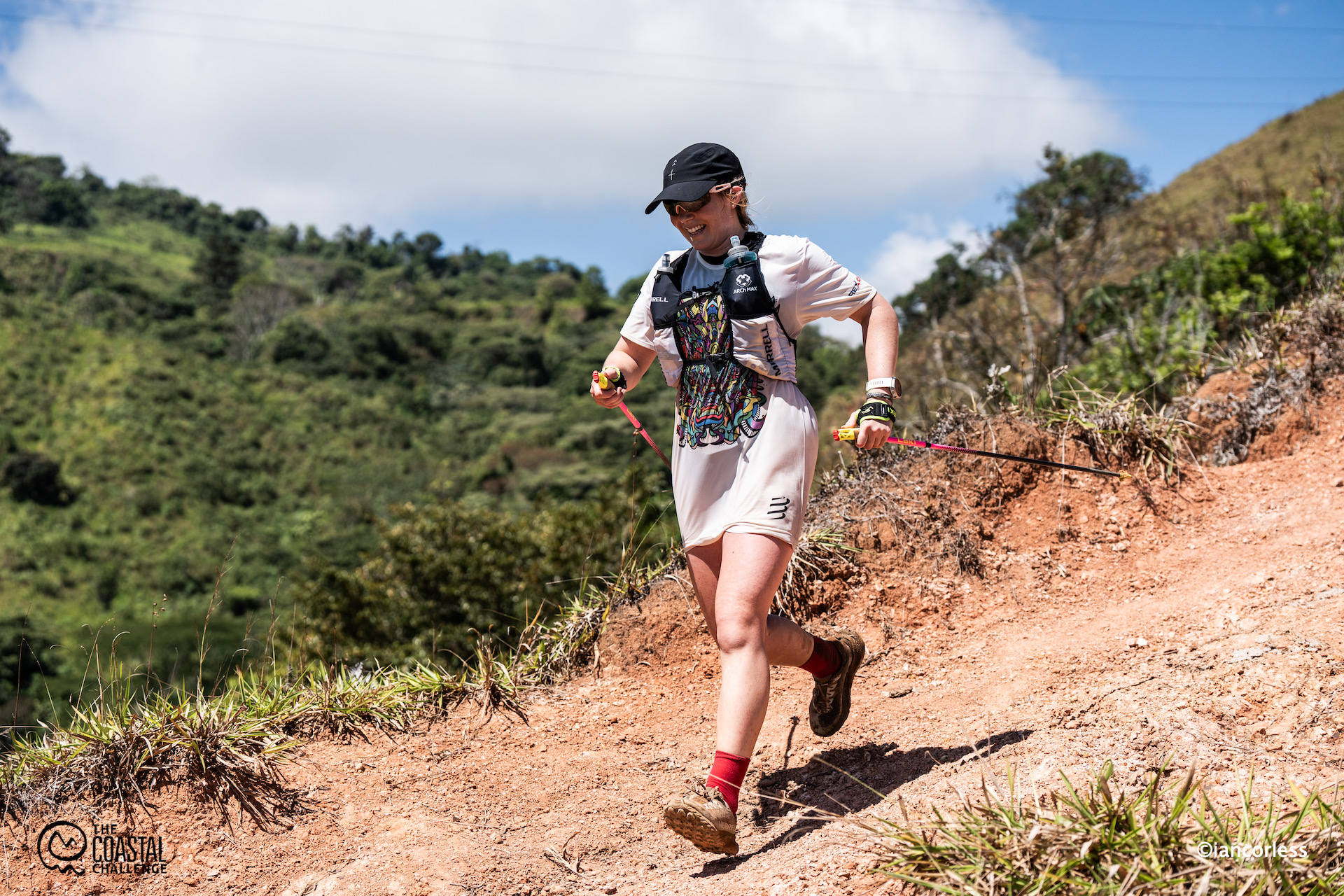
Camp life is relaxing and simple, make sure you bring a sleeping mat and ideally a silk liner, a sleeping bag is not needed BUT it can get chilly around 2am to 5am. Additional camp clothing can be a nice break from run kit – for women thi scan be a loose dress, the the men, shorts and T. Flip flops or similar are essential.
Make sure you bring a plate, knife, fork and spoon and also a cup for drinks.
Shoes and Foot Care: The Deciding Factor
If runners fail at TCC, it’s usually due to feet or hydration.
Your feet will be wet every day. Rivers, streams, mud, ocean crossings. Add technical terrain, rocks, roots, and sand, and your feet take a beating.
Bring at least two pairs of trail shoes, ideally three. Some runners include a half-size-up “emergency pair” for swelling later in the race.
Forget blanket advice about sizing up. Shoes that are too big allow movement. Movement causes friction. Friction causes blisters. You need roughly a thumbnail’s space in front of the big toe, no more. Fit matters more than brand.
Your shoes must:
• Drain water efficiently
• Dry quickly
• Handle rock, mud, sand, and wet roots
• Match your gait, cushioning preference, and drop
Trail shoes are mandatory. Breathability is critical.
Socks matter just as much. A fresh pair every day is essential. Toe socks have proven exceptionally effective for many runners in these conditions.
Shoe recommendation is impossible, we are all unique, however, VJ Sport offer the best grip in the harsh terrain of Costa Rica – take a look at the VJ Ultra 3 HERE
What to Carry During the Stage
Photo by Ian Corless
Compared to many stage races, your on-course kit is minimal.
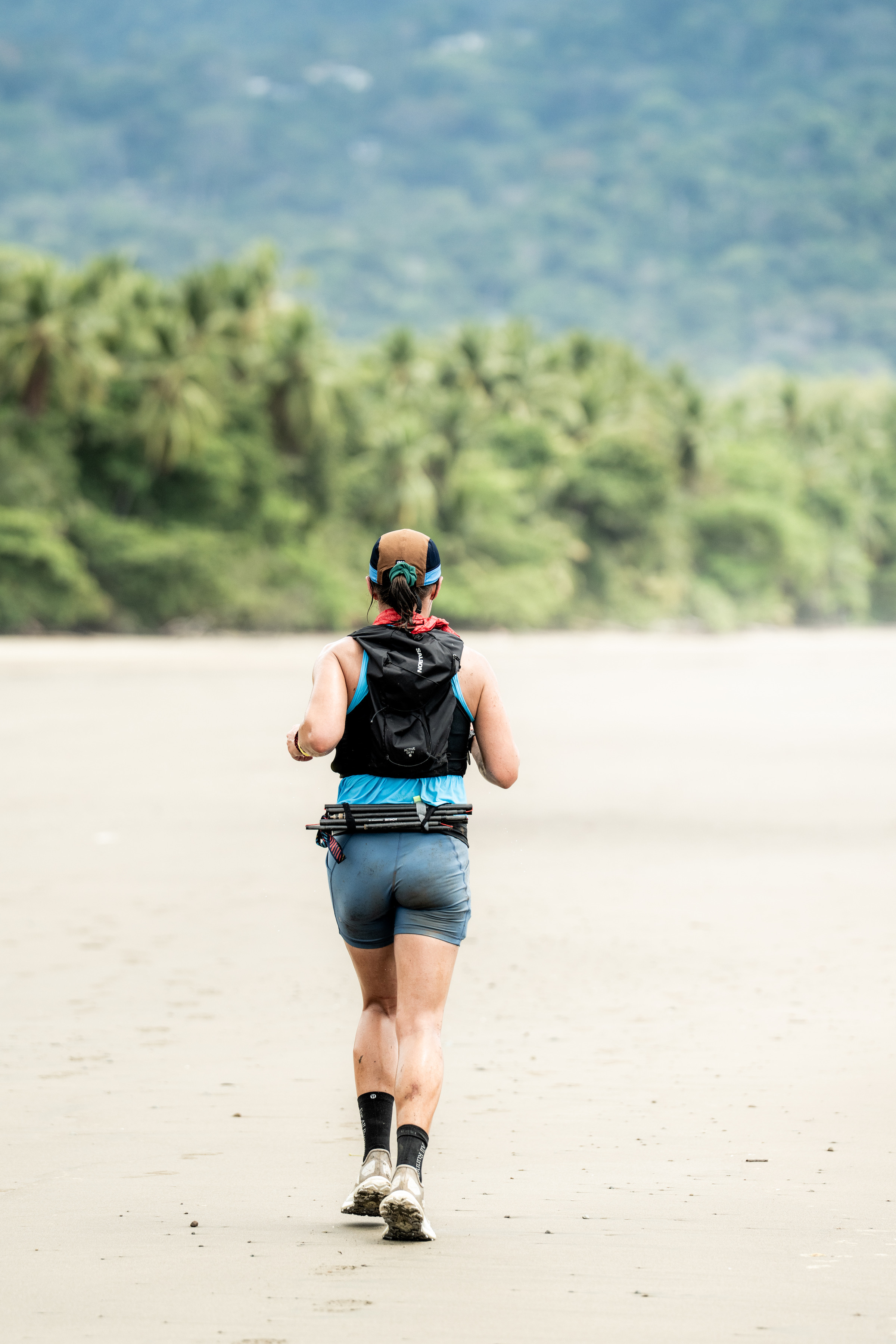
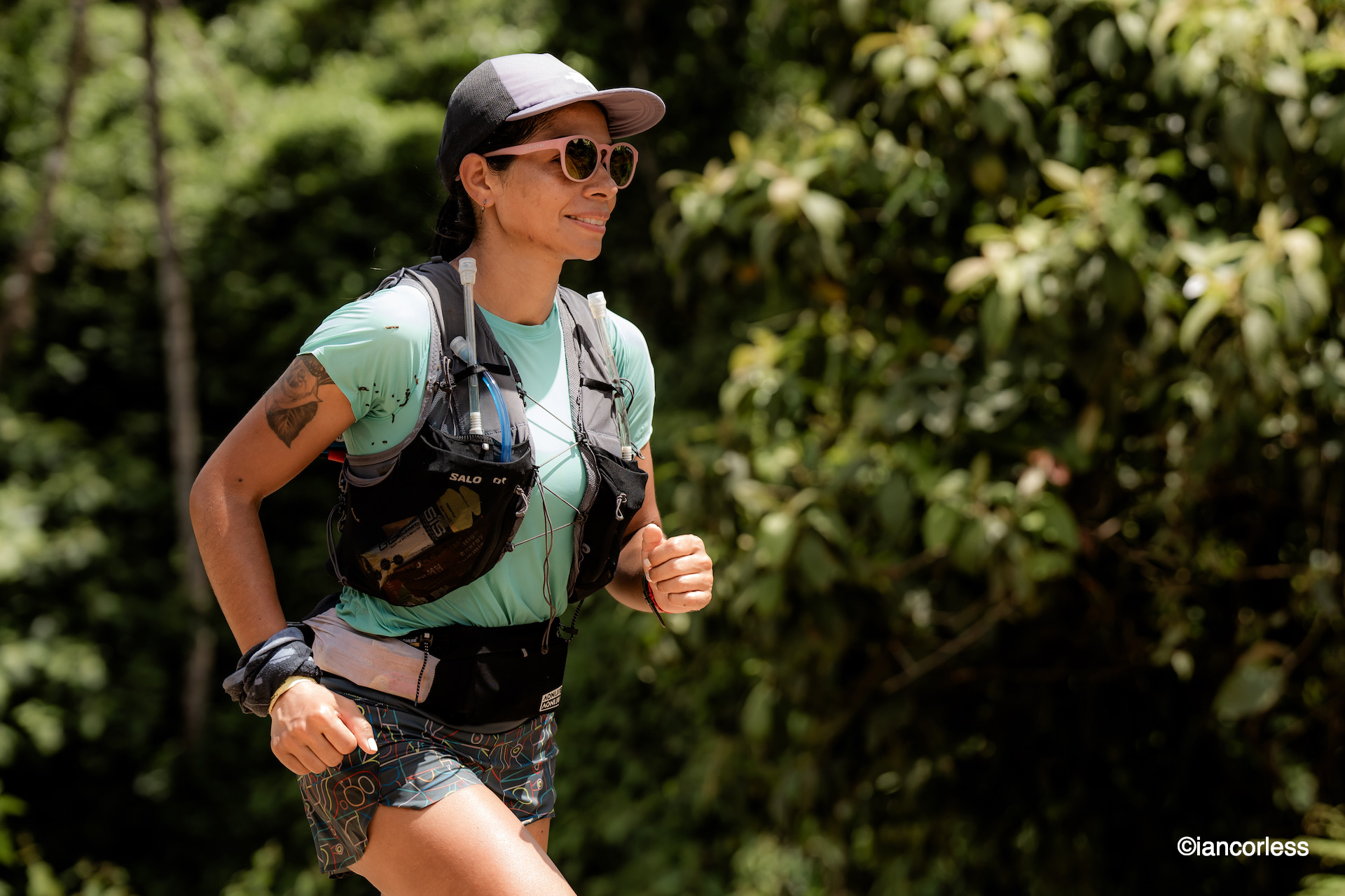
A lightweight vest-style pack works best. Many runners now carry a bladder plus two bottles. Aid stations can be far apart, and dehydration happens fast.
Carry:
• First aid basics
• Whistle
• Phone (waterproofed)
• Cash
• Sunscreen
• Purification tablets (just in case) or a water filter.
• Personal nutrition
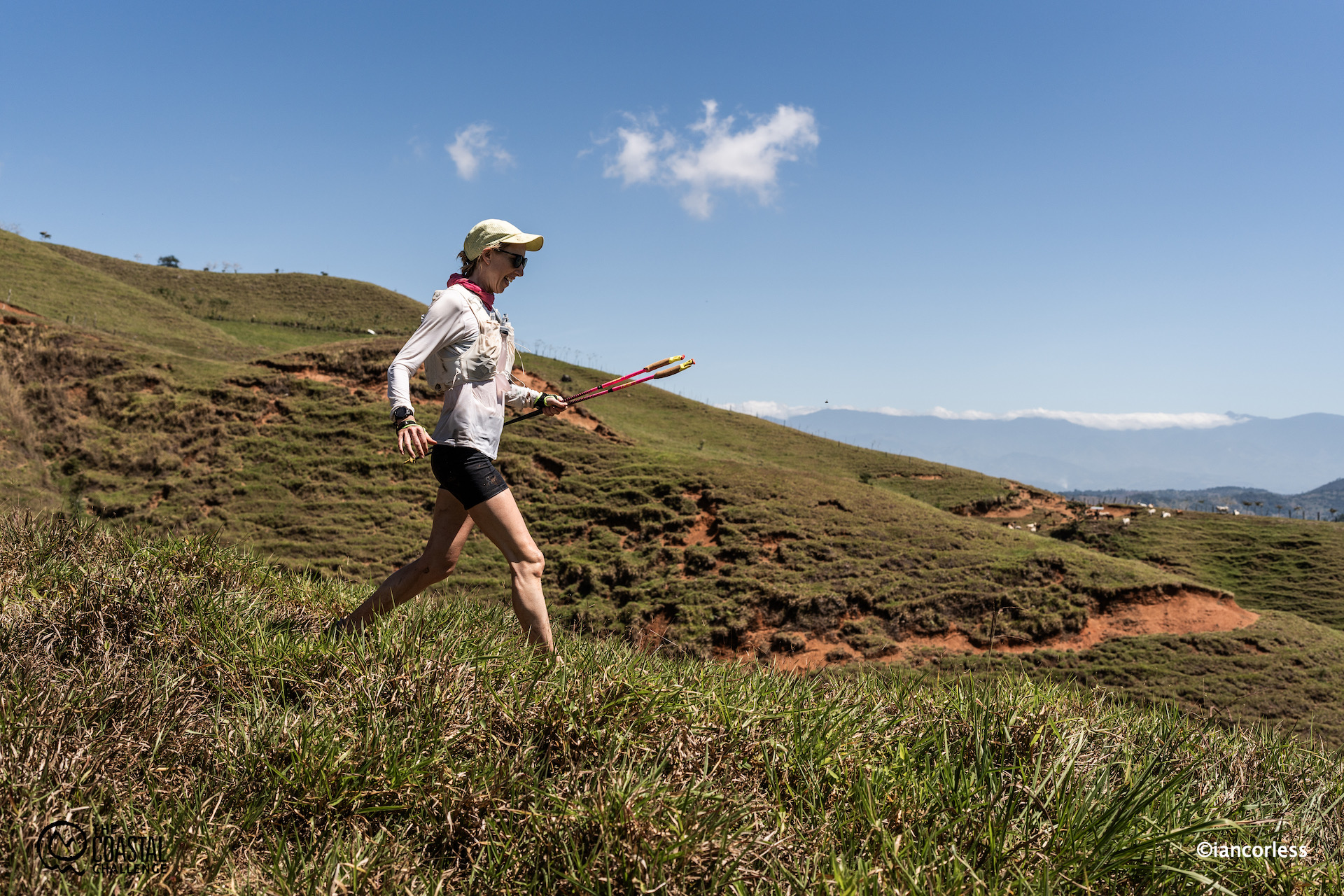
• Poles (optional, but useful)
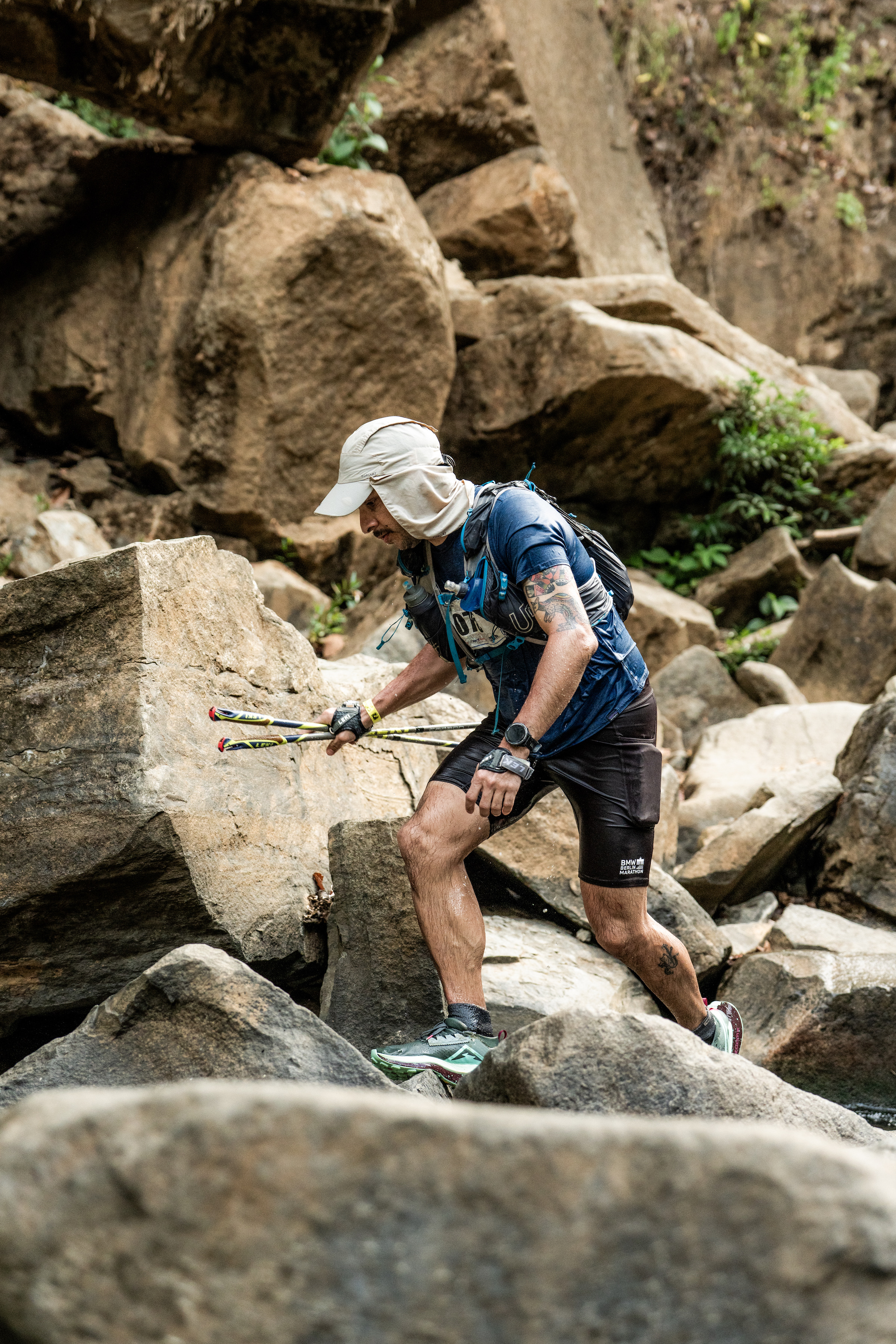
If you use poles, they must fold, stow quickly, and be second nature to deploy. Practice with them before the race.
You’ll sweat within minutes of starting and continue all day. Hydration is constant, not reactive. Drink regularly, not just when thirsty. Electrolytes are personal. Know what works for you before arriving.
Never pass water without topping up.
Photo by Ian Corless
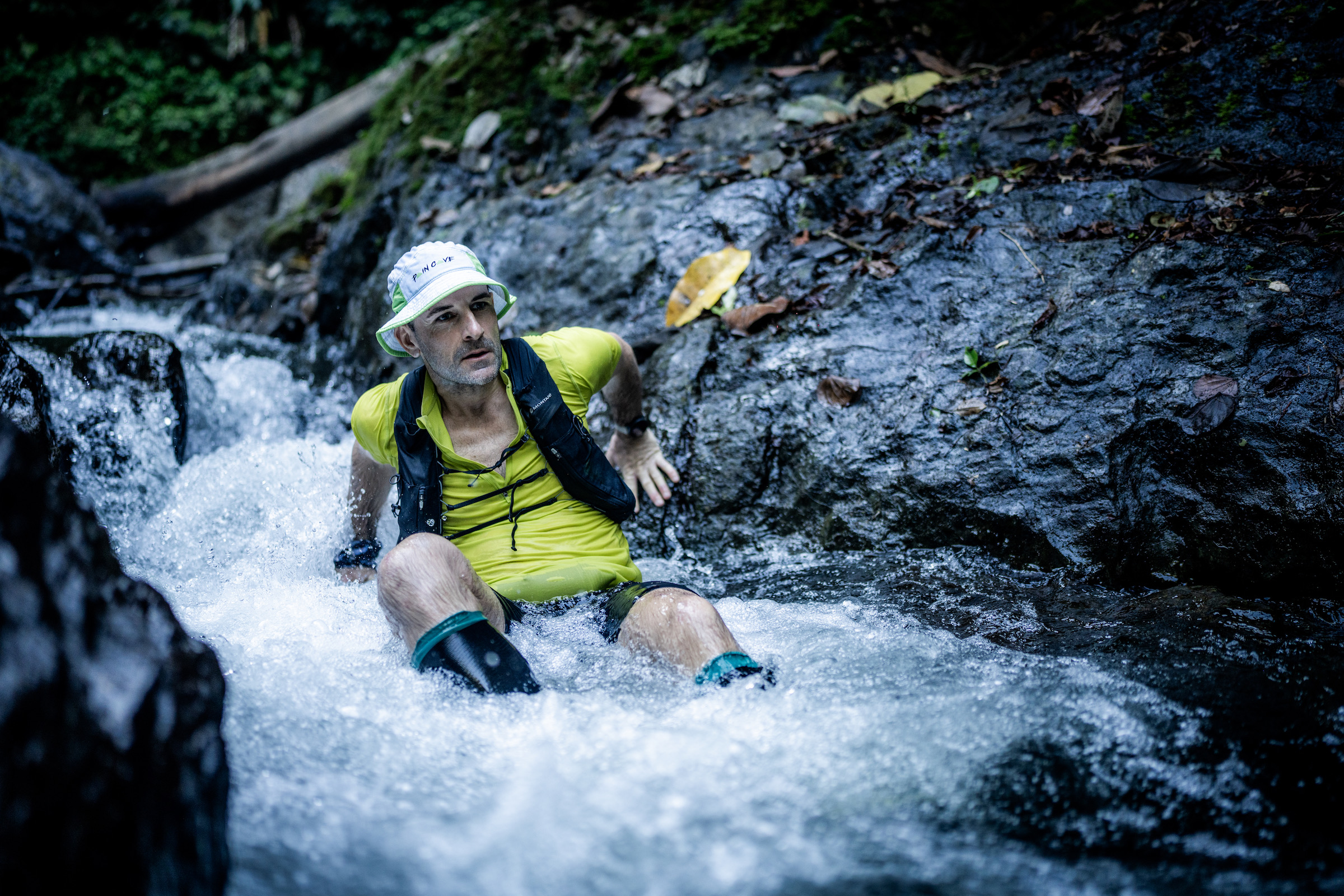
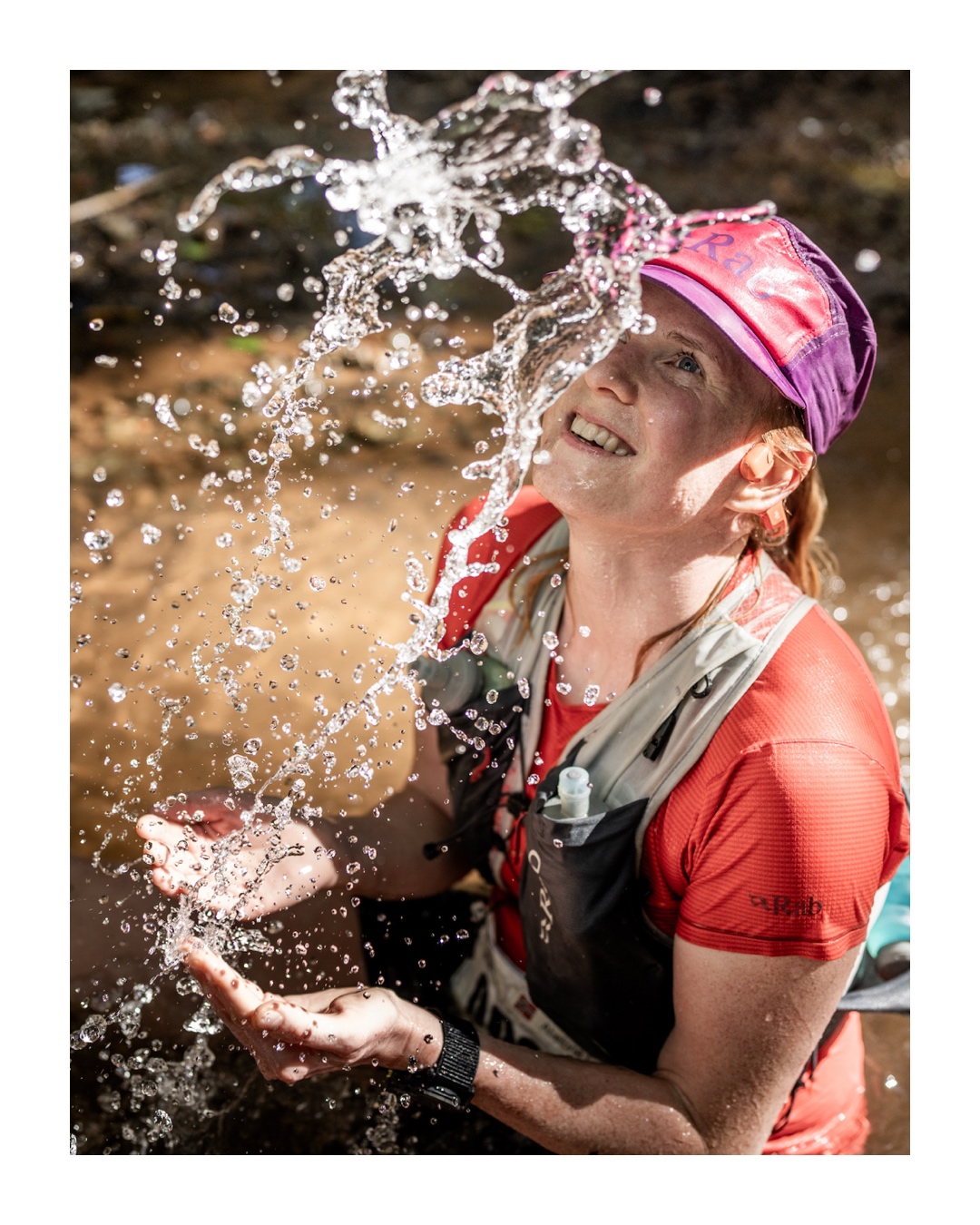
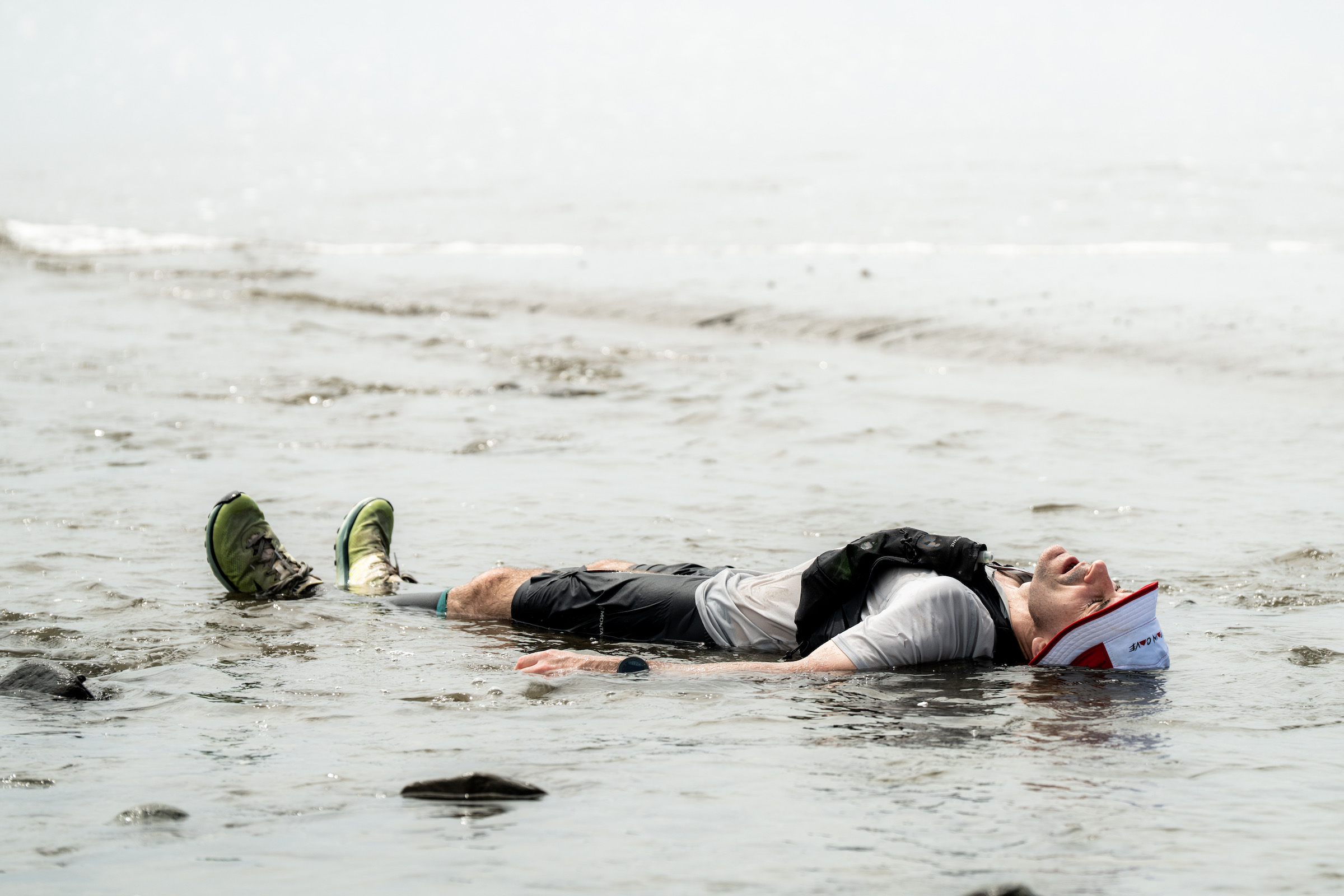
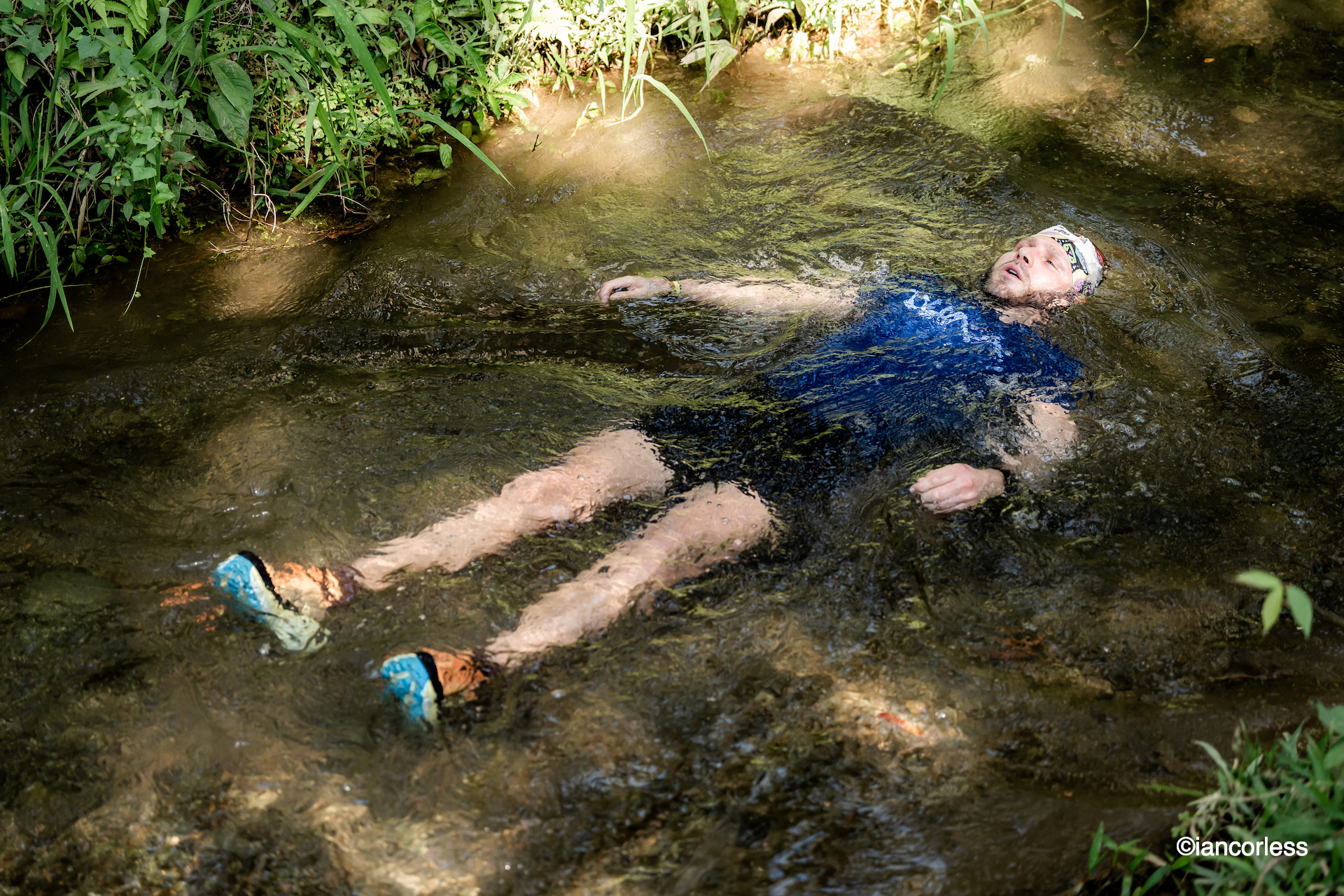
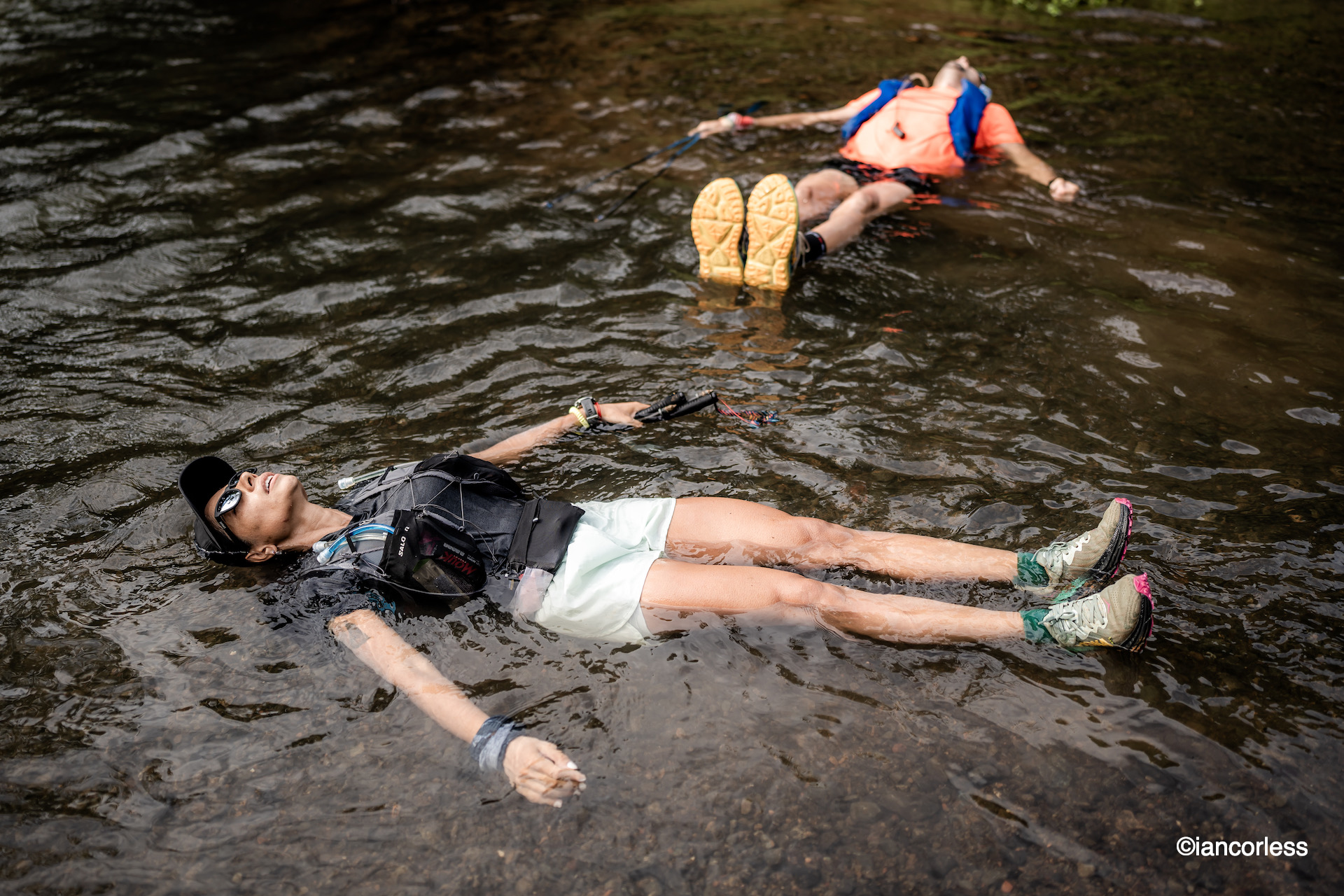
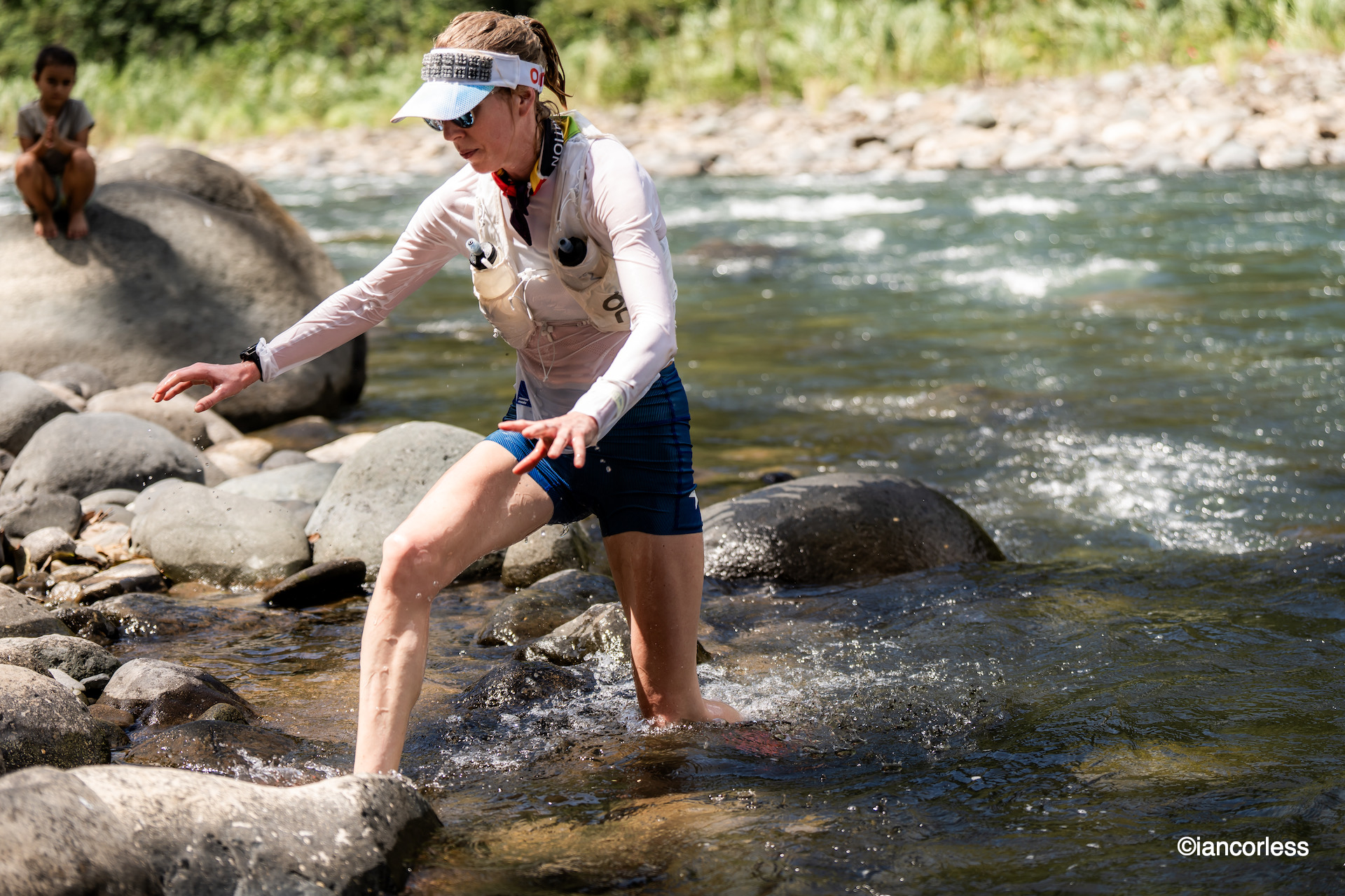
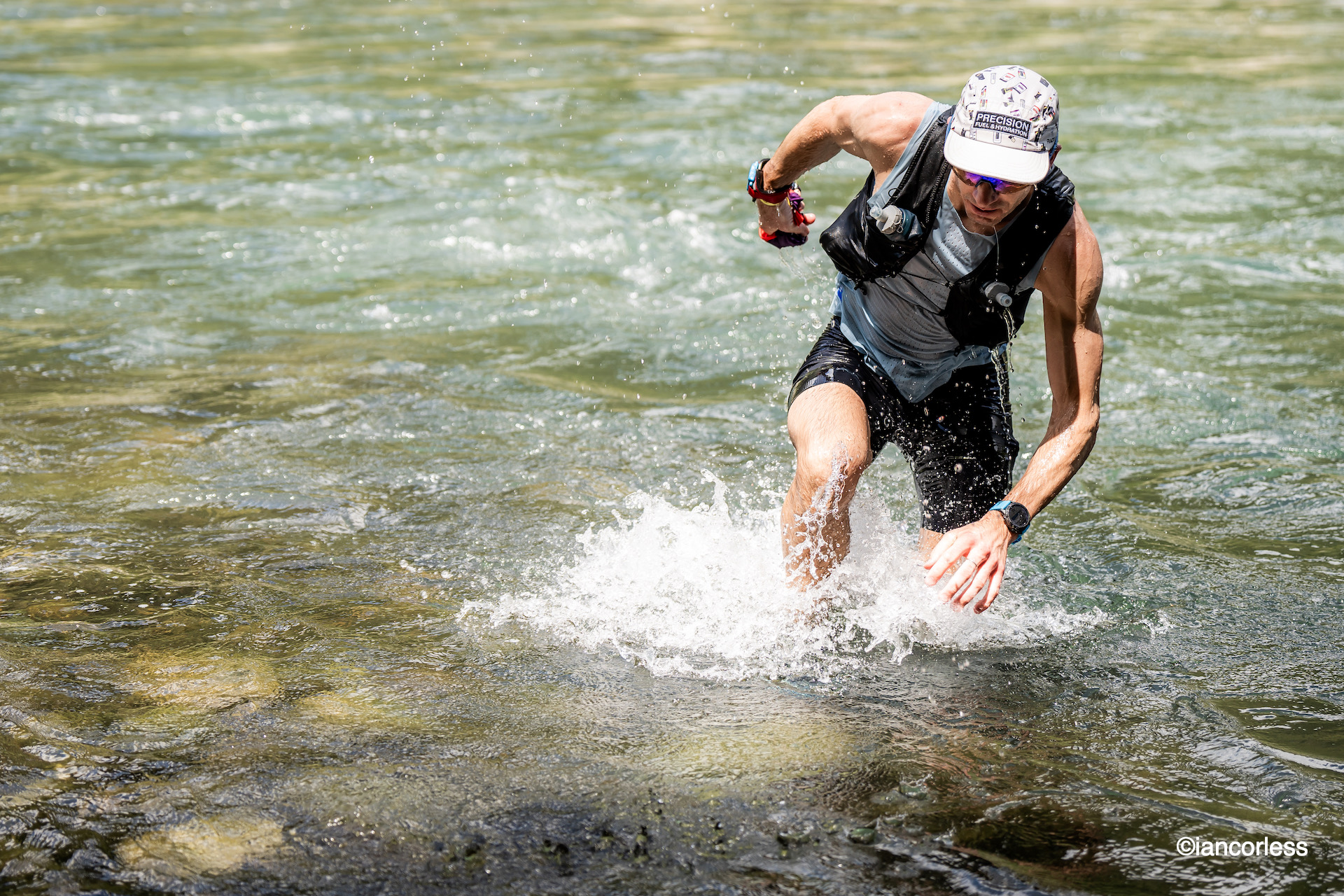
Use the environment to your advantage. Rivers, streams, and pools are not obstacles, they are survival tools. Submerge fully whenever possible. Two or three minutes can reset your entire system.
Photo by Ian Corless
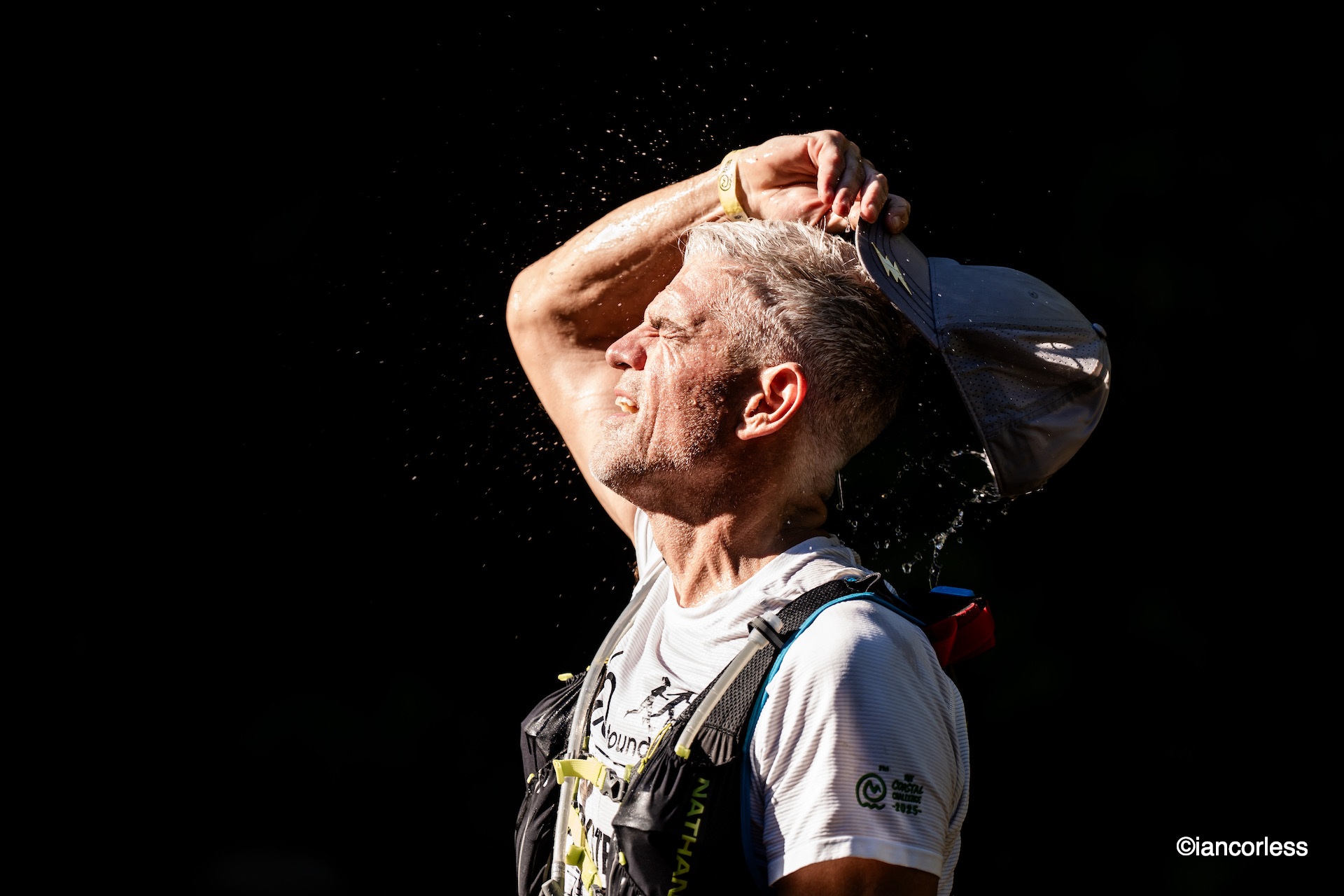
Run in shade. Walk in sun. Cover your head and shoulders. Pour water over yourself often.
Practical Race Wisdom
• Day 1 starts fast and later than other days. Most people go out too hard. Many drop out here.
• From Day 2 onward, you start at sunrise. Use the cooler hours wisely.
• This is a technical race. Train for climbing and descending.
• Everyone walks. Learn to do it efficiently.
• The course is well marked, but fatigue makes mistakes easy. If you haven’t seen a marker in five minutes, stop and check. Use the GPX files on a watch.
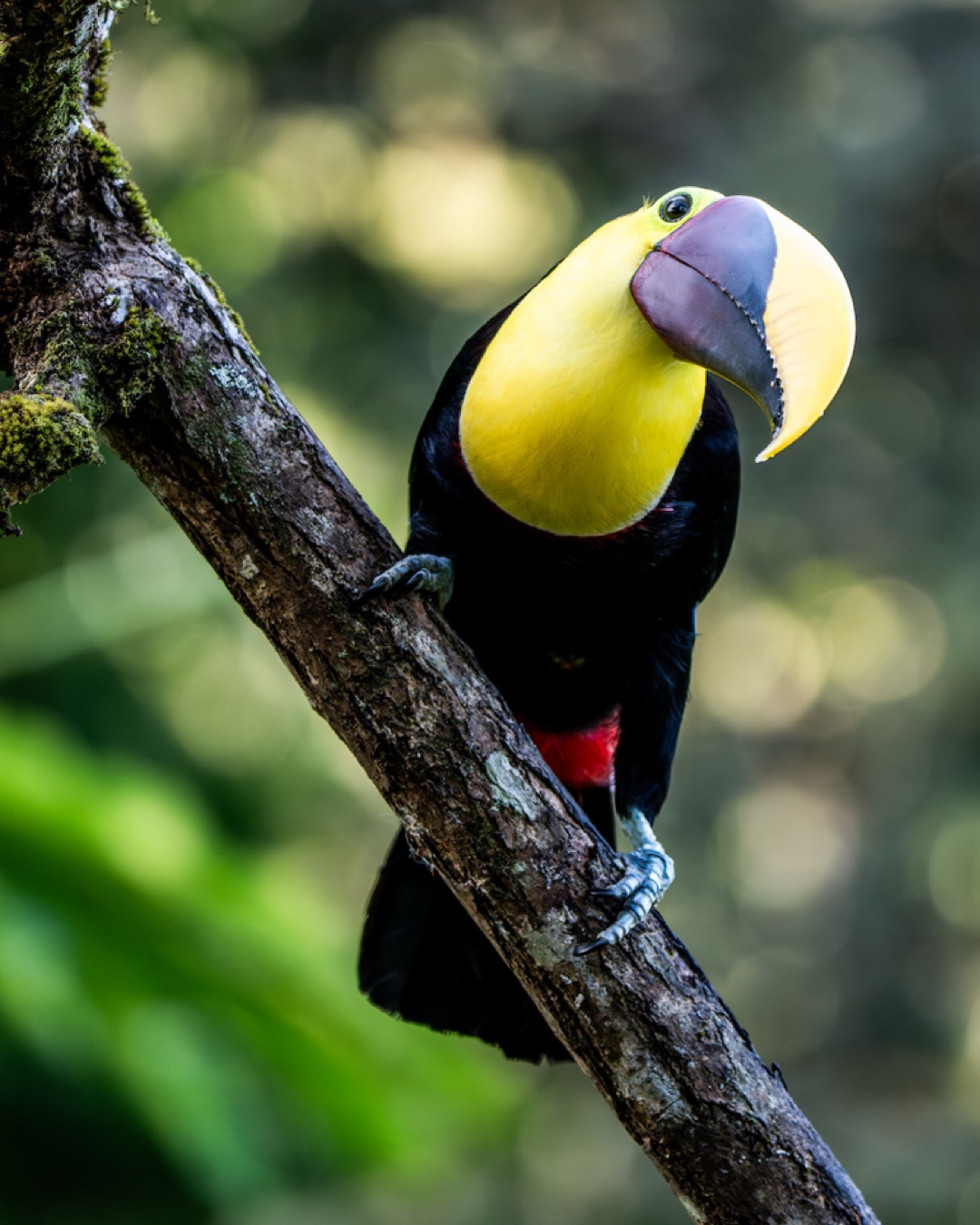
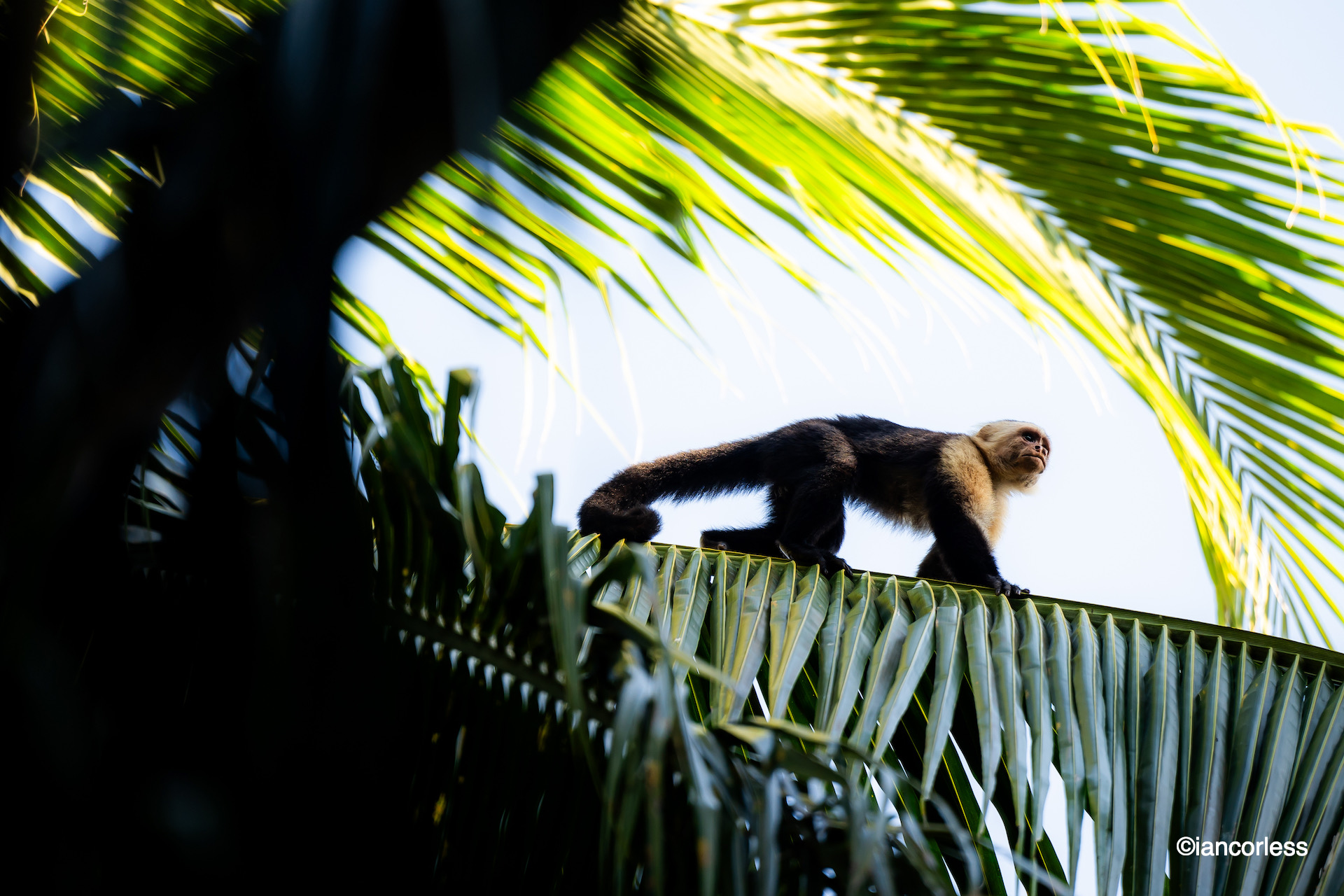
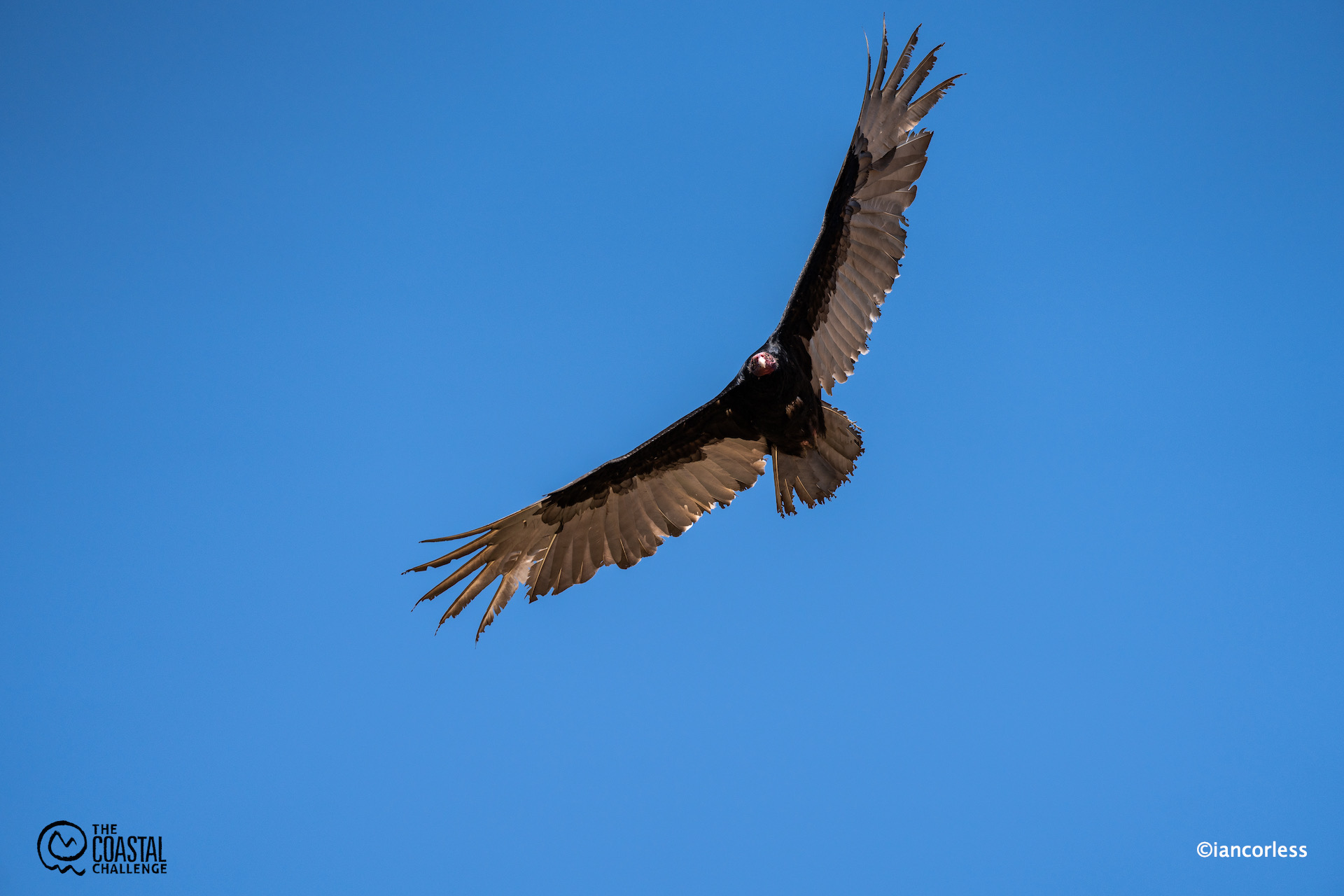
• Wildlife surrounds you. You’ll hear far more than you’ll see.
• After each stage: shoes off, feet checked, flip-flops on immediately.
• Eat, hydrate, nap, elevate legs.
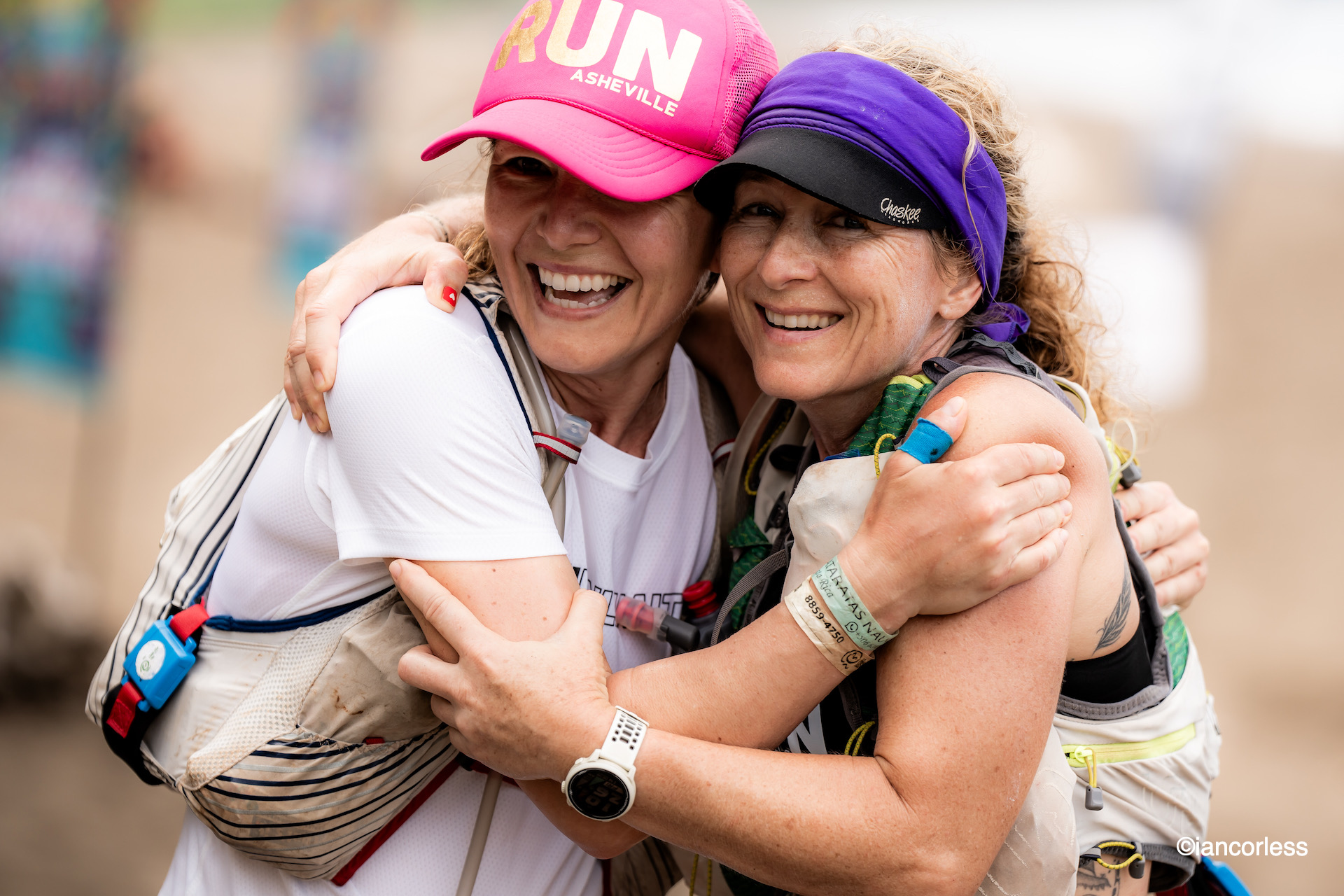
• Camps are social, but your tent is your reset space.
A Note for Female Runners
Photo by Ian Corless
Practical comfort matters.
Light, non-run clothing for evenings makes a big difference. Sundresses or loose cotton work well. Flip-flops are essential, including for showers.
A two-piece swimsuit is useful for river or ocean bathing.
Sleep in run kit.
Don’t economise on sunscreen. Carry anti-chafe cream and reapply regularly. High humidity changes everything.
Avoid skorts. They hold water and add friction. Single-layer shorts or breathable tights work better.
Hair conditioner is not optional. Sachets pack well and don’t leak.
Leave rings at home. Swelling is real.
Waterproof zip-locks for cash and toilet paper are worth their weight.
Phones must be properly waterproofed or left behind for river-heavy sections.
Final Thoughts
The Coastal Challenge doesn’t pretend to be anything other than what it is: a hard, beautiful, immersive journey through one of the most demanding environments you’ll ever race in. It will challenge you. It will frustrate you. It will humble you. And if you arrive prepared, it will reward you in ways few races can.
Photo by Ian Corless
Look up. Take it in. Accept the discomfort. Prepare well for heat, humidity, technical terrain, and recovery. Get your head right before you arrive. If you do that, the race doesn’t just become manageable. It becomes unforgettable.
What a day! Stage 3 of the 2025 The Coastal Challenge will go down in history… Local legend, Erick Aguero pulled back a 16-minute deficit after stages 1 and 2 and now leads the race after an epic winning margin of 23-minutes.
This is Nauyaca with Pitufollow – Photo by Ian Corless
Stage 3 with more technical trail, played into the hands of Erick and at the Nauyaca Waterfall he already had a lead of 5-minutes. This lead increased from cp too cp, Erick was on a mission. By the final beach section, has lead was +/- 23-minutes. He held on to the line to take a stunning stage win and overall lead.
Pierre chasing hard – Photo by Ian Corless
Pierre Meslet was running strong all day and post-race he confirmed he felt good and was running strong. He gave kudos to Erick on a stunning stage and he also confirmed, “If Erick wants to win, he has a fight on his hands!”
Katie – Photo by Ian Corless
For the women, Katie Young was once again untouchable. She was running strong and what looked like without effort all day. Post the finish line, she confirmed she was 30-minutes quicker than last year, she is unbeatable.
Lucia – Photo by Ian Corless
Lucia Jarquin was once again 2nd on the stage and now, after 3-stages is 6-hours and 24-minutes behind Katie.
Pura Vida – Photo by Ian Corless
Stage 4, tomorrow, moves away from the ocean and into the more mountainous and technical trail that Erick loves. It’s going to be an exciting day.
It was an 0330 departure from San Jose to arrive at Quepos at the start of stage 1 at 0800.
The heat and humidity was already high and a tough day, as always was expected. The iconic Del Rey beach a backdrop to the start and the Pacific Ocean splashing on to the beach.
Photo by Ian Corless
The day, 33km’s with the opening km’s, all the way to cp1 and beyond, were flat and runnable. Always dangerous. Day 1 should be taken slow and steady, easing in to the week and the heat/ humidity. Boca Naranjito at 13.5km was the first cp, followed by Londres at 19.5km. Los Campenos at 30km was the 3rd cp to provide some refreshment before a tough final 3km. The finish at Rafiki Lodge.
Photo by Ian Corless
Last years TCC champion Katie Young, started like a rocket running the opening 10km’s solo at the front.
Photo by Ian CorlessKatie – Photo by Ian Corless
Pierre Meslet and Erick Aguero finally caught her and took the lead two places, but Katie never stopped and ran all the way to the line with a convincing victory and 3rd overall.
Pierre – Photo by Ian Corless
Pierre and Erick were always expected to be the duo battling at the front but finally, around 16km’s the elastic snapped and Pierre broke away soloing to the line with a very strong lead ahead of the Costa Rican and local favourite.
Sergio had a tough day in the heat – Photo by Ian Corless
With two races, Expedition and Adventure, the participants fought hard to tackle the terrain, which became increasingly difficult as the stage progressed. The final section the toughest with a challenging water crossing to conclude the day.
Both races were 33km, but the expedition had more vertical gain, 1115m in contrast to 894m.
Episode 242 of Talk Ultra is with Lina and Sanna El Kott, the El Kott twins and their participation in the 20th anniversary of The Coastal Challenge in Costa Rica.
The 20th TCC concluded in Drake Bay on Feb 17th, 250km gruelling km’s and many 1000m’s of vertical gain over 6-days. Lina and Sanna finished on the podium and tell their stories here in an in-depth podcast.
The day starts by crossing the Sierpe River via ferry, ahead one of the most ‘runnable’ days with an abundance of gravel road interspersed with technical trails.
The crossing
It’s an iconic stage where a boat crossing is required in the final 5km’s transporting runners from one land section to another before the run in towards the iconic Drake Bay.
Cody cooling off
A delayed start due to problems with the ferry meant the runner’s started 1-hour late. Sometimes, situations happen and there is nothing to do than say, Pura Vida and carry on.
Pierre
Once underway, the race split at the front with Pierre Meslet deciding no matter how bad the ankle, let’s give it a go. Cristofer Clemente Mora followed and then Cody Lind and Jean Francois Cauchon.
Cody and Jean-Francois
It was only a matter of time before Cody and Jean-Francois took control of the race and the duo finished together in 4:28 (time tbc due to a delay at the boat crossing).
Cody, Jean-Francois and Cristofer
Cristofer finished 3rd.
Katie
For the women, Katie Young well and truly sealed the 2024 TCC with an outstanding performance in 5:55. All day, she smile, ran fast and smooth and dare I say, made it look easy! This TCC is a breakthrough performance for Katie, especially coming after a top-10 at MDS in 2023.
Katie
Lina El Kott Helander finished 2nd in 6:14. Lina could very easily have pulled out of the race early in the week after damaging her right arm. She has fought on and impressively so, chapeaux!
LinaMarlene
Marline Côté finished just ahead of Sanna El Kott Helander, 6:33 and 6:41 respectively. But it was Janina Beck from Germany who finished 3rd in 6:31.
Pierre Meslet full of life
The racing is now done! Stage 6 tomorrow and it would take an absolute disaster to change the ranking, so, expect a victory loop. And let’s face it, a fun loop is well deserved, despite the fact not many would call 35.9km an easy loop…
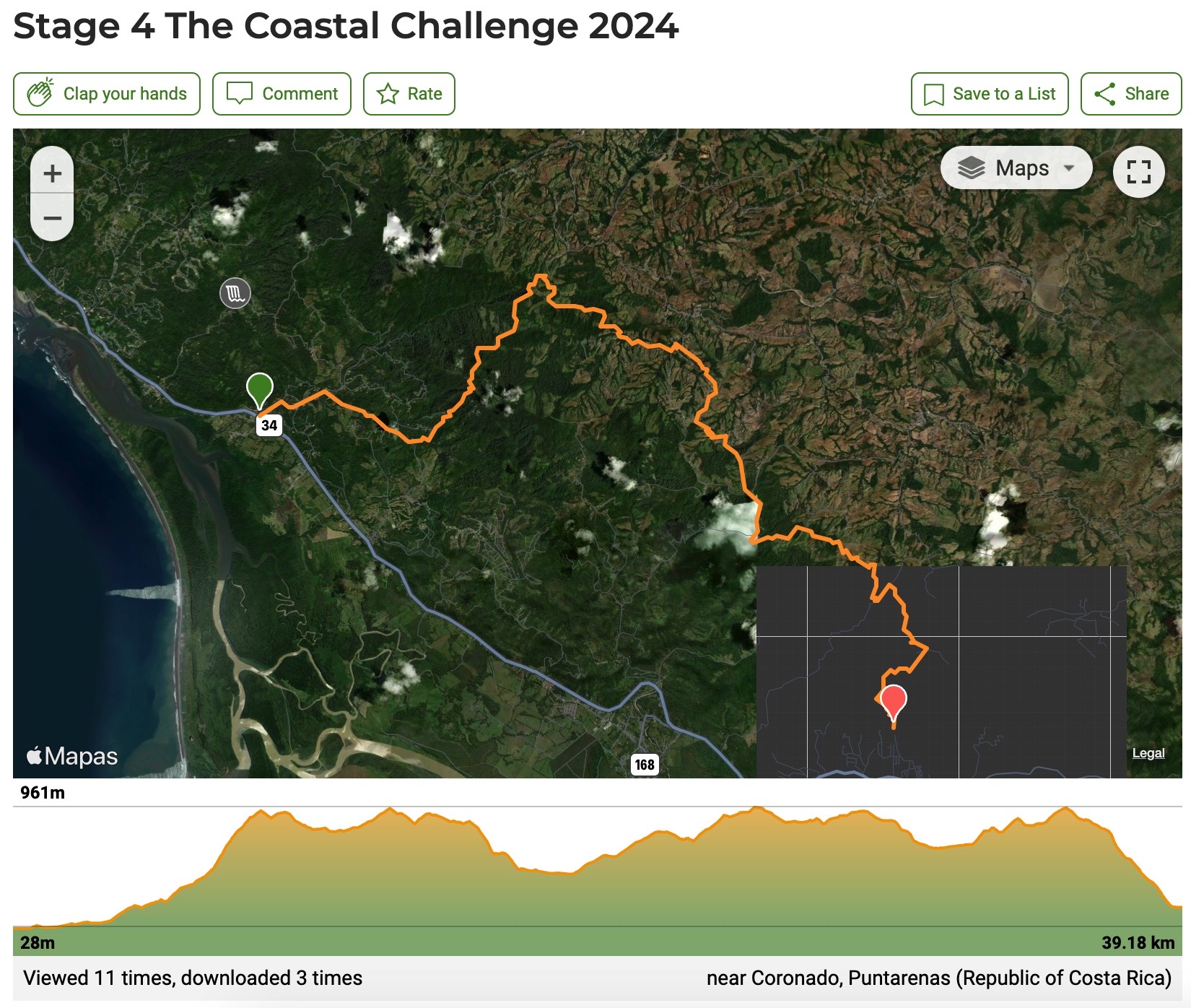
A relaxed and calm night, the impact of three tough stages now taking hold and stage 3 was tough! Stage 4 brings the most climbing which basically has three parts, a tough climb to start, a rollercoaster of gravel roads and trails and then a steep and technical descent to the finish. Once at the finish, runner’s are transported to the Sierpe River for stage 4 camp. There is no coast today, no ocean, no beaches, just an epic backdrop of the Talamanca mountains.
The heat today was intense despite a slight breeze that increased as the day passed. There is little shade and the combination of elements make the day a real tough one. The climbs are steep, the descents equally steep, especially the final one.
Cristofer on the first climb of the day
Cristofer Clemente Mora started the day strong pushing hard and building a 5-minute lead over the chasers, Cody Lind and Jean-Francois Cauchon. However, the lead was short lived. Stage 4 was the day Cody Lind confirmed his presence on the race. He caught Cristofer, pulled away and looked strong all the way to the line for a very convincing win in 4:49:29.
Cody
Jean-Francois also looked strong today, but he was no match for Cody. He enjoyed the landscape and route and did all he could to reduce the gap to Cody and extend the gap to Costa Rican, Carlos, who placed 3rd.
Jean-FrancoisCarlos
The women’s race was much more of a nail-biter with Katie Young and Lina El Kott Helander running close together early on followed by Sanna El Kott Helander.
Lina
As the race progressed, the twins switched, with Sanna leading at the front, it came as no surprise, the twins are mountain and skyrunner’s and the terrain would play to their adventure.
Sanna
Once in the lead, Sanna opened a gap and finished in 7:21:52 with Katie following in 7:32:01; a great result for Katie.
Katie
Lina, nursing her right arm finished 3rd, a very impressive run using just one pole to try to address some of the weakness caused by her injury, 7:34:42 on the clock.
The surf beach of Dominical really provided a real Costa Rican feel for TCC yesterday, particularly the magical sunset that concluded the day.
Stage 3, from experience, is considered the hardest stage. The opening km’s through rocky riverbeds bring a technical and slow start to the day.
Calvo López at Nauyaca
The crossing of the iconic Nauyaca waterfall and steep climb out soon make the runner’s aware that as beautiful as this day may be, it is also brutal.
Finally climbing to the high point of the day, slowly but surely the race descends back to the coast with relentless long beach sections, no shade and the heat of the day to punish each and every runner.
Jean-Francois
The day started slower than previous years with the top male runners lead by Calvo López and closely followed by Jean-Francois Cauchon and Cody Lind taking 30-minutes slower than anticipated. Apparently, the opening riverbed was very slippery. Cristofer Clemente Mora arrived and then gaps really opened.
Katie Young
For the women, this opening stretch was ideal for Lina El Kott Helander to take back time, however, a fall on stage 2 has left the Swedish runner with either a badly sprained right arm or fracture. In true fighting spirit she ran the stage, however, using the right arm to scramble greatly inhibited her pace early on. Katie Young however, was first to arrive and looked to be in her element. Sanna El Kott Helander followed.
Sanna El Kott Helander
At 46km’s, the day was being respected and it was in the final stretches of beach that Jean-Francois pulled away from Cody. The gap wasn’t huge, but it was certainly a day for Jean-Francois to take some glory. In 3rd, the ever-present Carlos running a consistently strong race but Cristofer closed hard and snatched the 3rd place away from the Costa Rican.
Jean-Francois
Katie Young was in her element on the beach and her smile and pace reflected that. She was unstoppable. Coming to TCC after a very successful top-10 at MDS in 2023, Katie was a favourite for the podium. However, this run, so far, is beyond her wildest expectations.
In 2nd, Marline Côté got a chance to shine with Sanna following. However, Lina, once allowed to run with the right arm not causing too much of a hinderance, started to close considerably in the closing stages. It was an exciting end to a tough day and she caught her twin sister to take 3rd.












 IAN CORLESS