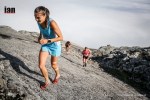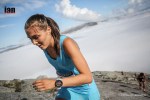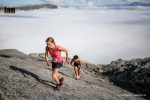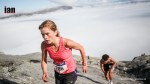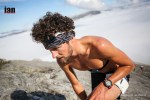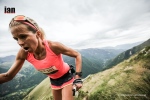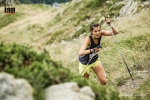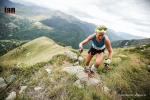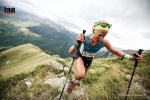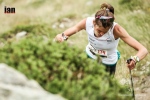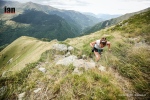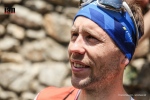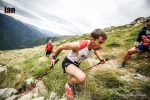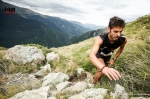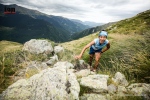
Joyline Chepngeno’s Ban: The Complex Web of Doping, Management, and Responsibility

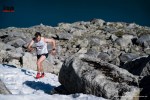
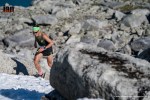
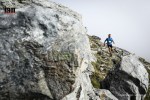
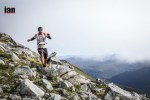
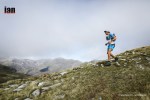
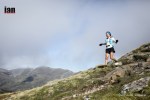
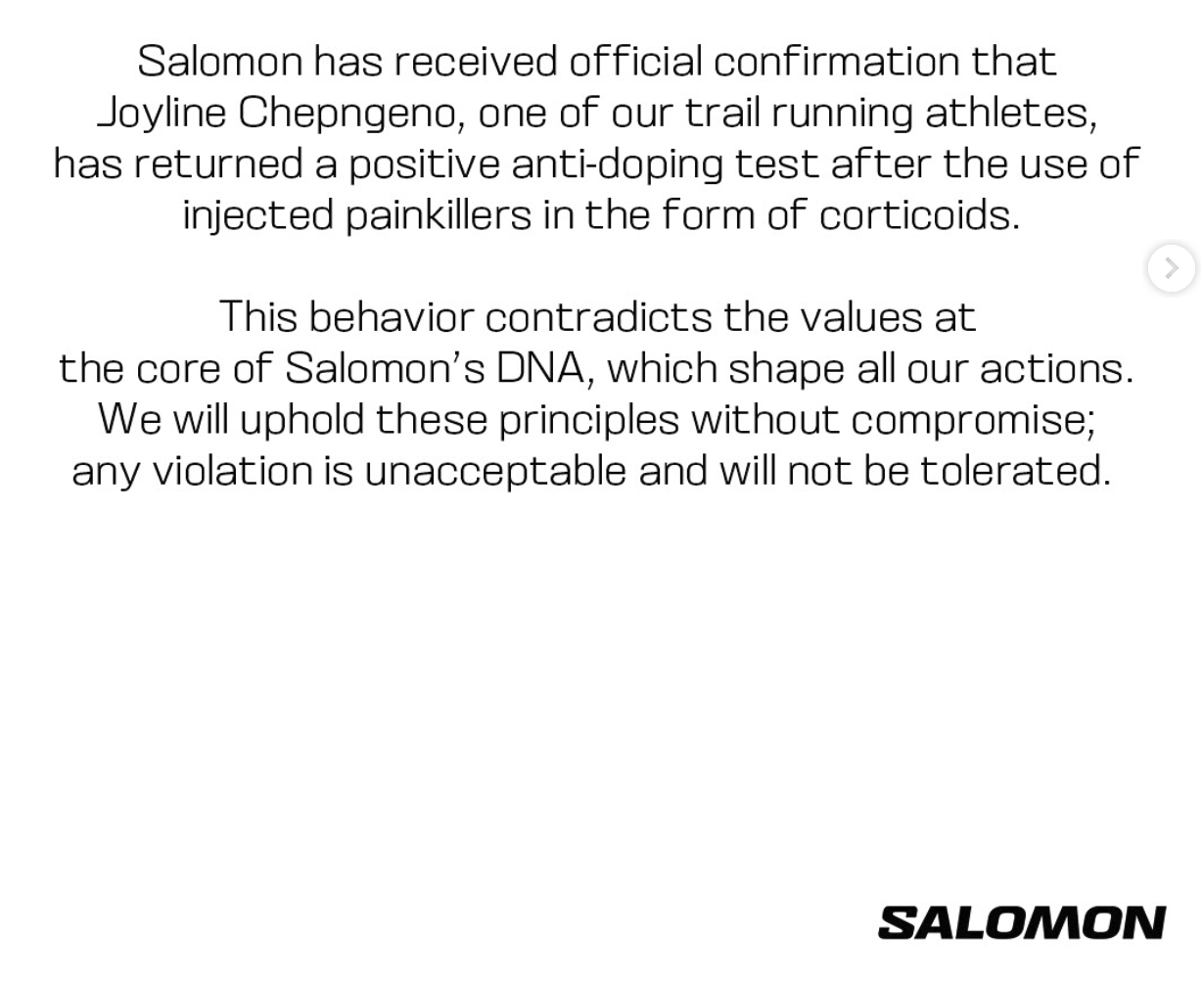
Copyright Salomonrunning via Instagram

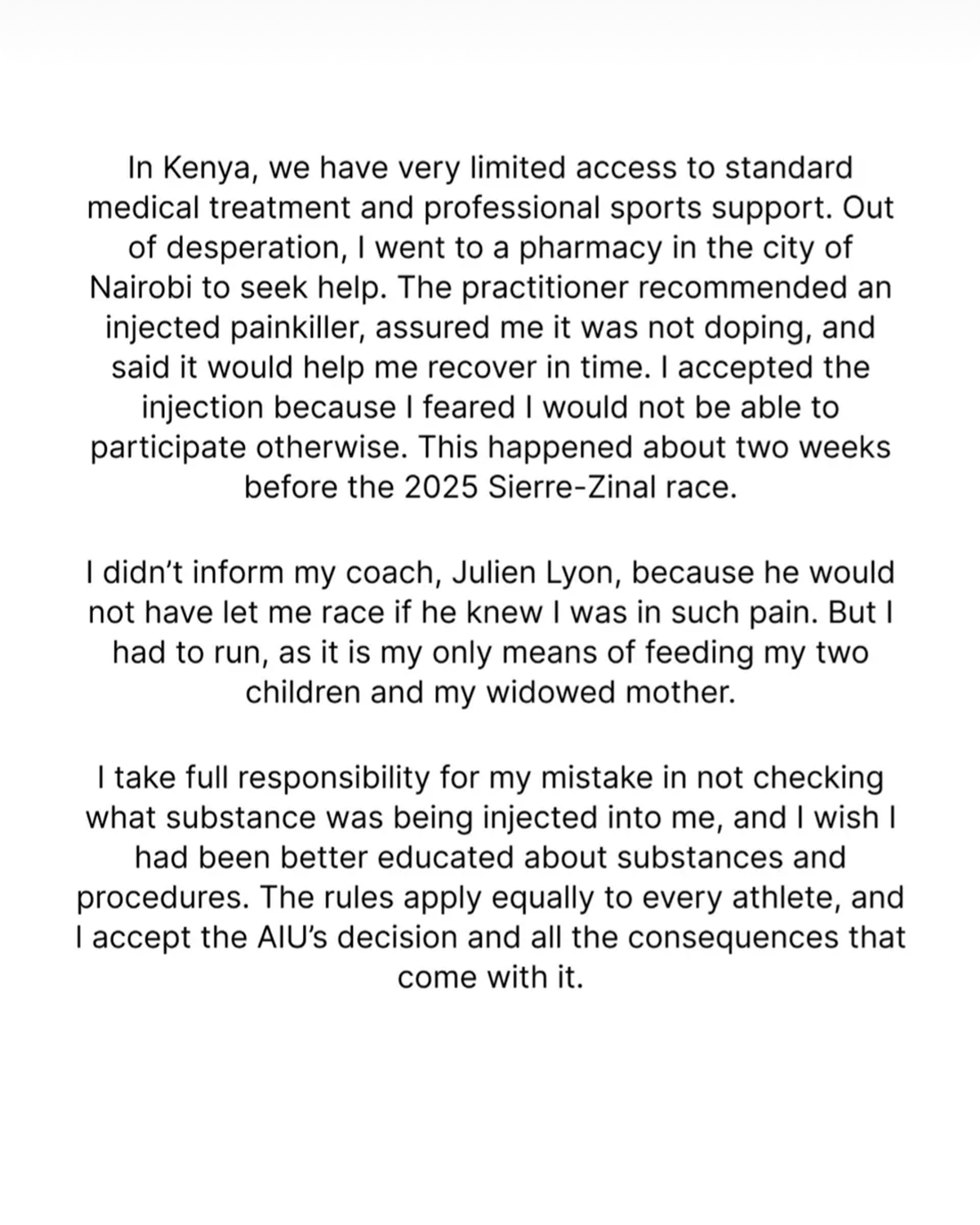
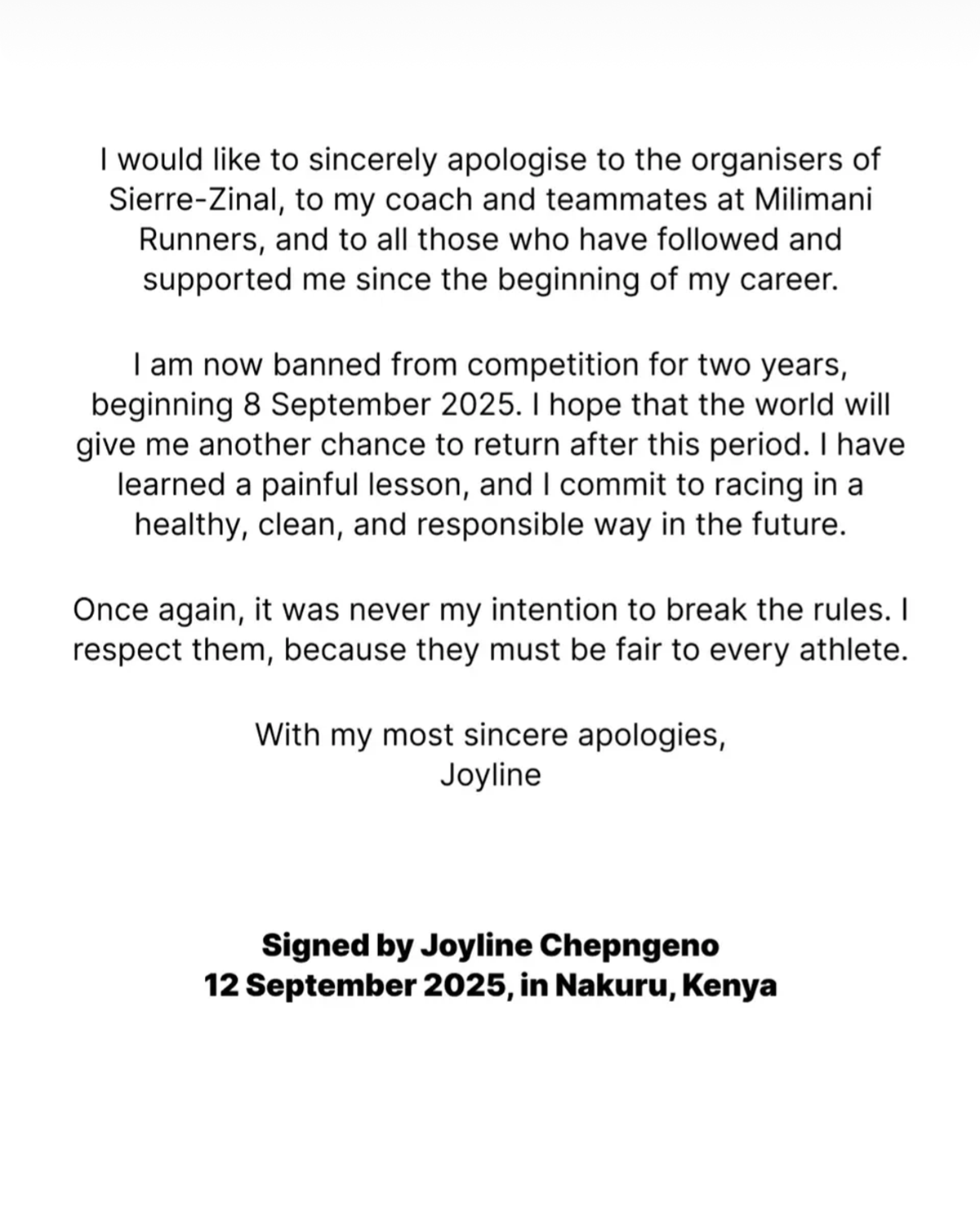
When news broke that Kenyan trail running champion Joyline Chepngeno had been banned for two years after testing positive for triamcinolone acetonide, the reactions were swift and polarised. On one side: condemnation and disbelief. On the other: questions about fairness, context, and whether the system designed to protect clean sport actually confuses athletes into mistakes.

Let me be clear, there is no place for doping in any sport, however, the Chepngeno and Angermund cases should and must make us think deeper.

Chepngeno admitted she received an injection in July, and the drug in question – a corticosteroid widely used for inflammation – sits in one of the sport’s murkiest regulatory zones. Under the World Anti-Doping Agency (WADA) code, triamcinolone is banned in-competition, unless the athlete secures a Therapeutic Use Exemption (TUE). Sounds simple enough, but in practice the rules are anything but. The case raises bigger questions: Was she naive? Did her team fail her? Was Salomon right to sever ties so quickly? And is WADA’s own ambiguity part of the problem?

“Chepngeno may have taken the injection for a genuine medical issue – inflammation, pain, or recovery – but without the right paperwork, timing, and guidance, it became a career-altering violation.”

Kenya’s Reputation and the Weight of History

Kenya has long been under the microscope for doping violations. In recent years, its athletes have faced increasing scrutiny, with dozens of cases making international headlines. This history frames Chepngeno’s case: even a whiff of doping from a Kenyan runner is quickly interpreted through the lens of systemic abuse, rather than individual misjudgment.

But this framing risks oversimplifying. Many Kenyan athletes operate in environments with limited medical oversight, inconsistent education about anti-doping rules, and managerial structures that prioritize racing and prize money over compliance. Chepngeno may have taken the injection for a genuine medical issue – inflammation, pain, or recovery – but without the right paperwork, timing, and guidance, it became a career-altering violation.

Takon from Instagram Sierre-Zinal offical feed ✍️ Ludovic Medwed 📸 Keystone

The Role of the Manager/ Coach: Protection or Neglect?

A professional runner’s manager/ coach, in this case, Julien Lyon, is more than just a race scheduler. They are, or should be, a gatekeeper for the athlete’s career:

Pros of strong management:

  • Ensures the athlete understands what substances are permitted.
  • Helps navigate the dense bureaucracy of WADA codes, TUE applications, and medical clearances.
  • Provides financial and legal protection when mistakes happen.
  • Balances competitive demands with athlete health and long-term career viability.

Cons or failures of management:

  • When managers are absentee or focused solely on performance, athletes are left vulnerable.
  • In many Kenyan cases, managers are foreign-based agents whose primary incentive is to get athletes on the start line, not to invest in their education.
  • A lack of day-to-day oversight means athletes may trust local doctors, clinics, or informal advice without realizing the implications.

Chepngeno’s admission that she did take the injection suggests honesty, not deception. But it also signals that no one around her flagged the risk. A competent manager should have either prevented it or ensured the correct exemptions were in place. If the manager’s job is athlete protection, this could look like a potential failure? **

“The Sierre-Zinal race organisation has announced that it has banned Chepngeno’s coach Julien Lyon and his Milimani Runners team from future competitions. It has also, according to the statement, ordered Lyon to ‘fully reimburse prize money, accommodation costs and administrative fees arising from the case – including reputational harm – owed to the Sierre-Zinal Association’.” – (c) Runner’s World

Lyon also coached the 2022 Sierre-Zinal men’s and women’s champions, Kangogo and Chesang, both of whom were later suspended and stripped of their titles for doping.

In response to Sierre-Zinal, Julien Lyon via Instagram stated: “Finally, I must respond to the serious and defamatory accusations published by the Sierre-Zinal organization. These statements are completely unacceptable. I am already devoting significant energy to restoring the facts and I have no intention of giving up.” **

Update September 13th: **

Julien Lyon has responded with a clear statement on Instagram, read HERE.

Let me be absolutely clear:
• I had no knowledge whatsoever of the use of this substance.
• I have never, in any way, encouraged or tolerated such an act.
• I have always fought against doping and I will continue to do so.
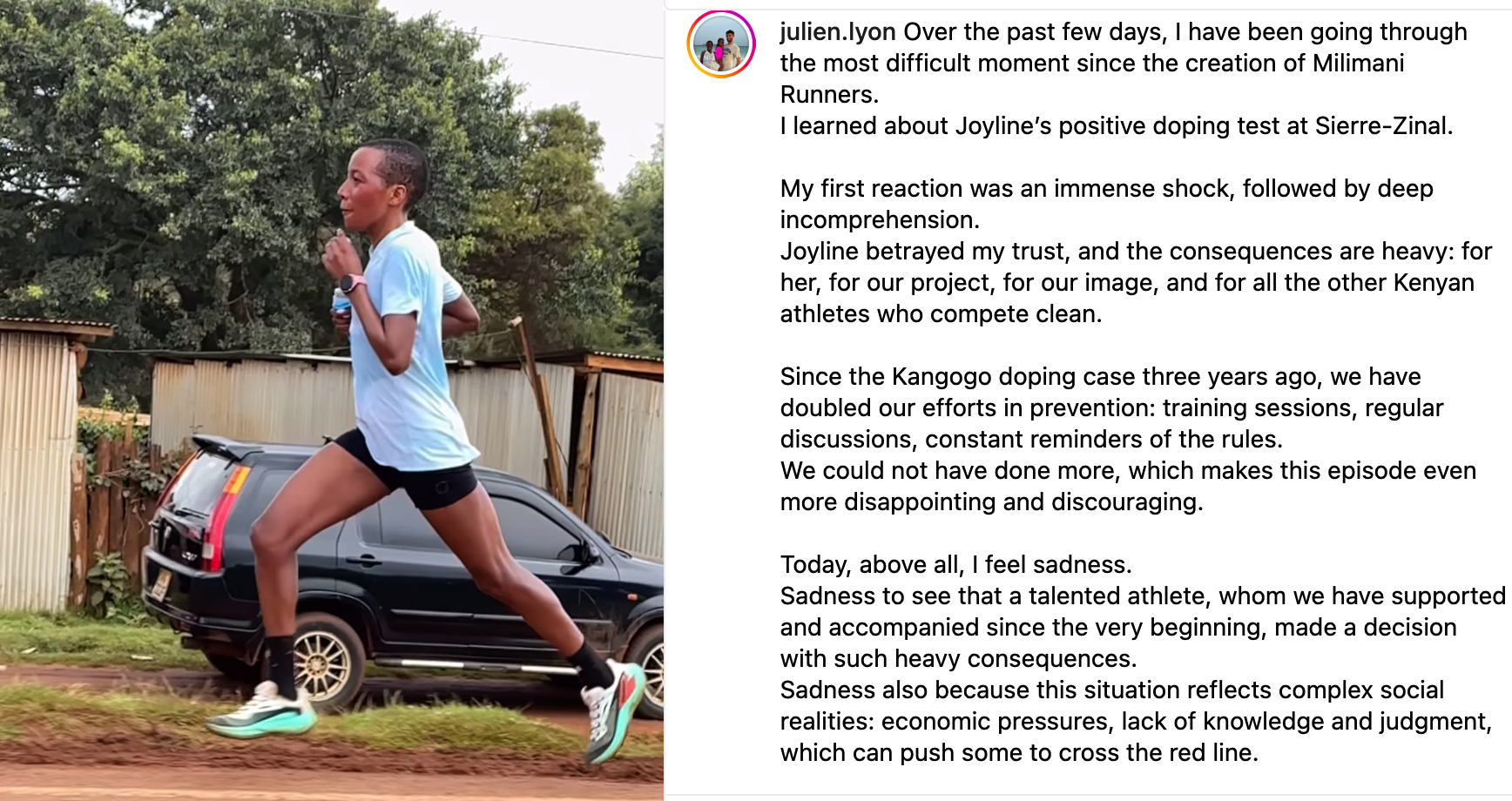
From now on, I am already reflecting on concrete solutions: implementing more regular out-of-competition testing, even if it represents a significant cost that must be discussed with our partners, and developing closer, culturally adapted medical support in Kenya. I deeply regret that Joyline may have felt left alone with her pain and doubts. She had my full support, and I regret not being even more present for her during this difficult time. I want to ensure that Milimani Runners athletes feel supported not only in their sporting careers, but also in their health, their choices, and their education. – Julien Lyon via Instagram

The Sponsor’s Role: Salomon’s Swift Rejection

Salomon, Chepngeno’s sponsor, moved quickly to cut ties. On one level, this is understandable: brands cannot afford reputational damage in a sport that already battles questions of integrity. Corporate zero-tolerance policies are often blunt but clear: fail a doping test, and the contract ends.

View the Instagram post HERE

But here lies the ethical dilemma. Was Salomon protecting the sport, or protecting its image? By severing ties without nuance, the brand effectively punished Chepngeno twice: once through lost income and again through public rejection. A more responsible approach might have been suspension pending investigation, or supporting her with legal and educational resources.

Sponsorship is not just about exposure and winning; it’s also about athlete welfare. When brands abandon athletes at the first sign of trouble, it signals that their investment was never truly in the human being, only in the results.

A Contrast: The Case of Stian Angermund
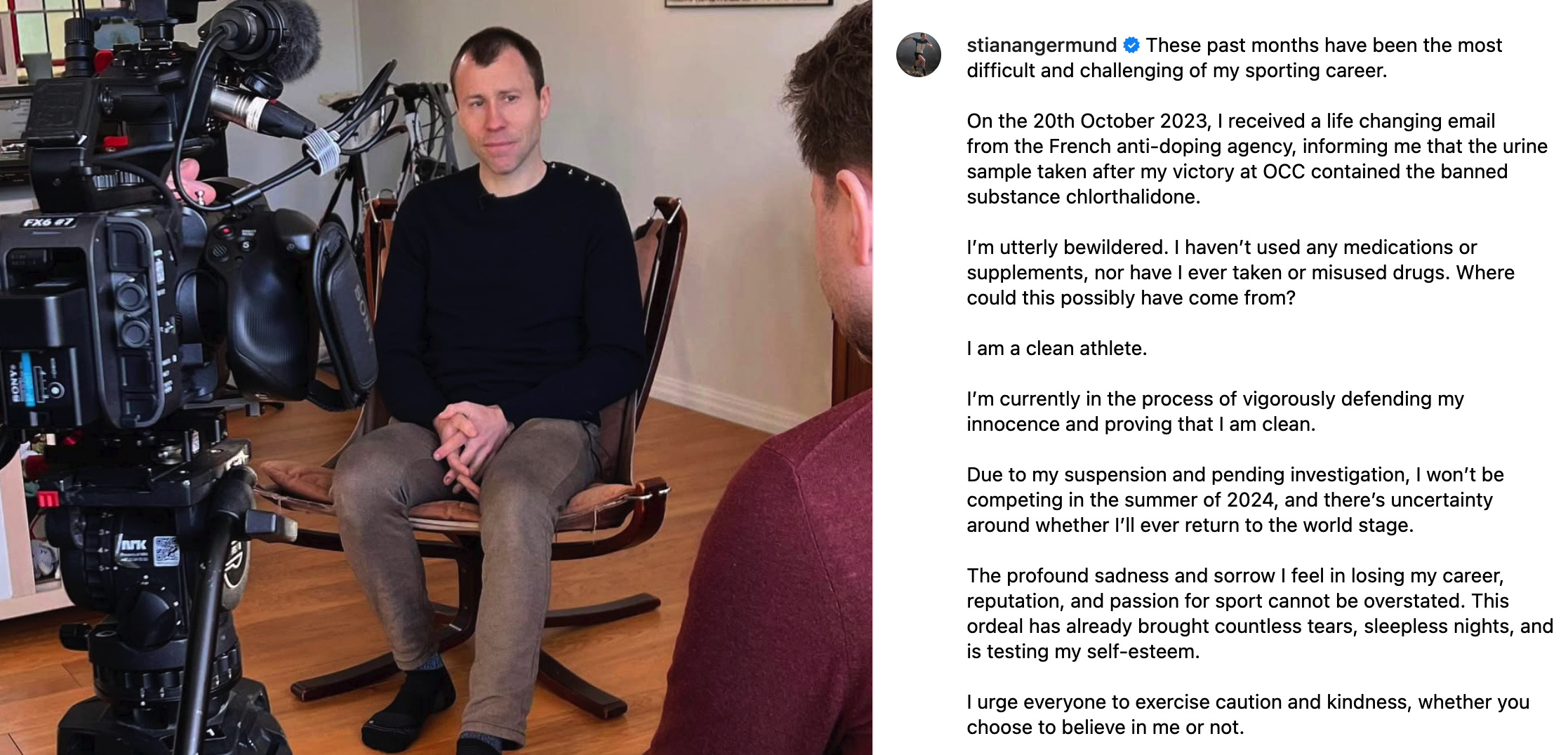
The difference in how Chepngeno’s case was received becomes starker when compared with that of Stian Angermund, one of Norway’s most successful trail runners. Angermund also tested positive in 2023 for the diuretic chlorthalidone.*

  • *corrected for original post

Read on Instagram HERE

Yet the public response to Angermund was notably softer. Many in the trail running community rallied around him, framing him as a victim of circumstance, a clean athlete caught in an unfortunate situation. His protestations of innocence gained traction, with commentators and peers stressing his reputation, personality, and history as evidence of credibility.

On February 10th, 2024, the trail running world was rocked by news out of Norway – the two-time World Champion, Stian Angermund, had tested positive for the diuretic chlorthalidone. via Freetrail here.

Chepngeno, by contrast, has not been afforded the same sympathy. Instead, her case was quickly folded into the broader narrative of Kenya’s doping crisis, with far fewer voices offering the benefit of the doubt. This disparity speaks volumes about how nationality, reputation, and public image shape perception. Where Angermund’s case was seen as an anomaly in a clean career, Chepngeno’s was framed as part of a pattern – even though the substance she took is far more medically common, and her admission suggested transparency, not deception.

Sponsors and Double Standards

The sponsorship response reveals this double standard even more starkly. Salomon cut ties with Chepngeno almost immediately, distancing itself without nuance. In contrast, sponsors and partners in Angermund’s case were slower to act, with ‘some’ showing signs of support while the investigation unfolded. The messaging was different too: in Angermund’s case, words like uncertain, unfortunate, and out of character dominated coverage; in Chepngeno’s, the language leaned toward guilty, systemic, and Kenyan problem.

This isn’t just about corporate crisis management – it reflects deeper biases. Western athletes with strong reputations are given space to argue their case, while Kenyan athletes are too often treated as disposable. If sponsors only invest in results but not in athlete welfare, the sport risks reinforcing inequities that mirror global power imbalances.

WADA’s Ambiguity: Is Triamcinolone Doping or Not?

Here lies the central confusion. Triamcinolone is not an anabolic steroid. It is a corticosteroid — widely prescribed to treat inflammation and injury. In many medical contexts, it is routine and even necessary.
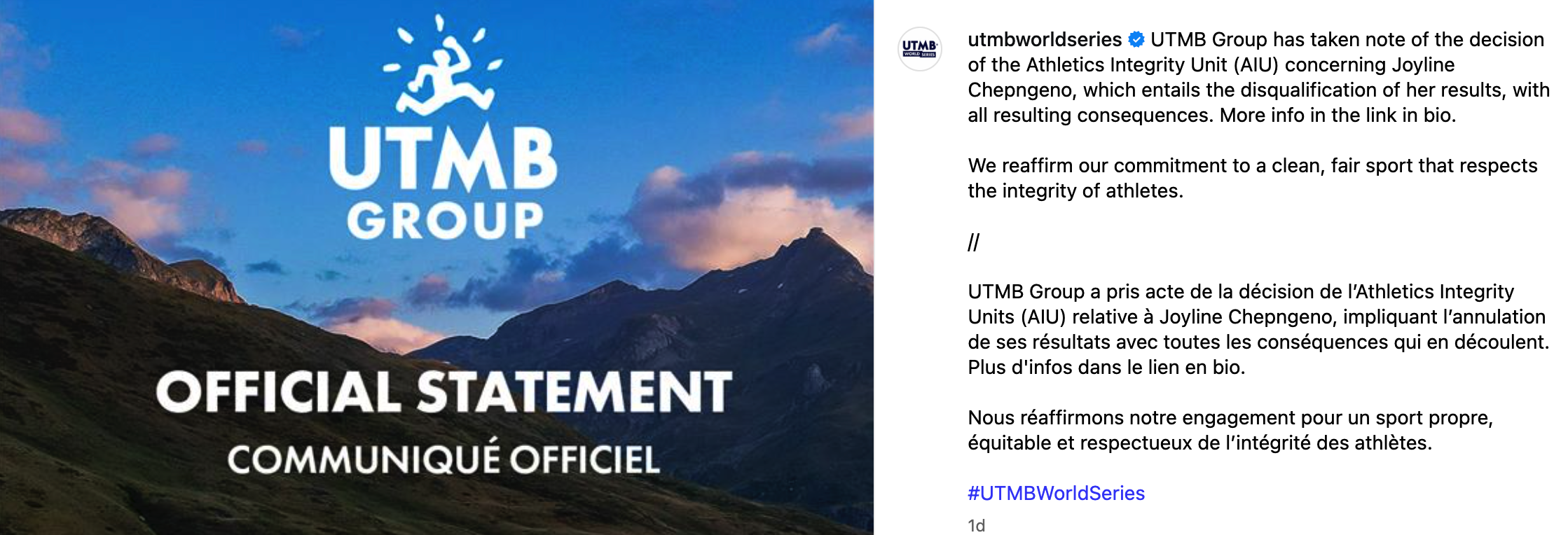
WADA bans it only in-competition, unless a TUE is granted. Out-of-competition, it is allowed. The catch? Athletes often receive injections or treatments without realizing where the “competition window” starts or ends. Did Chepngeno’s injection fall within the banned period? Did she even know the timing mattered?

And yes, I understand that the athlete has a responsibility to know and understand WADA rules.

The World Anti-Doping Code states the roles and responsibilities that athletes have in relation to anti-doping. So, athletes must: know and abide by the Anti-Doping Rules, policies and practices. be available for testing at all times.

The ambiguity sends mixed messages: if a substance is dangerous or performance-enhancing, why is it allowed out-of-competition at all? And if it is medically justifiable, why is the TUE process so opaque and burdensome, especially for athletes in countries with limited infrastructure?

Instead of clarity, WADA’s rules create traps. Athletes are told they are responsible for every substance in their body, but the system seems designed to catch technical errors as much as intentional cheats.

Was Chepngeno Naive?

The answer is complicated. On the surface, yes: admitting to an injection without checking WADA guidelines suggests a lack of awareness. But deeper down, her admission looks less like naivety and more like honesty. She did not hide the treatment, nor attempt to deny it. She took what may have been a routine medical step, unaware that it carried career-ending consequences.

The real naivety may not be hers but the system’s – assuming athletes across all geographies, languages, and economic realities can navigate a code written for those with legal teams and medical advisors.

Does Julien Lyon and Salomon have a responsibility? **

Financial and Moral Implications

For Chepngeno, the fallout is severe and many of you will say, good, that is how it should be.

  • Financial: Two years off the circuit means lost race earnings, lost sponsorship income, and a gap in her career at what should be her peak. For athletes from Kenya, whose entire family and community may rely on those earnings, the consequences are devastating.
  • Moral: Her reputation is damaged, regardless of intent. Once branded a “doper,” the stigma rarely fades, even if the violation was technical rather than malicious.
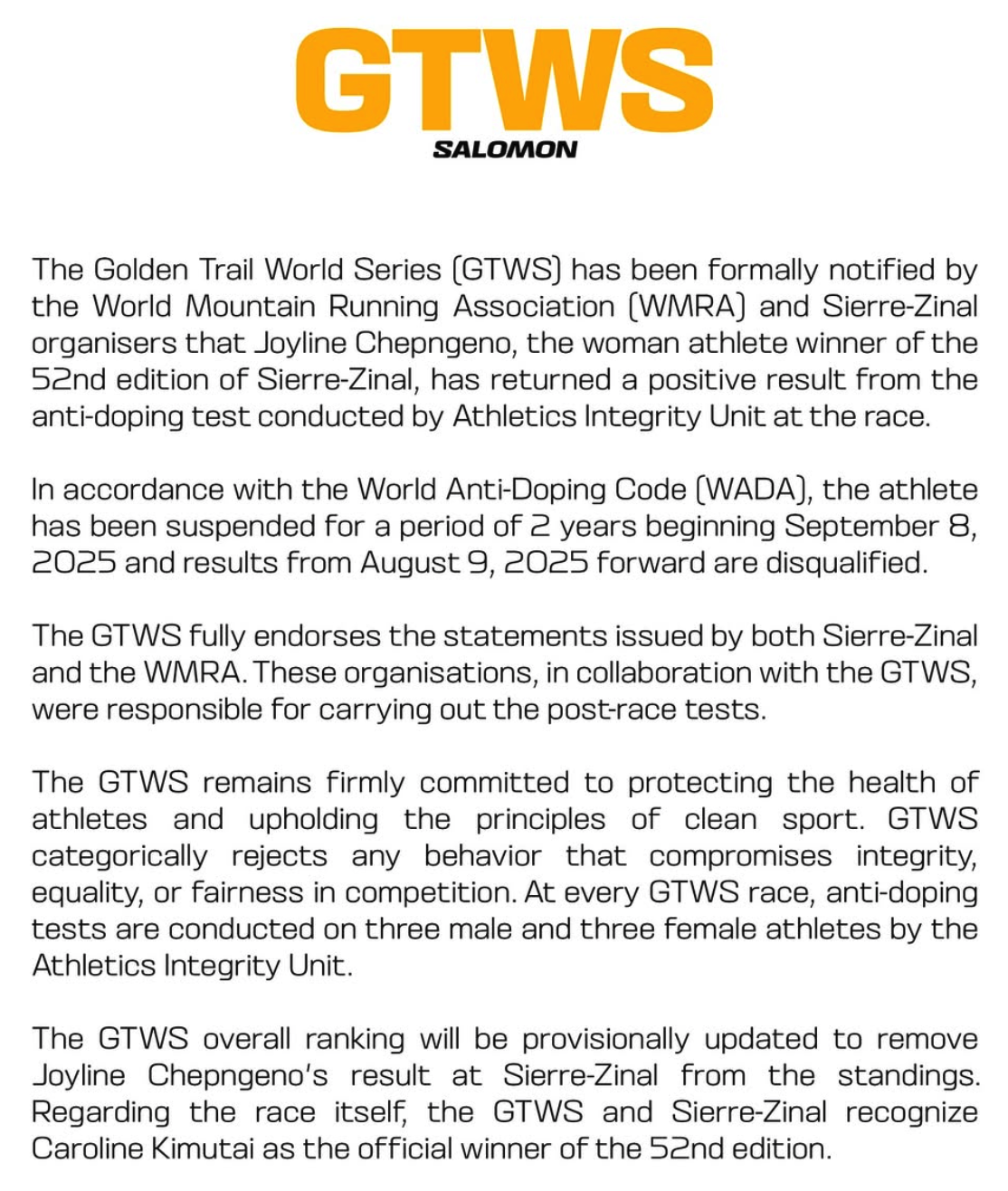
Copyright GTWS via Instagram – https://www.instagram.com/goldentrailseries/

For the sport, cases like this erode public trust. Fans are left asking: was she cheating or simply careless? For sponsors, the financial risk increases – which in turn makes them more likely to cut ties at the first sign of trouble. And for Kenya, each case deepens the perception of systemic doping, even if the reality is far more complex.

What can be learned from this?

Contextual Justice: Not all violations are equal. Intent should matter as much as presence. Athletes like Chepngeno, who admit to treatment rather than hide it, deserve proportionate, not punitive, responses.

Clearer Rules from WADA: The line between therapeutic and prohibited must be made clearer. If triamcinolone is truly performance-enhancing, ban it outright. If it is a legitimate medical treatment, streamline TUEs and ensure athletes understand the timelines.

Better Athlete Education: Federations, sponsors, and managers need to invest in training athletes on what substances mean, how to apply for exemptions, and what to do before accepting treatment.

Stronger Manager Accountability: Managers should be held to professional standards. If their athlete tests positive due to negligence in guidance, they too should face consequences.

More Responsible Sponsors: Brands like Salomon should balance integrity with support. Cutting ties instantly might protect the logo, but it abandons the athlete. Support through due process would show real leadership.

Conclusion

Joyline Chepngeno’s ban is not just the story of one Kenyan athlete caught out. It is a case study in the tangled web of responsibility in modern sport: the athlete trying to heal, the manager who should have protected her, the sponsor that walked away, and the global regulator that still speaks in gray areas.

Was she naive? Perhaps. But more importantly, she was failed by a system that claims to protect athletes but too often punishes them for being human. Until WADA, managers, and sponsors share the burden of responsibility, athletes – especially those from vulnerable contexts like Kenya – will keep paying the highest price.

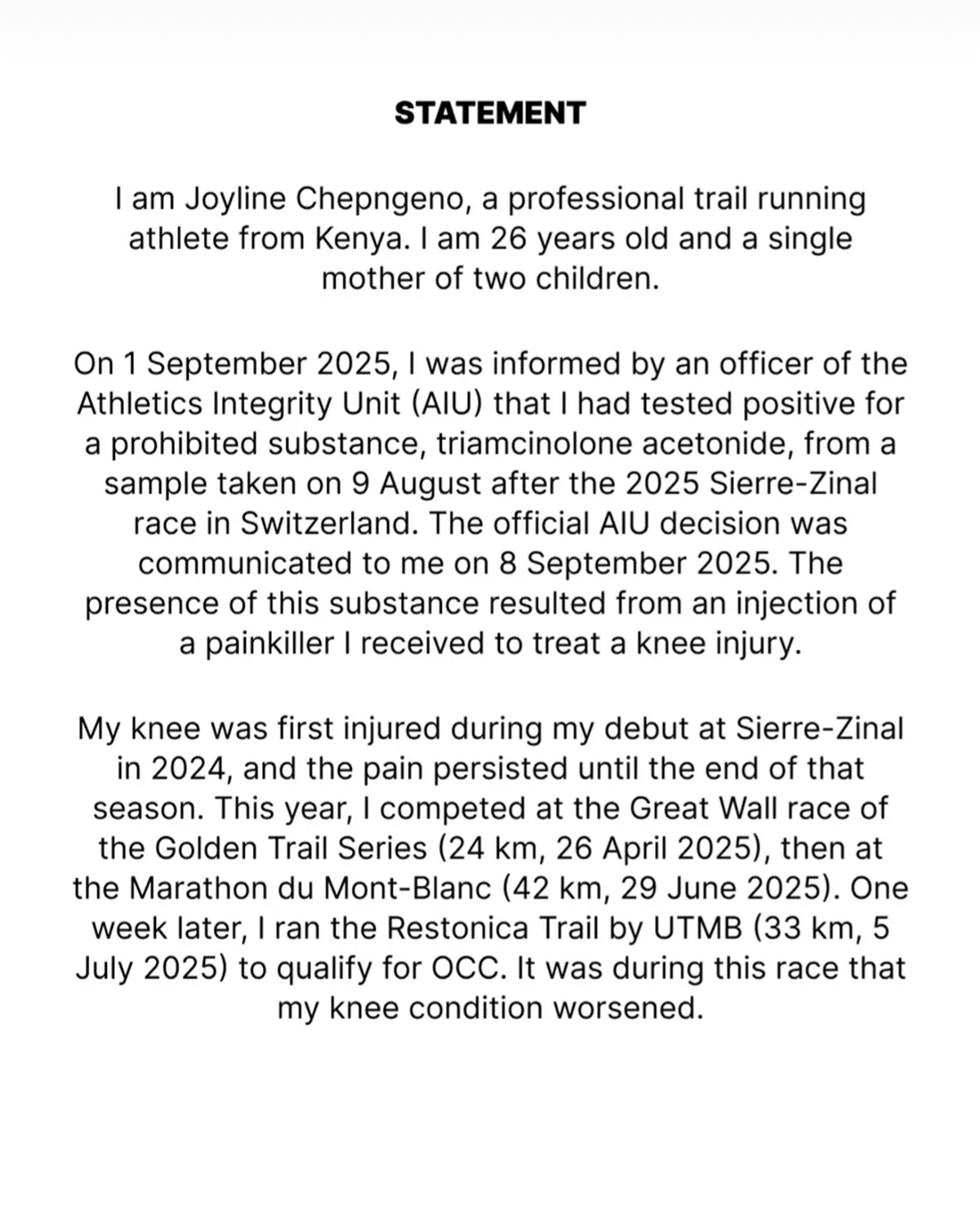
Update 12th September, Joyline Chepgneno posted on Instagram the following:
Final Note:

This article and post is designed to give a perspective to make the reader ask questions. To be clear, I am completely against doping, there is no place for doping in sport. I am well aware, for some, this article and words may make you angry – that is okay. Feel free to respond and counter with good debate and argument and be polite and professional.

** edits September 13th.

**Julien Lyon has taken exception to certain points raised in this article. Quoted below.) I stress that as a journalist, I am entitled to the right to freedom of opinion and expression, including the freedom to hold opinions without interference and to seek, receive, and impart information and ideas through any media, regardless of borders. As stipulated in article 19 in the Universal Declaration of Human Rights. However, it is important to be fair and allow all viewpoints to be considered.

“Several passages mention my name and attribute facts and responsibilities to me that are inaccurate and damaging to my professional reputation. For example: – You state that “the Sierre-Zinal organisation has announced that it has banned Julien Lyon and his team” – however, I have not received any official notification of such a decision, and no sanction has legal standing at this time. – You write “this looks like a clear failure,” implying that I failed in my duty to protect the athlete – this value judgment is not based on any objective evidence and constitutes a serious attack on my professional integrity. – The phrase “Lyon has history” suggests I have a track record of misconduct, which is defamatory. I therefore request that you either: – immediately remove these passages, or – publish a right of reply that sets the record straight.”

Of course, Julien Lyon, like anyone who reads this article, has a right to reply and the comment section is open for this.

Follow Ian Corless

Instagram – @iancorlessphotography

Twitter – @talkultra

facebook.com/iancorlessphotography

Web – www.iancorless.com
Web – www.iancorlessphotography.com

Transvulcania VK by Binter – 2018 Race Summary and Images

The island of La Palma today hosted the Winter Transvulcania Vertical Kilometer® (VK) one of many VK’s in the 2018 Vertical Kilometer® World Circuit.

Just last weekend in Italy the Trentapassi Vertical, rising 1,000m above Italy’s Lake Iseo took place and many of the runners who participated followed up with the VK in La Palma.

To clarify, a VK is a uphill mountain race that climbs for 1,000m over a course that is less than 5 km in length. Certain courses on the circuit do obtain special dispensation – Transvulcania one case in point.

The route here in La Palma covers over 1200m of vertical gain over a distance of 7.6km and re-traces sections of the Ultramarathon course and concludes at the forest lookout tower at an altitude of 1600m and stunning views of the Aridane valley and the north east of the island.

From sea to sky, today in La Palma, the BBinter Transvulcania VK provided a wonderful showcase for the sport as runners departed from Tazacorte Puerto. However, the usual glorious skies of blue and intense sunshine were replaced with cloud, grey and at times, light rain.

The line-up for the VK was impressive with Stian Angermund, Pascal Egli, Aritz Egea and Ondrej Fejfar heading up a world-class field.

Pascal Egli dominated with a strong performance ahead of Stian Angermund-Vik and Rui Ueda. Their times 47:55, 48:03 and 48:08.

Christel Dewalle set blistering pace and set a new course record ahead of Laura Orgue and Zuzana Krchova. Their times 56:52, 57:19 and 1:01:13.

Attention now turns to the main event of the weekend, the Transvulcania Ultramarathon that starts in the early hours of the morning on Saturday at Fuencalienti lighthouse. You can read the race preview HERE.

Full set of race images available HERE

Blåmann Vertical Kilometer® 2017 Summary – Tromso SkyRace

Starting from the sea and climbing directly to the 1044m of the summit of Store Blamann, the highest summit on Kvaloya island, the Blåmann Vertical Kilometer® is everything a Skyrunning race should be and the route personifies the sea-to-summit concept.

The terrain twists and turns with a variety of mixed terrain – early stage are soft boggy ground. Huge slabs of rock follow, interspersed with snow and ice, the terrain at times require low grade climbing to cover – it is a race that requires ‘hands-on’ scrambling.

Just 20 minutes from Tromso, the Blåmann Vertical Kilometer® is a race that anyone can try and it’s a wonderful introduction to Skyrunning.

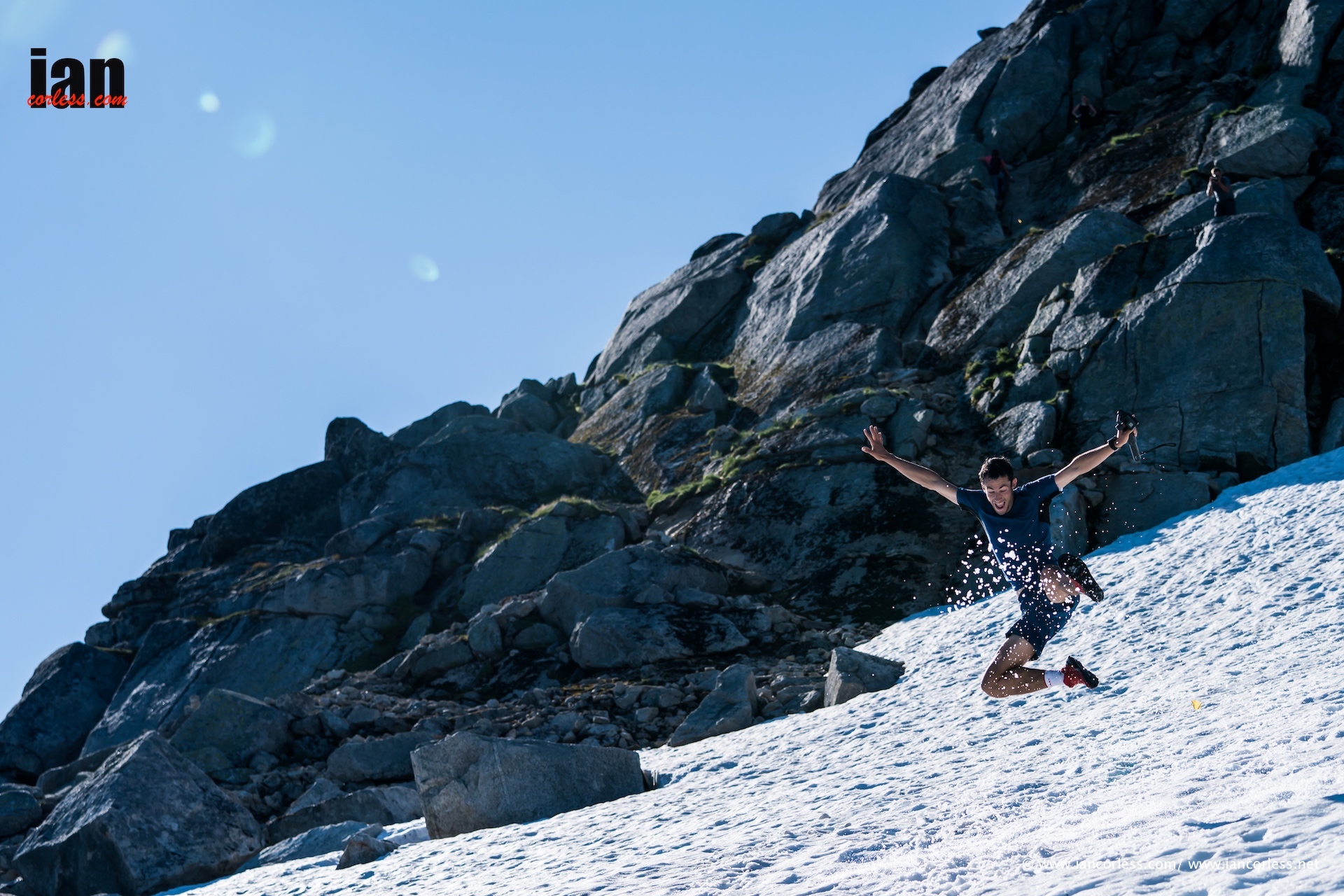
Kilian playing on the course as he waited for the first runners.

As expected, the newly crowned Skyrunning World Champion, Stian Angermund dictated the pace and the race on the steep slopes from the sea. He paced himself early on and then opened a lead over second placed man, Alexis Sevennec.

“I took the early stages early and then as the terrain became more challenging, I started to push and open up a gap,” said Angermund after the race. “I felt very good today but may time is slower despite perfect conditions. I am not sure why? I think it may be because I am preparing for some longer races… today was a magic day though, the views were amazing!”

It was a glorious sunny day of blue skies and void of clouds. By the midway point, Stian had a clear lead over Frenchman, Sevennec who looked strong but Angermund was in his own race as he ran all the gradients.

At the summit, Angermund crossed the line in 36:59, Sevennec trailed by 1-min 45-seconds and Pierre Mettan rounded at the podium with a convincing lead over Julien Ançay and Adam Jensen.

The ladies race once again turned into a ‘nail biter’ as Eli Anne and Emelie Forsberg traded blows. “I am a runner, not a scrambler,” said Anne after the race. “I was leading and then as the terrain became more technical, Emelie passed me. We were neck-and-neck and then I made a surge in the closing meters and passed Emelie – it was so close!”

Therese Sjursen who is a VK specialist ran a solid race for 3rd ahead of Hilde Aders who recently made the podium at the recent Dolomites SkyRace. Rounding out the top-5 was Anita Iversen Lilleskare also from Norway make 4 of the top-5 Norwegian,

  1. Eli Anne Dvergsdal – idrettsutøvar – NOR – 45’58”
  2. Emelie Forsberg – SWE – 45’59”
  3. Therese Sjursen – NOR – 47’21”
  4. Hilde Aders – NOR – 48’22”
  5. Anita Iversen Lilleskare – NOR – 48’28”


  1. Stian Angermund – NOR – 36’59”
  2. Alexis Sévennec – FRA – 37’46”
  3. Pierre Mettan – SUI – 40’37”
  4. Julien Ançay – SUI – 42’03”
  5. Adam Jensen – USA – 42’45”

Attention now turns to tomorrow and the Tromsø SkyRace® which will start at 0800 Saturday August 5th. You can read a full race preview HERE.

Transvulcania Vertical Kilometer® 2017 Summary – Vertical Kilometer® World Circuit

Transvulcania VK – May 2017

The island of La Palma today hosted the 2nd Vertical Kilometer® (VK) in the new 2017 Vertical Kilometer® World Circuit.

The series started just last weekend in Italy with with the Trentapassi Vertical, rising 1,000m above Italy’s Lake Iseo with two new race records. Read the report HERE.

To clarify, a VK is a uphill mountain race that climbs for 1,000m over a course that is less than 5 km in length. Certain courses on the circuit do obtain special dispensation – Transvulcania one case in point.

The route here in La Palma covers over 1200m of vertical gain over a distance of 7.6km and re-traces sections the Ultramarathon course along the GR131 and concludes at the forest lookout tower at an altitude of 1600m with stunning views of the Aridane valley and the north east of the island.

The VK circuit is a Skyrunner® World Series spin off – previously, the Vertical Kilometer® discipline was included in the SWS, it now has its own category that will allow more races in an ever increasing market. In 2017 there are seventeen races in eight countries.

Featuring  the world’s shortest and fastest races, the first and only triple VK, some 20-year-old classics and some exciting new ones, the 2017 Vertical Kilometer® World Circuit will produce some very exciting races.

From sea to sky, up cliff faces, volcanoes, mountain summits and ski runs, this gravity-defying sport is for anyone ready to push their limits – today in La Palma, Transvulcania provided a wonderful showcase for the sport as runners departed from Tazacorte Puerto.

The line-up for the VK was impressive with Stian Angermund, Saul Padua, Ferran Teixido, Remi Bonnet and Ondrej Fejfar heading up a world-class field. Transvulcania Ultramarathon champion Luis Alberto Hernando, also toed the line along with Arley Luque, Jose Manuel Leon, Daniel Garcia, Diego Simon, Joan Freixa and many more.

Stian Angermund dominated with a strong and. course record performance ahead of Luis Alberto Hernando and Saul Padua. His time of 00:47:22. Hernando ran 48:39 and Padua 50:41.

Yuri Yoshizumi headed up the ladies’ competition with Virginia Perez, Daniella Moreno, Gabriela Sanches, Zuzana Kirchova and Zuzana Urbancova, and a return to racing for Stephanie Jimenez after giving birth to her first child recently.

Christel Dewalle from France was an entrant in the race but withdrew from the competition on Tuesday May 9th. This morning, May 11th, the ISF (International Skyrunning Federation) released a communique that related to a doping infringement by Dewalle under WADA rules that related to the Skyrunning World championships in 2016. Dewalle has received a 4-month ban from the sport effective from May 8th and her results from said World Championships will be removed. See the communication HERE.

Yuri Yoshizumi pushed hard up this long course to clinch victory ahead of Stephanie Jimenez and Zuzana Kirchova, the times 00:59:28, 01:01:18 and 01:04:33 respectively.

Attention now turns to the main event of the weekend, the Transvulcania Ultramarathon that starts in the early hours of the morning on Saturday at Fuencalienti lighthouse. You can read the race preview HERE.

Limone Extreme 2016 VK and SKY Preview – Skyrunner® World Series

©iancorless.com_Limone2015-1904

The 2016 Skyrunner® World Series draws to a conclusion in Limone, Italy. The stunning Lake Garda and the mountains that back onto this iconic location provide a wonderful playground to Friday’s VK and Sunday’s SkyRace.

It’s been a long season of Skyrunning with many new races, new experiences and with four champions already announced – Jasmin Paris and Jon Albon for the EXTREME and Cristofer Clemente and Gemma Arenas for the ULTRA – VK and SKY champions will be confirmed in Italy.

©iancorless.com_Limone2015-1462

VK starts – 1800 Friday Oct 14th/ 3.7km 1080m+ ©iancorless.com_Limone2015-7046

Ferran Teixido currently leads the 2016 VK ranking ahead of Jan Margarit Sole and Andrej Fejfar. All three will race in Limone looking for maximum points and the crucial 20% bonus. For the ladies, Laura Orgue leads Christel Dewalle and Maria Zorroza – as with the men, the top 3 contenders will race.

©iancorless.com_Rut2016_SKY-3227

But the racing does not stop there, arguably, Limone Extreme VK has the best VK line-up of the year with a multitude of talent toeing the line. Marco Moletto, Hannes Perkman, Nejc Kuhar, Rolf Einar Jensen, Luka Kovacic and the unstoppable Urban Zemmer. It’s going to be a seriously competitive race but more top names will contest the top 3 podium places.

iancorless-com_glencoe2016-7248

Pascal Egli and Alexis Sevennec will race hard along with Oriol Cardona Coll. Pere Rullan may also race after long injury problems and the possibility of Philip Goetsch racing against Remi Bonnet and Stian Angermund is a very exciting prospect. This may well be a course record year!

©iancorless.com_DOLOMITESVK2016-3681

Racing in the ladies’ race is equally competitive, for sure, Laura Orgue and Christel Dewalle and pre-race favourites but Francesca Rossi, Serena Vittori, Oihana Kortazar, Beatrice Deflorian and Celia Chiron amongst others will push hard up the winding trails to the summit that looks over Lake Garda.

©iancorless.com_DOLOMITESVK2016-3691

A unique feature of the Limone Extreme VK is that start time! Starting as darkness arrives, the runners ascend the 1000m under the illumination of head torches as lights of Limone glow in the background – it is a truly spectacular VK!

SKY – 11am Saturday Oct 15th/ 27km 2450m+
©iancorless.com_DOLOMITESVK2016-3817

Tadei Pivk heads up the 2016 Skyrunner World Series ranking with Hassan Ait Chaou and Pablo Villa Gonzales in 3rd. Young gun, Jan Margarit Sole is placed 4th and he may will be a surprise contender for a top 3 placing but he will have a tough fight from the Casal Mir brothers, Oscar and Marc. In addition, Kiril Nikolov, Adrien Michaud, Alexis Sevennec and Andre Jonsson will run – victory could come from any of these top runners.

©iancorless.com_DOLOMITESVK2016-4006

But as in the VK, the list does not stop there; Ondrej Fejfar, Aritz Egea, Albert Garcia, Rolf Einar Jensen and a potential victory may well come from Mr. Skyrunning, Marco De Gasperi. But ultimately, Remi Bonnet will return after a year plagued by injury. Last year he dominated the Limone SkyRace and VK, can he do it again?

iancorless-com_glencoe2016-8382

If he does, he will have to beat the Skyrunning World Champion for the VK and SKY distance, Stian Angermund. Stian has been on fire in 2016 and is without doubt a favourite for victory! Salomon will also send Micha Steiner, Davide Magnini, Stian Aarvik and Stefan Knopf.

©iancorless.com_DOLOMITESVK2016-3978

As stated, the line-up for the Limone Extreme SkyRace is extensive and dark horses will no doubt appear from the sidelines.

©iancorless.com_Rut2016_SKY-3165

Megan Kimmel has been on fire in 2016 and leads the Skyrunner World Series ahead of Laura Orgue and Ragna Debats. Last year, Megan had a below performance at Limone and it lost her the Series title, I don’t think that will happen this year! Laura has had a long year of racing and has shown some fatigue at times, however, she has had an opportunity to recover recently and for sure she will push Megan all the way to the line.

©iancorless.com_DOLOMITESVK2016-4312

Yngvild Kaspersen will also run and has great potential for a podium place. Caroline Chaverot (Skyrunning World Champion for the ultra-distance) is a surprise entry and my gut reaction is that this race will be too short for her? It will certainly be interesting to see how she performs – she is an incredible talent!

©iancorless.com_DOLOMITESVK2016-4123

Celia Chiron, Sheila Castano, Aitziber Ibarbia, Michaela Mertova, Maria Zorroza and Nuria Dominguez all add to a stellar line-up!

Skyrunning was born in Italy, it only seems appropriate that the traditions and ethos created on the slopes of the snowy Alps should now be carried forward on new mountains and in new places such as the Creste Della Mughera mountains that back on to Limone sul Garda.

Race website here VK information here SkyRace information here


Thanks to the support of our Partner Migu Xempower, Sponsor Alpina Watches and Official Pool Suppliers, Scott RunningCompressport and Salomon.

About Skyrunner® World Series
Skyrunning was founded in 1992 by Italian Marino Giacometti, President of the International Skyrunning Federation which sanctions the discipline worldwide and sports the tagline:
Less cloud. More sky.

The Skyrunner® World Series was launched in 2004 and has grown to represent the peak of outdoor running defined by altitude and technicality. In 2016, the Series, composed of four disciplines, features 23 races in 15 venues on three continents.

iancorless.com is the official photographer and media partner for the
Skyrunner® World Series

Social Media Logos

Facebook/iancorlessphotography
Twitter (@talkultra)
Instagram (@iancorlessphotography

Follow the Skyrunner® World Series on social media platforms

Facebook.com/skyrunning
Twitter @skyrunning_com
Instagram @skyrunning

Salomon Ring of Steall Skyrace 2016 Results and Images

iancorless-com_glencoe2016-8364

Uncompromising mountain running, ridges, scrambles, steep ascents, boggy ground and a bucket full of technical running made the Salomon Ring of Steall Skyrace™ the UK’s Zegama! Following in the tradition of Skyrunning iconic race, Zegama-Aizkorri, the inaugural Salomon Ring of Steall has been touted by all who run it as one of the toughest 25km’s they have ever run! A sentiment echoed by race winner and Skyrunning World Champion for the VK and SKY distance, Stian Angermund: “That was one incredibly tough and beautiful race. Wow, so technical and relentless. The ridges were long and challenging and the climbing kept coming. It really is an incredible race and one that I loved. I’d love to do more races like this!”

“A variation of the classic ‘Ring of Steall’ ridge-walking route this 25km / 2,500m mountain race has spectacular views of Ben Nevis from the Mamores and includes short sections of easy scrambling.”

iancorless-com_glencoe2016-8402-2

Stian followed up his 2nd place in the previous day’s VK with a stunning win in an incredible 3:25:28. Race predictions stated that a 4-hour race was possible, but more like 4 to 4:15. A true reflection on the talent of the Salomon runner.

iancorless-com_glencoe2016-8465

Mamores VK winner Alexis Sevennec did a role reversal with Stian placing 2nd in3:29:04, also an ‘off-the-scale’ time.

iancorless-com_glencoe2016-7400

Adrien Perret placed 4th in the Mamores VK and today moved one step up to take the final podium place in 4:00:51.

iancorless-com_glencoe2016-8694

In the ladies’ race, Georgia Tindley did the ‘double’ winning the Mamores VK and then backing up with a stunning Ring of Steall victory in 4:39:20.

iancorless-com_glencoe2016-8774

Hollie Orr and Jessica Tullie had a neck-and-neck race for 2nd and 3rd with Hollie ‘just’ taking the 2nd podium slot, their times 4:51:53 and 4:52:29

This Skyrunning race route incorporated two lofty ridges within the Mamores, including the Devil’s Ridge, which provides a thrilling and airy traverse with Glen Nevis visible ahead and as a yawning drop far below, and Ben Nevis beyond and towering above.

The Salomon Ring of Steall Skyrace™ is set to become a classic Skyrunning event.

Race results HERE

More images to follow and images available for purchase HERE

Social Media Logos

Facebook/iancorlessphotography
Twitter (@talkultra)
Instagram (@iancorlessphotography) 

Follow the Skyrunner® World Series on social media platforms

Facebook.com/skyrunning
Twitter @skyrunning_com
Instagram @skyrunning

Glen Coe Skyline is featured in my new book, RUNNING BEYOND (information here)

RunningBeyond_JKT

Blåmann Vertical Kilometer® 2016 Summary and Images – Skyrunner® Extreme Series

©iancorless.com_Tromso2016-8309

Starting from the sea and climbing directly to the 1044m of the summit of Blamann, the highest summit on Kvaloya island, the Blåmann Vertical Kilometer® is everything a Skyrunning race should be and the route personifies the sea-to-summit concept.

Unlike other VK’s, this route is more like a mini mountain race as the terrain twists and turns with a variety of mixed terrain. The early stage of soft boggy ground soon give way to huge slabs of rocks that at times require low grade climbing to cover. The use of poles offer no advantage as the race most definitely requires scrambling and ‘hands-on’ climbing.

Just 20 minutes from Tromso, the Blåmann Vertical Kilometer® is a race to embrace.

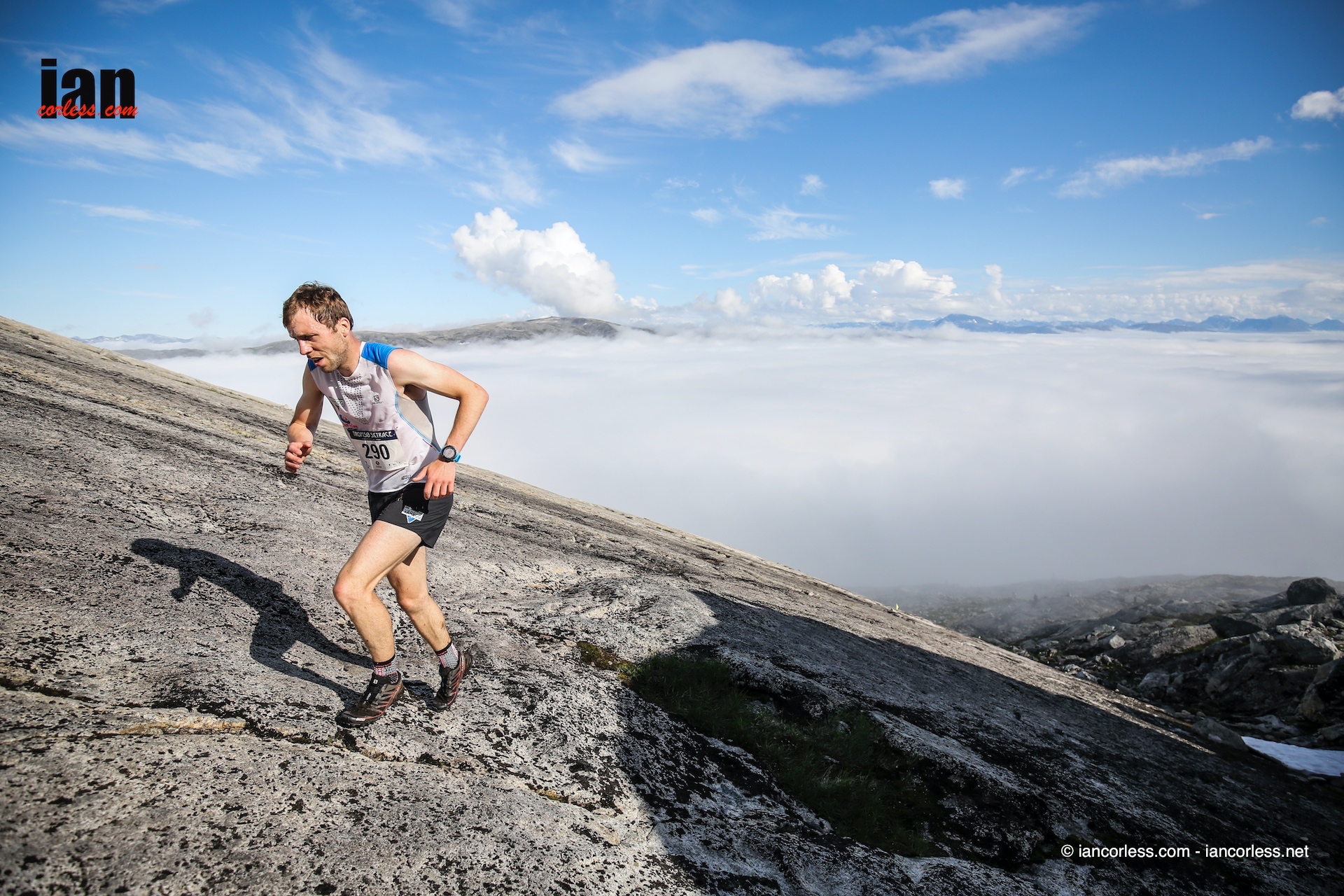
As expected, the newly crowned Skyrunning World Champion, Stian Angermund dictated the pace and the race on the steep slopes from the sea. In the early stages the course was shrouded by mist and cloud but as Stian zoomed up the climb, the mist lifted and above was a glorious day of blue skies and fluffy clouds. By the midway point, Stian had a clear lead over Andorran, Ferran Tpeixido and while other runners power walked with hand-on-knees, Stian ran looking relaxed but breathing hard.

At the summit, Stian crossed the line in 37:00 exactly, Ferran trailed by 31-seconds and David Thibaud placed 3rd in 39:50.

The ladies race turned into a ‘nail biter’ as last minute entry, Emelie Forsberg dictated the early pace obviously feeling feisty after a long recovery process from injury.

At the midway point, Emelie lead the way with Yngvild Kaspersen hot on her heals. Trailing by approximately 30 seconds, Laura Orgue and Hilde Alders pursued.

Laura was not having a good day though, the VK specialist was obviously tired from racing at the Skyrunning World Championships and last weekends victory at the SkyRace Comapedrosa.

Hilde though was on fire. She caught Yngvild and Emelie and in the closing stages it was a neck and neck race with Yngvild leading the way followed by Hilde and Emelie in third. It looked as though this would be the finishing order and then Emelie released an incredible sprint… taking a different line, she zoomed past the other two just as Hilde responded. It was like watching a sprint in the Tour de France.

Emelie crossed the line first in 44:49 (tbc), Hilde placed second and Yngvild 3rd, all separated just by seconds. Laura Orgue finished 4th having eased back.

Attention now turns to tomorrow and the Tromsø SkyRace® which will start at 0800.


Thanks to the support of our Partner Migu Xempower, Sponsor Alpina Watches and Official Pool Suppliers, Scott RunningCompressport and Salomon.

About Skyrunner® World Series
Skyrunning was founded in 1992 by Italian Marino Giacometti, President of the International Skyrunning Federation which sanctions the discipline worldwide and sports the tagline:
Less cloud. More sky.

The Skyrunner® World Series was launched in 2004 and has grown to represent the peak of outdoor running defined by altitude and technicality. In 2016, the Series, composed of four disciplines, features 23 races in 15 venues on three continents.

iancorless.com is the official photographer and media partner for the Skyrunner® World Series Follow on:
Social Media Logos

Facebook/iancorlessphotography
Twitter (@talkultra)
Instagram (@iancorlessphotography) 

Follow the Skyrunner® World Series on social media platforms

Facebook.com/skyrunning
Twitter @skyrunning_com
Instagram @skyrunning

Skyrunning World Championships 2016 VK – Images and Summary

©iancorless.com_SWC2016-4497

Every two years the Skyrunning world assembles at an iconic venue and racing commences in VK, SKY and ULTRA distances to announce a male and female champion in the respective distances for the Skyrunning World Championships. Two years ago, the endurance capital of the world Chamonix, hosted the championships and this year it is Spain.

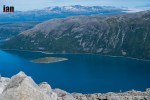
The Vall de Boí in the Spanish Pyrenees will provide a modern day coliseum where Skyrunning gladiators will battle at the BUFF® Epic Trail Aigüestortes events. A spectacular natural arena surrounded by 3,000m peaks and 200 mountain lakes. Rich in cultural history, it is also a UNESCO World Heritage site.

Kicking off a weekend of activity, the BUFF® EPIC TRAIL VK  started at 10am, a race for the short and steep specialists! At 2.8 km long with 1,030m positive climb. The average incline is 30.7% and reaches a mean 50.4% at the steepest point.

250 runners started the race departing at 30-second intervals.

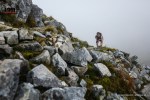
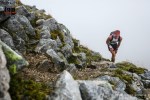
Dark and moody skies, occasional rain and even a little snow welcomed the runners as they climbed hard and fast to the finish line. For many, the cooler temperatures made for perfect running.

©iancorless.com_SWC2016-5039

Stian Angermund from Norway ran an incredible race and became the 2016 VK World Champion crossing the line in 34:16:09. Columbian runner, Sau Antonio Padua Rodriguez finished 2nd in 34:42:63 and Hannes Perkmann from Italy took the bronze medal in 34:44:01 making a truly ‘world’ podium.
©iancorless.com_SWC2016-4604

In the ladies race, pre-race favourite Christel Dewalle from France received the gold medal after crossing the line in 39:35:28. Laura Orgue from Spain took silver just over 1-minute later in 40:39:15 and Maite Maiora, also from Spain took bronze in 41:59:41.
LOGO_SKYRUNNING_WORLD_CHAMPS-768x778

Limone Extreme VK 2015 – Summary and Images

©iancorless.com_Limone2015-7046

Laura Orgue and Remi Bonnet are crowned 2015 Skyrunner® World Series Champions for the VK distance in Limone on the shore of Lake Garda at the 4th edition of the Limone Extreme race.

©iancorless.com_Limone2015-6895

Torrential rain and thunderstorms the previous night and morning of the VK resulted in a course change instigated by the race organisation for safety reasons. The resulting course was very different to the original route and considerably longer at 6km. Less steep, less technical and considerably more runnable. Of course this may very well have changed the dynamic of the race but the usual protagonists for the VK distance still performed at the highest level.

©iancorless.com_Limone2015-7044

VK specialist Urban Zemmer dictated the early pace showing his all around ability to run and drop his hands on his knees and grind out a fast pace on the steeper gradients. However, it was rising star of the sport, Remi Bonnet, who finally made his presence felt at the front. Too many observers this was expected after his recent performances at the RUT in the USA and his most recent victory at Lantau 2 Peaks in Hong Kong. Tromso VK winner, Stian Angermund placed 3rd ahead of Hannes Perkmann VK ever-present Jonathan Wyatt in 5th.

©iancorless.com_Limone2015-7048

In the ladies’ race, Laura Orgue already had the Skyrunner® World Series title sewn up based on previous victories. Despite this, her plan was to run the VK and SKY. However, in the days before the VK, Laura had picked up a virus and decided it was best to miss the distance she loves:

Hard decision today, I need to rest instead of race in the VK. I’m not feeling 100% so I have decided to recover for tomorrow’s SKY race of 23km and 2800m of elevation!”

©iancorless.com_Limone2015-7078

Last minute entrant and VK specialist, Christel Dewalle was the fastest lady on the day and lead from the front constantly trailed by Antonella Confortola, Maite Maiora and Norwegian rising star, Yngvild Kaspersen who moved up to 2nd in the overall rankings.

©iancorless.com_Limone2015-7089

The ladies’ positions remained this way all the way to the line with Spanish runner Oihana Kortazar taking the 5th spot.

©iancorless.com_Limone2015-1

©iancorless.com_Limone2015--2

A total of 296-runners toed the line of the VK which started at the picturesque location of Marconi lakefront on the shores of Lake Garda. The overall elevation gain of the new route was 1200m+ in a distance of 6km.

Attention now turns the SKY race which will start today, Saturday at 1200 local time. This course has also been changed due to Thursday nights and Friday mornings excessive weather. The new route has an additional 800m of vertical gain which makes what was a tough race, exceptionally tough!

RESULTS

1-Christel Dewalle (50’48”)

2-Antonella Confortolla (53’12”)

3-Maite Maiora (53’46”)

4-Yngvild Kaspersen (54’58”)

5-Oihana Kortazar (56’27”)


1-Rémi Bonnet (43’51”)

2-Urban. Zemmer (44′)

3-Stian Angermund. (44’13”)

4-Hannes Perkmann (44’26”)

5-Jono Wyatt (44’43”)


Skyrunner® World Series ranking 2015:

  1. Laura Orgue
  2. Yngvild Kaspersen
  3. Maite Maiora

©iancorless.com_Limone2015-7068

  1. Remi Bonnet
  2. Nejc Kuhar
  3. Ferran Teixido

Limone sul Garda also provided a location for the Skyrunning AGM where the 2014 calendar, 2015 calendar and the future of the sport was discussed.

©iancorless.com_Limone2015-6947

Less Cloud, More Sky!