I have just had confirmation that I will be flying over to Gran Canaria on Monday 25th for several days ahead of the race the following weekend.
I will be staying at a holding camp with the elite athletes so that I can obtain some interviews, capture some images and report back before the action commences.
Unfortunately due to prior commitments I will be unable to stay for the race as I need to leave for Lanzarote on the 28th, rest assured though I will provide as much feedback as possible.
I guess the breaking news is as follows:
Lizzy Hawker has withdrawn from the 119km race as she needs more time to allow for adequate recovery before moving on with a very hectic 2013 racing schedule.
Emelie Forsberg is a last minute addition but she is taking the short option of 42km. It was only last week that she stepped of skis so this will very much be an easing into 2013.
Emelie Forsberg copyright Ian Corless
Ryan Sandes said it’s still early season and has dropped from the 119km distance to the 83km. He obviously has big plans for later in the year and quite rightly is taking a cautious approach to what is still very early in 2013.
CONFIRMED ENTRANTS as of Feb19th
119km
Carlos Sá Portugal 119km race
John Tidd USA 119km race
Lidia Gómez Spain 119km race
Marta Prat Spain 119km race
Miguel Heras Spain 119km race
Miguel Heras copyright Ian Corless
Nerea Martínez Spain 119km race
Sebastien Chaigneau France 119km
Seb Chaigneau copyright Ian Corless
Zigor Iturrieta Spain 119km race
83km
Julia Böttger Germany 83km race
Marco Olmo Italy 83km race
Philipp Reiter Germany 83km race
Philipp Reiter at Cavalls del Vent copyright Ian Corless
Building on the 2012 Skyrunner® World Series success and the introduction of the Ultras, 2013 prepares for an even bigger star-studded cast.
The line-up of champions is headed by 2012 SWS winners Kilian Jornet, Emelie Forsberg and Nuria Picas, joined by past world champions Emanuela Brizio, Oihana Kortazar, Luis Alberto Hernando and Tofol Castanyer and WMRA champions Marco De Gasperi and Stevie Kremer.
Nuria Picas copyright Ian Corless
Philipp Reiter copyright Ian Corless
Emelie Forsberg copyright Ian Corless
With some of the big American ultra legends crossing the pond last year to get a taste of skyrunning, the word is out! Joining them this year: Anton Krupicka, Dakota Jones, Rickey Gates, Mike Foote, Timothy Olson, Joe Grant….
Kilian and Tony Krupicka copyright Ian Corless
Dakota Jones copyright Ian Corless
It’s full immersion for Kilian Jornet who, with his unique skills, will participate in no less than all threeSeries: Vertical, Sky and Ultra!
Kilian Jornet copyright Ian Corless
Lizzy Hawker will be toeing the start-line at the Series’ first 100-miler while Anna Frost will take part in both the Sky and the Ultra Series. The mix includes Phillip Reiter and Julia Böttger from Germany, top French names: Francois d’Haene, Julien Chorier, Michel Lanne, Yann Curien, Maud Gobert and Stephanie Jimenez,Britons Andy Symonds and Tom Owens, Canada’s Adam Campbell.
Marco de Gasperi – copyright Ian Corless
Anna Frost copyright Ian Corless
Strong team participation is engaged right across the Series headed by the heavy-duty Salomon team as well as hefty, international line-ups from inov-8, La Sportiva, Salomon Agisko and Arc’teryx, The North Face, Haglöfs, Montrail, Scott as well teams from Spain, Italy, Russia, Japan
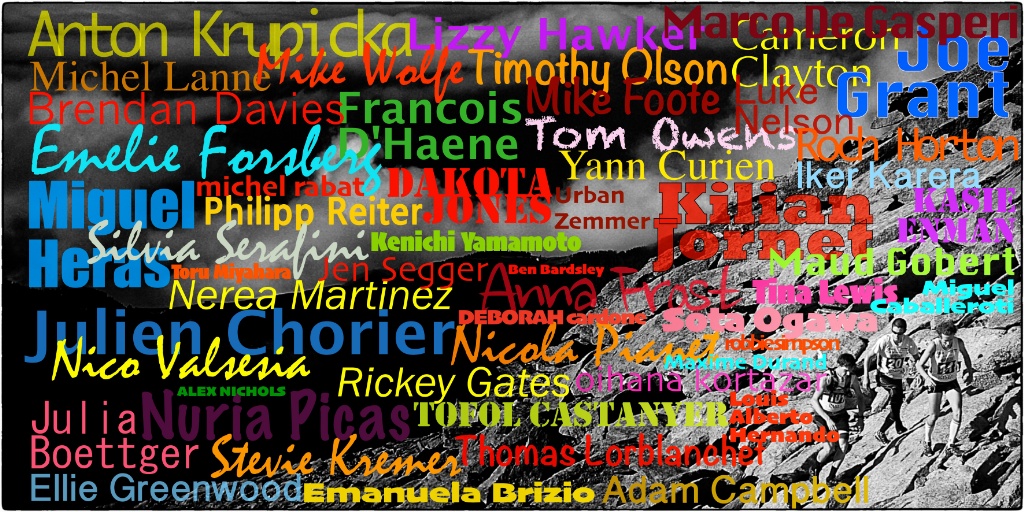
Take a look at the mix here. Have we got everybody?
You’re still in time to join the throng and remember, if you’re competing in the World Series, there’s always a slot available for you.
Follow us for who goes where as the skyrunning season unfolds.
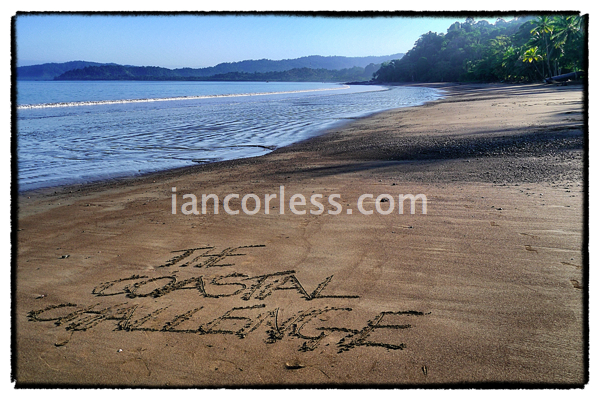
No matter how experienced, no matter how long you have been running, you can always learn something…. My recent trip to Costa Rica and The Coastal Challenge which took place in a rainforest made me realize that I knew very little about running in heat with high humidity, running in a rain forest and also running on consecutive days in this environment.
I am quite meticulous in my planning. I like to tick boxes, cross ‘to do’s’ off a list and feel content that when I am at an airport travelling to a race that I feel that I have done everything I possibly can to get the best out of myself and the race when I arrive at my destination.
Costa Rica was nothing like this….
I only found out I was going about four weeks before, so, that 12-20 week training plan that I would have created to then taper into an event didn’t exist. I was realistically just a week or two weeks away from the taper. When you add to this that since January 2012 I hadn’t been training due to knee issues. Of course I had been ‘working out’ but I hadn’t been training. Nothing specific. Training had consisted of runs every other day with the longest being at 2hrs 15m, other days had been cross training, plenty of time on the stairmaster and stretching and core.
My brief was not to race at The Coastal Challenge. This was a good thing, however, I was working as a journalist and my need to document, photograph and experience the course would mean getting involved.
My plan was simple. Start the day on the course at a great advantage point, photograph the front runners and then run to the end capturing more images, experience the terrain and then write up and download photos at the end of the day. Simple!
In addition to running we would be staying in a different campsite each day. Luggage and tents would be transferred ahead and food was provided.
So what did I learn?
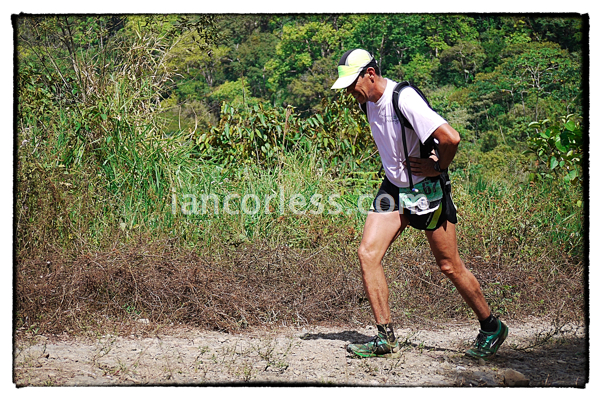
Pacing & Hydration: Costa Rica is hot and humid. Oh yes, hot and humid. Coming from a UK winter the shock is pretty drastic. But I found it manageable. You certainly need to adjust many things and you need to make those adjustments on day one. In simple terms you need to ‘slow down’ and ‘hydrate’ more. Within 10-15 minutes of exercise your body is soaked and your clothing is completely wet.
It stays that way all day so get used to it. Sweat rates vary but in the excessive humidity and adding exercise to this it is fair to assume that 750ml + will be required per hour. Replacing electrolytes will also be important so look into what works for you. Runners used a combination of ‘adding’ electrolyte to water or taking salt tabs. Day one of our race started with a 10k road section, in retrospect this was designed to ease the runners into the terrain and heat/humidity, however, I think it actually allowed to many fresh runners to run too quick right from the gun.
By the time they reached CP1 and the start of the jungle many were already in trouble… they didn’t know it at that point but they certainly knew it in the final 25% of the day. By pushing too hard at the beginning of the day they couldn’t then pull back the deficits in the latter stages and suffered. By the end of day one, the race had several drops and a far too large group suffering from dehydration.
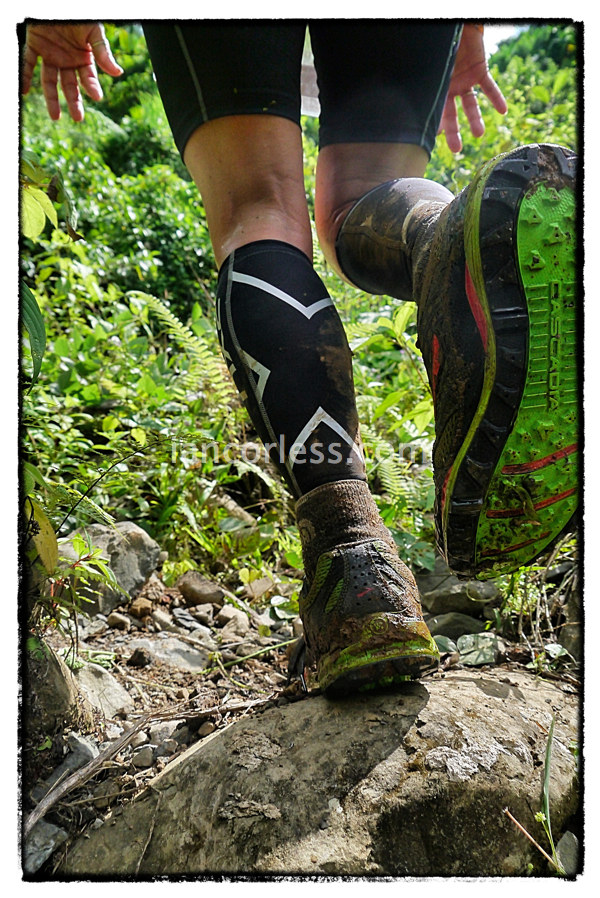
Feet: Oh boy. Multi stage races are renowned for damaging feet but really this shouldn’t happen. If you look after your feet, have the correct socks and the correct shoes it should all be straightforward. Of course unexpected things can happen such as a little rubbing and the odd blister BUT at TCC I saw people with literally no skin left on bruised and damaged feet. I am actually amazed that some of these runners managed to finish the race. The rainforest will guarantee several things:
Your feet will be hot
Your feet will be wet regularly
Your feet will be twisted and turned
Over the six days you will run/walk over 200k
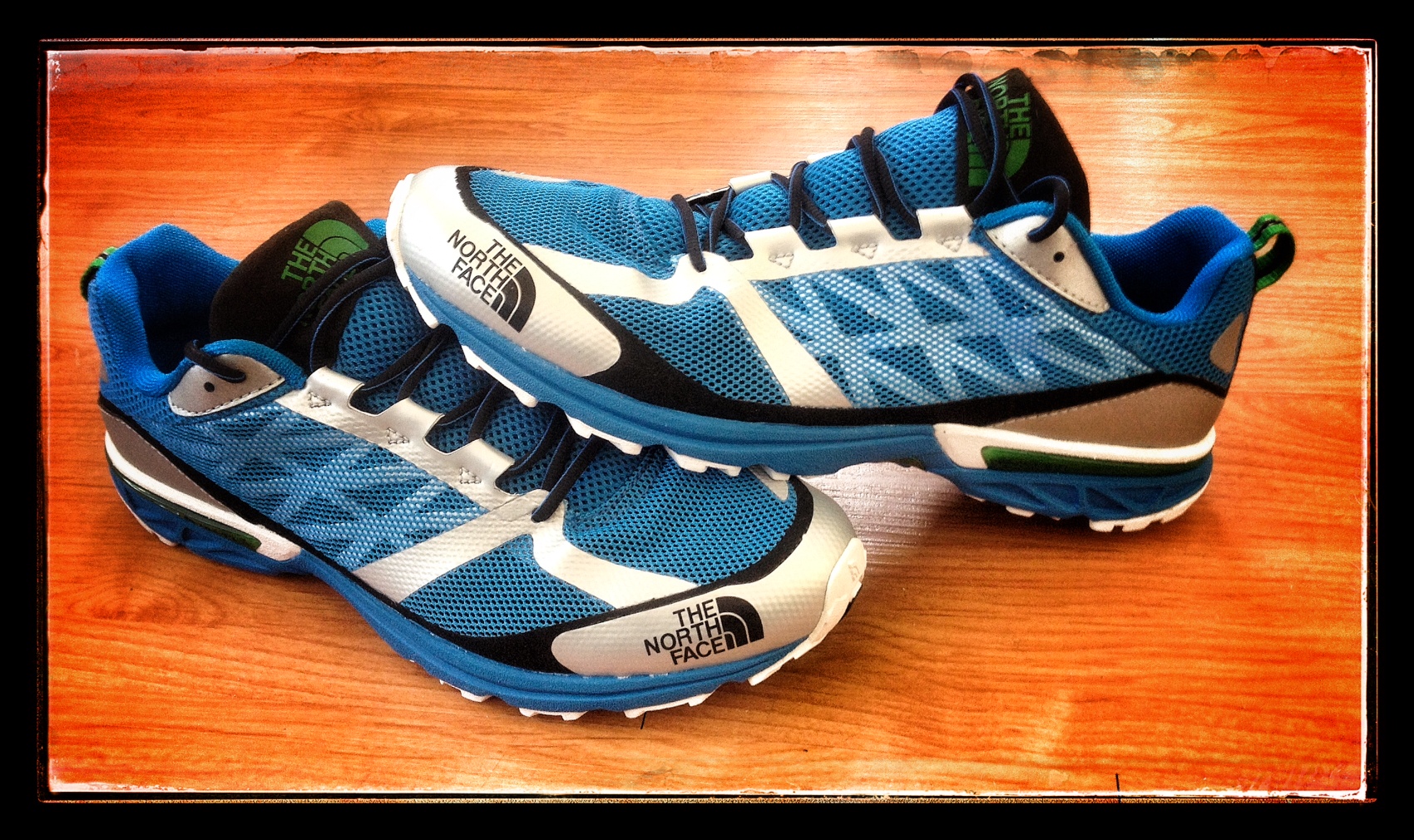
With the above in mind you need to plan accordingly. This race is not self sufficient so this is a big advantage. Why? Well for a start you can bring several run shoes. I took the two ‘styles’ of shoe, Salomon Speedcross 3 and TNF Hayasa,
I had two pairs of each. One my correct size and the other pair a ½ size larger (just in case). A larger shoe will allow some room should my feet expand. The two styles of shoe also allowed me options in regard to ‘grip’. The Speedcross is far more aggressive than the Hayasa. Certainly something with an aggressive tread suited the environment.
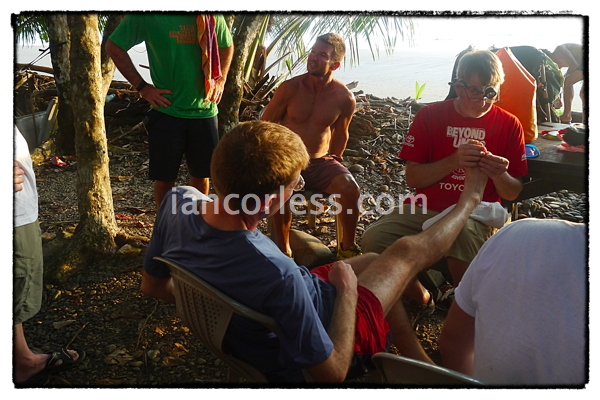
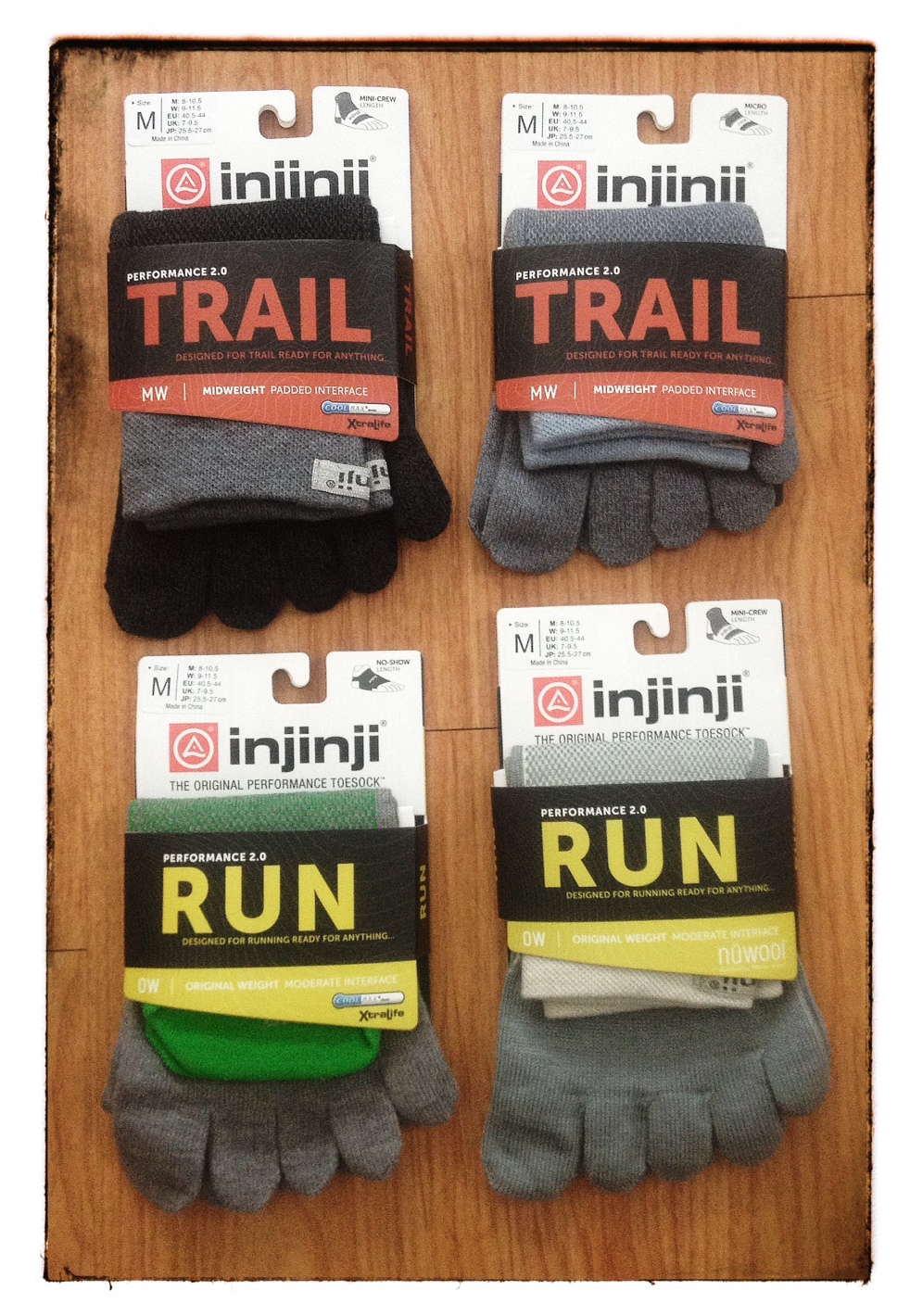
Socks, like shoes are personal but I am a firm believer in Injinji socks. Each toe is in its own ‘little pocket’. This for me reduces the possibility of problems or issues and over the 6 days of the race I never got one blister! The race had a foot doctor. Without him some runners would have been out of the race. If you have this option, take advantage.
In training understand what you will be doing at your race. Practice walking, running, climbing, descending and run with wet feet. Find out what does and doesn’t work. Get the mistakes out of the way before you start the race.
I did not tape my feet prior to running and I added no Vaseline. After each day the first thing I did was to remove socks and shoes, clean them and the wear flip flops to allow them to breath.
*note – many of the runners who had problems had worn shoes too big. They had expected feet to expand but on day one and day two, the ‘larger’ shoes had allowed the foot to move within the shoe and consequently the foot had blistered. I am a firm believer that the shoe should ‘fit’. Excessive movement is a recipe for disaster.
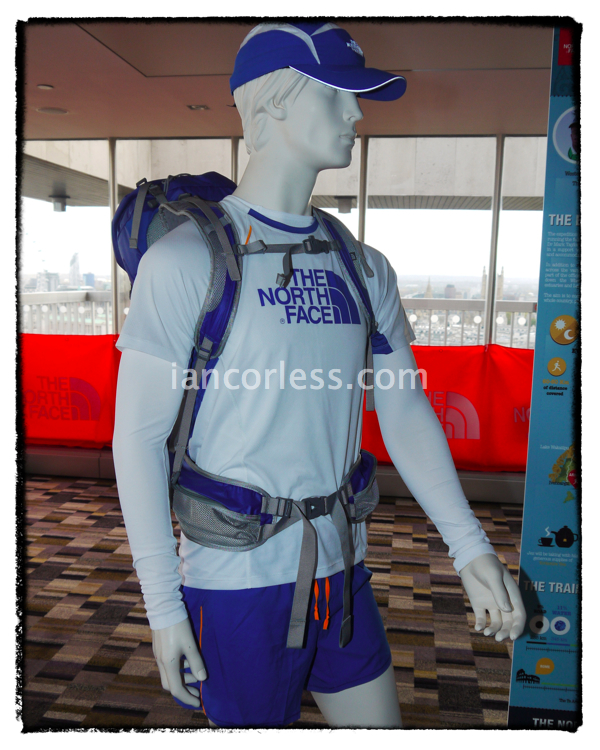
Clothing: Six days racing means six sets of kit. As far as I was concerned. It’s a simple strategy. You run in one set, get showered and cleaned up, put another set on to relax post run and then you use that kit the next day. I was fortunate that The North Face did provide me with some clothing but not six days worth.
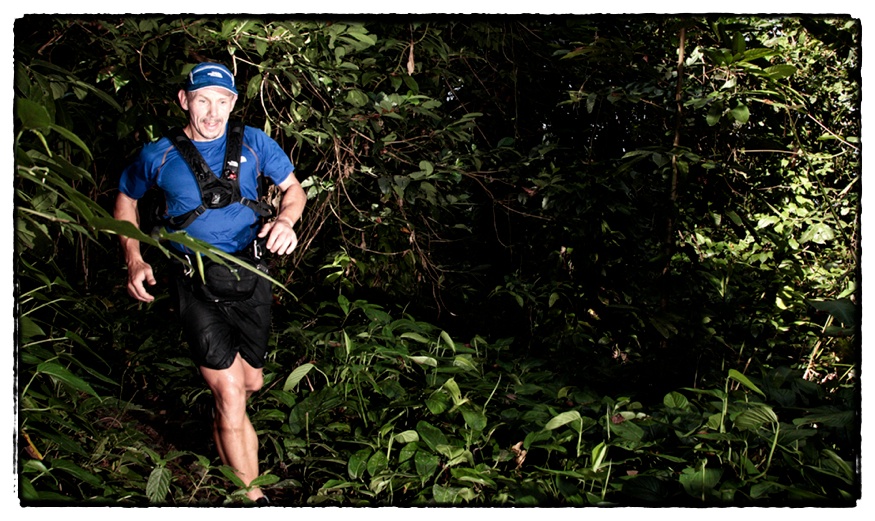
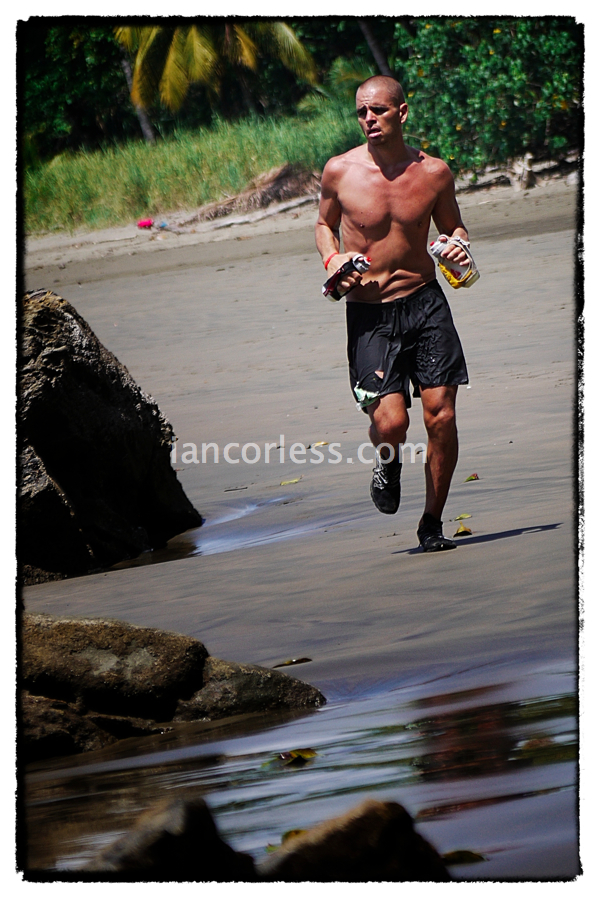
I added my existing TNF stock to the pile. Clothing is personal but the key elements for the jungle are comfort and the ability to wick sweat. I wore T-shirts instead of vests to cover my shoulders (always vulnerable) and I wore loose baggy shorts. It’s not rocket science but shirts with a mesh back certainly help with breathability, especially if using a pack. Race winner, Dave James wore no top! I don’t recommend this… it works for him but his skin looked well adjusted to the sun and I am sure he applied protection too.
Dave also wasn’t using a pack, he used hand bottles only. Ladies have a multitude of kit options available to them, ‘looks’ can be far more important to some than functionality. However, simple functionality works best (in my opinion). Some ladies wore ‘strappy’ tops that offered minimal coverage on the shoulders and after 5+ hours on the trails the inevitable would happen… very unusual tan lines and some sunburn.
TNF Mica 1 Tent
Equipment: This race was supported with feed stations. We had no ‘essential’ kit needs other than carrying adequate liquid supplies. Dave James was the only person in the race who used just hand bottles. Everyone else used a pack of some description. In my opinion, some used packs that were way too big and heavy. I am not sure what some people were carrying but the heat, humidity and long days on the trail should mean ‘minimal’ is a priority. Bladders or bottles? I have to say I am a bottle fan. Bladders are just too awkward.
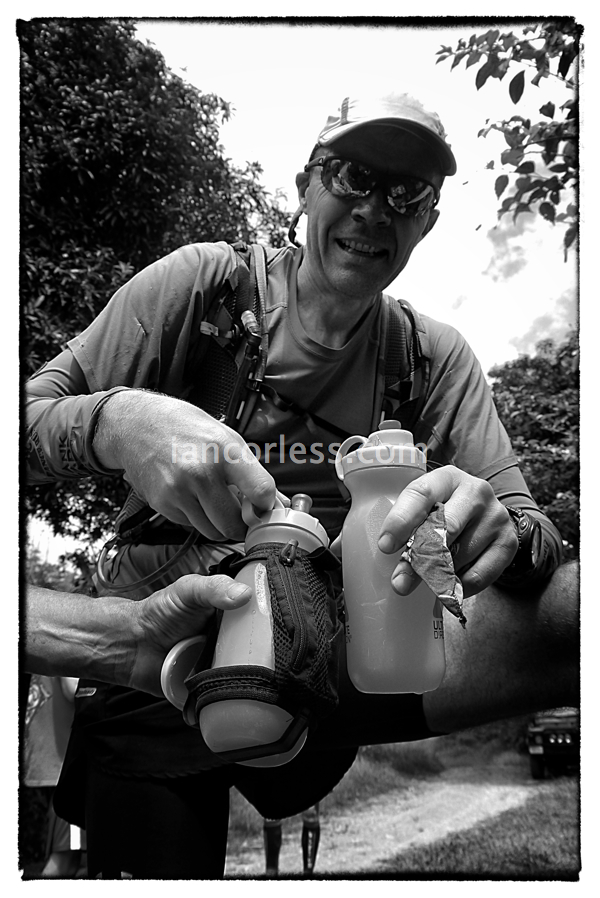
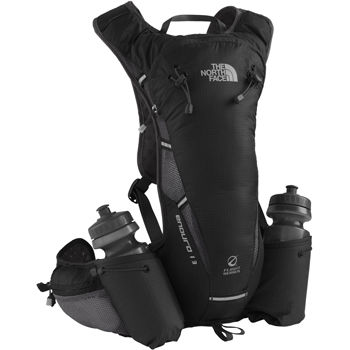
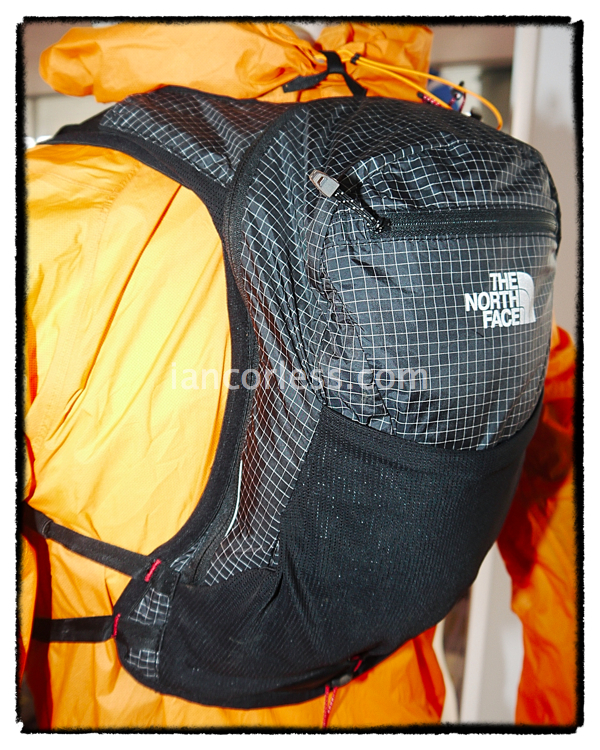
I used the TNF Enduro 13 pack with two bottles that sit on the waist. In the pack I was carrying two cameras inside and one camera which I added to the waist belt. However, this pack can also take a bladder too. So, if required I could have carried 3 liters. Had I been ‘racing’ I most certainly would have done this on the two long stages as feed stations were wider apart. Always best to stick to just water in a bladder to avoid problems with taste and bacteria. In regard to ‘essential’ kit I had a whistle, first aid kit, some food, purification tablets, phone, cash, small pocketknife and additional sun cream. With regular feed stations and such a hot climate it really wasn’t necessary to carry anything else.
Tips on the trail: Run in the shade whenever you can. I found that as the day got hotter it was effective to run all shaded sections and then reduce pace or power walk in the open sun sections to regulate temperature.
On hills I power walked as fast as I could. On some sections of the course, depending on your run style and ability, ‘poles’ may well have been useful.
Descents on the whole were easy, however, one stage in particular was brutal. It’s always a good idea to practice going down hill. Poles again may have been useful BUT vegetation can be very thick and poles would have got caught and may very well have been an additional hazard. Remember that you want to reduce fatigue and impact as much as possible. This is not a one-day race but a six-day race. Short steps reduce the impact.
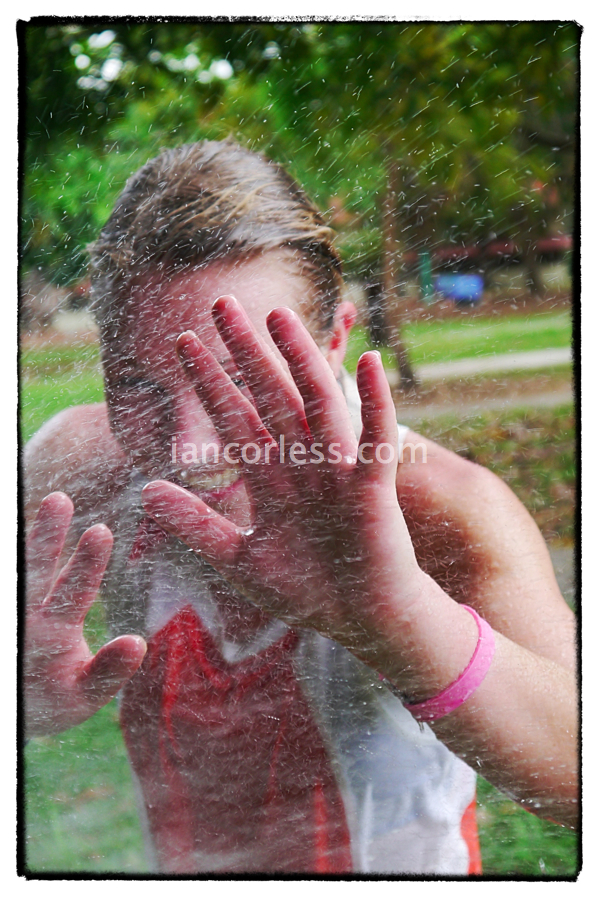
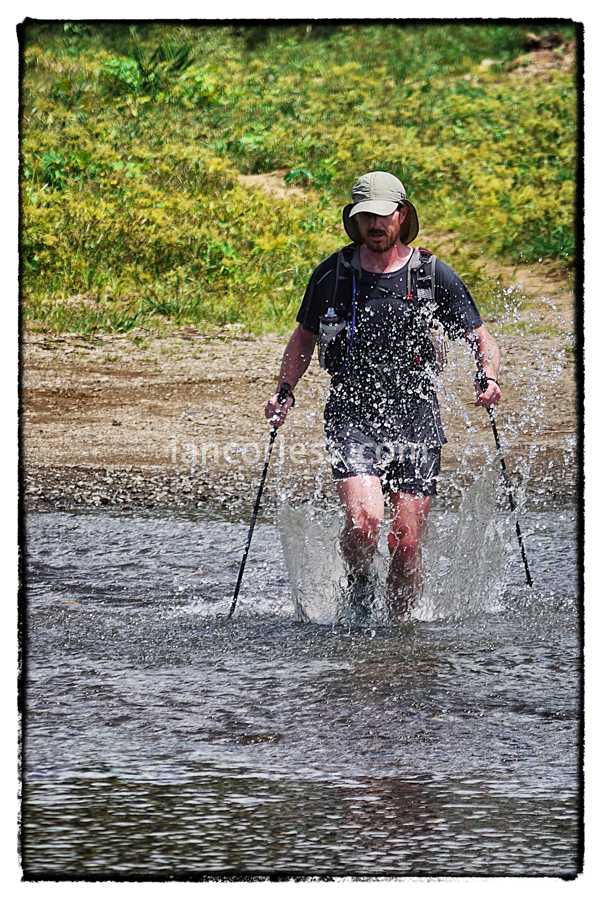
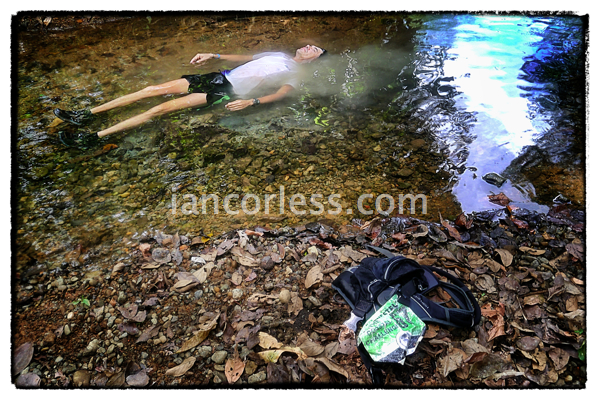
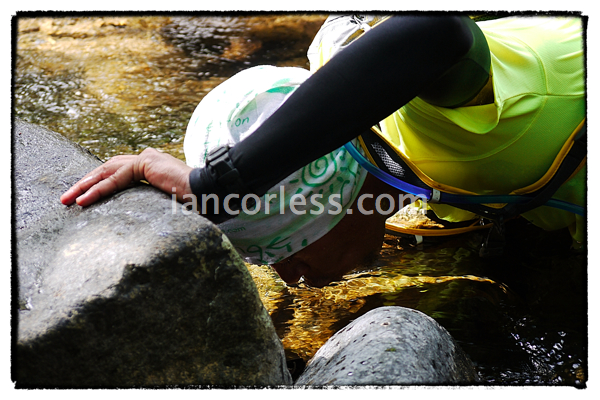
Utilize all water on the course! Any chance you get, submerge yourself in water crossings, wet your head, wet your neck and take a minute to let your core temperature drop before moving on. The route has plenty of opportunities for this, it’s crazy not to take advantage of it. I
f you find ‘flowing’ water that is not near farmland then use it to drink. Many runners did this and as far as I know, nobody had issues. I carry ‘purification tablets’ just in case. Better safe than sorry.
Feed stations are important. Always refill your bottles and take on energy. If you are struggling take some time out. Five minutes in the shade can make a world of difference.
Depending on your ability, ‘buddying up’ is a great idea. If your plan is to maximize the experience and not race then buddy running can make the experience far more rewarding and potentially less stressful. The course was exceptionally well marked but you could go off course and many did. A buddy is a nice security blanket. In actual fact, 2nd and 3rd placed ladies in the 2013 edition buddied for the last two stages.
You are in a jungle so wildlife is all around you. You hear it all the time but the reality is that you see very little. All wildlife is far more scared of us than we are of them. Main issues may come from snakes or spiders. In thick vegetation its wise to look at foot and hand placement just to make sure!
Calf guards (or compression) on one or two stages would have been good. I personally prefer not to have additional skin coverage so that I can keep cool, however, one stage in particular had undergrowth that was well above knee height and it did cut, graze and irritate my legs.
Camp life: Camp was a great place. You had very little to worry about as food and drinks are provided. It becomes a social mecca in the sun. Sites were strategically placed next to the sea or a river so you could swim or cool down that way. All sites had toilet and shower facilities (some better than others). Important factors were:
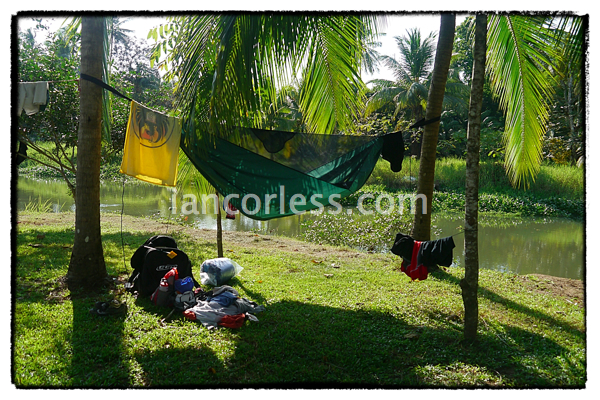
Tent/ Hammock
Clothes
Kit
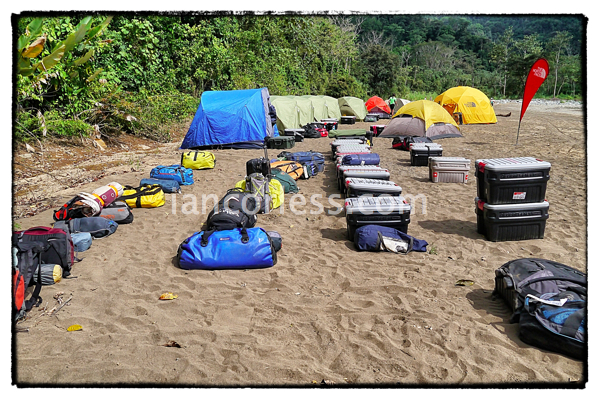
Tents that pitch ‘inner only’ are essential. It is so hot you need nothing else. Of course, it is a rainforest so make sure you bring the flysheet just in case. Other than a few short showers we had no rain (unusual apparently). I use a small one man tent, the TNF Mica 1 and it was perfect. I had an sleeping matt and inflatable pillow. I didn’t use a sleeping bag but I did take a ‘sleeping bag liner’ for any potentially cold or chilly nights. I slept in my next day run kit.
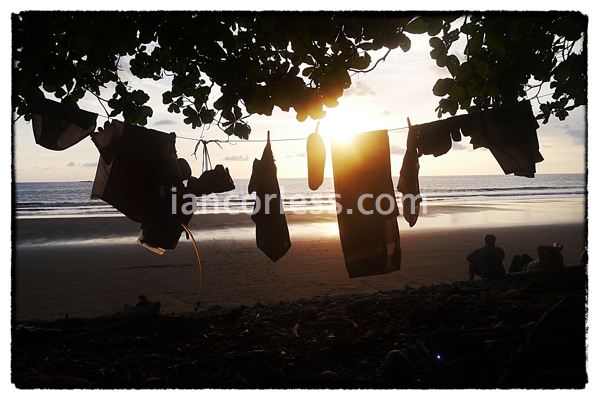
Your clothes and kit are outside all night, so, the organization recommend ‘spacepackers’ they are waterproof containers that hold all your kit. They are a good idea but hopeless for travel. One or two people had large ‘Stanley’ toolboxes that had wheels and a pull handle; much better idea.
I used a TNF ‘Basecamp’ bag which was waterproof and easy to transport. I also had a TNF waterproof rucksack. It was essential. In this I stored my computer, cameras, cables, phone, microphone, etc, etc. I can’t recommend this pack enough.
Waterproof Pack
I had a full medical kit that included everything that I would need. It had all sorts of medication, scissors, tapes, creams, antiseptics etc to cover pretty much all eventualities. The race does have a medical team and foot doc but you should be responsible for all the essentials.
I carried very little additional clothing. I had lightweight long travel pants, travel shorts, hat with neck cover and some lightweight shirts all supplied by Arc’teryx. Perfect!
I had one lightweight showerproof/ windproof jacket should it be required. I didn’t need it at any point during or after the racing but San Jose before and after the race was much cooler. It came in handy then.
Flip flops or similar are essential!
I had one towel, a travel towel that you can get from any ‘outdoor’ store. Small pack size and dries quickly.
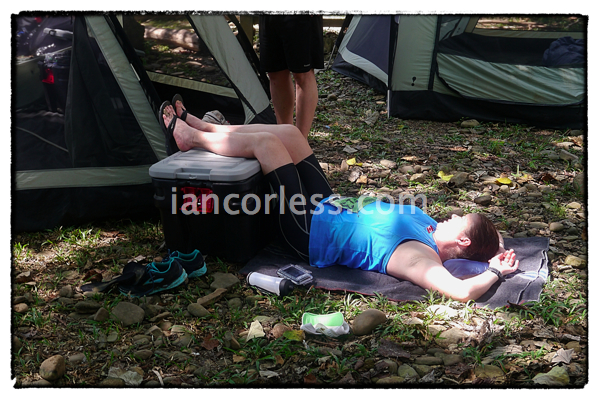
RECOVERY: Important. After each stage, recover. Drink, eat, look after your feet and then get some time with your legs in cool water and elevate. Find some shade and relax. Get a massage if it’s a possibility. At the TCC they had a team of masseurs.
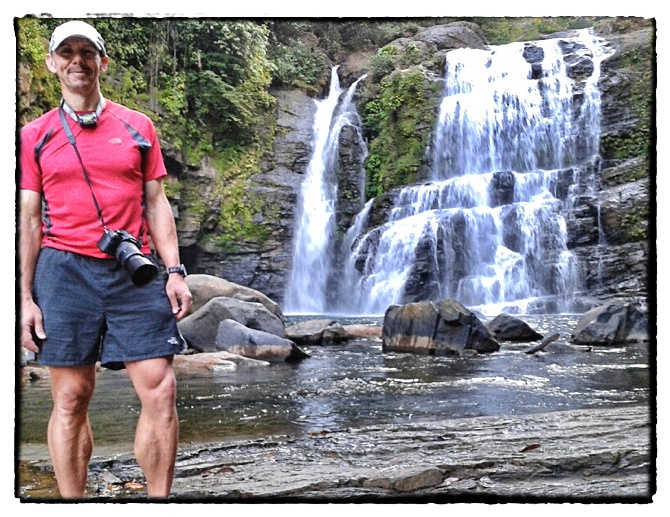
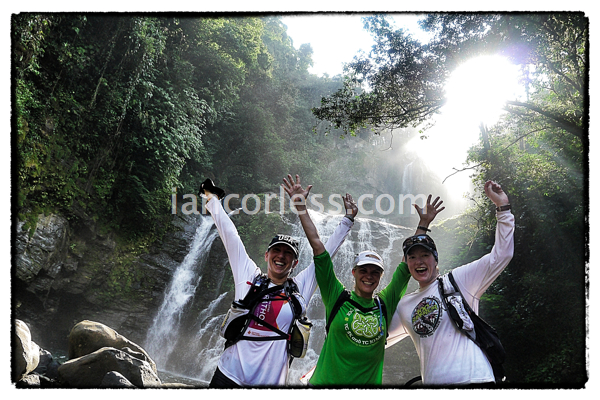
Extras: Don’t get too involved in the racing. The course (and others) has so much to see and experience that you don’t want to get to the end and it be a blur. I feel very fortunate that I ran with cameras and had a job to do. I had to stop, look around, decide on photo opportunities and often wait. I really feel as though I experienced the rainforest. I will never forget sitting in the middle of a river at 0600 one morning waiting for the runners to run towards me. I saw birds, snakes, monkeys and I heard so much more… special moments that all added to the experience.
Stage racing is all about bonding and making friends. I am pretty sure that every runner left with so many more new friends. Go into these experiences with open arms and you will leave with them full.
Understand that before you start you will need to dig deep. This may be a holiday but it is no picnic. The Coastal Challenge is a tough course. The dnf’s and drop downs to the shorter Adventure category confirm this. But it is achievable for everyone. If you get day one and day two right, three, four, five and six fall into place. It’s not meant to be easy. If you understand that, the outcome will be a positive one.
Essential Kit:
Run shoes 2 pairs
Run kit for six days – tops, shorst and socks (I recommend 6 sets)
Rucksack that can hold 2-3 litres – bottles/ bladder or both
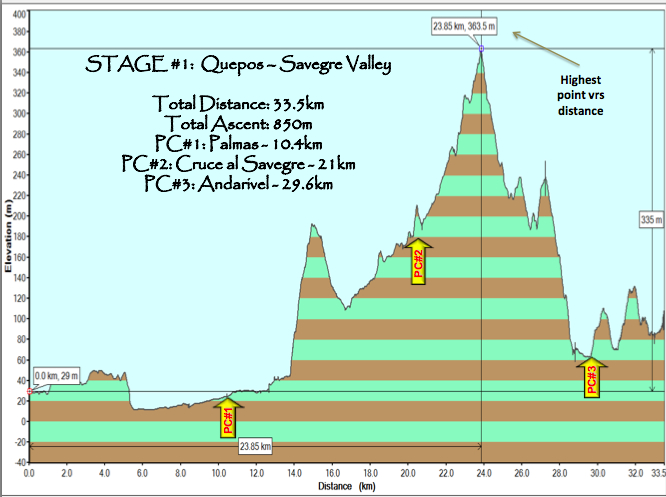
Saverge Valley to Dominical Beach via Brujo, Dos Boscas and Hatillo
The sound didn’t stop… a million ‘Chichara’ echoed into the night providing the most awesome soundtrack to a night in a tent! Believe it or not, most people hit the sack by 1930hrs. For a few adventurous runners it was 2000hrs.
The heat had subsided but it was still a warm and humid night. Tents are pitched ‘inner’ only so as to allow for more airflow and sleeping bag? No, no, no… most definitely not required.
0330 alarms disturbed the now quiet beach. The Chichara had finally gone for some RnR, it was our turn to disturb them. The kitchen staff had once again done an incredible job. These guys are doing an endurance event themselves. Cook breakfast for 0400, pack up and load up, move to the next stage finish, unpack and set up and then start cooking ready for the arrival of the runners. Provide lunch and then cook dinner. The next day, do it all again.
I went ahead of the race today, as I wanted to climb to the second summit at 760m and capture images on the way as the front-runners came towards me. This section of the course had dense forest, mud and a whole mixture of different terrain. It was ‘proper’ jungle! I was on the trail by 0630 and I anticipated the front-runners around 0815.
Back at camp runners assembled and started at 0545 with the start of a new days light. The sky was red… it was going to be a hot day. Total distance for the day was 39km but CP1 and CP2 although only 11k apart on this terrain and with the heat, this is quite far. Carrying enough liquid was essential.
Day 1’s eagerness was tempered with a little carried over fatigue and the realization that this was going to be a much harder day. Dave James in the lead by 46 mins overall was going to run with Ismael Dris today. He had said to me the night before “I have no need to run any harder that Dris wants too, it will be nice to spend time with him on the trail”.
Like clockwork they arrived at my ‘hiding place’ at around 0825. Dave, looked very relaxed and in control with no shirt and two hand bottles. Dris looked less secure as he immediately fell behind. They sped past with Dave stopping for a moment “make sure you go up Ian, the trail is awesome, some really dense undergrowth” and they were off!
Monestel and Lopez placed 3rd and 4th and held these positions to the end. Dripped in sweat they ran along the trail eyes focused on each step ahead.
I headed up the trail and the undergrowth closed in. It was really great to see. Noises wrung out from all around me. You can’t pinpoint anyone sound, it’s just a carcophony of noise. However the roar I had heard earlier (twice) did prick up my ears.
Just before I reached the summit a bunch of runners came through, obviously using the approach of safety in numbers. And then the first lady, Tricia Lopez from Costa Rica.
I continued up the trail and then turned and started my run back to the finish line. The objective to track Tricia and get a selection of images and then leapfrog to get some images on the beach.
By this stage Dave and Ismael had finished the day in just over 5hr (5:01), 3rd place Monestel arrived 1hr and 20 mins later.
The beach section, although completely flat seemed to be the ‘gripe’ of the day. By this time runners were dehydrated, tired and just wanted to finish. However, it did have a couple of great water crossings to help cool everyone down,
Tricia held on to her advantage and crossed the line first lady at 1:14 pm, some 2 hours and 22 mins after the lead men, Angela Mayer from the USA and Gemma Slaughter finished in joint 2nd just 10 minutes behind Tina. They had definitely closed over the latter stages.
The Coastal Challenge is all about participation and as Kami Holtz, Pam Nielsen (both from Minnesota) and Helen Lavin (California) all first timers at The Coastal Challenge are as they say themselves, ‘middle of the packer’ but they had a great day finishing in just over 8 hours – “It was a challenging course, it was muddy, technical with tough climbs but we are rewarded with beautiful views. It is what we are here for. However, the beach at the end went on forever. Plus the sun was up at this point just beating down on us.”
Results and other additional race information are available on the race website HERE
Tomorrow
Stage 3 is a longer and tougher stage. Starting at Dominical Beach we head up and up to a highpoint of 800m but this terrain includes river running and some stunning waterfalls. At 48k it will test already tired runners and again, we have another beach finish.
February 2nd 2013 recorded less than 1 day after Jez Bragg recorded the fastest time of 53 days 9 hours and 1 min for crossing The Long Pathway – Te Araroa Trail in New Zealand.
November 13th 2012 seems such a long time ago… New Zealand House in London and a press conference organized by The North Face to announce Jez Bragg’s 3000 + km journey along the Te Araroa – ‘The Long Pathway’ in New Zealand.
INTERVIEW available from the press conference HERE
With a departure date of Dec 4th and a start date of Dec 12th, Jez’s journey was always going to be an epic. But this was no ordinary journey. An addition to running from the tip of the north island to Bluff at the bottom of the south island, Jez would also cross all water sections by his own power.
His crew of Mark Taylor (father in law) and Jamie Ashwell (long term friend) as you can imagine have been integral to the success of this journey. Mark is an experienced Kayaker and this would provide great support for Jez in the water crossings. In particular, the crossing of the Cook Strait.
Jamie is a dab hand in the kitchen and knows Jez well. As Jez said on numerous occasions “you need the people around you to understand you. I will have lots of highs and lows on this epic journey”. The team housed in a modest camper van would be spending some 50+ days together living and breathing each others air.
Dedicated crew
Jez had the dream of running the Te Araroa when Paul Charteris, organizer of the Tarawera ultra in New Zealand mentioned it to him. It was approximately 3 years ago. The trail at that stage was not completed but with a proposed opening date of December 2011 Jez decided to pitch the idea for funding to The North Face. A key element of TNF backing is that each year they take ideas from sponsored athletes and discuss the pros and cons. Lizzy Hawker had benefited from this in the past with her Nepal crossing. With the idea submitted, Jez crossed his fingers… it worked! The idea was approved and it was all systems go.
Of course best-laid plans occasionally hit a glitch. With planning well underway and dates set, Jez and the team heard that Richard Bowles had started on the Te Araroa and planned to run the whole length… “these things happen and you can’t plan for it” said Jez “although Richard will now be the first person to run the whole trail it won’t be the same as mine. I will do this under my own power for the whole length and in addition, I plan to go for a fastest known time”
Mike Wolfe, fellow TNF teammate and respected ultra runner in his own right had also been brought into the mix. Initially the plan was for Mike to join Jez when he reached the south island and then pace and help him along as he battled the tougher sections of the course. When I caught up with Jez after his crossing of the Cook Strait and just as he started to run in the south he confirmed that Mike would no longer be joining him. Mike had been suffering with some injury and as desperate as he was to join Jez for that ‘lifetime’ journey he had to be sensible and hold back “Jez is killing it man” Mike said, “he is doing such an awesome job, I don’t think it’s getting enough attention. What Jez is doing is awesome. It breaks my heart to have to say no at this stage. Believe me I have labored over this decision”
You can listen to my interview with Jez just after he had crossed from north to south in episode 26 of Talk Ultra HEREgo to 01:09:30
What is the Te Araroa?
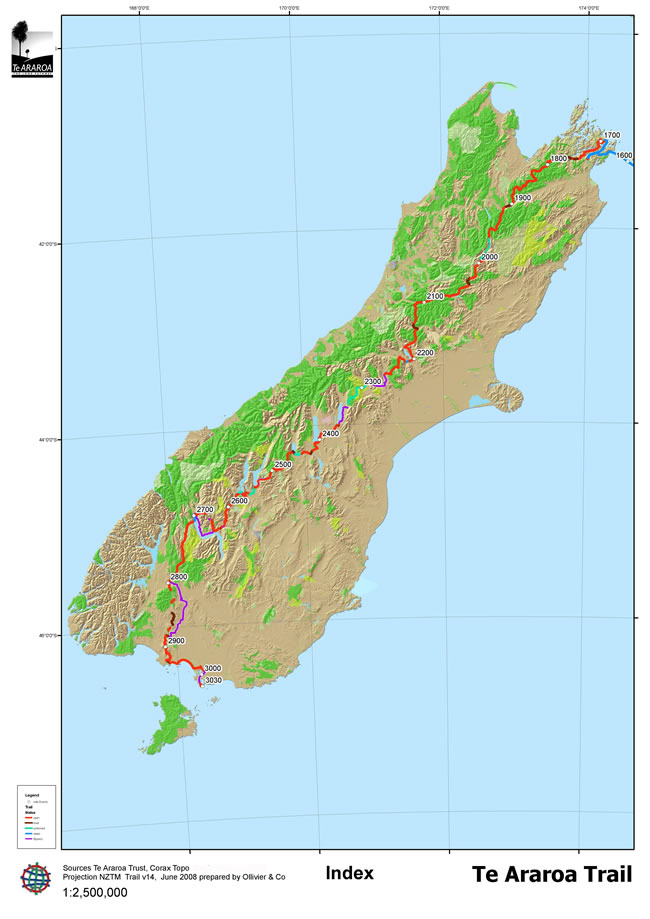
Te Araroa – The Long Pathway – is a continuous 3,000 km walking track from Cape Reinga to Bluff. It is described on the official website as the ultimate 120 day New Zealand experience (Jez did it in 53 days).
The Te Araroa is a different kind of trail. Its boundaries are the natural boundaries of New Zealand. It links settlements, townships and cities. It has a multitude of experience on offer; cultural, natural and historic. Starting at the sea and finishing at the sea when en route you explore tombolos, volcanoes, mountains, rivers, lakes and valleys.
As Jez found out. It’s one seriously tough trail. He started by running for miles and miles along desolate beach. He was then on thick, muddy and gnarly trail. Sometimes going up, sometimes going down. He expressed “it is more of a route than a trail. A trail would imply that I have marked path but more often than not I am just trying to get across sections as best as I can. It is so difficult, incredibly beautiful but ultimately it has been like running in a jungle. It’s been tough!”
Practicalities
“I am amazed at what I have been eating” said Jez “I normally wouldn’t eat cooked breakfasts but Jamie has been incredible providing me with eggs and bacon in the morning. To be honest, I just can’t eat enough”. What is interesting that after a problematic early 2012 season and constant stomach issues, Jez found out he was gluten intolerant “once I knew, the transformation was remarkable, within just two weeks I was a changed person”
This dietary knowledge has been crucial in the success of this expedition. It was only a month or so before his December departure date that Jez had wondered if the journey would be possible.
“You can’t run without energy” Jez explained “when you don’t absorb the calories or when the calories you eat cause problems, you only have one solution, stop or find out what is wrong”
Jamie, armed with this knowledge has been able to make sure that Jez has had the food he needs in the quantities he needs and of course it has all been gluten free!
The ‘Tardis’ the modest camper van has been HQ for the whole trip providing a well needed bed for Jez and the team but very often Jez has camped wild or used huts to maximize time on the trail. Of course, The North Face has been instrumental in providing Jez with all the required kit to make this happen.
Although the plan for each day was not fixed in advance, a strategy was always formulated on the morning or the night before. Mark and Jamie would arrange to meet Jez on the trail at certain points to replenish supplies and provide support.
Everything would be ready allowing Jez to replenish or eat and then be back out on the trail asap. If Jez stayed out on the trail a pack would be prepared in advance – tent, clothes, sleeping bag, jetboil, food and most importantly a satellite phone.
Family
Jez was married not long before he headed out to New Zealand. In addition to this, Christmas Day would be spent on some trail. Not an ideal way to start a new marriage? But Gemma seems to have thrived on seeing Jez achieve. She travelled out to New Zealand after Christmas and has been able to see the transformation in Jez. This transformation is physical, of course, she has seen the ravages of all those miles and the deficit in calories but the change will be one many of us won’t see. It is the change that will be within him. Nobody will know some of the personal battles and demons that Jez will have faced while putting one front in front of the other.
Mark my words; once Jez has recovered from this journey I think we will see a ‘new’ Jez on race start lines. All the accumulated miles and hours on the trail and the mental hardness will be transferred into winning performances.
Without doubt and I know Jez will be the first acknowledge this, that Mark, Jamie, Gemma and her mum, Hiliary have been an integral element of this whole journey. He may have been out on the trail running but the planning, support and backing has come from a camper van. Even down to home cooked food and homemade cakes.
Job done
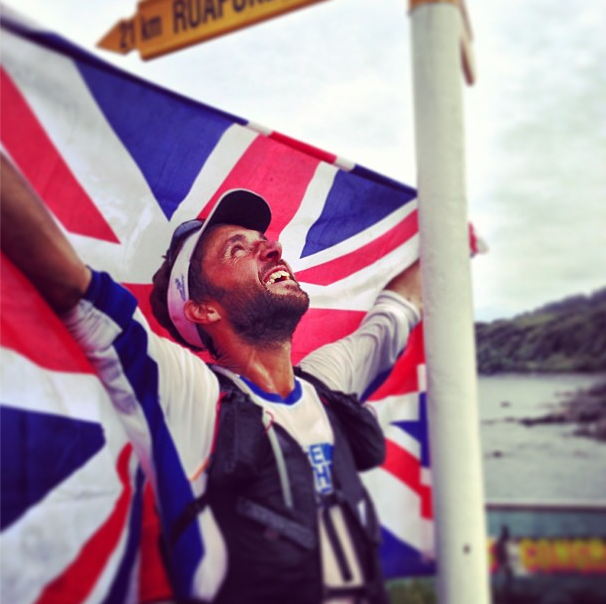
53 days, 9 hours and 1 min. Job done! The previous record was 62 days set by Richard Bowles.
Jez initially had planned to complete the Journey by the end of January and he most certainly would have had had he not been hit with stomach issues on the south island. After a late finish, 3am! Jez had a fever. Understanding his body very well he knew he was in trouble. After resting and taking medication he finally responded but ultimately lost three days…
And I quote Jez:
“At a 1601hrs this afternoon, 53 days 9 hours and 1 minute after setting from Cape Regina, I finally completed my long journey down the Te Araroa trail, arriving in Bluff – lands end on the southern tip of New Zealand’s South Island. Gathered there waiting were my crew, Mark & James, my wife Gemma, my mum and my mother-in-law, Hilary. Damiano from the Storyteller Collective was there capturing the moment on photo and video, just has he done so magnificently throughout the expedition. They sprayed me with champagne and we danced around the landmark yellow finger post like we’d just won the lottery. There were bystanders around too, probably wondering what the heck was going on, but none of us gave a hoot. It was raw emotion for me; all my heart and soul, sweat and tears, had been put into realizing this moment, and it almost happened too suddenly to take it all in. I’ve been a robotic state for most of the time since I started – in my own little bubble – and I think it’s going to take several days to snap out of it. My body is also going to want to know what the heck is going on when I don’t run tomorrow; so I think some wind down jogging/ walking is going to be important”
02nd February 2012 – I am scheduled to catch up with Jez as soon as possible. He is currently in New Zealand to the 7th and then will go to Thailand.
UPDATE
February 2nd 2013 recorded less than 1 day after Jez Bragg recorded the fastest time of 53 days 9 hours and 1 min for crossing The Long Pathway – Te Araroa Trail in New Zealand.
“So with those two big back to back days complete, I’m now just a smidgen over 250 kilometres from Bluff. I’d be lying if I said I wasn’t thinking about the finish now. I’m starting to visualise the end, and think about the day I wake up and don’t need to run. That is starting to appeal more and more. This has been quite some journey, and my body is starting to get rather weary.”
Yes, Jez has just 250km to go to set a new record for covering ‘The Long Pathway‘ in New Zealand, Teararoa.
Despite some sickness he has battled through and as he says above, the end is in sight.
Many congratulation Jez on what has been an epic journey.
I’m starting to visualise the end, and think about the day I wake up and don’t need to run.
Question – “Ian, are you free the first 10 days of February?”
Answer– “I leave Spain today and I am back in the UK late tonight. I have a busy morning on Saturday and I have some interviews to do Saturday afternoon but I will be free around midday to chat if you are? Alternatively drop me an email. Hope you are well? February should be okay, lets discuss.”
Reply– “Great, so you can go to Costa Rica for the multistage ‘Coastal Challenge'”
Answer – “Erm, yes! of course”
So, with just 4 weeks to prepare I was suddenly thrust into a week in the jungle. A whole new experience for me but one that I am so excited about! The Coastal Challenge.
I would normally be thinking to myself this is awesome. I get to go to Costa Rica, take part in a 6 day multistage, take photos, write an article and of course get some interviews. Unfortunately my long term knee injury is going to stop that… 225km over 6 days will just be too much and of course, I am not fit! Well, not race fit.
But as I said to my client and the RD, I think it is important to go these events and see it from both sides. If I am taking part, I wont see what is happening at the front of the race. I wont see ‘the race’ for the win. I also wont see the logistics and planning that go into a race like this. My trip is all about understanding every aspect of this race. So I am happy. I plan to dip in and dip out of stages but ultimately report on and bring back a whole series of images and stories that I can relate back to readers and listeners worldwide.
The first question I had was, can I die?
Heat Illness and Dehydration
Individuals who are not well conditioned traveling in hot, humid environments are susceptible to both heat illness and dehydration. Heat illness includes both very benign conditions such as heat rash as well as life threatening conditions including heat stroke. Participants should carry enough liquids to ensure hydration during the event. It is important to eat and drink appropriate amounts of liquids with electrolytes during the event to reduce the incidence of hyponatremia. Water has not been an issue in previous Coastal Challenge’s, however, this year portions of the race will be through agricultural areas that will require purification before drinking.
Plants and Animals
There are 135 species of snakes in Costa Rica with 17 being considered dangerous. Mostly these are members of the Viper, Coral and Boa families. The best prevention is watching your path and being aware.
Water Safety
While the water in Costa Rica is generally considered among the safest in Central America, traveler’s diarrhea does occur. It is advised that any water be treated prior to drinking unless its safety can be guaranteed. Speak to your Family Physician about treatment issues (Pepto Bismol, Antibiotics, etc.)
Sun
February is considered the dry season so expect warm temperatures with average highs of 20-25C/70-85C depending on altitude. Furthermore the race will be going through some of the driest areas of Costa Rica. Proper sunscreen is essential (SPF 15 or greater) with enough to last multiple daily applications for the entire race.
Okay okay, that sounds okay… the chances of survival are pretty good. So then, what is The Coastal Challenge?
225km
Costa Rica
Supported stage race
6 stages
February 2013
The “Rainforest Run” promises to be spectacular and challenging. The course has been designed to emphasize point-to-point racing, which will put the “finish line” at or near camp at the end of each day’s race. The course is measured and will be marked. You will be given accurate course measurements and maps (Google Maps, Nat Geo maps) with route profiles for terrain, approximate distances and elevation gain or loss.
Set along Costa Rica’s tropical Pacific coastline and weaving into the Talamancas, a coastal mountain range in the southwest corner of Costa Rica. The race finishes near the border of Panama in a small and serene fishing village that until recently was only accessible by fishing boat.
Mountain, trail, rainforest, single track, across ridges, highlands and coastal ranges. We will run along beaches, rocky outcrops, reefs, river estuaries and the race finishes in the Corcovado National Park, one of the premier rainforest experiences in the world. A Unesco World Heritage site it defies description.
The course has a total elevation gain of more than 34,000 feet.
What is a Rainforest?
Rainforests are forests characterized by high rainfall, with definitions based on a minimum normal annual rainfall of 1750–2000 mm (68-78 inches). The monsoon trough, alternatively known as the intertropical convergence zone, plays a significant role in creating the climatic conditions necessary for the Earth‘s tropical rainforests.
Around 40% to 75% of all biotic species are indigenous to the rainforests.[1] It has been estimated that there may be many millions of species of plants, insects and microorganisms still undiscovered in tropical rainforests. Tropical rainforests have been called the “jewels of the Earth” and the “world’s largest pharmacy“, because over one quarter of natural medicines have been discovered there.[2] Rainforests are also responsible for 28% of the world’s oxygen turnover, sometimes misnamed oxygen production,[3] processing it through photosynthesis from carbon dioxide and consuming it through respiration.
The undergrowth in a rainforest is restricted in many areas by the poor penetration of sunlight to ground level. This makes it easy to walk through undisturbed, mature rainforest. If the leafcanopy is destroyed or thinned, the ground beneath is soon colonized by a dense, tangled growth ofvines, shrubs and small trees, called a jungle. There are two types of rainforest, tropical rainforest and temperate rainforest.
Logistics
The race is supported. This makes a big big difference. Although the race has a similar format to the Marathon des Sables, the big difference is that you do not need to carry your kit whilst running. This multistage is very much a race from the sense that the runners can race light and fast. The top runners will keep it minimal, hand bottles or a small pack. However, for most participants they will carry a pack with some ‘essentials’ and of course a bladder or bottles.
Base camp is set up by the race team. They transport the participants baggage to the finish of each day. Runners can sleep in a hammock or tent.They provide food (apparently excellent) and they also provide a series of check points and feed stations during the race.
After asking several questions, I was told by Rodrigo Carazo the following:
‘In regards to the race, it is a VERY HUMID race, plus it is also VERY HOT, if you have been to MDS, our conditions feel worse in terms o humidity, it rarely gets above 35 degrees but he humidity factor makes it feel hotter. But dont worry the sights and race course and race atmosphere really make the heat a minor issue in regards to the experience, but nonetheless it makes for a very demanding race and it is very rewarding once the race is finshed!!!!
Once the race begins we provide everything you need for the next seven days except your specific racing food. We provide all meals, a highlight of our race you will see, and on course we provide water gatorade, fruits , nuts, sandwiches and cookies, but we dont provide energy bars or similar. At night you will be staying in campsites so bring your tent-with rainfly just in case ( its the tropics!) and a sleeping mattress. Some people bring sleeping hammocks.
Also bring plenty of running and beach clothes, you will need them as after every stage you will end up full of mud and bathed in sweat!! Do not bring shoes or socks you haven’t tried or raced with, this is because your feet will be constantly wet and humid, and blisters could be your worse enemy! Also bring a lot of sun protection, we see a lot of people coming from winter in their home countries leaving back with very sexy ruby red tans!!!!
We transport all you gear daily in a duffel bag or action packer plus your tent.”
Simple!
Okay, loads of run kit, loads of beach clothes, mattress, tent etc etc etc… I have 4 weeks!
I make a couple of calls and send a few emails and BIG thanks need to be expressed here to The North Face and Arc’teryx.
Both companies have stepped in at the 11th hour and have provided me with a selection of kit that will help me on the trip.
The North Face have provided a tent, luggage and a selection of run clothing. Arc’teryx have provided travel and relaxation clothing.
The North Face
TNF Mica 1 Tent
The Mica 1 tent will be excellent as I can pitch just the ‘inner’ allowing me to potentially remain a little cooler in the ridiculously hot and humid climate.
Single Track Hayasa Shoes
GTD shorts
GTD LS top and SS top
Waterproof Pack
Enduro 13 Pack w/ bottles
Mica 1 Tent
Arc’teryx
Incendo Short
Motus Shirt
Neutro Vizor
Race Schedule
One’s to watch
Dave James from US – interview with Dave James on episode 27 of Talk Ultra HERE
Jen Segger from CA
Roiny Villegas from CR
Ligia Madrigal from CR
Ismael Dris from Spain
Footnotes
FEET CARE by John Vonhof
Conditioning Your Feet
In the same way you train your legs and cardiovascular system, you need to condition your feet for the rigors 150 miles of The Coastal Challenge in Costa Rica. In short, that means training your feet in simulated race conditions. Train on somewhat similar terrain—sand, rocks, trails, hills, and in water. Knowing in advance how your feet will respond to these conditions will help you anticipate problems before they occur. Strengthening your ankles will help prevent sprained ankles common to uneven terrain and trails. Add in some walks or runs of longer amounts and vary your distance. The more miles you can get on your feet the stronger your feet will be.
Shoes
When selecting shoes, make sure your toes have wiggle room and your heels are snug with little up and down movement. Shoes with mesh may be cooler but tend to allow trail debris and sand into the shoe. Don’t start the race with worn out shoes. Make sure the shoes fit well and have space for swollen feet and toes.
Socks
Athletes should wear moisture-wicking socks. Try a few types of socks and decide whether a single sock, a thin liner with an outer sock, or two socks are the best for your feet. Remember if wearing more than one pair, more space is required inside your shoes so be sure your shoes are sized big enough. Plan on several changes of socks. The Injinji toe socks place each toe into its own little sock and might be a good move if you are prone to toe blisters.
Gaiters
Gaiters keep sand, grit and gravel, and trail debris out of your shoes and socks. There are many commercially made gaiters available to purchase or make your own. Those with a breathable material are preferred. Styles which attach to the shoe’s upper are preferred over those with the strap under the shoe since they make it easier to change socks.
Skin Preparation
The most beneficial step you can take to prevent problems is to reduce your calluses. Treating blisters under calluses is difficult and sometimes impossible. Use a callus file after showering or use callus remover creams to soften the skin.
Toenail Preparation
Untrimmed nails catch on socks putting pressure on the nail, causing blisters and black toenails, and cut into other toes. Toenails should be trimmed regularly, straight across the nail. Leave an extra bit of nail on the outside corner of the big toe to avoid an ingrown toenail. After trimming, use a nail file to smooth the top of the nail down toward the front of the toe and remove any rough edges. If you draw your finger from the skin in front of the toe up across the nail and can feel a rough edge, the nail can be filed smoother or trimmed a bit shorter.
Blister Prevention
If stopping to rest on the trail, take your shoes and socks off to air your feet, elevating them if possible. If near water, cool your feet with a quick soak. Use a silicone-based lubricant, like Hydropel or Sportslick which helps drive moisture away from your skin and reduces friction between your feet and shoes. Empty your socks of rocks and debris that can cause blisters, sores, abrasions, and cuts. If prone to blisters, consider taping your feet before problems develop.
Blister Treatment
Attend to hot spots when they develop to prevent them from turning into blisters. Cover these with tape to eliminate friction. Blisters should be drained and covered with Spenco 2nd Skin, Blister Block, or Compeed, and then tape. Your feet must be cleaned of all lubricant and oils for the patch to stick. If using a pin to drain the blister make several holes. If using a small scissors, make two small “V” cuts. Make the holes or cuts at a
point where foot pressure will expel any additional fluid build-up. Try to keep the skin on the roof of the blister. After applying a patch, roll your socks on and off to avoid disturbing the patch. Practice applying blister patches on areas of your feet most prone to problems.
Your Foot Care Kit
Wise competitors carry a small foot care kit in their packs. It doesn’t have to be big but it has to be right for your feet and small enough to fit in a Ziplock bag. I’d recommend a small container of Zeasorb powder or BodyGlide lubricant, alcohol wipes to clean oils off the skin before applying a blister patch, tincture of benzoin wipes, a small Ziplock bag with 1-inch Spenco 2nd Skin patches, a sewing needle and thread to drain blisters, and at least two yards of Leukotape wrapped around a small pencil. Duct tape can be substituted for Leukotape if you prefer. Of course it goes without saying that carrying a blister kit is useless if you don’t know how to use the materials. Use the time between now and the race to learn how to patch blisters and tape your feet before an event.
Foot Care at the End of the Day
After each day’s segment, proper care of your feet can help prepare you for the next day.
Using lightweight flip-flops around camp will allow your feet time to air and heal. If possible, soak your feet in cool water. Elevate your feet when resting. Rotate your socks to keep your feet as dry as possible and wash dirty socks. If your feet swell, you may have to remove your insoles. Use Super Salve, Bag Balm, Brave Soldier Antiseptic Healing Ointment, or a similar ointment to keep your feet as healthy as possible.
John Vonhof – Fixing Your Feet: Prevention and Treatments for Athletes, 3rd edition, June 2004 www.footworkpub.com
Essential Medical Kit
Alcohol hand rub or equivalent. Have 2 X 100ml bottles available. Take one with you on run or event. Use on every occasion that you use the toilet/ wash room. Use before and after eating food.
Use often Moist toilet tissues or baby wipes
Friars Balsam (Tinc Benz Co) 100mls in leak proof bottle.
Cotton buds around 20 kept in a plastic zip bag
Fleecy web in rolls or sheets
Zinc oxide tape or duct tape.
Compeed
Antiseptic liquid 100ml in leak proof bottle
Antiseptic dry spray 200ml
Sterile large bore needles x 10
Alcohol wipes, small x 20
Zinc oxide tape x 1 roll 5cm wide
Steristrip various sizes
Vasaline or Sudacrem
Adhesive remover or Zoff
Zeasorb powder or talcum powder
Small pair of dressing sicissors
Latex gloves
Gauze swabs
Sun screen and lip balm
Rehydrate salts or equivalent
Antibiotic cover
Just to clarify a point about running shoes, running shoes should be good fitting and not too big. You can bring a size bigger just in case your feet swell but do not start with them. Bring sandles/ flip flops for around camp in the evening.
Finally….
The Coastal Challenge chose the spiral symbol because of its simple and transcendent beauty. Many of the most universally recognized meanings attached to the spiral seem relevant to the adventure in which you are about the take part. To many cultures the circular motif signifies centeredness, tranquility and balance.
Also a basic element in Western ideography, the clockwise spiral is strongly associated with water, power, life, the earth or sun, time, a journey, independent movement, and migrations of tribes, all things that will most definitely shape your life over The Coastal Challenge
I have been testing the The North Face Single Track Hayasa on a varied terrain for a couple of weeks now. My initial review of the shoe can be read HERE
First thing you will notice is that my initial shoes were blue! No, no miracle. I made a comment in my review that I had gone a half size larger. My normal size is UK9.5 and I had taken a UK10. I did express a concern that I thought the additional half size may very well be too much. I was correct.
My first test in the shoes, a hilly 6 miler had my foot moving just a little too much within the shoe. Nothing terrible, nothing uncomfortable but it just didn’t feel quite right.
So, I am now in a UK9.5 and they feel ‘sweet’. Actually like the black and yellow too!
The Hayasa has a 10mm drop but is low to the ground and as such it still promotes a very mid to forefoot run technique. The lacing I love. It would appear the laces have an element of ‘elastic’ within them so not only can you pull the shoe tight on your foot but once tied the laces don’t come loose. A real bonus. However, the laces are way too long… not a problem, I cut mine down and then just melted the ends with a match so they wouldn’t fray. The shoe is ‘very’ breathable and actually on some of the recent really icy days, on occasion they felt a little cold (perfect for hot weather then). The toe box is roomy and the upper is light and holds the foot secure.
Still early days but I have now done seven runs in them, two on the road (one 6 mile and one 10 mile) two trail runs (both 8 miles) and two snow/ice runs with YakTrax attached (7 miles and 10 miles).
I am really enjoying the Hayasa. You are close to the ground so you can really feel a connection with the surface and this promotes good technique. On the road they feel light, responsive and although the grip is more than a conventional road shoe I haven’t felt any negative effects. On trail, again the connection with the ground and the feel is superb, however, when the ground gets muddy the grip fails. It certainly is a shoe for a more compact, harder or dry trail. The surprise has been on the snow and ice. Admittedly I have YakTrax attached so that negates the sole but what I have loved is the connection with the ground from such a light shoe. You really notice the benefits when running through soft snow or hard icy trail… the Hayasa provides immediate feedback allowing you to adapt to the terrain accordingly. The Snake Plate I am sure is really adding to this.
Cushioning is good for such a lightweight shoe. Considerably more testing and runs to be done but at this early stage it’s a big thumbs up.
Snake Plate™The patent-pending Snake Plate™ consists of a forefoot plate that winds back and forth between the medial and lateral sides of the foot. Because it is not one solid element, it is not as uncompromisingly rigid from side to side and front to back. The result is a forefoot plate that allows the foot to do what it is physiologically designed to do: flex, bend, and contort to changing terrain. At the same time, the Snake Plate™ delivers rigidity where and when it is still needed. The thickness, composition and size of the Snake Plate™ vary from style to style as appropriate. For example, a thicker, more rigid Snake Plate™ addresses the technical, ever-changing demands of a mountain run. A thinner, more flexible Snake Plate™ reconciles flexibility with a decreased demand for protection while on smoother dirt paths.
2013 will continue to see the international success of the four events of the The North Face® Ultra-Trail du Mont-Blanc®! Yet again this year trail-runners from the world over will be at the rendezvous, keen to attend to face the challenge, and despite the increase in the number of qualification points necessary this year (7 instead of 5 for the UTMB®, 2 instead of 1 for the CCC®).
As in 2012, 3 600 candidates were unable to validate their registration this year due to lack of places.
UTMB® [Ultra-Trail du Mont-Blanc®] : 3 countries – 168 km and 9 600 meters of vertical gain in semi-autonomy. 2300 runners at the start on Friday at 16:30 from Chamonix to Chamonix in 46 hours max.
CCC® [Courmayeur-Champex-Chamonix] : countries – 100 km and 5 950 meters of vertical gain in semi-autonomy. 1 900 runners at the start on Friday at 9:00 from Courmayeur to Chamonix in 26 hours max.
TDS® [sur les Traces des Ducs de Savoie] : 119 km and 7 250 meters of vertical gain in semiautonomy. 1400 runners at the start on Wednesay at 7:00am from Courmayeur to Chamonix in 33 hours max.
PTL® [la Petite Trotte à Léon] : 3 countries – 300 km and 24 000 meters of vertical gain in complete autonomy. A non-stop adventure race without rankings open to 80 teams Start on Monday at 22:00 from Chamonix to Chamonix in 138 hours
Registration figures
Pre-registration was closed on the January 8th with a record number of 10 105 candidates (of whom 10.3% were women) for the 4 events of the The North Face® Ultra-Trail du Mont-Blanc®.
The UTMB® and the CCC® were over subscribed. It is obvious that the organisation are proud of the popularity and success of the event but a serious draw was necessary and will mean that numerous trail-runners will have to postpone their dream for at least another year.
It is worth remembering that those who were unlucky in the 2012 draw were able to register without going through the draw this year. The limit of numbers for each event meant that there was a draw for the UTMB® and the CCC®. 2 500 requests for registration for the UTMB® and 1 100 for the CCC® were not able to be accepted this year.
The TDSTM registers a score in permanent progression, with more than 1 300 requests. It may, taking into account over-booking, accept round 500 runners form the more than 3 600 unlucky in the draw for the UTMB® or the CCC®.
Full card equally for the PTLTM for which registration closed on January 3rd, with 88 teams registered.
A reminder that each race is limited to the number of participants possible in order to respect the quality of the race for the runners, the security, the environment and the quality of the organisation.
The The North Face® Ultra Trail du Mont Blanc® races are welcoming 74 nations:
A record number in the field of open country races!
International participation is as always important with a record level of 49.6% who are not French.
In the lead France with only 50.4%. Then there is Spain with (9.5%) and Italy (8.9%). It is worth noting that Japan is in 5th position with 3.6% of the participants.
The nations represented are : Albania / Algeria / Andorra / Argentina / Australia / Austria / Belgium / Belarus / Bolivia / Brazil / Bulgaria / Canada / Chile / China / Colombia / Costa Rica / Croatia / Czech Republic / Denmark / Ecuador / England / Estonia / Finland / France / Gabon / Germany / Greece / Hungary / Iceland / Indonesia / Iran / Ireland / Israel / Italy / Japan / Jordan / Latvia / Lithuania / Luxembourg / Malaysia / Malta / Mexico / Moldavia / Monaco / Morocco / Netherlands / New Zealand / Niger / Northern Ireland / Norway / Peru / Philippines / Poland / Portugal / Rumania / Russia / Scotland / Serbia / Singapore / Slovakia / Slovenia / South Africa / South Korea / Spain / Sweden / Switzerland / Thailand / Turkey / Ukraine / Uruguay / Venezuela / United States of America / Wales / Zimbabwe
A world-wide success which confirms the The North Face® Ultra-Trail du Mont Blanc® as a trail-running event which has become a dream for trail runners from all over the world.

















 IAN CORLESS