Transvulcania La Palma – A Guide

LA PALMA and the TRANSVULCANIA LA PALMA
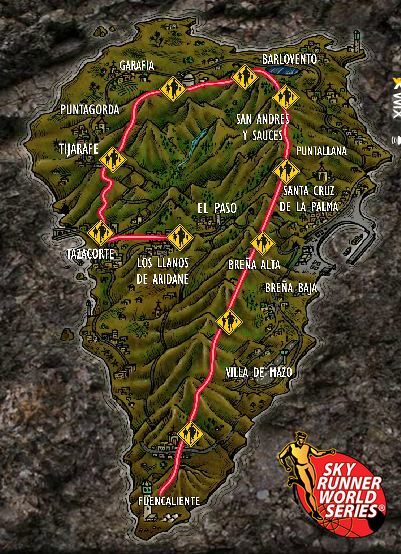
Transvulcania Map


Mountains, volcanoes, beaches, forests, a tropical rainforest, tiny villages and breathtaking views. La Palma is the jewel in the ‘Canaries’ crown. Many consider it to be the most beautiful idyllic Canary Island, un-spoilt by tourism and ideal for rest, peace and quiet. It is a treasure for the walker, hiker or runner. Considering the islands size (50km x 25km) it has many surprisingly different areas of natural beauty. It has a perfect all year round climate, not too hot in the summer and pleasantly warm in the winter.

La Palma

La Palma lies 200km from the coast of Morocco and is approximately 3500km from the UK. Just north of the ‘Tropic of Cancer’. The island attracts many a stargazer and budding astronomer for the incredible display by the stars at night.
iancorless.comP1030913

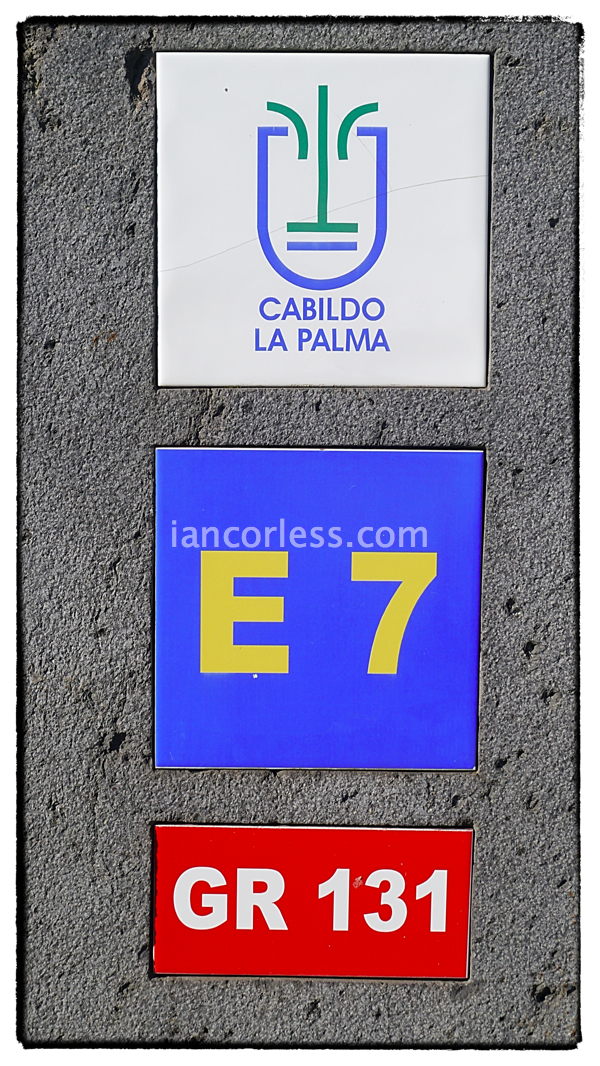
Not dependent on tourism the island attracts a very different client to those you may find on Gran Canaria or Tenerife. You won’t find ‘English Pub’ or ‘English Food served here thank goodness. It is un-spoilt, traditional and a haven for those seeking a true Spanish feel. Natural beauty, dramatic vistas and 100’s of km’s of trails are available to explore via the marked ‘GR’ or ‘LP’ routes. Of course the famous GR route is the 131 that makes up the route for the Transvulcania La Palma… more on that later!
iancorless.comP1030940

How big is the island? Well, in a nutshell, not very big… at just 50km long and 25km wide. The population is only 86, 528 (dated 2008).

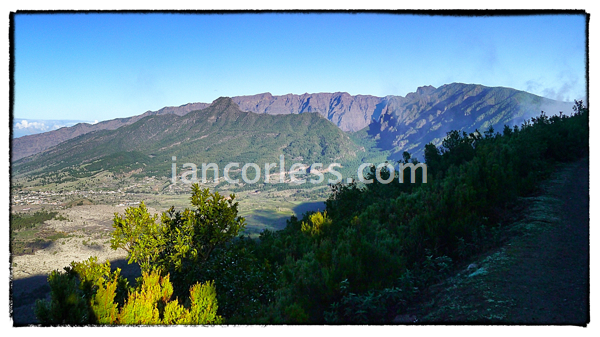
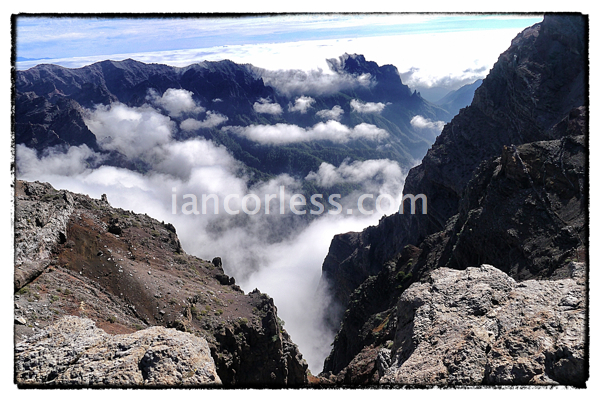
La Palma is dominated by the Caldera, the massive erosion crater often (incorrectly) thought of as a volcano, it has steep sloping sides both inside and out.
iancorless.comP1030527

The south-west part of the Caldera has collapsed and been eroded away leaving a ravine that runs deep right down to the sea at Tazacorte and the start point for the Transvulcania La Palma race.

iancorless.comP1040759

The southeast and north of the island has a coastline that drops steeply down to the sea making access to the coast very difficult. Many areas are only reachable by sea.

The central ridge (cumbre) makes up the central and southern parts that extend from the Caldera in the north to the southern point of the island and divides the island into two.
iancorless.comP1030943

Often called ‘La Isla Bonita’ it is a green island with many trees, including tree heather, the tall Canary Pine and cultivated citrus, avocado, chestnut, almond and banana trees at lower altitudes. Characterized by steep cliffs, volcanic rock, bays, black sand and cactus. Of course one thing you will see everywhere are many, many banana plantations.

A volcanic island, the last eruption was in 1971 at the Teneguía volcano.

The GR 131
 GR131

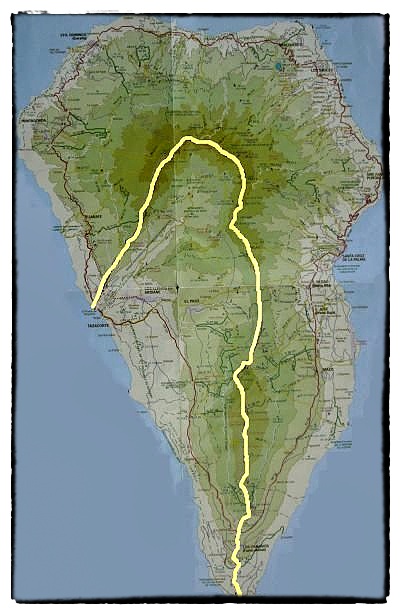
The GR 131 was created from the logical joining of two large mountain routes in La Palma: The Volcano Route and the route of The Crests of the Taburiente Crater.

iancorless.comP1040137

To make a logical route, the GR131 was extended at both ends to the sea. It is possible to start at sea level from the Fuencaliente lighthouse climb upward and upward to the Caldera Taburiente Crest. Run around the crest to Roque de Los Muchachos and then drop down and then descend to Tazacorte Port. In its origins, this path connected the localities furthest away from each other, as it climbed a radial path to the current GR131 and followed it to the radial downwards path to the destination. It has also been the main path for the herding of goats from the summit to the coast.

Route Description

In providing a route description of the GR131 I am looking at it from the eyes of a runner in relation to the Transvulcania La Palma. Please keep this mind if you are reading this from the perspective of a walker or hiker.
iancorless.comP1030777

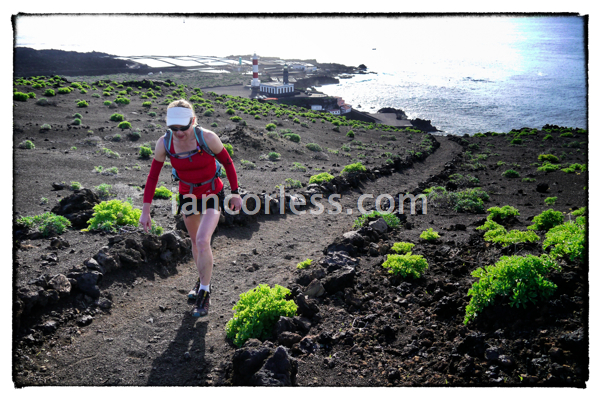
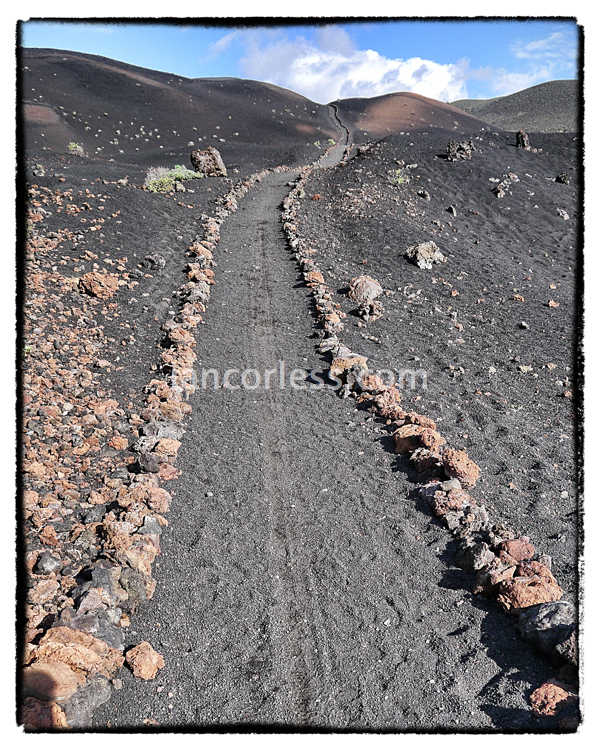
Starting at the Fuencaliente Lighthouse at sea level the first section includes two key volcanoes, San Antonio and Teneguía. As mentioned previously, Teneguía last erupted in 1971. The first miles are tough going and most certainly on race day with some 1500+ runners a struggle. The path is often narrow with loose black sand or rocks. Patience will be required.

iancorless.comP1030838

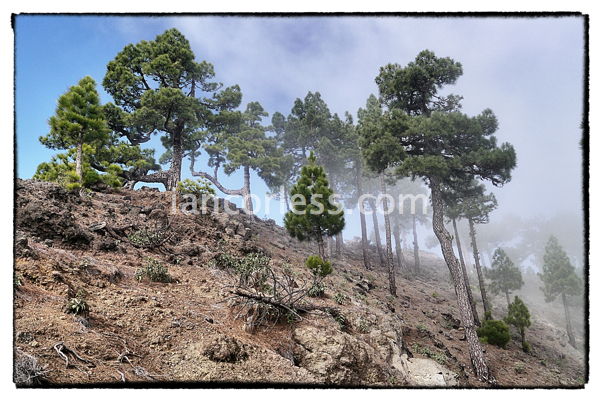
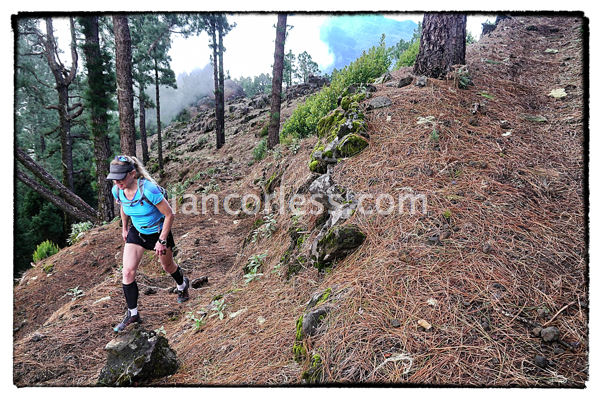
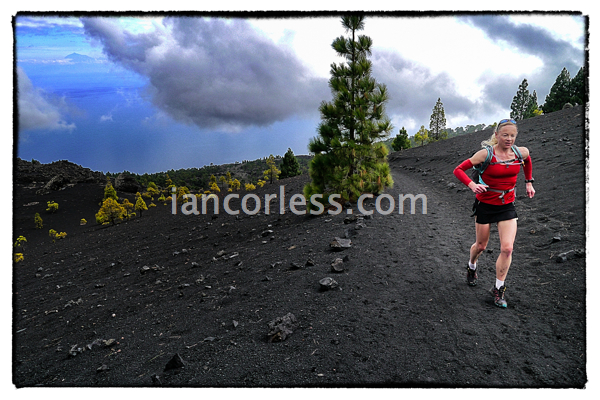
From Los Canarios you enter the dense pine forests which offer a stark contrast to the opening miles. Underfoot terrain now mixes black lava sand, pine needles and rocks. Running is much easier than the opening miles and you will find an opportunity to stretch your legs.
iancorless.comP1030878

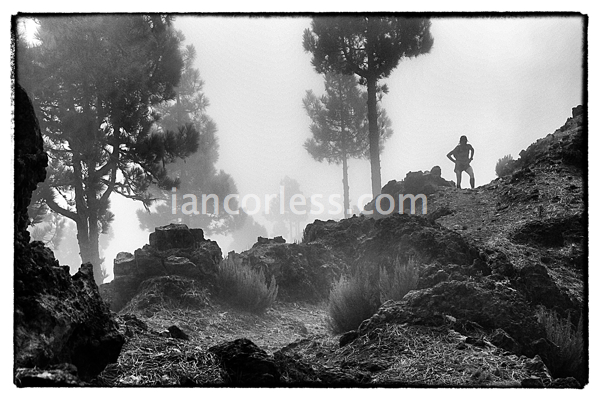
Climbing up the trees eventually start to subside and you emerge in the ‘Route of the Volcanoes’. This path crosses the southern ridge of the island, where most of the volcanoes are lined up (less than 200,000 years old). Among others, the following volcanoes can be seen from the path: Birigoyo Peak, Nambroque Peak, San Juan or Hoyo Negro Volcano (eruption in 1949), Duraznero Volcano, Las Deseadas, El Charco Mountain (active in 1712), Martín Volcano (eruption in 1646), Pelada Mountain, El Fuego Mountain and the Crater of Los Arreboles. It is an incredible route, sometimes very runnable, at other times hard work due to the increasing steepness of the path and loose deep lava sand.

iancorless.comP1030900

The final sections of the volcano route offer good fast running to El Pilar. In the Transvulcania La Palma this place offers an important marker. An important feed station and also the finish point for the shorter race provided by the race organizers.
iancorless.comP1030960

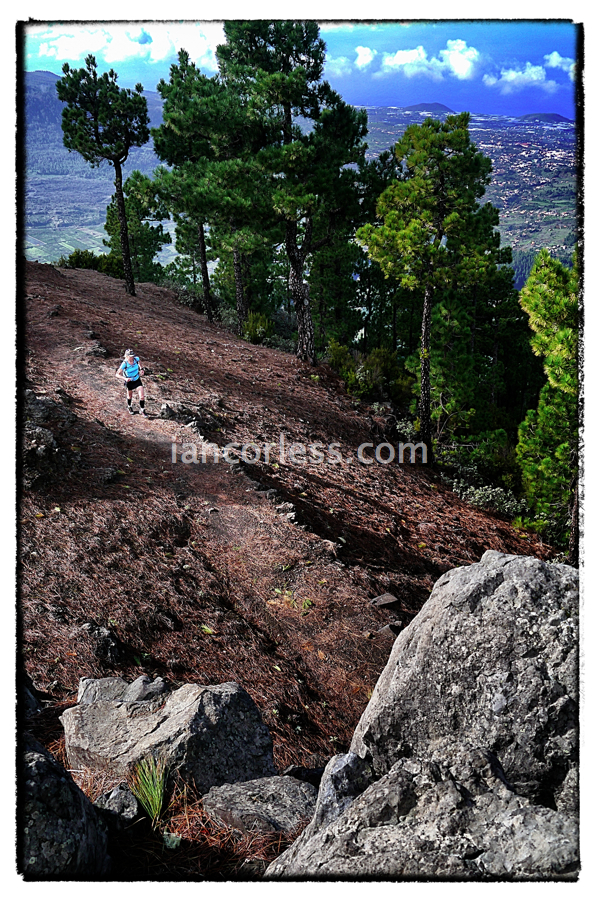
Leaving El Pilar, the race route (GR 131) heads north for the crest of La Cumbre Nueva using a forest trail that goes beyond the port of El Reventón (1350 m). Initially you will find this section providing some of the easiest running you will have had so far… the gradients are easier and underfoot one has less obstacles.
iancorless.comP1040005

Of course it soon comes to an end, the path climbs the successive and increasingly high peaks, running along the very edge of the Taburiente Crater.
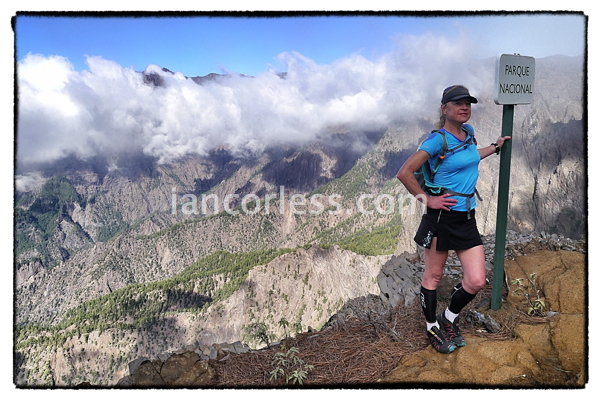
iancorless.comP1040082

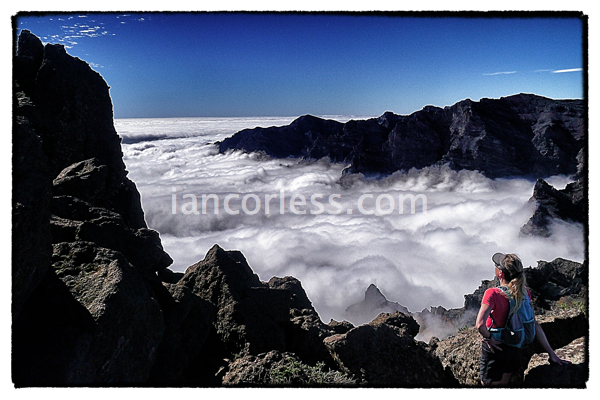
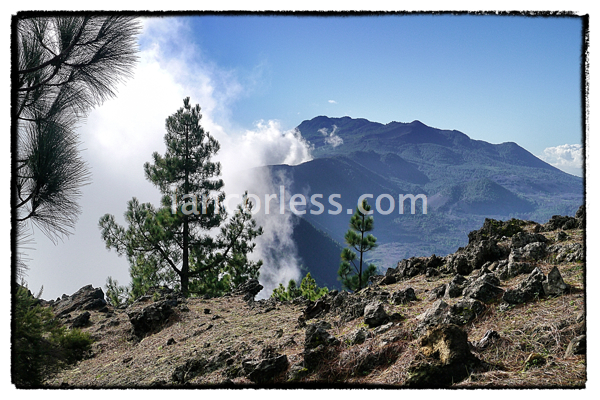
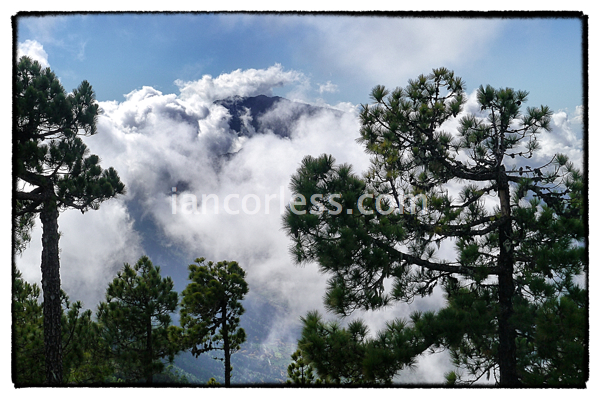
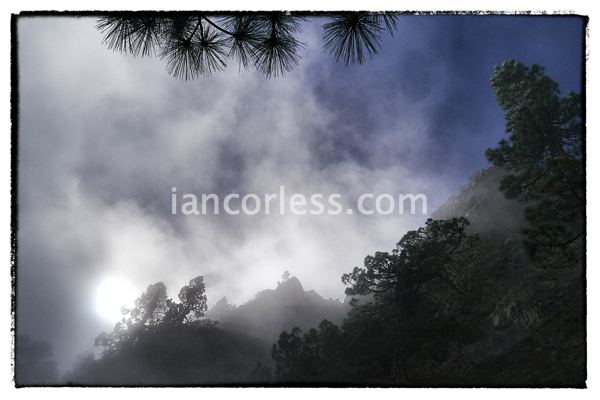
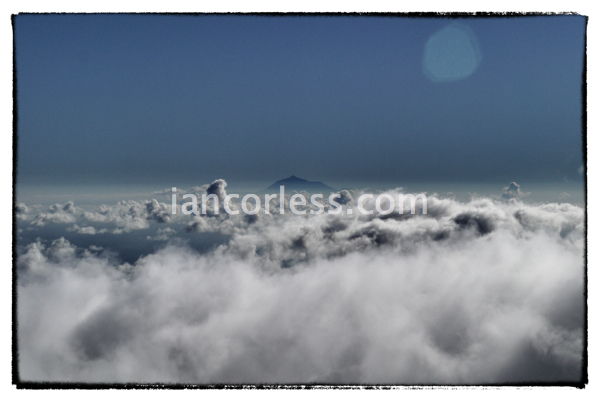
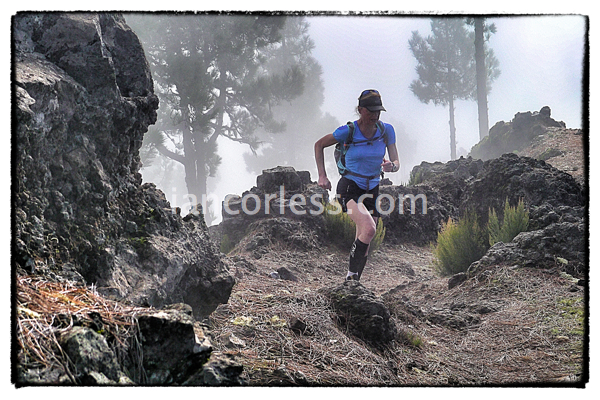
The Taburiente Crater rim is an incredible natural wonder offering technical running terrain, constant changes in elevation and some of the most incredible views you will ever see. Depending on the weather systems you will either have clear blue skies and the ability to look out into the distance for miles or a thick blanket like layer of cloud that will be below you literally making you feel they you are Skyrunning. Incredible. One thing that La Palma is famous for is the micro climate. You will almost certainly while running the race have several different types of weather, particularly if the cloud layer appears. You can be hot with the sun beating down on you and then a little chilly as you run through the cloud. It is what makes it so interesting.
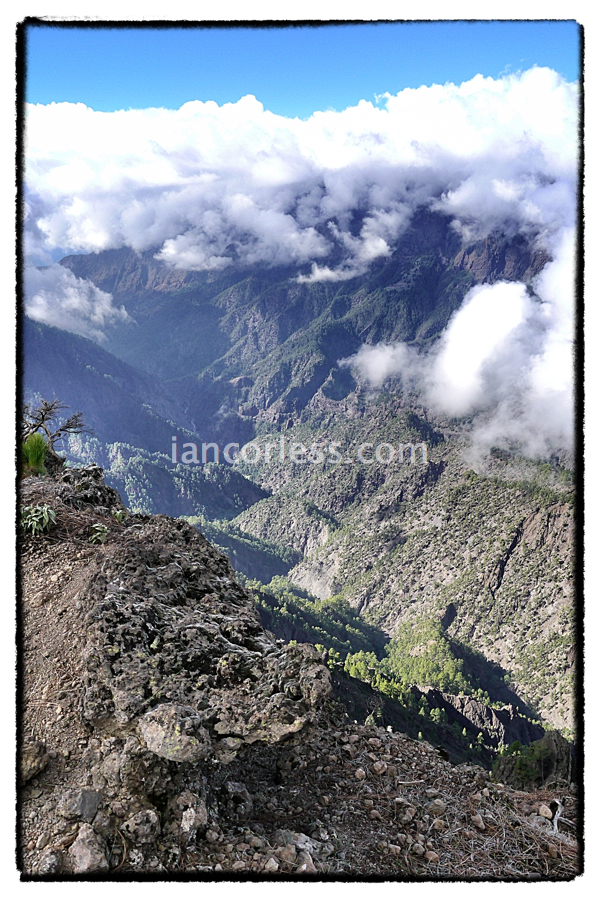
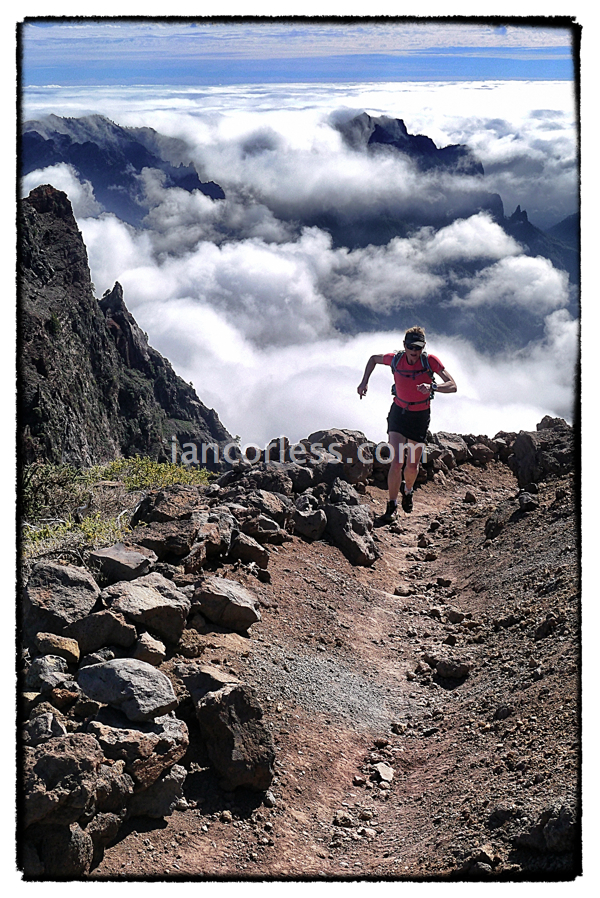
iancorless.comP1040135

iancorless.comP1030527

iancorless.comP1030558

From the Rock of Los Muchachos (2436 m) the highest point of the course, the route drops down to the sea at the Port of Tazacorte. Beware! You may be thinking to yourself as you climb up and up for hours and hours that you have a wonderful long descent to the finish. You do but it is steep, technical and punishes your legs. Easy running sections are followed by tough, technical, rocky and gnarly terrain.
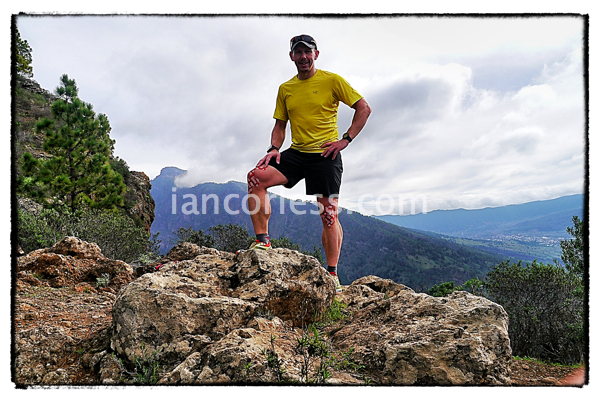
iancorless.comP1030313

Crossing a main road at El Time you then have a couple of very steep road sections before the final drop down the stunning (and technical) zig-zag path to Tazacorte Port.
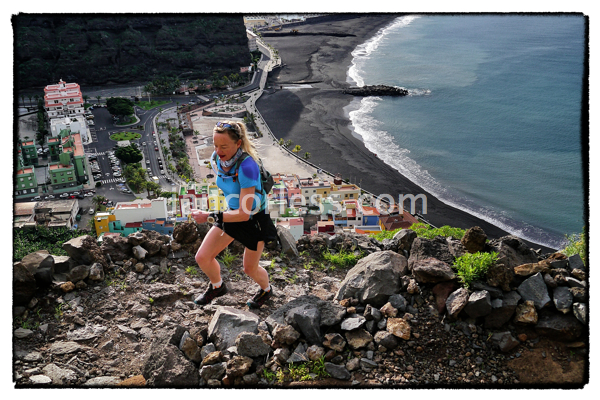
No warm up, from Tazacorte you go up for 18k

No warm up, from Tazacorte you go up for 18k

The GR131 stops here but the Transvulcania La Plama organizers have a sting in the tail… the final miles take you back up to the town of Los Llanos De Aridane where a rapturous welcome awaits. Believe me, you will have earned it!

Training Information

The Transvulcania La Palma is an incredible race on a stunning course. At 83km’s it is a real challenge. Dakota Jones won the 2012 edition of the race in an incredible 6:59:07. Believe me that time is fast… very fast! Take a step back and in real terms look at adding a minimum of 3 hours to Dakota’s time and keep an eye on the cut-off times. Of course I am speaking in general terms here.

The terrain underfoot falls into one of these categories: black lava sand, rocky lava sand, hard rocky lava, pine forests, tough gnarly rocks and a very small section of road. The terrain eats the grip on your shoes and I therefore would recommend a trail shoe with cushioning and grip. For example; Salomon Speedcross, Salomon Slab Softground, Scott eRide Grip2, Sportiva Raptor or similar… you get the drift! You always have exceptions to rules and for example Kilian Jornet (3rd 2012) and Andy Symonds (2nd 2012) used the lightweight Salomon Sense for the 2012 race. In general terms though, the average runner will need grip and cushioning to the ease the harshness of the terrain.
iancorless.comP1030793

The ability to handle technical terrain while maintaining a good pace is essential. This will come extremely important on the flatter sections and the long descent from Roque de Los Muchachos. If you can’t make up time here than you are most definitely in for a long day out.
iancorless.comP1030980

From the start at the lighthouse and until you reach the highest point of the course at 2436m you are arguably always going up. It ultimately all comes down to economy of effort and having a strategy and or ability that will allow you to make the summit with enough left to get to the finish. What should you do?

iancorless.comP1040126

  • Run with a short stride looking ahead constantly
  • Practice walking fast, uphill with your hands on your knees
  • Incorporate some long day hikes on hilly terrain
  • Run/ hike on loose sand uphill for long periods of time (a quarry would be good)
  • Run on hard packed trail for your speedier/ faster workouts
  • Find some gnarly, rocky terrain and practice running on it. Build up a confidence to move over it as quickly as possible
  • Add some strength and core work to your training if this is a weak area for you

In many respects, the Transvulcania La Palma is like any other trail or mountain race but it does have a combination of elements that make this a very tough course. Respect it. Without doubt it is one of the most beautiful I have experienced.

Practical Information

La Palma is a small island. The race starts at the southern most tip and finishes almost half way up the island on the west. Therefore your hotel decision for the race may very well depend on many factors such as:

  • Are you with family?
  • Are you staying just for the race?
  • Do you plan to stay on?

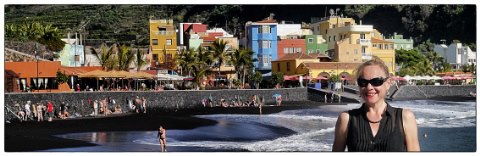
If travelling with family you may very well be better basing yourself at Los Llanos de Aridane as this is a town with shops, cafes and other facilities or at Tazacorte Port.
576336_4683526202838_187190551_n

Tazacorte Port has a beach, restaurants and cafes. Of course this will mean as a participant you will need to arrange for transport and/or an overnight stop at the race start for the race day. Please note the race starts very early!

If travelling just for the race weekend I would seriously consider looking at the options provided by the race organization at www.transvulcania.com They will have accommodation and travel packages that will provide you with all that you need.
iancorless.comP1040297

If you plan to stay in La Palma after the race my recommendation would be to base yourself in or around Los Llanos and then use this as a start point from which you can then travel from.

Hire Car

A hire car is essential and they are very affordable. La Palma is serviced by all the main providers at the airport; Avis, Hertz and Europcar. Cicar is a local hire company available here. Book in advance for the best deal.

Flights

Flights to La Palma can be a little tricky. If in doubt, fly to Tenerife and then book one of the many connections that are available. Again, the race organizers are providing packages and practical information to facilitate this at www.transvulcania.com. Thomson have just started a direct flight from Manchester to La Palma.

Weather

La Palma boasts year round good weather. In May it will be hot but not excessive. Travel light and cool and always ensure that you have a warm layer and/or windproof just in case.

Los Llanos de Aridane

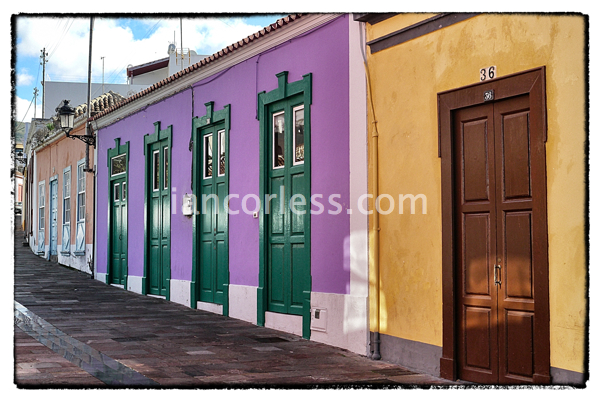
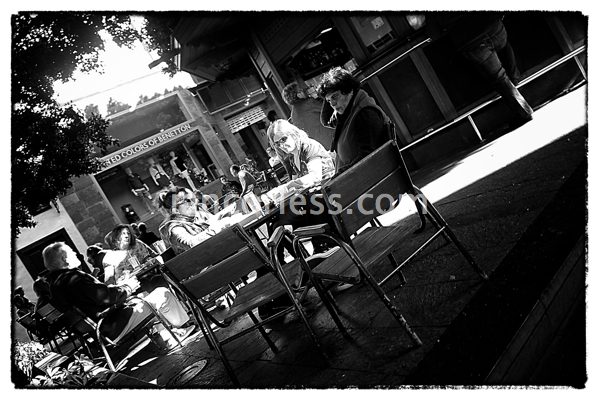
Los Llanos is the largest and busiest town on the west side of La Palma with a population of just over 20,000. There are many modern buildings. It has a traffic-free centre and the surrounding side streets still retain their old character. Plaza de Espana is the hub of the town and a good place to have a cup of coffee and watch the world go by.
iancorless.comP1040247

You can see images of Los Llanos here: https://iancorless.org/photography/los-llanos-la-palma/

Tazacorte

Tazacorte is situated on the west side of the island and claims to be the warmest place on the island. It is divided into 2 villages.

Puerto de Tazacorte is on the coast and has a long promenade, a fishing harbour, a black sand beach and an area with boulevard, bars and (fish) restaurants. Tazacorte pueblo (village) as about 1km above the coast and is the main center with the town hall, post office, shops and supermarket.

iancorless.comP1030415

Market day : https://iancorless.org/photography/la-palma-tazacorte-market-day/

Recce, blogs and Images
iancorless.comP1030319

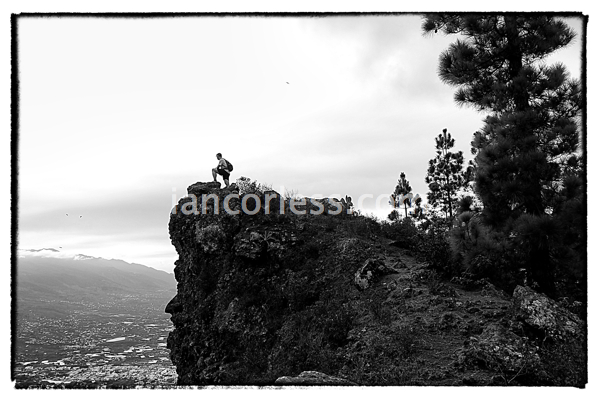
In December 2012 I spent two weeks running, hiking, jogging, walking and crawling over the Transvulcania La Palma course. My blog posts are available on iancorless.org and my images are filed in a logical order, starting at the lighthouse at Fuencaliente, moving through the route of the volcanoes, El Pilar, Cumbre Vueva and then Tazacorte as days here:

Fuencalientehttps://iancorless.org/photography/la-palma-fuencaliente/

Route of the Volcanoeshttps://iancorless.org/photography/la-palma-the-route-of-the-volcanoes/

El Pilarhttps://iancorless.org/photography/la-palma-el-pilar/

Cumbre Nuevahttps://iancorless.org/photography/roque-de-los-muchachos-la-palma/

Tazacortehttps://iancorless.org/photography/la-palma-tazacorte-to-roque-de-los-muchachos/

Blog Posts:

 Conclusion

iancorless.comP1030598

La Palma has been a revelation. I have now had the opportunity to see the island and the Transvulcania la Palma from two perspectives. In May I followed the race as a journalist/ photographer and got to see one of the most competitive races of the year unfold before my eyes.

In December I returned for a holiday, to spend time on the trails in some warm winter sun.

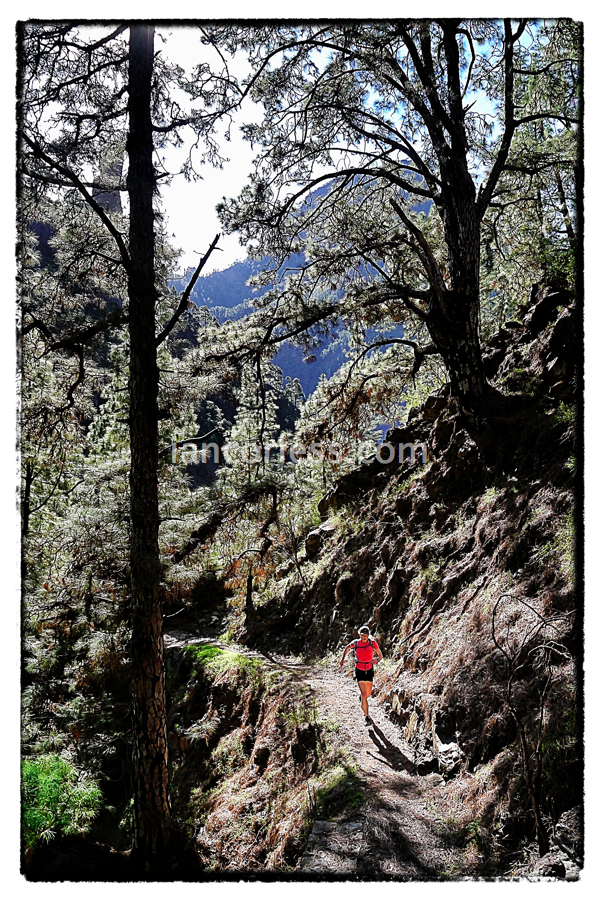
The people, the places, the food, the hospitality and the multitude of trails make La Palma the most perfect location for the enthusiastic runner or hiker. I have focused this post on the GR131 and the Transvulcania La Palma but trails are everywhere. From my base in the Caldera de Taburiente just outside Los Llanos de Aridane I also discovered and explored so many other incredible trails such as this circular route:

December in La Palma offered great weather allowing me to escape the winter grey and gloom of the UK to run in shorts and T-shirts on some of the most incredible terrain with the most stunning views.

I should point out that I did only explore the southwest corner of the island. I have been told, repeatedly, by friends that the island has so much more to offer.

La Palma and its network of trail may very well become a regular slot in my calendar moving forward…

I would like to thank Lourdes Plasencia, Julio Carbera Rocha, Lauri Van Houten, Marino Giacometti, Transvulcania La Palma and Skyrunning for all the help and support.

Finally, many thanks to Niandi for making the trails so enjoyable.

Skyrunning 2013

Marino Giacometti, ISF President, after the 2012 retrospect in the feature, “Looking back. Moving forward”, we publish an extract from a recent interview in two parts by the Spanish website, www.carreraspormontana.com on the near and long term future of skyrunning.

Part I

Marino Giacometti. © ISF

Why did you change the SWS format for the next season?

The format in 2012 was already new.  The Trials system was abolished and the Ultras were introduced but the Main Races and a combined title remained.  Already in July at the Annual General Assembly, the new formula for 2013 was in place with a view to separating the distances and to have a clean and simple ranking system.  2012 was a year of transition between the two formats which proved problematical with the ranking and some of the new ultra distances races, but in many aspects, was extremely positive with the participation of some of the world’s top ultra athletes who hadn’t yet had a taste of skrunning and their positive feedback on the skyrunning concept – tough, technical races at altitude – thus re-affirming our heritage.

2013 was the final evolution into three separate categories and the abolition of the combined title and compulsory races. The different distances attract specialists from each discipline – there aren’t many runners like Kilian that excel in all three!  Skyrunning is about racing vertical, short, medium and long distances…at altitude of course.

One of the novelties is the first 100-mile race. Why now?

On embracing the Ultra concept, it was a natural evolution.  The demand is out there too and we listen to what the runners want.  We had been considering the Ultras for some time and were observing their development. After many mountaineering expeditions and speed records in the Himalayas and in South America, including in winter, I have a pretty good idea where sport finishes and survival begins… Running at night, cold and rain, is not only sport, but adventure and survival.

A Federation must always put the safety of the athletes above all else and I admit I had some apprehension in including the 100-miler although I got the support of the federation’s members to go ahead as well as the support of the Ronda dels Cims organisers.  Sports and mountain federations have a moral obligation to work with organisers and athletes for safety, preparation, equipment and guidelines.  We intend to lead this cause with the direct collaboration of organisers and athletes, pooling our resources for an optimum result.  On our side we offer 20 years of experience (having created and organised 80 races worldwide at high altitude and co-ordinated ten years of the World Series).

Will we see more 100milers in SWS in the future?

Probably yes.  We are examining some options for 2014.  Within the SWS we want to keep a balance with the long and ultra long distances. Throughout the season, an athlete can do many Sky or 50 km races, but of course can’t compete at top level in more than two or three longer distance races a year. We’re working on a world ranking (of the most representative races) covering 20 ultra, 20 sky and 10 vertical to list the world’s top athletes.

Marino Giacometti. © ISF

What’s your opinion about the launch of the ultramarathon series this year?

First I need to go back to explain our heritage – which lies generally in marathon distance races, but at high altitude which makes a huge difference.  Don’t forget that mountains are measured by their vertical climb, not distance (as Kilian Jornet points out – counting hours and vertical climb, not distance). Our first race in 1992, from Courmayeur to the summit of Mont Blanc was 54 km but with 3,900m of positive vertical climb – half of which above 2,000m altitude!

The races we organised in Nepal, Tibet, Kenya, Mexico and America, were marathon distance, but at high altitude between 4,000 and 5,2000 metres. That means 5 hours for the winners and 12 hours for a normal runner.  We also organised a 24 hour ascent race in Val d’Isère and, in 2002, the week-long crossing of the Alps from Courmayeur to Cortina…

Now back to this year – twenty years on. For some time we had been receiving requests to include Ultra distance races and, apart from the Kima Trophy (50 km), which we created in 1994, we immediately embraced the Transvulcania Ultramarathon (83 km) as it so perfectly embodied the skyrunning concept.  The other three races proved problematical, due to a different approach by the organisers and seriously bad weather.   The Ultra Series was a learning experience and has given us the tools to move forward and to create organisers’ and participants’ guidelines for the future.  With the support of the athletes, we are convinced we’re on the right path and consequently were confident to include the first 100-miler next year.

Earlier, you spoke about the 100 mile race. Why did you introduce it now?

On embracing the Ultra concept, it was a natural evolution.  The demand is out there too and we listen to what the runners want.  We had been considering the Ultras for some time and were observing their development. After many mountaineering expeditions and speed records in the Himalayas and in South America, including in winter, I have a pretty good idea where sport finishes and survival begins… Running at night, cold and rain, is not only sport, but adventure and survival. A Federation must always put the safety of the athletes above all else and I admit I had some apprehension in including the 100-miler although I got the support of the federation’s members to go ahead as well as the support of the Ronda dels Cims organisers.  Sports and mountain federations have a moral obligation to work with organisers and athletes for safety, preparation, equipment and guidelines.  We intend to lead this cause with the direct collaboration of organisers and athletes, pooling our resources for an optimum result.  On our side we offer 20 years’ experience after creating and organising 80 races worldwide at high altitude and co-ordinating the World Series for ten years.

Will we see more 100 milers in the SWS in the future?

Probably yes.  We are examining some options for 2014.  Within the SWS we want to keep a balance with the long and ultra long distances. Throughout the season, an athlete can do many Sky or 50 km races, but of course can’t compete at top level in more than two or three longer distance races a year. We’re working on a world ranking (of the most representative races) covering 20 ultra, 20 sky and 10 vertical to list the world’s top athletes.

Part II

What are the major challenges the ISF is facing in the near future?

The ISF is the only international running federation operating at high altitude in the mountains. Our main objective is to offer a concrete point of reference for athletes and organisers, to develop the sport with our members and future members with national circuits.  In other words, to grow the sport on an international level together with the principal players:  the runners,organisers and industry.

A major challenge is represented in growing the sport globally. In a sport that takes place in the mountains, it’s difficult to find a balance between growing the number of participants while capping races for safety and ecological reasons.  It’s clearly not a spectator sport and therefore can’t compete with the big league sports and mainstream media.  The federation doesn’t receive public funds like many other similar organisations, which partially limits the scope, but we believe with the backing of the runners, organisers and industry we can go far.

In growing the sport we must turn to the industry and a growing number of companies are investing in this new sector, lead by Salomon and The North Face in Europe. Companies with a traditional sports background are breaking out into outdoor and trail, such as Adidas, Asics, New Balance… The industry must invest in their testimonals and ambassadors to enable runners to become professionals …..

We aim to keep skyrunning open to investors in all areas, races, teams, individuals, because only with investment right across the board can the sport grow.

What is the role of the Athletes Commission?

A number of top international athletes volunteered and were elected to stand on the Athletes Commission, which this year has finally become fully active.  Their role is invaluable in the development and strategy of the sport, their consultation on a number of issues (including those pertinent to the Board or Management Committee) and generally to represent a voice for runners. This important role reflects the ISF philosophy where the athlete is central to its development.

Year after year, there are more races outside Europe, especially in the US. Do you think there’s more interest in the SWS there?

The participation of many top American ultra runners this year (Dakota Jones, Anton Krupicka, Rickey Gates, Joe Grant, Nick Clarke and Ian Sharman, Mike Wolfe, Geoff Roes, Joe Grant, Alex Nichols, Nikki Kimball, Darcy Africa) and WMRA world champions, like Marco De Gasperi, Max King, Kasie Enman and Stevie Kremer competed in SWS races on both sides of the Atlantic is proof enough.

At the Seminar held in May on La Palma, for a new generation of American runners, the skyrunning concept was a revelation and the outcome was a desire for steeper, more technical races in the US. In the next couple of years I’m confident you will start seeing this kind of race modelled on the skyrunning concept, rather that the typical runnable trail/no switchback cutting formula we have seen up to now.

Forestry permits are an important reason for this in the US, but from 1993-1998 we conceived and organized many races at 4,000m altitude in Colorado, with the relevant permits of course.  (Practically all the races take place in national parks or protected areas across the world and, working with sensitive race directors and following the proper guidelines, don’t represent a threat to the environment).   It all depends how you go about it.

The choice of the 2013 Ultra Series final in Vail, was an open door on our part and on the part of European runners to share the concept on US soil.  American team managers will now begin to support their runners to attend events in Europe and further afield and Europeans will do likewise.

How is the ISF working towards making skyrunning an Olympic sport?

On our foundation in 2008 we started off basing our Statues on those of the Olympic Charter with a view of following that road.  After a meeting with the IOC Committee in July 2011 and subsequent meetings with consultants and athletes alike, there is no question that skyrunning will continue to carry out the sport in the mountains, for us, the only conceivable arena.

Possibly the short steep vertical distances and the skyscraper races could fit into an Olympic format, but whatever the case, as things stand, 50 member countries are required and 2020/24 would be the earliest opportunity. Our heritage is the mountains and we have enough conviction and support to carry on developing the sport right there.

We suggested to the IOC to stage an “Outdoor Olympic Games”, similar to the Winter Olympics.  The idea was well accepted, but until there is more money in this area, it will remain nothing more than a dream for many…and possibly a nightmare for others.

What are your aims for the next SWS?

The continued affirmation of the Skyrunner® World Series as a point of reference for global outdoor running, our first 100-miler, the new races, the pleasure of repeating successful quality events.   Next year the participation and ranking of teams will have a special focus and we look forward to the participation of the world’s top runners and all those who aspire to skyrunning at the highest levels, to measure their performance or just to see Kilian running with ease, where they are struggling.  More emotion, more inspiration!

Episode 25 Talk Ultra

20121226-110754.jpg

Episode 25 – MERRY CHRISTMAS. A super stacked festive show with some incredible stars of 2012. Our show includes interviews with Ellie Greenwood, Timoth Olson, Western States RD Craig Thornley, Ryan Sandes and Lizzy Hawker. We announce the winners of ‘A Year inthe life of…’. Talk Training is about heart rate training and Karl, Ian Sharman and myself review the year. Merry Christmas to you all and thank you for making 2012 a great year!

ITunes http://itunes.apple.com/gb/podcast/talk-ultra/id497318073

Libsyn – feed://talkultra.libsyn.com/rss

Website – talkultra.com

SHOW NOTES:

Merry Christmas everybody and we would like to take this opportunity to thank you all for your fantastic support in 2012. The Talk Ultra community is nothing without all of you.

Here is to a fantastic 2013 !

00:00:00 Intro and hold your breath….. a Christmas jingle from Ian

00:02:40 Show start

00:11:40 Ellie Greenwood talks about an incredible 2012 season and what lies in store for 2013

00:32:50 Back to the show

00:38:30 Craig Thornley is the new RD for Western States. He takes the reigns in 2013 and in our interview we discuss the iconic 100 miler

01:05:58 Back to the show.

01:09:36 Timothy Olson discusses setting that CR at Western States and how life has had to adapt to the birth of his first child.

01:28:25 Ryan Sandes tells us about a superb 2012 and how he has become one of the premier ultra runners in the world.

01:48:20 ‘A Year in the life of….’ we announce the winners!

01:51:30 A quick chat with the female winner – A Year in the life of…

01:56:20 A quick chat with the male winner – A Year in the life of…

02:02:00 News

02:22:40 Blog – Joe Grant – Alpine Works

02:23:50 Talk Training with Marc Laithwaite – Hear Rate Training

02:51:12 An interview with Lizzy Hawker… Lizzy needs no introduction. In 2012 she won UTMB for the 5th time, won Run Rabbit Run and then set a CR at Spartathlon, all within a few weeks. We discuss her career and what makes her tick.

03:19:28 A Meltzer Moment with Speedgoat Karl

03:21:40 Up and Coming Races

03:22:55 Close

03:28:30

Salomon Sense Ultra

The long awaited ‘Sense Ultra‘ has arrived. THANK YOU Santa……

As many of you will know, the ‘Sense‘ has become the shoe of choice for those who are wanting to run on trail with a minimalist and responsive shoe. However, we can’t all be as efficient as Kilian Jornet or Andy Symonds.

The Sense Ultra offers a little more but holds true to all the elements that have made the ‘sense’ so popular.

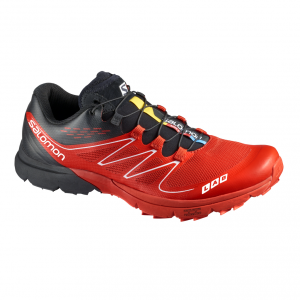
The Salomon S-LAB Sense Ultra Racing is one of the lightest trail shoes ever made. It is heavier than the Sense but has added strengthening of the sole for longer and harder races.

It has the new lacing system: Quicklace this reduces the weight of Sense.
Dynamic Traction:  allows the Salomon S lab Sense  optimum grip in all conditions. It wasdeveloped by Solomon with the greatest athletes without any compromise. It has different grip and texture which has been designed to optimize grip when it is necessary.
EndoFit: has an inner liner to the shoe designed for positioning the foot optimally.
Drop: a low 4mm drop to provide a natural contact and feel with the ground.
OS TENDON: Thanks to this system inserted in the sole of the S lab intermediare sense, there is a natural flow with excellent energy return.
Profeet Film: is a protection film that will protect your foot area from angular or sharp objects that are on the trail. The Sense offers maximum protection despite its lightness.
Weight: 240g in 8.5 U.S.

When you lift up the box you think wait a minute… they forgot the shoes! Not so. These ‘runners’ are super light.

The lacing system as with all Salomon in reassuring and holds the foot firm.

The addition of the internal ‘Endofit’ makes the shoe more comfortable than you would ever imagine. They can be a little tight to get on at first and you may initially think; uh oh, wrong size. But once your foot is it is snug and supremely comfortable. The most comfortable shoe I have ever worn.

I am not a small guy and the therefore I always felt the original ‘Sense‘ was maybe just a little too minimal for me… certainly on longer runs! not so with the ‘Ultra’. The additional cushioning is immediately apparent.

The sole has grip but nothing like the ‘SLab Softground‘ or ‘Speedcross‘. The shoe is therefore certainly more suited to road and hard pack (or rocky) trail. If your running in soft ground they perform perfectly but if you are a great deal of mud the added grip of the Soft Ground or Speedcross may be a better choice.

In use they are a dream to wear. On the roads they are light, responsive and provide that feel that I have had with traditional racing flats. The bonus with the ‘Sense Ultra’ is the hold of the foot. The speed lacing and Endofit provide supreme comfort. On the trails this becomes even more apparent as the foot moves from left to right with changes in terrain.

It’s early days in testing but this shoe will not be of my feet for a while… they are so comfortable I would even be tempted to use them as slippers.

Now then, I need to go run…..

As a foot note, (no pun intended) Spring/ Summer 2013 will see a new Sense model – ‘Mantra

I saw this shoe earlier this year at Cavalls del Vent. A couple of the Salomon runners tested the shoe (Emelie Forsberg and Philipp Reiter) By all accounts a great edition to the range but too early to provide some detailed feedback.

The Mantra will be an everyday trainer in the same mold as the Sense and Sense Ultra. It’s a door-to-trail hybrid. With it’s 16mm heel and 10mm front (6mm drop as opposed to 4mm) and 260 grams weight, it looks to be a featherweight trainer without requiring the user to go to a 4mm drop shoe. Salomon has been heavily delving into exactly how different heel-to-toe drops effect actual stride speed which has resulted in their “Natural Motion Construction.”  A lower heel drop supports a mid-foot or forefoot strike that in turn better enables muscles, instead of joints, to absorb shock. Ultimately, their argument is this builds greater balance and overall running efficiency. More to follow….

Sense Mantra

Sense Mantra

Pico de la Nieve – La Palma

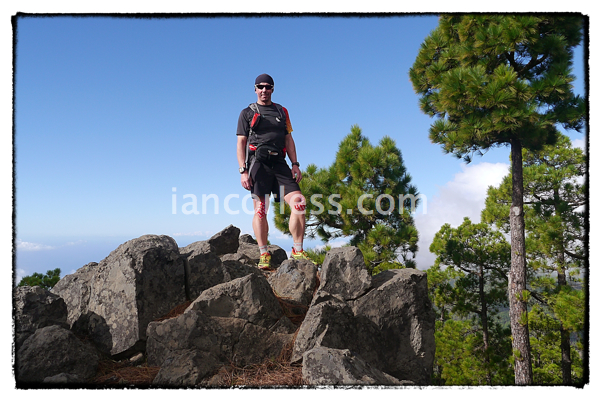
Today, Niandi and myself ran some of the same trail that we ran last week. Unlike our previous day way had no cloud cover so we ran and hiked in glorious sunshine, blue skies and with crystal clear views. Starting at the Roque de Los Muchachos at 22426m we ran the rim in an anti-clockwise direction taking in Fuenta Nueva, Los Andenes, Pico La Cruz, Pico de Piedrallana and Pico de La Nieve at 2239m.

It’s a stunning technical run over hard and rocky terrain. You are constantly going up and then down….

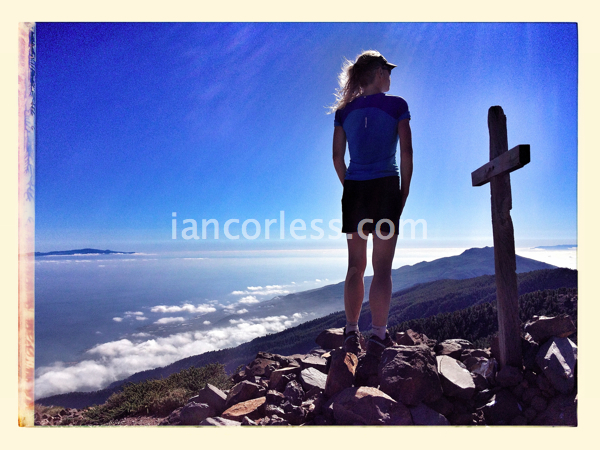
Every now and again moments happen on the trail. Here is one of those moments capturing the Transvulcania La Palma course running off into the distance and the islands of Tenerife and Gomera in the background. Magical !

Niandi at Pico de La Nieve 2239m

Niandi at Pico de La Nieve 2239m

Images of Roque de Los Muchacos and this route are available  HERE

Caldera de Taburiente – La Palma

iancorless.comP1040463

An easy day should surely be followed with a longer day right? Good! Niandi and myself did follow the ‘Los Llanos‘ experience with a wonderful 7 hours on the trails of the LP13 in the National Park of the Caldera de Taburiente. What a day!

I had read about the PRLP13 being a super hard hike (Here) and how we could take a Taxi to Los Brecitos…. nonsense! If you are going to do it, then do it! That’s all part of the fun.

iancorless.comP1040402


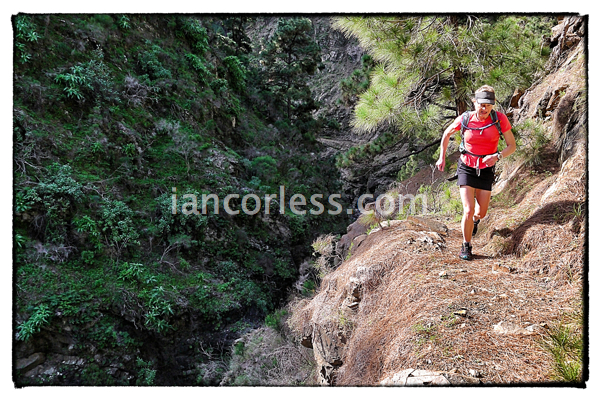
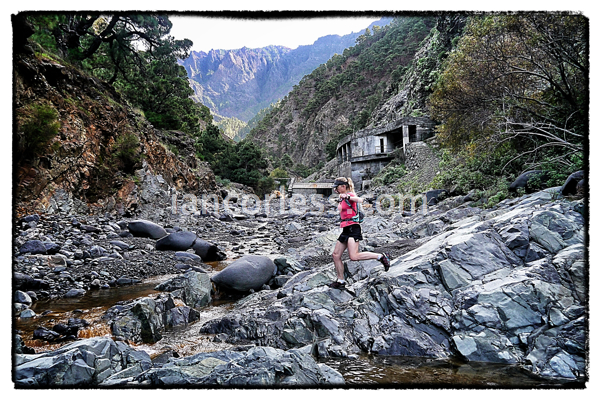
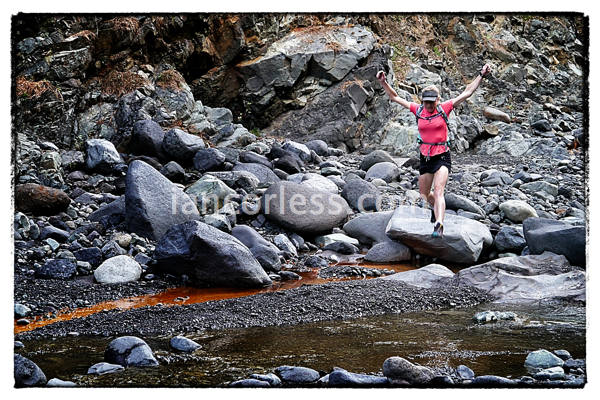
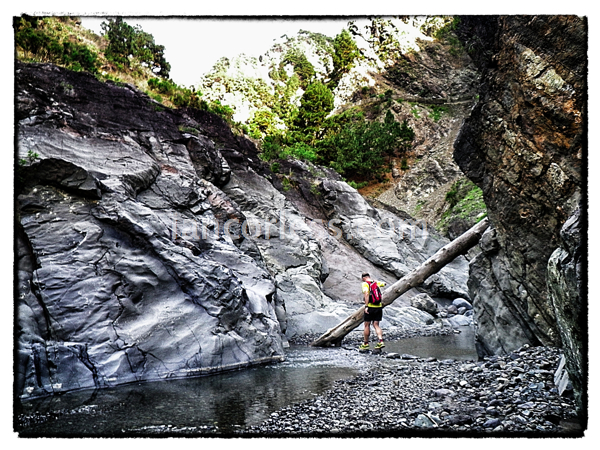
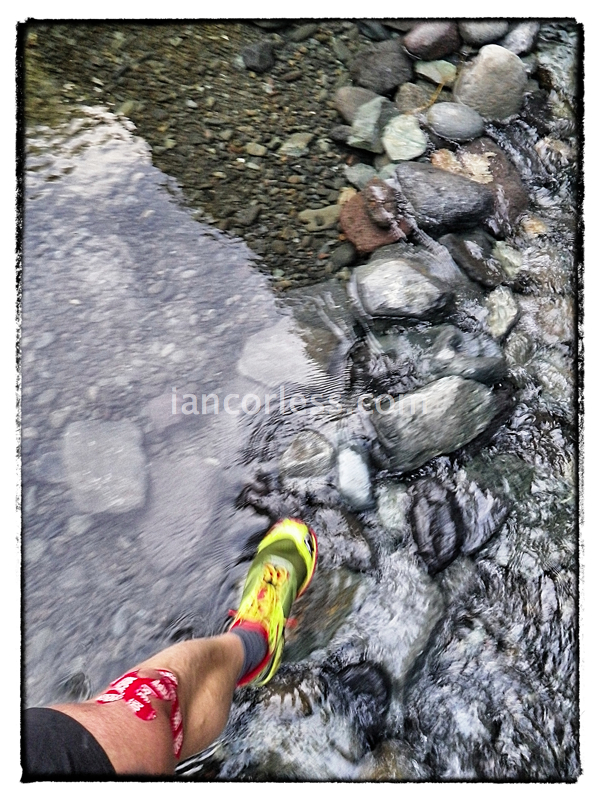
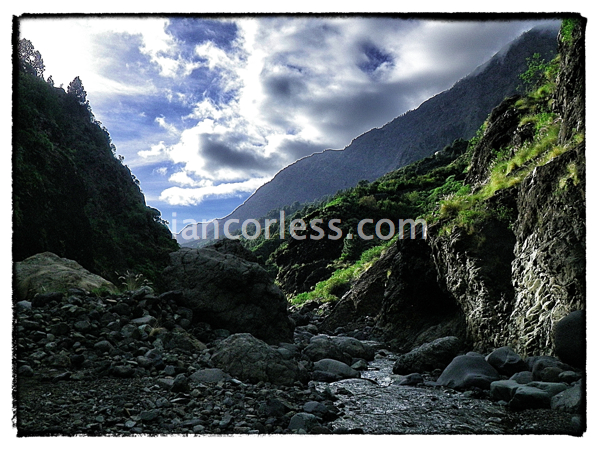
We started the trail at 0900 in the valley and had decided on an anti-clockwise direction going through the Barranco de las Angustias ravine which is all about boulder and rock hopping, crossing the river multiple times and some scrambling. It’s mostly slow going and if you are not technically proficient you do need to take care. (NOTE: If you plan to do this you must check that no heavy rain has happened in the previous 24/48 hours or more importantly that any is due for your own excursion. The water level rises very quickly).

Niandi is not the best at this really technical stuff but she embraced it, smiled and bounced from rock to rock when she could. Hats off to her… she very rarely says ‘I can’t’. She takes a breath and gets on with it; respect!

iancorless.comP1040395


As we have grown to accept with La Palma the terrain changes constantly. Running through the ravine we would then climb and drop back down. Sometime we could run, others we would scramble. I loved it. It would make a great race route but only for the proficient… moving over this terrain at any speed requires real skill.

iancorless.comP1040366

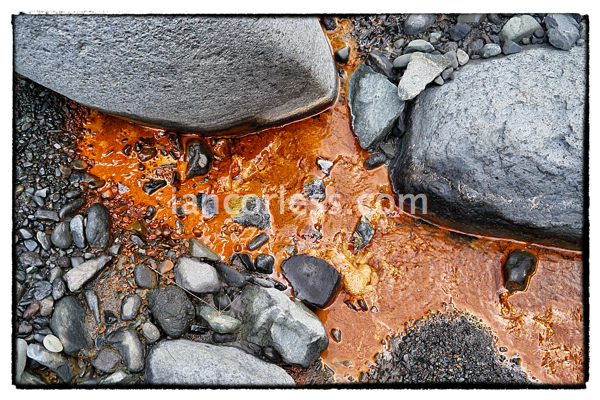
Finally arriving at the end of the ravine a dam was in front of us. The water here changed colour to incredible oranges from iron discolouration. We moved to the left and moved onwards and upwards finally joining incredible single track. We had gone from rocky ravines to pine forests.

iancorless.comP1040440

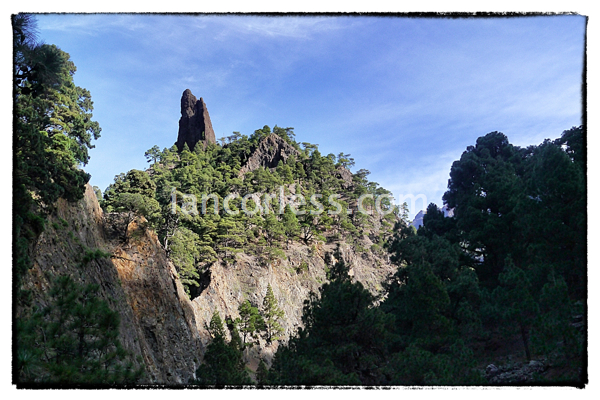
The Roque de Idafe like some huge rock finger pointing to the sky in front of us. We now started to climb up and up. Although this was running terrain the gradient means sometimes you jog, sometimes you hike, No worries. All part of the fun.

iancorless.comP1040493


Niandi loved this section of the LP13. It was beautiful and inspirational. The sune had now moved up high into the sky and warmed our backs. We finally arrived at our turning point at the end of the valley. Here is a Tourist information centre and campsite. From here you can go on several different routes. Some are out and backs, others circular routes.

iancorless.comP1040544


We had a picnic lunch and then followed the signs to Los Brecitos. We now had the opportunity to pretty much run and power hike this whole section. Narrow single track made soft and bouncy by fallen pine needles… a carpet like feel under our feet. Niandi smiled and bounced her way down the trail. Such a contrast to the way out down the ravine. It is what makes running here in La Palma so special.

Ian_Snapseed


From Los Brecitos we had a small section of road and then we dropped back down the trail to our start point in the valley.

You don’t measure these runs via distance. It means nothing. To be honest we are not even running much of the time. It’s about time on feet and experiences and today was one of those days on the trail that you don’t forget.

You can see a selection of images HERE

In the evening we went and had Cerveza, Pizza and then sat outside at Cafe Eden being entertained by a local band playing Dire Straits, The Rolling Stones and so on… we both could get used to this!

Los Llanos de Aridane – La Palma

Day 7 (Friday) Niandi and myself went sight seeing, cake eating and coffee drinking in the beautiful town of Los Llanos de Aridane. Los Llanos is the finish area for the Transvulcania La Palma.

iancorless.comP1040238

It’s a great place. It has a mixture of modern shops, traditional architecture and one has the opportunity to see local life unfold. Thankfully no signs saying “English Pub” or “English Breakfast served here”. It is as a Spanish town should be; Spanish!

iancorless.comP1040297

For me with all the pastel coloured buildings it has a feel of Cuba. Now I haven’t been to Cuba so I am make some serious assumptions here…. however, I am happy with my speculation!

iancorless.comP1040305

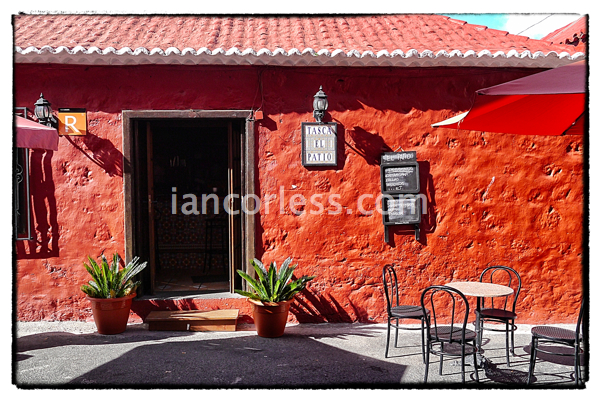
I left Niandi at surfing and answering emails at ‘Tasca El Patio‘. A great little cafe in one of the many side streets in Los Llanos. I went to KN Sports situated in the town. No matter how much sport kit I get I still love checking out whats available. These guys had a great selection of Salomon kit so I did wonder if I would be parting with some money….

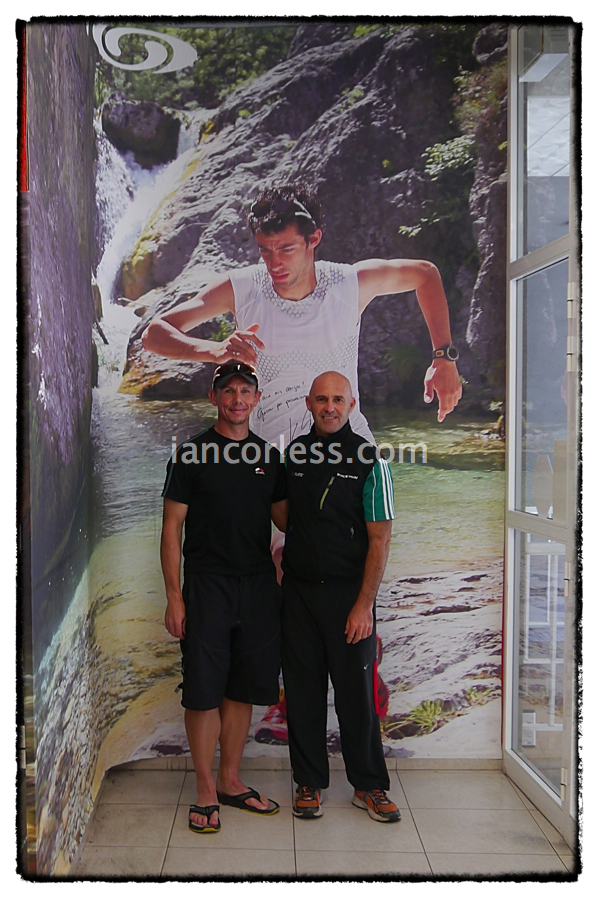
In the store I was greeted like a celebrity. It was a real random moment. I was asked to be photographed with each of the staff one by one and the manager in front of a huge ‘Kilian’ poster. At first I was confused… I thought it must be because I was British. As it turned out they are big followers of Facebook and my blog. Funny!

iancorless.comP1040322


The relaxing morning was followed with Niandi taking some chill and relax time at our villa but I needed a fix. I went out for just a couple of hours on local trails in the late afternoon sun. Taking the LP13 trail I ran down the valley and went rock and boulder hopping.

iancorless.comIMGP0736


iancorless.comIMGP0727


iancorless.comIMGP0717


Our evening was spent with some friends in Tazacorte Port eating and drinking the local specialities. A perfect day in La Palma…

You can see a selection of images HERE

Episode 24 of Talk Ultra

106944-ultra-runner-william-sichel-pictured-competing-in-the-athens-1000-mile-world-cup-race

We have an extended interview with ultra running legend, William Sichel. William, who is now 59 years old has been setting records and winning ultra long races for years. In our show he discusses how he got started, his life, his training and highlights some of his key moments. In Talk Training we discuss overtraining and highlight some of the warning signs. Speedgoat Karl joins us and we have a Meltzer Moment. We have a blog, discuss the news and mention the up and coming races and Christmas is less than two week away!

 ITunes HERE
Libsyn – HERE

Website – HERE

Show Notes

00:00:45 Start

00:08:56 News

Jez Bragg in New Zealand

Jez Bragg departs on his New Zealand epic:

Journal HERE

Jez’s tracker: HERE

00:18:51 Blog – Iain Ridgeway has just completed a solo unsupported winter Paddy Buckley round in north Wales.  HERE

00:19:40 Talk Training on Overtraining with Marc laithwaite

00:42:00 Interview with William Sichel:

William started ultra running in 1994.

William has set multiple ultra distance records at World, British and Scottish level including age-group records, classic event records and Guinness World Treadmill Records.  Full details here

Unusually he  won his debuts in the 100km, 24 Hour, 72 hours, 6 day, 7 and 8  days events.

Furthermore, he has won international events in the UK (five times),  Netherlands, USA (twice), Switzerland, Monaco (3 times), Greece, Hungary and Germany (twice).

In the 2010 Hungarian 6 Day Race, William became the oldest person ever to set an outright Great Britain athletic record when setting a new GB and Scottish 6 Day road record of 518.31 miles.

In the Athens 1000 Mile World Cup race held in March 2010 William was runner-up in an age-group world record of 13 days 20 hours, 8 minutes and 1 second.  William became the oldest British person ever to have completed a 1000 miles in under 16 days.  He also set intermediate age-group world records at 6 Days and 1000 kms.

The last time a British male runner, of any age, completed a 1000 mile race, in under 16 days was in 1991.

Some of William’s Personal Bests

  • bullet Marathon: 2:38:17 (1995)
  • bullet 100km: 7:07:49 (1996)
  • bullet 12hr: Track 141.50km/87.92 miles (2001)
  • bullet 24hr(Road): 246.70km/153.30M (2000)
  • bullet 48hr (Indoor): 344.267km/213.92 miles (2007) Scottish Record
  • bullet 48hr (Track): 340.80km/211.76M (2008)
  • bullet 48hr (Road): 329.710kms/204.87 miles (2007)
  • bullet Six Days(Road): 809.230km/502.8 miles (2007)
  • bullet Six Days(Track): 857.07km/532.56 miles (2008)
  • bullet 1000kms (Road): 7days, 23hours, 45minutes, 43seconds (2010)
  • bullet 1000 Miles (Road): 13days, 20hours, 8minutes, 1second (2010)
  • bullet Badwater: 31hrs 36mins 12secs British Record (2006)
  • bullet Spartathlon: 29hrs 01mins 29secs Scottish record (2007)

Some highlights

Athens International Ultramarathon Festival – 1000 Miles World Cup.  Runner-up with 13d, 20h, 8m, 1s.  Three World Age-Group records at 6 Days, 1000kms and 1000 Miles.

Athens International Ultramarathon Festival 7 Day, Outright winner. World Age Best for 6 Days (Road) 751km/466.65 miles (2009)

“Across the Years” 72 Hour race, Phoenix, Arizona, USA.  Outright winner with 269.364 miles/433.50 kms. (2009)

Hamm Six Day Track Race, Germany. Outright winner, P.B., British Record (M50), Scottish Track record and All-Time Scottish record (Modern) – 857.07km/532.56 miles (2008).

“World 48hr Championships”, Surgere, France. 5th overall (M50 1st). Track P.B. (2008).

World No3 for the Six Day event with outright win and course record in Monaco Six Day race -809.230km/502.8 miles (2007)

Scottish event record in the world’s longest point-to-point race – the 153 mile “Spartathlon” in Greece (2007)

Scottish Record 48 Hour 344.267km/213.92 miles (2007)

World No1 for the Six Day event with 770.247km/478.60 miles, Monaco course record (2006)

British event record in the 29th running of the “World’s Hottest Race” the Badwater Ultramarathon 31hrs 36mins 12secs (2006)

Scottish event record in the world’s longest point-to-point race – the 153 mile “Spartathlon” in Greece 33hrs 14mins 20secs (2005)

“Across the Years” 24hr, Phoenix, Arizona, outright winner (2005)

World 24Hr Championships Age-Group Silver (2004)

Guinness World Records (treadmill) 100 miles & 24hrs (2002)

World 24hr ranking No12 (1998 & 2000)

Basel 24 Hr, Switzerland, outright winner (2000)

British 100km Champion (1999)

Masters World 100km Champion (1998).

European 100km Championships: Team bronze medal (1997)

Scottish 100km Champion (1994)

Represented Great Britain 11 times since 1996:100km team x 8 & 24hr team x 3

Represented Scotland 5 times since 1995.  Last representation was in 2009.

01:57:33 A Meltzer Moment with Speedgoat Karl

02:00:32 Up and coming races

02:01:43 Close

02:04:01

European Skyrunning Championships 2013

Emelie Forsberg, winner 2012 Dolomites SkyRace®. © Pegaso Media

Every two years the European Skyrunning Championships are celebrated and 2013 is no exception.  The big news is the inclusion for the first time of the ultra distance.  The venue is all-Italian with the Vertical Kilometer® and SkyRace® in Canazei, Dolomites on July 19 and 21, while the Ultra will take place just six days later in the nearby Veneto Region.

The Dolomites will again host two of the events in the three-year history of the Championships.  The record on the unforgiving Vertical Kilometer®course just 2,1 km long, stands at 33’16” by world record holder Italian Urban Zemmer and Antonella Confortola in 39’13” back in 2008 when the course was inaugurated.

The classic Dolomites SkyRace® favoured by the world’s top runners offers a new challenge after record-breaking performances here this year by Kilian Jornet in 2h01’52”, and the three top women, Sweden’s Emelie Forsberg, American Kasie Enman and Spaniard Mireia Mirò – all under record time.  Forsberg’s record stands at 2h26’00”.

Trans d'Havet. ©Augusto Mia Battaglia

The challenging and often technical course represents one of the toughest proving grounds for the relatively short distance:  22 km but with 1,750m climb to the summit of the Piz Boè which, at 3,152m altitude, towers above the start and finish of the race in Canazei.

The much anticipated Ultra is embodied by the Trans d’Havet, a point to point 80 km long with 5,500m vertical climb traversing the Piccole Dolomiti in the Veneto Region.  The route, technical in stretches, includes 6 km of tunnels dating back to the First World War, created by General D’Havet, to whose name the race is dedicated.

At the launch this year, the men’s winning time was 10h58’44”, no doubt destined to fall with the top European runners participating here in 2013.

Following on from the Dolomites SkyRace® on the 21st, five days’ activities and fun-packed action are being organised for runners who want to stay over for the Trans d’Havet.  More news on this later.

The European Skyrunning Championships are open with individual titles at stake in each discipline and a combined title based on the sum of the highest points scored in two out of three events. The national title is based on the score of the first three men and one woman in all three events.

2013 European Skyrunning Championships

VK

Dolomites Vertical Kilometer®, Canazei, Trento, July 19

Sky

Dolomites SkyRace®, Canazei, Trento, July 21

Ultra

Trans d’Havet, 80k, Piovene R. Piccole Dolomiti, Vicenza – July 27

El Pilar – La Palma

iancorless.comP1040115

Days don’t get much better than our 7 hour jaunt in the mountains of the Cumbre Nueva on the island of La Palma yesterday.

Slowly but surely, Niandi and myself have now covered the whole route of the Transvulcania La Palma and what a route it is…. it so varied. Lava, dark black sand, rocks, pine forests, hard packed trail and so on. The course constantly changes beneath your feet and with it the weather too. One moment you can be in bright blue skies with mid 20 degree temperatures and then suddenly a bank of cloud engulfs you and the temperature drops.

iancorless.comP1030900

Yesterday we started our day at El Pilar, arguably about a third of the way into the whole Transvulcania La Palma route. Our object was to continue up the course toward Roque de los Muchachos but stop at the point we had reached on a previous run. This was Pico de la Nieve on the rim of the Parque Nacional de la Caldera de Taburiente with Roque de los Muchachos in sight in a north west direction.

It was an incredible day on the mountain with terrain, views and weather constantly changing. We had the trails to ourselves only coming across three other people all day.

iancorless.comP1030949

The running from El Pilar for approximately 8k was pretty easy and then the climbing begins once again and it is all about managing your effort as once again you head up well above 2000m. Both Niandi and myself felt pretty good. We are not worried about pace or constant running. We are on the mountain having fun… running when we can, jogging when we can’t run, hiking when we can’t jog and then crawling when required ;-).

My only issue yesterday was my knees. The long descent back to El Pilar took its toll in the final hours and I have to say that from hour 6 to 7 when we finished was a touch uncomfortable. So, it’s an easy morning today with some sightseeing and maybe a couple of hours on the trails later this afternoon to get our fix! We are here for another week after all….

Images from the day can be seen HERE

Here are a few highlights:

iancorless.comP1040126

iancorless.comP1040029

iancorless.comP1040016

iancorless.comP1040096

iancorless.comP1040137

iancorless.comP1040067

iancorless.comP1030943

iancorless.comP1030949

iancorless.comP1030957