Four hundred participants will toe the line for an incredible Vertical Kilometer on a stunning world stage in Chamonix. Part of the Skyrunner World series.
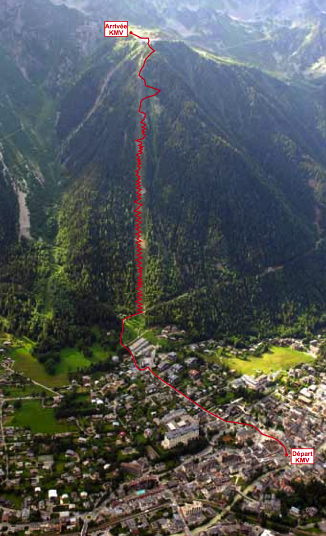
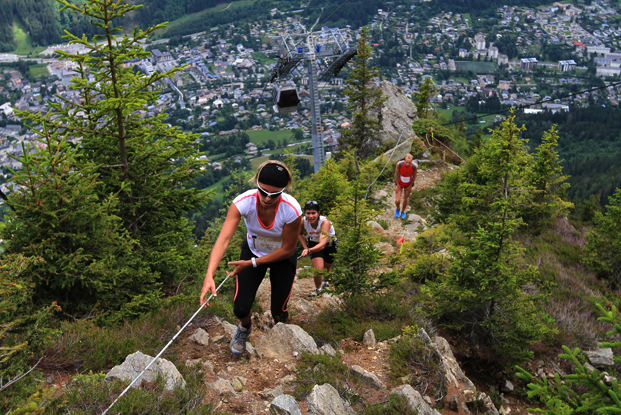
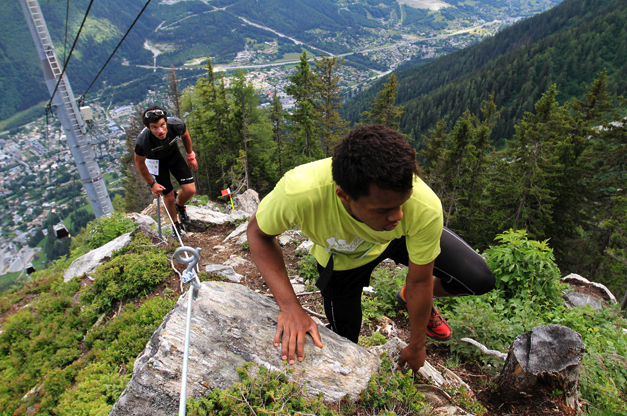
The VK® is a 100% pure mountain experience. Runners will depart from the centre of Chamonix every 30 seconds to climb 1000m over 3.8km. The arrival at Plan Praz Gondola Brevenet is preceded by rolling terrain in the early stages but is soon followed by tough and technical rocky sections ladders, ropes and cables! Not recommended if you have vertigo…
Lizzy Hawker is arguably one of the greatest female runners of all time. She has transcended what we all think is possible in running. Her versatility over multiple distances and terrain has without doubt made her one of the most respected ultra athletes of all time. She has dominated the UTMB, she is a 24-hour champion and she has set numerous course records. I was fortunate to catch up with Lizzy in early 2013. She had just had a very successful latter half to 2012 but was recovering from an injury before embarking on another full year of racing and personal challenges.
IC: Lizzy, it’s a real pleasure to finally chat, we have been trying to coordinate this for sometime. Firstly, can we go back to how you got into running, you say you always remember running but at what point did you realize you had ability?
LH: Well going back, I can’t remember NOT running. I guess we all run as children, you know, just running around. I always remember at school that I preferred running in contrast to netball or similar sports. I don’t know how really but it just became normal to run everyday. It was only for fun though. It never crossed my mind to race or join or club. It was just my way to be outside and in nature. It was a balance to school, university and all other distractions. It’s just something that has always been there for me and I don’t think it was really until 2005 when I entered a couple of long races that I realized that I had something that I should really pursue.
IC: Pre 2005 is that when you where travelling doing expeditions. You were in Antarctica. An Oceanographer, yes?
LZ: I was actually finishing off my PHD and then I had a job with the British Antarctic survey.
IC: Running was very recreational then, a way to keep fit?
LZ: Absolutely, it was my way to be outside and an escape.
IC: Did you do any competitions, half marathons, marathons etc.?
LZ: I did London Marathon just because I felt I should… you know, it just seemed logical. I remember it was several years before I actually got a place due to the ballot. This was prior to my PHD but I was working at the Antarctic Survey when I got a place. I was actually at sea for six weeks. It was only a month before London that I got back on land. Not ideal preparation! It was my first race…
IC: How was that, how did it go?
LZ: I enjoyed it but my time wasn’t special.
IC: Time?
LZ: 3:40 ish
IC: Wow, considering how fast you now run that was a humble beginning. Nice for us all to hear… 3:40 for many is a good time but it was a very modest start for you. How did you progress?
LZ: From London a friend suggested that if I love hills then I should do a marathon in a hilly place, you know, somewhere nice. So, I did Snowdonia marathon in Wales for a few years and then the same friend suggested going ‘off-road’. You know, going across hills instead of around them. So, I entered the Welsh 1000’s. Because I didn’t have fell-running experience at all, I couldn’t enter the fell class, so, I was in the mountain class. It meant a heavy pack, long trousers and walking boots. I enjoyed it and did it a couple if times… that was the only experience I had prior to 2005.
IC: In 2005 what changed, what was it that you then did that paved the way to were you are now?
LZ: Two things really. I was visiting friends in South Wales to escape my PHD for a weekend. They were running a 40-mile track race in Barry. So I just entered it. Primarily because they had. I think that was March and then I was selected for the England team for the UK 100k champs. That was based on my time at the 40-mile race. The 100k was a month later and in-between that I went to Turkey to SkiMo (Ski Mountaineer). Not conventional prep! Also, I had read an article about the Ultra Tour de Mont Blanc (UTMB). UTMB did not have the prestige it has now and it had no wait list, so I entered. I was due to finish my PHD and it was a great excuse to go to the Alps. I would goo climbing and then race at the end. That was my first mountain race.
IC: So in 2005 with little or no experience, you go to UTMB. That is quite a step up eh?
LH: I had no idea what I was letting myself in for. I had nothing to gauge it against. I had no idea even if I would get back to Chamonix after starting. I certainly expected not to make one of the cut offs… I was on the start and I thought about a quote from Alice in Wonderland, you know, the one about starting in the beginning and stopping when you get to the end. That was my goal. To start and keep going until I stopped or was stopped.
IC: What was that first experience like?
LH: I loved it. I started in the masses. I was way back at the start. I was on the Church steps way back from the front. It was a long long time before I even started to run. Just the sheer number and volume of people slowed everything down. I can remember, after about 15 to 20k I was somewhere between about 500/600th place. I actually finished 25th or 26th overall by the time the end came. I just worked my way past everyone… I just loved it. It was my first experience of running at night and I can remember after one of the feed stations, I was running up a climb and I could feel the beauty of the mountains. I knew then that I would have to go back. Yes, it was magic.
IC: You have won that race (UTMB) five times…
LH: Well, kind of five times…
IC: Ok, yes, five variations of the race! We spoke after the 2012 finish and you said you still had unfinished business. You want that ‘time’* on the course. Will that mean you will be back?
*Lizzy is very keen to set the fastest ladies time in the UTMB course.
LH: Yes, I am mulling over my plans. I can’t confirm for 2013 but I almost certainly will be back to UTMB, if not this year then maybe next. I do have unfinished business.
IC: Do you think the plans that the UTMB organization have made for 2013 and moving forward to correct issues* in the past will work? *by issues, we refer to the race being shortened due to unpredictable weather.
LH: I don’t know. What I would like to see is a sliding start time. So that they have the possibility to bring the race forward or delay by 24 hours, this will allow for good weather windows. I am not sure how that would work with the other races (CCC and TDS) going on but it seems to me that the weather systems work through quite quickly and this window may very well be ideal to allow the full race to go ahead. We want the race to be as it should be, a full tour of Mont Blanc. That is 160km. If I were taking time of work, paying money to get there, I would much prefer to add one extra day either side and have that possibility to race for what may very well be moderate additional expense. I don’t think they (UTMB organization) have taken this as an option but it is what I would like to see.
IC: I think many would agree with you. The race is a ‘tour ‘of Mont Blanc. Not a 60k, 100k or 140k. You want to go back and do the race and get the time* but your variety of races are extreme, you know, you run on the track, you run on the road, you run mountains, you run trail, you do multi stage, how do you apply yourself in your training, do you literally just go out and run and enjoy it?
LH: Pretty much I guess. I think over the years I have kind of built up a high level of base endurance so depending on the race I am targeting next I kind of focus training to that specific event. But because of the way I came into running, running was part of my daily routine. I wanted to be outside, I wanted to be moving and I just love running, So, that is really the backbone of my training even now I guess. I just like to run.
IC: For someone who loves the mountains so much, You are passionate about Nepal for example, what is it in your mind that allows you to run on a 400m track, time and time again for 24 hours?
LH: I haven’t done that yet!
IC: Yes I know that, but I am curious what it is within you that will allow you to do this?
LH: I can remember back to my first track race in 2005. I hadn’t been on a track since school. It was funny, I couldn’t get lost, I couldn’t fall down a crevice, I had no avalanches to think about and it basically just simplified the process. I could think about the running movement. I could just focus. Almost like meditation.
IC: Do you use meditation when running?
LH: I use mediation for it’s own sake. But that is just during the last 12 months or so. But I have realized that most of my running is kind of a meditation. Or at least it is my quiet time. Time alone with myself. Not every case obviously but when I am alone it is a relaxing and spiritual time.
IC: I followed you at UTMB in 2012. I had the benefit of being in the feed stations with Keith (Lizzies crew from The North Face). You would arrive; Keith would have everything laid out. It looked planned with a definite strategy. Get you in and out ASAP. But I remember you said to me that it isn’t that planned.
LH: No not at all. I never know what I want but if I have the options I can choose what I want. I need to move through as quickly as possible.
IC: Do you find that you turn yourself off? Do you almost become metronomic?
LH: Not really. It’s a body and mind connection. It has to be very strong. You need to know what is going on; particularly with your body but at the same time you need to be able to cut pain off. You need to hang on in and sort it out. It’s two sides of the coin if that makes sense.
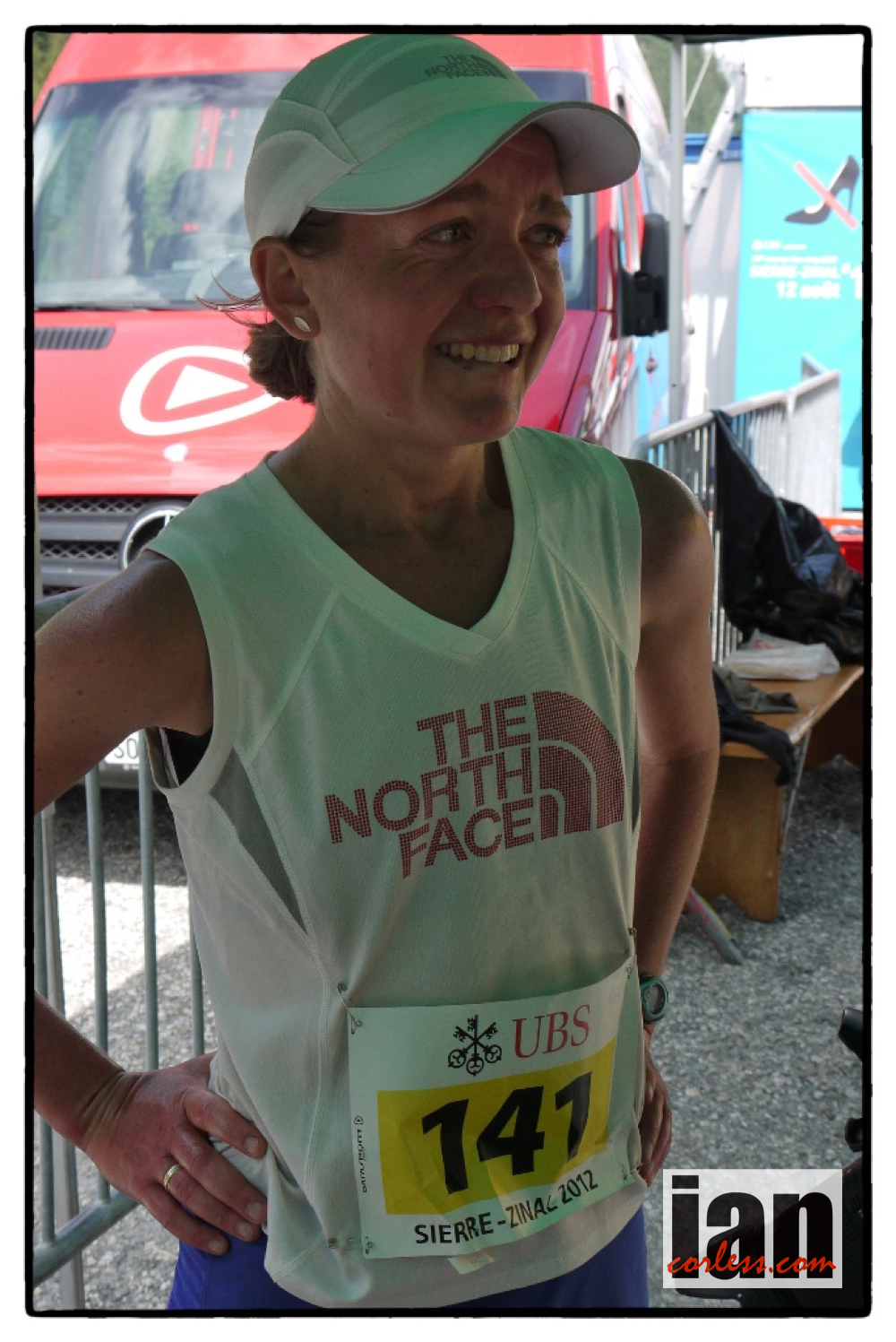
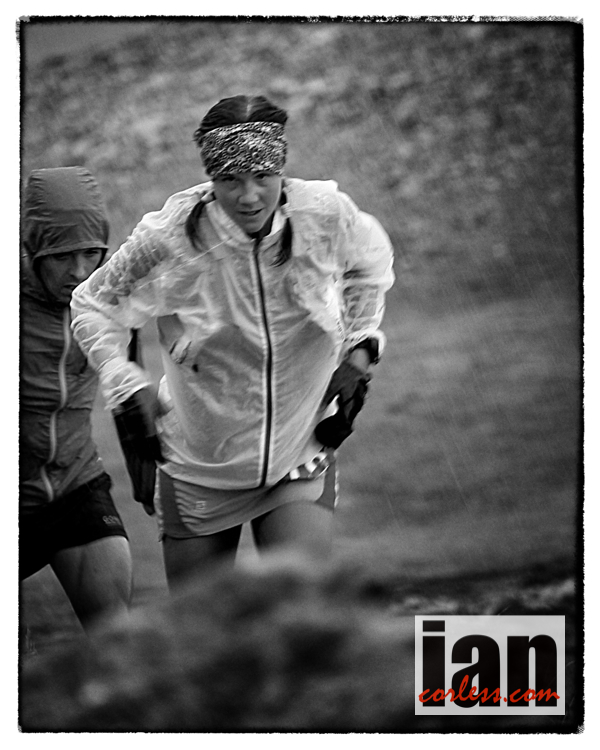
Lizzy Hawker at Sierre-Zinal 2012 copyright Ian Corless
IC: If we look at your achievements, UTMB, 100k champs, 24-hour world record and in 2012 you had a golden period… UTMB, Run Rabbit Run and then Spartathlon. If we look at all these things, what are your highlights?
LH: Ultimately it is the running. It is an essential part of my life. The races are stepping stones within that. I think it is funny though, I look at what you call the ‘golden period’ and I don’t feel I raced at my best! I could have done so much more… It is kind of funny; I am always trying to improve. Go faster, go longer. I want to be so much better. I was happy with those three races but I felt I could have given more.
IC: Lets take Spartathlon. It is an iconic race in the ultra calendar. It is a race that has a different variety of people who take part, we often look at that race as giving some significant performances, and for example we talk about Yiannis Kouros and Scott Jurek. You raced for the first time in 2012. Did the race live up to its billing?
LH: It is an iconic race. The atmosphere is amazing. The route is not that wonderful, not so much the route but the fact that you are on busy roads and they don’t close them. I had times during the night with lorries passing me that were less than comfortable. It is an incredible race to be a part of though.
IC: Of course you had a pretty darn good race. You set a women’s course record, you were on the podium overall but yet you say it wasn’t good enough! Did you want to win outright?
LH: yes!
(Joint laughter)
IC: Funny. I love the standards that you set yourself. Will you go back?
LH: Yes, I am not sure in 2013 but I will go back and try again one year.
IC: After Spartathlon I guess you had a cleansing period in Nepal. You did Manasulu Trail. Is that type of race more for you, a personal race?
LH: Half and half. Of course, I love to be in Nepal. Nepal gives me so much back, to be in that place is rewarding but those Nepalese guys can really run, it is not easy.
IC: I love you say that you mention the men and the fact that you are not racing the women.
LH: It’s a small race!
IC: Yes, but women usually race women. You always race for the overall instead of racing for first lady. Are you very competitive?
LH: I guess I am competitive but the competition is within. I want to be the best I can be. I can win a race and not be happy or I could come way down the field but be happy because I did my best on that day. That is the way I feel about racing. It is a personal thing.
IC: You love Nepal. You attempted a full crossing, which unfortunately didn’t go to plan… you lost your sat phone amongst other things!
LH: Or the permits! Just a few things… (laughs)
IC: Will you try again; I know the rules have changed on how you can now do these crossings?
LH I definitely want to go back. It is my dream journey. To cross the Himalayas keeping as high as possible and moving fast is what really motivates me. I would love to go back.
IC: How long is that journey?
LH: About 1,000 miles.
IC: A long way!
LH: Yes, a pretty long way.
IC: A race has been announced that will take this whole route for 2014.
LH: Yes, Spring 2014 and 2016 I think.
IC: Is that of interest to you or would you prefer solo?
LH: I can do both! (Laughs) I still want to do my solo journey because it will be so different. The race will miss the high passes. You can’t really compare the two. They both have validity and I would like to do both.
IC: 2013 is here, what does it have in store for you?
LH: Good question. I am mulling that over. Nothing is definite, not that it ever is. I am formulating race plans at the moment.
IC: Western States, Skyrunning, and UTMB?
** Please see UPDATE below
LH: Ronda del Cims 100m Skyrunning race is looking very likely in June. I hope to do Hardrock 100. I am on the wait list so I hope to race.
IC: You are high up on the wait list for Hardrock 100 if I remember correctly?
LH: Not sure it is high enough though? I will try to do those two and then we shall see what the rest of the year holds for me.
Lizzy Hawker copyright Ian Corless
IC: Ronda del Cims is a tough course. It has plenty of climbing and altitude.
LH: Yes. I am looking forward to it. It will be a real challenge and a great race.
IC: Well Lizzy as per usual, it has been an absolute pleasure to talk to you. Without doubt you are an inspiration to all. I really appreciate your time and I look forward to seeing you and following you around the Ronda del Cims course in late June.
LH: Thanks so much Ian.
*To get 2013 rolling, Lizzy raced at Annapurna 100k and won the ladies race. She then decided to break her own personal record running from Everest base camp to Kathmandu (319km/ 198m) in 63 hours and 08 minutes (here) smashing her previous record. Not content with running for 63 hours, Lizzy then raced the 277km Mustang Trail Race and was 2nd overall. However, just recently she entered the 24-hour championships and pulled out. Apparently all is well with Lizzy and her focus is now on Ronda dels Cims. I have to say, that Lizzy has not only the potential to win the ladies race but the race outright. Race preview HERE
UPDATE June 6th, An email from Lizzy “As it turns out I’ve just had an MRI confirming a stress fracture in my foot. So, Hardrock would have been off the cards, and now I also have to pull out of Ronda del Cims.”
Today the TNFUTMB organisation is going further by testing the creation of a mark, which will allow training courses to be a source of points, according to very strict criteria. This course is organised this year in partnership with WAA.
Qualifying courses with WAA
WAA, (What An Adventure), an enterprise which focuses on two activities: training and sports merchandise.
WAA Ultra Training has, for several years been organising courses in collaboration with, amongst others, Vincent Delebarre (winner if the UTMB®) for the mountains and Laurence Klein (multiple winner of the Marathon des Sables) for the desert…WAA Ultra Equipment offers ranges of products in the colours of the partner races such as Ultra-Trail du Mont-Blanc®, the Marathon des Sables, or even the Eco-Trail de Paris.
This year the WAA, for several years a partner with the UTMB® are opening the way by setting up, under the aegis of the organisation, a new concept of training courses for preparation for the UTMB®, CCC® or TDSTM valid for any long trail race which is run in the mountains.
The mountains as well as being beautiful can be hostile, difficult and changeable …The potential risks are numerous but it is possible to anticipate them when they were identified and when one is ready for them. So, the Ultra-Trail ® course will offer apart from a reconnaissance of the terrain, physical training and real ‘mountain’ environment training: “Safe” behaviour, good practise in respect for the environment, race management to optimise performance allowing the runner to be the key to his own safety.
Vincent Delebarre‘s testimony: “For 8 years I have organised around fifteen courses each summer which allow me to judge the physical condition and above all the knowledge of the activity and the participants’ environment. And there is still a lot to be done. The qualifying races show the level of experience relating to trail -running but for all that do not confer, the minimum knowledge of good management and comportment in the mountains : knowing what to do, how to react in case of injury, or storms, how to help a wounded person in the cold or under the sun… These courses offer the training necessary for a trail runner to become autonomous because trail-running is not just simply running but also integrating into the surrounding environment.”
The courses earn up to 3 qualification points
The Ultra-Trail® courses allow for the possible acquisition of 3 qualifying points, validation average from both the leader and an external jury. But following the example of « Mont-Blanc courses » in the mountains (courses of 5 days preparation and acclimatisation aiming at the ascension of Mont-Blanc), the awarding of points, same as the arrival at the summit of Europe, is not guaranteed. Bad weather conditions, limited physical condition or insufficient technique can lead to an absence of points. Participation in the courses does not mean automatic acquisition of points.
For these courses in the absence of the idea of the competition, the physical and mental load imposed is equivalent to a trail-running event worth 3 points. To obtain this qualifying recognition, the level of these training courses is very high and the qualities required to participate in it are important: being capable of doing the UTMB ® route at the speed of the official time barriers, having the endurance required for each of 4 stages, of having a minimal experience of the Mountain environment…
As for their progress in stages, the notion is already known and used, since today certain big races with stages like the Marathon des Sables, the Défi de l’Oisans, the Annapurna Mandala Trail, the Desert Oman Raid, the Transrockies run or even the Grand to Grand Ultra… are qualifying and already carry points. Also the number of points from the Ultra-Trail®training courses is determined on the basis of the calculation which is currently used for these races and takes into account the kilometres, positive height gain, number of stages and their difficulty, the time barriers, etc.
Michel Poletti confirms that: « Having tested the courses lead by Vincent Delebarre has run for several years, they demand the physical and mental engagement which is as important as that of a race in stages. They carry a qualitative education on the practice of the trail-running in the mountains (effort management, learning to be autonomous, safety, and respect for the environment…). Beyond just training they can allow the acquisition of the necessary Mountain experience, just as much as by their participation in a race. ».
Training courses for a veritable preparation for trail-running races in the mountains
– Physical and mental preparation
· 170km around the massif of Mont-Blanc
· 9 500m of positive height gain
· To be realised in 4 days at race speed
· Around 10 or 12 hours of course each day, including refreshment stops
· A section realised partially at night
· Same equipment and rucksack packed as for the Ultra-Trail®
– A technical and tactical training
· Management of the first hours of the race
· Techniques : ascending, descending, with poles, without poles, supple running, managing walking/running
· Management of refreshments
· Managing long descents
· Food management
· Orientation tools and their use
· Managing the night
· Micro siestas
· Equipment, clothing, tips, the pack
· Diet
· Training for very long trail races in the mountains
· Knowing how to read the weather forecasts, adapting clothing and pack
– Raising awareness to the rules of the mountains
· Life in a mountain hut
· The dangers of the mountains and adequate reaction to them
· Witness an accident: what should you do?
· Taking the fragility of the locality into account
· Cartography – altimeter
– With recognized technical leaders
· Vincent Delebarre, high mountain guide, high calibre trail-runner, winner of the 2004 UTMB® 2004, course leader for several years and coordinator of the Ultra-Trail® courses.
· Jean-Claude Marmier: founder of the Groupe Militaire de Haute Montagne (GMHM), one of the pioneers of French and world mountaineering, several times finisher of the UTMB®, supervisor for the Ultra-Trail® courses.
· Professional recognised mountain leaders and specialists in trail running
· Specialist contributors: mountain security, experts in nutrition, training, environment, trail runners of high calibre, etc.
COURSE CONTENT
UTMB®
– 4 full days
– 4 stages – 165 km – 9 500 m of positive and negative height –
– Up to 3 qualifying points
STAGE 1
STAGE 2
STAGE 3
STAGE 4
Distance
42km
38km
43km
42km
Height gain
2 900m
2 300m
1 900m
2 400m
Height loss
1 400 m
2 700 m
2 700 m
2 800 m
Estimated time
11hrs
10hrs
10hrs
11hrs
CCC®
– 2 full days
– 2 stages – 100 km – 6 000 m of height gain and 6 150 m height loss –
– Up to 2 qualifying points
STAGE 1
STAGE 2
Distance
54km
46km
Height gain
3 255m
2 711m
Height loss
3 010m
3 140m
Estimated time
11hrs
10hrs
TDSTM
– 3 full days
– 3 stages – 119 km – 7 250 m of height gain and 7 450 m height loss –
– Up to 2 qualifying points
STAGE 1
STAGE 2
STAGE 3
Distance
36km
38km
45km
Height gain
2 524 m
2 364 m
2 372 m
Height loss
1 556 m
2 890 m
3 000 m
Estimated time
10h
9h
11h
A professional and economic dynamic
An information day « trail-running in the mountains » is being organised by the WAA, Vincent Delebarre and Jean-Claude Marmier with the aim of explaining the context of these courses, the stakes and the tolerated levels required by the leaders. It is aimed at, firstly, around ten mountain professionals who because they have the specific information, can supervise the Ultra-Trail® training courses.
The organisers are going even further, by imagining eventually a training which could deliver an additional and specific mention “mountain trail-running” for professional guides or leaders…who would like to organise courses themselves. A discussion is planned with the National School of Ski and Mountaineering to see if it is possible to envisage a collaboration for this training to become recognized speciality, and offered by the mountain careers sector.
Trail-running is today a rapidly expanding phenomenon which is generating an innovative energy urging the development of the discipline and all its players. It is the vector of an economy at every level offering mountain huts, municipalities, guides and race organisers very positive perspectives.
I would be really interested to hear your thoughts and comments on this?
Emelie burst onto the running scene in 2012 with a 2nd place at the Three Peaks in the UK. Throughout 2012, taking one step at a time, Emelie progressed through the Skyrunning calendar with consistent top 3 placing’s. She crowned her 2012 season off with a Skyrunning World Championship and a stunning win at San Francisco 50. Speaking from her home in Sweden, I catch up with her just before her 2013 run season starts. Cinnamon buns are in the oven and the hot chocolate is steaming on the table…
IC Welcome to Talk Ultra
EF Thank you Ian.
IC We all have followed your progress in 2012 and it has been a quick progression in the sport, but many ask, what were you doing before?
EF I have been a student for some years. Whilst studying I have lived and worked in Swedish and Norwegian mountain resorts.
IC You have mentioned work, I’m interested. By work I am assuming you don’t mean skiing or running?
EF Baking. I am a baker. In fact, I am actually baking bread right now.
IC So this is why you always post photos of you and food on Facebook. You have a secret passion.
EF (laughs) I love good bakery!
IC You love bakery but you also love Nutella if my memory serves me well?
EF Yes, I love Nutella too.
IC So you are a baker but you also worked in hotels too, I assume you must have been doing sport during this time. You are an accomplished skier, is that your sporting background?
EF Skiing is my sport as well as climbing and some running. But I only started running in the last 4 years. I run mainly in the mountains. I love being outside.
IC What was it at the end of 2011 that made you decide that you would come away from your home and start to basically to race around the world.
EF It was my Swedish brand ambassador for Salomon who asked if I would join the Swedish Salomon Team initially and then Greg Vollet, Salomon Team Manager, asked if I would join them for a weeks training? After that a decision was made that I should try some international races. I have just progressed. I wanted to take each race at a time. I didn’t want to put too much pressure on.
IC It has been a meteoric rise for you, Three Peaks was a low-key start in the UK and you got 2nd place. At Zegama, it was your first proper mountain race against an international field. You had no hiding place. But despite that pressure, you performed tremendously in what was a new experience for you.
EF Yes, a new experience. Actually, I was a little disappointed. I hadn’t run much before Three Peaks and Zegama. Of course I was happy to do well but I could have done so much better. I learnt I need to start running before racing.
IC Funny, you say you should run before racing. Seriously, you did no running before Three Peaks? What had you been doing?
EF I had a weeks running in April with the Salomon Team but when home I was doing SkiMo (Ski Mountaineering) or I just ran a couple of miles to University each day. So I wasn’t doing much. Certainly not to race. I do ski with heavy ski’s to add resistance and that really gets you fit and strong.
IC One thing that becomes apparent with mountain runners is that SkiMo plays a big part in winter prep. For example Kilian Jornet, Nuria Picas, and Philipp Reiter amongst others spend months during the winter doing this. Skiing really does transfer across well. Is it just great endurance training or does is provide other strengths.
EF Endurance is key. It is great uphill training too and the speed in SkiMo is great. The speed going downhill is great for downhill running. You learn not to be afraid, it builds confidence.
IC What is apparent is that you can go downhill really quickly. You have already gained a reputation for this. You put this to great use at Pikes Peak when at the summit you had a 10 min deficit but you pulled it back on the descent and got the win! What is that enables you to run downhill so quickly?
EF I love the speed and freedom. I love fast! You don’t need great power. During my life I have always been moving in technical terrain, which gives me confidence to recognize different kinds of trails and decide the correct route. I am not afraid. It’s a combination of no fear and confidence.
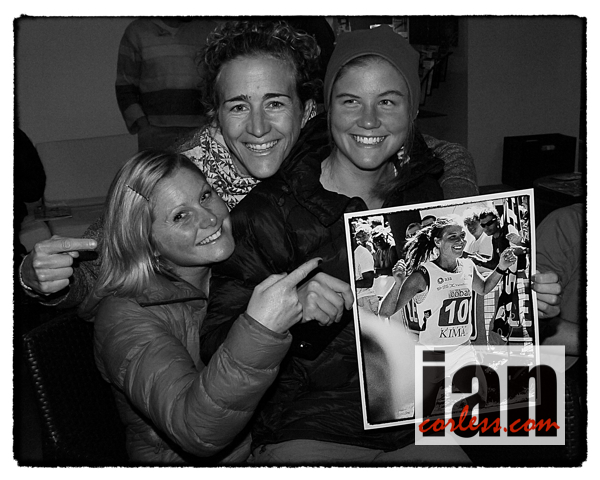
Trofeo Kima 2012 copyright Ian Corless
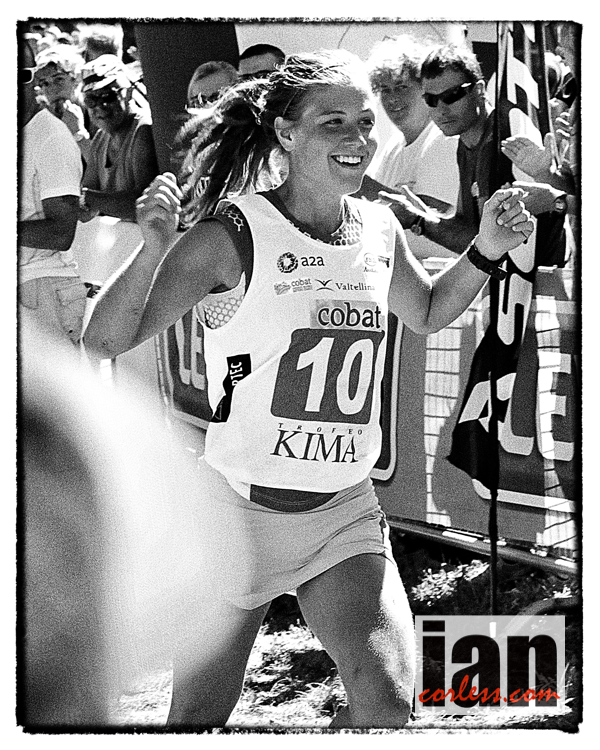
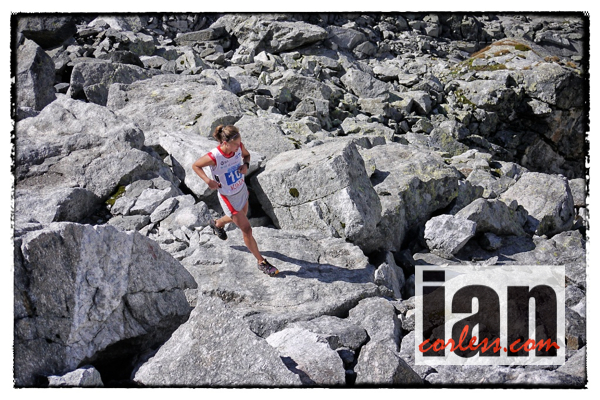
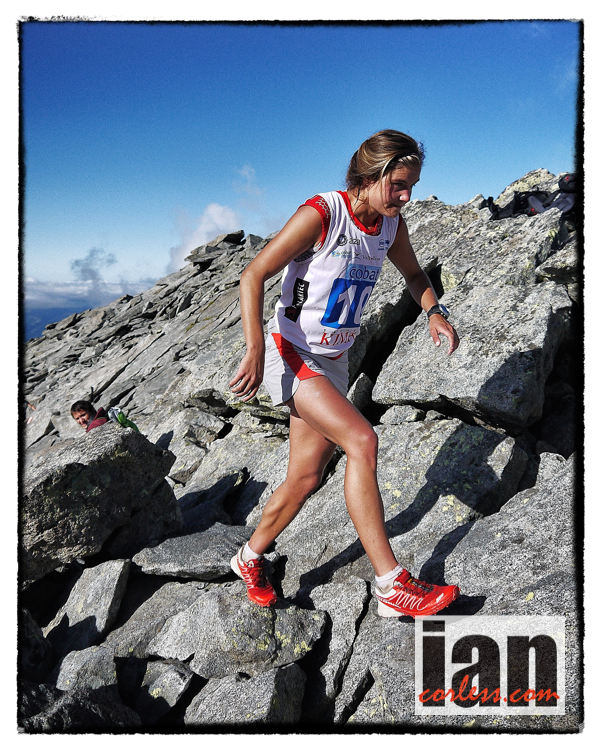
IC I think back to Trofeo Kima in 2012, you said before the race that you wanted to just have fun! You even took sandwiches…. On one of the toughest courses in the Skyrunning calendar!
EF I did
IC Admittedly you didn’t get time to eat them… the course was too hard. But I love the mentality. You wanted to enjoy it. I love that balance that you bring to your sport. You want to do well but ultimately you want to have fun. You have struck that balance so well. At Trofeo Kima you ran with Nuria Picas and then Nuria pulled away but you weren’t bothered, however, that competitive edge came in at the end when you could sprint for 2nd place. You put the ‘speed’ you love to good use then.
EF It’s a combination for sure. I want to have fun and I like to win. Running is great fun, for sure, my life is running. It’s liberating, it’s a big part of me. I must enjoy it. I need to enjoy what I do. Competition is great, I love to feel strong and I do love to race. Winning is great and once you have won, you think, I would like to win more but I need to keep balance.
IC I feel fortunate to have witnessed most of your races in 2012, the exception San Francisco when you won. I saw you on multiple podiums. But I also saw both sides of you… the fun person and the racer. For me, the race of the year was Cavalls del Vent. You are great friends with Nuria and Frosty and pre race you three hang out together. You laugh, giggle, drink coffee and even when racing you are great friends having a laugh. At Cavalls, all three of you battled in tough conditions. As it turned out Nuria won and Frosty was 2nd but for you 3rd was not a disappointment. It was your first long race. Did you feel intimidated by the distance?
EF I wanted to try a longer race. If you have never tried then you don’t know what it feels like. I needed to push myself. I actually started at Cavalls quite fast and I lead for almost half the race. I felt super strong. I could eat, I could drink, it was cold but I could manage it. In the end when Nuria and Anna passed me, I was mentally tired. Just super tired in my brain. I couldn’t push even though I wasn’t tired. Running uphill with Anna I couldn’t go with her. It was very unusual. We probably only had 40 mins to the finish of the race and Anna screamed at me “Come on Emily, push”. But I was just tired. I learnt something in that race.
IC What did you learn, what did you take away from Cavalls?
Cavalls del Vent copyright Ian Corless
EF I think I need to work on my mind and my physical. I need to connect them and I need to be stronger. It was my first long race and it was much longer than I had ever run before. To be honest, it is good to run with others too. I learnt that maybe running with others is better than running alone.
IC It is interesting what you say about running with others and talking. That is one thing that Kilian likes. I noticed it at Cavalls, he always seemed as though he wanted some company. In that race it was Anton Krupicka. Of course when it comes to the end, he runs away for the win. I guess time passes so much easier and quickly with company…
From Cavalls you went to La Templiers in France, which starts in Millau. It’s a big race in France. You raced Nuria and Lizzy Hawker. Nuria once again won. But you really gritted your teeth and outsprinted Lizzy for 2nd.
EF Yes it was satisfying but that race was problematic. I had stomach issues and I had to stop six or seven times. So that took energy. Plus I couldn’t eat. I felt I could have done so much better. I could have run with Nuria but I don’t know if I could have won? At the end I almost felt rude sprinting past Lizzy…
IC Racing is racing Emelie and Lizzy would have done exactly the same so don’t feel guilty.
Lets move to the final of 2012. Ultimately your best race, not only a stunning victory but a nice payday too, eh! (First prize in the Ladies race was $10,000)
EF Yes! a nice payday.
IC San Fran, funny, so many races have had difficult and tough with bad weather. It was no different here. Do you perform better when the conditions are like this?
EF Maybe not better but I am used to harsh conditions and I don’t worry.
IC San Fran was a great win. Talk me through it. Pre race I actually predicted you wouldn’t win because I thought you maybe had a little too much time skiing after Templiers. However, you proved me wrong, I hang my head in shame; I should have had more confidence in you. Talk me through it.
EF I wanted to start with Lucy and Maud Gobert. They are famous for being fast starters. I tried to keep up with them but very early on I thought I can’t go this fast… I was a little scared. Normally it is ME that starts fast. I slowed down. I felt confident and I was feeling okay and then two American girls passed. I then thought, wow, have I not run enough and have I had too many buns and hot chocolate (laughs) After about 20k I could see them again and I started to reel them in. I passed Lucy; she wasn’t having a good day. When the American girls picked up pacers I passed them too, this was about 30k into the race.
IC Early on then?
EF Yes, I still felt confident. I was not tired and I was looking forward to keeping on running at the same pace. Just before I picked up Anna Frost, my pacer, I passed Maud Gobert who was leading the race. I was now in the lead! I thought, I can do it… I had started the race slower and it was working. It was a great confidence boost. Anna was such a great pacer. We had such fun. She kept telling me “you can win”. It was great to be at the front, leading. It was fantastic. At the finish I was almost nervous, I had never won a long distance race before. When you think you can win, you really want it and then the nerves strike. I had a perfect day out.
IC It was a stunning win and a great way to end an incredible 2012. Can I ask, you say you started slower, it payed dividends in the latter stages, do you think that is something you will now transfer to other races? Maybe patience is good and you should hold back?
EF Yes and no. Sometimes I just want to run the way I feel like and not have tactics. I wonder to myself if can go fast all race without slowing, so why start slow (Laughs) Greg Vollet would not agree! He thinks I should start slower.
IC Shhhh we wont tell Greg. Greg, if you are reading this, she didn’t say that!
EF (Laughs)
IC I understand, lets say for example you are racing Nuria and Anna; you would rather be with them instead of watching them run away. Better to be with them and then you can adjust your pace accordingly, it may well be that you are running easy?
EF Yes, maybe.
IC What is on your 2013 calendar? Tarawera kicks off the year but that will be a low-key start as you are doing a relay. So will Transvulcania be the first big race?
EF Yes, I am not ready for 100k at Tarawera yet. I have planned to do some run coaching holidays and then I will go to Transvulcania La Palma. Transvulcania will be my first ‘proper’ race of 2013.
IC Superb, it’s a wonderful course and it will be great to see you racing Frosty and Nuria and some other great competitive ladies. Another classic battle lies ahead. After that, where do you go? Zegama?
EF Yes, Zegama.
IC Zegama is two week later and is a Sky marathon so will the remainder of the year be decided after these two races or do you already have 2013 planned out.
EF It’s almost planned out but I need to be flexible and I need to listen to my body. So I will change races if I need to
IC Can you tell us what your plans are?
EF I have several races in Sweden, mainly half marathons. Then I want to do Mont Blanc Marathon and the Vertical Kilometer, I will follow these two races with the European Champs (Skyrunning), I may even do Ice Trail Tarentaise.
IC Will you do UROC for the final of the Skyrunning Ultra champs?
EF Yes, I hope so. It will be my first 100k. It will be more distance than I have run before, so, I need to feel good but if I do, I will run.
IC An exciting year ahead and all those races are pretty much Skyrunning events. Exciting.
Trofeo Kima copyright Ian Corless
I have some questions from fans for you, is that okay?
EF Sure
ICJames Stewart asks, “Have you had a VO2 test?”
EF No, I have not. I’m not interested. Maybe some day.
IC I guess in principal a VO2 test doesn’t matter, you are running well and you can run quickly. That is all we, and you need to know.
Cavalls del Vent copyright Ian Corless
IC Who would you like to race in the future?
EF I would love to race against so many, I enjoyed racing Lucy at San Francisco. Maybe it would be nice to race more of the American runners. They are very good and they have a different approach. I’d also love to race Ellie Greenwood.
IC If you do some races in the US, particularly Speedgoat and UROC then that wish may come true. I think Ellie is doing Speedgoat 50k.
Daniel Caulderon asks, “What is your nutrition plan?” Not sandwiches at Trofeo Kima and not cinnamon buns with hot chocolate.
EF I don’t have a nutrition plan. I recommend that you listen to your body. I always eat what I want. But I do eat lots of vegetables, beans and salad. But I love hot chocolate and cinnamon buns too!
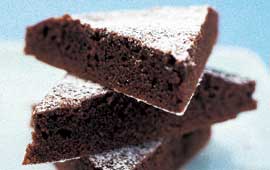
ICJill Suarez says, “I want the recipe for Nutella Brownies”
EF Shall I tell you the recipe now?
IC No, email me and we will add it afterwards.
RECIPE
2 eggs
2 dl (0.2 l) sugar
5 big spoons of kakao
A small spoon of vanilla sugar
Very little salt
100 g butter
1 dl (0.1 l) Wheat
A little coffee
Stir the and the eggs and sugar very gently ( no whisking!)
Things to add in the cake: everything you like! I prefer nutella, walnuts, m&m´s or chocolate pieces.
Then add all the ingredients, put it in the owen at 175 Celsius. 15-20 minutes depending how you like the consistent to be like!
Enjoy!
This was what I eat during my first mountain marathon! Nyam nyam!
Apparently best served with Almond Milk….
Emelie, I want to finish and once again thank you for your time. It’s a pleasure to spend time with you. You are one of the most ‘smiley’ people on the ultra scene. What you do in racing is reflected in your smile. You love it and that is great to see. Have a fantastic 2013 and I am so looking forward to catching up with you in the mountains during the coming year.
The North Face Ultra Trail Mont Blanc are emphasising early the need to be prepared for the challenge that will undertake all participants in 2013.
Do not underestimate this course!
copyright TNFUTMB
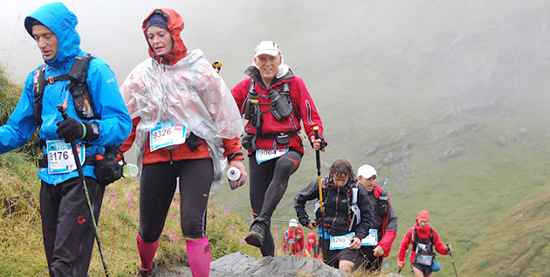
The last three years have largely shown that in the mountains, even in summer, it can be very cold, it can rain or snow and temperatures can drop below -10 degrees.
In brief conditions even if not extreme can make an event a lot more complicated than if it were taking place in good weather. Over the years, we have tried to progress in an attempt to make certain that you are always safe, and that you will find all along the route teams of doctors, nurses and general assistance should you need them. However nothing replaces your aptitude to avoid or overcome dangerous situations. You are the first and most important element as far as own safety due to your preparation, your experience and the equipment which you carry with you.
The North Face® Ultra-Trail du Mont-Blanc® is a trail which will lead you to spend more than 24 hours in the mountains including at least one entire night.
Be prepared!
Obligatory material
mobile phone with option enabling its use in the three countries
(put in one’s repertoire the security numbers of the organisation, keep it switched on, do not hide one’s number and do not forget to set off with recharged batteries)
personal cup or tumbler 15cl minimum (water bottle not acceptable)
stock of water minimum 1 litre,
two torches in good working condition with replacement batteries,
survival blanket 1.40m x 2m minimum
whistle,
adhesive elastic band enable making a bandage or a strapping (mini 100cm x 6 cm),
food reserve,
jacket with hood and made with a waterproof (recommendation: minimum 10,000 Schmerber) and breathable (recommendation: RET lower than 13) membrane (Gore-Tex or similar) which will withstand the bad weather in the mountains.
long running trousers or leggings or a combination of leggings and long socks which cover the legs completely,
Additional warm midlayer top: One single midlayer long sleeve top for warmth (cotton excluded) with a minimum weight of 180g (Men, size M)
OR a two piece clothing combination of a long sleeve baselayer/midlayer for warmth (cotton excluded) with a minimum weight of 110g (Men, size M) and a windproof jacket* with DWR (Durable Water Repellent) protection
cap or bandana
warm hat
warm and waterproof gloves
waterproof over-trousers
* The windproof jacket does not replace the mandatory waterproof jacket with hood
Philipp Reiter at the finish of Trofeo Kima copyright Ian Corless
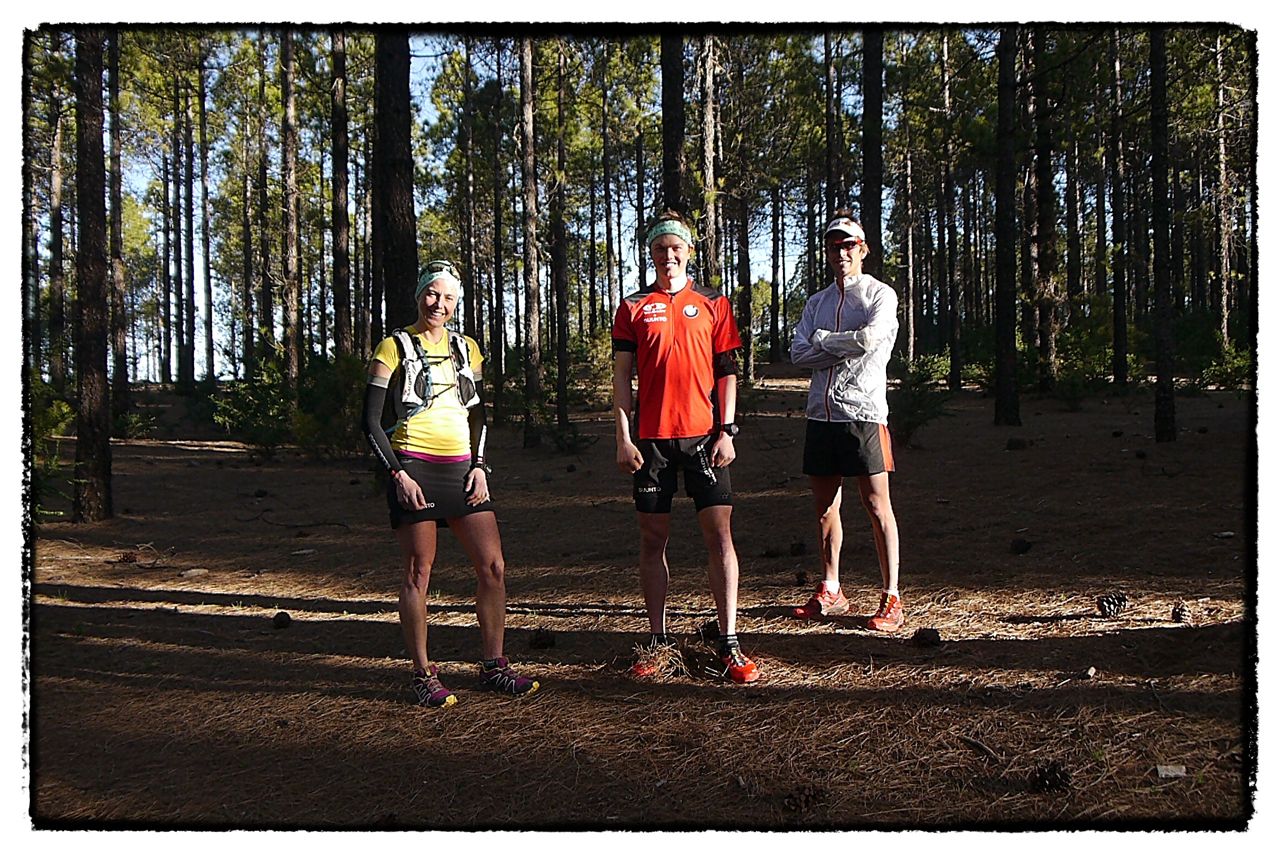
Just days before the 2013 edition of the TNF Transgrancanraia on the island of Gran Canaria, I spent several days with Ryan Sandes, Julia Bottger and Philipp Reiter. Philipp had literally just come of his skis and had hardly run for 3 months. In the 83km race he lined up against a strong field and by the time the race was over he had taken the 2nd spot on the podium behind Ryan Sandes, once again proving that his incredible 2012 was no accident.
Julia Bottger, Philipp Reiter and Ryan Sandes in Gran Canaria copyright Ian Corless
IC: I am joined by, ‘wonder kid’ Philipp Reiter.
PR: Hi Ian.
IC: We went out on the trails yesterday and you immediately flew off. You were like a rabbit in headlights. For the last 2-3 months you have done no running. What is it that enables you to step off skis and start running as though you have never stopped?
PR: Yes you are right. I can step of skis and run immediately. You must remember that ski mountaineering is hard work and I do plenty of ascents so I am fit. If you stay fit in all kinds of sports then it’s not such a problem. Actually, it is good to have a break. I am keen and eager to run now.
IC: I get asked a lot about how significant skiing and ski mountaineering is in the winter. For example, Emelie Forsberg, Kilian Jornet, Nuria Picas and so on all put run shoes away for the winter months. What are the real benefits that it gives your running?
PR: It’s a different movement but it’s not as different as cycling for example. We do lots of elevation and that is great for fitness. As you say a break is good, as much for the mind as the body. Maybe it’s not as different as we think.
IC: What lies ahead in 2013 for you?
PR: I have Transvulcania La Palma in May and then I have a German race to do, the Zugspitze. I will attempt the Skyrunning series but not Andorra. That is much too long for me. I will also not do UROC. I think my highlight this year will be the Transalpine. I like the west route and it will be beautiful. They have changed some stage villages so we have 3 or 4 new stages.
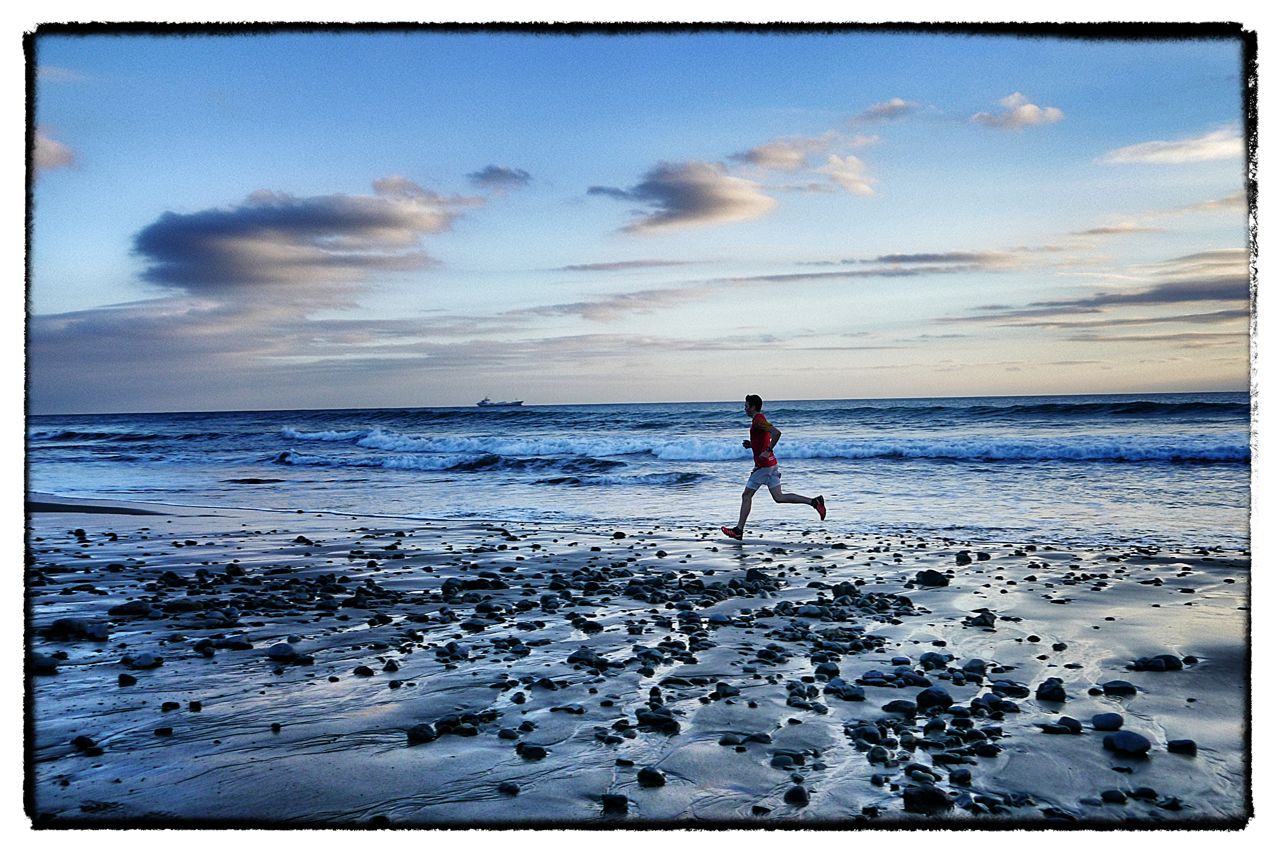
Philipp Reiter stretching his legs on an evening run in Gran Canaria copyright Ian Corless
IC: You mention Transvulcania. The 2012 edition was one of the highlights of the race year, it gad a stacked field. This year’s race again has an incredible field. In 2012 you had a difficult race at La Palma. Relatively early on you had issues with your leg but you soldiered on and still managed a top 20 finish. You crossed the line with Joe Grant. What is your mindset for 2013? You have made big improvements in the last 12 months; you must be looking forward to this year’s edition.
PR: Yes I had a big problem in 2012. I wanted to stop after 20km. I don’t know how I finished. It’s a big mystery. I have no real idea what happened. I had to sit down and I had tears. It was very unusual. But I pushed on and achieved a finish, so if I can get through the race like this then I am optimistic for 2013. Mentally I am strong. I am now sure that whatever comes my way I have the ability to push on. Also, running Transalpine in 2012 with Iker Karrera made me much stronger. I am no longer the new kid on the blog!
IC: 2012 was a year that I feel ultra running changed. I think Transvulcania was instrumental in this. The level of quality on a start line changed so many things. But I also feel the emergence of your self and Emelie Forsberg was significant. You personally had so many great results. Can you recap?
PR: I won Super Trail and I beat my own course record. I wanted to keep less than 7 hours and I did it. I then won Salomon 4 Trails and I beat Francois d’Haene and Thomas Lorblanchet. It was a great result. I won by 2 minutes over a 4-day stage race. It was incredible. In the Skyrunning ultra series I was 3rd overall against some of the best runners in the world. That was behind Kilian Jornet and Andy Symonds.
Philipp Reiter at Cavalls del Vent copyright Ian Corless
Also at Cavalls del Vent I was freezing for 7 hours out of 10 but I did not give up. I gained so much mental strength. Anything is possible. You just have to force yourself to go on and not give up. But the best result was the win with Iker Karrera at Transalpine. I wasn’t prepared for Transalpine. I was actually in Chamonix to watch TNF UTMB. The course got changed and Iker decided not to run. He said “do you want to start Transalpine with me tomorrow” I said, “yes of course”. We left and drove through the night. We arrived at midnight and then had to start the next morning. We had no time to get excited.
IC: That was crazy. I remember it well. The announcement came that the course was changed and then runners like Julien Chorier pulled out and decided to run the GR20 and then I heard that Iker, who had really focused on UTMB just thought I am not running a short distance and as you say, Transalpine was the alternative. I know you are only 21, if I think back to 21, that’s a long time… I remember that I had no fear. Do you feel that is your situation? Do you think, if I am given an opportunity I am going to say yes, because what is the worse that can happen.
PR: I definitely think lets just give it a go. As you say, I am 21 years old so if it doesn’t go well I can always go back and try again.
IC: When we talk about the runners you race against and the calendar you raced last year. You personally have such great potential ahead of you. I have said many times that I think you and Emelie are the future stars of the sport. You will lead the direction of the sport. Does that put a weight on your shoulders? Salomon as a sponsor, do they put pressure on you?
Philipp Reiter copyright Ian Corless
PR: I have no direct pressure on me from Salomon. It is more that I need to act professionally. It sort of happened without me realizing. For example, I love running, I would run anyway but I used to run and nobody would be interested but now I run and people want photographs and autographs. I need to be professional at all times. I literally could spend 2 hours each evening just answering emails. But that is the package and I accept it. I am very fortunate. I do ask myself do I really want it but then again, I guess I have no option now. I started my own website and then I think, do I really want it!
IC: Yes, we discussed this over dinner last night, the topic of social media. Yes, I am partially to blame. It’s my job to interview, chat, photograph and then distribute it. It benefits you, it benefits the races, it benefits the sponsors, and it is a complete package. But ultimately it has far more pluses than negatives. Do you ever think we will reach a point were things revert, or do you now see that your future lies in running?
PR: I would say at the moment that my studying has nothing to do with sport. I want to be a teacher of mathematics and biology. I will have training away from sport so I have options. I want to have a difference between a hobby, which is now becoming professional and my job afterwards. I post of Facebook and I write on my blog. I enjoy that. It is about me showing and sharing my experiences. I see myself as a speaker for the sport. It’s also funny. I get some great responses, I have funny comments and I love to have fun too and make the most of what I have. I like to create stories too such as running a vertical k indoors by running up and down stairs of a business premises. I like to create ideas.
The very serious Philipp Reiter copyright Ian Corless
IC: You almost seem to never take your self too seriously. For example, if I point a camera at you, you pull a funny face and smile. But the other side of that is that you are also very serious and precise. You have a duality to your personality. Do you find the balance comes easy?
PR: Training you have to be strict. I think the biggest lie would be that I think it is always fun… it’s not, sometimes I really do need to motivate myself to train. I have to talk to myself some days and force myself out of the door. You have to be focused and disciplined. I have no short cuts. You must put the time in and work hard. Natural ability helps but you must work and work hard. I have my fun side and I like to balance my hard work with fun. All work with no play is no fun at all. We don’t do this sport to get rich. We do it because we love it. We would run and be in completion without the professional side, it is also about meeting people and spending time with people I like such as Ryan Sandes, Julia Bottger, Miguel Heras and Emelie Forsberg. I really remember these special moments. I have met people from all over the world. I am very lucky.
IC: You mentioned you are not in the sport for money. I think that pretty much every elite ultra runner that I have interviewed has said the same thing. You have all come into the sport because of a passion. But it is changing; several races have big prize money. For example, $10,000 first prize, will that change the sport and do you think it will become more common.
PR: I’m not sure. Money changes sport for sure. I don’t know, I don’t have an answer for that.
IC: I don’t think any of us know. I guess that is why we ask the question. Certainly we don’t want running or should I say ultra running to follow cycling. That would be a disaster. I don’t think we have any issues at the moment in our sport but you do have to think of the responsibility that we all have in the sport of controlling it. For example lets say I could give you two race options. A bucket list race with no prize money and a race you don’t like but with big prize money that you have a very good chance to win. Which would you choose?
PR: (laughs) Yes, I think I would choose the race with the money. I guess it’s a sad thing but we all need money.
IC: Without doubt we need money to survive and money is not always available in our sport so it does make sense that financial demands have a decision in your race choice.
When did you get into the sport Philipp, what did you do pre 2012?
PR: I have not been trail running very long. I came from ski mountaineering background. I started when I was about 14 yrs or 15yrs old. I had seen an advert for a race near my home and I asked my parents could I take part. They said of course but that I would need to train. I wasn’t sure I wanted to train but I thought, why not, lets give it a go. I managed to perform okay in a relatively small field and then I became addicted. I enjoyed it so much. Especially going to the bakery after the training sessions, it was a good motivation. I guess it was like a bribe. A local shop owner asked me if I wanted to do the next races for them. I thought I am trained now so I carried on. I made it to the National Team very quickly. That sounds impressive but not as impressive as you may think. During the off season I decided I needed to keep fit so I hiked with my poles and then one day I saw a guy running. I thought, okay, I will try that too!
IC: What year was this?
PR: 2009.
IC: So you see someone running and I guess 2010 was your first season running, the transformation has been so quick. Particularly on a world stage. You came to prominence in 2012 but you got Salomon German sponsorship based on your German results.
PR: Yes, in 2010 it was my first year. I tool part in the Transalpine and my partner for the race was already in the Salomon team. Salomon sponsored Transalpine and they like the fact that I was so young. I even look younger than I actually I am so thy asked would I like to join the team. Wow I thought, usually I have to do the asking so of course I said yes! I got famous in Germany at Zugspitze.
IC: So you progress in Germany and then you get onto the Salomon International team with Greg Vollet as a manager. We have spoken about Greg and his vision for the sport in the past. He definitely is a driving sport in the sport at the moment. Does he have a big involvement in your progression?
PR: Yes, definitely. Greg says that we must create our own image. He helps me achieve what I want but in a very careful way. We talk about everything. I am never forced to race, I really like that.
Philipp Reiter and Andy Symonds at Trofeo Kima copyright Ian Corless
IC: So with the vision of Greg, Salomon as a sponsor and age on your side; what does the future hold for you? We spoke about Kilian in the past, he is only in his mid 20’s but he feels as though he has been around for decades because he has achieved so much. Do you see your progression as similar to Kilan’s and I remember you saying at Trofeo Kima that you said you want to ne Kilian, Do you still want to be him?
PR: I want to beat him! (laughs) What he has achieved is amazing. I want to do it step by step. This year I will do my first 100k. Next year I may go longer and of course I want to run the big races like UTMB or Raid de la Reunion. I have so many options ahead of me. I am just 21 so I don’t want to do too many things too soon. I want goals for the future.
IC: You have an old head on a young body. It’s great that you are patient and looking long term. Kilian had his bucket list and it is now pretty much ticked of. Do you have a list that you are building and when that list is ticked of, do you think you will move into a new realm like Kilian with his ‘Summits’?
PR: I don’t know. I have no idea what the future holds. As long as I am enjoying it and having fun I will continue. A day just has 24 hours. I have to study, I have sport and work but I have many things I would like to do that I don’t have time for. When I have achieved my goals, for sure I will continue with sport but I also want to be a father, I want a family.
IC: Philipp it’s been a pleasure speaking to you. It’s always fun. I’d like to wish you all the very best for 2013. It’s going to be a great year ahead. I can’t wait for Transvulcania La Palma.
PR: Thank you. It has been great fun.
This is part of a new series of interviews Skyrunning ‘The Interviews’ you can also view this on th ISF website HERE
Kilian Jornet has just announced his 2013 calendar. In just one glance you can see the dominance of Skyrunning. I am sure Kilian is laying his stall out and wants to be World Champion in VK, Sky and Ultra in the series.
Apart from one or two races, I will be at all of the events listed below bringing you interviews, images and audio as the action unfolds.
His 2012 placing of 3rd at Transvulcania must be a high priority on his list. I am sure he will be gunning for the win in 2013. Notably he has already stopped his skiing season allowing for more adequate preparation for the start of the 2013 season.
A surprise is a return to Raid de la Reunion. Maybe he wants a course record…?
2013 is going to be a very exciting season. I can’t wait to see it unfold.
Marco De Gasperi, the 6-time world champion is one of the most famous runners in the disciplines of Skyrunning, mountain and trail running in the world. If you want to know where he will be competing this year, follow his race calendar.
16.03.2013: Hong Kong 50km Raidlight Trail, Lantau (CHN)
18.08.2013: Italian Championships Mountain Running 3rd race, St. Giacomo Brentonico (ITA)
08.09.2013: World Mountain Running Championships (POL)
14.09.2013 Jungfrau Marathon, Interlaken (SUI)
22.09.2013: Pasturo Zacup Trofeo delle Grigne (ITA)
13.10.2013 Skyrunning Xtreme, Limone sul Garda (ITA)
19.-20.10.2013 Mount Kinabalu Climbathon, Kinabalu Park (MAS)
Marco was instrumental in the new Scott shoe, the KINABALU named after the famous Skyrunning race.
The ultimate lightweight trail machine. Maximum protection and traction at minimal weight. An ideal balance of lightweight materials, cushioning, protection and quick response thanks to eRide Technology. Shaped for smooth transition whether you are striking on the heel, mid foot or forefoot to adapt to the varied terrain. Our lightest trail shoe with uncompromised traction and protection, featuring an AeroFoam midsole, which is 50% lighter than traditional EVA foams.
Category: Trail Running
Weight 270g
USM 9
Heel to toe drop11 mm
Technologies
eRide Composite push-through plate
AeroFoamWet traction rubber
Lace bungy
Material
Upper: Mesh/Synthetic Overlays
Lower: EVA/rubber
Size run USM 7-13
I will be testing the new Kinabalu shoe in the coming month so watch this space for images and a full review.
A recipe for success – the world’s top athletes, a dream location, three challenging events.
Two important firsts are announced by the International Skyrunning Federation today: the 2014 Skyrunning World Championships will include the ultra distance for the first time and Chamonix, the most iconic outdoor sports arena, will host the events at the end of June, 2014.
January 30, 2013
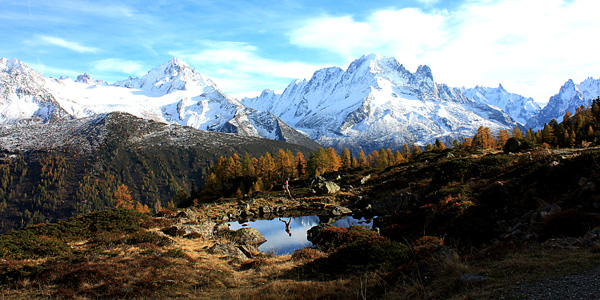
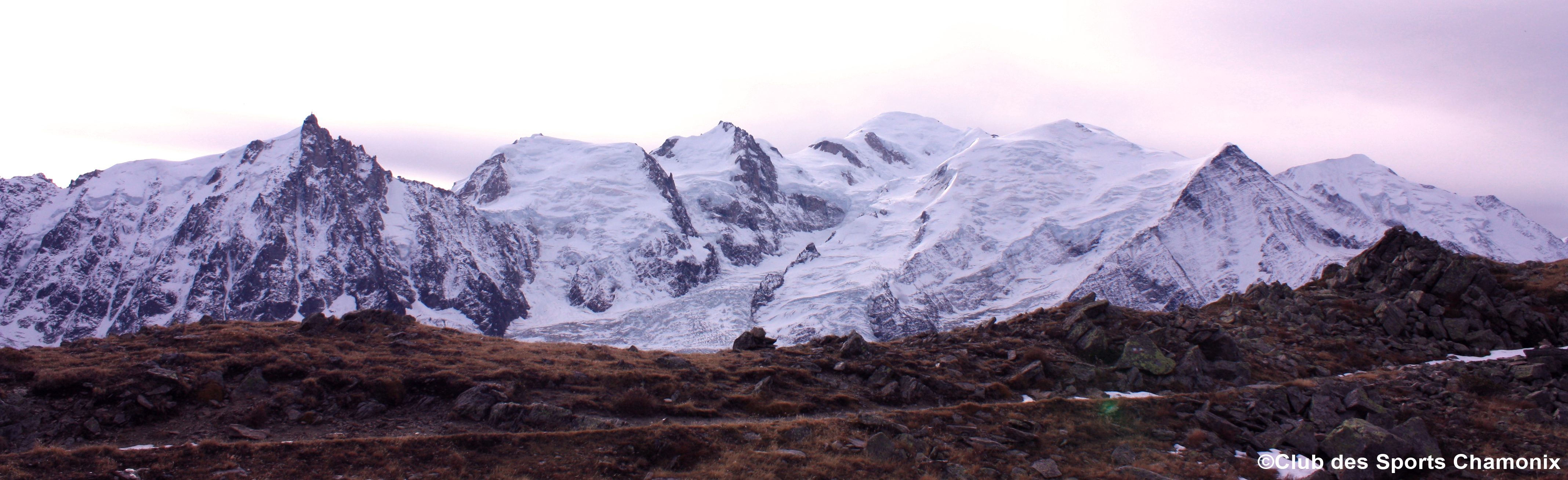
Chamonix, France, offering the most famous and spectacular mountain panorama, will stage the second Skryunning World Championships at the end of June, 2014.
Three distances will be disputed:
– The short, steep Vertical KM – 1,000 metres skywards – by night. A timed race, it will test your VO2 max to the limit.
– The Mont-Blanc Marathon – the 42 km course starts in Chamonix and finishes at 2,016m altitude, gathering 2,511m elevation gain and 1,490m on the downhill, this beautiful trail offers some of the best scenery of the Mont Blanc massif.
– The Mont-Blanc 80KM – an exclusive, new course to be inaugurated this year, it features a challenging 6,000 metres of vertical climb along ridges, over snow fields, crossing into Swiss territory and traversing glaciers in a point to point loop from the town of Chamonix.
The races are open to both individuals and teams. Individual World titles are at stake in each discipline as well as a combined title, based on the best results of two out of three races. Countries will be ranked according to the best results of three men and one woman in all three disciplines.
Held every four years, the Championships represent the second edition since the inauguration of the ISF in 2008 and the first time that the ultra distance is included.
In occasion of the first Skyrunning World Championships in 2010, winners of the individual titles were Urban Zemmer (Italy) and Laetitia Roux (France) for the Vertical Kilometer®; Kilian Jornet (Spain) and Laetitia Roux (France) for the SkyMarathon®, and the combined titles went to Nicola Golinelli (Italy) and Laetitia Roux (France). The country ranking was headed by Italy, followed by Spain and France for a total of 13 nations.
The bid for the 2014 Skyrunning World Championships has been awarded to the experienced and highly competent local organiser, the Club des Sport Chamonix, which manages year-round major international sports events.
Marino Giacometti, ISF President, commented: “We’re proud to present the World Championships in Chamonix and, with the support of the Club des Sport, we’re confident the events will be a perfect showcase for skyrunning and draw the best in the world for some intense competition.”
In 2013, the Vertical KM and the Mont-Blanc Marathon will feature on the Skyrunner® World Series calendar for the first time, an occasion to gather the world’s top athletes and thousands of participants for a preview of what is to come in 2014 – a competition to set your heart racing – starting right now!
Programme, race and entry details will be published at a later date. In the meantime see herefor details of the 2013 events. Subscribe to our newsletter for all the news and follow us on twitterand Facebook for updates.




 IAN CORLESS