You arrive in Morocco, pass through passport control, wait for your luggage, leave the airport arrivals hall and find a seat on a coach.
The MDS journey is now in full swing.
Waiting in anticipation, the Road Book (the bible) for the next edition of the race is provided and immediately pages turn, running through the mind of each participant:
“How long is the long day?”
Well, the wait is over, I can tell you. For 2024, the long day will be 85.3 km’s.
The MARATHON DES SABLES – The Legendary is breaking silence and today, we announce the daily stage distances for the 2024 edition.
Stage 1 : 31.1 km
Stage 2 : 40.8 km
Stage 3 : 85.3 km (over 2 days)
Stage 4 : 43.1 km
Stage 5 : 31.4 km
Stage 6 : 21.1 km
Total 252.8 km
Marathon des Sables typically takes place in this key area.
Taking place in the southern Moroccan Sahara since 1986; an extraordinary adventure will take place covering 252 km’s, the longest edition in the race history. Lasting 11-days with 9-days in the desert, divided into 6 stages over 7-days, a magical crossing of the Sahara walking or running.
The exact route, with maps, will once again be covered in detail in the road book, which as per usual, will be provided in Morocco whilst on the way to the bivouac one.
This is the first time that the daily distances have been disclosed before arrival in Morocco. Does this change anything? No, not really. I guess there is a reassurance knowing that the long day is not 90+ km’s.
However, with the 2024 edition being 252 km’s and over 6 timed stages, it was my prediction that this race would be a tougher challenge in contrast to those that have gone before. Therefore, to ease minds, the distances have been announced.
Previously, the long day would come on stage 4 (over 2 days) and it would be followed by the marathon stage. It was common thought, “Get the long day done and it’s just a marathon to go!” At the finish of the marathon, the medal would be received; job done.
Now, with the long day coming on stage 3, you still have 3-stages to run totaling 95.6 km’s. This will require a completely different mental and physical approach.
As we countdown to the 2024 edition of the Marathon des Sables – The Legendary, we will be providing a series of monthly updates, articles, interviews and podcasts.
The 2024 Marathon des Sables – The Legendarywill be the longest edition in the 37-year history of the race. At 252km, the event will now take place over 6-stages/ 7-days and not 5-stages/ 6-days as announced in late 2023.
It was clear initially that the 6th stage charity stage would disappear, however, on reflection, the new organisation have decided to continue with 6-stages but this time, all stages will be timed. The charity stage in previous editions was not timed.
The infamous long day which typically took place on stage 4 will now move to stage 3 for 2024, this will be day 3 and day 4 of the race as it has an extended time allowance due to the distance.
What does the above mean for the runner?
252km’s is a long way, but the race has always been advertised as 250km’s, so, although the race has fluctuated in distance over the years, the 252km should not come as any great surprise.
The timed stages now numbering 6 and not 5 will make a big difference, especially with the long day coming on stage 3. This will mean that stage 4, stage 5 and stage 6 will need to approximately cover 100km. This makes for a tough end to the week. In past editions, the long day was feared but on completion, many had the mindset, ‘It is just a marathon to go!’ Now it will be significantly more.
The daily distances are typically never disclosed before the race and the jury is out if the distances will be announced pre arrival in Morocco, watch this space! However, it is pretty easy to guess on approximate distances.
Historically, distances for the stages are listed as follows:
Stage 1 from 28 to 35 km
Stage 2 from 28 to 39 km
Stage 3 from 28 to 39 km
Stage 4 (The Long One) from 75 to 85 km (over 2 days)
Stage 5 (Marathon Stage) of 42.195 km
Stage 6 Charity
We know the 2024 edition will be 252km, so, as a guess and guide the following will provide a good estimation, the daily figures are +/-, for example, stage 1 could be 30km and stage 2 40km.
Stage 1: 32km (day 1) running total: 32km
Stage 2: 38km (day 2) running total: 70km
Stage 3: 83km (day 3 and 4) running total: 153
Stage 4: 42km (day 5) running total: 195km
Stage 5: 36km (day 6) running total: 23km
Stage 6: 21km (day 7) running total: 252km
Total: 252km
With the above information, you now have at least a template and guide for which to plan around.
OTHER KEY CHANGES
Salt Tablets
As I announced in 2023, it was my expectation that salt tablets would not be provided for the 2024 race. The new revised mandatory requirement for the race requires 14 broth cubes – these cubes are known to be salty. You have no choice here, you must have them. However, it will be your decision if you use them? My advice is to plan a strategy that works for you. Listen to my podcast with Andy Blow from Precision Hydration HERE. Remember, this is a self-sufficient race, so, be prepared to be self-sufficient and have a plan/ strategy that works for you.
Water Capacity
Another key change was the requirement for ‘A minimum capacity of 3 litres of water’ in the form of bottles, bladder etc. This has now been revised and we go back to 1.5 ltr capacity. This is a good move. Cp’s will be increased so that runner’s will only need to carry 1.5 liters. However, on the long day, an additional 1.5 ltr bottle of water will be provided either at the start or at cp1 (making 3 ltr to carry) therefore the capacity to carry 3 litres on the long day between cp’s is recommend. It is important that you think HOW you will carry this extra 1.5 ltr. Maybe you will have a bladder in or on your pack, maybe two additional 750ml bottles at the rear or if you have the front pack, you can slide the 1.5 bottle on top. It’s not recommended to run with a 1.5 ltr bottle in you hand, so, be prepared…
Water
Water during the stage will not be provided via 1.5 ltr bottles as in past editions. Water will be provided from a series of tables and manned staff with jugs to decant water to your empty bottles. Importantly, there had been concerns about where the water will come from, to clarify: 5L Bottles on CP -> Served in 2L jugs -> Served by staff in the runners’ bottles.
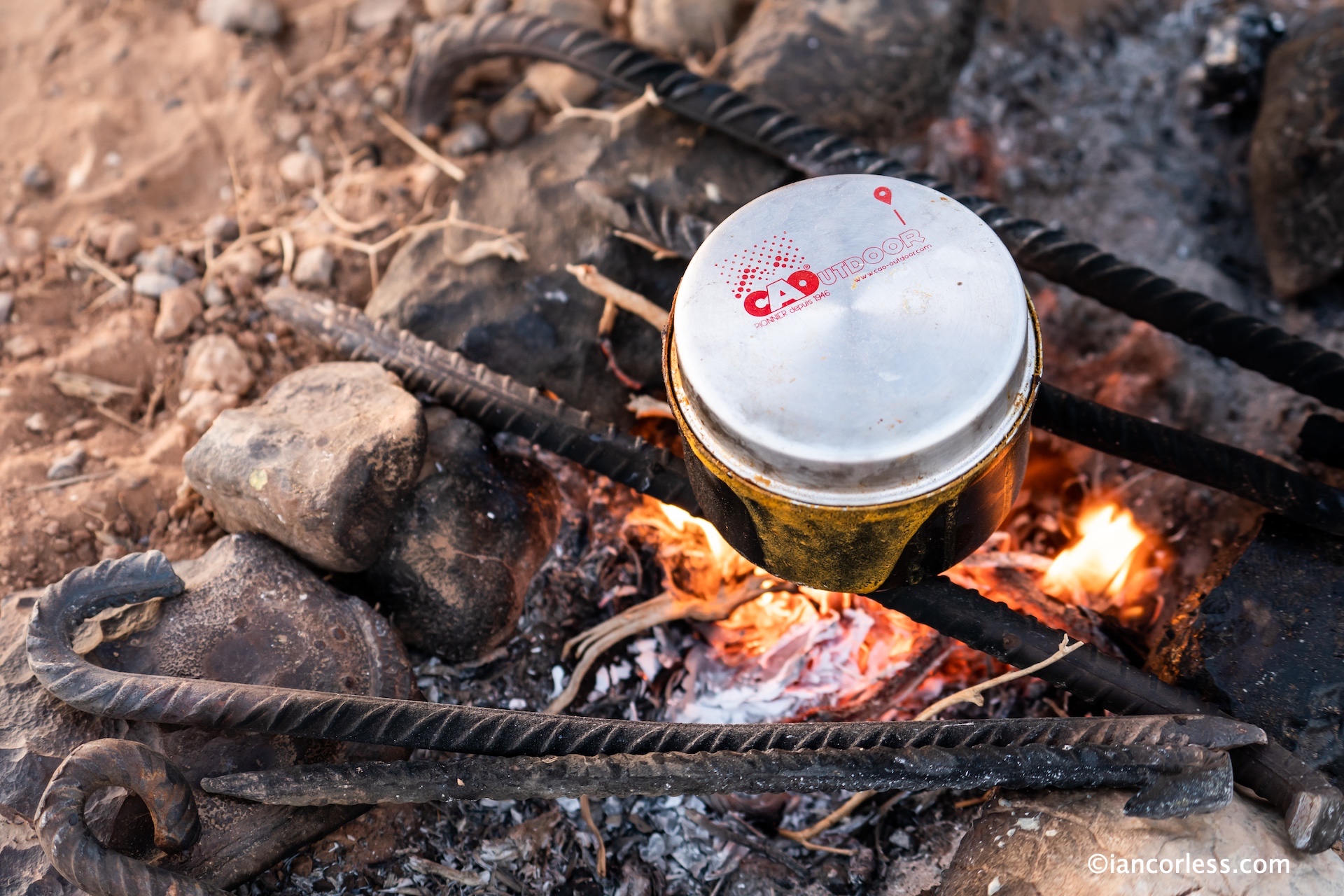
The exception being on the long day as mentioned above when a 1.5 ltr bottle will be provided at the start or cp1 and at the end of each stage when a 5 ltr bottle per participant is provided. This 5 ltr bottle will cover the evening after the stage, the morning of the next day and the required 1.5 ltr capacity starting the next stage to cp1. So, if you had planned to cut down a 1.5 ltr bottle to use as a bowl for dinner and breakfast, this will not be possible. You will now need a suitable pot or similar.
Checkpoints
Will be typically 2 to 7 per stage. On the long day, it is therefore a good assumption that checkpoints will be +/- 12km’s apart and hence the need to require 3 ltrs.
Mandatory Equipment
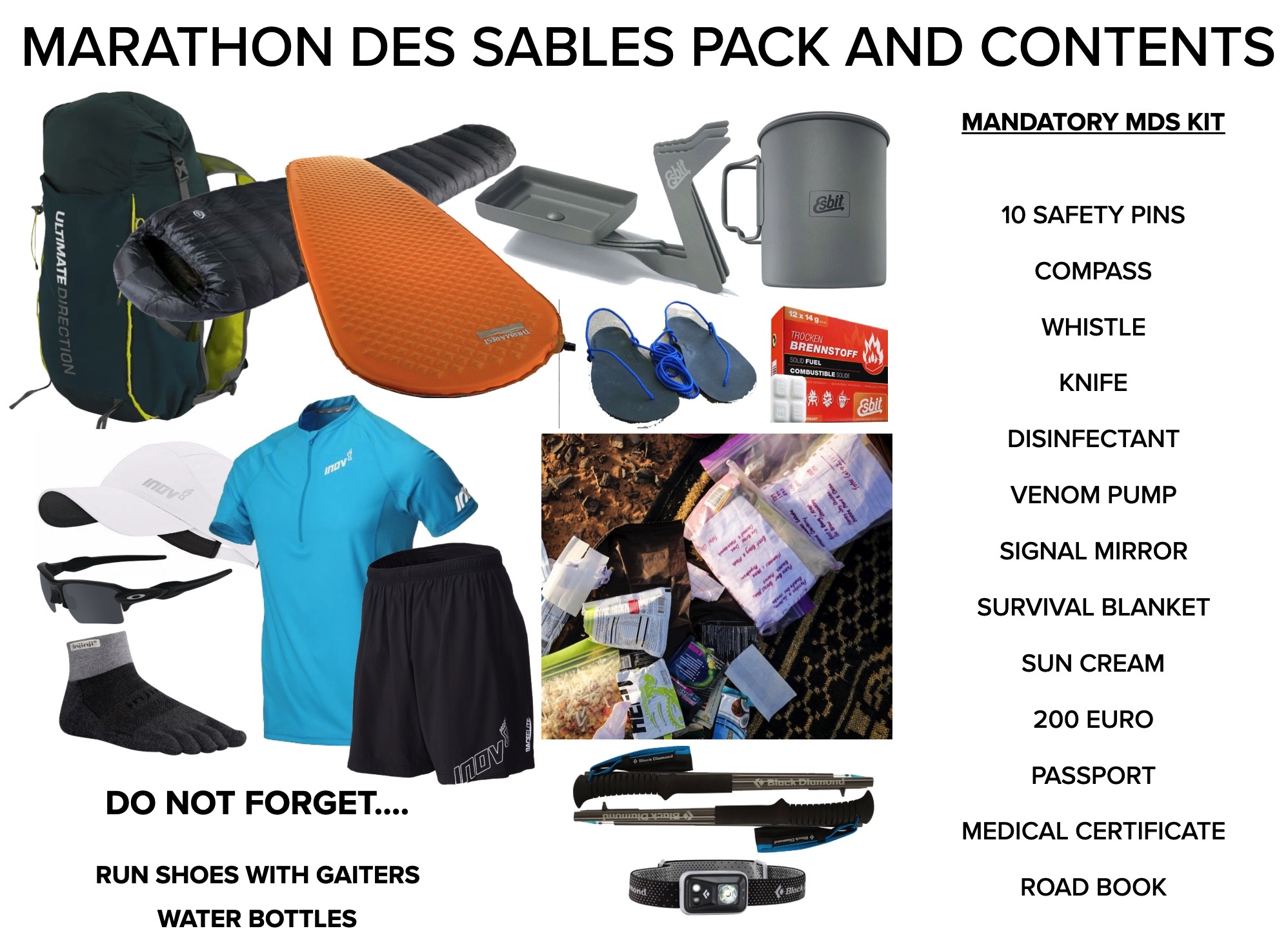
I will list here the mandatory equipment to avoid any confusion:
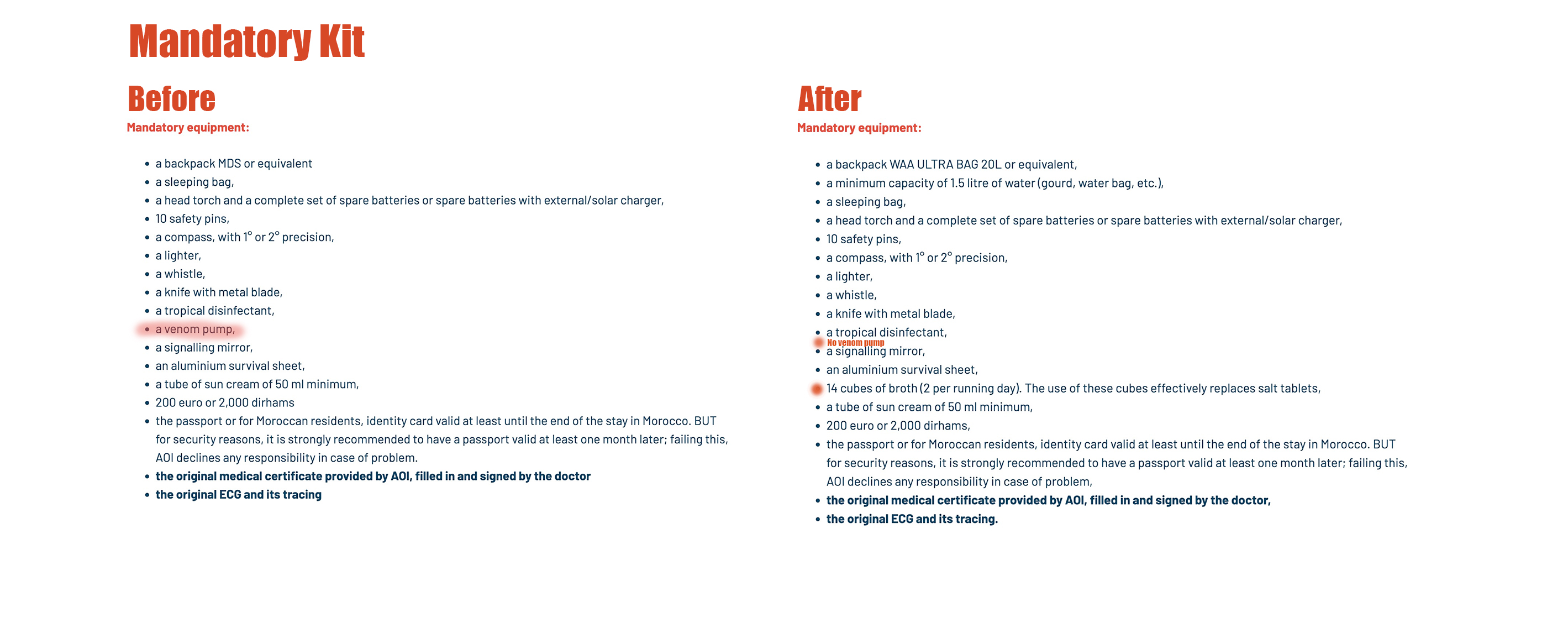
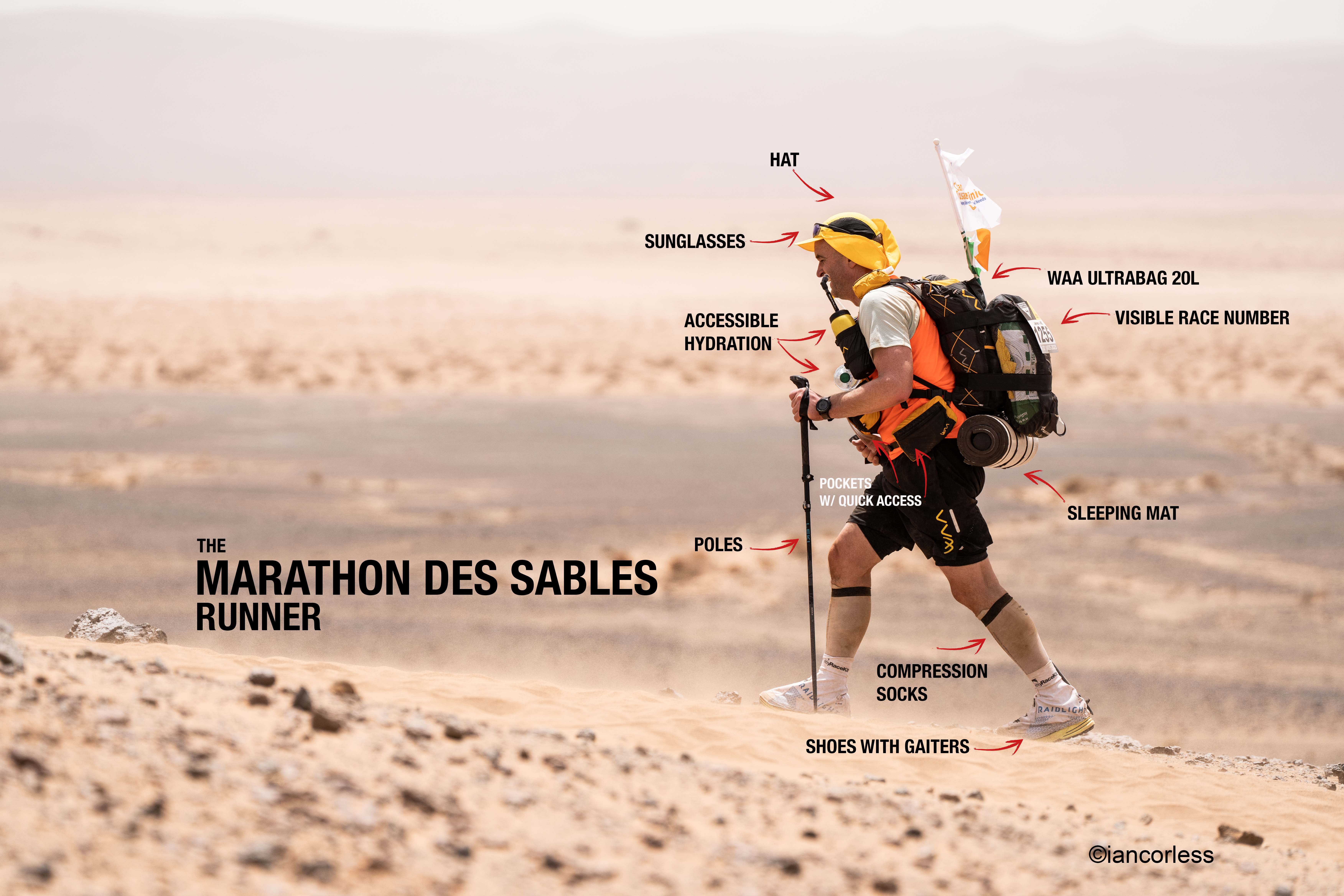
Pack such as WAA Ultra Bag 20L
Minimum capacity of 1.5 liters of water*
Sleeping bag
Head torch and spare batteries (you can have a charger/ solar charger)
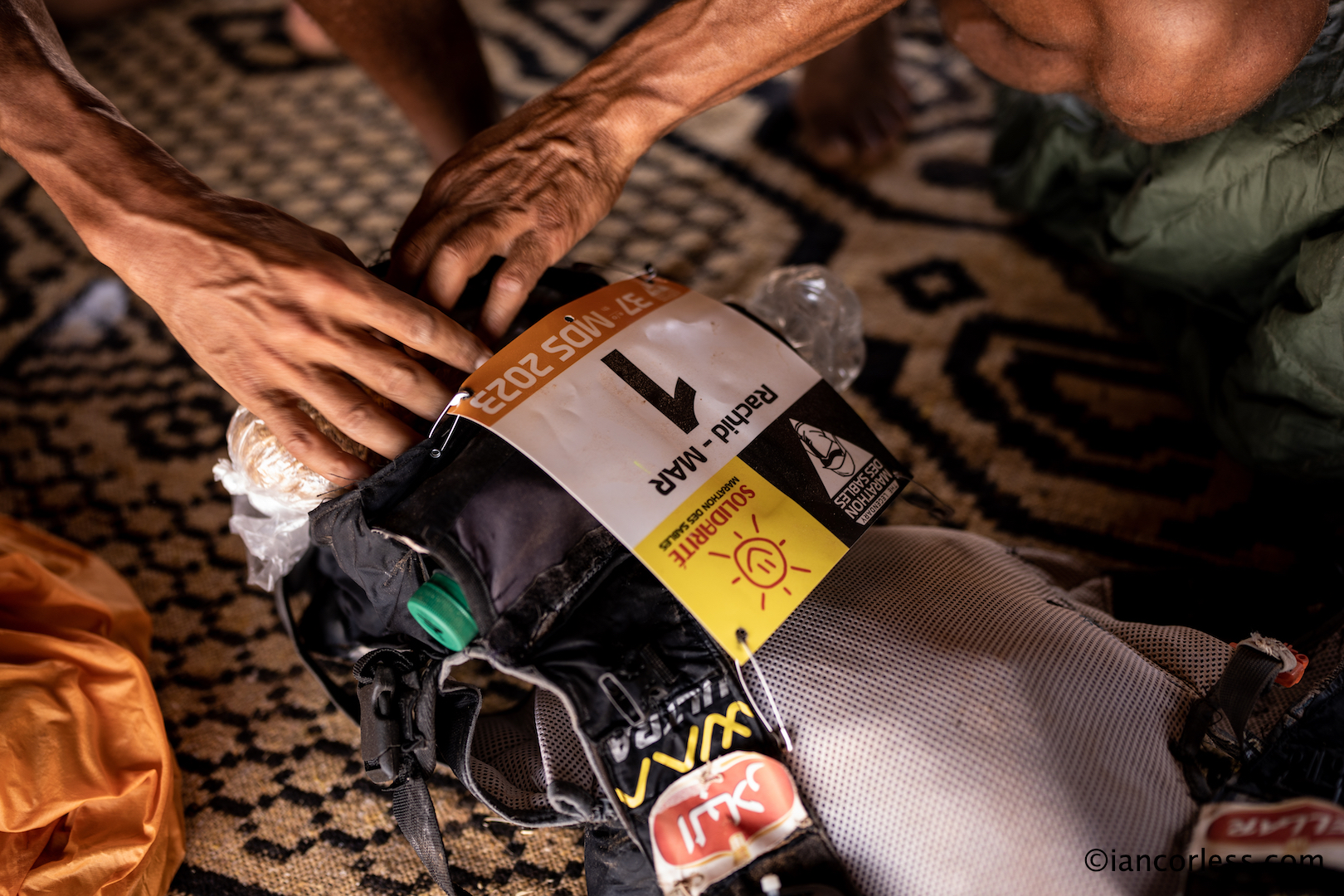
10 safety pins
Compass with 1 or 2 deg precision
Lighter
Whistle
Knife
Topical disinfectant
Venom pump*has now been removed
Signal mirror
Survival blanket
14 cubes of broth***
Sun cream
200 euro or 2000 dirhams
Passport or ID card
ECG and medical
* new change but consider the long day when you will have 3 ltr.
** new change
*** to replace salt tablets
Food Requirement
You need 14,000 calories of food as a minimum, 2000 calories per day. You can of course carry more than this, but 14,000 is the minimum. You must be able to prove the calories, so, if you decant food into lighter or different packaging, make sure you keep the nutritional information.
You
In addition to the above you personally will need:
Keep the pack weight as close to the minimum 6.5kg as possible, additional weight is additional stress that you do not need.
Keep luxuries to a minimum, they only add weight. A super light Mp3 player (with good battery) and earphones is the only luxury I would consider.
Accept that this is a tough challenge, you will be stripped back to a survival mode. You will not wash, you will get dirty, you will get smelly. Accept it.
Start slow and ease into the race.
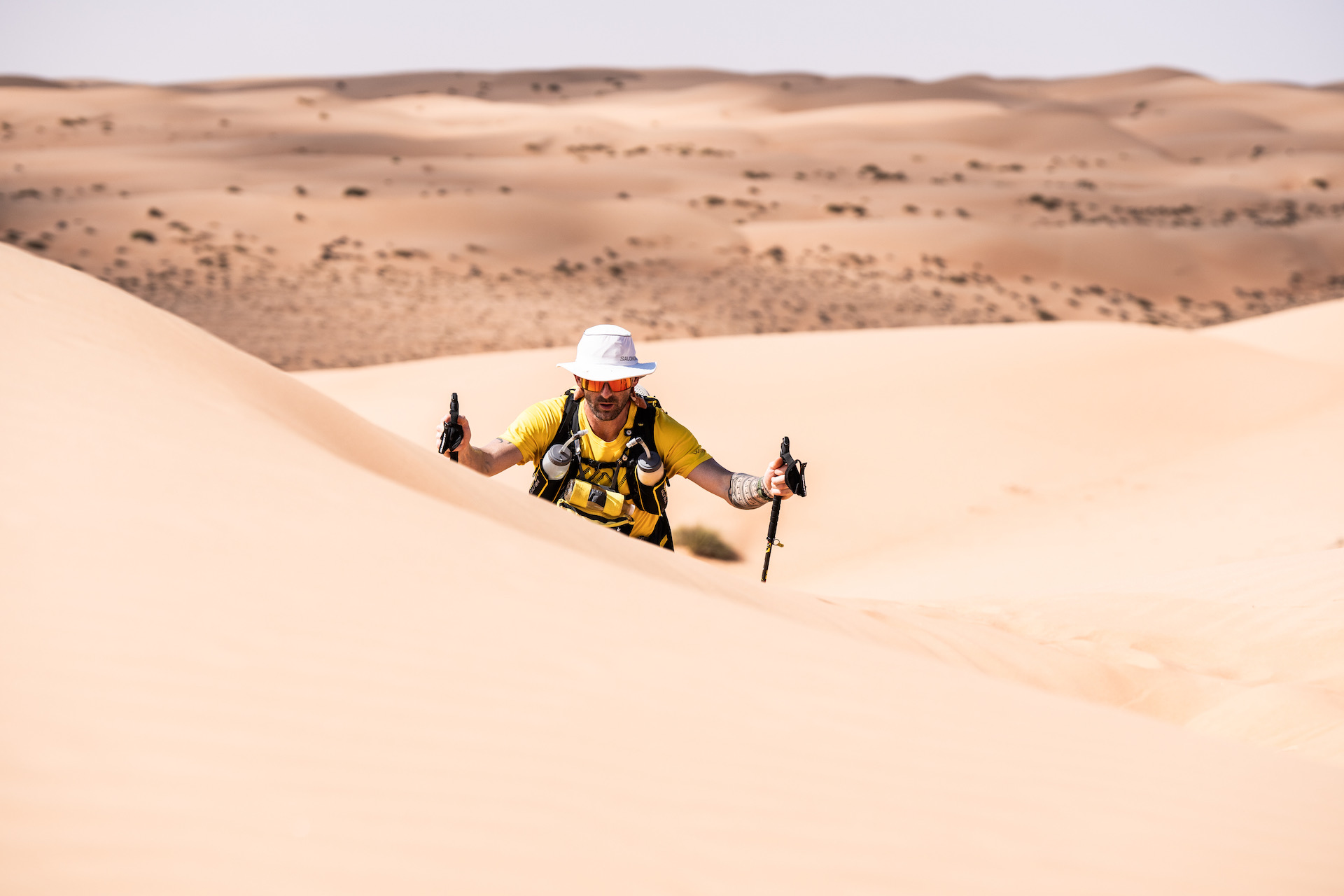
Poles can be a lifesaver and I recommend them but you must learn to use them. Those at the front do not need poles, they can run.
Learn to walk, walk and walk. Many go to the desert with the expectation of running 80% and walking 20%. The reality is it will be the other way around.
Look after your feet and start with the correct shoes for you.
Take a sleeping mat or pad. You only need to do three things: run, eat and sleep. Sleep and comfort is important for recovery.
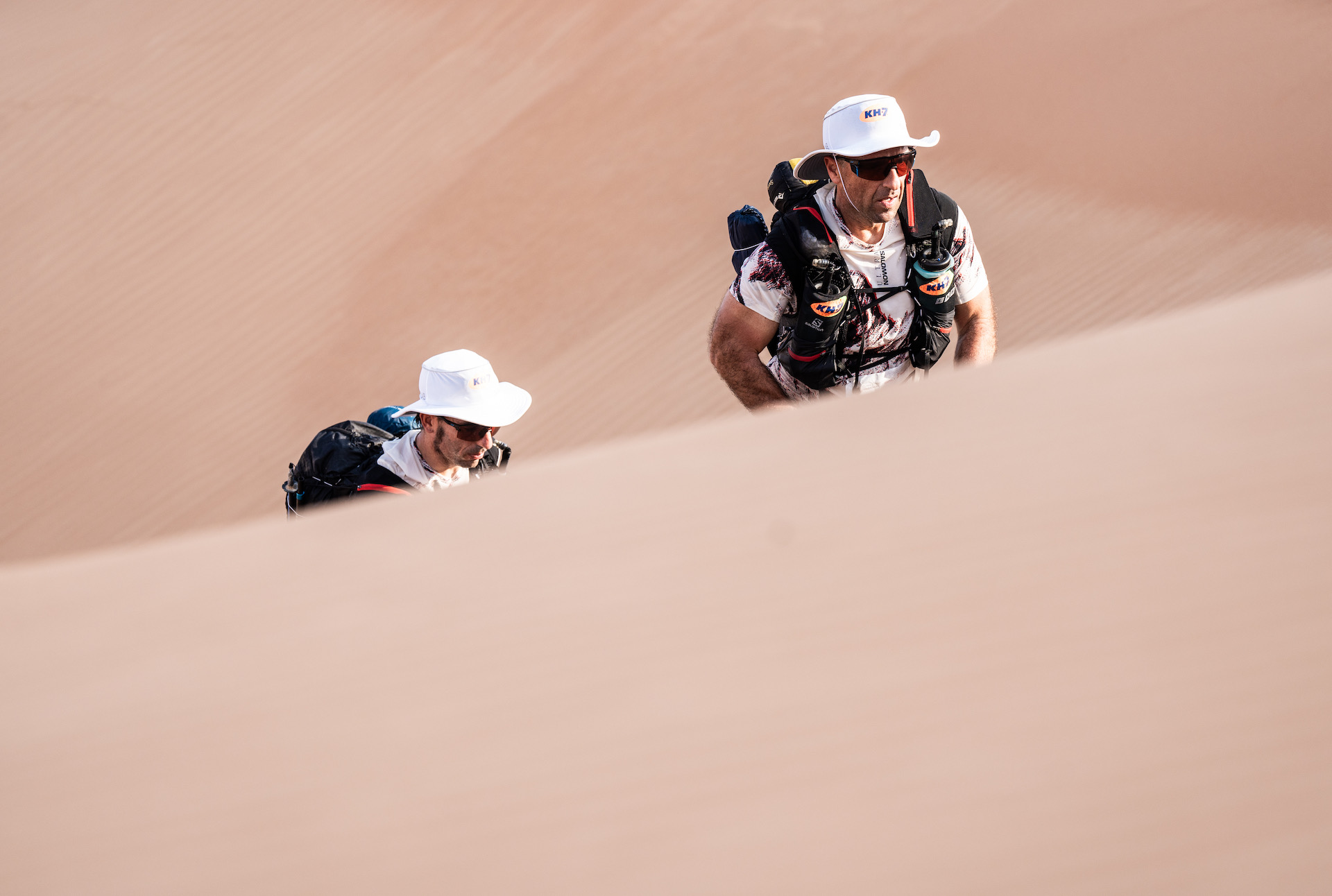
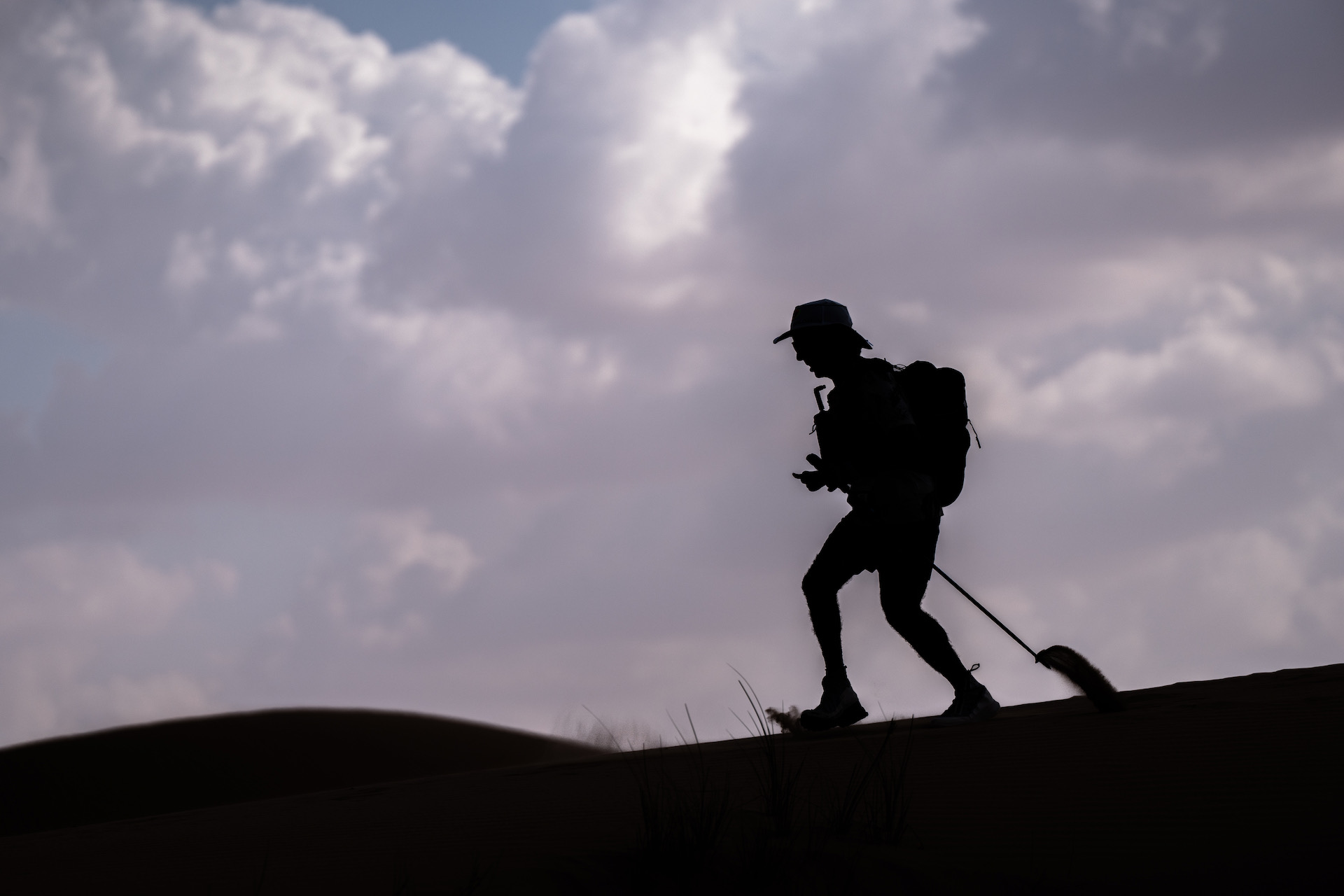
Stage 3 of the Oman Desert Marathon has a delayed start to ensure that participants experience the desert at night. With three waves: 10am, midday and 2pm (slower to faster runners respectively) the participants would cover the 47km stage in daylight and then transition to darkness.
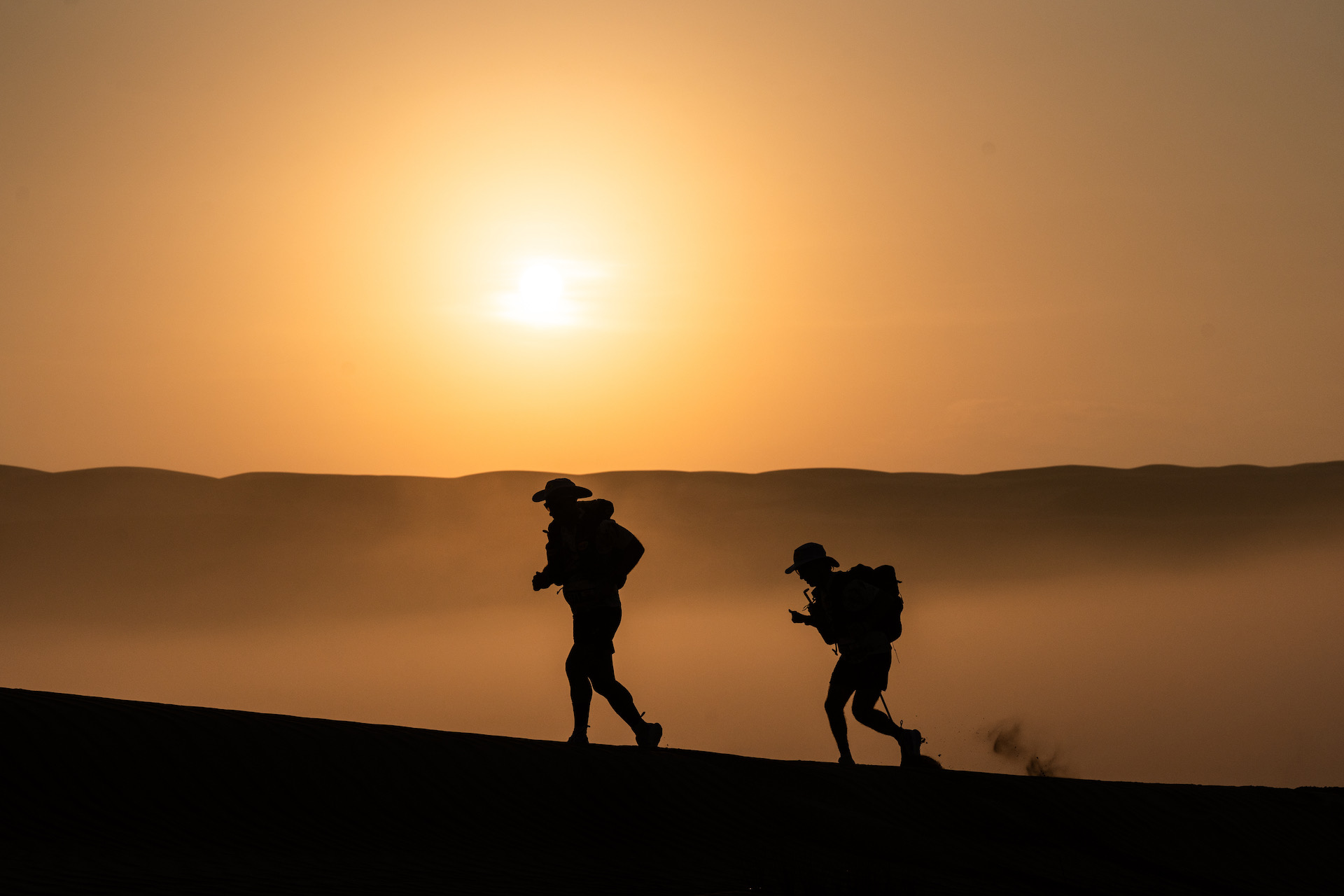
Consider by race director, Said, stage 3 would include one of the most spectacular dune sections on the race, timed to coincide with the sun getting lower in the sky and for the lucky ones, maybe sunset would take place as the dune section came to an end.
Coming after the 55km long day, the later starts were welcomed and allowed for additional rest and recovery, however, the fatigue was starting to show on faces and bodies.
As the race got underway, it was clear that the men’s race would have a different approach, with Ghaith Al said pushing hard at the front, while behind, Saleh Al said and Rachid El Morabity ran together. Ultimately, it was an attempt to break Rachid. It didn’t work, but it was a valiant effort and one that rewarded Ghaith with the stage win in 5:03:39.
Behind, Saleh and Rachid ran together and crossed the line 5:10:29 and 5:10:39 respectively.
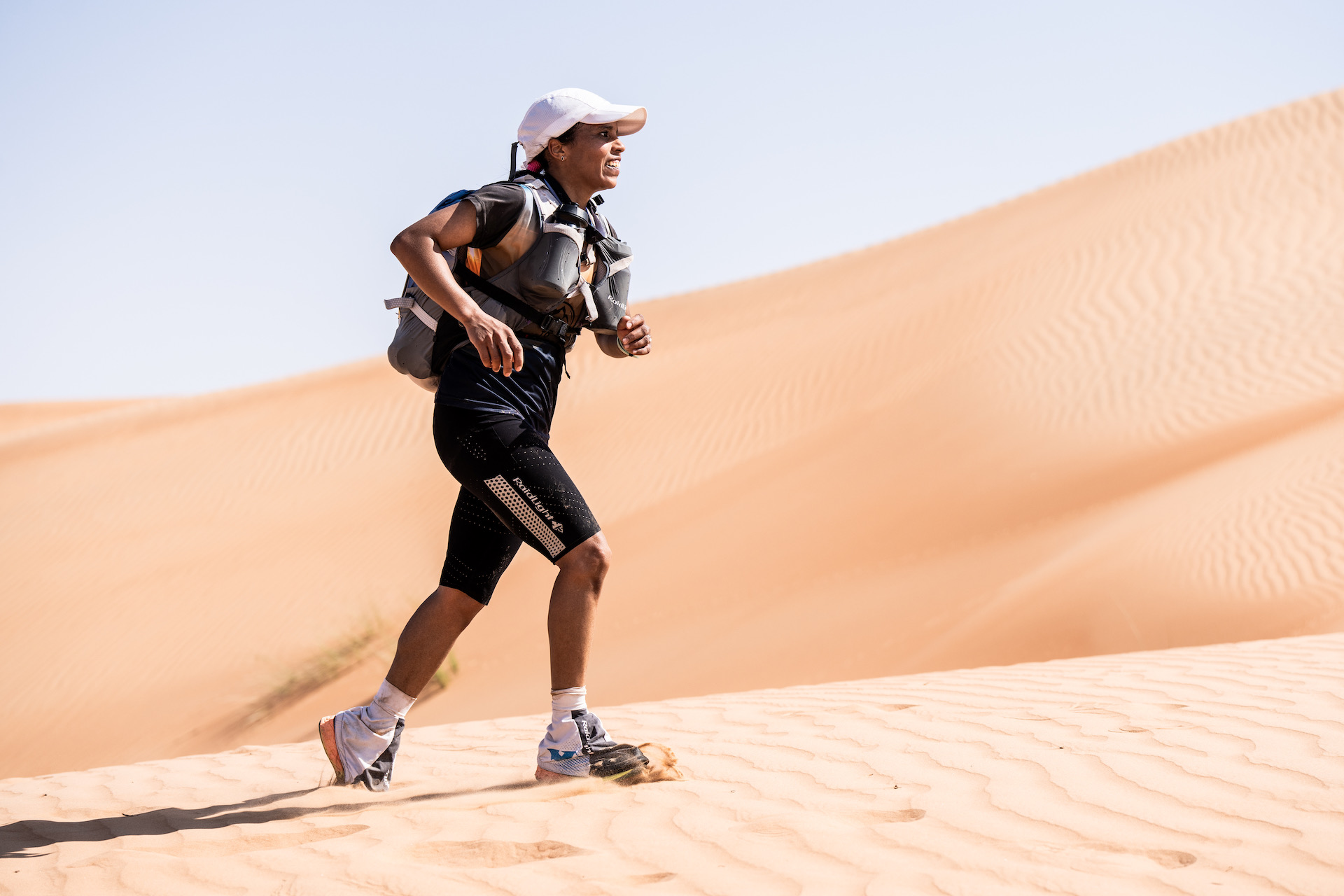
The women’s race had little drama with Aziza Raji and Aziza El Amrany running together and crossing the line in 6:56:35. The duo looked strong and relaxed. They will be a force to be reckoned with at Marathon des Sables this year.
Behind, once again, Veronique Messina ran a strong 3rd place in 7:49:56.
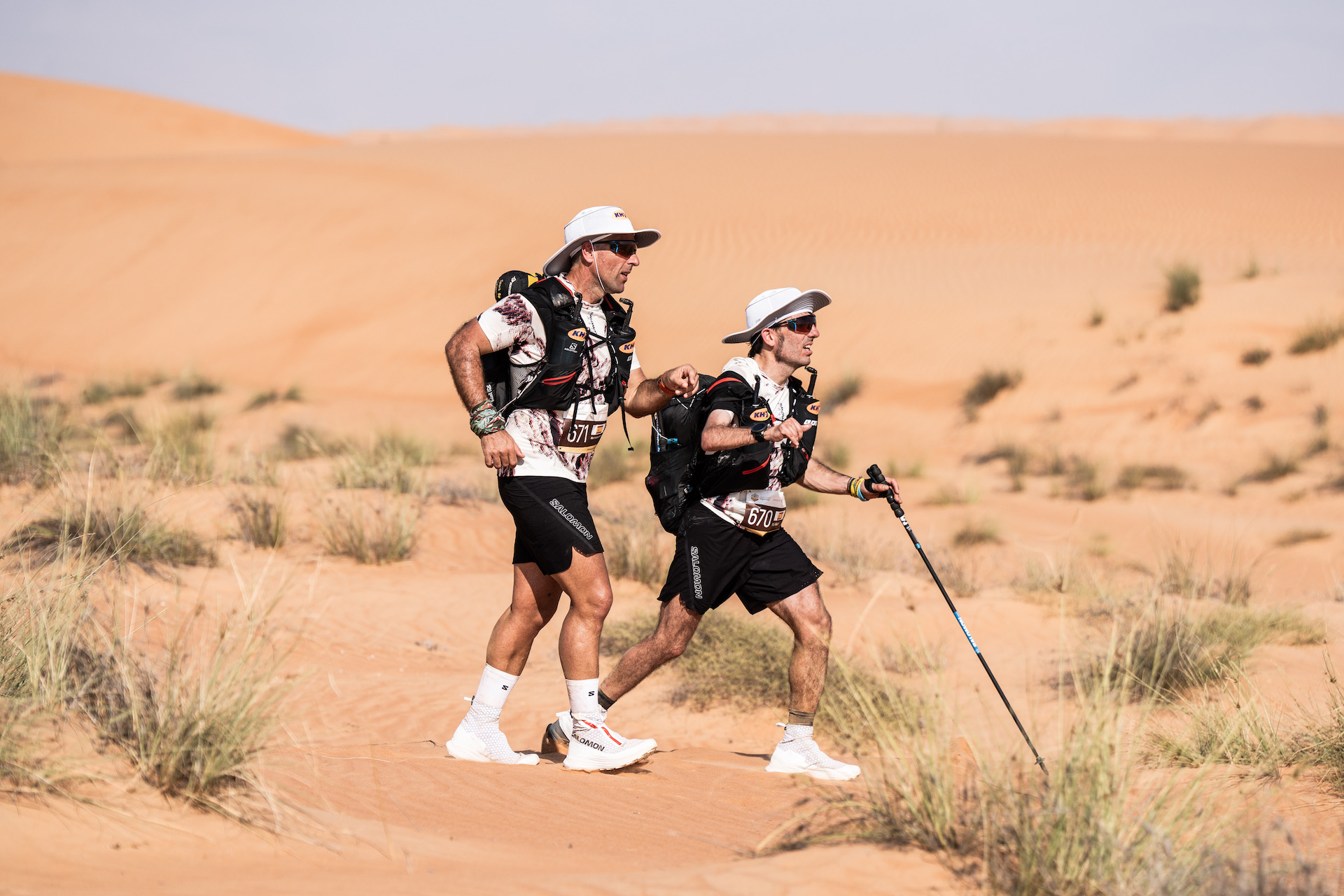
Albert Jorquera and Pol Makuri had a long day completing in 11:17. They are both very focussed mentally and strong physically. It has been a joy to watch the two of them work together and quite simply. Pol is an inspiration.
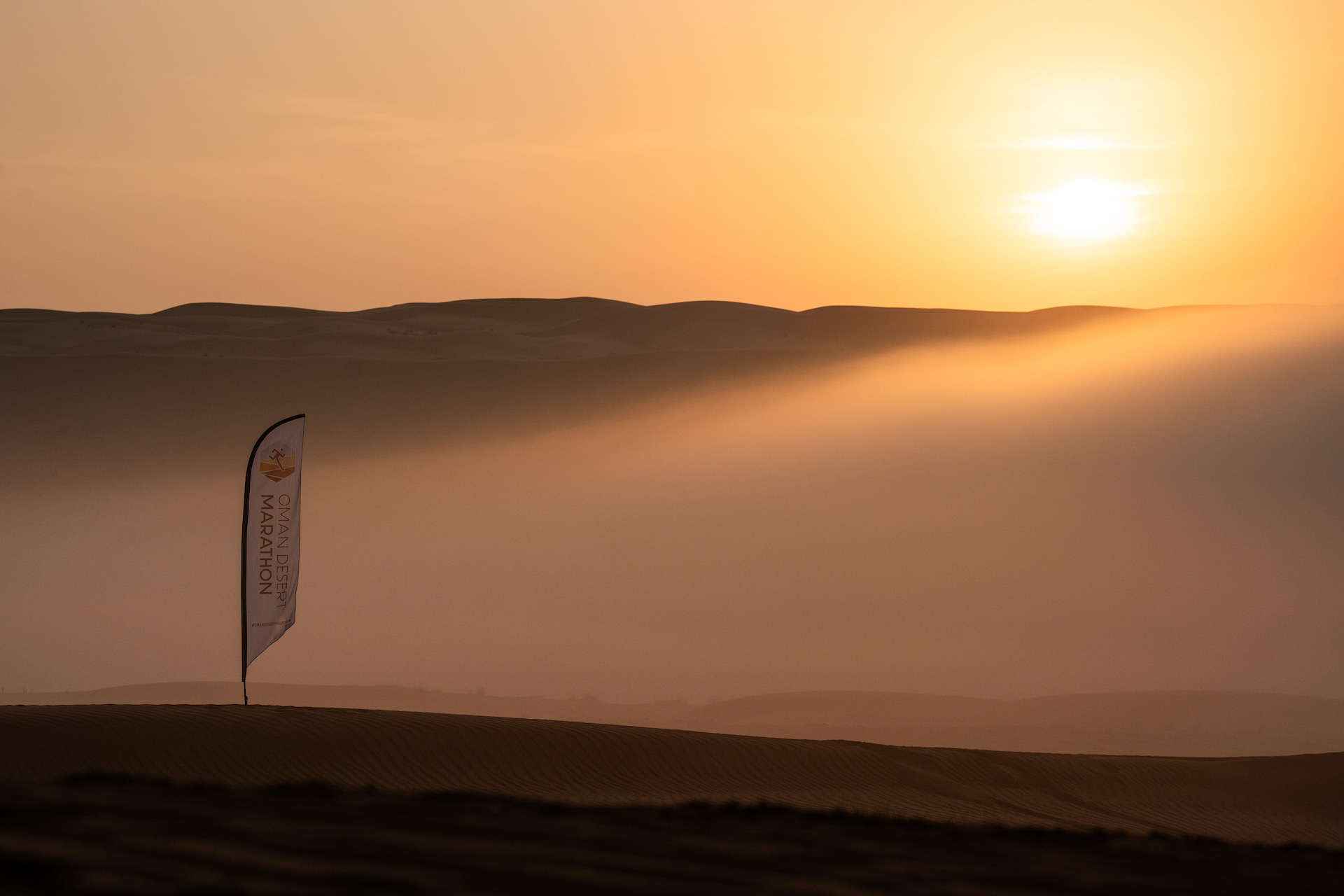
Day 2 of the Oman Desert Marathon and after day 1, there was some anxiety. At 55km’s long, the stage was set to be tough. A planned 0630 start with sunrise, would provide participants with extra time in daylight. However, the weather had different plans. An inversion came in during the night and early morning reducing visibility in the valley to zero, the start was delayed 1-hour.
At approximately 0730, the runners were on the way despite some lingering mist. However, the mist was guaranteed to disappear quickly and it did. While it lasted, it gave an eerie feeling to the desert.
Sadly, Mohammed El Morabity was a DNS today. He was tired and feeling under the weather after long delayed travel and a tough first day. Although sad to see a competitor leave, I am sure Salah Al Saidi and Evgenii Glyva were somewhat happy to have one less El Morabity brother to deal with.
Having run a very strong stage 1, Salah Al Saidi took the race to Rachid pushing the pace. As always, Rachid started easy and looked relaxed while following and Evgenii was pushing to hold the pace.
For the women, Aziza Raji must have felt very confident after her stage 1 performance and huge gap. By contrast, Aziza El Amrany was probably wondering how she could pull back any time? Kathleen Leguin who was a pre-race favourite had suffered with sickness on stage 1 but started the day feeling better and the trio ran together with Veronique Messina behind.
Despite 55km’s, stage 2 was billed as a more runnable and easier day, it wasn’t. There was a great deal of soft-sand, several dune section and lots of heat. It was all too much for Kathleen and sadly she withdrew from the race at cp3.
It is never easy to tell if Rachid is suffering, but today there seemed some signs of fatigue and tiredness at cp3. He left with Saleh but looked happy to hold back and let the pace be dictated.
However, in a typical Rachid move, he finally applied pressure and opened a gap crossing the line in 5:47:24 to Saleh in 6:07:43. Evgenii finished 3rd in 6:23:13.
The two Aziza’s were playing truce today and duo ran together all day, Raji happy not to loose anytime to El Amrany and at the same time share the desert with a friend.
With Kathleen out of the race, Veronique finished 3rd, the times of the top 3 8:31:06 and 8:31:07 for El Amrany and Raji, 9:04:37 for Veronique.
Results HERE and GC ranking HERE.
Albert Jorquera and Pol Makuri were battling the day and due for an early evening finish, in darkness.
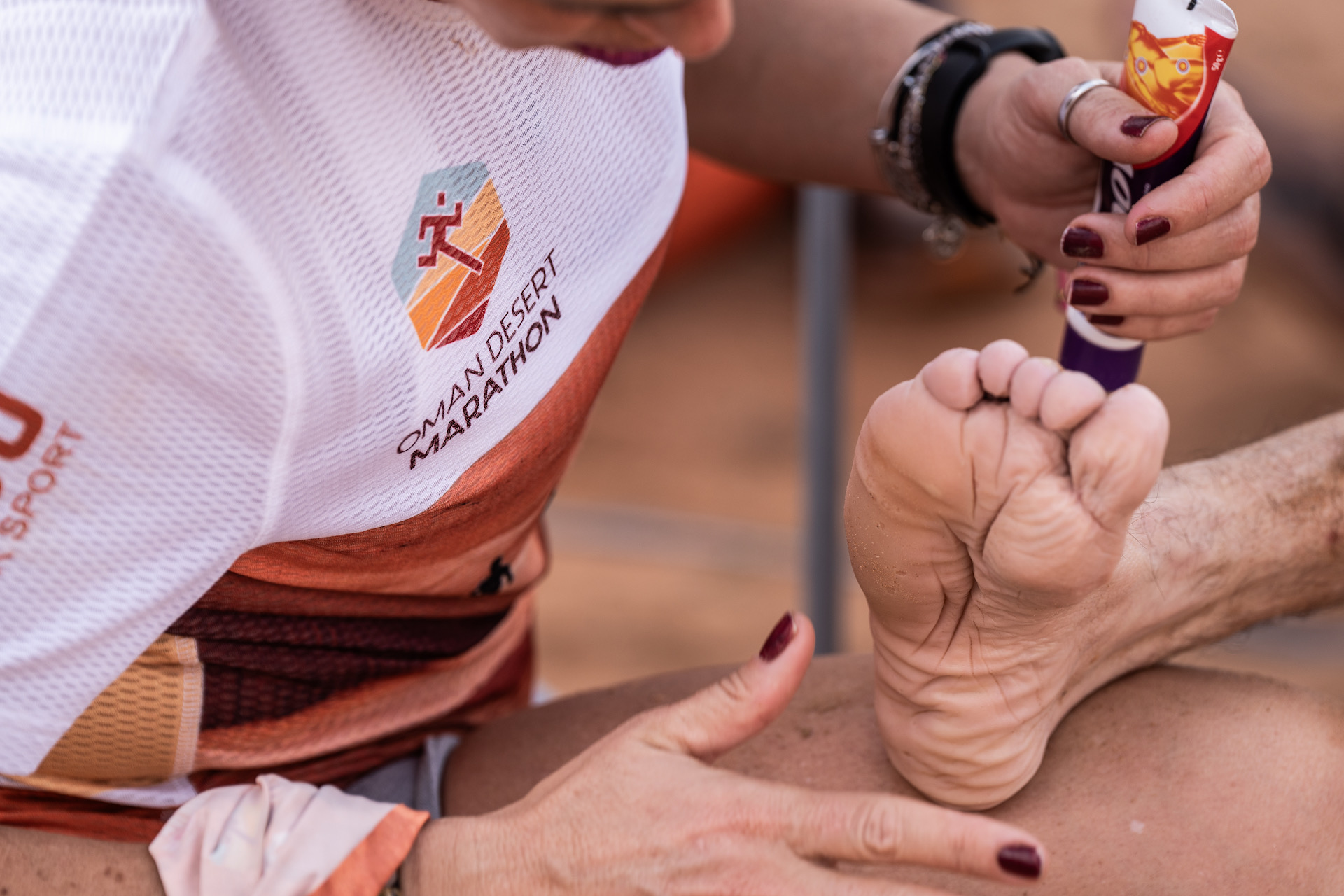
A long stop at cp3 allowed Pol to get some treatment for his feet and recharge ready for the push to the line; he’s one tough guy!
Tomorrow is stage 3, the night stage. The runner’s will start in two waves. The first around midday, the second early afternoon and they will go in to the night over roughly a marathon distance.
Navigating a different route to the 2023 Oman Desert Marathon, stage 1 of the 2024 edition proved to be a tough challenge and one that saw the lead change in the latter stages to provide victory for Aziza Raji and Rachid El Morabity.
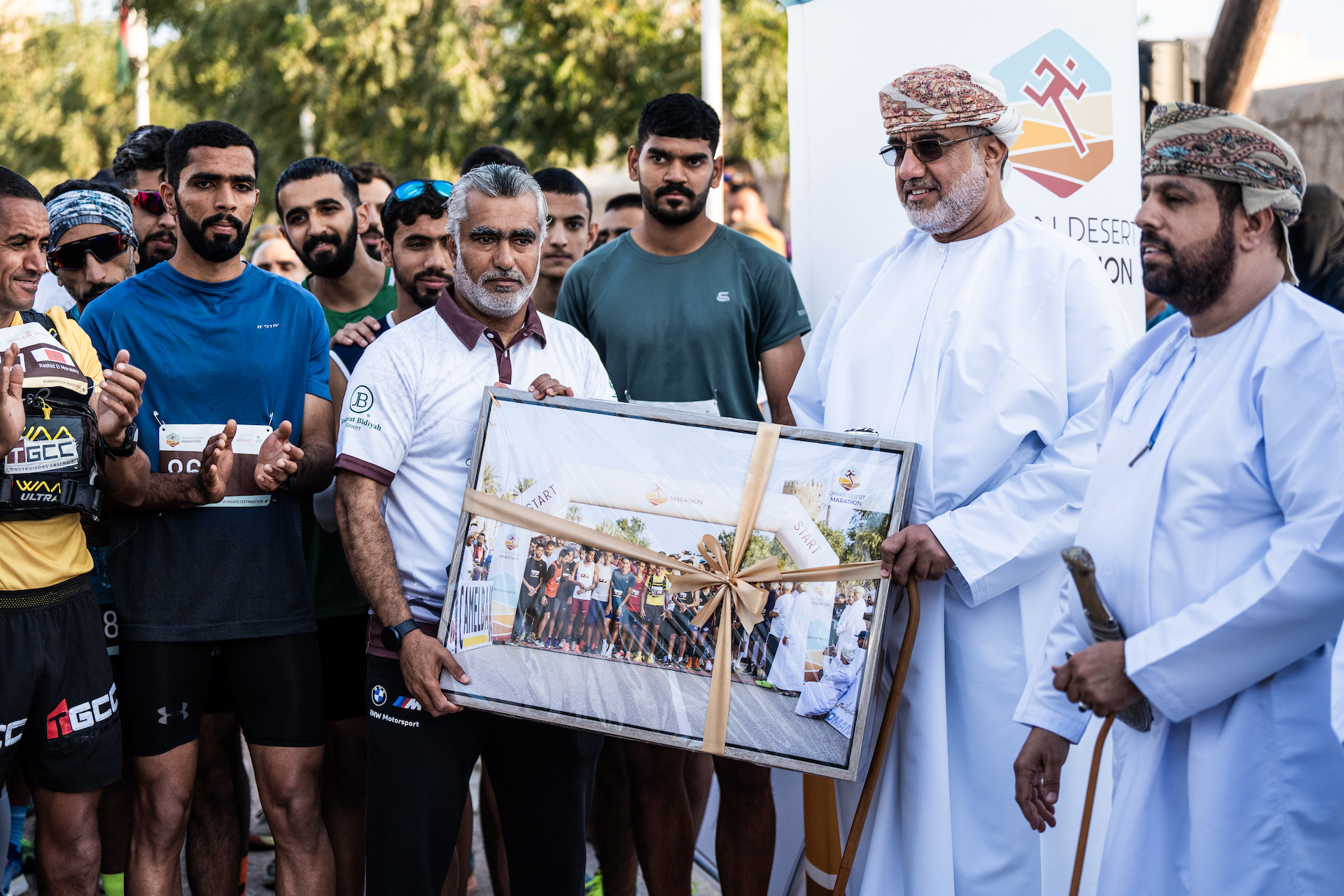
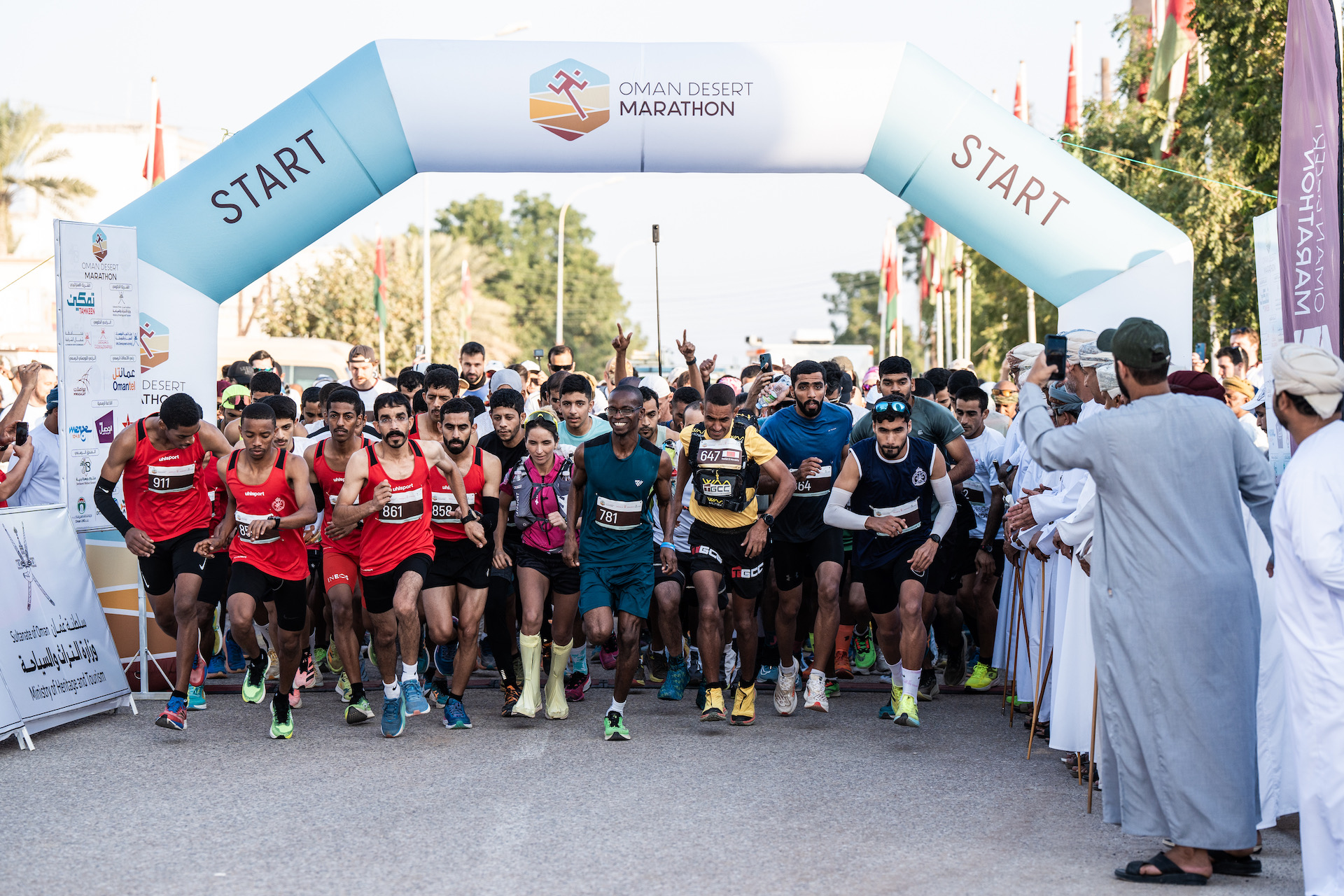
Starting in Bidiyah with a gala presentation of local dignitaries and local music, the event had a mass start for the 4-stage race, marathon, 21km, 10km and 5km.
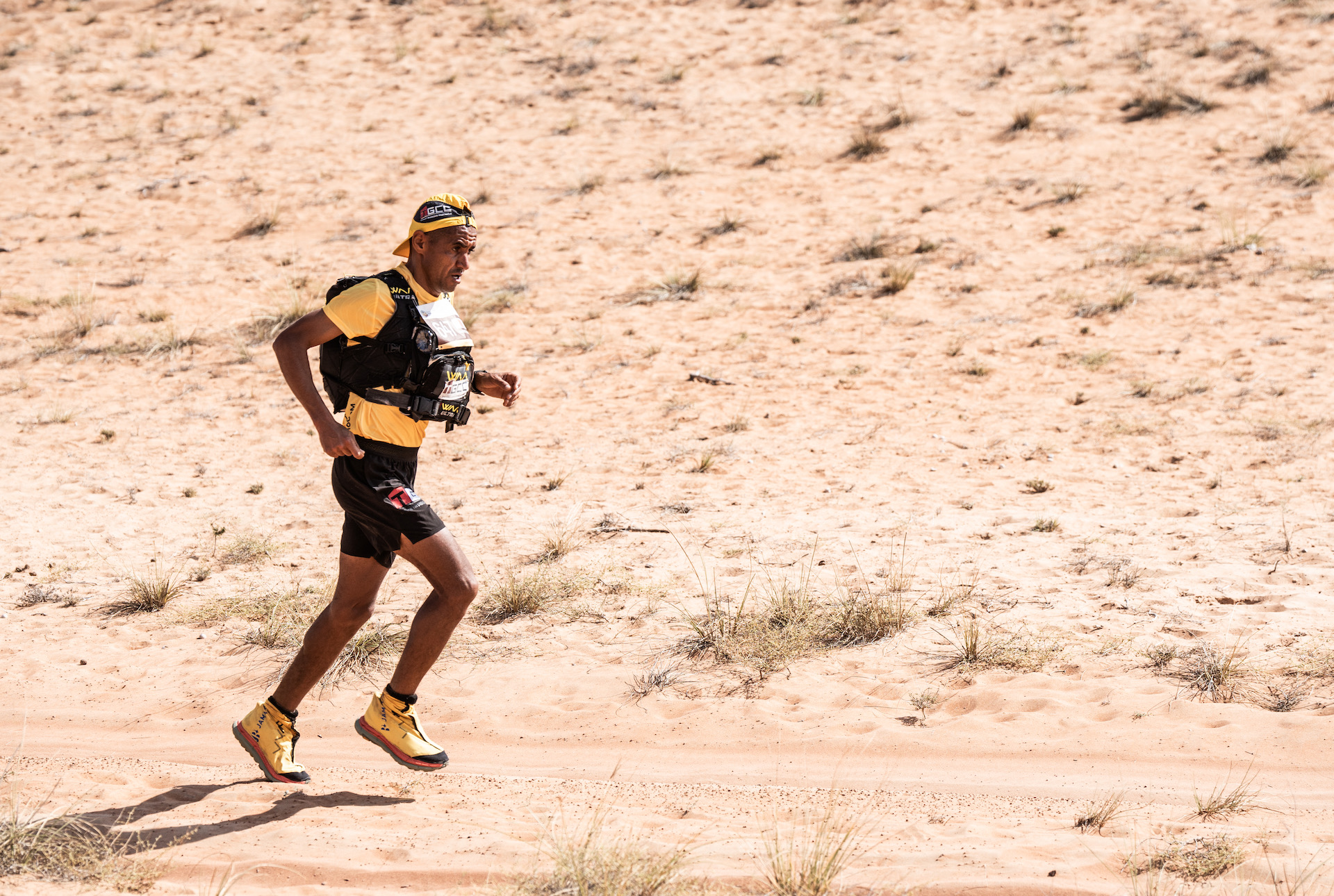
The main event, the 4-stage 165km race navigating an almost circular route back to Bidiyah was initially lead with a charge from last year’s champion, Mohamed El Morabity with Khalid Al Jabri and Evgenii Glyva.
For the women, an in-form Aziza El Amrany forged away at the front looking very strong and focused.
As per usual, Rachid El Morabity paced himself with a relatively slow start keeping the other three protagonists in sight.
Behind Aziza, Aziza Raji and the French lady, Kathleen Leguin were both looking strong and relaxed.
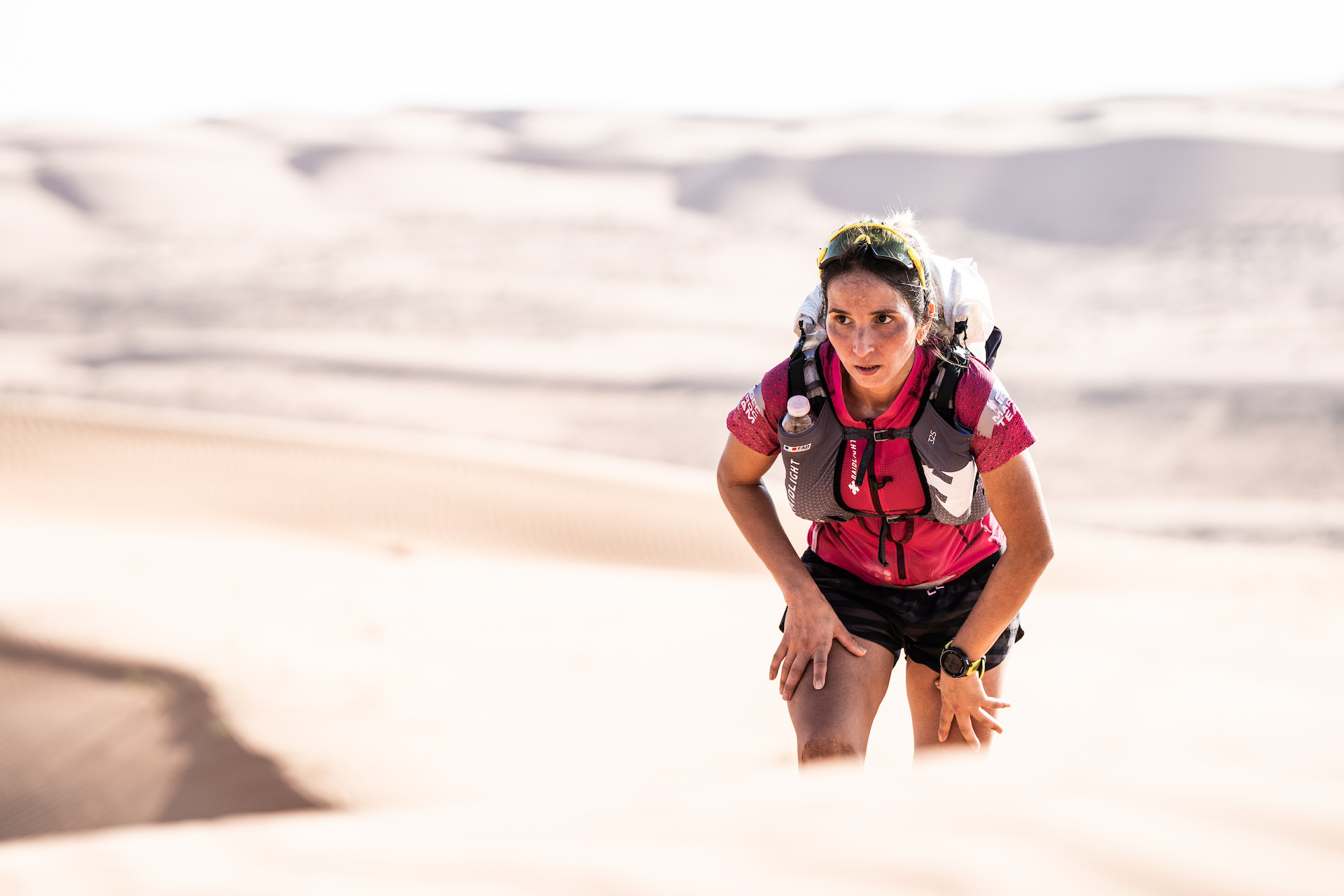
The opening 25km, post-race, was considered to be ‘easy’ in comparison to the tough and challenging terrain that followed; relentless soft-sand, dunes and rollercoaster terrain that sapped the body of strength, especially as the heat of the day came.
It was here that Aziza El Amrany relinquished the lead to Aziza Raji who looked much more relaxed in the challenging terrain.
Kathleen was also suffering, climbing a steep dune she had continuous moments of sickness and at the summit, she sighed, just 9km to go.
Rachid had now made his move and behind Mohamed El Morabity was fighting hard to hold a very strong Salah El Saidi, no doubt hampered by long travel and a very late arrival before race day.
The 2023 champion could not match the pace and finished 3rd, 3:39:20, 3:39:54 and 3:41:29 separated the men, making for an exciting stage 2.
Aziza Raji was super strong in the latter stages of the day and crossed the line in 5:22:36. Aziza El Amrany arrived in a surprising 5:49:18 and Kathleen was overtaken by Veronique Messina to finish 3rd in 6:18:55.
While the fast raced at the front, as in every race, stories begin to form behind. A notable one, Albert Jorquera who raced here in Oman in 2023, who this year runs with Pol Makuri who has Cerebral Palsy in the right side of his body. An inspiration to watch!
The duo finished the day in a brilliant time of 7:41.49, 19th and 20th.
As darkness arrives, the battle for the line continues. It’s been a tough first day here in Oman.
Runners from all over the world are looking ahead to April and the next edition of Marathon des Sables. It’s daunting and it can be intimidating. Planning is key. All runner’s need to periodise training so that you get the most from it.
This ‘planning’ often comes in the form of a PYRAMID. The ‘classic’ pyramid training method is well established. In this article I want us to look at this pyramid in two ways by looking at two different runners.
Runner 1– Runs regularly but MDS is a new target and pushes the boundaries of what they thought possible.
Runner 2– Has completed MDS or similar stage race and wants to go back and improve.
First of all, both runners need to count back. From the race date, for some, that may well be a 12-month plan, but more often than not, depending on experience and history, a 6-month block is ideal and for the well trained, a 4 to 3-month very specific block is not unrealistic.
April – MDS race.
March
February
January
December
November
Counting back, it’s easy to look at the objective in real terms and understand what one needs to achieve.
ReadTHE ULTIMATE GUIDE TO MARATHON DES SABLES HERE
Depending on experience, how this plan is put together is very much dependent on the individual. However, certain key elements should be present in any training plan and this article is intended to provide the basics from which you can develop a strategy that works for you. I must stress, for you!
RUNNER 1
As stated, runner 1 “Runs regularly but MDS is a new target and pushes the boundaries of what they thought possible.”Therefore, a classic pyramid will be ideal.
See below:
Decide on objectives for the year, decide on C, B and A targets, obviously, the ultimate is MDS. Put them in a diary and ideally have a wall planner so that you have an overview of the training block, be that 12, 6 or 4-months. It’s easy to see how training looks on a planner. C should be something that one trains through, B can be more challenging and have a small taper for, A is very specific such as a training camp.
For example:
April – MDS race – A RACE
March
February
January – A a training camp or a mini stage race in training or official
December – B a marathon on trail
November – C could be a half marathon
MDS is a long way, typically 250km, so, base training and getting the miles in is key. I would hope that before starting any specific training plan, a base has already been established with some consistent running; say, 3 times a week. I have allocated 8 weeks for this in the plan below. Hours of easy miles progressively building to C and B targets.
The A objective can be a training camp, maybe a race such as a 3-day race or a specific training long weekend to simulate race conditions.
You can’t perform well at every event and this is why C,B and A targets are important. Ultimately, MDS is the one in which you must perform.
As in any plan, flexibility is needed. Nothing is fixed and one must be flexible and listen to one’s body. I recommend building for 3 weeks, recovering on week 4, take things easy with reduced mileage and more rest and recovery.
Rest is really important as is consistency. Training is never about ‘one’ run but all the runs added together.
November and December 8 weeks – Base
January 3 weeks – Specific phase
February 3 weeks – Preparation phase
March 3 weeks – Peak
April Taper and RACE
BE SPECIFIC
Marathon des Sables will need you to be specific.
For example:
You will be carrying a pack that on day-1 of the race will weight at minimum, 8kg.
You will be racing in hot conditions.
You will be self-sufficient.
You will be compromised on calories.
You will almost certainly walk more than you anticipate.
The above list goes on and on and as training progresses, you should refer to the list and asses importance. For now, I would place the above list in the following priority.
LEARN TO WALK for most participants and good walking strategy and being familiar with how to use polesare a key to MDS success.
As training progresses asses, one’s strengths and weaknesses and then adjust the plan.
Do you need to work on strength and core?
If you have poles, do you know how to use them?
Are you recovering?
How is your diet?
What is my resting heart rate, is it fluctuating?
Am I being specific and thinking of the race terrain and simulating it?
And so, on and so on. The above questions are a starting point. Read through the list and add your own questions to appraise what type of runner you are.
As the time progresses, not only will you feel more confident, you will be able to understand what needs to be done to achieve your goal.
RUNNER 2
As stated, runner 2 “Has completed MDS or a similar stage race and wants to improve.”
I want to throw a curve ball in here and suggest reversing the pyramid.
For runner 1, the emphasis is building a base and then slowly but surely progressing up the pyramid to the pinnacle, MDS. Speed work and faster sessions are less important as building the endurance for the event is a priority, speed will form a very small element of training.
But assuming that runner 2 already has a good base of fitness. An emphasis can be placed on
How to improve,
How to be more efficient and
How to be faster.
So, before planning training, the following should be asked:
Do I lack endurance?
Do I lack speed?
Do I lack strength and core weak?
Was I mentally strong?
With answers to the following, one can look at the pyramid in a new way, turn it upside down and instead of putting a priority on long steady sessions early on, they can place a priority on:
Strength and core
Speedwork
The mental approach
Speed training is usually used to add the finishing touches to a solid block of training. But as stated, as an MDS finisher, they already have endurance, so, working on speed now is a great use of time.
November and Decembert can be used to get faster and stronger.
January can see more endurance added with a reduction in speed work.
February now combines endurance and speed with additional focus on strength with hill sessions.
March would be the peak phase, fine tuning speed in combination with endurance.
April would be a final peak and then taper to the RACE.
If you are someone looking to perform and improve, you need to be more self-critical. Plan your training and periodise your training so that you are able to (hopefully) predict good form for when you want it.
As an example, your A race which could take place in January or February may be something more specific where you are also looking for a result in addition to being in prime shape for MDS.
Remember you can only hold form for a limited length of time and if you want to peak, you need to make sure that this planning stage is done early so that you understand what you are trying to achieve. It’s all about stepping stones. And make sure you consider the terrain that the race will take place on.
Finally…
This article is not a hard and fast plan, it’s a guide for you to go away, look at your targets having assessed past targets and hopefully it makes you think about future objectives so that you can plan for a successful, injury free period of running and racing.
Consistency is key and just running and walking 3 to 6 times per week already drastically increases your chance of success at MDS. Remember, other than the ‘long-day,’ most days are the 28km to 42km bracket, so, no need to go crazy on distance.
The race is 5-stages over 6-days with a maximum distance of 250km’s and the longest day being 75 to 85km. Remember though, the ‘long-day’ has almost two days to complete, so, if required, you can take a substantial break or sleep to make the distance doable.
There are many more questions to ask and points to consider when planning but these should come after getting the training plan and schedule prepared.
Prepare for the heat in the taper phase.
Planning equipment looking for the best options for you based on weight and budget.
Work on food for the race and fine out what you need.
Fancy an early season multi-day TRAINING CAMP? Join us in Lanzarote January HERE
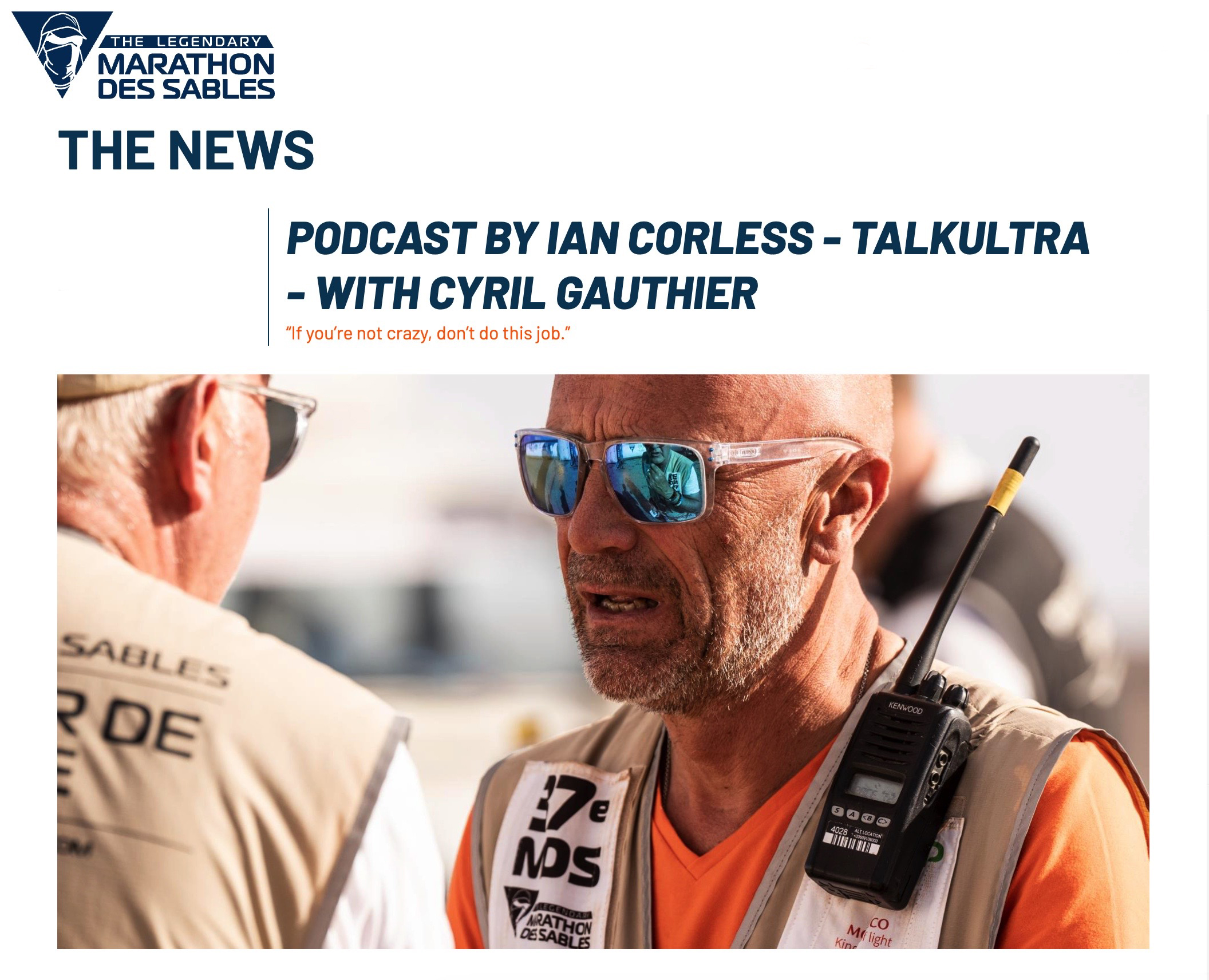
My recent podcast interview with Cyril Gauthier (available HERE) discussing the new development and progression for Marathon des Sables has now been transcribed and translated in to French. Superb job by Emmanuel Lamarle.
It is available on the marathondessables.com website by following the link HERE.
Make sure you you click on the flag (top right) as the copy will be inFrench or English.
Episode 235 of Talk Ultra and we speak with Katie (Catherine) Young who placed 6th lady and 1st Brit at the 2023 Marathon des Sables in 34h 21m 18s.
The 2023 Marathon des Sables will go down in the 37-year history of the race as a tough one. With second longest stage in the race history (90km), a tough course and excessive heat, 30% did not make it to the finish.
Katie Young from the UK, running her first stage race had an incredible run placing 6th woman and 1st Brit.
Are you planning on running Marathon des Sables or a similar race in 2024 or beyond? Why not join us in January for our LANZAROTE TRAINING CAMP which runs from the 11th to 18th. More information HERE.
Marathon des Sables 2024 #MDS – The New Features Discussed
2024 Marathon des Sables entries are due to open on June 30th. Moving forward, some changes will be made to the race. Read a summary of points HERE.
NEED A NEW PACK?
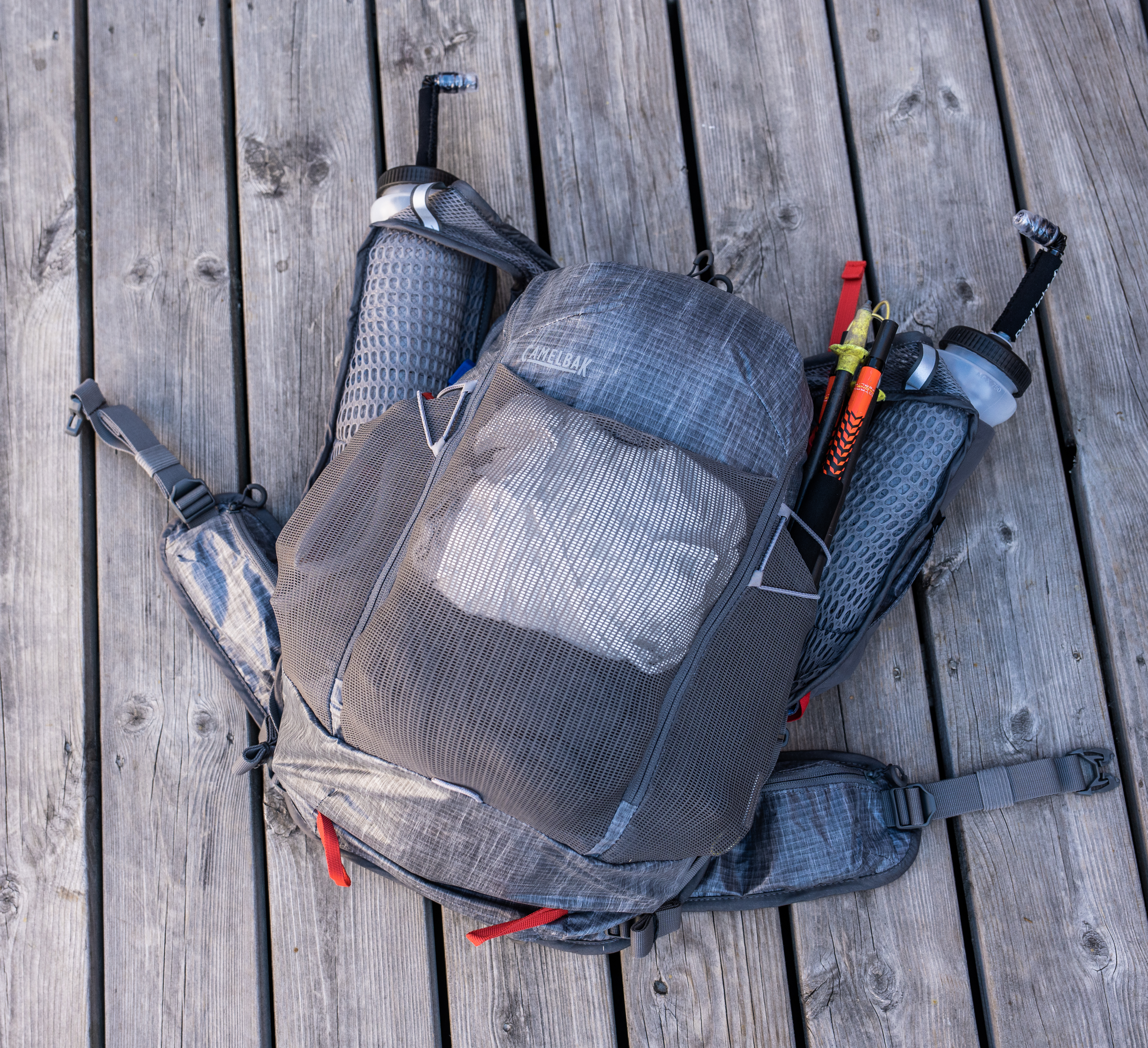
Are you looking for a new pack that is suitable for fastpacking and stage racing? We are currently testing the Camelbak Octane 25 and it is proving a real favourite. It’s full of features, has great storage and is extremely comfortable. Check out our first impressions HERE.
The 37th edition of the iconic Marathon des Sables concluded at Merzouga Dunes (Erg Chebbi) after what is considered, one of the hardest and most challenging editions of the race, 2021 an exception.
Coming later in April due to Ramadan, the predictions were always for hotter temperatures and an increased chance of sandstorms – we got them both!
Gladly, the intense sandstorms subsided after stage 2, but the heat grew in intensity as the week progressed with 42 degree temperatures in the shade and low 50 degree temperatures recorded in the direct sun.
This of course impacted on every participant and every member of staff.
October 2021 and the 35th edition was plagued by a Norovirus that debilitated many of the staff and runner’s, also, some of the most sustained and intensive heat that the race has experienced. It was a perfect storm that resulted in nearly 50% not completing the race. An in-depth article is HERE.
The 36th edition by contrast was the opposite, only confirming that extreme endurance challenges can bring anything and being prepared and adapting is key and integral for successful completion. However, significant sandstorms did increase the DNF rate to around 10%.
Here in 2023 there was no Norovirus, just intense heat that resulted in heat stroke, exhaustion and the second highest dropout rate in the 37-year history of the race – 30%.
What can be learnt from the 2023 edition and why such a high DNF rate?
Preparation – The 2021 edition of the race and huge dropout rate was a wakeup call for any racer, I would say that the 2023 edition of the race had participants who were well aware and understood the nature of the challenge. If the 35th and 36th editions can teach us anything, the key take away is you MUST be prepared for anything; intense heat, cold, sandstorms and the unexpected.
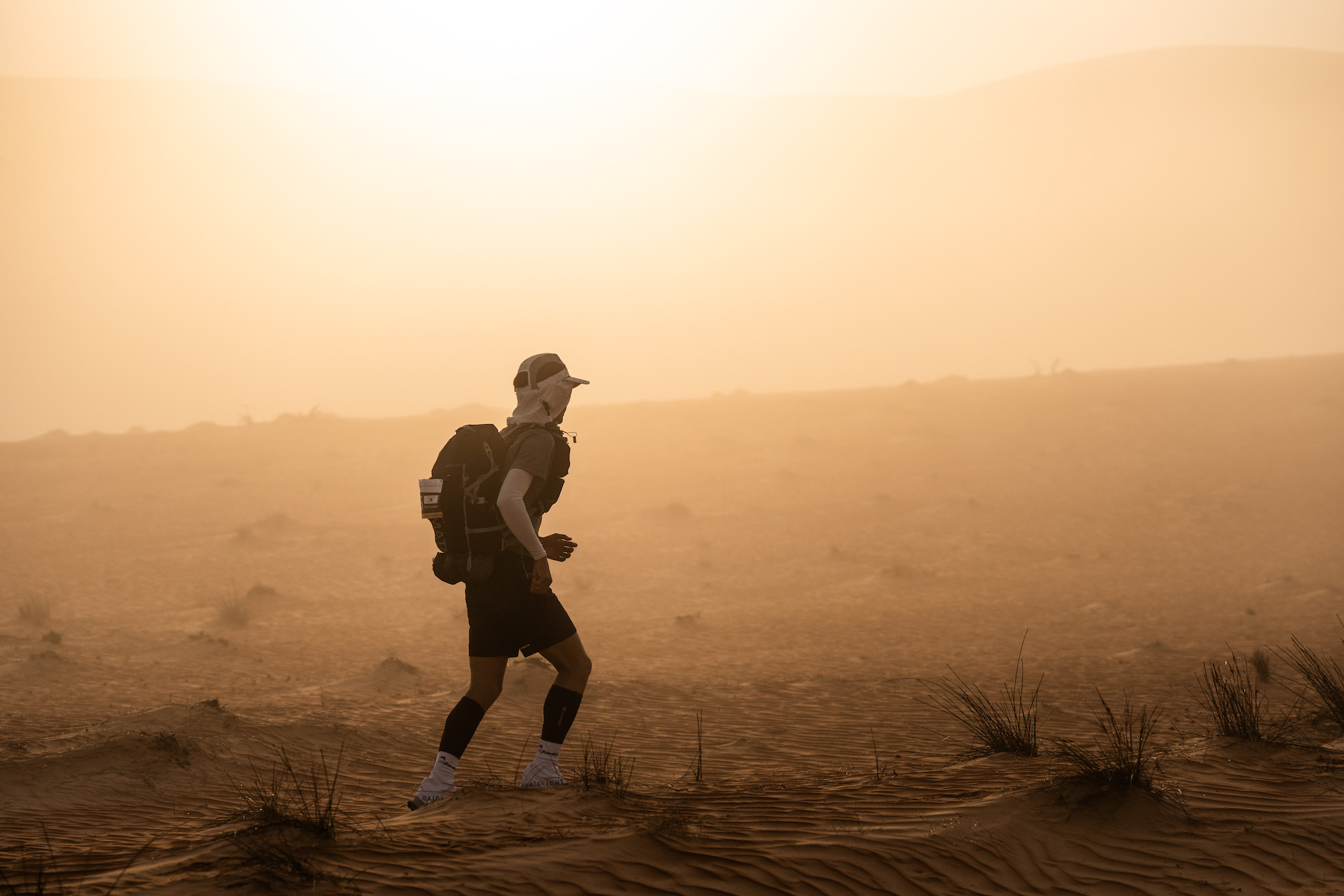
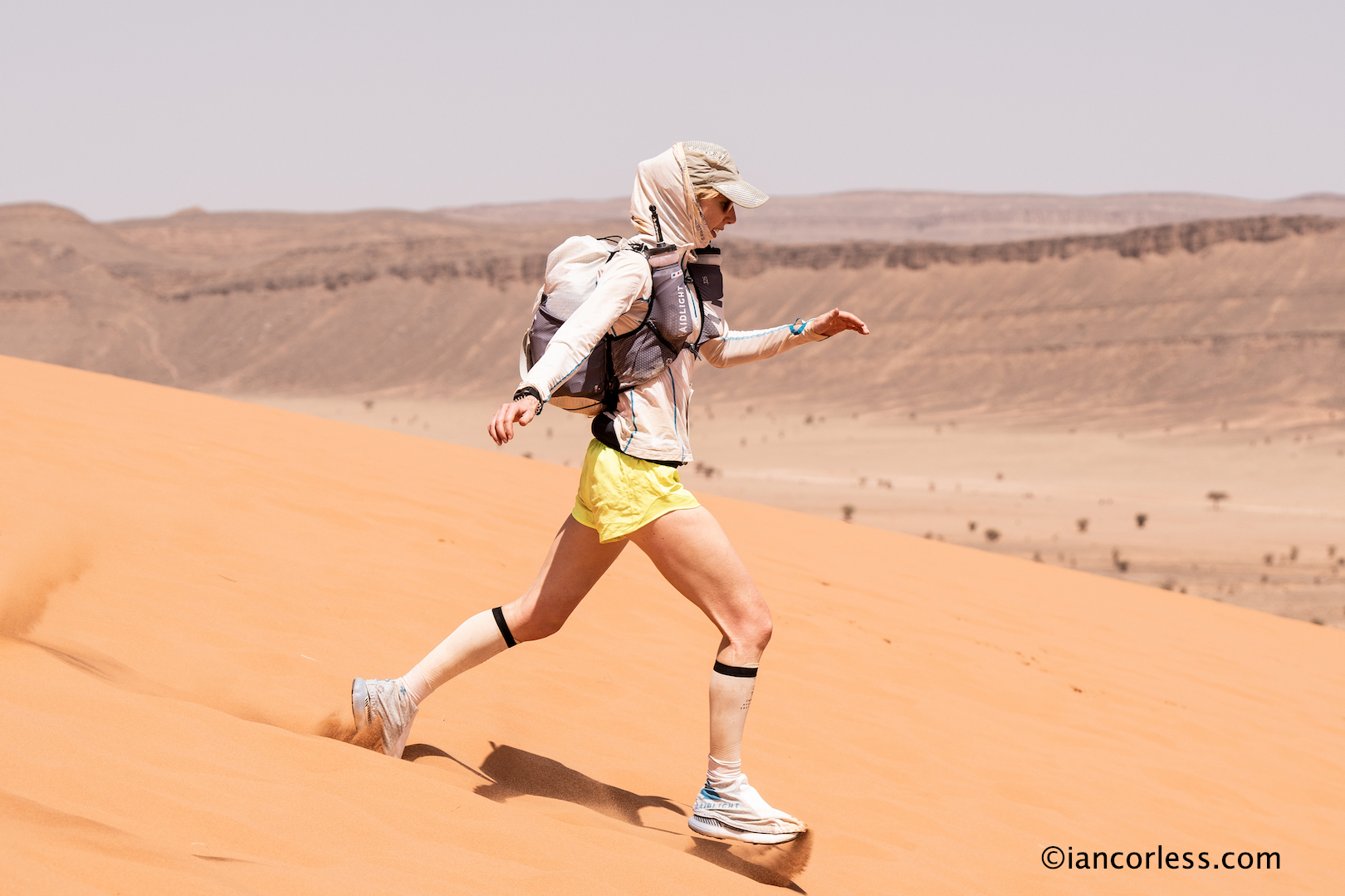
Sandstorms – They plagued the early stages of the 2023 edition, however, lessons had definitely been learnt from the 2022 edition when sandstorms increased the DNF rate. Far more runners in the 37th edition were prepared with specific eyewear that functions in harsh conditions. It’s a key item that to all intents and purposes should be mandatory on an MDS kit list. Gladly, sandstorms did not really impact when runners were on the course, the latter part of stage 2 an exception. The sandstorms impacted on camp life and comfort. Had they hit during racing, DNF rates may well have been higher.
Heat – It’s the Sahara, it gets hot! May sound silly to say, but, this is the nature of the event. Now of course, we can get extremes, 2021 and 2022 a perfect example, arguably the hottest and the coldest. 2023 sits most definitely in the hotter end of the 37-year history of the race and the DNF rate shows this. Quite simply heat adaptation and preparation is key coming in to the MDS in the 14-days before the race. If you do not do this, the adaptation will take place during the race and quite simply, the body cannot handle it and boom, you overheat, dehydrate, get sickness and withdraw. Stage 2 shows the impact with 106 abandons. I would normally say here, that by the time the ‘long day’ comes, DNF rates reduce due to adaptation taking place, BUT for the 37th edition they increased, why? Quite simply, temperatures continued to rise, the long day was arguably the hottest day of the race, it placed tired bodies in more intense heat and the knock on effects are easy to see. Also, let’s not forget the race distances.
Race Distances – The DNF rate in 2023 is without doubt a result of the intense heat, however, I do feel the race stages also contributed. To be clear here, I am not asking for easier stages, just providing an overview. Stage 1 at 36km was a long stage. When one considers that day 1 is ‘typically’ 29-32km, the additional distance adds to an immediate stress and strain. It’s easy to look on and say, but it is only 4km to 6km! True, but 4 to 6km for some can be 2 to 3-hours in the heat. It takes a toll. Stage 2 was a beautiful stage and a classic distance, however, this stage had more technicality and additional vertical gain, this in itself added a stress and strain, add intense heat and sandstorms towards the end of the day, plus carry over fatigue from stage 1 and we can see how 106 did not finish. Stage 3 is always a cautious stage as many want to preserve energy for stage 4, the long day. Starting with km after km of flat running, the stage was in comparison to other stages, an easier day, however, 72 abandoned. Stage 4 at 90km was the second longest ever stage of the MDS, coming in a brutality hot year, it was always going to be a tough challenge. A beautiful route that included climbing Jebel Otfal, the route had relentless soft sand and intense heat. Darkness and cooler temperatures were the saviour of many runners and despite this, 119 did not make the line. Stage 5 and the medal is in sight, no matter how tough the day is, the hug and kiss from Patrick makes one more day of pain manageable, despite this, sadly, 3 did not make the line.
Heat Stroke – D&V did happen during the race and while some questioned if a virus was present, it was clear to see that any resemblance to 2021 was not there. Heat stroke has very similar symptoms to a bug: tiredness · dizziness · headache · feeling sick or being sick · diarrhea. I saw countless runners with heat rash on their legs and bodies.
Pack Weight – Again and again, one of the key easy gains for MDS completion is getting pack weight as close to 6.5kg as possible. Additional weight is additional strain. In intense heat this is only magnified.
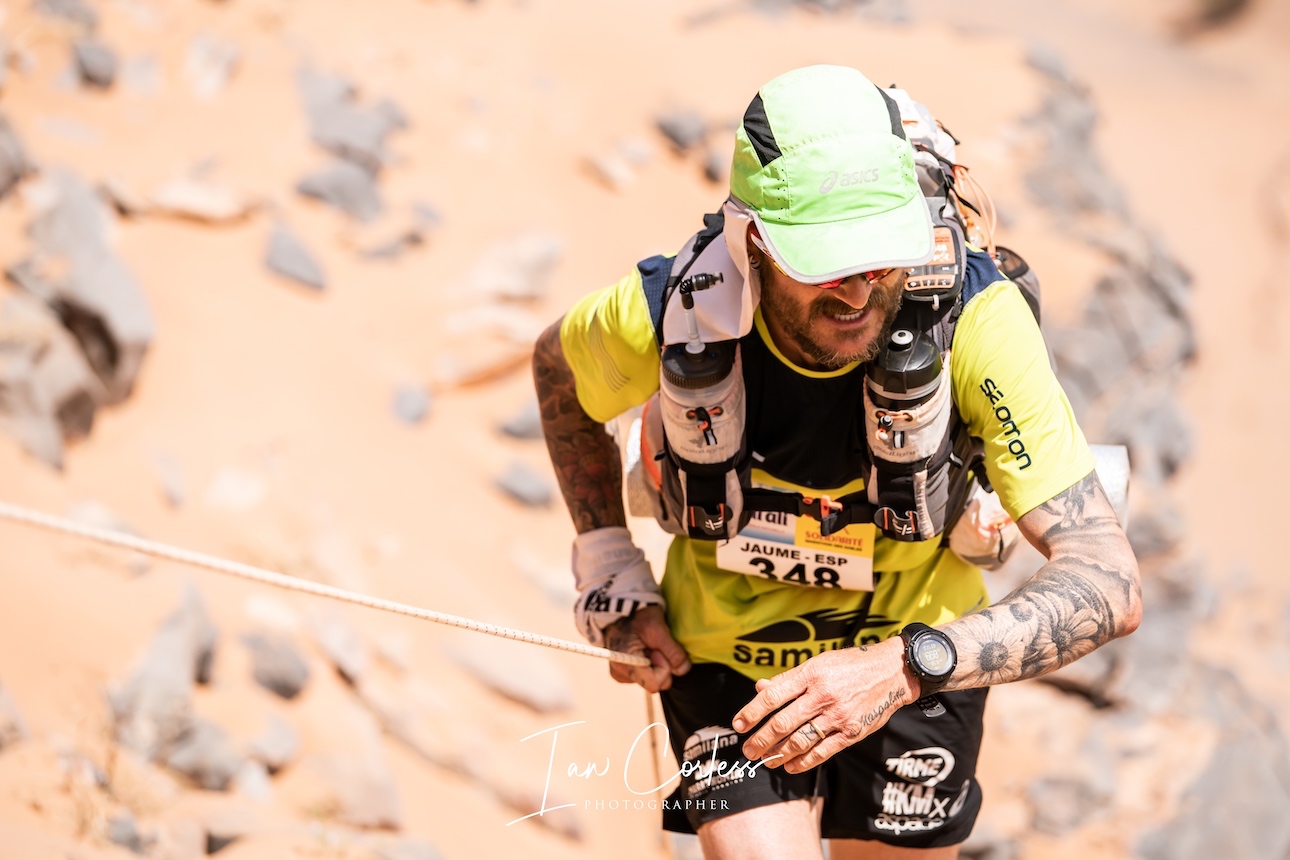
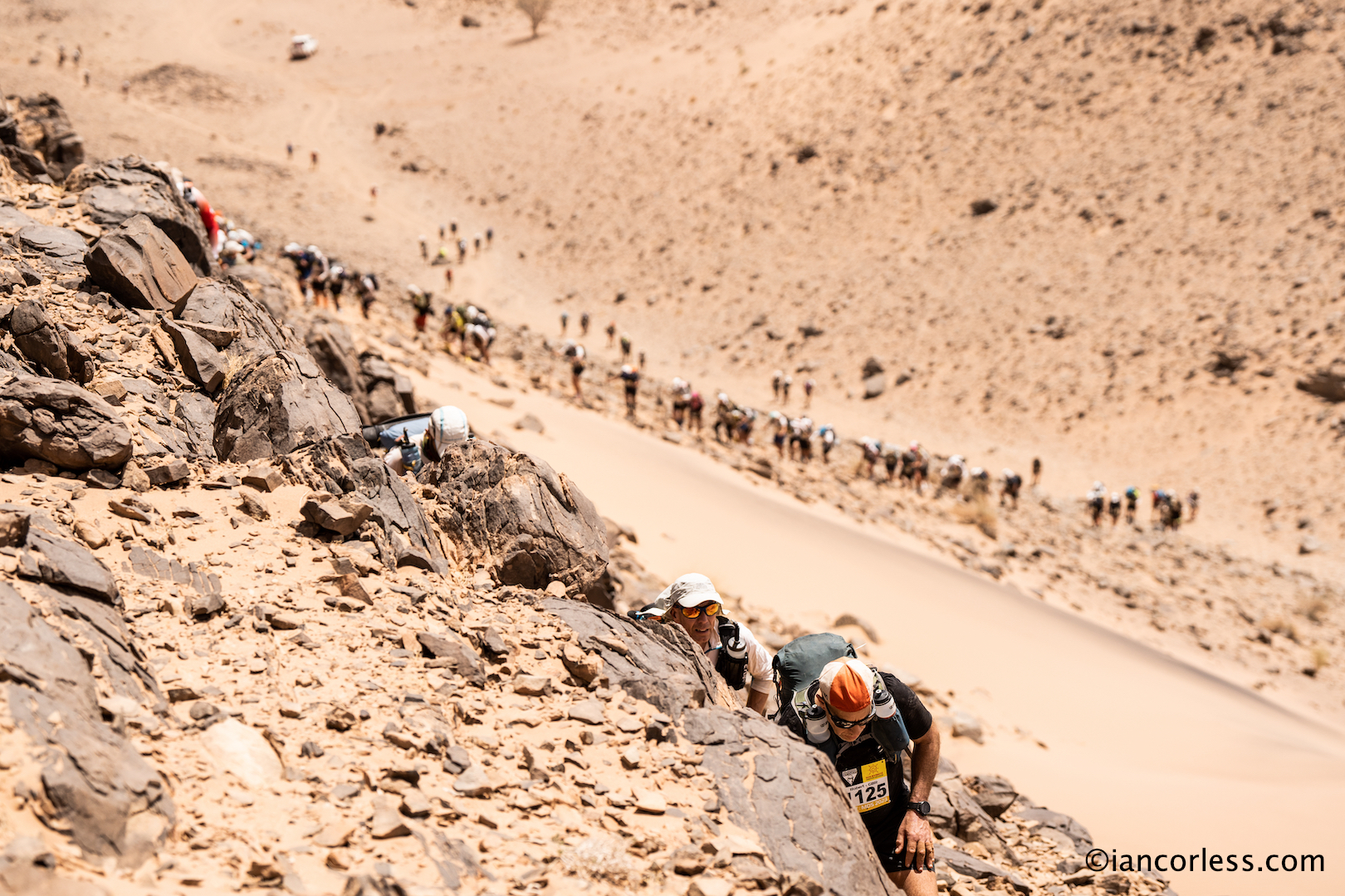
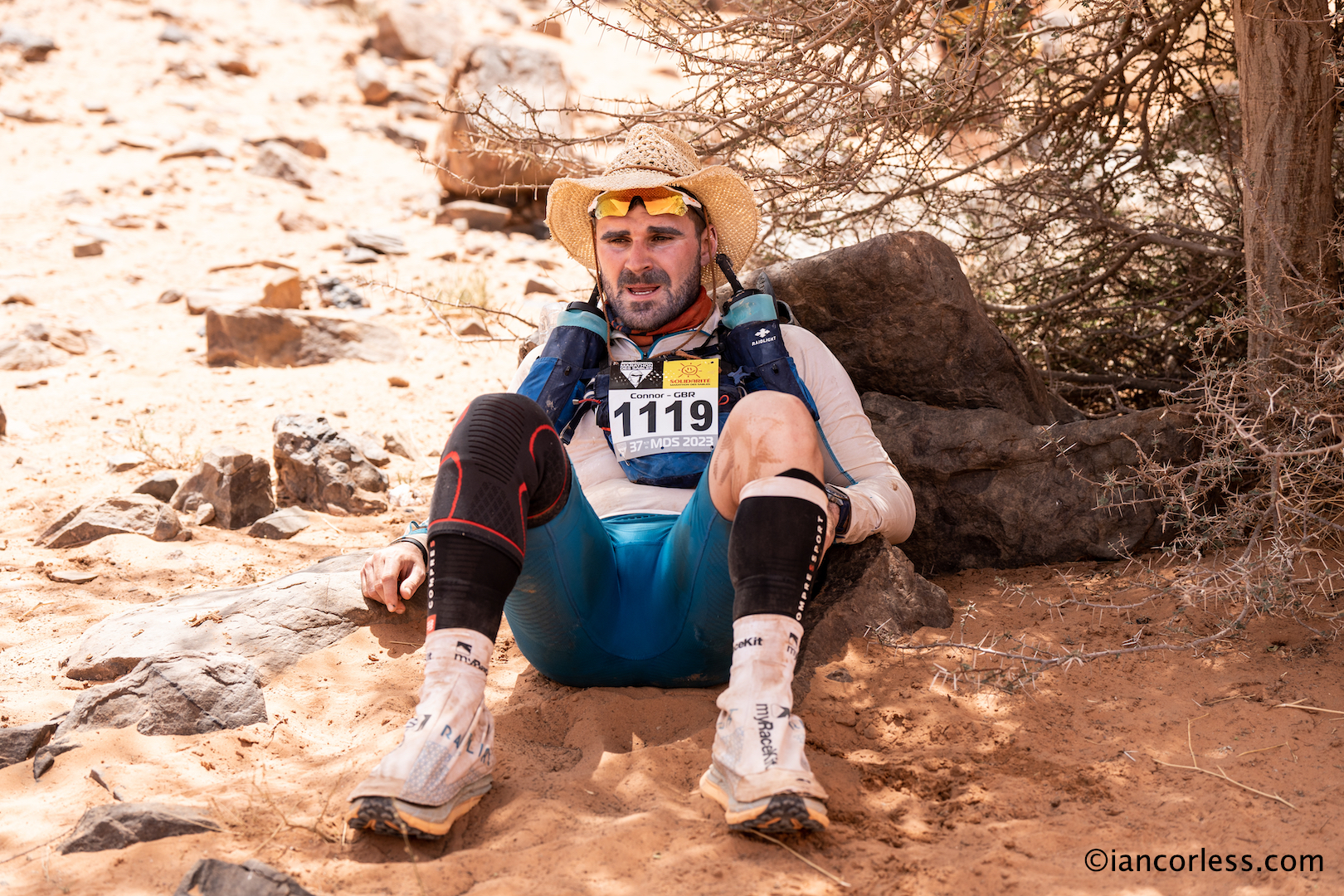
Walking – If I had a euro for every time I have preached, ‘learn to walk’ I would be a rich man. MDS always makes people walk far more than they want or anticipate. Add intense heat, walking becomes normal for everyone, the elite excluded. Rising core temperatures require you to reduce stress on you and the body, even if you do not want to walk you will be forced too. Continue raising internal temperature and eventually you’ll need to stop, hopefully seek shade and reset and carry on. The DNF’s in 2023 show that heat just wiped people out. So, effective walking is a key MDS strategy.
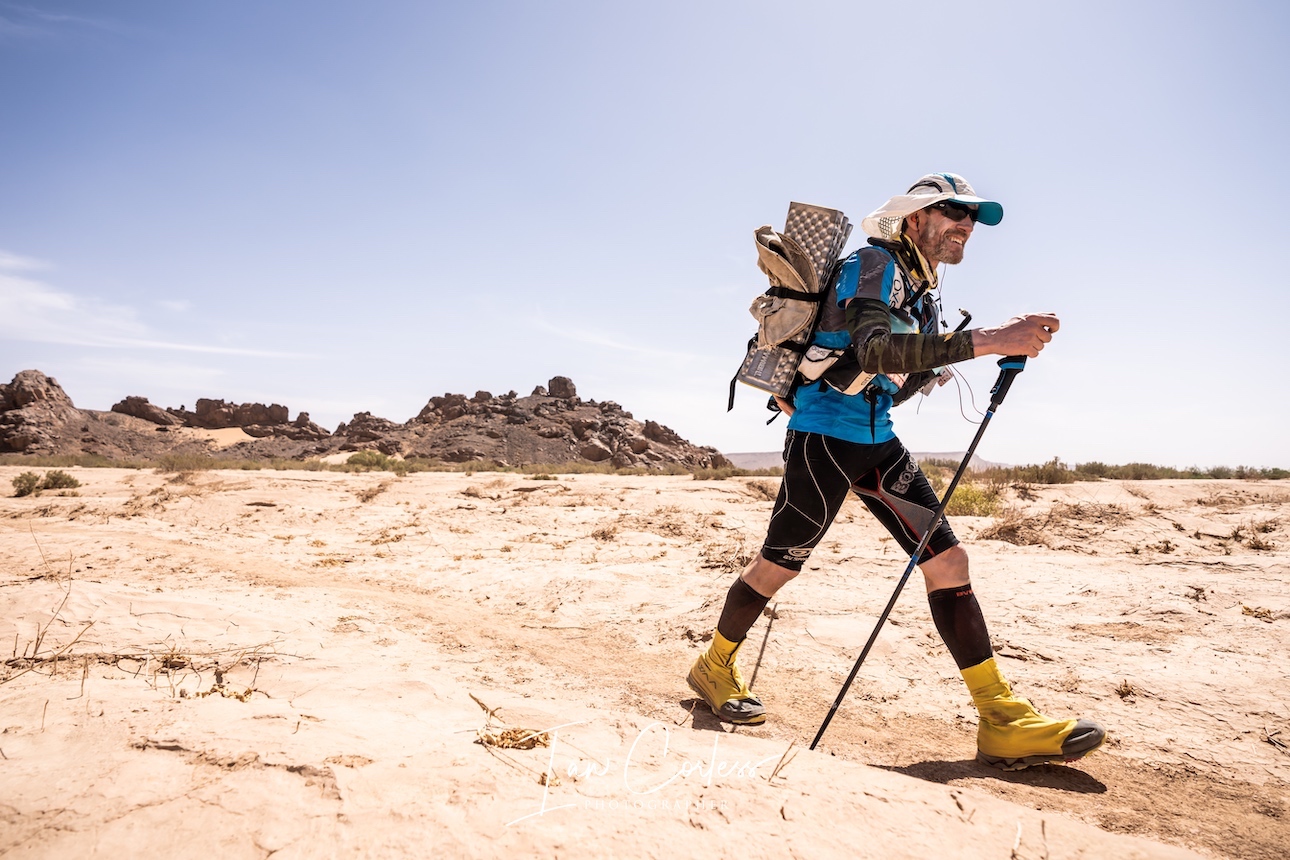
Poles – Quite simply, poles and knowing how to use them are a key weapon in helping achieve an MDS finish for those typically outside the top-50. However, Norwegian runner Gaute Løset was the personification of great pole technique and placing 11th overall. Poles provide 4-wheel drive, stability and help reduce some fatigue by helping to distribute load stresses. Trust me, poles are a key weapon for most at MDS.
Mind – Broken and tired bodies were willed to the end through thick and thin due to incredible mental strength and fortitude. Training is not only physical, but mental.
Be Prepared – Hot or cold, dry or humid, windy or not, the Sahara can throw anything at you. Racing MDS is not complicated, understand the challenge and prepare accordingly. The greater the preparation, the greater chance of completion!
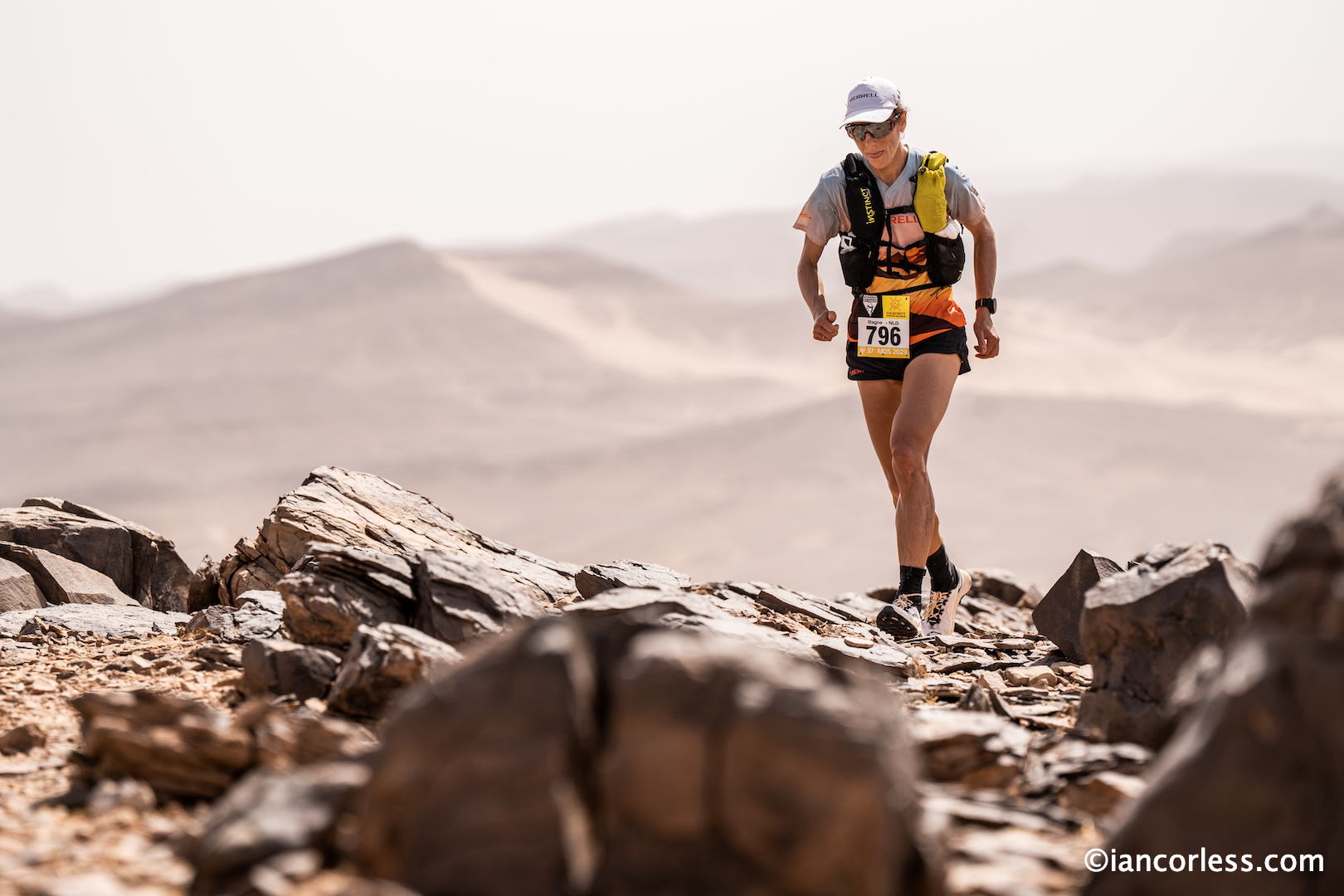
Rachid El Morabity was going for a 10th MDS victory and all eyes were on him. Ragna Debats was returning to MDS after winning the race in 2019, she was the odds-on favourite for victory. It was not to be for either of them.
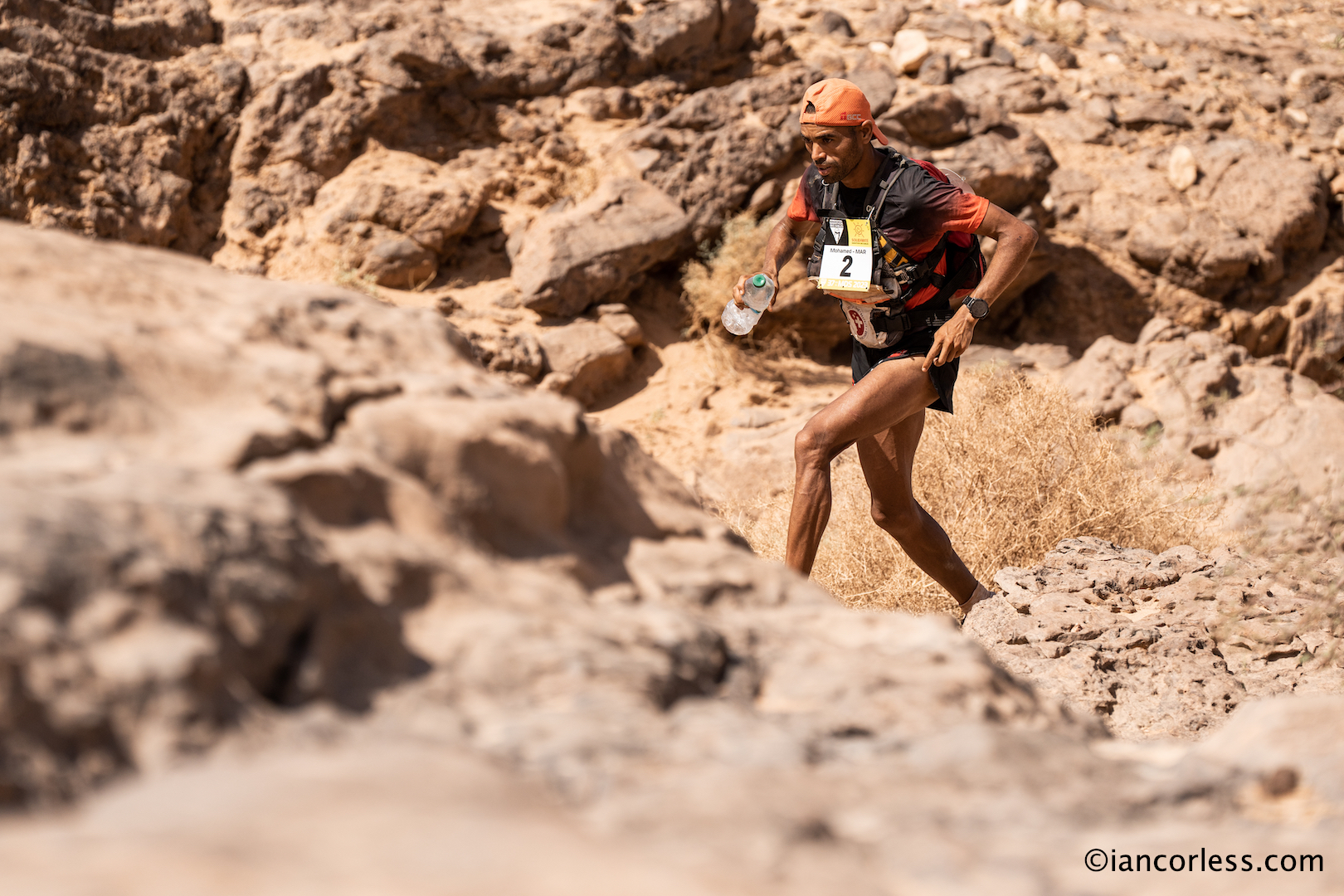
Rachid was running a typically smart race using his brother, Mohamed as a decoy to counter any threat from Aziz Yachou and Mathieu Blanchard. Fireworks were expected come stage 4 but the race felt nuetralized with Rachid, Mohamed and Aziz all finishing within 1-minute. This placed Mohamed the leader of the race. During the ‘rest day’ thoughts for the race strategy come the marathon stage were simple, Rachid would mark Aziz, Mohamed would police the race and then conveniently lose enough time to place Rachid winner of the race and gain his 10th victory. However, at 2pm on the rest day, Rachid and Aziz El Akad were both issued with 3-hour time penalties after failing a bag check just before the start of stage 4. The reason being ‘outside assistance!’
They both had items that could only have been provided by another person therefore giving them an advantage. To be clear here, many other runners were also tested before stage 4. Rachid’s chances of victory were over, he and Aziz withdrew from the race. Finally after many years being domestique to his elder brother, Mohamed clinched his first victory with Aziz Yachou placing second and Mathieu Blanchard third.
Ragna Debats dominated the early stages of the race building a huge time gap, we all thought the race was over. Signs of some fatigue and distress were visible on stage 3. However, come stage 4, the race unfolded for Ragna and she fought a long and hard day to finish many hours outside the top 3 women and therefore there was no longer a chance of victory or podium.
Maryline Nakache took over the reigns and despite Aziza El Amrany winning the long stage, she held on to victory with Aziza second and Tomomi Bitoh once again placed 3rd as she did in 2021.
The 2023 was classic, stage 2 and the long day providing the best of this region of the Sahara. Combined with the intense heat, it was a tough race. The long day, while not the longest (92km in 2009) was a significant challenge with an abundance of soft sand. Stunning views, ridges, climbs, soft sand, two crossings of Jebel Otfal, salt flats and oasis, the 2023 route was special.
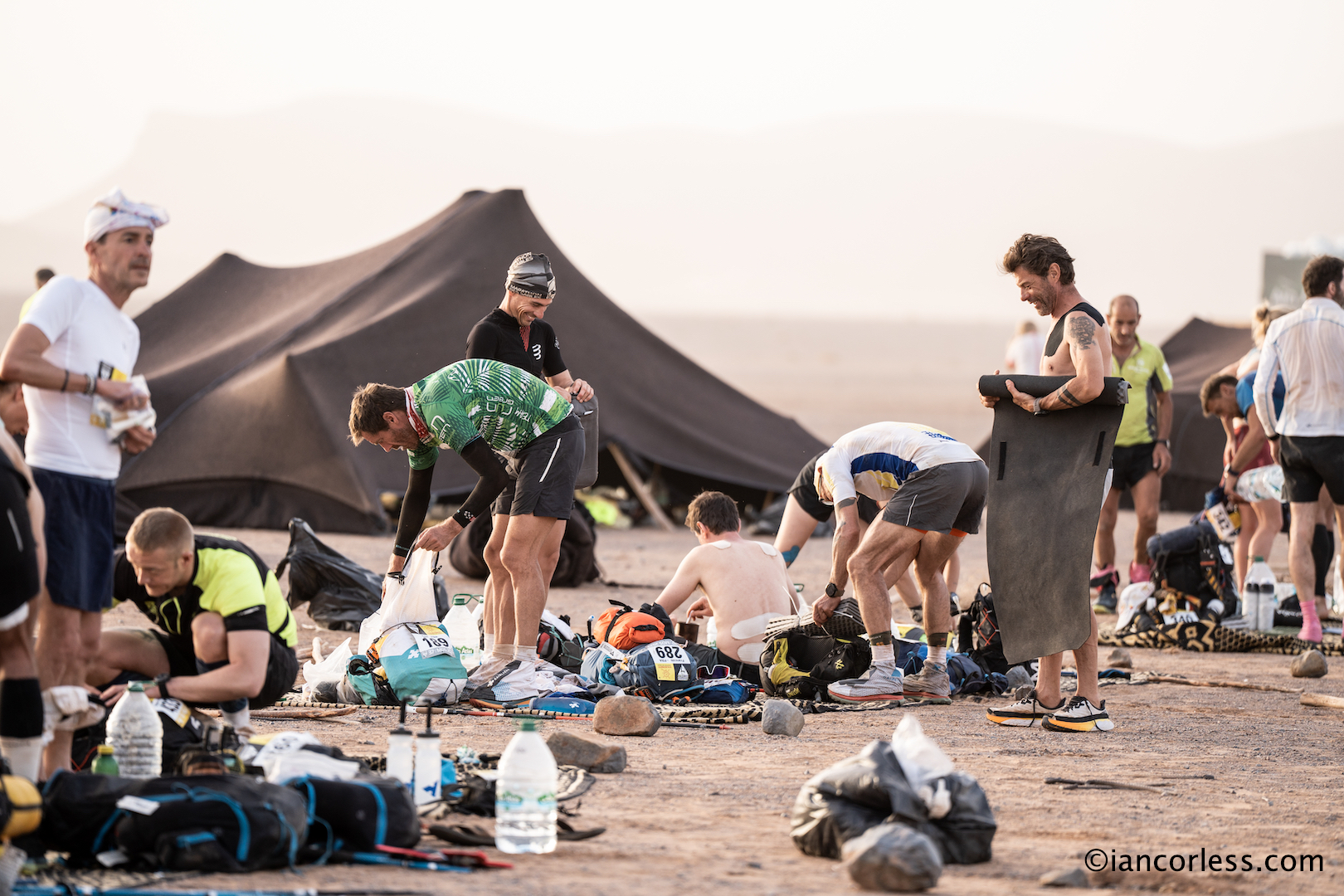
MDS is a magical Saharan experience that really is one of the greatest experiences in running. A small city moves seamlessly and like clockwork day-by-day, a wonderful, magical, moving road show that is difficult to understand and appreciate until you are living it.
Stripped back from connection and technology, MDS is one of the ultimate raw experiences in this crazy modern and connected world; one tent, 8-people, one bag per person; rationed food, clothing, sleeping bag, sleeping mat, mandatory equipment and rationed water, it gets no simpler or basic. For those who have experienced it, they know the life changing process that the experience brings. They dared to place themselves in the arena knowing that if at least they fail, they do so while daring greatly.
Day 2 was tough. It was a challenging route, incredibly beautiful but the added technicality, vertical gain and intense heat took its toll with many DNF’s.
The organisation made a decision to bring the stage 3 start forward by 1-hour, 0700 instead of 0800. It maybe caused some logistical, admin and timing issues for all but it was a good call.
At 34km, stage 3 had less challenges than stage 2, but still a tough day.
With flat km’s to Cp1, the pace was high and Mathieu Blanchard was a main protagonist. He often pushed the pace, closely followed by Aziz, Mohammed and Rachid.
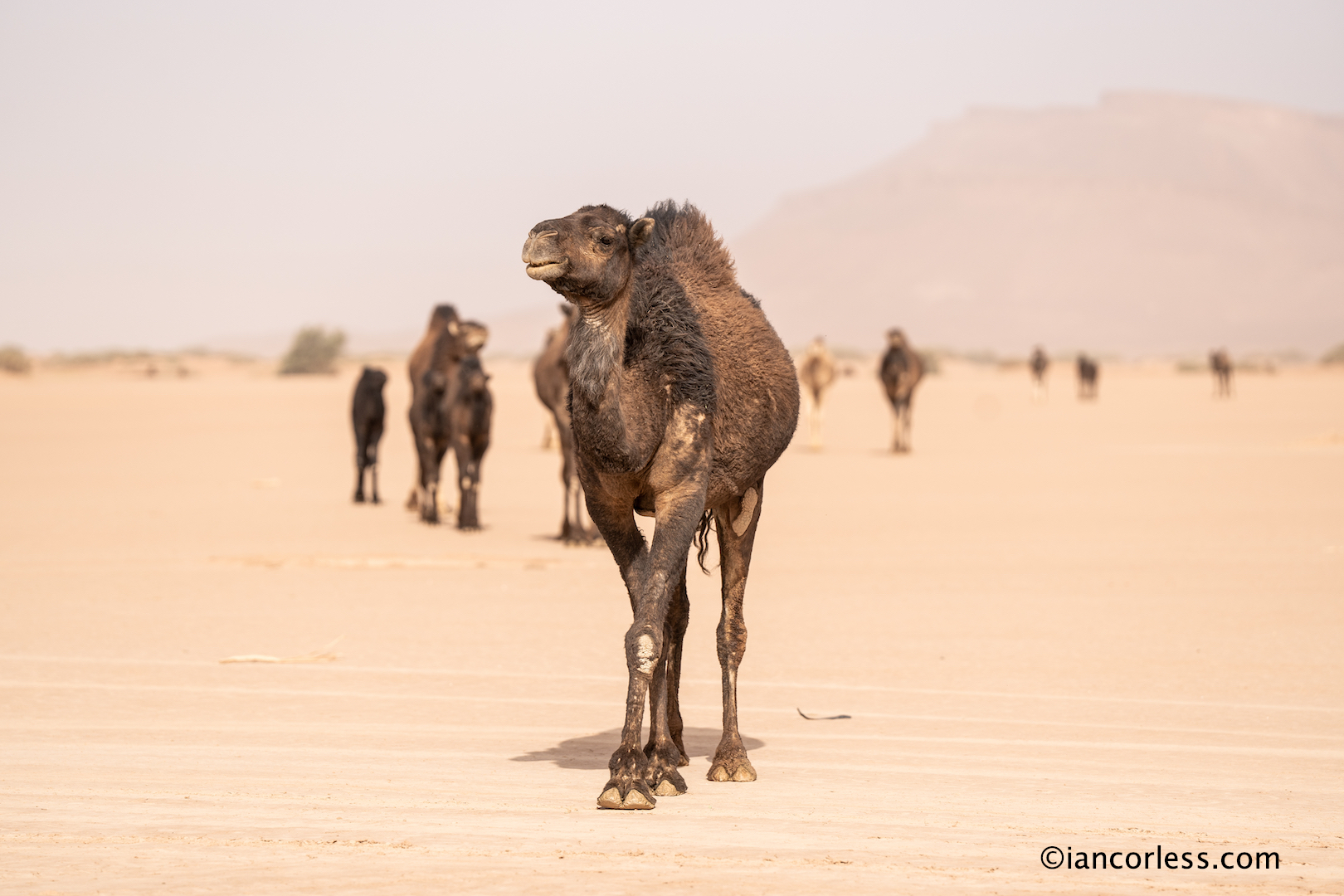
After Cp2 a resplendent area of green vegetation brought a different life to the Sahara. Camels, birds and reptiles, rare to see so much wildlife in one area.
As I expected, Mohammed attacked and not only took the stage but the overall lead. It’s what I expected. The ‘brothers’ have a plan for the long day, but, at 90km’s, anything can happen.
For the women, it was business as usual with Rgna leading. But, after Cp1 she went through a bad patch and Aziza El Amrany took over the front of the race with Ragna complaining of, ‘…feeling fine and lacking power.’
Maryline Nakache once again ran a strong and consistent stage to not only catch Aziza, pass her and put time into her, the duo finishing in 3:4104 and 3:42:36.
Tomorrow is the big day! It’s beautiful route with some MDS classics in the terrain. At 90km, it will be extremely tough for all. The race will start 1-hour earlier than planned, 0700. The top-50 will start at 1000.




















 IAN CORLESS