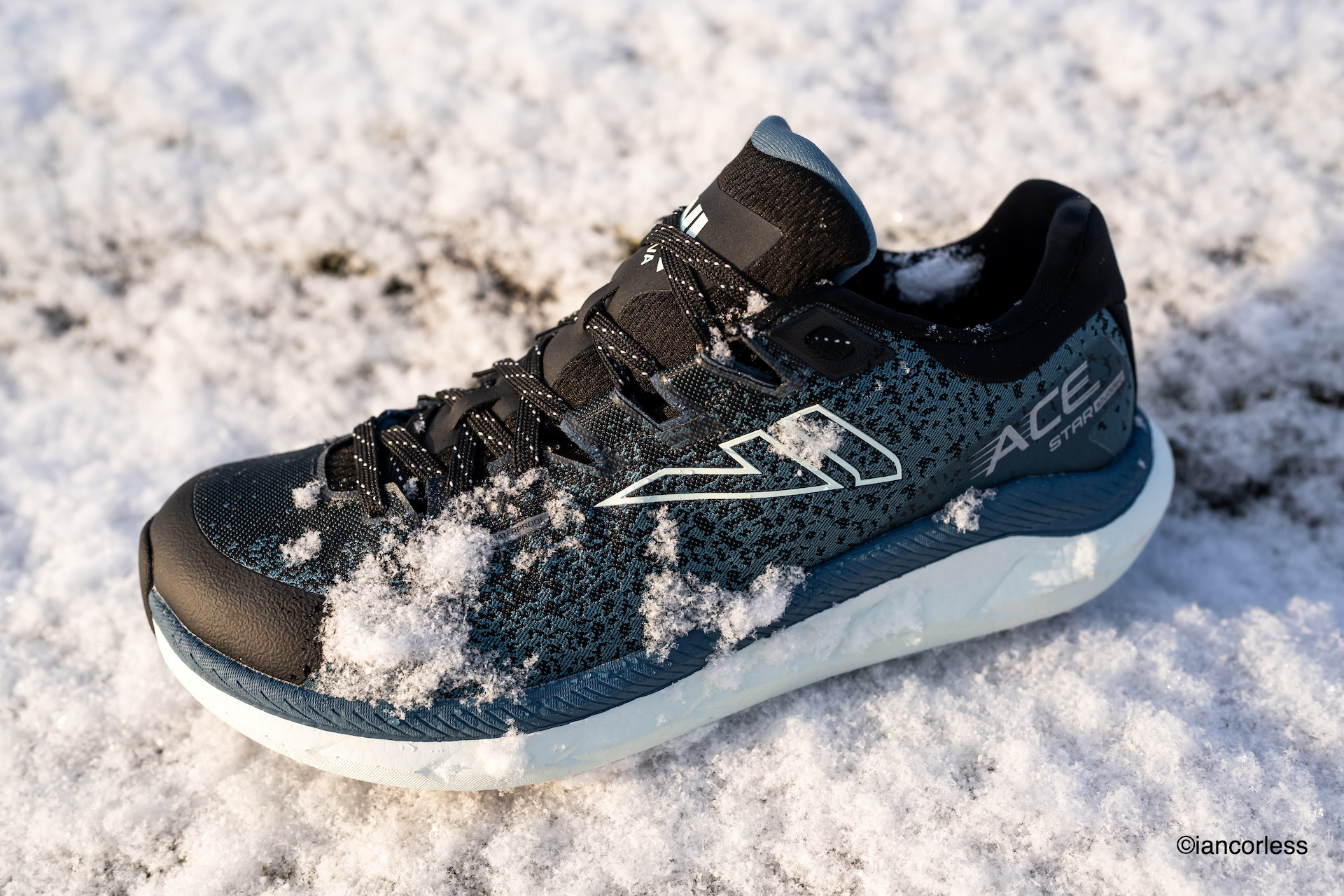
In 2023, I received the VJ Sarva Ace – a winter studded shoe. This shoe was a revelation based on a much wider toe box and incredible ‘new’ cushioning. Review HERE. At the time, I fed back to VJ that without the spikes this would make a great new ULTRA shoe in the VJ line-up.
Well, the MAXx2 and Lightspeed take this cushioning and what we have are two performance shoes that need to be worn to be believed.
Today, we look at the MAXx2.
THE SHOE
If you read my shoe reviews, you will know I am a huge VJ Sport fan. To me, they have not made a bad shoe and gladly, they are not always tweaking or re-inventing shoes. The original MAXx I have used for many years and in all honesty, it has been my go-to mountain running shoe. The combination of foot hold from Fitlock and the amazing outsole make them unbeatable when grip and control is priority. The only downside to the MAXx was the lack of cushioning for longer runs. With 12mm cushioning at the front, 18mm at the rear and 4mm studs, they are a great shoe for up to 50km in rocky, muddy and mountainous terrain.
The MAXx2 takes all that was great in the MAXx and brings some key changes and features:
25mm and 31mm cushioning
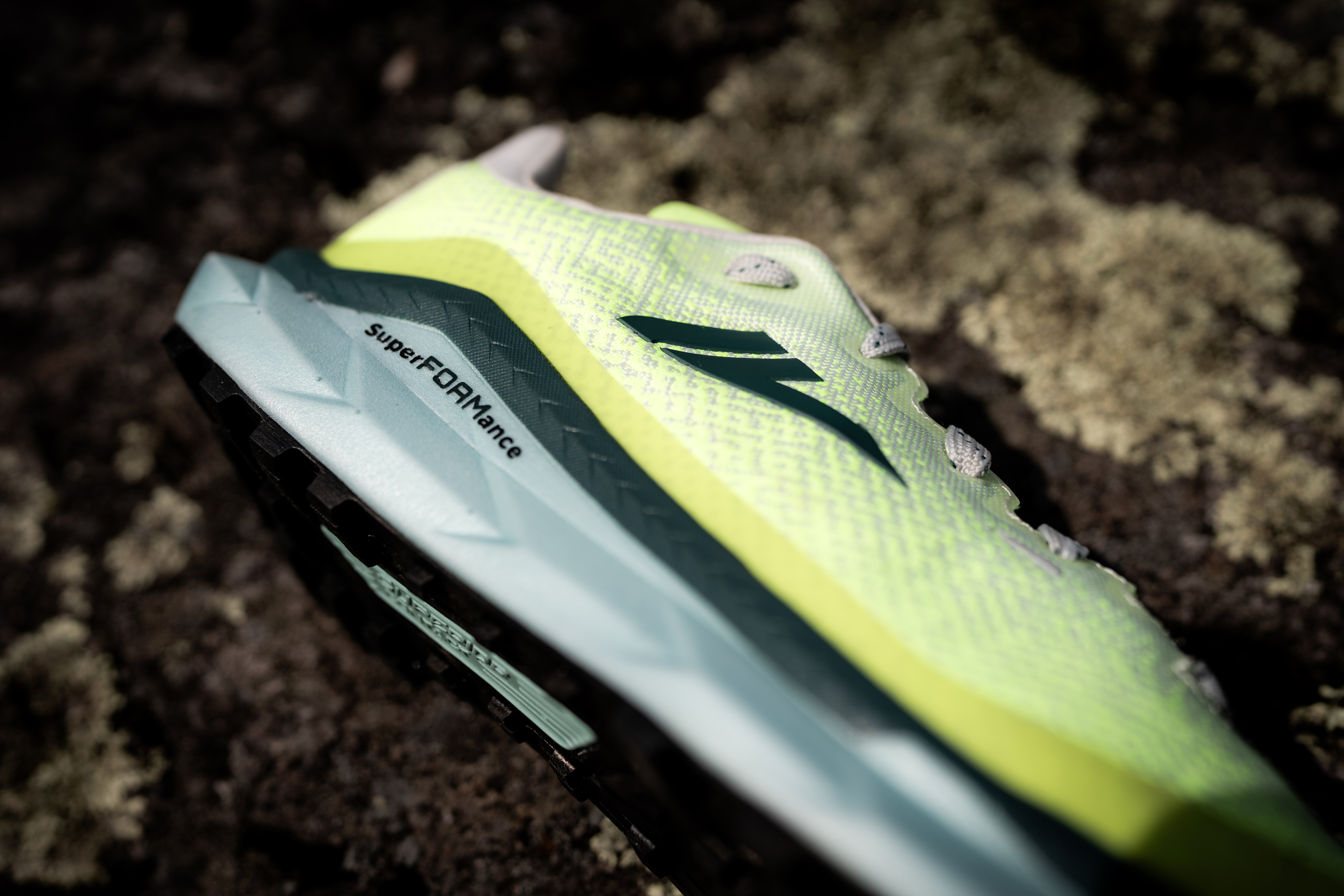
SuperFOAMance midsole
Rock plate
These new features elevate this shoe to a new beast and it has now become my favourite trail shoe. They are quite simply, superb!
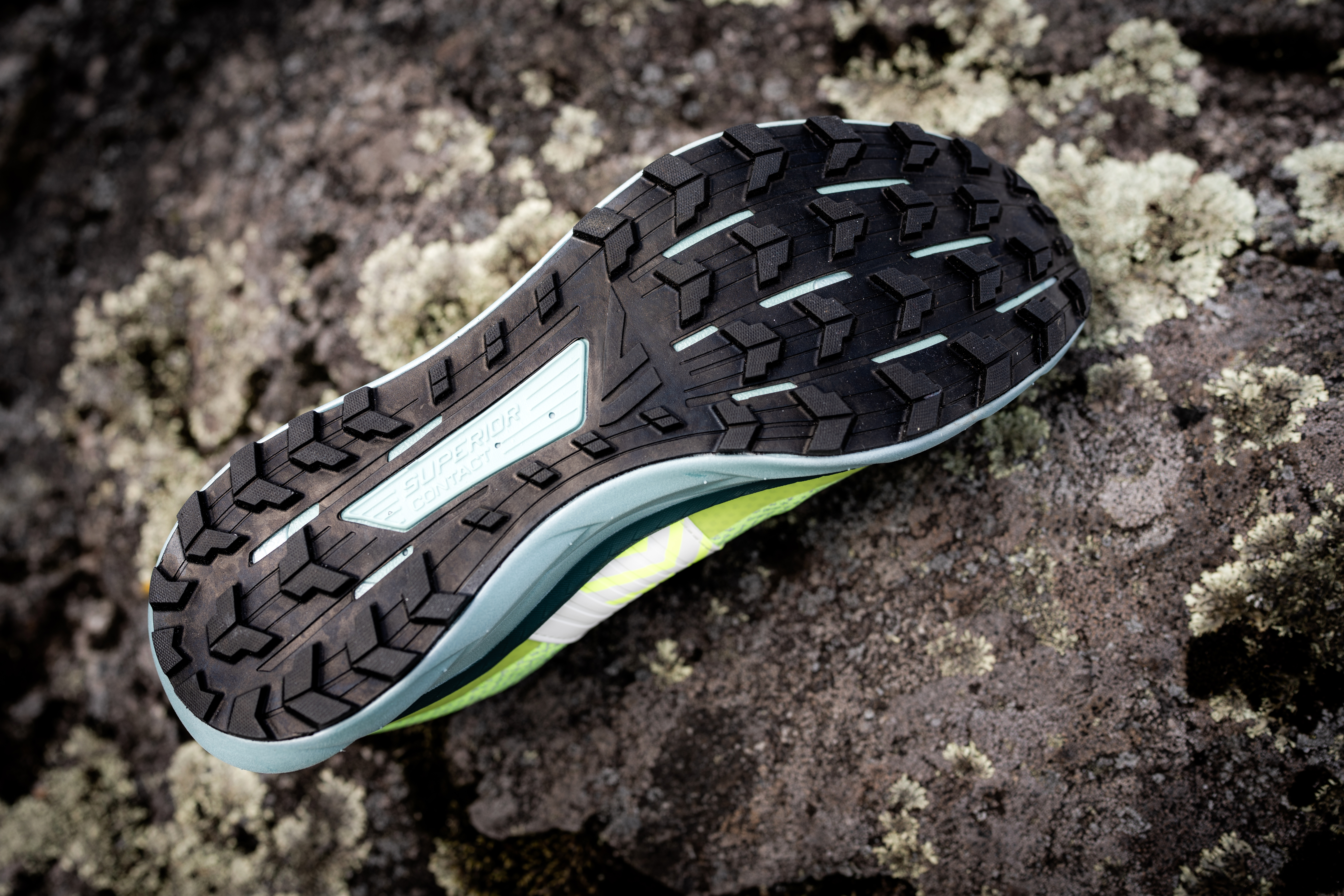
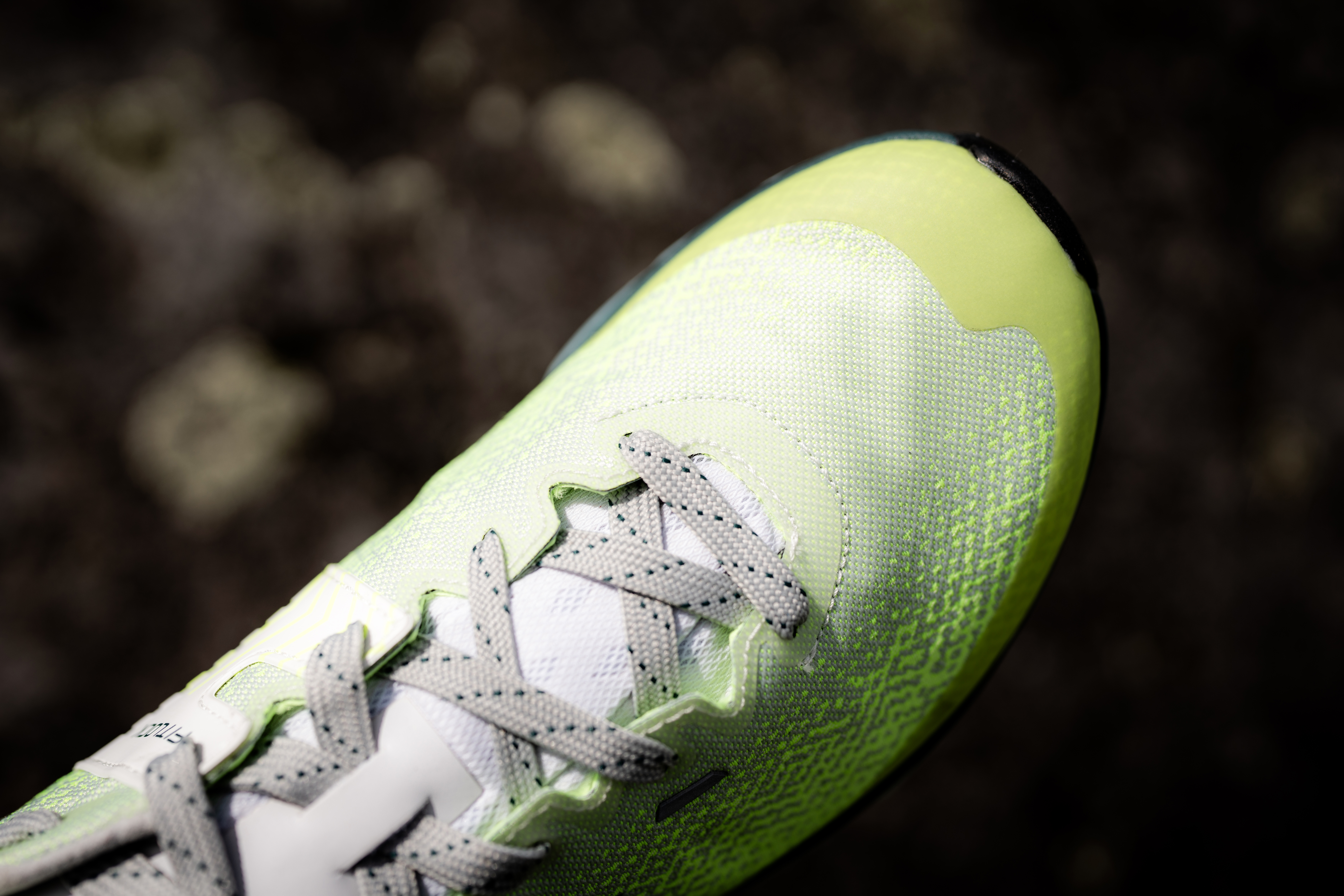
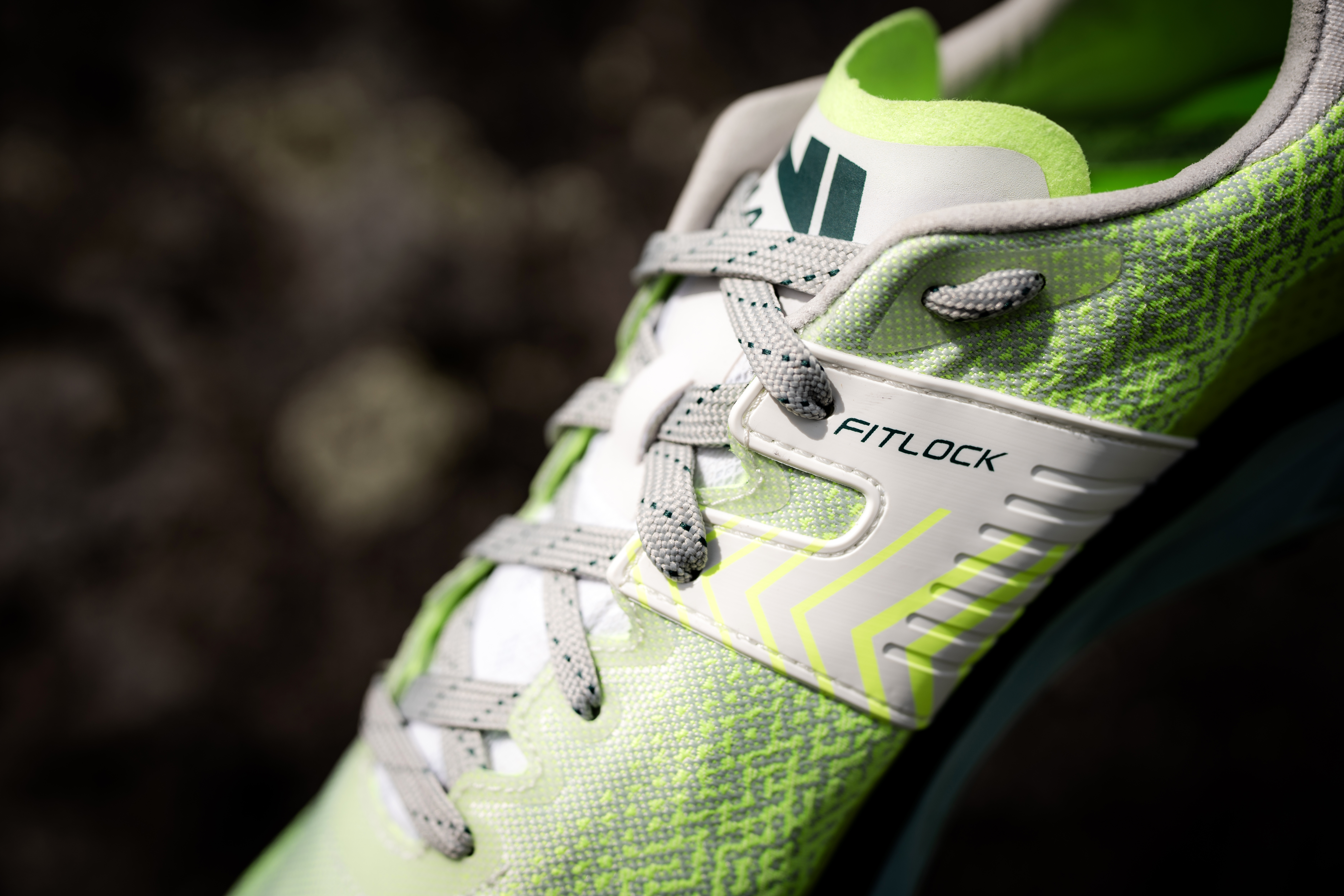
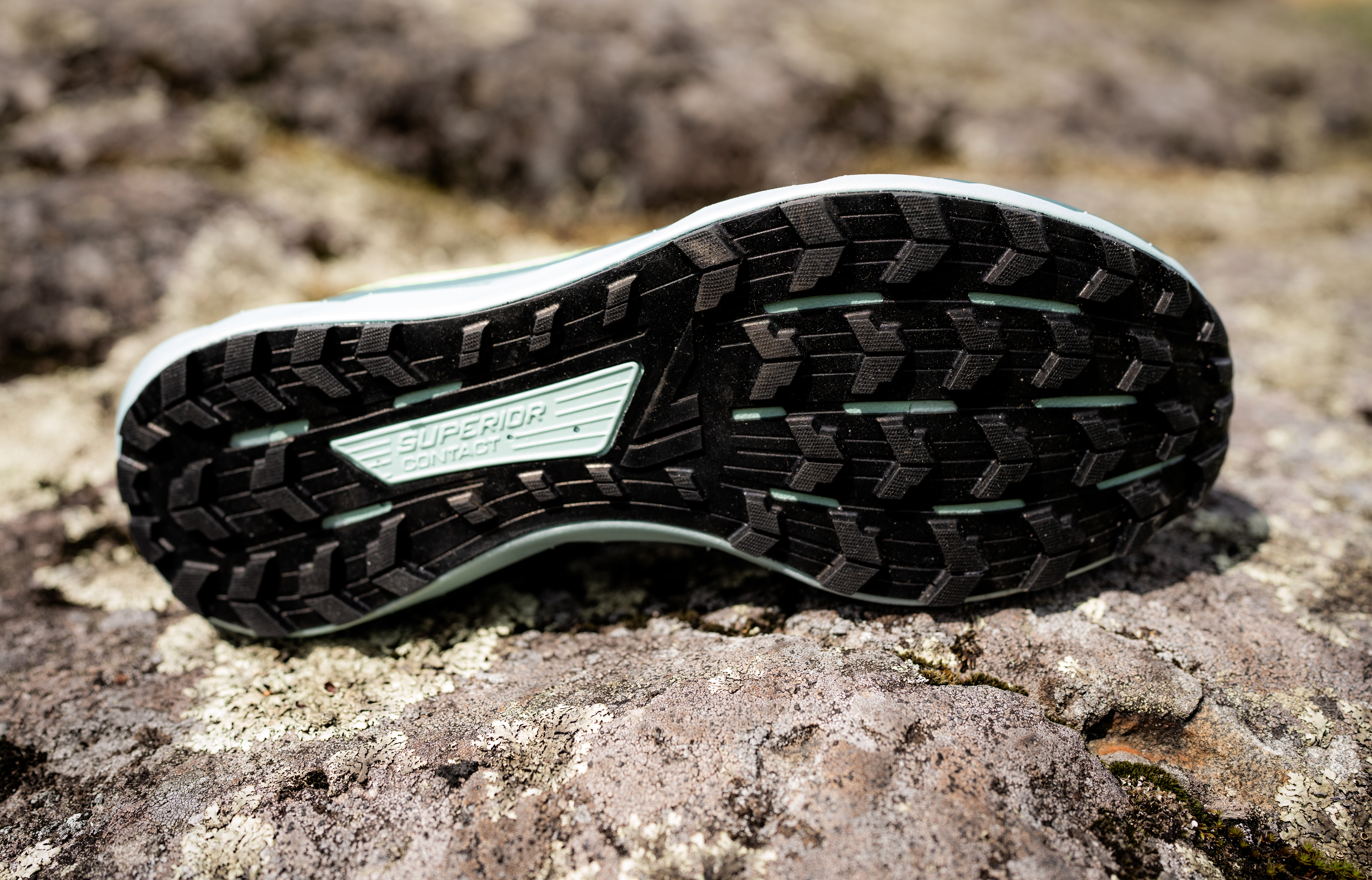
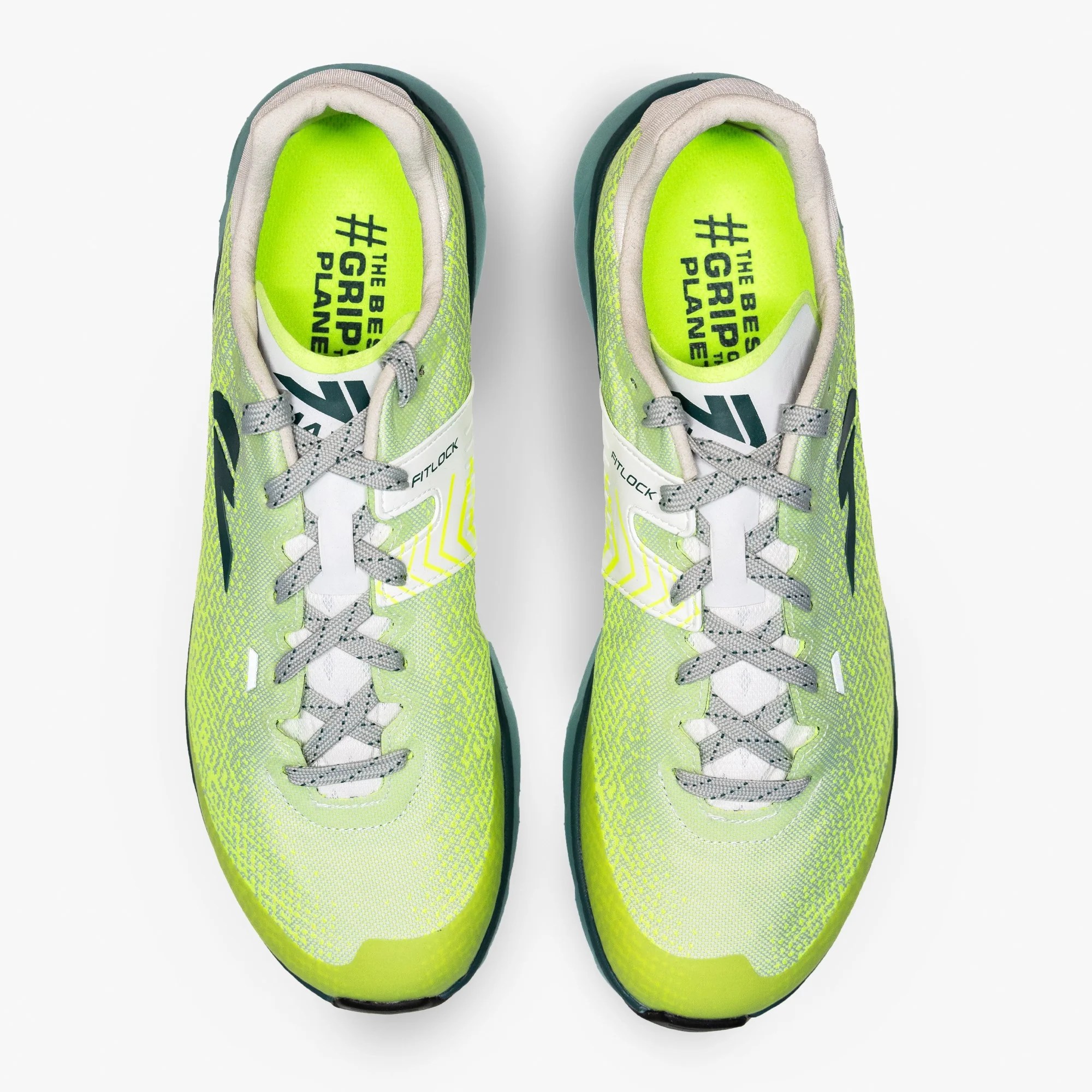
The upper is seamless, breathable and durable. The outsole, for those that know VJ still offers the best grip on the planet with 4mm Butyl rubber studs – no other shoe brand has an outsole that can compete with VJ. The unique FITLOCK gives superb foot hold which guarantees security and precision on technical and demanding terrain.
I could conclude here and say this is is the best mountain/ off-road shoe available on the market.
IN USE
This is a versatile shoe and where the previous MAXx had some limitations in regard to distance and time on feet, the MAXx2 dispels that and for me, this is now an all day mountain/ off-road shoe with supreme comfort.
The revelation is the new SuperFOAMance midsole (25/31mm) which I knew was superb the moment I tried the winter Ace shoe. The original MAXx had Poron cushion integrated into the heel and forefoot midsole, the new SuperFOAMance is a huge improvement. It manages to give everything that I need and want in a shoe, especially when running on more technical trails. I have great ground feel, great flexibility, precision and there is a delicate balance with torsional rigidity and comfort. The rock-late balances enough protection without adding weight or restricting flexibility. The propulsive phase is superb. And a drop of 6mm is a perfect sweet spot between 4mm and 8mm.
The toe box has been given more space, a ‘4’ on the VJ scale. The balance of a wider toe box and still a precious feel is a delicate balance, but VJ have done it. There is extra room and more toe splay without a sloppy feel.
The upper is not as breathable as other brands and there is a simple reason for this. This shoe is designed for use in harsh environments and VJ know only too well, if you make an upper too minimal it just won’t last. This upper is one piece, so, there is no stitching to cause abrasion – a winner. There is a TPU bumper that goes around the bottom of the upper providing extra protection and durability. FITLOCK has always been a winner and here, once again, this is a key feature of the shoe providing the ultimate foot hold. There is also extra eyelets so you can lock-lace if required.
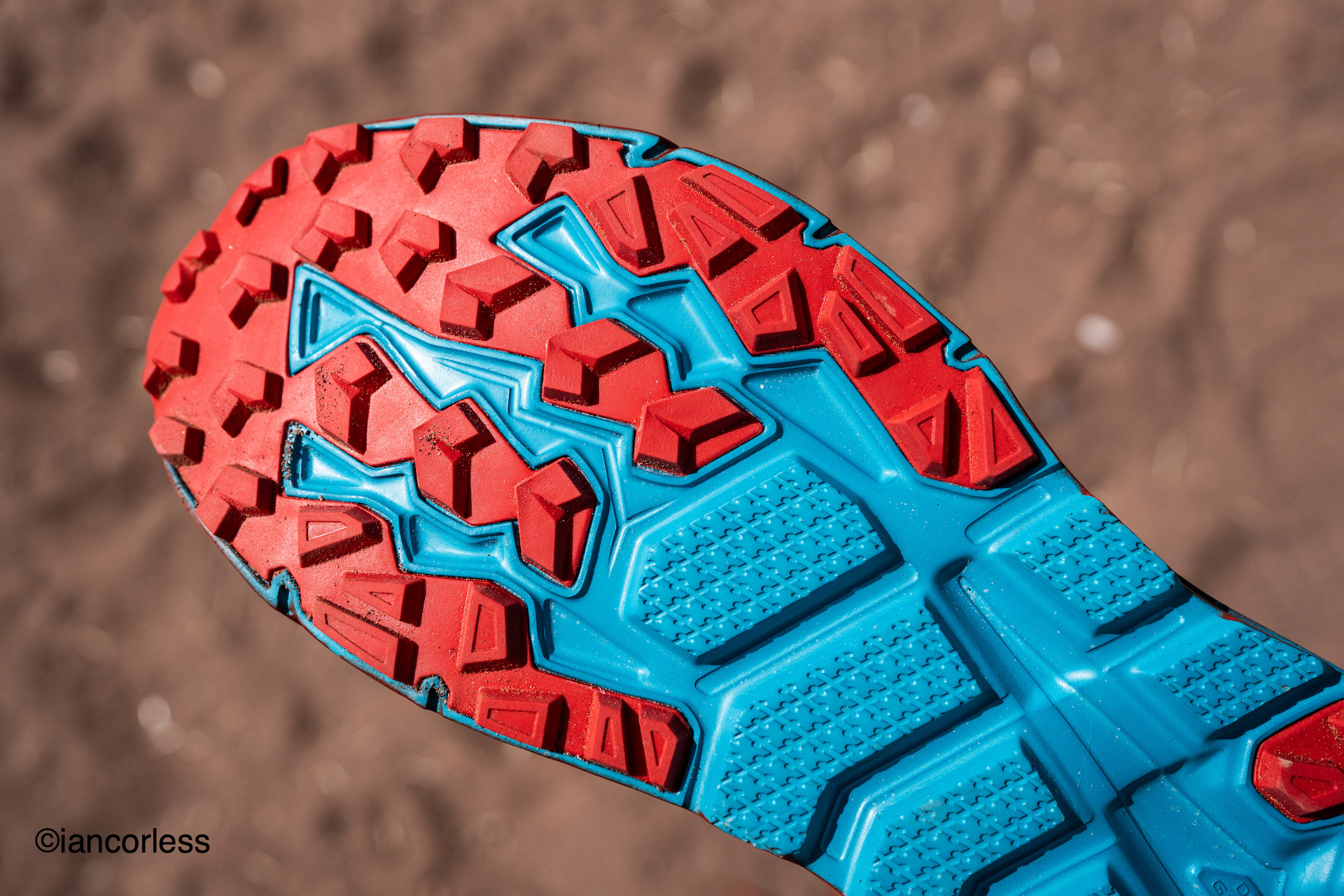
The outsole is superb, as with all VJ shoes. Here 4mm lugs make this shoe a perfect all-rounder for drier/ non-technical trails and more demanding mountain trails that will have mud, rock and more importantly, wet rocks. No other shoe grips like VJ. The outsole is classic chevron in design with grip the full-length of the shoe. There is nothing more to say, best outsole there is!
The shoe sizes a little large, so, be careful when purchasing. With a wider fit at the front, you may wish to size down. I am typically a UK10 and I have a UK9.5 which weighs 263g.
CONCLUSION
This is VJ’s best shoe and one that is a perfect one-stop solution. The MAXx2 is an all-rounder and typically that would mean that it does all things ok, but no one thing well. Not so here, the combination of elements – cushioning, rock-plate, outsole, Fitlock, fit and comfort make this a superb one-stop trail shoe that excels for all day comfort.
VJ have always had a reputation for making shoes that are very specific, think of the iRock with 6mm lugs and less cushioning designed for grip in soft-ground, or the XTRM2 which has 6mm lugs and more cushioning. Here in the MAXx2 we have a middle ground that should you only ever own one pair of VJ’s, the MAXx2 should be the one to buy.
Countdown begins to the first edition of MDS Cappadocia, June 22nd to June 28th. A week long adventure in one of the most iconic locations in Turkey. A moonscape region carved by the variables of time and nature, famous for its layered history and unique geological features.
Day 1 Arrival in Turkey, technical and medical checks.
Stage 1 (day 2) will begin in Sunday June 23rd with two distances, 25km or 30km and a night in bivouac.
Stage 2 (day 3) Considered ‘the long day’ will have three distance option, 20, 40 or 60km with a night in bivouac.
Day 4 a rest day.
Stage 3 (day 5) like stage 1, will offer two distance, 25 or 30km followed by a night in a hotel.
Day 6 a day of leisure and in the evening, gala dinner and awards and a night in the hotel.
Day 7 travel home.
MDS Cappadocia, like the other MDS locations (excluding MDSThe Legendary) allows participants the option to choose between 3 distance formats: 70, 100 or 120 km, spread over 4-days/ 3 stages. These distances are given as an indication and are likely to be revised downwards according to the type of terrain and the difference in altitude of the routes. The event is accessible to everyone, runner or walker, with generous time barriers to enable completion – 98% finish.
However, just like The Legendary, self-sufficiency is part of the race and therefore participants must carry all they need for the race duration (inc food) the exception, water and a tent.
In principal, the requirement per person is as follows:
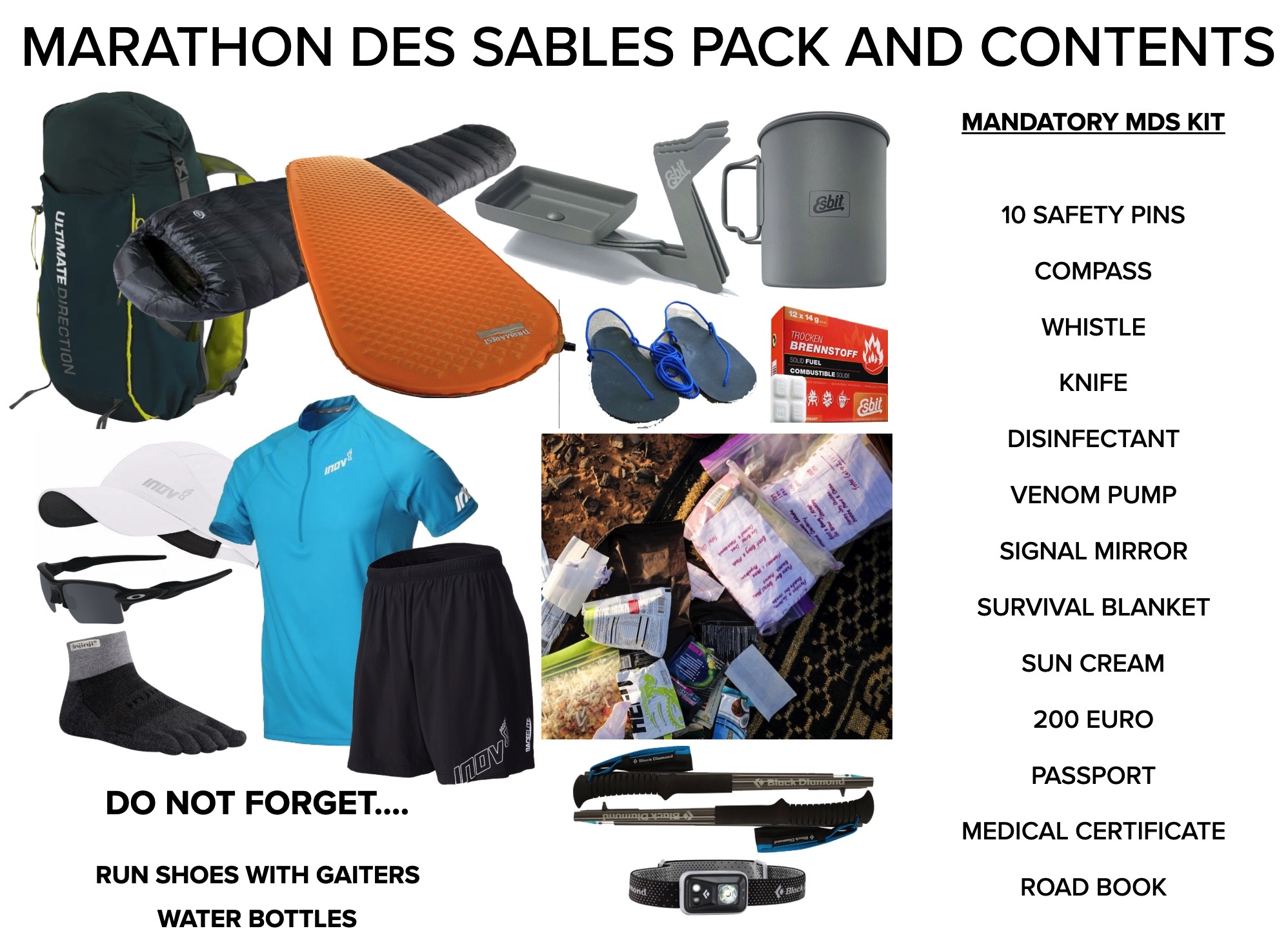
WAA Ultrabag 20l with two water bottles (or similar)
Sleeping bag and mat (mat is optional but recommended)
Clothing for running – Hat, shirt, shorts, socks and appropriate run shoes with gaiters (when applicable) for desert running.
Sunglasses
Warm layer – (down jacket, windbreaker, merino top etc)
Personal hygiene products inc sun cream and toilet paper.
Items for food preparation (stove (no gas) if you require hot water, bowl, spork etc)
Food – Find the right balance between freeze-dried meals, salty snacks, compotes, soups… Without forgetting the food for the race (especially during the long stage): cereal bars, gels or other energy sources. It is strongly recommended that each runner has a minimum of 2000 k/calories per race day
Any luxuries?
The race has Mandatory Equipment
WAA Ultra Bag 20L backpack or equivalent
Capacity of 1.5 liters of water
A sleeping bag
Headlamp (which must be turned on after dark) + 1 complete set of spare batteries or battery
10 safety pins
Lighter
Whistle
Metal blade knife
Skin antiseptic
Signal mirror
Survival blanket
8 soup cubes (2 per day) to help the rehydration
Tube of sunscreen
100 euros in cash
Passport or identity card (depending of the destination)
Official MDS medical certificate completed by a doctor (form available 3 months before the race).
Weight is key, participants need to aim for the lightest weight possible without compromising what they need for an efficient and comfortable race. Remember, runner’s need to carry everything for their chosen race distance.
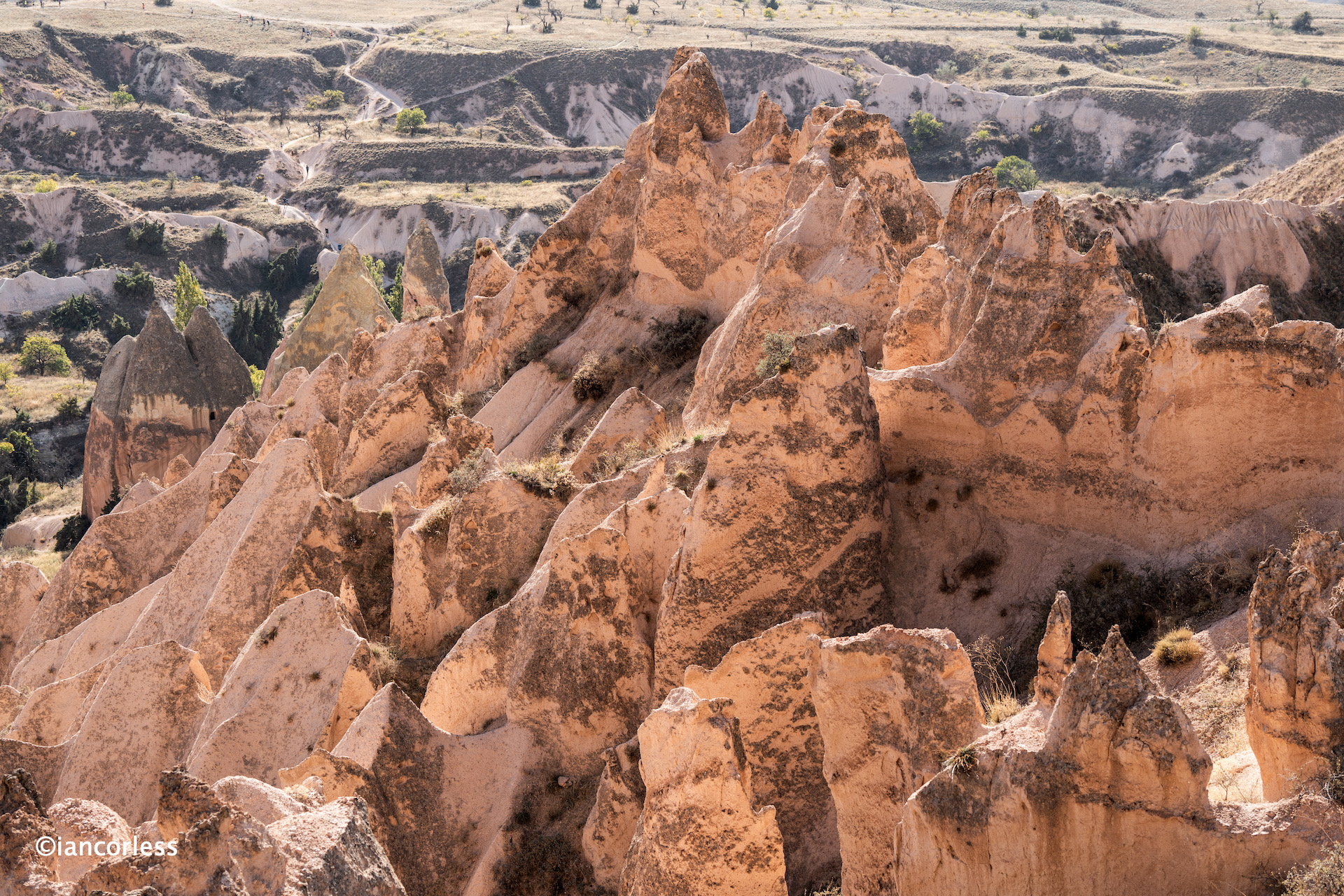
In comparison to other MDS locations (Jordan, Morocco, Fuerteventura etc), Cappadocia will bring a new challenge and environment. Located in the centre of Anatolia, Cappadocia is characterised by its fairy chimneys and Troglodyte dwellings carved in the rock. It is a UNESCO World Heritage Site. This terrain is rolling with considerably less sand and the landscape is filled with fascinating cone-shaped rock formations. On good weather days, the sky is filled with hot air balloons, a key attraction for this area.
If you’d like to follow the first edition of MDS Cappadocia, a daily report and images will be posted on this website.
Interested in another MDS event?
Entries open in June for the 2025 MDS The Legendary HERE and new for 2024, MDS TREK MOROCCO which brings a new concept to the MDS format, read HERE for information and register from June 12th HERE.
Shoes are personal. Run shoes are very personal. Quite simply, we are all unique and our needs when running vary greatly depending on the distance we are running, the terrain we are running on and how long we will be out for. It is why so many shoes exist.
Last year I said my shoe of the year was the Merrell Agility Peak 5. It is a shoe that ticked all the boxes, comfort, great foot hold, excellent grip and a fantastic all rounder for trail and mountain running. If I was only allowed one trail shoe, the Agility Peak 5 would be my choice.
It’s fair to say, that Merrell are still fighting an uphill battle to be taken seriously in the run world, especially when compared to the giants like Hoka, adidas, Brooks, Asics, Salomon and so on… Take note, Merrell should definitely be on your consideration list.
With the announcement of the MTL Long Sky 2 Matryx and my love for the Agility Peak 5, I was very keen to give this new incarnation plenty of testing.
In contrast to the Agility Peak 5, the MTL Long Sky 2 Matryx is a completely different beast. Less cushioning, lower weight, lower profile and lower drop. It’s a very specific shoe.
To draw a comparison, the Agility Peak 5 is like an everyday car for the family, plenty of room, comfort and great for a full day out. The MTL Long Sky 2 is much more a 2-seat sports car that is has a very specific use and some comfort is missing in exchange for speed.
So, although the name has ‘Long’ in the title, don’t be fooled in to thinking this is a long distance shoe. It is not. The most relevant part of the shoes name is ‘Sky’ and the reference to skyrunning which takes place in tough, challenging and technical terrain and mostly over shorter distances between 20 and 50km.
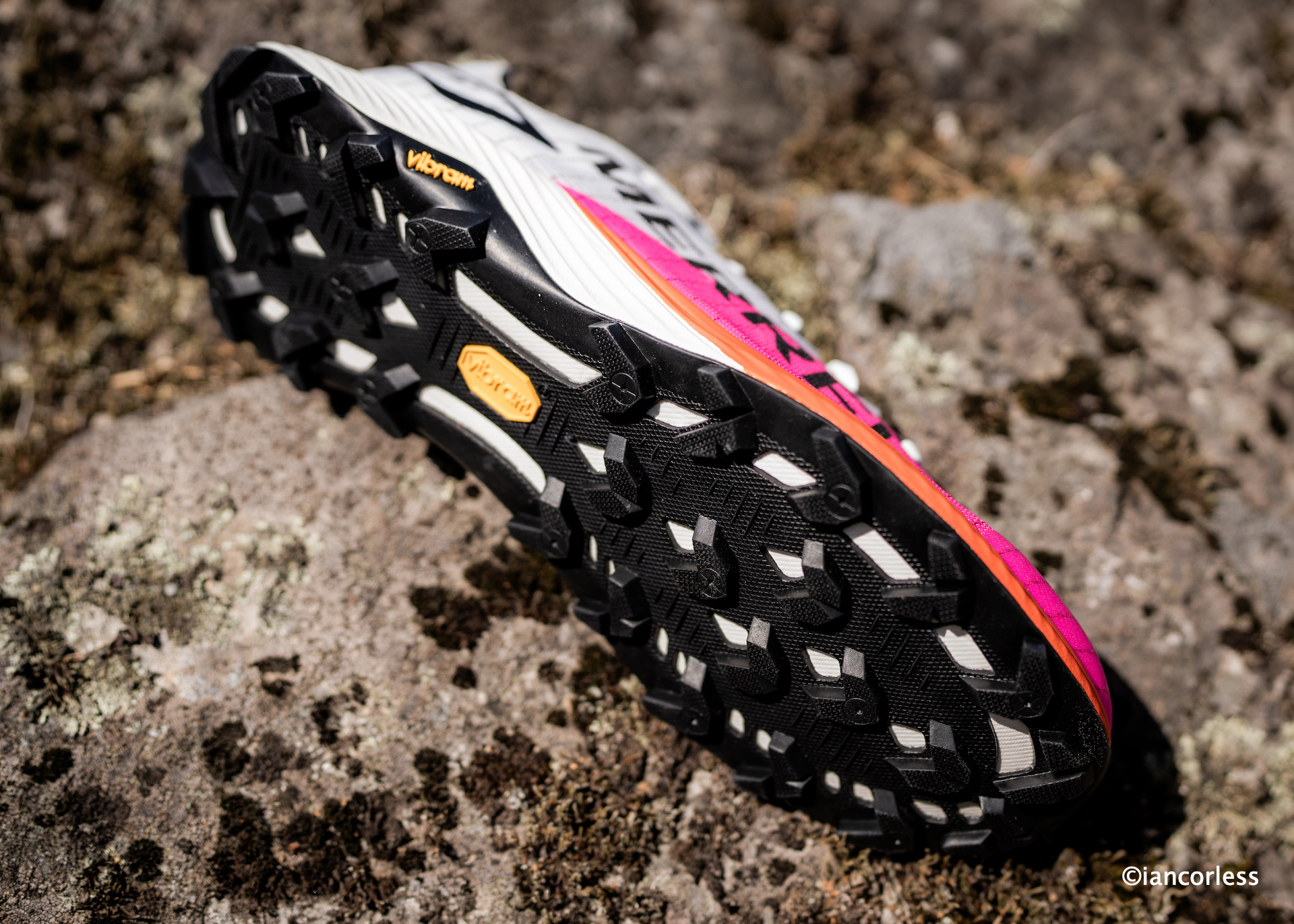
A neutral shoe, in comparison to the previous model (the Long Sky) the drop has been reduced from 8mm to 4mm. This is significant is it gives a much greater contact with the ground and control. Cushioning is 19.5mm at the front and 23.5mm at the rear. The outsole is Vibram MegaGrip with 5mm lugs.
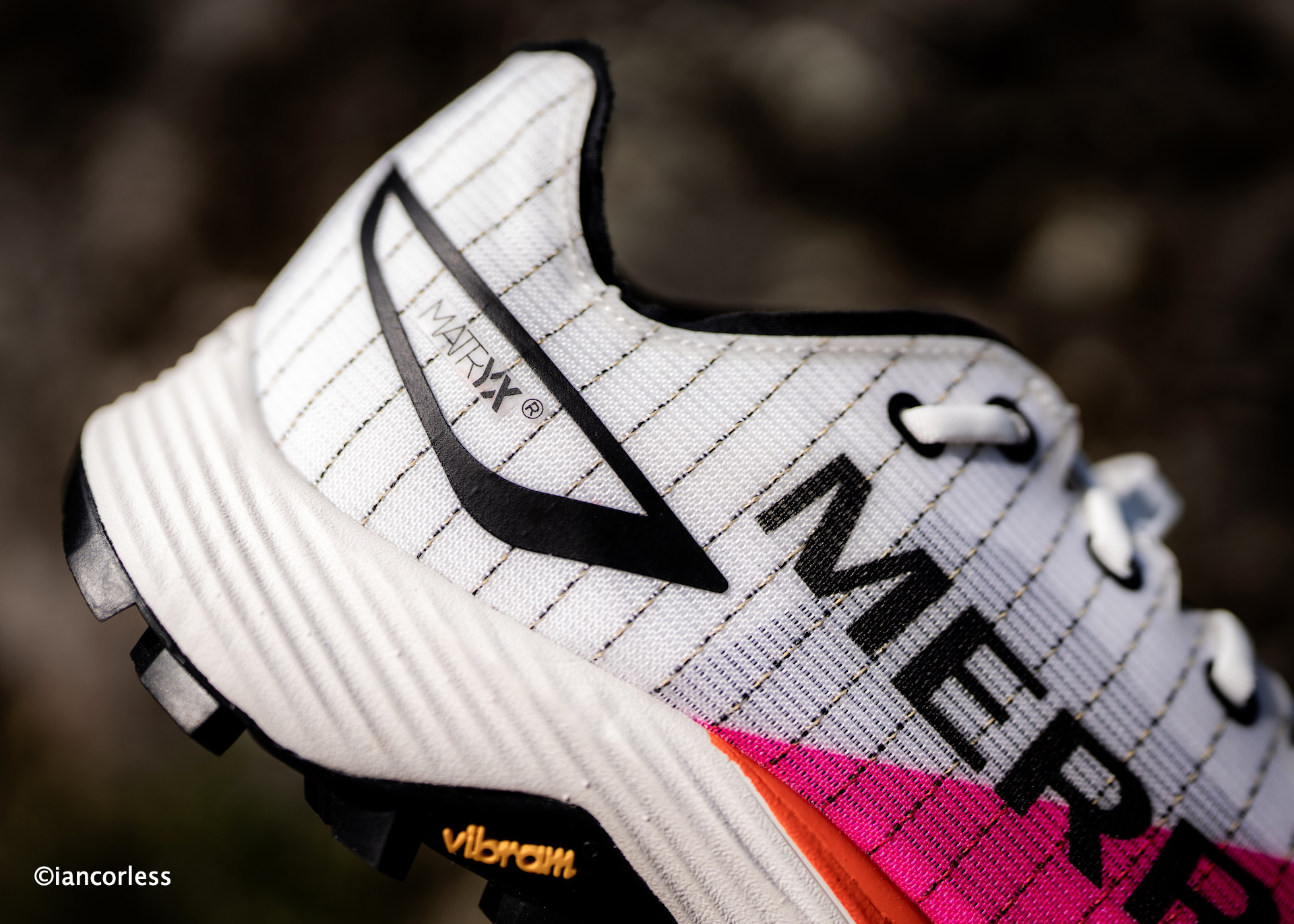
A key feature is the new MATRYX upper which has more durability and is designed to keep the foot cooler with greater wicking.
They have a gusseted tongue for excellent foot hold. Cushioning is via EVA foam insole and dual FloatPro Foam.
There is a temperature regulating footbed. A UK9/ EU44 is 259g and sizing is true to size. The shoe is 15% lighter than the previous model
THE SHOE
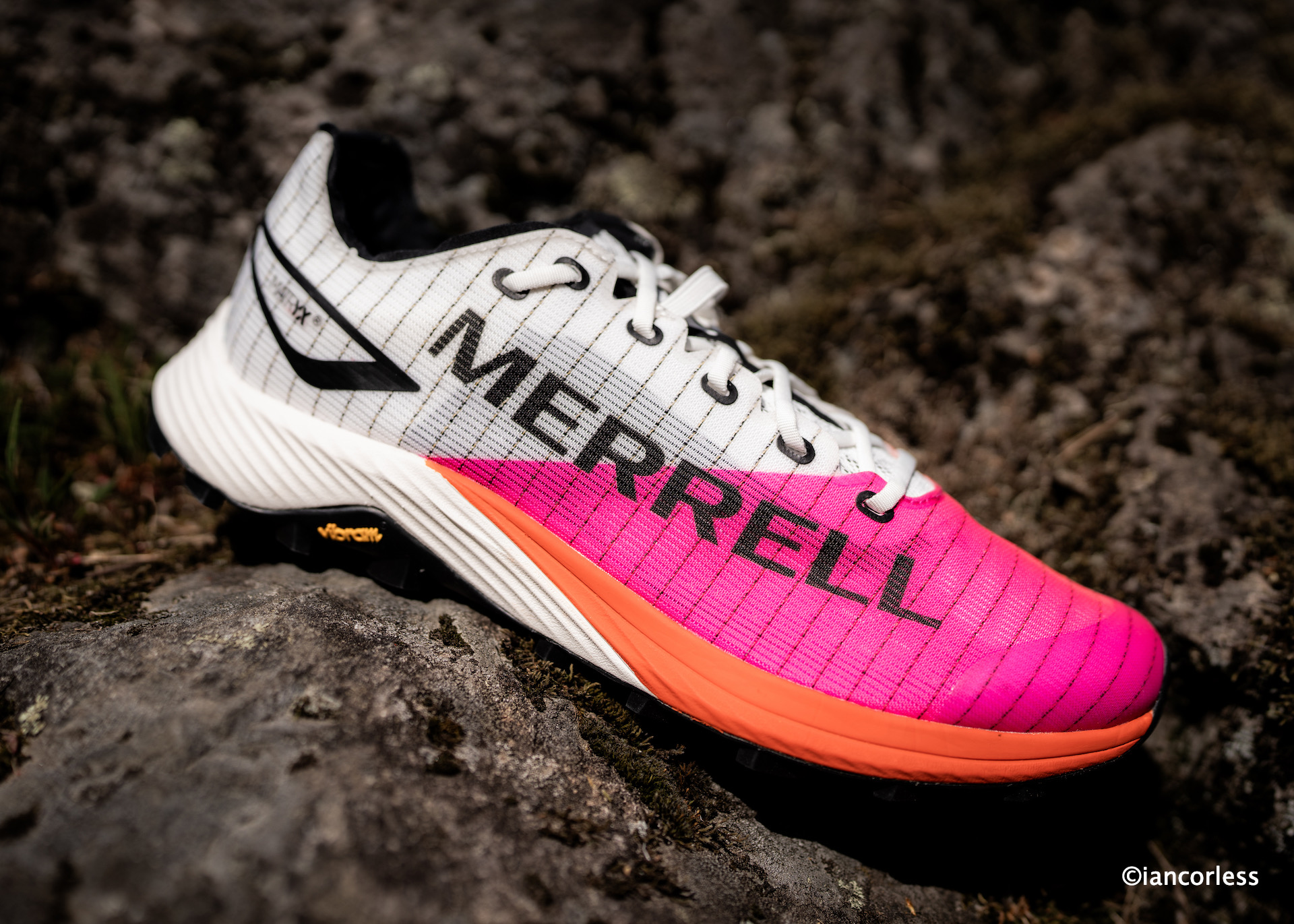
It’s a great looking shoe and one that immediately says speed. The white to multi fade orange and pink is striking.
Slipping the shoe on, the foot hold is immediately noticeable and with the laces adjusted and the sock-like fit, there is no movement at all. Exactly what you want from a shoe that will handle mountainous and technical terrain. The heel area is very minimal and there is a raised padded area inside that is designed to grip and hold – it certainly does, arguably they are the most secure shoe I have experienced in this area. The front of the shoe opens up to provide enough width for toe splay, but not too much room so that you would lose control when precision is required.
With a 19.5/23.5mm cushioning, this shoe is designed to provide a compromise offering cushioning but not losing ground feel and control. As mentioned before, the ‘Long’ in the name is relative and for most people, this is not a long distance shoe.
The upper construction is minimal and notably so at the front, there is token toe protection. Don’t be fooled though, this MATRYX upper is tough and durable.
The shoe immediately feels comfortable when you put them on. I strongly suggest you play around with socks to find out what works best for you, I noticed a huge difference in feel between a lightweight sock and a slightly thicker merino sock.
Merrell say the shoe is good for up to 50km. For sure, yes, 50km is possible, but this depends on the runner and the speed they are going. A top elite mountain runner may tick off 50km in 4 to 5 hours, whereas, someone else may take 10-hours, so, use caution.
The MTL Long Sky 2 Matryx is designed to be agile and nimble, they are! But this comes at a price on comfort and protection. I had expected more protection and ultimately, for me, that just wasn’t there. I could feel stones, rocks and tree roots through the shoe which did surprise me. They feel thin!
They are very flexible and the propulsive phase is very good. On the correct feet, this is a fast shoe.
The biggest problem for me was the heel area. In one area they are brilliant, the hold is fantastic, they are secure and there is no slipping. However, this hold comes from the raised cushioned area with the heel, no matter what I did or tried, this just rubbed and caused blisters on both feet. I must caveat here, I never get blisters. So, this just made the MTL Long Sky 2 Matryx unwearable for me.
The outsole is Vibram MegaGrip with 5mm lugs. Ideal for technical terrain providing grip when required on rock, gravel, light mud and varying terrain. I am still not 100% convinced or confident of Vibram on wet rock, especially when compared to VJ Sport or the Continental grip on adidas shoes.
Conclusion
There is a great deal to like in the Merrell MTL Long Sky 2 Matryx and if you are looking for something light, nimble, fast with ground feel for short mountain days or racing, this is for you. However, this all comes at a price. It’s a specific shoe for a specific task, just like a Formula One car. This is not the only shoe to have or use. It’s too specific for everyday runs, so, the MTL Long Sky 2 Matryx should be added to an already existing shoe collection and they should be reached for and used on special days. Given that Merrell sponsor the Skyrunner World Series, it’s unsurprising that this shoe is designed to specifically perform on this terrain.
Raidlight as a brand have been synonymous with desert racing for over 20-years, it was the brands USP and even today, it is a the core of the business founded by Benoit Laval in 1999.
It was around 2006/ 2007 when the ‘Olmo’ pack was created for Italian legend, Marco Olmo. A ground-breaking ultralight pack designed to carry many items with bottle holders on the front. From here, the rest is history with a range of packs and apparel that are specifically designed for stage and multi-day racing in hot environments such as the Sahara. A range of specific products can be seen HERE.
Ultralight packs, front packs, desert hats, gaiters, sun protect long-sleeve tops, tyvek top and pants and now a DESERT SPECIFIC SHOE.
In 2019, Raidlight created their first shoes. A bold move in a market that is saturated with choice, especially when one considers the R&D and manufacturing costs.
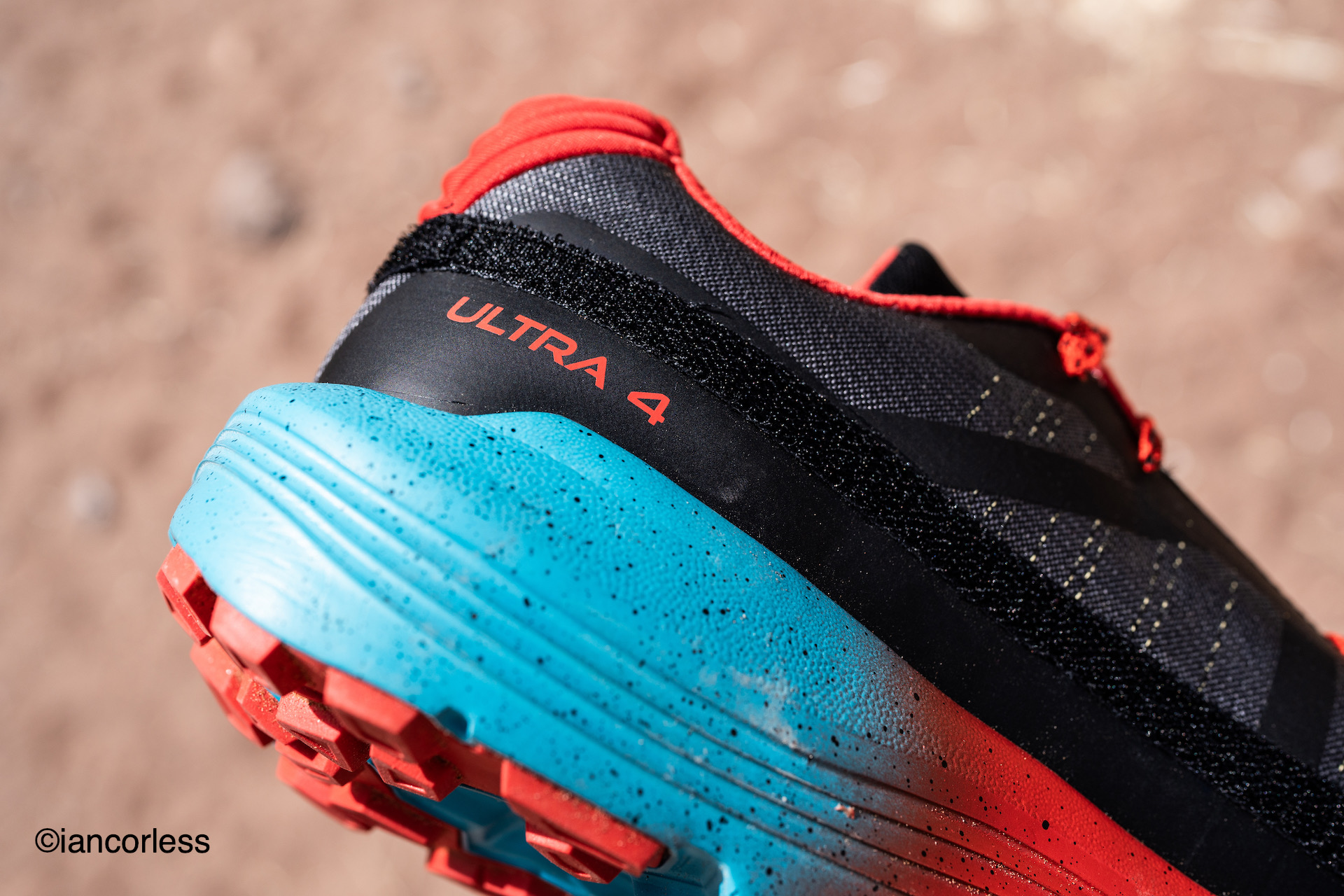
The recent Ultra 4 shoe with 6mm drop, 4mm outsole and increased cushioning has now been developed to provide the ultimate, one-stop shoe for desert terrain. The ULTRA 4 DESERT PROTECT.
What is a specific desert shoe?
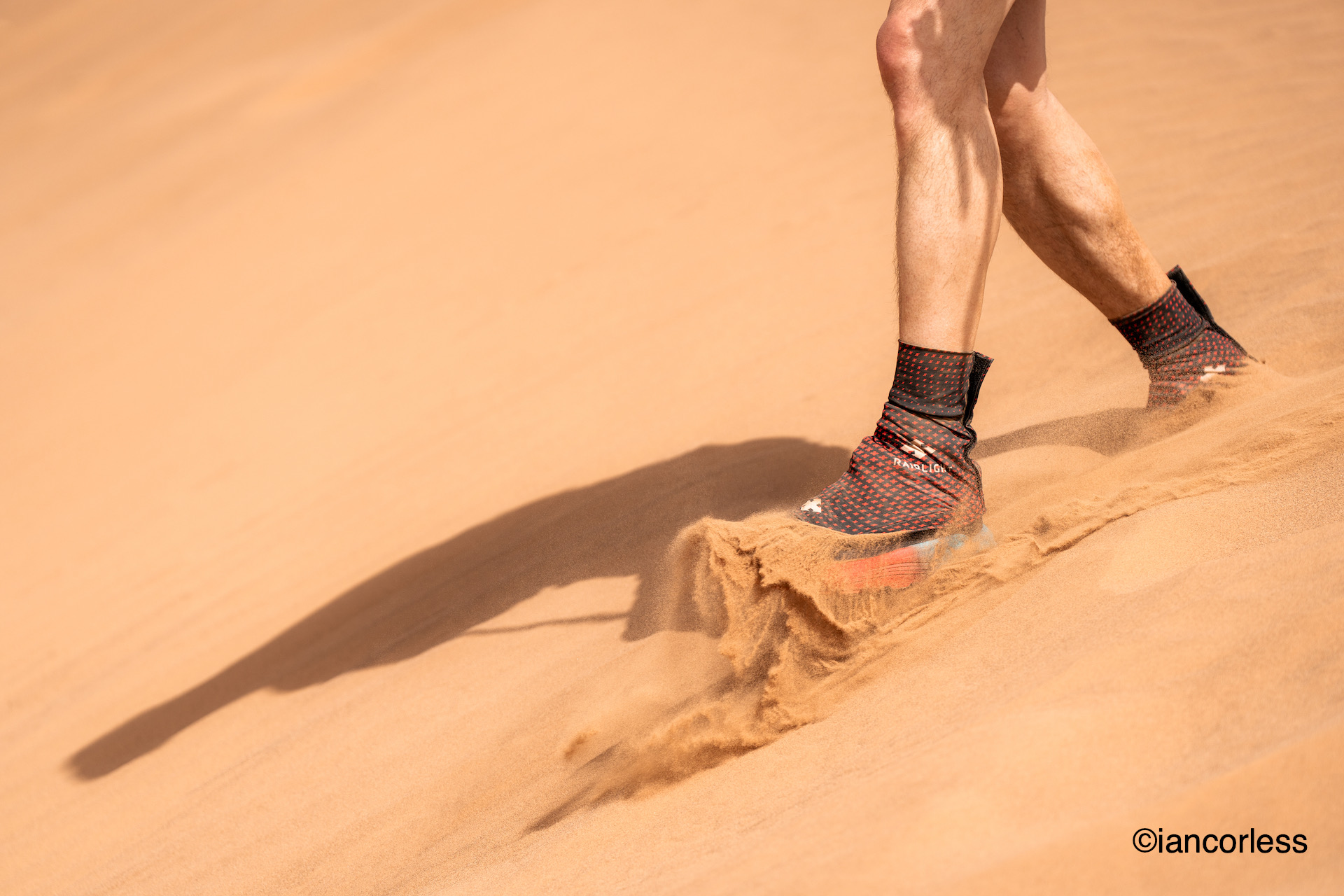
Running in a desert, sandy or harsh environment, even snow, brings a challenge for a shoe. Shoes are designed to be comfortable but also breathable. The downside of breathable is that while it allows hot air to escape the shoe, this also allows sand and debris to enter the shoe. This is not a good idea in a desert environment. For many years, the best option has been to have velcro sewn and glued to your preferred shoe and then add a gaiter /such as THIS) to not allow sand to enter the shoe – it works.
There is a cost involved to this:
Shoe 150.00
Gaiter 25.00
Sewing/ glueing velcro: 60.00
Total cost 235.00+/-
For countless editions of desert races all over the world, this system is tried and tested. It really does work. The only downside, one needs to be careful that the addition of velcro to a shoe does not alter alter its shape and feel, so, once you have velcro added ALWAYS test and make sure the fit is the same.
ULTRA 4 DESERT PROTECT
Many brands have played with the idea of producing a specific desert shoe and notably in the last 5-years I have seen brands such as Salomon, Hoka, Merrell and La Sportiva specifically adapt existing shoes to make prototypes for elite athletes. We have seen this work specifically for Julien Chorier (Hoka), Mathieu Blanchard (Salomon) and Ragna Debats (Merrell).
Why have the brands above not released a shoe to market?
I guess the simple answer is, a desert running shoe is a very specific market and in real terms, it’s a small market. So, financially (maybe) the figures just don’t add up?
Raidlight on the other hand already produce gaiters, they also already offer a velcro stitching service (here), so, by adapting an already existing shoe with the addition of velcro and a specific gaiter makes sense.
Especially when this is all offered for 150.00 euro in the ULTRA 4 DESERT PROTECT.
I received my shoes in advance of Marathon des Sables, perfect timing. I wasn’t running the race but I was in Morocco before the race running everyday and in addition, I was working everyday during MDS in the same environment as the runners. Ideal.
THE SHOE
My first surprise was the weight of the shoe, they look heavy but they are not! For a standard UK8/EU42 they were 280g, for my UK9.5/ EU44 they were 295g with the velcro and 325g with the gaiter.
Not knowing how the shoe fit was my biggest concern, especially for a desert/ sand shoe. There is no need for ‘bigger’ shoes just because you are going to a desert (read a article HERE). Quite simply, if a shoe is too big your foot moves inside the shoe, a moving foot creates friction, friction equals blisters. A thumb nail of space above your longest toe is ideal, and when I say longest, this may not be the big toe! One consideration is width, make sure you have enough room for toe splay. Feet may go wider in the desert, so, be considerate of this.
The ULTRA 4 DESERT PROTECT were true to size and I therefore went with my standard UK9.5/ EU44 based on advice from Raidlight and they were perfect.
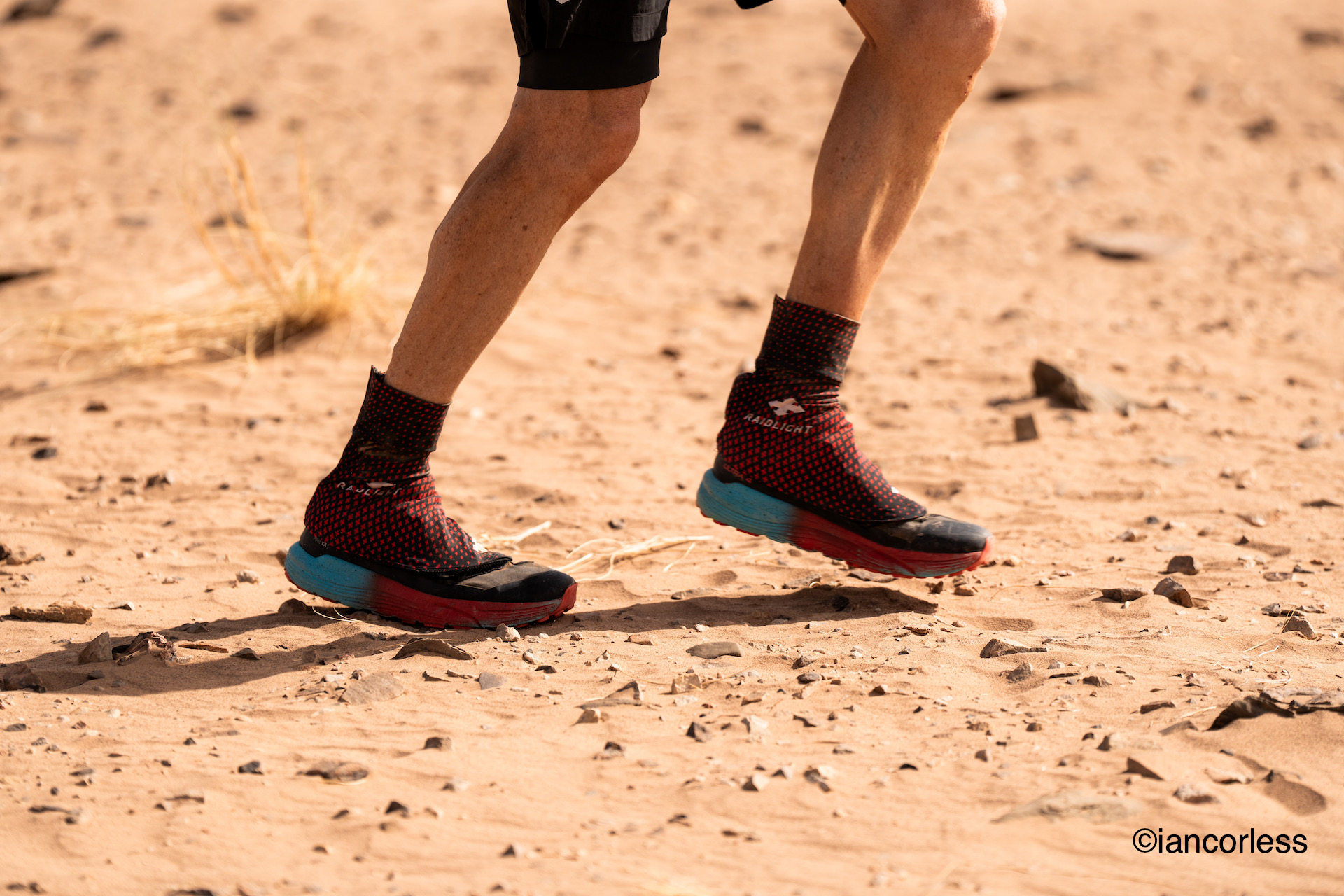
The colour way of red/blue/black really works, I like them. The red/black gaiter is also a nice touch.
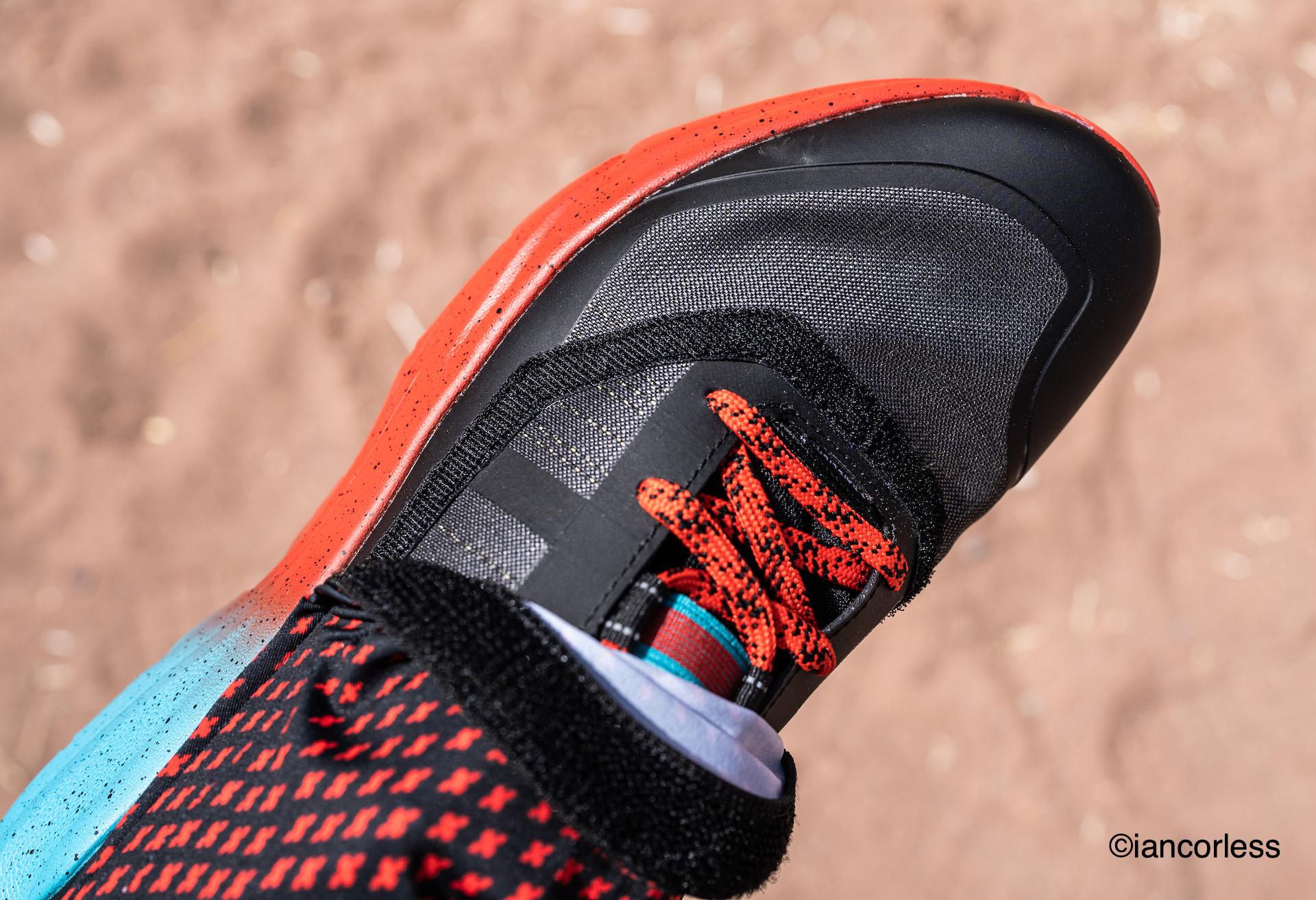
If you have velcro sewn/glued on a normal shoe, the velcro will go completely around the perimeter of the shoe, this ensures sand/ debris can enter at no point. The downside of this is that the velcro can get damaged at the front when hitting rocks or on challenging terrain.
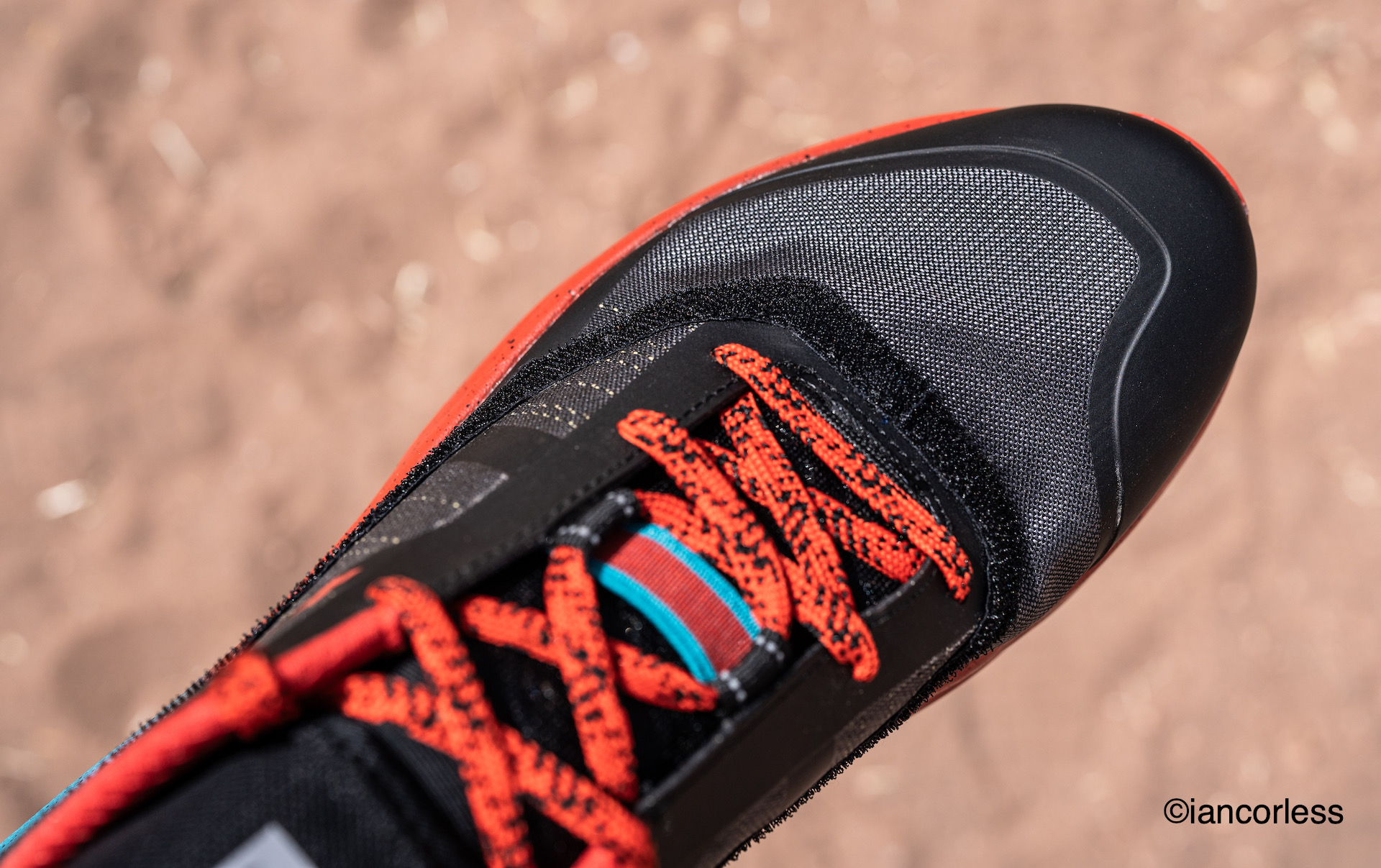
Raidlight have got around this by bringing the velcro up the shoe to just below the laces. This I love.
To combat sand entering the shoe where there is no gaiter, Raidlight use MATRYX material. In a way, this is similar to Gore-Tex, keeping debris out while allowing the foot to breathe. It works, I had no sand enter my shoe on any occasion.
The gaiter attaches as standard and comes higher up the leg with velcro fastening and the option to adjust how tight at the top of the leg. I actually never opened mine. I fastened them together the first time and then removed and added them like socks when in use. This worked for me and ensures the velcro has a longer life. You just simply need to remember to put the gaiter on first, then socks, then shoes and then fit the gaiter.
The lacing works really well providing plenty options for great foot hold and the storage pocket at the top of the tongue is great for keeping laces out of the way. Once tied I had no reason to adjust them when in use and they never came undone, partly due the laces being flat and not round.
A neutral shoe, sliding them on, there was an instant comfort feel. These are not bouncy shoes but they are cushioned and comfortable with notable excellent grip at the heel. When running, there is good propulsion from behind the metatarsals and notably there is excellent protection from rocks and debris. The addition of elastic (M-lock band) on the tongue allows for flexibility and support.
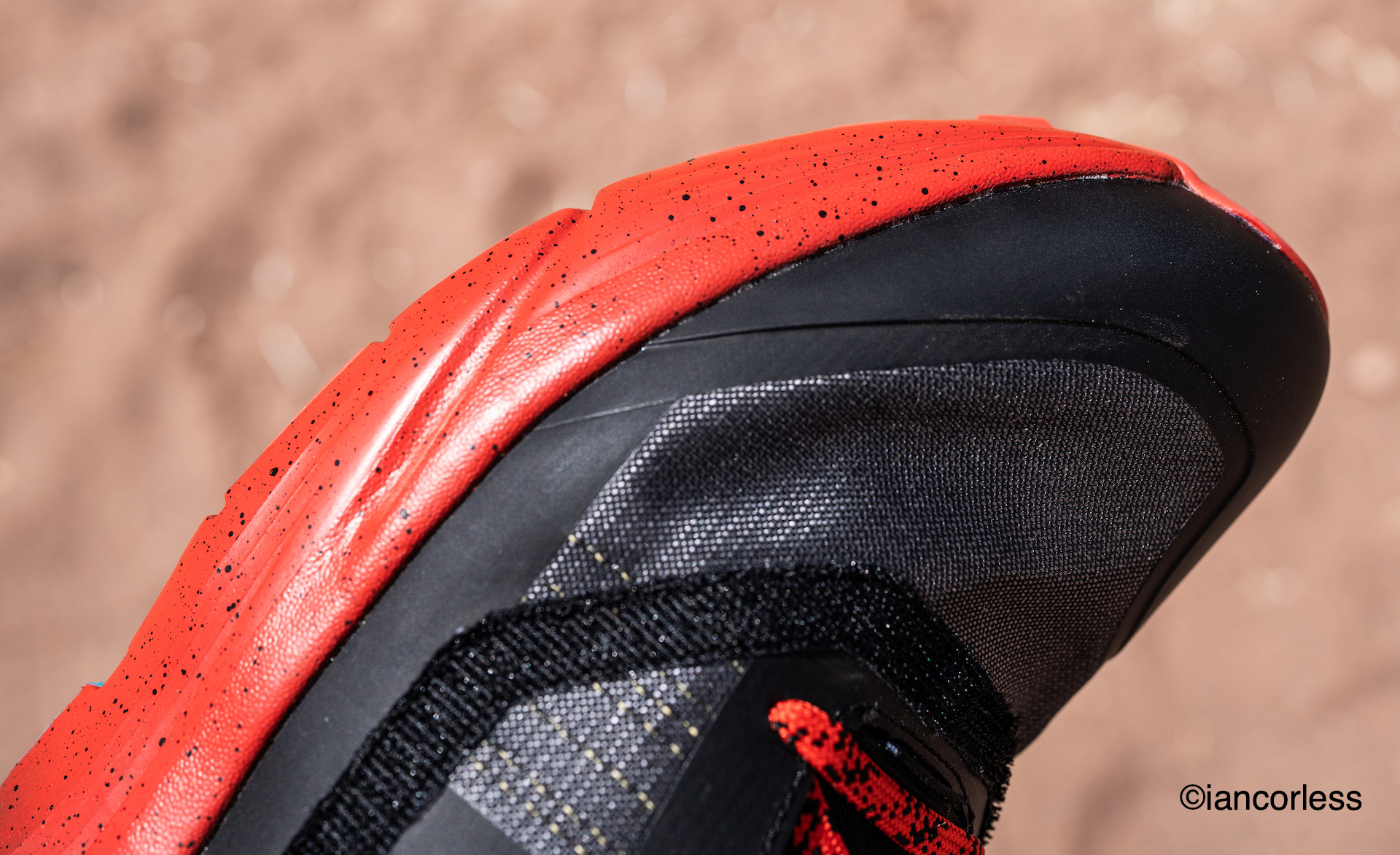
The toe bumper is solid and offers great protection from rocks and debris.
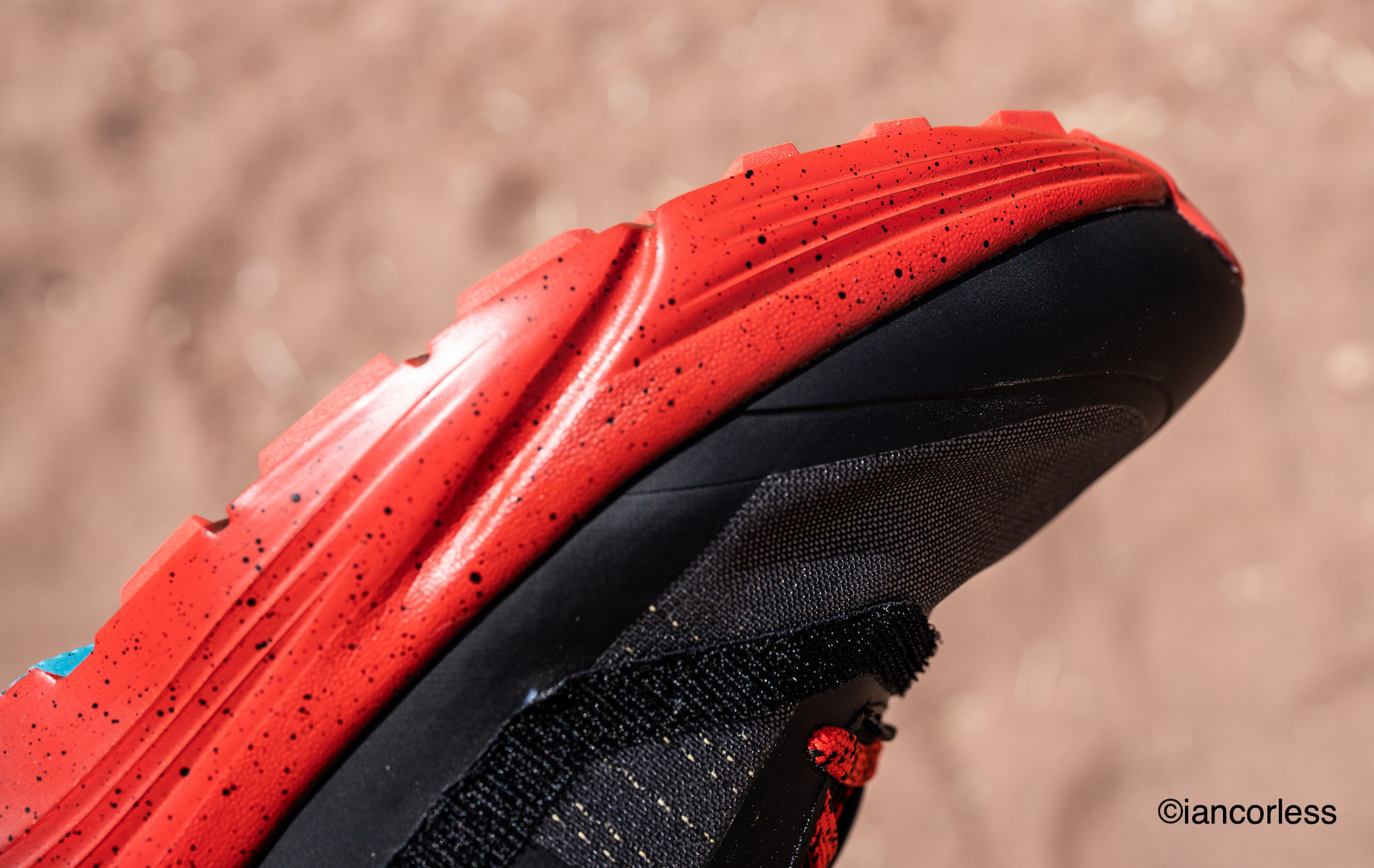
The outsole with 4mm lugs offers a great middle ground and works exceptionally well. I have not tried them on wet ground or rocks.
With 19mm cushioning at the front and 25mm at the rear, the 6mm drop sits, once again in the middle ground and is ideal for long distance running.
IN USE
Have to say, I was surprised. My first sand run felt very comfortable and the shoe performed perfectly. They provided excellent comfort, great protection, plenty of toe splay and the gaiter with the Matryx upper allowed no sand to enter.
The downside? They were warm! To be fair though, comparing to my other shoes (Hoka) with sewn velcro and the addition of a Raidlight gaiter, the differences were comparable.
The more runs I had in them, the better the feel cam and I would recommend looking to put 30-50km’s in them before using them for your chosen race or adventure. I do caveat that by saying they were great out of the box, but certainly several runs did allow them to just fit and conform to my foot.
I have no negative comments. With 150km’s now in the shoe and a complete battering in the Sahara, the shoes offered all day comfort without a trace of sand entering the shoe.
I will also add, this is a new shoe. They only came available just before the 2024 MDS. Despite this, I saw many pairs out ion the Sahara. I spoke to everyone I could and the feedback was the same, perfect shoe, great comfort and no sand inside.
CONCLUSION
Shoes are personal and the most important thing in any adventure or race is a shoe works for you and causes no problems or issues. This is especially important in a race like MDS when so many other factors and variables come in to play. The ULTRA 4 DESERT PROTECT offers a one-stop solution to a problem and if this shoe works for you, it comes highly recommended. It will certainly be a highly recommended shoe of choice for this environment in the future.
“Unrivalled comfort, cushioning and dynamism. Designed and engineered to go the distance, making them the shoe for ultra trail runners. The midsole incorporates dual density technology, offering a perfect balance between cushioning and responsiveness. The lightweight design reduces fatigue while providing protection and support. Comfort over longer distances, while maintaining optimum stability over a wide range of terrain.”
Time allowance 12-hours 45-minutes / 0630am and 0800 start (top 150 ranked)
The fall out from the long day is always hard. Bodies are now tired and normally, many would be saying, ‘just a marathon to go!’ But not for the 2024 edition.
Aziz Yachou
Stage 4 is 43.2km’s and to follow, stage 5 and stage 6 at 31.4km and 21.1km respectively.
Travelling north all the way to B3, this is a tough day and probably will be remembered as the soft-sand day, especially as the most challenging terrain comes at the end.
Sand and heat
With 3 CP’s at 10km, 22.9km and 30.1km, the severity of the stage is reflected with ‘additional’ water stations at 17km 37.7km.
Cooling off at the CP’s
While the early km’s allowed for easier terrain with cooler temperatures, the kick is in the tail with relentless sand and dunes from 22km all the way to the finish with increasing heat, expected at a 35-degree high, but feeling much hotter than 40-degrees for the runner’s. A tough day!
Rachid in the early 10km’s
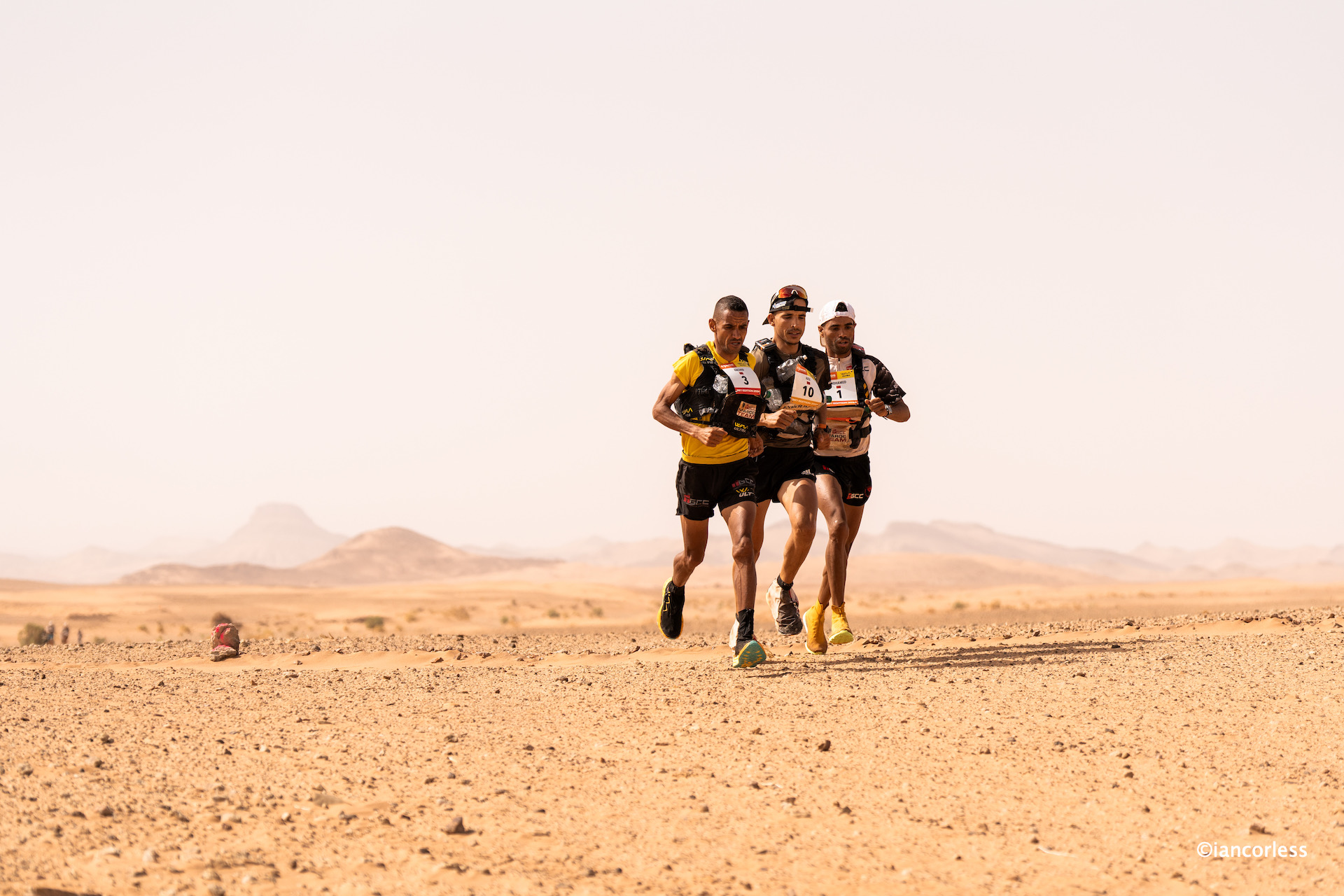
Rachid El Morabity dictated the early pace with Aziz and Mohamed behind.
Mohamed
The trio mixed it up but by the halfway point they were all together.
Two company, three a crowd
In the closing 10km, Rachid made a notable kick and pulled away for the stage win, Aziz and Mohamed behind 3:13:24 for Rachid and 3:14:59 for the duo.
Aziza
Aziz E Amrany has been at another level this year and once again she dominated the stage from the front with another stage win in 4:29:41.
Aziza Raji
Aziza Raji followed looking relaxed and strong with a secure 2nd place in 4:53:08.
Adriana Moser
Sadly, 3rd placed runner Adriana Moser had to withdraw from the race at one of the CP’s opening the door for Gemma Game who has placed 3rd at MDS twice in the past; it maybe three times a charm! However, it was Rajaa Hamdaoua who was 3rd on the stage with 5:09:59.
The spectacle of the Sahara
You can receive daily updates and reports on this website. Follow on IG @iancorlessphotography and @mdslegendary
The 2024 and 38th edition of Marathon des Sables is here! MDS The Legendary, the longest edition in the history of the race, 252km’s over 6 timed stages.
Close to 900 participants will toe the line, exact numbers will be confirmed at bivouac 1. With 60 countries represented, France and the UK lead the with 267 and 178 participants respectively.
From the 900 starters, 27% are women; a record. The youngest participant will be Lionel Schneider (16) and the oldest, Harry Hunter who has just turned 75 on April 15th.
Runner’s will arrive in Morocco on April 12th for a transfer to the desert.
Saturday 13th is admin day and then the race schedule is as follows:
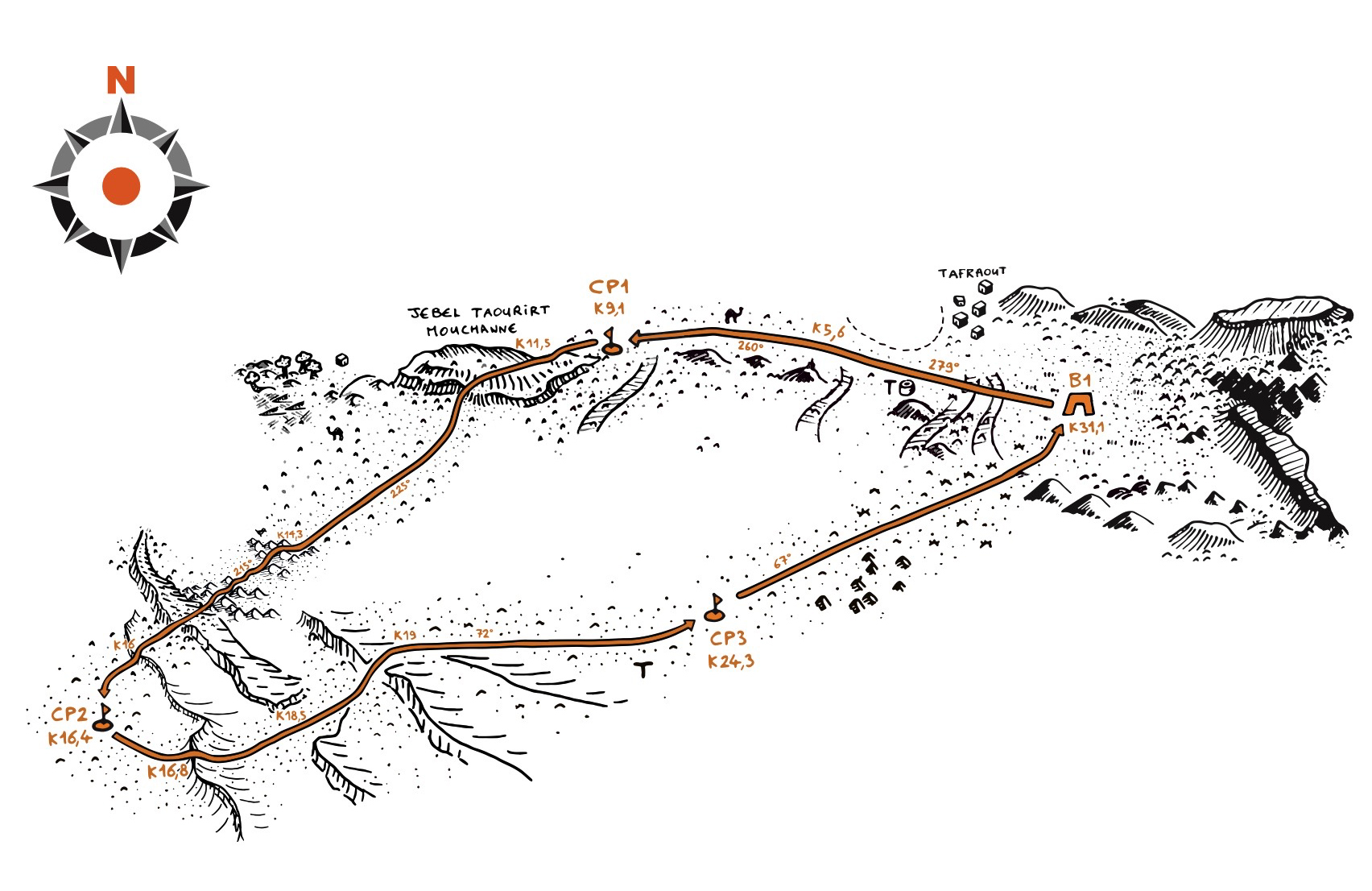
April 14 – STAGE 1 – Departure 0700 31.1km and 282m+
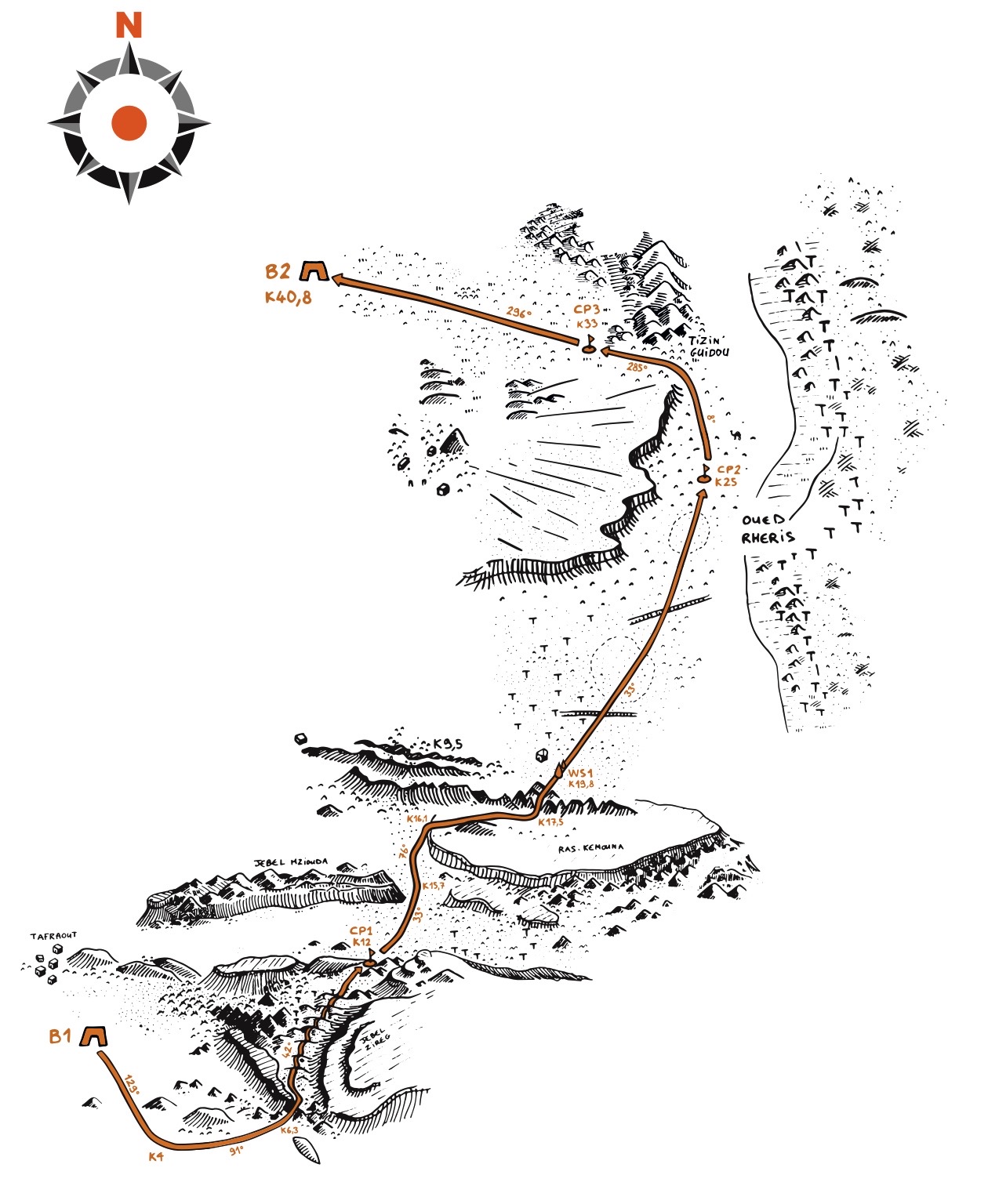
April 15 – STAGE 2 – Departure 0700 40.8km and 550m+
April 16 – STAGE 3 (The Long day which will go through to April 17) – Departure 0600 and 0730 for the top 50. 85.3km and 1154m+
April 18 – STAGE 4 – Departure 0630 and 0800 43.1km and 390m+
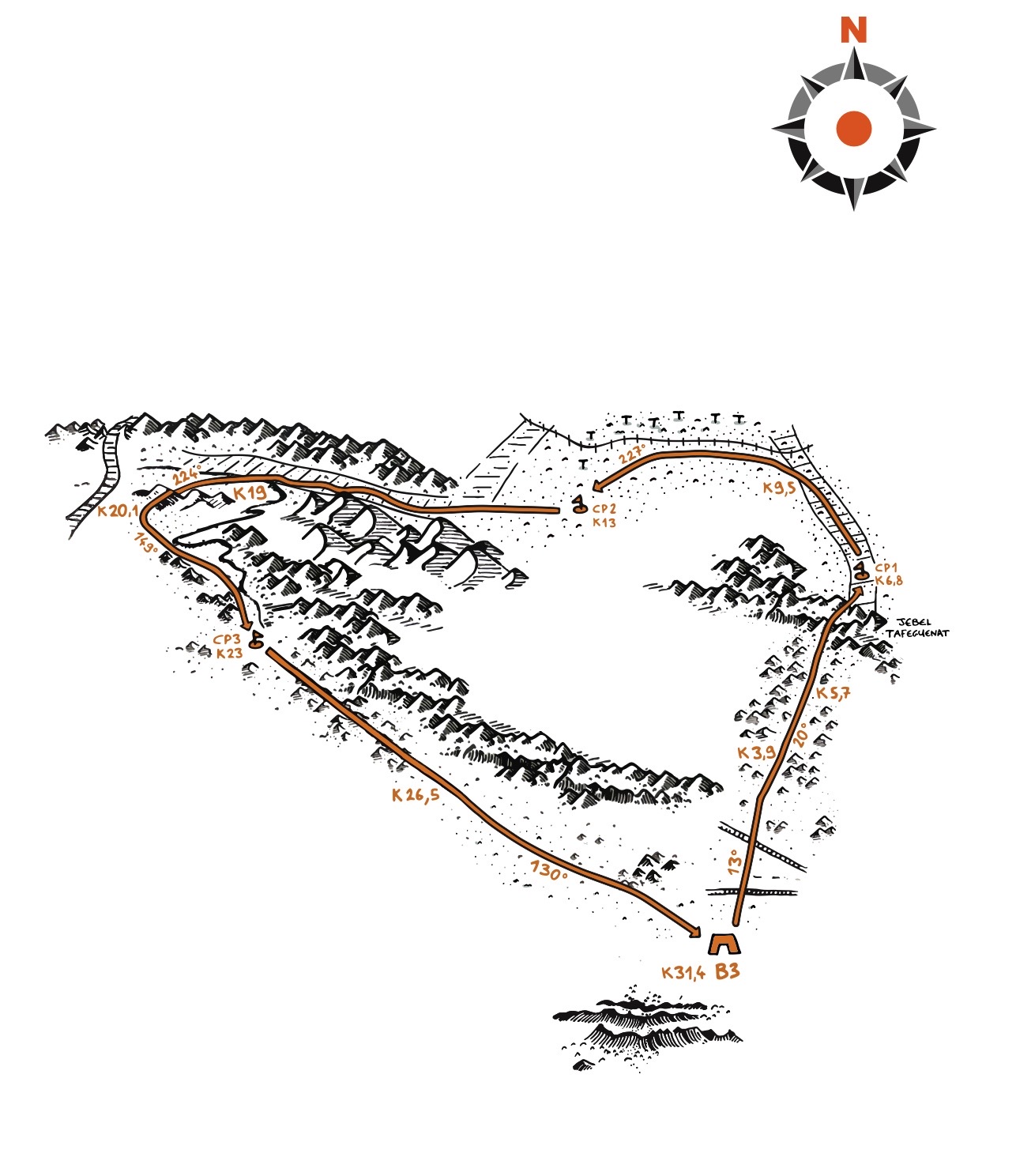
April 19 – STAGE 5 – Departure 0700 31.4km and 252m+
April 20 – STAGE 6 – Departure 0630 and then transfer back to Ouarzazate 21.1km and 160m+
April 21 – Ouarzazate
April 22 – Home travel
THE ROUTE
Unlike previous editions of MDS, the 2024 route will concentrate on one key area of the Sahara. It makes sense, it is the most beautiful. Therefore the race will not be a point-to-point but a series of journeys and participants will stay in the same bivouac on multiple occasions.
Importantly, Jebel El Otfal, Jebel Joha Baba Ali and the oasis of El Maharch will feature on the ‘long day’ however, there will be no Merzouga dunes during the race.
In summary:
Stage 1 B1 to B1 31.1km and 282m+
Stage 2 B1 to B2 40.8km and 550m+
Stage 3 Is an elaborate series of tracks, B2 back to B2 85.3km and 1154m+
Stage 4 B2 to B3 43.1km and 390m+
Stage 5 B3 to B3 a looped route that makes a heart shape 31.4km and 252m+
Stage 6 B3 to finish 21.1km and 160m+
ONES TO WATCH
MEN
MOHAMED EL MORABITY
As in any MDS, there are the front contenders who will do battle for overall honours, in the men’s category, three obvious names are stand out: Mohamed El Morabity, Rachid El Morabity and Aziz Yachou. All eyes will be on Rachid, he is looking for a 10th MDS title and after the disaster in 2023 when he received a 2-hour time penalty, Rachid will be looking to make amends and make history. Mohamed, Rachids brother took the reigns in 2023 and won, but will this be allowed in 2024? Aziz Yachou gets stronger and stronger every year, he has a battle against the brothers though.
Petter Restrop, Yoann Stuck, Roberto Mastrotto, James Miller, Alessio Zambon, Ahmed Ouikhalfen, Stéphane Ricard,Mérile Robert, Hamid Yachou, Anthony Ginter, Romain Laguigner Abdelhadi Elmoustahli are also ranked as the top contenders, as always, there will be surprises.
WOMEN
AZIZA RAJI
Aziza Raji and Aziza El Amrany fly the Moroccan flag and are of course, top contenders for the podium. The UK’s Gemma Game is returning, she has placed 3rd twice in 2018 and 2019 – is this the year?
Lai King Chan, Adriana Moser, Saskia Plaucheur, Marie Houdusse, Amélie Ginter, Ninette Banoun, Magdalena Kalus, Alexandra Bailly, Annę Godefroy, Nina Stein and Katherine Beckingham are all in with a shout of top-10 and maybe the podium.
STORIES
AMY PALMIERO WINTERS
The MDS is always a place for stories, challenges, inspiration and adventure and the 38th edition will be no different. Often, these stories unfold as the race happens.
Mr MDS, Christian Ginter is back for his 36th edition, yes, his 36th! Rory Coleman from the UK return for his 16th and in and amongst these two highlight names, we will have new stories to follow and inspire us.
INTERESTING FACTS
In an effort to reduce the environmental impact of such a huge race, the MDS has taken some key measures.
In 2023 50 lorries were used, for 2024 this will be 20. In 2023 157 4×4 vehicles have been reduced to 78. A helicopter as per usual will be available for emergency use only. This equates to a 47% reduction I carbon emissions.
In addition, chartered flights were reduced to just 3 planes with an encouragement for participants to choose commercial options.
The use of local services has been increased using local staff, vehicles, trophies made in Morocco, and the catering team for staff will be all Moroccan with 100% of produce local and a reduction in chicken and beef.
In addition, checkpoints will have solar power and all communication relays utilise solar too.
Waste management has been improved and a key move has been to eradicate 1.5ltr bottles and replace with 5ltr.
Safety has always been a key concern and for 2024 there is an increase in medical staff, 65 up from 56, there 9 SSV rapid response vehicles, up from 4 in 2023. There will be 9 4×4 vehicles and new for 2024, 3 MTB riders and 9 runner’s who will participate on the race route offering immediate medical response. A medical point will be in the centre of bivouac so that immediate attention can be given if required.
ADVENTURE AWAITS
The 38th edition is now waiting to unfold. It’s a new era for the race. Let the adventure begin, MDS The Legendary makes history.
You can receive daily updates and reports on this website. Follow on IG @iancorlessphotography and @mdslegendary
Fuelling for a Multi-Day – Marathon des Sables – The Legendary
Marathon des Sables pioneered the multi-day racing format and as such is often a key starting point when discussing a fuelling strategy for an adventure that lasts a week or longer.
Multi-day adventures require fuelling and how one obtains food can vary greatly. In principle, there are several keyways:
Self-sufficient
Semi-supported
Supported
For many, self-sufficiency poses the greater question marks and worries as there are multiple factors to consider:
How many days?
Weight?
Balance of nutrients and calories?
Hot or cold food (or both)?
Access to water?
Environment?
Loaded up for a week in the Sahara.
Runners are required to carry all they need to survive in a multi-day like MDS. Fuelling is essential to survive and the balance of calories v weight is a prime concern. The only things that are provided are a shelter (bivouac) which is shared with 7 other runners and water which is rationed. Since its creation in the mid 80’s, the MDS format has been copied and used as a template for other races all over the world.
Get your pack as close to 6.5kg (plus water) as possible.
Weight is the enemy of a multi-day runner or fastpacker and therefore balancing equipment, food and water is an art form in itself. Read an article HERE about the equipment required for a race like MDS.
Food will take up most of the weight on any adventure when being self-sufficient. MDS, for example, has a minimum food requirement of 2000 calories per day, a minimum pack weight of 6.5kg and then one must add water, typically a minimum 1.5 litres (1.5kg) which makes the starting pack weight a minimum 8kg.
Food for multiple days will typically be around 4 to 5kg.
*****
Quite simply, running or walking, covering 250km over 7-days will leave the runner in a calorie deficit. Therefore, it is essential to optimise the food one takes.
FACTORS TO CONSIDER
How fast one goes does greatly impact on food choice and how calories are not only consumed but chosen. The macronutrient choices will change based on the balance of carbohydrate, protein and fat. In simple terms, a runner will burn more carbohydrates and a walker will burn more fat. Humans store enough fat to survive many days and even weeks. However, carbohydrate stores deplete quickly and need to be replenished.
Body weight, age, individual needs are important for all and males may well require more calories than a woman due size and muscle mass.
Main meals will usually come either freeze dried or dehydrated. Both processes involve removing the water from food to preserve it. Freeze-drying involves freezing the food to a very low temperature and drying it in a vacuum to remove moisture. Dehydration involves passing warm air over the surface of the food to remove moisture. Dehydration creates food that tastes like it should, with plenty of texture and flavour. It is an altogether slower and gentler process than freeze-drying. Please note though, that hydration times take considerably longer with cold water and taste can change. Test meals in advance using hot or cold water.
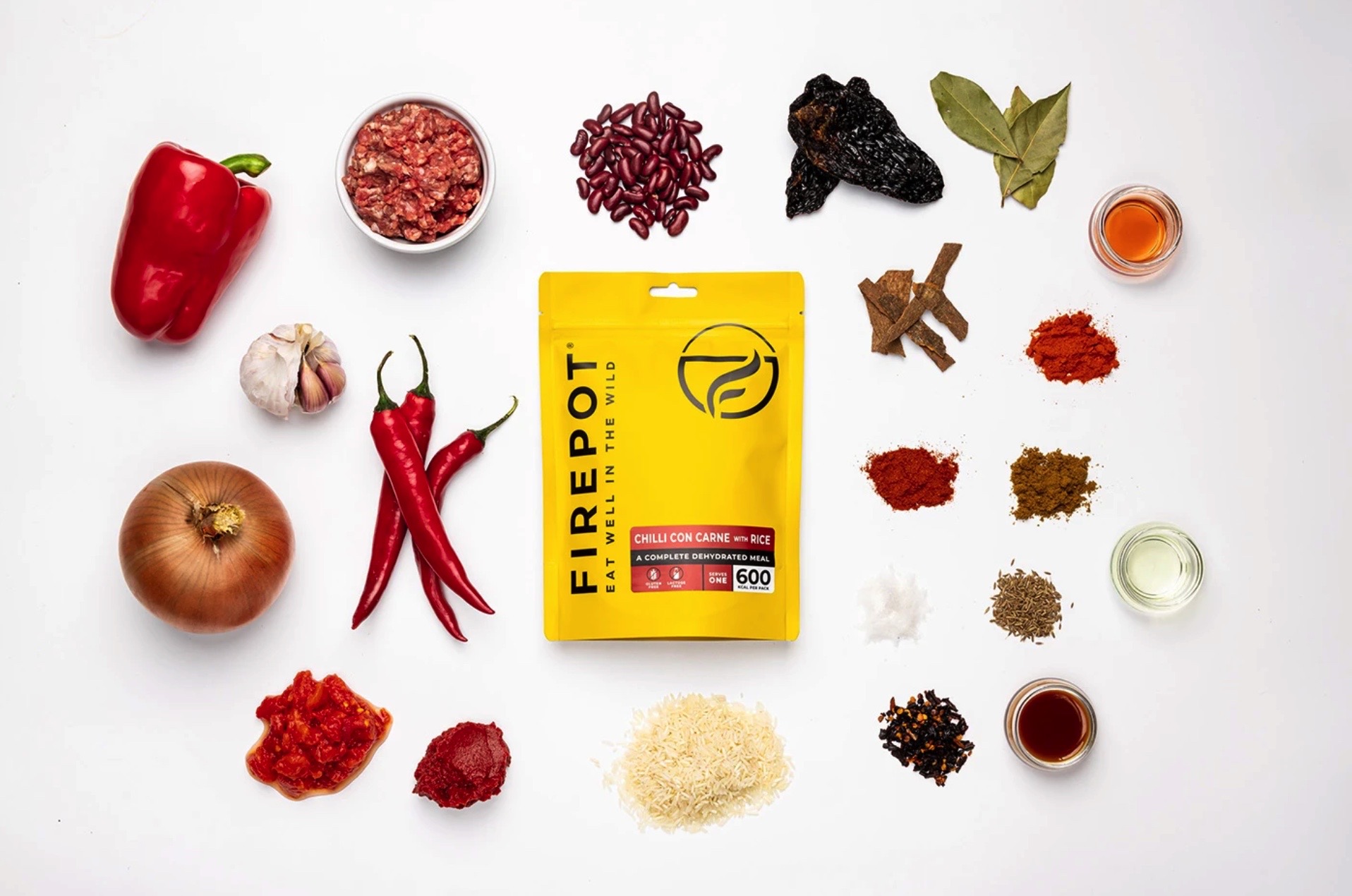
Firepot are a UK brand who create tasty meal by hand, using fresh ingredients and then dry each meal.
Carbohydrate, Fat and Protein are essential for balance and foods for an expedition are usually balanced specifically for the needs of an active individual. Typically, 55% carbs, 30% fats and 15% protein are considered balanced. As an indicator in regard to calories, carbohydrates have 4 calories for 1 gram, fat has 9 calories for 1 gram and protein 4 calories for 1 gram.
Remember, we are all individual and although any recommendations here provide a guide and a template, you the individual need to answer very specific questions and ultimately, you may need to seek the advice of a nutrition expert to fine tune a fuelling plan for a multi-day adventure.
As a rough guide, BMR is the number of calories a person burns in normal day-to-day activity.
Example for a 37-year-old, 6ft tall, 170-pound man.
(66+(6.2 x 170) + (12.7 x 72) – (6.76 x 37) x 1.55 = 2663 calories
How to use the equation: (66+(6.2 x weight) + (12.7 x height) – (6.76 x age) x 1.55 = 2663 calories
The ‘Harris-Benedict‘ formula takes into consideration daily activity.
Fat adapted athletes will have specific requirements and the nutritional plan will be different.
Answer the following questions:
Age?
Male or female?
Body weight?
Walker?
Walk/ runner?
Runner?
Vegetarian/ Vegan?
Am I typically a hungry person?
Am I more hungry or less hungry with exercise?
Food allergies?
Will I use hot water or cold water?
A TYPICAL DAY
Breakfast – Ideally slow-release carbohydrate, some fat and quality protein.
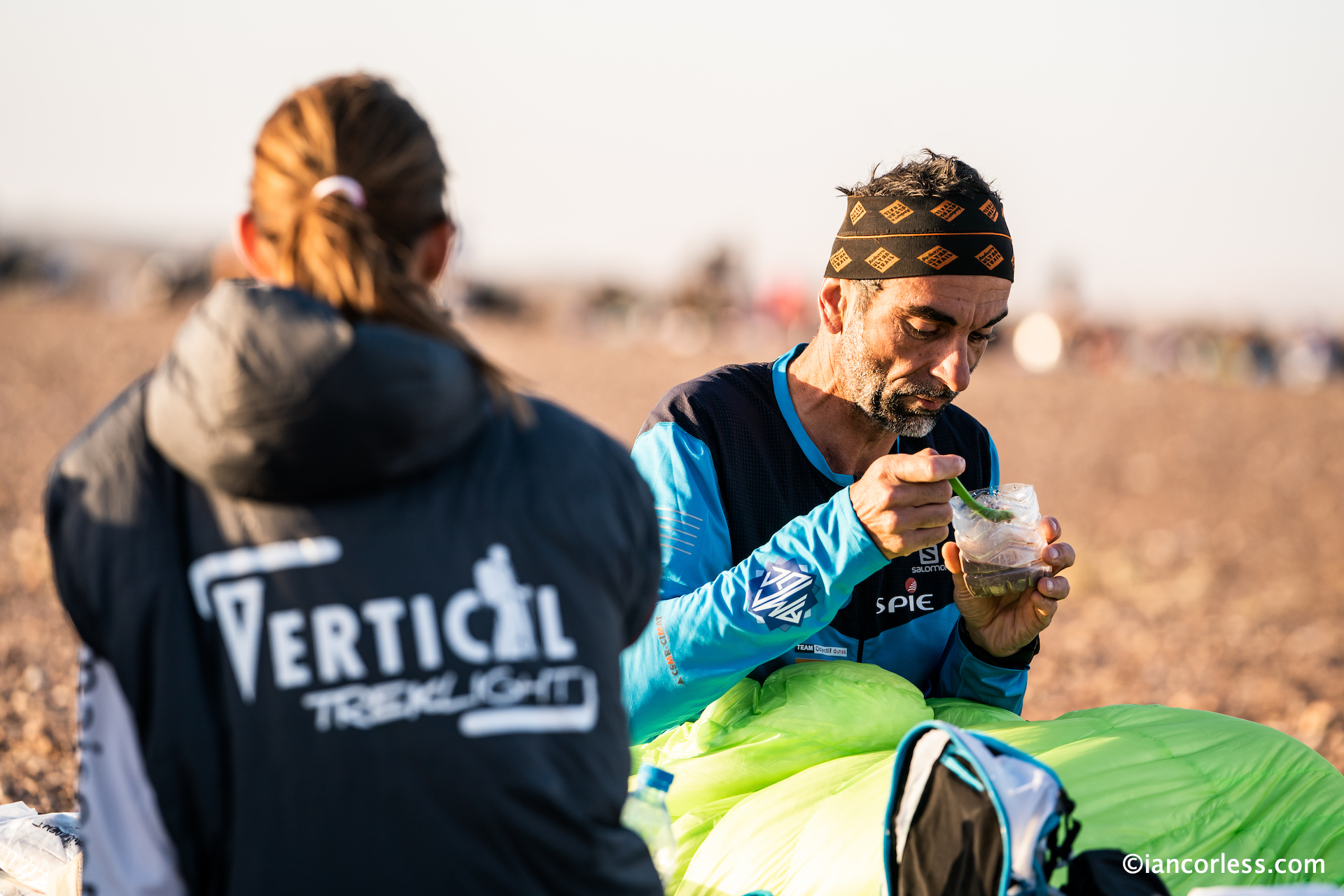
Starting the day with breakfast.
Running Food – This will vary on the length of the stage, up to 6-hours and you may prefer easily absorbed carbohydrates, bars and or energy in drink form. For longer stages, the addition of real food, savoury and some protein would be wise. For a very long day, for example, the long day at MDS, you may even need a meal?
Post run food (immediate) – A shake is a great way to start the recovery period as it is easily absorbed, and this should have carbohydrate and protein.
Dinner – A meal will form the basis for dinner and think about some small treats for each day, these will give you something to look forward to and help keep your palette fresh.
FOOD PLANNING AND IDEAS
Breakfast:
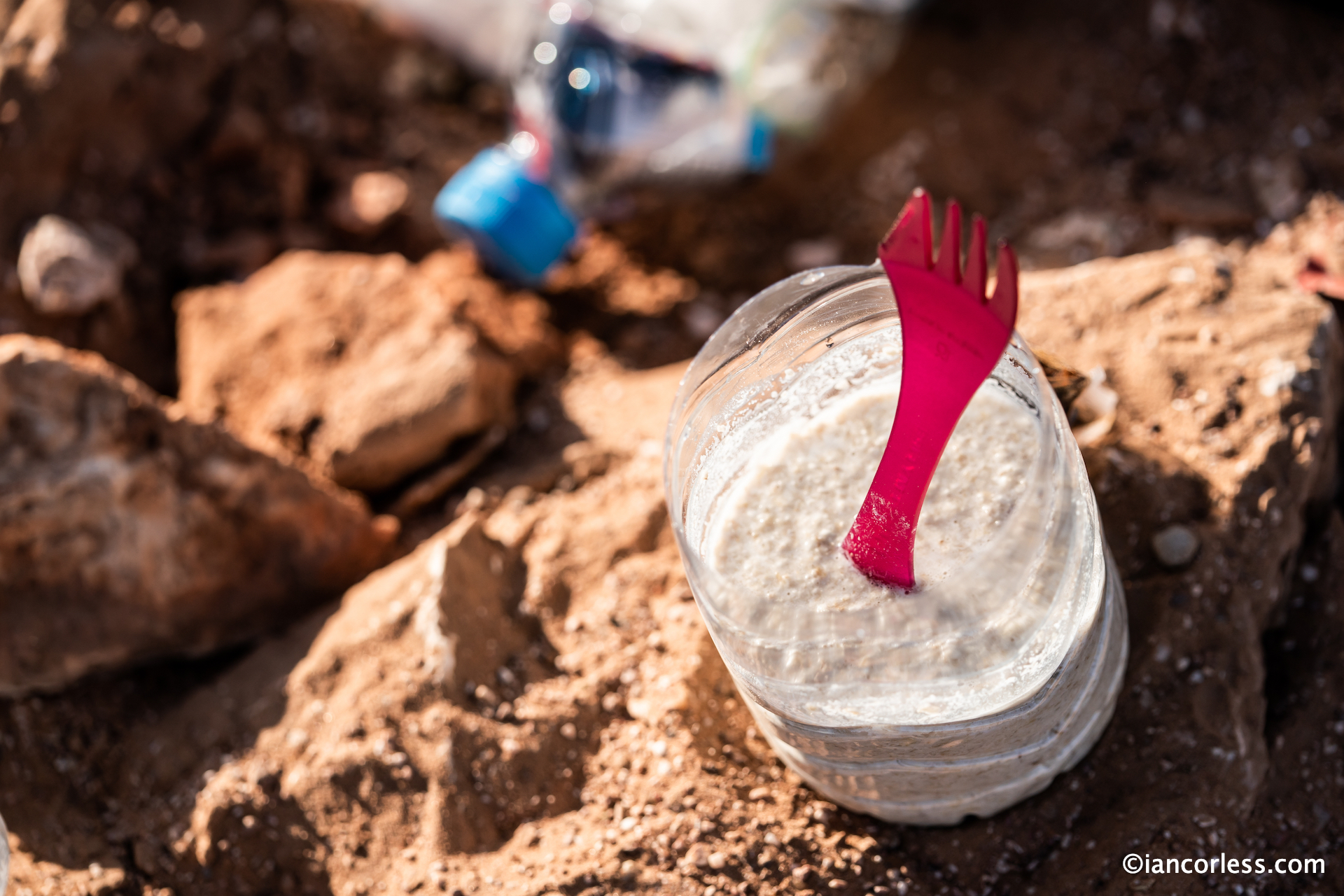
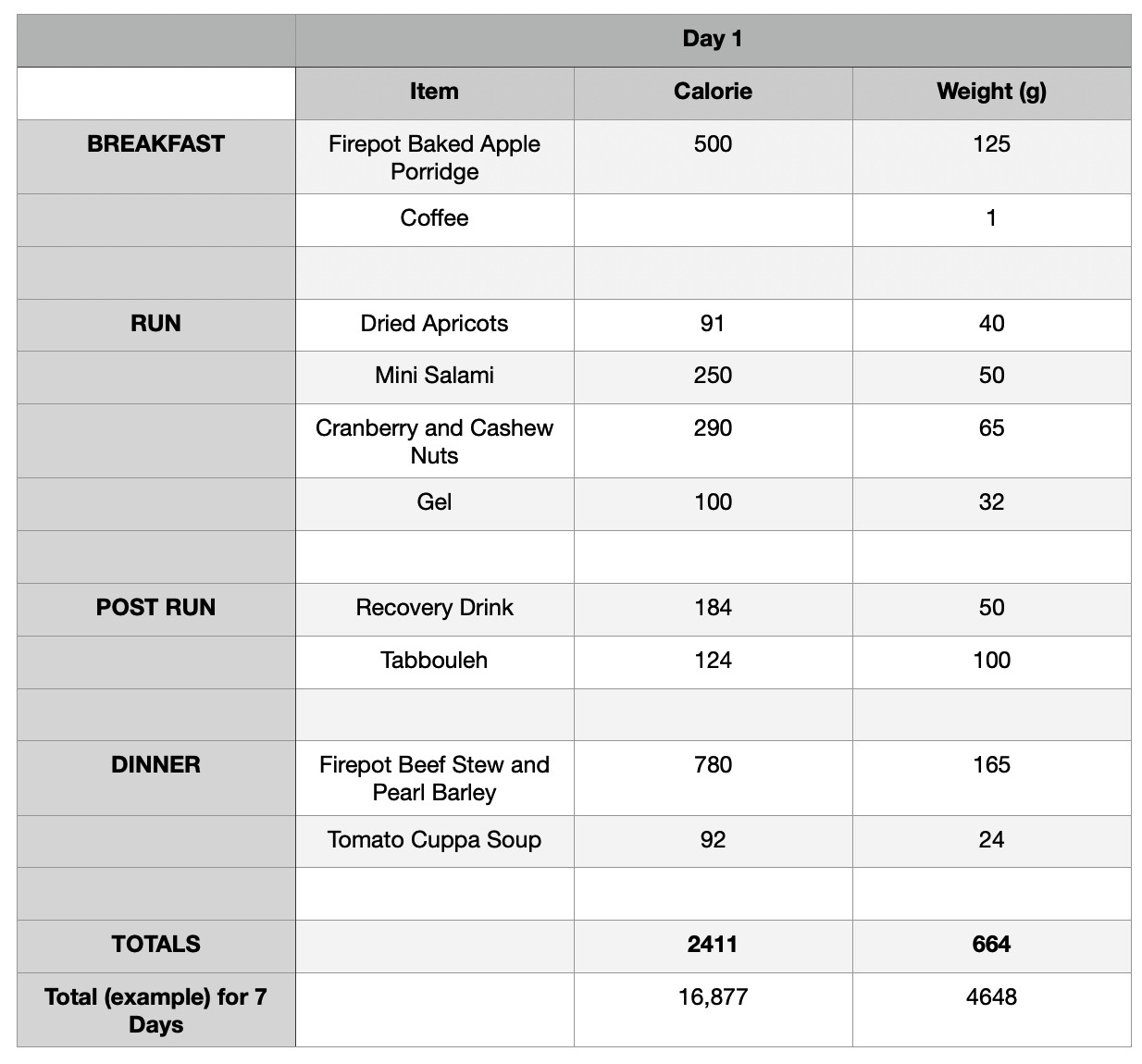
A freeze-dried breakfast is a good way to start the day. Top tip: Add the water to your breakfast at sleep time (especially if using cold water) as it will rehydrate during the night and be ready for eating in the morning. Of course, make sure it can’t be knocked over, get contaminated or damaged – that would be a disaster! Using a re-sealable plastic bag is a good idea. Example: Firepot Baked Apple Porridge is 125g with 500 calories.
Breakfast is essential to fuel the day ahead.
Muesli is popular and provides energy and fibre, it can easily be combined with a freeze-dried dairy product.
An energy bar for some works, but they often are heavy in proportion to the calories provided. However, for some, they are a perfect start to the day.
Top tip: Consider an evening meal as an alternative to breakfast. Sweet tasting food can become boring and sickly, the option to have something savoury with some spice can be a life saver.
During the run:
Runners will need typically more carbohydrate in an easy form so that they can maintain pace. By contrast, walkers will move slower, have more time to eat and easier time digesting, therefore real foods are possible. The balance is always weight v energy. Don’t rely completely on liquids, some solid food and chewing is good for the body and mind.
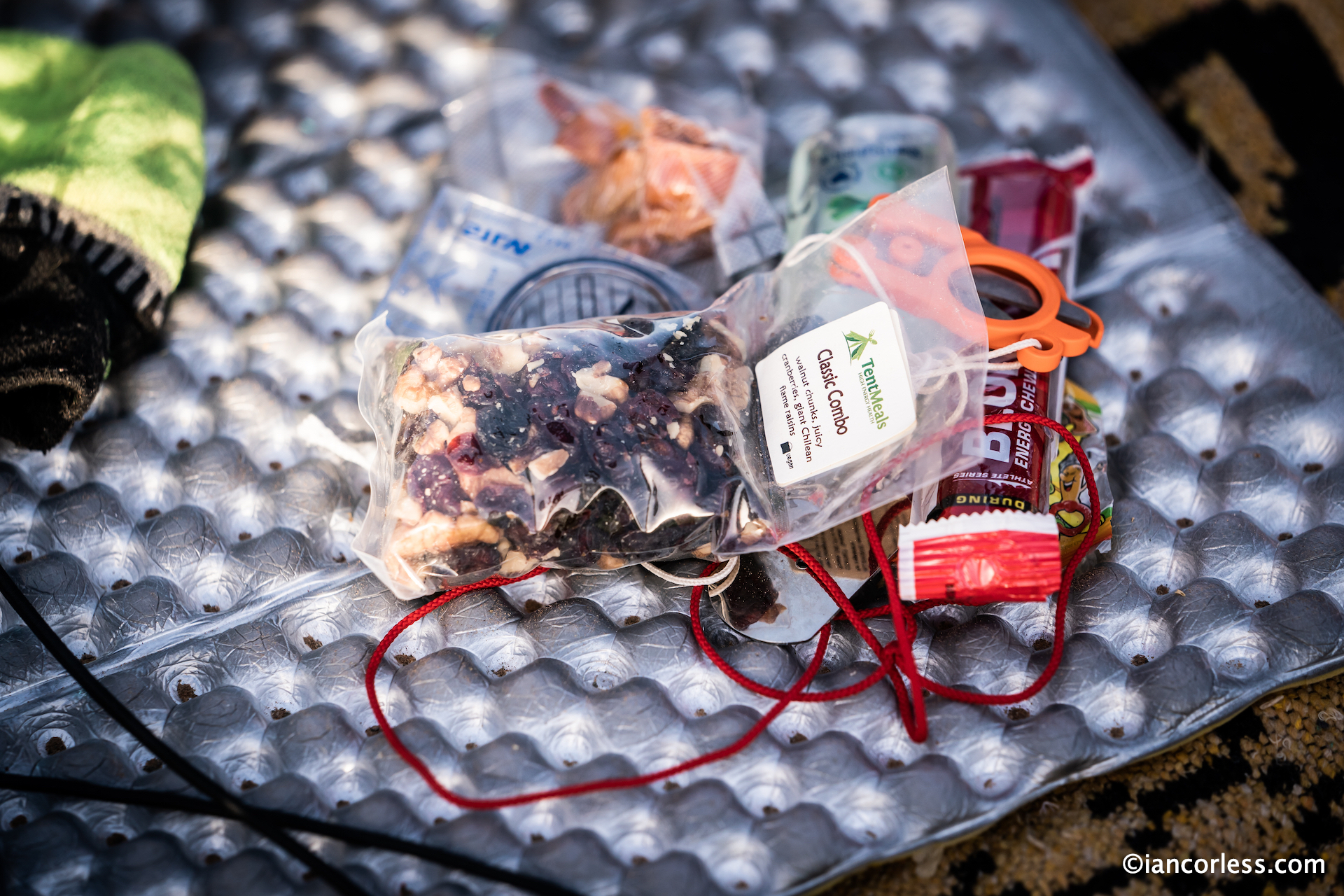
Some ‘typical’ run snacks.
Example: Gels are around 32g each. Let’s say you took 1 gel per hour. Rachid El Morabity won the 2019 MDS in 18:31. So, 19 gels would weigh 608 grams. By contrast, if the race takes you 60-hours, 60 gels would be 1920g! Not only is the weight not feasible but also the volume size would just not work.
Powders (energy drinks) that one can add to water are an easy way to get calories and nutrients. They are also considerably lighter.
Energy bars.
Beefy jerky.
Dried fruit.
Nuts such as almonds are rich in fat and calories.
Trail mix.
Dried meat.
Post run:
Back in bivouac, first priority is drink and food.
A recovery drink is the quickest way to get balanced calories immediately in the body to start replenishing the body. Have this shake as soon as possible. Then do personal admin such as feet, clothes, bed, etc. One hour post the run, consider a snack like tabbouleh as this is easily hydrated with cold water and add some protein to it – dried meat a good option.
Dinner:
A dehydrated meal will make up the main calories. Depending on the person, the need for more or less calories will vary. Some companies, Firepot a good example, provide meals in two sizes: 135g with 485 calories or 200g with 730 calories for Vegan Chilli Non Carne and Rice.
A post-dinner treat is a good idea, this could be another freeze-dried option or a low-weight and high calorie option. A sweet such as a Lemon Sherbet is a simple way to add some freshness to your mouth and palette and although has little calories, it can be a nice treat.
Top tips:
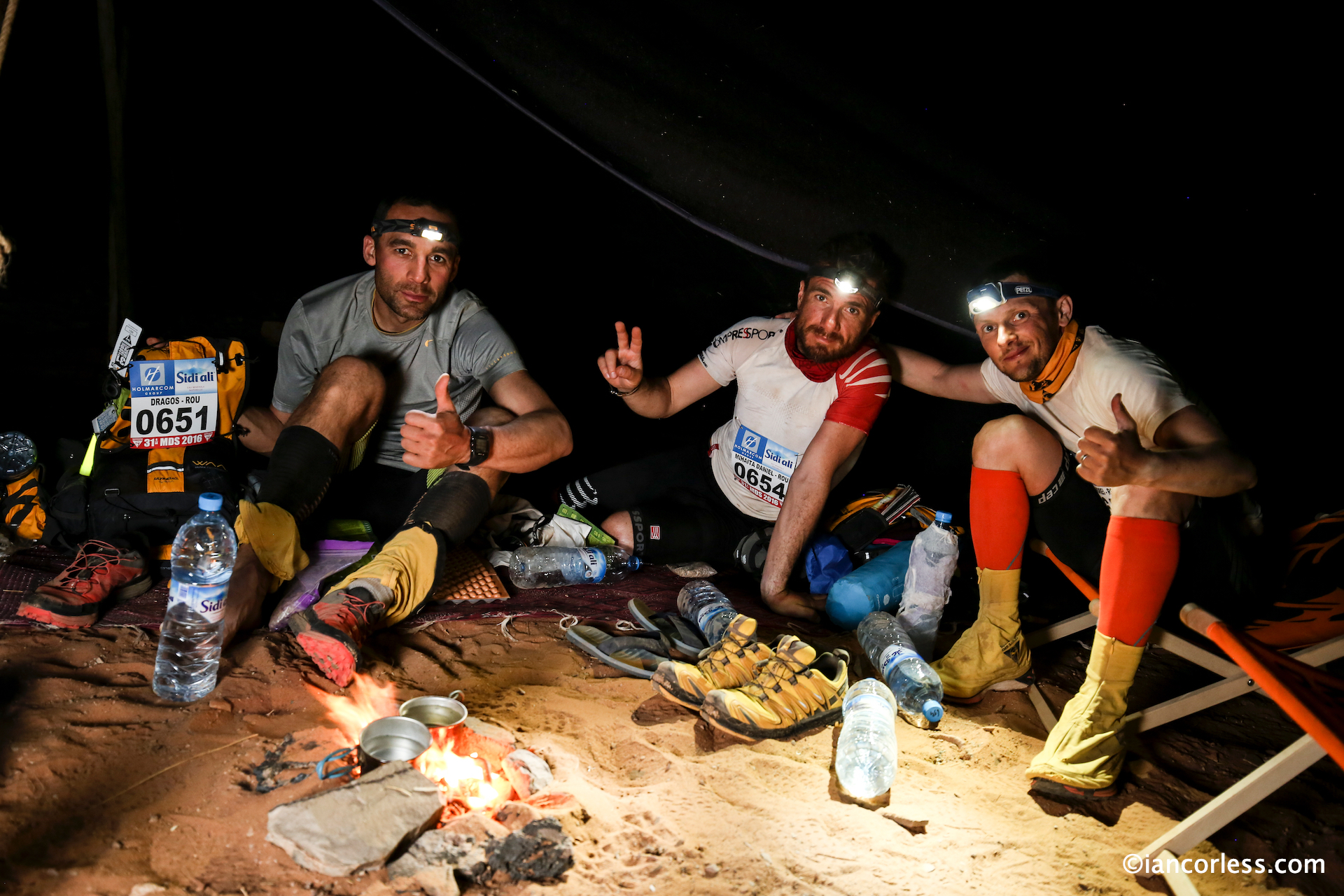
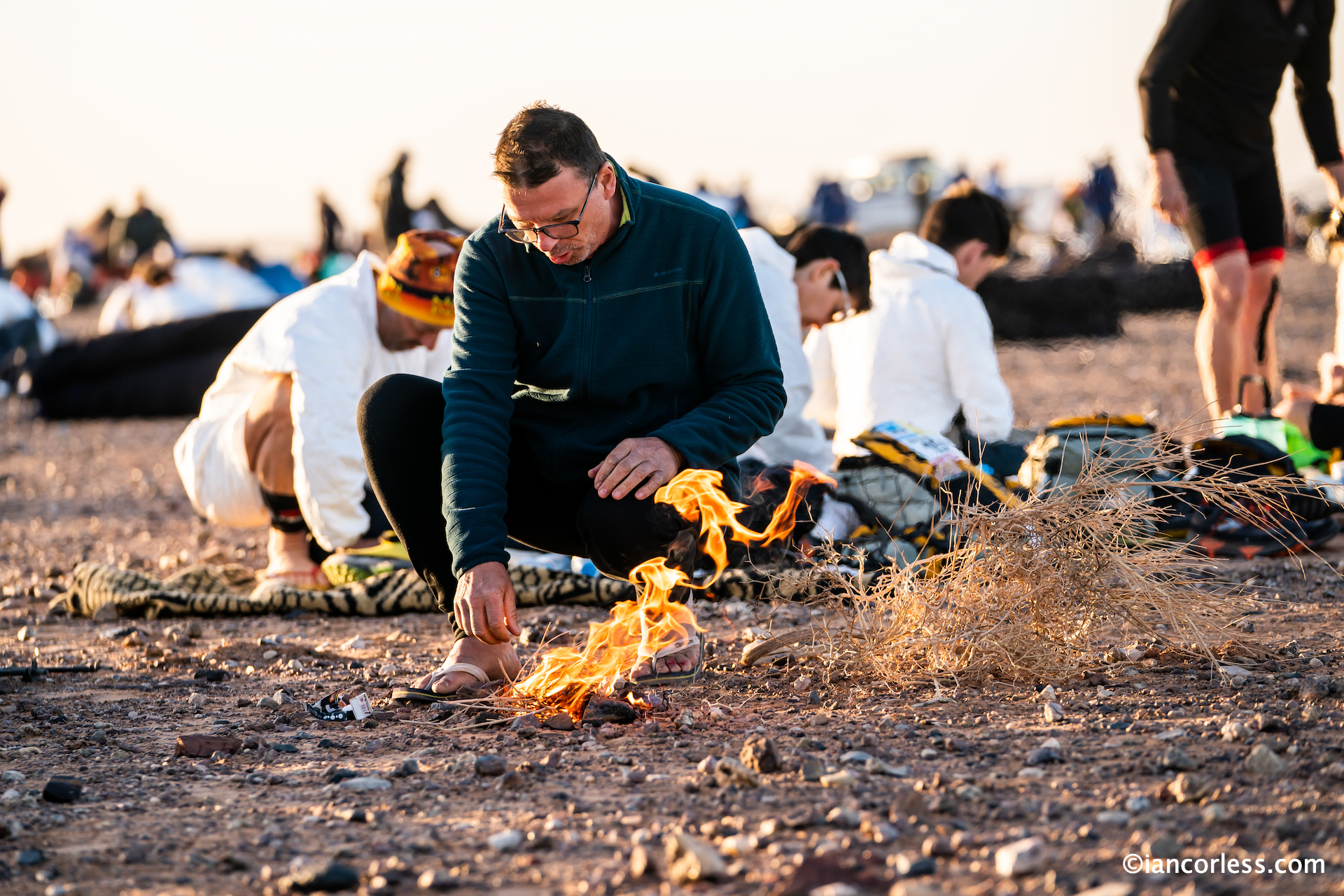
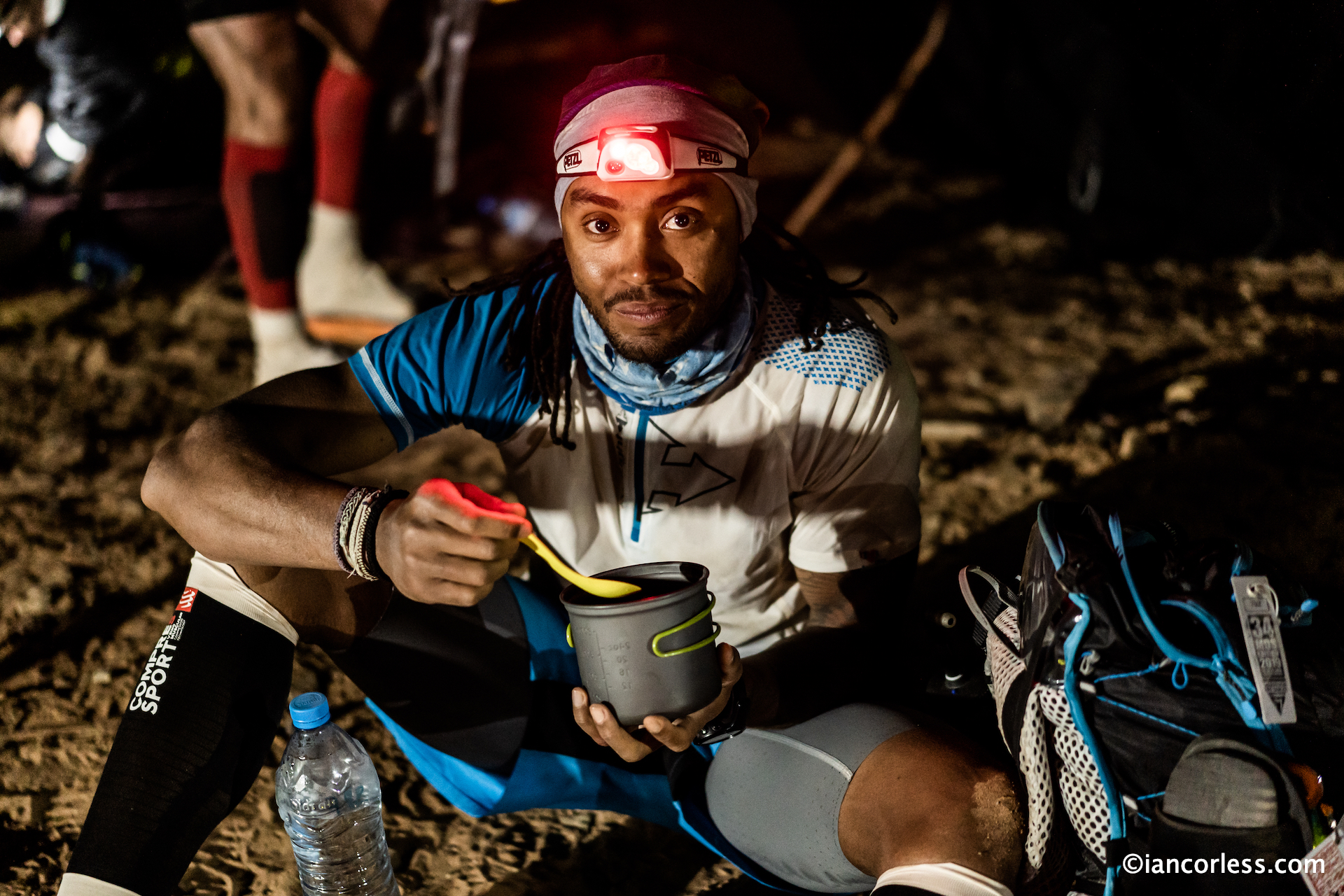
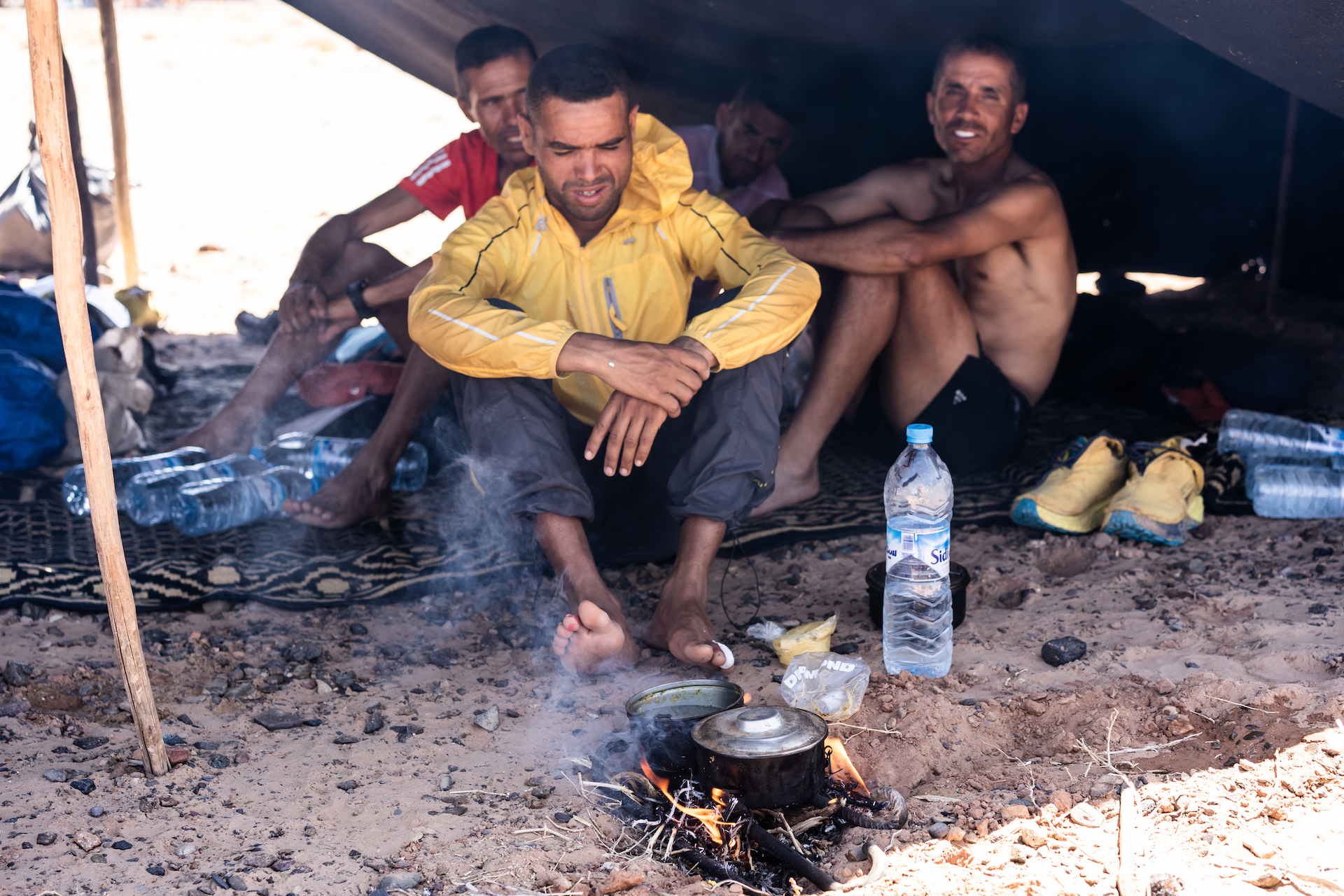
Experienced runners make a real fire to boil water.
Try everything out before any race or event. You need to know what works for you when tired and fatigued. Try to simulate race situations so you have a good understanding of your palette and your body. Test for taste, stomach and brain.
Just because you love Spaghetti Bolognese, don’t be tempted to take 7 for a 7-day race. You and your palette become bored quickly.
Be careful with spices and anything that may irritate or aggravate a digestive system that will already be under stress.
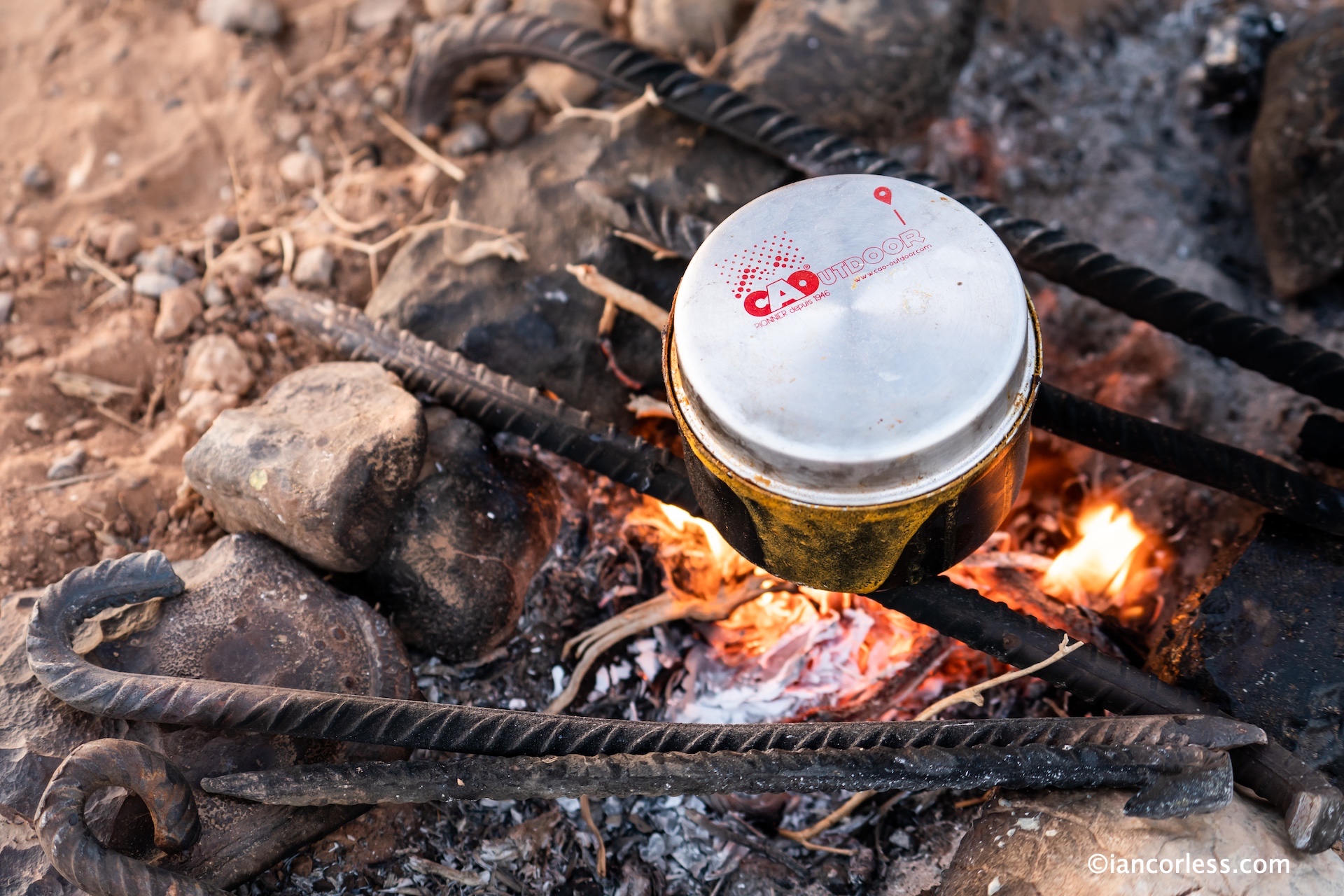
The choice of having hot water can be a deal breaker. For some, a hot coffee or tea is just essential! In addition, food is typically more pleasurable when hot and hydrates quicker with hot water. You cannot use any gas stoves at MDS so you must use fuel tablets and a small stove. However, here are some alternative ideas: 1. If you finish early in the day, leave a bottle in the sun and let it warm naturally. 2. Often, there are lots of shrubs, twigs and branches around bivouac, it is possible to make a fire, but you will still need a pot.
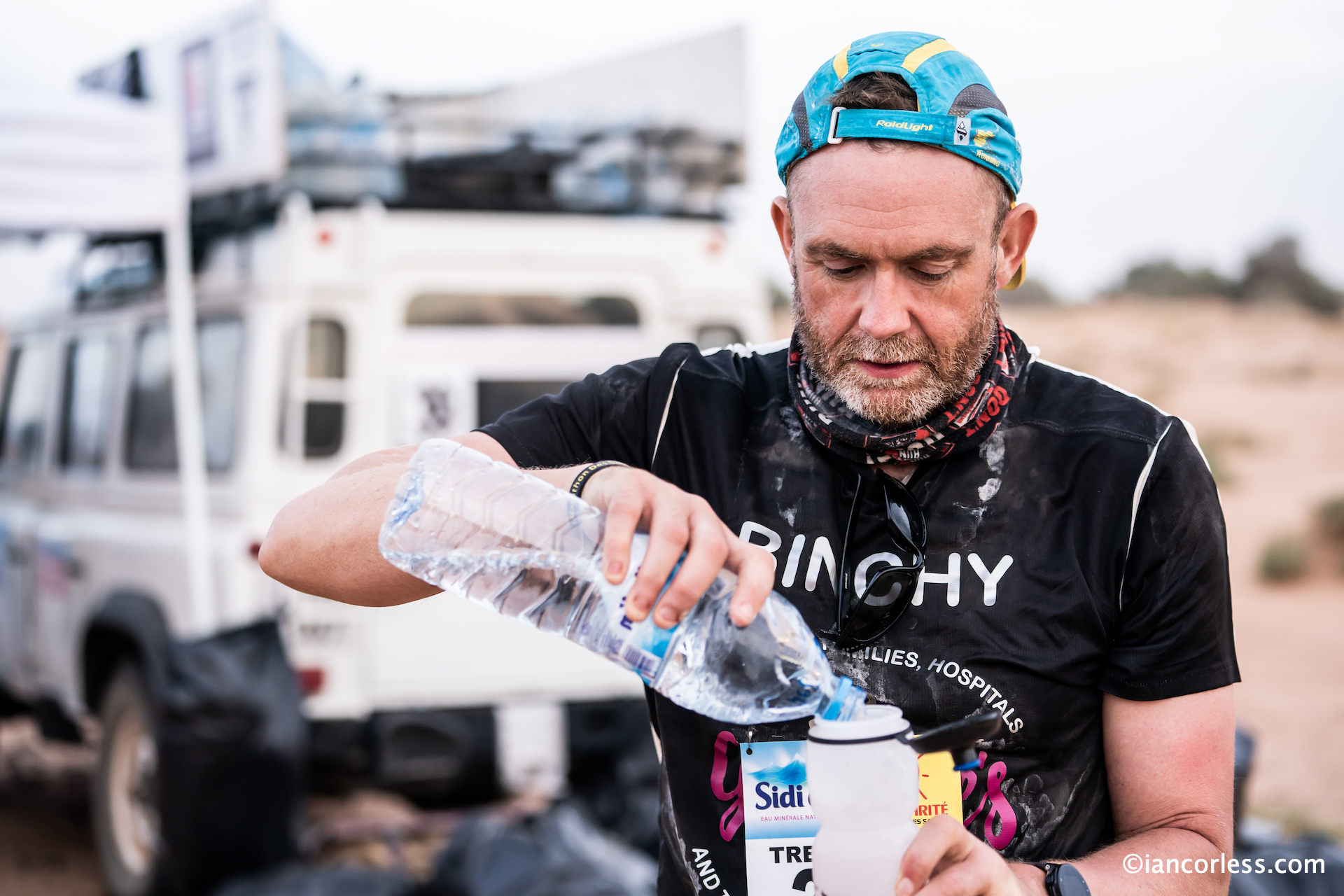
Water at the race is provided in 5Ltr bottle at the end of the stage this needs to last till Cp1 of the following day, so, plan water use.
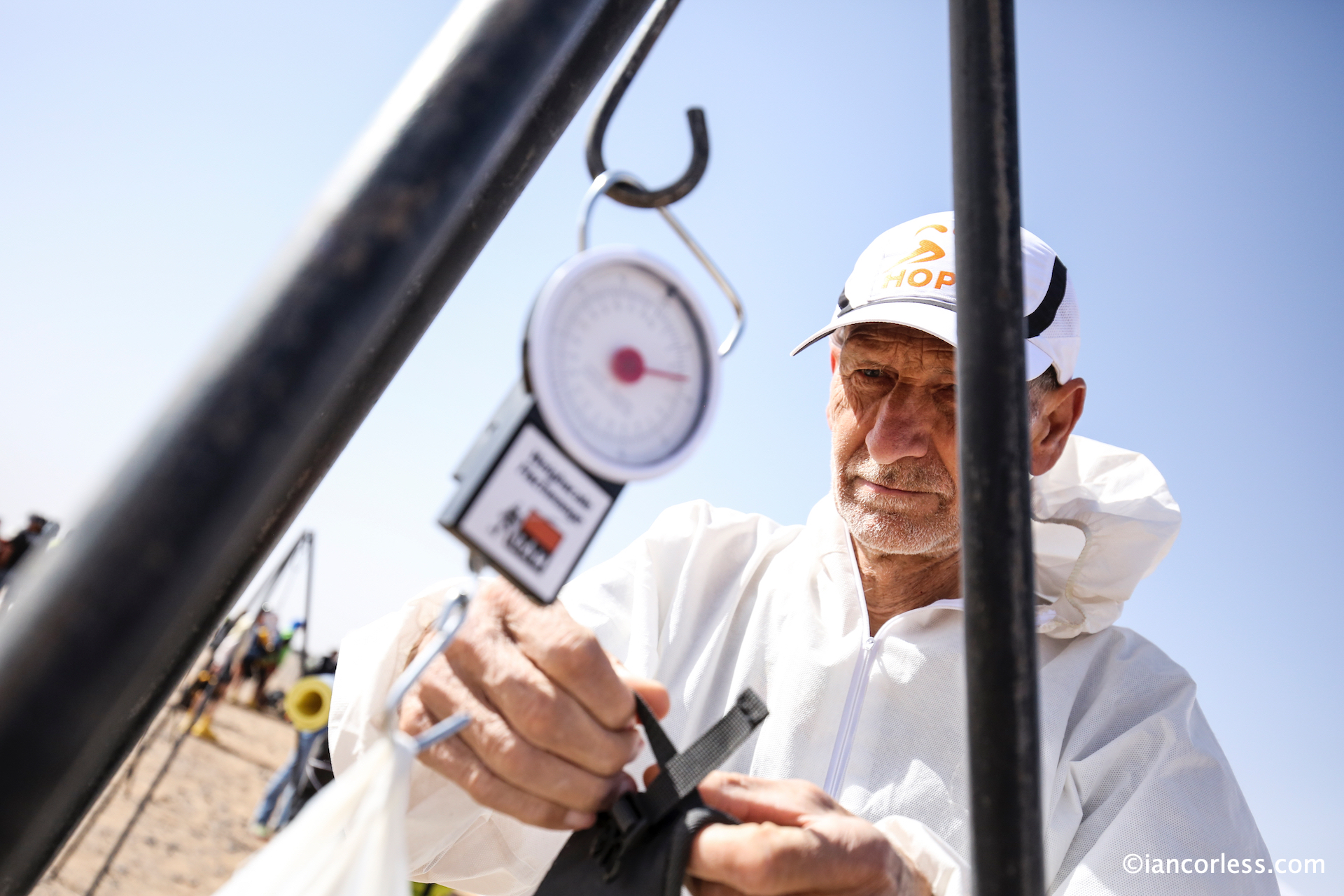
Consider repackaging all your food to make the volume and weight less, if you do this, be sure to include the nutrition label in your new packaging.
Take extra food and options. When in the Sahara, you can make some final food choices.
The ‘Long day’ and following ‘Rest Day’ will require different fuelling strategies, take this into consideration.
Rules – Race rules dictate you have a minimum 2000 calories per day, that you have nutrition labels for the food that you take and that on the morning of the last day that you have 2000 calories remaining.
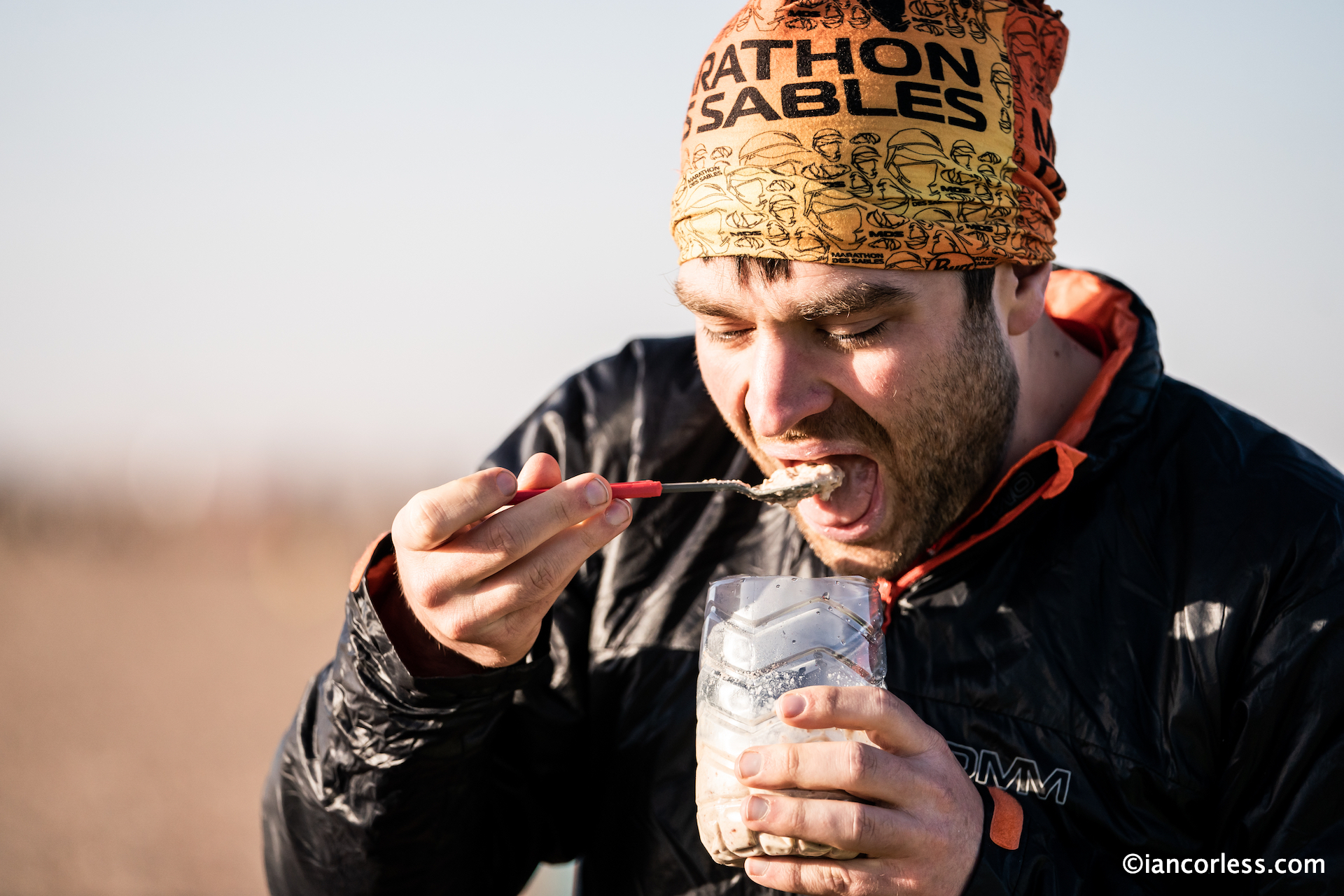
A cut down water bottle is a great food bowl.
WATER
Water is the only item provided at a race such as MDS and this is rationed. You are provided water for ‘in’ camp and then this is replenished while running at Cps which are typically 10 to 12km apart. When you finish the stage, you are then allocated water to last through the night and the following morning. NOTE: This water will need to last till CP1 on the next day’s stage, so make sure you leave enough to run with.
Water is rationed and supplied at every checkpoint on the route, typically every 10km.
Water is obviously used to hydrate but you also need it for your food and if you wish to wash.
Remember you need to replace salts that are lost through sweating. Have a strategy in place. The two main reasons for a DNF are feet and dehydration.
SPREADSHEET
Create a spreadsheet so that you can see daily food items, how many calories and what the weight is. Not only is this invaluable for personal admin, but it is also a requirement for the race when at admin check.
Top Tip: Lay a day’s food out on the floor and look at it and analyse (visually) does this look enough for 1-day.
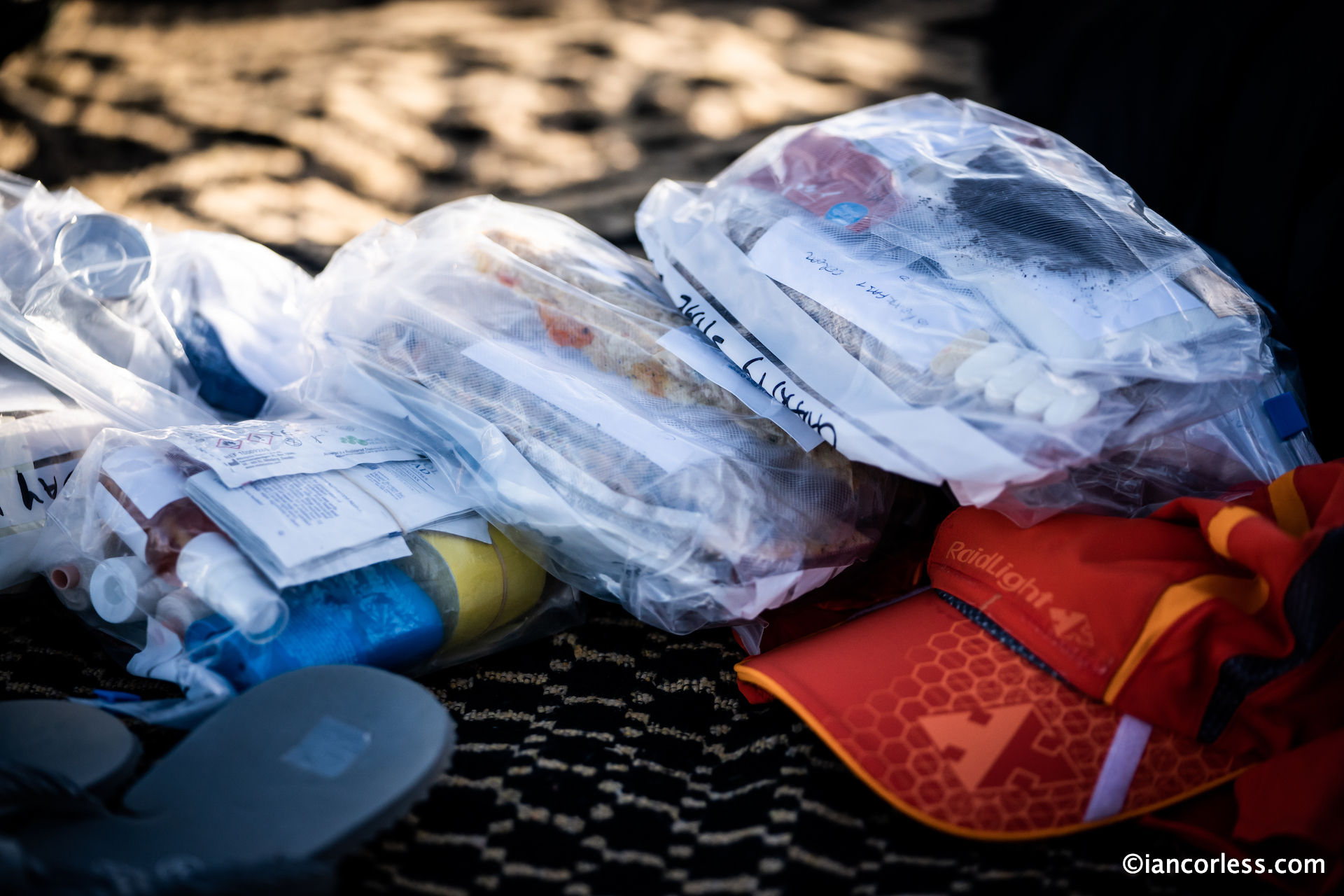
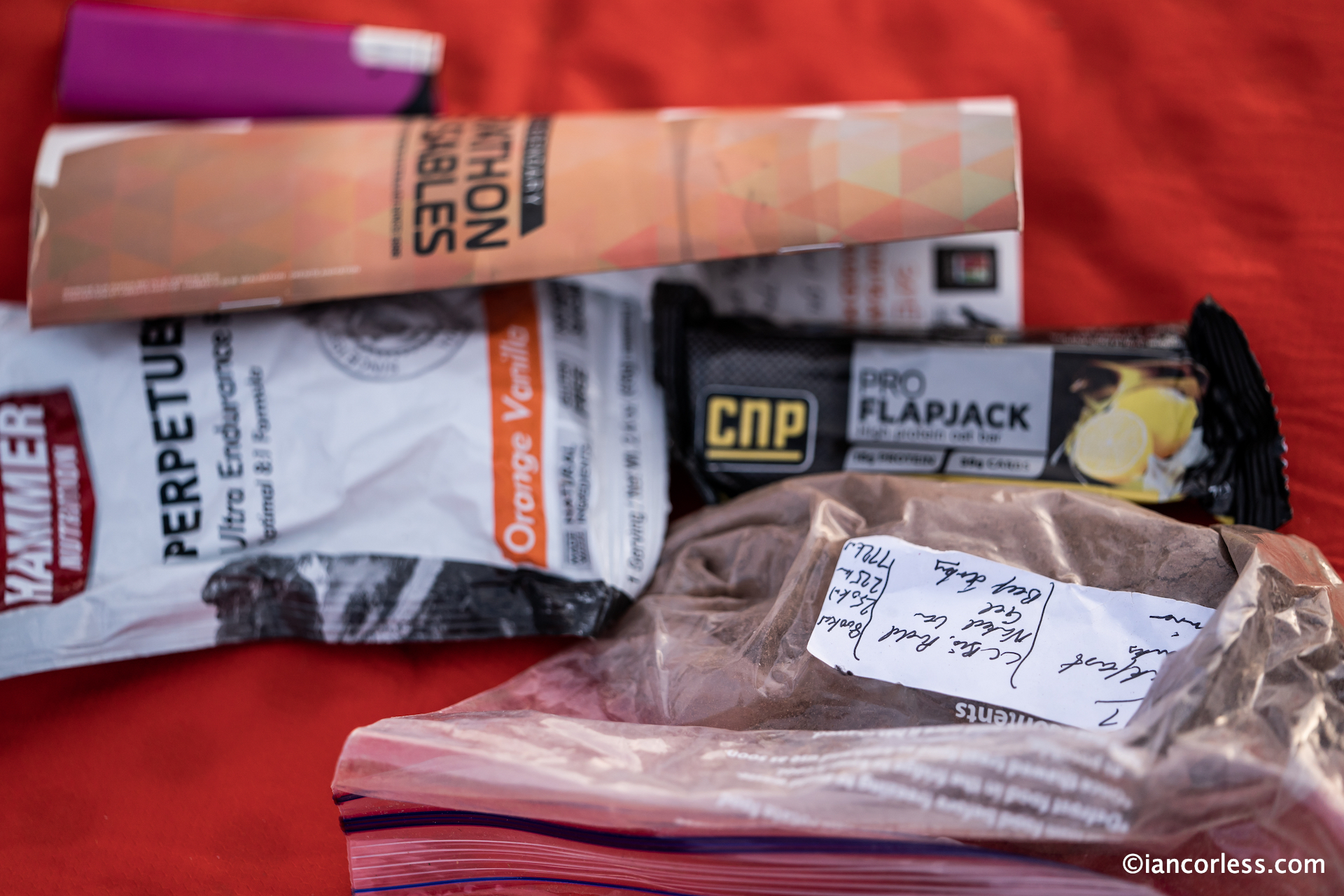
An example of fuelling for one day.Use a sealed bag for each day and then add a label showing contents and calories.
CONCLUSIONS
Getting fuelling right for any multi-day is really important, so, do the research and test everything. Have a contingency plan and anticipate the need for sweet v savoury will change.
If possible, repackage food to save weight and use clear packaging and relabel adding the name of the food, what day it is for and how many calories are inside.
Make sure you have some treats and something to look forward to.
Real food is good for the brain and the chewing motion helps satisfy our natural human desire to eat and be happy.
Remember, multi-days are only about three things: running/ walking, eating and sleeping, so, make sure you are prepared for each element accordingly.
The long day, many stop and cook a meal during the night to fuel the journey.
SUMMARY
In this article, we have looked at food for a typical desert race like Marathon des Sables that lasts for 7-days. many races follow the same format. However, different race conditions may well dictate food choices, for example, a race in snow/ ice with sub-zero temperatures will require a different strategy and the balance of carbohydrate, protein and fat can be different.
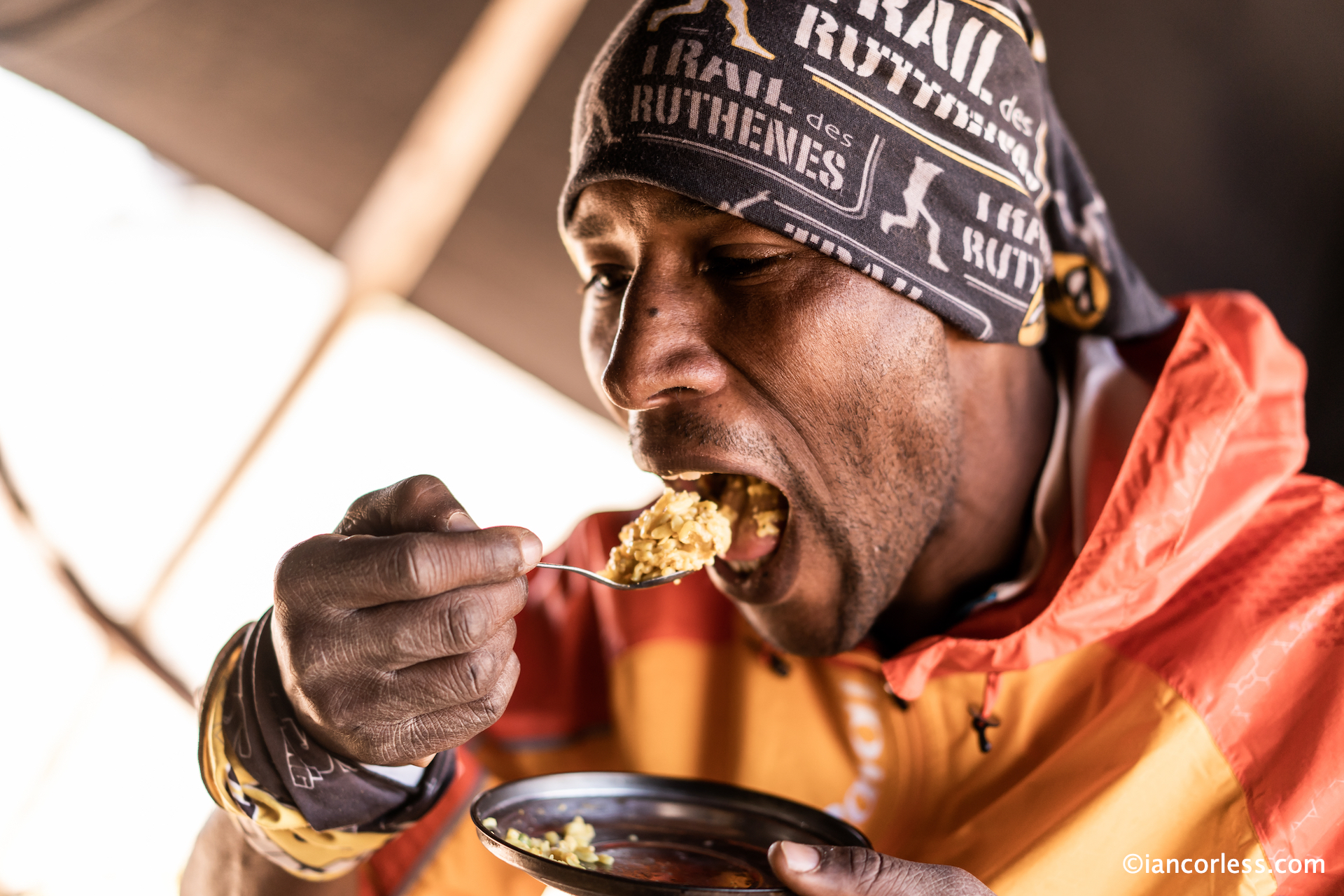
The top Moroccan runners boil water and eat hot food. Here Mohammed El Morabity.
Some races or multi-day are semi-supported, some are supported. In these scenarios, your own food may be carried for you or, it may even be provided for you? Think ahead and plan for what you may need so that you can perform as you wish with the calories you need. Especially important for vegan, vegetarian or those on specific diets. The big advantages of semi or fully supported is the not needing to carry additional weight and in most scenarios, there will be no restriction on quantity or calories. Everest Trail Race and The Coastal Challenge are two perfect examples of semi and fully-supported races,
Marathon des Sables is a simple race that often becomes over complicated by too much information. Take advice, look at websites, process the information but importantly find out what works for you. We are all individual, what works for one may well not work for another.
When you break the race down, here are my TOP 20 TIPS of what to focus on for Marathon des Sable – The Legendary.
Pack – Ideally needs to be as small as possible and as close to the minimum 6.5kg weight when packed. There are many packs out there and just like clothing, packs fit in different ways, so, it is important to try many to find the best for you. I size between 20-25 Ltr is ideal. Key things to look out for: easy access to water, easy access pockets for snacks etc, adjustable to get perfect fit, minimal bounce when loaded, flexibility to compress the pack and make smaller as you reduce the contents (food you eat) as the race progresses.
Sleeping bag – Needs to be lightweight, small when compressed and warm enough for you based on your warmth requirements – are you a cold or warm sleeper? Popular sleeping bags are PHD, Nordisk Y, OMM, Sea to Summit, Western Mountaineering, Rab etc. Take care on the ‘comfort’ rating and I have an in-depth article on choosing a sleeping bag HERE.
Jacket – I always recommend a sleeping bag and jacket as opposed to just taking a sleeping bag. MDS can have cooler editions, particularly early morning or evening and having the option of a jacket is great. It also means that you can potentially take a lighter and less warm sleeping bag as the jacket can add as an additional warm layer. As an example, a Sea to Summit SP1 bag and a Haglofs L.I.M Essens jacket weighs 510g! Many brands do sub 200g jackets, look at Haglofs, Mont Bell and Y by Nordisk.
Clothes – You just need what you will run in. However, a spare pair of socks is commonplace. No need to get new clothes and don’t worry about colours. The most important is that they are comfortable and they do not rub or chafe.
Sleeping Matt – Optional but a good nights sleep is important for recovery. There are only three things to do at MDS, run, eat and sleep. Make the sleep as comfortable as possible. Two options exist – inflatable and solid foam. The choice is yours. The inflatable ones offer more comfort, more flexibility in packing but with poor admin, you do run the risk of a puncture. Recommended Sea to Summit HERE
Shoes and Gaiters – Shoes are personal and if you already have shoes that are comfortable and cause no blisters, then you have the perfect MDS shoe. Things to consider, a wider toe box is good to allow toe splay, a thumb nail of space above your longest toe is adequate, no need for more, and make sure they have enough durability for you! I say ‘you’ because Rachid El Morabity will complete the whole race in 21-hours whereas most people won’t even do just the long day in that time – his shoe shoe choice will and can be very different to what most of us need! Get your Velcro sewn on your shoes and make sure that when you get the shoes back the fit has not been altered.
Food – You need a minimum amount of calories per day specified in the race rules (2000 per day) and how those calories are made up are up to you. This for many is a difficult one. It raises many questions and yes, it’s good to find out what other people do and use but ultimately, YOU have to eat it. Food is the heaviest item you will carry, but remember, your packs gets lighter each day as you eat the contents. Re-packing food can save weight and space. Think about the the balance between carb, protein and fat and importantly, what tastes good at home, may not taste good in the Sahara.
Stove – The decision to use a stove is another question mark but it would appear that most runners like that hot water option. Remember though, you can make a fire from twigs, shrub and branches that surround bivouac.
Pot – Many use a 1.5 ltr water bottle cut down as a food bowl. For the 2024 MDS, 1.5 ltr bottles will not be supplied, so, you will need a suitable pot. Esbit for example do a small titanium pot with lid.
Water – You must have the capacity to carry 1.5 ltr of water and for the long day, 3 ltrs. Water is provided by the race. For 2024, water will not be provided in 1.5 ltr bottles but will be distributed by staff at the cp’s using jugs to decant water from larger 5 ltr bottles. On the long day, an additional 1.5 ltr bottle will be provided either at the start or cp1.
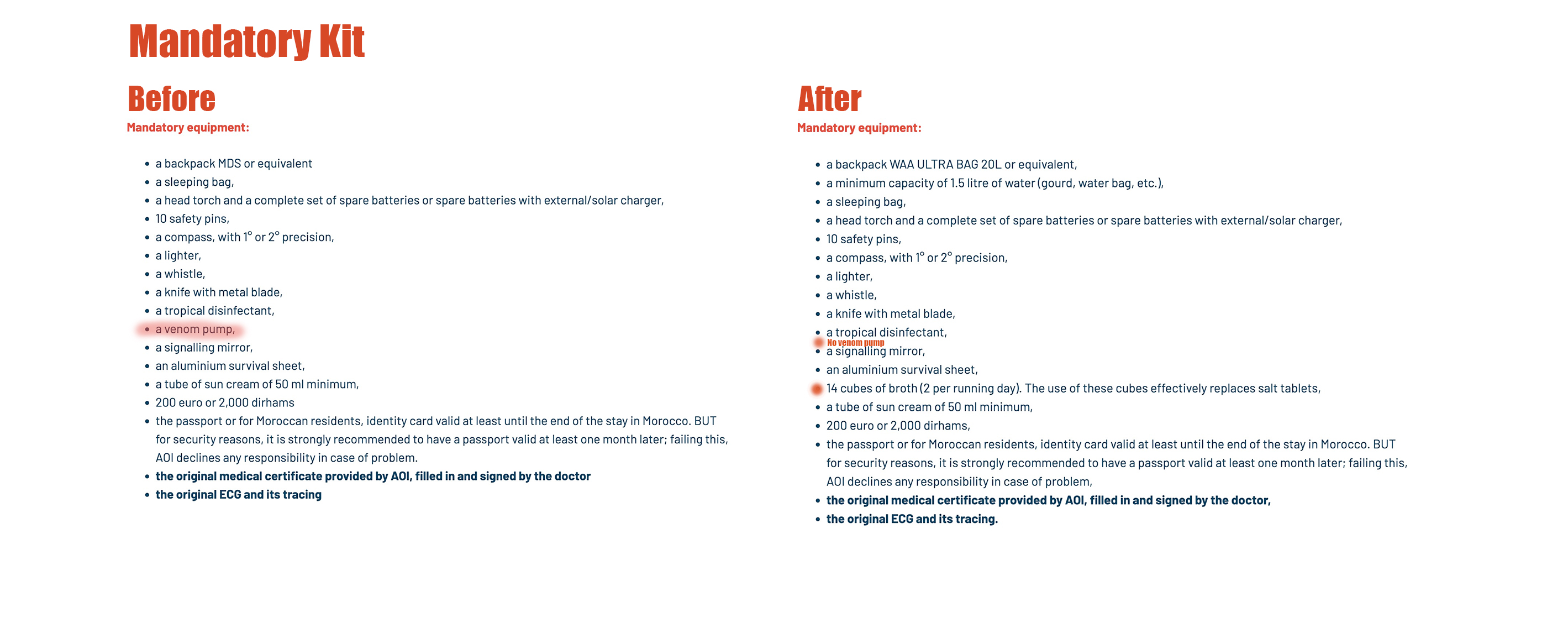
Salt Tablets – Salt tablets will no longer be provided at the race and you now must have a mandatory 14 stock cubes. Of course, you are recommended to work out your electrolyte needs and plan accordingly. You are welcome to take your own salt tablets or similar product such as those provided by Precision Hydration.
Feet – Look after them, along with dehydration, blistered and damaged feet are a key reason for failure in any multi-day race. Prepare them before the race especially trimming nails back and knowing what socks work for you. After each day in the race, clean feet, allow them to breathe and look after them. Get any sore or hot points addressed immediately.
Mandatory kit – You are supplied with a mandatory kit list and you MUST have everything on that list. Please note, for 2024 the venom pump has been removed and you must have 14 cubes of broth.
You – You signed up for the challenge, you wanted to be on the start line and therefore you are responsible for the outcome. Believe me, the you that leaves the Sahara is not the same you that entered. Keep perspective, the MDS journey is an enhancement of you as a person. It’s easy to become obsessed, ultimately the majority of runners at MDS are enthusiasts, if you keep that in mind the journey will be a complete one. The legs, lungs, heart and feet will only get you so far, then the mind will take over. Mentally prepare for the challenge ahead and make mental plans for how to survive and motivate yourself when the going gets tough. Laugh when you hit rock bottom. Laugh when you are going the toilet in a brown plastic bag. Laugh with and at your tent mates and fellow runners. The comradeship of MDS is quite unique, embrace it.
Training – Plan ahead, formulate a long term plan and aim for consistency.
Walking – Learn to walk. Many think they will run 80% and walk 20%, if you are lucky, it’s the other way around. Make walking a positive, make walking fast, make walking productive.
Poles – For many, poles are a huge advantage. They are like 4-wheel drive and without doubt, they make you walk faster. But you must train with them and learn how to use them.
Shoes – NEVER take advice from anyone online that tells you that ‘X’ is the shoe to wear for MDS unless they know you and your run style. Forget the advice about going up a size or two sizes. It’s a recipe for disaster unless you know that your feet swell? A shoe that is too big will allow your foot to move, a moving foot causes friction, friction causes blisters and the rest of the story speaks for itself. General advice is that if you have a ‘thumb nail’ of room at the front of the shoe above the longest toe, this generally works. Notice I say ‘generally’ – there are exceptions. One thing that may happen, is your foot may get wider (rarely or never longer) with the heat and additional time on feet, therefore a shoe with a wider toe box often works well for many runners.
Equipment – Minimum pack weight is 6.5kg plus water, get as close to this as you can. Additional weight is additional stress and just makes the journey harder. Luxuries are ok if they improve the journey and make it easier, music is a good example of an additional extra. I can’t really think of anything else…
Friends – Tent mates will pull you through and motivate you. They will become friends for life. Ideally find tent mates before you head out to the Sahara and plan your tent group.
Admin and preparation that you may not think of:
Take essentials on the plane and wear your run apparel and shoes. That way, should a baggage disaster happen your chances of racing improve.
Take food with you for the travel and on the plane.
The journey from the airport to bivouac 1 can be lengthy be prepared with your own snacks and drinks. MDS do provide a packed lunch.
Night 1 and night 2 in bivouac are NOT self-sufficient so take extras such as an inflatable bed, food and luxuries that you are happy to give away to the berbers. May as well have 2 comfortable nights and a comfortable day before the racing starts.
Food before the race starts is now down to you. Be prepared to have plenty of variety and remeber, within reason, this can be anything!
Admin day can be lengthy multi-hour experience. Take water and snacks for when standing in line and maybe take an umbrella so you have shade.
Keep sun screen on and keep hydrated. No need to drink vast volumes – drink to thirst before the racing starts.
Have additional items such as a base layer, sleeping bag liner and other items that may be on a ‘question’ list for the race. On night 1 and before you go to admin, you can make final decisions of what to and what not to take. Particularly important if you think you may be cold at night.
Remember that after bag drop and check-in you have no access to any additional items, however, you only become completely self-sufficient when you start the race. With that in mind, you can have additional food and luxuries with you until day 1 kick-off, it’s a useful tip and does mean that you can have additional comfort for a good 12-hours.
Conclusions:
Marathon des Sables is a magical and life changing journey as are most if not all multi-day races. It really is a true challenge of mind and body to race over many days, irrespective if you complete the race in just over 20-hours or 60+ hours. It’s a hark back to a more primitive time, a time without clutter and modern technology. Embrace this. Embrace the silence of the surroundings and the simplicity of placing one foot in front of the other.
As we countdown to the 2024 edition of the Marathon des Sables – The Legendary, we will be providing a series of monthly updates, articles, interviews and podcasts.
The 2024 Marathon des Sables – The Legendarywill be the longest edition in the 37-year history of the race. At 252km, the event will now take place over 6-stages/ 7-days and not 5-stages/ 6-days as announced in late 2023.
It was clear initially that the 6th stage charity stage would disappear, however, on reflection, the new organisation have decided to continue with 6-stages but this time, all stages will be timed. The charity stage in previous editions was not timed.
The infamous long day which typically took place on stage 4 will now move to stage 3 for 2024, this will be day 3 and day 4 of the race as it has an extended time allowance due to the distance.
What does the above mean for the runner?
252km’s is a long way, but the race has always been advertised as 250km’s, so, although the race has fluctuated in distance over the years, the 252km should not come as any great surprise.
The timed stages now numbering 6 and not 5 will make a big difference, especially with the long day coming on stage 3. This will mean that stage 4, stage 5 and stage 6 will need to approximately cover 100km. This makes for a tough end to the week. In past editions, the long day was feared but on completion, many had the mindset, ‘It is just a marathon to go!’ Now it will be significantly more.
The daily distances are typically never disclosed before the race and the jury is out if the distances will be announced pre arrival in Morocco, watch this space! However, it is pretty easy to guess on approximate distances.
Historically, distances for the stages are listed as follows:
Stage 1 from 28 to 35 km
Stage 2 from 28 to 39 km
Stage 3 from 28 to 39 km
Stage 4 (The Long One) from 75 to 85 km (over 2 days)
Stage 5 (Marathon Stage) of 42.195 km
Stage 6 Charity
We know the 2024 edition will be 252km, so, as a guess and guide the following will provide a good estimation, the daily figures are +/-, for example, stage 1 could be 30km and stage 2 40km.
Stage 1: 32km (day 1) running total: 32km
Stage 2: 38km (day 2) running total: 70km
Stage 3: 83km (day 3 and 4) running total: 153
Stage 4: 42km (day 5) running total: 195km
Stage 5: 36km (day 6) running total: 23km
Stage 6: 21km (day 7) running total: 252km
Total: 252km
With the above information, you now have at least a template and guide for which to plan around.
OTHER KEY CHANGES
Salt Tablets
As I announced in 2023, it was my expectation that salt tablets would not be provided for the 2024 race. The new revised mandatory requirement for the race requires 14 broth cubes – these cubes are known to be salty. You have no choice here, you must have them. However, it will be your decision if you use them? My advice is to plan a strategy that works for you. Listen to my podcast with Andy Blow from Precision Hydration HERE. Remember, this is a self-sufficient race, so, be prepared to be self-sufficient and have a plan/ strategy that works for you.
Water Capacity
Another key change was the requirement for ‘A minimum capacity of 3 litres of water’ in the form of bottles, bladder etc. This has now been revised and we go back to 1.5 ltr capacity. This is a good move. Cp’s will be increased so that runner’s will only need to carry 1.5 liters. However, on the long day, an additional 1.5 ltr bottle of water will be provided either at the start or at cp1 (making 3 ltr to carry) therefore the capacity to carry 3 litres on the long day between cp’s is recommend. It is important that you think HOW you will carry this extra 1.5 ltr. Maybe you will have a bladder in or on your pack, maybe two additional 750ml bottles at the rear or if you have the front pack, you can slide the 1.5 bottle on top. It’s not recommended to run with a 1.5 ltr bottle in you hand, so, be prepared…
Water
Water during the stage will not be provided via 1.5 ltr bottles as in past editions. Water will be provided from a series of tables and manned staff with jugs to decant water to your empty bottles. Importantly, there had been concerns about where the water will come from, to clarify: 5L Bottles on CP -> Served in 2L jugs -> Served by staff in the runners’ bottles.
The exception being on the long day as mentioned above when a 1.5 ltr bottle will be provided at the start or cp1 and at the end of each stage when a 5 ltr bottle per participant is provided. This 5 ltr bottle will cover the evening after the stage, the morning of the next day and the required 1.5 ltr capacity starting the next stage to cp1. So, if you had planned to cut down a 1.5 ltr bottle to use as a bowl for dinner and breakfast, this will not be possible. You will now need a suitable pot or similar.
Checkpoints
Will be typically 2 to 7 per stage. On the long day, it is therefore a good assumption that checkpoints will be +/- 12km’s apart and hence the need to require 3 ltrs.
Mandatory Equipment
I will list here the mandatory equipment to avoid any confusion:
Pack such as WAA Ultra Bag 20L
Minimum capacity of 1.5 liters of water*
Sleeping bag
Head torch and spare batteries (you can have a charger/ solar charger)
10 safety pins
Compass with 1 or 2 deg precision
Lighter
Whistle
Knife
Topical disinfectant
Venom pump*has now been removed
Signal mirror
Survival blanket
14 cubes of broth***
Sun cream
200 euro or 2000 dirhams
Passport or ID card
ECG and medical
* new change but consider the long day when you will have 3 ltr.
** new change
*** to replace salt tablets
Food Requirement
You need 14,000 calories of food as a minimum, 2000 calories per day. You can of course carry more than this, but 14,000 is the minimum. You must be able to prove the calories, so, if you decant food into lighter or different packaging, make sure you keep the nutritional information.
You
In addition to the above you personally will need:
Keep the pack weight as close to the minimum 6.5kg as possible, additional weight is additional stress that you do not need.
Keep luxuries to a minimum, they only add weight. A super light Mp3 player (with good battery) and earphones is the only luxury I would consider.
Accept that this is a tough challenge, you will be stripped back to a survival mode. You will not wash, you will get dirty, you will get smelly. Accept it.
Start slow and ease into the race.
Poles can be a lifesaver and I recommend them but you must learn to use them. Those at the front do not need poles, they can run.
Learn to walk, walk and walk. Many go to the desert with the expectation of running 80% and walking 20%. The reality is it will be the other way around.
Look after your feet and start with the correct shoes for you.
Take a sleeping mat or pad. You only need to do three things: run, eat and sleep. Sleep and comfort is important for recovery.
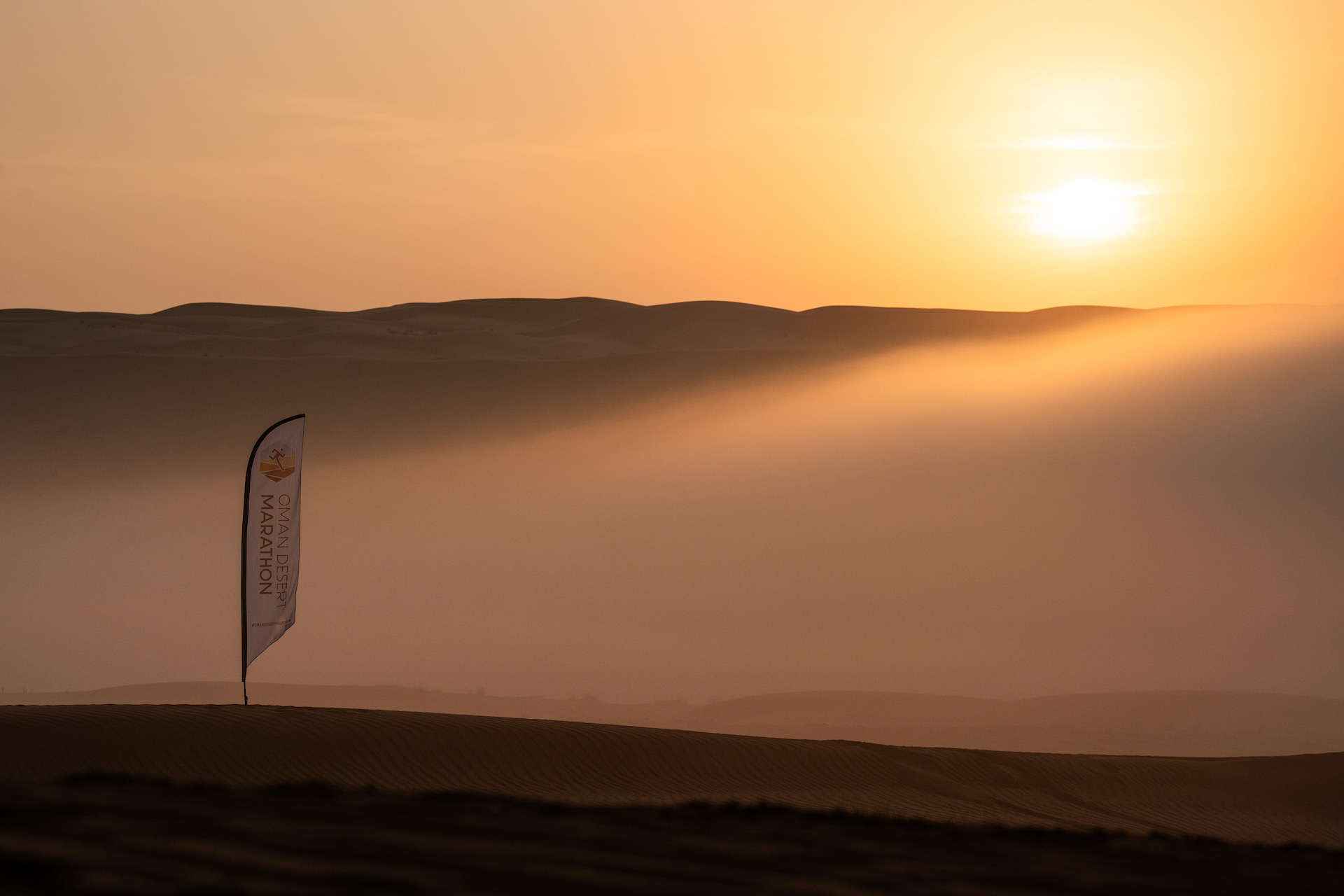
Day 2 of the Oman Desert Marathon and after day 1, there was some anxiety. At 55km’s long, the stage was set to be tough. A planned 0630 start with sunrise, would provide participants with extra time in daylight. However, the weather had different plans. An inversion came in during the night and early morning reducing visibility in the valley to zero, the start was delayed 1-hour.
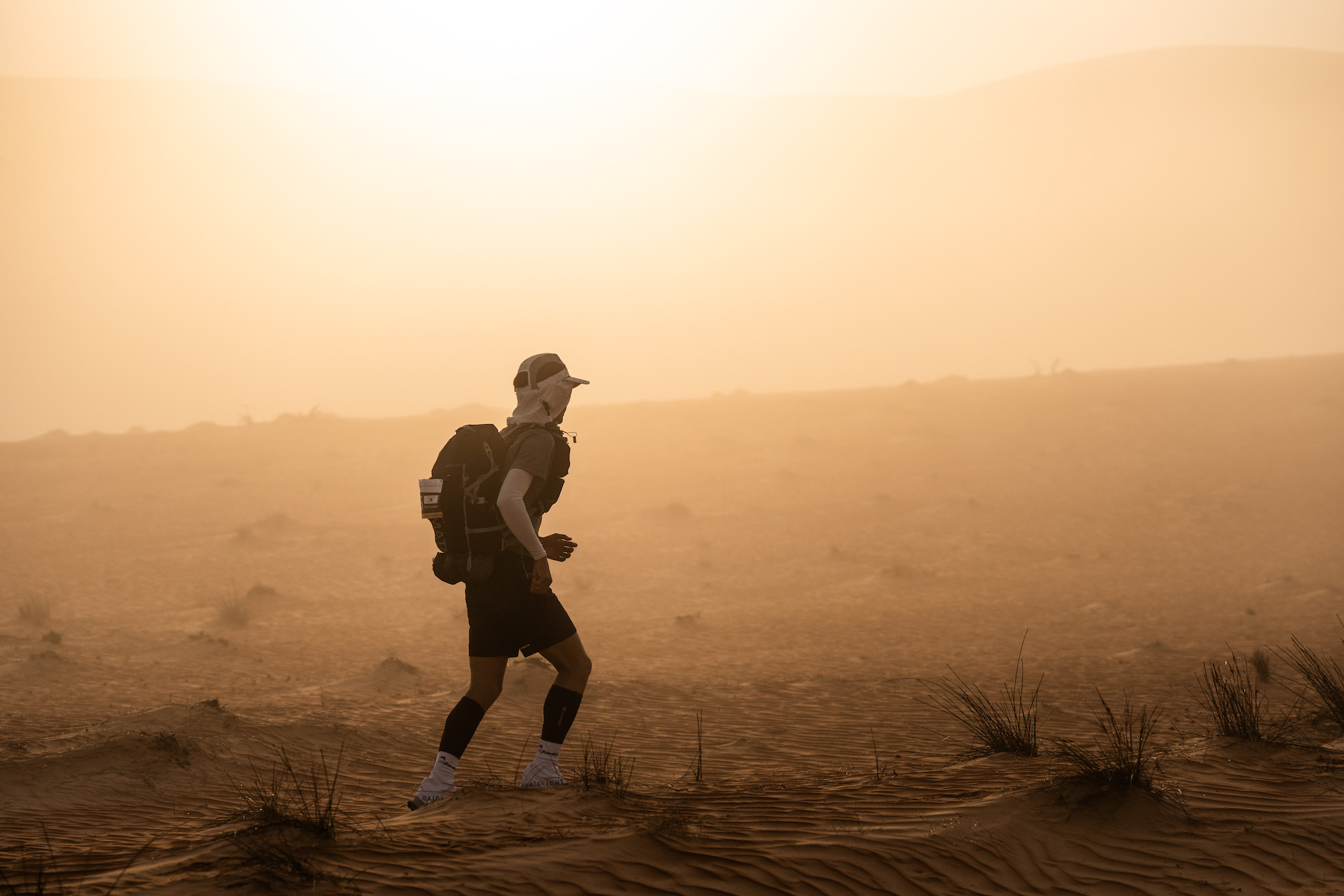
At approximately 0730, the runners were on the way despite some lingering mist. However, the mist was guaranteed to disappear quickly and it did. While it lasted, it gave an eerie feeling to the desert.
Sadly, Mohammed El Morabity was a DNS today. He was tired and feeling under the weather after long delayed travel and a tough first day. Although sad to see a competitor leave, I am sure Salah Al Saidi and Evgenii Glyva were somewhat happy to have one less El Morabity brother to deal with.
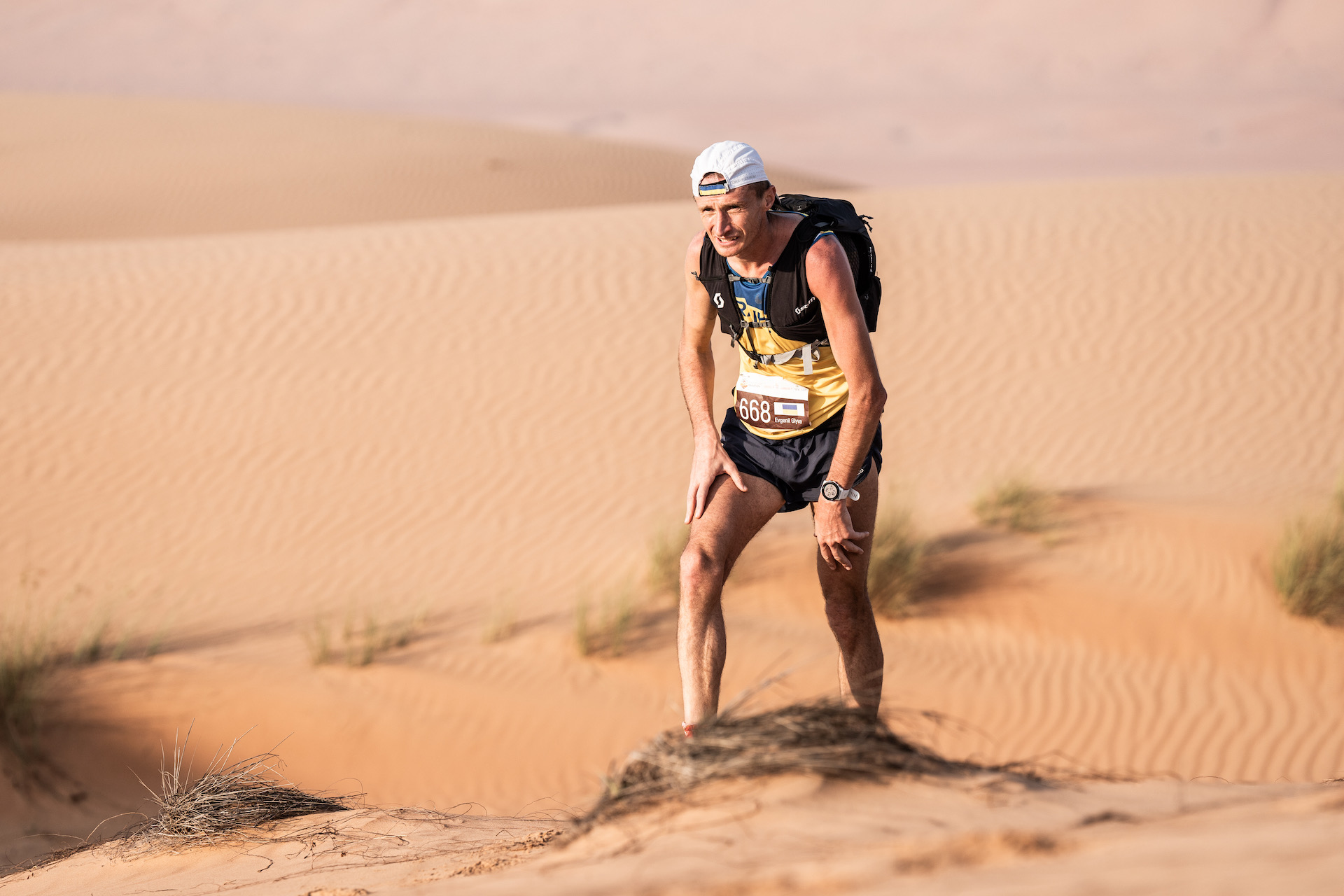
Having run a very strong stage 1, Salah Al Saidi took the race to Rachid pushing the pace. As always, Rachid started easy and looked relaxed while following and Evgenii was pushing to hold the pace.
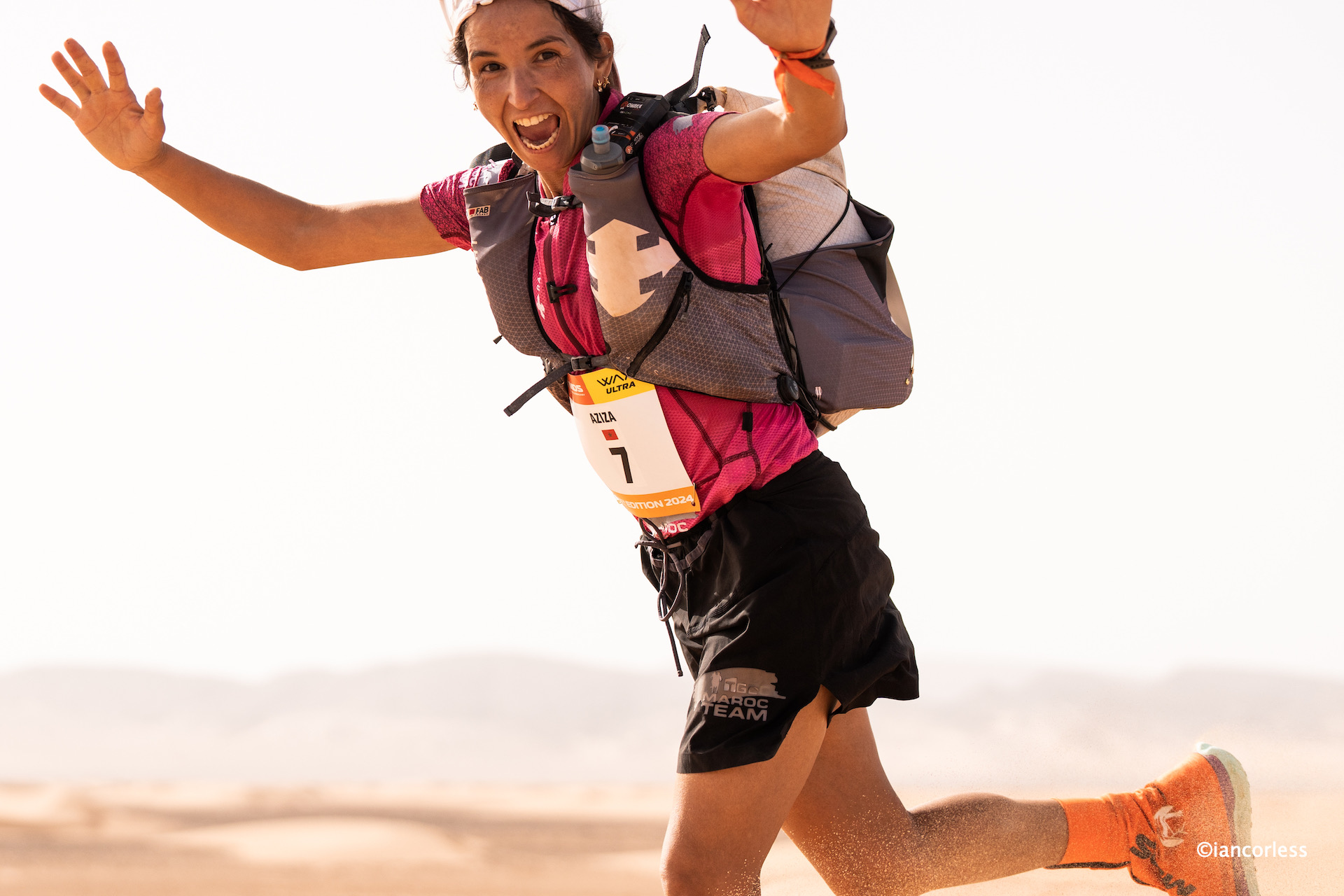
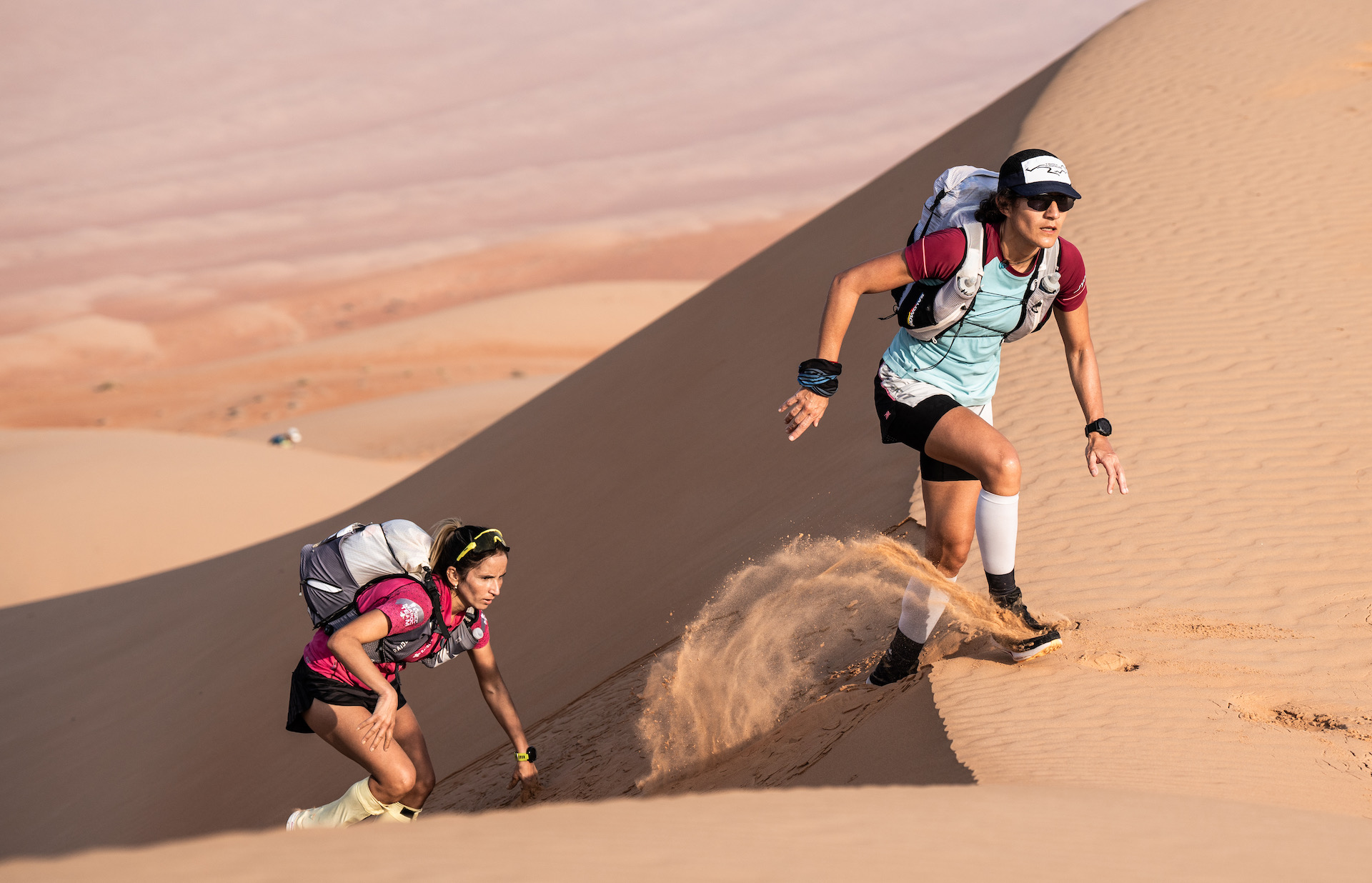
For the women, Aziza Raji must have felt very confident after her stage 1 performance and huge gap. By contrast, Aziza El Amrany was probably wondering how she could pull back any time? Kathleen Leguin who was a pre-race favourite had suffered with sickness on stage 1 but started the day feeling better and the trio ran together with Veronique Messina behind.
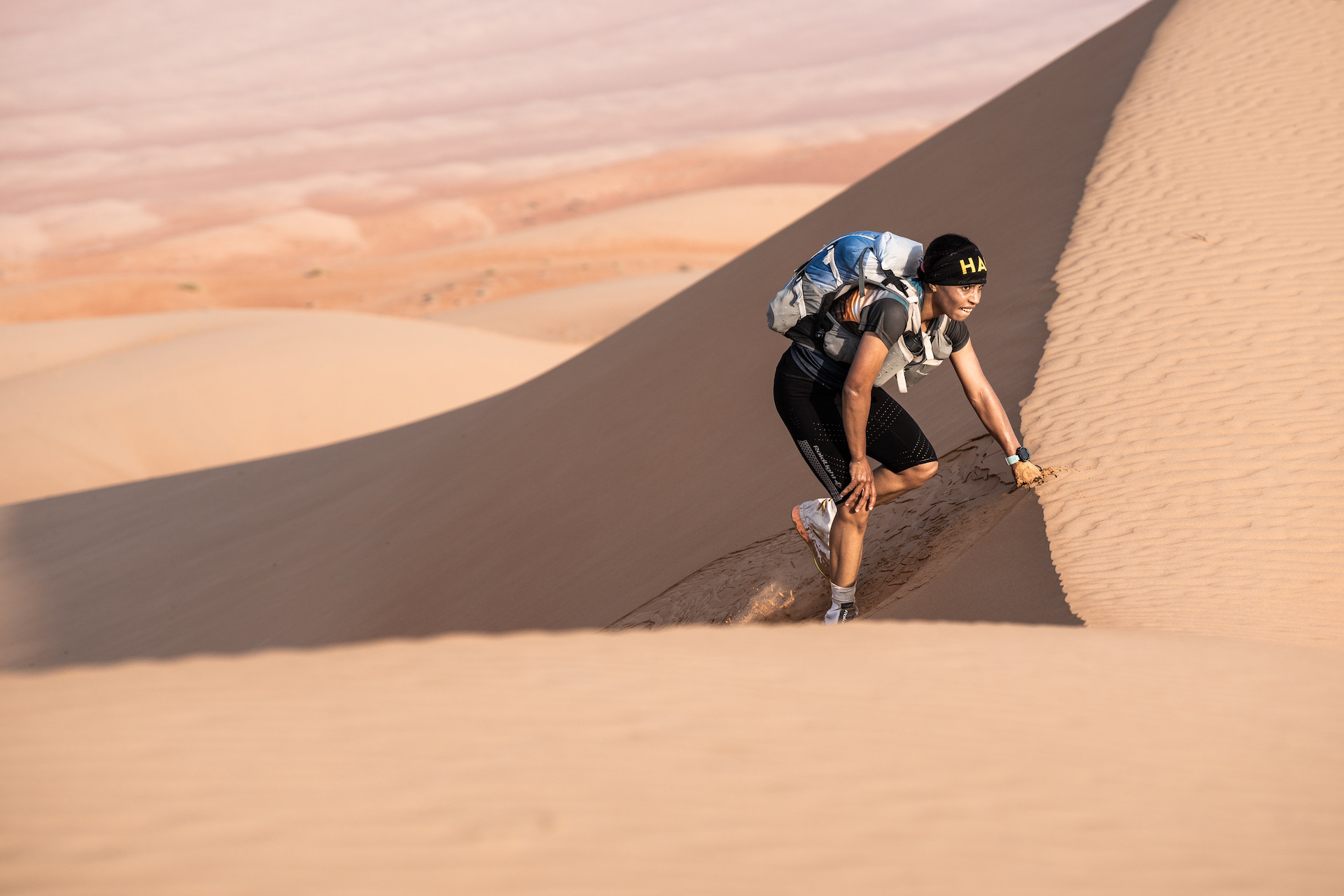
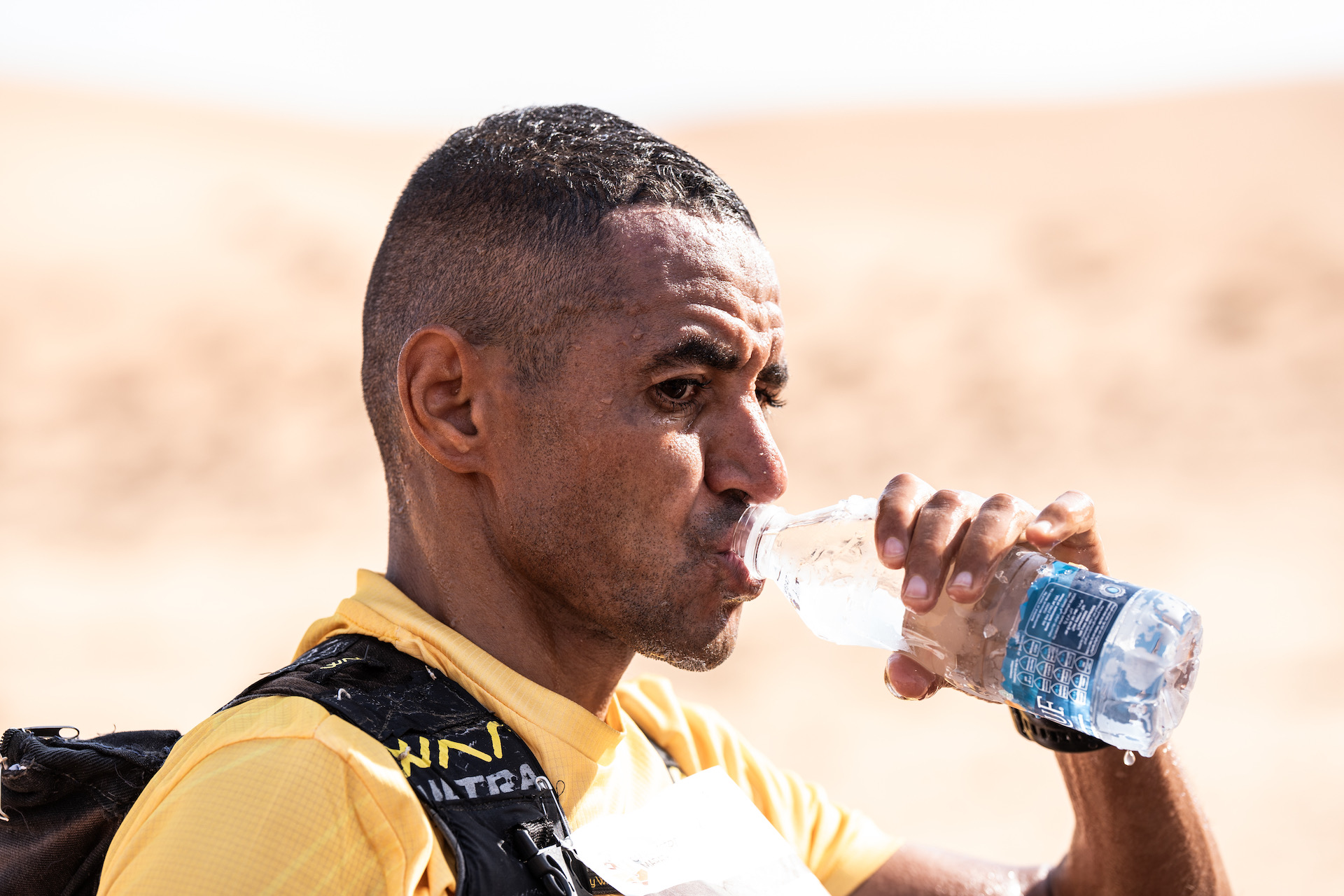
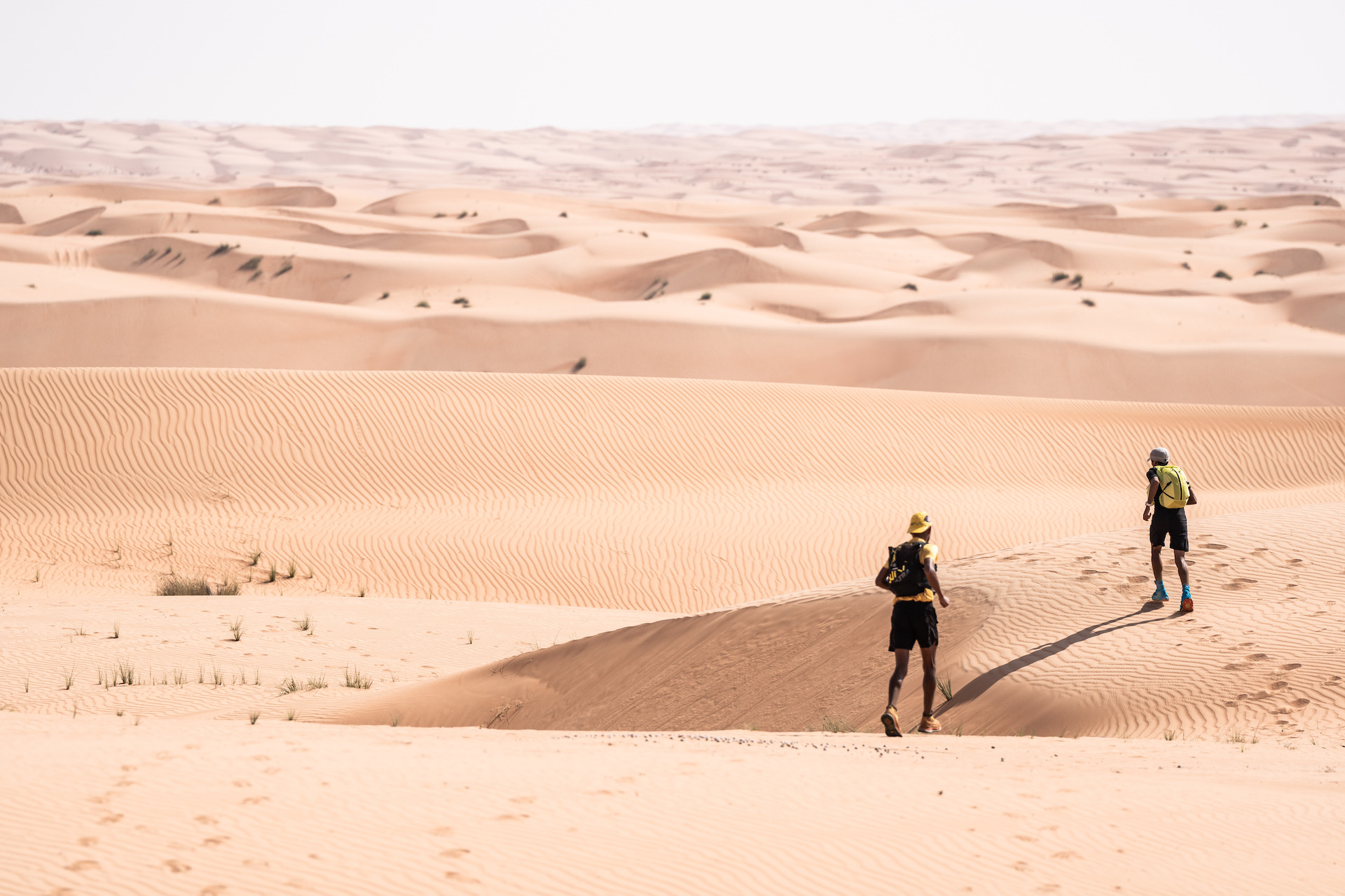
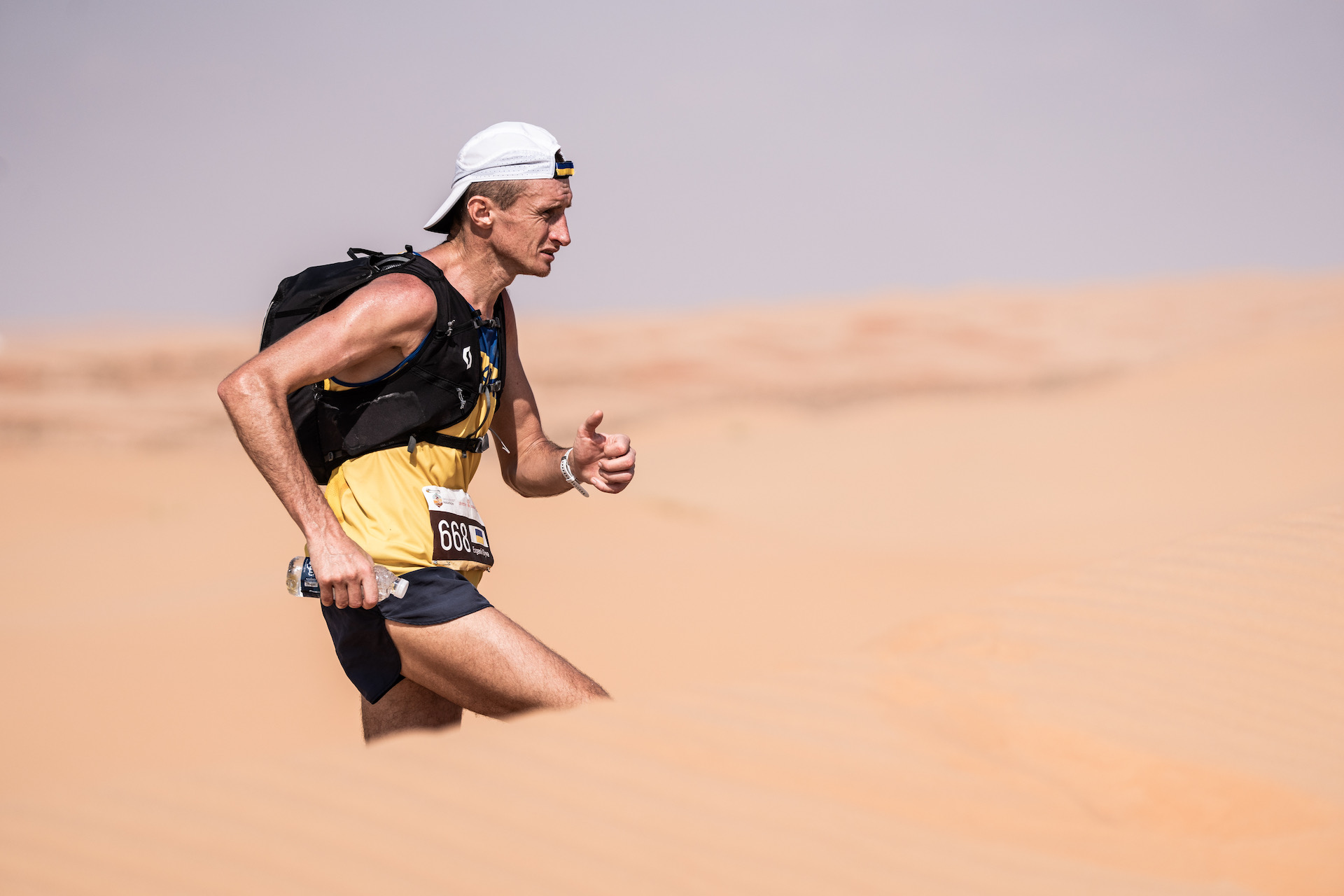
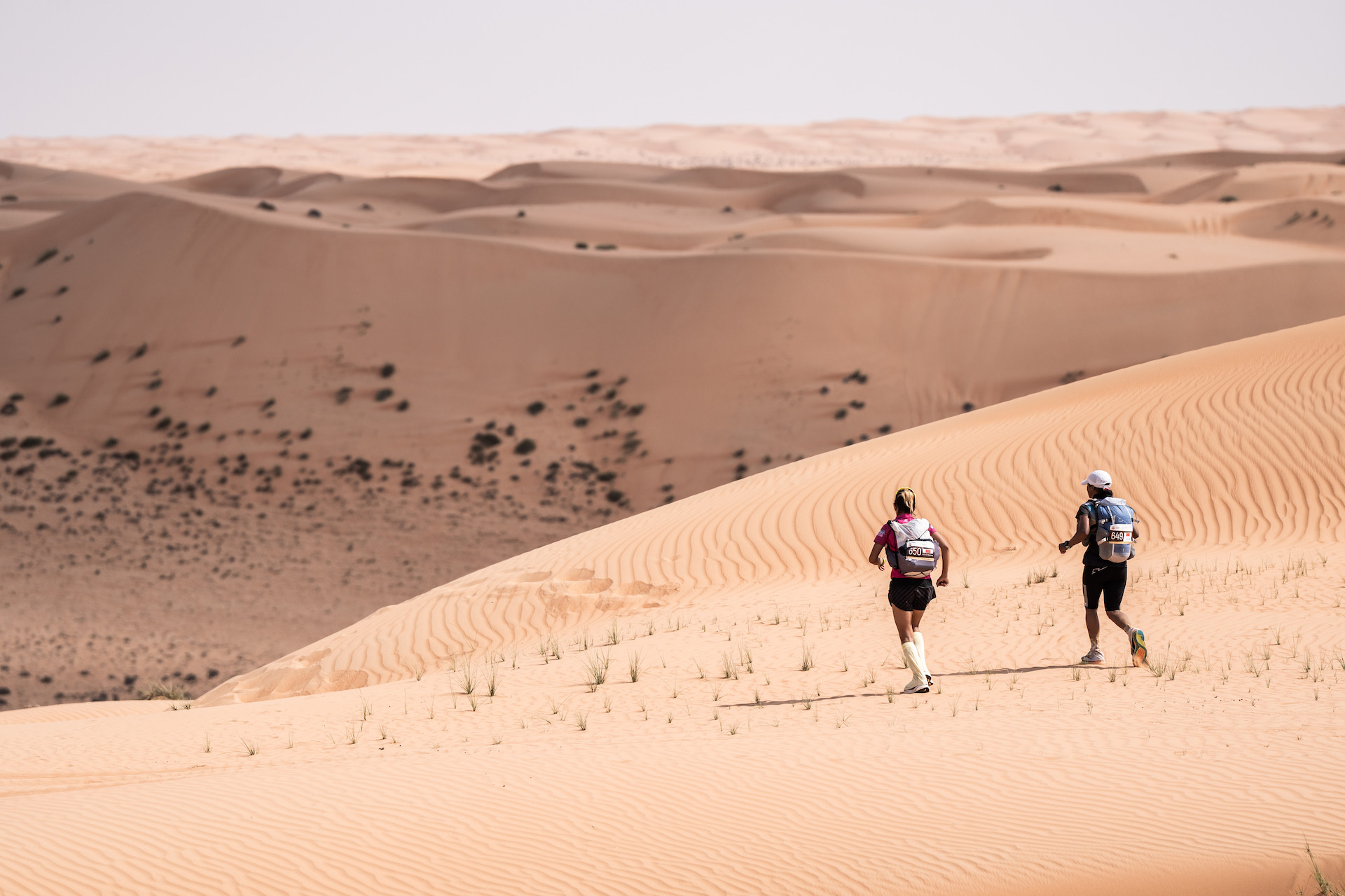
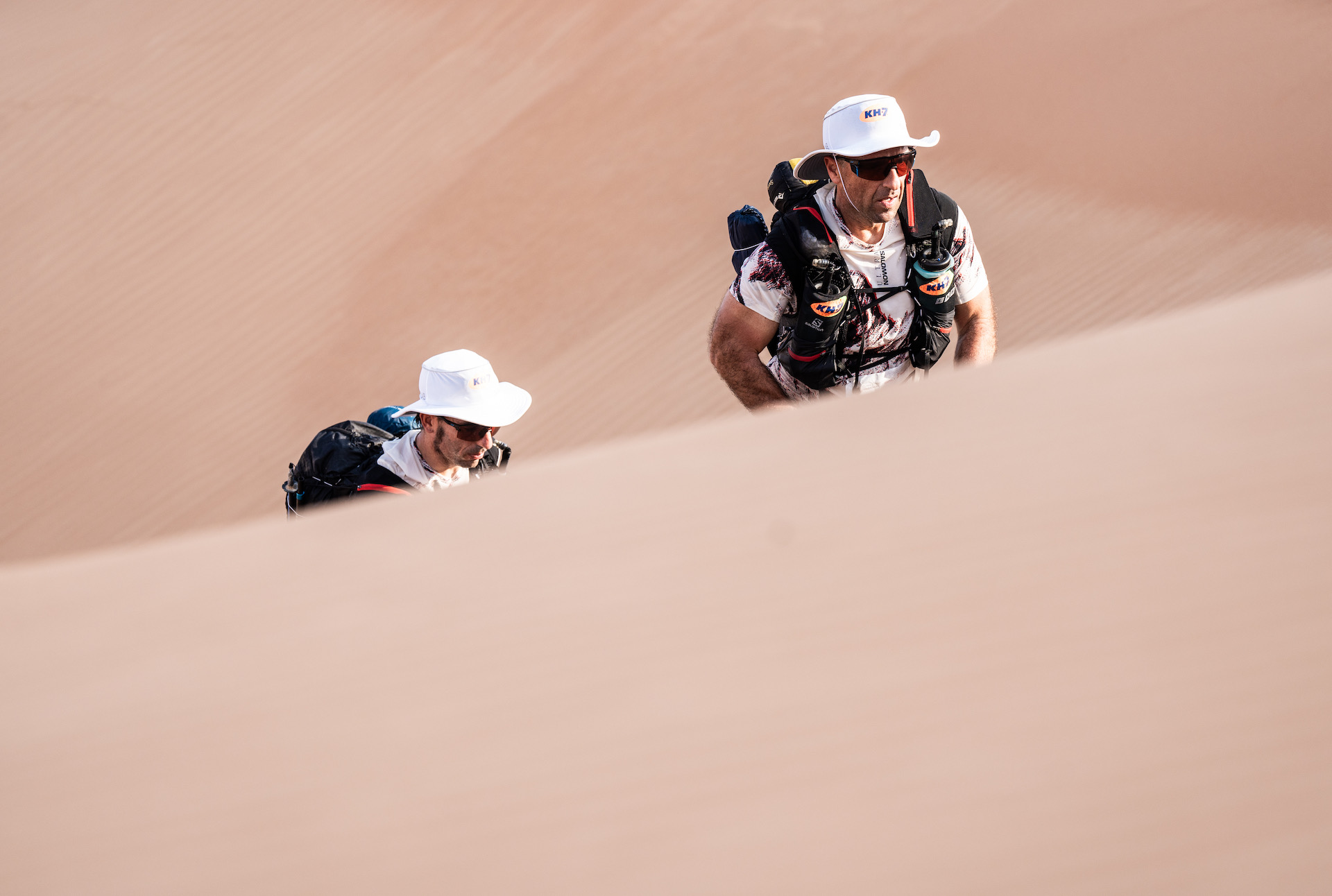
Despite 55km’s, stage 2 was billed as a more runnable and easier day, it wasn’t. There was a great deal of soft-sand, several dune section and lots of heat. It was all too much for Kathleen and sadly she withdrew from the race at cp3.
It is never easy to tell if Rachid is suffering, but today there seemed some signs of fatigue and tiredness at cp3. He left with Saleh but looked happy to hold back and let the pace be dictated.
However, in a typical Rachid move, he finally applied pressure and opened a gap crossing the line in 5:47:24 to Saleh in 6:07:43. Evgenii finished 3rd in 6:23:13.
The two Aziza’s were playing truce today and duo ran together all day, Raji happy not to loose anytime to El Amrany and at the same time share the desert with a friend.
With Kathleen out of the race, Veronique finished 3rd, the times of the top 3 8:31:06 and 8:31:07 for El Amrany and Raji, 9:04:37 for Veronique.
Results HERE and GC ranking HERE.
Albert Jorquera and Pol Makuri were battling the day and due for an early evening finish, in darkness.
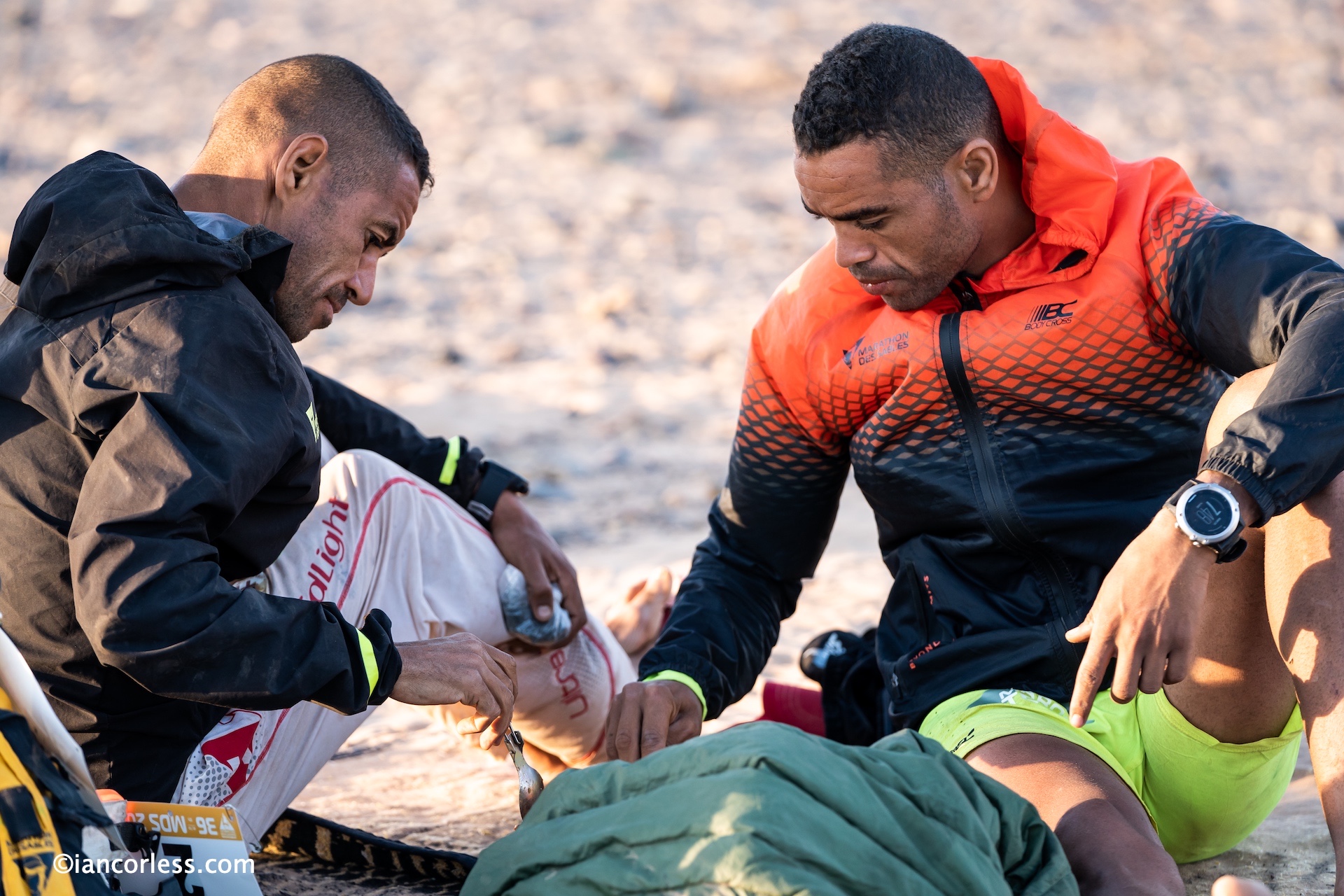
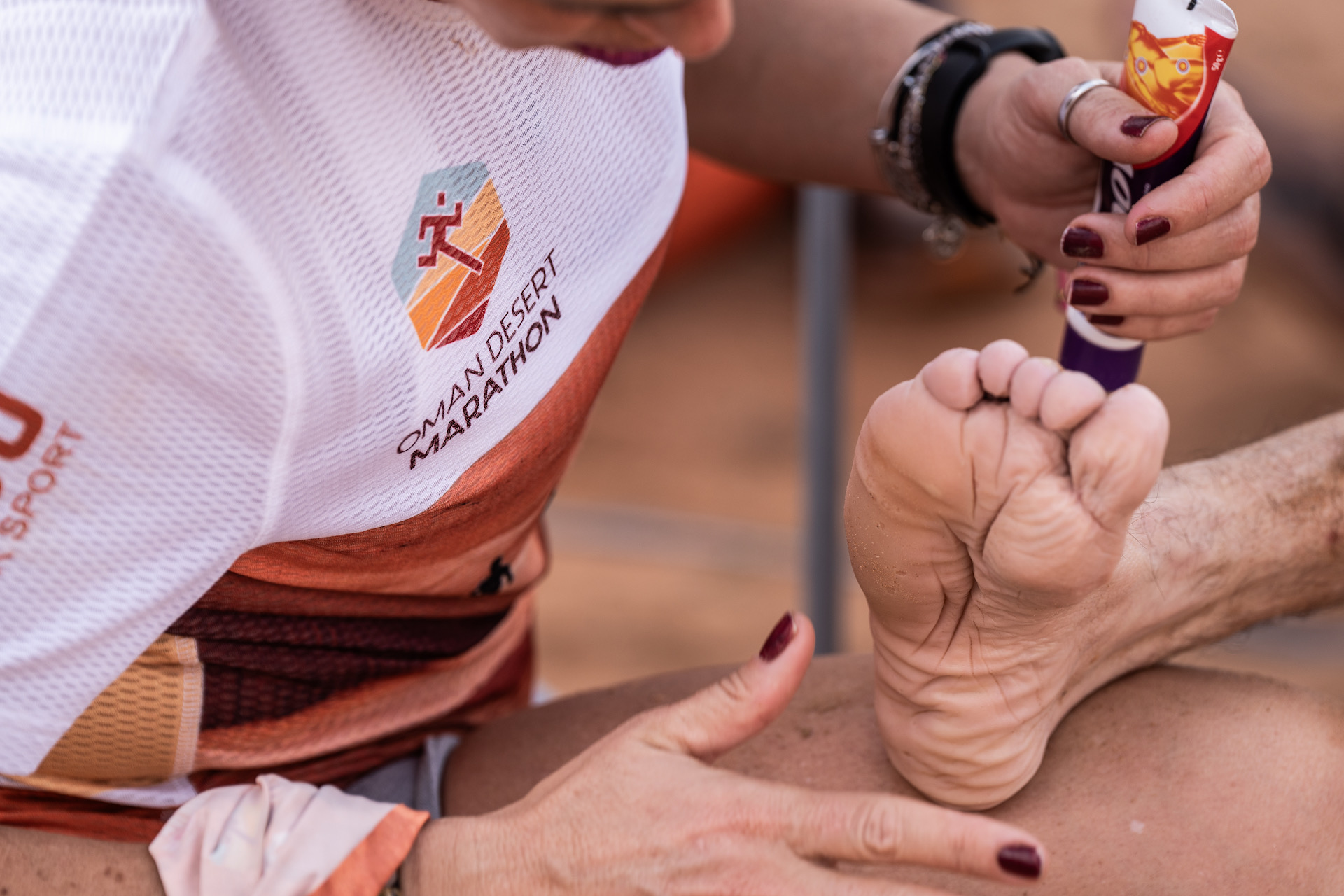
A long stop at cp3 allowed Pol to get some treatment for his feet and recharge ready for the push to the line; he’s one tough guy!
Tomorrow is stage 3, the night stage. The runner’s will start in two waves. The first around midday, the second early afternoon and they will go in to the night over roughly a marathon distance.







































 IAN CORLESS