RAB KAON Jacket Review

When it comes to mountains and outdoor terrain, UK brand RAB have been a ‘go-to’ for any outdoor enthusiast, whether that be for the Himalayas, mountaineering, trekking, climbing or a leisurely walk in the outdoors.

2020 will see RAB launch a series of new products under the heading of SKYLINE a range of products made up of ultra-lightweight clothing that does not compromise on protection. Intended for ‘fast and light’ days that blur the line between running and technical scrambling.

It’s a significant movement for the brand and as a firm RAB fan, the SKYLINE range has already gained my attention and no doubt, it will grab the attention of anyone who likes to move faster in the mountains.

I will be introducing element of the new SKYLINE range over the coming weeks, notably, the SONIC SHORT SLEEVE TEE, PACER JACKET, CHARGE JACKET and PHANTOM PULL ON.

Image ©RAB

But first, the KAON jacket. 

The new KAON jacket personifies and sets out the stall of the new direction and although it does not come under the SKYLINE banner, it certainly ticks all the boxes offering minimal insulation with low-weight and packing size. Balancing lightweight, warmth and protection, the KAON uses a combination of 800 fill Goose Down and Synthetic Status insulation. Concentrating on the core, the Kaon retains warmth where it is needed, while ‘Pertex Quantum Air’ allows complete freedom of movement under the arms.

The Kaon offers zoned insulation allowing a balance between warmth without compromising movement. It mixes down for the core and ‘Stratus’ synthetic fill on the shoulders, hood and cuffs. 

The down in the core is 800FP hydrophobic down (70g in the men’s and 65g for the women.) This is significant as down, while warmer and lighter, cannot get wet – it loses warmth! However, hydrophobic down is treated with a durable water repellent that allows for quicker drying and the ability to resist water for longer. In a nutshell, it makes the Kaon far more usable in a variety of situations.

The Stratus synthetic fill is significant as it allows the jacket to be more breathable, dry out faster and is 20% less absorbent to other rival insulation. Synthetic is effective at keeping one warm, even when wet, so, it is ideal for damp/ wet conditions. RAB have added this to key areas of stress, either from the weather or equipment or a combination of the two. For example, on the shoulders, synthetic insulation will be far more durable with pressure from rucksack straps. Also, when compressed, it retains warmth, unlike down which requires loft.

The Atmos outer shell will still allow for loft while reducing down leakage making a perfect combination of warmth v weight.

Under the arms and down the side of the torso, Pertex Quantum Air is used which allows heat to escape and therefore allowing for body temperature regulation, always a difficult balance when moving fast and light.

IN USE 

The KAON is a wonderful crossover jacket for mountain runs and alpinists who want to move fast and light but be prepared for any potential inclement conditions that the mountains can throw at you. 

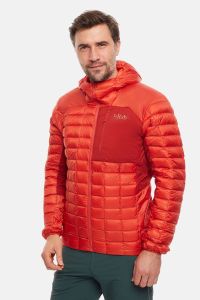
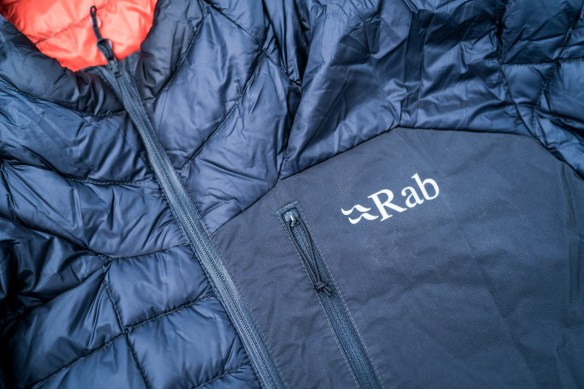
On first look, it is a simple jacket with a full-length zip, hood (that will allow for a helmet), high collar for warmth, one chest pocket, no side pockets and the sides and under arms use a different more flexible and breathable fabric. It has stitch through construction that provides a small square look to the jacket which ensure the insulation stays put.

The fit is slightly tailored, RAB say ‘slim’ but it is not super tight. Movement is not compromised. The arms are a normal length with a simple elasticated cuff. The jacket length sits just below the waist and for me, covers my backside. When zipped up, the neck goes nice and high and sits just below the chin keeping out drafts. The hood fits perfectly and has no adjustment – as mentioned, you can wear a helmet if required.

Image ©RAB

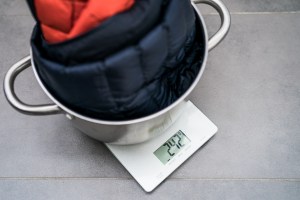
Needless to say, it is very light (240g +/-) and packs small and comes with its own stuff sack.

It is available in 3 colours, ebony (blue), firecracker (red) and dark sulphur (yellow).

I normally wear medium and medium is perfect in the KAON, size options are XXS to XXL.

 Having used the jacket as we transitioned from Winter to Spring, I have found it perfect or everyday use. On chilly days I start with it on and then remove when my core is warm. It packs away small and fits in the side pocket of my Osprey Talon 11 pack (to provide an example.) On warmer days, I have added the KAON to my pack in the assurance that should the weather change, I have an excellent light layer that will work. In conjunction with a lightweight jacket, such as the PACER (here) – I have warmth and waterproof for well under 500g.

SUMMARY

The KAON is one of those essential kit items when going to the mountains. It’s size and weight make it a ‘mandatory’ item for me – there is no reason not to take it! Warm, lightweight and packs small = perfect.

RAB HERE

Please support this website. I believe everyone deserves to read quality, independent and factual articles – that’s why this website is open to all. Free press has never been so vital. I hope I can keep providing independent articles with your help. Any contribution, however big or small, is so valuable to help finance regular content. Please support me on Patreon HERE.

Follow on:

Instagram – @iancorlessphotography

Twitter – @talkultra

facebook.com/iancorlessphotography

Web – www.iancorless.com

Web – www.iancorlessphotography.com

Image sales –www.iancorless.photoshelter.com

the INTERVIEWS Season 1 – Episode 13 : Max King

Max King born February 24, 1980, is an American ultra-marathoner. He was the winner at the 2014 IAU 100 km World Championships and the 2011 World Mountain Running Championships. King earned the bronze medal at the 2016 NACAC Cross Country Championships / Pan American Cross Country Cup.
He has also won numerous national titles at various distances ranging from track to ultra marathon. He has also excelled at OCR becoming Warrior Dash World Champion. In addition, he has won multiple national runner of the year awards.
.
First recorded in 2012.
Episode 0h 39m 59s
Talk Ultra back catalogue HERE
*****
Hosted on ANCHOR (HERE) the INTERVIEWS will also be available to listen on many other players, including SPOTIFY (HERE).
ANCHOR app on Apple HERE and Google HERE
Download links will be added in due course.
Apple Podcasts HERE
Breaker HERE
Castbox
Google Podcasts HERE
Overcast HERE
Pocket Casts  HERE
RadioPublic HERE
Spotify HERE
Stitcher
*****
TALK ULTRA podcast will be released as normal providing you long shows as it has always done with ideally two shows per month. The back catalogue will be released randomly via the INTERVIEWS and not chronologically.
*****

The Immediate Future of Racing post Covid-19

The loneliness of the long distance runner.

Life has been turned upside down. We currently struggle to know what day it is, what month we are in and we have so many questions about what the future holds.

One thing is for sure, at the moment, we have no answers, just many, many questions.

At some point, one day, restrictions will ease…

But, importantly, the day after will be no different. The virus will still be around. We will all still be susceptible to catching the virus, unless a vaccine is found.

Update Apr 29th – ‘Germany’s rate of COVID-19 infections grows after lockdown eased.’

‘Germany faces the prospect of having to restore stricter lockdown measures as its number and rate of coronavirus infections grew again.’

Article available Here

However, it seems to be a general consensus by the experts that a vaccine will not be available till 2021.

We are living in a time of so much insecurity – lives are being lost globally, people are losing work, children are at home and the world is an element of lockdown.

So, talking about racing and running seems a little insignificant and pointless in the context of the above, but I, and I know many of you are asking the question, when will racing return?

Firstly, the race calendar to August has been pretty much wiped out globally. Many races and RD’s accepted the situation, cancelled events and said, ‘we will see you in 2021!’ But, for every race that cancelled, another postponed to a date later in the year in the hope that restrictions would be eased and that the virus would be on the back foot. I get it, nobody wants to cancel an event.

But the postponement scenario has already created an issue with a plethora of races all now scheduled for September, October, November and December. Quite simply, the back end of the season will have more races than runners and we will see participants having to make a choice of which race they toe the line on.

But…

For me, this is the big but, I in all honesty do not see racing returning to ‘normal’ in 2020.

I hate to be pessimistic, but the global situation is so dire that the cessation from lockdown to normal is going to be months, not days or weeks.

Prof Chris Whitty said it was “wholly unrealistic” to expect life would suddenly return to normal soon. He said “in the long run” the ideal way out would be via a “highly effective vaccine” or drugs to treat the disease. But he warned that the chance of having those within the next calendar year was “incredibly small”. – Via BBC News

Read

Race cancellation and Covid-19 HERE

Covid-19 – A Guide HERE
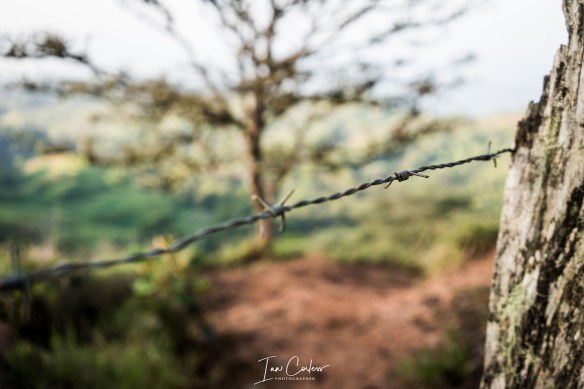
Currently, many trails are closed.

THE SHORT-TERM FUTURE OF COVID-19 AND RACING

Firstly, we are going to be in a yoyo period with second and third phase infection as lockdowns are eased. This will create additional peaks and troughs. This in turn, may require governments to reapply and ease restrictions so as to prevent overload on health systems.

It will be a period of controlled herd immunity until a vaccine comes. Needless to say, the old, frail, sick and anyone in care homes will need to be protected.

Suppression measures will slowly be released, firstly with schools returning (this is already happening in Norway and soon Germany,) then retail outlets will open with measures to control how many people can be in a store and controls on social distancing. Restaurants may open with controlled measures such as the client must be seated, only hot food can be consumed, and tables must be spaced accordingly as per government and health specifications.

When one takes into consideration the above, this accounts for May, June and July and of course, in each country, the situation will be monitored. As more people move freely, the virus will spread. If the spread is too great, restrictions may be reimposed to slow the spread down and so on. So, it’s easy to see that planning August, September and beyond is not something one can do with any certainty or guarantee.

Just today, Val d’Aran by UTMB®, has been cancelled and will take place in 2021. Xavier Pocino, director, explained:

“Our priority is the health and safety of the participants as well as the population of the Val d’Aran. Given the current context, it is therefore preferable to postpone the race in order to guarantee the health and logistics of the event. We also wish to respect the dates of other races programmed for after the summer, to avoid a date clash and to allow our athletes to participate in those races, should they go ahead”.

Currently airlines are on a very restricted service, hotels are closed, restaurants are closed, and, in many places, lockdown really does not allow any travel at all. Some are allowed to exercise, from home, for 1-hour.

A picture is building that the transition from lockdown to free movement is more than likely a year away?

If travel is restricted, hotels are closed and restaurants remain unopened, quite simply, racing will be cancelled.

The short-term future of racing will be virtual, and already globally, we are seeing virtual incentives appearing. From simple scenarios of running for a daily specific time, such as 45-minutes. But also, multi-day challenges or even specific distance challenges such as 1000-miles are appearing. Take up has been impressive which only goes to show the desire for competition.

As restrictions ease, races and RD’s will need to be constantly communicating with authorities to ascertain what is and what is not possible. For example, Sweden started with a herd immunity approach in January, avoided lockdown, emphasized social distancing, protected the old and allowed group gatherings of up to 50 people. Whereas, in the UK, for example, in March it was locked down with only essential travel (shopping) and exercise (from home) with other family members allowed.
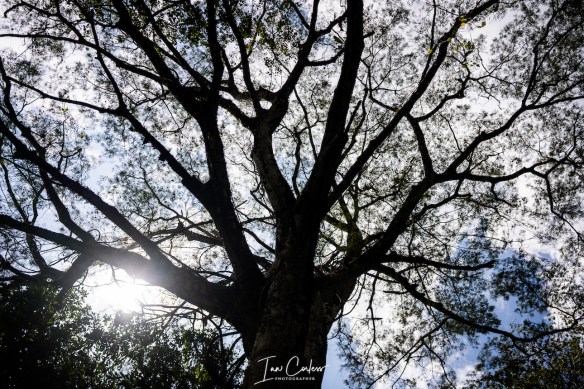
Nature is the boss.

WHAT MAY RACING LOOK LIKE INITIALLY?

It goes without saying here that maybe ALL races will be cancelled or postponed until the Covid-19 situation is under control or over.

However, there may be a transition phase. Just as children return to school, workers return to offices, runners returning to races may need to adapt.
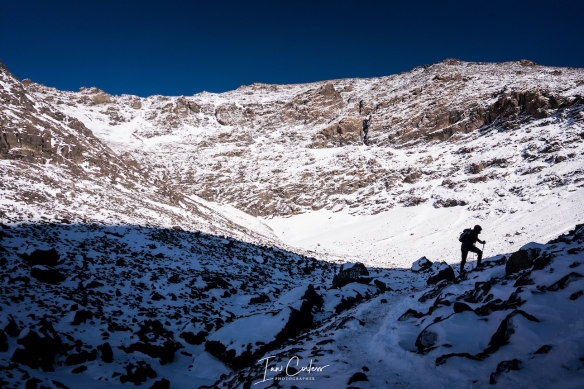
We all seek isolation and love personal adventure, maybe in the months to come, this will take over from racing?

PRE-RACE

  • Initially, global travel will be reduced and no doubt under control or restrictions. So, maybe races will only allow regional athletes. For example, only French residents can run in French races.
  • Medical certificates may be required that go beyond the standard ECG/ health check with a requirement to include testing for Covid-19.
  • Race briefings, bib provision and all admin will be done electronically so as to reduce pre-race social interaction.
  • Covid-19 appears to have a 14-day ‘active’ period, therefore, 14-days from the race start it will be a requirement to have a medical check or even in extreme cases, runners may be required to go into 14-day isolation/ quarantine before a race start. Any symptoms, no race!
  • No pre-race gatherings.

It can be easy, sort of, to social distance on the trails.

THE RACE

  • Races may have reduced numbers and they will incorporate an element of social distancing to reduce risk. For example, staggered starts of say 10-runners starting at 10-minute intervals. Seeding could be worked out by asking runners to run a 5km time trial and then provide the time to the RD? Racing would obviously be based on chip time and therefore, the race could be more like a time trial.
  • Aid stations may be removed and therefore self-sufficiency/ autonomy will be required both from a food and water perspective. This by default would mean races could only be a certain distance in length. One other alternative could be un-manned aid stations and runners would need to provide sealed drop bags which they could access at specific points. If it was a 100-mile race, for example, 4 aid/ drop stations at 20/40/60 and 80-miles. Again, aid/ drop stations would have social distancing in place.
  • The need for a personal tracking device such as a Spot or Garmin InReach may be required to guarantee security for each participant.
  • Mandatory equipment would need to cover more eventualities. Maybe *face masks and *gloves would be a requirement? *Medical opinion varies on the effectiveness and use.
  • Race routes and courses may well be unmarked and therefore the need for a navigation or a navigation device using a provided GPX track could be a requirement.
  • Volunteer help may be reduced with ongoing implications.
  • Medical support/ safety could be compromised.
  • Extreme or dangerous courses would not be allowed to reduce the potential ongoing need for medical help due to accidents.
  • Finish areas would be isolated with minimal interaction.
  • A ‘finish and go’ scenario once the race is completed.
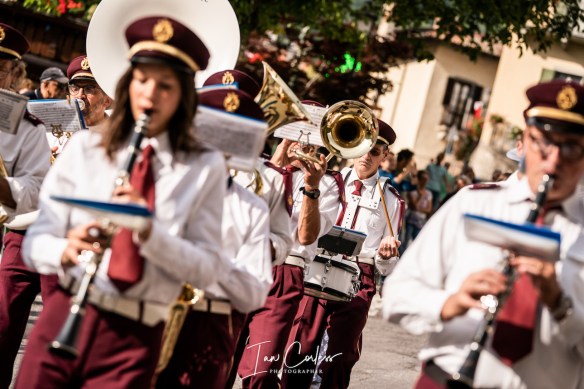
Parties and any post-race razzamatazz may be on hold for a while.

POST RACE

  • Post-race gatherings would be cancelled.
  • Awards and prizes would be done digitally, and any physical prices would be posted out.

CONCLUSION

The above are ideas and thought processes that have been bouncing around my head while in lockdown.

I actually wonder, faced with the above, how many would still want to race? Maybe all races will be cancelled until they can be run ‘as normal!’

Of course, I do think much of the above may well be fantasy or fiction, but I can see how some of the above could happen. Especially in regard to electronic communication, pre/post gatherings, social distancing and a reduction or change to how aid stations work.

Good friend, respected race director and runner, John Storkamp of Rock Steady Running (in the USA) kindly provided me with some of his thoughts:

“But I also believe that almost none of us want to get back at any cost, especially if it compromises safety.  Our own personal safety or the safety of the communities where our events are held. Once we can return, I for one also fear a diminished race experience with reminders of the virus at every turn, at least initially; i.e. no ritual of packet pickup, no festive pre-race gatherings, no mass starts where we all come together in the collective nervousness and prayer before the start, skeleton crew aid-stations filled with nervous workers exposed to every runner, no post race celebration with the telling of tales of the dragons we slayed out on the course that day.  Races have always provided us with an alternate reality, an escape for a day or two, from the stresses of daily life.  Any post-Covid races, again at least initially, will invite all of the fear of our current daily existence into what has always been one of our safest and most sacred spaces.”

Certainly, with the races I work on and communicate with, they are learning lessons now but are planning for 2021 races to be run as one would expect.

Solo running, time-trial events and FKT’s may prove popular.

*****

I asked on Twitter for some thoughts, here are the responses:

Sarah Canney – Local participants only? Pre and post race outside with masks?

Andrew Smith – I’m thinking there will be pretty much no racing this year and am just going for some personal challenges.  Hopeful next year might look different, but even then there will likely be changes – how much depends on what fundamental changes we will need to make day to day.

Mark Atkinson – Expect a fair few staggered start or time trial approaches with reduced numbers. Possibly smaller but more frequent aid points so if one is too busy you head to the next. I’m going to miss running shoulder to shoulder with a stranger through the night sharing life stories.

Dr Stacey Holloway – Maybe more FKT attempts than races and round attempts? We host a winter race in Jan, but even thinking we won’t be in 2021 and looking for maybe for Nov 2021 event and a Jan 2022 event and having its as some sort of series… not sure just ideas!

Melinda Coen – I’m expecting higher entry fees to help RDs survive  and also lower numbers, wave starts, less buffet aid at ultras and more “packaged foods”.

Via Talk Ultra Facebook page:

Yes, individual starts, unfortunately less a to b-races due to don’t want to gather people on buses. – Henrik

Proof of vaccinations required – Brian

I wonder whether some event organisers will run two or three events on the same day to stagger start times and space people out more. For example, could have a trail run, duathlon, triathlon and aquathlon. Bit of a logistical nightmare in some ways! – Ann

Reduced numbers. Staggered starts, volunteers in face masks and gloves, no more sponge bucket( that one makes me sad).
More crew or drop bags allowed to lessen need for a CP table/buffet. – Shane

Assisting injured runners may be a problem, especially on a trail. – Martin

Races will be cancelled either voluntarily by the organizers or from lack of participation.Some will go away because of financial problems. When trails are open people will do more FKT attempts and solo runs. – Ali

Self supported – no shared food at aid stations – Tim

Less corporate, More self-sufficient, longer distances between aid stations, more map reading or gps guidance less trail marking..all to the good then! – Kevin

What are your thoughts? Comment below.

Please support this website. I believe everyone deserves to read quality, independent and factual articles – that’s why this website is open to all. Free press has never been so vital. I hope I can keep providing independent articles with your help. Any contribution, however big or small, is so valuable to help finance regular content. Please support me on Patreon HERE.

Follow on:

Instagram – @iancorlessphotography

Twitter – @talkultra

facebook.com/iancorlessphotography

Web – www.iancorless.com

Web – www.iancorlessphotography.com

Image sales –www.iancorless.photoshelter.com

Initial comments re Covid-19, herd immunity and the implications were influenced by an audio interview from, ‘The Post’ with Johan Giesecke – Here
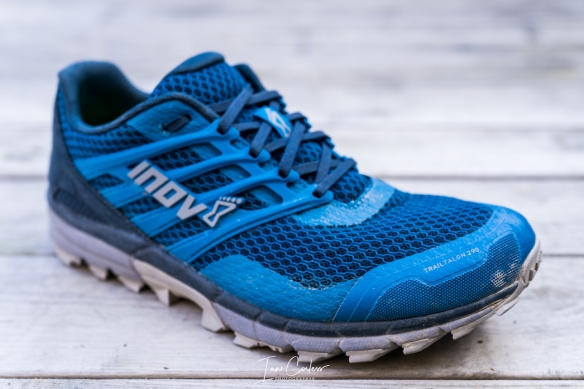
inov-8 Trail Talon 290 V2 Shoe Review

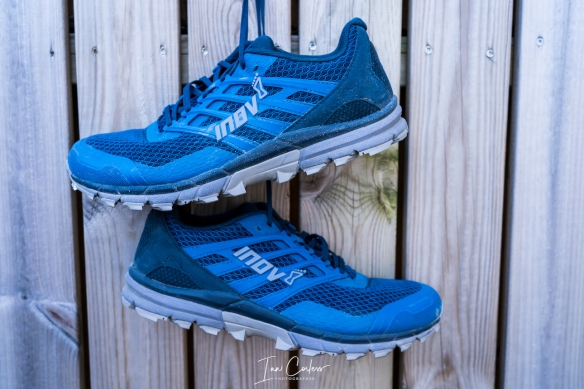
inov-8 TRAIL TALON 290 V2

TRAIL TALON 290 (8mm drop) is one of my favourite all-round trail shoes of all-time, the previous incarnations were always a ‘go-to’ for everyday running and when travelling, they were the perfect shoe to take as they managed to cover a multitude of uses, be that road, hard trail, rocks and yes, even some mud and very soft-ground.
The new version of TRAIL TALON, named TRAIL TALON 290 V2 is all that the previous incarnation was with a new upper.

The plus side from the off, is the new TRAIL TALON 290 V2 has that all important 8mm drop that is great for everyday use, not too low and too high. Therefore, it’s perfect for those longer days.

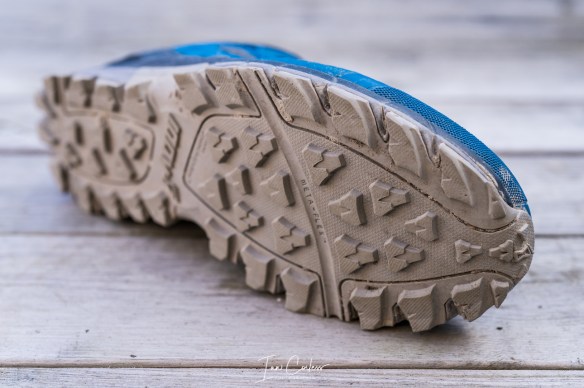
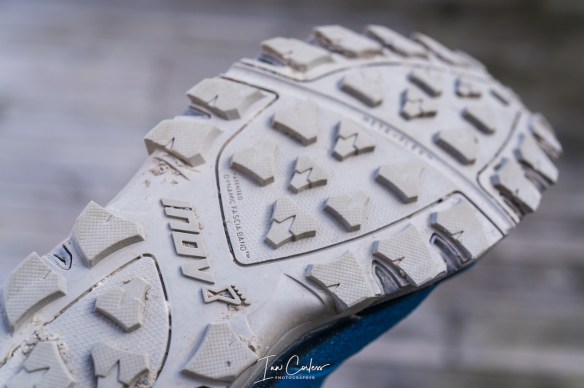
The outsole has 4mm lugs with a classic configuration, the TRAIL TALON 290 V2 is very much a dry trail/ mountain shoe that can handle a little sloppy stuff if required.

The TRAIL TALON 290 V2 is wide (fit 4 – Shoes with the higher numbers on our scale will suit athletes with a wider foot and those wanting that extra comfort in the toe box) and it has plenty of room and it allows the toes to move and splay just as in the previous model but not at the loss of a secure feel and reassurance when on more technical trail.

When running long your toes have room to move and should you be prone to swelling, the shoes have room for the foot to expand. This ‘standard fit’ is something that inov-8 have worked on and by contrast, some shoes in the inov-8 range can be purchased on ‘precision’ fit which offers a tighter and narrower toe box. The TRAIL TALON V2, when running on long, flat and consistent terrain excel with a plush ride, great return in the push-off phase and all-day comfort.

The 6mm POWER FOOTBED and TWO PIECE POWERFLOW midsole provide a cushioned ride with 1imm at the front and 19mm at the rear.  This only adds to the thoughts of inov-8 that the TRAIL TALON is a long-distance shoe, if going out for a long session or a day in the mountains, the Trail Talon 290 V2 would be ideal. Also, ideal if running a multi-day race like Marathon des Sables or similar. The higher drop allows more leeway and flexibility and I must add that the TRAIL TALON 290 V2 is a superb shoe to walk in. This is really important for those who are running long or doing multi-day races. Often, shoes are tested just running with no consideration of how the shoe transitions to a change of gait when walking. For me, the TRAIL TALON 290 is one of the best run shoes I have used when walking, the transition is seamless and comfortable no doubt attributable to the ADAPTERFIT met-cradle for better mid-foot comfort.

I am always wary of buzz words like ‘Powerflow’ and ‘Adapterfit’ as in real terms they can mean nothing. Breaking the words down, the TRAIL TALON 290 V2 has great cushioning and great mid-foot comfort.

When running, the feel of the shoe and the comfort level is high. In the 290 has a great ‘feel’ for the ground despite the extra comfort, really important for me, I never want to lose that connection with the surface I am running on.

As in the previous 290, the TRAIL TALON 290 V2 incorporates the unique on-the-shoe gaiter attachment so that should you require a Gaiter you can purchase the item separately and attach/ de-attach with ease.

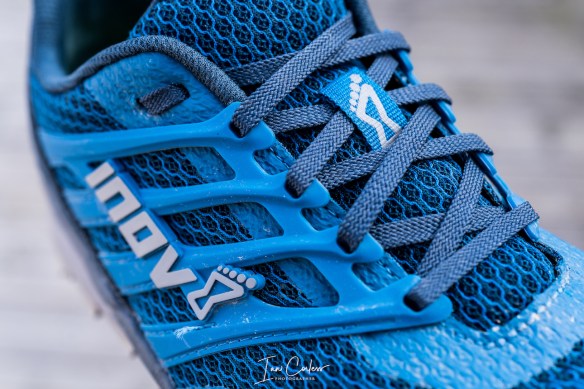
The lacing system and a gusseted tongue are winners contributing to the great out-of-the-box comfort. I have been saying this for ages, but a gusseted tongue just makes sense; It helps hold the foot in place, it stops the tongue moving and sliding to the left or right as you run and maybe most importantly it adds an additional protection to stop debris entering the shoe.

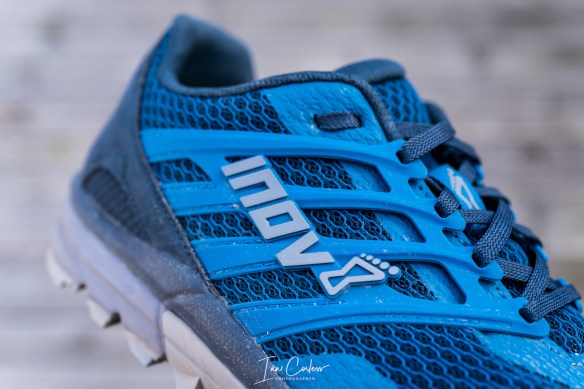
The lacing is added ‘on to’ the shoe by what effectively is a folded plastic layer. This works so well as it allows the shoes to be laced tightly or loosely as required but it also allows the front to swell within the shoe.

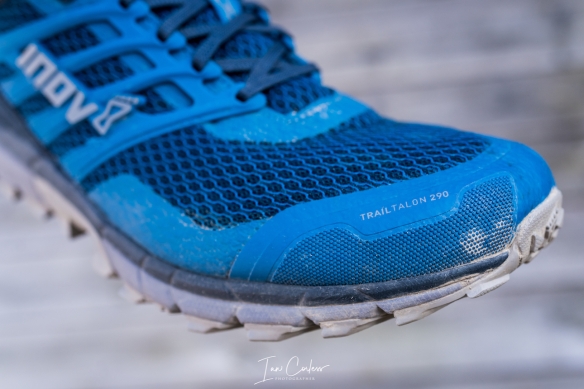
Toe protection on the shoe is good but not ridiculous. The heel box is snug, cushioned, holds the foot well and caused no rubbing on long sessions, even when walking.

Grip is compromised on any muddy trails but then again, the TRAIL TALON 290 V2 is not intended for this type of terrain, you are much better looking at a Mudclaw or similar which is designed for specific off-road and muddy use.

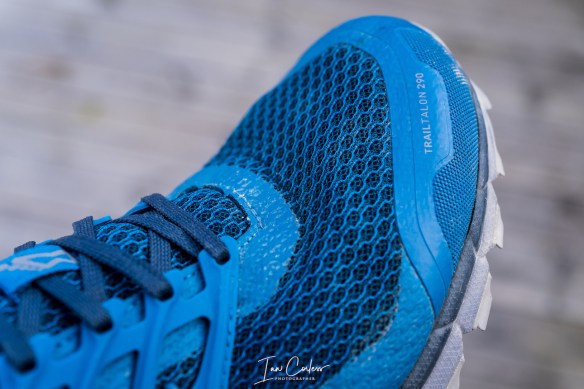
The key change and hence the V2 title; the upper. It is lighter and more breathable without a compromise to durability. Recently, inov-8 have had some complaints re upper durability but here in the 290 V2 I have no complaints. I have put 150-miles in them on a mixture of terrain and the shoes are holding up really well, both the upper and outsole.

Finally, the TRAIL TALON 290 V2 is gladly very similar to the previous incarnation and for that I am very happy. Often a brand feels the need to tweak a shoe looking for constant improvement when in reality, what they had was already fine! Gladly here, the V2 has just an upper change and that works perfectly well.

This TRAIL TALON 290 V2 was a winner before and it still is. I would go as far to say, that it is inov-8’s best shoe. It is most certainly the best all-rounder and if you were looking for one pair of trail shoes to handle many scenarios, the 290 V2 is perfect.

Specs from inov-8 (web here)

  • Iconic inov-8 rubber outsoles with multi-directional claw-shaped 4mm studs, each with a wide contact area, allow the quick release of debris and provide unrivalled grip and stability over rocky terrain.
  • The two-piece POWERFLOW midsole, constructed from two compounds – one designed to optimize comfort and the other to maximize energy return – delivers 10% better shock absorption and 15% better energy return than standard midsoles. An inbuilt Dynamic Fascia Band (DFB) mimics the “Windlass Effect”, delivering a kick of energy with each step, helping you run faster more efficiently.
  • An 8mm drop offers comfort, while new highly durable lightweight upper materials offer breathability and protection. Built around the natural anatomic structure of the foot, the next generation ADAPTERFIT met-cradle adapts to the natural movement and swelling of the foot on longer runs.
  • An External Heel Cage (EHC) wraps around the rear of the shoe and provides support in the heel – aiding foot stability and helping maintain a better gait when fatigued.
  • The new upper features extended welded TPU overlays and a rubber toe bumper to protect the foot from sharp rocks and stones. On-the-shoe gaiter hooks allow you to attach an ALL TERRAIN GAITER for additional protection, keeping loose debris out of the shoe.

Please support this website. I believe everyone deserves to read quality, independent and factual articles – that’s why this website is open to all. Free press has never been so vital. I hope I can keep providing independent articles with your help. Any contribution, however big or small, is so valuable to help finance regular content. Please support me on Patreon HERE.

Follow on:

Instagram – @iancorlessphotography

Twitter – @talkultra

facebook.com/iancorlessphotography

Web – www.iancorless.com

Web – www.iancorlessphotography.com

Image sales –www.iancorless.photoshelter.com

Transgrancanaria 2020 Race Summary

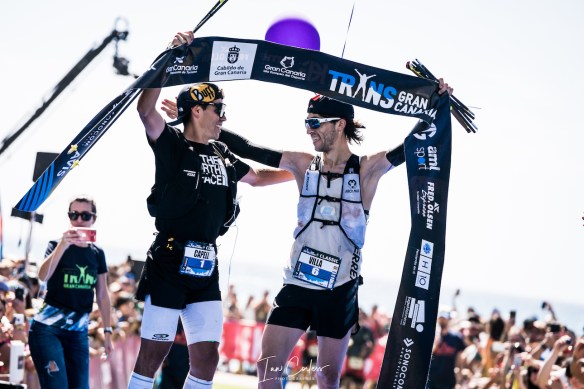
Pau Capell and Pablo Villa won the Transgracanaria HG Classic 2020 after reaching the finish-line in Faro de Maspalomas in the same time of 13:04:10 after an exciting battle of 128km.

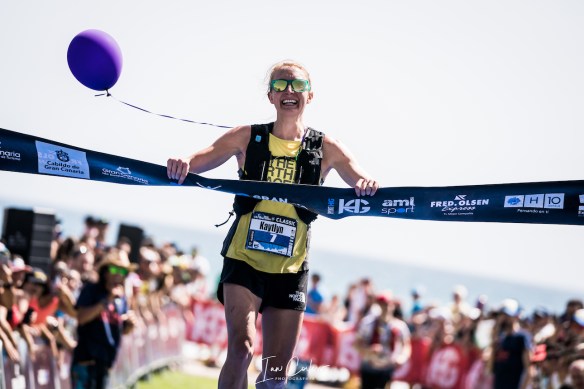
Kaytlyn Gerbin, after placing 2nd in 2019, become the champion in women’s category breaking the course record for travelling from the north to south after starting Las Palmas de Gran Canaria.

Starting at 2300 hrs on Friday March 6th, it soon became clear that an epic night and day of racing lay ahead with Chinese runners, Fuzhao Xiang and Peiquan You leading the way.

However, behind the duo, 2nd in 2019, Kaytlyn Gerbin was running a measured race following past Transgrancanaria winner, Azara Garcia who had taken the race by the horns.

For the men, 2nd at Western States in 2019, Jared Hazen and Pau Capell followed with Pablo Villa not far behind.

Teror was the first marker and it was soon clear that an epic night of racing lay ahead.

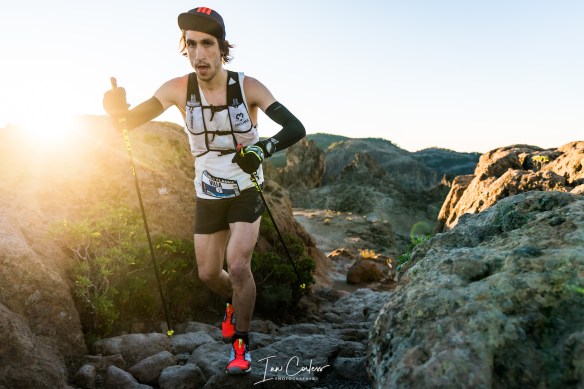
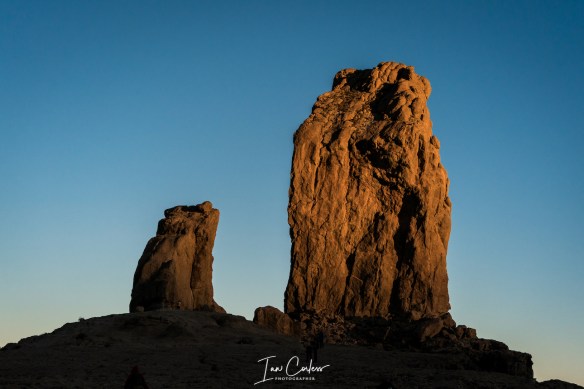
The arrival of dawn at the iconic Roque Nublo was a key indicator of how the 2020 race would play out with Villa arriving ahead of Capell leading by a slender margin. 

For the women, Garcia lead Gerbin but it was clear to see that the writing was on the wall and Gerbin would soon make a more and take the lead. Xiang followed in 3rd.

With a marathon distance to go, anything could happen and while Gerbin took control of the women’s race, Villa and Capell ran side-by-side, each testing the other with attempts to break the other. At 15km to go, the deadlock remained.

“In the race we gave everything and we tried to win…But we could not raise more battle and in the final km’s we agreed to enter together!” – Pablo Villa

They crossed the line in 13:04, some 20-minutes slower than the 2019 time recored by Capell. Dylan Bowman had a great edition of the race moving up the field to take the final podium place, a great result after a difficult time away from the sport with injury. The UK’s Harry Jones placed 4th.

Gerbin moved up one place from 2019 and secured a supreme victory with a course record, a fantastic result especially when one considers she won the 6-day, 230km multi-stage The Coastal Challenge just 3-weeks ago.

Garcia having fought from the front faded in the latter stages of the race and although at one point her 2nd place looked safe, a determined Xiang closed the gap and then passed her creating an epic battle. The Chinese runner was too strong, she finished 2nd ahead of the Spaniard. 

Women

1. Kaytlyn Gerbin. 15:14:39

2. Fuzhao Xiang. 15:25:40

3. Azara García. 15:31:36

Men

1. Pablo Villa. 13:04:10

1. Pau Capell. 13:04:10

3. Dylan Bowman. 13:40:28

Please support this website. I believe everyone deserves to read quality, independent and factual articles – that’s why this website is open to all. Free press has never been so vital. I hope I can keep providing independent articles with your help. Any contribution, however big or small, is so valuable to help finance regular content. Please support me on Patreon HERE.

Follow on:

Instagram – @iancorlessphotography

Twitter – @talkultra

facebook.com/iancorlessphotography

Web – www.iancorless.com

Web – www.iancorlessphotography.com

Image sales –www.iancorless.photoshelter.com

Episode 183 – Kaytlyn Gerbin, Cody Lind and Janine Canham

Episode 183 of Talk Ultra brings you interviews with Kaytlyn Gerbin and Cody Lind, the winners of the 2020 The Coastal Challenge. We also chat with Janine Canham about her 7 marathons on 7 continents in 7 days. Speedgoat co-hosts.
******
Talk Ultra is now on Tunein – just another way to make the show available for those who prefer not to use iTunes – HERE  You can download the Tunein APP HERE
Talk Ultra needs your help! 
We have set up a Patreon page and we are offering some great benefits for Patrons… you can even join us on the show! This is the easiest way to support Talk Ultra and help us continue to create! 
Many thanks to our Patrons who have helped via PATREON
Donate HERE
*****
00:25:15 KAYTLYN GERBIN
*****
01:15:09 CODY LIND
*****
01:58:30 JANINE CANHAM
*****
Total 03:26:40
*****
Please listen to the INTERVIEWS – please follow the show
Hosted on ANCHOR (HERE) the INTERVIEWS will also be available to listen on many other players, including SPOTIFY (HERE).
ANCHOR app on Apple HERE and Google HERE
Download links will be added in due course.
Apple Podcasts HERE
Breaker HERE
Castbox
Google Podcasts HERE
Overcast HERE
Pocket Casts  HERE
RadioPublic HERE
Spotify HERE
Stitcher
*****
Share us on Facebook – Talk Ultra FB https://www.facebook.com/talkultra/
Tweet us on Twitter – Talk Ultra on Twitter https://twitter.com/Talkultra
Please support Talk Ultra by becoming a Patron at www.patreon.com/talkultra and THANKS to all our Patrons who support us. Rand Haley and Simon Darmody get a mention on the show here for ‘Becoming 100k Runners’ with a high-tier Patronage.
*****
Stitcher You can listen on iOS HERE, Android HERE or via a web player HERE
Website – talkultra.com

CORONAVIRUS disease COVID-19 basic advice

COVID-19 aka CORONAVIRUS is creating chaos and panic over the world and rightly so. For sure, the media has taken hold of it and created a scenario of fear, however, after SARS respecting any potential pandemic is no bad thing.

I am not a medical expert but I travel and I travel a great deal. With much of my work taking places at races, public gatherings and in locations throughout Europe and beyond, I wanted to understand what I was dealing with and pass on my thoughts.

I was in Hong Kong in January for a race. As I landed and transferred to meet the RD for dinner, the race was cancelled… Yes, the virus and reaction to it was changing by the hour.

I decided to cut my trip short, escape Hong Kong and return to the UK so that it would not impact on future work.

As February comes to a close, the situation is now greater than one month ago with the virus appearing in New Zealand, Italy and many more locations.

The Virus

CDC have listed several points on the virus:

  • The virus is spread mainly person-to-person.
  • Between people in close contact, less than 6-feet.
  • Via respiratory droplets when coughing or sneezing by an infected person.
  • Touching surfaces or an object that has the virus on it – this is then passed on when the person then touches eyes, nose or mouth.
  • It appears that people who are infected are most contagious when at their sickest.
  • Some virus spreading may be possible before people show symptoms.

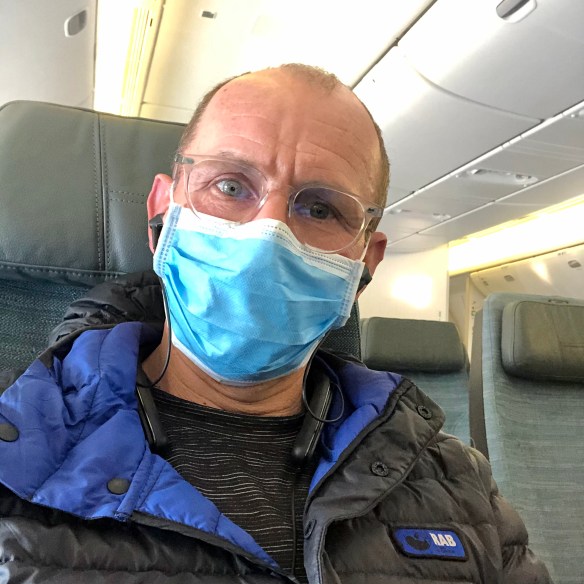
You will have seen many images coming from China and Hong Kong showing everyone wearing masks. Do not be fooled into thinking this is a completely safe thing to do – masks have issues and problems:

You only need to wear a mask if you are taking care of a person WITH the virus.

Wear a mask if YOU are coughing and sneezing, this stops potential spreading.

Masks are only effective when combined with frequent hand cleansing.

Masks MUST be worn correctly and changed regularly.

Tips for mask use:

  • Clean hands with alcohol based cleanser.
  • Cover mouth and nose with mask and make sure there are no gaps.
  • Do not touch the mask whilst wearing, if you do, cleanse hands.
  • If mask becomes damp, replace.When removing mask, do not touch the front, remove from behind and discard immediately.

As a runner or endurance athlete, the last thing we want is a virus that impacts on breathing. Covid-19 needs to be respected, despite what you may think about the media and its scaremonger tactics.

Cases are now reaching close to 100,000 and the situation is changing daily.

Incubation period is up to two weeks and this is why the virus is spreading worldwide, it is so difficult to track and contain. Once a positive case is found, it is too late as more will be infected and then the reverse pyramid scenario starts.

What can you do?

Look after personal hygiene.

Avoid public places and gatherings.

When traveling, avoid travel through highly infected areas. Particularly important for long-haul travel. Much better to pass through the Middle East (for now) than pass through China, Hong Kong or Bangkok.

Face masks have a place but understand the restrictions that they have.

Public toilets, bars, restaurants etc etc are a potential perfect storm for passing on the virus, so, avoid in areas of potential or real risk.

As I write, the W.H.O says we are at a ‘Decisive Point’ in the outbreak.

Cases in the UK have risen (19) and New Zealand, Italy, Iran, South Korea and Nigeria have announced first cases. The stock markets across the globe have plunged under the fear of recession. Cases have been confirmed above 84,000 and currently 2867 deaths (sources The Independent and Worldometers)

The Swiss government has banned events with more than 1000 people and already we have seen mass participation events cancelled globally.

NBC has confirmed the virus has spread to at least 40 countries worldwide. It says cases in the USA have been limited but warns, “Americans should prepare for the spread of the virus in communities.”

Ultimately, COVID-19 currently is spreading, we personally need to be aware of risks and mitigate as appropriate. With each passing day, more news comes in and it can be terrifying but let’s keep perspective too, the common Flu can kill up to 646,000 people per year (medicinenet.com) – the figure coming from the US Centers for Disease Control.

So, be careful out there and keep a perspective of the risk, start to do the following now:

Wash hands frequently.

Maintain social distancing.

Avoid touching eyes, nose and mouth.

Feel unwell, seek medical advice immediately.

Do not cough or sneeze in public.

Be safe!

Please support this website. I believe everyone deserves to read quality, independent and factual articles – that’s why this website is open to all. Free press has never been so vital. I hope I can keep providing independent articles with your help. Any contribution, however big or small, is so valuable to help finance regular content. Please support me on Patreon HERE.

Follow on:

Instagram – @iancorlessphotography

Twitter – @talkultra

facebook.com/iancorlessphotography

Web – www.iancorless.com

Web – www.iancorlessphotography.com

Image sales –www.iancorless.photoshelter.com

The MIRA RAI Initiative

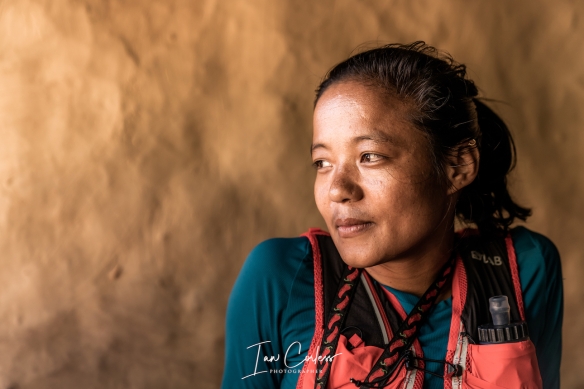
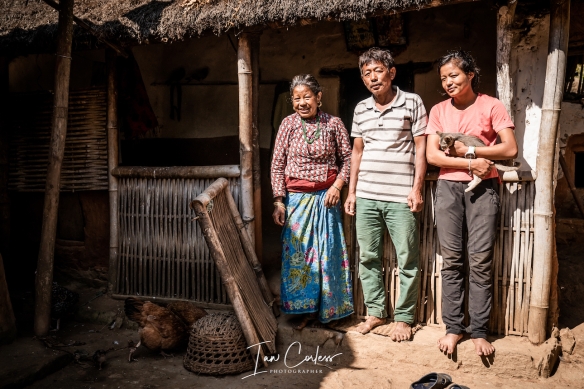
I was fortunate in November 2019 to visit the home of Mira Rai in a remote part of Nepal.

I first met Mira, in 2015 as she rose through the racing ranks in Europe. Her ensuing story of success on the trails and then giving back to her community is the stuff of dreams. From our first encounter, I knew she was special. She was strong, dedicated and had a strength of character based on survival, perfect for long-distance running. She spoke no English, had a huge infectious smile and laughed when we couldn’t communicate, simply saying “Namaste.”

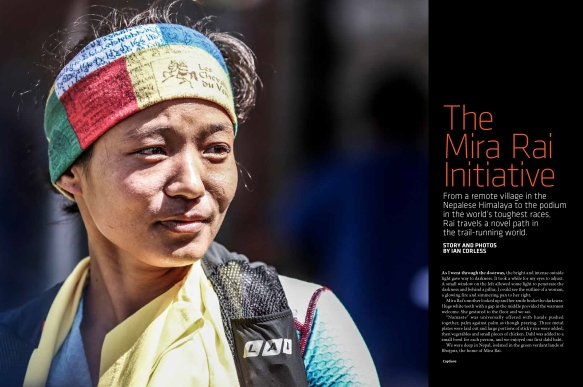
My images and story of the journey is now available in Trail Runner Magazine in the USA. Spread over 5-spreads/ 10-pages.

I met her parents, walked the trails, visited her school, shared meals, fed the animals and shared a magical time in Bhojpur.

As I went through the doorway, the bright and intense outside light gave way to darkness. It took a while for my eyes to adjust. A small window on the left allowed some light to penetrate the darkness and behind a pillar, I could see the outline of a woman, a glowing fire and simmering pan to her right.

Mira Rai’s mother looked up and her smile broke the darkness. Huge white teeth with a gap in the middle provided the warmest welcome. She gestured to the floor and we sat.

“Namaste” was universally offered with hands pushed together, palm against palm as though praying. Three metal plates were laid out and large portions of sticky rice were added, then vegetables and small pieces of chicken. Dahl was added to a small bowl for each person and we enjoyed our first dahl baht.

We were deep in Nepal, isolated in the green verdant lands of Bhojpur, the home of Mira Rai.

Trail Runner Magazine available HERE

The Mira Rai Foundation HERE

VIEW THE FULL IMAGE GALLERY HERE

Please support this website. I believe everyone deserves to read quality, independent and factual articles – that’s why this website is open to all. Free press has never been so vital. I hope I can keep providing independent articles with your help. Any contribution, however big or small, is so valuable to help finance regular content. Please support me on Patreon HERE.

Follow on:

Instagram – @iancorlessphotography

Twitter – @talkultra

facebook.com/iancorlessphotography

Web – www.iancorless.com

Web – www.iancorlessphotography.com

Image sales –www.iancorless.photoshelter.com

Kilian Jornet and Maude Mathys make history at Sierre-Zinal report by Salomon Running

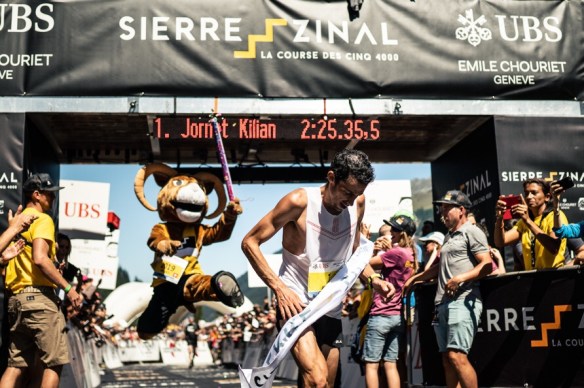
 ZINAL, SWITZERLAND – Sierre-Zinal is a legendary trail race because of its nearly five decades of history and revered athletic performances, and on Sunday along its famed trails in the Swiss Alps another trail running legend added yet another chapter to both his own storied legacy and the race’s as well. Setting out with a blazing fast pace, Spain’s Kilian Jornet (Team Salomon) ran away from one of the most competitive trail running fields in recent memory to win in 2:25:35, shattering Jonathan Wyatt’s longstanding course record of 2:29:12 by three minutes and 37 seconds. It was Jornet’s seventh win at Sierre-Zinal in nine tries. 

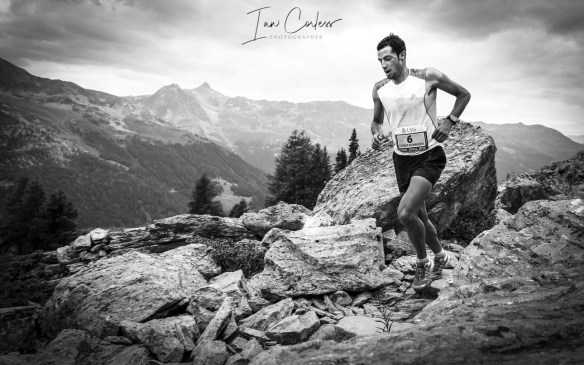
📷Kilian at the 2014 Sierre-Zinal

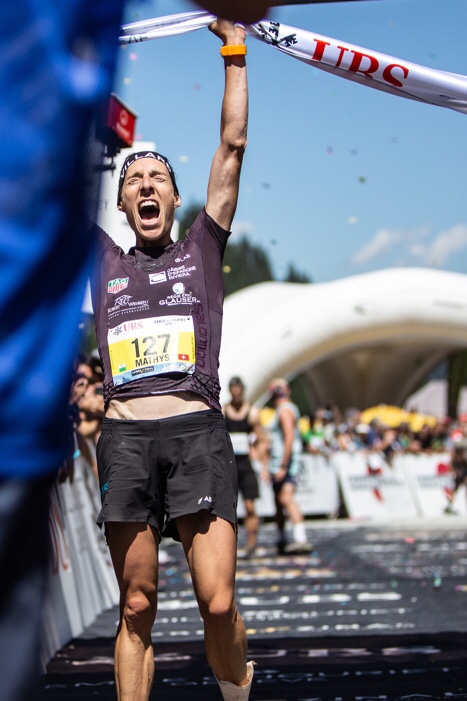
On the women’s side, Switzerland’s Maude Mathys* (Team Salomon) also broke the Sierre-Zinal course record, winning in 2:49:20 to best Anna Pichrtova’s 2008 time by nearly five minutes.

*(In 2015 Mathys was reprimanded for an ADRV for using clomiphene, a fertility drug which features on the WADA Prohibited List under section S4: Hormone and Metabolic Modulators. Mathys was let off with a warning as the drug was being taken in the hope of getting pregnant.)

Both Jornet and Mathys won from the front, surging to the lead on the challenging early uphill. As part of the second season of the Golden Trail World Series, Sierre-Zinal had another deep, talented field.

That seemed to bring the best out of the athletes taking to the starting line at the fourth stop of the six-race Series.Jornet was chased valiantly by 2016 winner *Petro Mamu from Eritrea, who also broke the former course record, finishing just 56 seconds behind the Spaniard in 2:26:31.

*(Petro Mamu (ERI) tested positive at the doping control in Premana after both the World Mountain Running Championships and the World Long Distance Mountain Running Championships. Mamu received a nine-month ban starting on 19 September 2017 after admitting to the findings and co-operating with the IAAF (reduced from 2 years).  All results of his  following 30 July 2017 were cancelled.  The substance being a medication normally used to assist with Asthma.)

American runner Jim Walmsley (Team Hoka), competing for the first time at Sierre-Zinal, was 3rd in an impressive 2:31:52. Juan Carlos Carera was 4th in 2:32:52 and Great Britain’s Robbie Simpson was 5th in 2:33:55.

Kilian Jornet grabbed the lead a few strides into the race and was alone from there on out. The course gains 2,200 meters from the start in Sierre to the finish line in the idyllic alpine village of Zinal, rolling along before a big downhill finish. Jornet wasted no time letting the competition know he was going for broke. At the Chandolin checkpoint he was ahead of Mamu by two minutes 1:05:59 and in hot pursuit of the course record set by Wyatt in 2003.

“I checked the time after the climb from the start and I knew it was good,” Jornet said. “I expected a couple guys to come with me on the first climb like Petro and Davide Magnini, but I was alone from the start after a few hundred meters. I have big respect for the record of Jonathan. He was a leader of the sport so to follow in his footsteps is a great feeling. This is special of all the victories.”

Jornet set his sights on the 31km Sierre-Zinal race with a dedicated training regimen that he knew was necessary if he was to approach the record of Wyatt. He scaled back his racing schedule this season to focus his training in an attempt to see just how fast he could be.

“I usually average about 15 races per year, and there have been years where I did 50 races between trail running and ski-mo, so you don’t train. You race and recover,” Jornet said after his win. “The goal this year was to focus on training and see if it makes a difference in the performance. I always target to win, but I plan a strategy in each race so I don’t really race full-out because I know I have another race just after, sometimes the next week. This year, the goal was to give everything and not have to worry about recovering for the next race. And I was six minutes faster than my best time here so it seemed to work. I thought it was possible to break the record, but I thought I’d be counting seconds.”

After winning in his 2019 debut at Zegama-Aizkorri Mountain Marathon in June, Jornet was appearing in his second Golden Trail World Series race of the season. Next, he will set his sights on the oldest trail race in America, the Pikes Peak Mountain Marathon in Colorado, the fifth stop of the 2019 Golden Trail World Series, on August 25th

In the women’s race, Mathys made sure Jornet wasn’t the only one breaking a record on the day. Her time of 2:49:20 was five minutes ahead of fellow Swiss Judith Wyder (Team Salomon) who finished in 2:54:20, and it broke the former course record of 2:54:26 by five minutes and six seconds. Wyder was also under the former record by six seconds. 

Mathys was 3rd at the Dolomyths Sky run in Italy a couple of weeks back, but on Sunday she used her strength in the uphill to put distance between herself and the field in the early going. She was more than three minutes ahead at the Chandolin checkpoint and was never seen again by the rest of the pack.  

Italy’s Silvia Rampazzo (Team Tornado) was 3rd with another strong effort on the Golden Trail World Series. She finished in 2:56:17. New Zealand’s Ruth Croft (Team Scott) continued her amazing consistency with a 4th place finish in 3:01:56, while  France’s Anais Sabrié was 5th in 3:01:58.  

ABOUT THE GOLDEN TRAIL SERIES:

The elite runners of the Golden Trail World Series are trying to earn points in the season-long chase for a spot in the Grand Final, which will take place in Nepal in October. The athletes must participate in three of the six races during the series in order to be eligible for the final. The top-10 men and women with the most points in their three best races will earn a trip for themselves and a person of their choice to the Grand Final. The overall final standings (and the men’s and women’s champions) of the Golden Trail World Series will be determined again by the runners’ three best finishes during the season, plus their result at the Grand Final.  


For up-to-date Golden Trail World Series standings

Photo credits: Martina Valmassoi and Jordi Saragossa


Follow on:

Instagram – @iancorlessphotography

Twitter – @talkultra

facebook.com/iancorlessphotography

Web – www.iancorless.com

Web – www.iancorlessphotography.com

Image sales –www.iancorless.photoshelter.com

Ultra Trail Stara Planina 2019 Preview

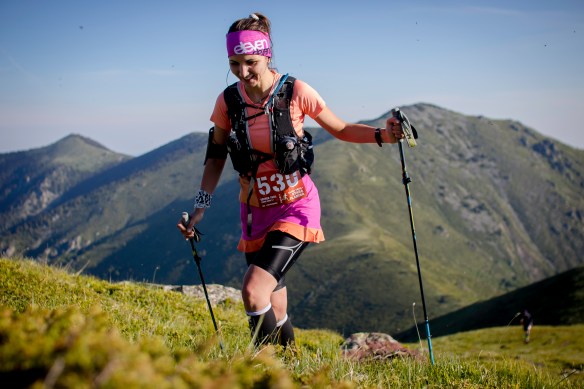
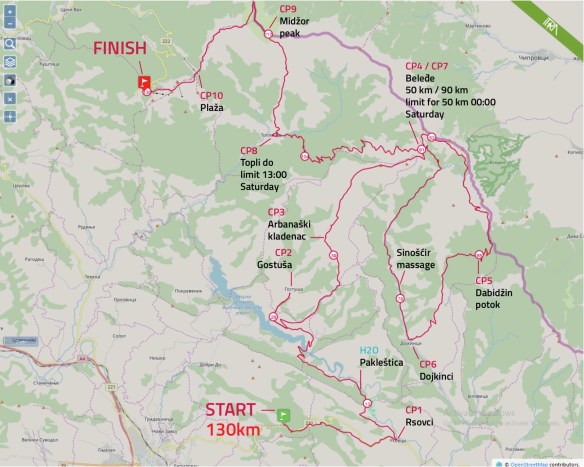
Oldest, highest and biggest trail race in Serbia, the Ultra Trail Stara Planina kicks off this Friday, with the 130km race which has a whopping vertical gain of 5870+.

The following races start 0700 Saturday.

36km with 2370+ 

57km 2350+

94km 3890+

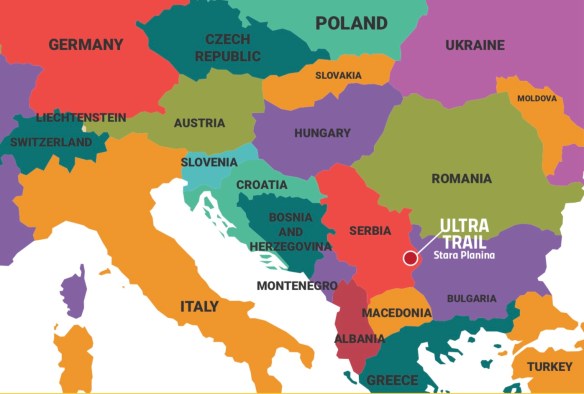
Surrounded by Bulgaria, Romania, Greece, Hungary, Bosnia and Herzegovina, Serbia based at Stara Planina has a growing presence in the trail and skyrunning world.

Stara Planina, the hub for the weekend of racing is in driving distance of Belgrade and a multitude of flight options that allow the possibility to explore this area.

Stara Planina which roughly translates to ‘Old Mountain’ is known to many as The Balkan mountain range which is in the eastern part of the Balkan Peninsula. On the border between Bulgaria and Serbia, the Balkan range runs 560 km from the Vrashka Chuka Peak eastward through central Bulgaria to Cape Emine on the Black Sea. The highest peaks of the Balkan Mountains are in central Bulgaria. The highest peak is Botev at 2,376 m, which makes the mountain range the third highest in the country, after Rila and Pirin.

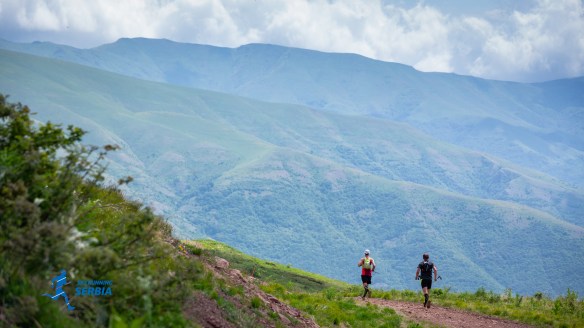
Endless stretches of untouched nature, vast mountain pastures and forests rich in forest fruit and herbs, picturesque villages and interesting folklore. That is the true picture of Stara Planina, one of the most beautiful and most authentic nature reserves that hides the highest mountain peak in Serbia – Midžor at 2,169 meters above sea level.

Mt. Stara planina the most beautiful part of Eastern Serbia and it was declared a natural treasure of great importance. This mountain is known for its mild climate, clean air, springs of hot mineral water, while the park “Stara planina” spreads on 142.000 acres.

Zavojsko lake, one of the most beautiful and clearest mountain lakes, lies at the foot of Stara planina. The lake abounds in fish, and passionate fishermen along the bank of the lake assure us that this truly is the best location for catching pike, catfish and carp.

Action starts on Friday with the 130 km race starting at noon (12.00) at the Vidlič mounting hut (from the Pirot side).

The 36, 57 and 94 km races start on Saturday, June 1st at 7:00 AM at Hotel Stara Planina. It is estimated that the fastest 130 km runner should arrive at approximately 0700.

Two runners who will have many eyes on them are Jovia Spajic and Maria Nikolova Miteva who placed 9th at UTMB in 2018.

Race Website HERE

The races are organised by Serbian Skyrunning Association – a team of enthusiasts with an idea to contribute in development, recognition and promotion of skyrunning sport, high altitude ultra-marathon and  other endurance sports, as well as the development, recognition and promotion of sport and mountain tourism in Serbia and the region. HERE

Instagram – @iancorlessphotography

Twitter – @talkultra

facebook.com/iancorlessphotography

Web – www.iancorless.com

Web – www.iancorlessphotography.com

Image sales –www.iancorless.photoshelter.com