Timothy Olson – Go Trail

My good friend James Hallet today re launched Go Trail. A labour of love, James has worked hard to provide a great online magazine for trail running with a great new look. It is available free or for just $10 you can get all 6 issues for a year with unlimited viewing.

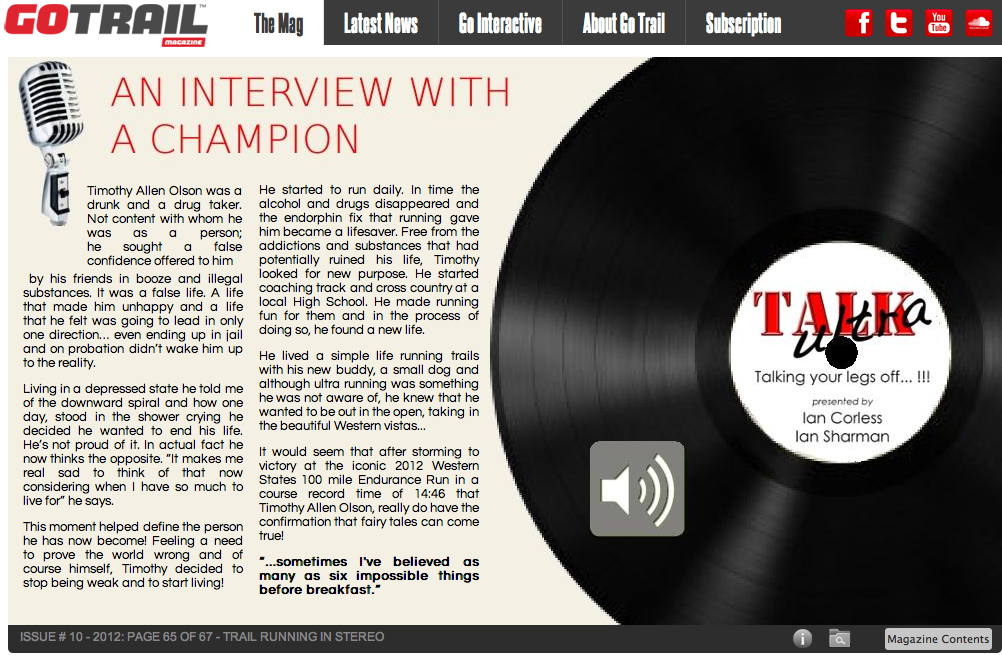
I have two articles in the new edition. The first on Timothy Olson, winner of Western States 100 in 2012.

You can listen to the audio HERE

Hydration

Wow! it would appear that Dr Tim Noakes and his ‘Waterlogged‘ book has caused some interest… not a surprise. I guess the whole reason for me initially posting was that I new that it would rock the boat and make us all look at what we do personally in regard to our own personal hydration when running or racing.

As part of Talk Ultra we have a regular section of the show called Talk Training – we look at our sport and we discuss all aspects of what will make us all better runners. Often our subjects and our thought processes may very well be controversial and thought provoking. Only recently we actually discussed this exact subject. You can listen HERE

However, Marc Laithwaite from Endurancecoach who is my co-host for Talk Training is far more experienced and a specialist in this field. I will let him tell it in his words:

An alternative view on hydration

Our focus is hydration or in more simple terms how much to drink.

Why drink?

Your body needs fluids for various functions. Body cells and tissues are filled with fluid, the nervous system requires fluid and the fluid component of your blood (known as plasma) is also affected by your drinking habits. Exercise leads to a loss of body fluids via sweating and breathing and this loss of fluid can eventually lead to what is commonly termed dehydration.

What happens when we drink?

When you put fluids into your stomach, they pass through the stomach wall into your blood vessels and effectively become plasma. As your blood stream can pretty much reach any part of your body, any tissue or any cell, this fluid can be transferred from the blood stream into the tissues or cells.

How does fluid actually pass from one place to another?

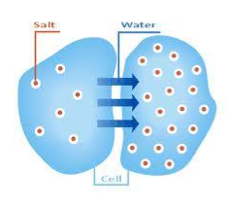
To get the fluid from your stomach into your blood stream or from your blood stream into tissue cells requires a process termed ‘osmosis’. Salt acts like a magnet drawing fluid towards it and the concentration of salt in your blood and tissues determines the shift of fluid around your body.

When you take a drink of water it reaches your stomach and waits excitedly to pass through the wall into your blood stream. Your blood is saltier than the water in your stomach and due to the higher level of salt in the blood, the water is drawn from the stomach, through the wall and into the blood. This water effectively becomes blood plasma and travels around your body. If it finds muscle tissue which has a higher salt concentration, the magnetic pull of the salt within the muscle will draw the fluid from the blood into the muscle.

In simple terms, when something is dehydrated, it becomes more salty. By becoming more salty it’s magnetic pull increases in power and it attracts water towards it. That’s how fluid shift and hydration works within the body, that’s ‘osmosis’.

What happens when you dehydrate?

When you dehydrate your tissues and blood have less fluid thereby making them more salty, in the hope that they can attract fluid towards them. Your blood becomes thicker as you still have the same amount of ‘blood cells’ but the fluid component is reduced, thereby making it more concentrated. Not only does the blood become thicker (making flow more difficult), the absolute amount of blood is also reduced so you have to pump the smaller blood volume more quickly around the body, thereby increasing heart rate.

Most text books will recommend somewhere between 1 – 1.5 litres per hour depending upon individual sweat rates, but it is unlikely that this amount can actually be absorbed when you are exercising. As each litre of fluid weight 1kg in weight, it is possible to calculate (very roughly!) fluid loss by taking weight before and after.

The Endurance Coach research on ultra distance runners

Last year we measured pre and post body weights for competitors taking part in a 100 mile mountain running event http://www.lakeland100.com. Race finish times varied from 24 to 40 hours and if we presume that athletes are losing 1-1.5 litres per hour, just how much weight did the competitors lose???!!

The body weight stats 2010

Our stats from last year showed the followed weight loss at the finish line:

  1. Runners sub 30 hours, average weight loss 860g / 860ml
  2. Runners sub 32 hours, average weight loss 1008g / 1008ml
  3. Runners sub 35 hours, average weight loss 1040g / 1040ml

Compare those figures to the guidance given in the previous paragraph which suggest that athletes will need to replace 1-1.5 litres per hour as this is the rate at which they are losing fluid. Admittedly the competitors may not be exercising at a very high intensity due to the nature of the event, but even then.. something doesn’t add up as the fastest runners haven’t even average 1 litre fluid loss at the finish.

Take the mineral water challenge.. we guarantee if you drink 5 litres per day we’ll feel great about our bank balance and you might end up in hospital..

I know.. I’m cynical.. However, there needs to be some common sense applied to hydration. Your body tells you when you need fluid by making you feel thirsty and then you should drink what you’ve lost. Your body is very much like a water tank with an overflow system, once the tank is full, any further fluid intake will be dispensed with by urinating. It’s correct to say that urinating frequently and especially if the urine is clear, IS NOT a sign of optimal hydration, it’s a sign you’re drinking too much.

The drink might kill you..

For many years marathon runners were encourage to drink at every aid station and “don’t wait until you’re thirsty.. it’s too late then!” Unfortunately a few of those people died as a consequence due to a condition known as ‘hyponatremia / hyponatraemia’ which is excessive dilution of body salts.

What’s going on??

Hyponatremia is quite simple:

  1. Take 1 medium sized bucket, add a tea spoon of salt and then add 1 pint of water and in your bucket you have a salt solution.
  2. Add another pint of pure water to the same bucket and you have now diluted the salt solution (it’s a bit weaker).
  3. Add another pint of pure water to the same bucket and dilute the salt even further.
  4. Keep going until the salt solution is so weak you can hardly even taste the salt.

We said earlier in this article that salt acts like a magnet and attracts water towards it:

‘When you take a drink of water it reaches your stomach and waits excitedly to pass through the wall into your blood stream. Your blood is saltier than the water in your stomach and due to the higher level of salt in the blood, the water is drawn from the stomach, through the wall and into the blood’

What if you’d added so much water to your body that the blood wasn’t salty at all, it was massively diluted and had thereby lost all its pulling power?

Stay calm..

The chances of anyone dying from hyponatremia are so minimal and so infrequent that this should never concern you but weight measurements before and after can be an important part of medical checks. In essence, if you collapse and you’ve lost weight, we’d give you a drink, some food and a lift back home. If a competitor were to collapse and following a weight check they had gained weight, we would take it more seriously.

Some of you may be thinking at this point that you can take salt tablets with your water, if you add salt and water simultaneously, problem solved! The research has shown that it’s not a lack of salt intake which leads to hyponatremia, it’s too much fluid.

In conclusion

Drink sensibly, let thirst guide you and don’t force load yourself with water.

Aside from excess fluid intake, there is one other thing which may lead to weight gain during ultra distance endurance events and that is ‘rhabdomyolysis’ or ‘muscle damage’ leading to inflammation. This is a real issue for longer events and has a huge impact upon performance and health.

ARC’TERYX Endorphin

I have just returned from a three day media event in the Pyrenees arranged by Arc’teryx and in conjunction with Skyrunning.

Arc’teryx are synonymous for providing superior clothing, backpacks and accessories for mountain sports. In 2013 they are launching a new clothing range called Endorphin. This new range of clothing has been created for male and female runners.

Endorphin will push limits on weight, comfort and protection. Faster and lighter they are designed to maximise athletic performance in varied conditions. Controlling moisture, providing protection from the wind, repelling rain and providing warmth, Endorphin will provide all runners with a selection of products that will not only enhance running experience but will also be a pleasure to wear.

Over the coming months I will testing many products within the range before the release in 2013.

In the Pyrenees I was able to do an initial test on the Skrunning VerticalK course and on a 3.5 hour mountain run in 30 deg temperatures. Attending the camp we had journalists from Sweden, Germany, USA, Spain and Italy and we had the pleasure of being joined by Arc’teryx sponsored athletes Adam Campbell (Canada) Nicola Gollinelli (Italy) Didier Zago (France) Tessa Hill (UK) and Murray Strain (UK).  You can read my initial thoughts HERE

Gordy Ainsleigh and Western States

Image by Hough Boy

Seems appropriate that with Western States just literally days away that maybe we all should remind ourselves how this race started…

August 3rd 1974, Gordy Ainsleigh was the first to run the course of the Western States Endurance Run. At the time, the trail was used only by horses participating in the 24-hour Western States Trail Ride. When his horse went lame prior to the race, Ainsleigh decided he would run the torturous 100 miles (160 km) of mountain trail. This was the beginning of the Western States Endurance Run.

Listen to the Talk Ultra interview here:

Gordy Ainsleigh

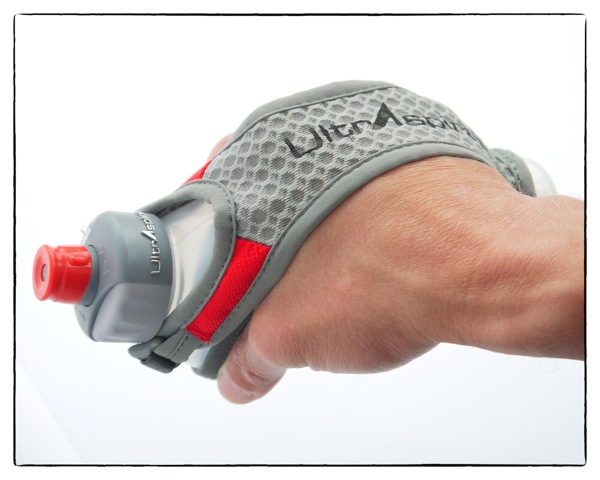
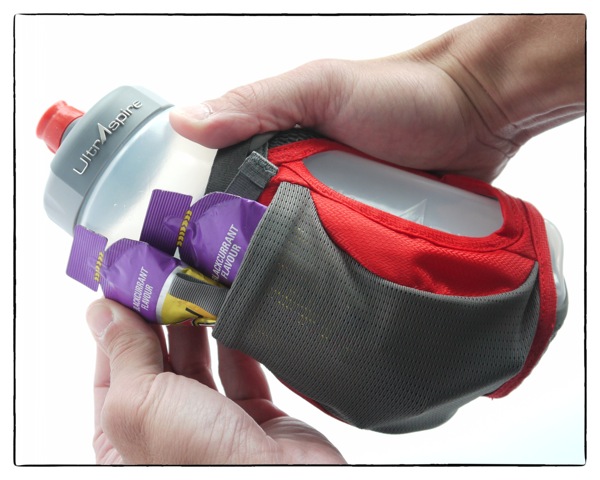
UltrAspire Isomeric Pocket Handheld Bottle

Handheld bottles are not for every runner but UltrAspire have in some ways reinvented the handheld bottle with a few subtle tweaks.

They have re shaped the bottle, added a twist valve on the mouth piece, angled the neck and added a comfortable holding strap. Read my review here

Summits – insight

This is great little insight into Kilian’s next project by the man behind the camera, Seb Montaz.

Seb is without doubt one of the best cinematographers out there. He has worked closely with Kilian over the years and between them they are the perfect combination. Kilian performs the magic with his feet, Seb performs the magic with his eyes. Together it is a stunning combination.

Seb Montaz – Summits

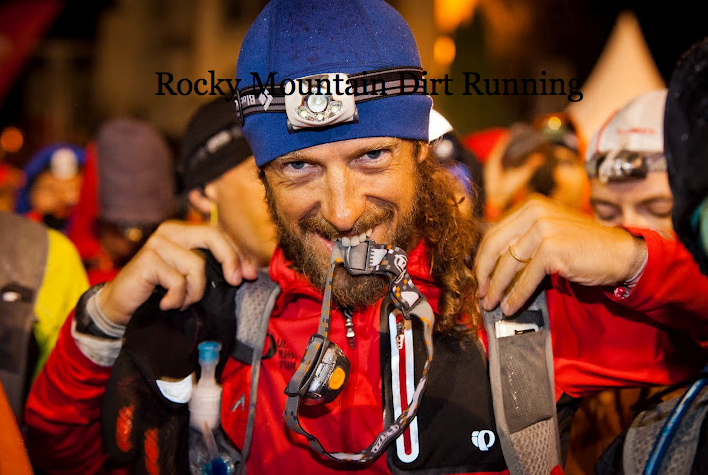
Rocky Mountain Dirt Running

I am really pleased to announce that Nick Clark will be the next guest on Talk Ultra episode 11.

Nick is a Brit that most people seem to think is an American… well he’s not, he’s British and despite what anyone else says, even Nick for that fact, he is staying British.

Nick is a top guy. I had the pleasure of finally meeting him and spending time with him in La Palma and then the Pyrenees. For me, Nick did one of the best ‘doubles’ in 2011 getting 3rd place at Western States and then 3rd place at Hardrock some 2 weeks later. Great result!

Anyway, Western States is around the corner and Nick will be on the start line. I will be chatting to him about his past, his expectations for the future and also about Zegama. You can read his Zegama blog post here. I also may even ask him about his birthday and about how we celebrated in the Pyrenees… but who knows, that may just be too much info!

Talk Ultra episode 11 will be available on June 15th via talkultra.com

Kilian’s Quest

Another great video to come out of the island of La Palma and once again filmed by the master, Seb Montaz.

It’s a who’s who of ultra running but I guess showing them in a different light… at play in the lava fields.

Transvulcania La Palma – The Movie


A hard and extreme Ultramarathon, proof that only men of iron and women of steel can overcome, many try, many want to, but only a few will achieve the goal. The body is pushed to extremes in a race that all who participate call spectacular, breathtaking, addictive, and challenging. The 2012 event included a stellar line up with athletes travelling from all over the world to take part. To reach the goal of the finish line is everybody’s dream but the reality is not an easy one… welcome to the fourth edition of the Salomon Transvulcania Nature Trail