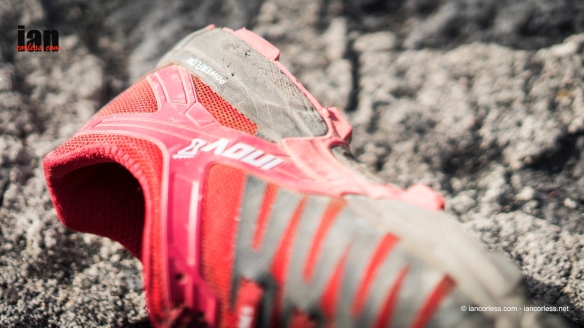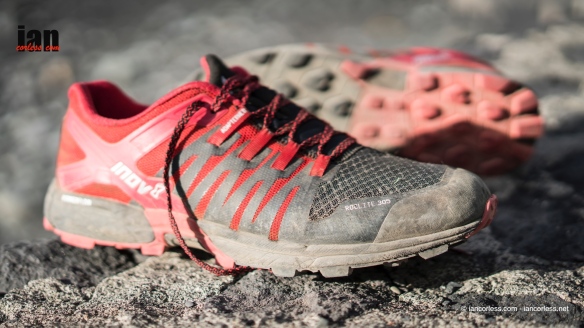
inov-8 ROCLITE 305 Review

iancorless-com_inov8_roclite-06913

One month ago, the new ROCLITE arrived at my home, not just one pair but 3 pairs – the 290, 305 and 325. I wrote a first impressions article HERE and it would make sense to have a read of that before reading on.

In summary, the 290 is 4mm drop, the 305 8mm drop and the 325 is 8mm drop but a running boot. The running boot is for a specific audience I believe and although it’s a product I love using, I am going to save any talk on the 325 for my review that will come out in the New Year. Having said that, much of what I write in this review of the 305 directly transfers to the 325 – they are to all intents and purposes the same!

I run in shoes of varying drop all the time, however, lower drop shoes like the 290 (4mm) are usually reserved for shorter runs be they fast or slow. Once I run beyond an hour, an 8mm drop shoe works perfectly for me and without doubt it is my ‘drop’ of choice.

iancorless-com_inov8_roclite-06918

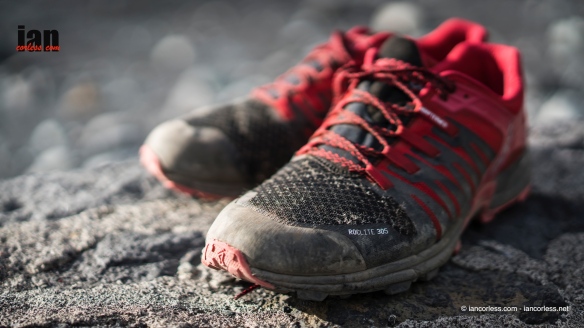
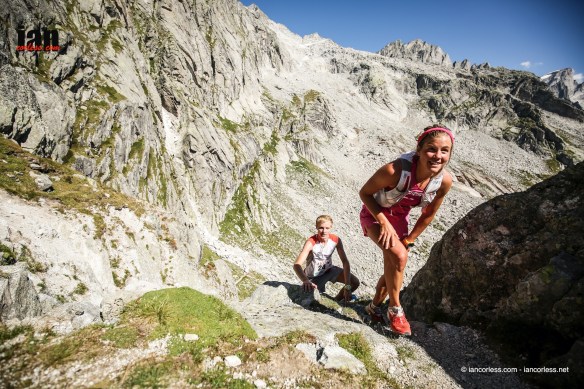
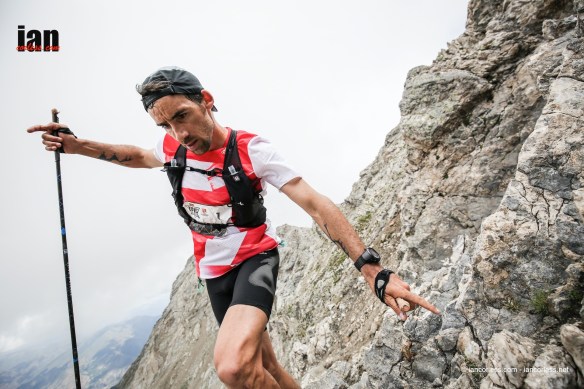
Therefore, when the ROCLITE’s arrived late November and I had a trip planned to La Palma (the home of Transvulcania) it was an easy decision to pick up the 305 with the intention of well and truly giving them a battering on this tough, challenging, rocky and gnarly terrain.

iancorless-com_inov8_roclite-06921

The ROCLITE range of shoes, for me, are designed for mountain running in wet or dry conditions when the trail can be very varied or unpredictable. Although the shoe can handle a little mud, it’s not a shoe for those conditions and without doubt, if you plan to run on grass, mud, fell or similar, I think inov-8 make far better shoes for that, try the X-Talon for example.

iancorless-com_inov8_roclite-06914 iancorless-com_inov8_roclite-06940

I have used many, many shoes and I have tried and tested countless inov-8 shoes and despite the ROCLITE being around for appx 10-years, it’s not a shoe that I have used a great deal. So, I hold my hands up, this review is based on ‘this’ shoe and I can offer no comparisons to previous incarnations.

iancorless-com_inov8_roclite-06924

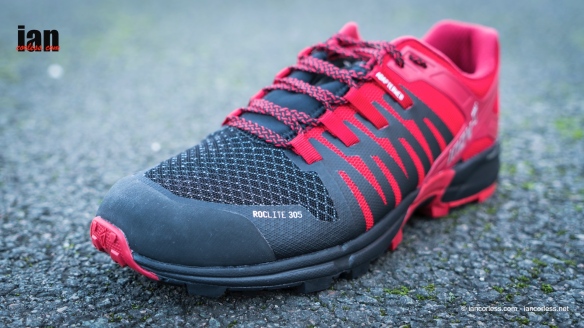
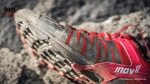
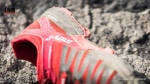
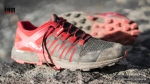
As with many inov-8 shoes, the looks and colours are very pleasing. You can’t go wrong with red and black and out of the box they were saying to me, ‘wear me!’

iancorless-com_inov8_roclite-06932

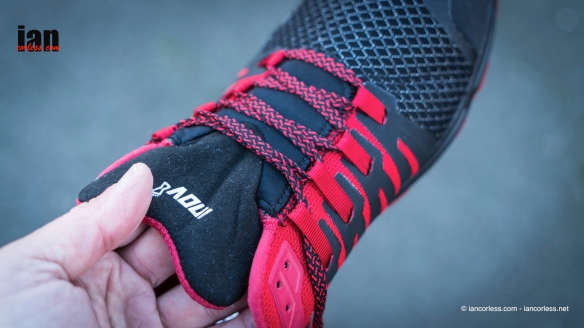
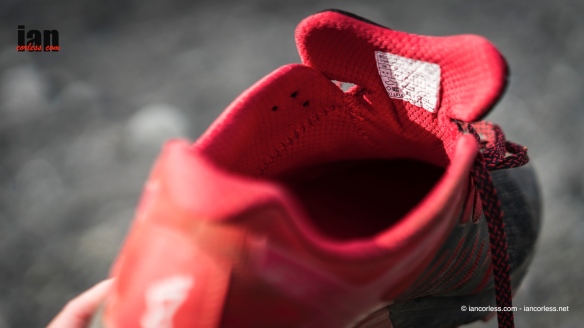
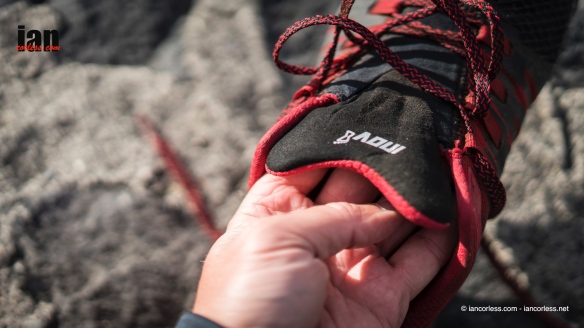
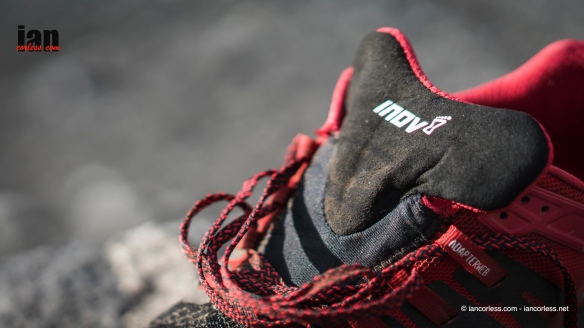
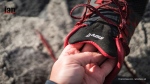
Looking over the shoe, a couple of things stood out. The tongue is part of the upper and not a tongue sewn into the upper. Anyone who reads my shoe reviews knows that I LOVE gusseted tongues so I was eager to slide these shoes on. I was not disappointed. I would go as far to say that the 305 is THE most snug and comfortable shoe I have worn – that is saying something! They are the most slipper like run shoes I have worn, so much so, that I could imagine removing the laces and walking around the house in them. Adding to the package is a completely seamless inner, even the ‘insole’ is part of the shoe (you can’t remove it) making it snug, snug, snug!

iancorless-com_roclite305-00971

iancorless-com_roclite305-00983

Going for a run in them instantly felt comfortable. I mentioned in my ‘first impressions’ that I thought the shoes in the ROCLITE range sized a 1/2 size too small. Now I am not sure? Sorry for being indecisive but I have run in them for 1-month and I have been very happy, I must stress though that I used a thinner sock than normal. What is noticeable, say over the TRAIL TALON (here) and X-CLAW (here) is that the ROCLITE is narrower in the toe box. I wouldn’t say it’s a ‘precision’ fit shoe but it is certainly less spacious than the Talon or Claw.

iancorless-com_roclite305-00974

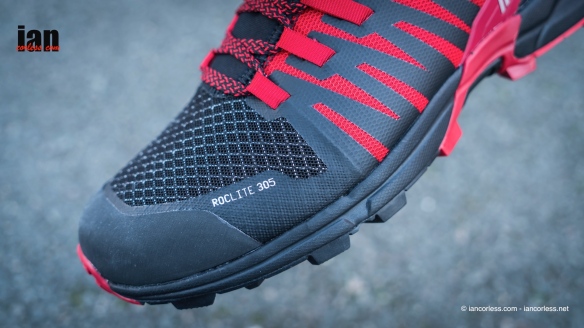
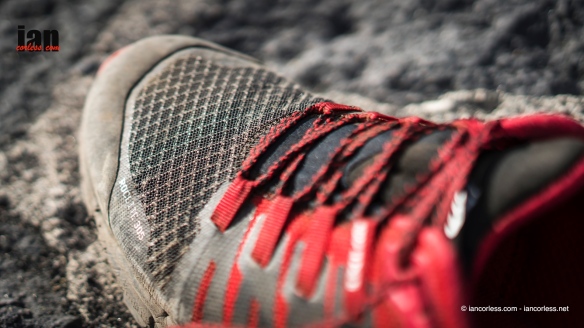
The other notable point is that the front of the shoe (toe box) is just material with no additional overlays or support other than a reinforced bumper to protect toes against unwanted collisions. This had pros and cons. The pros were simple – a comfortable shoe that allowed my foot to flex, bend and adapt to the terrain. The cons were on technical descents, I found that at times I wanted just a little ‘more’ to hold my foot. It was a minor point and caused me no problems. What I did do to compensate was make sure I had the laces adjusted and tightened correctly.

iancorless-com_roclite305-00981

The trails in La Palma are harsh, really harsh. It’s jagged, volcanic, gravel, sand and abrasive rock that is irregular and punishing. It ruins shoes. In recent years, I have been out here and I have had shoes last for just the holiday. I must stress that this is not a criticism of the shoes but an indication of how harsh the terrain is.

iancorless-com_roclite305-00976

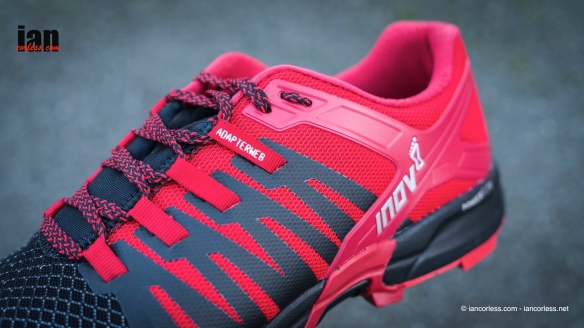
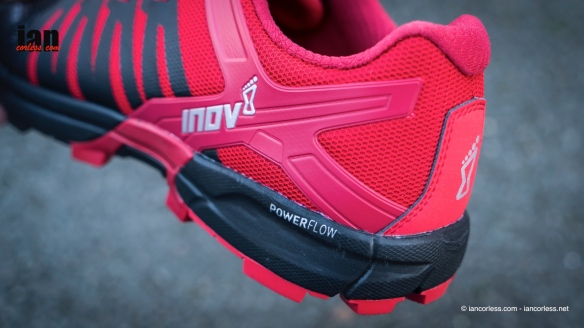
One’s foot is moved constantly to the left, right and it is twisted back and forth, noticeably the huge red ‘X’ on the rear of the ROCLITE offered some great stability and I didn’t roll my ankle once – unusual for me.

iancorless-com_roclite305-00972

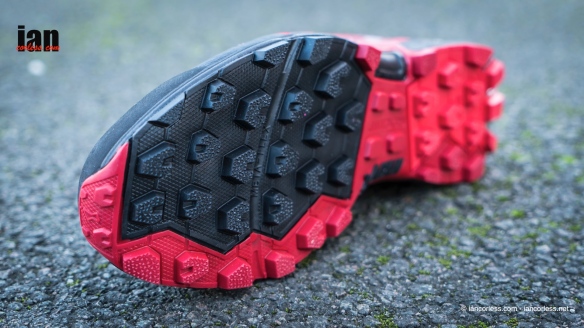
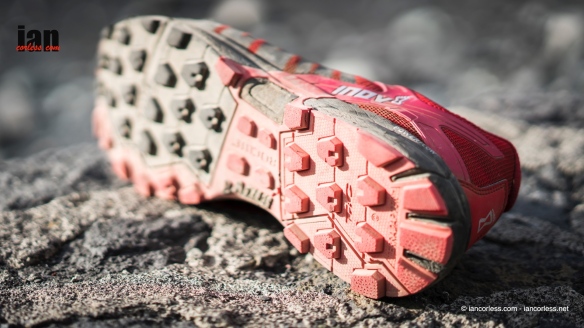
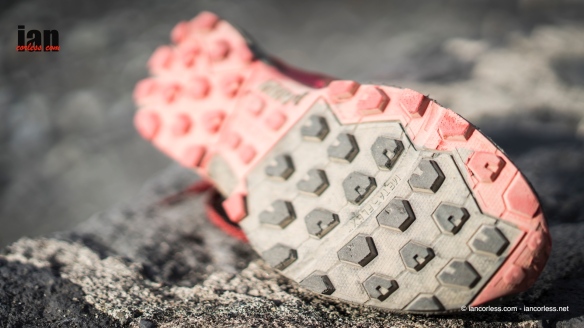
The out-sole did work well on all the dry terrain, be that gravel, soft black lava sand, jagged irregular rocks or solidified volcanic lava. A run through a river bed that offered all manner of possibilities to slip and fall through a technical boulder session were brushed at one side with ease with the ROCLITE. Once you have confidence in a shoe, you can push harder and faster and the 305’s gave me that.

iancorless-com_roclite305-00980

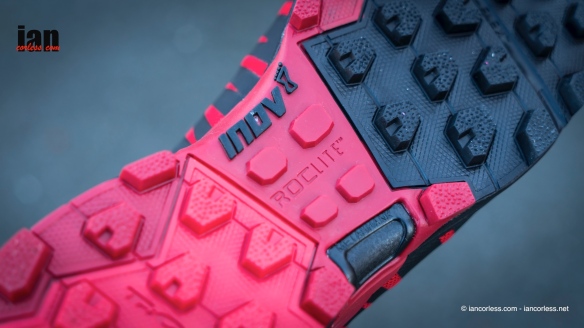
Importantly though, on this terrain, protection is as important as grip and the META-SHANK and rock-plate combined with additional cushioning gave me a really solid and comfortable day out. The longest outing here has been 8-hours and my feet felt great. Rocks and rough terrain didn’t penetrate through the sole leaving me and my feet feeling jaded. Powerflow in the heel provided some real comfort and reassurance, particularly when walking… it’s tough out in La Palma and walking is a big part of any outing. Daily I always did anything from 400 to 2000+m of climbing and the META-FLEX at the front of the shoe allowed my foot to bend without hindrance.

iancorless-com_roclite305-00982

The lacing is unique as you pull in on web loops. It really does work! It works so well that you can pull the laces too tight. I struggled with the lacing at first, at times I tied the laces too right and other times I tied them too loosely. I eventually found a balance after 3-4 runs and once I got it dialed in, I found I had no need to adjust or adapt my laces once running. I am pleased to say that extra eyelets are provided at the top of the shoe should you need to ‘lock-lace’ or similar. The heel box was plush and caused no issues.

iancorless-com_roclite305-00986

In Conclusion

inov-8 have thrown a curve ball in at the end of 2016 and may well have provided me with one of my favourite shoes of the year. Yes, the ROCLITE 305 is that good. I have battered them on the trails out here with approximately 50-hours of running and they are showing signs of wear but they have survived really well and are good for many more hours. I can’t say the ROCLITE is my all out favourite shoe as it has a specific use. By contrast, to explain what I mean, the inov-8 X-CLAW for example can handle grass, mud and sloppy stuff and it would still be able to perform on rocky and mountainous trails like here in La Palma. Is the X-CLAW a better shoe? No! However, it may very well be a better all-rounder? If you are running on trail, be that a canal tow path or a rocky mountain trail in the Alps, the ROCLITE will take some beating and without doubt it’s going to be a shoe of choice for me in 2017. The fit, the snug upper, the seamless build and the gusseted tongue just make the 305 one of the best shoes I have run in. Add to that package 8mm drop, cushioning, a great outsole and other key inov-8 features such as the ‘X’ Lock, Adapterweb, Meta-Flex and Meta-Shank and this shoe is one to consider.

There are some downsides. The upper may lack some support in the toe area when running on technical terrain allowing the foot to move a little too much. The toe bumper is adequate and does offer protection but maybe it could be a little beefier? It’s a minor niggle. Finally, although the ROCLITE 305 is not a precision fit shoe, it is narrower than the Trail Talon or the X-Claw and therefore it may not work for some people? However, I would counter that by saying that on mountain and technical trails, too much movement in the toe box leads to insecurity and a lack of precision and confidence.

Ultimately, the ROCLITE 305 is a winner.

inov-8 website and shoe details and prices HERE

The Green Tunnel – Speedgoat Karl Meltzer and the Appalachian Trail

karlmeltzeratfinish

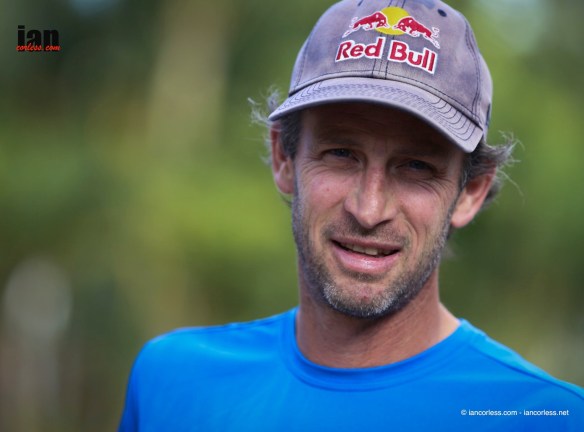
‘Speedgoat’ Karl Meltzer needs no introduction to the ultra-world, Speedgoat was running 100’s when most of us didn’t even know they existed. So much so, he has won more 100’s than any other runner; 38 at the last count. Five of those hundreds came at Hardrock 100, impressive! Speedgoat’s tally of runs and records make history and in 2016, he finally added the ‘FKT’ for the Appalachian Trail to his palmares. It was a long time coming, two previous attempts (2008 and 2014) had left him short but 2016 was different. Speedgoat had had the opportunity to assess his past attempts while helping his buddy, Scott Jurek, achieve his own FKT on the AT in 2015! With this information and a wealth of ultra-running experience, Speedgoat was a different man in the ‘Green Tunnel’ in 2016.

On Sept. 18 at 3:38 a.m., professional ultra-runner and Red Bull athlete Karl “Speedgoat” Meltzer emerged from the Appalachian Trail’s southern terminus at Springer Mountain, Ga., and set a new Appalachian Trail thru-hike speed record with a time of:

45-days 22-hours and 38-minutes.

Speedgoat started his supported run at 5 a.m. on Aug. 3 from Mt. Katahdin, Maine, and averaged approximately 47 miles per day at a pace of 3.2 miles per hour.  Speedgoat’s time beats the previous record by more than 10 hours, which was set by Scott Jurek in 2015.

The project, in planning for more than two years, was accomplished with a small core crew consisting of Speedgoat’s father, Karl Sr., and crew chief Eric Belz.  Others joined the crew to support Speedgoat for short periods throughout the hike, including Speedgoat’s wife, Sheryl and fellow ultra-runners such as David Horton.  The crew travelled alongside Meltzer every day, providing him with food, water, medical attention and logistical support. Speedgoat’s time on the trail typically began around 5 a.m. and ended between 7 p.m. and 9 p.m.

 Download and view a full map of the Appalachian Trail HERE

The Appalachian Trail runs from Maine to Georgia stretching 2,190 miles through 14 states.  It is roughly the distance between Los Angeles and Washington, D.C., as the crow flies.  A thru-hiker will experience 464,500 feet of elevation change, or 16 climbs of Mt. Everest.  Thousands of people attempt an Appalachian Trail thru-hike every year, yet only one in four hikers finish the journey, and they typically take five to seven months to complete the entire trail.

Here is Speedgoat’s story.

******
karlmeltzer1

Ian: Many, congratulations Karl, you did it!

Karl: Yes, thanks. It was a long journey but yes, it’s over. Thank God. All the misery and pain is over.

Ian: All the misery and pain. Well you say that, but it’s not is it? Because now you’re going through media and interviews and repeating the same story to a lot of different people.

Karl: At least a dozen times yesterday…!

Ian: [laughs]

Karl: Yes, I did talk yesterday for maybe six hours. Then we did the CNN World Sports thing, which was right around the corner from the hotel I was staying at. Yes, it was a busy day. By the time I got to the last three interviews I was like, “Can you ask me what’s next one more time.” But it was good. There was a lot of part of that going on. I have quite a few more this afternoon, but they don’t start till 11.

Ian: That’s good. That’s good, so you can give me some time and hopefully we can ask some interesting questions. Epic journey, epic journey. It was fantastic being here in the UK getting the updates from Red Bull. What I was doing was re-showing them on my website and getting the audience engaged, because they really wanted to know what was happening. Right from the off, it appears you started with some real intention and nailing it for the first seven days. In retrospect, do you think that maybe you were pushing a bit too hard in those early seven days?

Karl: Actually, everything was super textbook and really good all the way for the first 19 days. The first seven days you get to go in New Hampshire, you must get to that point to set yourself up and put yourself in a good position. Honestly, I felt on my game… I was getting plenty of sleep. Everything was working out well. I wasn’t overly tired. I wasn’t pushing myself or getting to those points where I was worked or thinking, “Oh my God, I’m not going to get up tomorrow.”

New Hampshire went perfectly well. The big game in New Hampshire is the Route 302 which is called Crawford notch. It was 47 miles over Mount Washington and then over Carter Ridge, it was a huge day. I finished it a little after 10:00 PM. The following day I think I went like 28 miles, but that 28 miles was ridiculously hard but I was good that day…

Generally speaking, through 19 days before my shin started bothering me, I was a full day ahead of Jen Pharr’s pace, and when I got to that point I was like just stay even with her, with her pace through Pennsylvania which was my plan, and then just try to close it out from there. My shin went down running on flat grass, the easiest piece of the trail of all, flat grassy piece but it just tweaked and I was like, “Uh.” When I was going along I was like, “Oh man, that might be the one that throws me off.” And it did, it obviously did.

Ian: It’s interesting with day 19 because that was the day that I phoned in and spoke to Eric Belz whilst you were on the trail. He was giving me an update of how things had been going. He gave me an itinerary of what it’d been like and how you were crushing the miles, how they were giving you ice cream and looking after you. I will come on to that… One of the things I remember reading on the day nine (I think it was) reports, when you were going through Mount Lafayette, Eric referred to a knife edge. I couldn’t quite place what the knife edge was. What was that?

Karl: You mean in New Hampshire? Well, there’s a ridge called San Antonio Ridge. It’s not that technical of a knife edge. You’re on a ridge line that’s fairly narrow, but it’s not super. It’s not like exposed or anything. Yes, he had been up there before in 2014, he hiked that section with me when I was doing trail at that time too. New Hampshire is ridiculously hard. That might have been what he was referring to as a knife edge. It wasn’t really super techie or anything like that. It’s called San Antonio Ridge, and it’s a very very super popular place. You see more hikers on that trail probably in New Hampshire than anywhere else other than maybe Mount Washington.

Ian: And then day 10, you’re into Flume Gorge the White Mountains, and I think that was the first sign where you were beginning to show some wear and tear on your feet. Eric also touched on the fact that you were mentally beginning to feel a little fatigued. Neither of those things obviously turned into a big issue, but one of the important things about anything like this where you’re doing multi-day and going out for another 40, 50 miles is maintenance. What was that maintenance side like, and how did Eric and Senior (Karl’s Dad), and Sheryl (Karl’s wife) keep you on track, and how did you react to them keeping you on track?
karlmeltzer_washingfeet

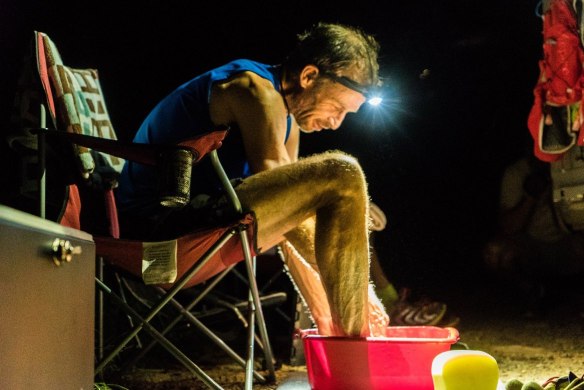
Karl: We had some protocols. Every time I stop, when I stop at the end of the day, my dad’s job if you want to call it that, Sr’s job, was to have me setup so I can clean my feet. He’ll just setup a bin of water and some cleaning stuff, some soap or whatever. The first thing I do when I came in, I sit down, he took my shoes off and I clean my feet up. I never had any blisters on my toes over the whole time, the whole trip. They were solid as rock. I had a blister on my heels, but those things we drain them early in the thing and run and they just went away. Generally, we just cleaned my feet and got those taken care of, have them dried out, and just moved on.

That was the protocol for that. After we did that, once we cleaned my feet and I was good. I was sitting on a higher chair and I went to a lower chair, put my feet up, put ice on my shins and I ate my dinner as I was icing my shins, and then I went straight into bed. I was in bed within 30 minutes usually after every stop; after every night, which was super-fast. I certainly fell asleep quickly. It was really good. They were super-efficient in terms of taking care of things. The further we get down the trail, the more efficient they got. When you did talk to Eric, we were at a place called Bake Oven Knob and that was in Pennsylvania. I think that was my day 20, maybe 20 or 21?  Maybe 20.

That morning, when I woke up at Bake Oven Knob that was the day my shin was probably was at its worst. It was like on fire. I woke up at 4:15 AM in the morning or something like that and I couldn’t really extend on my right leg. It was swollen and red and I’m like, “Oh god.” I’m like, “I need to sit here and ice it a couple of times this morning before I get going anywhere.” I did that because again, I was a day ahead of Jen’s itinerary, I had a little time to I waste to say I had money in the bank, it’s not my style, or miles in the bank, that’s not my style but I had to do it.

We did that, and then finally after a few hours, I put my shoes on and I started moving. I believe I only covered 32 miles that day. After 25 miles during that day, again my shin was on fire. Pennsylvania is all rocky so your leg is twisting around a lot. It was just aggravating it even more. After 25, I stopped again I said, “Hey, I got to ice this thing a couple of times.” And then we’ll just see what happens. It felt a little better after I sat for a while and then I went another seven miles down the trail, and I think we finished at 32.

Ian: Yes, that was the day that Mike joined you. He made a comment that because you are obviously protecting your shin, your knee was buckling underneath you during the run. What’s going through your mind at this point Karl? Because it wouldn’t be an underestimation to say that completing the AT in a fast time has been a priority for you for years. I think we both knew before you went into this when we discussed it that this was probably the last chance to get this record. Did you see it? All the hard work starting to potentially crumble beneath your shin?

Karl: Well, maybe? I think the thing is Scott got hurt, Jen got hurt, I got hurt. With my knee buckling thing, that issue was with me back in May before it even started. The whole thing is like it wasn’t affecting my running. I just put on a knee wrap on my knee, and that reminded me not to extend out, hyper extend my knee. The brace isn’t going to do something bad, the brace isn’t going to stop you from hyper extending your knee.

But it was protecting a little bit from doing that just in my mind and just physically. But then that day again, when Mike was walking with me and my shin was killing me, my knee buckled a couple of times and Mike was walking behind me. I was like, “Oh my God. Why is this happening?” And feel like, “Why are these things aren’t falling into place?” But yes, I was a little worried about it for sure. I was just like, “Well, who is my knee going down now too?” I started to get mentally frustrated. I started getting a little upset.

Again, having that cushion that I had built up made huge difference because it gave me time. It’s not like I fell 40 miles behind quickly because I was hurt. I was still in it. I just said to myself, “You just got to stick with it for a while and see what happens.” I do remember in 2008 when both my shins were bothering me, and on the Pony Express when they were bothering me, you sort of keep using them and keep walking through it, it sorts of goes away. I said, “Well, we’ll see if that happens here.” As you saw, we did 32, and then we did 50 something, and then we did 16 which again my shin was on fire that day too. The next day, we did 50 something…

Ian: It was interesting watching because there was obviously this dilemma going through your mind, and I’m sure your crew’s mind. You had your blinkers on, and it was very interesting following some of the comments on Facebook. The doubters were going to doubt, and of course they were going to say, “Oh no, the shin is hurting. That’s it. He’s got no chance.” The one thing that I kept going back to in commenting on was, “Look guys, Karl is completely 100% blinkered for this. We discussed it. He knows what he has to do because he experienced it with Scott and there were valuable learning lessons.”

One of the things that was worrying me from the side-lines was that I could see this accordion. I could see you suffering, and then the next day it was almost as though you refused to accept that your body was doing what is was doing, and you were bullying it into doing what you wanted it to do. A classic example was day 20 when you did 35 miles, but then the next day you spent 17 hours on the trail. Of course, this is a real bouncing act, isn’t it? Because that’s your bloody mindedness wanting to get it done, but then the problem comes with day 22; you can be wrecked. How did you manage that? Did you just think to yourself, “You know what, I’m just going to give this everything and see what happens?”

Karl: Yes, absolutely. I think what was funny too is I was sort of telling myself in a jokingly kind of way that, “Well gee Karl, you did 16 miles yesterday so you’re rested for tomorrow.” Seriously, it didn’t make a difference in the rest there because I went to bed 7:15, or 7:30 as opposed to maybe 9:00 or something like that. Because I don’t really do well with sleep deprivation, that made a difference for me the next morning to get up and say, “Okay, I’m up and wired, I’m awake.” I’m kind of, “I’m going to do what I can. I know my shin is going to hurt, just deal with it.”

The rest helped me be able to go those 50 plus miles after the short days if my shin wasn’t bothering me. It was amazing, my shin with those shorter days was not able to re-heal overnight, of course. But the swelling went down so I had more time to just settle down a little bit. I could keep going, and then my gig going into Duncannon, Pennsylvania which is the end of the rocky section of Pennsylvania, I survived. I crashed hard going down that trail a couple of times. You’ll see that in the film probably which is quite entertaining for all the people watching.

When I finally got to Duncannon, it was just a two mile walk through town. I walked through town and I said,” Let’s just… I’m only eight miles behind where Jen was. I’ll stop here, I need to rest and wake up in the morning, we’ll see what happens.” We stayed in this nasty camp around in Duncannon. We got up the next morning. I was driven to where I stopped walking that morning, and I started walking uphill. It was a steep rocky climb for about maybe a mile and half, going uphill wasn’t so bad. It was going downhill where my toes would extend out forward, which would make it sore and hurt.

I get to the top of the climb and the terrain sort of changed where it started to get smooth. There’s an area there called Cumberland Valley where Pennsylvania is sort of known for being smooth. I knew that was coming, and it’s funny because I reached that ridge line and turned into Cumberland Valley and there’s this CVATC, we manage the trail here. I was like, “Uh, Cumberland Valley ATC. Thank God I’m here.” The uphill section is gradual, very gradual uphill I’d say. I started running, yep, very slowly running the gradual uphill’s.

I said to my dad, I said, “I’ll just start to run uphill now and see what happens.” Instead of running downhill, I started running uphill. It was weird but the shin pain went away. When the terrain got smooth and the shin pain went away, I think it is a 53, a 60, and 57 miles all in a row, boom boom boom! That got me right back where Jen was and even put me ahead of her pace. Once again, the confidence builds up, “My shin doesn’t hurt. Man, I’m back. I’m back in the game.” Again, I never felt I ran off pace. I was so confident I could still get there as long as I stayed fairly close to that pace.

Ian: What are the frustrating things I guess for me and people who were following you. Was that for reasons that you discussed prior to departing was that Red Bull and Appalachian Trail didn’t want people to know exactly where you were. Your updates were coming out maybe two to three days late. But day 22 to day 25, certainly looked as though it was a real crunch phase in the whole thing. As you said, day 22 you did 16.4 miles in seven hours, but you benefited from good rest, good sleep. The next day you get back up on the trail, and then day 24, you do 35 miles. Day 25, it didn’t list how many miles you’ve done.

Basically, it reaffirmed how far you’d gone, how far you had to go, what your age was, and it was saying this is crunch time. I got a real sense of feeling that it was a massive pivotal point within the whole thing that this reading between the lines from the feedback and from what Eric was saying. How you pivoted on this point was where the success or failure was going to happen. As you just said, you go into day 26, and you banged out 60.1 miles. I remember writing at the time, I just can’t comprehend it because 60.1 miles for any of us is a big day out just on its own.

Karl: Yes, and the funny thing is too, 60 is a lot more than 50! 10 miles is three hours whatever, but it’s a huge difference because you don’t get that sleep. You don’t get that rest. You don’t get that recovery. Yes, but it was sometimes that was logistics, and sometimes the terrain was tough; that’s near Shenandoah I think? The terrain is a little bit smoother in there, so your average pace is no longer 3.2, it might be like 3.5. That .3 miles per hour over that long period is five miles or whatever. It made a difference in terms of being able to go 60. 60 was huge no doubt about it. I think Scott only pulled one 60-mile day too. Yes, it was confidence. It got me back.

Ian: That day 26 was the day that your dad, Senior, came back onto the trail. One of the questions that cropped upon Facebook on the Talk Ultra feed was that. There was an obvious reference to Sheryl and Senior throughout the whole thing. Its’ obvious how important those people are in your life. This process, because it’s so intense for you and let’s face it, you’re tired, you’re fatigued, you can be cranky, you can be moody, you can be probably pretty offensive at times. But the one thing that I could imagine from the outside looking in is that this type of experience as a family can only bring everybody so much closer together. I just wondered what impact Senior joining you on day 26 had on you producing that 60.1 miles?

Karl: It’s funny that… I can be a little annoying jerk and stuff like that. It was funny, I talked to Dave Horton along the trail about this, he was inspirational too.

He was like “When I was on the trail,” and he knows, because he’s done it, so he understands. He’s like, “When I was on the trail, I would yell at my wife, and I would say not so nice things, and things like that. And he’s like, “It’s sad that we feel like we can say mean and cruel things to our spouse or our dad or something like that, but not others.” I wouldn’t say those types of things to Belz as I’d say it to Sheryl, or say it to my dad. It’s bad that we do that huh?

But I guess we accept the fact that they won’t bite back, or something like that. My dad would just kind of let it blow it over his head. Sheryl will sometimes take it a little more offense, but that’s okay. She sort of mostly will let it blow over her head. She knew that I was dealing with a lot of mental misery. It definitely brings them closer together; they did such an incredible job of always being positive when I would come to a stop. Even if I was grumpy or something like that, they still didn’t bite back at me or yell at me or something like that. It was more like, “Karl, just relax. Calm down.”

Ian: Yes, I’m sure there was a fair amount of stuff said.

Karl: Yes. My dad was incredible, I mean he, well Belz was sort of crew chief. My dad was sort of the monkey worker on the side, always kind of doing stuff. My dad doesn’t sleep. The guy moves back and forth all the time. I mean, he was awake at 3:30 in the morning going back and forth to his truck when I was still sleeping, like, “Why is he up now?”.

He never took a nap when they had an opportunity to rest; they needed a rest too! He just would never do that. He was so into it. It was so cool to spend that time with my dad. Even though I wasn’t there spending time with him, I knew he was always there and helping me out. Yes, it brings us closer for sure. It was quite the experience, having them there.

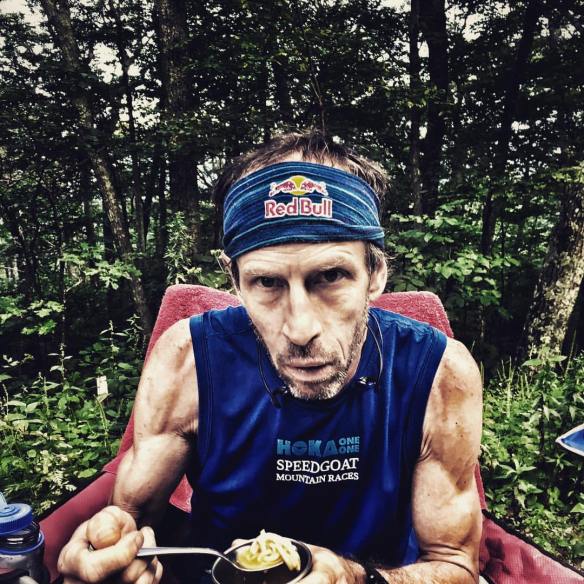
Ian: So, day 26, 60.1 miles. Day 27, 55.8. Day 28 was just another whopping day. And at this point, I’m looking at my computer and a photograph came on your Facebook page, and it drew complete parallels to the photo last year of Scott Jurek. Remember when everybody discussed about his vegan diet and Marshall Ulrich went on record and said, “You can’t do the AT without eating meat”.
karlmeltzerontheat

And there’s this photograph of you with your Red Bull scarf around your neck looking damn drawn, looking damn lean. And it just goes to show the incredible impact that the trail, the multiple days of hours and hours and hours on the trail has. Belz said to me that you were having ravioli and mandarin oranges. What was the diet like, and could they predict what you wanted?

Karl: Well, they couldn’t really… They would go and say “Hey Karl, what do you want today to eat? If you want some food, just find something.” I would more or less eat anything. I ate a lot of good food too. The stories came out where it was like Meltzer doses on some beer and candy. Well, it’s not true. I didn’t do it on beer and candy. That’s just the media doing their thing. I ate a fair bit of meat.

I think Belz probably cooked me five or six or seven rib eyes when I’d come the end of the day. I had a steak and some asparagus and some rice and things like that. But I had a great dinner every night. I think that was really, really important. And even though many people thought that I was looking skinny… I’m a skinny guy anyway, and you know me! I’m a skinny guy anyway. Over the whole entire trip, when I weighed myself two days later at the Red Bull office, I had lost three pounds, that’s all!

So, I gained maybe a pound or two back after I finished, but the bottom line is, I was eating a lot of food. I mean, the stuff that I was eating on the trail, I was pretty much eating real food. My last gel I ate was in Maine. I didn’t eat that much gel or chump things or anything like that. I went to real food because I still feel like that just fills up your belly a little more. It doesn’t mean it gives you better energy, but it fills you up a little more.

I ate a combination of anything. Dave Horton would bring chicken for me and ice cream. And I think it was dense calories. So, I was eating a lot. Scott, being vegan, it’s going to be a lot harder for him to get as much protein. He certainly knows what he’s doing, don’t get me wrong, but he lost 19 pounds when he was done. Being vegan, you probably can’t get as many calories. And he was eating all day long, too. He was doing the same kind of thing, and I think, what Marshall said, it’s like, you do need to eat meat. You need to eat a lot of protein. I drank a lot of Ultragen, a lot of calories there. I did a lot of that kind of stuff. I ate a lot of sweets. I ate a lot of cinnamon buns.

Ian: [laughs] What where you eating Karl…?

Karl: It’s kind of funny, but it’s just calories, you know?

Ian: What were you eating between seeing the crew? Or was that not so much of a priority? Because I’m just trying to think that let’s say you see your crew every ten miles. As you’ve said, that’s three or four hours. Maybe even longer in some places. So, you’ve got to be eating something while you’re out on the trail. You can’t just be relying until you see Eric and Senior and Sheryl.

Karl: Yes. I had a small pouch on my little waist pack, and I would just have like a quesadilla or something like that, or a steak and cheese wrap, or something like that. A piece of chicken, a cinnamon bun, a donut, even. I never buy donuts, but they were so good on the trail. I had a little bit of candies for some straight sugar. That article was true. I did eat some candies. Spree was my favorite. They’re just little sugar things. And yes, I ate a combination of protein and sugar and carbohydrates. I would bring a piece of pizza along with me.

But I did eat as much as possible! When I stopped at the van, I probably consumed at least 500 calories. Fruit. I ate a lot of fruit. Those mandarin oranges and canned peaches were just the greatest thing ever. I ate so many mandarin oranges, it’s kind of silly. But I like them. That kind of stuff was boom boom boom and I’d eat a whole can of it in like a minute.

Ian: Just to sort of clarify there, because your pace is going slower, did you feel as though you could take in more calories and that it had less stomach distress? Because we all know the balancing act between eating calories and it sitting in your stomach. And your stomach having to work to digest that food. It doesn’t always go in line with trying to move quicker or faster. But I’m guessing your hiking and jogging pace was allowing you to eat big calories and it not causing any gastric distress?

Karl: You’re right. When you’re going slower, you can definitely digest food. Not once did I have a stomach problem the whole time. I was never like, oh my god, my stomach’s upset because I ate that whole pint of ice cream in three minutes. I did eat an entire pint of ice cream in a few minutes one time. And you would think, “I’m never going to be able to run for a couple of hours.”

But it’s funny because you take that in and you suck it down and I would start hiking and it was like, I was good for about an hour or so after that. I wouldn’t have to eat any food. But after an hour, I’m like, “I need to get in my pouch and get me something to eat.” Your body is such a furnace on these multi-day things like this, that it really doesn’t matter how much you eat at once, because you are. You’re moving a lot slower.

I mean, my average heart rate was probably 100. I’m going to guess, but somewhere in that ballpark. It wasn’t that high. So, I could digest, I could use the fuel and the power from whatever I was eating and not have that stomach distress. Again, any 100-mile race, or smaller, shorter races, there is that fine balance of taking in too much at one time. But it is pretty easy to just eat whatever you want and not have that problem.
horton-jurek-meltzer

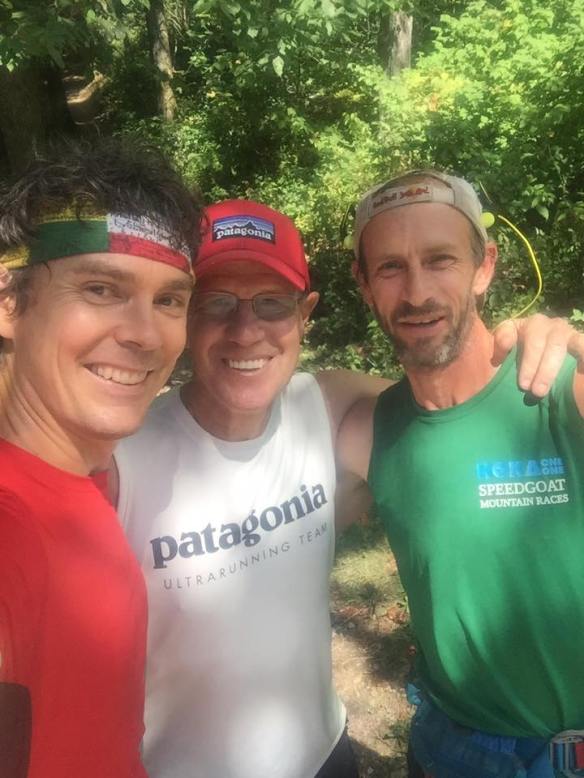
And Dave Horton would say the same thing, and so I’m sure Scott would say the same thing. It didn’t matter how much I ate at a stop. It never bothered the stomach. Scott’s stomach never bothered him either. Dave Horton said he had a lot of problems. He’s like, “I could never eat like you, Karl.” I sat there one time, he brought me a bucket of chicken, and I got a big bucket of chicken at one place, and I ate like the whole thing.

And he’s sitting there watching me eating, and he’s like, “Man, I could never eat like that. I couldn’t eat it when I was done.” And he’s like, “You are amazing.” I’m just like, just give me another piece.” I would just take it right down. I didn’t have problems with that. It was just fortunate, you know. Obviously, that’s why I didn’t lose 19 pounds, probably.

Ian: Absolutely.

Karl: It was cool to be able to do that.

Ian: Let me talk about day 29, Virginia. Again, I’ve said pivotal points. And it appears this was another pivotal point. That day, you covered 50.4 miles. And Eric said that it was relatively pain-free because you’d found a new way of taping your shin. What was that? Was that just a little bit of luck, of trying different methods? Because I know that you’d been wearing a compression sock and you’d tried taping it.

And you were icing as much as you often could. But you found a way of taping that seems to just work?

Karl: That information came from Scott when I was in Duncannon. Belz called Scott and I was just talking about my shin, why it was bothering me, where it was hurting that kind of a thing. Scott has a physical therapist background, so he’s like, “Try to get a brace or like a wrap – that will compress your interior tibialis, the muscle there over your shin. And compress the muscle belly.

Don’t put the wrap over your tendon, down lower towards your foot. When my leg came on fire, that wrap was down on my tendon on the lower part of my foot, and it was there and it was freaking killing me. I changed the location of it a little bit, and it just didn’t hurt as much. That was a game changer.

There were a few game changers in this whole thing that gave me the record basically. There’s another one down the road I’ll explain in a minute, but the allocation of that wrap helped. I never took it off all the way to the end. I’m like, “Just wear it.” Even though it wasn’t bothering me later. I’m like, “Just keep it on dude.”

Ian: Exactly. If it ain’t broke, don’t change it. Don’t change it. You said the game changer, and it was that game changer that strapping that made you on day 30 cover 60 miles.

Karl: Little things that count.

Ian: What was very interesting was that you’d obviously got out for the day, you’d planned to stop at 6:00 PM, but that blinkered vision, that feeling good, maybe the reassurance in this new taping sent you out for another 11 miles. Of course, at the end of that day, you’re feeling damn good. Your crew are thinking, “This is amazing Karl. Is just absolutely killing it.” I made a comment when I wrote about this and I said that you were killing it and I was blown away by your tenacity.

Karl: It was amazing how it came about.

Ian: Yes, amazing. First, tell me about that, that come back and what goes through your mind to bang out 60 miles when you’re 30 days into something incredible like this? And then tell me about the day after.

Karl: It was weird. I’m running long like, “Why doesn’t my shin hurt anymore?” Obviously, I was trying to do the right thing here with the wrap and icing and all that stuff. But it’s just like suddenly it went away. [laughs] It’s hard to explain why and everything else, but it went away so it gave me more and more confidence. I kept telling myself, “Don’t be greedy here. You still have tomorrow. You still have 15 more days to go. You just got to be patient with it. Don’t do anything stupid. Always watch where you’re stepping.” Again, my shin was still a little tight, it just didn’t have that searing pain that it had before.

Believe me, I was just like blown out of the water that it wasn’t hurting anymore. I was quite surprised. And even everyone like Belz, my dad was just like, “Wow. How come it’s not hurting anymore?” I don’t know how to explain that. It’s like Jen, she had the same thing, Scott had the same thing. I’m sure when Scott hurt his knee or his quad, he tore his quad muscle like a week later it healed. How does that stuff heal while you’re doing 50 miles a day? God, I don’t know. Your body is just adopting to it.

Ian: Can I ask a question Karl, how much other pain did you have?

Karl: Well, soreness like if you run a hard race, the next day you wake up and you’re sore and you’re hobbling around. On these types of things, your body starts to adopt after two to three weeks. I never had that deep soreness or anything like poke your muscles out and you get that sore pain. Not once that I ever really have that type of thing. The real pain is between your ears. [laughs]

You try to deal with it mentally, but as I get going every day, your legs are just heavy like you’re carrying around these two heavy cement logs but you don’t have that excruciating soreness pain. If you’re not having that and you’re still able to walk, you can always walk. And walk is what you’re doing most of the time anyway. If you could walk fast, and I taught myself how to walk a little faster than normal, and I was just able to keep going.

The jogging, you don’t jog very fast. You’re jogging slow. You’re barely picking your feet up off the ground or you’re stumble all the time. The real pain, it really isn’t there– that much. It’s just the pain is between your head and you’re just trying to keep moving forward.

Ian: Let’s go to day 31, because it certainly seemed as though that extra 11 miles that you banged out on the evening of day 30 may very well have been 11 miles too far and certainly that’s what Eric was touching on… in his report from that day where that you were feeling tired, you were feeling fatigued, you’ve got a blister under your foot, and as I can only imagine, I think I would have been done a long time ago…. I don’t have the mental or physical strength to maybe put myself through what you’re putting yourself through, but the highs of day 30 probably were feeling pretty rubbish on day 31?

Day 30 was Virginia when you were in the Shenandoah National Park. That’s when you’d had your leg taped up and you’re sort of planning to finish at 6:00 PM, and then you went out for 11 miles in the evening, and then you did 60 miles that day. But day 31 was Blue Ridge Parkway section. You were very fatigued, and you had got a blister under your foot, your crew got you a little bit happier by giving you two steaks for dinner.

Karl: Yes, the blister thing under my foot I must mention, this is probably the ultimate game changer. There is a guy, Johnathan Basham, he holds the record of the long trail. Jonathan I’ve known for a long time. He was pretty close to there. He came out to visit me, he’s the stay-at-home dad. He’s got two kids, two young kids, and his wife is an ER doc. Now, his wife was off that day. He could come out and say hello, and see how I was doing.

He shows up, and I come in to the stop where my crew was and my left foot was killing me under the bottom center of my foot. I’ve had a neuroma under there for a long time – for years. The same pain, the pain of that under my left foot felt like my neuroma. It was numb. It was pretty excruciating to step on it. I got to the stop and I said, “Man, my foot is just on fire. It’s killing me.” Jonathan was sitting there, and he says, “Karl, how’s it going.” I took my shoe, “Oh my God.” Every time I would put my foot down in the ground, it would start throbbing, like throbbing hard.”

John looks at it,” No, Andre Thompson had this too back when he did it. It’s just a really deep blister, like way, super deep blister under your foot.” I was like, really? “Do you have anything to try to drain that thing?” I said, “Well, I have a scalpel.” It was a needle type scalpel. He’s like, “No, that blister gets wider as you stick it. Do you have like a needle or a safety pin or something like that?” I was like, “Well, we have a safety pin.” We tried that, and it got a little bit of fluid out, but not everything. He’s like, “I’ll tell you what, tomorrow, I’ll bring you a surgical needle.”

He shows up on cue at four o’clock in the morning, and I’m awake ready for him. We stick my foot with the needle, and we got all the fluid out. I put my socks and my shoe on, and I started hiking again, all pain was gone, and my foot was an entirely new foot. The pain was absolutely gone. That was the ultimate game changer. Yes, it was incredible. Suddenly I could get running again… it totally got me jogging again.

Ian: This way day 32?

Karl: Yes. I guess it’s 32.

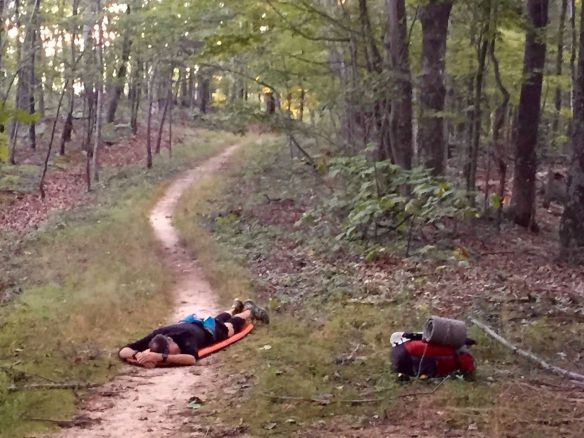
Ian: Yes, day 32 you did 57 miles. I think what’s interesting here is you’ve just said that draining your foot was a game changer. But also, day 32 was also nearly the day where you ruined your whole attempt. Because that was the night that you actually slept out on the trail. You slept at Scorched Earth Gap instead of continuing for another four miles to your crew. You bedded down on the trail. You had a bad night and then what followed on day 33 was one of those days that probably your crew and you want to forget in that you were just completely exhausted.
karlmeltzer_sleeping

You couldn’t function. They found you face down asleep on the trail and basically you just said, “I need to sleep.” During the middle of the day you went and slept for three hours. I guess that was a really awful time for Eric and Senior and Sheryl in that they’re looking and thinking, “Carl, is this it? Is this over?” What was going through your mind at that point?

Karl: When I slept on the trail, Eric packed the tent, he had food for me and he did everything right. I got to him a little after ten so it was kind of a late night for me too. They got there and we went to bed to sleep and I did not sleep very well. We tossed and turned a little bit and it just wasn’t very good sleep. We got up at four o’clock in the morning and I got my shoes on and stuff and I started walking. Eric picked up the tent stuff behind me. He said we’d all just catch up. I started walking and I was just super-duper fatigued.

Every time I went uphill I was just like, I couldn’t. I was just so slow. My legs were so tired. That lactic acid burned and built up after every step. We went in a mile or two slow and I said, let me crash for 20 min. Give me a 20-minute power nap and see if that makes a difference. That’s when you saw the picture where I was face down trying to sleep on the trail. I was only down for 20 minutes on the trail that time and Belz was like, “Okay Carl. It’s 20 minutes.” I was like, “All right.” I got up. The same thing. It was just like I had nothing in the tank!

It was like going on empty. I finally get the van. Five hours for 10 miles which is ridiculously slow. I got to the van and I was like, “I need to sleep.” I just walked there and I went right down. Sheryl was there and my dad was a little like, “You know you can’t do that.” I’m like, “Well, I’m sleeping for two hours.” This is when I was the ultimate jerk. I won the award for the ultimate jerk. I was just like, “No. I’m not going anywhere. I’m sleeping. Leave me alone.”

Two hours. I slept for a while and, did that help me? I guess it helped me a little bit in terms of waking up and having a little more energy. But we were kind of milling around the van and stuff like that and I was just really frustrated. Obviously didn’t have a pack while I was sleeping and stuff like that. I just kind of got up and I just walked off. I was mad. I just kind of walked off and got on the trail and l said, “Don’t give up.” I told myself, “Don’t give up yet.” I just got on the trail I started walking south… my crew never saw me leave.

Ian: I know. I can imagine them going to look for you and suddenly you’ve disappeared and then they have no idea where you are. You’re somewhere down the trail of course. Then they are rushing packing things away to go and meet you at the next stop.

Karl: I expected someone to come behind and say, “Hey, wait. Where are, you going?” But I kept looking back and, “No.” I walked about a mile and a half or something like that and I saw a couple of other hikers. I said, “Hey you guys. If you see people down the trail, if they’re looking for a Speedgoat. Tell them, I am on the trail.” Then another mile or two went by and Sheryl came running backwards towards me. It was a short section. It was like five and a half miles or something.

She came running backward. She just gave me some water. I didn’t need water or anything. She gave me some stuff and I just kept walking to the next stop and then I consumed a massive pint of ice cream. Still frustrated and all that but I got my craft together a little bit and put my pack on and I walked those seven miles. That’s when Dave Horton showed up again and was saying to me, “You got to keep going. You’re still in it. The foods are in front of you. You still have it, Karl.”

He was trying to inspire me to do another seven or eight miles. He was like, “You’ve done the seven or eight. You’re still three miles ahead!” I’m like, “What dude? I need to sleep.” I had to the stop and I decided that I would be better off sleeping instead of trying to push seven more miles and get there in the dark. I need to sleep. I knew that if I slept eight hours I’d be much better tomorrow. That’s what I did and then obviously, you know things turned back in my favour again.

Ian: Yes.

Karl: It’s funny, I had one day where I was just so tired that I just walked into the van and “boom”. Then I went down for three hours. A lot of it is in your head but at the same time, I just felt like I had to do that. Again, I wasn’t out of it because I heard I was a little bit ahead over general. I wasn’t out of the game yet.

Ian: It brings up so many questions. But let’s think back to your last attempt when you failed. We’ve discussed that in-depth and one of the things that seem to be far more significant about the failure last time was probably not so much your physical self, but more to do with your mental self and the fact that your crew weren’t quite doing what you needed. Now you obviously learned from that process. You got to witness Scott last year and we discussed in the build-up to this attempt and questioned, did you have the grit? Did you have the blinkers? Where you prepared to go back out when you were tired? Was your crew going to be nailing it?

It’s just unequivocal yes to all those points this time around, isn’t it? You knew what had to be done. But also, what is so important is that Eric and Senior and Sheryl just seemed to be so on the ball – making sure that you had what you need. They were there for you. I know that you’ll give them credit. But we know how hard it is to follow somebody for 40 days on the trail with minimal sleep, looking after you, finding you, feeding you, packing up, breaking down. It’s just an incredible challenge.
karlmeltzer2

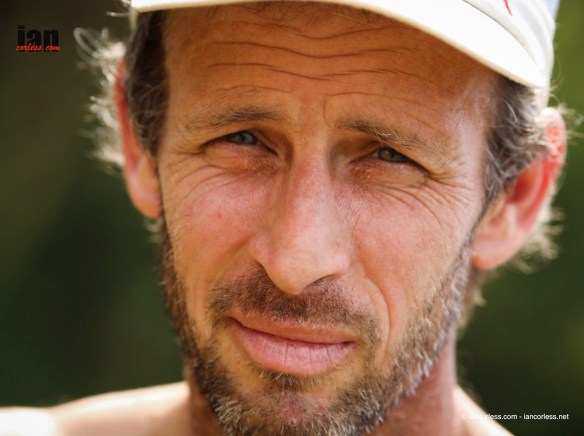
Karl: Well, they stayed positive all the time. That was the whole thing. Instead of arguing or not, not giving me grief about being a jerk or something like that. It rubbed off me. The positive parts rubbed off me. Why aren’t they yelling back at me? Sheryl and I had a few conversations that weren’t so pleasant. But at the same time, she kept saying, “You’re not out of this yet. You can do this. You can still do this.” I had to believe in that and she helped me believe in that.

Again, they didn’t get negative and kind of walk away. They just said, “Karl, you’re still in it. Don’t give up yet.” I still knew in the back of my head that I was still in it but I never wanted to quit. There’s a lot of time and effort spent on this thing. Not just Redbull, but all the money in support. It’s just one of those things that you must stay positive and it worked. It worked. The crew was amazing. Crew was super important.

Ian: After day 33, I think Eric said it was probably the lowest day of the whole AT experience. It was a day where you covered 23 miles. You physically and mentally were feeling jaded. Day 34 comes around in you’re in Virginia and the calculations are done. That from here on, in its 50-plus mile days to get the record. You go out and you bang out 50 miles as though it’s a normal scenario. It goes back to the amazing highs and lows of being out on the trail. Do you think that 50-plus mile day was the Karl Meltzer determination, or was it the fact that day 33 was a shorter day, and you got more rest and you managed to get out there and kick trail butt?

Karl: A combination of both. I just said to myself after Sheryl locked me out that morning the dark and it wasn’t so good for a little while but I kind of turned the switch on of being happier Karl again. I tried to not being mean Karl. It just said, “All right Karl, turn the switch on. What are you doing? Get your shit together?” I just sort of did and I came into a happier place and then it just turned back to good old Karl on the trail. It was amazing.

Ian: Okay. Then at this point Scott is joining you on the trail?

Karl: A little later. I think a little bit later maybe he joined me. Somewhere like day 37 or something like that.

Ian: Okay, so, talk me through from, say, day 36 because this is the point where I wrote on my website that you could smell the barn, and I know that I was probably a little bit premature with you smelling the barn…

Karl: Just a little, yes, but that’s okay.

Ian: But you knew what I meant in writing that. At that point you’re much closer to the goal than you were at the beginning. And although the smell of the barn might be a faint one, it’s there, it’s in your nostrils. And there are no guarantees because there was still a long way to go. But I guess mentally there must’ve been a change for you, and if there was a change, what was that change?

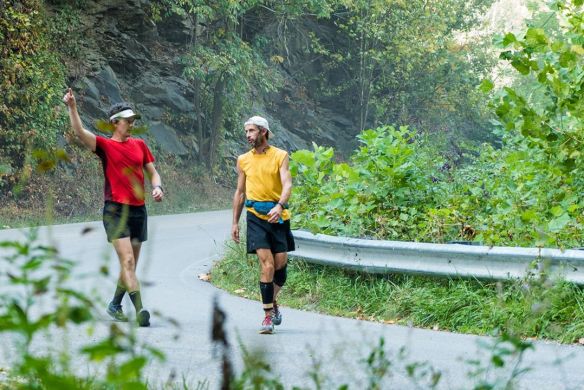
Karl: Well, you’re right, I mean, I smelled a little. I knew if I kept my crap together I could still get it. That feeling came around day 40 or day 41. I was like, “If your body holds up, you can do this” then I knew I could bang out 80-something miles in the last day. That’s when I started to smell the barn, it was probably 40, 41. I was near Smoky Mountain National Park, and that’s when I knew that I kind of had it. And then Scott came in there too, he was amazing, he ran into places to crew for me that other crew couldn’t get to.
scottjurekandkarlmeltzer

He did whatever to help me, he brought my stuff into camp overnight that one time and that my crew wouldn’t have been able to do. He was inspirational. Whenever we ran together we just were chatting about old times, and the miles went by a lot faster that way too. He made a huge difference. Then he took off one day, he had to go to New York, so he jumped on a plane to New York, came back the next day.

Ian: Brilliant.

Karl: Yes, that was pretty cool. Scott said,” Yes, I’m coming back for sure”, and he made a big difference for sure.

Ian: Yes, certainly on social media Scott’s presence was significant because the community fully realized not only what you were undertaking, but the true nature of the sport. Scott had got the record, you’d been there, you’d helped, and then he was returning that favour even though you were going to potentially break something that he’d worked very hard for. There’s many questions that we could go on and ask about but what was Scott’s demeanor during the attempt? How did he verbally encourage you on the trail, and what hints and tips was he giving you that maybe you knew but maybe you didn’t know?

Karl: Well, clearly, if you would have shown up and Scott was there, you would never know at the time that he held the record and that’s kind of the friend he is, he’s just like — Whatever you need to do, he would take over some logistical stuff. You would never know that I was breaking his record, he was just there to help me, kind of like when I was there to help him. He just did what he needed to do to make me move forward. The funny thing is that on the last day Jenny was like, “Hey, Karl, why don’t you take an eight-hour nap?”

She was just joking around, of course, but it’s just like, “No, Jenny, I want to get it”. But, no, you would never know that he was the guy that held the record because he was just helping me, and that was special, and I felt that from him. He was just like, “I’m just going to do what I need to do”.

Ian: Yes. Day 36, 57 miles. Day 37 was another 50 plus mile a day. Day 38 was 55.6 miles. At this point it looks as though you were cruising. Were you?

Karl: Yes, yes, more or less. Those mileages are basically I needed to get that far, but road logistics had something to do with that too, it was like, “Today you have to do 55 because you can’t stop before that”. Some of those big miles came like that, but I wanted to stay a certain amount ahead of Jen, so that I knew that the last day I’d be safe if I did the 85 miles. So, yes, I was cruising, though, I was still getting done early, I was getting to bed by 8-8:30 PM.

And, yes, it’s just about 15 hours. I get out the door at five o’clock every morning, and I could get those miles in well. It’s hilly down there, but it’s smoother, so you can definitely move better, especially on downhill. You could go a tiny bit faster if it wasn’t so technical, and I was just able to get those miles in, and get to sleep at the same time.

Ian: On day 40 Dave Horton had to leave the trail early but he turned to you at one point, and said, “You can do this. You should quit now if you don’t plan on beating Scott’s record”. Basically, reading between the lines, you’ve got this! Did you feel as though you had this at day 40?

Karl: Yes. I mean, I knew only if my body held up, like I said. Yes, I knew that because, again, the last day I knew I could blow out a lot of miles. And Jen didn’t blow out the last day and nor did Scott. He was just struggling to get there. I had the opportunity, and that was basically by blowing out that last day. I had a 20-mile lead, or whatever you want to call it. So, that gave me the confidence to know that once I started on Saturday morning, I’m going to the end. That’s where I gained all the ground.

Ian: The last day, or the last couple of days lived up to a Meltzer trademark that 100 miles is not that far.

Karl: [laughs]
karlmeltzer100miles

Ian: I still find it ridiculously unbelievable that after 40 plus days banging out an average of 40 odd miles a day. That you have the strength, physically and mentally, to bang out what was 88 miles…

Karl: 85.4.

Ian: 85.4. And it was interesting, Karl, because I thought back to our interview just before you went out to the AT, and I said to you, I don’t know if you can remember it, but I said, “Are you prepared? Are you prepared to not sleep in those final days to get it done?”. It just seemed as though everything clicked into place physically and mentally, despite highs and lows. Scott called it his masterpiece. Do you feel as though it’s your masterpiece?

Karl: I don’t know if “Masterpiece” is the best word. I was kind of a mess after 19 days. [laughter] But, it was just his call on it. Scott was kind of a mess too at the end. It was totally, necessarily not a masterpiece either, but to me, I call it more of a stamp. Obviously with a lot of 100 mile wins, this was raising the bar just another time, and to say that I’ve won all these hundreds, and then actually did something bigger and more beyond, winning all those hundreds– It was, in my eyes– It’s sort of a stamp in my career. Will I keep running? Of course, I will.

I’ll keep going, I’m not going to end it, but I have nothing to prove. It feels good to be successful the third time. This time I finally got it done and it makes me feel like I can still do this. I’ll be able to go after the 50 age plus records maybe, in a year and a half or something like that. We’ll see what happens, I don’t know.

Ian: Well, you’ve got the record – 45 days, 22 hours, 38 minutes. I’ve got to ask one question… But you went the opposite way to Scott, and one question that springs to my mind, it sprung to several other people’s minds too, is it two records or is it one record?

Karl: I think it’s two records and I even said it to Scott, it’s different, he finished in a different way. George is smooth to finish; Maine is ridiculously hard. Just think, Comrades has a record up and down, right? Hardrock has a record back-and-forth. In Hardrock it doesn’t recognize it that way but we all know there’s two. I think there’s a north to south bound on the AT for sure.

Ian: Okay, so does that mean that you might have a go the other way?

[laughter]

Karl: Not the right time to ask that question but at the same time I doubt it, I think the fact that I got this one time, that was what I was shooting for and I don’t need to do it again. I would have to have quite the incentive to try again but I don’t think so. The misery is too much, it’s just mentally incredibly tiring. Not so much the physical things, just the misery of every morning getting up at four o’clock and grinding out the day. It’s just ridiculous.

Ian: I cannot even fathom it Karl. Many congratulations on the ‘stamp!’

All images ©redbull ©karlmeltzer unless otherwise stated

Red Bull Logo

karlmeltzer3

Episode 125 – Zach Miller, Caroline Boller, Samantha Gash

A_GRAVATAR

Episode 125 of Talk Ultra is our Christmas Show – Happy Christmas everyone! We have interviews with Zach Miller, Caroline Boller and Samantha Gash. We also have a review of the year and Niandi Carmont is co-hosting.

00:01:30

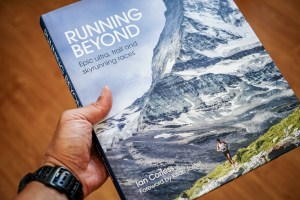
RUNNING BEYOND BOOK is travelling the world and of course I recommend it as a great Christmas present… we mentioned in the last show about Running Beyond Event which will take place 3, 4 and 5th March in London, plans are progressing for that… in addition, Niandi and myself will now be in Amsterdam on Feb 3rd, 4th and 5th for a Trails in Motion event and Running Beyond book signing with Mud Sweat and Trails and I will be also going to Sofia in Bulgaria on the 17th, 18th and 19th March for a trail, mountain and Skyrunning expo.

Need a run coach for 2017? Check out coaching with Ian and Niandi HERE

00:18:26 NEWS

Read the REVIEW of 2016 article HERE

00:23:00 INTERVIEW with Caroline Boller

01:30:35 INTERVIEW with Samantha Gash

02:20:45 INTERVIEW with Zach Miller

UP & COMING RACES

Belgium

Wallonia

53 km | 53 kilometers | December 17, 2016 | website

French Guiana

100 Bornes du Père Noël | 100 kilometers | December 16, 2016 | website

Germany

Lower Saxony

  1. Lauf PSV Winterlaufserie 100 KM| 100 kilometers | December 17, 2016 | website
  2. Lauf PSV Winterlaufserie 50 KM| 50 kilometers | December 17, 2016 | website
  3. Lauf PSV Winterlaufserie 100 KM| 100 kilometers | December 18, 2016 | website
  4. Lauf PSV Winterlaufserie 50 KM| 50 kilometers | December 18, 2016 | website

USA

California

Woodside Ramble 50K | 50 kilometers | December 17, 2016 | website

Florida

Ancient Oaks 100 Mile Race | 100 miles | December 17, 2016 | website

Indiana

HUFF 50K Trail Run | 50 kilometers | December 17, 2016 | website

Ohio

First Day of Winter 50K | 50 kilometers | December 18, 2016 | website

Tennessee

Lookout Mountain 50 Mile Trail Race | 50 miles | December 17, 2016 | website

Texas

50K | 50 kilometers | December 16, 2016 | website

Houston Running Festival 100K | 100 kilometers | December 17, 2016 | website

Houston Running Festival 100 Mile | 100 miles | December 17, 2016 | website

Houston Running Festival 50K | 50 kilometers | December 17, 2016 | website

Houston Running Festival 50 Mile | 50 miles | December 17, 2016 | website

Virginia

Seashore Nature Trail 50K | 50 kilometers | December 17, 2016 | website


03:30:00 Close

03:34:18

ITunes http://itunes.apple.com/gb/podcast/talk-ultra/id497318073

Stitcher You can listen on iOS HEREAndroid HERE or via a web player HERE

Libsyn – feed://talkultra.libsyn.com/rss

Website – talkultra.com

Multi-Day Running in a Rainforest – Hint ‘n’ Tips

©iancorless.com_TCC2016-3069Multi-day racing brings many challenges and variables not only in the terrain that you can and will encounter but also how one journeys from day-to-day. For example, the Marathon des Sables is a multi-day race that requires self-sufficiency, the only exception comes with water, provided by the race but rationed and the provision of a ‘bivouac’ which provides basic cover which must be shared with seven others. It’s why the ‘MDS’ has become THE multi-day race to do. It strips the runner back to basics.
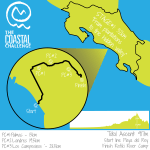
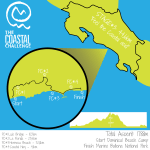
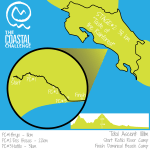
The Coastal Challenge with takes place in Costa Rica, by general consensus, provides a more challenging course than its desert counter part, however, there is no self-sufficiency.

Don’t be fooled though, the race throws many a challenge at participants and below we provide ‘Hints-n-Tips’ that will make a journey into the rainforests of Costa Rica not only more enjoyable but more successful.

What is The Coastal Challenge?

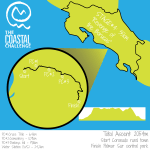
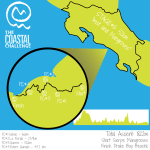
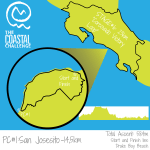
The race is a multi-day journey that travels from Quepos to Drake Bay over five days and the sixth day is a loop around the Corcovado. Distances are as follows:

  1. 32km (917m+)
  2. 44.6km (1788m+)
  3. 38km (1811m+)
  4. 35km (2054m+)
  5. 52km (1822m+)
  6. 23km (584m+)

Is the race harder than Marathon des Sables?

To provide an ambiguous answer – yes and no!

NO:

  • The race is not self-sufficient and therefore runners only need to run with a small pack with essentials and water.
  • Aid stations are provided with some food and therefore the need to carry anything heavy is minimal but one should think about personal needs, tastes and requirements.
  • You take your own tent (or hire one from the race) and therefore you have your own space to sleep and recover.
  • You have a bag or box that is transported each day to the finish of each stage and therefore you can have fresh clothes, shoes, medical supplies, food etc at your disposal.
  • Food is provided in  the morning, post run and in the evening – you can pretty much eat as much as you like.
  • Many of the campsites are in amazing locations and some local amenities are available, for example, you can have a beer or a cold drink most evenings.
  • The ‘long day’ is not as long as MDS.

YES:

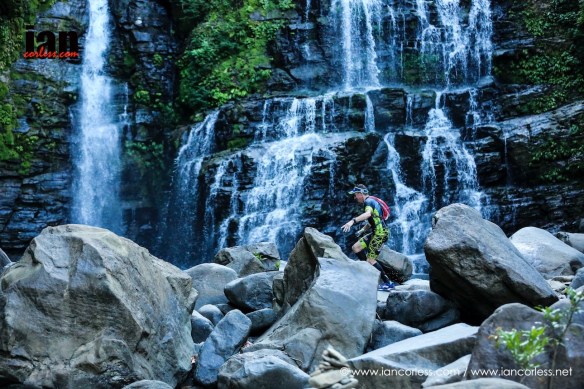
  • The terrain is very varied and at times brutal, you need to be able to handle technical terrain.
  • The course has many 1000’s of meters elevation and descent.
  • Fire trails connect the forest, beach and technical sections which are hard on the legs.
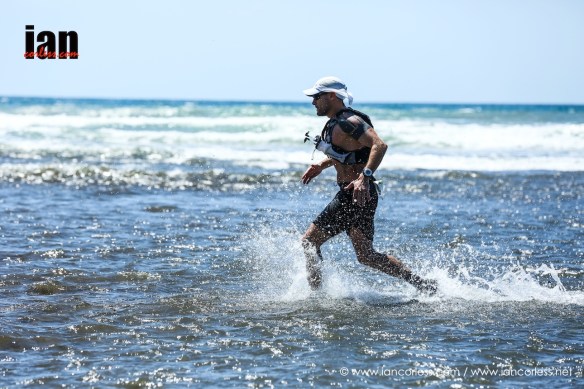
  • Beach sections are long and physically exhausting and mentally tiring.
  • The heat is relentless.
  • The humidity is 75% + and you will sweat, sweat and sweat.
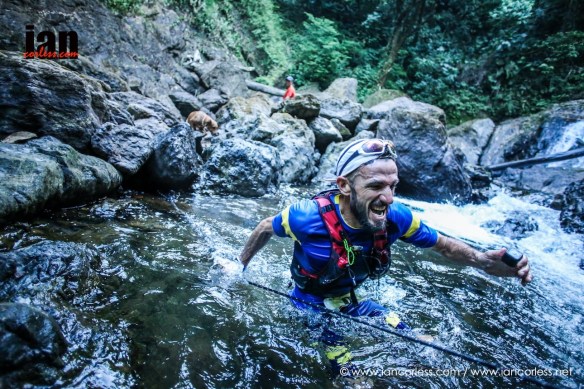
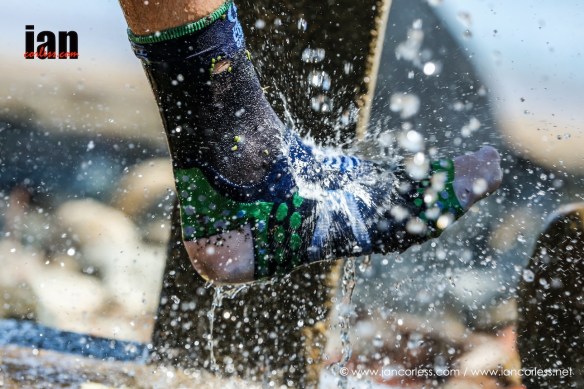
  • Your feet will be in and out of water everyday.
  • The long day is not as long as MDS but at 52km with 1800m+ of vertical over very technical terrain with relentless heat and humidity, it is more than enough of a challenge.

How does one achieve success at TCC?

©iancorless.com_TCC2016-0848

KIT:

Bag/ Storage:

©iancorless.com_TCC2016-0077

Within reason you can take as much kit as you need as this is transported daily by the race. The race organisation ask that you use ‘Action Packer’ boxes for a couple of reasons: 1. They are waterproof. 2. They are easy for the race to transport as they pack together and are durable. However, from a UK or Europe perspective they are a nightmare to travel with and are troublesome. I recommend *The North Face Base Camp Bag Duffle (here), an Overboard Waterproof Bag (here) or an Ortlieb Waterproof Bag (here). Waterproof is important as you ae going to a rainforest and you do stand the chance of rain on at least one day. You can of course use individual waterproof bags inside to separate and itemise clothing, equipment and so on. *The TNF is not 100% waterproof but I have used it and had no problems.

Clothing:

©iancorless.com_TCC2016-9985

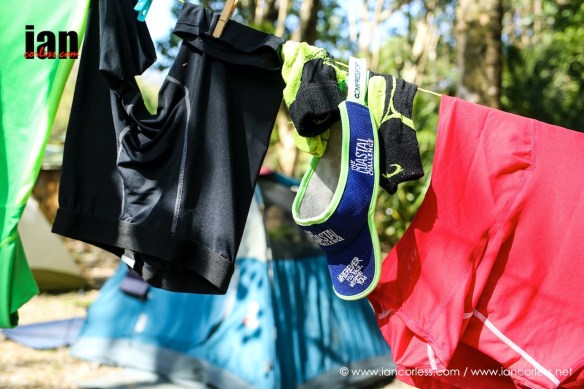
You have a bag that can carry all your kit, so, take 6-8 sets of clothing. It’s really simple, you run in one set of clothing and at the end of the day you freshen up and change into the next days run clothing (which you can sleep in). You can of course add some additional casual clothing if required.

©iancorless.com_TCC2016-9808Make sure clothing is breathable, comfortable and I recommend that tops cover your shoulders as this can be a problem area in such intense heat and sun. You will need a hat without a doubt and some prefer to run with a hat that has protection that comes over the back of the neck. Ladies – just a word of warning on ‘strappy’ tops, they expose more of your skin and you end up with some crazy sun tan.
Feet:

©iancorless.com_TCC2016-6209

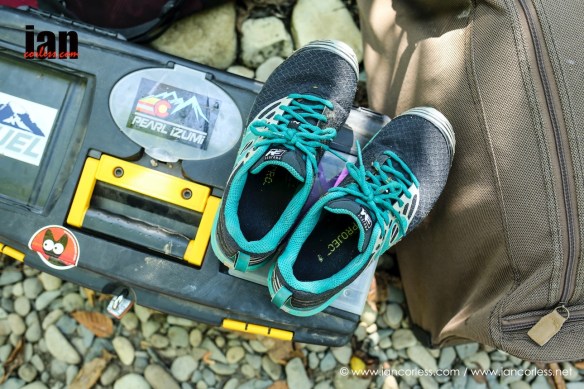
Not looking after your feet is one of the main reasons (in addition to dehydration) why you will not finish the race. Feet will get wet everyday and you will run on all sorts of varied terrain from gravel fire trail to technical and rocky boulder sections. Your ankles will be twisted and your feet can feel pretty beat up. Obviously you can take advantage of having more than one pair of shoes, I would definitely take two pairs and ideally three. Maybe you could take one pair a 1/2 size larger as a ‘just in case!’

©iancorless.com_TCC2016-9973Think about the fit of your shoe. Forget the advice about going a size larger, for me, this is just bad advice. A shoe that is too big will allow your foot to move, a moving foot causes friction, friction causes blisters – the rest is a horror story and believe me, I have seen some horror stories at TCC. You need a thumb nail of space above your big toe, no more! Of course I provide generic advice here and should YOU know you need something different from experience, trust your instinct. Because the trail is often technical, you need a shoe that can handle a multitude of surfaces that includes rocks, gravel, sand, wet rock and so on. You need trail shoes! Consider your gait, the amount of drop you prefer and how much cushioning.
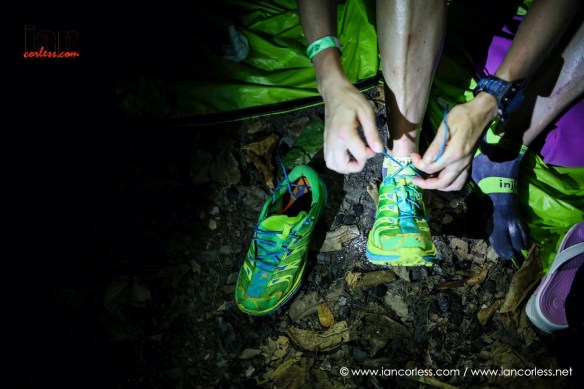
©iancorless.com_TCC2016-0044Only you know this and nobody can tell you which shoe to use. Also considerer that a shoe needs to be breathable – your feet will get very hot but more importantly your feet will be in and out of water. A shoe that drains water is essential. As an example, Scott Kinabalu (here) has drainage holes that allows water to escape, inov-8 are also making a shoe called ‘Chill’ which is designed for hot weather (here). Some runners like to tape their feet to protect them, if that is the case with you, do that in training so that you understand how that impacts on what size of shoe you require.
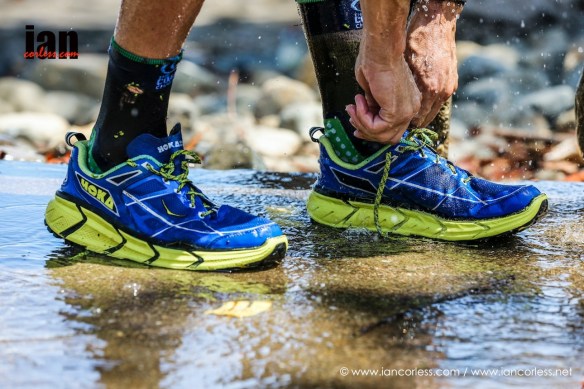
©iancorless.com_TCC2016-6245Good socks are essential and in four years of running and working at TCC I have always worn Injinji and never had one blister! Take a fresh pair for each day. Finally, the TCC does have one or two foot doctors who will look after you should a problem happen, my advice, avoid the problems by understanding your needs before arriving in Costa Rica.
Tent:

©iancorless.com_TCC2016-9974

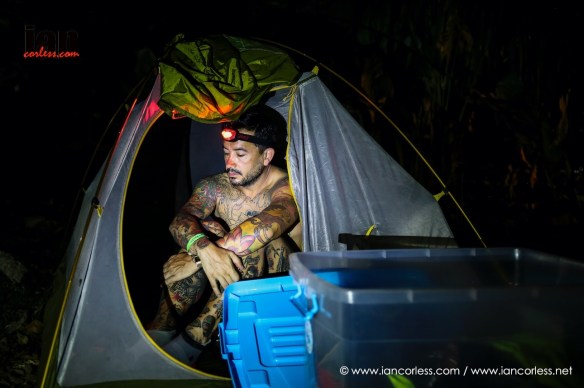
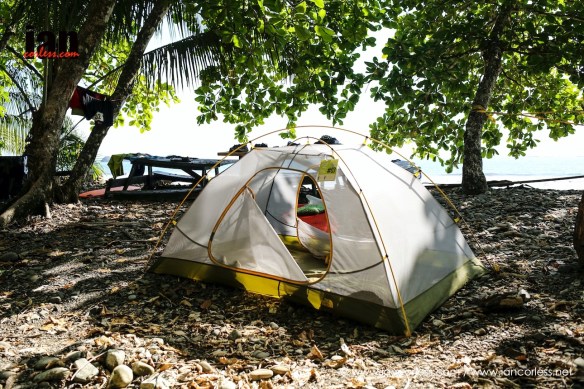
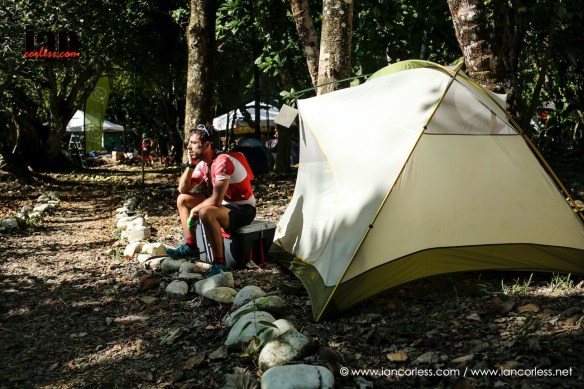
The race can provide a tent for you which you can hire, however, I prefer to take my own. The most important thing with your tent is that it must pitch ‘inner’ only. The reason for this is that it’s hot, really hot, and therefore you want as much air-flow as possible. An inner tent with lots of mesh is ideal too. You also don’t really need to worry about the size, I don’t recommend bringing a huge tent but I also don’t recommend bringing a tiny tent. Although I recommend an inner pitch tent, please bring the fly sheet that makes it waterproof – it is a rainforest remember! You can just throw the fly sheet over if required.

Equipment:

©iancorless.com_TCC2016-9931

Unlike other multi-day races, what you require whilst on the trail is quite minimal. I recommend a ‘vest’ like pack that can hold bottles, bladder or bottles and bladder. You will drink lots and lots and over the years I have found that having a bladder and two bottles takes some of the worry away from drinking. At times, aid stations can be very far apart, you don’t want to be without water! I would take a simple first aid kit, a whistle (just in case), purification tablets, phone, pocketknife, cash and some sun cream. In past editions, some runners have taken a ‘Spot’ tracker or similar. Poles at times will be useful, it depends if you are a racer or a completer. Importantly, should you take poles, make sure they fold, make sure you can store them quickly and make sure you know how to use them. I would bring your favourite run snacks (gels, bars or whatever) and think what you will need for six days. I have mentioned clothing and shoes, no need to compromise, so don’t! Think about toiletries, medical supplies and personal items that will make your journey in the rainforests better – for example an iPod. You will not need a sleeping bag, it’s too hot, however, I do recommend that you bring a sleeping bag liner, it can often get just a little chilly around 2 or 3am. Pretty much everyone sleeps in run clothing. Bring a sleeping matt and one that provides good comfort, some campsites are rocky!

Hydration:

©iancorless.com_TCC2016-3303

Think you have already understood that it’s hot, very hot. You will sweat immediately and you will sweat all day. This places unique demands on you and you will need to keep hydrated. I have already mentioned about carrying enough liquid – make sure you do! I would normally recommend drinking to thirst, but here, I would drink every 10-15min and keep that going. Electrolytes are a constant debating point, particularly with Tim Noakes ‘Waterlogged’ book. However, you will need to replace salts and how you do that will depend on you and your needs.

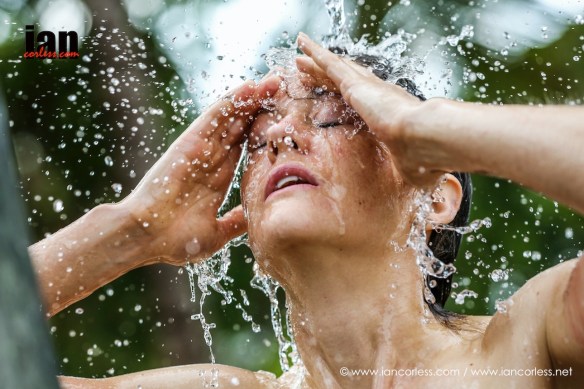
©iancorless.com_TCC2016-7175The course has constant possibilities for you to submerge yourself in water and reduce your core temperature – do so, it’s essential! Never pass an opportunity. Just 2-3 minutes fully submerged will allow you to continue on feeling refreshed. Never run in the sun when you can run in the shade and cover up your head and shoulders.
©iancorless.com_TCC2016-0605

Top Tips:

  • Day 1 starts with 10km of good running. Everyone starts out way too fast and ironically, day 1 at TCC has the most drop outs through exhaustion and dehydration. Start slow! Ease into the race and without doubt, if possible, get some heat acclimatisation before coming out to costa Rica. Day 1 also starts much later than every other day, so, the shock is magnified!
  • From day 2 you will start running with sunrise, take advantage of the cooler hours but don’t go out running hard like a wild animal. You will pay for it.
  • Feeling tired? Run in the shade, walk in the sun.
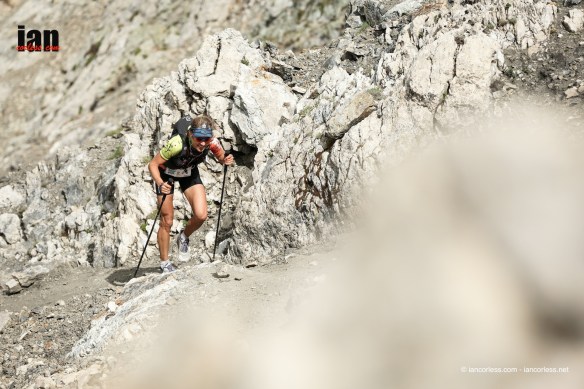
  • Poles are a benefit at times and I would certainly bring them so you can make a choice whilst at the race.
  • Understand that this is a technical race with very varied terrain, lots of climbing and lots of descending. Practice this and prepare both physically and mentally.
  • Learn to walk – everyone will walk at some stage.
  • Take advantage of every possibility to submerge yourself in pools, rivers, ponds etc.
  • Use a buff or similar product and keep that wet and cool.
  • Pour water over your head regularly to avoid over-heating.
  • Use a hat.
  • Flowing water is often drinkable but be careful, I take water purification tablets as a precaution.
  • Never pass a feed staton without filling bottles/ bladder.
  • Think of your own food needs and diet requirements.
  • The course is exceptionally well marked and be attentive, it’s easy to pass a marker when you have your head down. Not seen a marker in 5-minutes? Chances are you have gone the wrong way.
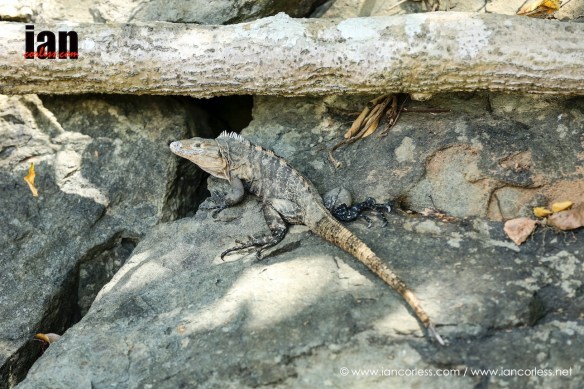
  • Wildlife will surround you and the reality is that you will not see any of it as the animals are too frightened of you. However, you will hear lots of noises, that is part of the fun! You stand a good chance of seeing monkeys, maybe a snake, spiders and birds.
  • Calf guards or compression may be a good idea on some of the more technical sections, however, I prefer the airflow to keep cooler.
  • When back in camp after a day running, take shoes off first and put some flip-flops on and let your feet breathe. Check for any irruption and blisters and get that seen to asap.
  • Have a shower and freshen up, get some fresh clothes on.
  • Eat and hydrate.
  • Take a nap and elevate your legs.
  • Masseurs are available at a charge (tbc).
  • Evenings are very social and you will be able to relax and bond with fellow runners. However, you do have your own personal tent, so, you can escape and have quiet time if you wish.

©iancorless.com_TCC2016-9993

Check List:

  • Waterproof bag or box
  • 2/3 pairs run shoes
  • Run apparel for 6 days
  • Casual clothing
  • Tent that pitches inner only but bring fly sheet
  • Head torch/ tent light
  • Sleeping bag liner
  • Hat
  • Sunglasses
  • Travel towel
  • Phone
  • Knife
  • Electrolytes
  • Food for running
  • Whistle
  • Sun cream
  • Medical kit and medication
  • Cash
  • Credit card
  • Poles
  • Gaiters
  • iPod
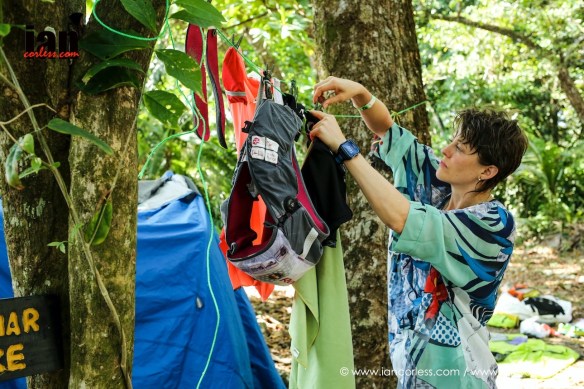
  • Rope to make a washing line
  • Pegs

©iancorless.com_TCC2016-2992

Finally:

Running a multi-day race is an experience and something to cherish. Look around and take advantage of what is a stunning environment. Accept now that this race will challenge you and that it will be tough. Get your head in the right place. Prepare as best you can for heat, humidity, technical running, climbing and descending, if you come prepared, the race will be so much easier.

I always provide impartial advice based on my experiences and knowledge. However, I do accept that I don’t always know or understand what ladies require at a multi-day race. Niandi Carmont has run the shorter Adventure Race and the full distance race at TCC and she provides here a little additional advice for female competitors:

©iancorless.com_TCC2016-9253

You might be spending a significant part of your day out on the course but it is always nice to have something clean and light to change into other than run kit. Since you don’t have to transport this, think about light cotton sundresses you can change into after your shower at the end of the daily stage. It will be boiling hot and humid in the evenings so no point bringing anything warm.

©iancorless.com_TCC2016-8933

Flip flops are a must. Bring a good quality pair that won’t break the first day in camp. Your feet will swell up and will have macerated in run shoes the whole day. They will have taken a pounding and thank you for allowing them to breathe a few hours. Also I recommend taking showers with flip flops as the showers won’t be sparkling clean and this will reduce the risk of catching anything like athlete’s foot or plantar warts which are highly contagious and prevalent amongst ultra-runners.

Bring a 2-piece swimsuit – there will opportunities to bathe in rivers or the sea at the end of the day.

©iancorless.com_TCC2016-0383

I suggest a very, very light negligee to slip into in your tent if you don’t like sleeping in the nude as you will be sweating and no doubt not be using your sleeping back or liner. Temperatures hardly drop at night and it remains humid.

Don’t economise on sun cream – bring a spray, high SPF type, which is non-greasy. Don’t forget you will be sweating a lot in the high humidity so this will have to be applied regularly on the course. Carry a small tube (Tingerlaat (here) do a tiny tube with SPF 50). Take a small tube of anti-chafing cream or gel (Gurney Goo do small tubes) in your pack too. With the high humidity and being constantly wet, running through water even runners who don’t usually suffer from chafing will find this an issue. Apply beneath your sports bra and inner lining of run shorts.

I would recommend against running in ‘skorts’ as you will be constantly sweating and trying to cool off in rock pools to keep your body temperature down. The skirt part will just weigh you down with water. Bring single-layered run shorts or short breathable tights. You will probably suffer less from chafing too with tights.

©iancorless.com_TCC2016-7250

Hair conditioner is an absolute must as you will be showering every day and if you don’t want to end up with damaged, straw-like hair or knots, bring a good conditioner. I have had plenty of experiences of leaking bottles of haircare products so I take enough L’Oréal sachets which pack very well and are single use.

Don’t wear rings! Your fingers are going to swell up through heat and some dehydration – so leave the solitaire at home. You will just have to put up with the unsightliness of sausage-finger syndrome for a while.

Bring waterproof zip-locks for cash and toilet paper to carry with you on the daily stages as you will be running through a lot of water and believe me you will be happy to buy an ice cold coke some days on the course. Also make sure your mobile phone is in a waterproof casing/bag or don’t take it with you on the river sections.

©iancorless.com_TCC2016-1360

REVIEW of 2016 in Trail, Mountain, Ultra and Skyrunning

©iancorless.com_SWC2016-5874

As a year comes to end, it’s always nice to be able to look back and appreciate some of the highlights that all come together that allows one to decide if it was a good or bad year. For me personally, 2016 was a cracker and I am truly thankful for all the opportunities that came up.

Looking back and deciding on what a highlight is, is of course a tricky thing. It’s very personal and it also requires a great memory. So, I will declare right from the off that these are ‘my’ highlights and yes, I am going to miss some key performances, runners, experiences and so on that should be in the list. So, please feel free to comment and remind me.

It would make sense to start in January and move through to December in a logical way… I am not going to do that, I am writing this off the cuff.

Jim Walmsley has been on fire in 2016 and ironically, despite an amazing run and course record at JFK50, FKT’s for the Rim-to-Rim and Rim-to-Rim-to-Rim in the Grand Canyon and countless other victories, it will be his Western States performance that well and truly cements Jim as one of the most exciting runners to rise in 2016. He said pre Western States that he was there to win and win with a course record. He flew along the trails and at one point was almost 30-minutes under the record. As he passed 90-miles everyone was re-writing the history books and then boom! Jim went off course. I caught up with a full and in-depth interview with Jim and you can listen to that HERE and read it HERE. Jim for many is the male Ultra-runner of the Year with victories at Stagecoach Line 55km, Franklin Mountains Trail Run, Lake Sonoma, Mesquite Canyon, Moab Red Hot 55k, Bandera 100k and the recent JFK50. 2017 is going to be a very exciting one.

Rob Young set off on a journey Across the USA looking for a new record, fame, glory and an opportunity to raise a load of money for charity. Somewhere along the way he lost a grasp of reality, perspective and ruined what was a remarkable story be cheating and deceiving the whole ultra running community. Ultimately, Rob is a story of an individual who tried to do good and maybe we should ask what went wrong rather than preach about his morals.

That brings me on to Mark Vaz. What is it with FKT’s and delusional behaviour? Mark seemed to think that running from Land’s End to John O’Groats 31-hours quicker than anyone else for the 860-mile journey was a good idea. It’s not even a convincing lie. As many pointed out, the god of ultra -running, Yiannis Kouros, couldn’t have done it as quick as Mr. Vaz claimed… oh dear!

Pete Kostelnick by contrast embraced the FKT concept and showed the world that the claims made by Rob Young are possible by smashing a 30+ year old Guinness record out of the ether by running Across the USA a full 4-days quicker than anyone else. As records go, this is an absolute doozy and when you look deep and hard into this 40+ day journey, you soon start to understand the difficulty and complexity of running 70+ miles a day. You can listen to an in-depth interview with Pete HERE and read the story HERE. In addition, we must also add to this story, Pete’s incredible and record breaking run at Badwater 135. This achievement has been overshadowed by the USA run but as a stand alone run, it’s also a cracker.

©iancorless.com_TCC2015_Day5-2469

Karl Meltzer did it, he finally completed the Appalachian Trail in a new record breaking time after failing on two previous occasions.  His time was some 10-hours quicker than Scott Jurek’s set in 2015, however, Karl did run in the opposite direction and has said, post run, he feels that they are two records. Notably, Karl helped Scott in 2015 and Scott helped Karl in 2016. It’s a remarkable story and one that truly reflects our sport of ultra-running. Karl’s record of 45-days, 22-hours and 38-minutes now sits in the record books and well and truly establishes Karl as one of ‘the’ greatest ultra-runners in the world. This is also backed up with his 38 100-mile victories and 5 victories at Hardrock 100. Listen to the in-depth interview HERE and read HERE

Talking of Hardrock 100, Kilian Jornet and Jason Schlarb held hands and crossed the line together in 2016. It was a wonderful moment that split the ultra-running audience in two. Some would have preferred a race to the line while others discussed the wonderful gesture and statement this moment made. Whichever camp you sit in, it was back-to-back victories for Kilian and a career defining moment for Jason Schlarb. Something he discussed in my in-depth interview HERE. For equality, we also need to mention Anna Frost nailing a back-to-back ladies victory. As I understand it, these three Musketeers will all return in 2017.

Aaron Denberg got a bee in his bonnet about Hardrock 100 lottery and decided to create a law suit. Many believe Mr. Denberg makes some good points but questioned if his approach was the correct one? Hardrock 100 released statements and have since removed the payment of a fee by each runner to enter the lottery, something which was apparently illegal! This will run and run (pardon the pun) but ultimately, is Hardrock a victim of it’s own success?

©iancorless.com_Transgrancanaria2016-3338

Caroline Chaverot for me, without doubt, female ultra-runner of the year. This French lady has been on fire all the way from victory in Transgrancanaria early in the year to a most recent win in Hong Kong on December 2nd. Along the way, Caroline won UTMB, became Skyrunning World Champion for the ultra distance and won the IAU World Trail Championships in Portugal. Add to these incredible results, victories at Madirea Island Ultra Trail, Mont-Blanc 80km and the UTWT world title for 2016 and I lower my head and bow to Queen Caroline. Plus she has made the lottery for Hardrock in 2017… exciting!

img_2924

Adam Campbell survives a horrific fall and not only lives to tell the tale but has a remarkable recovery, listen to the interview HERE and read HERE

Lizzy Hawker sneaked from under the radar and once again picked up the gauntlet testing her personal boundaries and voyage of self-discovery. After years of injury, Lizzy completed the GHT (Great Himalayan Trail). A 1600km, east to west journey across Nepal. It was, as Lizzy promised, a “beautiful, rough, hard and unforgettable journey”. It was about many things, but also about trying to raise money to give opportunities to Nepali runners, particularly girls, for whom one chance can be a catalyst for much wider change.

Damian Hall set a new FKT on the UK’s South West Coast Path 10-hours, 15-minutes and 18-seconds for the 630-mile jaunt.

Jeff Browning, what a year…! Winner Hurt 100, 3rd at Western States, 4th at Hardrock 100 and 4th at Run Rabbit Run – that is some year, the WSER/Hardrock double a stand out and fastest combined time.

©iancorless.comIMG_5813Canazei2014_kilian

Kilian Jornet won Hardrock 100 and attempted to summit Everest. The Summits Of My Life project continues on into 2017 after Kilian and his team decided to pull the plug on a 2016 attempt as weather detonated.

©iancorless.com_TrofeoKima2016-2487

Emelie Forsberg was quiet in 2016 after damaging her ACL and having an operation, she did however return to Trofeo Kima and put the record straight with a victory… she hopes the course record will come in 2018 when the race will take place once again. Emelie discussed her injury HERE

Beth Pascall went from strength-to-strength in 2016 and elevated the Lakeland 100 (UK) record to a whole new level by placing 4th overall. Listen to her interview HERE

Zach Miller did what he always does and lead from the front. At UTMB many predicted, me included, that it was going to be a story of glorious victory with a stunning ‘off-the-front’ performance or carnage with a monumental blow-up! In reality it was both, the blow-up came and he somehow managed to hold on for grim death to still get a top-10 place, he will win this race one day! Jump forward to December and Zach did it again at San Francisco 50. This time he had company and many are saying that ‘this’ race was one of the highlights of the year as Zach and Hayden Hawks traded blows at the front. Zach won with a course record and he took home the $10,000 prize. Hayden finished just 2-minutes back. Note that name! If you want to know what it’s like to put it ALL on the line, take a look at Zach’s final 2-minutes of that incredible 5:56:03 run.

Andrew Miller became the youngest winner of the iconic Western States and today, myself and so many others still know very little about this 20-year old. Certainly, Jim Walmsley had an impact on the kudos and plaudits that Andrew should have received. Running 15:39:36 at WSER takes some doing but I can’t help but think that Biology and chemistry are a priority as Andrew starts his sophomore year at Northern Arizona University. He will be back at WSER in 2017!

Kaci Lickteig has been nailing it and nailing it and finally got the Western States victory that she has longed for and then contrasted it with victory at the Bear 100. You can listen to Kaci’s post Western States interview HERE

Andrea Huser runs and races it would appear ‘every’ weekend. She is relentless. As I understand it, Andrea raced on thirteen occasions but I may have missed some/ She had victories at Raid de La Reunion Swiss Irontrail T201 Eiger Ultratrail 101km, Lavaredo, Trail d’Albertville, Trail Des Allobroges and Maxi-Race Annecy. Phew… any other year and the lack of Caroline Chaverot and Andrea would be female ultra-runner of the year.

©iancorless.com_SWC2016-6453.jpg

Luis Alberto Hernando won Transvulcania, became Skyrunning World Champion for the ultra distance and became IAU World Trail Champion. That is a solid year and Luis has raced less having become a Dad. Had his feet not fallen apart at UTMB, he may well have been in the running with Jim for male ultra-runner of the year.

©iancorless.com_Transgrancanaria2016-1724

Diego Pazos is a name to watch and has surprised many in 2016. He’s my heads-up for the future. He had a notable result at Transgrancanaria early in 2016 but what followed was quite incredible, his victory at Mont-Blanc 80km a highlight!

©iancorless.com_Transgrancanaria2016-1481

Didrik Hermansen won Transgrancanaria and then placed 2nd at Western States. That is solid and shows real diversity. What will 2017 hold for him? Listen HERE and as Sondre corrects me, Didrik ran 6:45 and 6:38 for 100k.

iancorless-com_runningbeyondbook-06784

Running Beyond Book was released in October and November to a worldwide audience and has been translated into Spanish, Italian, German, Swedish and of course is available in English. Containing 240-pages, this large coffee table books documents the sport of trail, ultra, mountain and skyrunning in images and words, HERE

Dan Lawson (UK) won the IAU 24 Hour European Championships in 2016 with a distance of 261.843 kilometres (162.702 mi).

iancorless-com_glencoe2016-9946

Jasmin Paris has elevated herself to a whole new level in 2016. This quiet and shy fell runner set new records for the UK’s ‘Rounds’ and in the process placed 6th at UTMB (her first 100) won Tromso SkyRace, won Glencoe Skyline, became the Skyrunner World Series Extreme Champion 2016 and in addition to countless other races, also placed on the podium at the Skyrunning World Championships for the ultra distance behind Caroline Chaverot. Interviews with Jasmin Paris HERE, HERE, HERE and HERE

Joe Grant set a new record on the 14’ers in 31-days by cycling between trailheads and then summiting all the 14’ers (50+ of them) on foot to then return back to his cycle and then continue on his journey. He was self-sufficient for the whole trip. “I did set a speed record, but that wasn’t my goal,” says Grant, 33, an accomplished ultrarunner who finished second at the 2012 Hardrock 100. “The goal was to challenge myself and see the state, although the previous record served as a reference for how long I could take.” taken from trailrunningmag.

Megan Hicks also completed a ’14’ journey, the Nolans 14 in Colorado. She completed the journey in 57:19:19 to the summit of the 14th peak and then completed the journey back to the Fish Hatchery Trailhead in under 60-hours – 59:36. Her time is the fastest ever completed by a woman.

Nicky Spinks continues to inspire and while she may have lost her ‘Round’ records to Jasmin Paris, she went on to set a new benchmark with a record for a double Bob Graham Round – Nick is an inspiration! You can listen to an interview with her HERE

Ludovic Pommeret ran the most controlled and impressive UTMB ever moving from not being in contention to slowly but surely ticking off the runners ahead and taking the crown at the largest ultra in the world. Add to this victory four other victories and Ludovic is one to keep an eye on in ’17.’

Caroline Boller set new American Trail 50-mile record 5:48:01

Gina Slaby set new female 100-mile WR 13:45:49 for ‘any’ surface, Anne Trason had the previous record of  13:47:41 set in the early 90’s.

Skyline Scotland achieved a first with Glencoe Skyline achieving Skyrunner World Status in the Extreme category and as such, the 2016 edition of the race had arguably one of the best fields assembled on UK soil for a mountain race. HERE

Jon Albon transitioned from obstacle racing (something he still does and excels at) to Skyrunning and won the 2016 Skyrunner World Series Extreme category. We are going to see more of him in 2017! HERE

Samantha Gash ran across India in a project called ‘Run India’ as a means to create awareness and raise money. Covering over 3000km you can listen to her story in episode 125 of Talk Ultra out on Friday 16th December.

Ida Nilsson started the year with a win in Transvulcania, she took victory at The Rut and then in early December won San Francisco 50. Without doubt, Ida is a star of the future. Listen to Ida talk about Transvulcania HERE

Stu Leaney breaks Michael Wardian’s 50km treadmill record by just 7-seconds

Mina Guli ran 40-marathons across 7 deserts on 7 continents in 7 weeks to raise awareness for water, listen to the interview HERE

Jason Schlarb started his year by prepping for Hardrock 100 by skiing the course, listen to the interview HERE

Skyrunning and the world series (SWS) elevated to new heights with an increased circuit that traveled the globe and the addition of the new Extreme series.

And finally (maybe), Donnie Campbell just recently set a new Winter Ramsay Round record to finish a very solid year!

******

So what have I missed? 

I am well aware that I will have missed some key performances in 2016 and I welcome you commenting and letting me know. Of course, many performances, races or experiences will resonate on a personal level for you. I can think of many British performances that are worthy of a nod – Jo Meek’s 2nd at the CCC, Paul Giblin 5th at Western States, Joasia Zakrzewski’s medal at the 100k World Champs for example.

Be great to hear from you…

Planning a Running and Racing Year

©iancorless.com_Transgrancanaria15-6747

You have looked back over 2016 and decided what worked and what didn’t for you, haven’t you? With that information, you have looked at your strengths and weaknesses and you have now started to plan 2017/18, you have, haven’t you?

If the answer to the two above questions is no or maybe even yes, please read my thoughts on what you should be doing now in preparation for a great 2017 of running and racing.

In a previous post I questioned if ‘Base Training’ is something that you should be doing now? (Read HERE) This post was directed at experienced runners or ultra runners who have been in the sport for sometime and have already accumulated many miles and hours of running. They may not need more endurance but speed.

But planning is key. You need to periodise training so that you get the most from it. Below I go through a classic training program that has key phases for a successful season. It’s a classic training program that includes:

  • Base or Speed
  • Build
  • Maintain
  • Recover
  • Build
  • Race
  • Recover

Depending on experience, how this plan is put together is very much dependant on the individual. However, certain key elements should be present in any training plan and this article is intended to provide the basics from which you can develop a strategy that works for you. I must stress, for you!

Firstly, asses last year and understand what worked and what didn’t. This will give you a list of strengths and weaknesses.

  • Did you lack endurance?
  • Did you lack speed?
  • Was your strength and core weak?
  • Were you mentally strong?

The answers to the above questions will help you understand what your plan needs in the coming months.

Secondly, decide on objectives for 2017 and even 2018, decide on A, B and C races. Put them in a diary and ideally have a wall planner so that you have an overview of the year. It’s easy to see how a year looks on a planner.

Set a timescale and work back from THE key ‘A’ race. In our scenario, we are saying that our key race is a 100-mile race, 28 weeks away.

Yes, it’s a long way off but don’t be fooled into thinking you have plenty of time. Key races have a habit of sneaking up on you.

Fancy an early season multi-day TRAINING CAMP? Join us in Lanzarote HERE

©iancorless.com_Transgrancanaria15-6152

100-miles is a long way so *base training and getting the miles in is key. We have allocated 8 weeks for this in the plan below. Hours of easy miles progressively building up to a C race (marathon or 50k). It is always good to have a goal and a target to aim for. The C race is a training race and will have no taper, you would race through it as a training long run.

*A traditional pyramid training plan starts with base and then typically adds speed as an event comes closer. However, we are ultra runners and it is important to be specific. High intensity training creates a lot of fatigue and this is why I am a huge fan of reversing the pyramid and getting speed work done during the winter so that the training plan that leads into an A race is specific to the demands of the race.

So, if you are an experienced ultra runner looking to improve in 2017/18 with years of running and loads of endurance, think about making weeks 1-8 speed based with a fast marathon as a C (or maybe even A) race objective at the end of this block.

When you enter your racing season this will be in the build phase so it’s a good idea to place a B race objective that will allow you to progress to the A goal or multiple A goals.

As you come to the end of the build phase, you should be in form and race fit. What you want to do now is fine tune that form, tweak it and hold it for the A race. If you are cramming long runs in or looking for speed, it’s too late. You basically misjudged the planning or started training too late.

Maintaining what fitness you have is also about being specific to the A target.

  1. Is your 100-mile target race on groomed trail with little elevation gain?
  2. Is it an out-and-out mountain race with gnarly terrain and plenty of elevation gain?

It’s important to be specific now, the two races above require very different approaches. This is something that you will have understood in January (or earlier in the year) when you looked back at last year, looked ahead to this year and understood your strengths and weaknesses so that you could plan accordingly.

  • Scenario 1 requires running, good form and leg speed.
  • Scenario 2 requires hiking, climbing, leg strength and plenty of endurance.

You can’t perform well at every event and this is why A, B and C races are important. Yes I know the elite runners manage to race several key races a year but look at the training and look at the planning. We have all seen top runners turn up at early season races and place just inside or outside the top-10.

Rob Krar and Francois d’Haene provide good examples of how to:

  • Build,
  • Peak,
  • Win,
  • Recover,
  • Build,
  • Peak,
  • Win,
  • Recover,
  • Build,
  • Peak,
  • Win,
  • Recover.

In 1 racing year, both Rob and Francois won 3 x 100-mile races.

That is an incredible skill and for sure as racing becomes more aggressive, faster and more brutal, this training approach is going to become far more important for those who want to race to their own potential and maybe more importantly race year-on-year. We have all witnessed the damage that racing and training too much can do at an elite level runner. Listen to my podcast with Geoff Roes HERE as he provides a great insight into potential problems.

Ask questions such as:

  1. Do I race every weekend?
  2. Do I rest?
  3. Do I allow easy and recovery weeks?
  4. Do I cross train?
  5. Do I sleep well?
  6. How is my nutrition?
  7. Am I constantly tired?
  8. Do I feel alive and full of beans?
  9. How’s my resting heart rate?
  10. Is my pace good?
  11. How’s my strength?
  12. How’s my recovery?
  13. Do I have a plan?
  14. Have I structured my plan to an A race?

The above questions are a starting point. Read through the list and add your own questions to appraise what type of runner you are. It may well be that running for you is an escape and social thing, you may be happy to race week in and week out and you are not worried about gaining a PB or improving; if that is you, great. I’d still say planning some RnR is a good thing to avoid burn out.

©iancorless.com_Limone2015-3090

If you are someone looking to perform and improve, you need to be more self critical. Plan your training and periodise your training so that you are able to (hopefully) predict good form on 1 or multiple A race days in a year. This is not easy.

Carefully plan your races in terms of importance, ‘A’ being the most important. Also make the races progressive and inline with your A race. For example, if your A race is a 100-mile race, a C race may be a marathon, a B race may be a 50K or 100K and then the A is the big step of 100-miles.

Remember you can only hold form for a limited length of time and if you want to peak, you need to make sure that this planning stage is done early so that you understand what you are trying to achieve. It’s all about stepping stones.

Ask yourself, what is the purpose of the training blocks you are planning:

  • Are you laying base training?
  • Building fitness?
  • Maintaining fitness?
  • Racing?

A training block with 2 x ‘A’ races (the 2nd race being 100-miles) may look like this:

Base Training Phase

Week 1 – Base or Speed

Week 2 – Base or Speed

Week 3 – Base or Speed

Week 4 – Base or Speed (with the addition of a longer run)

Week 5 – Base or Speed (with the addition of a longer run)

Week 6 – Base or Speed (with the addition of a longer run)

Week 7 – Base or Speed (with the addition of a longer run)

Week 8 – Base with C Race probably a marathon.

Build Training Phase

Week 9 – Build

Week 10 – Build

Week 11 – Build maybe a C Race just as a long run?

Week 12 – Build

Week 13 – Build

Week 14 – Build with B Race 50K.

Maintain

Week 15 – Maintain/ Specific

Week 16 – Maintain/ Specific

Week 17 – Maintain/ Specific

Week 18 – Maintain/ Taper with A Race

Recovery

Week 19 – Recovery

Week 20 – Recovery easing back into Build.

Build

Week 21 – Build

Week 22 – Build

Week 23 – Build

Week 24 – Build

Week 25 – Build

Week 26 – Build

Week 27 – Taper

Week 28 – Taper and A Race (this scenario 100-miles)

Recover, Recover and Recover.

This article is not a hard and fast plan, it’s a guide for you to go away, look at your targets having assessed past targets and hopefully it makes you think about 2016 objectives so that you can plan for a successful, injury free year of running and racing.

How long should The Long Run be? HERE

©iancorless.com_Transvulcania2015-8400

Enjoyed this article? Support on PATREON HERE

support_patreon

John Percy – Last Man Standing

iancorless-com_etr2016-9755

John Percy – Last Man Standing

Endurance running brings many challenges and multi-day adventures bring many variables. The process of running day-after-day can push even the most trained and experienced runner to his or her limits. However, for many runners, a race challenge often combines many things – adventure, the unknown, an opportunity to experience a new place, make new friends and yes, a holiday!

Take any race, any race in the world and you will have someone who comes first and someone who comes last. It’s such an awful phrase; last! It sounds insulting, as though that person has failed… but let’s look at the positives. A journey has a start and an end, how one completes that journey is often down to personal motivations, passions and in the scenario of covering distance in a fast time; genetics!

In my most recent adventure, the Everest Trail Race in Nepal, I enjoyed the trails every day with the runners as they climbed, descended and endured the tough and technical trails that this region of the Himalayas has to offer.

iancorless-com_etr2016-6437

Pasang Llama (Nepal) won the race ahead of Miguel Capo Soler (Spain) and Casey Morgan (UK) with a dominant performance, he completed the six-day journey from Jiri to Tyangboche and back to Lukla in 22-hours, 04-minutes and 22-seconds. His shortest day was 2-hours 50-minutes and the longest day 4-hours 50-minutes.

iancorless-com_etr2016-8828

Now contrast this to John Percy from the UK. His shortest day was 7-hours 32-minutes and his longest day 14-hours 59-minutes. John, like it or not, became a hero of the Everest Trail Race in 2016. He inspired everyone with his relentless enthusiasm, grit and tenacity to push on, no matter how tough it got or how bad he felt.

Regardless of the time, the distance is the same. A mile is a mile, and every mile matters!”

This quote is relevant in every race, day-in, day-out, all over the world. We often focus and concentrate on the front of the race but often it’s the back of the race where a true story and the real drama happens. I caught up with John Percy to ask about his Nepalese experience.
iancorless-com_etr2016-6054

“I’ve done this. I’ve done that. I’ve achieved something that so many haven’t, I may not be the fastest, but I never will be the fastest. I’m not built to the be the fastest, and I’m certainly no Casey Morgan that’s for certain. I’m probably three times the size of him. But what I would say is that I’ve got a dogged spirit and a strong will. I say to myself, ‘Never, ever give up!’ and I don’t give up. Ever.”

Ian: John, ETR, what an experience, huh?

John: The most amazing experience I’ve ever encountered.

Ian: Well, I was just thinking about how I was going to talk to you about your race, and I have decided that I’m going call you the strongest man in the race because you were holding everybody else up above you.

John: Yes. I was certainly holding the wooden spoon at the back but it wasn’t through lack of spirit. Yes, I was the last person nearly every day but it certainly didn’t deter me from finishing.

Ian: Yes. One of the things that amazes me, and one of the things I love about a multi-stage race is the contrast. You have Pasang Llama finishing in three hours. You have you, finishing in 15 hours, and that’s just one day. I’ve often thought, the guys and girls at the front they have real natural gift. There’s a reason why they do what they do – they are good at it! Then, once you start to drift further and further, further back in the field, I always think to myself, “What is it? What is it that makes somebody put themselves on the line? Maybe they put themselves through hell to tick a box, to achieve something?” Do you feel that’s where you’re at, and there’s no disrespect in me saying that?

Casey Morgan who placed 3rd said he had the utmost respect for people like you John, who go out and struggle, and fight every day for a finish.

What is it that motivates you?

John: [sighs] Well, I’m a great believer that yet you only got one life, and you’ve got to live it the best you can, and when I do pop my clogs in the end of my life, at least I can go in and say, “I’ve done this. I’ve done that. I’ve achieved something that so many haven’t, I may not be the fastest, but I never will be the fastest. I’m not built to the be the fastest, and I’m certainly not Casey Morgan that’s for certain. I’m probably three times the size of him. But what I would say is that I’ve got a dogged spirit and a strong will. I say to myself, ‘Never, ever give up!’ and I don’t give up. Ever.”

Ian: That was completely on show here every day at the race. Coming into the race, you have commented on Facebook that you’re a little bit nervous and a little bit worried about the race. What worried you before coming out here?

John: I was a little bit worried about pushing my body to the limited at altitude. I’ve been at altitude a few times over the last few years at varying degrees of success and failure. I was a little bit worried about how my body would cope. Obviously, it is a tough race and there is a lot of climbing, a lot of technical descending. I can power through that. I don’t mind that. I didn’t particularly like the technical sections, not really tough on the legs, just tough on my feet and the whole body really.

Ian: Casey said that the descent on day three, which was your longest day, you were out there for 15-hours to get to the finish line. He said, “that’s one of the most technical and persistent descents that he’s ever been on.” What was your thought process on that descent because at that point, you’ve been out there a long time? You’re looking at your watch and your thinking, ” Am I going to get timed out?” There’s all sorts of processes going on within your own mind. What is that experience like for you?

John: Time wise, yes, you’ve always got that worry of being timed out and things like that. Really, as an individual, I just put it in the back of my mind. I’m the type of person who could basically get up first thing in the morning, and march for the next 50-hours and it wouldn’t make a big difference to me. Endurance-wise like that, it doesn’t affect me. But those downhill sections did take a toll on my human spirit. You get to a lot of dark places in these type of events but that day I would say was my darkest hour…

Ian: Of course, I understand that! Once you get to the bottom of the descents, you then had to climb all the way up to the monastery at Kharikhola, it’s already dark and that is tough. At the Everest Trail Race, they try and avoid people being out on the course in the dark because it can be a dangerous place, and the darkness brings its own darkness. It makes it difficult because the trails are technical, and twisty, and rocky, and gnarly. How did you find that climb up to Kharikhola when you had already been out on the course for 12+ hours.

iancorless-com_etr2016-3072

John: Yes. I think the only good part about that, on the way up was that I knew the end was in sight which was a good feeling. I knew it wasn’t far away. It was a case of just power through. You know, just get through it. Finish it. We’re nearly there now. The end’s in sight. I could see the lights. I could hear people’s voices. It did lift my spirits, the last climb. When you think about it that last climb could destroy the human spirit but for me, it actually raised my spirit a little bit, you know?

Ian: Yes. You weren’t taken out of the race (missing the cut-off), which I think was a really, really good decision. I think always, the rules are in place to give some order and some control in a race. I think, rules are there to be broken sometimes, and effectively what you were given in the race was a second life but in that second life, you seem to have been revived a little bit, I don’t know whether it’s your body adapting to the altitude, maybe you were just getting into a rhythm, but after that, it seemed as though you got into a time zone and was able to then function within the time zones of the race.

What happened? Do you think that maybe that running over the terrain just became that little bit easier which meant you could cover ground quicker?

John: Again, you know, I can only thank the whole team for letting me continue in the race after that punishing hard day where I was out of the time limits. Time limits are there for a good reason. I’ve got to say on that long day, it was the technical descents in the dark which were very, very scary. In addition, I did take quite a big fall on day-2 which did impact on me for day 3. But after that day, I don’t know… something inside says, “Right. You’ve been at your lowest point now. Everything now has got to be a bonus. Just give it everything you can!”

I was quite lucky every day that my body seemed to adapt a little bit better, but I think I just passed that point of being at my lowest ebb, and then I just started to feel a lot better in myself and that lifted my spirits.

Ian: As you get past Kharikhola, you start to get into the more populated trails of Nepal, because you’re on the main schlep into base camp and the scenery changes, the whole atmosphere of the race changes. What has the Nepalese experience been like for you?

John: The Nepalese experience has been awe inspiring. It really makes you wake up and take a long look at yourself, you ask questions about me, as an individual, living in a westernized society, and everything that we’ve got as individuals, as opposed to how the Nepalese people live. I feel now, as if I’m a very lucky individual. You know, how I live my life compared to the very happy folk of Nepal. I mean, they’re just such lovely people. A smile. A handshake, no animosity, everybody was incredible. They see you as an individual.

Ian: You know what’s really interesting, I have spoken to many about Nepal and the Everest Trail Race, and each person has said that the people, not the mountains are the most important thing.

iancorless-com_etr2016-4961

John: No, you’re right. It’s the people that make this race so special, and everybody that is involved with the race passing through the whole Nepalese countryside, and through the population and everything. It’s certainly for me, been the most enjoyable thing I have ever done. I’ve done a lot in my life, and seen a lot in my life, but this is probably going to be one of the highlights of my life.

ETR: When you get to Tyangboche on day five, you get that finish line, and for me it’s one of the best finish lines in the world. What’s it like seeing Ama Dablam, Everest, Lothse, Nuptse?

iancorless-com_etr2016-6084

John: You can’t believe you’re there. I’ve been in mountains all my life. I’ve climbed all over the UK and quite a bit of the Alps. I’ve always wanted to see Everest. I’ve seen it so many times, as you can imagine in movies, looked at it in books etc.… To actually stand in front of it, at the most famous monastery in the world, no doubt about it, it’s just truly awe inspiring.

ETR: Final day, basically, a nice little parade lap home. You weren’t last. [laughs]

John: No, I wasn’t!

ETR: You saved a big effort for the last day?

John: Yes. I really pushed myself and I thought to myself, I had a little cheeky glint in my eye. When I got to the three-and-a-half km to go, I thought, “Sorry, Eusebio. Every man for himself now and I went for it.”

iancorless-com_etr2016-9766

Ian: Race done, experience completed. Everybody has a new and personal experience, they are all so different, but your experience is maybe more rewarding? But I think what’s also quite important is your experience has affected everybody else’s experience because they’ve been able to see how you struggled, battled and succeeded. I think it makes people look at themselves and think, “Well, next time I race I’m not going to pull out when the going gets tough,” they will say to themselves, “John stuck at it at ETR and managed to survive and get through.”

You’ve been to some dark places in this race!

What’s the outcome now, you’re sitting here in the sun next to a pool? It can feel like a distant memory, when a runner finishes a tough race, they often say, “I’m never doing that again.” Then within 12-hours that say, “It wasn’t that bad, was it?”

Was it not that bad?

John: Yes, it was bad. That will not change in my head. Yes, it was hard, yes it was tough. Pain will go away. Leg pain, arm pain, whatever I have got, pain will go away. But the memories will never go away of this race. I will never forget it and I’ll always say, “Never ever, say never.”

Ian: Final question for you. There’ll be people listening to this thinking, “You know what? ETR sounds like a brutal race, I want to go next year or the year after. What advice would you give, Casey for example said that the most important things coming into this race, is not necessarily being a runner but being a great hiker and a great walker. Of course, Casey ran quite a great deal too. What advice would you give to people?

John: A mixture of both. I did a lot of hill work before I came to this race. You need a mixture of both endurance, speed and human endeavor. You need to be on your A-game to complete this race.

Ian: Where do you go from here? What’s next? Is there another race or is there another experience? Are you now tempted by Everest having gotten so close to it?

John: No. I’ve enjoyed seeing Everest but I’m not an individual who would dare to climb Everest. It’s never been my goal. I’ve climbed Kilimanjaro, Mont Blanc, K2 and quite a few of the big peaks in North Africa, Africa and Europe. But next from here? I have got something in my head that I really wanted to do. Whether I do it or not remains to be seen. There’s something there that I still want to do. It’s just like I said before, when I do leave this mortal coil, I want to say, “Well, I did this, this and this and this”

iancorless-com_etr2016-6048

John with Eusebio – they became great friends on the trails

READ AND VIEW IMAGES FROM THE 2016 EVERST TRAIL RACE HERE

Western States 100 and Hardrock 100 Lottery Draws for 2017

WESTERN STATES 100

WSER logo ©westernstatesendurancerun

WSER logo ©westernstatesendurancerun

See you Squaw… it’s the term and phrase that so many want to here and the only guaranteed entries are for those who place top-10 (male and female) in the previous edition and those who gain places via the Golden Ticket races, UTWT and Ultrarunning Race Series.

Golden Ticket Races

  • January 7th — Bandera 100k
  • February 4th — Sean O’Brian 100k
  • February 18th — Black Canyon 100k
  • March 25th — Gorge Waterfalls
  • April 1st — Georgia Death Race
  • April 15th — Lake Sonoma 50-miles

Of the 20 top-10 male and females from 2016, 19 will return, the only person not to accept a place is Didrik Hermansen who placed 2nd in 16:16:08. That’s a surprise for me as WSER suits this fast runner.

The men’s returning list is as follows:

  1. Andrew Miller
  2. Will not return
  3. Jeff Browning
  4. Thomas Lorblanchet
  5. Paul Giblin
  6. Ian Sharman
  7. Chris Mocko
  8. Kyle Pietari
  9. Chris DeNucci
  10. Jesse Haynes

The times for those returning 9 vary from 15:39:36 to 17:12:30.

The ladies’ returning list is as follows:

  1. Kaci Lickteig
  2. Amy Sproson
  3. Devon Yanko
  4. Amanda Basham
  5. Alissa St Laurent
  6. Meghan Arbogast
  7. Bethany Patterson
  8. Maggie Guteri
  9. Jodee Adams Moore
  10. Erika Lindland

The times for those returning 10 vary from 17:57:59 to 21:07:40.

Notable entries for 2017 come from ‘Automatics’ (notes here) in addition to the top-10 men/women come from Golden Ticket Races, 6 slots from UTWT and as listed on the WSER Automatics page.

WSER lottery statistics are here

But 250 runners were drawn HERE on December 3rd with 117 automatics. The waitlist is HERE.

The 2017 WSER entrants list is HERE with 332 entries.

Notable names on pre-lottery were:

  • Jonas Buud
  • Zach Bitter
  • Ryan Sandes
  • Michael Wardian
  • Stephanie Case

Jim Walmsley needs to qualify; I think we can expect him to crush a Golden Ticket race to confirm his 2017 WSER slot.

Other slots:

  • 24 tickets will come from the Golden ticket races,
  • 6 from UTWT
  • 2 places from the Ultraruning Race Series. These slots will go to the top male and female as of April 30th 2017.

HARDROCK 100

hardrock-100-logo

Well, Jason Schlarb and Kilian Jornet crossed the line hand-in-hand and they have both confirmed they will return in 2017 to dance once again in the San Juan’s. The only other person guaranteed a slot is Anna Frost – she will be back!

Information HERE.

Hardrock, despite being a small race increasingly is becoming THE race people want to do and that is reflected in almost 2000 applications for 2017.

Entry is down to a lottery but the lottery is broken down into divisions as follows:

  • ‘Veterans’ – Runners who have finished more than 5 times.
  • ’Everyone Else’ – runners who have completed 1-4 times.
  • ‘Nevers’ – As the name implies, runners who have never finished Hardrock.

Hardrock 100 usually has around 150 starters, 2016 edition had 152 and I understand the 2017 edition will be just less than 150.

So, who’s in?

  • Caroline Chaverot is a huge draw and I have to say her attendance in the San Juan is an
  • exciting prospect. For me, Caroline has been THE ultra-runner of 2016.
  • Darcy Piceu missed 2016 and as a 3-time winner, she is the one that ‘Frosty’ will most
  • fear and the one that will always challenge for the victory.
  • Nathalie Mauclair has won UTMB and excelled at Raid de la Reunion.

Other notable names for the ladies’ – Darla Askew, Rachel Bucklin, Bethany Lewis,

Betsy Kalmeyer and Betsy Nye.

The men’s race is an interesting one with some old and new names.

  • Joe Grant is back again to the race he loves, boy does he have some luck with the lottery.
  • Mike Foote was 2nd at the 2015 Hardrock.
  • Iker Karrera 9th at Hardrock in 2015 but he’s a podium contender for sure.
  • Karl Meltzer has been there, done it and won it. This will be a breeze after the AT!
  • Adam Campbell, wow, does he have some motivation to be back!
  • Mike Wardian just runs and runs and runs, Hardrock will be an interesting one.
  • But the biggest interest will come with Zach Miller. We could see fireworks!

Full Entrants List HERE

We can expect other top ranked men to contest this list and then of course there is the ‘waitlisted’ men and ladies who will have a chance to run. HERE.

Ian Corless – RUNNNG BEYOND Interview

iancorless-com_etr2016-2603

The launch of RUNNING BEYOND book has required me to do several interviews recently and some of my words and images have appeared in print. The most current edition of Outdoor Fitness has a large spread and RUNning Magazine in Portugal has a spread.

runningbeyondspread_outside

running_16_iancorless

In the coming week or so, the UK’s Like The Wind will also have a multi-page feature on RUNNING BEYOND book showing several images over 10-pages.

Like The Wind, UK

Like The Wind, UK

Several week’s ago, my good friends at Marathon Talk Podcast, Tom Williams and Martin Yelling, did me the great honour of having me as a guest on their show. I have to say, these two guys are vey much the reason that Talk Ultra Podcast started and I am ever thankful to both of them and the support.

THE INTERVIEW

ian_marathondessables2014

Tom: This week’s guest has been a longtime friend of Martin and myself and a longtime friend of Marathon Talk – for six and a half years now so for probably something like four years, he’s edited the audio for Marathon Talk and probably saves mine or Martin’s blushes on more than one occasion, edited out the odd rude word perhaps in there and during that time he’s also built up the amazing Talk Ultra podcast which, has gone from strength to strength to strength and he is an absolute go to for ultra-running. He is as many would say, living the dream of making his passion his career and doing a really good job of it. He’s just bringing out a book, Running Beyond, which we’ll talk about in detail. Welcome Ian.

Ian Corless: Hey Tom, thanks for having me! Feels a little weird being on this end of the microphone.

[laughter]

Tom: It’s been far too long getting you on the show and it’s nice to have the excuse of you having released your book Running Beyond – Epic Ultra Trail and Skyrunning Races. Foreword, nonetheless, by Kilian Jornet.

Ian Corless: Yes.

Tom: Tell us about the book. Before we go back and talk about this whole crazy journey you’ve been on over the last four, five, six years, tell us about the book.

Ian Corless: The book came about I suppose in a way by accident. It’s quite funny because Martin (co-host of Marathon Talk) said to me years ago, “Mate, you should do a book, you should do a book, you’ve got all these photographs you should do a book” and I did do a self-published book. But the problem with a self-published book is that you just can’t get the price of the book competitive. It just becomes ridiculous once you go to a hardback and color etc. The cost is just prohibitive. So I did a very small print run which was really for me, friends, family and a few people bought it and I used it as a giveaway to clients or potential clients and from that perspective it was a great vehicle. But then about two and a half years ago, I got approached by a publisher and they said, “We love what you do, we follow your website, we follow your photography and we think the time is right for a book”. Of course, it was music to my ears because normally you have to go hunting for a publishing contract and there they were contacting me. That was an amazing foot into the door.

The process then was deciding what that book should be and of course, because the publisher wanted to go in a certain direction, I had to adhere to some of the things that they wanted so it had to be commercially viable. They wanted it to be a coffee-table book, they wanted it to be big and utilize the photography that I had done but also it needed to incorporate my experiences going from race to race. Over the last five years six years, I’ve traveled extensively to races all over the world and basically the book is about that but it’s not an A to Z of races. It doesn’t start at A and it doesn’t finish at Z and it certainly is not a book about ‘the’ best races in the world – it’s the races that I’ve been to and experienced and, in my opinion, of what has grown my photography and my writing within the ultra-running trail and mountain world.

Tom: That’s quite an exciting thing, isn’t it? I listen to that and I think, “That’s really exciting I can’t wait to see it.” I went through a kind of process like that with a coffee table book a couple of years ago for park run, although I had no content in there of my own. I was just helping the guys do stuff but I think the guys did it really well. But for that to be your own book and your own content you must be really excited.

Ian Corless: Yes, I’ve got copies at home and it’s quite funny because the first hardback copy arrived about two months ago and you know what? I’ve not looked at it.

Tom: [laughs] You do know they spelled your name wrong on the cover, don’t you?

Ian: [laughs] I’ll be having a word with the publisher if that’s the case! I say I’ve not looked through it, I have. I’ve flipped through it. But it’s a massive chunk of my life and to actually sit down and flick through it page-by-page almost intimidates me because I won’t look at the positives, I’ll look at the negatives [laughs], and I’ll think, “Maybe I should have put that photo in” or, “Why didn’t I do this?” or, “Why didn’t I do that?” And so in a way it’s frightened me to actually sit down and look at the book now that it’s done. Because there’s nothing that I can do about it, I have to assume that myself and the publisher did a good job and now it’s left to people, yourself and the audience who are going to get it and let them decide whether we did a good job.

RunningBeyond_JKT

Tom: You have got some rave reviews. We’ll talk about your journey in a second. We talked before we started recording about you having a huge level of respect in the ultra-running community now as a really great journalist. On your website and the promotion for this book, you’ve got Nikki Kimball, US ultra-runner saying, “Ian Corless continues to be one of the planet’s foremost journalist in the sport of ultra-marathon”. Check that out.

Ian: It’s awesome to hear that type of thing. It’s flattering and we’re talking now five six years down the line and I know one of the questions you’re going to ask me is probably how did it happen and in a way I don’t know [laughs].

Tom: Mike Wolf, “If you know Ian, it comes as no surprise… he is the most motivated, talented and insightful photographer, journalists out there.” This is amazing stuff, how did you get… so we tried to get Kilian Jornet on the show a couple of times, we’ve never managed it. He is one of those few athletes that has truly transcended their sport and in a good way just does whatever he wants. I’ve got Summits of My Life t-shirts and I’m a fan of Kilian Jornet. He has moved up to that level of being just himself. But here you are with him writing the foreword for the book?

Ian: Yes.

Tom: He’s written some really kind words, “Ian’s photographs can tell you the passion of the sport, and the beauty of his images immerses you in the aura of each race.” Tell us a little bit about Kilian, how you managed to get that for a start but also what your experiences are with him as a person and what’s he like?

Ian: I first met Kilian in 2012 at Transvulcania. That was probably the key phase of how everything started for me, when things really started to take off and I began to realize that there was an opportunity for me to convert what I was doing into a business. Prior to that, I was a photographer and always have been a photographer but I was a commercial photographer shooting advertising, food, room sets, people, all those types of things. Talk Ultra, a little bit like yourselves with Marathon Talk, came out of passion and an interest in the sport. I was competing in sports as you guys did cycling, ironman, and running. I was doing this thing that was an enhancement of my life and something that took up a massive chunk of my life but when you’re doing something you love it’s never quite work, it’s never quite hard. You always bounce it off with the fun and the bonuses.

So 2012 I was invited to Transvulcania and it was a skyrunning race and Skyrunning held its conference and it was about how the sport was going to change. They invited the world’s best runners to the race, of which Kilian was one of them and he went on to place second I believe in that race behind Dakota Jones. Of course I met him and that was the first time we chatted but it was very much like meeting somebody famous and they hold you at a distance because you’re a journalist and they’re a famous runner and that was the scenario.

Tom: He is to ultra-running what Kelly Slater is to surfing or Michael Jordan is to basketball. He is the greatest of all time. I don’t think many people would disagree with that?

Ian: No. He has elevated the sport to a completely different level. He is within the very minute world of ultra-running and trail running, he is global superstar and I’m not saying that everybody on the street would know him, but certainly people who are interested in sport will know of Kilian Jornet and in recent years because he’s extended what he’s done to more extreme adventures and recently he’s just come back from Everest.

All those things click together in him being a megastar but also that brings a lot of pressures and he does get mobbed. The equivalent is imagining walking down the high street and David Beckham comes walking out in Manchester or Liverpool… He would be mobbed and Kilian is the same, particularly in Spain. He is a little bit defensive at times but over the years, because we’ve seen each other at a great deal of races, we became friends. I have that relationship with him… I don’t phone him up every week though, you know what I mean…

Tom: Ever since he got a restraining order…

Ian: Ha! Exactly, ever since he got a restraining order but if I see him we talk, we chat, we sometimes have dinner, we’ve been out for a drink. If you’re going to write a book you might as well have the best runner in the world write the foreword. I sent him an email and I said, “Look, feel free to say no, because I appreciate you get asked a lot of times for this type of thing” but he replied back and said, “Absolutely, no problem. I’ll do it”. It’s fantastic to have Kilian’s name on the cover of the book.

Tom: It’s a lovely photo that you’ve got, the black and white portrait of him looking down. It’s stunning. Let’s go back to the beginning. You knew Martin for a long time before you knew me.

Ian: Yes.

iancorless-com_etr2016-5353

Tom: At first I was editing Marathon Talk around the stuff I did and then we joined forces with you to launch Talk Ultra. Then in time, you took over the editing of Marathon Talk and you still do that to this day… I do visualize you editing in something like rusty twin prop plane over some snowy peaks. You haven’t done this your whole life though?

Ian: No.

Tom: …it was a kind of a career transition. You’ve already mentioned still life photography, photographing whatever it is – a bunch of grapes in a bowl? You’ve made that transition, amazing transition. What was the inspiration or motivation for that? When, why did that happen?

Ian: It’s quite simple actually. It’s 2008. This is a difficult thing to talk about because it’s about one of those moments in my life where everything changed. Everything. In summary, without going into too much detail but I’m more than happy to go into detail if you want to, I lost my job, I got divorced, my dad died of cancer and I said, “That’s it. I’m never doing anything again that I don’t want to do”.

Tom: How old were you then in 2008?

Ian: I’m 50 this year [laughs].

Tom: Okay. What’s that, eight years ago. So you were roughly 42?

Ian: Yes. So I made this decision. That’s it, I’m never going to do anything that I don’t want to do again.

Tom: What were those things? What were you doing that you didn’t want to do?

Ian: I think it wasn’t so much things that I didn’t want to do. It was I appreciated life and I’d appreciated that I had made some real gaffs in my life. I’d made financial mistakes; I’d got obsessed in sport – I am very OCD. When I’m doing something, I’m doing it. I guess that’s why I’ve made what I’m doing now successful because I can put blinkers on and I can work 20 hours a day. That is actually what’s needed to be done in the job that I’m doing at the moment. Sleep can be a luxury. But my obsessive-compulsiveness to sport, and that was participating, I’d really ruined my marriage. I had the foresight to be able to look back and think, “You’re bit of an idiot because you were never making a living from sport. You enjoyed it, you loved it and you’ve ruined a marriage because of it!” At the time my son was 12, he was old enough to understand what was going on and old enough to have some independence. But the impact on him and the impact on me was pretty bad. I missed home terribly… Plus, in 2008 also, I decided to run eight marathons in eight days, I don’t know if you remember?

Tom: When you’re under masses of pressure and stress, that sounds like a really good thing to do; not!

Ian: No. The thing was that the eight marathons in eight days was planned the year before and it was to coincide with me doing my last ironman, which I did in Klagenfurt and I think Martin was there for that. I think Martin raced Klagenfurt 2008? I did my last Ironman then I was going to run eight marathons in eight days and the plan was to run the Cotswold path all the way from the Gloucestershire to the Thames barrier. Then on the eighth day I ran on the marathon.

A little bit like Martin’s South West Coast path jaunt, my dad was going to support me and he was going to be in a mobile home. In the months, two to three months before this venture was going to start, my dad said, “I’ve got cancer”. I went through this whole process of “No, I’m going to cancel, I’m going to do this, I’m going to that” and he said, “No. You carry on. You do this for me”.


I remember distinctly, it’s quite a nice story in a way, it was the third day of the 8-marathons and I was finishing in Henley-on-Thames. That night was the night that my dad was going to hospital in Liverpool to have this major cancer operation. I finished my marathon, I had a car waiting for me. I drove up to my dad’s. I took him to hospital, waited during the night while he had the cancer operation, found out that the operation had gone well. I got back in the car, drove to Henley and then ran the marathon the next day. I remember running that marathon and not remembering it. I was an emotional wreck to be honest.

I had also a lot of things going through my mind about, “This is ridiculous. Your dad is potentially dying and you’re running in a marathon”. How could I justify that? So, there was all those things and to cut a long story short, you come out of the end of all this and you’re just not the same person. My marriage very quickly fell apart, my dad got a different form of cancer which eventually killed him about four or five months later, and I lost my job in October. I started 2009 basically with no home, no marriage, my dad had gone. I had a blank canvas and so I started with the priming coat and built what I am doing now from scratch.

Tom: It’s amazing. Huge! Wow… from that point to this point, it’s hugely inspirational because you did start from scratch.

Ian: Yes.

Tom: Because there’ll be people listening to this thinking, “I want to make changes. I want to do things. How do you do it?” We all look at people, we can look at your website, iancorless.com and see loads of success and inspirational content, whatever it is, but actually those first few steps are the most important by a million miles and people never really shout about those, share those. People aren’t aware of them so no one really knows where to start. Where did you start? Take me back to beginning of 2009.

Ian: For two years it was rubbish.

[laughter]

Ian: It really was because I had no money. My mom had spent her whole life with my father and then suddenly she was alone and vulnerable. I spent four months living with my mom because she needed the support. Then there came a point where I thought I had to say, “You know what mom, I’ve got to move out because this is not helping you” and also it wasn’t helping me. For four months, five months I was in a bit of a no man’s land. I was trying to get work as a photographer. I had clients, previous clients and I was getting some work but it was peaks and troughs. Sometimes you were busy, sometimes you weren’t. At the same time, sport was an escape. Of course, I got talking with you guys, with Marathon Talk, and I was helping provide you with some interviews in those early stages. I remember setting up an interview with Scott Jurek and what have you.

Tom: Yes, I remember this, I think it was Scott Jurek or it might have been Ryan Hall that you set up first. It was one of our early really good ones where you said to me, “Why don’t you interview such and such?” and I said, “Well we don’t know him?” and you said, “Have you asked?” and I went, “No. Of course not, I’ve not asked them, what a ridiculous suggestion”.

I think you asked them and they said yes! Again, it wasn’t that you were some huge well-known star, which you are now. It was actually just you were brave and bold enough to just ask people. Which a lot of it I was too scared to do. They won’t even reply to my email I thought… You had that ability to just to make things happen?

Ian: Yes, I guess so. I look back or I try and think back why did I think that would happen? I don’t know, maybe I understood the community. I don’t know?

Tom: People put barriers up there don’t they? And you didn’t seem to see those barriers. Even me I consider myself as a relatively barrier-free kind of guy but I even found just asking them to be ridiculous.

Ian: Yes. I asked them and they said yes and then eventually I said to you guys, “You know what? I think the time is now right for an ultra-running podcast, because there’s obviously demand for this!” Then I came up with this crazy concept of doing a show that’s ridiculously long and everybody told me it was a really bad idea, it would never work but actually it has been the ‘USP’ of the show. Thank God I didn’t try and do it every week, because otherwise I’d be at a mental home or an institution [laughs]. It’s bad enough trying to get a show out every two weeks because of the amount of content that I’m trying to put in it.

Tom: I don’t know how you do that?

Ian: My audience run long and so if they’ve got a show that’s three hours, four hours long they take it on their runs, and that was always my idea. I think, if I look back, that was definitely one of the really key things with the podcast, it was making it a long show because the other podcasts that existed were normally 45-minutes to an hour. You can listen to it those shows on the bus, listen to it on the train whereas I produce this show that was long, something to listen to while running long! I think that was one of the key factors of its success.

The podcast was like Marathon Talk. It was something that I was doing outside of everything else and I was still trying to make a living. But once you start contacting these people and interviewing them, you start to realize there is another world out here. As I said, I went to Transvulcania in 2012 at the invite of Skyrunning and I realized then when I was there because of my background as a photographer, because of what I was doing with the podcast – nobody else was doing this. It was that real brainwave moment! If I write, I podcast and I photograph this world, I am completely unique.

That was the moment that I then put everything together and went headfirst into creating what I’ve now created. It was hard and it was slow and it was steady. Once you’ve done one thing good then something else good then people start to ask more and invite more or request more.

I’ve always been very respectful of the runners. It’s really easy to be a fan. A classic example is Kilian. When you see him it would be so easy to go and run over to him and say, “Hi Kilian, how are you?” because he’s Kilian. I don’t do that. If he walks into a room, I’ll wave and I’ll let him come to me. I think that’s the way that I’ve always treated the runners. I just try and treat them as ordinary people.

I also have been very, very careful in what I write and what I say and how I interview them. You’ll know that you often hear things that are not repeatable because you’re having a private conversation. I’ve seen it happen where a private conversation has ended up in print or ended up in a blog or something. That is the moment that your career is over. Once you betray that trust that you’ve built up, then your career is over. So I’ve always respected that, I’ve always respected their private space and that in turn comes back a hundred fold.

I can be at a race and I’ll be having breakfast and for example, let’s say Sage Canaday walks past and he’ll say, “We’re going for a run, do you want to come?”

“Yes, okay.” That’s a really crazy thing to do because you only last about three minutes if you go for a run with Sage. But I think that’s the important thing, that although I’m a photographer and a journalist and I’m writing and communicating about the world that they are in, I’ve broken down a barrier in that yes I’m doing that but I’m also approachable, I’m friendly, and I’m somebody that they don’t mind having around, which isn’t always the case with journalists.

Tom: In that time period, fast forward now to the end of 2016 and you’re making a successful career out of something you love. First of all, that’s not always a good thing. To make your passion your career isn’t always as rosy as it sounds and sometimes people end up… and clearly that’s not the case with you but sometimes people end up no longer liking something they loved because it’s become a job and not fun. I’m interested in your thoughts on that and I’m also interested in your thoughts, without going into too many details and confidential stuff whatever it is, interested in as a business, how that is made up? Because I know having done Marathon Talk for a long time, at best, it’s made a tiny, tiny amount of money at worst it’s cost us a load and most of the time it just about breaks even in terms of costs. It’s not some golden ticket to living in Beverly Hills. You have to do it for passion. What is the business component of your business?

Ian: I learned very early on, once you’ve hit rock bottom you don’t go buy a car, you don’t go buy another house. You keep expenses at minimum and you have fingers in fires.

Tom: Fires or pies?

Ian: Fires or pies, whichever way.

[laughter]

Ian: Is it pies? Fingers in pies, okay?

Tom: Either way [laughs].

Ian: Either way, I’m sure the audience understand. So I’ve never relied on any one particular source of income. I’ve tried to make sure that I’m doing a couple of things to cover the bills if need be. I guess this is one of the reasons why I still edit Marathon Talk. Sometimes I think to myself, “I’ve got so much on and I’ve got to edit Marathon Talk” but then again I remember when I needed Marathon Talk and so I’m reluctant to give things up. Martin said to me recently, “Mate, you need to learn to say no” [laughs], but it’s very, very difficult to say no.

Tom: Slightly rich coming from Yelling!

Ian: Yes, exactly. But you’ll appreciate this and I think most people listening out there appreciate. If you go to the office at nine o’clock and leave at five o’clock and that’s your only obligation and you get your cheque at the end of the month that’s fine, but I don’t. I’m my own boss, bank holidays they don’t exist, weekends they don’t exist. It’s all time that you work and build and like you’ve said, that is one of the negatives. It’s very, very difficult for me to take time away, to take time off because I’m always thinking and when you have a website that is about the sport that happens and changes daily, it’s like having this animal that needs feeding and you have to feed it all the time. You can’t go missing for a week and not post or write something because news has happened.

One the advantages of the world that we live in is thank goodness for the internet, Wi-Fi and mobile phones – you can actually be anywhere in the world and do the job that I do. I don’t know whether I’m answering your question in the correct way but it’s about commitment, it’s about controlling to a certain extent how you start a day and end a day. That start and that end has to be really flexible with no fixed start and no fixed end and you need to fill the time.

Tom: And mixing up podcasting, coaching, speaking, training camps, publications, race coverage…

Ian: Yes, you have to have many different things. Talk Ultra is free for the audience just as Marathon Talk is. I don’t have any sponsors for Talk Ultra and I think it’s fair to say that directly from Talk Ultra, I don’t think I’ve earned anything. But Talk Ultra is a vehicle and we had this conversation years ago about the potential to make a living from a podcast, and I think it is possible but I’d have to devote myself 100% to the podcast and I’ve always had this philosophy with the podcast that I don’t want adverts and jingles. Because I think, from a listening point of view, what would I want to listen to? I wouldn’t want a jingle every 15 minutes, because it would be like turning the TV on and watching the film on ITV and then the commercials come on. I hate it. I don’t want that for the podcast, and although I’ve had conversations with sponsors in the past or potential sponsors, that would’ve been what would have had to have happen, so I didn’t do it. That maybe is a mistake, I don’t know but Talk Ultra has become a vehicle for what I do and it’s an outlet, and it keeps me in the environment that I need to be in not only with the runners, but with the community and the audience, and that’s invaluable. That connects me with everything else I do so when I go to a race, I can get content for the podcast at a race. I can provide a service to a race in the sense that I can give them exposure. That’s all into connecting with the business side of photography and writing.

Tom: It’s amazing. We’ve had various partners on the show on Marathon Talk, and in various things I’ve done we’ve had various shows and sometimes you do think, “I’m not enjoying this component of what I do now because of x, y, or z”. Actually the more you can stay true to your principles the better… I would argue though that you will always struggle to commercialize a five-hour podcast.

Ian: [laughs]

Tom: But commercializing isn’t your primary goal. Your primary goal is to do something you really love, you really enjoy, that people you respect really love and really enjoy what you do, and then turn that into a career as opposed to the former.

Ian: I think about moments in the podcast and you said this to Martin some time ago, but I think it was a significant episode of yours. Maybe the 300th, or the 250th, or something. I remember you saying to Martin, “You know what? I’m really, really proud of what we’ve got because even if the show stopped tomorrow, we have documented an era of sport that is there for lifetime.”

I think about some of the things that I’ve got. I interviewed Kilian when he set the fastest known time to the summit of the Matterhorn – I interviewed him the day after. I think about that interview and I think, “That is gold.” That is a pure piece of gold that can be listened to at any point. I interviewed Scott Jurek and his wife, Jenny for over an hour after they set the record on the Appalachian Trail last year. I think to myself, an hour of getting into the mind of Scott, you can’t put a price on that type of thing and I think that’s why the show works. If an interview takes 90 minutes, it takes 90 minutes. Of course, I might edit it down but the point is you can go so deep and get so much information in that time that you can’t get that anywhere, and I think that’s one of the advantages of Talk Ultra, and I think that’s why the audience like it.

Tom: I’m absolutely sure you’re right. It’s so rare to get good quality, in-depth content about people. So much of what we do now is snippets, and 30 seconds here, and as much as I love BBC and so on, it’s very rare you get in-depth with one person, and maybe on multiple occasions. Some of my proudest moments, the things I can share is the interview with Chris Chataway, or Martin’s show with Sammy Wanjiru, people who aren’t with us anymore. In that form, that’s documented not only just for a lifetime but forever, that’s out there digitally as in-depth stuff. When you look at that whole journey you’ve been on in for the last six, seven years, what are some of the highlights? Tell me about a couple of the moments… When you look back, there must have been some moments where you just had to pinch yourself and say, “I can’t quite believe I’m stood here doing this.”

nepal

Ian: To be honest, and this is going to sound quite corny but it happens almost every month and sometimes it happens every week. I never take what I do for granted and I look at the amount of time that I’ve spent on the road in one year, and the places that I’ve been. This is going to sound like name-dropping and I guess it is name-dropping but this year alone, I’ll have been to Costa Rica rainforest, the Sahara, Nepal, to Everest, South Africa, Australia, and I just think… you said at the beginning of the show that you’re living the dream, and yes. I’m sorry, but I do actually think that sometimes I am living the dream. But it’s not easy and there’s a big price to pay for that. I’m in a relationship and that makes a relationship very, very hard when you spend so much time on the road.

But key moments, I remember 2012, when all this started. There’s a mountain race in Italy called, Trofeo Kima, it’s one of the ultimate races. It takes place at high altitude, 3,000 meters, the course is ice, glaciers, rocks, via Ferrata. It’s just the most extreme race. I turned up at this race and I thought, “How on earth am I going to cover this race?” It’s 50 odd kilometers. Kilian can win the race in six and a half hours. How am I going to get around? They said, “Here’s a helicopter” and basically I just leapfrogged the course in a helicopter. The helicopter couldn’t land so we had to hover above the mountains and I had to climb out of this helicopter while it’s hovering, and then I’d have to run on the course, take photographs, run back, get on the helicopter, move to the next place. That was a real pinch moment. Marathon des Sables with Sir Ranulph Fiennes – daily going in to see him in the morning, seeing him at night, and chatting to the real James Bond. Ranulph Fiennes is the real James Bond. The guy is incredible. Here he is, one of the oldest competitors ever to complete Marathon des Sables, and of course Kilian. Kilian is an easy, a very, very easy name to drop but he is a legend. I’ve been at some of those key moments when he’s created a piece of history. He didn’t invite me to Everest though which was a bit disappointing.

Tom: Rude, I’d call it.

Ian: Rude.

Tom: Downright offensive.

Ian: [laughs] I don’t think I would have lasted very long at six, 7,000 meters with Kilian.

Tom: Yes, keep up with those cameras on your back.

Ian: Yes. It’s very difficult to pick races and people. There’s a race in South Africa called, the Richtersveld Transfrontier Wildrun, and it takes place in one of these remote places on the Namibian border. The race actually crosses the Orange river, goes into Namibia. It’s one of the oldest places on the planet, the landscape is amazing. You spend a night in the middle of nowhere in a tent, looking up at the amazing South African skies and you think, “Wow. I’m actually here working.” It’s just moments like that. Like I said, I never take anything for granted. Tomorrow, I go to Italy and I’ll be on Lake Garda, and I’ll be working in the mountains behind Lake Garda, and that almost becomes just an ordinary weekend. But I still get on the mountain, and I look down, and I look at the lake and I think, “Look at this, this is my office. This is today’s office. This is amazing”.

Tom: A really interesting thought about hobbies. He says picking himself up… but an interesting observation of mine from running is that we separate the rest of running from ultra-running, the ultra-running seems to have done, in my opinion a really, really great job. A bit like cycling, of positioning itself as an aspiration or the aspiration is to see beautiful places, meet wonderful people, build friendships, be outside and it’s seen as enjoyable for its own sake, for the fact of doing it whereas the rest of running has got so fixated on times and have you done a marathon? And what’s your PB? It forgot, in my opinion, the rest of running forgot about the nicer things. Running is almost unique, I would say, in that you ask most runners if they enjoy running, most of them will say, “No” and they’ll come out with, “Well, I can eat cake at the weekend” or something, whatever it is. They don’t really enjoy it, whereas ultra-runners, it seems to me, have got it right and they are actually in the moment. For example, we’re talking about what are your best experiences are and they are amazing, bucket list experiences that actually anybody can do. Most of these races anybody can endure, anybody can take part and anybody can have the same experience.

Ian: You are exactly right. The sport is changing slightly, you know the FKT, fastest known time is becoming more and more popular, but it’s still taking place in the stunning location in an amazing environment. An FKT is about a runner setting something against a clock in a place and it’s the place that actually is really significant. Just this last weekend, a runner called Jim Walmsley set a new record in the Grand Canyon, running the rim-to -rim but also doing the rim-to-rim-to-rim, which is out and back. The Grand Canyon as a location is a stunning place and the speed that he ran is just absolutely phenomenal, but it was him in his environment testing himself and the point is that with an FKT, an FKT is personal. You can have your own FKT, your own fastest known time and that is great! As somebody who was competitive in terms of competitive with myself, not necessarily competitive within the sense of being elite but I always tried to do my best and a few years ago I started to get chronic knee problems and that has seriously impacted on what I can do. So FKT’s and personal journeys are great. I get asked all the time, “Ian, do you miss racing?” and I say, “No.” because I’m in the domain, I’m with the runners, I’m at races, and yes all right I’m not racing myself, but I’m still getting a fix. I can still be on the mountain, within the landscape – I just do things now at my pace, at my distance because the two are connected.

If I get a day free before a race or a day free after the race I can go out on the race course and experience what the runners are going to experience in the race, but in my own time and then I can come back and talk to them and say, “I went up today and I did the vertical kilometer and came back down.” And they don’t ask, “Oh, what time did you do?”, they’ll just go, “Oh, cool, so you managed to find some time to get up there, yes the mountain’s stunning, isn’t it brilliant?” That’s the type of scenario that that we’re in. I think it started to get clouded a little bit with some prize money that’s coming in, and of course UTMB last year, we had the first EPO case which has raised alarm bells and then we’ve got the craziness of people like Rob Young. Underneath it all, Rob is a person and why did he think he was going to get away with it? You actually have to think, what was the reason he made that really bad decision? With the amount of scrutiny he was going to get… he wasn’t even a good liar. Why would you try and run a sub-three marathon when you’re running three thousand miles?

Tom: Unfortunately, I think a lot of these things slide, they start out with the best intentions, they get carried away and then they just bend things a little bit because actually it’s a good outcome… Raising money for charity or whatever it is and actually the mind’s very clever in saying, “Well, that’s all right, you’re doing that for the right reasons” and then once you’re on that slope you just get tangled up and it runs away with you, doesn’t it?

Ian: It’s like Lance.

Tom: Exactly.

Ian: Lance, still to this day didn’t do anything wrong. That’s his viewpoint. He didn’t do anything wrong, because everybody else was doing it. And he still believes that.

Tom: And I understand that, I don’t agree with it, but I understand that and I think I think sometimes we don’t understand how people’s minds work, how things change over time, how motivations can blur things up and it’s crazy…

Tom: A bit of a cheesy question but I think a really interesting question. If you were, let’s take you back 30 years or 20 years and you’re 20 or 30 years old and you’re in the absolute shape of your life, fighting fit, but you know what you know now, so you know all the races you’ve been to, you’ve seen them firsthand, if you could be in the form of your life just once and go to one race and absolutely smash it to pieces, where would you go?

Ian: That’s a really tough one. Can I give you two answers?

Tom: You can give me two answers.

Ian: Okay. From an ultra-running perspective there would be an obvious choice because you would go where you would have the biggest audience so that would be something like UTMB, because that’s the big showcase. If you won UTMB then you’d get all the plaudits and the slap on the back and equally something like Western States. It’s a much smaller race, but it’s completely respected in the community.

Tom: Comrades if we’re going on the road?

Ian: Comrades if you’re on the road equally. Mountain UTMB, trail Western States, road Comrades. If you could have your day and be up there and fighting with a chance for the podium one of those three races would be incredible. But if I could just go to a race and just have an absolutely fantastic time and feel brilliant, I’d probably choose a multi-stage race, like marathon Des Sables or Everest Trail Race because what I love about those races from a working point of view and from a running point of view is that they are journeys. I love to be in this place where they have a start point and a finish point and the way that you move through that landscape is by foot. Most of the time all the modern gizmos are gone because you’re self-sufficient, so your phone won’t work and it’s pointless carrying it, because it’s just weight, you’re eating around campfires, there’s no TV, there’s no music, there’s nothing and it’s primal.

When I work on those races you come out of those races and you think, “That was just a transformative process”. I often interview runners who’ve gone through that for the first time and it’s changed their lives, they are not the same people who went in the race when they come out. They’re different, and it often changes what they do and for a lot of people it can be that point where it was for me in 2008, they come out of the desert or the mountains and they say, “You know what? I’m going to change my job and I’m going to find a way to give myself either more time or more money or whatever it is, but allow myself the freedom to do more of this, more adventures, more exploration”.

Tom: You’re talking about life changing and so on, some of your guests have changed my life. You interviewed Barry Murray in a really fascinating interview and we ended up getting Barry on our show and then Barry ended up working with me for a year, helping me with my nutrition and lifestyle stuff. There’s actually, selfishly, there’s things that come out of the stuff we do that actually helps us. Have there been examples, cases with the people you’ve met and interviewed who they’ve really moved your life into another direction as well?

Ian: Yes, I think there’s people that have inspired me in racing and the top-end runners inspire me all the time, but it’s really the mid-packers and the back of the packers that are the true inspiration because you know, Scott Jurek or Karl Meltzer or Emily Forsberg or whoever it is, they’ve got that natural innate ability that makes them a supreme being and then what they do with that talent is they nurture it and they train it and they become better but the natural ability is there. What I’m always amazed at is when I go to a race and I see the back of the packer and I look at them and I think, “Why are you doing this race?” Because even if it’s a good race for them, they are going to suffer but they actually embrace the journey, they embrace the process and I always tell a story about Marathon des Sables to provide perspective. There’s a British guy called Tobias Mews who I think you know, Tom? He was the highest placed Britain until I think James Cracknell beat him…

Tom: 12th place or almost there I think.

Ian: Yes, I think up until that point Tobias had been around about 18th or 19th. I went to a talk where Tobias was speaking with his best friend. They were both in the army or should I say they were both ex-military and they’d both worked in the same regiment. Tobias stood up and he said, “I just want to tell you a story about the perspective of the Marathon des Sables.” He said, “I finished the whole race in around about 22 hours for the whole race. Whereas my friend here did just the long day in 36 hours.”

Just the long day in 36-hours and his finishing time was something like 60 hours, almost three times longer than Tobias!

It’s that perspective that I see every single time I go to a race. The front people are the front people, they’re fast, they’re gifted, they’re talented, they’ll have the highs and the lows but it’s all the ones at the back who are putting one foot in front of the other. I think if you can take that motto into whatever you do daily… There’s always going to be somebody better than you but you have to keep going forward, you have to keep pushing, you have to keep putting the commitment in and if you don’t put the commitment in then it’s a DNF and you don’t finish. That’s the same whether it’s work, family, relationships, whatever. So I don’t think there’s any one significant person, although there are many interviews that have really changed me but I think as a global thing, it’s the experience of what people go through to achieve their own personal goals – I think that’s the most inspirational thing.

Tom: Finally, of course, I can’t let you go without asking you a question. You’ve edited and listened to this show every week for the last four years or something like that, so you know it intimately. Let’s cut straight to the chase – six months, perfect training on the track, one mile… how fast?

Ian: Can I have somebody else’s knees?

Tom: Somebody else’s knees, yes.

Ian: I knew this question was coming and I didn’t think about the answer.

Tom: Have you done any timed run in the last year?

Ian: No.

Tom: No? Okay. Nothing to go off?

Ian: My last marathon was Paris three years ago and I ran 2:53. So that’s what?

Tom: 6min 30s pace?

Ian: Yes, it’s about that… I’d say I’d probably be lucky to get a 5:30!

Tom: That would put you with Rich Castro, Frank Shorter, Kirk Parsley, Simon Weir etc. I think that sounds about right, you happy with that 5:30?

Ian: Yes, I think so. It does hurt me a little bit because I know that you hit five minutes. I’m tempted to say 4:59 [laughs]. I think I’d be pushing the boat out for a 4:59.

Tom: Well, I haven’t got your knees, my knees work. It’s the difference.

Ian: I should try with Kilian’s knees shouldn’t I?

Tom: Absolutely! Look, it’s been an absolute pleasure talking, thank you for sharing your amazing story or inspirational story. Apologies that it’s taken so long but it was worth the wait and I can’t wait to get my copy of the book, Running Beyond.

Ian: Yes, I’m sure there’s some non-signed copies out there as well if you want one. 😉

******

Many thanks to Tom Williams and Marathon Talk Podcast for allowing me to transcribe the interview for my website. RUNNING BEYOND book is available worldwide HERE

iancorlessstevediederich-2511

“Ian has been there to witness the stories. He knows the sport, he practices it and he has been involved in many different aspects, all of which provides him with a great overview. He has the strength and character to work many hours, even practicing his own ultra with cameras in order to capture the emotions and the passion from inside the sport. Ian has immense enthusiasm, and his commitment to following a race knows no bounds.”


“Ian’s photographs convey the passion of the sport, and the beauty of his images immerses you in the aura of each race. We are able to feel what the runners have felt, and it is the closest you will get without being there yourself. It is a great journey, and one that you are able to follow yourself in Running Beyond.” – Kilian Jornet

KilianJornet_RunningBeyond

As a final note, I need to give a huge thanks to my soul mate Niandi Carmont who has been a rock since 2009 and supported me on my journey in the world of trail, mountain and the ultra world – without her support and continued support this journey would not be possible. Thanks!

Niandi running above the clouds in what feels like our second home, La Palma.

Niandi running above the clouds in what feels like our second home, La Palma.