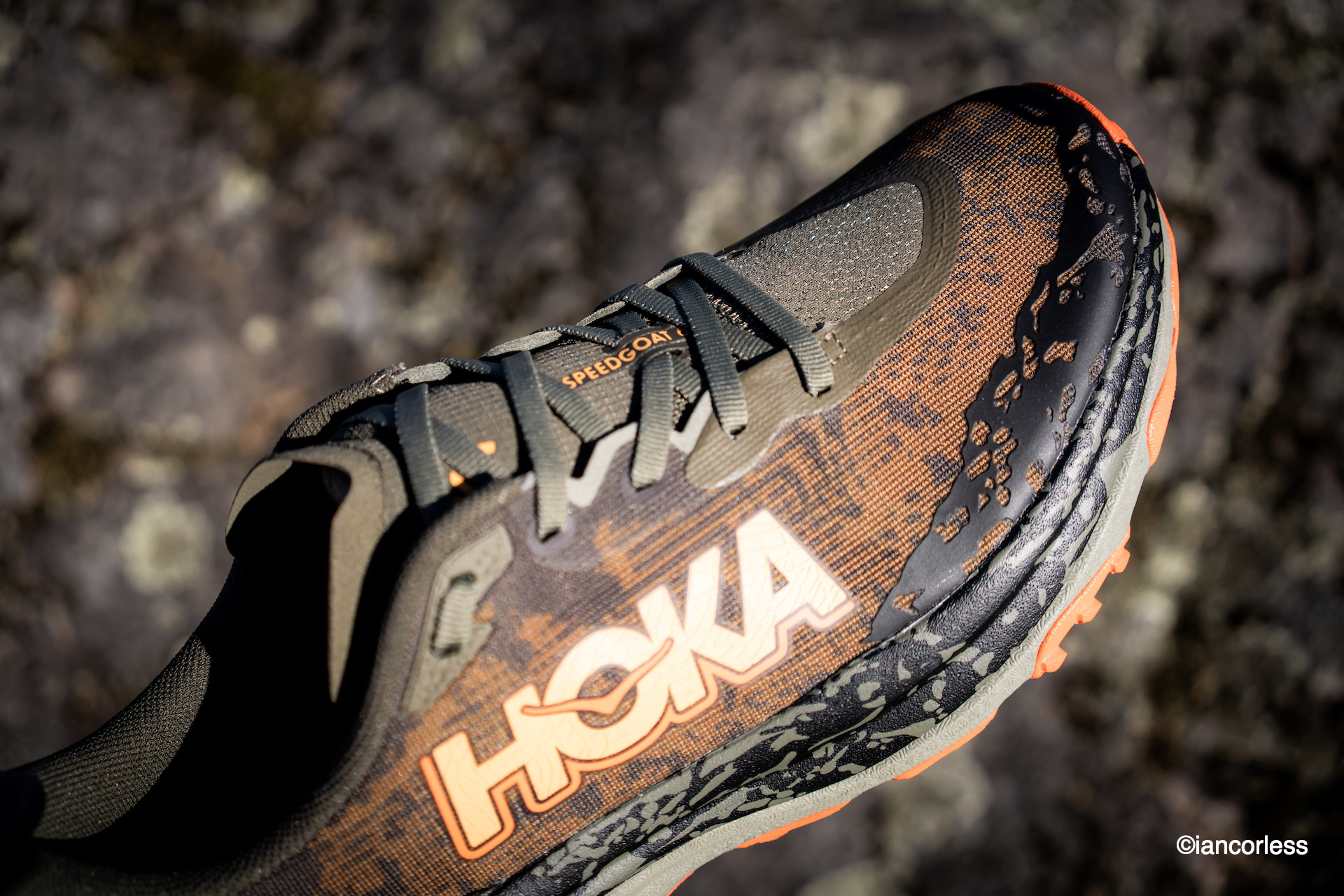
The Hoka Speedgoat needs no introduction, it is arguably, the best selling trail shoe throughout the world. It’s much loved and universally proclaimed as a great trail running shoe.
I personally was late to the Speedgoat party with version 4, followed by version 5 and now version 6. The Speedgoat 5 reached a critical point for Hoka with very mixed reviews:
There were concerns about the midsole compressing and lacking durability,
The upper had less durability.
The fit and size for some was off.
The outsole was wearing too quickly.
I personally enjoyed the Speedgoat 5. I found the combination of features absolutely fine, the upper fine which was flexible and allowed for a good fit, I did need to lock lace though. The outsole ideal and importantly, the stack height a more reasonable 33/29 which offered good stability with a 4mm drop.
Most certainly, Hoka listened to the feedback. They had to if they wanted to retain the loyal fan base, especially with many other brands releasing shoes that could not only provide competition, but even beat the Speedgoat, the Merrell Agility Peak 5 a prime example.
With the release of the Speedgoat 6, the shoe very quickly received universal acclaim with quotes such as, ‘The King is Back!’ And, ‘Speedgoat is still the GOAT.’
What is new?
Cushioning is new CMEVA foam with increase stack, 40mm at the rear and 35mm at the front and 5mm drop, 38/33 for women).
The cushioning is lighter and more responsive.
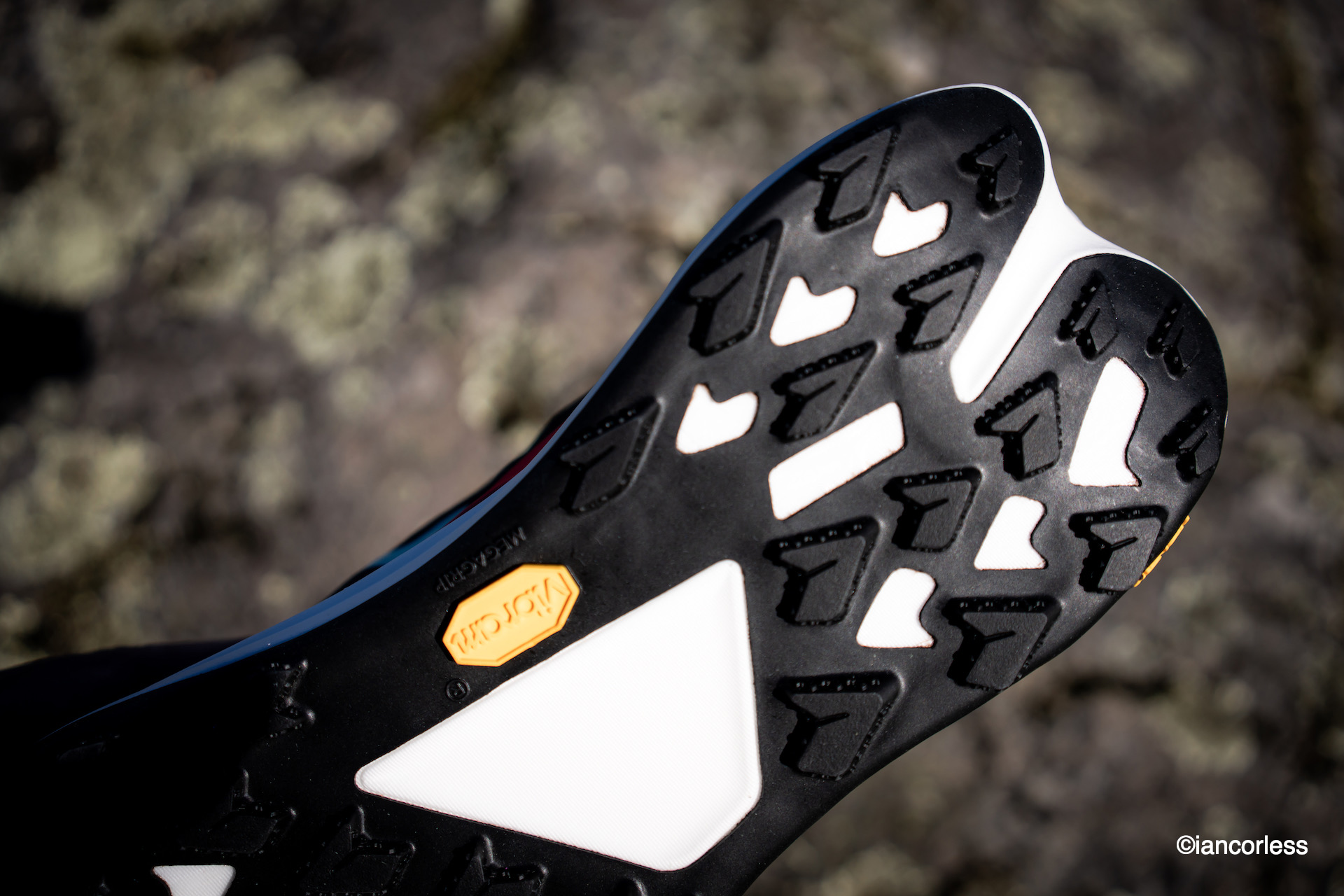
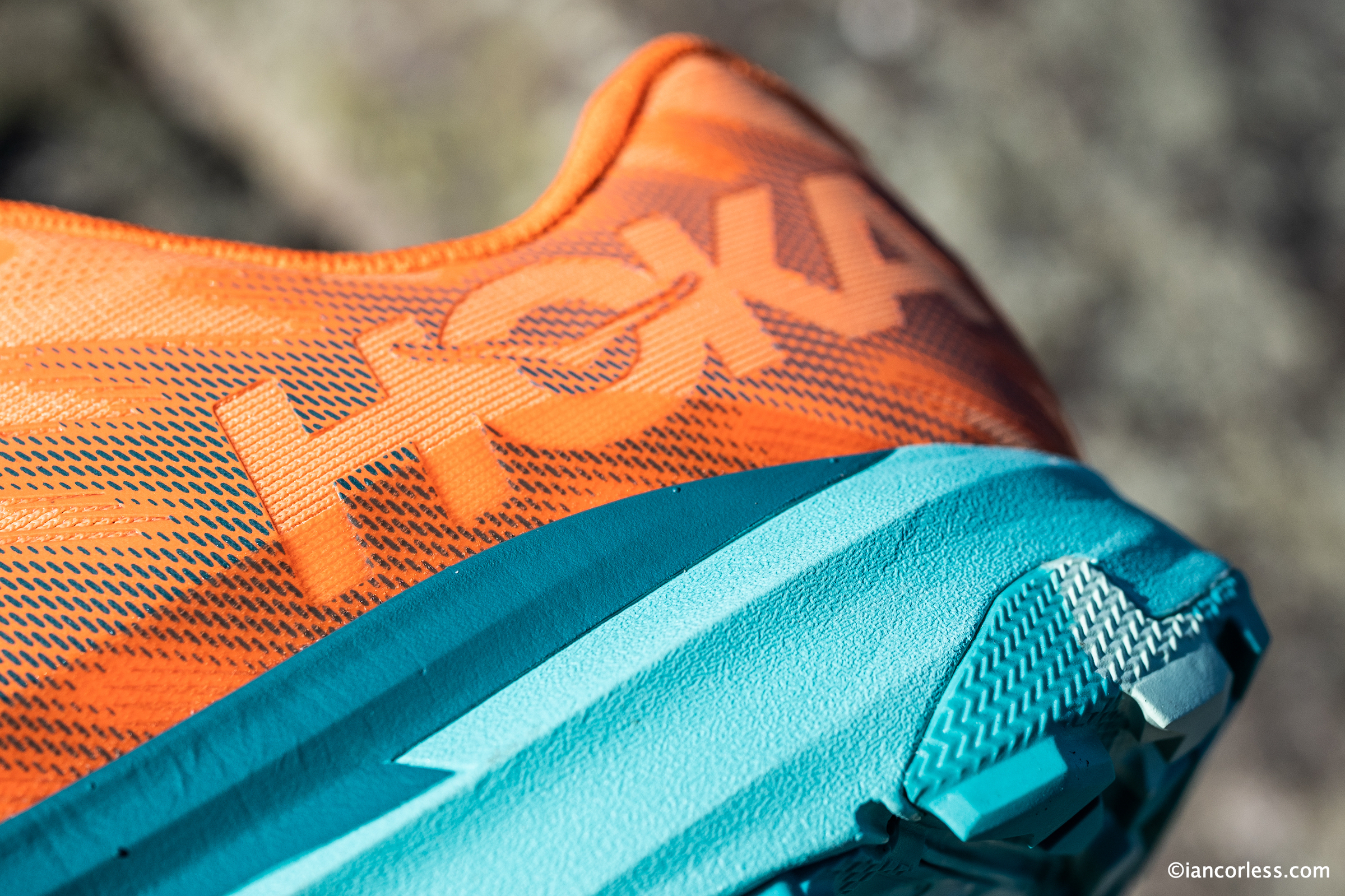
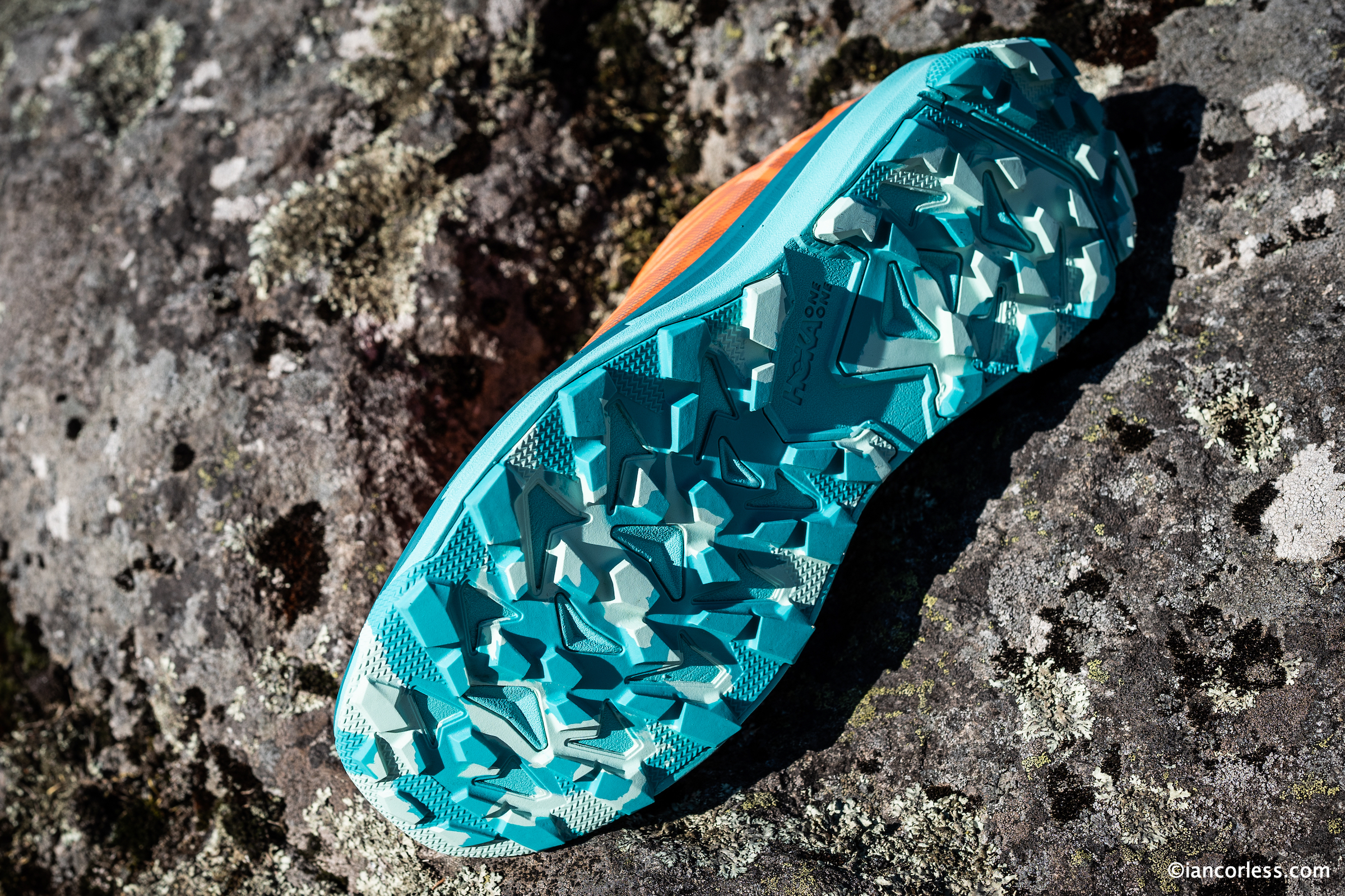
The outsole is Vibram Megagrip Traction lugs with 5mm depth and new orientation.
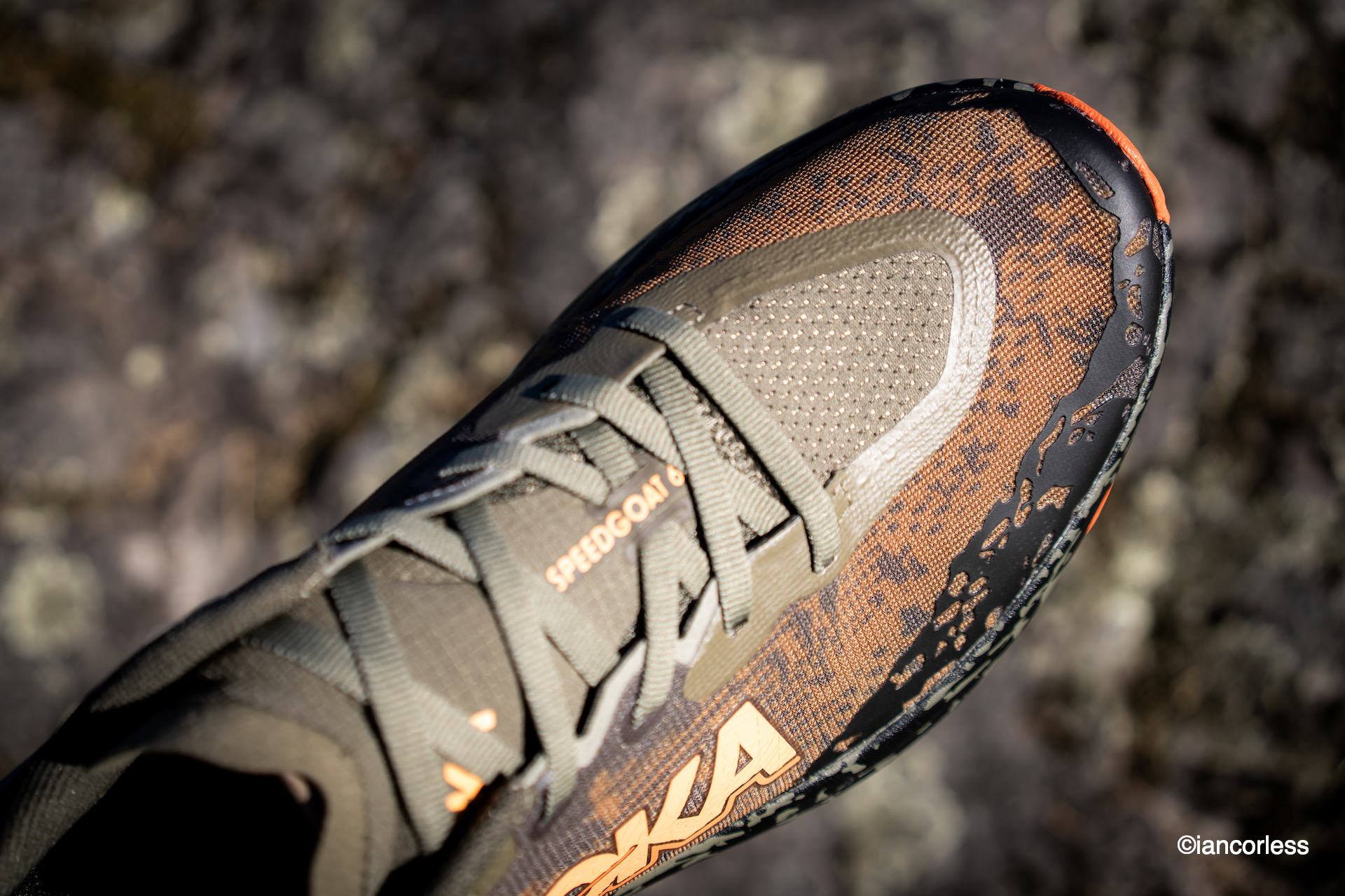
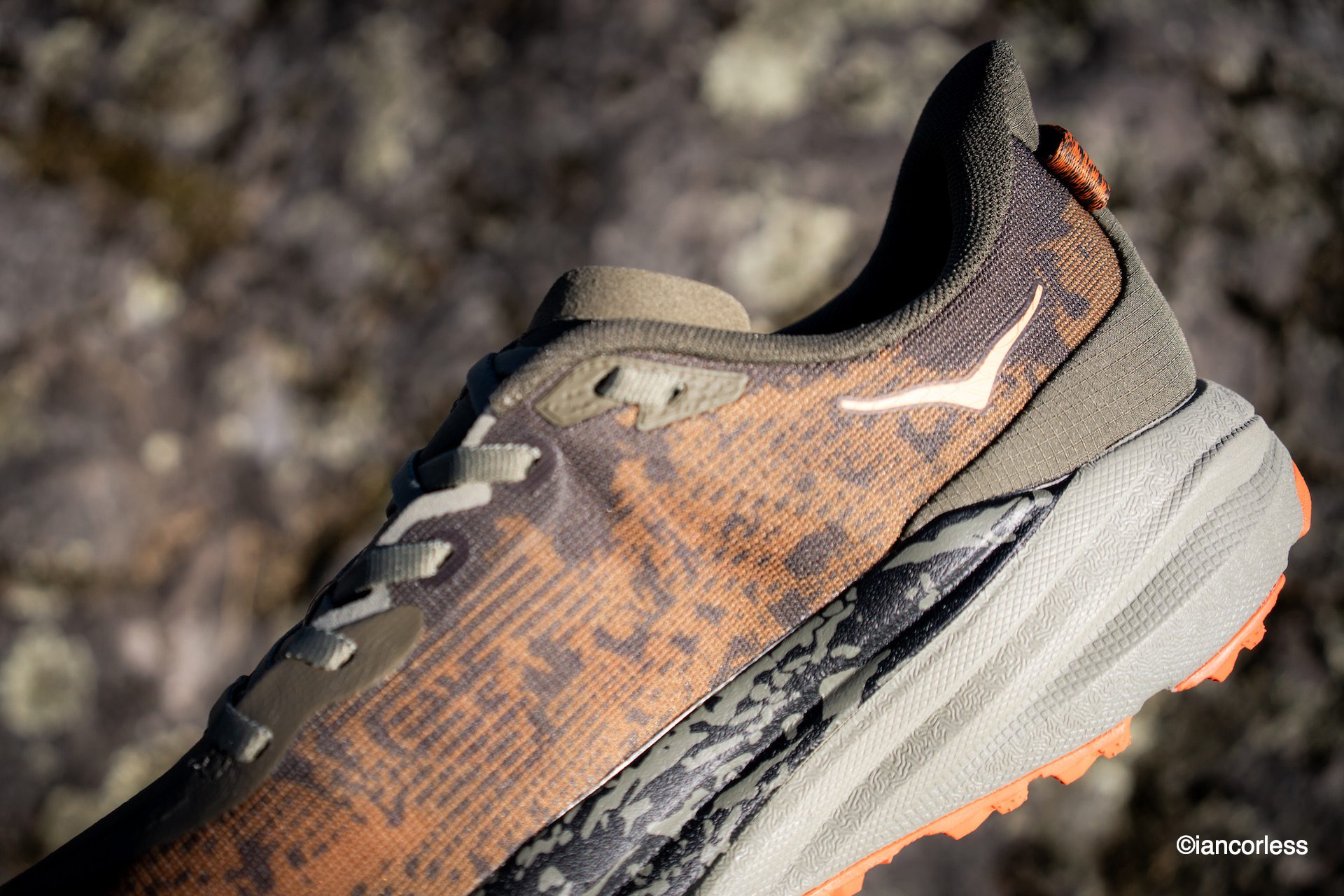
A new more durable upper that is Matryx like with no stretch and with an inner cage.
Hoka say, “We’re offering an updated underfoot experience that provides a more responsive ride with less weight. You’ll find updates to the overall construction, including a breathable woven upper, lighter, more responsive midsole compound, internal chassis, dynamic vamp, and plusher, dual-gusset tongue.”
With neutral stability, balanced cushioning all built around a wide footprint, the Speedgoat 6 is a great trail all-rounder. It is designed to provide protective cushion while maintaining a responsive toe-off for when you want to go faster.
I personally found a considerable difference when putting on the 6 and lacing them up. I immediately preferred the feel of the 5. I lock-laced (as I do on the 5) and the fit/ feel improved.
The lacing does not go as low down the shoe on the 6 and this made me feel less secure at the front, probably not helped due to the fact that the 6 has been given extra width over the 5.
The cushioning is without doubt stiffer and firmer in the 6. The 5 feels bouncy and plush but not squidgy. The 6 almost feels hard by comparison, somewhat unexpected when you consider the extra stack height.
I have to say, my first run I was not loving the shoe. I was constantly thinking, give me the 5 back. However, with 10km in the shoe, the 6 started to feel more at home on my feet and as the km’s passed, that improved. So, I would certainly say although they are good to go straight out of the box, a good run or couple of runs will help them. Ultimately, there is no special life here. They are solid, reliable, good for the long haul, but there is a lack of excitement, especially if you compare to the Merrell Agility Peak 5 and the VJ MAXx2.
There is more structure and hold coming from the new internal support chassis, this is without doubt required with the extra stack. I never had a real issue in the 5 unless on very technical terrain, but here in the 6, the 40/35 cushioning is notably different. Currently, my favourite Hoka is the Tecton X3 which has the same level of stack height as the Speedgoat 6, but for me, has considerably better feel. It’s not that I don’t like the 6, there just doesn’t feel anything special going on and ironically, I prefer the feel of the Speedgoat 5 which is counter to what Hoka say I should feel and also counter to the general Speedgoat feedback from all the fans.
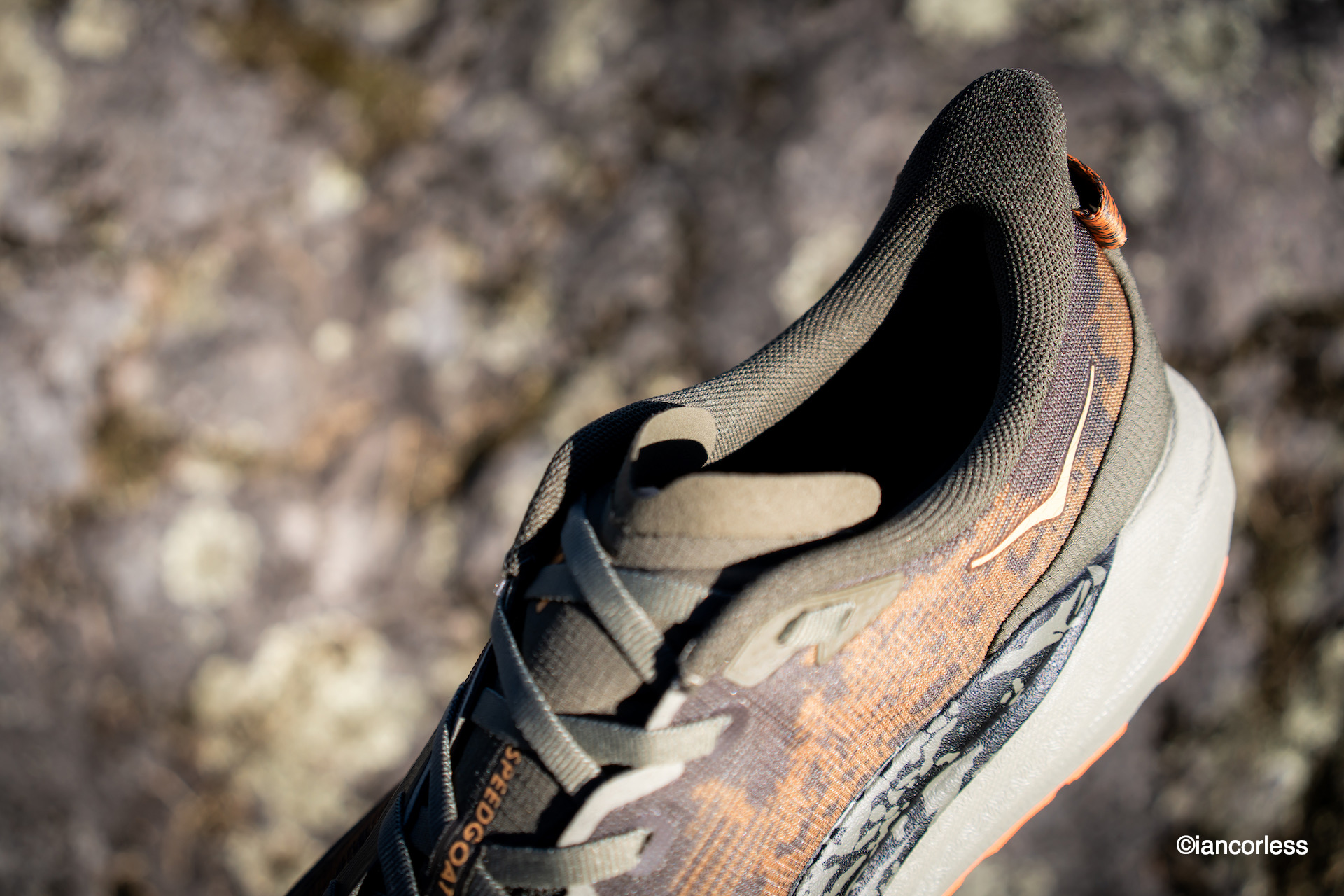
The tongue of the Speedgoat 5 and 6 is not long enough making lacing and particularly lock-lacing an awkward affair and not always comfortable. This really needs addressing.
The outsole with 5mm lugs is solid on most trails. With a new configurtation and the Traction lug, it works well. There ic a comprise with a great deal of mud and I am still never confident on wet rock.
The Speedgoat 6 is a solid trail shoe that will only continue to confirm the shoes legendary status within the trail world. Speedgoat lovers will continue to love this shoe. But, if you are new to Speedgoat and comparing against other like-for-like shoes, would the Speedgoat win out?
For me no. However, it does depend on what shoes you are comparing the Speedgoat with… If it was the adidas Terrex Agravic Speed, the Hoka Speedgoat 6 is a clear winner. However, comparing against a Merrell Agility Peak 5 or a VJ MAXx2, then, for me, I would choose the Merrell for trail runs and the VJ for mountain and technical runs.
When Hoka released the Tecton X in 2022, I went on to say, “Tecton X for me, is the first trail shoe with carbon inserts that I have really enjoyed running in. The shoe offers protection, comfort, stability and great propulsion/ speed in a very good-looking shoe.”
That above quote still rings true. I have tried many trail shoes with plates, and none have given the feeling of the original Tecton X.
The Tecton X was followed by the X2, a shoe that I never had the opportunity to test. However, while differences existed – Lighter upper with Matryx, slightly narrower toe box and gusseted tongue, the differences were marginal.
Jump to the HOKA TECTON X3 and we are now looking at a completely different shoe!
This new incarnation regarding timeline and development, can be looked at and reviewed alongside the adidas Terrex Agravic Speed Ultra. They are both super shoes, both with plates, both with extreme cushioning and both tested (with results) by elite athletes before coming to commercial market. Read more about the Terrex Agravic Speed Ultra Here.
The Hoka Tecton X3 has been developed closely with Jim Walmsley and a prototype version of the shoe was used to gain victory at the 2023 UTMB. This prototype was then developed into a Hoka Tecton X2.5 which Jim used to win Western States in 2024 and surprisingly a commercial version of the Tecton X2.5 was made available in very limited numbers, it sold out and to my knowledge is no longer available, at least commercially. The Tecton X2.5 had more cushioning (44/39), different lacing, and having spoken to ‘those in the know’ in Chamonix, durability may well have been an issue for commercial release.
Post Western States and pre UTMB it was clear that the Hoka Tectonic X3 would be released and made commercially available just before UTMB and most certainly, there would be a great deal of buzz in and around the UTMB expo.
Both myself and Abelone were lucky to receive early versions (thanks to hoka.no). My shoe was in the stormy skies/ cerise colour way, Abelone received the UTMB limited edition black/ Hoka blue. I was immediately jealous, the blue/black colour way is sweet!
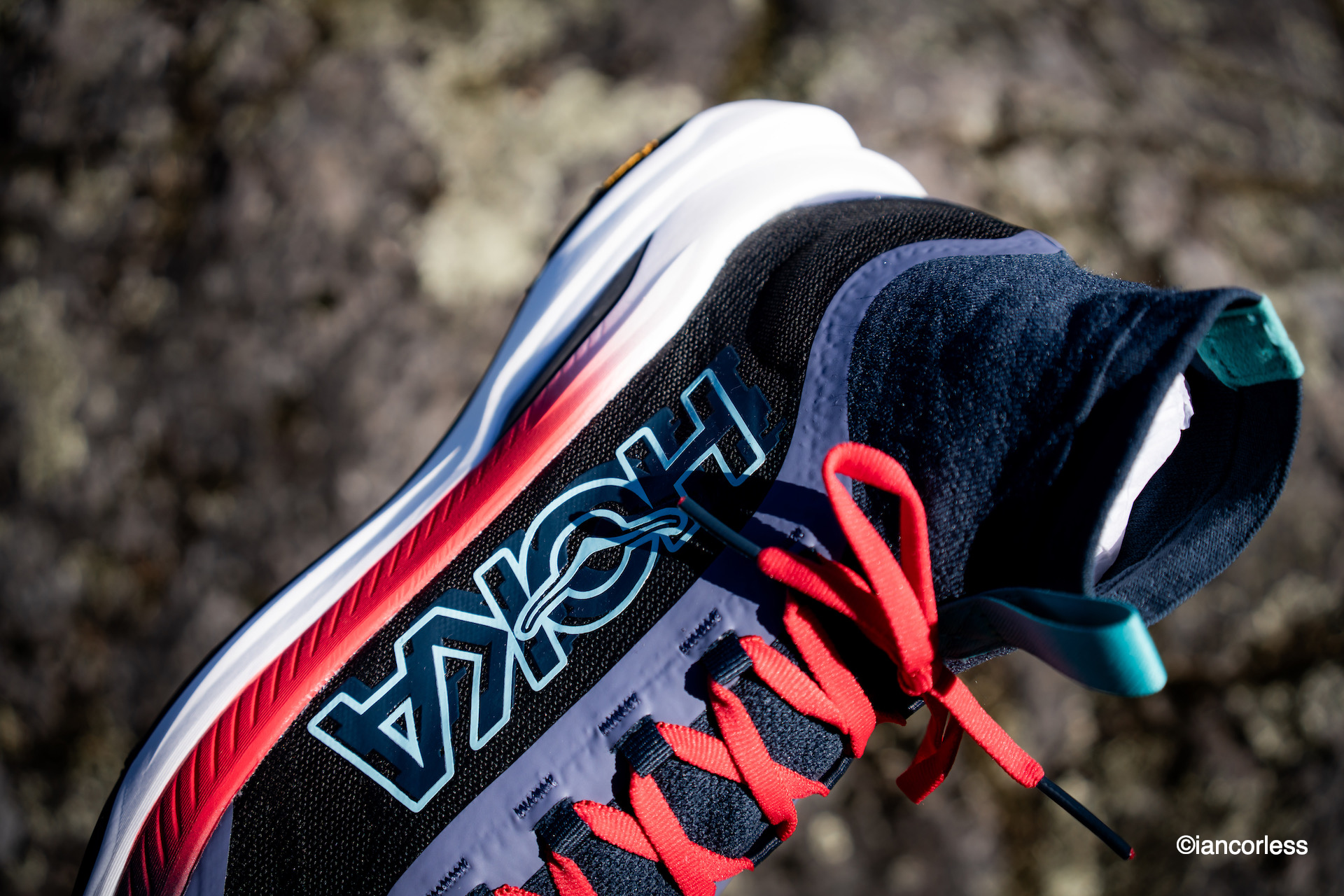
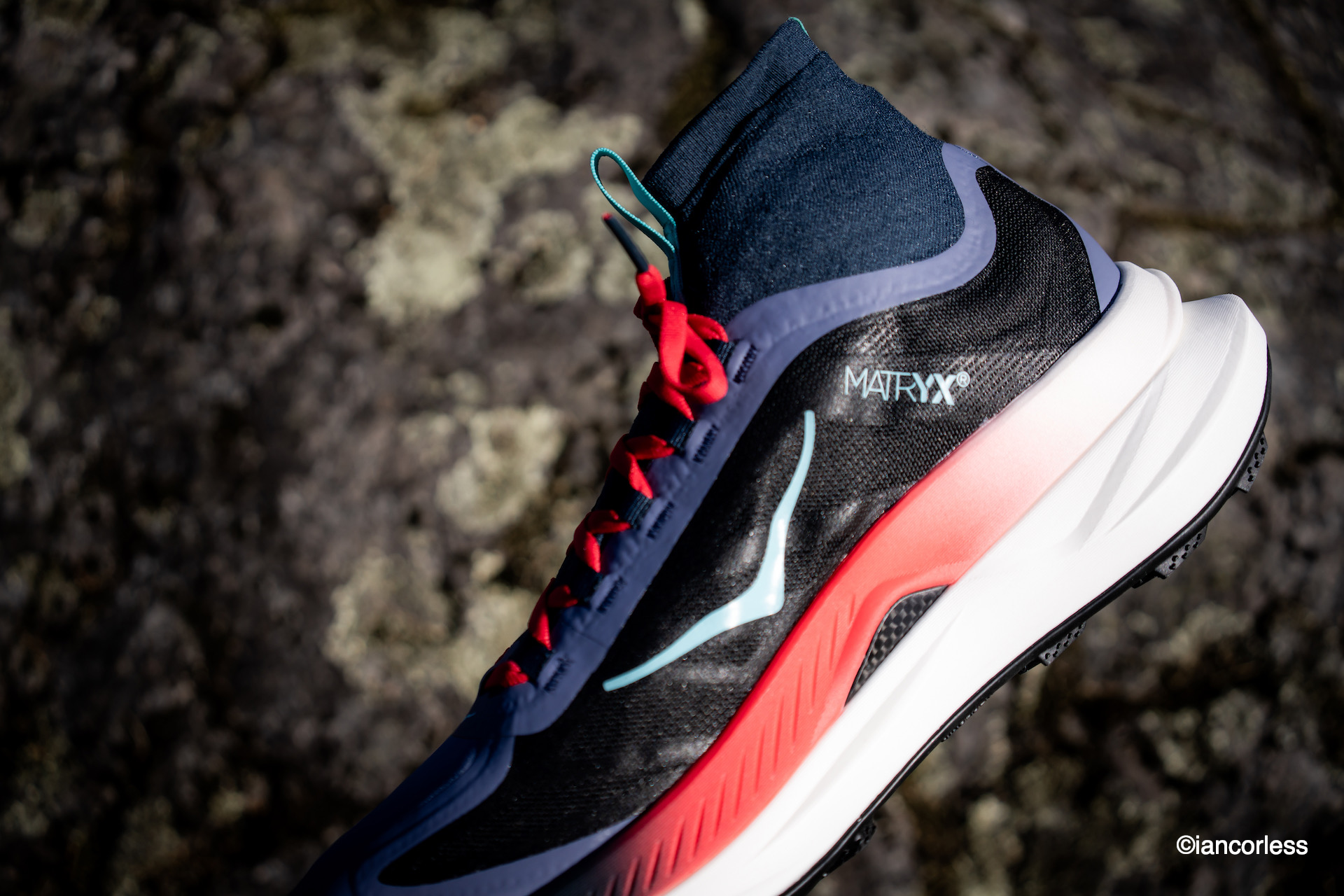
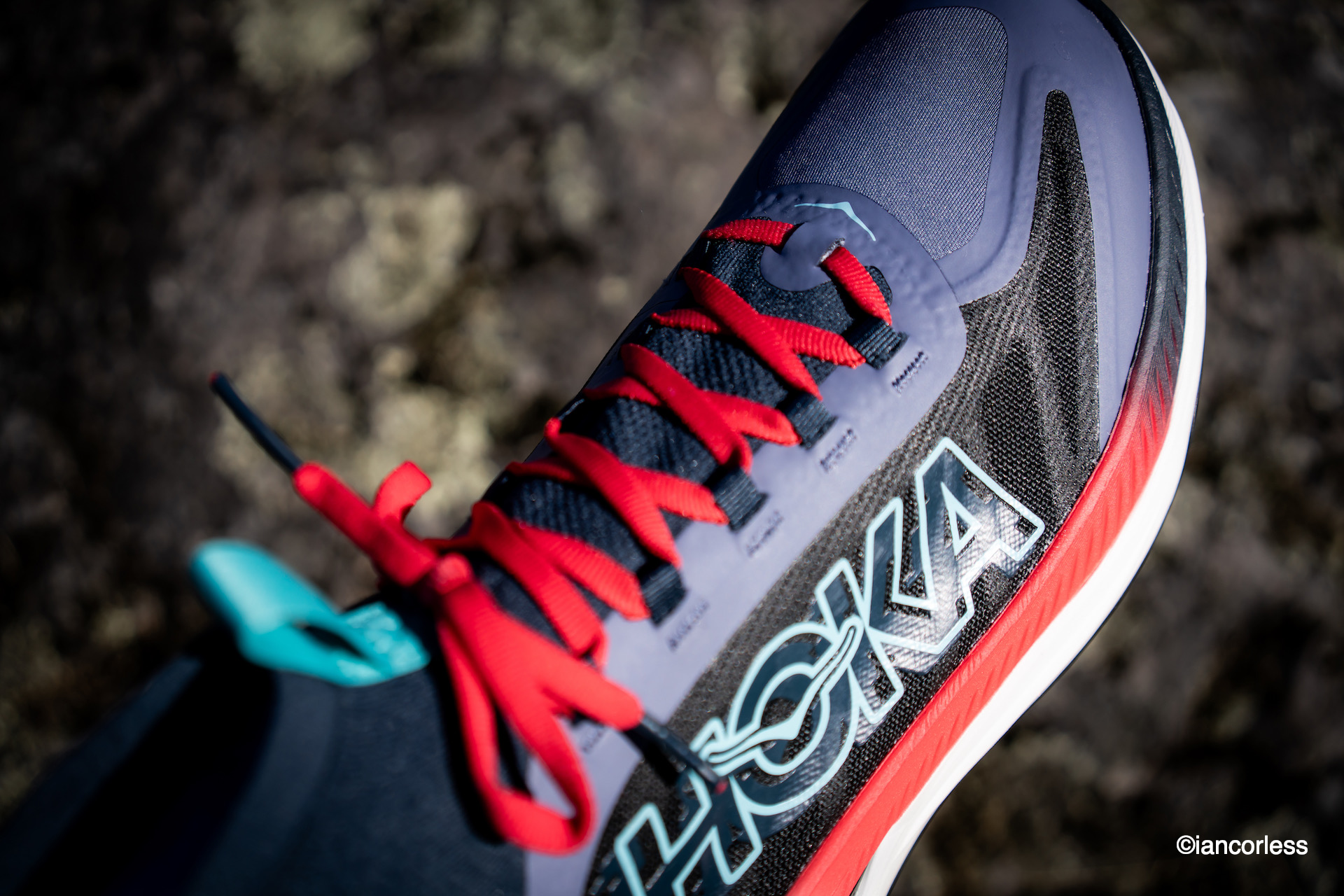
Just as we have seen on Jim’s UTMB and WSER Hoka’s, the TECTON X3 has a built-in knit gaiter which comes up above the ankle, fits very light and stops any debris entering the shoe.
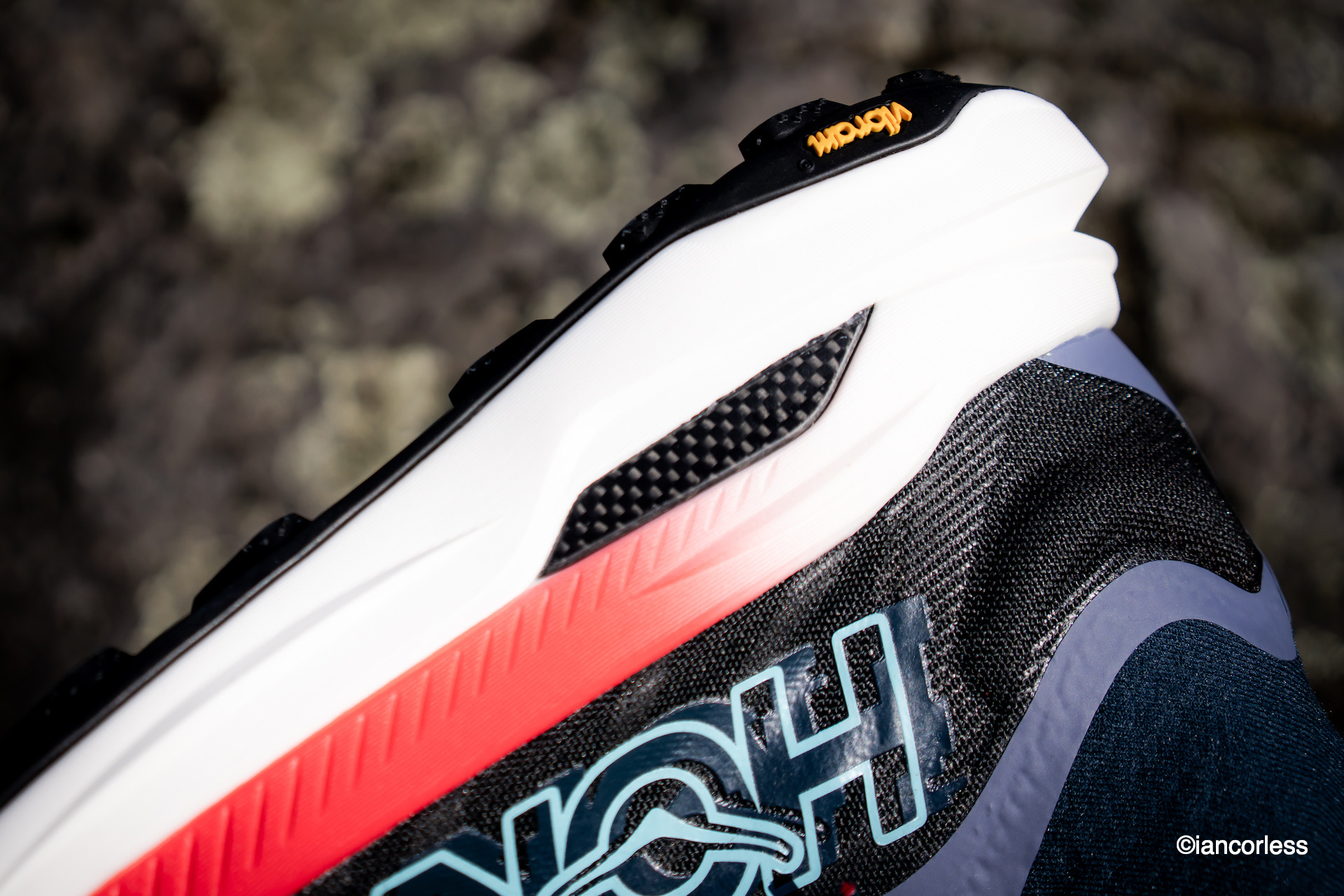
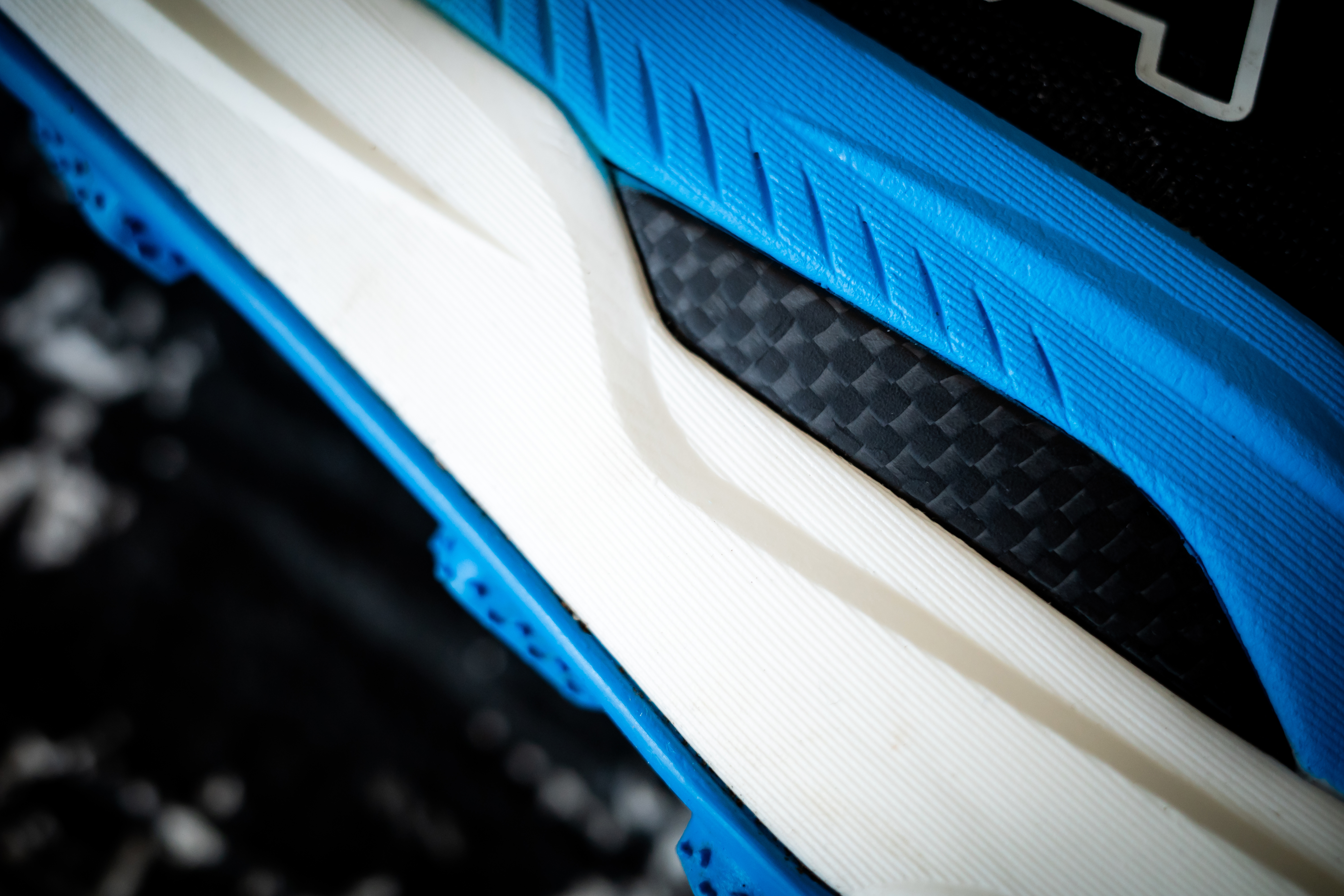
Arguably, the biggest development comes with the parallel carbon plates. They have been developed with ‘winglets’ that come up the side of the shoe, they are a game changer in making the shoe more stable.
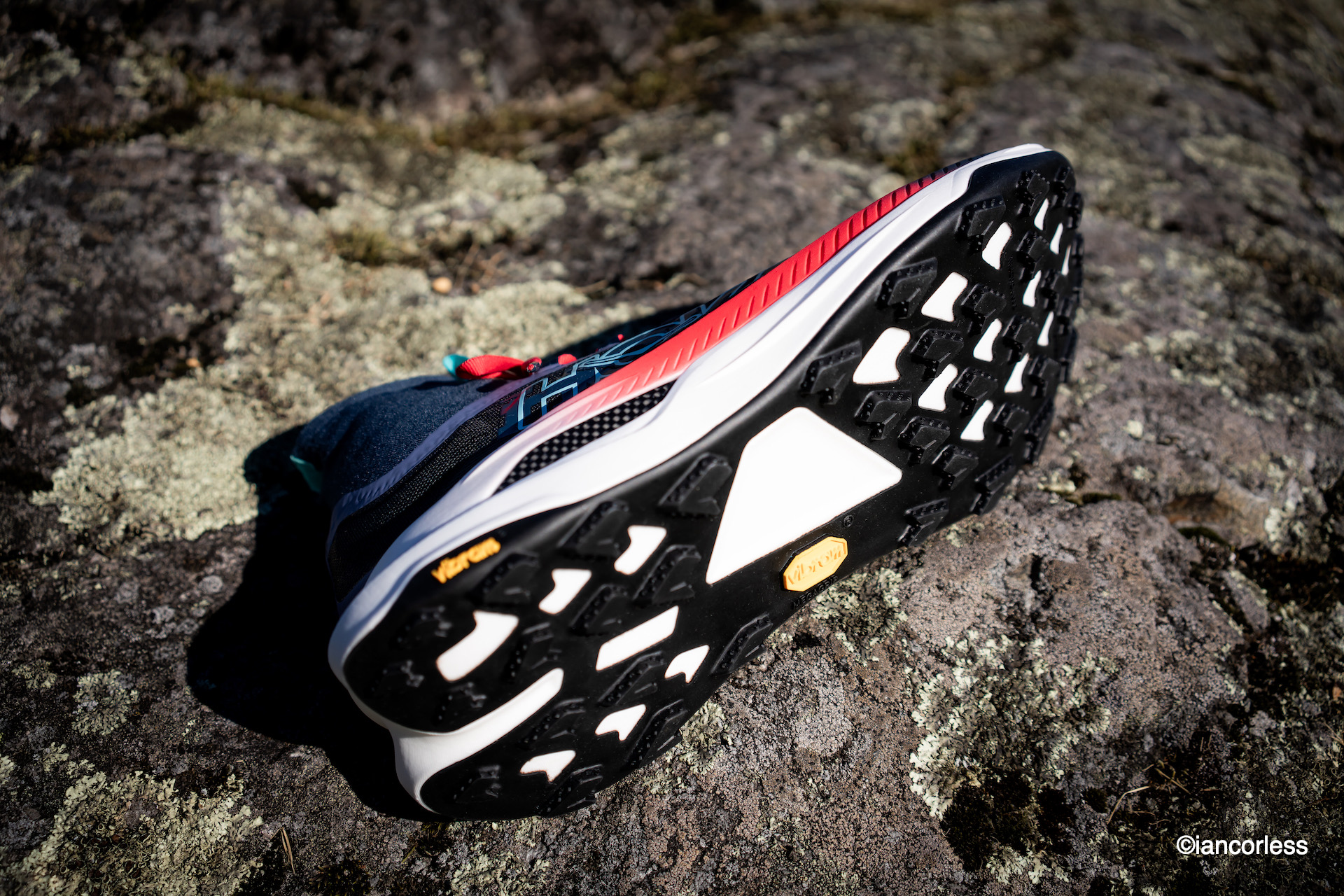
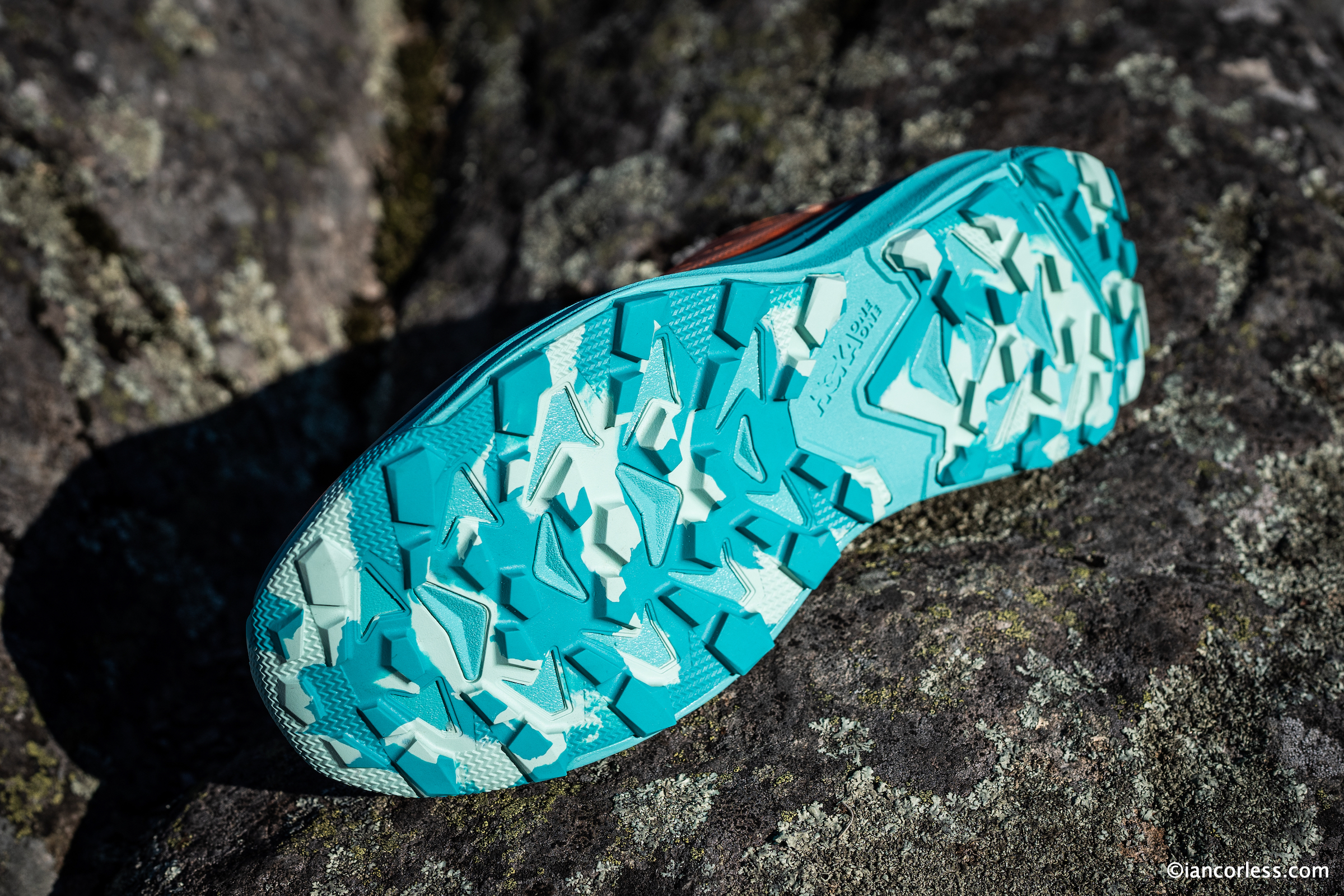
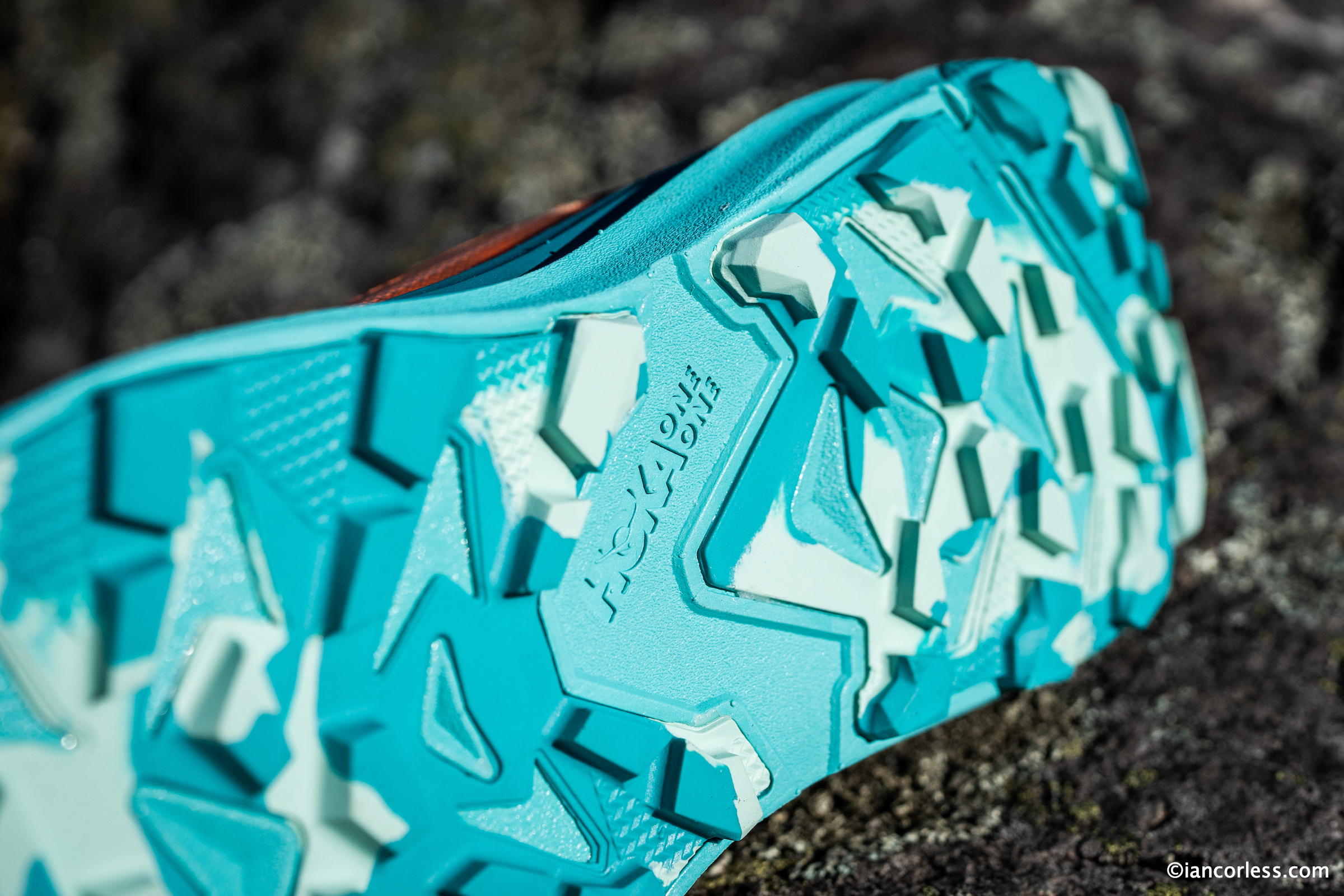
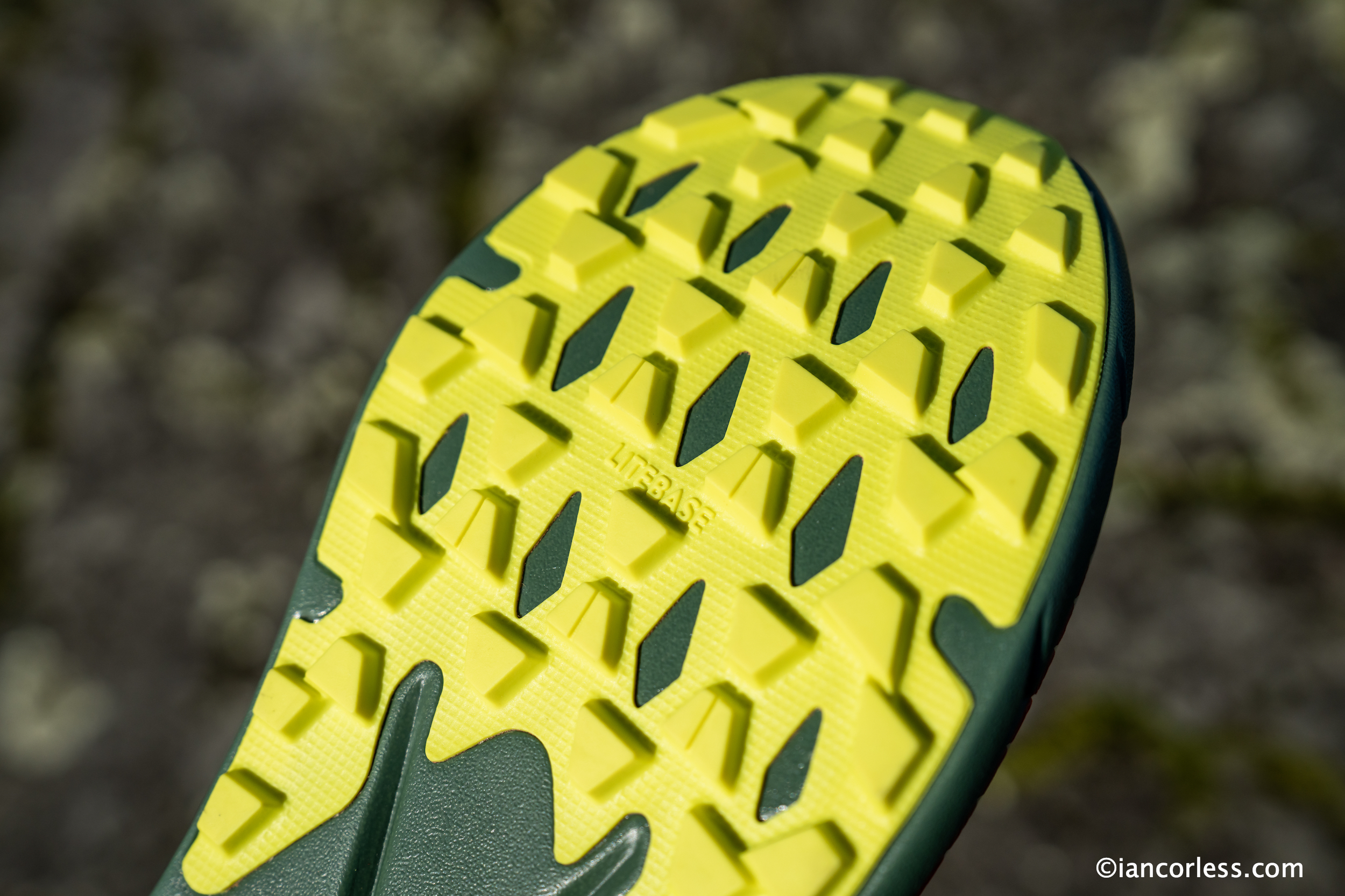
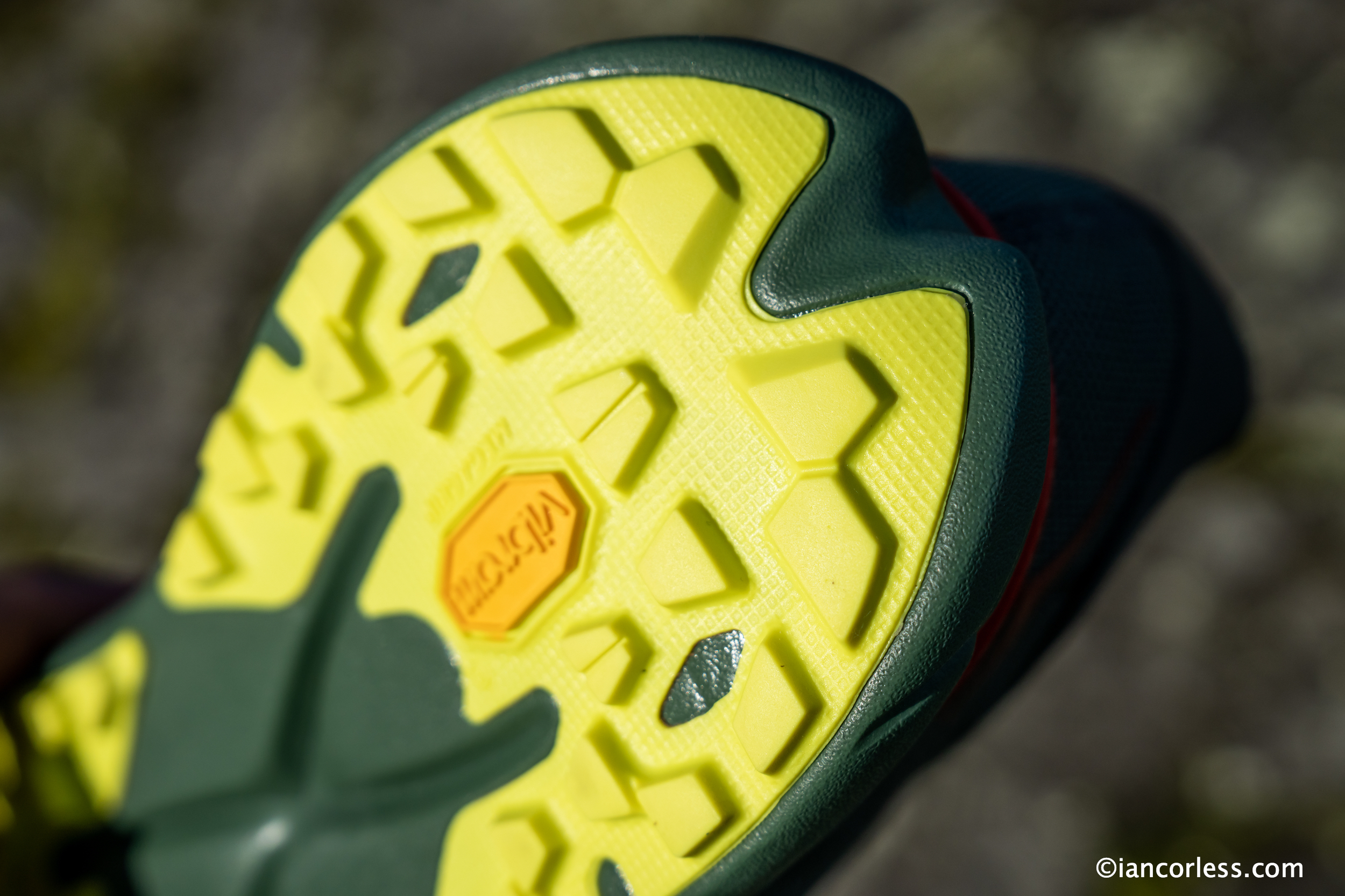
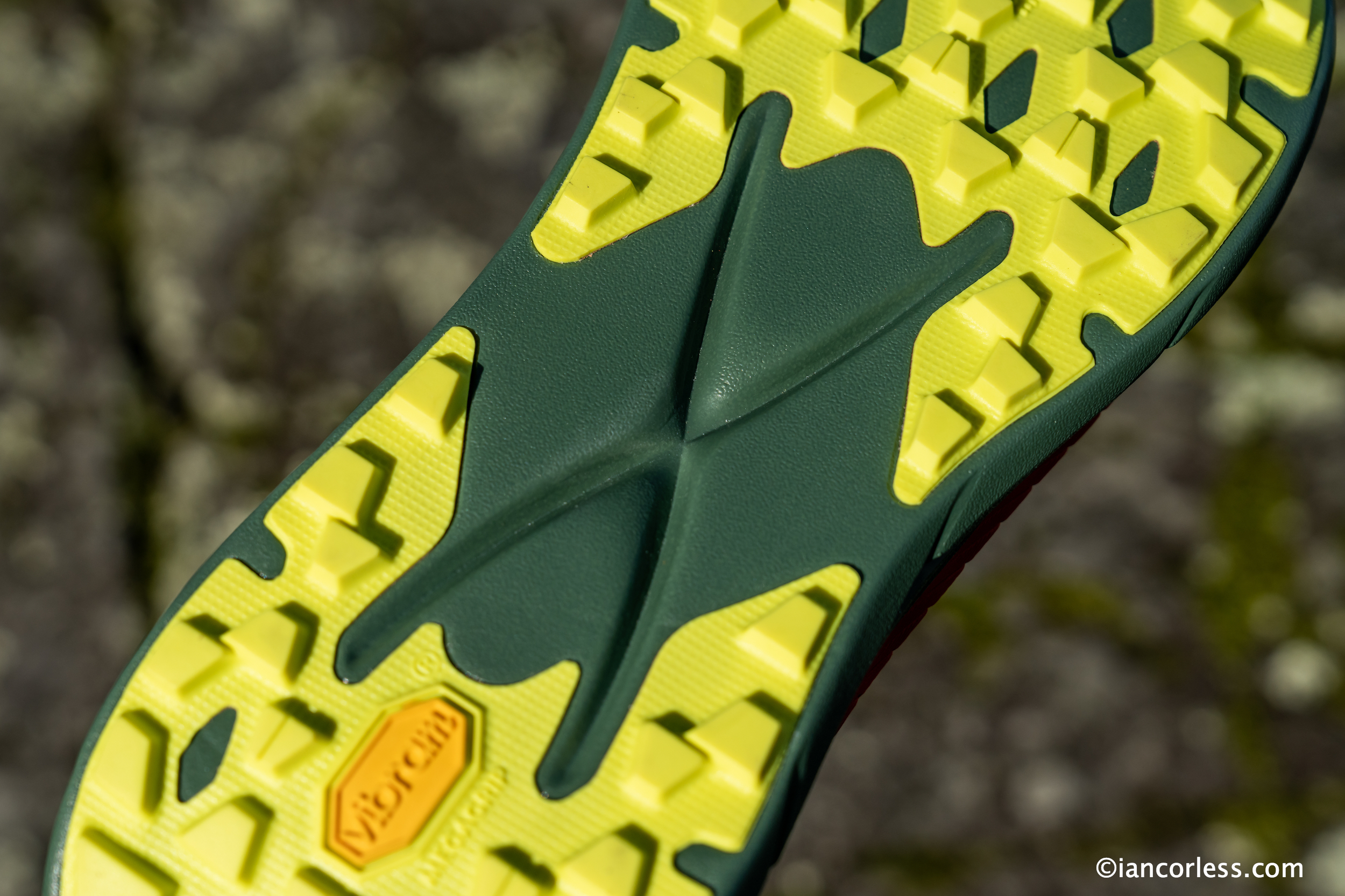
The outsole has also been developed with Vibram. This Vibram Megagrip Litebase covers more of the shoe, in comparison the Tecton X2. The lugs have also been changed to Traction Lugs with 4mm height.
The first thing I noticed was the size of the outsole. Hallelujah, Hoka completely understand that when you increase stack height, you also need to increase the size/ footprint of the outsole. This helps make the shoe stable. An incredible short coming from the new adidas Terrex Agravic Speed Ultra which is so narrow that you constantly roll left to right – the shoe has no stability, it’s a terrible shoe on challenging trail. Here, the Hoka Tecton X3 is supreme, the front is wide, the middle is wide, and the rear actually is not only wide but extends behind the shoe.
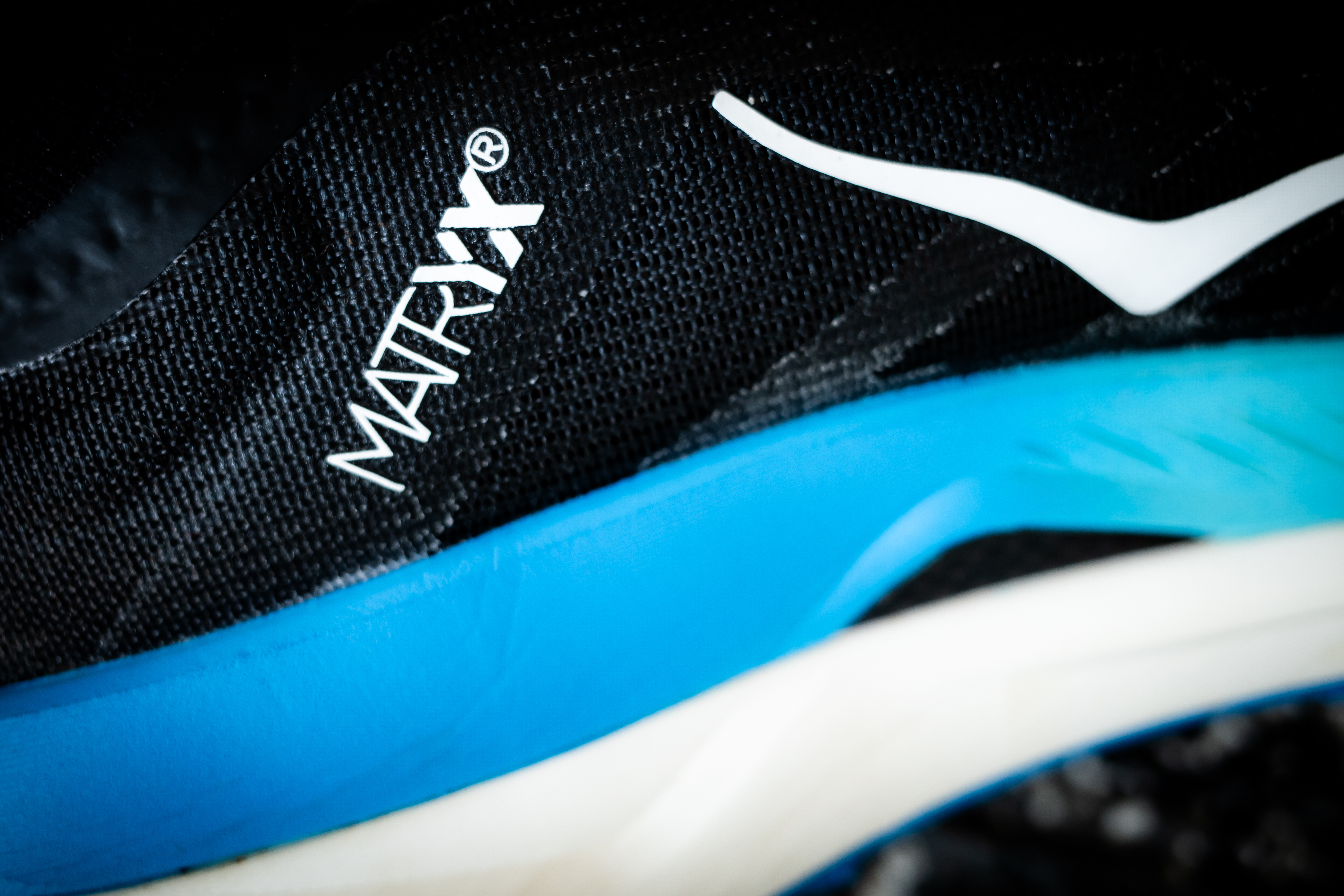
The Matryx upper is very durable and at the front of the shoe, there is great toe protection. The lacing system sits on top of the shoe and there is no tongue as the upper is an all-in-one upper. The addition of the gnit gaiter gives the Tecton X3 a unique look.
Cushioning is 40mm at the rear, 35mm at the front providing a 5mm drop, the women’s shoe is 39/34mm.
Sizing is true to size BUT due to the nature of the upper, you may want to try sizing to make sure you have the fit you require. For me, my normal run shoe size was perfect.
I was nervous about the gaiter. Nearly every shoe I have tried with a built-in gaiter I have been disappointed, either the gaiter is not tight enough or, the shoes are incredibly difficult to get on. Not so with the Tecton X3. For sure, getting the shoe on the foot requires more time and patience than a normal shoe, but it’s not problematic. Gladly, the fit around the top is tight. I absolutely love the feel of this shoe on the foot!
Another worry was the lacing. Would I be able to get the secure and locked feeling that I like with a shoe of this nature? Quite simply, yes! A great fit for me. Note I say, ‘for me,’ here. I do think that the shape will heavily influence if the Tecton X3 works for you. My foot fills and occupies the shoe, by contrast, Abelone has a long/ narrow foot, and she found that getting the correct hold/ security was difficult.
Standing up, the comfort level is a wow. They are plush but not squishy. Despite the stack height, they feel stable and secure, a consequence of the wide footprint and the new carbon plate.
The moment you start to run, you feel the bounce and propulsion moving you forward. They are a fast shoe but importantly, they are equally happy running slower and importantly (for ultra) they are extremely comfortable walking and hiking due to the wide and cushioned rear. The responsiveness is superb when climbing and the cushioning, width and carbon plates make downhill a joy.
The gaiter is fantastic, not only does it stop debris, but it adds the secure feeling of the shoe. So much so, when I have moved to other trail shoes, say the Hoka Speedgoat 6, I have really missed the gaiter. You forget you are wearing the Tecton X3 they are som comfortable.
These are a fun shoe; they are exciting and put a smile on my face.
For many years I have avoided shoes with large stack height, and this has not changed when I am running on very technical or mountain terrain, quite simply I need to be lower. However, despite 40/35 cushioning, the Tecton X3 is remarkably stable – way more stable than I anticipated. On single-track, gravel roads and non-technical trails they zip along. Amazingly, on tree routes, rocks, and uneven terrain, the stability level is considerably better than expected – the wide outsole and carbon wings really do a stunning job. Also, the parallel carbon plates can move independently, allowing the outsole to adjust the terrain underneath. There is a limit to how technical you can go, but also, one needs to consider the runner that is in the Tecton X3. If you are an experienced mountain/ technical trail runner, you may well be amazed and where you can take this shoe!
Vibram grip is universally liked, so the Tecton X3 has this covered. I personally am not always a fan of Vibram, especially on wet rock. However, this new Megagrip Litebase with traction lugs is a winner. The lugs are 4mm which is a perfect middle ground, a compromise will come in mud.
CONCLUSION
The HOKA TECTON X3 is my shoe of the year for trail running. It’s matched by the VJ Sport MAXx2 for mountain and technical trail.
Hoka have produced a remarkable shoe. There are key elements that make this stand out above all the competition. Super shoes very often are designed for and around super athletes, the adidas Terrex Agravic Speed Ultra a great example; if you are a great runner, can run fast and you have great form, the shoe is perfect. But if you are just a normal runner, the shoe can be a liability and on technical trail, it is a disaster.
The Hoka Tecton X3 is a super shoe, Jm Walmsley set a course record at UTMB, he then went on to win Western States and just recently, Vincent Couillard ran under 20-hours (19:54) to win the 2024 UTMB. Admittedly, Jim and Vincent were either in a prototype or maybe the Tecton X2.5 but there is a direct correlation to the Tecton X3.
The combination of features, cushioning, gaiter, parallel carbon plates and notably the new winglets and wide outsole make this a cushioned and surprisingly stable trail shoe.
The Tecton X3 is remarkably fast and once you get your cadence ticking over, you feel the carbon plates propelling you forward. But what is key for me is the comfort, feel and great sensations I get when running easy. They just feel great! At slower speeds the shoe feels comfortable and stable. Walking they are superb.
This may well be the first super shoe that works for any runner. That is a bold statement.
Despite all the above, the Tecton X3 will not work for some – If you have long narrow feet, you may find a compromise on fit.
The gaiter gives a secure and tight feel, this may not be for everyone.
There is one negative, due to the style of the shoe, the Matryx upper and the gaiter, the shoe does feel warmer than a normal shoe. Something I am happy to accept.
Finally, they are not cheap, however, run shoes these days seem to hover around the £200 mark, especially super shoes that push development and technology.
The Hoka Torrent has become one of my favourite shoes.
The Torrent 2, while not the best shoe at anyone thing, is without doubt, one of the best all-rounders. Trail, single-track, rocks, mountains, forest, some mud and yes, even road. If I could only have one shoe, it would be a Torrent.
So, when I heard a Torrent 3 was going to be released, I got a little worried. Shoe brands have a tendency to want to change things, wether they need changing or not. Gladly, Hoka seem to be able to restrain that urge, listen to the audience and tweak appropriately.
The Torrent 3 is exactly this.
For me, the Torrent 2 was pretty much perfect, the only misgiving being the outsole which most definitely was compromised on wet rock. The Torrent 3 has a new outsole and without doubt, it is an improvement both in the wet a dry.
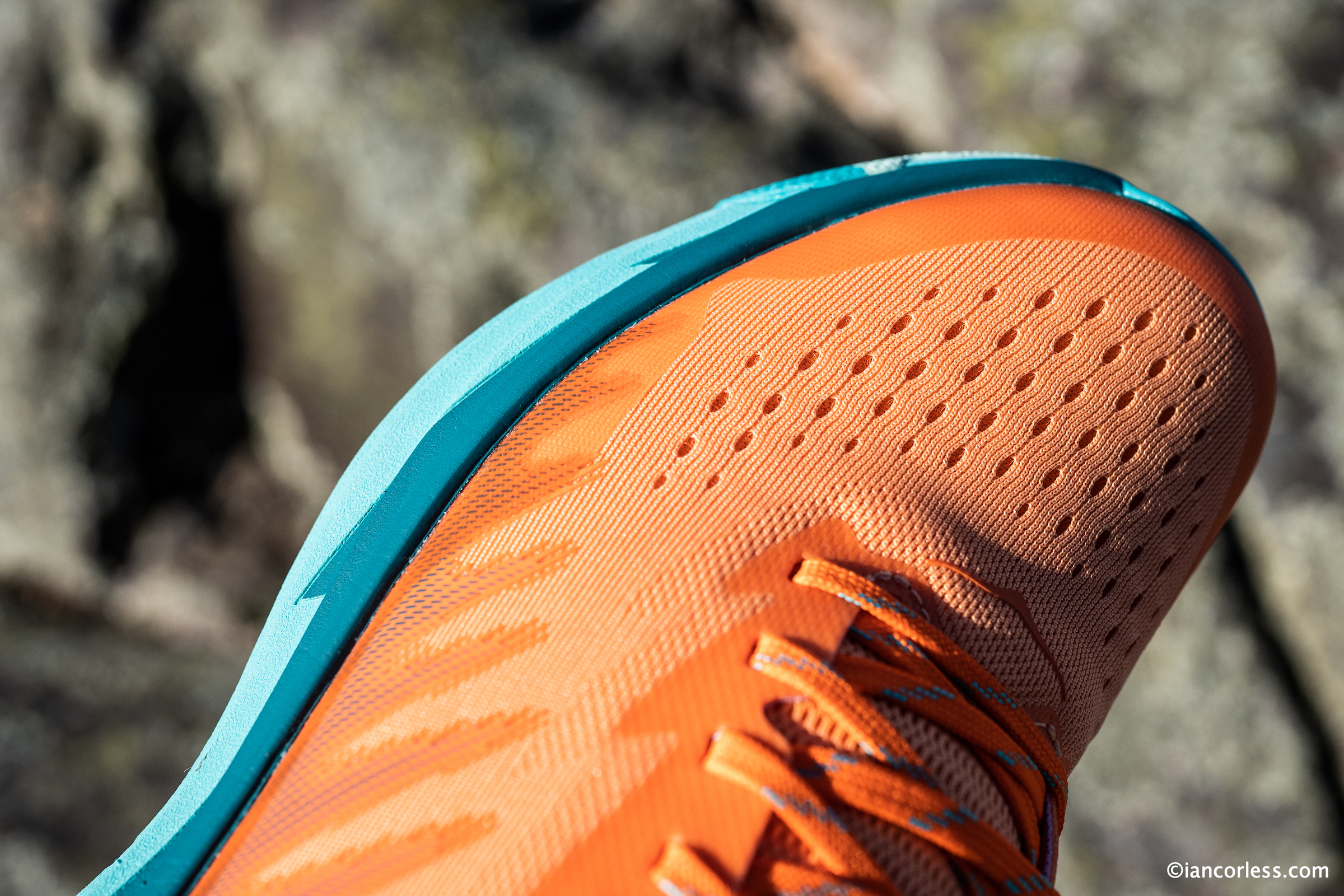
Torrent 2 was, on occasion, a shoe that retained heat. So, the Torrent 3 has a stripped back upper which is now single-layer mesh for increased breathability.
Profly construction, neutral, gusseted tongue, meta-rocker, 4mm lugs, cushioned but not excessive, great ground feel, light, responsive and a 5mm drop make the Torrent 3 a perfect shoe for most scenarios.
I got introduced to the Hoka Torrent in early 2021 after avoiding Hoka for many, many years. I was tempted back due to the Torrent being the least Hoka like shoe, basically, less cushioning and more ground feel. I was not disappointed. I immediately fell in love with the Torrent 2 and 6 pairs later, I am still in love with them, but that will change, the Torrent 3 is better and that says a great deal.
The Torrent 3 is just a great everyday shoe that works on most terrain and provides comfort over short or long distance. The PROFLY is excellent, and the propulsive phase is great, as is ground feel. There is a firmer feel to the Torrent 3, but not as form as the Zinal. Just like the Torrent 2, the Torrent 3 sits nicely between the Zinal and Tecton which has two carbon plates, I still choose the Torrent 3 over these other options.
Neutral, a 5mm drop with 18mm cushioning at the front and 23mm at the rear makes this a shoe that blends ground feel, responsiveness and cushioning perfectly. Great on on long or short runs, the Torrent 3 manages anything except very muddy ground. The wider footprint goes a long way in providing great comfort and less roll. There is no rock plate in the shoe and in all honesty, for me, I found no issues or problems. However, some say they feel too much…
A key improvement is the outsole, which has been re-worked from the original Torrent and Torrent 2. The grip works well in soft ground but if heading into muddy terrain, you will no doubt need a more aggressive outsole. The key difference is grip on wet rock, the softer rubber is a big improvement.
Fitting is true to size, with great comfort in the heel, excellent padded tongue, good lacing, a considerably more breathable upper and modest toe protection, the Torrent 3 is a winner.
Conclusion
Torrent 2 was superb, Torrent 3 is even better. It really is that simple. Ultimately, a great all-rounder over any distance and any terrain. It has low weight, comfort, toe splay and cushioning. If you only can purchase one shoe, the Torrent 3 is ideal. If you need a really specific shoe, for specific purpose, then yes, there maybe better alternatives, Speedgoat for technical trail, Challenger for road to trail and Zinal for fast and short, but trust me, the Torrent 3 sits perfectly amongst all these shoes and does the job superbly.
Hoka Speedgoat and the ‘5’ incarnation is arguably one of, if not THE most popular trail running shoe ever. No matter what race, what conditions, you will see countless Speedgoat shoes.
With maximal cushioning, great fitting upper, the option of different widths and an excellent Vibram outsole, it’s easy to understand why they are so popular, especially in the ultra world!
For me personally, I find the stack height just too high, especially on technical and challenging terrain; the risk of an ankle roll is too high! However, on single-track, the benefits are there if cushioning is your thing? For me, give me a Zinal or Torrent 2!
Living in Norway, once November arrives (sometimes earlier), pretty much all my runs require a specific winter shoe that has studs to maximise grip on ice. Until a few years ago, the choice was limited with unsurprisingly, Scandinavian companies such as VJ Sport and Icebug leading the way.
Now though, options from Asics, La Sportiva, Salomon, Salming, inov-8 and others are available, it only shows how the growth of running is booming and how the ‘need’ to run all-year makes it worthwhile for brands to produce a very specific shoe, that by its nature, has a limited market.
Therefore, the addition of a Hoka Speedgoat 5 with spikes is a welcome addition to the market. Certainly, adapting the Speedgoat makes sense, it is Hoka’s most popular trail shoe, so, it will certainly be popular in this version for those who need a specific shoe.
To my knowledge, this version of the Hoka is the *first (?) maximal cushioned shoe with winter spikes on the market, this alone will fill a hole in the market. It’s a welcome addition.
WINTER RUNNING
I have written many articles on winter running, read HERE. However, for clarity, I will provide a quick summary.
Not all winter running is the same and most certainly, conditions vary considerably.
Icy roads and pavement – A spiked shoe with cushioning is perfect. The outsole can be less aggressive.
Icy trails – A spiked shoe with an aggressive outsole is best.
Snow and Ice – A shoe that is used for icy trails works, however, sometimes the addition of Gore-Tex is welcome and in deeper snow, a boot that comes higher over the ankle is recommended.
Snow/ Ice in mountain terrain – We now crossover into alpinism and a more specific shoe is required and depending on conditions, a more specific crampon. This can be a light micro-crampon such as Nortec or a specific mountain crampon.
Needless to say, the Hoka falls in to categories 1 and 2 and depending on conditions, may be applicable for point 3. It is most definitely not a point 4 shoe.
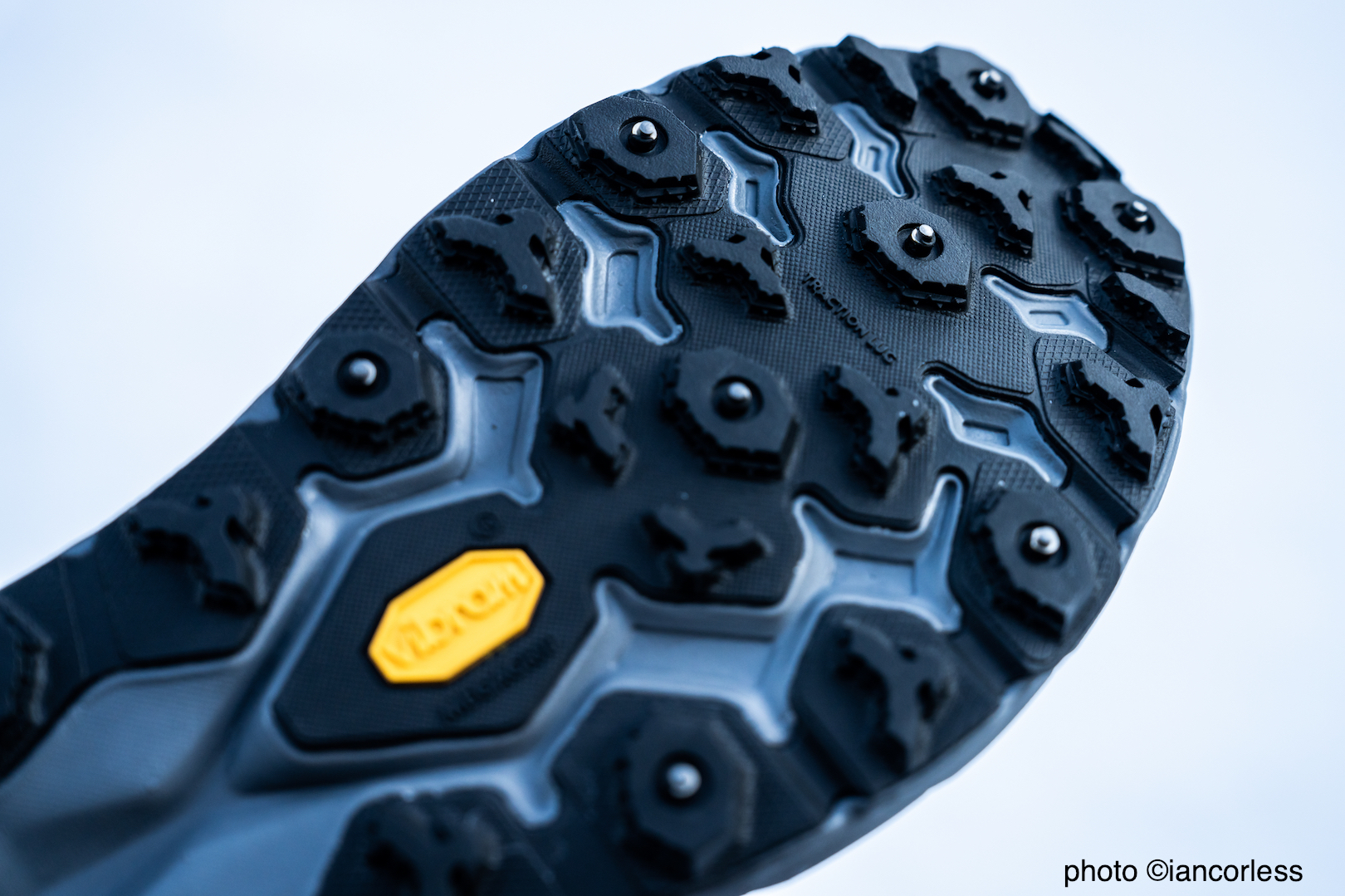
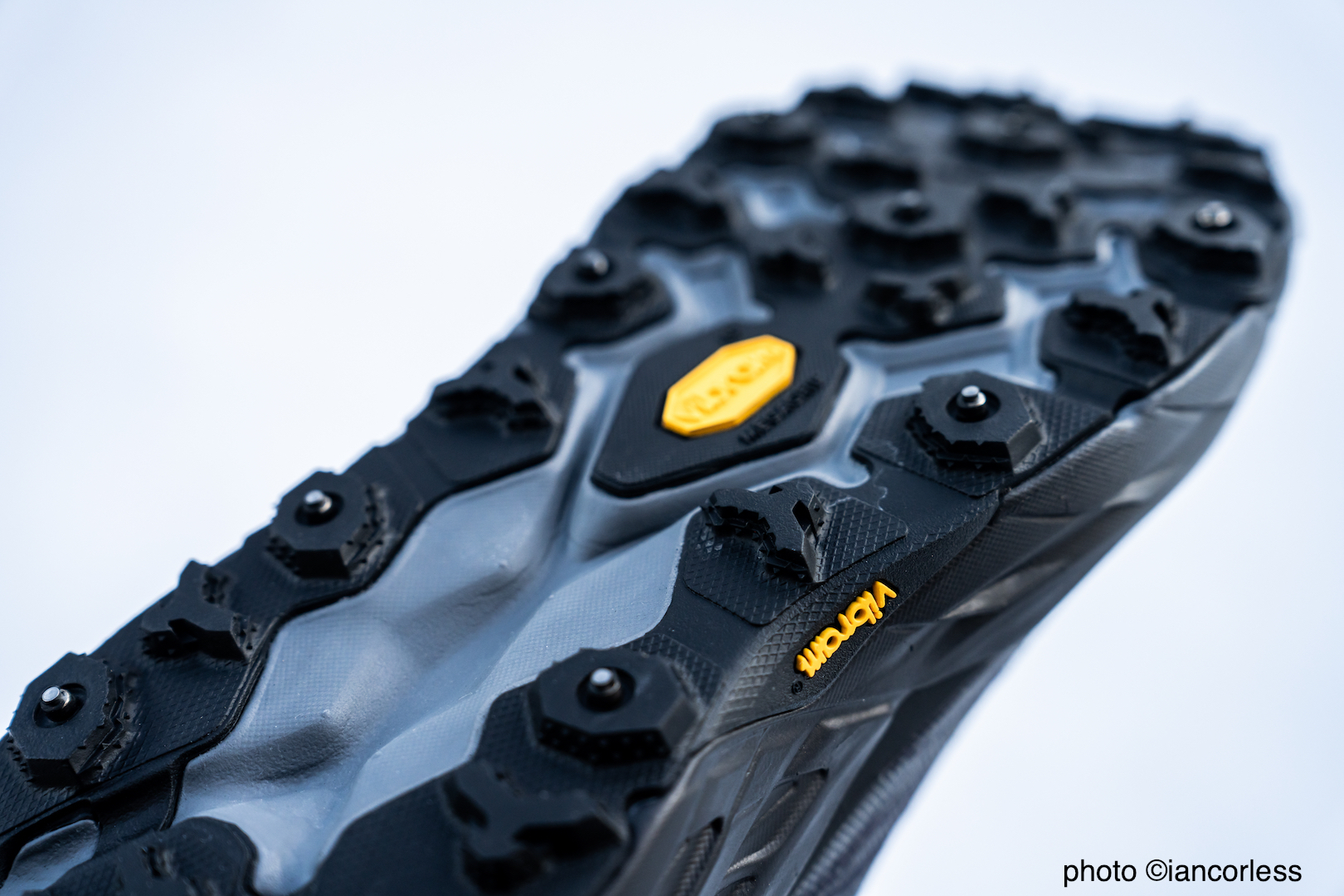
In theory, when you run on ice, your run gait should not change, but it does. For the spikes to work you firstly, need to trust that they will do the job! Secondly, you need as many spikes as possible in the ice to provide grip. So, when running on the flat, you are looking to land mid-foot as much as possible, so, all those spikes, 12 in this case, can grip. Going uphill you will use the front of the shoe, the Hoka has 8 spikes. Downhill you will use the rear (4 on the Hoka) but if very slippery, you may well find that you try to land with a flat foot. Being ‘light’ on your feet is not a benefit on ice, you need to strike the ground, stick those spikes in and then move on; this is often why ice running is more tiring.
With the above clarified in regard to usage, for me personally, I found the Speedgoat working really well on hard road and trails. The cushioning is welcome; ice running is always hard on the body. There is a great feel for the conditions, bounce and the propulsive phase is very good and the 12 tungsten carbide spikes work exceptionally well. The placement with 4 at the rear and 8 at the front. Notably, 2 are at the very front, perfect when going uphill! Importantly, ice defrosts and often you can find sections with no ice and just road and/ or trail. Many spiked shoes can feel harsh here, but the Speedgoat works well due to the additional cushioning.
On some and groomed trail with ice, the feelings and sensations are the same as road. Great feel, good cushioning, and solid grip.
On technical trails, rocks, roots, hard and rutted ice, I find the stack height too high and the shoe becomes unstable. I found myself rolling left or right and for me, it’s a potential ankle sprain waiting to happen.
In soft-snow with ice underneath, they work well, but, a lower cushioned shoe works better. After all, the snow cushions anyway, so, the extra shoe cushioning is not required. Once through the snow, the grip is good. It can be hit and miss though, but that is down to conditions and not the shoe. Ultimately, once the snow is deeper, the need for a more aggressive crampon or micro-crampon will be required, and then, you are looking at another shoe.
In very soft-snow I would be using a boot with spikes or the addition of a crampon/ micro-crampon.
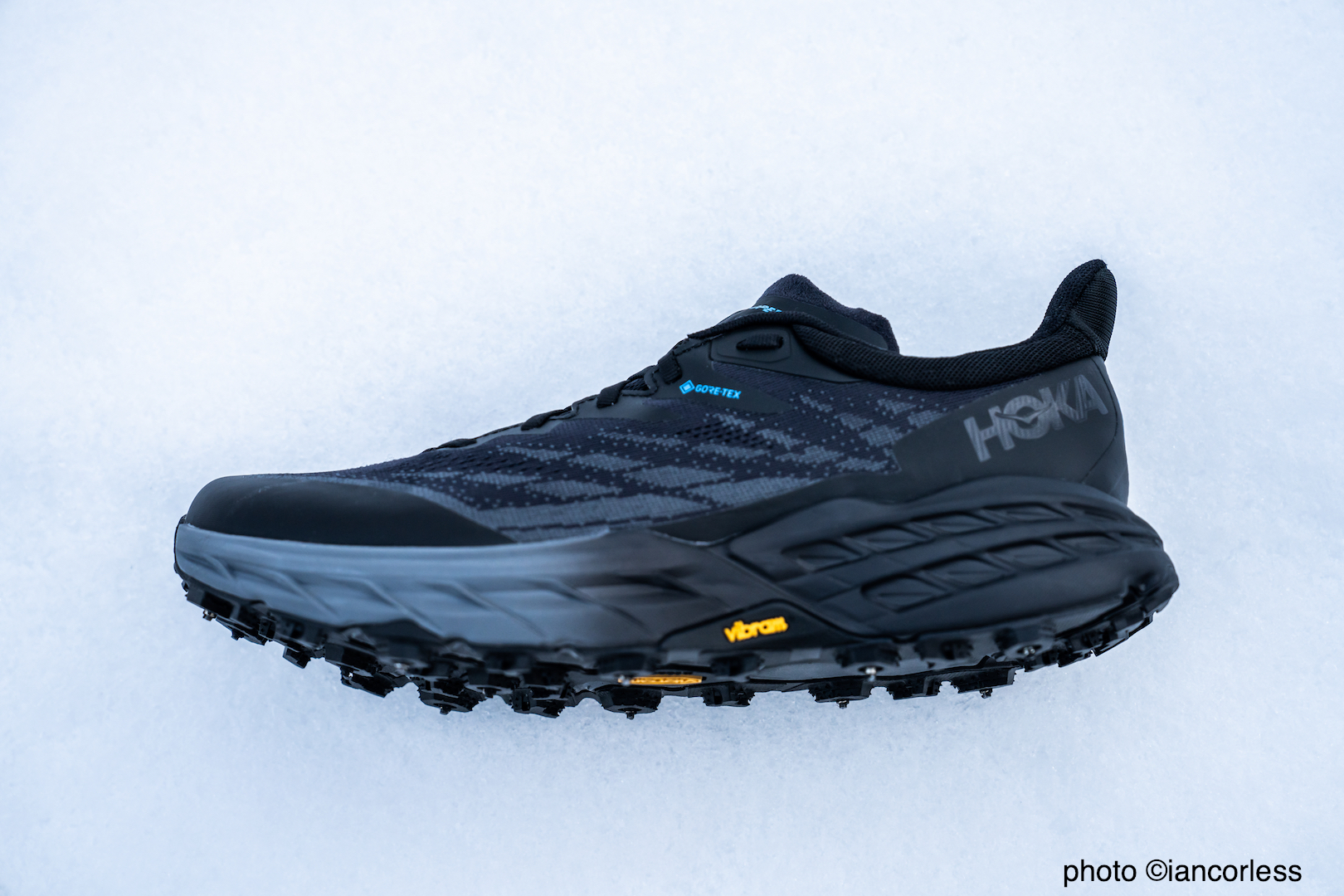
A neutral shoe with a balanced feel and 4mm drop, the Speedgoat 5 is a great feeling shoe, albeit, a little on the heavier side – particularly for a Hoka. Listed weight is 349g.
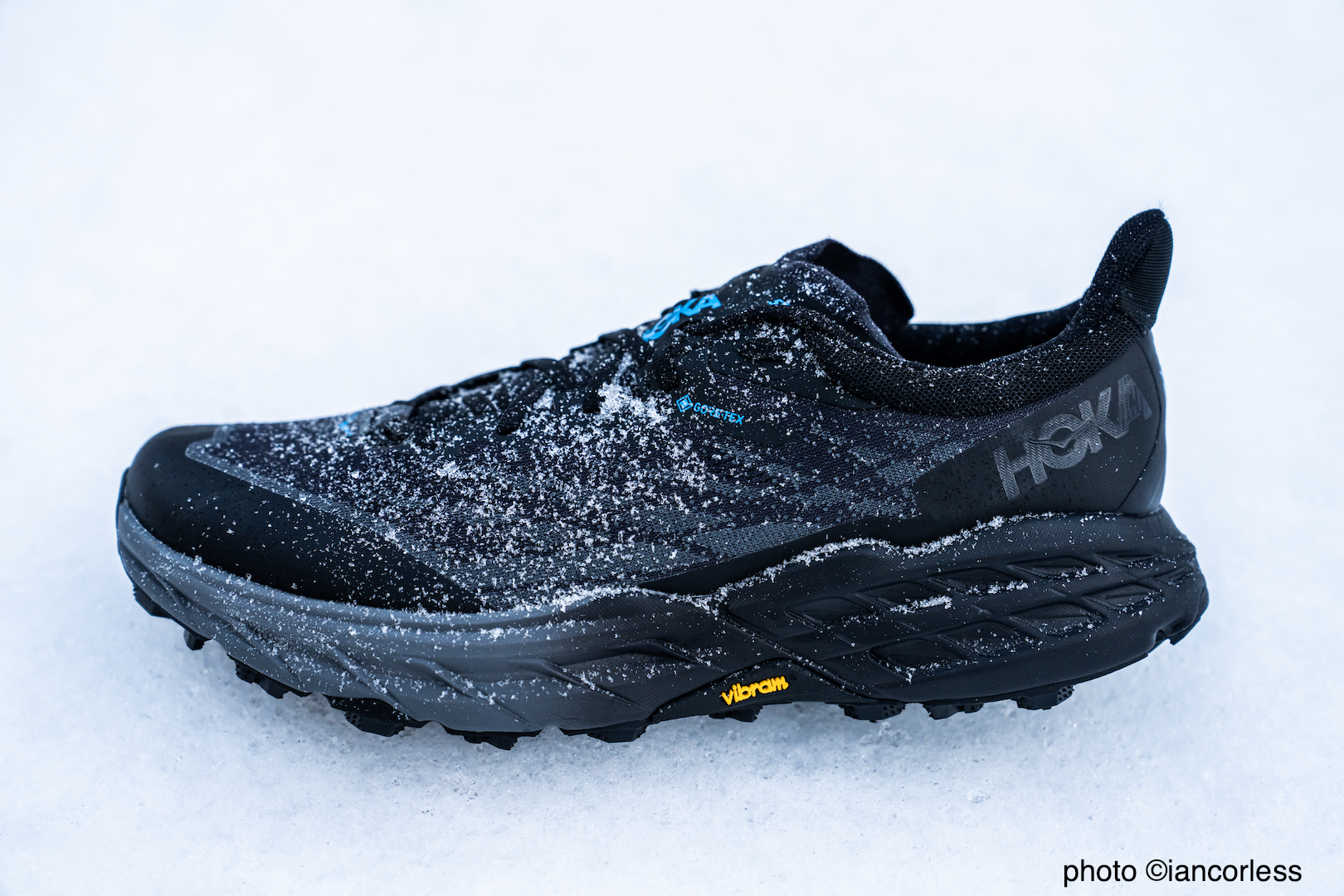
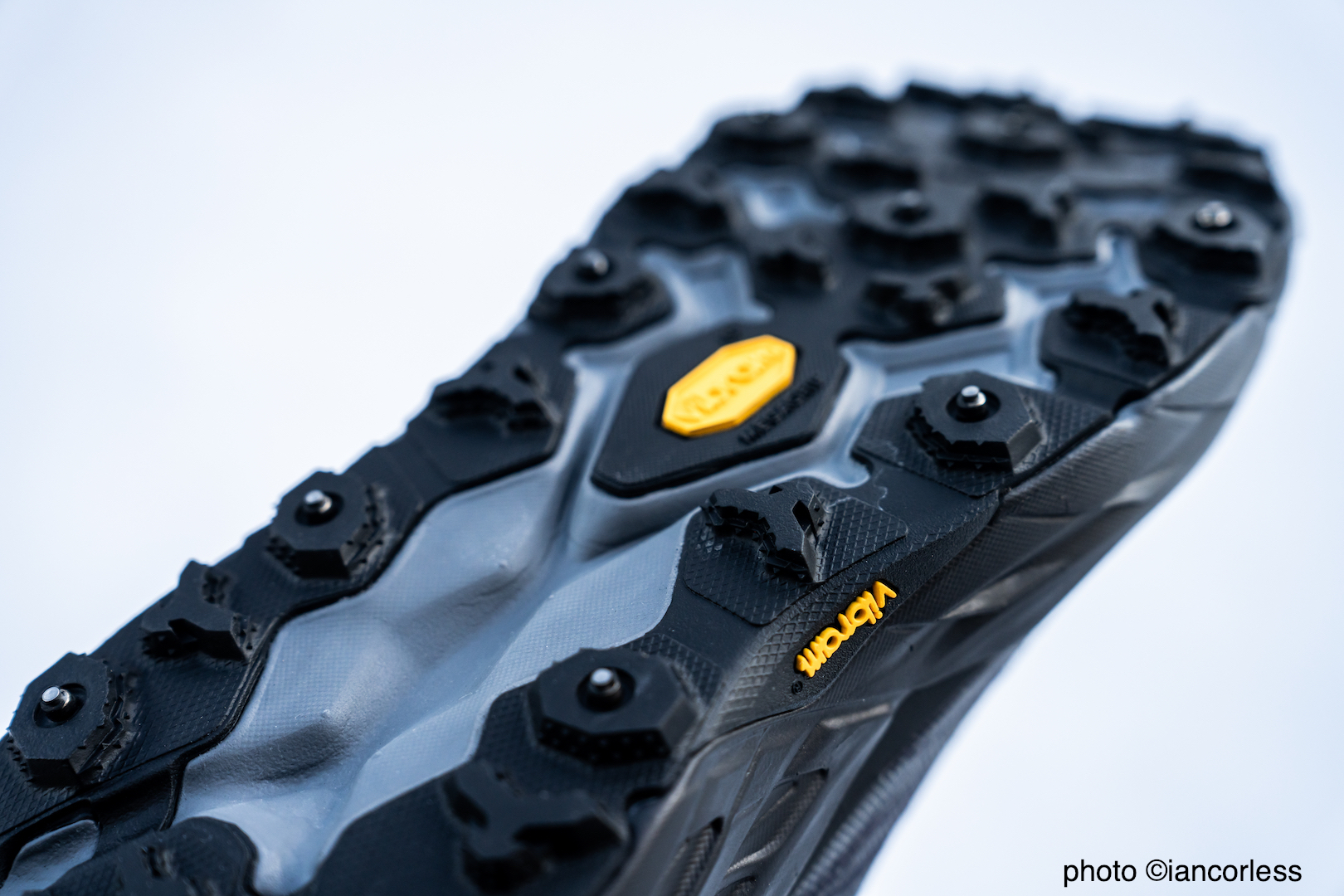
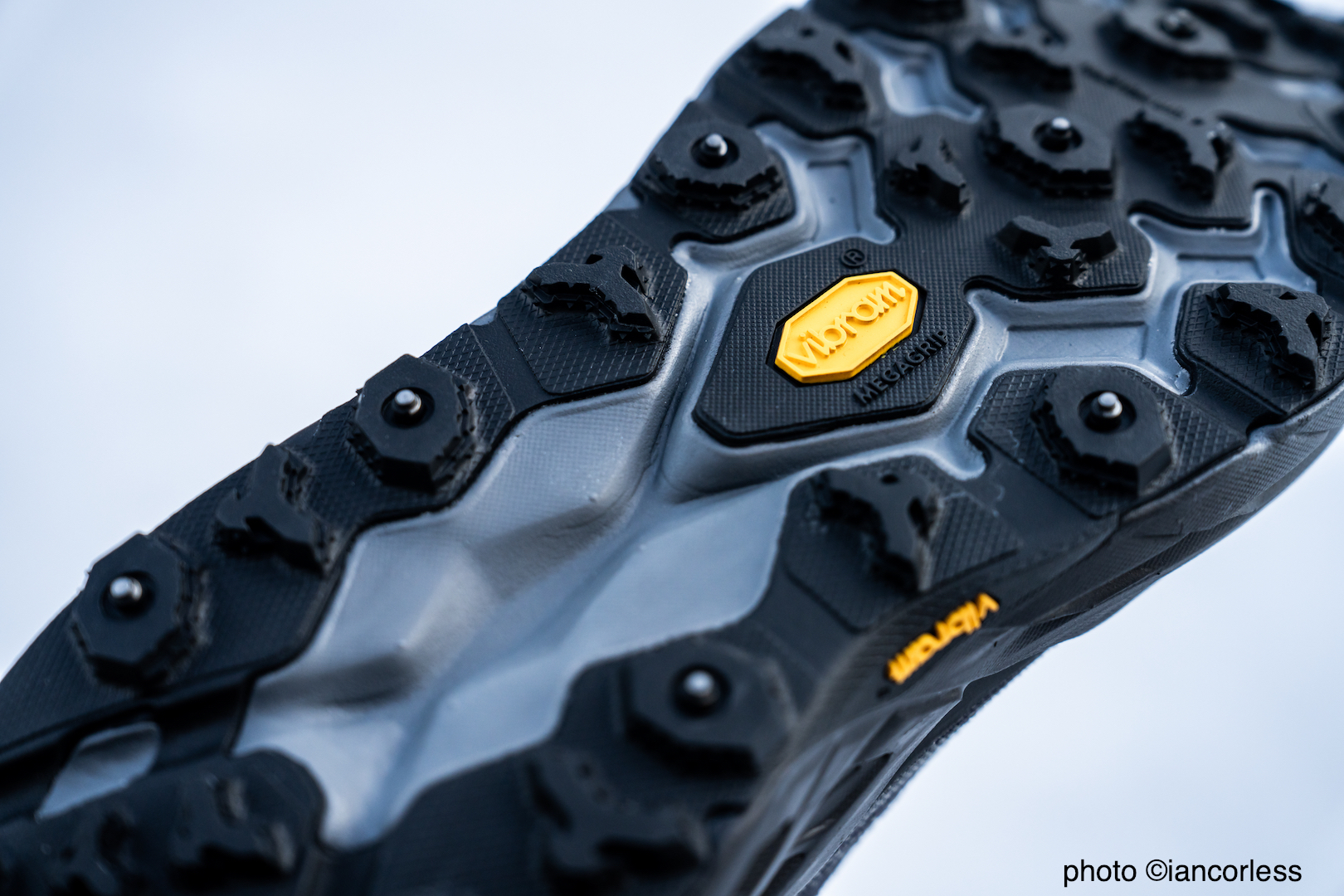
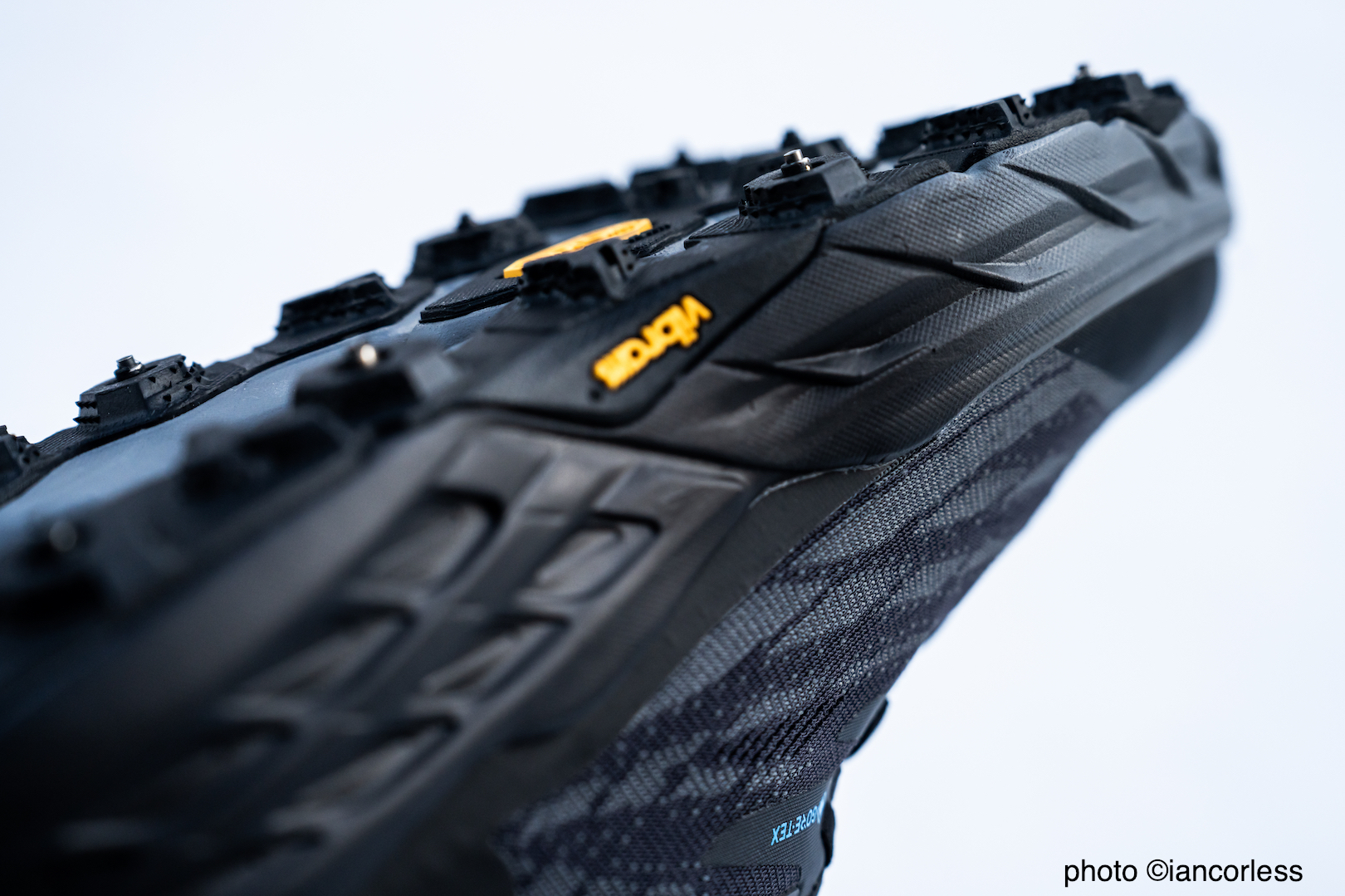
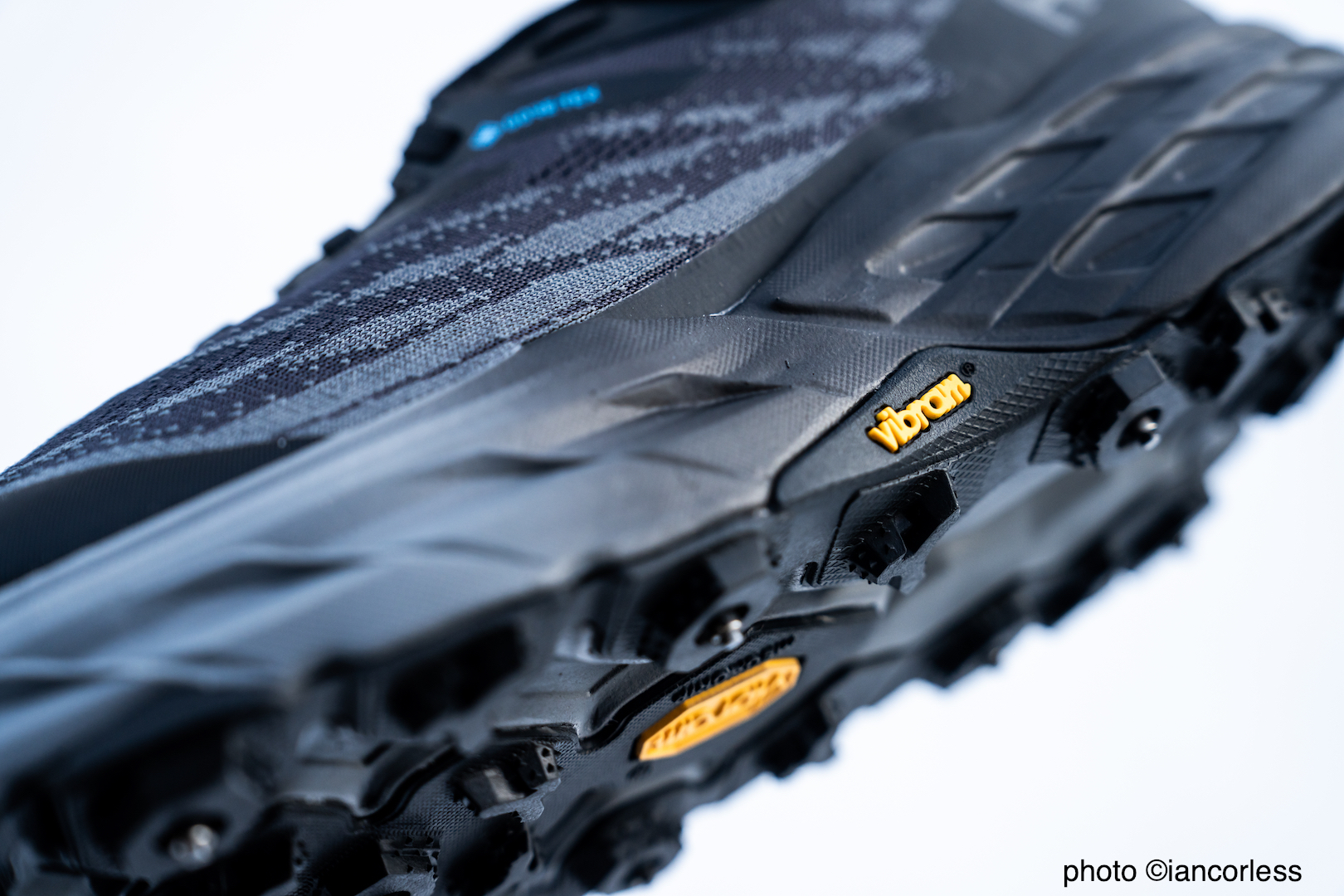
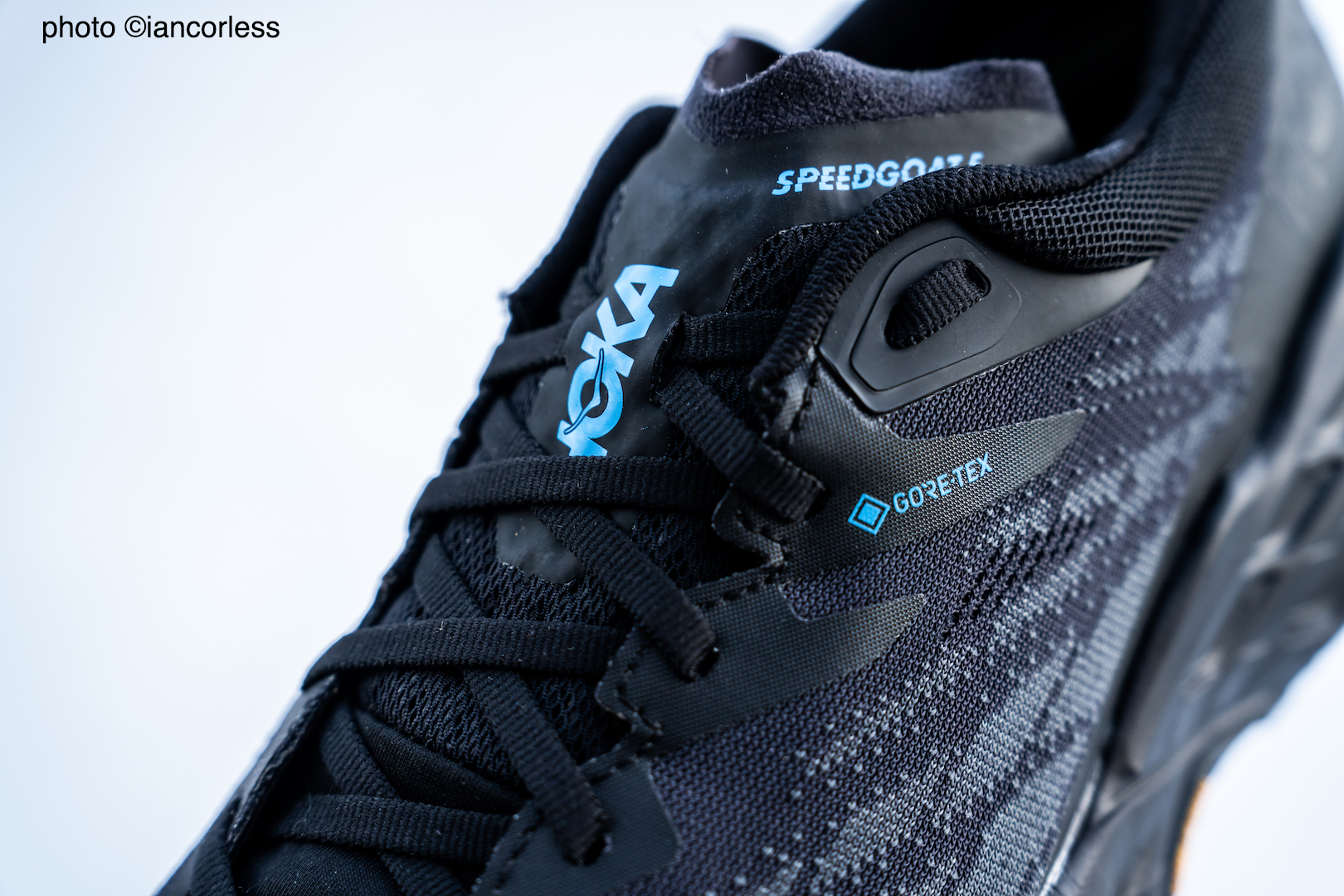
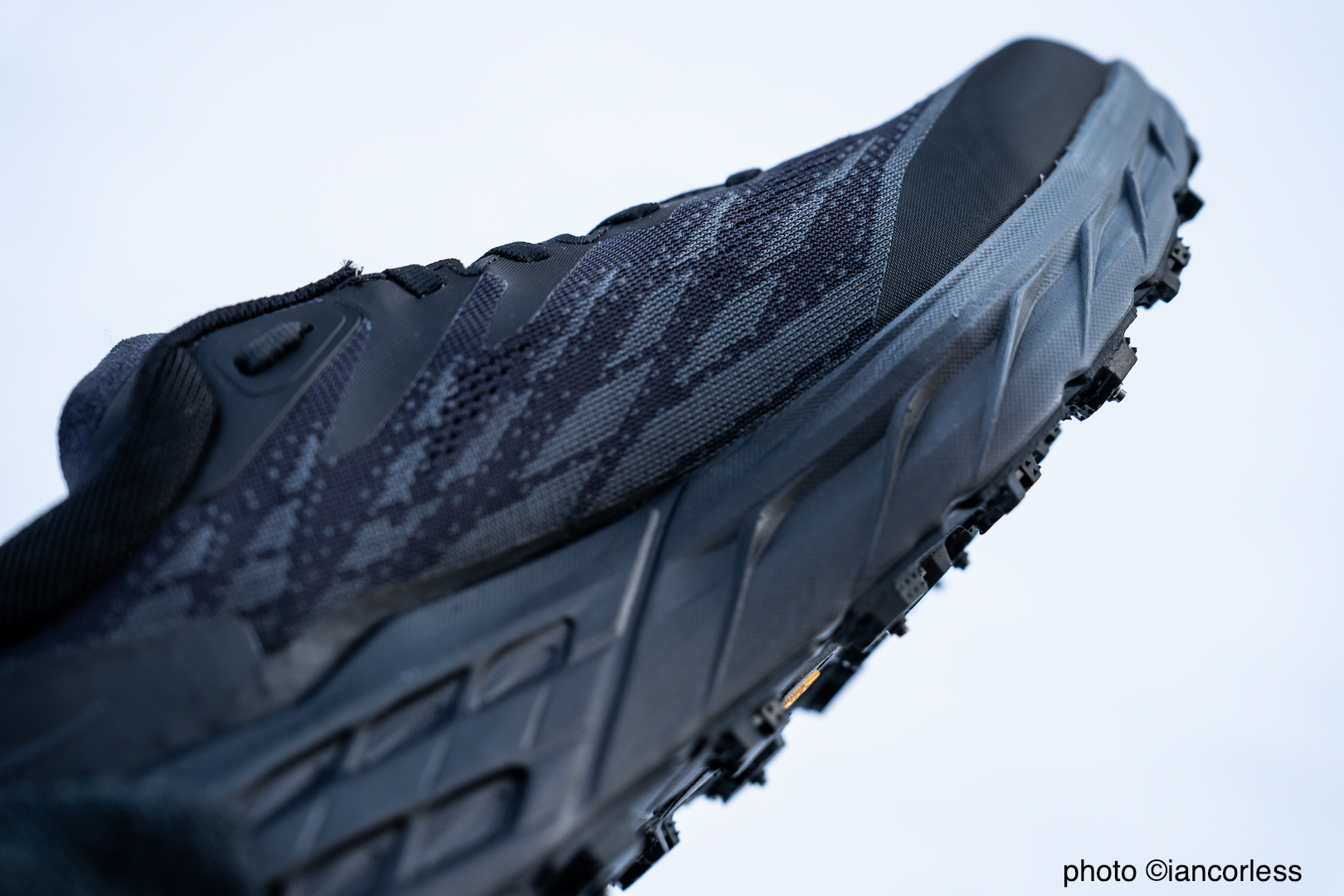
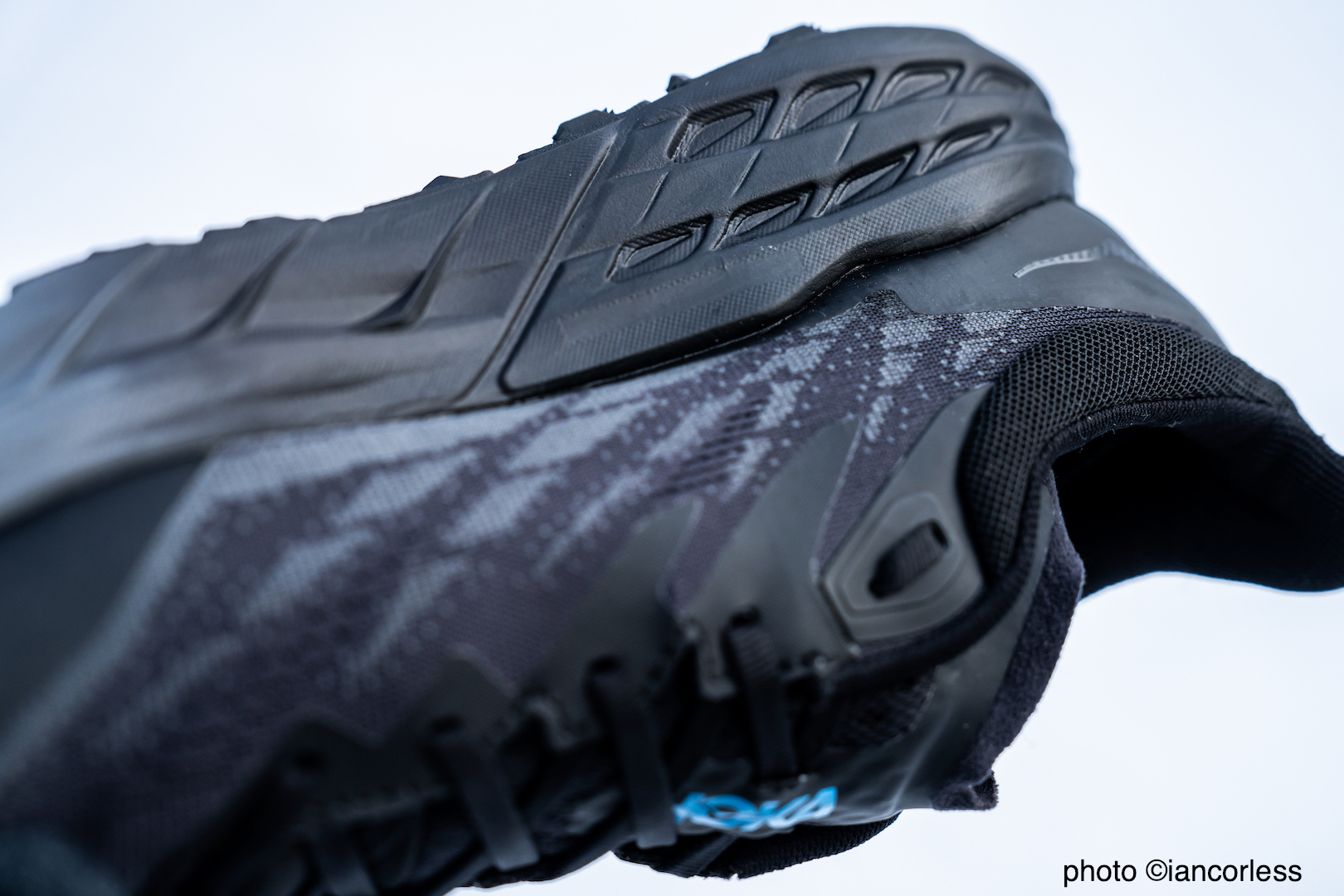
This incarnation is basically a Speedgoat 5 GTX with the addition of 12 tungsten carbide spikes to provide grip in wintry conditions, particularly ice. The spikes are set with 5mm lugs of Vbram MegaGrip.
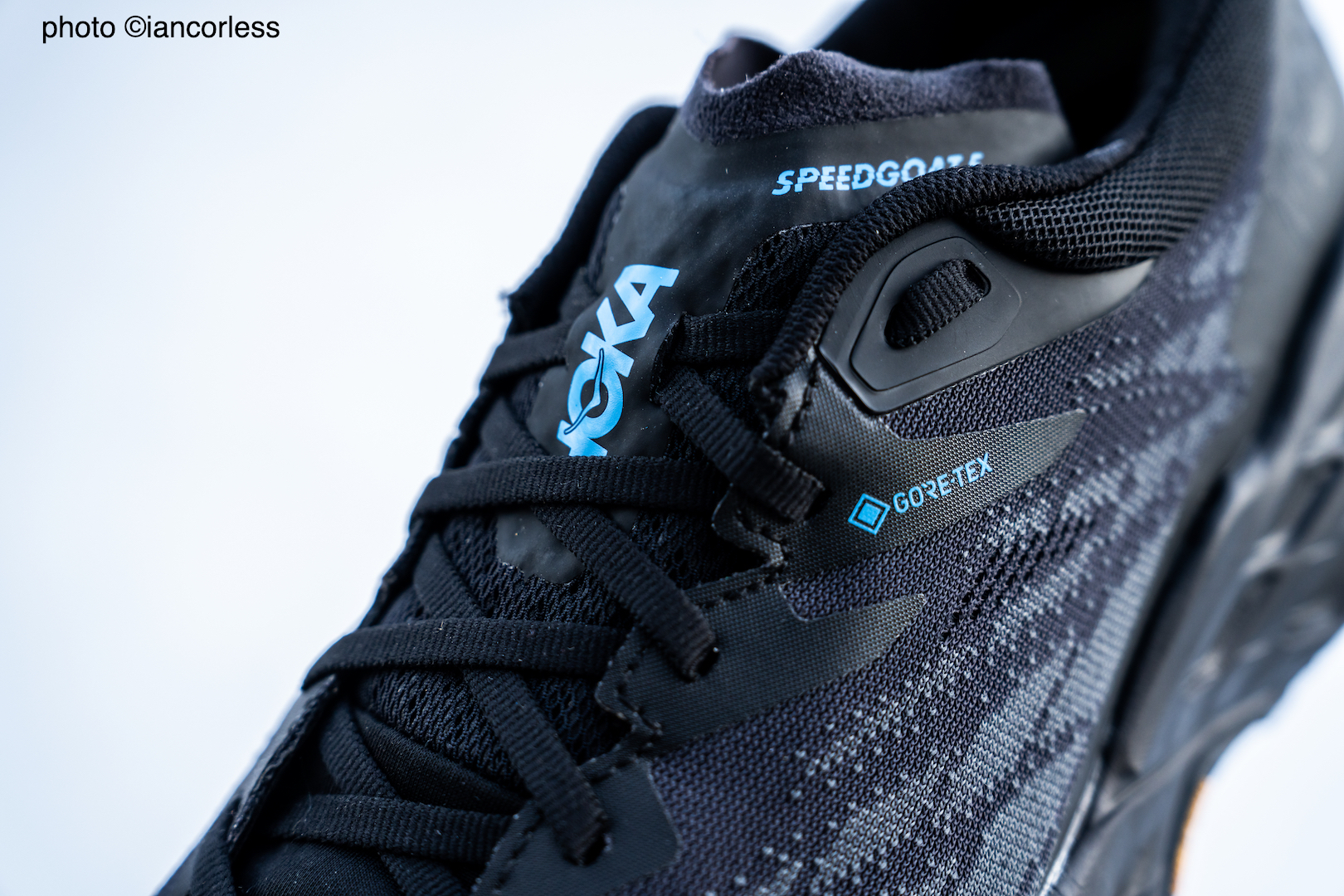
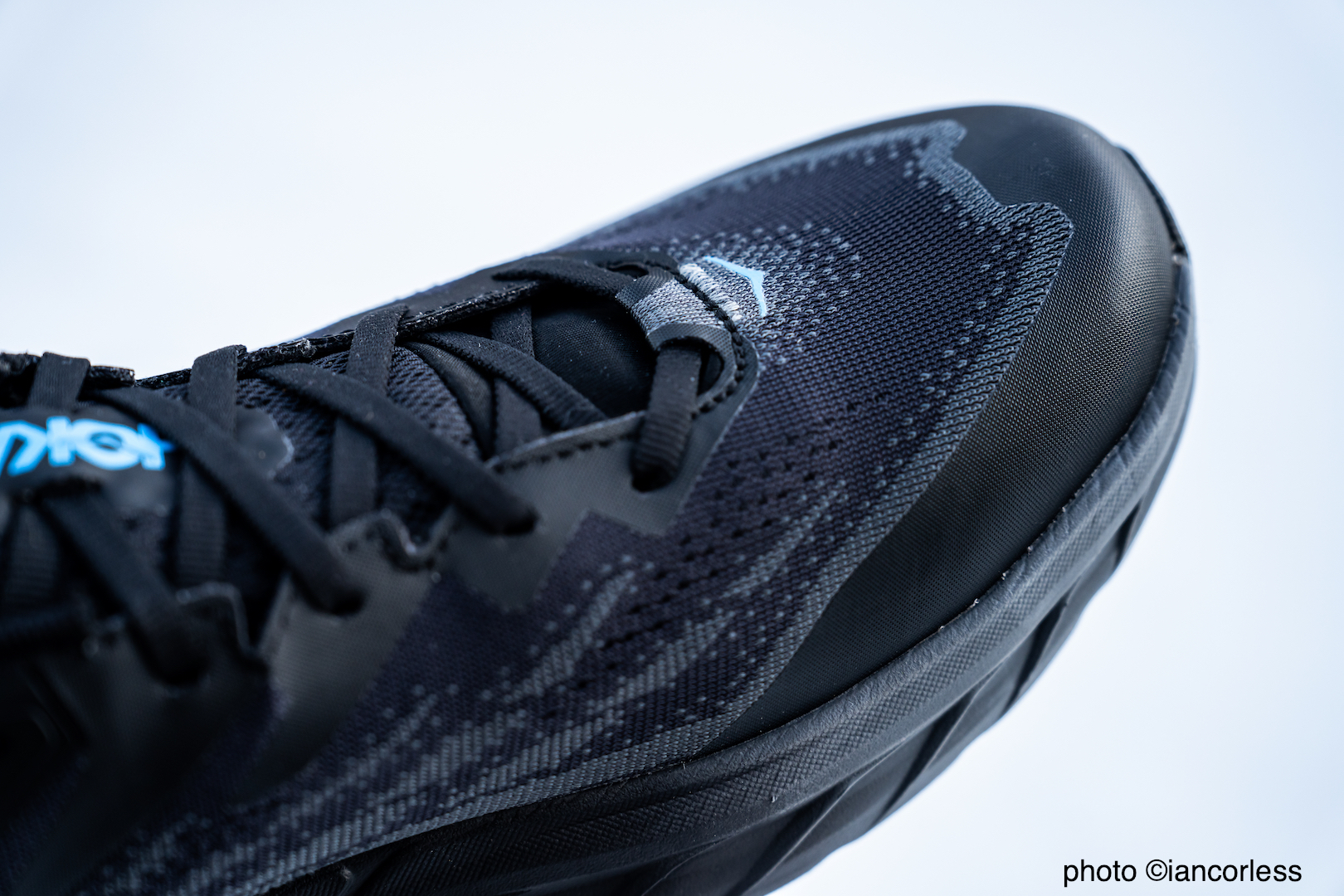
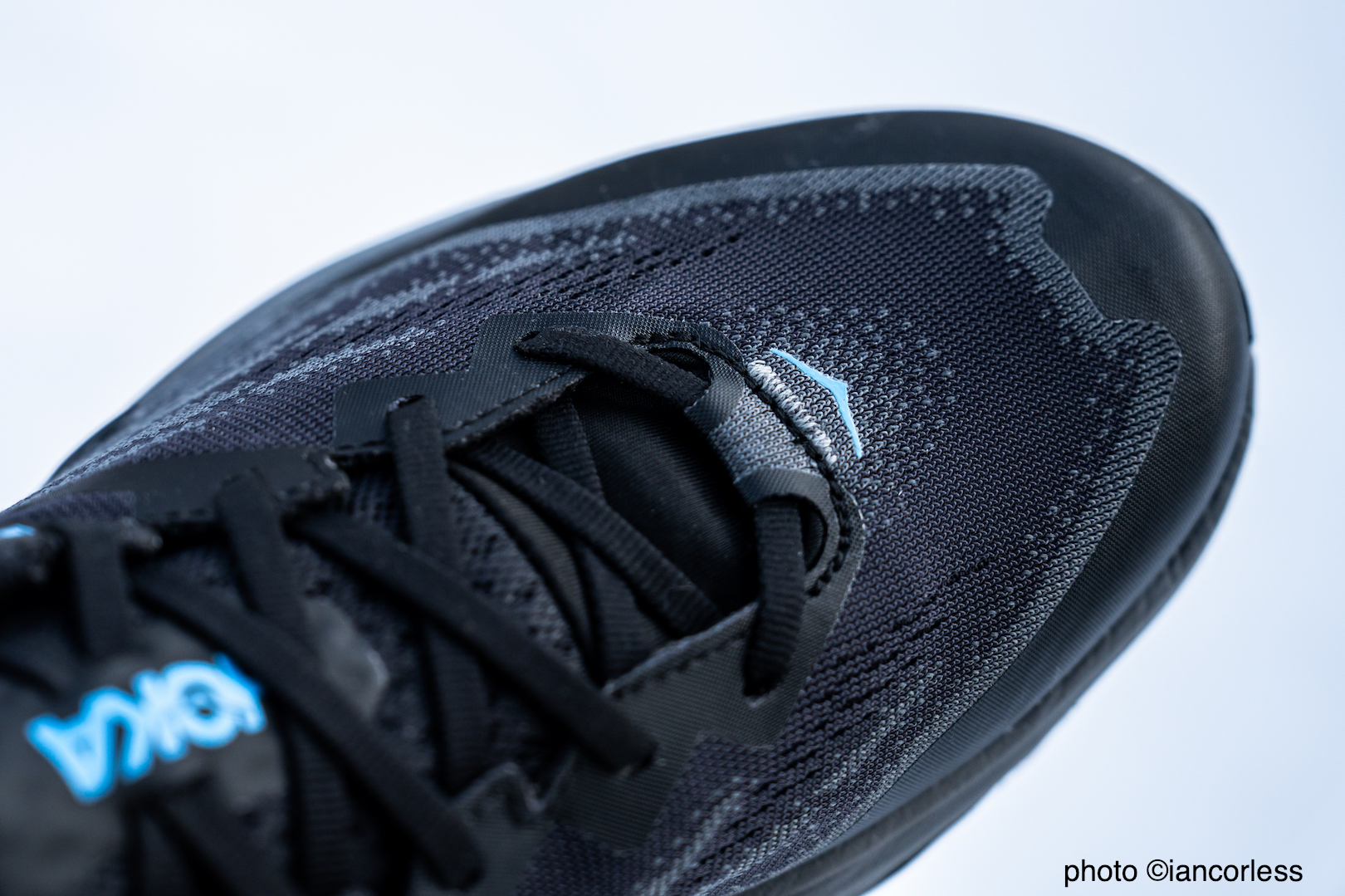
An EVA midsole, sock-liner fit, rubber toe protection and Gore-Tex mesh upper; this shoe is most definitely one to look at if you are in need of a specific winter shoe with extra cushioning.
Listed as a trail shoe (which of course it is,) it works exceptionally well on the road too. This shoe is all about providing grip on ice, so, it makes no difference if that ice is on road or trail.
The Gore-Tex upper will of course cause debate, some hate Gore-Tex in a shoe, others love it. Ultimately it works really well if one is considerate of conditions and one uses common sense. Quite simply, use a merino sock when wearing the shoe, this makes a huge difference. Accept that Gore-Tex will only keep feet warm and dry IF you do not go in anything that is deeper than the shoe… Once you are in anything that reaches the ankle, be that snow or water, it can enter the top of the shoe and therefore impact on the foot inside the shoe. If conditions are like this, you probably need to move a run boot (such as the La Sportiva Cyklon Cross GTX) or think about using a shoe without Gore-Tex. Merino socks are a must though, they retain warmth, even when wet. I have used the Speedgoat 5 in a Norwegian winter, temperatures have reached -20 and ice levels have been high. The Gore-Tex has worked perfectly in keeping my feet warm, especially when wind-chill has been high. The Gore-Tex supplies a combination of waterproofing and breathability, it’s hard to stay perfectly dry, but water does stay on the outside. Perspiration can and does escape from the inside; keeping sweat to a minimum, but that is where merino socks step in. When fresh soft-snow came, I used different shoes so as to ensure I had maximum protection from the elements.
The additional cushioning (29mm/33mm) and bounce has been welcome on harder trails but on technical trails, less so, the risk of ankle roll is too high (for me.) They do keep feet comfortable and supported, maybe even more than the other Speedgoat models. Propulsion is also good through the run gait.
The wider platform is a hugh benefit in snow and ice as is a wider toe box. The more outsole on the ground, the better the grip. Talking of grip, the spikes are held in Vibram MegaGrip which is tried and tested.
It has excellent rubber compound, 5mm logs with zonal multi-directional rubber placement, so, when you need the shoe to hold on, they do. Obviously, the 12 tungsten carbide spikes add the icing on the outsole and even when there is no ice, these spikes offer stunning grip on trail – ask any orienteer!
Winter shoes are very specific and if you only run on ice a few times a year, the additional expense is probably not worth it. Get some micro-crampons and use them on your favourite trail shoes.
However, if like me, pretty much every run for weeks and months involves ice, a specific spiked shoe is a must. The feel for the ground is so much better than any ‘add-on.’ Usual caveats as in points above, 3 and 4 need consideration.
The Hoka Speedgoat 5 GTX with spikes brings something new to the market, I have many spiked shoes, this one is the first with ‘more’ cushioning. For many, it will be a god send! The shoe performs great, and if you are already a Hoka user, you will love the Speedgoat.
For me though, this shoe has it’s place and uses, I have enjoyed road runs with ice, I have enjoyed non-technical trail runs with ice BUT anything technical and/ or with additional snow, I have used another shoe. It’s a me thing!
The Speedgoat 5 GTX with spikes is ideal for any runner looking for a robust, winter trail running shoe with comfort. They have great grip on frozen terrain and come recommended.
*As a footnote, I have become aware of the Icebug Arcus which may well be worth consideration if cushioning is your thing. And, this shoe has 13 studs.
Countdown to the 2023 ‘The Coastal Challenge’ begins and today, we announce the elite line-up that will travel to Costa Rica to experience six days, 230.5km of racing and 9543m of vertical gain.
The ultimate Costa Rican multi-day adventure hugs the coastline of the tropical Pacific, weaving in and out of the Talamancas; a coastal mountain range in the Southwest corner of this Central American country. An ever-changing terrain challenges each participant, from wide, dusty and runnable fire trails to dense and muddy mountain trails. River crossings, boulders, swim through rivers, pass under waterfalls, survive long and relentless beaches and finally finish in the incredible Corcovado National Park, a Unesco World Heritage site with a stunning final loop around Drake Bay before departing for their journeys home via speedboat.
TOP WOMEN
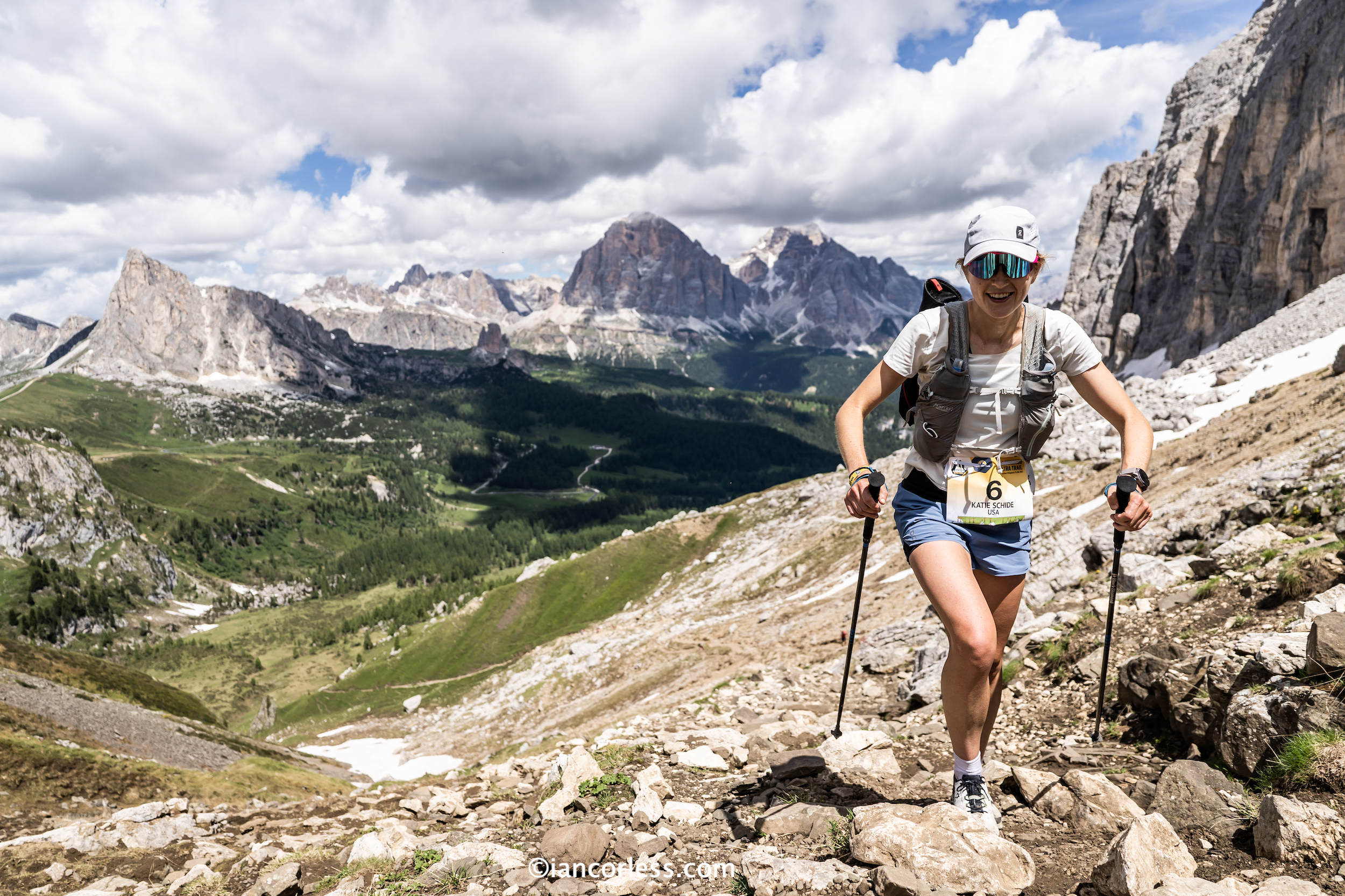
UTMB 2022 champion Katie Schide (The North Face) is no stranger to the challenges of distance or terrain. In recent years she has shot to fame with a string of high profile results with victories at Mont Blanc 90km, Val d’Aran by UTMB, MIUT 85km and of course, the most recent, UTMB. With results that date back to 2025, Katie is the ‘one-to-watch’ at TCC 2023.
“I’m very excited to explore Costa Rica on foot, to share a big week with so many other runners, and to challenge myself in a new place!”
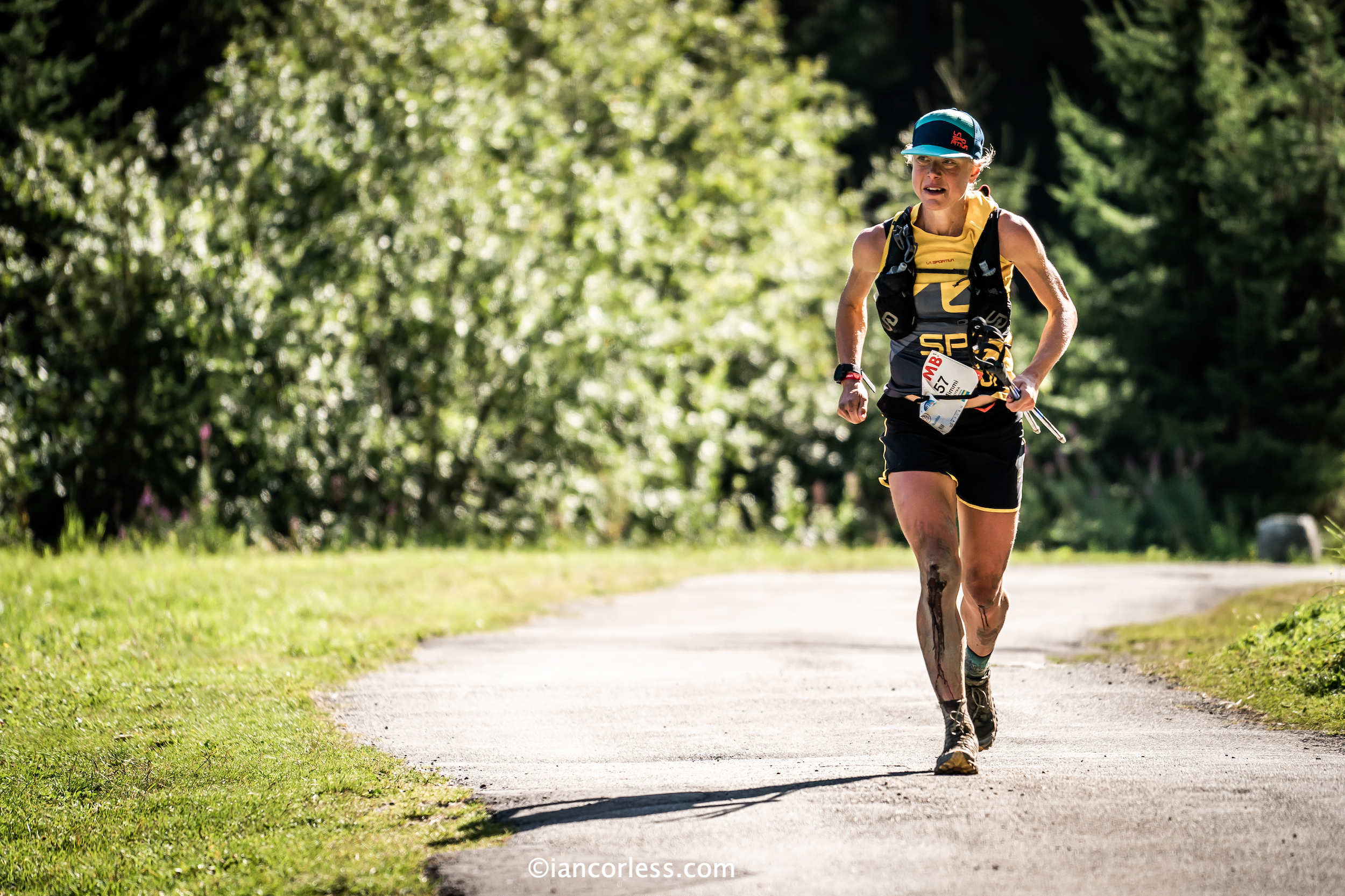
Swedish athlete, Mimmi Kotka (La Sportiva) is excited to leave a cold and wintry Scandinavia to join the TCC line up. Victory at CCC in 2016 made Mimmi a star and since that start, she has topped the podium at Gran Trail Courmayer, Marathon du Mont Blanc, TDS, MIUT and recently, Lavaredo.
“Costa Rica is one of my bucket list destinations and the possibility to go there and run a stage race at the same time; a perfect combo! I have never done a multi stage race and this is also something that excites me. New experience, a new place and a new race format.”
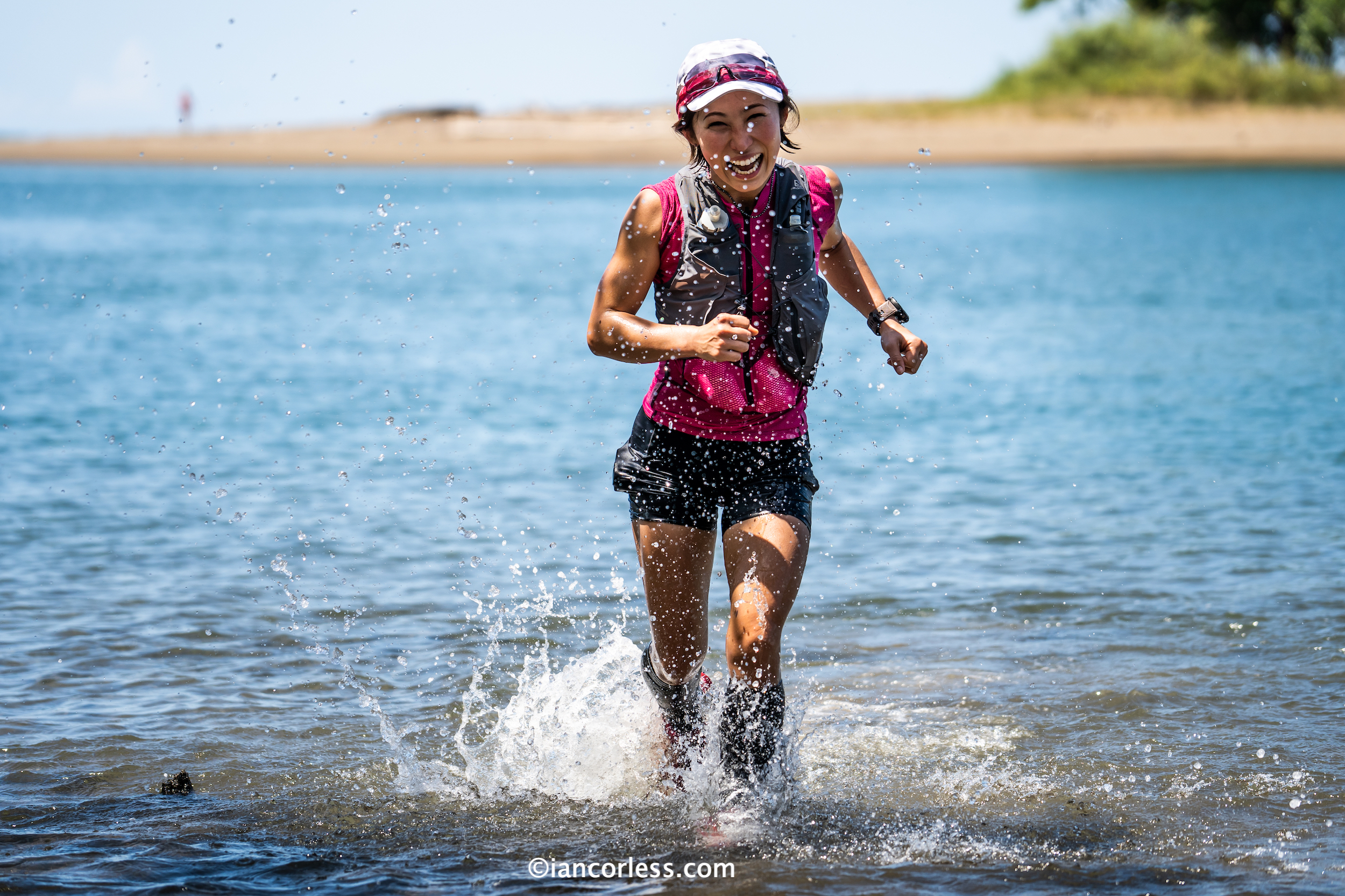
Tomomi Bitoh joined the TCC line-up in 2022 but unfortunately contracted Coronavirus in the days before the race started. Once clear, she did join the race for a couple of stage but there and then, the Japanese athlete confirmed she would toe the line in 2023.
“I was able to run through the very beautiful ocean at TCC2022 but I only experienced a small part of the route. I’ll be running through it again this year, enjoying the scenery and appreciating the full point-to-point journey that TCC brings.”
TOP MEN
Peter van der Zon (Hoka) is no stranger to Costa Rica or TCC. He toed the line in 2022 and placed 2nd to an inform Hayden Hawks. With experience and now an understanding of the route, the conditions and what it takes to win, Peter will no doubt be returning looking for the top spot come Drake Bay and the conclusion of the 2023 race. He has recently placed 7th at Mozart 100 and won Istria by UTMB.
“I am looking forward to going back to TCC, the racing was hard but it felt like a big family adventure and of course i want to try to be number one this time. But seeing the competition I am up against, that will not be easy!”
Didrik Hermansen (Hoka) has been an ever-present on the ultra scene dating back to 2010. A breakthrough performance with victory at Lavaredo in 2015 paved a way to victory at Transgrancanaria and a 2nd place at Western States. Didrik is known for his fast pace and for sure will be one-to-watch at the start line in Quepos.
“Costa Rica looks so amazing. I have never run in that area and be able to combine running in a beautiful terrain over several days at new locations seems awesome. I will run the World Championships in Thailand this November, the climate will quite similar so that will be a good benchmark what to do and what to use come February 2023.”
Dani Jung (Scarpa) in recent years has gained attention due to a string of high profile results, victory at Raid de la Reunion and 4th at Hardrock 100. But Dani has been ticking of impressive results for many years, particularly in the skyrunning calendar with races such as Mega Ultraskymarathon, Hamperokken Skyrace, Royal Ultra Sky Marathon and USM. The distance of TCC will not intimidate this Italian, however, a multi-day format is very different to one long race.
Sebastian Krogvig (Dynafit) heads up a Norwegian double act with Didrik. The duo will also be racing at the World Championships in Chiang Mai, so, as Didrik mentioned, they will both get an invaluable ‘heads-up’ on racing in heat and humidity ahead of TCC in February 2023. Sebastian had a breakthrough season in 2021 with 3rd at Lavaredo and victory at TDS during UTMB week. Recently he placed 2nd at Trail 100 Andorra by UTMB.
“I heard about TCC many years ago, I think first from the book “Running beyond” by you! TCC has always grabbed my attention, February is early in the year, so, there are not many races. For me, it will be a challenge, I’m usually home skiing in Norwegian winter and in 2023 I will be in an excotic race in the Jungle – it’s exciting! The landscapes and nature looks spectacular! The trails look challenging and fun, a perfect mix of racing and adventure.”
THE RACE
Stage 1 34.6km 1018m of vert and 886m of descent
Stage 2 39.1km 1898m of vert and 1984m of descent
Stage 3 47.4km 1781m of vert and 1736m of descent
Stage 4 37.1km 2466m of vert and 2424m of descent
Stage 5 49.8km 1767m of vert and 1770m of descent
Stage 6 22.5km 613m of vert and 613m of descent
Total 230.5km
Vertical 9543m
Descent 9413m
Stage 1
It’s a tough day! Runners depart San Jose early morning (around 0530) for a 3-hour drive to Playa Del Rey, Quepos. It’s the only day that the race starts late and ‘in the sun!’. It’s the toughest day of the race, not because of the terrain or distance, but because of the time of day! The runners are fresh and feel great. That is until about 10km and then they realise the heat and humidity is relentless. It’s a day for caution! The 34.6km is very runnable with little vertical and technicality, it welcomes the runners to Costa Rica.
Stage 2
From here on in, it is an early breakfast, around 0400, the race starts with the arrival of the sun! The only way is up from the start with a tough and challenging climb. It’s a tough day with an abundance of climbing and descending and a final tough flat stretch on the beach, just as the heat takes hold.
Stage 3
It is basically 25km of climbing topping out at 800m followed by a drop to sea and a final kick in the tail before the arrival at camp. For many, this is a key day and maybe one of the most spectacular.
Stage 4
It’s another tough start to the day with a relentless climb, but once at 900m the route is a roller coaster of relentless small climbs and descents, often littered with technical sections, rain forest, river crossings and boulders. At 30km, it’s a short drop to the line and the finish at 37.1km.
Stage 5
The long day but what a beauty! This route was tweaked a couple of years ago and now has become iconic with tough trails, plenty of climbing, sandy beaches and yes, even a boat trip. The finish at Drake Bay is iconic.
Stage 6
The victory lap! For many, this stage is the most beautiful and memorable. In just over 20km, the route manages to include a little of all that has gone before. It’s a stage of fun and challenges and one that concludes on the beach as a 2018 medal is placed over your head – job done!
“The Coastal Challenge was lucky to continue through the pandemic, of course we had restricted fields with 2022 signifying a return to normal. TCC is a unique race and one that we are passionate about. We created this race to show of Costa Rica and this beautiful coastline. The race travels in and out of the stunning coastal mountain range via dense forest trails, river crossings, waterfalls, long stretches of golden beaches backed by palm trees, dusty access roads, high ridges and open expansive plains. At times technical, the combination of so many challenging elements are only intensified by heat and high humidity that slowly but surely reduces even the strongest competitors to exhausted shells by the arrival of the finish line.”
Episode 231 of Talk Ultra has a chat with Tom Evans after his 3rd place at UTMB. Shane Ohly tells us about ‘Classic Rock’ and Speedgoat co-hosts and tells us about his UTMB.
Importantly, go to iTunes and subscribe so that you automatically get our show when it’s released we are also available on Stitcher for iOS, Android and Web Player and now Tunein. We are also on Spotify too. Our web page at www.iancorless.com has all our links and back catalogue. Please support Talk Ultra by becoming a Patreon at www.patreon.com/talkultra
Here I am again, writing about and reviewing ‘another’ Hoka shoe!
It’s kinda weird and I will hold my hands up and admit, Hoka have really got me interested in their shoes again. It all started with the Torrent 2 – a shoe that I absolutely love, it is one of my ‘go to’ shoes and I am now on my fifth pair.
The Torrent 2 tempted me to the Zinal, and yes, I love the Zinal.
There is a pattern here and I admit, I am still not a fan of ‘too’ much cushioning and ‘too’ much stack height, BUT, the Torrent, Zinal and now the Tecton X firmly sit at what is now the more ‘normal’ end of cushioned shoes.
The Tecton X has two carbon fibre plates that run parallel in the shoe (see photo above) designed to propel and push through the propulsive phase. I must admit, up to now, I have not been impressed with shoes I have tested that contain a carbon (or similar) plate. The exception being the Scarpa Goldengate Kima which is superb.
Ultimately, the addition of a plate, and I don’t mean rock plate, but carbon or similar has just added too much weight and stiffness, resulting in a lackluster and boring run.
The Tecton X is most certainly addressing this with two thin strips in contrast to one, or two, larger plates as often used in other shoes.
On first impressions, the Tecton X has the impression of a Torrent 2 and Zinal merged together. This for me is a good thing!
Neutral with a 5mm drop, the Tecton X ticks the boxes. Drop on the Torrent 2 and Zinal is also 5mm. I make the cushioning 28mm front and 33mm at the rear. NOTE – The women’s shoe is 27/31mm with 4mm drop.
Once again, I am confused with the scribble on the side of the shoe:
S36.26
V701
C003
C’mon Hoka, what does this ‘really’ mean. S = Spring. V= Volume and C? The C is the version of carbon plate, so, in the Tecton X that is 003. In other models, the Zinal for example, the stats were: S32x19|V490|W242 (w being the weight.)
Spring measurement is, ‘Curvature of the shoe, measuring how high the heel and toe are off the ground.’ Basically, it is the ‘rocker’ effect. So, for the Tecton X, this means 36mm and 26mm. Don’t get confused here with drop, this does not mean a 10mm drop! But what does it ‘really’ mean?
Volume relates to the total amount of foam (cm³) in the midsole. So here in the Tecton X there is 701, considerably more than the Zinal at 490 and the Torrent 2 at 395.
I wrote in my Zinal review:
“One would assume that the higher the volume number, the more cushioned or plush the shoe would be, but that is not the case. Here in the ZINAL, the shoe has a lower profile keeping you, the runner, closer to the ground and the cushioning is firmer to provide a more efficient and speedier propulsion in the transition phase. When I wrote about the Torrent 2, the thing I liked and others liked was a firmer ride; less Hoka like, by that I mean less plush and bouncy. Here in the ZINAL that is taken one step farther and the ride is firmer. So, it’s fair to assume that plush ride Hoka fans will find the ZINAL less appealing. Whereas, by contrast, runners who prefer a more conventional shoe who have wanted to try Hoka, will find the ZINAL appealing.”
So, what does that mean for the Tecton X and the 701-volume figure?
Like the Torrent 2 and Zinal, the Tecton X uses dual-density PROFLY cushioning; Hoka blend soft and responsive foams to provide cushioning and excellent energy return. With the addition of the carbon fibre and increased volume (701) the Tecton X is ‘in theory’ faster and more responsive. It is!
Lacing is via 7 eyelets and the optional 8th eyelet should you require to lock lace or similar. Hoka call this Ghillie lacing, and I had to look it up? “The trend on this shoe, Ghillie Ties. At its origin, Ghillies referred to specially designed shoes used in Irish dance, notable for their soft and supple build featuring crisscross laces across the top of the foot for flexible movement. Now, Ghillies is a laces trend sweeping across the US.”
Like the Zinal, Tecton X uses Vibram Megagrip Litebase with 4mm lugs. Note, there is no outsole in the middle of the shoe. The outsole is zonal, front, and rear – this helps reduce weight.
The Tecton X is lower profile, keeping the runner lower to the ground with firmer cushioning and a more responsive ride.
Fit is great and the sock like fit gives a secure hold of the foot without the need to lock lace. Fit is true to size, I am EU44/ UK9.5 and these fit perfect. Just like my Torrent 2 and Zinal. However, the fit or feel is not the same… The Tecton X fits like the Zinal around the bridge of the foot and the toe box is wider, a 3.5 on a scale of 1-5, 1 being narrow and 5 being wide.
I was surprised how cushioned the shoe felt just standing and in comparison, to the Zinal, they felt higher off the ground. Despite the two carbon strips, flex behind the metatarsals was ok, obviously not bendy, and flexible, but certainly acceptable, especially in comparison to other shoes with inserts.
Weight for my EU44/ UK9.5 was a crazy 269g – light for a shoe like this.
The rocker is definitely noticeable and maybe more so due to the carbon plates. It’s a pleasant feel and certainly you can see, even just by walking, how the rocker combined with the plates will propel you forward.
I have thrown a mixture of terrain at the Tecton X, road, gravel path, single-track, forest trail littered with tree roots, rocks, and many obstacles. I have also run in wet and dry conditions.
On the road, the shoe performs well, and I was happy with the feel for the ground. Although this shoe has more volume it has great responsiveness and cushioning. The cushioning is not bouncy/ marshmallow like, it’s just cushioned… Do you know what I mean?
Gravel trail and all good. With more miles, I could feel the shoe getting better and I was allowing myself to notice how the propulsive phase of the shoe was helping me move forward. If I increased the pace and cadence, this propulsion increased – a benefit of the carbon!
I will say now, this is without doubt the best trail shoe with carbon inserts I have tried.
The shoe feels like a normal shoe. So, although the carbon is there, I am not thinking it is there. A problem with all the other shoes I have tested. Too much weight, too much stiffness, no feel for the ground, lacking life – these points do not apply with the Tecton X – a huge plus.
Running downhill, I intentionally struck with the heel and there was a very definite compression in the cushioning and return in energy. Switching to mid or forefoot and once you get the rocker rolling you forward and the carbon propelling you, the benefits of the Tecton X are noticeable. I am not sure I have the fitness to maximise this, but it is noticeable.
There is great comfort in the shoe. You feel protected and cushioned without losing a feel for what is happening around you and the combination of dual foam in the Profly, along with the carbon offers responsiveness and protection. I was surprised that the Tecton X felt this good.
On single track I felt confident and happy that the shoe would do the job and it’s only when I moved into some thicker mud that the 4mm lugs on the outsole started to lose grip – no surprises with such a modest outsole. The Vibram Litaebase Megagrip was excellent on dry rock and most wet rock. It did struggle a little when the rock had a nice white or green layer of extra trouble to confuse and irritate the outsole, but in fairness, many shoes struggle to grip here. However, as much I like this Vibram Megagrip I am perplexed that Hoka decide NOT to put the Litebase the full length of the shoe. I know it is to safe weight, but, when on trail, running on rocks, standing on tree routes, traversing gravel or whatever, the middle of the outsole is often a key contact point, we can’t always use the heel or forefoot. I noticed this especially on tree roots when I am pretty much always using the middle of the outsole and of course, I had minimum traction with the Tecton X – it makes no sense to me! It’s the same for the Zinal, maybe I am asking too much of this type of shoe and I should accept that it should be used on more groomed trail and technical trail is for another shoe, like the Torrent 2 that has a full and more aggressive outsole.
There are many similarities to the Zinal here and if I was to explain it in simple terms, the Tecton X is a beefed-up version of the Zinal with carbon inserts. The noticeable difference would be in the structure of the Profly and the volume difference in that cushioning. The additional stack height of the Tecton X is compensated for with a wide footprint (90mm at the rear and 112mm at the front) and this helps balance the shoe, particularly on more technical trail. The cushioning is not soft and squidgy but is protective and this works well on trail. There is always a risk of roll and additional stress in a shoe with more stack but the Tecton X does a great job of reducing this; it’s not perfect though.
A comfortable shoe, with excellent protection and comfort, however, for me, the lower stack height, structure and full out outsole of the Torrent 2 wins out. The Torrent 2 has better grip, greater control on technical trail and a more ‘connected’ feeling for the ground. But having said that, I’d have no issues lacing up a Tecton X any day and I do. I find the mix and balance between the Torrent, Zinal and Tecton perfect. Although they are three separate shoes, they feel connected.
The Tecton X comes in to its own USP when on less technical and groomed trail. For example, flowing single-track with less obstacles, gravel roads and so on. Here the shoe starts to gain from increased cadence and that helps the carbon propel you forward, the more you run, the more you a propelled forward. A great shoe for say Western States (or similar)? It’s lightweight too, Hoka do this so well. Comparing to the horrendous inov-8 Trailfly G300 which weighs over 100g more per shoe for equal size. It’s fair to say that with a high price, the carbon technology and the Vibram Litebase, the Tecton X is more of a ‘special’ shoe and for many, maybe a shoe for race day. But it easily could be an everyday shoe due to its comfort and protection, it is even a great road-to-trail shoe, but I am not sure how long the Litebase outsole would last on the road? The upper is very breathable and certainly helps reduce overheating, downside, they may run a little too cool in winter.
Tecton X for me, is the first trail shoe with carbon inserts that I have really enjoyed running in. The shoe offers protection, comfort, stability and great propulsion/ speed in a very good-looking shoe. It’s pricey (£175+/-) but currently, all shoes are increasing in price and if it has ‘new’ technology such as carbon, the price goes up. It’s a shoe for trail that is less technical and without doubt, it has the potential to be faster than other shoes. If you run in Hoka Speedgoat, the Tecton X would be a great shoe to place alongside and alternate: Use the Speedgoat for more technical and challenging trail and the Tecton X for faster/ groomed trail.
For me though, the Tecton X has just too much stack height, an equal problem with the Speedgoat. It’s a me thing and that is okay. Therefore the Torrent 2 wins out for me, Torrent 2 is also great value at £115.
So, while the Tecton X / Speedgoat combination would be ideal for a true Hoka user, for me, I would go Torrent 2 / Zinal (£140.) I just wish Hoka would put the Vibram Megagrip (as on the Speedgoat) on the Torrent 2.
Finally, The Tecton X is a great shoe and certainly a great addition to a shoe rotation for those specific runs when speed, comfort and extra propulsion is required. Recommended.
Episode 225 of Talk Ultra has an in-depth interview with Michael Wardian after his epic run across America. We also speak with Ultra Trail Snowdia by UTMB race director, Michael Jones. Speedgoat co-hosts.
Pura Vida! The final and 6th stage of The Coastal Challenge is done!
The Coastal Challenge
Starting at Ganadito Beach and concluding at Ganadito Beach, the 36.4km final stage of the 2022 TCC was a tough one, with a substantial amount of extra kilometres over the usual victory loop of the iconic Drake Bay.
Long and endless beaches
This time, Drake Bay was reached after 10.7km, usually, this would be the start and end point.
At 21.3km, Cp2 SanJosecito Beach saw the lead men all together and Giudy well out on her own.
San Josecito Beach – Hayden Hawks
Agujitas at 33.3km rewarded runner’s with a sight of the finish at Ganadito Beach.
Franco Colle and Julien Chorier
For all, it was a day to enjoy, signified by the lead men running together for much of the race, the exception coming with Erick Agüero who lost the group and trailed minutes behind.
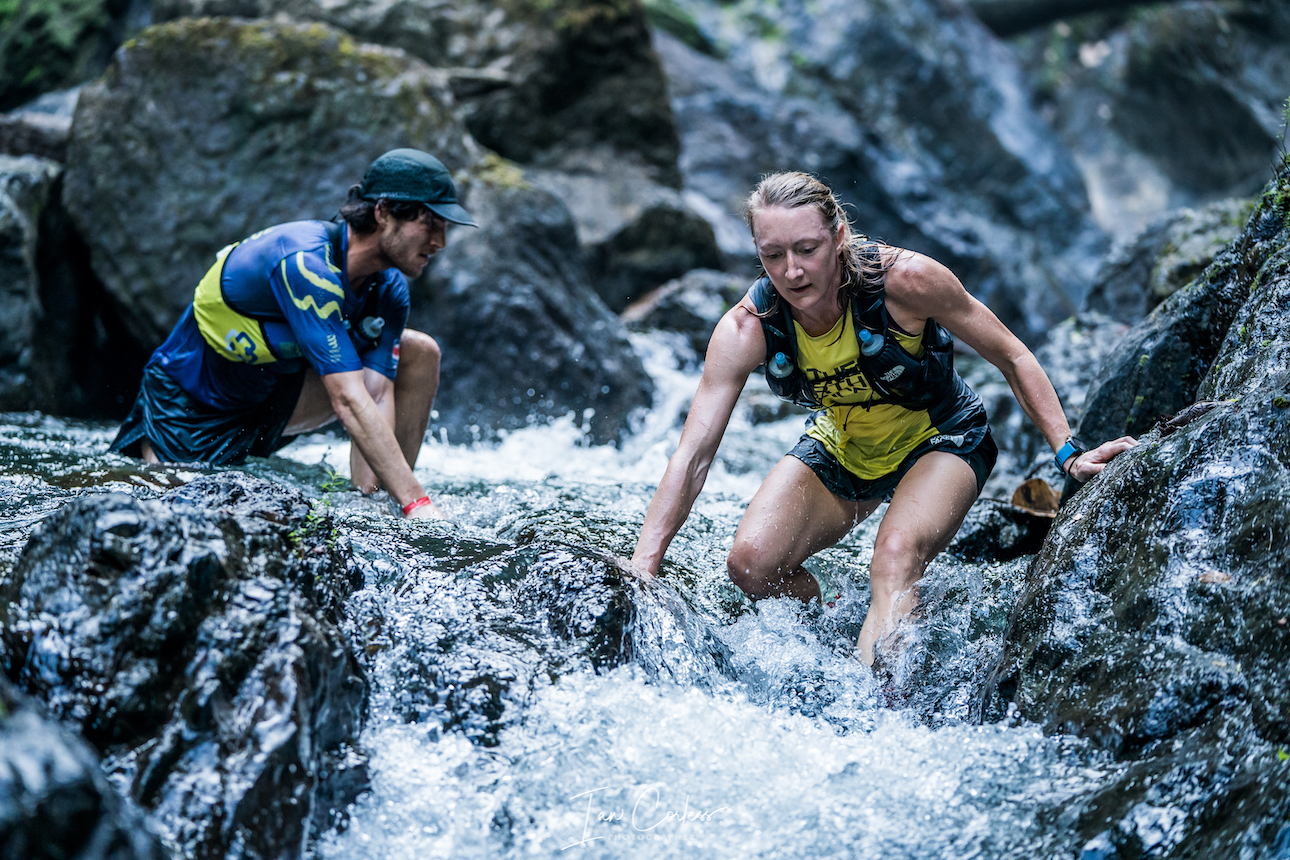
Giudy at the waterfall crossing.
Giudy Turini ran solo, no doubt looking to get the last day done as quickly as possible. Francis Davila Palacios doing the same.
Francis Davila Palacios
Stage 6 is a mini TCC encompassing, waterfalls, rainforest, plantations, dusty fire trail, water crossings, beaches, coves and the stunning Pacific as a backdrop.
Peter van de Zon ran a great race for 2nd place
Fire roads start the day, a run in a river bed, a waterfall crossing, dirt roads with countless water passes and then finally the beach arrives. The coastline weaving in and out all the way to the line.
At the end, Hayden Hawks and Giudy Turini are the 2022 TCC champions.
The men’s podium, Hayden, Peter and Erick2022 female champ, Giudy
The line was full of emotion as an epic journey has come to an end. The 2022 TCC was a huge success.
Day 5 is a long day on The Coastal Challenge and what a day! At 42km, it is shorter than previous editions of the TCC due to a change of the finish area and camping location. This, makes the last day considerably longer and much more of a challenge than in previous years.
Runners depart camp via bus for a short bus ride to the Sierpe River and ferry across to the other side.
Cp1 Portero, 11km, is reached by gravel roads and faster running. Sábalo follows at 18km and here, the gravel road gives way to more technical and challenging terrain. There is a steep climb and descent before gravel road resumes to Cp3 Ganado. Now a final technical loop, beach section and water crossing brings stage 5 to an end at Ganadito Beach.
Peter van de Zon
Much of today’s route is considered very runnable on wide gravel roads. Great if you can run, but for many, stage 5 is a tough day with tired bodies.
Peter and Hayden, head-to-head
It may come as no surprise that once again Hayden Hawks and Peter van de Zon dictated the race from the front. The duo running together for the whole day and crossing the line in 4:20:50.
The water crossing
Erick Agüero battled hard and early in the race he held a small gap. But as the race progressed, the gap opened and Erick seemed to relax, content with his 3rd place crossing in 4:50:15.
Erick Agüero
Franco Colle finished 10-minutes with Julien Chorier in 5:00:33. Franco somehow finding form in the latter stages of the race, no doubt due to adapting to the heat.
Julien ChorierJulien and Franco Colle
5:47:43, 6:05:35 and 6:43:42 were the women’s finishing times, the race once again taking the format of the previous days with Giudy Turini, Francis Davila Palacios and Courtney Hill finishing 1, 2 and 3.
Giudy TuriniFrancis Davila Palacios
Japanese runner, Tomomi Bitoh joined the race today after opening quarantine in San Jose and then being cleared with a negative PCR test. It was a bitter sweet moment for Tomomi after excitement over a trip and race in Costa Rica, for it all to be taken away at the 11th hour. She will savour the opportunity to experience some Pura Vida and a magical part of the TCC race.
Tomomi Bitoh
Tomorrow’s stage is a loop of Drake Bay – it’s a stunning day that manages to encamps all the previous 5 days in one loop. However, in previous years, this race was often a victory loop at just over 20km… Now, the last day is a challenging 37km!































 IAN CORLESS