
Nice compilation video showing Kilian Jornet (amongst others) in action on the trails and mountains. By Arnaud A
Nice compilation video showing Kilian Jornet (amongst others) in action on the trails and mountains. By Arnaud A
Not even a 4am start could dampen the spirits of the participants of the 9th edition of The Coastal Challenge in Costa Rica.
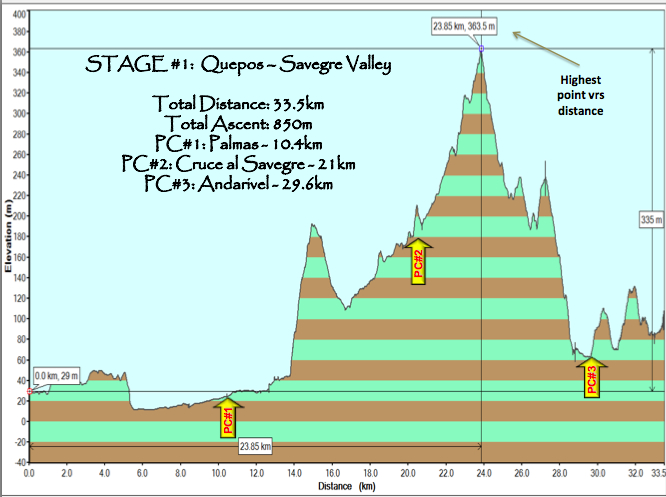
Leaving the Best Western in San Jose some 100+ racers, crew and staff made the 2.5 hour journey to the coast and the start of the first stage at Quepos. A total distance of just under 34k this day was billed as an ‘easy’ day to allow the participants to adjust to the heat and humidity. Believe me, they needed it…
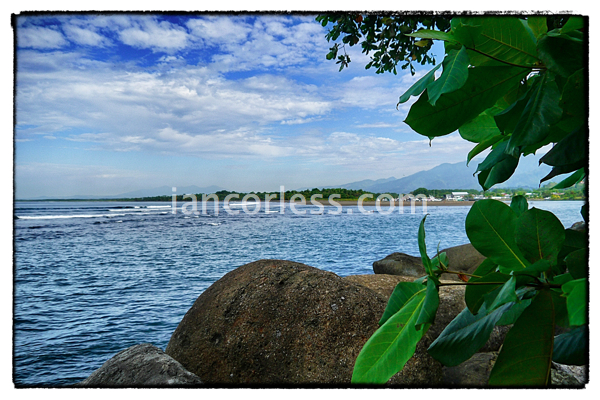
Quepos is a small town on the coast of Costa Rica and the arrival of several buses was certainly a point of interest, pre-breakfast in this little town. Runners congregated at the start and prepared for the challenge ahead. Filling packs, getting bottles ready and nervously laughing.
At 0900 they left the town and the first 10k was on road or pathway. Unusual you would think for a rainforest race? But a flat 10k of consistent surface is maybe just what all the runners needed to ease them into the day ahead. As expected Dave James hit the front and stayed in that place all the way to the finish.
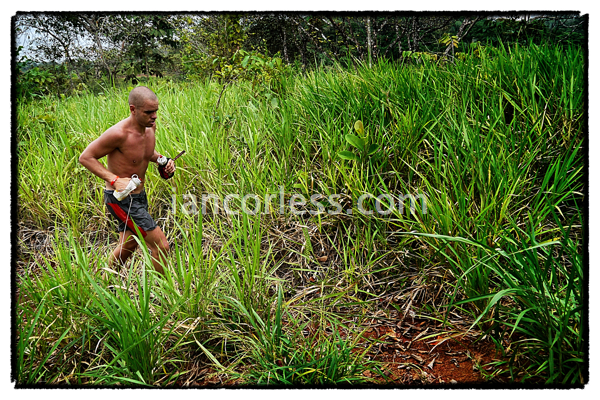
Dave James dominating the race from the front
I had gone to checkpoint 1 at 10k and then left following the course and ultimately would make the journey to the finish line under my own steam. My plan was to get into the jungle and then capture the runners as they approached.
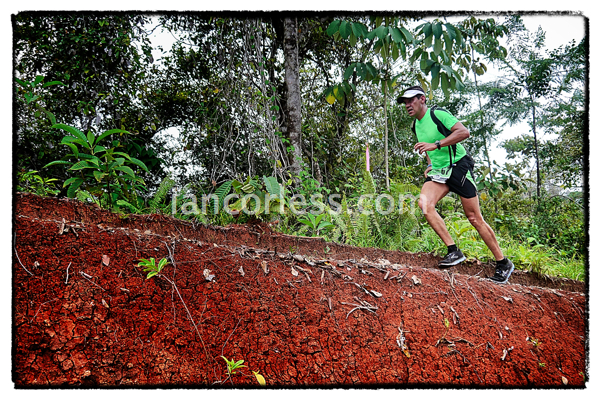
Coming from a cold winter in the UK the heat and the humidity hit me straight away. Within minutes I was soaking wet and remained that way for the whole day. The front runners seemed in control but very early on it became apparent that if you pushed too hard it was going to be a tricky day.
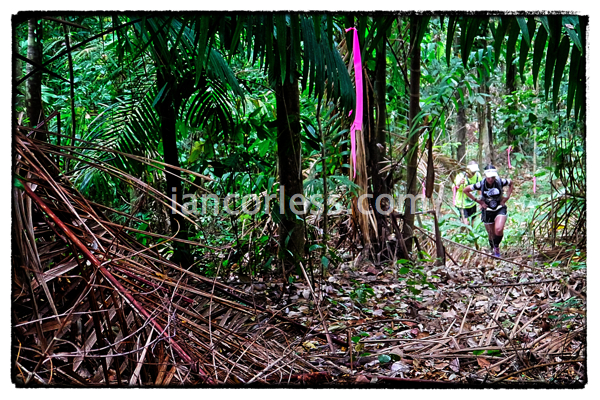
Follow the pink ribbons
The course was a mixture of rocky fire trail and jungle. Apart from the heat the most notacable thing was the noise from the canopy. Millions and millions of insects created a chorus that was deafening.
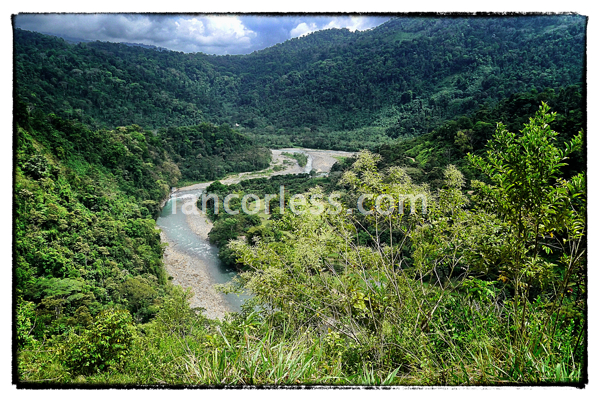
As the course progressed and we descended down to the river, a metal bridge facilitated a safe crossing and checkpoint 3. From here it was just 6k to the finish.
The Coastal Challenge team was already busy laying out peoples tents and arranging luggage so that it was ready for our arrival.
I have to say I was pleased to see the finish line. The heat really drained and as runners arrived you could see the stress and the impact on faces.
“This is the easy day” one lady said.
“Yeah, tell me about it… today is gonna be so interesting” replied another.

Cool campsite on the beach next to the river
With a river to cool off in and food available the recovery process immediately starts. The runners, the team and the location is excellent. What more could you ask…

When the running is done, the relaxing begins
Dave James finished in 1st place in just under 3 hours (tbc)
T Dris had an excellent run to pull back into 2nd place. He had early gone off course in the day and when he passed me he said he had run an extra 6k! A top 10 finisher at MDS he has now 46 mins behind James.
In 3rd J Lupez finished just a handful of minutes behind Dris.
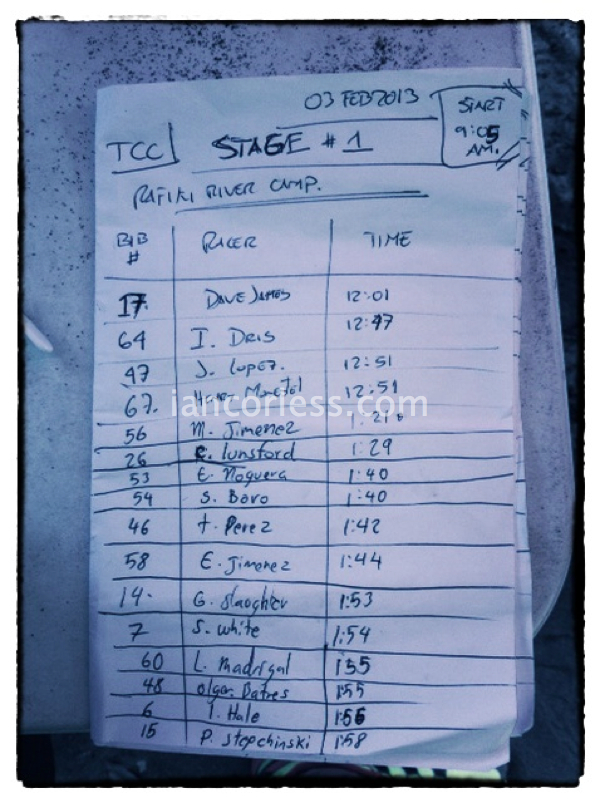
Stage Results
You can view The Coastal Challenge website HERE
Tomorrows stage is 39k with 2250m of ascent and we get underway early at 0530.

A recipe for success – the world’s top athletes, a dream location, three challenging events.
Two important firsts are announced by the International Skyrunning Federation today: the 2014 Skyrunning World Championships will include the ultra distance for the first time and Chamonix, the most iconic outdoor sports arena, will host the events at the end of June, 2014.
January 30, 2013
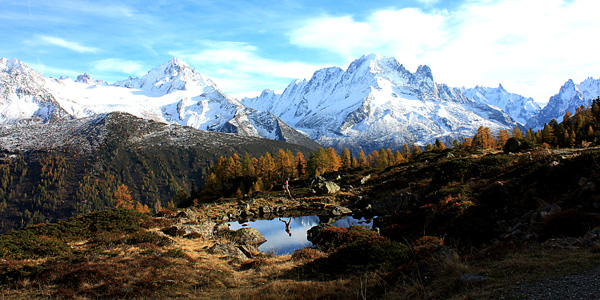
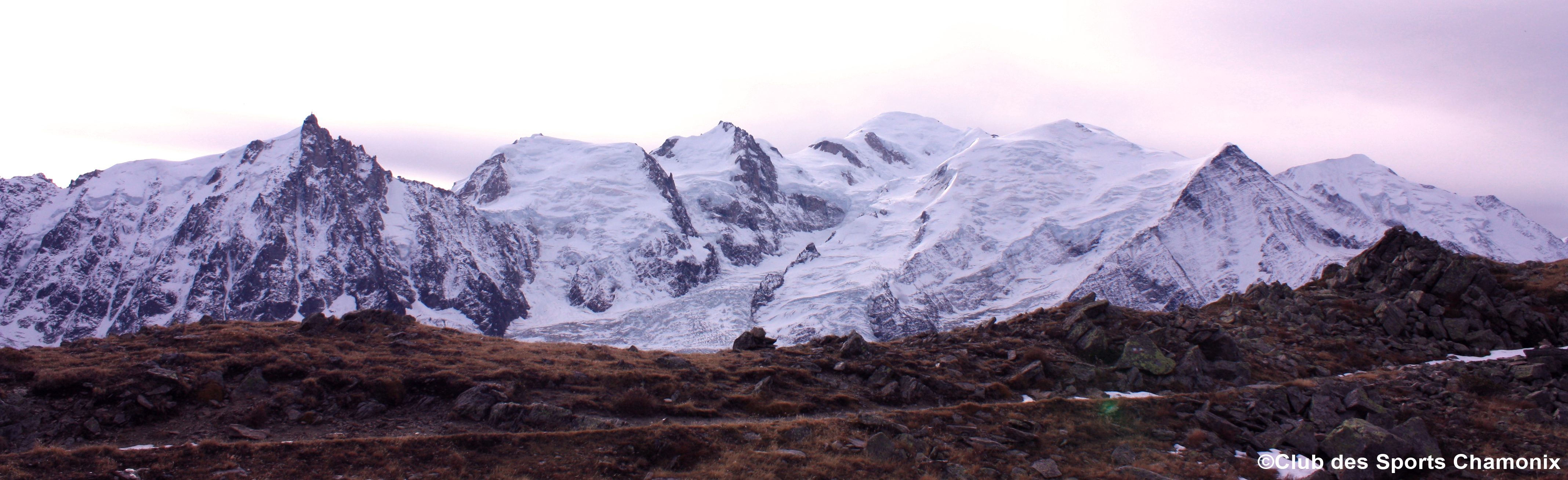
Chamonix, France, offering the most famous and spectacular mountain panorama, will stage the second Skryunning World Championships at the end of June, 2014.

Three distances will be disputed:
– The short, steep Vertical KM – 1,000 metres skywards – by night. A timed race, it will test your VO2 max to the limit.
– The Mont-Blanc Marathon – the 42 km course starts in Chamonix and finishes at 2,016m altitude, gathering 2,511m elevation gain and 1,490m on the downhill, this beautiful trail offers some of the best scenery of the Mont Blanc massif.
– The Mont-Blanc 80KM – an exclusive, new course to be inaugurated this year, it features a challenging 6,000 metres of vertical climb along ridges, over snow fields, crossing into Swiss territory and traversing glaciers in a point to point loop from the town of Chamonix.
The races are open to both individuals and teams. Individual World titles are at stake in each discipline as well as a combined title, based on the best results of two out of three races. Countries will be ranked according to the best results of three men and one woman in all three disciplines.
Held every four years, the Championships represent the second edition since the inauguration of the ISF in 2008 and the first time that the ultra distance is included.
In occasion of the first Skyrunning World Championships in 2010, winners of the individual titles were Urban Zemmer (Italy) and Laetitia Roux (France) for the Vertical Kilometer®; Kilian Jornet (Spain) and Laetitia Roux (France) for the SkyMarathon®, and the combined titles went to Nicola Golinelli (Italy) and Laetitia Roux (France). The country ranking was headed by Italy, followed by Spain and France for a total of 13 nations.
The bid for the 2014 Skyrunning World Championships has been awarded to the experienced and highly competent local organiser, the Club des Sport Chamonix, which manages year-round major international sports events.
Marino Giacometti, ISF President, commented: “We’re proud to present the World Championships in Chamonix and, with the support of the Club des Sport, we’re confident the events will be a perfect showcase for skyrunning and draw the best in the world for some intense competition.”
In 2013, the Vertical KM and the Mont-Blanc Marathon will feature on the Skyrunner® World Series calendar for the first time, an occasion to gather the world’s top athletes and thousands of participants for a preview of what is to come in 2014 – a competition to set your heart racing – starting right now!
Programme, race and entry details will be published at a later date. In the meantime see here for details of the 2013 events. Subscribe to our newsletter for all the news and follow us on twitter and Facebook for updates.
Skyrunning website HERE
Imagine an Island in the Indian Ocean: mountains, rainforest..a population passionate about trailrunning, a race going on it’s 20th edition. We are on the Island of La Réunion, A Trail Running Island – enjoy !
Salomon Running TV S2 E13

December 20th, 2012
Question – “Ian, are you free the first 10 days of February?”
Answer – “I leave Spain today and I am back in the UK late tonight. I have a busy morning on Saturday and I have some interviews to do Saturday afternoon but I will be free around midday to chat if you are? Alternatively drop me an email. Hope you are well? February should be okay, lets discuss.”
Reply – “Great, so you can go to Costa Rica for the multistage ‘Coastal Challenge'”
Answer – “Erm, yes! of course”
So, with just 4 weeks to prepare I was suddenly thrust into a week in the jungle. A whole new experience for me but one that I am so excited about! The Coastal Challenge.
I would normally be thinking to myself this is awesome. I get to go to Costa Rica, take part in a 6 day multistage, take photos, write an article and of course get some interviews. Unfortunately my long term knee injury is going to stop that… 225km over 6 days will just be too much and of course, I am not fit! Well, not race fit.
But as I said to my client and the RD, I think it is important to go these events and see it from both sides. If I am taking part, I wont see what is happening at the front of the race. I wont see ‘the race’ for the win. I also wont see the logistics and planning that go into a race like this. My trip is all about understanding every aspect of this race. So I am happy. I plan to dip in and dip out of stages but ultimately report on and bring back a whole series of images and stories that I can relate back to readers and listeners worldwide.
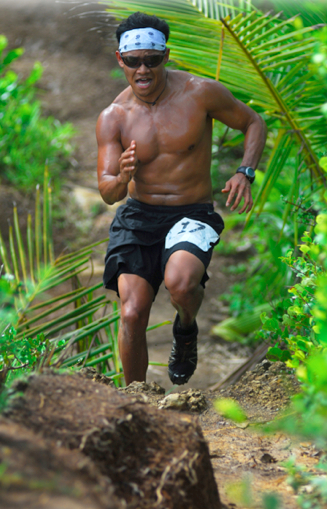
The first question I had was, can I die?
Heat Illness and Dehydration
Individuals who are not well conditioned traveling in hot, humid environments are susceptible to both heat illness and dehydration. Heat illness includes both very benign conditions such as heat rash as well as life threatening conditions including heat stroke. Participants should carry enough liquids to ensure hydration during the event. It is important to eat and drink appropriate amounts of liquids with electrolytes during the event to reduce the incidence of hyponatremia. Water has not been an issue in previous Coastal Challenge’s, however, this year portions of the race will be through agricultural areas that will require purification before drinking.
Plants and Animals
There are 135 species of snakes in Costa Rica with 17 being considered dangerous. Mostly these are members of the Viper, Coral and Boa families. The best prevention is watching your path and being aware.
Water Safety
While the water in Costa Rica is generally considered among the safest in Central America, traveler’s diarrhea does occur. It is advised that any water be treated prior to drinking unless its safety can be guaranteed. Speak to your Family Physician about treatment issues (Pepto Bismol, Antibiotics, etc.)
Sun
February is considered the dry season so expect warm temperatures with average highs of 20-25C/70-85C depending on altitude. Furthermore the race will be going through some of the driest areas of Costa Rica. Proper sunscreen is essential (SPF 15 or greater) with enough to last multiple daily applications for the entire race.
Okay okay, that sounds okay… the chances of survival are pretty good. So then, what is The Coastal Challenge?
The “Rainforest Run” promises to be spectacular and challenging. The course has been designed to emphasize point-to-point racing, which will put the “finish line” at or near camp at the end of each day’s race. The course is measured and will be marked. You will be given accurate course measurements and maps (Google Maps, Nat Geo maps) with route profiles for terrain, approximate distances and elevation gain or loss.
Set along Costa Rica’s tropical Pacific coastline and weaving into the Talamancas, a coastal mountain range in the southwest corner of Costa Rica. The race finishes near the border of Panama in a small and serene fishing village that until recently was only accessible by fishing boat.
Mountain, trail, rainforest, single track, across ridges, highlands and coastal ranges. We will run along beaches, rocky outcrops, reefs, river estuaries and the race finishes in the Corcovado National Park, one of the premier rainforest experiences in the world. A Unesco World Heritage site it defies description.
The course has a total elevation gain of more than 34,000 feet.
What is a Rainforest?
Rainforests are forests characterized by high rainfall, with definitions based on a minimum normal annual rainfall of 1750–2000 mm (68-78 inches). The monsoon trough, alternatively known as the intertropical convergence zone, plays a significant role in creating the climatic conditions necessary for the Earth‘s tropical rainforests.
Around 40% to 75% of all biotic species are indigenous to the rainforests.[1] It has been estimated that there may be many millions of species of plants, insects and microorganisms still undiscovered in tropical rainforests. Tropical rainforests have been called the “jewels of the Earth” and the “world’s largest pharmacy“, because over one quarter of natural medicines have been discovered there.[2] Rainforests are also responsible for 28% of the world’s oxygen turnover, sometimes misnamed oxygen production,[3] processing it through photosynthesis from carbon dioxide and consuming it through respiration.
The undergrowth in a rainforest is restricted in many areas by the poor penetration of sunlight to ground level. This makes it easy to walk through undisturbed, mature rainforest. If the leaf canopy is destroyed or thinned, the ground beneath is soon colonized by a dense, tangled growth ofvines, shrubs and small trees, called a jungle. There are two types of rainforest, tropical rainforest and temperate rainforest.
Logistics
The race is supported. This makes a big big difference. Although the race has a similar format to the Marathon des Sables, the big difference is that you do not need to carry your kit whilst running. This multistage is very much a race from the sense that the runners can race light and fast. The top runners will keep it minimal, hand bottles or a small pack. However, for most participants they will carry a pack with some ‘essentials’ and of course a bladder or bottles.
Base camp is set up by the race team. They transport the participants baggage to the finish of each day. Runners can sleep in a hammock or tent.They provide food (apparently excellent) and they also provide a series of check points and feed stations during the race.
After asking several questions, I was told by Rodrigo Carazo the following:

TNF Mica 1 Tent
The Mica 1 tent will be excellent as I can pitch just the ‘inner’ allowing me to potentially remain a little cooler in the ridiculously hot and humid climate.

Arc’teryx

Race Schedule

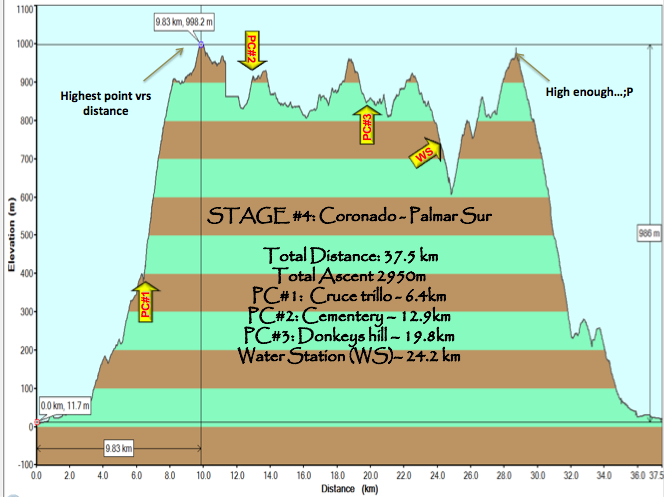
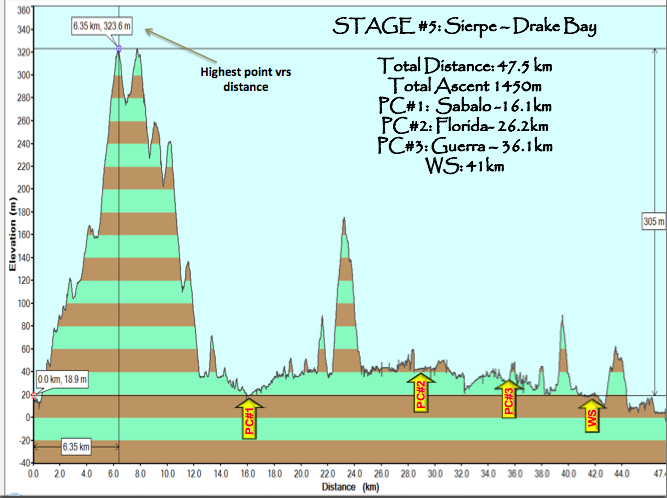

One’s to watch
Footnotes
FEET CARE by John Vonhof
Conditioning Your Feet
In the same way you train your legs and cardiovascular system, you need to condition your feet for the rigors 150 miles of The Coastal Challenge in Costa Rica. In short, that means training your feet in simulated race conditions. Train on somewhat similar terrain—sand, rocks, trails, hills, and in water. Knowing in advance how your feet will respond to these conditions will help you anticipate problems before they occur. Strengthening your ankles will help prevent sprained ankles common to uneven terrain and trails. Add in some walks or runs of longer amounts and vary your distance. The more miles you can get on your feet the stronger your feet will be.
Shoes
When selecting shoes, make sure your toes have wiggle room and your heels are snug with little up and down movement. Shoes with mesh may be cooler but tend to allow trail debris and sand into the shoe. Don’t start the race with worn out shoes. Make sure the shoes fit well and have space for swollen feet and toes.
Socks
Athletes should wear moisture-wicking socks. Try a few types of socks and decide whether a single sock, a thin liner with an outer sock, or two socks are the best for your feet. Remember if wearing more than one pair, more space is required inside your shoes so be sure your shoes are sized big enough. Plan on several changes of socks. The Injinji toe socks place each toe into its own little sock and might be a good move if you are prone to toe blisters.
Gaiters
Gaiters keep sand, grit and gravel, and trail debris out of your shoes and socks. There are many commercially made gaiters available to purchase or make your own. Those with a breathable material are preferred. Styles which attach to the shoe’s upper are preferred over those with the strap under the shoe since they make it easier to change socks.
Skin Preparation
The most beneficial step you can take to prevent problems is to reduce your calluses. Treating blisters under calluses is difficult and sometimes impossible. Use a callus file after showering or use callus remover creams to soften the skin.
Toenail Preparation
Untrimmed nails catch on socks putting pressure on the nail, causing blisters and black toenails, and cut into other toes. Toenails should be trimmed regularly, straight across the nail. Leave an extra bit of nail on the outside corner of the big toe to avoid an ingrown toenail. After trimming, use a nail file to smooth the top of the nail down toward the front of the toe and remove any rough edges. If you draw your finger from the skin in front of the toe up across the nail and can feel a rough edge, the nail can be filed smoother or trimmed a bit shorter.
Blister Prevention
If stopping to rest on the trail, take your shoes and socks off to air your feet, elevating them if possible. If near water, cool your feet with a quick soak. Use a silicone-based lubricant, like Hydropel or Sportslick which helps drive moisture away from your skin and reduces friction between your feet and shoes. Empty your socks of rocks and debris that can cause blisters, sores, abrasions, and cuts. If prone to blisters, consider taping your feet before problems develop.
Blister Treatment
Attend to hot spots when they develop to prevent them from turning into blisters. Cover these with tape to eliminate friction. Blisters should be drained and covered with Spenco 2nd Skin, Blister Block, or Compeed, and then tape. Your feet must be cleaned of all lubricant and oils for the patch to stick. If using a pin to drain the blister make several holes. If using a small scissors, make two small “V” cuts. Make the holes or cuts at a
point where foot pressure will expel any additional fluid build-up. Try to keep the skin on the roof of the blister. After applying a patch, roll your socks on and off to avoid disturbing the patch. Practice applying blister patches on areas of your feet most prone to problems.
Your Foot Care Kit
Wise competitors carry a small foot care kit in their packs. It doesn’t have to be big but it has to be right for your feet and small enough to fit in a Ziplock bag. I’d recommend a small container of Zeasorb powder or BodyGlide lubricant, alcohol wipes to clean oils off the skin before applying a blister patch, tincture of benzoin wipes, a small Ziplock bag with 1-inch Spenco 2nd Skin patches, a sewing needle and thread to drain blisters, and at least two yards of Leukotape wrapped around a small pencil. Duct tape can be substituted for Leukotape if you prefer. Of course it goes without saying that carrying a blister kit is useless if you don’t know how to use the materials. Use the time between now and the race to learn how to patch blisters and tape your feet before an event.
Foot Care at the End of the Day
After each day’s segment, proper care of your feet can help prepare you for the next day.
Using lightweight flip-flops around camp will allow your feet time to air and heal. If possible, soak your feet in cool water. Elevate your feet when resting. Rotate your socks to keep your feet as dry as possible and wash dirty socks. If your feet swell, you may have to remove your insoles. Use Super Salve, Bag Balm, Brave Soldier Antiseptic Healing Ointment, or a similar ointment to keep your feet as healthy as possible.
John Vonhof – Fixing Your Feet: Prevention and Treatments for Athletes, 3rd edition, June 2004 www.footworkpub.com
Essential Medical Kit
Finally….

The Coastal Challenge chose the spiral symbol because of its simple and transcendent beauty. Many of the most universally recognized meanings attached to the spiral seem relevant to the adventure in which you are about the take part. To many cultures the circular motif signifies centeredness, tranquility and balance.
Also a basic element in Western ideography, the clockwise spiral is strongly associated with water, power, life, the earth or sun, time, a journey, independent movement, and migrations of tribes, all things that will most definitely shape your life over The Coastal Challenge
Visit the race website HERE
I will be updating my blog daily with a report and photos. Also check the Talk Ultra Facebook page and Twitter feed for any updates as they happen…..
Providing I can get a signal in the rainforest.
NO, it is the ATV 19+

Copyright Reebok
Just when you think you have seen it all… run shoes with five toes, run shoes that look like a goat hoof or shoes that are built on inches of marshmallow and then Reebok bring us the ATV 19+. Lets face it, Reebok don’t really have a great reputation for ‘great’ run shoes. Will this nippled alien beast change that?
I haven’t seen these shoes yet. But they are about to be released onto the world on Feb 1st. Are we ready for it? I have no idea…
Bill McInnis, head of advanced innovation at Reebok thinks we are. Apparently he is a former NASA scientist! He says:
“The ATC 19+ has 19 bumps (hence the name) on the bottom of the shoe which are designed to grip as much terrain as possible each time you move. ATV? ‘All Terrain Vehicle’ – In other words, the shoe is designed to mimic how a real ‘ATV’ grips any terrain that is put beneath its wheels. The shoes ‘dig’ through the top layer of the surface and get traction on the layer underneath”
https://www.youtube.com/watch?v=LMsPej0LIP8&feature=player_embedded
Jury is out on this one… on first impressions I can’t imagine it working too well in the wet, particularly on roads/ pavements or in the mud. But hey, I shouldn’t jump to conclusions… just because they look weird doesn’t mean that they wont perform.
Lets see what happens after Feb 1st!
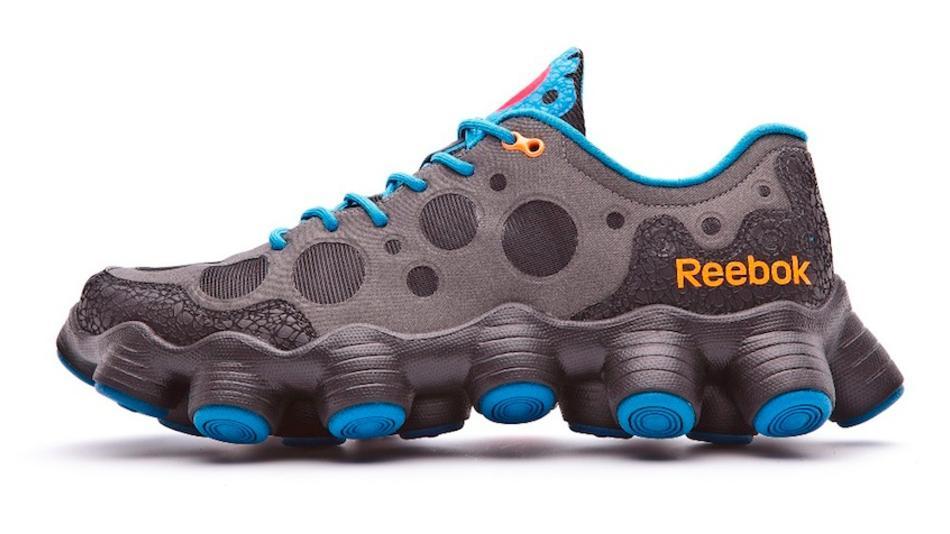
Copyright Reebok
As a footnote. I have just seen this YouTube clip. Oh dear… any credibility that Mr McInnis gave the shoe in his ‘clip’ above seems to disappear rather quickly here.

January 18th, Vail, CO and Boulder, CO– The Ultra Race of Champions (UROC) and La Sportiva have entered into a partnership for 2013. By signing on as a major sponsor, La Sportiva will support the Ultra Race of Champions’ mission as The Ultra Running Championship and bring together the best of the best, on one course, on one day. The Ultra Race of Champions is presented by Competitor Magazine.

The Ultra Race of Champions was recently selected as the 2013 Skyrunner® World Series Ultra Final: this is the first time that any Skyrunner® World Series Ultra Final has been held in the USA. “It’s a match made in heaven” says J. Russell Gill III, UROC’s Event Director and CEO of Bad to the Bone Endurance Sports. “With the Ultra Race of Champions as the Skyrunner® World Series Ultra Final, La Sportiva’s mountain heritage is a perfect fit for the race”.

“La Sportiva is headquartered in the Dolomites, Italy which is also where the International Skyrunning® Federation was born ” says Dr. Francesca Conte, Bad to the Bone Endurance Sports’ President and native of northern Italy. “La Sportiva’s history and experience with mountain running and World championship events makes it the perfect partner for UROC”.
The race, which includes three events, the Ultra Race of Champions 100K, the Über Rock 50K and Cruxy Half Marathon, will take place in Vail, Colorado on September 28th, 2013. The courses for all three events are perfectly suited for the La Sportiva brand, and the three distances will challenge runners of all backgrounds. The Ultra Race of Champions course will start on Main Street in Breckenridge, Colorado and finish in Vail Village, crossing several high mountain passes. The 50K and Half Marathon courses will take place on and around Vail Mountain.
“We are thrilled to be a part of the 2013 Ultra Race of Champions and Skyrunner® World Series Ultra Final! We have a great history of working with Francesca and Gill and know they will put together a fantastic event. This is going to generate excellent exposure for the elite field of athletes here in the States as they’re pitted against the toughest of the international competitors and is a huge success for the Mountain Running community as a whole” says Ian Achey, Events and Promotions Manager for La Sportiva. La Sportiva will be an exhibitor at the Champions Village, the UROC Expo in Vail.

This race is not for everyone. A mistake at the wrong time and place in the Alaskan winter wilderness could cost you fingers and toes or even your life. At times the only possible rescue will be self rescue. For those who do not agree with this philosophy, expect marked trails and more support there are other races out there which will cater to your needs.

Most races try to entice you to enter by telling you what a great experience you will have. How pleasurable it will be. Not the Iditarod Trail Invitational.

Image of Geoff Roes copyright Geoff Roes
As Geoff Roes proved. This is one seriously tough tough race. In 2012 he was the first man home covering 350 miles in 6 days 23 hours 25 min. Mmmm makes Western States look like a piece of cake eh!
In 2012 only 18 people finished the 350 mile race. The first man home was Peter Basinger in 6 dyas 15 hours BUT that was on a bike! An impressive 6th victory for Peter. Overall 2nd and 3rd was taken by bike riders and then Geoff Roes, 4th overall and 1st runner. Incredible.
In 2013, Arc’teryx athlete Joe Grant will be taking part. I plan to catch up with him before and after this incredibly challenging race and the interviews will be on Talk Ultra.
The Race
The Iditarod Trail Invitational is the world’s longest human powered winter ultra. Beginning in Knik, Alaska it follows the Iditarod Trail to McGrath covering 350 miles. Ironically this is called the ‘short race’. They also have a ‘long race’ covering 1100 miles finishing at Nome, Alaska. Support is minimal. Two snow machines ride ahead of the leaders providing a broken trail to McGrath. Food drops are provided at 130 miles, 210 miles and in even numbered years a feed is provided at ‘Cripple‘ and odd numbered years at ‘Iditarod‘.
That’s it!
Between checkpoints, racers are solo or may work with each other. If they continue to ‘Nome’ for the 1100 mile journey once past McGrath it os solo all the way apart from a food drop at ‘Ruby‘. After that they can use village stores, mail packages ahead or possibly use a school for a warm nights rest. Hard core!
Somehow this quote seems a little understated: Tim Hewitt, six time finisher of the 1100 mile race said:
“It’s the toughest race in the world.”
History
The Iditarod Trail Invitational follows the historic Iditarod Trail. The famous sled dog route runs 1000 miles through frozen Alaska every March since 1973 in memory of those brave individuals who brought the important serum to Nome in 1925 during a diphterie outbreak. Using bicycles as a means of transportation on Alaska’s frozen rivers and tundra might seem a little odd and a crazy idea, but men looking for gold around 1900 that couldn’t afford a dog team actually used what they then called a “wheel” and followed the gold rush from Dawson City to Nome on the Yukon River on bicycles.
How do you get in?
This is the most remote and longest winter ultra race in the world.
Competitors in the human powered event go through an interview process with race organizers Bill & Kathi Merchant.
If they have the skills and knowledge to be self sufficient in cold weather, such as high altitude mountaineering experience or previous arctic expeditions they can enter the race.
Prior finishes in races such as the following are qualifying events.

The 2013 race roster is available to view HERE
Official Race Website HERE
Joe Grant has a great blog called Alpine Works. Follow this HERE
Additional reading – 2012 winner of the 350 mile race, Geoff Roes wrote a detailed report for iRunFar available HERE
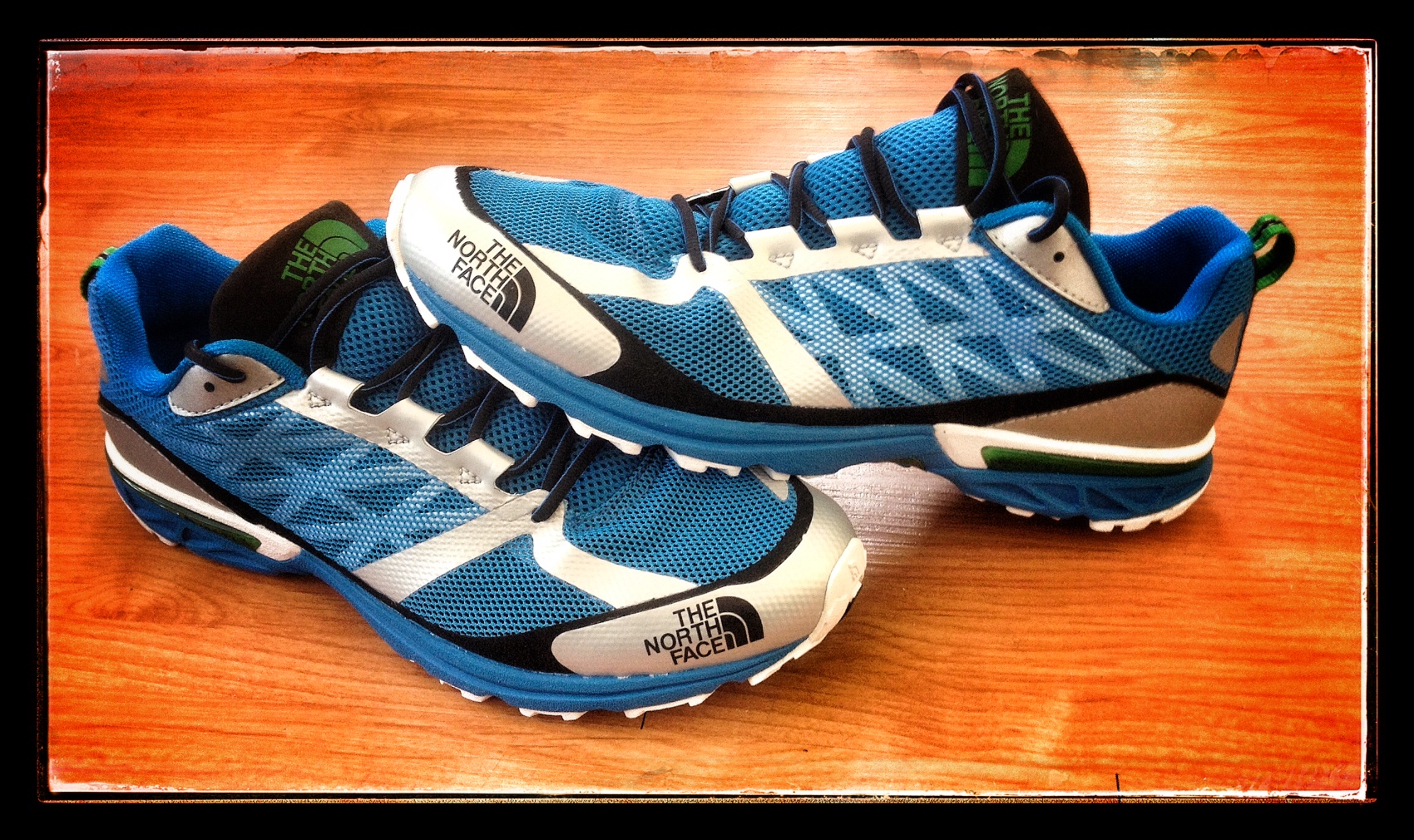
Fresh out of the box, The North Face ‘Single Track Hayasa‘. I am a real fan of TNF products, the ‘Flight Series‘ in particular offers a great range of products that transfer to so many disciplines. Light, functional, well fitting, breathable and ultimately great quality. It’s nice to remove them from the packaging, put them on knowing that they will do the job.
In regard to run shoes, The North Face I guess are still ‘newbies’ and in the past they have received mixed reviews about the footwear they have created. I have to say I had the original ‘Single Track’, you know, the really great looking shoe… black, red & white. Not only did it look good but it felt good.
The ‘Single Track Hayasa‘ is a shoe designed for speed. Greatly influenced by TNF athlete Tsuyoshi Kaburaki from Japan, Hayasa actually means ‘Speed’ in Japenese.
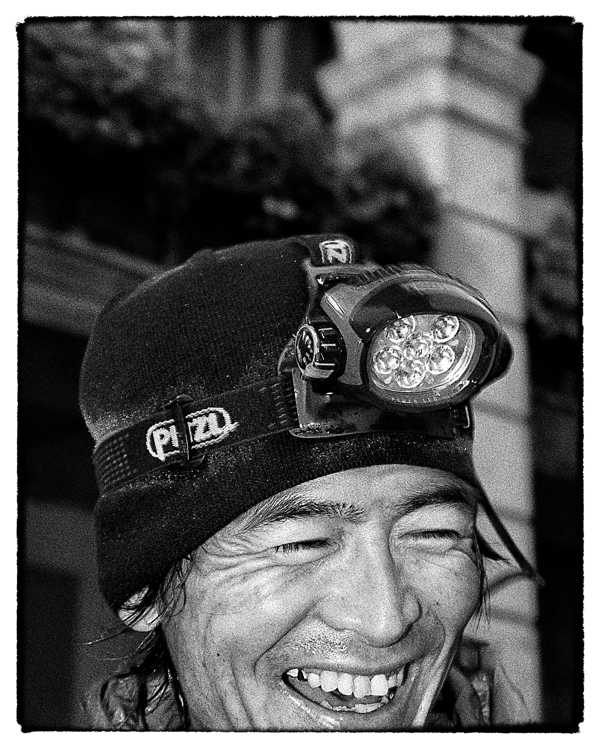
Tsuyoshi Kaburaki
It is a shoe ready for racing and as such sits low to the ground with a 10mm heel to toe drop (8mm toe /18mm heel). Weighing in at just over 8 oz for such a lightweight shoe protection has not been compromised.
At the front of the shoe we have a puncture resistant toe cap and on the tip of the shoe, you do have additional rigidity. This will add some protection from kicking rocks etc. But in real terms and in comparison to other brands the toe bumper is relatively small. When we move to the rest of the upper, we can see that there is basically a lot of mesh. The shoe will drain really well and breathability will be excellent as you might expect.
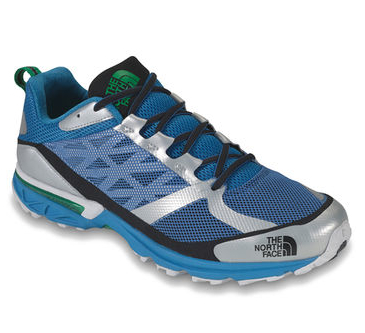
Seams are extremely low in the upper and the TNF have used welded seams. The lace loops attach to an internal cage (see the silver/white). This fabric is on both sides of the shoe. When you lace up, it pulls on the fabric in and it wraps around your foot to create support.
The shoe when on with laces adjusted feels very snug and the tongue is gusseted and attached to the upper. It is very padded and in conjunction with a plush heel box the shoe is a pleasure to wear.
The toe box is wide and has plenty of room. Maybe too much room for some so it would be wise to check on sizing to ensure that you get the correct feel. I personally went a half size larger but I do wonder if I may well have been better going ‘true to size’.
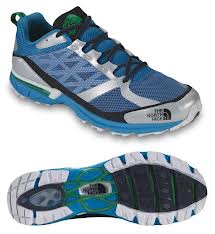
Starting just behind the toes and going to the back of the shoe is the ‘Snake Plate‘ (green). The snake plate is an alternative method to the standard ‘rock plate’ that you find in many trail shoes. Instead of one large plate, as the name suggests this one snakes in and out. The idea being increased flexibility. Ultimately, protection and flexibility combined that also means a saving in overall weight. The rear of the shoe has a ‘cradle‘. The cradle is created, like a bucket I guess for your foot to sit in. It provides stability and security. I have to say this is one key feature I initially like. Just walking around you immediately notice a firm hold.
Without doubt a neutral shoe with a 10mm drop. You have 8mm of foam at the front and 18mm at the rear of the shoe. In this ‘low drop’ and ‘minimalist’ environment 10mm may very well be snubbed by many but this shoe sits low to the ground and as such provides a very natural feel with protection and cushioning.
My initial concerns with this shoe are with the outsole. It has low profile lug which is ideal for road, hard pack trail and/ or rocky trail but in any mud they will be pretty much useless. The front of the shoe has directional grip so when going uphill you have traction as and when required. In the heel the lugs are reverse facing which will add grip when going downhill (if required). The middle of the sole is void of grip.
Testing?
Well, that is to come.
I have been provided with these shoes to test in a Jungle environment so please keep an eye on my blog for an update in February. Until then I will be running on some road, hard trail and even some mud to see how the Hayasa perform before heading deep into a rainforest…
SPECS
Upper:
Bottom:
Shoe Technologies:
NorthFit: The mission of NorthFit™ is to scientifically provide the outdoor athlete with the most precise fit between the human foot and a footwear last, as they both relate to the demands of the specific activity for which the shoe is worn
Snake Plate: The Snake Plate™ consists of a plate that winds back and forth in the forefoot, allowing the foot to flex in a natural manner while delivering protection and rigidity.
Northotic: Biomechanically engineered Northotic™: The North Face® has taken the conventional footbed and elevated it to a superior level with enhanced stability, support and cushioning.
Cradle: The North Face® CRADLE™ technology is engineered to naturally absorb impact, stabilise the foot and promote an anatomically correct stride by supporting the perimeter of the heel and ensuring the fatty tissues under the bursa are biomechanically positioned. CRADLE™ achieves the perfect balance of protection, control and comfort to inspire confidence for any foot on any terrain.
Tenacious Grip: Tenacious™ Grip is a high-abrasion, sticky rubber designed for maximum off-trail traction that will also withstand the rigors of rough off-trail surfaces.
X-Dome: X-Dome™ functions as a heel-cushioning and propulsion mechanism that propels the foot from heel-strike into the subsequent stride stages.

As many of you will know, I have been following Jez Bragg very closely on his New Zealand expedition running ‘The Long Pathway‘ called the Te Araroa Trail.

I caught up with Jez before he departed for New Zealand at a press conference in London. You can see that post and listen to an audio interview HERE
Episode 26 of Talk Ultra will be out this Friday and will contain an interview with Jez which we made on Monday 7th just after his succesful crossing of the Cook Strait. We discuss the expedition so far and what is to come on the South Island. Make sure you check out Talk Ultra this week HERE
In the meantime here is a video to wet your appetite

