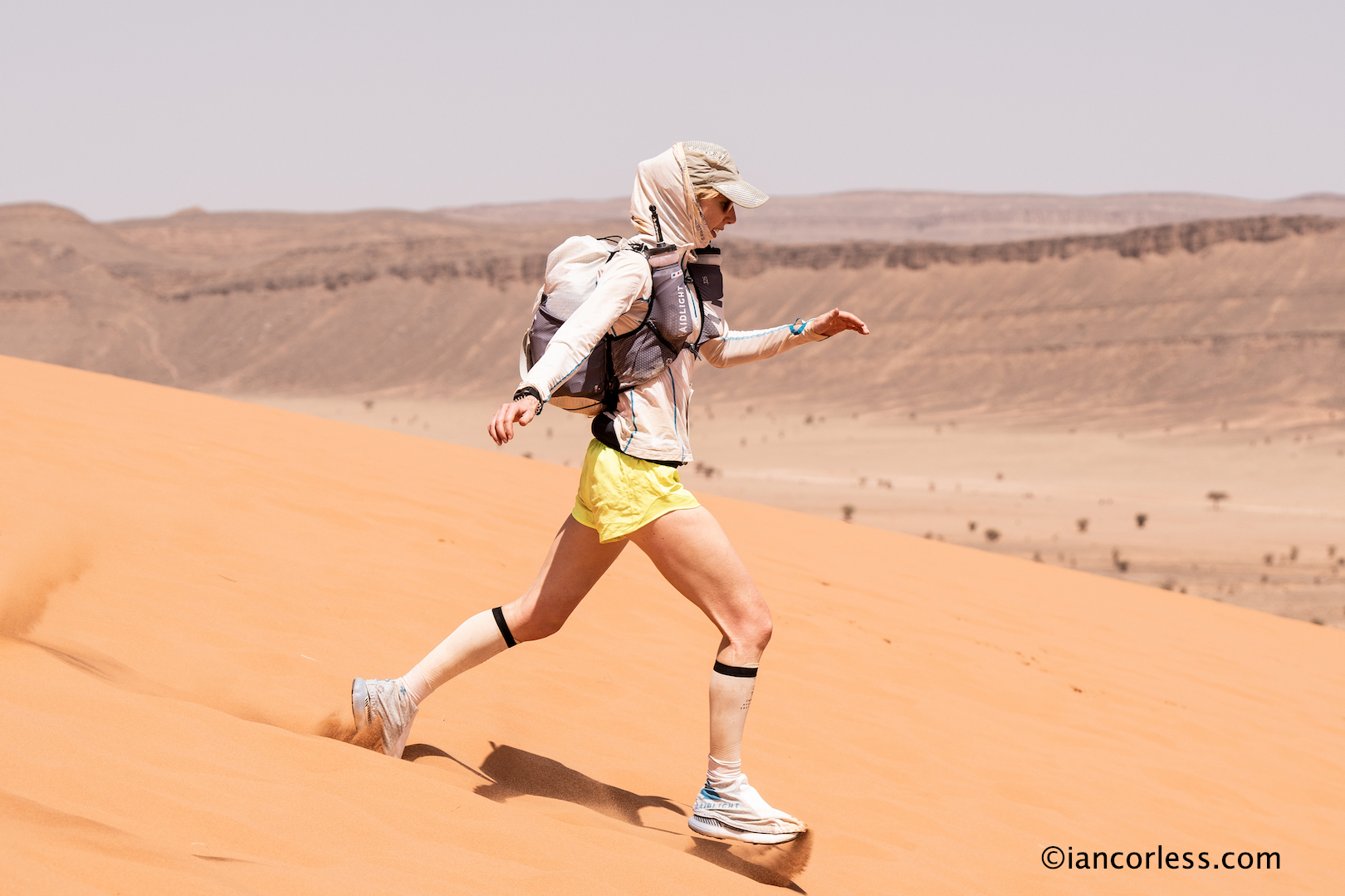
Episode 235 of Talk Ultra and we speak with Katie (Catherine) Young who placed 6th lady and 1st Brit at the 2023 Marathon des Sables in 34h 21m 18s.
The 2023 Marathon des Sables will go down in the 37-year history of the race as a tough one. With second longest stage in the race history (90km), a tough course and excessive heat, 30% did not make it to the finish.
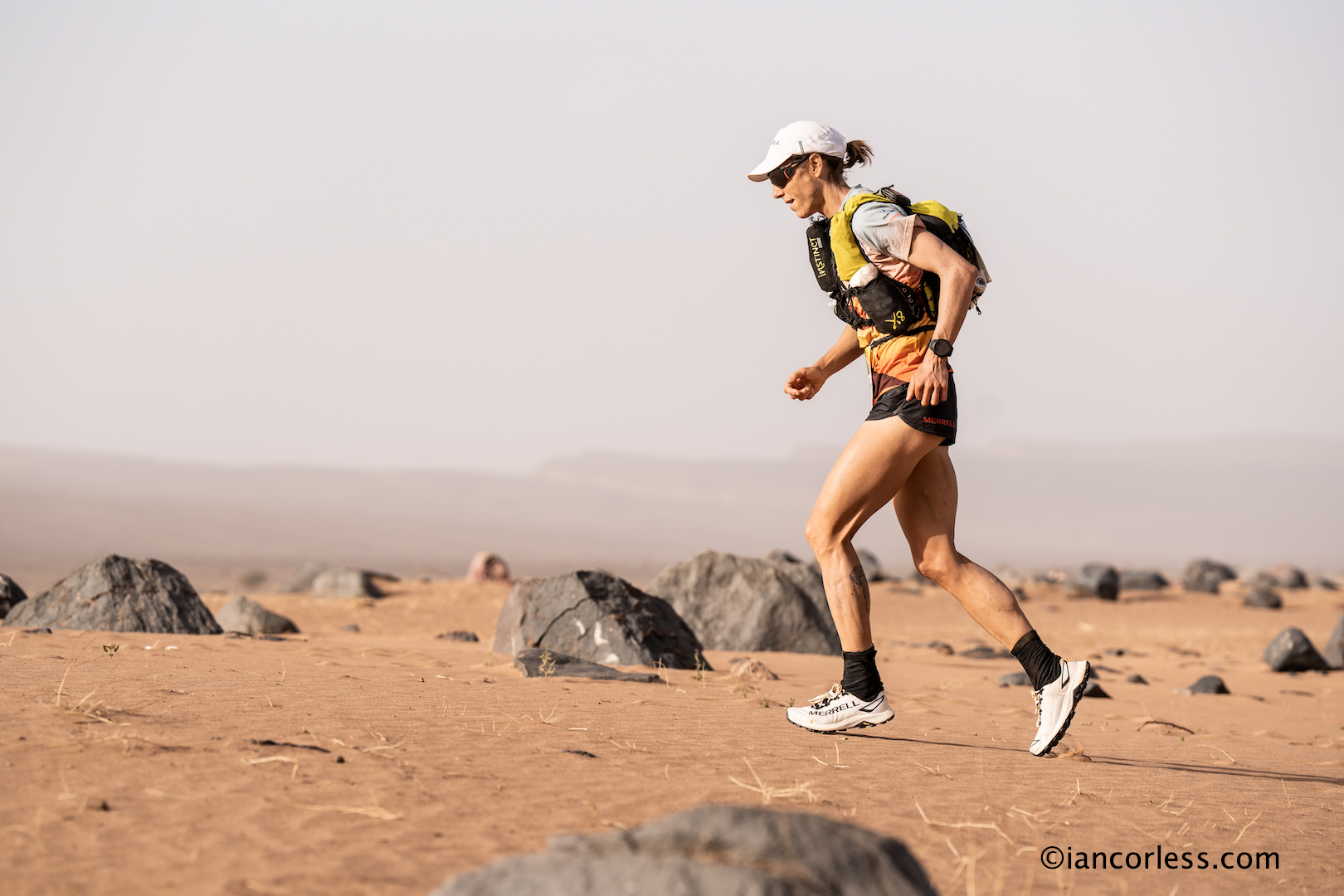
Katie Young from the UK, running her first stage race had an incredible run placing 6th woman and 1st Brit.
Are you planning on running Marathon des Sables or a similar race in 2024 or beyond? Why not join us in January for our LANZAROTE TRAINING CAMP which runs from the 11th to 18th. More information HERE.
Marathon des Sables 2024 #MDS – The New Features Discussed
2024 Marathon des Sables entries are due to open on June 30th. Moving forward, some changes will be made to the race. Read a summary of points HERE.
NEED A NEW PACK?
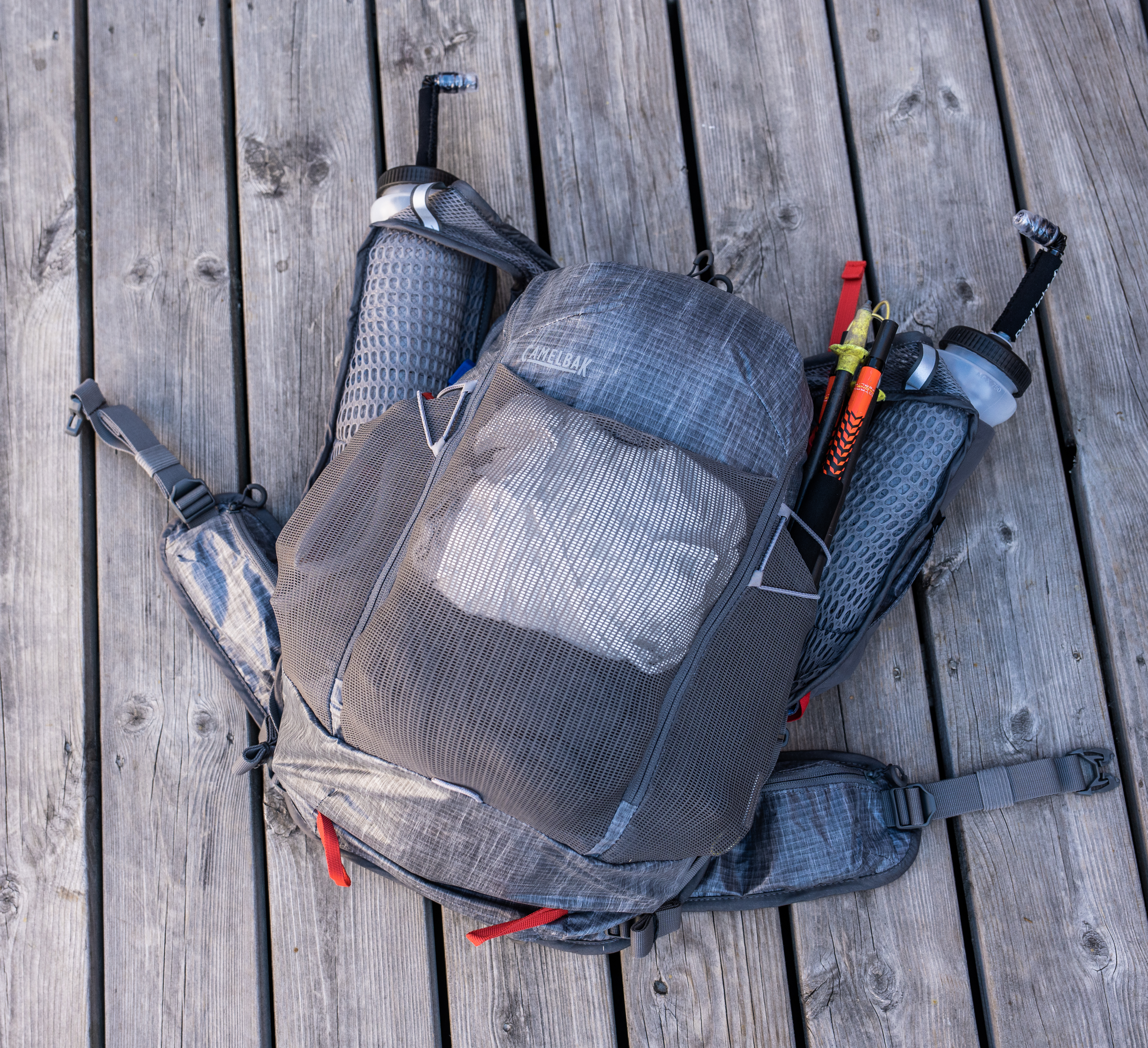
Are you looking for a new pack that is suitable for fastpacking and stage racing? We are currently testing the Camelbak Octane 25 and it is proving a real favourite. It’s full of features, has great storage and is extremely comfortable. Check out our first impressions HERE.
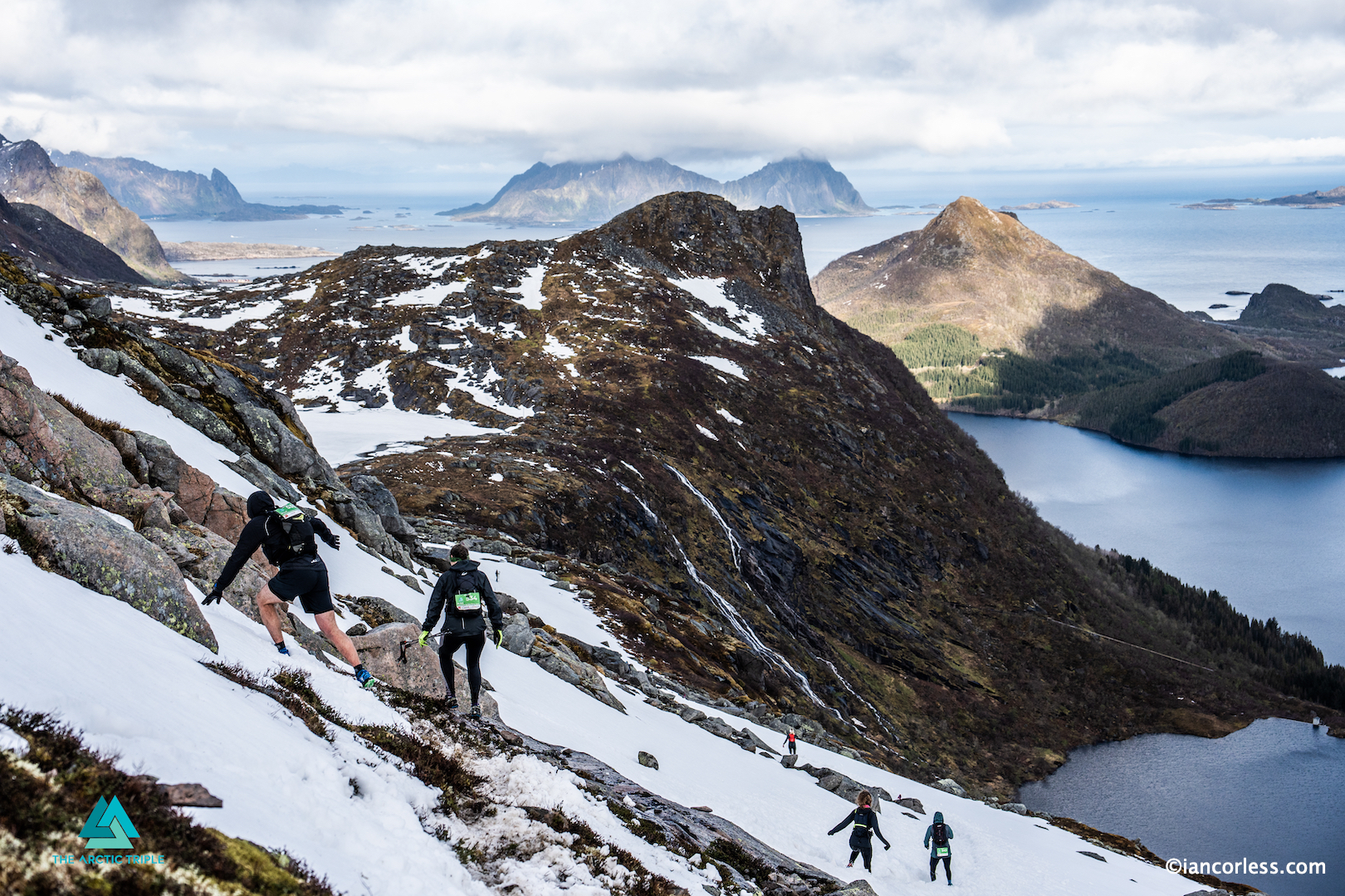
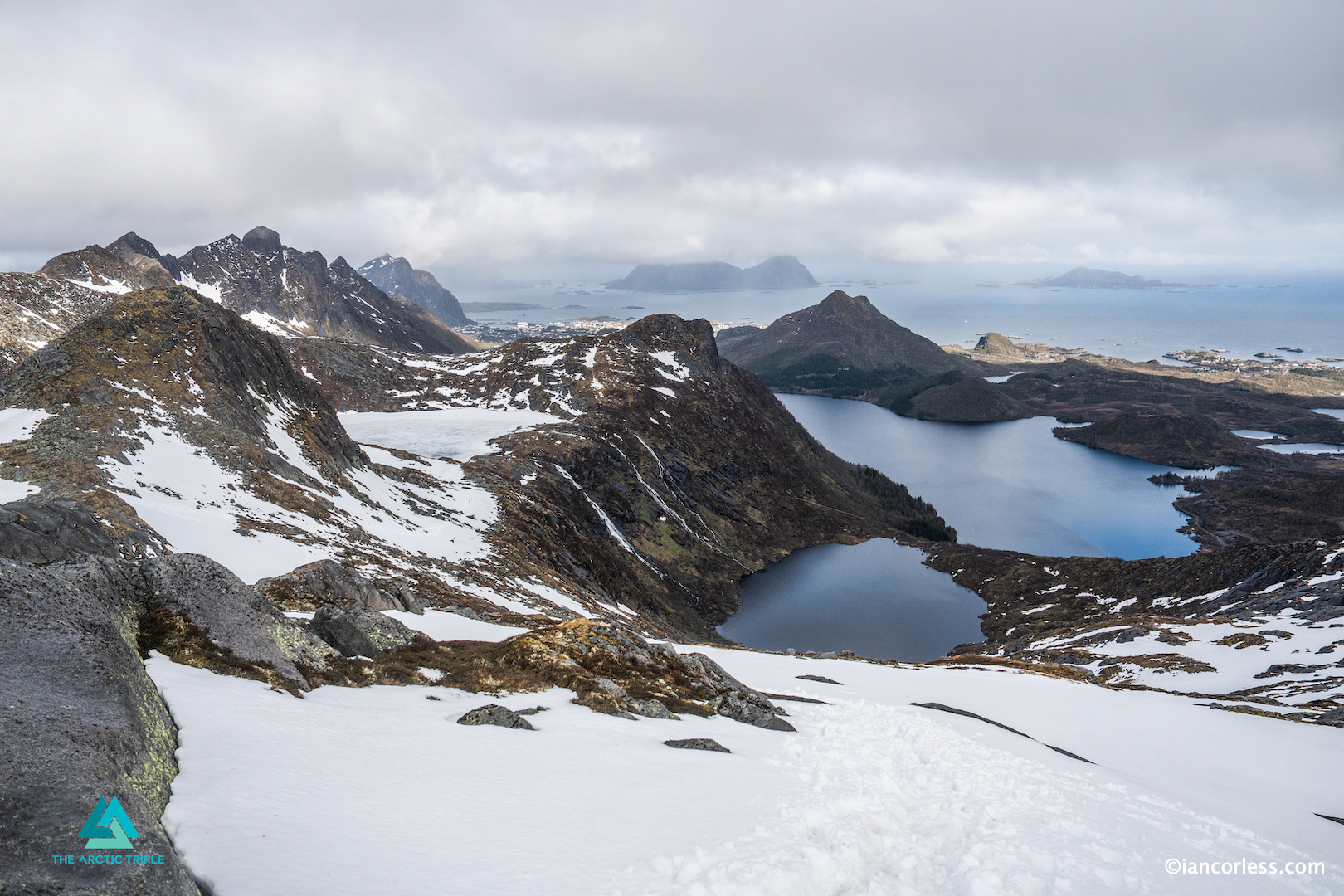
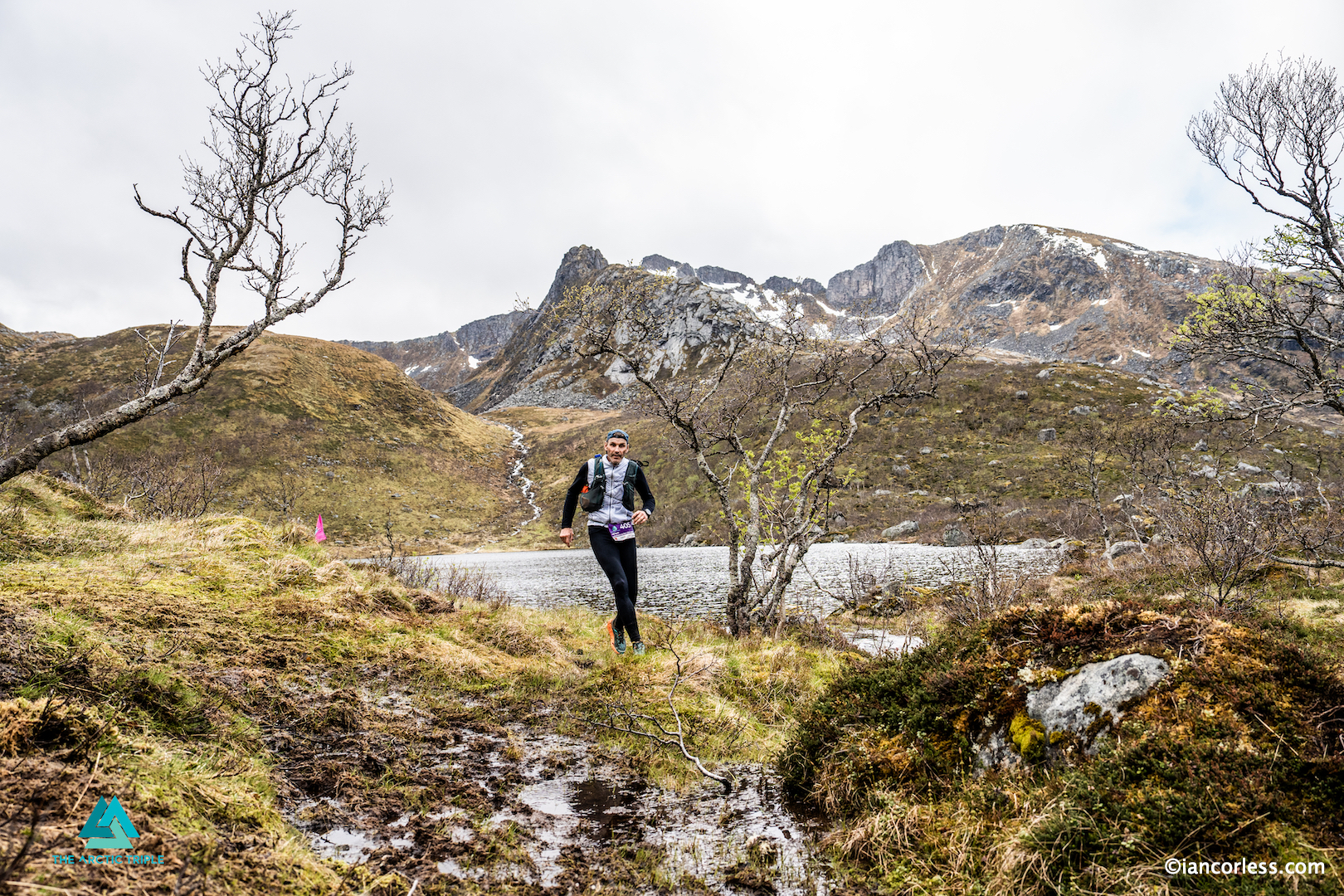
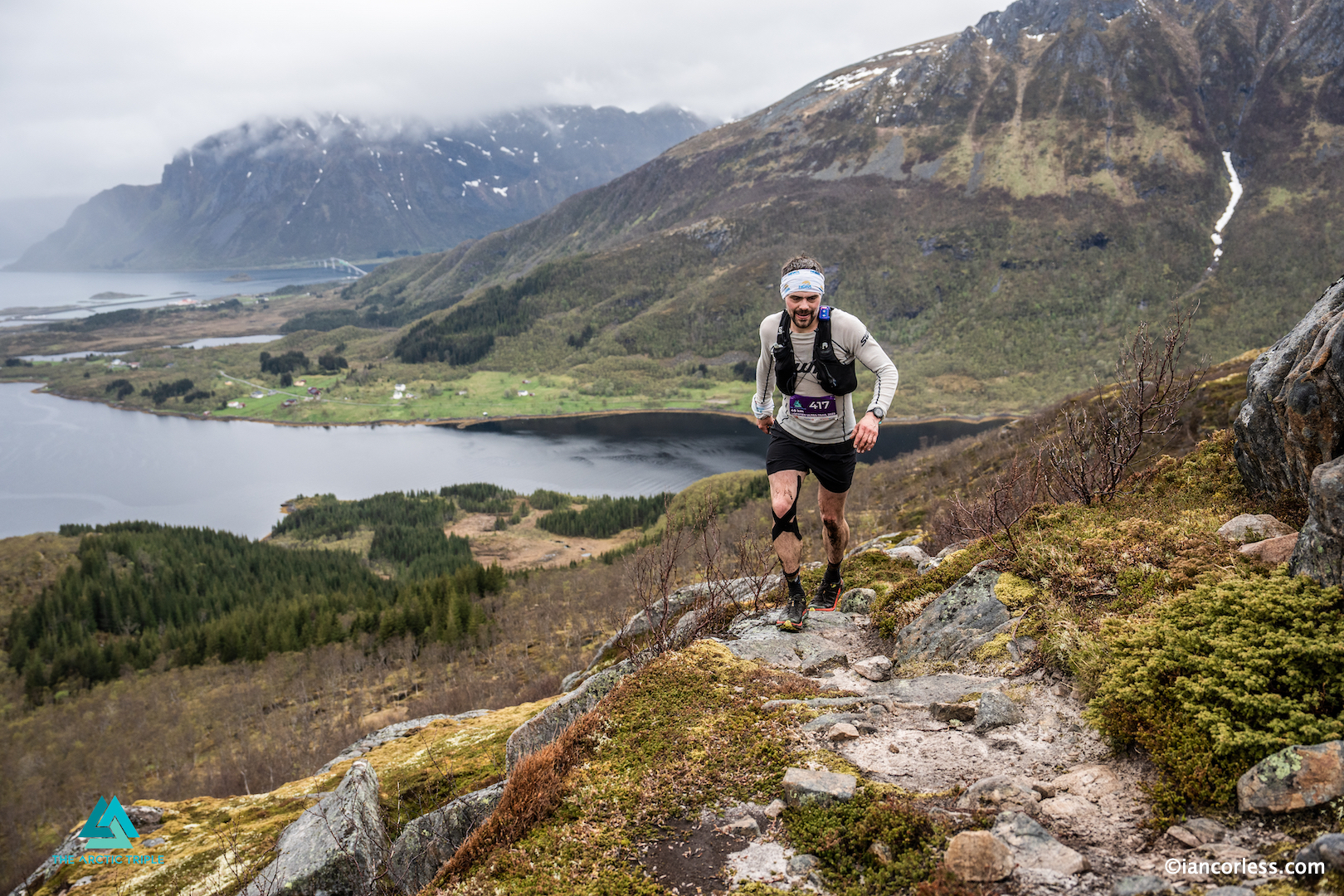
Located 800 miles from Oslo and 95 miles north of the Arctic Circle. Lofoten is an archipelago in Nordland county, known as the land of the midnight sun, from the end of May to the middle of July sunset merges into sunrise, with no darkness in between. Majestic mountains, lush valleys, chalk-white beaches, seagull cries, the smell of sea and houses where you would not believe that anyone could live. It’s Lofoten in a nutshell.
Highlights are countless, especially for an enthusiastic tourist, however, as a runner, you are in an amazing position to explore. Off the beaten track you get to see the ‘real’ Lofoten that only the hardy get to see. Higravtind, 1146m is the highest peak, what Lofoten lacks in height, it more than compensates for with a plethora of mixed terrain and endless peaks connected via sea, beach, road, and trail.
The Arctic Triple isa series of races (skimo, ultra-trail and triathlon) that take place at 3 key points of the year, March week 11, June week 22, and August week 33. Created to showcase this stunning archipelago; the Ultra-Trail (and shorter races) takes place in June bringing endless days and nights of light.
Providing a perfect opportunity to sightsee while running, it comes as no surprise that the 160km, 80km, 48km, 24km and 12km races are extremely popular, 750 toed the line in 2023. In addition, there is a 160km relay competition and a 80km relay competition.
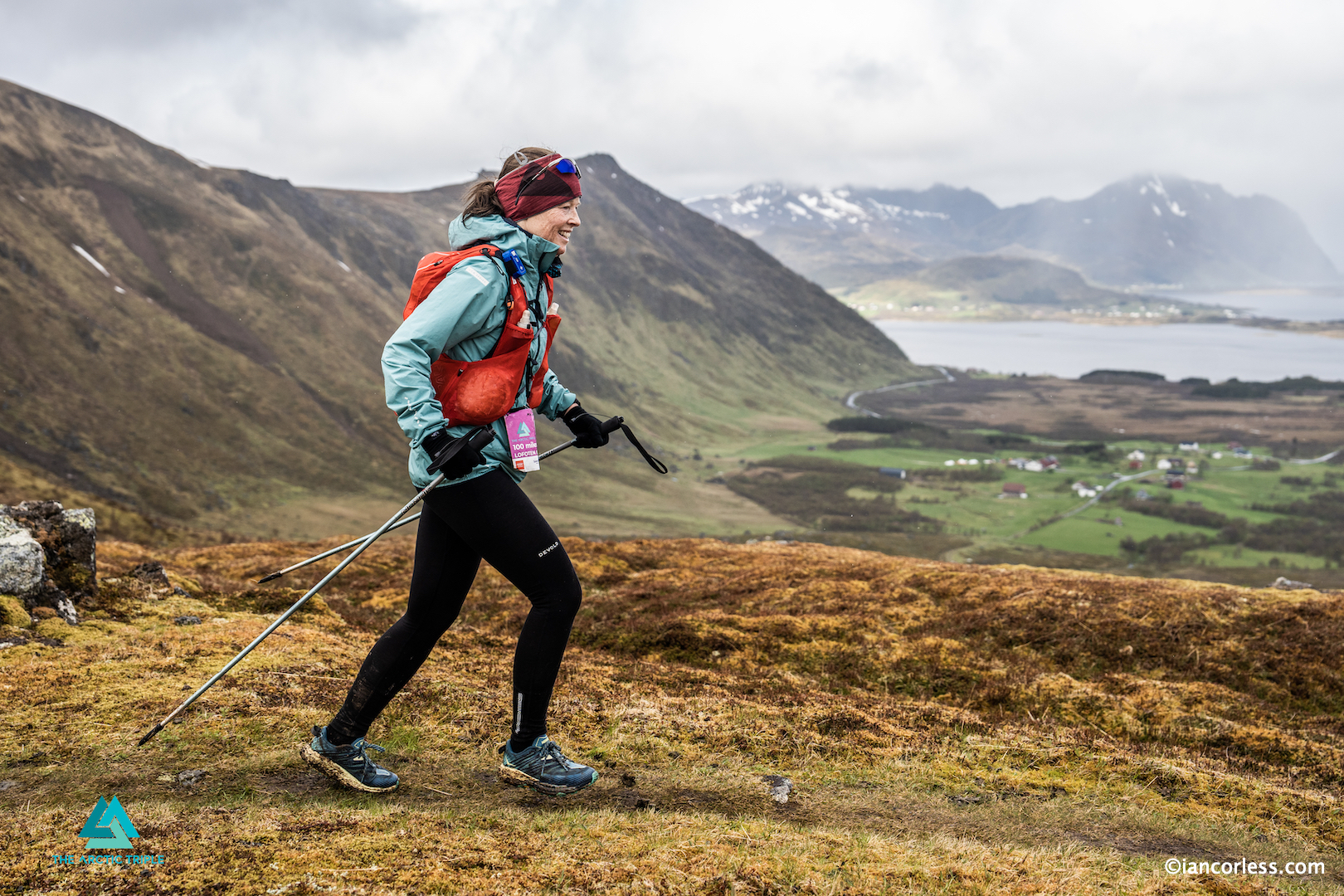
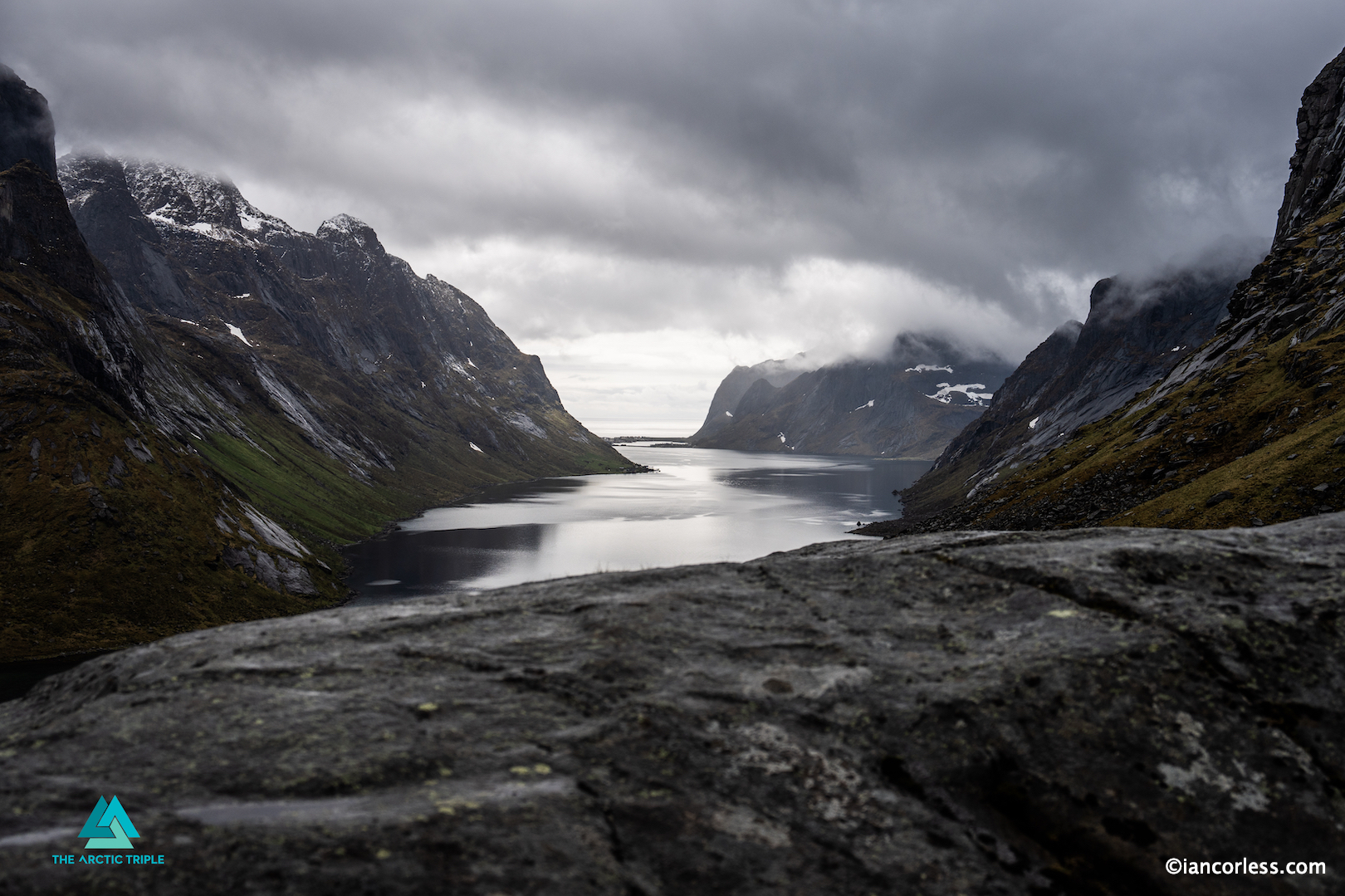
Passing through amazing scenery of mountain ridges, white beaches, green hills, and grey cliffs, the race routes are stunning and for almost the entire time, the ocean is in view. All the races conclude in Svolvær.
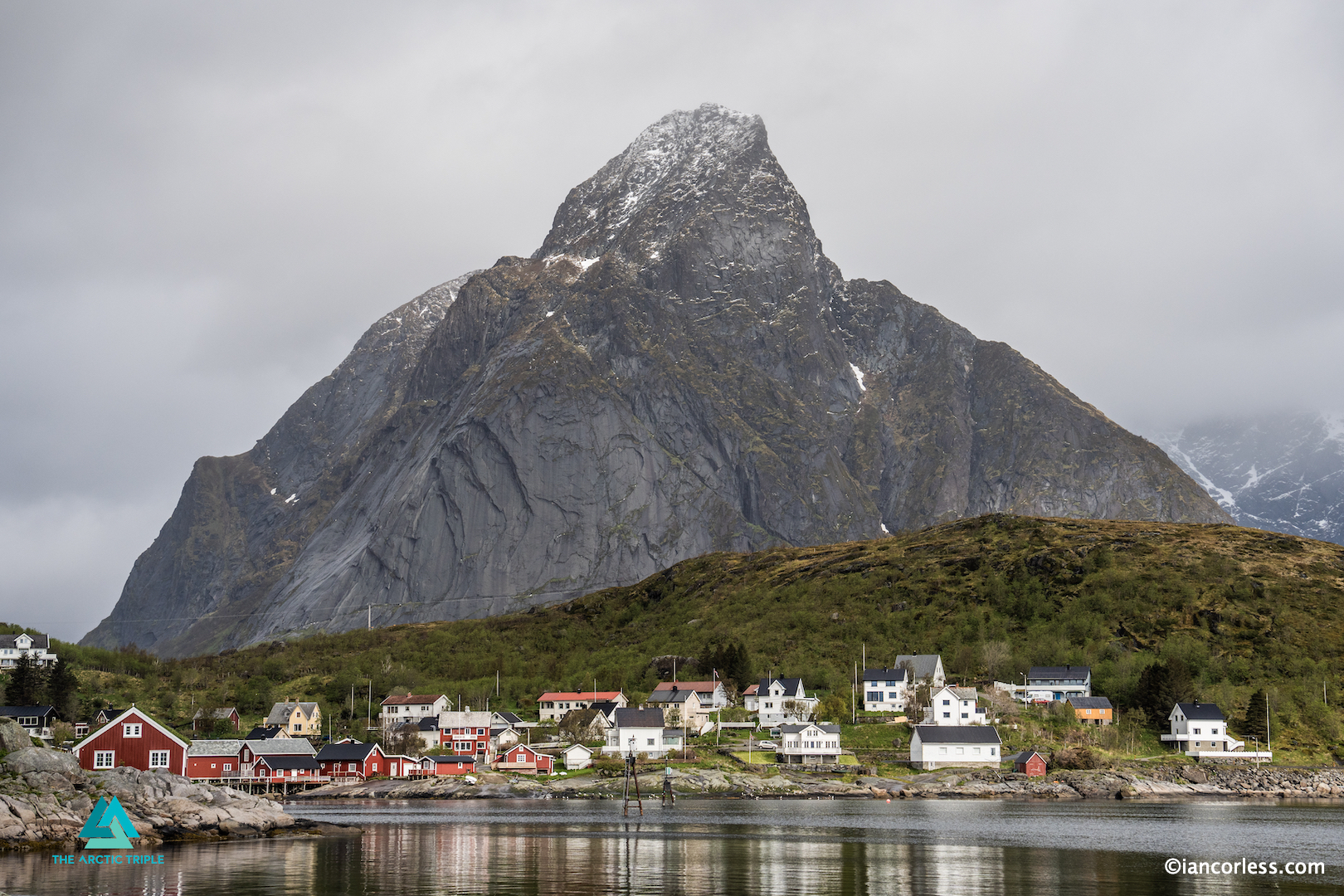
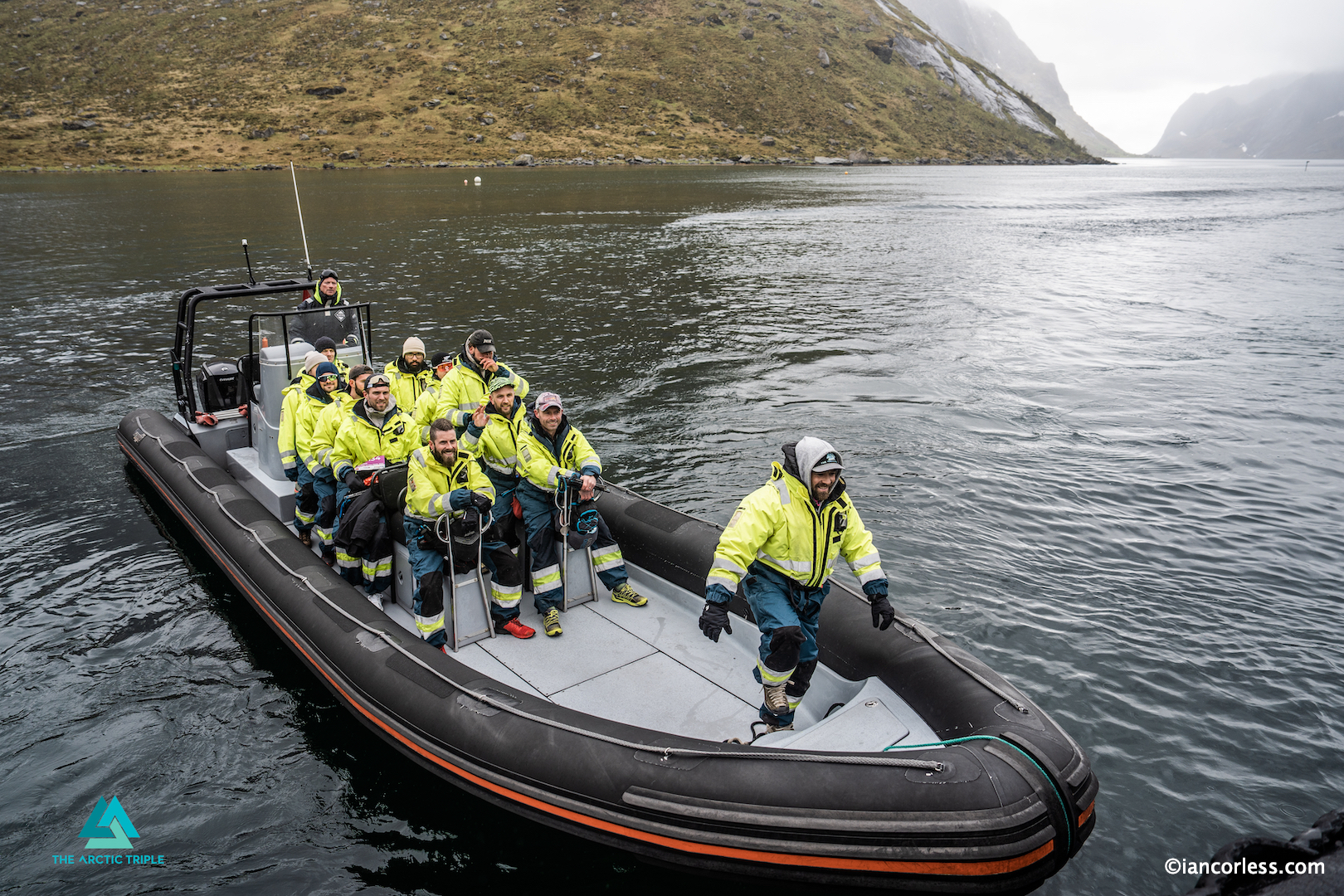
Reine, the classic picture postcard view of Lofoten, is a small fishing village located on the island of Moskenesøya, surrounded by towering mountains, this is where The Arctic Triple experience starts for 160km runners leaving by boat for Kirkefjord, the official start line.
Highlights come thick and fast, the peak of Kråkhammar towering the opening km’s to cp1 at Selford. The beach of Kvalvika is by far the loneliest beach in Lofoten on the way to cp2 at Fredvang. In previous editions, Unstad, Uttakleiv and Haukland beach have been part of the race route, but for 2023, changes were made to accommodate local farmers and livestock. A coastal section from Nesland to Nusjford providing rolling and at time technical trail.
Nusford, like Reine, is a picture postcard fishing village on the southern shore of the island of Flakstadøya. What follows is arguably one of the more challenging sections of the whole race route and the cp at Napp (56km) is a key aid station. The coastal trail loop of Offersøy leads eventually to Leknes, 73km covered and it is here that the 80km race starts.
Now, as the 160km route counts down to the finish in Svolvær, the respective 48km, 24km, and 12km races start. The route from Brustranda climbing up from the coastline into Grønbakkan being a highlight.
Torvdalshalsen and the 48km start leads to Vetten and some challenging terrain before climbing a steep wall of grass and a race highlight of Dalstuva ridge. Road miles follow and now, with approximately 20km’s to go, the route enters the whammy of Jordtinden, Nonstinden, Spisstinden and finally Tjeldbergtinden before finally arriving in Svolvær, exhausted!
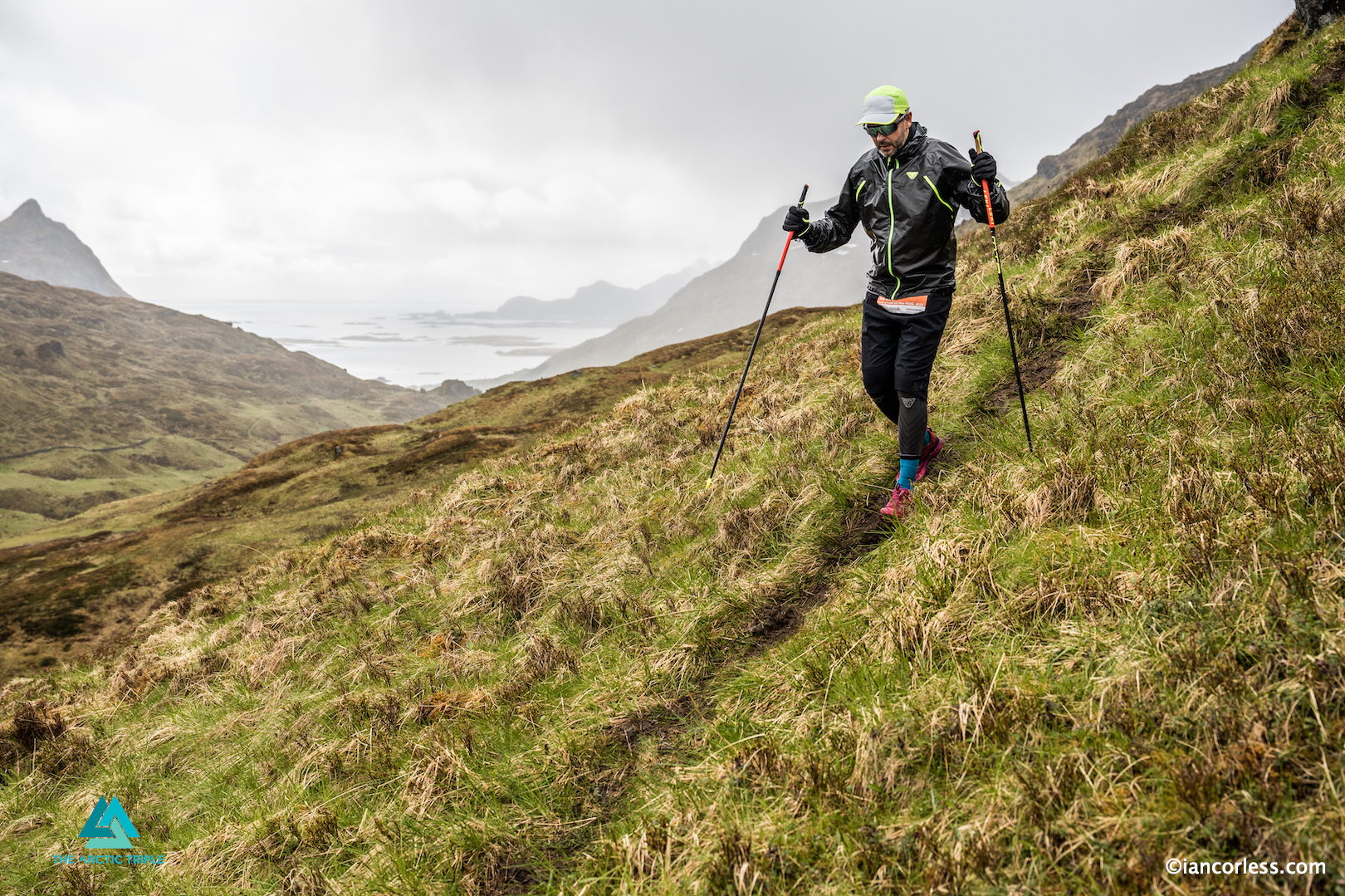
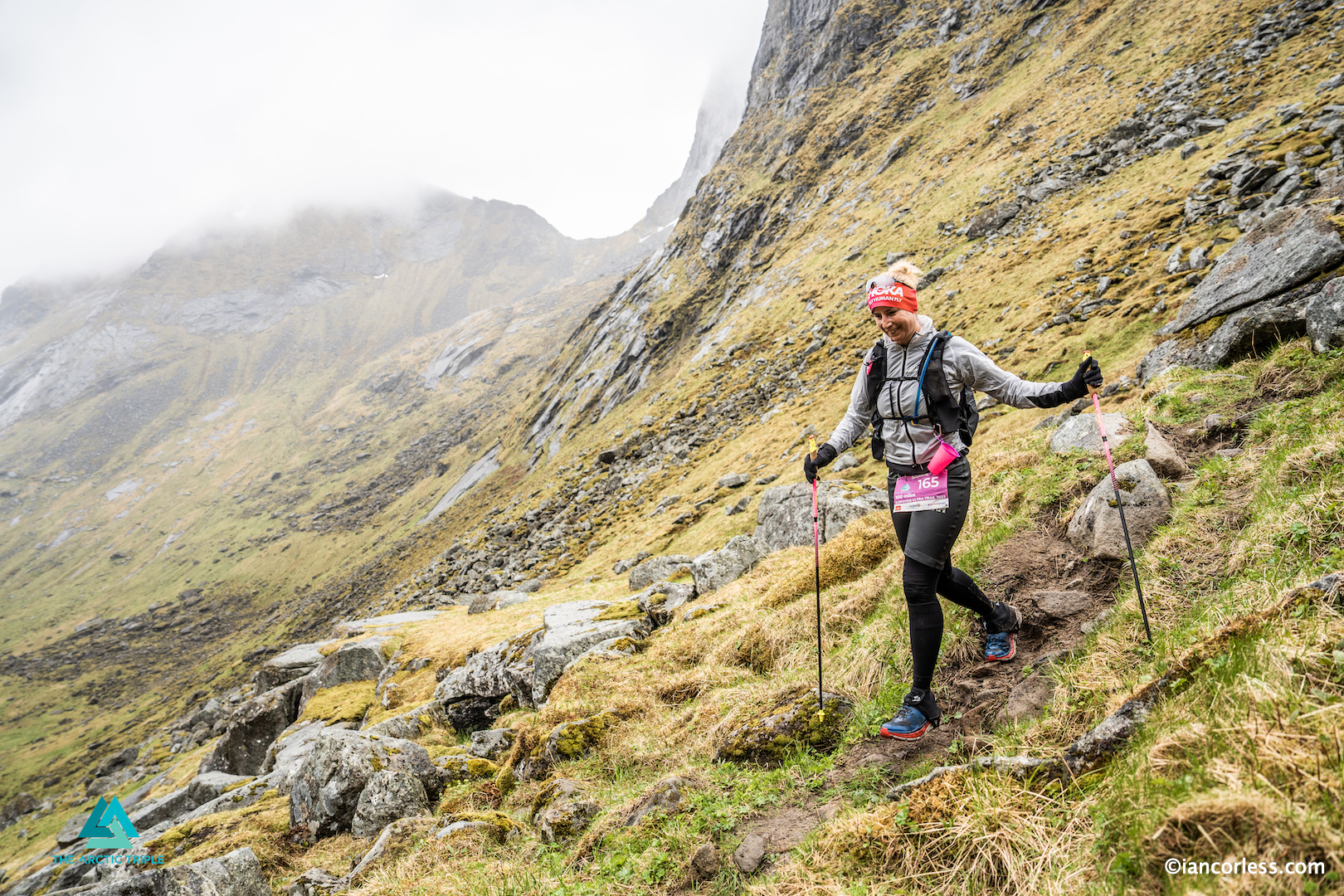
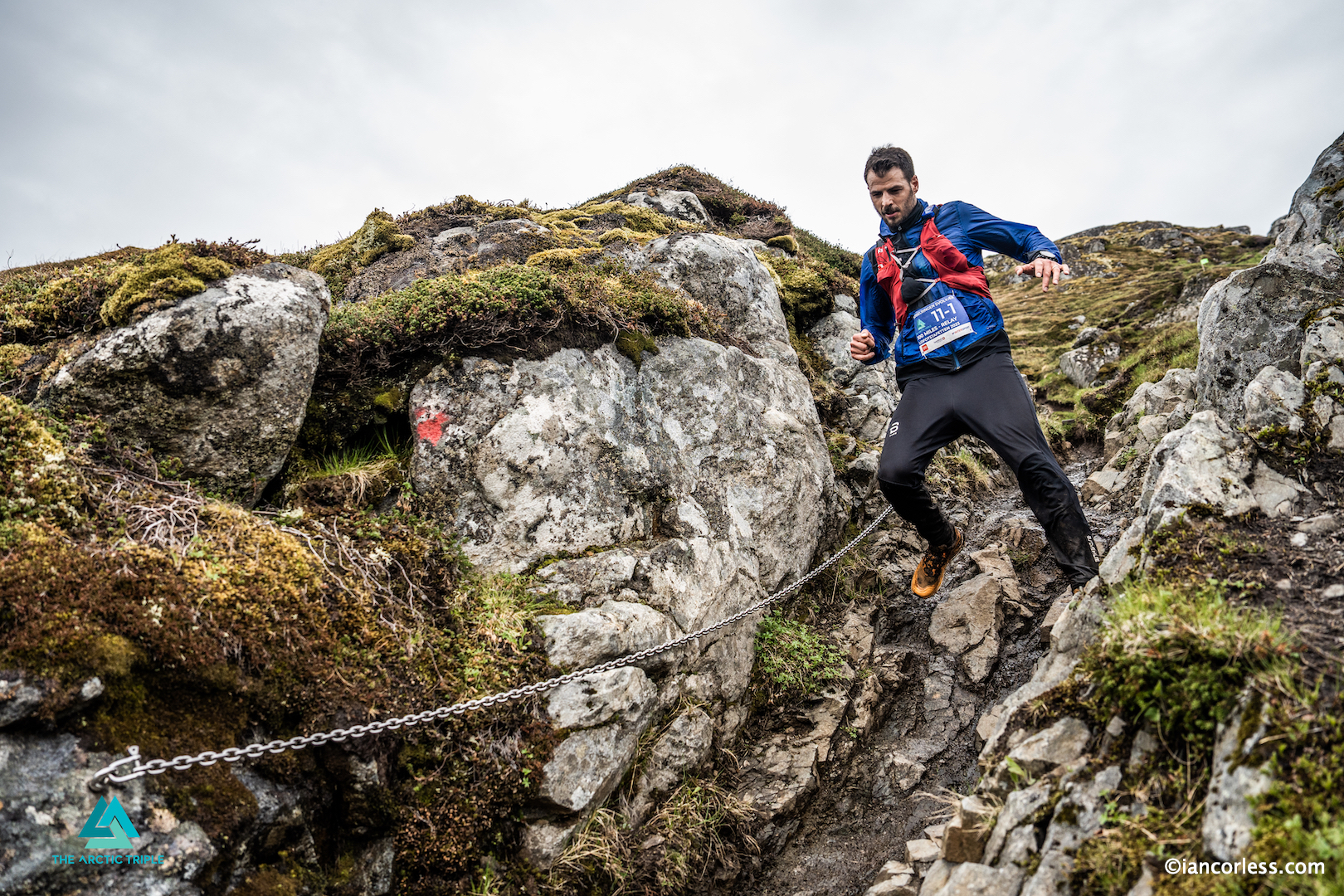
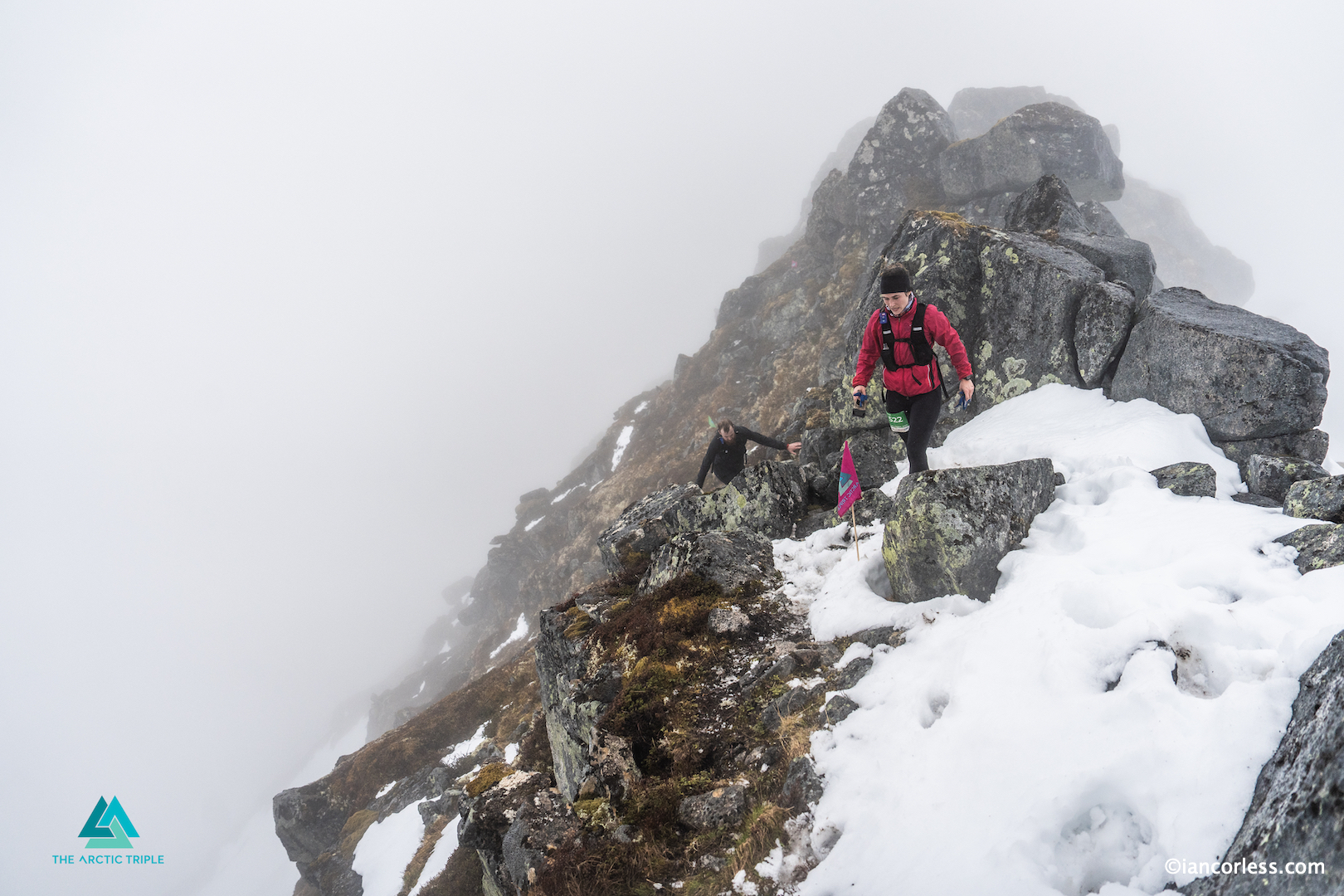
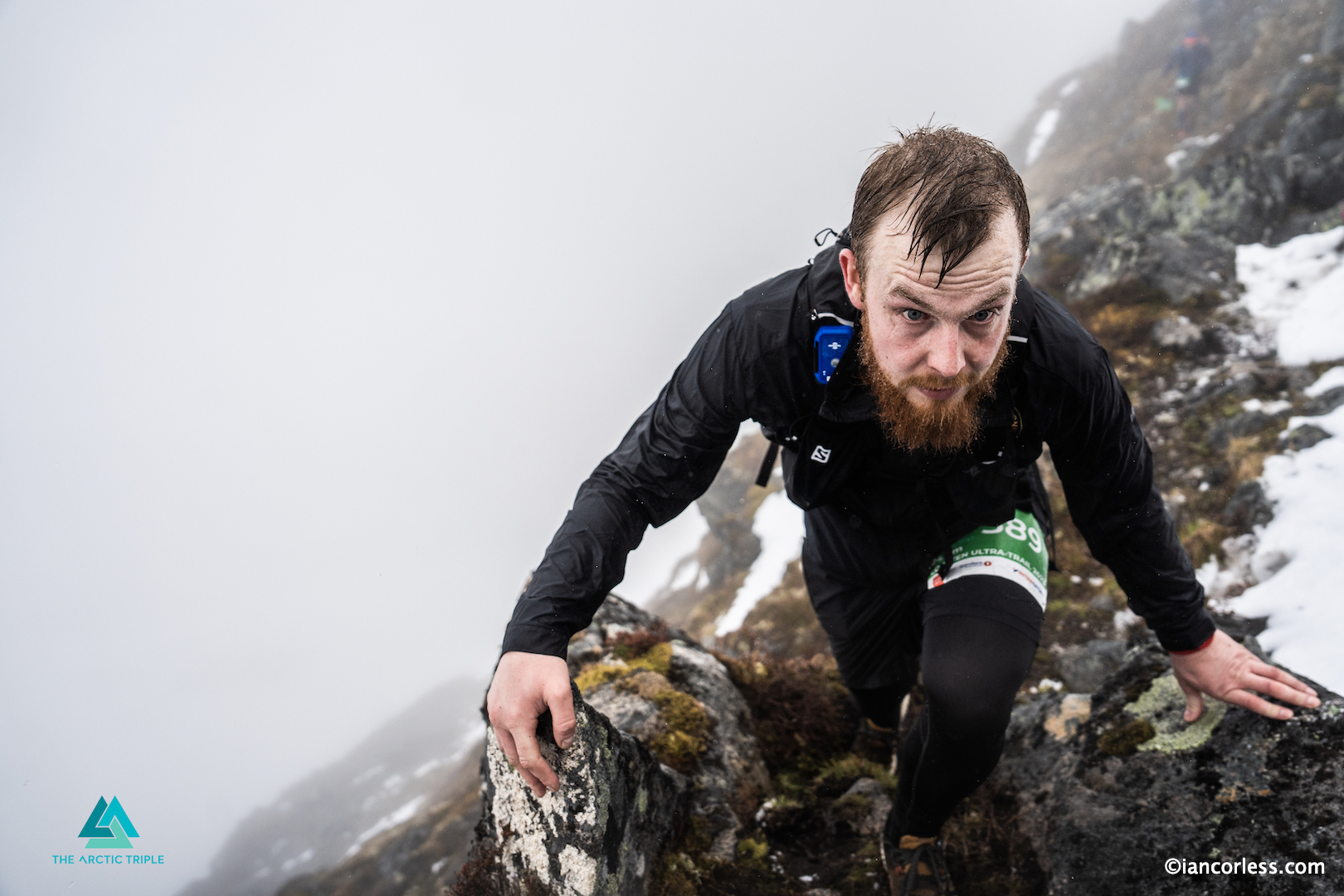
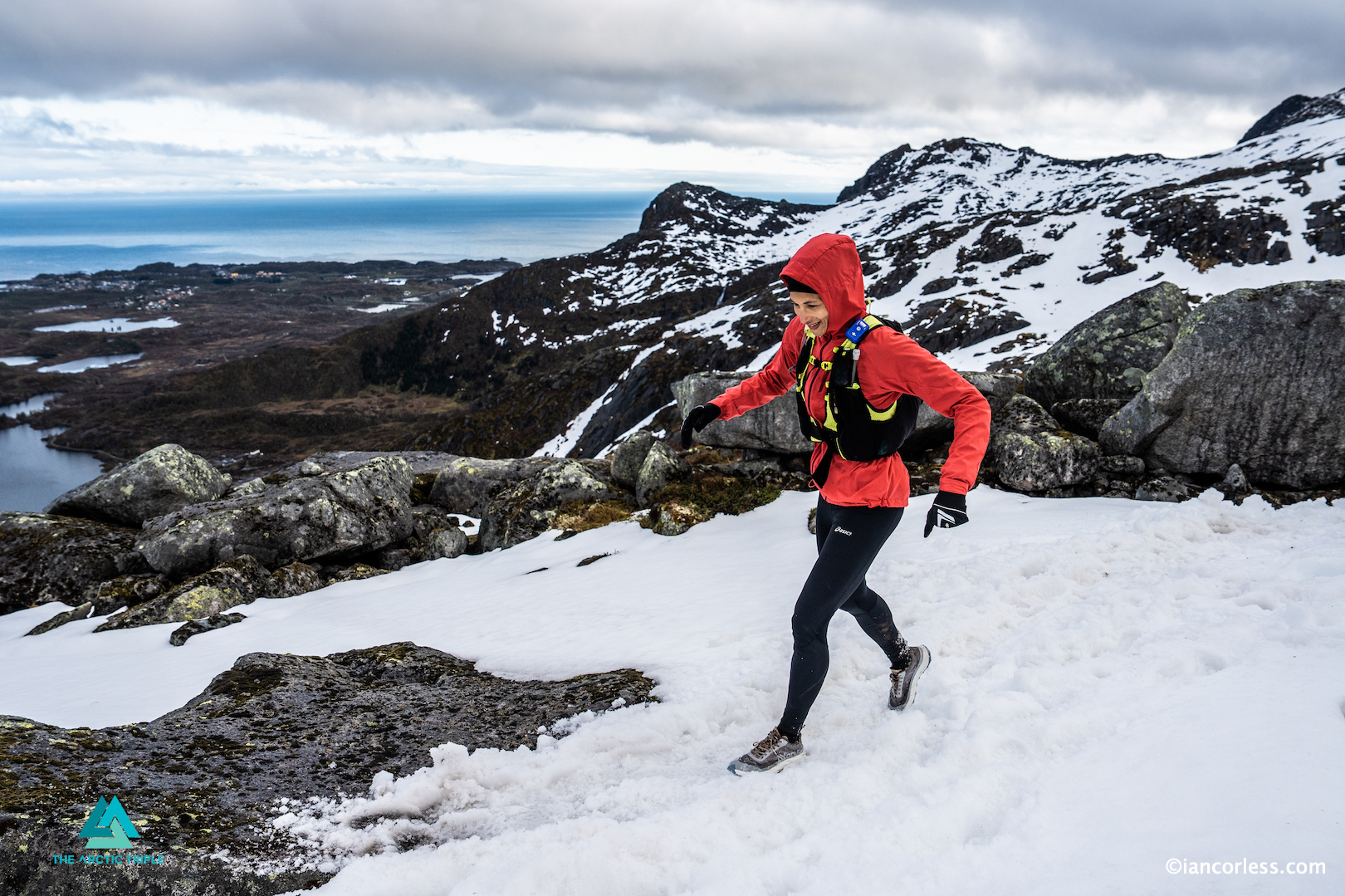
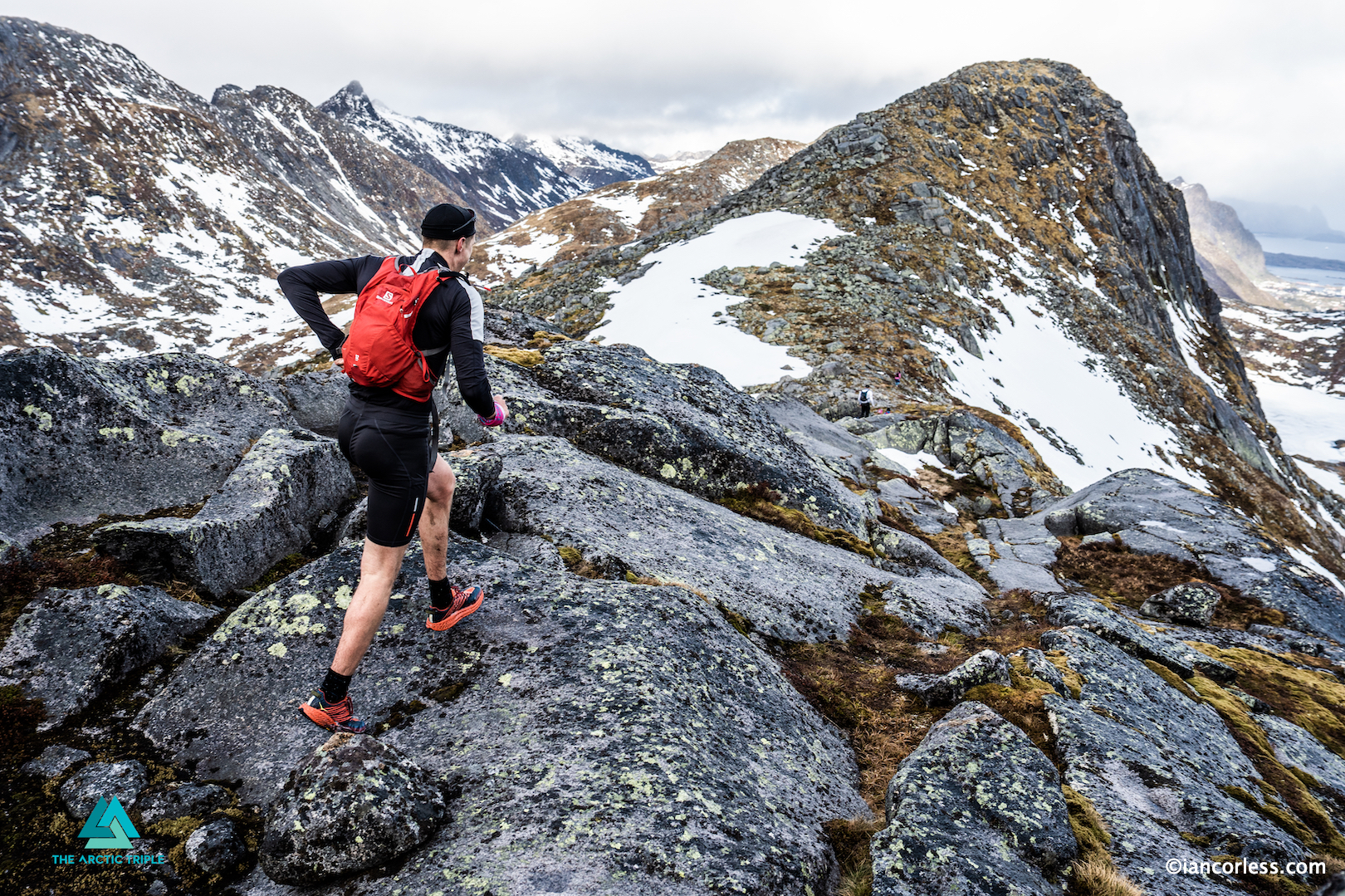
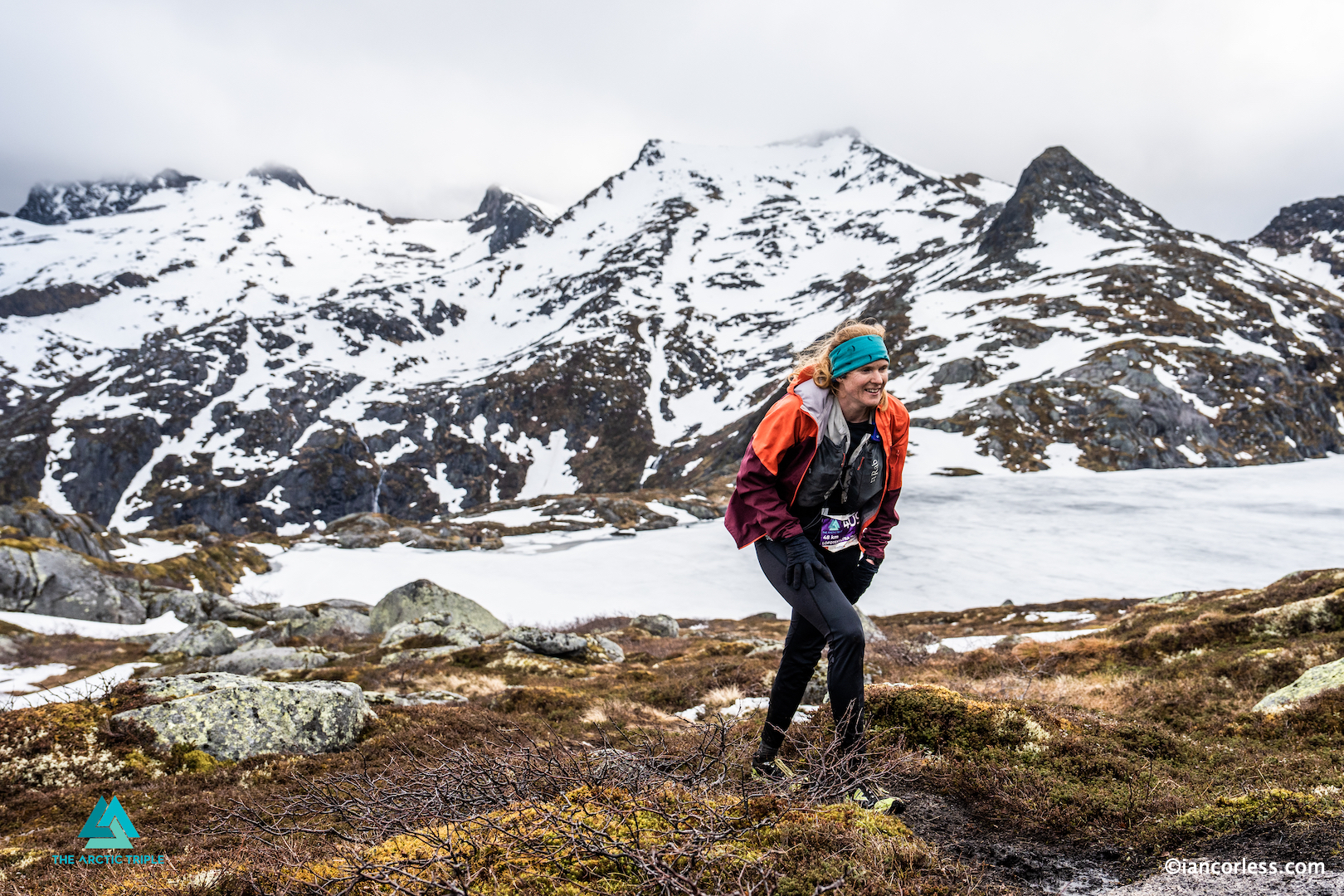
Lofoten, on foot, is relentlessly beautiful and challenging and for 2023, even more so, with persistent rain, strong winds at time varying amounts of snow; the final section over Nonstind, Spisstind and Tjeldbergtinden providing an even greater challenge with recent snowfall, varying levels of visibility and cold temperatures.
“You run on some absolutely fantastic trail, and you are constantly surrounded by sea and lush mountains. It is a raw experience, steep mountain sides, narrow edges and 100% concentration is required. There are airy parts that offer a challenge and incredible views. Single-track, road, marshland, dense forest, mud and views to make my eyes sore – what a place Lofoten is!” – Abelone Lyng
Ultimately, Lofoten is a magical paradise that is waiting to be explored. There is so much to do and see that one trip will not be enough and it will only whet the appetite for future visits and plans.
However, if you need an introduction to this magical part of the world, signing up for one of The Arctic Triple races would be a great introduction. Of course, the 160km race provides the ultimate point-to-point immersive experience from Reine to Svolvær, for many though, this is too far and too challenging, but watch this space, new for 2024 (in addition to the 160km single-stage) the 160km race will be broken down in to four stages and offer Norway’s first multi-stage race (more info HERE), it will provide a full and immersive experience.
160km, 80km, 48km, 24km, 12km or the new stage race, running The Arctic Triple lets you experience the nature, views and atmosphere of Lofoten – there is no better way to experience any place!
Day 2 was tough. It was a challenging route, incredibly beautiful but the added technicality, vertical gain and intense heat took its toll with many DNF’s.
The organisation made a decision to bring the stage 3 start forward by 1-hour, 0700 instead of 0800. It maybe caused some logistical, admin and timing issues for all but it was a good call.
At 34km, stage 3 had less challenges than stage 2, but still a tough day.
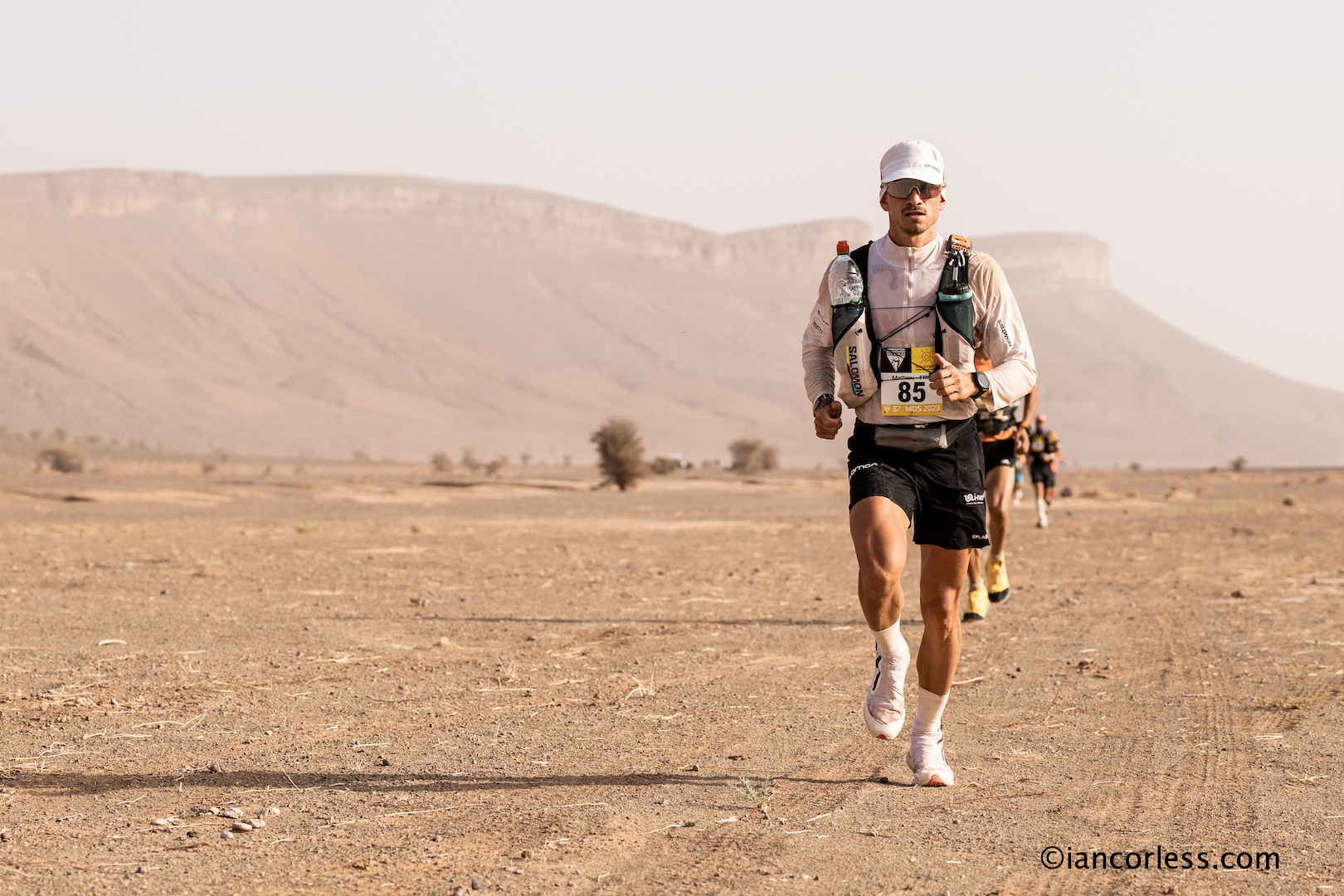
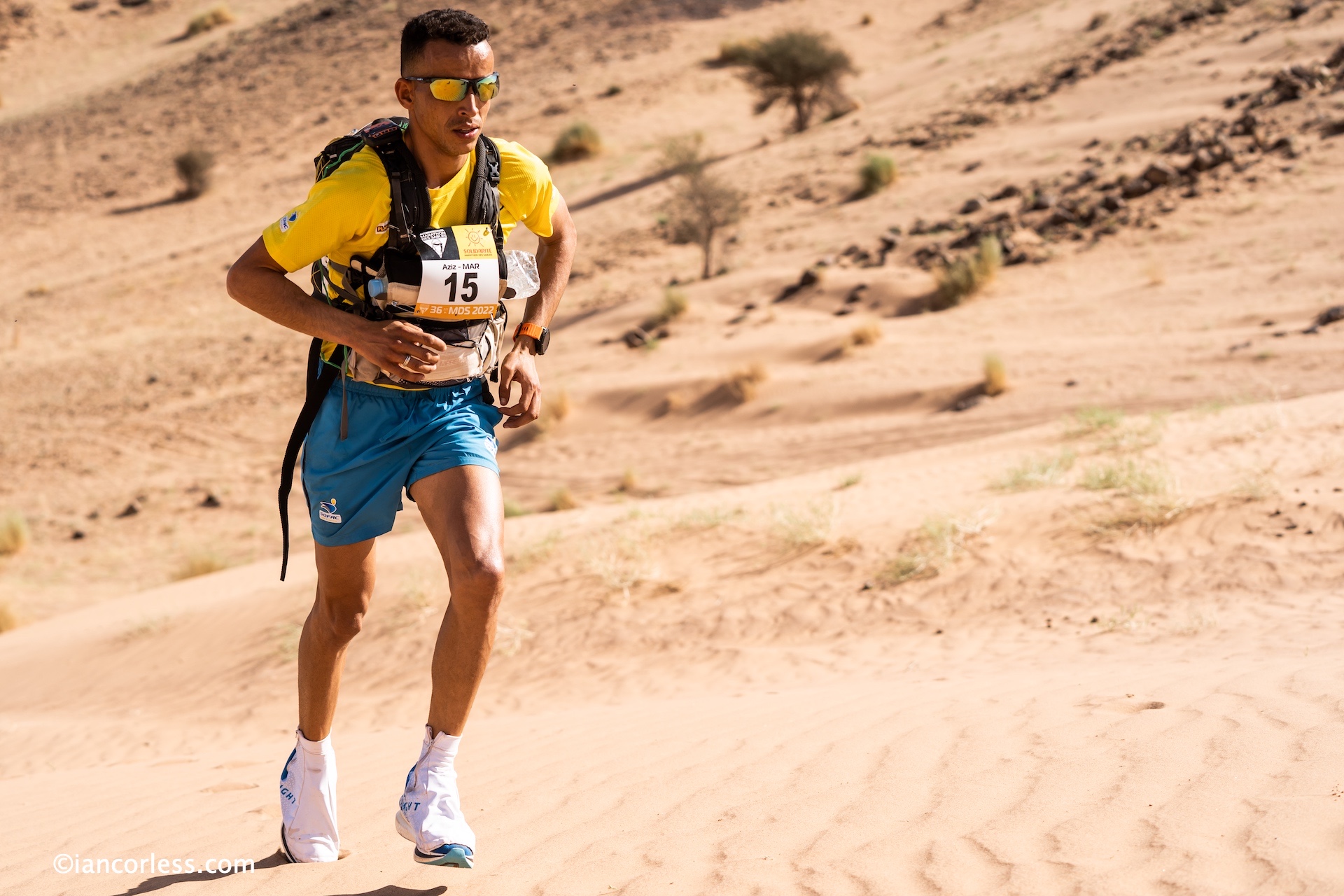
With flat km’s to Cp1, the pace was high and Mathieu Blanchard was a main protagonist. He often pushed the pace, closely followed by Aziz, Mohammed and Rachid.
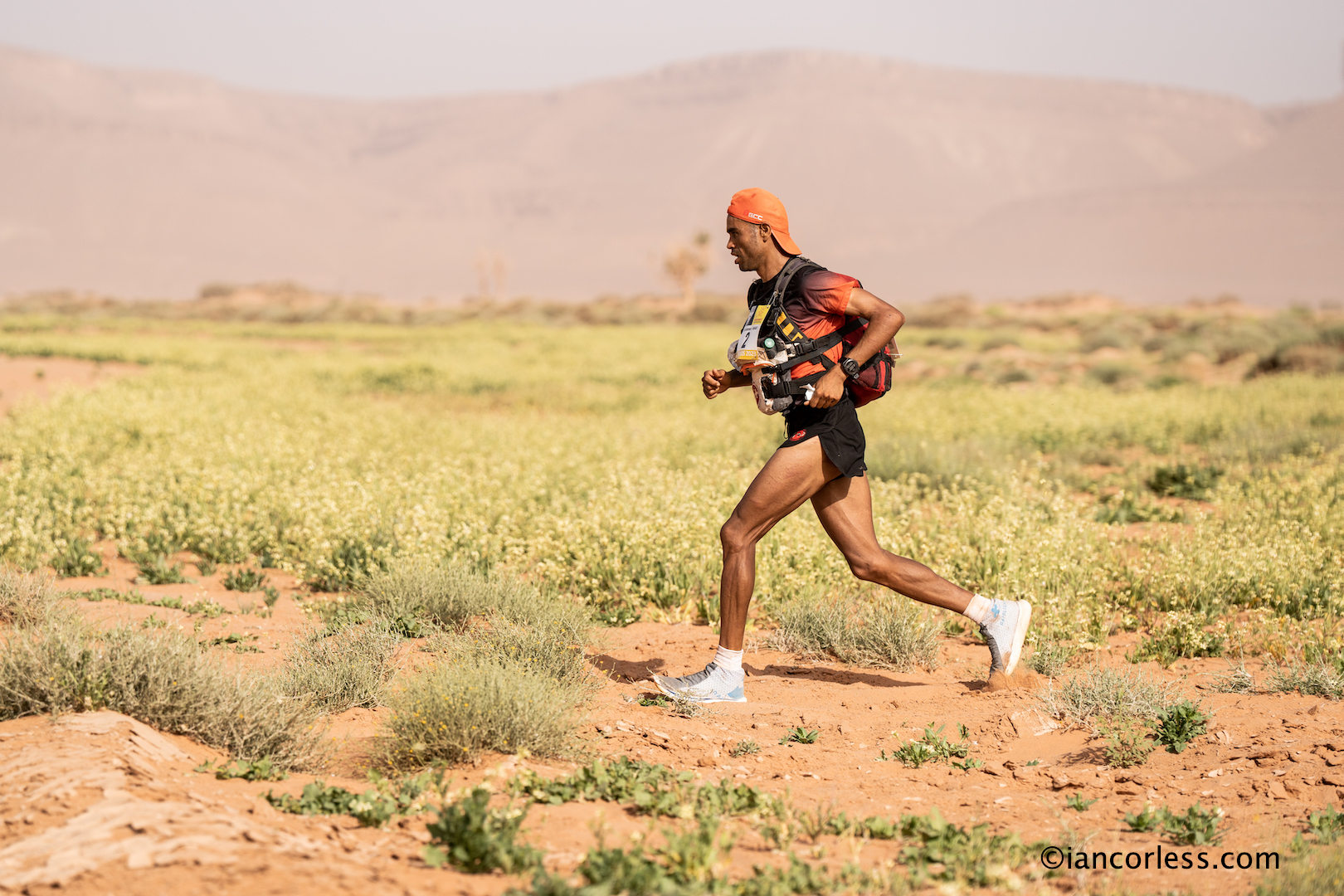
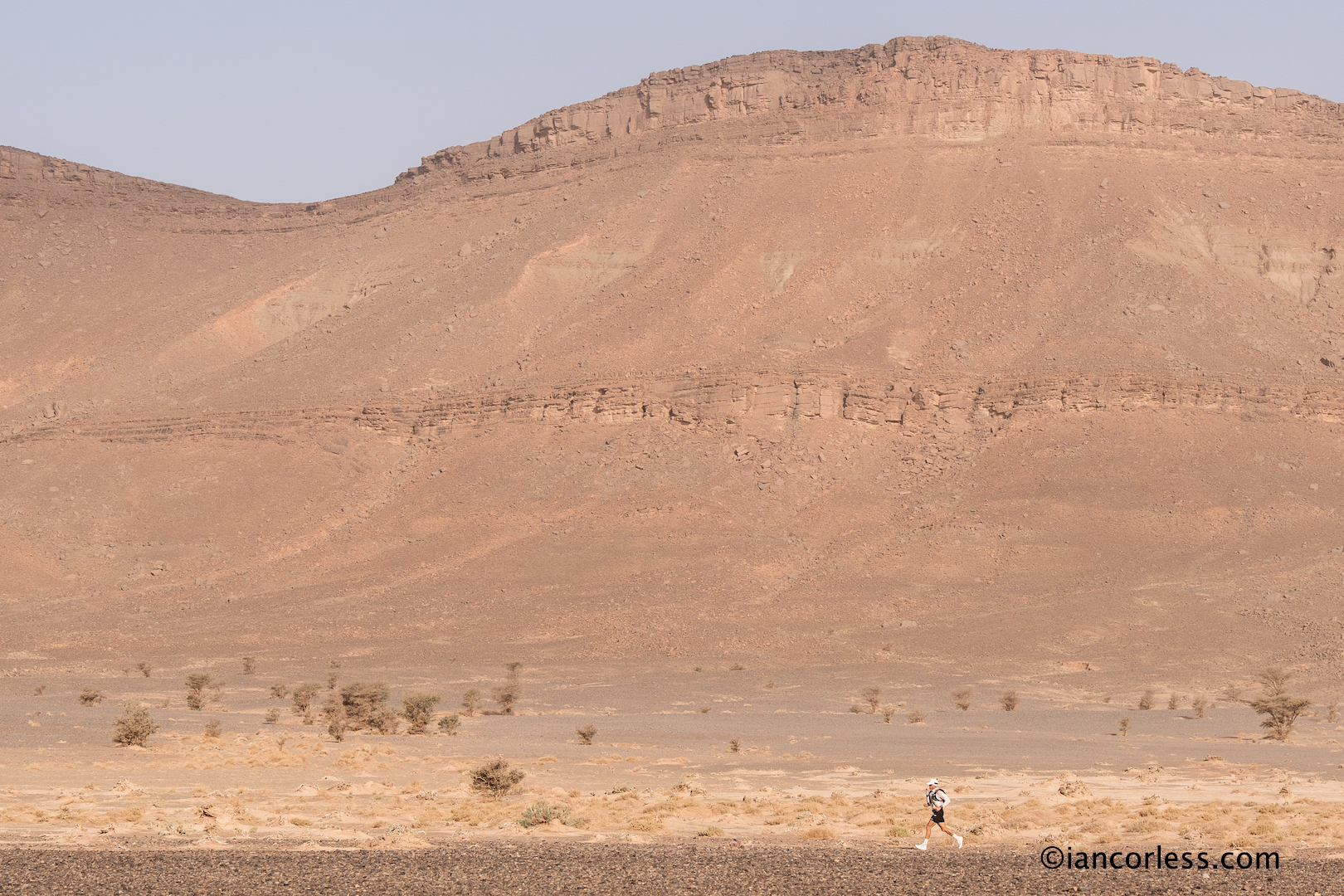
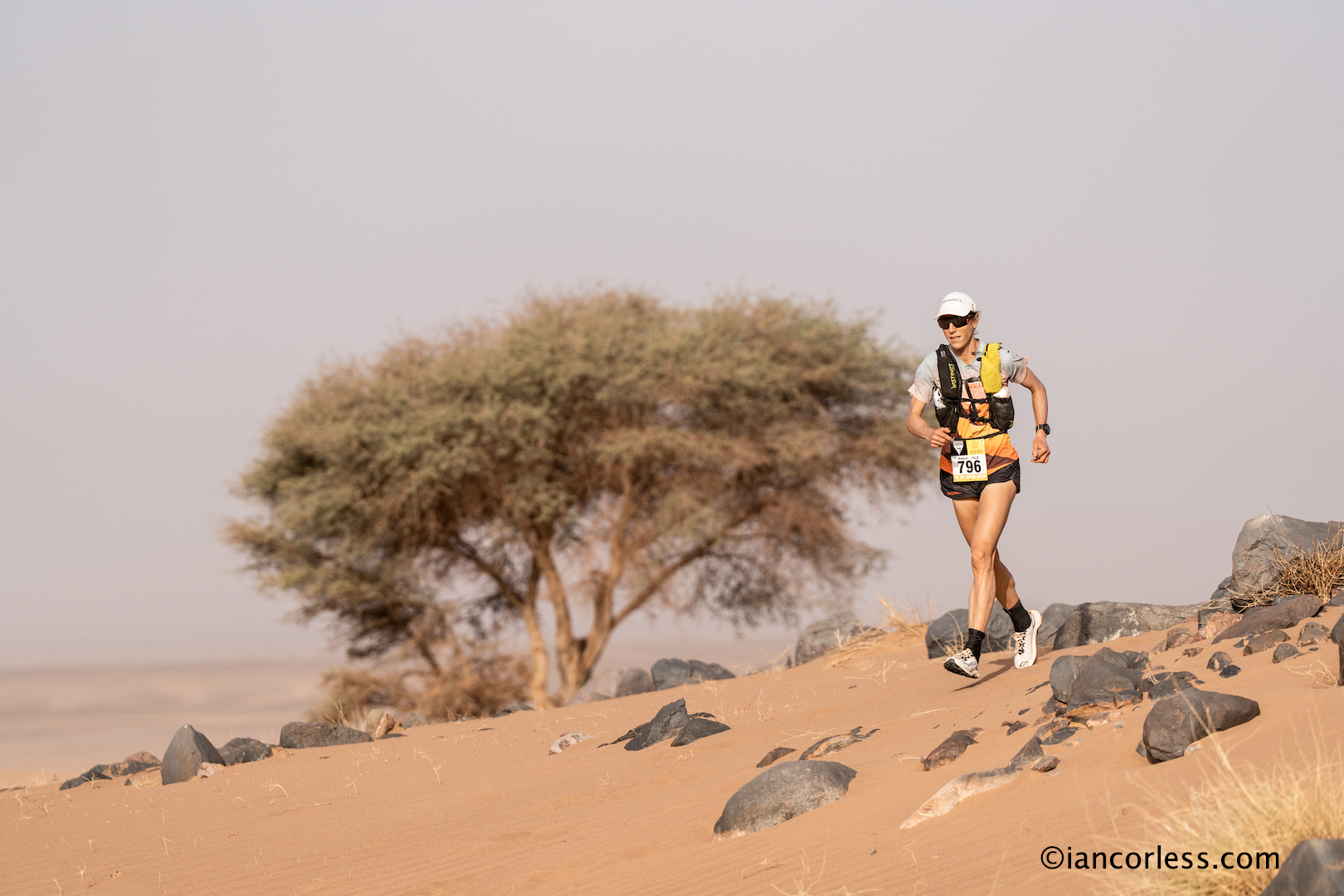
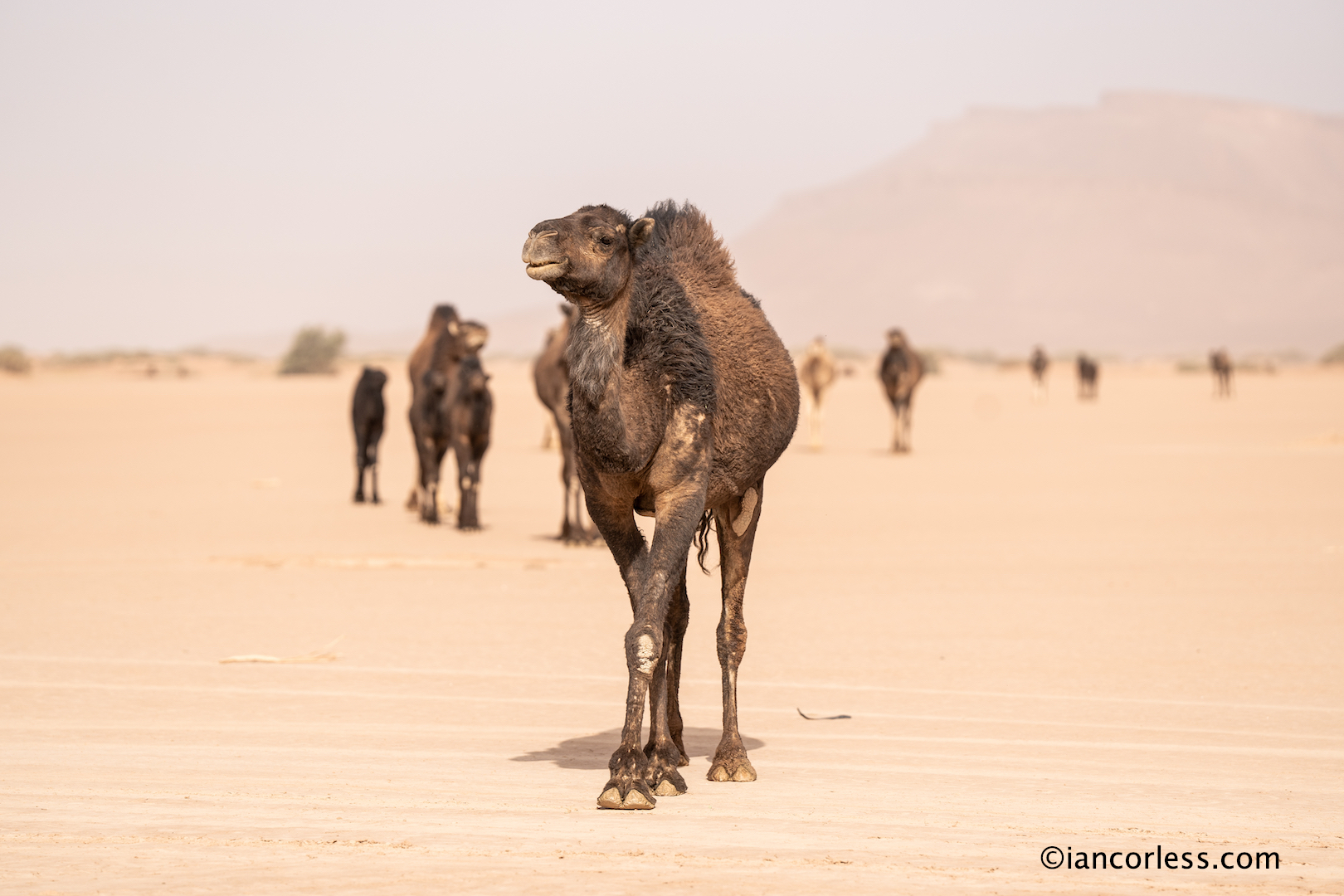
After Cp2 a resplendent area of green vegetation brought a different life to the Sahara. Camels, birds and reptiles, rare to see so much wildlife in one area.
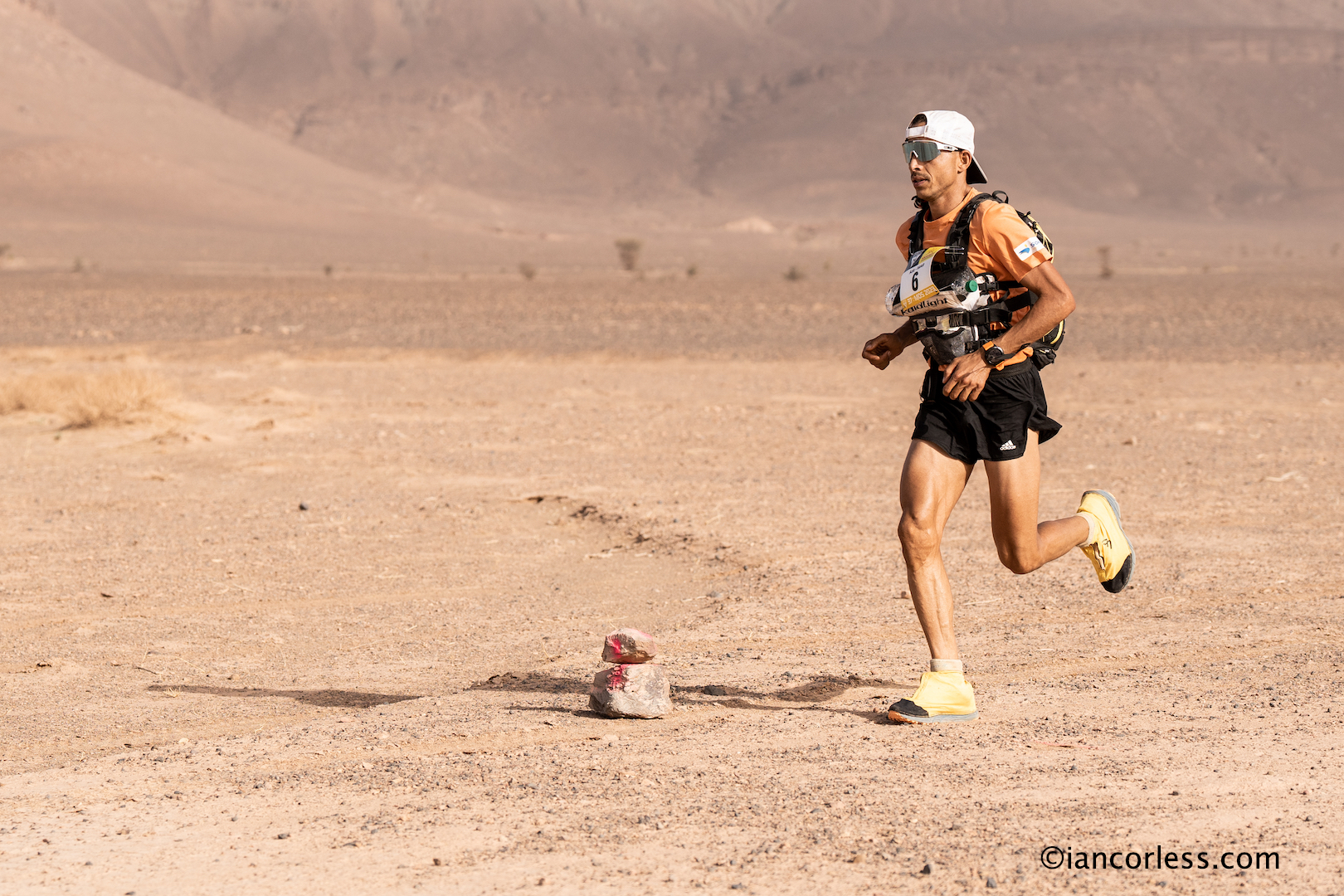
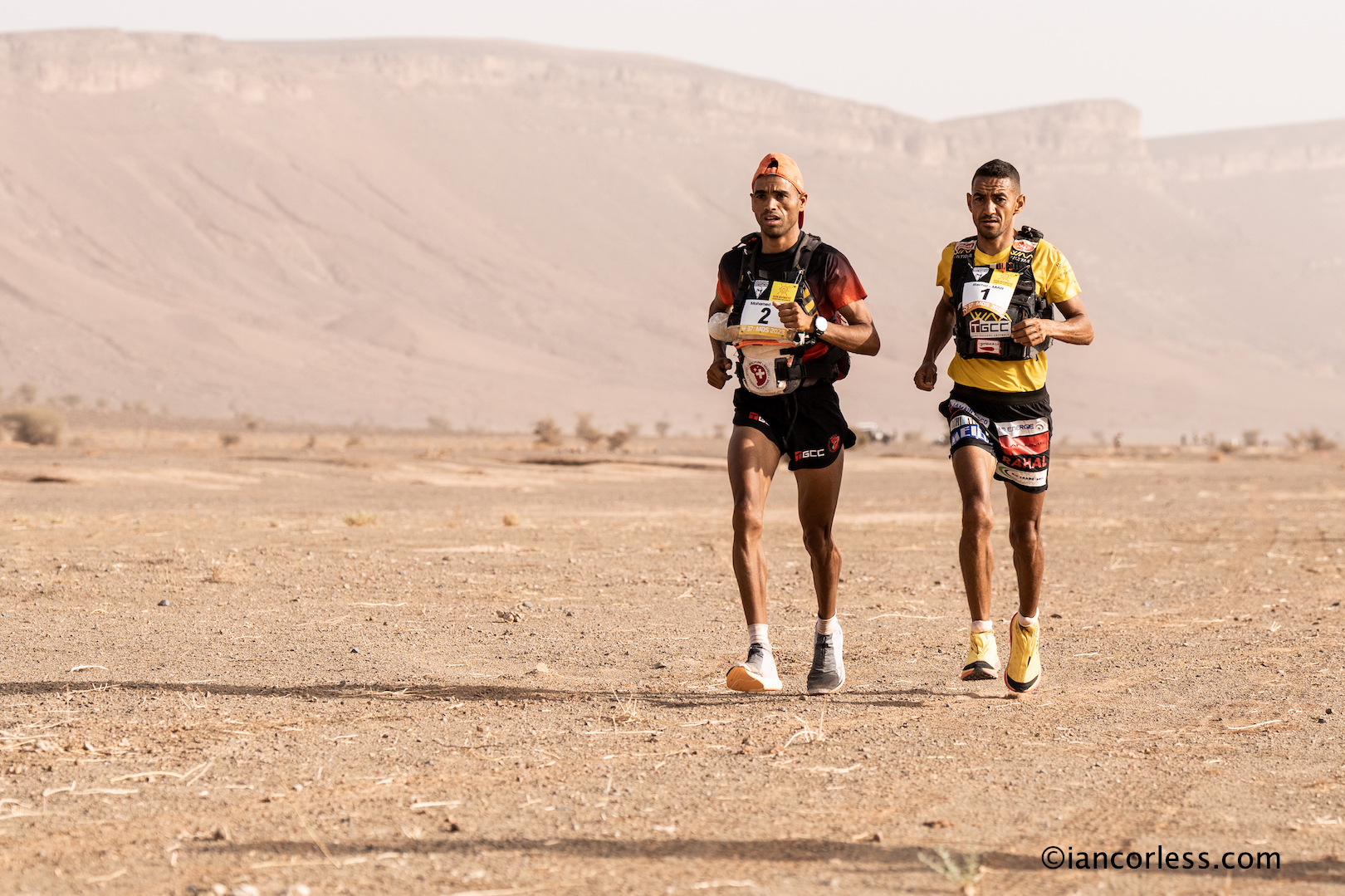
As I expected, Mohammed attacked and not only took the stage but the overall lead. It’s what I expected. The ‘brothers’ have a plan for the long day, but, at 90km’s, anything can happen.
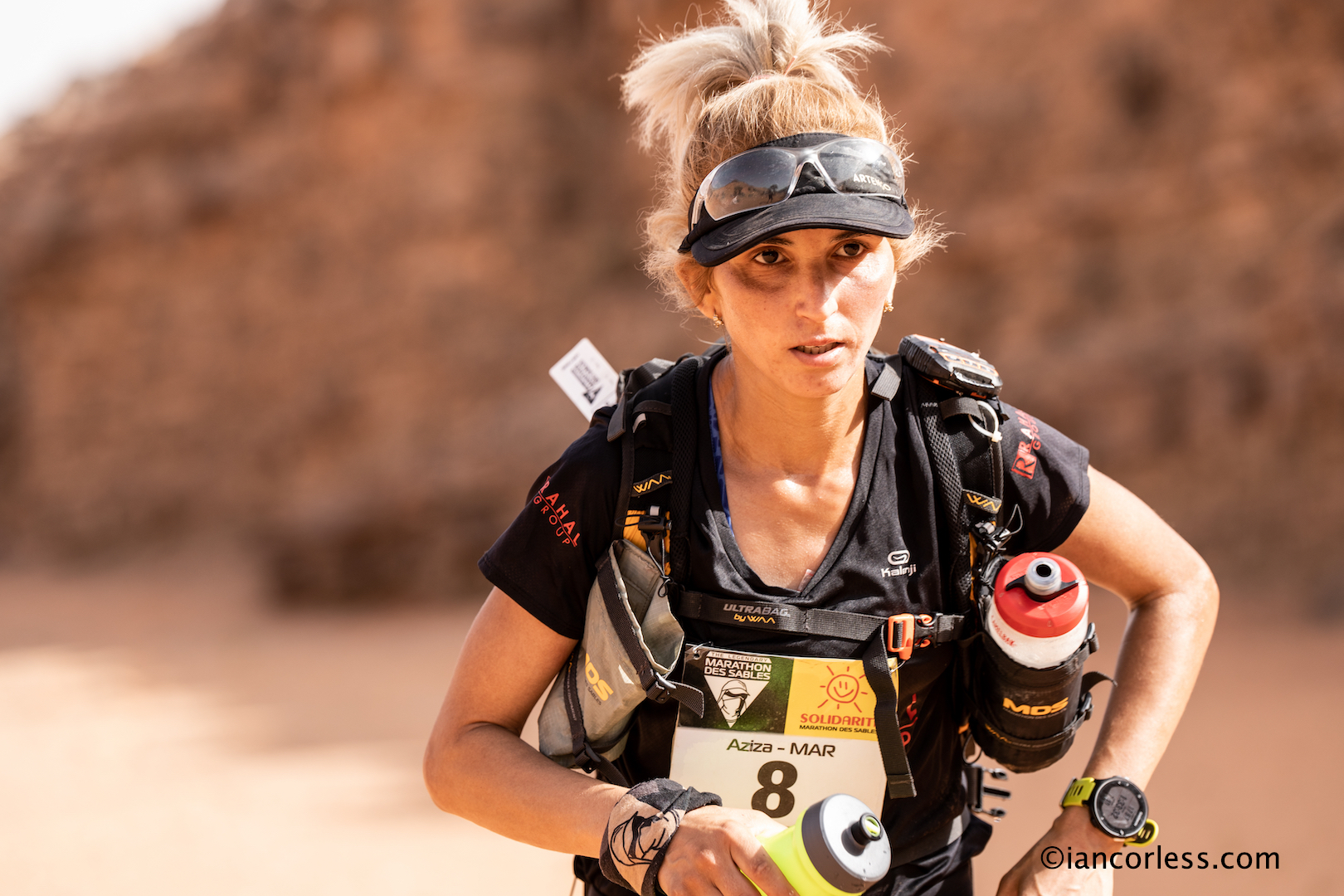
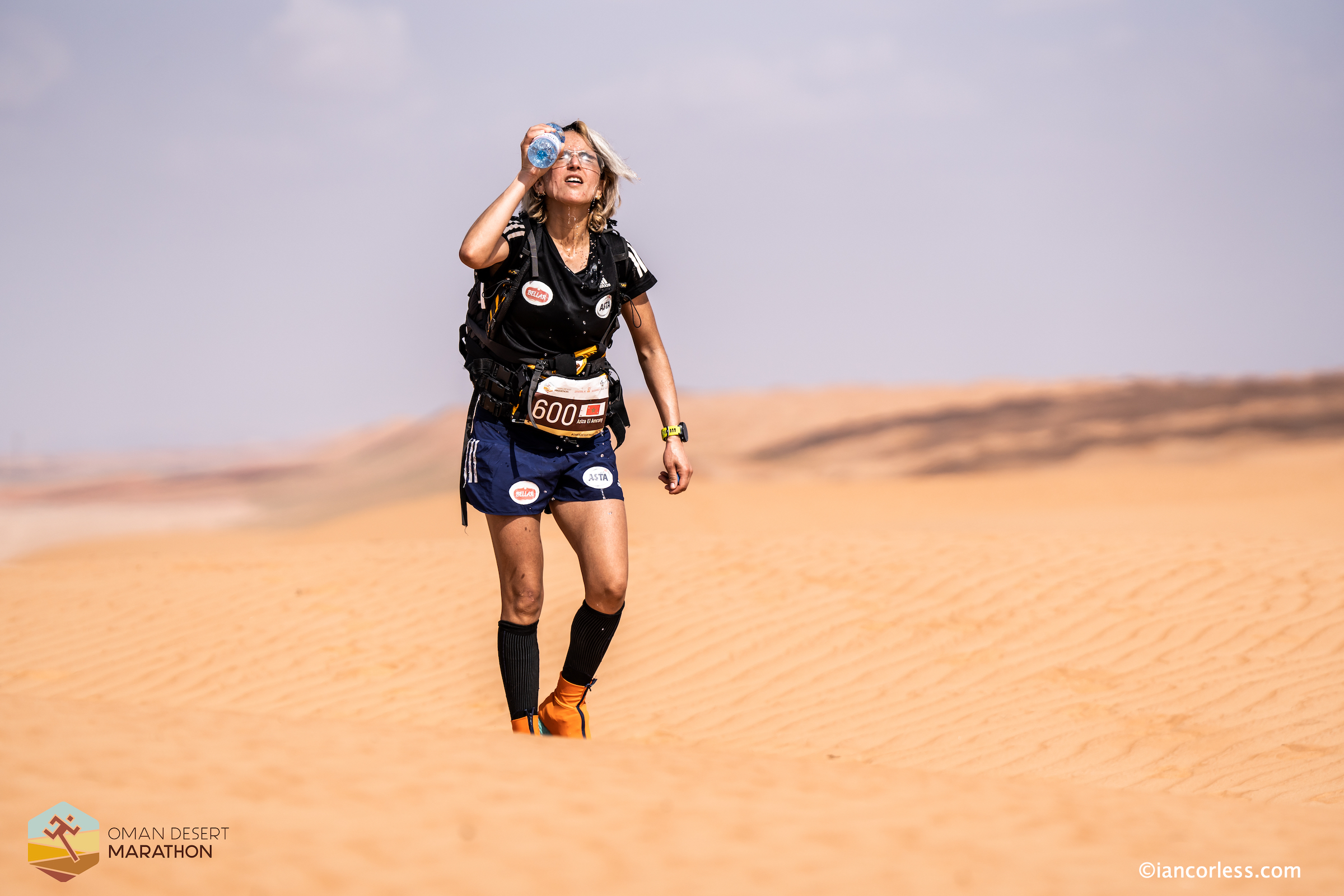
For the women, it was business as usual with Rgna leading. But, after Cp1 she went through a bad patch and Aziza El Amrany took over the front of the race with Ragna complaining of, ‘…feeling fine and lacking power.’
Maryline Nakache once again ran a strong and consistent stage to not only catch Aziza, pass her and put time into her, the duo finishing in 3:4104 and 3:42:36.
Tomorrow is the big day! It’s beautiful route with some MDS classics in the terrain. At 90km, it will be extremely tough for all. The race will start 1-hour earlier than planned, 0700. The top-50 will start at 1000.
The 2023 MARATHON DES SABLES draws near and as usual, here is a preview of the coming edition. We will look at the top contenders for the male and female podiums, provide an overview of MDS history and look at some crazy statistics.
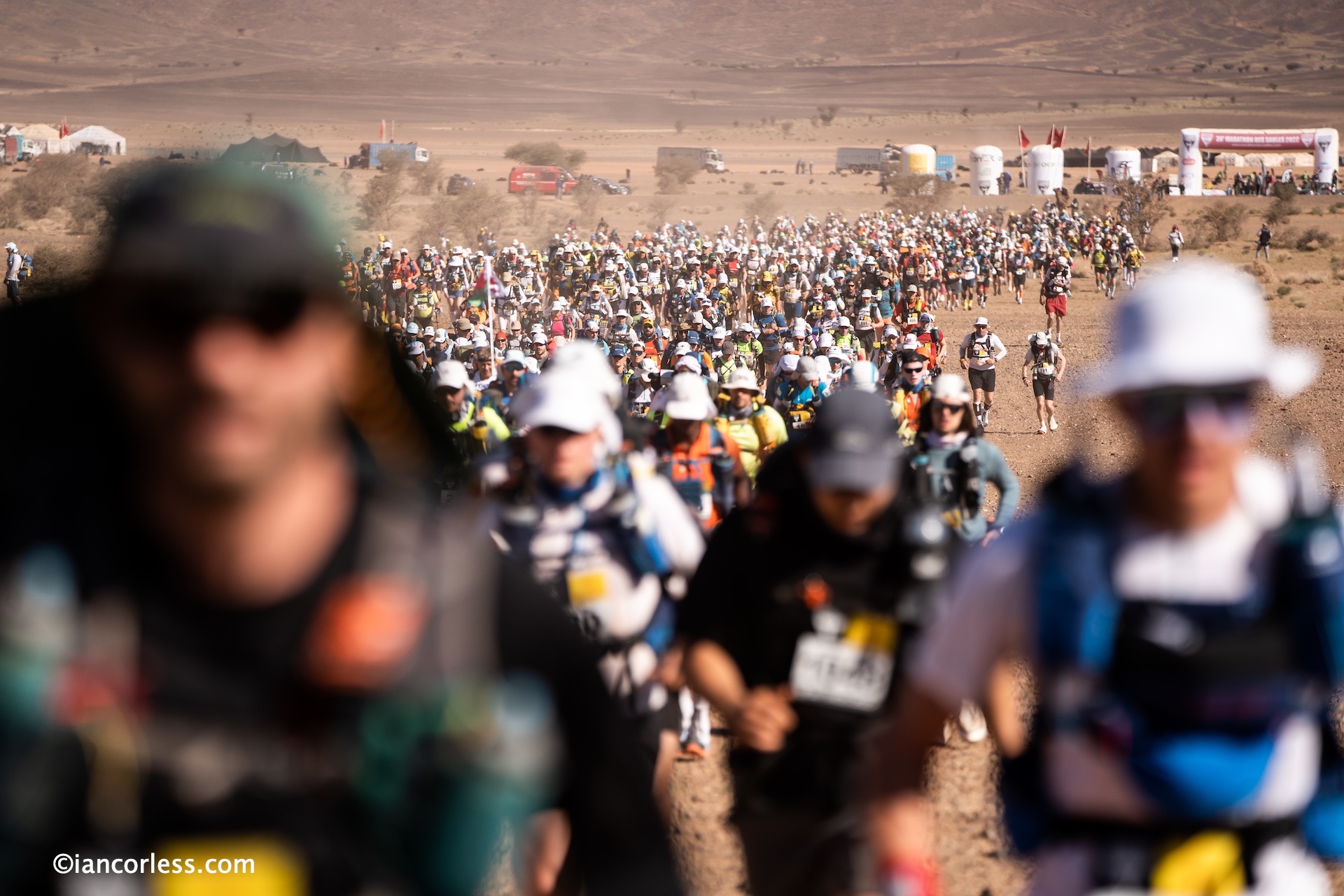
Since 1986, well over 22,000 participants have raced at the Marathon des Sables and we have record (or close to record) for 2023, with1200+/- toeing the line. As per usual, the race is multi-national with over 50 represented. The French and British providing the largest contingent.
THE TOP MEN AND WOMEN
Rachid El Morabity returns looking for his 10th victory, all eyes will be on him, but he is in for a fight! 2019 female champion, Ragna Debats returns and is without doubt the hot favourite for the top of the women’s podium.
THE WOMEN RACE
Ragna Debats
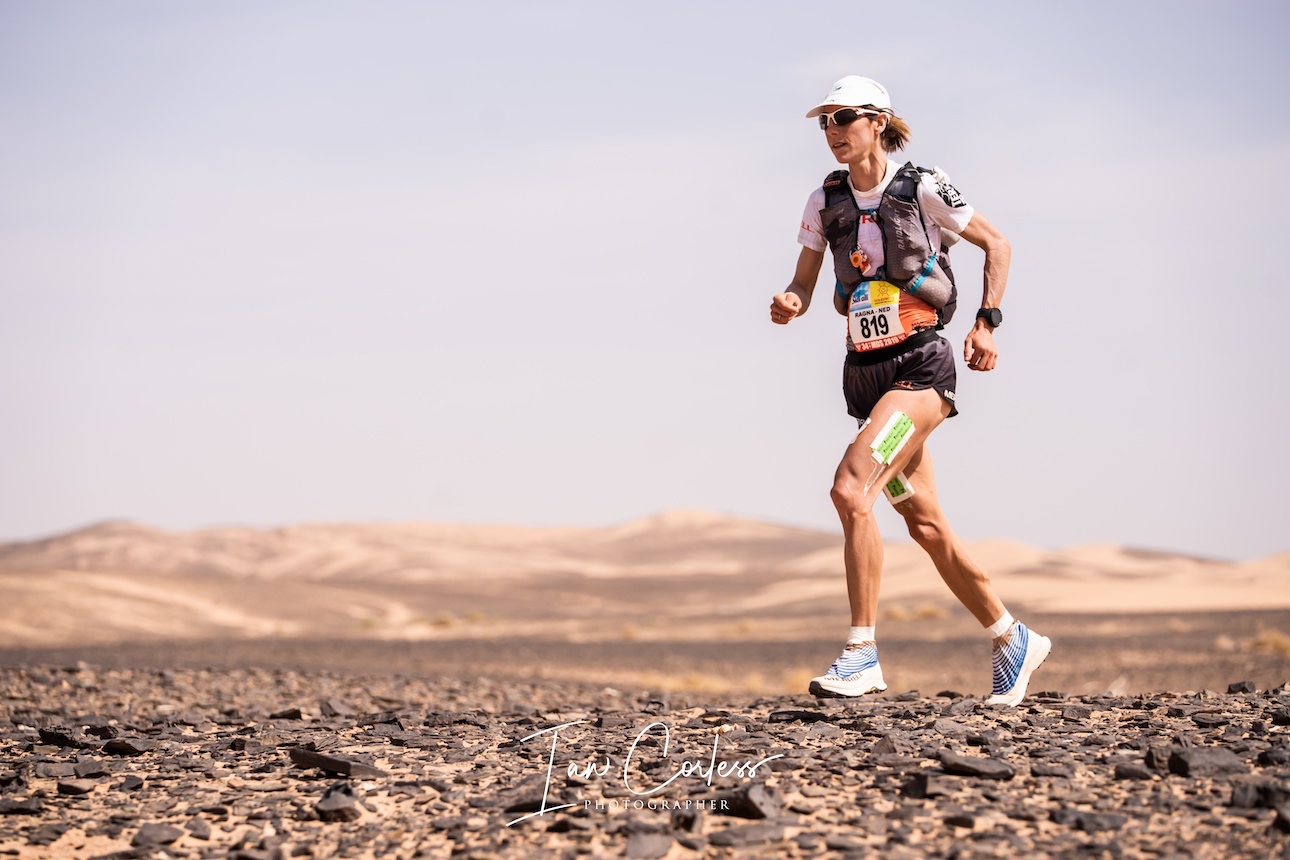
Ragna Debats dominated the race in 2019 and in recent years has become one of the top trail, ultra and skyrunner’s in the world. When in form, she is incredibly difficult to beat. In 2022 she had an incredible season with four top victories, Transgrancanaria 129km, Istria by UTMB, Montreux Trail Festival and the 100m Nice Côte d’Azur by UTMB. Ragna has had a relatively quiet start to 2023 and recently she has changed her coach of 13-years. She will be meticulously prepared for MDS 2023.
Gemma Game
Gemma Game from the UK has been on the podium of MDS twice, 2018 and 2019, on both occasions placing 3. Gemma most definitely can win MDS but, as she will tell you, she runs for fun and MDS is an escape from a very busy and hectic life with a high-powered job and family. Is she wants to, she will be on the podium again in 2023.
Manuela Socco from Belgium is not a runner I am very aware of; however, two results stand out, victory at Cappadocia Medium Trail in 2019 and Tarawera 100km in 2020. She has also represented Belgium at the Olympic Games in the marathon distance. With a 35min 10km, a 1:16 half marathon and a 2:37 marathon, she has all the running fire power to create a stir in the Sahara.
Maryline Nakache from France has a string of top results, she often wins! However, stand-out markers come from Templiers (3rd) 90km du Mont-Blanc (3rd), CCC (5th) Transgrancanaira Advanced (1st), Tenerife Blue Trail (1st), UTMB (6th) and in 2022 alone she was never out of the top-5.
Tomomi Bitoh
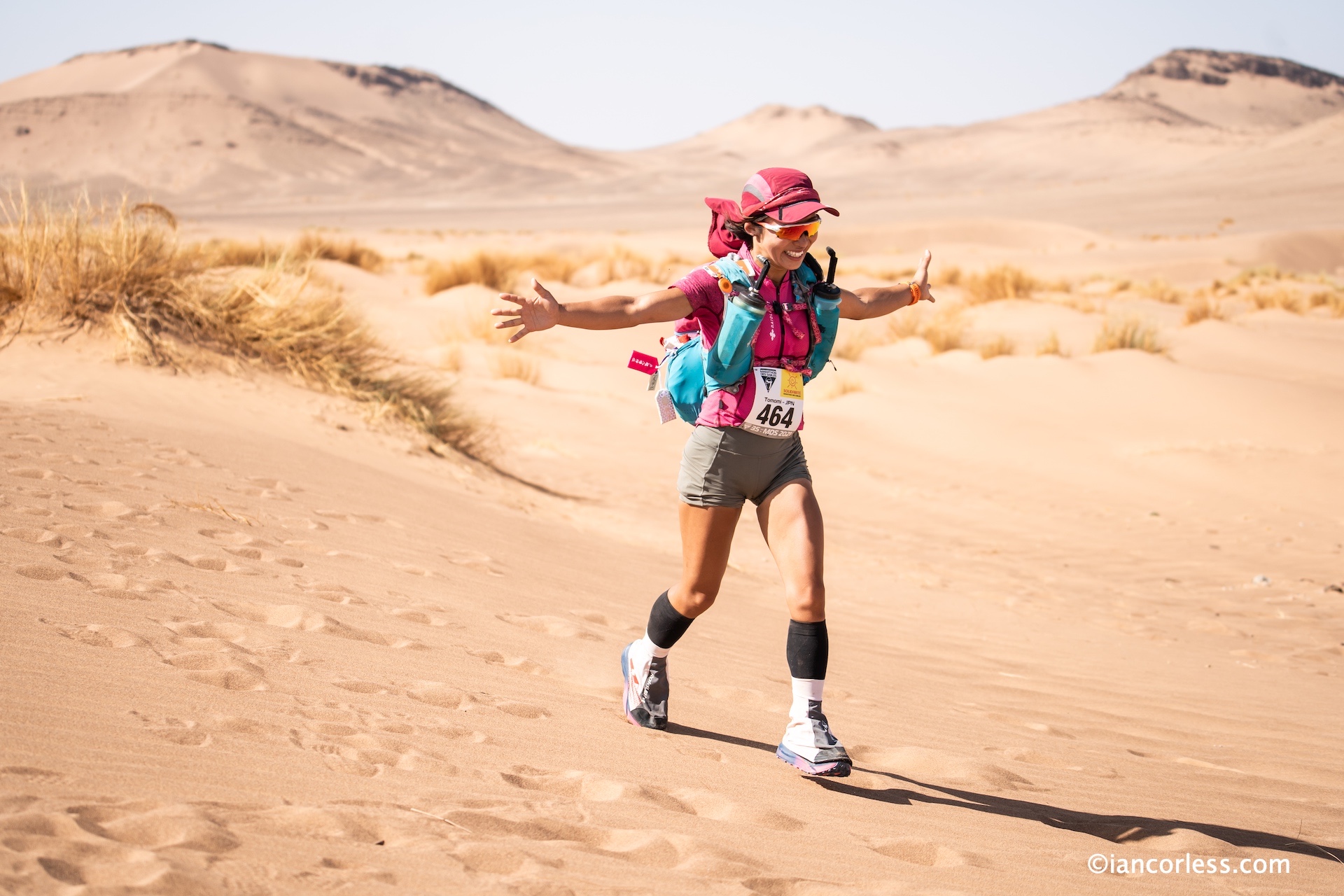
Tomomi Bitoh from Japan was 3 in the 2021 MDS and has recently participated in The Coastal Challenge in Costa Rica. She is an incredible personality, a fierce competitor and although the podium is a possibility in 2023, I feel that she will just be outside the top ranking.
Elise DELANNOY (France) was 18th in the 2016 MDS in 38-hours. This is a long way off the pace required to podium in 2023… But a great deal has happened since then, notably a 7th place at UTMB in 2019, so, Elise cannot be ruled out of shaking up the front of the race.
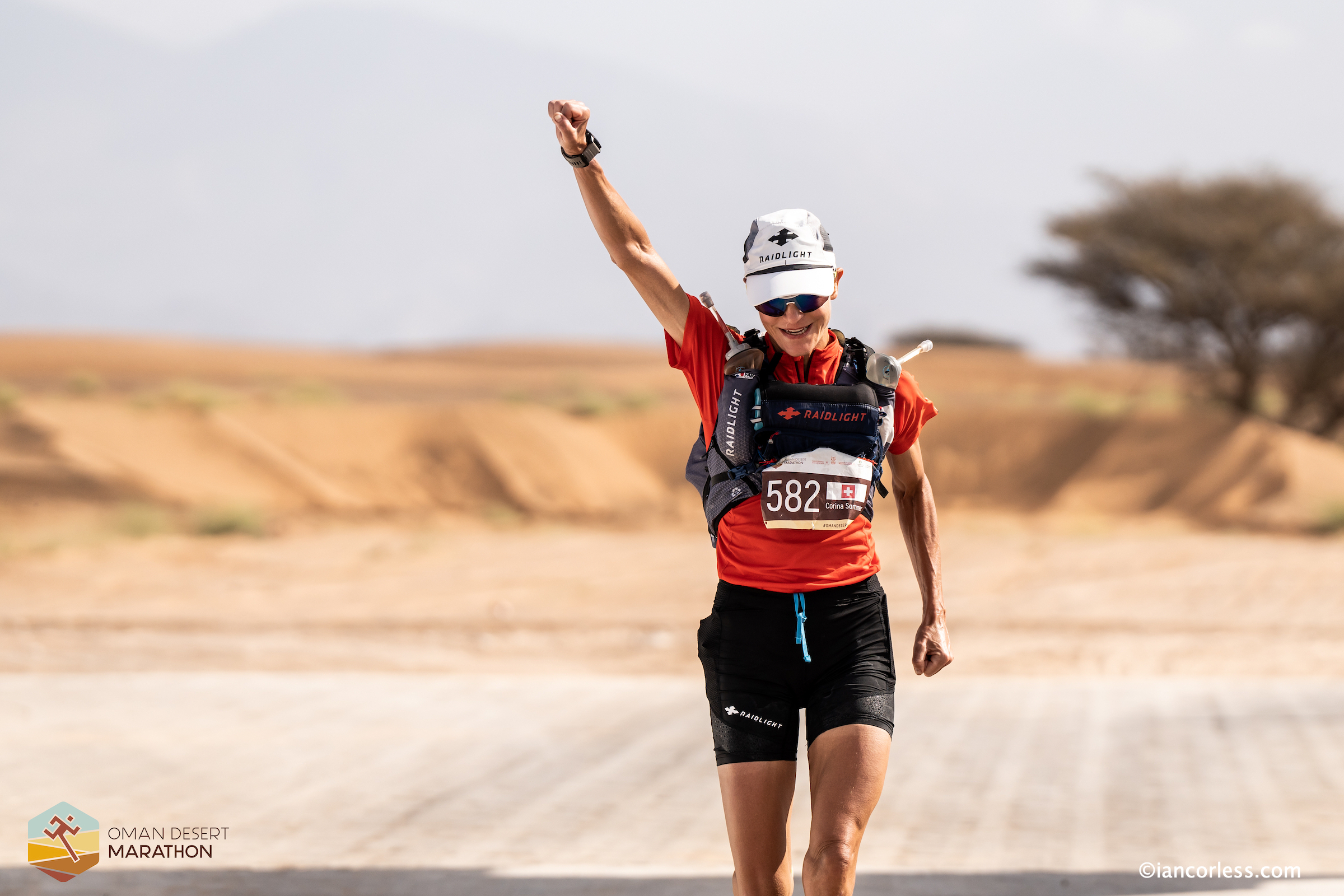
Corina Sommer from Zurich recently won the Oman Desert Marathon against Aziz Raji (past MDS champ) and Aziza El Amrany who had led the race only to have Corina run two incredibly strong days and take the victory. New to trail, she placed 18th at Templiers and 3rd at Istria by UTMB for the 68km. She will need a great week to make the podium, but it’s a distinct possibility.
Jodie Moss from the UK was 8th at MDS in 2019 and has been preparing meticulously for the 2023 edition. However, recent injury issues placed the race in question, but it looks like she will be in the Sahara, hopefully in great shape.
Ester Alves won The Coastal Challenge in 2016 and placed 3rd in 2017. She also raced MDS in 2017 but the race did not go to plan… In recent years, she has had time away from the sport, but last year, Ester raced Everest Trail Race which will have no doubt provided some great momentum for the Sahara.
Maria Semerjian has results going back to 2009 and without doubt, she enjoys the tough mountain courses, UTMB, Raid de la Reunion, Grand Raid Pyrenees, UTMF, and more… The distance won’t be a problem, however, the speed to make the top-5 may well be the problem.
Brunhilde Girardet recently won Trail de Cité de Pierres as a warmup for MDS. It’s her first edition, so, let’s see…
Wild card – Katie Young from the UK.
Laurence Klein returns, she has won MDS three times, with no disrespect to the Queen of the desert, there is no chance of victory in 2023, but she will no doubt bring colour to the race.
Currently, Aziz Raji and Aziza El Amrany are NOT on the start list, but I hope they do make it to the 2023 edition. It’s important that Morocco has female representation and of course, both of them have great potential for the top 5. Raji has won the race and El Amrany was 3rd in 2022.
THE MEN RACE
The men’s race is extremely notable in 2023 as Rachid El Morabity will look for a 10th victory. This will without doubt add an extra dynamic to the race, particularly after the superb tactics which played out in the 2022 edition.
Rachid El Morabity
Rachid El Morabity is the boss of the Sahara and the hot favourite. BUT, I believe this year will be his toughest challenge. There are multiple reasons for this… Rachid has expectation on him, this is not really an issue, he can handle that. He has raced a great deal in the past 12-months, he may be tired? The Moroccan team is probably at its weakest, especially when compared to the past ten editions, so, the support network will be less. The competition, namely Mathieu Blanchard and Aziz Yachou are a serious threat. Will Rachid win? It is very hard to bet against him, but 2023 has the potential to be the upset year.
Mohamed El Morabity
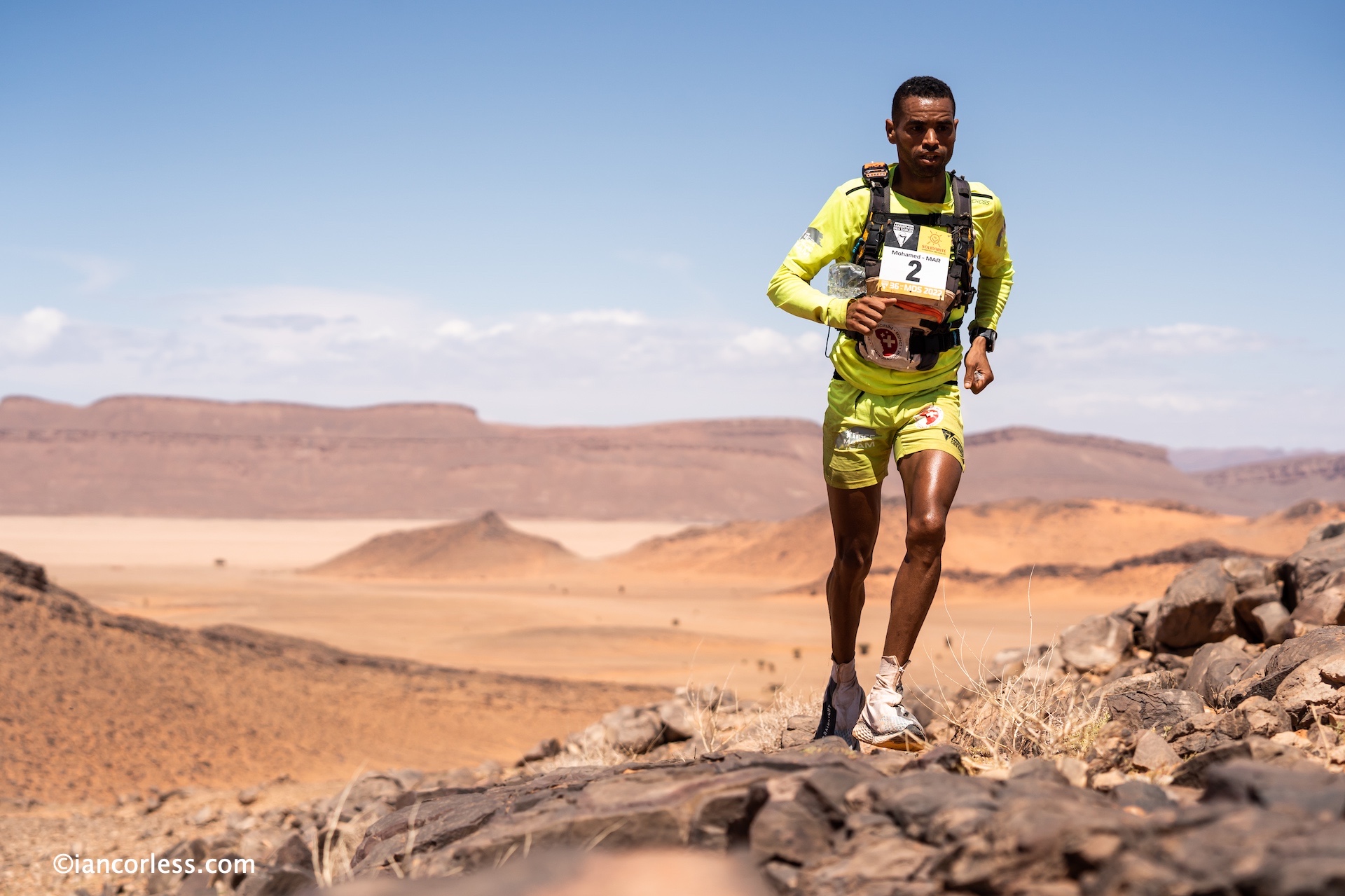
Mohamed El Morabity is the eternal 2nd at MDS and his possibilities of victory in 2023 are zero if Rachid is in good form. The only opportunity for Mohamed is if Rachid falters and he gets the green light from his elder brother to attack. In Oman Desert Marathon earlier in the year, Mohamed took victory ahead of Rachid, don’t be fooled in to thinking Mohamed was stronger, he was gifted the win as credit for April and the 2023 MDS. Mohamed can win the race, but just as we saw in 2022, he will be the super domestique for Rachid.
Aziz Yachou
Aziz Yachou is the fly in the Moroccan ointment and 1-year on, has the potential to create fireworks and upset Rachid’s dream. He was 4th in 2021 and 3rd in 2022. Last year he was worked over by the tactics of Rachid and Mohamed, he will be prepared for that this year. Little is known about his training in the early part of 2023.
Mathieu Blanchard
Mathieu Blanchard raced MDS in 2021 and finished 5th – he was hit by the bug that swept through camp just in time for the long day. One thing is for sure, after placing 2nd at UTMB in 2022, we are looking at a different Mathieu. He raced The Coastal Challenge in February and placed 2nd, he recently summited Kilimanjaro and most recently ran a 2:22 marathon in Paris. Mathieu can win MDS and the French have put a team together to potentially make that happen. Beating the Moroccans on home soil (sand) is tough, but THIS may be the year.
David KILGORE from the USA has been top-10 at Leadville 100, and recently 7th at Tarawera 50km. On paper, he is not an MDS podium contender, but he will be in the mix for the top-5.
Erik Clavery adds more fire power to the French line-up. He was 5th at MDS in 2016 and a fierce competitor. He has raced UTMB, WSER, Eiger Ultra and even 24H championships, so, he brings something special to the MDS.
Vasily Kortytkin (Russia) comes to MDS with a history in 6H and 24H races, he has PB’s of 86.493 and 260.570 respectively. He has won some trail races in Russia in 2021 and 2022, how he performs in the Sahara is a big question.
Pierre Meslet (France) placed 9th at MDS in 2021 and returns in 2023 not only to perform to the best of his ability (top-10) but to also help the French maybe win the race and also get the team prize.
Anton Samokhvalov also from Russia has been racing trail since 2014. He has a list of solid results but nothing spectacular, in 2021 he made 10th at Transgrancanaria Advanced.
Notable mentions:
Duncan Slater from the UK lost both legs during a mission in Afghanistan, he’s back this year for another medal!
Christian Ginter, dinosaur of the desert, returns for the 35th time!
Finally…
1150 runners will toe the line (1263 were registered) and the youngest runner is 16-year-old Girard Fialon (she will run with her father, Grégory) and the eldest, Henry Botha, 81!
Crazy Statistics of the MDS
“The logistics are a big headache, and we organize every detail in advance! We’re a village of 2,000 people that must be set up and dismantled every day. We need to be self-sufficient in energy, food, water, and fuel. As one of my friends says, ‘Let’s expect the worst because the best will never surprise us!’ We also benefit from the infallible support of the Royal Moroccan Army, which makes available about 25 6WD military trucks to transport all our equipment.” – Patrick Bauer
You must see Marathon des Sables to appreciate the size and scale of the event. It’s like the largest moving circus you will ever see and it’s impressive to witness.
Following statistics provided by the Marathon des Sables office:
▪ 150 volunteers to supervise the race,
▪ 450 general support staff,
▪ 120,000 liters of bottled mineral water,
▪ 300 Berber and Saharan tents,
▪ 120 all-terrain vehicles and trucks,
▪ 2 Squirrel helicopters and 1 Cessna plane,
▪ 8 Transavia ‘MDS special’ commercial planes,
▪ 30 buses,
▪ 4 dromedaries,
▪ 1 incinerator lorry for burning waste,
▪ 5 quad bikes to monitor race environment and safety,
▪ 14 km/hr.: average maximum speed, 3 km/hr.: average minimum speed,
▪ 15 years of age for the youngest competitor and the oldest, 83!
Patrick Bauer
A brief history of the MDS
1984: At 28 years of age, Patrick Bauer decided to make for the Sahara to try to traverse a 350km expanse of uninhabited desert, on foot, alone, where he wouldn’t come into contact with a single village, oasis or watering place. Totally self-sufficient, with a rucksack weighing 35kg and containing water and food, he set off on a journey that was to last 12 days. It was the starting point of what was to become the MARATHON DES SABLES.
1986: The creation of the first MDS in the Moroccan Sahara. The 23 pioneers who took the start never imagined that their footprints would mark the start of a legendary event, which has today become a must among the major adventure sport meets. The creation of a non-mechanical competition in the Moroccan sands offers adventure runners a wealth of new prospects.
1987: Creation of the MDS logo: the face of a runner covered by a keffiyeh, the eyes protected by a pair of sunglasses and the pipette from the runner’s water container clenched between the teeth.
1989: 170 competitors take the start of the race.
1991: The gulf drama puts the MDS at a disadvantage and the financial partners withdraw. Fortunately, some runners answer the call. For these competitors, the true victory lies in meeting athletes from different backgrounds and their communion in the desert around the same goal. Sport proves once again that it can bring people together and create bonds.
1992: One and the same regulation for everyone. This year sees the establishing of unexpected draconian tests, to ensure that each participant properly transports all his or her gear from one end of the course to the other. A 30-point charter is drawn up.
First participation by the Moroccan Lahcen Ahansal
1994: Arrival of the Doc Trotters at the event.
1995: 10th anniversary. Since the start, over 1,500 men and women have left their footprint and their passion in the desert. Installation of water-pump for the inhabitants of the village of Ighef n’rifi (South of Er-Rachidia) – an idea by competitor Gilles Flamant and backed by Rolland Barthes and Patrick Bauer. Its success is to be repeated.
1996: First participation by Mohamed, a younger sibling of Ahansal. The two Moroccan brothers set off together and rank 4th and 5th respectively.
1997: This year heralds the start of the Ahansal saga. Morocco is honored with Lahcen’s first victory. He beats his two pursuers by nearly 30 minutes, despite them being international long-distance running champions.
1999: A mobile hospital on the MDS comes into being. There are around thirty practitioners on the ground, with doctors and nurses joining the caravan. A dedicated helicopter and ten all-terrain vehicles track the competitors each day. On- board these vehicles there are doctors of course, as well as high-tech equipment. The village boasts a genuine field hospital.
2000: Internet appears in the large MDS village. The organization decides to broadcast the texts and photos of the race live, day after day. The competitors can communicate with their nearest and dearest and receive messages of encouragement.
2001: For the first time the long leg, traditionally called “The 70”, exceeds the 80km barrier to reach 82km. The threshold of 240km is also surpassed since the 16th MARATHON DES SABLES spans 243km. Another first relates to the fact that there are no Moroccans on the podium this year.
2002: This edition is punctuated by a sandstorm, involving headwinds, which lasts the entire week. The doctors invent a machine for ‘low pressure cleansing’ to rinse out the runners’ eyes. Despite the difficult conditions, there are few retirements to report as the wind considerably reduces the temperature.
2005: The Luxembourg runner Simone Kayser is the first woman to win 3 MARATHON DES SABLES. For this 20th edition, the total number of runners exceeds 700 for the first time, with no fewer than 777 runners taking the start.
2006: A drying wind and very high humidity levels cause damage to the runners’ bodies. Despite additional allocations of water, a whole series of retirements ensues. There are a total of 146 retirements ultimately, which equates to double that of the previous record… Race management decides to shorten the long leg by over 10km given how tired the runners seem.
2008: The Solidarité MDS association is created. The aim: to develop projects to assist children and disadvantaged populations in the domains of health, education, and sustainable development in Morocco.
2009: MDS is disrupted by flooding and the 1st and 6th stages are not able to take place. To avoid the flood zones, the organization is obliged to improvise new legs on a day-to-day basis. In this way, the edition goes down in legend for its 3rd leg, which is the longest ever contested: 92km of sand, loose stones, and rocks… The leg even sees the retirement of Lahcen Ahansal… At the prize giving the 2 winners admit to having competed in their hardest MDS. However, it was also the shortest: 202km.
2010: For its 25th edition, the number of participations reaches a record high of 1,013 participants. It is to be the longest MARATHON DES SABLES. It spans 250 kilometers with a course considered by former entrants to be the most difficult ever organized.
2012: A dramatic turn of events on the longest leg as the then leader in the overall standing, Rachid El Morabity (MAR) injures himself one kilometer from the finish. Medical examinations reveal a serious muscular lesion in the quadriceps. After over five years on the 2nd or 3rd step of the podium, Jordanian Salameh Al Aqra secures the title.
2013: 1,027 competitors on the start line make this a new participation record. New feature: a final “Charity” stage sponsored by UNICEF and traversing the Merzouga dunes round off the race. Sportswise, Mohamad Ahansal and Megan Hicks are the champions of the 231.5km event. On a human level, all of the finishers pull off their crazy bet.
2014: 2011 winner, Moroccan Rachid El Morabity (MAR) wins the overall ranking and takes Mohamad Ahansal’s crown. In the women’s category, another American stamps her mark, Nikki Kimball. The French revelation is one Michaël Gras, 22 years of age, 8th overall and top Frenchman. A major athletics star, Moroccan Hicham El Guerrouj lines up to take the start of Saturday’s Unicef Charity leg.
2020: The Corona virus takes over the world.
2021: The Marathon des Sables returns but with an October edition due to the global pandemic. Celebrating 35-years, it is remembered as on one of the hottest editions and almost 50% not completing the race due to a possible Norovirus that swept through bivouac.
2022: Rapid El Morabity wins his 9th edition setting himself up for 10 in 2023. Sandstorms made for some difficult and challenging days.
Follow the race here with a daily update and selection of images. Also, follow on IG @iancorlessphotography.
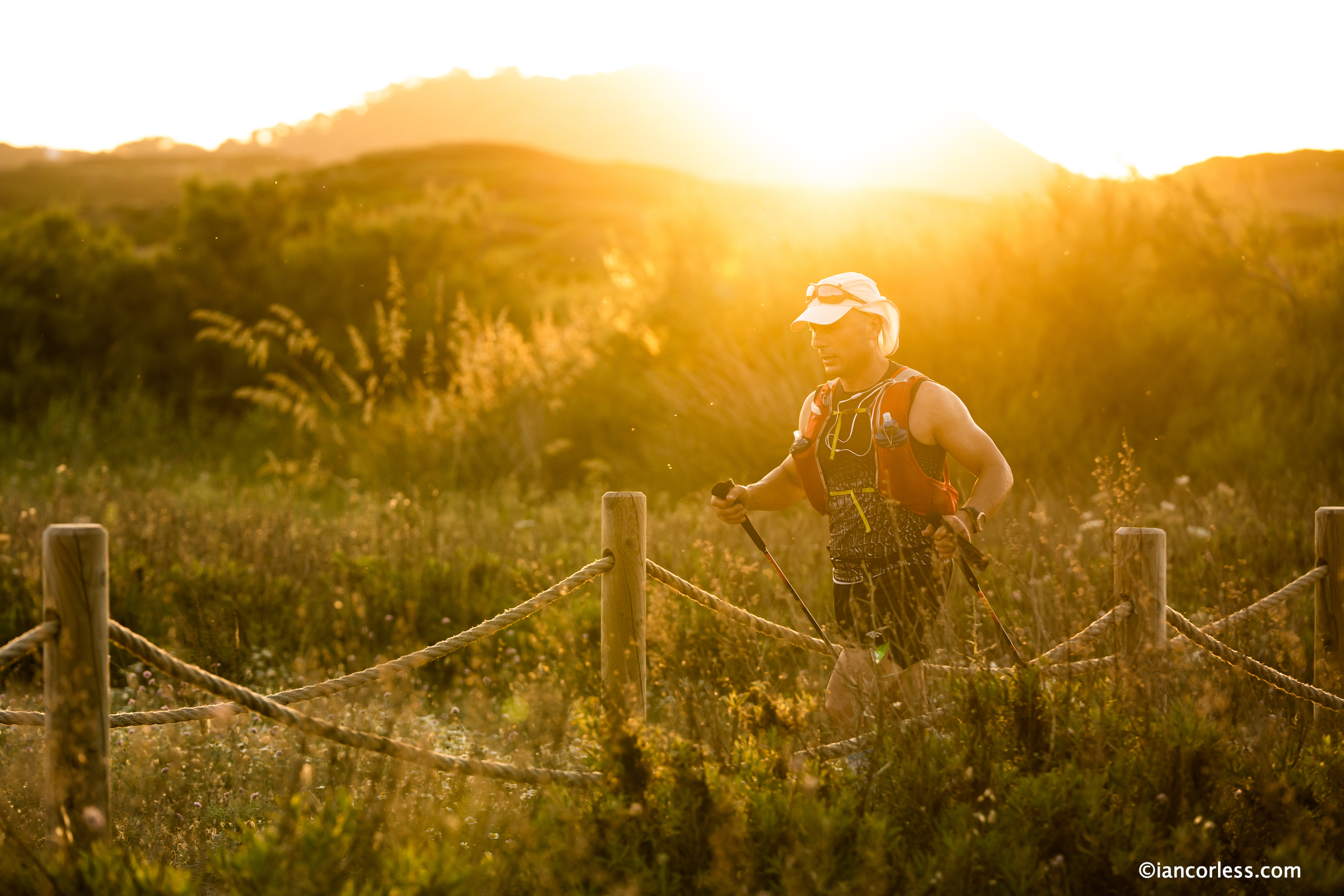
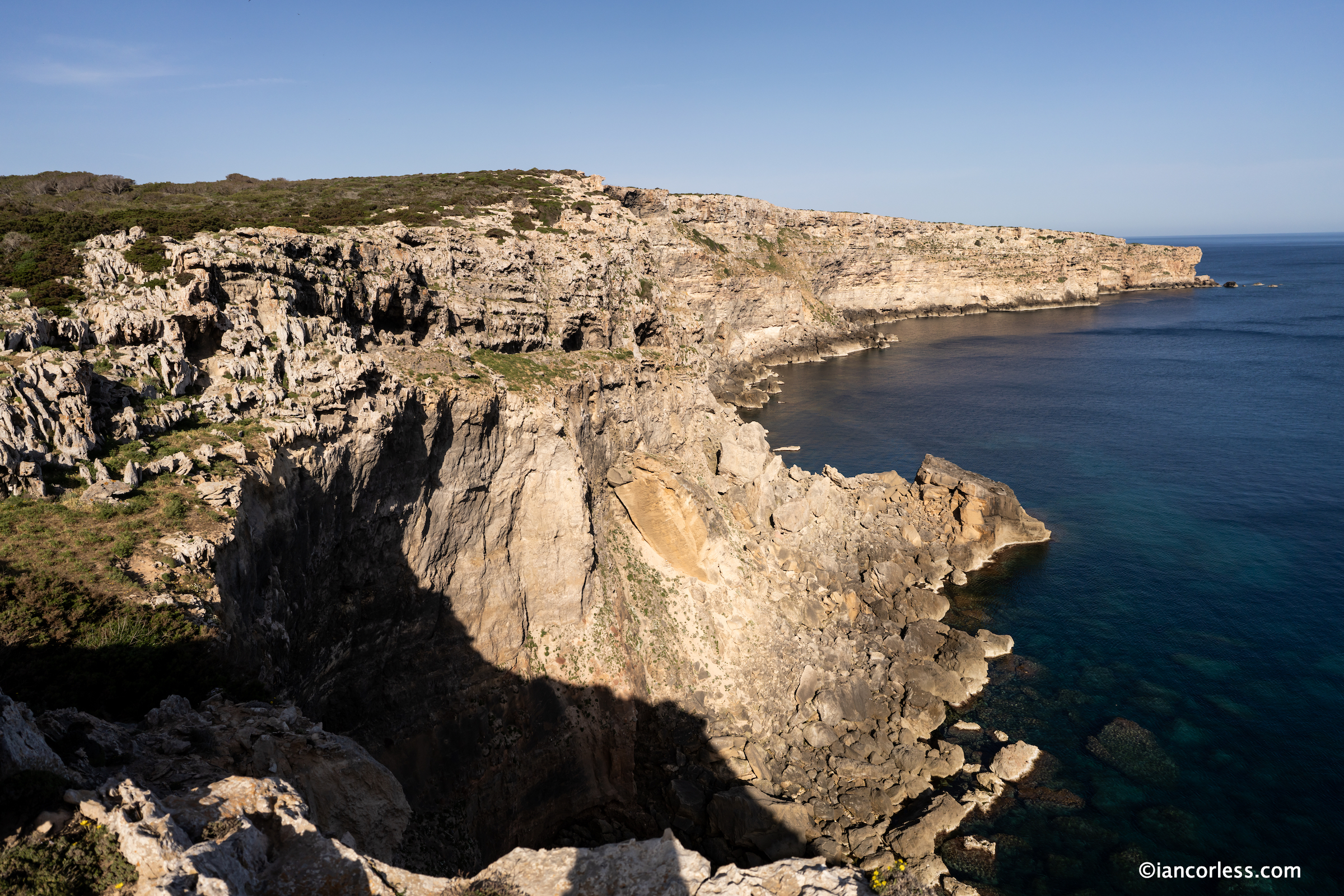
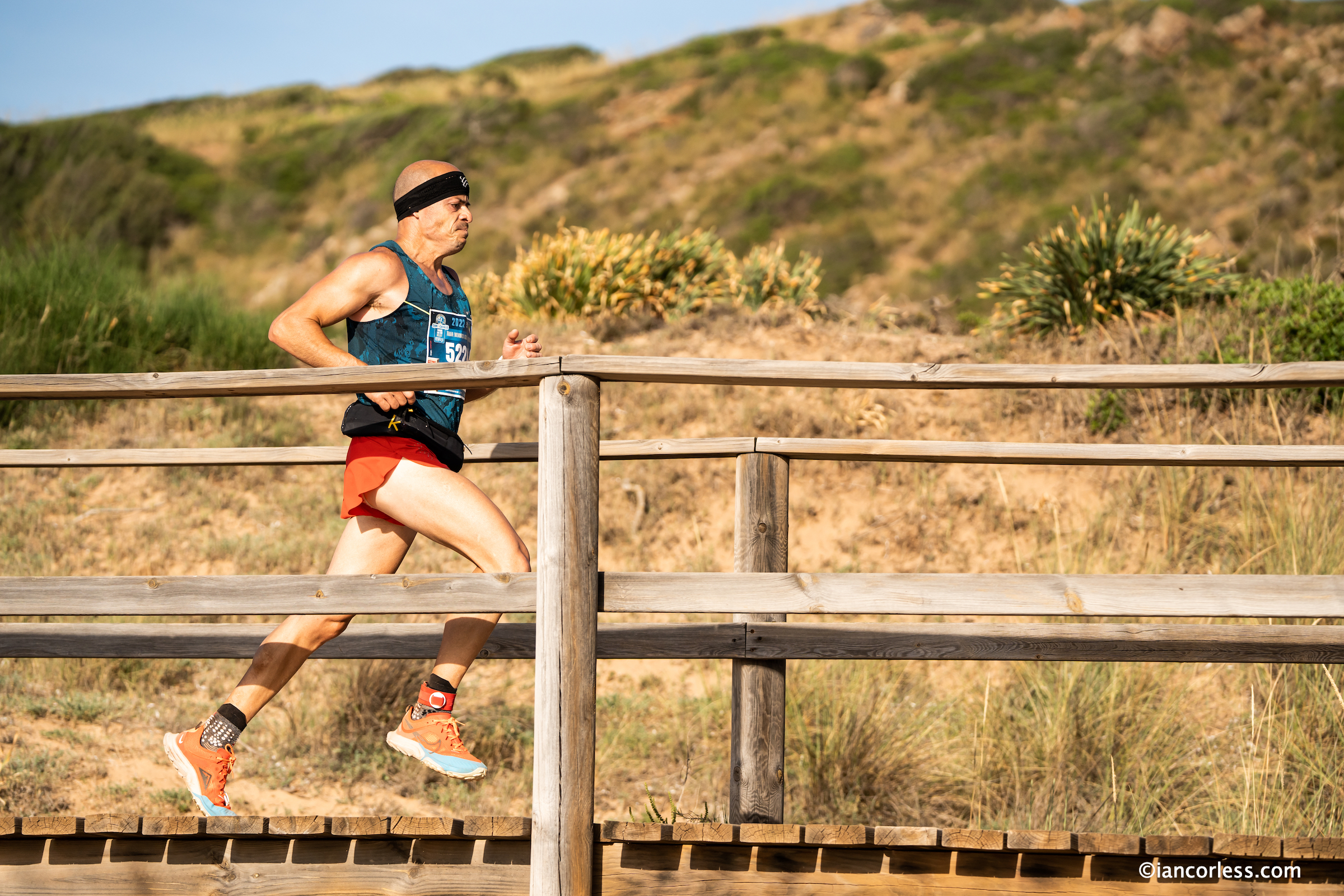
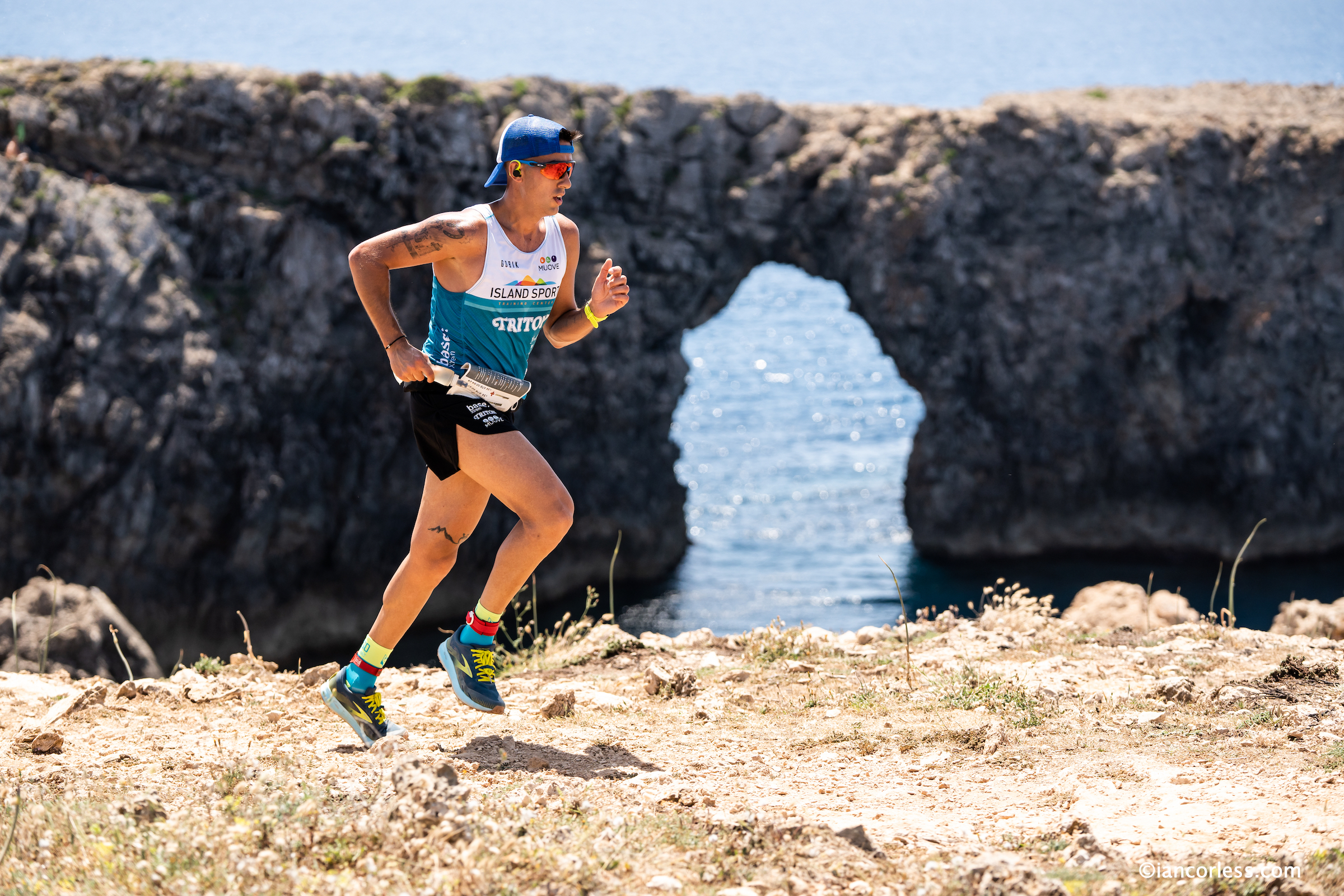
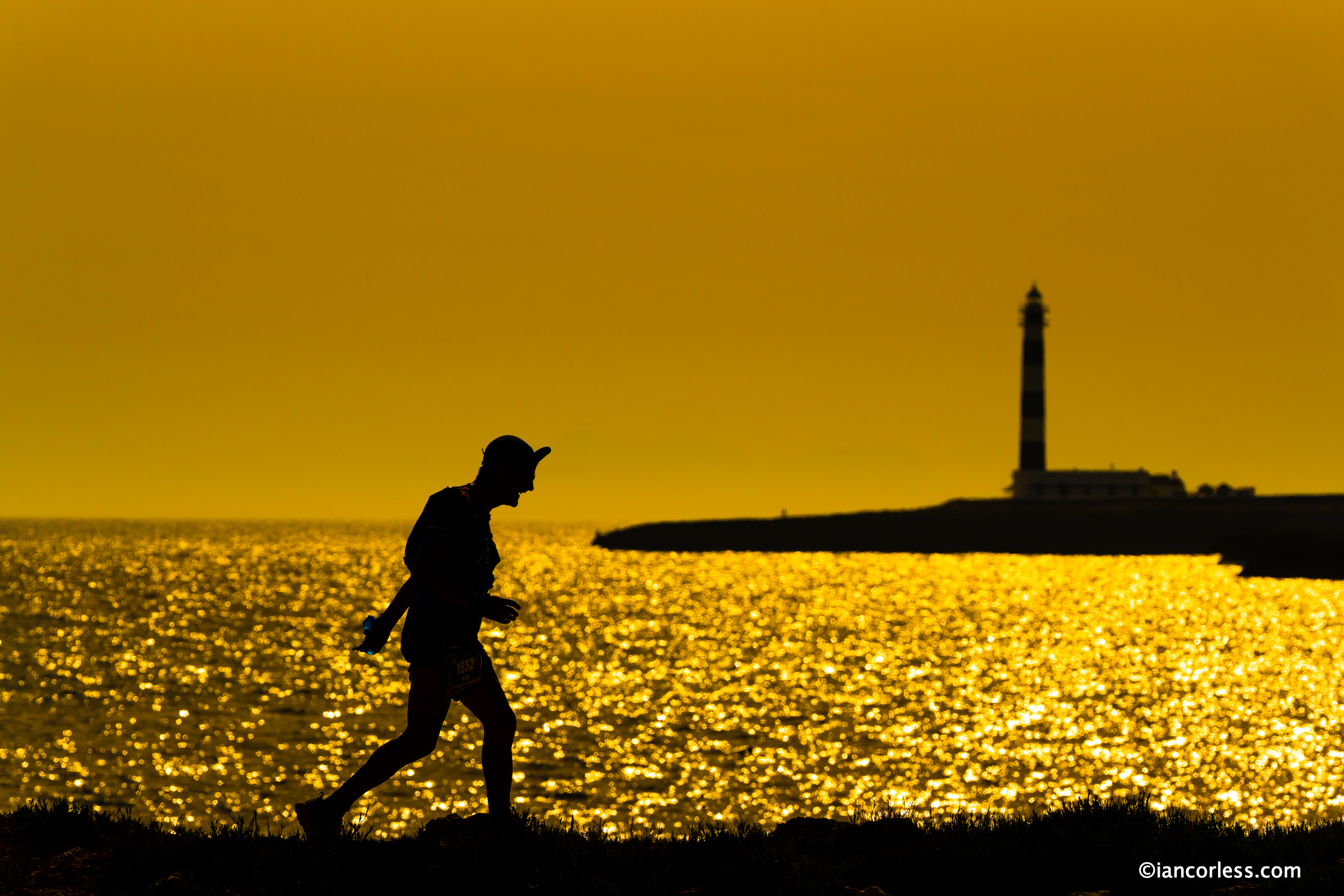
Located in the Mediterranean Sea, the Balearic Island of Menorca has long been a more low-key holiday location, in contrast to its immediate neighbours of Ibiza and Mallorca. With an area on just 700 km square, Menorca is a small island full of endless beaches, pine trees, turquoise water, rugged coastline, and a winding network of trails. Mahon is the capital and Ciutadella de Menorca is the second largest centre on the opposite side of the island, both filled with narrow streets and wonderful architecture. There is a great deal to love and appreciate in Menorca.
With a highest elevation point of 358m (Monte Torro), Menorca is essentially flat. However, if you journey around the coastline, you soon realise that the rollercoaster of trails that continually take you up and down make a circumnavigation of the island, a challenge.
Designated a UNESCO Biosphere Reserve (1993) the island is a paradise for botanists, especially in spring when meadows are carpeted with wildflowers. Calm, peaceful, rest and relaxation, Menorca is, without doubt, not the party destination as associated with its nearest rivals. Culture, gastronomy, local products and produce, places of interest, Menorca is waiting to be explored.
Many ask, what is the best way to see the island of Menorca? The immediate answer, is nearly always, rent a car and go explore…
Ask a trail runner, and the answer is clear, ‘Enter Trail Menorca!’
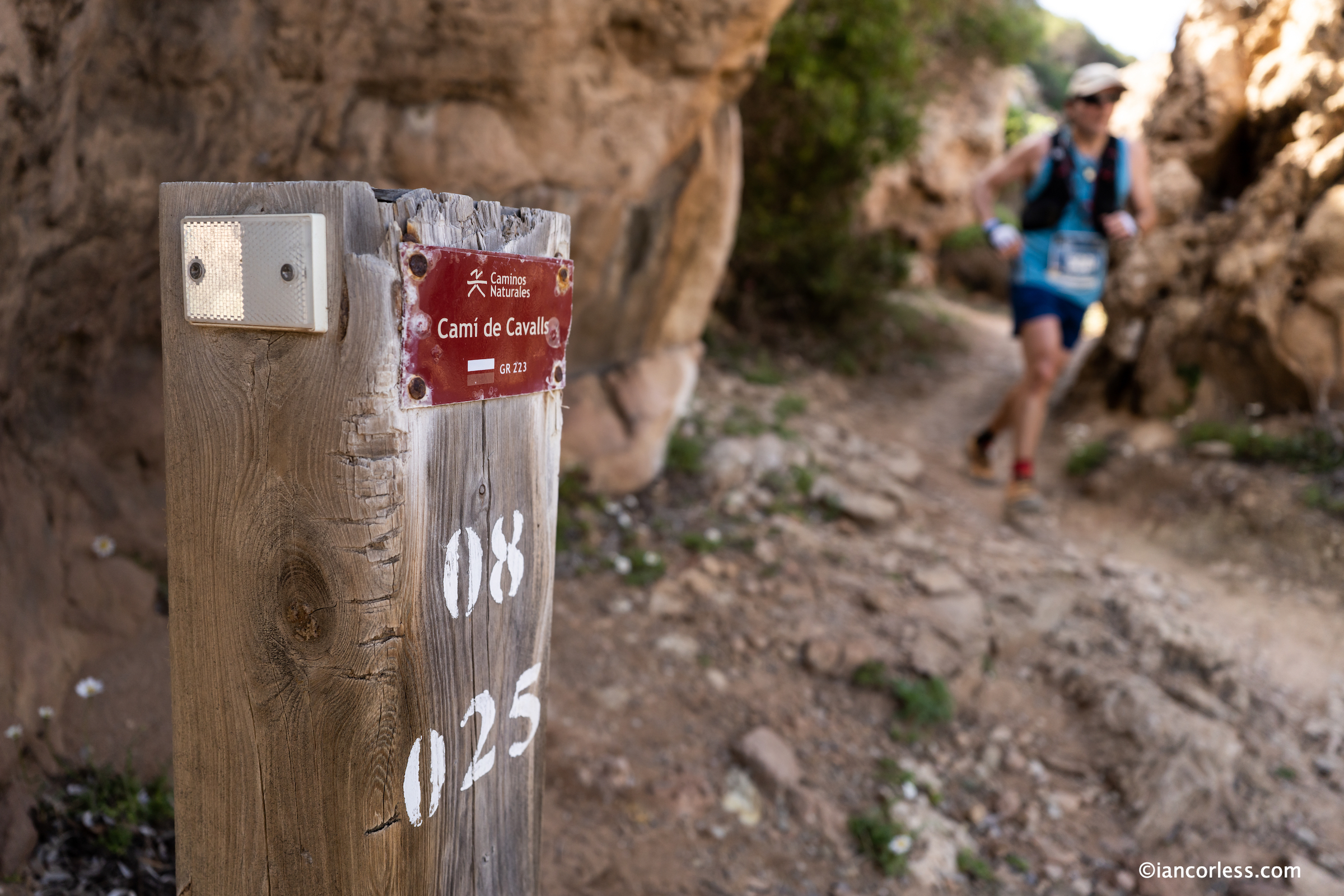
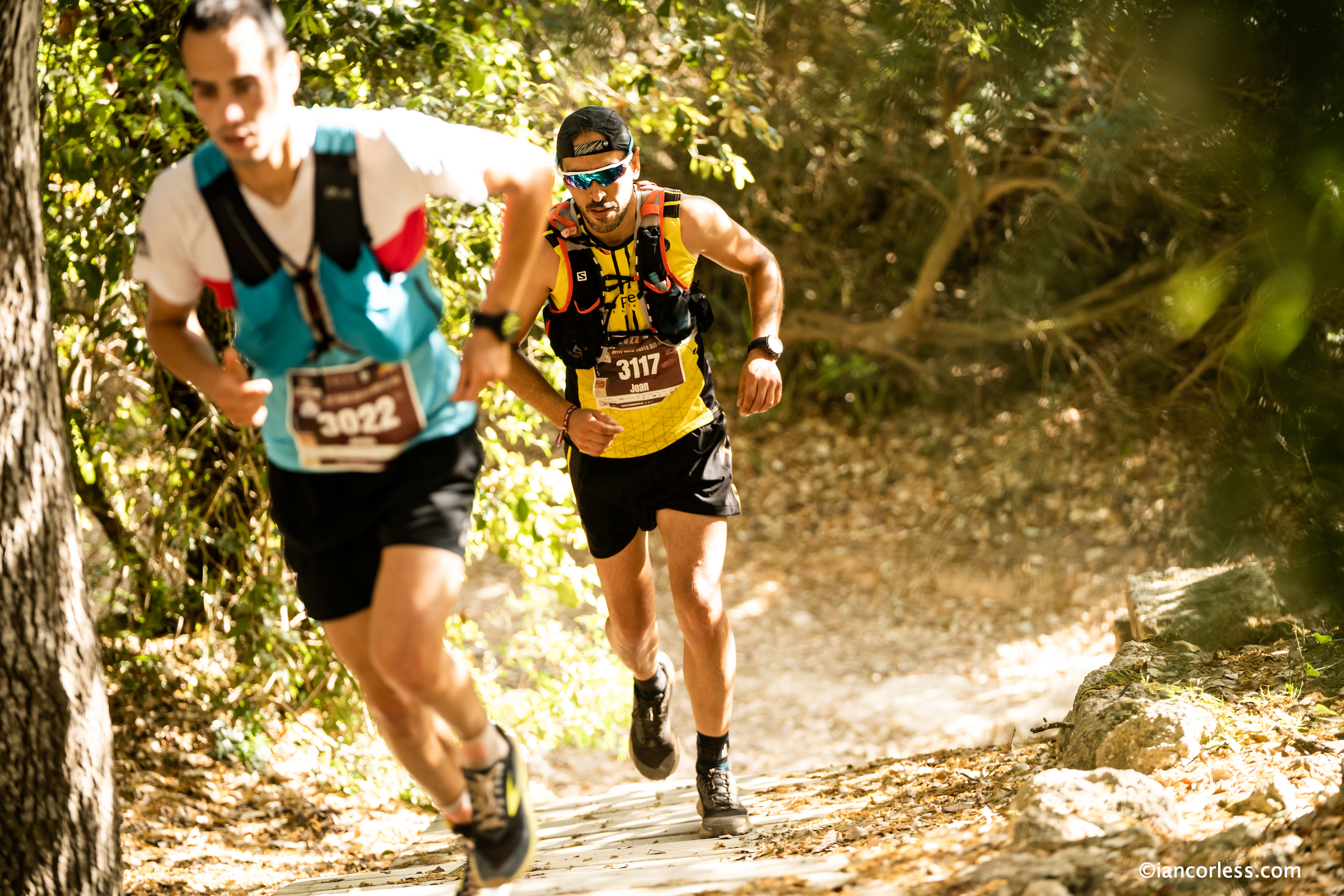
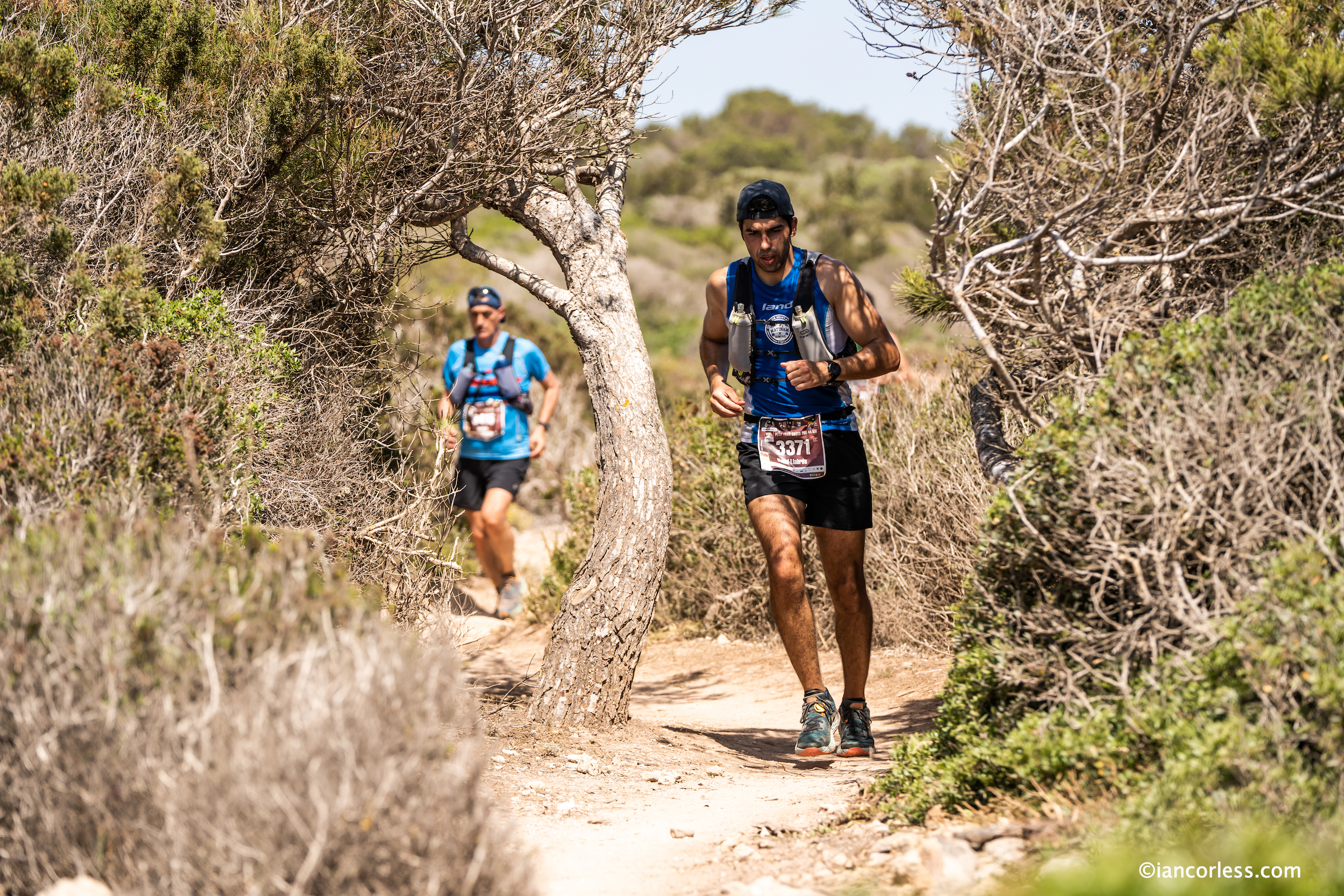
Trail Menorca, created 10-years ago utilizes the ‘Camí De Cavalls’ GR223 route to journey around the island either in entirety (185km,) or in sections broken down as 100km, 85km, 58km, 45km, and 27km. North or south, Menorca has a great deal to offer, there is no better way to explore than by running or walking this hidden gem of the Mediterranean. As the race says, 7 adventures, 1 legend.
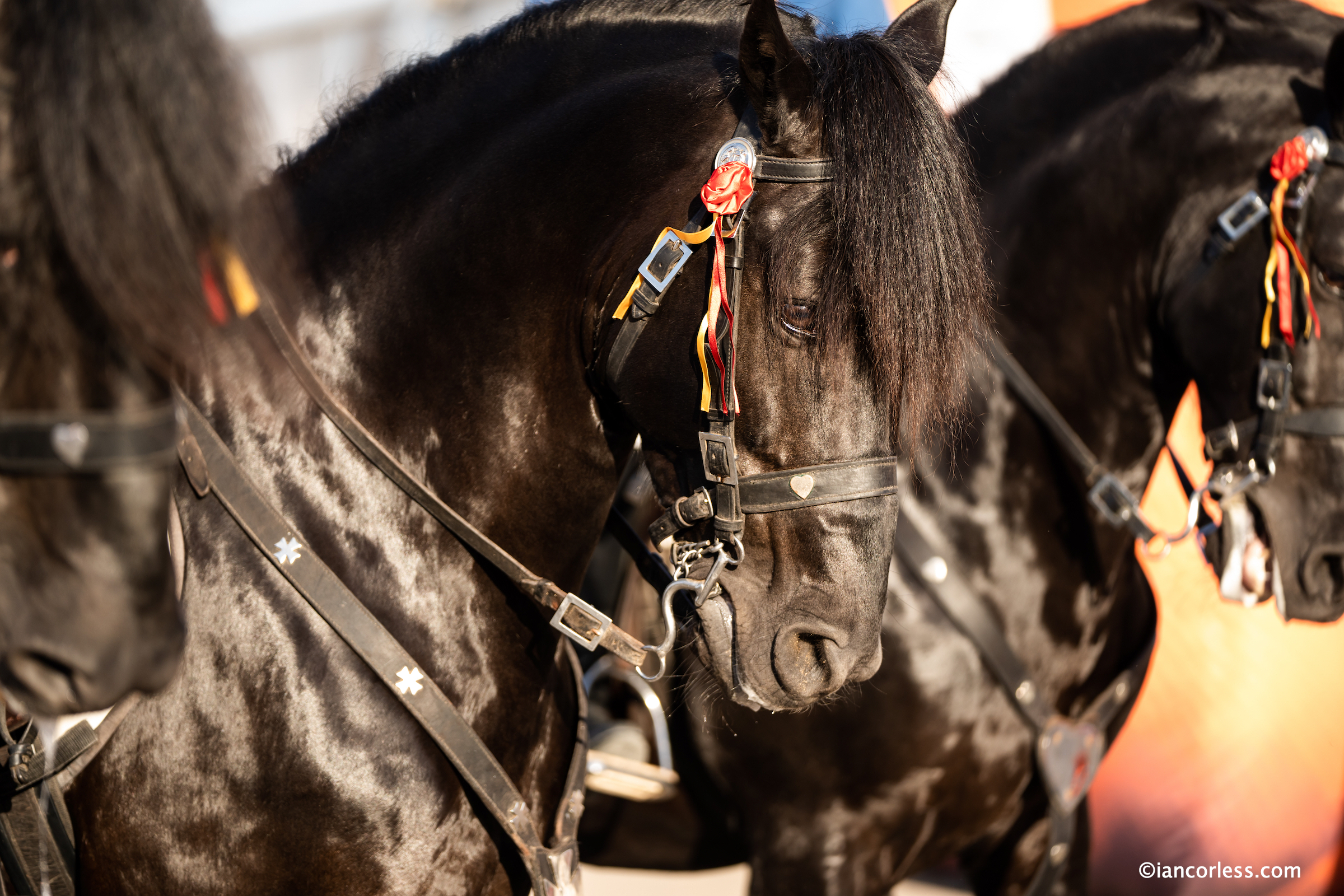
The Camí de Cavalls (way of the horses) according to some sources goes back to the 14th century. Named after the ‘Cavalleries’ (knights) who were charged with defending the perimeter of the island from invading forces – pirates! The 360-degree route that weaves around the island with watch towers and trenches randomly located for protection; both still in existence to this day were created by the British who marked the path to defend against the constant sieges of invaders.
In the 1990’s, after long and lengthy protests, much of the Camí de Cavalls which had been closed for decades, was once again made accessible. Finally, some of the most pristine landscape and coastline of the Mediterranean was once again available to be explored. With 185kms of marked trail, 130 bays and coves, desert like beaches, dense woodland, rugged, harsh and rocky terrain, the GR223 became a reason to journey to Menorca for an active holiday. For many, the journey takes at least one week to complete the circular route, while 10-14 days is more normal. Off limits to cars, a journey must be undertaken on foot, by bike or horse; or maybe a combination of all 3!
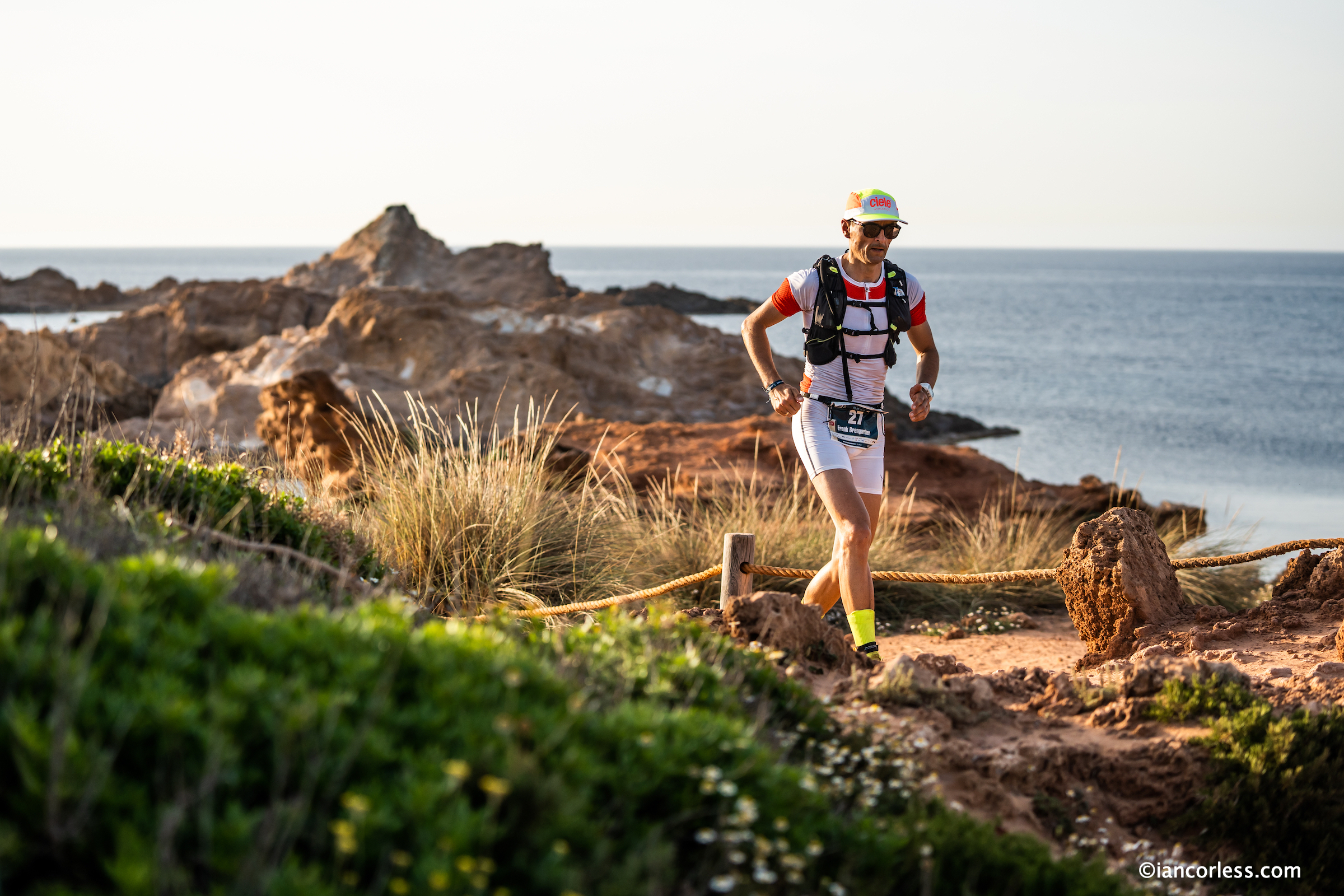
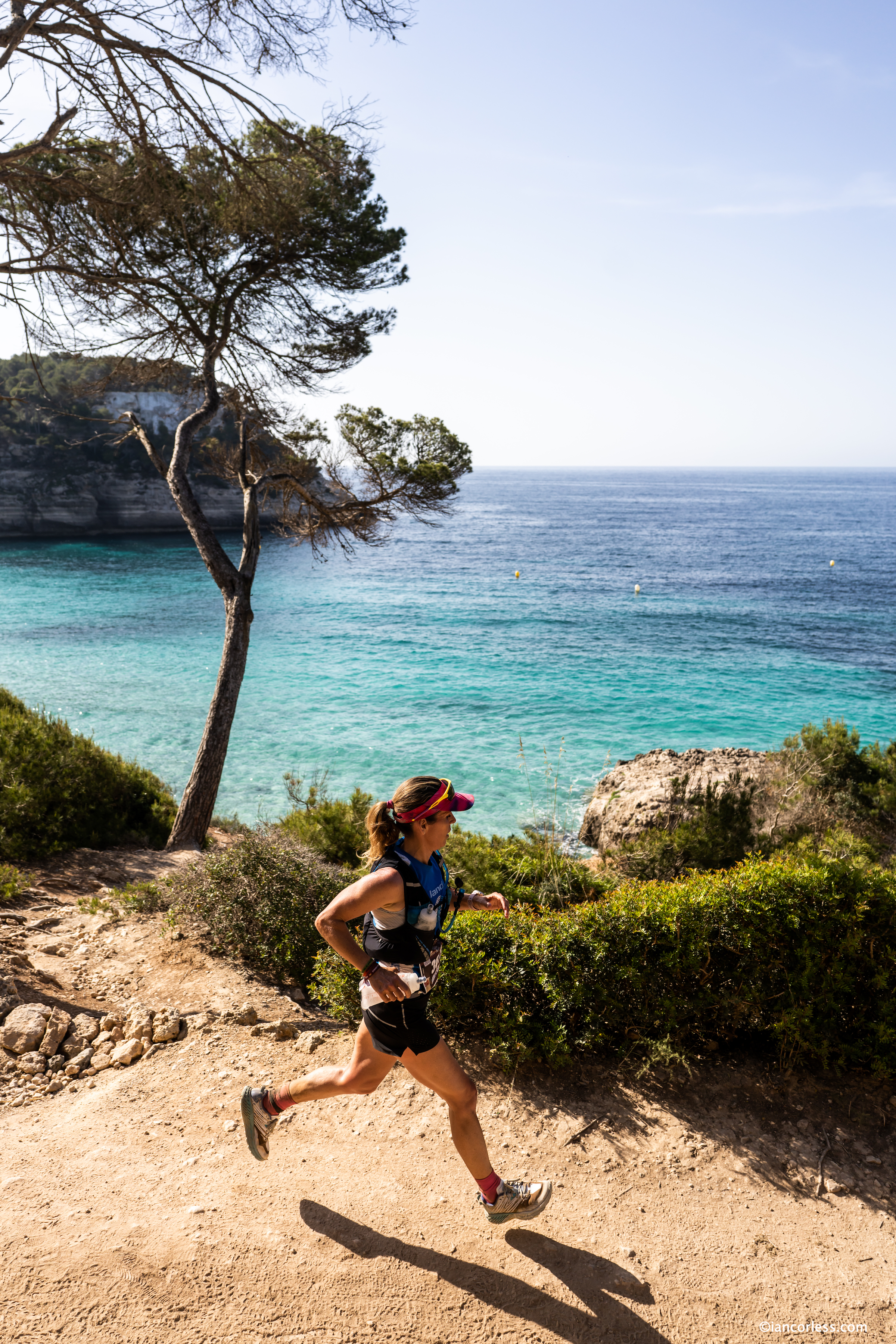
However, in May every year, Trail Menorca provides the opportunity to experience the Camí de Cavalls over a stunning weekend of racing. Breaking the island down in to north and south sections, runners can decide a distance and direction. The north being more rugged, exposed, and rough. The south more groomed, tranquil, and picturesque with the turquoise Mediterranean as a backdrop.
The 185km route (TMCdC) starts in Ciutadella and travels clockwise providing a full, immersive and difficult 360-degree journey. The other routes all conclude in Ciutadella but start in different areas of the island and then either travel clockwise or anti-clockwise to return to the finish.
The TMCN 100km starts at 0100am in Maó and travels north winding through rugged coastline of exposed and harsh terrain.
The TMCS 85km starts in Es Castell and weaves its way through the full length of the south coast and its incredible coves and beaches.
The PTCN 58km starts in Fornells and concludes in Ciutadella taking in the final sections of the TMCN route.
The PTCS 45km starts in Es Migjorn Gran and arguably provides the most beautiful and picturesque journey of the whole GR233 route.
Finally, the STCN 26km, which starts in La Vall provides an entry level distance travelling the final section (or opening sections, depending on direction) of the GR233. Enough to whet the appetite to return the following year and take on a longer distance.
The beauty of Trail Menorca is that you can quite easily race year-on-year and never have the same race experience as it is possible to run north or south sections over multiple distances. Perfect for those who consider the full 185km route a step too far!
Menorca may not have high mountains, but what it does have is unique and special. There is an incredible beauty and calm in Menorca. Racing is just one attraction, the opportunity to chill, relax, recuperate, and enjoy the islands gastronomy post-race makes this Balearic gem an essential to-do list location.
The 2023 edition is already close, but it is not too late to join Trail Menorca!
‘Trail Menorca Camí de Cavalls is an opportunity to discover what is hidden on this wonderful island, jewel of the Mediterranean, beyond its fantastic beaches. Running on tarmac, road, track, rocks, forest trails and depending on the race and distance, experience a night illuminated by stars. Come and immerse yourself in the beauty of Menorca.’
It was a 0330am wake-up in camp this morning with race start at 0530am. It may sound early, but trust me, the earlier hours pay dividends for everyone. Body clocks are now reset, bed between 1900-1800, wake-up 0330.
Sebastian Krogvig unfortunately succumbed to his sickness and did not finish day 1. He will rest and recovery and hopefully rejoin the race in the later stages for fun.
Mood in camp was buoyant, however, nobody was under any illusion of the severity of the TCC. The heat and humidity are one thing, but the fire roads, climbs, technical trails and long stretches of no shade a punishing.
“They say Marathon des Sables is hot, it’s nothing in comparison to this. I was in the ‘notorious’ October MDS that had intense heat, trust me, it’s hotter here!” – Mathieu Blanchard
Climbing out of camp, mountain man Dani Jung was in his element and he lead Mathieu Blanchard and Didrik Hermansen. Peter van der Zon was a way back, it was obvious he was struggling… As he passed he mentioned tight hip flexors.
For the women, Marianne Hogan had a very small lead over Katie Schide. Katie looking strong, the previous night she had questioned if she should withdraw from the race as illness from previous days had returned on stage 1 making for a tough day.
Didrik and Mathieu set a relentless pace, they are very well matched. Running at this pace and in this heat and humidity, victory may well come down to the one who manages effort the best, it’s a fine line.
In the final 10km Mathieu opened a slender lead and Didrik chased. The gap remained and it was another victory for Mathieu.
In the women’s race, Katie opened a gap on Marianne and in the final 7km that gap opened, post-race on the finish line Katie discussed her race:
“I was so happy to recover from yesterday, that was helped by cooler temperatures and a climb to start the day today… I had planned to run with Marianne but on one of the more technical sections I opened up a gap. When I eventually looked around Marianne was not there, I hope she is okay?”
Marianne was okay and finished strong with a smile looking relaxed and at ease. With 4-days to go and a long day tomorrow, there are no guarantees, the men’s and women’s races are still wide-open.
The biggest change of the day was with the 3rd place woman, Paolo Herrera. She ran an incredibly strong and consistent race to finish with a good margin over Tomomi Bitoh, this making the local Costa Rican contingent very happy.
It was an early start (0300) leaving San Jose and heading to the Pacific Coast for the stage 1 of the 2023 The Coastal Challenge starting at Del Rey beach, Quepos.
This year, the shorter Adventure category and the longer Expedition category would run different distances for stage 1. In the past, they have run the same course.
Expedition would run 41km with 1071m vertical gain and the Adventure, 32km.
Getting underway before 0800, the rewards were blessed with cooler’ temperatures for the first hour, however, cooler is all relative when on the coast, it was still hot!
Overnight, Sebastian Krogvig unfortunately had picked up some sickness, although feeling generally okay, it was clear as the stage started he was not 100%. He struggled with any pace, it was a tough day…
For the women, Katie Schide and Marianne Hogan ran together and behind, Tomomi Bitoh followed.
Checkpoint 1 and there was no change, the pace by Didrik and Mathieu was fast.
As the race progressed, Didrik and Mathieu took a wrong turn and lost in the region of 1.5km allowing Peter and Dani to take the lead. They chased, caught them and then once again pushed ahead in 1st and 2nd.
Peter started to struggle in the heat and Dani started to hold on to the duo. However, Mathieu found the energy to break away and take victory on stage one, closely followed by Didrik and Dani.
“Very happy, a hot day. In Canada it was -40, today 40-degrees here, that is a big change…. My body handled the waether today. It’s a big Tropical environment, wonderful trees, amazing bridge and waterfalls.”– Mathieu Blanchard
Tomomi came in securing 3rd place, all smiles. Last year, Tomomi caught Covid one day before the race and had to miss four stages, this year, she is so happy to be back.
Faces told the story at the finish, the heat and the humidity had taken its toll, it always does on stage 1, it’s such a shock to the system without pre-acclimation, something that Marianne and Mathieu had done.
“I heard the sound of animals in the jungle, I turned to Peter and said this is incredible, ‘This is much more atmosphere than UTMB!” – Dani Jung
Gonzalo Calisto at the 2016 TCC. It was later we found out he had tested positive for EPO at the 2015 UTMB.
Trail, mountain, and ultra-running is booming and it’s clear to see. Circuits have increased, prize money has increased, ‘pro’ runner numbers have increased, and it must be accepted, with the potential rewards both financially and egotistically, there will be some tempted to dope.
Mark Kangogo at Sierre-Zinal an example. And now, Esther Chesang!
Trail running, unlike athletics, be that on the road or track, is unpredictable; tough and varied, with ups and downs, rocks, scree, and technicality, it draws comparisons to mountaineering, not road running. It’s the experience, the doing, the completing that brings the rewards. Take a marathon, on the road you may be able to complete in say 3-hours… On trail, the same distance could take, 4,5, 6-hours or even longer for the same runner. Road running rules don’t apply, a trail runner’s needs are different, except maybe for the sense of fair play, truth, and integrity.
Well, times are a changing
Look at cycling, athletics, and other financially lucrative sports. Doping has been a problem. Trail has been relatively void of positive cases. Note, I say positive cases, not void of doping. It’s fair to assume that doping has happened, but it’s impossible to confirm at what levels. The 2015 case of Gonzalo Calisto testing positive for EPO at UTMB was the writing on the wall. I wrote at length about the case and issues. Read HERE.
It was a call to awareness with the #cleansport tag being used on social media and many prominent trail runners backed up the call. It all got a little muddy with the blanket of the Quartz Program which effectively was/is as useful as a chocolate teapot.
Now, the iconic Sierre-Zinal has had to suffer and endure two positive tests for the respective male and female winners. Ridiculously, the female positive was announced January 2023! She was confirmed positive in May 2022 after a road marathon! Oh, my word, we have a long way to go.
Is now the time to act, before the sport we love heads in a southern direction? If left alone, we may not be able to turn the tide.
But how prevalent is doping in trail, mountain and ultra?
A research paper published August 2017 (HERE) stated that : ‘estimated prevalence of past-year doping was 43.6%’ (from one event) –from a survey of 2167 athletes at two sporting events. That’s an horrendous statistic. The conclusion, ‘doping appears remarkably widespread among elite athletes, and remains largely unchecked despite current biological testing.’ Now this wasn’t trail running, but, one has to maybe assume, the situation is worse than maybe we think…
Skyrunning in many ways paved the way with testing, admittedly not at all events due to cost. But at key events, World Championships for example, WADA tests were conducted. Here is a quote from 2014:
“In compliance with the WADA protocol,11 anti-doping tests were carried out across the three disciplines, which included two for EPO (Erythropoietin). The tests were based in part on arrival order and in part random which included several members of the podium in each discipline. All results were negative.”
UTMB incorporated testing in 2015 and look what happened, Gonzalo Calisto was caught.
Trail runners are effectively hippies. We are on the outside, a weird and wild bunch of adventure and adrenaline seekers who do not want to be confined by rules. This rings true for well over 90% of us, but for those at the top, the pinnacle, who are now becoming professional, this is a business. In any business, corruption can take a hold and doping steals rewards, glory, and recognition.
ITRA, IAAF, WMRA, USATF, Skyrunning and the list goes on. Is it time for trail, ultra and mountain running to be incorporated within one Global Federation where rules and regulations could be imposed? Until now, the answer has been no, the excuse being trail running would lose its freedom and spirit. Many are opposed that a ruling body should not only dictate rules but also profit from ‘our’ sport. Look at the current divisive arguments on the growth of the ‘by UTMB’ and Ironman merger, they only reflect and affirm these thoughts for some.
Do we want in-competition and out-of-competition rules that includes comprehensive random drug testing?
Pro-runner or not, at the end of the day, I think it’s fair to say that you (we) got into the sport not for rewards, glory, and money but through heart. First and foremost, we had a need for nature, adventure, freedom, and open spaces, this was the motivator, not a podium and a cheque.
Of course, rules do already exist, ‘no doping’ is a rule for all sports, mandatory kit (for some races) is a requirement, and the list goes on. But the list in many cases is left to the RD, race organization and more importantly, budget. There is no one set of rules that should be adhered to worldwide and this can be part of the problem, which is why the IOC had the Lausanne Agreement.
Is it time for this to happen?
The fear of cheating, being ‘found out’ and the ongoing disgrace, public humiliation and shame may well have served as a deterrent in trail, until now.
The IAAF finally stepped in to suppress the ever-growing problems of doping with a set of rules to help control a rising problem. The IOC then took this one step further at the Olympics with one set of codes, rules and regulations that blended all anti-doping restrictions in one with theLausanne Declaration. This was a pivotal moment and within one year, WADA (World Anti-Doping Association) was created.
WADA oversees testing of several hundred thousand athletic blood and urine samples annually: ‘…of which 1–2% test positive. Measures using the Athlete Biological Passport suggest a higher mean prevalence of about 14% positive tests. Biological testing, however, likely fails to detect many cutting-edge doping techniques, and thus the true prevalence of doping remains unknown.’ – August 2017
It was like the Lord of the Rings – One ring (rule) to rule them all.
Simple huh, WADA produce a list of banned substances. You, as an athlete, look at the banned list and DO NOT use anything that is listed.
Argh, but there is always a loophole. The wonderful TUE – Therapeutic Use Exemption. Amazing how many asthmatic runners are out there. Yes, WADA had to accept that some athletes have a legitimate medical condition that allows the use of a TUE.
The TUE has been used to gain an advantage, no question.
And what about NSAID’s? Read a report HERE about Parkrun. Running 5km is a long way from trail and ultra, but it shows a trend. Now WADA do not list these on the banned list, but, UTMB have gone one step ahead HERE.
Should we just relax? After all, if the winner of Sierre-Zinal takes drugs, it doesn’t really impact on me or you, the slow guy or gal who is out running for fun and adventure, does it?
Well yes, it impacts on the core and the ethos of the sport, the sense of fair play.
So here we are, 8-years on from Gonzalo Calisto at UTMB, a pivotal moment, and now we are once again fuelled by discussion of the two positive cases at Sierre-Zinal. Of course, there have been other positive cases in this interim period.
But the doping fire has been re-ignited.
Update, just hours after this post, Kilian Jornet posted THIS on IG.
There is much talk, opinion, and discussion, for me, it’s time to seize the momentum and move in to 2023 with some new impetus.
Before you start a multi-day, be that a race or a personal challenge, one thing is for sure, NOW is the time to set a goal and focus, fine-tune everything, including training, so that you can be at the start in the best shape possible.
First and foremost, have a complete understanding of the task ahead and set a goal or target. This is key not only in the physical adaptations that are required, but also the mental adaptations. There is a huge difference in doing something supported and in doing something self-sufficient. Marathon des Sables a prime example, understand the nature of the event and set a realistic but challenging goal.
MDS is an extreme event that takes place in the Sahara. The nature of the event is self-management both physically and mentally to endure the challenge, survive and reach the finish line. The weather (heat) is one of those challenges and surviving the weather is integral to the nature of the event. As is the ‘self-sufficient’ nature. Other than rationed water and a bivouac, be prepared to endure and complete this event with no outside assistance. Of course, help is at hand, but that help is and should be a safety element that is required in emergency. Equally, if undertaking a solo multi-day experience, do the research, plan routes, look at back-up options, can you re-supply with food, is water available?
Plan and prepare.
TRAINING
We are all unique and individual. Some of us are faster, some are mentally tough, some have a capacity to go for hours and hours and even days and yes, some runners combine all those elements.
Therefore, a multi-day training plan must be used as a template and framework to provide a structure for you, the individual, to achieve your goal.
Be sensible and adjust training plans so that they fit your ability, aspirations, training history and time available.
Think about when you place rest days, when you do long runs and when you work on hills and faster running. A training plan is like a jigsaw puzzle and managing the pieces and adding them together sensibly is how you make a successful and complete picture.
Any training plan is designed to progressively build strength, endurance, and confidence with gradual load increases. Rest is an important element of any training plan, so, rest with the same intensity that you train. Ultimately, you have decided to undertake this adventure, so, enjoy the process and make it fun.
Be specific. Make sure the training terrain, as much as possible, simulates your target event.
Always focus on the goal. Training plans for me start with the goal date and I then count back in time to a start point. That start point for you may well be before the 12-weeks but once you start the plan, focus on the target, and always make every session is as specific to the goal as possible.
For example, if participating in Marathon des Sables, you already know some key and important information:
It will be hot.
You will need to deal with hard and rocky plateaus, but you will also need to deal with soft sand and dunes.
You will be on rationed food/ calories.
You will only be supplied water to drink, and this is *rationed. In extreme weather such as the October 2021 edition, water rations were increased.
Everything (not the tent) will be carried in a pack, on day 1 this will be at a minimum weight of *8kg. (*Minimum pack weight is 6.5kg but you must carry 1.5 liters of water which equates to 1.5kg.)
You will sleep in an open tent, on the floor using a mat and sleeping bag.
The long day comes on day 4 after approximately 90-100km of running, so, you need to be able to run for consecutive days and manage your pace and effort.
The long day is (typically) between 70 and 90km and you have one full day, one night and most of the next day to complete it.
After the ‘rest day’ is a marathon.
You can complete the race by covering just 3km’s per hour.
In 2019, the MDS was won by Rachid El Morabity and Ragna Debats in 18:31:24 and 22:33:36 respectively. The last runner was Ka Chun Chan from China in 69:29:16. For perspective, Rachid could have run the race nearly four times in 69:29! We are all individual.
Key elements each runner needs for a multi-day like MDS.
You need to be mentally tough.
Physically strong to endure multiple days of back-to-back exercise.
Strong enough to carry a loaded pack and still move at a good pace.
Adapted to function on restricted calories and food choices.
Able to drink only water.
Adapted to perform and function in heat.
You need to be able to walk.
You need to be able to handle un-planned situations.
Have A, B and C goals.
Be self-sufficient.
Multi-day racing and multi-day adventures are unique and particularly self-sufficient ones when you must carry all you need for the duration of the event. In a race, you will carry clothing, sleeping bag, sleeping mat, essential items and food for the duration of the event. At MDS minimum weight is 6.5kg plus water. Just as you prepare physically and mentally, also be meticulous with equipment and food preparation. You ideally need your pack to be 6.5kg and no more… Additional weight is additional stress.
If fastpacking, you may possibly be as above, but you will need to carry your own tent and you will need to re-supply with water en-route either using natural water supplies or utilizing retail outlets.
Be specific and understand the demands of the event you are undertaking and plan accordingly.
WHAT SHOULD A TRAINING PLAN LOOK LIKE?
All plans need to be progressive and geared towards the end goal of a multi-day like Marathon des Sables or a fast-packing adventure.
Remember, we are all individual, so while a generic plan may provide a guide and structure from which to work from, it’s important to adapt and tweak to individual needs. For example, the training plan for someone who is trying to be top 100 at a race will vary greatly to someone who hopes to complete and not compete.
Each week will typically have one or two rest days.
A simple strength training structure that can be done at home or in a gym.
Hill sessions and speed sessions (tempo/ intervals/ fartlek) have a place in any training plan, but the quantity and duration will depend on what type of runner you are and what your aspirations are.
Long sessions are essential and most certainly, an element of back-to-back sessions will help adapt the mind and body for the challenge ahead. However, injury risk goes up with any block like this, so, it needs to be placed carefully with adequate rest and recovery.
Learn to walk. There is a huge difference walking with purpose and pace to ‘just’ walking. Except for the top runners, walking is an integral element to a successful completion of a multi-day race or adventure. Many only realise during the event. Get walking dialed in training.
Do some specific work with a pack and weight BUT be careful as it is easy to get injured.
Think of training as blocks of 4-weeks, build for 3-weeks and then rest/ take it easier on the 4th. An example could be as below.
The final phase of a training plan should taper to allow you to be strong and fresh when the start comes, typically this 2 or 3-weeks long. This a perfect time to add specific race adaptations such as heat training, preparing for humidity, preparing for a cold environment and of course fine-tuning equipment and packing.
CONCLUSION
Multi-day running or racing is exciting and adds many more elements to think about than ‘just’ running. Taking time to plan training and working to a goal is a worthwhile and constructive – it gives you something to aim for!
Further reading:
MDS 2021 Summary HERE The Ultimate Guide to Desert Multi-Day HERE
Bulgaria may well not be on your radar as a location for a stunning skyrunning race, but trust me, it should be. The hub for the Pirin Extreme is Bansko, approximately 2-hours from Sofia.
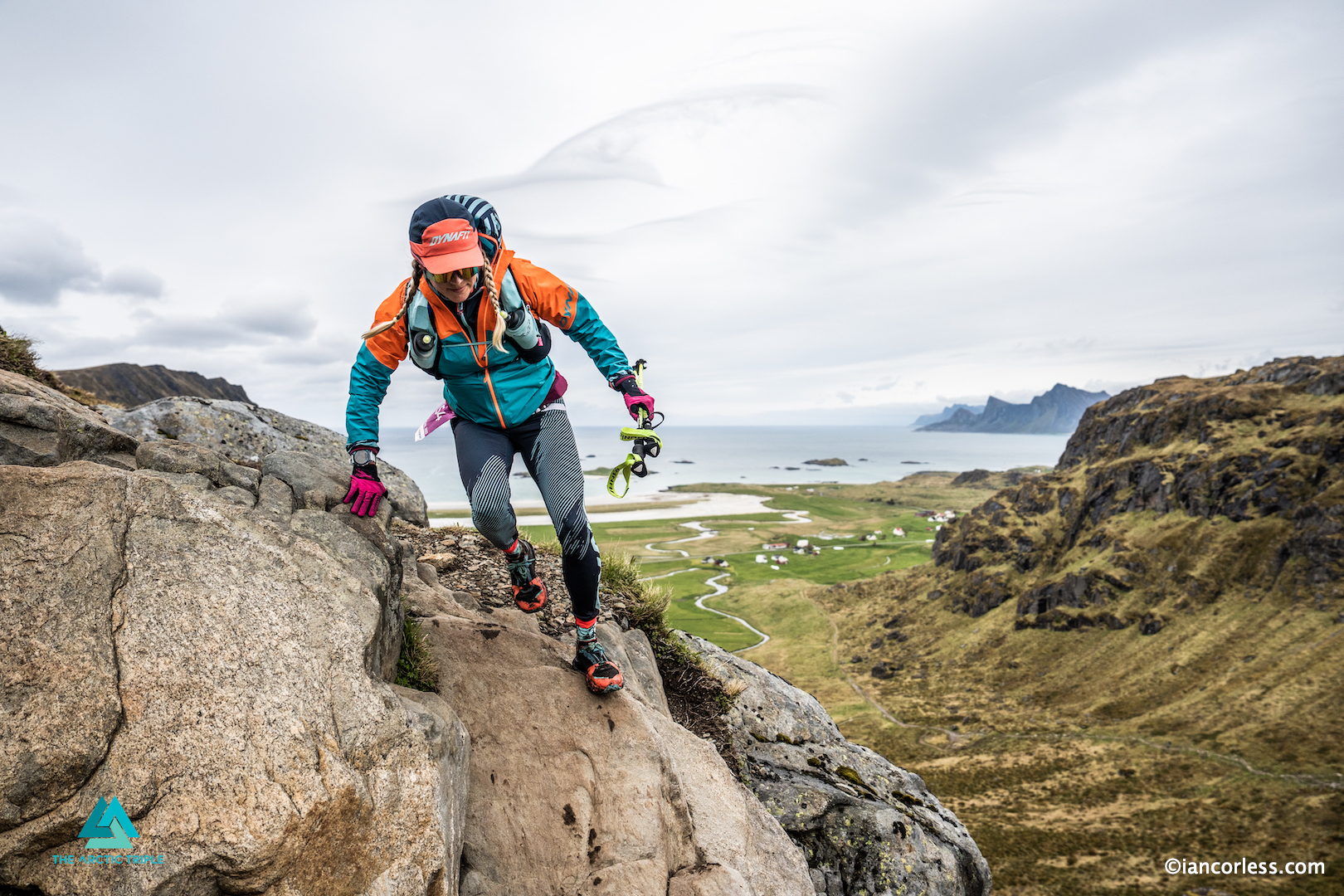
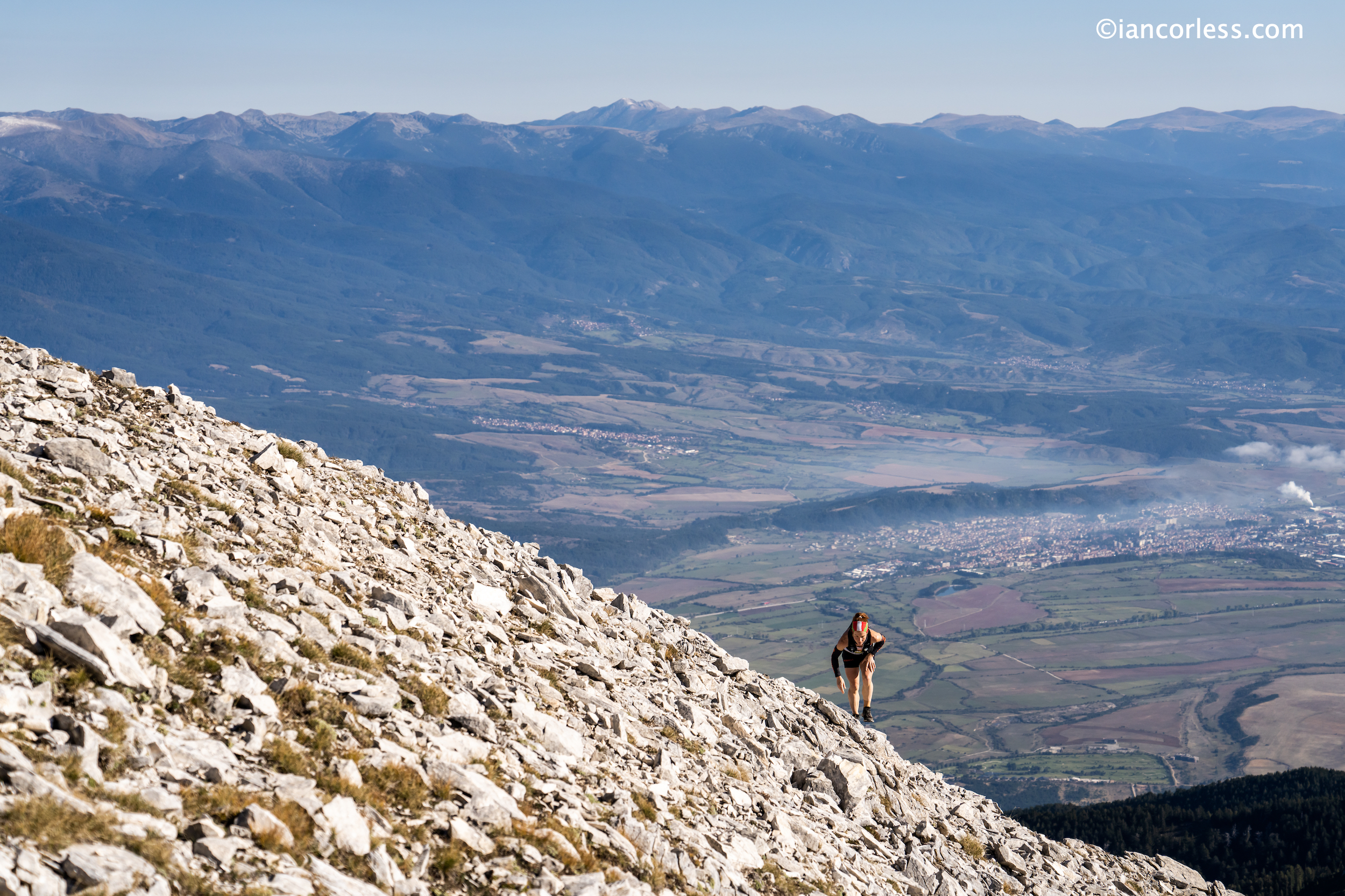
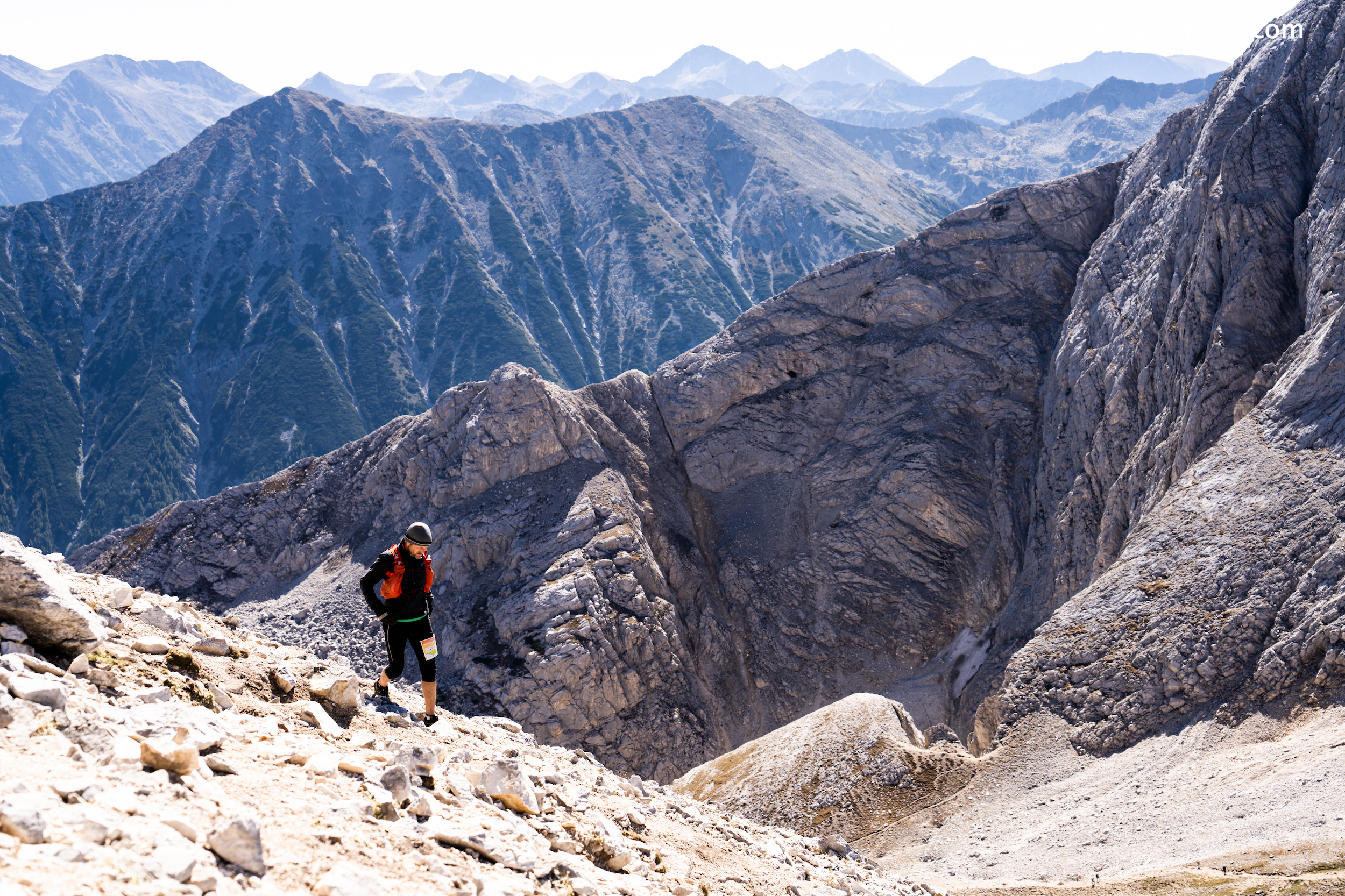
Located at the foot of the Pirin Mountains, it is a gateway to numerous ski and snowboard slopes which in summer become stunning running and hiking routes. Craggy and rocky alpine landscape, the Pirin National Park, a Unesco Heritage Site, is known for the high-altitude Vihren Peak which is a key marker in the Pirin Extreme race.
Organised by XCoSports, the Pirin Ultra weekend is an action-packed weekend of three races: the brutal 160km (11000m+) the 66km (4200m+) ultra and the 38km extreme.
Starting in Bansko, the route travels around the Pirin National Park taking in Duninoto Kuche, Banski Suhodol, Kutelo, Koncheto, Vihren (2914m), Malka Todorka, Todorka, and then forest and road trails complete the return to Bansko, a total of 3300m of vertical gain.
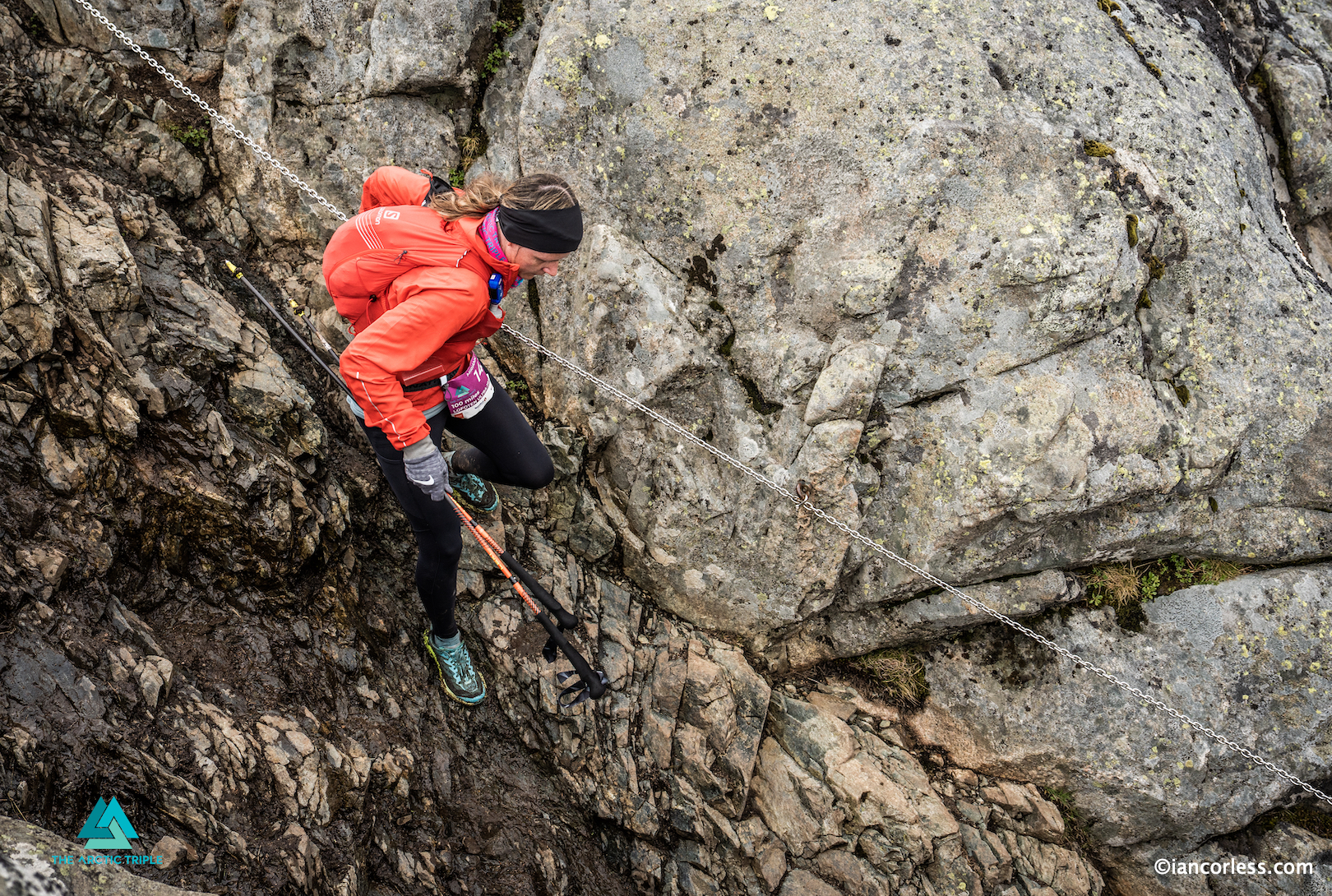
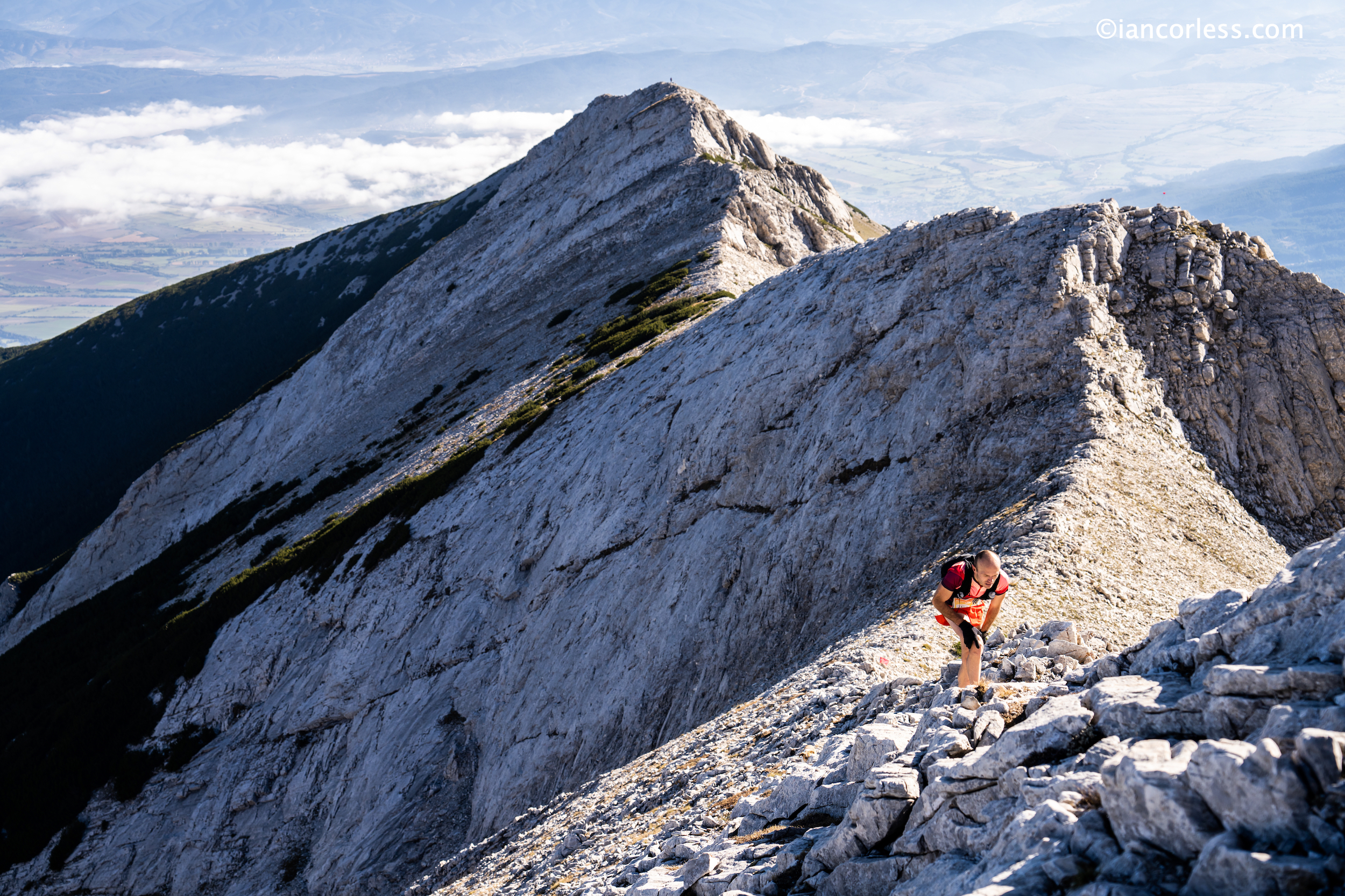
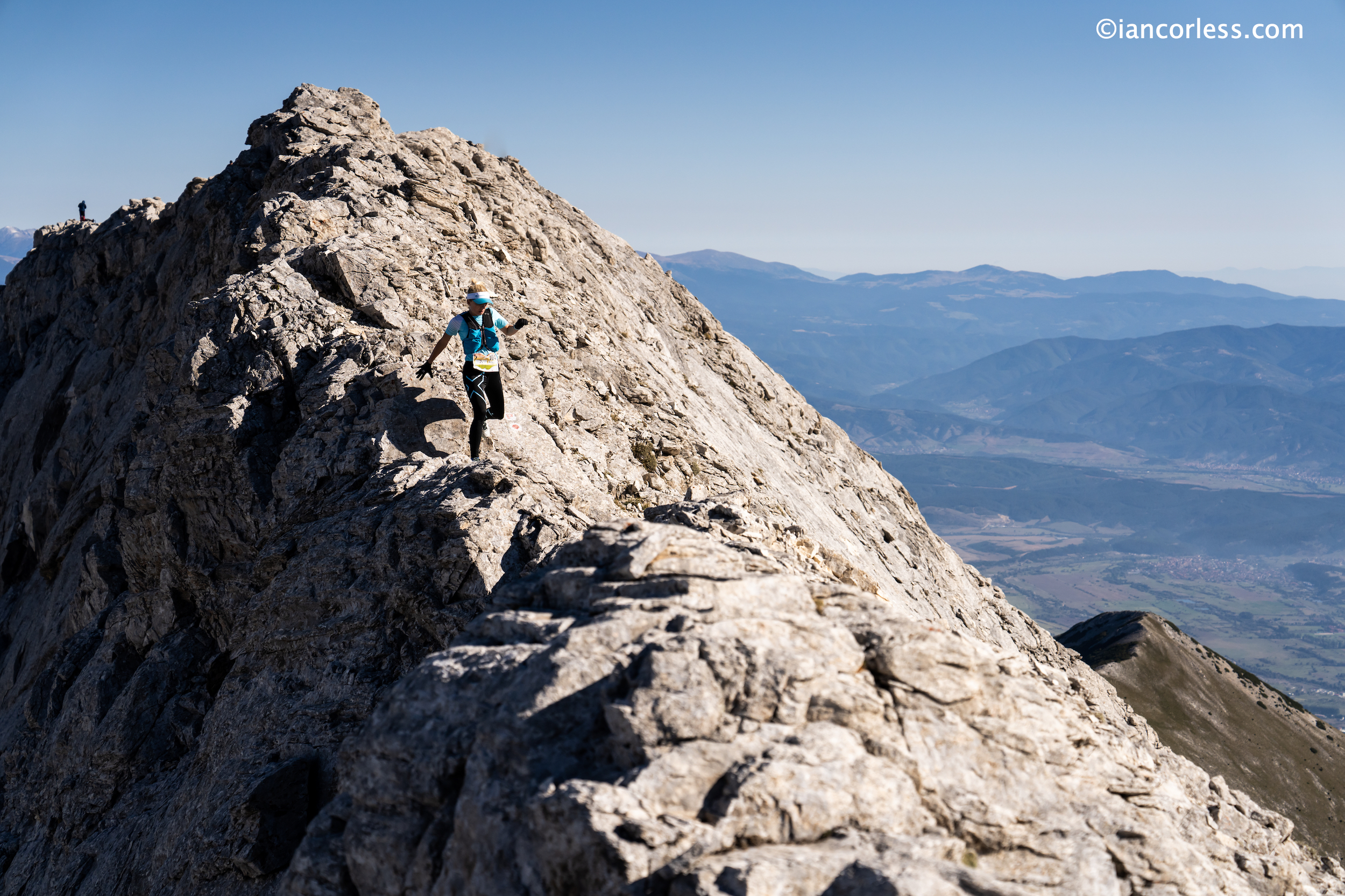
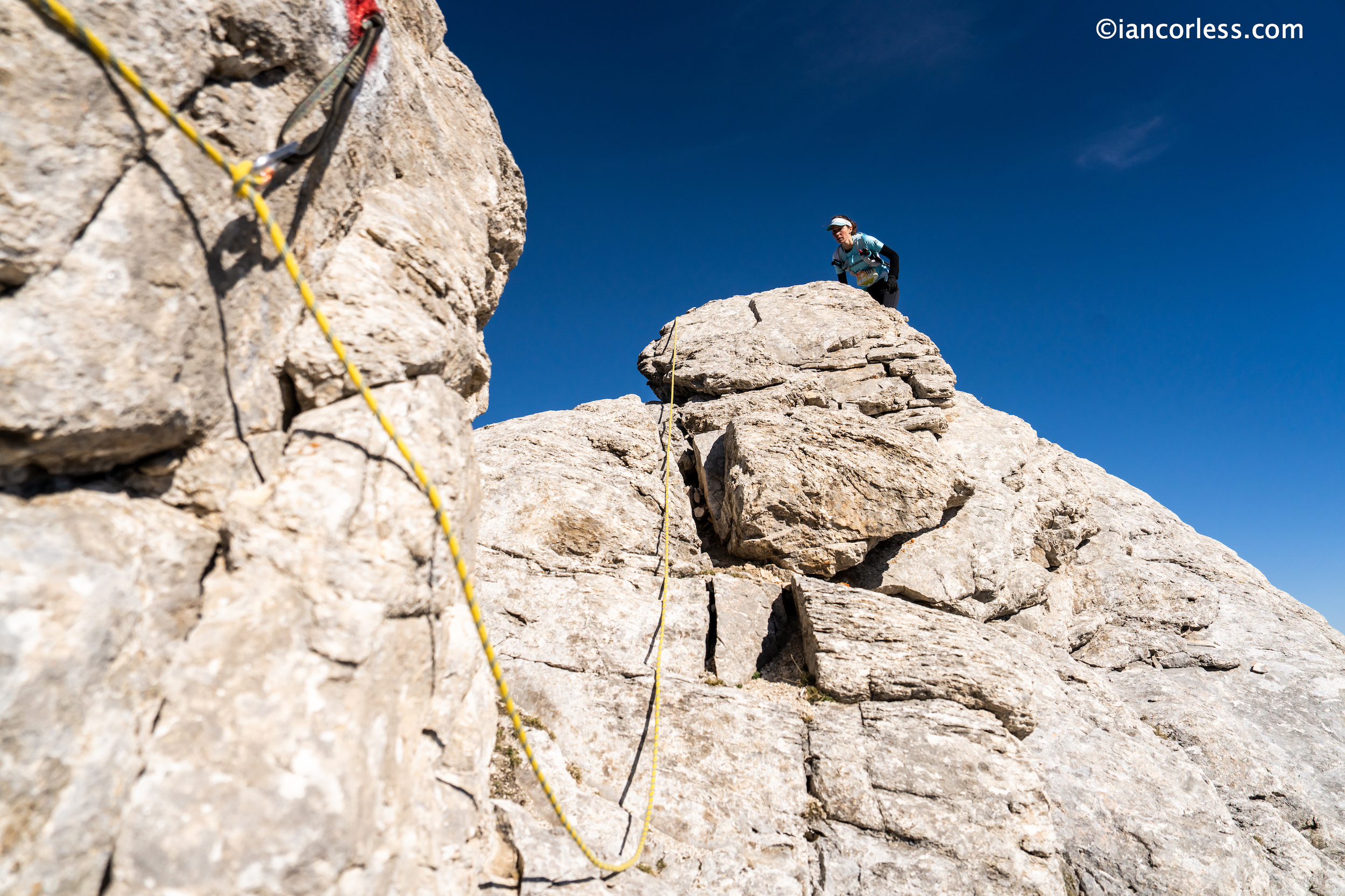
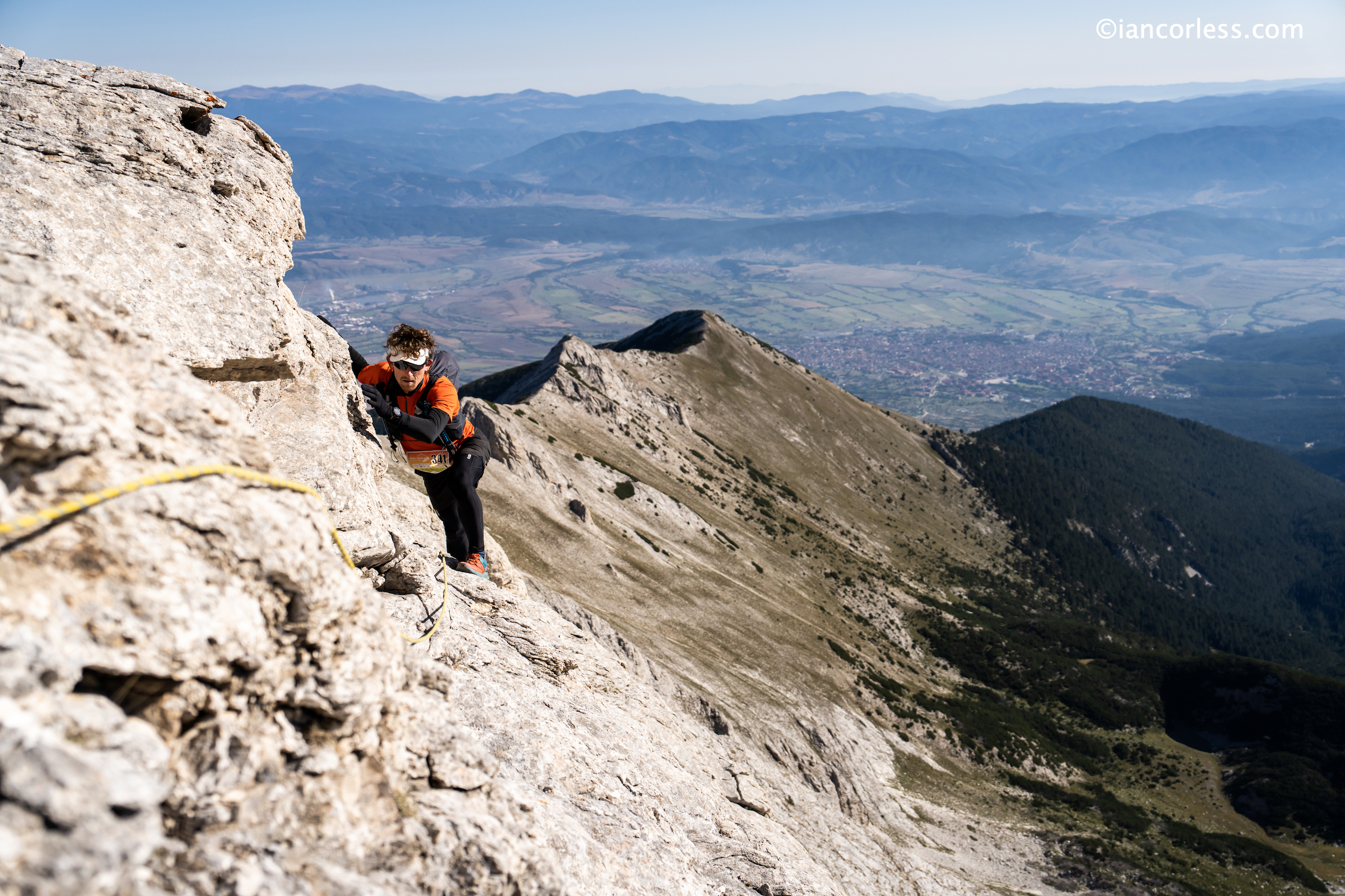
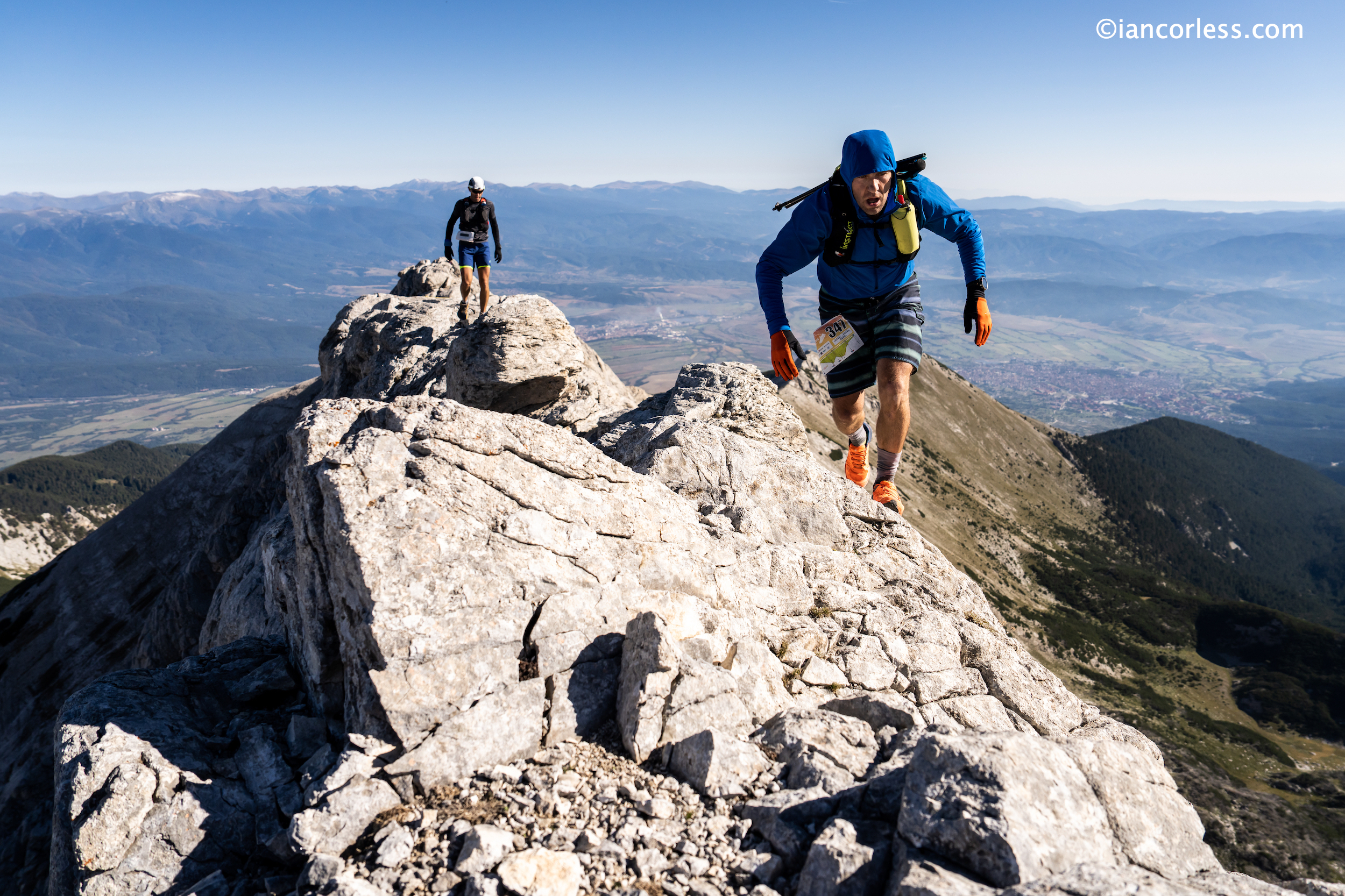
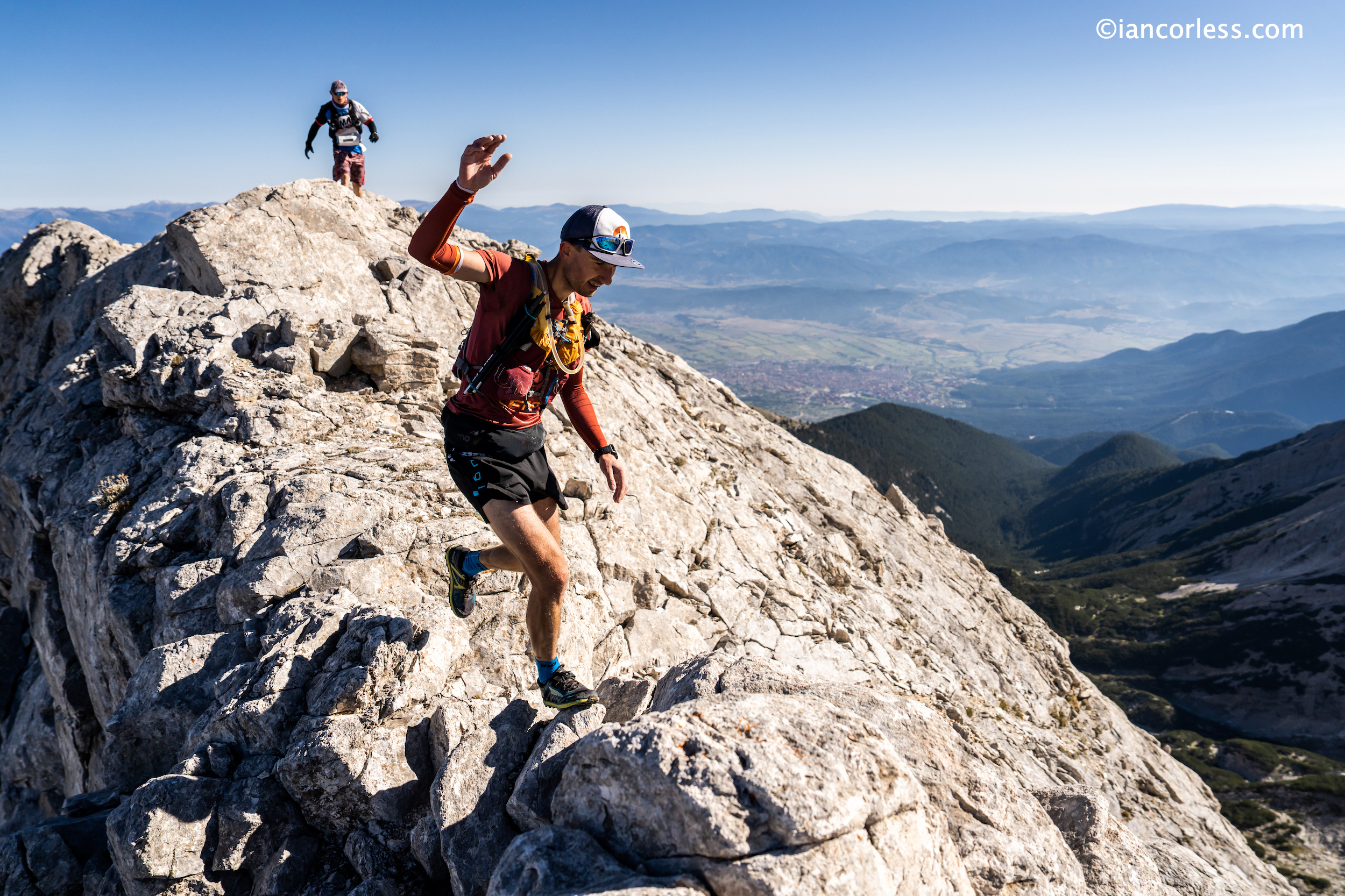
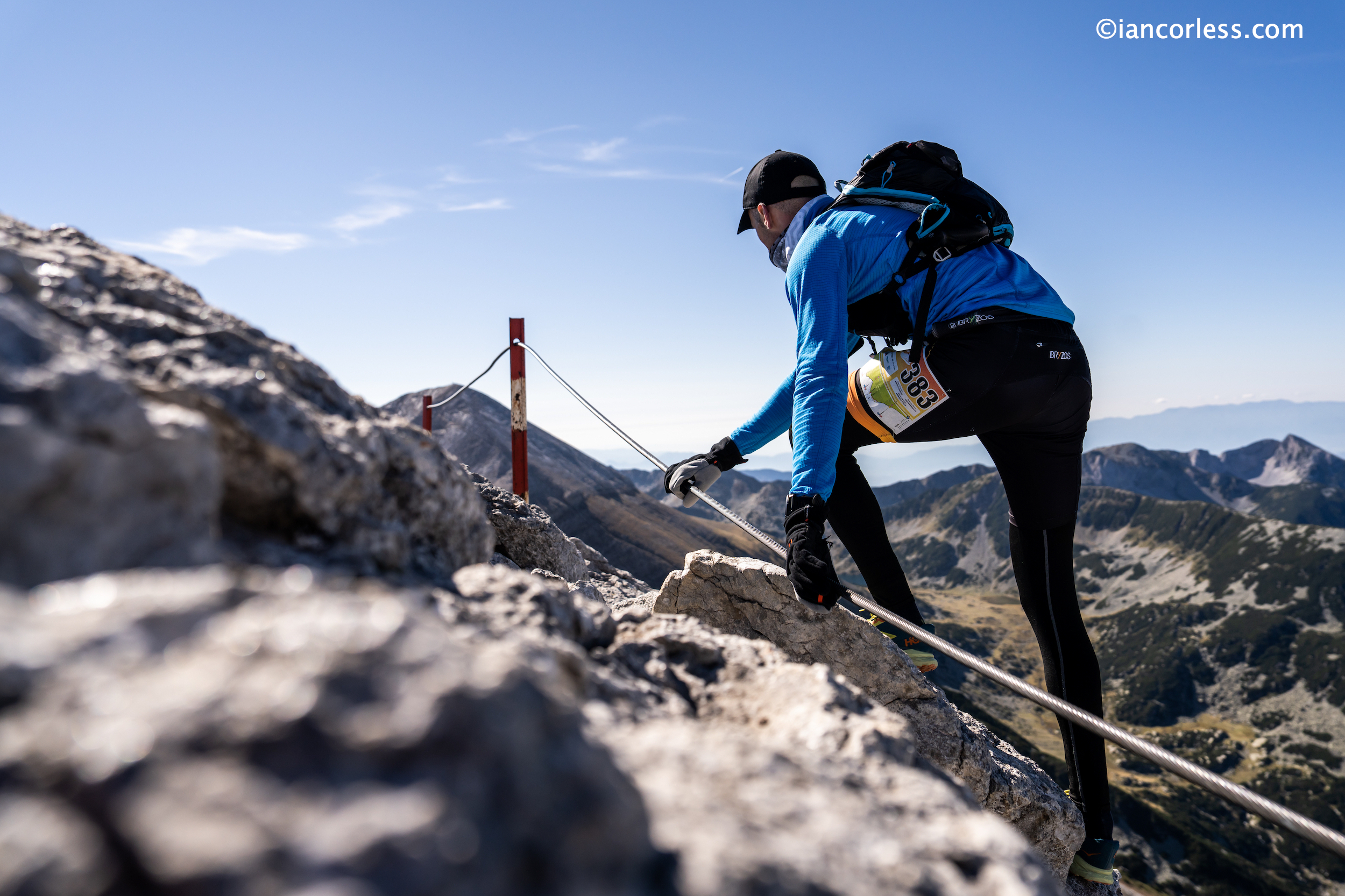
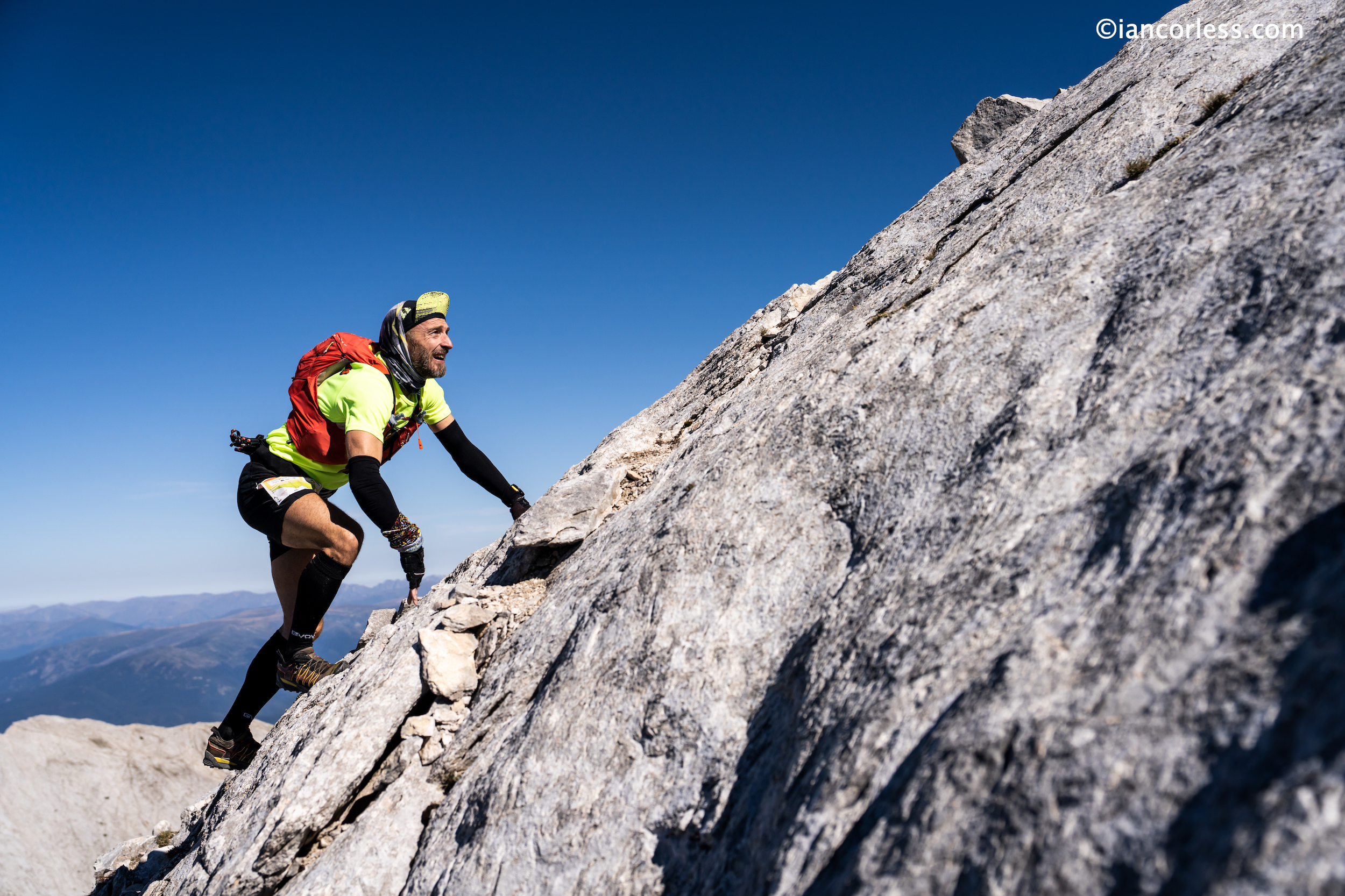
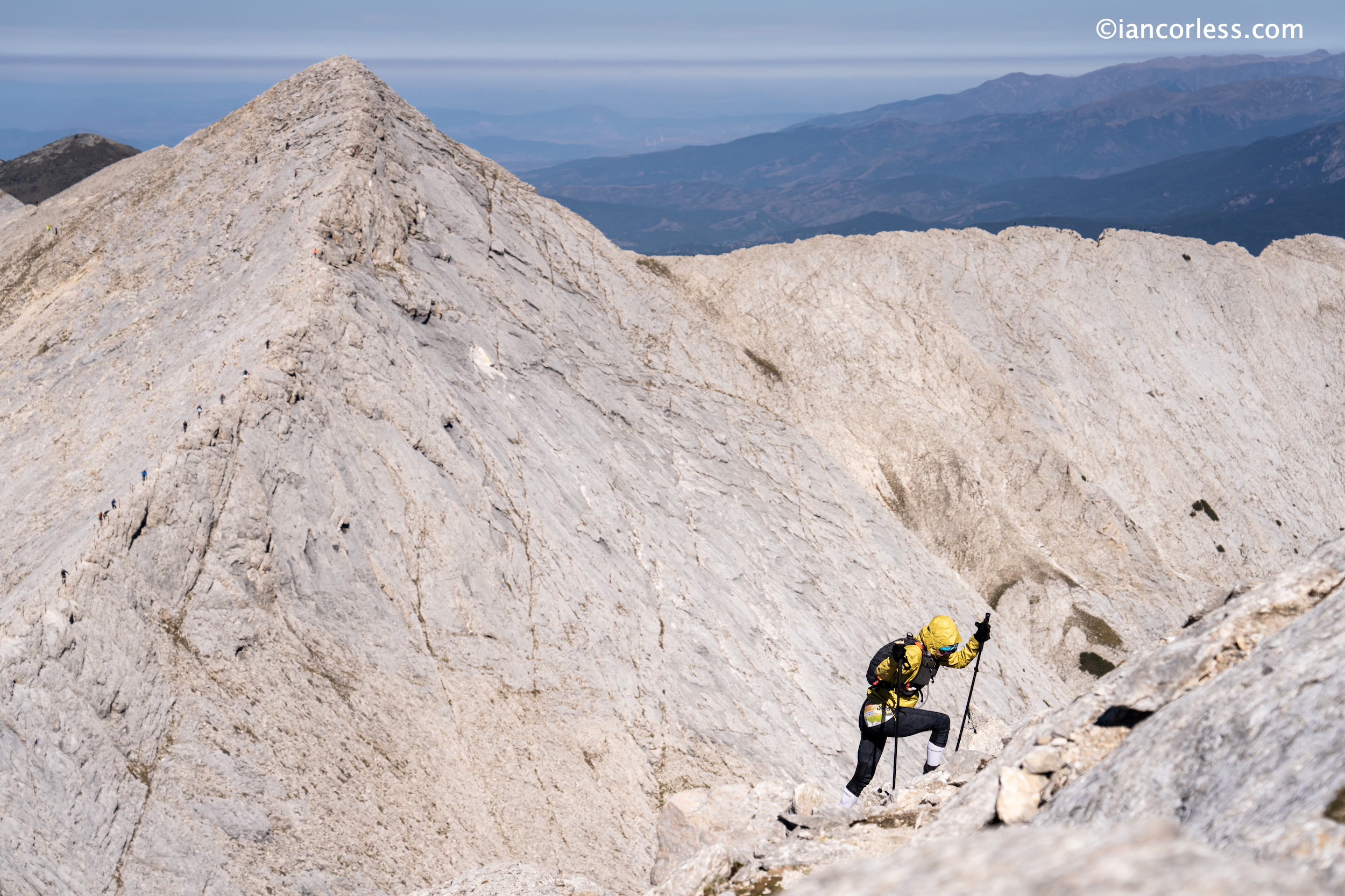
The heart of the race is a key section of open exposed ridges and technical trail from Duninoto Kuche all the way to Vihren summit; a section that is approximately 4-miles long (6.5km) but for the mind and body, feels considerably longer.
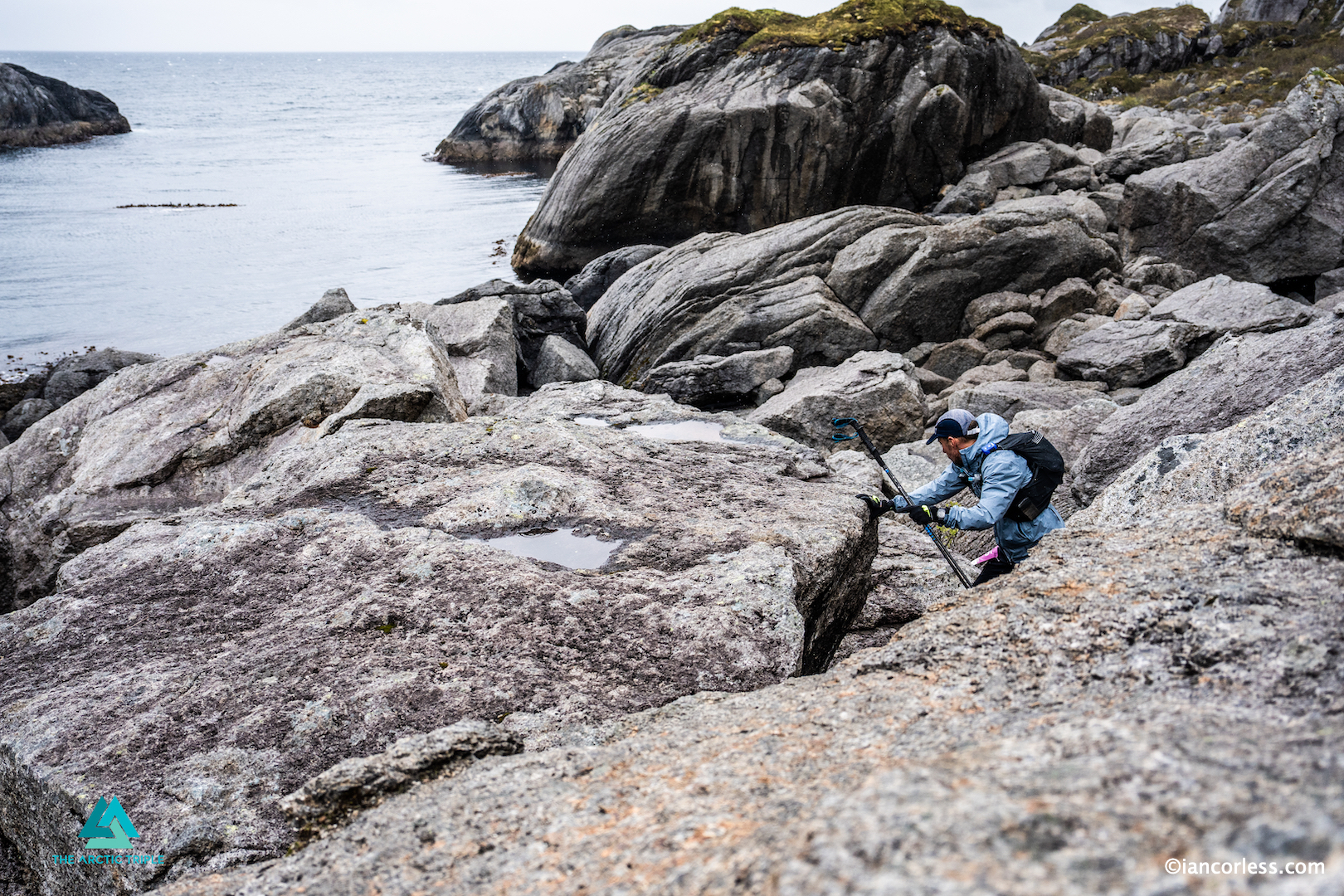
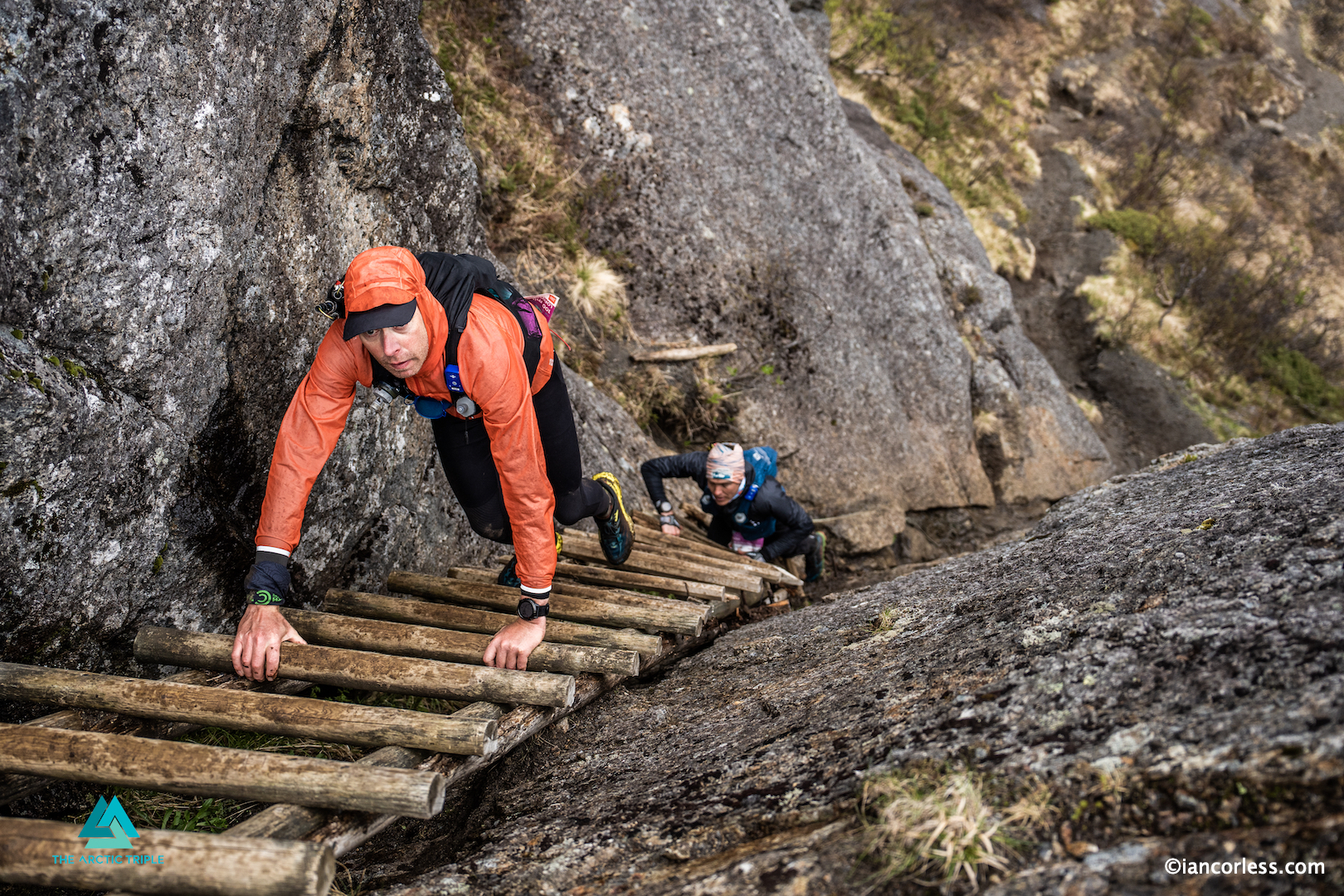
The ridges require 100% concentration, a fall here will not end well! Scrambling, down climbing, rope sections, via feratta, the route always has everything and, a stunning backdrop to accompany the runners.
The 2022 edition was won by Christian Mathys and Oihana Azkorbebeitia, 4:49:28 and 5:50:29 respectively. Nicholas Molina and Anders Inarra completed the men’s podium (4:54:52 and 4:57:33) and Sandra Sevillano and Maite Maiora (5:55:21 and 5:58:07) completing the women’s podium. With an allocated 14-hours to complete the race, for many, the 38km race was a long and arduous day in the mountains.

















 IAN CORLESS