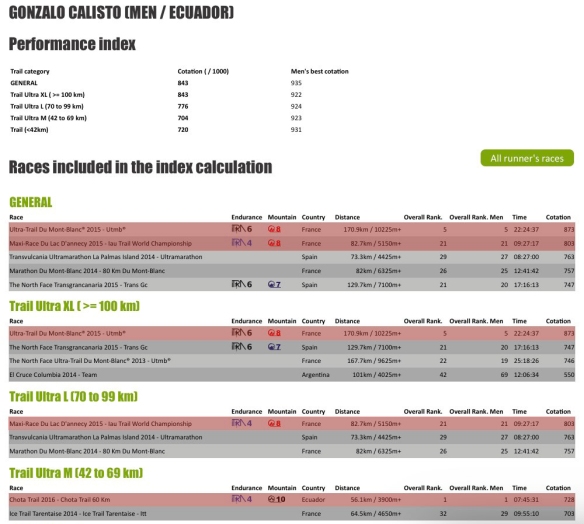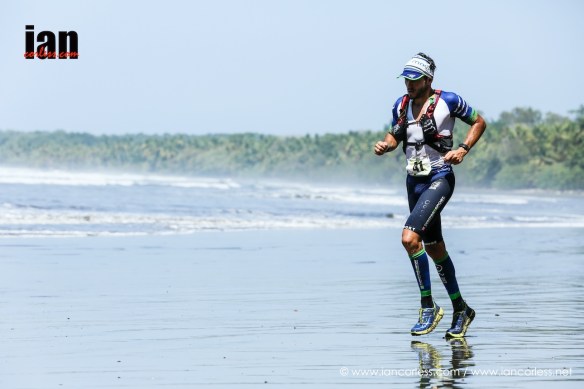
One week ago, the mountain, ultra and trail running world found out that Gonzalo Calisto tested positive after placing 5th at the 2015 UTMB. If you are coming to this new, may I suggest you read my posts in order as listed below as they will provide information and also chronologically provide an insight into my investigations.
Gonzalo Calisto has now released a statement via his Facebook page in Spanish and I have had a translation done. Please keep in mind that a translation may lose some of the uniqueness of the original, however, I do feel that what we have below provides an excellent insight.
As with all posts relating to this matter, I welcome your feedback.
Gonzalo introduces this by saying:
Thank you all for your support, I’ve taken a few days to be able to collect all this information and share it with you.
We will continue with the head held high, we’ll see you soon in the mountains!!!
I’m not a professional runner. I’m an amateur, with dreams which mantain my passion for adventure. Plainly, experiences in nature are my day-to-day targets, for every train and every run. I have never ran for prizes, or medal or recognizement, least of all for money. During these 13 years full of adventures I have filled my spirit with livings and learnings, and I have had the luck to share them with lots of generations of adventurers on lots of countries. During these years, I have witnessed exponential grow of trailrunning all over the world, and today trailrunning has lots of fans on my country on lots of running events.
Physiology: I have always been fascinated for the mountains, specially for the tall ones. I learnt to run there, to go up and down, walking and running, pushing myself and learning how the nature and strenght of the mountains fills our body and spirit. Ecuador, due to its geographical situation – Quito its capital 3000m above sea level – mountains with different heights and terraings and even different weather. Due to this, it is a privileged playground to train and go outdoors. Sport events are usually run on mountain and in zones, which go fron 3000 to 4500m+. Our bodies adapt to the high altitude and our blood is dense, which allows oxigenation. This process does not happen on sea level, and this training in altitude is scientifically known and used by lots of athletes to improve performance. It is called ‘altitude training’ and it’s a natural process. Legal At a country level, in Ecuador Trail running is not registered as a sport. No federation guides it, and it is not regulated by any ministery or govenrnment agency. Every trailrun event is private, and there are no licenses to ‘legally’ compete nor standarised rules. At an international level, Trail running is availed by the different athletic federations on the diferent countries, and runners have a local ranking to run on some important events. So, inside this called ‘elite’ they got licenses granted by their respective federations. These licenses somehow guarantee sport protocols between runners and sport event organizations.
IAAF is the organization which handles rules on elite athletics at a world level. IAAF runs an world ultratrail championship, but does not avail more trail events, as they are not considered ‘big events’ such as olimpic or panamerican games. This way, UTMB is not on their list.
AFLD: The French Agency against doping is the organization who takes care of doping on sport events on France.
ITRA: The Internationan Association of Trail Running, is an organization wich mantains a ranking based on an index generated based on the performance of a given athlete in different runs.
EPO: The eritropoyetin hormone, is an hormone which makes blood dense. It is naturally generated on hypoxic conditions, such as high altitude..
UTMB: UTMB is the most prestigious long-distance trailrun, which goes arond the Mont-Blanc. It is a private event, with no prices in money, which gathers 2500 runners from all around the world. 300 of them are ‘elite’ or ‘professional’. UTMB has its own ranking, based on the points gained for the participants in different sport events which UTMB avails.
CASE: During the UTMB I went on a doping control, before the depart and another after the run. This test marked positive, showing presence of EPO, but without specifying which kind of EPO was found, nor the EPO levels.
AFLD was the one who ran these tests and the one who reported the case to the IAAF.
I asked for the analysis, but I could never review the exact results. Altough IAAF regulates professional sport they have make public the results obtained.
However, they have not considered thatI am not a professional athlete. I don’t have a license and I don’t belong to any federation, so the have no jurisdiction on ‘punishing’ me.
UTMB organisation had no knowledge on this case until it was public on social networks. This shows also the lack of coordination between these two organizations.
Positive test should be analized in the ‘B’ take to ratificate EPO presence. This second test should ratificate the first positive and its levels or mark the first test as a false positive. This second test is usually done upon solicitation from the federation which the athlete belongs to, which is usually the one who extends the license to the athlete. In my case, as I don’t have a license, UTMB should make me firm a provisional license to allow me to participate with the ‘elite’ ones. I never firmed that document. Besides, they should make sure that I got all the information and knowledge about all the ‘elite’ protocols; information that never was told to me.
In this case, I was without legal support from any ferederation or government; and to go agains the positive I should take all expenses on myself. These expenses are above my resources, as I’m a person from Ecuador against an international French agency.
With all these I want to point out that legal resources that have judged and sentenced me are not enough, as they lack of the ‘bases’ to coordinate events, regulators and rules to apply to non-professional athletes. We amateurs take the expenses on ourselves without no federation. So, I can’t use my right to defend myself, rigth that every juridic rule on the world has and I cannot use. To end In my country, we the ecuator runners must ask our Ecuator Running Federation to register trailrunning as a sport, to grant licenses to high-level runners who want to take part on international events and support and avail the main running events in Ecuador. Also, the Ecuatorian federation should take care also of the andti-doping tasks and generate a runners ranking at an international level, we must estabish compatible parameters between international event organizers and the federations; improve the information and make sure that the athletes know the category where they are going to run, and to make sure that they know the anti-pogind rules applicable.
I’m with the anti-doping. I like clean game and I have never intentionally used anything to artificially improve my performance. But we must be coherent with runner’s real life, specially on countries where these sports have no international rules, and work to create a clear and safe platform to run high performance sports on.
I wonder, are the anti-doping tests really fit? do they take into account genetic trace of the runners (feeding, origin, training) before publishing results?
Is it OK to judge a non-professional runner, which does not make a living with trailrunning the same way we do with a professional?
Is it OK to run anti-doping tests without the legal coverage for non-licensed runners which will have difficults to claim their rights?
Conclusion:
I’m probably the first case on this. I’m not a professional. I don’t have a license. I live and train between 3000 and 5000 masl. I have dense blood. I got a top-5 on an international running event with professional runners from all Europe which clearly know the rules. I came to the UTMB controls without the complete knowledge of high competition protocols. I have no license and no legal support fom a federation and I consider that methods used on me are not equity, transparent and impartial. There are other sports -such as the IronMan series- where they take into account the runner condition (amateur or professional) to skip these kind of polemic situation due to the lack of legal support and information on the professional protocols.
Questions
Why my case was reported by the IAAD and the UTMB organization had no idea on what was going on?
Why the rules from IAAF, AFLD and UTMB are not compatible with the positive anti-doping test from an amateur runner?
Under which authority IAAF punished me for 2 years?
I’m not a federated runner. Why the UTMB does not have a professional runner list?
Why UTMB is not registered with the IAAF avail?
Why they let me run without a federative license in a category where they are going to do controls which need this license?
I want my case to clarify and modify the trailrunning world rules.
*******
We welcome your feedback on this post?
For me, it raises many question marks and the most important is the fact that Gonzalo tested positive in August 2015. The AFLD/IAAF confirmed a ban in March 2016 and then this was published on the IAAF website in June.
Gonzalo Calisto will have known about this positive test for sometime and chose to do nothing! The above statement has come about because his positive test has been made public.
We still have no news from his sponsors, Movistar and Compressport.
Amateur or professional, rules are rules and doping is doping!
Gonzalo Calisto has raced since UTMB and July 2016 and gained results, why have these races not made a statement and why have they not disqualified him?
This is Episode 115 of Talk Ultra and we have an interview with Hardrock 100 winner, Jason Schlarb. We also speak with Elisabet Barnes about her Richtersveld Transfrontier Wildrun and Big Red Run double. Speedgoat Karl is with us on the countdown to the AT and of course we have the news from around the world.
Timmy Olson – American Tarzan…. Discovery Channel HERE“When Tim gets low on energy, he goes into his trademark “Animal Mode,” and enters the “Pain Cave” to get through it – training which will serve him well in the jungle!”
Coming up – Skyrunning World Champs this weekend HERE
02:07:00 INTERVIEW ELISABET BARNES
03:10:16 AUDIO – the meaning of life see the post HERE
Many questions have been asked about my initial post (HERE) re the positive EPO case with Gonzalo Calisto at the 2015 UTMB®.
Gladly, UTMB® responded very quickly and issued a disqualification and removal of Gonzalo Calisto from the 2015 UTMB® ranking. It is clearly explained in the press release HERE
Last night I posted a response from Michel Poletti (HERE) when I asked some specific questions. The response from Michel Poletti did make me ask additional questions and today I received a response and clarification from Catherine Poletti.
1. Why are you not informed of a positive test? Only the “testing authority” responsible for the legal treatment of the results are able to communicate about a period of suspension; the organiser, no more than any other structure, doesn’t have to be informed directly about a positive control during their event.
2. Which authority took the test and on who’s authority? Once again, the organiser does not have access to this information. The “testing authority” (= the structure which asks the organisation for the control and thus which is in charge of the legal treatment of the results) is mentioned in the mission order. This information is therefore only known by the doctor taking the sample, and by the athlete himself. In this precise case the ‘testing authority” maybe the country’s National Anti-Doping Agency(AFLD for France), an international federation, the Anti-doping World Agency, or another National Anti-doping Organisation (NADO).
3. Who does Gonzalo Calisto approach to review the test? Again, it is the classic procedure for an anti-doping test. The laboratory responsible for the analysis of the samples is unknown by the Organiser.
4. Under who’s authority is Gonzalo Calisto suspended from racing? Under the authority of the IAAF. The jurisprudence says that an athlete suspended by an international federation cannot participate in any other event under the aegis of another international federation. For exemple, Armstrong who was suspended by the ICU was unable to participate in the Ironman circuit which is none the less a private circuit.
Obviously this does raise some questions and it goes back to my post this morning when the IAAF replied to my questions HERE. I say it again, It’s time to lobby for a change and YOU as runners, followers of the sport or whatever capacity you have as a fan need to ensure that we all act now and make sure that the following happens:
Positive tests are confirmed to the athlete asap
Due process is allowed for a B sample
The race, race director and management team are notified immediately
A press release is issued by the race and or organisation
IAAF, WADA, AFLD and so on list and make results public asap
I did also ask the question as to why Gonzalo Calisto is only banned till March 2017 as shown here:
Apparently, the IAAF have confirmed that this is a mistake. “It appears that this is a typo as it was transcribed from the official memo…. The correct start date is March 2016 (with end date in March 2018). The athlete will have also had any results from the day of the test through to March disqualified as well.”
The IAAF have also confirmed some of the issues as to why the UTMB® was not notified of the positive test: “The main issue seems to have been the non-notification of the event organiser at which the test occurred. We will follow up with AFLD on that matter.”
Finally, many have asked why it has taken so long (August 2015 – March 2016) for Calisto to be banned and confirmed for EPO doping?
As much as we would like quick results and management processes, unfortunately this is not always the case. This is especially so when dealing with athletes from countries (in this scenario Ecuador) the relevant authorities may have very limited experience in dealing with the results management for a case such as this. Doping related cases are quite often lengthier than the general public would expect as athletes choose to exercise their rights to various hearings and appeal options. While this may seem protracted, athletes do and should have their rights protected to ensure this process is fair and subject to appeal.
At this stage it would be good to hear from Gonzalo Calisto and find out his version of events and his thoughts in regard to the positive test and if he feels the process has been correct.
It has been a whirlwind 36 hours and I would like to make one thing clear, I have grabbed this positive EPO test at UTMB® by the horns not because I wish to humiliate the guilty runner, cast doubts on UTMB® or UTWT but because this is the first official EPO test of a runner in a trail running event (as far as I know).
I believe strongly that if we get it right NOW then this can only help in the future. For me and yes, I may be naive, but it appears that the current process has huge flaws!
This test being confirmed, listed on the IAAF website and a ban put in place.
However, the test was taken on the day of UTMB® and ‘we’ the public have only found out on July 18th/ 19th and this was down to the eagle eyes of UK ultra runner Robbie Britton.
I picked up the case and contacted all the relevant people and within 24 hours we had a UTMB® release stating disqualification. See HERE.
The above are positives but how was it possible that the UTMB® did not know of this positive test? I asked for clarification and Michel Poletti at the UTMB® provided a response HERE.
Michel Poletti eluded to the facts:
Indeed, the anti-doping procedure is so discreet that :
The organizer has no information about the doping controls operated on his race.
When a national or international federation make a decision, this decision is published on the web site of the federation, with no other announcement.
Thus, if an organizer want to know something about the anti-doping controls which were made on his race, he should need to look every day on the web site of the federations…or to wait to be warned by someone else…
It seems crazy to me that a race (any race) would not be informed of a positive test. How are the race meant to action on this? Like Michel Poletti implies above, he or the race would need to check monthly, weekly and/ or daily for results to be posted? This is a major flaw and I hope that we can somehow instigate from this a better procedure so that races and those in charge receive results asap!
I must stress that I don’t think that this positive test is a negative thing for UTMB®, on the contrary, it’s a positive! They have had tests, the tests have worked and the sport is a little cleaner.
What I am worried about is the protocols and procedure.
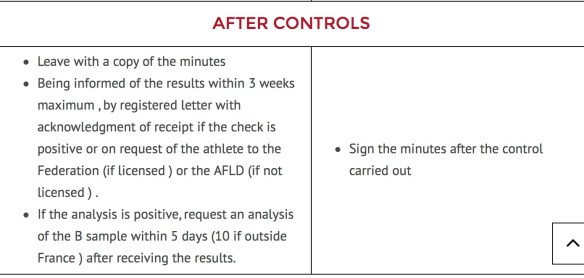
This morning I emailed the IAAF and I also found out that AFLD provided the testing procedures at UTMB®. The procedures are HERE but importantly look at the screen shot below:
By the above ‘After Controls’ one has to assume that Gonzalo Calisto was informed of his positive test in September 2015 (the above says, within 3 weeks maximum.) Calisto lives in Ecuador so if he requested a B sample this would take us to the middle of October but lets assume the worst and it was November.
What has happened since November 2015?
Luckily as I was asking theses questions (somewhat bemused and flabbergasted) the IAAF emailed me and they clarified the following points:
In this case, the Testing and Results Management process was performed by the French Anti-Doping Agency (AFLD): https://www.afld.fr/ Normally we would expect that they would have informed the organisers but in this case as it was handled at a national level we do not have confirmation of this.
As you will see, some major flaws in my opinion. This is bad for the UTMB®, UTWT and ALL runners who want to compete on a level playing field.
It’s time to lobby for a change and YOU as runners, followers of the sport or whatever capacity you have as a fan need to ensure that we all act now and make sure that the following happens:
Positive tests are confirmed to the athlete asap
Due process is allowed for a B sample
The race, race director and management team are notified immediately
A press release is issued by the race and or organisation
IAAF, WADA, AFLD and so on list and make results public asap
I am still struggling to understand how it has taken till July for us all, UTMB® included to find out of a positive test and a ban that must have taken place in November, December at the latest.
It is never nice to have to report and document on doping, particularly in a sport I love. However, in the past 24-hours many questions have been raised re a positive test for EPO at the worlds largest trail running event, the UTMB®
I must thank Robbie Biritton for bringing the positive test of Gonzalo Calisto to the limelight. I recommend that you read my post from earlier today HERE.
This positive test raised many questions. Most importantly, how was it possible that the IAAF could have this information available to the public and the UTMB® or UTWT not notify the world media and runners of this positive decision?
I was proactive and I emailed UTWT and UTMB® and within a relatively short period of time, the UTMB® released a ‘press release’ which acknowledged all our claims. You can read that HERE.
Problem is, myself and many of the ultra running community still have many questions. How was it possible that Robbie, myself and other journalists were the ‘first’ to release this information?
And I quote:
Dear UTMB®
Many thanks for this and thank you for responding so quickly.
It does pose some serious questions though and I would like clarification why it has taken myself (and a few others) to bring this to everyones attention.
How long have the UTMB known about this positive test?
Kind regards,
Ian
This evening I have received a reply from Michel Poletti. He provides the following answers to my question?
Dear Ian,
We have learned this news this morning at 7 AM (Paris time) by an email from Anne who has been asked by other journalists.
Indeed, the anti-doping procedure is so discreet that : – the organizer has no information about the doping controls operated on his race – when a national or international federation make a decision, this decision is published on the web site of the federation, with no other announcement Thus, if an organizer want to know something about the anti-doping controls which were made on his race, he should need to look every day on the web site of the federations…or to wait to be warned by someone else…
Do not hesitate to ask for any other question
Best regards
I have to say that I welcome this response. However, I struggle with it…. I responded:
I appreciate your email and I thank you for the clarification.
I am somewhat bemused and perplexed by this situation?
I became aware of this some 12 hours before the UTMB organisation? I find this hard to believe… this has been ‘public’ knowledge on the IAAF website since June 24th. Are you telling me, that it was myself that informed UTMB of a positive test?
The IAAF have found Gonzalo Calisto ‘positive’ of EPO at ‘in competition testing’ after placing 5th at ‘the’ most prestigious trail running event in the world and they did not inform the race, you or Catherine?
Could I ask the following please?
1. Why are you not informed of a positive test?
2. Which authority took the test and on who’s authority?
3. Who does Gonzalo Calisto approach to review the test?
4. Under who’s authority is Gonzalo Calisto suspended from racing?
These are fundamental points and please rest assured, I want to ensure that Gonzalo Calisto is not the subject of a witch hunt.
The UTMB® organisation has today seen the list of recent infringements concerning the rules of anti- doping published by the IAAF and the penalties applied to the offenders.
Gonzalo Calisto (Ecuador) is included in the list of athletes who are suspended, following a positive result of an anti-doping test which was carried out in Chamonix on August 29th 2015 at the finishing line of the UTMB®.
Consequently, Gonzalo Calisto (ranked 5th in the UTMB® 2015) has been officially disqualified and has been instructed to return his trophy and finisher’s jacket. The 2015 official results will be corrected as soon as possible on the UTMB® web-site.
The trophies given to the top ten men were unique works of art, each runner placed from 5th to 9th place will receive a new plaque, while the 10th runner will receive the trophy to which he is entitled.
At the same time, the organisation would like to remind you that to maintain the spirit of the event, and its authenticity, a health policy has been in place for the UTMB® since 2008.
It includes, in particular, a preventive initiative regarding health matters. This action is carried out in collaboration with Athletes for Transparency (since 2008) and the ITRA (since 2014).This action has neither the vocation, nor the competence to be a substitute for current national and international regulations concerning the fight against doping but has the objective of reinforcing the medical supervision wished for by the Organisation and it may allow for a better orientation of doping tests prompted by various anti-doping organizations.
UPDATES
UTMB PRESS RELEASE HERE MICHEL POLETTI RESPONSE HERE IAAF RESPONSE HERE
Twitter came alight on the evening of Monday 18th July when British ultra runner Robbie Britton broke the news that Ecuador athlete, Gonzalo Calisto had tested positive for EPO.
The test was taken on the 29th August 2015 – the day that Calisto placed 5th at arguably the most high profile race on the ultra calendar – Ultra Trail Mont-Blanc.
Needless to say this is devastating news for the sport! Drug taking and awareness of drug abuse is something that gained a high profile at the end of 2015, highlighted at San Francisco 50 (see post here).
More importantly why have UTMB and UTWT not responded to this and sent out a media release and if this positive test is confirmed, as the IAAF suggests, why is Calisto still listed as 5th at UTMB?
I have contacted both UTMB and UTWT. I have received no reply from UTMB but the UTWT did respond immediately saying:
“We will communicate very shortly on this matter. “
I have also contacted Calisto and asked for feedback. I know him, not very well I must add, but I did spend an extended time with him earlier this year while he raced in Costa Rica.
Ultimately, there are two sides to every story and we should hear a balanced argument. However, the lack of response from UTWT, UTMB and Calisto himself is somewhat alarming. I think it’s important now to be proactive, not hide our heads in the sand and fight this face on. If not, we are doomed….
UPDATE 19th July 17:43 Europe time – UTMB respond
“Hi Ian, UTMB® is preparing a news release which is ready tonight or tomorrow morning.”
BREAKING NEWS UTMB PRESS RELEASE 19th July 1930 hours
The above document dated 24th June is worrying. Go to the IAAF website and look at how many athletes are currently sanctioned according to information received by IAAF as of June 24th. http://www.iaaf.org/about-iaaf/documents/anti-doping click on the ‘EN’ black box:
In Callisto’s case his test is confirmed as ‘in competition’
In competition testing is imperative and more importantly, out of competition testing and blood passports are the way forward. It’s time we have these protocols put in place, in particular for key events such as UTMB. Ironically, UTMB has no prize money!
UPDATES
UTMB PRESS RELEASE HERE MICHEL POLETTI RESPONSE HERE IAAF RESPONSE HERE
Welcome your thoughts and I am sure we will have many!
The 2016 edition of the UTMB will take place this August, for 13-years the race has made a rendezvous in the endurance capital of the world, Chamonix!
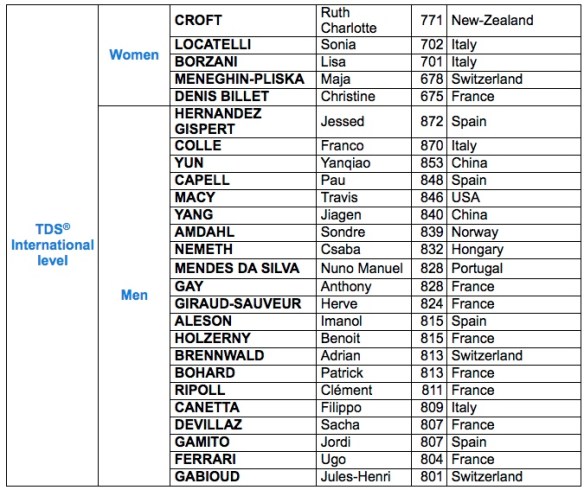
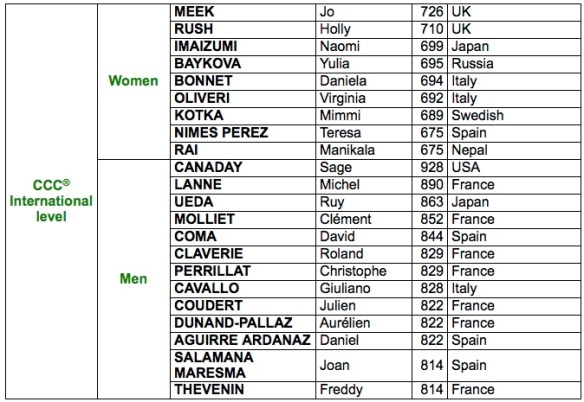
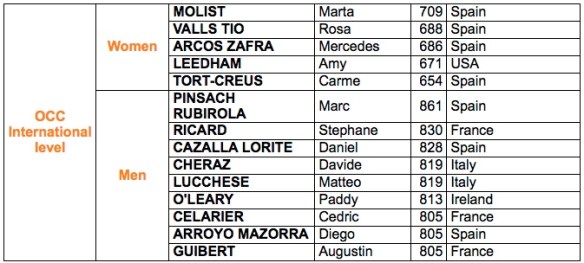
In preparation for the 2016 edition, the organisation have just announced the elite level competitors that will compete, head-to-head, with 7500 runners over the four races – CCC, OCC, TDS and UTMB.
The main event, the UTMB, is a 170km journey that takes in 3 countries with a total elevation gain of 10,000m. A time limit of 47 hours is provided to give the 2300 runners an opportunity to complete the journey.
Now in anyones book, that is a quality ladies line-up. The most notable name missing is of course Nuria Picas. I have highlighted the hot favourites for overall victory and definite wild card of Jasmin Paris for a surprise podium place.
MEN:
Luis Alberto Hernando
Tofol Castaner
Dylan Bowman
Zach Miller
Miguel Heras
David Laney
Stephan Hugenschmidt
Timothy Olson
Seth Swanson
Ryan Sandes
Jason Schlarb
Gediminas Grinius
Pau Bartolo
Jordi Bes
Tim Tollefson
Fabien Antolinus
Jorge Maravilla
Ryan Ghelfi
Ludovic Pommeret
Didrik Hermansen
Julien Chorier
Andy Symonds
Thomas Lorblanchet
Ryan Kaiser
Arnaud Lejeune
WOW! That may well be THE elite field assembled in any race ever… It’s a seriously exciting line-up and just look at how many bold names are in that line-up! In all honesty, the whole list could be bold as victory could come from anywhere.
So with several months to go, we have already seen Caroline Chaverot and Didrik Hermansen lay down seriously strong performances at Transgrancanaria.
Elite line-ups for TDS, CCC and OCC are as follows:
Notable names in the TDS are Ruth Croft and Lisa Borzoi for the ladies and in the men’s race, Franco Colle, Pau Capell, Travis Macy and Sondre Amdahl amongst others.
CCC ones to watch: Jo Meek, Holly Rush and Manikala Rai fo the ladies and Sage Canaday, Michel Lanne and Freddy Thevenin amongst others for the men’s race.
Who in your opinion will make top 3 in the respective male and female races at the 170km UTMB event?
This is Episode 102 of Talk Ultra. Happy Christmas everyone! We speak with Mike Bialick about that storming 100 mile run, Sally McRae talks all about her running and finding balance and we have a tribute to fellow photographer, Mark Gillett who sadly passed away. Niandi co-hosts.
00:01:31 Show Start
00:19:10 NEWS
Divinio San Francisco, walking the streets of La Palma HERE
Running the Caldera de Taburiente rim, Roques de los Muchachos HERE
DESERT SOLSTICE INVITATIONAL
Zach Bitter ran 11:40:55 for 100-miles – he went through 50 in 5:33 and 100k in 6:58 he broke his own 100 record by 7min but missed the world record which is still a good chunk of time away.
Katalin Nagy dropped from the 24-hour but won the 100 in 14:48 and set a US Track record for 200k in 19:19:05
BARCELONA 24HR
Well done to Marco Consani winning #barcelona24 with 256km (159miles) course record and PB. Now that’s awesome and a long way!
Finally we want to thank you for all the support over the last 12-months. Difficult to believe that another year has passed. We wish you all a very Merry Christmas and we hope 2016 is awesome!
UTMF will be a VERY different race this year. First and foremost, the race date has moved from early in the year to late in the year; this is significant! Another important factor is the course. For 2015 (the 10th edition) the race will be run counter-clockwise and as such all the climbing and difficulty will come in the early stages and therefore leave the more runnable sections for later in the race; again significant!
With around 8500m of climbing and a distance over 100-miles (105) this race is a real challenge.
However, for me this years UTMF may very well be all about the UTMB.
Yes, UTMB was only 4-weeks ago and we all know the devastation that took place in and around Chamonix. It was carnage!
Much has been discussed about the DNF’s and failures at UTMB and unfortunately I think it’s a sign of the times. The racing calendar is full and race series like the UTWT encourage runners to race regularly 100km+ and 100-miles often; is too much? Francois D’Haene and Nuria Picas dominated the calendar in 2014 and where have they been in 2015?
Exhausted?
Just look at the start list here at UTMF. Many of the key players are runners who had tough, below par or DNF’s at UTMB.
Fernanda Maciel dropped with 2/3rds of the race done with severe foot pain.
Amy Sproston dnf
Gediminas Grinius dropped with over 90-miles completed.
Sondre Amdahl dropped with just over a marathon covered.
Jeff Browning dropped with a twisted ankle.
Of course, this is not all the favourites at UTMF but a pattern may be forming? All of the above have raced at one or more of the following: Lavaredo, HK100, Transgrancanaria, Western States, UTMB and now they line up at UTMF and I wonder how many post UTMF will travel to Reunion Island to take on the Diagonal des Fous (Raid de la Reunion). For many of the runners that will be 3 big 100-milers or a combination of 100-miles and 100km+ in relatively quick succession. The body may take it in 1-year but can it take year-after-year?
I merely raise the question?
So who is going to win?
THAT is a million-dollar question. Keeping in mind what I have said above, we can still expect Grinius, Amdahl and Browning to figure at the front of the race providing they have no issues. Sondre Amdahl(interview on Talk Ultra) should be the freshest of the 3 as he dropped early at UTMB and therefore it was probably just like a typical training run for him. However, what caused the ‘failure’ of his hamstring at a race that he obviously prepared meticulously for?
Jeff Browning (interview on Talk Ultra) loves the long and hard races. He dropped at UTMB but I am pretty sure he will be recovered here. He lacks some of the speed of the competition so although I think he will be in or around the top 5-10 I don’t think the podium could be his.
Gediminas Grinius (interview on Talk Ultra) has continually impressed. He loves the long hard races and he closes like a demon. I do worry that he is just tired though? I may be wrong. He has the race and skill set for UTMF, pretty sure he would have prepared the course the other way around but Transgrancanaria finishes with a very runnable last 20km and look what he did there!
Okay, so that is the UTMB contingent done and dusted and arguably I am now talking about who may win the race?
Gary Robbins has had a steady year with a great FKT (interview on Talk Ultra) and becoming a new Dad just a few weeks ago. He just missed the podium in 2013 and I think a podium slot may well be his this year.
Brendan Davies is a runner who I should add to the exhausted list above! He just ran the Worlds 100k and this year he did TNF100, Western States and Transgrancanaria where he had a really tough day out. He has potential to be on the podium BUT….
That leaves Didrik Hermansen for the top slot and if all things go well I think he can do it. He has the running legs for the latter half of the race and as he showed at Transgrancanaria and more importantly Lavaredo (where he won) he knows how to get the job done!
As one would expect the start list is extensive at UTMF and I have picked out some key names. For sure I will have missed some other key players, in particular the local talent who I am less familiar with.
Anyone we should look out for who can take a podium place?
Uxue Fraile made the podium at UTMB and considering my thoughts at the beginning of this article, can she be recovered? Actually, I think yes? I saw Uxue at the weekend spectating at Ultra Pirineu and she looked fresh, enthusiastic and excited for the race ahead. Her talent lies in the waiting game and more often than not she picks up the pieces as others fall by the wayside. I think we will see a similar strategy here at UTMF. Don’t be surprised with a podium place!
Fernanda Maciel was also spectating in Catalonia at the weekend! Her UTMB experience was far more dramatic and maybe traumatic that Uxue’s. Without a doubt, Fernanda has the race for UTMF as she proved last year with 2nd. Can she put the record straight so soon after UTMB?
Amy Sproston dropped at UTMB with approx. 100km in her legs. She can recover from that I think. Significantly (like Gary Robbins) she is a HURT 100 winner and that will be useful here at UTMF. It’s going to be a long day out!
Victory may well come from Aliza Lapierre. Her 8th at Transgrancanaria was off the lead ladies pace but significantly she placed 4th at Western States and has raced little since. At this point in the year with a whole bunch of tired legs around her, Aliza may well be the best option to fade the least.
Dong Li placed 3rd at Transgrancanaria with a breakthrough performance, she was 2nd at HK100 and won TNF 100. Add to that a 4th place at Mont-Blanc 80km and like Aliza she may well have fresh legs for the UTMF. She is going to need them though… as far as I know, this is the first time she will race 100-miles. This is a tough debut for the distance!
Shona Stephenson has raced well here in the past and with fresh legs she may well be a contender for the podium if not for the win if everything goes well.
Nora Senn may well turn a few heads and then like the men’s race a whole wealth of local talent will infiltrate the top 10.