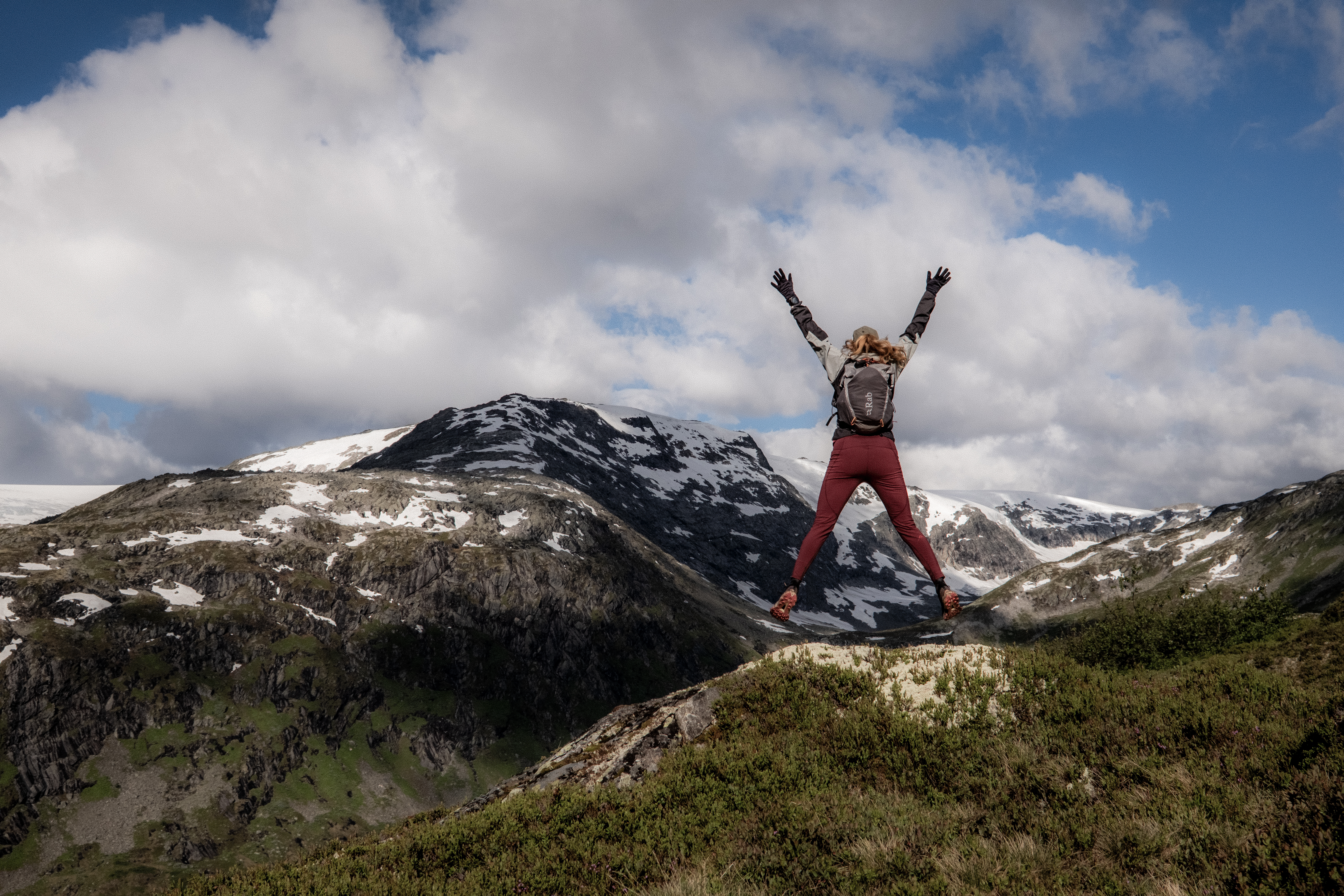
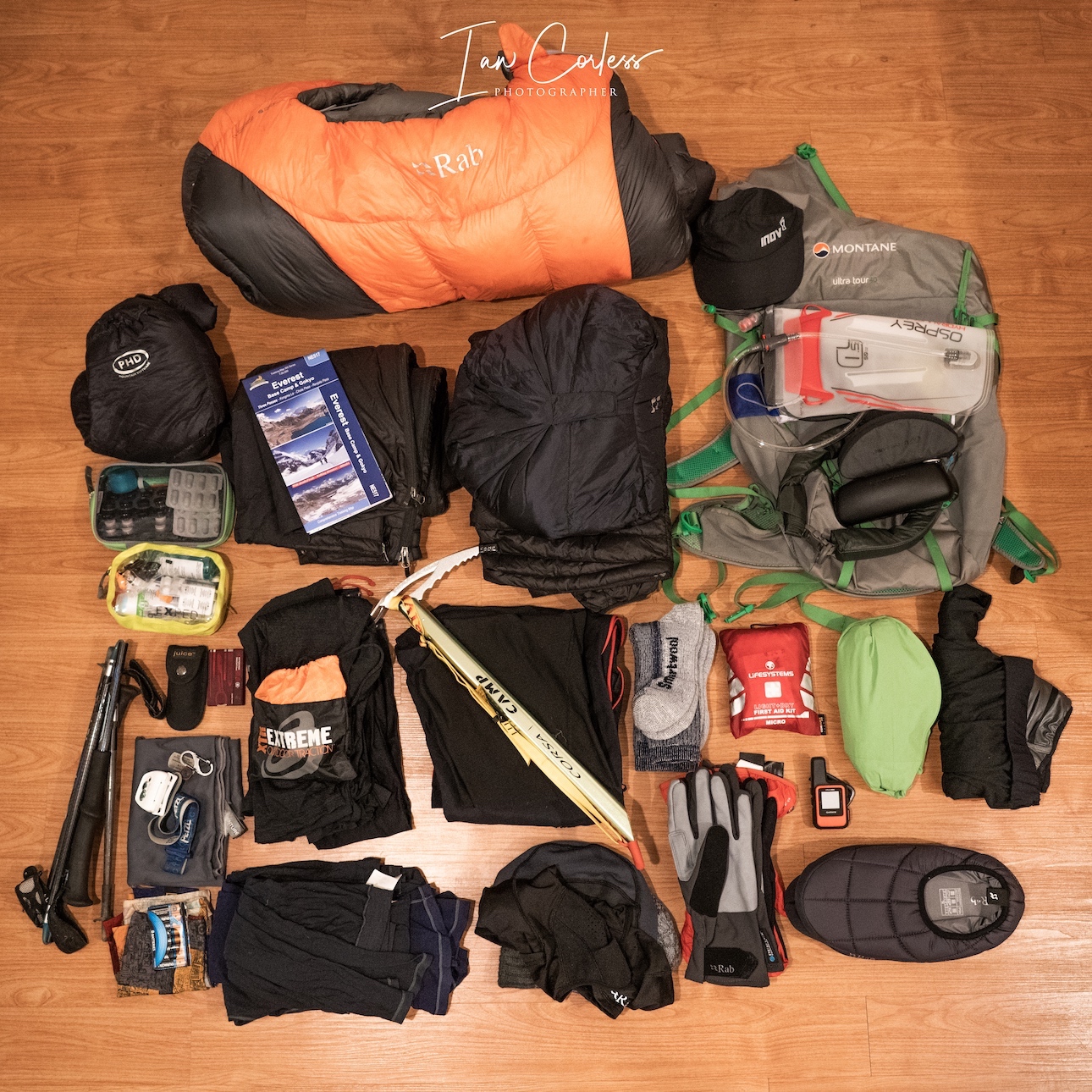
My recent trips ‘fastpacking’ in Norway have fuelled many questions about what is my kit list. So, here is an article the lists each item.
Firstly, what is fastpacking?
Essentially, in simple terms, fastpacking is the combination of hiking and running. Instead of running for just a few hours, or maybe for just one day, or hiking with a heavy pack for many days, fastpacking takes elements from the two disciplines – essentially moving FASTER and LIGHTER with all the items you need.
Fastpacking is distance trail running and ultralight backpacking rolled into one epic outdoor adventure. You’re moving fast – running, jogging, or power hiking – while covering long distances and carrying just enough essentials for a multiday journey. – REI
Now, to be clear, there are versions of fastpacking and which version you choose makes a big difference.
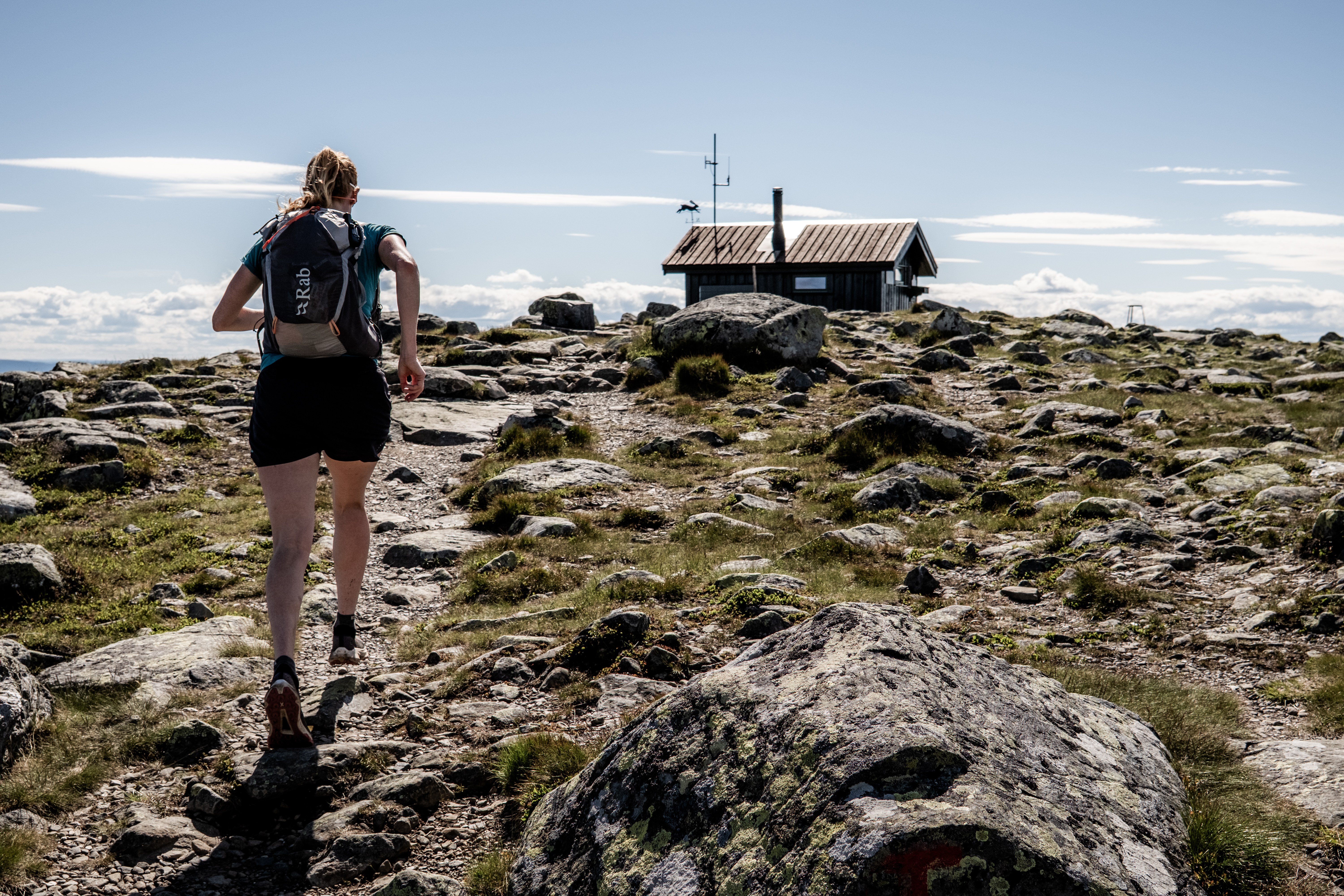
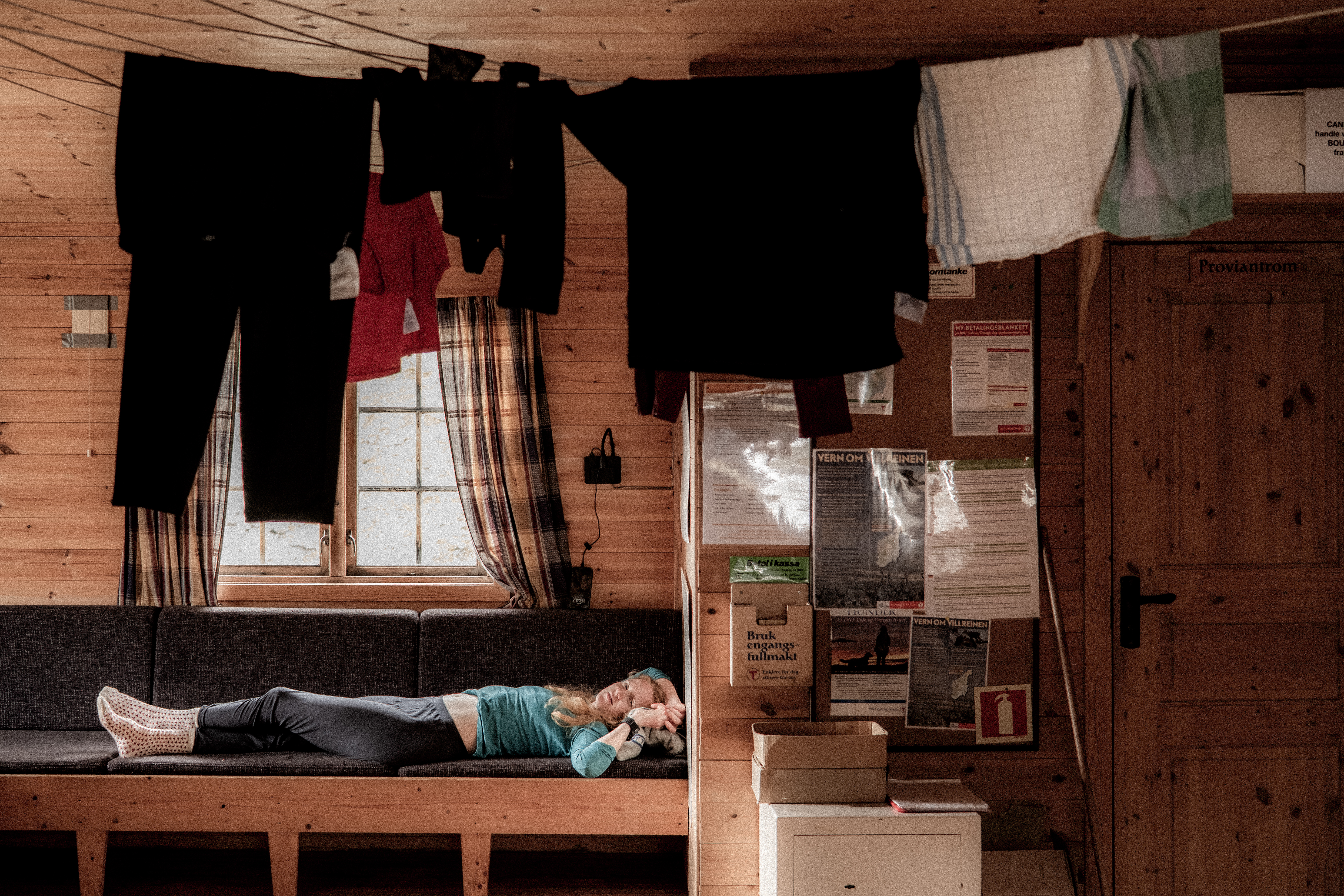
In Norway, and for my recent adventures, Abelone and I are moving from cabin-to-cabin and this makes a huge difference. Each night we will get food at the cabin, a place to sleep, warmth if required and the opportunity to (usually) dry clothes. We therefore can be very minimal.
By contast, fastpacking can also be with tent – in this scenario, it’s still possible to be light BUT you must carry a tent, you must have a sleeping mat and you will also need a sleeping bag. In addition, you will need to carry the food you need for the duration of the journey and/ or, you will need to plan for refuel stops.
The equipment list below is for cabin-to-cabin.
MY EQUIPMENT
During the SAGA or during the BREHEIMEN TUR, I carried the same equipment as listed below. Importantly, I consider what I am carrying on these tours to be the minimum and should I expect extreme cold, very bad rain conditions or a combination of the two, I would add to the list – I do not cut corners. I never compromise on safety and lightweight doesn’t mean underprepared.
Luxuries are typically kept to a minimum. As a photographer I indulge myself and carry a Fuji 100 VI which weighs 500g. I also carried a Kindle to have some downtime and escape with a book. For many, this would be an immediate 600g +/- saving.
Black Diamond Poles – fixed length not folding 168gr – Non folding poles are stronger and lighter
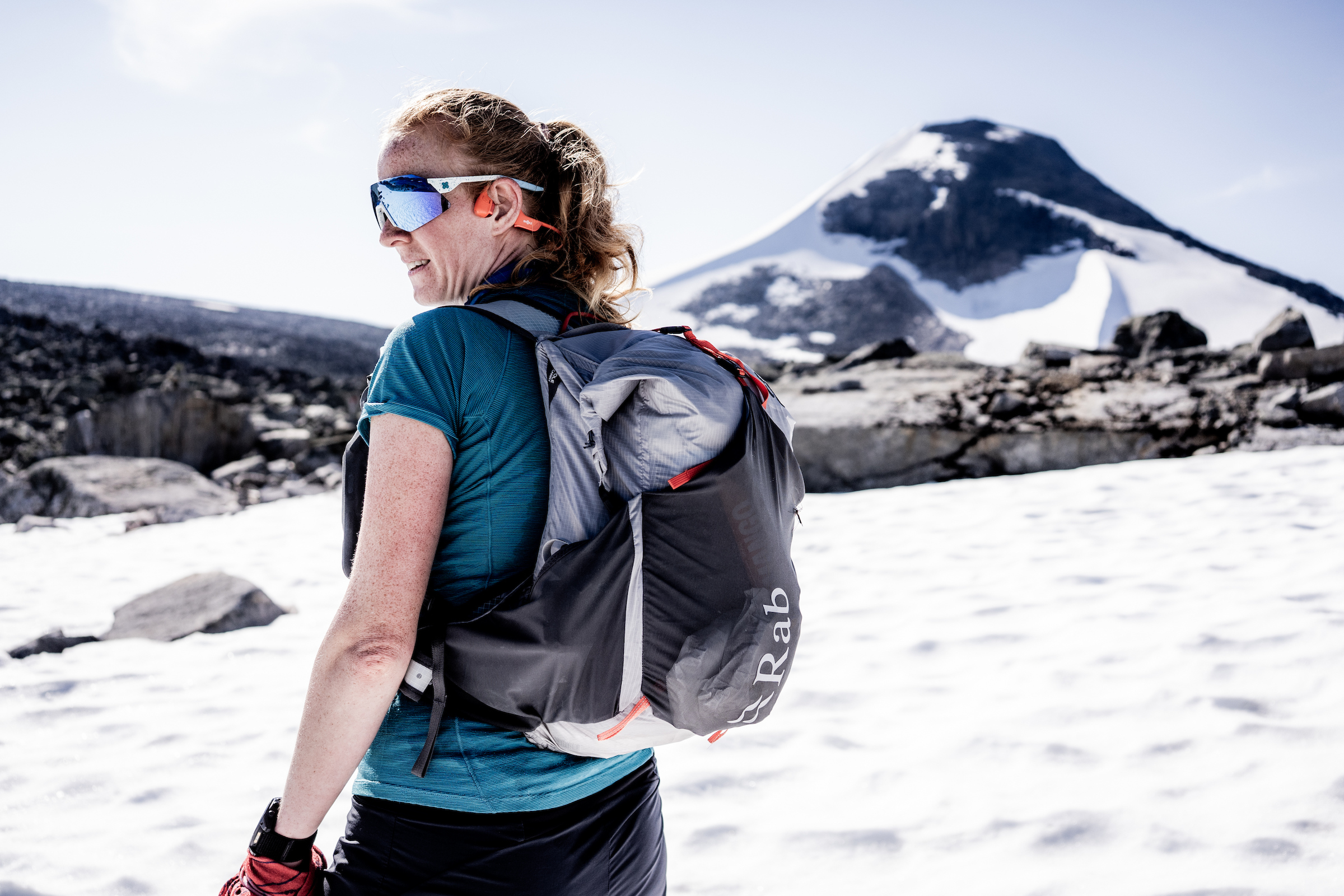
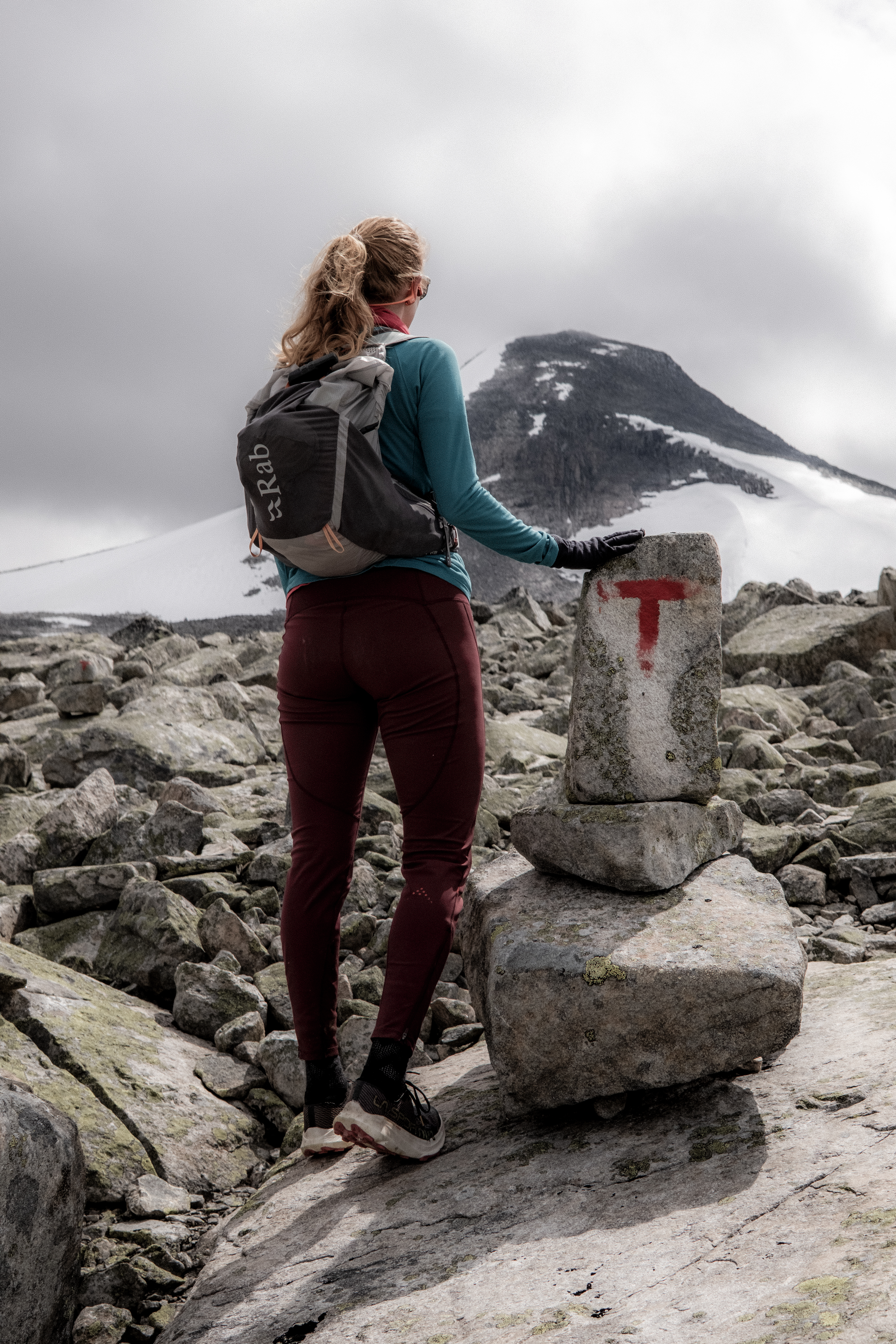
RAB Veil XP 20 Pack 476g – this pack is the best I have used and the main compartment is waterproof
RAB Alpine Light Down Jacket 252g – A little heavier than some options on the market but it is durable and very warm.
RAB Phantom Waterproof Jacket 116g – Super light and ideal for bad conditions in summer. Was I expecting daily rainfall or heavy rainfall for prolonged time or days, I would move up to a heavier and more durable jacket.
RAB Phantom Waterproof Pants 84g – Light and an ideal outer layer for when needed.
RAB Hut Slippers 198g – This was a luxury for SAGA and when I did Breheimen, I did not take them.
Devold LS Merino Top 200g – essential warm layer, I always use merino wool.
Devold Merino Tights 150g – ssential warm layer, I always use merino wool.
RAB Sonic Ultra T 96g – lightweight T should we get some very hot days
RAB Merino underwear 151g – merino is warm but also great for daily use
Injinji Merino Socks 45g – wool socks essential, I carry one spare pair
GORE Run Tights 300g – I debated if I should take or not and I was glad I did, on several days I was happy to have long tights and not shorts.
RAB Filament Beanie 18g – warm and light hat
RAB Filament Neck Tube 28g – great to stop drafts and ideal for other uses.
RAB Liner Gloves 18g – great as a thin warm layer or extra warmth inside other gloves.
RAB Pertex Mitts 65g – these are tthick and warm, essential for when the cold surprises.
Hestra Waterproof Mitts 50g – great protection as a stand alone or with liner gloves inside.
Toiletries – mini toothbrush, mini toothpaste and small deodorant 75g
First Aid kit 95g
RAB Bivvy Bag 105g
Plug and USB cable 60g – ideal for phone recharge, Shokz recharge and Garmin recharge.
Inflatable Pillow 46g – this is essential for me, I travel so much I love the consistency my own pillow gives.
Blindfold and Earplugs 10g – essential.
2x 500ml Bottles 49g x2 – 96g I used bottles in contrast to soft-flasks, a little heavier but I prefer the ones I use ny Ultraspire as they have a flat back which sits comfortably against the chest.
Total weight – 3268g
3926g with camera and Kindle
Wearing:
HOKA Mafate 5 315g – The Hoka worked really well except on wet rock, Vibram just does not cut it and without doubt, VJ Sport MAXx2 or ULTRA 3 is the shoe to use.
RAB Hat 52g – peaked hat to keep rain and sun off.
TNF Run Shorts 146g – they have an inner and therefore reduces the need for underwear.
Devold SS Merino Top 219g – I prefer merino, great in hot, cold or wet.
Shokz Openrun Pro 2 – some daily music escape is ideal.
SunGod Glasses – great for all conditions I use photochromatic so they adjust to the conditions.
FOOD AND DRINK
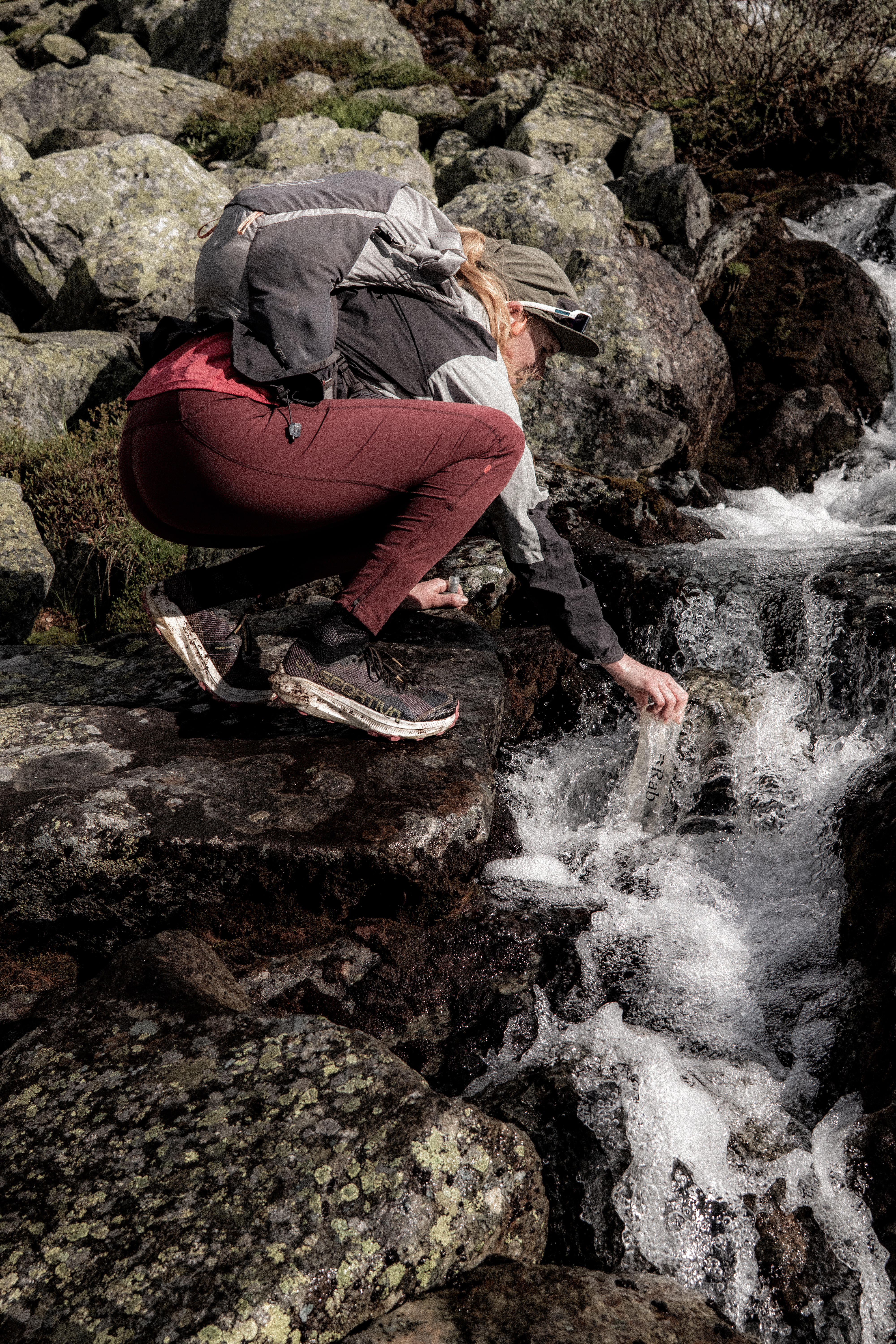
We get water from rivers and streams, there is an abundance of opportunities in Norway and for most of the time, although I have two bottles, I only fill one to save weight.
Importantly, wherever you are fastpacking, you need to research what is and what is not available on the route you take. No water? You need to plan and carry more.
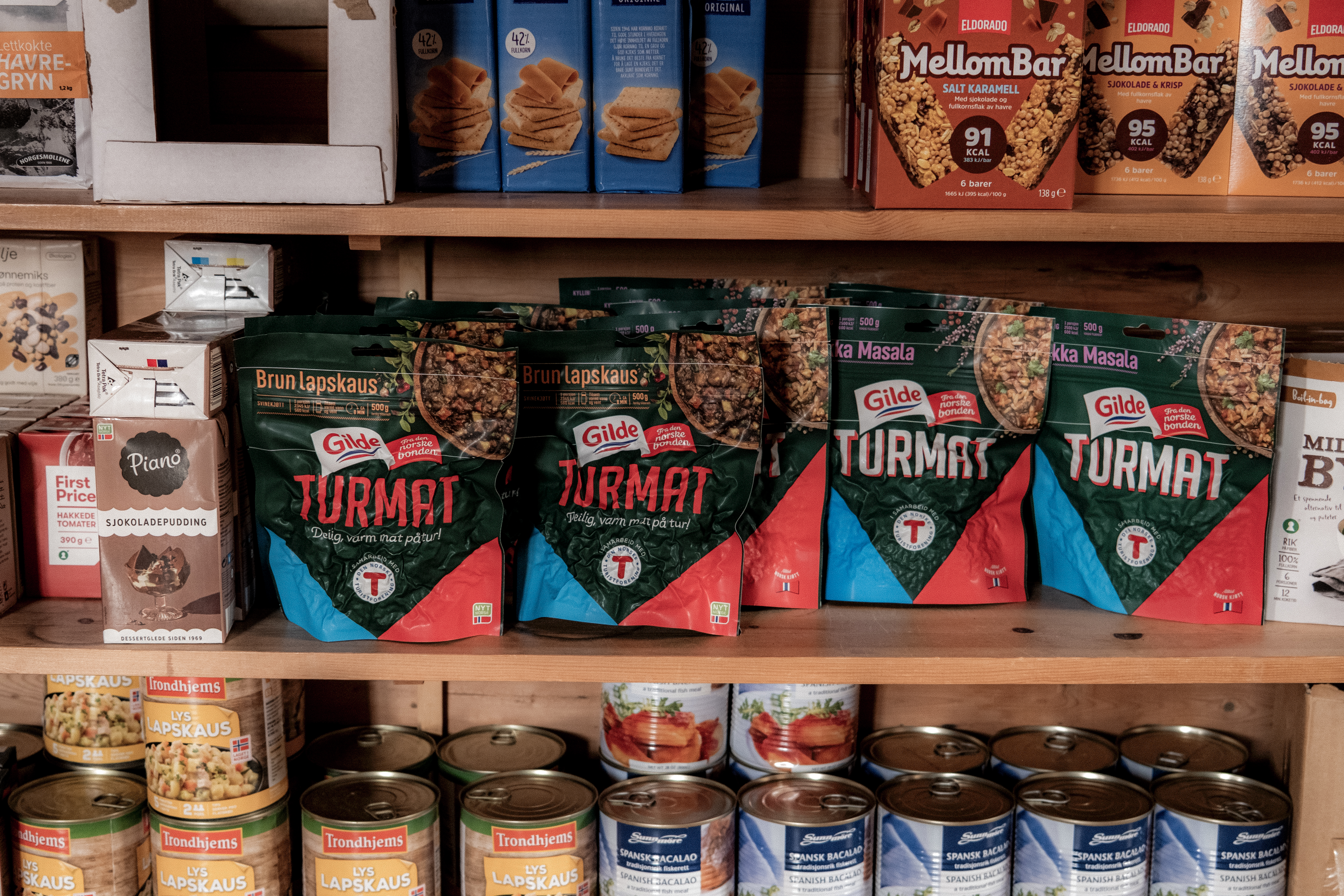
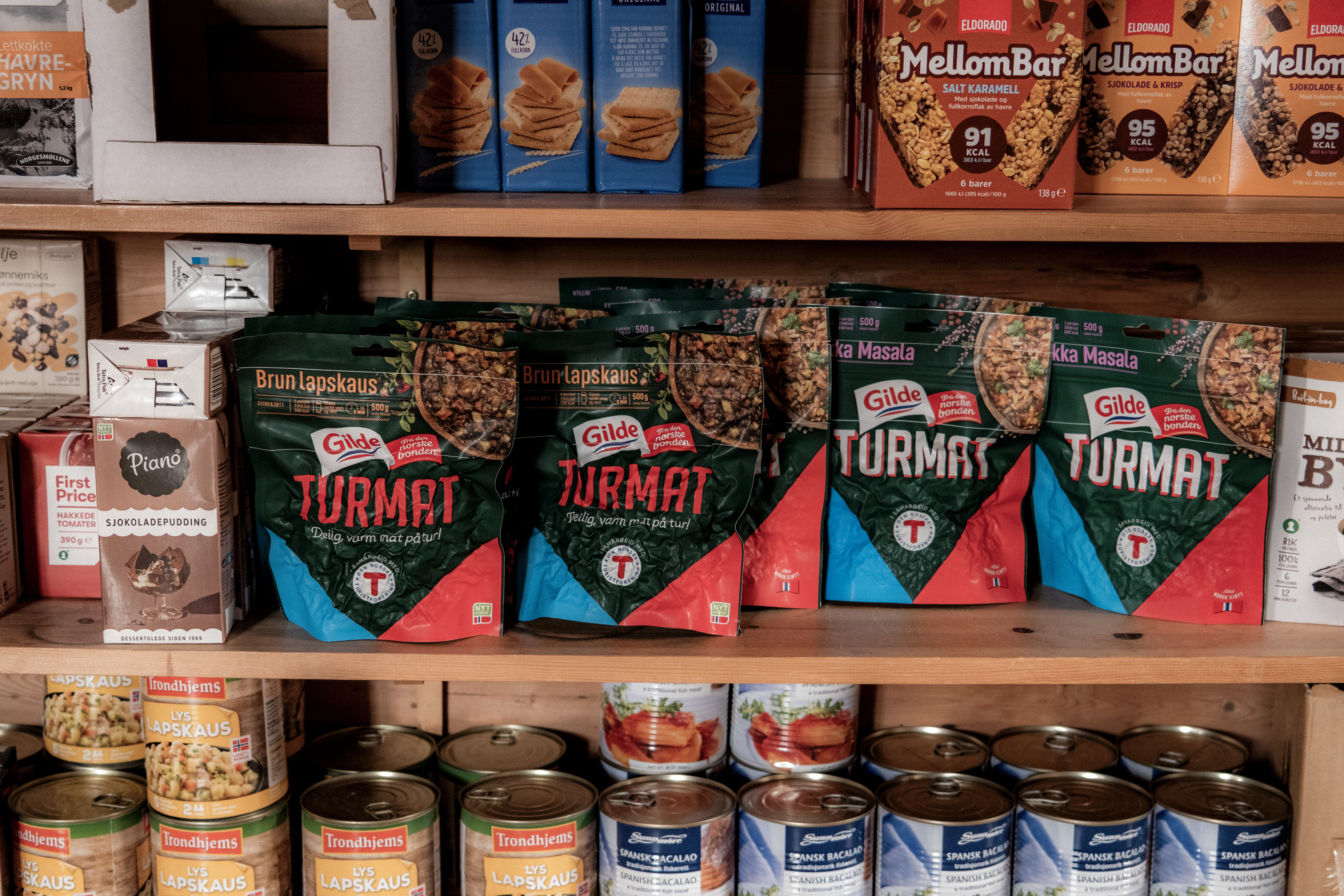
Day snacks I would replenish each night from the cabin we stay at, be that a serviced cabin or an unserviced cabin – there are typically cereal bars, chocolate, snacks etc that you can purchase.
On tough days and when the option exists, I will take a bottle of soda as a backup – Cola, Fanta or similar.
In the cabins, we either have food provided by a serviced cabin, or, we make our own from the food supply shop.
THE REALITY
You have one set of clothes to move in.
You have clothes to change into after each day – typically merino top and bottom.
You have minimal extra layers for cold, rain and bad conditions.
Life is very simple and it is liberating.
You need to accept some days you will not wash, you have to accept that you and your clothes will be a little smelly as the days pass.
IN SUMMARY
Fastpacking appeals because of its simplicity. Planning, preparation, bring only the essentials and aim for items that are lightweight and versatile – importantly do not skimp on safety. There is a real pleasure in fine tuning kit, researching the best items and then bringing it all together. Be specific and adapt what you take based on the route and the weather conditions.
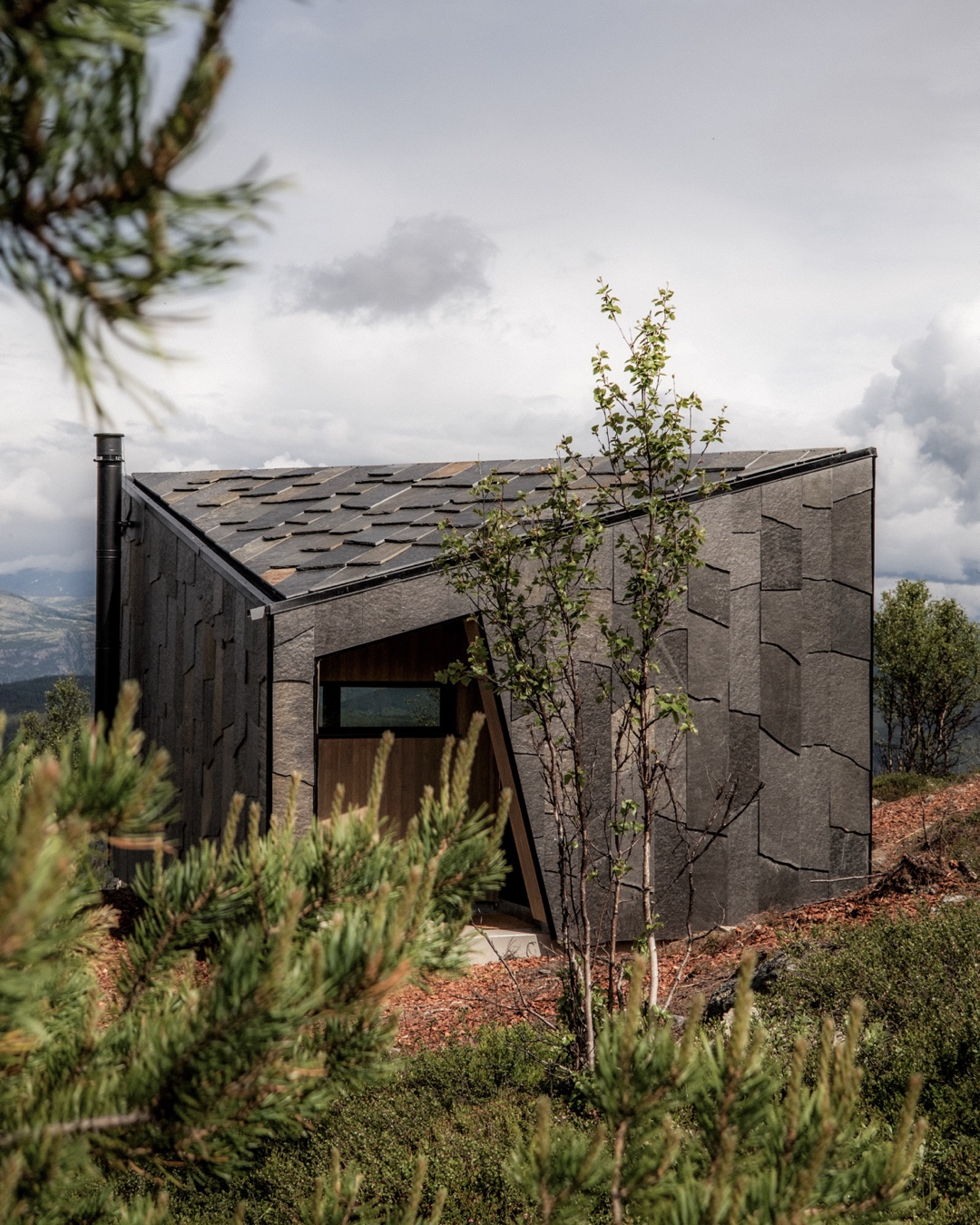
Following our SAGA adventure, a couple of days RnR was welcome in Otta and Lalm – an opportunity to check Hylja Lodge which offered four stunning individual cabins and a new lodge, one year in the making – we were the first guests.
After moving fast and light with minimal clothes and comfort, this was a perfect luxury treat before once again heading back to the mountains.
BREHEIMEN
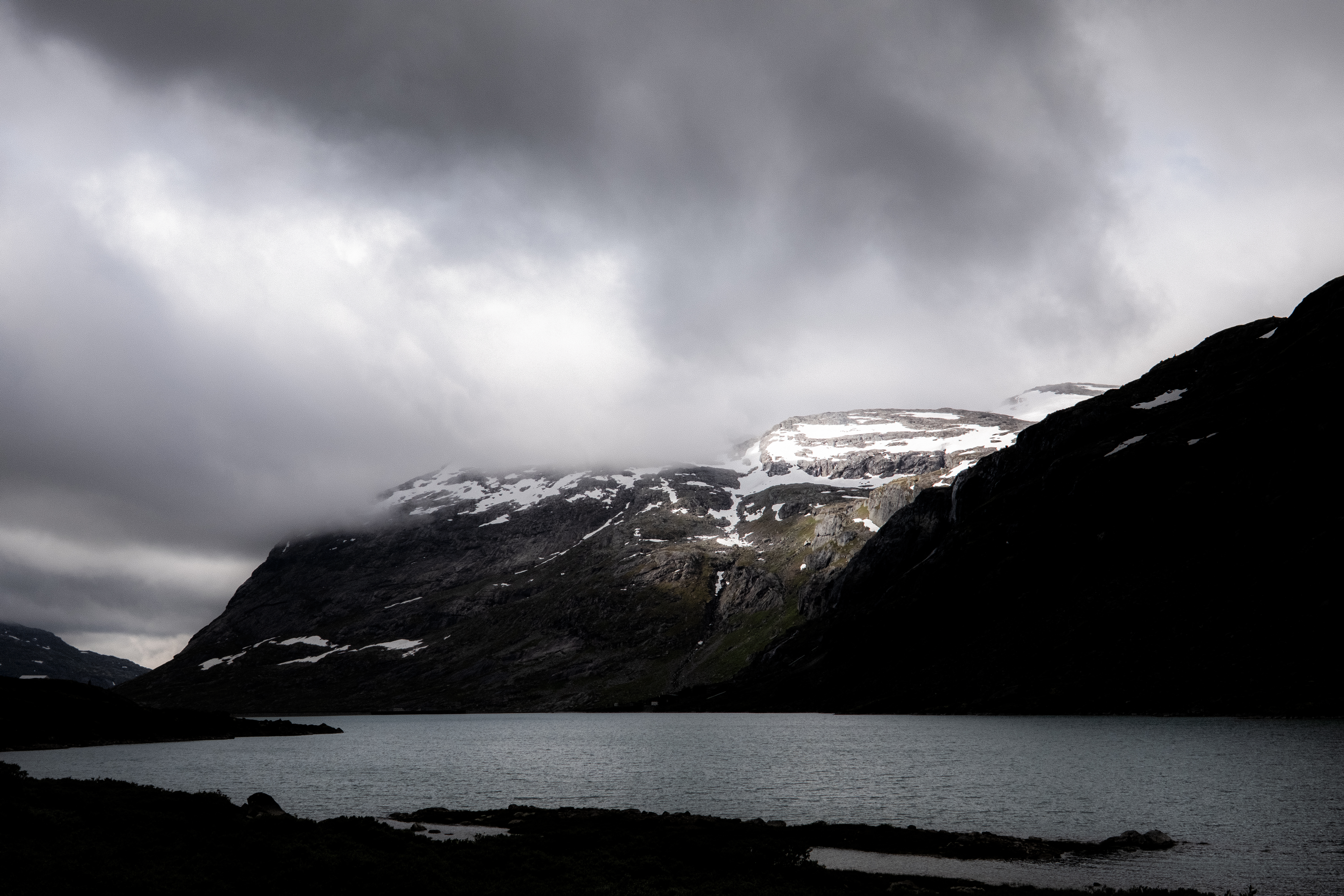
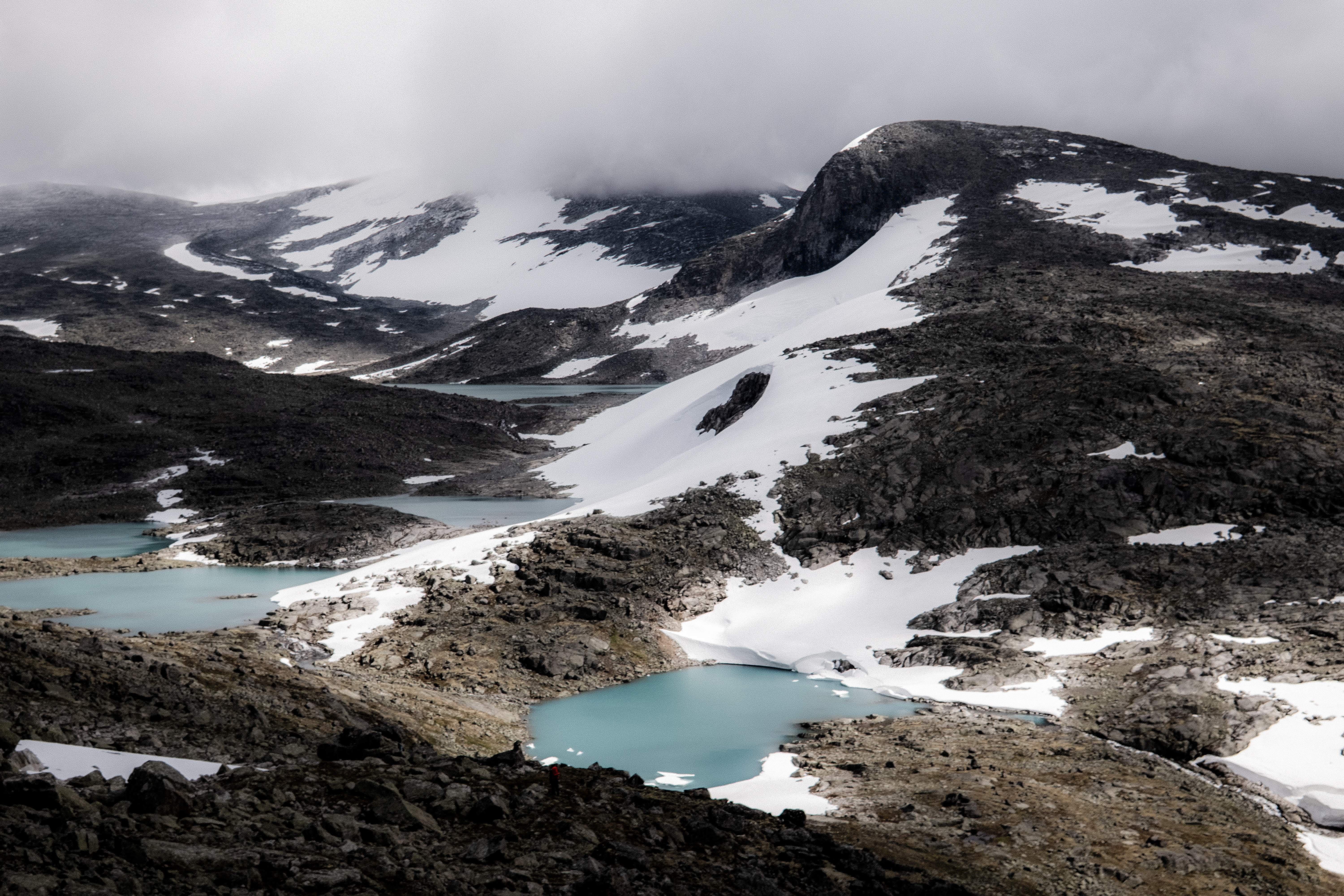
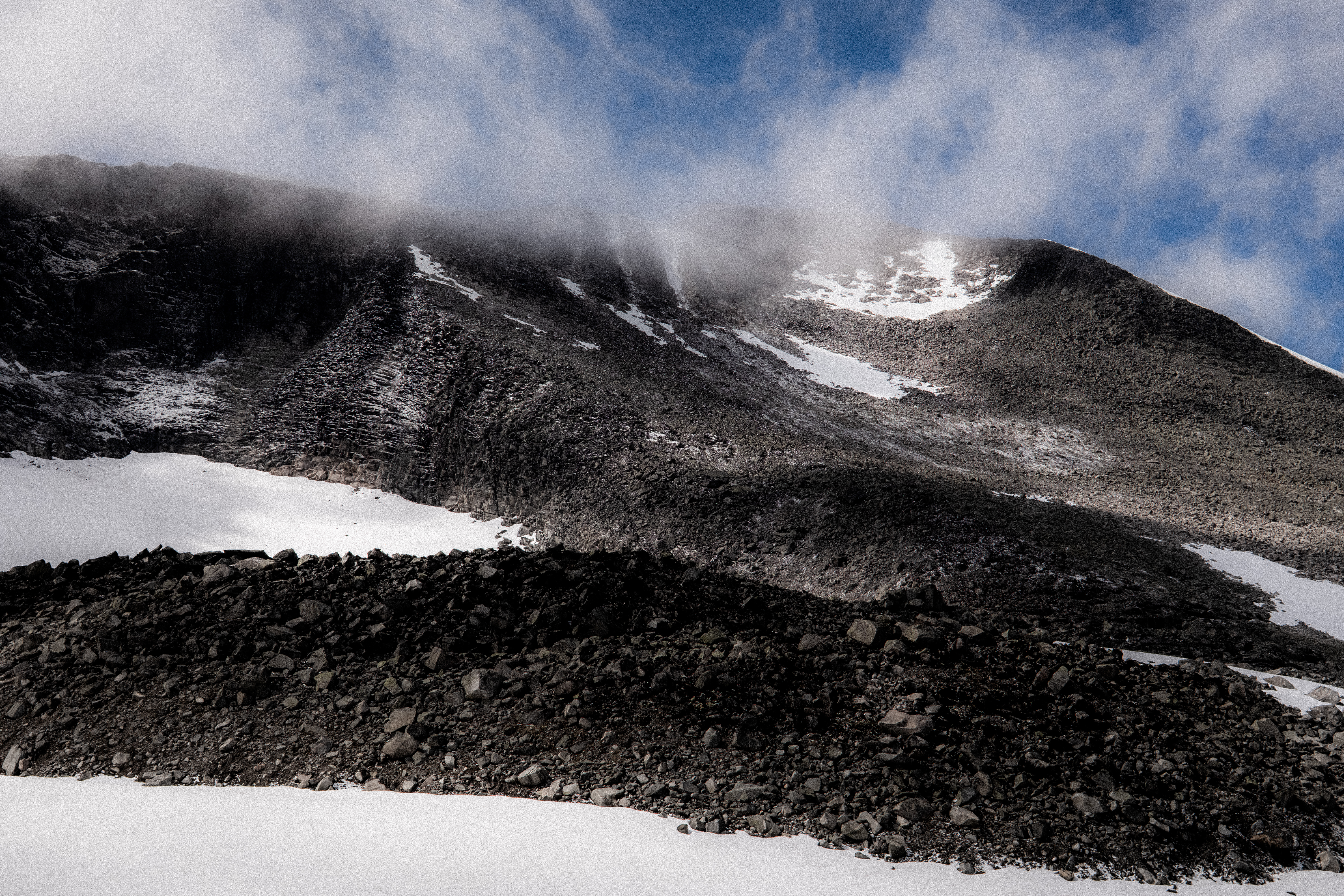
Breheimen is a magical landscape, in contrast to what we experienced on SAGA, this is area is wild, rough, remote and challenging – real mountain terrain.
“The area extends from just above sea level to well over 2,000 meters. The landscape has been formed by glaciers, landslides and other geological processes that have taken place over hundreds of thousands of years. Today, everything from lush valley grazing areas to rugged high mountains and glaciers are found in Breheimen, which is one of our most diverse national parks.”
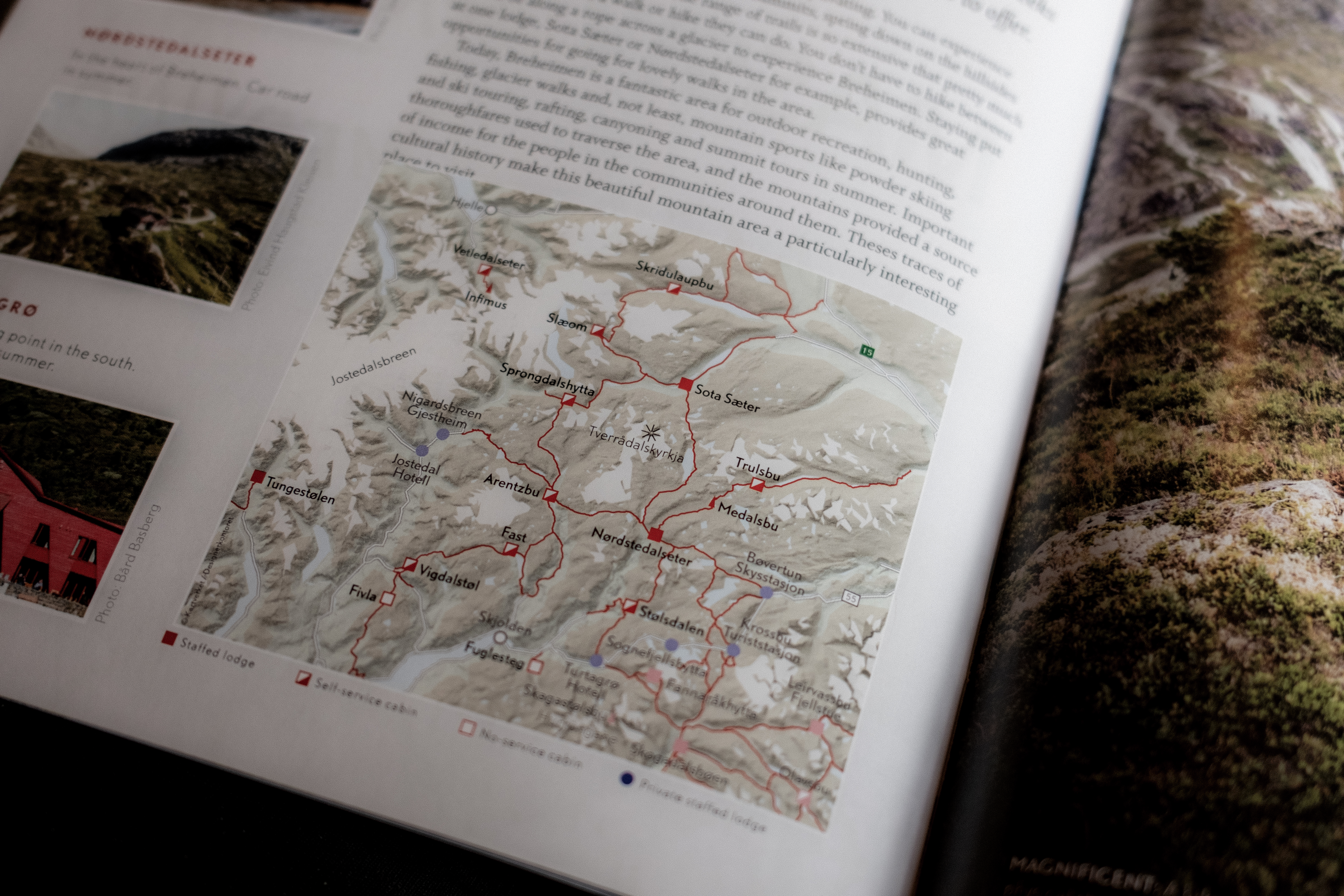
In 2025, Abelone started her MASSIV journey here – Sota Sæter cabin being the official start or end point. I joined her on that first day heading to Nørdstedalseter – a day that was embedded deeply in my memory bank – it was magical weather and magical terrain and what a pleasure to share that with Abelone who was starting an epic 350km journey that takes most around 21-days, she would eventually complete in 10-days.
So, our return to Breheimen and Sota Sæter had special meaning.
THE PLAN
Just like SAGA, we’d be moving fast and light, ‘fastpacking’ with exactly the same items. However, with just 4-days, we would take in a circular route, starting and concluding at Sota Sæter.
Our route, in principle was simple. Arrival Sota Sæter and stay the night.
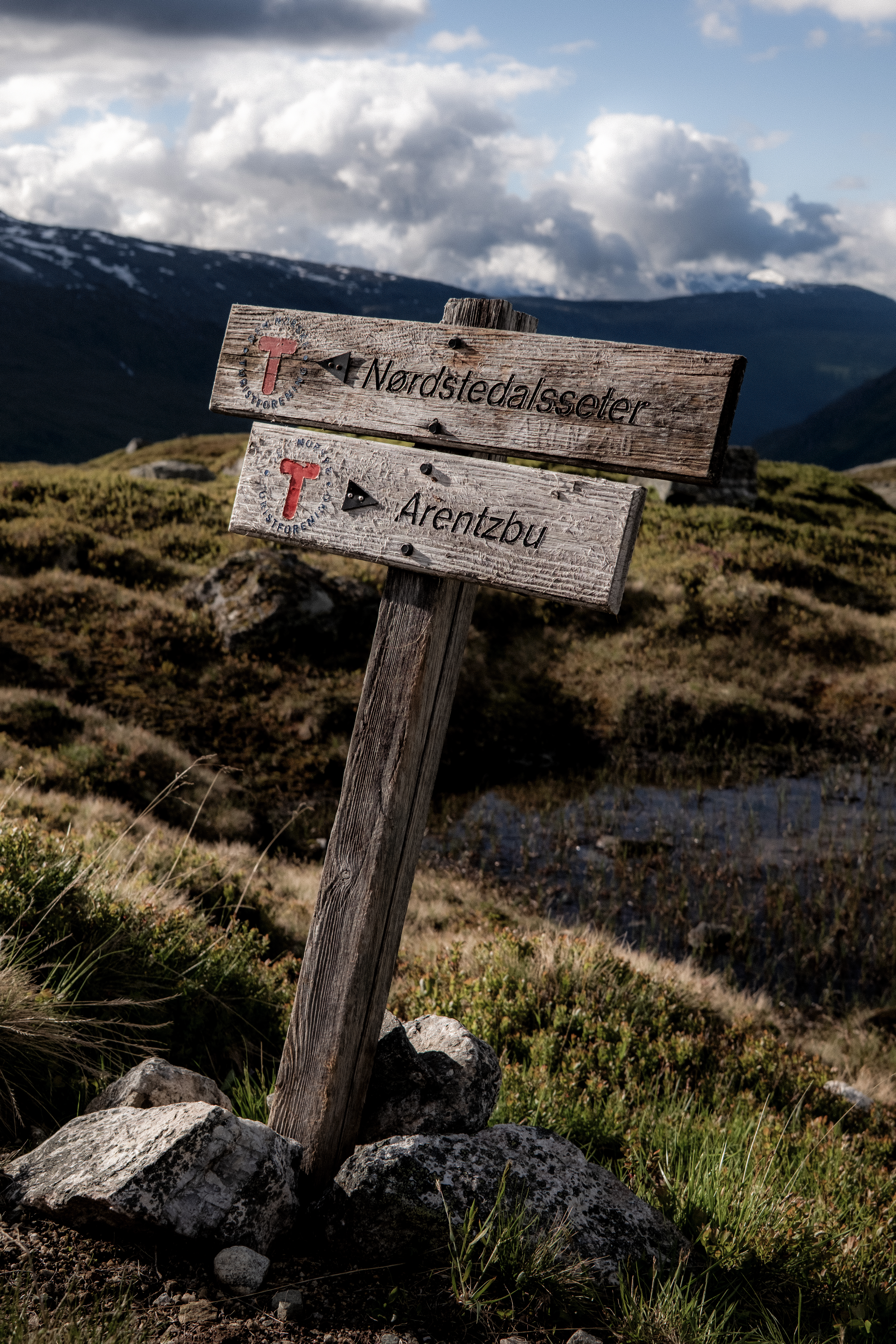
Day 1 was open to being a single stage or double stage, our original plan was to finish at DNT Arentzbu passing via DNT Sprongdalshytta.
Day 2 would be then to go to DNT Nørdstedalseter and stay 2-nights with some out-and-back adventure on day 3.
Day 4 Nørdstedalseter and return to Sota Sæter.
FUNNEST KNOWN TIME
Once again, our priority was a Funnest Known Time and whereas with SAGA we had very specific motivations, our 4-day Breheimen trip was very relaxed. The estimated total distance over the 4-days was +/- 80km’s but with plenty of vertical and challenging terrain.
THE JOURNEY
Day 1 – 18.88km 916m+ 3h 52m
Sota Sæter is a great cabin, it has road access but is very isolated. A relaxed night, some great cabin food, a good sleep and hearty breakfast and we were ready for day 1.
The early km’s were very easy and unlike SAGA, the plan was to do this journey together. The terrain here is considerably more technical and challenging and therefore, the pure running sections are greatly reduced making fast hiking a default pace.
The first 5km flew by and then we started the challenging terrain.
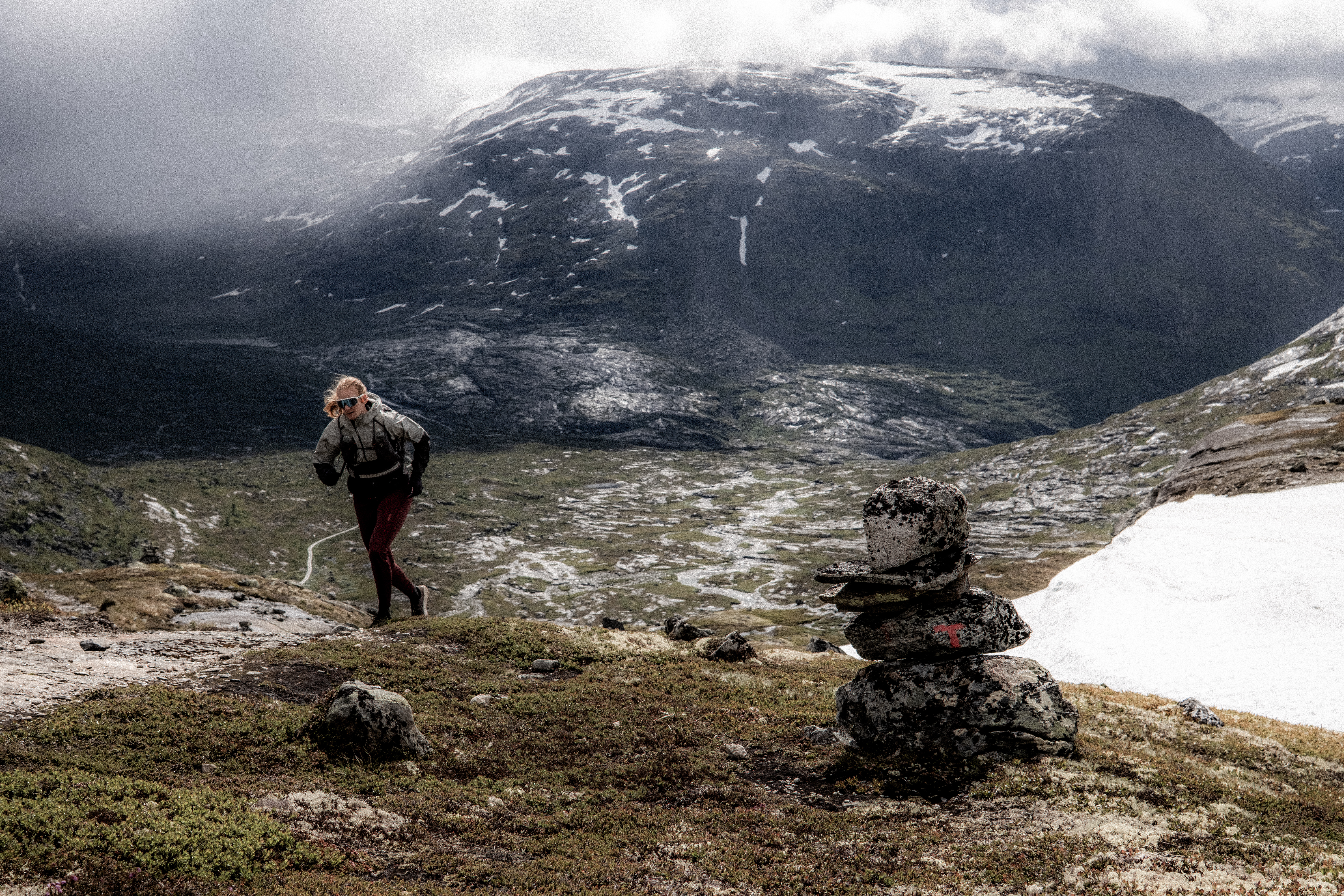
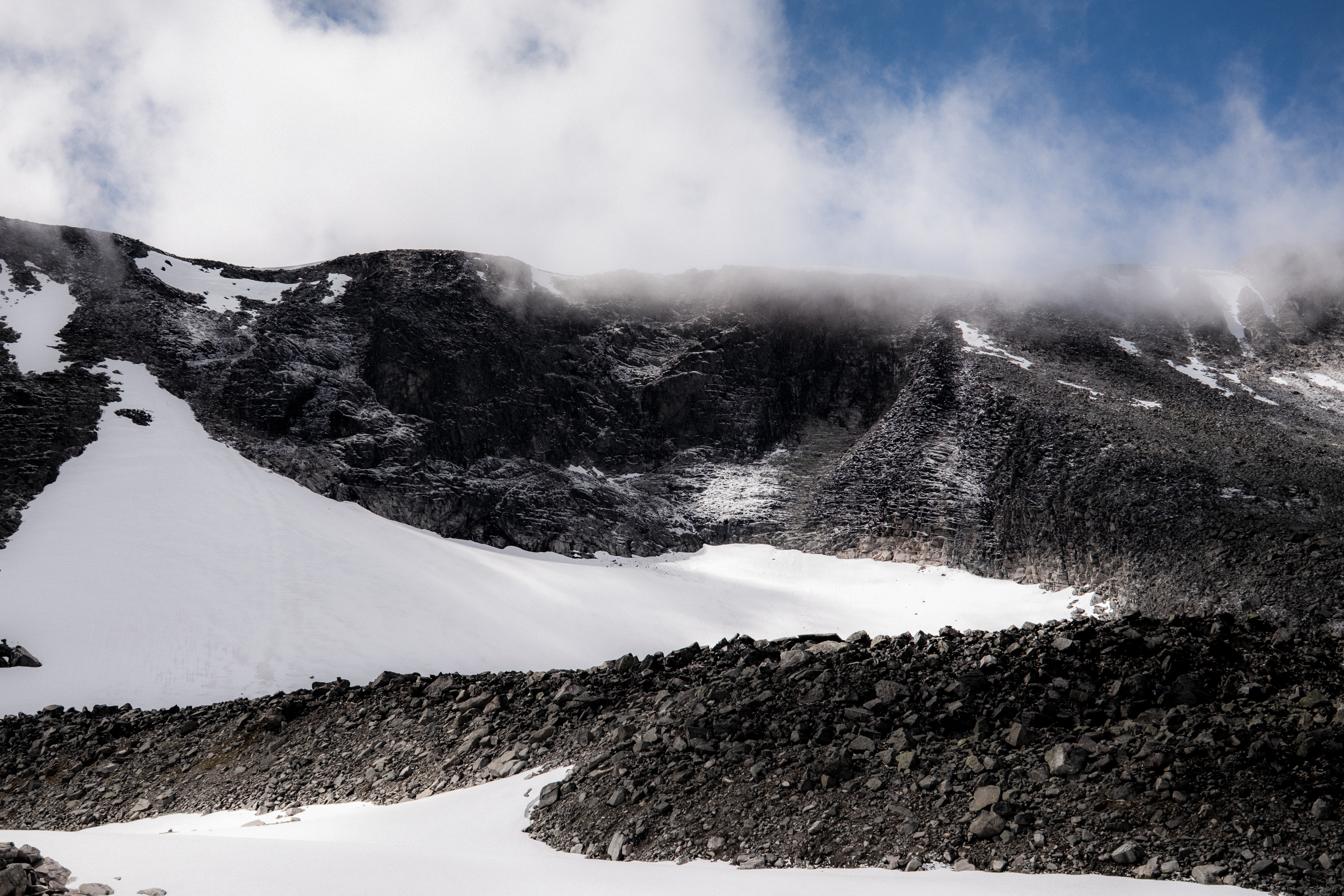
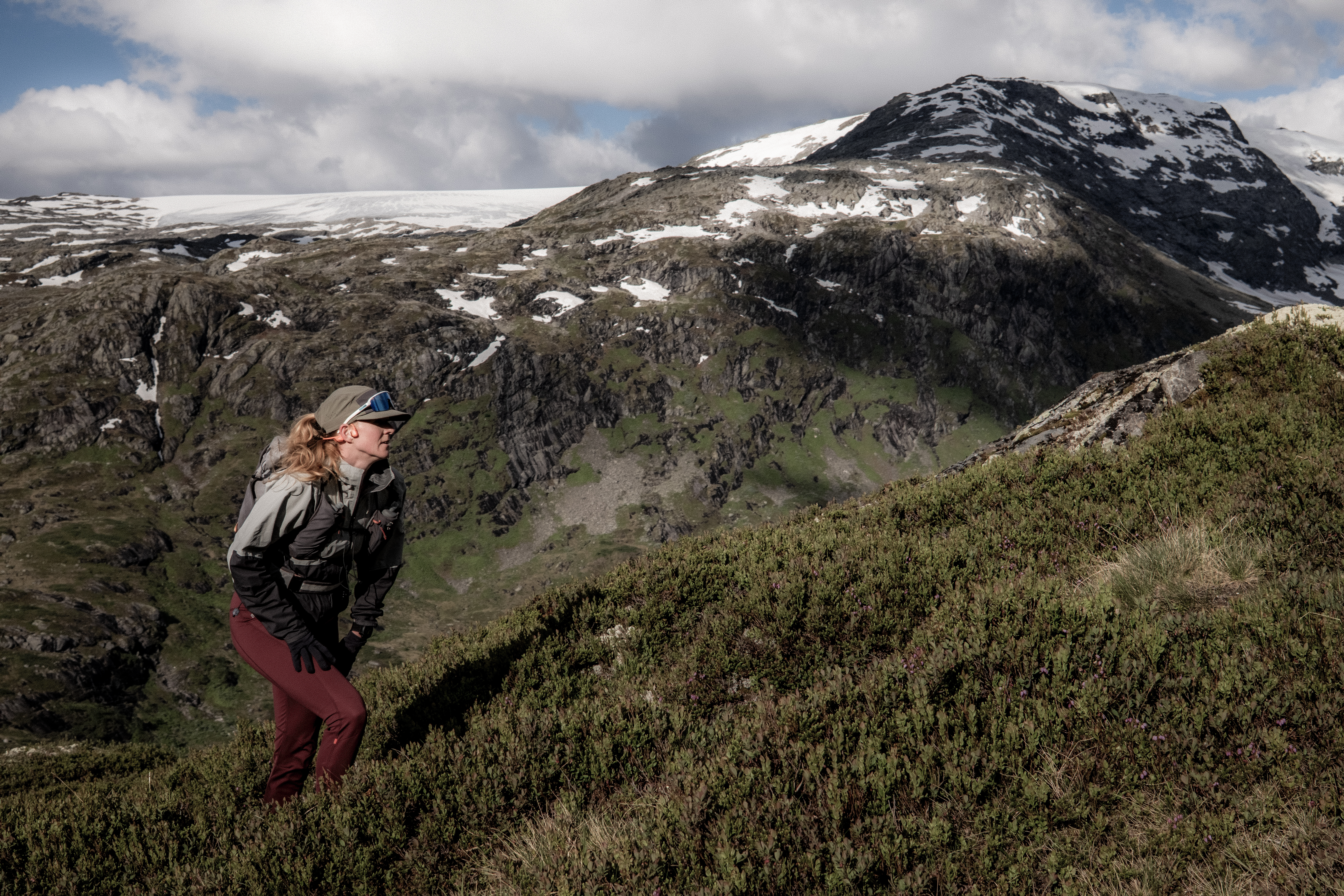
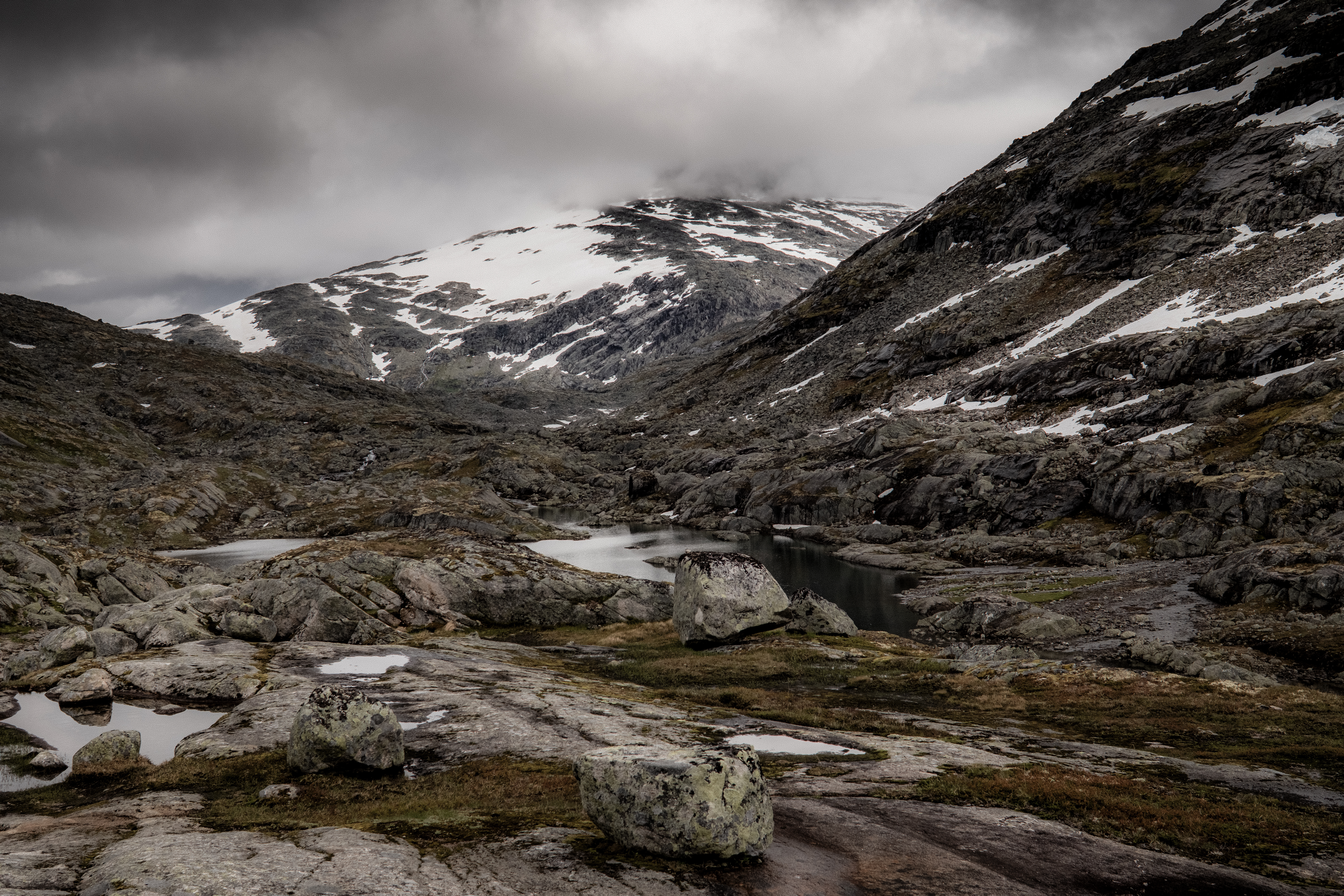
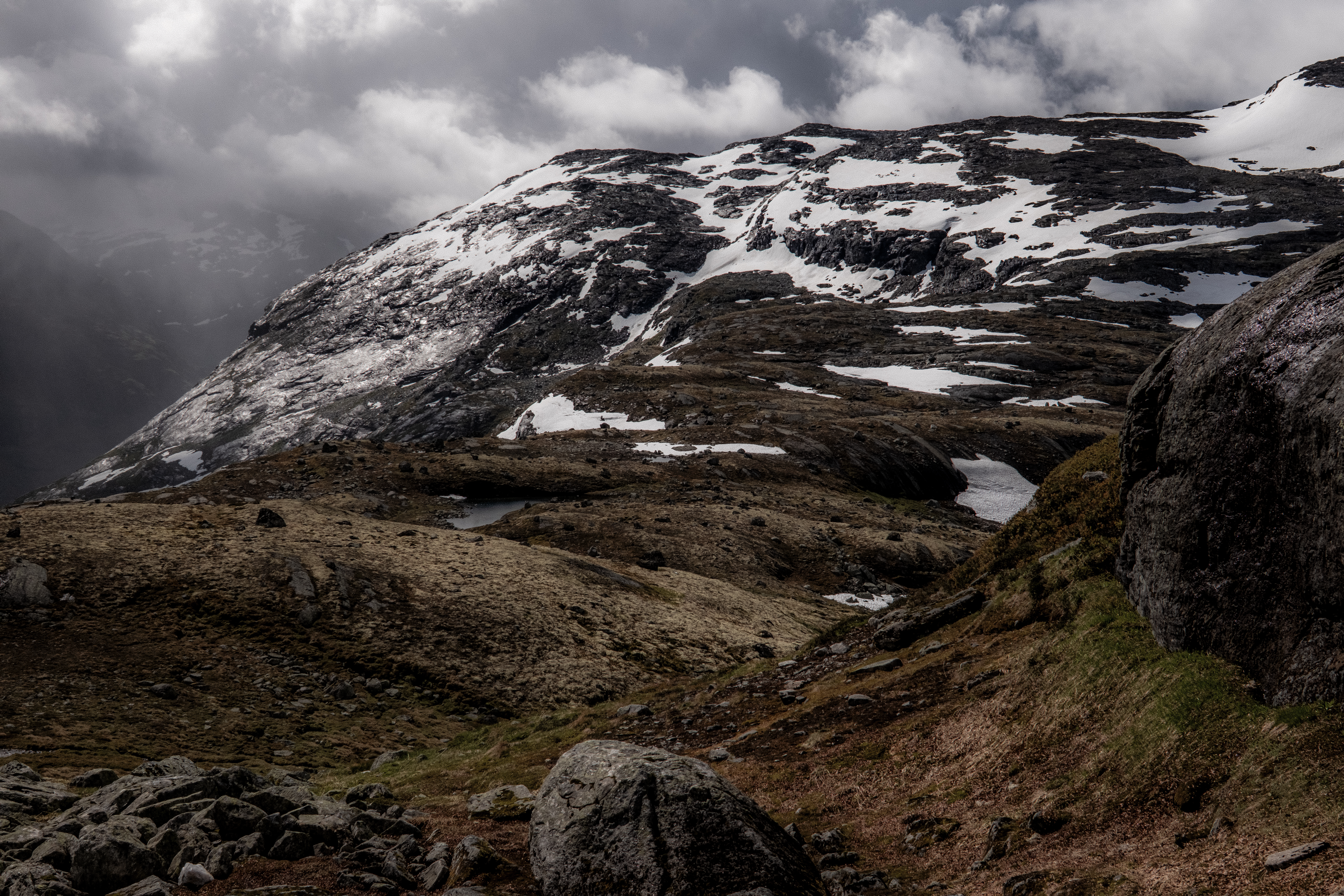
This landscape has been created by the ice age and as you move through the trails, up high, glaciers surround you. It’s magical.
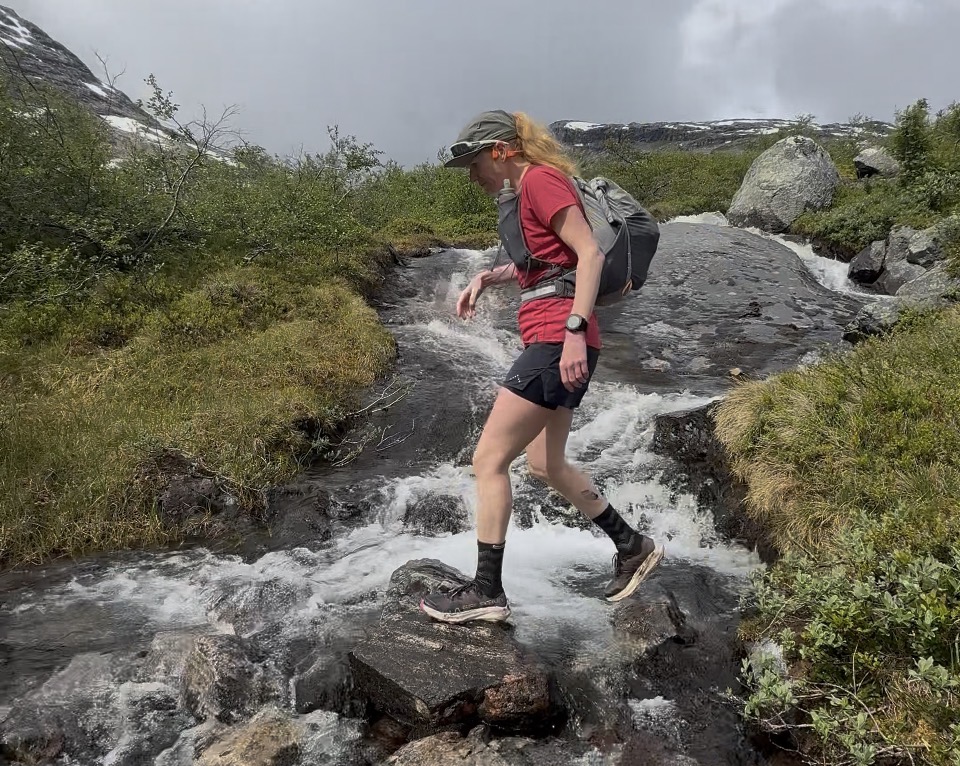
The pace slowed and the ground was sodden – feet were permanently wet and in mud. Abelone makes me laugh, she tries to avoid it (a useless task) whereas I accept the fate and just go straight in.
iPhone photo
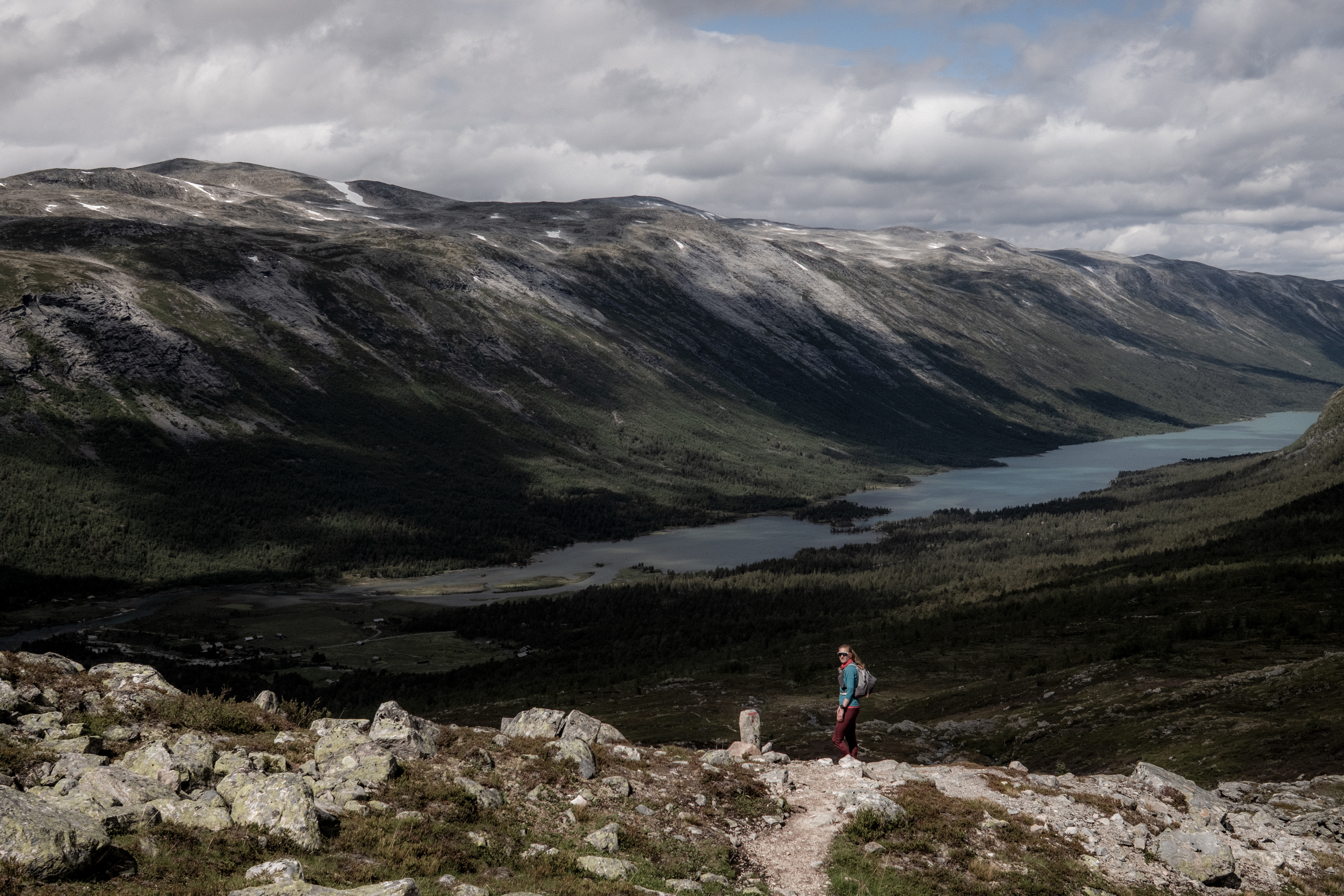
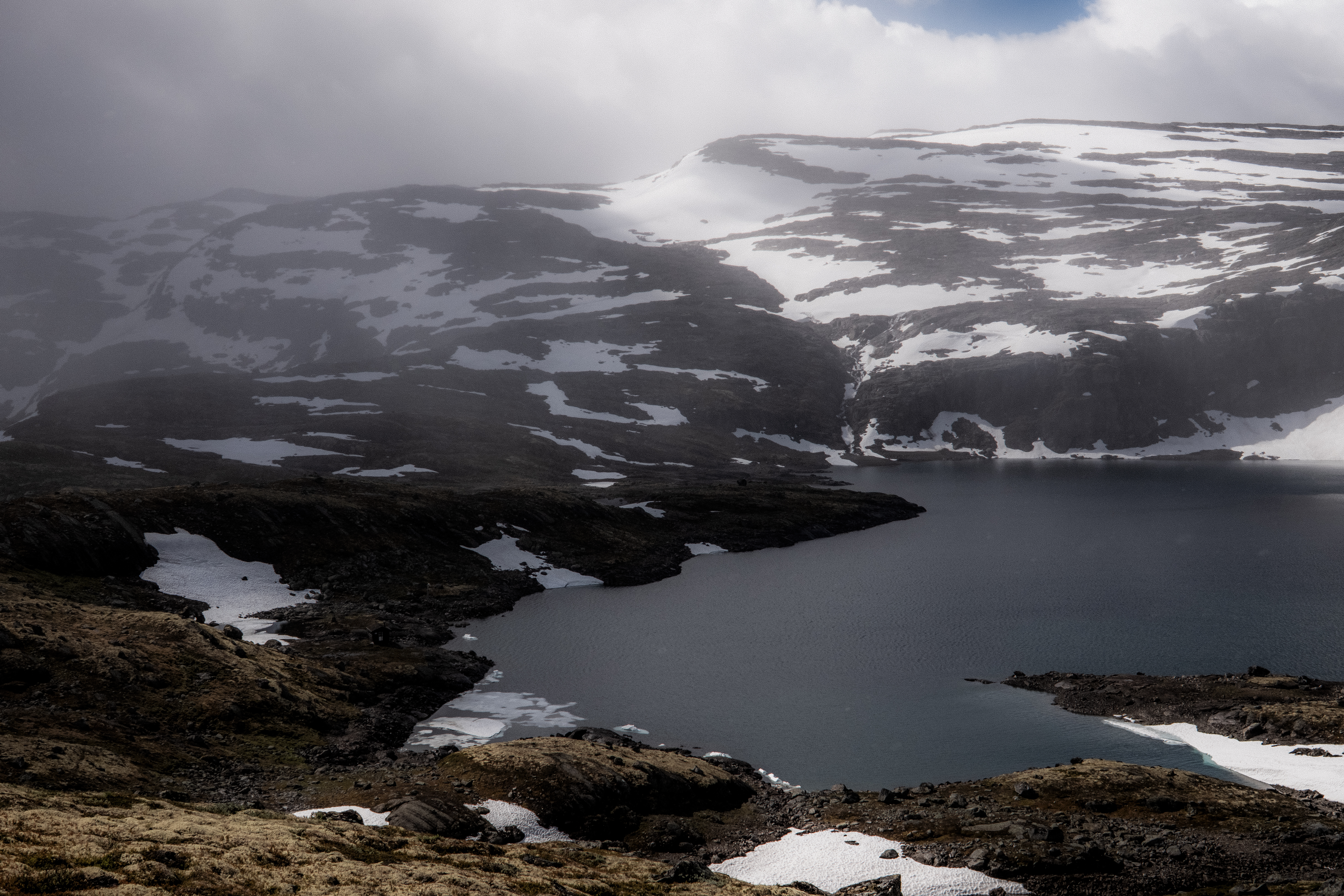
After 10km’s or so, we passed Surtbyttvatnet lake and above towered Syrtbyttnosi peak at 1700m.
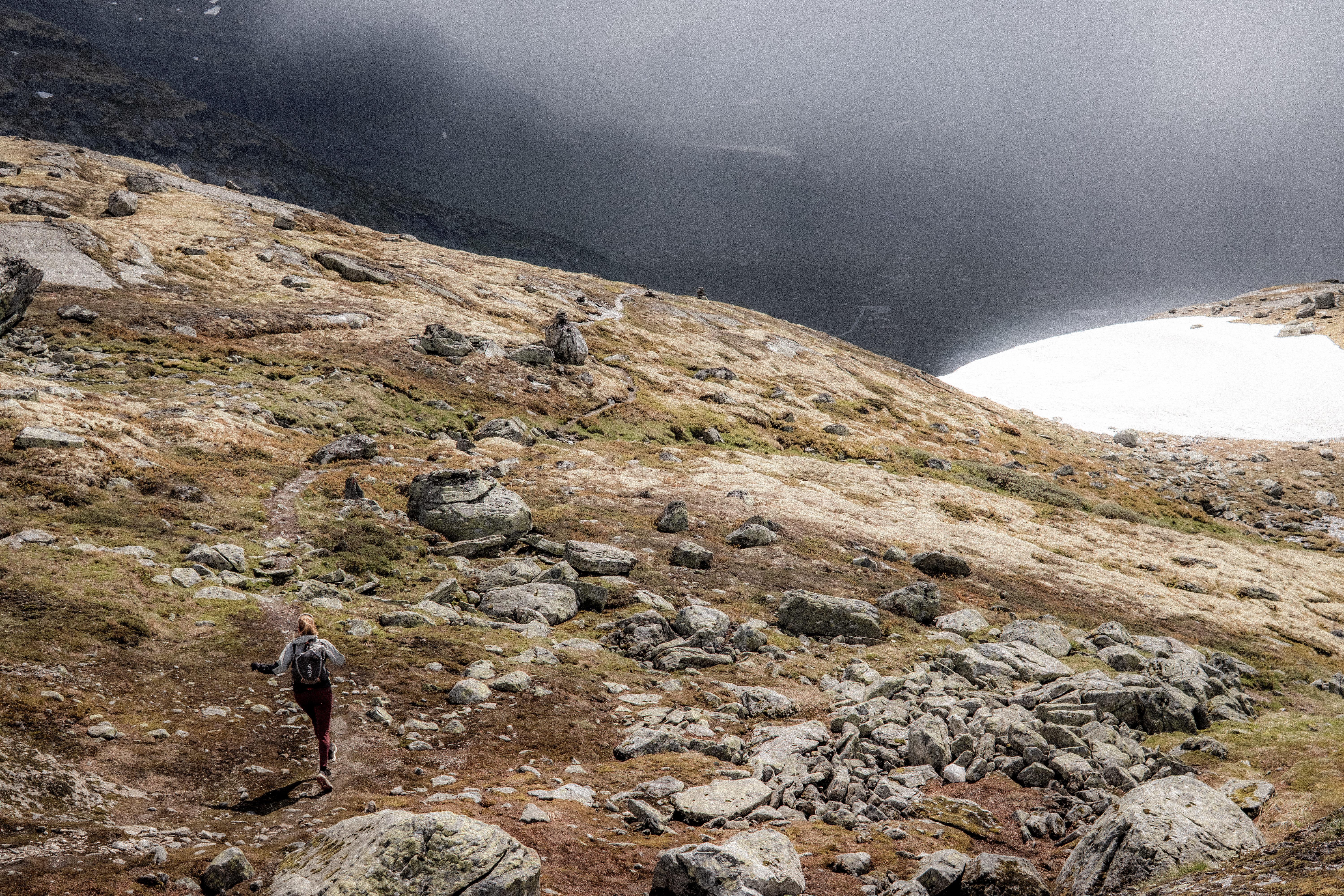
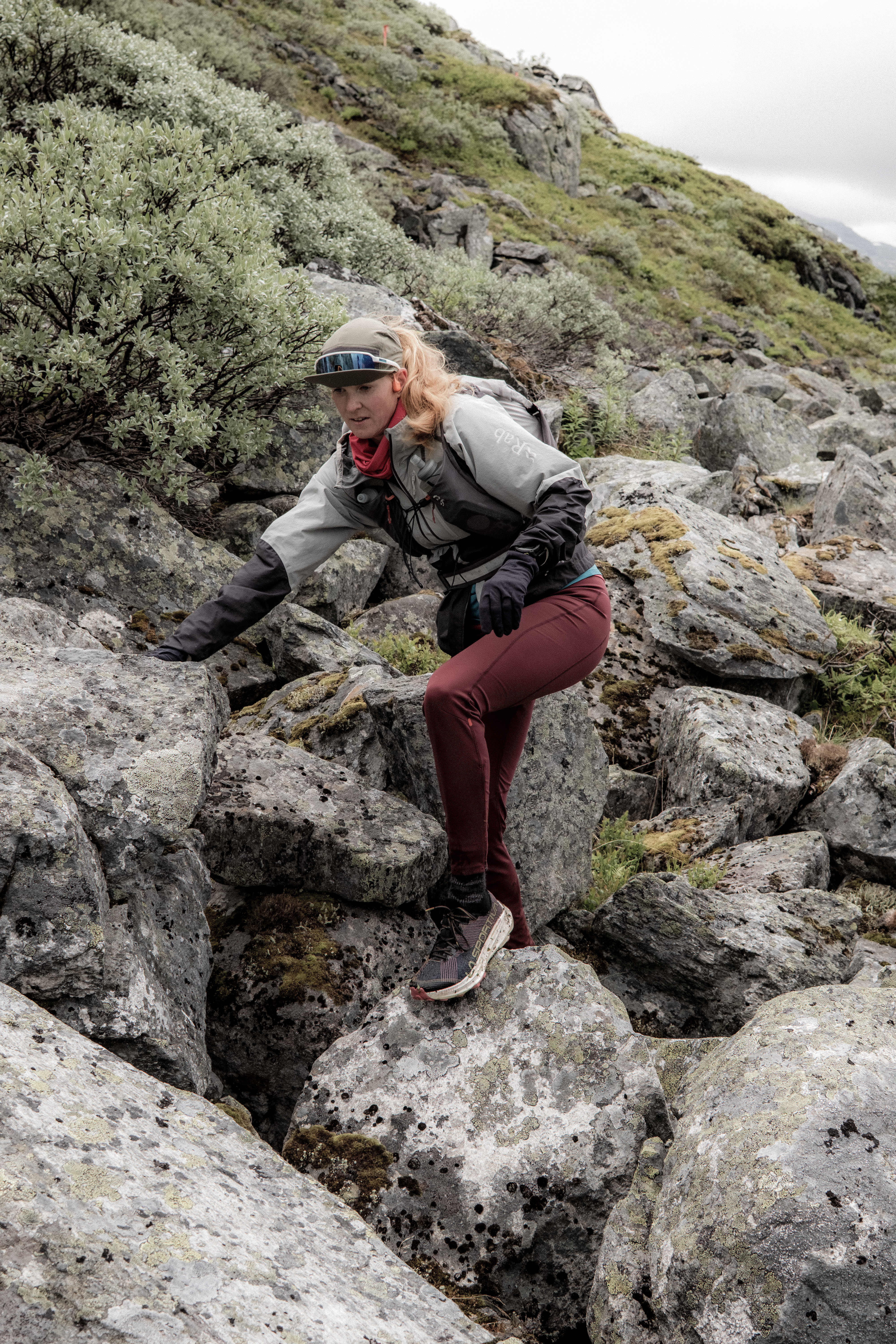
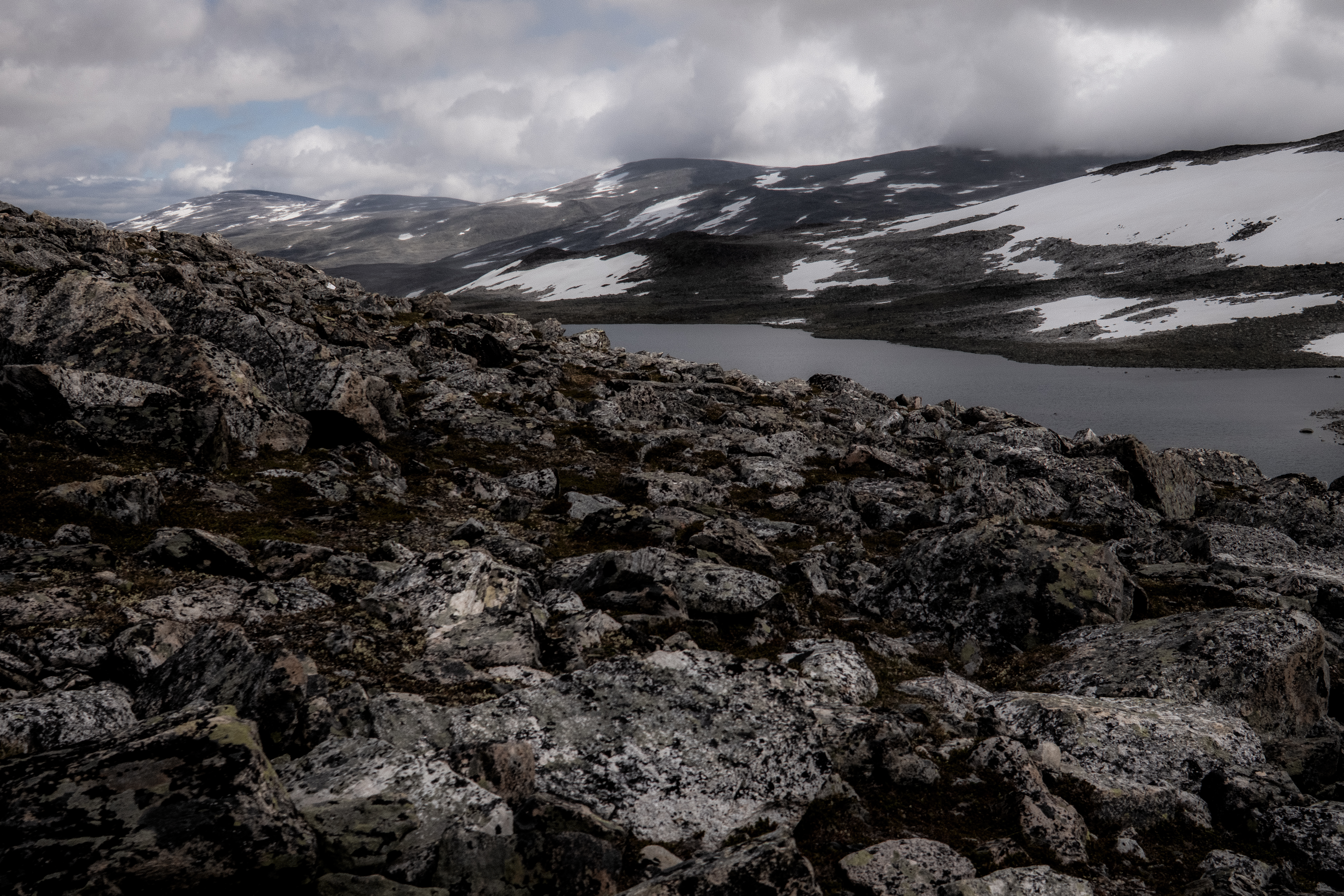
Now we were in the mountain terrain we expected and wanted. Pace is slow, one has to accept that in these scenarios it’s best just to switch off and any wish to move quicker needs to be put aside – accept that the challenge is navigating the rocks, boulders and water crossings.
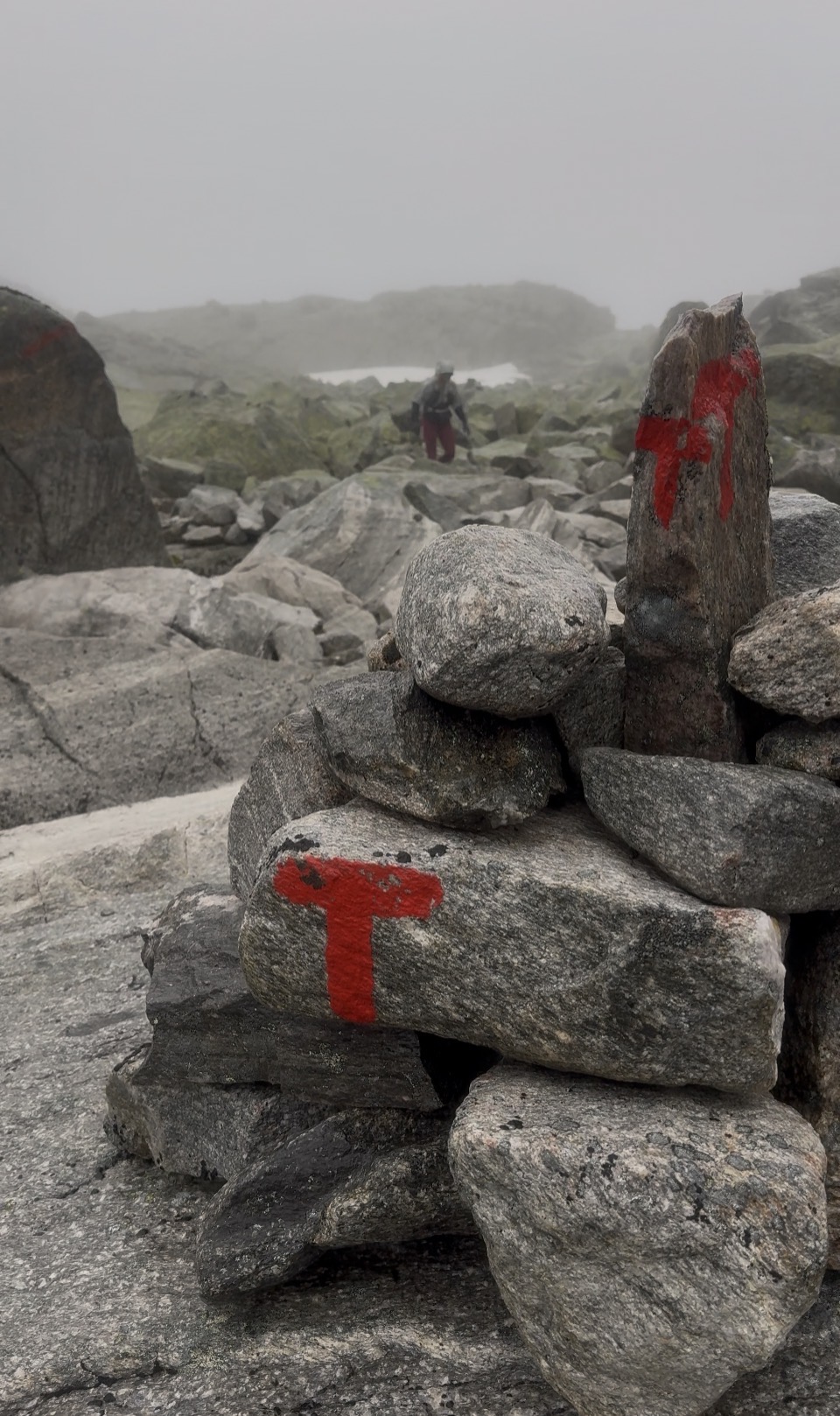
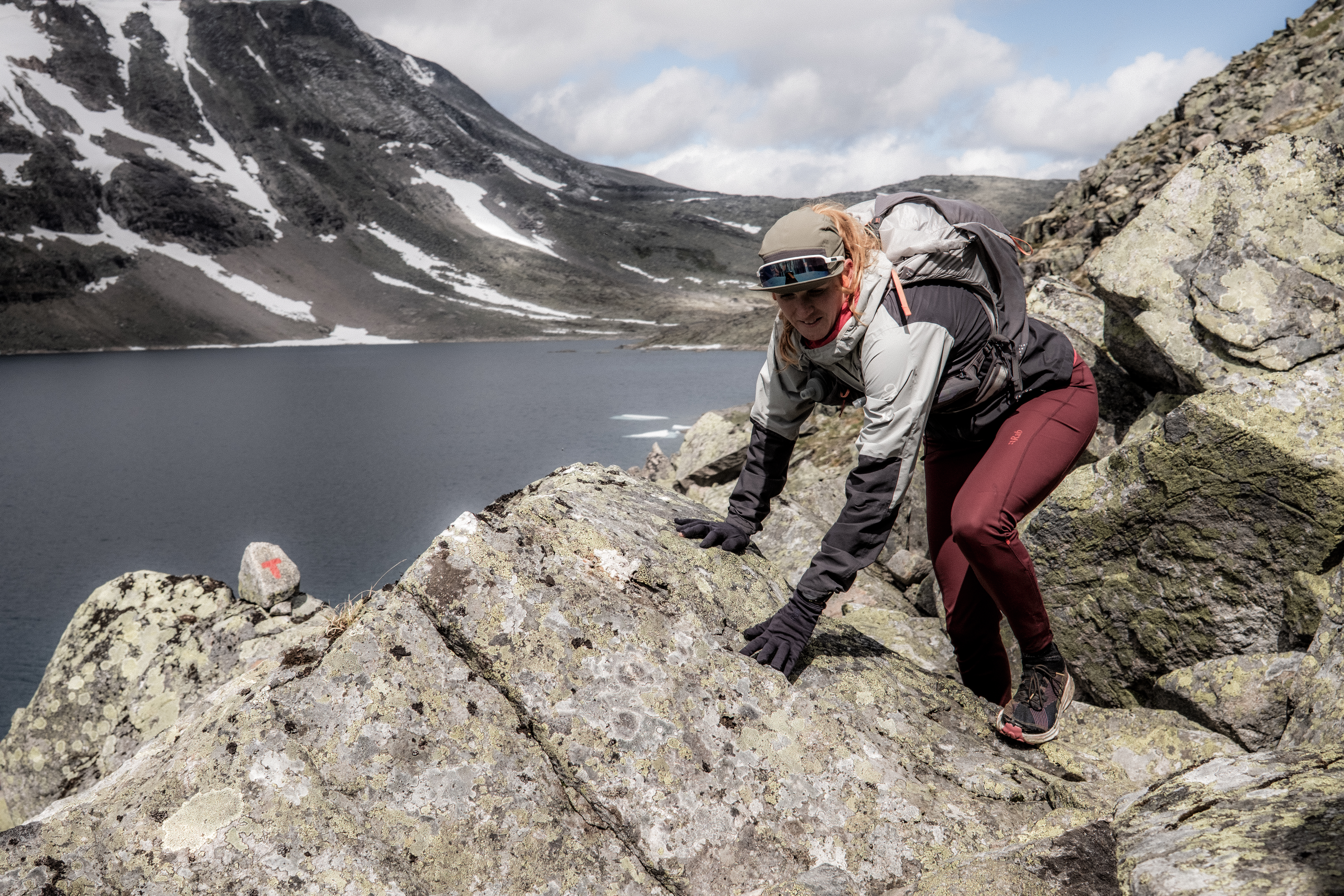
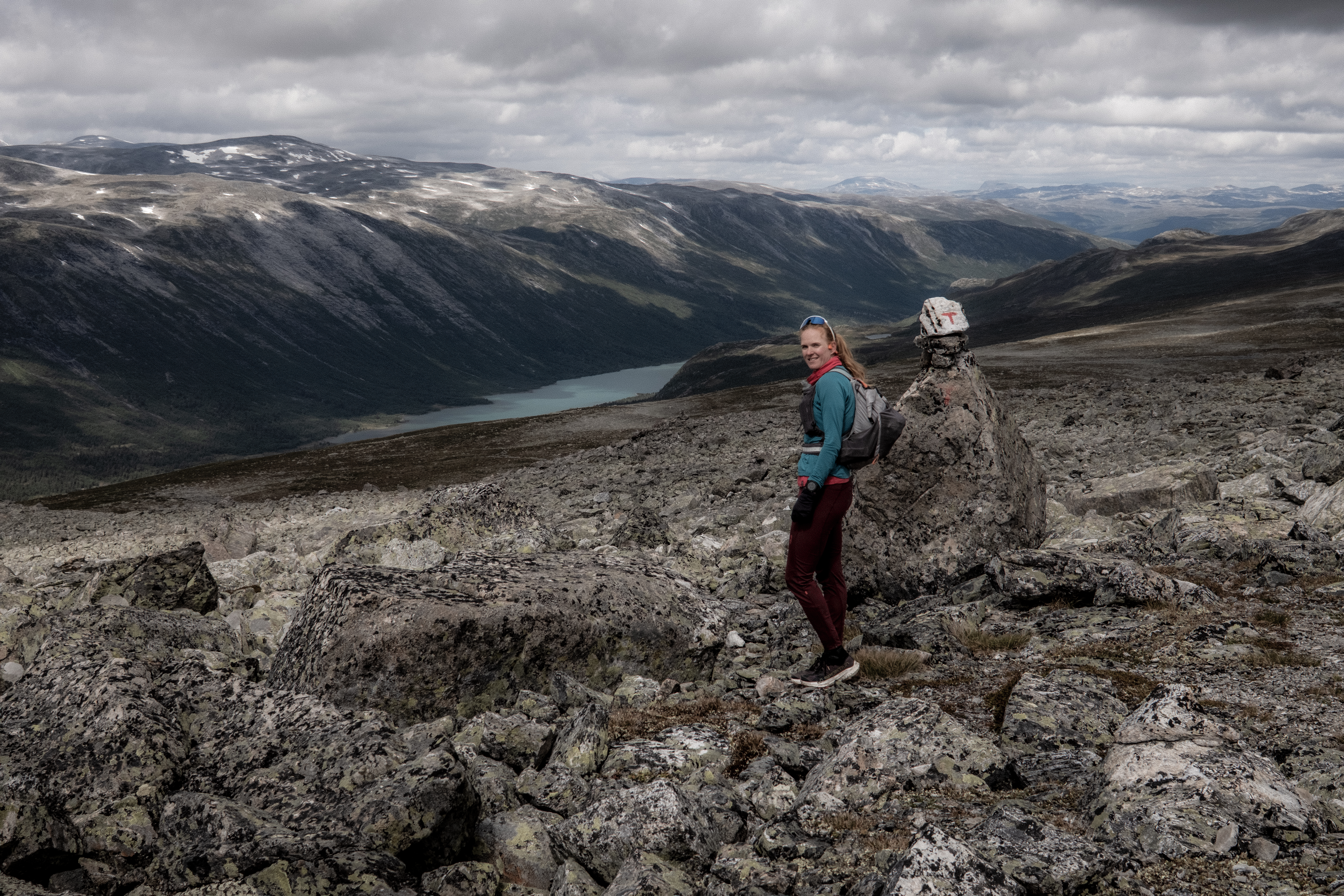
After 14km’s you start to climb up alongside Sprangdalen and the red ‘T’s which signify the route, while clearly visible, in many ways did not make sense. I had a GPX route and as always, I never look at where the next T is but maybe where the 4th, 5th or 6th is.
Sprangdøla river was in flow from snow melt and the T’s wanted us to cross, but much higher up I could see the Ts were back on the other side – I moved in a straight line refusing to cross the fast-flowing water.
iPhone photo
‘The Ts are there for a reason!’ shouted Abelone and off she went crossing the fast-flowing water. I pushed on climbing on the right, Abelone pushed on climbing on the left. I then stopped at a beautiful red T and Abelone was stuck on the other side, water raging and it was impossible to cross – I managed to resist, ‘I told you so…’
There was colourful language, backtracking by Abelone and then hilariously she couldn’t find the place where she had crossed – the sight of her kicking boulders in anger will stick with me for some time. Finally, across the water, she made her way back to me, her head was shaking with confusion, anger and frustration and then it happened – she slowly raised her middle finger and pointed at me with a smile. Maybe my nav error on day 4 of the SAGA wasn’t too bad after all!
In all honesty, I was not having a great day – I loved the terrain, the challenge and the mountains – but I was flat. The estimated distance to Sprongdalshytta was around 18km’s and 1000m+ and the prospect of following on to Arentzbu, another 17km’s was not something I relished.
‘How are you feeling?’ Abelone asked and I honestly replied, ‘I am good but today feel flat.’
‘We can stop at Sprongdalshytta if you like, we have time, we are on holiday…’
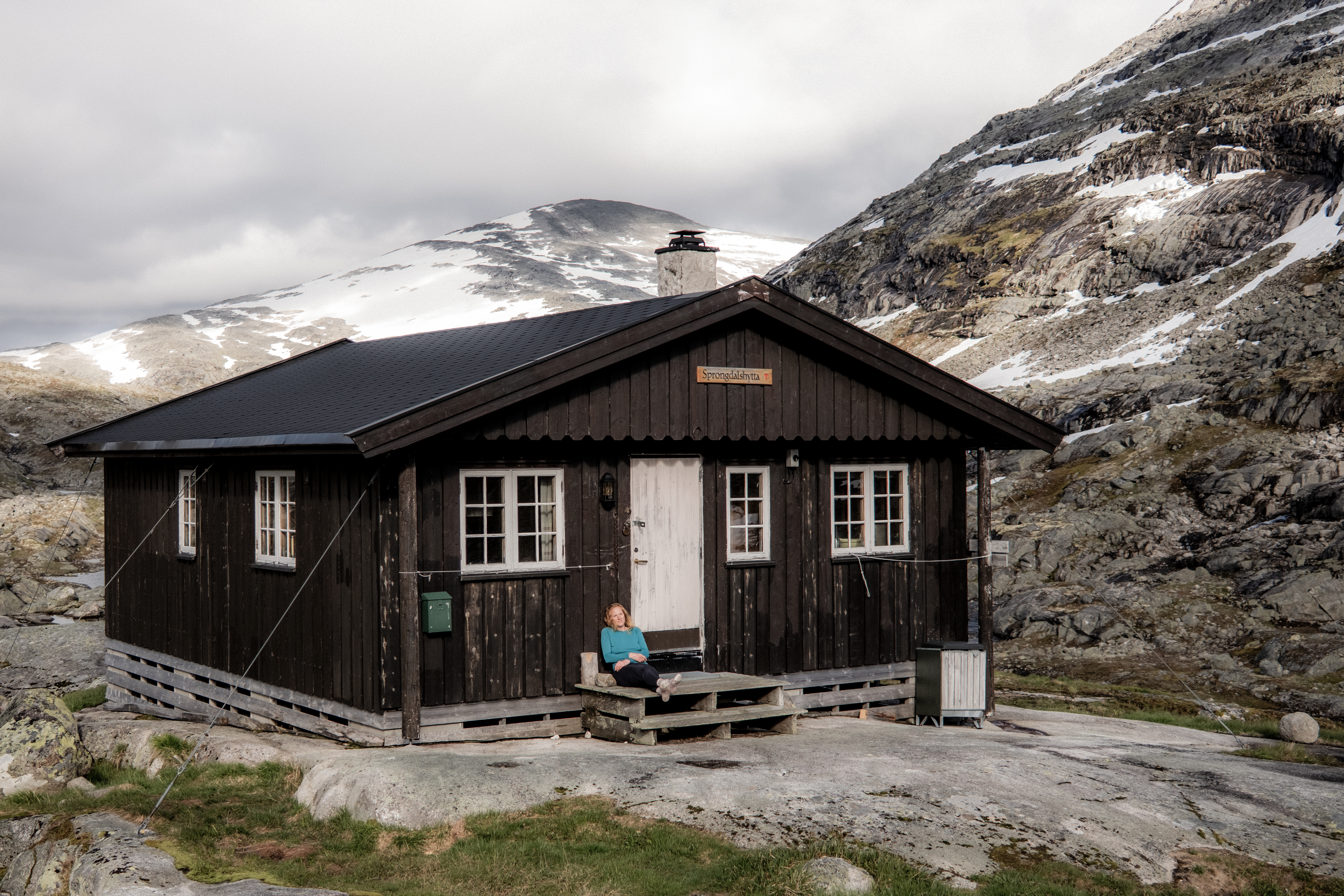
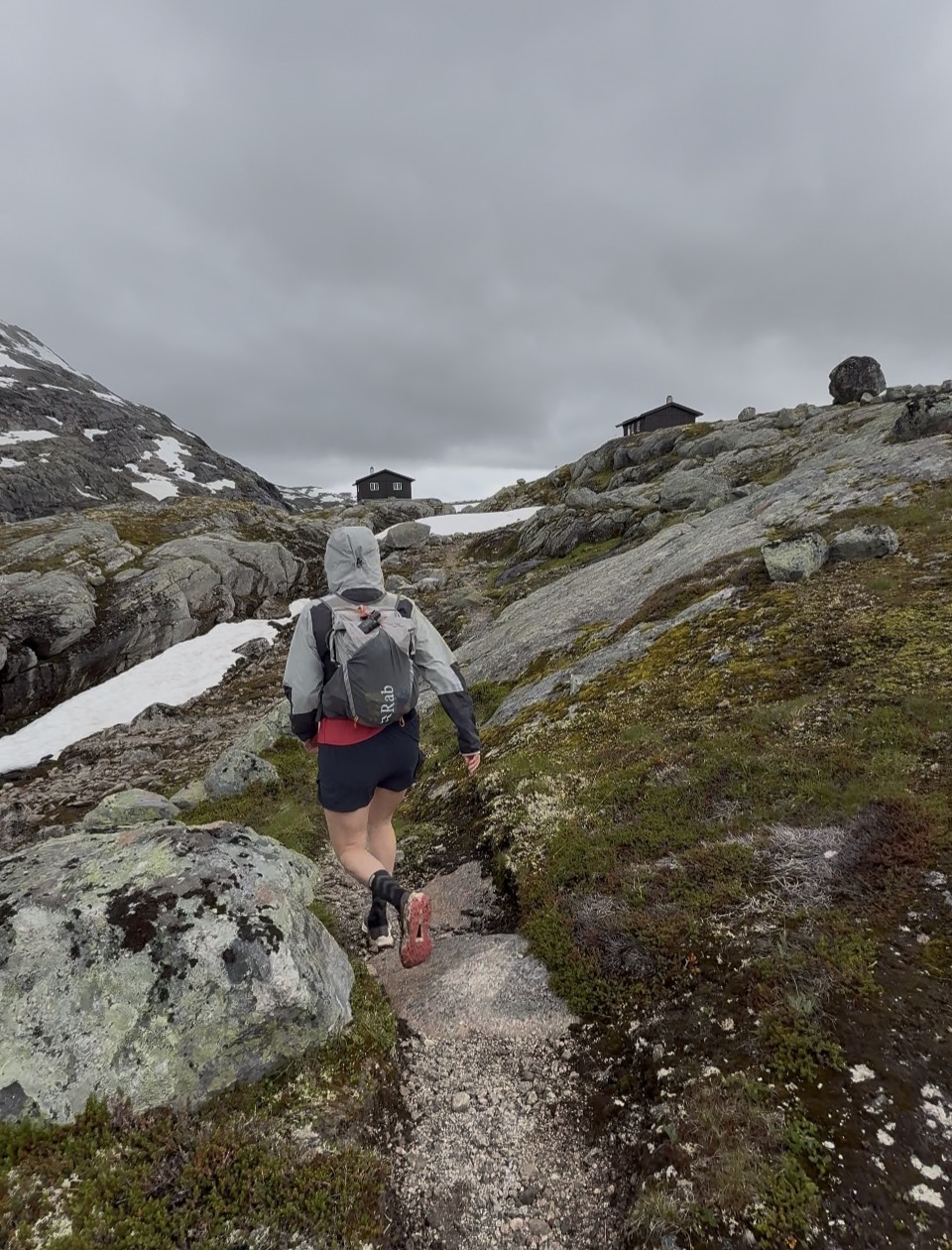
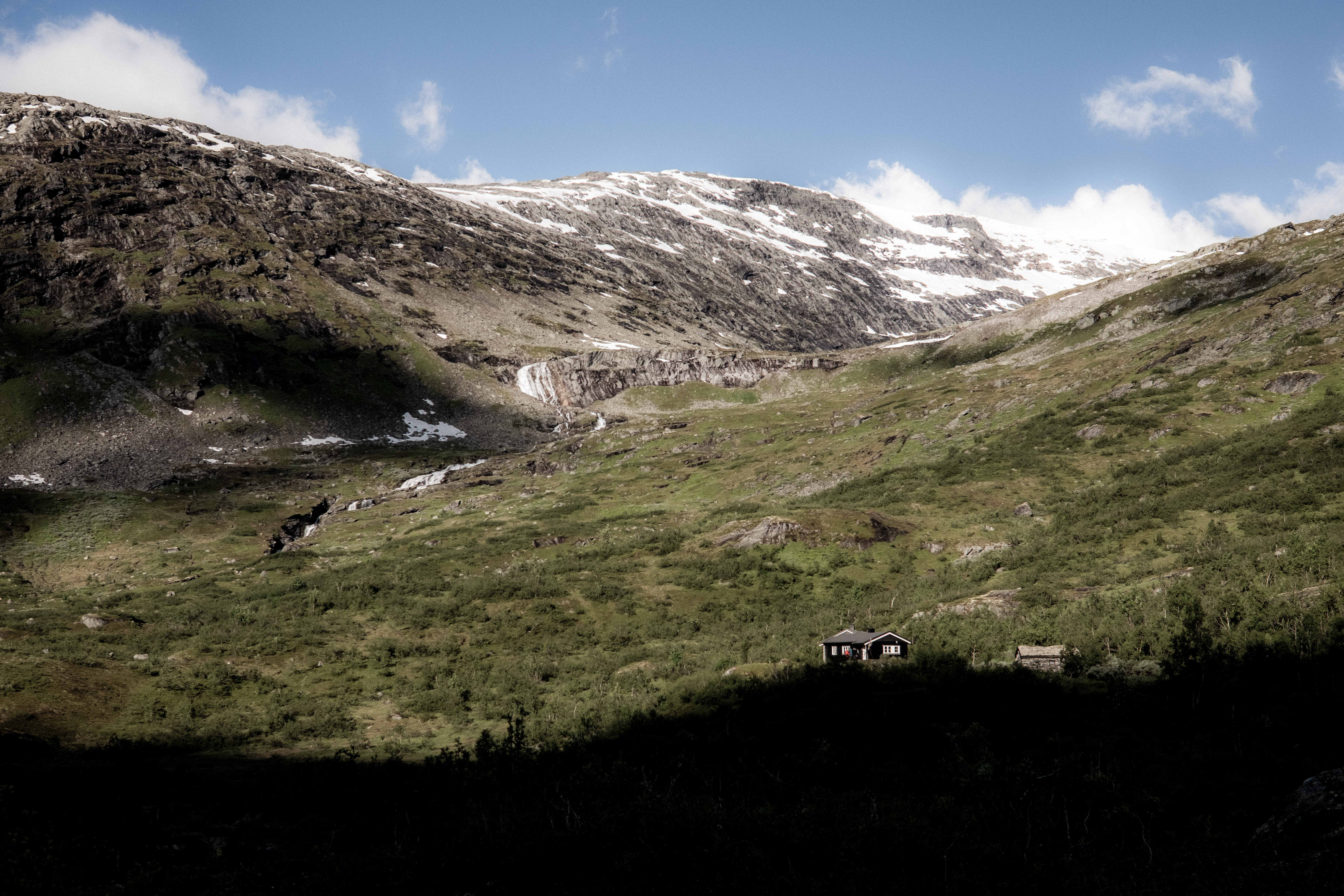
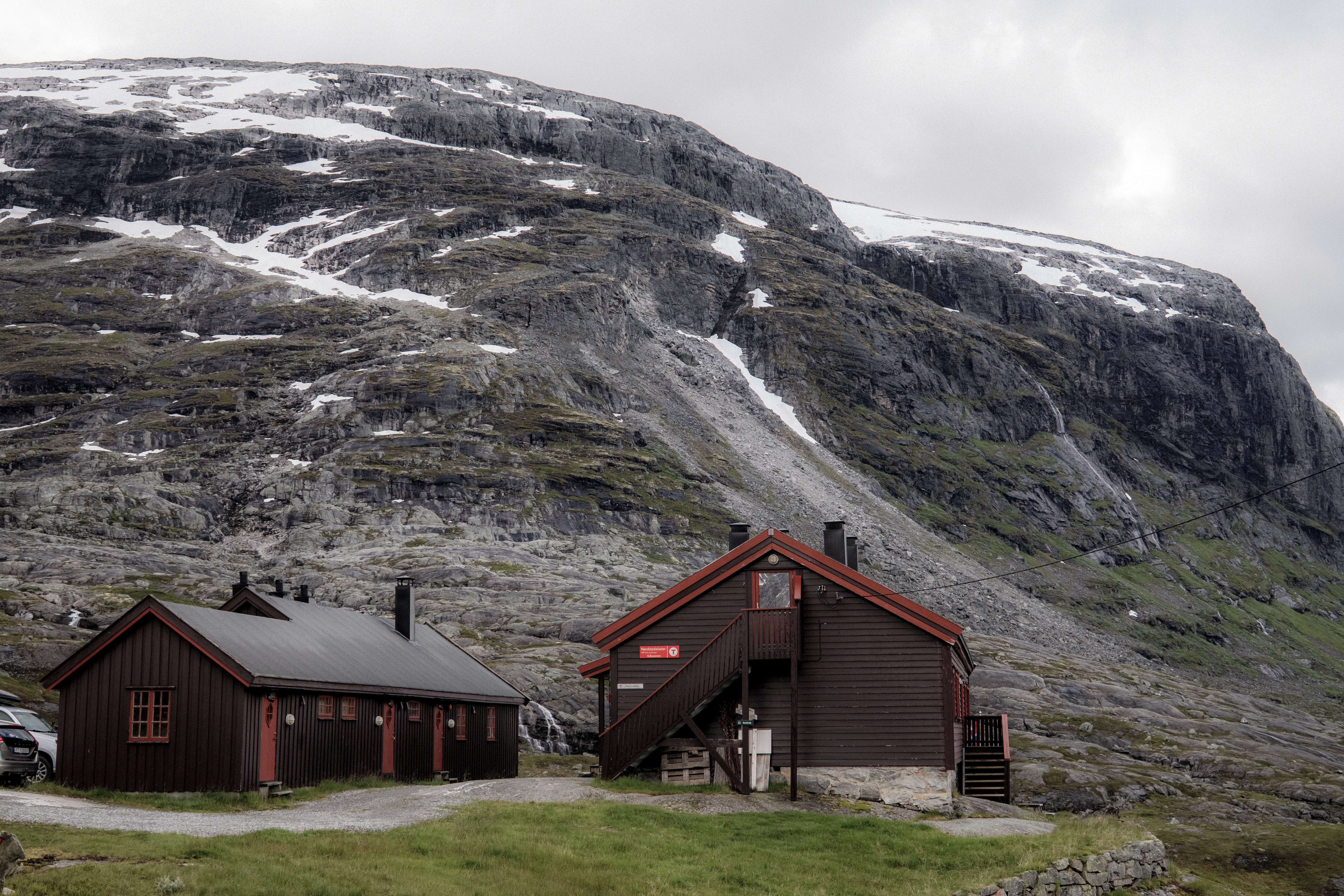
And then the cabin came into sight – it was perched on the edge of the mountain, surrounded by peaks – it was so exposed it was tethered to the ground by steel cables.
iPhone photo – we are staying here!!!!
‘We are definitely staying here!’ we universally agreed.
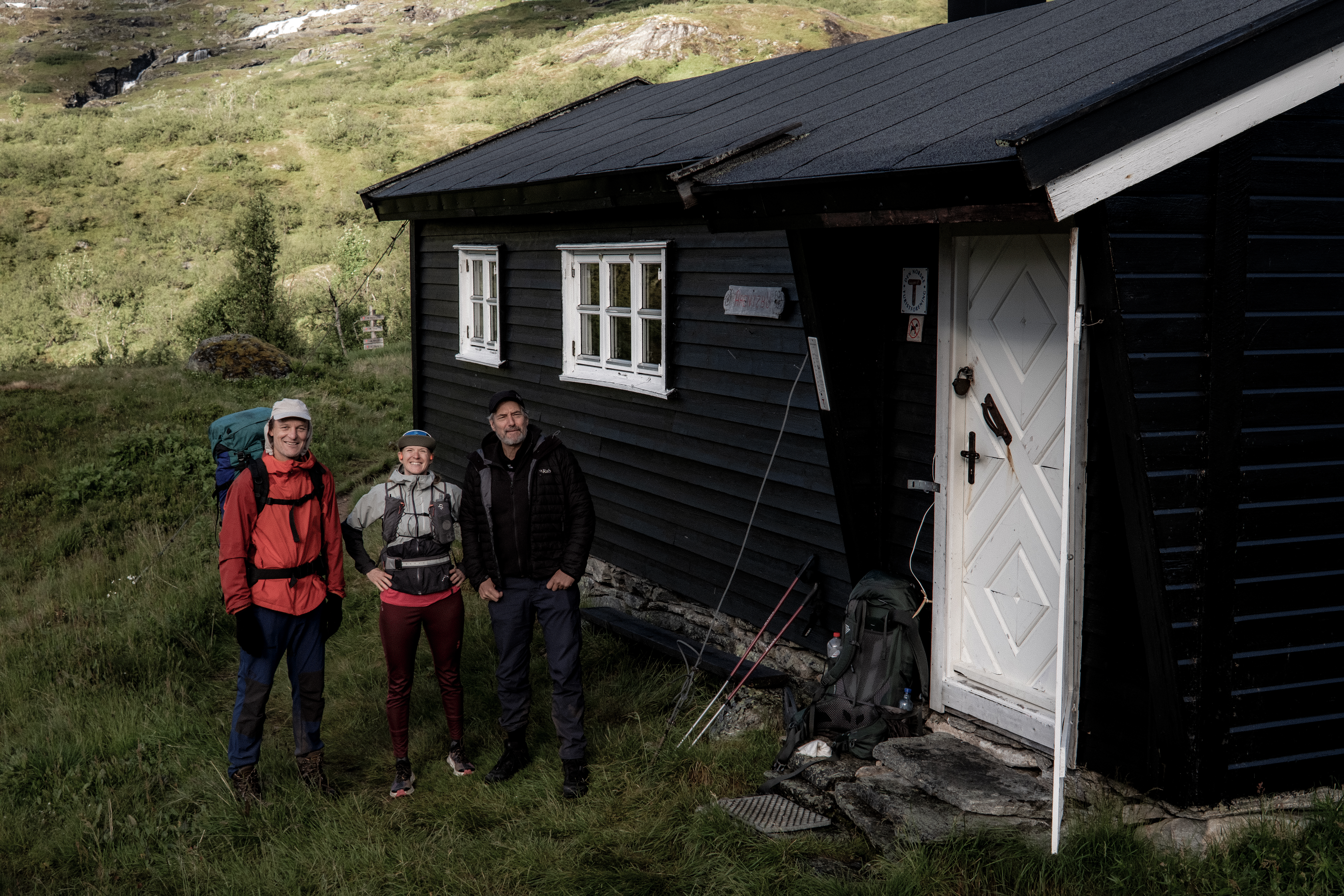
What a place. It has now gained our recognition of our favourite unserved cabin.
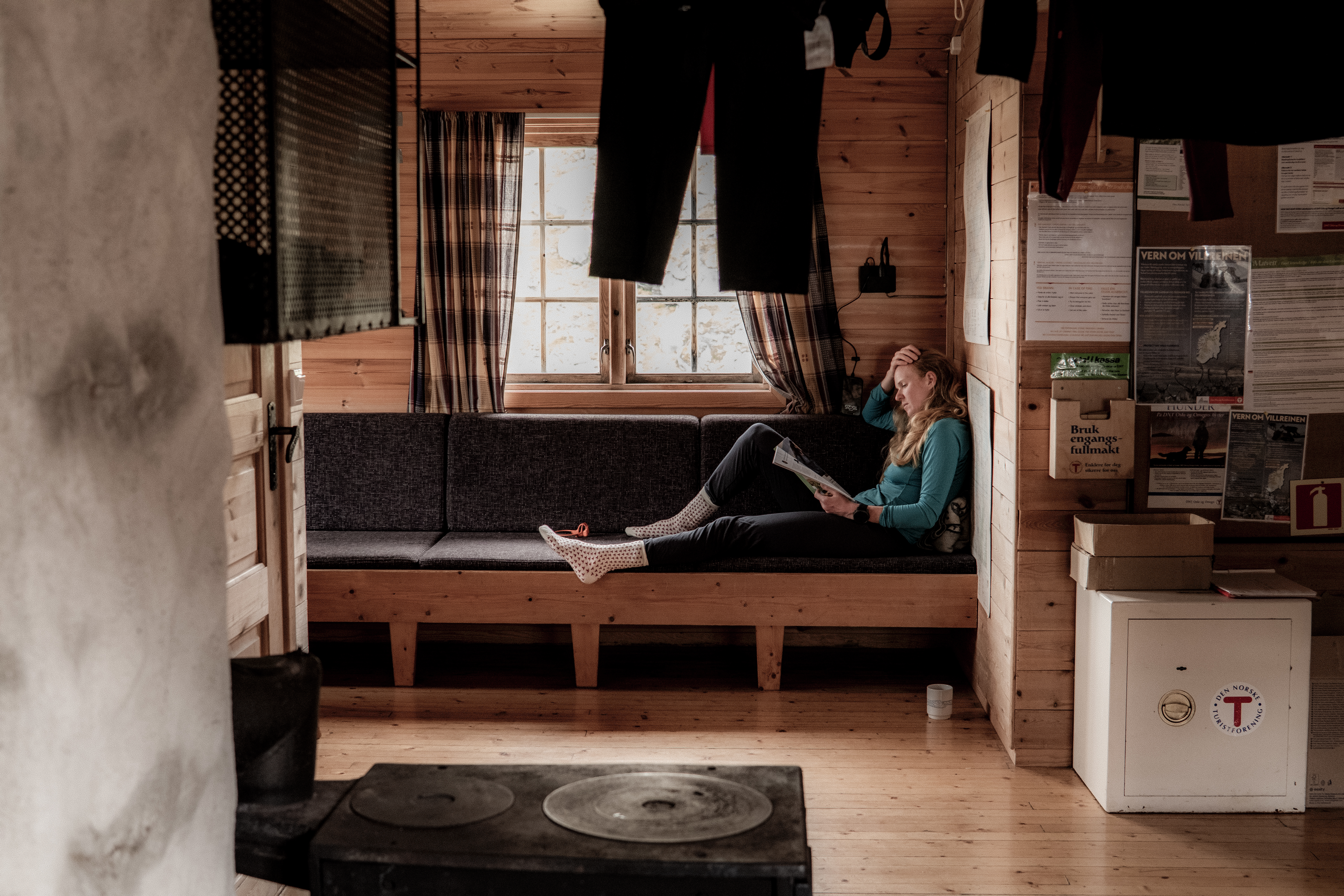
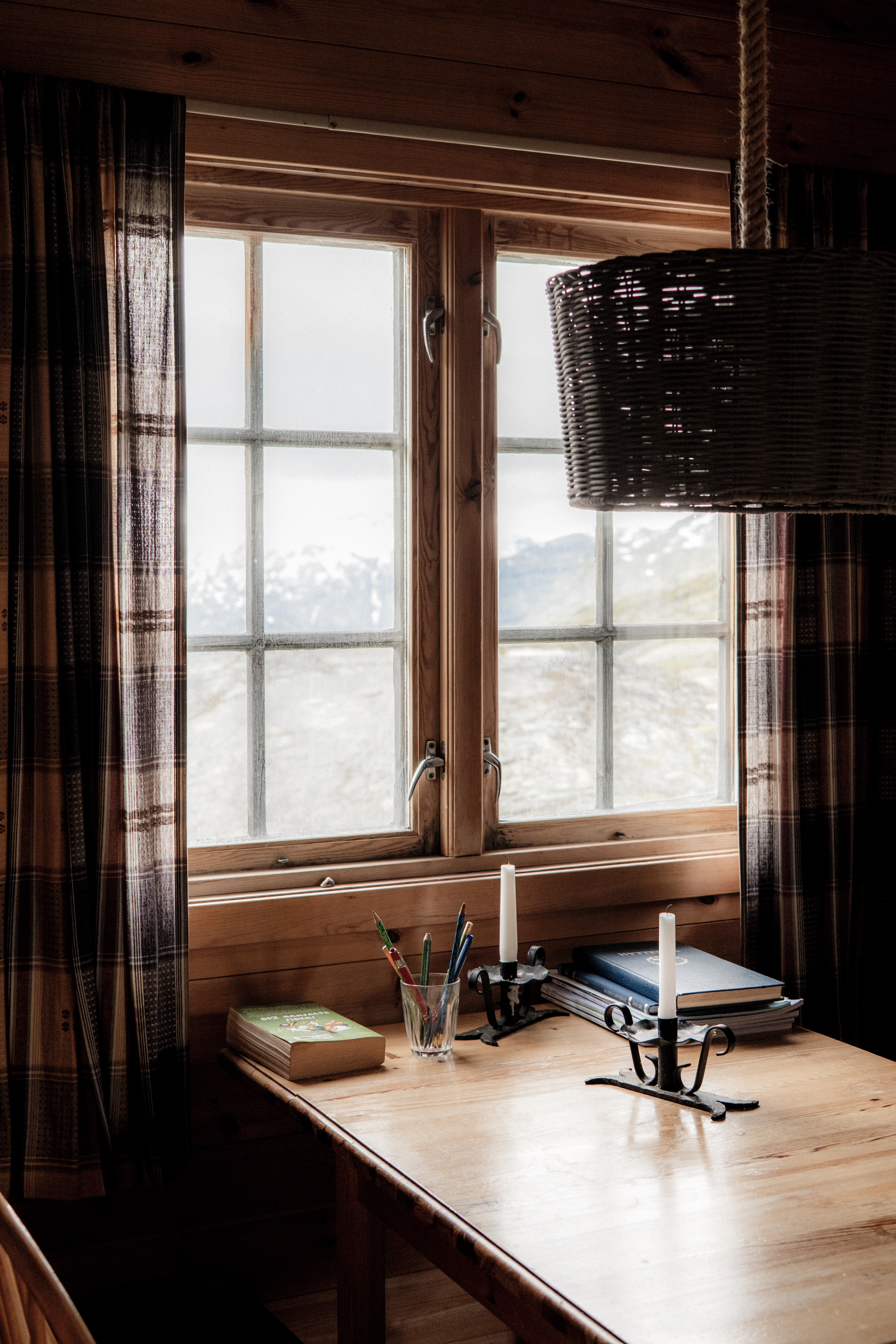
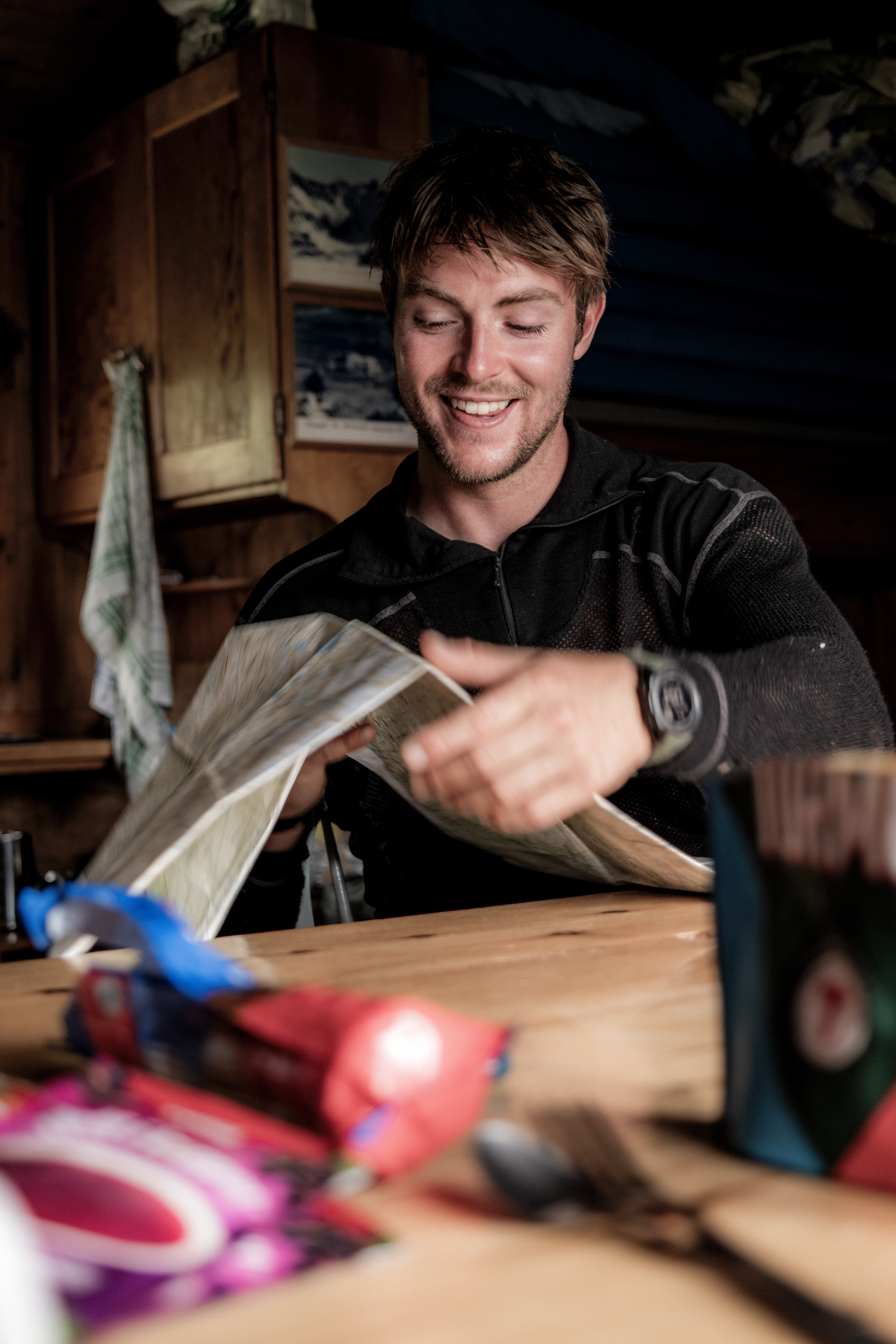
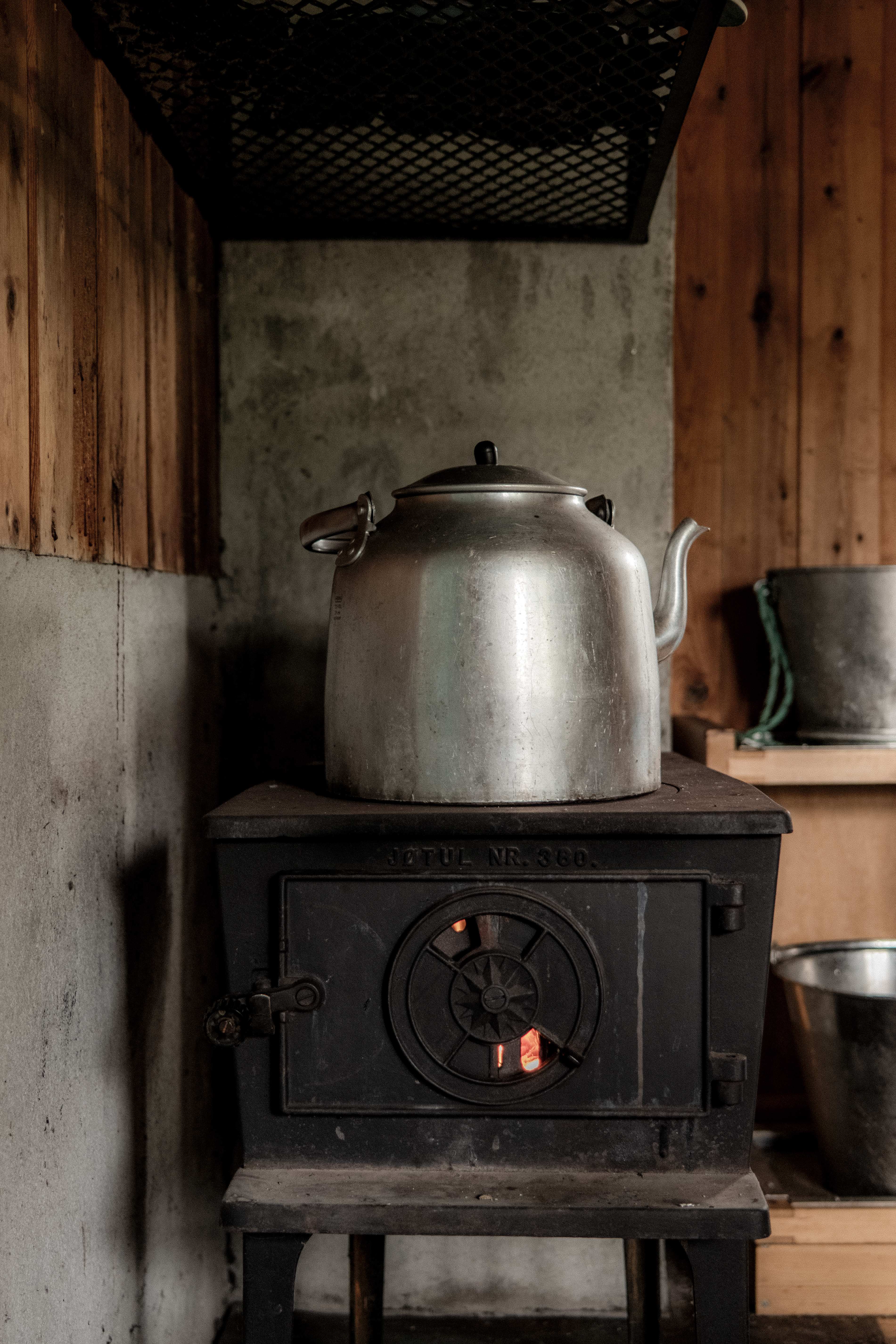
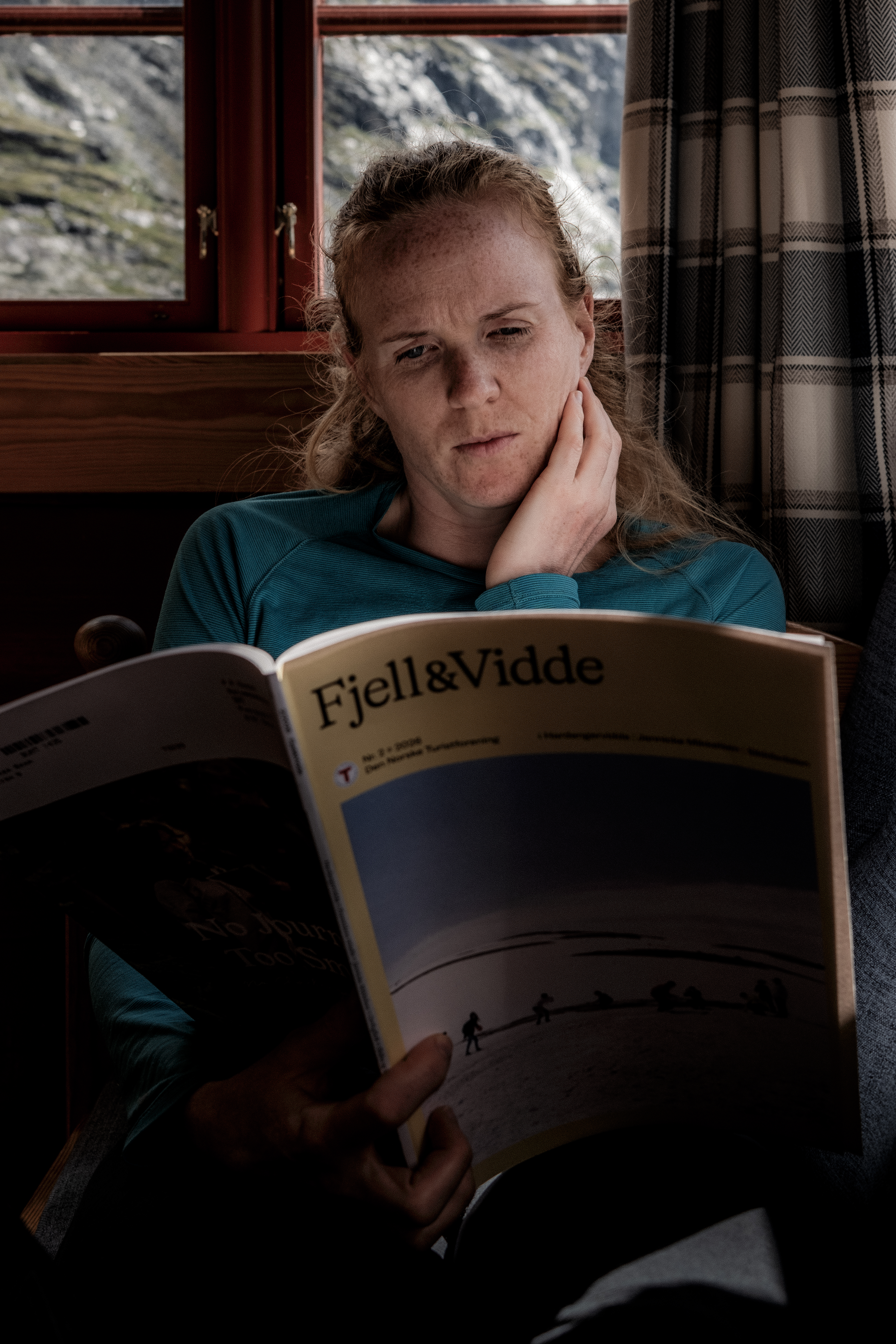
Inside, cozy and warm – we soon got a fire going, checked out the food supply and settled down to an afternoon of relaxation and reading. We were alone.
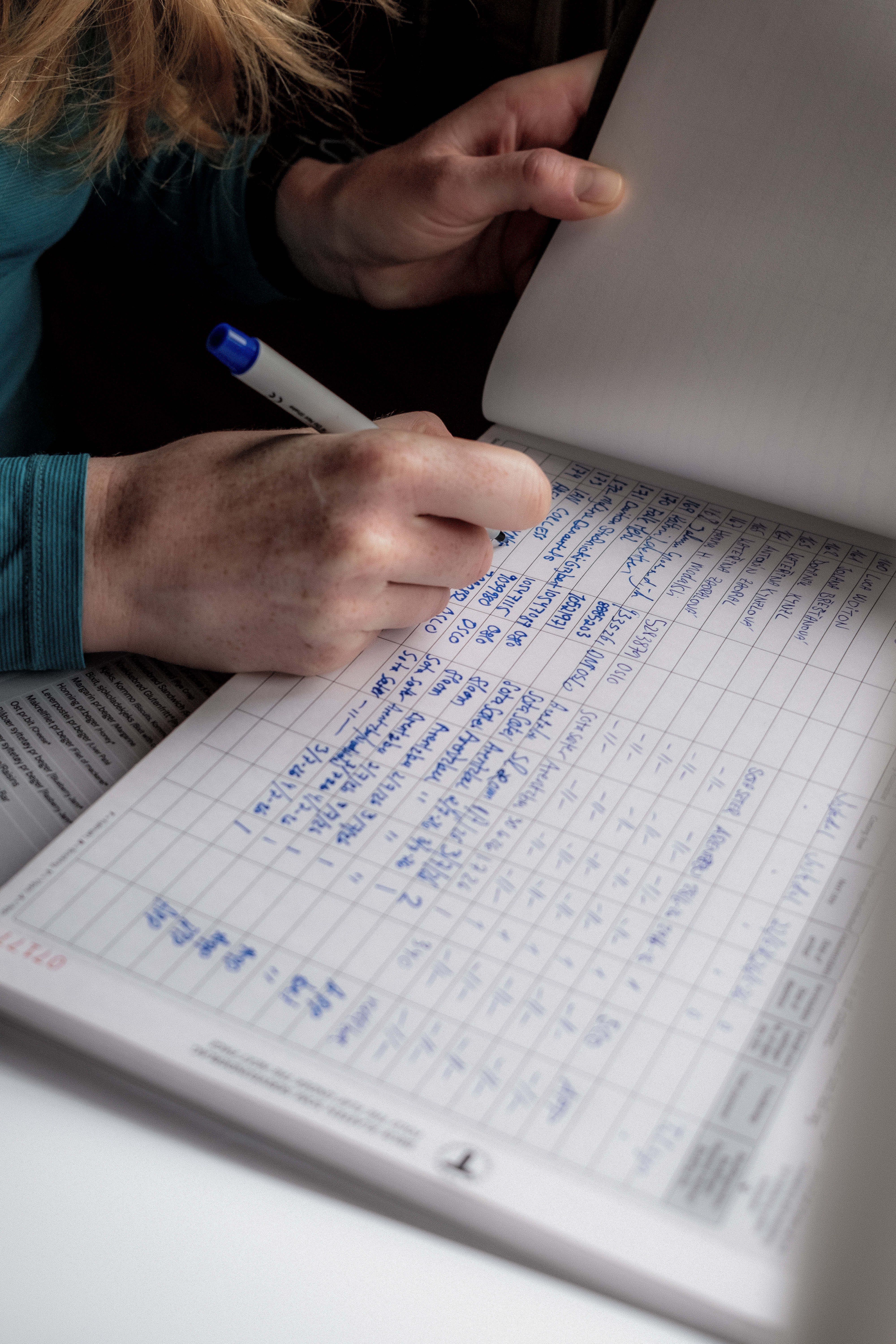
Self service cabins are special and they make ‘fastandlight’ possible – there is a food store so you do not need to carry food. There is a bed with a duvet and pillow, importantly, you must have your own sleeping bag liner! To access you need to be a DNT member and you need a key so that you can access the cabins. Download the DNT app on your phone and you can pay for your stay and what food you use in an automated way.
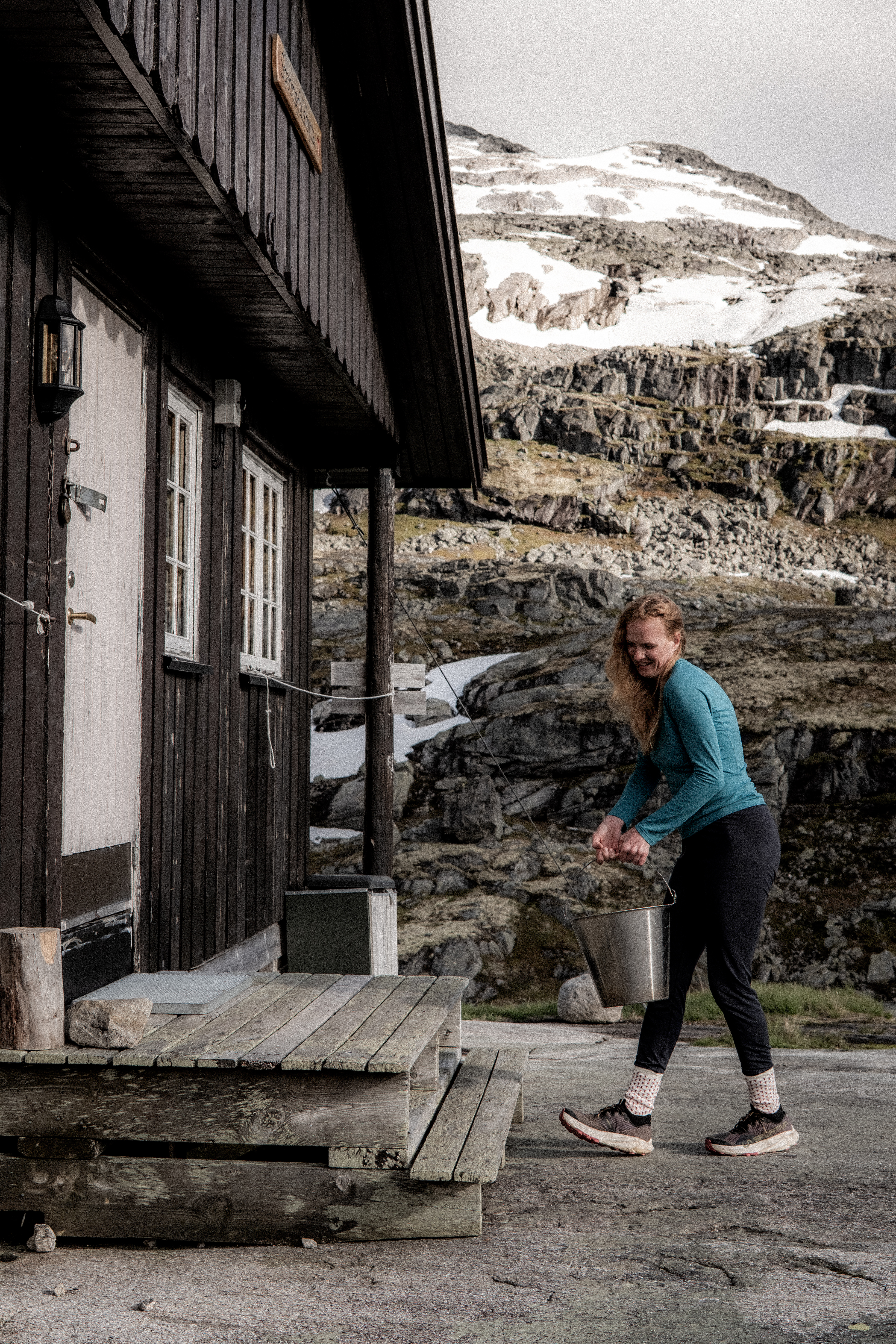
Water often comes from a stream.
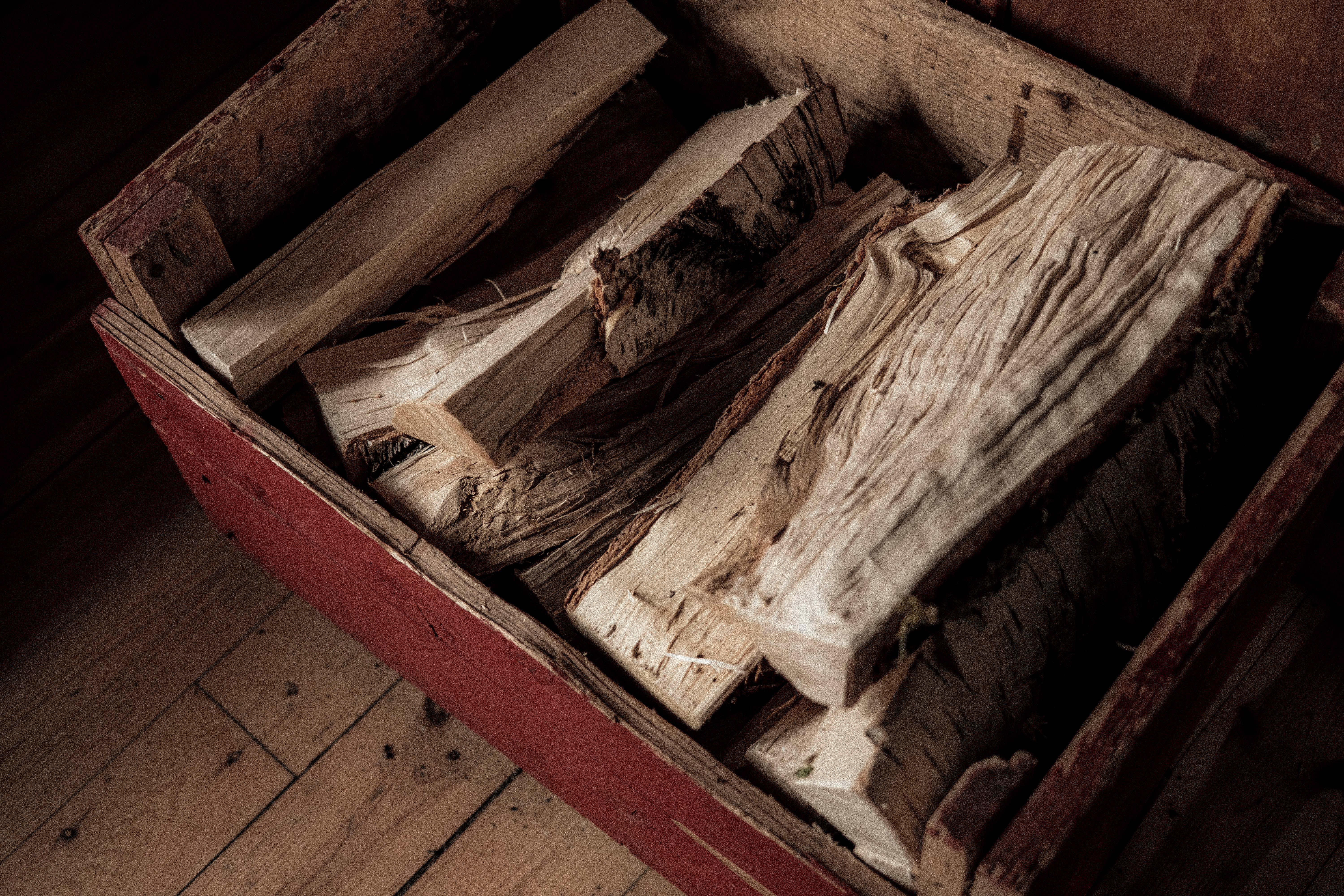
Fire wood is available for warmth and comfort.
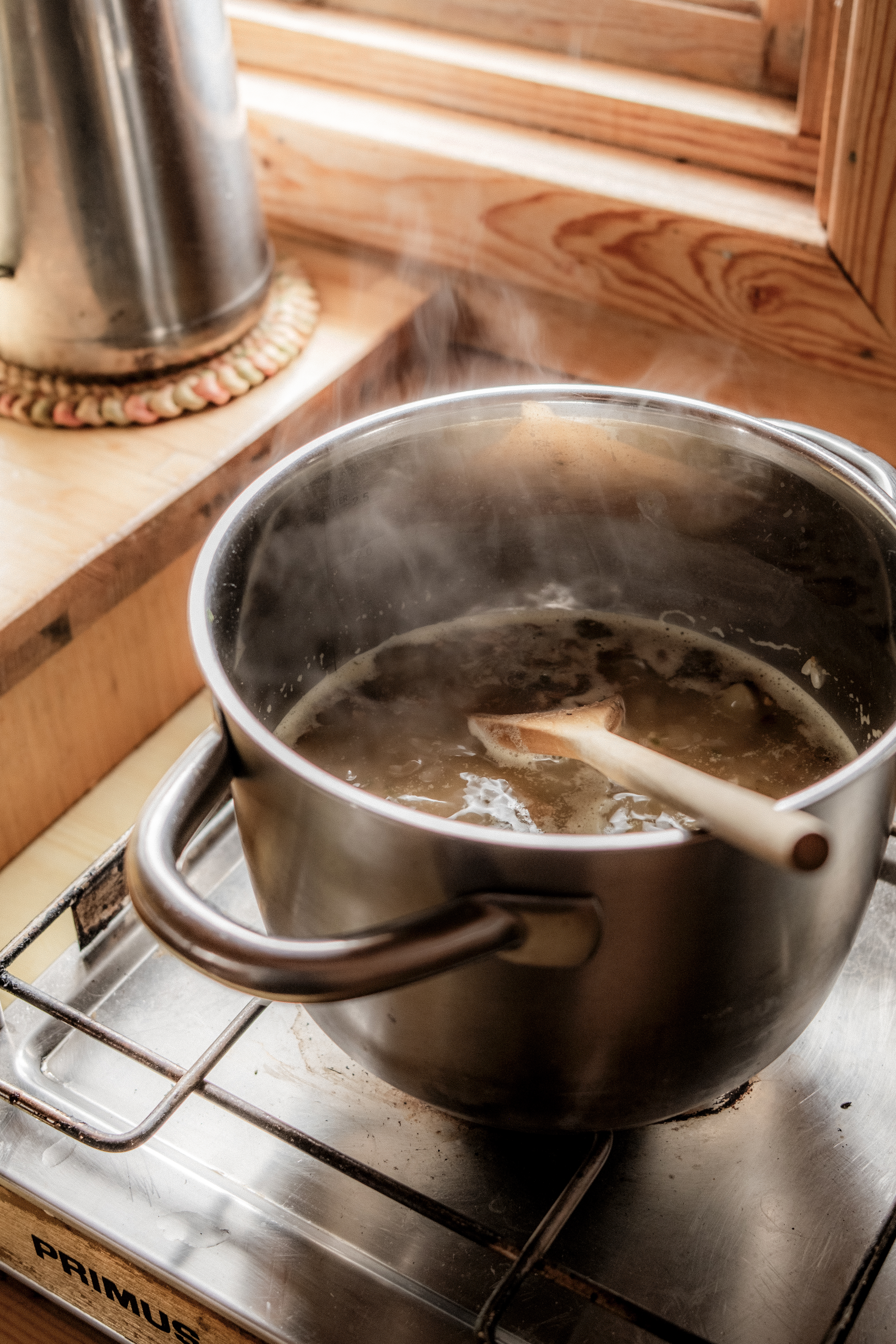
There are cooking facilities – a home from home.
Later in the day we were joined by one hiker, we effectively had the place to ourselves and what a place!
Day 2 – 17.6km 573m+ 4h 01min
On paper, this stage to Arentzbu was going to be easy. ‘It’s mostly downhill’ I said.
Welcome to Norway, welcome to Breiheimen.
This place humbles you in a very good way.
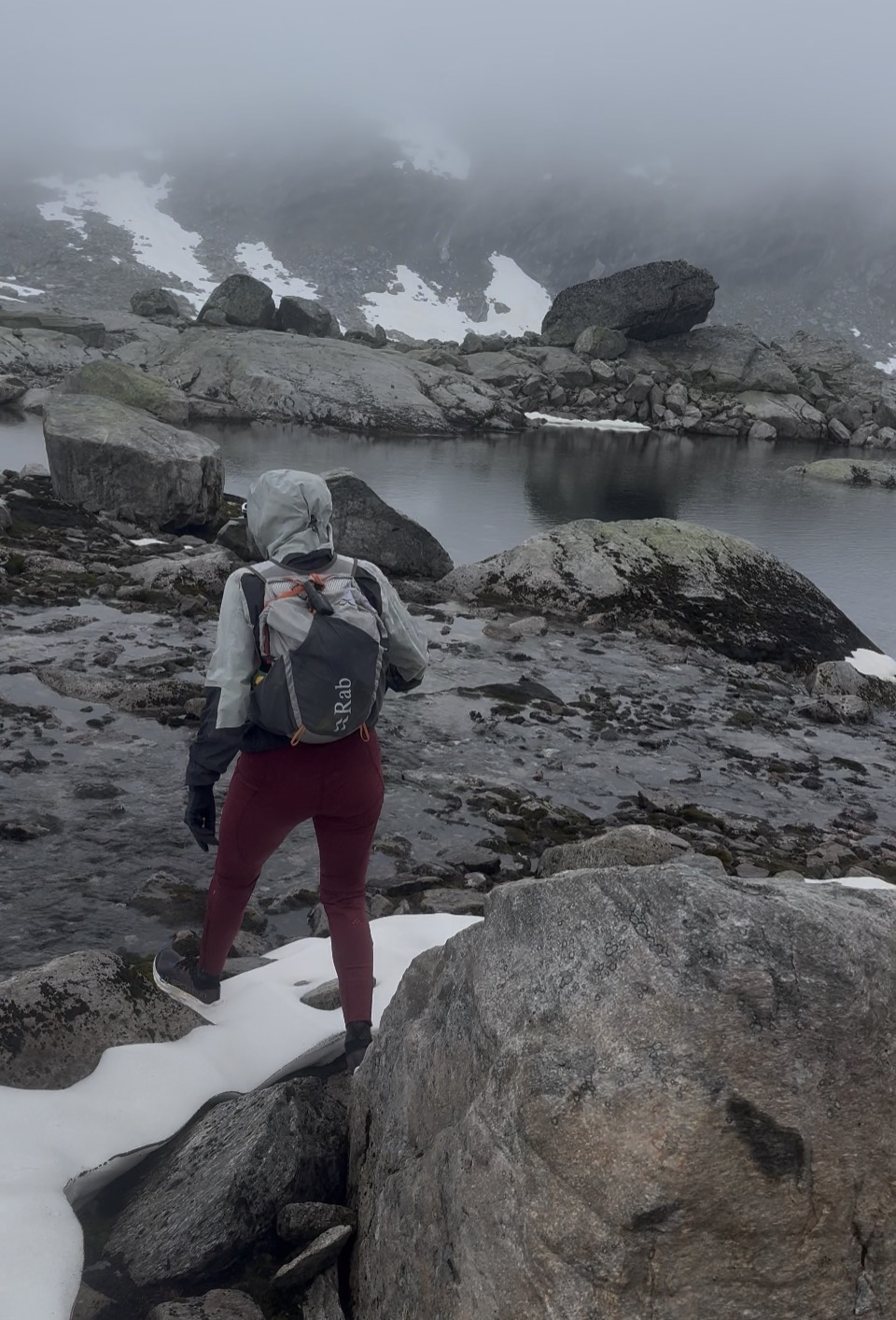
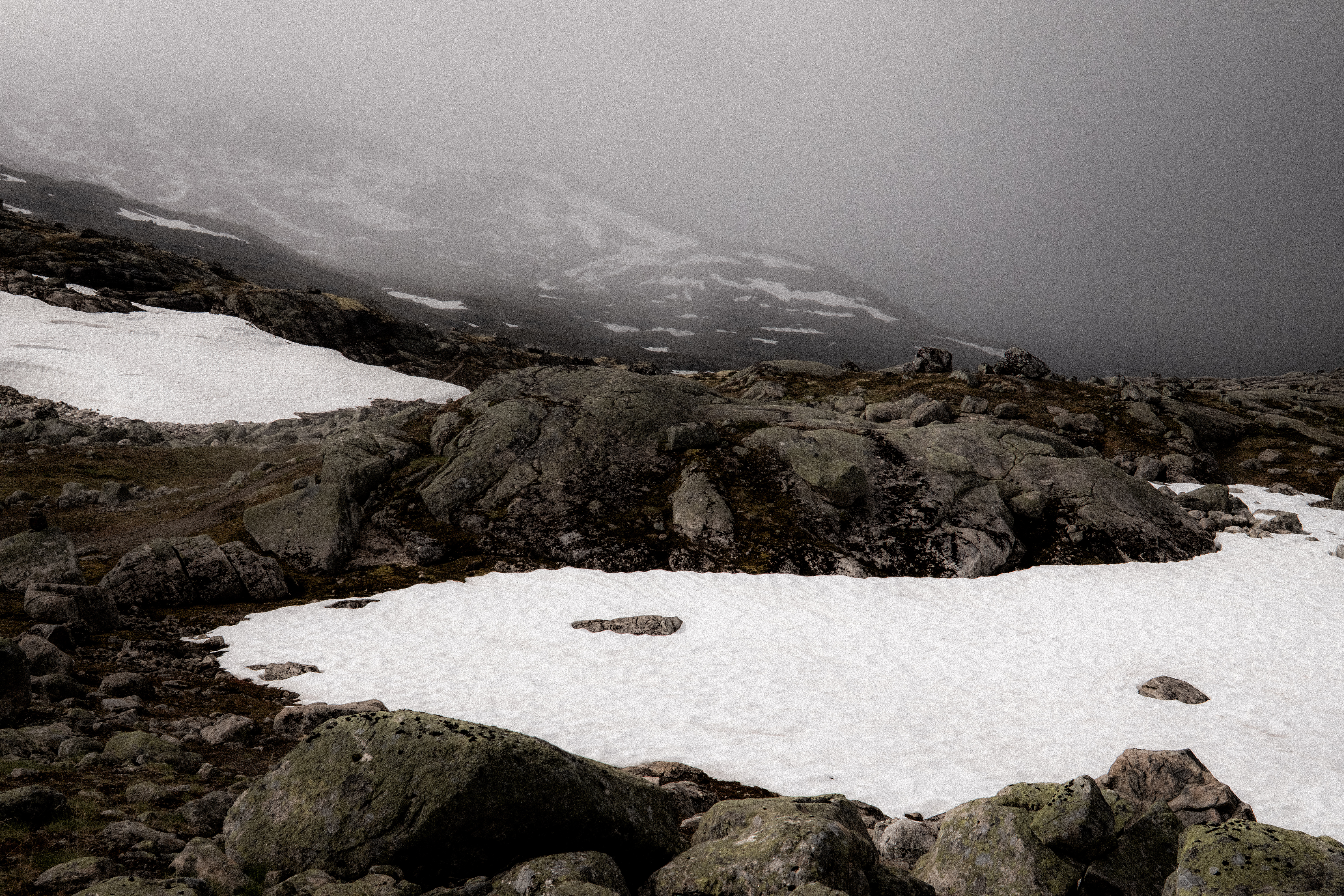
Breiheimen is wild and I love it. We awoke and as always, I took a look out of the window… argh, I am inside a ping pong ball. Cloud and rain had arrived and we were in the thick of it.
Layers on, waterproof jacket on, gloves on Garmin InReach turned on and we started the day climbing up to the snowy mountains above us.
My camera never made an appearance today, at least until inside the cabin, the weather was too wild.
iPhone photo
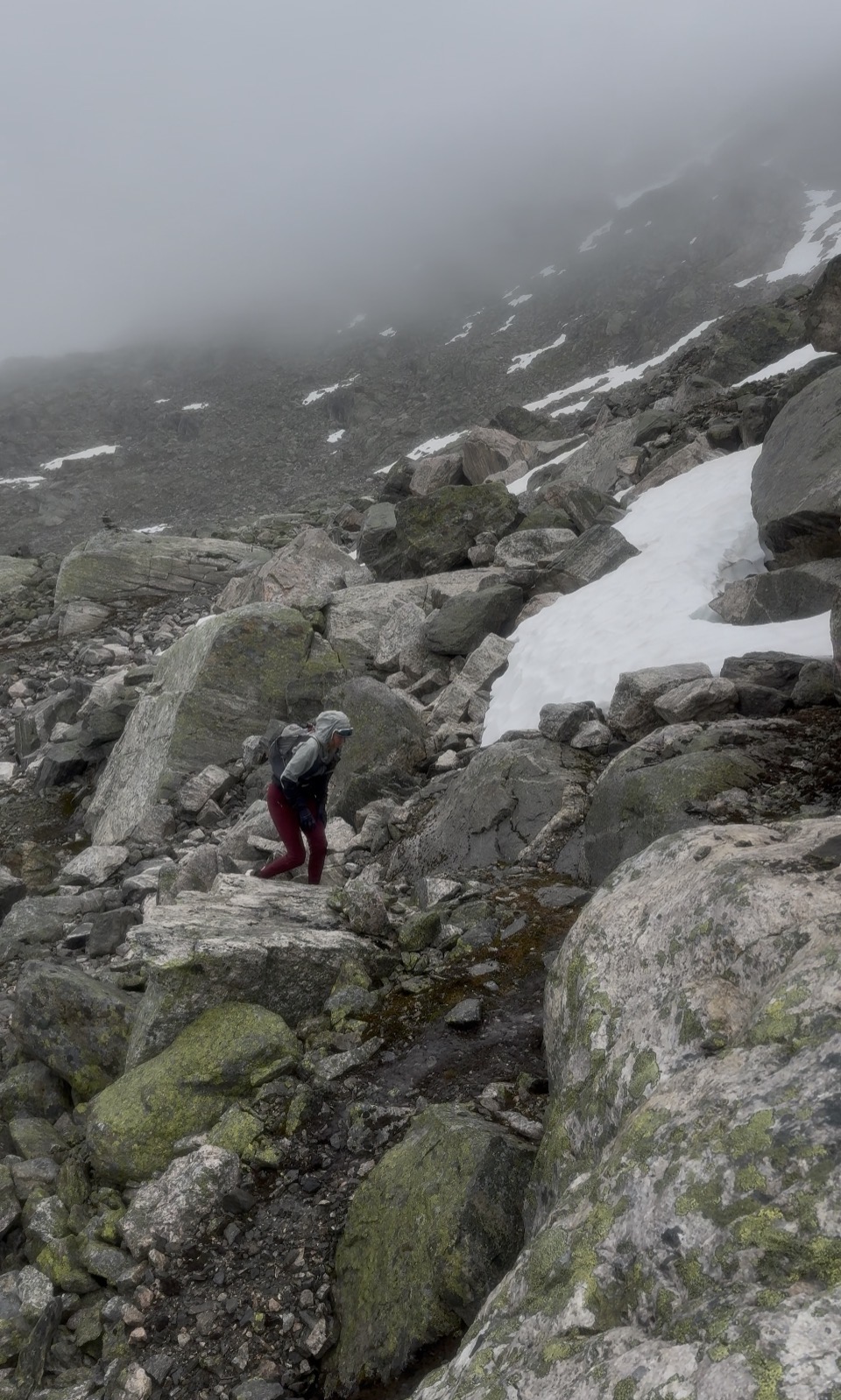
The trail twists and turns navigating through the rocks, boulders and snow. As in the previous day, looking ahead and referring to GPX is the best way to navigate – this provides the big picture and picking a point ahead and navigating to it is my preferred method than going from T to T.
iPhone photo
It was tough terrain.
Slippery, wet, uneven and the persistent rain made this a PURE Norwegian day. In contrast to SAGA, this was wild and remote.
iPhone Screenshot
Gluggevardvatnet (1429m) a large lake was a key point with a short climb after then effectively we were going downhill to Arentzbu.
‘Bloody hell, I am seriously glad we stopped at Sprongdalshytta last night; this would have been miserable yesterday!’
There was part of me that hated to say it, but I was correct. Had we done the double day yesterday, for sure we would have got it done but it would have been a seriously tough 8 to 10-hours.
If you haven’t already realized it, never read too much into distance in Norway – 2km’s can take 1-hour!
Following the trail through green and wet terrain, Arentzbu revealed itself nestled in a lush green valley surrounded by mountains – a real contrast to Sprongdalshytta.
There were two cabins and, in the cabin we chose, there were three Danish guys who ironically were chilling after a night in the cabin.
It was midday and for me, I was expecting that they would stay another night, but no, they were just late starters. We shared chat, a fire and hot drinks and by 1500 they were gone.
Abelone and I settled down, fire blazing – this is the life.
The door opened and two very wet and exhausted Dutch guys entered the cabin. It was around 1800hrs, and they looked a little traumatized. As always, we welcomed them, offered hot water and helped them settle.
They had come from Nørdstedalseter, this would be our day 3, approx 17km’s and 1000m+
It had taken them over 10-hours and the final km’s hadmost definitely had an impact – they complained of the mud, the cold, the slippery conditions – ‘Welcome to Norway’ Abelone and I confirmed.
A cellist and a script writer – we enjoyed an entertaining night sharing stories, one of the joys of the cabin-to-cabin experience.
Day 3 – 16.91km 1059m+ 3h 48m
Nørdstedalseter was our destination today, a cabin Abelone and I know well. This cabin was the end of Abelone’s day 1 doing MASSIV in 2025 and as such it holds a special place. It’s in an amazing location, has great rooms, a shower and serves great food – what a treat!
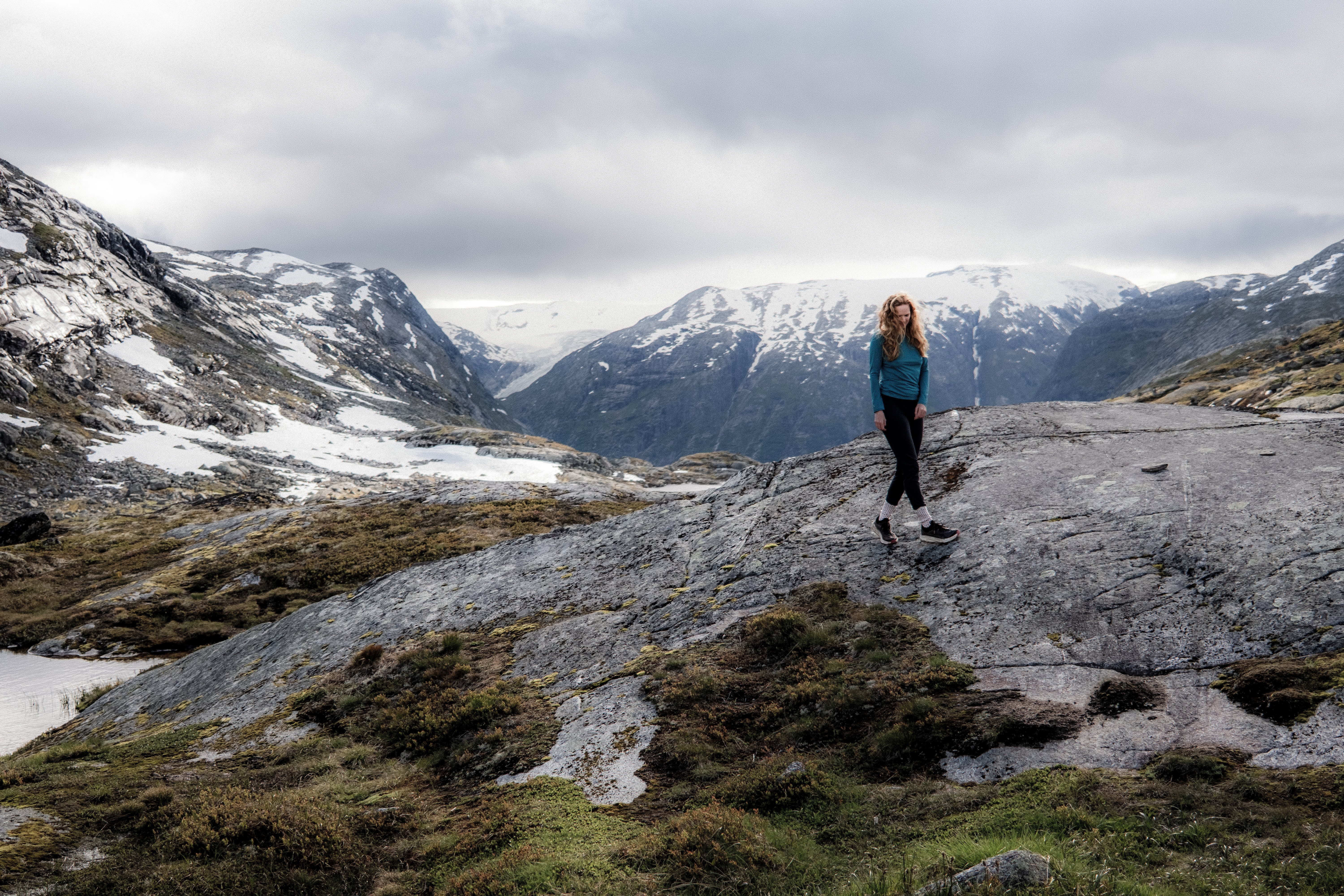
The sun was shining, the sky was blue, and the landscape was magnificent.
The first 2km’s were boggy, wet and slippery. A mud fest. We then turned left and climbed up and up through a tight twisting trail of mud.
‘I can see why our Dutch friends were a little jaded when they arrived last night!’ I shouted at Abelone. ‘It’s aw challenge going up, coming down it must have been miserable!’
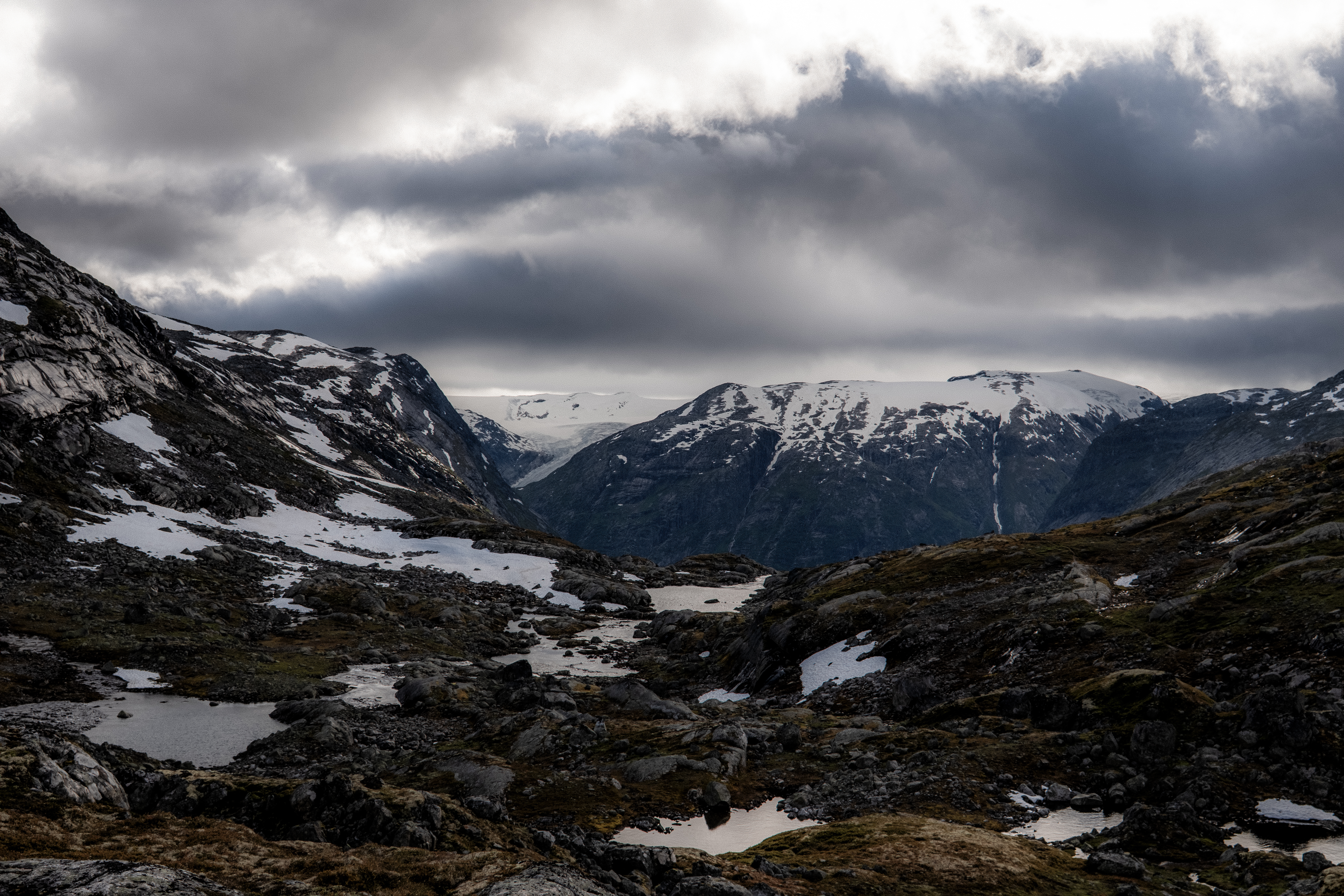
Heimsta Rausdalsvatnet lake was in the background, in the distance Spørteggbreen glacier was clearly visible. This is why we do what we do, these views were stunning.
We were now on stunning trails that mixed single-track with snow crossings, boulder fields and rock hopping. It’s the terrain we love. The weather was perfect.
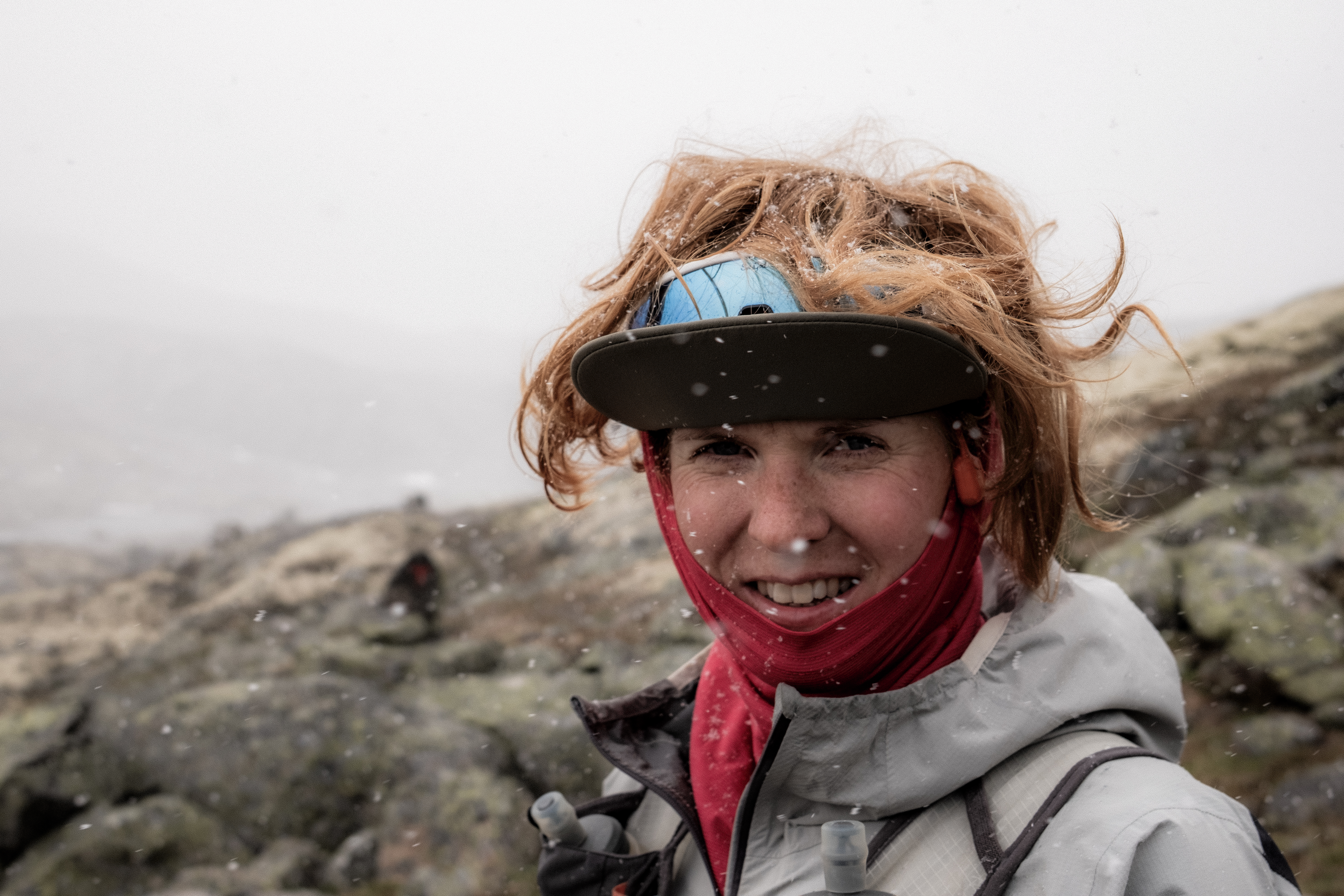
We passed around Leirvatnet and started the steep and rocky climb that offered some pleasant challenges and then the snow came… Yes, snow started. Just to confirm that July in Norway can give you anything and everything.
Sun, snow, challenging terrain and amazing views – this was a perfect Breheimen day.
After passing Gravdalsvatnet, Nørdstedalseter could be seen in the distance, apprx 5km’s away – the light, the views were stunning. With the final few km’s on gravel road, I was already drinking an AF beer in my mind.
But we had the descent to Fivlemyrane first. Downhill, technical terrain, steep and two really ****ed knees basically mean grin and bear it – I did, it was miserable.
The cabin was a welcome sight.
With just over 4-hours moving time, we settled into the cabin for relaxation, of course waffles, hot chocolate and some RnR.
Nørdstedalseter as I have said is the first cabin on the MASSIV route and it is a rude awakening – arguably, along with the second day, it’s the hardest stage of the whole route. While Abelone and I take 6 hours +/-, many take 10, 12, 14 or even 16 hours. To accommodate that, dinner starts as 1900 but goes on till 2300.
We enjoyed our chilled afternoon and slowly, one by one, people arrived, the look of trauma clear on their faces – this is ONLY day 1, ‘How will I complete the MASSIV?’ the obvious question in their minds.
Day 4 – 25.69km 1269m+ 5h 38m
Nørdstedalseter to Sota Sæter and Sota Sæter to Nørdstedalseter is feared. I had done it both ways in 2025 joining Abelone on her MASSIV day 1 and then returning the following day to pick up the car and meet Abelone at her stage 2 finish.
For Abelone, she had not experienced the trail in this direction.
Due to some construction work, our opening easy gravel road start was detoured through no trails on the mountains adding an extra challenge.
Back on the normal trail we were moving quick and after what we had experienced on day 2 and day 3, we quite confidently said, ‘These are easy trails huh?’ They were, it was mostly single-track that weaved a path around Fivlemyrvatnet lake.
The sun was shining and then you guessed, it started snowing. I love Norway!
This route is beautiful, the views are spectacular, and the terrain is constantly challenging.
In contrast to 2025, there was considerably less snow, however, the boulders were just the same as last time… when you start the boulder fields, they go on, and on and on.
Around Illvatnet the terrain is particularly challenging and there is only one thing to do, move slow, precise and be careful.
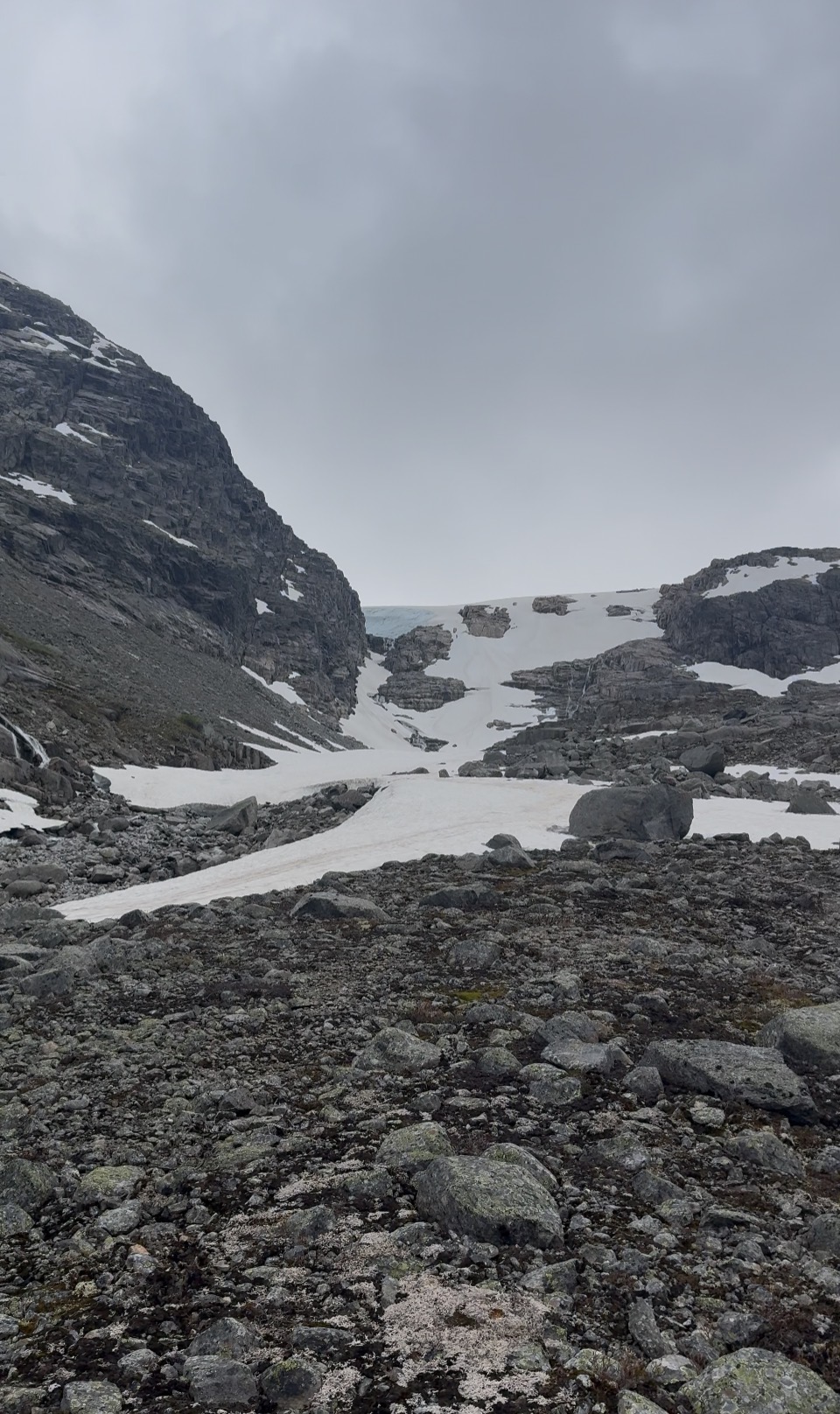
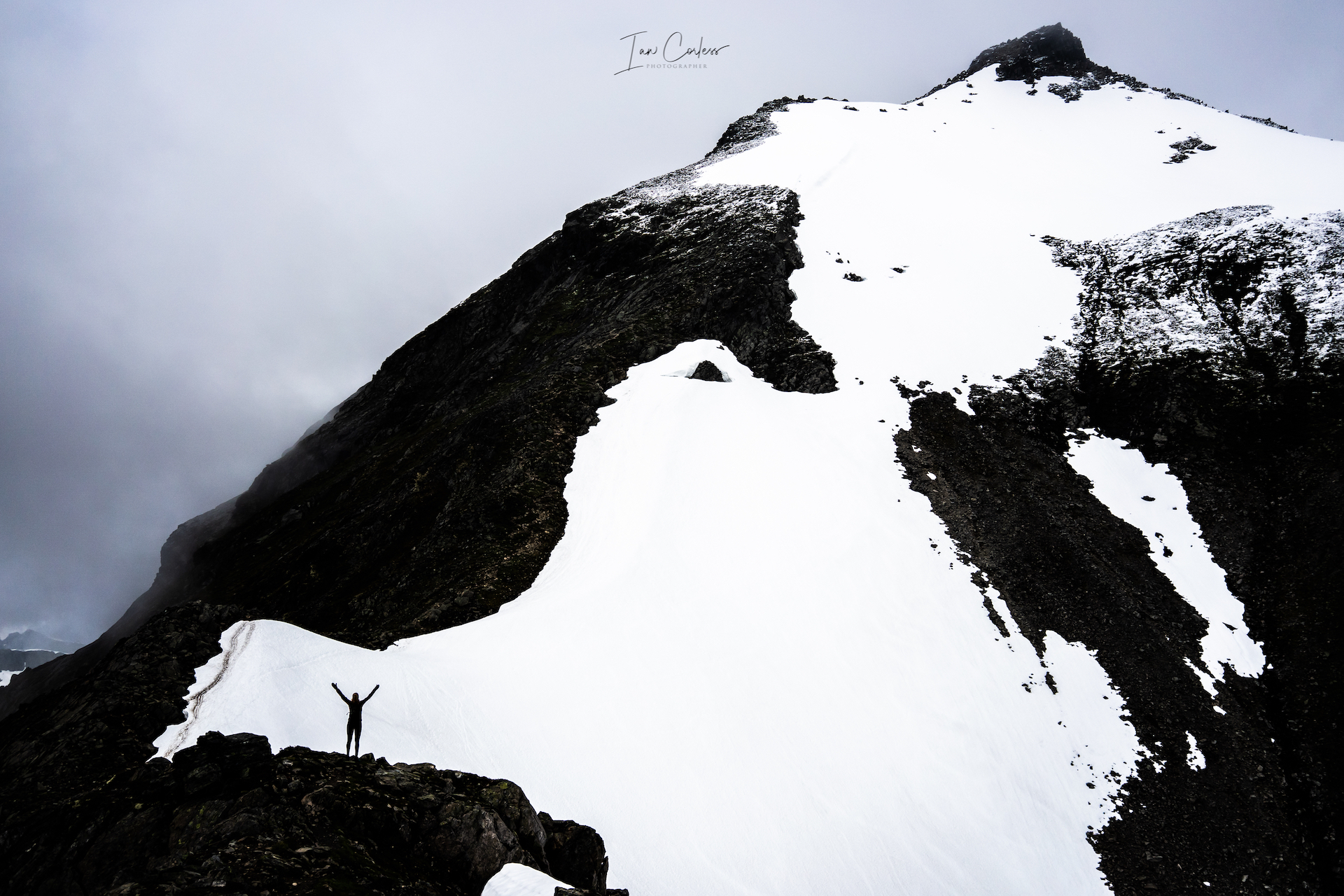
Importantly, if you do decide to do this trail, you can arrive at Sota Sæter in two ways – one way is over the glacier! Do not go the glacier route without a guide or without the equipment/ experience to ensure safe passage.
Up and down, boulder after boulder, you finally climb up to the plateau with stunning views over the route you have just experienced – magical. Tundradalskyrja peak at 1969m towers over you and from here on in, it’s an easy run into the finish….
Think again – the boulders continue and so does the snow and just as you climb the final last little climb, knowing Sota Sæter is nested in the valley below, the boulders continue. There is a reason why this day is considered one of the toughest on the MASSIV.
I gritted my teeth, hated every single step of the final descent as each knee screamed with each footstep and finally, when on the road at the bottom, I kissed the floor.
‘Now, where are the waffles?’
Breheimen is wild, adventurous, a challenge, impressive, beautiful and magical. You need to respect it, and you need to be prepared, but this is one loop I cannot wait to do again.
The passing of September and the arrival of October can signify dread and a sense of despair in many as daylight disappears and the weather changes. However, one of the secrets of ‘surviving’ this new season is to embrace it. Don’t look at the negatives, on the contrary, the perceived negatives are actually positives. Seasons exist for a reason.
Lethargy, low mood and the perceived feel to hibernate are all characteristics we feel during the winter months and first off, don’t fight it, accept that winter brings an opportunity to recharge, relax, read a book, catch up on some movies, light a fire, get a blanket and yes curl up on the sofa and relax. There is no harm or guilt in this.
SAD (Seasonal Effective Disorder) is something we all can feel and yes, some feel it considerably more than others, particularly if Serotonin is reduced and this is often treated with drugs. But light, or the lack of it, is a great contributor. Top tip – Look at changing the bulbs on your lights to ‘daylight’ balanced and when required, adjust brightness throughout the day to help simulate the natural passing of light. It’s a great and easy way to help simulate the variable light intensity changes in one normal day.
Mindset is a key factor to a successful winter and once you get the mind tuned, you will soon appreciate and embrace the possibilities that the winter season can bring, especially as a runner or someone who enjoys outdoor life and activity.
As in all things, we are individuals and as such, we all treat circumstances and changes in different ways. I personally see winter as an opportunity to do things I could not do in spring and summer. I see the challenges that winter will bring as a test, both physical and mental and I look upon it as an opportunity to learn and adjust. Resources and circumstances do go a long way in making my ability to adapt successful, so, to start off, look at these aspects and put yourself in a good place before the cold, wet and dark hits.
In a discussion with a friend over a glass of wine, I was surprised to hear our discussion begin to deteriorate…
“I just hate this time of year. The daylight is leaving us earlier and earlier each day, the light is already arriving so late in the morning and I can feel the damp starting to creep into my body. It will be only a matter of weeks before I am in perpetual cold and dark, I cannot wait for spring!”
It is easy to see from the above quote that before winter has begun, my friend is defeated. I smiled and laughed with him and turned the conversation around.
“Yes, the darkness is coming as is the cold, the wet, the snow and the ice,” I replied. “But what a remarkable opportunity this brings. Just think about it. Cozy nights at home with candles and a movie. Adventures in the snow. Running with a head torch. Learning a new skill. Reading and yes, I could go on and on. Winter for me is just a wonderful opportunity and I cannot wait for it to begin.”
I already felt like a winner as mentally I was prepared and excited for the opportunity, whereas my friend, was already starting the hibernation process.
EMBRACE THE WINTER
I strongly believe that embracing winter and making the most of the season starts with mindset. With a good mindset as outlined above, you will already be in a great place to start.
Marino Giacometti, founder of skyrunning also made the summit on race day – ‘for fun!’
As runner’s and outdoor enthusiasts, we are all at different abilities and yes, we all have different reasons why we do what we do. A great example being an elite runner may well look at winter as an opportunity to address weaknesses and maybe spend more time in a gym working on strength and core.
Monte Rosa Skymarathon
A running enthusiast may well just want to tick over, keep fit and maintain a healthy weight during winter months. And then there is the outdoor enthusiast who may well accept that running is something that will go on a back burner for the coming months and accept that walking, indoor cycling, skiing, gym work and so on is the way forward. Whatever group you fall in, take a couple of hours with a pen and paper and self asses how the last year has been and what you want to achieve the following year, this will help provide some specific goals over the winter to keep focused. This planning and assessment can be as simple as complicated as you wish.
As an example, mine is to embrace the season and the weather and to seize every opportunity. I will hone my head torch running. I will practice my ice and snow running. I will experience my first snow shoeing and I look forward to multi-day snow adventures that will carry me from one point to another in a self-sufficient way. But I also want to write more. I want to read a couple of books that I have never found the time for and I also want to embrace the downtime to rest and recover. My connection with nature and breaking from the digital world is integral to a healthy existence and that cannot stop just because the season has changed.
CLOTHING
We have all heard it before, “There is no such thing as bad weather, just bad clothing.” It’s true I am afraid. Clothing is one of the key essentials that makes any winter adventure not only bearable and enjoyable. As outdoor people, we have never been as lucky. Technology in apparel has now progressed to a level that we can be warm and dry in super-light products. The downside of course is cost and yes, gearing up for winter can be expensive.
Layering is key with apparel, starting with warm layers against the skin, insulating layers on top and then waterproof and windproof layers as the final touch that will protect from the elements. Merino is great as a base layer and I have a long sleeve top and legs as a starting point. Now of course, I may or may not use them as this depends on the outdoor exercise I am doing. As an example, I would wear the top if running but not the legs. A mid-layer is more often than not either Primaloft, down or synthetic. Each has its place but if you could only choose one, Primaloft (or similar) would be the most versatile due to its ability to retain warmth when wet and still be lightweight. The outer layer should be waterproof and windproof with taped seams and again, it is essential to have jacket and trousers.
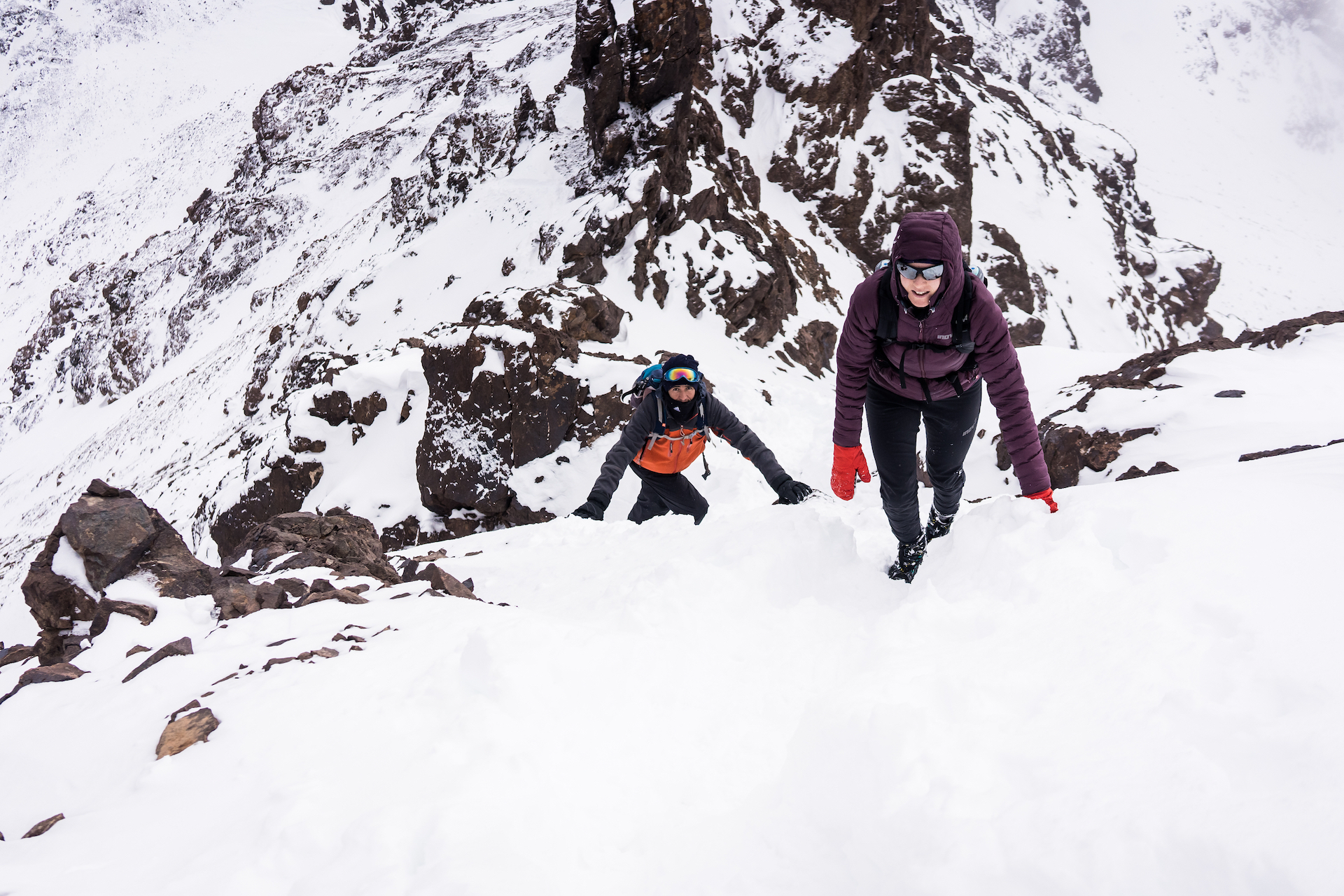
The above looks at the core, but if you are like me, the extremities are my most vulnerable in winter and after getting frost nip both in my toes and fingers on the summit of Monte Rosa several years ago, I know need to ensure that I have multiple options for keeping my feet and hands warm. I use Merino base layer socks and gloves which are very thin. For my feet, I then add thicker Merino socks over and inn certain scenarios I have even used Gore-Tex or Neoprene over socks. For my hands, mitts always provide the most warmth and I will use them as first choice. If I need finger dexterity, I often purchase gloves several sizes too big that will allow for multiple layers to retain warmth.
A hat, buff and glasses add the finishing touches. A good hat is one of the easiest ways to retain heat inside the body. A Buff is perfect for around the neck, pulled over one’s nose and mouth to keep out cold air or you can use as a hat. Glasses are an essential to keep out the elements from my eyes and particularly essential if doing any outdoor activity in snow.
Finally, footwear is an absolutely key element to make any outdoor activity successful. There is no one-stop solution here and as a runner, your everyday trail shoes may be ideal for a bulk of your runs, however, specific conditions require specific shoes.
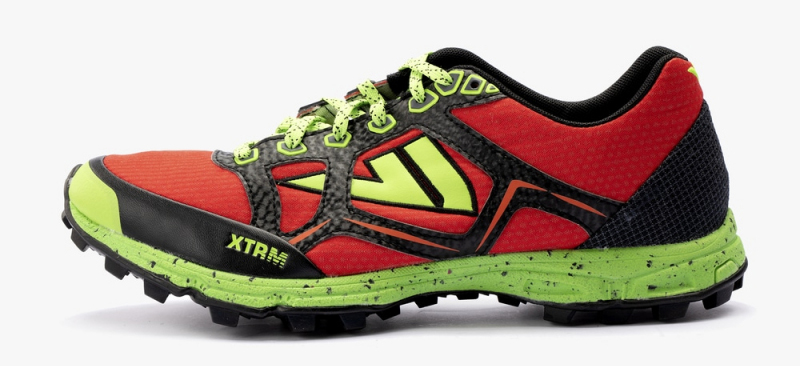
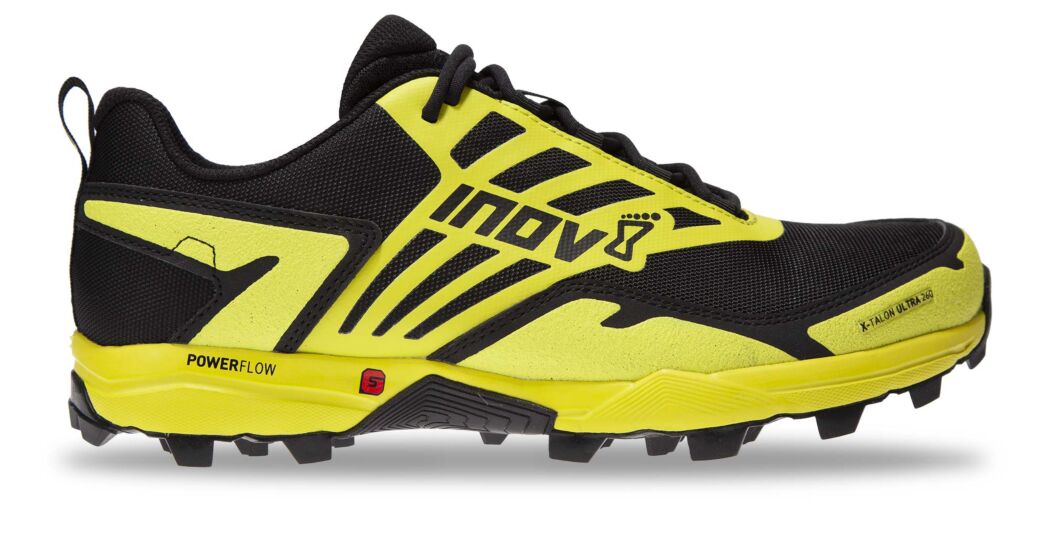
Mud/ Wet – You need an aggressive outsole that will grip and gain traction not only of sloppy wet mud but also on tree routes, rocks, gravel and a multitude of other surfaces. Top recommendations are VJ Sport and inov-8 who have been producing shoes to handle the elements for years. Personal favorites are the XTRM (here) and X-Talon(here.)
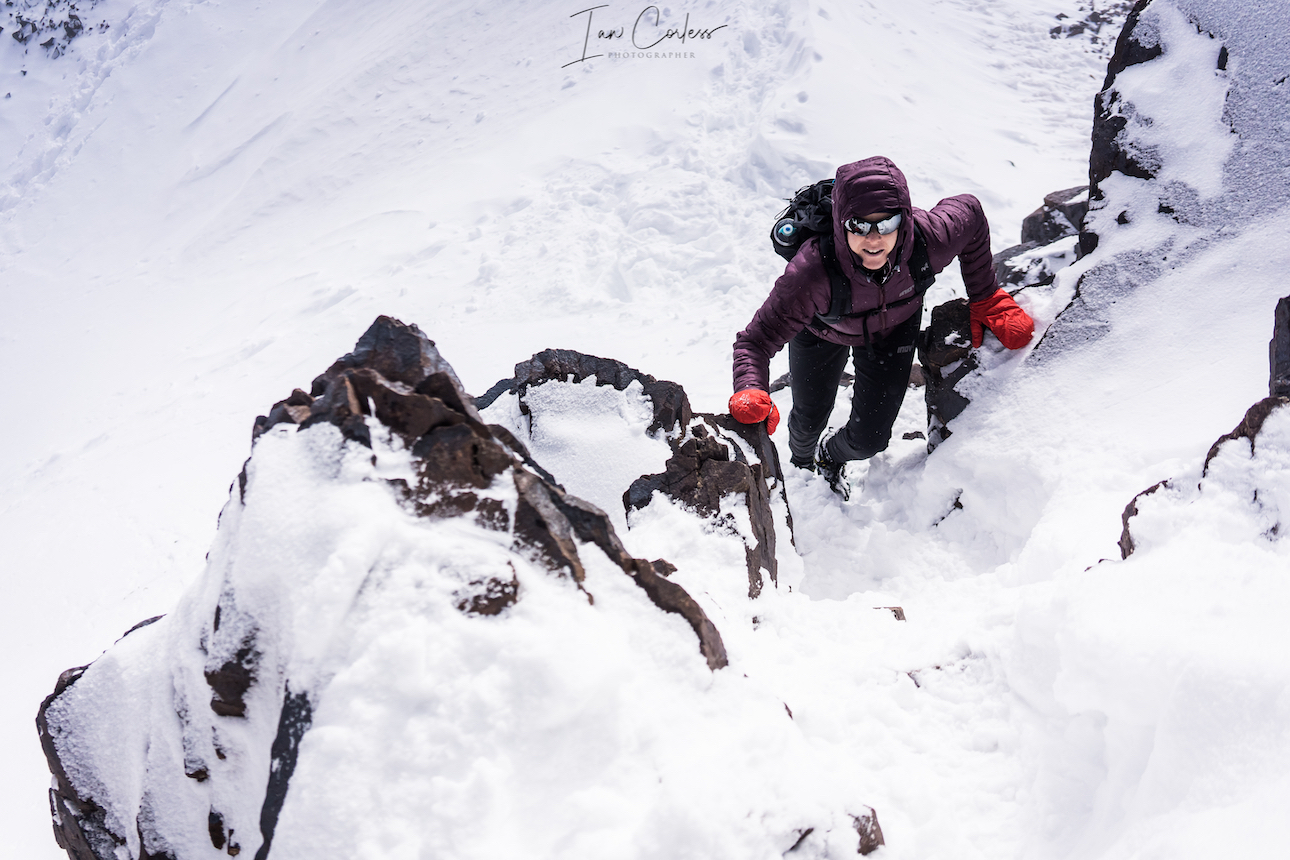
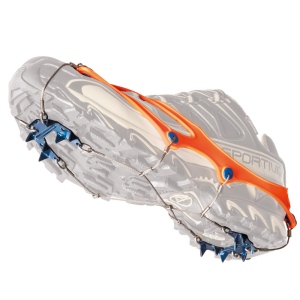
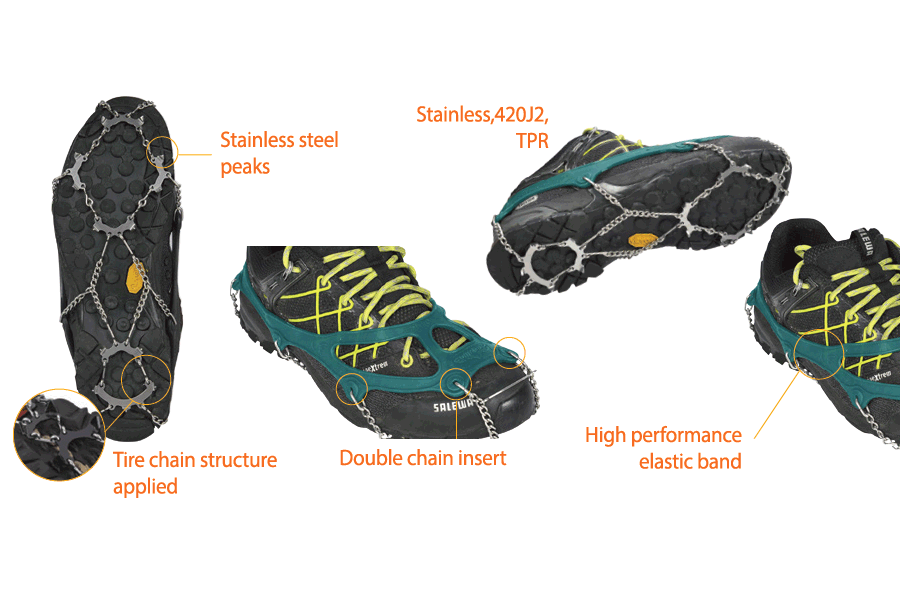
Snow/ Ice – In soft snow, the shoes that you use for mud/wet will usually work fine providing adequate grip. However, ice brings new challenges and many runner’s avoid ice at all costs. However, products exist that allow for running in such conditions. Firstly, you can micro-crampons (Snowline or Nortec as examples) that simply adapt any running shoe for ice.
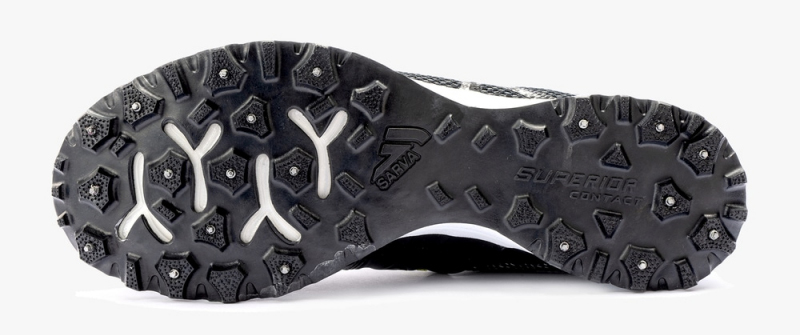
I personally prefer a specific shoe, such as the VJ Sport Xante (here) which as all the attributes of my favorite trail shoes and the added grip from 20 studs. Or the Arctic Talon (here) by inov-8.
Xante
Arctic Talon
As a final note on footwear, I use boots and more substantial crampons when venturing in to more alpine and challenging terrain. Read about a trip to the Atlas Mountains here. There is no one answer here but if moving fast and light, the new inov-8 Rocltite Pro G 400 (here) is a great cross over and then I use two specific mountain boots, La Sportiva G5 (here) or the Trango Extreme (here.)
There is no one solution here and having the options to adjust clothing based on weather conditions is key.
Top Tips:
Carry a pack that will allow you to carry options of clothing. For example, it may well be dry when you leave but rain could come at any time, make sure you have waterproof layers with you.
Take off and add clothing as you exercise. When it’s cold, we often start with many layers as the first 15 min can feel uncomfortable. However, our core soon warms up. Take the layers off early to avoid sweating. Sweating is not your friend in cold climates. Be prepared to add and take off as required. One of the many reasons many people do not, is because it can disrupt the flow of exercise, however, a little time stopping pays dividends in the long term.
Avoid getting base or mid layers wet.
Carry an extra base layer.
Protect extremities – hands, feet, nose, ears and lips.
Protect skin with sun block as and when required and post-exercise use a moisturizer – winter is hard on exposed skin.
Start easy and build into any outdoor activity allowing for a gradual warm up.
Have appropriate footwear.
Don’t forget to drink.
Take snacks/ food and even a flask or consider the option to obtain hot drinks.
SAFETY
Even at the most basic level, winter brings extra challenges and risk. A simple road run has increased danger due to increased challenges not only for you as a runner, but for those who are sharing the outdoors with you – drivers! Reduced visibility, challenging conditions under foot and on the road can make that simple road run feel like an assault course, so, accept that sometimes staying indoors and or going to the gym is a better option. But we don’t want to be forced to stay indoors and why should we? If you have the correct apparel and footwear, all is good, yes? Well, nearly… Running on the road and I would most definitely consider adding the following:
Wear bright clothes or wear a reflective vest such as the Ultra Performance (here) which is minimal and light.
Add a flashing light to your arm and ankle. Example here.
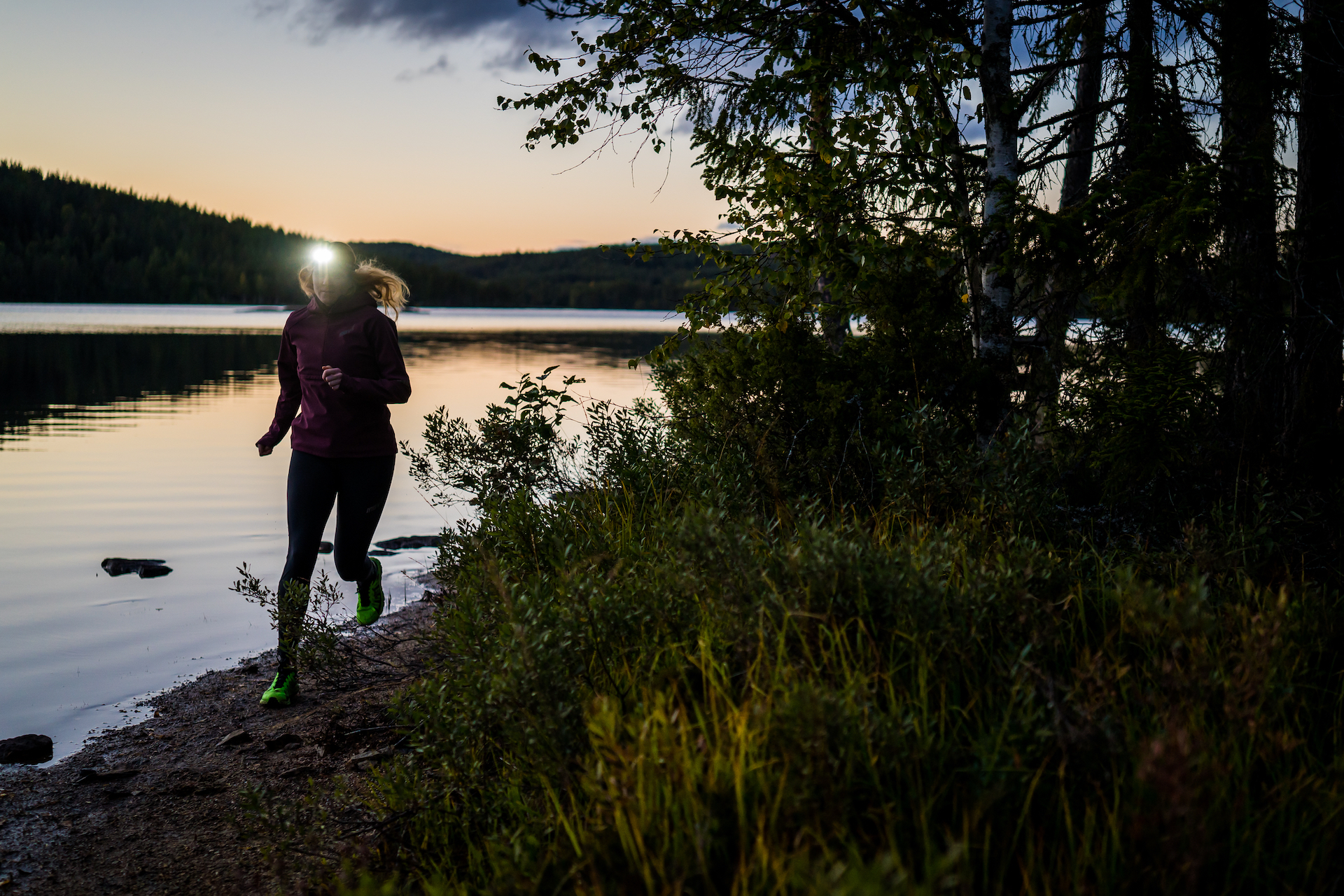
Use a head torch.
Take a phone.
Moving from road to trail and the risk from traffic is reduced greatly especially if one can start immediately on trail with no road running involved. Therefore, the need to wear reflective clothing can be reduced. But the risk of falling is greatly reduced and depending on where you are, that risk can be potentially life threatening. So, adjust safety measures based on:
When you are running.
Where you are running.
The duration of the run.
If running alone.
Running for 1-hour on a local trail is very different than a multi-hour adventure. I personally have a standard kit list and I take the basic on every run. It’s an overkill for the 1-hour runs and for the longer sessions, I add to it as required and dictated to by location and conditions.
Spare Merino base layer.
Spare gloves.
Lightweight waterproof jacket.
Lightweight waterproof pants.
Space blanket.
Head torch.
Mobile phone.
First aid.
500ml water.
Snack
The above, is my absolute basic kit that will go in a lightweight pack.
I then add equipment based on:
What am I doing?
Where am I doing it?
When I am doing it?
What are the options exist to cut short my adventure?
How remote will I be?
What are the risks involved?
What weather can I expect?
What is the worst-case scenario?
The above is a great start point. Even a local run has great risk if one is alone. Imagine running in the forest with snow on the ground, the temperature is just below zero and you are at least 30-minutes from anyone else. If you hit the deck, sprain an ankle, break a bone or whatever, you are suddenly stationary in subzero temperature. This is high risk.
Adapting to the environment, conditions and challenges is not something to be feared. It is actually fun! I go back to the mindset approach at the beginning, I see this as an opportunity, an experience to learn and a great potential to be taken out of my comfort zone.
What equipment/ advice can make a run/ adventure safer and address the list of questions above?
If possible, share any trip with another person. It’s more social and you have a backup.
Check weather conditions.
Tell a friend/ family member where you are going and when you will be back.
Have a phone and if necessary, an additional charger. It’s worth considering purchasing a phone that is not a smartphone – battery life is usually amazing.
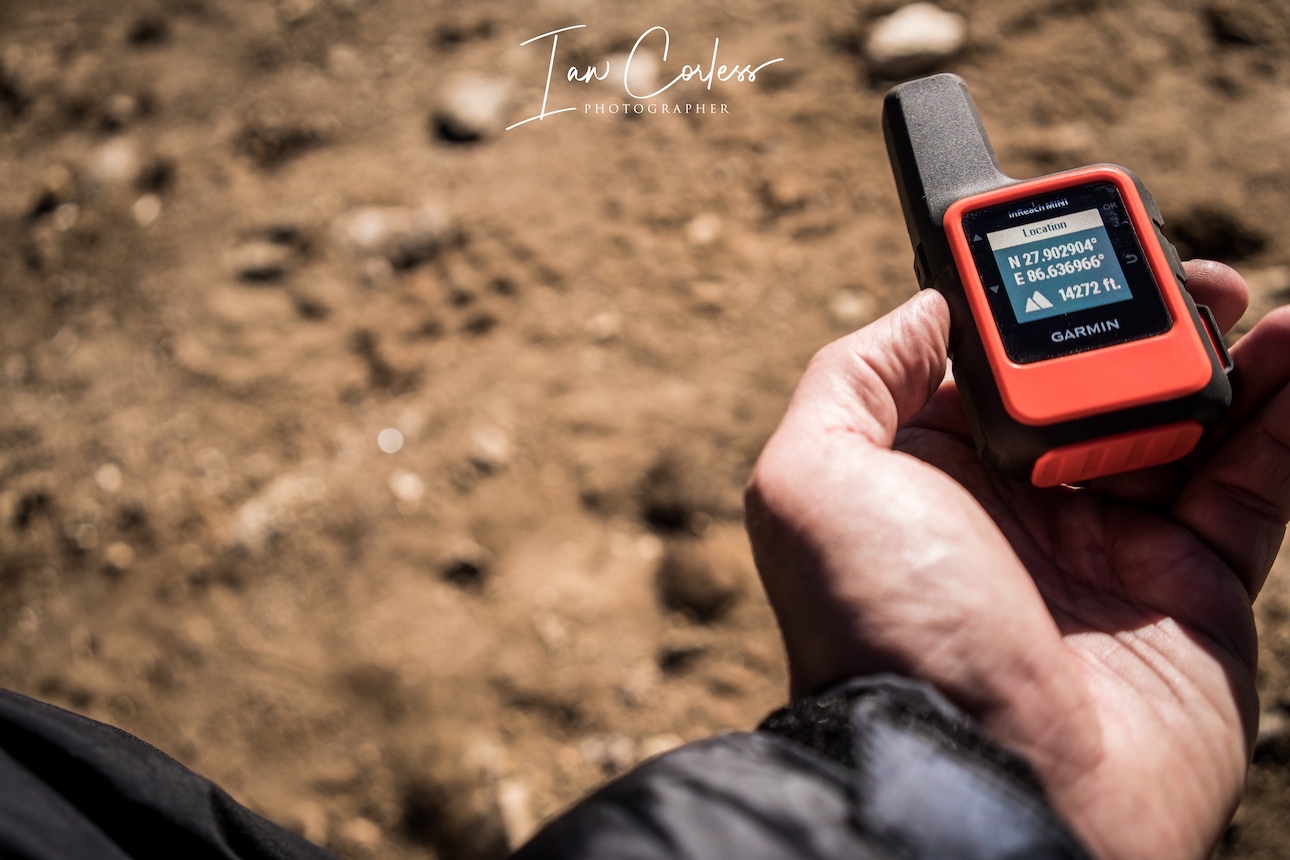
Carry a tracker such as Garmin InReach or Spot.
Think layers and have base layer, warm layers, waterproof layers, hat, gloves and buff. On a personal note, I take spare gloves, socks and a base layer should I get wet and need the comfort and warmth of dry layers.
Know where you are going and have a map and compass. A GPX file is also a great option for watch/ smartphone.
Specific equipment:
Carry micro-crampons if you think snow/ ice is high risk.
Carry a bivvy bag which can be a life saver if stuck in a remote location with an inability to move.
Goggles are better than glasses if you are in a blizzard or strong winds.
Carry an ice axe if venturing anywhere with winter conditions.
Hand spikes for ice (more details below).
Snowshoes (more details below).
In many scenarios, common sense comes in to play and quite simply, a little extra weight and safety is far better than the alternative. Accept in winter that you will move slower and in a different way.
WHAT OPTIONS EXIST IN WINTER
This question can be asked in two ways, firstly, one’s head can be lowered, shoulders dropped, hands below the waste, a look of desperation on the face and, “What options exist in winter…?” The person asking this question has already decided that the answer is none!
For me, the way to ask this question is standing upright, huge smile on my face and the question, “What options exist in winter?” Already has me ready and primed to list a plethora of activities to keep even the most hardened sport enthusiast occupied for quite some time.
Night running.
Snow running.
Ice running.
Road running.
Climbing
Ice climbing.
Hiking
Fastpacking
Snow shoeing.
Learn something new.
Spend time with family and friends.
And the list goes on! Location, finances and available time all have a bearing on what is and what is not possible. One thing is for sure, possibilities are endless.
Night Running.
Quite simply, you need your run apparel and appropriate equipment as listed above. Importantly you need a head torch. Not all head torches are the same and an investment in the right kit early on saves money later. If you are running in the city with a great deal of ambient light and just the odd foray on trail, you may well get away with a budget torch and something around 200 lumens would work. However, if you are heading into the pitch black, running in forest, venturing into the mountains and pushing the darkness envelope, you are going to need a specific tool for the job. As an example, Norwegian lighting company Moonlight (here) provide head torches from 700 to 7000 lumens. Be specific on your needs and requirements and importantly consider autonomy, beam direction and spread, options for spare batteries and the option to keep the battery in apparel while still using the head torch, especially important in very cold environment when warmth will make the battery last longer.
Snow Running.
Layer up so that you have the flexibility to reduce heat and get warm as required. In many scenarios, particularly soft snow, a good aggressive trail shoe will work. However, consider the risk of ice so carry micro spikes. If in the mountains, knowledge and experience of snow conditions would be advisable. Be prepared with additional equipment such as poles and ice axe. Needless to say, gloves are really important.
Ice Running.
Use micro spikes for specific shoes as mentioned previously to ensure that you have grip and traction. In some places, Norway and Canada a good example, summer lakes freeze over and they become an incredible playground. Caution, safety and experience is required and if you have never run this way before, take advice from those that have. Importantly run with hand spikes (pictured below) available at all times should a disaster happen – these help you get out of a situation.
Measure the ice.
What is a safe thickness? 4 inches or more is ideal.
Check the ice colour – clear blue or green is good.
Fresh ice is best.
Know rescue techniques.
Climbing.
Mountains in winter offer an incredible playground and if you are new or inexperienced, the first option would be to sign up for a weekend trip with experienced professionals. The equipment requirements, techniques and safety measures vary considerably.
Ice Climbing.
No need to venture outside. In 2019 as an example, I started on a series of indoor ice climbing lessons which has now set me up for experiencing ice climbing outdoors. There is obviously a need for specific equipment: helmet, glasses, harness, ice axes, boots and crampons. However, most places, indoor or outdoor, offer the option to hire equipment as part of the lessons.
Snow Shoeing.
Fimbulvetr Hikr-X
A great winter exercise that provides an alternative to skiing or snowboarding that is an extension of running. Snowshoes basically allow you to float and not sink in the snow. But there is a difference to snow hiking and snow running, both in the shoe used and the type of snow. Run snowshoes are smaller, allow for a more natural gait and require the snow to be har packed. Whereas in soft snow, you need a much larger snowshoe to stop you sinking in the ground. Either option provides a great challenge and workout. Of course, races exist that require snow running both with and without snowshoes, so, if you are signed up or plan to race like this in the future, seize the opportunity. Abelone Lyng (here), winner of the Ice Ultra does winter snow shoeing trips in Norway.
Fast Packing.
Peak Design Field Pouch attached to a Montane Pack when Fastpacking in Nepal.
Snow, ice and cold weather doesn’t mean that multi-day adventures need to stop, on the contrary. Find a route, plan accordingly, have the correct equipment and off you go. These adventures can involve winter camping (you need a 4-season tent, appropriate matt and sleeping bag) or you can run/ hike form hut-to-hut or hotel-to-hotel. You are only limited by your imagination. Accept that you will move slower. Nepal is a magical playground for winter adventures.
Hiking.
Wrap up and include the family. Sport and our pursuit of it can often be selfish, not purposely, but we can get engrossed in challenge and adventure and often exclude the ones we love. Share the journey.
Training Camp.
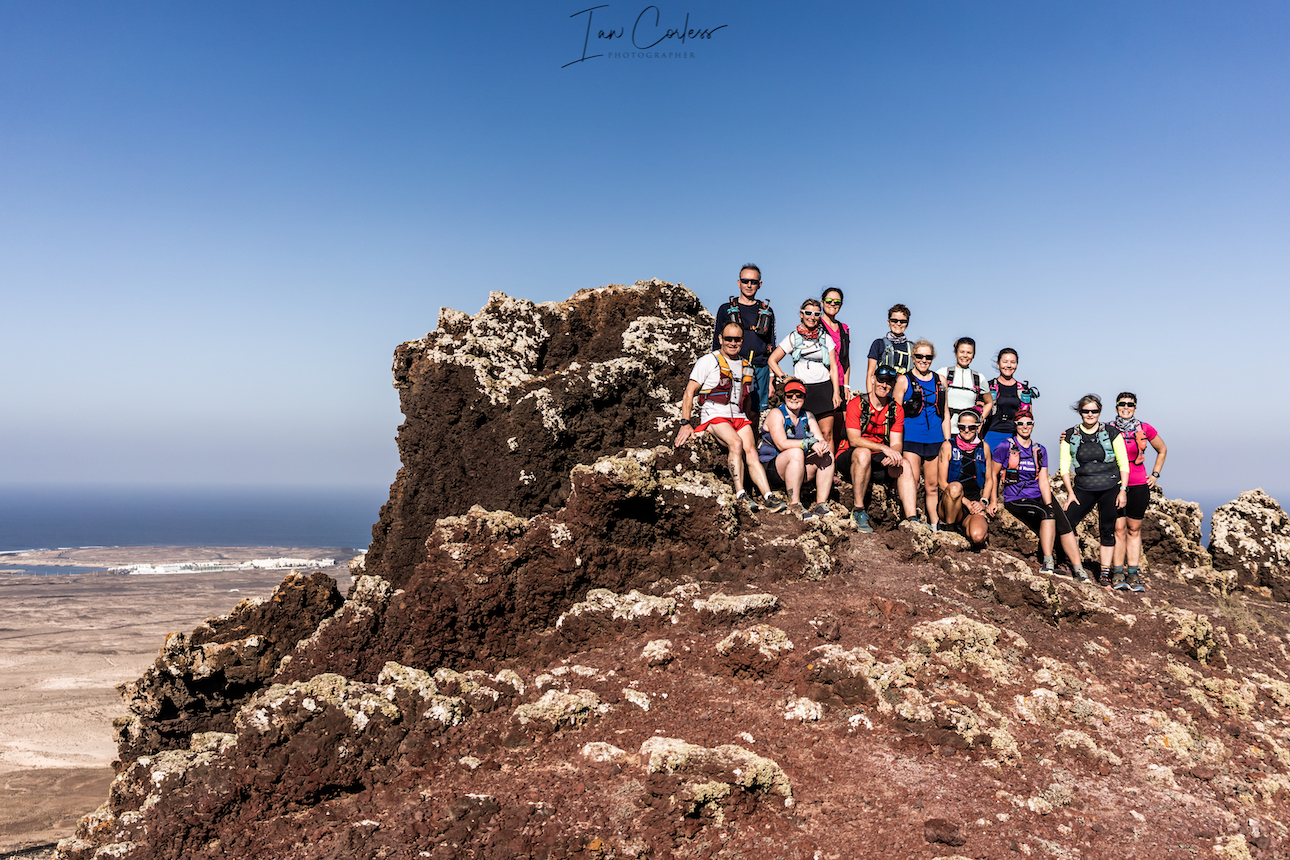
Consider a training camp, maybe this could be something in warm weather to break up the winter months. I have been organizing a warm weather camp every January in Lanzarote for over 10-years, info here.
Other options:
Sign up for a challenge.
Make it social.
Add variety.
Train in the home.
Rest.
Learn something new.
Enroll in a class.
CONCLUSION
Ultimately, don’t letter winter get you in a spiral of mood swings, depression and locked indoors. It’s all about the mind and understanding that the variety winter brings is actually far more exciting and challenging than good weather and dry predictable trails.
Seize the conditions. Plan accordingly. Have the correct equipment. Test yourself with something new and trust me, by the time Spring comes around you may well be a little disappointed.
Please support this website. I believe everyone deserves to read quality, independent and factual articles – that’s why this website is open to all. Free press has never been so vital. I hope I can keep providing independent articles with your help. Any contribution, however big or small, is so valuable to help finance regular content. Please support me on Patreon HERE.