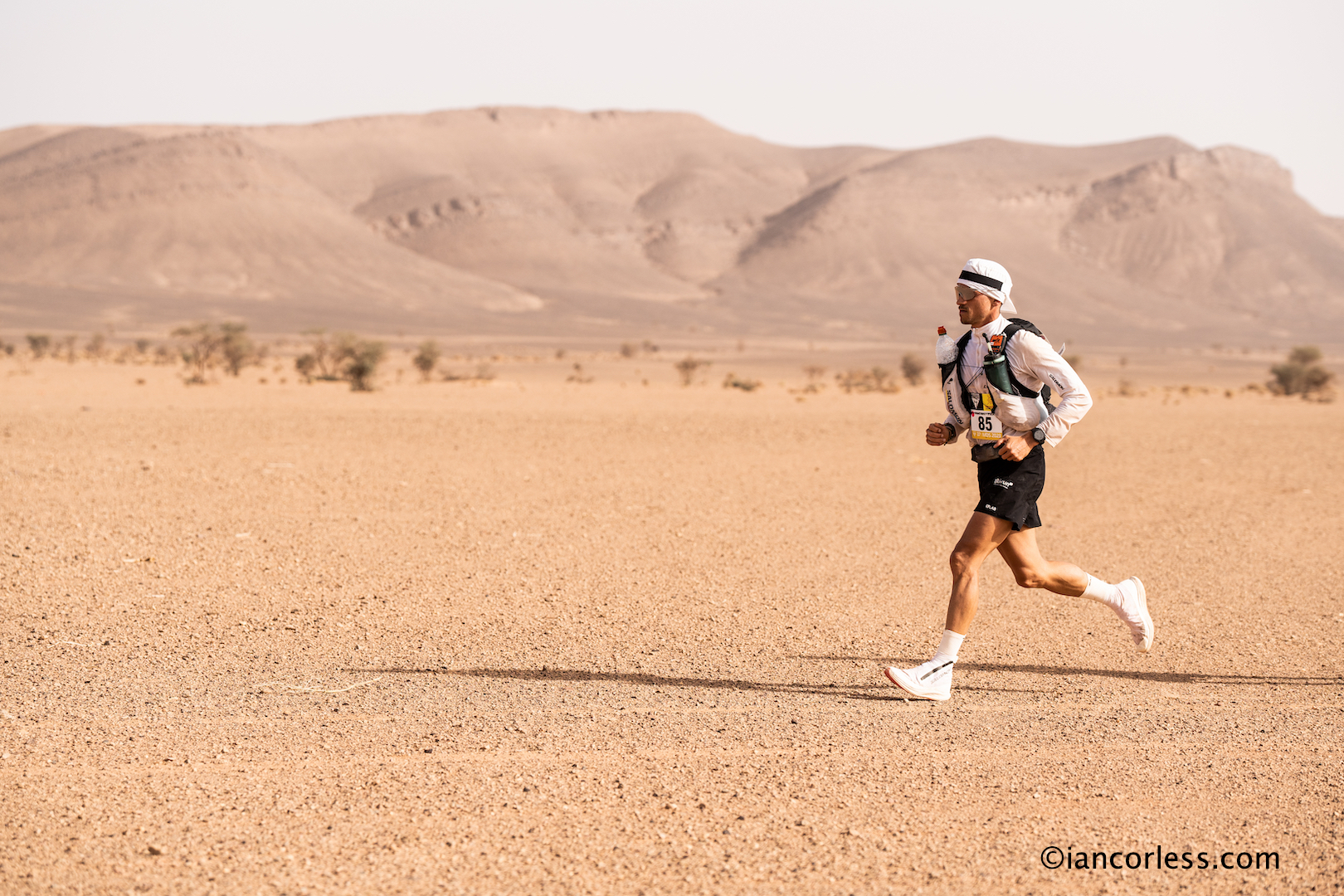
It was a tough first day to the 2023 Marathon des Sables with 17 dropping out, a combination of heat, dehydration and exhaustion. Although a shorter day-2 was welcomed, it had increased technicality and vertical gain, therefore making it an equally hard day.
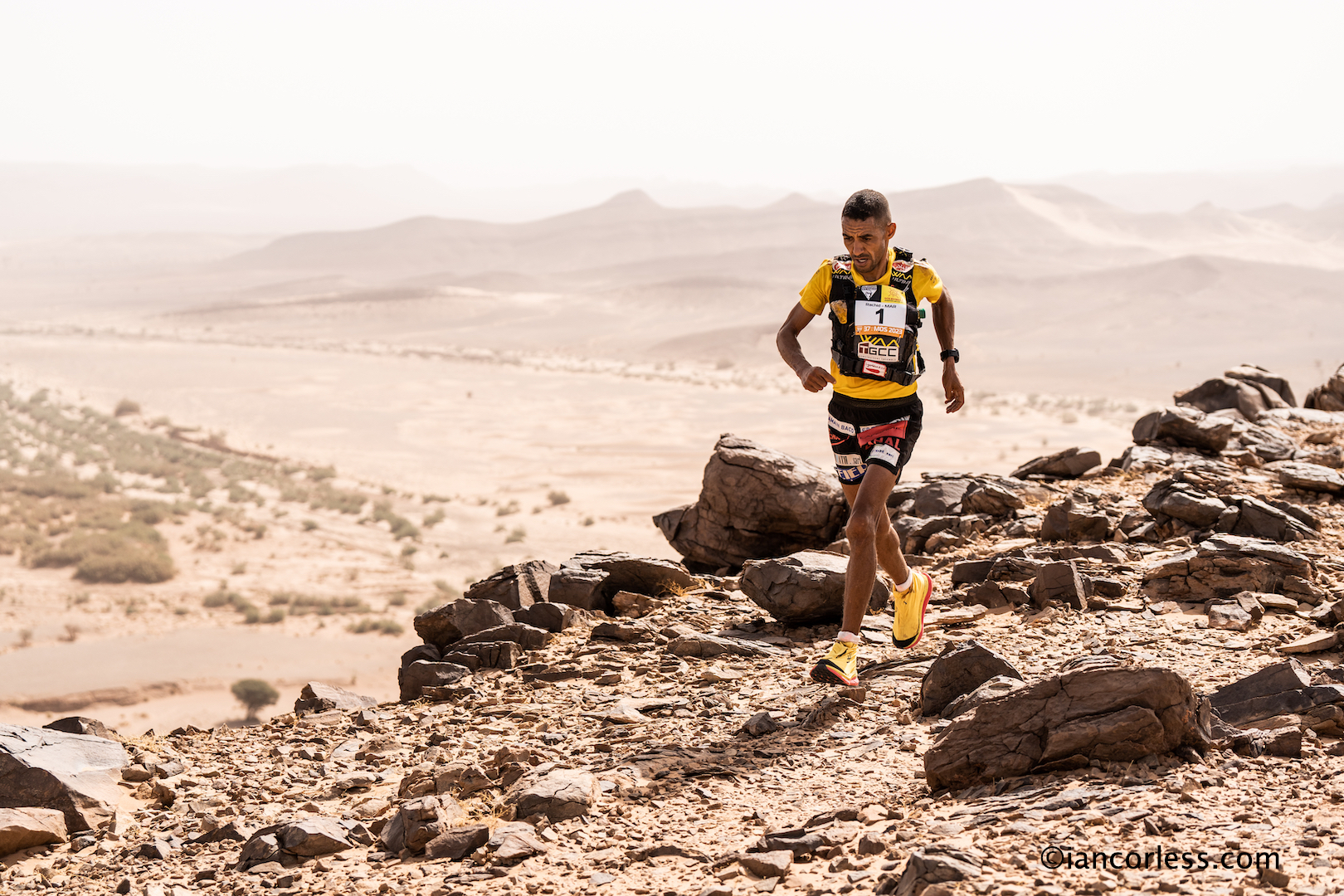
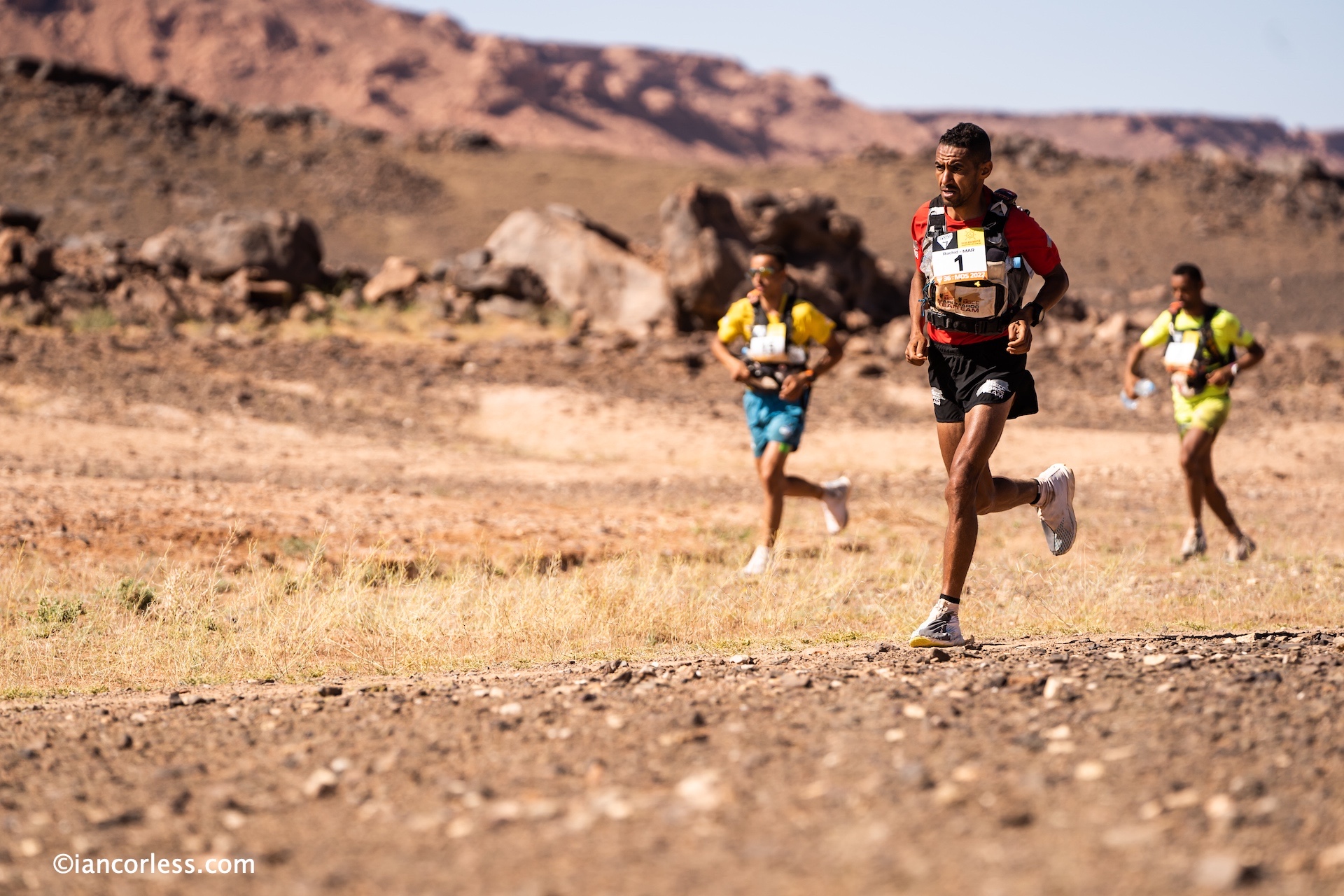
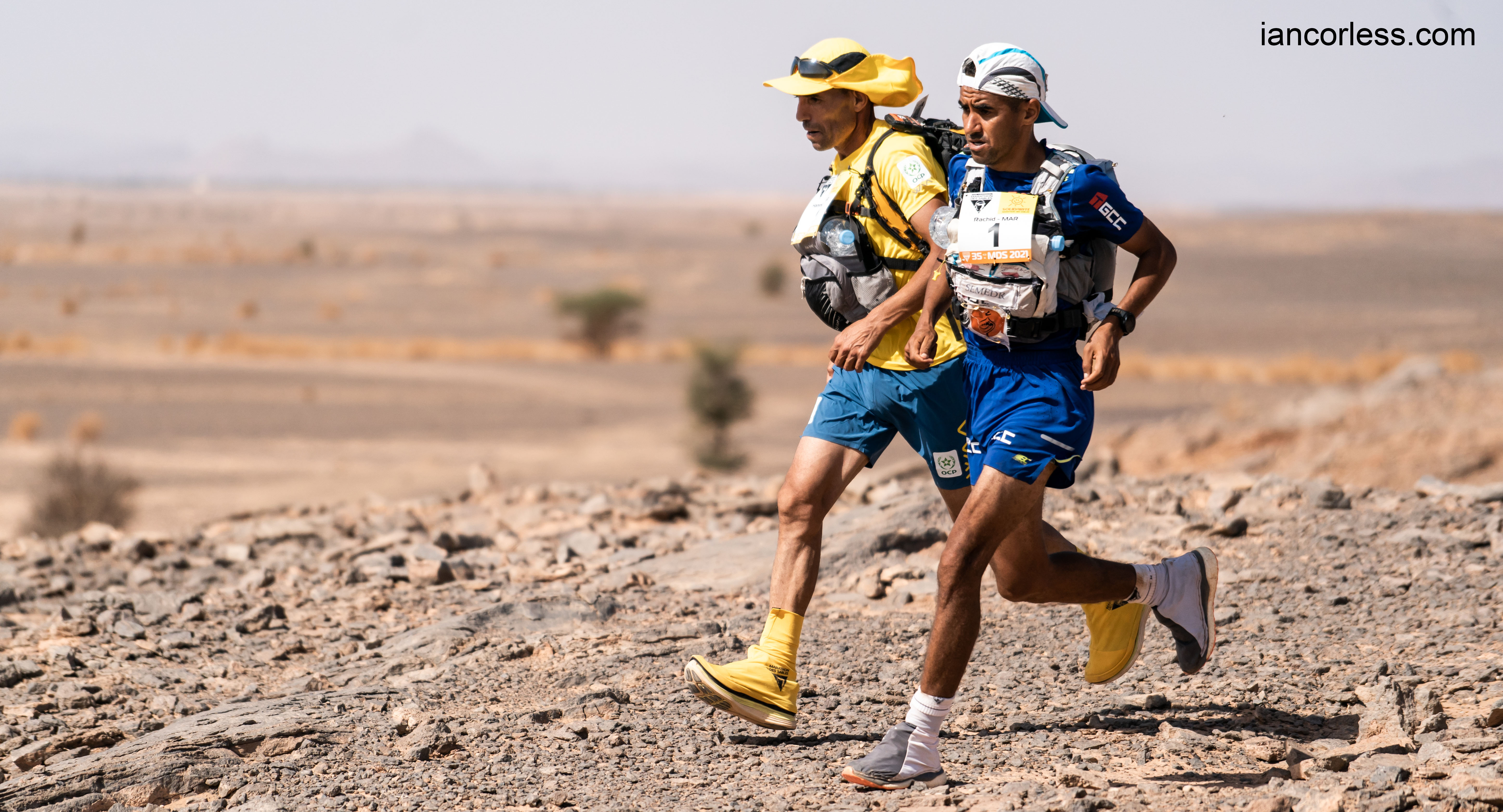
From the gun, Rachid went hard and immediately opened a gap. A rare tactic for him, he usually like to hold back and slowly speed up. Today, boom, he was gone. By Cp1 the carnage behind was taking hold, the pace high!
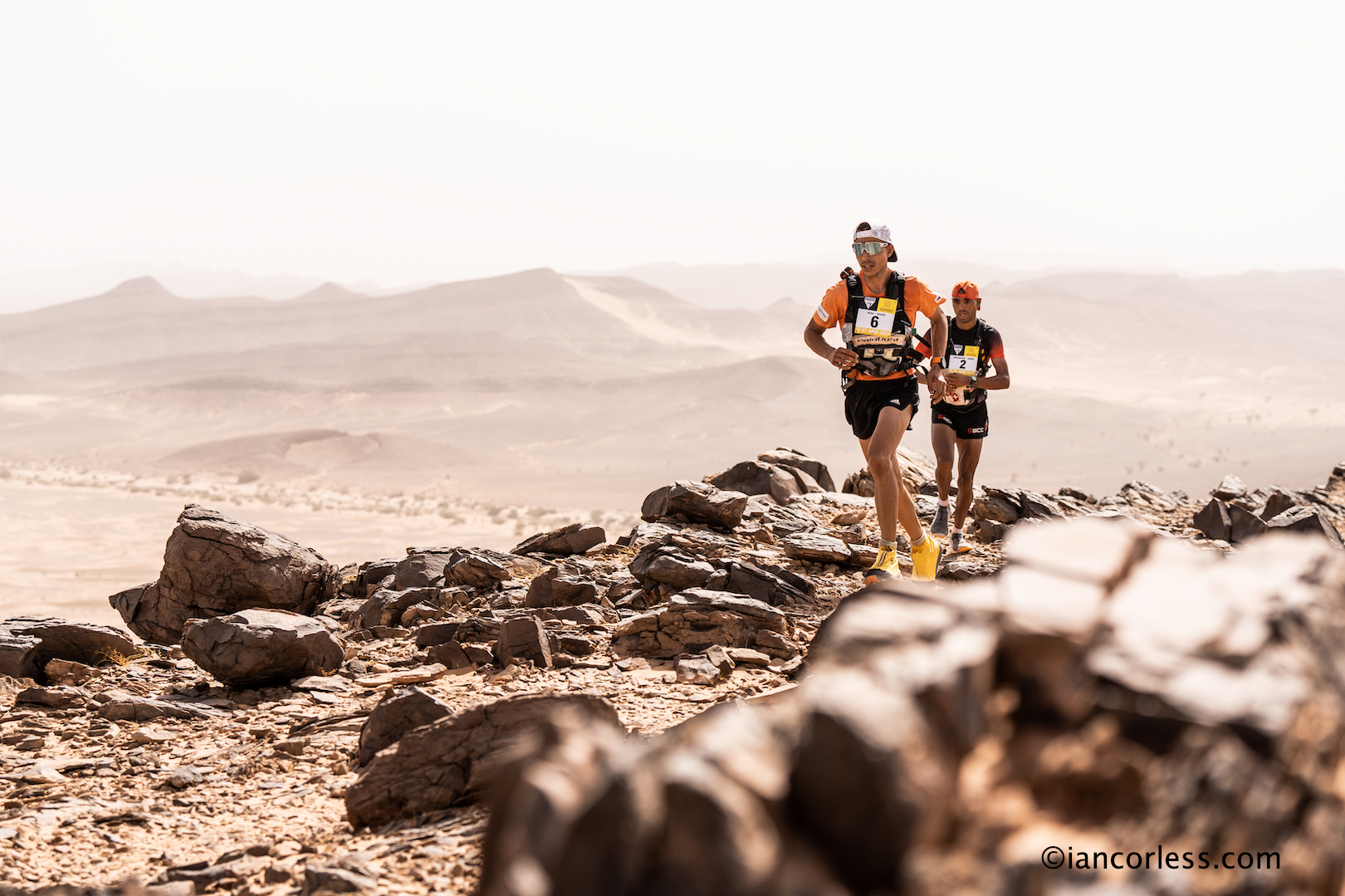
On one of the key ridges of the day, Rachid held a lead over the pursuing Aziz who was marked by Mohamed El Morabity, the brothers once again using tactics to an advantage. Mathieu Blanchard was 5th.
After Jebel El Otfal, the descent, following sand dunes and flat run to the line, Mohamed and Rachid switched places (a tactical move?) and Mohamed took victory in 2:29:05. Rachid followed in 2:29:30 and then Aziz 2:29:42.
What can we make of this? My thoughts are Rachid would like Aziz to think he is not as strong as he imagined, therefore casting a doubt… I wouldn’t be surprised if Rachid gave away minutes on stage 3 to the the pressure off for the long day, and then, attack!
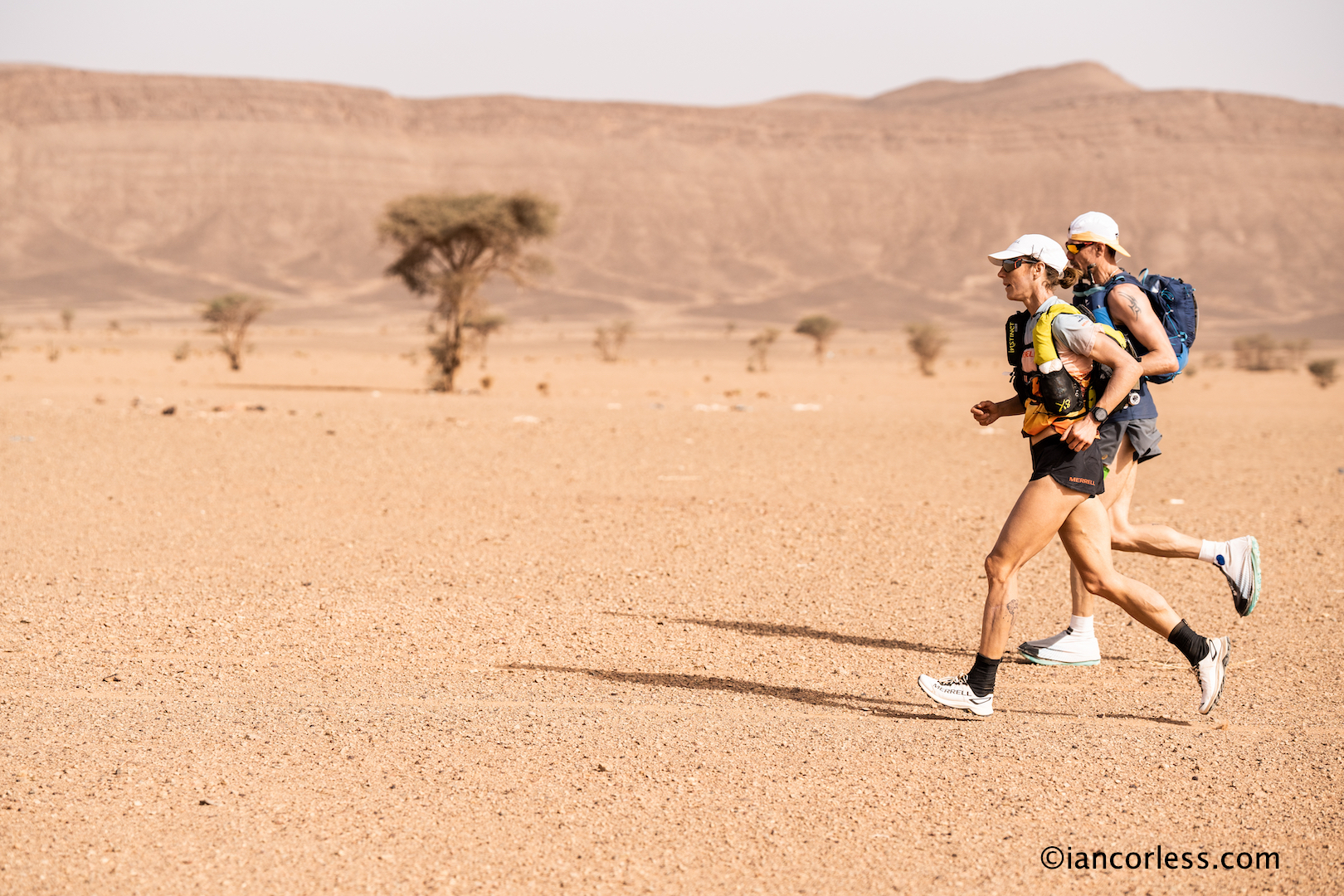
The women’s race once again was dominated by Ragna Debats, she is too strong! Of course, the race is not over, anything can happen, especially on a 90km long day, but, Ragna, in this form is unbeatable. She crossed the line in 3:19:14.
Maryline Nakache and Aziza El Amrany ran together early in the day, but the elastic snapped and once again, Maryline pulled away to finish in 3:36:36. Wl Amrancy crossed in 3:55:55.
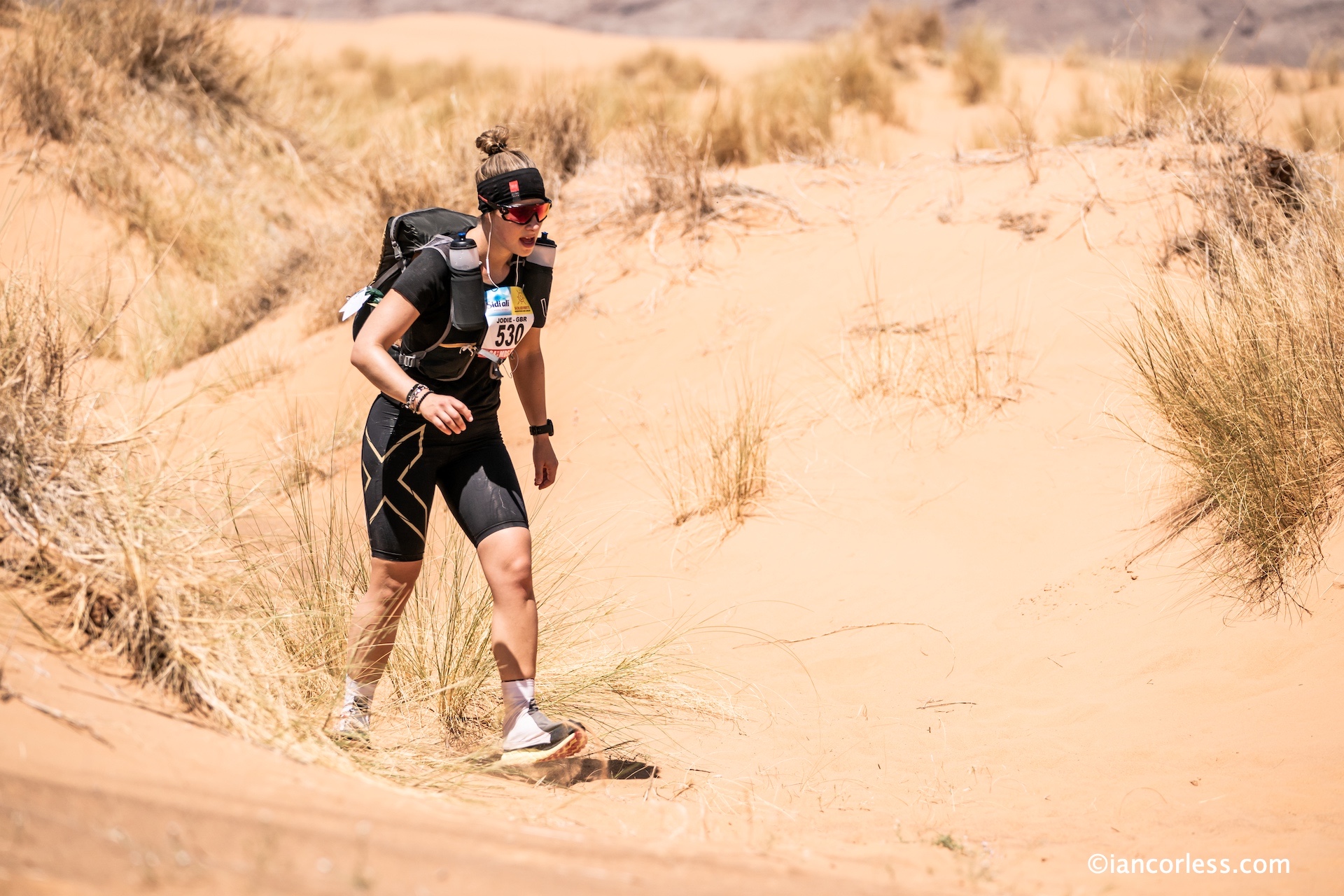
Notably, Jodie Moss from the UK, 4th on stage 1, finished out of the top-5 today. A tactical move? I am sure she would prefer to start in the 0800 start and not the midday start for the long day.
Stage 3 is 34.4km and in principal, will be an easier day. But the heat is strong and the challenge real.
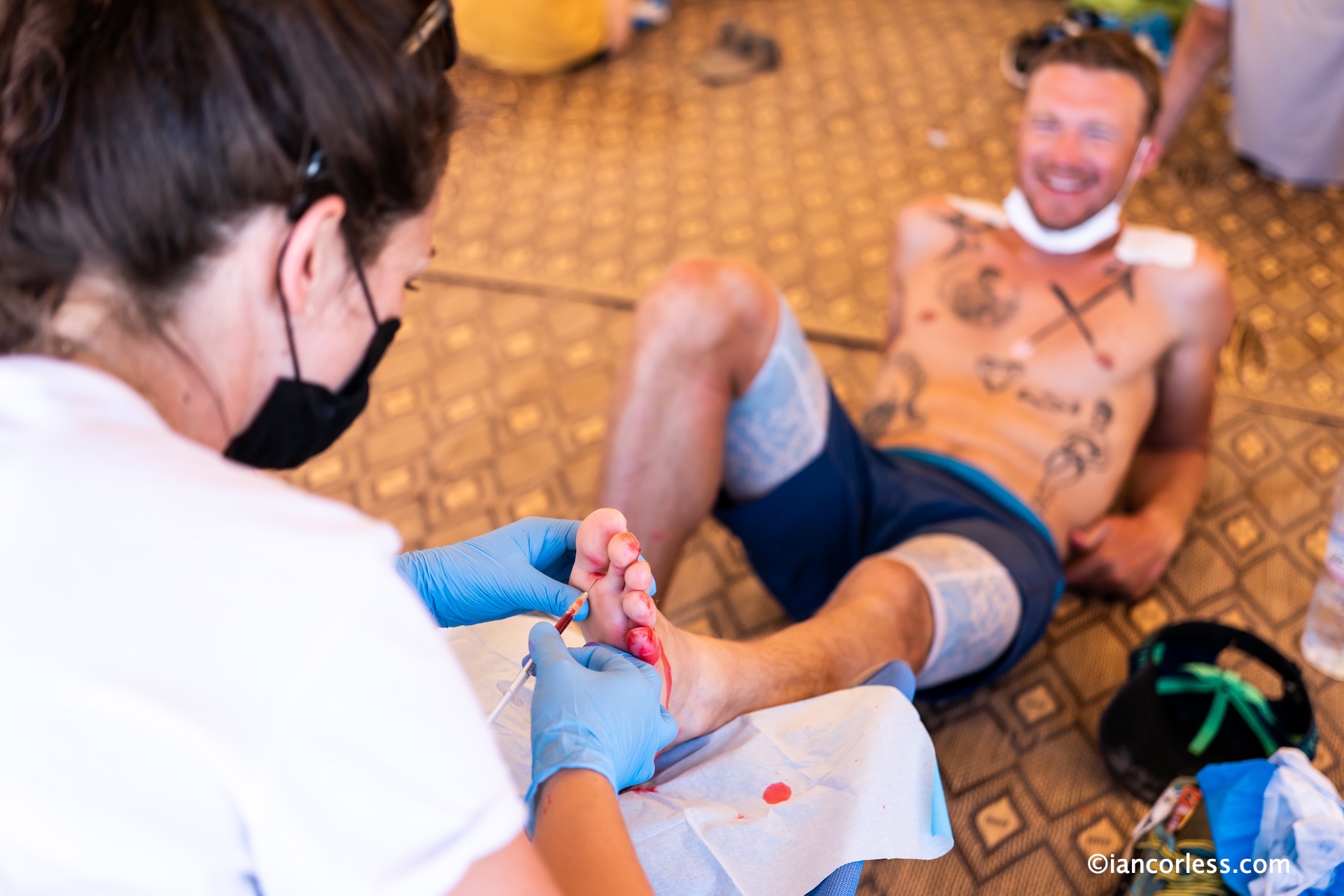
Stats -1085 runners started stage 1, of which 228 were women. At the end of stage 2, the drop outs were nearly 100!
Arrival in to the Sahara for many was harsh, with strong and relentless sand storm lasting several hours, gladly they subsided for Patrick Bauer’s welcome to the desert.
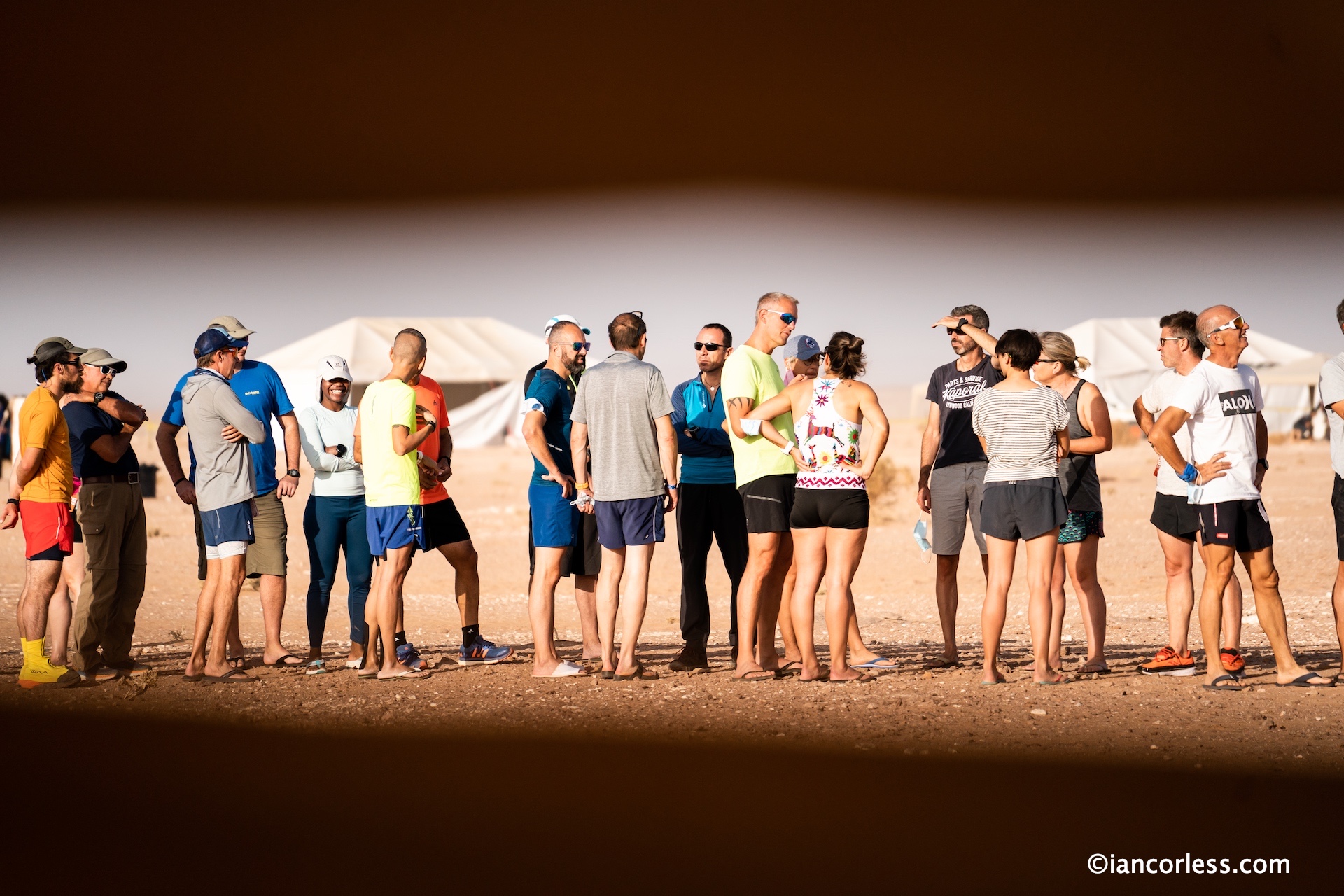
Saturday, is admin day. Each runner passes through protocols of equipment checks, health checks, bib collection and once dinner has been completed, self-sufficiency begins.
It has been a good first day with a great deal of apprehension, positivity, excitement and of course, an urge to ‘get underway!’
Stage 1 covering 36km with 2 aid stations is split in to 3 distinct sections. The early section is flat with a passing through Jebel Mech Irdane followed by soft-sand and Oued Rheris. Cp1 is followed by harde, faster terrain and small rolling hills that leads to dunettes and the arrival of Cp2. From here in, the running is good and fast to complete a potentially challenging first day of the 2023 MDS.
It has been a long journey, and here you are, 14-days to the start of the Marathon des Sables.
DO NOT PANIC!
You – You signed up for the challenge, you wanted to be on the start line and therefore you are responsible for the outcome. Believe me, the you that leaves the Sahara is not the same you that entered. Arguably, you changed the moment you paid the deposit, the transformation process had already begun. Embrace the journey ahead and apply yourself. But keep perspective, the MDS journey is an enhancement of you as a person. It’s easy to become too obsessed. Ultimately the majority of runners at MDS are enthusiasts, if you keep that in mind the journey will be a complete one.
Pack – Minimum pack weight is 6.5kg plus water (8kg,) get as close to this as you can. Additional weight is additional stress and just makes the journey harder.
Friends – You are going to share bivouac with 7 other people and you are going to have some serious highs and lows. These tent mates will pull you through and motivate you. They will become friends for life. Ideally find tent mates before you head out to the Sahara and create a support network. Now, with 14-days to go is the perfect time to do this, if you haven’t already done so.
Feet – Look after them, along with dehydration, blistered and damaged feet are a key reason for failure in any multi-day race.
Extras – Mandatory kit is as one would expect, mandatory! So purchase what is on the list. You can save weight by shopping around. Simple rule; the lighter and smaller, the more expensive it will be! Optional extras are very personal and my advice would be take nothing extra other than a MP3 player and earphones.
Mental Game – The legs, lungs, heart and feet will only get you so far. The mind is what will get you to the finish. Broken individuals with bodies in tatters but mentally strong can make the finish. Despite the hardships and pain, they embraced the journey and mentally where superior in strength. It was the mind that got them to the line.
Laugh – If you laugh, you are having fun. Laugh when you hit rock bottom, why not. Laugh when you are going the toilet in a brown plastic bag and most of all laugh with and at your tent mates and fellow runners. The comradeship of MDS is quite unique, embrace it.
Heat – In the final 14-days, make sure you get some heat acclimation, bikram yoga, sauna, heat chamber, hot batch, whatever it may be, get 6-8 sessions before the race. You have signed up for a race in the Sahara, no point in complaining it is ‘too hot!’ This is the challenge you signed up for. Dehydration is one of the main causes for NOT finishing the race.
TOP TIPS BEFORE THE RACE STARTS
Take essentials on the plane and wear your run apparel and shoes. That way, should a baggage disaster happen your chances of racing improve.
Take food with you for the travel and on the plane.
The journey from the airport to bivouac 1 is now typically 1-hour or less, this helps considerably with fatigue and tiredness.
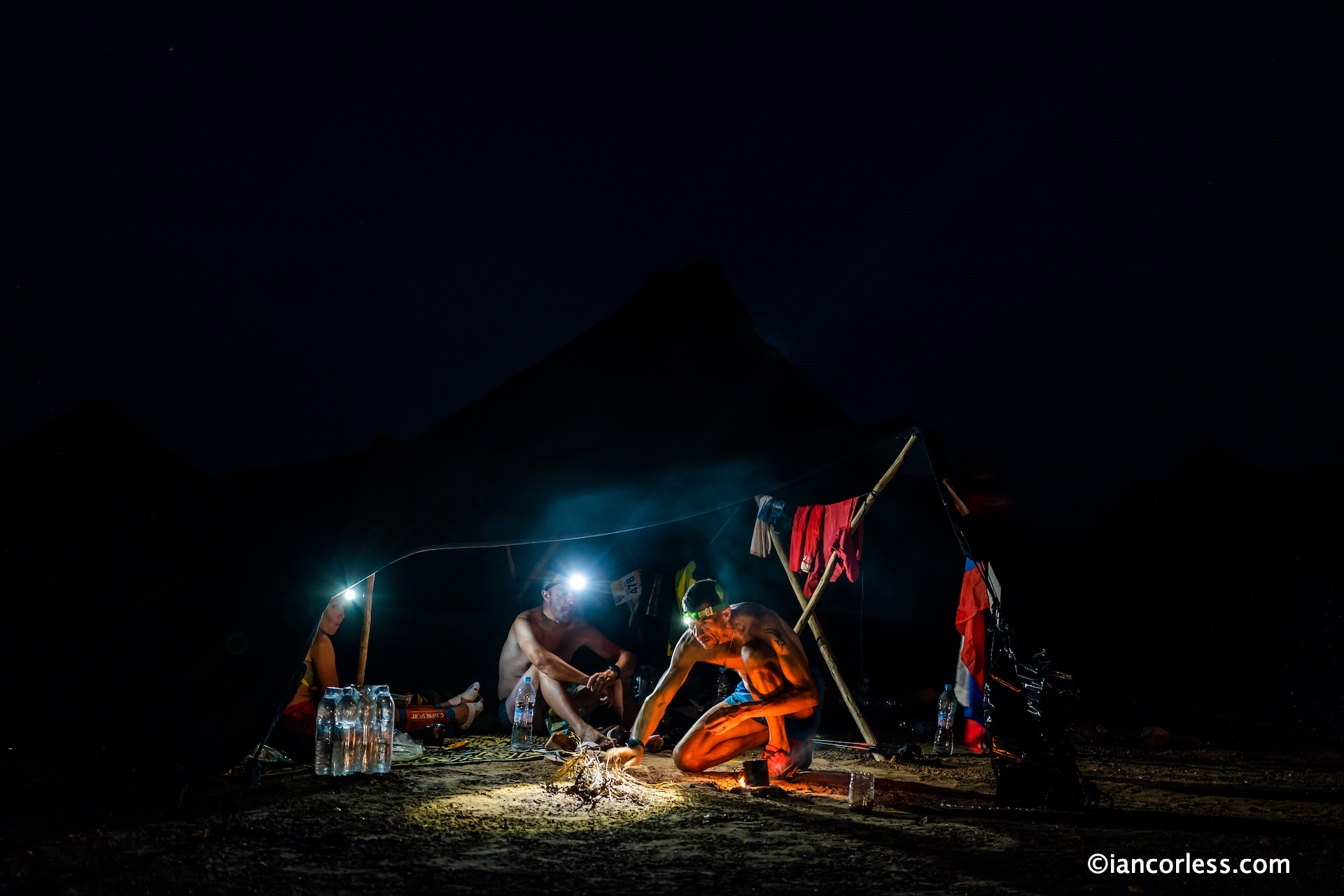
Night 1 and night 2 in bivouac are NOT self-sufficient so take extras such as an inflatable bed, food and luxuries. Don’t use them? Give them away to the berbers. May as well have 2 comfortable nights and a comfortable day before the racing starts.
Food before the race starts is by Moroccan caterers. It is excellent food BUT for some, may be too challenging for the stomach. Take options to be self-sufficient should you need to make the choice.
Admin day is slick and streamlined now, but, you may be in the sun for over 1-hour. Wear a hat, take shade (an umbrella) and have water and snacks.
Keep sun screen on and keep hydrated. No need to drink vast volumes – drink to thirst before the racing starts.
Have additional items such as a base layer, sleeping bag liner and other items that may be on a ‘question’ list for the race. On night 1 and before you go to admin, you can make final decisions of what to and what not to take. Particularly important if you think you may be cold at night.
Remember that after bag drop and check-in you have no access to any additional items, however, you only become completely self-sufficient when you start the race. With that in mind, you can have additional food and luxuries with you until day 1 kick-off, it’s a useful tip and does mean that you can have additional comfort for a good 12-hours.
Marathon des Sables is a magical and life changing journey as are most if not all multi-day races. It really is a true challenge of mind and body to race over many days, irrespective of finish time. It’s a hark back to a more primitive time, a time without clutter and modern technology. Embrace this. Embrace the silence of the surroundings and the simplicity of placing one foot in front of the other, eating, resting and sleeping and then doing it all again.
Finally, set yourself a realistic goal (that may just be to finish) so that you manage not only your expectations but pace. Way too many start off too quick and most dropouts come on days 1 and 2.
Located at the iconic Club La Santa resort, our training camp will provide you with all the knowledge, experience and practical training you need to make your next trail, ultra and multi-day adventure a success.
Hosted by IAN CORLESS, the training camp is the perfect place to hone your skills for multi-day, fast packing and running in general.
With
2024 LINE UP
ANNA COMET PASCUA, PIERRE MESLET,
LAUREN GREGORY and INGE NIJKAMP.
GUESTS – KEVIN WEBBER and STEVE DIEDERICH.
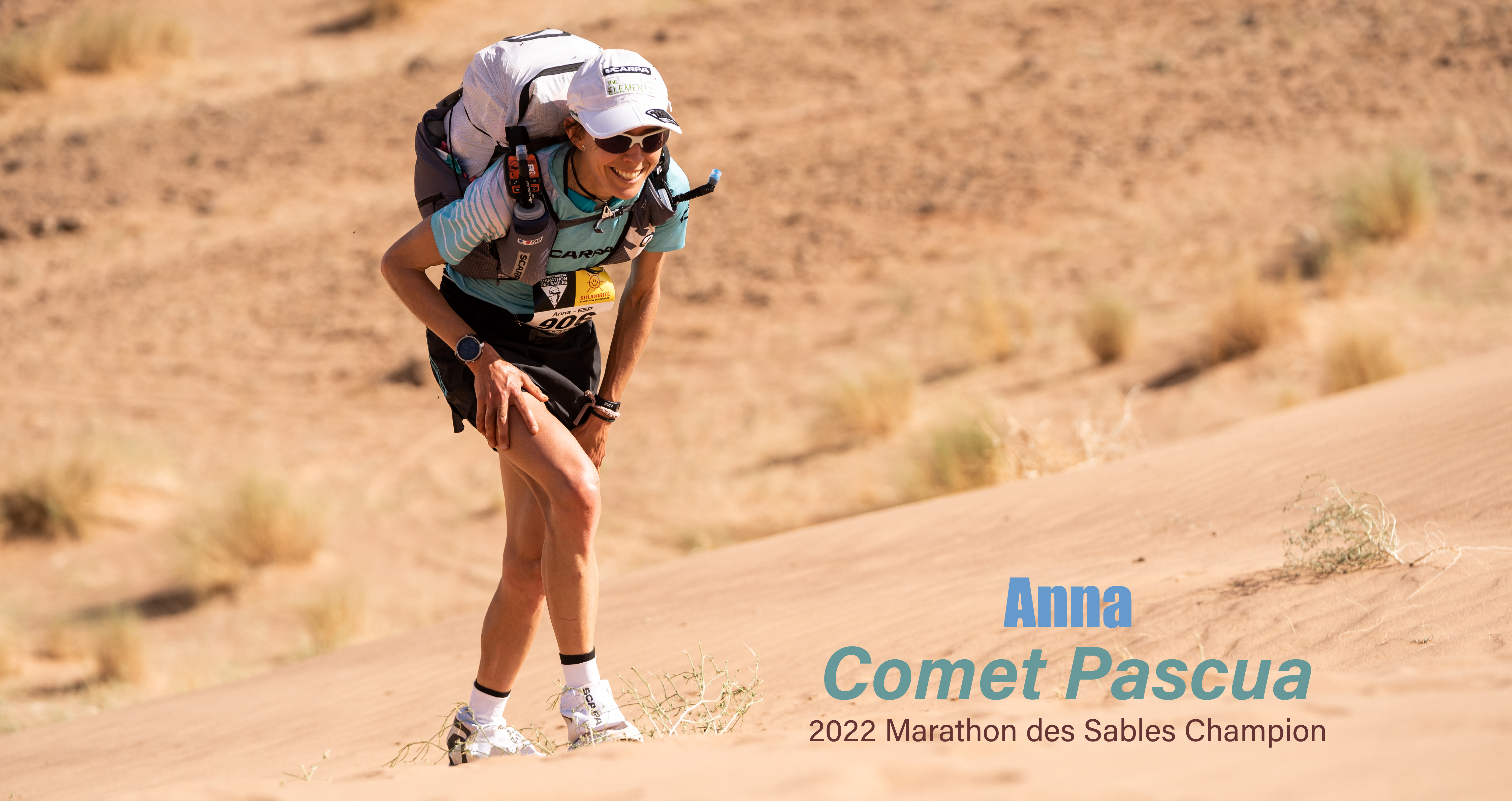
Anna Comet Pascua won the 2022 Marathon des Sables in a dominant performance. An experienced sky, mountain and ultra-runner, Anna is also a multi-day specialist with victories at The Coastal Challenge in Costa Rica and the Everest Trail Race in Nepal. A runner for the Scarpa Team, it’s a pleasure to have Anna join us in Lanzarote.
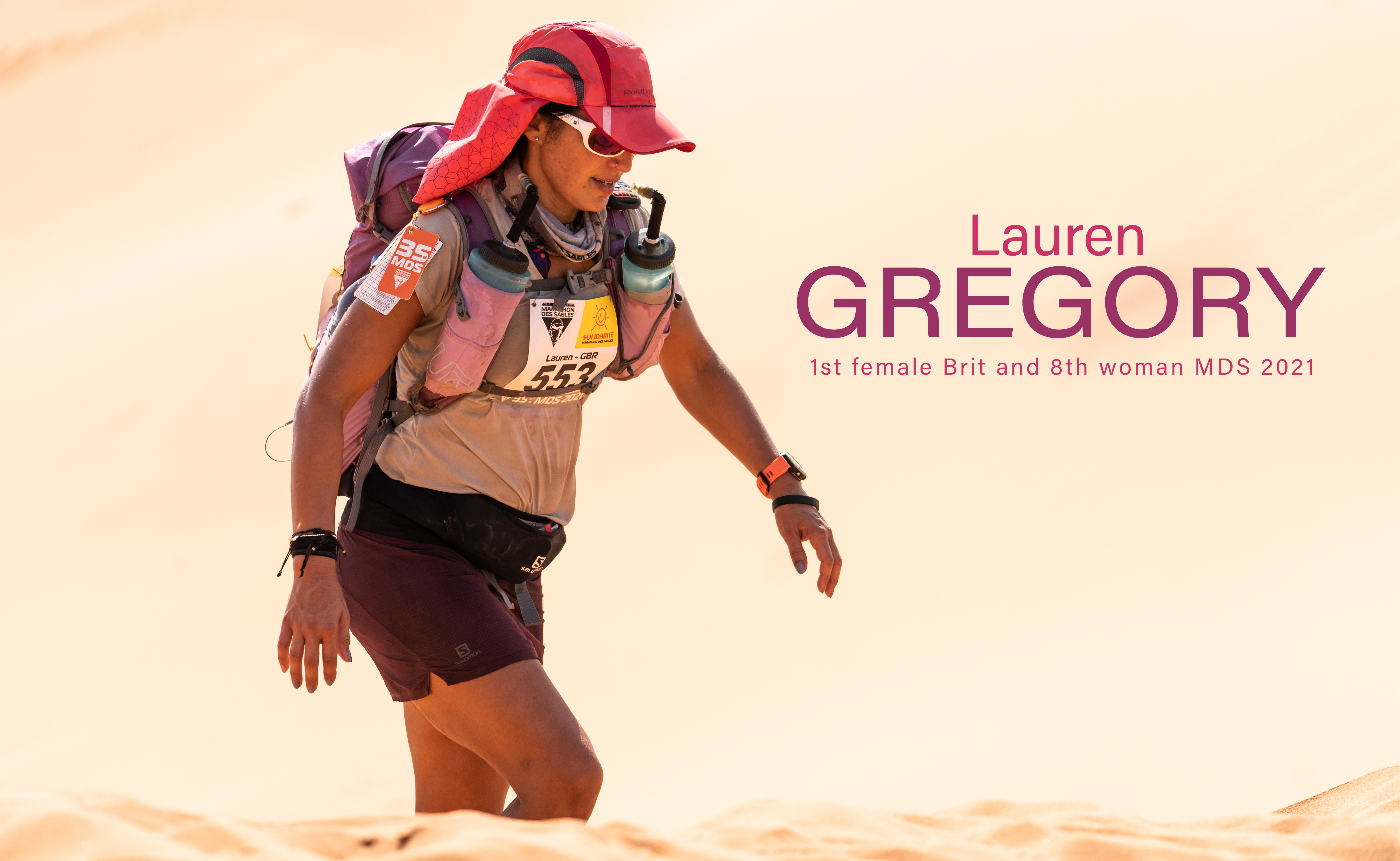
Lauren Gregory ran the 2021 (toughest) Marathon des Sables and was first British woman and 8th in the women category. A personal trainer, Lauren will guide a run group, host yoga sessions will provide a talk.
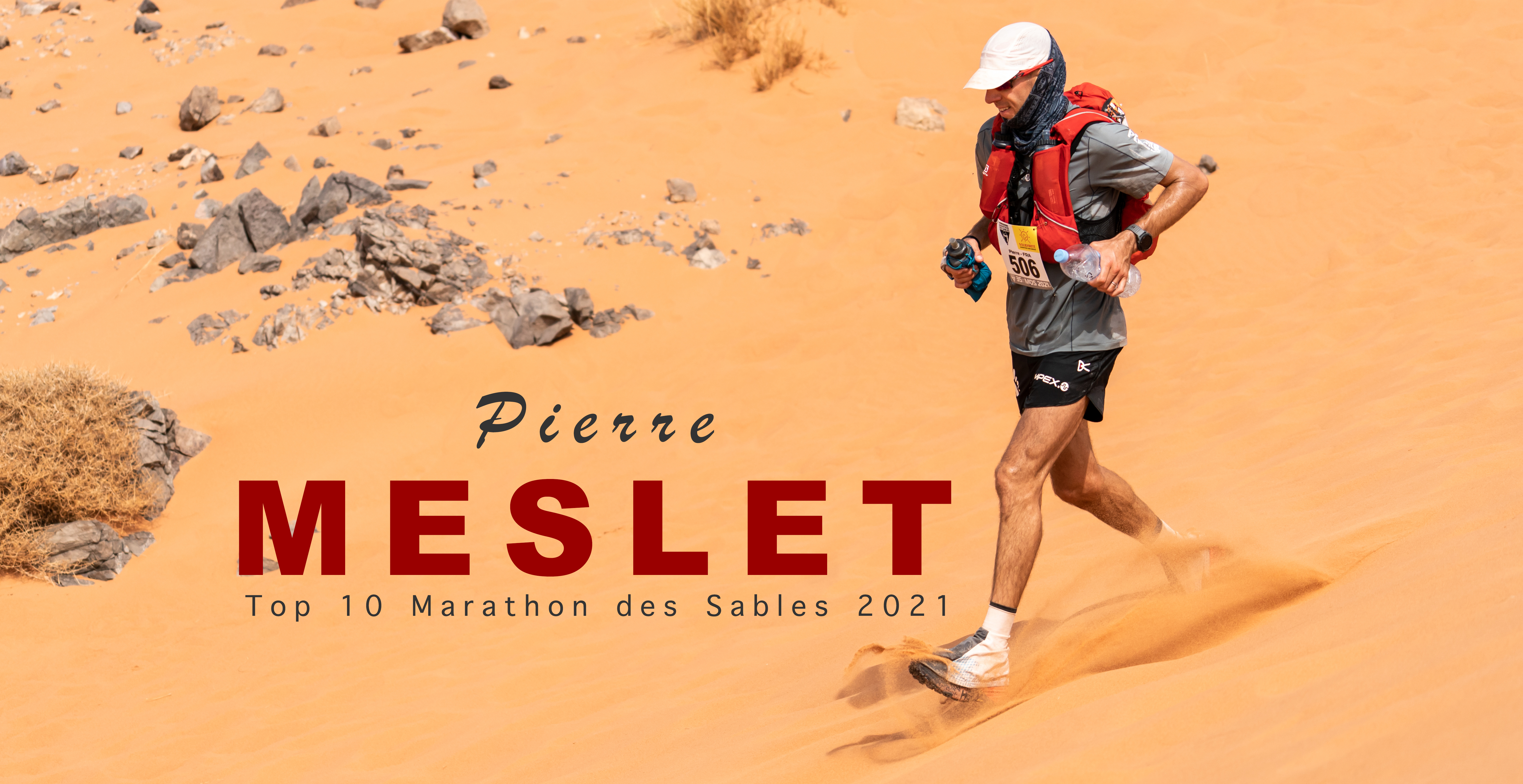
Pierre Meslet joined the Lanzarote Multi-Day Training Camp in 2022 after placing 9th at the 2020 Marathon des Sables. His attendance was a success, not only from the perspective of leading a run group but also his profession as a physio – He was able to provide ‘on-site’ treatment for our training camp. Pierre is back in 2023!
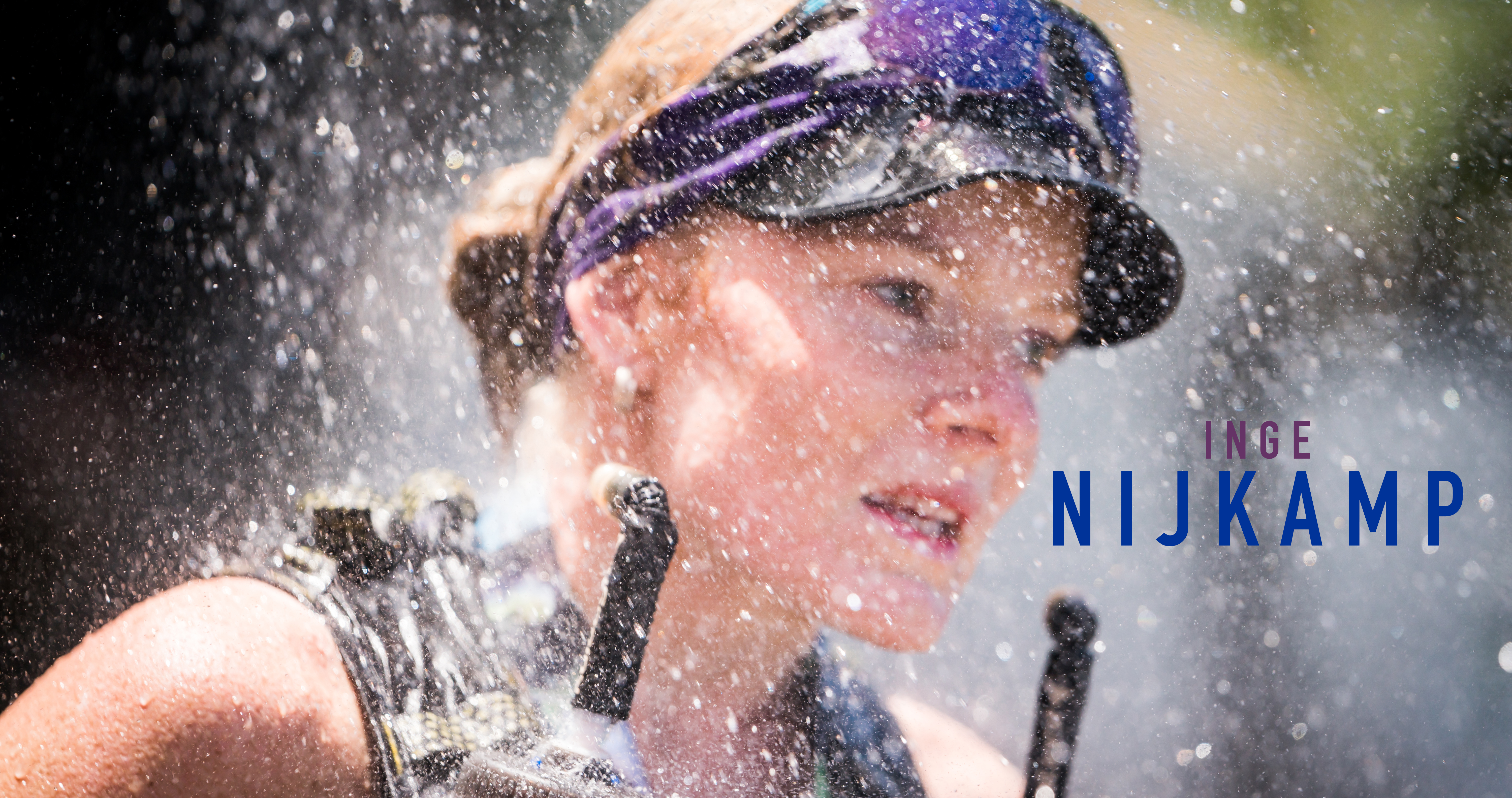
Inge Nijkamp has been top-10 at Marathon des Sables and The Coastal Challenge. A qualified nutritionist, she will guide a group, provide a nutrition talk specific to multi-day running and be on-hand for one-to-one nutritional consultations.
Kevin Webber after a successful 2023 camp has requested that he come back in 2024 for more… In his words, “I just loved this, great location, great people, great running, what’s not to like?” He will once again guide a group, provide an inspiration and moving talk about running with a terminal cancer diagnosis. He has many stories to tell.
Steve Diederich is the UK agent for Marathon des Sables, The Coastal Challenge and Everest Trail Race, he will be on-hand to provide advice about all three races and answer any questions. Currently studying Sports Psychology and come Lanza 24 he will be qualified and on-hand to discuss the mental side of sport and running.
“I wanted to say a big thank you for this week – I’ve left so energised and inspired after the week… I thought the camaraderie from other runners was incredible. If felt as if everyone had left their ego at home which really made for such open and honest sessions. I hope you have the opportunity to reflect on how impactful and enjoyable the camp was. The fact that the organisation was seamless doesn’t just happen and I know the layers of detail and spreadsheets that go into an event like this. I’ll be back I’m sure and when I do get to the start line of MDS I will be much more likely to succeed based on all the advice.” – EB
The purpose of any training camp is to provide you with specific information and training designed specifically to help you with your future objectives. Although you may run (train) more in this condensed week, it’s not designed to break you! Therefore, all training sessions are flexible and you can dip-in and dip-out as required. Most importantly, just as in any race, we will have a very mixed ability base. You will therefore train at your appropriate pace with like minded people.
Each day will be broken down into one or two specific training sessions, one workshop and leisure time.
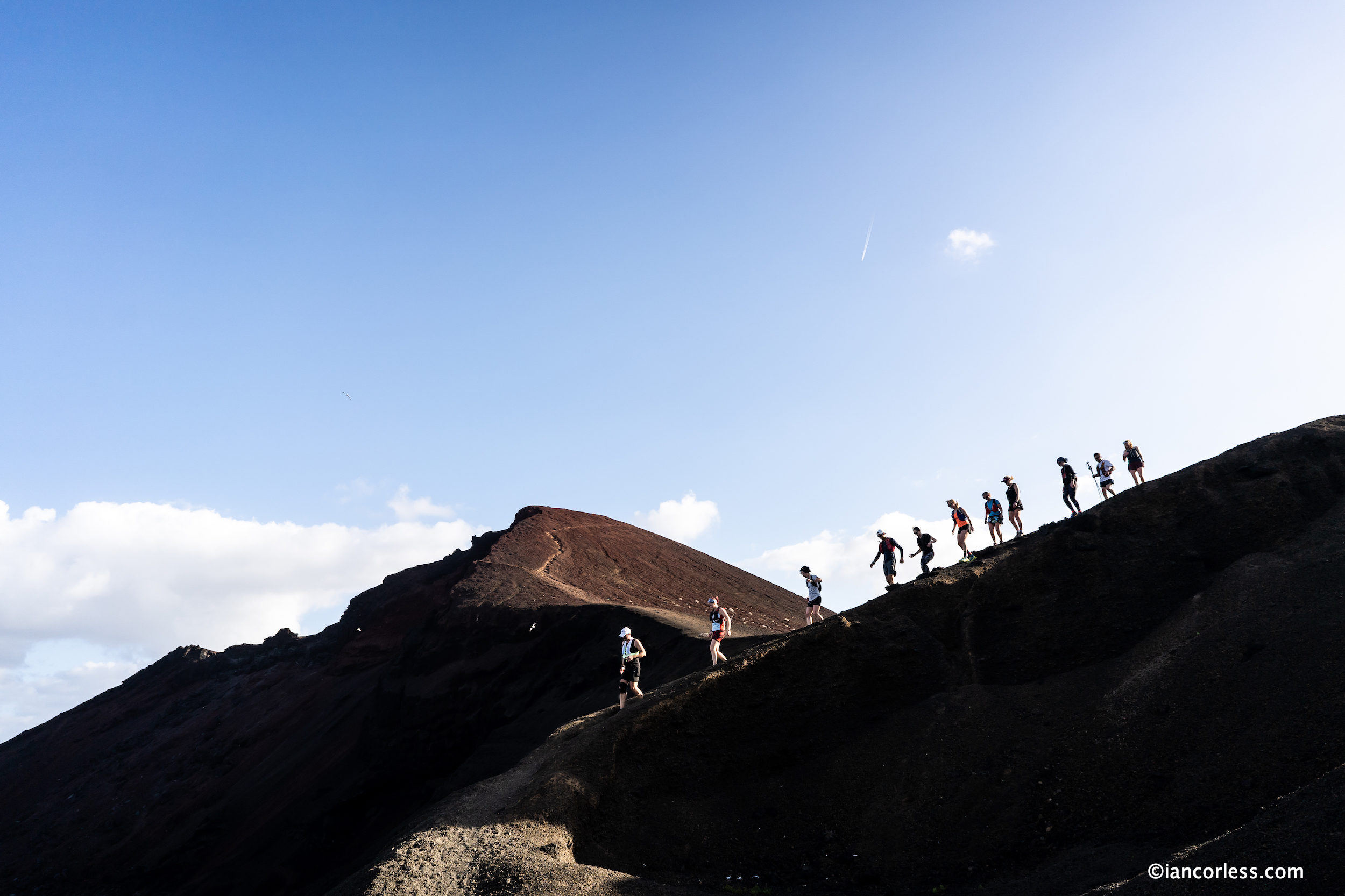
Lanzarote offers a variety of terrain that can be found in many desert races and therefore it’s the ideal training ground to prepare and acclimatise for an up and coming challenge. Club La Santa as a resort offers a great base and all facilities are included. This is great for relaxation, an opportunity to cross train or more importantly it’s perfect for friends and family to join you as a plethora of opportunities are available.
£1095 pp* shared occupancy / Solo Occupancy apartment £1695*
A £300 deposit secures a place for shared occupancy, £600 for solo-occupancy. Deposits are non-refundable in any circumstance and cannot be carried forward to a following year.
This includes a self-catering apartment on a share basis. Inclusion in the above schedule and access to all facilities within the Club La Santa complex.
A non-training partner is welcome to join a training partner for a cost of £975 pp* and they are able to use all the facilities at Club La Santa.
It was day-1 of the 2023 Lanzarote Multi-Day Training Camp and what a perfect day! The rain from ‘arrival’ day disappeared leaving a perfect sunny and windy day.
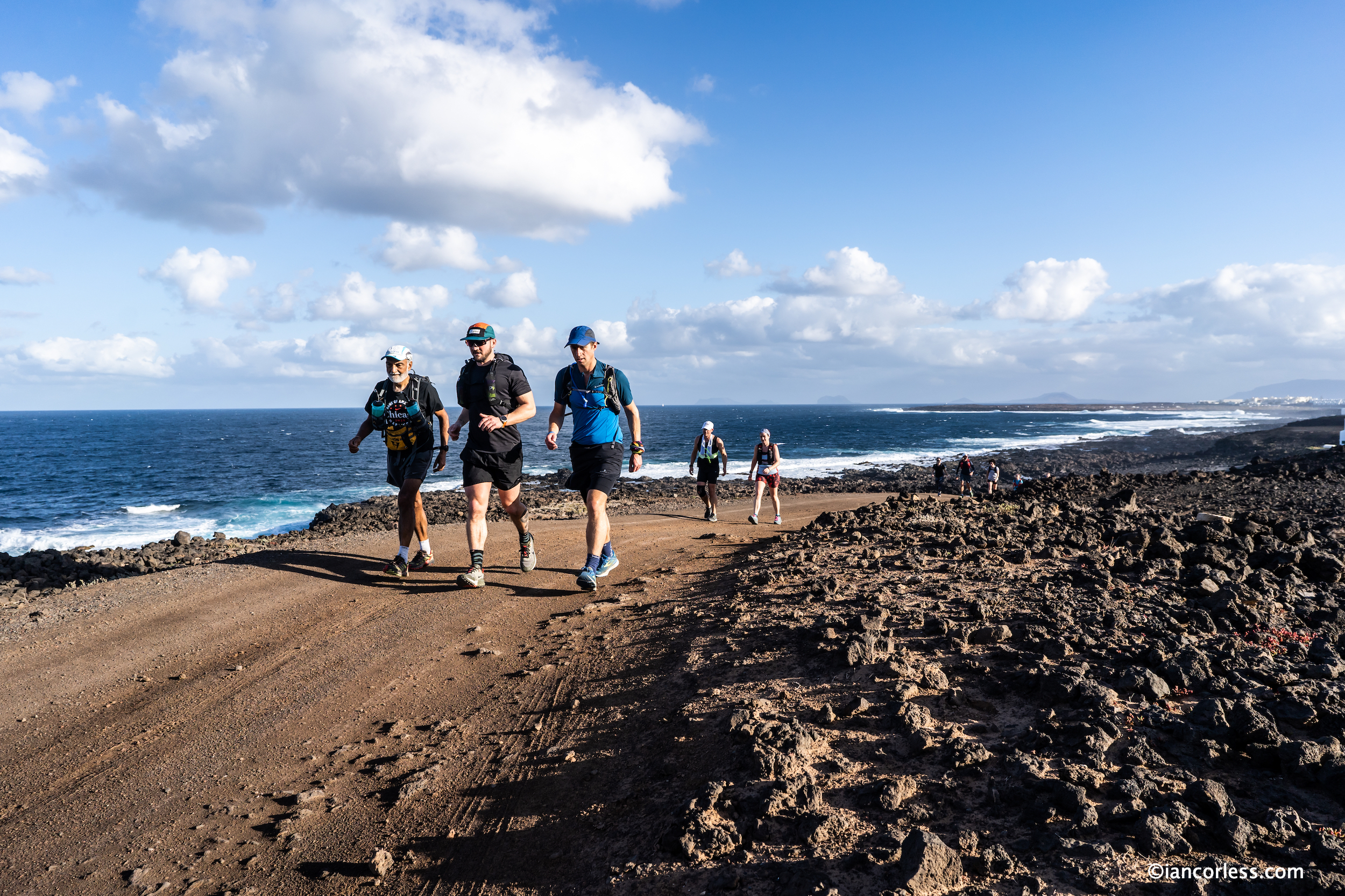
The morning was a 24km ‘Coastal Run’ that had over 50-participants moving along some wonderful, technical single-track on the outward route and easier gravel trails for the run home.
Spilt in to three main groups, Tom Evans and Pierre Meslet guided the faster runners, Ian Corless and Abelone Lyng the middle group and Inge Nijkamp, Kevin Webber and Steve Diederich guided the run/ walker and walkers.
The trails here a stunning and the backdrop superb. Technical trails are compensated with easier non-technical trails but the group bonding, chats and views help the km’s fly past…
After a lunch break, the afternoon was taken up with two talks: the inspirational Kevin Webber told his story of his Prostrate Cancer diagnosis and Steve Diederich (UK agent for MDS) gave an informative talk around MDS logistics.
A 5km recovery run conclude the activities of the day and then relaxation was the order of the day, with some good food, as plans were made ready for day-2.
Interested in joining us? 2024 is open for booking HERE
Before you start a multi-day, be that a race or a personal challenge, one thing is for sure, NOW is the time to set a goal and focus, fine-tune everything, including training, so that you can be at the start in the best shape possible.
First and foremost, have a complete understanding of the task ahead and set a goal or target. This is key not only in the physical adaptations that are required, but also the mental adaptations. There is a huge difference in doing something supported and in doing something self-sufficient. Marathon des Sables a prime example, understand the nature of the event and set a realistic but challenging goal.
MDS is an extreme event that takes place in the Sahara. The nature of the event is self-management both physically and mentally to endure the challenge, survive and reach the finish line. The weather (heat) is one of those challenges and surviving the weather is integral to the nature of the event. As is the ‘self-sufficient’ nature. Other than rationed water and a bivouac, be prepared to endure and complete this event with no outside assistance. Of course, help is at hand, but that help is and should be a safety element that is required in emergency. Equally, if undertaking a solo multi-day experience, do the research, plan routes, look at back-up options, can you re-supply with food, is water available?
Plan and prepare.
TRAINING
We are all unique and individual. Some of us are faster, some are mentally tough, some have a capacity to go for hours and hours and even days and yes, some runners combine all those elements.
Therefore, a multi-day training plan must be used as a template and framework to provide a structure for you, the individual, to achieve your goal.
Be sensible and adjust training plans so that they fit your ability, aspirations, training history and time available.
Think about when you place rest days, when you do long runs and when you work on hills and faster running. A training plan is like a jigsaw puzzle and managing the pieces and adding them together sensibly is how you make a successful and complete picture.
Any training plan is designed to progressively build strength, endurance, and confidence with gradual load increases. Rest is an important element of any training plan, so, rest with the same intensity that you train. Ultimately, you have decided to undertake this adventure, so, enjoy the process and make it fun.
Be specific. Make sure the training terrain, as much as possible, simulates your target event.
Always focus on the goal. Training plans for me start with the goal date and I then count back in time to a start point. That start point for you may well be before the 12-weeks but once you start the plan, focus on the target, and always make every session is as specific to the goal as possible.
For example, if participating in Marathon des Sables, you already know some key and important information:
It will be hot.
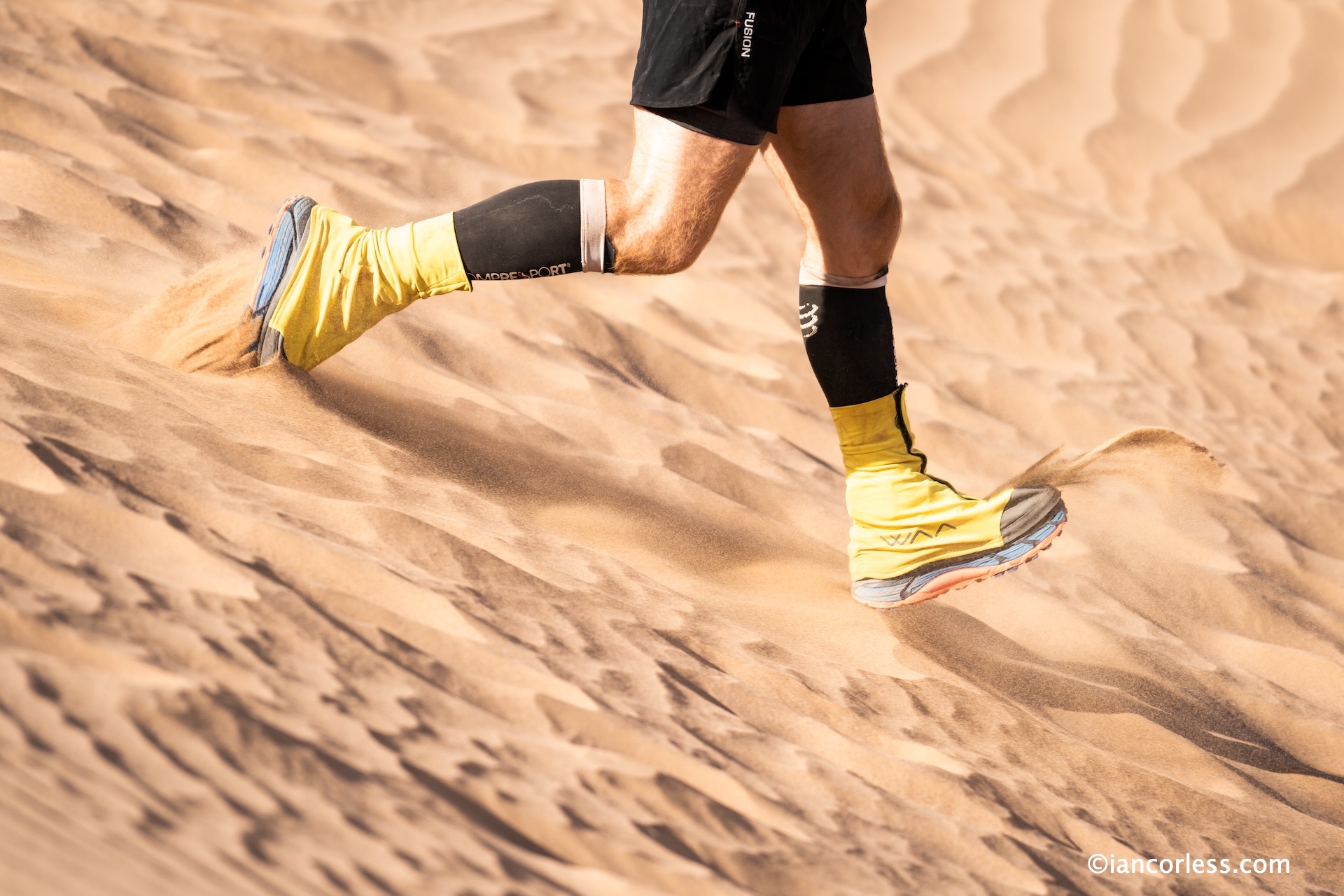
You will need to deal with hard and rocky plateaus, but you will also need to deal with soft sand and dunes.
You will be on rationed food/ calories.
You will only be supplied water to drink, and this is *rationed. In extreme weather such as the October 2021 edition, water rations were increased.
Everything (not the tent) will be carried in a pack, on day 1 this will be at a minimum weight of *8kg. (*Minimum pack weight is 6.5kg but you must carry 1.5 liters of water which equates to 1.5kg.)
You will sleep in an open tent, on the floor using a mat and sleeping bag.
The long day comes on day 4 after approximately 90-100km of running, so, you need to be able to run for consecutive days and manage your pace and effort.
The long day is (typically) between 70 and 90km and you have one full day, one night and most of the next day to complete it.
After the ‘rest day’ is a marathon.
You can complete the race by covering just 3km’s per hour.
In 2019, the MDS was won by Rachid El Morabity and Ragna Debats in 18:31:24 and 22:33:36 respectively. The last runner was Ka Chun Chan from China in 69:29:16. For perspective, Rachid could have run the race nearly four times in 69:29! We are all individual.
Key elements each runner needs for a multi-day like MDS.
You need to be mentally tough.
Physically strong to endure multiple days of back-to-back exercise.
Strong enough to carry a loaded pack and still move at a good pace.
Adapted to function on restricted calories and food choices.
Able to drink only water.
Adapted to perform and function in heat.
You need to be able to walk.
You need to be able to handle un-planned situations.
Have A, B and C goals.
Be self-sufficient.
Multi-day racing and multi-day adventures are unique and particularly self-sufficient ones when you must carry all you need for the duration of the event. In a race, you will carry clothing, sleeping bag, sleeping mat, essential items and food for the duration of the event. At MDS minimum weight is 6.5kg plus water. Just as you prepare physically and mentally, also be meticulous with equipment and food preparation. You ideally need your pack to be 6.5kg and no more… Additional weight is additional stress.
If fastpacking, you may possibly be as above, but you will need to carry your own tent and you will need to re-supply with water en-route either using natural water supplies or utilizing retail outlets.
Be specific and understand the demands of the event you are undertaking and plan accordingly.
WHAT SHOULD A TRAINING PLAN LOOK LIKE?
All plans need to be progressive and geared towards the end goal of a multi-day like Marathon des Sables or a fast-packing adventure.
Remember, we are all individual, so while a generic plan may provide a guide and structure from which to work from, it’s important to adapt and tweak to individual needs. For example, the training plan for someone who is trying to be top 100 at a race will vary greatly to someone who hopes to complete and not compete.
Each week will typically have one or two rest days.
A simple strength training structure that can be done at home or in a gym.
Hill sessions and speed sessions (tempo/ intervals/ fartlek) have a place in any training plan, but the quantity and duration will depend on what type of runner you are and what your aspirations are.
Long sessions are essential and most certainly, an element of back-to-back sessions will help adapt the mind and body for the challenge ahead. However, injury risk goes up with any block like this, so, it needs to be placed carefully with adequate rest and recovery.
Learn to walk. There is a huge difference walking with purpose and pace to ‘just’ walking. Except for the top runners, walking is an integral element to a successful completion of a multi-day race or adventure. Many only realise during the event. Get walking dialed in training.
Do some specific work with a pack and weight BUT be careful as it is easy to get injured.
Think of training as blocks of 4-weeks, build for 3-weeks and then rest/ take it easier on the 4th. An example could be as below.
The final phase of a training plan should taper to allow you to be strong and fresh when the start comes, typically this 2 or 3-weeks long. This a perfect time to add specific race adaptations such as heat training, preparing for humidity, preparing for a cold environment and of course fine-tuning equipment and packing.
CONCLUSION
Multi-day running or racing is exciting and adds many more elements to think about than ‘just’ running. Taking time to plan training and working to a goal is a worthwhile and constructive – it gives you something to aim for!
Further reading:
MDS 2021 Summary HERE The Ultimate Guide to Desert Multi-Day HERE
Choosing a sleeping bag for an adventure can be tedious, especially when the costs are so high. Never fear, this article will answer all the questions you may have re a sleeping bag for a multi-day desert/summer adventure or similar.
First and foremost I recommend you read THIS in-depth article on ‘How to Choose a Sleeping Bag for an Adventure.’
In this article, I will look at three down filled sleeping bags:
Down as a higher warmth-to-weight ratio than synthetic fill. In simple terms, a down bag can achieve the same warmth (or be warmer) than a synthetic bag for less weight. A key consideration when weight is crucial.
Is down warmer? If synthetic insulation was the same weight as the down, down nearly always will be warmer. Down traps warm air, while synthetic fibers pack densely to reduce heat loss. Both offer great warmth, especially when you use high quality products.
Is down always best? No, not always. Down cannot get wet. If it does, the feathers clump together, and all insulating power is lost. Synthetic retains heat, even when wet. So, if you are using a sleeping bag in a wet and humid environment, synthetic will probably be the best choice… BUT, many brands now do hydrophobic down which is treated to be efficient in wet conditions.
Size is extremely important in any adventure and quite simply down compresses considerably more than synthetic.
Cost is always a key consideration and typically, down will be more expensive than synthetic.
SLEEPING BAG KEY QUESTIONS
First and foremost, consider several key things before choosing a bag.
Where are you going?
Will it be dry and what are the risks of rain?
Do I sleep cold or warm?
Am I tall or small (sleeping bag length is crucial for comfort)?
Do I have wide shoulders?
Do I need a zip, if so, half zip or full zip?
How light does it need to be?
What temperatures can I expect at night?
Quite simply, a sleeping bag needs to be as light as possible without compromising the above if you are carrying it.
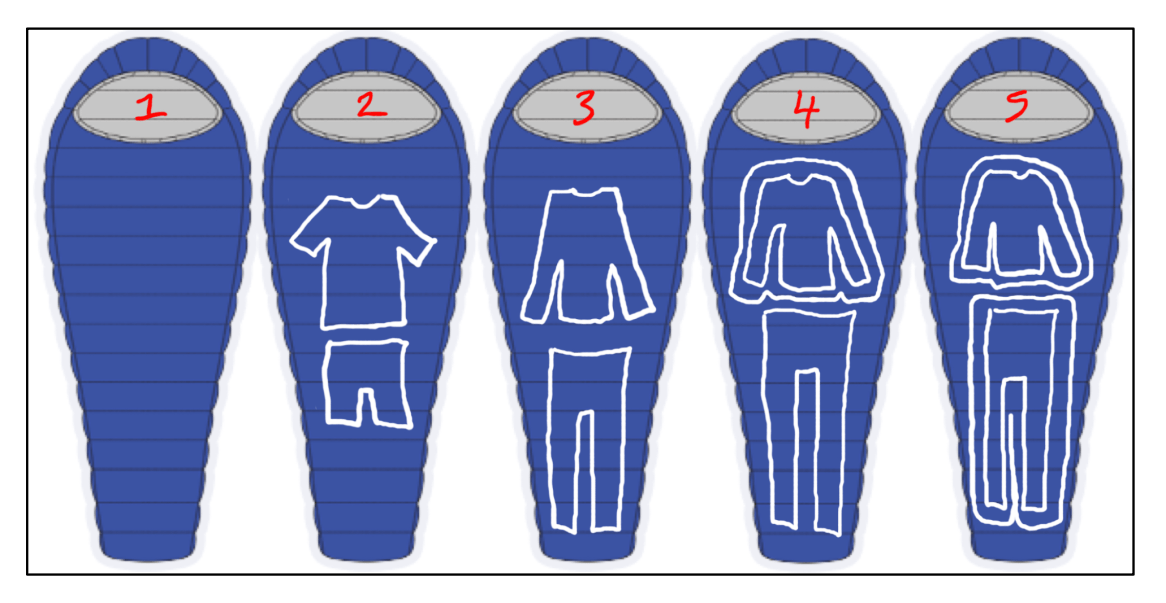
Also consider that it is often a wise choice to choose a sleeping bag that has less warmth and lower weight if you are also carrying top/ bottom base layers and a down jacket. These clothing items can be used to layer and add warmth.
Layering adds warmth
WEIGHTS AND PRICE
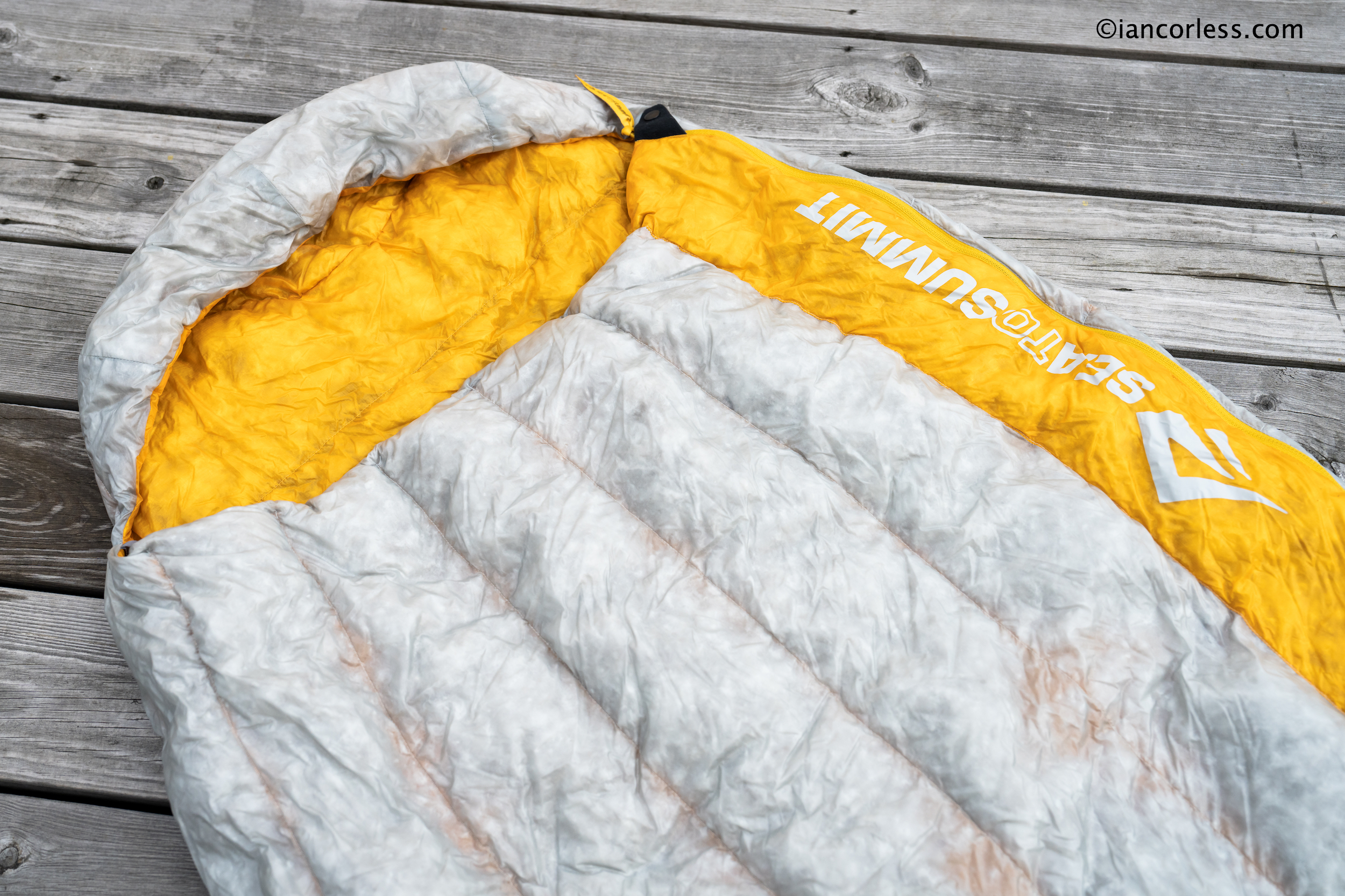
Rab Mythic Ultra 180 retails at £550.00 and weighs 400g (900 fill down)
Sea to Summit SP1 Retails at £260.00 and weighs 350g (850 fill down)
PHD Minimus K Retails at £484.00 and weighs 330g (this bag has no zip but has 1000 fill down)
The Mythic Ultra utilizes breakthrough technology with TILT (Thermo Ionic Lining) which in simple terms works a little like a space blanket offering exceptional warmth. The down is hydrophobic treated and therefore can be used in wet/ damp conditions. It is offered in regular and long. It has a ⅛ zip by YKK on the left, an excellent hood with baffles and is provided with a dry bag and a drawstring storage bag.
The SP1 is tiny and provided in a zipper storage bag and a small compression sack is provided. Using ‘ultra-dry’ 850 fill down, the bag has excellent water repellent property and warmth. It has a YKK zipper, available in regular and long with excellent hood and baffles.
PHD are unique in that they make all the products in their factory in the UK. Therefore, it is possible to purchase any bag ‘off-the-shelf’ as a standard product OR you can order and have a product custom made. For example, you can specify, no zip, half zip or full zip. You can ask for wider shoulders, longer length, warmer toe box and so on. All of this comes at a price, so if bespoke is for you, PHD is the place to go. You can see options HERE.
The Minimus bag has a Drishell outer, no zip, standard length, standard width and 900 fill. Should you require the bag a different length, the price varies, short is no extra charge, long adds 8% and extra-long adds 14%. Equally, if you require extra width, slim is no extra charge, wide is plus 11% and extra-wide adds 20%. Need a zip? Short is £25 extra and full is £41.00 extra.
Quite simply, PHD are the Tesla of the sleeping bag world. Great comfort, weight and warmth. It has a mesh bag for storage and comes with a nylon stuff sack*
First and foremost, weight is a key consideration, and these three bags are so close in weight, it is hard to say one is better than the other. The Sea to Summit wins though, a full 100g lighter than the PHD.
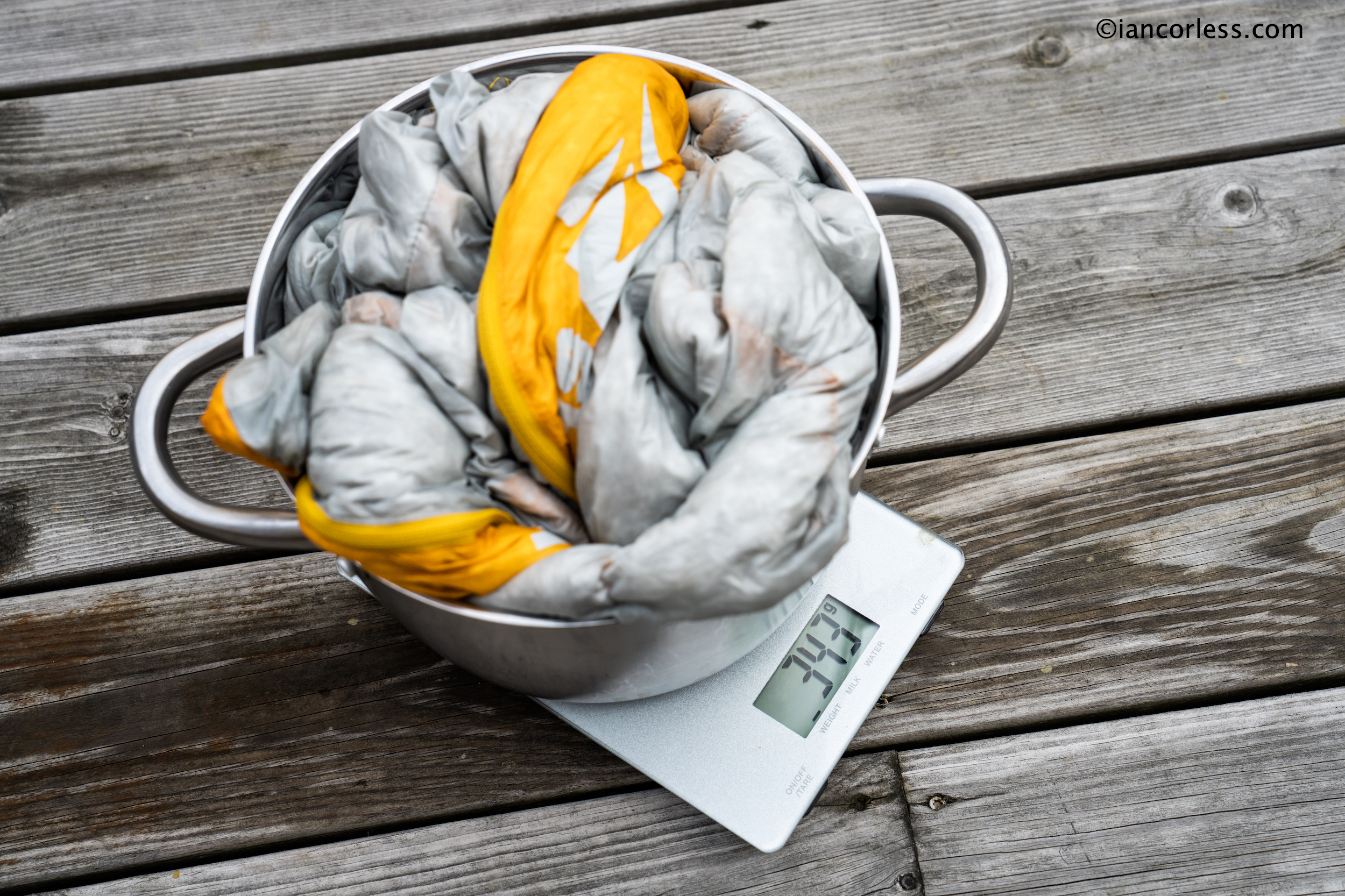
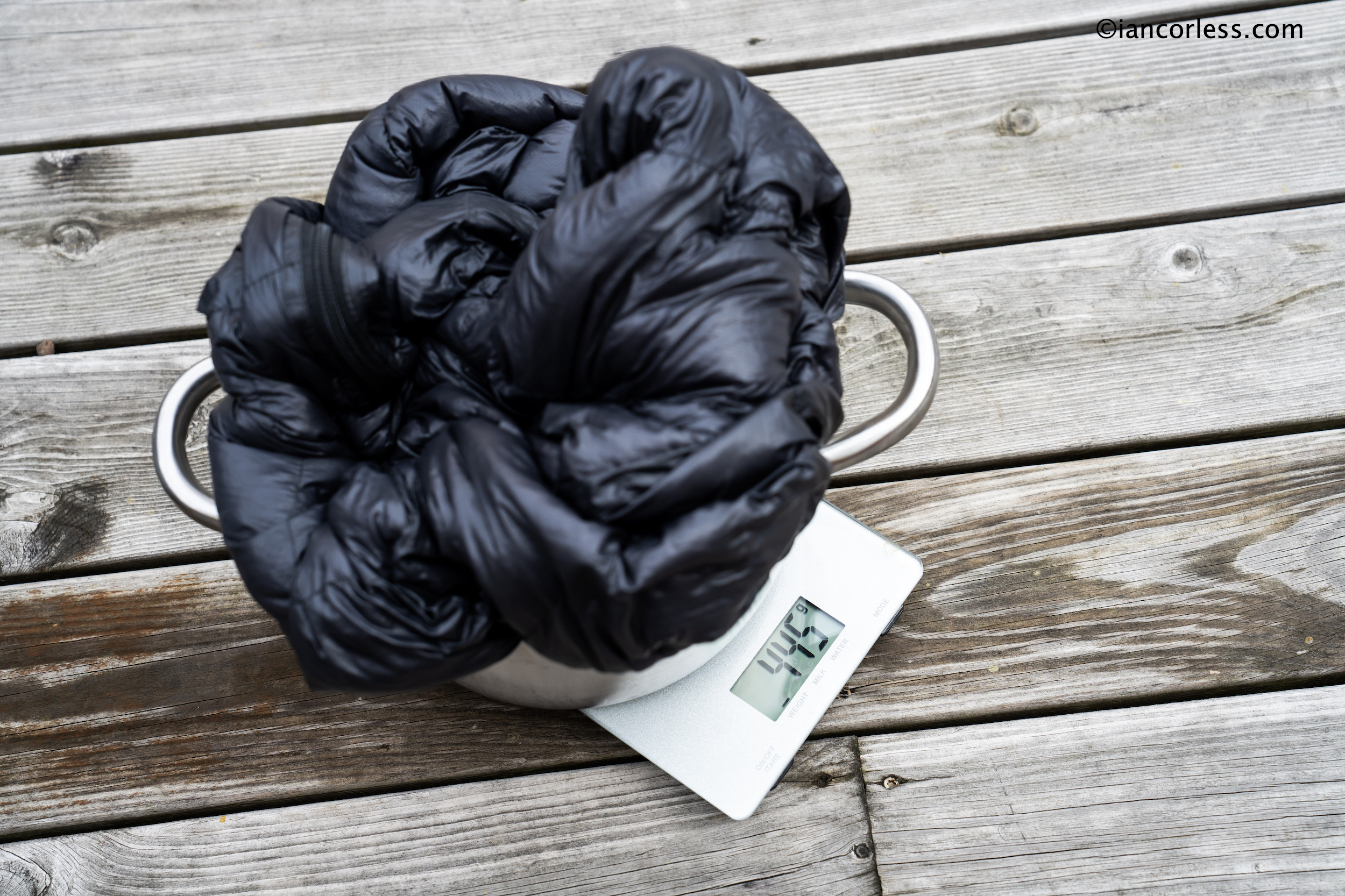
On my scales:
Rab 397g Rab has a tiny eighth zip.
Sea to Summit 344g *Sea to Summit a half zip.
PHD 445g **The PHD has a full-length zip.
When one considers the PHD has a full zip, the weight is impressive. A full zip offers more flexibility and on a hot night, the bag can be used more like a blanket. Not an option with the other two.
Size can be as crucial as weight and the Sea to Summit is a standout packing to an incredibly small size with the compression sack provided – 38g.
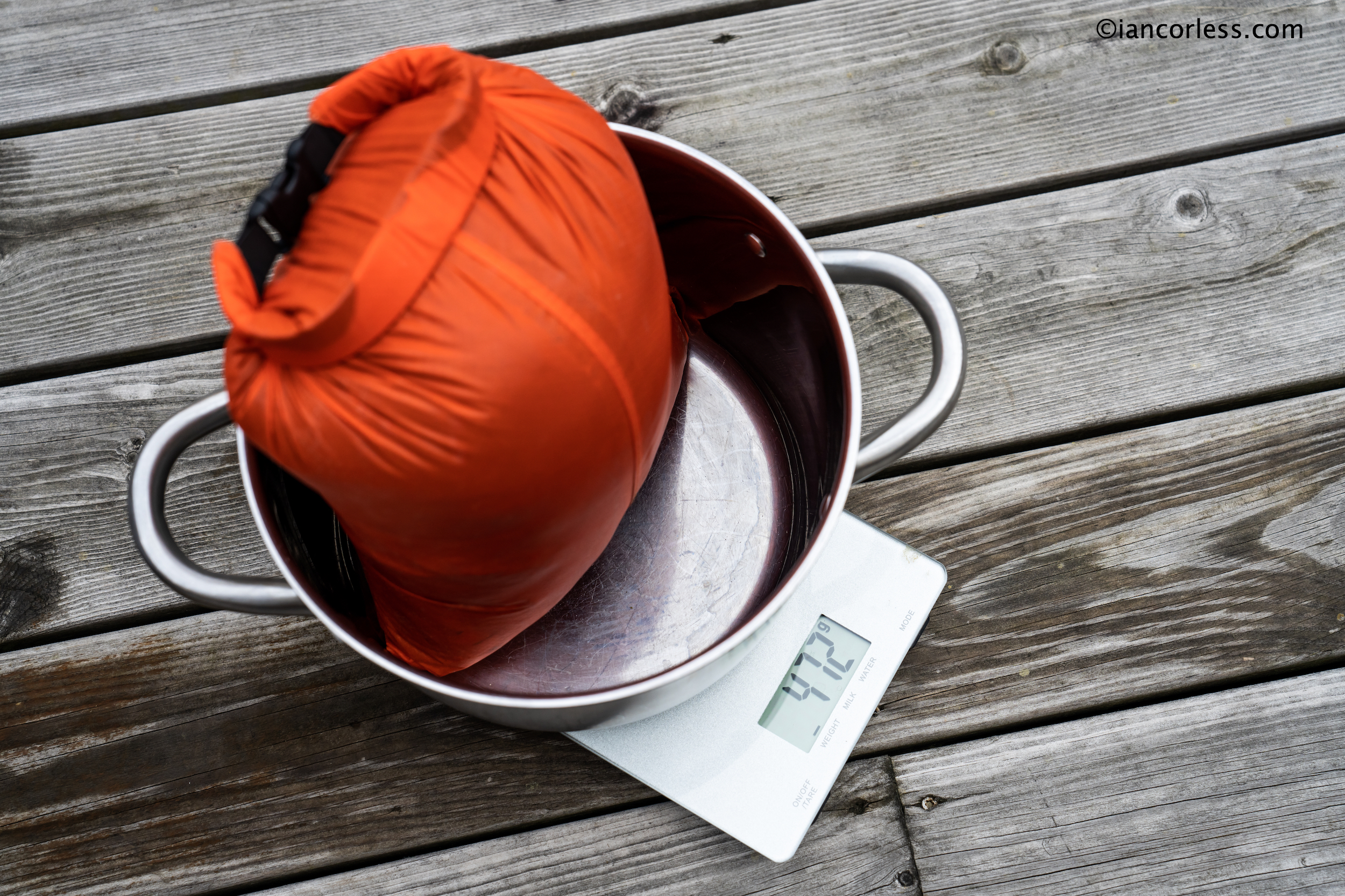
The Rab is supplied with a dry bag and I should point out it would be possible to use a smaller bag and compress the Mythic Ultra 180 smaller – 34g
For the PHD I used a generic 4L dry bag – 31g
It’s worth noting though, often when fast packing, it’s better not to store the sleeping bag in a storage bag as it makes for an odd, sausage like shape that does not utilise the space available.
WARMTH
Remember, a sleeping mat is an essential accessory not only for comfort but warmth. I recommend a Sea to Summit ultra light.
The three bags are very similar in weight, fill and design. However, each brand describes their bags warmth differently. The Comfort Rating indicates the minimum temperature where an individual can sleep in a relaxed position and get a good night’s sleep.
Rab – Sleep limit 0 deg
Sea to Summit – 9 deg comfort
PHD – 5 deg typical.
Based on the above if we take Rab 0 deg minimum rating, Sea to Summits 9 deg comfort and PHD’s 5 deg typical rating, it’s fair to assume that all are good for around 5 deg as a good sleeping temperature. In theory, the Sea to Summit should be the one that ‘may’ struggle at 5 deg but that is not the reality after testing. It is a warm bag and certainly trades blows the Rab and PHD. All three perform exceptionally well at 5 degrees or above.
The Limit of Comfort Rating is the temperature range where an individual sleeping in a curled position and fighting against the cold can still sleep through the night – 0 degrees would apply here. I had several summer nights with temperatures dropping and all three bags performed exceptionally well with the addition of Merino top and bottom layers, a pair of socks and the use of a Buff or hat.
COMFORT and FEEL
All three bags win out on feel and comfort. Each have their own attributes. The PHD wins on full comfort as it has a full zip. The Rab though has the best hood of all three bags and a superb baffle to keep out drafts. The SP1 has a half zip, good hood and no baffle.
All are silky smooth to the touch and comfortable.
The Rab with black outer, silver logos and silver TILT lining feels and looks premium. Equally, the SP1 has a superb look of grey/ yellow and excellent logos/ branding. The PHD is a no fuss bag. If the other too are Tesla and Porsche, the PHD is a Land Rover but you know it will get the job done.
VALUE FOR MONEY
These are three excellent sleeping bags offering the best option in their class. Quite simply, you cannot go wrong with any of them. They have all been used and tested in similar environments, conditions and temperatures whilst camping. However, when looking at weight, pack size, warmth and price, we have a clear winner.
The standout is the Sea to Summit SP1 which offers an unbeatable package of low-weight, small packing size, incredible warmth, and a low price. It is half the price of the competition and does not compromise on any features. It’s a winner. More info HERE.
The Rab is a great bag, which offers a little more warmth, larger pack size and just a fraction more weight. The black colour is a plus for me and the hood/ baffles are the best of the three. The zip is of no real use and for me I would prefer either no zip to save on weight or prefer the additional weight and half a zip that offers more practical use. The treated down offers incredible flexibility and certainly if I planned on using one bag for different conditions and environments, the Mythic Ultra 180 would be a great choice. More info HERE.
PHD are always a winner, and they make incredible products. But ‘off-the-shelf’ it’s difficult to justify the cost in comparison to the excellent Sea to Summit SP1. However, long, tall, short, wide, large, small, zip or no zip, PHD will make a bag just for you and it will be perfect. That comes at a price though and it will be arguably, the best sleeping bag you have ever had. More info HERE
Episode 223 of Talk Ultra is a 36th MDS special co-hosted by Steve Diederich (MDS UK) and guest interviews with, James Hazeldene, Liz Anderson, Patrick Kennedy, Richard Bysouth and Tamsin Dobson.
Rachid El Morabity leads Aziz and Mohamed.
The 36th Marathon des Sables came just 6-months after the 35th edition which was re-scheduled to October 2021 due to the ongoing pandemic situation. The two races could not have been more different. The 35th edition had intense heat and D&V which swept through the camp. A summary of the experience is HERE. There is also a 35th edition special podcast, HERE.
This special podcast is a follow on from the 35th and provides an insight from the MDS UK agent, Steve Diederich.
We also speak with James Hazeldene, Liz Anderson, Patrick Kennedy, Richard Bysouth and Tamsin Dobson.
You can follow the 36th edition daily summaries below.
Please support Talk Ultra by becoming a Patreon at www.patreon.com/talkultra and THANKS to all our Patrons who support us. Rand Haley and Simon Darmody get a mention on the show here for ‘Becoming 100k Runners’ with a high-tier Patronage.
Heat is often debilitating for a runner. Heat cramp, heat exhaustion, dehydration, heat stroke, headaches and the desire just to stop are all very real problems.
As the summer season approaches, running in a hot climate is sometimes unavoidable, however, racing in a hot climate is relatively controllable as you will understand in advance the race, the environment and the expected temperatures one can expect.
Understanding the conditions of ones running and racing environment is crucial to make the best of all the hard training you have done. So, one needs to adapt and plan.
Heat acclimatisation takes place in a natural environment where one can specifically prepare in advance of a chosen race or project, ideally for 7-14 days before the event. For most of us though, the luxury of travelling for 14-days and having an acclimatisation holiday is not a realistic proposition.
This is where Heat Acclimation comes in. In simple terms, this is about providing heat stress in a controlled environment, typically a heat chamber, over a set period of time and sessions.
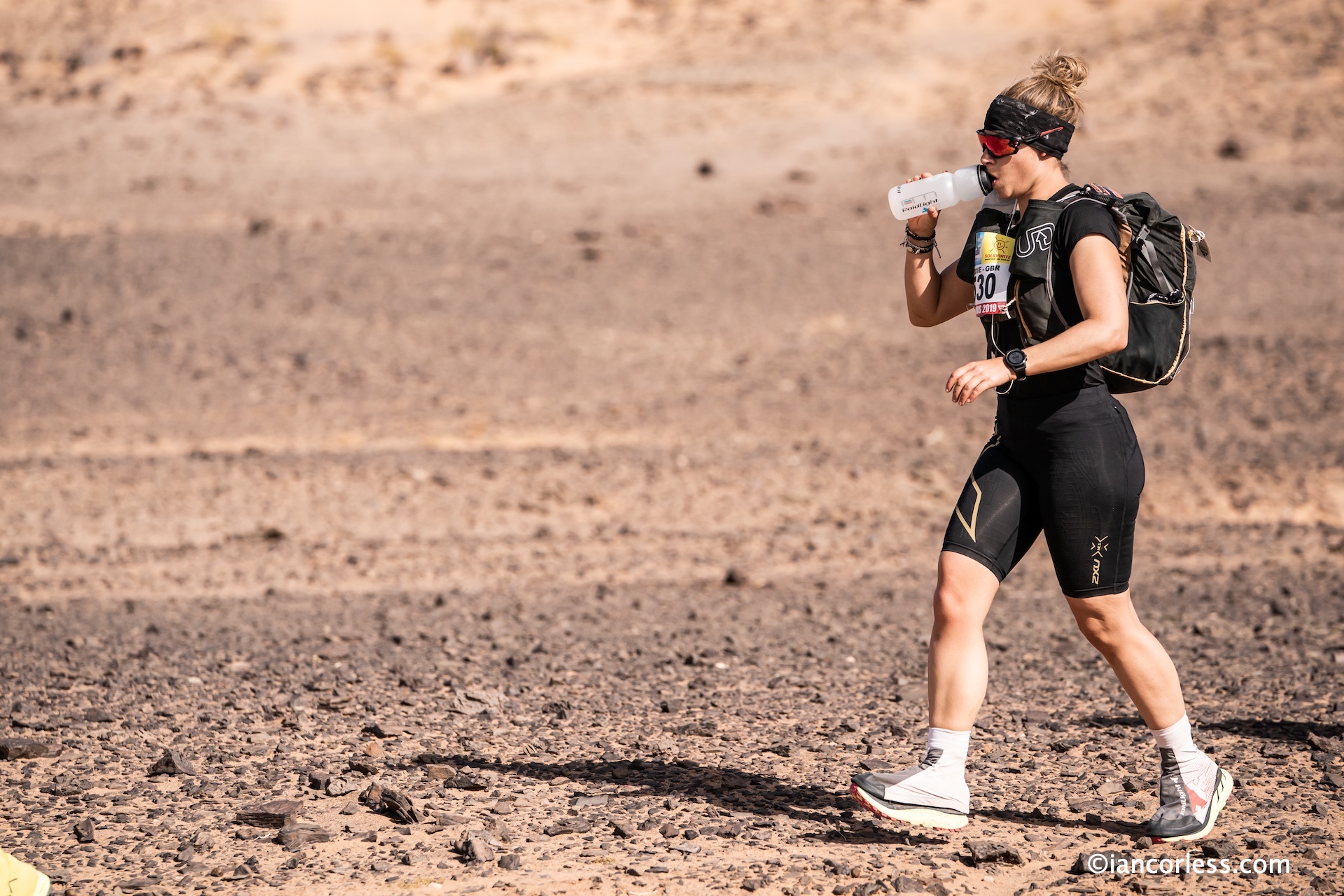
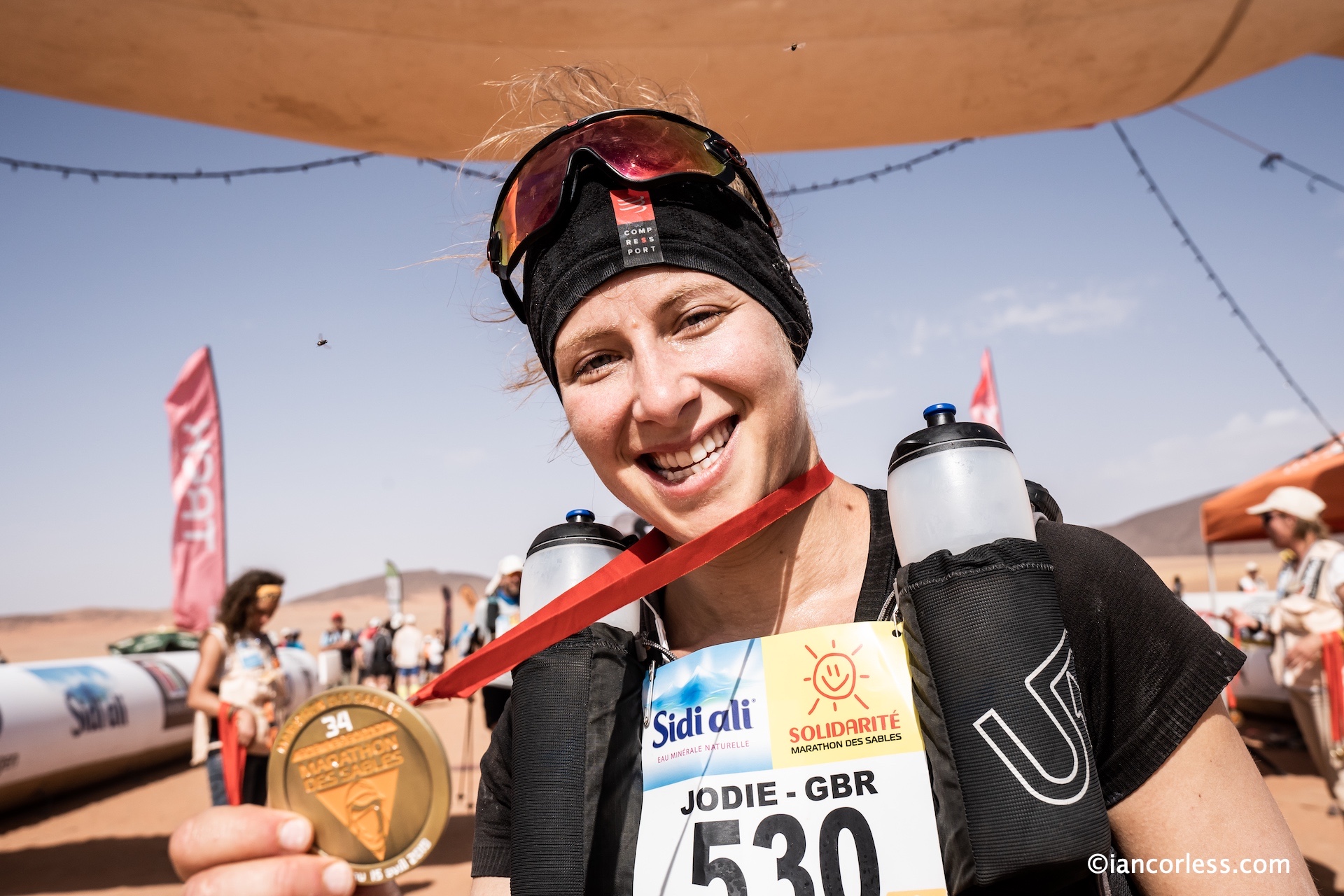
Dr Jodie Moss has specialised in heat acclimation and in the process, put her learning to real time use at the 2019 Marathon des Sables where she placed 8th woman.
Jodie at MDS
With Marathon des Sables approaching, it is timely to re-visit and gain a full understanding of what is required to acclimate to heat with an interview with Dr Jodie from July 2020.
What is it about heat that makes running so difficult?
You are imposed upon by a different challenge. What happens is you create this metabolic heat by contracting your muscles. When one runs, you use muscle mass and this generates heat. When you then exercise in a hot environment, particularly if it is greater than skin temperature, then this makes it very difficult to get rid of heat. Humans are not the most efficient mechanically, so this energy from contracting muscles, potentially around 20 to 30% of the mechanical energy being made is converted to chemical energy, that means 70%, maybe even more, needs to be eradicated in the environment. If the environment is hot, for example, the Sahara, a challenge is imposed to eradicate the heat and what often happens is is that the heat is stored and one feels hotter and this then has a cascade effect of issues and problems, physiologically and perceptually.
Physiologically:
An increase in skin temperature is likely the one which is noticed first as it is directly impacted upon by the environment. There will be an increased demand for blood flow that needs to go to muscle to provide it with oxygen/ energy to run, but also there is a competition for blood flow to the skin. In order to thermo regulate, blood is competing with muscles and skin and that creates an impact on one’s cardiovascular system. Typically, heart rate will increase due to the increased workload sending blood to muscles and skin.
Body core temperature will increase.
Sweet rate will also increase and therefore the percentage of water loss will increase and the consequence of this is dehydration – a deficit in body water with onward complications.
Perceptually:
We thermally perceive it to be a lot hotter.
You are more uncomfortable.
The feeling of needing to slow down and therefore performance is impacted.
Is heat acclimation as valid for the runner at the front, as well as the runner at the back?
In principal, yes. However, if we take Marathon des Sables as an example and the winner, Rachid El Morabity, he is a Moroccan, he lives in the environment in which the race takes place, therefore he is naturally acclimatising on all his training runs. Therefore, he has no need to acclimate artificially.
Highly trained individuals though, through training, can gain thermal adaptations, irrespective of environment. For example, if you are training everyday, particularly at a high percentage of VO2max, one will create heat this will require a higher sweat rate and therefore adaptation takes place. But, interventions should be in place both acute and chronic, to minimise the effect of environment on performance. Environment, will always have an impact on performance, no matter which athlete.
Acclimate for the heat.
When is a good time to start adapting to heat and how?
It is a consideration for close to competition, typically in a period of 7 to 21-days. Adaptation from exposure diminishes rapidly, so, there is no need to do this too far away from the chosen event.
Now of course, if one is fortunate with time, the best scenario is to travel to the race location and adapt naturally in the environment of the race. However, very few have such a luxury and this is where acclimating as opposed to acclimatising steps in.
However, budget can be an issue, so it is possible to adapt via some simple home methods. Keep one’s training as planned, say by a coach, and then add layers of clothing while training. Have a hot bath after training. One can also consider Bikram Yoga and say saunas. But, and this is a big but, while some of these interventions will have some benefit, it is not something that can be recommended completely as it is harder to prescribe and measure.
We want heat adaptation and these adaptations only occur when there is sufficient thermal strain.
As an example, one could run for an hour with layers and build heat. Then immediately have a hot bath. Water has a greater density than air and the heat inside the body would be retained and most likely increase, this would stress the system. But, the issues arise with how long does one do this… Ultimately though, this is considerably better than nothing!
By far the best way, is environmental heat chamber.
Environmental Heat Chamber
The jury is still out on what is the optimal sessions for performance gain, however, five sessions would be considered fundamental over a period of 7 to 14-days. This period has shown results of a much more fulfilled adaptation. The pseudo motor function (sweat rate) takes a little longer to occur, but all the other measurements, cardiovascular and lowering core body temp occurs quite rapidly. So, based on sweat rate, a longer period of time provides the best results.
In regard to the sessions, they could be performed every 2-days, every other day, every day and some even do 2 sessions per day. But obviously time and budget is a huge factor.
It is also important to remember that these sessions take place close to competition, so, monitoring stress and recovery is equally important.
In regard to session length, 60-minutes is usually adequate and this allows the body to get hot enough.
I get asked about adding a run pack and weight, for example, MDS is a self-sufficient race and a pack is required. On the start line, the minimum weight will be 8kg. But training with this in the heat is not necessary, but some insist as it provides security, comfort and a greater understanding of what the Sahara, as an example, may feel like. But this adds additional stress and the sessions are about heat adaptation.
The Protocol
Isothermic heat acclimation intervention is typical. We get you to exercise so that your core reaches a certain temperature. For this we use a rectal thermistor. This ensures that you meet the thermal stimulus, crucial for sessions like this.
We measure body weight naked and this allows us to monitor fluid intake and sweat rate. We can test urine to look at hydration status too. This is all about making the client aware of hydration and levels. We also want the client to leave a session re-hydrated!
A treadmill or bicycle is used. Personally, I prefer the bike as it adds less impact to the body. It’s important to remember, these sessions are about heat adaptation, they are not training sessions. A 5-minute check will include hear rate, core temperature, skin temperature, perception of thermal environment, how hot does the client think it is? And finally, I will ask how comfortable the client is. Then, the exercise will begin.
We aim for a core of 38.5 degrees in each session. This is ideal for pseudo motor and thermo functions to be maximised. It ensures that we are always controlling and meeting a fixed criteria. Measuring the thermal strain is key. It usually takes about 30-minutes to get to 38.5 degrees depending on the individual. But external factors do have an impact.
We typically see improvements by session 3. But it is important to have, say 10-minutes of each session fixed, that way we can monitor improvement and adaptation. We can gain the data here and then report back. Day 5 to day 7 will show the most improvement. So, 7-sessions.
Time can be an issue and some may prefer to squeeze two sessions per day and compress 7-days, say, into 3 or 4. This is possible and literature confirms this. Total exposure is more important than days.
Ideally, the last session would be 1 or 2-days before departure for the chosen race.
What problems can occur without acclimation and how does one mitigate it?
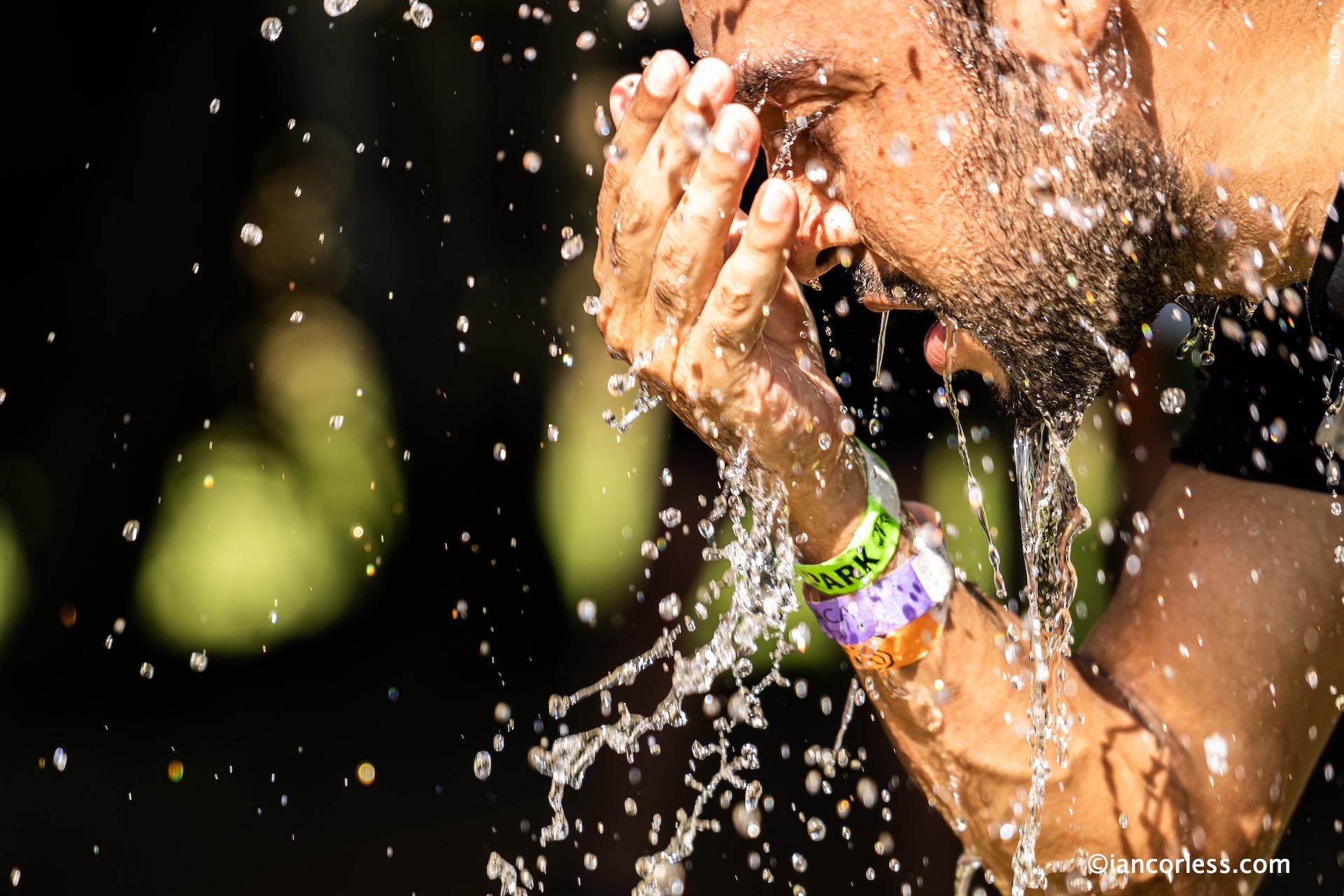
A runner will be faced with a physical and perceptual challenge that will have negative effects. They will be slower, frustrated, dehydrated and have a potential of heat stroke and ultimately they may not finish the race. If any of these elements are experienced, try to cool as much as possible, seek shade at aid stations, rest and allow the core to lower. Hydrate and use spare water to provide a perceptual cooling. Water on face, head, forearms and neck will help a little.
On a personal note:
I did not have the perfect race and that is what makes me keep signing up to race. My heat protocols were great but I compromised my training and I was surprised with 8th place. I had an amazing support system and I do have chronic heat exposure, I am also very good at getting rid of heat. I also sweat high. But I need to be careful on dehydration. I made a mistake with my pack trying to make it as light as possible but I compromised my pack integrity and this hurt my back. I look forward to going back, I hope in 2021.
Jodie with her medal.
Top 3 tips to get ready in regard to heat and training.
1. Have a heat protocol as outlined above.
2. Test all kit and nutrition, leave nothing to chance.
3. Do not panic. Trust the training you have done. Do not increase mileage and training in the light stages. Do not risk injury or illness. Be healthy.
A Multi-Day race or a long-distance ultra is a huge undertaking. For many, it’s a 12-month project (or longer) that slowly but surely can consume every available day, hour, minute and second.
I get it, a long-distance race over multiple days in an unfamiliar terrain can leave more questions than answers. However, don’t panic, it’s not that complicated – read HERE.
As your key adventure looms, it’s time to focus the mind, body, and equipment so that you can plan for and anticipate all that may go wrong and right while undertaking this key target.
Quite simply, the old saying, ‘Fail to Prepare, Prepare to Fail’ does and can ring true.
So, what can be done?
Luck can have a place in any success; however, it should never be relied on. In multi-day events, particularly self-sufficient ones, the need to fine tune everything is a key element.
Training.
Kit.
Mind.
All of the above have very important roles to play in success.
Get the training wrong, you may not have the fitness or an injury that will result in you not achieving the finish line.
Get the kit wrong, be it too heavy, not durable or inappropriate may impact on your ability to achieve your goal.
Many say the mind is a key and an integral part of any success. Often, the body can be willing, but the mind can be weak, get the mind focused and prepared.
You need to be prepared for whatever your multi-day adventure will throw at you.
In the final phase of training, 6-8 weeks before your adventure starts, is a great time to start working on the final phases and plans that will help ensure success.
THE PREPARE PHASE
If we assume that tapering will take 2 to 3-weeks, this key ‘Prepare Phase’ should be in weeks 4, 5, 6 and 7 before D-Day.
Train and prepare specifically.
First and foremost, understand the challenge that you are undertaking. You may feel that you already have a grasp on this, but there is no harm sitting down and going through all they key aspects. Terrain, weather, mandatory kit, distance, and conditions. Look at the October 2021 edition of Marathon des Sables, the race started with a series of protocols to manage Coronavirus. Ultimately, Coronavirus was not a consideration, it was extreme heat, sickness and stomach problems.
Understand the event and challenge.
Walk, WALK, WALK! – Walking will (for most) be an absolute essential skill to complete any multi-day adventure. You may think you will run most of the distance… But experience confirms that walking is a key to success. Walking, and walking with purpose is a skill. Practice. Consider poles, they may enhance your walking experience, if so, practice and use them.
Learn to walk.
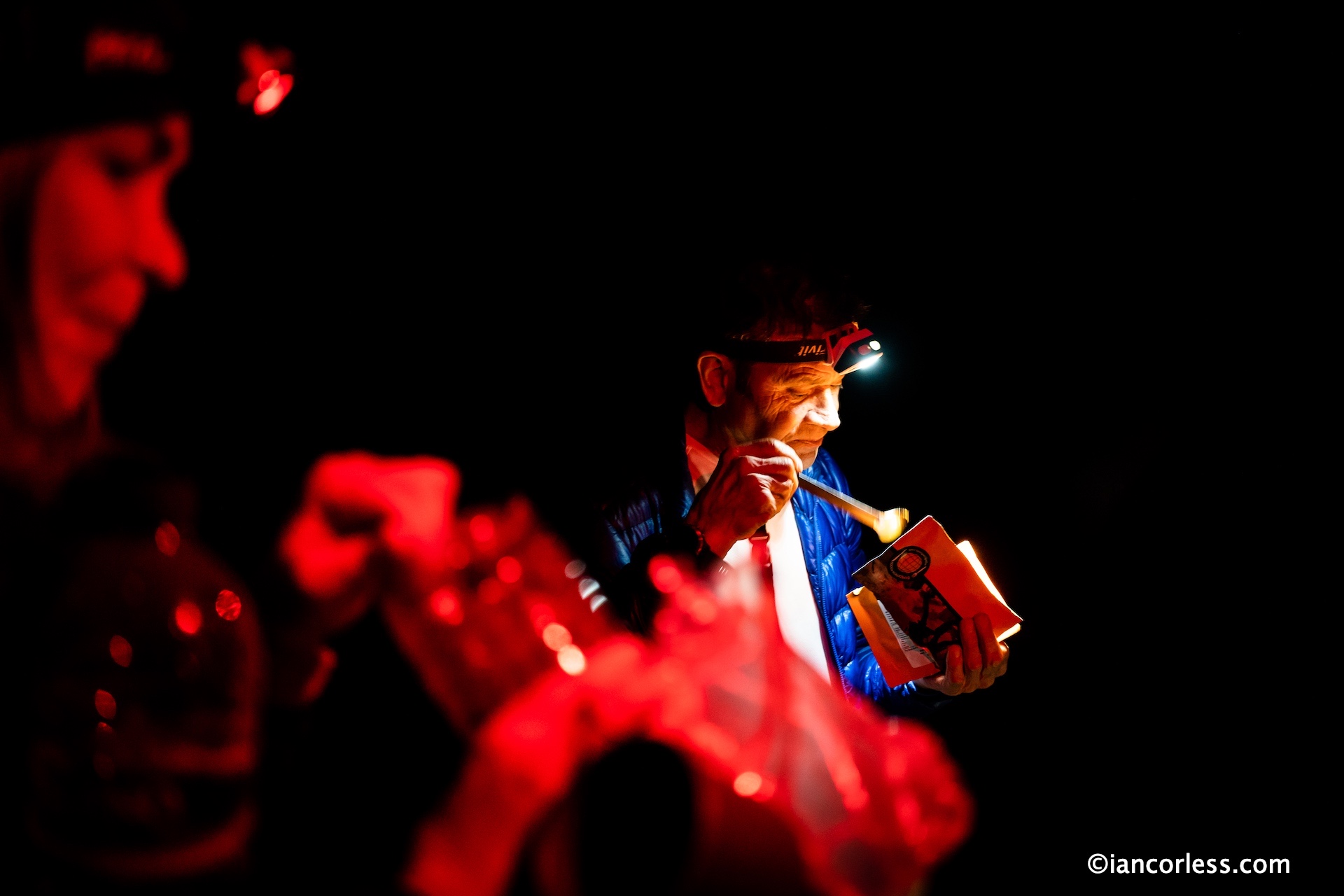
Without doubt you will have long days, and some will go in to the night and through the night. Take time and plan and include a session like this in the ‘Prepare Phase!’ Understand here that this is an opportunity to test kit, not only yourself. Is your head torch bright enough, how do temperatures vary, how does my appetite and requirement for fluid change etc. By doing this in training, you do it in a safe environment. If it all goes badly, you can always make a call and get picked up or get a taxi. You can’t do that in your race or event. Darkness and nighttime can play tricks.
Back-to-back runs may well have featured in your training but running/ walking tired is a skill. However, be careful how you plan this in training. You want adapt body and mind, not break them.
Practice makes perfect.
Perform training with rationed water and race/ event food. You need to learn what works and what doesn’t work. It’s all very well going for a long run and then getting home and eating chocolate and drinking Coca Cola – can you do that in your event? Mentally this can be a real tough challenge – be prepared.
Get a pack that fits perfectly and does not bounce.
Your pack will be with you for the duration of your event. It must be as light as possible and also sturdy enough to last the challenge without breaking. Be minimalist on equipment and purchase the lightest equipment possible. Remember though, lightweight can often mean less durable, less warm, less functional and so on… Better to break or damage equipment in training so that you can make changes ready for the important challenge ahead. Modify and adapt.
Be specific!
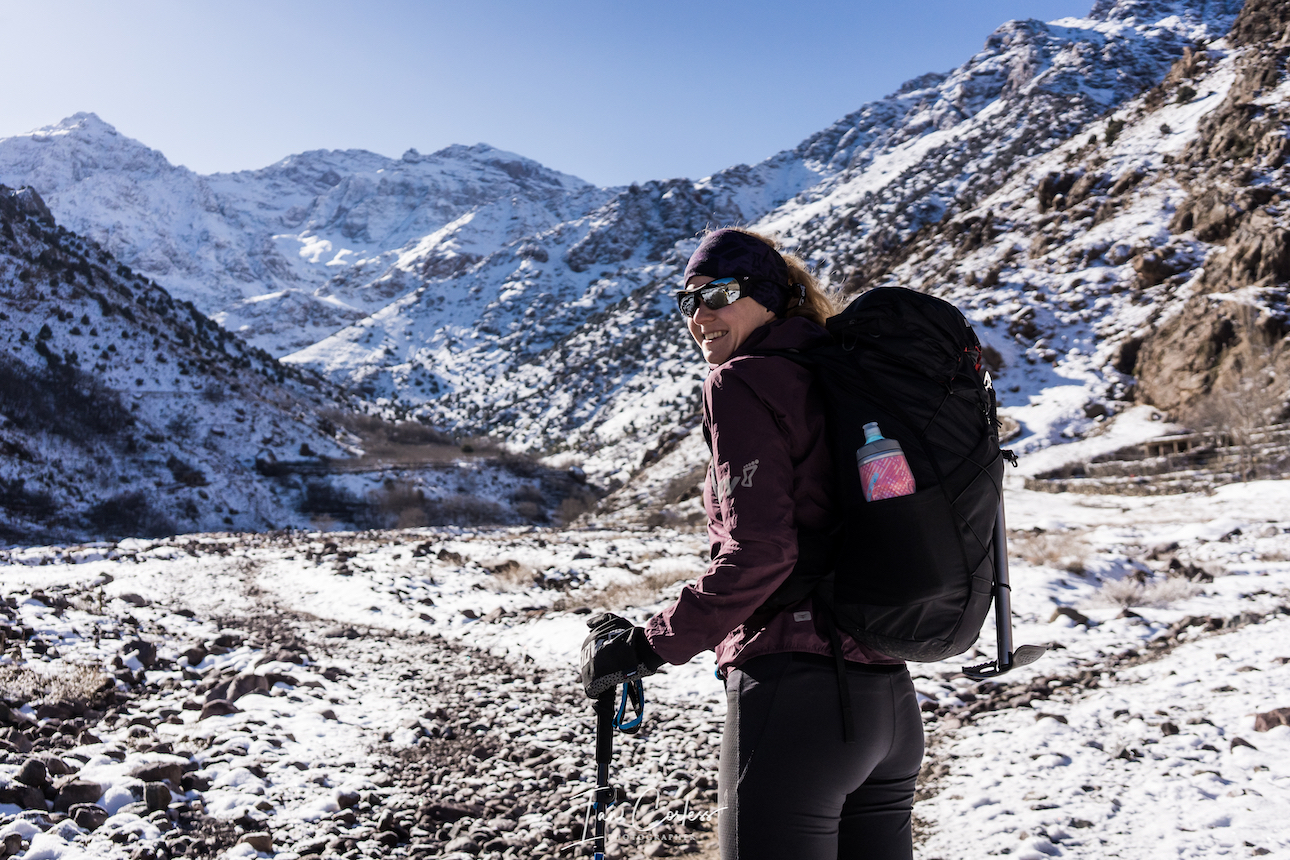
Be specific. Snow, mountains, altitude, heat, or cold. Understand the demands that will be placed on you in your challenge and plan for a specific phase (typically in the 2-3 weeks before the event) to help acclimate. This could be a heat chamber, it could be arriving early before an event and adjusting to high altitude, it could be some specific cold, ice or snow training.
Try out food for an adventure in training.
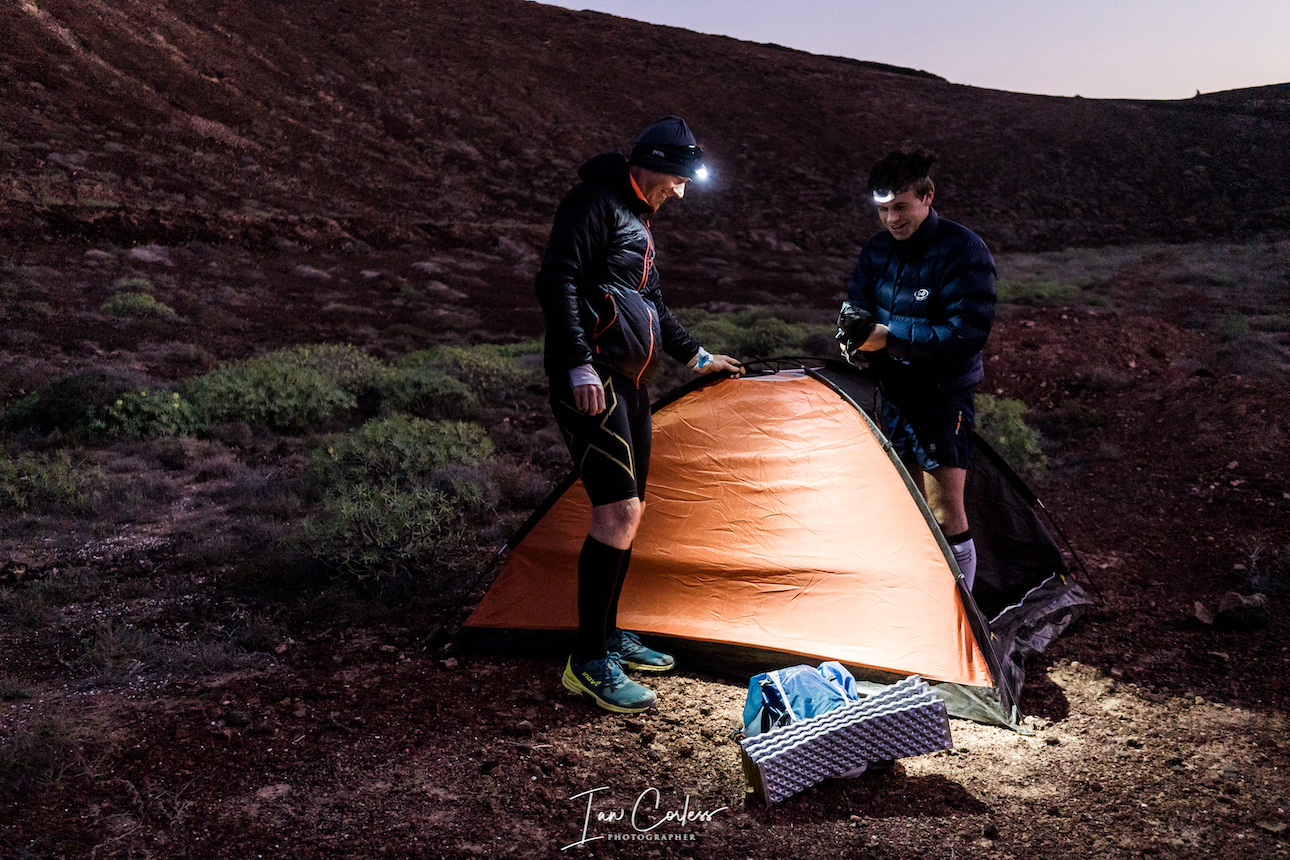
Plan an ‘event simulation’ that will require you to run for a specific distance, be self-sufficient overnight, sleep in a similar scenario/ situation to your event and then get up and run the next day. This can be a key element in understanding what does and does not work. Is your sleeping mat comfortable? Is the sleeping bag warm? Did your food taste good? How easy was it to cook? How about snacks, did they work? How was the pack weight and distribution of contents?
Spend a night out in training to find out what does and does not work.
Train with your pack and add weight, however, be careful NOT to do too much training with too much weight. This can result in injury. In addition, learn how to pack your bag so that it sits comfortably with minimal bounce. Understand where to put snacks so that you can access them on the go.
Look after feet – many failures come via poor shoe choice and foot care.
Feet and shoes. Please do not ask. ‘What shoe shall I use for ‘X’ Event?’ Runners are individuals and what works for one does not work for others. Gait, foot shape, foot width, foot length, toe length, run conditions and so on all impact. Read THISarticle on how to find the correct run shoe.
Water and hydration is key to success.
Food glorious food. Calories are essential for an event, so is what they weigh. Understand food and its nutritional values and make sound educated choices that balance fat, protein, and carbohydrate. Also understand that taste changes. Sweet may be ok early on but typically savory is better as time passes. Is beef jerky better than nuts? What food rehydrates quickly or with cold/ warm water? Should I take bars? What about protein drinks? So many questions… They need answering!
Shops are not always available.
You only have to do three things at most multi-day events:
Run.
Eat.
Sleep.
All three impact on each other, so, make sure you have all of them dialed.
Finally, remember, we are all individual. What works for one person, will not work for another. It is your responsibility to take ownership of yourself, the challenge you are undertaking and the challenges it will bring. Ultimately, that is why you signed up, no?





























 IAN CORLESS