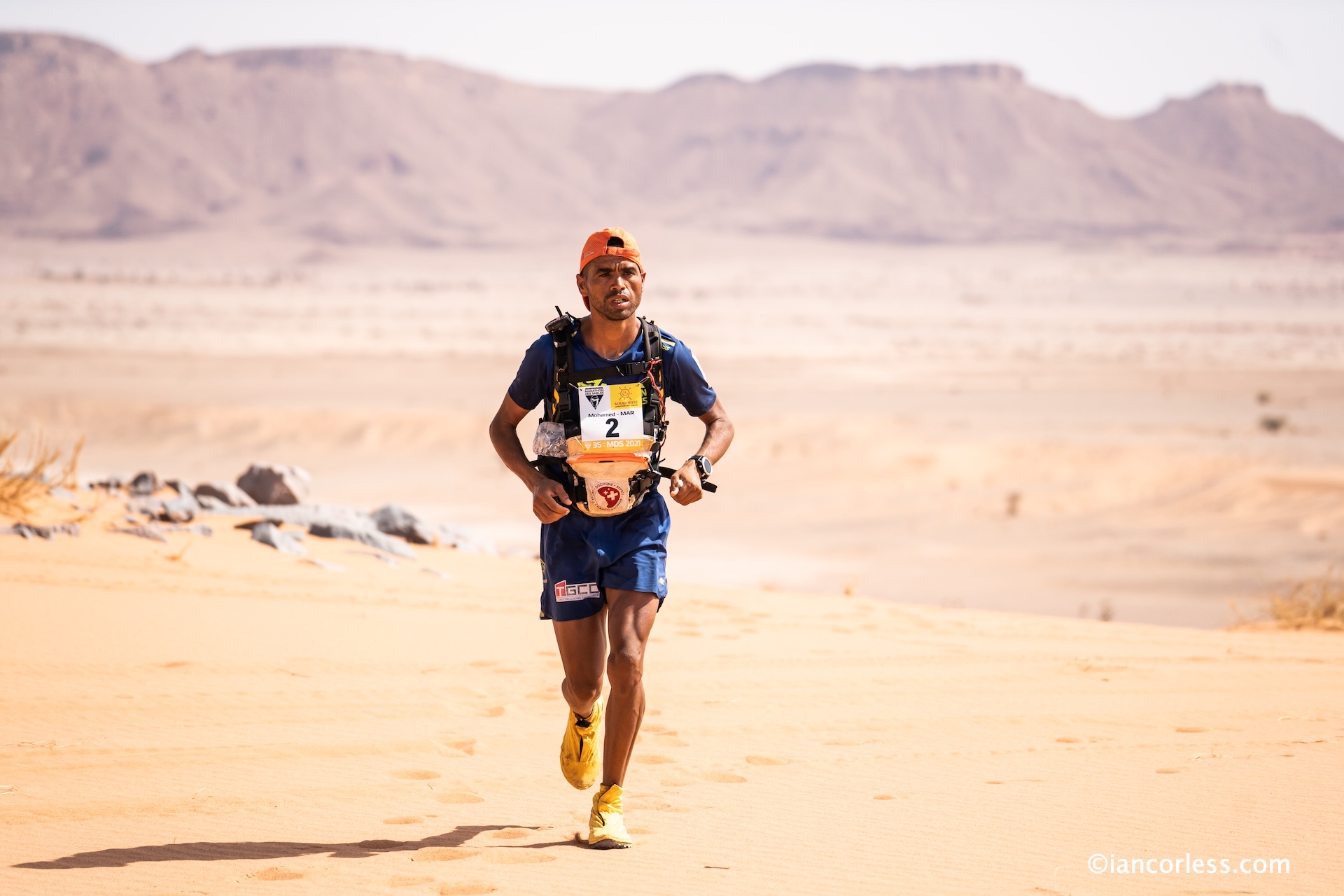
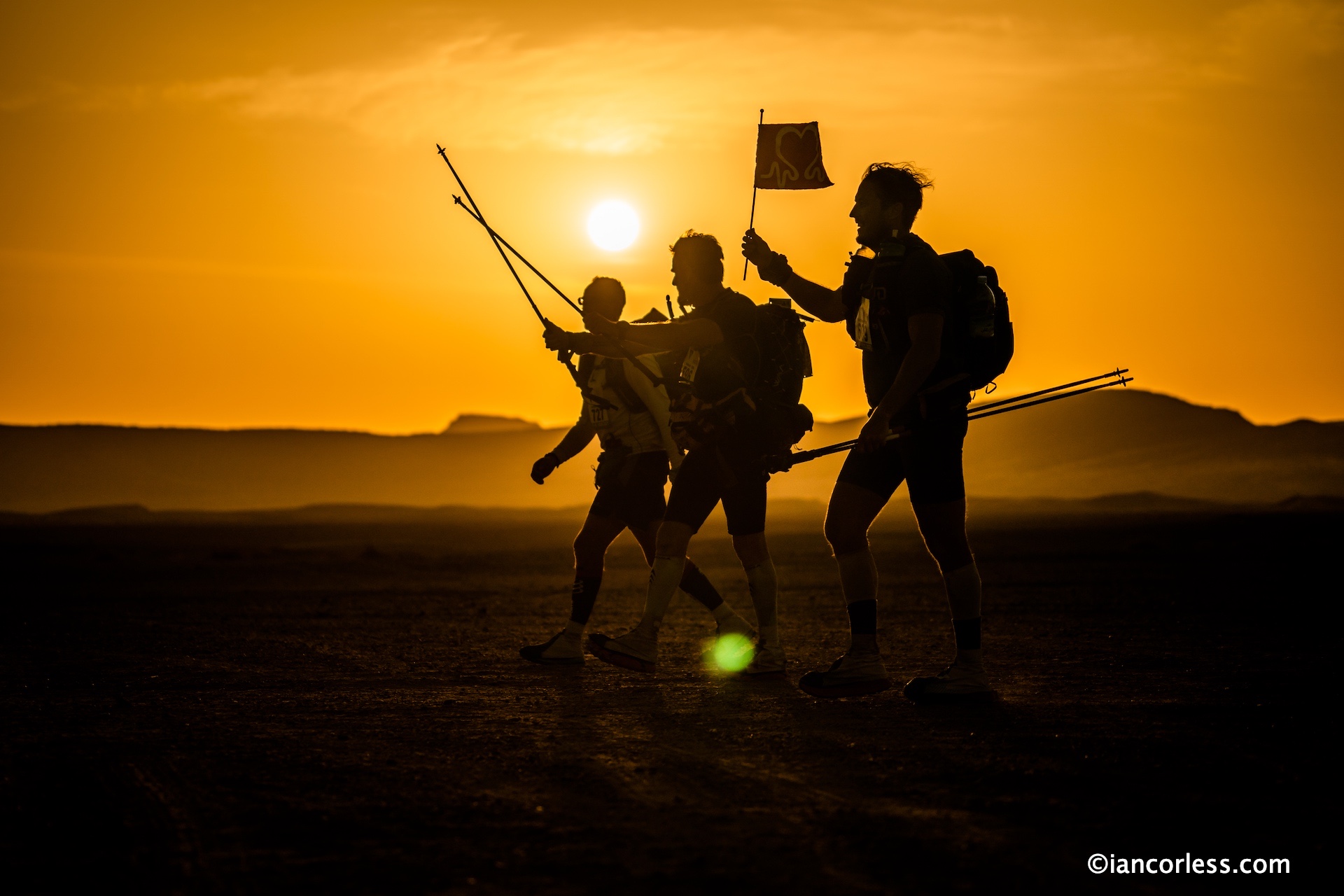
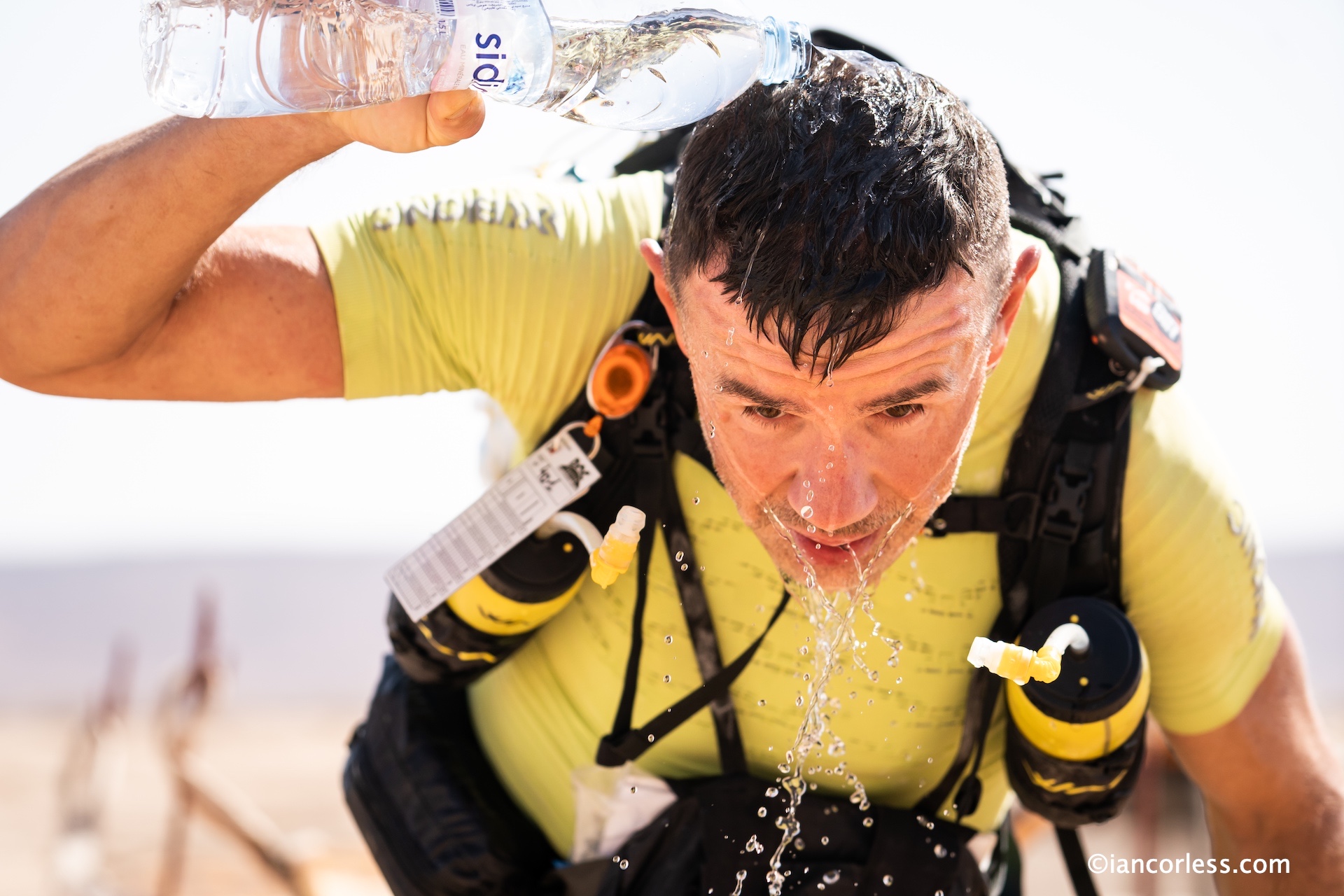
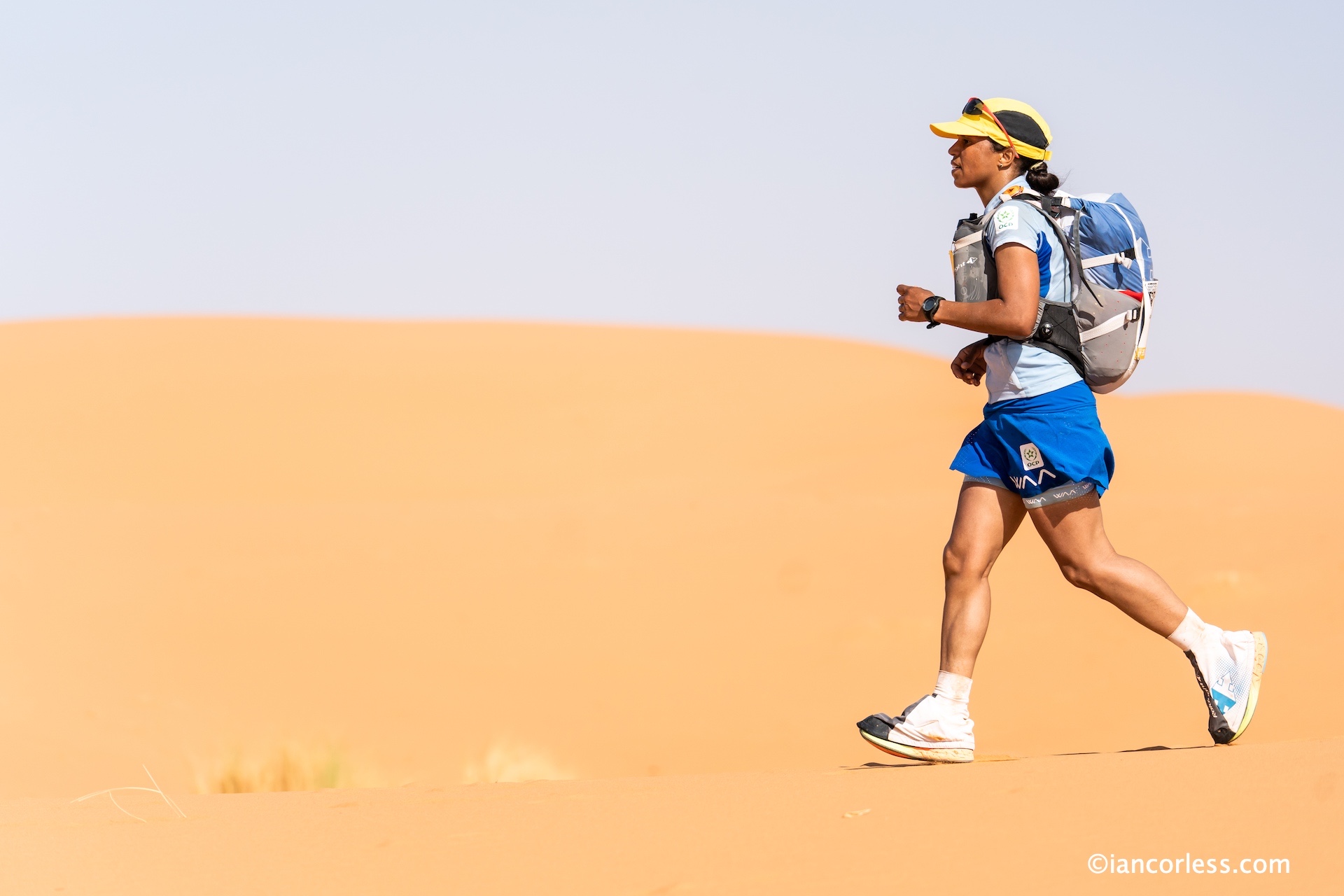
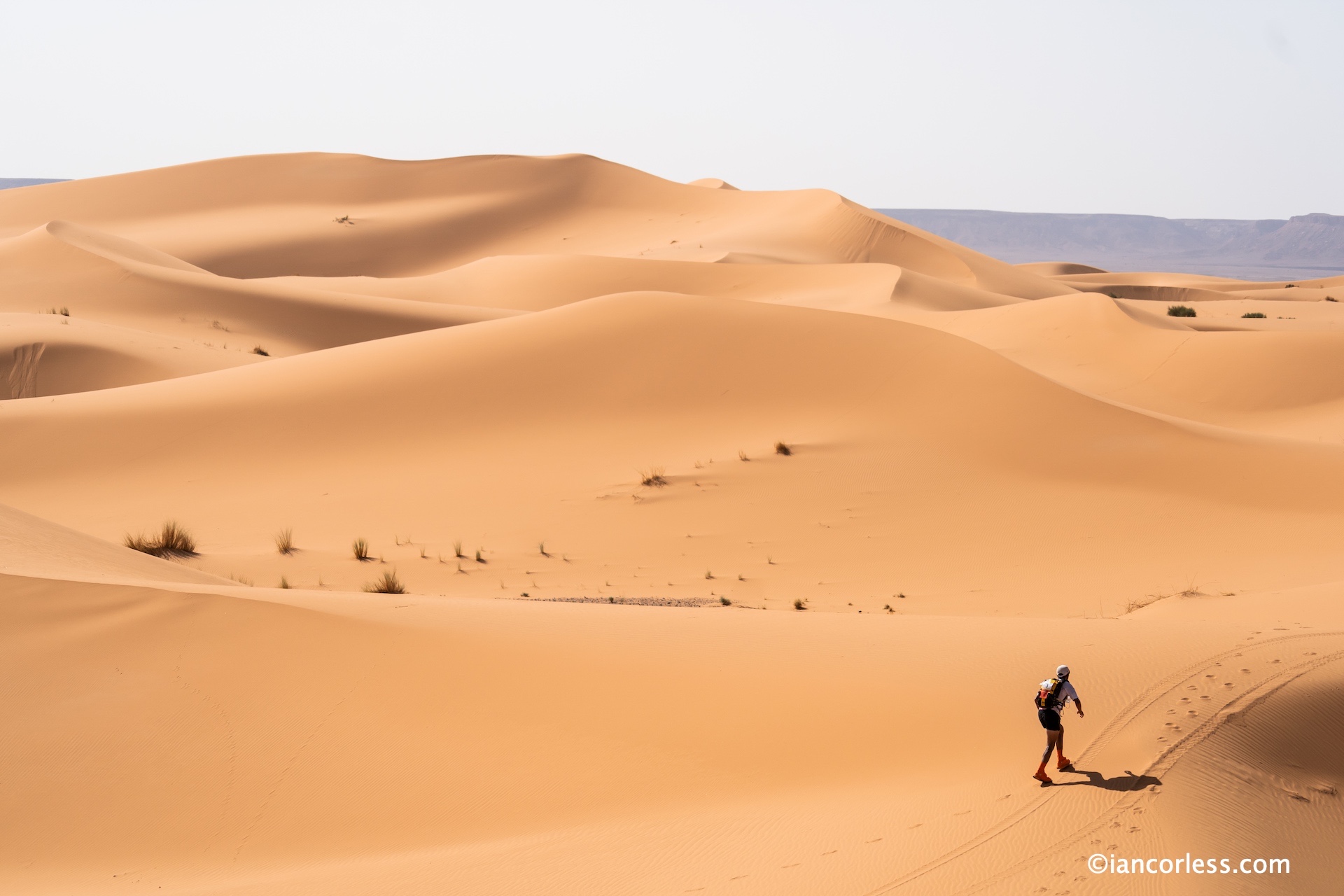
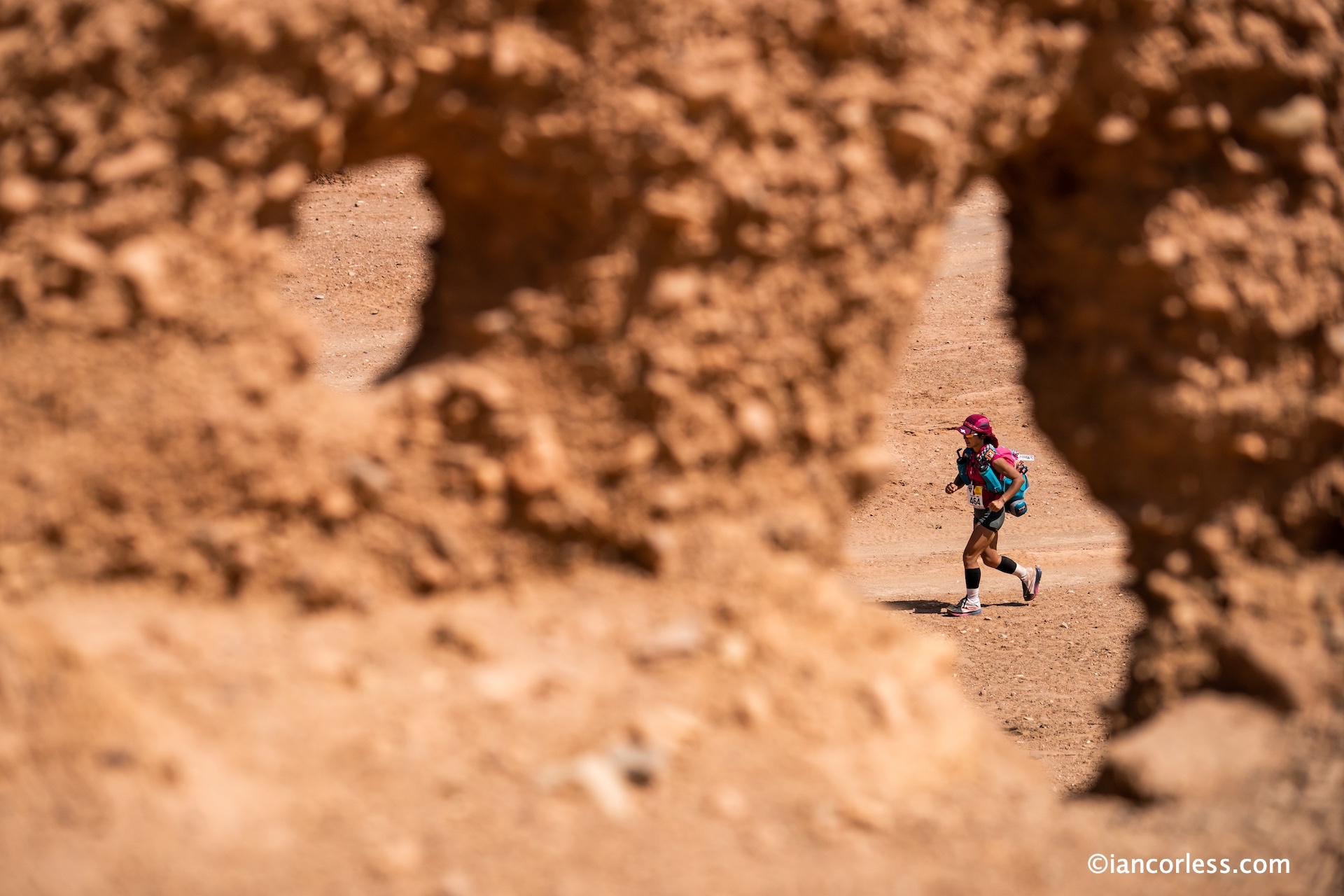
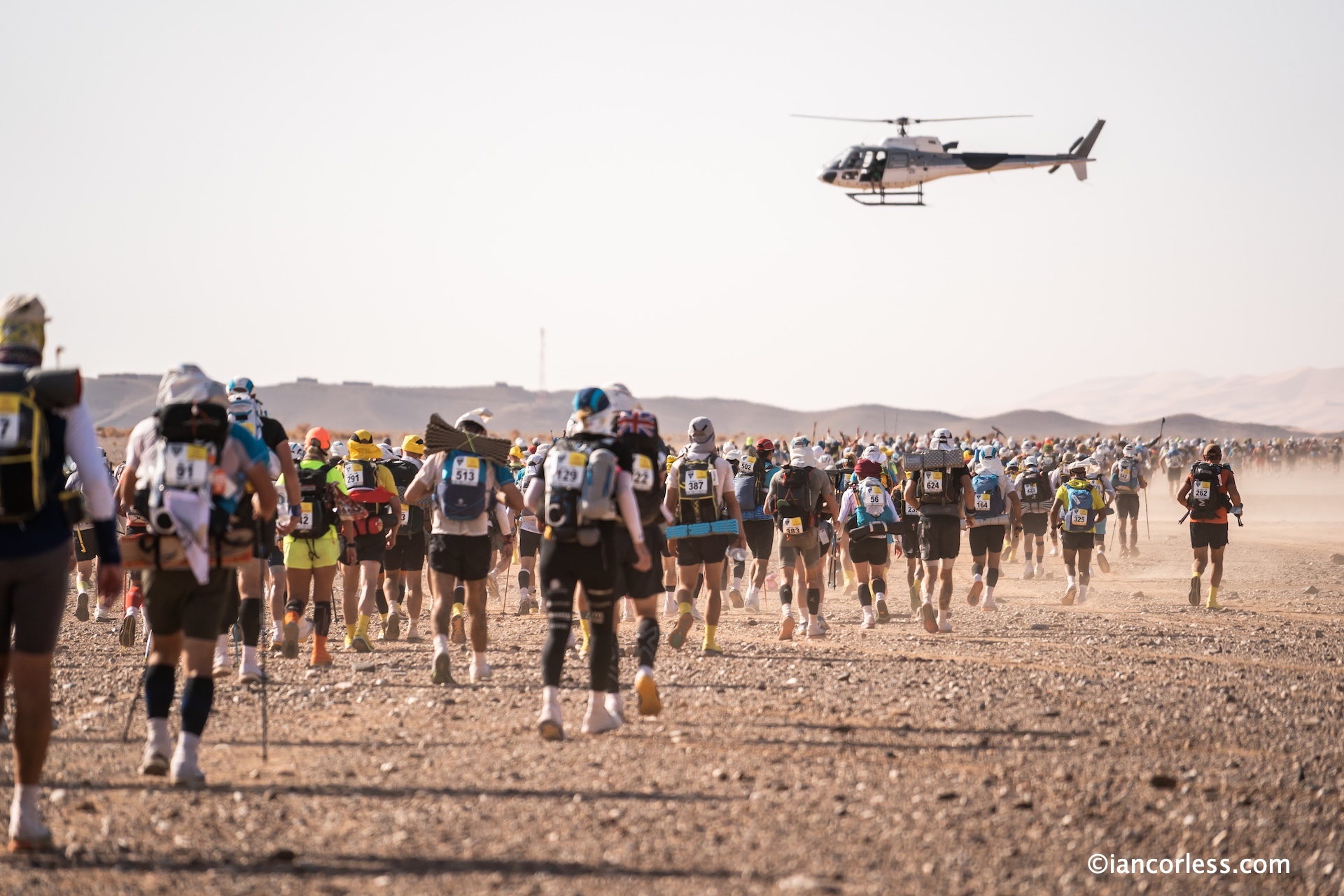
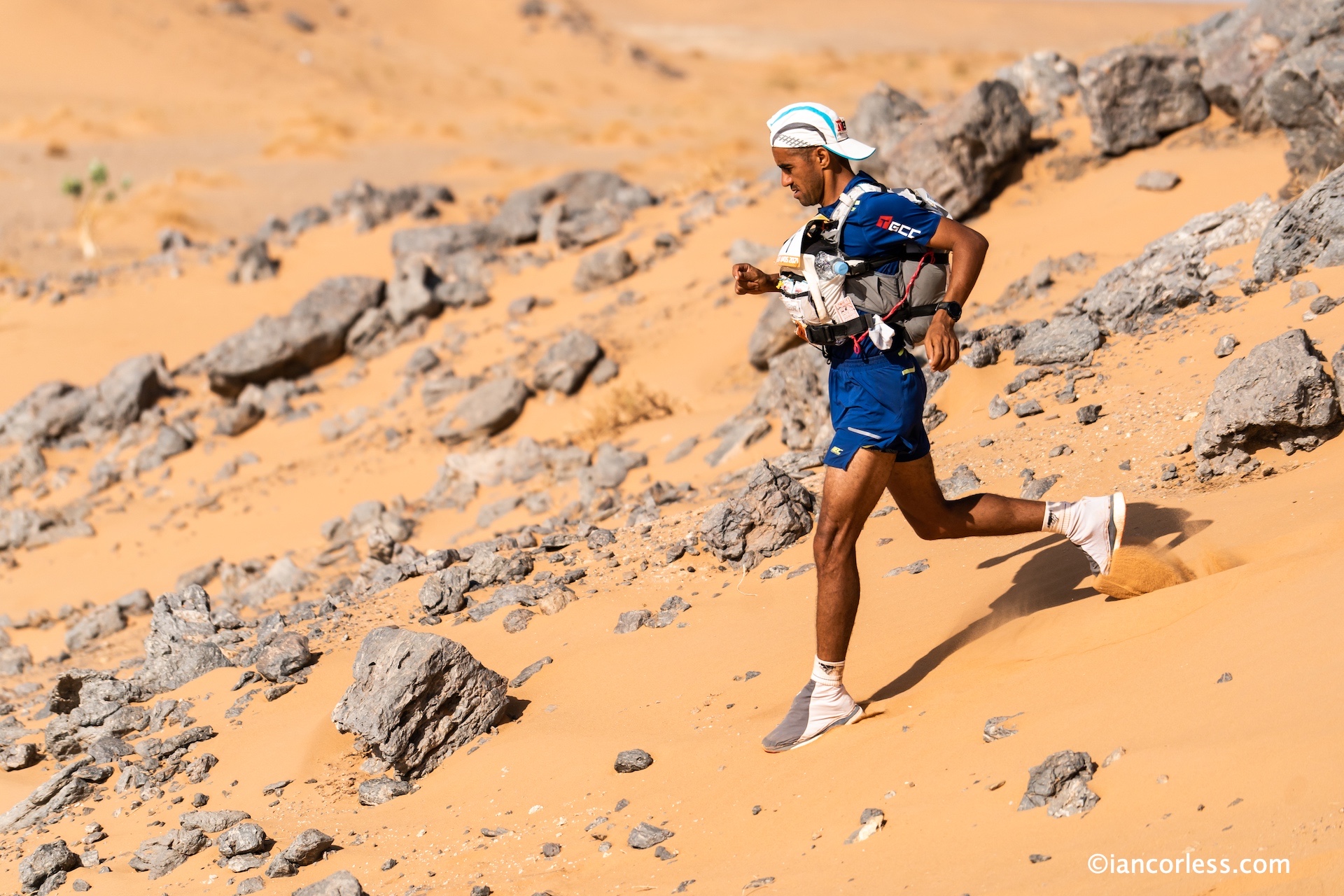
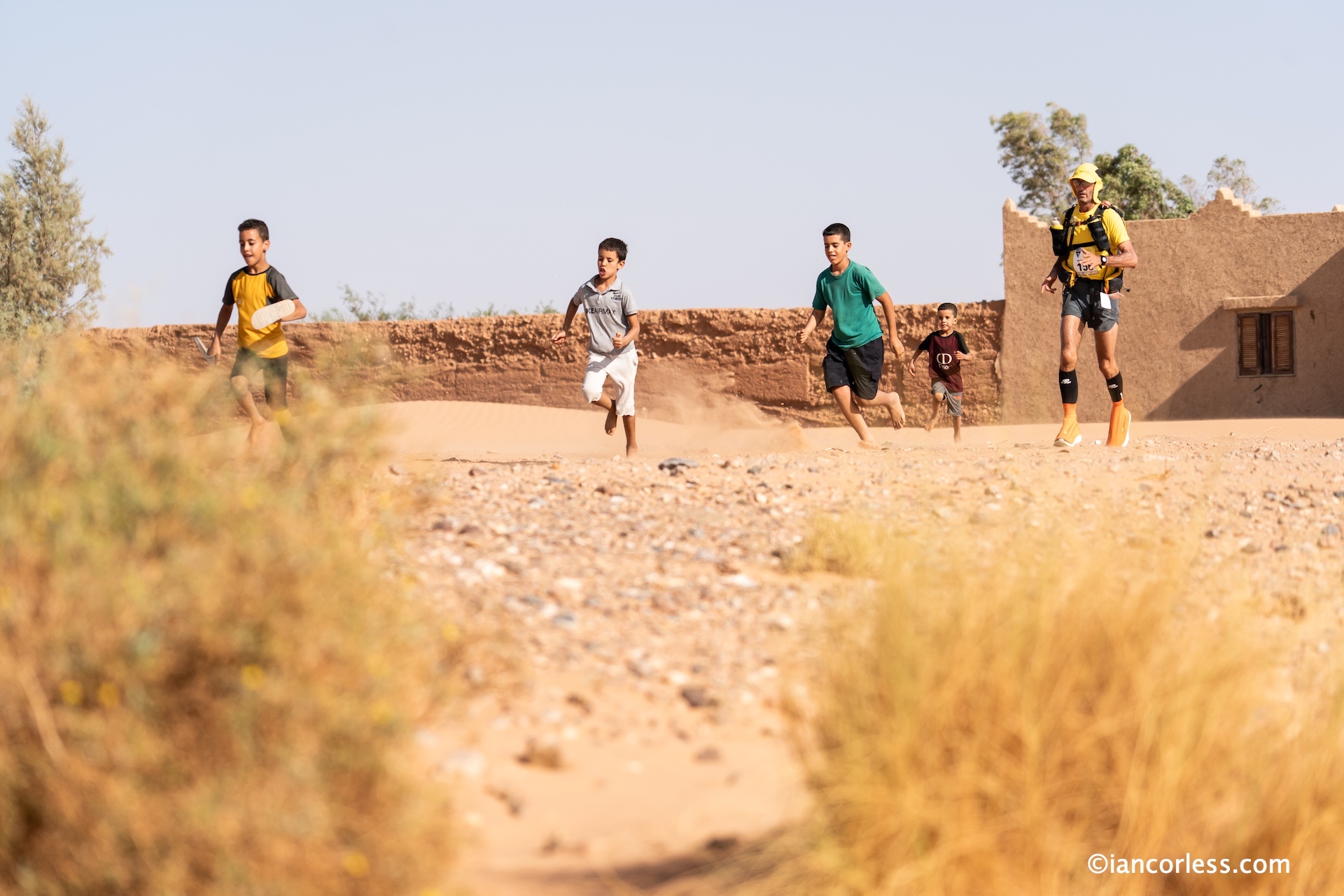
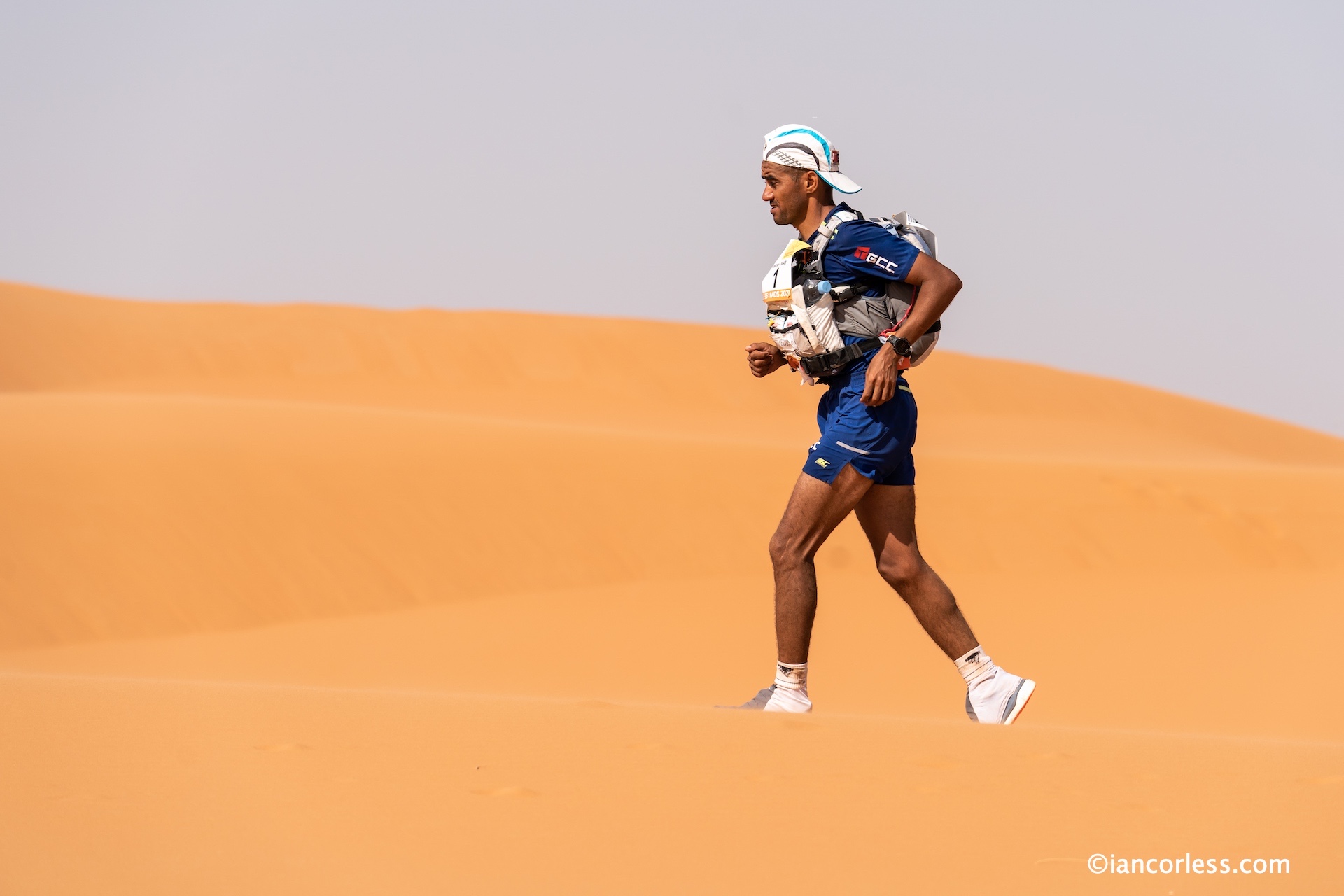
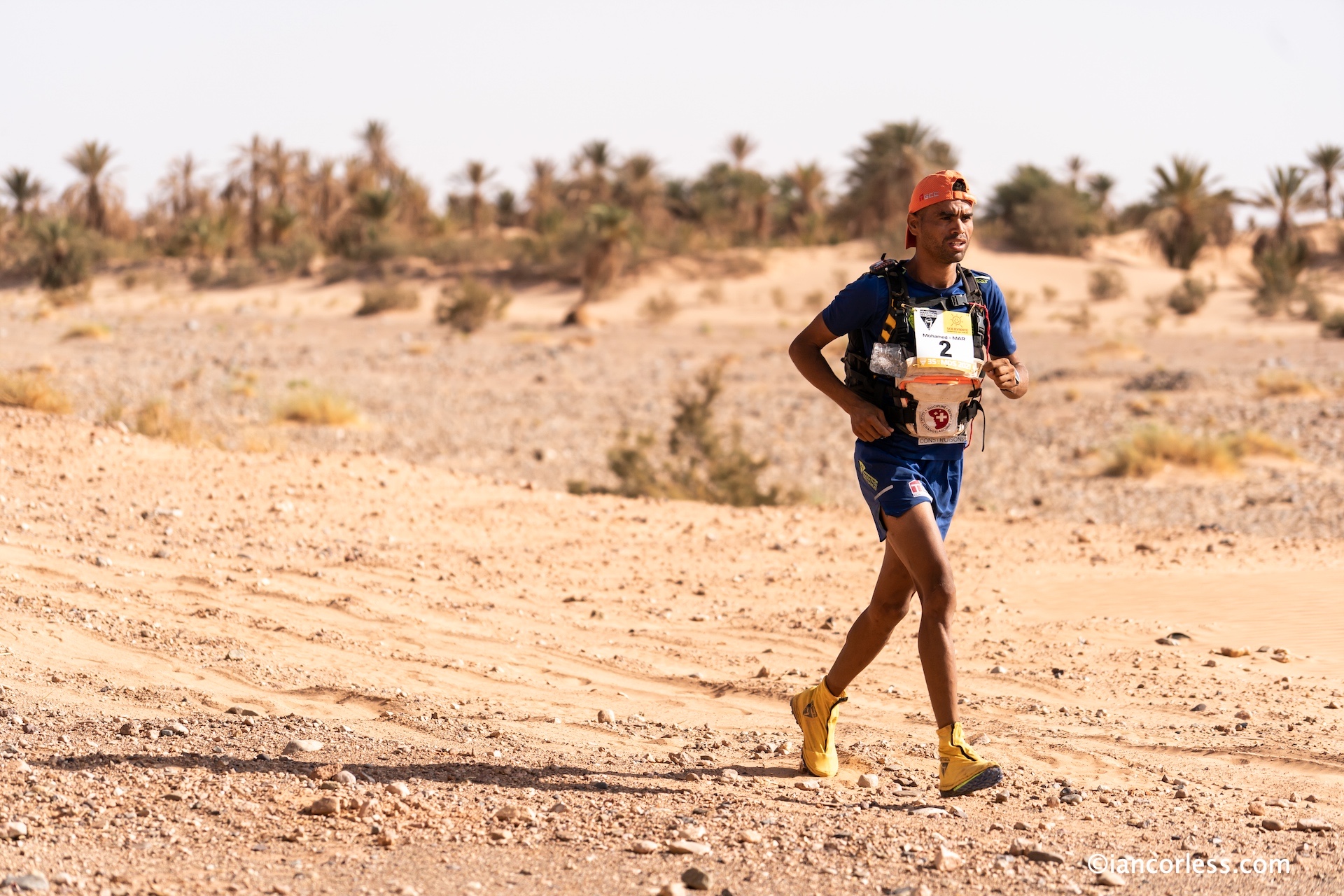
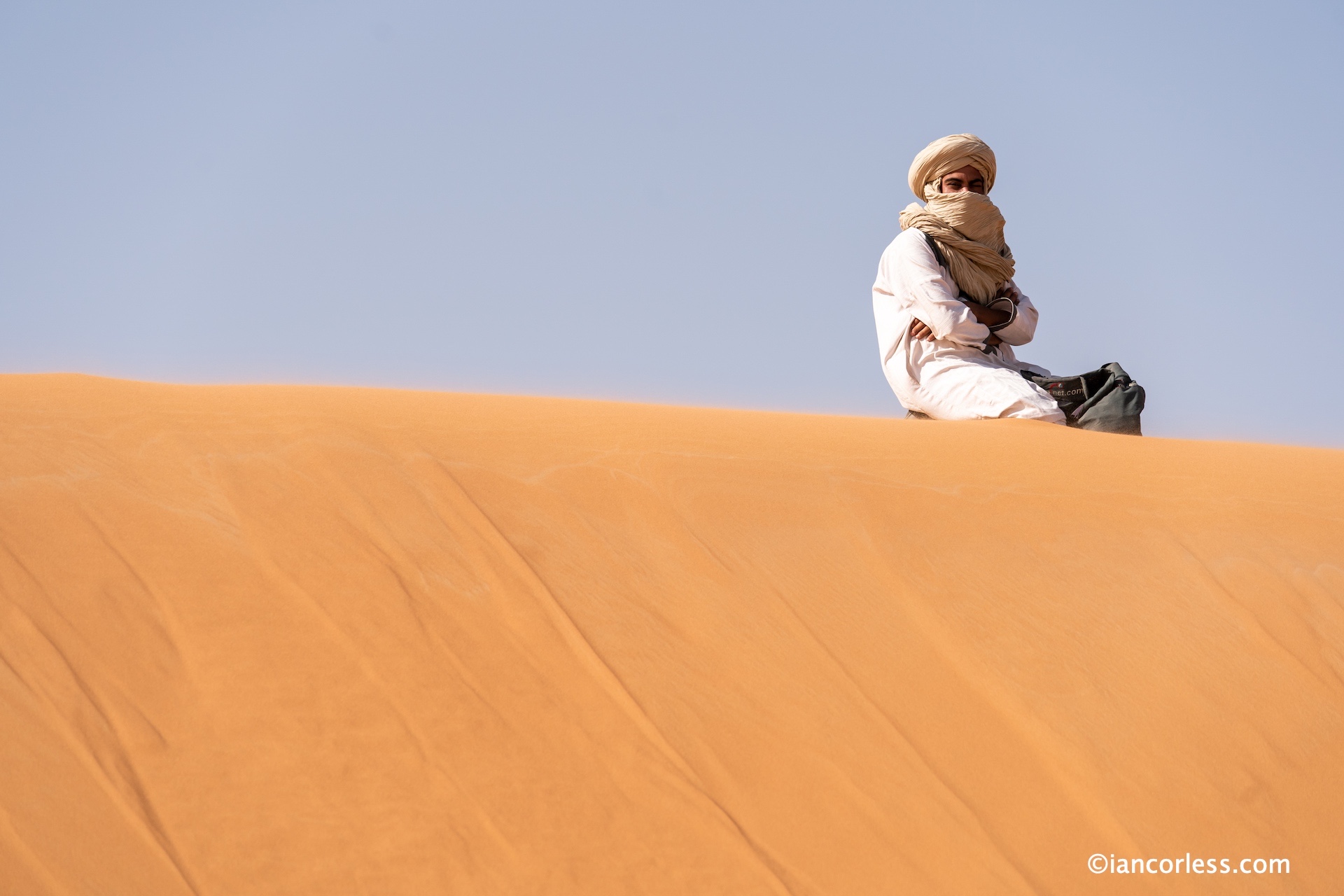
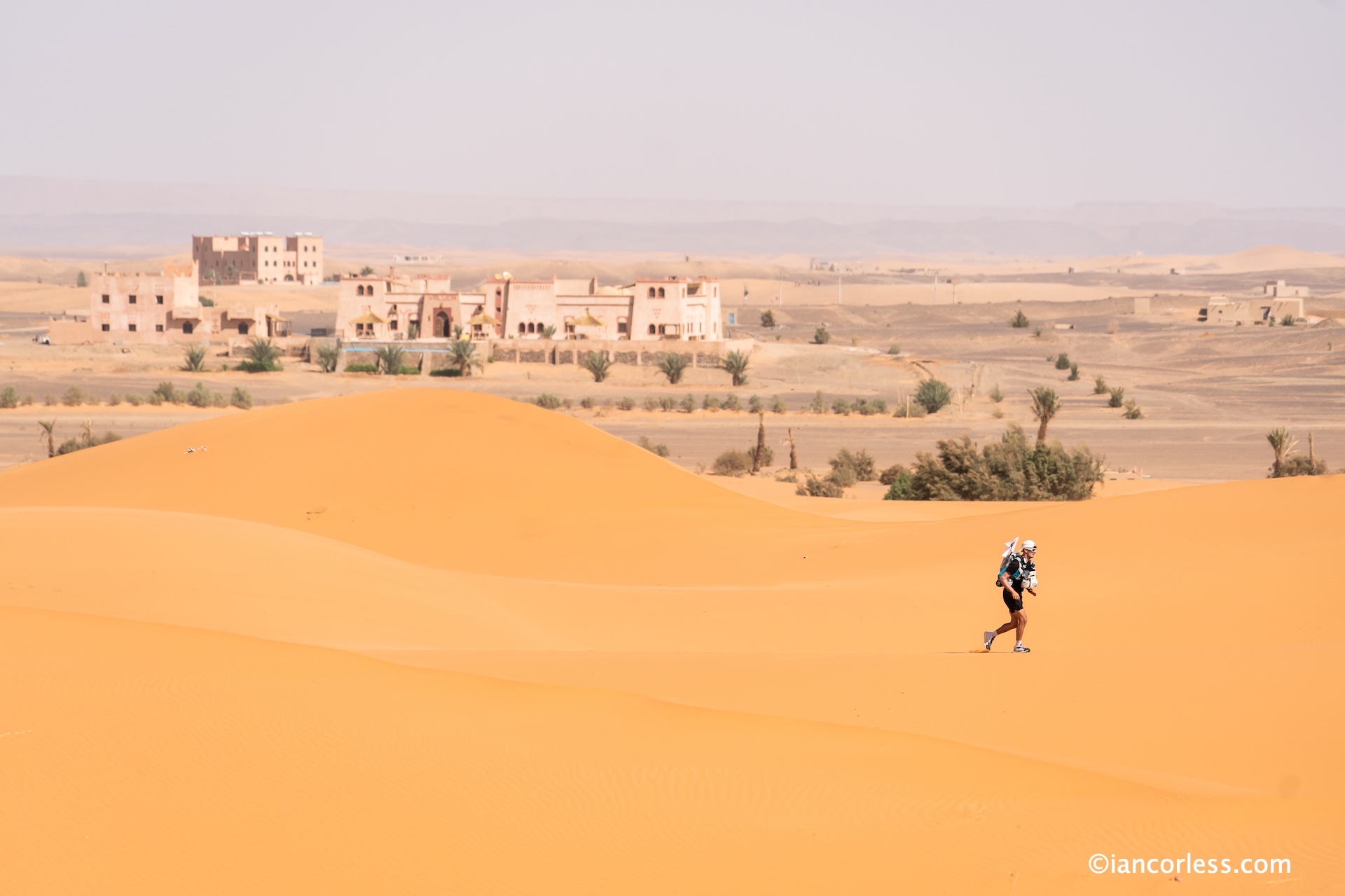
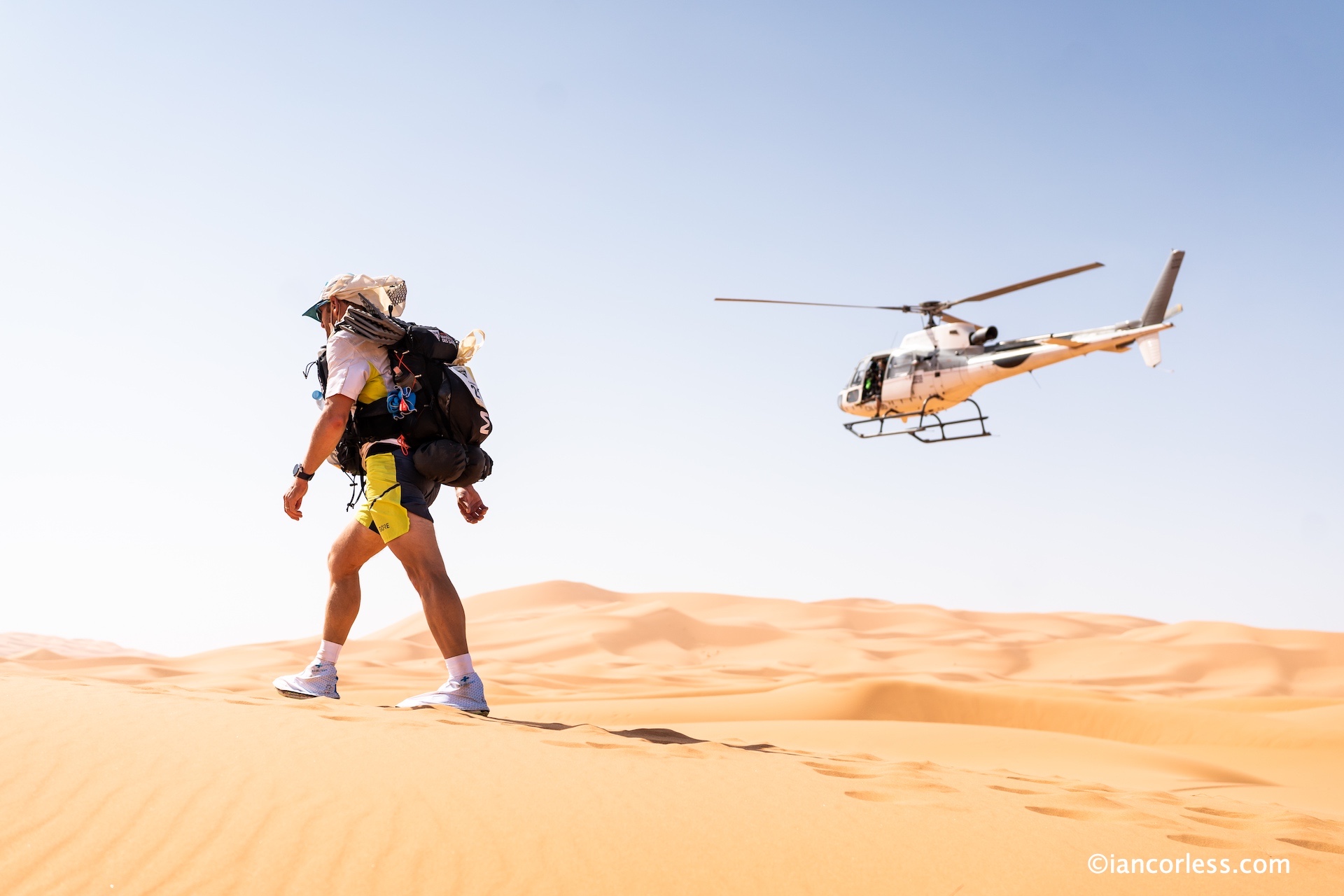
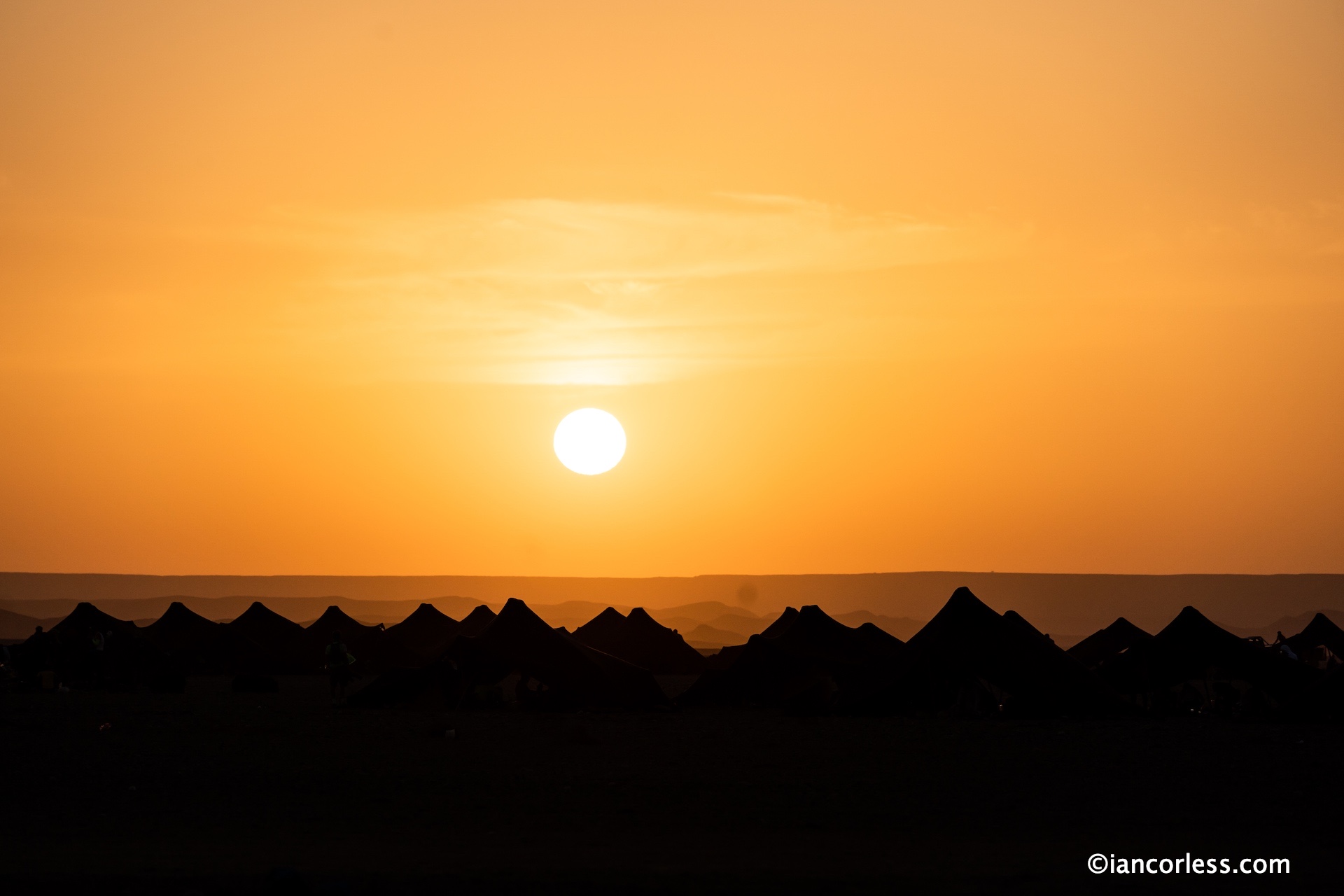
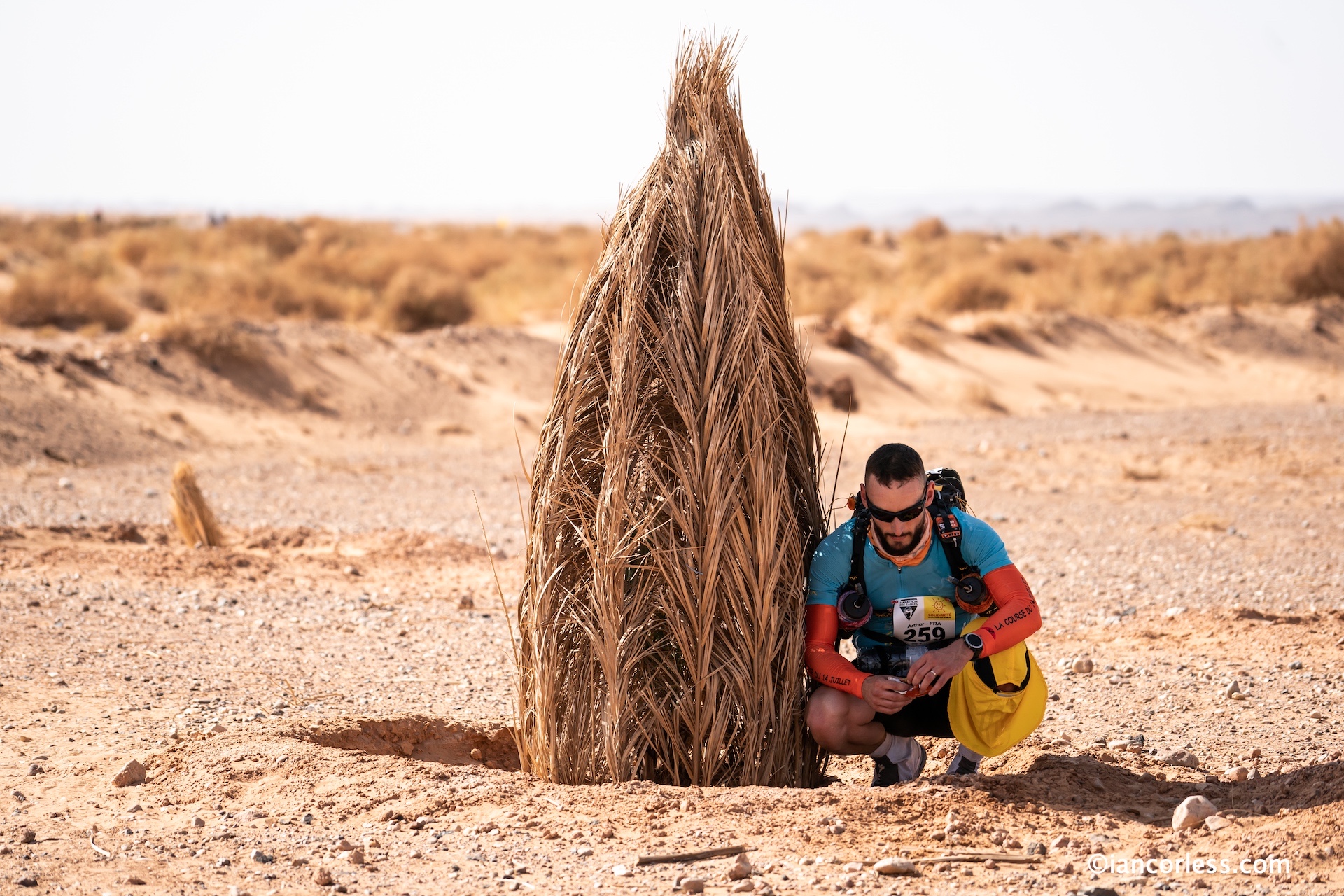
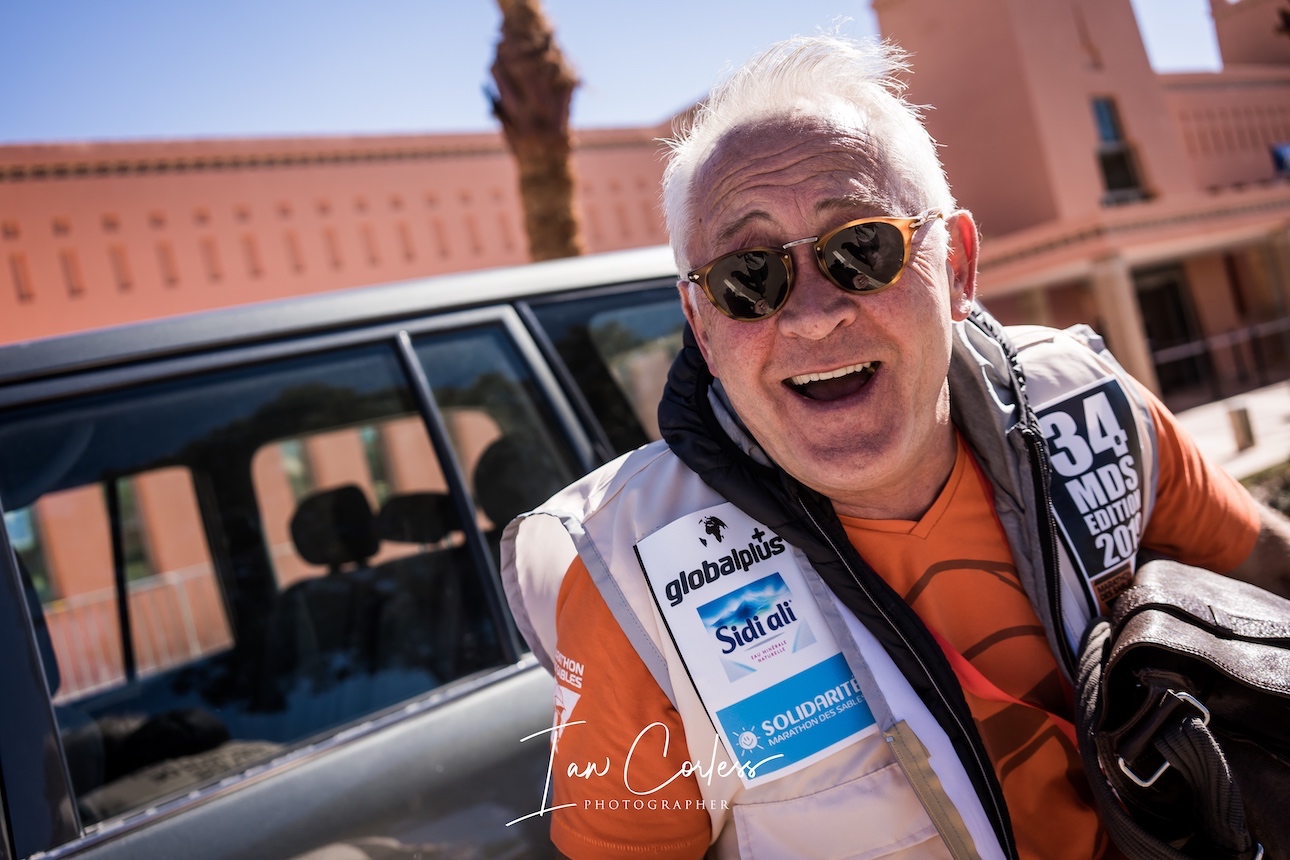
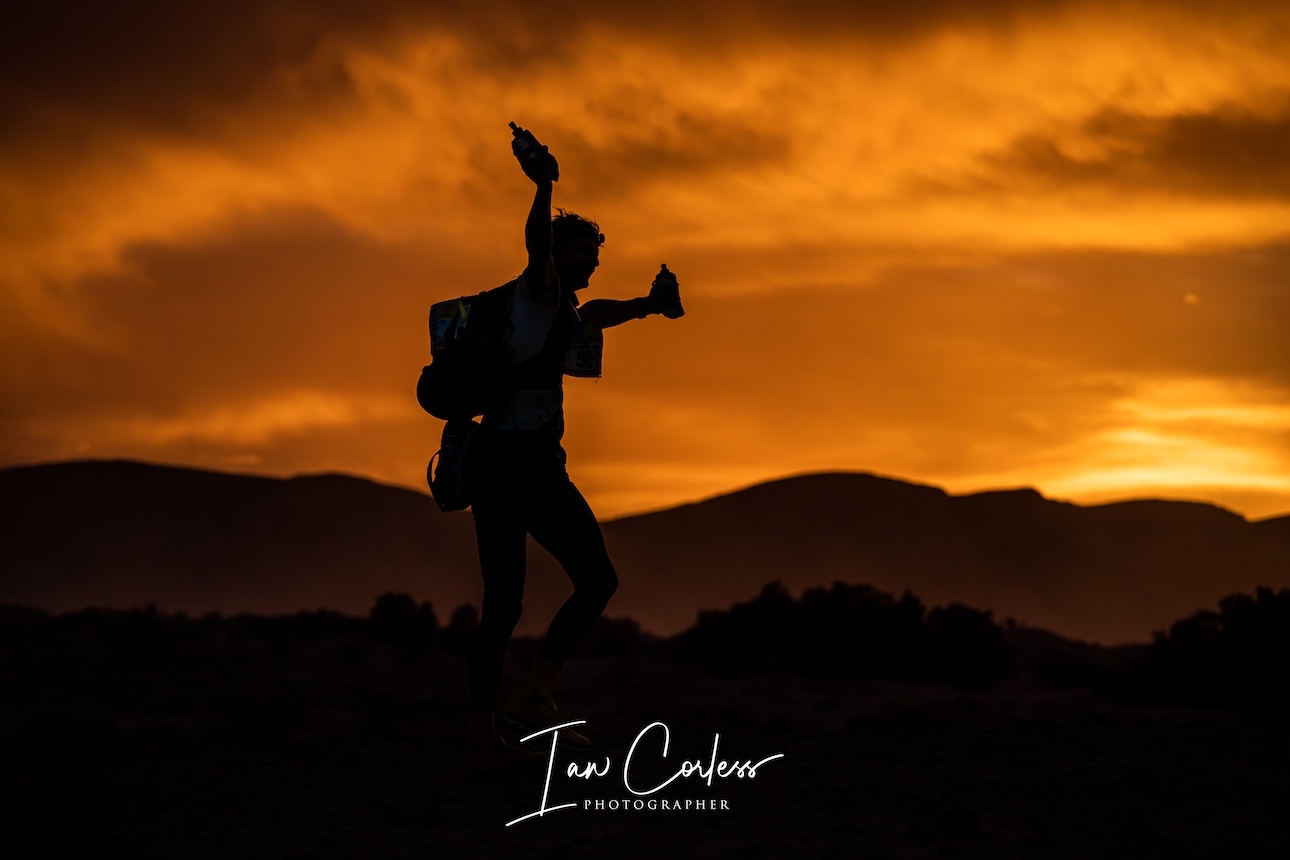
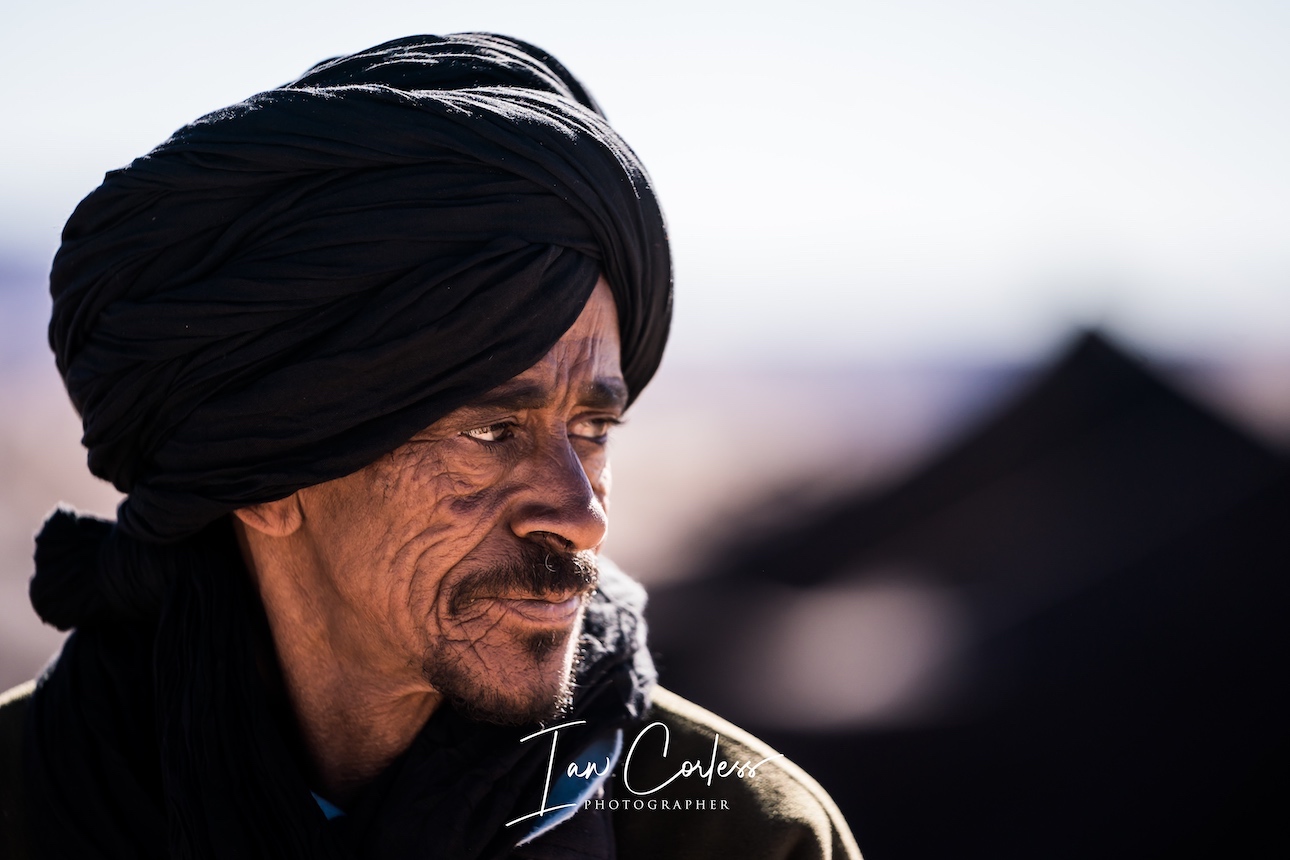
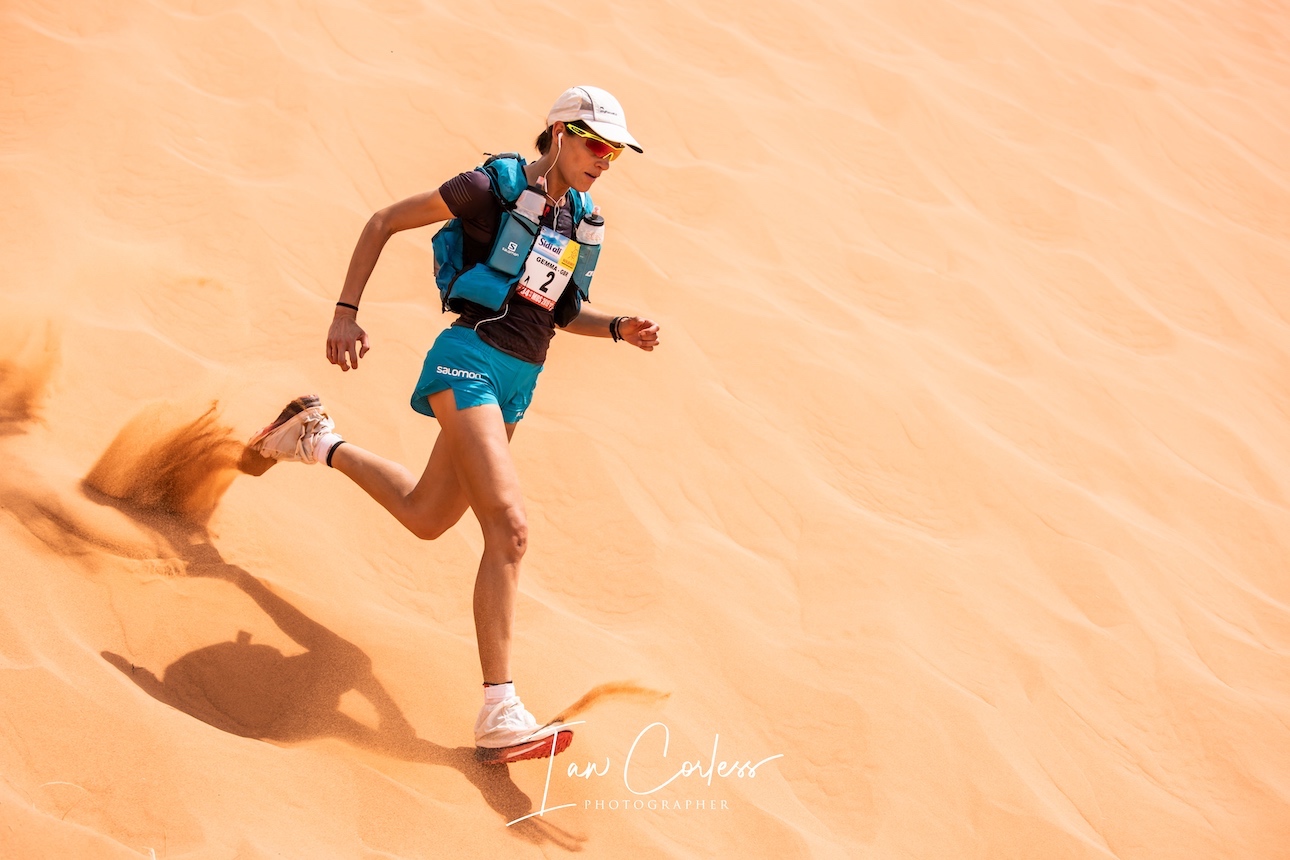
The long day. The description and course distance for the toughest day of Marathon des Sables had been ket secret until the end of day-3. This in itself mentally challenged each and every runner. It played with the mind and of course, many asked questions of what the day would entail. In the end, the distance was a classic 82.5km with the unique challenge of climbing Jebel El Oftal during the night, except for the top and fast runners.
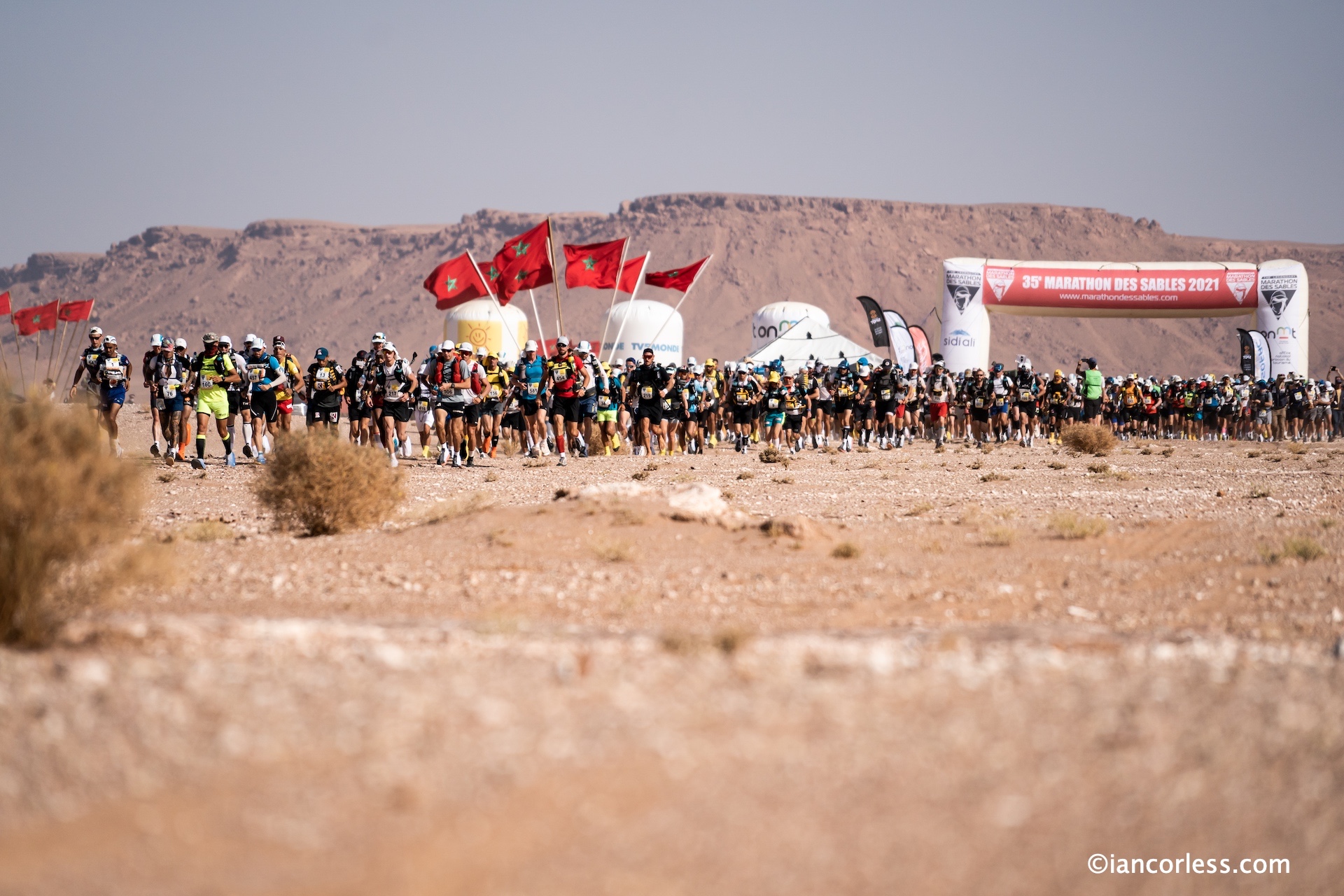
The mood of day 4 was mixed, there are two starts, the masses departing at 0815, the top-50 departing later at 1115.
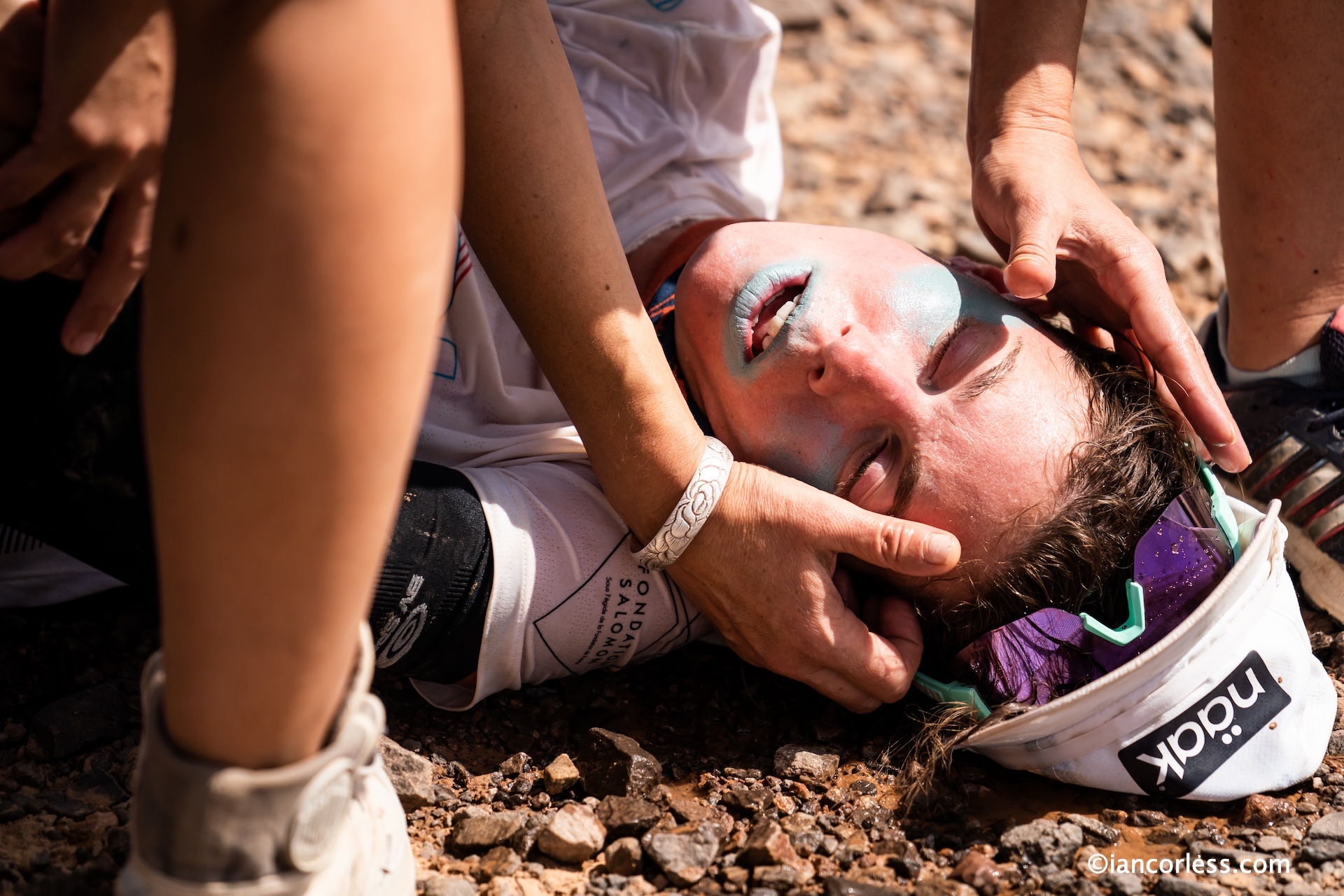
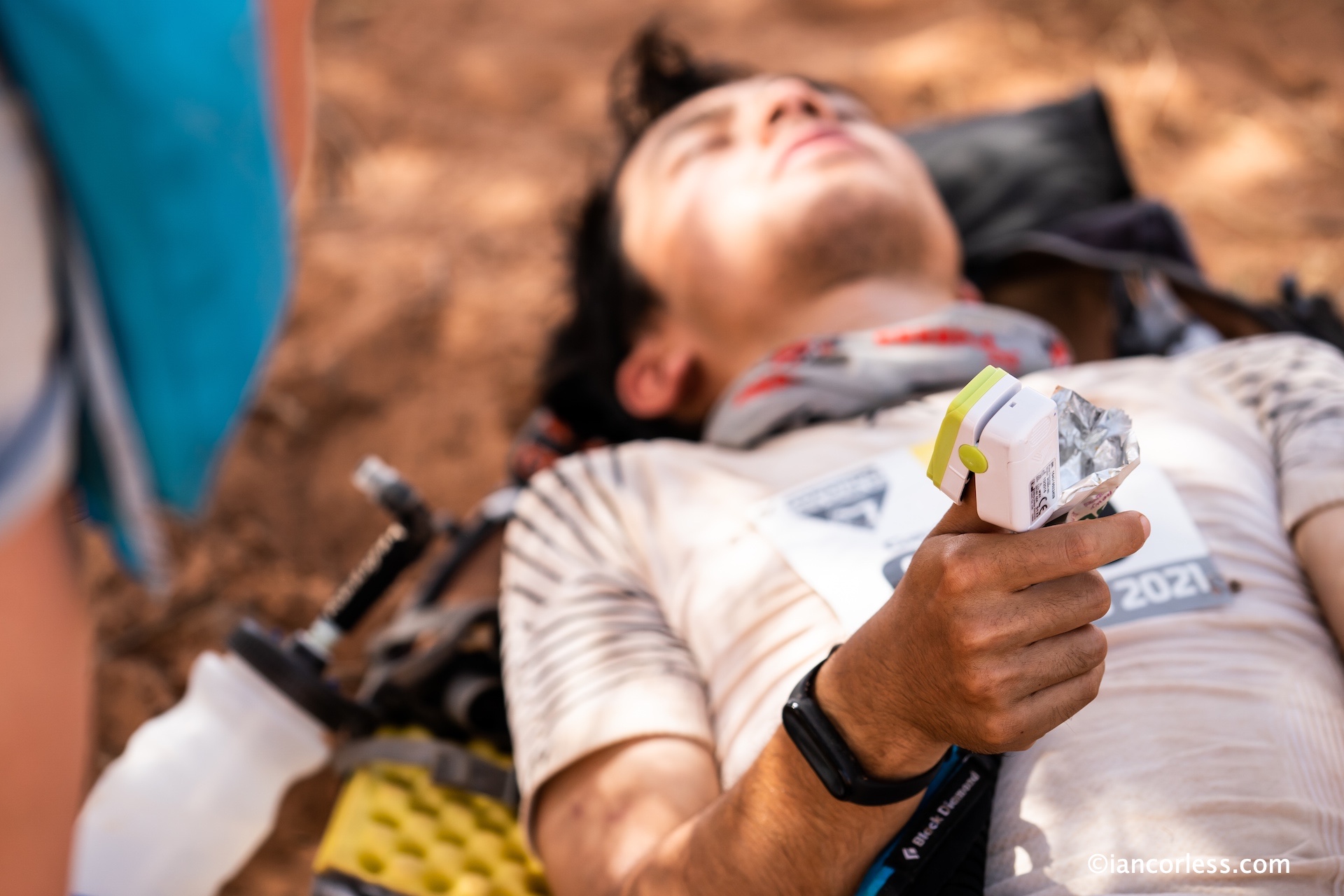
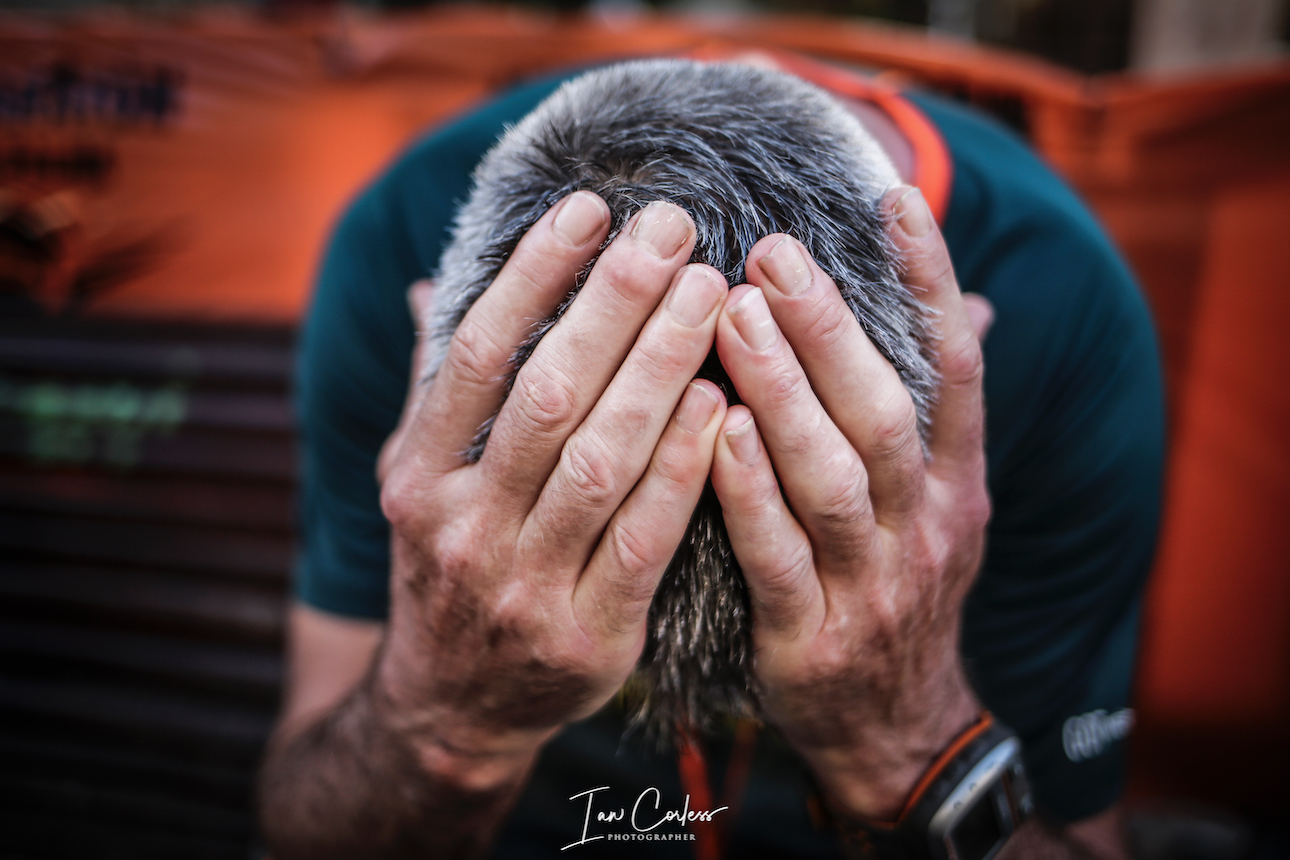
Unfortunately, the devastation of heat and sickness and once again took its toll during day 3, during the night and in the morning of day 4. The exact drop out rate to be confirmed but certainly, statistics are showing that it is highly likely that less than 50% of the field will finish the 35th edition of this iconic race.
The illness and sickness has not only impacted on runners but also staff, logistical and medical teams making the race, at times, almost feel like a war zone.
However, the race goes on and with it, for some, a very well and hard earned medal at the finish.
Stage 4.
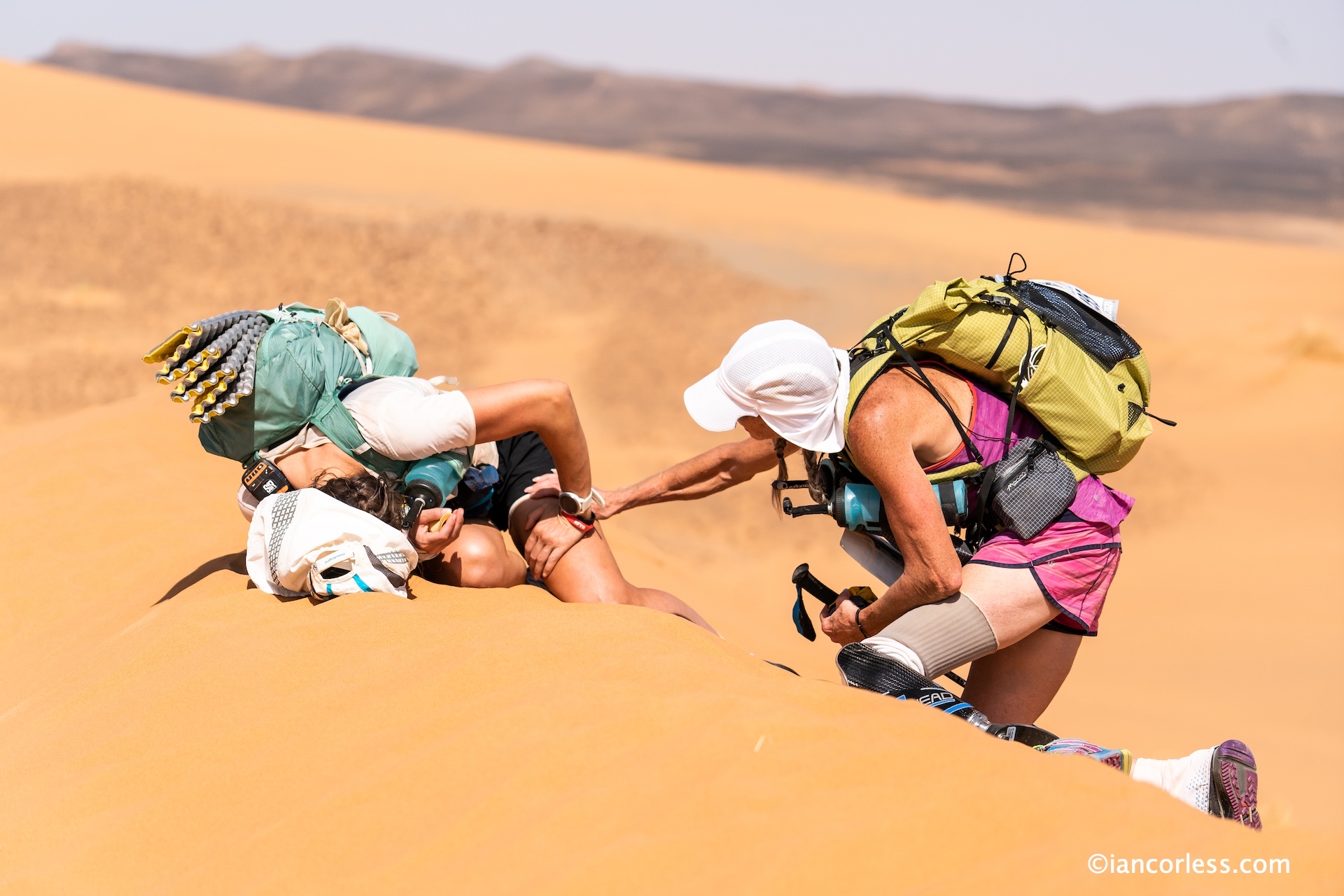
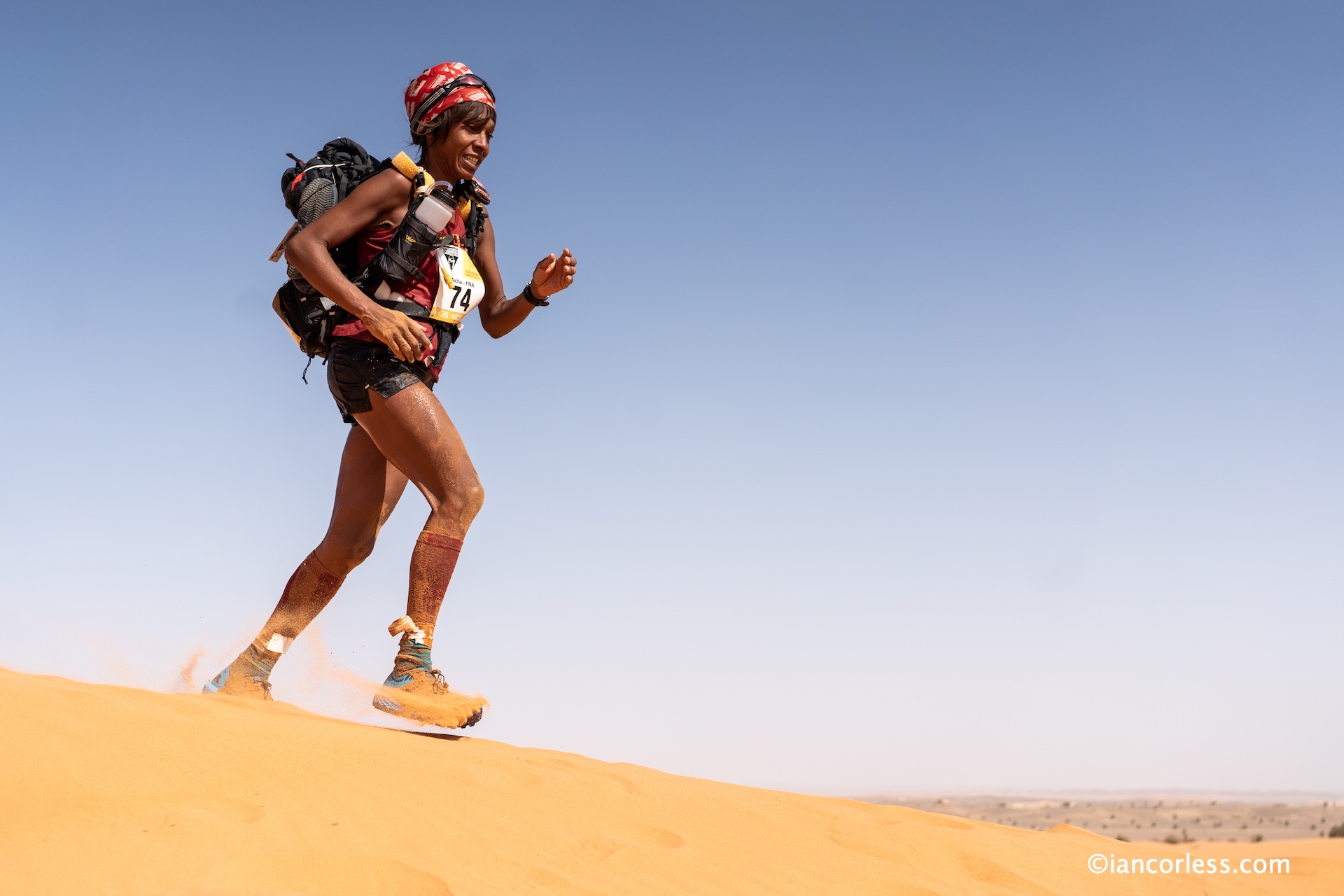
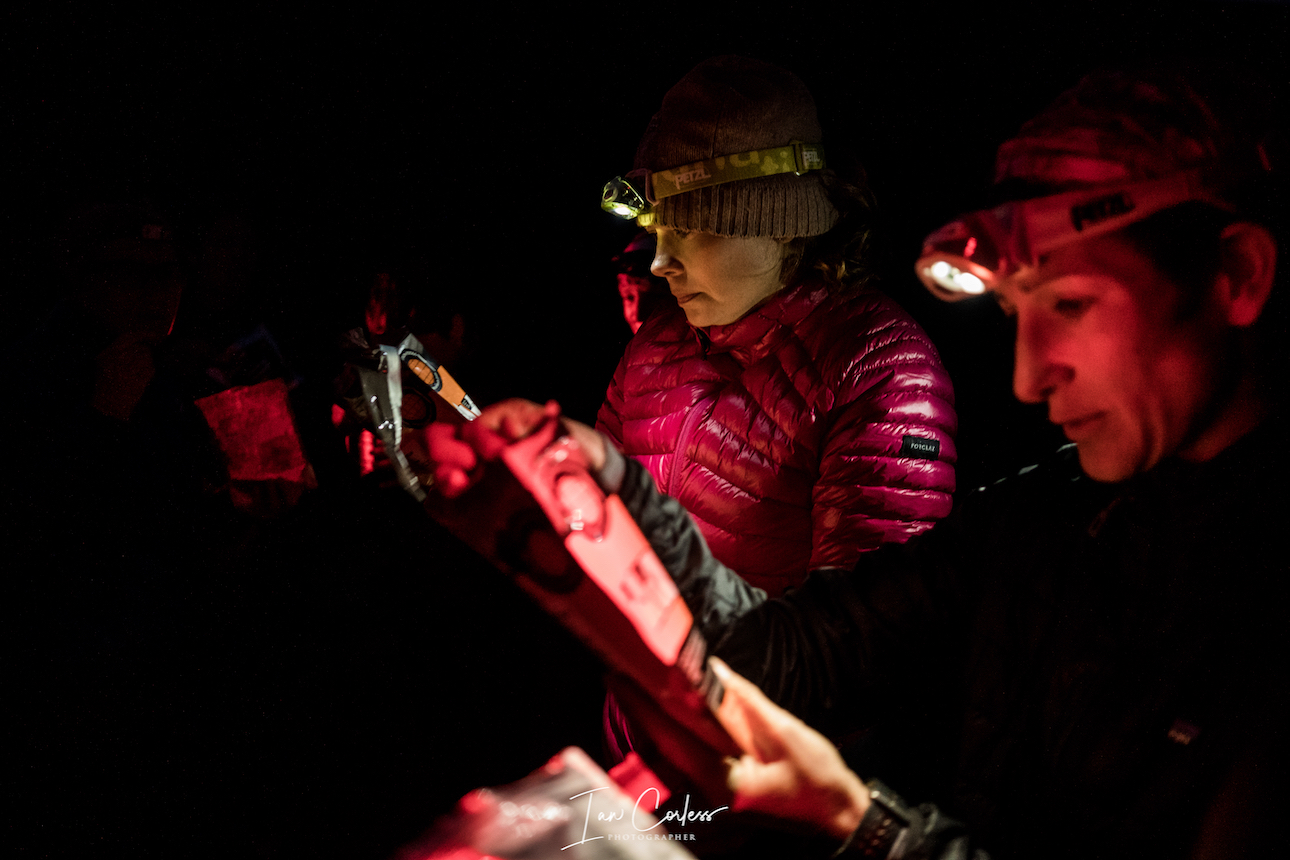
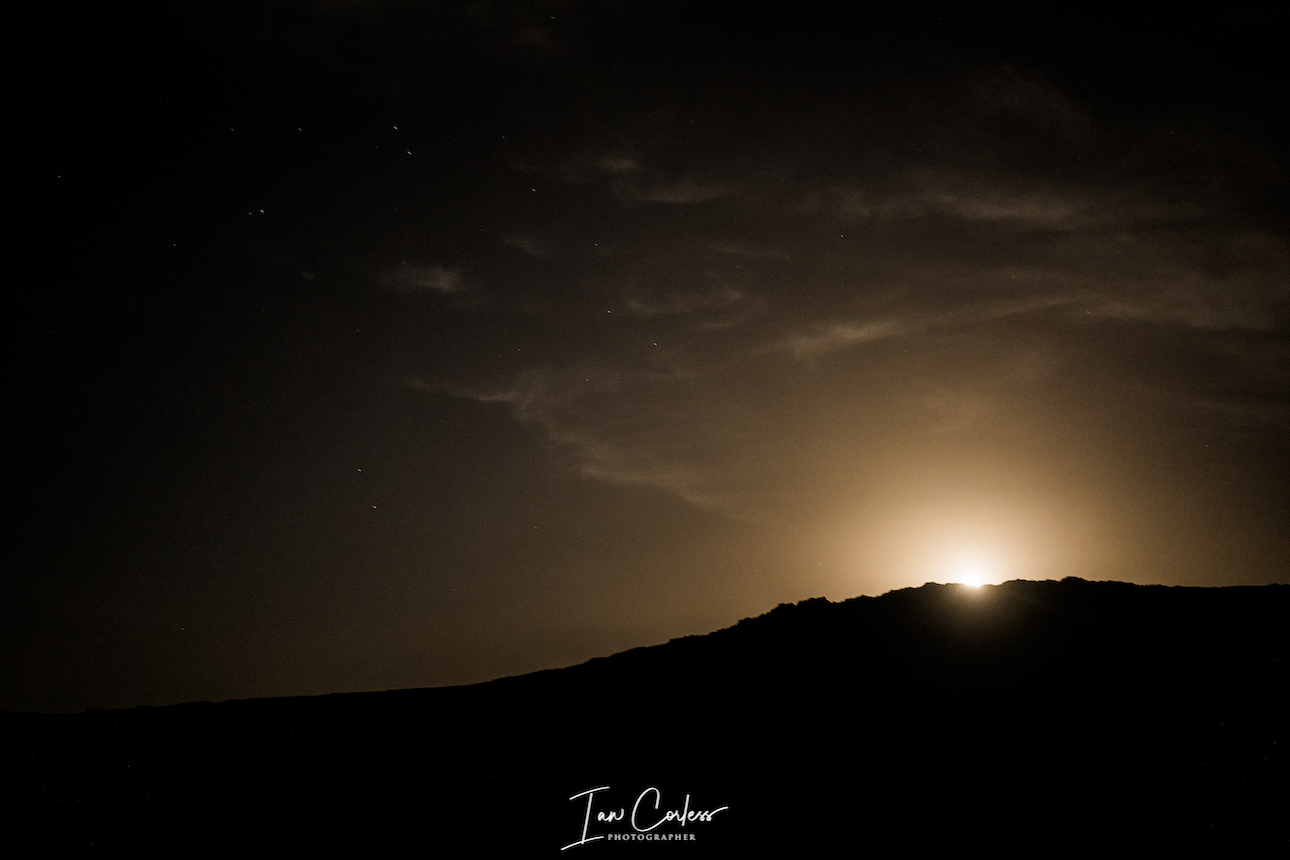
With over 20km’s of soft sand and dunes, the climb and descent of Jebel El Oftal, intense heat and balancing hydration and sickness, stage 4 of MDS was never going to be easy for anyone. This became apparent early on with many struggling to reach CP1.
The plan for most was to keep control and reduce stress during the day and then make the most of the cool night to gain time and ground.
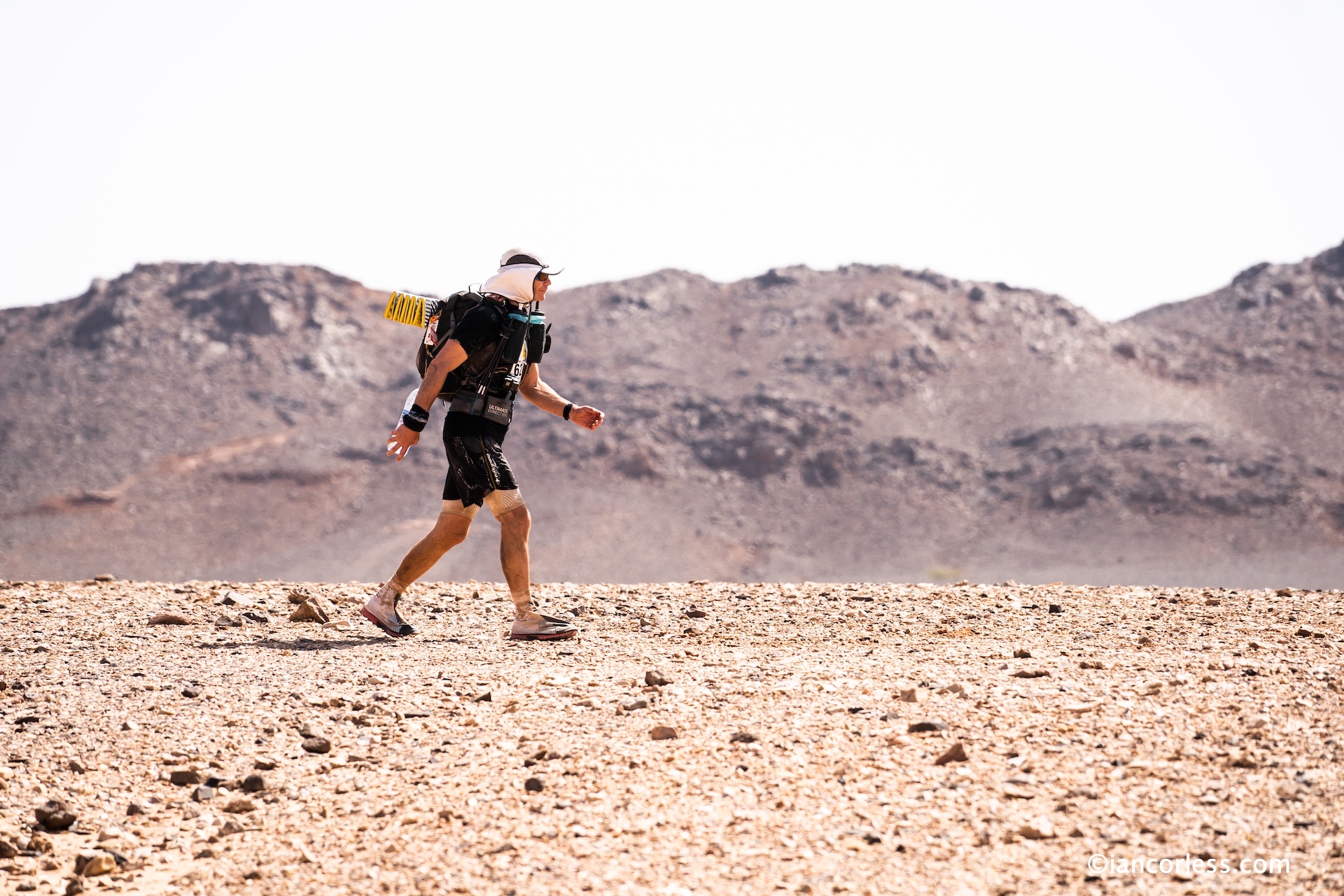
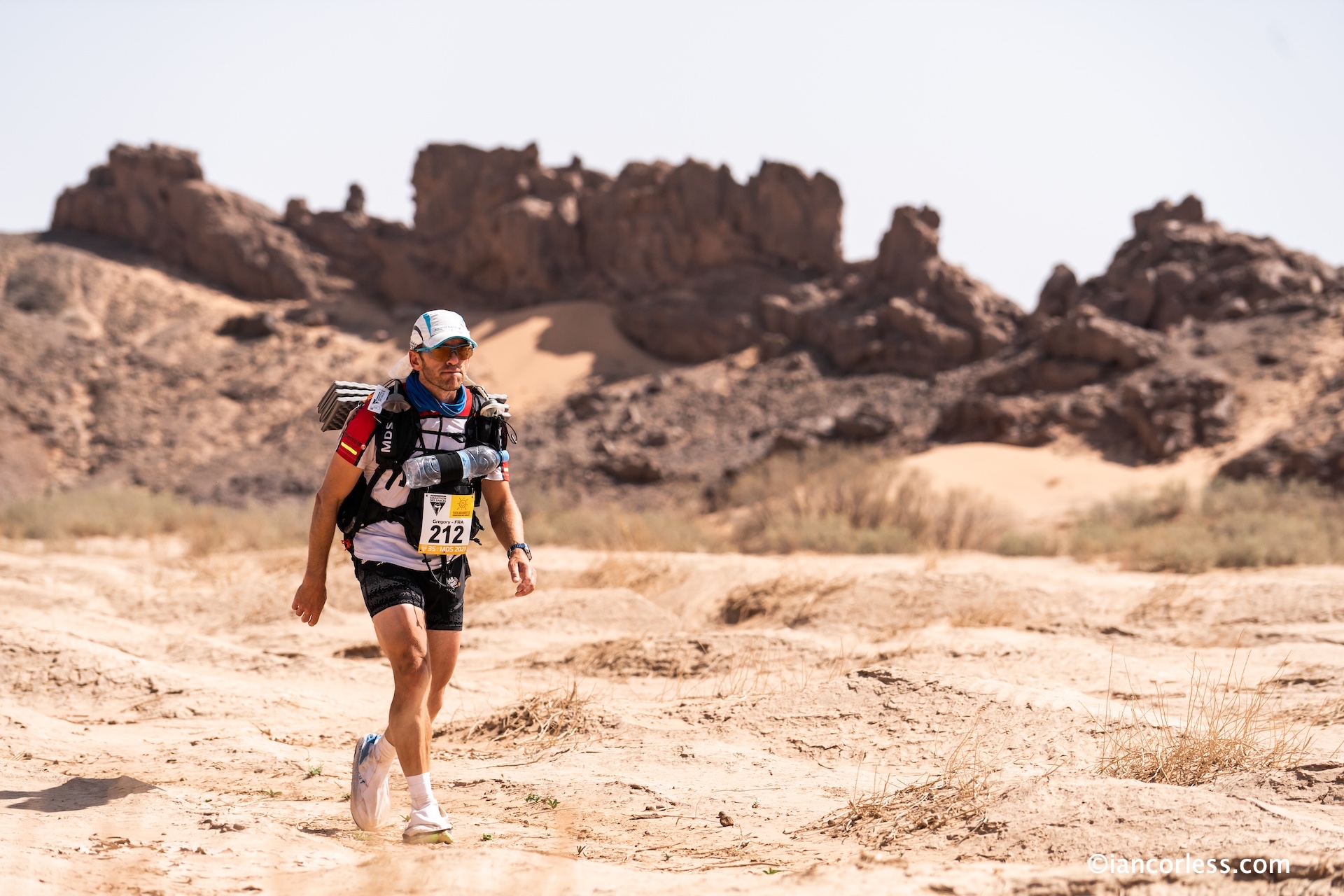
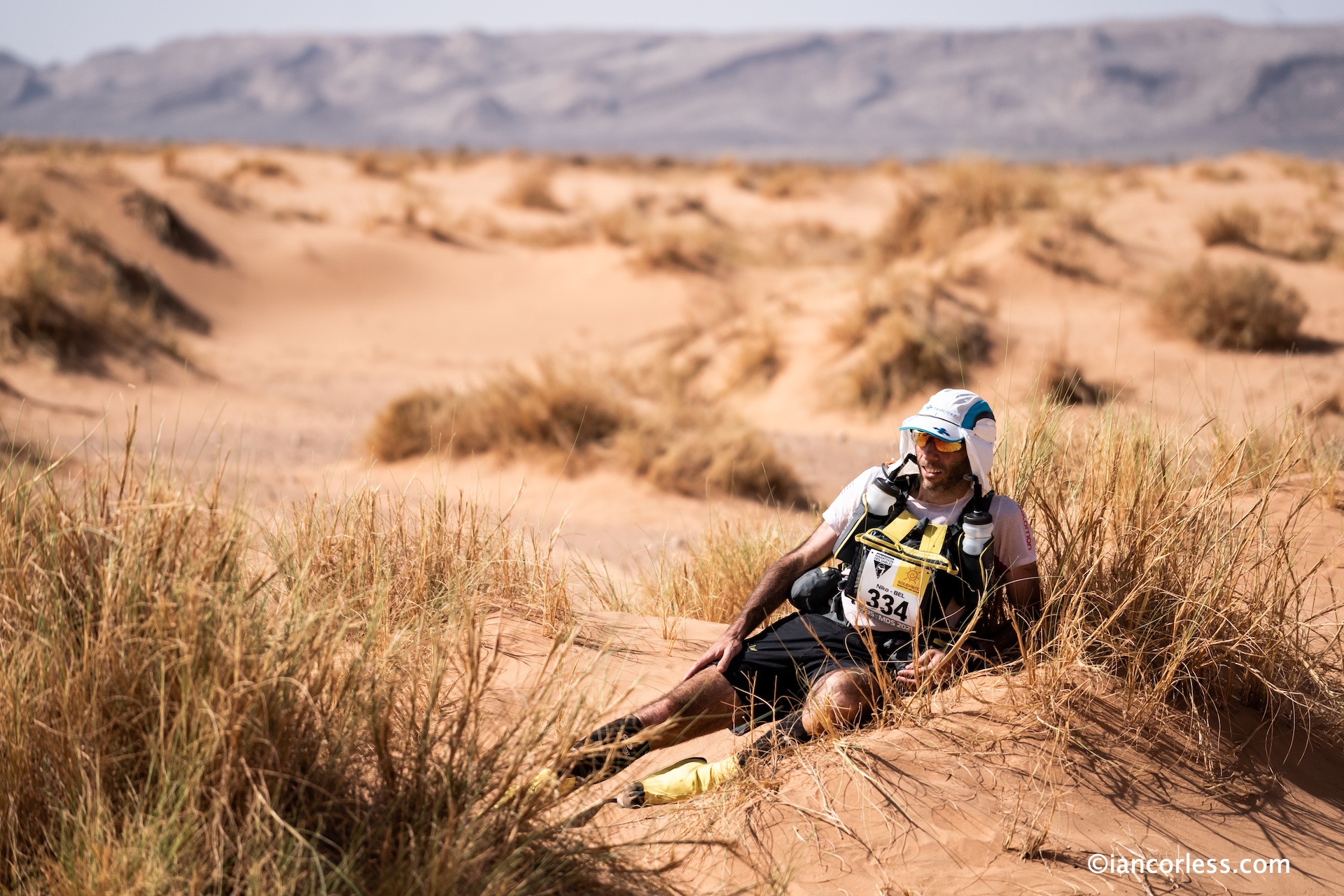
Few were running. It was all about marching, one foot ahead of the other and survive.
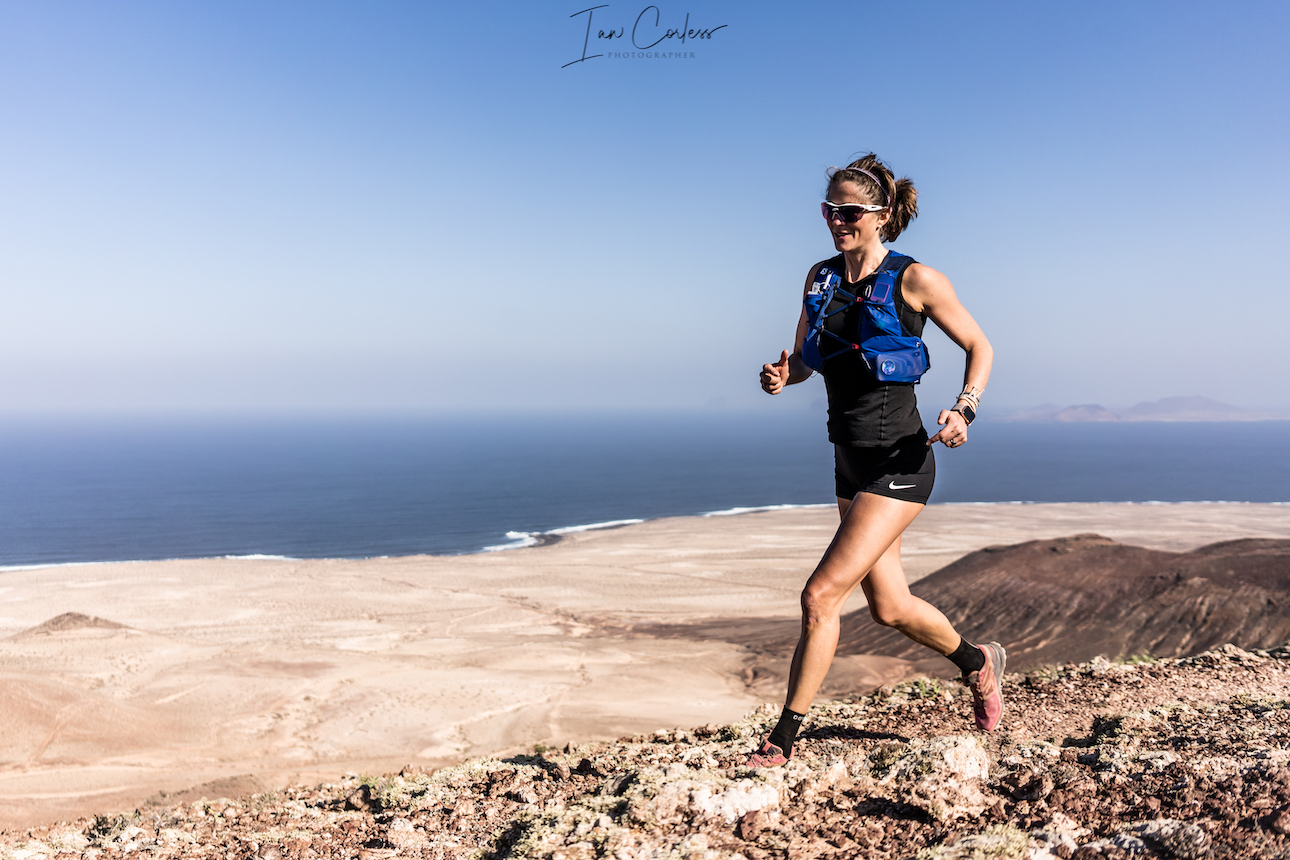
Of course, the elite wave was slightly different with the top men and women still setting a relentless and excellent pace.
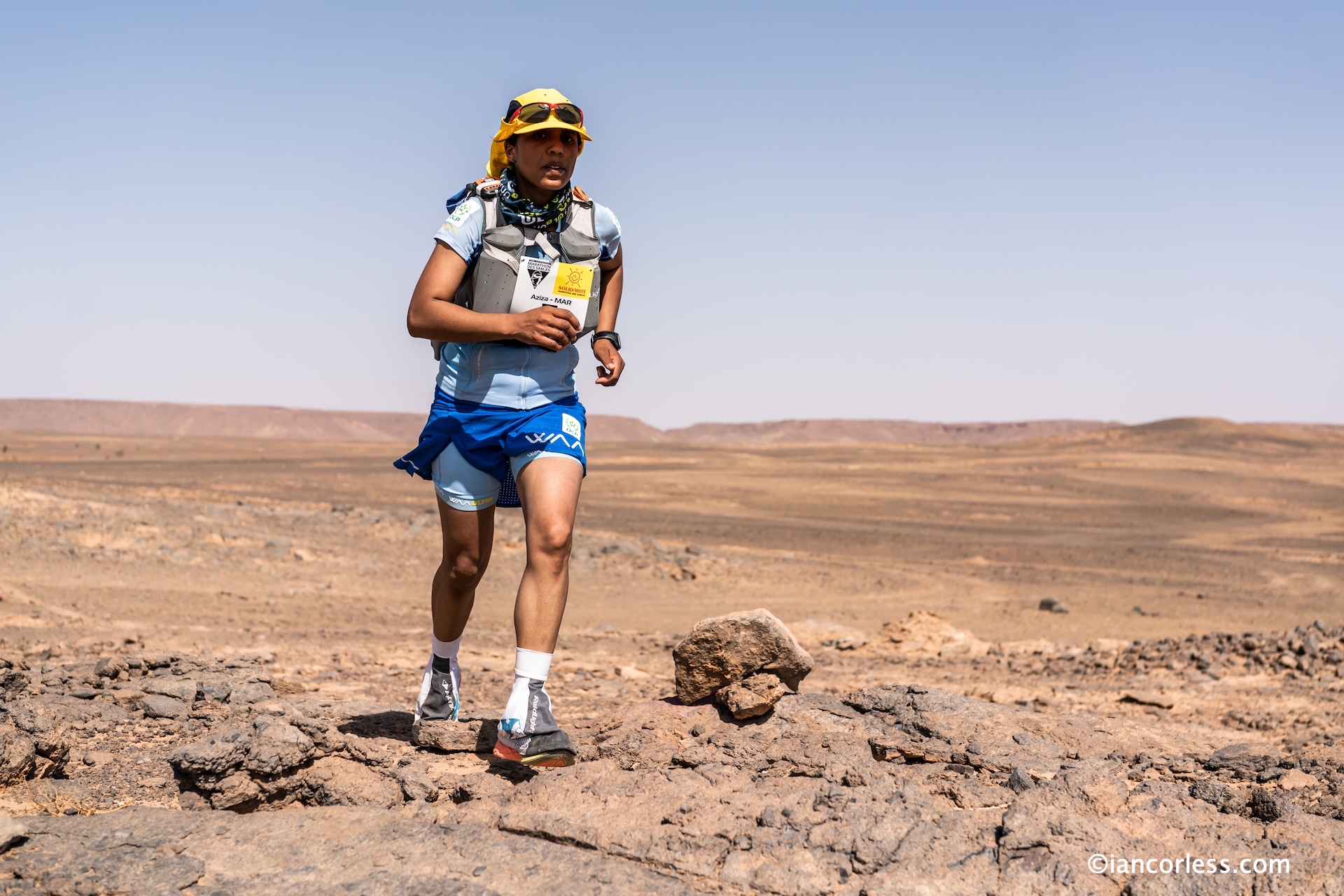
Aziza Raji for the women showed local knowledge and an understanding of the heat, the terrain and the race to excel on the 82.5km stage and take a convincing win. Aichi Omrani had showed great intention on day-1 of the race but has learnt as the race progressed that sometime less, is more. This was the case for the long day. She paced herself with Aziza but then settled at her own speed to maintain a 6th place finish but her overall podium standing remaining 2nd. Race revelation, Tomomi Bitoh from Japan has run consistently well all race and on the long day she excelled finishing 3rd, always with an amazing smile and happiness. Severine Gaillez started in the early race start but set a great place to finish 2nd on the stage.
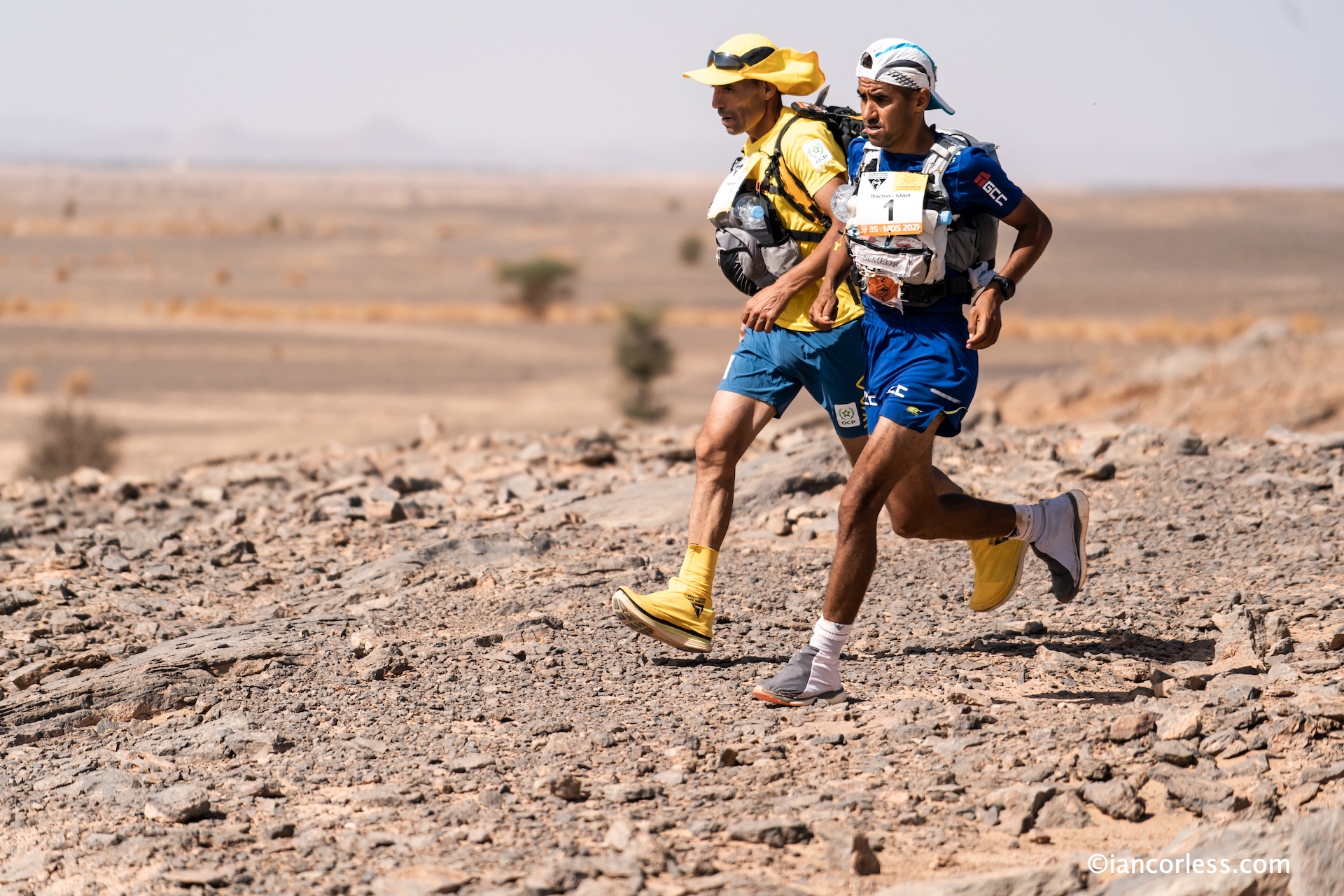
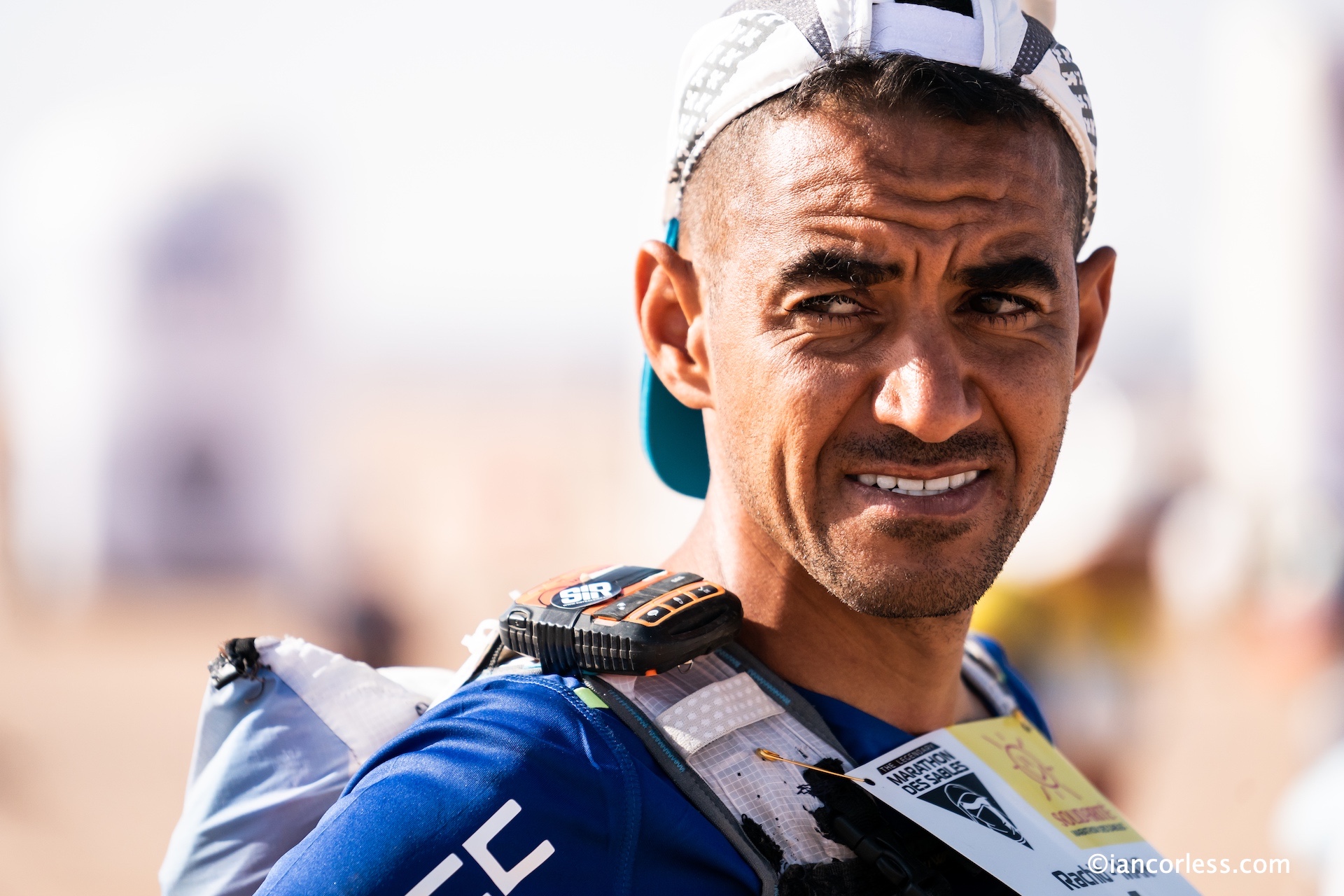
For the men, the expected challenge from French duo Mathieu Blanchard and Mérile Robert started well but sickness ruined Mathieu’s chances and while Mérile tagged Rachid El Morabity for a good percentage of the race, in the end, the Moroccan’s dominance and experience was just too great. Rachid took over the reigns at the front and ran a superb race.
Mohamed El Morabity once again finished 2nd behind his brother and Mériile finished 3rd.
Now the runners are fighting through another day for a coveted long day finish and the opportunity to tow the line of stage 5 and receive a 2021 35th edition medal from Patrick Bauer. The allocated time is 32-hours to complete stage 4’s 82.5km.
The elation of crossing the line is a special one.
Day 4 results (provisional):
Rachid El Morabity 8:46:16
Mohamed El Morabity 9:00:25
Mérile Robert 9:44:26
Aziza Raji 12:22:26
Severine Gaillez 14:45:57
Tomomi Bitoh 15:17:50
Please support this website. I believe everyone deserves to read quality, independent and factual articles – that’s why this website is open to all. Free press has never been so vital. I hope I can keep providing independent articles with your help. Any contribution, however big or small, is so valuable to help finance regular content. Please support me on Patreon HERE.
The 3rd stage of the 2021 Marathon des Sables started with a minutes silence and then, en-mass, the remaining runners started the day with a walk and clapping to honour a fallen friend of the MDS family.
Yesterday, sadly, a French male runner passed away after a cardiac arrest. The MDS is in mourning and our condolence and love go to the family and friends of a fallen comrade.
The 2021 MDS is experiencing unprecedented temperatures and the safety of each competitor is paramount. The combined forces of Doc Trotters, the MDS team, countless 4×4 vehicles, 2 helicopters, spot trackers for each runner and checkpoints every 10km mean that the MDS is truly a safe event. However, extreme events do have incidents, after all, the extreme element is the attraction. The man in question, who will currently remain anonymous in respect for the family was in his early fifties and had fulfilled all the medical requirements for the race, Notably, he had successfully completed the first stage without the need for medical assistance. After he collapsed, he was immediately rescued by two other competitors who are also doctors, who triggered the SOS button on his beacon and started the heart massage protocol. The event’s Medical Director arrived on the scene within minutes by helicopter and took over from the participants. After forty-five minutes of resuscitation, the medical team had to pronounce him dead. This is the third time that such an event has occurred on the MARATHON DES SABLES in 35 editions.
Stage 3.
The race continues and and today was 37.1km day with an 11-hour cut off over mixed terrain that would challenge the runners once again. Early morning temperatures were already warm and as the day started, the heat built.
With just 7km covered, a dune section to CP1 at 10.7km was already causing many of the runners to slow and gently move through the terrain as efficiently as possible.
CP1 to CP2 at 22.7km had more runnable and arguably, easier terrain. However, the heat and tiredness from two already long days was challenging every participant.
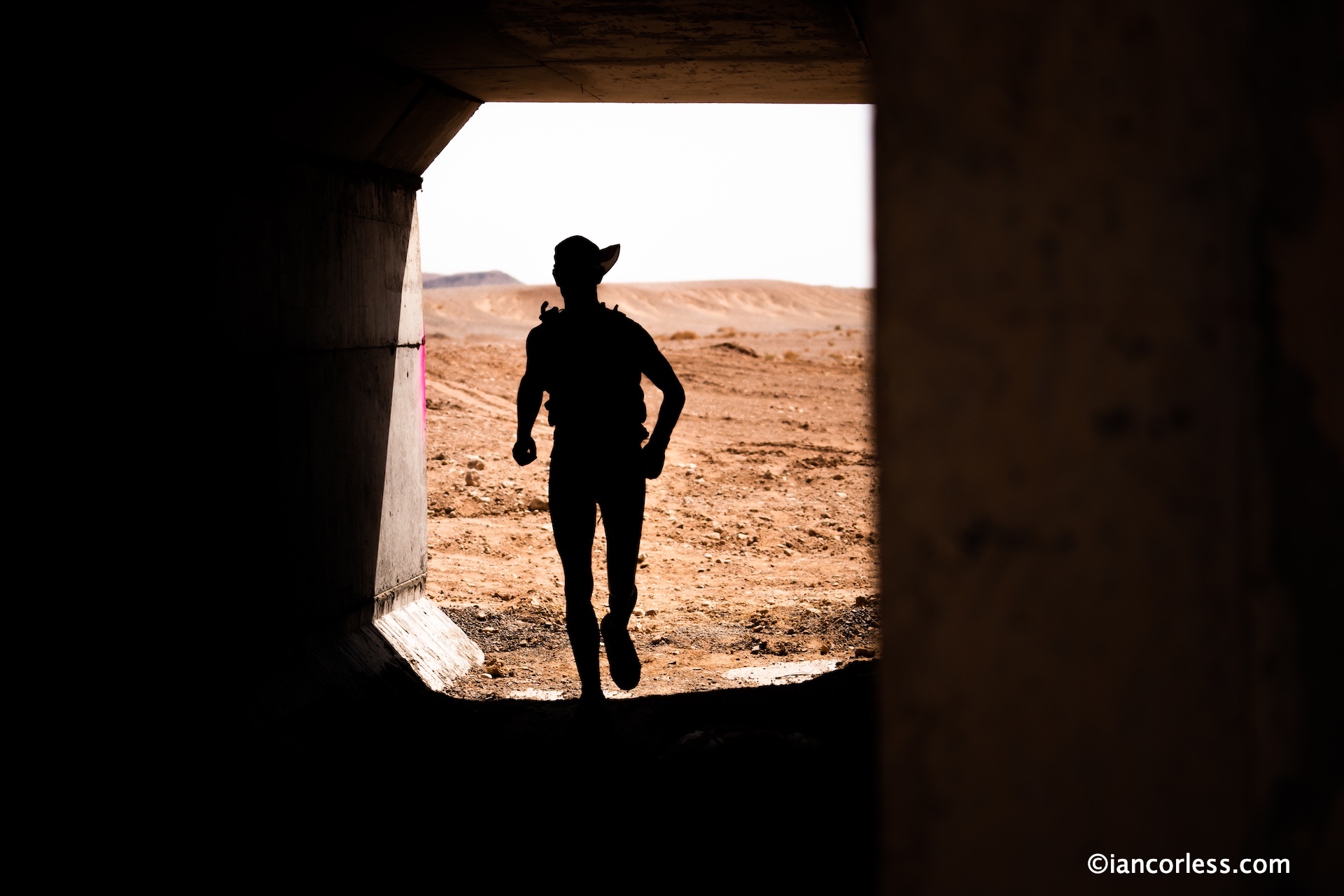
In a first for the MDS a tunnel provided an underpass for a newly built road, no doubt it was utilised later in the race as a haven of shade.
The village of Taouz provided some visual variety with children, locals and mud buildings.
Flanked by mountains to the left, the runners passed through Oued Ziz (dried river) which was white. It reflected the heat back from the ground and the runners felt like they were in a sandwich press of intense heat.
CP3 provided shade and water before the final 6km push that concluded with a small section of dunes before the finish.
At the time of writing, the current (provisional, not confirmed) dropouts are 150+ (tbc) which is roughly 20-25% of the race. This is an unprecedented number and shows the severity of the 2021 edition.
Day 3 standings:
The day was full of action with Rachid and Mohamed once again starting steady and slowly moving through the gears to not only catch ebvery other runner but then pass them and finish strongly. Again, 1st and 2nd. Mathieu Blanchard who placed 3rd at UTMB had a great day and has now moved to the 3rd podium position no doubt relishing tomorrows long stage.
For the women, Aziza and Aicha ran together for much of the day but before CP3, Aziza made a move and opened a gap. Aicha and Hassana hold 2nd and 3rd places on the female podium.
Rachid El Morabity 11;57:56
Mohamed El Morabity 11:55:15
Mathieu Blanchard 12:00:11
Aziza Raji 13:25:17
Aicha Omrani 13:34:39
Hassana Hamdouch 14:04:11
Important news, the currently ‘unknown’ long stage will be 82.5km.
Please support this website. I believe everyone deserves to read quality, independent and factual articles – that’s why this website is open to all. Free press has never been so vital. I hope I can keep providing independent articles with your help. Any contribution, however big or small, is so valuable to help finance regular content. Please support me on Patreon HERE.
It was a sombre mood in bivouac this morning, the 25 withdrawals at the finish on day-1 increased during the night as runners struggled with vomiting, sickness and bad stomachs. At breakfast, there were approximately 39 out of the race.
At almost the same distance as day 1, day 2 caused anxiety amongst all the runners as it contained 13km of Erg Chebbi (Merzouga), the highest dunes at Morocco that would see the fastest runners complete in under 2-hours (for just the dunes) but for most, it would be a long, hard slog under a relentless sun with pounding heat.
A day of mixed terrain, there was some interesting terrain early on as the runners moved from the start and passed through Tisserdemine village before arriving at CP1.
Rachid, as ever started behind the front-runners and then slowly took control of the front of the race as he entered the dunes. He is a master of the terrain and a joy to watch.
His brother. Mohamed, started much farther back allowing the front to pull away from him. But again, like his brother, he moved in to 2nd place and it was here he finished 6-minutes behind Rachid. Aziz as in day 1 finished 3rd.
For the women, Aziza once again used her experience to pull-away in the dunes with a convincing lead ahead of Aicha and Hassana who finished closely together just a couple of minutes apart.
One again the terrain and the heat caused devastation on the race with medical teams and helicopters in constant use. CP1 before the dunes looked like a medical tent from a war zone with IV drips hanging everywhere.
Tomorrow is a longer day!
It’s going to be a restless night in bivouac.
*I will update this post in due course as Patrick Bauer has asked all runners and media to assemble in the middle of bivouac at 1900 hrs. He will address all with news…?
*Sadly, a runner died today due to a heart attack. Patrick informed the family this afternoon and has updated all the other participants and media. Needless to say, the race is in mourning for a fellow runner. A minutes silence will be held at the start tomorrow and the race will continue as normal.
The 35th Marathon des Sables finally got underway today after three postponements.
It was a very special moment to see over 700 runners from 40 nationalities depart under the sound of AC/DC’s ‘Highway to Hell.’
And what a highway to hell the 1st stage of 32.2km’s was!
The heatwave from the previous days did not disappear despite strong winds and sand storms throughout the previous night and race day turned out to be a scorching 45deg in the shade in the mid afternoon heat. As I write, there are currently 25 dropouts and and many runners required medical help from Doc Trotters out on the course.
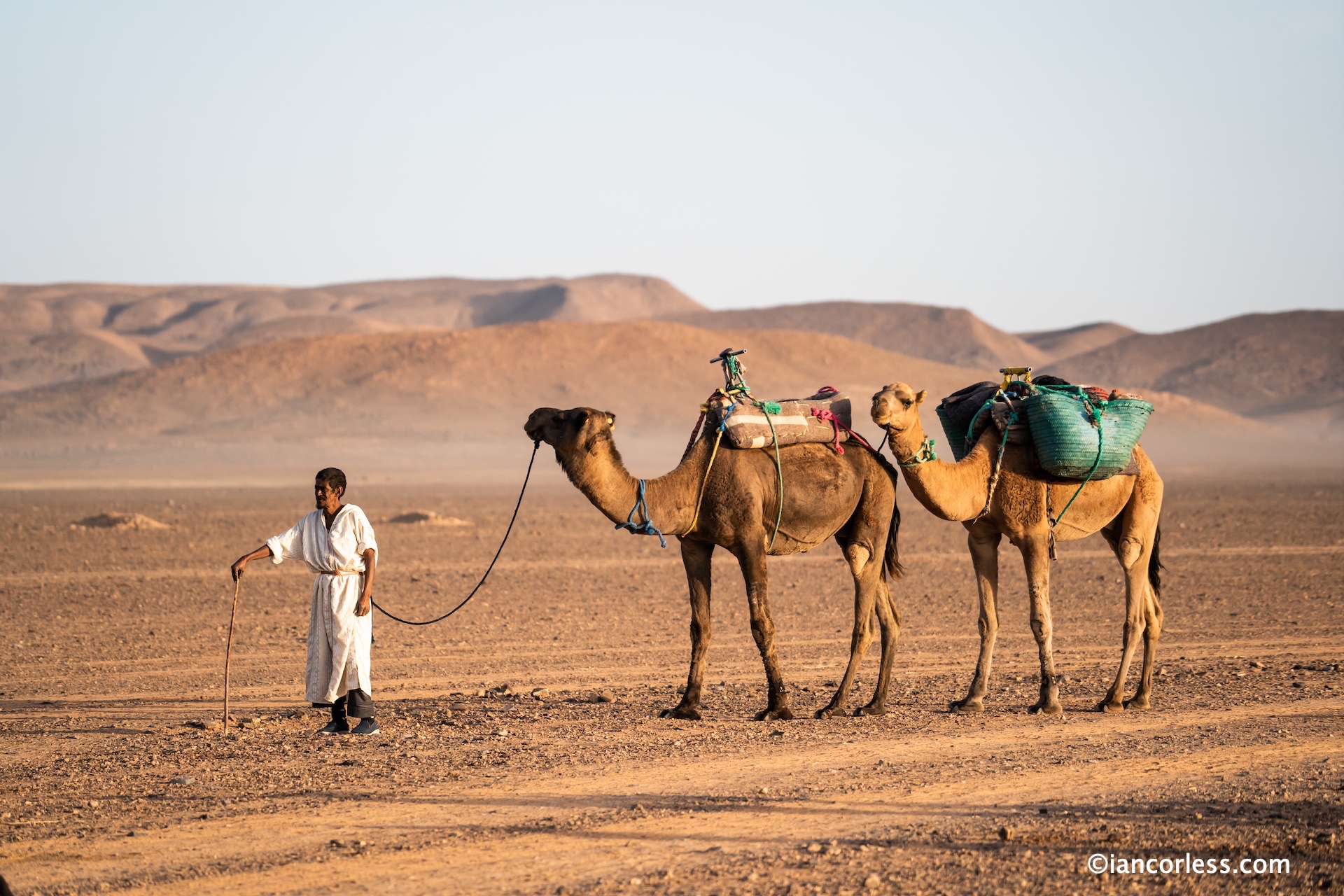
The route, billed as an easy day was beautiful one with a little of everything, hard rocky plateau, villages with many children and soft sand and small dunettes to conclude the day.
The heat though and lack of any shade turned out to be the beast of the day and it reduced nearly the whole field to a slower pace and for most, that means walking!
Even the desert king, Rachid El Morabity, although wining easily ahead of his brother, looked tired and a little more exhausted from his 2h 36m run.
Aziza Raji from Morocco started the day at an easier pace and eventually took the lead ahead of the UK’s Anna Brown, however, just like Rachid, in the final km’s she looked ready to be over with the day.
The intense heat has now impacted on day 2 with the organisation bringing start time 30-minutes forward, 0800 instead of 0830. In addition, 1 extra bottle of water will be provided for each runner and CP1 and CP2.
The stage is another 32km day, BUT, many of those km’s take place in the relentless dunes of Merzouga (Erg Chebbi), the highest in Morocco.
Day 1 standings:
Rachid El Morabity
Mhoamed El Morabity
Aziz Yachou
Aziza Raji
Anna Brown
Aicha Omrani
Please support this website. I believe everyone deserves to read quality, independent and factual articles – that’s why this website is open to all. Free press has never been so vital. I hope I can keep providing independent articles with your help. Any contribution, however big or small, is so valuable to help finance regular content. Please support me on Patreon HERE.
This article is geared toward Marathon des Sables but is valid for any race with some adjustments and specific changes appropriate to the type of race and distance.
Marathon des Sables, once again, has been postponed. Originally scheduled for April 2020, the race was moved to September 2020 amidst growing worries and concerns over Coronavirus. As September approached, the writing was already on the wall and the decision was made to focus on April 2021 – everything will be fine then, won’t it!?
December 2020 soon came and with it, increased infection rates, new variants and despite the optimism of a vaccine, the world once again crumbled under the cloud of an ever-spreading pandemic. Christmas was cancelled and the new year unfortunately had nothing ‘new’ about it, it carried far too much of the old year.
January has been a disaster and the long-term view is not good. The world once again has been in a lockdown, some far worse than others. One thing is for sure, we are all a long way from ‘normal!’ So, it came as no surprise as events were cancelled all over the world.
Patrick Bauer.
MDS race director, Patrick Bauer, travelled to Morocco to assess the situation and on January 22nd, the MDS was once again postponed to another time; October 1-11, 2021.
All is good… the race WILL come!
I think it’s important to clarify, here and now, that at the end of the day, when people are dying globally, for a race to be postponed, is no big deal… I think once you accept that, dealing with race cancellation, disappointments and postponements becomes so much easier. It´s only a race! And we are fortunate to be able to race. It’s a luxury. But equally, livelihoods are struggling, RD´s are losing work, all the businesses associated with races are losing work, travel companies are losing customers, hotels, restaurants, design agencies, photographers, videographers and the list goes on, are all losing their livelihoods to an ongoing escalating pandemic. So while it is only a race, have a consideration for all involved and maybe, a little understanding for the very difficult challenges everyone is facing at the moment.
The locals need MDS, our tourism and our regular trips to Morocco.
Taking MDS as an example, 2020 participants will have entered in 2019 and some may well have entered in 2018. Typically, a MDS participant will prepare for 1-year. While the initial postponement was not great, it was easy to focus on September.
Then September was cancelled… Already, many were struggling to re-focus, but April would be it, one last push and we are good to go!
Now, with another postponement, MDS runners are left in a void, the race is 8-months away. They are all asking, what do I do now?
Gemma Game has been on the podium of MDS multiple times. She is a busy professional with a family.
Firstly…
When things change, adjust. Don´t kick-off against what has changed. Accept what is not in your control and control what you can. Adapt, move on (with running shoes) and train differently for a while; focus on different aspects of your running, weaknesses in particular. Look at the opportunities – focus on speed, work on hill strength, build a good core, do drills, stretch, maybe try yoga? A change of focus will give a physical and mental break and will help your performance. When the time is right, resume an appropriate training plan for your chosen race. I guarantee, you will be stronger, better prepared and ready for the challenge ahead. You are lucky and fortunate that you are able to even contemplate a race like MDS.
Uncertainty is a virus in itself, it can eat away at you. Quite simply, remove negativity and question marks. The current dates for MDS are 1-11 October. Do not consider the event will not happen, plan and train accordingly.
The reality is you are already in a good place. You have been training for a great deal of time already, just imagine how much better you will be when October comes.
Training in Lanzarote on a specific Multi-Day Training Camp HERE
Importantly though, it would be fool hardy to carry on with current training levels for an October race. You run the risk of injury and/ or getting peak fitness too early. Take a break!
“One of the mistakes I see most with runners is jumping from one race specific cycle to the next, without either giving themselves enough time between races or not “focusing” on training during the time between race and “taking a break”.
– runnersconnect
Kick back, take some time off from any structured plan and do a week/ two weeks (or even a little longer) of ´how you feel´ training. In this period, take time (with a piece of paper) to assess personal strengths and weaknesses. From this list, you can use February and March to address these weaknesses while ´maintaining´ fitness. Back off any intensity, maintain some decent mileage/ hours and keep sessions moderate.
Tom Evans placed 3rd at MDS and works on strength and core to enhance his running.
Importantly, get a running MOT from an experienced physio. Address any problems now and use that ‘extra’ time for therapy, strength, stretching and core. Find any underlying problems that may cause injury.
Work on admin – food for the MDS (article HERE), pack, sleeping bag (article HERE) sleeping mat and finalise equipment choices optimising weight, size and cost. Do everything you can to make your pack 6.5kg (plus water) for the start line on October 3rd. Read a guide HERE.
Do you need a 12-week and/ or 24-week Multi-Day Training Plan perfect for a multi-day adventure or a race like Marathon des Sables? They are designed to provide you with a structured weekly plan culminating in a target event.
View a sample week HEREfrom the 12-week plan. Purchase HERE.
View a sample week HERE from the 24-week plan. Purchase HERE.
*****
The arrival of April will give you 6-months to race date. Now is the time to re-focus. Did you have races planned? If so (and they happen) maybe now they change focus and become preparation for MDS?
Use 3-months (April, May and June) to build on the weaknesses that you have worked on in February and March and lay the foundations for the key phase, July, August and September.
“One of the most common reasons runners hit a plateau is that they don’t work on their weaknesses between races, by focusing on your weaknesses now, you’re able to make progress long-term, even without training as hard.”
– runnersconnect
Do some specific training, here Sondre Amdahl at the Lanzarote Training Camp HERE
July should be the start of a very specific MDS phase (12-weeks) where you fine-hone all the relevant skills to make the 35th MDS not only successful but awesome.
It is easy to feel deflated with another disappointment and postponement but look at this cloud with a silver lining!
Please support this website. I believe everyone deserves to read quality, independent and factual articles – that’s why this website is open to all. Free press has never been so vital. I hope I can keep providing independent articles with your help. Any contribution, however big or small, is so valuable to help finance regular content. Please support me on Patreon HERE.
Episode 191 – Marathon des Sables discussion with Steve Diederich who co-hosts and Dr Jodie Moss tells us how to prepare for the heat!
*****
Talk Ultra is now on Tunein – just another way to make the show available for those who prefer not to use iTunes – HERE You can download the Tunein APP HERE
Talk Ultra needs your help!
We have set up a Patreon page and we are offering some great benefits for Patrons… you can even join us on the show! This is the easiest way to support Talk Ultra and help us continue to create!
Many thanks to our Patrons who have helped via PATREON
Asif Amirat in the UK is creating a stir with his 100-marathons in 100-days. Many have been questioning his runs and becoming very vocal on social media. I have reached out to Asif for an interview.
RACES THAT WILL HAPPEN (tbc)
Montreux Trail Running Festival – Switzerland
Speedgoat 50k – USA
Fjallmaraton – Sweden
Rondane 100 – Norway
Pyrenees Stage Run – Spain
Marathon des Sables – Morocco
*****
INTERVIEW : DR JODIE MOSS
*****
Please listen to the INTERVIEWS – please follow the show
Hosted on ANCHOR (HERE) the INTERVIEWS will also be available to listen on many other players, including SPOTIFY (HERE).
TALK ULTRA podcast will be released as normal providing you long shows as it has always done with ideally two shows per month. The back catalogue will be released randomly via the INTERVIEWS and not chronologically.
Please support Talk Ultra by becoming a Patron at www.patreon.com/talkultra and THANKS to all our Patrons who support us. Rand Haley and Simon Darmody get a mention on the show here for ‘Becoming 100k Runners’ with a high-tier Patronage.
One sees clearly only with the heart. The essential is invisible to the eyes. – Antoine de Saint-Exupéry
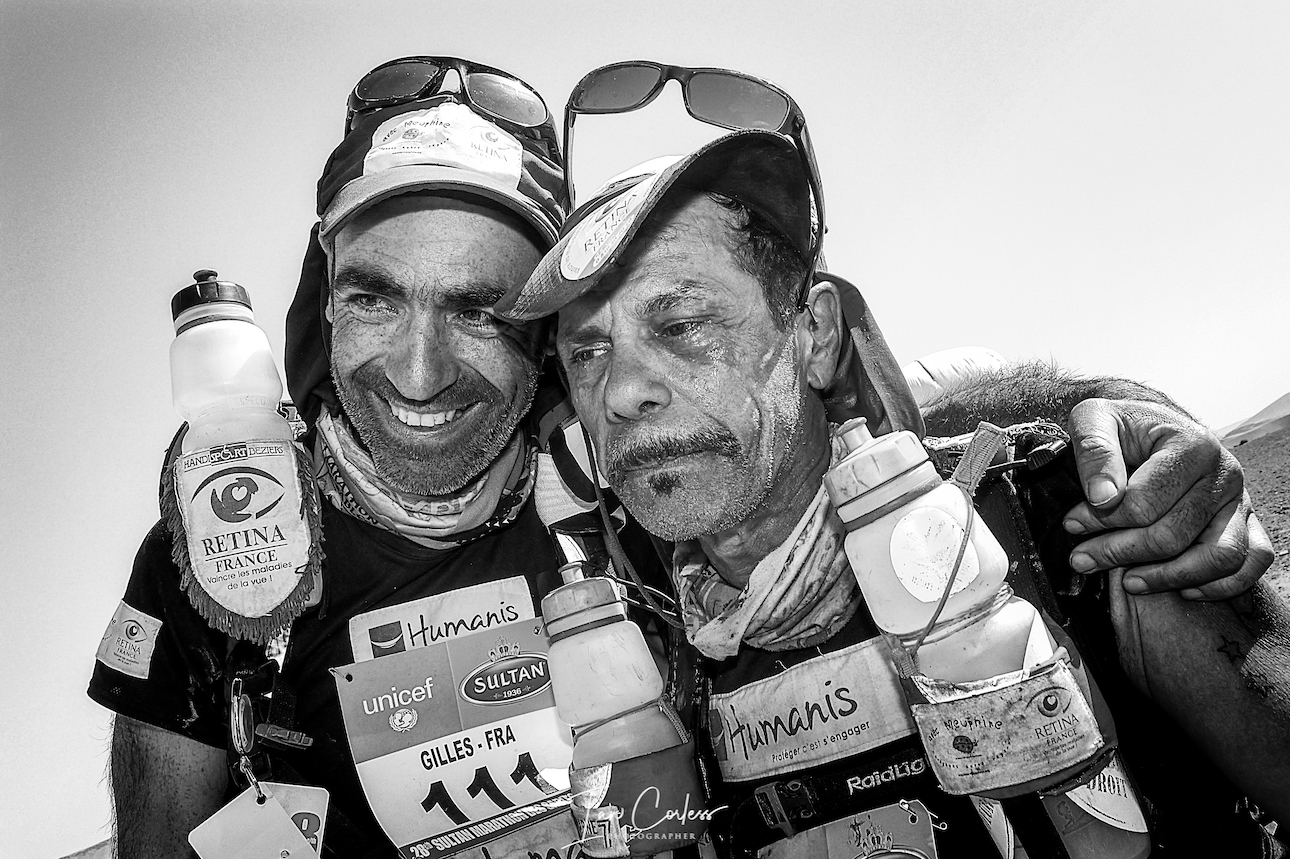
Water splashed over the large brimmed hat. Gilles poured and poured on Didier’s head to help reduce his temperature. Droplets floated in the air like stars in space and as they made contact they exploded with dramatic effect.
Dry and crusty salt on cheeks and lips disappeared with the release of the water but moments later re-appeared as the searing 50+ degree temperatures evaporated the water that continued to pour.
It was midday. Gilles and Didier had only dented the 80km distance that needed to be covered before the 34-hour cut off would be imposed on the longest day of the iconicMarathon des Sables.
Moving onward, Didier embraced Gilles arm for stability. A very sore and enflamed right knee could give way at any moment resulting with a fall. Gilles as ever was faithful to the cause and provided the support and self-sacrifice to ensure that Didier’s journey to the line was safe and as trouble free as possible.
Darkness approached and with it some food and rest. With a new lease of life, the two continued into 13 km of relentless dunes that reached two to three meters in height. In the distance a green laser showed the direction to follow. It was a beacon of hope, slowly but surely getting closer. Two become one and as the sunrises and the heat returns, victory and the opportunity to fight another day seems possible.
From the finish line two shadows on the horizon appear. It is 4pm in the afternoon. The warriors have been on the trail for 32 hours. Tired, weary and emotional they approach the line.
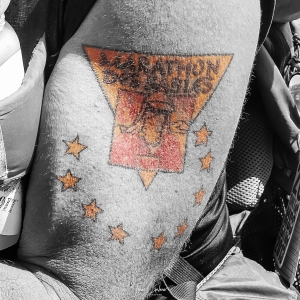
I see a tattoo glisten in the scorching light on the arm of Didier; an MDS logo on his arm with nine stars around it, a star for every completed MDS. Next to the 9th star a space, would he obtain that 10th star at this edition of the race?
In the final meters to the line you can hear the shouts from MDS staff, “Bravo Gilles”, a marshal shouts “Allez Didier” and then the clapping and whoop whooping starts. It’s done, they cross the line an incredible 75.7 km’s completed over some of the most demanding conditions possible.
Didier falls into the arms of Gilles in an embrace similar to a small child who has just found a lost mother.
Tears stream down his face as he sobs uncontrollably. Gilles, all smiles, pulls away and kisses him on each cheek with a passion seldom seen. It’s a moment to savour! They are the last two runners on the course and the moment epitomizes all that the Marathon des Sables represents. It shows a bond between two people and confirms all that is good and pure in human nature and ultra-running.
You see this is no ordinary achievement.
Gilles is a guide and Didier is blind.
Please support this website. I believe everyone deserves to read quality, independent and factual articles – that’s why this website is open to all. Free press has never been so vital. I hope I can keep providing independent articles with your help. Any contribution, however big or small, is so valuable to help finance regular content. Please support me on Patreon HERE.
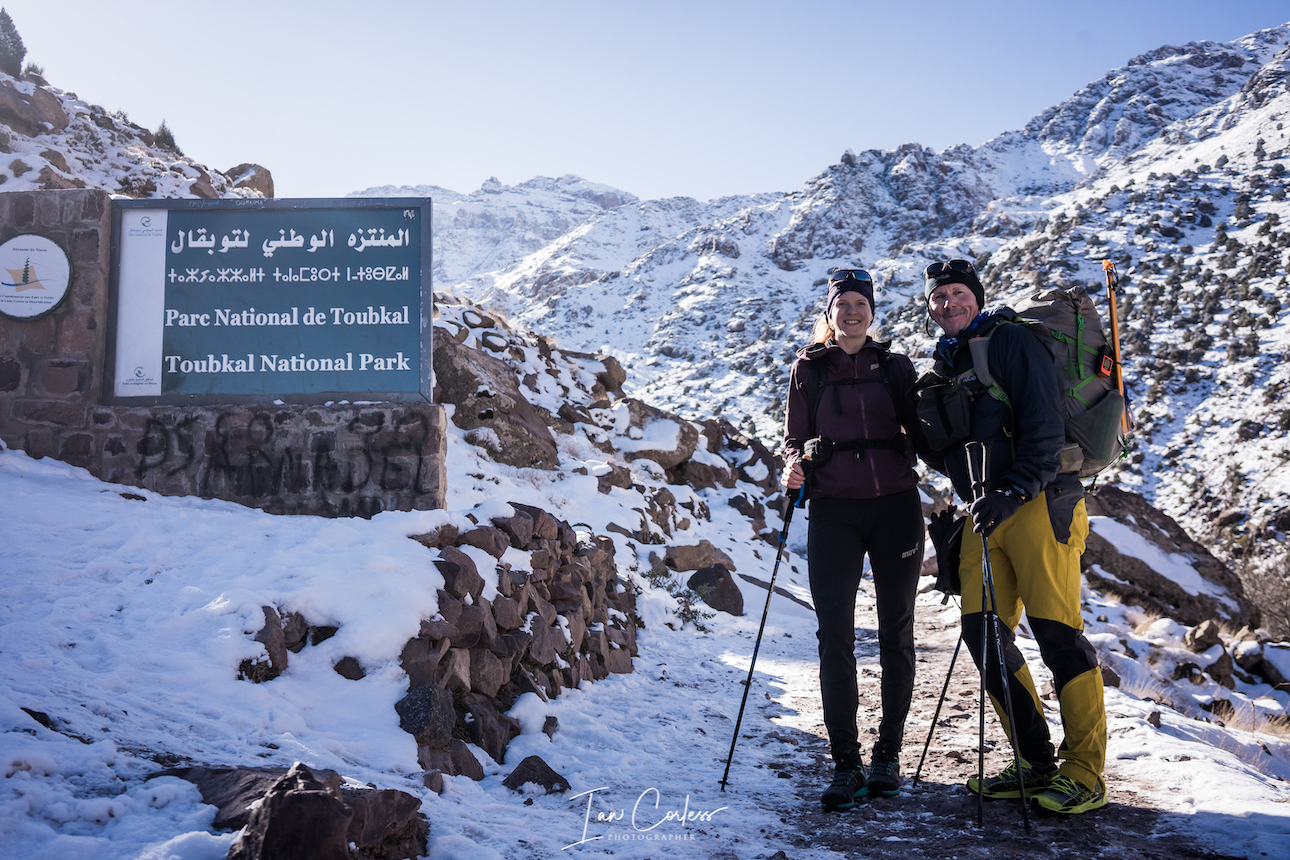
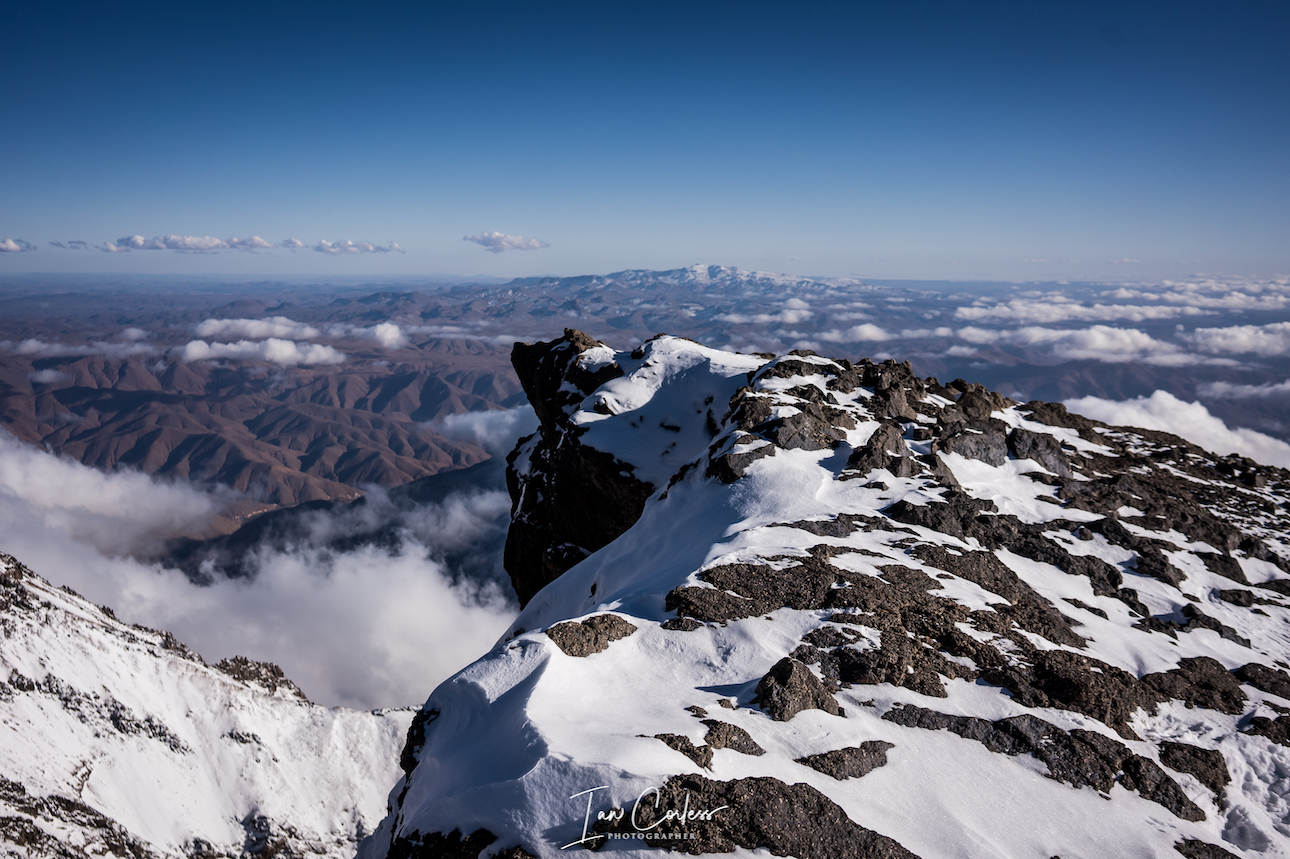
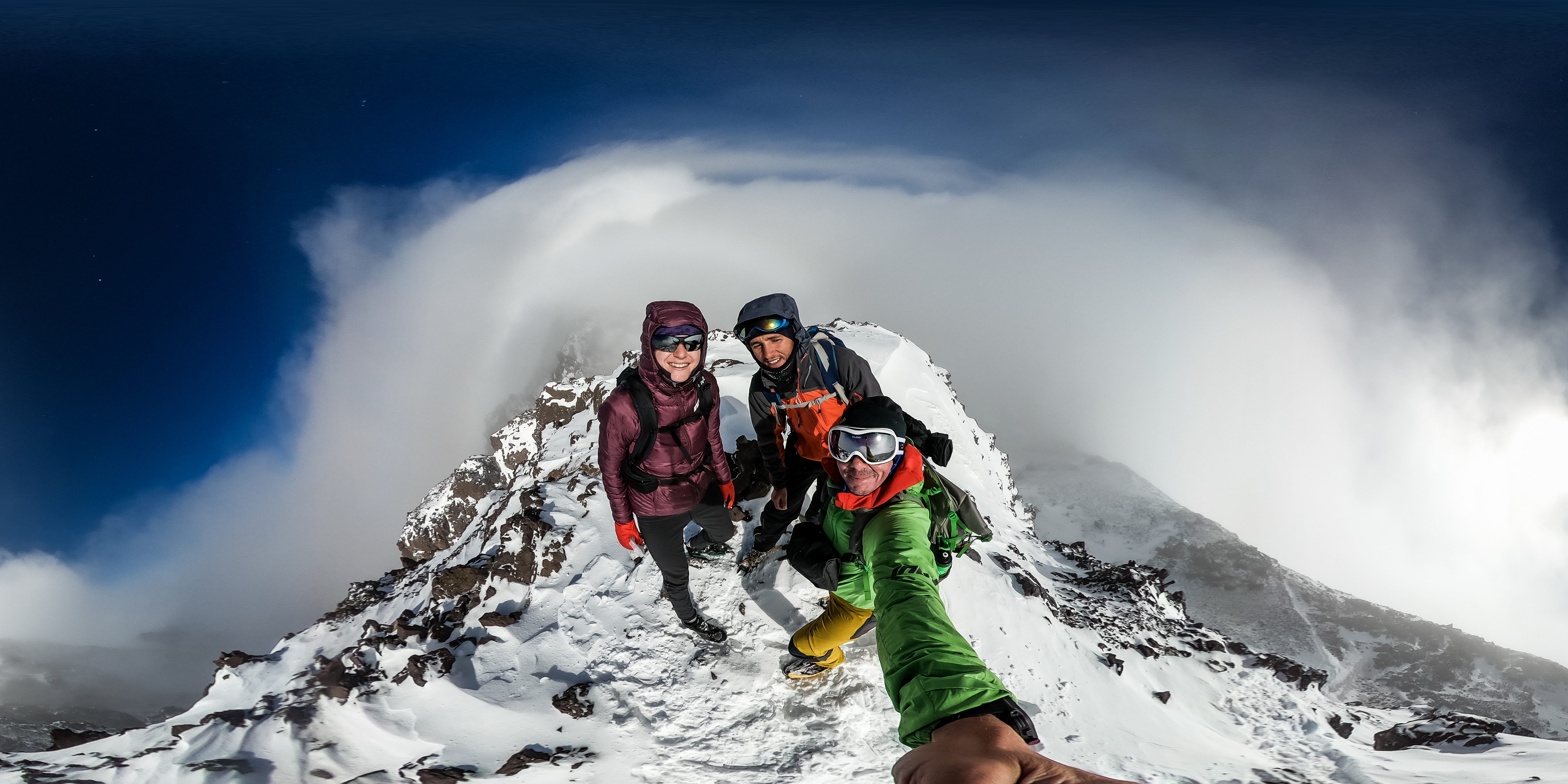
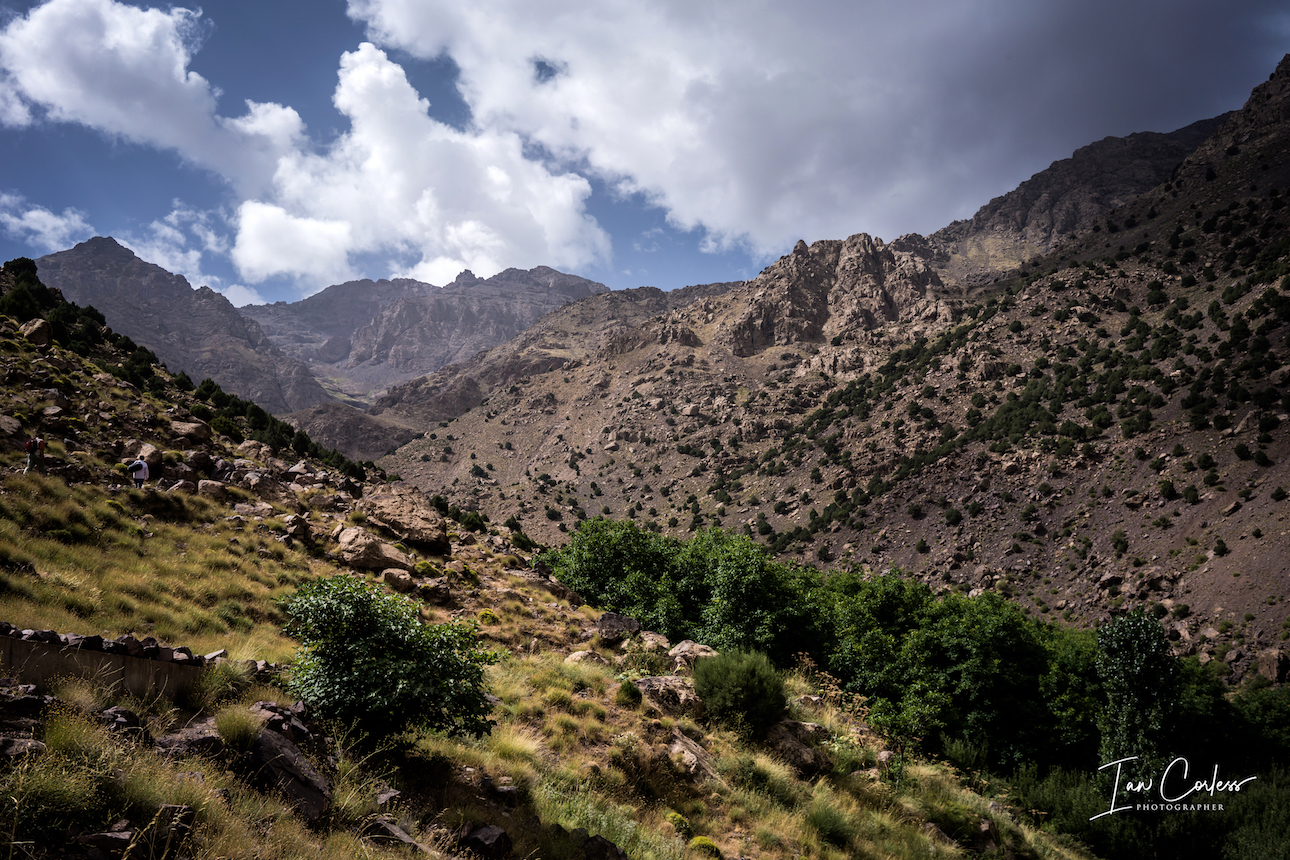
Located just 75-minutes’ drive from Marrakech (approximately 40-miles) the Toubkal National Park and Jebel Toubkal(4167m) is the highest peak in the Atlas Mountains. It is also, the highest peak in North Africa and the Arab World.
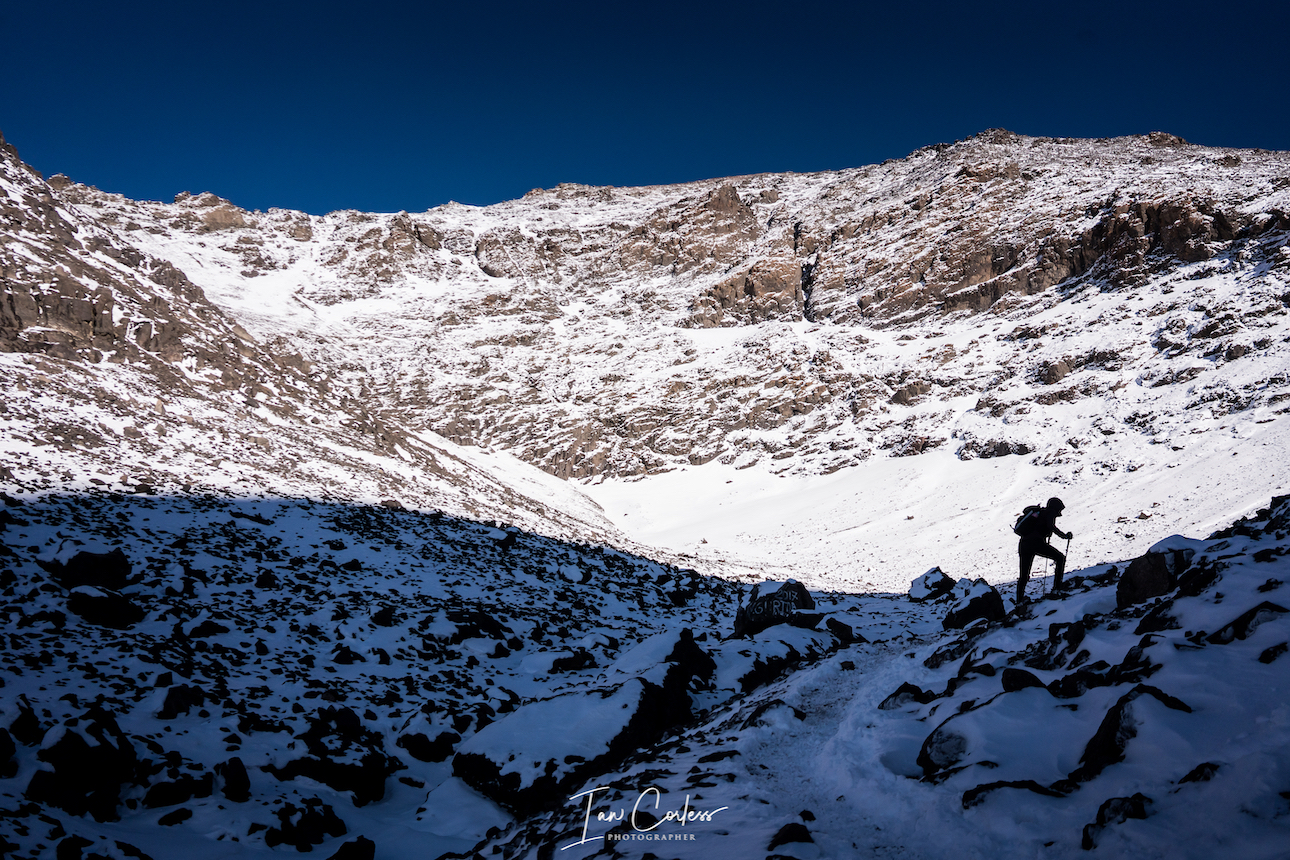
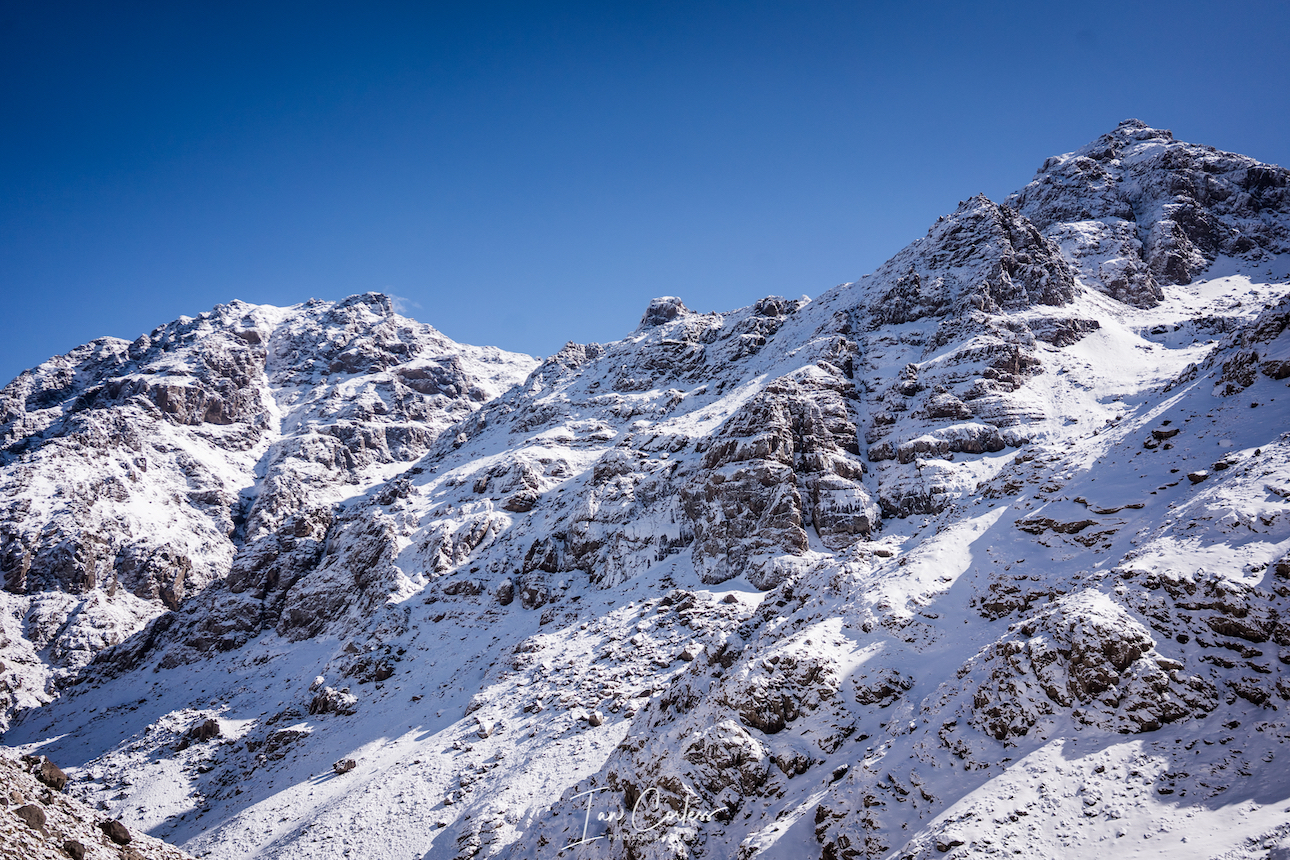
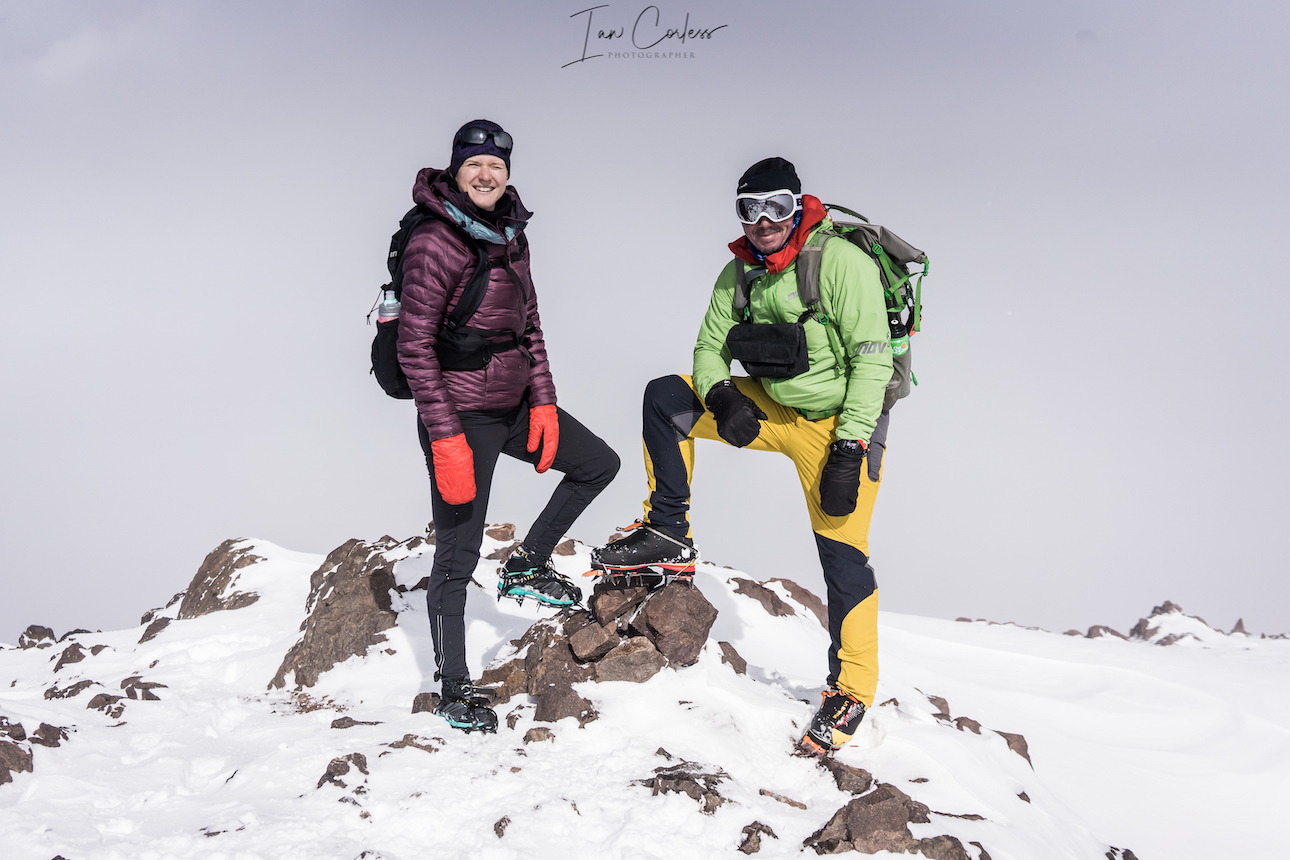
Toubkal has two-seasons, Winter and Summer. In winter, summiting the peak brings new challenges as it is completely covered in snow. Winter mountain skills are required, and the use of crampons is essential.
I wrote an in-depth article about visiting Toubkal in summer months HERE and some of the information from that article is repeated below.
PRACTICALITIES
The gateway to Toubkal is Marrakech which is less than a 90-minute journey away from Imlil via taxi or private car. Imlil is the starting point for any adventure in the Atlas Mountains with a small village of restaurants, shops and hotels.
Flights to Marrakech are abundant and many budget airlines offer great prices, particularly if one can travel on a weekday.
If you have not been to Morocco before, I strongly recommend staying in Marrakech for several days before and after any trip to the Atlas. Even now, after multiple trips to the region, I still enjoy a pre/post stay in a Riad (local traditional hotel) to help provide some luxury and RnR either side of a strenuous hiking/ climbing period. There are many Riads in Marrakech all offering something unique and prices vary considerably, my favourite is the Dixneuf La Ksour which has only 6 rooms.
If you have been to the region before and want to maximize time, it is of course possible to land in Marrakech, get a taxi at the airport and be in Imlil within 2-hours. Riads in Imlil are very inexpensive and I have stayed at the ‘Riad Atlas Prestige’ on all my trips – it is inexpensive and offers great food.
A taxi to Imlil will be approximately 40 euro and a private car, usually arranged by your Riad will be 80 euro.
TOUBKAL and the ATLAS MOUNTAINS
If you have not been to the region before, it would make sense that you visit the area in the non-winter months when hiking/ climbing is much easier and very predictable.
Please note! You now MUST have a guide for any treks/ climbs in the region. This was a rule imposed in late 2018. There are currently three passport checkpoints on the way to the refuge. This in time will change with one new police checkpoint that is currently being constructed just before the entrance to the National Park.
Our guide, Mustafa
The refuge at Toubkal is a great place to plan a booking as you are able to arrange a guide and a bed at the refuge all in one email. Hamid is my contact who is always helpful.
34.5 euro per person per night full board (Dinner, breakfast and lunch)
29.5 euro per person per night half board (Dinner and breakfast)
19.5 euros per person per night (without meals)
The refuge can also arrange the following for you:
Transport from and back to Marrakech
Accommodation in Imlil
Mountain Guide
A guide will be approximately 50-80 euro per day and is payable in Euro (cash only).
CLIMBING and TREKKING
Toubkal is considered an entry level 4000m peak and as such it is a great place for training and gaining experience, particularly in summer.
In winter, it is still considered an entry level 4000m peak, however, far more equipment is required and some exposure to harsh winter environments would be strongly recommended.
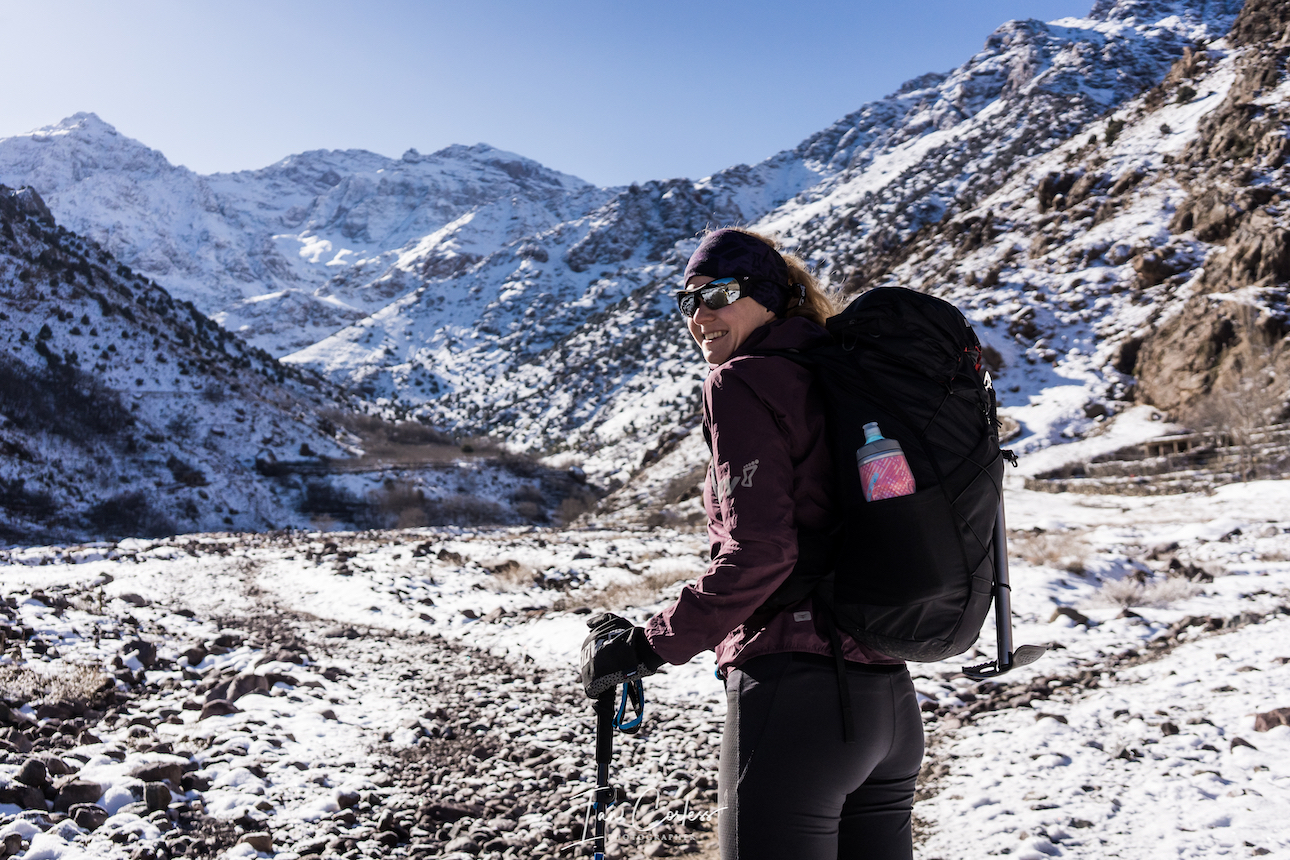
In summer one can usually wear shorts and t-shirts during the day but it is essential to have trekking pants, a warm upper layer, waterproof jacket/ trousers, hat and gloves at a minimum for any summit treks. Poles are for many an essential item too!
Winter is completely different, and the environment can be very harsh and dangerous. One needs to be prepared for conditions that can be below -20 with very strong winds, thick snow and a great deal of ice.
At a minimum you will need:
Merino base layer, top and bottom.
Trekking pants.
Mid-layer thermal top.
Down or Primaloft upper insulation.
Gore-Tex or equivalent out layer, top and bottom.
Very warm gloves. Probably with inner Merino layer.
Very warm socks, usually two pairs made up from inner Merino and outer mountain sock.
Climbing boots suitable for harsh winter than can take a mountain crampon – La Sportiva G5 as an example.
Crampons.
Ice Axe.
Poles.
Pack.
Sleeping bag (the refuge is usually quite warm (in the sleeping dorm), so, with a merino base layer, a bag with comfort to -5 should be ok).
ROUTE TO THE REFUGE
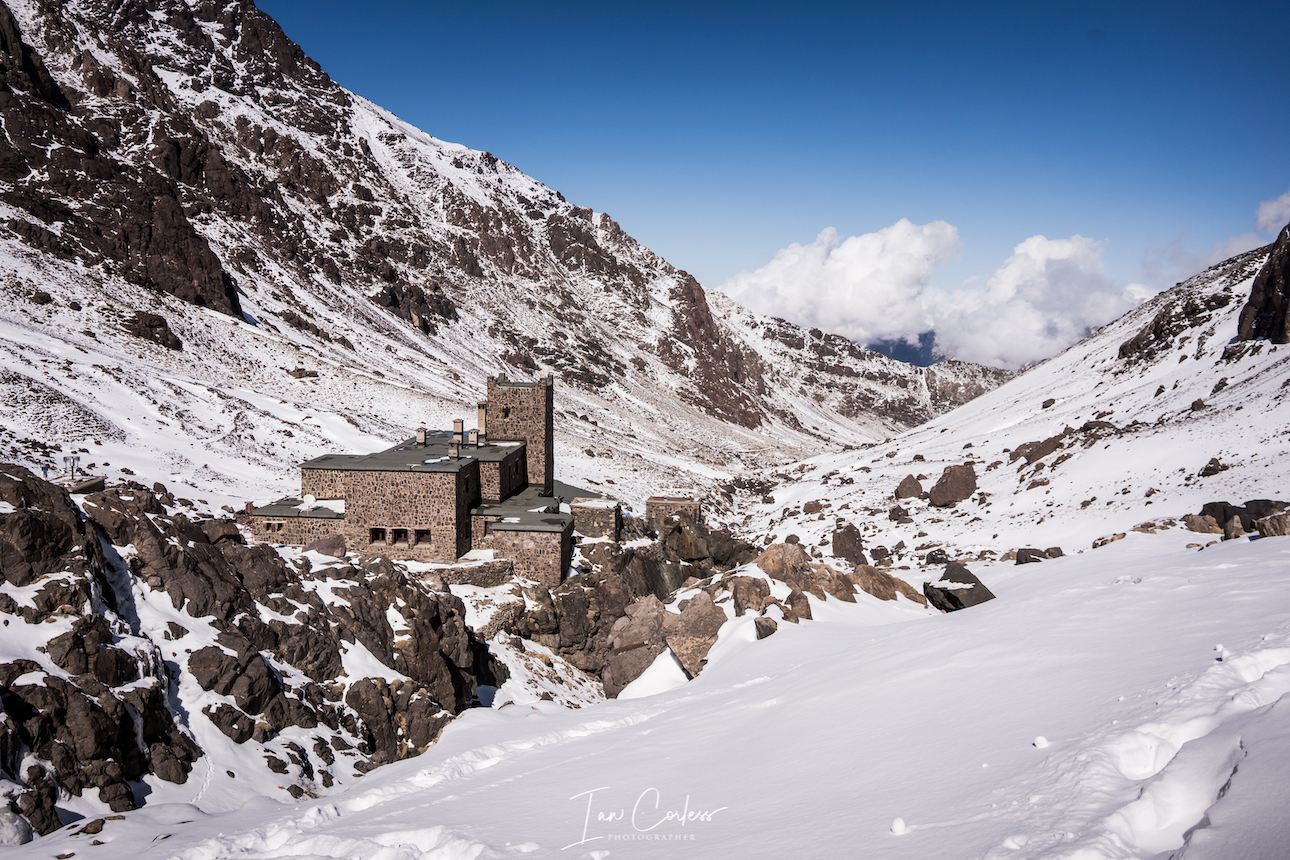
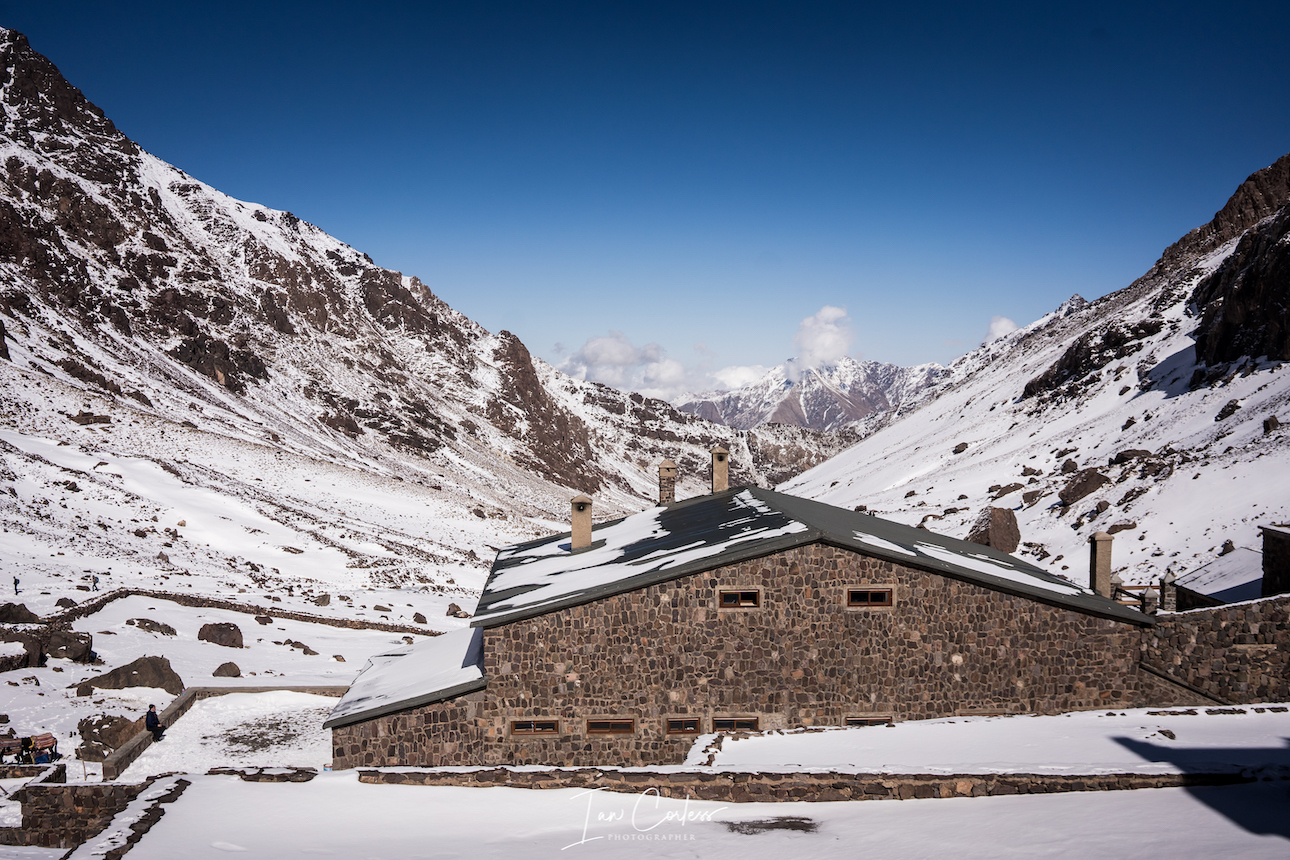
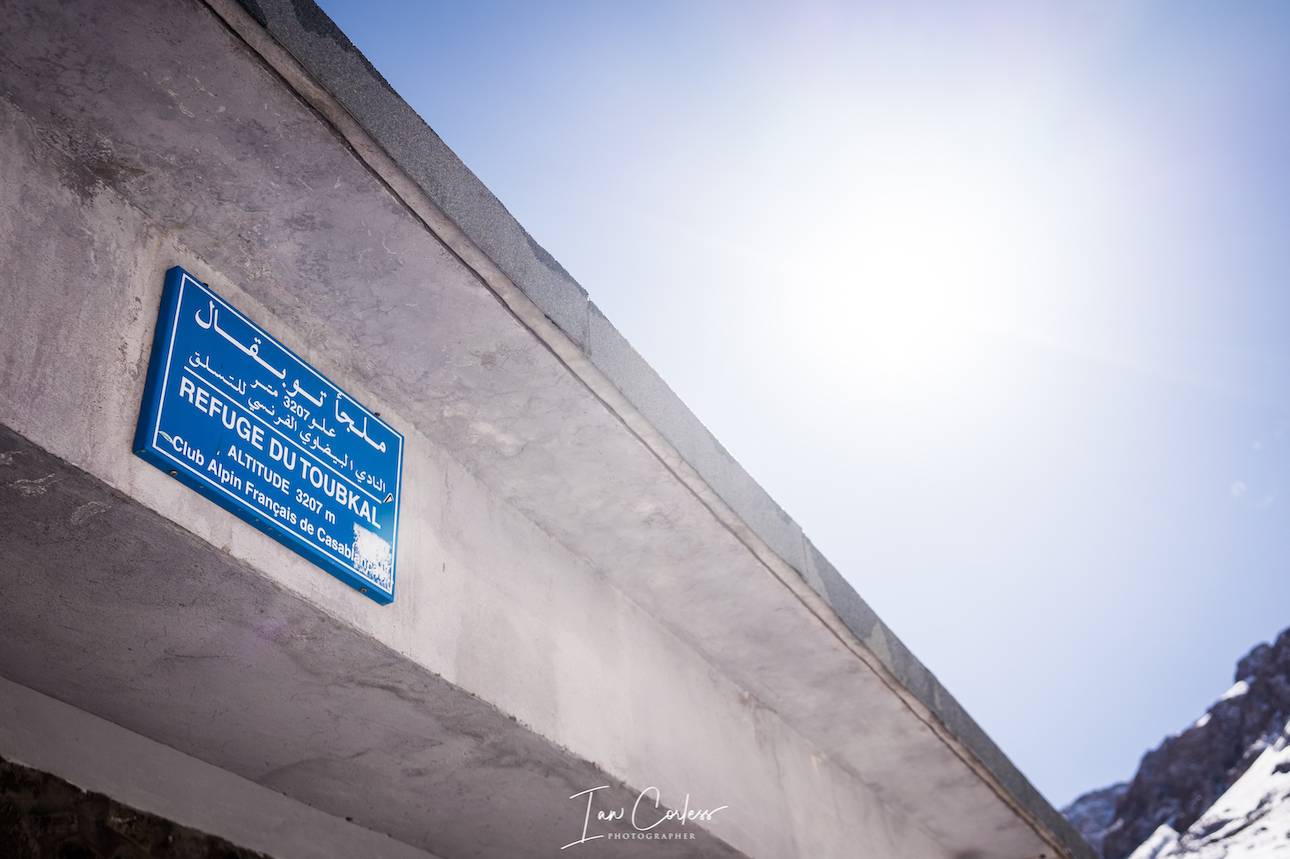
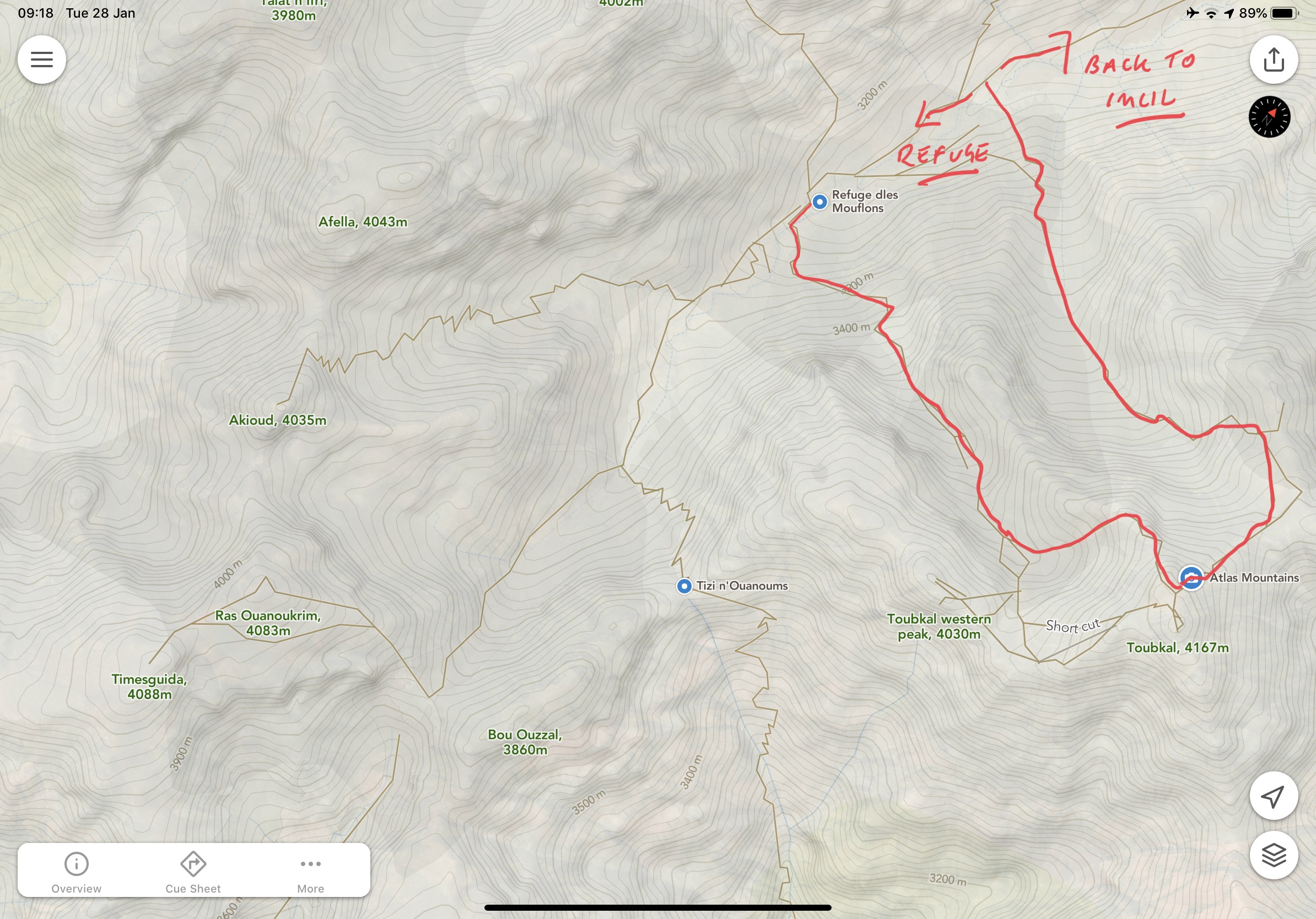
Imlil to the refuge is designed to introduce you to the terrain and slowly adapt you to the altitude. Imlil is at 1800m and the ‘Les Mouflons’ refuge is at 3207m. Depending on experience and adaptation, Imlil to the refuge can take 3-6 hours.
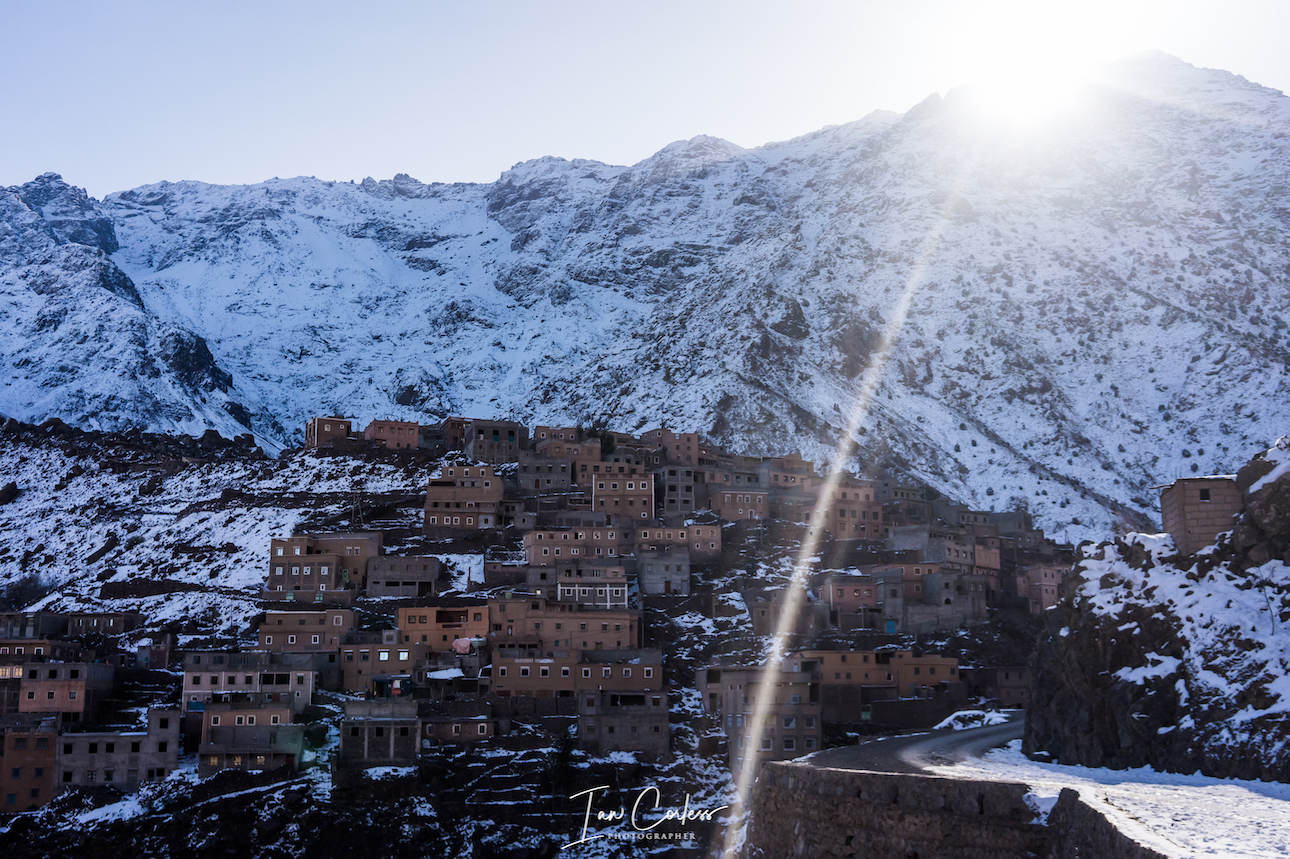
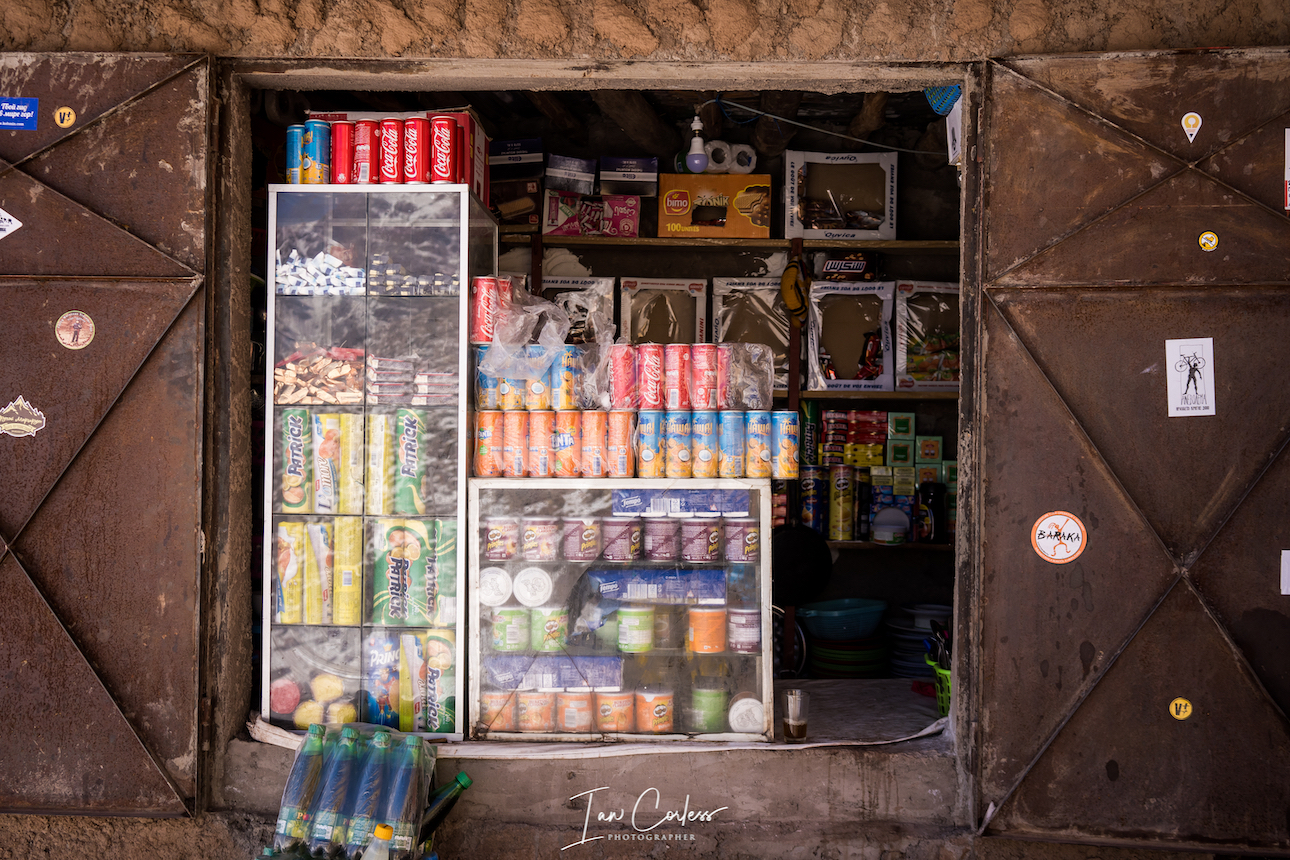
Leaving Imlil, you have a narrow trail that rises quickly to a road and then the village of Aroumd. Here you will meet the first passport control and then you cross a floodplain before starting the climb to the refuge. The terrain is rocky and rough but not dangerous. Chamharouch is the next passport control and here you will see a large white rock that is a Muslim Shrine. Here it is possible to by water, food if required and soft drinks such as coke.
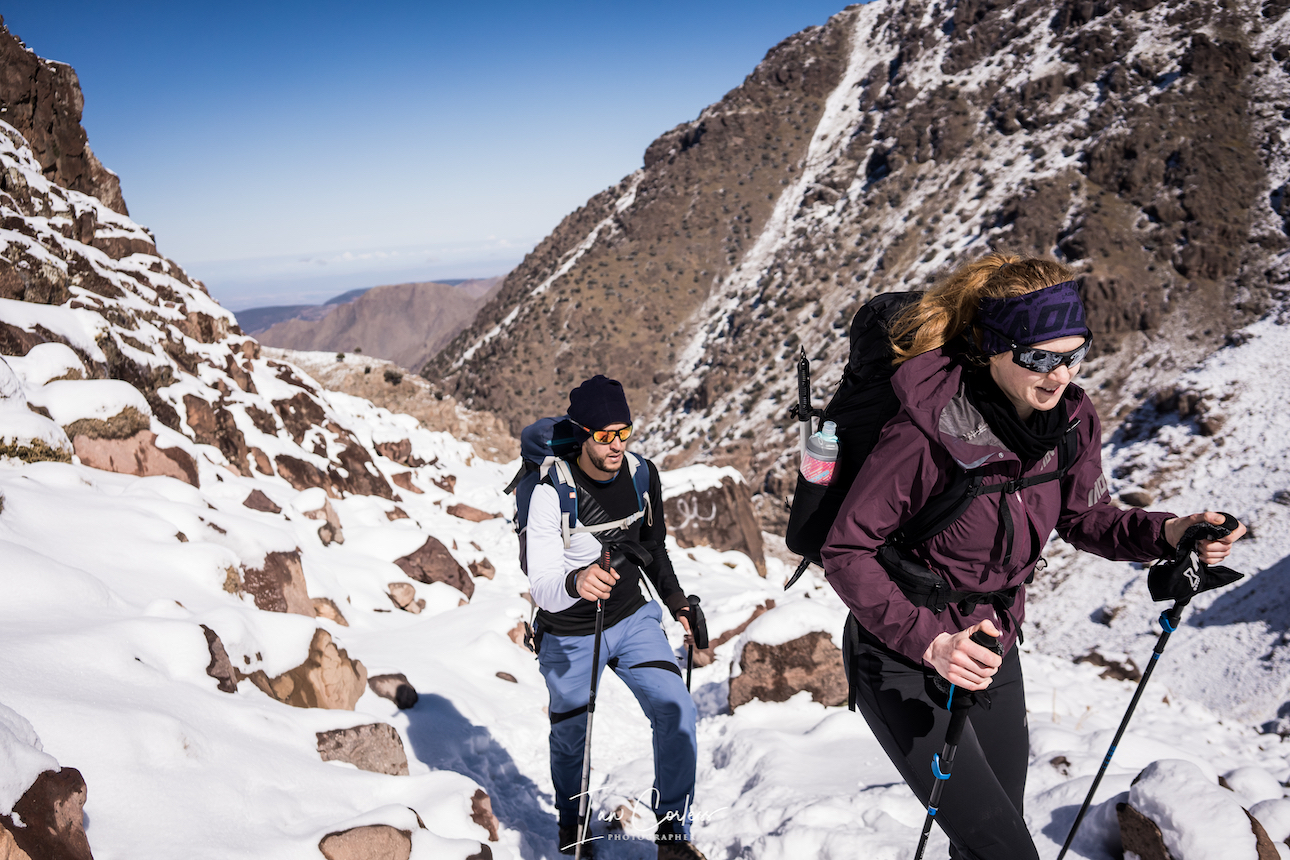
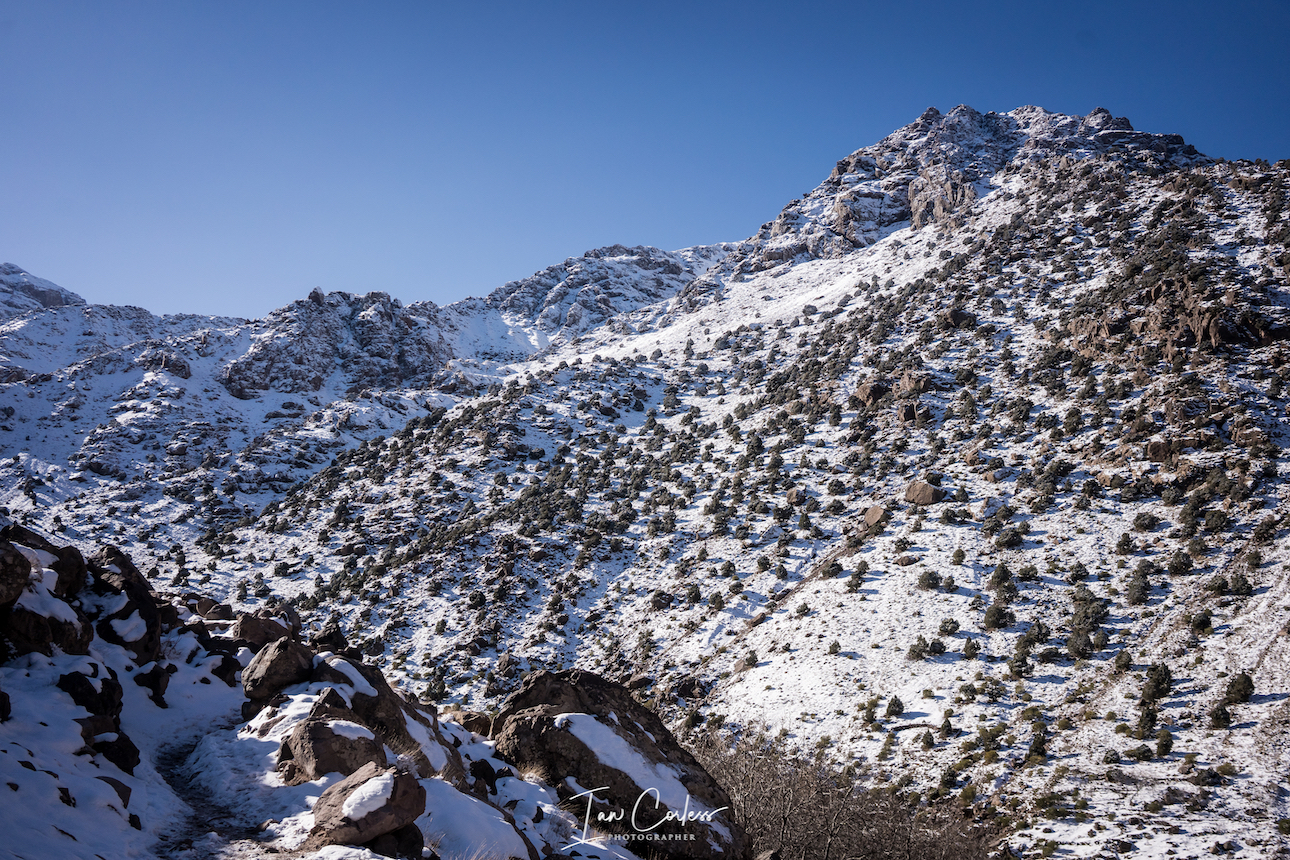
Depending on the time of year and how harsh the winter has been, snow may already be present on the trail. Usually, just wearing trekking shoes or boots is fine to the refuge, however, it can be possible to need to add crampons in a harsh year, so, make sure they are easily accessible from your pack when you leave Imlil.
Passport check point
The path now climbs steeply and gently reaches upwards, once again the terrain is rocky. You will arrive at two disused building that now sell drinks and here is the 3rd and final passport check. Before you know it, you will arrive at the refuge located at 3207m.
Depending on what you have arranged with your guide, you will have a meal at the refuge and then you will stay in a shared dorm with all the other climbers. These dorms are often unisex, so be prepared. You also need to be self-sufficient in terms of sleeping bag, additional clothes and warm layers. Everyone usually sleeps by 8/9pm. Bring wet wipes/ toilet roll as this is not provided at the Refuge.
Dinner is typically served at 1830 and offers soup, bread, a carb rich main meal with protein, fruit dessert and tea. A shop is available to purchase soft drinks, water, chocolate and other items.
Breakfast is bread, mixed jams/ honey, soft cheese and a selection of drinks. Depending on one’s plans, breakfast is often served from 0400 through to 0900.
Lunch is served on request.
ROUTE OPTIONS
TOUBKAL
The standard Toubkal summit day will typically start at 0400 with breakfast and the intention will be to start the climb asap. Sunrise is approximately 0810 (+/-) in winter, so, depending on your projected speed, the guide will advise on a departure time so you can climb from 3207m to 4167m and arrive at the correct time to experience sunrise.
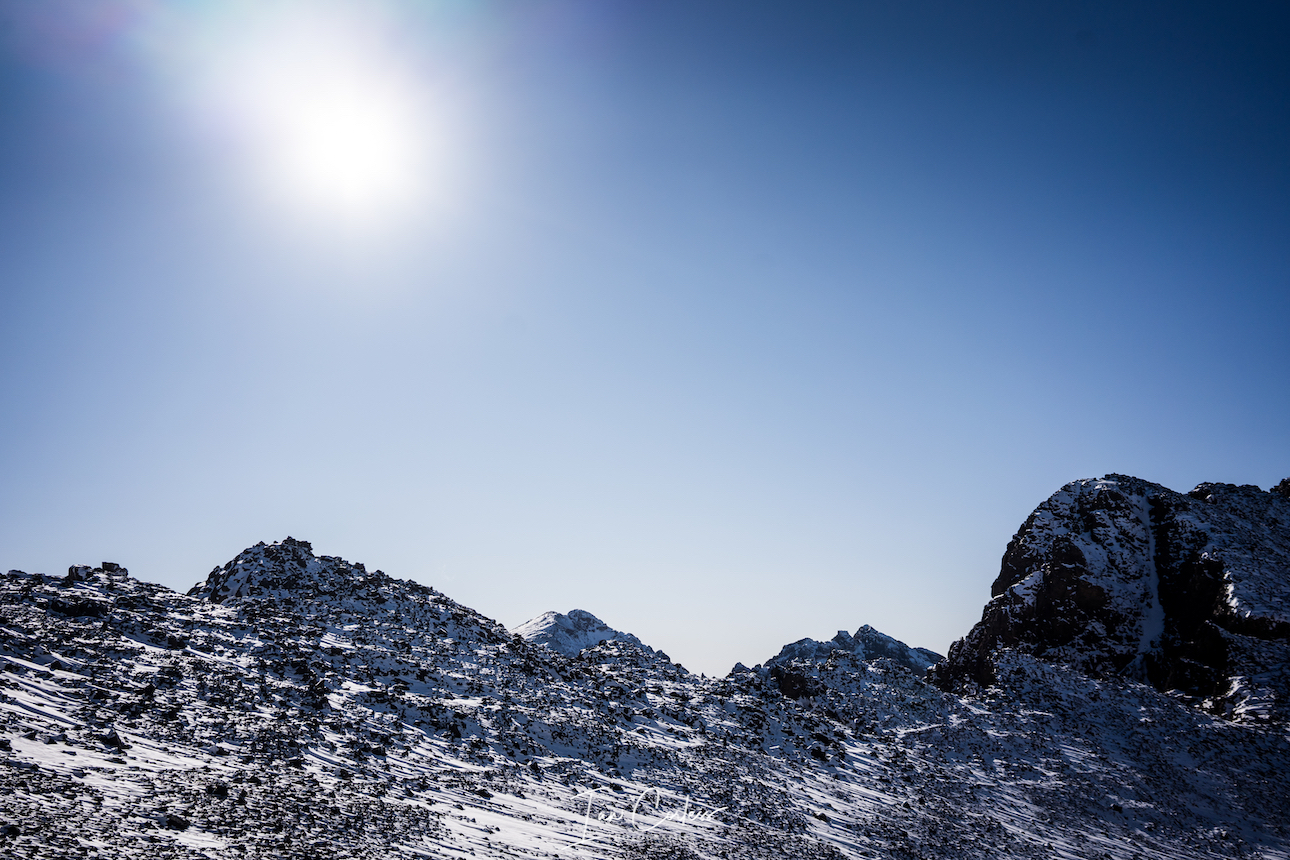
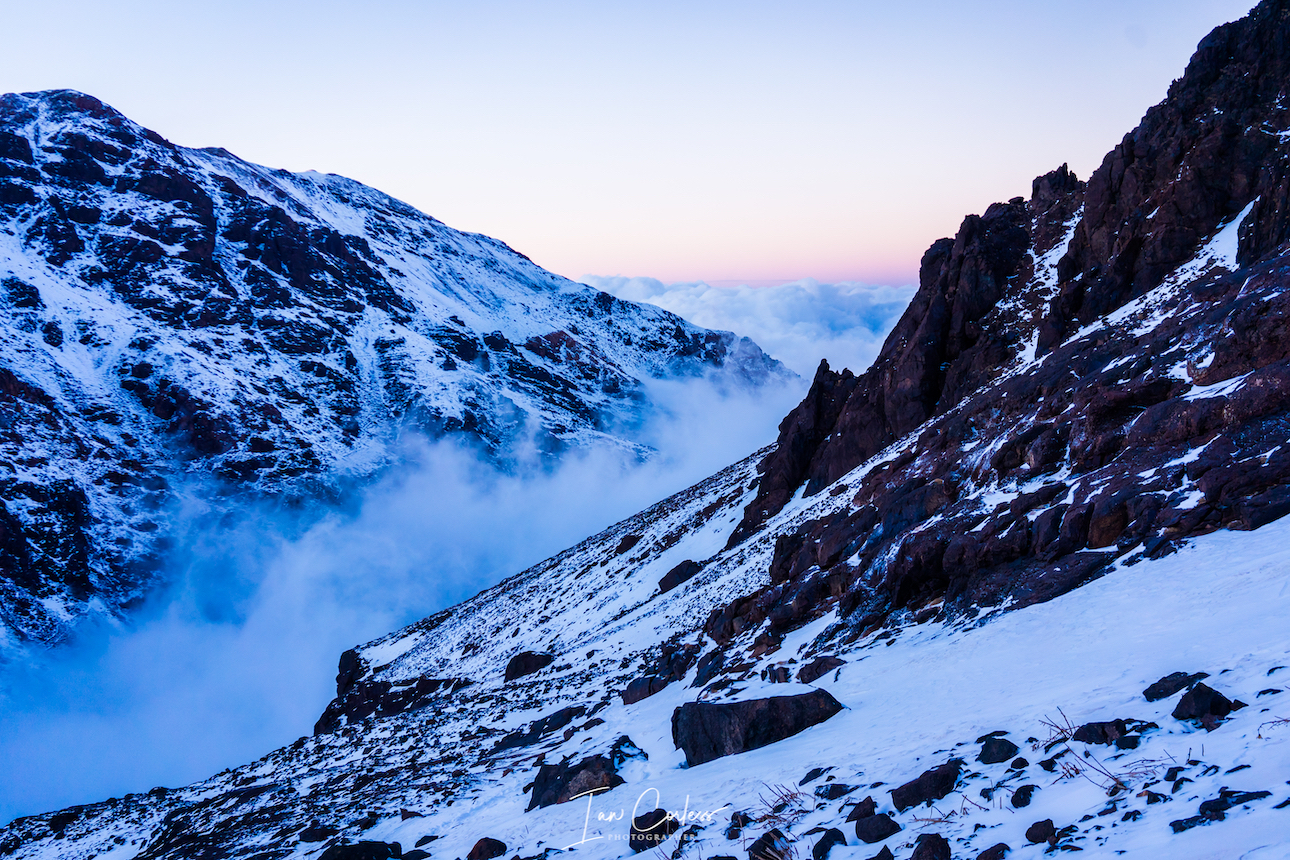
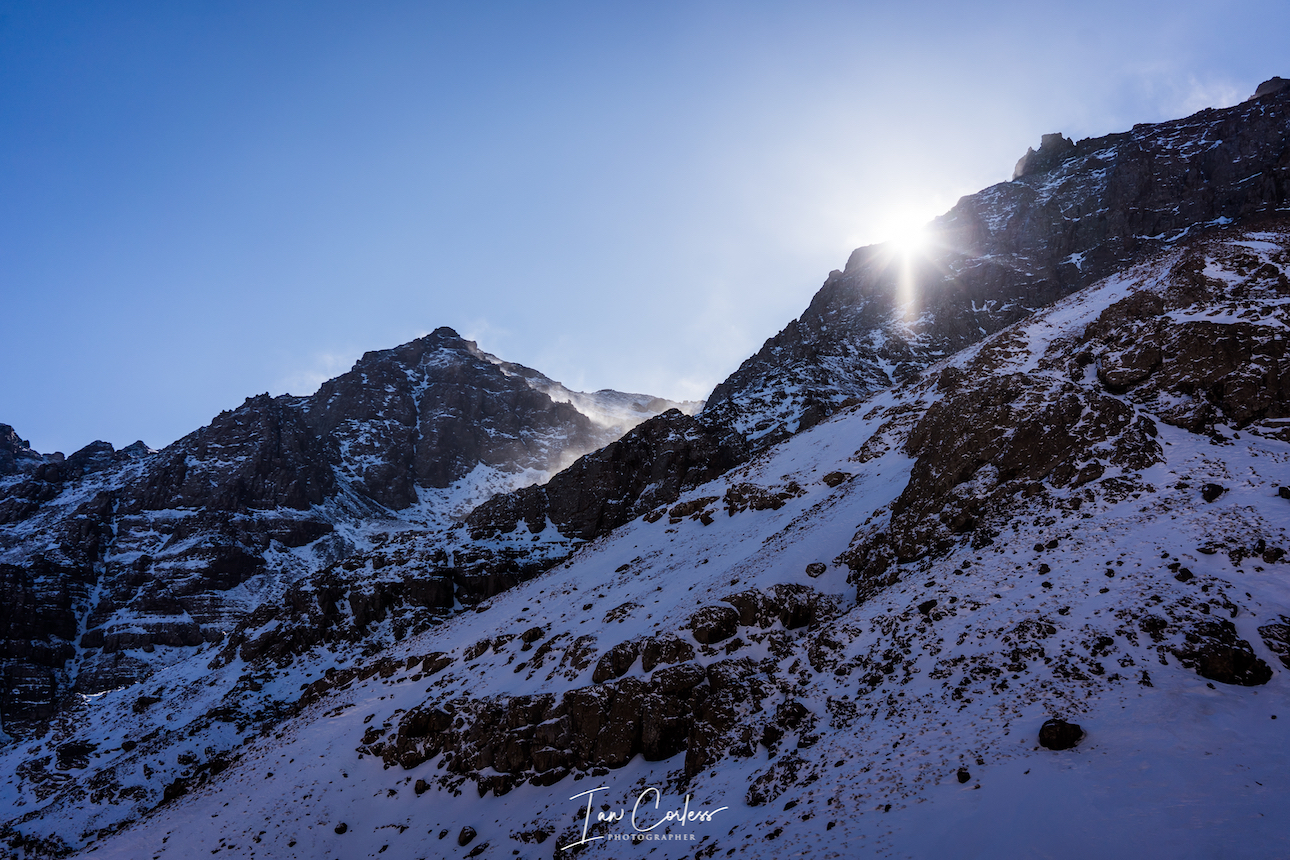
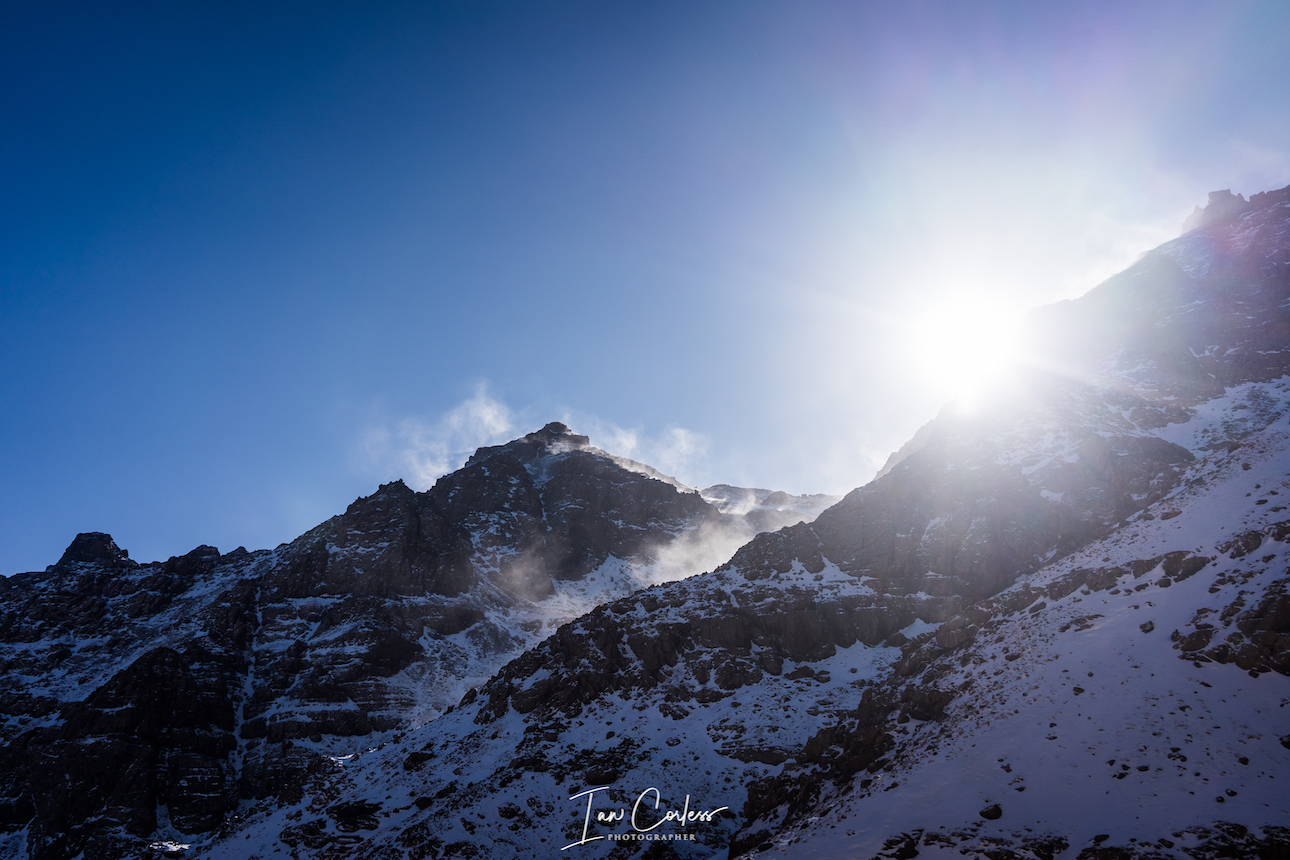
Note – It is dark for pretty much all the climb and very, very cold. How cold depends on many factors but be prepared! Ambient temperature may be -10 but in the wind chill this can easily be beyond -20.
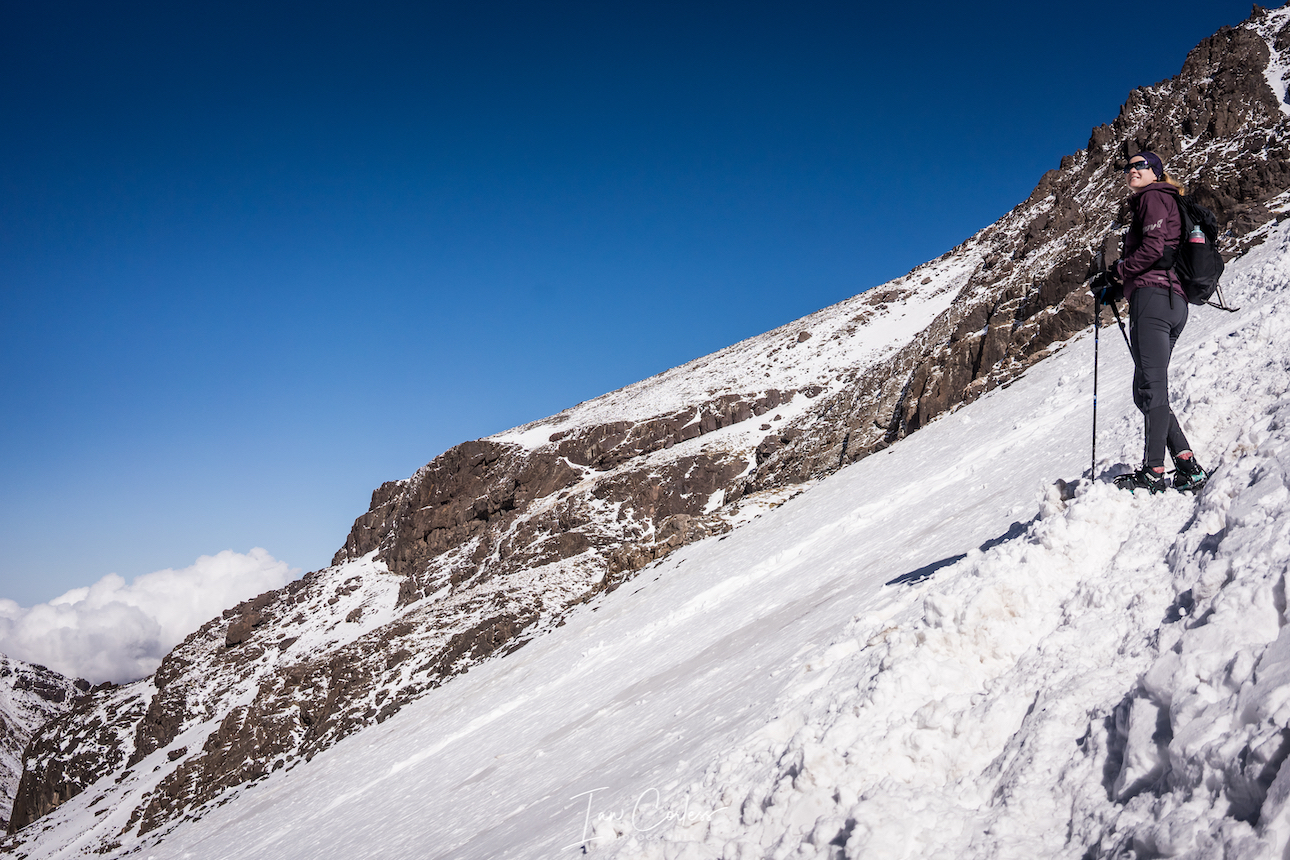
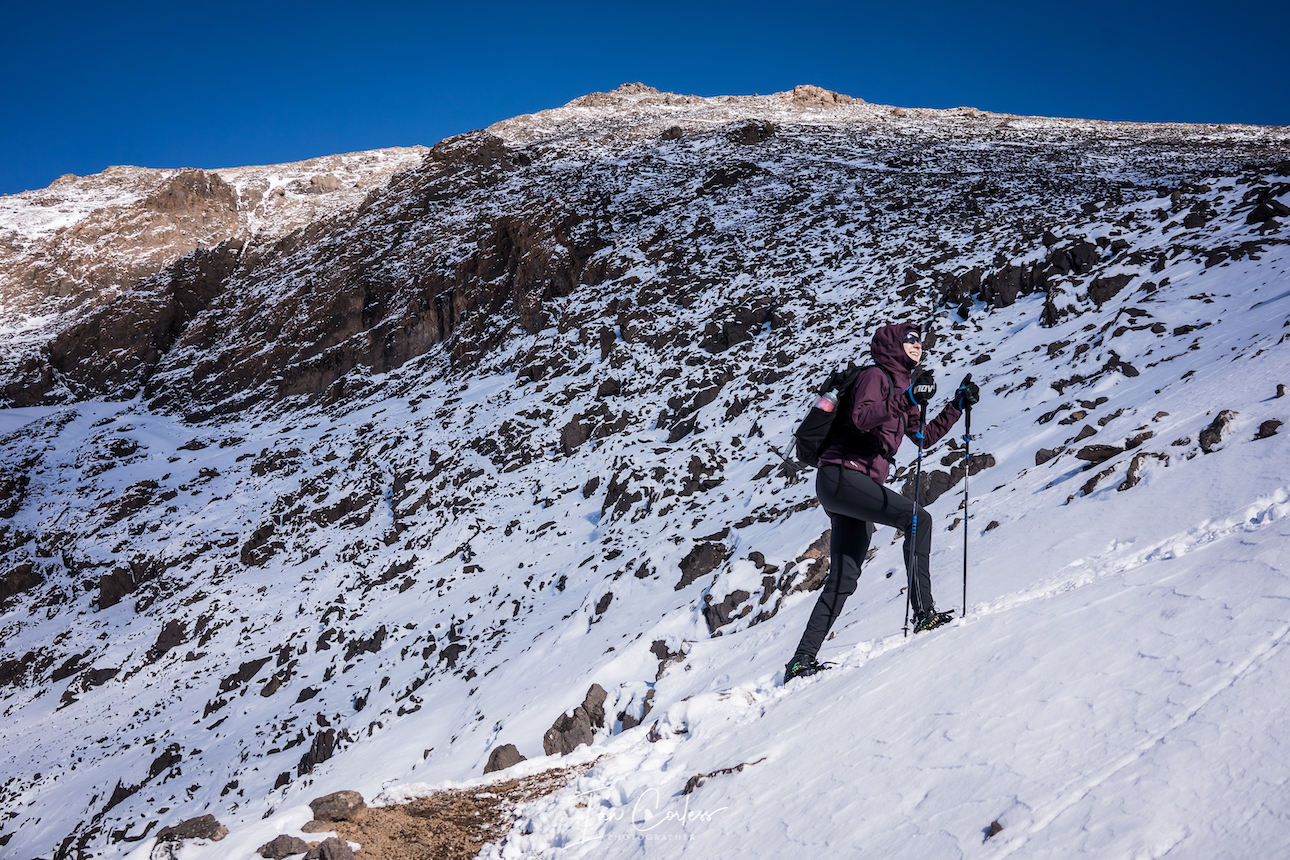
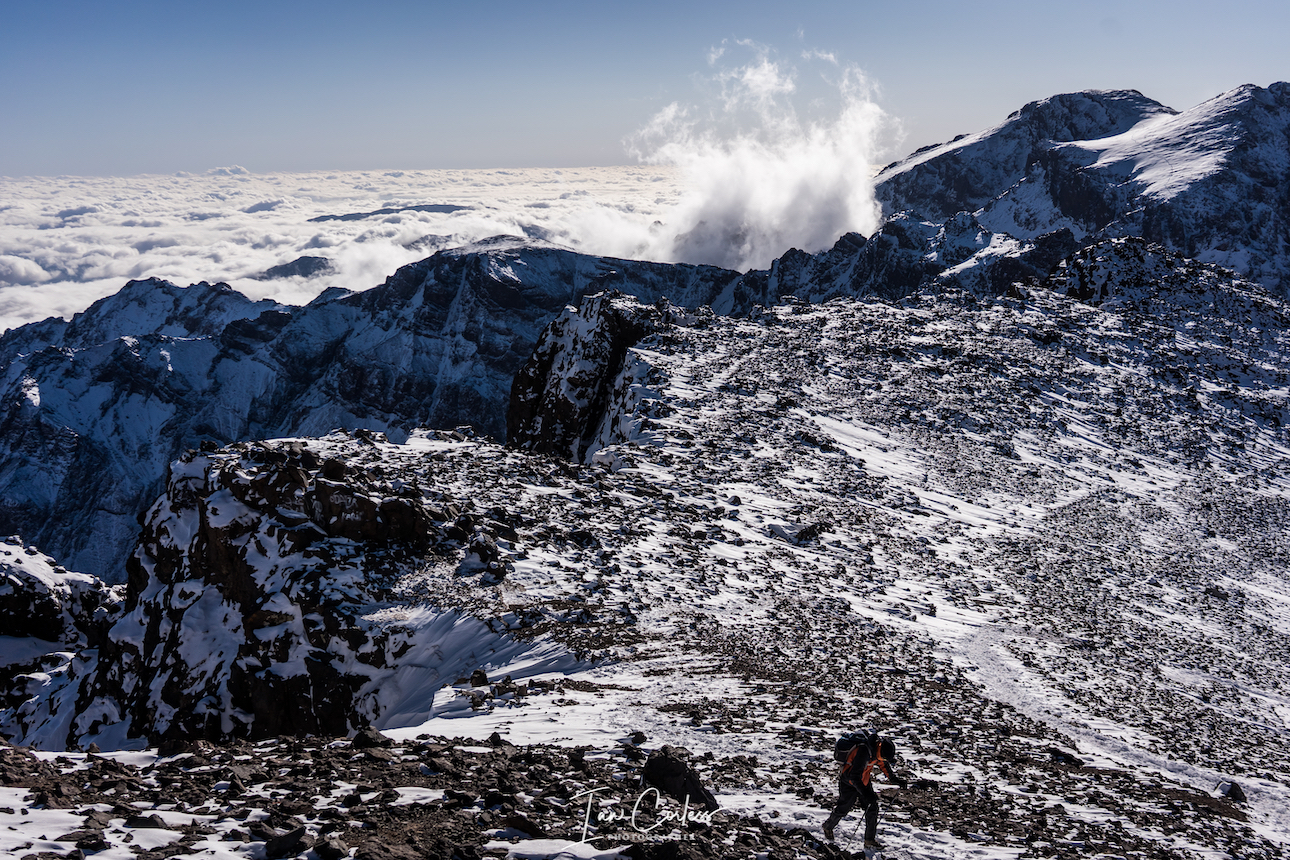
The trail goes straight up often zig-zagging to ease the gradient. The snow and ice can be unpredictable, and crampons are essential. The use of poles is highly recommended and the carrying an ice axe is in my opinion compulsory. You may very well not need it, but better to have one just in case.
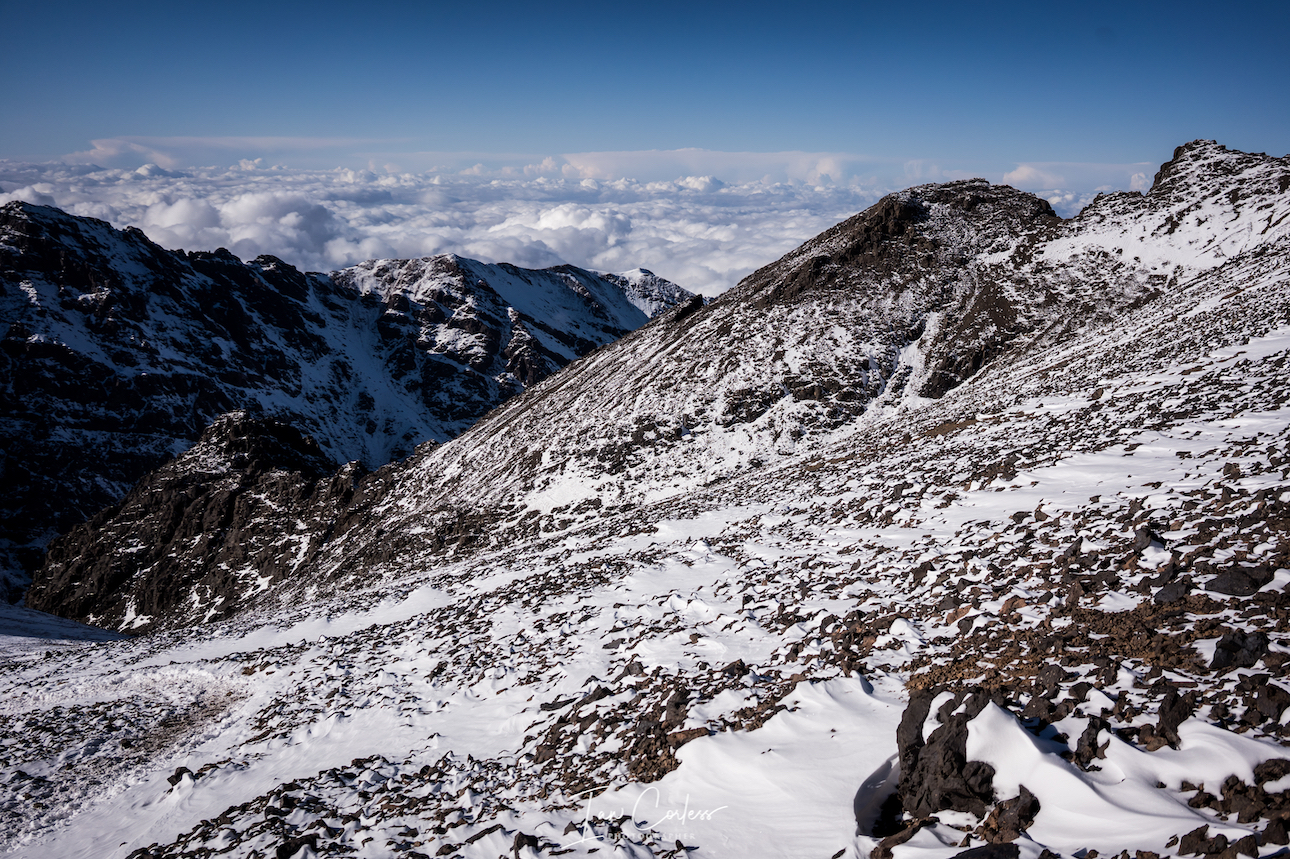
Once at the saddle, the trail goes left and right. Here you go left for a final push to the summit. On a clear day, the views are magnificent and if you time it correctly, the sunrise can be truly magical. The terrain here is not as steep but depending on route options, it can be a little more technical.
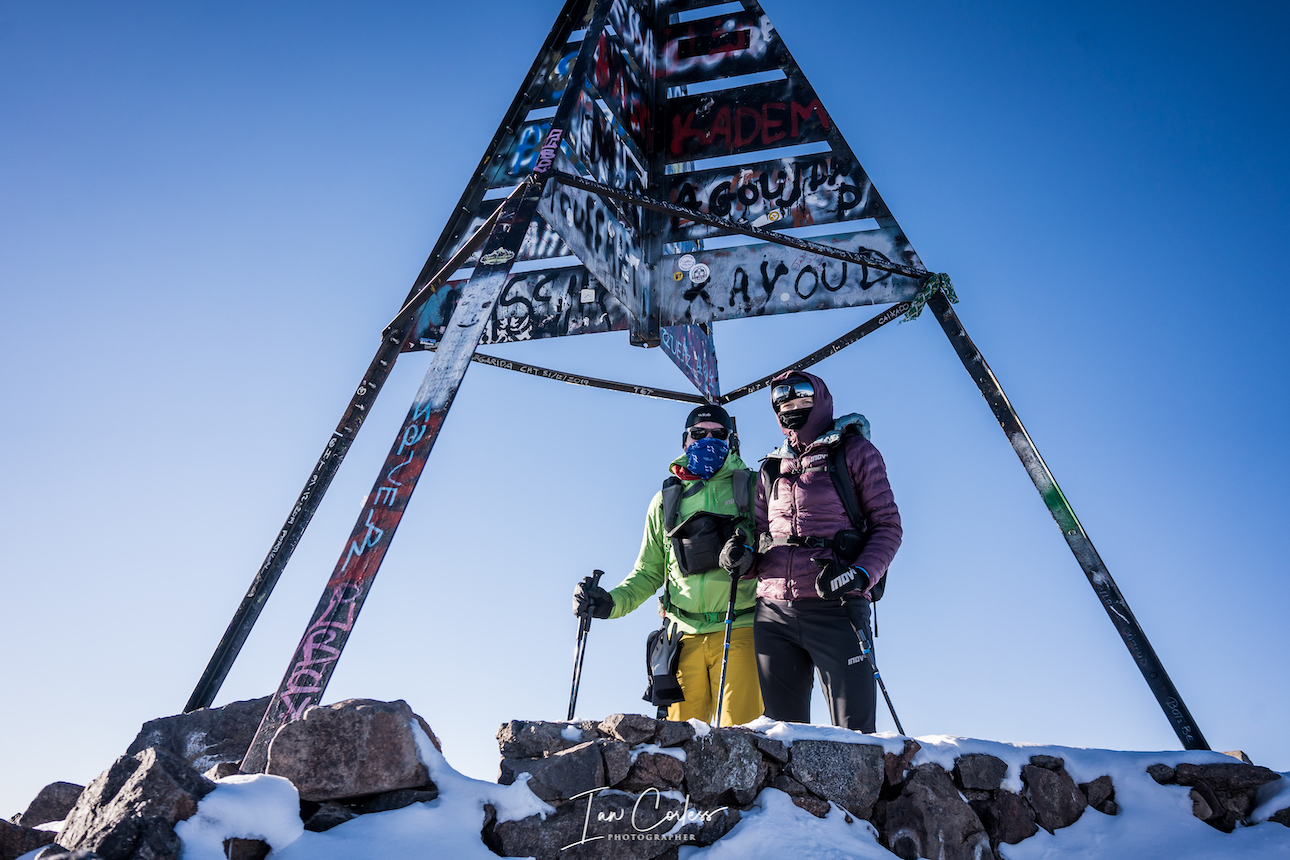
Most arrive at the summit between 0745 and 0900 to experience the winter sunrise. Depending on the day, hanging around is usually not an option; it is too cold. Of course, you may want to take a photo? Be careful! Removing gloves at the summit in -20 is not a good idea. Be sensible.
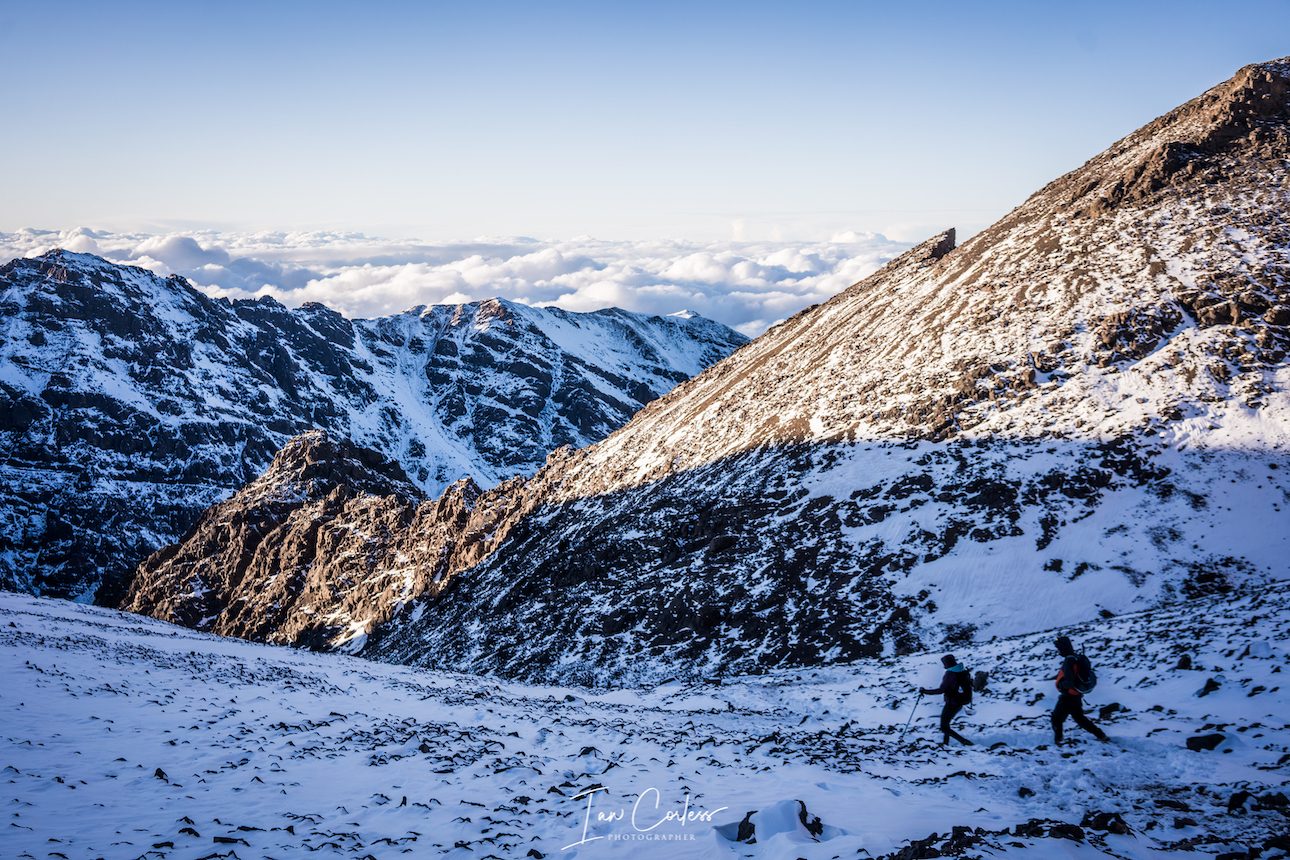
Descending becomes easier from an altitude perspective, with every meter you go down, the easier it will become to breathe. Rely on your crampons on the descent, they provide great security and often, depending on conditions, it is possible to take a more direct line. Let the guide dictate, they know all the route options and will keep you safe.
Once back at the refuge, many take a break for lunch and they will look to descend back to Imlil in the afternoon via the exact same route they went up the previous day.
The above scenario is the classic Imlil-Toubkal-Imlil mini-trek that is ideal to do over a weekend, Friday to Sunday or as a mid-week adventure. If possible, I always recommend mid-week, far less people!
FAST OPTION:
If you are experienced or want a challenge. Imlil-Toubkal-Imlil can be done in one day. I have done this twice now, once in Winter and once in Summer. Depending on one’s speed and ability, it is possible to leave Marrakech at 0530, meet a guide at 0700 in Imlil, summit at midday/ early afternoon and then be back in Imlil before dark.
The above is not for everyone, but for me, it was an ideal opportunity to fit an action-packed day between holiday days, before and after in Marrakech.
ALTERNATIVE OPTION:
Once you have summited Toubkal it is possible to take another route down. This is a more challenging descent with some exposure, very lose scree and lots of technical rocks in summer. In winter, you would need an experienced guide who understands the route and weather conditions and you personally would need a greater level of skill. The route rejoins the main trekking path and you then have an option to go left and return to Les Mouflons refuge or go right and return to Imlil.
OUANOUKRIM ROUTES
Located high above Les Mouflons refuge, Ouanoukrim offers the 2nd ‘TIMZGUIDA’ and the 3rd, ‘RAS’ highest peaks of the Atlas range. These two peaks are often neglected due to Toubkal being the highest peak, but these two are just a fraction lower at 4089m and 4083m and they offer much more challenging and technical climbing.
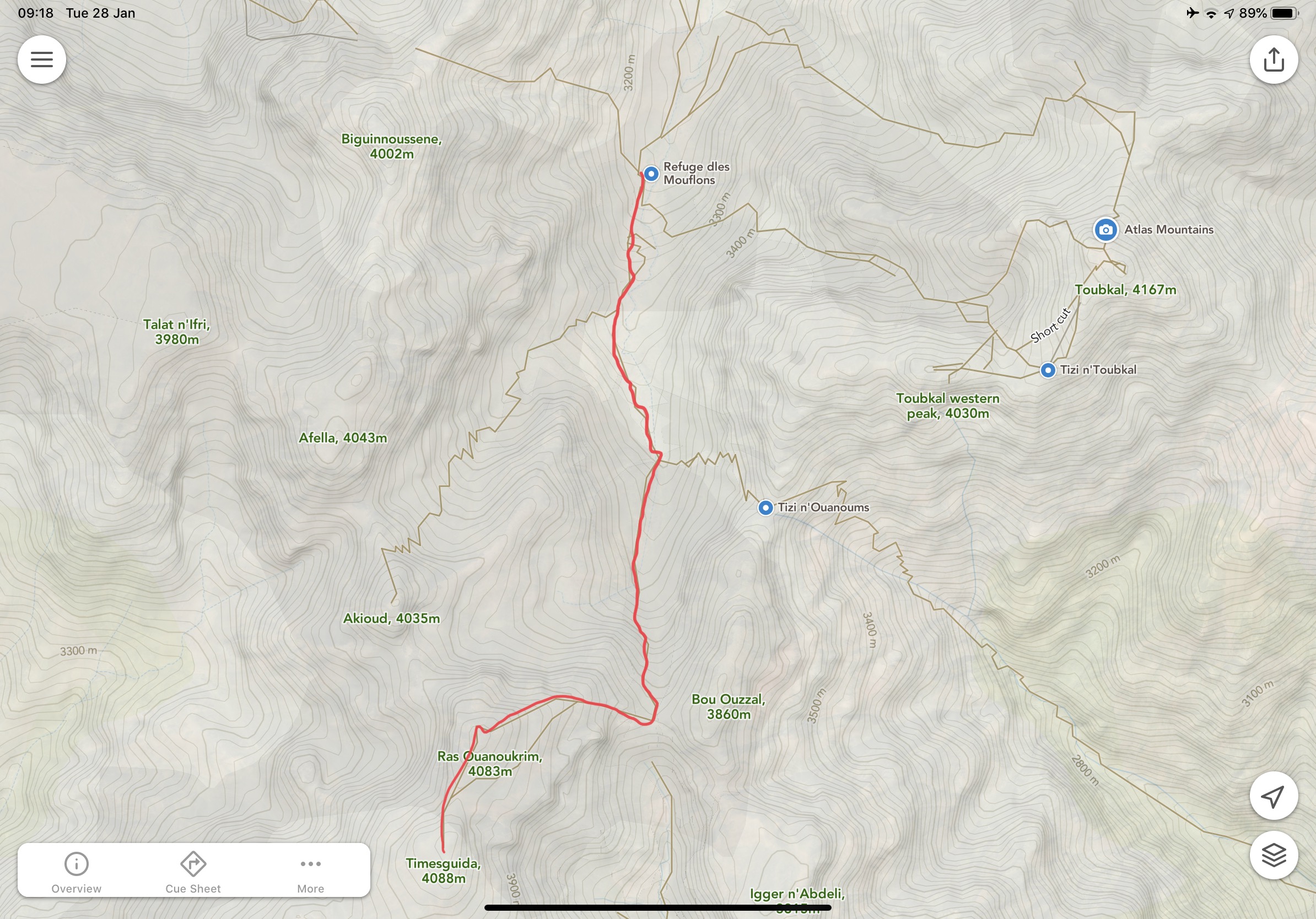
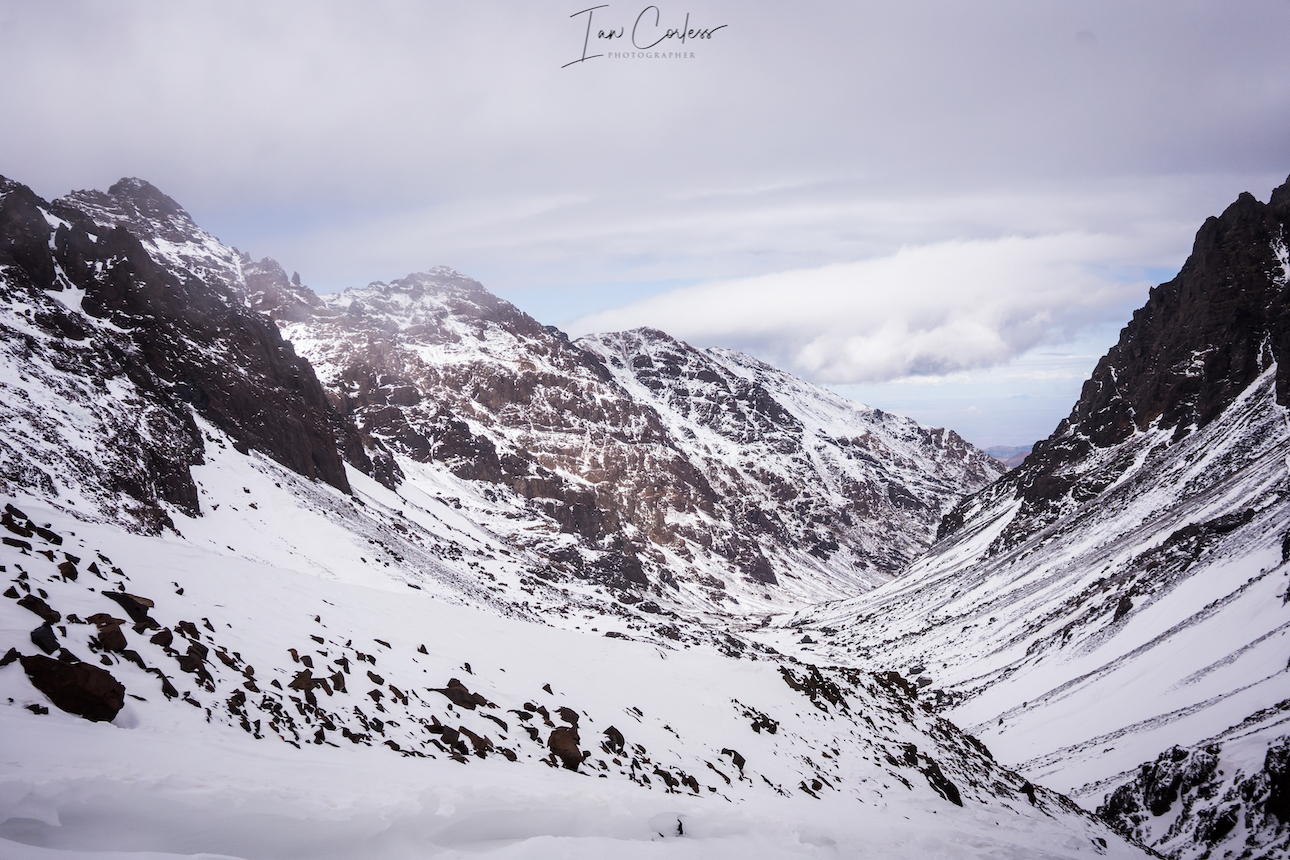
Leaving Le Mouflons, one heads up the mountain, Toubkal is to the left and you take the valley leading to the peaks ahead. The out and back trek/ climb is longer than Toubkal and the early gradients are less severe. However, as one moves up the climb the terrain becomes increasingly challenging and steeper.
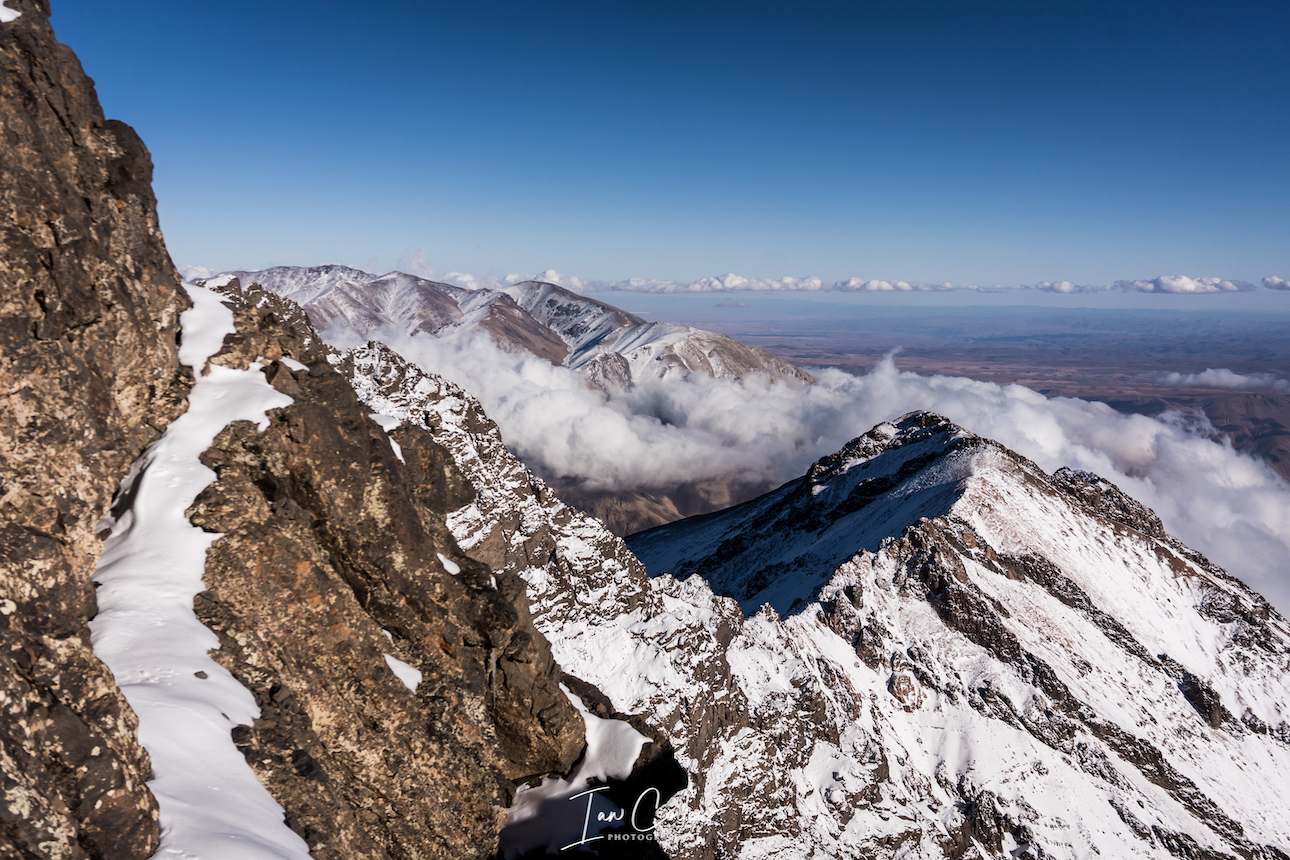
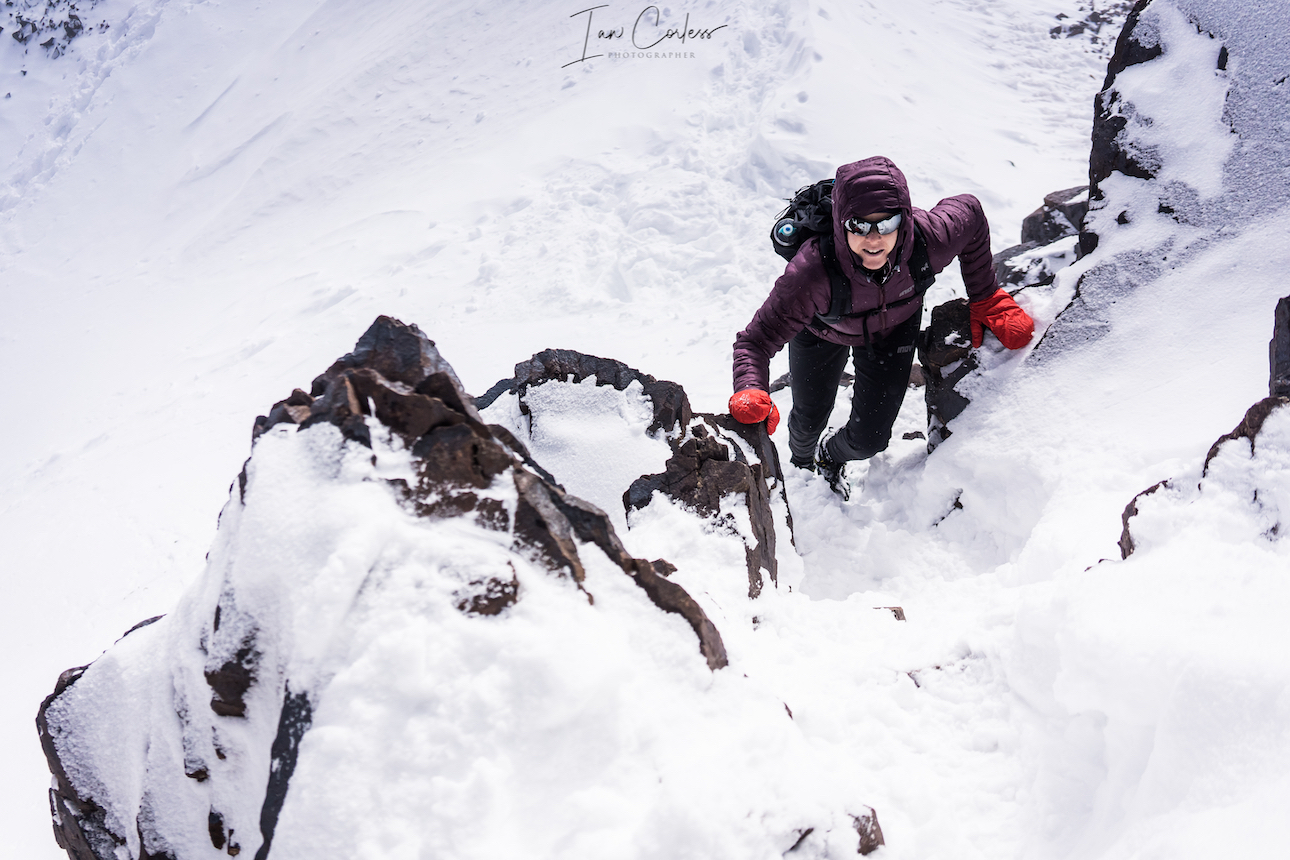
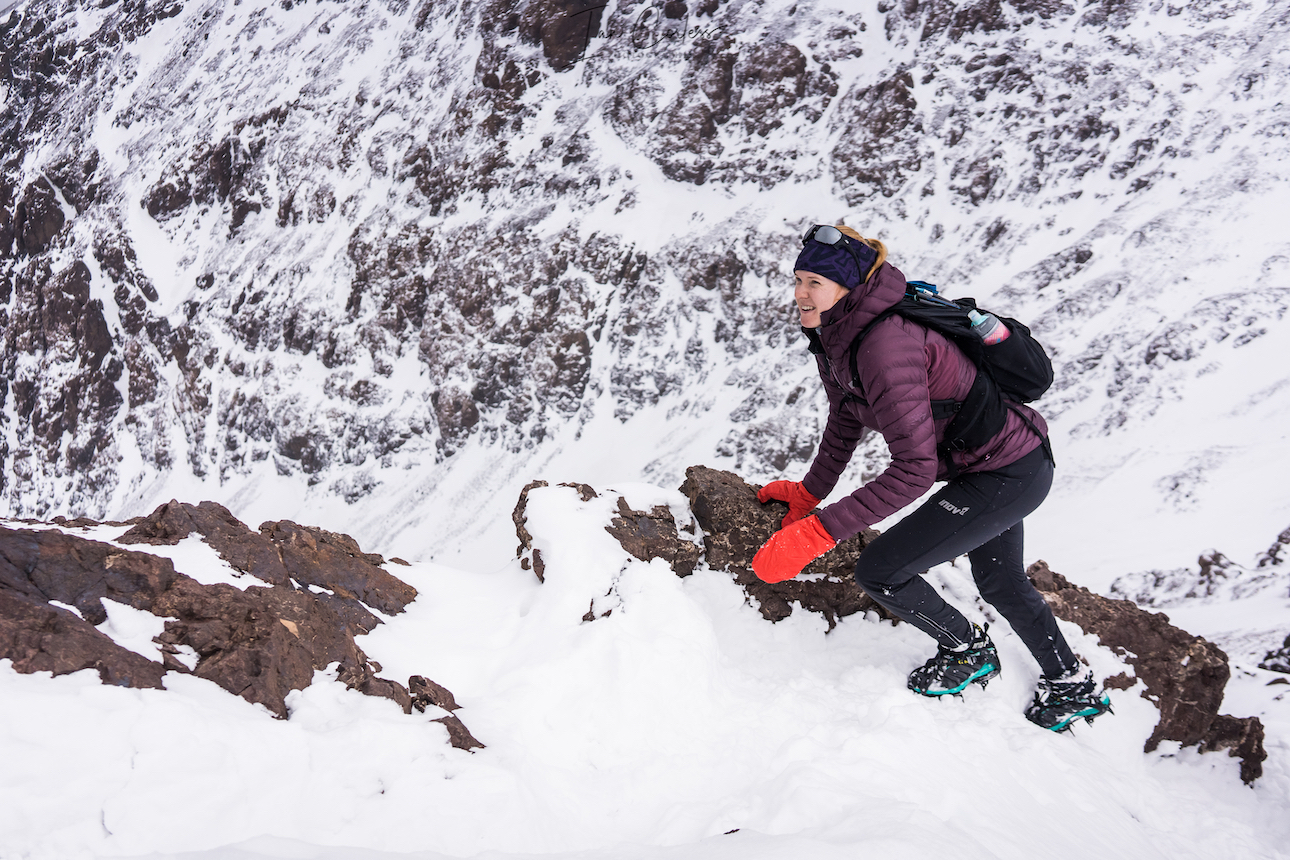
At the saddle, you can decide to go left for RAS or right to TIMZGUIDA. TIMZGUIDA is higher and a more challenging climb that in winter requires more advanced scrambling skills, the need for an ice axe and a level head. It’s a stunning route that is perfectly achievable, even for a novice climber, as long as you have a good guide and the correct equipment.
After several scrambling sections, the mountain opens up with one last scramble to the summit.
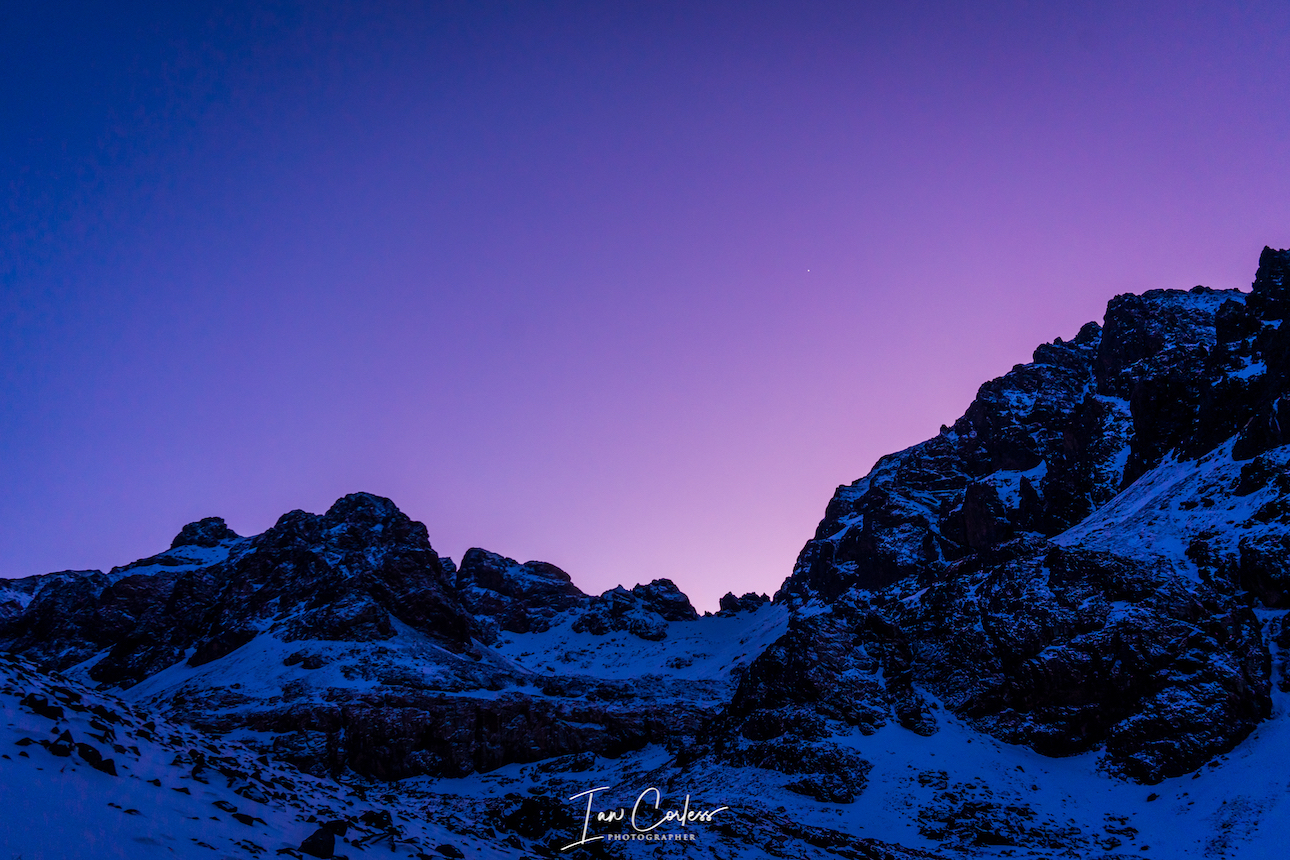
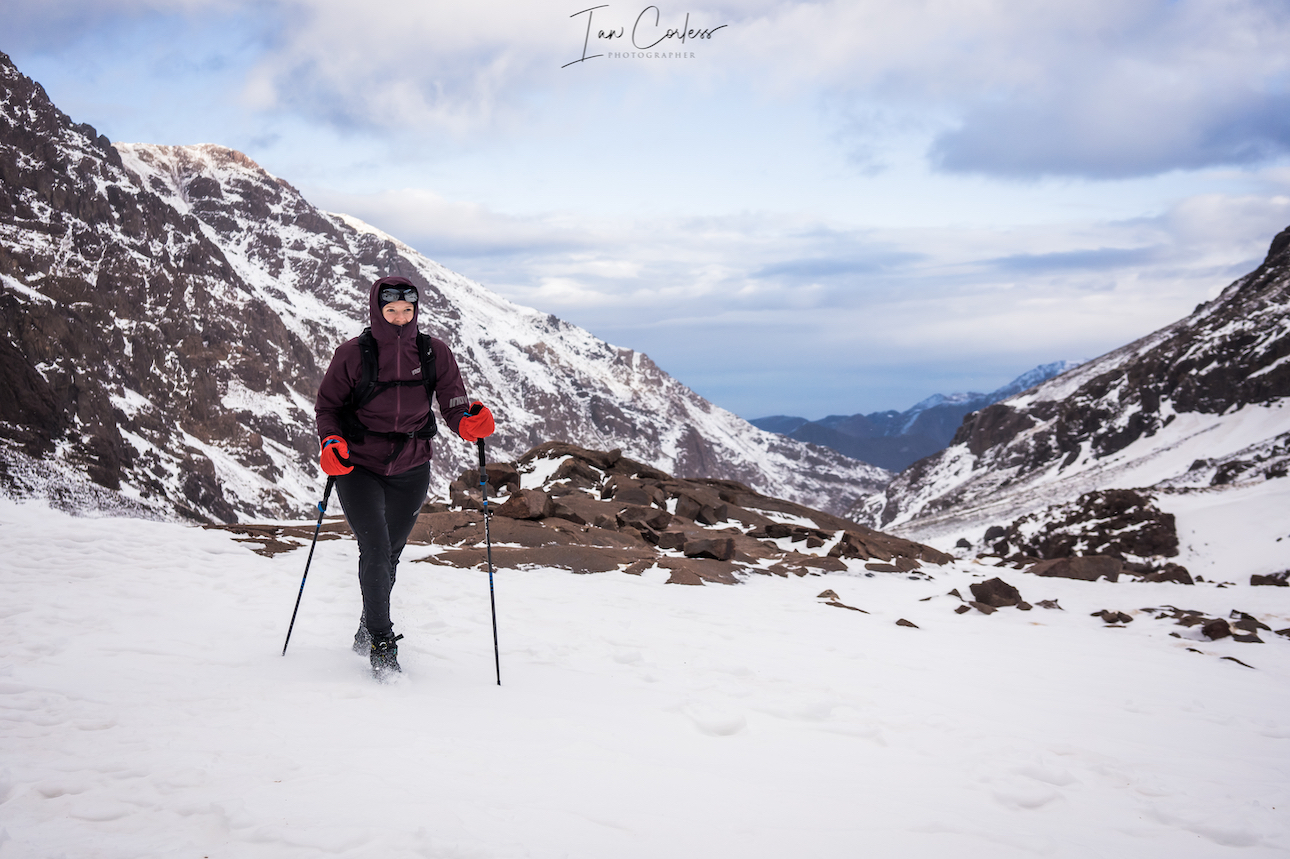
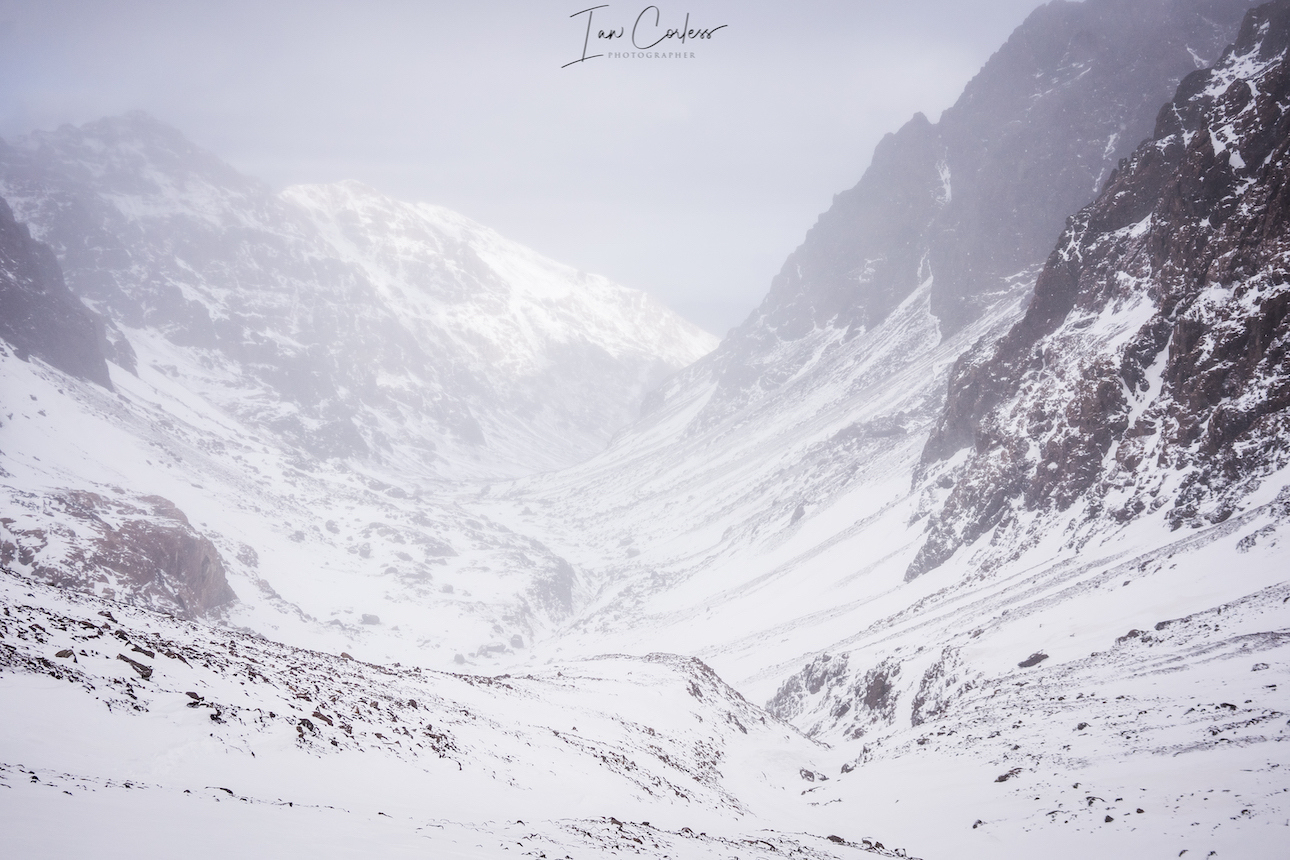
The return is via the way you arrived, so, constantly ask yourself on the way up, ‘Am I happy down climbing these sections?’ – It is always easier to climb up than climb down. Exposure to the elements is a factor that you must consider, especially in the final 100-200m where the mountain is exposed. On my most recent trip, we had thick snow which made trekking up and down hard, we had snow flurries, thick mist, fog and very, very cold temperatures.
Of course, it is possible to do RAS and TIMZGUIDA in one day.
OTHER ROUTE OPTIONS
AFELLA 4043m and AKIOUD 4035m are two other route options from the Toubkal refuge.
AFELLA is to the west of the refuge with more complex faces. The majority of the winter lines are on the south face and are accessed by a narrow ravine. The east face requires ice climbing.
AKIOUD is accessed from the south via the ‘Assif ait Maine.’ The climb can take 3 hours based on conditions and it is possible to ski down following a south east direction.
Other route options exist that can be made up of multiple days.
EQUIPMENT:
As suggested previously, summer on Toubkal and you can get away with standard running apparel with the addition of a warm layer (PrimaLoft or down) and water/wind proof top and bottoms for the climb and summit. Gloves, beanie, buff and so on are also essential.
In winter, you need very specific equipment which I will list below with links. Climbing boots are large and heavy and I strongly suggest you use a much lighter approach shoe or run shoe for the trek from Imlil to refuge and back.
Base layer:
RAB Forge leggings and top
Mid layer:
RAB Shadow hoody
Insulation:
RAB Xenon Jacket (Stratus insulation)
Pants:
RAB Torque and Winter Torque
Gloves:
RAB Forge liner glove and RAB Xenon Mitt
Hat:
RAB Shadow Beanie
Waterproof layer:
inov-8 Stormshell
Shoes:
La Sportiva Mutant (used for Imlil to refuge)
Boots:
La Sportiva G5 mountaineering boot
Crampons:
Petzl Irvis Hybrid
Ice axe and Poles:
Petzl Glacier and Black Diamond Distance Z Carbon
For extreme cold:
RAB Neutrino Pro Jacket
RAB Aragon Pants (down)
Sleeping Bag:
RAB Neutrino 600
Other:
Make sure you have good sunglasses and I found goggles essential in winter conditions.
Make sure you apply sun screen.
I recommend you have an emergency tracker, I use a Garmin InReach for all outings.
TIME OF YEAR:
Summer:
August for me is perfect. Marrakech is hot but has less tourists. Expect 30-40 degrees during the day. Imlil to the refuge, temperatures will be somewhere between 15 degs at 0700 and 30 deg in the afternoon.
Winter:
January through to April provides excellent winter conditions and snow/ ice levels will vary depending the usual weather variations. I have climbed in January and April. January provided more extreme conditions with much colder temperatures.
RETURNING TO IMLIL
The way to return to Imlil is via the trekking path used when coming out. There is no need or requirement to visit the control points and show your passport.
This January Toubkal and Atlas Mountain trip was undertaken in preparation for a 2020 expedition to Nepal for the ‘Three Summits Expedition‘ – read more HERE
Please support this website. I believe everyone deserves to read quality, independent and factual articles – that’s why this website is open to all. Free press has never been so vital. I hope I can keep providing independent articles with your help. Any contribution, however big or small, is so valuable to help finance regular content. Please support me on Patreon HERE.
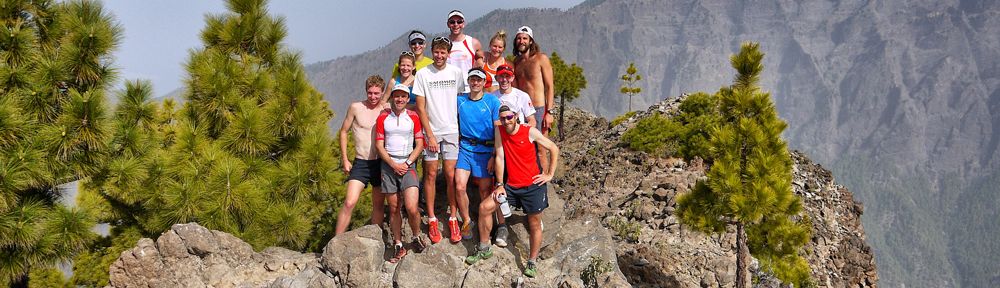
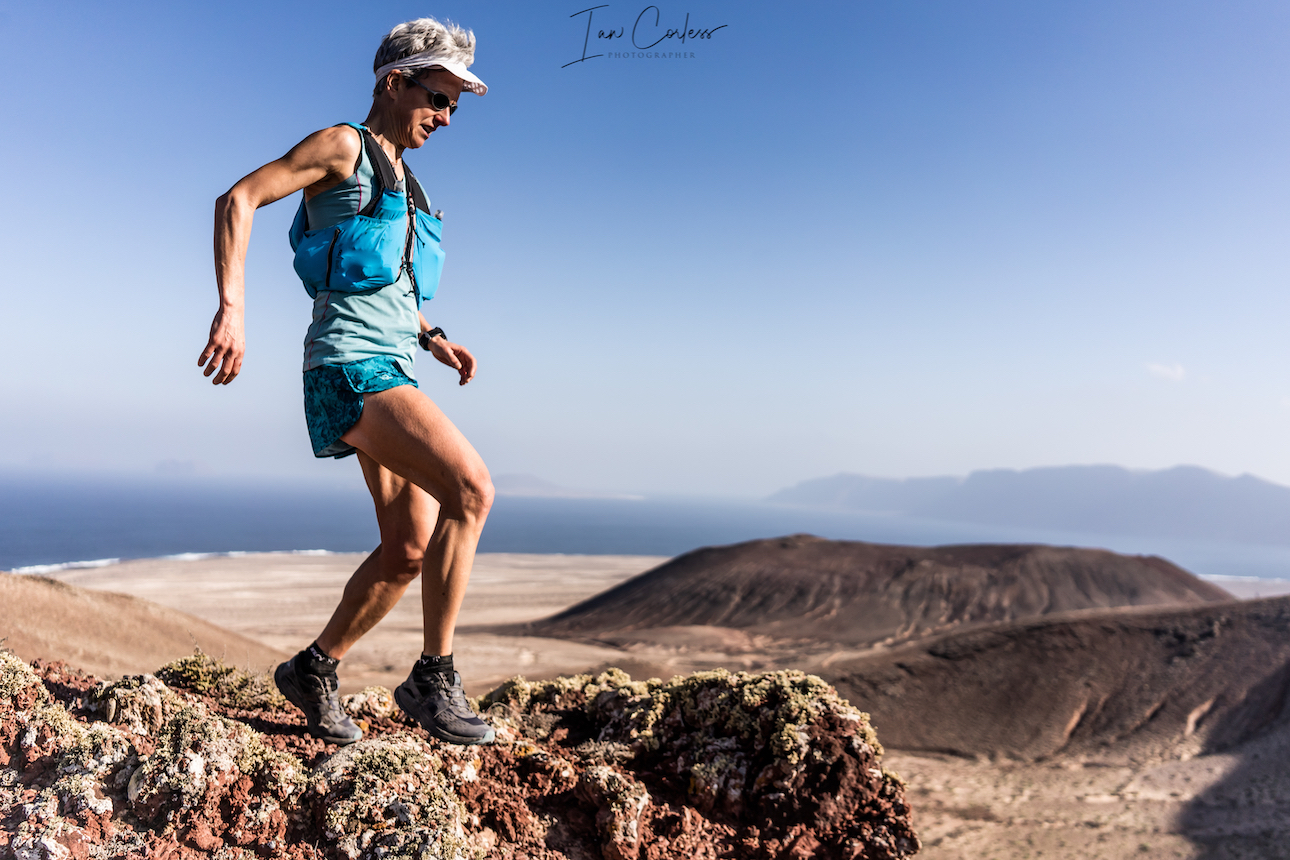
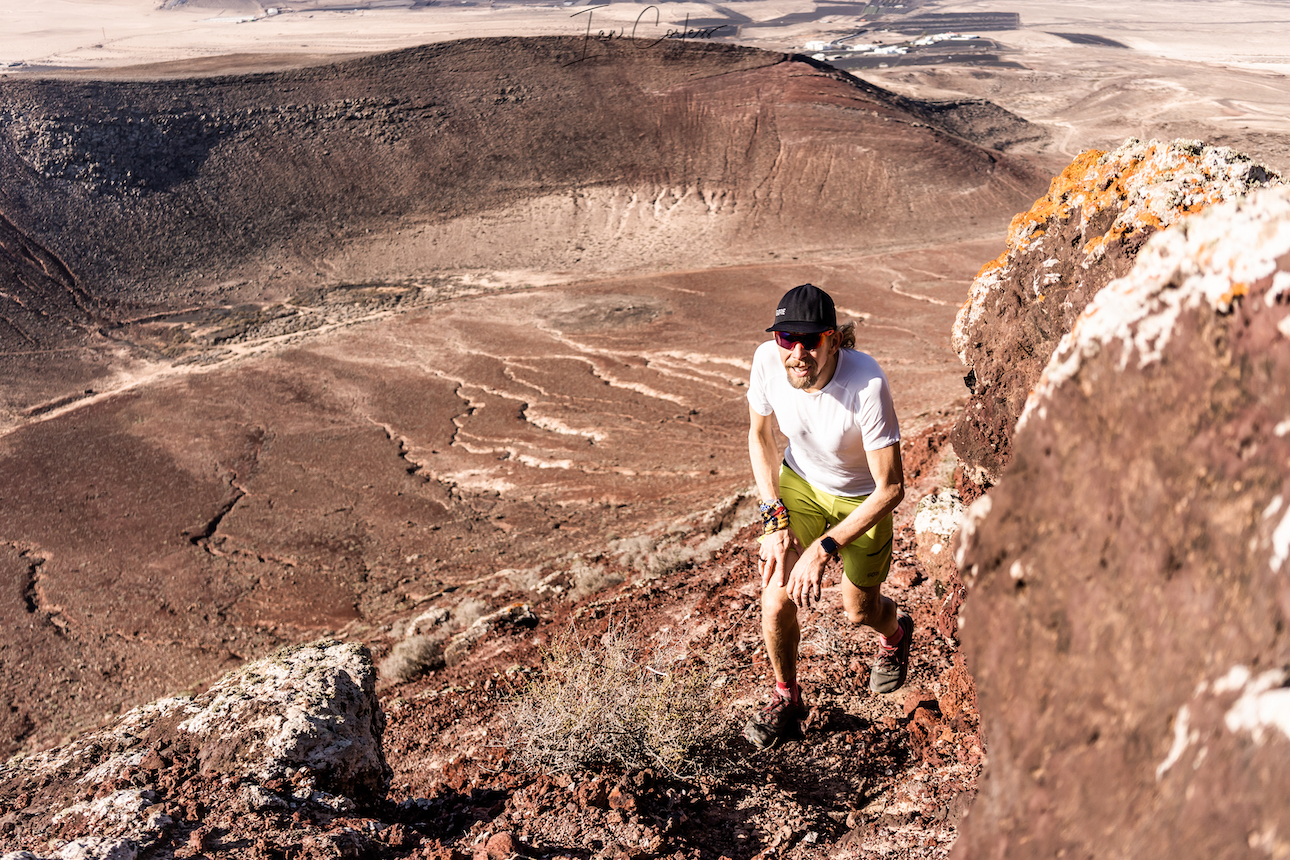
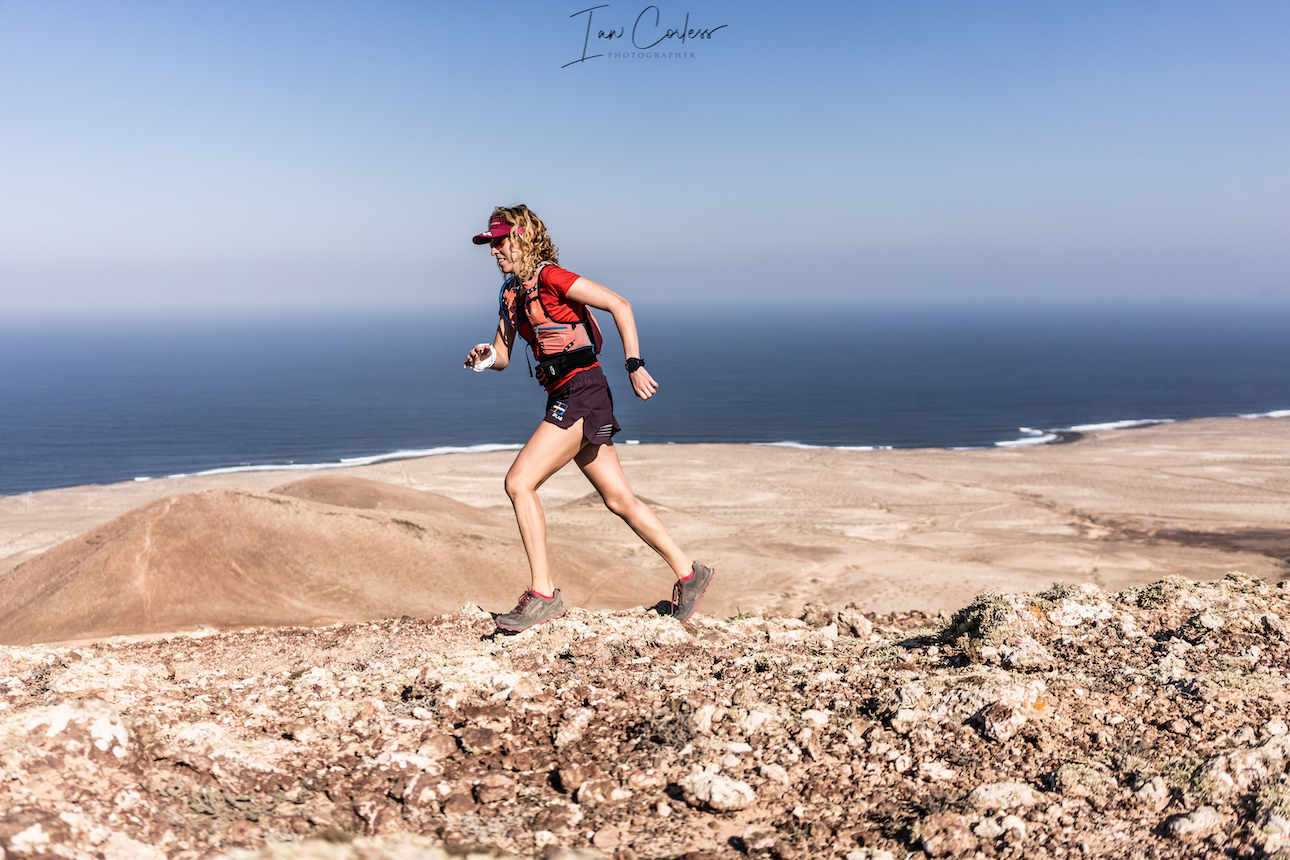
The penultimate day of our training camp was a cracker and one that many of the camp attendees have called a highlight.
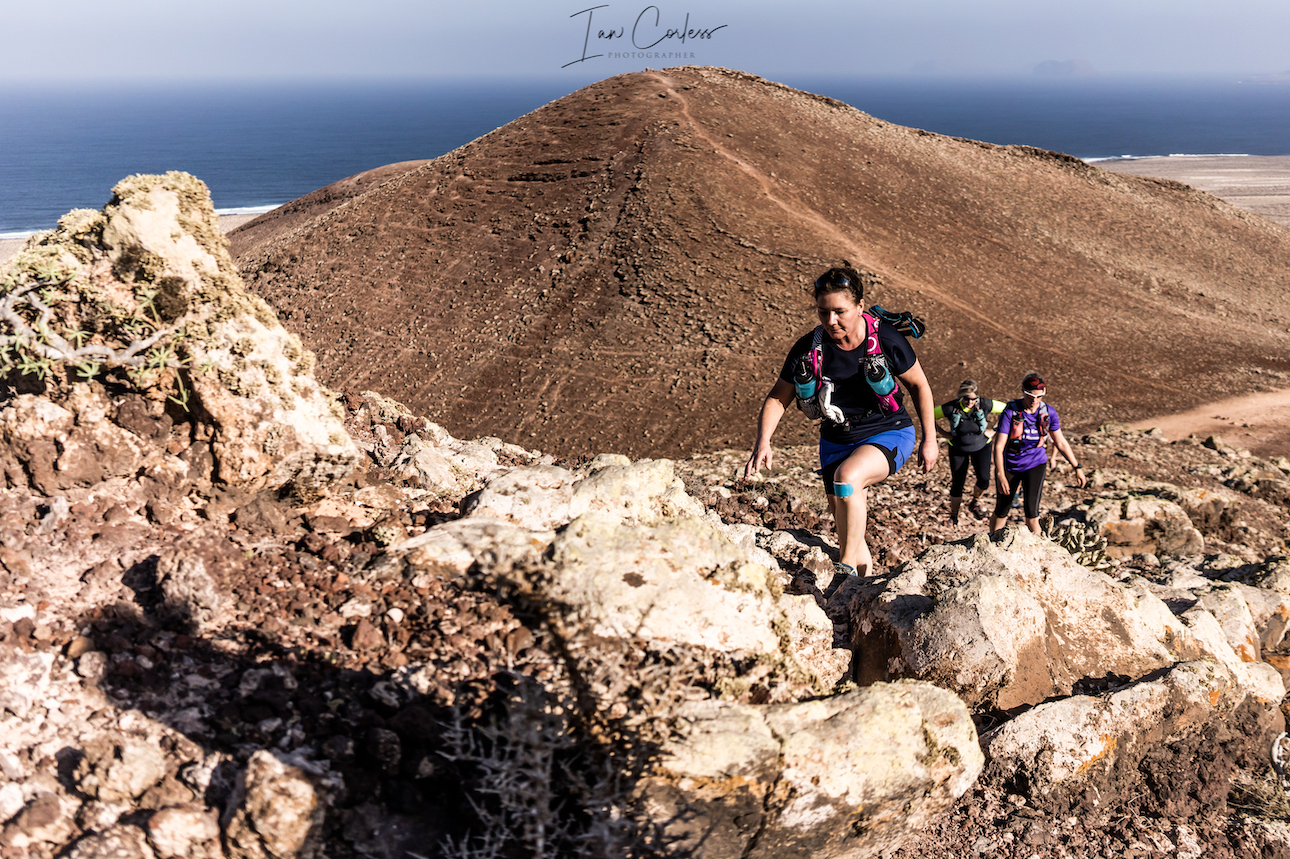
Our first run was between 8-10 miles and included a climb, traverse and descent of the Montana Soo. It’s a great route and one that pushes many out of their comfort zone as the terrain is often steep, technical and challenging with loose stones.
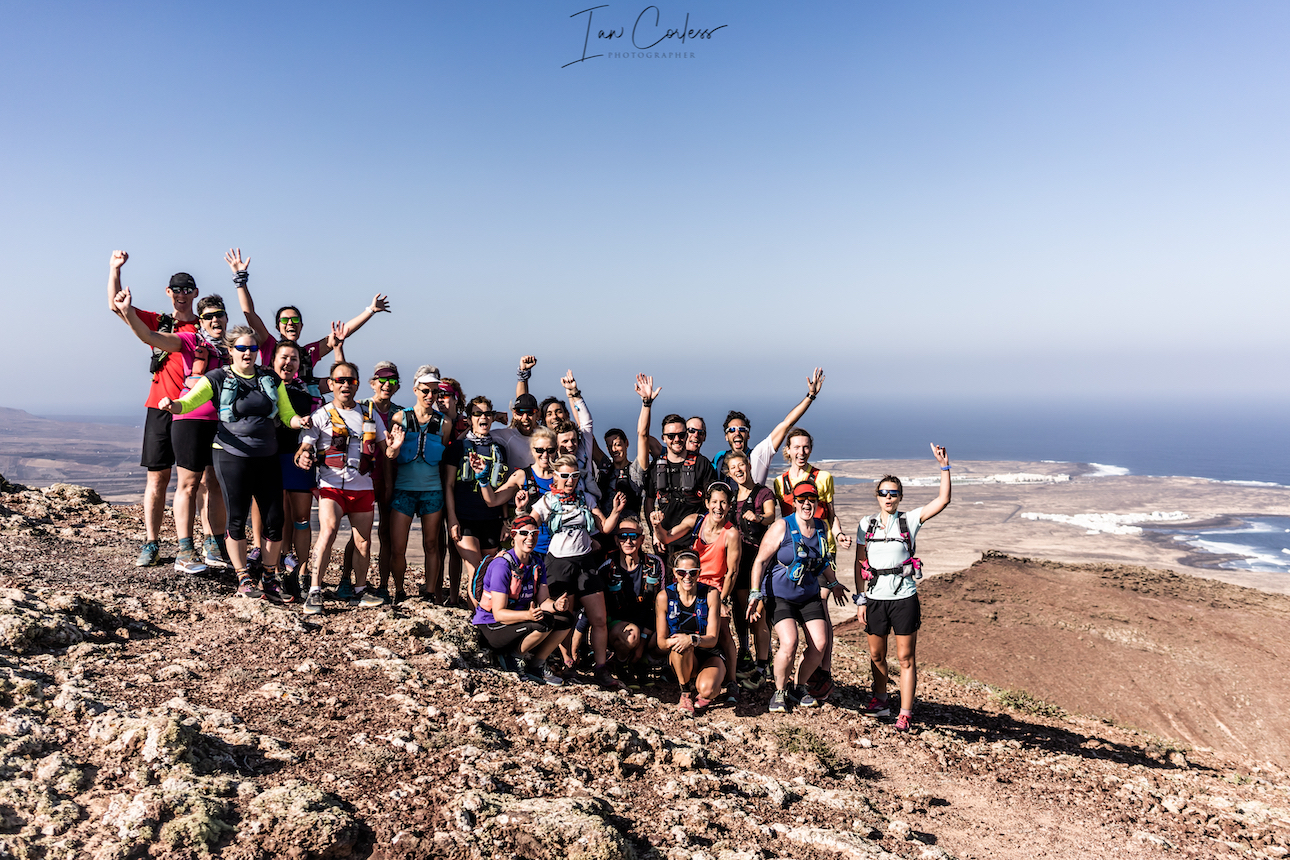
At the summit it provides a great photo opportunity with Club La Santa off to the right in the distance.
For the more experienced runners, they move fast over the terrain embracing the challenge that it brings. Others move slower, more deliberate and thoughtful. We include it in the camp as it closely replicates the feeling and exposure that one can get at the large Djebel at Marathon des Sables.
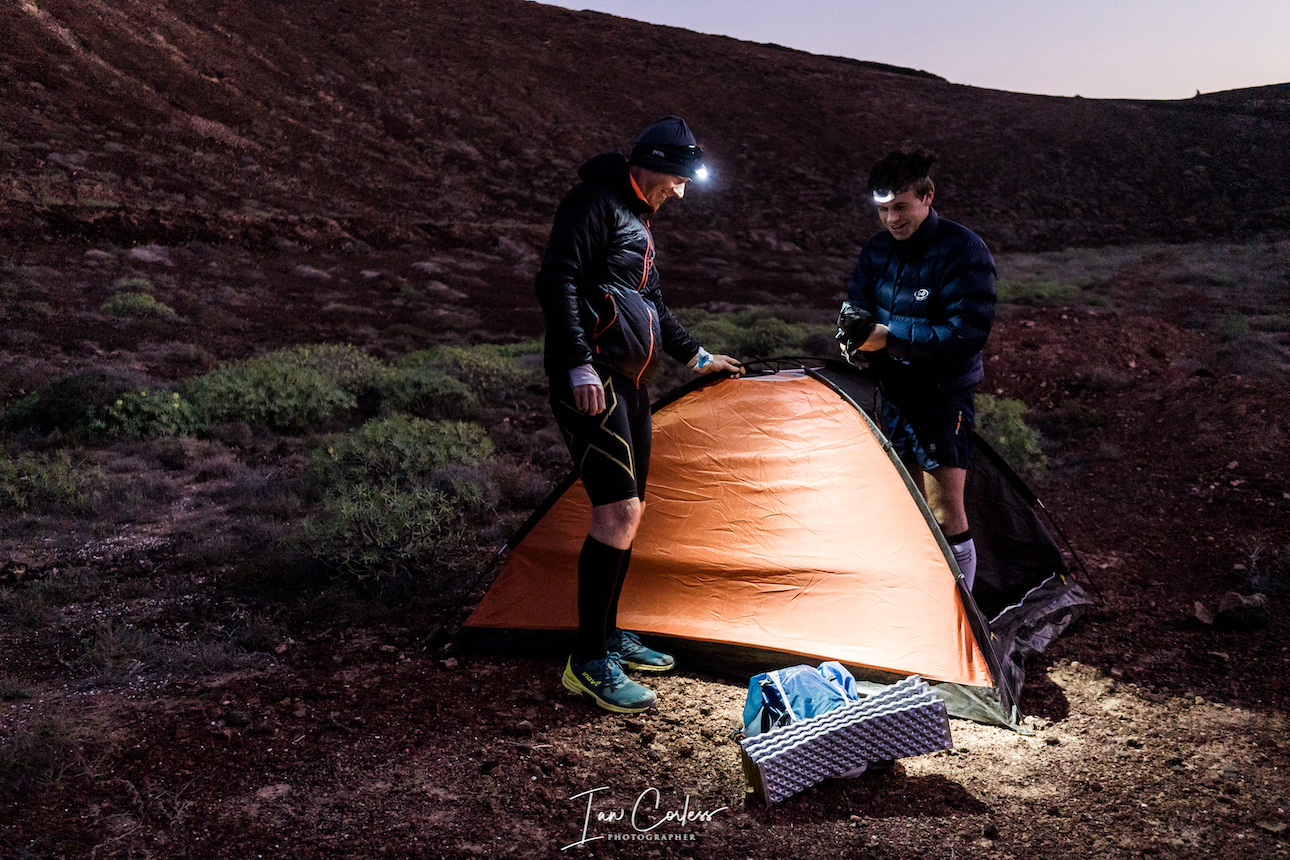
After the mountain loop, we all returned back to CLS for a 3 hour break before a self-sufficient run. This is our mini multi-day experience that allows all our clients to run to a bivouac location in ability based groups with packs carrying sleeping bag, essential, dehydrated food for dinner and breakfast and a minimum of 1.5ltr of water. Most packs weigh around the 5kg mark.
We transport tents to the bivouac, rationed water and two gas burners to provide hot water for cooking. Once the runners leave CLS, they are self sufficient.
At the bivouac, they put up tents.
As the sun disappears they test out dehydrated food and simulate a bivouac experience. They understand the weather, the need for warmth and then they sleep under the stars.
Our night started perfectly with beautiful clear skies. Amazing star views and warm temperatures. As the night progressed, the wind increased and very much simulated a stormy night in the Sahara. For many, it was a sleepless night with shaking tents and sand being blown everywhere.
An early breakfast call, self-sufficient breakfast, water rations given and they were then off for another 13-miles of soft-sand and dune training before returning back to CLS.
Our final day has one final talk by Elisabet Barnes and Sondre Amdahl and then a group dinner to say farewell…
The next time we will all meet will be in Morocco for the 35th Marathon des Sables.
Our 2021 Training Camp will be announced soon HERE
Anyone fancy a mini-trip to Morocco, Jan 21 to Jan 25th?
I am happy for 1-3 people join me.
*****
Plan is to climb and summit Mt Toubkal (4167m) three times in three days! Basic experience of snow climbing from 3000m refuge to summit and back. The climb from Imlil (1800m) to the refuge (3100m) is just trekking.
You will need to be self-sufficient (meals at refuge) and you will need good winter climb boots, crampons and ice axe.
*****
Plan:
21st- Fly to Marrakech and transfer to Imil, overnight Imlil.
22nd – Imlil to summit and back to refuge with overnight at refuge.
23rd – Early summit for sunrise and back to refuge.
24th – Early start, summit, refuge and then return Imlil for overnight stay.
25th – Back to Marrakech and flight back to London.
*****
If you fancy a mini-adventure please use the contact form below.