Stage 1 was a tough day, the talk in bivouac was all about the relentless sand and how the final 10km was relentlessly tough.
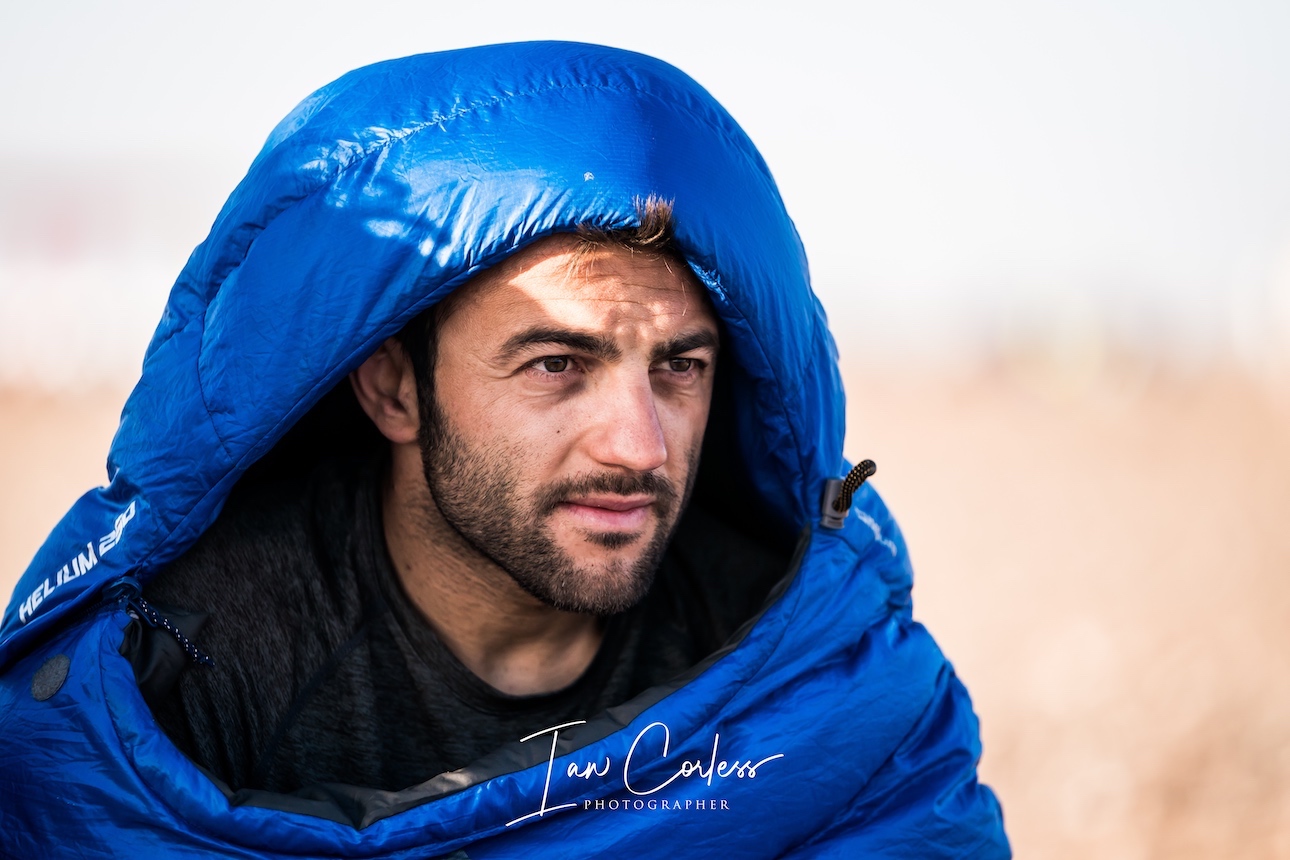
It was an early sleep for most and the night was a cold one. Temperatures plummeted, especially in the early hour of the following morning.
Tired! – Photo by Ian Corless
Bivouac came to life around 0500 and stage 2 eventually started at 0700.
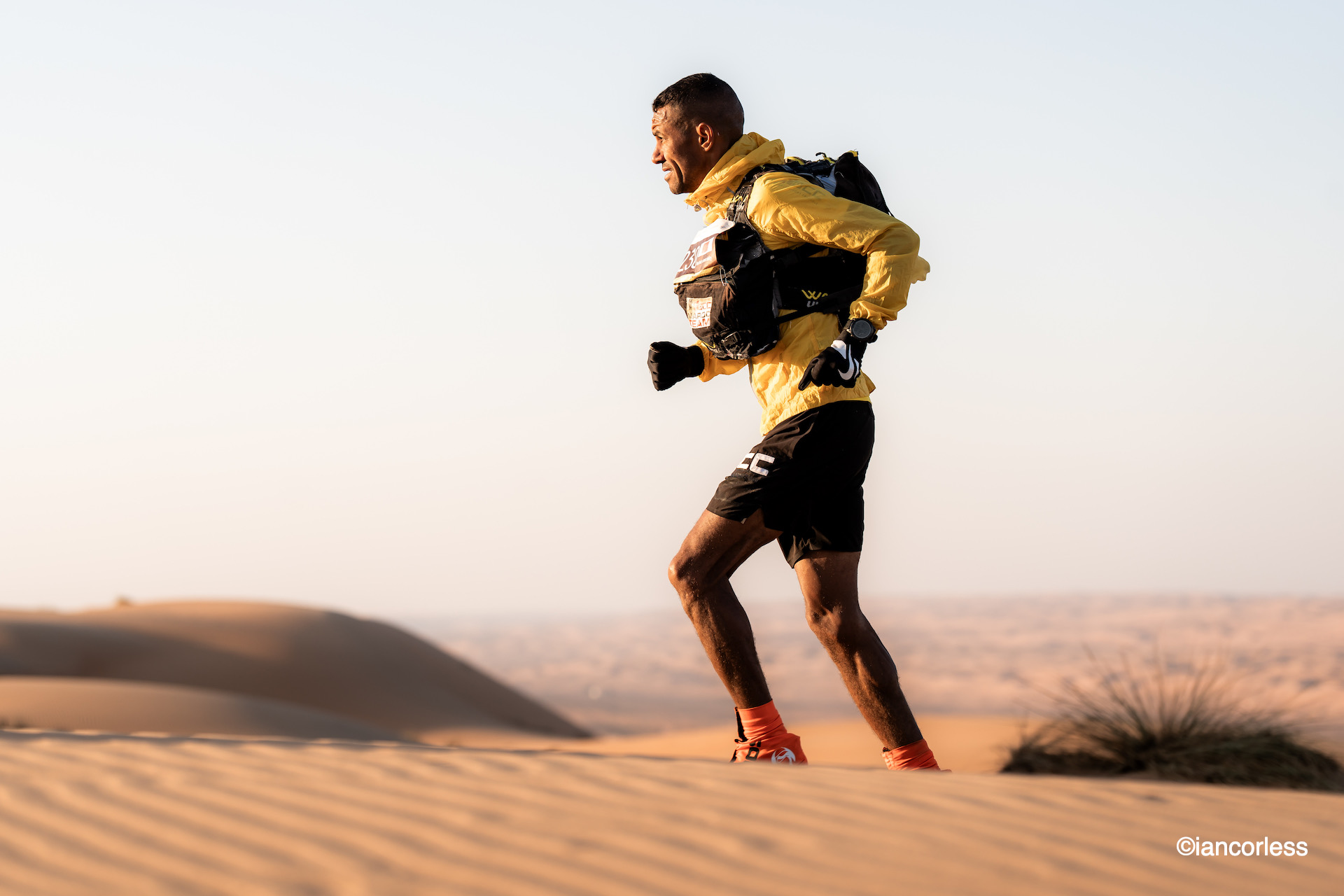
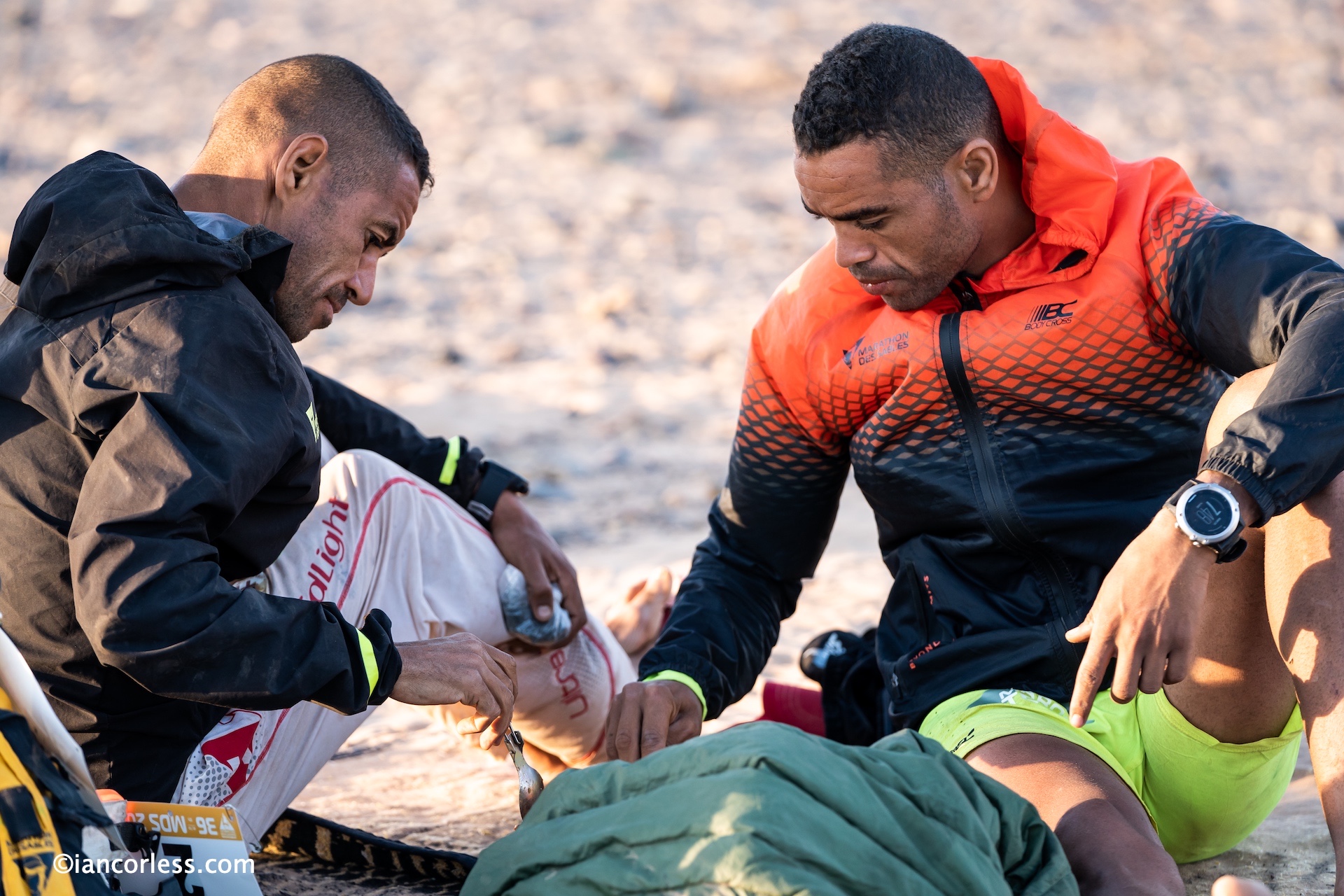
Rachid – Photo by Ian Corless
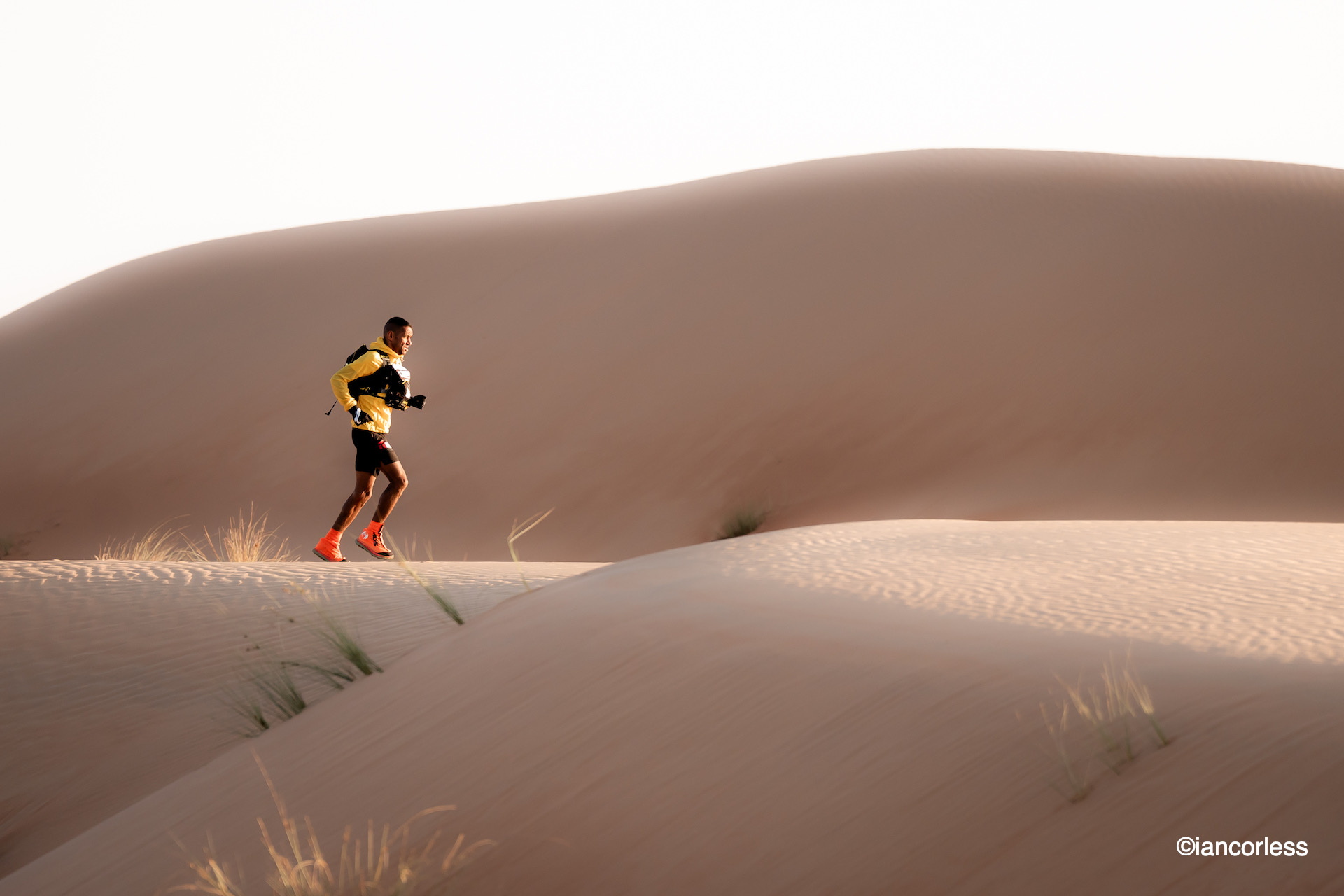
The early km’s were relatively easy and cool. So cool that Rachid wore a windbreaker and gloves… He actually did not remove them all day despite the temperatures rising to 27-degrees.
Photo by Ian Corless
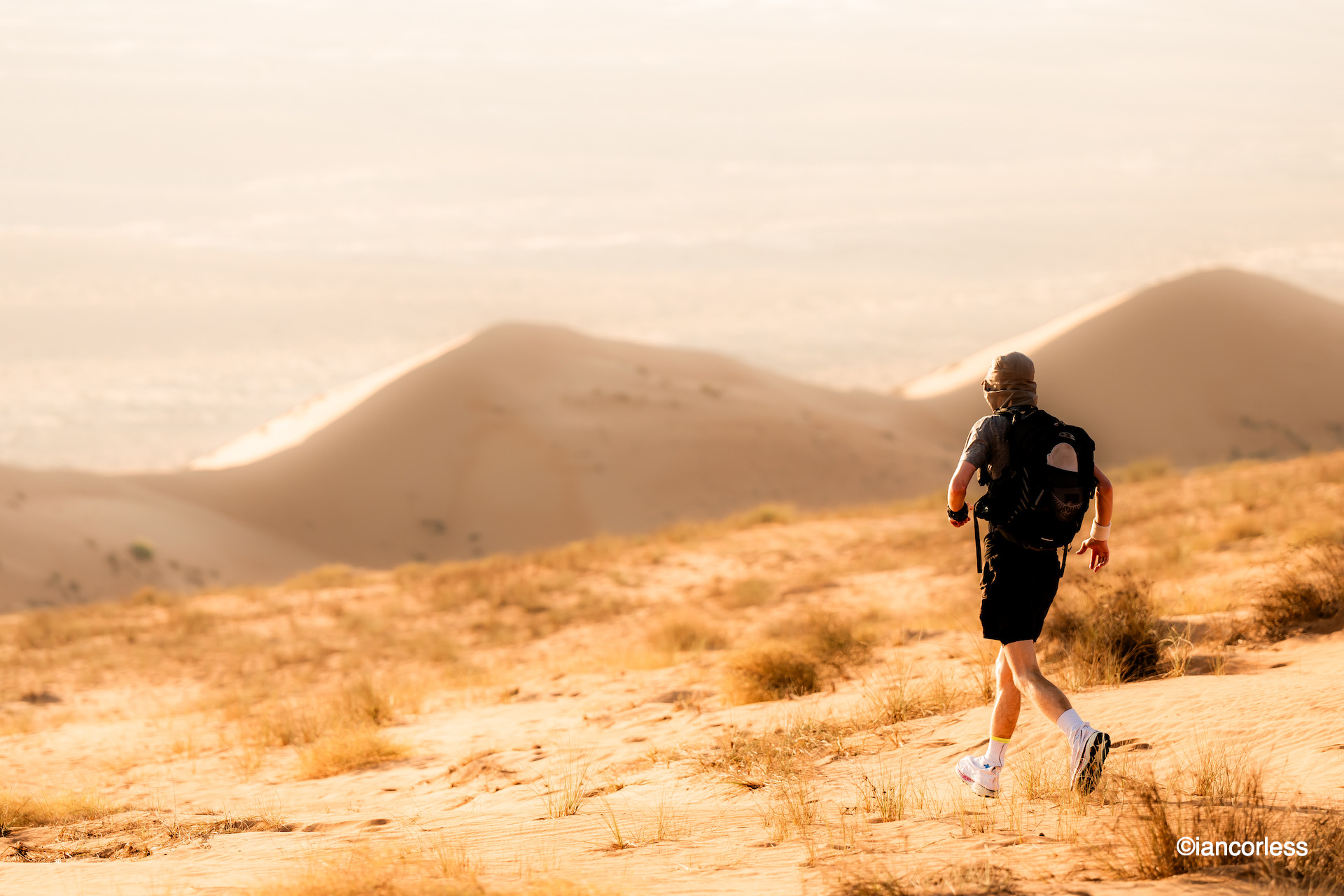
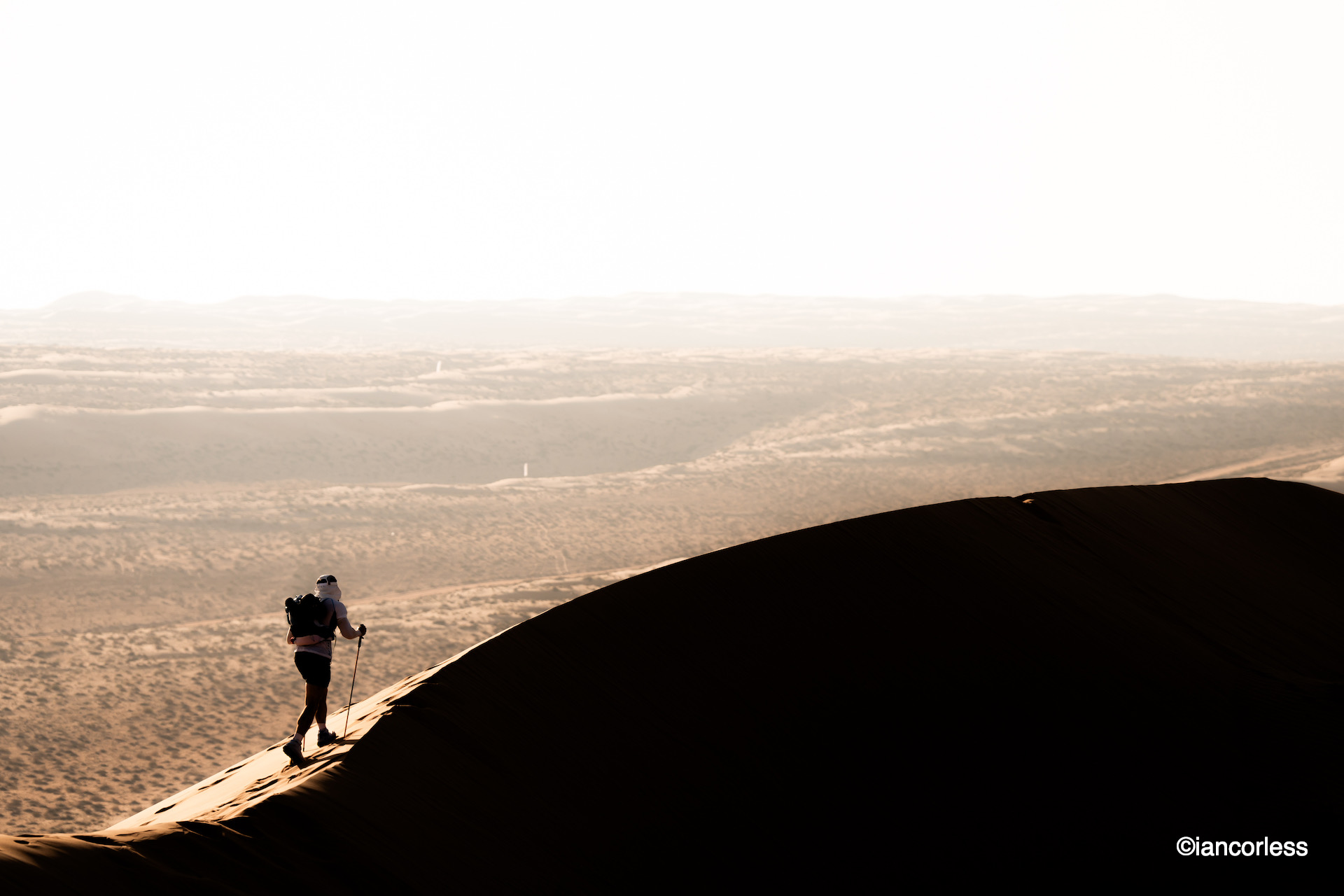
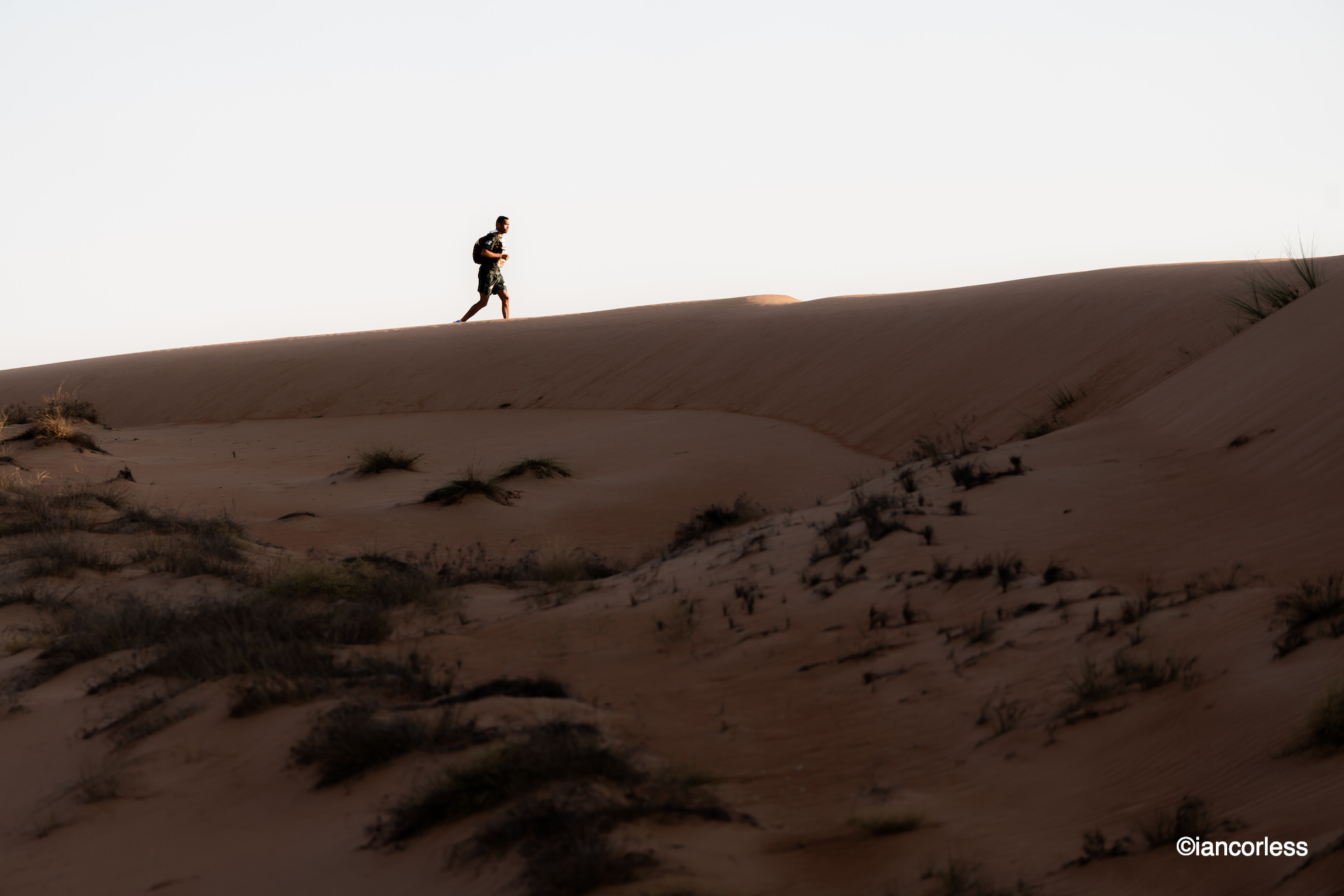
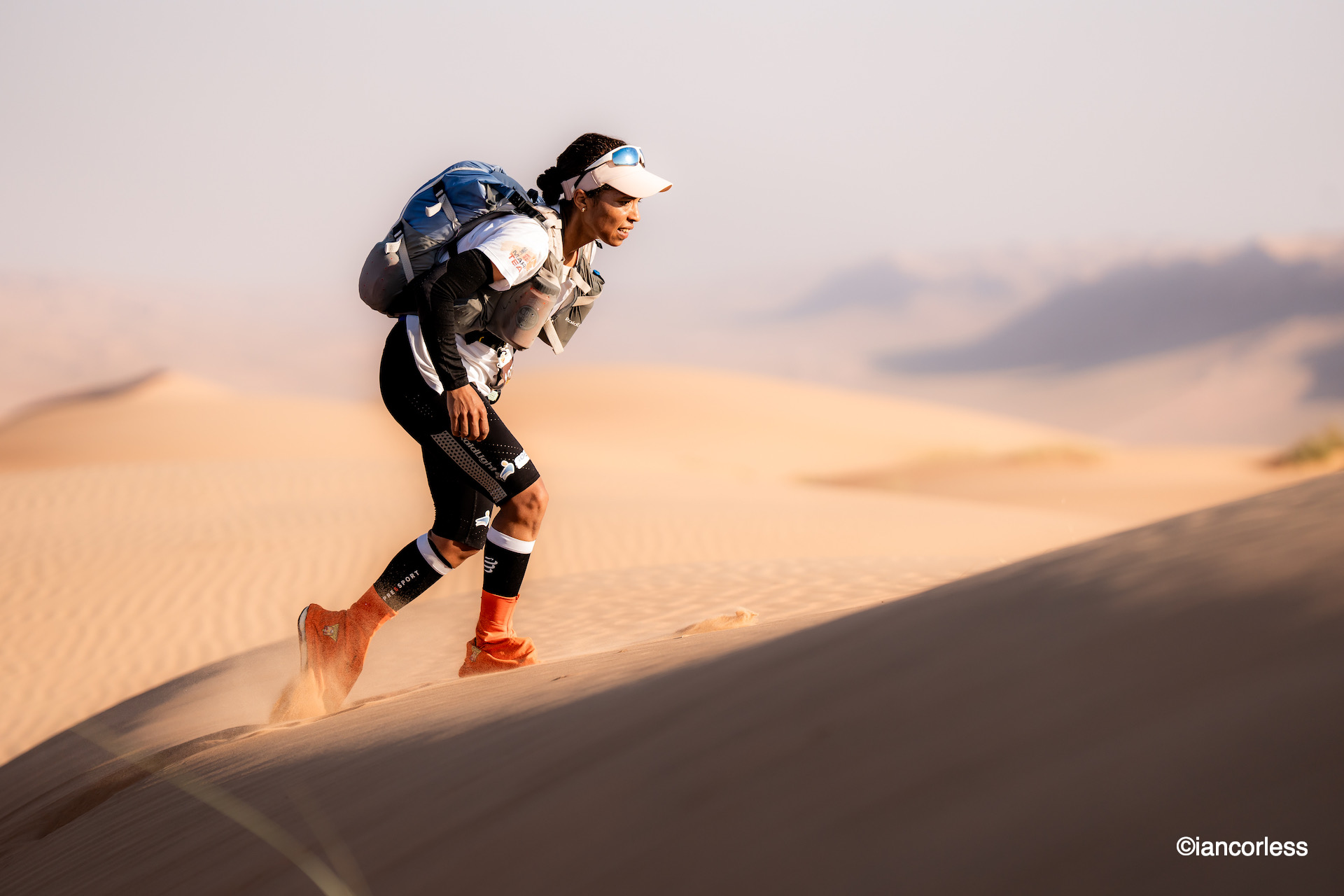
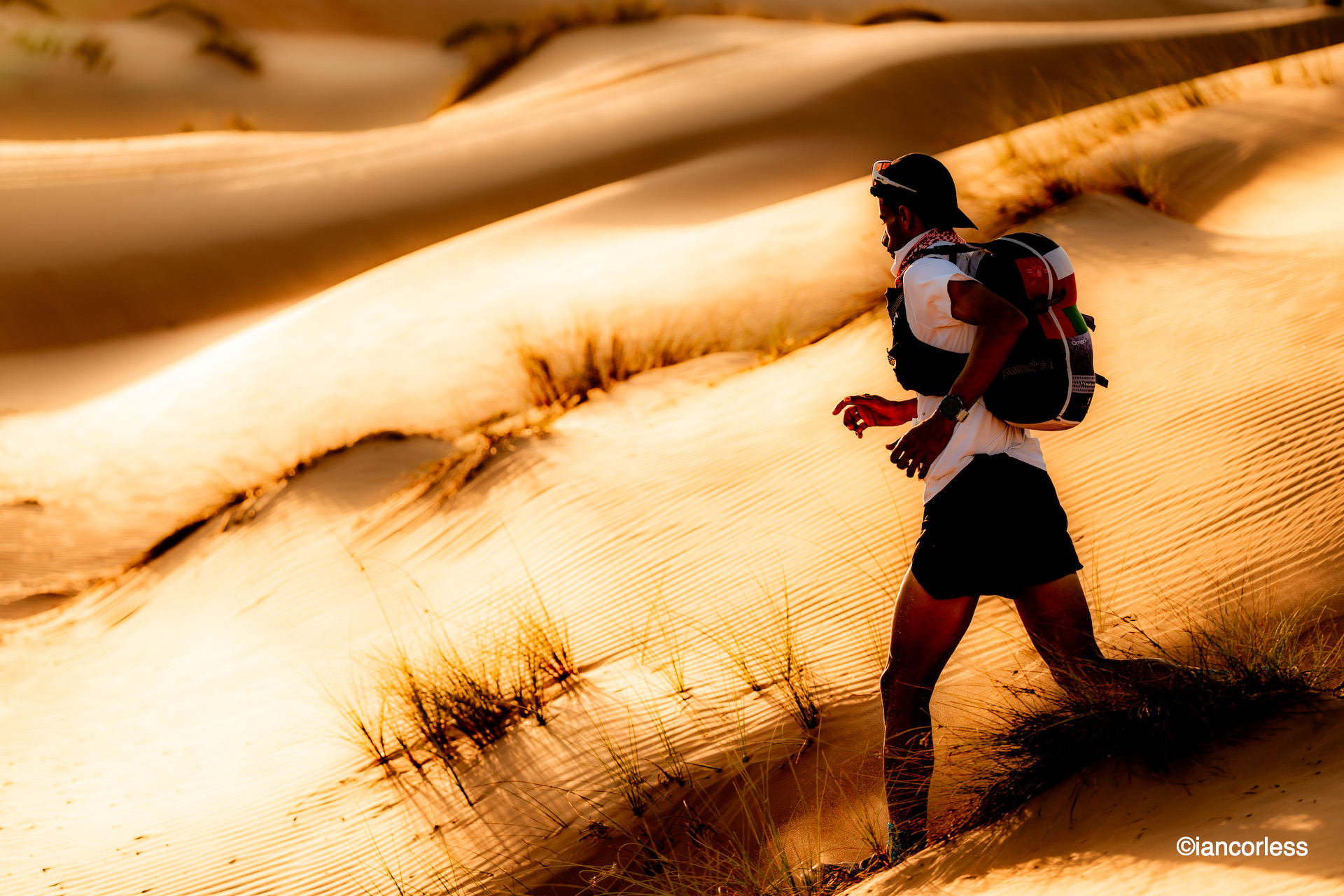
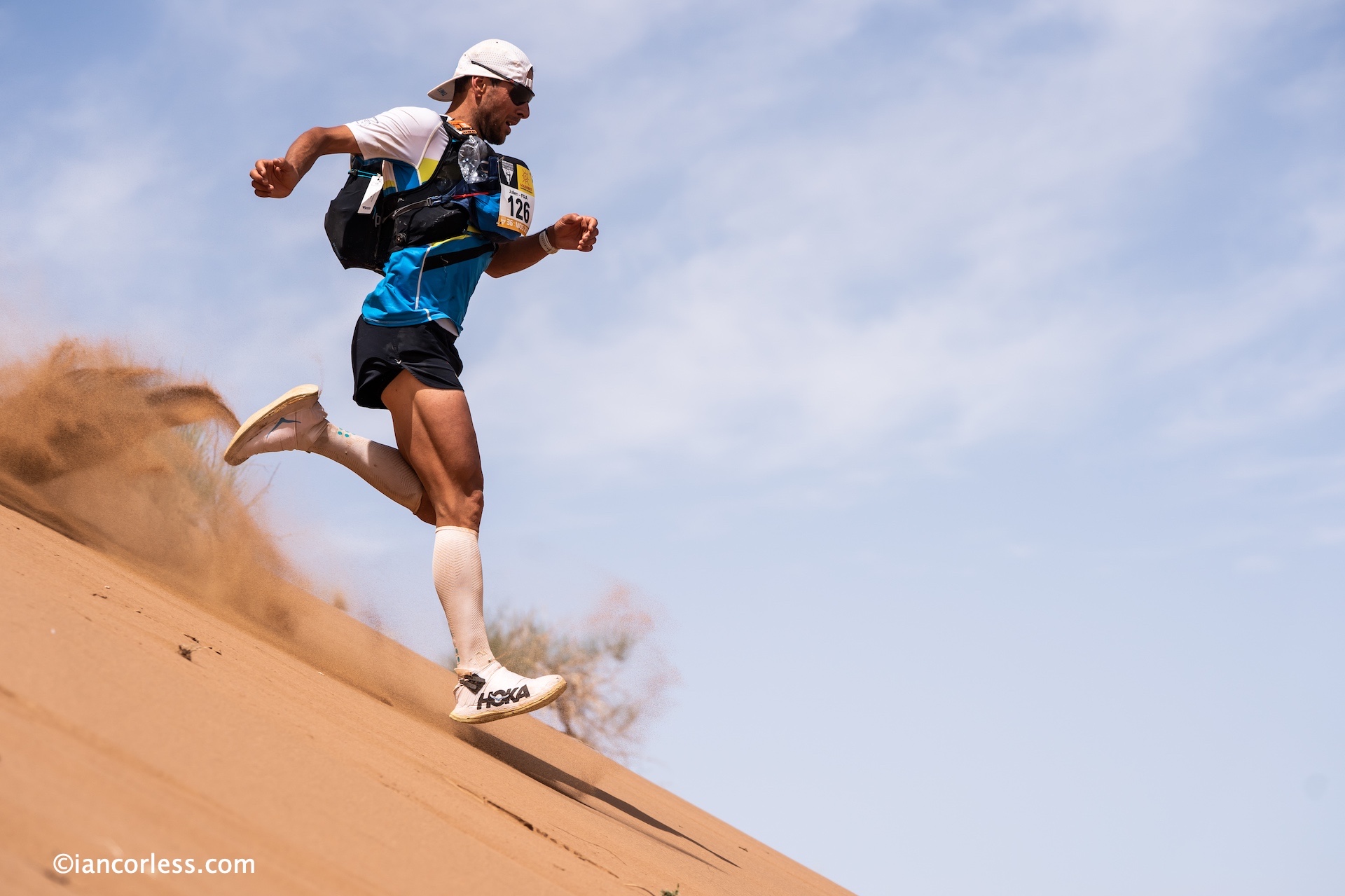
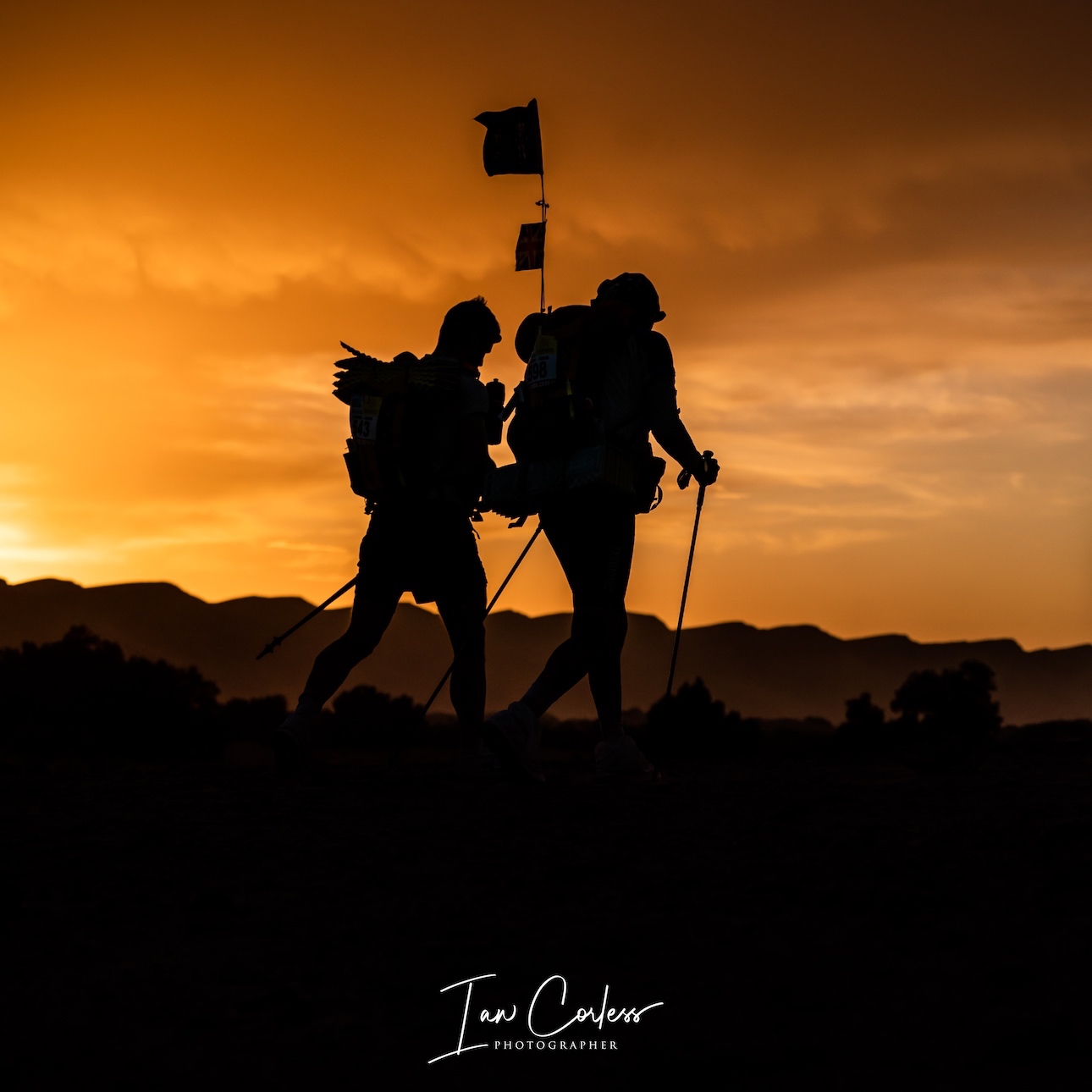
The highlight of the day was a dune section with sunrise. Pure magic with high views of the surrounding landscape.
Photo by Ian Corless
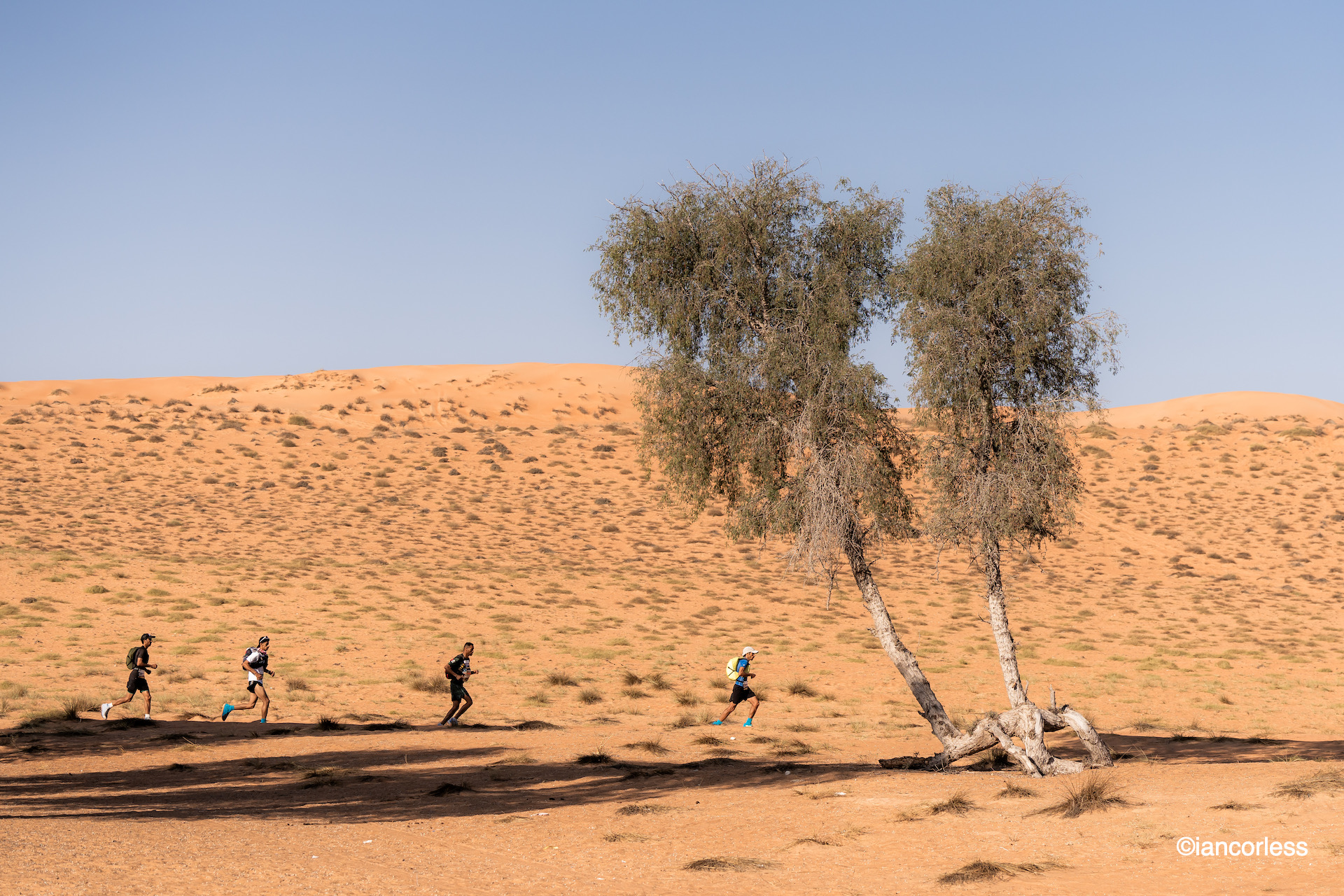
While there is no ‘easy’ running here in Oman, the km’s after the dunes were relatively flat and easy.
With Mohamed taking victory on stage 1, a slender 4-seconds ahead of his brother, Rachid, all the action would be around the Moroccan.
Photo by Ian Corless
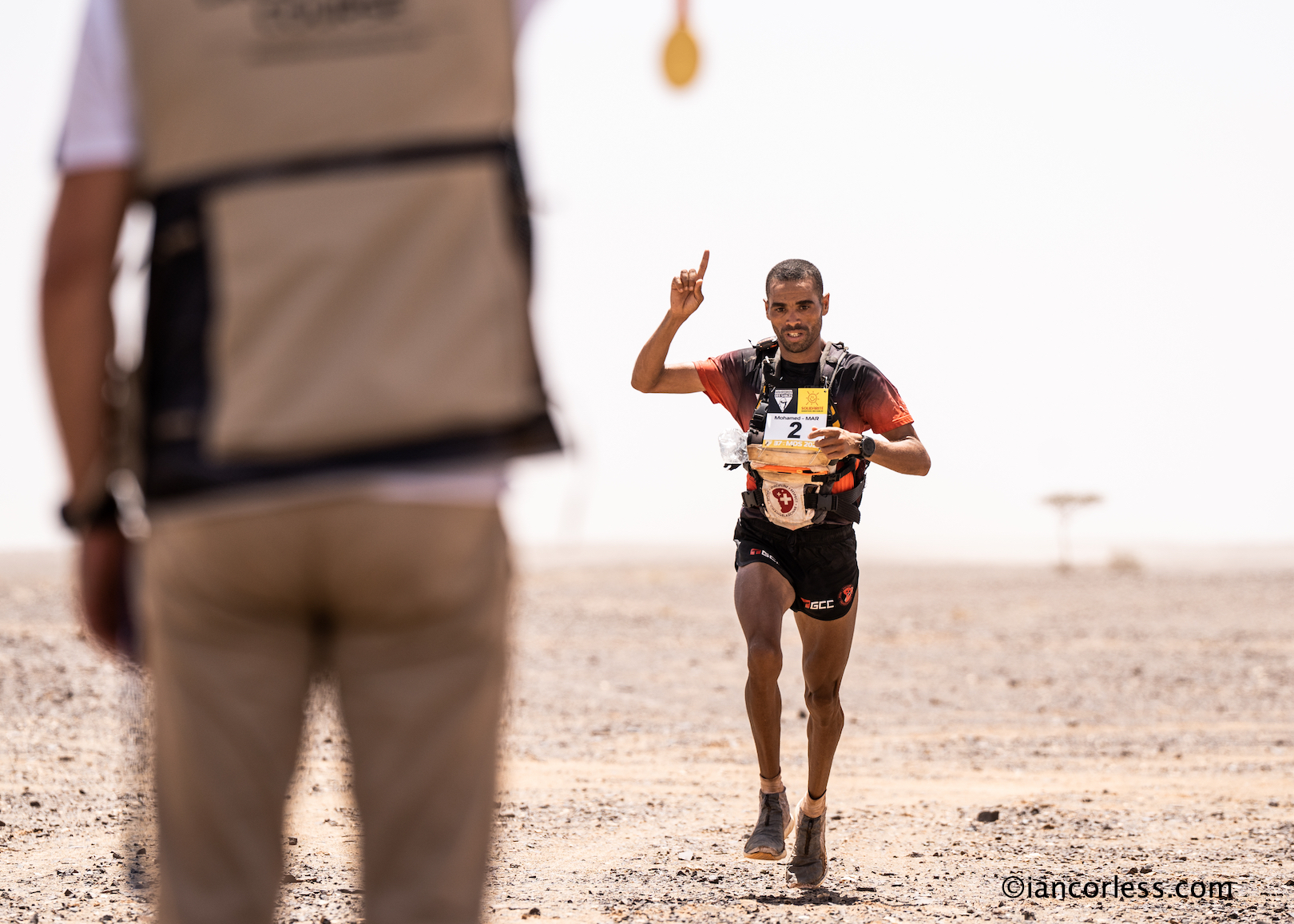
The local Omani runner’s, especially Salah Al Saidi did all they could to put him under pressure but Mohamed is too strong. In the final 10km’s he made his move and opened a gap for the stage win in 3:05:54.
Mohamed – Photo by Ian Corless
Rachid did an amazing job to finish 2nd, 3:09:26 and Saleh 3rd in 3:10:01.
Rachid – Photo by Ian Corless
Rachid by contrast was taking it easy, with 20km’s covered he was 5-minutes behind the leaders, however, the attack came and he closed the gap effortlessly and then forged ahead with on of the Al Said.
Aziza – Photo by Ian Corless
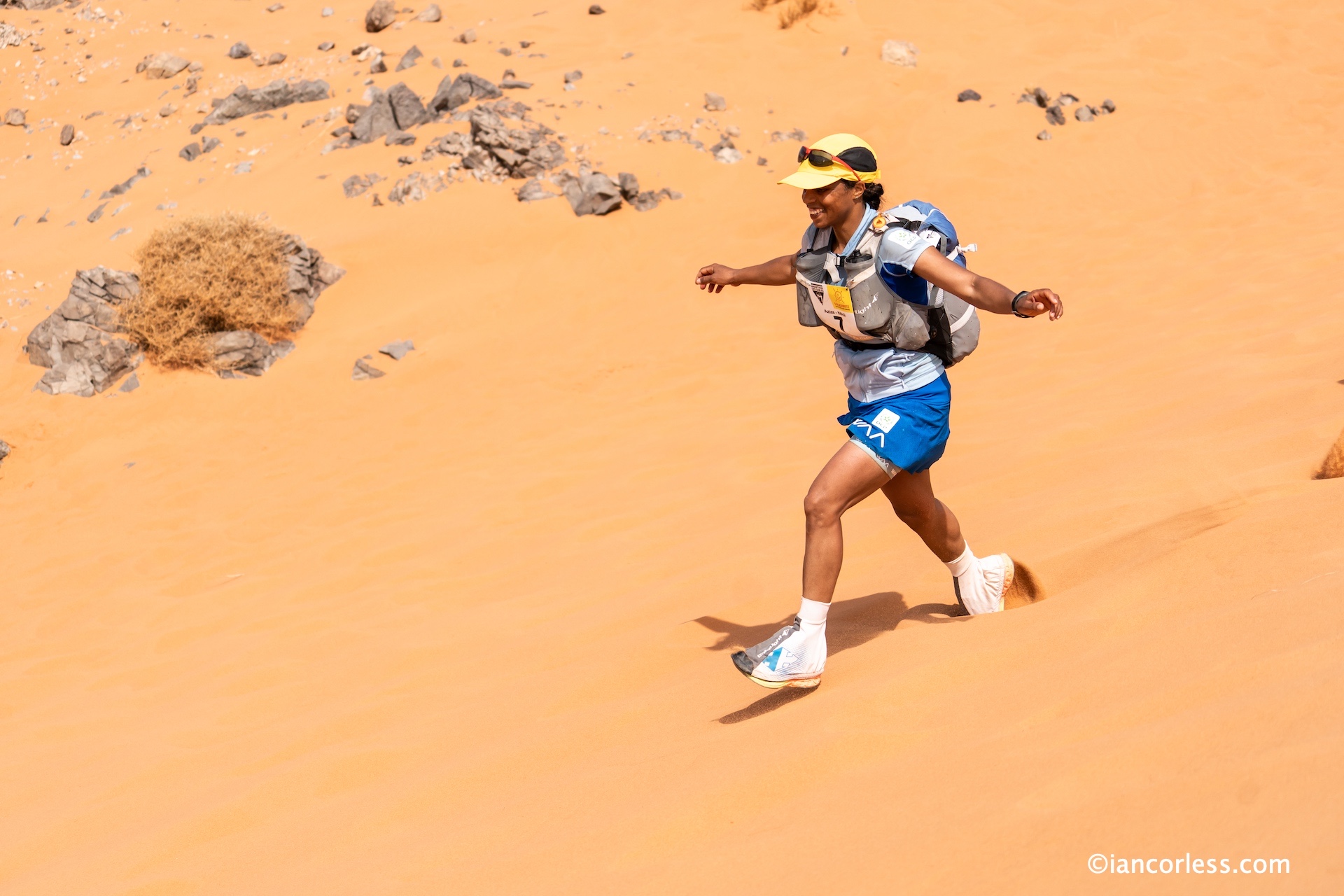
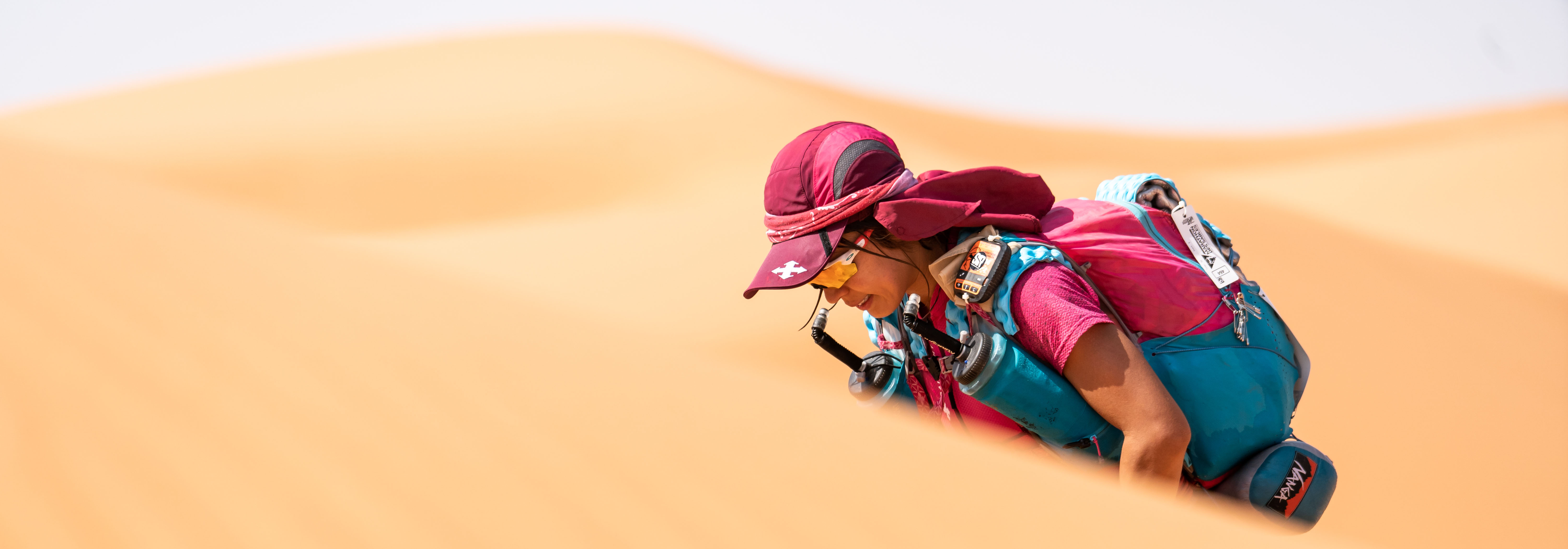
For the women, Aziza Raji was once again making the sand and the dunes look easy. Lydia Oldham, Sally Ford and Tanja Schoenenborn are all close together, but they are fighting for second.
Lydia – Photo by Ian Corless
Tomorrow is another 40km stage, followed by stage 4 which starts late afternoon and goes into the night.
MDS Jordan brought to a conclusion the 2024 season of MDS events. It has been quite a year and since Fuerteventura in September, the events have followed one after another, MDS Morocco, MDS Trek Morocco and now MDS Jordan.
Jordan has become so popular as a destination, two events now exist in a year, May and November. Dates for 2025 are May 9-16 and November 1-8.
For the 4th edition, concluding on the 8th November 2024, 599 participants were signed up from 25 different nationalities. Once again, MDS pioneer the way with more women participants than men, 55% to 45%.
Come race day, 520 toed the line over the 3 race distances.
249 in the 120km distance.
190 in the 100km distance.
81 in the 70km distance.
Full race results are available HERE via LiveTrail.
Jordan is not the easiest place to get to and typically, it will require two flights. Istanbul being a popular connecting point but many other options exist. Long haul travel always has potential problems and for the MDS Jordan, participants and staff had several problems with delays, gladly, everyone arrived on time. However, there is some general good advice here for future participants, allow yourself some time flexibility for arriving in Jordan, delays of 12-hours or even 1-day existed for some! Use reputable airlines with good track history, the cheapest option is not always the best!
Photo by Ian Corless
The current Israel – Hamas war quite obviously was on the minds of participants and some were concerned about travel. However, while the general advice from most governments was to ‘exercise caution,’ there was no reason not to travel. Having spoken to participants post-race, nobody at any time felt safety or security was at risk. The war however ‘may’ have had some impact on travel, it’s difficult to know?
Photo by Ian Corless
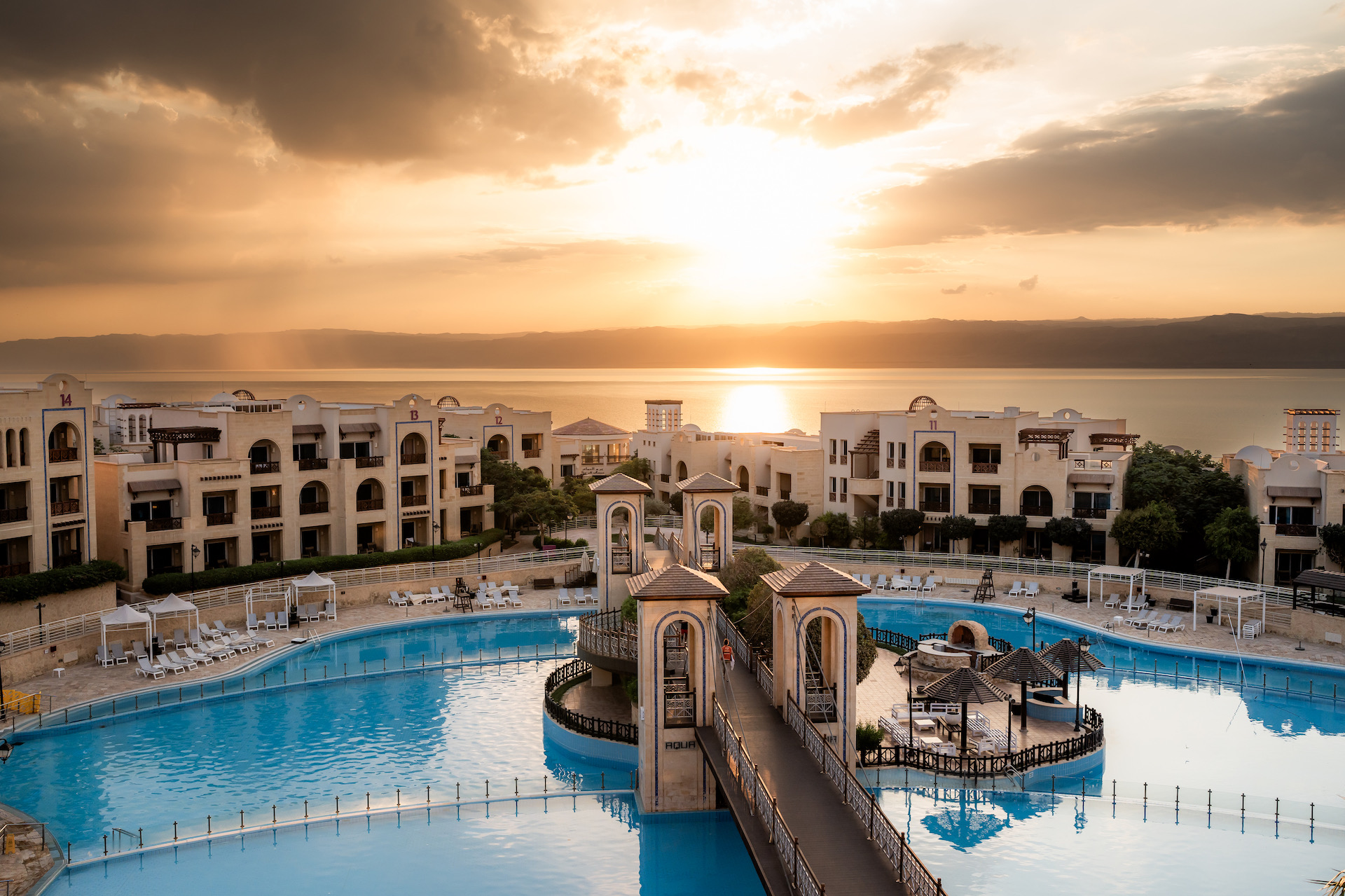
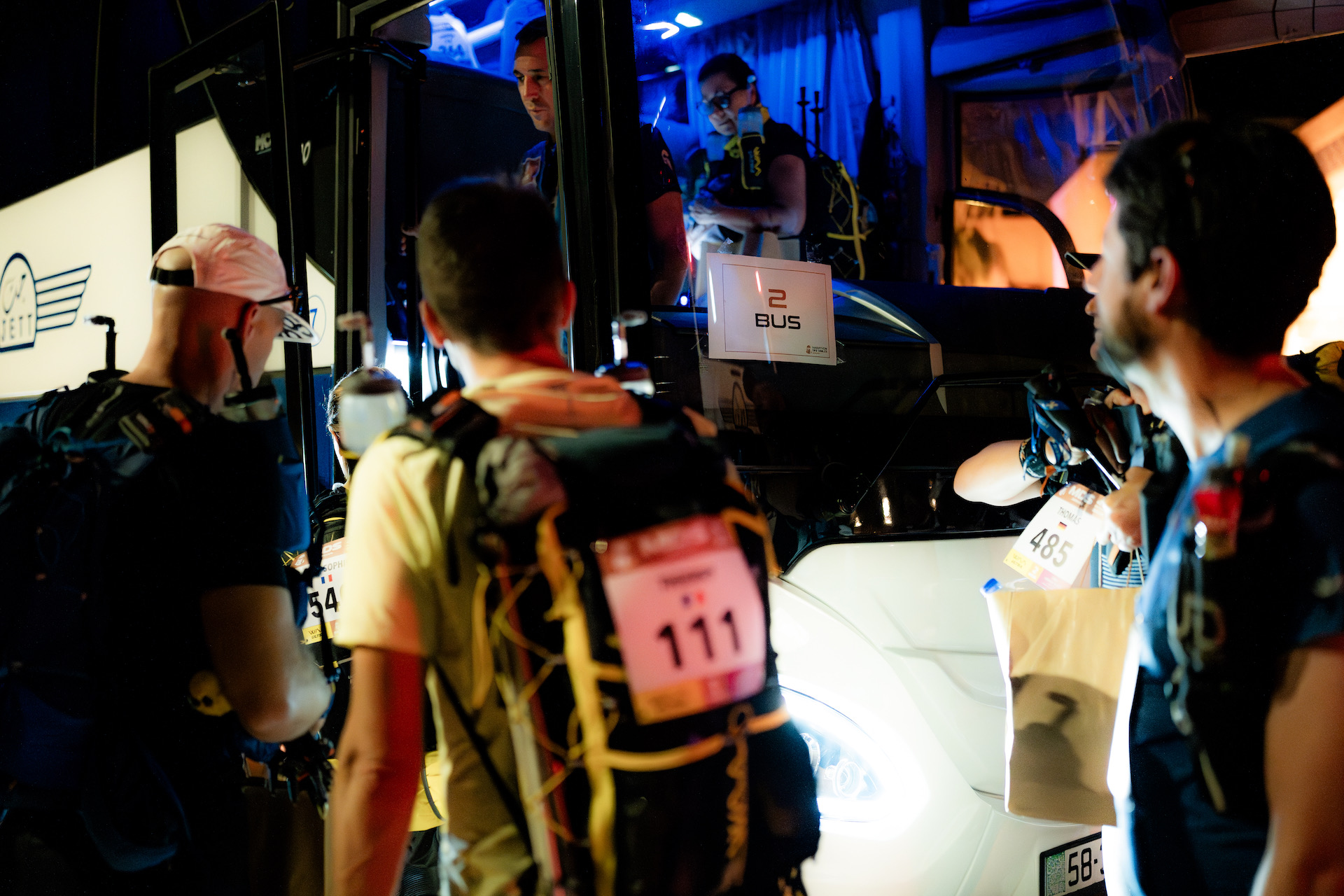
The MDS team do a fantastic job of facilitating everyones arrival in Amman and they provide a bus transfer to the Crowne Plaza hotel which is located on the Dead Sea. The journey takes under 90-minutes.
Photo by Ian Corless
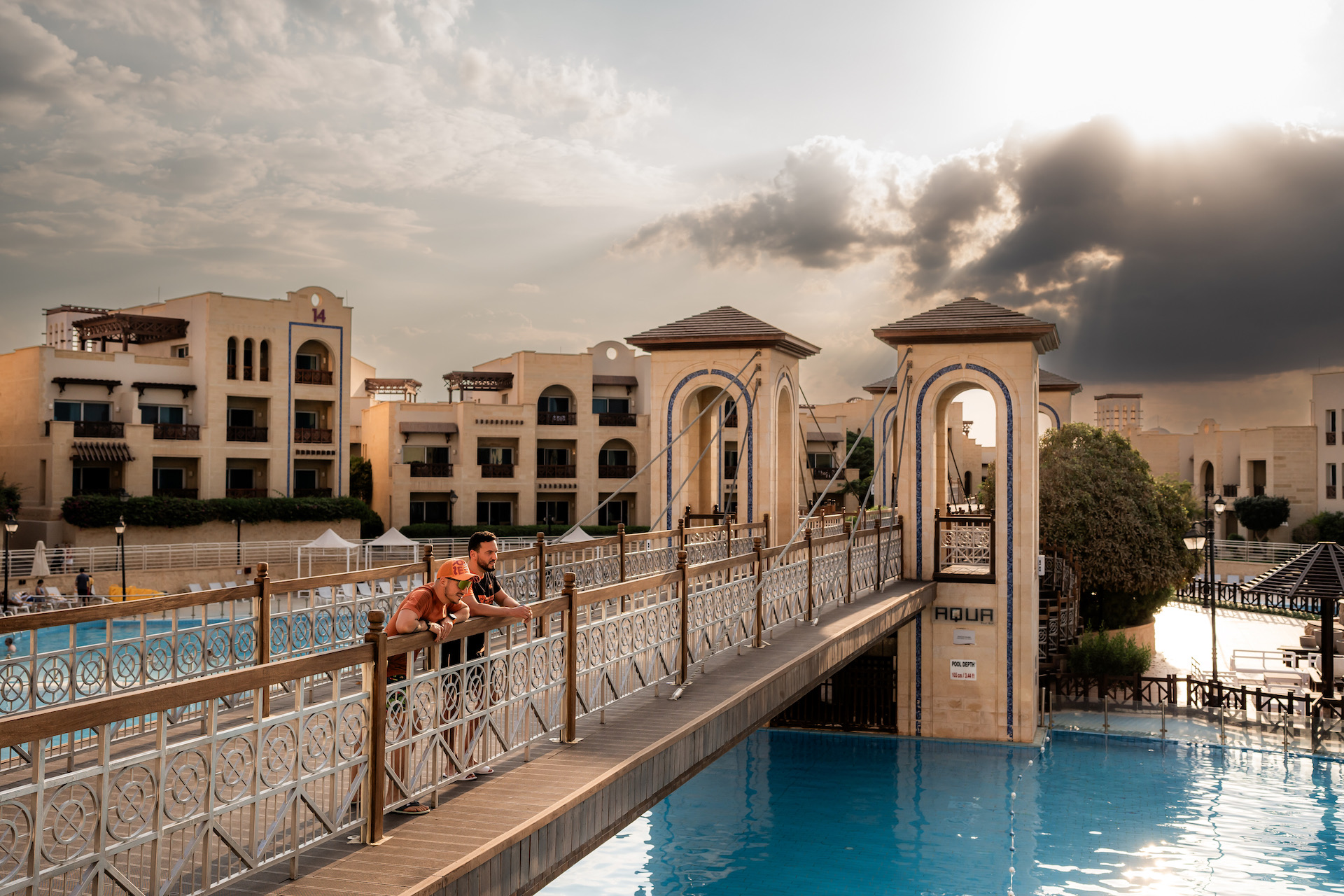
The hotel is huge with excellent facilities, a good restaurant, bar, meeting rooms, multiple pools, spa, gym and of course, the Dead Sea is on its doorstep. It’s the perfect place pre and post-race. Another great benefit is that its size allows all competitors and MDS staff to stay at the same location. A great bonus for admin day and the post-race awards and gala dinner.
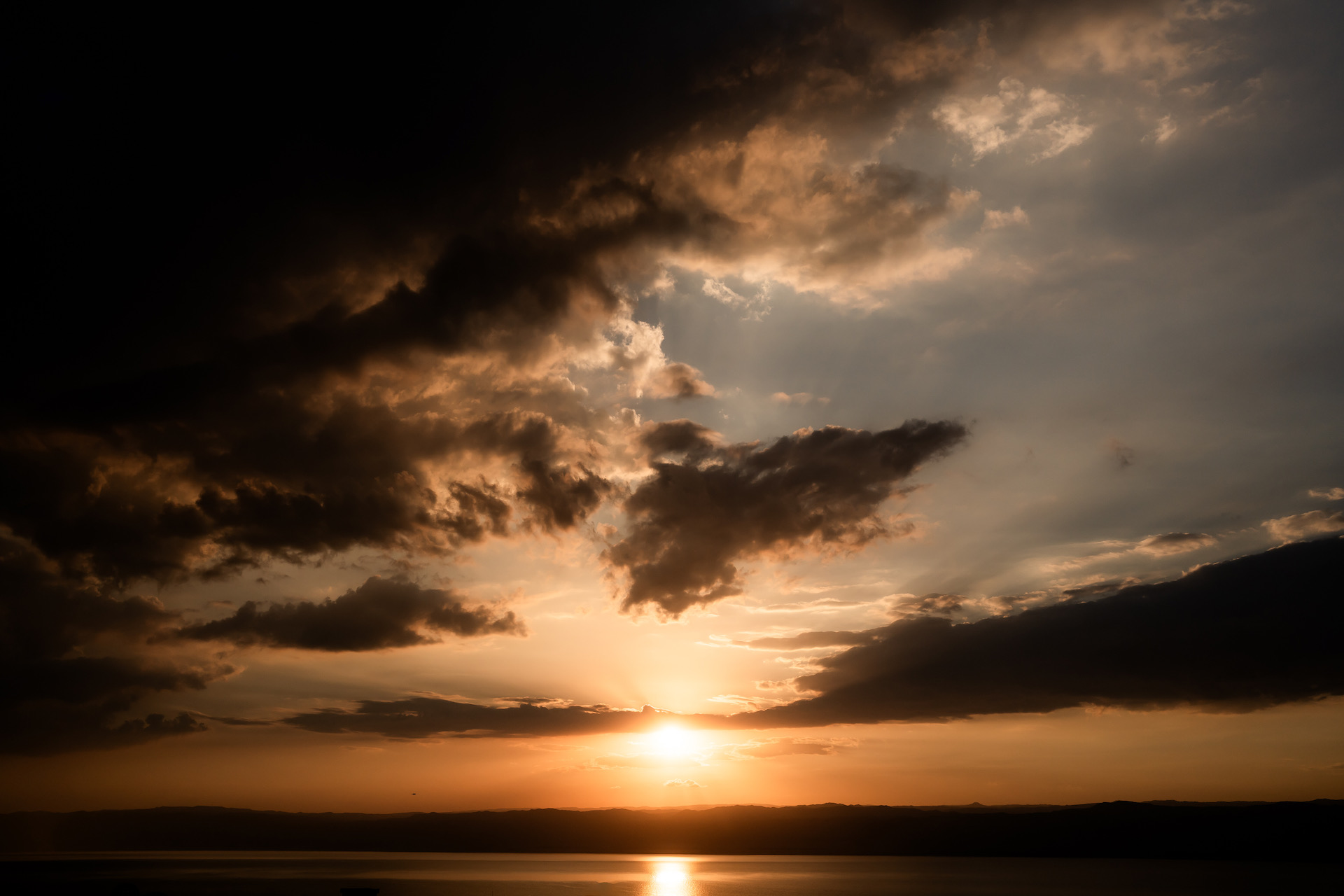
The Dead Sea is obviously an iconic place, located -430m below sea level. It is land locked between Jordan and Israeli occupied west bank in the west and Israel in the south. It is called the Dead Sea due to high levels of salt that make it impossible for any life form to live.
Photo by Ian Corless
With admin day done, the race got underway with a very early departure on Monday Nov 4th with an approximate 4-hour journey to Wadi Rum.
Stage 1 was scheduled to start at 0930am with 27.4km and 980m+ with arrival at bivouac. A point-to-point day with two Cp’s and a cut-off time of 2000hrs.
Photo by Ian Corless
The day was a shock for many! It’s a day of stunning views, epic vistas, remarkable landscape and a great deal of soft sand making the journey very hard work. If you are signed up for a future MDS Jordan, be prepared for a tough day 1.
Photo by Ian Corless
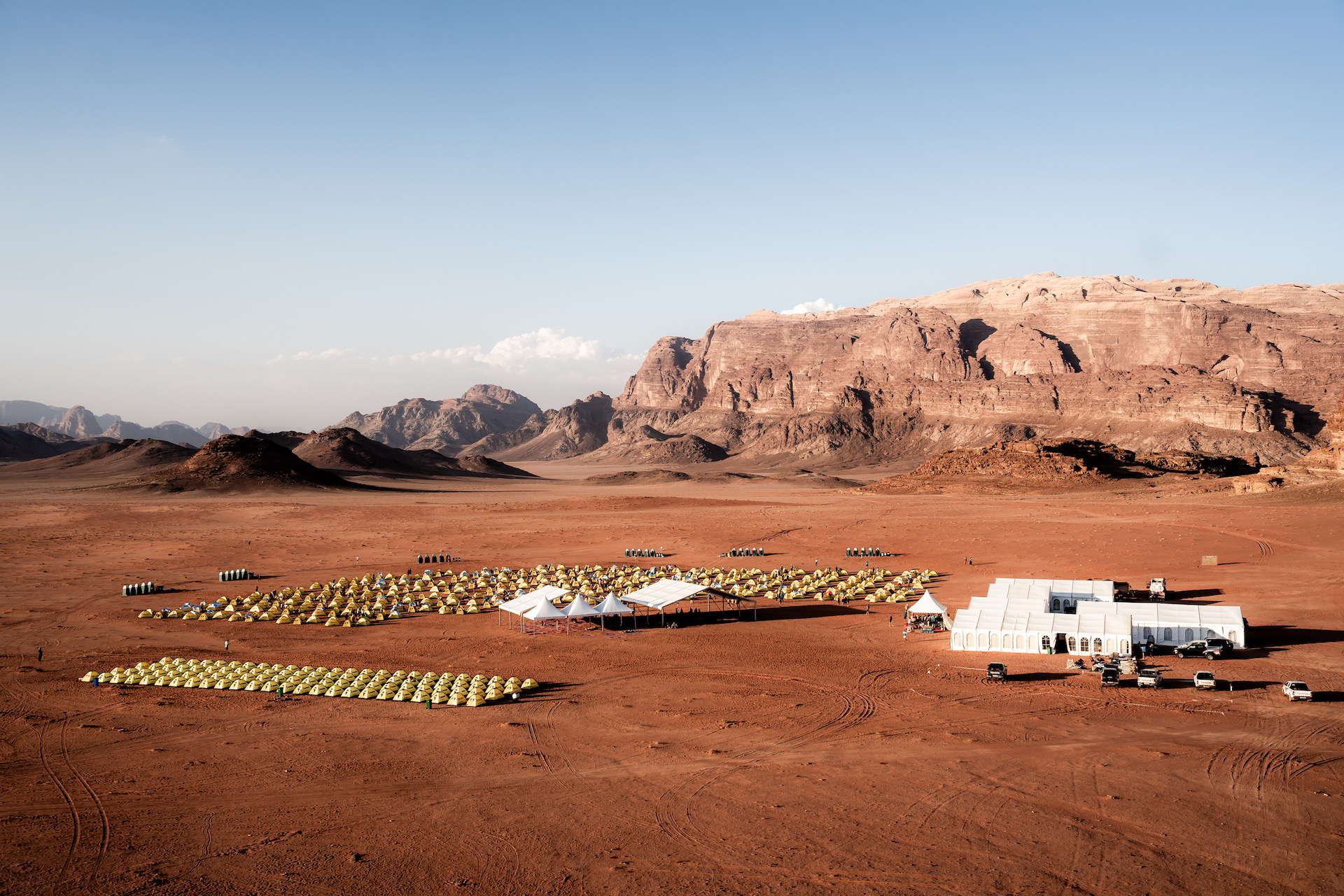
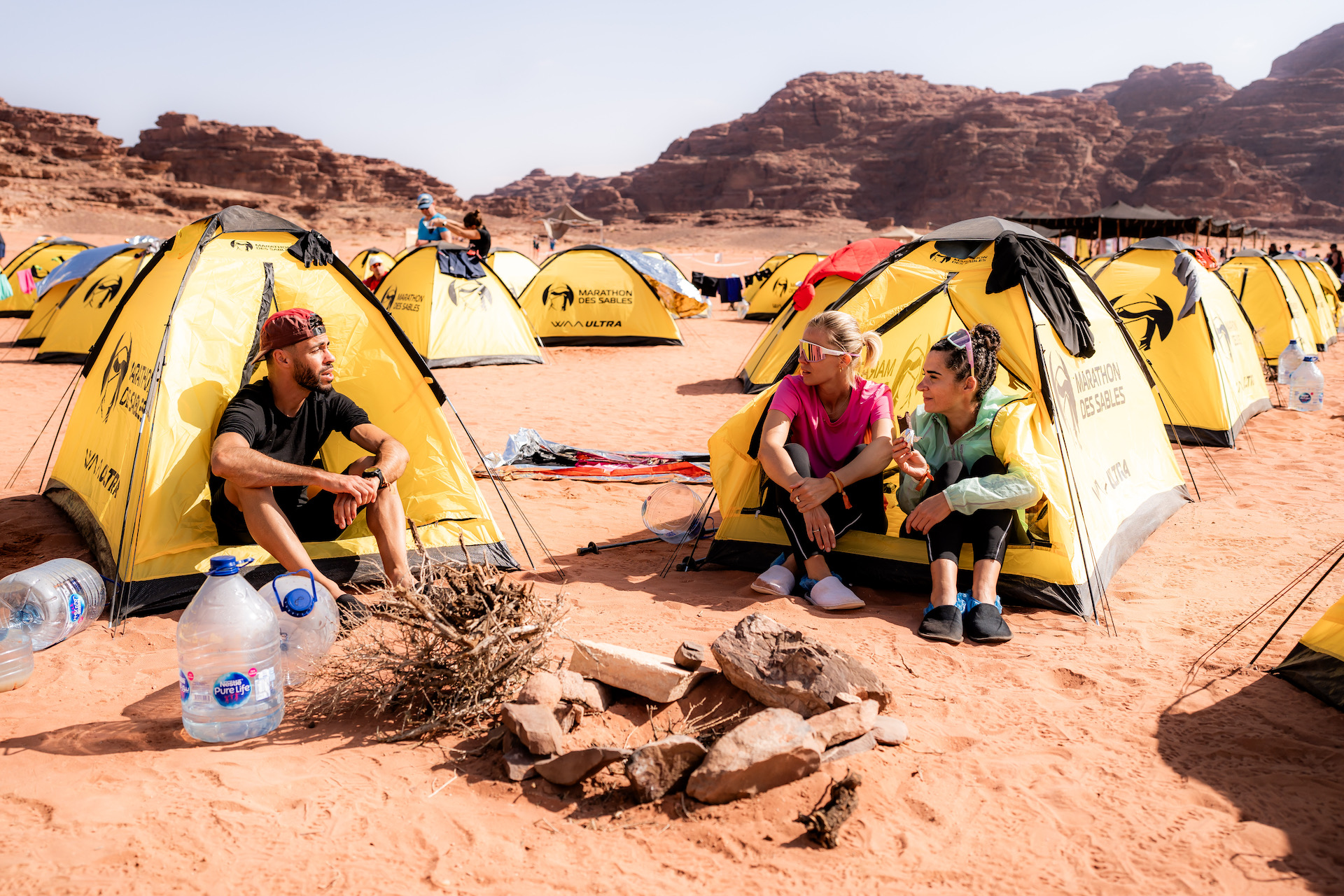
In bivouac, as per all MDS events, individual tents are in circular pods of 8. This is great for group friendship but also allows some privacy.
Photo by Ian Corless
While MDS events operate on the same formula: 3-stages over 4-days with full self-sufficiency, the exemption coming with rationed water provision and a place to sleep provided by MDS. I cannot emphasise enough that participants need to be prepared for the challenge they are undertaking. Weather and environmental condition vary from event to event and year on year. Just because Jordan was hot at one edition, it does not mean it will always be hot! Look at MDS Morocco in October, rain, thunderstorms and flooding. The 4th edition of MDS Jordan had a very cold first night. For those who did not bring a warm jacket, a warm sleeping bag or additional layers, they had a very cold and troubled night. My TOP TIP is always bring a windproof jacket such as the WAA wind running jacket as an absolute minimum and my high recommendation is to bring a light weight down jacket. Many down jackets exist these days and the top quality products are well under 200g, the Nordisk Y Strato is 165g for example. The advantage of a down jacket is warmth and comfort while sitting around post-race and in addition, on cold nights, you have a very warm layer to wear inside your sleeping bag should it be required. Make sure you have a Buff and cover your head, most heat is lost here!
Photo by Ian Corless
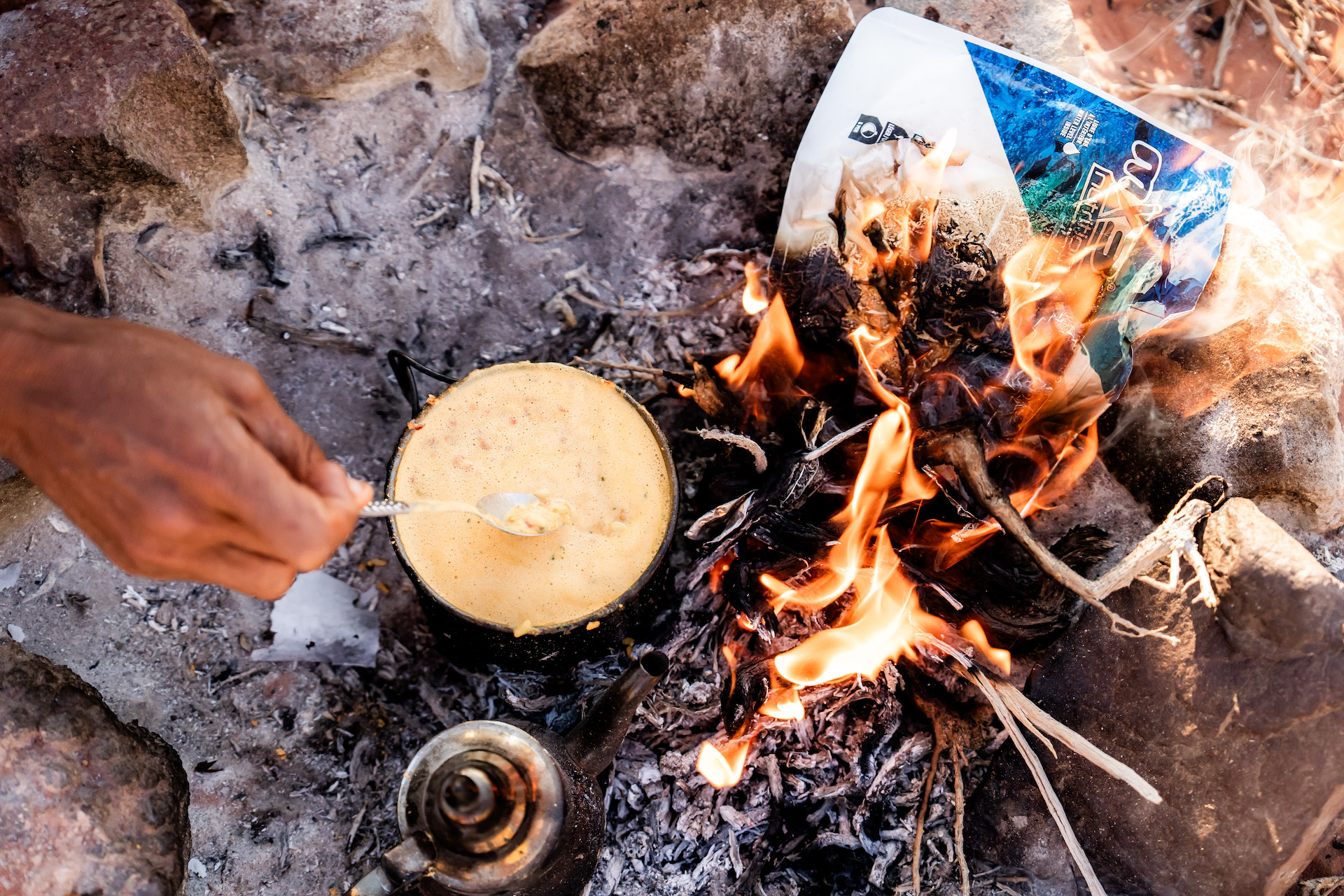
One advantage of the tent pods is the creation of a communal fire place, in Jordan, most pods created a fire place and this was used for cooking and warmth.
Photo by Ian Corless
Stage 2
Photo by Ian Corless
With a troubled night for many, stage 2 would prove a challenge. However, the great thing about MDS events is the possibility to choose how easy or how hard you want the adventure to be. Of course, all things a re relative based on individual ability and desires. The stage had two starts, 0700 and 0800, the top runner’s in the latter start.
Photo by Ian Corless
At two key points, participants can have a choice, the first option is to choose 20km’s. The second option to choose 40km’s. At the second option point if you choose not to take 40km’s, you must do 60km’s.
Photo by Ian Corless
249 chose to take the 60km route, 190 in the 40km and 81 the 70km distance.
Photo by Ian Corless
It was a challenging day, once again a great deal of soft-sand but considerably less vertical gain. For those who took the 60km route, they were treated to some additional technical terrain. At all times, the impressive Wadi Rum landscape was mind-blowing irrespective of the distance chosen.
Photo by Ian Corless
The day proved to be a long one for some with the last competitor arriving at 0300am the next day and many of the MDS team there to welcome.
Photo by Ian Corless
Rest Day
Photo by Ian Corless
It was a welcome day of rest and an opportunity for everyone to get some rest and recovery.
Photo by Ian Corless
Competitors as per usual, looked after feet, ate as much as possible, slept and took advantage of the local terrain to get some high viewpoints to take in the amazing landscape.
Photo by Ian Corless
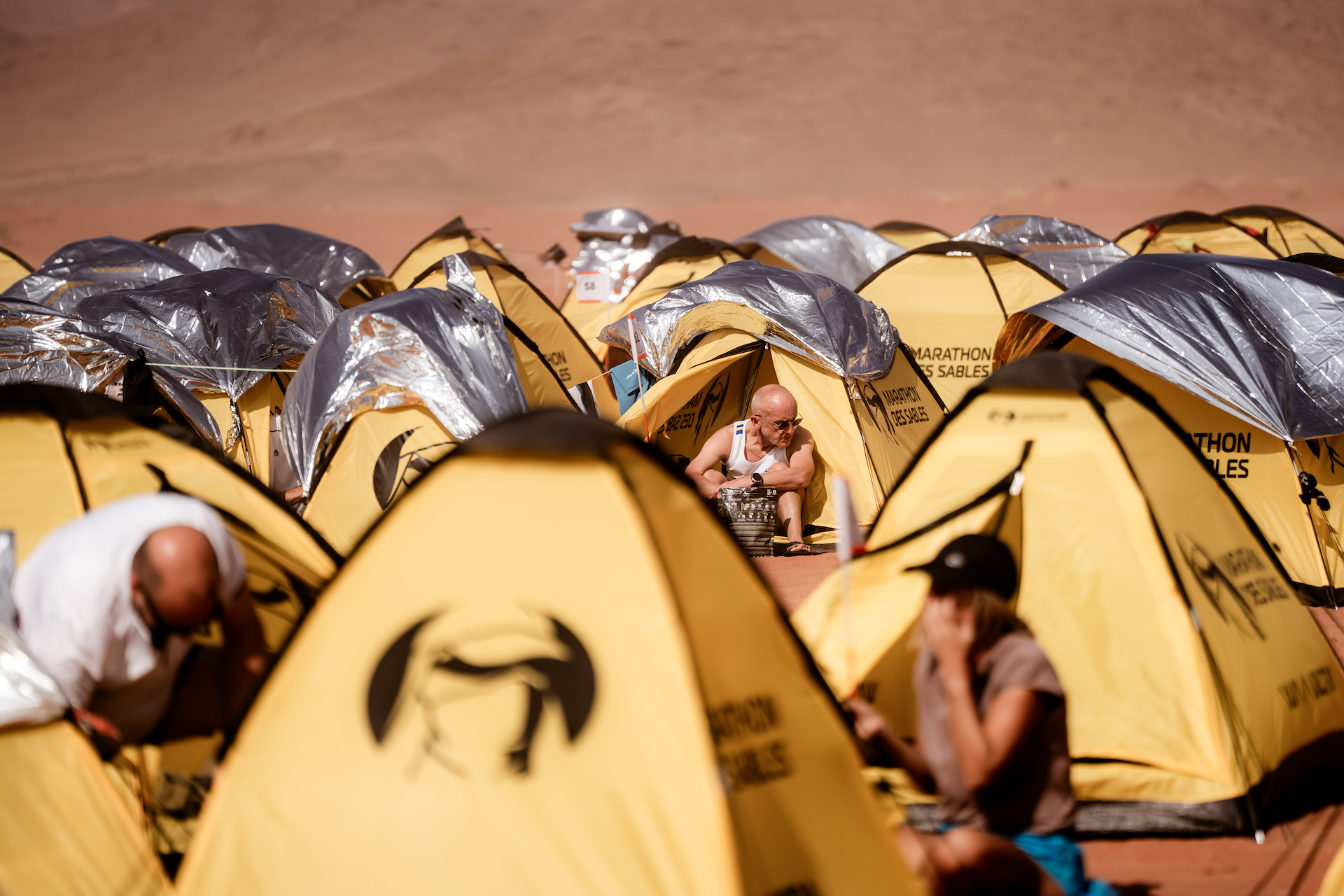
TOP TIP – space blankets that are gold/silver provide excellent options for keeping tents cooler in the day, silver side out. And at night, if required, use them gold side out to keep a tent warmer.
Photo by Ian CorlessPhoto by Ian Corless
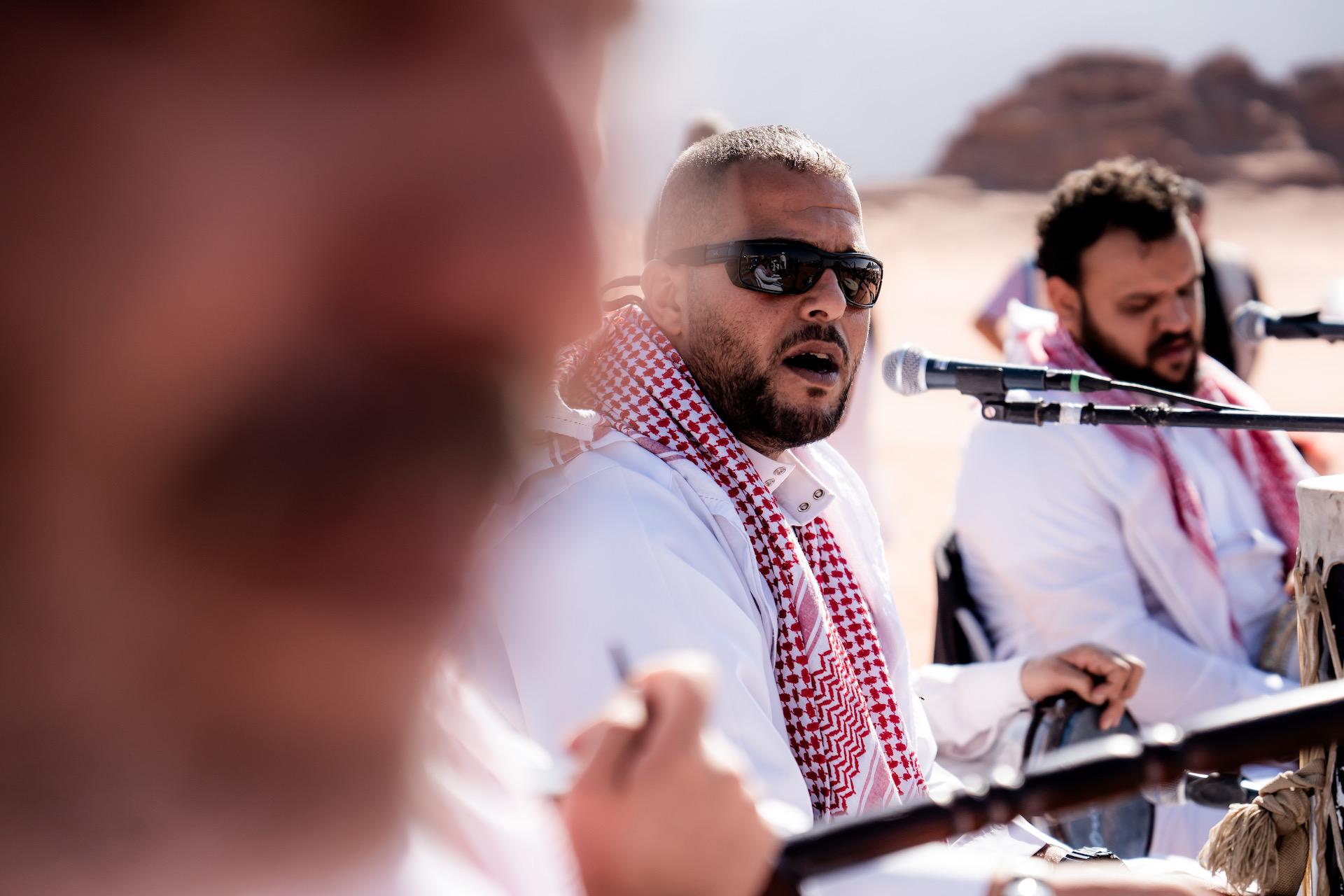
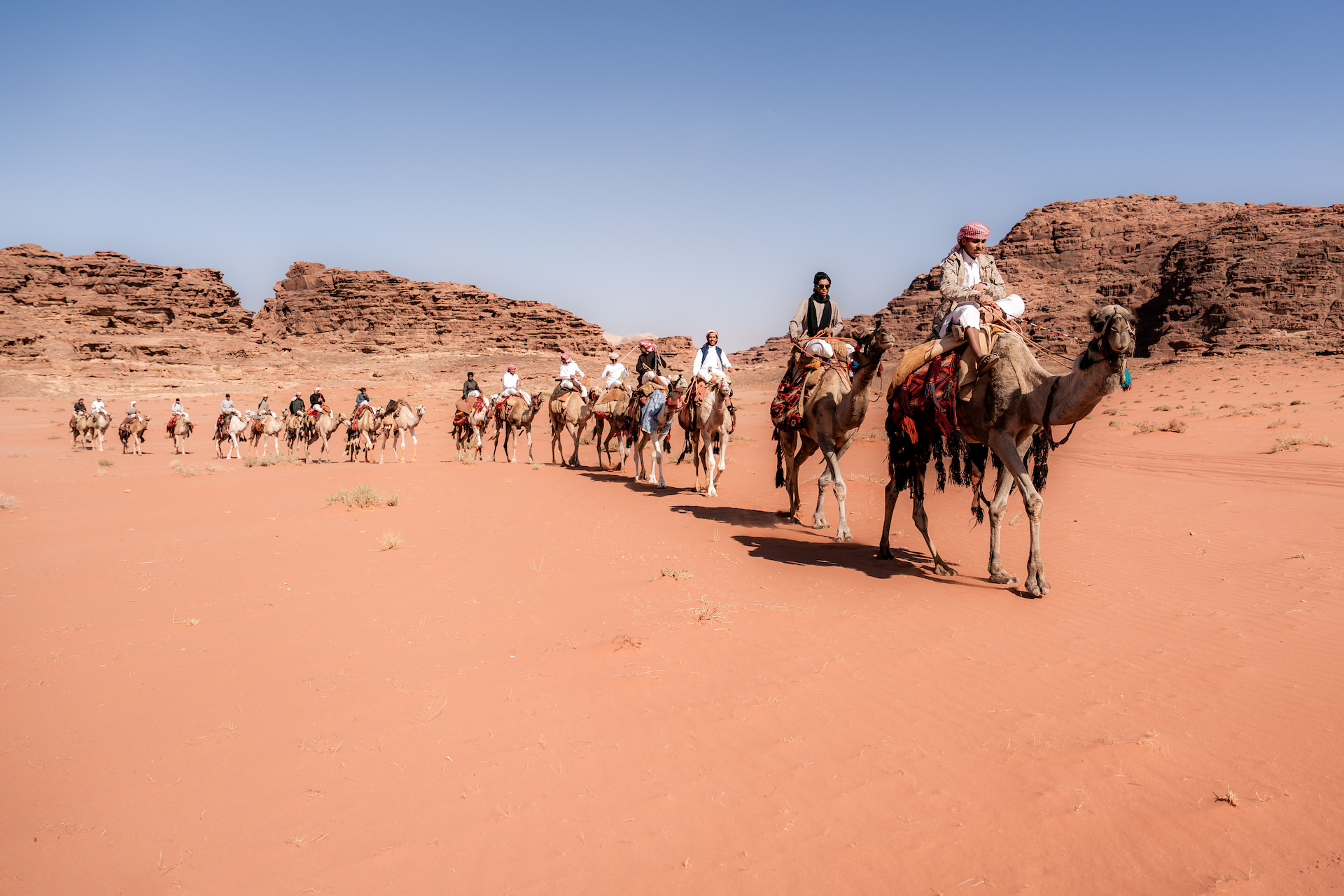
In the afternoon, local fisherman gave a music show and then ice cold drinks arrived for every participant via a camel.
Photo by Ian CorlessPhoto by Ian Corless
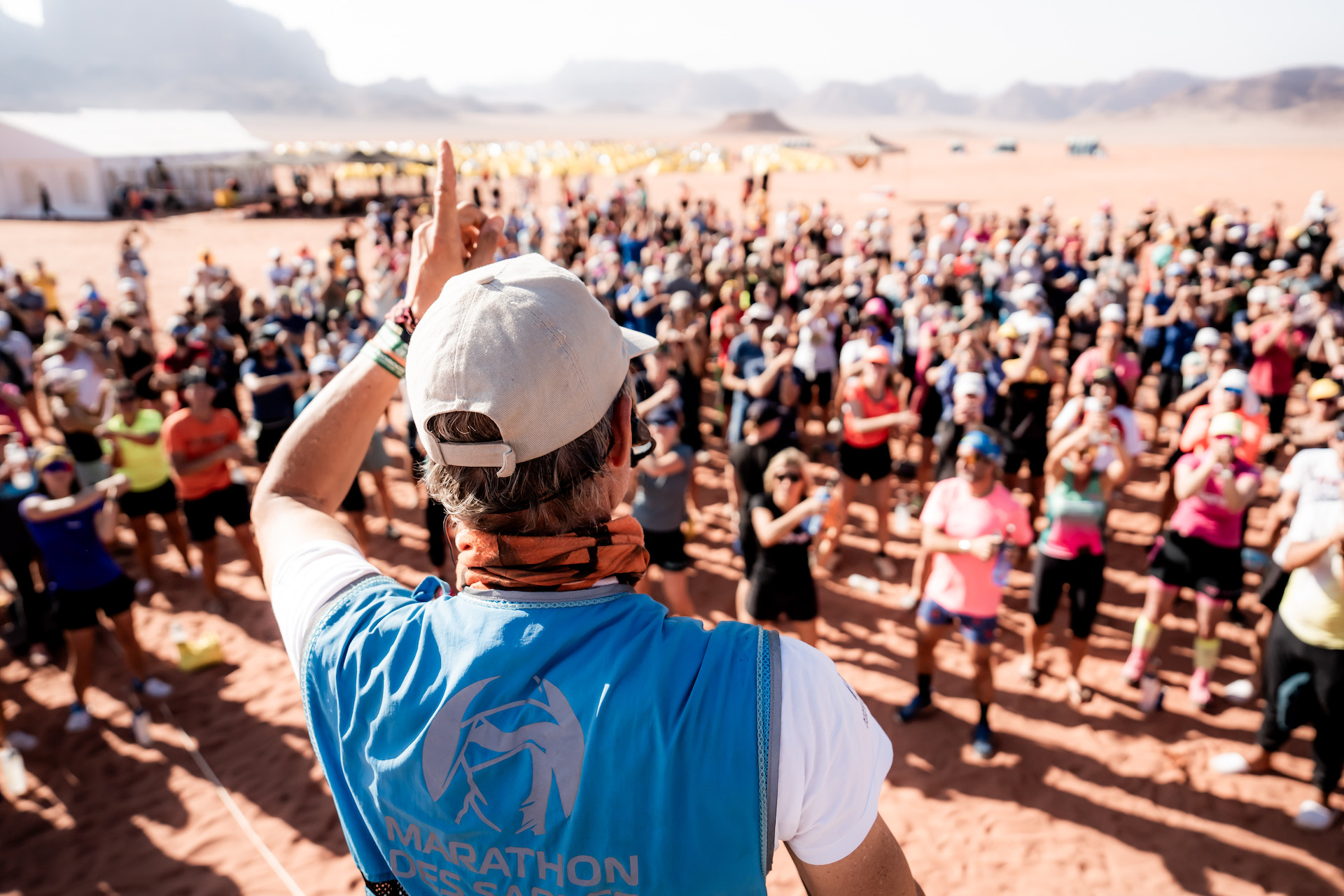
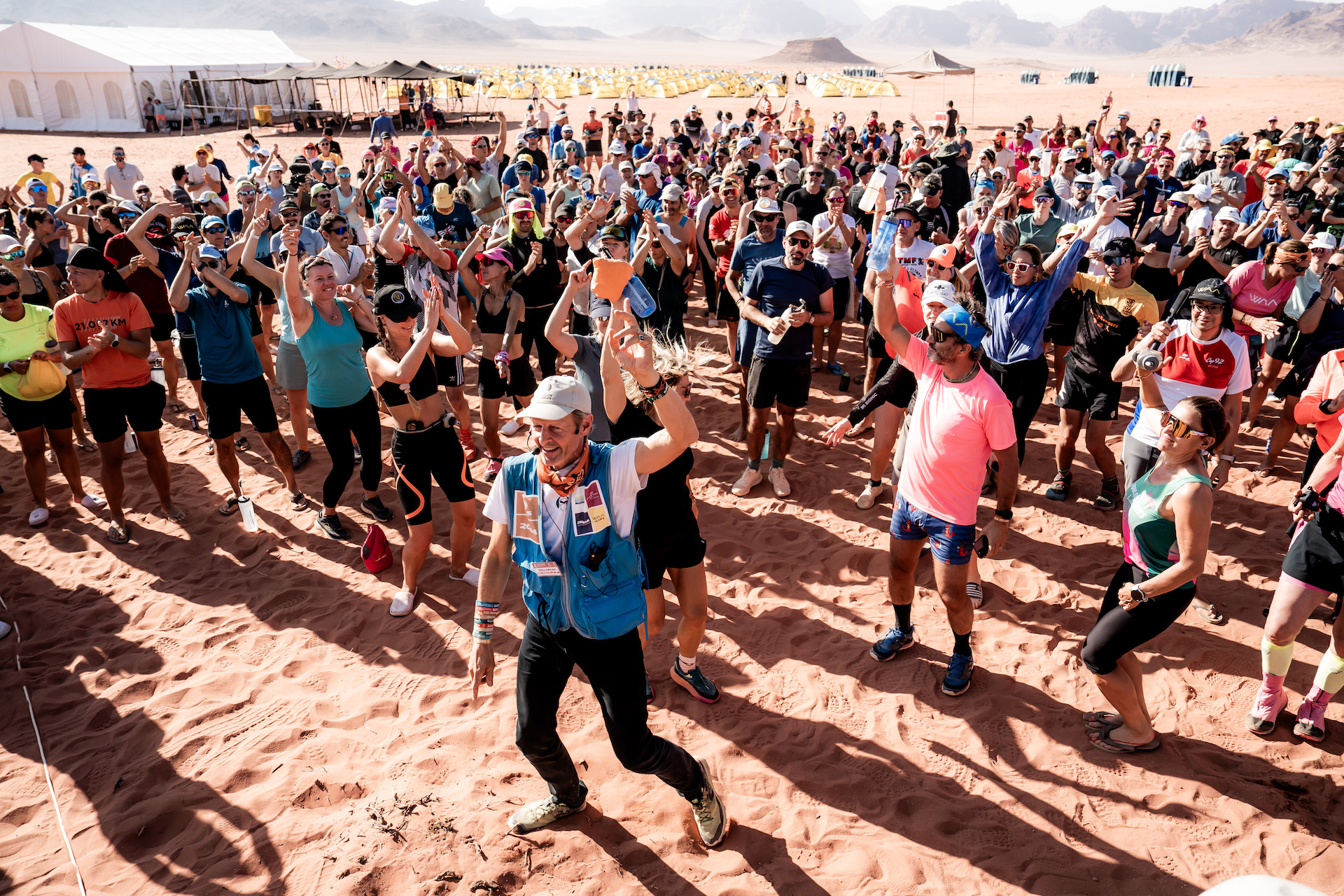
Of course, Born To Be Alive was played and bivouac turned into a desert rave.
Photo by Ian Corless
Stage 3
Photo by Ian Corless
Once again, two starts, 0430am and 0630am. Ahead, 26km’s and 733m+ on a point-to-point route that would provide everyone some of the best views that Wadi Rum has to offer. The large dune and the views from the top a highlight.
Photo by Ian Corless
Once at the finish, tears, joy and laughter, a hard earned medal the reward.
Photo by Ian Corless
A transfer to Petra post-race for an opportunity to experience one of the seven wonders of the modern world.
Photo by Ian Corless
Everyone was back at the Crowne Plaza for around 2000hrs. Of course, it’s all about priorities, several showers, fresh clothes and then dinner in the restaurant.
Final Day
Photo by Ian Corless
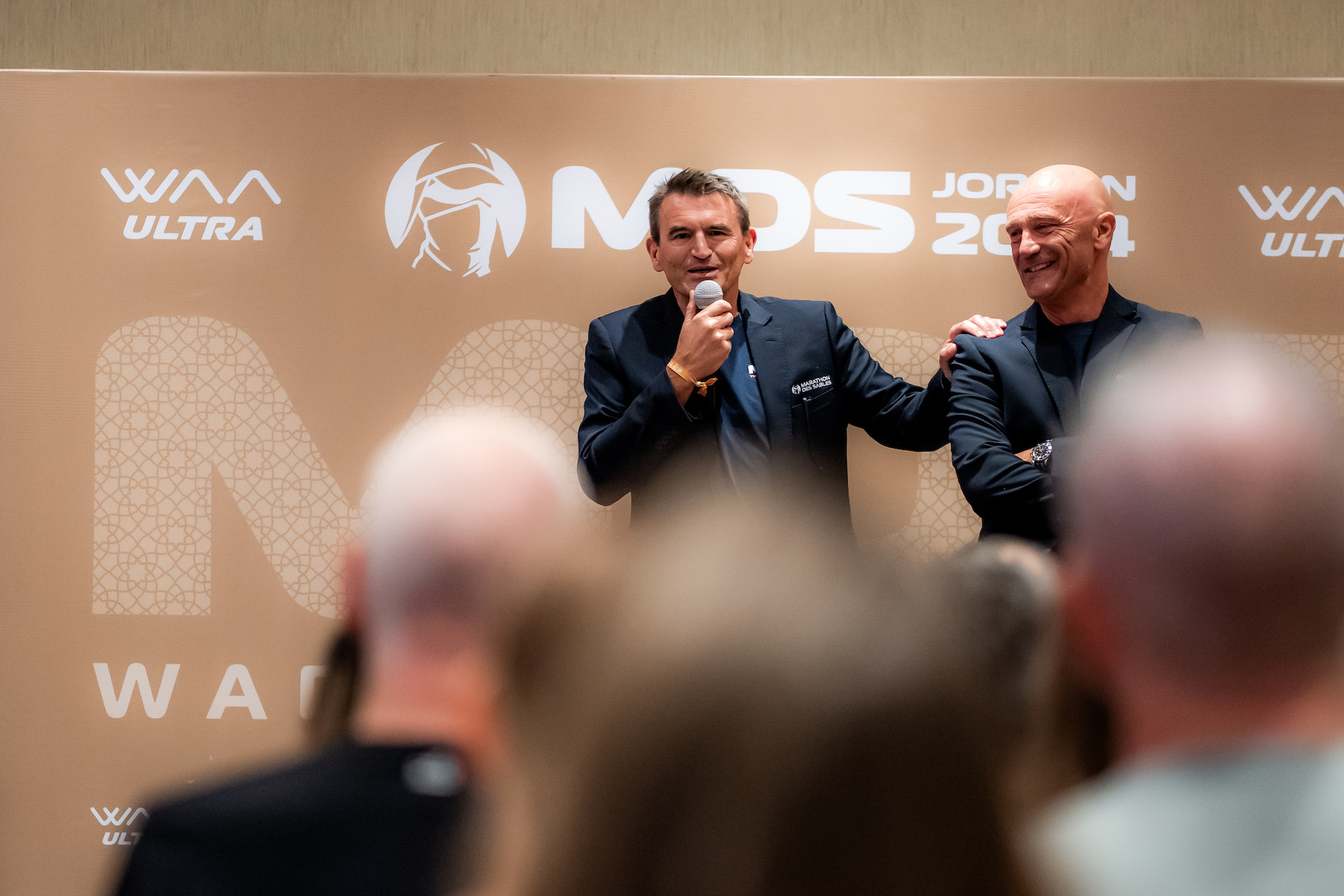
Was relaxed, a lazy breakfast, time by the pool, a swim in the Dead Sea and then at 1600hrs the awards ceremony took place followed by the MDS Jordan movie.
Photo by Ian Corless
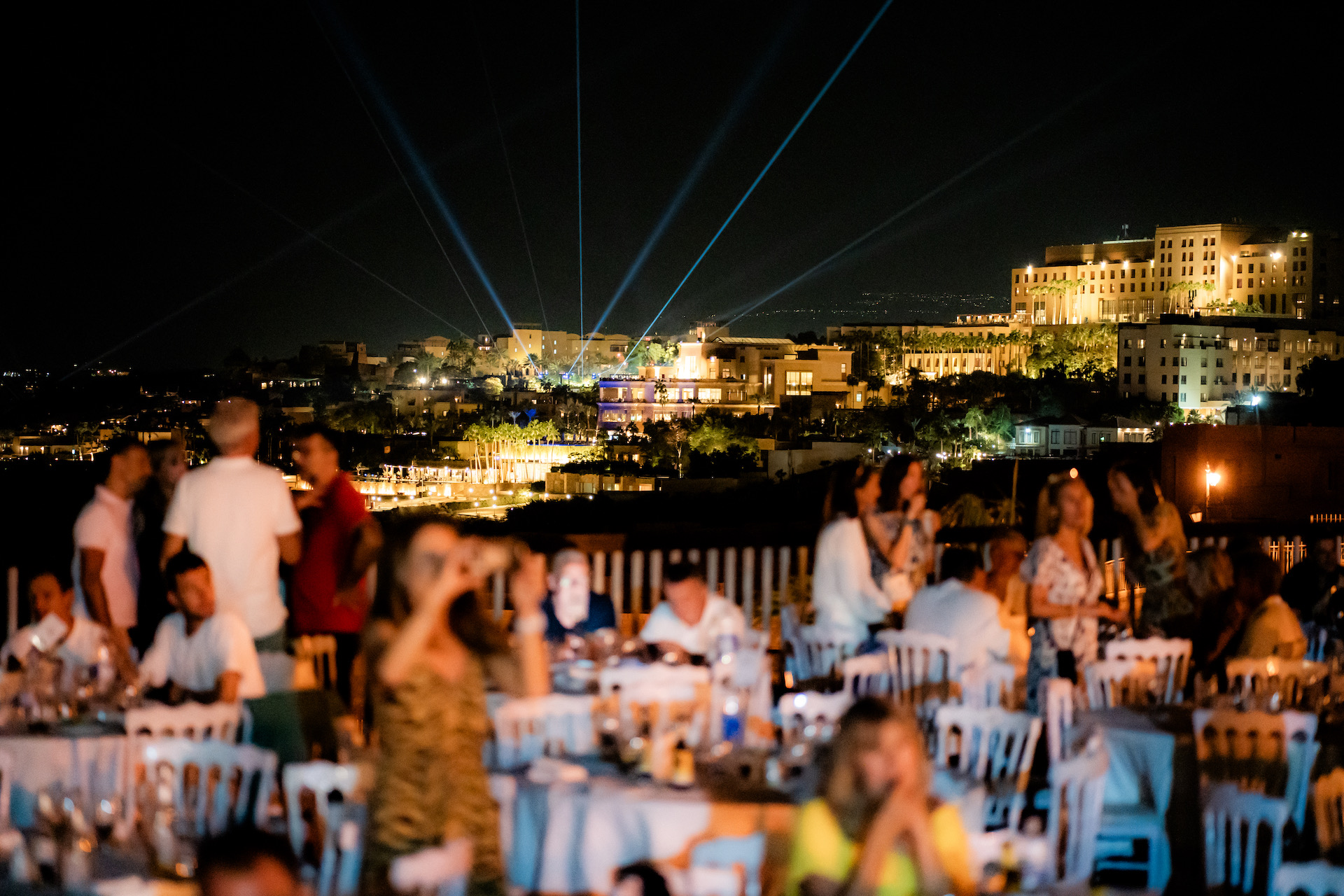
Dinner followed outside with remarkable night time views of the Dead Sea. DJ Robin as per usual played some banging tunes and the party and disco went on into the night and the early hours of the morning.
Another MDS Jordan complete.
Finally, while many things are transferable between all MDS events: clothing, pack, sleeping mat, sleeping bag, food etc, one thing is important and it cannot be emphasised enough, be prepared.
Plan for the best and worst case scenarios, plan for intense heat, plan for the cold, imagine your worst case scenario and have a solution. MDS events are self-sufficient for a reason, they bring a challenge and dynamic that is not present at other races, how you deal with it is very much part of the event.
Looking ahead!
Photo by Ian Corless
Now is time to recover, recoup and plan ahead for 2025. There are no shortage of events. Here is hoping we get to share more time at a MDS event soon:
Since 1986, the MARATHON DES SABLES has crossed the world’s most stunning deserts with several unique concepts: the MARATHON DES SABLES THE LEGENDARY (252 km in the Sahara Desert in Morocco), the MARATHON DES SABLES (70, 100, or 120 km spread over 3 stages), and the new 2024 concept, the MDS TREK (4 stages with a total distance of up to 120 km), offering an accessible adventure with optimal comfort. These international events have seen over 50 editions in various countries such as Morocco, Fuerteventura Island, Peru, Jordan, Turkey, and offer adventures that combine running/hiking in the desert with tourism.
The 2024 MDS Jordan concluded with 26km’s and 733m+ of stunning views and terrain that confirmed Jordan and the Wadi Rum as one of ‘the’ most essential places and experiences to add to your to bucket list.
Photo by Ian Corless
Wadi Rum is a very special place that rivals Cappadocia for it’s uniqueness.
Photo by Ian Corless
After a rest day, the participants were ready for the final day. Two starts, 0430 and 0630 would allow all competitors the opportunity to complete the stage before midday and in the afternoon, a visit to to Petra before finally returning to a hotel, shower, restaurant meal and a night in a bed.
Photo by Ian Corless
A point-to-point route, stage 3 had several key highlights, but the large dune climb and descent, with stunning sunrise views was without doubt a key moment of the day.
Photo by Ian Corless
The 360 panorama here is stunning and the MDS route weaves among monstering towers of rock making participants small and insignificant within such an impressive landscape.
Photo by Ian CorlessPhoto by Ian Corless
The race at the front was fast and furious for the men, with Theo Detienne winning the stage with a short margin ahead of the 2024 MDS Jordan champion, Rachid El Morabity. For the women, Sylvaine Cussot was a clear champion ahead of Marine Canas and Pauline Thinus.
Photo by Ian Corless
Full results for each category distance can be viewed at LiveTrail HERE.
Photo by Ian Corless
The finish line, as per usual was a place full of tears, emotion and release. The medal and t-shirt a reward for a tough adventure.
Photo by Ian Corless
Post-race, participants were treated to an excursion to the iconic Petra, an opportunity to relax, sightsee and soak in this iconic wonder of the modern world.
Since 1986, the MARATHON DES SABLES has crossed the world’s most stunning deserts with several unique concepts: the MARATHON DES SABLES THE LEGENDARY (252 km in the Sahara Desert in Morocco), the MARATHON DES SABLES (70, 100, or 120 km spread over 3 stages), and the new 2024 concept, the MDS TREK (4 stages with a total distance of up to 120 km), offering an accessible adventure with optimal comfort. These international events have seen over 50 editions in various countries such as Morocco, Fuerteventura Island, Peru, Jordan, Turkey, and offer adventures that combine running/hiking in the desert with tourism.
The 2024 and 38th edition of Marathon des Sables is here! MDS The Legendary, the longest edition in the history of the race, 252km’s over 6 timed stages.
Close to 900 participants will toe the line, exact numbers will be confirmed at bivouac 1. With 60 countries represented, France and the UK lead the with 267 and 178 participants respectively.
From the 900 starters, 27% are women; a record. The youngest participant will be Lionel Schneider (16) and the oldest, Harry Hunter who has just turned 75 on April 15th.
Runner’s will arrive in Morocco on April 12th for a transfer to the desert.
Saturday 13th is admin day and then the race schedule is as follows:
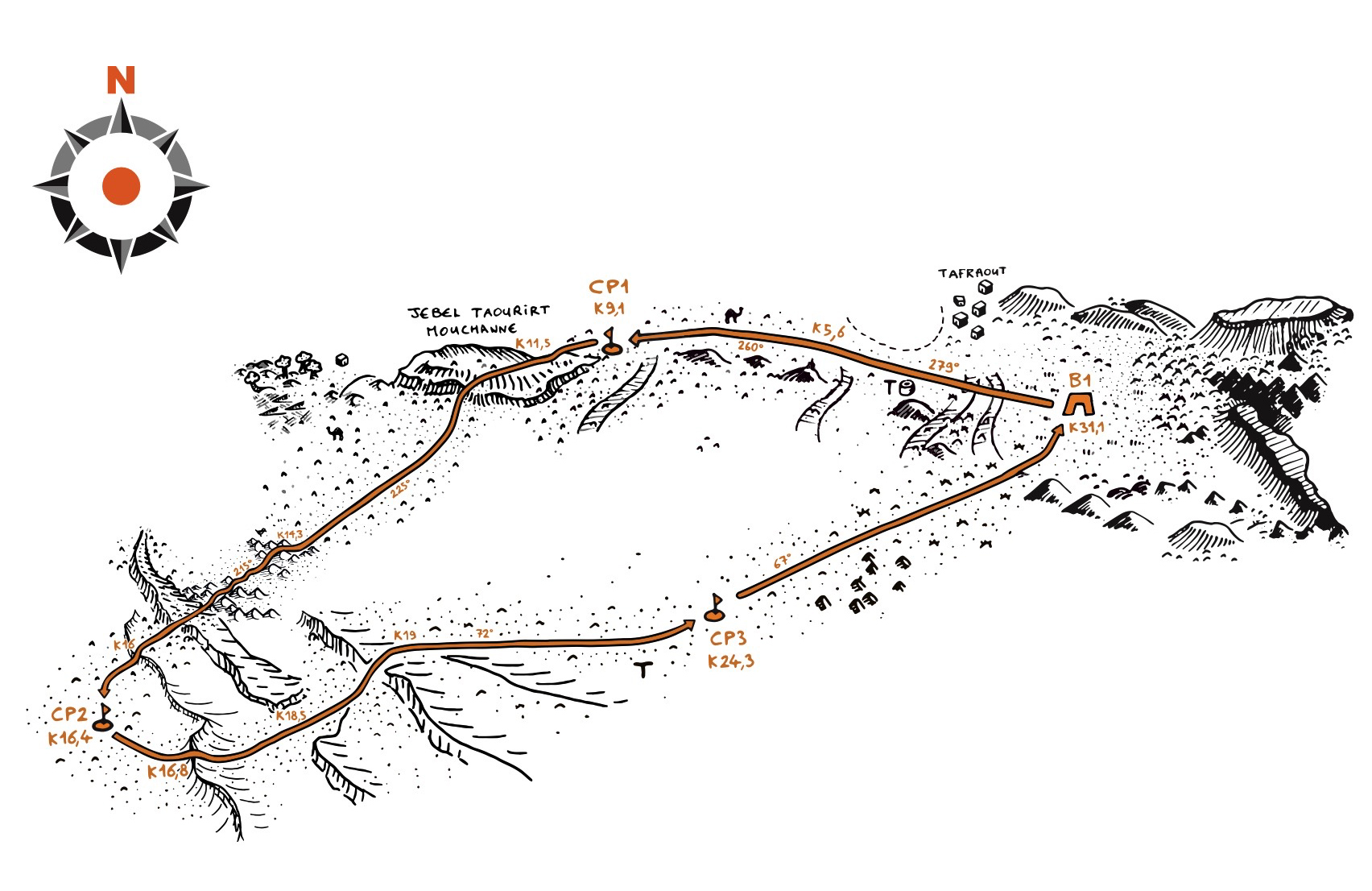
April 14 – STAGE 1 – Departure 0700 31.1km and 282m+
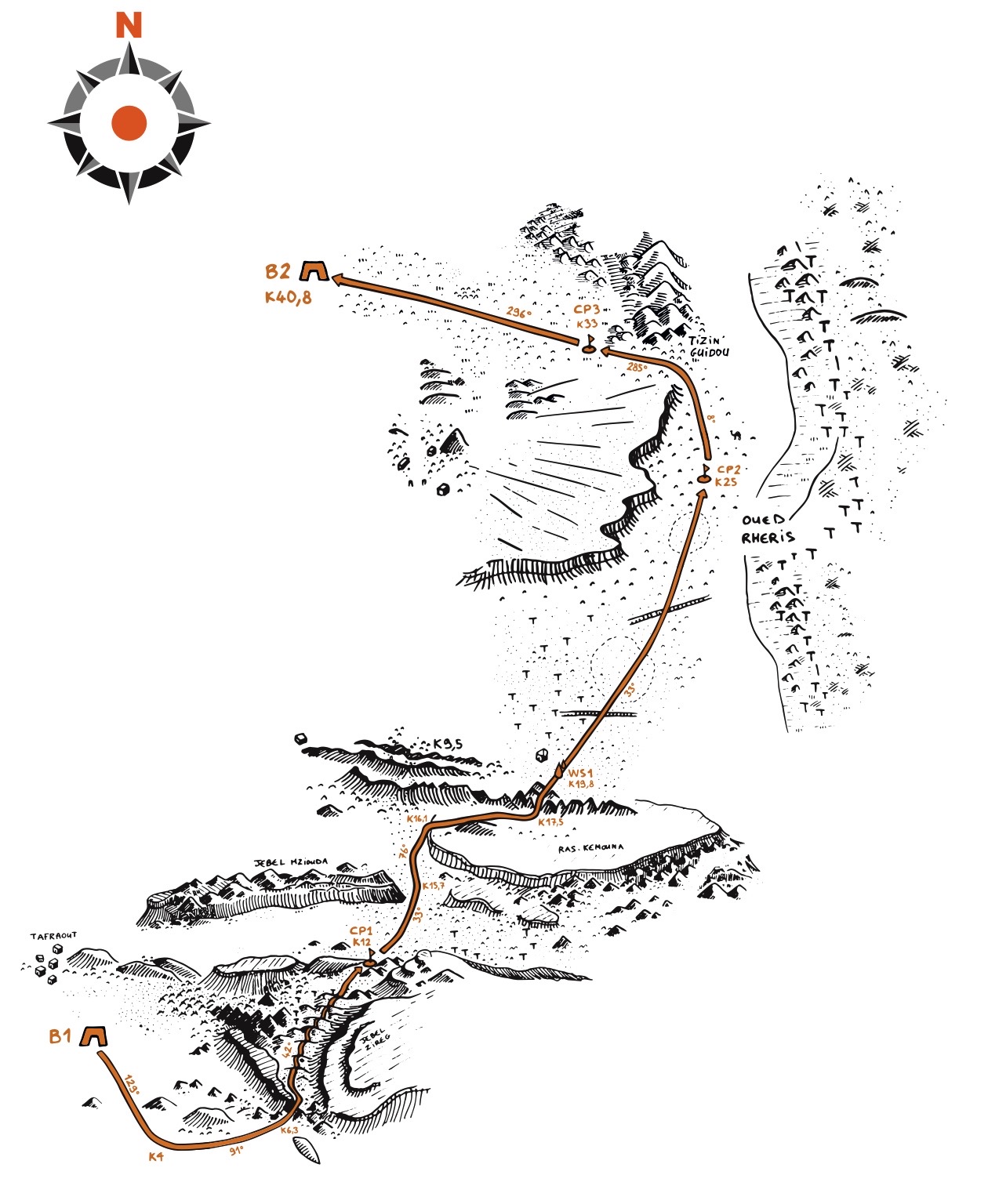
April 15 – STAGE 2 – Departure 0700 40.8km and 550m+
April 16 – STAGE 3 (The Long day which will go through to April 17) – Departure 0600 and 0730 for the top 50. 85.3km and 1154m+
April 18 – STAGE 4 – Departure 0630 and 0800 43.1km and 390m+
April 19 – STAGE 5 – Departure 0700 31.4km and 252m+
April 20 – STAGE 6 – Departure 0630 and then transfer back to Ouarzazate 21.1km and 160m+
April 21 – Ouarzazate
April 22 – Home travel
THE ROUTE
Unlike previous editions of MDS, the 2024 route will concentrate on one key area of the Sahara. It makes sense, it is the most beautiful. Therefore the race will not be a point-to-point but a series of journeys and participants will stay in the same bivouac on multiple occasions.
Importantly, Jebel El Otfal, Jebel Joha Baba Ali and the oasis of El Maharch will feature on the ‘long day’ however, there will be no Merzouga dunes during the race.
In summary:
Stage 1 B1 to B1 31.1km and 282m+
Stage 2 B1 to B2 40.8km and 550m+
Stage 3 Is an elaborate series of tracks, B2 back to B2 85.3km and 1154m+
Stage 4 B2 to B3 43.1km and 390m+
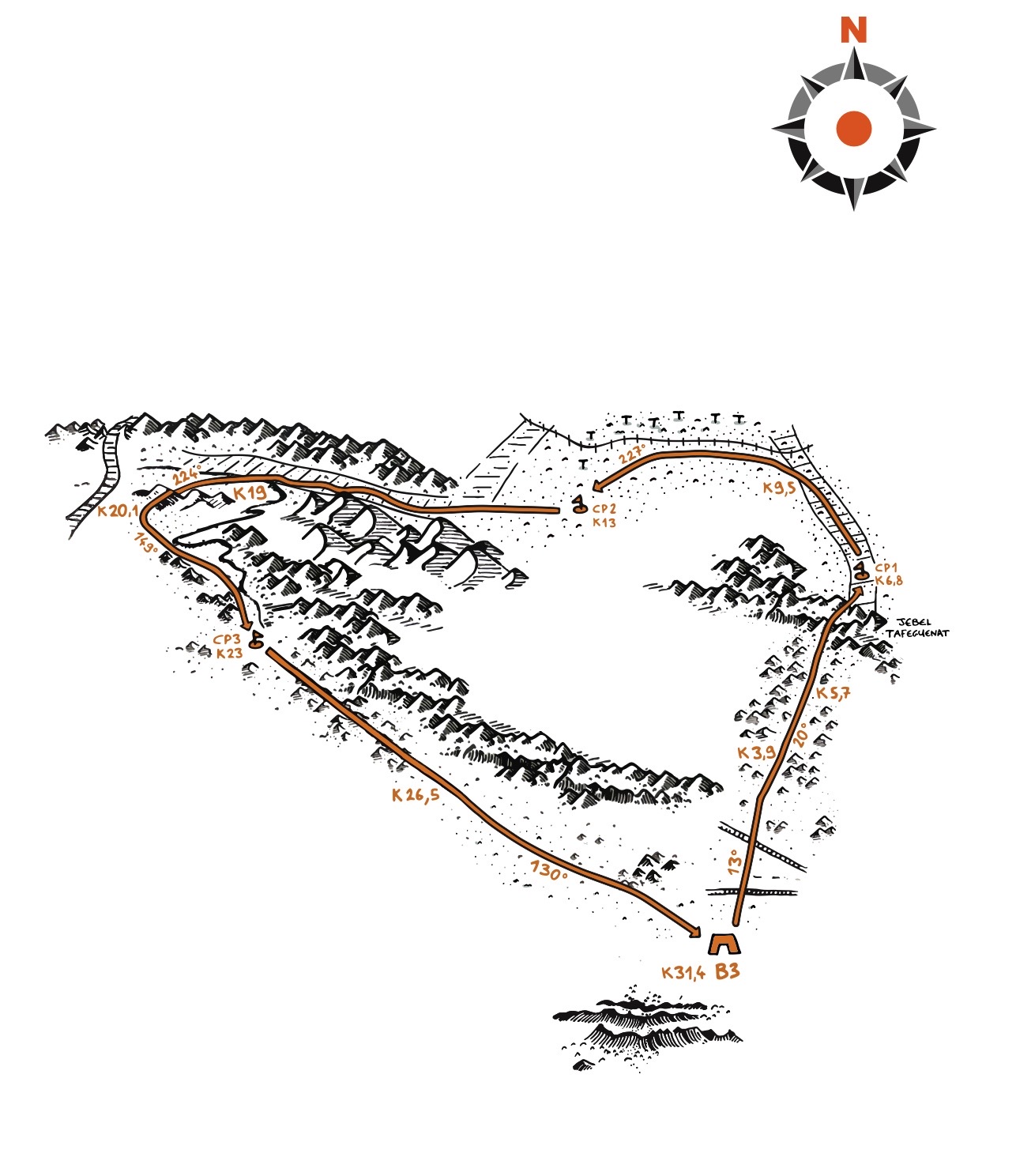
Stage 5 B3 to B3 a looped route that makes a heart shape 31.4km and 252m+
Stage 6 B3 to finish 21.1km and 160m+
ONES TO WATCH
MEN
MOHAMED EL MORABITY
As in any MDS, there are the front contenders who will do battle for overall honours, in the men’s category, three obvious names are stand out: Mohamed El Morabity, Rachid El Morabity and Aziz Yachou. All eyes will be on Rachid, he is looking for a 10th MDS title and after the disaster in 2023 when he received a 2-hour time penalty, Rachid will be looking to make amends and make history. Mohamed, Rachids brother took the reigns in 2023 and won, but will this be allowed in 2024? Aziz Yachou gets stronger and stronger every year, he has a battle against the brothers though.
Petter Restrop, Yoann Stuck, Roberto Mastrotto, James Miller, Alessio Zambon, Ahmed Ouikhalfen, Stéphane Ricard,Mérile Robert, Hamid Yachou, Anthony Ginter, Romain Laguigner Abdelhadi Elmoustahli are also ranked as the top contenders, as always, there will be surprises.
WOMEN
AZIZA RAJI
Aziza Raji and Aziza El Amrany fly the Moroccan flag and are of course, top contenders for the podium. The UK’s Gemma Game is returning, she has placed 3rd twice in 2018 and 2019 – is this the year?
Lai King Chan, Adriana Moser, Saskia Plaucheur, Marie Houdusse, Amélie Ginter, Ninette Banoun, Magdalena Kalus, Alexandra Bailly, Annę Godefroy, Nina Stein and Katherine Beckingham are all in with a shout of top-10 and maybe the podium.
STORIES
AMY PALMIERO WINTERS
The MDS is always a place for stories, challenges, inspiration and adventure and the 38th edition will be no different. Often, these stories unfold as the race happens.
Mr MDS, Christian Ginter is back for his 36th edition, yes, his 36th! Rory Coleman from the UK return for his 16th and in and amongst these two highlight names, we will have new stories to follow and inspire us.
INTERESTING FACTS
In an effort to reduce the environmental impact of such a huge race, the MDS has taken some key measures.
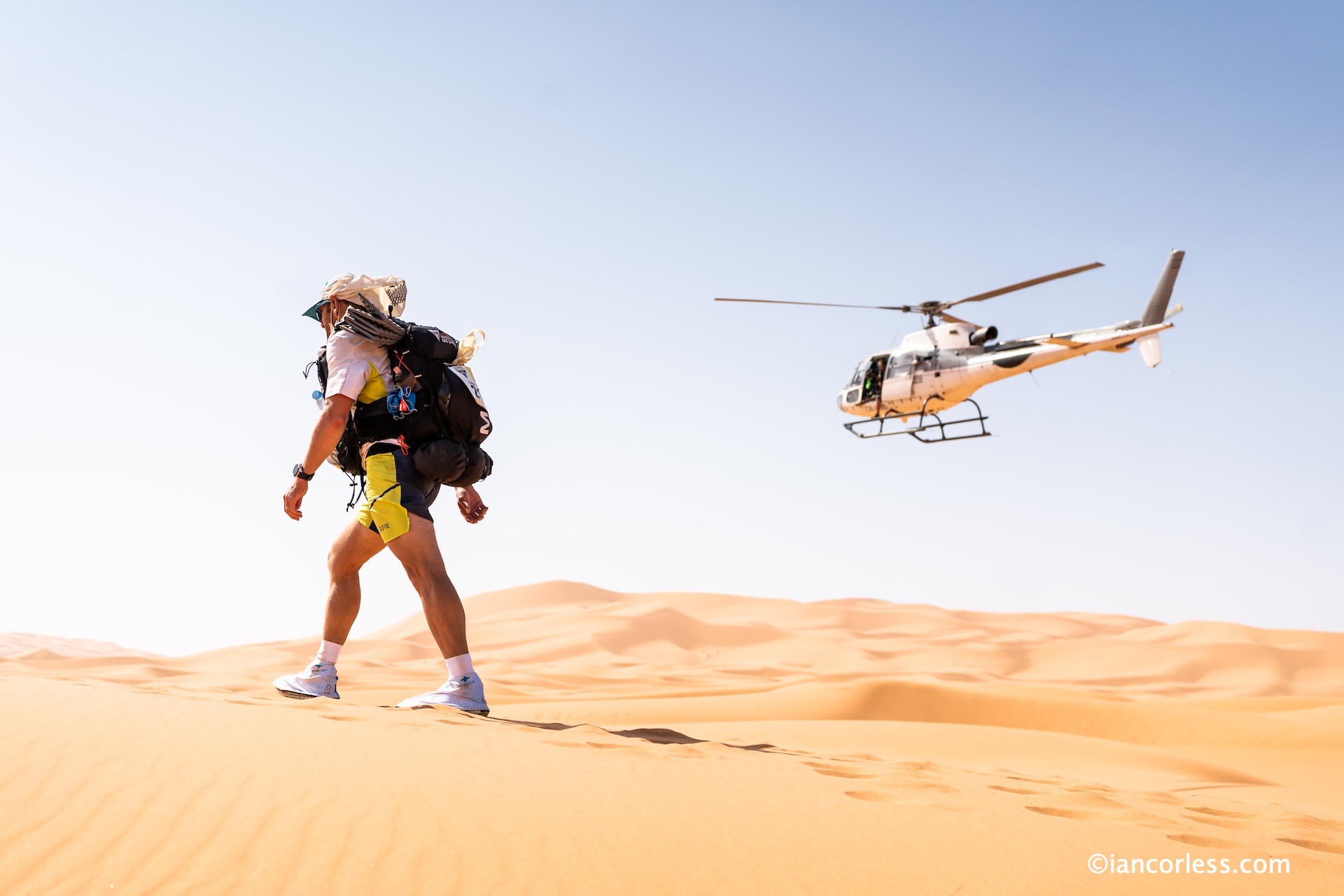
In 2023 50 lorries were used, for 2024 this will be 20. In 2023 157 4×4 vehicles have been reduced to 78. A helicopter as per usual will be available for emergency use only. This equates to a 47% reduction I carbon emissions.
In addition, chartered flights were reduced to just 3 planes with an encouragement for participants to choose commercial options.
The use of local services has been increased using local staff, vehicles, trophies made in Morocco, and the catering team for staff will be all Moroccan with 100% of produce local and a reduction in chicken and beef.
In addition, checkpoints will have solar power and all communication relays utilise solar too.
Waste management has been improved and a key move has been to eradicate 1.5ltr bottles and replace with 5ltr.
Safety has always been a key concern and for 2024 there is an increase in medical staff, 65 up from 56, there 9 SSV rapid response vehicles, up from 4 in 2023. There will be 9 4×4 vehicles and new for 2024, 3 MTB riders and 9 runner’s who will participate on the race route offering immediate medical response. A medical point will be in the centre of bivouac so that immediate attention can be given if required.
ADVENTURE AWAITS
The 38th edition is now waiting to unfold. It’s a new era for the race. Let the adventure begin, MDS The Legendary makes history.
You can receive daily updates and reports on this website. Follow on IG @iancorlessphotography and @mdslegendary
Marathon des Sables is a simple race that often becomes over complicated by too much information. Take advice, look at websites, process the information but importantly find out what works for you. We are all individual, what works for one may well not work for another.
When you break the race down, here are my TOP 20 TIPS of what to focus on for Marathon des Sable – The Legendary.
Pack – Ideally needs to be as small as possible and as close to the minimum 6.5kg weight when packed. There are many packs out there and just like clothing, packs fit in different ways, so, it is important to try many to find the best for you. I size between 20-25 Ltr is ideal. Key things to look out for: easy access to water, easy access pockets for snacks etc, adjustable to get perfect fit, minimal bounce when loaded, flexibility to compress the pack and make smaller as you reduce the contents (food you eat) as the race progresses.
Sleeping bag – Needs to be lightweight, small when compressed and warm enough for you based on your warmth requirements – are you a cold or warm sleeper? Popular sleeping bags are PHD, Nordisk Y, OMM, Sea to Summit, Western Mountaineering, Rab etc. Take care on the ‘comfort’ rating and I have an in-depth article on choosing a sleeping bag HERE.
Jacket – I always recommend a sleeping bag and jacket as opposed to just taking a sleeping bag. MDS can have cooler editions, particularly early morning or evening and having the option of a jacket is great. It also means that you can potentially take a lighter and less warm sleeping bag as the jacket can add as an additional warm layer. As an example, a Sea to Summit SP1 bag and a Haglofs L.I.M Essens jacket weighs 510g! Many brands do sub 200g jackets, look at Haglofs, Mont Bell and Y by Nordisk.
Clothes – You just need what you will run in. However, a spare pair of socks is commonplace. No need to get new clothes and don’t worry about colours. The most important is that they are comfortable and they do not rub or chafe.
Sleeping Matt – Optional but a good nights sleep is important for recovery. There are only three things to do at MDS, run, eat and sleep. Make the sleep as comfortable as possible. Two options exist – inflatable and solid foam. The choice is yours. The inflatable ones offer more comfort, more flexibility in packing but with poor admin, you do run the risk of a puncture. Recommended Sea to Summit HERE
Shoes and Gaiters – Shoes are personal and if you already have shoes that are comfortable and cause no blisters, then you have the perfect MDS shoe. Things to consider, a wider toe box is good to allow toe splay, a thumb nail of space above your longest toe is adequate, no need for more, and make sure they have enough durability for you! I say ‘you’ because Rachid El Morabity will complete the whole race in 21-hours whereas most people won’t even do just the long day in that time – his shoe shoe choice will and can be very different to what most of us need! Get your Velcro sewn on your shoes and make sure that when you get the shoes back the fit has not been altered.
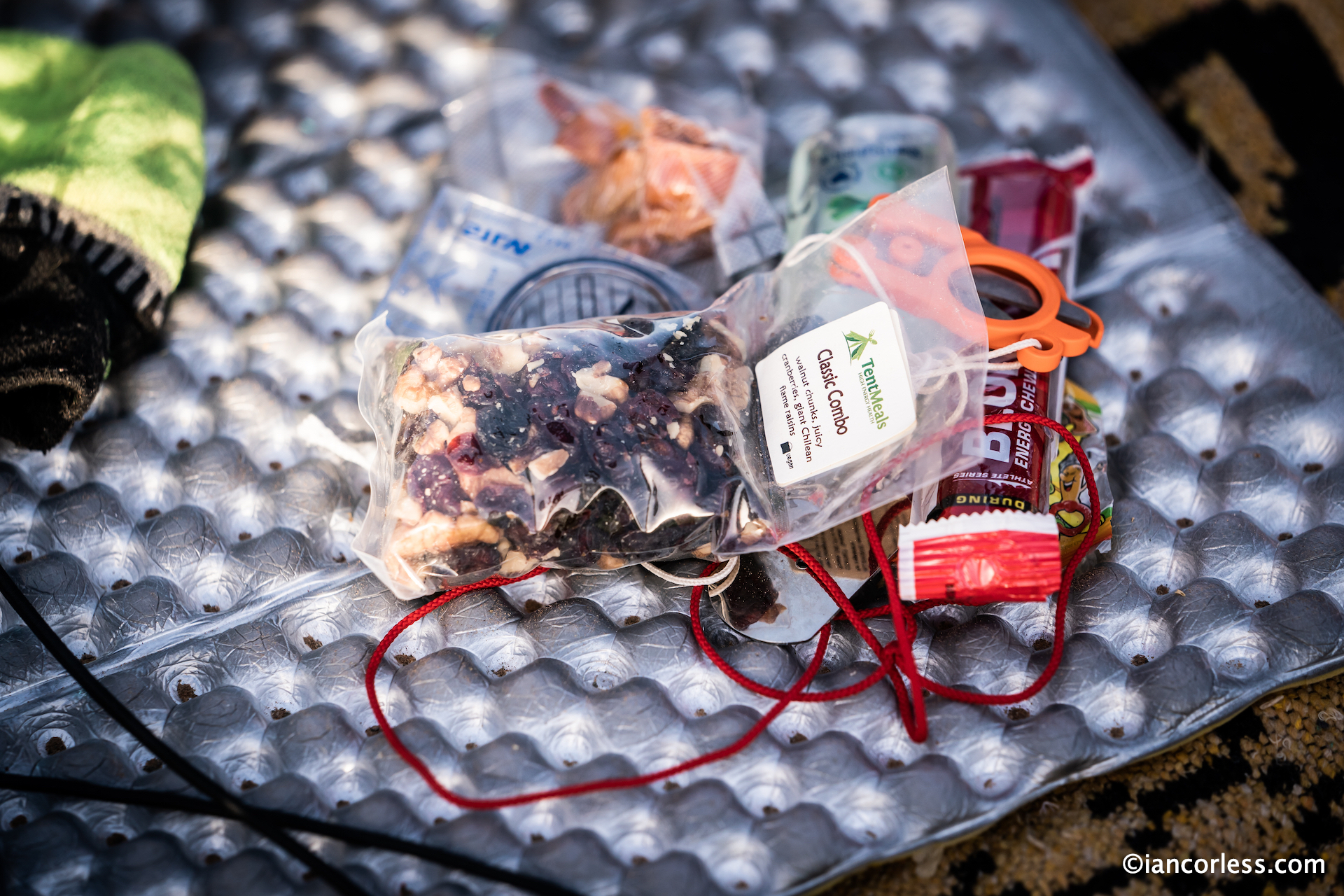
Food – You need a minimum amount of calories per day specified in the race rules (2000 per day) and how those calories are made up are up to you. This for many is a difficult one. It raises many questions and yes, it’s good to find out what other people do and use but ultimately, YOU have to eat it. Food is the heaviest item you will carry, but remember, your packs gets lighter each day as you eat the contents. Re-packing food can save weight and space. Think about the the balance between carb, protein and fat and importantly, what tastes good at home, may not taste good in the Sahara.
Stove – The decision to use a stove is another question mark but it would appear that most runners like that hot water option. Remember though, you can make a fire from twigs, shrub and branches that surround bivouac.
Pot – Many use a 1.5 ltr water bottle cut down as a food bowl. For the 2024 MDS, 1.5 ltr bottles will not be supplied, so, you will need a suitable pot. Esbit for example do a small titanium pot with lid.
Water – You must have the capacity to carry 1.5 ltr of water and for the long day, 3 ltrs. Water is provided by the race. For 2024, water will not be provided in 1.5 ltr bottles but will be distributed by staff at the cp’s using jugs to decant water from larger 5 ltr bottles. On the long day, an additional 1.5 ltr bottle will be provided either at the start or cp1.
Salt Tablets – Salt tablets will no longer be provided at the race and you now must have a mandatory 14 stock cubes. Of course, you are recommended to work out your electrolyte needs and plan accordingly. You are welcome to take your own salt tablets or similar product such as those provided by Precision Hydration.
Feet – Look after them, along with dehydration, blistered and damaged feet are a key reason for failure in any multi-day race. Prepare them before the race especially trimming nails back and knowing what socks work for you. After each day in the race, clean feet, allow them to breathe and look after them. Get any sore or hot points addressed immediately.
Mandatory kit – You are supplied with a mandatory kit list and you MUST have everything on that list. Please note, for 2024 the venom pump has been removed and you must have 14 cubes of broth.
You – You signed up for the challenge, you wanted to be on the start line and therefore you are responsible for the outcome. Believe me, the you that leaves the Sahara is not the same you that entered. Keep perspective, the MDS journey is an enhancement of you as a person. It’s easy to become obsessed, ultimately the majority of runners at MDS are enthusiasts, if you keep that in mind the journey will be a complete one. The legs, lungs, heart and feet will only get you so far, then the mind will take over. Mentally prepare for the challenge ahead and make mental plans for how to survive and motivate yourself when the going gets tough. Laugh when you hit rock bottom. Laugh when you are going the toilet in a brown plastic bag. Laugh with and at your tent mates and fellow runners. The comradeship of MDS is quite unique, embrace it.
Training – Plan ahead, formulate a long term plan and aim for consistency.
Walking – Learn to walk. Many think they will run 80% and walk 20%, if you are lucky, it’s the other way around. Make walking a positive, make walking fast, make walking productive.
Poles – For many, poles are a huge advantage. They are like 4-wheel drive and without doubt, they make you walk faster. But you must train with them and learn how to use them.
Shoes – NEVER take advice from anyone online that tells you that ‘X’ is the shoe to wear for MDS unless they know you and your run style. Forget the advice about going up a size or two sizes. It’s a recipe for disaster unless you know that your feet swell? A shoe that is too big will allow your foot to move, a moving foot causes friction, friction causes blisters and the rest of the story speaks for itself. General advice is that if you have a ‘thumb nail’ of room at the front of the shoe above the longest toe, this generally works. Notice I say ‘generally’ – there are exceptions. One thing that may happen, is your foot may get wider (rarely or never longer) with the heat and additional time on feet, therefore a shoe with a wider toe box often works well for many runners.
Equipment – Minimum pack weight is 6.5kg plus water, get as close to this as you can. Additional weight is additional stress and just makes the journey harder. Luxuries are ok if they improve the journey and make it easier, music is a good example of an additional extra. I can’t really think of anything else…
Friends – Tent mates will pull you through and motivate you. They will become friends for life. Ideally find tent mates before you head out to the Sahara and plan your tent group.
Admin and preparation that you may not think of:
Take essentials on the plane and wear your run apparel and shoes. That way, should a baggage disaster happen your chances of racing improve.
Take food with you for the travel and on the plane.
The journey from the airport to bivouac 1 can be lengthy be prepared with your own snacks and drinks. MDS do provide a packed lunch.
Night 1 and night 2 in bivouac are NOT self-sufficient so take extras such as an inflatable bed, food and luxuries that you are happy to give away to the berbers. May as well have 2 comfortable nights and a comfortable day before the racing starts.
Food before the race starts is now down to you. Be prepared to have plenty of variety and remeber, within reason, this can be anything!
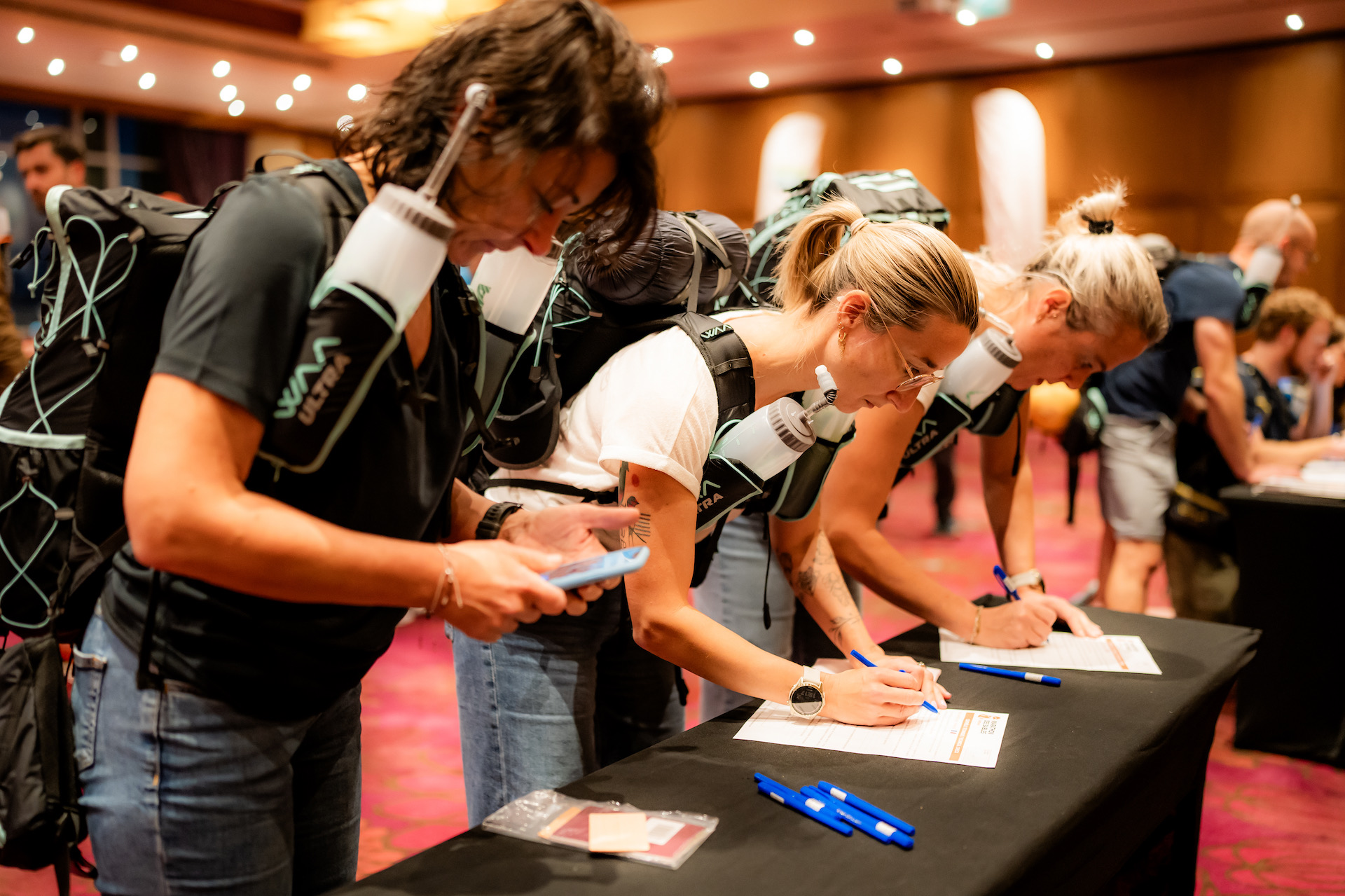
Admin day can be lengthy multi-hour experience. Take water and snacks for when standing in line and maybe take an umbrella so you have shade.
Keep sun screen on and keep hydrated. No need to drink vast volumes – drink to thirst before the racing starts.
Have additional items such as a base layer, sleeping bag liner and other items that may be on a ‘question’ list for the race. On night 1 and before you go to admin, you can make final decisions of what to and what not to take. Particularly important if you think you may be cold at night.
Remember that after bag drop and check-in you have no access to any additional items, however, you only become completely self-sufficient when you start the race. With that in mind, you can have additional food and luxuries with you until day 1 kick-off, it’s a useful tip and does mean that you can have additional comfort for a good 12-hours.
Conclusions:
Marathon des Sables is a magical and life changing journey as are most if not all multi-day races. It really is a true challenge of mind and body to race over many days, irrespective if you complete the race in just over 20-hours or 60+ hours. It’s a hark back to a more primitive time, a time without clutter and modern technology. Embrace this. Embrace the silence of the surroundings and the simplicity of placing one foot in front of the other.
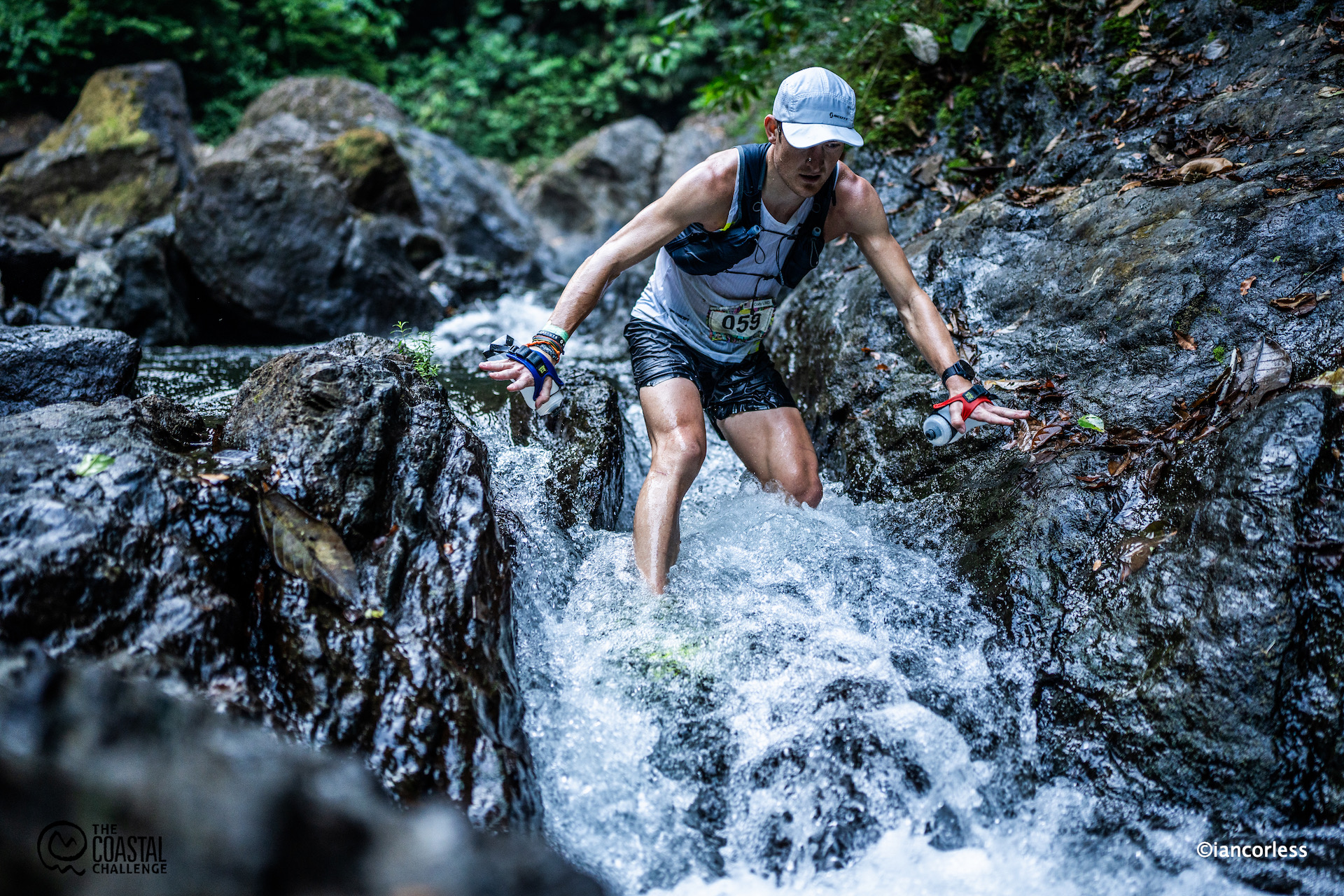
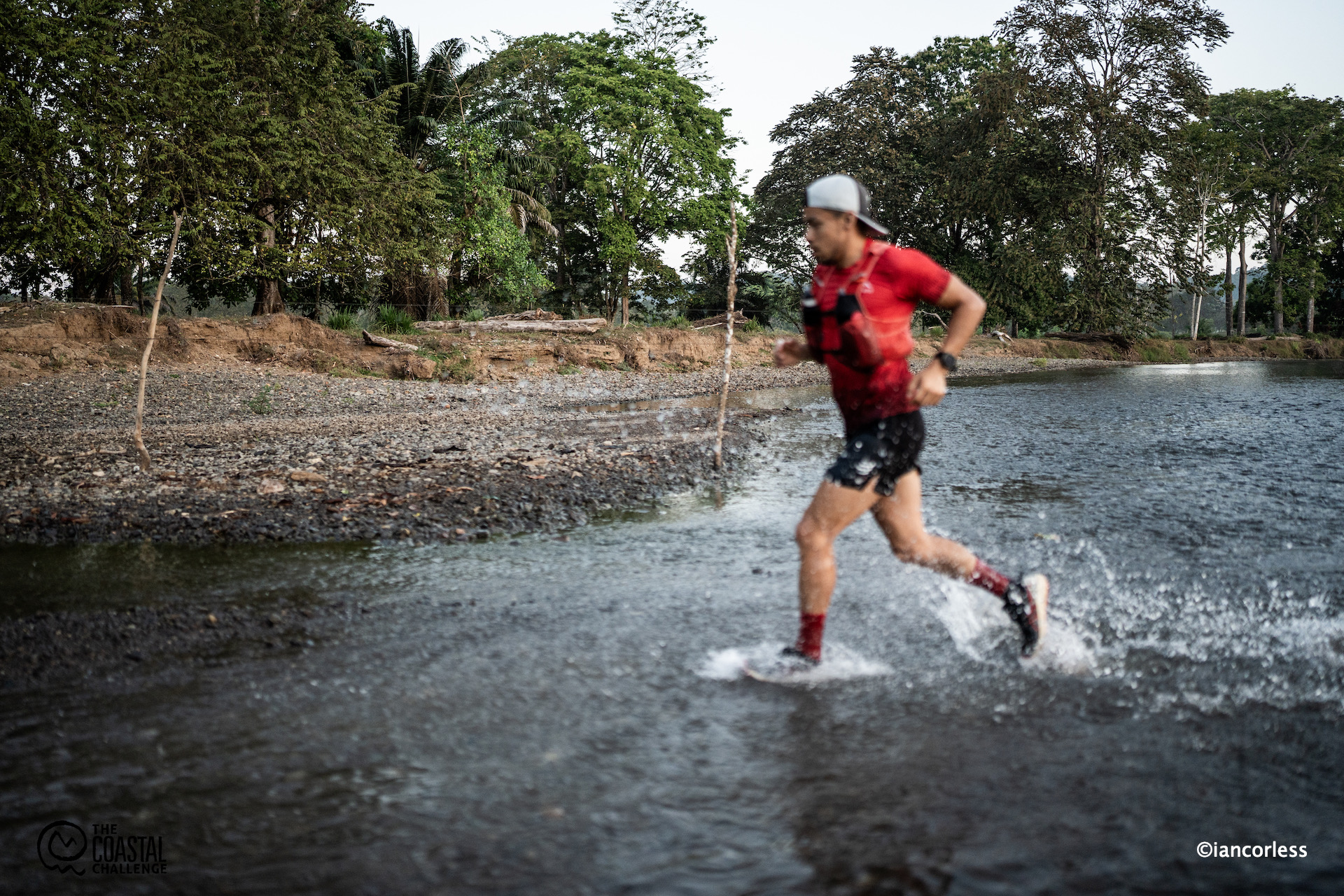
The victory loop. This stage personifies all that has gone before and arguably, is the most beautiful stage. The whole of TCC is compressed in to the 37km’s with gravel roads, river running, waterfall crossing, rainforest, coasteering and long pristine beaches.
It’s a day for celebration and one to soak up all that has been gone before. At the end, a hard earned medal. However, racing did not stop and Cody Lind and Katie Young sealed TCC 2024 with final stage wins, 3:14:42 and 4:44:32 respectively.
Cody Lind was on fire today, 2020 and 2024 champion.
There are outright winners, of course, and congratulations go to Katie Young and Cody Lind the 2024 TCC champions. But as race director, Rodrogo Carazo says, today, everyone is a winner.
Rodrigo Carazo awards the finisher medal
Emotions are released, tears are shed and finally, it’s time to kick-off run shoes and fully relax and appreciate the magnitude of the journey and the experiences that have gone before.
Carlos
It’s no mistake or act of chance that has allowed TCC to last 20-years. Costa Rica, the route, the people, the wildlife, the Pura Vida approach makes this race special and unique.
Emotion on the line
Tomorrow, competitors leave Drake Bay via speedboat, a final magical experience to confirm that TCC is one of the ‘must do’ races in the world.
The day starts by crossing the Sierpe River via ferry, ahead one of the most ‘runnable’ days with an abundance of gravel road interspersed with technical trails.
The crossing
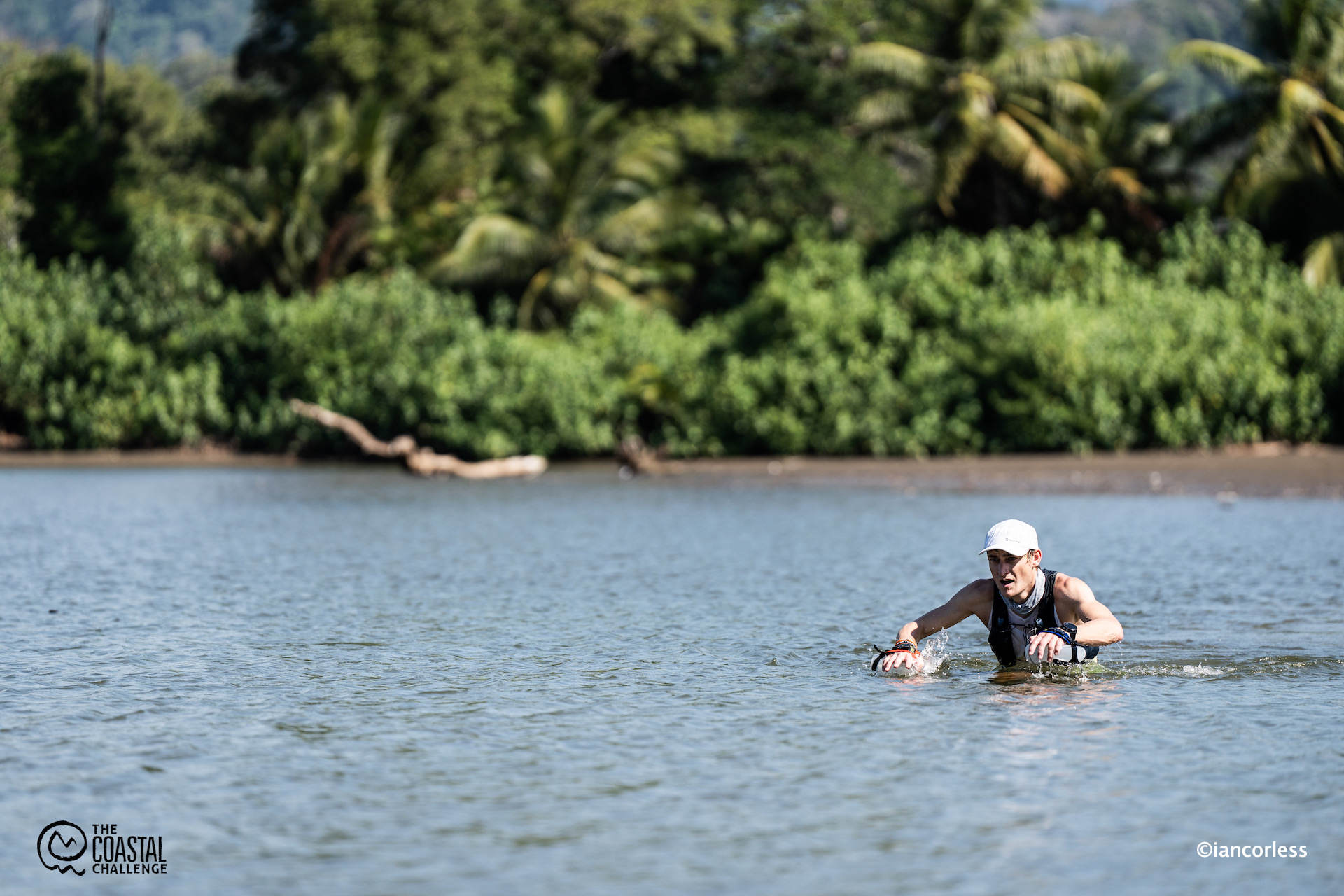
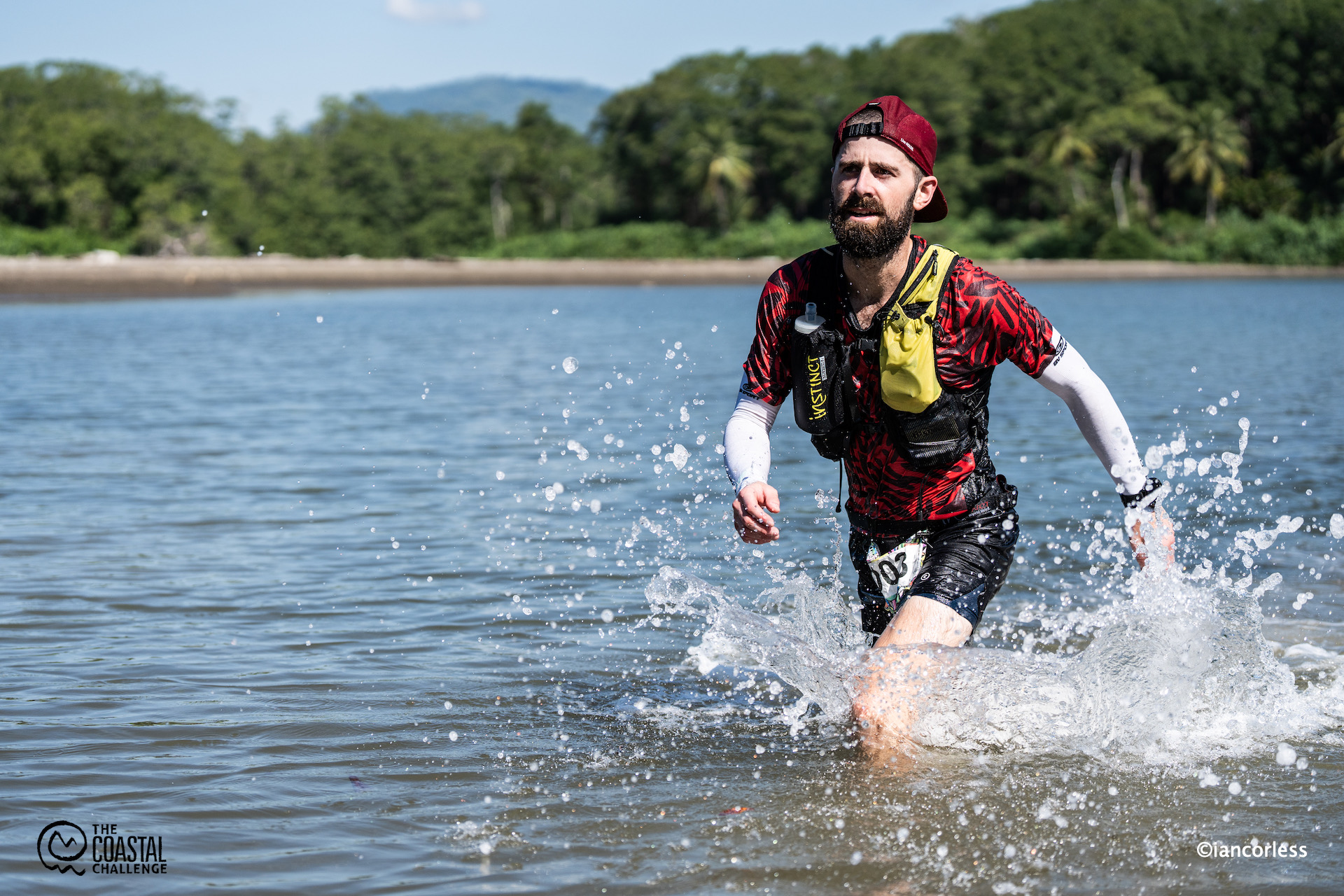
It’s an iconic stage where a boat crossing is required in the final 5km’s transporting runners from one land section to another before the run in towards the iconic Drake Bay.
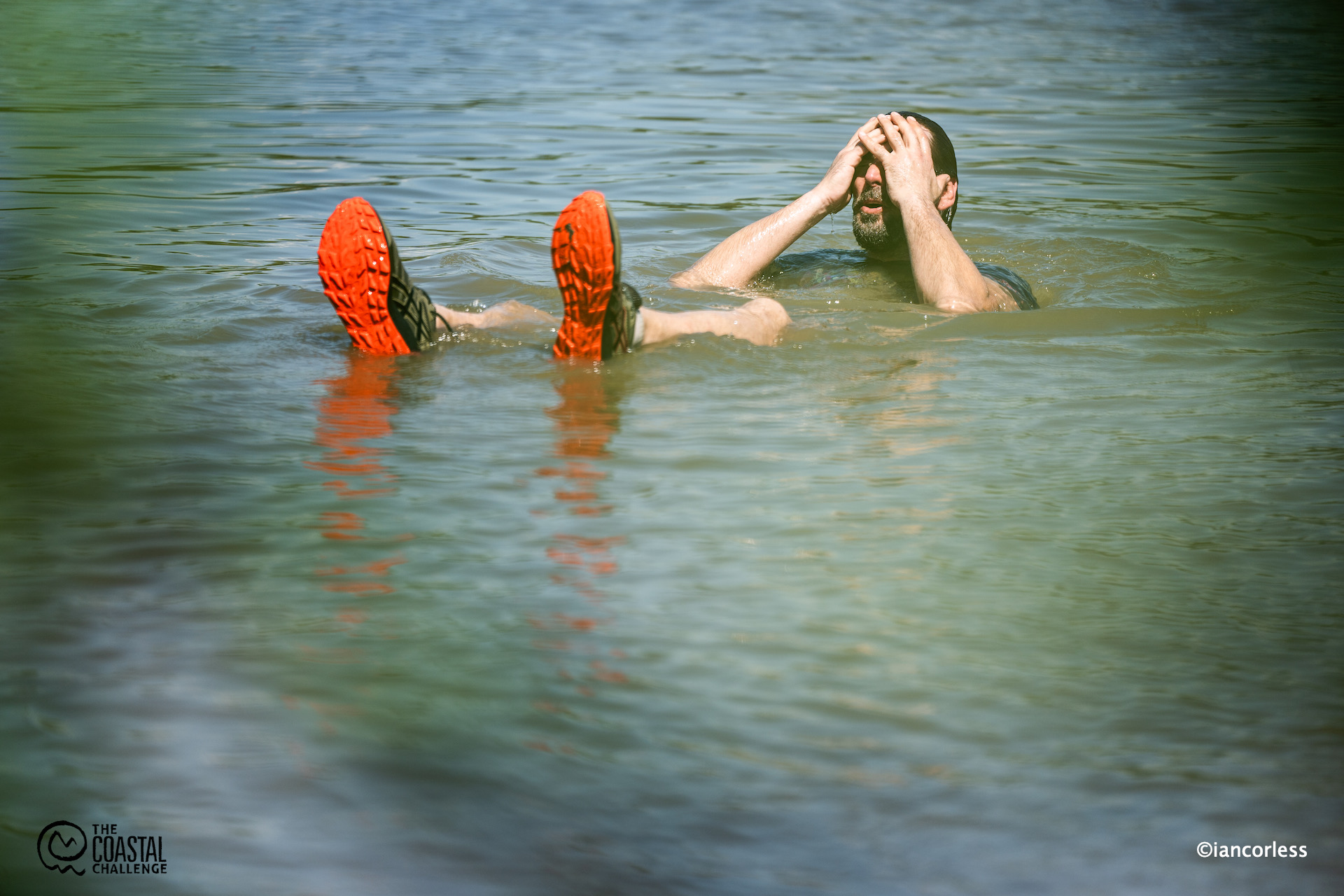
Cody cooling off
A delayed start due to problems with the ferry meant the runner’s started 1-hour late. Sometimes, situations happen and there is nothing to do than say, Pura Vida and carry on.
Pierre
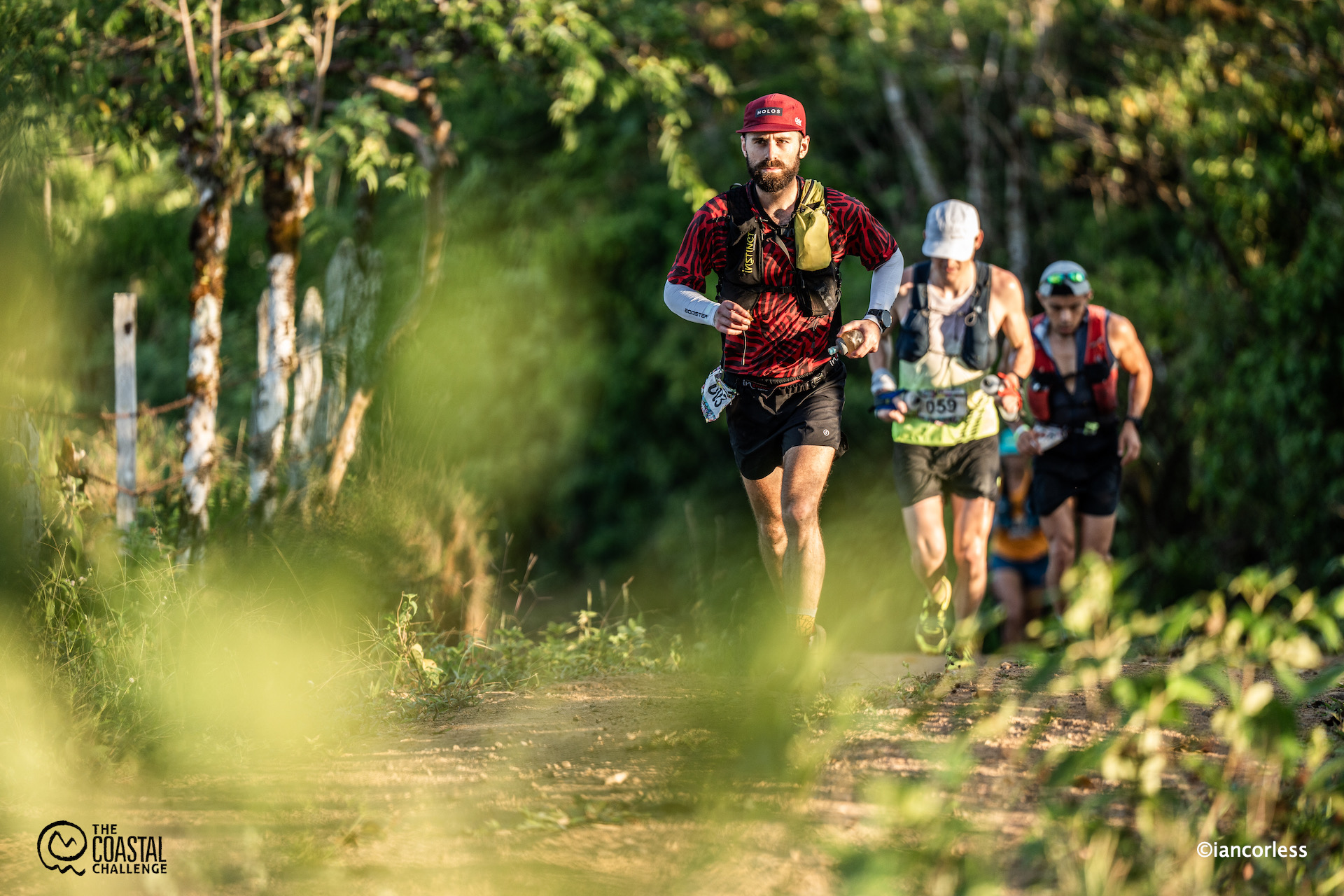
Once underway, the race split at the front with Pierre Meslet deciding no matter how bad the ankle, let’s give it a go. Cristofer Clemente Mora followed and then Cody Lind and Jean Francois Cauchon.
Cody and Jean-Francois
It was only a matter of time before Cody and Jean-Francois took control of the race and the duo finished together in 4:28 (time tbc due to a delay at the boat crossing).
Cody, Jean-Francois and Cristofer
Cristofer finished 3rd.
Katie
For the women, Katie Young well and truly sealed the 2024 TCC with an outstanding performance in 5:55. All day, she smile, ran fast and smooth and dare I say, made it look easy! This TCC is a breakthrough performance for Katie, especially coming after a top-10 at MDS in 2023.
Katie
Lina El Kott Helander finished 2nd in 6:14. Lina could very easily have pulled out of the race early in the week after damaging her right arm. She has fought on and impressively so, chapeaux!
LinaMarlene
Marline Côté finished just ahead of Sanna El Kott Helander, 6:33 and 6:41 respectively. But it was Janina Beck from Germany who finished 3rd in 6:31.
Pierre Meslet full of life
The racing is now done! Stage 6 tomorrow and it would take an absolute disaster to change the ranking, so, expect a victory loop. And let’s face it, a fun loop is well deserved, despite the fact not many would call 35.9km an easy loop…
Runner’s got there first night in camp last night. Tired bodies looking to recover and prepare for stage 2 of the 2024 The Coastal Challenge, a 230km, 6-stage journey from Quepos to Drake Bay. Ambiance and atmosphere was high. Stage 1 had certainly taken a toll and surprised many. The combination of route, heat and humidity a wake up call. The impact of day 1 saw 18 participants move from the Expedition race to the shorter Adventure category; a huge number!
But today, starting almost 3-hours early makes a huge difference. The almost vertical climb straight out of camp allows for cooler temperatures and an ability to ease in the day.
A rollercoaster of gravel roads followed by rainforest and more gravel roads lead the race to the coast and finally the ocean.
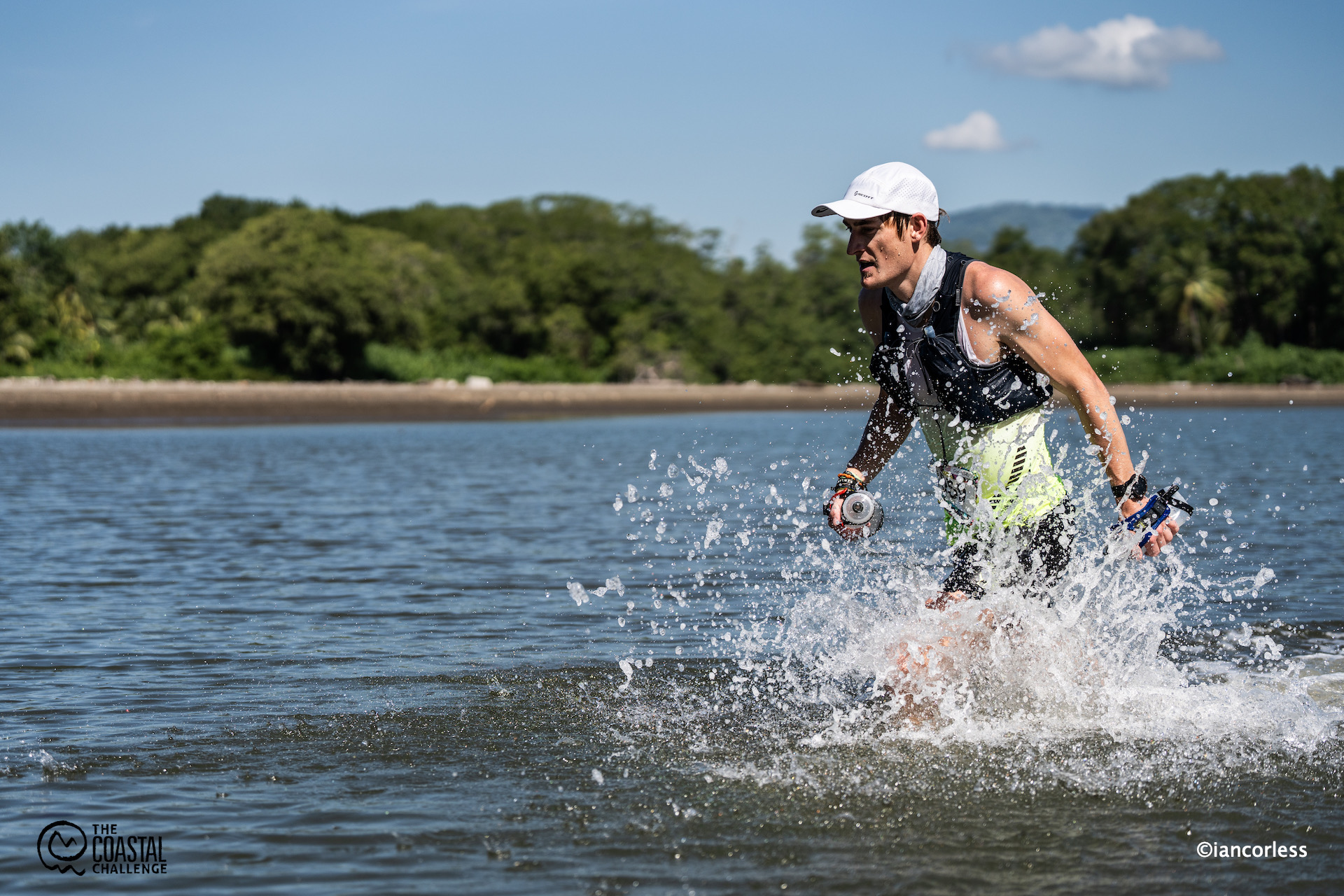
Now the heat of the day takes hold as the the participants navigate a route to the Dominical finish via long stretches of beach.
Jean-Francois leading the top men.
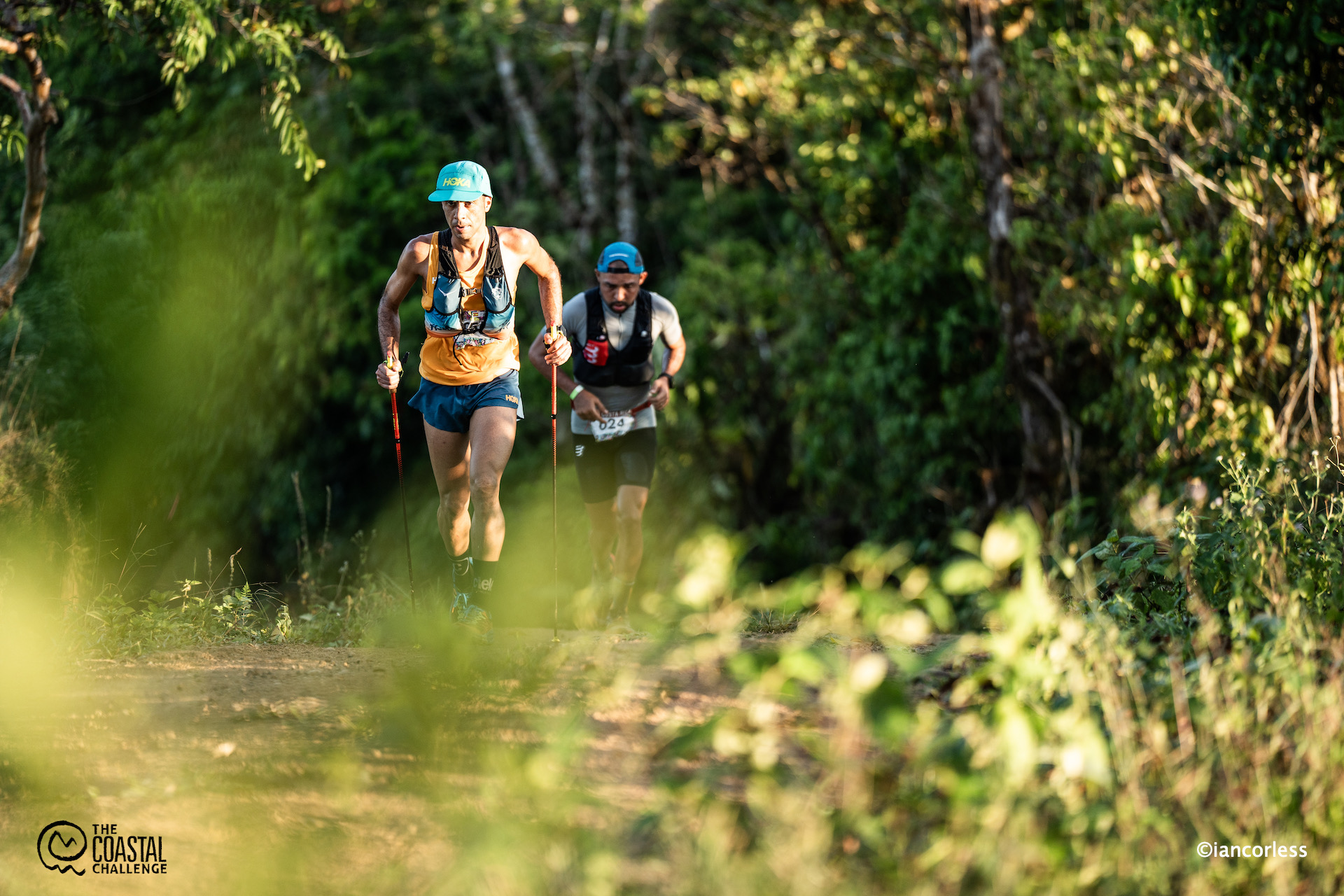
There was a very different mood to the start of stage 2. Summed up in one word, respect. The top men ran together lead by Jean-Francois Cauchon. This lead group did not include Cristofer Clemente Mora who ran a short distance behind with Erick Aguerro behind.
Cristofer and Erick
Pierre Meslet made a 3rd group running Lina El Kott Helander.
Pierre and Lina.
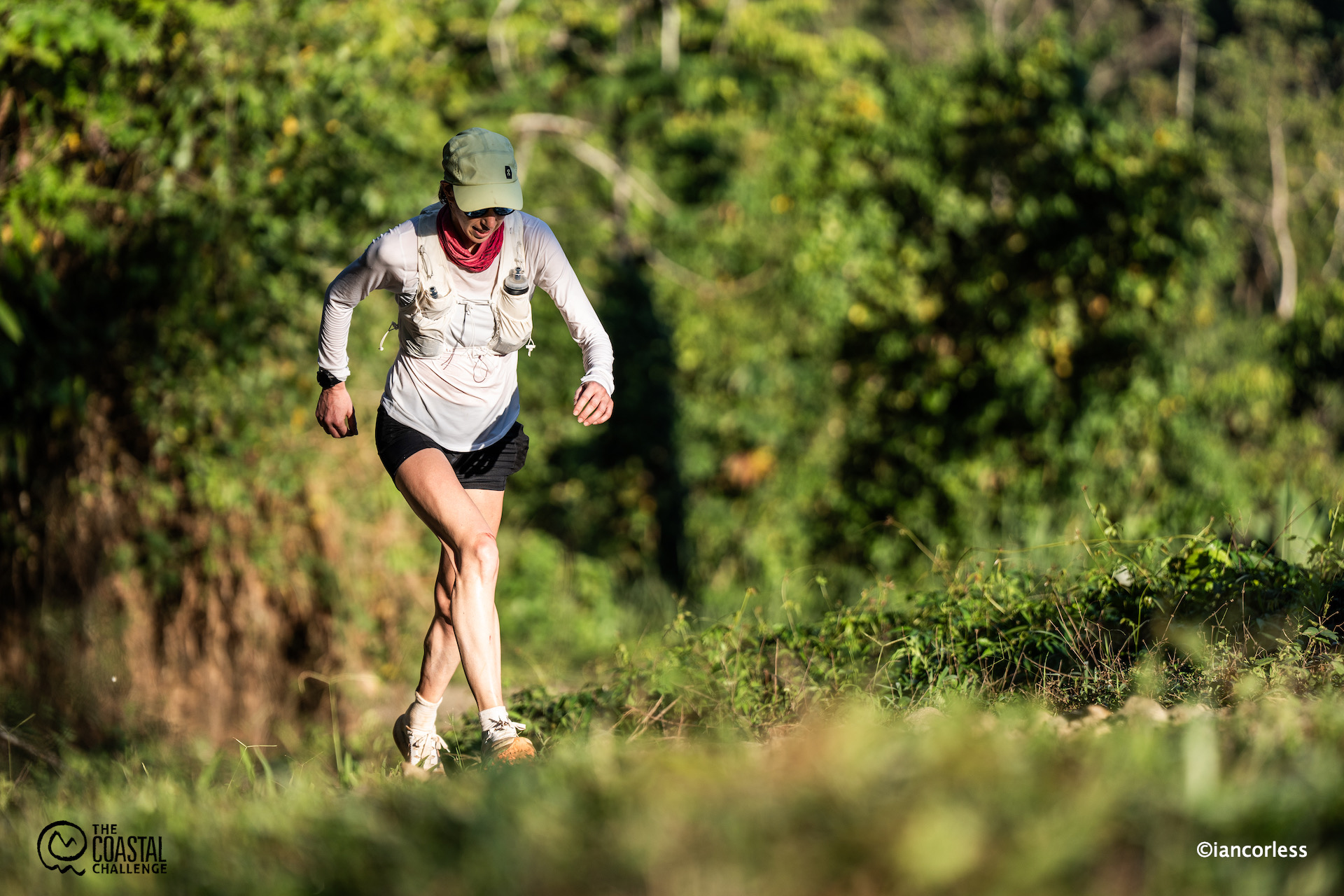
Lina El Kott Helander pushed the pace for the women, this came as no surprise with a steep climb to start the day. The skyrunner no doubt in her element. Behind Katie Young followed with a parmanent smile.
Katie
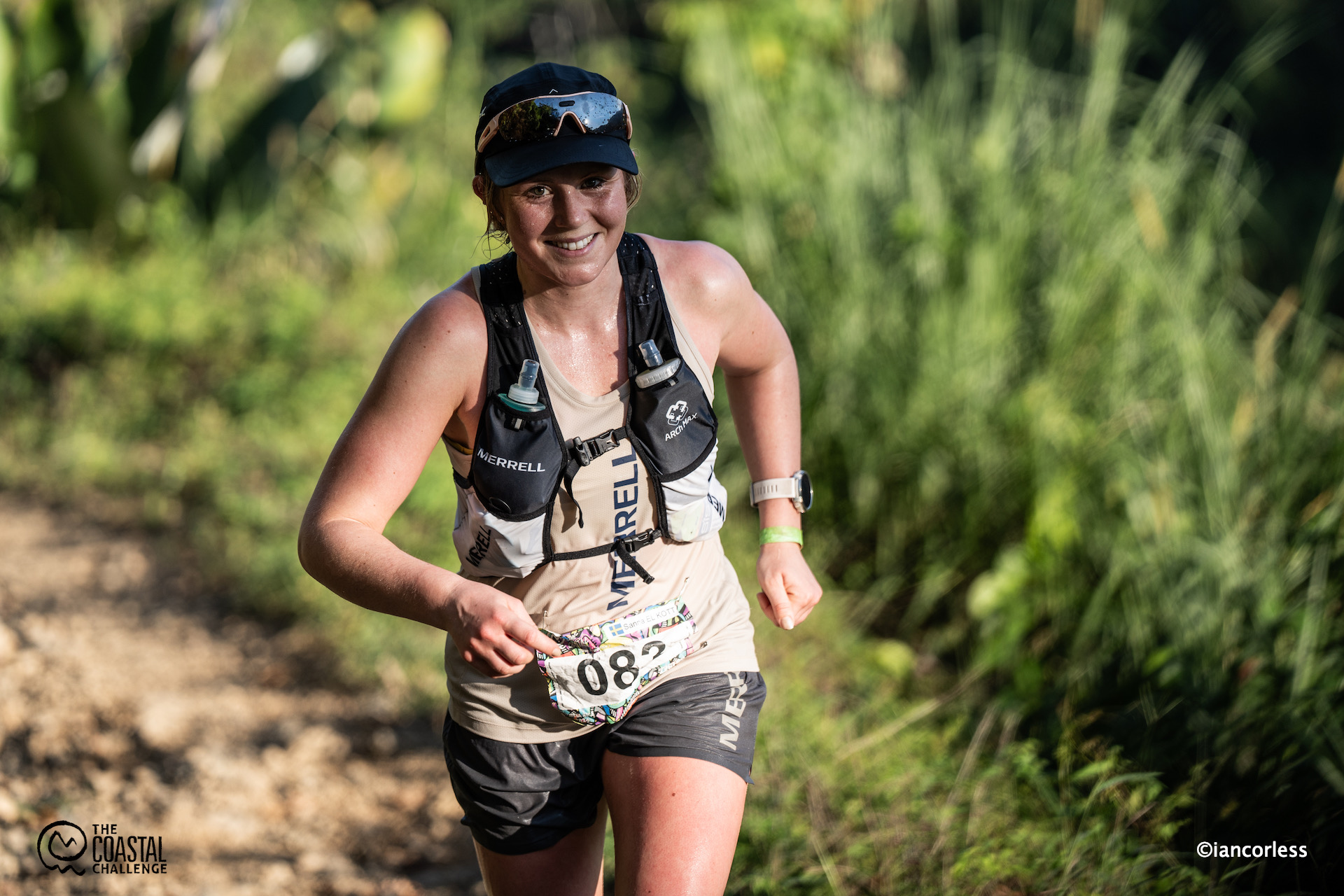
Sanna El Kott Helander, just like her twin sister, enjoyed the early vert to run in 3rd.
Sanna
As the runner’s headed to the coast, the race opened up and Cody Lind and Carlos Calvo López were the first to arrive at the estuary leading to the final 5km’s and a long beach section. Cody now in familiar territory from his 2020 victory no doubt relishing the final km’s pushed to take the stage and overall lead with 3:59:13 on the clock.
CodyCarlos
Carlos was expected to finish 3rd but Jean-Francois pushed and not only caught but passed the Costa Rican, 4:00:15 and 4:01:53. Cristofer finished some way back and lost his overall lead by almost 10-minutes and is now in second. We have a race on!
Jean-Francois
Lina continued her strong running all the way to the estuary, she had now opened up a 6-minute lead. Katie arrived looking fresh and full of enthusiasm, with flat running all the way to the line, Katie pushed and closed the gap to under 2-minutes at the line, 5:06:08 and 5:07:58.
Lina
Sanna continued to pull away from Lindsey Ullrich and ran a strong 3rd place in 5:29:05. A very positive run after a troubled ay 1.
Stage 2 was not without drama, Lina took a bad fall and had concerns for a badly damaged arm. More news to follow. Pierre also had troubles with a very badly twisted ankle that saw him require a stick in the early stages.
Tomorrow, stage 3 to Marino Ballena is 46km with 1686m. It’s the toughest stage of the race.
You arrive in Morocco, pass through passport control, wait for your luggage, leave the airport arrivals hall and find a seat on a coach.
The MDS journey is now in full swing.
Waiting in anticipation, the Road Book (the bible) for the next edition of the race is provided and immediately pages turn, running through the mind of each participant:
“How long is the long day?”
Well, the wait is over, I can tell you. For 2024, the long day will be 85.3 km’s.
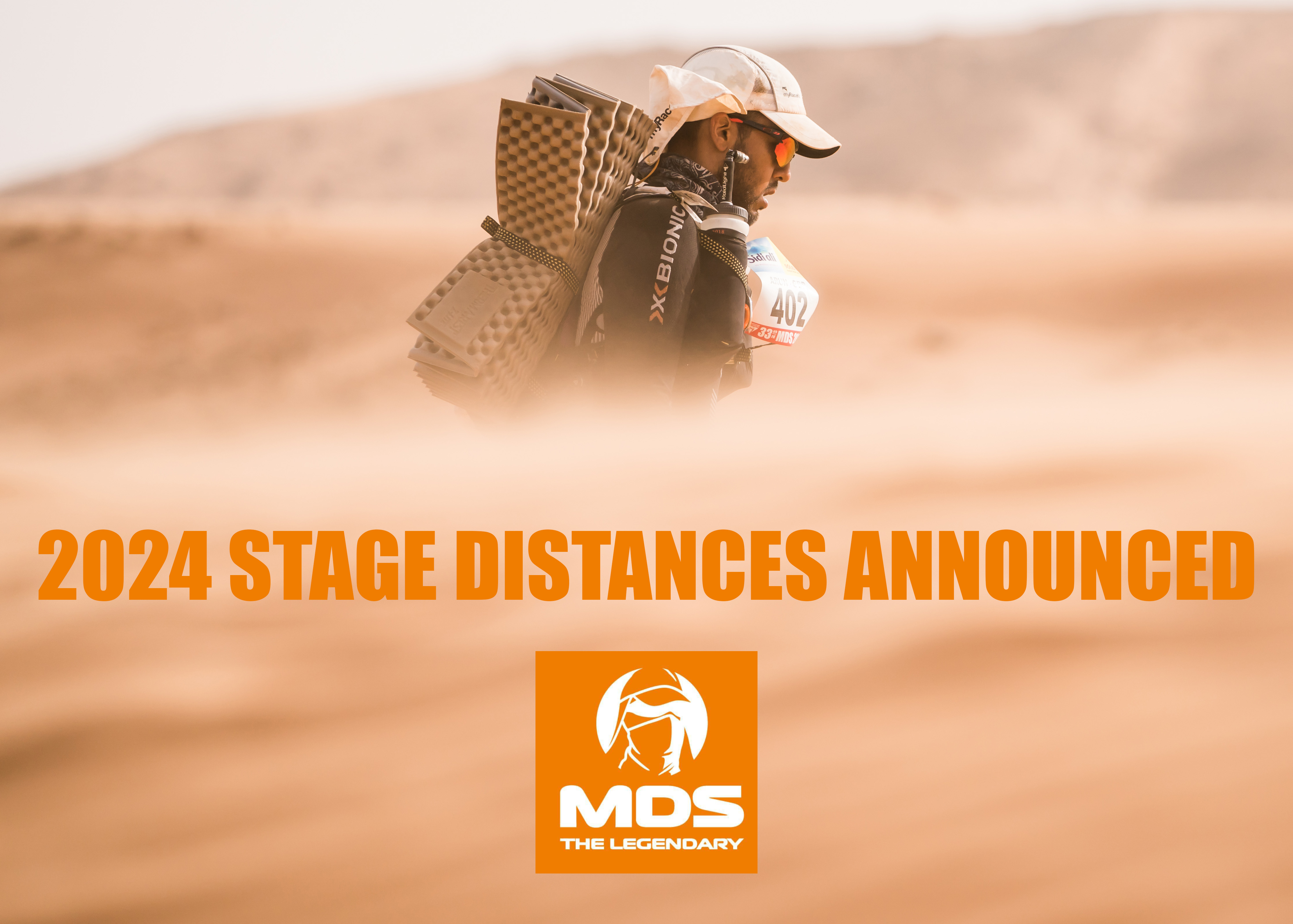
The MARATHON DES SABLES – The Legendary is breaking silence and today, we announce the daily stage distances for the 2024 edition.
Stage 1 : 31.1 km
Stage 2 : 40.8 km
Stage 3 : 85.3 km (over 2 days)
Stage 4 : 43.1 km
Stage 5 : 31.4 km
Stage 6 : 21.1 km
Total 252.8 km
Marathon des Sables typically takes place in this key area.
Taking place in the southern Moroccan Sahara since 1986; an extraordinary adventure will take place covering 252 km’s, the longest edition in the race history. Lasting 11-days with 9-days in the desert, divided into 6 stages over 7-days, a magical crossing of the Sahara walking or running.
The exact route, with maps, will once again be covered in detail in the road book, which as per usual, will be provided in Morocco whilst on the way to the bivouac one.
This is the first time that the daily distances have been disclosed before arrival in Morocco. Does this change anything? No, not really. I guess there is a reassurance knowing that the long day is not 90+ km’s.
However, with the 2024 edition being 252 km’s and over 6 timed stages, it was my prediction that this race would be a tougher challenge in contrast to those that have gone before. Therefore, to ease minds, the distances have been announced.
Previously, the long day would come on stage 4 (over 2 days) and it would be followed by the marathon stage. It was common thought, “Get the long day done and it’s just a marathon to go!” At the finish of the marathon, the medal would be received; job done.
Now, with the long day coming on stage 3, you still have 3-stages to run totaling 95.6 km’s. This will require a completely different mental and physical approach.
The Coastal Challenge 2024 is upon us. An event 20-years in the making, this will be a special year! A gruelling multi-stage race, participants will cover 240km’s with 10,000m+ of vertical over 6-stages. The ‘Adventure Run’ covers 145km’s.
An adventure for all, TCC is the ultimate experience and an incredible way to explore Costa Rica. Starting in Quepos, the journey follows the Pacific Coast backed by the Talamanca mountains as participants weave in and out of rainforest, navigate gravel roads, endure long stretches of beach with no shade and of course, climb, descend and scramble rocks, riverbeds and waterfalls. The journey concludes in the Unesco Heritage Site of Drake Bay, a truly remarkable location even for the well travelled.
What can the runners expect?
Stage 1
Runners depart San Jose early morning (around 0500) for a 3-hour drive to Playa Del Rey, Quepos. Arguably the toughest day of the race, not because of the terrain or distance, but because of the start time! It’s a day for caution! The 34.6km is very runnable with little vertical and technicality, it welcomes the runners to Costa Rica.
Stage 2
An early breakfast, around 0400, the race starts with the arrival of the sun! The only way is up from the start with a tough and challenging climb. It’s a tough day with an abundance of climbing and descending and a final tough flat stretch on the beach, just as the heat takes hold.
Stage 3
Tough with 25km of climbing topping out at 800m followed by a drop to sea and a final kick in the tail before the arrival at camp. For many, this is a key day and maybe one of the most spectacular.
Stage 4
A tough and steep climb to start, but once at 900m the route is a roller coaster of relentless small climbs and descents, often littered with technical sections, rain forest, river crossings and boulders. At 30km, it’s a short drop to the line and the finish at 37.1km.
Stage 5
The long day but what a beauty! Tweaked a couple of years ago and now has become iconic with tough trails, plenty of climbing, sandy beaches and yes, even a boat trip. The finish just before Drake Bay offers a calm relaxation with a stunning backdrop and amazing sunset.
Stage 6
The victory lap! For many, this stage is the most beautiful and memorable. It is now a longer day due to the start and finish not being in Drake Bay. However, the experience is not diminished. The loop manages to contain a little of all that has gone before.
“TCC is a unique race and one that we are passionate about. We celebrate 20-years in 2024 and that alone is an incredible achievement and one that we are proud of. The race travels via dense forest trails, river crossings, waterfalls, long stretches of golden beaches backed by palm trees, dusty access roads, high ridges and open expansive plains, we created this race to show of Costa Rica and this beautiful coastline.”
TCC is proud of the elite line-up that has experienced this magical multi-day journey.
Here is the past 10-years winners:
2023: Didrik Hermansen – Katie Schide
2022: Hayden Hawks – Giuditta Turini
2021: Timothy Olson – Felicitas Charpin
2020: Cody Lind – Kaytlyn Gerbin
2019: Pere Aurell Bove – Ida Nilsson*
2018: Tom Evans* – Ragna Debats
2017: Tom Owens – Anna Frost
2016: Iain Don-Wauchope – Ester Alvez
2015: Iain Don-Wauchope – Veronica Bravo
2014: Michael Wardian – Jo Meek
2013: Dave James – Gemma Slaughter
Course records: Tom Evans 21:44:12 and Ida Nilsson 23:36:04
Ones to watch in 2024
2020 champion, Cody Lind returns to celebrate 20-years of TCC. With past experience, he know what to expect from Costa Rica. His ability as skyrunner work well on the demanding and technical trails, in addition, his speed for pure running grounded at Western States (2021, 2022 and 2023) transfers well to the gravel roads and beaches that this route brings.
Cristofer Clemente, an experienced skyrunner and trail runner, he won the 2016 Syrunner World Series for the ultra distance and in 2017 he took a silver medal at the IAU Trail World Champs. He has recently won Tenerife Blue Trail, Ultramaraton Guatemala and Puerta Vallarta Mexico by UTMB. He is without doubt a hot contender for overall victory.
Pierre Meslet placed 6th and 9th at Marathon des Sables, so, is no stranger to multi-day running. TCC will provide a different challenge, while the racing is still over 6-days, this time there is no self-sufficiency, no carrying a pack, just intense heat and humidity.
From Costa Rica, we have Erick Aguero and Carlos Calvo. Erick is arguably one of the most experienced TCC competitors with countless participations and podium places.
Lina and Sanna El Kott Helander (the El Kott twins) are grounded in adventure racing, skyrunning and mountain running. They are an adventure duo that push boundaries. In 2023, they both undertook the PTL; a 300km journey during the UTMB week. The duo are perfectly matched for Costa Rica and the terrain and challenges on offer.
Ester Alves won TCC in 2016 and return this year with a contingent of runners from Portugal. I am sure Ester will say that she is in Costa Rica for the journey and experience in 2024. However, Experience, skill and ability is never lost.
Katie Young will be an unknown name to many, however, in 2023 she was my hot tip for Marathon des Sables and she proved me correct placing 6th. TCC will be a new experience for Katie but watch this space…
Lindsey McElroy Ulrich from the USA joins the TCC party with a long list of ultra results that date back to 2014 on Ultrasignup. In 2022, Lindsey tackled the Marathon des Sables, so, she comes to Costa Rica with multi-day experience. No stranger to long distance, she was also 20th at UTMB.
In addition to the above, we have a wealth of Costa Rican talent who will toe the line
Schedule:
February: Saturday 10th to Saturday 17th, 2024
Official registration & poolside reception for competitors in San José: February, Saturday 10th
Race start: February, Sunday 11th
Race finish: February, Friday 16th
Race length: 6 days
Distance: Expedition Run 240km | Adventure Run 145km






































 IAN CORLESS