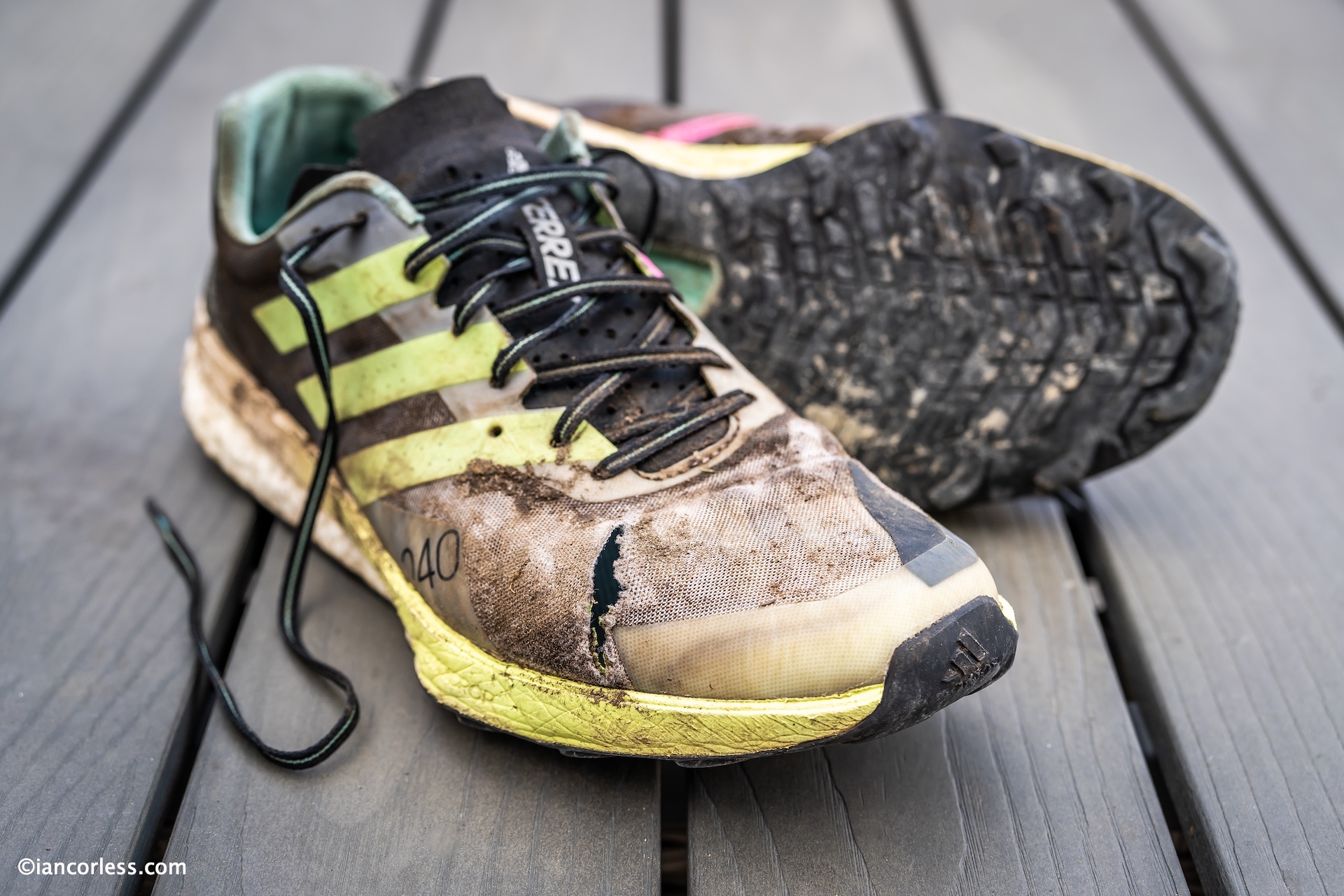
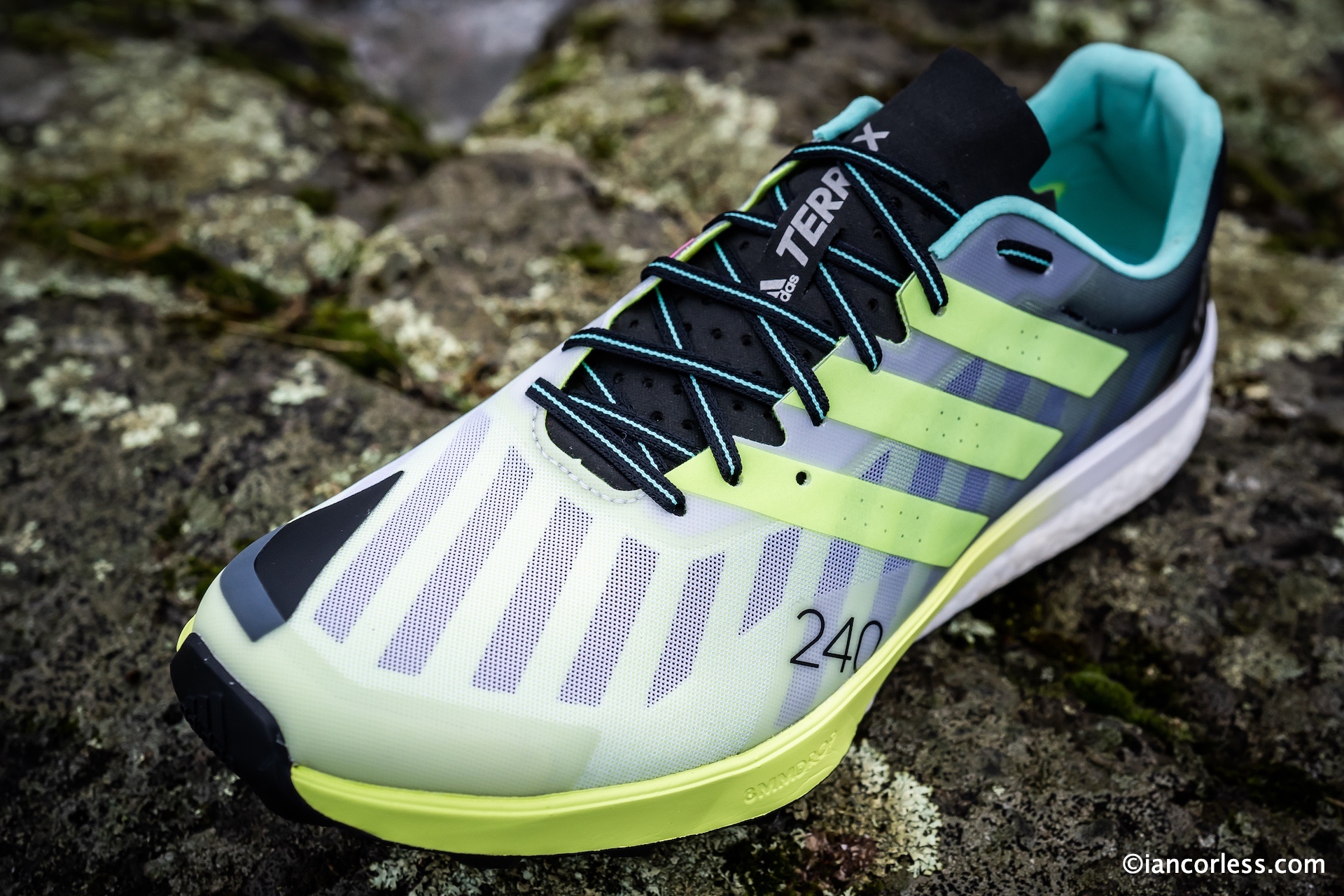
I have just retired my adidas Terrex Speed Ultra shoes…. Looking at the photo above, you may well be thinking that this is going to be a harsh look at how the shoe has lasted long term! For perspective, please read my adidas Terrex Speed Ultra shoe review first.
Look different when new – adidas Terrex Speed Ultra
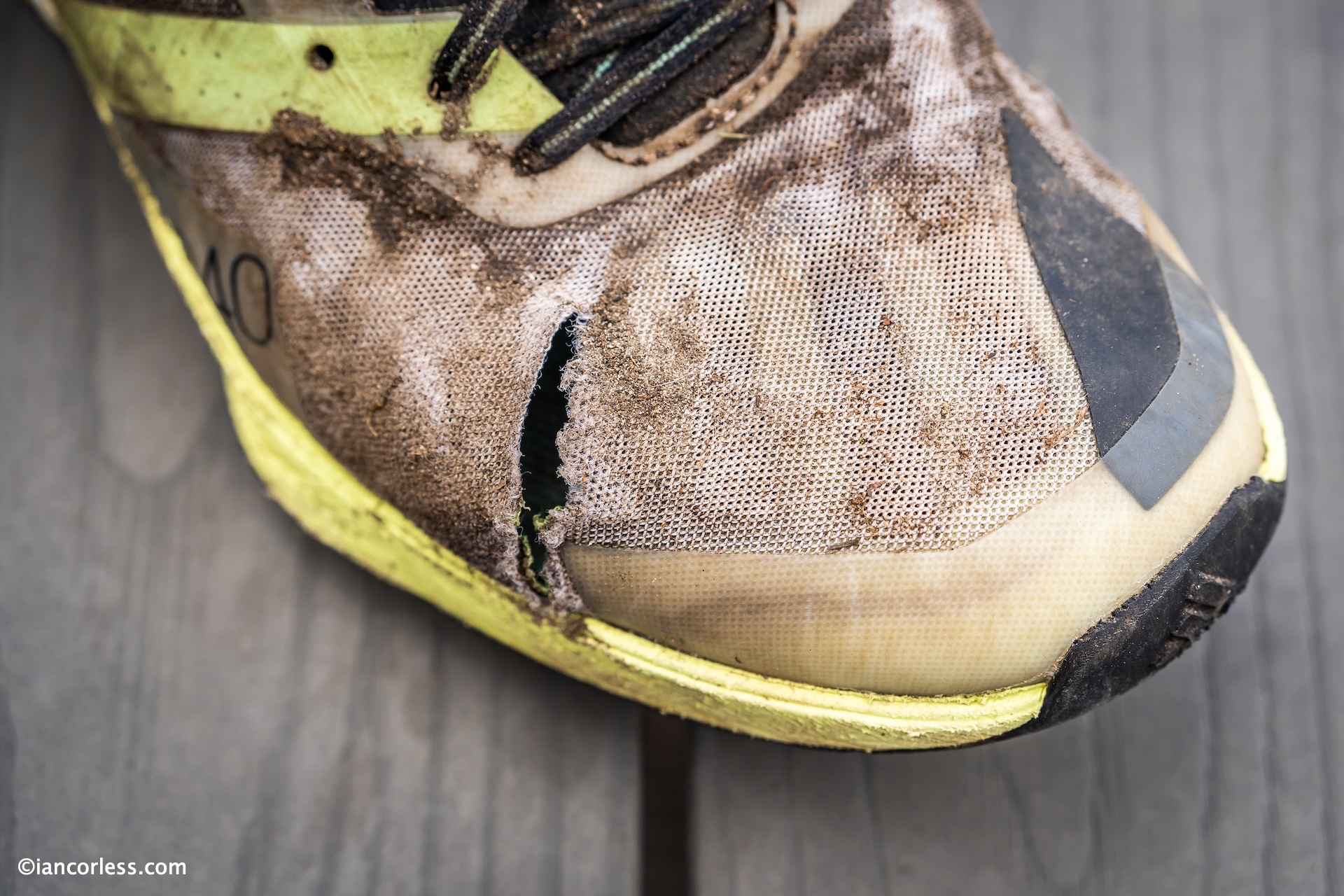
I received my Terrex Speed Ultra in February and now 4-months on and 834km later they have given up! A recent 5-day trip to the mountains of Jotunheimen in Norway and 168km of rocks, snow, ice, mud and harsh terrain pushed them to the limit and over. Even on the final day of 33km with the right upper torn, the shoes performed perfectly.
Recent fastpacking trip to Jotunheimen, Norway – Perspective on the terrain.
I am reluctant to retire them!
Without doubt, the Speed Ultra have not only been a highlight shoe of 2021, but they are a highlight shoe in my collection of run shoes, and trust me, I have many, many pairs.
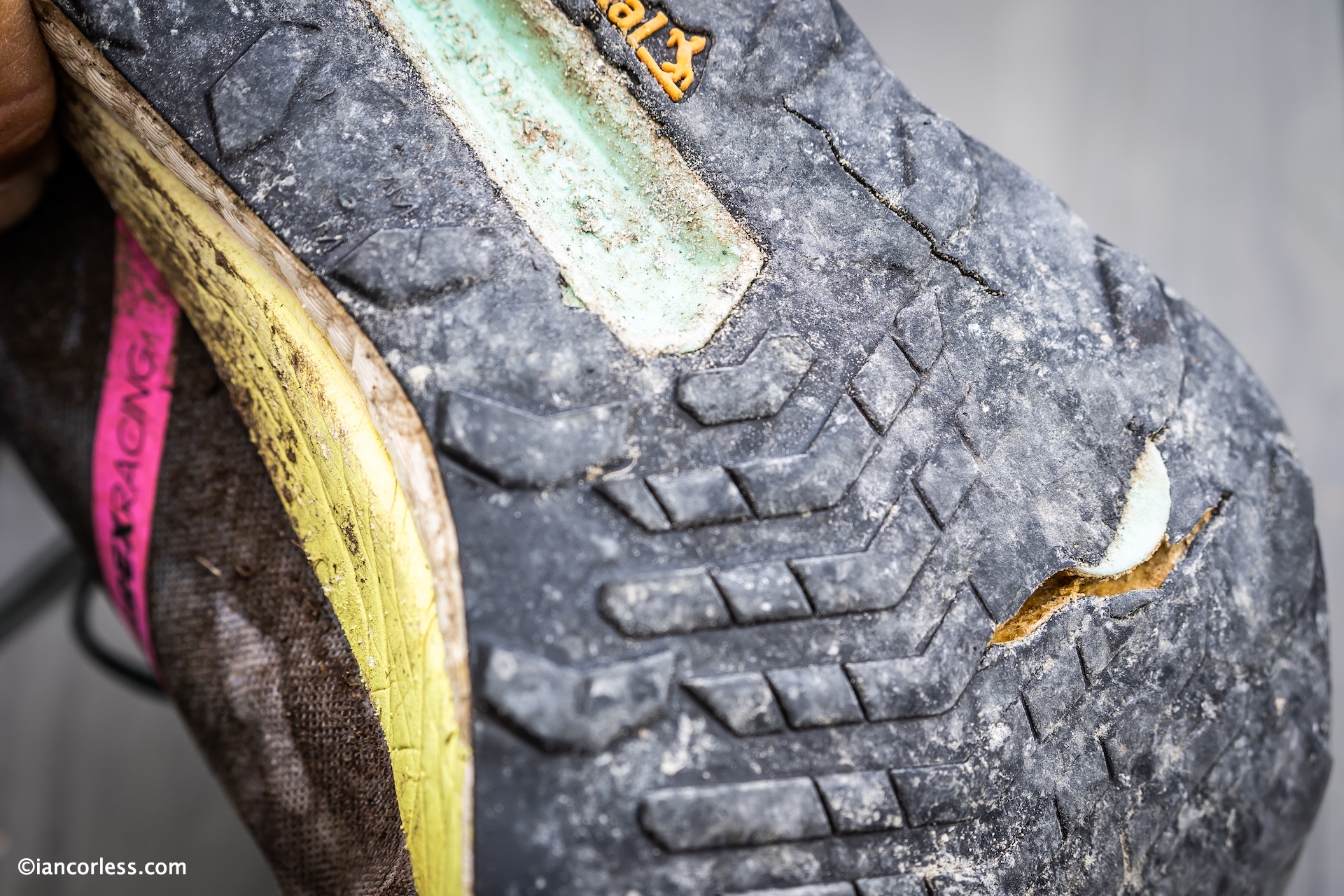
Until the recent run trip, the Speed Ultra was holding up really well, the upper showed little deterioration and the Continental outsole, while showing wear on key strike points, was still good.
Outsole after 800+ km
Some may say that they want more life out of shoes than 800km. Not me, I am super happy with 800km and especially when the ride and feel is as good as it is in the Terrex Speed Ultra.
Terrex Speed Ultra in action
I have not found a shoe yet that comes close to the Terrex Speed Ultra that manages to combine grip, comfort, flexibility and pure enjoyment. No matter what terrain, this shoe has been awesome.
On road, they have excelled. Modelled on the Boston 9 road shoe, you can feel the adidas road shoe experience here, but, I would go as far to say that on road, I have preferred the Speed Ultra over the Boston. Alternating them, the Speed Ultra gave me more fun and more bounce – a real winner.
On trails, the Continental grip has been superb offering secure confidence on rocks, roots, and hard trail in the wet or dry. It’s not an aggressive outsole, so if you encounter lots of mud, there is a compromise to be made.
The toe box was wide allowing for toe splay but it did not compromise precision and this is no doubt due to how well the Speed Ultra holds the foot via the lacing and excellent fit. The 8mm drop is just superb for comfort, and the cushioning of 18/26 was perfect in managing long-term comfort with no loss for a feel for the ground.
The upper was extremely breathable and as such allowed feet to remain cool, allows water to disappear quickly, however, running through snow and water, I certainly had less insulation.
GOOD and BAD
GOOD
The Terrex Speed Ultra been a joy to use and without doubt are my favourite shoe. So much so that I have now ordered two pairs to replace the sadly retired test pair. Comfort, grip, great design and a shoe that makes you want to run longer, farther and faster.
BAD
After a complete smashing up, the upper has torn and the outsole has split. However, both these failures came at the shoes life expectancy end and on some of the most harsh terrain and conditions you can put a shoe through. I really have thrown everything at this shoe, plenty of road miles to wear down the Continental grip and then mud, snow, ice and rocks. In all honesty, I used the Speed Ultra for the last fastpack as I knew at the end of it I would be saying goodbye. While the upper and outsole tearing could be seen as bad, I see it as just the end of the shoes. However, had this come early, then without doubt I would be asking questions about life/ durability.
Conclusion
The adidas Terrex Speed Ultra is my shoe of 2021 so far and the shoe I want to use on a daily basis, irrespective of the conditions. Light, responsive, fun, fast and great grip. I want nothing more from a shoe and yes, they look pretty darn good too!
Please support this website. I believe everyone deserves to read quality, independent and factual articles – that’s why this website is open to all. Free press has never been so vital. I hope I can keep providing independent articles with your help. Any contribution, however big or small, is so valuable to help finance regular content. Please support me on Patreon HERE.
Episode 211 has an interview with John Stocker who ran more than 337 miles in 81 hours at the Suffolk Backyard Ultra to set a new WR ahead of Matt Blackburn who pushed him all the way to the line.
Talk Ultra needs your help! We have set up a Patreon page and we are offering some great benefits for Patrons… you can even join us on the show! This is the easiest way to support Talk Ultra and help us continue to create! Many thanks to our Patrons who have helped via PATREON Donate HERE
La Sportiva CYKLON shoe review HERE listen to Episode 208 of Talk Ultra is a special show with DANIEL FEENEY and Jonathan Wyatt discussing the collaboration between BOA and La Sportiva for the new, Cyklon shoe.
Please support this website. I believe everyone deserves to read quality, independent and factual articles – that’s why this website is open to all. Free press has never been so vital. I hope I can keep providing independent articles with your help. Any contribution, however big or small, is so valuable to help finance regular content. Please support me on Patreon HERE.
It has been a long time since I slipped on a Hoka One One shoe, 2012 to be exact. Almost 10-years ago and while I could write my reasons why, it’s best to read an article I wrote called ‘Minimal, Maximal or the curious question of Drop.’
So, I have avoided Hoka One One and maximal cushioned shoes ever since.
However, when you test as many shoes as I do, I didn’t feel it correct to neglect Hoka, however, I also felt that no matter how impartial I try to be in reviews, I probably would still hark back to the pre 2012 days.
With this in mind, many who read my reviews suggested that I try the Torrent 2 by Hoka One One. One thing was universal in all the comments, ‘It is the least Hoka like shoe that they do.’ Ultimately, it is the least cushioned and bouncy shoe currently in the Hoka range… This may change with the new ‘Zinal!’
So, Hoka One One in Norway kindly sent me a Torrent 2 Cotopaxi to test. Cotopaxi is ‘an innovative outdoor product and experience that funds sustainable poverty relief, move people to do good, and inspire adventure.’
Cotopaxi joins brands, such as Hoka One One to ultimately ‘do good’ and they bring some unique colours and designs. The Torrent 2 celebrates the kaleidoscopic wonders of this great planet in what I think is a stunning colour way, but I fully appreciate that this may well be too much for some. I love the uniqueness, the colours, and the fact that the left shoe is different to the right.
THE SHOE
Love the colour way, it’s a winner for me.
The Torrent 2 is light, 278g from an UE44/ UK9.5.
The tongue is well padded and comfortable, the lacing excellent and additional eyelets exist should you need to lock lace or similar.
The upper is extremely durable and yet breathable using a mesh upper that utilises recycled post-consumer plastic waste to make a Unifi REPREVE yarn. Reinforcing exists to help protect the foot but there is little to no toe protection.
Heel box is padded and holds the foot well with no slippage when climbing.
The outsole is a nice middle ground trail grip that is extremely comfortable on dry trails and road but yes has enough grip when the trails become sloppy. The lugs are multi-directional which work exceptionally well and even on wet rock, the grip has been reassuringly good.
Toe box is on the wider side and allows good toe splay and comfort over longer distances. On a 1-5 scale, 1 being narrow, the Torrent 2 is a 4 for me.
Cushioning is somewhat a revelation, and, in all honesty, I expected to not like the feel or the ride. I was completely wrong. The Torrent 2 feels nothing like the Hoka’s I used pre 2012 and I understand why many say, ‘It is the least Hoka like shoe.’ The cushioning was firmer, had less roll and quite simply provides wonderful comfort over any distance. Cushioning is PROFLY.
The footprint of the shoe is wider, and this helps compensate for additional stack height reducing any inward or outward roll, and thus provides more precision and stability when the trails become more technical. The reason I defected from Hoka was I got way too much roll from the super soft cushioning and maximal nature of the shoes – note here.
IN USE
Well, I never thought I would be writing this, but, the Torrent 2 has become a real favourite shoe and has been in a regular rotation with my adidas Speed Ultra, which I love! The Hoka and adidas are in many ways similar but at the same time, very different. The adidas without doubt better on more technical terrain and excellent if not superb on the road.
The Torrent 2 is just a great everyday shoe that works on most terrain and provides comfort over short or long distance. The landing and cushioning from PROFLY is excellent and the propulsive phase are not lacking. There is a firmer feel to the Torrent 2 and I can anticipate that Hoka One One fans (who like the maximal bounce) will find this shoe maybe not to their liking. For me, it’s perfect!
A neutral shoe it allows my foot to respond to the terrain in a natural way and the shoe has great response, the 5mm drop adds to that ‘at one with the ground’ feel despite this being a more cushioned shoe with 18mm at the front and 23mm at the rear. The female version has less cushioning, 16/21 and I applaud Hoka for understanding that women need their own specific shoes, not smaller versions of the men’s shoe. Roll is present, especially when on rocky terrain, tree routes and so on, however, it’s completely manageable and within parameters I would want and expect from a shoe with more cushioning. The wider footprint goes a long way in providing more comfort and less roll. There is no rock plate in the shoe and in all honesty, I found no issues or problems. My regular trails are littered with rocks, tree roots and demanding sections. Nothing came through to impact on my foot.
On a scale of 0-100% for rigidity, I would say the Torrent comes in around the 50% mark offering reassured comfort that sits in a perfect middle ground. By contrast, the adidas Speed Ultra is considerably more flexible sitting around 75/80%.
The outsole I am assuming is ‘in-house’ but does have some resemblance to Vibram. Apparently, the outsole has been re-worked from the original Torrent and while not mega aggressive, it performs exceptionally well on most terrain but excels on dry trail. The grip works well in soft ground but if heading into muddy terrain, you will no doubt need a more aggressive outsole. Some compromise comes on wet rock.
Fit for me was excellent providing plenty of toe room and the lacing held my foot well. They are true to size.
The upper is a little hot, especially on hot days and in the wet, I found that the shoe drained well but the upper did retain some water.
CONCLUSION
Everything is personal and I love the Torrent 2, I will be clear, I didn’t expect to! I like them ultimately because they are not what I expected, and I am used to from a Hoka One One shoe. They are firmer, lower to the ground, provide adequate cushioning and allow great comfort over any distance and pretty much any terrain. They are a great everyday shoe.
If I wanted to race or move faster, I wouldn’t choose the Torrent 2. It’s a comfort shoe that allows me to relax and run over longer distances on easier run days or say when running a multi-day or fastpacking.
Hoka One One fans will like the Torrent 2 less I would imagine, I can hear the comments now, ‘They are too firm for me!’ And that is fine! What I like is that Hoka as a brand are looking beyond what made them famous (max cushioning) and understanding that many people (like me) would like what Hoka offer in a more ‘conventional’ shoe, the Torrent 2 does just that! The new Zinal looks to take that to a new level and I am keen to try them.
The collaboration with Cotopaxi is excellent providing a great colour way and some extremely positive ‘eco’ stats. Cotopaxi ties its earnings to impact by allocating 1% of annual revenues to the Cotopaxi Foundation. The foundation awards grants to outstanding nonprofit partners who are carefully selected for their track records at improving the human condition and alleviating poverty. This year alone, the foundation has awarded 34 individual grants, directly assisted 750,000 people, and donated over $400,000.
Ultimately, a great all-rounder over any distance and any terrain. It’s not a perfect shoe but there is little to complain about. It has low weight, comfort, toe splay and cushioning. Compare this to the latest Trailfly from inov-8 and we are talking chalk and cheese, I still struggle to understand how inov-8 could make such an awful shoe… But then again, some love it. Ultimately though, is the Torrent 2 as good as the adidas Speed Ultra? It’s a tough call, but the Speed Ultra would be shoe of choice. Trust me though, I have been rotating between the two and I am happy in both. The adidas gets the nod as it has more response, feels nimble, lighter and makes me want to run faster. If I compared the shoes as though cars, the Speed Ultra is nimbler and faster, say a Porsche, whereas the Torrent 2 is more a family saloon designed for comfort over the long haul, say a Toyota Rav4.
Please support this website. I believe everyone deserves to read quality, independent and factual articles – that’s why this website is open to all. Free press has never been so vital. I hope I can keep providing independent articles with your help. Any contribution, however big or small, is so valuable to help finance regular content. Please support me on Patreon HERE.
3500 participants, representing 50 nations, gave life back to Cortinad’Ampezzo and the Dolomites for a stunning four days of racing, Thursday 24 to Sunday 27 June, after the coronavirus pandemic brought a halt to the 2020 edition of the Lavaredo Ultra Trail. It was good to be back!
Taking place in a UNESCO World Heritage location, the SkyMarathon, Cortina trail, the Ultra Dolomites 80km and the main event, the 120km Lavaredo Ultra Trail which represented the Italian stage of the Spartan Trail World Championship 2021.
UNESCO World Heritage location
Cortina d’Ampezzo (Belluno), hosted the 14th edition of the Lavaredo Ultra Trail and while it was not easy for Cristina Murgia and Simone Brogioni to return after a difficult year, they rallied and with a team of 600+ volunteers, the 2021 edition can be deemed a great success. It is obviously hoped that the 2022 edition can be a ‘normal’ edition with more participants and more nations.
The 2021 La Sportiva Lavaredo Ultra Trail, kicked off on Thursday evening with the Cortina SkyRace which 20 kilometers and 1000m of vertical gain that started and concluded in Cortina taking in a picturesque root with stunning views and trails.
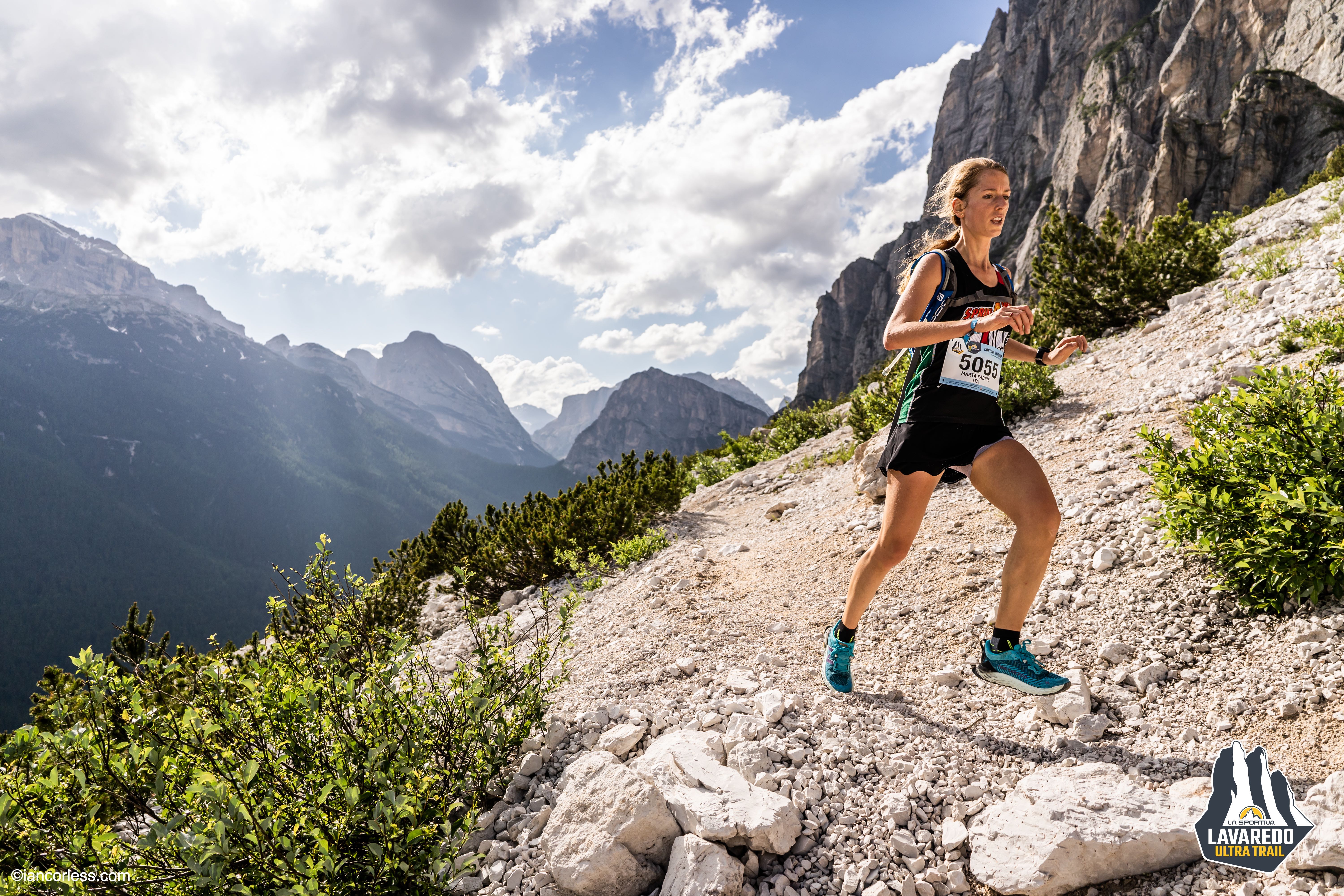
Marta Fabris
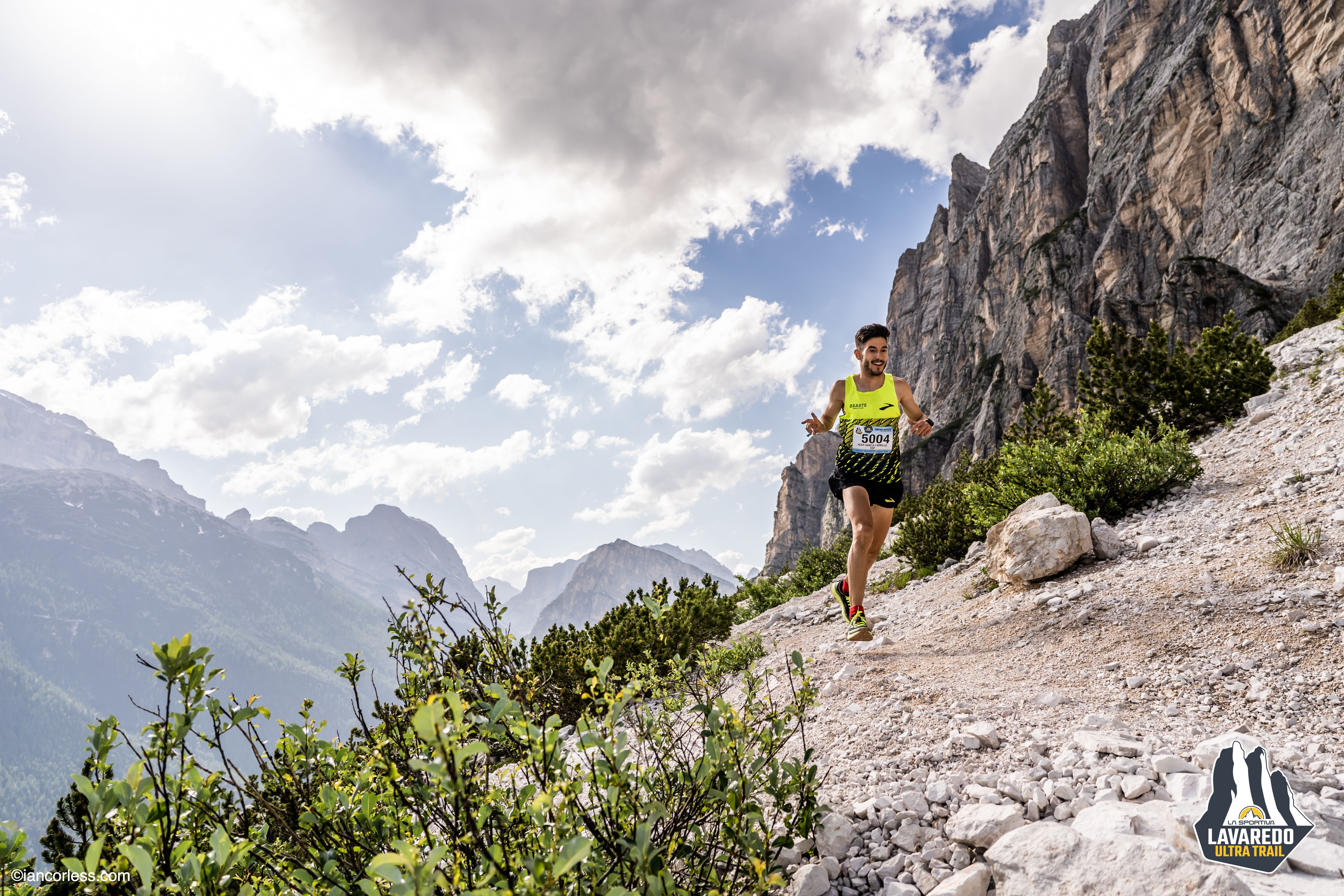
Spaniard, Alex Garcia Carrillo won the men’s race setting a new course record and the Italian, Marta Fabris, took home the crown for the women.
Alex Garcia Carrillo
The Cortina Trail started the following morning at 0900, once again starting and concluding on Cortina, with a distance 48 kilometers and 2,600 meters of elevation gain, the route contained much of the final section of the 120km main event.
Elisa Desco in the early stages of the Cortina Trail
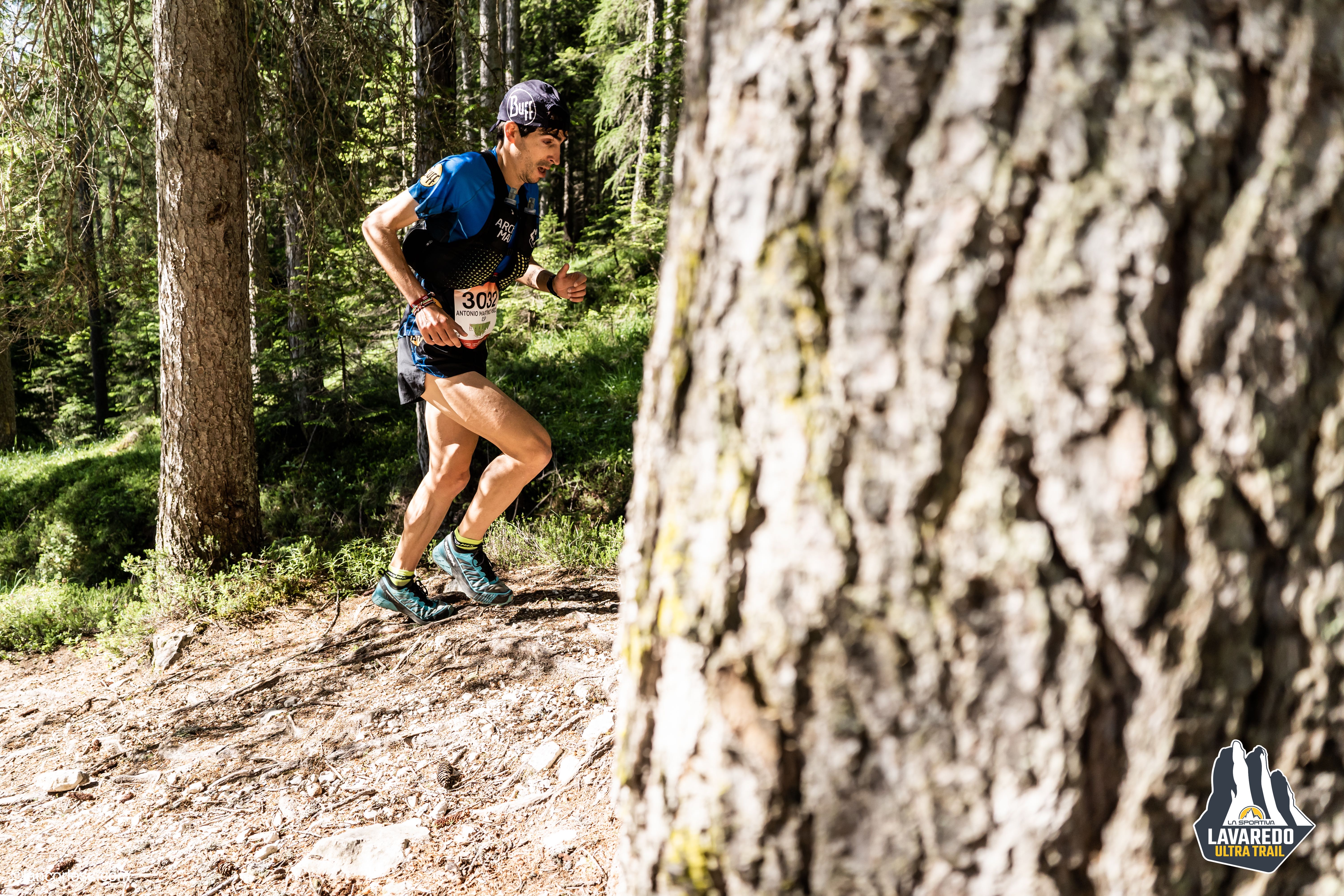
1200 competitors competed that led around the Tofane, touching Col Rosà and going up the Val Travenanzes, up to Col dei Bos. In the second half in the shadow of Averau and Nuvolau, the Giau pass, Forcella Ambrizzola, Croda da Lago refuge and then the finish in Cortina. Antonio Martínez Perez from Spain won for the men in 4:17:14 (new CR) ahead of Norwegian, Jo Forseth Indgaard and Fin, Mårten Boström, the duo completing in 4:23:41 and 4:26:31 respectively. Skyrunner, Elisa Desco from Italy, won for the women’s race with a new CR of 5:06:57 breaking the 2018 mark, set by Hillary Allen by almost 12-minutes. Ursula Paprocka 5:24:19, and Katarzyna Wilk 5:25:43 completed the podium.
Antonio Martínez PerezJo Forseth Indgaard
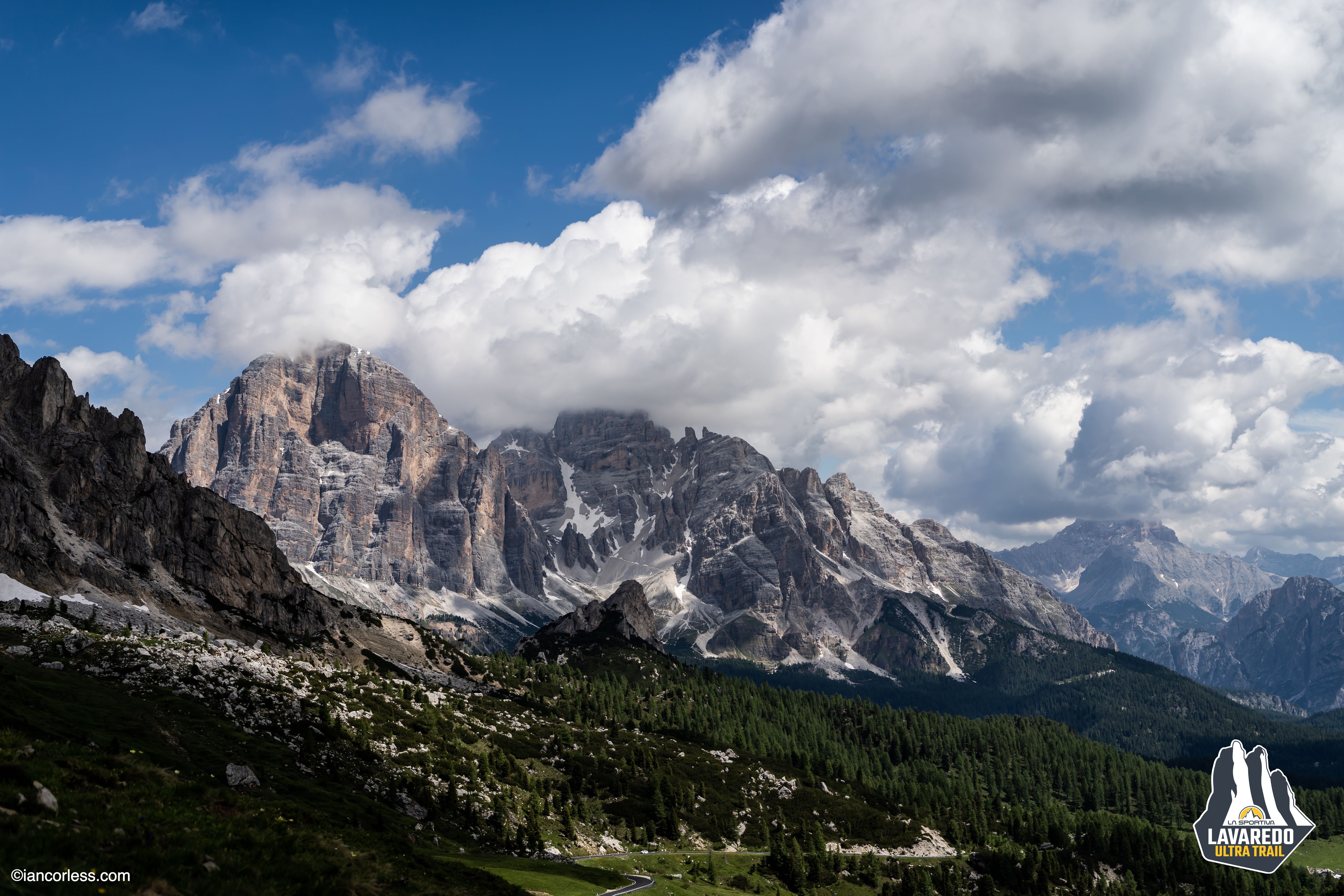
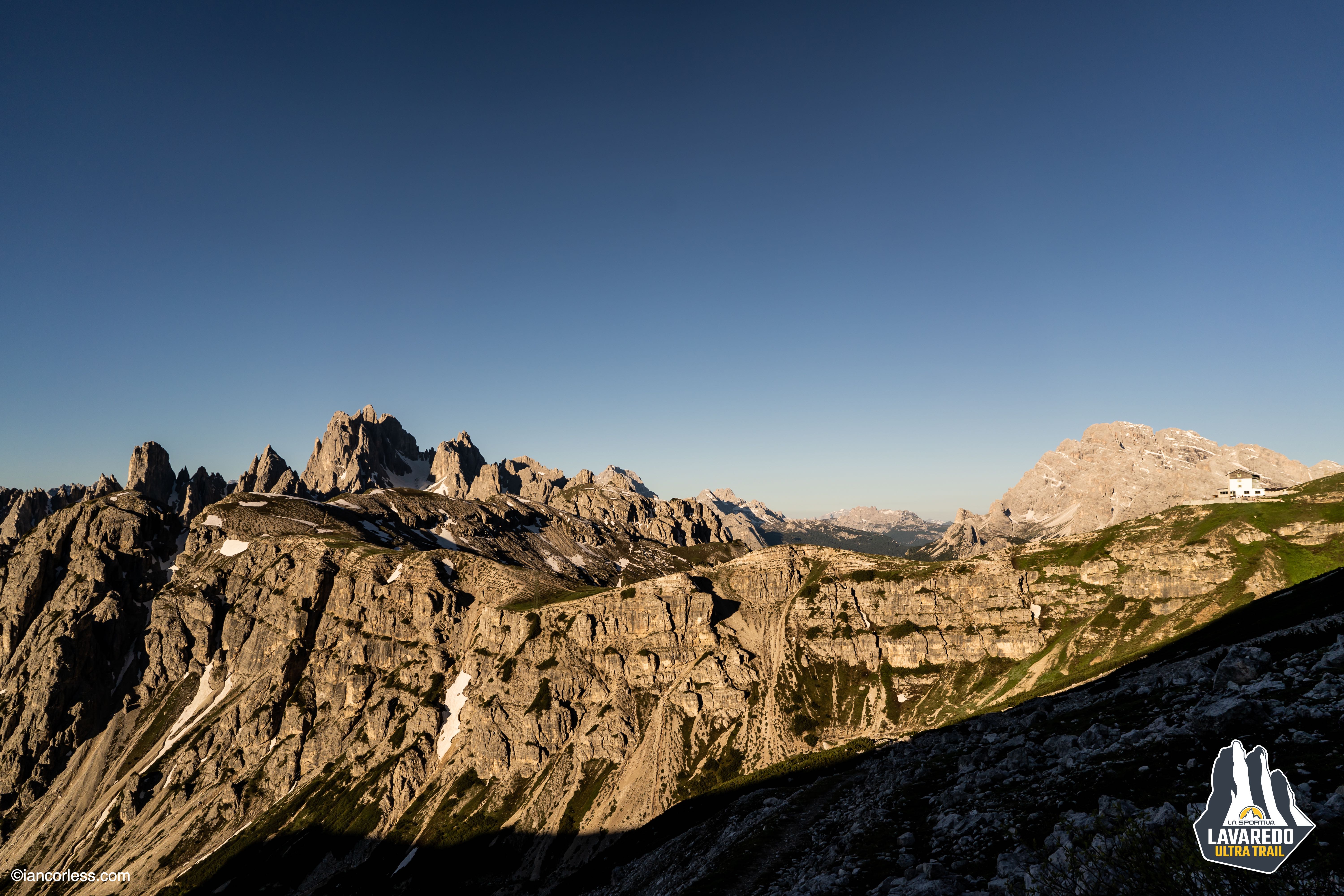
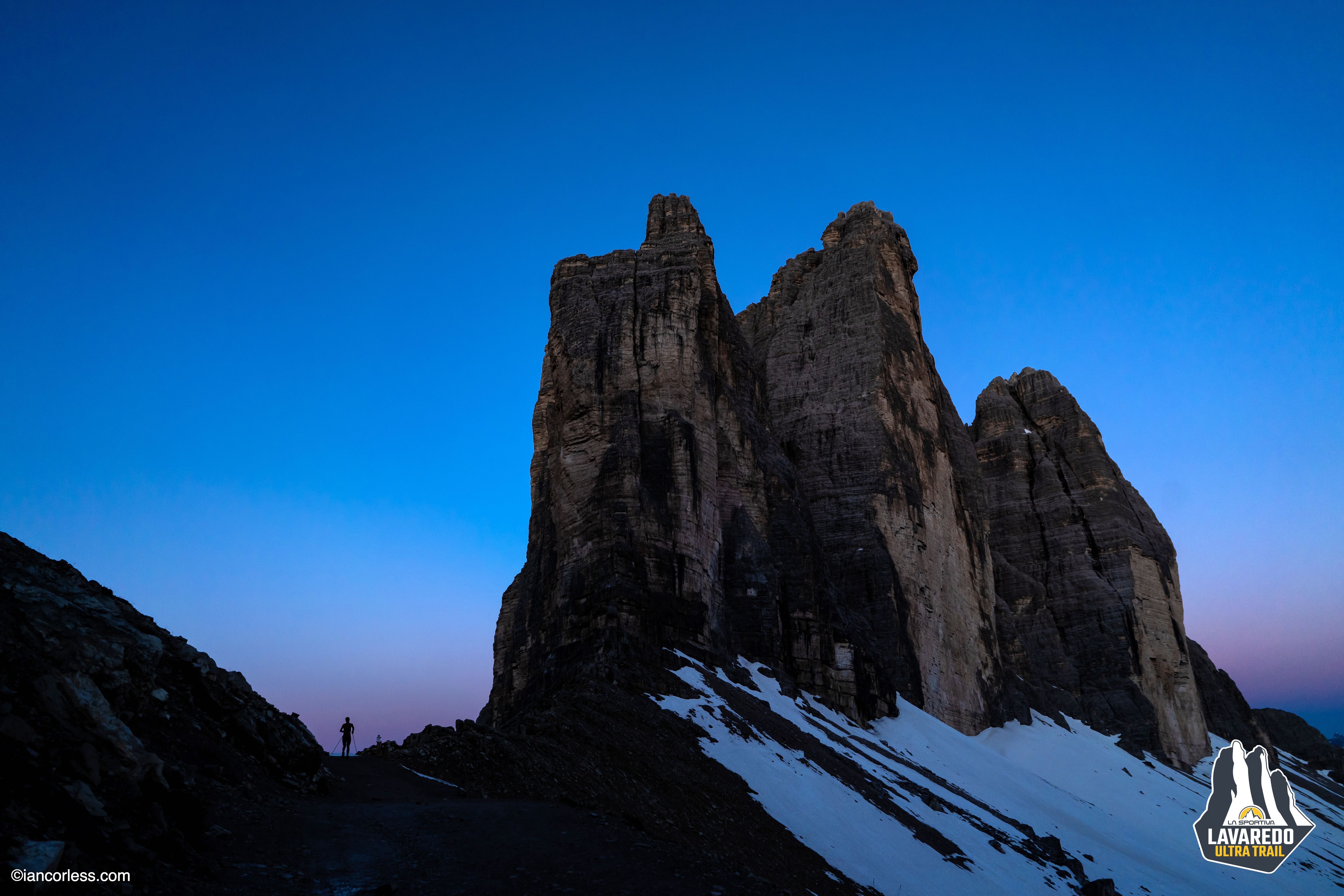
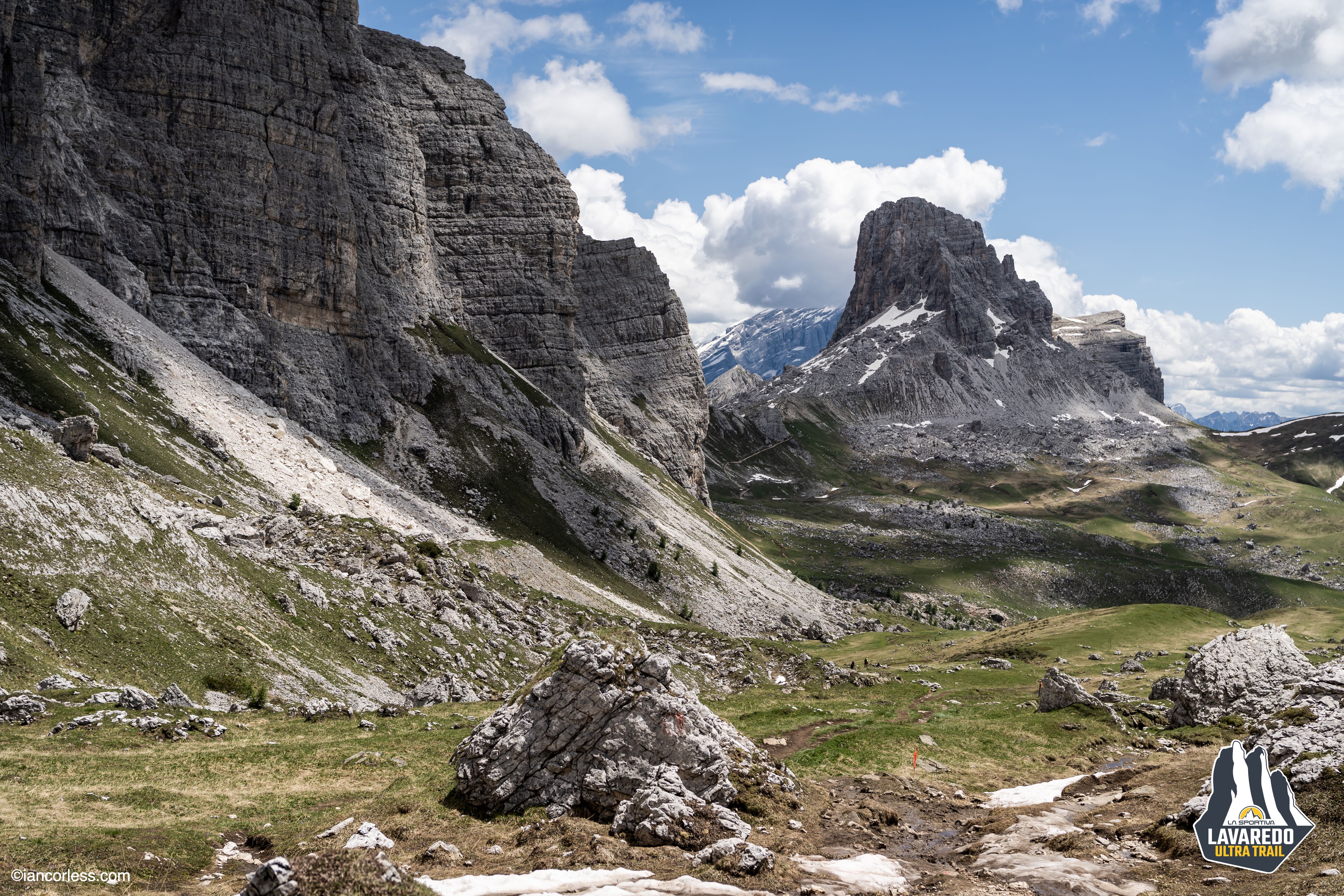
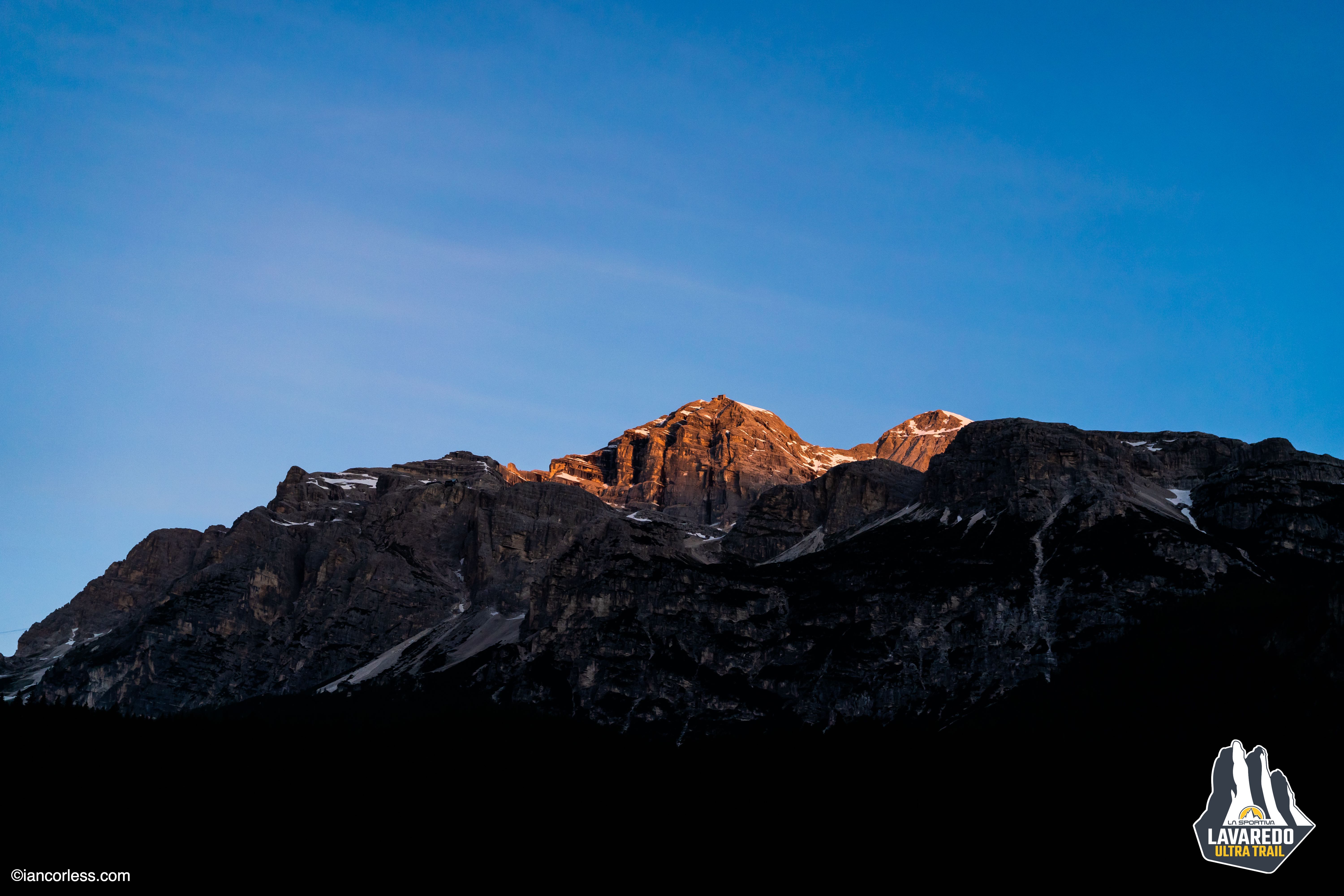
The main event, the La Sportiva Lavaredo Ultra Trail now in its 14th edition) started at 2300hrs on Friday evening and as mentioned, represented Spartan Trail World Championship for 2021. With 5800m of vertical gain and 120km’s, the task is arduous and hard for all who toe the line. A night of running is broken with the arrival of dawn at the stunning Tres Comes of Lavaredo welcomes the front runners. What follows are stunning trails in an amphitheater of rock and amazing views. The ever present and unique Dolomite mountains providing the most amazing background to modern day gladiators battling for their own personal victories.
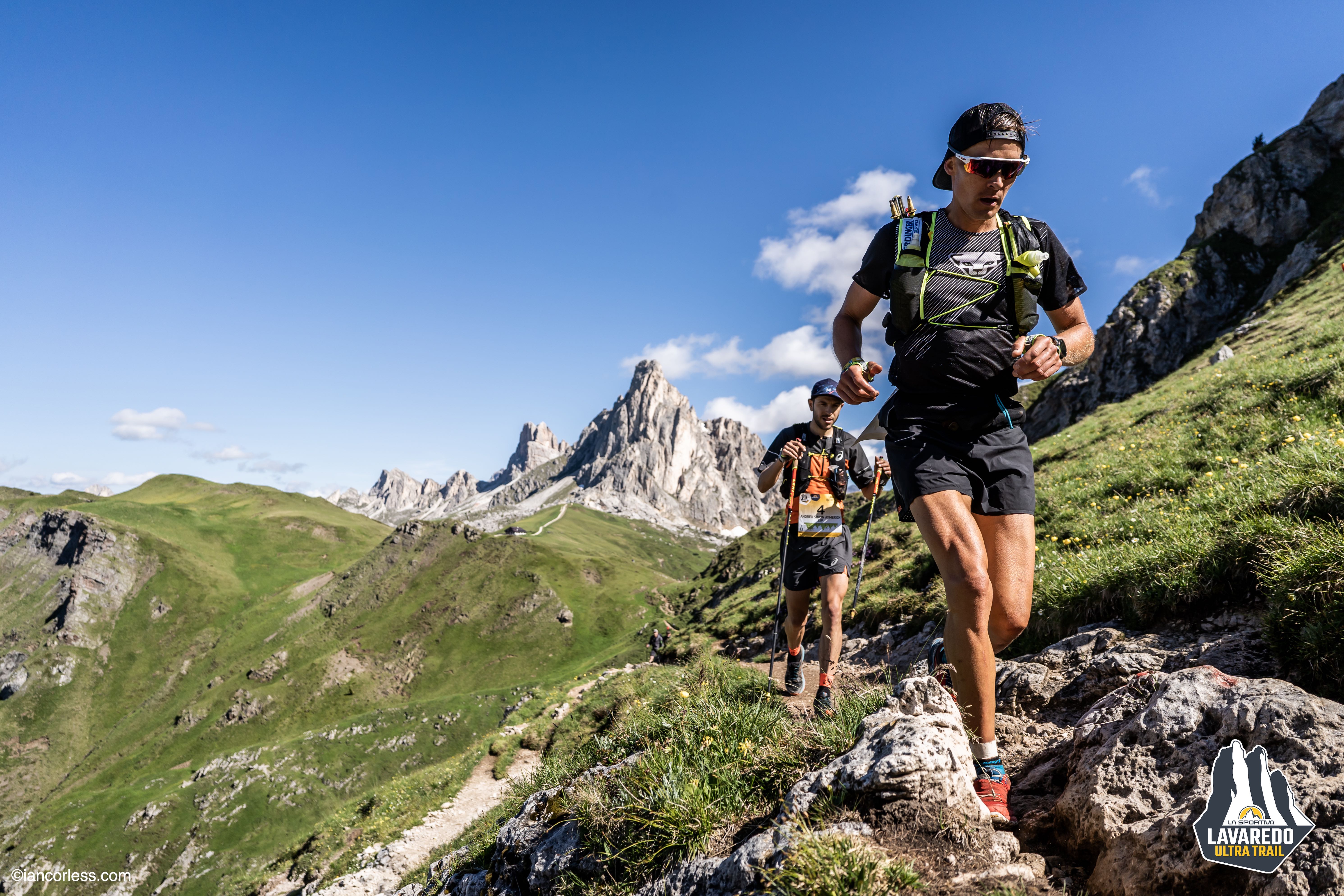
Tres Cimes de LavaredoHannes Namberger leading Andreu Simon Aymerich at Giau.Sebastien Krogvig
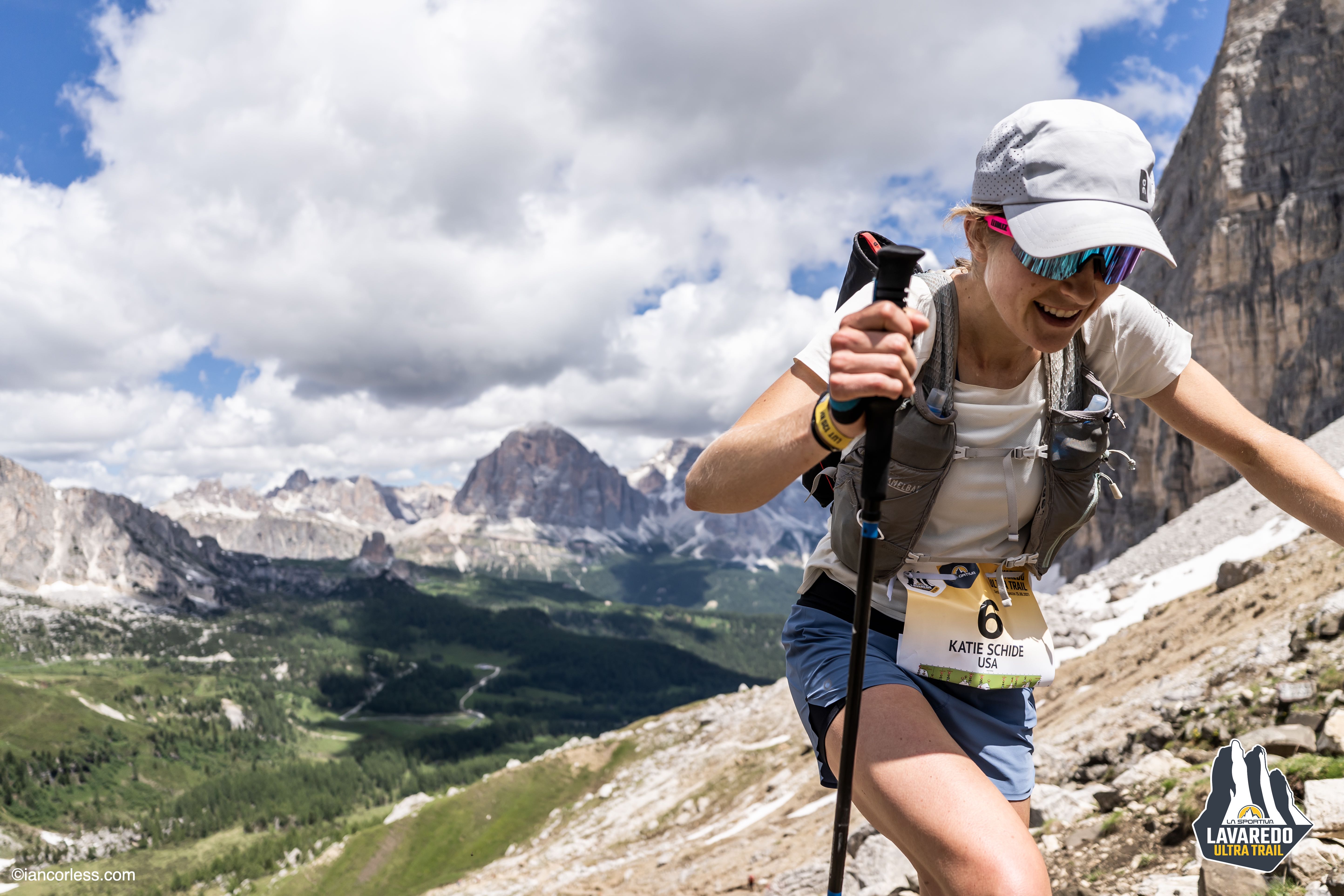
Hannes Namberger, from Giau to Forcella Ambrizzola, changed gear and in the closing 6km he opened gap of almost three minutes after a long battle with Andreu Simon Aymerich to gain victory with a new course record in 12h 02m 12s. Sebastian Krogvig completed the podium, repeating his third place in 2017. For the women, Camille Bruyas from France, clinched a solid victory in 14:06:16 ahead of Katie Schide and Mimi Kotka, 14:28:21 and 14:51:09 respectively.
Camille BruyasKatie Schide
While the Lavaredo Ultra Trail 120km event passed through its 9th hour, the Ultra Dolomites, now in in its 2nd edition started, with 4100 meters of elevation gain and 80km waiting from Sesto (Bolzano). Czech, Marek Causidis clinched victory in 8:10:26 and Martina Valmassoi won for the women in 9:21:11.
Stunning landscape
The Lavaredo Ultra Trail had a title sponsor of La Sportiva and was supported by other important brands – Parmigiano Reggiano, Buff, Petzl, La Cooperativa di Cortina, Rudy Project, Garmin, San Benedetto, Elleerre, Fabbrica di Pedavena, Eolo, Cortinabanca, Astoria, Reflexallen and Cortina Hospital.
Please support this website. I believe everyone deserves to read quality, independent and factual articles – that’s why this website is open to all. Free press has never been so vital. I hope I can keep providing independent articles with your help. Any contribution, however big or small, is so valuable to help finance regular content. Please support me on Patreon HERE.
After a year of standstill, racing returns to Cortina and the Dolomites with four races, over four days and approximately 4000 athletes from 50 countries for the Lavaredo Ultra Trail.
The action starts on Thursday evening with the 20km Skyrace which has 1000m of vertical gain and 330 participants.
Friday morning, 0800, the Cortina Trail kicks off over a distance of 48km and 2600m of vertical gain with 1350 runners
The main event, the La Sportiva Ultra Trail starts at 11pm Friday, 1350 runners have entered anticipating covering 120km’s with 5800m of vertical gain within 30-hours.
The final event, the Ultra Dolomites, has 80 km’s and 4100m of elevation gain with 780 athletes toeing the line in Sesto (Bolzano).
ONES TO WATCH
Marco De Gasperi, Matterhorn Ultraks
The main event, the La Sportiva Ultra Trail has Andreas Reiterer will try to bring the men’s LUT podium back to Italy after 8 years. Xavier Thevenard, the only athlete who has won all the Mont Blanc Ultra-Trail race distances, from 50 to 160 km is without doubt, the hot favourite. Also fighting for the lead positions are France’s, Germany’s Hannes Namberger and Spain’s Andreu Simon Aymerich and Tofol Castanyer. The Italian mountain running and skyrunning legend, Marco De Gasperi also toes the line.
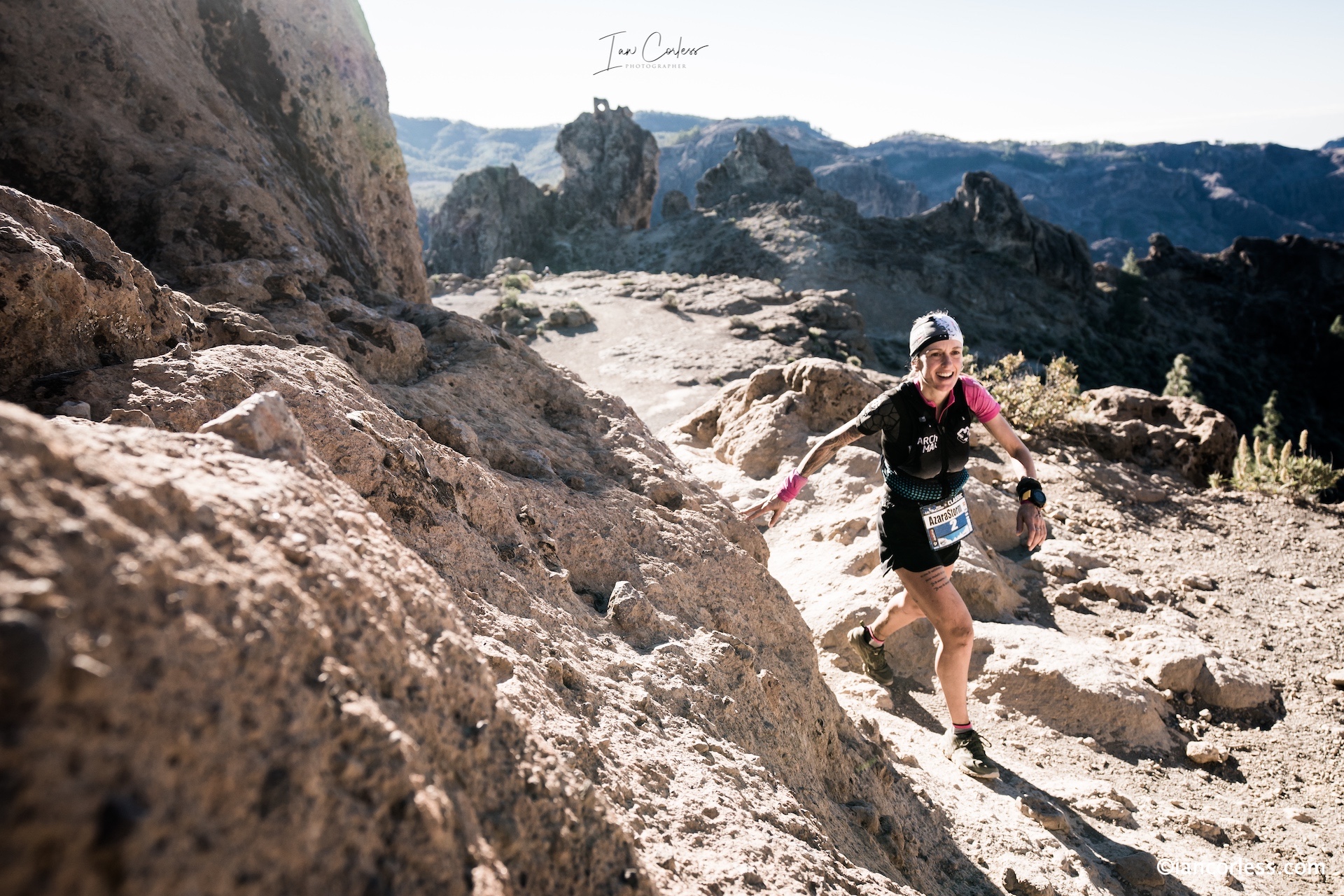
Azara Garcia
Katie Schide ids on form at the moment, as is Spaniard, Azara García. The duo will almsost certainly lead a charge at the front followed Camille Bruyas, Mimmi Kotka, and Swiss Kathrin Götz, winner of the 2019 LUT.
All the races will have staggered starts, 400 athletes every ten minutes. Race bib numbers, which have been assigned on the basis of participants’ ITRA (International Trail Running Association) ranking, ensure that the fastest athletes start in the first grids, thus avoiding gatherings and overtaking as much as possible.
The Cristallo and Tofane, Sorapiss, Tre Cime di Lavaredo, Pomagagnon, Croda Rossa, Croda da Lago and Averau provide a world-class arena for the 2021 gladiators to do battle.
In addition to the title sponsor, La Sportiva, other important companies also support the event such as: Parmigiano Reggiano, Buff, Petzl, La Cooperativa di Cortina, Rudy Project, Garmin, San Benedetto, Elleerre, Fabbrica di Pedavena, Eolo, Cortinabanca, GVM Ospedale Cortina, Astoria and Reflexallen.
Please support this website. I believe everyone deserves to read quality, independent and factual articles – that’s why this website is open to all. Free press has never been so vital. I hope I can keep providing independent articles with your help. Any contribution, however big or small, is so valuable to help finance regular content. Please support me on Patreon HERE.
It was here in Alagna that a new sport was born 25+ years ago and in 2021, after missing the 2020 edition due to Coronavirus, the Monte Rosa SkyMarathon finally emerged with a successful and exciting edition with 558 athletes from 36 countries.
Start low, go high, reach a summit, and then return as fast as possible. A sport free of the clutter of mountaineering equipment, a sport that is fast and light. This is the Monte Rosa SkyMarathon.
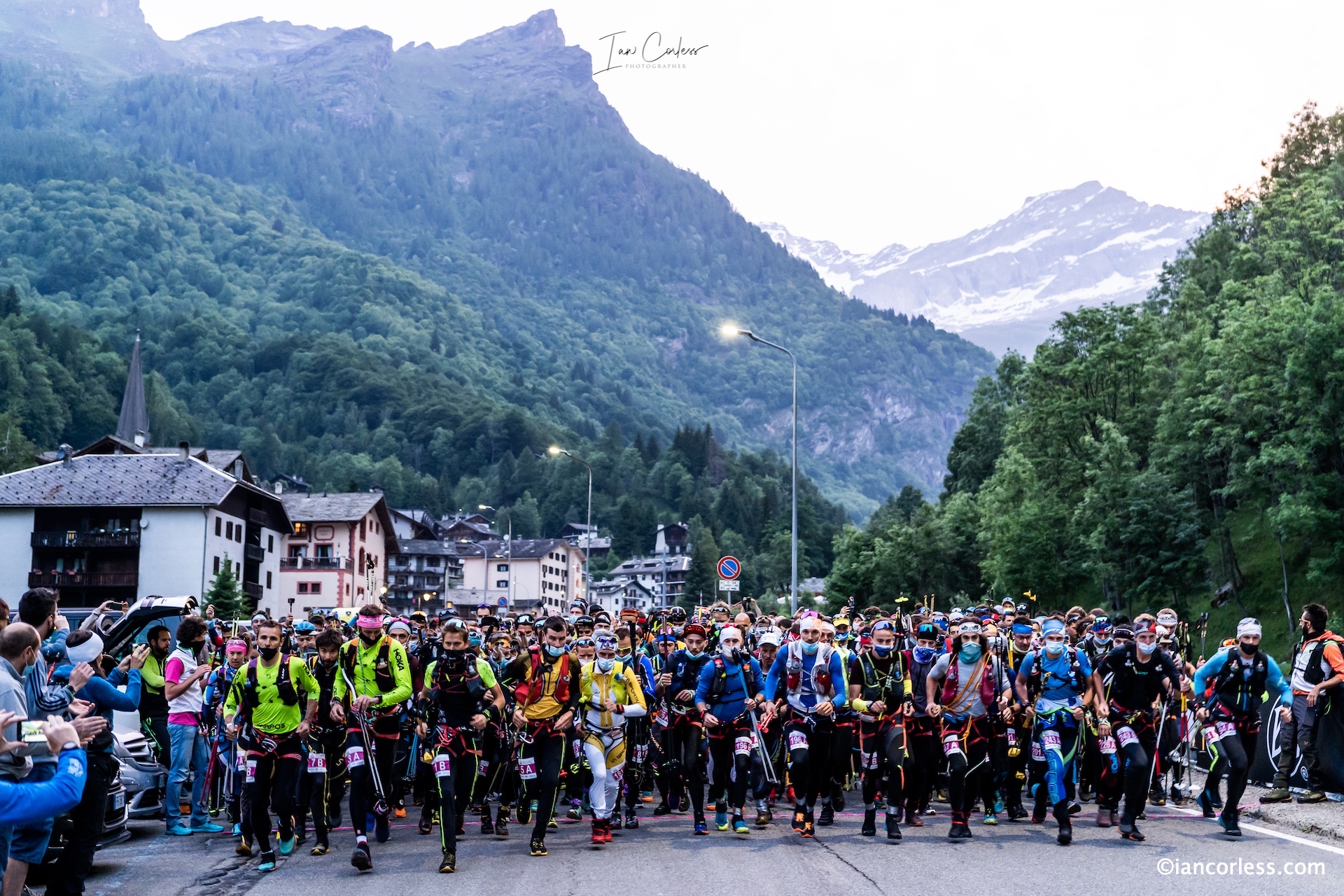
Back to the core values of the sport, skyrunning, the ‘buzz’ in Alagna was electric at the start.
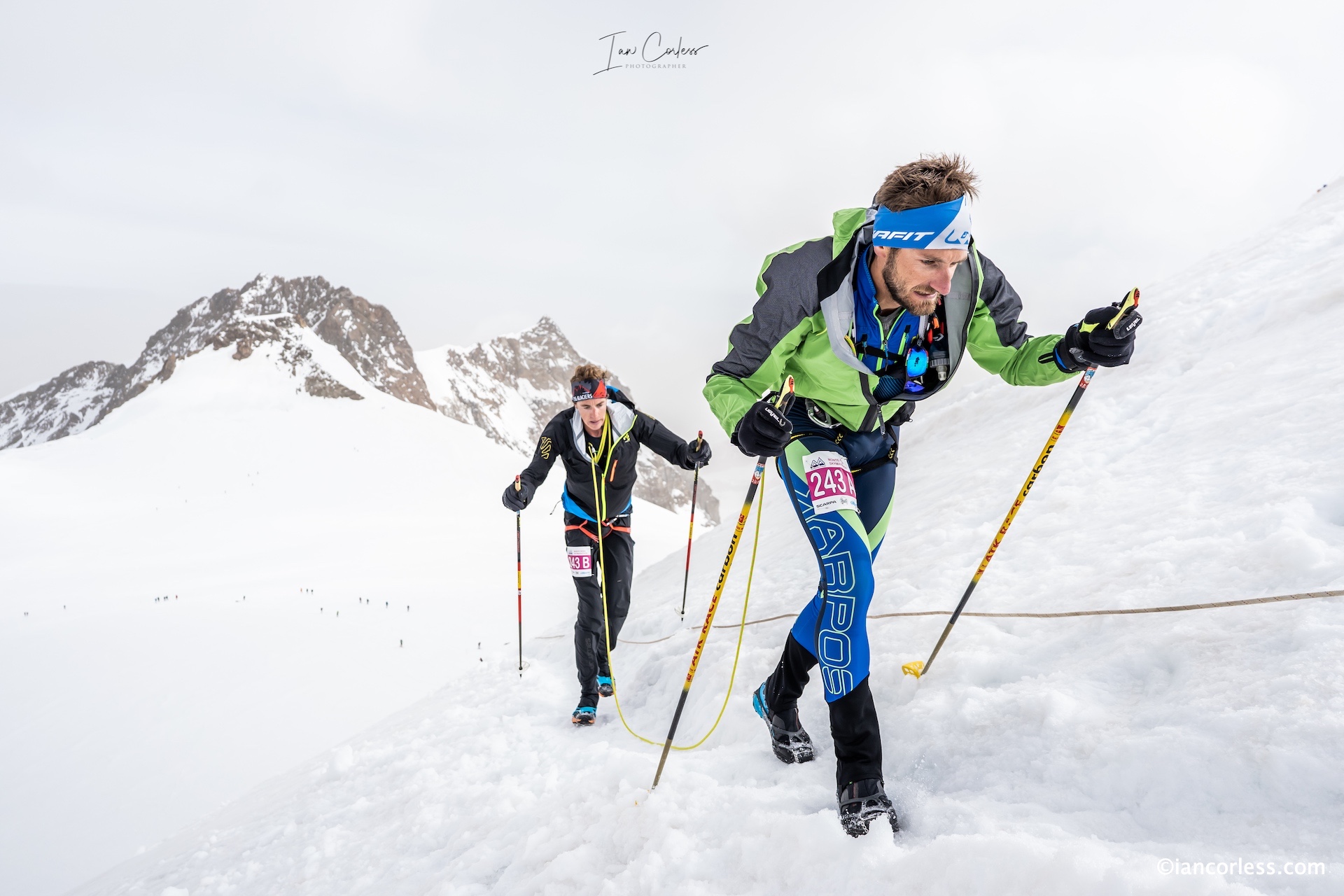
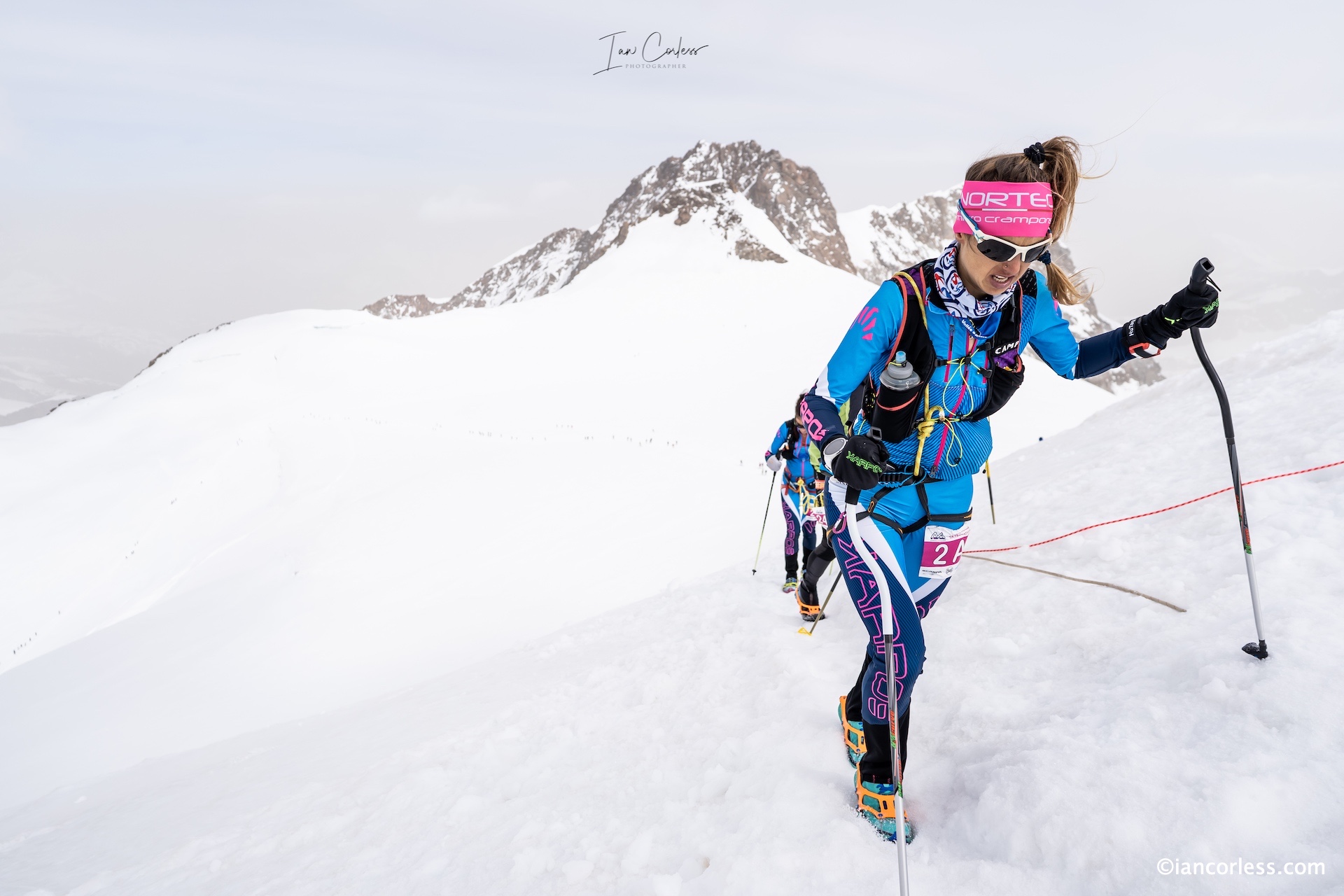
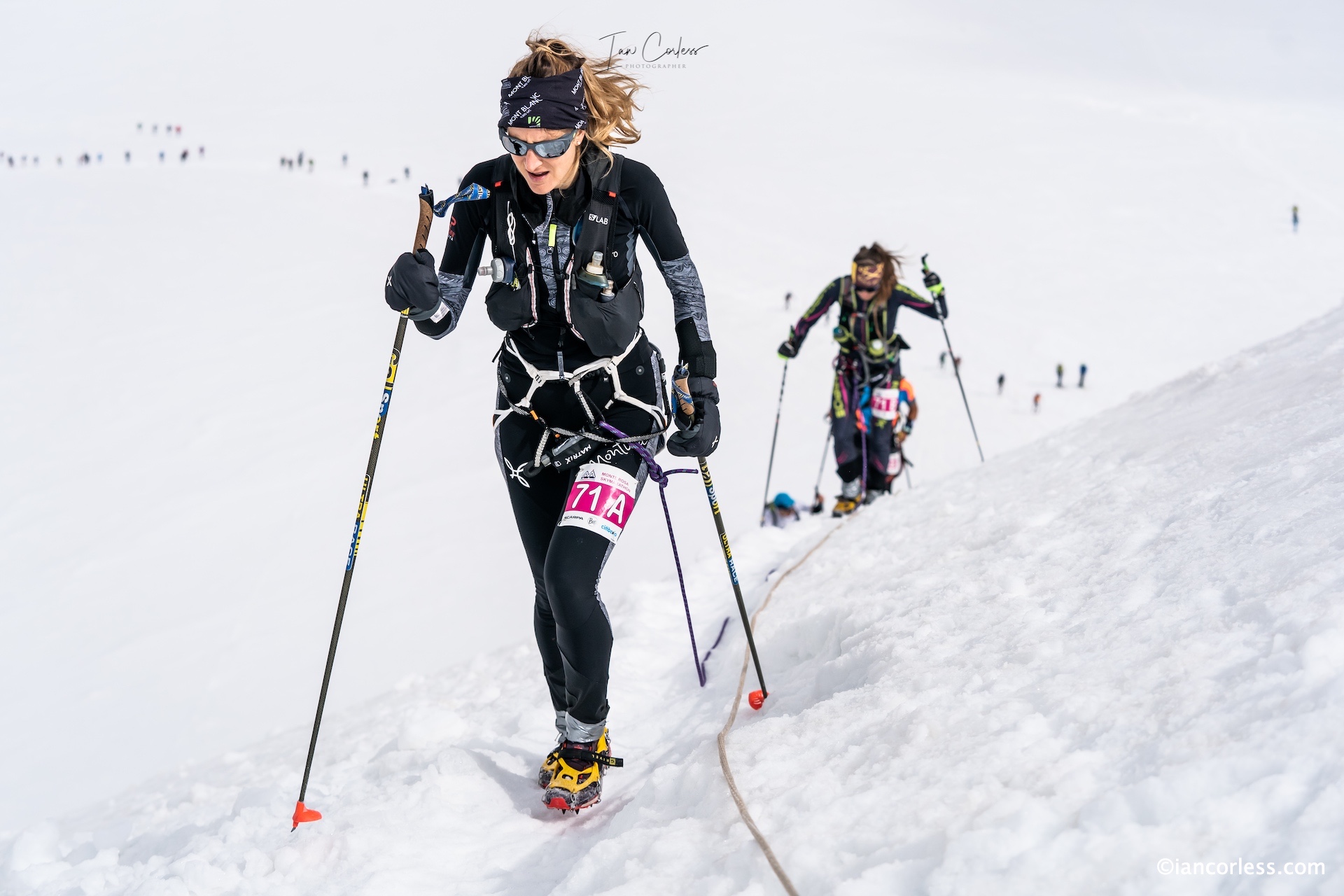
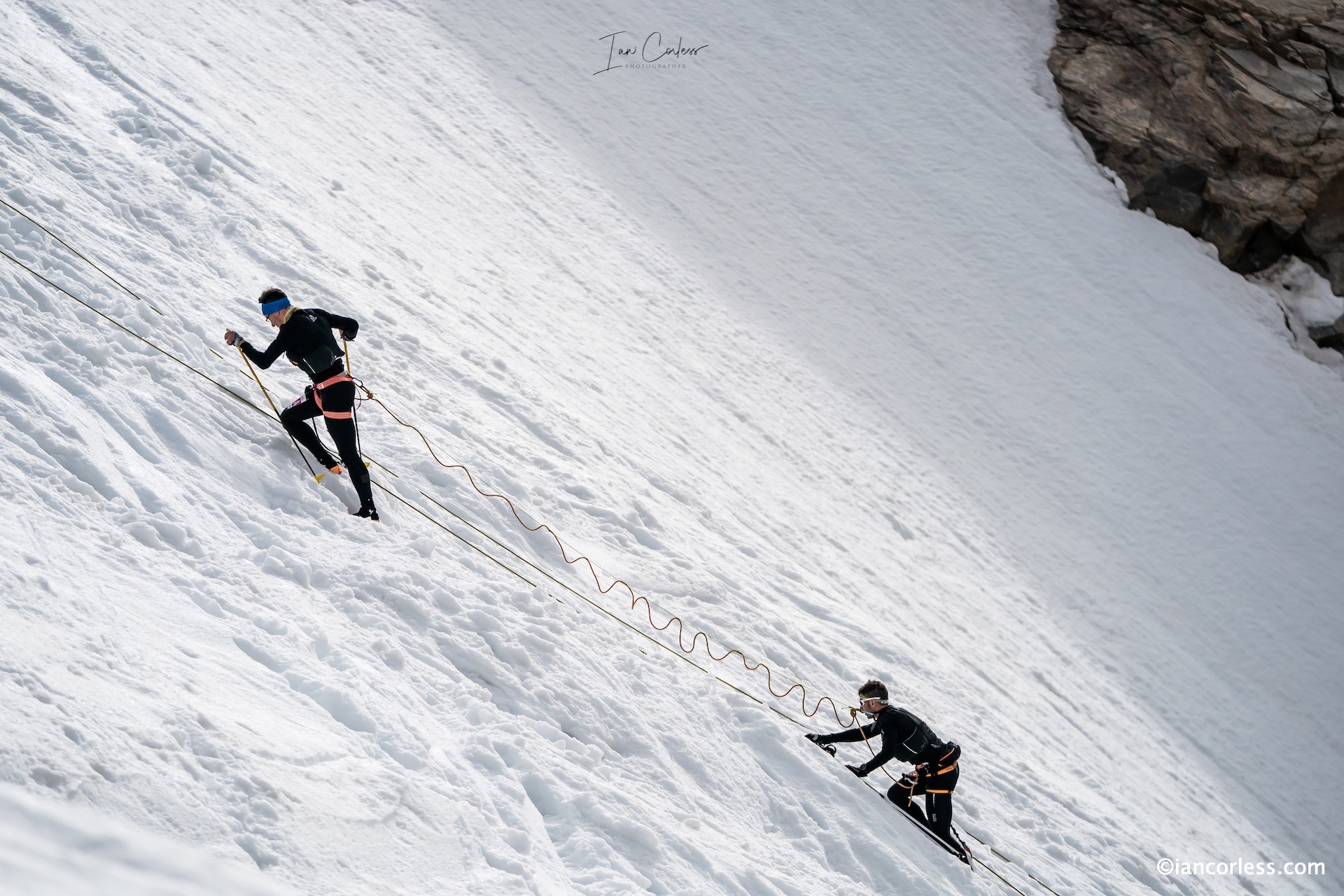
Retracing the original route from Alagna Valessia at 1192m the route went via the Bocchetta delle Pisse (2396m) to the Indren cable car station (3260m). From here the route continued upwards via the Gnifetti Hut (3467m), Colle del Lys (4250m) and then the summit, the Margherita Hut at 4554m.
An out-and-back route, at the summit, participants (in teams of two) turnaround and re-trace all the way back to Alagna along paths, ski runs, glaciers for a 35km loop and 3490m of vertical ascent and equal descent.
Ahead of the race, conditions in the mountains had been warm and snow conditions were less than ideal. However, a weather window appeared, and the race was confirmed to go ahead on Saturday 19th June, albeit with an earlier start of 0530. Mountains are fickle and snow can be exceptionally challenging, especially beyond midday – an earlier start would hopefully provide better conditions for longer.
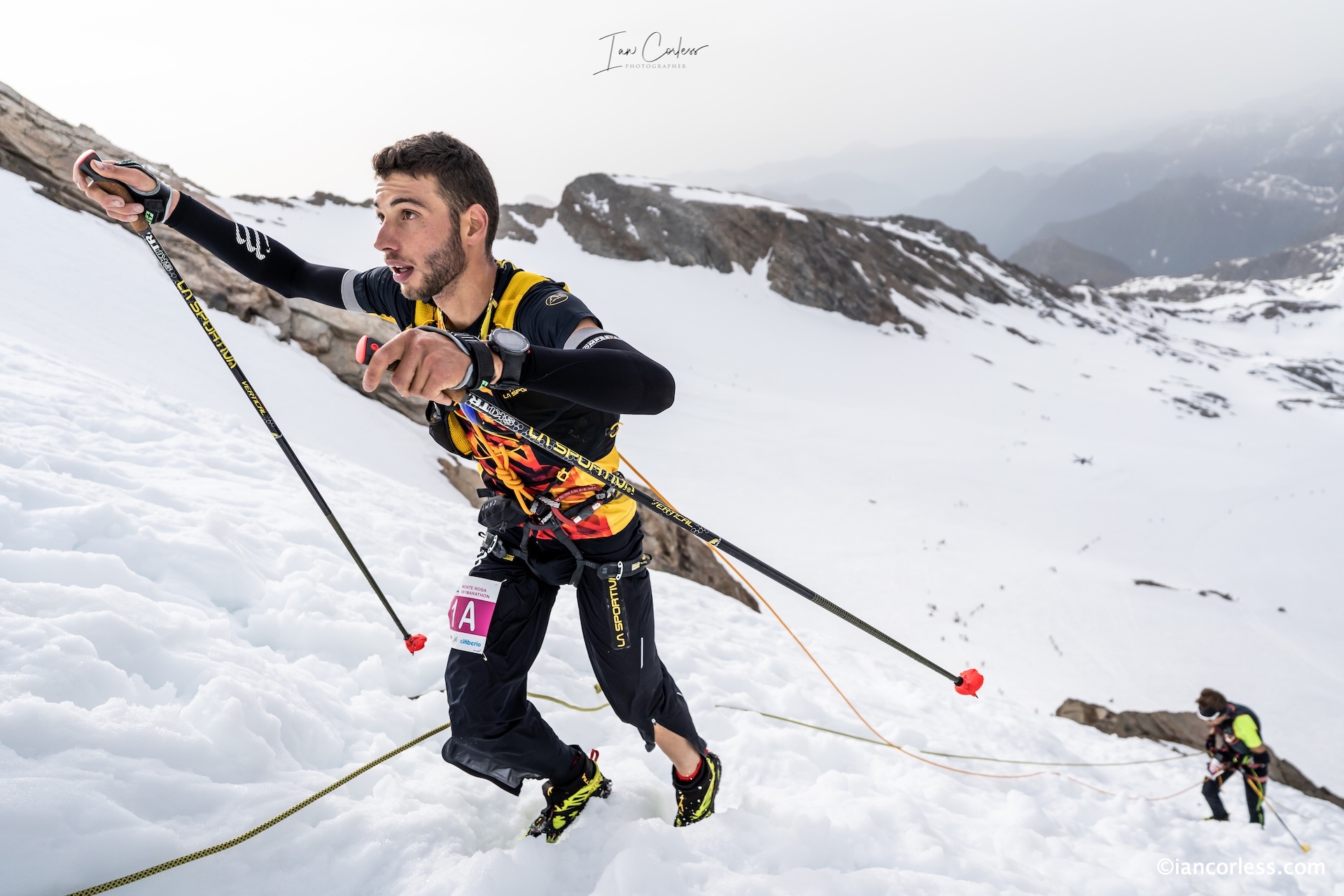
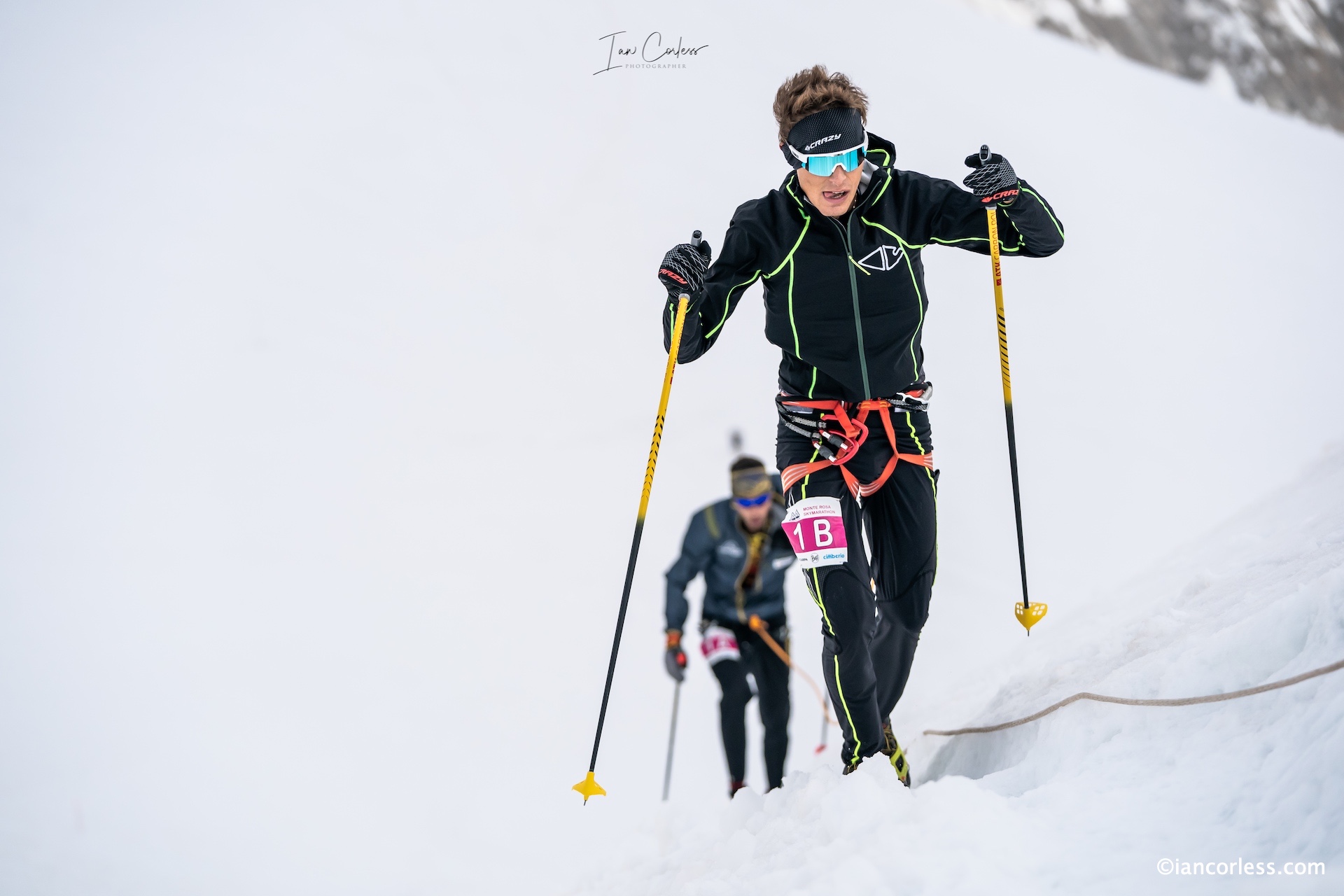
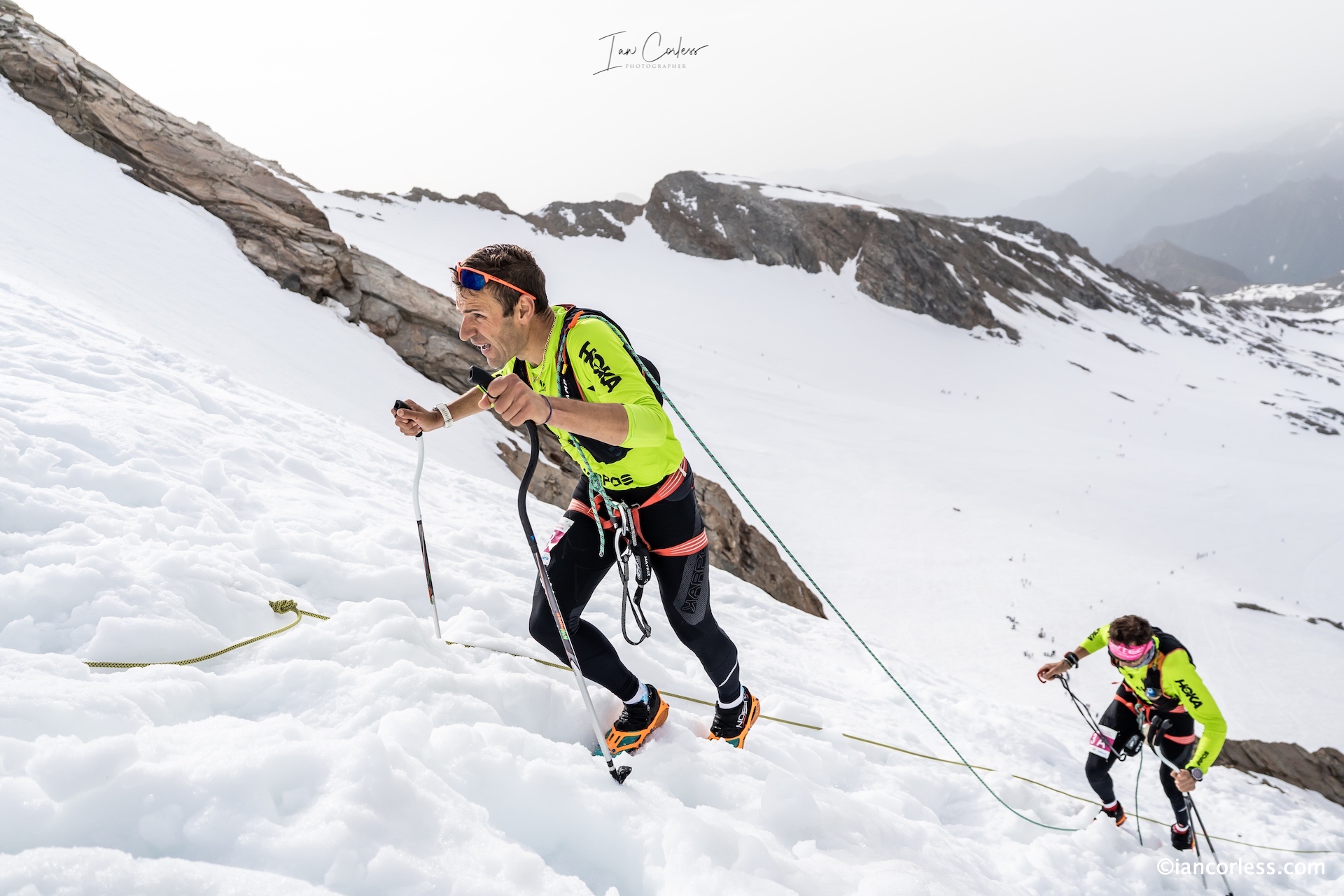
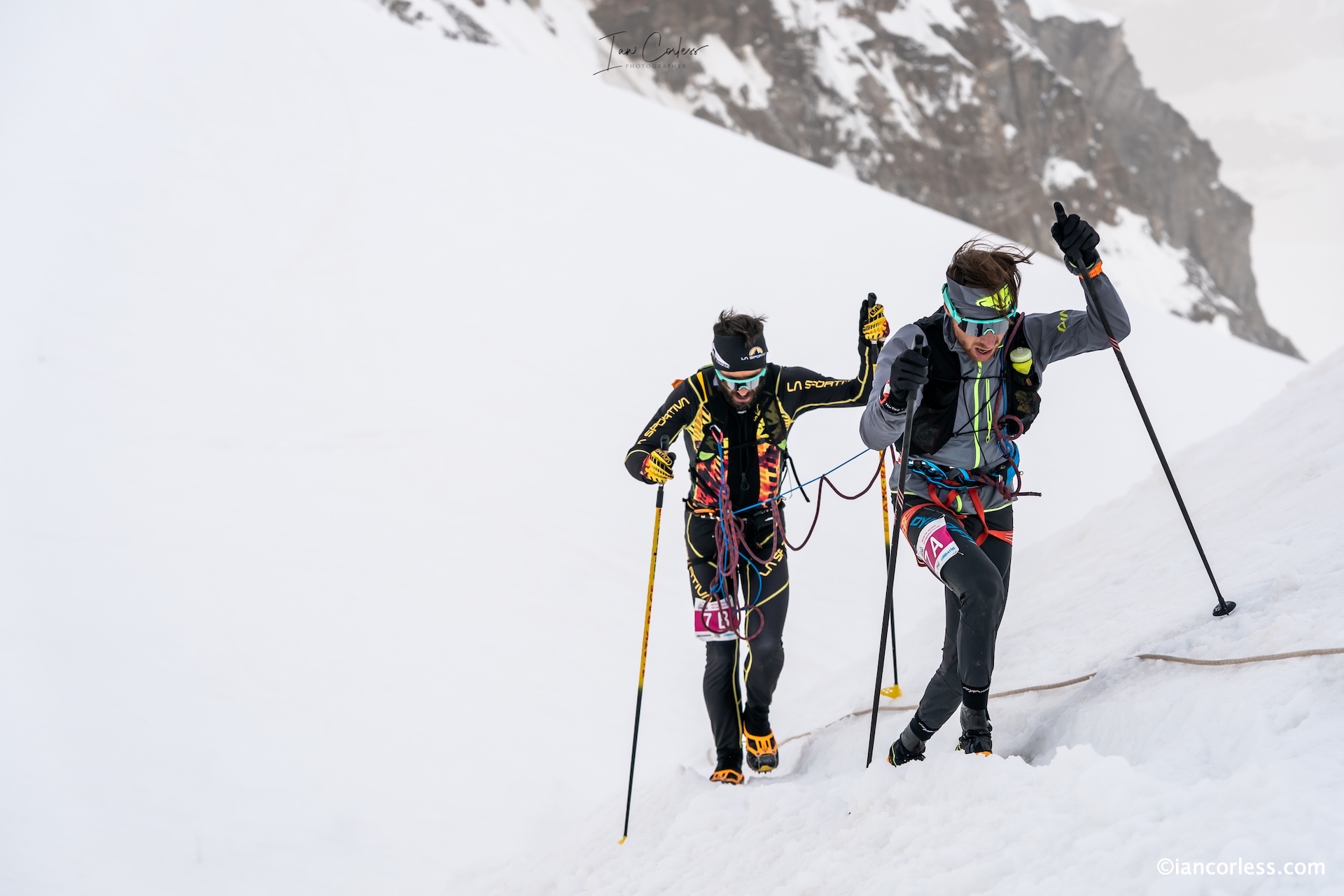
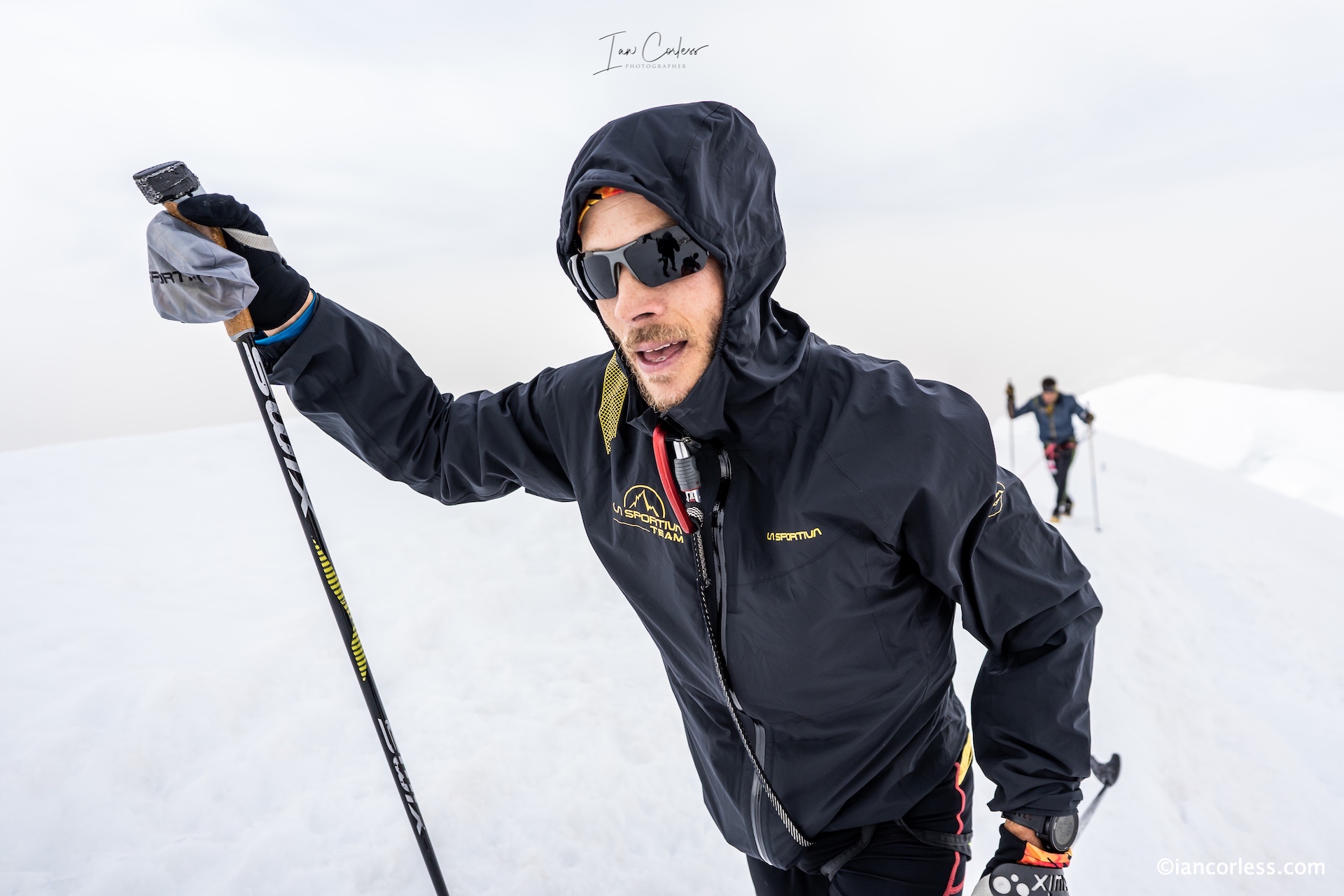
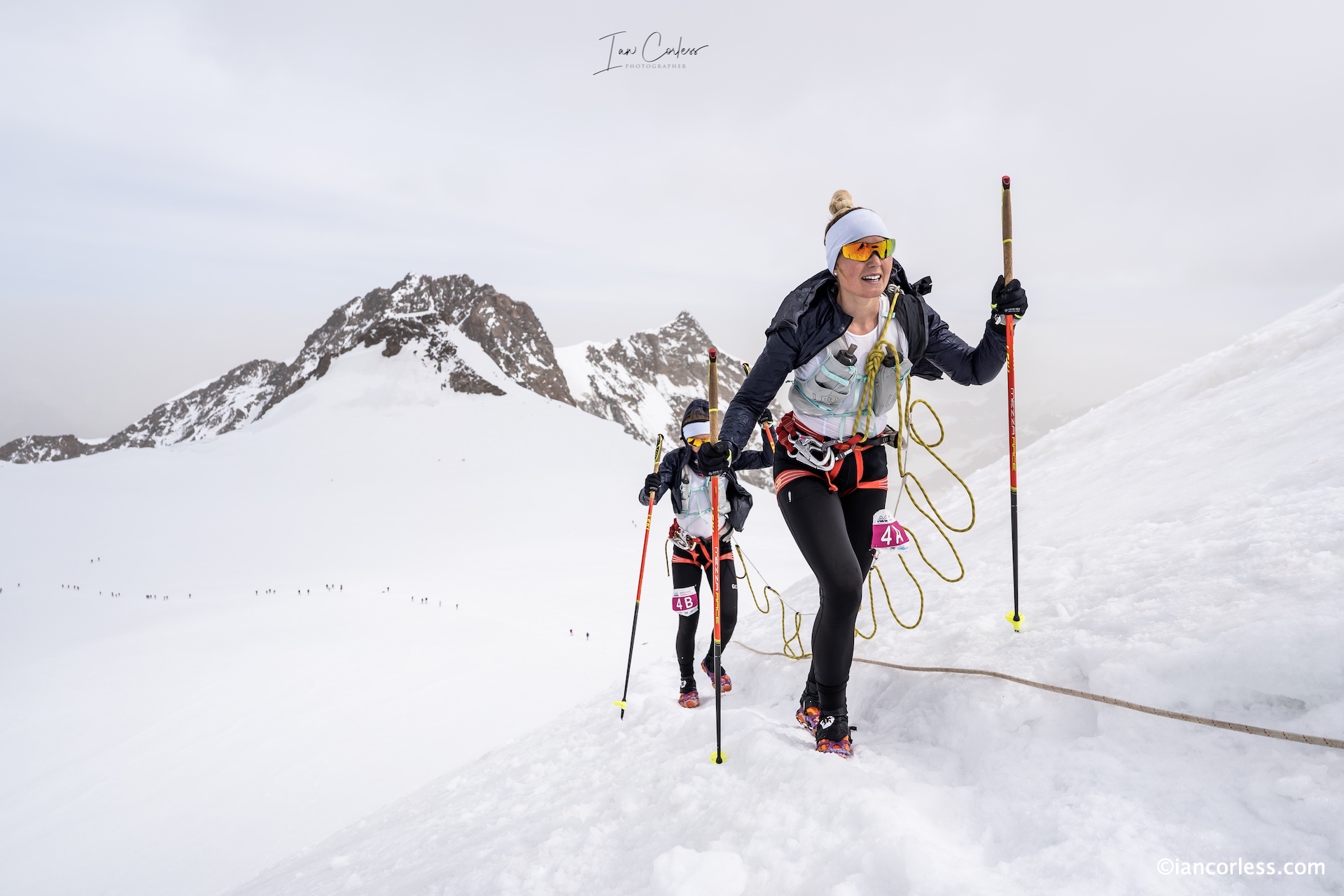
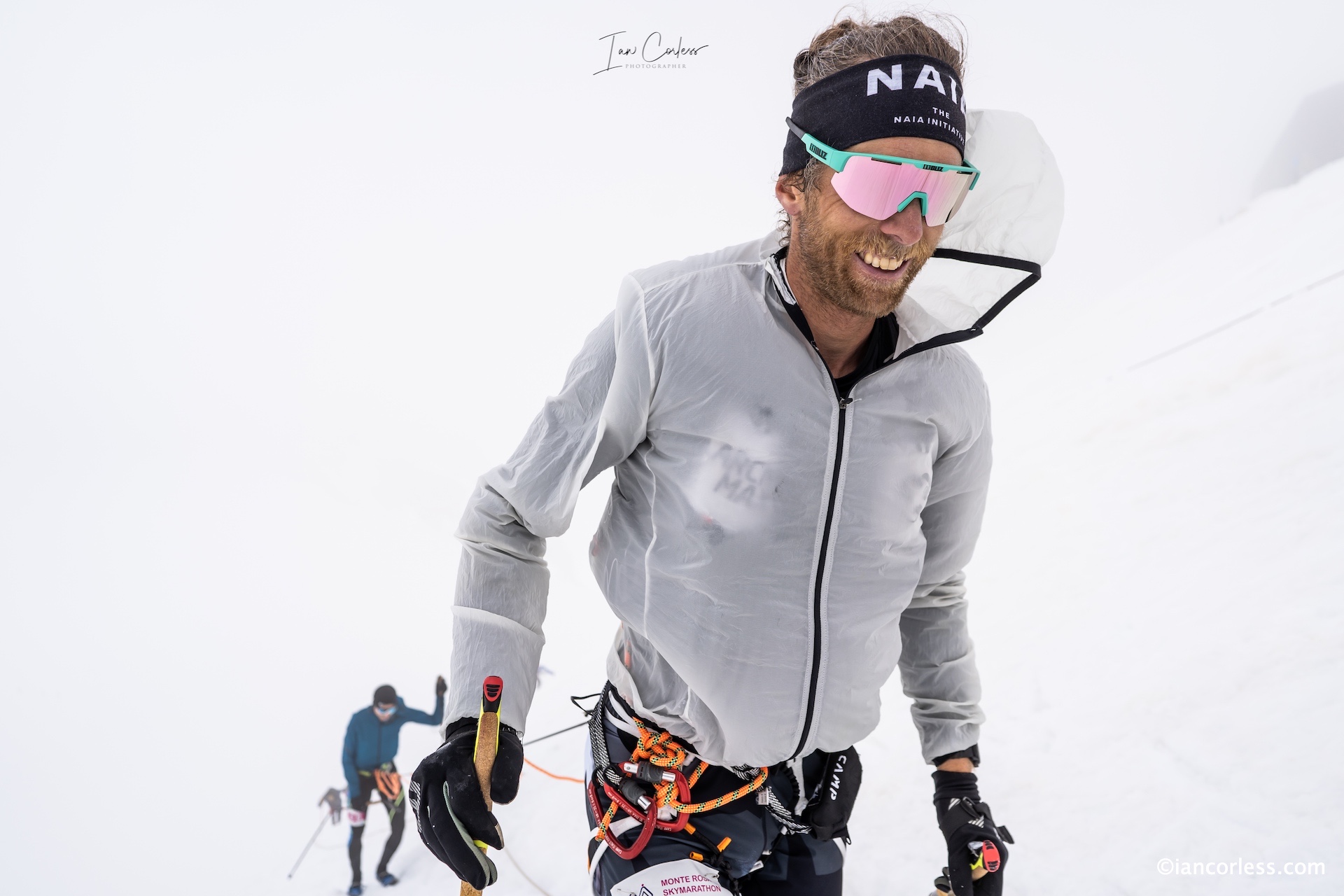
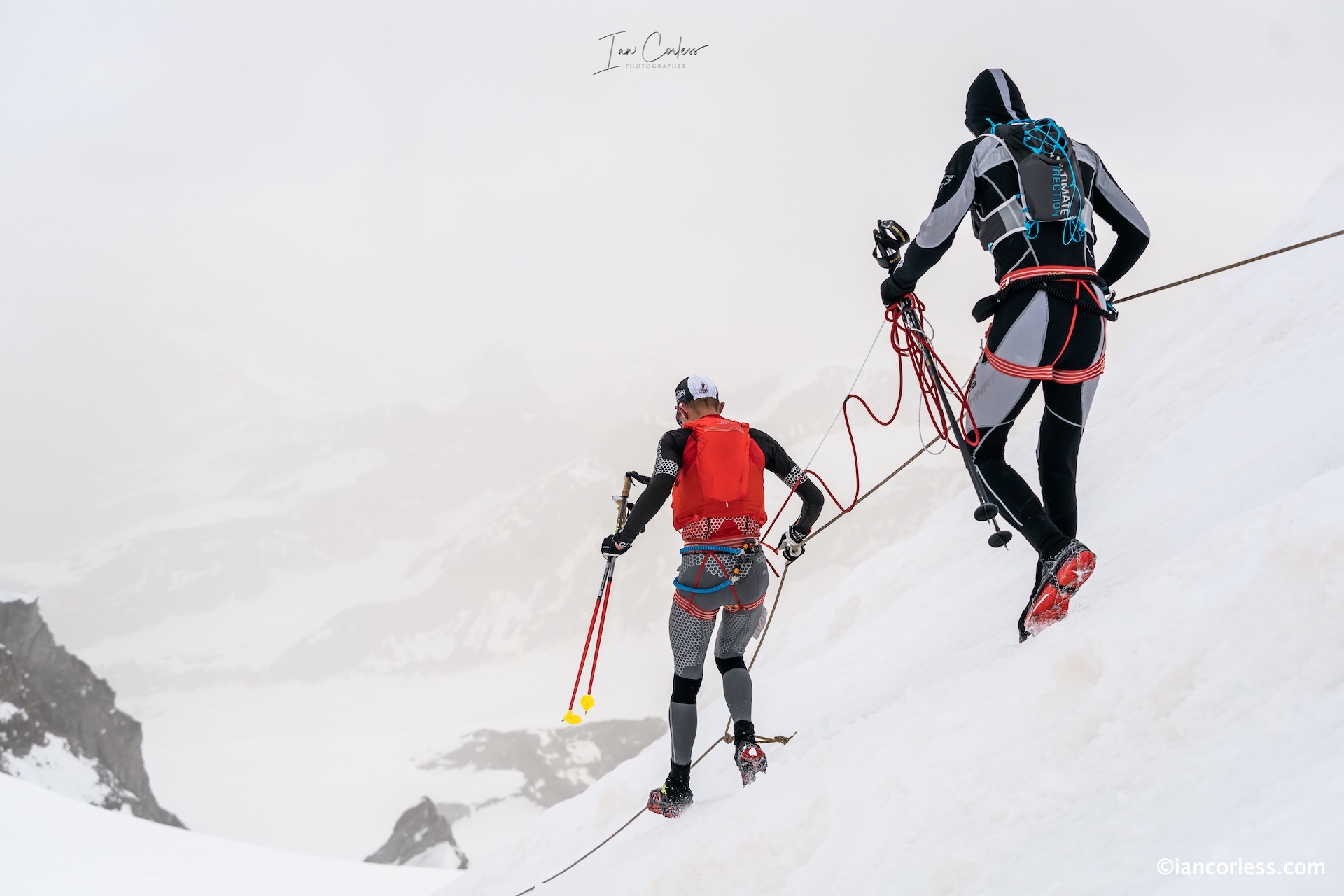
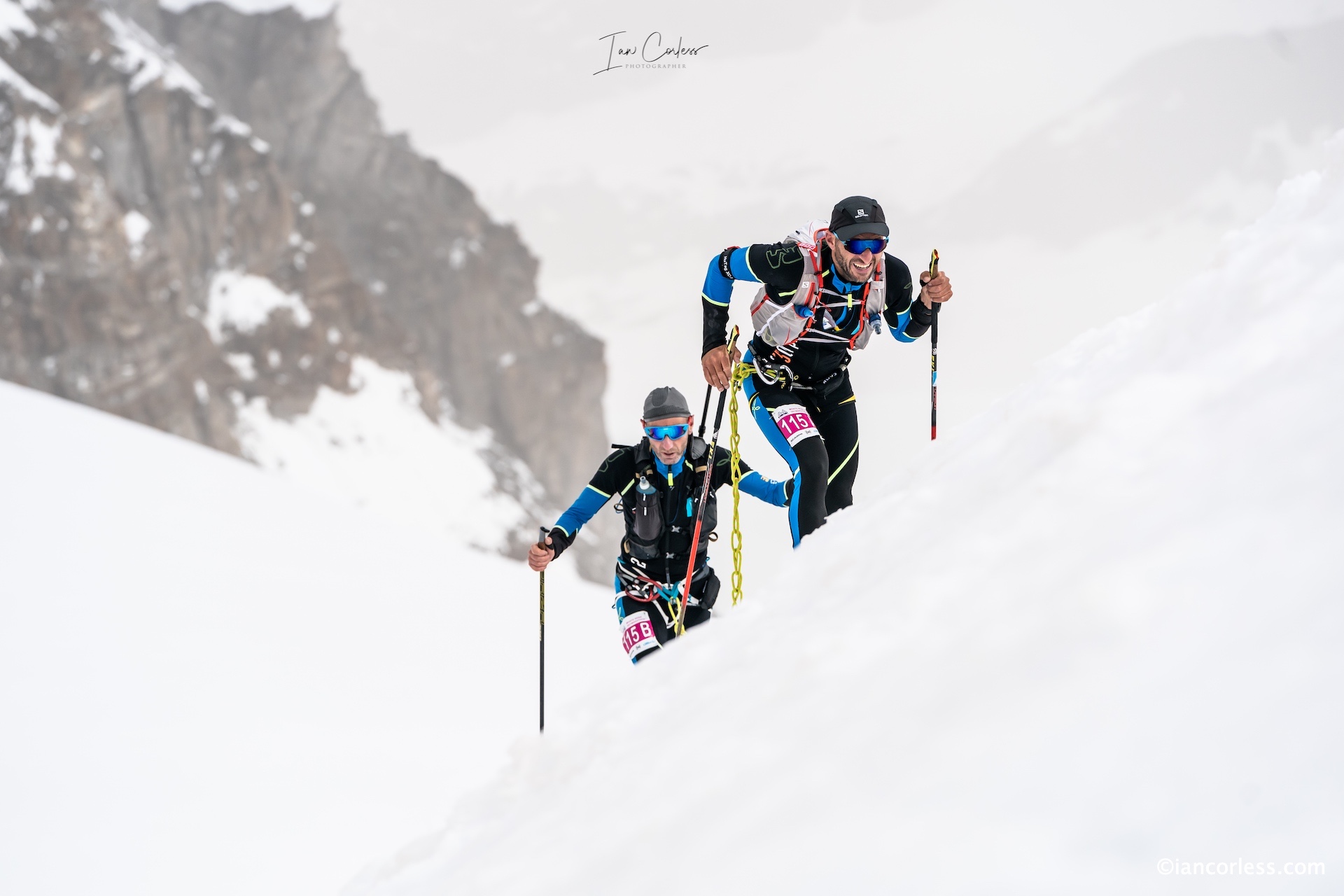
Roped together in teams of two for much of the race, the route starts with dry single-track before opening with the need to cross moraine, snow fields and glaciers, it is the ultimate test for a special few as strict vetting takes place in advance of the race to ensure all have the necessary skills and experience.
With past champions, William Boffelli and Franco Colle returning, anticipation was high. However, this time, the winning duo had new partners, they would race head-to-head. Nadir Maguet would join Boffelli making for an incredible pairing. Colle would be joined by Tadei Pivk. Sevennec and Viret, also hot favourites to contend the podium.
For the women, Giuditta Turini and Laura Chiara Besseghini would be hot favourites pushed by the El Kott twins and Vasinova and Sperger.
From the gun, William Boffelli and Nadir Maguet dictated the pace and with 2000m vertical covered, they had a commanding lead over Franco Colle and Tadei Pivk. Climbing the steep couloir beyond Indren cable car station, it was interesting to see Maguet lead Boffelli and unusually, Boffelli seemed to be struggling?
“Nadir was really strong, and the pace was fast, I was struggling a little to hold the pace and so Nadir lead. However, the higher we got, the better I became and after the couloir at the higher altitude, I took the lead, and it was Nadir’s time to suffer a little…” Boffelli said post-race.
The duo was too strong, and the lead gained early on was maintained all the way to the end, however, there was no fast times, the show conditions were just too challenging.
Colle and PivkLeaving the summit and the iconic Margherita Hut 4556m
Colle and Pivk, as expected ran a very strong race and while always in contact with the La Sportiva duo ahead, they were unable to catch them finishing 2nd.
Daniel Thedy paired with Henry Grosjacques Daniel Thedy paired with Henry Grosjacques Alexis Sevennec/ Léo Viret
Daniel Thedy paired with Henry Grosjacques rounded the podium with Daniele Felicetti/ Filippo Beccari and Alexis Sevennec/ Léo Viret placing 4th and 5th respectively.
El Kott twins.
In the women’s race, the hot favourites of Giuditta Turini and Laura Besseghini were relegated to 2nd after a strong performance by the El Kott twins from Sweden, Lina and Sanna. Their time of 6:22:12 was apparently a “little disappointing” according to the twins, they told Hillary Gerardi (who competed in and won the 2VK) that they had hoped to beat her time when paired with Holly Page of 5:51:32. It only shows how much slower the conditions were…
Giuditta Turini and Laura Besseghini
Marina Cugnetto/ Roberta Jacquin placed 3rd, just 1-minute behind Turini and Besseghini for hard fought podium places. Marcel Vasinova/ Eva Sperger and Noemie Grandjean/ Sophie Bertschy placed 4th and 5th respectively
Boffelli-Maguet (ITA) – 4h45’58”
Pivk-Collè (ITA) – 5h01’28”
Grosjacques-Thedy (ITA) – 5h13’07”
Felicetti-Beccari (ITA) – 5h20’39”
Viret-Sévennec (FRA) – 5h29’01”
El Kott Helander-El Kott Helander (SWE) – 6h22’12”
Turini-Besseghini (ITA) – 6h31’30”
Cugnetto-Jacquin (ITA) – 6h32’35”
Vasinova (CZE) – Sperger (GER) – 6h38’57”
Grandjean (FRA) – Bertschy (SUI) – 6h55’59”
André Jonsson and Rémi Français
A special note must go to duo, André Jonsson and Rémi Français who sacrificed any top-5 possibility by sacrificing their race to go to the rescue of two other competitors who came victim of a crevasse.
“A race is a race, but sometimes things happen that makes positions and time splits irrelevant. About halfway up the glacier, one guy in the team ahead suddenly disappeared through the snow and his teammate was not far from being pulled down as well. I threw myself, grabbed him, held as hard as possible so they did not slide farther into the crevasse and then Rémi pulled our rope to stop me following them… More teams joined and we soon got them to the surface.”
André Jonsson
Safety and experience, two essential requirements for the race.
It’s a timely reminder that the Monte Rosa SkyMarathon is an extreme race and why all participants are strictly vetted and compulsory equipment and the requirement to be roped together is an essential requirement.
Less cloud, more sky – skyrunning
“Skyrunning differs to other sports and this is the discipline we launched in the late 1990’ s,” Giacometti said. “Skyrunning has always existed; across the world it is just that it became a formalized sport in our hands. I am called the father of skyrunning, but it is for the aspect of race organization, when we started 25+-years ago, nobody talked about this.”
Run steep, get high!
“Older generations were already Skyrunner’s. My grandfather crossed the mountains working for example. Skyrunner’s added more speed but in essence it has always been the same thing, Skyrunner’s have always existed.” Bruno Brunod says, “I felt the same when I was a kid in the pastures, I always ran up and down the summits that surrounded me. It is something I felt inside, something I liked.”
The start.
The consensus post-race was that Marino Giacometti, the race organization team, Alagna and Monte Rosa participants were equal stars of the 2021 edition, especially after a such a tough and challenging year with Coronavirus. We look ahead now to 2022 with another year of less cloud, more sky!
Epic, pure and simple.
Please support this website. I believe everyone deserves to read quality, independent and factual articles – that’s why this website is open to all. Free press has never been so vital. I hope I can keep providing independent articles with your help. Any contribution, however big or small, is so valuable to help finance regular content. Please support me on Patreon HERE.
Episode 210 has an interview with Petter Engdahl and Speedgoat Karl co-hosts.
Talk Ultra needs your help! We have set up a Patreon page and we are offering some great benefits for Patrons… you can even join us on the show! This is the easiest way to support Talk Ultra and help us continue to create! Many thanks to our Patrons who have helped via PATREON Donate HERE
La Sportiva CYKLON shoe review HERE listen to Episode 208 of Talk Ultra is a special show with DANIEL FEENEY and Jonathan Wyatt discussing the collaboration between BOA and La Sportiva for the new, Cyklon shoe.
Please support this website. I believe everyone deserves to read quality, independent and factual articles – that’s why this website is open to all. Free press has never been so vital. I hope I can keep providing independent articles with your help. Any contribution, however big or small, is so valuable to help finance regular content. Please support me on Patreon HERE.
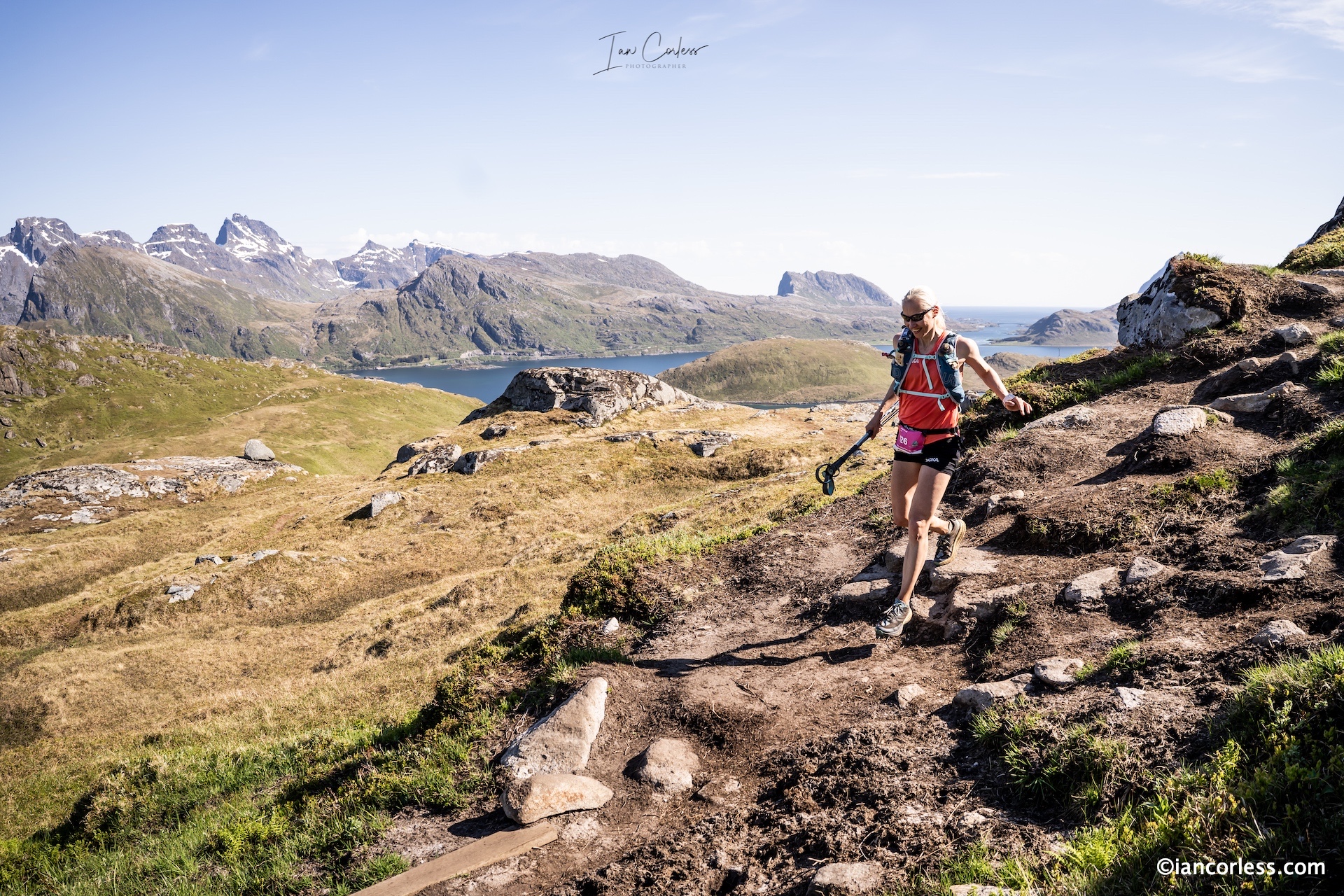
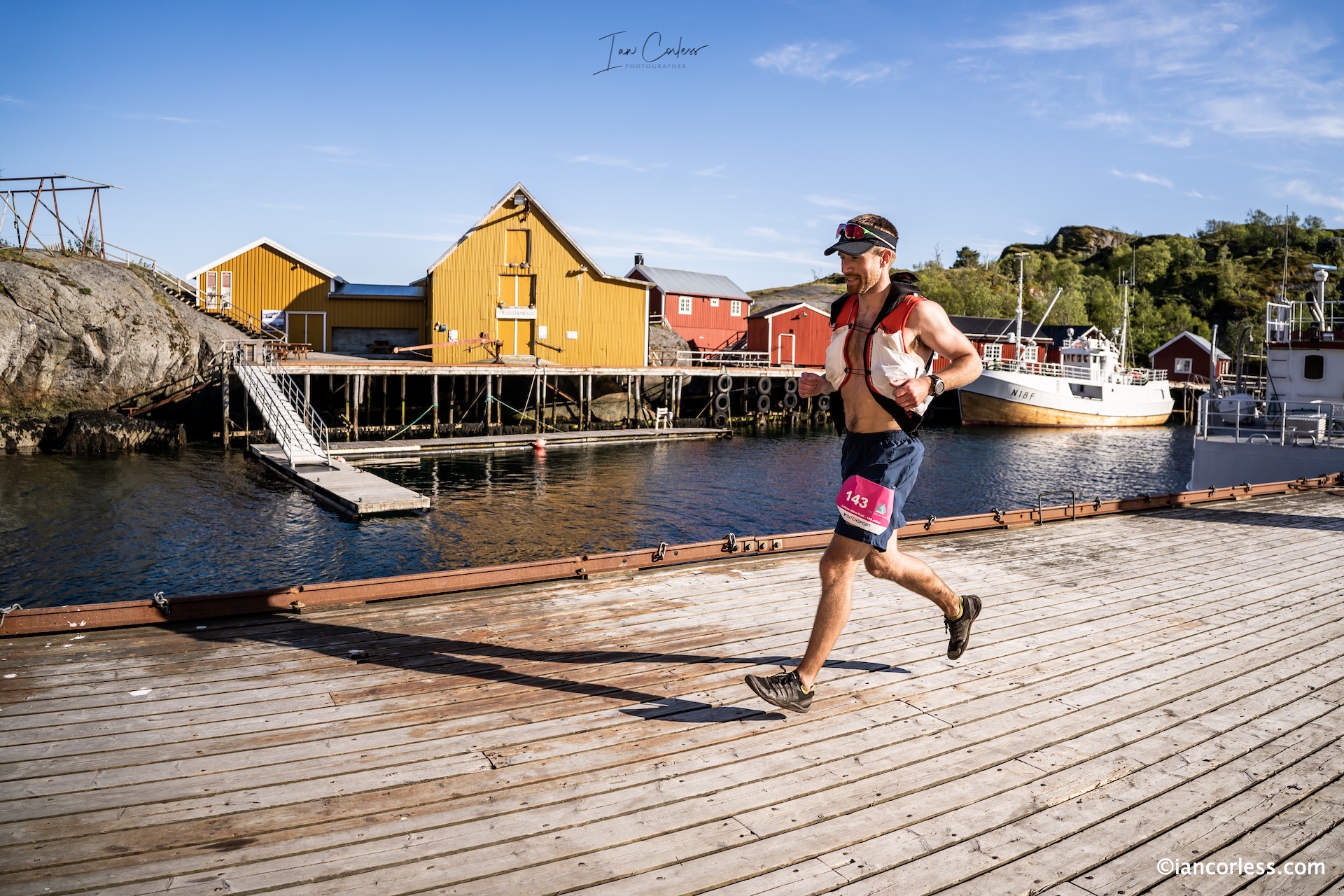
The Arctic Triple Ultra-Trail series of races concluded in Svolvær, Lofoten today after two stunning days of racing. With distances at 12km, 24km, 48km and 80km, there is a distance for everyone! The whopping 100-mile race, that journeys the length of this stunning archipelago started with a boat ride from Reine to the races start line in Kirkefjord.
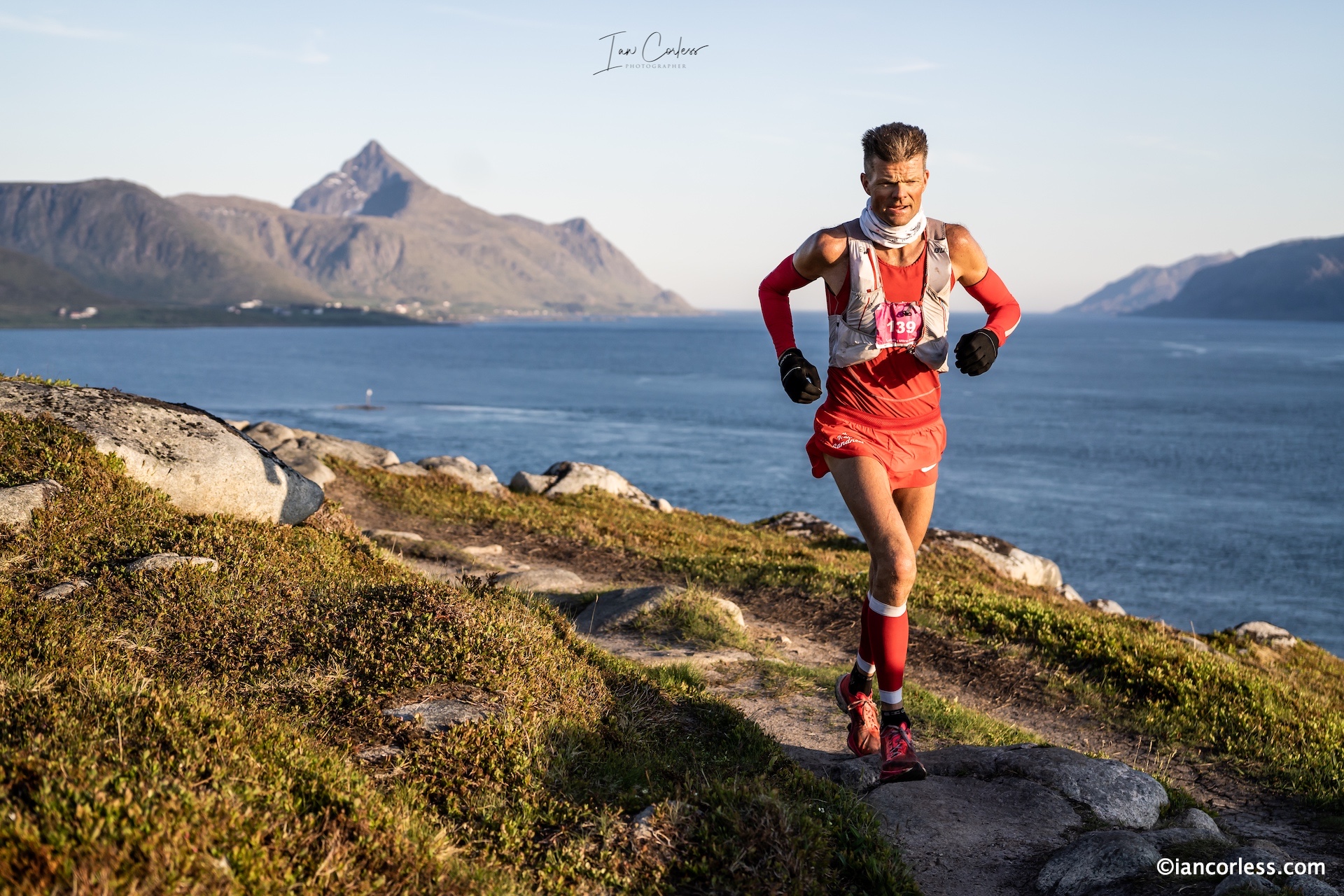
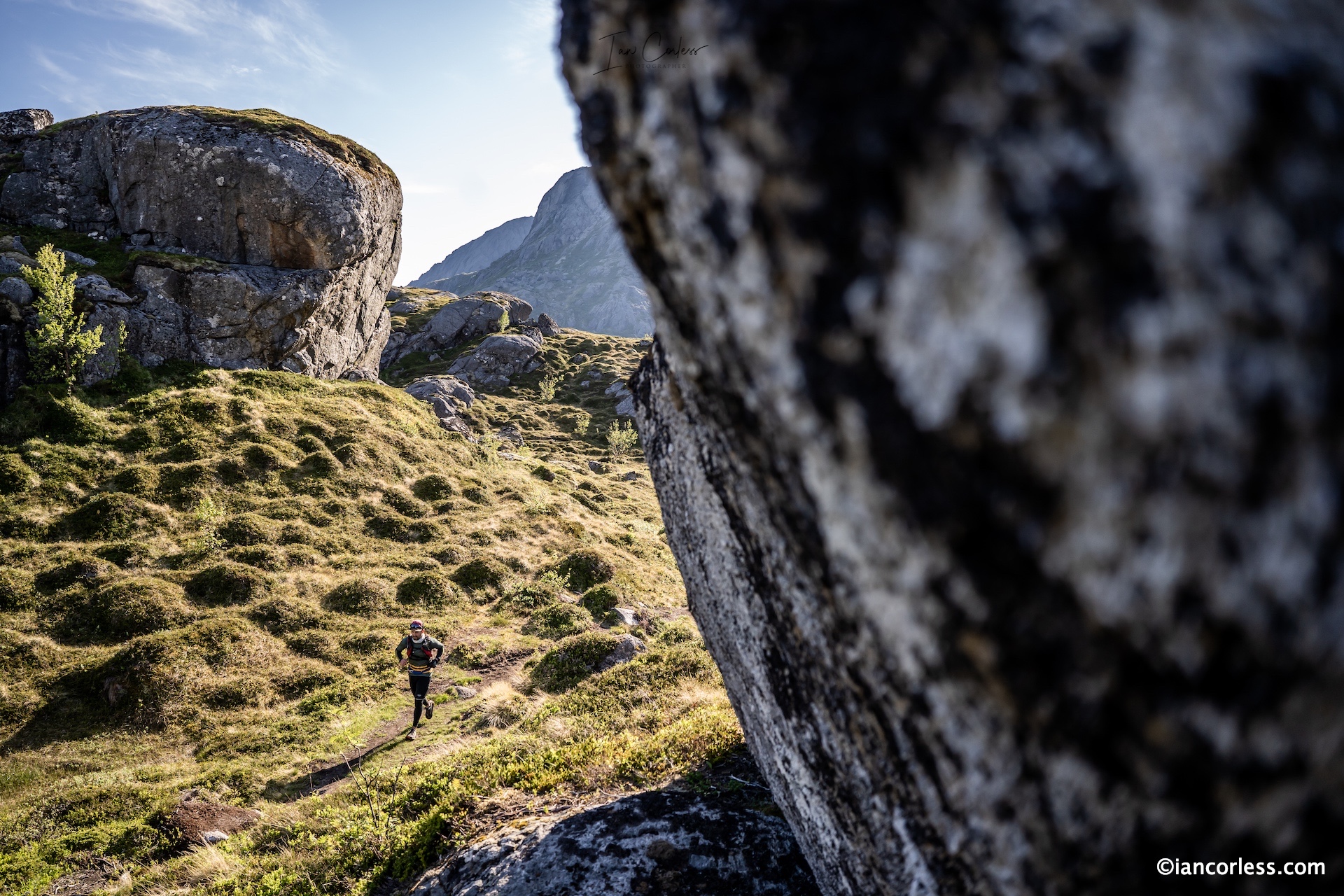
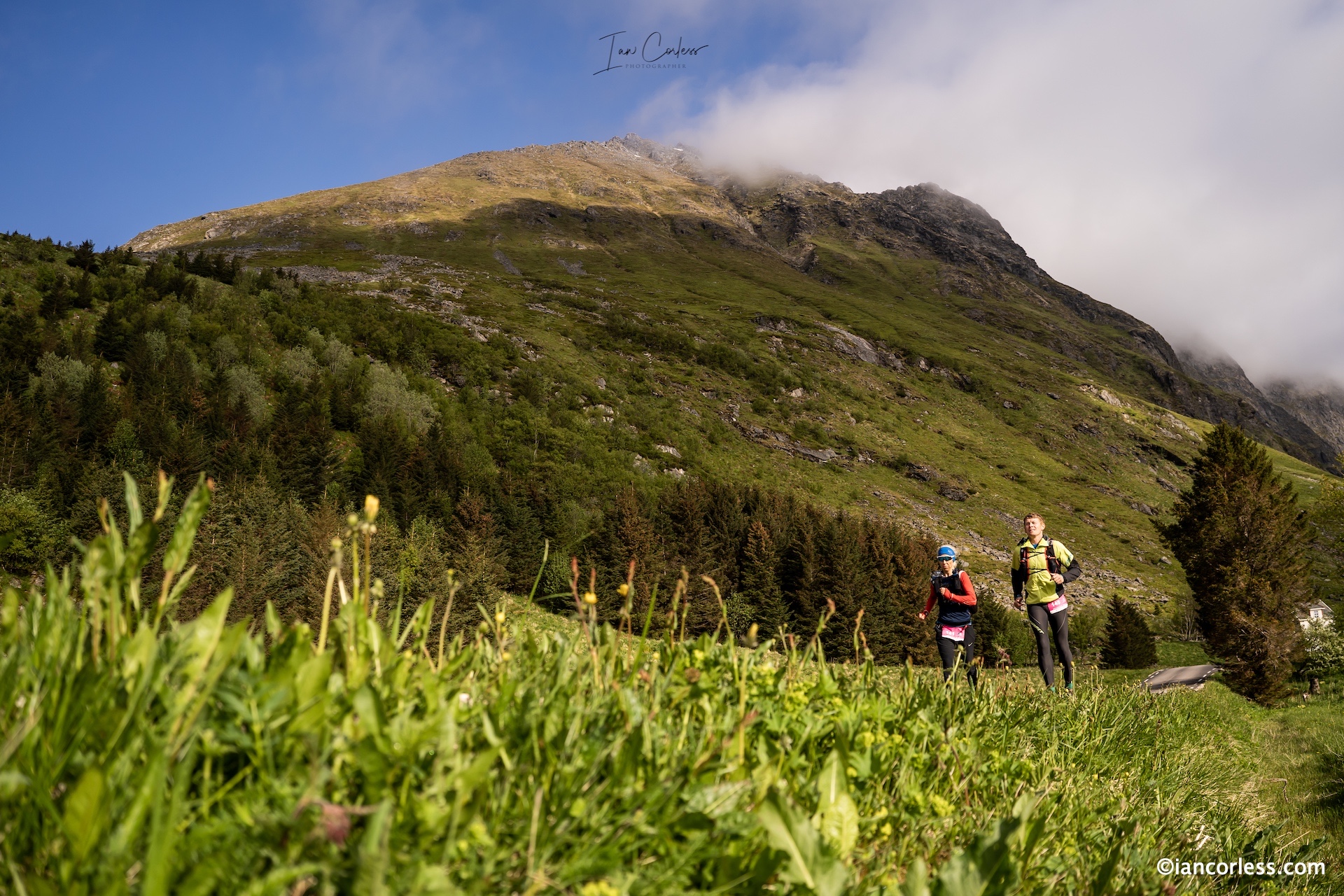
It’s difficult to some up in any meaningful words how truly spectacular this stunning part of Norway is, Lofoten has distinctive scenery with dramatic mountains, peaks, open sea, sheltered bays, beaches and untouched lands.
The Arctic Triple races bring a stunning trail and road running experience that links the best of the area with a stunning journey on foot, which for the brave starts in Kirkefjord, a 100-mile journey ahead.
Travelling from the south west, the races encapsulate the entire group of islands from Moskenesøy to Austvågøy. Passing through an amazing scenery of mountain ridges, white beaches, green hills and grey cliffs – almost the entire time the ocean is in view. All the races conclude in Svolvær, next to the ocean with 80km, 48km, 24km and 12km races all taking part of the respective sections of the 100-mile route.
The 100-mile started at midday on Friday June 4th, the 80km at 0900 the following day, the 48km at 1300 and the remaining two races, 24 and 12km at 1600 and 1700. In addition, there is a 100-mile and 50-mile relay.
With 24-hours of daylight, darkness was no issue for any runner to deal with and incredible wall-to-wall sunshine made the journey for all, a truly remarkable experience. The only problematic conditions arrived during the nighttime hours when a heavy mist and cooler temperatures rolled in from the sea.
A full report on the journey, the landscape and the race routes will follow in the coming days.
Race Results
100-Mile
Terje Sandness 26:36:43
Lena-Britt Johansen 31:34:16
80-km
Gaute Løset 10:20:46
Tore Bergbjørn 11:09:44
48km
Sylvia Nordskar 5:33:03
Joanes Veka Tretli 6:05:34
24km
Pavel Serov 2:28:39
Marlene Jasund 2:55:46
12km
William Fjellheim Urliksen 1:03:17
Elisabeth Brevik 1:24:49
Please support this website. I believe everyone deserves to read quality, independent and factual articles – that’s why this website is open to all. Free press has never been so vital. I hope I can keep providing independent articles with your help. Any contribution, however big or small, is so valuable to help finance regular content. Please support me on Patreon HERE.
They sound the same, don’t they? But don’t be confused. In the following two articles we will clearly explain the differences and do our best to inform you how to avoid it and what to do should it happen.
This article will be about Hypothermia but before we begin, lets provide an initial explanation to avoid confusion.
Hypothermia – Refers to the cooling of the human body which in severe cases can result in death.
Hyperthermia – Refers to the elevated temperature of the human body due to a failure of thermoregulation and in severe cases can result in death.
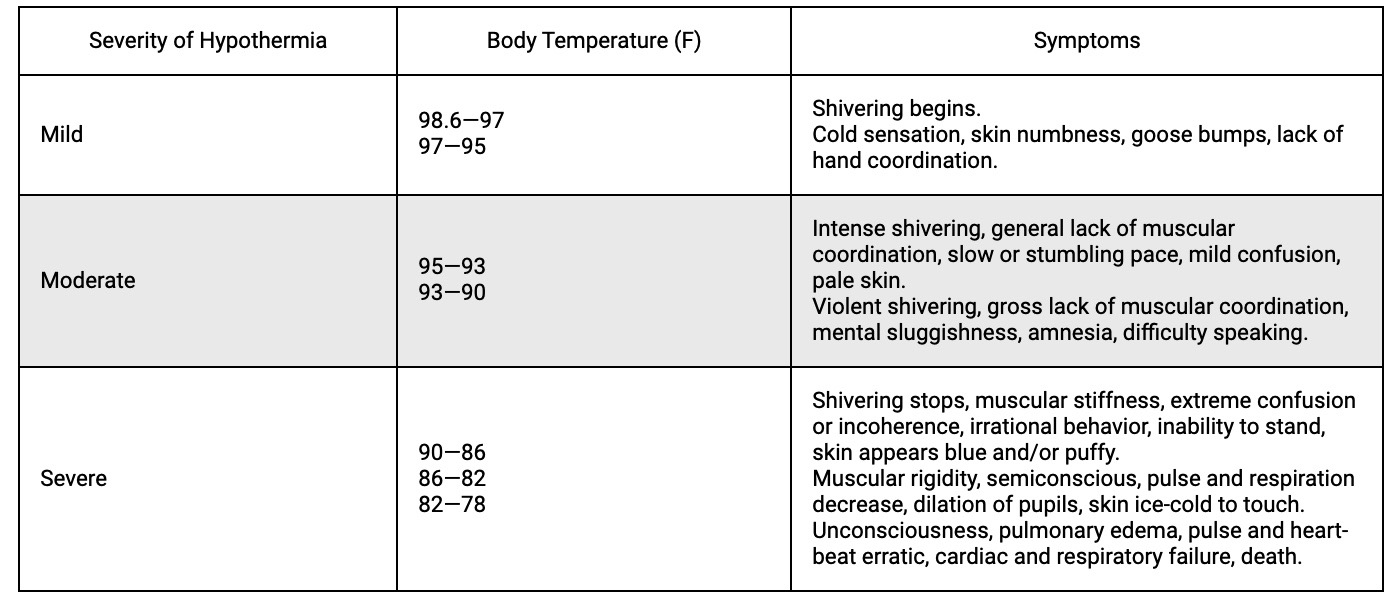
The bodies core temperature is normally around 37 deg C. When the core temperature drops, Hypothermia starts to set in. A drop of below 35 deg C signifies mild conditions whereas anything below 33 deg C is considered severe.
“Hypothermia occurs when an individual’s core body temperature decreases to a level where muscular and cerebral functions become impaired. The most common cause of this loss of body temperature is exposure to cold and/or wet conditions. When exposed to cold conditions, the body can lose heat through a variety of routes. These include conduction (contact with cold or wet objects, such as snow or wet clothing), convection (heat being carried away from the body by wind, i.e., wind chill) and evaporation (sweating and respiration). Once the body’s core temperature begins to drop, the symptoms of hypothermia will begin to appear.”
Let’s be clear here, conditions on the trail, fell or mountain don’t necessarily need to be bad for Hypothermia to set in. Running and moving fast creates heat and a runner can generate a great deal of heat in a short space of time. Imagine a scenario where you are moving fast, and you have been travelling this way for say 2-hours. You are warm, no hot! You are a little fatigued, hungry, a little dehydrated and then disaster happens…. you fall and twist an ankle.
Wear the correct layers to keep warm. Protect the extremities, hands, feet and head.
Suddenly moving becomes impossible and you start to cool.
I probably don’t need to elaborate too much here as it’s very easy to see and visualize the scenario that follows.
Low blood sugar, low energy a cooling body and mild Hypothermia starts to set in. Conditions do not need to be bad or inclement for this to happen! However, bad weather only adds to the situation and can speed up any decline. Imagine the scenario where conditions are bad – rain, wind, snow, ice, windchill and so on. The Hypothermia process is then escalated and speeded up rapidly requiring much faster action from the individual who is impacted by the conditions and those around who can provide help.
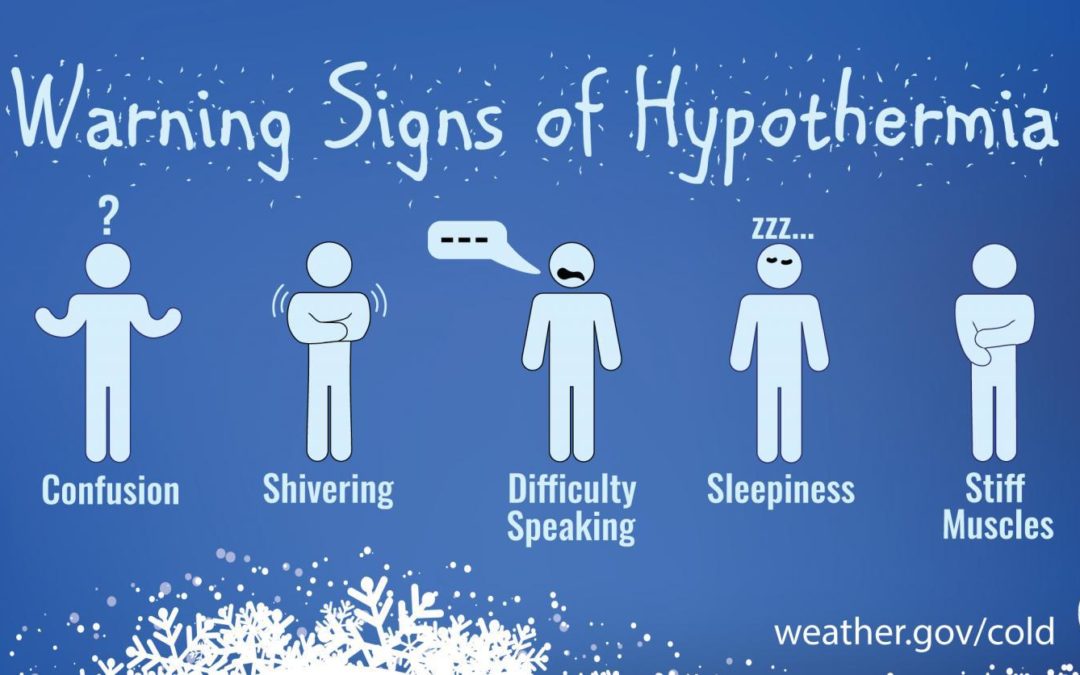
As the body cools, certain things start to happen and in mountain running we always warn runners of the possible signs of Hypothermia – Mumbles Grumbles and Stumbles.
A good water poof layer with taped seams and hood is essential.
Look out for:
An inability to make decisions.
Shivering.
Confusion.
A reduction of consciousness.
Slurred words.
Unusual behavior.
In severe cases any shivering may well stop and you will see visual signs of change such as blue lips.
A space blanket is an essential item for any kit list.
ACT QUICKLY
Grainger.com
Speed is of the essence with Hypothermia as mild conditions can spread quickly and before you know it, they can become severe and critical quite quickly.
If you have additional clothing (you should have, see a post on mandatory equipment) put as many layers on as possible including hat, gloves, warm base layer and windproof. If you or the person are wet from rain, ideally you would remove wet layers and replace with dry.
Ideally eat sweet foods. Avoid coffee, tea, and alcohol, If the victim can swallow without danger, give him/her warm, sweet liquids to drink.
Place warm objects and add heat/ layers next to the victim’s head, neck, chest, and groin.
If possible, get off the mountain or out of the bad conditions as soon as possible. If this is not possible, try to find shelter. If you are unable to move add as many layers as possible and seek assistance from the emergency services. A personal tracker such as Garmin InReach is a great addition to a mobile phone when out in remote and isolated environments.
Keep a potential Hypothermia case awake if you are looking after someone. If you are suffering from Hypothermia, do everything possible to avoid losing consciousness.
Of course, the above is not a comprehensive and fool-proof guide as mountain conditions and the condition of the casualty should indicate what action to take.
Do not try to evacuate a severe on unconscious casualty. Seek the services of the professionals with an emergency call.
weather.gov
All the above can be avoided with good mountain practice and skills.
The recent trend and desire to move fast and light is all well and good providing that you can move fast. However, when you can’t move fast, that is when problems arise. Personal responsibility, self-awareness and an understanding of the challenge, terrain, and weather, at minimum, requires you take stock of the situation before departing on any adventure and always think of the worst-case scenario.
Ask, ‘Do I have enough items with me should I become immobilized in bad weather and need to wait for rescue or help?’ If the answer is no, you need to reassess your equipment.
Mandatory kit should be something that you take with you on all your adventures, particularly on mountain journeys when in remote and isolated places, be that in training or racing. The more extreme the terrain, conditions or risk of adversity, the more equipment you should take.
Also remember that altitude and going high can impact in multiple ways. For example, it may be warm and sunny in the valley, but the higher you go, weather systems can change completely. For every 100m of elevation gain, temperature can drop by 0.65 (+/-) degrees. 1000m of elevation gain could see 10 degrees cooler temperatures, add wind and other inclement conditions and suddenly, without the right equipment, you are in a difficult situation. Be prepared!
A pack that can carry at least 1ltr of liquid with capacity for mandatory kit
Waterproof jacket and trousers to protect from the elements
A base layer Top and bottom) ideally merino wool.
A down or primaloft jacket that will retain heat/ warmth in wet conditions.
Hat
Gloves
Buff
Space Blanket
Liquid
Compass (know how to use it)
Map (know how to read it)
Whistle
Mobile phone
Spare food – energy bars or similar.
for more extreme conditions, consider the following:
Bivvy bag
Sleeping bag
Spot tracker or similar
Stove such as a Jetboil
Dehydrated meal
The above to some of you may sound extreme, believe me, when you need the above, you will really need them, and you will be more than thankful that you have them with you. Also understand clothing, how it works, how to layer, what garments are best in what conditions. Educate yourself on the pros and cons.
Good Practice
Be prepared!
Ideally always go to the mountains or remote challenging locations with company – buddy up!
Check the weather and make a sensible decision based on you, your ability, your objectives, and skill level.
Know the route that you are taking and tell a friend or family member where you are going, when you are going and when you anticipate returning.
Have a contingency plan with options to shorten or abort a route with quick and easy escape routes.
Have a mobile phone that is charged and contains relevant contact numbers for emergency services.
Can you read a map, take a bearing or do you have a phone or GPS device that will give you a location? This will be essential when requiring help. If you can provide a grid reference you will be rescued far quicker when a rescue party that needs to search for you. what3words is a phone app for this and is better then nothing in an emergency. OS Locate possibly a better option as it provides grid reference.
Look after each other and look after others on the mountain.
Know whistle signals – six blasts every minute signifies an emergency.
Hypothermia can happen to anyone, even the most experienced runners or mountaineers. However, if you are sensible, have the necessary equipment and understand your ability and the ability of those around you, the risk of Hypothermia should be reduced greatly.
In the next article we will look at Hyperthermia.
Please support this website. I believe everyone deserves to read quality, independent and factual articles – that’s why this website is open to all. Free press has never been so vital. I hope I can keep providing independent articles with your help. Any contribution, however big or small, is so valuable to help finance regular content. Please support me on Patreon HERE.
I was notified of the horrific incident in China over breakfast whilst on location in the mountains of Norway.
I immediately typed ‘China’ into a Google search and the headline was everywhere:
“Twenty-one dead as extreme weather hits ultramarathon in China”
The Yellow River Stone Forest 100k, held at Yellow River Stone Forest Park in Gansu Province in northwestern China was organized by the Baiyin Municipal Committee, Sports Bureau, and local branches of the Communist Party of China.
It was clear that a horrific tragedy had occurred and I, like everyone else asked, ‘How could this happen on such a huge scale?’
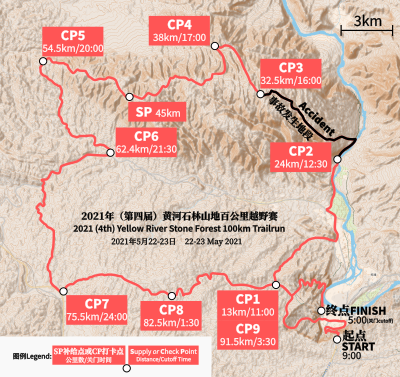
On the start line 172 participants toed the line, ahead 100km. Reports outlined cool and breezy conditions at the start. But by 1pm in the afternoon, conditions had changed considerably, and the race was hit by freezing rain, gale-force winds and dropping temperatures. With most participants somewhere between 20 and 32km, the weather continued to become more severe, runners were ill prepared and defenseless against the conditions resulting in the death of 21 souls, the main cause hypothermia.
‘The runners were racing along a very narrow mountain path at an altitude of about 2,000-3,000 meters.’
The race was halted at 2pm after messages were sent out by emergency trackers, cell phones and some runner’s posting on social media. Search and rescue efforts were put in place and somewhere between 700 and 1200 rescuers were called in to action – the exact figures vary depending on which news outlets one uses. Using state-of-the-art technology such as drones, thermal imaging, and radar, 151 runners were eventually confirmed safe despite harsh conditions and delays due to landslides.
There has been much debate, many questions asked, and a great deal of blame fired around on all media platforms. The deaths prompted outrage in China, with many questioning the preparedness of the Baiyin Municipal Committee.
In ultra-running circles, worldwide, Twitter, Facebook and other social outlets had continuing heated debates that pointed blame, questioned mandatory kit and the overall experience level of runners, and organising team. To clarify, Jing Liang was one of the poor souls to lose his life, an experienced athlete who has raced at UTMB and Hong Kong 100, so, not a novice. And the Baiyin Municipal Committee had organized previous editions of the race without problem.
“The tragedy in China has weighed on me heavily. It could have been any of us out there pushing through with the ultrarunner mindset,” said Camille Herron. “Part of being an ultra-runner is being able to trouble shoot.”
The Global Times on May 24th published an article titled Deadly cross-country race exposes hidden yet common safety problems in China’s red-hot marathon pursuit – It was an article that did not hold back.
‘While it’s the hypothermia that directly caused their death, several insiders in China’s marathon business said the organising committee should shoulder the main responsibility for failing to provide enough organisational, tactical, rescue, and security support for the event.’
It is only correct questions are asked, and without doubt there is much to learn here, not only by those who organise races but also for those who run them.
As many running friends have commented to me personally, ‘shit happens’ and sometimes you cannot plan for freak occurrences. After all, this is why they are called freak – ‘An incident, especially one that is harmful, occurring under highly unusual and unlikely circumstances.’
However, the required ‘mandatory’ equipment for the Yellow River Stone Forest 100k was at best minimal – cell phone, whistle, water container, headlamp, race bib, GPS tracker, GPX file (I assume on watch or phone) and timing chip.
A jacket, trekking poles, water, energy supplies, first aid, petroleum jelly and Buff were considered ‘recommended’ but not mandatory.
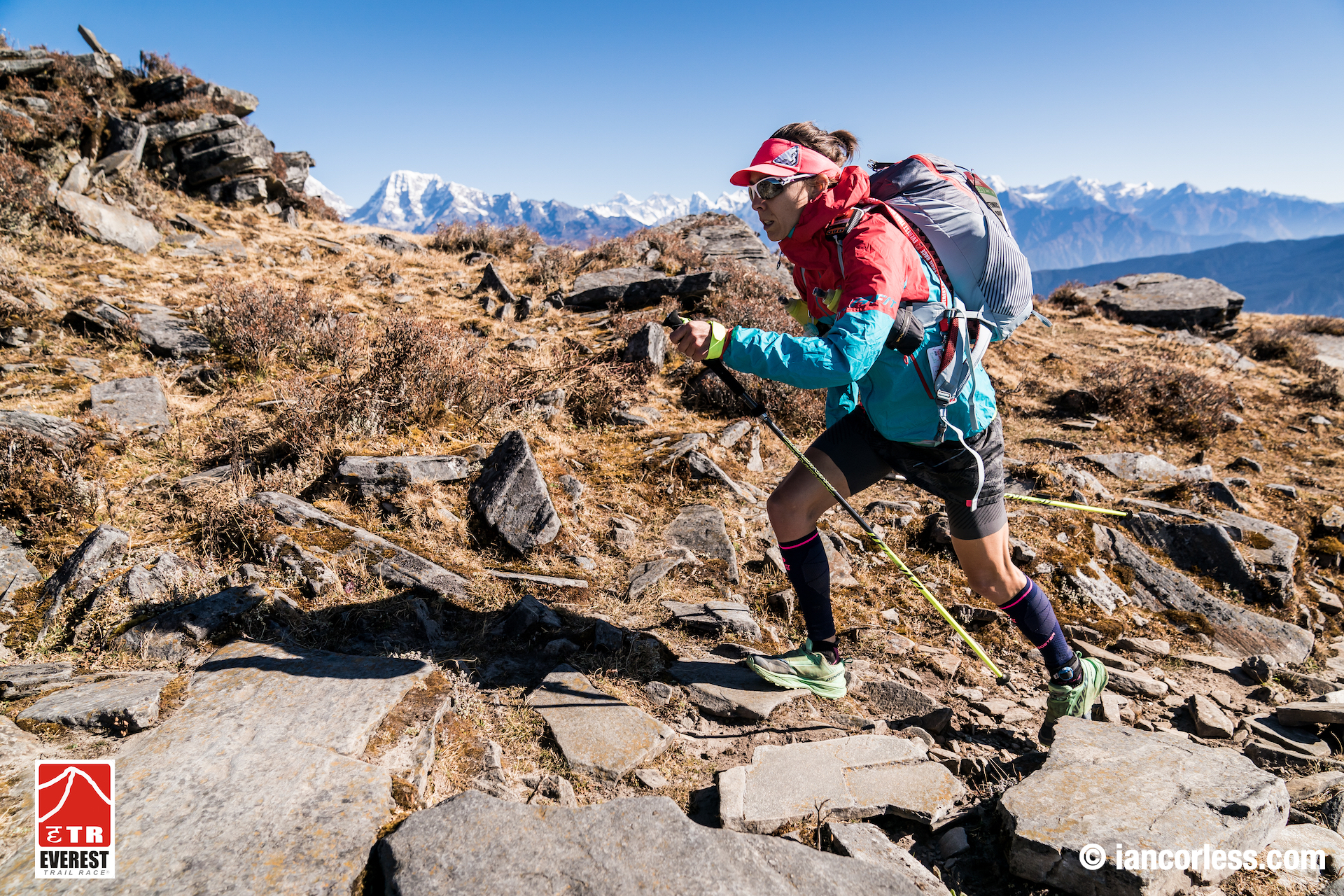
Anna Cometi at Everest Trail Race, Nepal.
It’s fair to say, that even with the ‘recommended’ items, in the freak weather encountered in China, maybe the outcome would have been no different due to the severity of the storm. However, we will never know the answer to this and at best, we should all use this as a lesson to be better prepared.
Remember though, while we tend to associate danger with cold, wet, wind, altitude, snow and ice, the opposite; heat, humidity and sun can be equally as dangerous and fatal. Take for example, The London Marathon. In 2018 the race was hit with 24-degree temperatures which caused havoc; one runner died after collapsing during the race and 73 were hospitalized. Now for some, 24 degrees may be considered a warm day, however, for many British runners who trained through a UK winter, it was exceptionally hot and something they had not trained for.
While mandatory kit is useful, being specific and training for an event is equally, if not far more important than the equipment you will or not wear. An understanding of the event, the challenges it can bring, and the dangers are all part of the process.
“It is essential to adapt yourself and your equipment to your reality, to test it during training outings in various conditions and to bring everything that will be useful and necessary to you for the race.”
UTMB
The nature of an ultra-running event is to push boundaries, go to the unknown and find a new personal level. Safety, to some extent, is an illusion and to assume that because you have entered something ‘official’ does not mean that you are safe. UTMB sum it up well (and they have a great deal of experience in managing route, runners, and weather):
“Choose clothing that really provides good protection in the mountains against cold, wind and snow, and therefore gives better safety and performance. In the event of an incident, your equipment must also allow you to wait for help in sufficient safety conditions.”
UTMB
The above sums it up for me, and quite simply I would summarize:
Know the event.
Understand yourself, your limits, and your expected time on the course.
What are your strengths and weaknesses?
Prepare and plan meticulously with training that simulates the event and conditions.
Don’t compromise.
Imagine the worst conditions possible and then plan for them to deteriorate even more. Remember, shit can happen!
Act quickly and quite simply, be prepared to turnaround and understand (in advance) what exit routes and speedy options exist.
Physically prepare so that you are in the best position possible to achieve your desired goal – be realistic.
Be mentally prepared for the highs and lows and accept that YOU are ultimately responsible for your own safety.
Understand that yes, one day, you may not return from an adventure… And to clarify, there is no guarantee on what day you will die, it could be tomorrow crossing a road, next week through illness or on the top of the mountain in a race – life is a risk we manage daily.
I personally see mandatory kit implemented to protect runners from themselves. The educated, experienced, and knowledgeable know what to bring, I most certainly do, and I usually carry far more than would be required.
However, racing does change the mindset, particularly at the elite level when every gram of additional weight could be seen as a disadvantage.
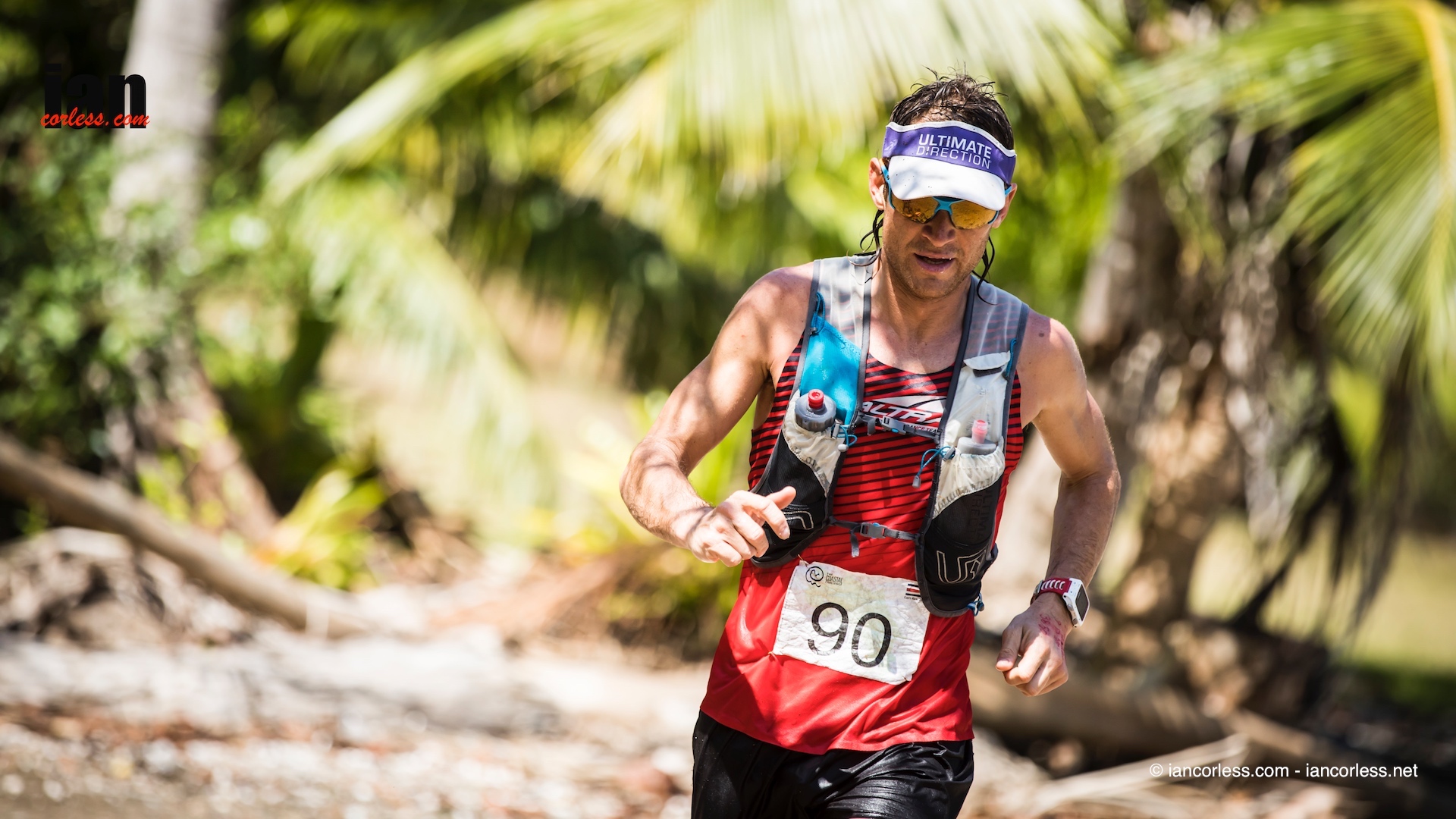
Jason Schlarb in Costa Rica at The Coastal Challenge, mandatory kit here is liquid and electrolytes.
Good friend and elite runner, Jason Schlarb posted on May 24th, ‘This sounds like something that could happen in many, many races or in my own adventures. I know I go as light as I can in races and don’t really prepare to be able to stand around in the cold… it’s a race… I’m embarrassed it took me realizing how this could totally happen to me,’
Choosing the lightest weight clothing possible to gain a few grams is not always the best option, opting for clothing which really offers good protection in the mountains against the cold, wind, and snow, provides better security and ultimately, a better performance.
Therefore, a no compromise approach to mandatory kit levels the playing field and means that every participant should be carrying the same and therefore carrying similar (+/-) additional weight. As UTMB states, ‘All runners must have the mandatory equipment with them at all times or face a penalty.’
In addition, UTMB go one-step further and have options based around kit lists for heatwaves, cold conditions and finally bad weather scenarios. They would implement the necessary list based on weather forecasts pre-race and it is the responsibility of the runner to have all items available.
Contents for ‘winter’ conditions.
Standard UTMB kit list:
Pack destined to transport obligatory equipment throughout the race.
Mobile/cell phone with international roaming allowing for its use in the three countries (load into its memory the organisation’s security numbers, keep the phone on, don’t mask your number and don’t forget to leave with the battery fully charged)
Personal beaker 15 cl minimum (bottles or flasks with lids are not accepted)
Supply of water of 1 liter minimum
2 torches in good working order with spare cells/batteries for each torch
Recommendation: 200 lumens or more for the main torch
Survival blanket of 1.40m x 2m minimum
Whistle
Self-adhesive elasticated bandage which can serve as a bandage or strapping (minimum 100 cm x 6 cm)
Food reserve, recommendation: 800kcal (2 gels + 2 energizing bars each of 65g)
Jacket with hood which will withstand bad weather in the mountains and made with a waterproof* and breathable** membrane – the jacket must, imperatively, be fitted with an integrated hood or one which is attached to the jacket by the original system designed for that purpose by the manufacturer – the seams must be sealed – the jacket must not have sections of fabric which are not waterproof, but air vents fitted by the manufacturer (under-arm, in the back), since they do not damage in any obvious way the impermeability, are accepted.
It is the runner’s responsibility to judge, with these criteria, if their jacket fits the regulations stated and so bad weather in the mountains, but, during a check, the judgment is made by the person in charge of the check or the steward.
Long-legged trousers or race leggings OR a combination of legging and socks which cover the legs completely
Cap or bandana or Buff®
Additional warm second layer: a warm second layer top with long sleeves (cotton excluded) of a weight of a minimum of 180g (men’s size medium (M))
OR the combination of a warm long-sleeved underwear (first or second layer, cotton exclude) of a minimum weight of 110g (men’s size medium (M)) and a durable water repellant (DWR protection) windproof jacket*
The wind-proof jacket does not replace the obligatory waterproof jacket, and vice versa
Hat
Warm and water-proof gloves
Waterproof over trousers
ID – passport/ID card
You may read the above and consider the list to be an overkill. I personally do not. On considerably more than one occasion, I have encountered conditions where the above was completely required. Please don’t cut corners, technically compliant does not always equate to useful.
Ultra-distance and mountain races are designed to push boundaries, but personal responsibility and self-awareness goes a long way. The above, without a doubt, can help should a situation turn badly, but ultimately, a good understanding of one’s ability is a great place to start. Maybe (?) to stand on certain start lines in the first place is already a bad decision.
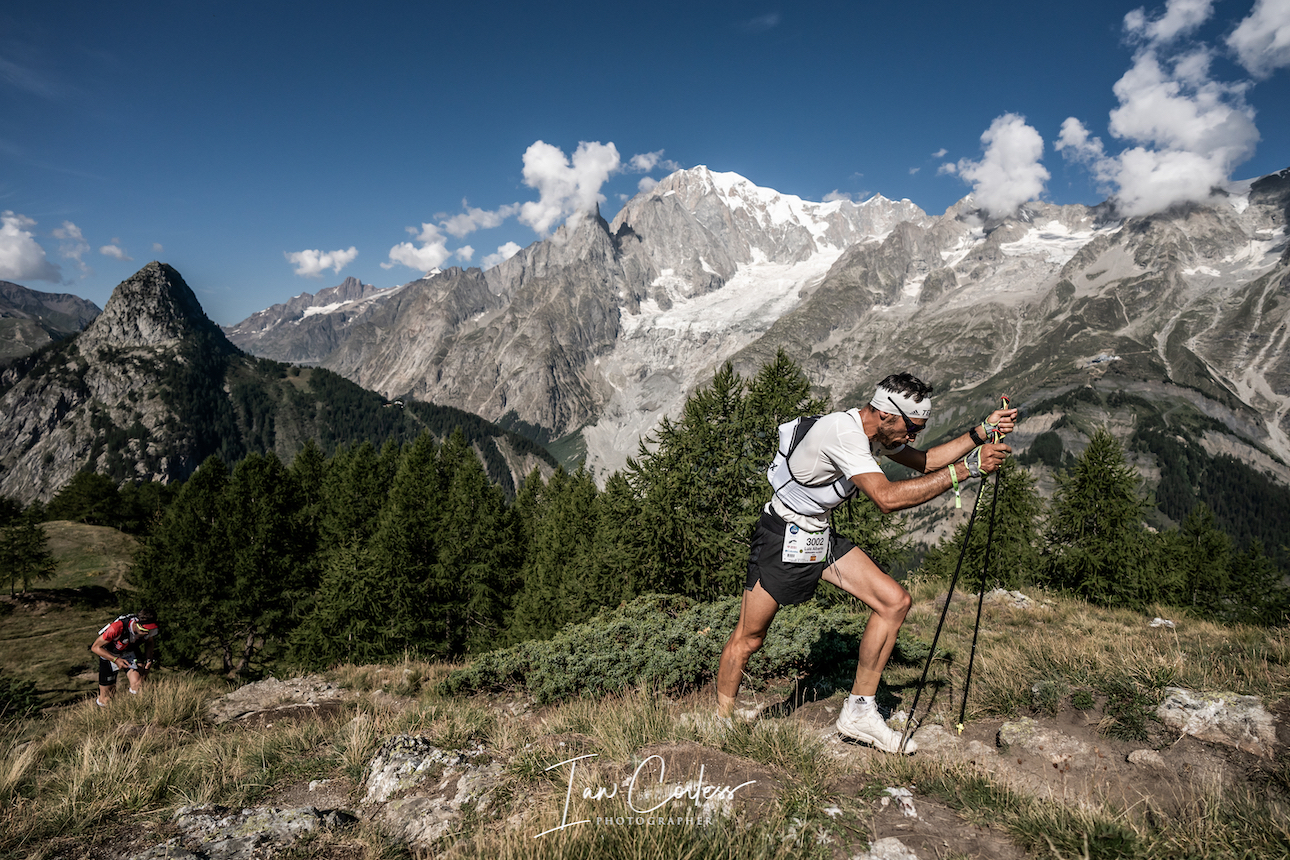
Luis Alberto Hernando at CCC
Will Gadd, a prominent Canadian ice climber, paraglider pilot and mountain guide summed his thoughts up so well in a recent article:
‘If we go into the mountains, we are taking a larger-than-daily-life risk. The only way to totally avoid that is to not go… I’ve spent decades in the mountains and have had three serious accidents in my groups in all that time. Pretty good odds, no? But, to my guest who got hit in the arm by a rock while I was guiding her, and to my partner who I dropped a rock on, that record means very little. I also reviewed the avalanche forecasting where, the next day, an amazing woman, who was very close with my family and deeply loved by hers, died. I didn’t’t think any of those outcomes would happen, but they did. I really can’t keep us—you or me—completely safe. That’s my painfully learned truth after thousands of personal and professional days in the mountains. Days sometimes end badly, even with the best practices and motivations.’
The debate will continue and there are no simple answers, but the situation in China should be a learning curve for all and wake-up to a greater understanding for race organizations and runners. Maybe we will see more in-depth mandatory kits imposed on races worldwide? Also, maybe there will be greater vetting so that races can understand if runner has the required experience to participate.
A good friend, Graham Kelly said recently, ‘I am sitting wondering where personal responsibility, vetting and experience sits in the sport we all love. I am at best mid pack these days (more often chasing cut offs). There are races I won’t enter (that I used to enjoy) knowing the burden on race staff/volunteers could be unacceptable in my mind.’
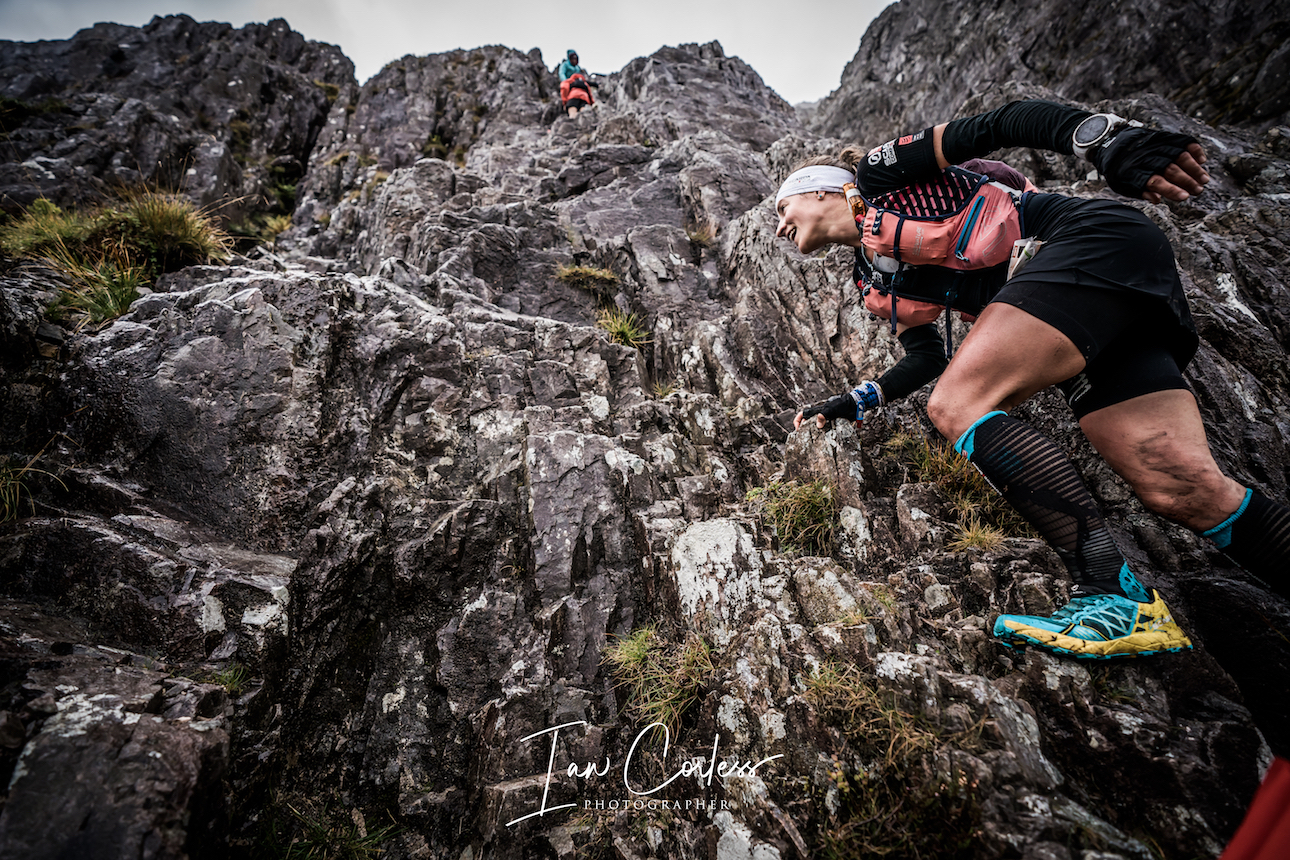
Hillary Gerardi at Glen Coe Skyline
Vetting in races of an extreme nature, such as Glencoe Skyline already happens, ‘The organisers have an obligation to ensure that the Salomon Glen Coe Skyline® is as safe as possible, but without diminishing the nature of the challenge… The nature of the challenge is very severe and there is a risk of serious injury or death whilst participating in this event… Our route features long and sustained sections of scrambling terrain, which is roughly equivalent to ‘moderate standard rock climbing’. Be under no illusions that a slip or trip on these serious sections of the route could result in death.’
In the above scenario, equipment alone is not enough, so educate, understand and asses.
I for one, like to think I am prepared for most scenarios when going out. I constantly adapt my pack and its contents for the planned adventure, terrain, anticipated conditions, and my expected time out. I also know, through bitter experience, whatever I have planned for, I can expect it all to go wrong, and I then add additional items for the ‘freak’ scenario that unfortunately our runner friends experienced at the Yellow River Stone Forest 100k. I am also never worried about turning around and going home, it can be frustrating for sure, but the trails and mountains will be there for another day.
We can try to plan for every scenario, we can educate and anticipate the worst-case scenario so that we increase not only our individual opportunity to return home but maybe those around us.
Ultimately though, shit happens, and when it does, I want to be as prepared as I possibly can be, I hope you do too.
Please support this website. I believe everyone deserves to read quality, independent and factual articles – that’s why this website is open to all. Free press has never been so vital. I hope I can keep providing independent articles with your help. Any contribution, however big or small, is so valuable to help finance regular content. Please support me on Patreon HERE.













 IAN CORLESS
