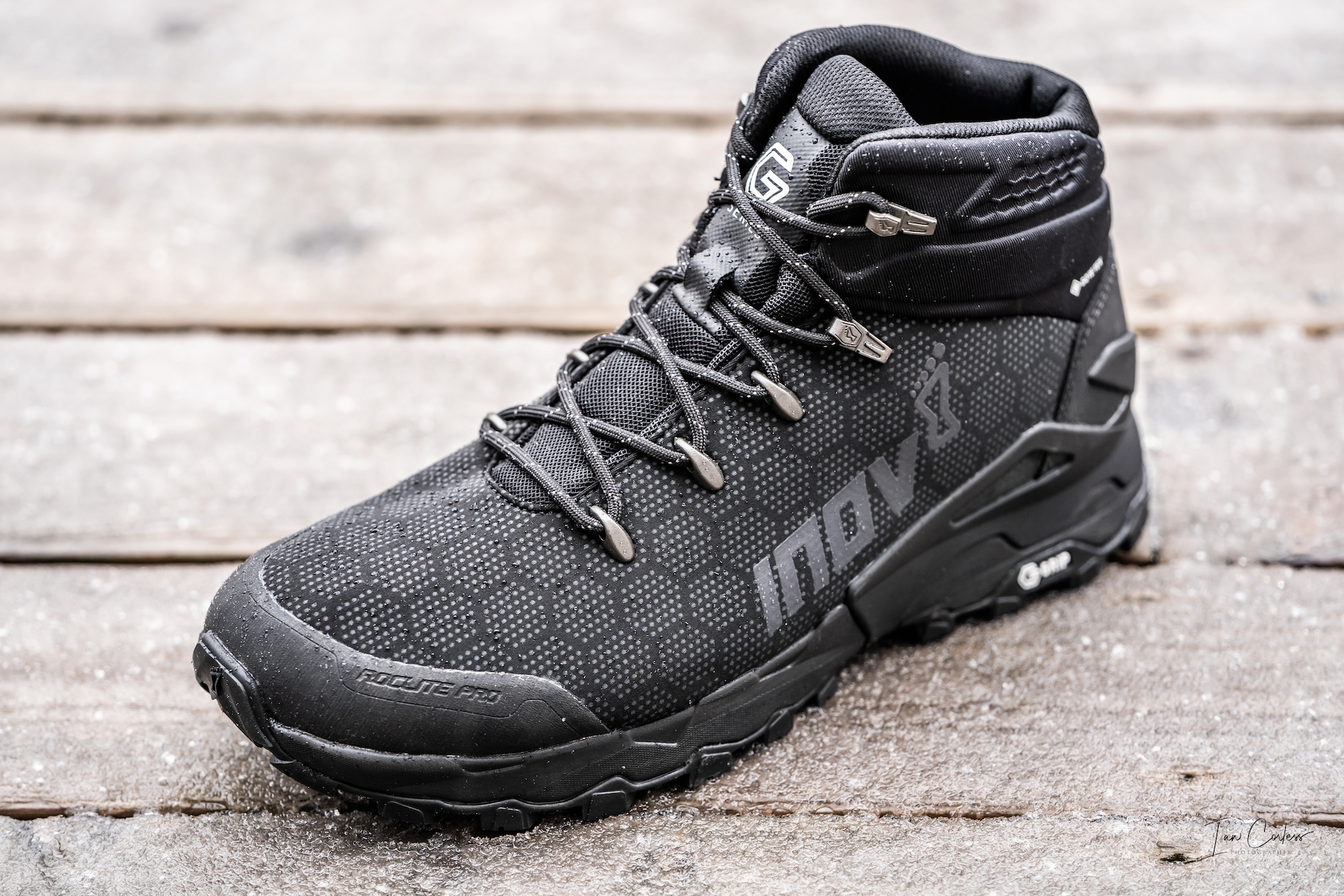
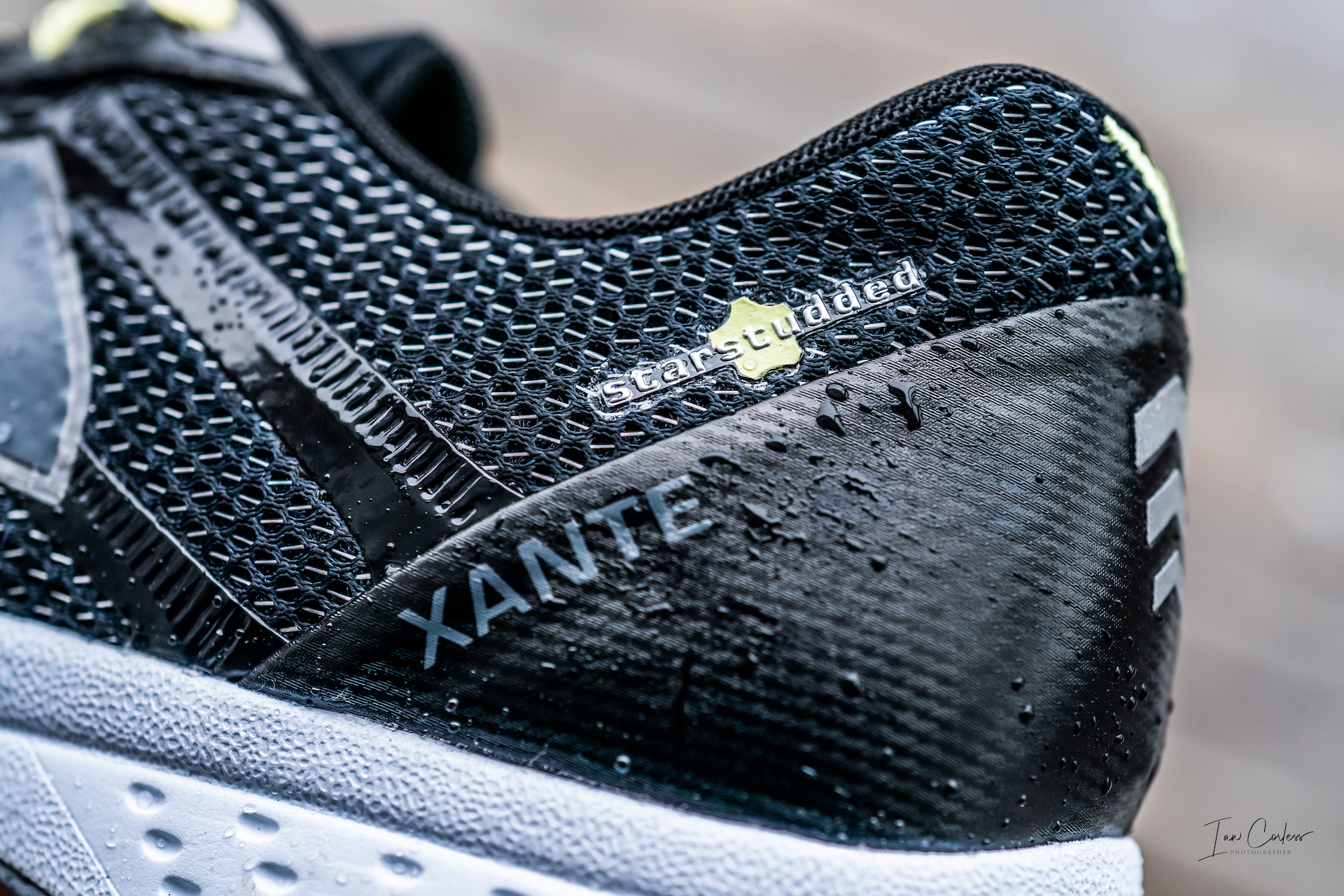
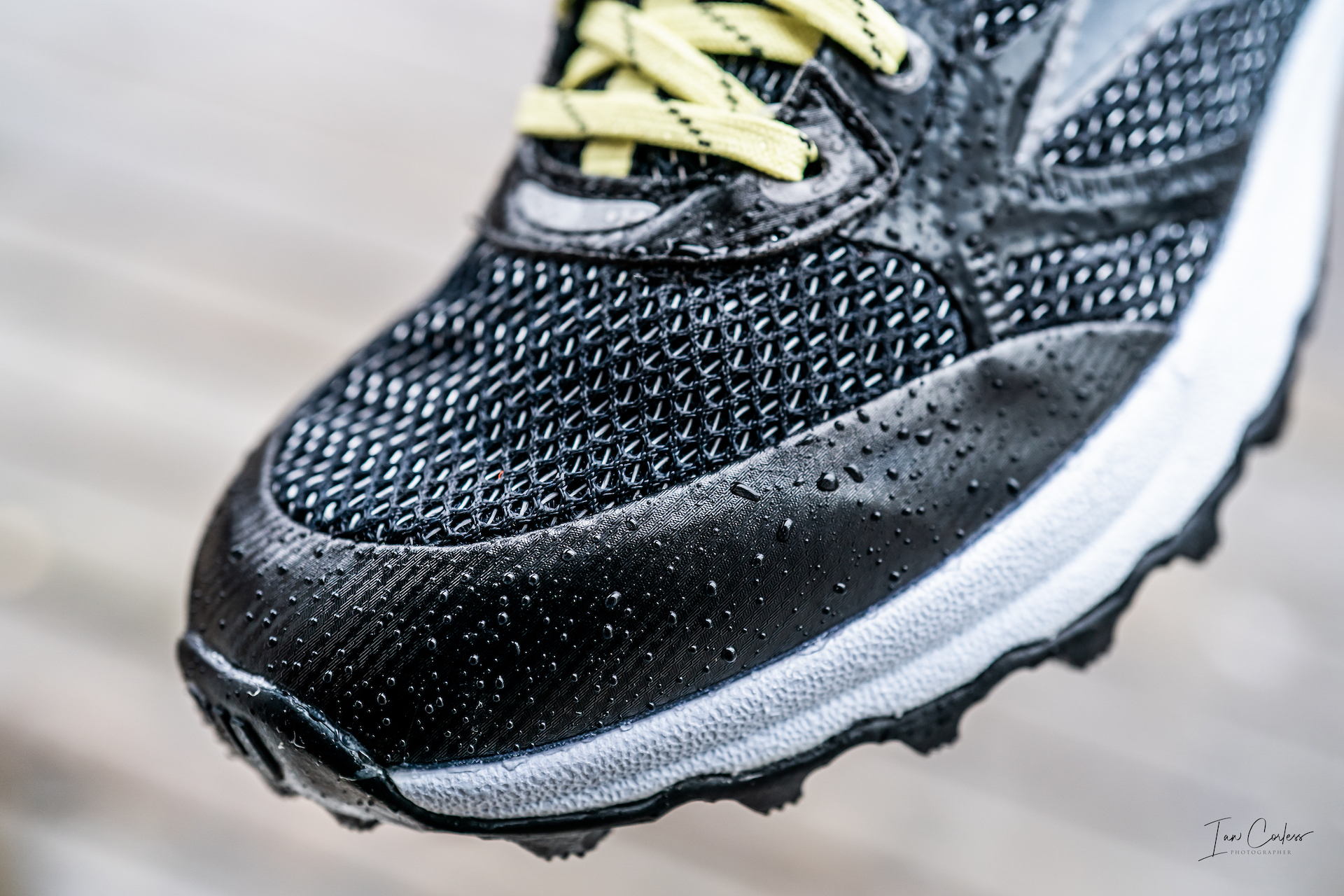
adidas Terrex Agravic Flow

The development and progress of the adidas brand in the trail running world has for many years been spearheaded by Luis Alberto Hernando, and what an ambassador he is!

Now, ‘TERREX’ is changing at an alarming rate and in the past 12 to 18-months there has been significant growth and development in shoes, apparel and athletes. Without doubt, adidas are now pushing hard in the trail and mountain world.

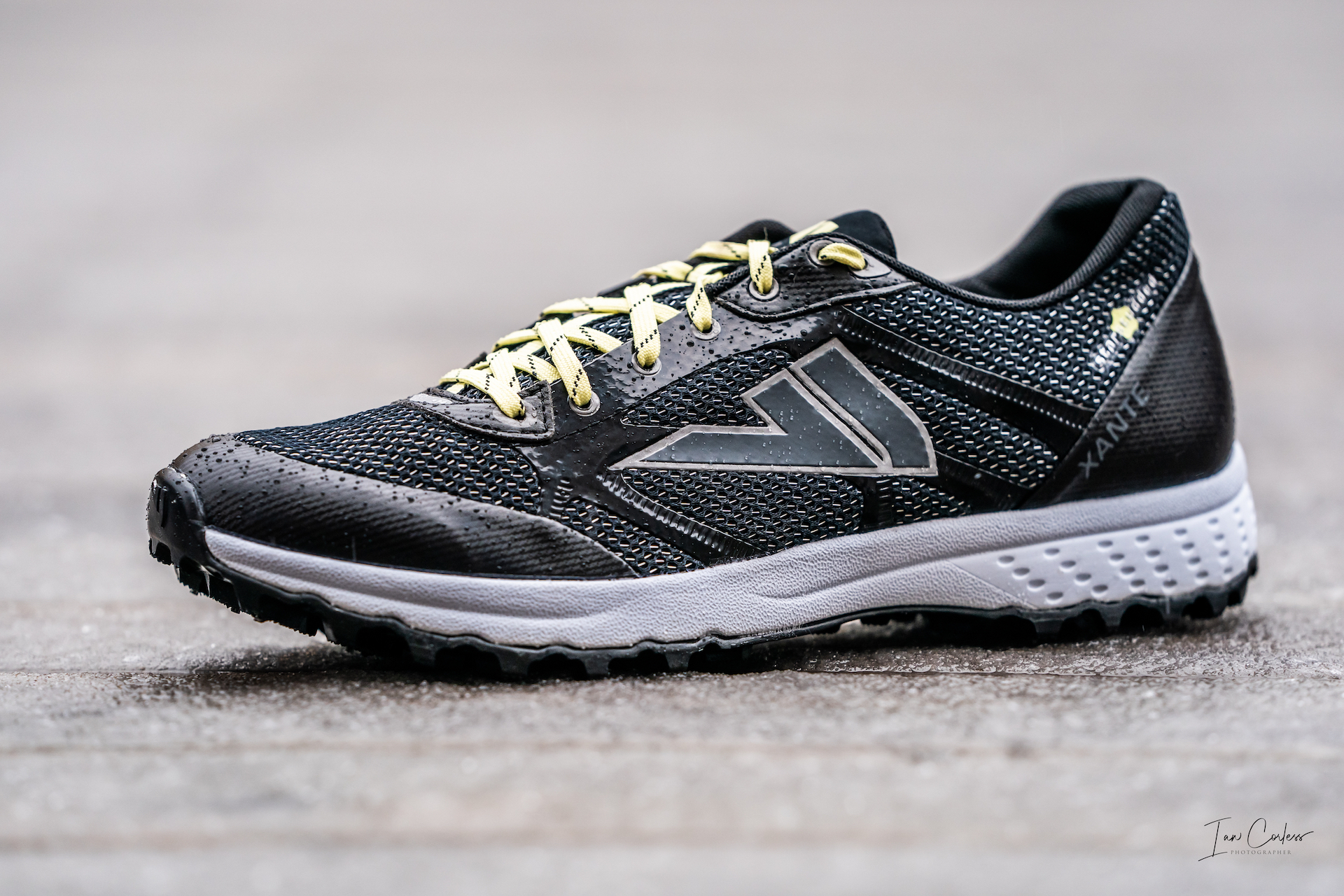
The TERREX AGRAVIC FLOW is a shoe that encompasses the road history of the brand and welcomes the development of the trail brand. The shoe clearly transitions from road to trail and back again all packaged in a really good-looking shoe. 

My pair are solar red/ core black and grey two. There is no hiding in these shoes, they are colorful!

For clarity, Adidas use three descriptive names for their shoes: SPEED, AGRAVIC and TWO.

  • SPEED offers a narrower fit and is arguably a more performance orientated shoe.
  • AGRAVIC offers a standard fit and is arguably more of an ‘everyday’ shoe.
  • TWO offers a wider fit and more cushioning for longer trail days. 

The TERREX AGRAVIC FLOW falls into the everyday category and adidas confirm, Pavement to trail and back, your feet stay cool and the transitions are seamless with a smooth roll-off and fresh energy in every stride. Foot-hugging support and sure-footed grip let you move across rocky, rooted terrain, wet or dry. I often do not like the way a brand tries to sell a shoe in a sentence or two, but I have to say, adidas sum up the Agravic Flow well in this description. 

THE SHOE

Billed as a regular fit shoe, I have to say, to me, it feels a little wider in the toe box than many other regular fit shoes. So, keep that in mind when looking at them and trying them on. I also personally feel that they size a little larger. I always use a UK9.5 but have found a Uk9 to be far more preferable with the Agravic Flow.

With 15mm cushioning at the front and 22mm at the rear, the shoe is a cushioned ride without compromising feel for the ground and the 7mm drop fits perfectly for an everyday shoe ensuring that a day on the trail will be relaxed and comfortable.

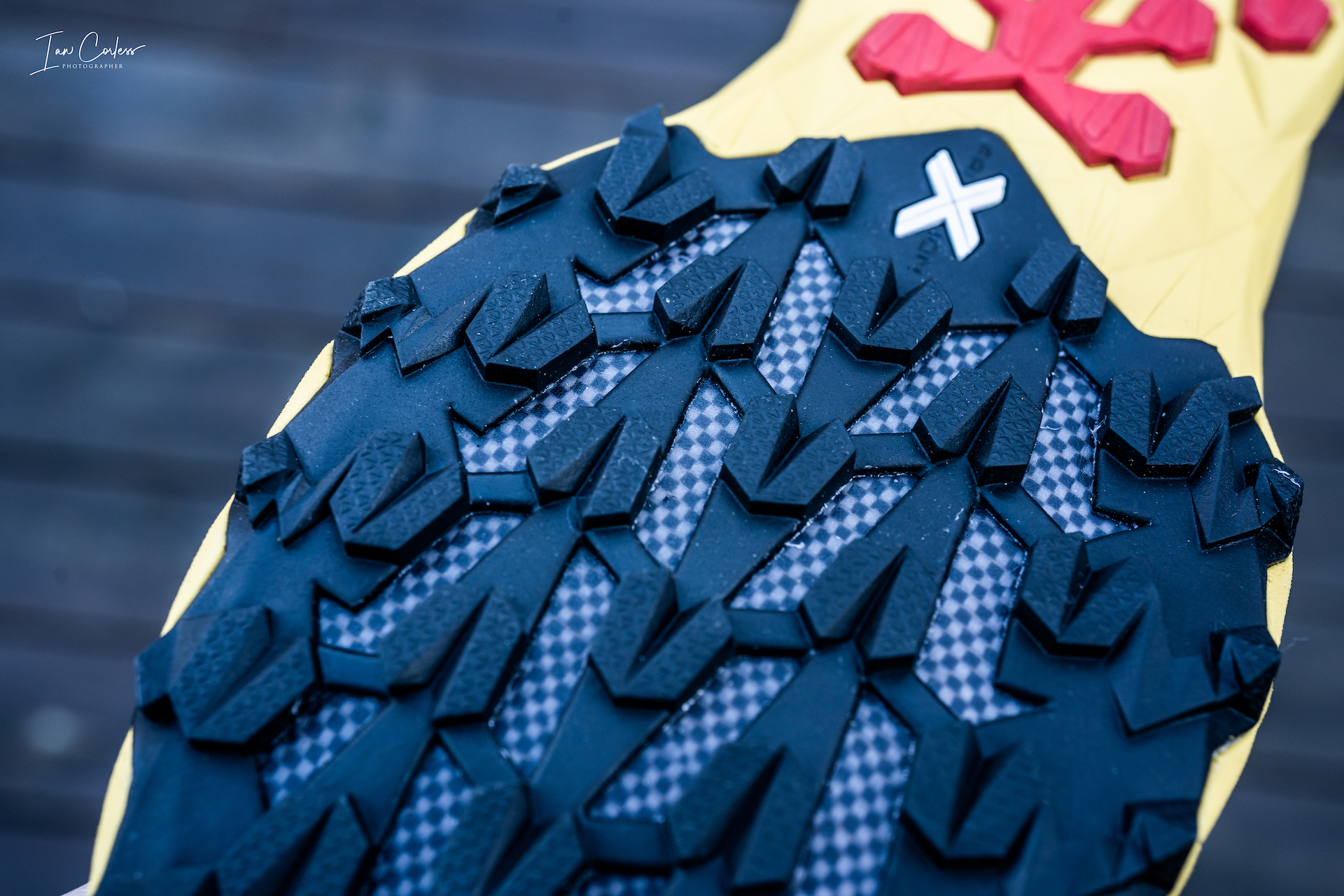
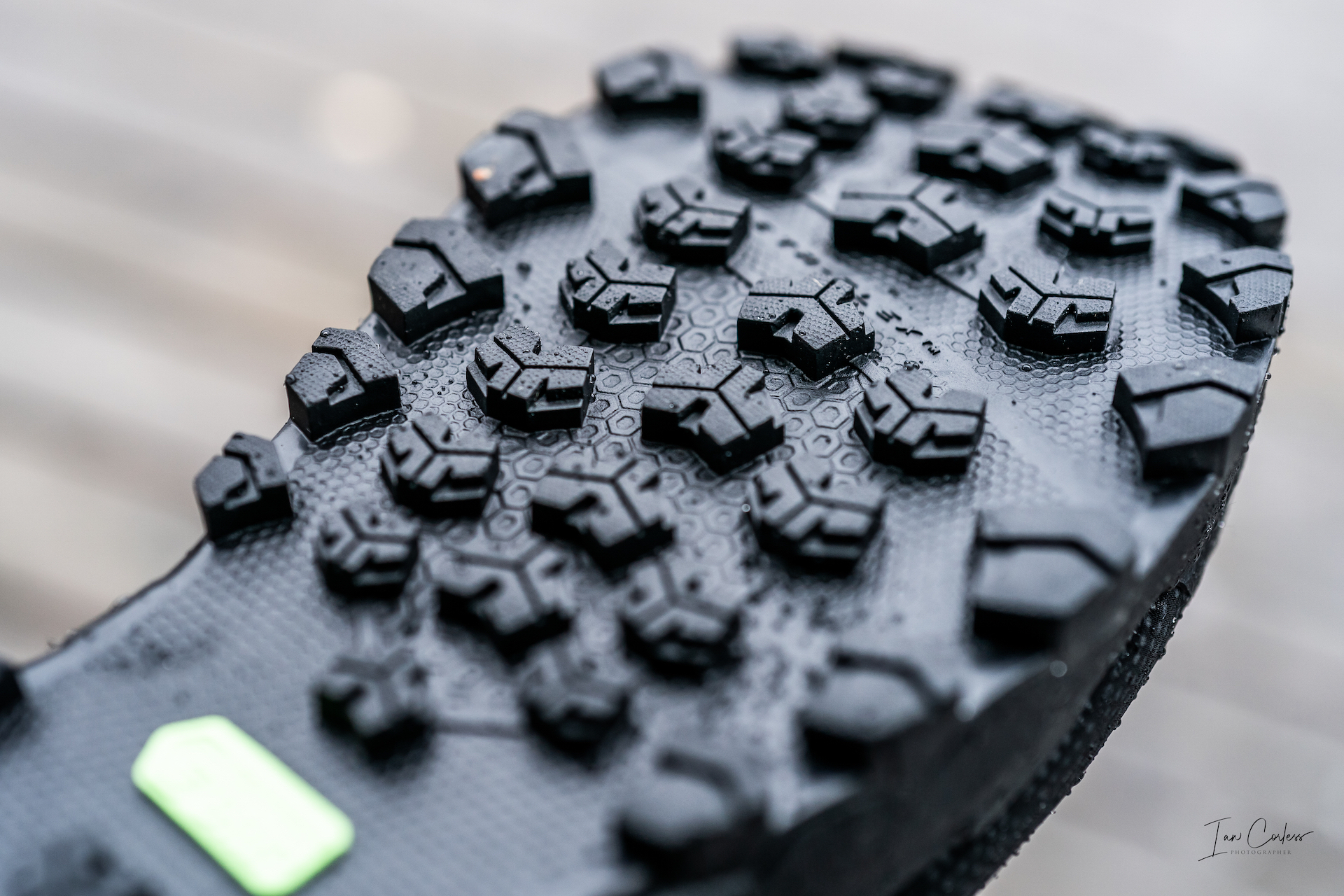
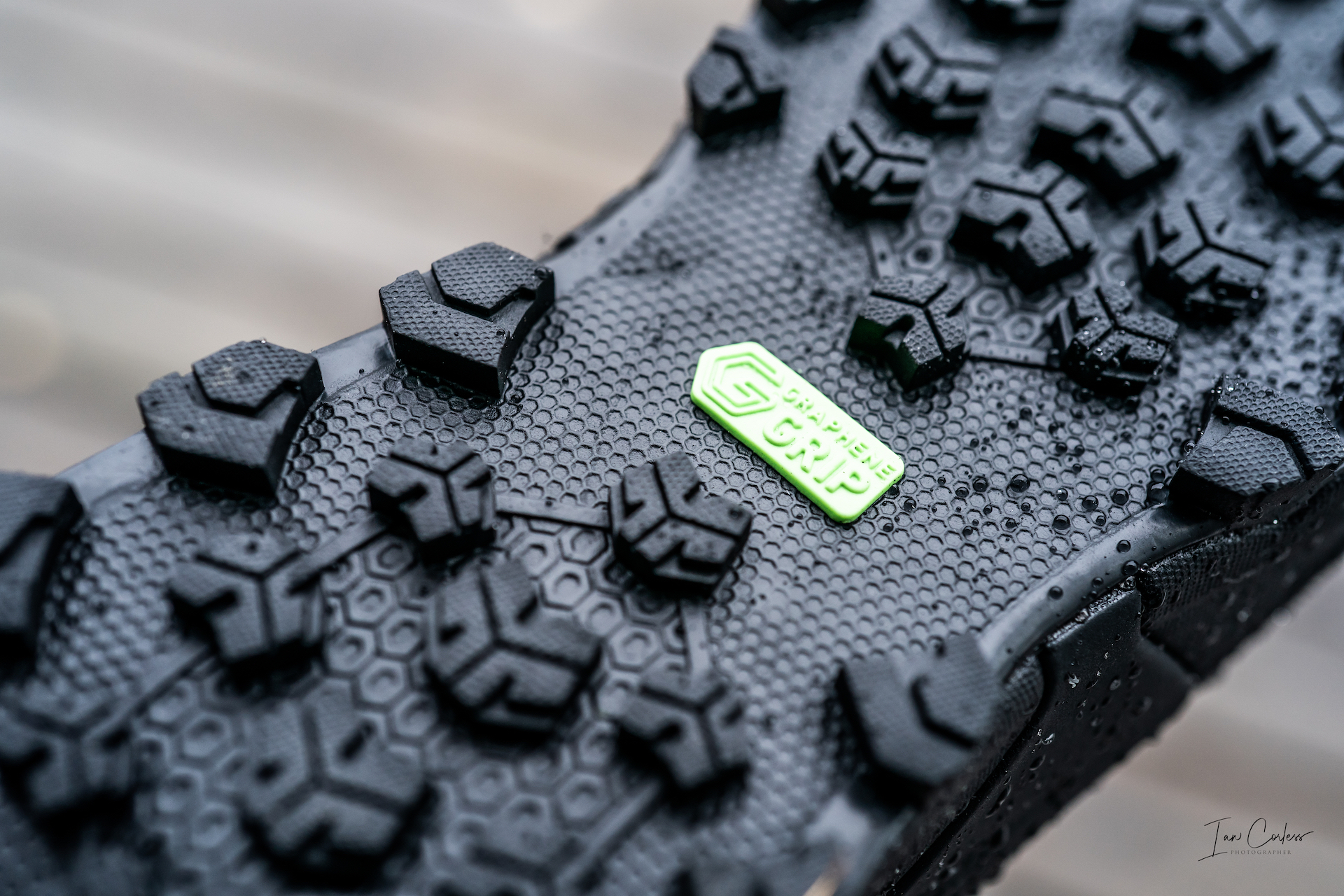
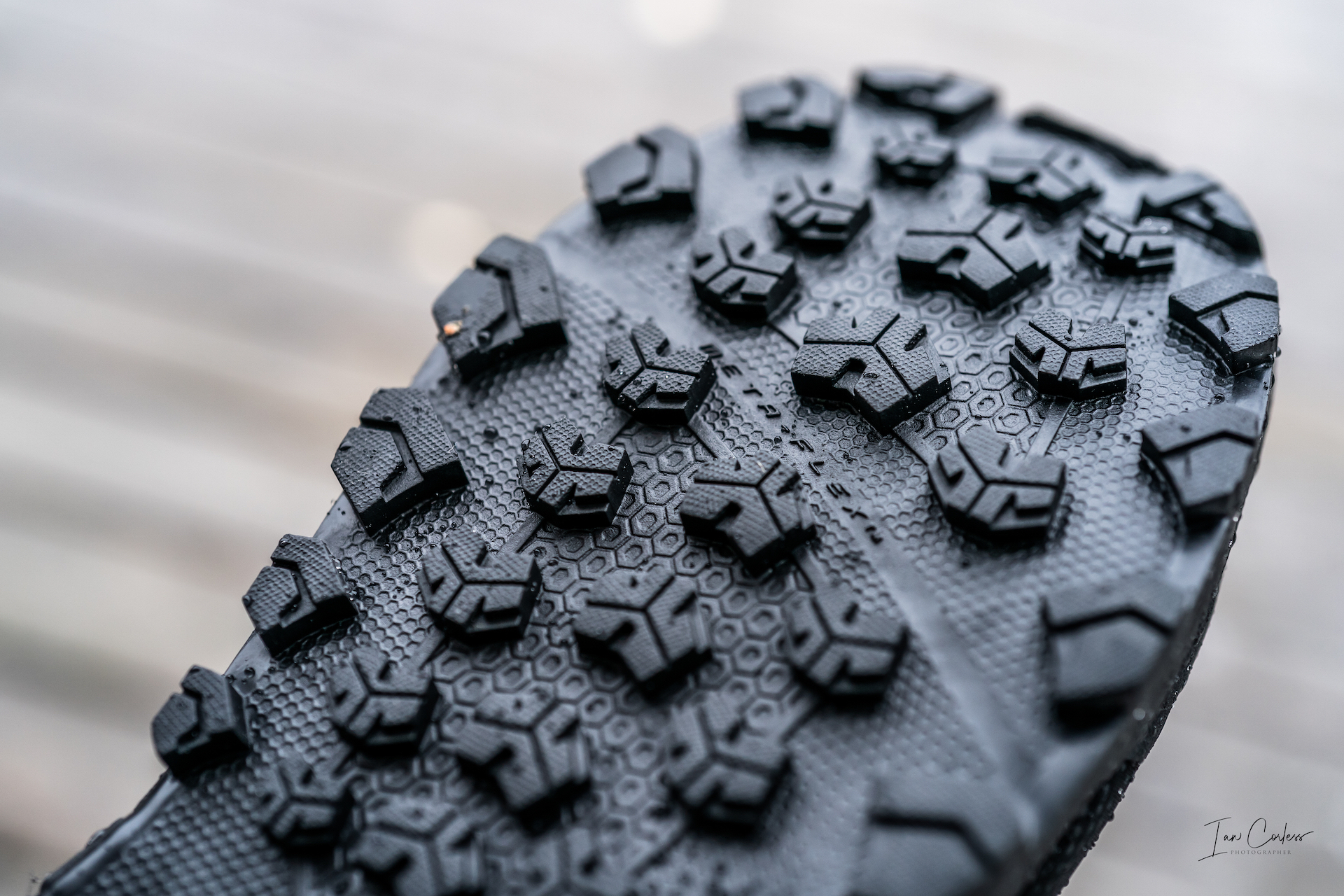
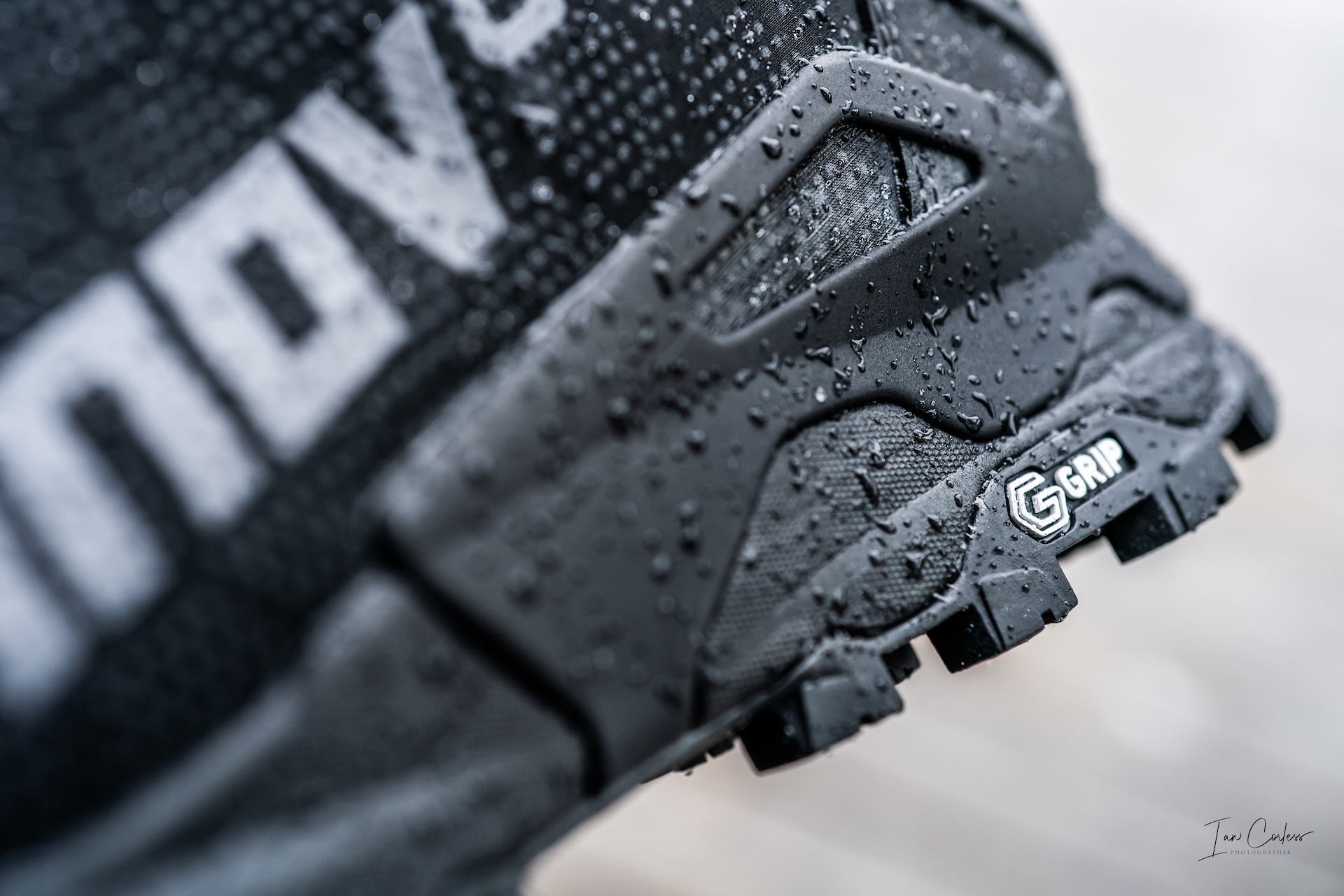
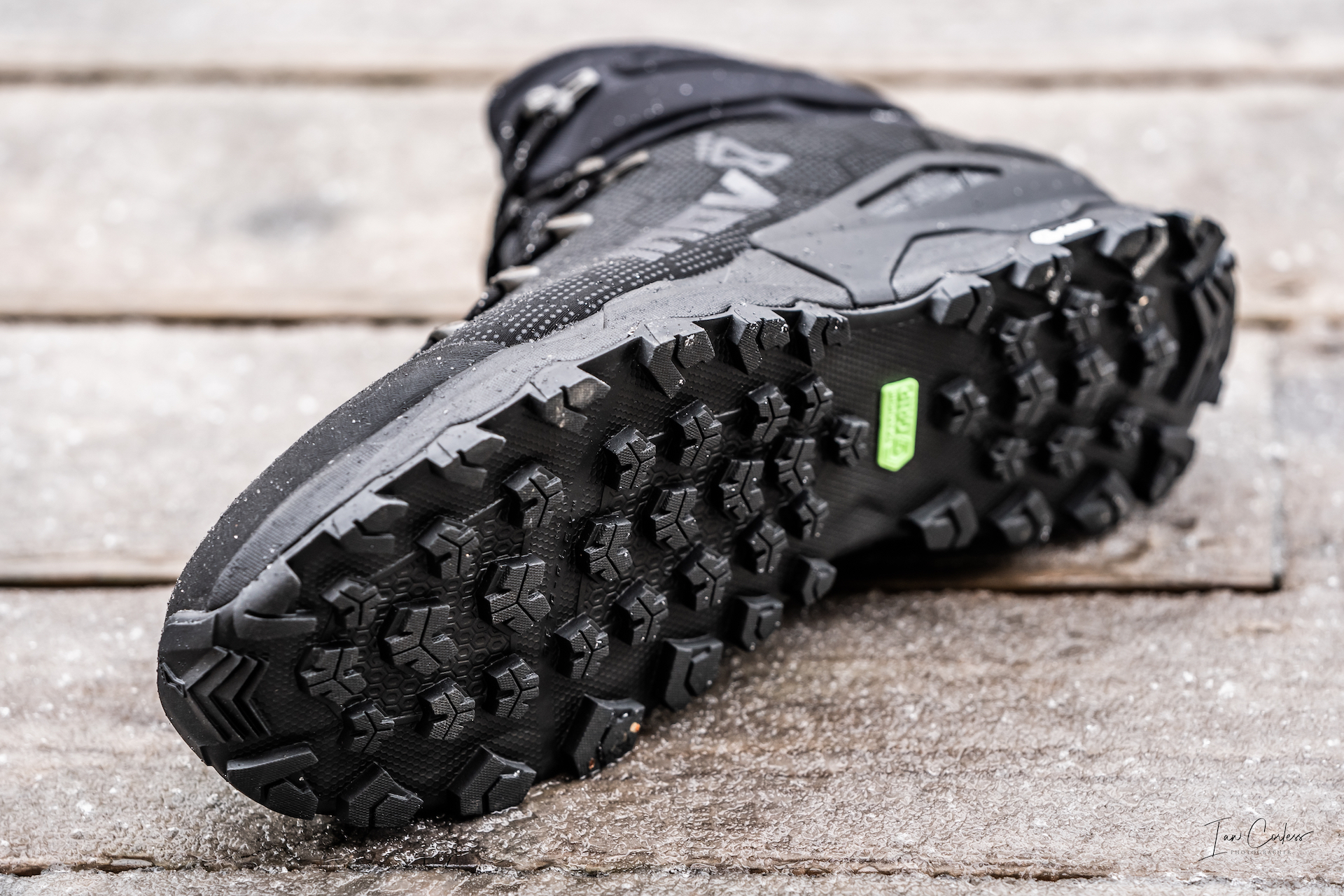
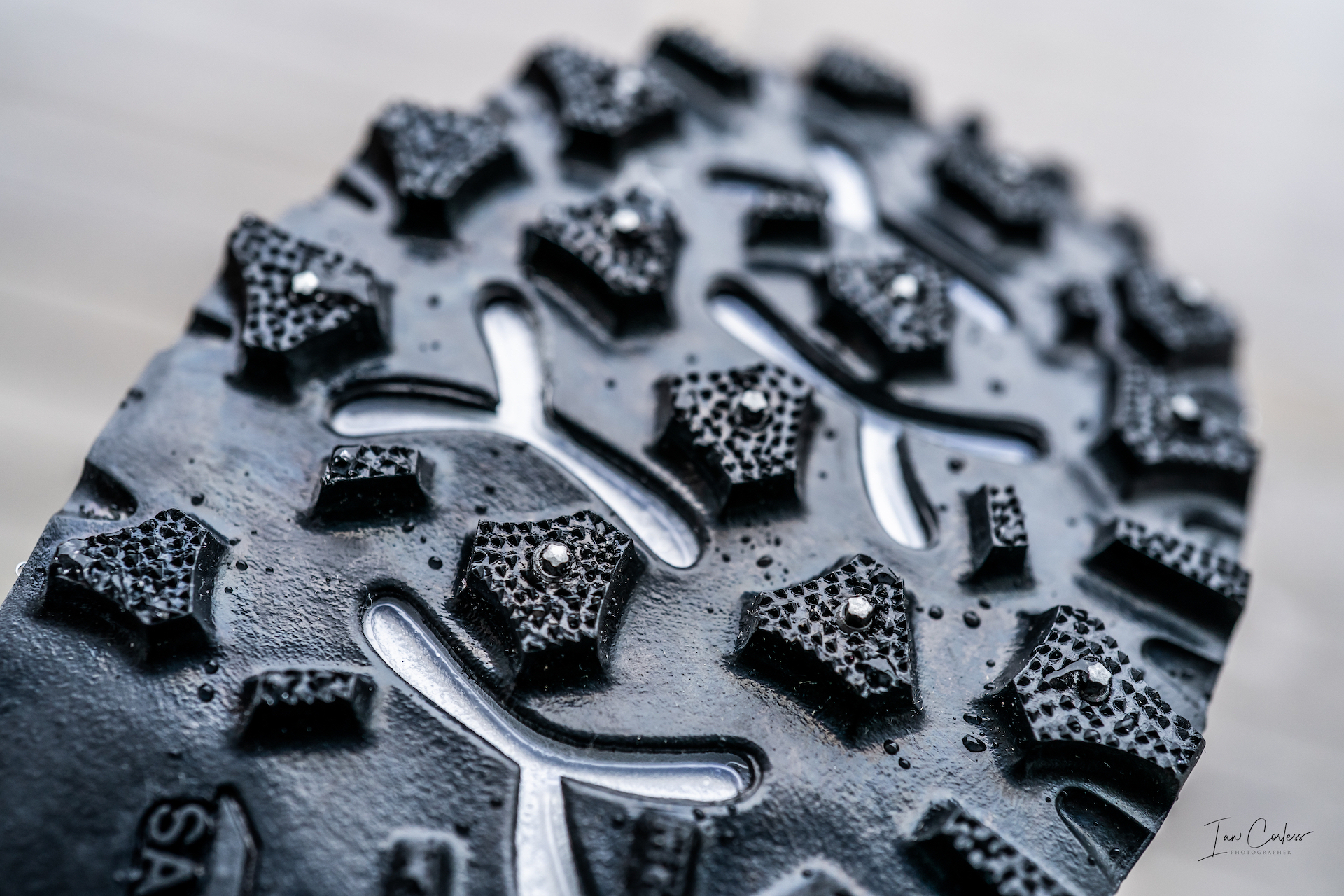
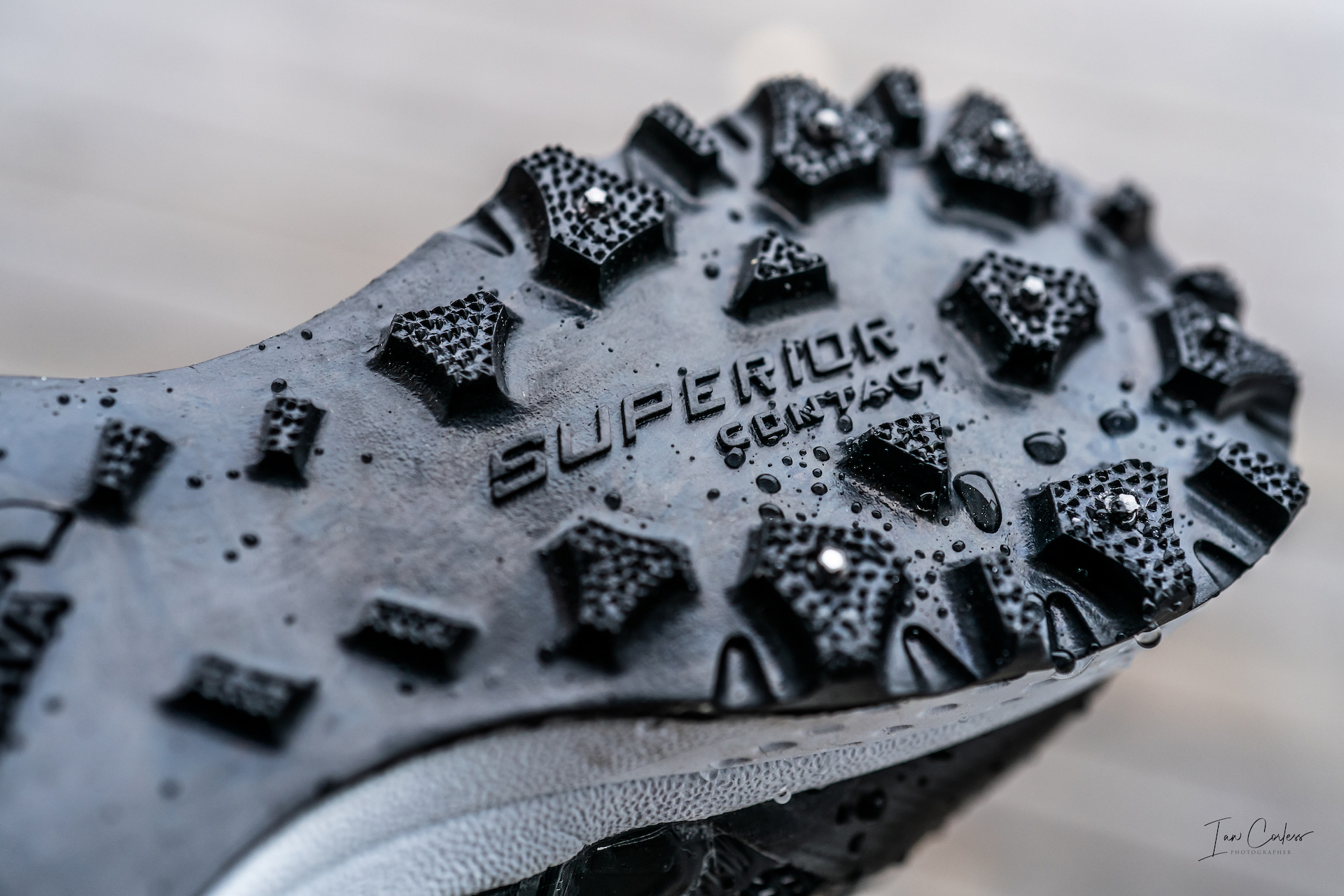
The outsole is by Continental and the German brand really do know how to make a grippy outsole. With 3mm lugs, the Agravic Flow is never going to cut it when the trail gets sloppy and/ or muddy. However, on hard pack trail the grip is superb. On rock, wet or dry, grip also excellent and importantly it gives a real feeling of confidence which allows you to run without hindrance. The transition to road is seamless and comfortable, no doubt contributed too with the BOOST cushioning.

 Cushioning comes from BOOST technology and you really feel the comfort as soon as you put the shoes on. There is also EVA in the frame to reduce weight and this in turn, provides some stability. If you have not used a BOOST shoe before, give them a go, the energy return and comfort levels are excellent.

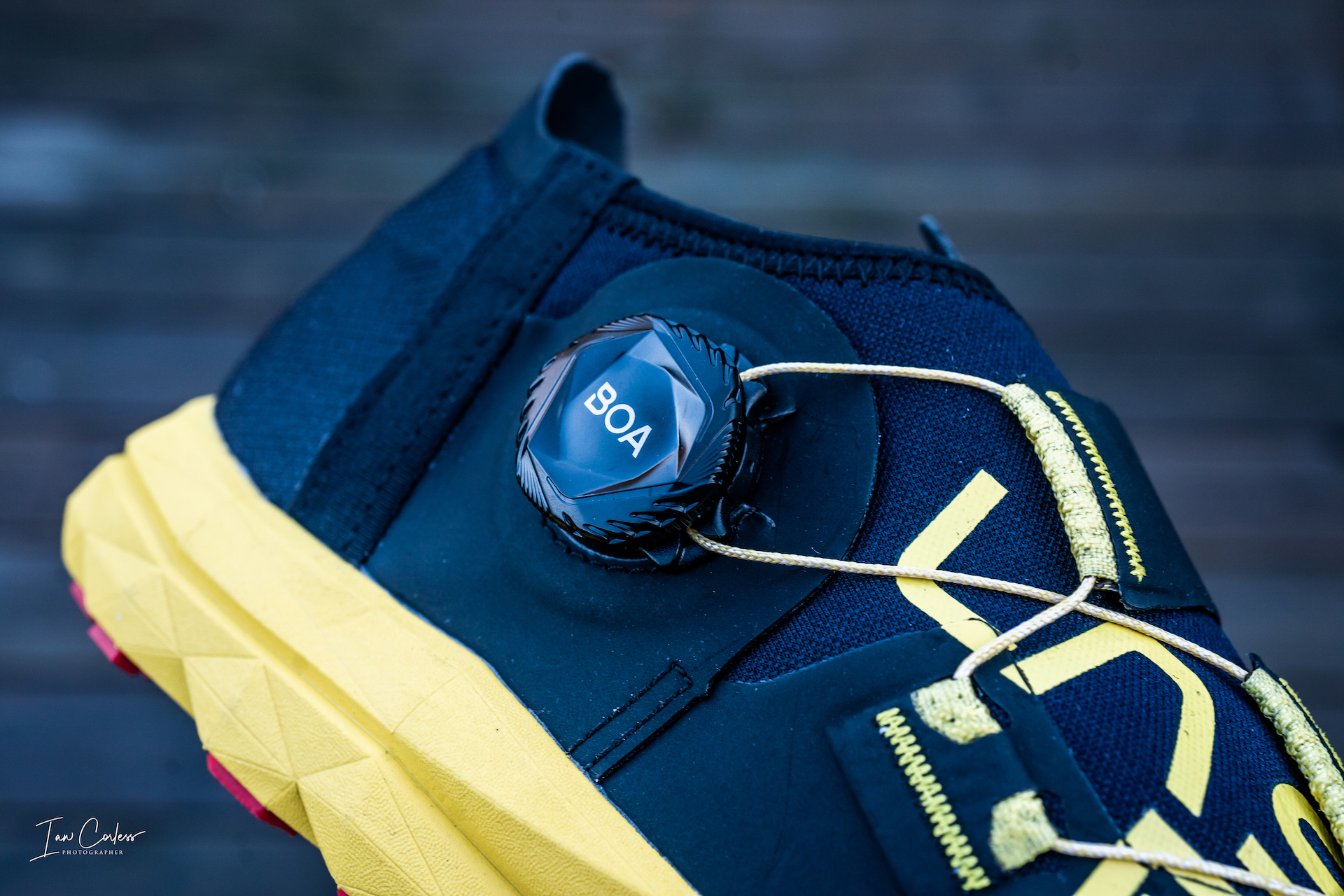
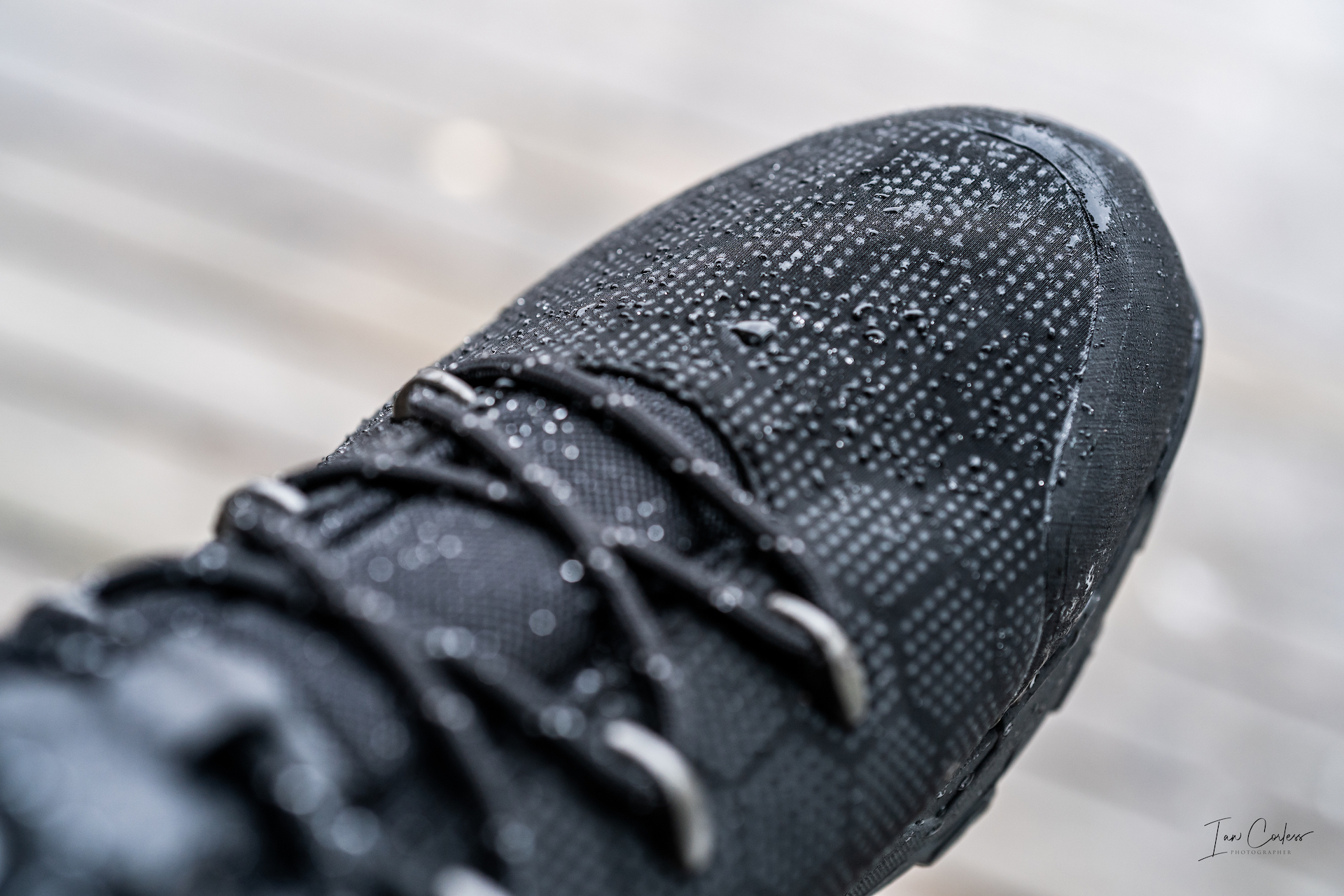
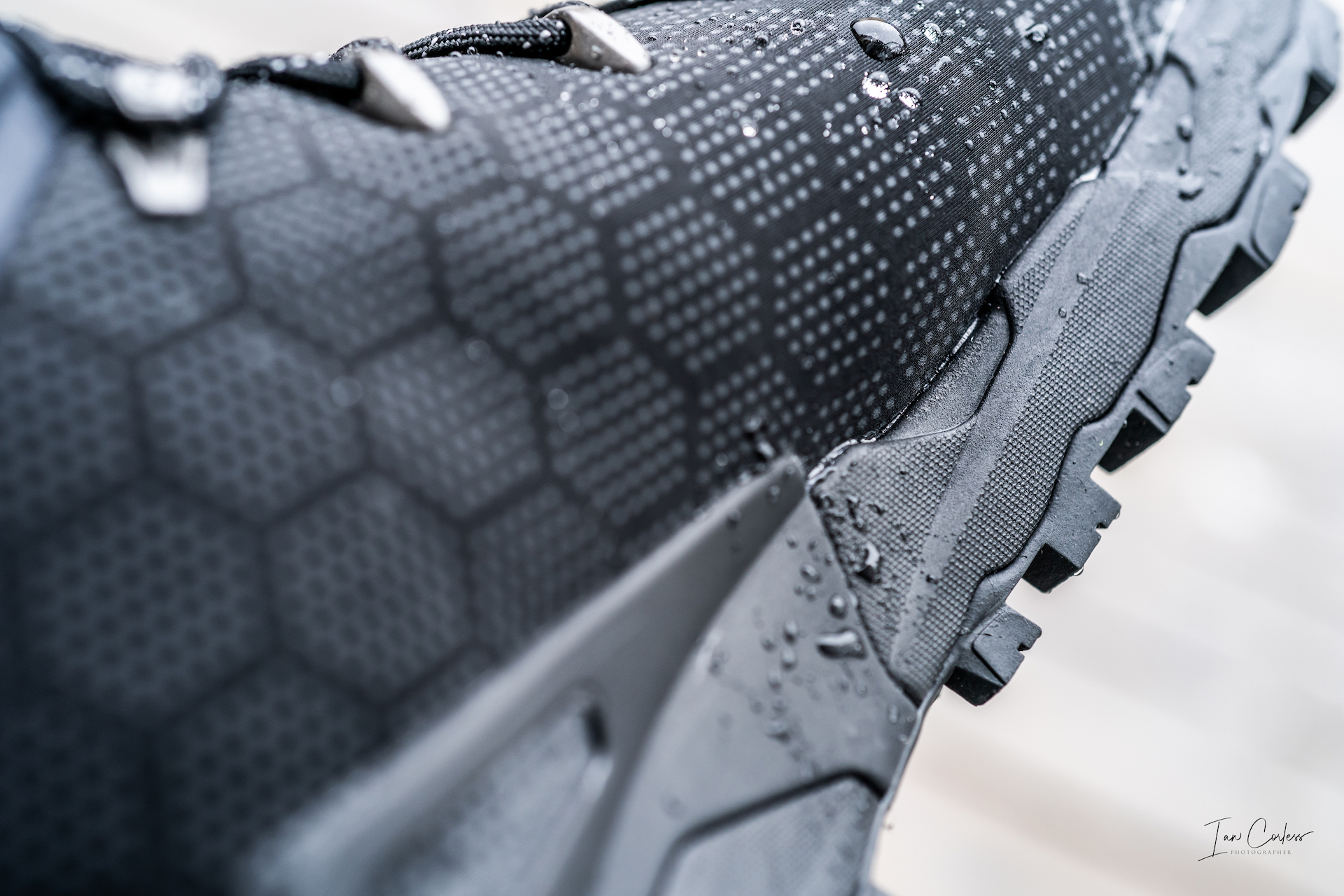
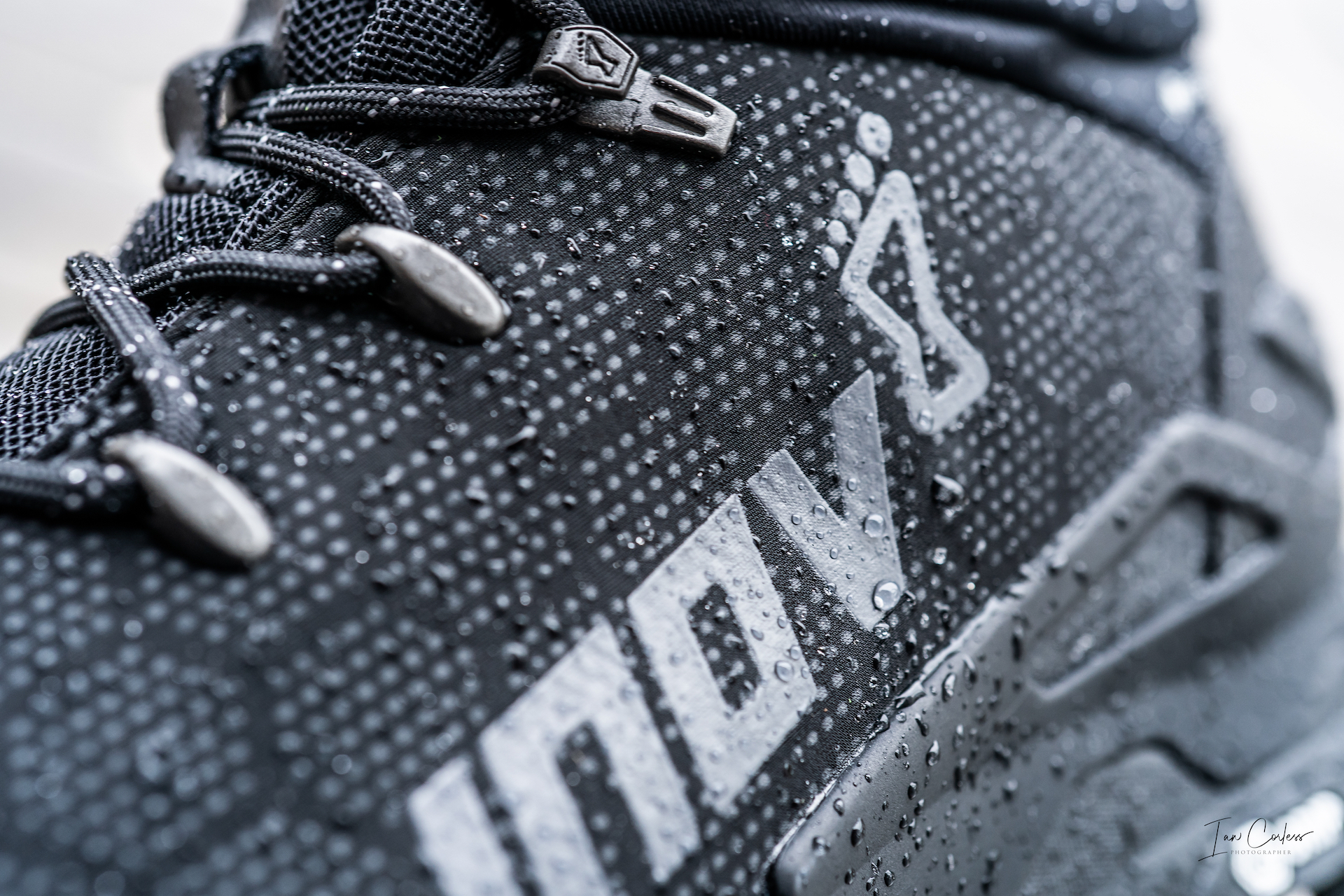
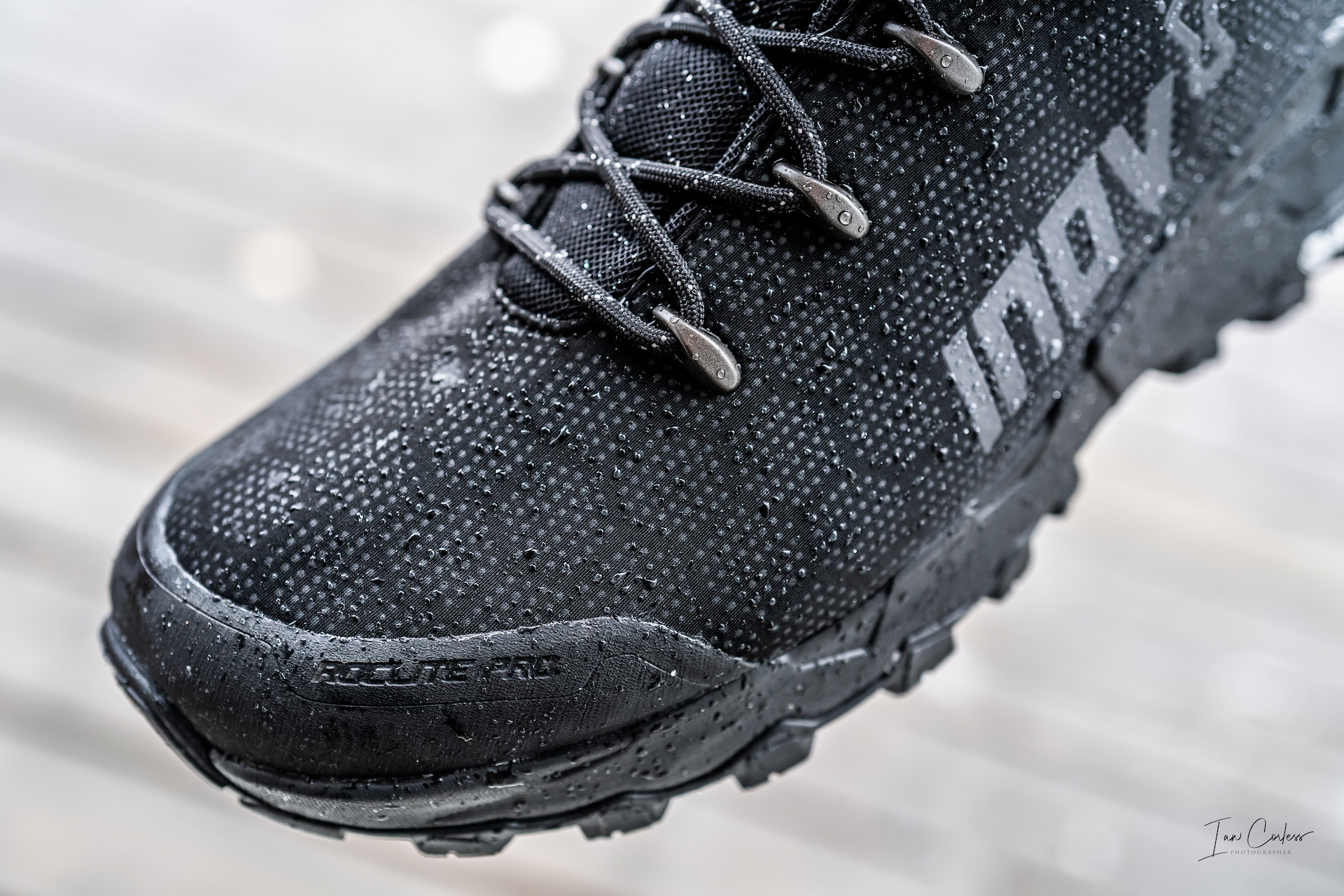
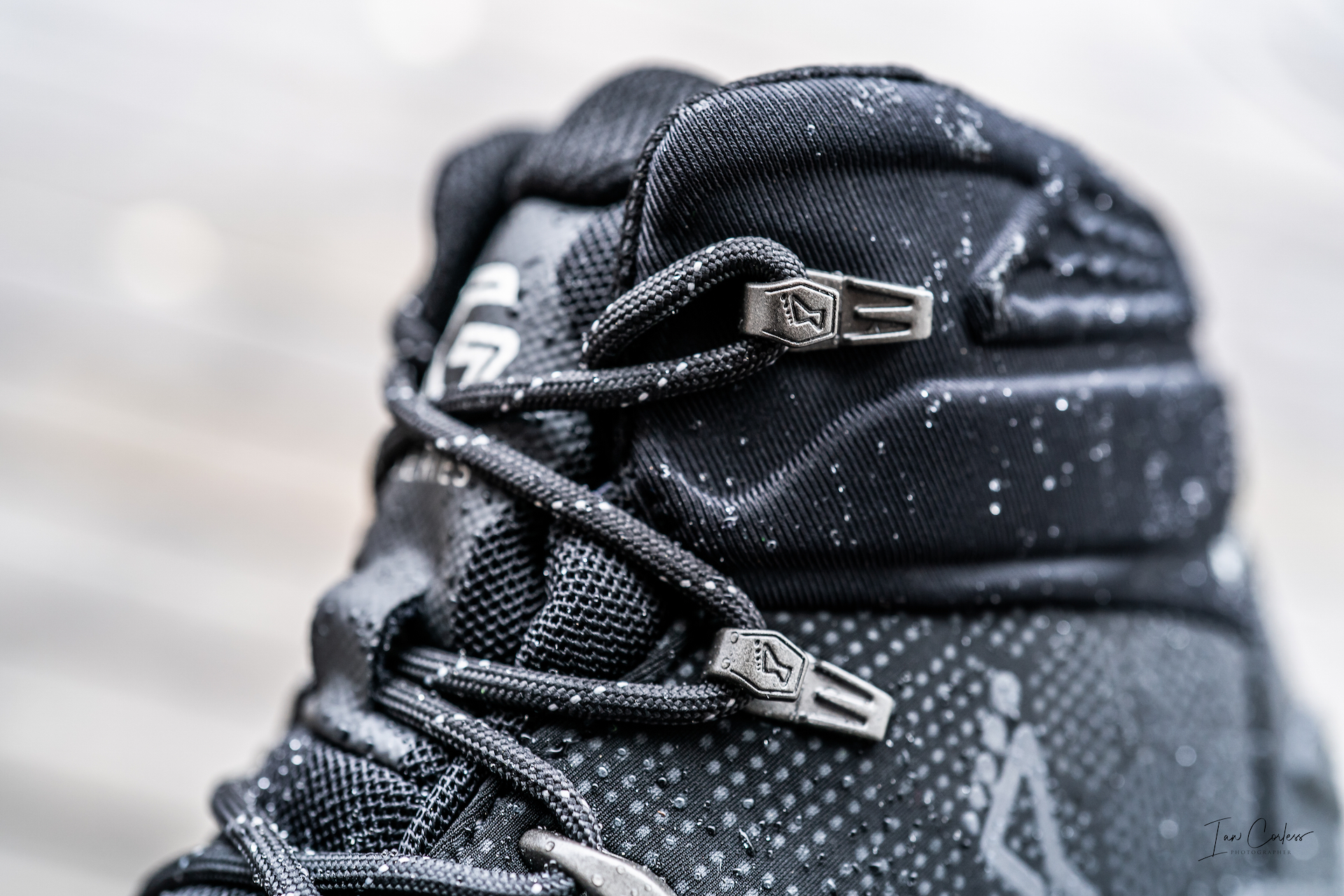
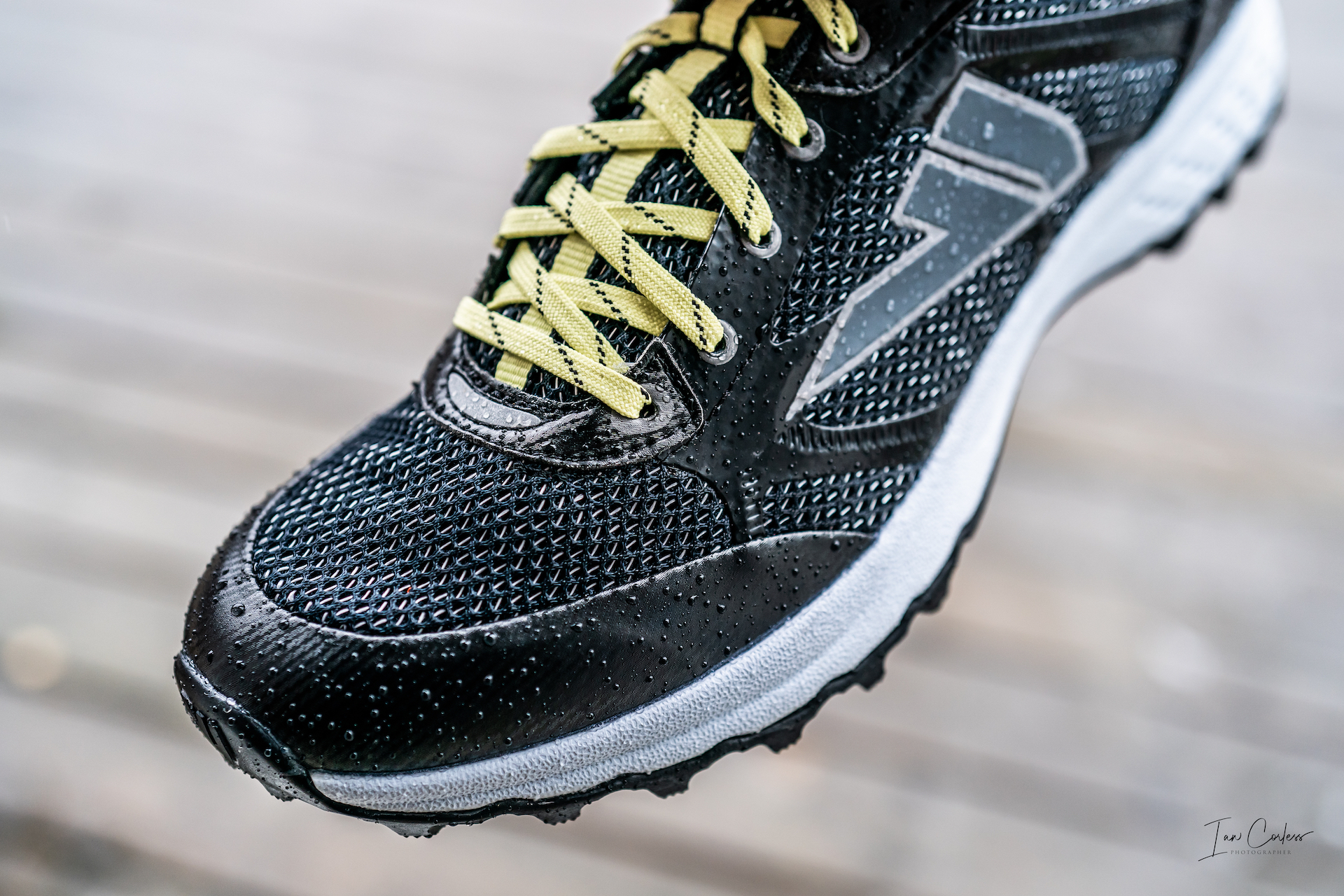
The upper is one the stars of the Agravic Flow, it is mesh with abrasion resistant welding. It is seamless and uses a sock-like construction. If you have read my shoe reviews before, you will know I love sock-like construction and the same applies here for the Agravic Flow. You slide your foot in and immediately it feels snug. You could, if you should wish too, use the shoe without socks?

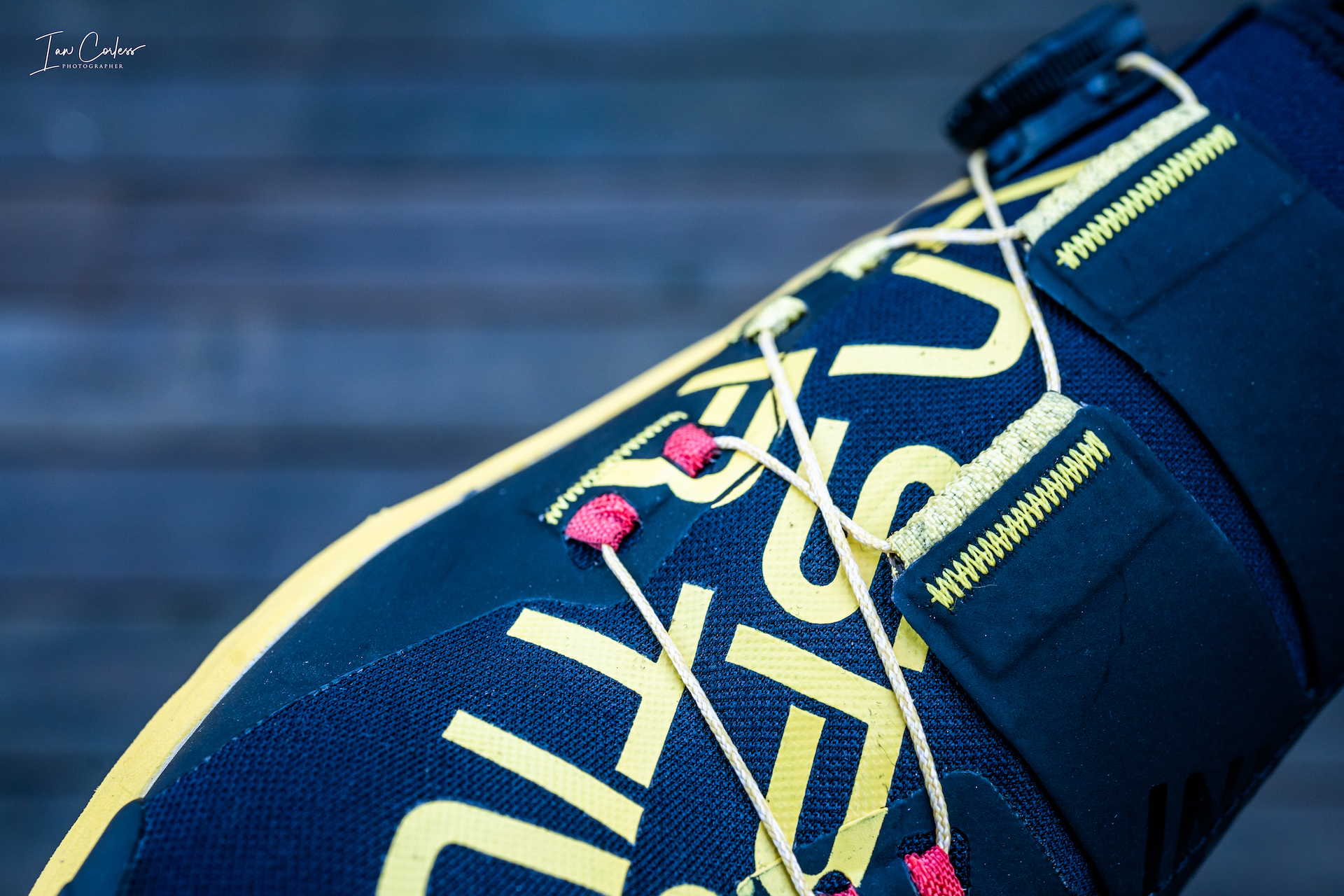
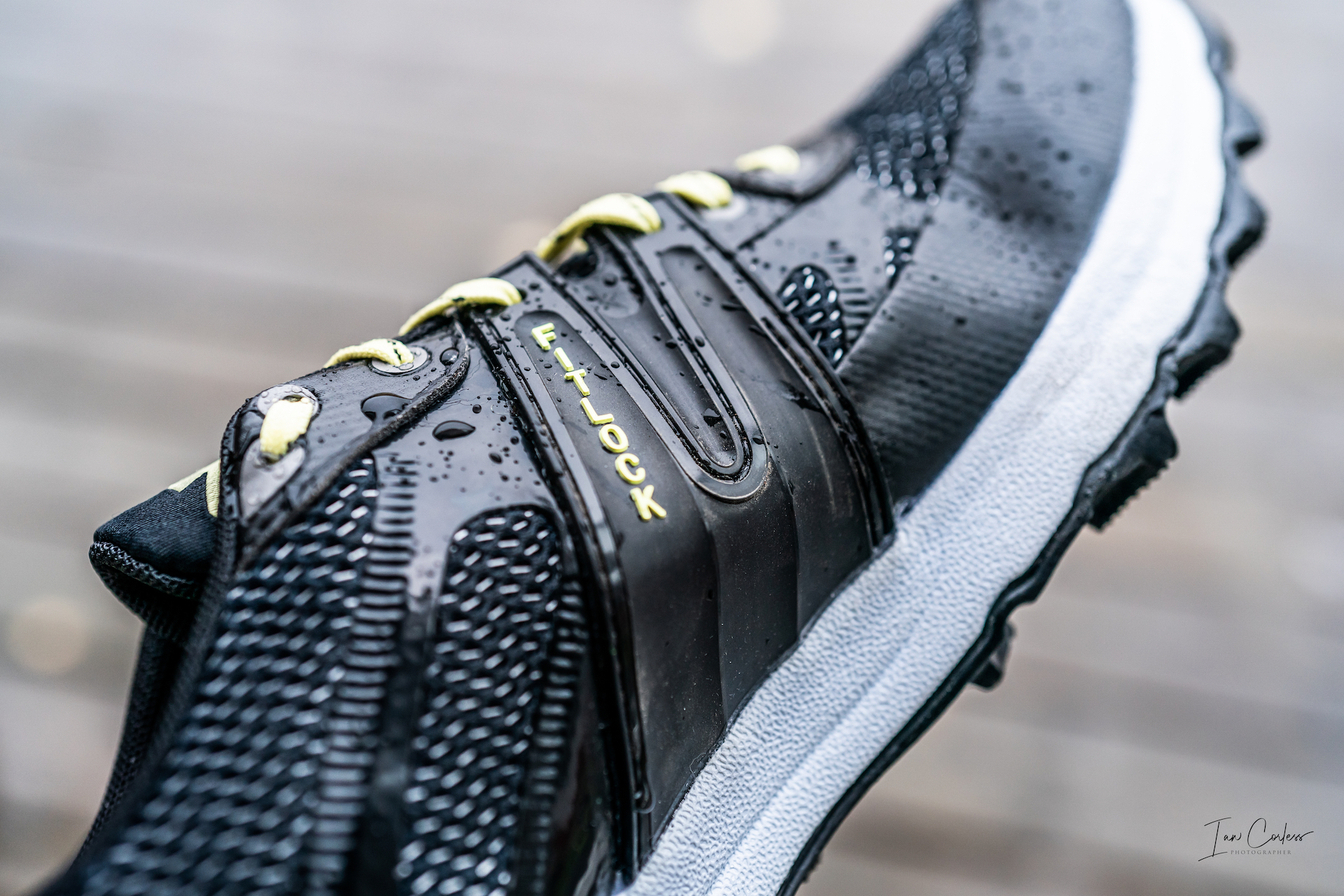
The laces sit on top of the upper and are sewn in offering 5 eyelets on either side, the middle eyelet set back allowing on option to loosen or add more tightness to the upper when fastening. There is no option lock-lace as there is only one eyelet.

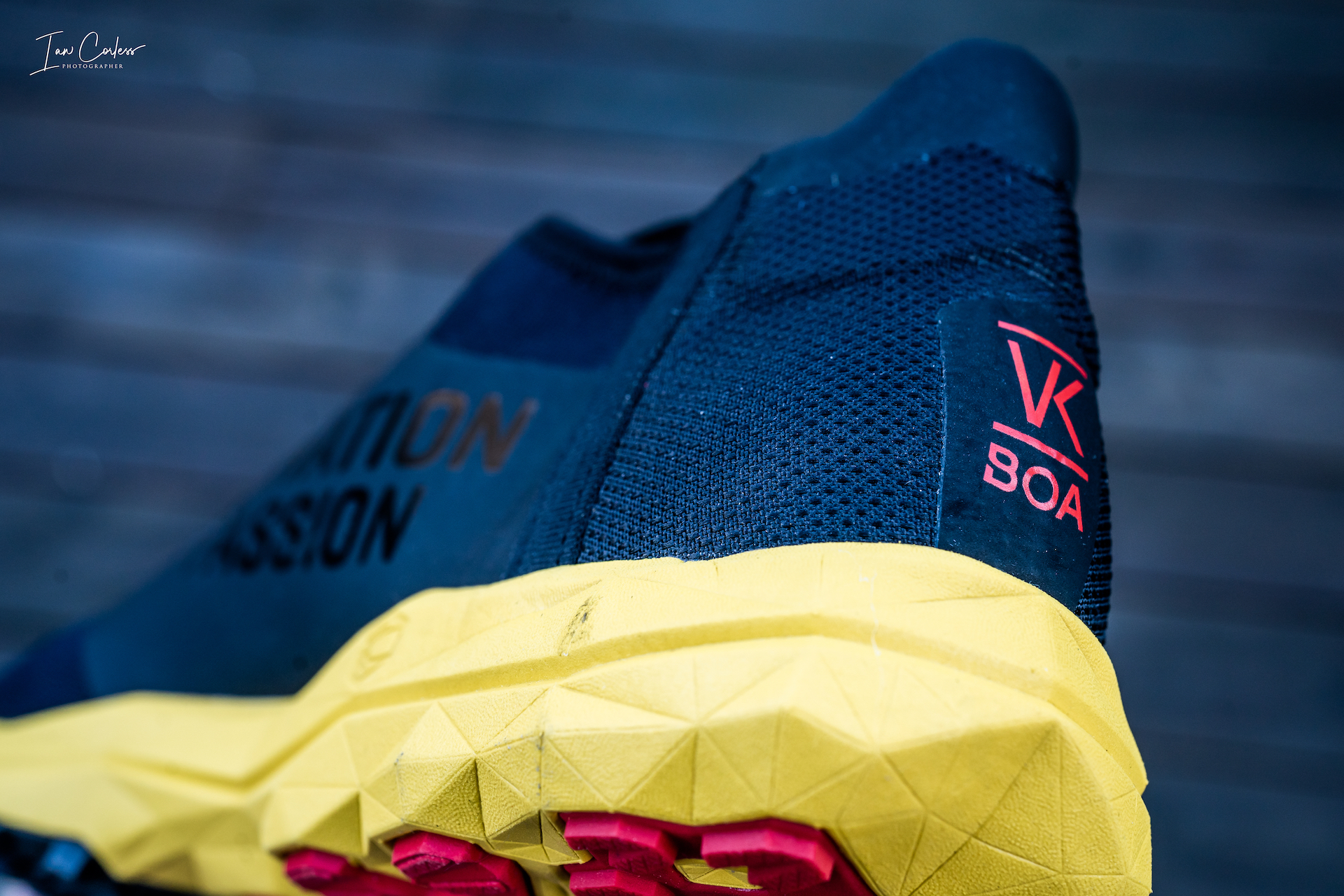
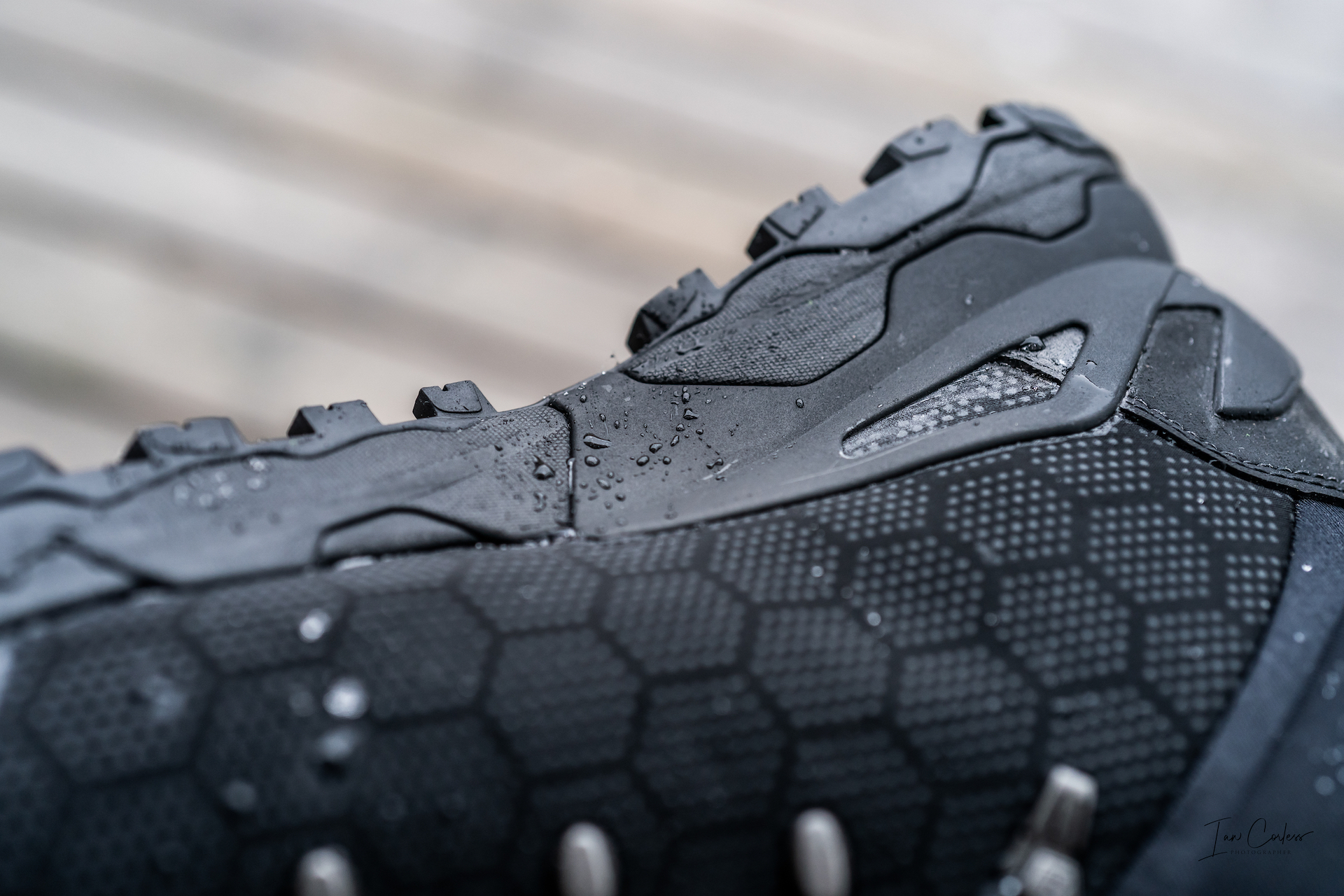
The toe box, as mentioned previously, feels wider than standard and at the front there is an overlay to add a little protection and the outsole curls up to add some reinforcement. But toe protection is minimal. At the rear of the shoe, the heel box is plush and comfortable, and it held my foot well both when going up and down trails.

There is no tongue as the shoe is a sock-like, so, comfort levels are high. You see the number ‘310’ this refers to the weight in grams of a UK8.5 shoe.

Built on a neutral last, the EVA on the medial side wraps up to offer some arch support. It’s subtle, but noticeable. I wouldn’t call the Agravic Flow a support/ pronation control shoe. Equally, I could not call it neutral. It sits somewhere between but being a runner who uses neutral shoes, I find the Agravic Flow very comfortable.

IN USE

 The Agravic Flow is a great everyday shoe when the trails are hard packed, and you want comfort, support and reassurance. They are not for muddy days! The transition from road to trail is superb and seamless, you can feel adidas’ road heritage in the shoe. 

The BOOST technology is really noticeable and gives a real bounce, especially on rock, gravel, tree roots and so on. This is not at the compromise for feel for the ground though. So, when the trail becomes more technical, I was never worried about foot placement and confidence. The toe box is wider though, so, when running on very technical trail, I would prefer a firmer hold at the front. You can’t have it all and the Agravic Flow does a great job of allowing toe splay. So, it’s a great shoe for longer trail days when comfort is needed. The outsole is excellent in the wet and dry on non-muddy trail. 

The sock-like upper is just plush and comfortable. There is nothing to criticize here, I wish all shoes could be this comfortable. Quite simply, you could remove the laces and they would make a great pair of slippers – yes, they are that comfy. 

The laces work well, it would be nice to have that extra eyelet to allow lock-lacing, but that is a minor niggle. For me, the shoe does have a wider feel than standard, and I therefore found that I could compensate by adjusting the laces to hold my foot securely. 

I do feel that the shoe sizes larger by a half size, so, if purchasing online, keep that in mind. Ultimately, you need to try the shoe on.

CONCLUSION

The Agravic Flow is a great shoe that manages to mix road running and trail running seamlessly. It’s a shoe that you can pretty much put on every day and enjoy its ability to feel like a road shoe and then when on the trail, enjoy the cushioning and grip of the best out and-out-trail shoes. There is little not to like in this package from adidas.

If you are looking for one shoe that covers many options, the Agravic Flow is a great place to start. If you want a road shoe, look elsewhere. If you want a trail shoe with comfort and grip for dry/ wet trails, then this shoe ticks the boxes.

Please support this website. I believe everyone deserves to read quality, independent and factual articles – that’s why this website is open to all. Free press has never been so vital. I hope I can keep providing independent articles with your help. Any contribution, however big or small, is so valuable to help finance regular content. Please support me on Patreon HERE.

Follow on:

Instagram – @iancorlessphotography

Twitter – @talkultra

facebook.com/iancorlessphotography

Web – www.iancorless.com

Web – www.iancorlessphotography.com

Image sales –www.iancorless.photoshelter.com

Is VIRTUAL here to stay?

Virtual running is not new.  

Virtual sport is not new.

But today, as the world is gripped in lockdown, virtual running is taking off like never before. 

Runner’s World, way back in 2015 asked the question, ‘Are Virtual Runs the Future of Racing?’ In an article by Alison Wade.

‘Virtual Racing is not a new concept. Postal races—in which competitors mail in their times to be compared with others—began decades ago. But advances in technology have improved runnersexperience of events from their own treadmills, and as the sport has grown, so has interest in this alternate way of racing.’

The joy of virtual is quite simple, you participate wherever you can, when you can and in many scenarios, in any capacity. It shows us that our need to belong, to be part of something is very strong, even if we are doing the sport alone and virtually.

‘Remote entrants received a downloadable bib, finishers certificate, and the races official swag…’

Some races reach capacity, London Marathon would be a good example. Virtual can allow someone to run a route at the same time as an official race on a virtual course using an app that simulates the course.

To be honest, many of us now have some form of tracking device, be that a watch, phone or additional gadget. Many subscribe to an app on their phone, be that on Android or Mac that allows us daily to update a training session. Strava being an obvious one but so many others exist.

Technology used to be something that was feared, but now it is embraced. 

Regina Jackson of ‘Will Run for Bling’ created in 2013, said to Alison Wade, ‘Many of those who run our races have busy lives and are attracted to the fact that they have nine days to complete each race. Others are drawn in by the fact that they can break up the run into shorter segments and still get credit for completing the race.’

But times are changing…

As races throughout the world are being cancelled or postponed, race directors have been looking for opportunities to retain their market, inspire the audience and still provide engagement. Equally, runners or sports people who desire an event and community have pursued alternatives. Interaction, that sense of belonging and the need to participate a driving force.

So, the transition has been seamless, and, in some scenarios, it has exploded to a level that one would have struggled to comprehend just 4-months ago.

A prime example being the recently started (May 1st) ‘The Great Virtual Race Across Tennessee 1000km’which allows participants to travel across Tennessee (virtually) from may 1st to August 31st. Quite simply, you have 4-months to cover the distance by any means and daily you upload your distance (even if it is a zero) and via an interactive map, your dot is moved along the route.

The above is brought to us by Gary Cantrell aka Lazarus Lake of the famous Barkley Marathons and Bigs Backyard Ultra. Now, Laz is like the Pied Piper, people love him and love his crazy ideas. However, I don’t think even he could have anticipated that a 1000km virtual run would explode like it has. As they say on the sign-up page, ‘To complete, the race will require only a hair over 5 miles per day…  and those who want a little extra on their plate, you can do the out and back version – 2,000 kilometers!

The numbers are phenomenal, $60 entry fee and currently over 17,569 participants. There is a charity element too for ‘Feeding America/ Tennessee’ – the donation page is showing a current revenue of $96,533. And now, there is even a ‘Doggie Run Across TN for Animal Shelters’ with a sign up of $30.

Depending on viewpoint, for now, virtual races and challenges are filling a gap that many of us are missing as we are forced to social distance and lockdown. As restrictions ease, and life starts to return to some normality, I can’t help but think an element of virtual will exist at a greater level than before January 2020.

As one runner has told me, ‘I race for the atmosphere, being around hundreds with a similar passion and then testing myself at the same time and on the same course as everyone else. I like the meet up before and the post-run gathering. It’s more than running, it is community. So, racing is really important for me and many others. However, the virtual world has opened my eyes to a new way of training. I love the fact that maybe I can run across Tennessee in 4-months and the great thing is, should I get an opportunity to race, I can use that mileage too for the virtual challenge.’

One thing is for sure, in the ultra-running world, a challenge is a challenge, be that real or virtual. Recent months and weeks have shown us that imagination is the only limiting factor.

In Spain, friends Kilian Jornet, Pau Capell and Tofol Castanyer created an indoor challenge. Fueled by the lockdown that did not allow them to run outside, with the help of Albert Jorquera, Jordi Saragossa and Maria Fainé, they created ‘YoCorroEnCasa’ translated to IRunAtHome. With just a week of planning, they brought over 7400 people together, all running ‘in the home’ and in the process they raised €82,940 for charity – they did not take a euro. I followed their example and did the same in the UK on April 18th with IRunAtHome raising £20,000 for charity.

Taking inspiration from Lazarus Lake, Dave Proctor (who holds the 100-mile treadmill world record) took the ‘Backyard Ultra’ format and made it into a virtual event using technology such as Zoom and YouTube to bring runners together, from all over the world, to run 4.1667 miles every hour, on the hour. Over 2000 signed up. The challenge was to see who would be, the last man or woman standing in the ‘Quarantine Backyard Ultra.’ After 2+ days, ultra-running legend, Michael Wardian emerged victorious with 262.5-miles beating Radek Brunner. Notably, Michael ran outdoors using a loop of road around his house, whereas Radek ran on a treadmill. 

Listen to a podcast interview with Michael Wardian HERE

 Salomon runner, Ryan Sandes was locked down in South Africa, but that did not stop him. Taking on a personal challenge, he ran 100-miles in and around his house is 26-hours and 27-minutes. Article here.

And on May 16th, 100-mile world record holder, Zach Bitter, will look to set the 100-mile WR on a treadmill with a virtual run that will be streamed live for the full duration of approximately 12-hours. He encourages people to join him on their own treadmills and experience the journey.

 Racing will return. The trails (and even roads), the scenery, the landscape, the mountains and fresh air will bring us back to start lines. The need to share a journey and experience, to test one’s self in real time is something that is primal. The need for physical interaction, before, during and after a race is something, we all need. 

It’s unclear when virtual racing made the leap online to a mass audience. Some race directors say it evolved from runners requests many years ago to participate in physical races from afar. Regardless of the original origin, this year, virtual racing has exploded in popularity.

Virtual is here to stay and no doubt, at a far greater level than when this year began.

Please support this website. I believe everyone deserves to read quality, independent and factual articles – that’s why this website is open to all. Free press has never been so vital. I hope I can keep providing independent articles with your help. Any contribution, however big or small, is so valuable to help finance regular content. Please support me on Patreon HERE.

Follow on:

Instagram – @iancorlessphotography

Twitter – @talkultra

facebook.com/iancorlessphotography

Web – www.iancorless.com

Web – www.iancorlessphotography.com

Image sales –www.iancorless.photoshelter.com
References: Active.com here Runners World here New York Times here The Washington Post here

RAB KAON Jacket Review

When it comes to mountains and outdoor terrain, UK brand RAB have been a ‘go-to’ for any outdoor enthusiast, whether that be for the Himalayas, mountaineering, trekking, climbing or a leisurely walk in the outdoors.

2020 will see RAB launch a series of new products under the heading of SKYLINE a range of products made up of ultra-lightweight clothing that does not compromise on protection. Intended for ‘fast and light’ days that blur the line between running and technical scrambling.

It’s a significant movement for the brand and as a firm RAB fan, the SKYLINE range has already gained my attention and no doubt, it will grab the attention of anyone who likes to move faster in the mountains.

I will be introducing element of the new SKYLINE range over the coming weeks, notably, the SONIC SHORT SLEEVE TEE, PACER JACKET, CHARGE JACKET and PHANTOM PULL ON.

Image ©RAB

But first, the KAON jacket. 

The new KAON jacket personifies and sets out the stall of the new direction and although it does not come under the SKYLINE banner, it certainly ticks all the boxes offering minimal insulation with low-weight and packing size. Balancing lightweight, warmth and protection, the KAON uses a combination of 800 fill Goose Down and Synthetic Status insulation. Concentrating on the core, the Kaon retains warmth where it is needed, while ‘Pertex Quantum Air’ allows complete freedom of movement under the arms.

The Kaon offers zoned insulation allowing a balance between warmth without compromising movement. It mixes down for the core and ‘Stratus’ synthetic fill on the shoulders, hood and cuffs. 

The down in the core is 800FP hydrophobic down (70g in the men’s and 65g for the women.) This is significant as down, while warmer and lighter, cannot get wet – it loses warmth! However, hydrophobic down is treated with a durable water repellent that allows for quicker drying and the ability to resist water for longer. In a nutshell, it makes the Kaon far more usable in a variety of situations.

The Stratus synthetic fill is significant as it allows the jacket to be more breathable, dry out faster and is 20% less absorbent to other rival insulation. Synthetic is effective at keeping one warm, even when wet, so, it is ideal for damp/ wet conditions. RAB have added this to key areas of stress, either from the weather or equipment or a combination of the two. For example, on the shoulders, synthetic insulation will be far more durable with pressure from rucksack straps. Also, when compressed, it retains warmth, unlike down which requires loft.

The Atmos outer shell will still allow for loft while reducing down leakage making a perfect combination of warmth v weight.

Under the arms and down the side of the torso, Pertex Quantum Air is used which allows heat to escape and therefore allowing for body temperature regulation, always a difficult balance when moving fast and light.

IN USE 

The KAON is a wonderful crossover jacket for mountain runs and alpinists who want to move fast and light but be prepared for any potential inclement conditions that the mountains can throw at you. 

On first look, it is a simple jacket with a full-length zip, hood (that will allow for a helmet), high collar for warmth, one chest pocket, no side pockets and the sides and under arms use a different more flexible and breathable fabric. It has stitch through construction that provides a small square look to the jacket which ensure the insulation stays put.

The fit is slightly tailored, RAB say ‘slim’ but it is not super tight. Movement is not compromised. The arms are a normal length with a simple elasticated cuff. The jacket length sits just below the waist and for me, covers my backside. When zipped up, the neck goes nice and high and sits just below the chin keeping out drafts. The hood fits perfectly and has no adjustment – as mentioned, you can wear a helmet if required.

Image ©RAB

Needless to say, it is very light (240g +/-) and packs small and comes with its own stuff sack.

It is available in 3 colours, ebony (blue), firecracker (red) and dark sulphur (yellow).

I normally wear medium and medium is perfect in the KAON, size options are XXS to XXL.

 Having used the jacket as we transitioned from Winter to Spring, I have found it perfect or everyday use. On chilly days I start with it on and then remove when my core is warm. It packs away small and fits in the side pocket of my Osprey Talon 11 pack (to provide an example.) On warmer days, I have added the KAON to my pack in the assurance that should the weather change, I have an excellent light layer that will work. In conjunction with a lightweight jacket, such as the PACER (here) – I have warmth and waterproof for well under 500g.

SUMMARY

The KAON is one of those essential kit items when going to the mountains. It’s size and weight make it a ‘mandatory’ item for me – there is no reason not to take it! Warm, lightweight and packs small = perfect.

RAB HERE

Please support this website. I believe everyone deserves to read quality, independent and factual articles – that’s why this website is open to all. Free press has never been so vital. I hope I can keep providing independent articles with your help. Any contribution, however big or small, is so valuable to help finance regular content. Please support me on Patreon HERE.

Follow on:

Instagram – @iancorlessphotography

Twitter – @talkultra

facebook.com/iancorlessphotography

Web – www.iancorless.com

Web – www.iancorlessphotography.com

Image sales –www.iancorless.photoshelter.com
the INTERVIEWS Season 1 – Episode 13 : Max King

Max King born February 24, 1980, is an American ultra-marathoner. He was the winner at the 2014 IAU 100 km World Championships and the 2011 World Mountain Running Championships. King earned the bronze medal at the 2016 NACAC Cross Country Championships / Pan American Cross Country Cup.
He has also won numerous national titles at various distances ranging from track to ultra marathon. He has also excelled at OCR becoming Warrior Dash World Champion. In addition, he has won multiple national runner of the year awards.
.
First recorded in 2012.
Episode 0h 39m 59s
Talk Ultra back catalogue HERE
*****
Hosted on ANCHOR (HERE) the INTERVIEWS will also be available to listen on many other players, including SPOTIFY (HERE).
ANCHOR app on Apple HERE and Google HERE
Download links will be added in due course.
Apple Podcasts HERE
Breaker HERE
Castbox
Google Podcasts HERE
Overcast HERE
Pocket Casts  HERE
RadioPublic HERE
Spotify HERE
Stitcher
*****
TALK ULTRA podcast will be released as normal providing you long shows as it has always done with ideally two shows per month. The back catalogue will be released randomly via the INTERVIEWS and not chronologically.
*****

One Sees Clearly Only With The Heart

One sees clearly only with the heart. The essential is invisible to the eyes. – Antoine de Saint-Exupéry

Water splashed over the large brimmed hat. Gilles poured and poured on Didier’s head to help reduce his temperature. Droplets floated in the air like stars in space and as they made contact they exploded with dramatic effect.

Dry and crusty salt on cheeks and lips disappeared with the release of the water but moments later re-appeared as the searing 50+ degree temperatures evaporated the water that continued to pour.

It was midday. Gilles and Didier had only dented the 80km distance that needed to be covered before the 34-hour cut off would be imposed on the longest day of the iconic Marathon des Sables.

Moving onward, Didier embraced Gilles arm for stability. A very sore and enflamed right knee could give way at any moment resulting with a fall. Gilles as ever was faithful to the cause and provided the support and self-sacrifice to ensure that Didier’s journey to the line was safe and as trouble free as possible.

Darkness approached and with it some food and rest. With a new lease of life, the two continued into 13 km of relentless dunes that reached two to three meters in height. In the distance a green laser showed the direction to follow. It was a beacon of hope, slowly but surely getting closer. Two become one and as the sunrises and the heat returns, victory and the opportunity to fight another day seems possible.

From the finish line two shadows on the horizon appear. It is 4pm in the afternoon. The warriors have been on the trail for 32 hours. Tired, weary and emotional they approach the line.

I see a tattoo glisten in the scorching light on the arm of Didier; an MDS logo on his arm with nine stars around it, a star for every completed MDS. Next to the 9th star a space, would he obtain that 10th star at this edition of the race?

In the final meters to the line you can hear the shouts from MDS staff, “Bravo Gilles”, a marshal shouts “Allez Didier” and then the clapping and whoop whooping starts. It’s done, they cross the line an incredible 75.7 km’s completed over some of the most demanding conditions possible.

Didier falls into the arms of Gilles in an embrace similar to a small child who has just found a lost mother.

Tears stream down his face as he sobs uncontrollably. Gilles, all smiles, pulls away and kisses him on each cheek with a passion seldom seen. It’s a moment to savour! They are the last two runners on the course and the moment epitomizes all that the Marathon des Sables represents. It shows a bond between two people and confirms all that is good and pure in human nature and ultra-running.

You see this is no ordinary achievement.

Gilles is a guide and Didier is blind.

Please support this website. I believe everyone deserves to read quality, independent and factual articles – that’s why this website is open to all. Free press has never been so vital. I hope I can keep providing independent articles with your help. Any contribution, however big or small, is so valuable to help finance regular content. Please support me on Patreon HERE.

Follow on:

Instagram – @iancorlessphotography

Twitter – @talkultra

facebook.com/iancorlessphotography

Web – www.iancorless.com

Web – www.iancorlessphotography.com

Image sales –www.iancorless.photoshelter.com
     Article was first published in 2013 and later for Runultra

Episode 186 – Rickey Gates, Kevin Webber, Abelone Lyng and Stevie Kremer

Episode 186 of Talk Ultra is a packed show! We talk with Rickey Gates about his new book. Inspirational Keven Webber was diagnosed with terminal Prostrate Cancer and given 2-years to live, 6-years on he is inspiring many with his ultra and multi-day adventures. Abelone Lyng and Stevie Kremer talk about running and motherhood.
*****
Talk Ultra is now on Tunein – just another way to make the show available for those who prefer not to use iTunes – HERE  You can download the Tunein APP HERE
Talk Ultra needs your help! 
We have set up a Patreon page and we are offering some great benefits for Patrons… you can even join us on the show! This is the easiest way to support Talk Ultra and help us continue to create! 
Many thanks to our Patrons who have helped via PATREON
Donate HERE
*****
00:34:03 – RICKEY GATES book information HERE
*****
01:36:02 – KEVIN WEBBER donate HERE
*****
02:48:23 – ABELONE LYNG
*****
03:13:22 – STEVIE KREMER
*****
Please listen to the INTERVIEWS – please follow the show
Hosted on ANCHOR (HERE) the INTERVIEWS will also be available to listen on many other players, including SPOTIFY (HERE).
ANCHOR app on Apple HERE and Google HERE
Apple Podcasts HERE
Breaker HERE
Castbox
Google Podcasts HERE
Overcast HERE
Pocket Casts  HERE
RadioPublic HERE
Spotify HERE
Stitcher
TALK ULTRA podcast will be released as normal providing you long shows as it has always done with ideally two shows per month. The back catalogue will be released randomly via the INTERVIEWS and not chronologically.
______
Keep running
03:44:11
Stitcher You can listen on iOS HERE, Android HERE or via a web player HERE
Website – talkultra.com

The Immediate Future of Racing post Covid-19

The loneliness of the long distance runner.

Life has been turned upside down. We currently struggle to know what day it is, what month we are in and we have so many questions about what the future holds.

One thing is for sure, at the moment, we have no answers, just many, many questions.

At some point, one day, restrictions will ease…

But, importantly, the day after will be no different. The virus will still be around. We will all still be susceptible to catching the virus, unless a vaccine is found.

Update Apr 29th – ‘Germany’s rate of COVID-19 infections grows after lockdown eased.’

‘Germany faces the prospect of having to restore stricter lockdown measures as its number and rate of coronavirus infections grew again.’

Article available Here

However, it seems to be a general consensus by the experts that a vaccine will not be available till 2021.

We are living in a time of so much insecurity – lives are being lost globally, people are losing work, children are at home and the world is an element of lockdown.

So, talking about racing and running seems a little insignificant and pointless in the context of the above, but I, and I know many of you are asking the question, when will racing return?

Firstly, the race calendar to August has been pretty much wiped out globally. Many races and RD’s accepted the situation, cancelled events and said, ‘we will see you in 2021!’ But, for every race that cancelled, another postponed to a date later in the year in the hope that restrictions would be eased and that the virus would be on the back foot. I get it, nobody wants to cancel an event.

But the postponement scenario has already created an issue with a plethora of races all now scheduled for September, October, November and December. Quite simply, the back end of the season will have more races than runners and we will see participants having to make a choice of which race they toe the line on.

But…

For me, this is the big but, I in all honesty do not see racing returning to ‘normal’ in 2020.

I hate to be pessimistic, but the global situation is so dire that the cessation from lockdown to normal is going to be months, not days or weeks.

Prof Chris Whitty said it was “wholly unrealistic” to expect life would suddenly return to normal soon. He said “in the long run” the ideal way out would be via a “highly effective vaccine” or drugs to treat the disease. But he warned that the chance of having those within the next calendar year was “incredibly small”. – Via BBC News

Read

Race cancellation and Covid-19 HERE

Covid-19 – A Guide HERE

Currently, many trails are closed.

THE SHORT-TERM FUTURE OF COVID-19 AND RACING

Firstly, we are going to be in a yoyo period with second and third phase infection as lockdowns are eased. This will create additional peaks and troughs. This in turn, may require governments to reapply and ease restrictions so as to prevent overload on health systems.

It will be a period of controlled herd immunity until a vaccine comes. Needless to say, the old, frail, sick and anyone in care homes will need to be protected.

Suppression measures will slowly be released, firstly with schools returning (this is already happening in Norway and soon Germany,) then retail outlets will open with measures to control how many people can be in a store and controls on social distancing. Restaurants may open with controlled measures such as the client must be seated, only hot food can be consumed, and tables must be spaced accordingly as per government and health specifications.

When one takes into consideration the above, this accounts for May, June and July and of course, in each country, the situation will be monitored. As more people move freely, the virus will spread. If the spread is too great, restrictions may be reimposed to slow the spread down and so on. So, it’s easy to see that planning August, September and beyond is not something one can do with any certainty or guarantee.

Just today, Val d’Aran by UTMB®, has been cancelled and will take place in 2021. Xavier Pocino, director, explained:

“Our priority is the health and safety of the participants as well as the population of the Val d’Aran. Given the current context, it is therefore preferable to postpone the race in order to guarantee the health and logistics of the event. We also wish to respect the dates of other races programmed for after the summer, to avoid a date clash and to allow our athletes to participate in those races, should they go ahead”.

Currently airlines are on a very restricted service, hotels are closed, restaurants are closed, and, in many places, lockdown really does not allow any travel at all. Some are allowed to exercise, from home, for 1-hour.

A picture is building that the transition from lockdown to free movement is more than likely a year away?

If travel is restricted, hotels are closed and restaurants remain unopened, quite simply, racing will be cancelled.

The short-term future of racing will be virtual, and already globally, we are seeing virtual incentives appearing. From simple scenarios of running for a daily specific time, such as 45-minutes. But also, multi-day challenges or even specific distance challenges such as 1000-miles are appearing. Take up has been impressive which only goes to show the desire for competition.

As restrictions ease, races and RD’s will need to be constantly communicating with authorities to ascertain what is and what is not possible. For example, Sweden started with a herd immunity approach in January, avoided lockdown, emphasized social distancing, protected the old and allowed group gatherings of up to 50 people. Whereas, in the UK, for example, in March it was locked down with only essential travel (shopping) and exercise (from home) with other family members allowed.

Nature is the boss.

WHAT MAY RACING LOOK LIKE INITIALLY?

It goes without saying here that maybe ALL races will be cancelled or postponed until the Covid-19 situation is under control or over.

However, there may be a transition phase. Just as children return to school, workers return to offices, runners returning to races may need to adapt.

We all seek isolation and love personal adventure, maybe in the months to come, this will take over from racing?

PRE-RACE

  • Initially, global travel will be reduced and no doubt under control or restrictions. So, maybe races will only allow regional athletes. For example, only French residents can run in French races.
  • Medical certificates may be required that go beyond the standard ECG/ health check with a requirement to include testing for Covid-19.
  • Race briefings, bib provision and all admin will be done electronically so as to reduce pre-race social interaction.
  • Covid-19 appears to have a 14-day ‘active’ period, therefore, 14-days from the race start it will be a requirement to have a medical check or even in extreme cases, runners may be required to go into 14-day isolation/ quarantine before a race start. Any symptoms, no race!
  • No pre-race gatherings.

It can be easy, sort of, to social distance on the trails.

THE RACE

  • Races may have reduced numbers and they will incorporate an element of social distancing to reduce risk. For example, staggered starts of say 10-runners starting at 10-minute intervals. Seeding could be worked out by asking runners to run a 5km time trial and then provide the time to the RD? Racing would obviously be based on chip time and therefore, the race could be more like a time trial.
  • Aid stations may be removed and therefore self-sufficiency/ autonomy will be required both from a food and water perspective. This by default would mean races could only be a certain distance in length. One other alternative could be un-manned aid stations and runners would need to provide sealed drop bags which they could access at specific points. If it was a 100-mile race, for example, 4 aid/ drop stations at 20/40/60 and 80-miles. Again, aid/ drop stations would have social distancing in place.
  • The need for a personal tracking device such as a Spot or Garmin InReach may be required to guarantee security for each participant.
  • Mandatory equipment would need to cover more eventualities. Maybe *face masks and *gloves would be a requirement? *Medical opinion varies on the effectiveness and use.
  • Race routes and courses may well be unmarked and therefore the need for a navigation or a navigation device using a provided GPX track could be a requirement.
  • Volunteer help may be reduced with ongoing implications.
  • Medical support/ safety could be compromised.
  • Extreme or dangerous courses would not be allowed to reduce the potential ongoing need for medical help due to accidents.
  • Finish areas would be isolated with minimal interaction.
  • A ‘finish and go’ scenario once the race is completed.

Parties and any post-race razzamatazz may be on hold for a while.

POST RACE

  • Post-race gatherings would be cancelled.
  • Awards and prizes would be done digitally, and any physical prices would be posted out.

CONCLUSION

The above are ideas and thought processes that have been bouncing around my head while in lockdown.

I actually wonder, faced with the above, how many would still want to race? Maybe all races will be cancelled until they can be run ‘as normal!’

Of course, I do think much of the above may well be fantasy or fiction, but I can see how some of the above could happen. Especially in regard to electronic communication, pre/post gatherings, social distancing and a reduction or change to how aid stations work.

Good friend, respected race director and runner, John Storkamp of Rock Steady Running (in the USA) kindly provided me with some of his thoughts:

“But I also believe that almost none of us want to get back at any cost, especially if it compromises safety.  Our own personal safety or the safety of the communities where our events are held. Once we can return, I for one also fear a diminished race experience with reminders of the virus at every turn, at least initially; i.e. no ritual of packet pickup, no festive pre-race gatherings, no mass starts where we all come together in the collective nervousness and prayer before the start, skeleton crew aid-stations filled with nervous workers exposed to every runner, no post race celebration with the telling of tales of the dragons we slayed out on the course that day.  Races have always provided us with an alternate reality, an escape for a day or two, from the stresses of daily life.  Any post-Covid races, again at least initially, will invite all of the fear of our current daily existence into what has always been one of our safest and most sacred spaces.”

Certainly, with the races I work on and communicate with, they are learning lessons now but are planning for 2021 races to be run as one would expect.

Solo running, time-trial events and FKT’s may prove popular.

*****

I asked on Twitter for some thoughts, here are the responses:

Sarah Canney – Local participants only? Pre and post race outside with masks?

Andrew Smith – I’m thinking there will be pretty much no racing this year and am just going for some personal challenges.  Hopeful next year might look different, but even then there will likely be changes – how much depends on what fundamental changes we will need to make day to day.

Mark Atkinson – Expect a fair few staggered start or time trial approaches with reduced numbers. Possibly smaller but more frequent aid points so if one is too busy you head to the next. I’m going to miss running shoulder to shoulder with a stranger through the night sharing life stories.

Dr Stacey Holloway – Maybe more FKT attempts than races and round attempts? We host a winter race in Jan, but even thinking we won’t be in 2021 and looking for maybe for Nov 2021 event and a Jan 2022 event and having its as some sort of series… not sure just ideas!

Melinda Coen – I’m expecting higher entry fees to help RDs survive  and also lower numbers, wave starts, less buffet aid at ultras and more “packaged foods”.

Via Talk Ultra Facebook page:

Yes, individual starts, unfortunately less a to b-races due to don’t want to gather people on buses. – Henrik

Proof of vaccinations required – Brian

I wonder whether some event organisers will run two or three events on the same day to stagger start times and space people out more. For example, could have a trail run, duathlon, triathlon and aquathlon. Bit of a logistical nightmare in some ways! – Ann

Reduced numbers. Staggered starts, volunteers in face masks and gloves, no more sponge bucket( that one makes me sad).
More crew or drop bags allowed to lessen need for a CP table/buffet. – Shane

Assisting injured runners may be a problem, especially on a trail. – Martin

Races will be cancelled either voluntarily by the organizers or from lack of participation.Some will go away because of financial problems. When trails are open people will do more FKT attempts and solo runs. – Ali

Self supported – no shared food at aid stations – Tim

Less corporate, More self-sufficient, longer distances between aid stations, more map reading or gps guidance less trail marking..all to the good then! – Kevin

What are your thoughts? Comment below.

Please support this website. I believe everyone deserves to read quality, independent and factual articles – that’s why this website is open to all. Free press has never been so vital. I hope I can keep providing independent articles with your help. Any contribution, however big or small, is so valuable to help finance regular content. Please support me on Patreon HERE.

Follow on:

Instagram – @iancorlessphotography

Twitter – @talkultra

facebook.com/iancorlessphotography

Web – www.iancorless.com

Web – www.iancorlessphotography.com

Image sales –www.iancorless.photoshelter.com
Initial comments re Covid-19, herd immunity and the implications were influenced by an audio interview from, ‘The Post’ with Johan Giesecke – Here

#IRunAtHome April 18 2020 – summary

DONATE HERE

April 18th, 2020, amid a worldwide lockdown due to Covid-19, a global run community came together between the hours of 9am to 9pm with one purpose.

Run at home.

Raise funds for the NHS who are fighting Covid-19.

I could literally write and write about the experience. To see young and old, runners and non-runners globally come together to test themselves #athome was truly mind-blowing and I am still coming to terms with the emotion of the day.

From seeing a 2-year old cover 1-mile to a pro-runner covering 131km on a treadmill, there was no experience too small or large.
A community came together, encouraged, supported, applauded and cheered on as donations flooded in.

I set the goal to raise £10,000 for the NHS and as I write, donations are at £12.222.46 and with Gift Aid £14.131.07. I am leaving the donation page open and I am quietly confident with a little rallying, funds will increase.

So, if you are reading this and have not donated, please go HERE.

I personally did the best I could monitoring all that went on for the 12-hours and I ‘tried’ to message everyone, encourage and support. I am sure I failed as at times, it really was difficult to keep up. Especially when I did my own challenge of a 1000m vertical and descent up and down the staircase in our apartment block.

So, if I did miss commenting, accept my apologies. I am going to try and backtrack and go through all the posts and hit a ‘like’ and make a comment.

Needless to say it has been a magical experience and one that I would like to repeat… Maybe when all this nasty Coronavirus is over, we can celebrate on Apr 18 2021 with a reunion…?

FOR NOW, A HUGE THANK YOU FOR COMING TOGETHER.

As one lady said, ‘I have spent 4-weeks alone and isolated. Today, I was alone once again but virtually I made friends around the world. I shared a mutual experience, did some good and felt loved and wanted.’

Families came together, mum ran with dad, dad ran with mum and the kids did their bit. I know from my end, we had a ball creating something fun and different and in the process, many of us had an art lesson with the bibs.

Below is a collated summary of the day. I have tried to capture as much as possible.

THANK YOU ALL

Episode 185 – Kilian Jornet, Albert Jorquera and Michael Wardian

Episode 185 of Talk Ultra is a Quarantine Special with Kilian Jornet and Albert Jorquera talking about  Yo Corro En Casa and Michael Wardian talking about winning, the Quarantine Backyard Ultra.
*****
Talk Ultra is now on Tunein – just another way to make the show available for those who prefer not to use iTunes – HERE  You can download the Tunein APP HERE
Talk Ultra needs your help! 
We have set up a Patreon page and we are offering some great benefits for Patrons… you can even join us on the show! This is the easiest way to support Talk Ultra and help us continue to create! 
Many thanks to our Patrons who have helped via PATREON
Donate HERE
*****
00:32:14 ALBERT JORQUERA
*****
 
01:04:55 KILIAN JORNET
*****
 
 
01:16:28 MICHAEL WARDIAN
*****
Please read three articles that coincide with is podcast:
Race Cancellations and Covid-19 HERE
Covid-19 : A Simple Guide HERE
Home Office HERE
*****
Please listen to the INTERVIEWS – please follow the show
Hosted on ANCHOR (HERE) the INTERVIEWS will also be available to listen on many other players, including SPOTIFY (HERE).
ANCHOR app on Apple HERE and Google HERE
Apple Podcasts HERE
Breaker HERE
Castbox
Google Podcasts HERE
Overcast HERE
Pocket Casts  HERE
RadioPublic HERE
Spotify HERE
Stitcher
*****
02:22:00
Keep running
*****
Stitcher You can listen on iOS HERE, Android HERE or via a web player HERE

#IRunAtHome – #YoCorroEnCasa – RUN VIRTUAL

#IRunAtHome / #YoCorroEnCasa

Pau Capell, Tofol Castanyer, Kilian Jornet and journalist, Albert Jorquera thought that it would be a good idea to all get together and run virtually, at home, at the same time with the Spanish run community. Ultra-trail runners love to spend long hours running in the mountains, but they wanted to emphasize that during this quarantine and isolation period, the most important thing is to get out of the house as little as possible and help stop the spread of Covid-19.

Listen to KILIAN JORNET

The four, together with Jordi Saragossa and Maria Fainé, decided to create the #YoCorroEnCasa (IrunAtHome) Challenge. With this challenge they wanted to bring a maximum number of people doing sports together in the home; distance did not matter, it could be 100 metres or maybe a marathon! The important aspect was the social side, the coming together as a community to share an experience.

To participate ‘officially’ in this ‘virtual run’ participants made a donation to #YoMeCorono – The team of doctors and researchers who had started pioneering clinical trials to define which drugs will immediately be used to treat the infected patients, prevent ongoing contagion and look for a vaccine against the virus.

It was a huge success with over 7400 participants.
The total raised was an incredible 82.940 Euros.
Every single euro was donated to charity.

This pandemic has deprived us all of so many privileges, running may seem insignificant now, but getting together to run in the mountains or on trails is not possible for most of us. We, as runners though are not willing to give up, we are going to fight Covid-19 together to stop it and fight to continue doing what we are passionate about.

So, come April 18th we want you to join us with the tag, #IRunatHome and in the process we will race funds for the NHS Charities Covid-19 Appeal.
*****
“Our amazing NHS staff and volunteers are working tirelessly to care for COVID-19 patients. And we want them to know the country has also got their back. We are so proud and in awe of NHS staff and volunteers as they work tirelessly to save lives! This means staying away from their homes and families, working day and night, to treat as many people as possible in need of care.”
*****
We have multiple confirmed elite runners who you can virtually run with.

Jasmin Paris

Damian Hall

Andy Symonds

Tom Evans

Holly Page

Finlay Wild

Tom Owens

Beth Pascall

And more joining daily.

Please help us spread the word and help us raise money by #IRunAtHome

April 18th 2020 starting 0900 GMT till 2100 GMT.

*****

DONATE TO THE NHS CHARITY HERE

REGISTER TO PARTICIPATE HERE

*****

Rules for entry

We appreciate that depending on where you are located, that it ‘may’ be possible to run outside by respecting social distancing. However, this challenge is all about ‘Staying Home’ and self-isolating and joining other runner’s in a challenge of #IRunAtHome

  • You must run in your home and/ or garden/ treadmill.
  • Any distance is acceptable.
  • Start at any time from 0900 and finish before 2100 hours.
  • To enter, please DONATE HERE at a specific charity page, all funds go directly to the charity.
  • Register to run HERE.
  • You will receive an email from Eventbrite, please check as you will be provided a link to download a Run Bib. Be creative with the bib! Add a number, name and decorate.
  • Encourage family members to take part, no age limit. The more runner’s, the better.
  • Spread the word. (Logos HERE)
  • Be creative, this is more about being social and sharing – share videos, photos and tell the world that #IRunAtHome

Luis Alberto Hernando and family shows how to be creative with #IRunAtHome

We thank adidas TERREX who will support with prizes of run shoes for the most creative runs and social media posts. Make sure you tag #IRunAtHome and use our Facebook and Twitter account.

Join us

 FACEBOOK HERE

TWITTER @IRunAtHome1

 
RUN VIRTUAL
#IRunAtHome