Time allowance 12-hours 45-minutes / 0630am and 0800 start (top 150 ranked)
The fall out from the long day is always hard. Bodies are now tired and normally, many would be saying, ‘just a marathon to go!’ But not for the 2024 edition.
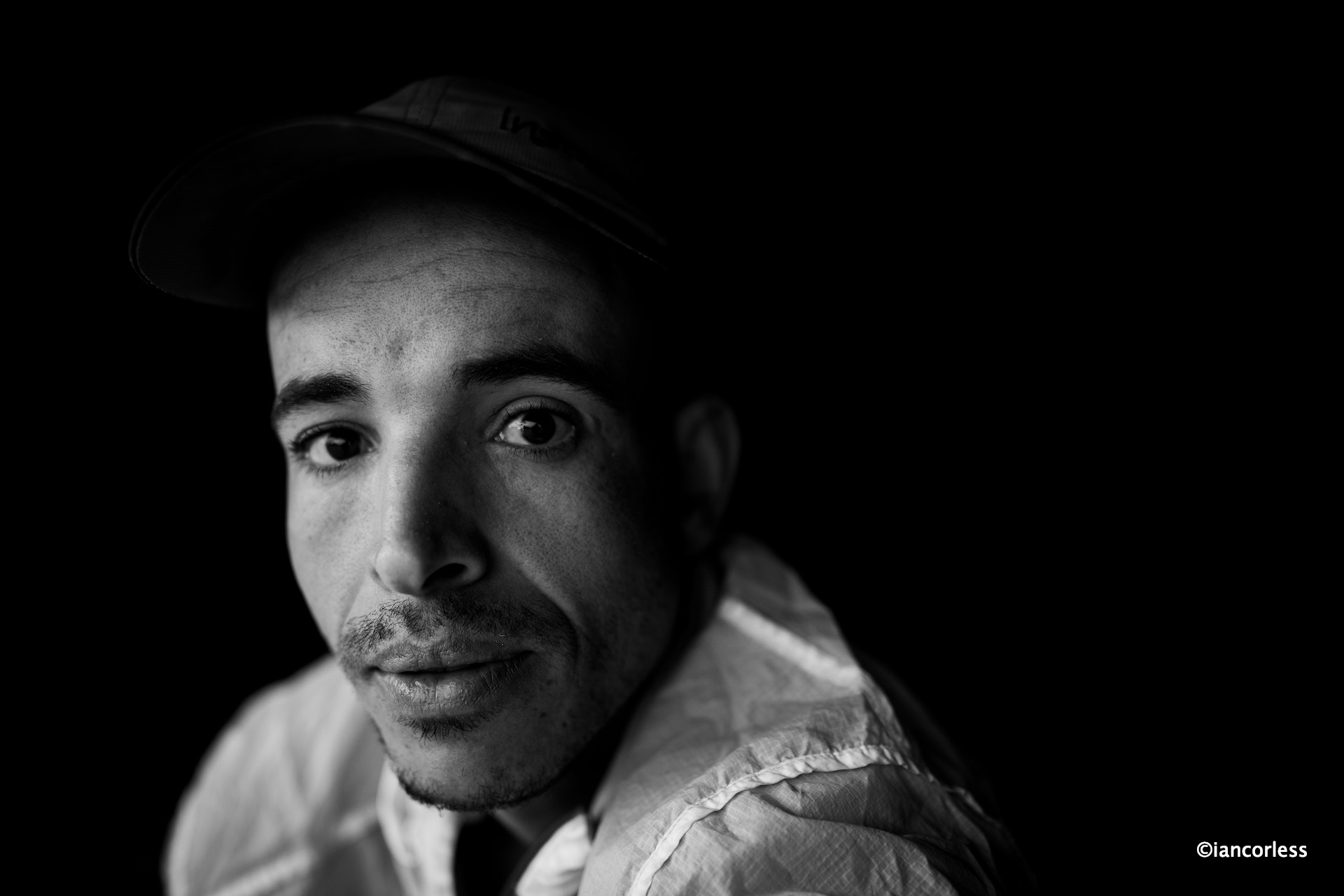
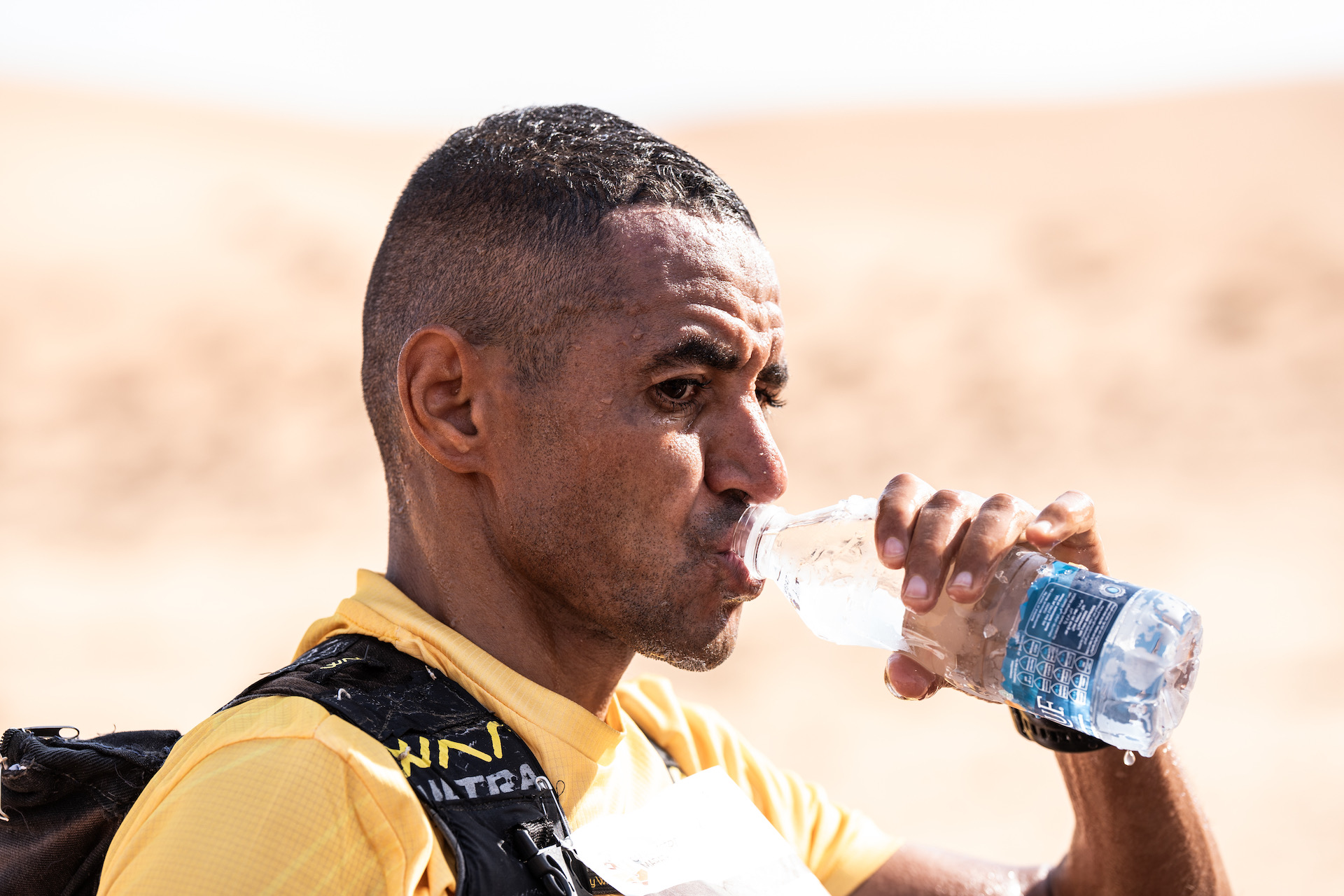
Aziz Yachou
Stage 4 is 43.2km’s and to follow, stage 5 and stage 6 at 31.4km and 21.1km respectively.
Travelling north all the way to B3, this is a tough day and probably will be remembered as the soft-sand day, especially as the most challenging terrain comes at the end.
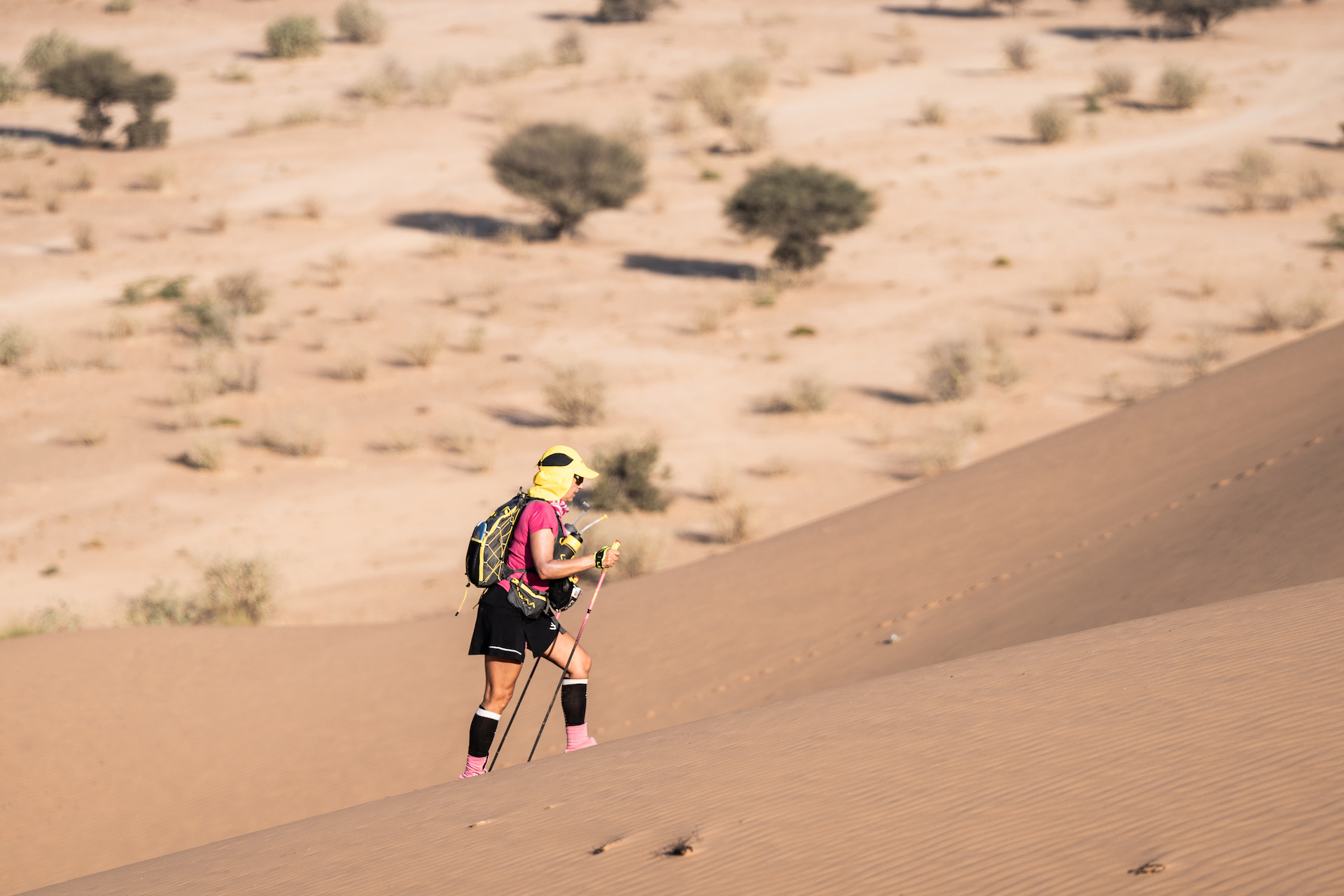
Sand and heat
With 3 CP’s at 10km, 22.9km and 30.1km, the severity of the stage is reflected with ‘additional’ water stations at 17km 37.7km.
Cooling off at the CP’s
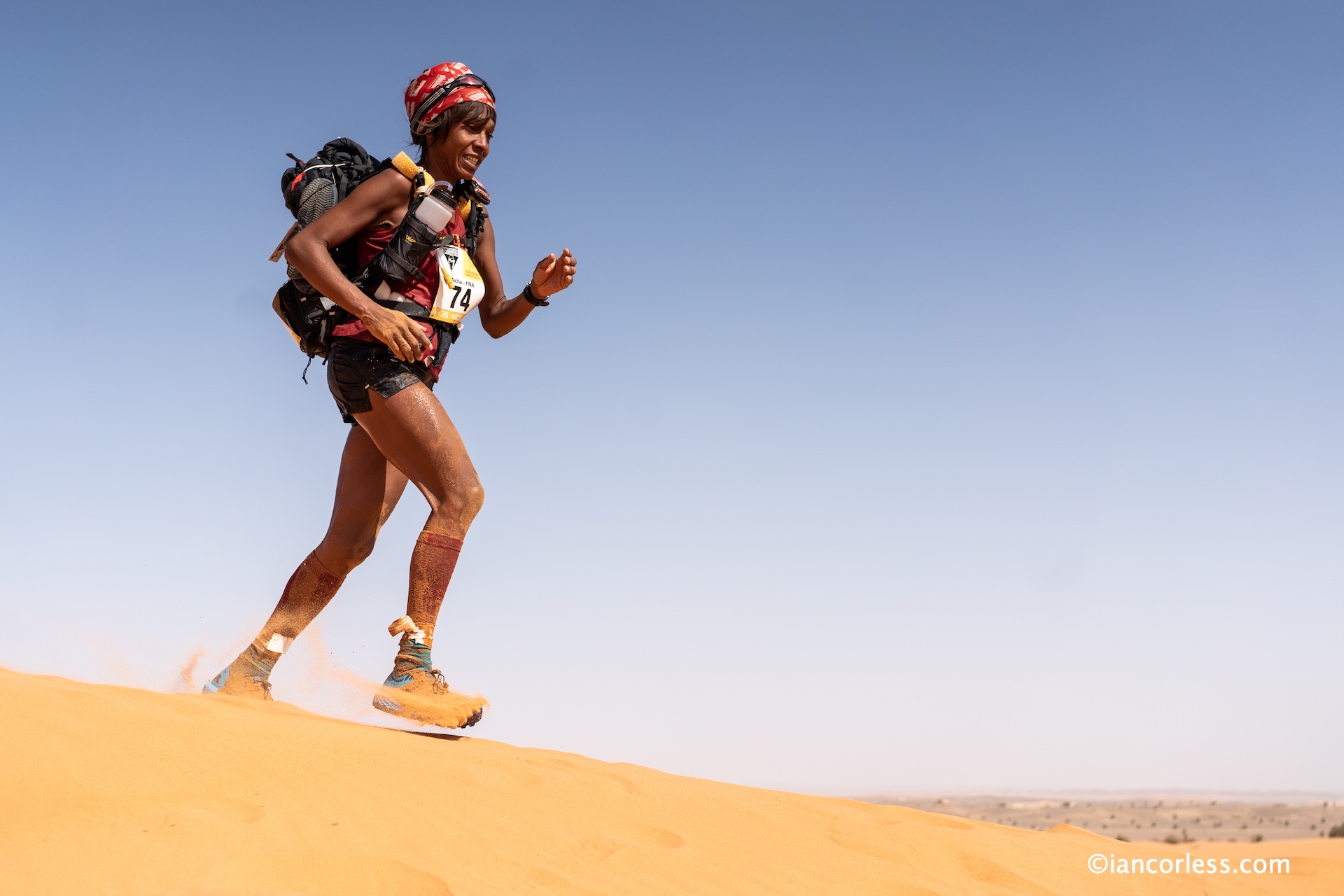
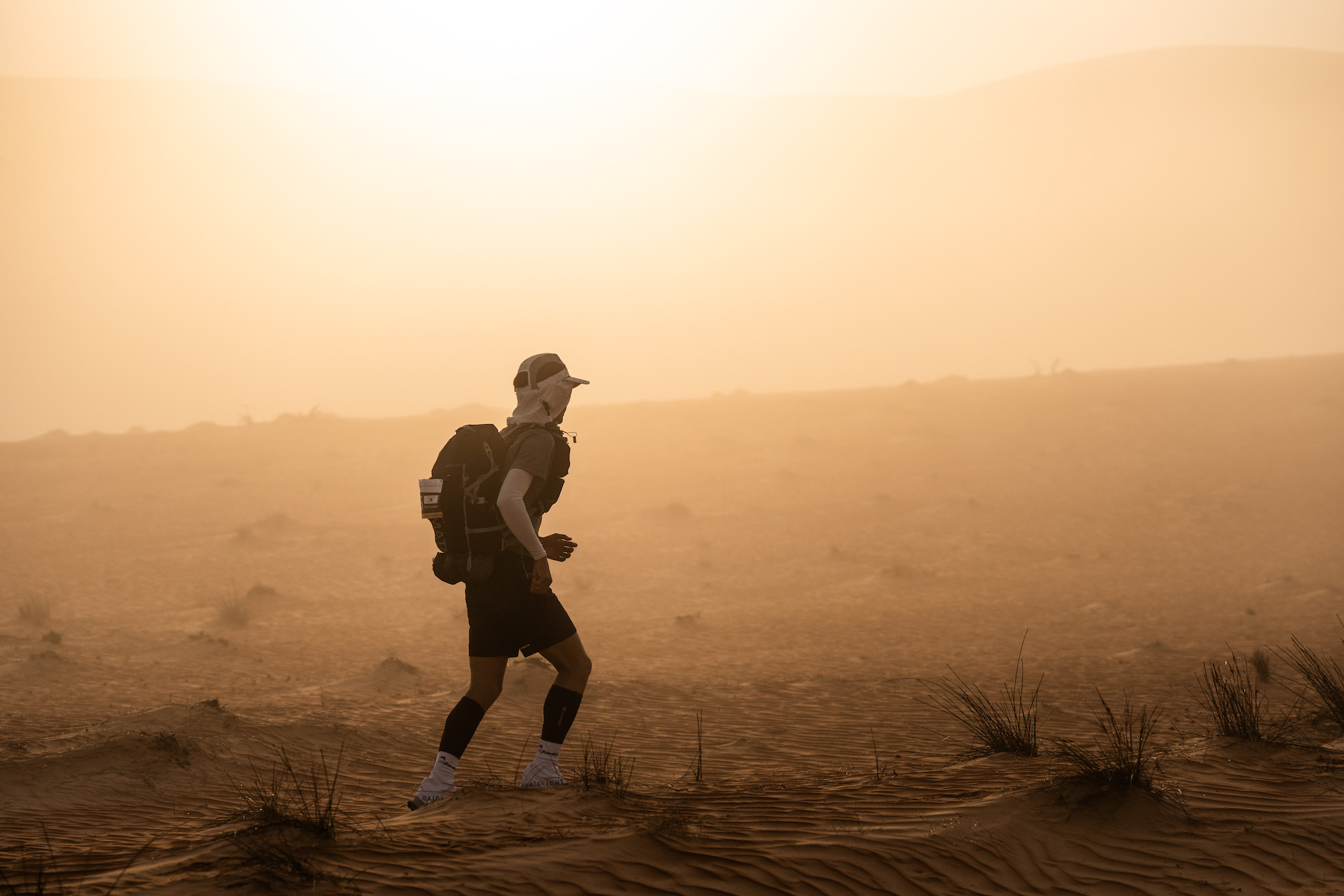
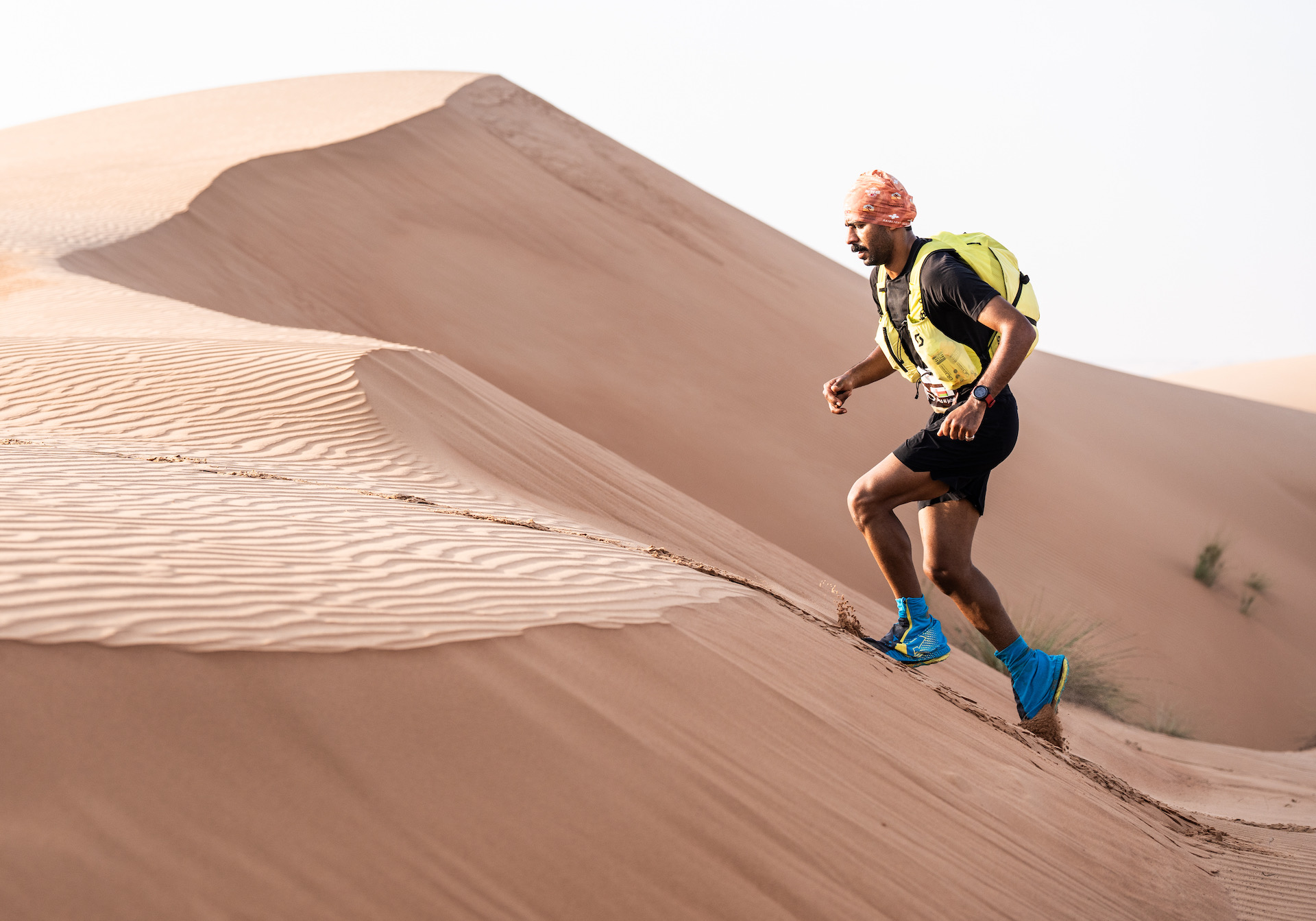
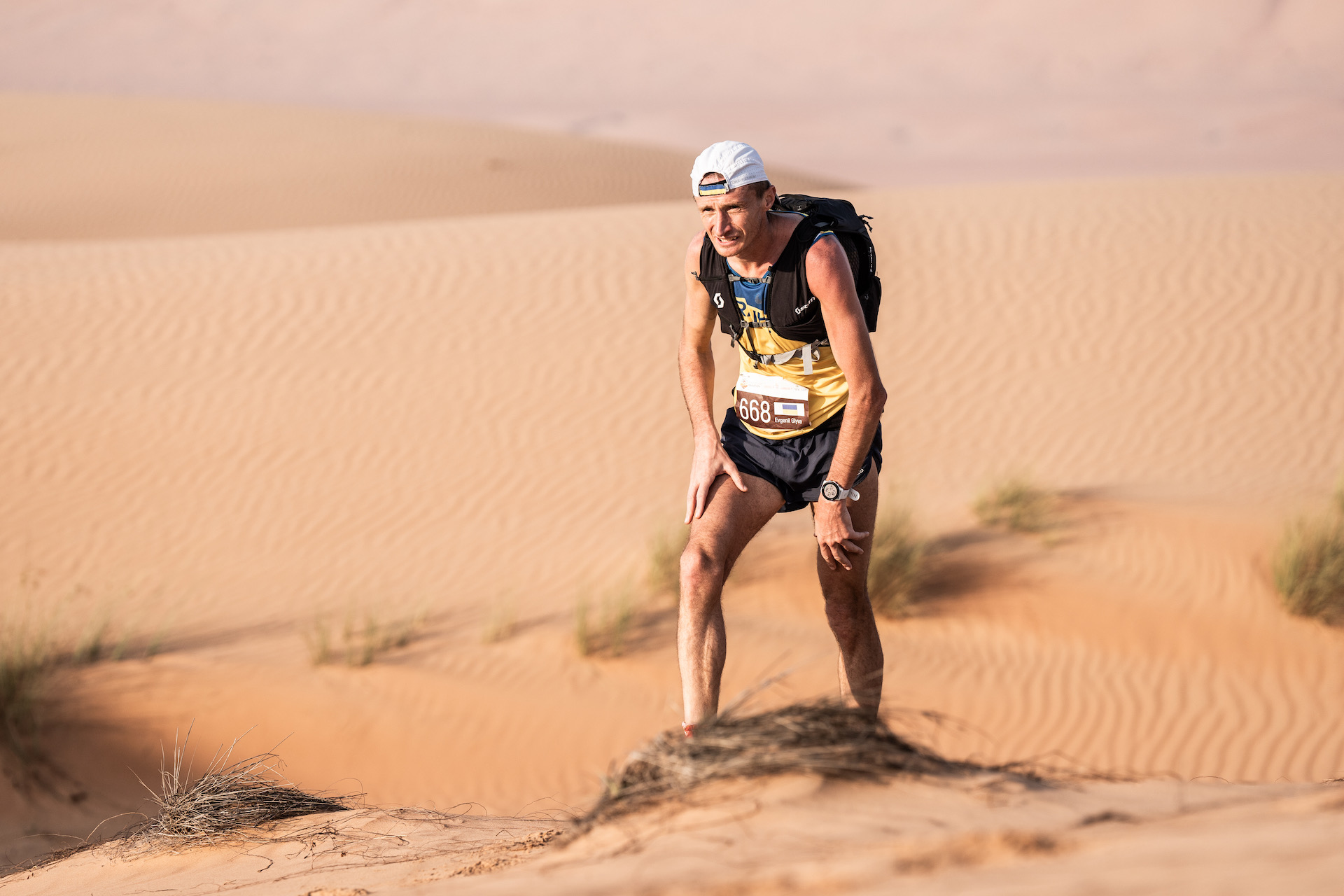
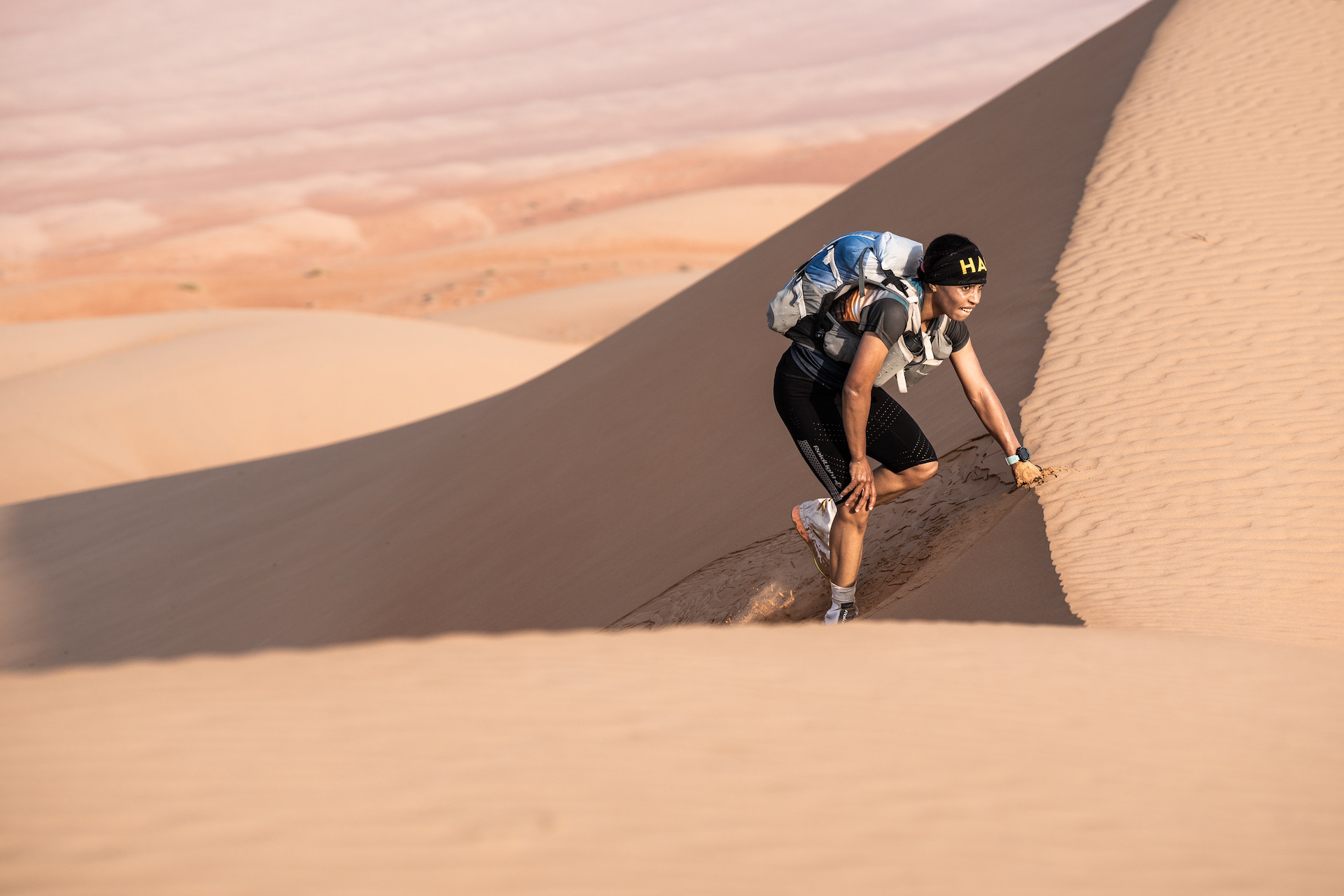
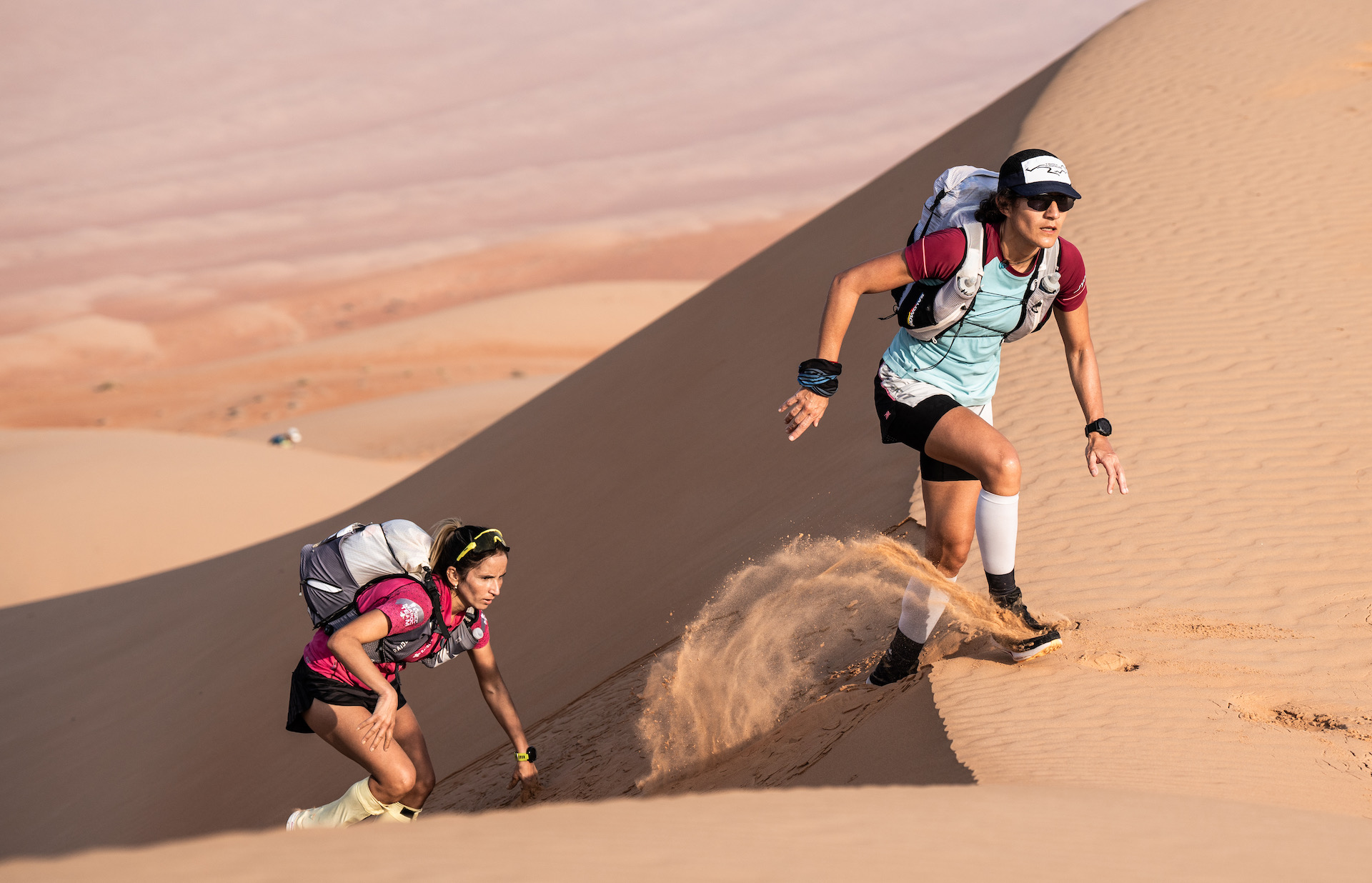
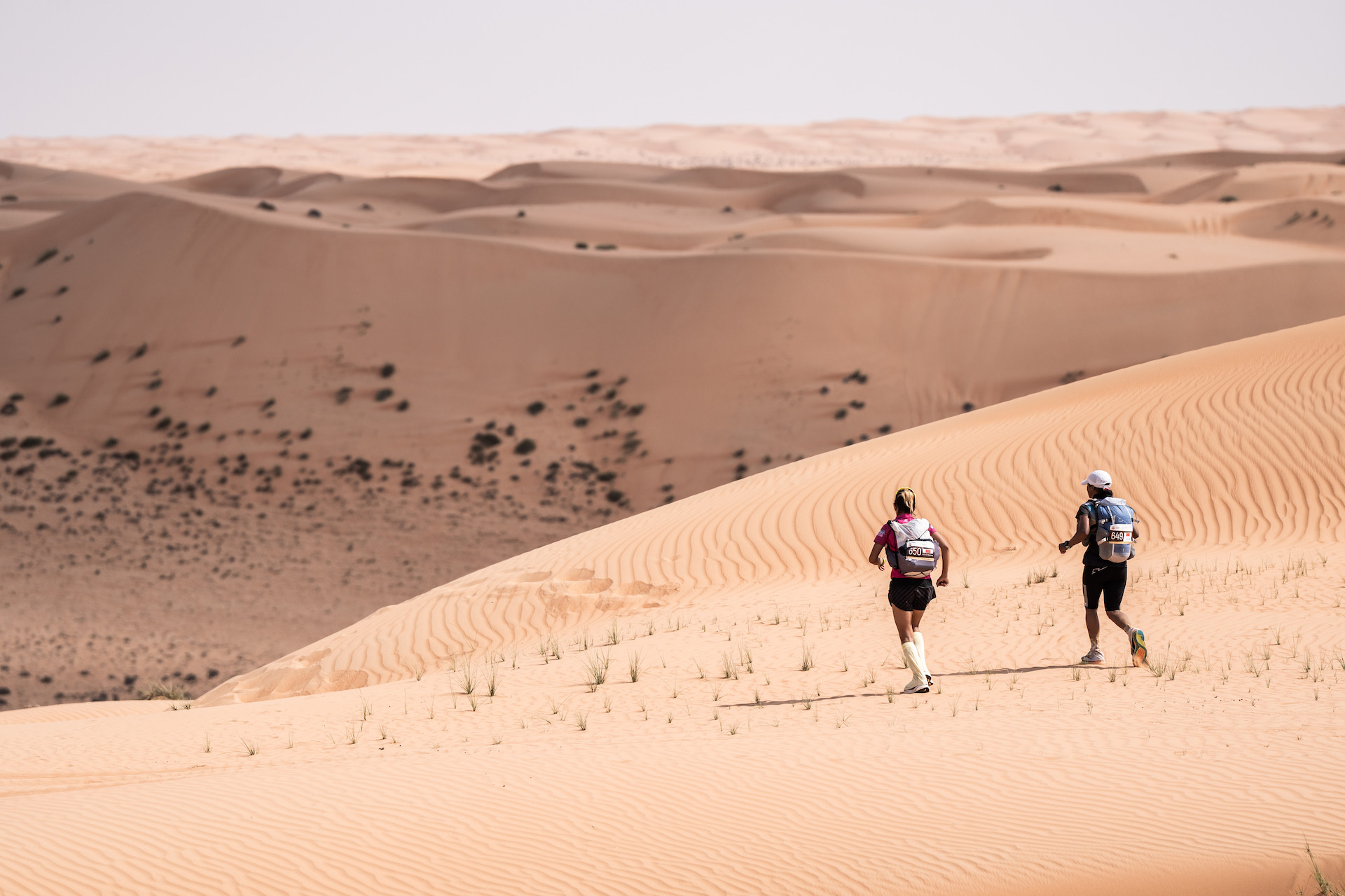
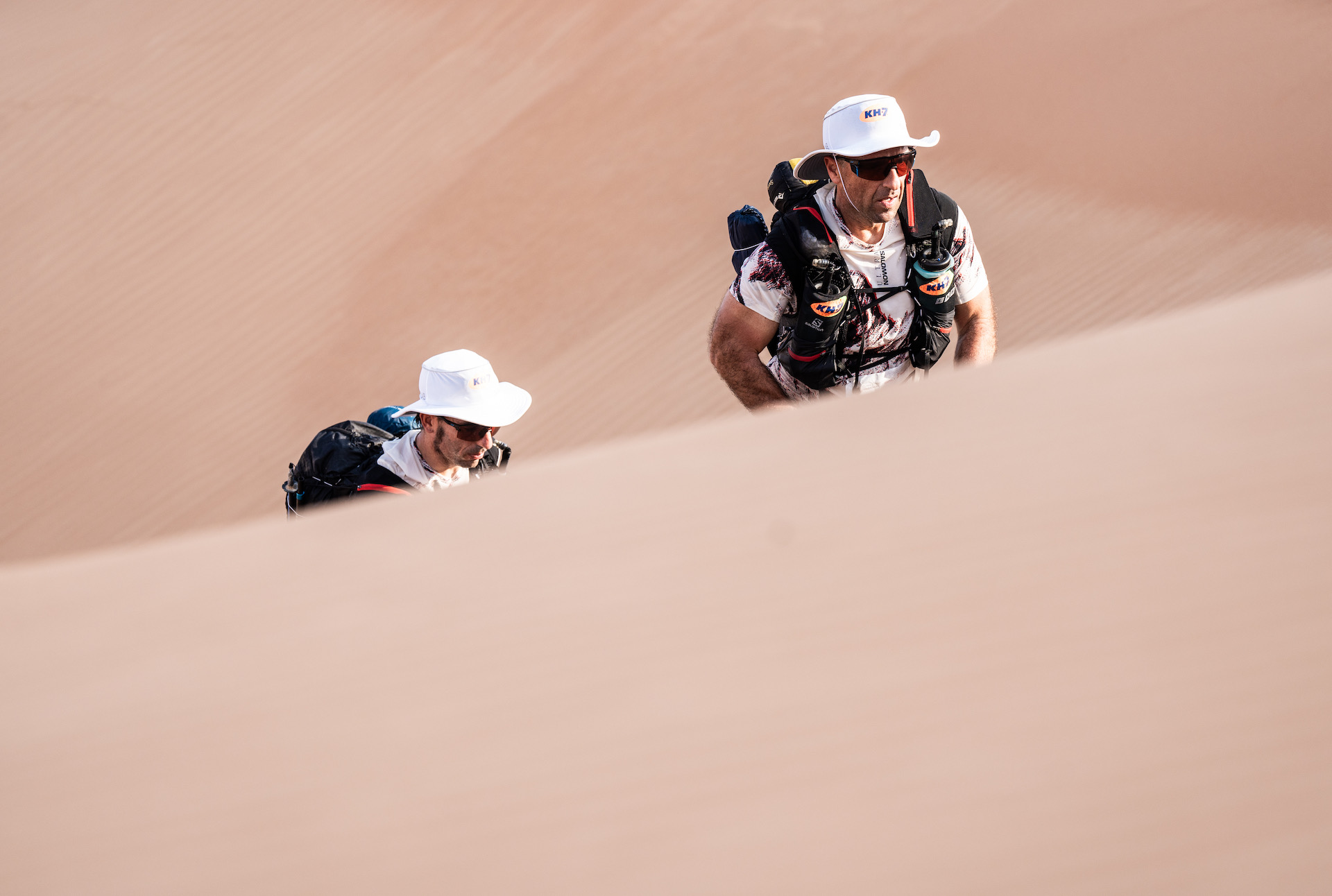
While the early km’s allowed for easier terrain with cooler temperatures, the kick is in the tail with relentless sand and dunes from 22km all the way to the finish with increasing heat, expected at a 35-degree high, but feeling much hotter than 40-degrees for the runner’s. A tough day!
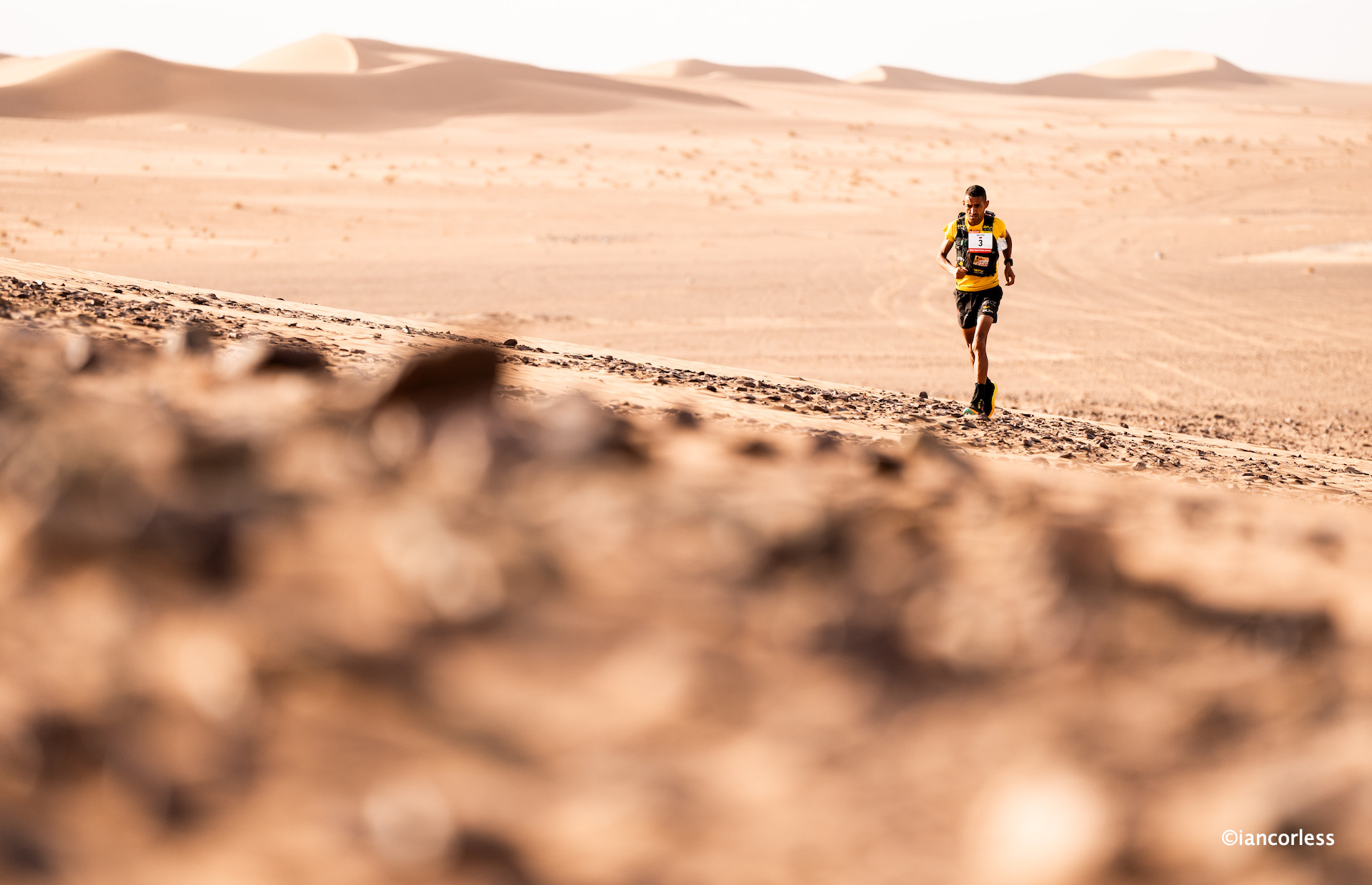
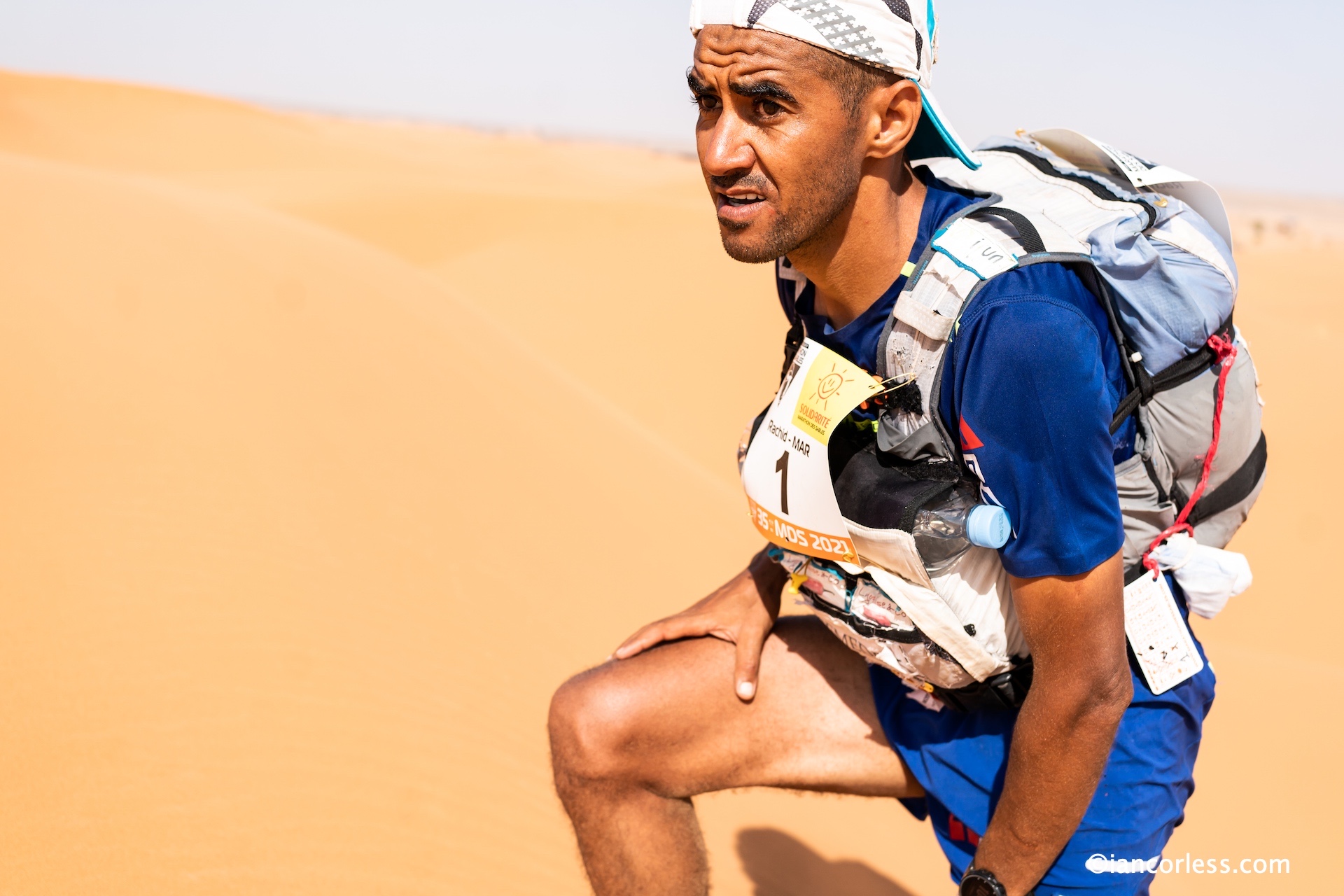
Rachid in the early 10km’s
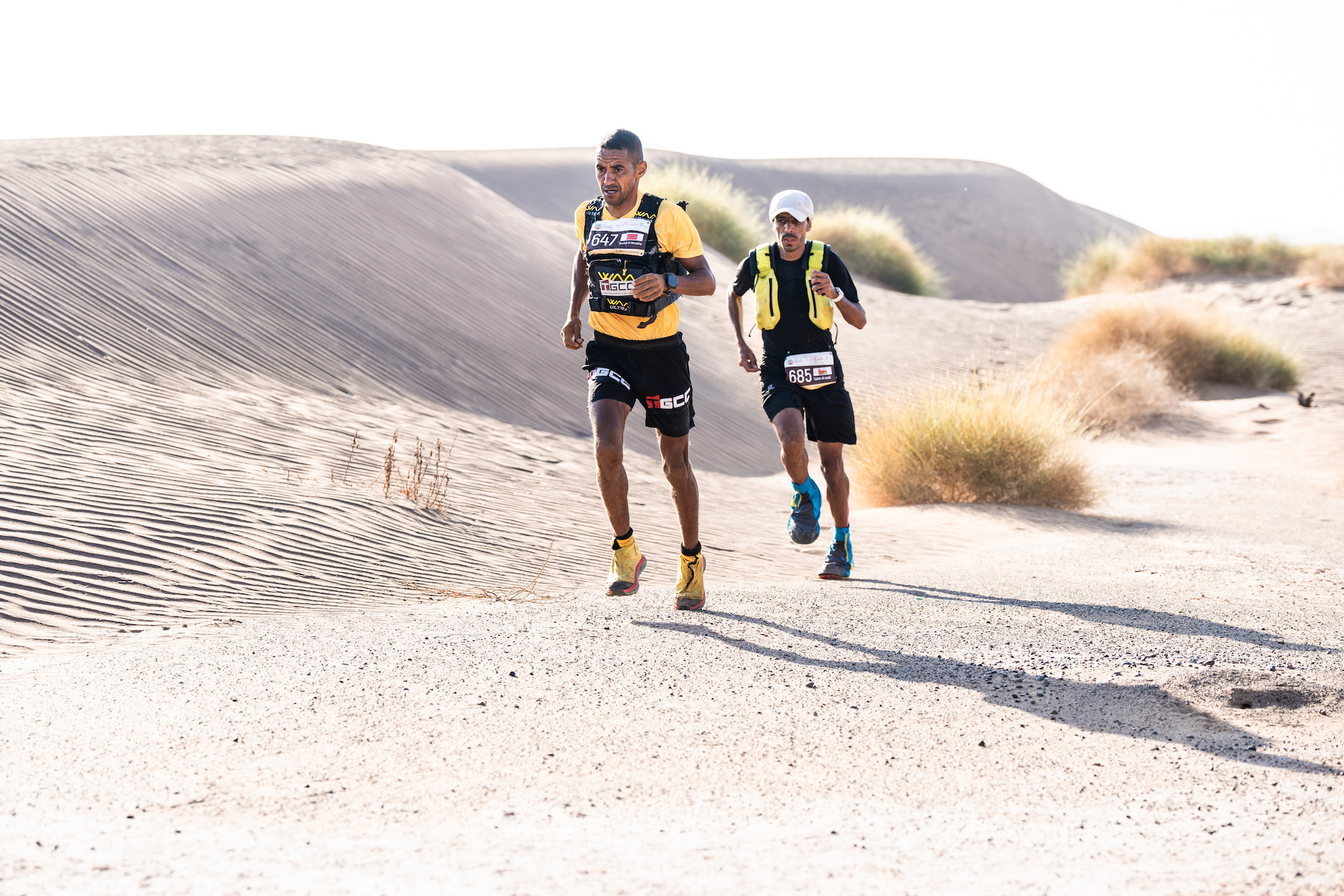
Rachid El Morabity dictated the early pace with Aziz and Mohamed behind.
Mohamed
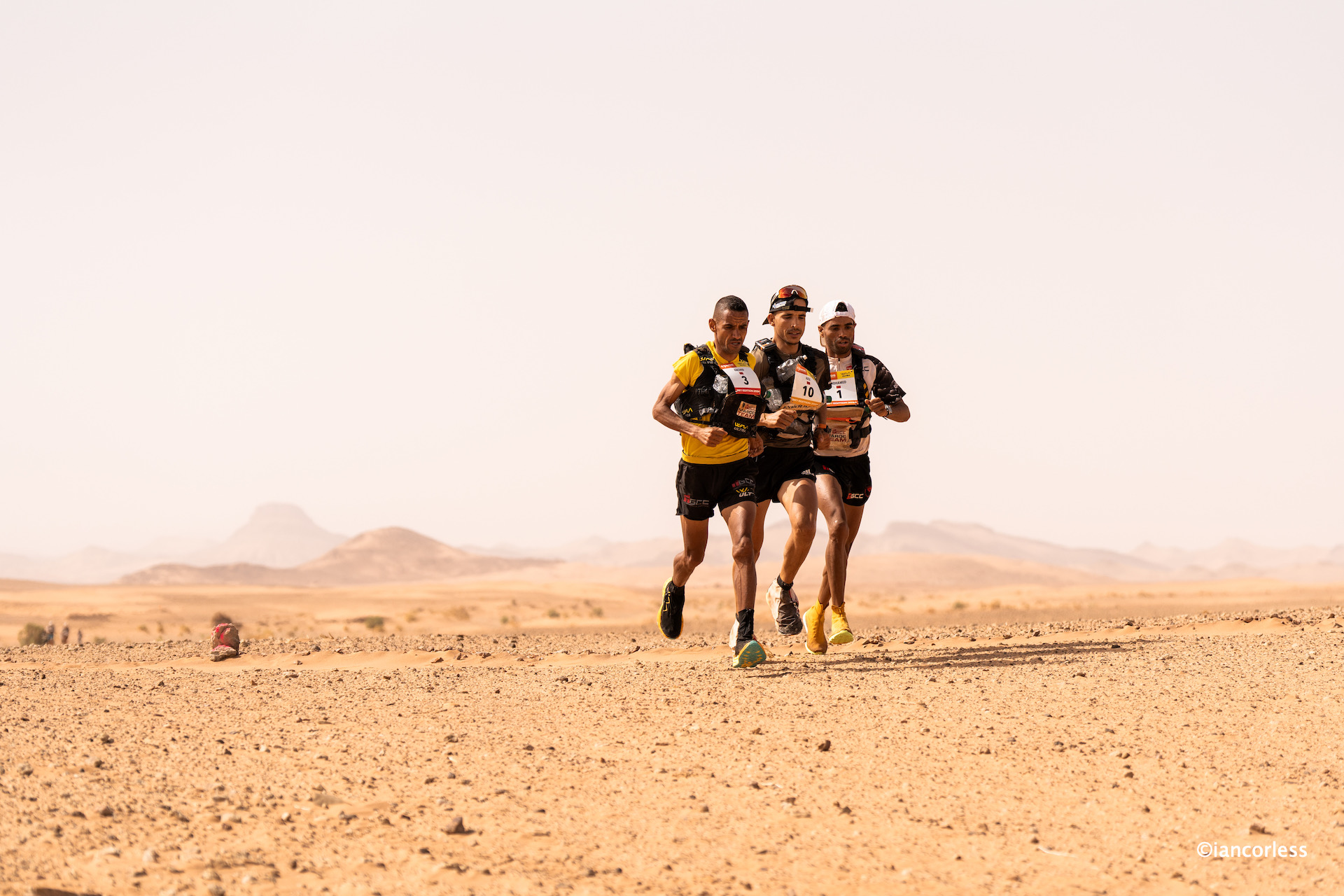
The trio mixed it up but by the halfway point they were all together.
Two company, three a crowd
In the closing 10km, Rachid made a notable kick and pulled away for the stage win, Aziz and Mohamed behind 3:13:24 for Rachid and 3:14:59 for the duo.
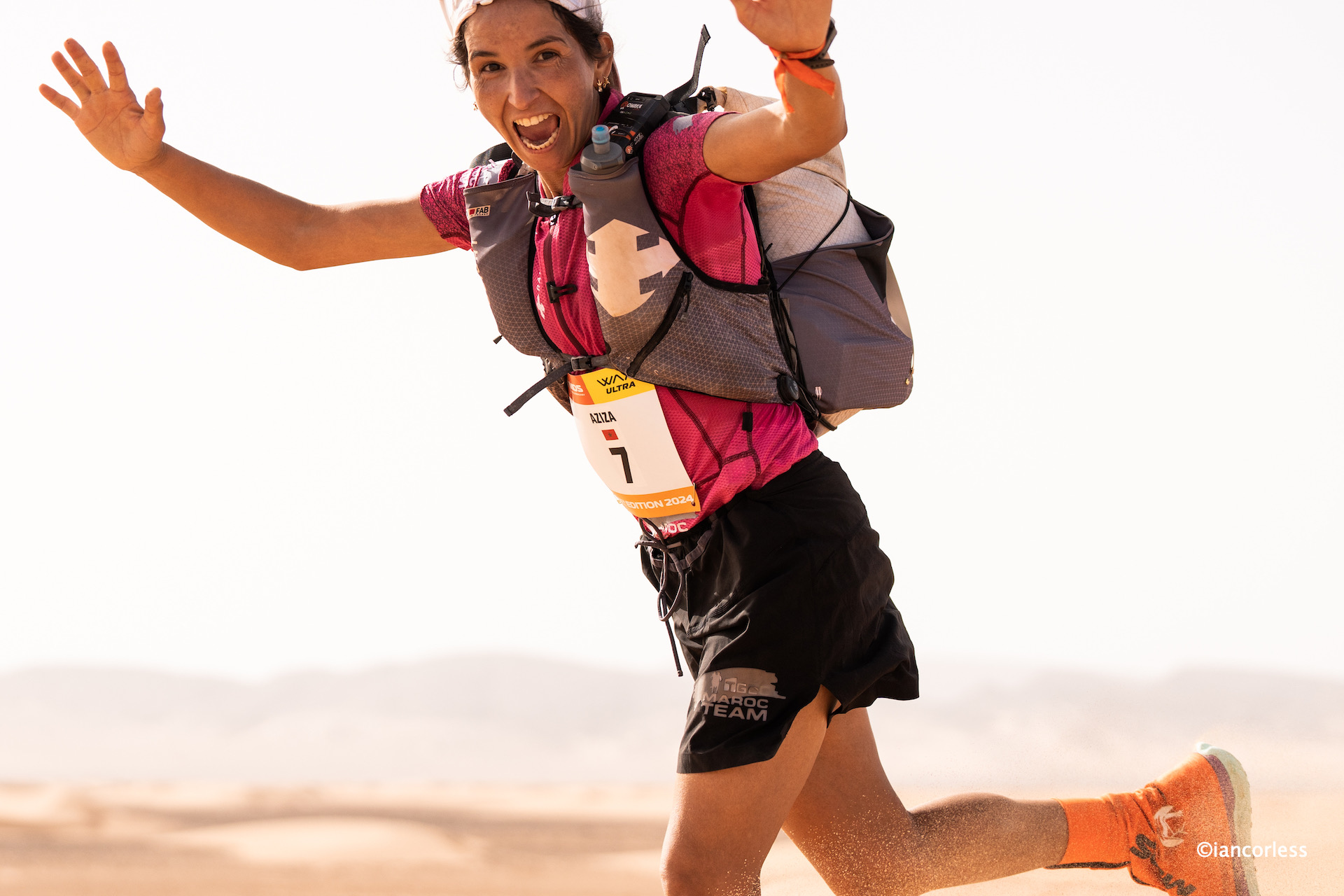
Aziza
Aziz E Amrany has been at another level this year and once again she dominated the stage from the front with another stage win in 4:29:41.
Aziza Raji
Aziza Raji followed looking relaxed and strong with a secure 2nd place in 4:53:08.
Adriana Moser
Sadly, 3rd placed runner Adriana Moser had to withdraw from the race at one of the CP’s opening the door for Gemma Game who has placed 3rd at MDS twice in the past; it maybe three times a charm! However, it was Rajaa Hamdaoua who was 3rd on the stage with 5:09:59.
The spectacle of the Sahara
You can receive daily updates and reports on this website. Follow on IG @iancorlessphotography and @mdslegendary
As we countdown to the 2024 edition of the Marathon des Sables – The Legendary, we will be providing a series of monthly updates, articles, interviews and podcasts.
The 2024 Marathon des Sables – The Legendarywill be the longest edition in the 37-year history of the race. At 252km, the event will now take place over 6-stages/ 7-days and not 5-stages/ 6-days as announced in late 2023.
It was clear initially that the 6th stage charity stage would disappear, however, on reflection, the new organisation have decided to continue with 6-stages but this time, all stages will be timed. The charity stage in previous editions was not timed.
The infamous long day which typically took place on stage 4 will now move to stage 3 for 2024, this will be day 3 and day 4 of the race as it has an extended time allowance due to the distance.
What does the above mean for the runner?
252km’s is a long way, but the race has always been advertised as 250km’s, so, although the race has fluctuated in distance over the years, the 252km should not come as any great surprise.
The timed stages now numbering 6 and not 5 will make a big difference, especially with the long day coming on stage 3. This will mean that stage 4, stage 5 and stage 6 will need to approximately cover 100km. This makes for a tough end to the week. In past editions, the long day was feared but on completion, many had the mindset, ‘It is just a marathon to go!’ Now it will be significantly more.
The daily distances are typically never disclosed before the race and the jury is out if the distances will be announced pre arrival in Morocco, watch this space! However, it is pretty easy to guess on approximate distances.
Historically, distances for the stages are listed as follows:
Stage 1 from 28 to 35 km
Stage 2 from 28 to 39 km
Stage 3 from 28 to 39 km
Stage 4 (The Long One) from 75 to 85 km (over 2 days)
Stage 5 (Marathon Stage) of 42.195 km
Stage 6 Charity
We know the 2024 edition will be 252km, so, as a guess and guide the following will provide a good estimation, the daily figures are +/-, for example, stage 1 could be 30km and stage 2 40km.
Stage 1: 32km (day 1) running total: 32km
Stage 2: 38km (day 2) running total: 70km
Stage 3: 83km (day 3 and 4) running total: 153
Stage 4: 42km (day 5) running total: 195km
Stage 5: 36km (day 6) running total: 23km
Stage 6: 21km (day 7) running total: 252km
Total: 252km
With the above information, you now have at least a template and guide for which to plan around.
OTHER KEY CHANGES
Salt Tablets
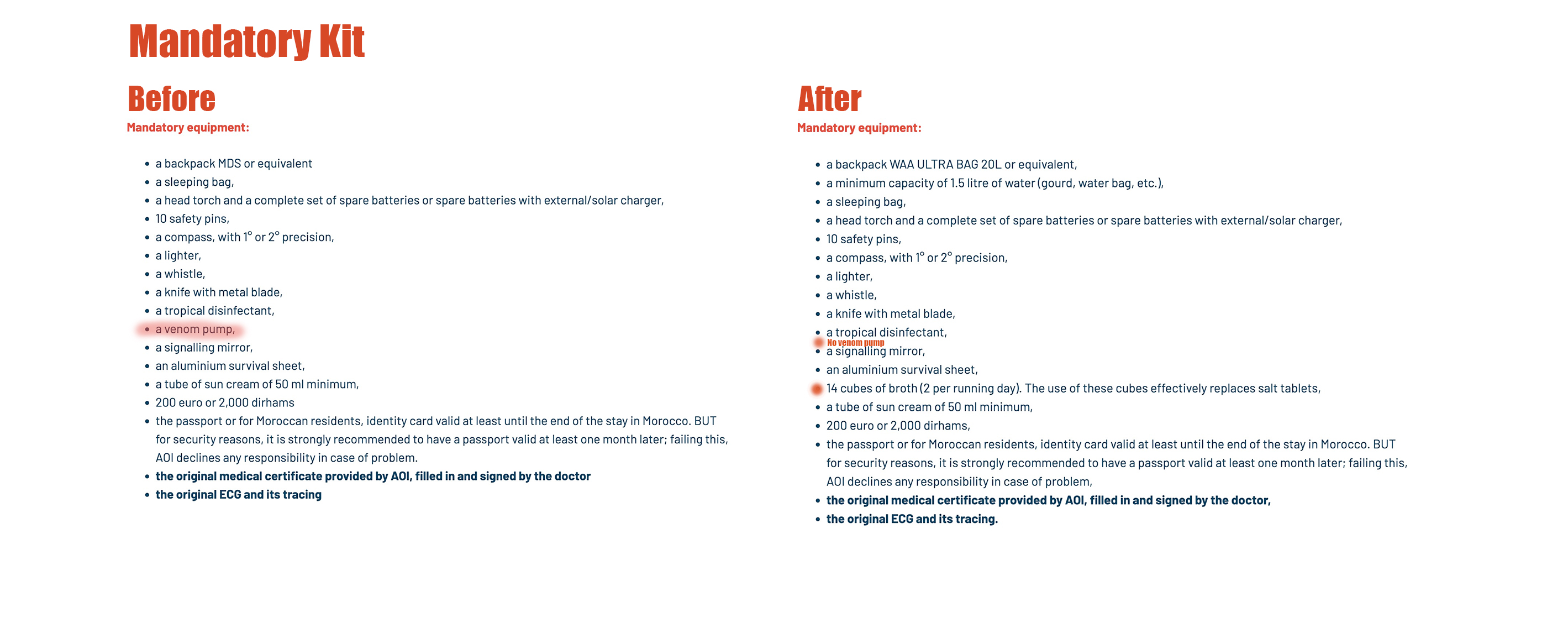
As I announced in 2023, it was my expectation that salt tablets would not be provided for the 2024 race. The new revised mandatory requirement for the race requires 14 broth cubes – these cubes are known to be salty. You have no choice here, you must have them. However, it will be your decision if you use them? My advice is to plan a strategy that works for you. Listen to my podcast with Andy Blow from Precision Hydration HERE. Remember, this is a self-sufficient race, so, be prepared to be self-sufficient and have a plan/ strategy that works for you.
Water Capacity
Another key change was the requirement for ‘A minimum capacity of 3 litres of water’ in the form of bottles, bladder etc. This has now been revised and we go back to 1.5 ltr capacity. This is a good move. Cp’s will be increased so that runner’s will only need to carry 1.5 liters. However, on the long day, an additional 1.5 ltr bottle of water will be provided either at the start or at cp1 (making 3 ltr to carry) therefore the capacity to carry 3 litres on the long day between cp’s is recommend. It is important that you think HOW you will carry this extra 1.5 ltr. Maybe you will have a bladder in or on your pack, maybe two additional 750ml bottles at the rear or if you have the front pack, you can slide the 1.5 bottle on top. It’s not recommended to run with a 1.5 ltr bottle in you hand, so, be prepared…
Water
Water during the stage will not be provided via 1.5 ltr bottles as in past editions. Water will be provided from a series of tables and manned staff with jugs to decant water to your empty bottles. Importantly, there had been concerns about where the water will come from, to clarify: 5L Bottles on CP -> Served in 2L jugs -> Served by staff in the runners’ bottles.
The exception being on the long day as mentioned above when a 1.5 ltr bottle will be provided at the start or cp1 and at the end of each stage when a 5 ltr bottle per participant is provided. This 5 ltr bottle will cover the evening after the stage, the morning of the next day and the required 1.5 ltr capacity starting the next stage to cp1. So, if you had planned to cut down a 1.5 ltr bottle to use as a bowl for dinner and breakfast, this will not be possible. You will now need a suitable pot or similar.
Checkpoints
Will be typically 2 to 7 per stage. On the long day, it is therefore a good assumption that checkpoints will be +/- 12km’s apart and hence the need to require 3 ltrs.
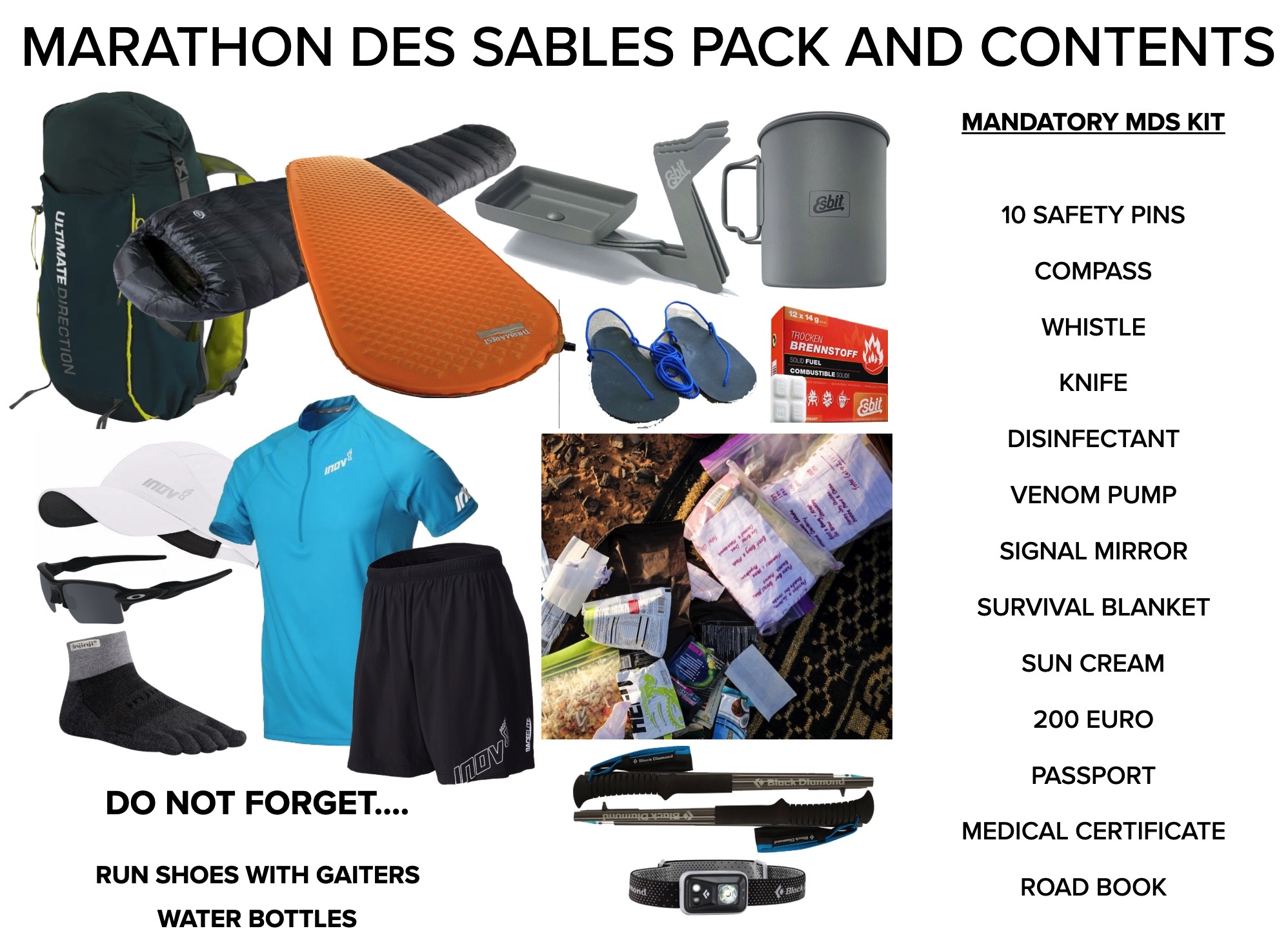
Mandatory Equipment
I will list here the mandatory equipment to avoid any confusion:
Pack such as WAA Ultra Bag 20L
Minimum capacity of 1.5 liters of water*
Sleeping bag
Head torch and spare batteries (you can have a charger/ solar charger)
10 safety pins
Compass with 1 or 2 deg precision
Lighter
Whistle
Knife
Topical disinfectant
Venom pump*has now been removed
Signal mirror
Survival blanket
14 cubes of broth***
Sun cream
200 euro or 2000 dirhams
Passport or ID card
ECG and medical
* new change but consider the long day when you will have 3 ltr.
** new change
*** to replace salt tablets
Food Requirement
You need 14,000 calories of food as a minimum, 2000 calories per day. You can of course carry more than this, but 14,000 is the minimum. You must be able to prove the calories, so, if you decant food into lighter or different packaging, make sure you keep the nutritional information.
You
In addition to the above you personally will need:
Keep the pack weight as close to the minimum 6.5kg as possible, additional weight is additional stress that you do not need.
Keep luxuries to a minimum, they only add weight. A super light Mp3 player (with good battery) and earphones is the only luxury I would consider.
Accept that this is a tough challenge, you will be stripped back to a survival mode. You will not wash, you will get dirty, you will get smelly. Accept it.
Start slow and ease into the race.
Poles can be a lifesaver and I recommend them but you must learn to use them. Those at the front do not need poles, they can run.
Learn to walk, walk and walk. Many go to the desert with the expectation of running 80% and walking 20%. The reality is it will be the other way around.
Look after your feet and start with the correct shoes for you.
Take a sleeping mat or pad. You only need to do three things: run, eat and sleep. Sleep and comfort is important for recovery.
The 2024 Oman Desert Marathon concluded at Jawharat Bidiah Resort, 165km’s travelled over 4-days and Rachid El Morabity and Aziza Raji are the champions covering the total race in 16:06:49 and 23:13:32 respectively.
Going into the last 21km stage, the end result was never in question, both Rachid and Aziza had built 20-minute plus leads and all they had to do was run a calm and measured last day.
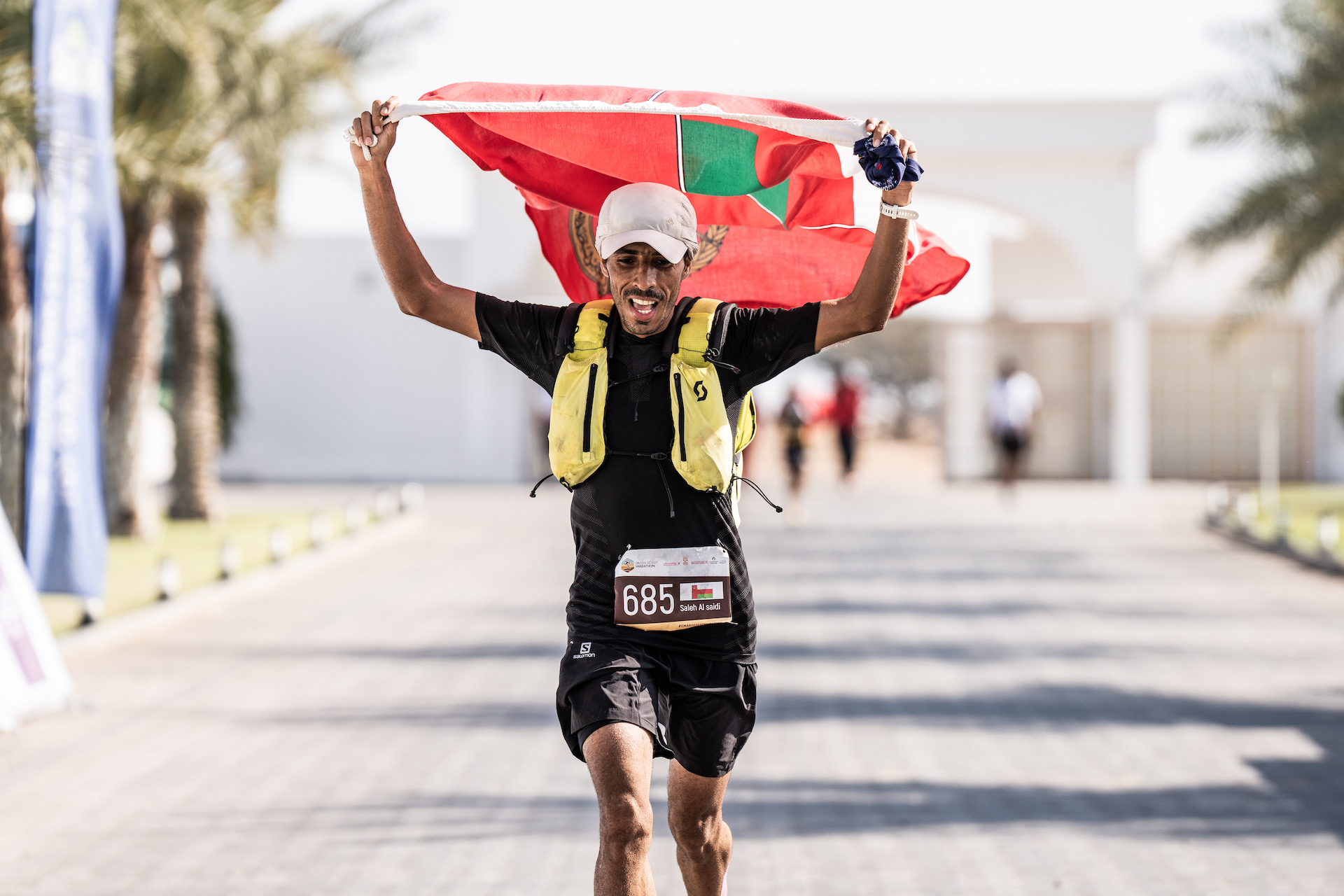
However, Saleh Al saidi pushed the pace continuously, maybe, just maybe in the back of his mind he thought he could break Rachid?
In the closing km, Rachid eased back and gave Saleh a final stage victory for the home crowd and the Army Team which he respresents.
In third place, Ghaith Al saidi. The brothers ran an incredible race and at times placed Rachid under pressure, however, Rachid for now is just too strong and experienced.
For the women, the Aziza Team were dominant and after Raji built the lead early on, El Amrany was content to run by her side.
In third place was Veronique Messina who each day consistently covered the km’s with commitment, determination and a smile. A great run in 25:38:53.
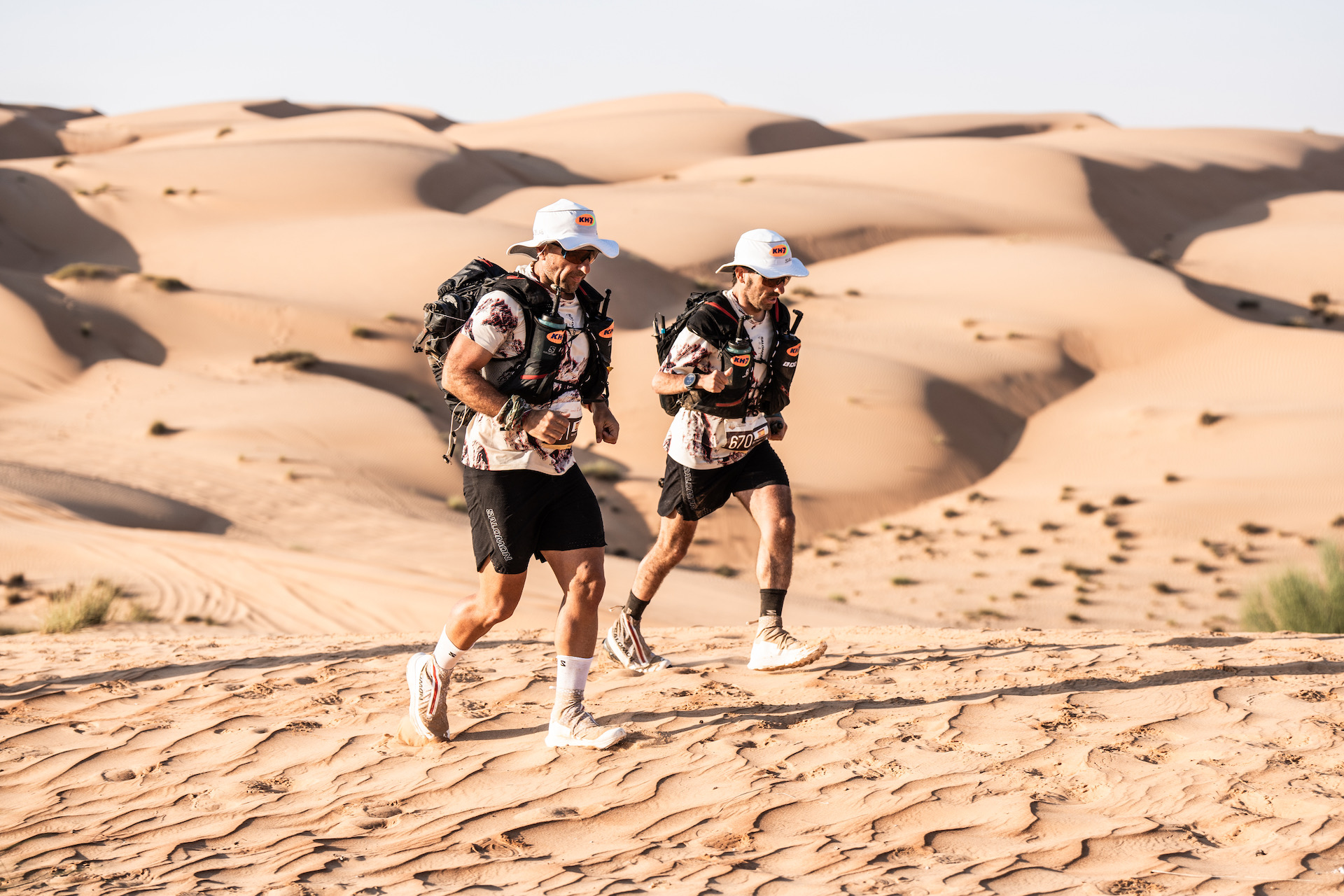
In total, thirty participants completed the race from twelve nationalities. With the race almost completely sand, the race is considered considerably harder than Marathon des Sables. This was confirmed by Rachid, “Here it is all sand, it’s slower and more tiring. Only the last day has some easier and harder terrain on which to move quicker and easier.”
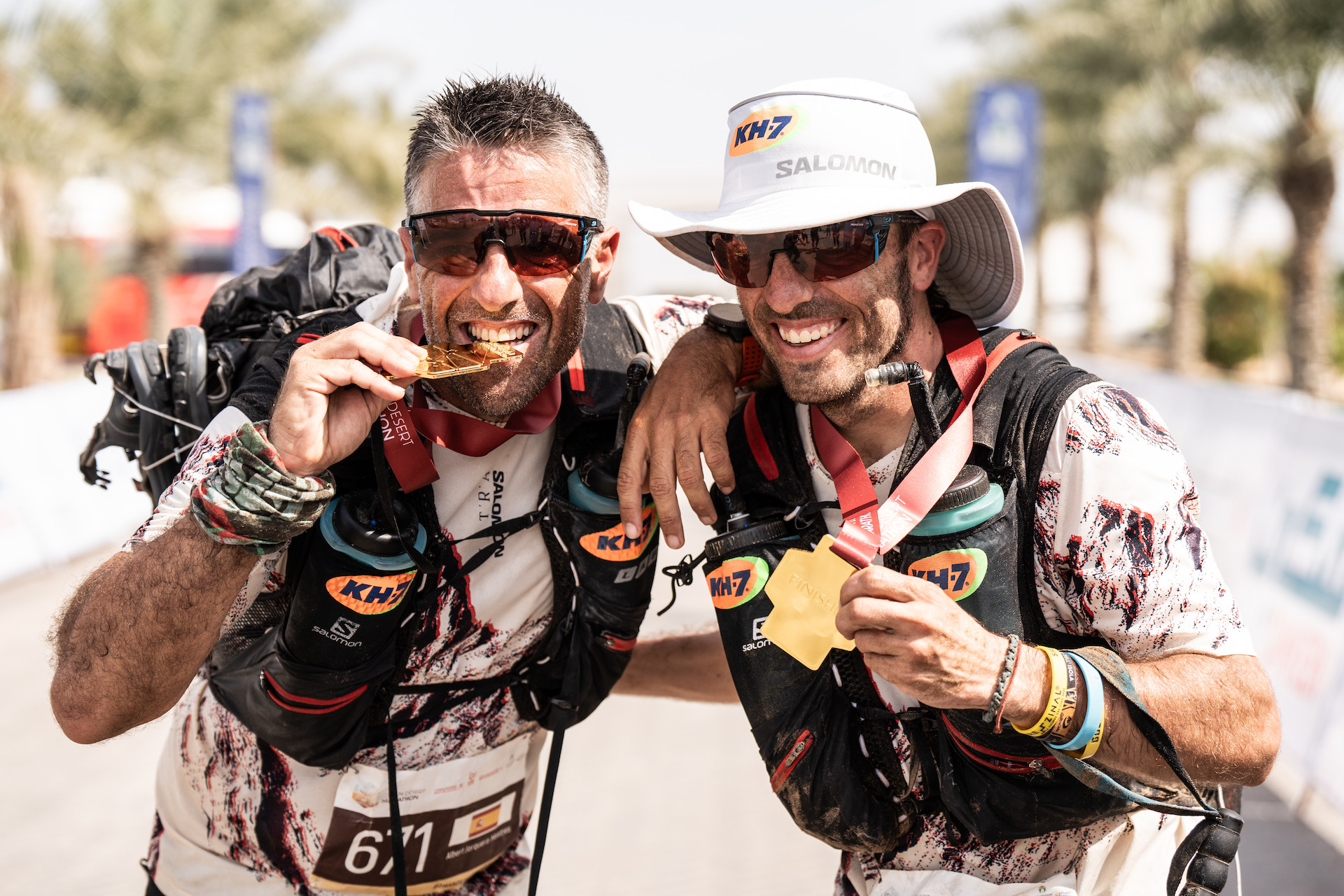
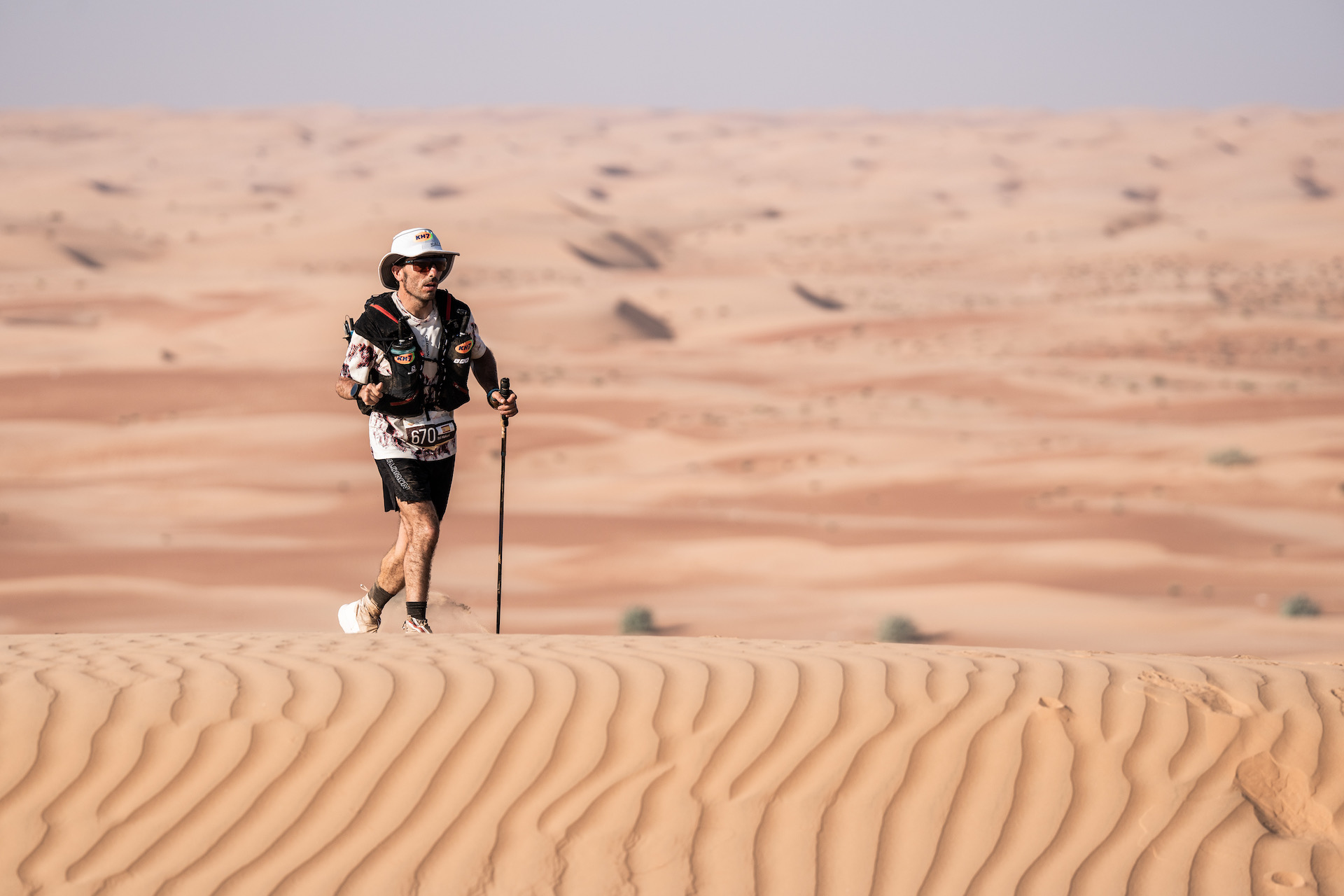
While it is difficult to pick out individuals in such a tough race, Pol Makuri has inspired everyone during the week. His commitment and dedication has been an inspiration. His completion of the event brought tears to many an eye, especially his friend and teammate, Albert Jorquera.
Rachid and Aziza may well have crossed the finish line the fastest, but a winner and champion comes in many forms and Pol Makuri is a prime example.
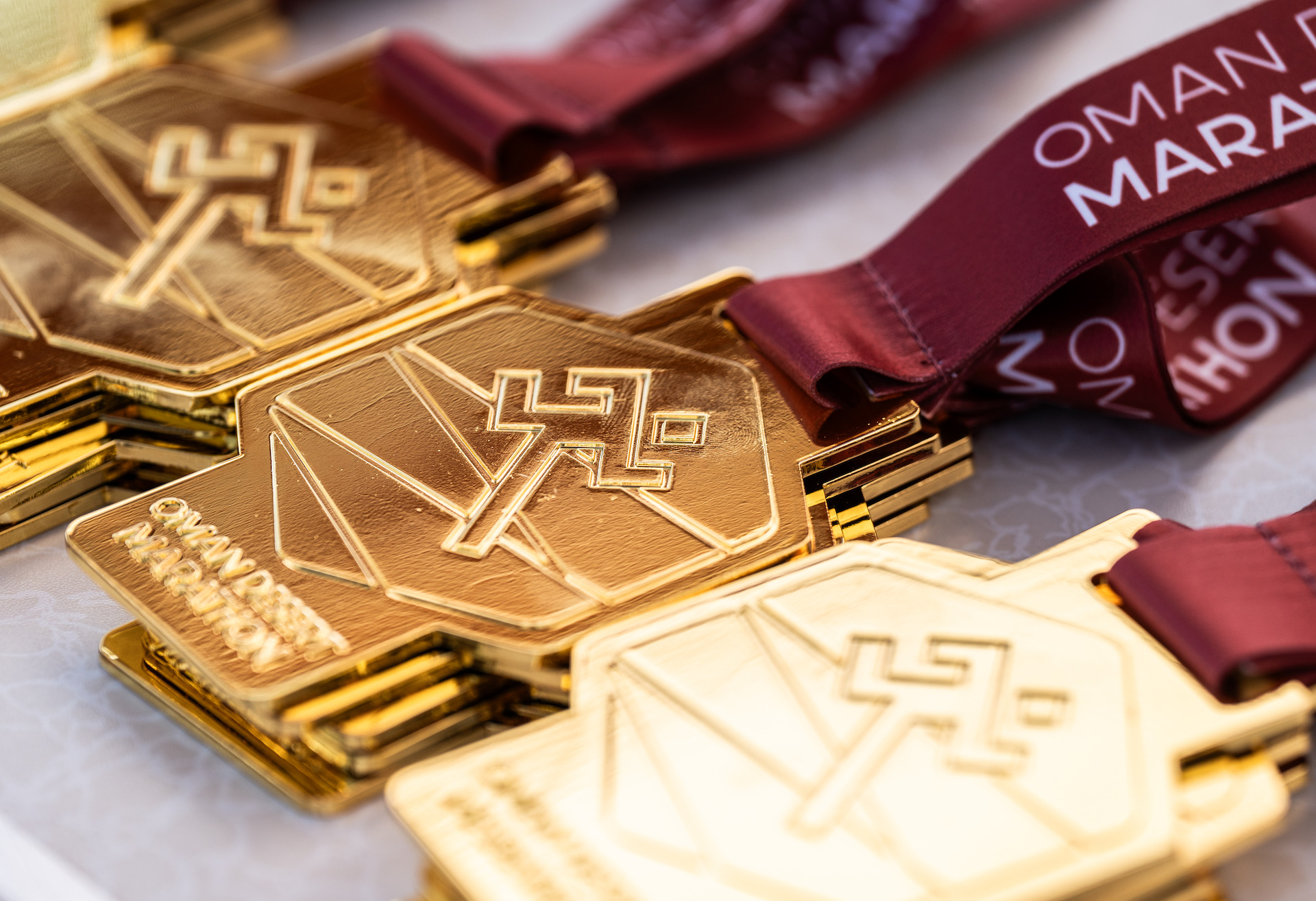
Each medal was hard earned and yes, as in many races some did not reach the finish. However, they were there at the finish line to cheer the others on, no doubt being inspired to return and try again.
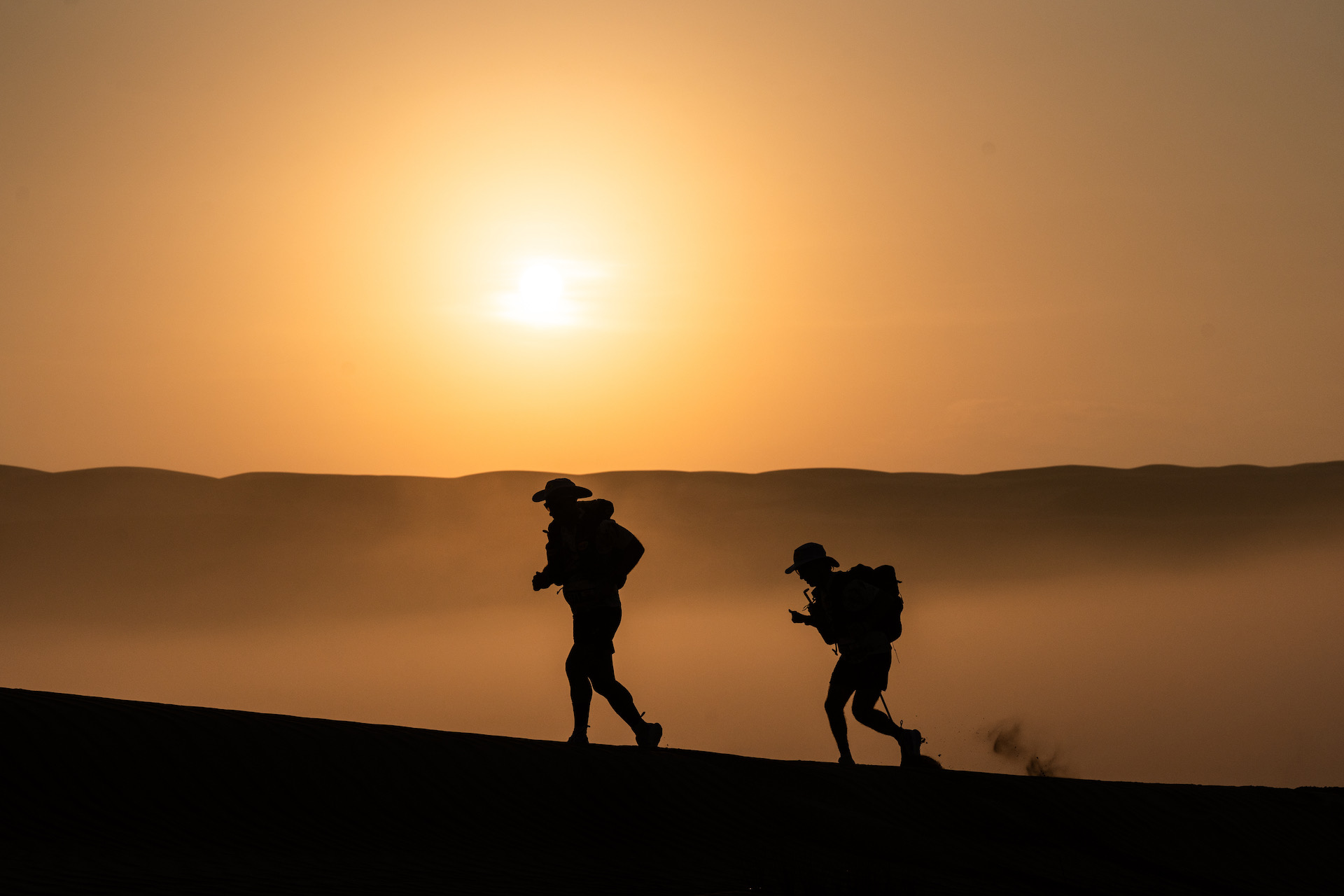
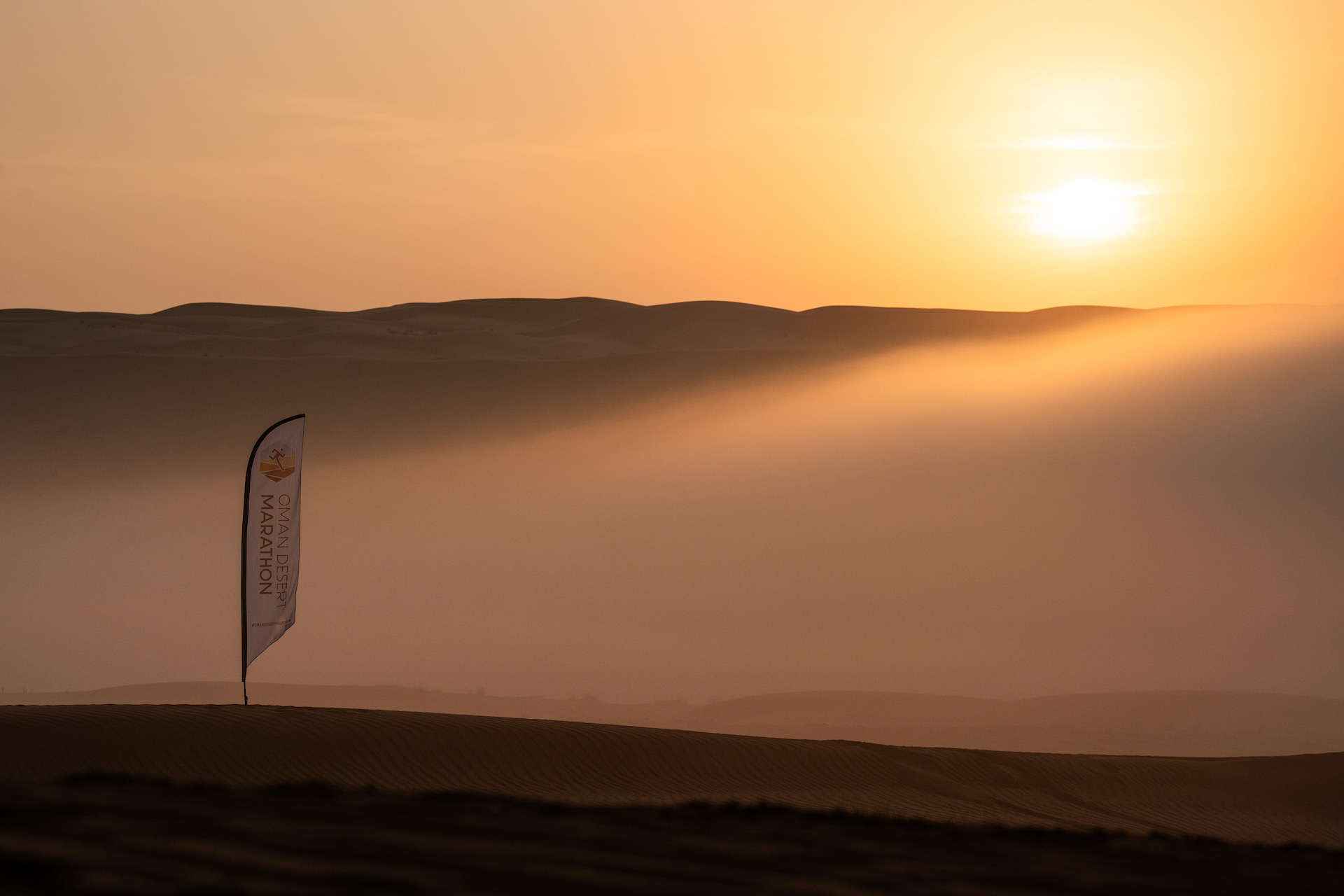
Day 2 of the Oman Desert Marathon and after day 1, there was some anxiety. At 55km’s long, the stage was set to be tough. A planned 0630 start with sunrise, would provide participants with extra time in daylight. However, the weather had different plans. An inversion came in during the night and early morning reducing visibility in the valley to zero, the start was delayed 1-hour.
At approximately 0730, the runners were on the way despite some lingering mist. However, the mist was guaranteed to disappear quickly and it did. While it lasted, it gave an eerie feeling to the desert.
Sadly, Mohammed El Morabity was a DNS today. He was tired and feeling under the weather after long delayed travel and a tough first day. Although sad to see a competitor leave, I am sure Salah Al Saidi and Evgenii Glyva were somewhat happy to have one less El Morabity brother to deal with.
Having run a very strong stage 1, Salah Al Saidi took the race to Rachid pushing the pace. As always, Rachid started easy and looked relaxed while following and Evgenii was pushing to hold the pace.
For the women, Aziza Raji must have felt very confident after her stage 1 performance and huge gap. By contrast, Aziza El Amrany was probably wondering how she could pull back any time? Kathleen Leguin who was a pre-race favourite had suffered with sickness on stage 1 but started the day feeling better and the trio ran together with Veronique Messina behind.
Despite 55km’s, stage 2 was billed as a more runnable and easier day, it wasn’t. There was a great deal of soft-sand, several dune section and lots of heat. It was all too much for Kathleen and sadly she withdrew from the race at cp3.
It is never easy to tell if Rachid is suffering, but today there seemed some signs of fatigue and tiredness at cp3. He left with Saleh but looked happy to hold back and let the pace be dictated.
However, in a typical Rachid move, he finally applied pressure and opened a gap crossing the line in 5:47:24 to Saleh in 6:07:43. Evgenii finished 3rd in 6:23:13.
The two Aziza’s were playing truce today and duo ran together all day, Raji happy not to loose anytime to El Amrany and at the same time share the desert with a friend.
With Kathleen out of the race, Veronique finished 3rd, the times of the top 3 8:31:06 and 8:31:07 for El Amrany and Raji, 9:04:37 for Veronique.
Results HERE and GC ranking HERE.
Albert Jorquera and Pol Makuri were battling the day and due for an early evening finish, in darkness.
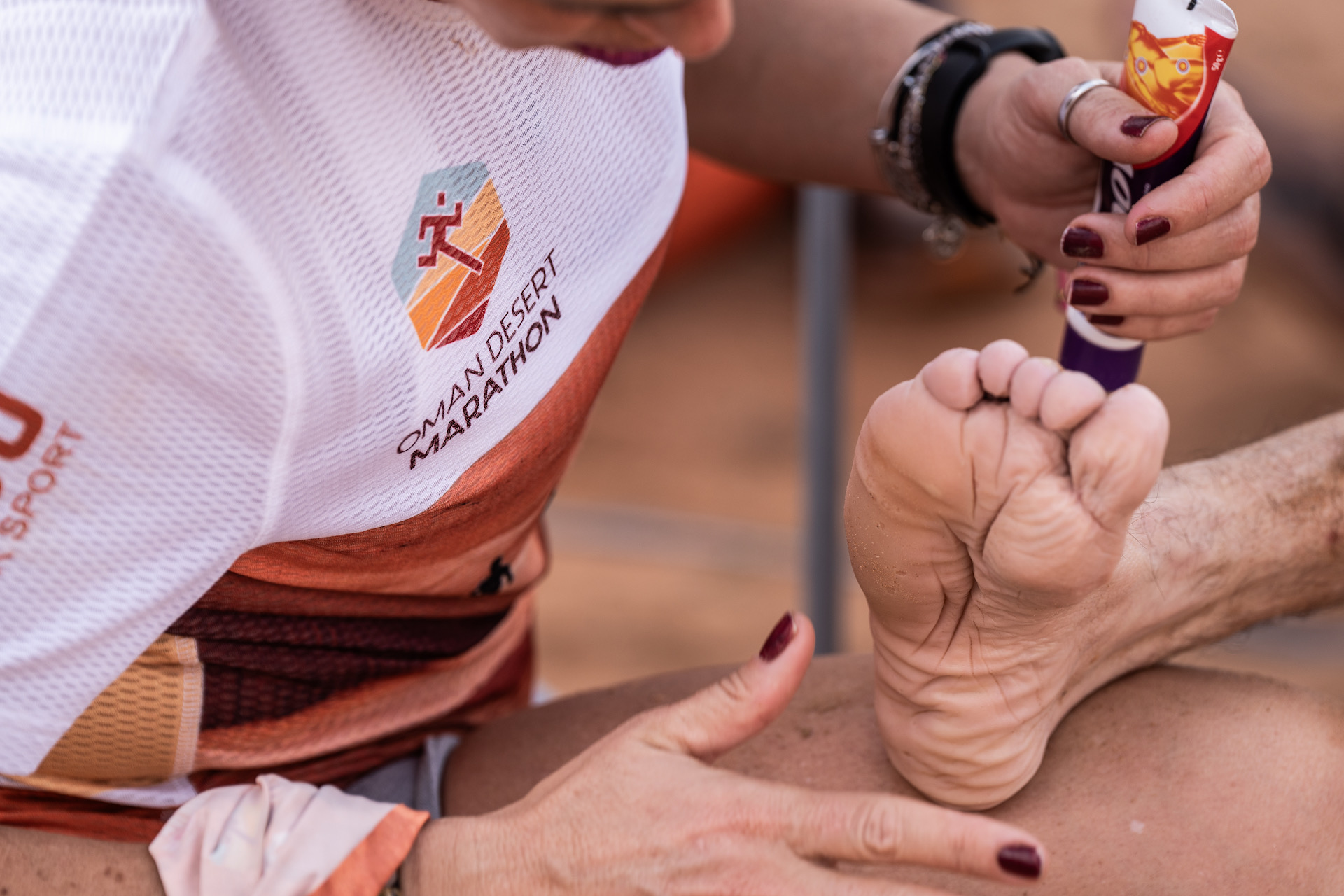
A long stop at cp3 allowed Pol to get some treatment for his feet and recharge ready for the push to the line; he’s one tough guy!
Tomorrow is stage 3, the night stage. The runner’s will start in two waves. The first around midday, the second early afternoon and they will go in to the night over roughly a marathon distance.
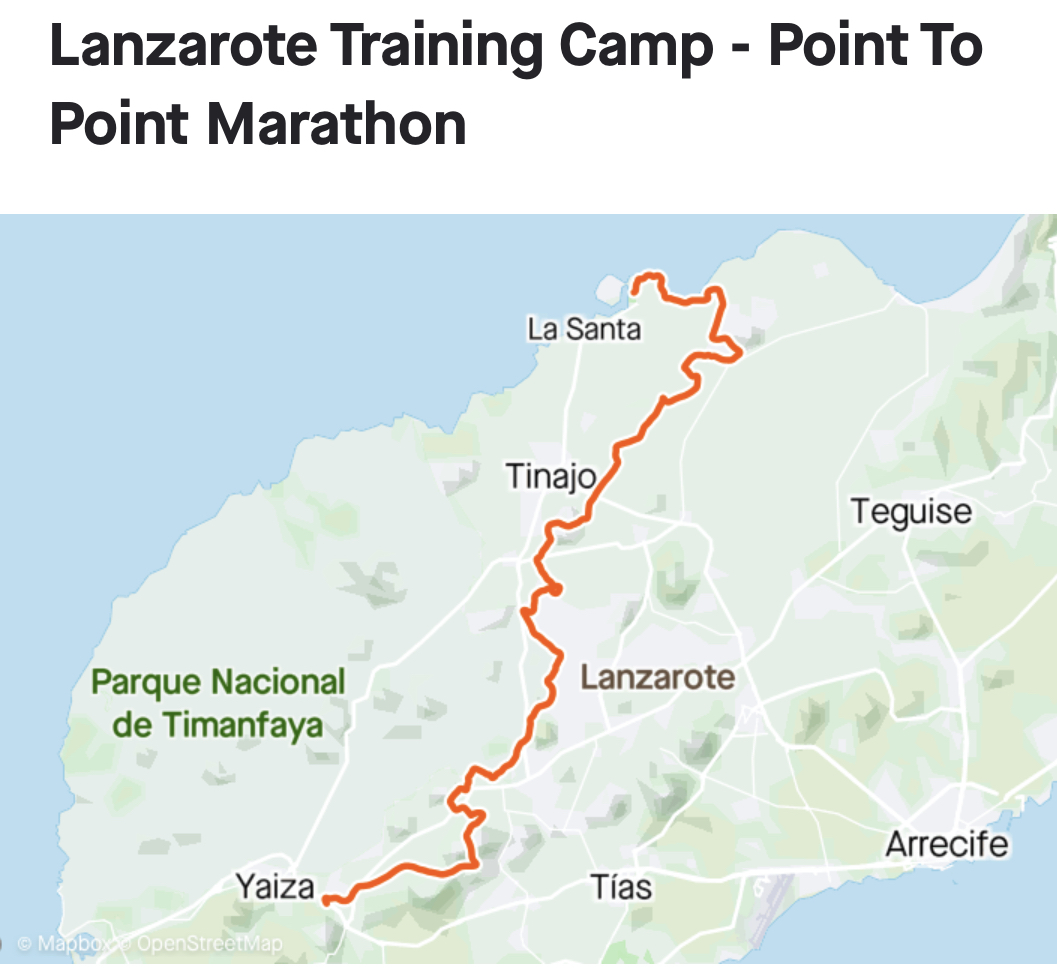
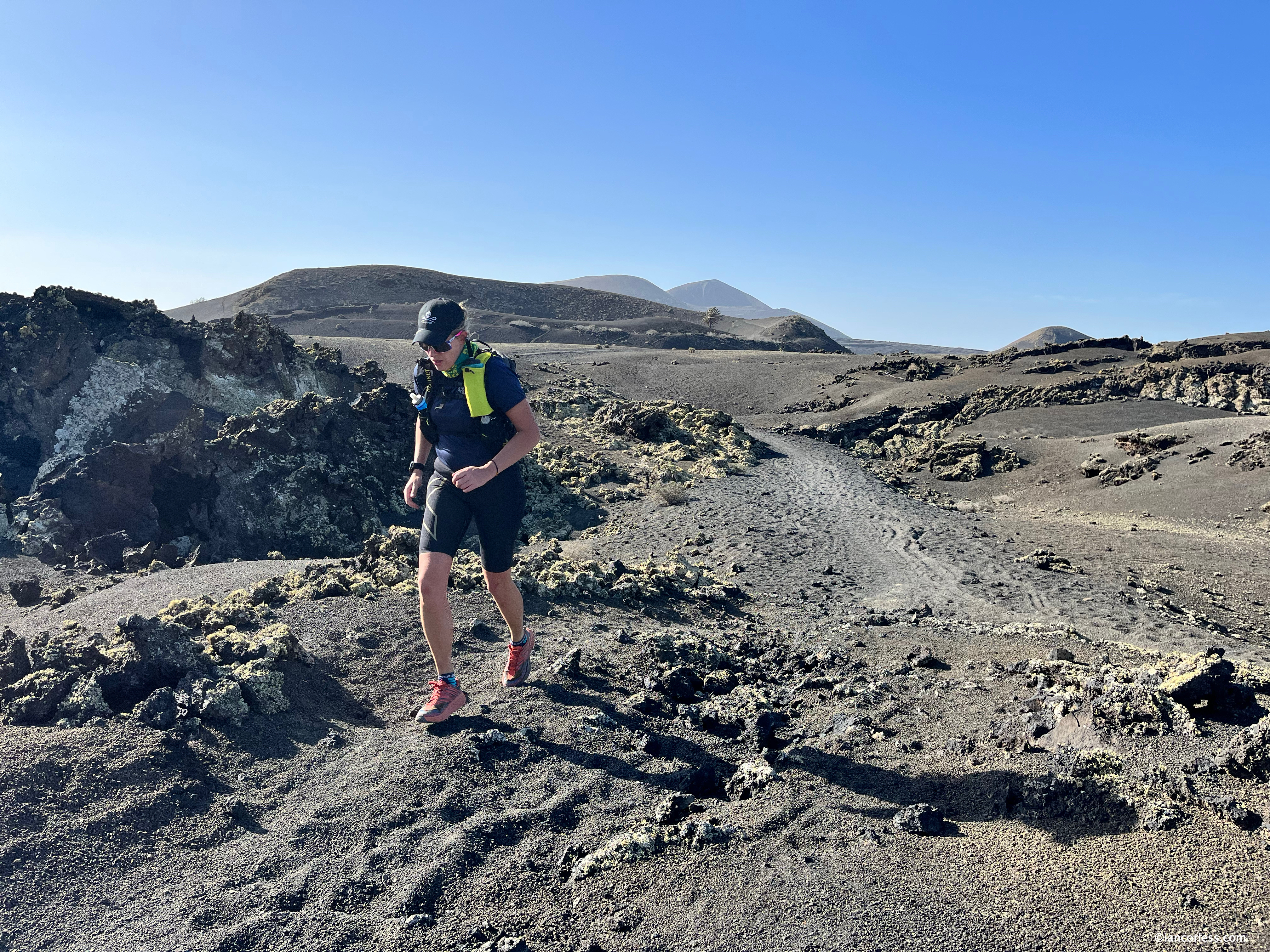
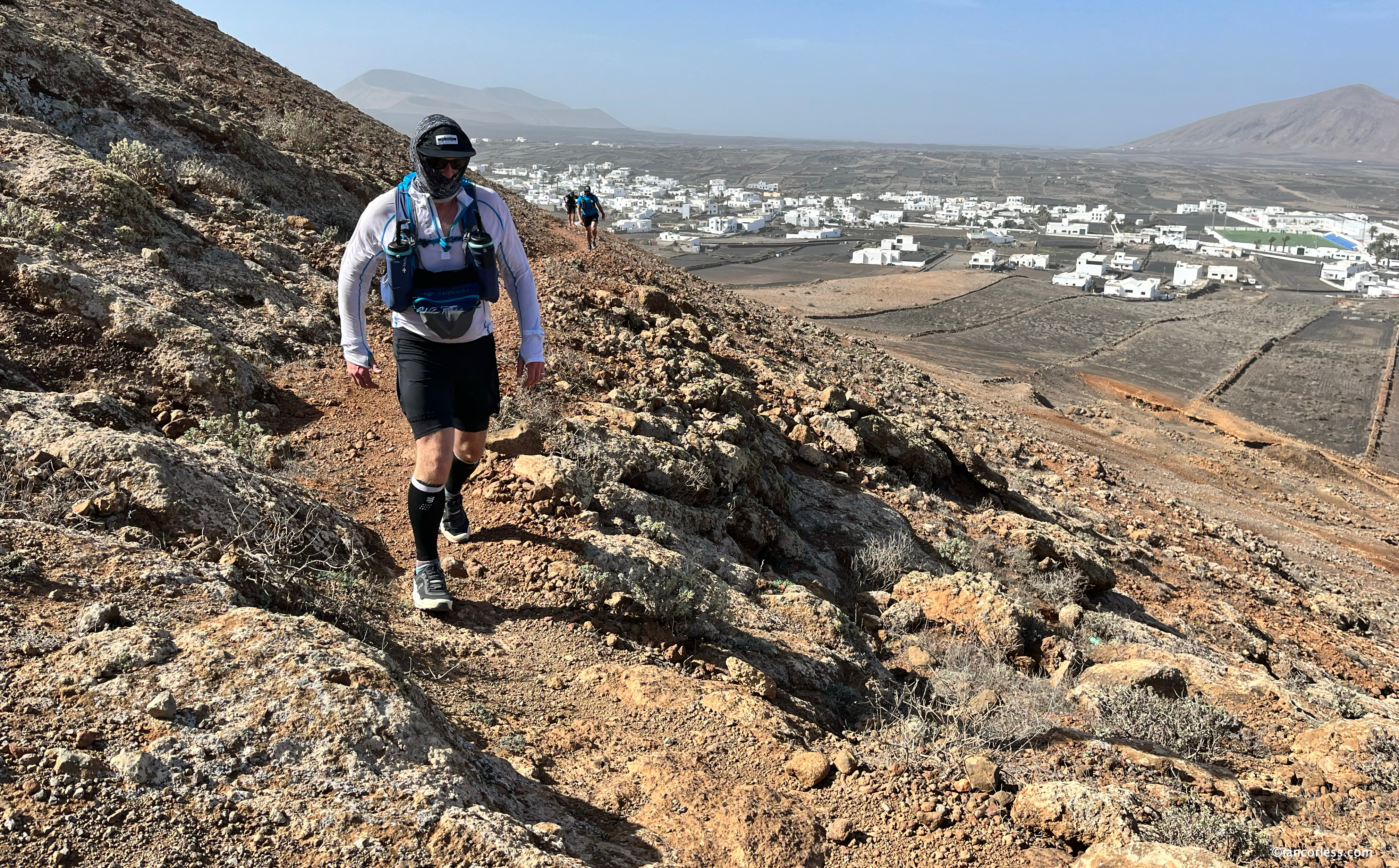
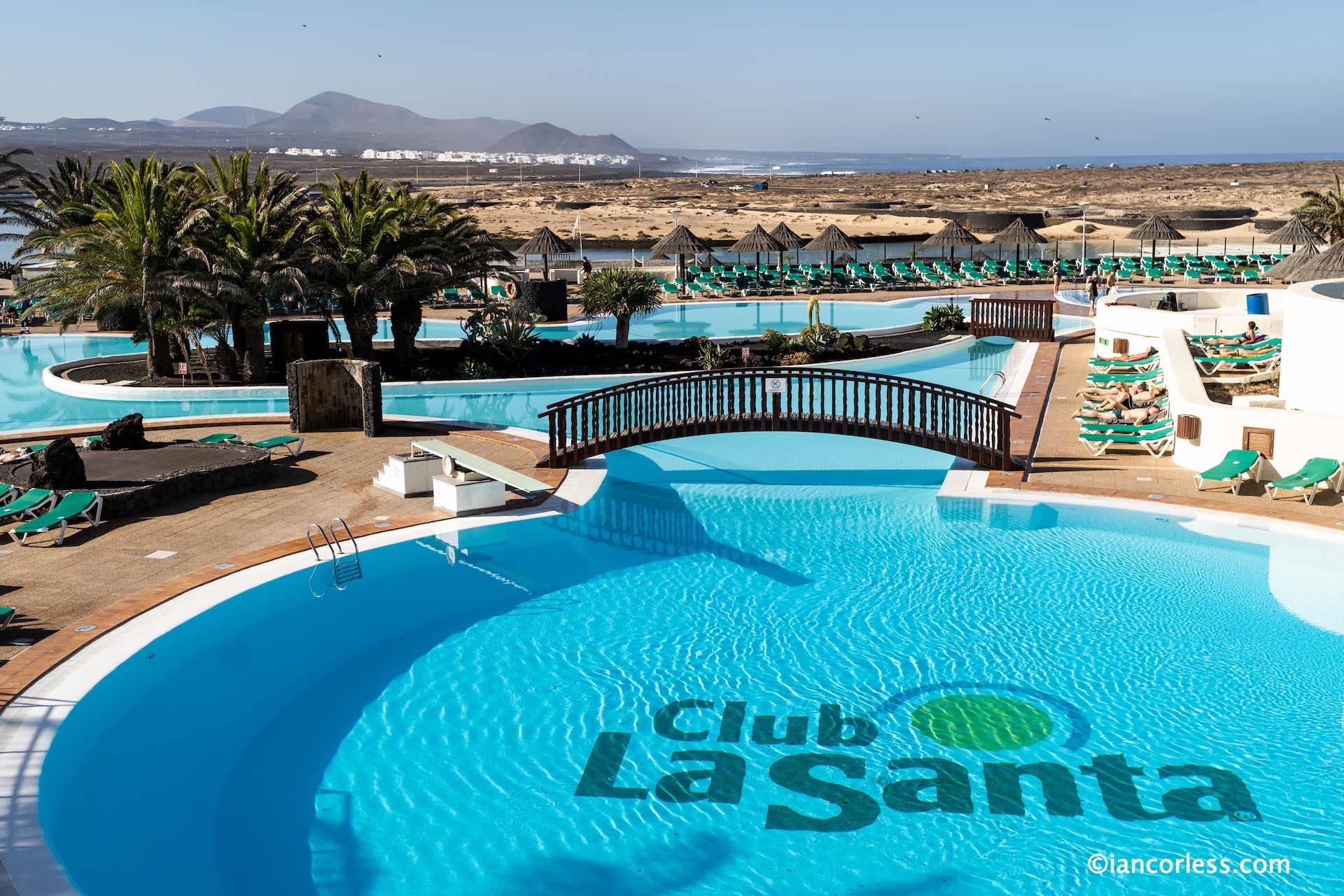
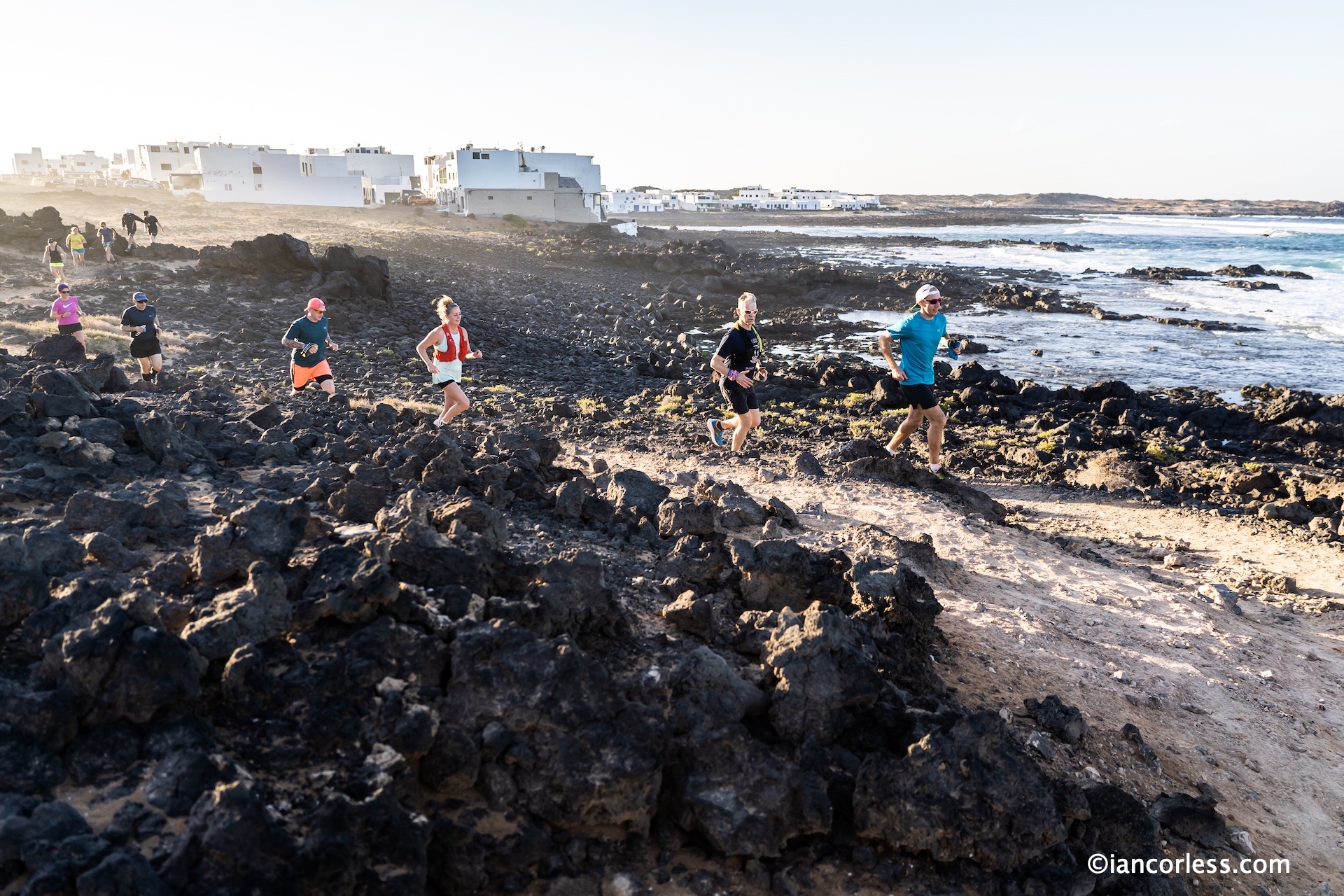
Day 6 of the Lanzarote Multi-Day Training Camp is the ‘long day’ covering a marathon on a beautiful point-to-point course that starts in Uga and concludes at Club La Santa.
The route was first introduced in 2020 with great feedback. The 2022 route was extra special due to the current weather – sun, warm, high winds and Calima. You actually couldn’t get better training conditions for a desert race.
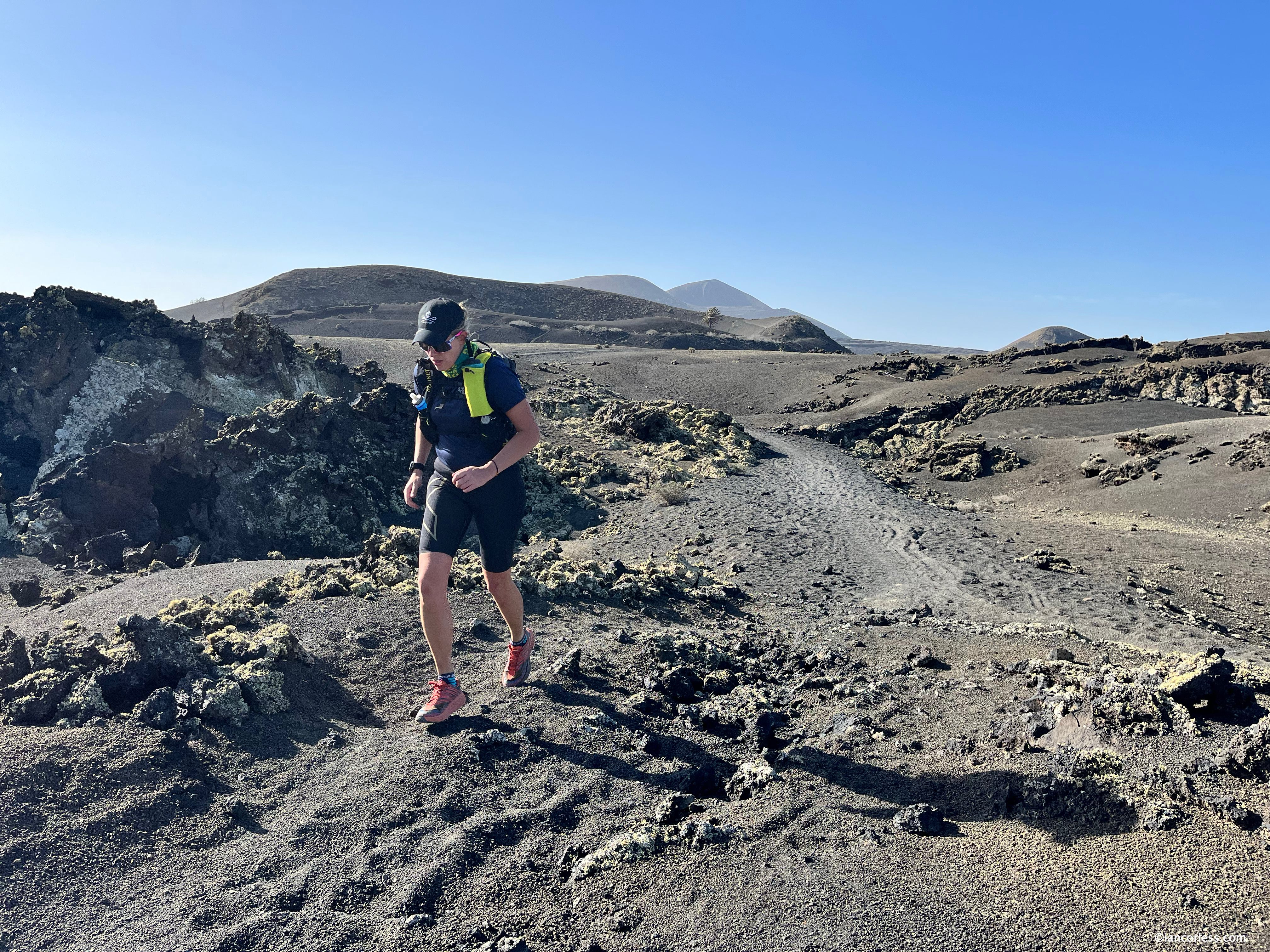
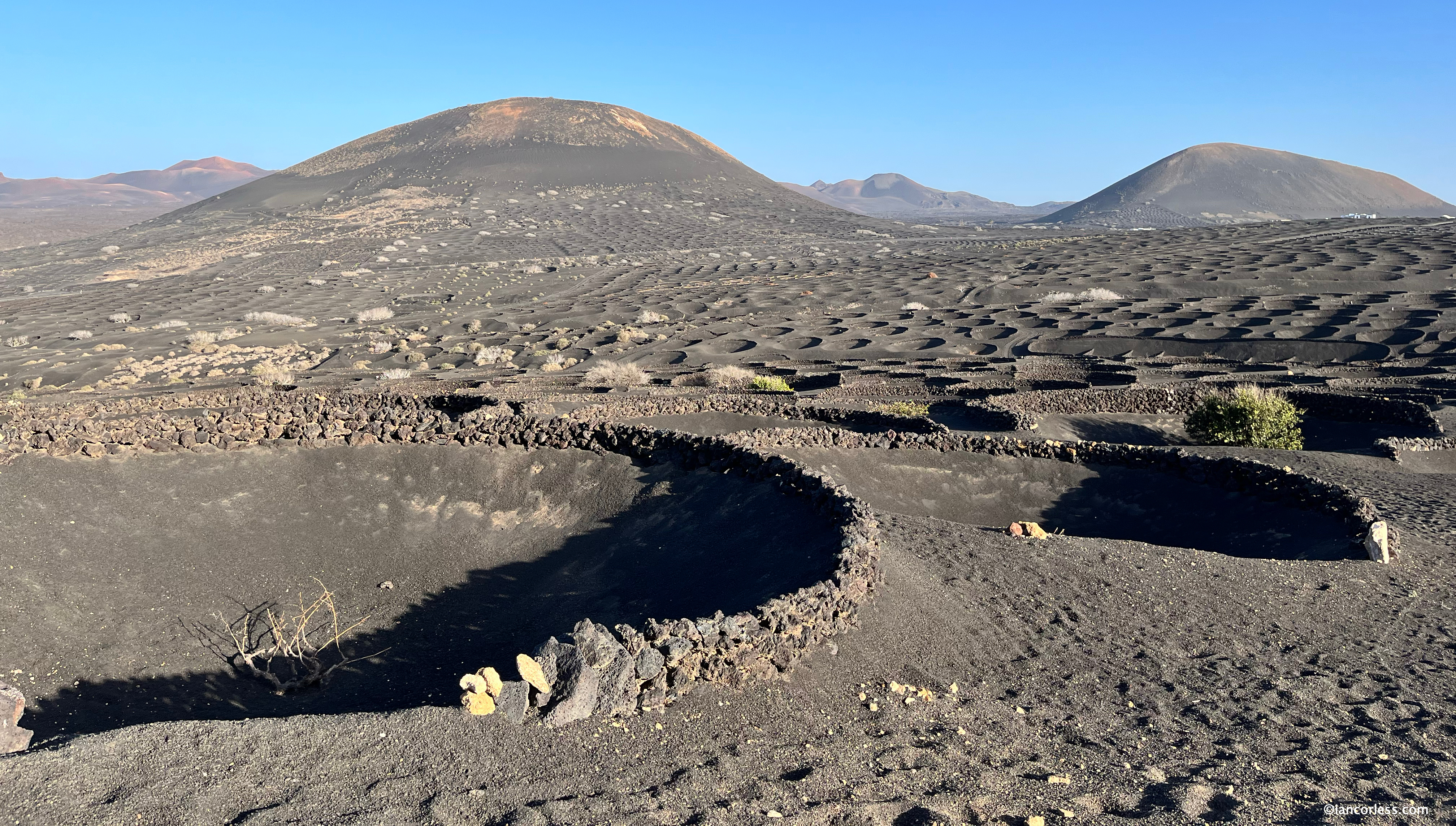
The route is a perfect way to sight see and experience the best of Lanzarote. Early miles pass through countless black sand and wine fields.
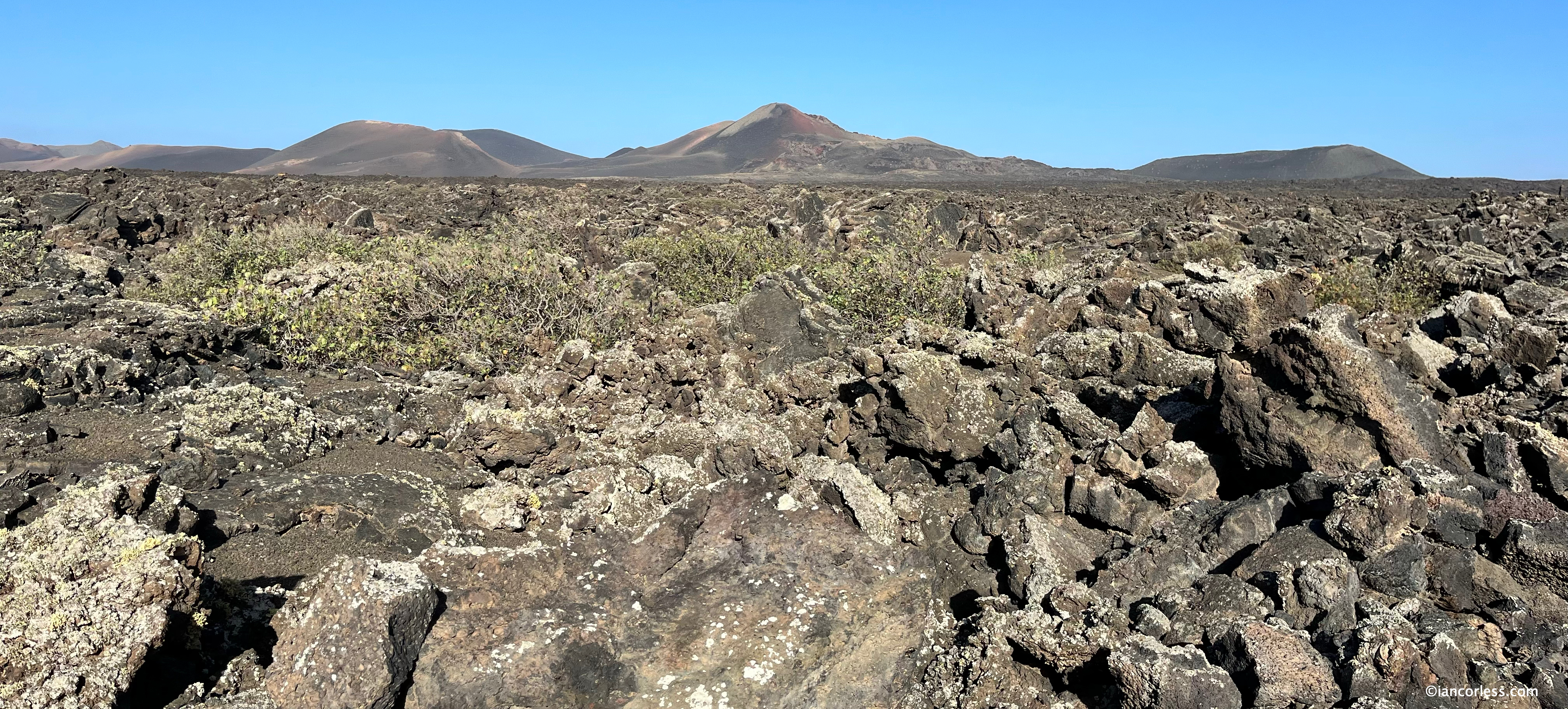
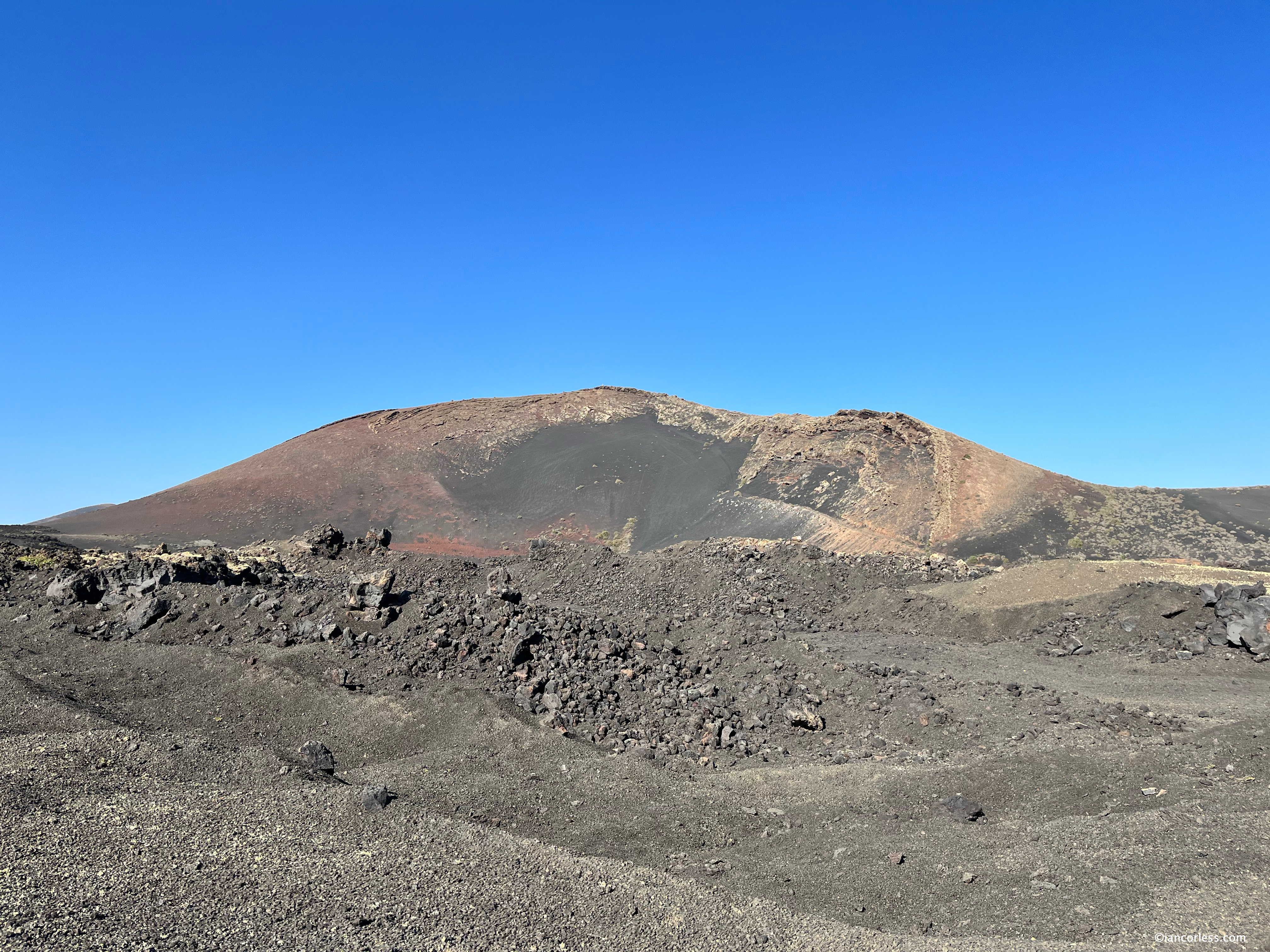
At all times, the landscape is magical and unique, the resulting backdrop from the greatest recorded eruptions which occurred between 1730 and 1736.
The area is delicate and protected, so, for the most part, a route weaves its way through the landscape which must be followed.
While there are few high points (in meters) on the island, it is possible to ‘rollercoaster’ and in our marathon point-to-point we accumulated 1500m+.
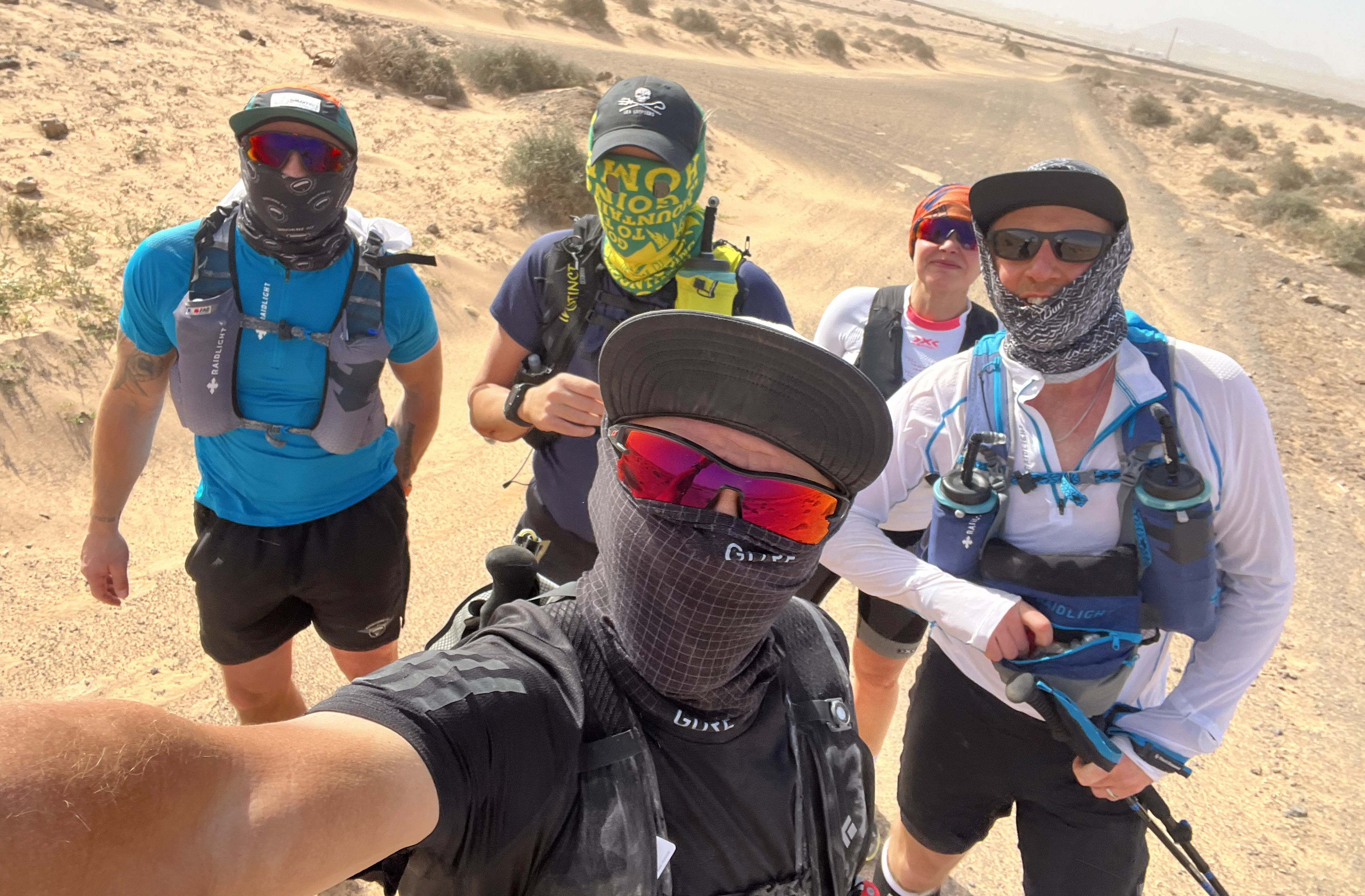
The wind was strong all day, gusts almost lifting us of our feet.
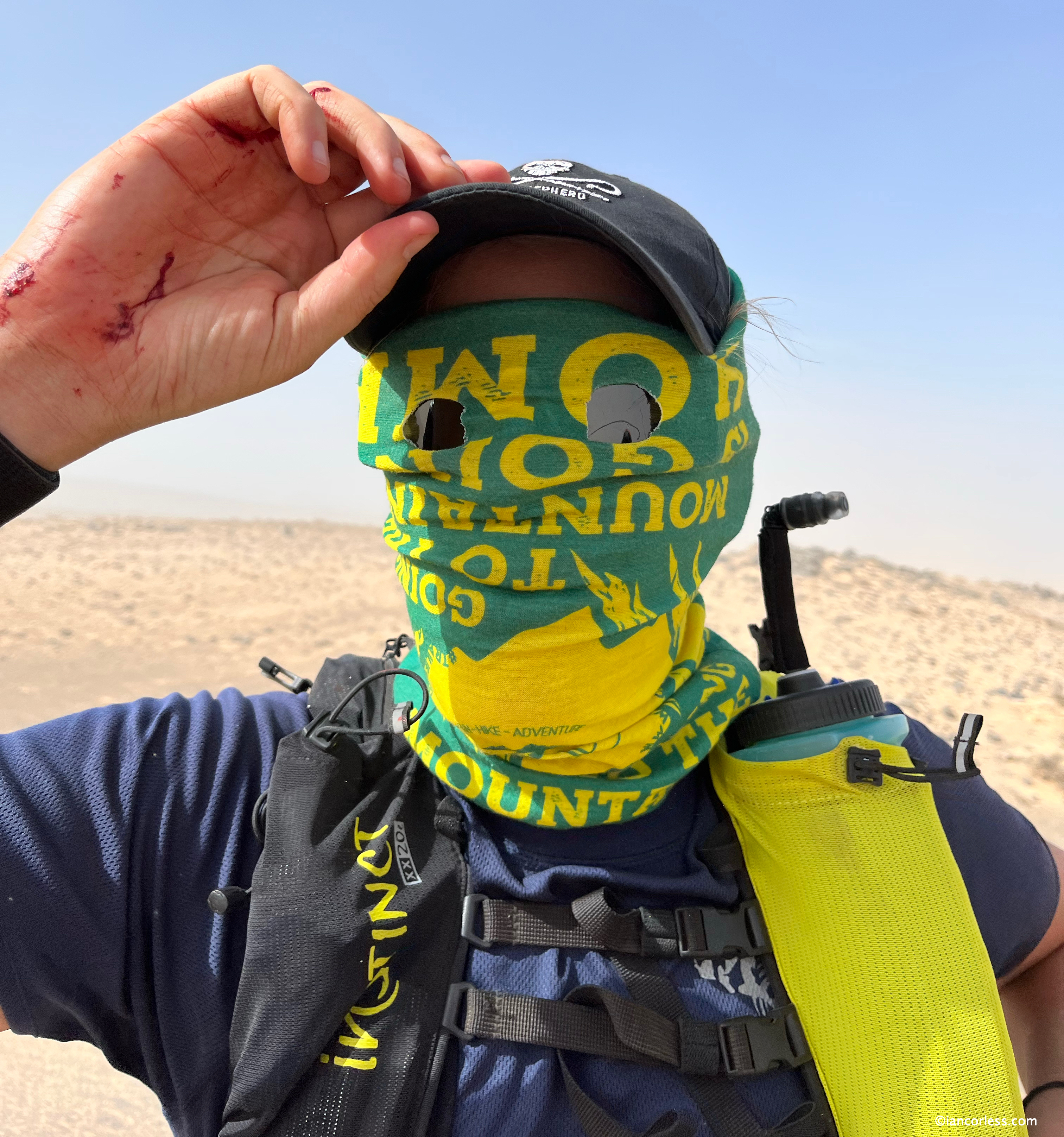
From Tinajo, the fina third of the route, the conditions became increasingly hard as the harder ground became softer with large amounts of soft sand. A Buff making for great protection.
In the latter miles it was head down and push on… Finally Club La Santa could be see in the distance. A marathon done in perfect test conditions.
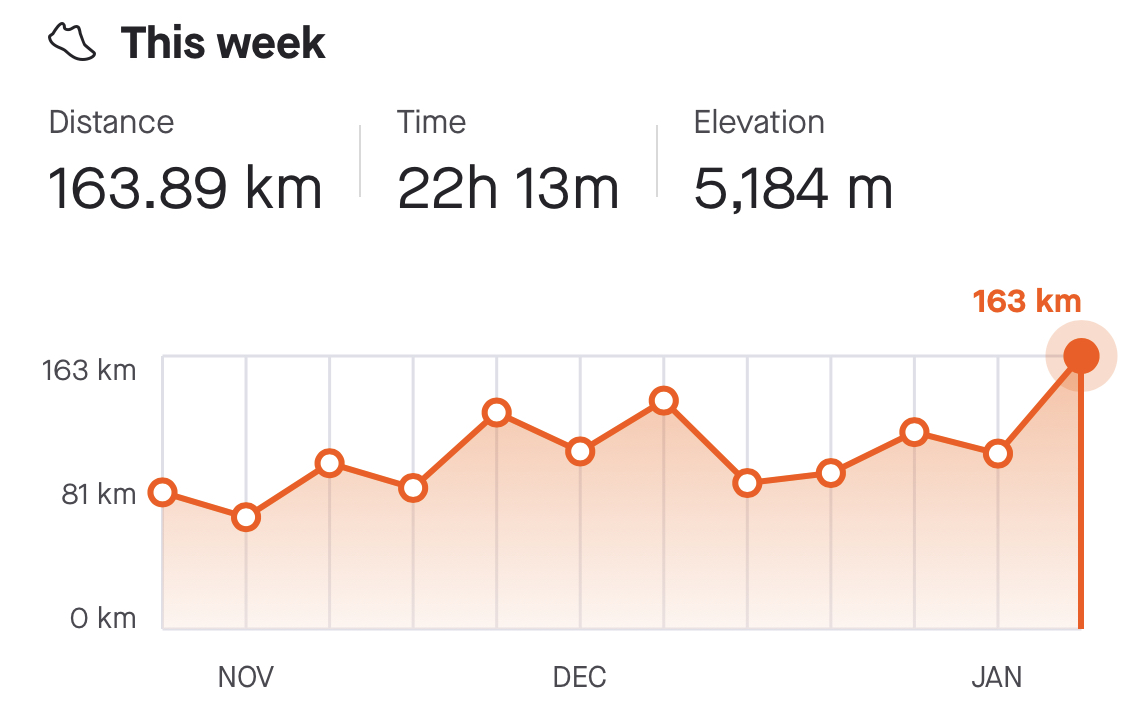
As training days go, they don’t come any better than today…! With just one day left, many of the attendees are now tired and looking forward to some recovery time to let the stimulus from this training take hold.
Each runner has covered different distances but the below is typical for many!
Day 6 concluded with showers, food, recovery and well-earned calm and peaceful night.
Please support this website. I believe everyone deserves to read quality, independent and factual articles – that’s why this website is open to all. Free press has never been so vital. I hope I can keep providing independent articles with your help. Any contribution, however big or small, is so valuable to help finance regular content. Please support me on Patreon HERE.
After missing the 2021 edition of the Lanzarote Multi-Day Training Camp due to the global pandemic, it was a wonderful day to welcome 32-clients at Club La Santa for the 2022 edition.
Needless to say, the last 6 to 8-weeks have been a trying time with no guarantee that travel would be possible. However, travel has happened and the blue skies of Lanzarote and glowing sun welcomed everyone.
Day 1 is all about relaxing after travel, making new friends and then a 1-hour run to settle any nerves before the camp really starts.
With just 1-hour of running, day-1 is an easy day to settle nerves. Starting at 1700hrs though, does allow everyone to experience the best light of the day as the sun slowly drops and disappears on the horizon.
With 4-coaches, all paces are accommodated, from walking all the way through to running. There is no pressure, there is a group for everyone and the initial 1-hour run allows everyone to access which group they will go in come the first full day which starts with a 15-mile coastal run.
A group briefing at 1900 was then followed with a dinner and gladly, the 2022 Lanzarote Multi-Day Training camp was underway…!
With two-times Marathon des Sables champion, Elisabet Barnes and top-10 finishers, Sondre Amdahl and Pierre Meslet, the clients of the 2022 camp have never been in better hands.
Please support this website. I believe everyone deserves to read quality, independent and factual articles – that’s why this website is open to all. Free press has never been so vital. I hope I can keep providing independent articles with your help. Any contribution, however big or small, is so valuable to help finance regular content. Please support me on Patreon HERE.
This article is geared toward Marathon des Sables but is valid for any race with some adjustments and specific changes appropriate to the type of race and distance.
Marathon des Sables, once again, has been postponed. Originally scheduled for April 2020, the race was moved to September 2020 amidst growing worries and concerns over Coronavirus. As September approached, the writing was already on the wall and the decision was made to focus on April 2021 – everything will be fine then, won’t it!?
December 2020 soon came and with it, increased infection rates, new variants and despite the optimism of a vaccine, the world once again crumbled under the cloud of an ever-spreading pandemic. Christmas was cancelled and the new year unfortunately had nothing ‘new’ about it, it carried far too much of the old year.
January has been a disaster and the long-term view is not good. The world once again has been in a lockdown, some far worse than others. One thing is for sure, we are all a long way from ‘normal!’ So, it came as no surprise as events were cancelled all over the world.
Patrick Bauer.
MDS race director, Patrick Bauer, travelled to Morocco to assess the situation and on January 22nd, the MDS was once again postponed to another time; October 1-11, 2021.
All is good… the race WILL come!
I think it’s important to clarify, here and now, that at the end of the day, when people are dying globally, for a race to be postponed, is no big deal… I think once you accept that, dealing with race cancellation, disappointments and postponements becomes so much easier. It´s only a race! And we are fortunate to be able to race. It’s a luxury. But equally, livelihoods are struggling, RD´s are losing work, all the businesses associated with races are losing work, travel companies are losing customers, hotels, restaurants, design agencies, photographers, videographers and the list goes on, are all losing their livelihoods to an ongoing escalating pandemic. So while it is only a race, have a consideration for all involved and maybe, a little understanding for the very difficult challenges everyone is facing at the moment.
The locals need MDS, our tourism and our regular trips to Morocco.
Taking MDS as an example, 2020 participants will have entered in 2019 and some may well have entered in 2018. Typically, a MDS participant will prepare for 1-year. While the initial postponement was not great, it was easy to focus on September.
Then September was cancelled… Already, many were struggling to re-focus, but April would be it, one last push and we are good to go!
Now, with another postponement, MDS runners are left in a void, the race is 8-months away. They are all asking, what do I do now?
Gemma Game has been on the podium of MDS multiple times. She is a busy professional with a family.
Firstly…
When things change, adjust. Don´t kick-off against what has changed. Accept what is not in your control and control what you can. Adapt, move on (with running shoes) and train differently for a while; focus on different aspects of your running, weaknesses in particular. Look at the opportunities – focus on speed, work on hill strength, build a good core, do drills, stretch, maybe try yoga? A change of focus will give a physical and mental break and will help your performance. When the time is right, resume an appropriate training plan for your chosen race. I guarantee, you will be stronger, better prepared and ready for the challenge ahead. You are lucky and fortunate that you are able to even contemplate a race like MDS.
Uncertainty is a virus in itself, it can eat away at you. Quite simply, remove negativity and question marks. The current dates for MDS are 1-11 October. Do not consider the event will not happen, plan and train accordingly.
The reality is you are already in a good place. You have been training for a great deal of time already, just imagine how much better you will be when October comes.
Training in Lanzarote on a specific Multi-Day Training Camp HERE
Importantly though, it would be fool hardy to carry on with current training levels for an October race. You run the risk of injury and/ or getting peak fitness too early. Take a break!
“One of the mistakes I see most with runners is jumping from one race specific cycle to the next, without either giving themselves enough time between races or not “focusing” on training during the time between race and “taking a break”.
– runnersconnect
Kick back, take some time off from any structured plan and do a week/ two weeks (or even a little longer) of ´how you feel´ training. In this period, take time (with a piece of paper) to assess personal strengths and weaknesses. From this list, you can use February and March to address these weaknesses while ´maintaining´ fitness. Back off any intensity, maintain some decent mileage/ hours and keep sessions moderate.
Tom Evans placed 3rd at MDS and works on strength and core to enhance his running.
Importantly, get a running MOT from an experienced physio. Address any problems now and use that ‘extra’ time for therapy, strength, stretching and core. Find any underlying problems that may cause injury.
Work on admin – food for the MDS (article HERE), pack, sleeping bag (article HERE) sleeping mat and finalise equipment choices optimising weight, size and cost. Do everything you can to make your pack 6.5kg (plus water) for the start line on October 3rd. Read a guide HERE.
Do you need a 12-week and/ or 24-week Multi-Day Training Plan perfect for a multi-day adventure or a race like Marathon des Sables? They are designed to provide you with a structured weekly plan culminating in a target event.
View a sample week HEREfrom the 12-week plan. Purchase HERE.
View a sample week HERE from the 24-week plan. Purchase HERE.
*****
The arrival of April will give you 6-months to race date. Now is the time to re-focus. Did you have races planned? If so (and they happen) maybe now they change focus and become preparation for MDS?
Use 3-months (April, May and June) to build on the weaknesses that you have worked on in February and March and lay the foundations for the key phase, July, August and September.
“One of the most common reasons runners hit a plateau is that they don’t work on their weaknesses between races, by focusing on your weaknesses now, you’re able to make progress long-term, even without training as hard.”
– runnersconnect
Do some specific training, here Sondre Amdahl at the Lanzarote Training Camp HERE
July should be the start of a very specific MDS phase (12-weeks) where you fine-hone all the relevant skills to make the 35th MDS not only successful but awesome.
It is easy to feel deflated with another disappointment and postponement but look at this cloud with a silver lining!
Please support this website. I believe everyone deserves to read quality, independent and factual articles – that’s why this website is open to all. Free press has never been so vital. I hope I can keep providing independent articles with your help. Any contribution, however big or small, is so valuable to help finance regular content. Please support me on Patreon HERE.
We all run long, but the length of a long run can really vary depending on many factors such as age, fitness, race and training history, targets, objectives and available time. I get asked and read, time and time again, the question, ‘How long should I run?’
‘What session you doing?’
‘Long run today,’ the answer.
But, what is a long run and how long should a long run be?
Before that question can be answered, one needs to understand why one is running long and for what purpose. Typically this will be a long-term event that is planned in the diary that may or may not be a race.
Having a date to work too is a great starting place as it provides a deadline point. This helps focus the mind and plan the time accordingly.
Ask yourself, what your objectives are? For example, there is a difference between competing and completing?
What distance is the event? (What is the time limit, what are intermediate cut-off times?)
If you are used to running 5k and 10k events, a long run for you may well be 75-90 minutes? If you are a marathon runner, your long run may be 3 to 3.5-hours. If you are running an ultra, this is where it gets tricky.
Why do we run long?
In summary, we put an emphasis on 3 key points:
Mental Strength
Muscular and physical adaptation
Efficiency to use fat as a fuel
Mental Strength:
If you have never run for more than 1 hour in training, then 3 hours on your feet just feels like a really long time, so, you need to adapt mentally for the challenge ahead and you need to be strong to get the job done. This time on feet, needs to be appropriate to the challenge one has planned.
Muscular and Physical Adaptation:
Muscle soreness will come for everyone, however, we can train to reduce the impact or delay the process by progressively running longer in training. With recovery periods, we allow our muscles to adapt to the stress and they become stronger. Delayed onset of muscle soreness (DOMS) is not pleasant and it something that can really be painful in the 24/ 48 and 72 hour period after hard/ ;long training or racing. By running long in training we adapt to delay or reduce the DOMS.
Efficiency to use fat as a fuel:
Our bodies can only store so much carbohydrate and once those stores are used up we have only two options left: top them up or slow down and maybe even stop if they have got very low. As an endurance athlete we need to tap into our almost unlimited fat stores. We do this by teaching our body to use fat as a fuel during the long run. The more efficient you become at this, the longer you can run and the longer you can maintain a pace. Ultimately it means the whole race/training experience will be better and more enjoyable.
The Long Run
Running longer requires running slower, especially if we are going to switch fat burning on. It requires a pace that one can maintain for hours and hours and yes, that pace can be walking. The long run/ walk is specific to you and nobody else!
Running hard and faster has its place and yes, top elite runner can and will incorporate faster paces within a long run to adapt. But be specific and think of your objectives and what you are trying to achieve.
Be specific with terrain. No point for training for a 50-mile trail race with loads of vertical and technical trail and then run all sessions on the road.
Runners get stressed and worried by mileage, pace, miles per minute and so on. Relax. Think of your long run in terms of time, not distance. Particularly important if running off-road.
To help provide perspective, 3-hours on the road you may well allow one to cover 20-miles, but on the trails or in the mountains, one may only cover 12-miles.
Slow down!
A common mistake is that we make our long run too fast and our faster runs not fast enough. We therefore end up one paced. Make longer sessions slow and make hard sessions hard. If in doubt, use RPE, Rate of Perceived Exertion. Quite simply, when running long and easy you should have a perceived effort of breathing calmly and being able to talk. If running hard, you should have a perceived effort of difficulty, shortness of breath, discomfort and an inability to hold a conversation.
The big question, how long should the long run be?
Short distance runners often run ‘over distance’ in training. For example, a 10k runner may run a long slow half marathon to build endurance. A half marathon runner may run a long and slow steady 16-20 miles in preparation for a fast race.
This all falls apart when we go to the marathon and beyond. How often have you heard in marathon training that the long run should be 21/22 miles or 3-hours 30-minutes in preparation for a race. But these generic terms do not take in to account the individual. Think of Kipchoge, if he did long runs at 3.5 hours, even running slow (7 min miles for him,) he would cover over 30-miles!
Long runs and adapting for an endurance run such as an ultra comes from not one run but a combination of all runs. It’s about your accumulative run history. They all add up to make you an endurance machine. So, typically, if you are running longer than a marathon, you will have been running for some time.
First and foremost, consistency is key and long runs should be progressive and based on ability and experience. A long run should test you but not break you.
What do I mean by progressive?
Let’s use a 12-week scenario based on a runner who can currently run 2-hours in a long run. I am not looking at base training here, but the specifics of a long run and how to make the long run longer. I’m a big fan of building over 3-weeks and recovering for 1-week.
Example:
Month 1
Week 1 – Sunday 2:30 hours
Week 2 – Sunday 2:45 hours
Week 3 – Sunday 3:00 hours
Week 4 – 2 hours
Month 2
Week 1 – Sunday 2:45 hours
Week 2 – Wednesday 90min / Sunday 3:00 hours
Week 3 – Wednesday 90min/ Sunday 3:20 hours
Week 4 – Sunday 2:30 hours
Month 3
Week 1 – Wednesday 90min/ Sunday 3:00 hours
Week 2 – Wednesday 1:45 hours/ Sunday 3:30 hours
Week 3 – Wednesday 2:00 hours/ Sunday 4:00 hours
Week 4 – Wednesday 60min/ Sunday 3:00 hours
The above scenario provides a structured example on how to build up from running 2 hours comfortably to 4 hours. But remember the above scenario is 12-weeks of running with over 37-hours of running, just in the long runs!. That is huge and a great place to start for any endurance challenge.
But my race is 50-miles, can I run the distance?
As mentioned above, it’s not wise or sensible to run too long in anyone session. But the 12-week plan above on a 3/1 scenario shows you how it’s possible to build time and confidence. As you gain more experience you can look at doing back-to-back sessions and plan long training weekends all as part of a long term plan (see below.) Ultimately though, running too long in terms of distance or time is something that should be very carefully planned. You will always here about runners who can do 200-mile weeks or 50-mile training runs; they are exceptions and not the norm. Don’t be lulled into a false sense of security and don’t feel inadequate, we are all individuals and this is maybe the most important aspect.
Running or walking long is a voyage of discovery and you need to balance long-distance with adequate recovery.
Listen to your body.
Training should be about preparing you to tackle the challenge, but it will never FULLY prepare you. There’s always going to be a bit of extra and a bit of unknown on the day of the event, but surely that’s why you’ve entered?
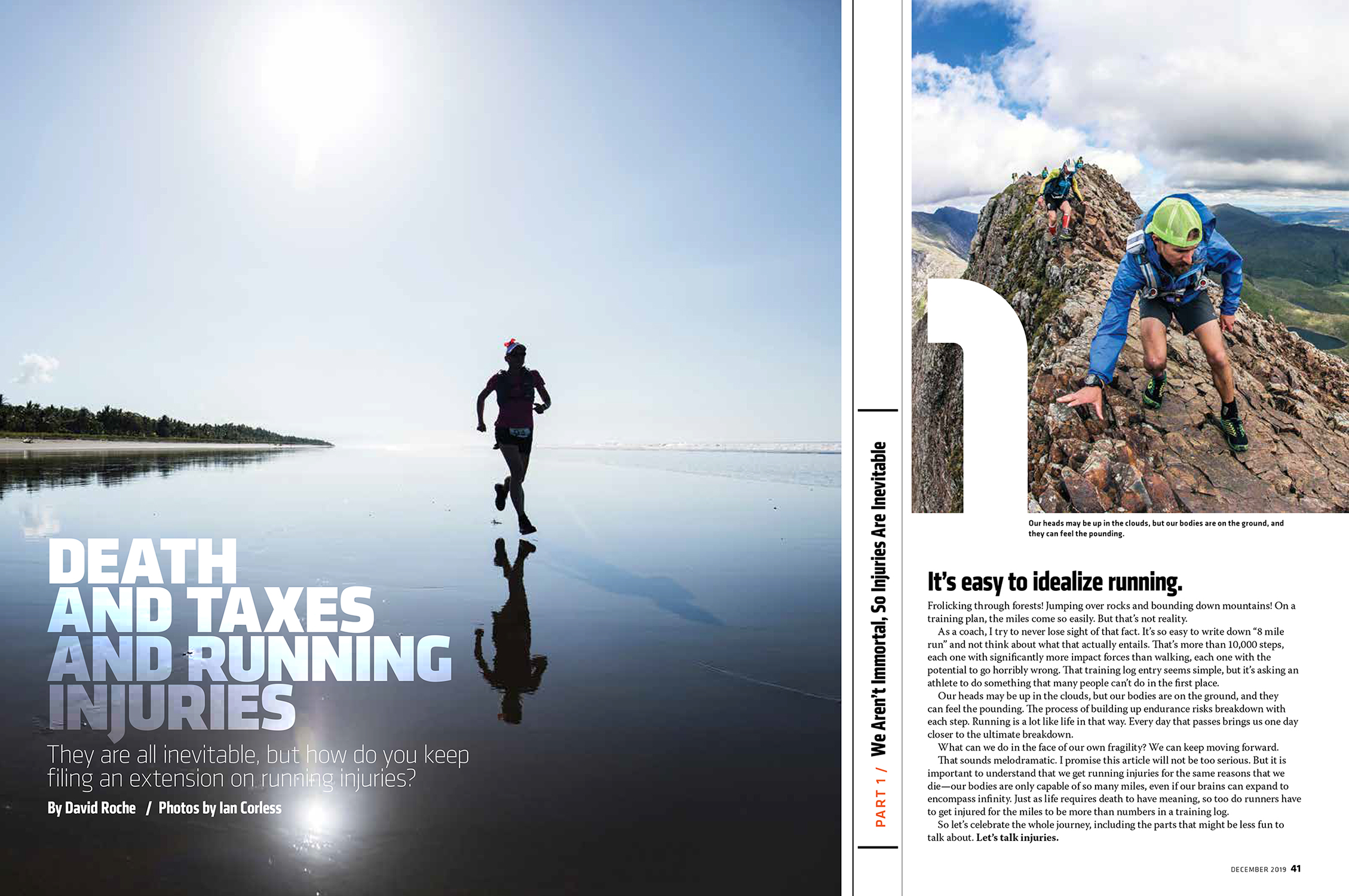
Pleasure to provide the images to accompany the words of David Roche for the article, ‘Death and Taxes and Running Injuries’
for Trail RUNNER Mag
It’s easy to idealize running.
Frolicking through forests! Jumping over rocks and bounding down mountains! On a training plan, the miles come so easily. But that’s not reality.
As a coach, I try to never lose sight of that fact. It’s so easy to write down “8 mile run” and not think about what that actually entails. That’s more than 10,000 steps, each one with significantly more impact forces than walking, each one with the potential to go horribly wrong. That training log entry seems simple, but it’s asking an athlete to do something that many people can’t do in the first place.
Our heads may be up in the clouds, but our bodies are on the ground, and they can feel the pounding. The process of building up endurance risks breakdown with each step. Running is a lot like life in that way. Every day that passes brings us one day closer to the ultimate breakdown.
What can we do in the face of our own fragility? We can keep moving forward.
That sounds melodramatic. I promise this article will not be too serious. But it is important to understand that we get running injuries for the same reasons that we die—our bodies are only capable of so many miles, even if our brains can expand to encompass infinity. Just as life requires death to have meaning, so too do runners have to get injured for the miles to be more than numbers in a training log.
So let’s celebrate the whole journey, including the parts that might be less fun to talk about. Let’s talk injuries.
As a racing season comes to an end it is time to look back over your achievements and yes, your failures over the last 12 months.
What went right, what didn’t go right? It is a question we should all ask ourselves.
What were my strengths?
What were my weaknesses?
Once you know the answers to the above, you have an idea of what to do over the winter months to make the following year a better one, not only in racing but training.
Planning is key. You need to periodize training so that you get the most from it.
Do you lack endurance?
Do you lack strength?
Do you lack speed?
Do you lack an ability to run on technical terrain?
Can you climb well?
Are you mentally strong?
The above list can go on and on.
Certain key elements should be present in any training plan and by answering questions similar to those above, you will start to understand what you need to do.
Winter has often been thought upon as time to do ‘base’ miles. These were long and steady miles with many hours building endurance. It is easy to fall in a trap and do too much of this. Don’t do what everyone else is doing, instead do what you need to do. Ultra-runners often have loads of endurance, after all, they race long distances all year. But with all that endurance, they can lack some strength and speed.
You need to look at yourself and ask, ‘What do I need to do?’
Decide on objectives for the following year and yes, you can even decide on plans for the year after too. Sometimes our long-term goals are so big or challenging that we need longer than a year to prepare!
Decide on A, B and C races, please remember that you can have multiple A goals, you just need to make sure that you can train, race and recover. The best thing to do here is to get a planner that shows the whole year and then add objectives marking them A, B and C – you will soon see if your targets are achievable. This is an invalidly process and actually takes very little time.
A target needs blocks of training and depending on the A-Race, that block will vary in length based on the challenge and the experience of the individual. A classic marathon plan may be 12-16 weeks, whereas for 100-miles you may work on 28-weeks.
In our scenario, we are saying that our A race is a 100-mile race, 28 weeks away.
Yes, it’s a long way off but don’t be fooled into thinking you have plenty of time. Key races have a habit of sneaking up on you.
Go through the questions again.
If this is your first 100, training will be very different to someone who is running there 20th for example. Endurance may well be a primary target, whereas the experienced 100 runner will have endurance but may well want to go quicker?
100-miles is a long way so *base training and getting the miles in is key. We have allocated 8 weeks for this in the plan below. Hours of easy miles progressively building up to a C race (marathon or 50k). It is always good to have a goal and a target to aim for. The C race is a training race and will have no taper, you would race through it as a training long run.
*A traditional pyramid training plan starts with base and then typically adds speed as an event comes closer. However, we are ultra-runners and it is important to be specific. High intensity training creates a lot of fatigue and this is why I am a huge fan of reversing the pyramid and getting speed work done during the winter so that the training plan that leads into an A race is specific to the demands of the race.
So, if you are an experienced ultra-runner looking to improve with years of running and loads of endurance, think about making weeks 1-8 speed based with a fast marathon as a C (or maybe even A) race objective at the end of this block.
When you enter your racing season this will be in the build phase so it’s a good idea to place a B race objective that will allow you to progress to the A goal or multiple A goals.
As you come to the end of the build phase, you should be in form and race fit. What you want to do now is fine tune that form, tweak it and hold it for the A race. If you are cramming long runs in or looking for speed, it’s too late. You basically misjudged the planning or started training too late.
Maintaining what fitness, you have is also about being specific to the A target.
1 Is your 100-mile target race on groomed trail with little elevation gain?
2 Is it an out-and-out mountain race with gnarly terrain and plenty of elevation gain?
It’s important to be specific now, the two races above require very different approaches. This is something that you will have understood in January (or earlier in the year) when you looked back at last year, looked ahead to this year and understood your strengths and weaknesses so that you could plan accordingly.
▪ Scenario 1 requires running, good form and leg speed.
▪ Scenario 2 requires hiking, climbing, leg strength and plenty of endurance.
You can’t perform well at every event and this is why A, B and C races are important. Yes, I know the elite runners manage to race several key races a year but look at the training and look at the planning. We have all seen top runners turn up at early season races and place just inside or outside the top-10.
– Francois D’Haene
Francois d’Haene always provides a good examples of how to:
▪ Build
▪ Peak
▪Win
▪ Recover
▪ Build
▪ Peak
▪Win
▪ Recover
▪ Build
▪ Peak
▪Win
▪ Recover
In 1 racing year, Francois won 3 x 100-mile races.
That is an incredible skill and for sure as racing becomes more aggressive, faster and more brutal, this training approach is going to become far more important for those who want to race to their own potential and maybe more importantly race year-on-year. We have all witnessed the damage that racing and training too much can do at an elite level runner. Listen to my podcast with Geoff Roes HERE as he provides a great insight into potential problems.
The above questions are a starting point. Read through the list and add your own questions to appraise what type of runner you are. It may well be that running for you is an escape and social thing, you may be happy to race week in and week out and you are not worried about gaining a PB or improving; if that is you, great. I’d still say planning some RnR is a good thing to avoid burn out.
If you are someone looking to perform and improve, you need to be more self-critical. Plan your training and periodize your training so that you are able to (hopefully) predict good form on 1 or multiple A race days in a year. This is not easy.
Carefully plan races in terms of importance, ‘A’ being the most important. Also make the races progressive and in line with your A race. For example, if your A race is a 100-mile race, a C race may be a marathon, a B race may be a 50K or 100K and then the Ais the big step of 100-miles.
Remember you can only hold form for a limited length of time and if you want to peak, you need to make sure that this planning stage is done early so that you understand what you are trying to achieve. It’s all about steppingstones.
Ask yourself, what is the purpose of the training blocks you are planning:
▪ Are you laying base training?
▪ Building fitness?
▪ Maintaining fitness?
▪ Racing?
A training block with 2 x ‘A’ races (the 2nd race being 100-miles) may look like this:
Base Training Phase
Week 1 – Base or Speed
Week 2 – Base or Speed
Week 3 – Base or Speed
Week 4 – Base or Speed (with the addition of a longer run)
Week 5 – Base or Speed (with the addition of a longer run)
Week 6 – Base or Speed (with the addition of a longer run)
Week 7 – Base or Speed (with the addition of a longer run)
Week 8 – Base with C Race probably a marathon.
Build Training Phase
Week 9 – Build
Week 10 – Build
Week 11 – Build maybe a C Race just as a long run?
Week 12 – Build
Week 13 – Build
Week 14 – Build with B Race 50K.
Maintain
Week 15 – Maintain/ Specific
Week 16 – Maintain/ Specific
Week 17 – Maintain/ Specific
Week 18 – Maintain/ Taper with A Race
Recovery
Week 19 – Recovery
Week 20 – Recovery easing back into Build.
Build
Week 21 – Build
Week 22 – Build
Week 23 – Build
Week 24 – Build
Week 25 – Build
Week 26 – Build
Week 27 – Taper
Week 28 – Taper and A Race (this scenario 100-miles)
Recover, Recover and Recover.
This article is not a hard and fast plan, it’s a guide for you to go away, look at your targets having assessed past targets and hopefully it makes you think about future objectives so that you can plan for a successful, injury free year of running and racing.



































 IAN CORLESS