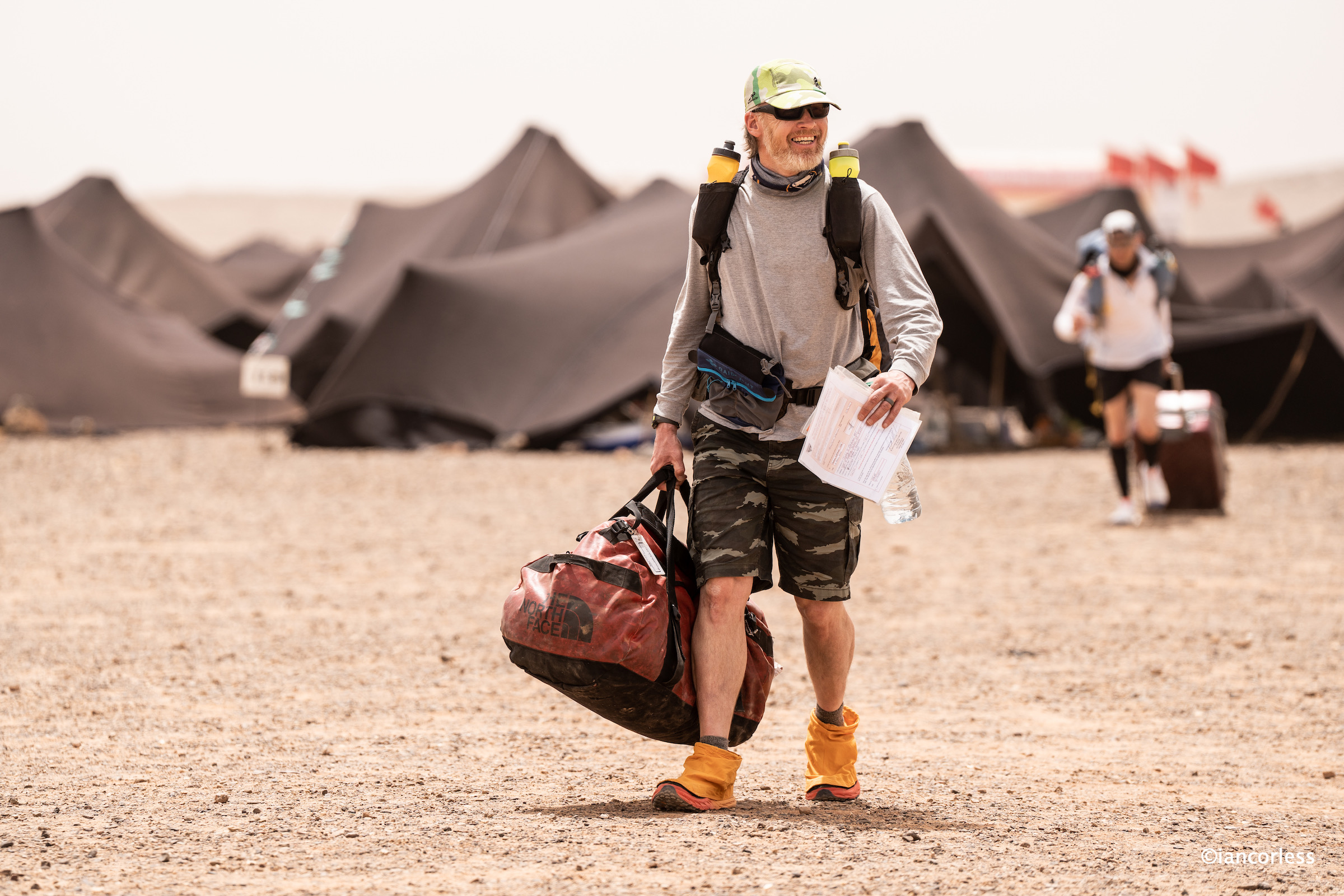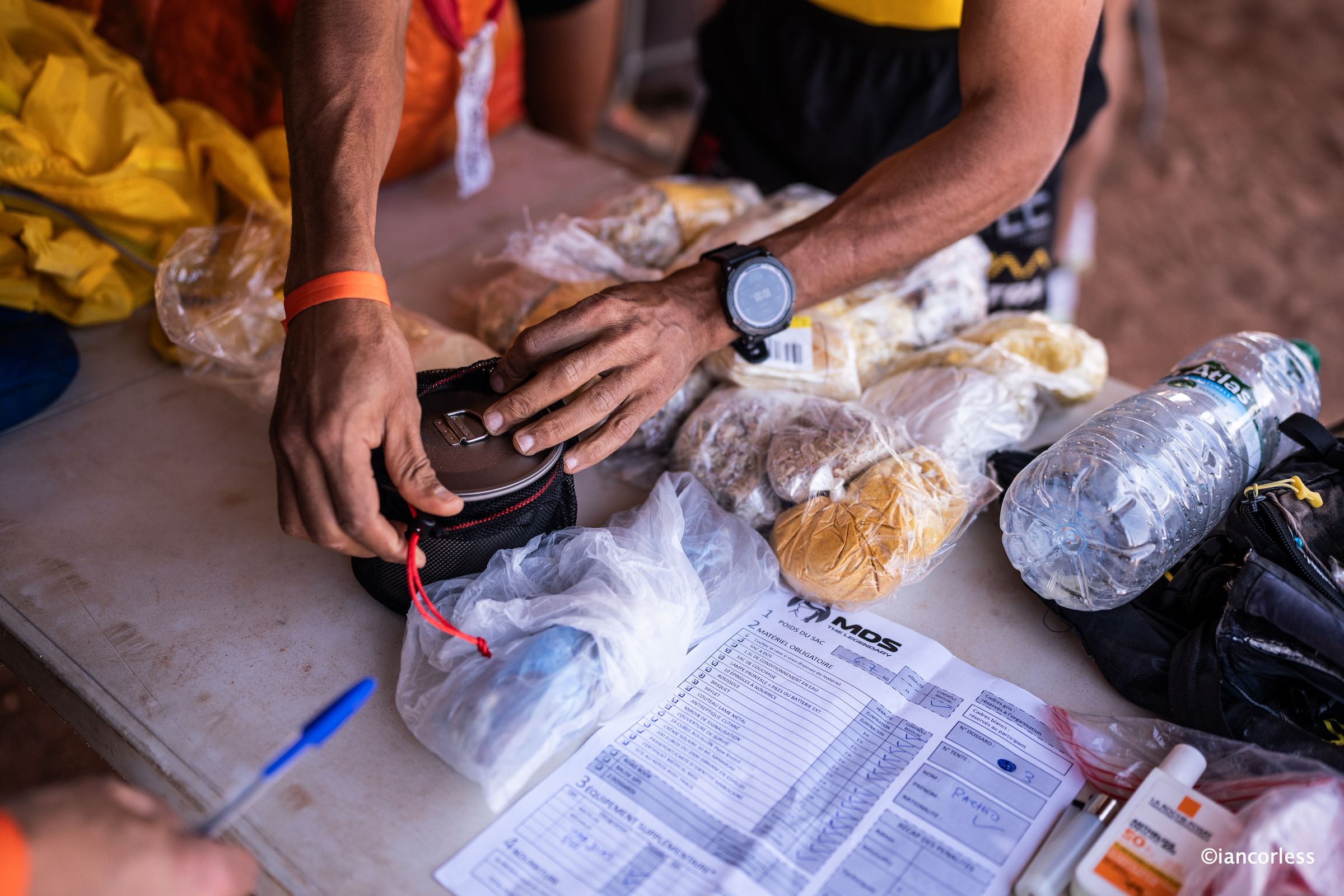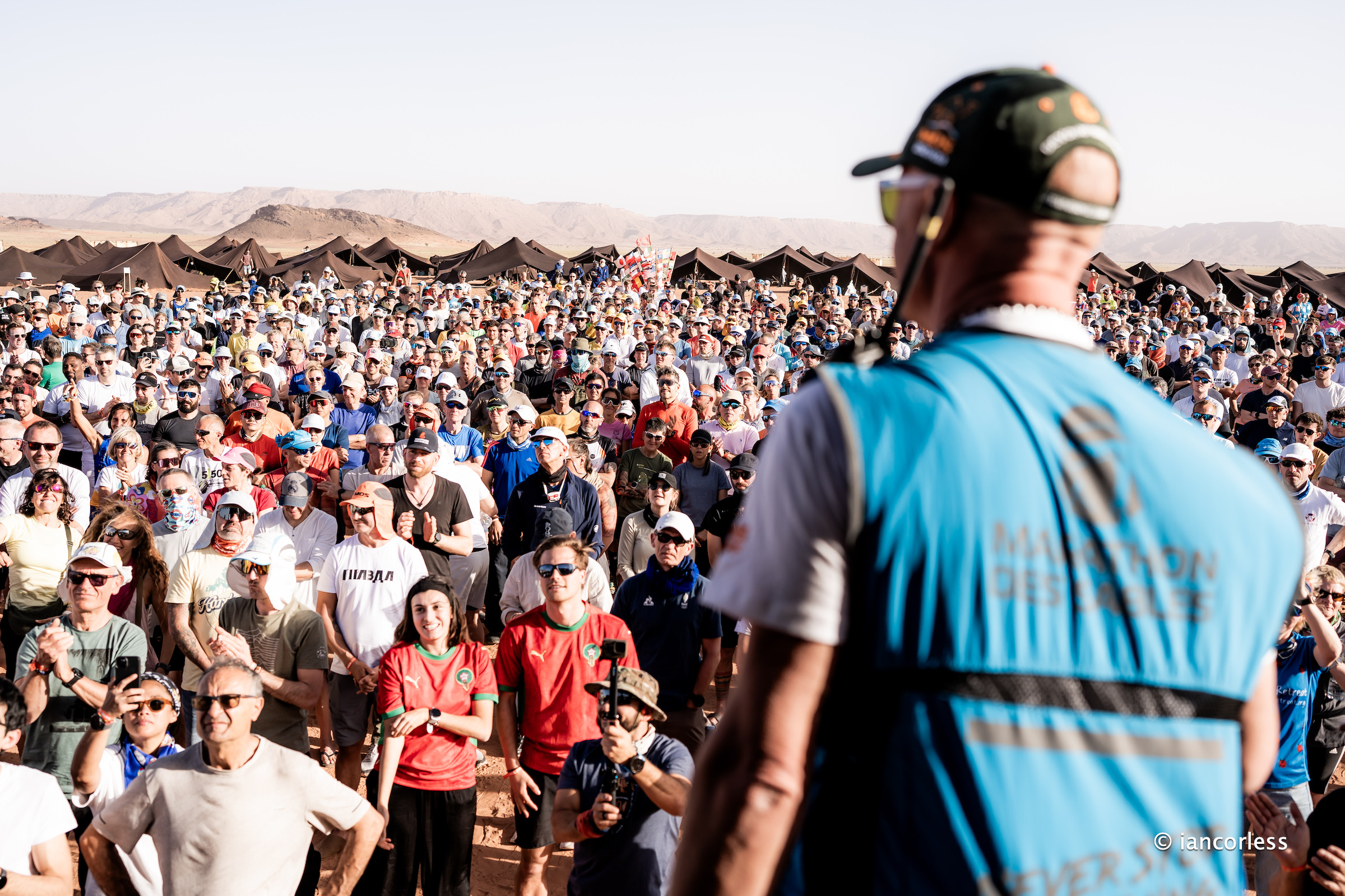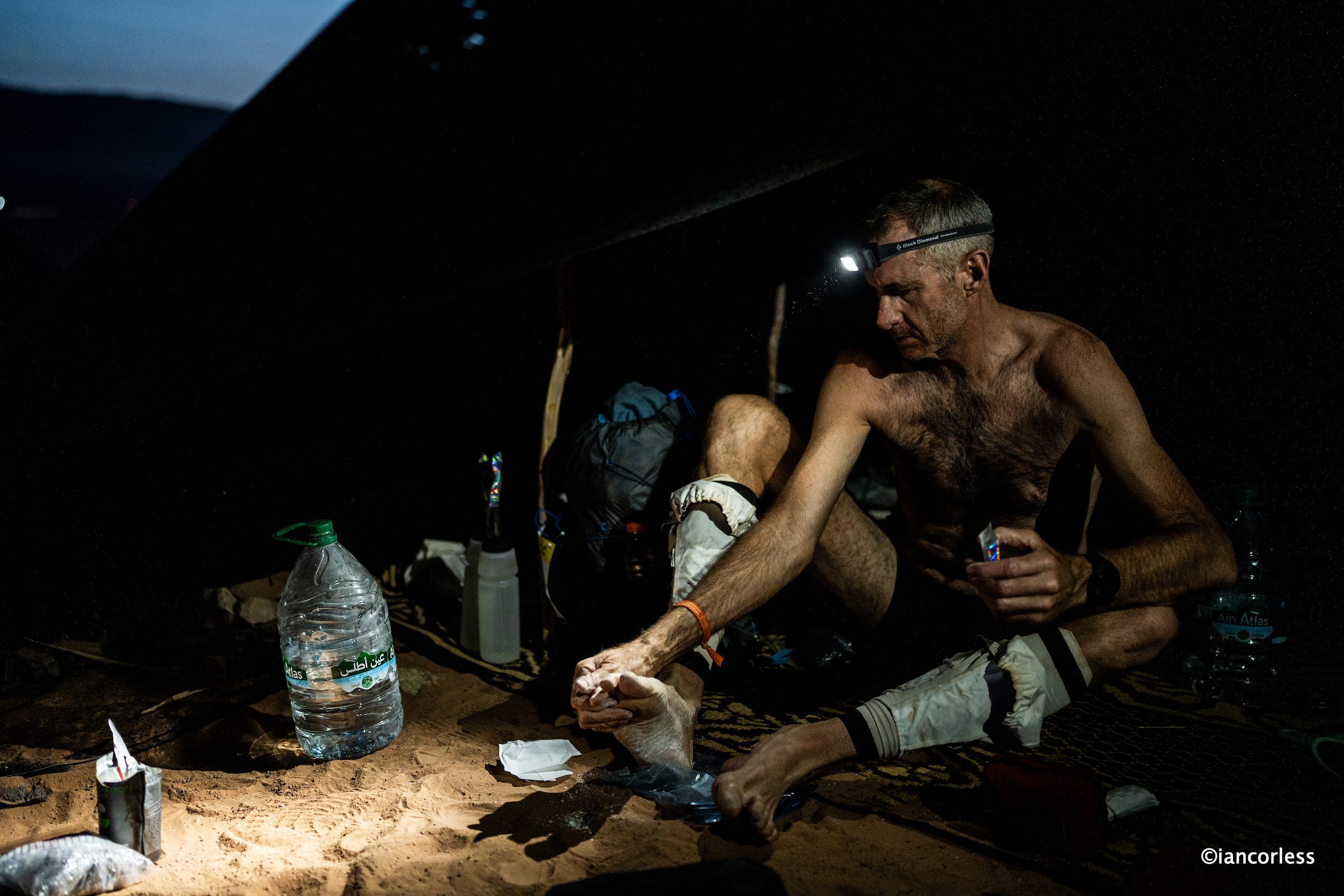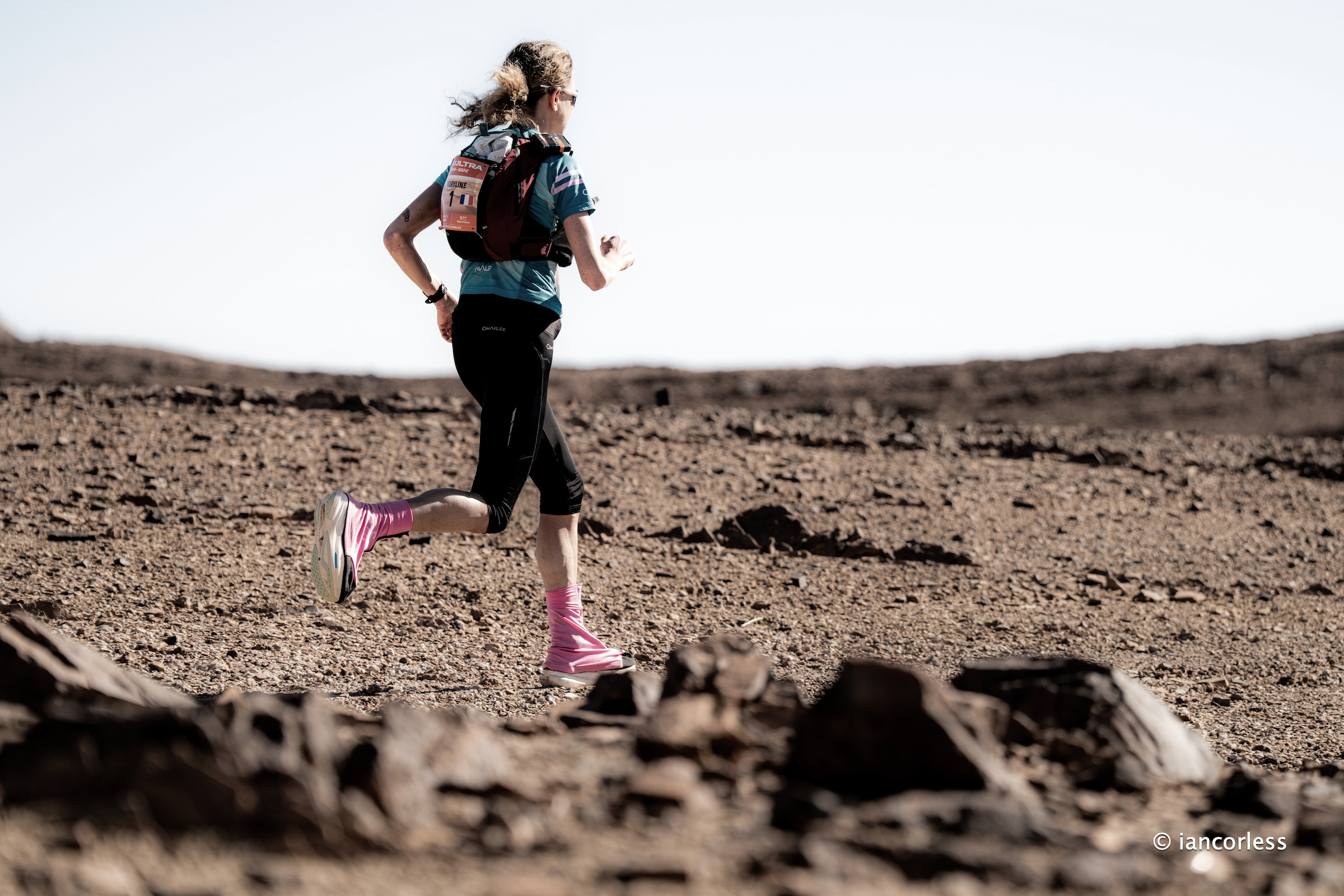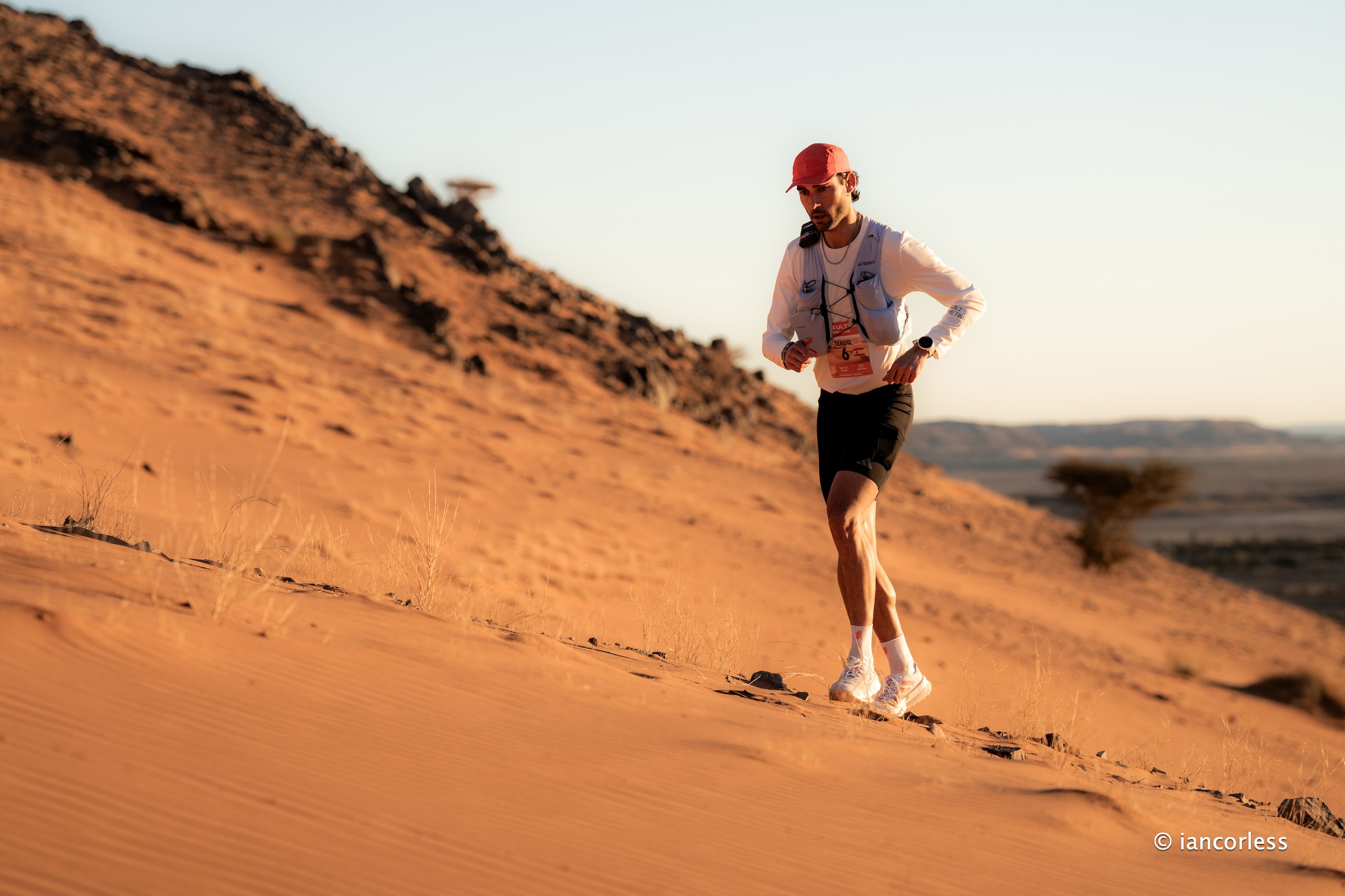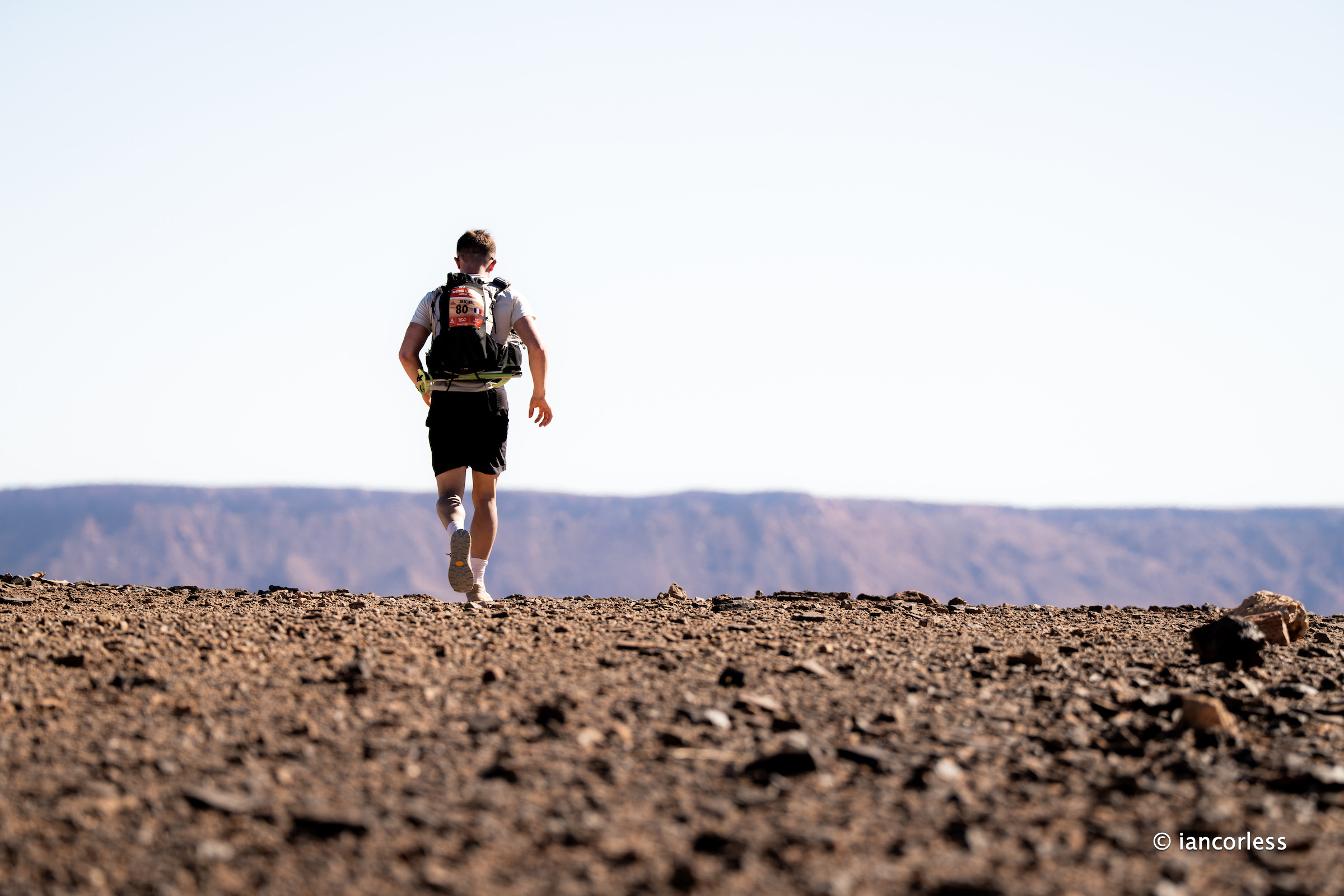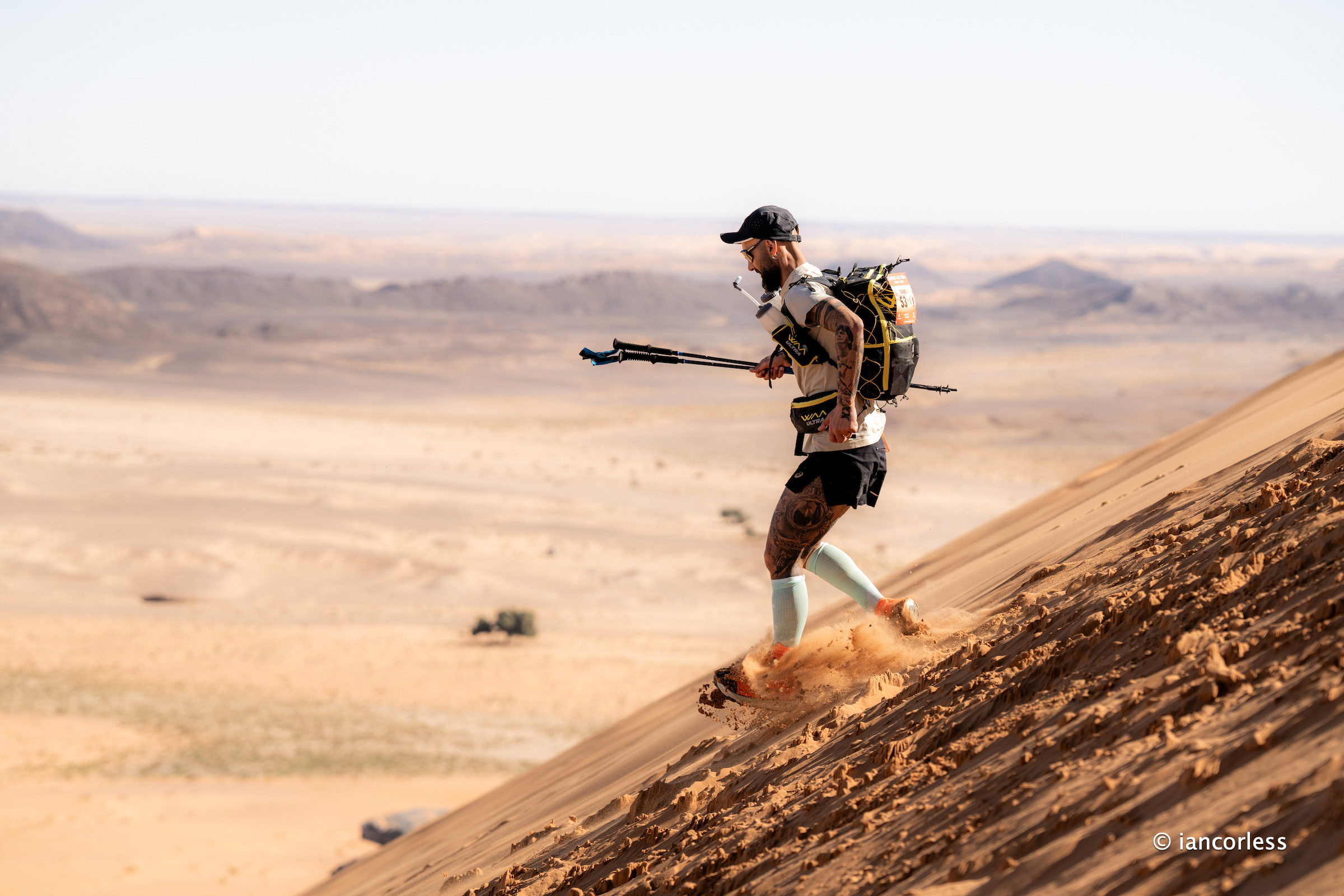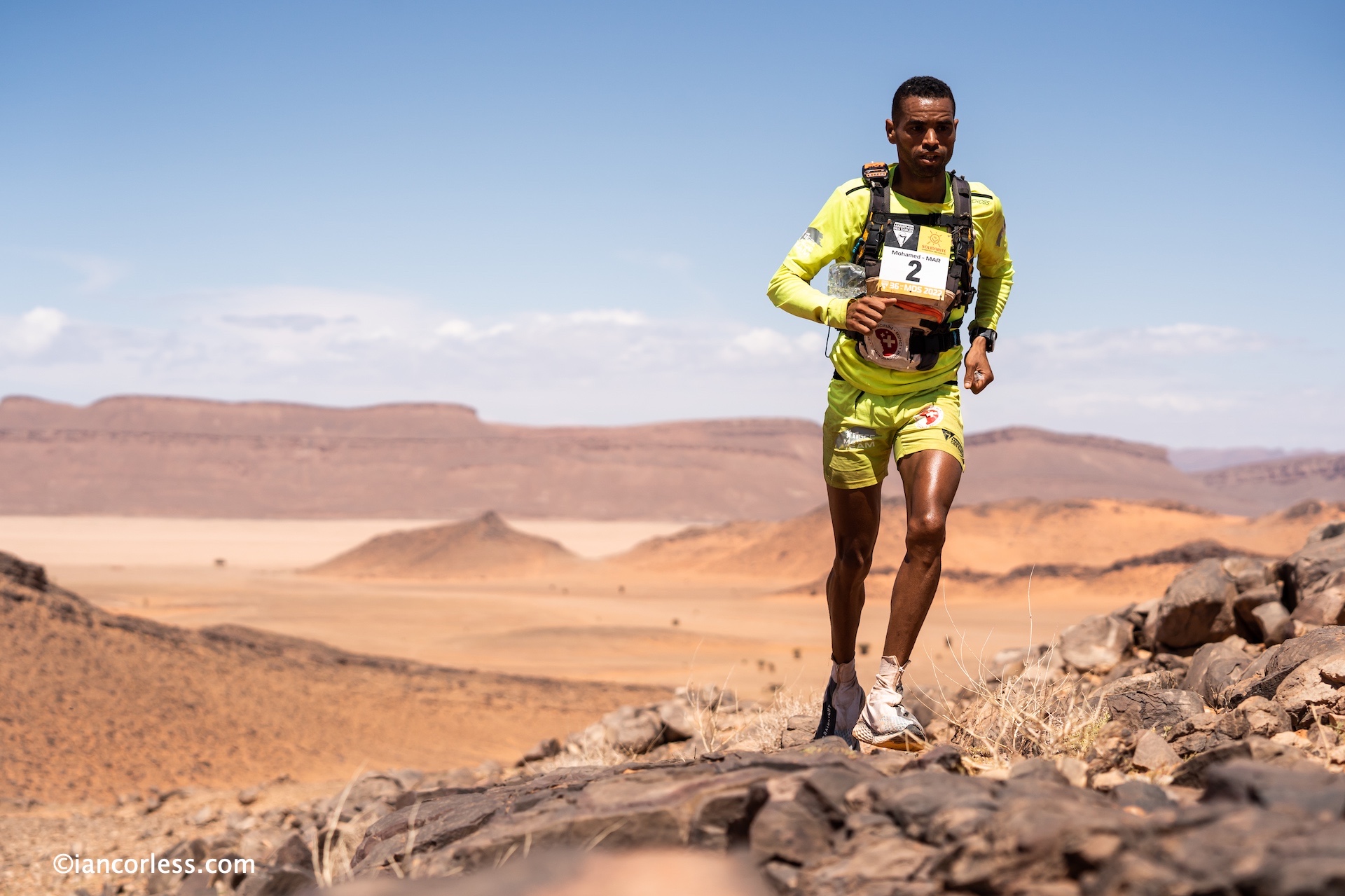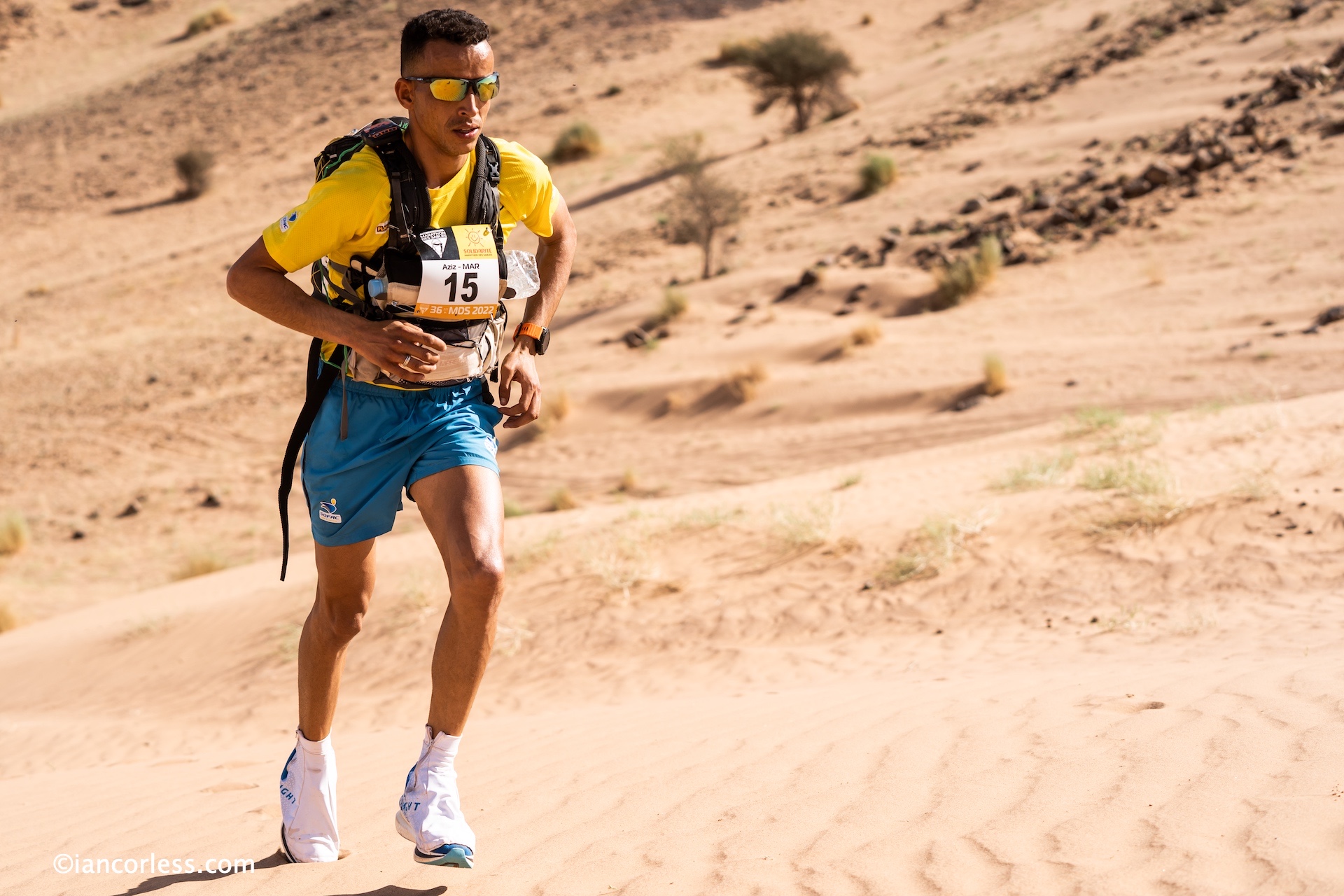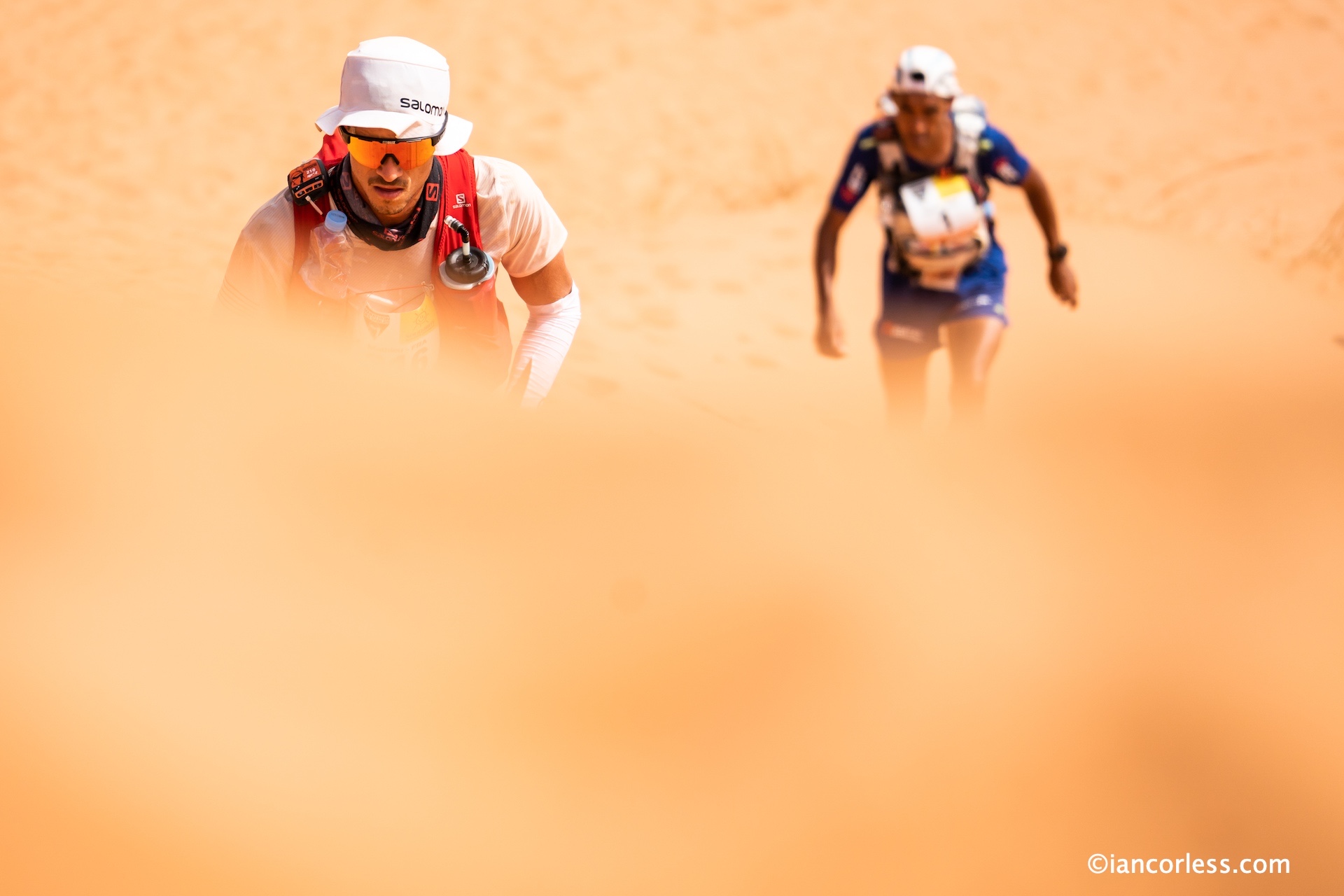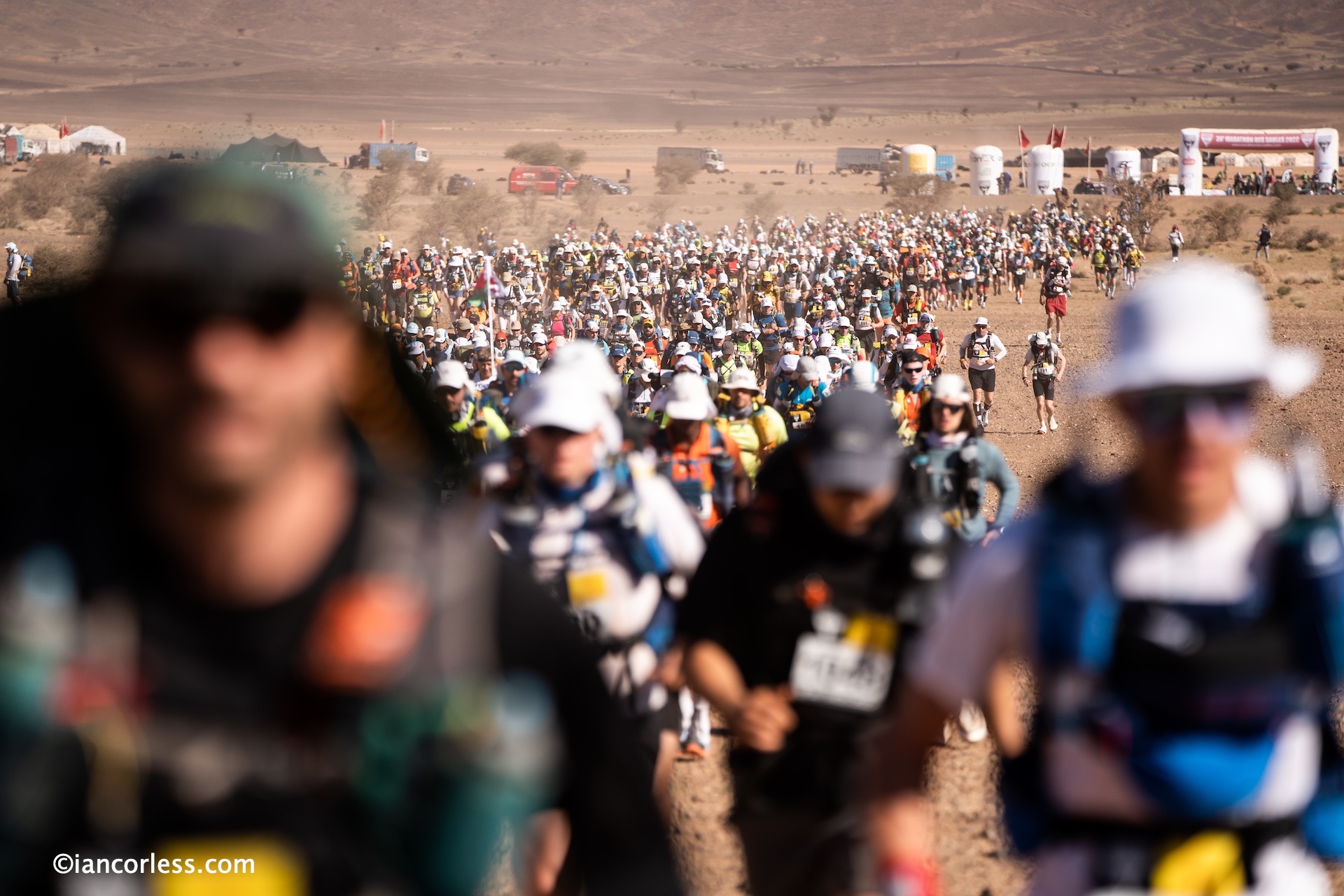
The stage is set. At 21:30 local time (15:30 Paris, 14:30 Lonon and 09:30 New York) tonight, Friday October 3rd, the Ultra Gobi 400km begins. Fifty-seven runners from around the world are gathered at the edge of the desert, ready to take on one of the toughest ultramarathons on earth.
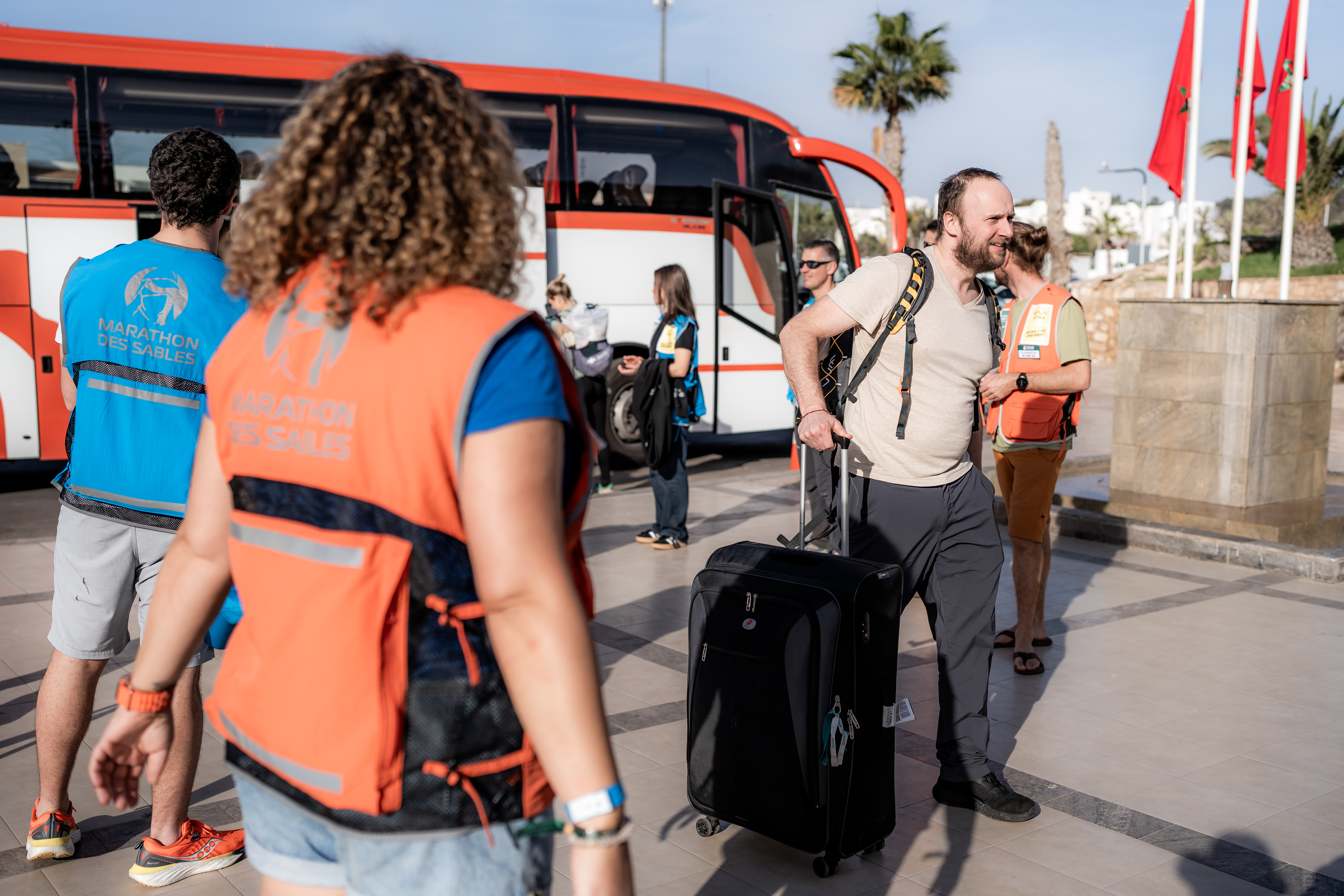
All week, the athletes have been arriving in Dunhuang, the ancient Silk Road outpost. They’ve had time to rest, recover, and shake off the fatigue of long-haul travel.
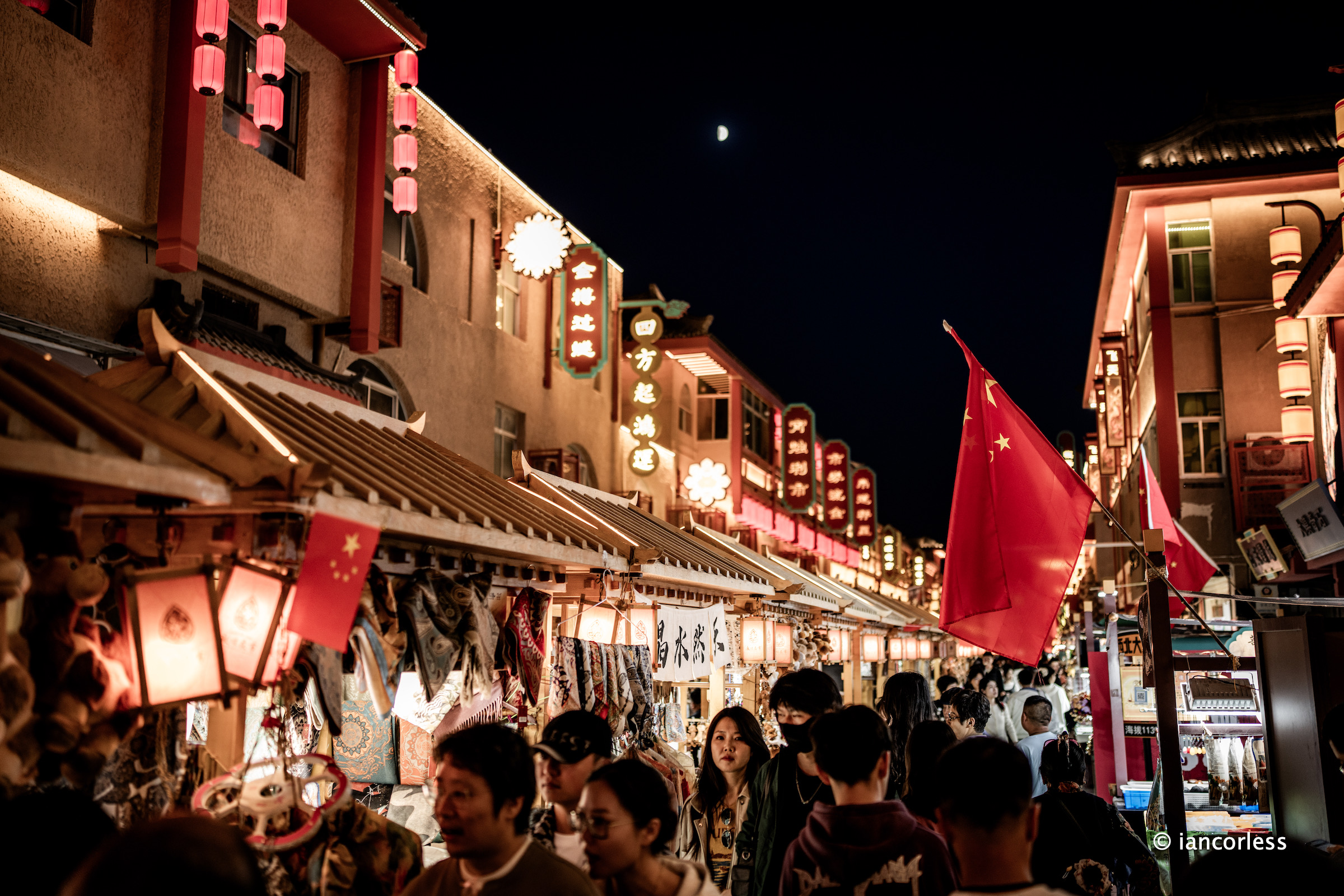
The night market, an awesome experienceThe night market famous for food.
Dunhuang offering traditional cuisine, the famous night market and an opportunity to stock up any last-min equipment, food and yes, maybe even souvenirs.
UTMBKat_25
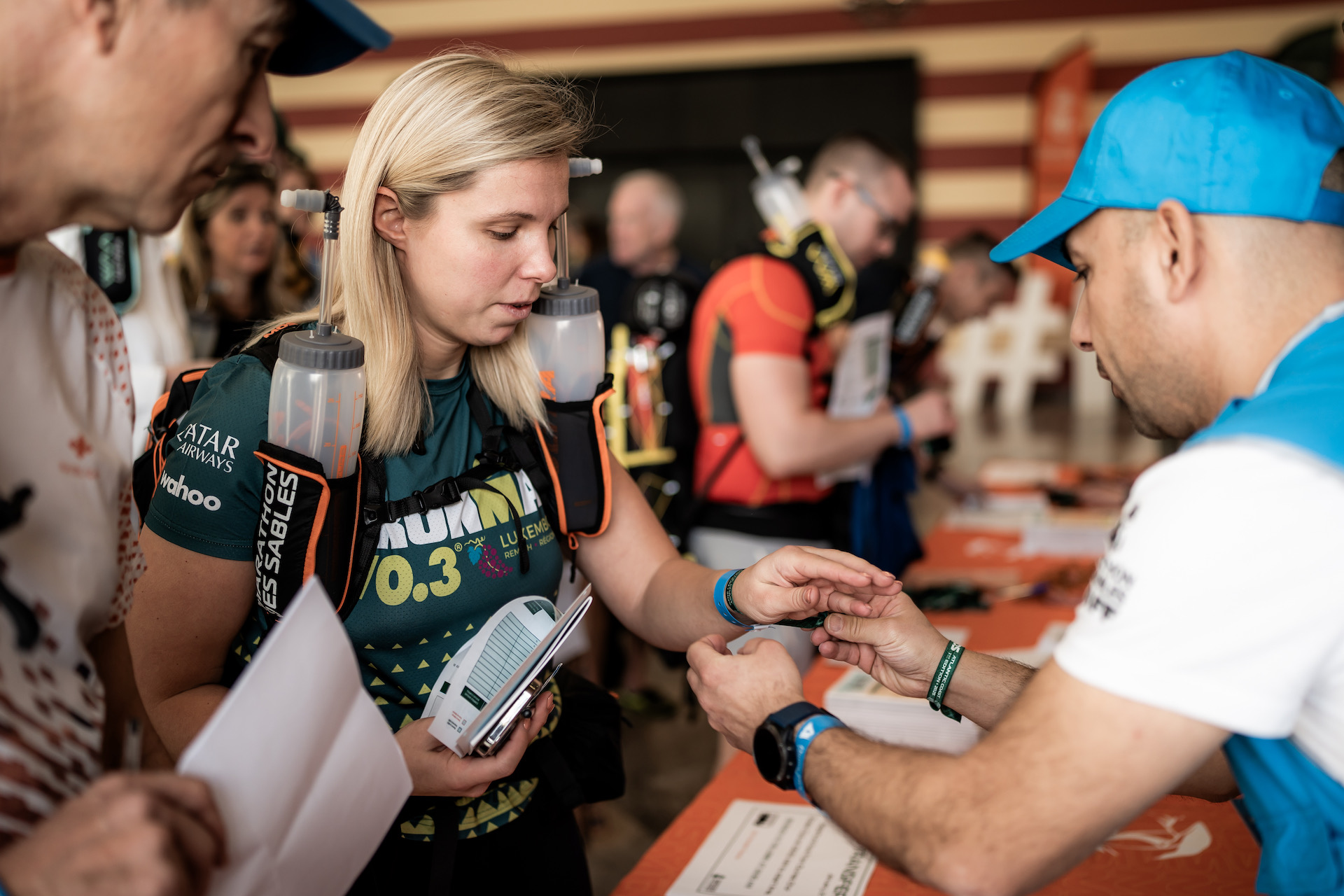
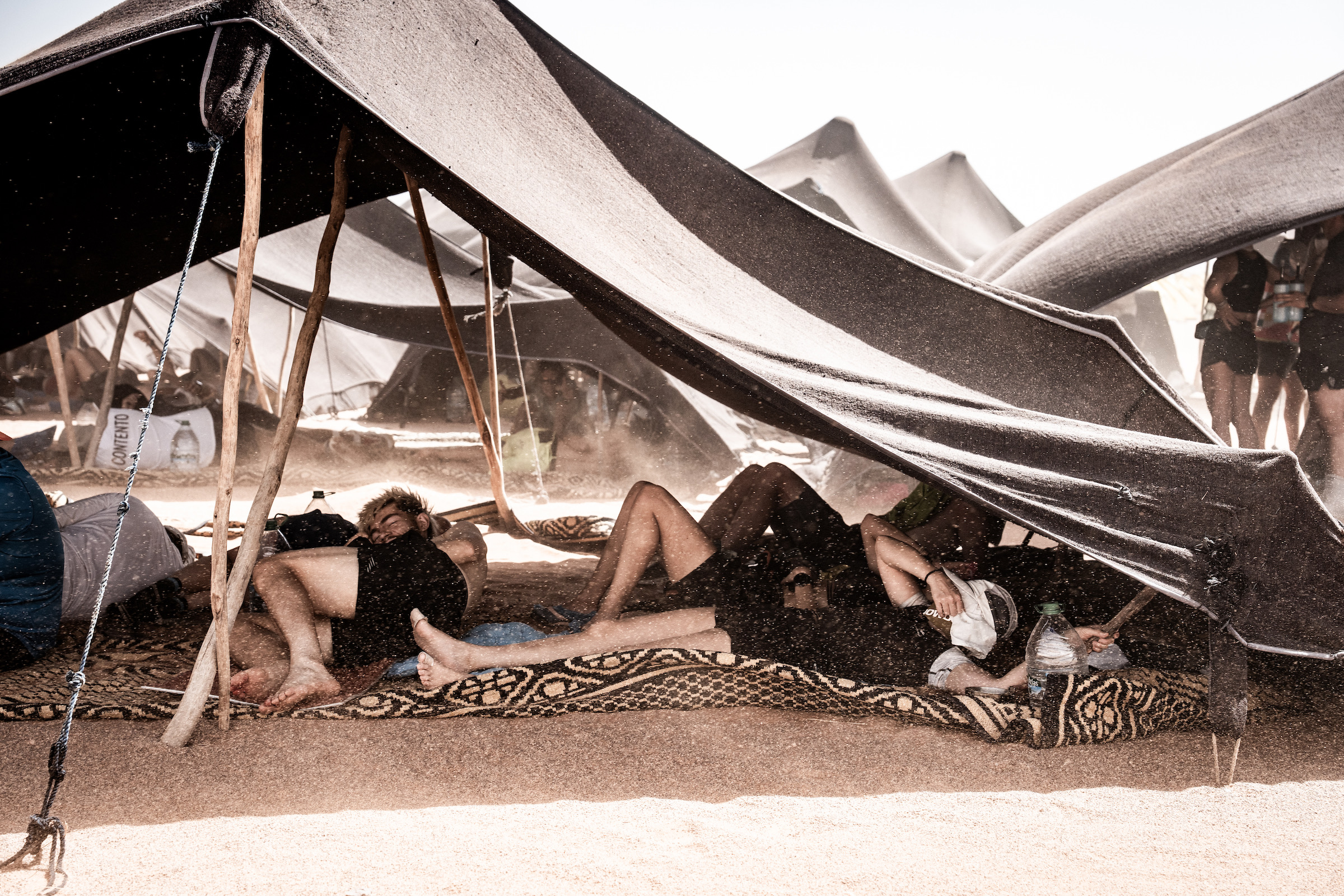
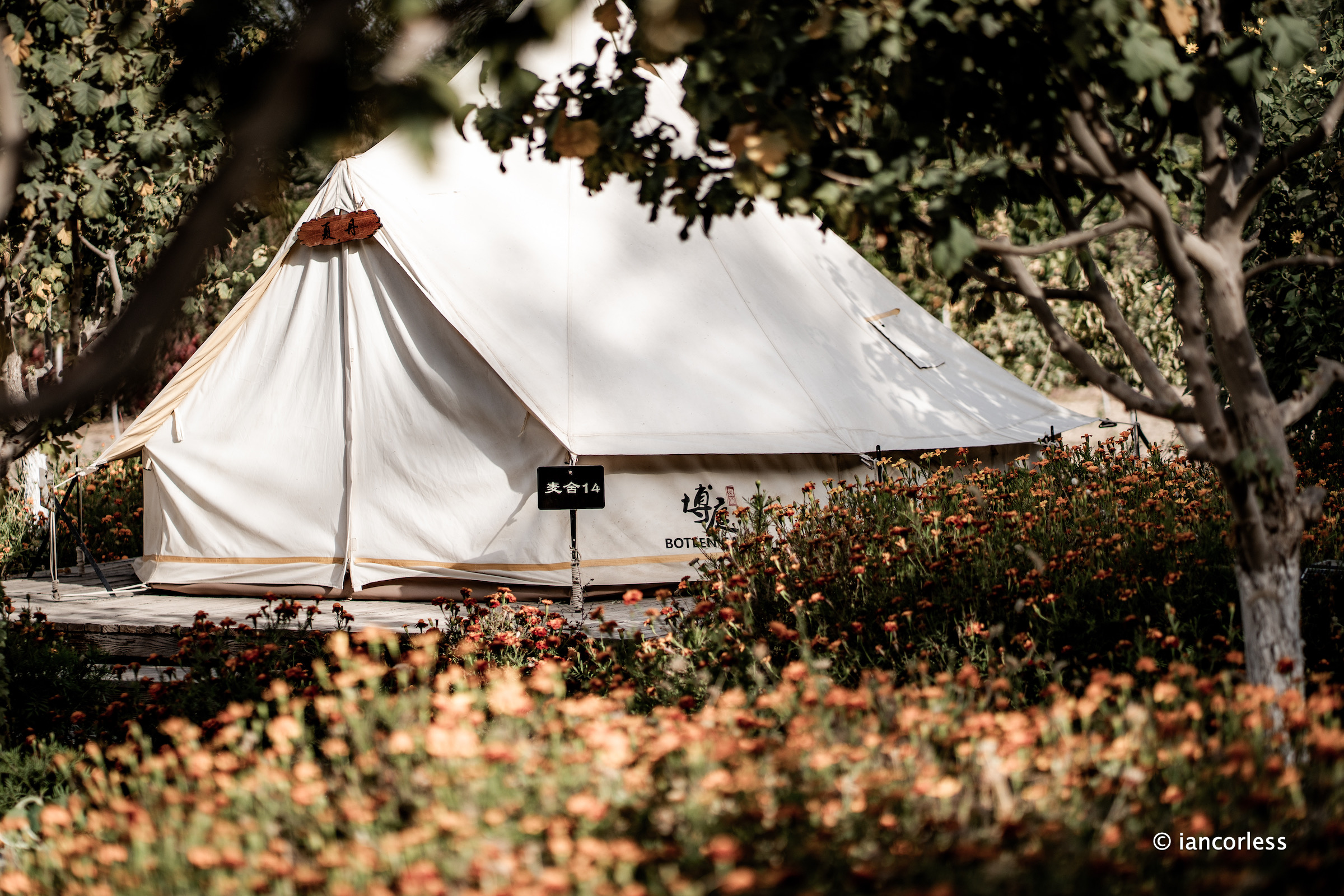
Then came the transfer to Gobi Spring, where final briefings and pre-race checks brought the reality of the challenge into sharp focus. For the participants, a night of ‘glamping’ before days and nights of deprived sleep and comfort.
Glamping in the Gobi
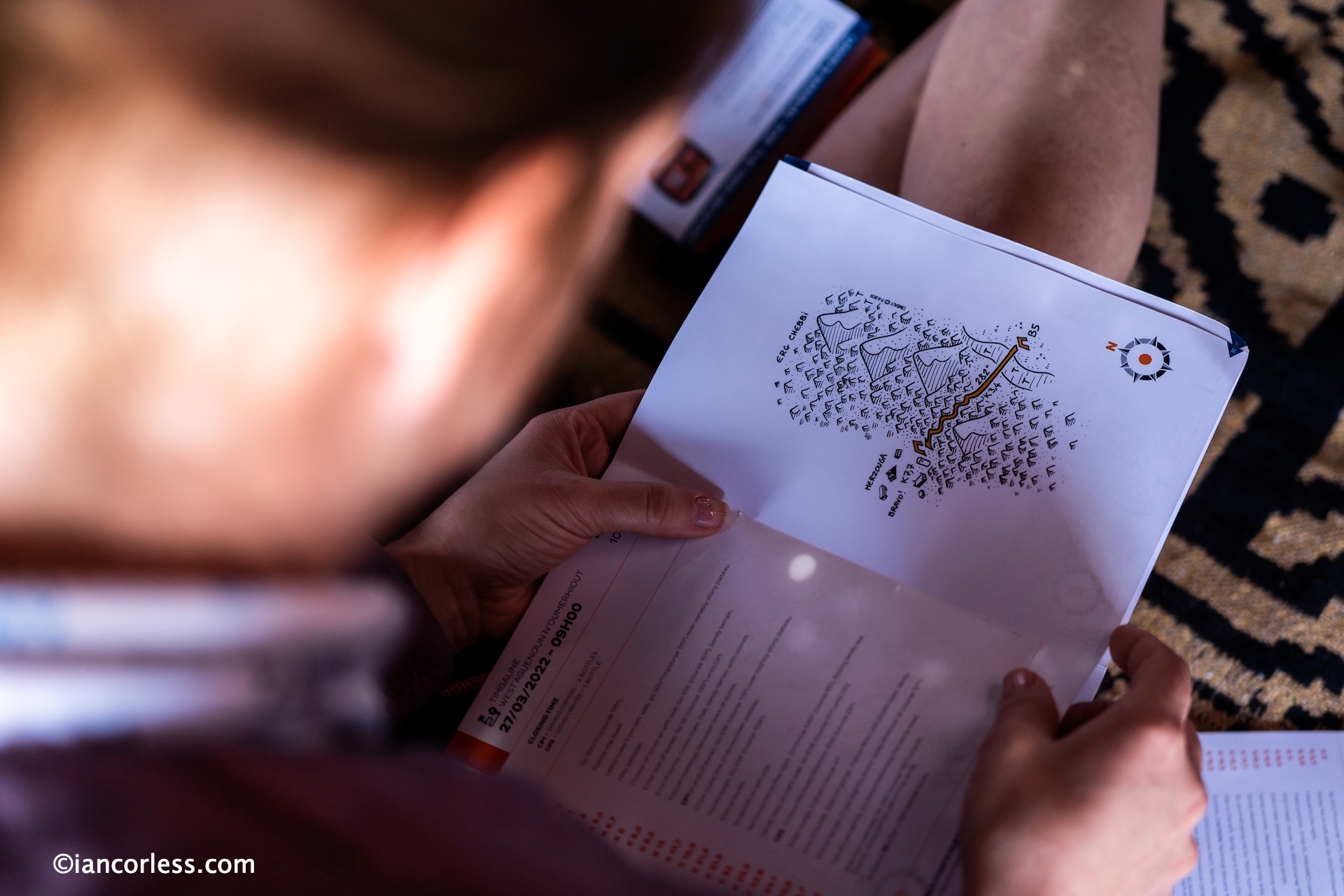
Mandatory gear signed off, maps studied, last meals eaten. From here, there’s no more preparation – only the race itself.
Race briefing
And this is no ordinary race.
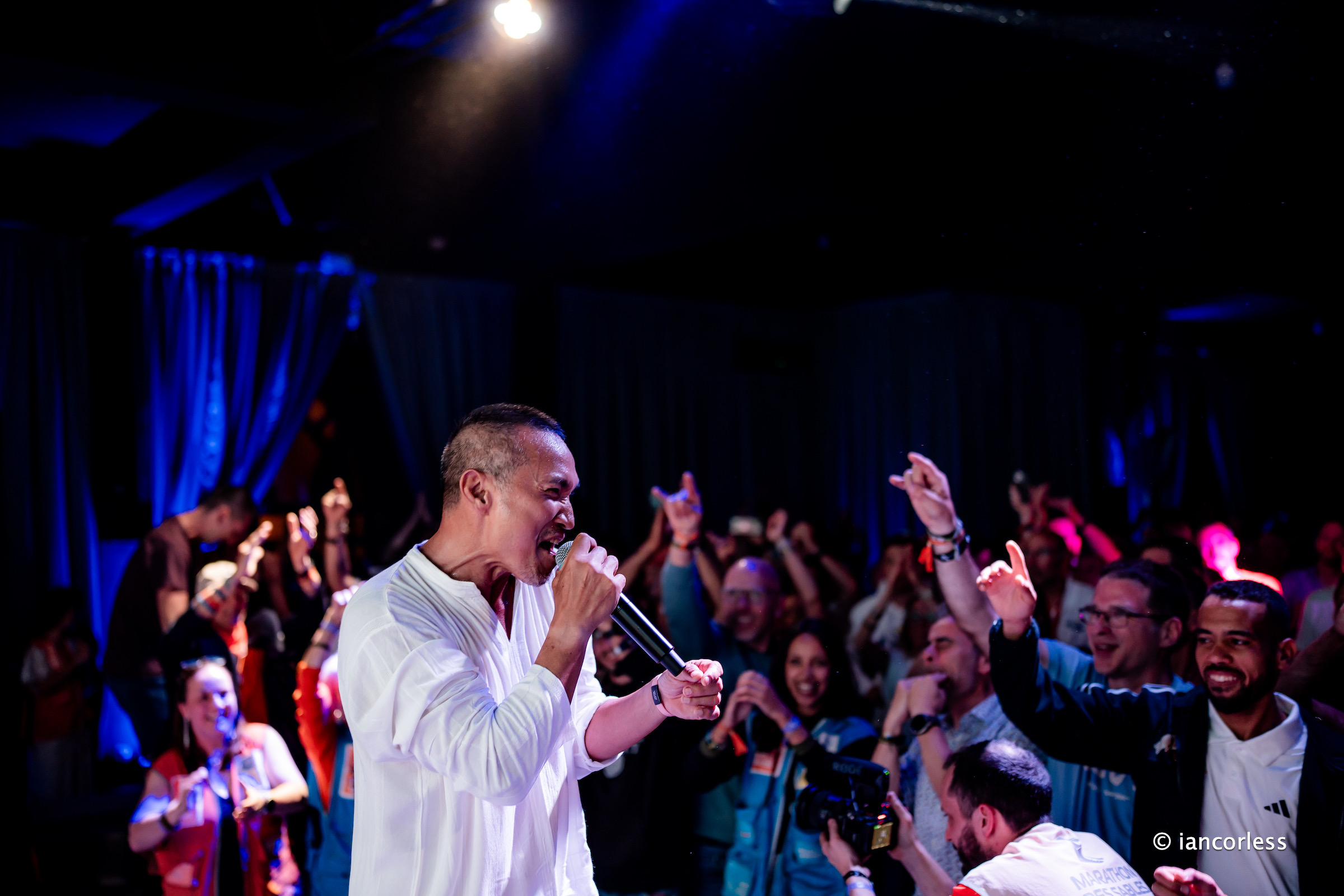
Tradition is very important at Ultra Gobi
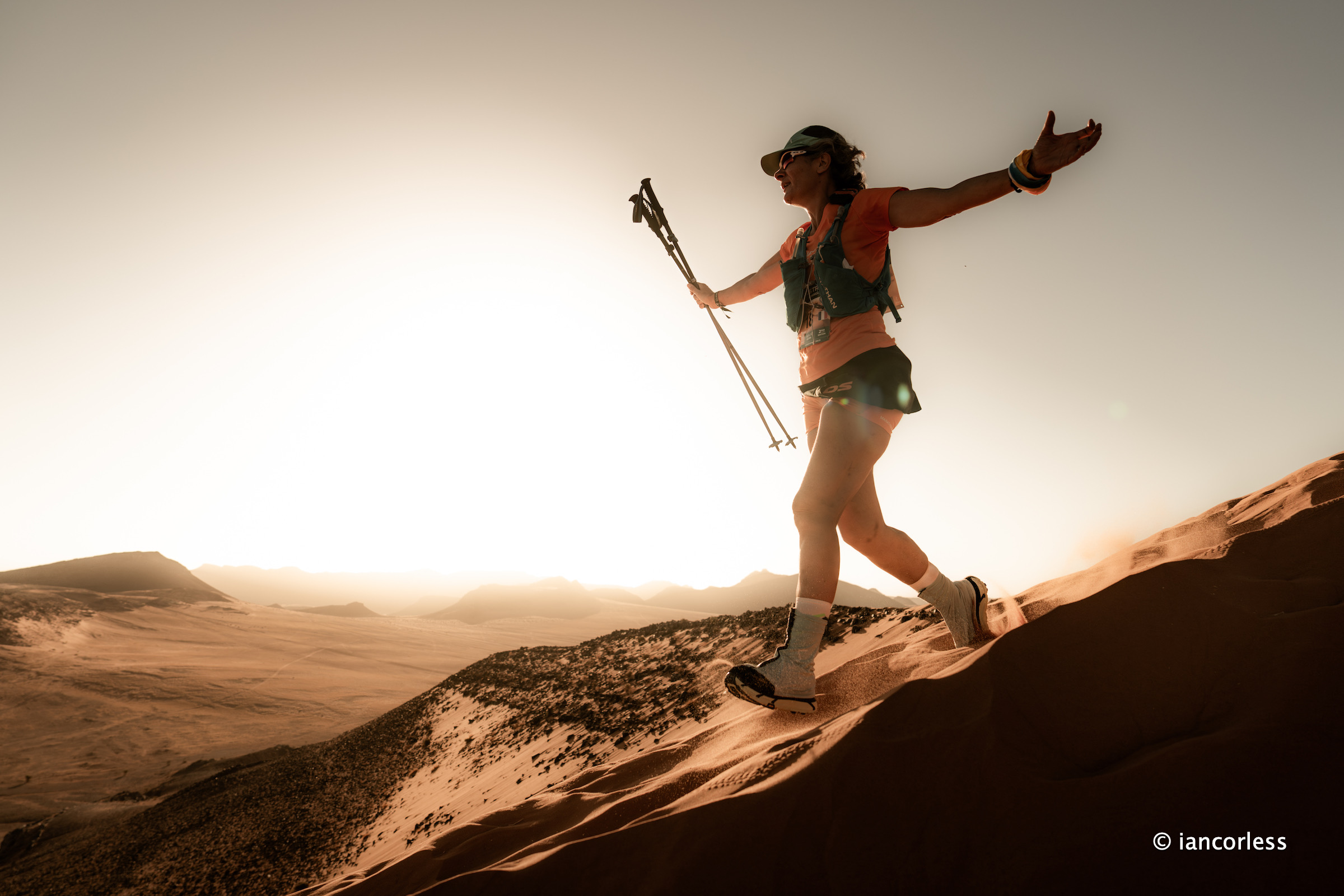
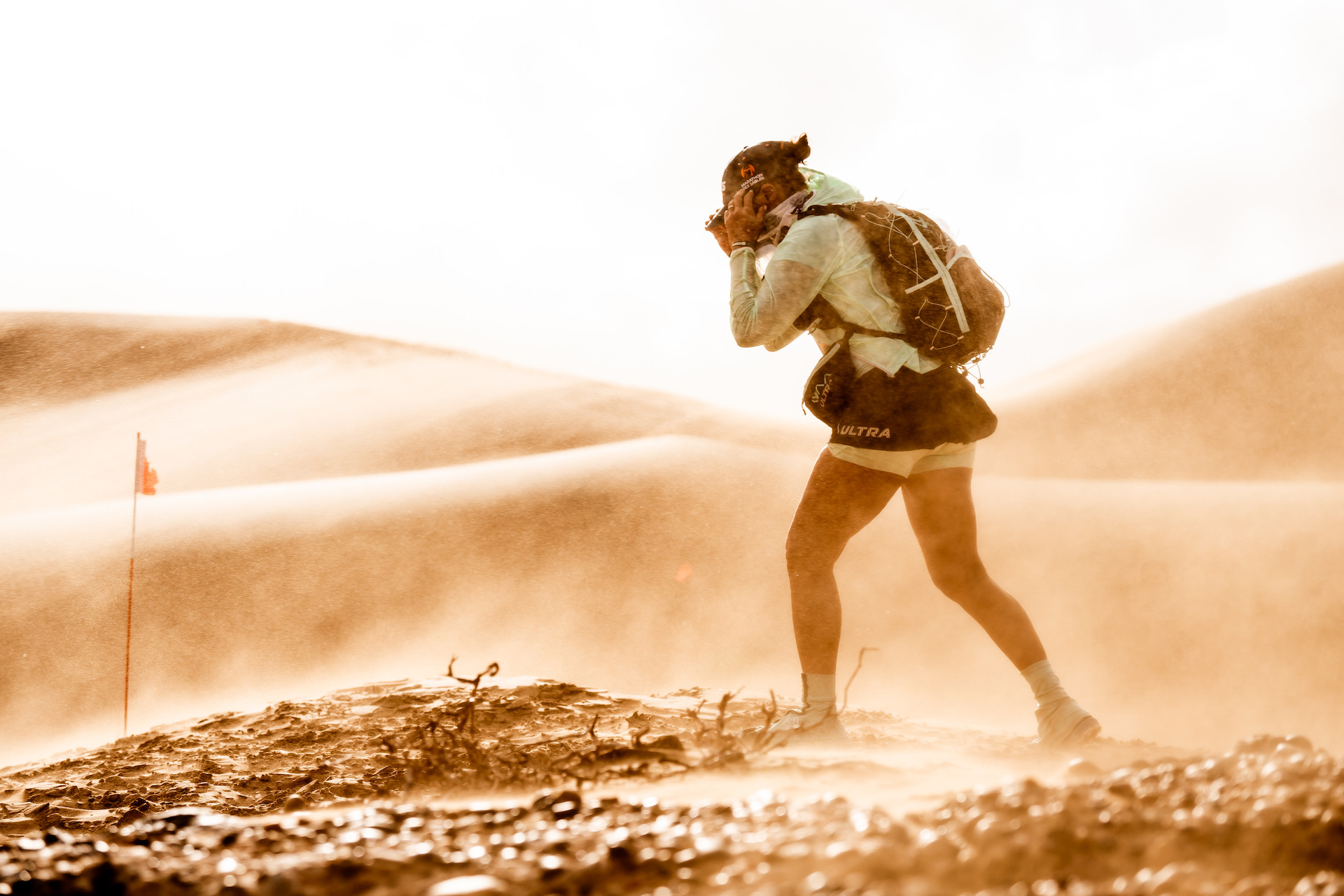
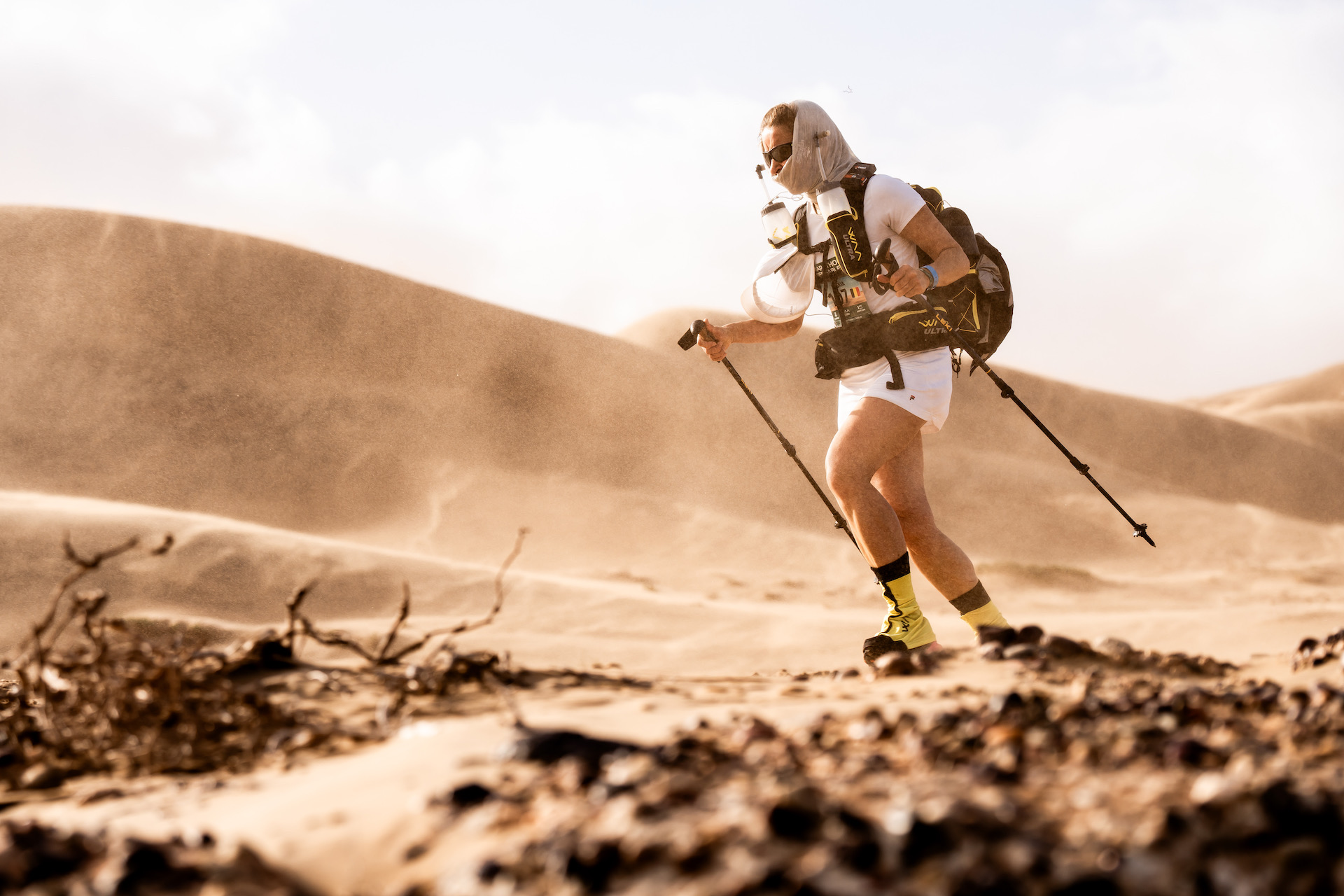
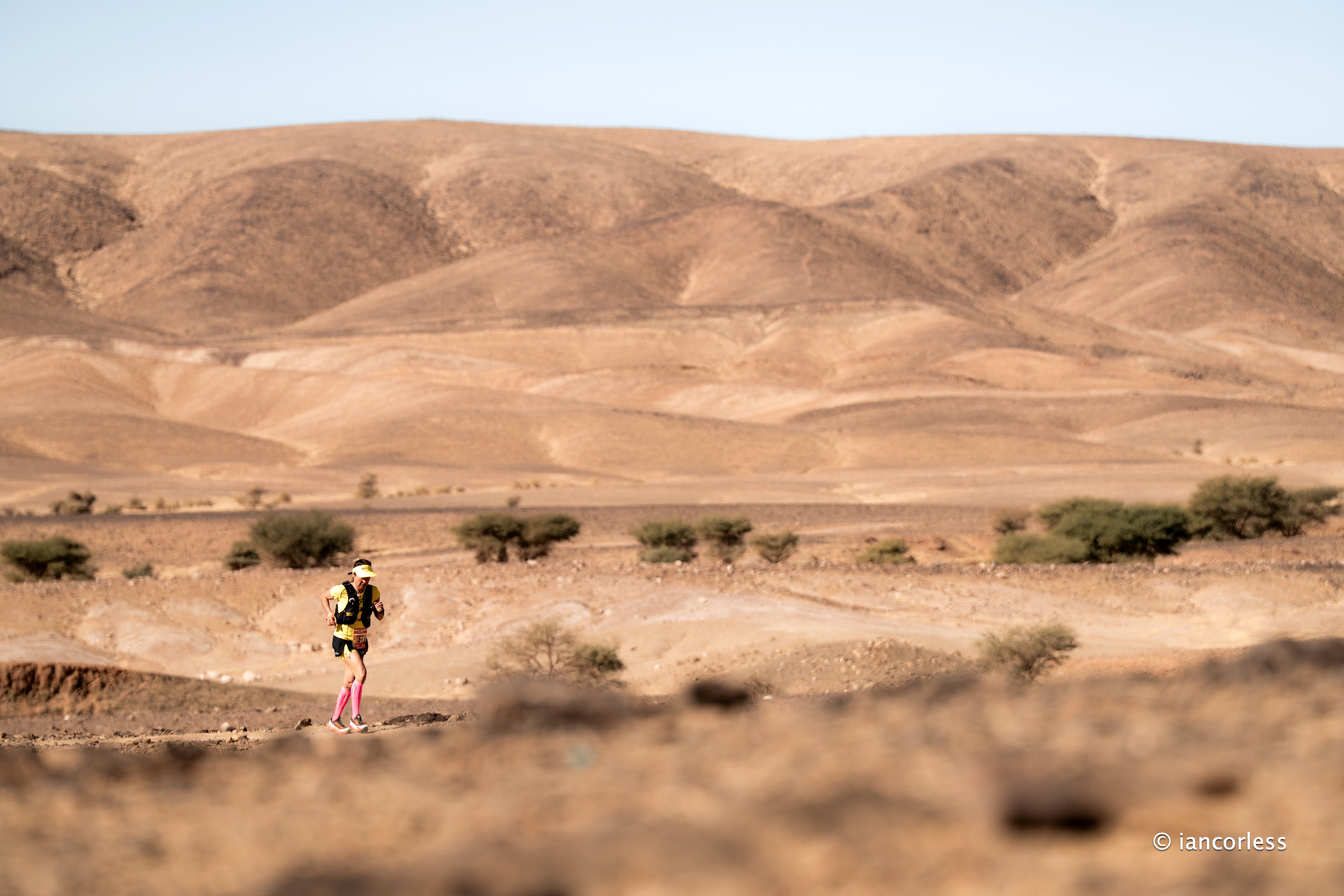
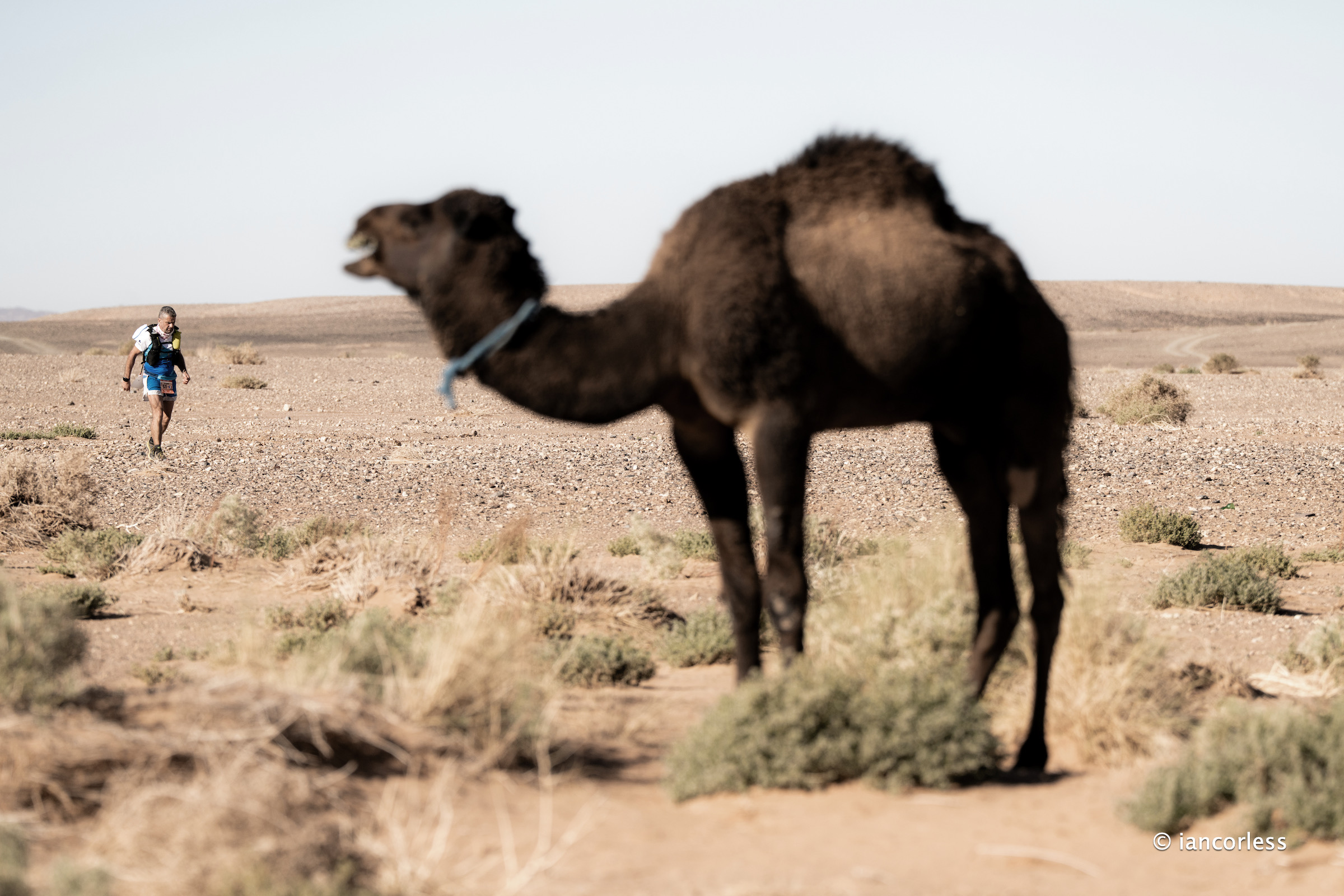
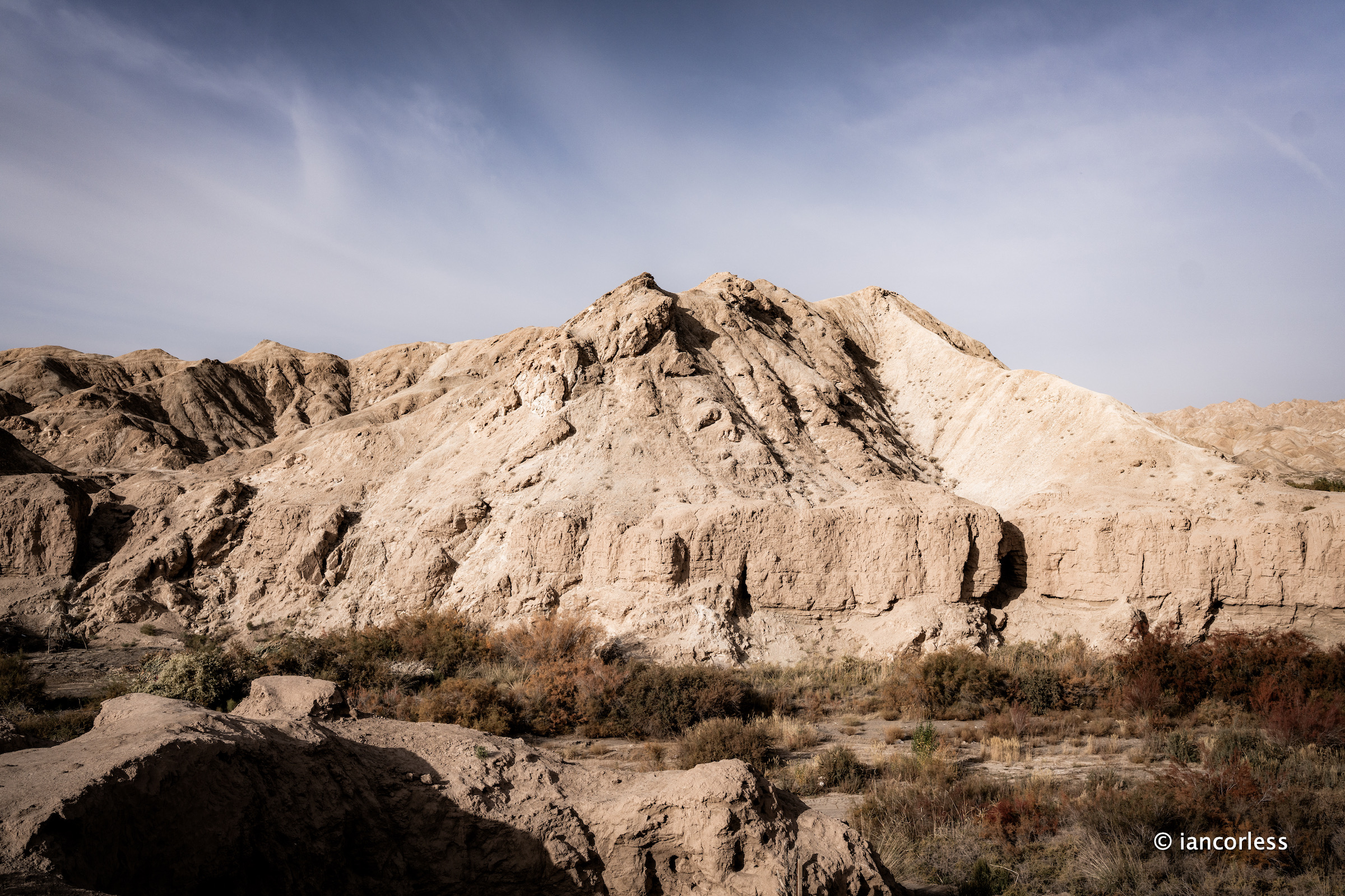
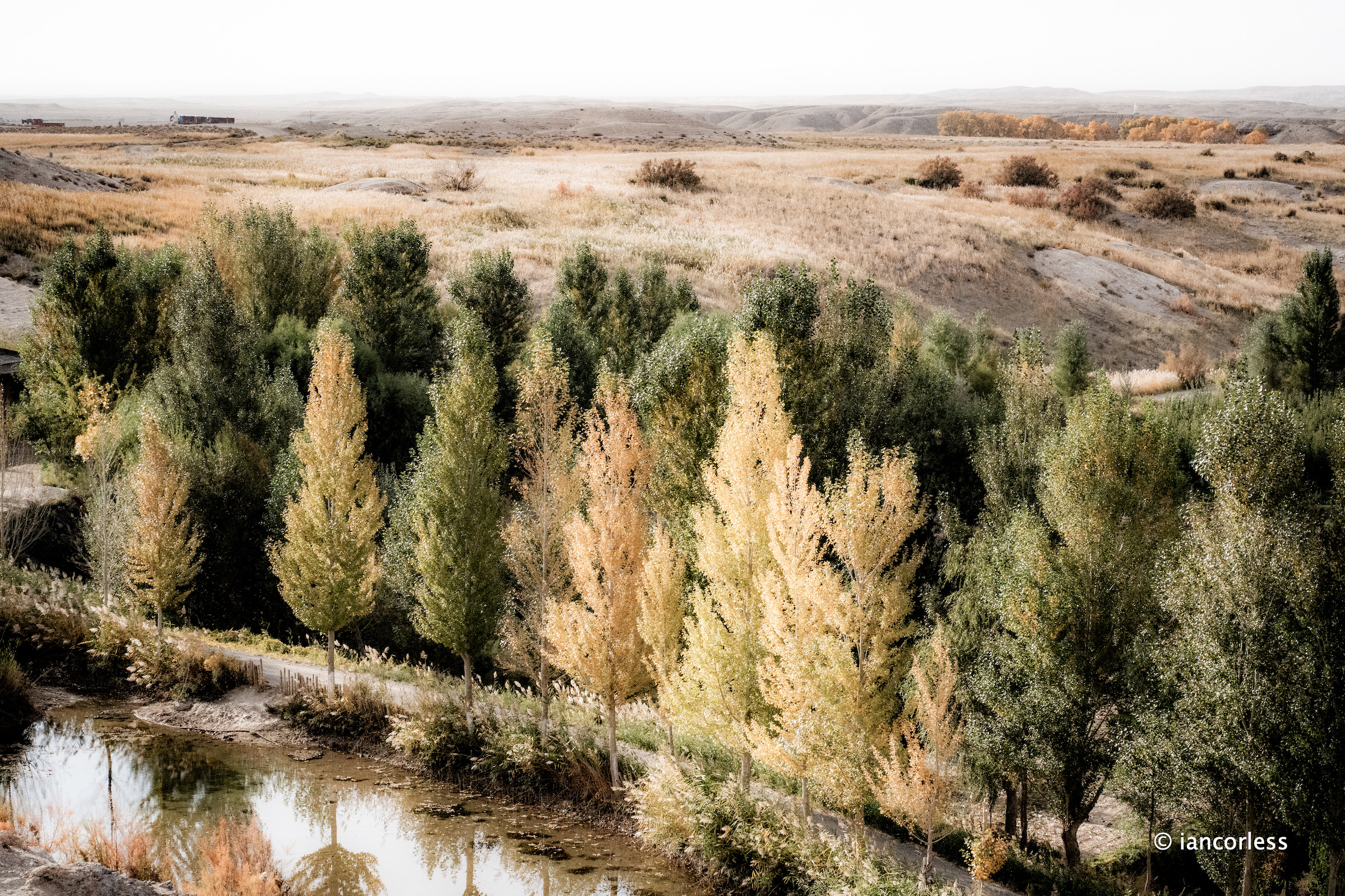
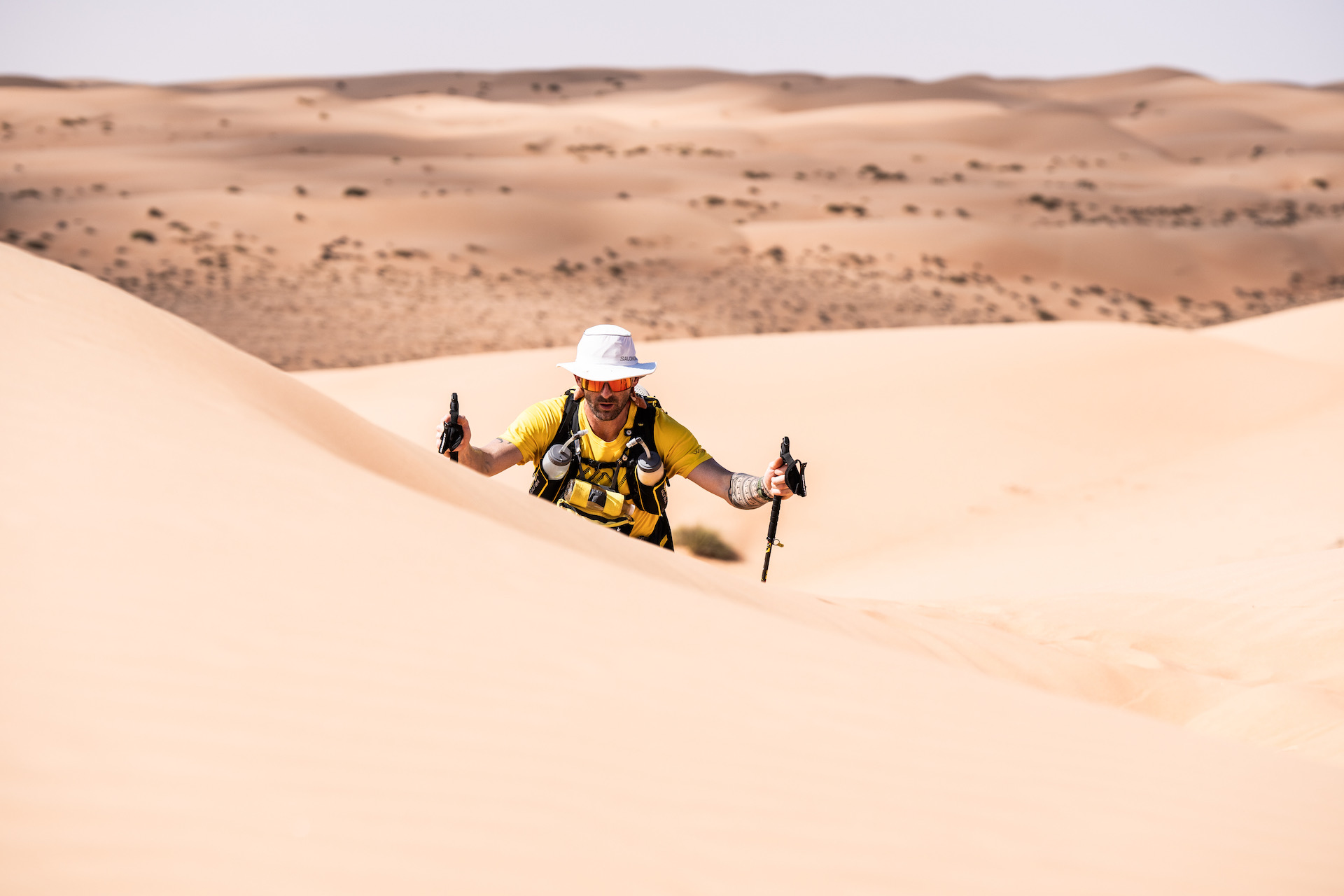
The Ultra Gobi 400km is a test of survival as much as speed. Runners must cover 400 kilometers of brutal, shifting terrain – endless sand, rocky basins, dry riverbeds, and wind-swept plains.
Mountains and altitude will be waiting
Days can scorch under an unrelenting sun; nights can plunge into freezing cold. Navigation, strategy, and mental resilience will be as important as strong legs and lungs.
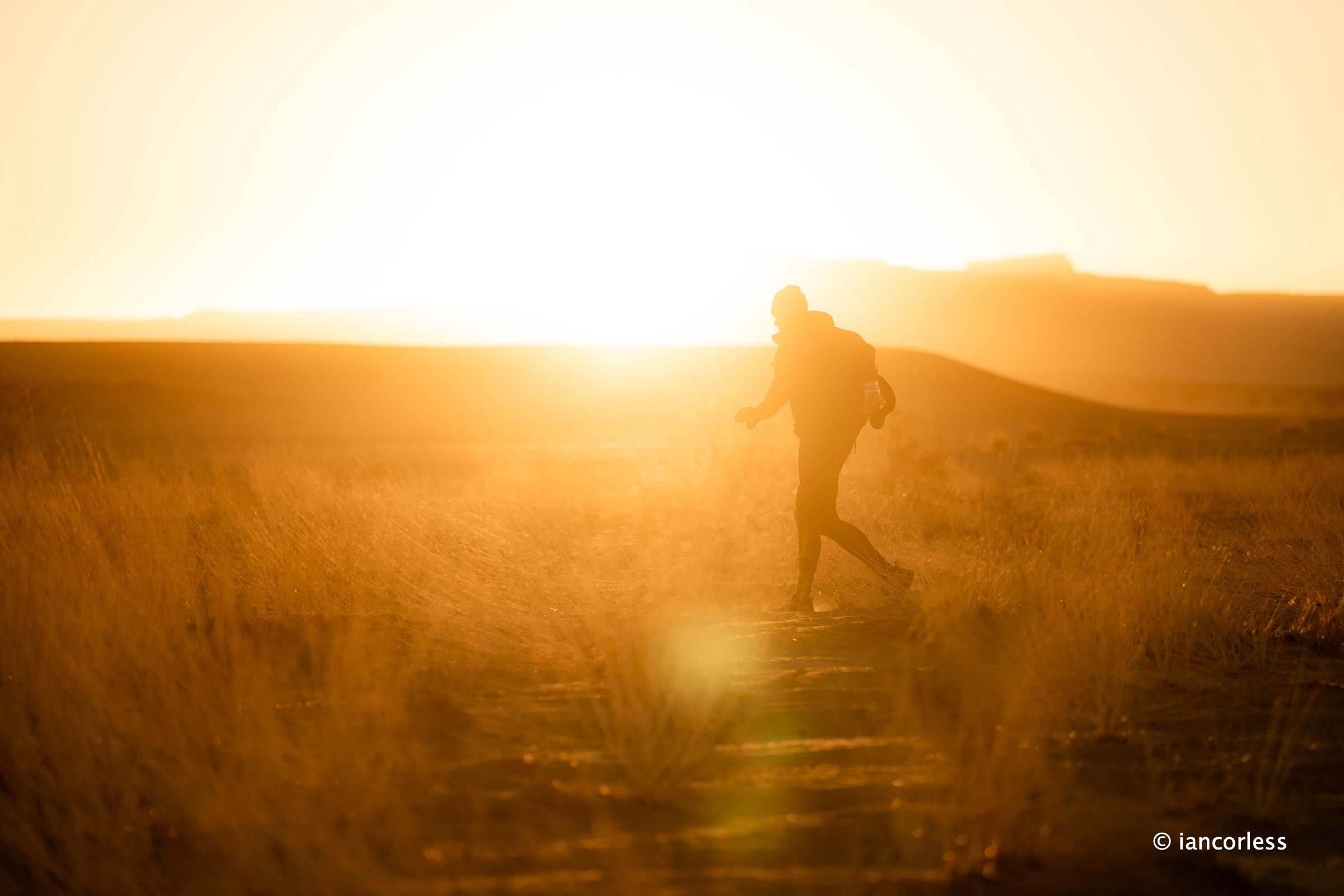
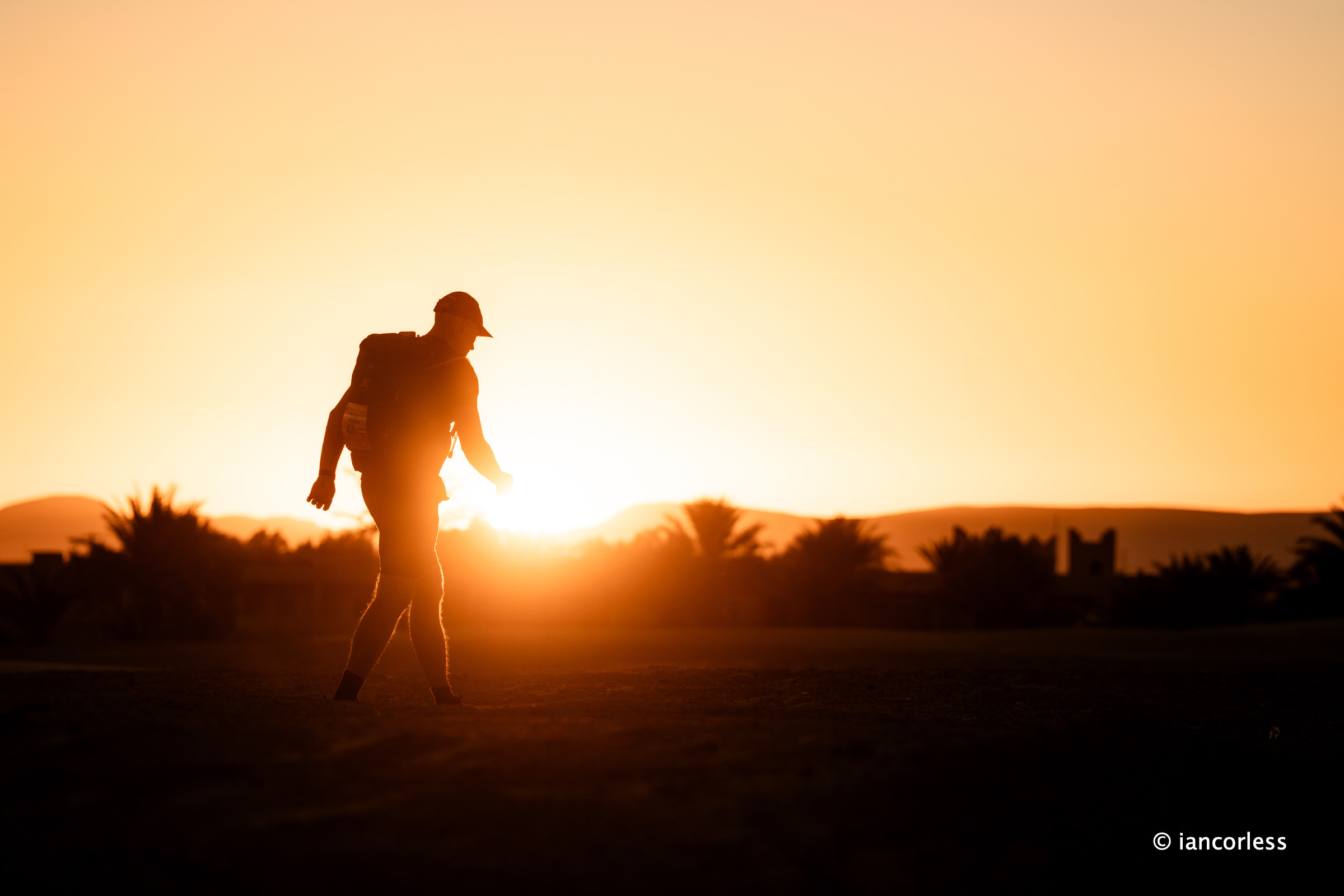
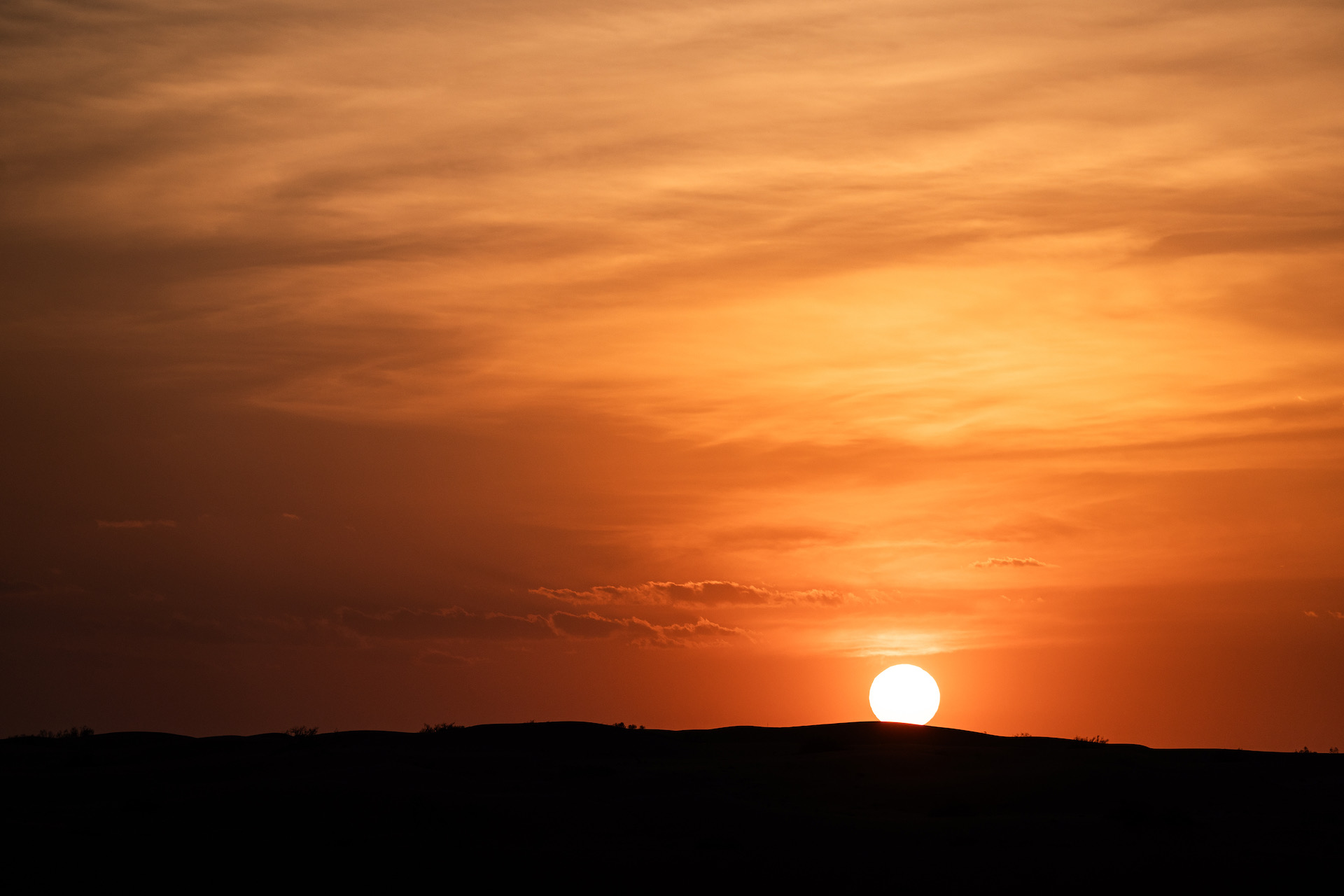
Golden light
For the competitors, the anticipation has built to a fever pitch. Months of training and sacrifice come down to this moment. There will be tension at the start line, but also a sense of awe: they’ll leave the comfort of light and noise behind and step into the vast silence of the desert.
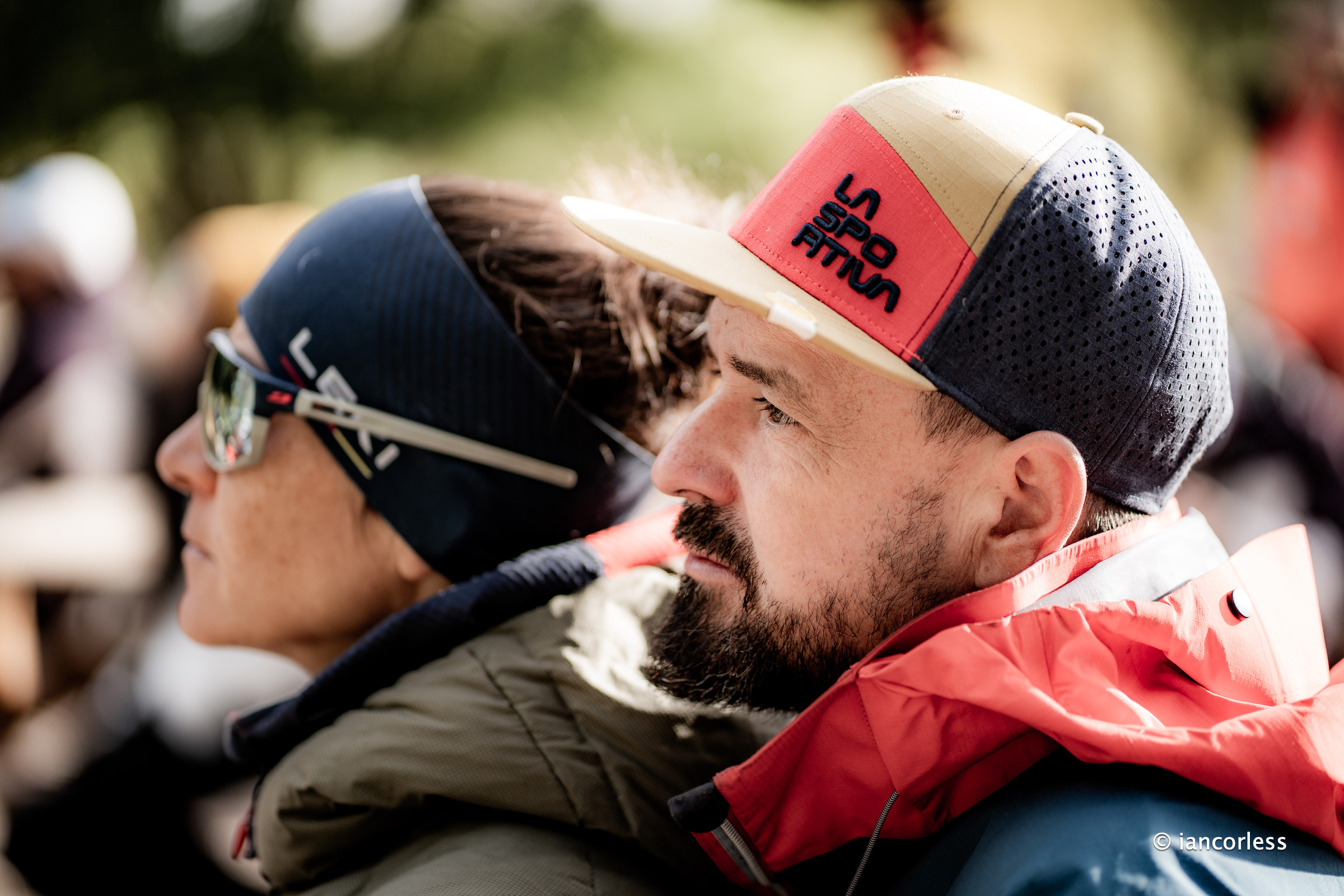
One strategy, teamwork!
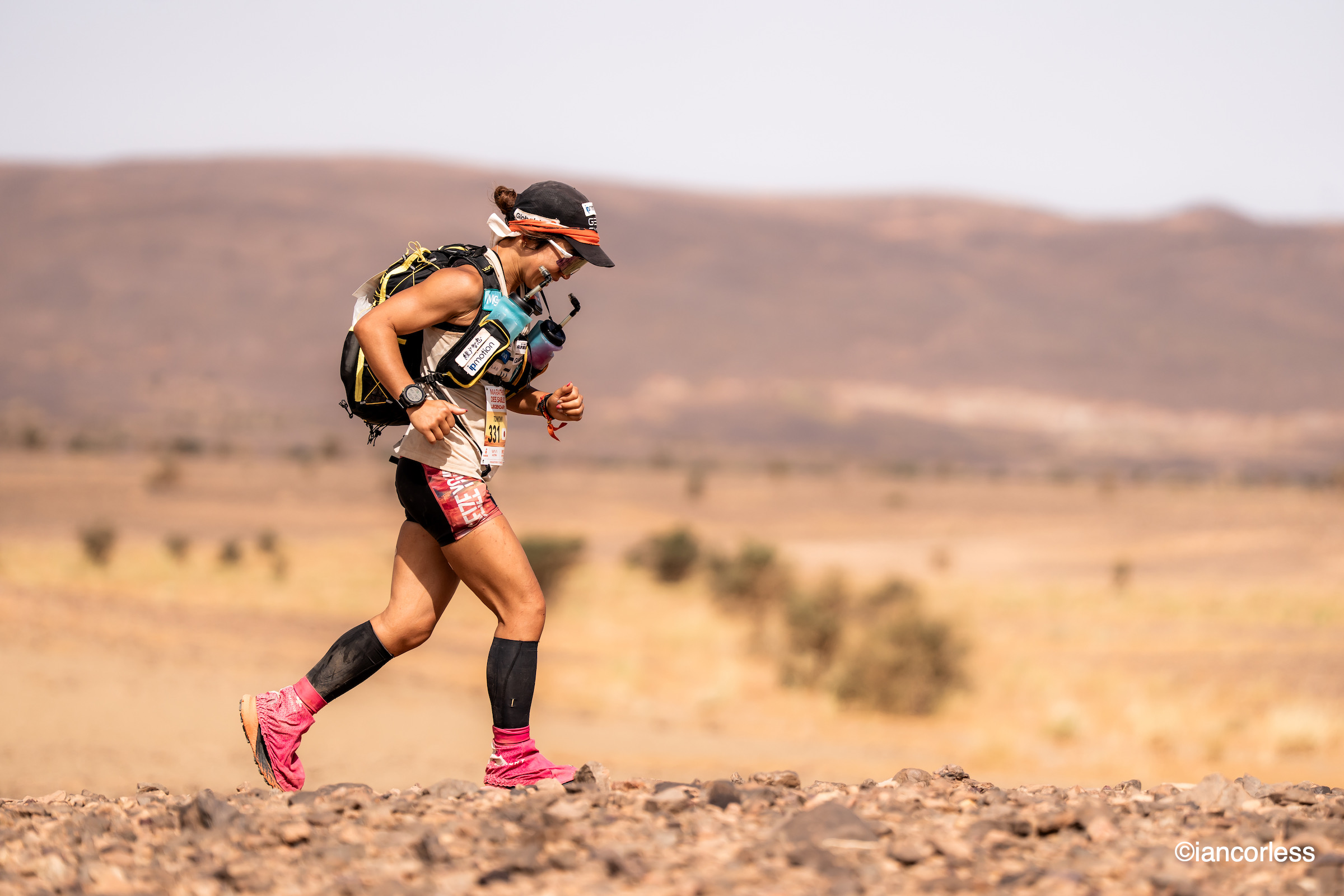
Four hundred kilometers through landscapes that constantly shift and change. A true test of endurance, grit and self-reliance. There is one truth of the Ultra Gobi, each runner will discover where the limits truly lie.
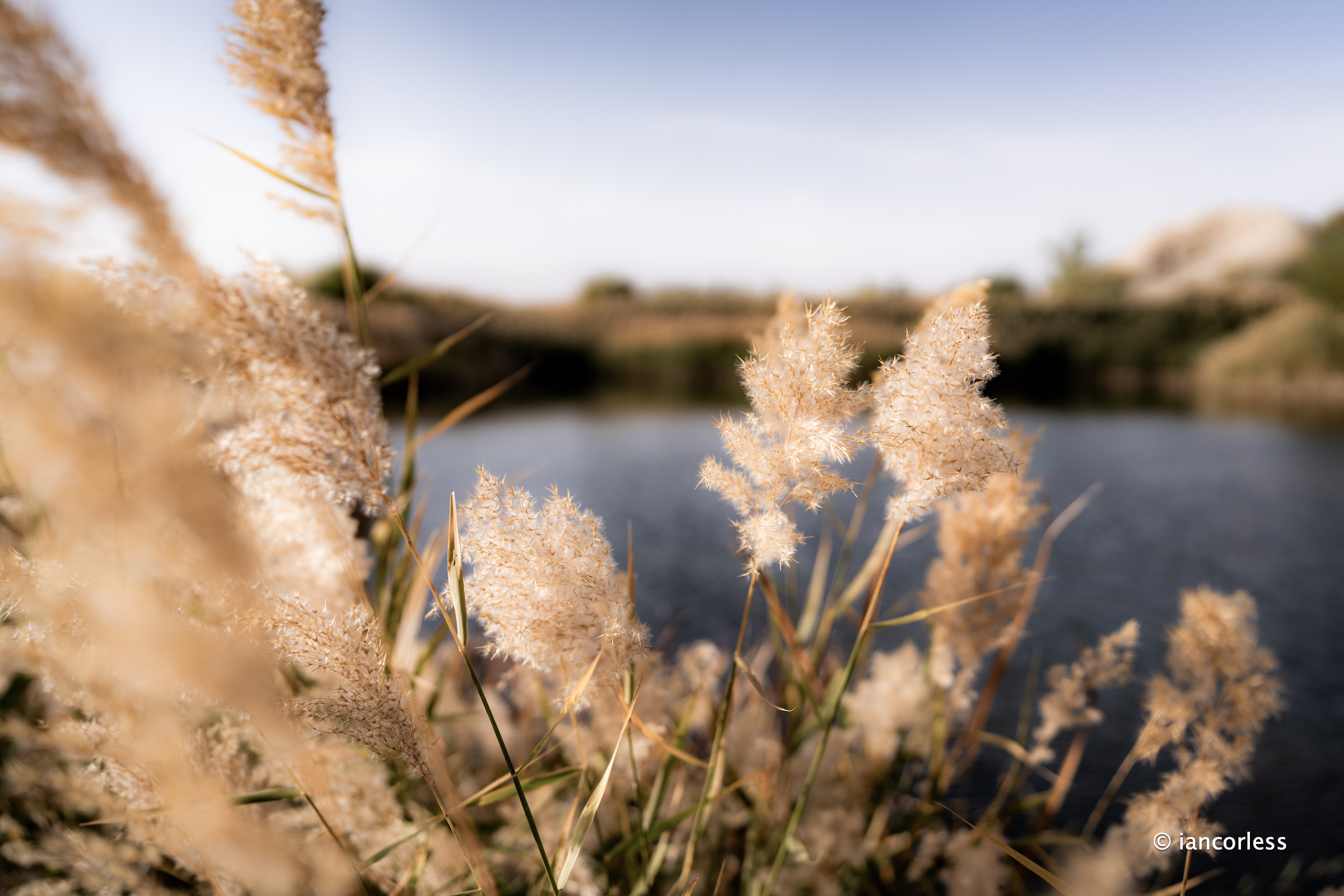
Varied landscape
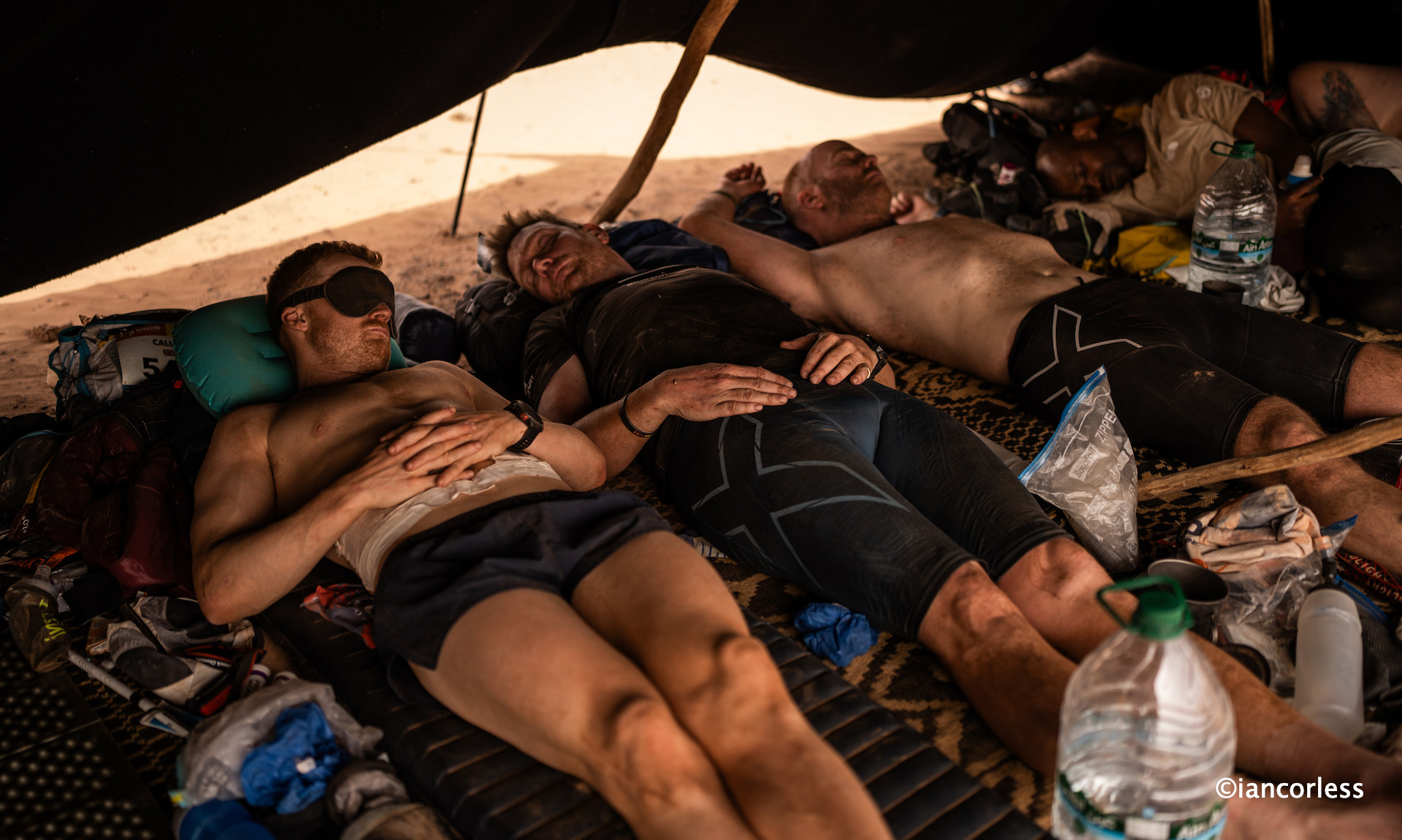
This race doesn’t hand out easy victories. It carves stories into those who dare to take it on. Some will break; some will endure; a few will cross the finish line forever changed.
Tonight, the desert opens its gates. The Ultra Gobi 400km 2025 begins.
The iconic race of sea, to summit and back to the sea has returned to its roots and the people of La Palma. Few races, anywhere in the world, have the magic of Transvulcania.
It’s more than a race, it’s an experience that transcends running. A 360 journey of location, culture, emotion and a journey to the core of what makes the sport of trail and mountain running so special, a unified glory of experience.
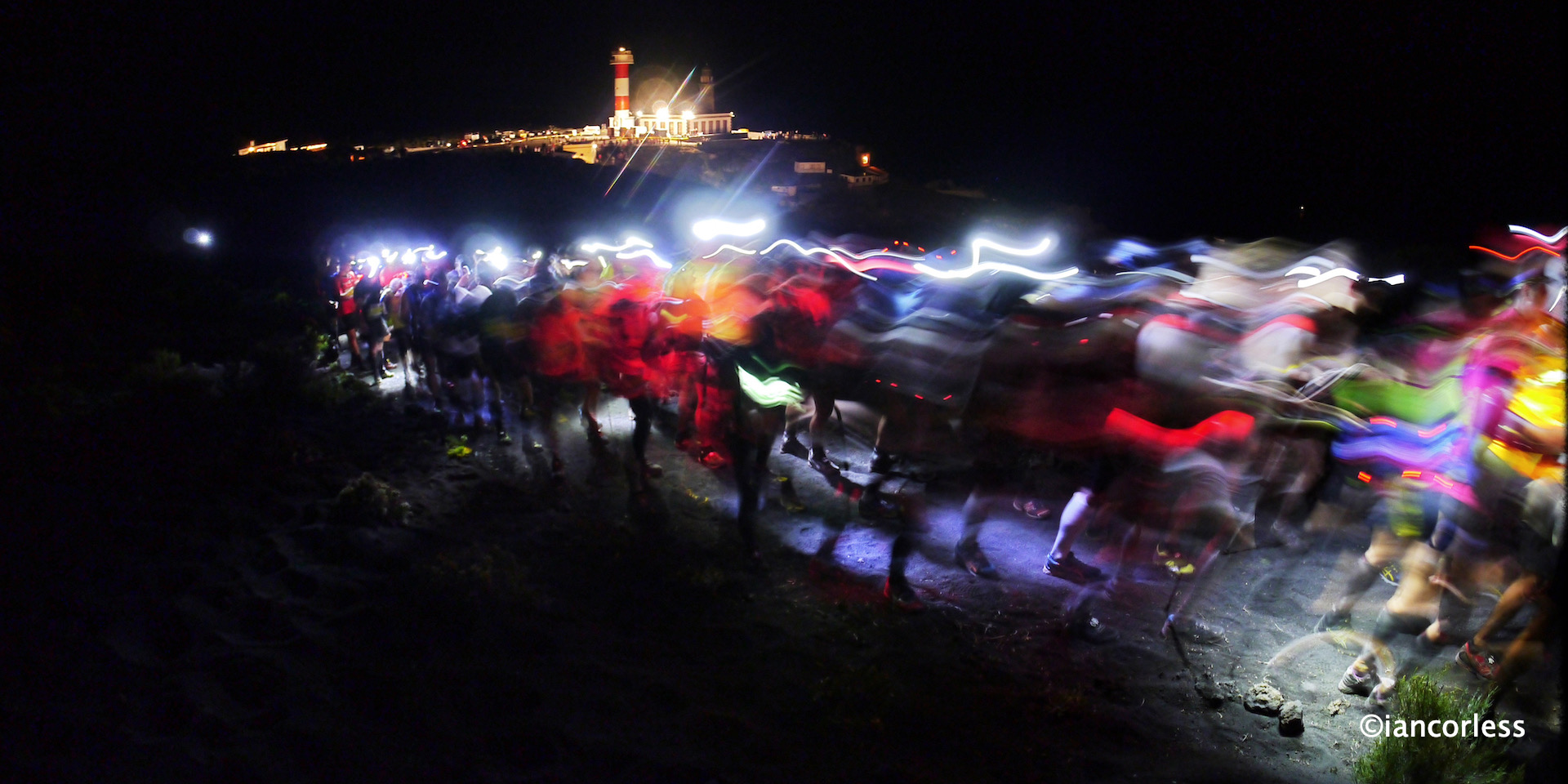
From the early morning start at the Fuencaliente lighthouse, the pounding drums and guitar of AC/DC and the words, THUNDER, THUNDER, THUNDERSTRUCK…!
The blackness illuminated by the glow of 100’s of headlights and then the upward journey begins through a landscape that makes the most well travelled smile with joy at the magic the GR131 route brings.
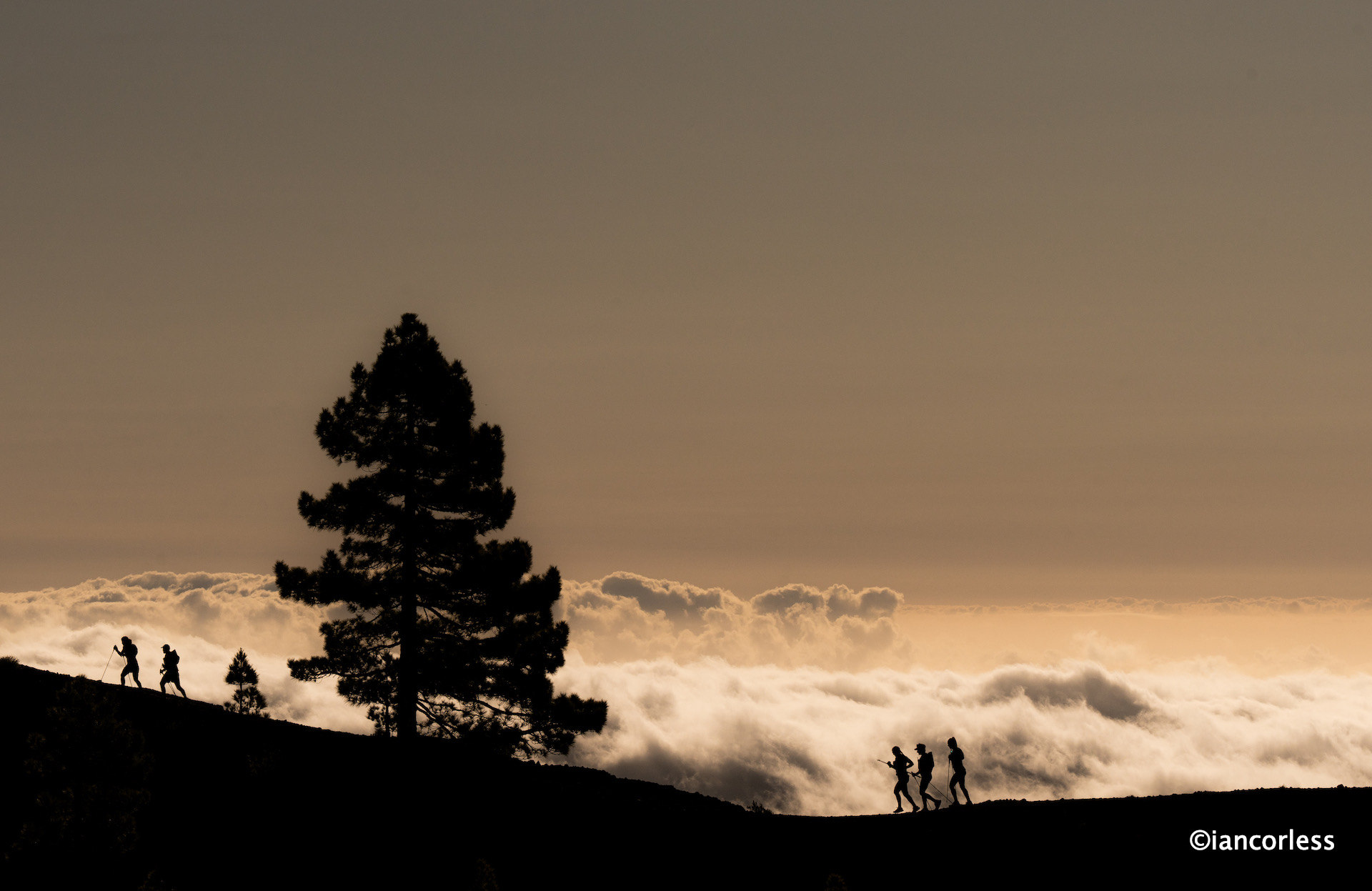
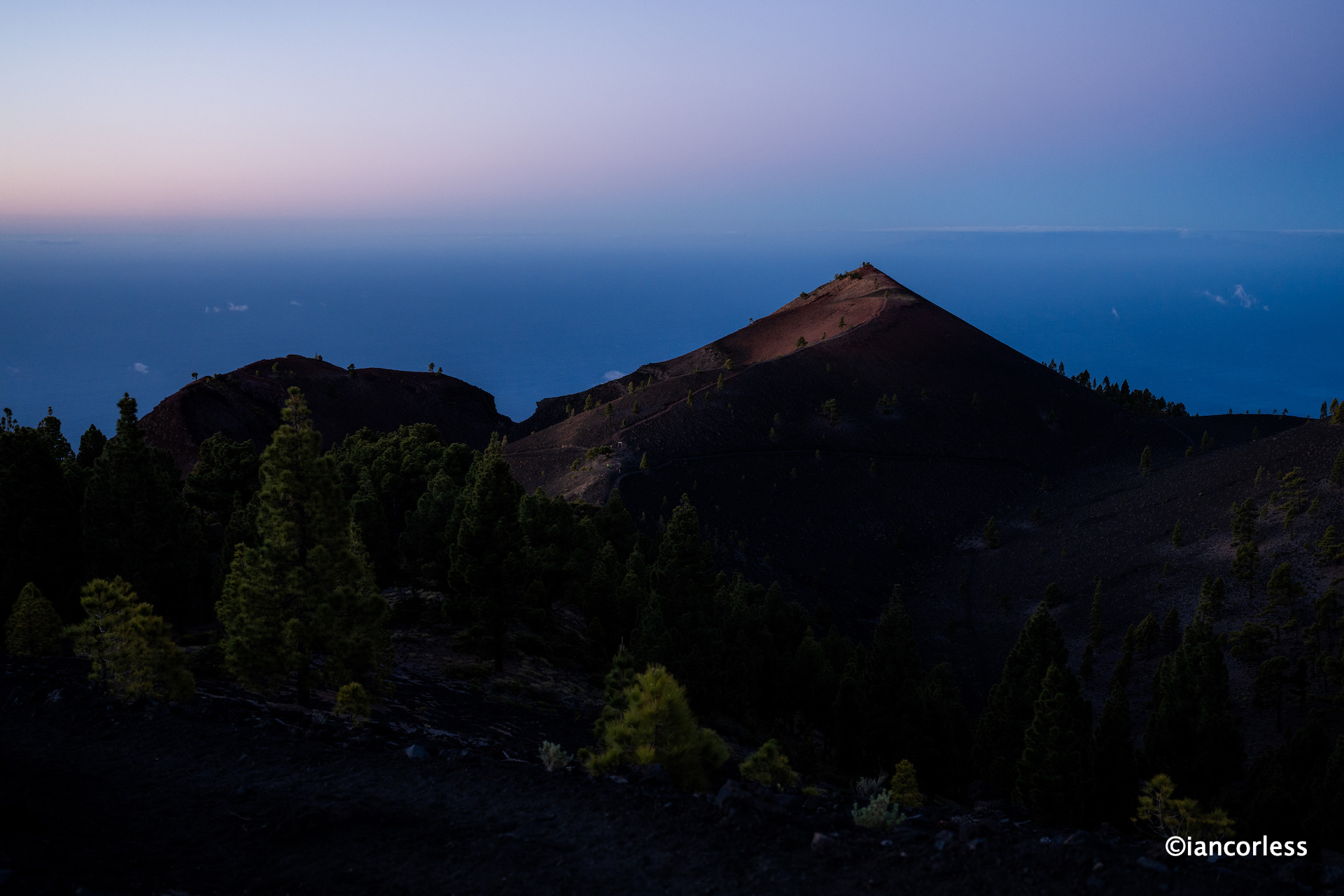
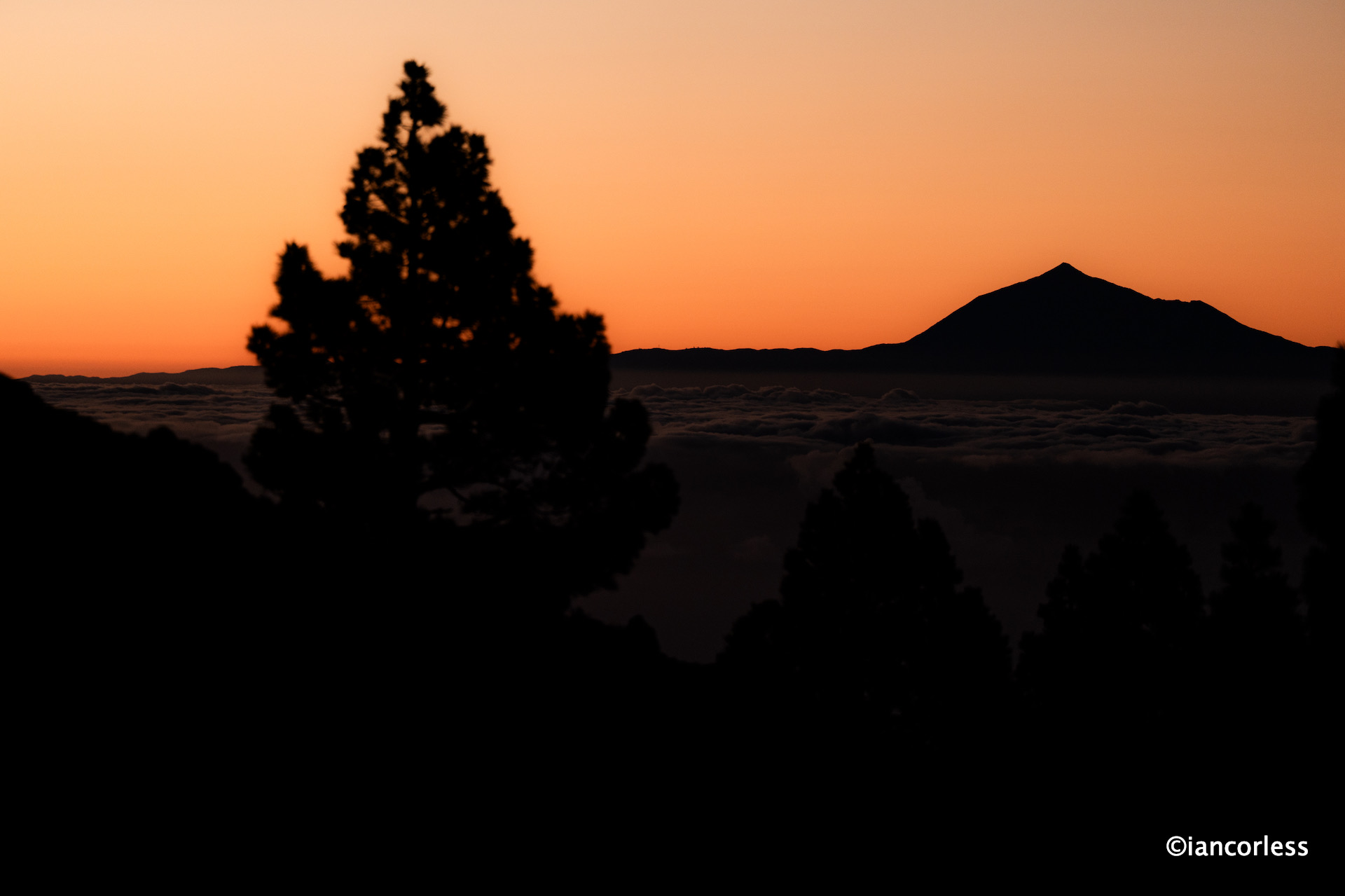
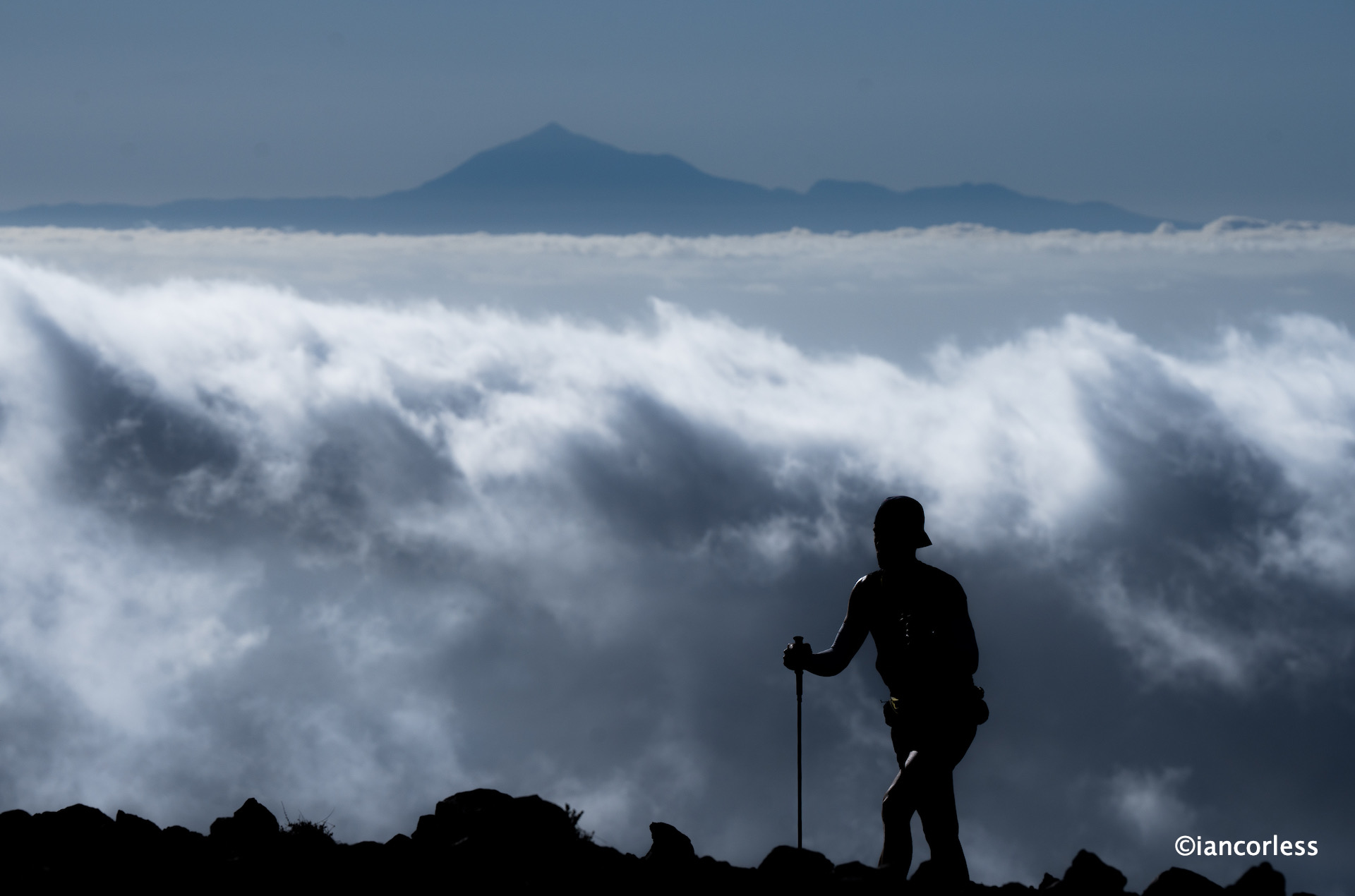
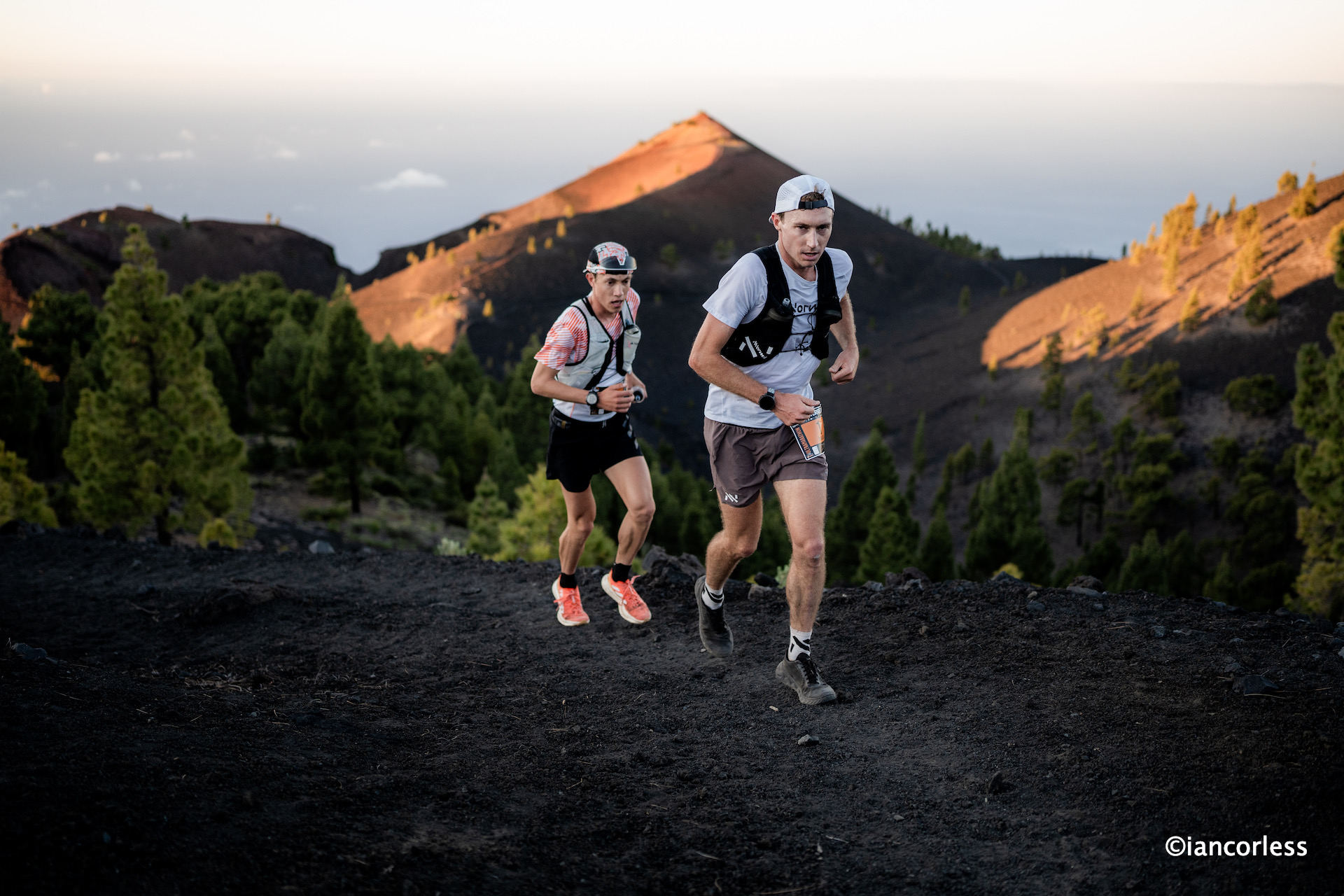
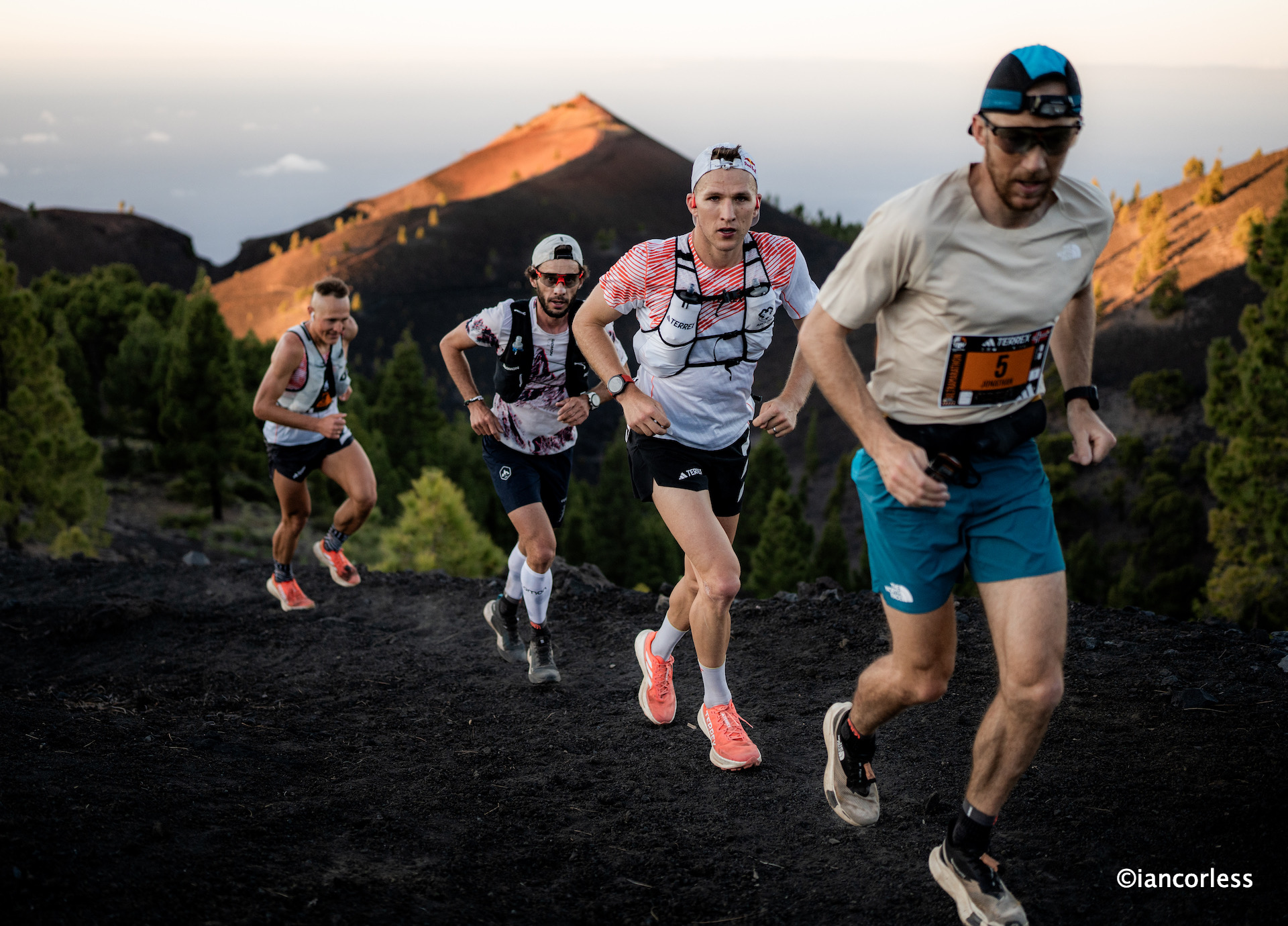
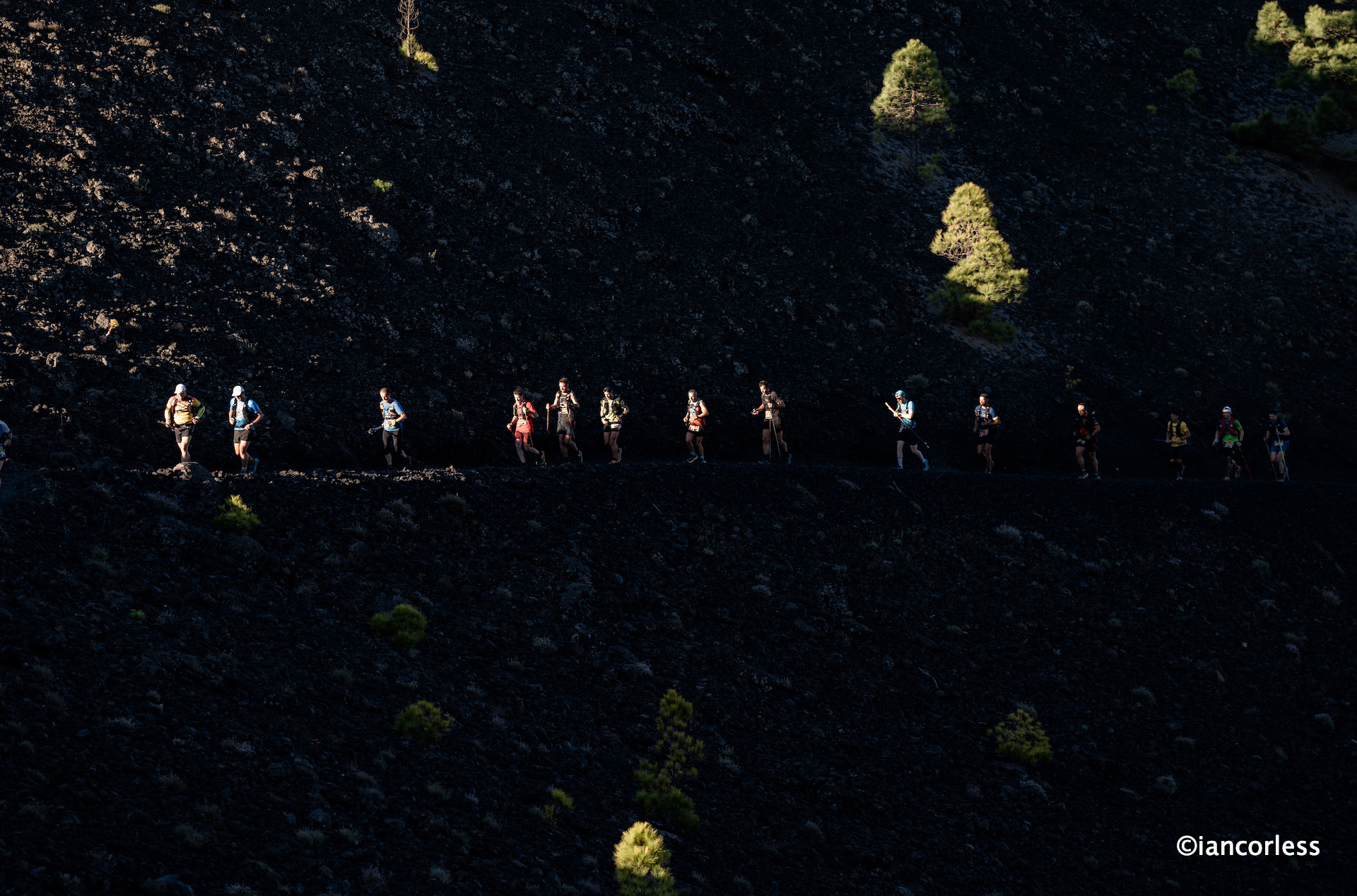
Los Canarious offers an opportunity for refreshment before single-track of black sand and rock weaves through pine trees and the eventual magnificence of the route of the volcanoes coinciding with the first light of a new day. A glimpse to the right, the sky a mixture of orange and blue, Tenerife and Teide visible and suddenly you feel like a plane, floating above the clouds in what many considering a life-changing moment.
The route winds and climbs down the spine of La Isla Bonita. From the highest point in the lower sections of the GR131 (1908m) in the Cumbre Vieja, the route drops to the micro-climate of El Pilar, one-third approximately of the route completed.
From here, cloud encapsulates the runner, some easy trails eventually give way to climbing, a myriad of single-track that weaves left and right and finally you break through the cloud to the most amazing views of Caldera de Taburiente National Park.
Reventon arrives, it’s one of the highlights of the route. With 40km’s covered, the GR131 is now above 2000m and ever so slowly the route creeps over the next 10km’s to the highest point at Roques de los Muchachos at 2403m, a rollercoaster ride of undulating and at times technical trails that offer a 360 panorama of this stunning island.
What goes up, eventually must come down and what follows is a 16km drop back to the ocean; a relentless knee, quad and mind blowing war of attrition that must be overcome. The iconic zig-zag descent provides an entrance to Tazacorte beach and the final aid station.
Beach gives way to canyon, canyon gives way to weaving paths through banana plantations before what seems like never-ending road before the glorious arrival in Los Llanos and the roar of the Palmero people.
This is La Palma.
This is Transvulcania.
This is La Palma
The 2024 Race
Men:
Dakota and Jeshrun
As expected, the early pace was fast and a core group of pre-race favourites dictated the pace with 2023 champion, Dakota Jones at the front. Behind, Jeshrun Small, Jon Albon, Tom Evans, Dmitry Mityaev, and more.
Jon Albon leading the chase group
As the km’s passed and the arrival of El Pilar came, Dakota suffered from the early pace and now, pre-race favourite, Jon Albon took over at the front with an inspired Jeshrun Small. Tom Evans, Thibaut Baronian and Dmitry Mityaev followed.
The elastic finally snapped and Jon made his move and opened a gap. It was on the final descent that Jeshrun relinquished second to his adidas Terrex team mates, Tom who had moved up from fifth and Dmitry who were now charging to the ocean in pursuit of The North Face athlete.
Jon arrived at Tazacorte and a course record looked possible. But as the climb to the finish came, the early pace and now heat was taking its toll. Jon was having to dig deep and the behind, the Terrex duo were pushing each other, Dmitry looking stronger than Tom.
But Dmitry did not attack… Maybe he didn’t know the 4-minute gap to Jon at the beach was reducing with each stride?
Victory
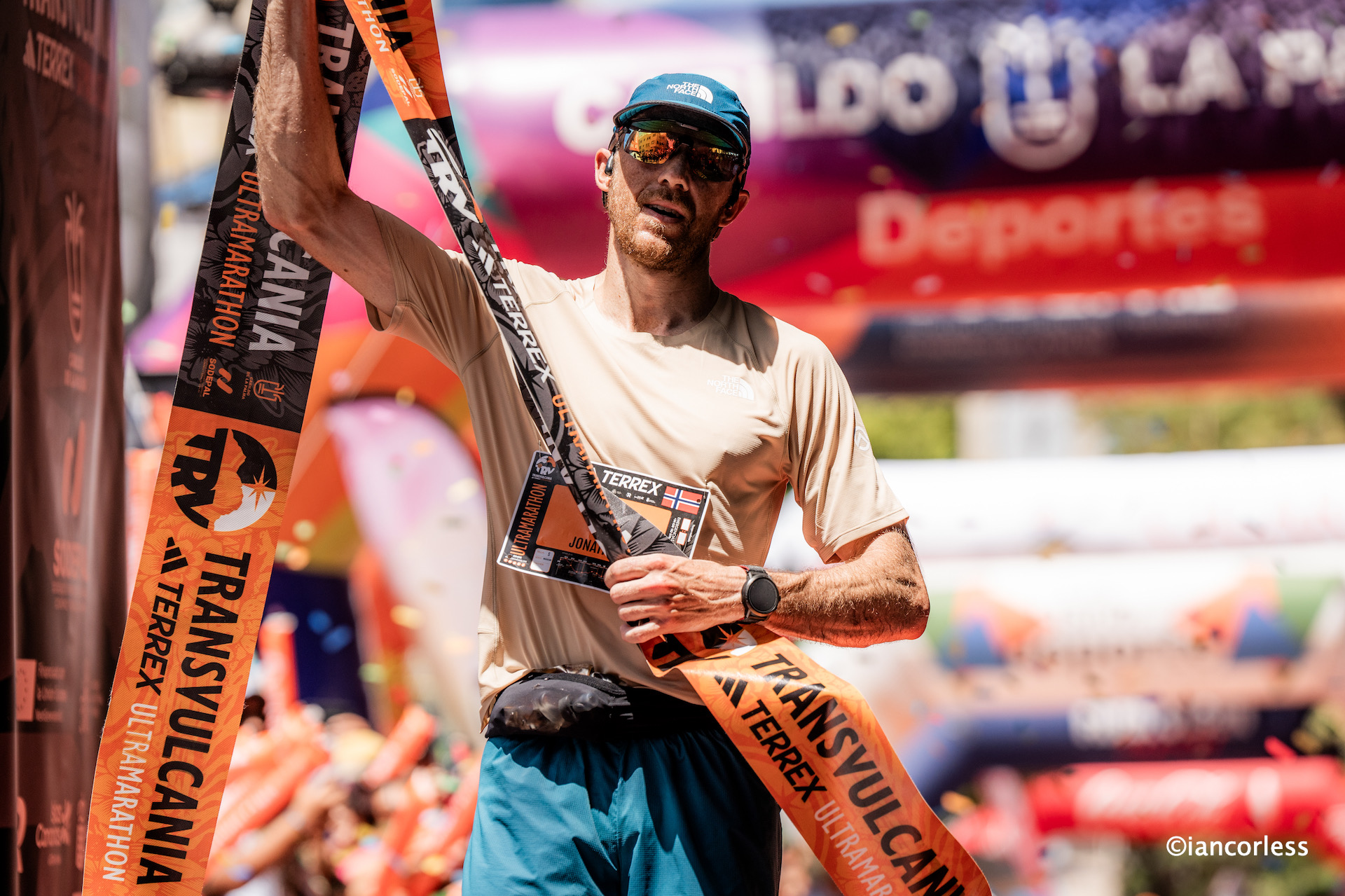
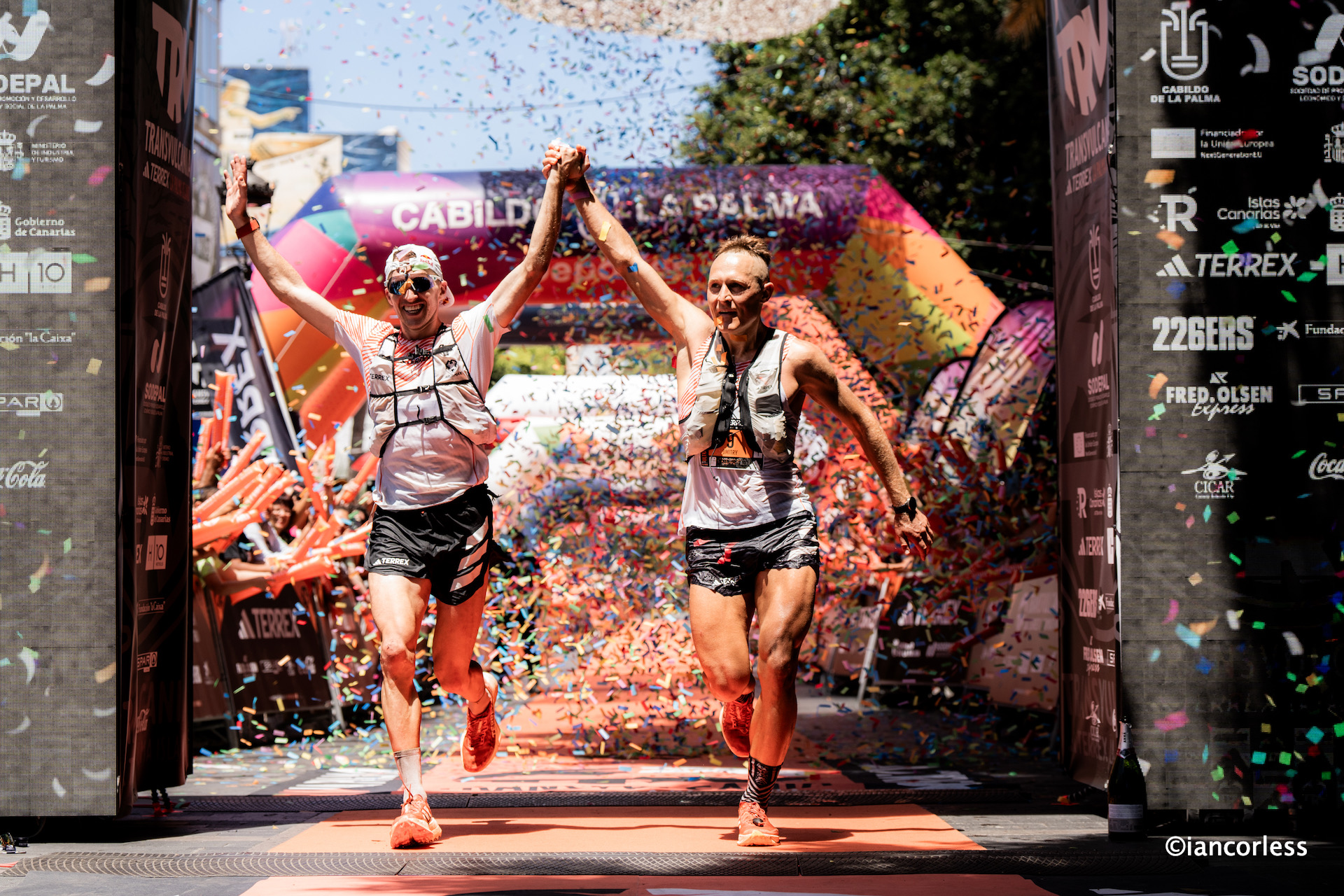
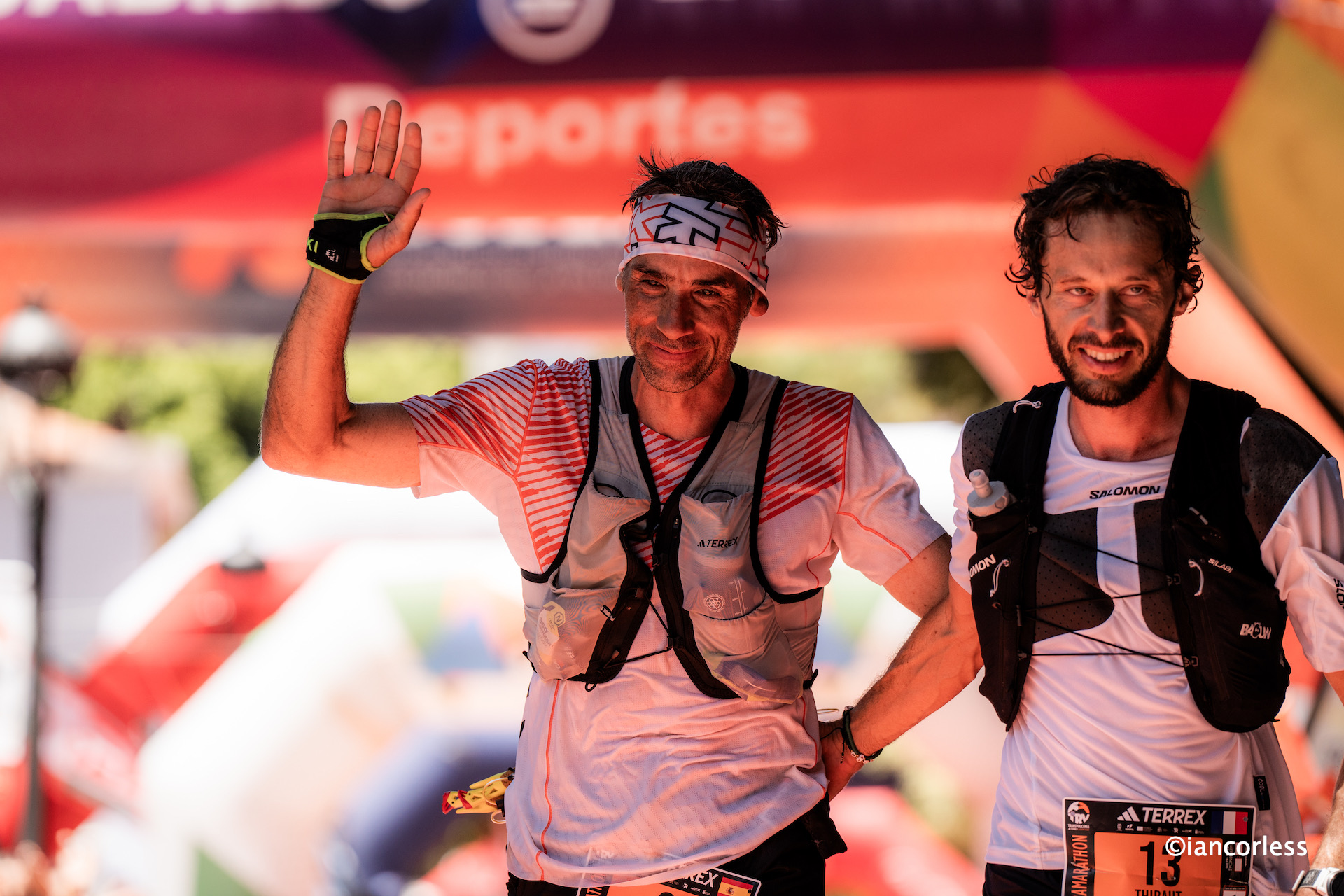
Jon crossed the line, exhausted, the 2024 Transvulcania champion. Behind, less than 2-minutes later, the duo arrived, hand-in-hand.
There was no course record but it was darn close. One hell of a race.
Tom and Dmitry
At the finish line, Albon (7h.03:10) crossed first, followed by Dmitry Mytiaev (7h.05:16) and Tom Evans who entered together at de finish line (7h.05:17)
Women:
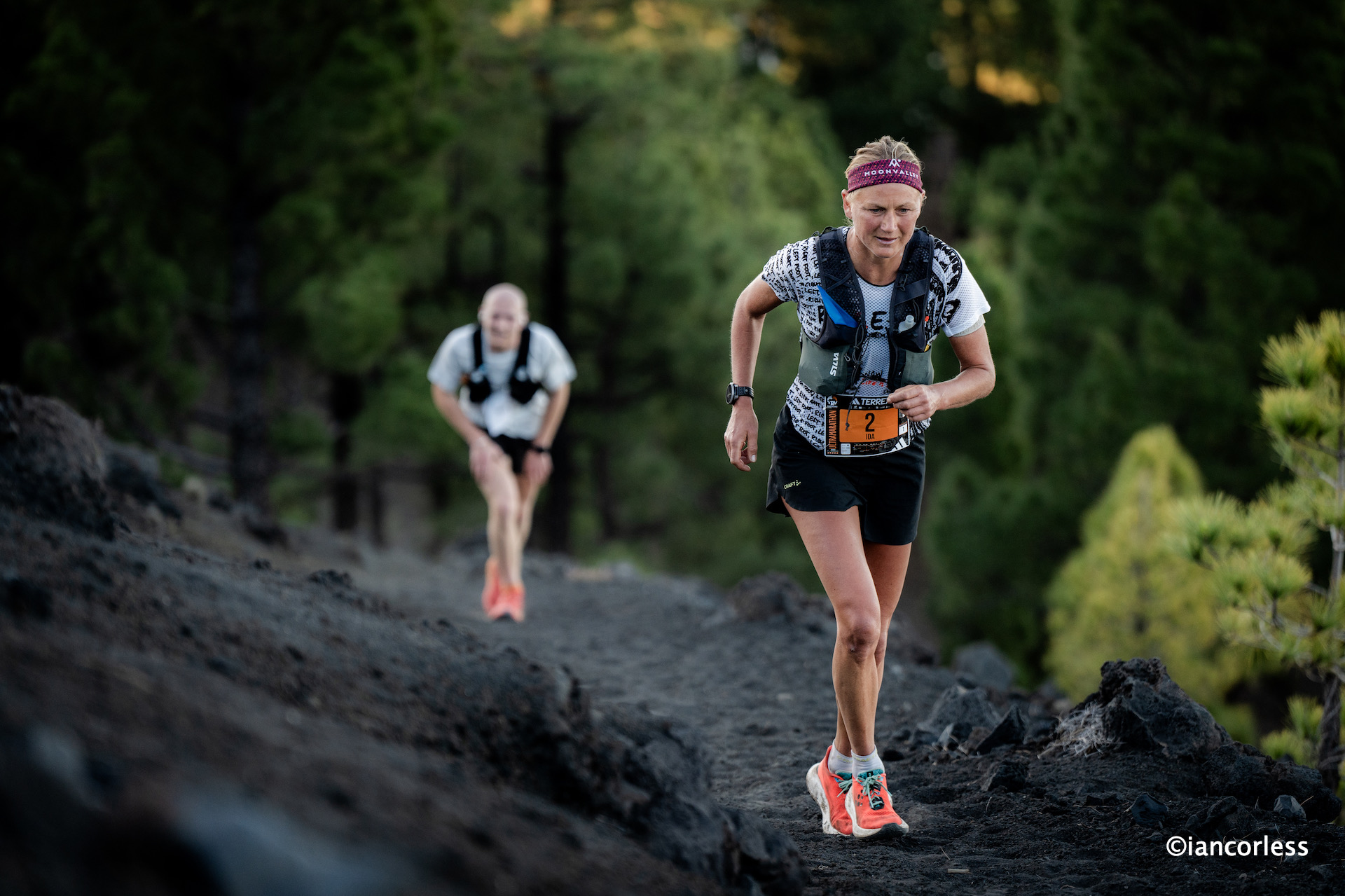
Ida a three times champion
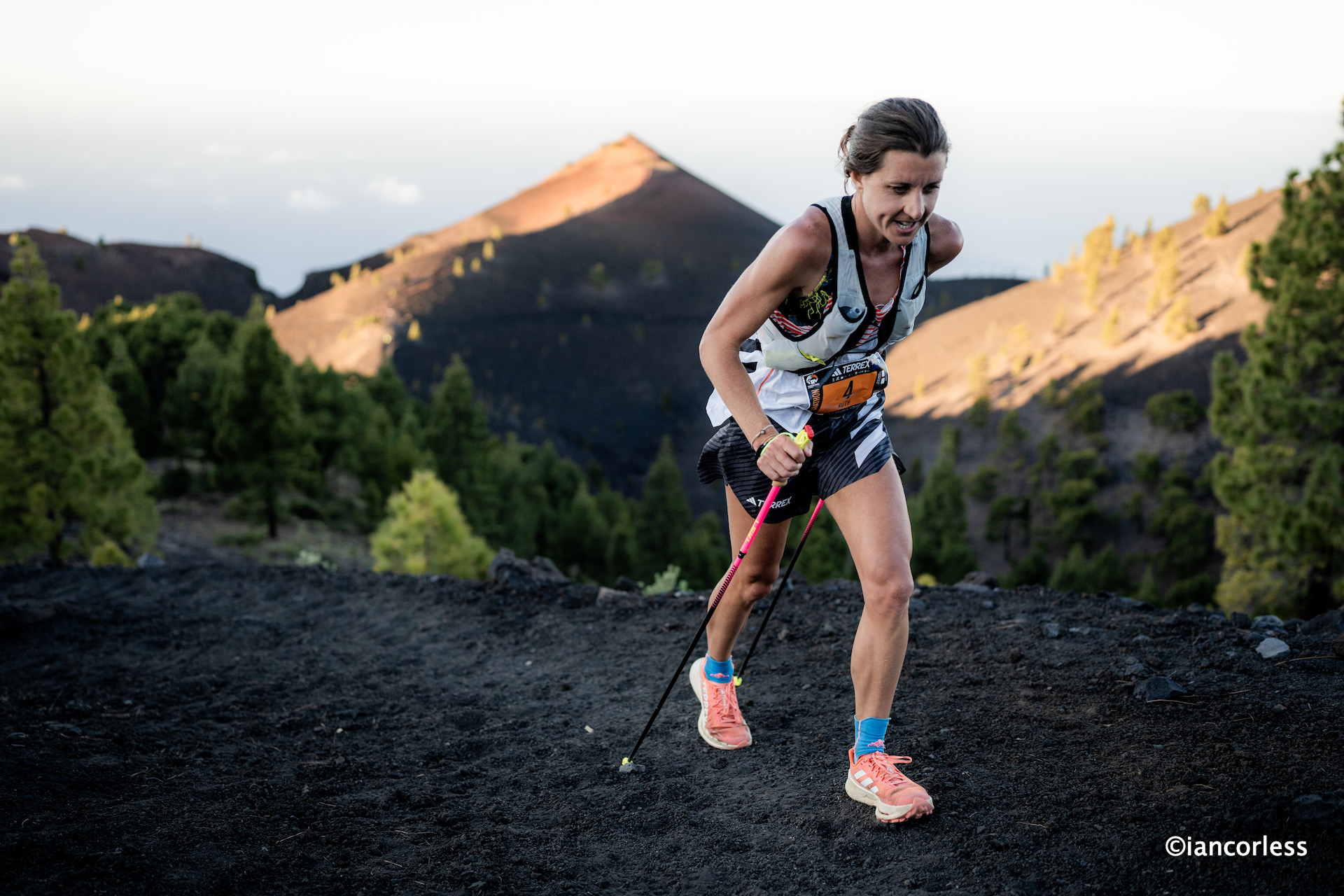
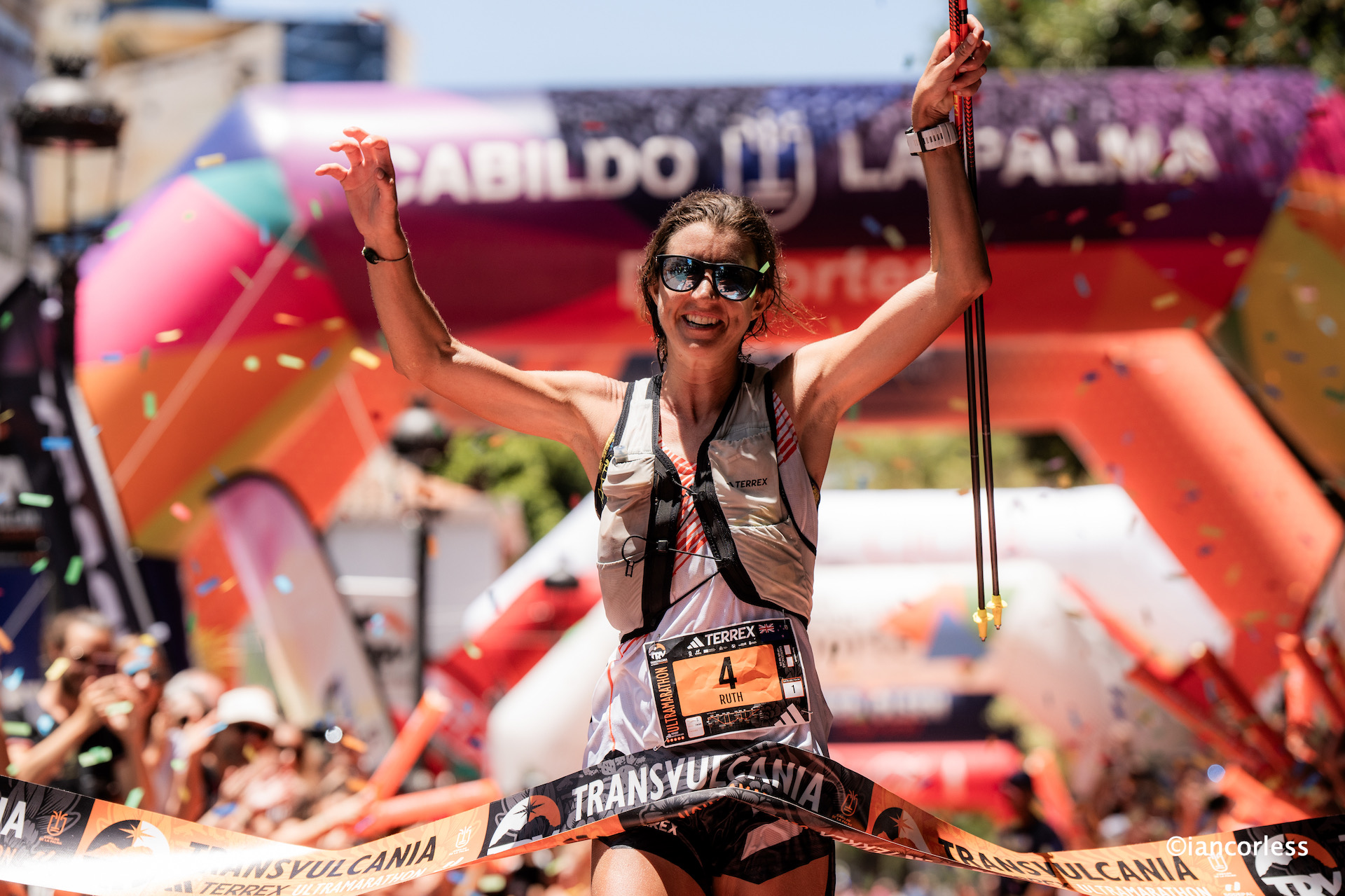
Ruth Croft set the early pace and what a pace! For much of the day, it was a display of style, power and confidence. The performance only faltered at Roques de los Muchachos when a charging Ida Nilsson, three times Transvulcania champion, closed the gap to seconds.
Ruth – incredible
It gave Ruth the wake-up call to push hard to the line, and push she did, not only resulting in victory but a new course record. It was a stunning performance that only confirms that currently, along with Courtney Dauwalter, Ruth Croft is one of the most exciting and dominant trail runners in the world.
Champ and new CR
It was glory day for Ida Nilsson, a La Palma favourite who ran another stunning race to secure second.
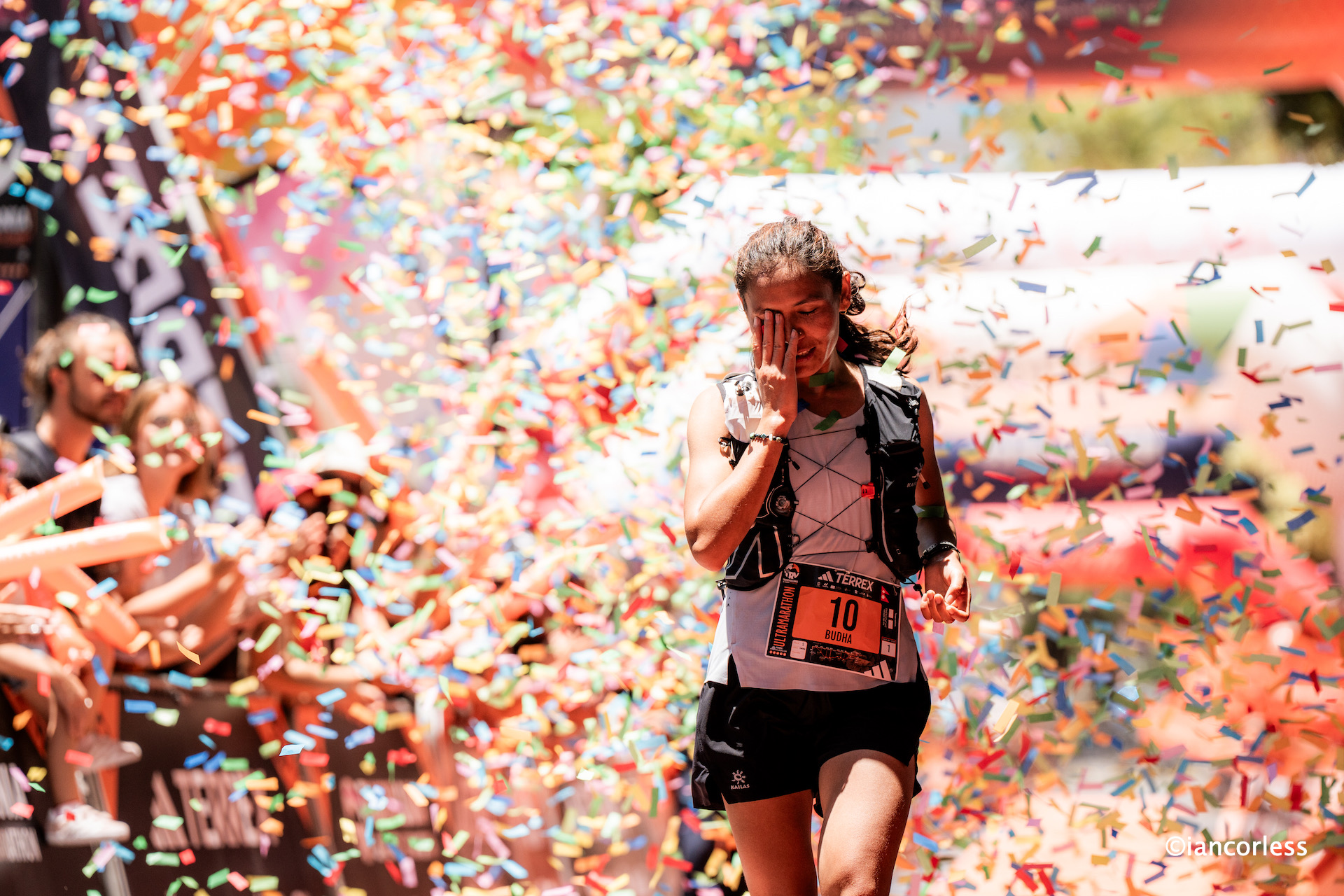
As always happens, there was drama behind and it was Nepali, Sunmaya Budha who finished third looking very fresh… There is more to come from this strong woman!
Sunmaya
Ruth Croft (8h.02:49, record) won, Ida Nilsson (8h.16:32) finished second, and Sunmaya Budha (8h.20:31) closed the podium.
The Story:
As with all races, we have champions and we celebrate them. But the story of the 2024 Transvulcania is a return of the race to the island and people of La Palma.
“I didn’t have the day I wanted today,” said one runner. “But how can I be disappointed? It’s such a privilege to be on this island with these people enjoying what is one of the greatest races and places in the world.”
It was a sentiment that was echoed by many. There is something special here on this Canary Island.
I for one am already waiting for the 2025 countdown. This race should be a fixture for every dreaming trail runner and trust me, once experienced, one edition is not enough.
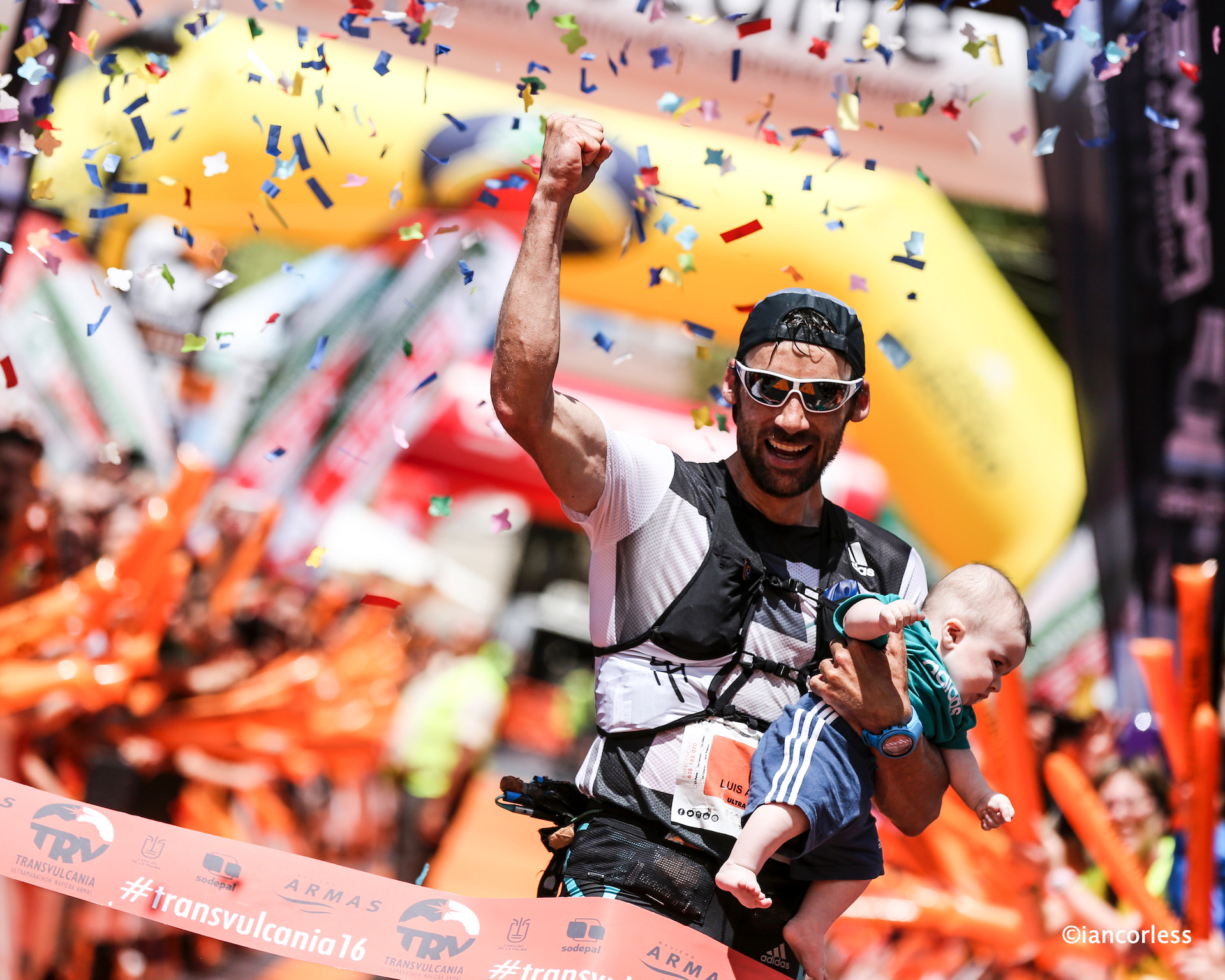
The boss, Luis Alberto Hernando, his last victory.
Finally, I give a special (personal) mention to a true inspiration of Transvulcania, the Maestro ‘Luis Alberto Hernando’, a three time champion of the race. He told me before the start, I am now 1-hour slower and I will be happy with top-20. He placed 12th after Thibaut Baronian acknowledging ‘The Boss’ on the line, bowing, and allowing the master to pass. What a moment.
Stage 3 of the Oman Desert Marathon has a delayed start to ensure that participants experience the desert at night. With three waves: 10am, midday and 2pm (slower to faster runners respectively) the participants would cover the 47km stage in daylight and then transition to darkness.
Consider by race director, Said, stage 3 would include one of the most spectacular dune sections on the race, timed to coincide with the sun getting lower in the sky and for the lucky ones, maybe sunset would take place as the dune section came to an end.
Coming after the 55km long day, the later starts were welcomed and allowed for additional rest and recovery, however, the fatigue was starting to show on faces and bodies.
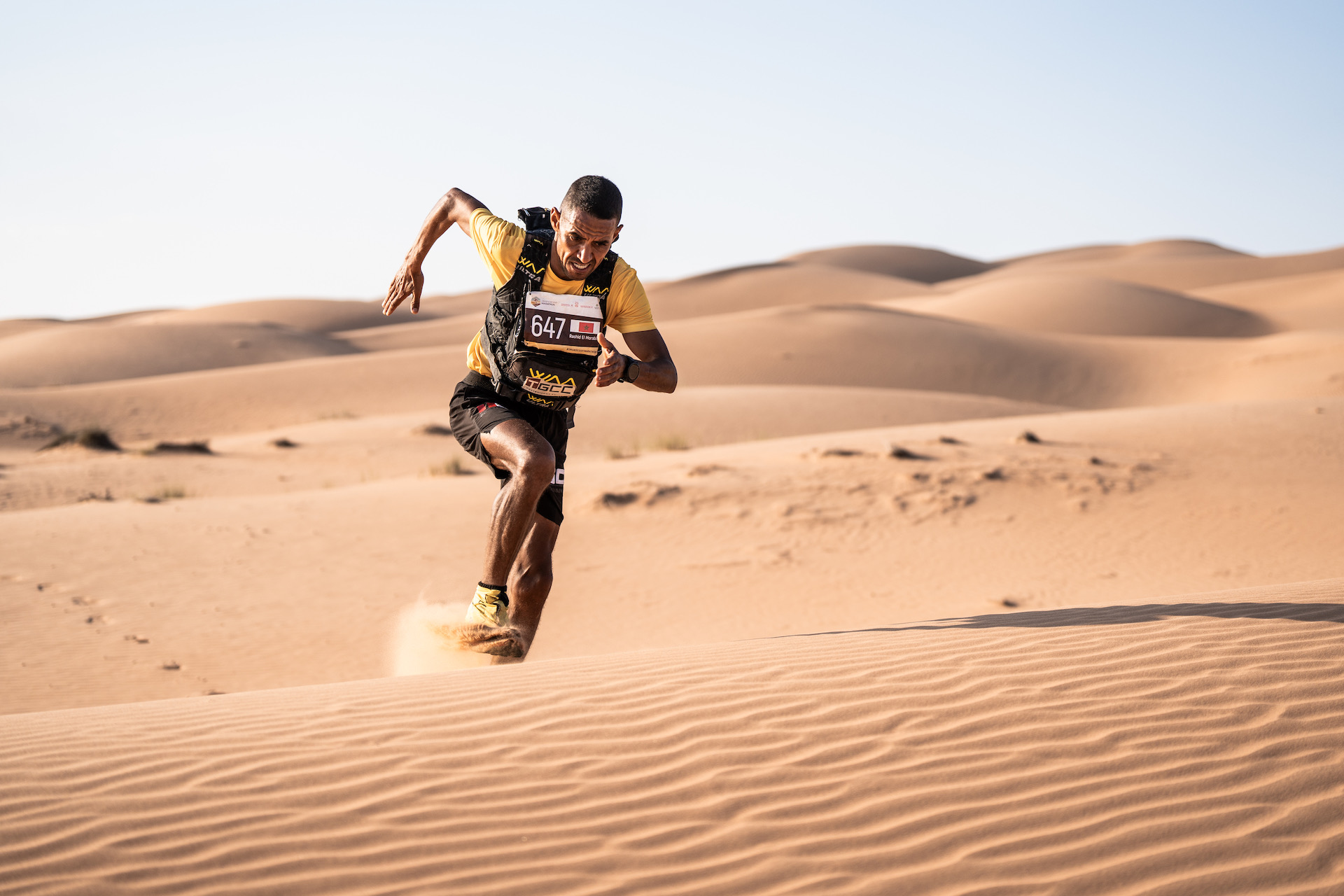
As the race got underway, it was clear that the men’s race would have a different approach, with Ghaith Al said pushing hard at the front, while behind, Saleh Al said and Rachid El Morabity ran together. Ultimately, it was an attempt to break Rachid. It didn’t work, but it was a valiant effort and one that rewarded Ghaith with the stage win in 5:03:39.
Behind, Saleh and Rachid ran together and crossed the line 5:10:29 and 5:10:39 respectively.
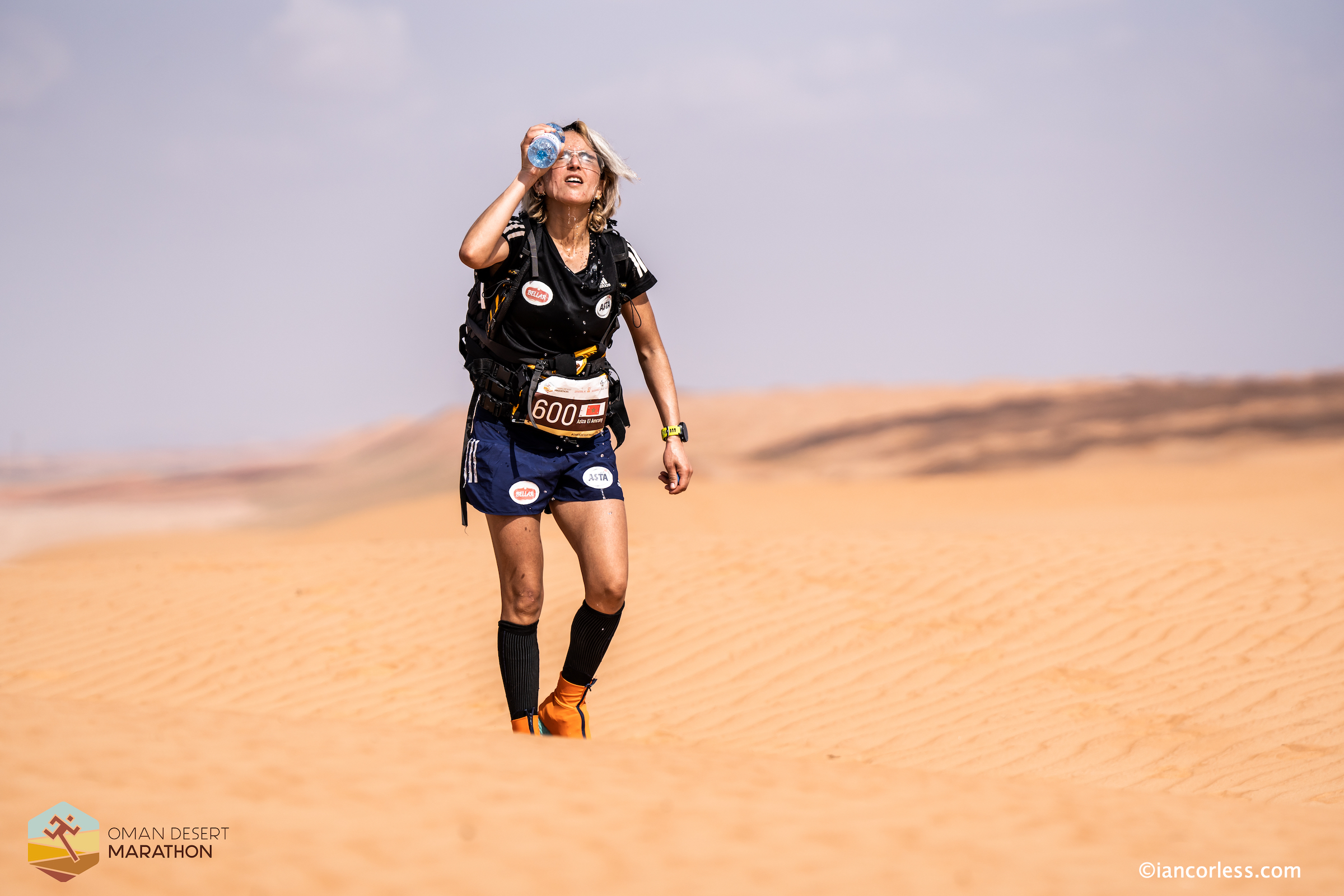
The women’s race had little drama with Aziza Raji and Aziza El Amrany running together and crossing the line in 6:56:35. The duo looked strong and relaxed. They will be a force to be reckoned with at Marathon des Sables this year.
Behind, once again, Veronique Messina ran a strong 3rd place in 7:49:56.
Albert Jorquera and Pol Makuri had a long day completing in 11:17. They are both very focussed mentally and strong physically. It has been a joy to watch the two of them work together and quite simply. Pol is an inspiration.
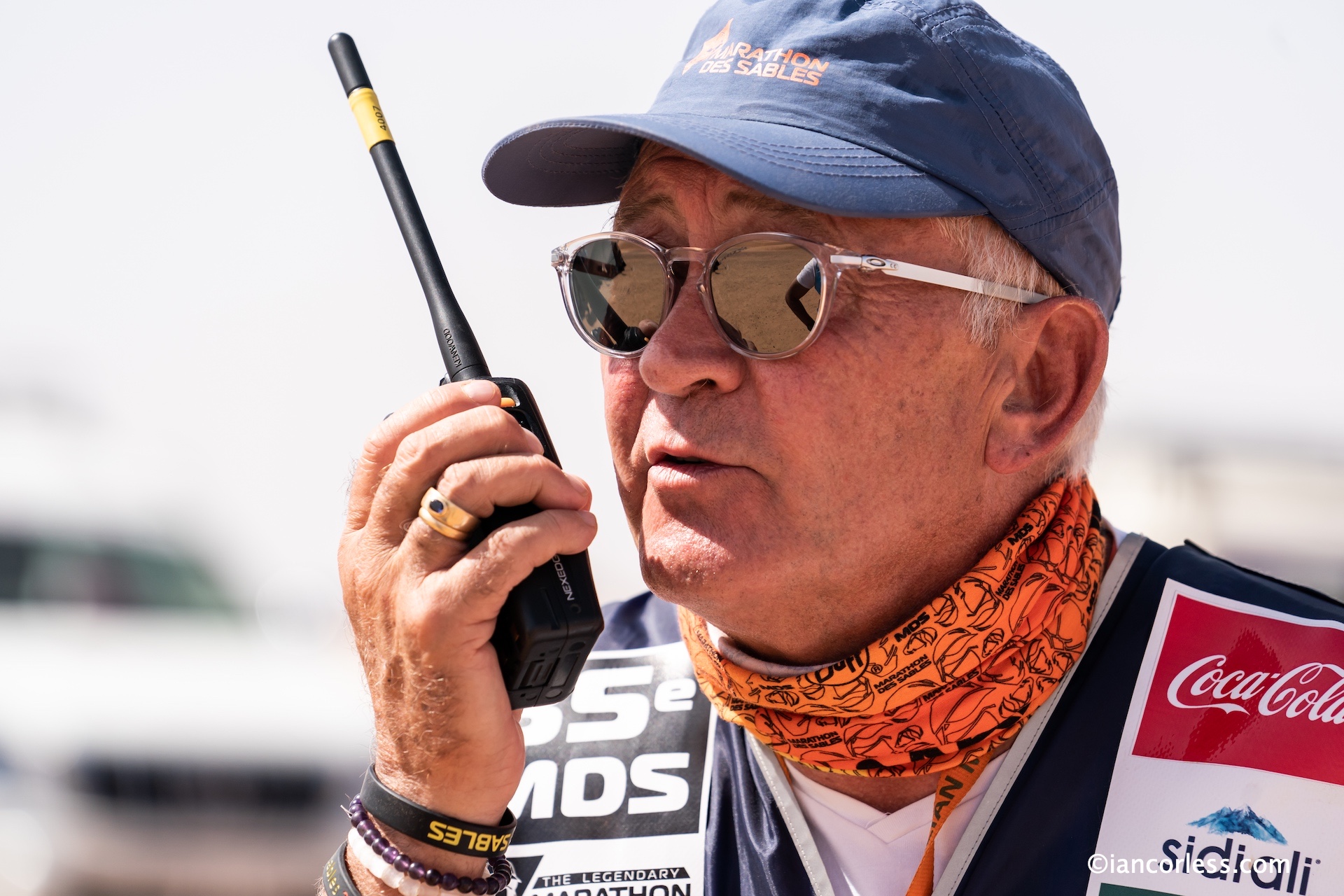
The iconic Marathon des Sables is entering a new phase, the past 37 editions have been under the aegis of Patrick Bauer, who, back in 1984, filled up a pack with food and water and trekked off alone into the Algerian Sahara to cover 350km’s on foot in a self-sufficient manner. Little did he know at the time, but this journey was the start of something incredible, the Marathon des Sables, or MDS as it is affectionately known.
Now under new ownership, the 38th edition taking place in April 2024 will see some significant changes while sticking to the main format and principles of the past 37-editions.
It is therefore timely, to update my Ultimate Guide to Marathon des Sables and acknowledge these key changes.
A recent podcast with one of the new co-owners, Cyril Gauthier, can be heard HERE.
Cyril ran the Marathon des Sables in 2009, created the brand WAA and is instrumental in the growth of the HMDS (Half Marathon des Sables) format. Moving forward, the HMDS format will no longer have the ‘half’ title, for example, HMDS Morocco will become MDS Morocco, HMDS Jordan will be MDS Jordan and the key, full distance race of the past 37-years will be called ‘LEGENDARY‘ – The Legendary Marathon des Sables.
Marathon des Sables offers more than just running, it offers a challenge, it offers something quite unique – the Sahara and the MDS strips the runner back to basics and deprives them of all luxuries so that they are stripped raw. Runners find themselves in the desert.
However, this challenge can often daunt a new participant with the challenge that is ahead and therefore, my Ultimate Guide to the Marathon des Sables is provided to settle nerves, provide initial information and provide a level of knowledge that you can use as a base from which to build your own plan and decide on what equipment to purchase and use.
The 2023 MARATHON DES SABLES draws near and as usual, here is a preview of the coming edition. We will look at the top contenders for the male and female podiums, provide an overview of MDS history and look at some crazy statistics.
Since 1986, well over 22,000 participants have raced at the Marathon des Sables and we have record (or close to record) for 2023, with1200+/- toeing the line. As per usual, the race is multi-national with over 50 represented. The French and British providing the largest contingent.
THE TOP MEN AND WOMEN
Rachid El Morabity returns looking for his 10th victory, all eyes will be on him, but he is in for a fight! 2019 female champion, Ragna Debats returns and is without doubt the hot favourite for the top of the women’s podium.
THE WOMEN RACE
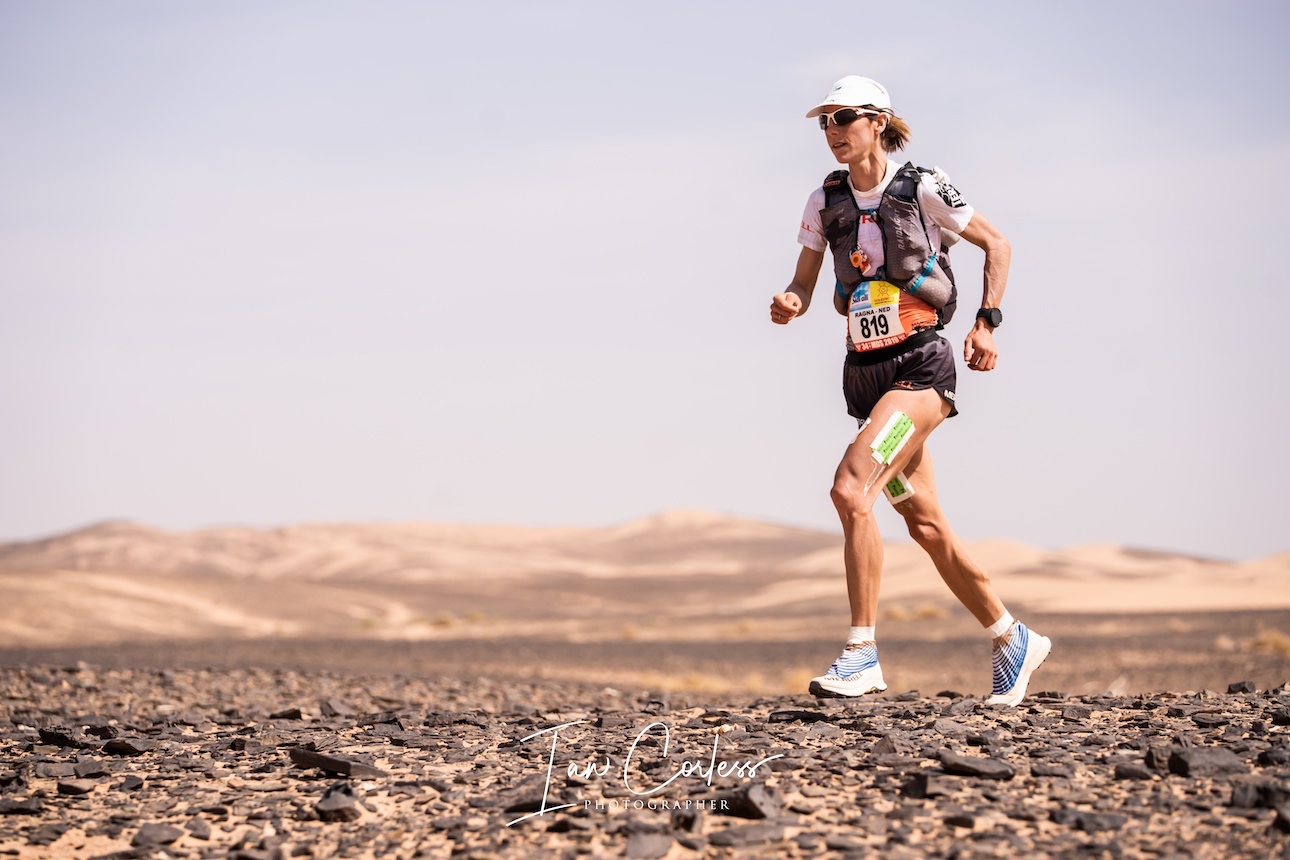
Ragna Debats
Ragna Debats dominated the race in 2019 and in recent years has become one of the top trail, ultra and skyrunner’s in the world. When in form, she is incredibly difficult to beat. In 2022 she had an incredible season with four top victories, Transgrancanaria 129km, Istria by UTMB, Montreux Trail Festival and the 100m Nice Côte d’Azur by UTMB. Ragna has had a relatively quiet start to 2023 and recently she has changed her coach of 13-years. She will be meticulously prepared for MDS 2023.
Gemma Game
Gemma Game from the UK has been on the podium of MDS twice, 2018 and 2019, on both occasions placing 3. Gemma most definitely can win MDS but, as she will tell you, she runs for fun and MDS is an escape from a very busy and hectic life with a high-powered job and family. Is she wants to, she will be on the podium again in 2023.
Manuela Socco from Belgium is not a runner I am very aware of; however, two results stand out, victory at Cappadocia Medium Trail in 2019 and Tarawera 100km in 2020. She has also represented Belgium at the Olympic Games in the marathon distance. With a 35min 10km, a 1:16 half marathon and a 2:37 marathon, she has all the running fire power to create a stir in the Sahara.
Maryline Nakache from France has a string of top results, she often wins! However, stand-out markers come from Templiers (3rd) 90km du Mont-Blanc (3rd), CCC (5th) Transgrancanaira Advanced (1st), Tenerife Blue Trail (1st), UTMB (6th) and in 2022 alone she was never out of the top-5.
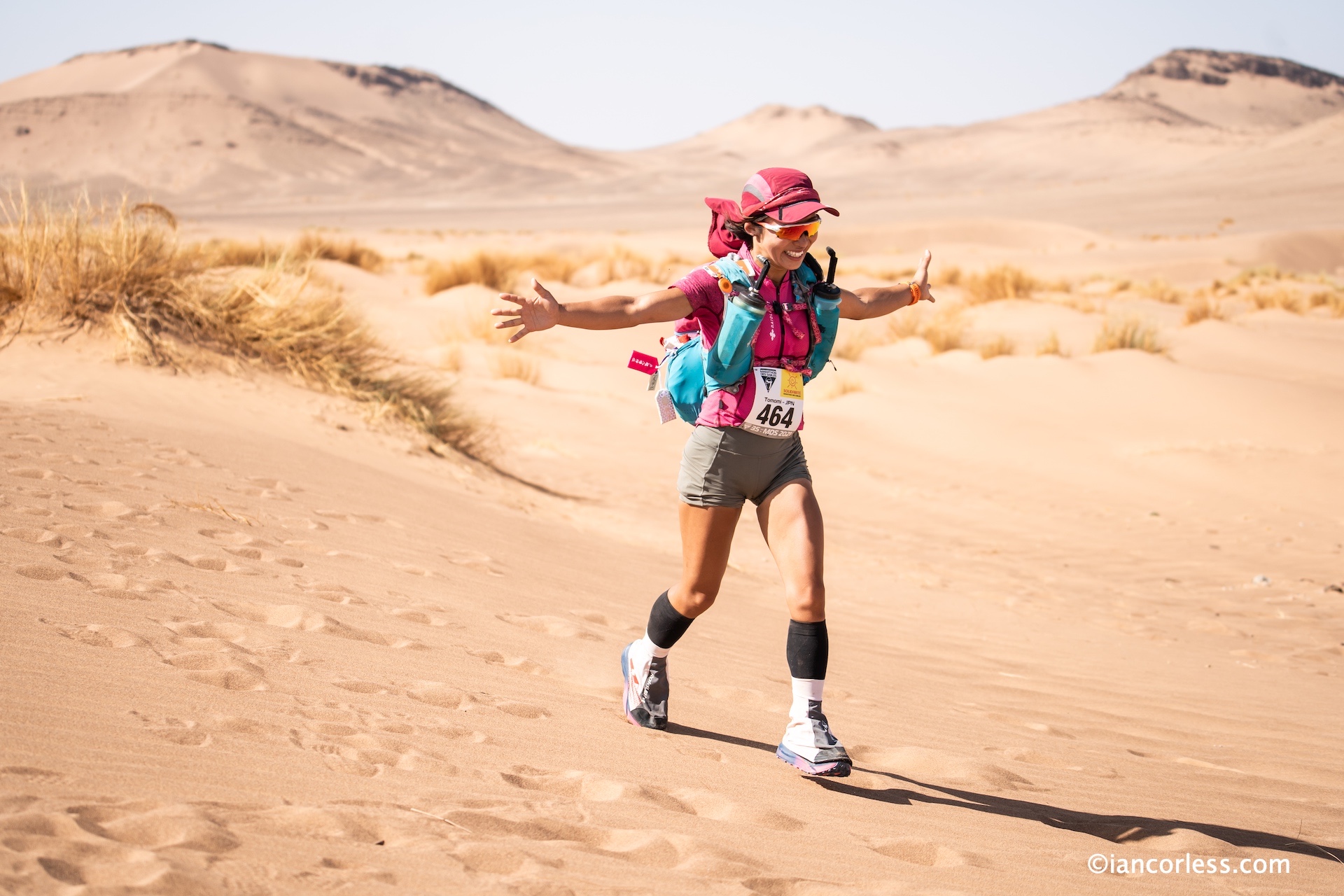
Tomomi Bitoh
Tomomi Bitoh from Japan was 3 in the 2021 MDS and has recently participated in The Coastal Challenge in Costa Rica. She is an incredible personality, a fierce competitor and although the podium is a possibility in 2023, I feel that she will just be outside the top ranking.
Elise DELANNOY (France) was 18th in the 2016 MDS in 38-hours. This is a long way off the pace required to podium in 2023… But a great deal has happened since then, notably a 7th place at UTMB in 2019, so, Elise cannot be ruled out of shaking up the front of the race.
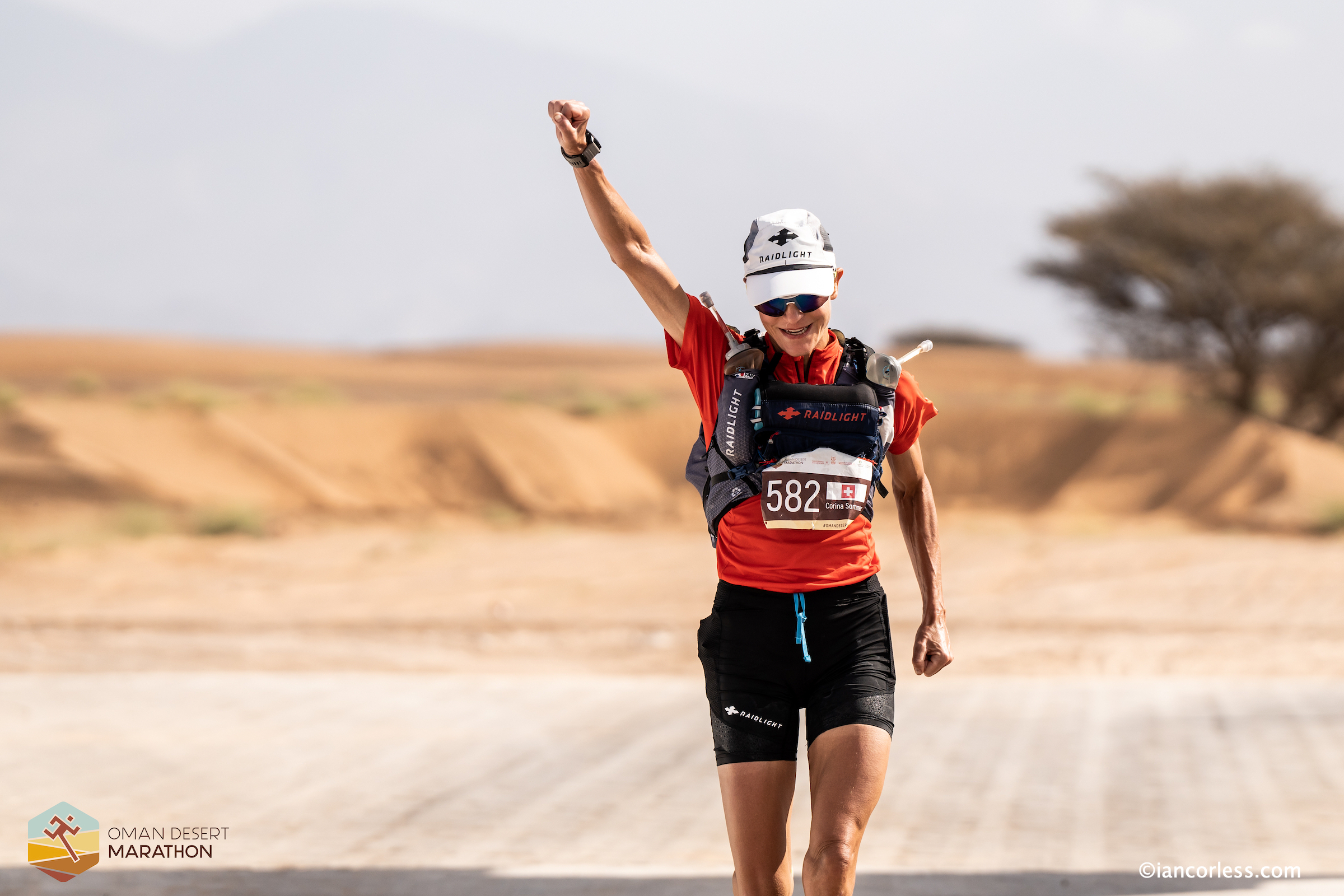
Corina Sommer from Zurich recently won the Oman Desert Marathon against Aziz Raji (past MDS champ) and Aziza El Amrany who had led the race only to have Corina run two incredibly strong days and take the victory. New to trail, she placed 18th at Templiers and 3rd at Istria by UTMB for the 68km. She will need a great week to make the podium, but it’s a distinct possibility.
Jodie Moss from the UK was 8th at MDS in 2019 and has been preparing meticulously for the 2023 edition. However, recent injury issues placed the race in question, but it looks like she will be in the Sahara, hopefully in great shape.
Ester Alves won The Coastal Challenge in 2016 and placed 3rd in 2017. She also raced MDS in 2017 but the race did not go to plan… In recent years, she has had time away from the sport, but last year, Ester raced Everest Trail Race which will have no doubt provided some great momentum for the Sahara.
Maria Semerjian has results going back to 2009 and without doubt, she enjoys the tough mountain courses, UTMB, Raid de la Reunion, Grand Raid Pyrenees, UTMF, and more… The distance won’t be a problem, however, the speed to make the top-5 may well be the problem.
Brunhilde Girardet recently won Trail de Cité de Pierres as a warmup for MDS. It’s her first edition, so, let’s see…
Wild card – Katie Young from the UK.
Laurence Klein returns, she has won MDS three times, with no disrespect to the Queen of the desert, there is no chance of victory in 2023, but she will no doubt bring colour to the race.
Currently, Aziz Raji and Aziza El Amrany are NOT on the start list, but I hope they do make it to the 2023 edition. It’s important that Morocco has female representation and of course, both of them have great potential for the top 5. Raji has won the race and El Amrany was 3rd in 2022.
THE MEN RACE
The men’s race is extremely notable in 2023 as Rachid El Morabity will look for a 10th victory. This will without doubt add an extra dynamic to the race, particularly after the superb tactics which played out in the 2022 edition.
Rachid El Morabity
Rachid El Morabity is the boss of the Sahara and the hot favourite. BUT, I believe this year will be his toughest challenge. There are multiple reasons for this… Rachid has expectation on him, this is not really an issue, he can handle that. He has raced a great deal in the past 12-months, he may be tired? The Moroccan team is probably at its weakest, especially when compared to the past ten editions, so, the support network will be less. The competition, namely Mathieu Blanchard and Aziz Yachou are a serious threat. Will Rachid win? It is very hard to bet against him, but 2023 has the potential to be the upset year.
Mohamed El Morabity
Mohamed El Morabity is the eternal 2nd at MDS and his possibilities of victory in 2023 are zero if Rachid is in good form. The only opportunity for Mohamed is if Rachid falters and he gets the green light from his elder brother to attack. In Oman Desert Marathon earlier in the year, Mohamed took victory ahead of Rachid, don’t be fooled in to thinking Mohamed was stronger, he was gifted the win as credit for April and the 2023 MDS. Mohamed can win the race, but just as we saw in 2022, he will be the super domestique for Rachid.
Aziz Yachou
Aziz Yachou is the fly in the Moroccan ointment and 1-year on, has the potential to create fireworks and upset Rachid’s dream. He was 4th in 2021 and 3rd in 2022. Last year he was worked over by the tactics of Rachid and Mohamed, he will be prepared for that this year. Little is known about his training in the early part of 2023.
Mathieu Blanchard
Mathieu Blanchard raced MDS in 2021 and finished 5th – he was hit by the bug that swept through camp just in time for the long day. One thing is for sure, after placing 2nd at UTMB in 2022, we are looking at a different Mathieu. He raced The Coastal Challenge in February and placed 2nd, he recently summited Kilimanjaro and most recently ran a 2:22 marathon in Paris. Mathieu can win MDS and the French have put a team together to potentially make that happen. Beating the Moroccans on home soil (sand) is tough, but THIS may be the year.
David KILGORE from the USA has been top-10 at Leadville 100, and recently 7th at Tarawera 50km. On paper, he is not an MDS podium contender, but he will be in the mix for the top-5.
Erik Clavery adds more fire power to the French line-up. He was 5th at MDS in 2016 and a fierce competitor. He has raced UTMB, WSER, Eiger Ultra and even 24H championships, so, he brings something special to the MDS.
Vasily Kortytkin (Russia) comes to MDS with a history in 6H and 24H races, he has PB’s of 86.493 and 260.570 respectively. He has won some trail races in Russia in 2021 and 2022, how he performs in the Sahara is a big question.
Pierre Meslet (France) placed 9th at MDS in 2021 and returns in 2023 not only to perform to the best of his ability (top-10) but to also help the French maybe win the race and also get the team prize.
Anton Samokhvalov also from Russia has been racing trail since 2014. He has a list of solid results but nothing spectacular, in 2021 he made 10th at Transgrancanaria Advanced.
Notable mentions:
Duncan Slater from the UK lost both legs during a mission in Afghanistan, he’s back this year for another medal!
Christian Ginter, dinosaur of the desert, returns for the 35th time!
Finally…
1150 runners will toe the line (1263 were registered) and the youngest runner is 16-year-old Girard Fialon (she will run with her father, Grégory) and the eldest, Henry Botha, 81!
Crazy Statistics of the MDS
“The logistics are a big headache, and we organize every detail in advance! We’re a village of 2,000 people that must be set up and dismantled every day. We need to be self-sufficient in energy, food, water, and fuel. As one of my friends says, ‘Let’s expect the worst because the best will never surprise us!’ We also benefit from the infallible support of the Royal Moroccan Army, which makes available about 25 6WD military trucks to transport all our equipment.” – Patrick Bauer
You must see Marathon des Sables to appreciate the size and scale of the event. It’s like the largest moving circus you will ever see and it’s impressive to witness.
Following statistics provided by the Marathon des Sables office:
▪ 150 volunteers to supervise the race,
▪ 450 general support staff,
▪ 120,000 liters of bottled mineral water,
▪ 300 Berber and Saharan tents,
▪ 120 all-terrain vehicles and trucks,
▪ 2 Squirrel helicopters and 1 Cessna plane,
▪ 8 Transavia ‘MDS special’ commercial planes,
▪ 30 buses,
▪ 4 dromedaries,
▪ 1 incinerator lorry for burning waste,
▪ 5 quad bikes to monitor race environment and safety,
▪ 14 km/hr.: average maximum speed, 3 km/hr.: average minimum speed,
▪ 15 years of age for the youngest competitor and the oldest, 83!
Patrick Bauer
A brief history of the MDS
1984: At 28 years of age, Patrick Bauer decided to make for the Sahara to try to traverse a 350km expanse of uninhabited desert, on foot, alone, where he wouldn’t come into contact with a single village, oasis or watering place. Totally self-sufficient, with a rucksack weighing 35kg and containing water and food, he set off on a journey that was to last 12 days. It was the starting point of what was to become the MARATHON DES SABLES.
1986: The creation of the first MDS in the Moroccan Sahara. The 23 pioneers who took the start never imagined that their footprints would mark the start of a legendary event, which has today become a must among the major adventure sport meets. The creation of a non-mechanical competition in the Moroccan sands offers adventure runners a wealth of new prospects.
1987: Creation of the MDS logo: the face of a runner covered by a keffiyeh, the eyes protected by a pair of sunglasses and the pipette from the runner’s water container clenched between the teeth.
1989: 170 competitors take the start of the race.
1991: The gulf drama puts the MDS at a disadvantage and the financial partners withdraw. Fortunately, some runners answer the call. For these competitors, the true victory lies in meeting athletes from different backgrounds and their communion in the desert around the same goal. Sport proves once again that it can bring people together and create bonds.
1992: One and the same regulation for everyone. This year sees the establishing of unexpected draconian tests, to ensure that each participant properly transports all his or her gear from one end of the course to the other. A 30-point charter is drawn up.
First participation by the Moroccan Lahcen Ahansal
1994: Arrival of the Doc Trotters at the event.
1995: 10th anniversary. Since the start, over 1,500 men and women have left their footprint and their passion in the desert. Installation of water-pump for the inhabitants of the village of Ighef n’rifi (South of Er-Rachidia) – an idea by competitor Gilles Flamant and backed by Rolland Barthes and Patrick Bauer. Its success is to be repeated.
1996: First participation by Mohamed, a younger sibling of Ahansal. The two Moroccan brothers set off together and rank 4th and 5th respectively.
1997: This year heralds the start of the Ahansal saga. Morocco is honored with Lahcen’s first victory. He beats his two pursuers by nearly 30 minutes, despite them being international long-distance running champions.
1999: A mobile hospital on the MDS comes into being. There are around thirty practitioners on the ground, with doctors and nurses joining the caravan. A dedicated helicopter and ten all-terrain vehicles track the competitors each day. On- board these vehicles there are doctors of course, as well as high-tech equipment. The village boasts a genuine field hospital.
2000: Internet appears in the large MDS village. The organization decides to broadcast the texts and photos of the race live, day after day. The competitors can communicate with their nearest and dearest and receive messages of encouragement.
2001: For the first time the long leg, traditionally called “The 70”, exceeds the 80km barrier to reach 82km. The threshold of 240km is also surpassed since the 16th MARATHON DES SABLES spans 243km. Another first relates to the fact that there are no Moroccans on the podium this year.
2002: This edition is punctuated by a sandstorm, involving headwinds, which lasts the entire week. The doctors invent a machine for ‘low pressure cleansing’ to rinse out the runners’ eyes. Despite the difficult conditions, there are few retirements to report as the wind considerably reduces the temperature.
2005: The Luxembourg runner Simone Kayser is the first woman to win 3 MARATHON DES SABLES. For this 20th edition, the total number of runners exceeds 700 for the first time, with no fewer than 777 runners taking the start.
2006: A drying wind and very high humidity levels cause damage to the runners’ bodies. Despite additional allocations of water, a whole series of retirements ensues. There are a total of 146 retirements ultimately, which equates to double that of the previous record… Race management decides to shorten the long leg by over 10km given how tired the runners seem.
2008: The Solidarité MDS association is created. The aim: to develop projects to assist children and disadvantaged populations in the domains of health, education, and sustainable development in Morocco.
2009: MDS is disrupted by flooding and the 1st and 6th stages are not able to take place. To avoid the flood zones, the organization is obliged to improvise new legs on a day-to-day basis. In this way, the edition goes down in legend for its 3rd leg, which is the longest ever contested: 92km of sand, loose stones, and rocks… The leg even sees the retirement of Lahcen Ahansal… At the prize giving the 2 winners admit to having competed in their hardest MDS. However, it was also the shortest: 202km.
2010: For its 25th edition, the number of participations reaches a record high of 1,013 participants. It is to be the longest MARATHON DES SABLES. It spans 250 kilometers with a course considered by former entrants to be the most difficult ever organized.
2012: A dramatic turn of events on the longest leg as the then leader in the overall standing, Rachid El Morabity (MAR) injures himself one kilometer from the finish. Medical examinations reveal a serious muscular lesion in the quadriceps. After over five years on the 2nd or 3rd step of the podium, Jordanian Salameh Al Aqra secures the title.
2013: 1,027 competitors on the start line make this a new participation record. New feature: a final “Charity” stage sponsored by UNICEF and traversing the Merzouga dunes round off the race. Sportswise, Mohamad Ahansal and Megan Hicks are the champions of the 231.5km event. On a human level, all of the finishers pull off their crazy bet.
2014: 2011 winner, Moroccan Rachid El Morabity (MAR) wins the overall ranking and takes Mohamad Ahansal’s crown. In the women’s category, another American stamps her mark, Nikki Kimball. The French revelation is one Michaël Gras, 22 years of age, 8th overall and top Frenchman. A major athletics star, Moroccan Hicham El Guerrouj lines up to take the start of Saturday’s Unicef Charity leg.
2020: The Corona virus takes over the world.
2021: The Marathon des Sables returns but with an October edition due to the global pandemic. Celebrating 35-years, it is remembered as on one of the hottest editions and almost 50% not completing the race due to a possible Norovirus that swept through bivouac.
2022: Rapid El Morabity wins his 9th edition setting himself up for 10 in 2023. Sandstorms made for some difficult and challenging days.
Follow the race here with a daily update and selection of images. Also, follow on IG @iancorlessphotography.
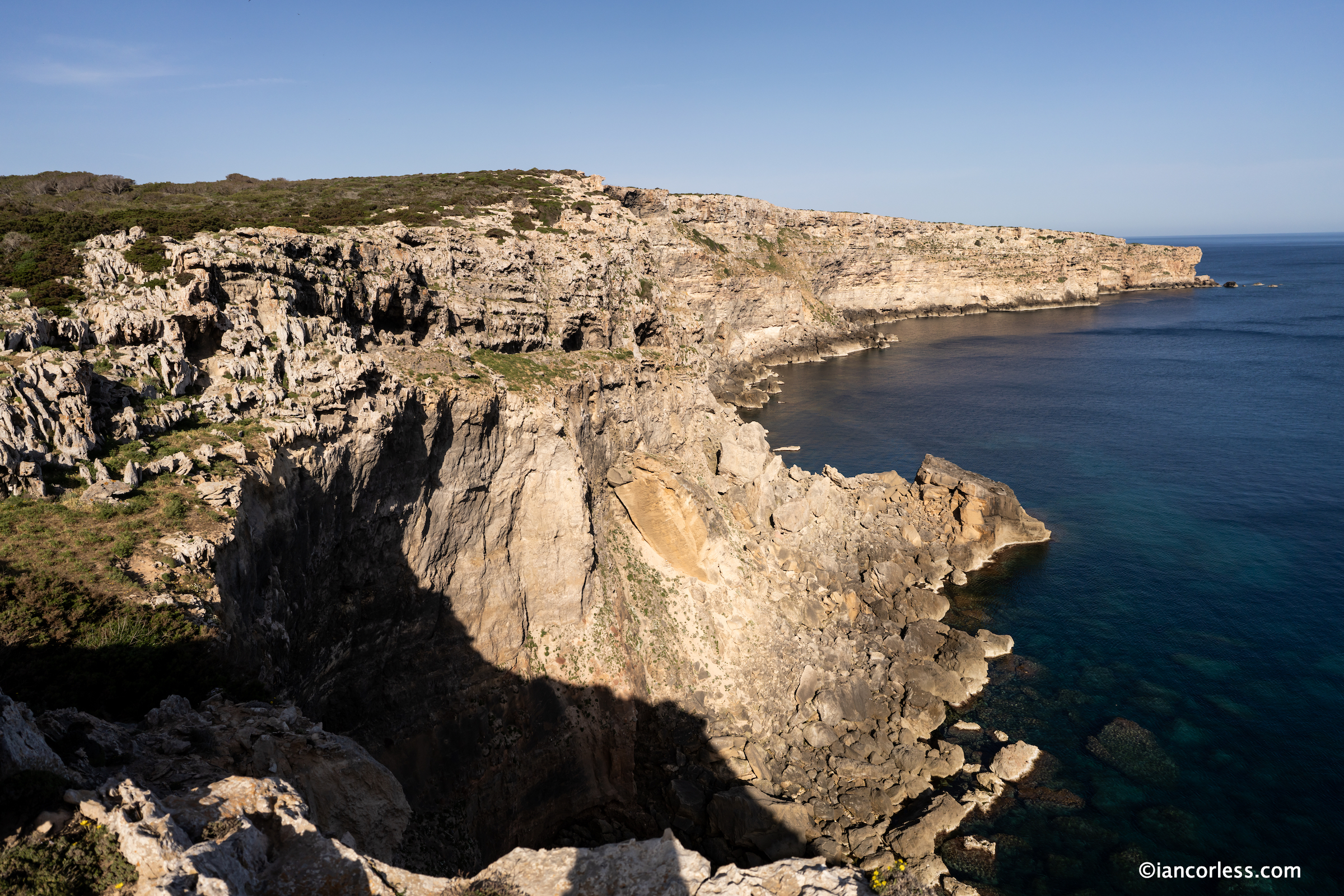
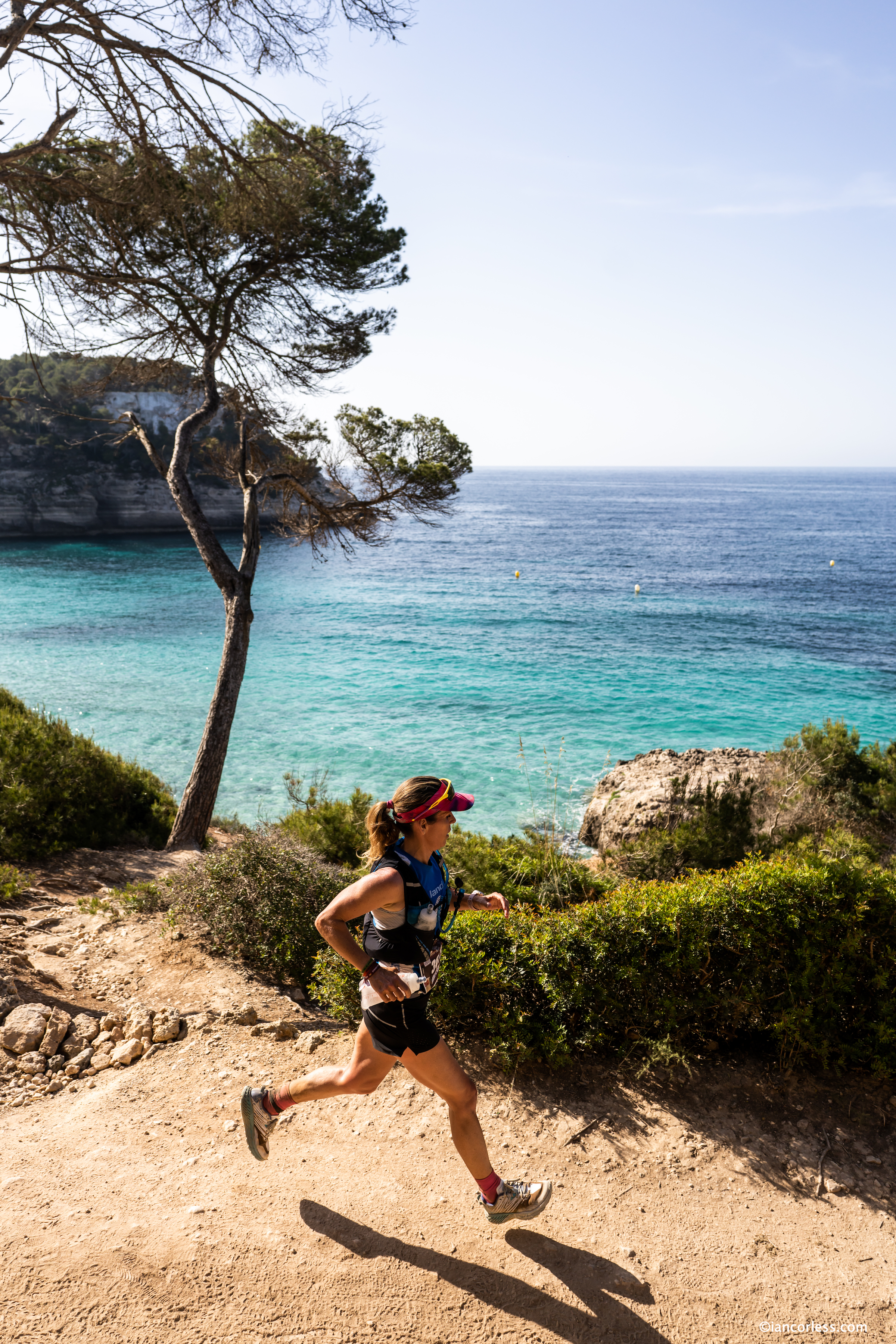
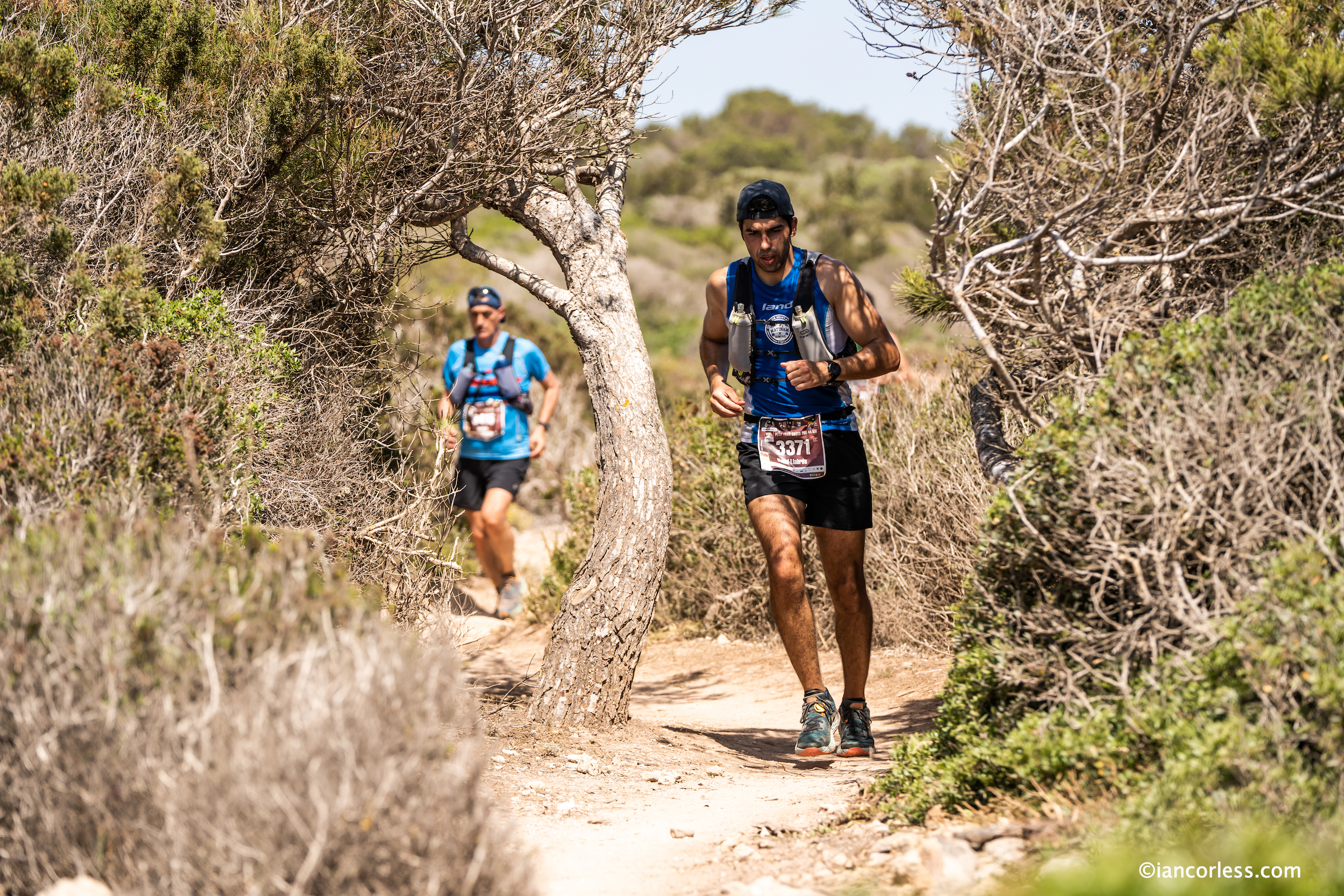
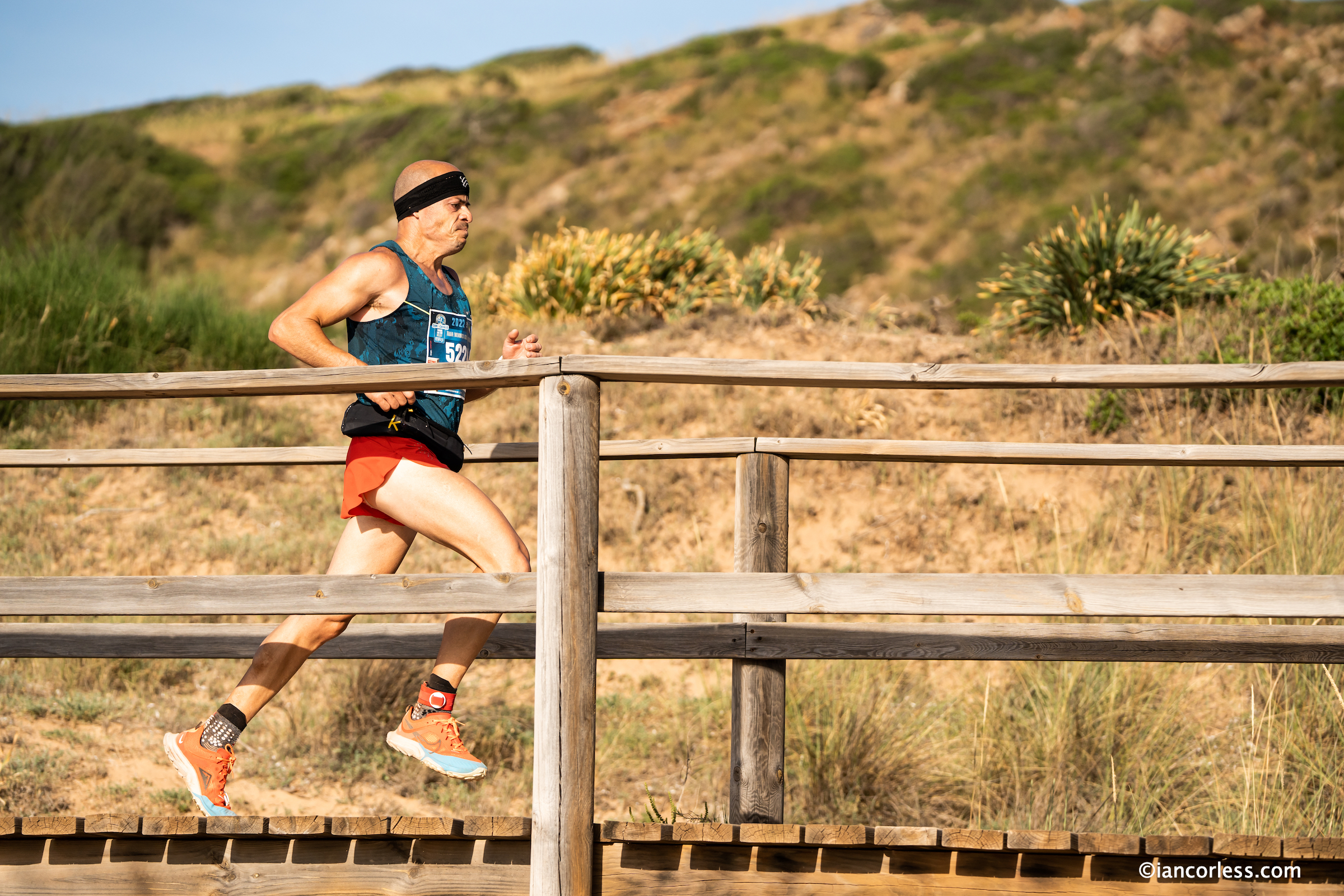
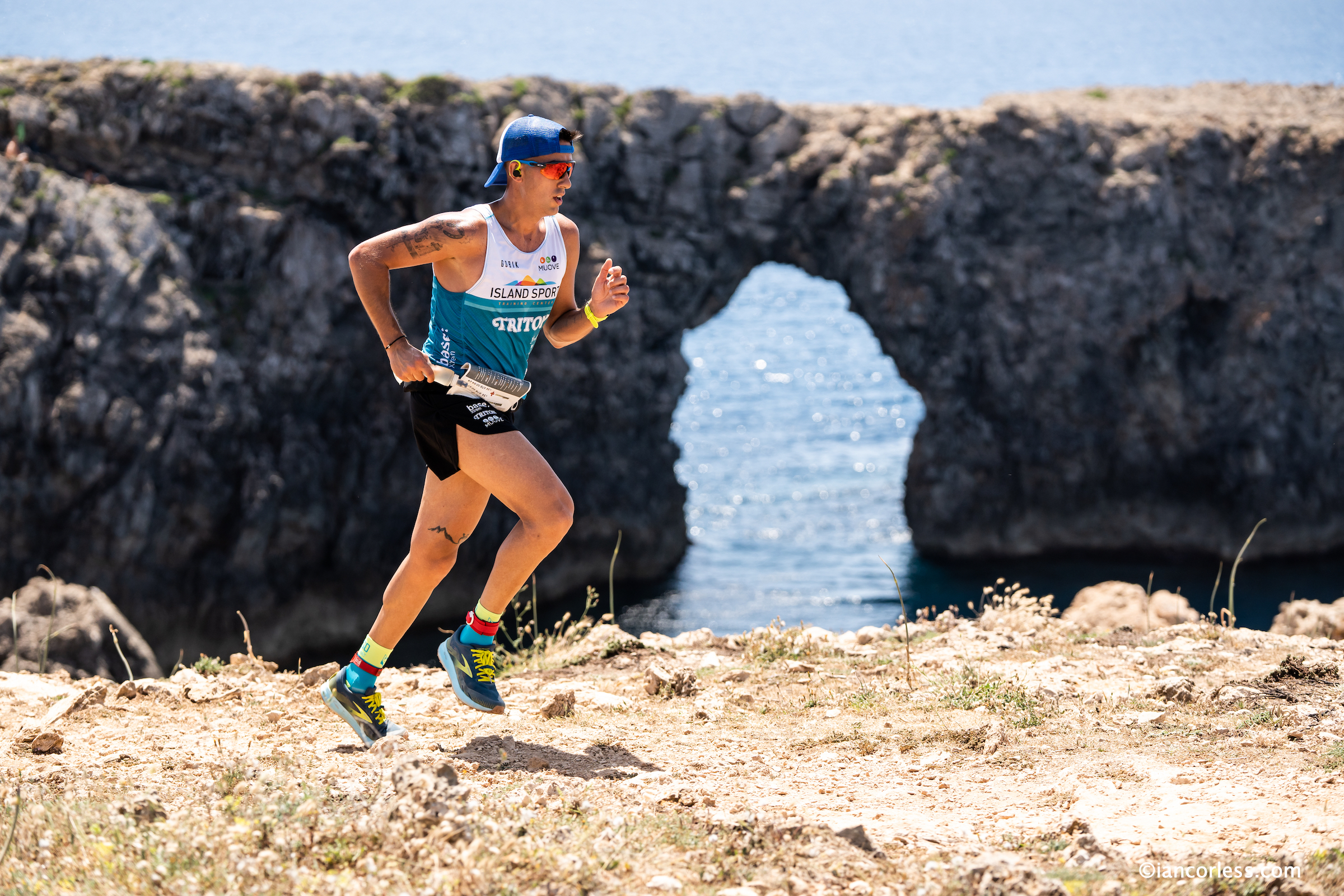
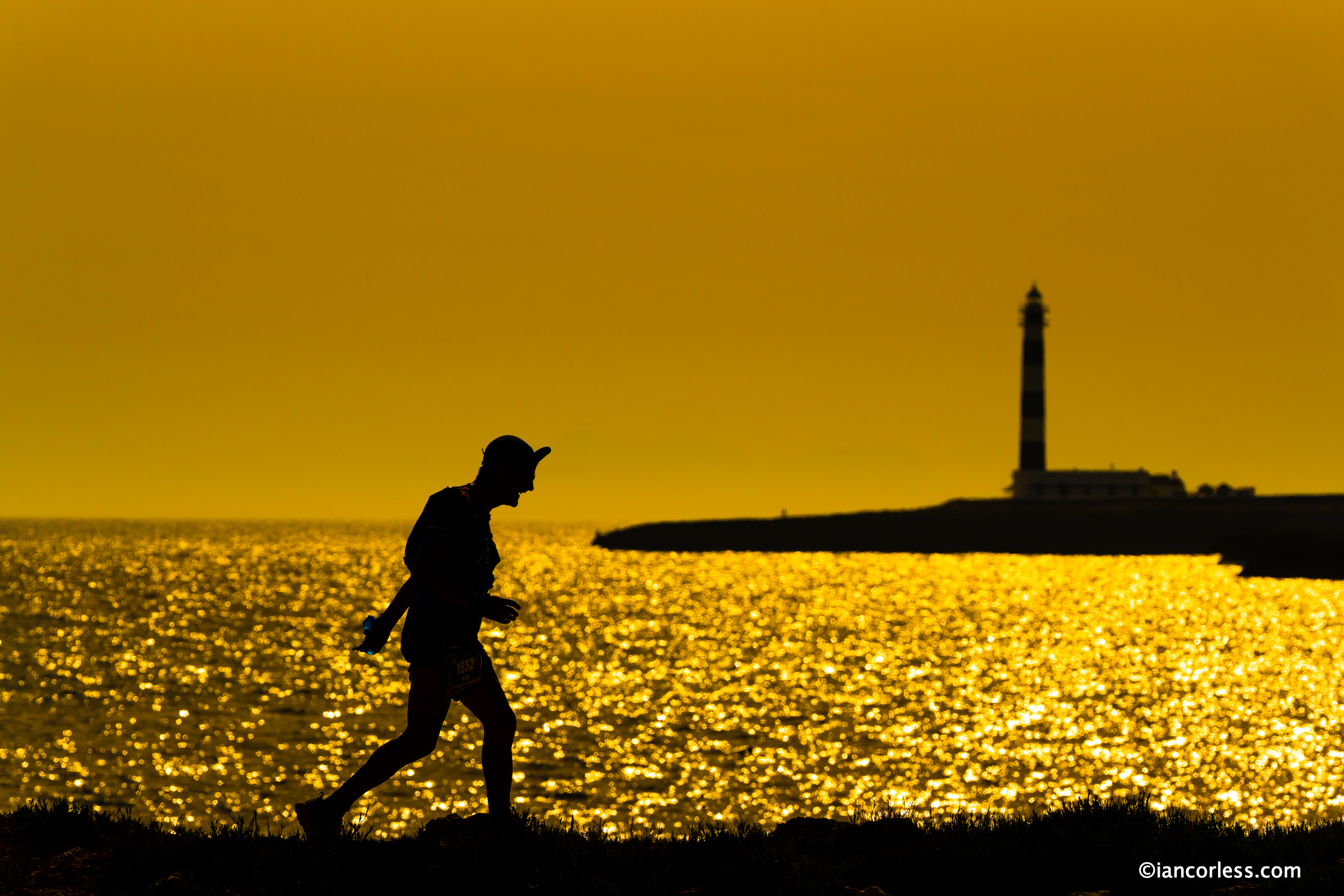
Located in the Mediterranean Sea, the Balearic Island of Menorca has long been a more low-key holiday location, in contrast to its immediate neighbours of Ibiza and Mallorca. With an area on just 700 km square, Menorca is a small island full of endless beaches, pine trees, turquoise water, rugged coastline, and a winding network of trails. Mahon is the capital and Ciutadella de Menorca is the second largest centre on the opposite side of the island, both filled with narrow streets and wonderful architecture. There is a great deal to love and appreciate in Menorca.
With a highest elevation point of 358m (Monte Torro), Menorca is essentially flat. However, if you journey around the coastline, you soon realise that the rollercoaster of trails that continually take you up and down make a circumnavigation of the island, a challenge.
Designated a UNESCO Biosphere Reserve (1993) the island is a paradise for botanists, especially in spring when meadows are carpeted with wildflowers. Calm, peaceful, rest and relaxation, Menorca is, without doubt, not the party destination as associated with its nearest rivals. Culture, gastronomy, local products and produce, places of interest, Menorca is waiting to be explored.
Many ask, what is the best way to see the island of Menorca? The immediate answer, is nearly always, rent a car and go explore…
Ask a trail runner, and the answer is clear, ‘Enter Trail Menorca!’
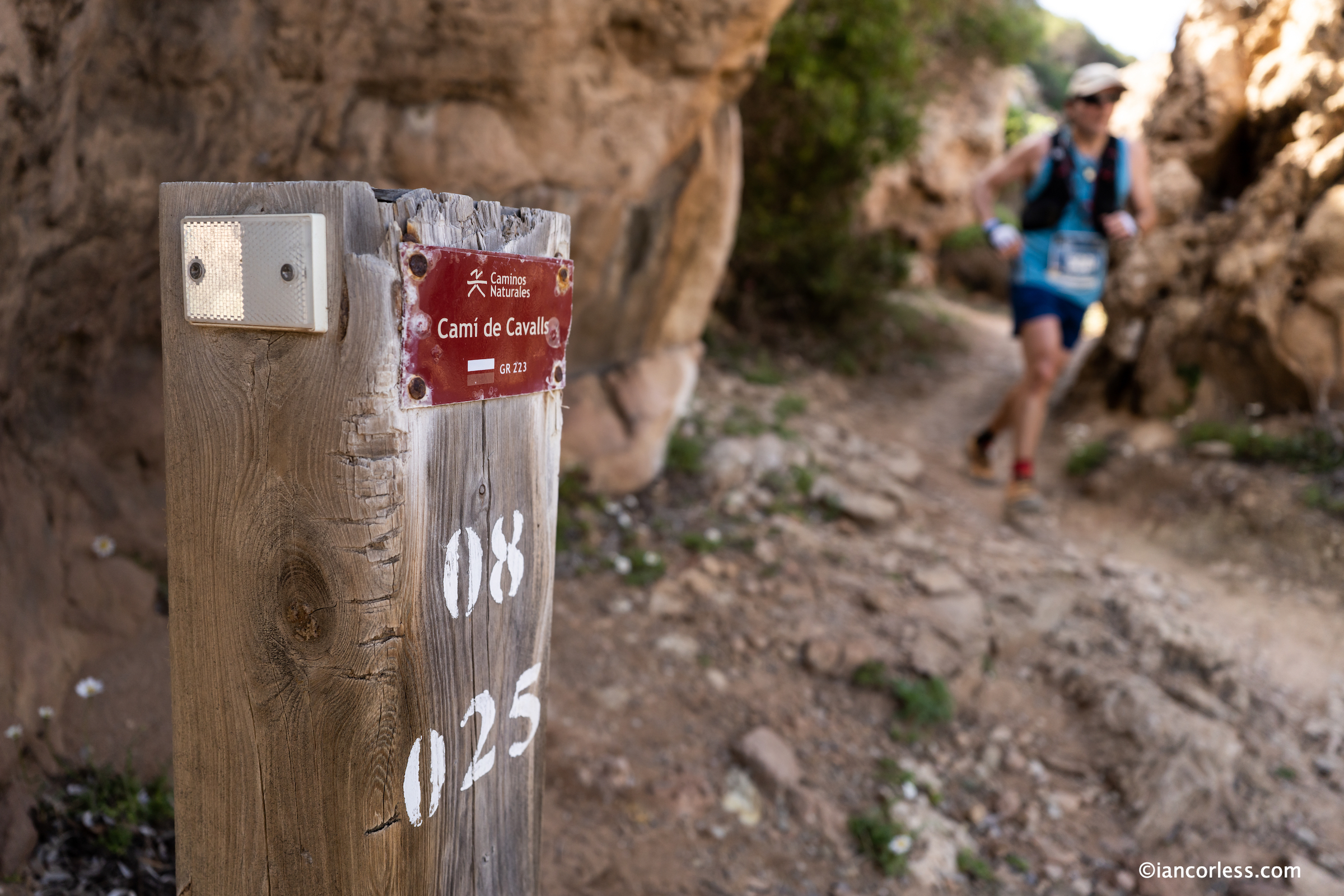
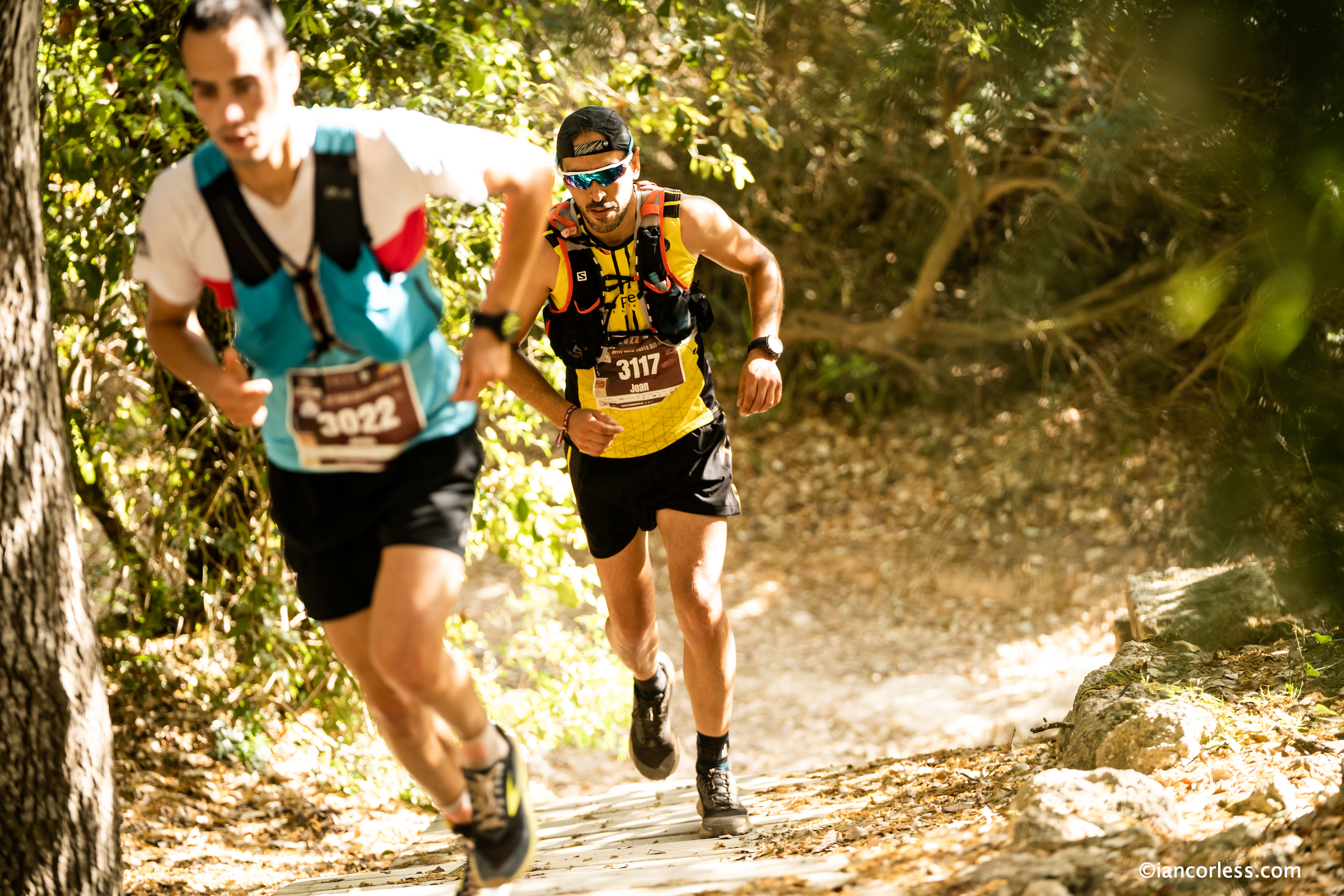
Trail Menorca, created 10-years ago utilizes the ‘Camí De Cavalls’ GR223 route to journey around the island either in entirety (185km,) or in sections broken down as 100km, 85km, 58km, 45km, and 27km. North or south, Menorca has a great deal to offer, there is no better way to explore than by running or walking this hidden gem of the Mediterranean. As the race says, 7 adventures, 1 legend.
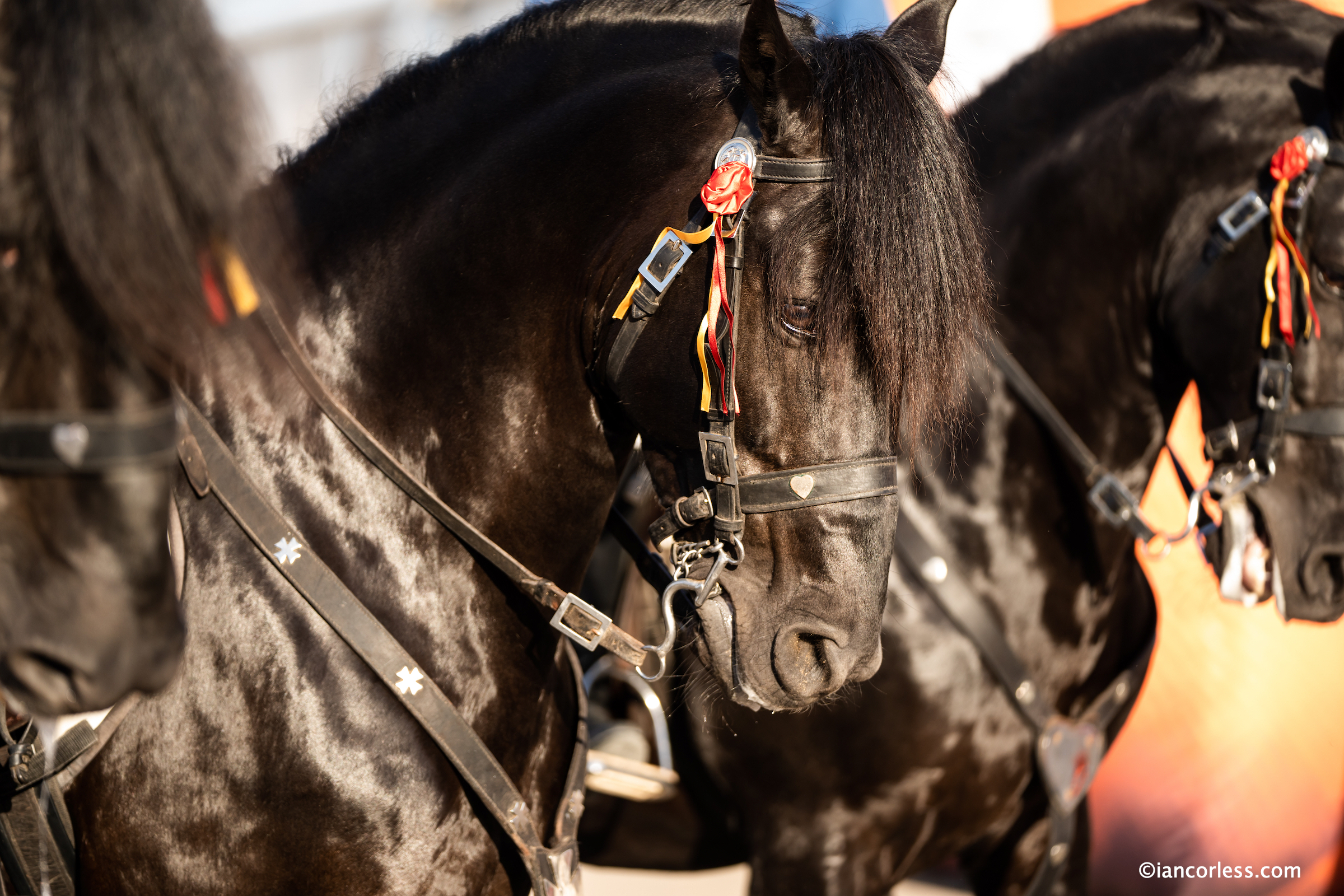
The Camí de Cavalls (way of the horses) according to some sources goes back to the 14th century. Named after the ‘Cavalleries’ (knights) who were charged with defending the perimeter of the island from invading forces – pirates! The 360-degree route that weaves around the island with watch towers and trenches randomly located for protection; both still in existence to this day were created by the British who marked the path to defend against the constant sieges of invaders.
In the 1990’s, after long and lengthy protests, much of the Camí de Cavalls which had been closed for decades, was once again made accessible. Finally, some of the most pristine landscape and coastline of the Mediterranean was once again available to be explored. With 185kms of marked trail, 130 bays and coves, desert like beaches, dense woodland, rugged, harsh and rocky terrain, the GR223 became a reason to journey to Menorca for an active holiday. For many, the journey takes at least one week to complete the circular route, while 10-14 days is more normal. Off limits to cars, a journey must be undertaken on foot, by bike or horse; or maybe a combination of all 3!
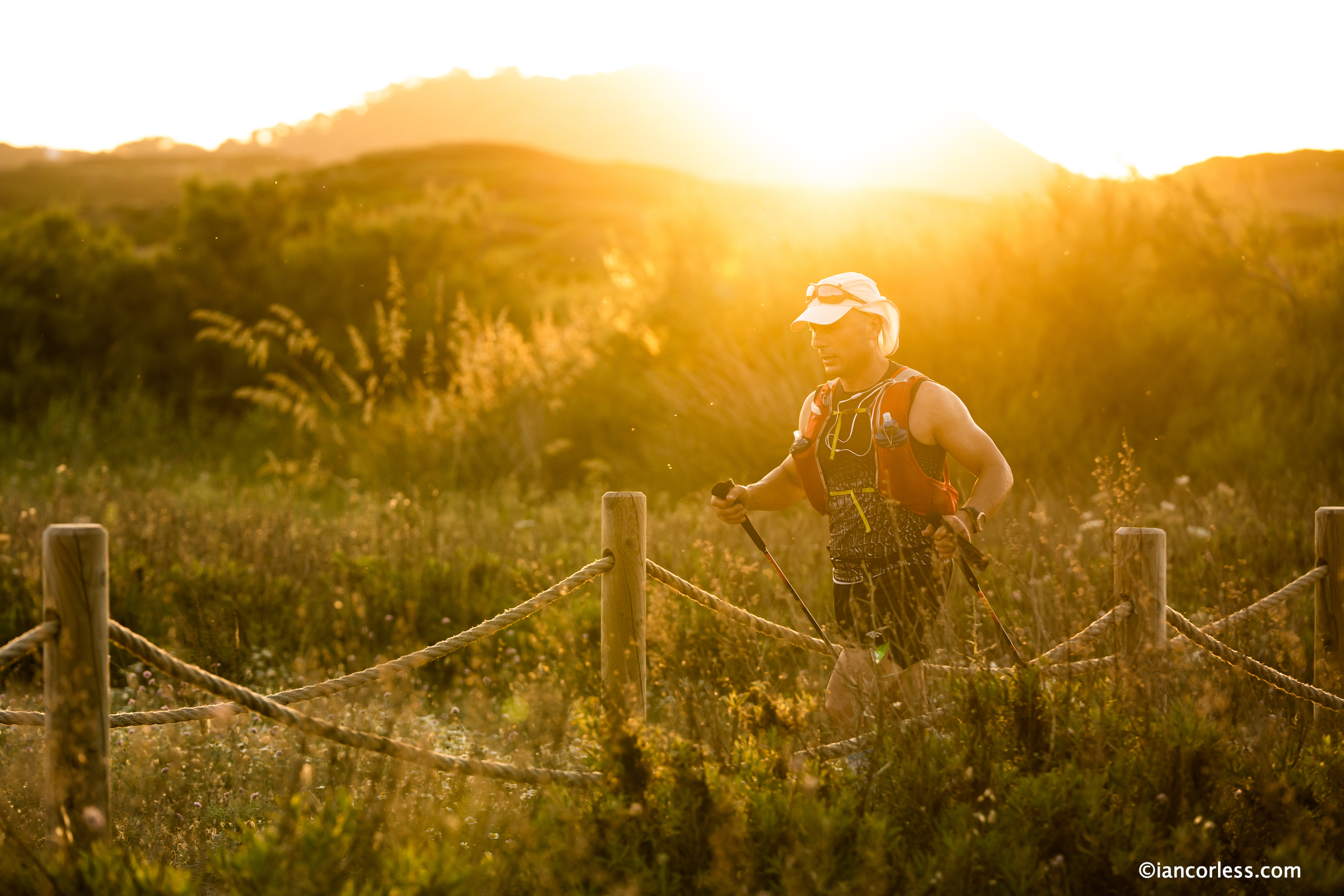
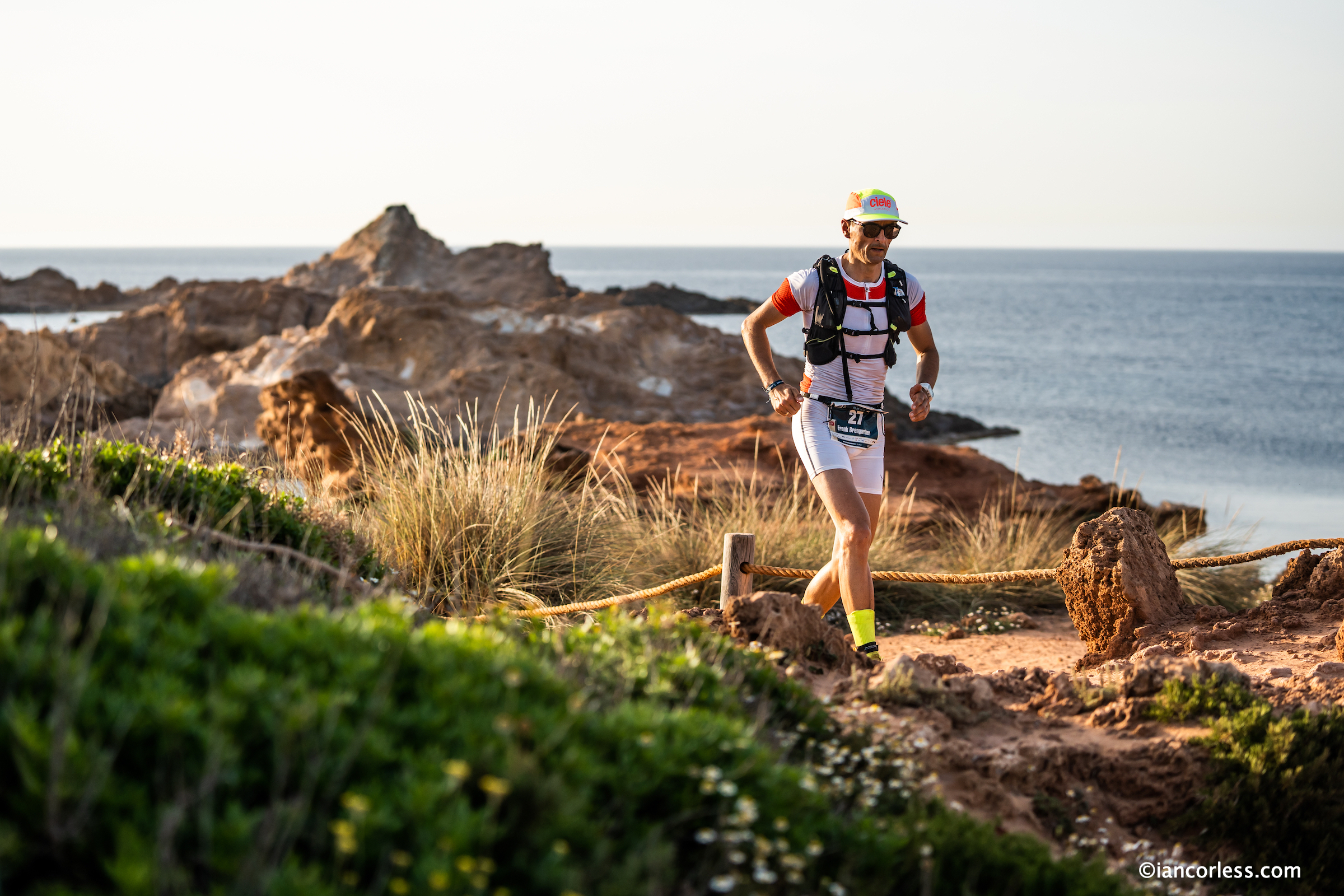
However, in May every year, Trail Menorca provides the opportunity to experience the Camí de Cavalls over a stunning weekend of racing. Breaking the island down in to north and south sections, runners can decide a distance and direction. The north being more rugged, exposed, and rough. The south more groomed, tranquil, and picturesque with the turquoise Mediterranean as a backdrop.
The 185km route (TMCdC) starts in Ciutadella and travels clockwise providing a full, immersive and difficult 360-degree journey. The other routes all conclude in Ciutadella but start in different areas of the island and then either travel clockwise or anti-clockwise to return to the finish.
The TMCN 100km starts at 0100am in Maó and travels north winding through rugged coastline of exposed and harsh terrain.
The TMCS 85km starts in Es Castell and weaves its way through the full length of the south coast and its incredible coves and beaches.
The PTCN 58km starts in Fornells and concludes in Ciutadella taking in the final sections of the TMCN route.
The PTCS 45km starts in Es Migjorn Gran and arguably provides the most beautiful and picturesque journey of the whole GR233 route.
Finally, the STCN 26km, which starts in La Vall provides an entry level distance travelling the final section (or opening sections, depending on direction) of the GR233. Enough to whet the appetite to return the following year and take on a longer distance.
The beauty of Trail Menorca is that you can quite easily race year-on-year and never have the same race experience as it is possible to run north or south sections over multiple distances. Perfect for those who consider the full 185km route a step too far!
Menorca may not have high mountains, but what it does have is unique and special. There is an incredible beauty and calm in Menorca. Racing is just one attraction, the opportunity to chill, relax, recuperate, and enjoy the islands gastronomy post-race makes this Balearic gem an essential to-do list location.
The 2023 edition is already close, but it is not too late to join Trail Menorca!
‘Trail Menorca Camí de Cavalls is an opportunity to discover what is hidden on this wonderful island, jewel of the Mediterranean, beyond its fantastic beaches. Running on tarmac, road, track, rocks, forest trails and depending on the race and distance, experience a night illuminated by stars. Come and immerse yourself in the beauty of Menorca.’
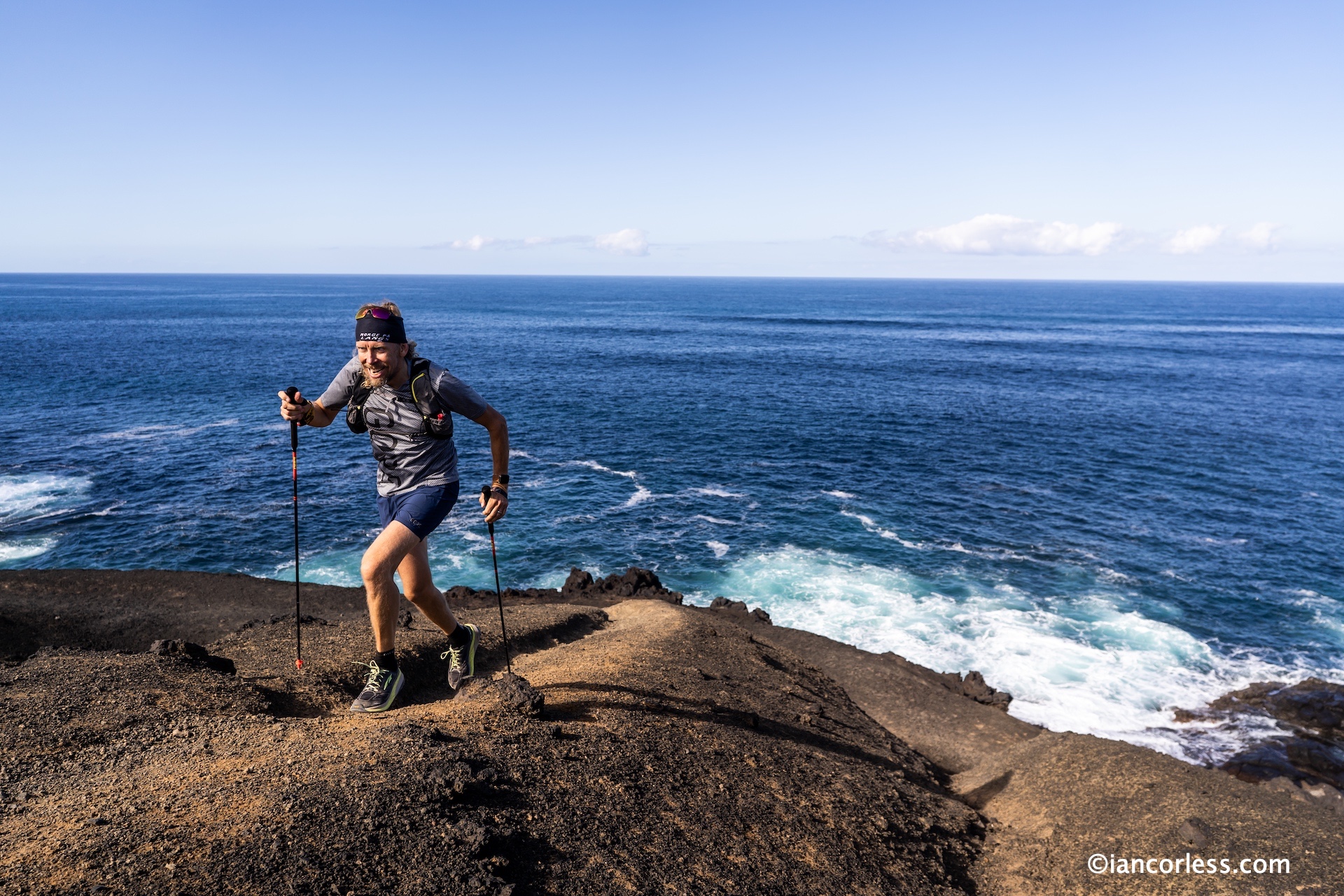
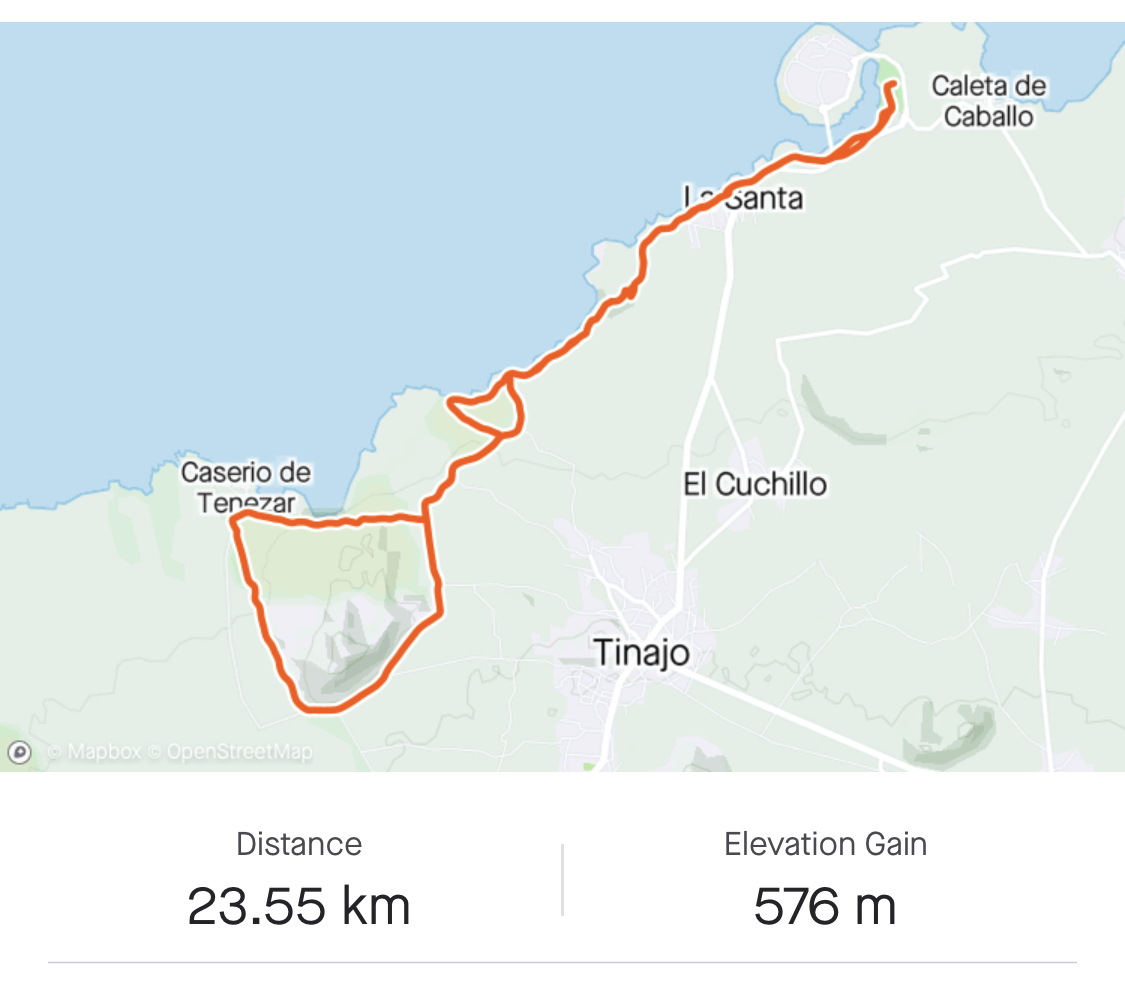
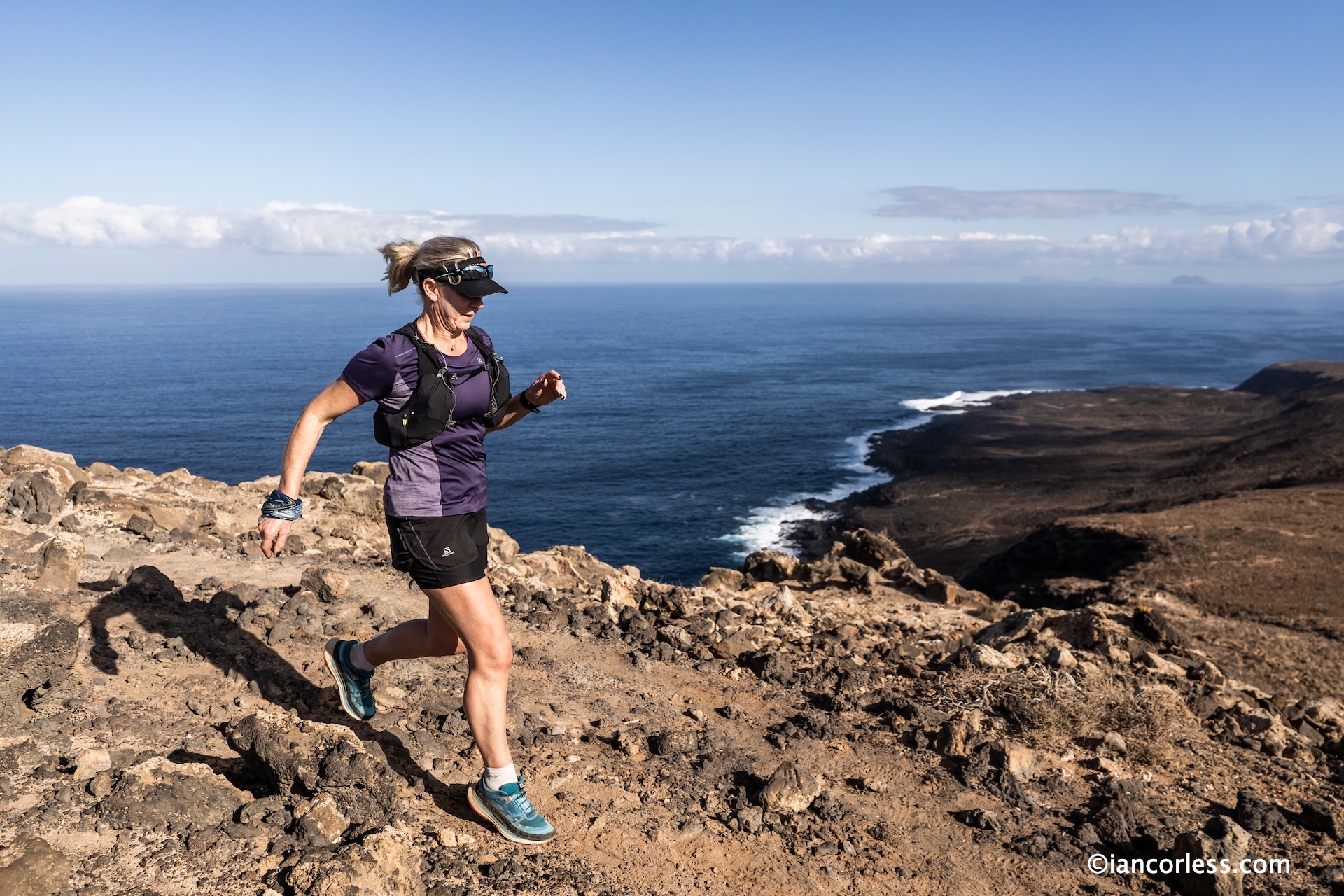
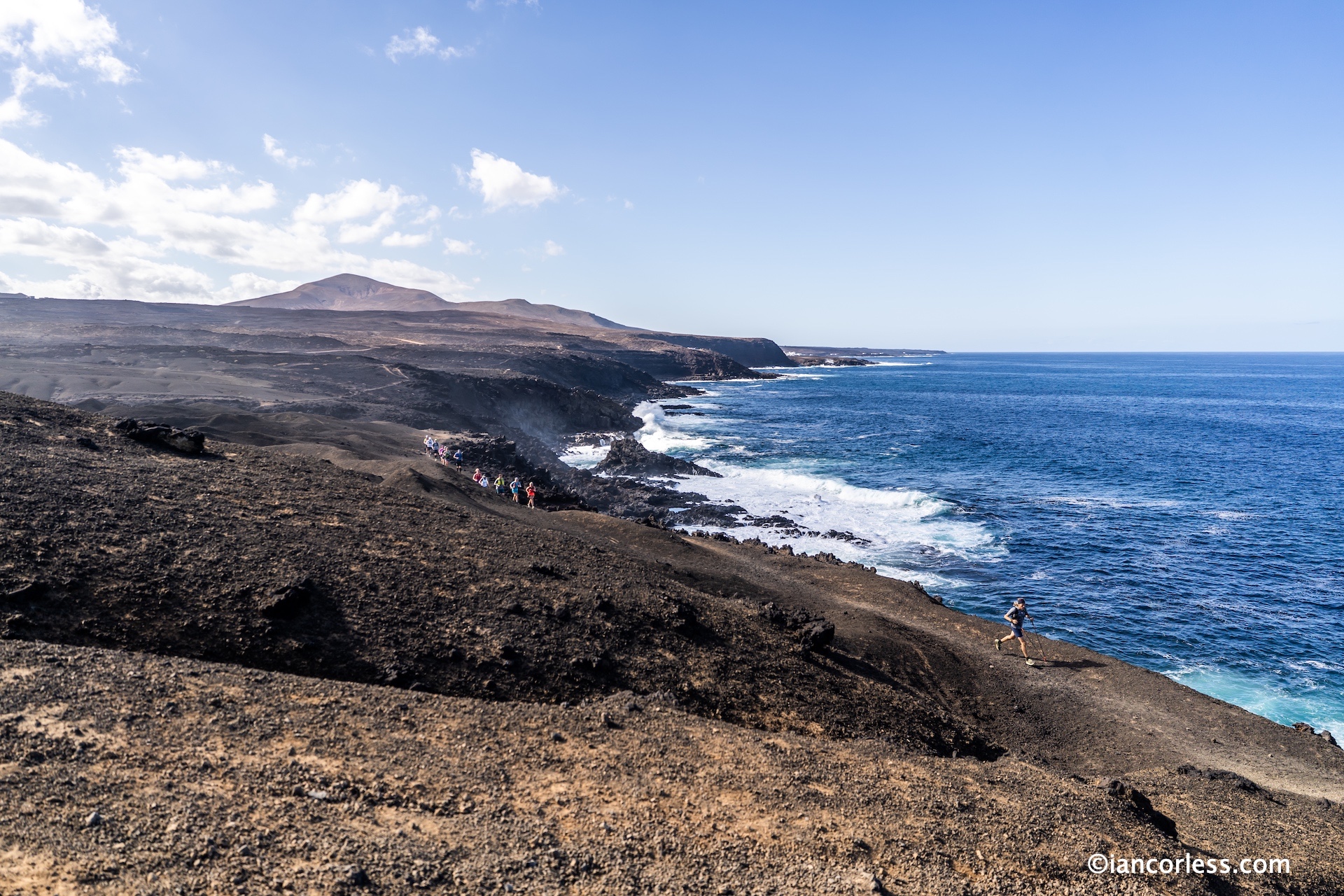
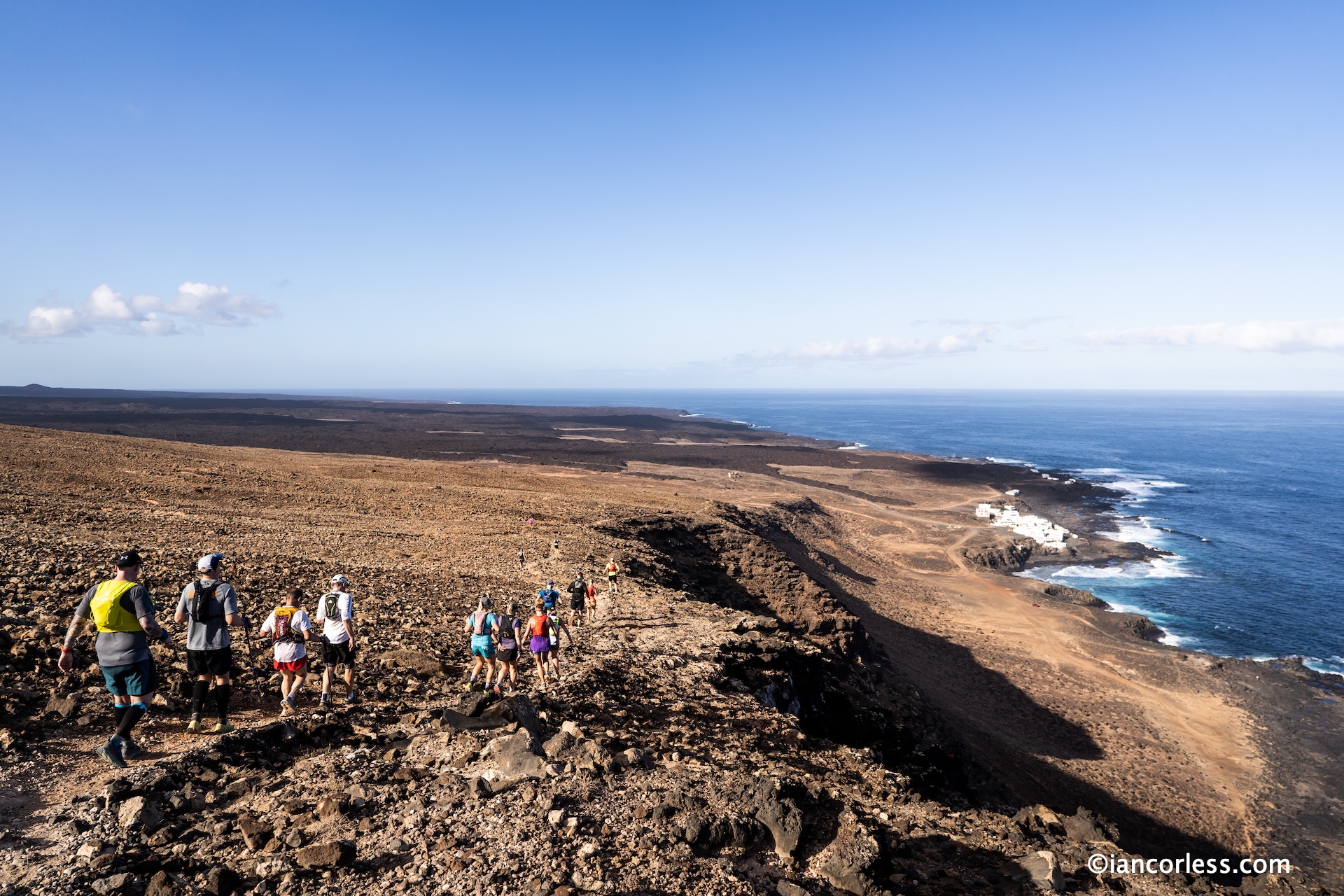
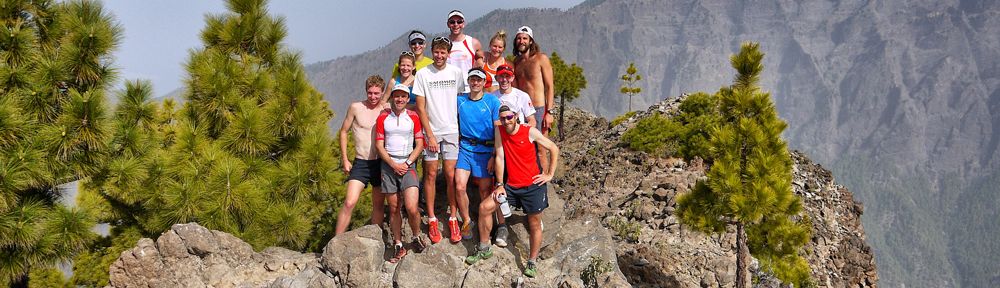
It was day-2 of the Lanzarote Multi-Day Training Camp and the first full day. It started with a brilliant 23.5km/ 15-mile coastal run starting from Club La Santa and heading out along the coast passing through La Santa village, circumnavigating a volcano and then hugging a single-track all the way to Caserio de Tenezar before travelling around Teneza Peak and then re-tracing back to Club La Santa.
We had four groups with Pierre Meslet leading the fast group, Sondre Amdahl and Ian Corless leading groups 2 and 3 which combined running with walking and then Inge Nijkamp leading the walkers.
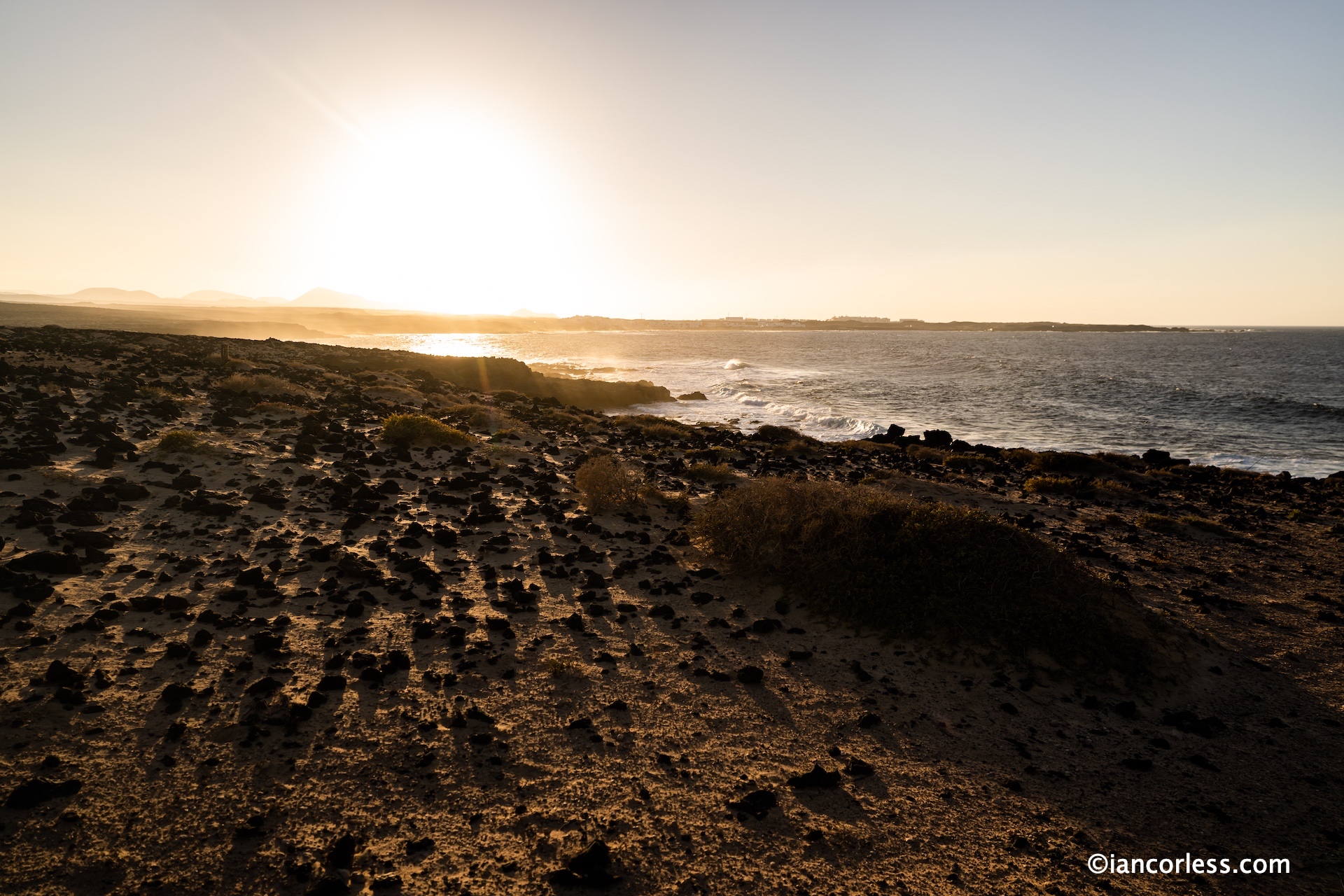
The trail offers stunning views and a mixture of technical trail, dirt roads, rocks and sand.
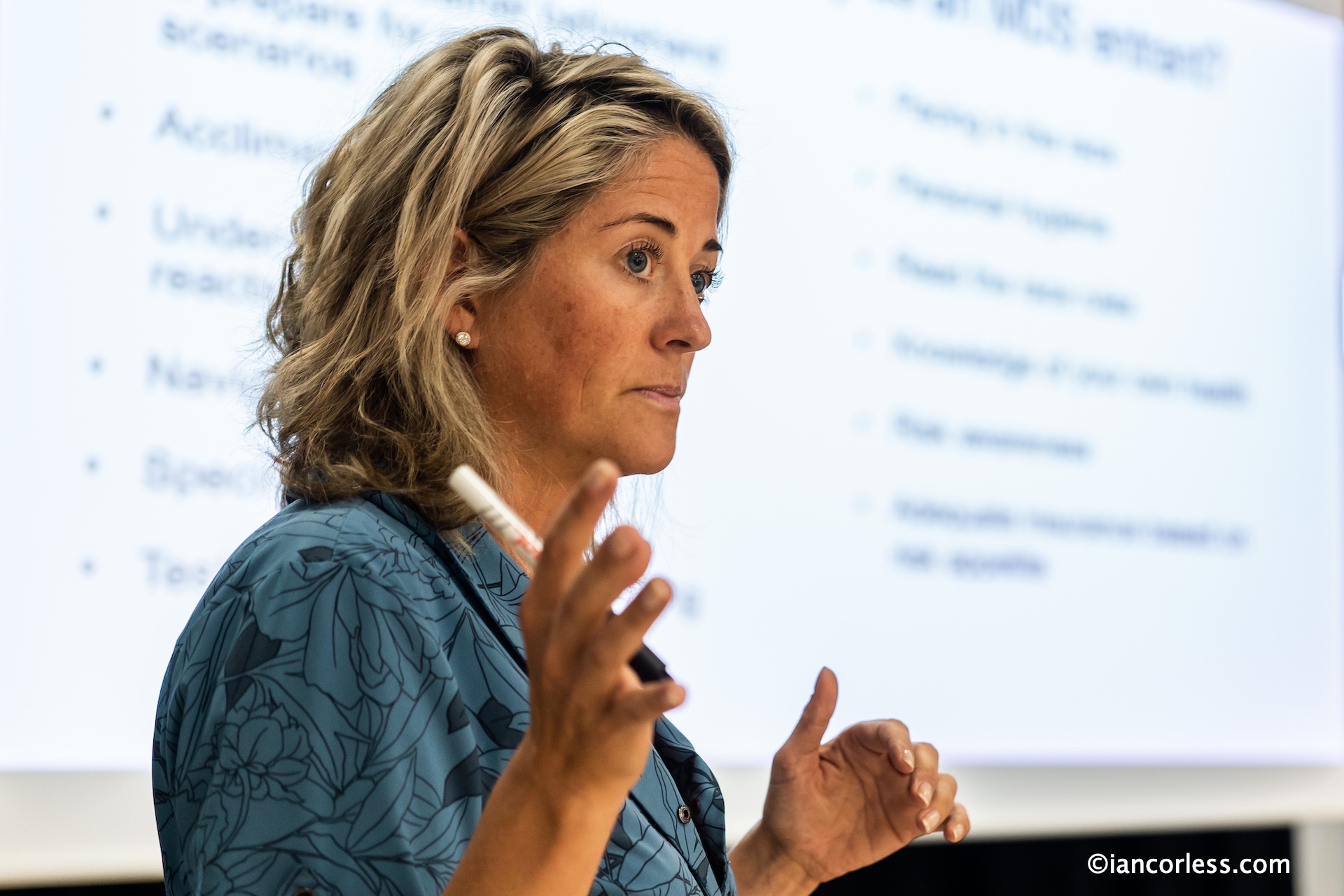
After lunch, Elisabet Barnes did a 2-hour talk on multi-day racing, self-sufficiency, planning and preparation.
With a long day almost done, at 1730 an easy 3-5km (3-miles) run concluded the day to loosen off the legs.
Please support this website. I believe everyone deserves to read quality, independent and factual articles – that’s why this website is open to all. Free press has never been so vital. I hope I can keep providing independent articles with your help. Any contribution, however big or small, is so valuable to help finance regular content. Please support me on Patreon HERE.
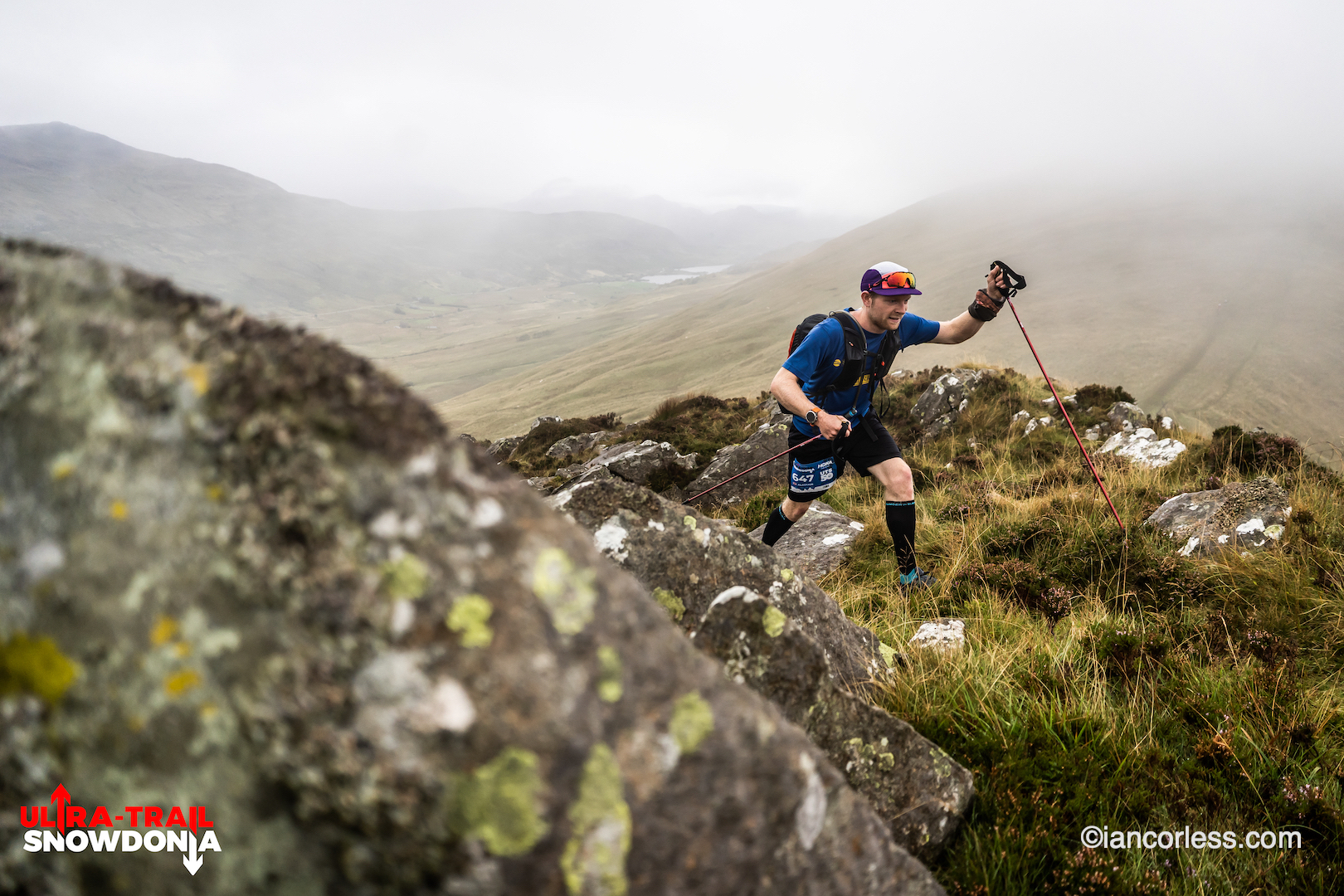
Persistent rain, low cloud, poor visibility, mud, bogs, wet rocks, climbs and descents that made even the most adapted legs scream in pain, yes, that was Ultra Trail Snowdonia 2021.
Missing in 2020 due to the dreaded ‘C’ word, the UTS returned in 2021 to Capel Curig as part of the Ultra Trail World Tour and supported by Hoka One One to confirm the dream of Michael Jones of Apex Running – A big UTMB style weekend of racing in the heart of Wales.
With distances of 50km, 100km and the whopping 165km, one word was touted pretty much everywhere all weekend, brutal! And it was… A savage weekend of racing but as Michael says, ‘beautifully beyond belief, savage beyond reason.’
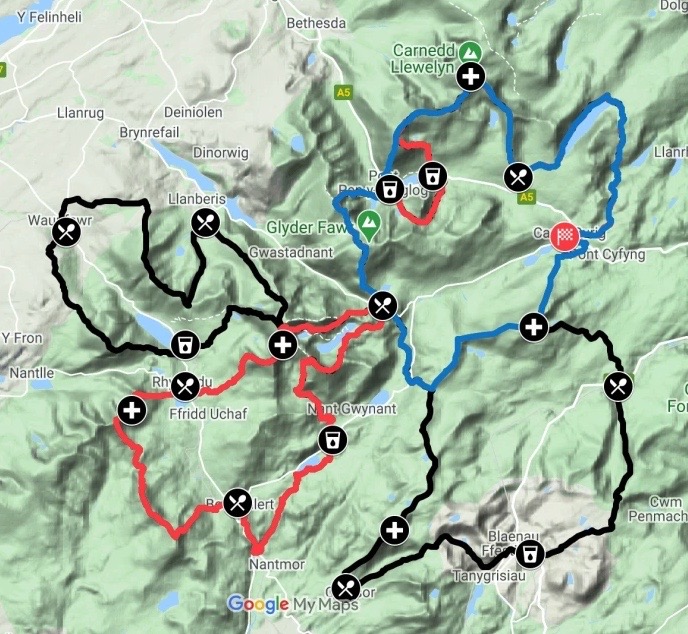
Despite the rain, despite the lack of views, Wales was a stunning playground for trail running. Let’s be clear here, there is no ‘easy’ running at UTS. The 50km is a wonderfully challenging route that may well have surprised many with some of its technical challenges, particularly the climb from Ogwen up to Carnedd Dafydd, compensated for what could be then considered a ‘relatively’ easy run in to the finish via Lyn Cowlyd and Blaen-Y-Nant.
The 100km route followed the early miles of the UTS50 all the way to Pen-Y-Pass but then headed along the Miners’ Track for an extended loop to return via the Pyg Track heading off to Y Garn, a loop around Tryfan and then head up to Carnedd Dafydd via a different route to the 50km and then follow the same run in to the finish.
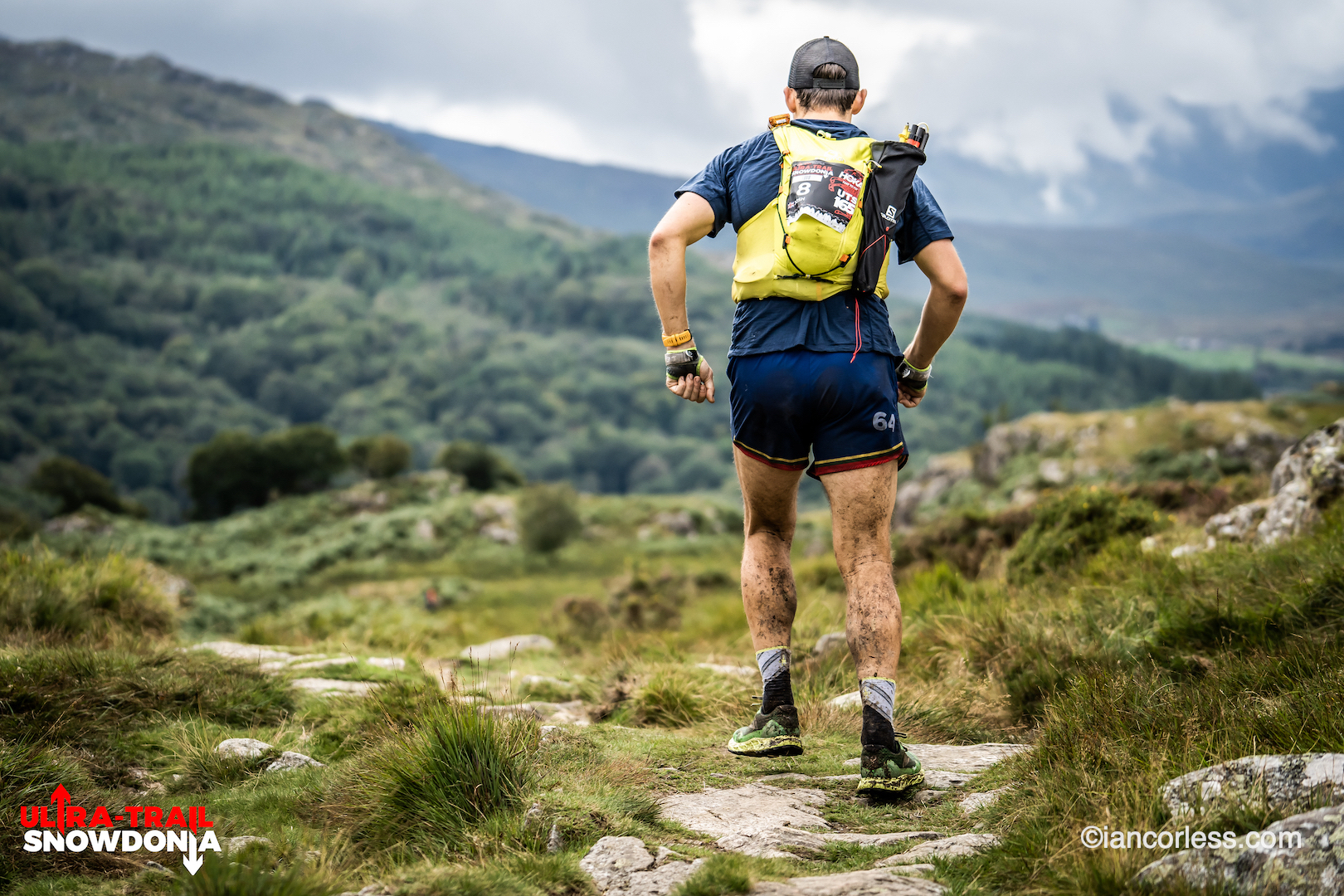
The 165km is well, just a monster! As expected, it created carnage amongst the competitors. It’s a relentless beasting of mind and body that passes through the whole of Snowdonia. The 100km and 50km routes all utilizing sections of this all-encompassing journey but only the 165km giving the full perspective of how beautiful and hard the Welsh mountains are. As with all races at UTS, it started and concluded in Capel Curig. Heading off to Blaenau Ffestiniog, Croesor it then picked up the 50km and 100km routes to Pen-Y-Pass. Nantmoor, Moel Hebdog, Llyn-y-Gadair and then after Yr Wyddfa it followed the Snowdon Ranger Path for an extended loop before returning via the Snowdon Massif and Pyg Track to Pen-y-Pass. From here, the 100km and 165km routes were identical all the way back to Capel Curig.
Tremayne Dill Cowdry summed it up: “45 hours to do just over 100 miles and every minute of that was a hard slog. Mountains, bog, wet rock, tough nav on a marked course, sleep deprivation, mist, rain and the terrain!! Very little was even runnable. I can’t imagine a 100 miler more difficult than that. Easily the hardest I’ve done and definitely the hardest in the UK. I was going ok although I would have happily dropped given the chance but my feet succumb to the permanent wet and I had to hobble the last 20-ish miles…
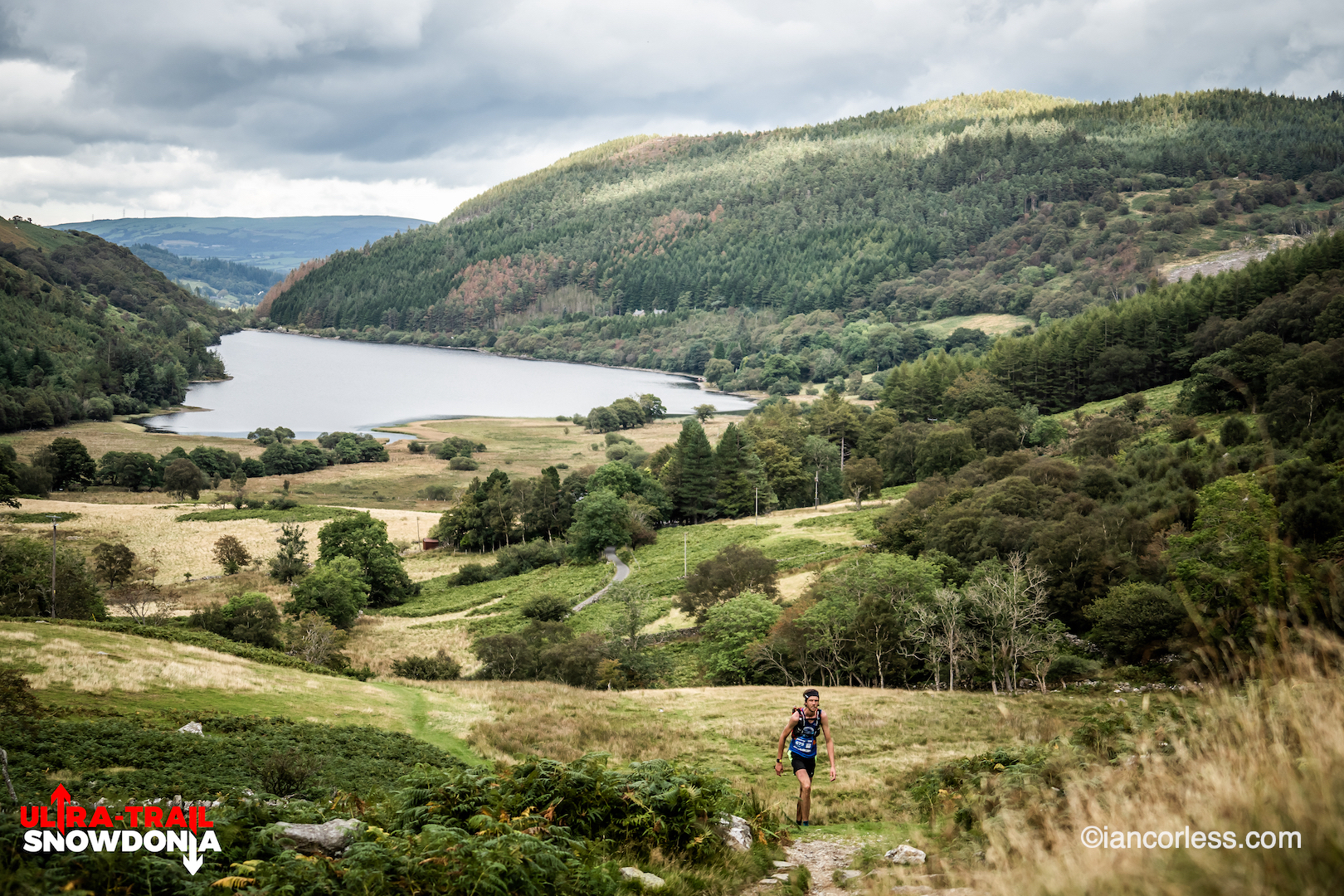
Stunning landscape
As with all races, someone has to cross the line first, and of course there was stunning performances all weekend. However, the real sense of achievement came firstly from toeing the line and being in with a chance of completing a journey. The second came from completing the journey. Every medal was hard earned.
Josh Bakker-Dyos
In the 165km event, Josh Bakker-Dyos lead from the start and while many expected him to blow up, so fast was his pace, he never did. He was relentless and consistent crossing the line in 28:51:43. It was easy to say, ‘he made it look easy!’ But for every other runner who crossed the 165km line, it was very clear, there was nothing easy on this route! Toby Hazelwood was less than 60-minutes behind in second, 29:45:17, another stunning run! Adam Jeffs rounded the podium with 34:09:54. Alice Sheldon and Becky Wightman were the only female finishers, 45:09:55 and 47:41:06 their hard-earned efforts stopping the clock – a brutal two nights and days out in the Welsh mountains. Only 32 completed the race.
Mark Darbyshire
The 100km route was won, but not dominated by Lakeland 100 champ, Mark Darbyshire ahead of Josh Wade and Jack Scott. Mark crossed in 14:25:47 with 14:33:36 going to second. It was 16:02:05 elapsed before the third crossed the line. Sarah Stavely (21:41:03) won the women’s race with Kajsa Holgersson and Julie Finn in second and third, 22:28:49 and 22:44:53.
Lauren Woodwiss
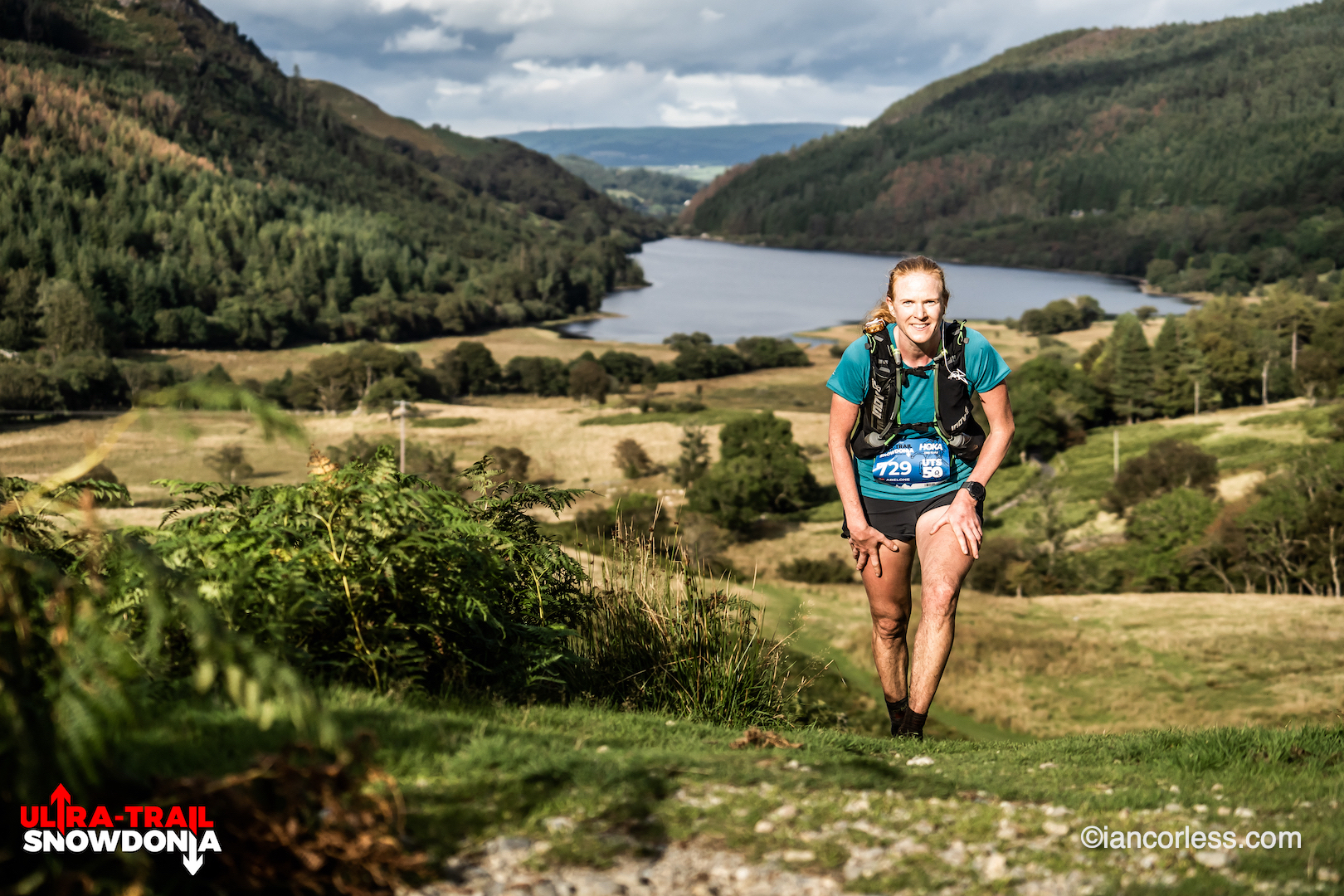
Harry Jones flew around the UTS 50 route and looked as strong at the finish as when he started, his 6:13:33 a stunning time. It was 6:56:54 elapsed before second place Will Simmons crossed ahead of Spencer Shaw in 7:14:53. Lauren Woodwiss, like Jones, lead from the start dictating an excellent pace over the 50km route and completed her journey in an excellent 7:54:18. Celia Waring placed second in 8:36:18 and Abelone Lyng from Norway, moved up from outside the top-10 women to eventually finish third in 8:43:16 after sprinting for the line ahead of Jenna Shail who was just 13-seconds behind.
As Capel Curig slowly returned to some normality on Sunday, it was easy to see that the UTS will become one of the ultimate trail running events not only in the UK but the world. It may not have all the glamour and glitz of Chamonix and the UTMB. It’s a much more grass roots event, some would say a ‘true’ trail running event. Ultimately though, Wales was the hero of the weekend offering stunning routes. This landscape combined with the vision of Michael Jones of Apex Running and a team of dedicated volunteers and supporters will make UTS a ‘one to do!’ However, if you are thinking about the 165 event? Think long hard and without doubt, train hard, it’s a beautifully brutal beast.
‘beautifully beyond belief, savage beyond reason.’
Please support this website. I believe everyone deserves to read quality, independent and factual articles – that’s why this website is open to all. Free press has never been so vital. I hope I can keep providing independent articles with your help. Any contribution, however big or small, is so valuable to help finance regular content. Please support me on Patreon HERE.
Episode 212 has an interview withBeth Pascall who won the iconic Western States 100-mile. The show is co-hosted by Abelone Lyng.
Talk Ultra needs your help! We have set up a Patreon page and we are offering some great benefits for Patrons… you can even join us on the show! This is the easiest way to support Talk Ultra and help us continue to create! Many thanks to our Patrons who have helped via PATREON Donate HERE
NEWS
Firstly, apologies for the lack of a show recently. It’s been one of those periods when life and travel have taken over and after the rollercoaster of the last 18-months, I personally decided to go with the flow and not force anything. Abelone, who is co-hosting with me, has joined me on many and adventure recently and we have enjoyed the disconnect and trail time. We have run many miles, climbed many mountains, fastpacked, camped wild and soaked in the best of what Norway has to offer… July has been a good month to re-connect. I also started to travel again with races, a stunning trip to Lofoten for The Arctic Triple, a race in Hardanger, a four day (the UT4M) in France and just recently, the Stranda Fjord Trail race and this weekend, as the show is released, the Rondane 100.
Next week I head to Chamonix for build up to UTMB and some news on that to follow later in the show.
Scott Jurek is back on the Appalachian Trail and Speedgoat Karl is with him. Scott is once again taking on the 2190-mile journey travelling south looking to set an FKT for the second time, he departed August 4th at 0730. Scott set the record in 2015 travelling north. Karel Sabbe holds the fastest time of 41-days, 7-hours and 39-minutes. *Update, news came in after recording that Scott had to stop after injury.
Talking of FKT’s, Timmy Olson set a new record on the Pacific Crest Trail, 51-days, 16-hours and 15-minutes for the 2653-mile journey. Supported by his family, Krista his wife heavily preganant, this journey was far more than just running. From the outside looking in, it was a truly inspirational journey. We hoe to chat with Tim soon!
Simen Holvik set a new record for the Norg Pa Langs (road) in Norway, 25-days 15-hours and 20-minutes.
Kilian Jornet once again the legendary Sierre-Zinal for the 9th time. 31km, 200m of vert in 2:31, the dude is a GOAT. Huge shout to the UK1s Robbie Simpson in 2nd and Cesare Maestri in 3rd. Maud Mathys won the women’s race (already a 2x champ) in 2:46 ahead of Nienke Brinkman and Anais Sabre.
Tromso Skyrace was won by Therese Arvik and Lars Olaf Haaheim, the race usually has excellent competitors from outside Norway, however, the ongoing Covid restrictions impacted on an international field.
Abelone and myself were in Stranda, Norway, for the Stranda Fjord Trail Race – I focussed on the 100km but there was a 48km and 25km. This course needs to be experienced – it is stunning! Please read the race report and view the images.
TransRockies in Colorado was won by Cody Reed and Grace Staberg, the duo running the 6-day solo in 15:59 and 18:35.
Next week the build up to UTMB starts and Talk Ultra is going to be providing in-depth content, behind the scenes of the adidas Terrex Team. We are going to be discussing many subjects and although the full line up of interviews are not confirmed, you can expect chat with the team manager, in-depth chat with one of the shoe designers, emphasis on women in trail running, chats with legends of the sport and of course, chat with up and coming stars.
La Sportiva CYKLON shoe review HERE listen to Episode 208 of Talk Ultra is a special show with DANIEL FEENEY and Jonathan Wyatt discussing the collaboration between BOA and La Sportiva for the new, Cyklon shoe.
Please support this website. I believe everyone deserves to read quality, independent and factual articles – that’s why this website is open to all. Free press has never been so vital. I hope I can keep providing independent articles with your help. Any contribution, however big or small, is so valuable to help finance regular content. Please support me on Patreon HERE.
Kristian Aalerud arriving at the first summit at 0500 hours.
The words epic, beautiful and brutal get used a great deal in ultra-running and I get it. For many of us, any journey can entail all those things on a personal level and that is why you toe the line…
However, here in Stranda Fjord, Møre go Romsdal, Norway, one of the most truly spectacular experiences is waiting for you to toe the line.
Missing in 2020 due the Coronavirus pandemic, the Stranda Fjord Trail Race returned with three races, 25km, 48km and the new 100km distance. The latter offering a full and immersive 360 experience of what this magical area of Norway has to offer.
Let’s be honest, Norway as a location is arguably one of the most beautiful places in the world, and as a runner or outdoor enthusiast, the options and possibilities are endless, be that in the south or north.
Stranda, part of the Sunnmøre region, is a small place located on one of the west Norwegian fjords. Often accessed via ferry from Liabygda, it can also be accessed by road from Grodås. In proximity to Alesund, Åndalsnes, Loen and others, it’s a wonderful and magical area to explore.
No better place for sunrise!
The 25km and 48km races use much of the opening miles of the 100km route, however, after reaching the summit of Fremste Blåhornet at 1478m they return to Stranda via Heimste Blåhornet, Løfonnfjellet and Rødesthornet. The 25km then concludes in Stranda and the 48km continues for another loop summiting at Roaldshornet at 1230m and then following on to Blåfjellet and Skurdahornet before descending all the way down to the finish line. Both races are tough, challenging, and demanding and should not be underestimated. There is little easy running here, the climbing is hard, the descents can be tricky, and the terrain varies in technicality, at times harsh on the body and mind, the only easy running is in the final sections of road to the finish line. This is reflected in the winning times, Jack Kosky 6:16:21 and Sara-Rebekka Færø Linde 7:14:34 taking top honours in the 48km and Anders Haga and Anita Iversen Lilleskare winning the 25km in 2:31:01 and 3:12:17 respectively.
Øystein Røen
The main event of the weekend, the 100km race. Is for many only a dream. To say it’s tough would not do the course justice, it’s mind blowing in the challenge. Beautifully brutal as one runner said. Offering a 360 clockwise experience of this stunning area of Norway, the Stranda Fjord Trail Race 100km route is quite simply, one of the most stunning routes I have experienced.
Relentless is the only way to describe. The course does contain some areas where you can switch off and just run, but they are few and far between. The opening miles maybe offering many a false illusion of the severity to come. The hard work starts to really kick in with approximately 20km covered at Liavarden. What follows are walls of grass, rock, scree, stone slabs, technical ridges, vertical climbing and challenging descending.
The race is truly a hands on experience.Linda Hovde had lead the race early on, probably starting to hard.
Reaching the summit of Fremste Blåhornet at 1478m, 23km covered, and every runner was under no illusion of the challenge ahead. The terrain rocky, slow and hard, the panoramic views at sunrise quite simple stunning. Following on to Lissje Blåhornet and a technical ridge section offered exposure and scrambling before dropping down to the valley and easier running to the aid station on the road of Dalevegen and 28km distance.
Descending Slogen
A short section of road was followed with more climbing, an out-and-back to another peak and then the Liasætra aid station.
Easy running before Slogen.
Valley running to Patchellhytta DNT cabin and then the relentless out-and-back climb to the iconic Slogen at 1564m. This climb being one of the highlights of the route offers a challenge, especially near the top when hands-on-knee climbing turns to scrambling and easy climbing.
The final push to Slogen summit.The view from Slogen.
The summit offering a stunning panorama but there is little time to enjoy the view. Descending via the way you came, eventually you turn left in the valley and make your way to Velleseter, Brunstadsætra, Storevatnet, and then the road section that leads to the final section of the course, 80km covered.
Felix Weber approaching Roaldshornet.
The climb to summit Roaldshornet at 1230m is long, the summit at 86km and it would be easy to think it’s all downhill from here. Considering what has gone before, it’s fair to say that it is. Eventually the 100km joins with the final section of the 48km track and the run in to the finish is welcome and hard earned.
Rocks and more rocks.
Be warned, this route is tough!
Kristian Aalerud set a hard pace at the start of the race and while nobody really knew how long this 100km would take, best estimations were 17-hours for the winning time. Kristian crossed in 15:49:31. A spectacular time.
Øystein Røen for much of the day had run in 2nd place, however, Felix Weber moved ahead to take the 2nd podium spot, Øystein settling for 3rd, 17:03:12 and 17:25:38 respectively.
Ida Jahren Herud ran a smart race
Ida Jahren Herud ran a smart race, easing in to the day and eventually taking over the lead to finish in 22:25:12. Linda Hovde had lead the race early on, probably starting too hard she slipped down the field and eventually finishing in 28:29:34 in 2nd place. They were the only two women to complete the course!
In total, 20 completed the distance reflecting the severity of the challenge. It’s also important to note that the start list was drastically reduced to ongoing restrictions from the Covid pandemic.
One thing is for sure, running 25km, 48km or 100km in this area of Norway is not easy, ask anyone who toed the line of the respective distances.
There is something truly magical here, I can only encourage and emphasise that you ‘need’ to add Strand Fjord Trail Race to your bucket list.
Beautiful and Brutal!
You will not be disappointed with the experience of racing here, BUT come prepared, you are going to earn that finish medal.
Please support this website. I believe everyone deserves to read quality, independent and factual articles – that’s why this website is open to all. Free press has never been so vital. I hope I can keep providing independent articles with your help. Any contribution, however big or small, is so valuable to help finance regular content. Please support me on Patreon HERE.