MDS to TCC – Jo Meek Interview

iancorless.comP1020412

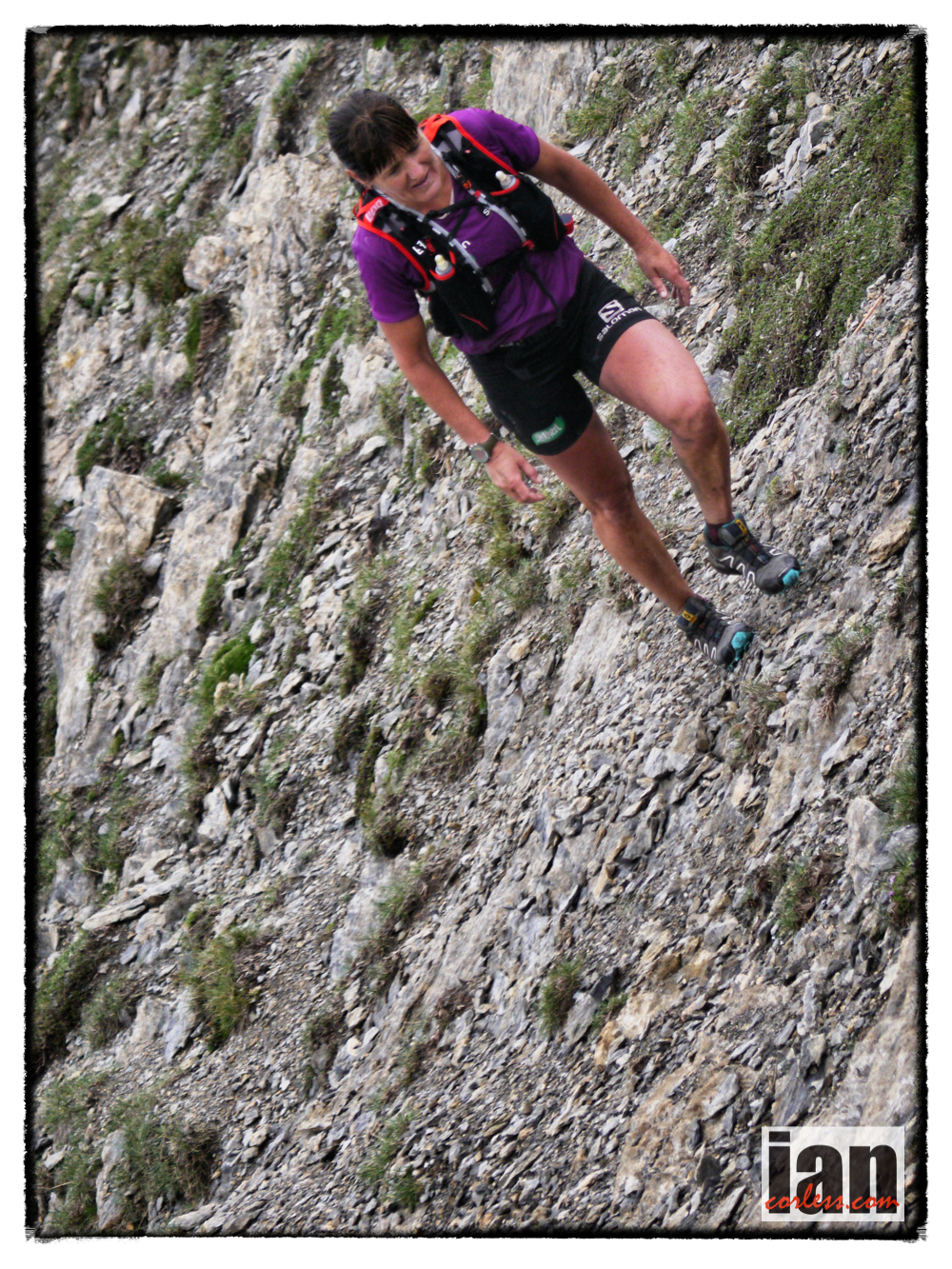
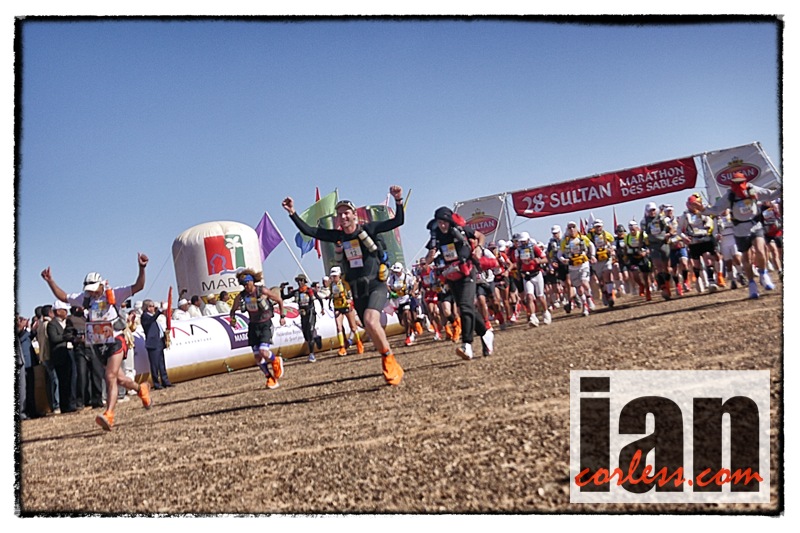
Who would have thought it, the 2013 Marathon des Sables turned out to be a great year for British performances. Danny Kendall placed the highest ever overall placing with 10th and Jo Meek placed 2nd lady overall. It was a stunning performance by a relatively unknown. Armed with a new belief in her ability, Jo will has now planned to switch from the heat of the Sahara and test herself in the heat and humidity of a Costa Rican rainforest at The Coastal Challenge. I caught up with Jo at the end of August and we had a chat about MDS and her expectations for TCC.

IC I bet April and the Marathon des Sable (MDS) seems such a long time ago?

JM Yes, it does seem ages ago. Considering I am walking now in late August in the pouring rain. It’s wet and miserable… it doesn’t seem that long ago in regard to memories. I just watched the video that was available for download and it brought it all back.

IC So sitting at home, watching everyone running in the sand with a tear in your eye?

JM Definitely no tear, I think I am happy not be running in the sand. I am still surprised how I adapted especially considering I am now at home running on the road again.

iancorless.comP1080077

IC Amazing eh that you can be in that environment, the sand, the wind, the bivouac, no washing, you are eating dried food and you adapt and then post race when we got in a luxury hotel, you said, you wished you could go back, you loved it didn’t you! You loved being in that environment. It was preferable to the clean hotel.

JM I did. Yes, I actually think I could be quite a ‘skanky’ person really. I am far happier roughing it than in luxury. I guess it sounds romantic but I like being at one with nature, eating, running and sleeping. Perfect. But I guess the other memory is the one from those clean white cotton sheets; that was quite special.

IC I have to say, the first shower, all that fresh hot water and then all the sand starts to escape from all the nooks and crannies. As you say, no more sleeping bags and a lovely comfy bed, it is quite a pleasure.

iancorless.comP1080472

JM My roll matt was about the size of A4 to keep it light and small, so my hip was pretty sore after a week in the bivouac. I have to say the cushioning of a bed was welcome.

IC The Bristh performed really well at MDS. No disrespect to you but we had no idea who Jo Meek was before MDS. We knew Laurence Klein was outright favorite and we knew Meghan Hicks was back, she had performed well previously but outside of that it was all unknown. On the first day you were up at the front and then continued to perform at the front of the race for the whole race. You had this great battle with Meghan. Laurence had a convincing lead but it all fell apart on the long day when she had to drop with dehydration. This opened it up for you and Meghan. Meghan had a great long day but I remember standing on the finish of the final day, it was the marathon distance, you nailed it. You said the marathon was your distance and you wanted to stamp your authority on it. You placed second overall, many look at MDS as one of those iconic mult- day races, how did you go from a relatively unknown to getting second. What was it in you that enabled you to focus and become so efficient in the sand?

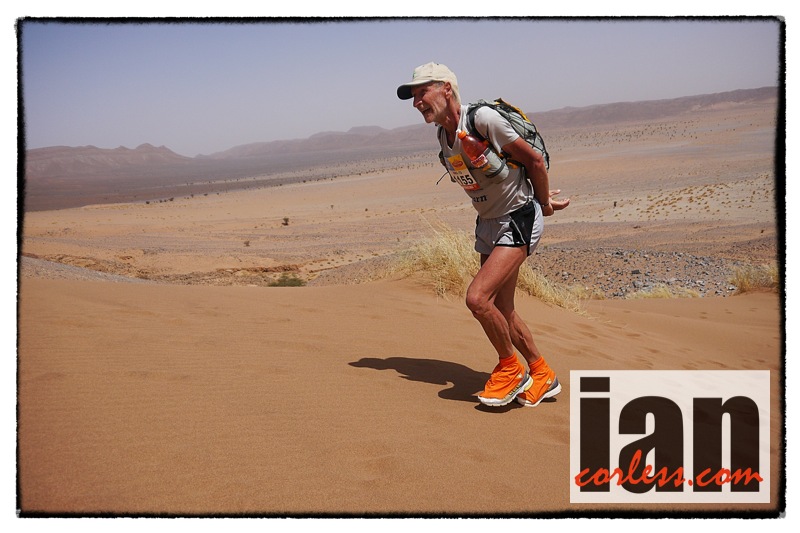
JM A few things really. I am very good at setting a training plan and sticking to it. When I race, I always race. I don’t just enter to complete it. So, looking at the conditions I set myself up in a heat chamber and did training that was specific. I didn’t want heat to be an issue so I acclimatized. What was interesting over the six days was that I became less scared of what the heat could do. On the last day I thought, what have I got to loose. I do think back now and wonder could I have gone harder but it was an unknown. I didn’t know what would happen so I played cautious. Meghan taught me a lot without her realizing it. I followed her on a couple of stages and I watched how she tracked across the sand looking for the hard sand, even if it was out of the way. She would deviate and look for the harder and faster sand. Also her style, it’s a definite technique to sand running. You don’t want to be a toe runner.

iancorless.comP1030672

IC For sure, you need a flat foot.

JM Yes, you also want to shuffle. You don’t want big strides. A little like being in the army again. I learnt lots. I learnt also from training. I had done some awful ultras that were definitely worse than MDS. One race, a 40-mile race across Exmoor and the weather was awful… they said 40 but it was 43-miles I am sure. The last 3-miles were awful.

IC That can be good, a bad training experience. If you have had some tough and hard training and the race works out easier then that has to be a good thing. It’s a real positive.

JM I had no doubt that I wouldn’t finish the race. I had said that I wanted the podium at MDS but I had no idea what I based that on.

IC To put things in perspective you are a 2:46 marathon runner. Ability and speed are there. Many would die for a 2:46 marathon but also you are in the army. Does the combination of those two things make a good MDS runner?
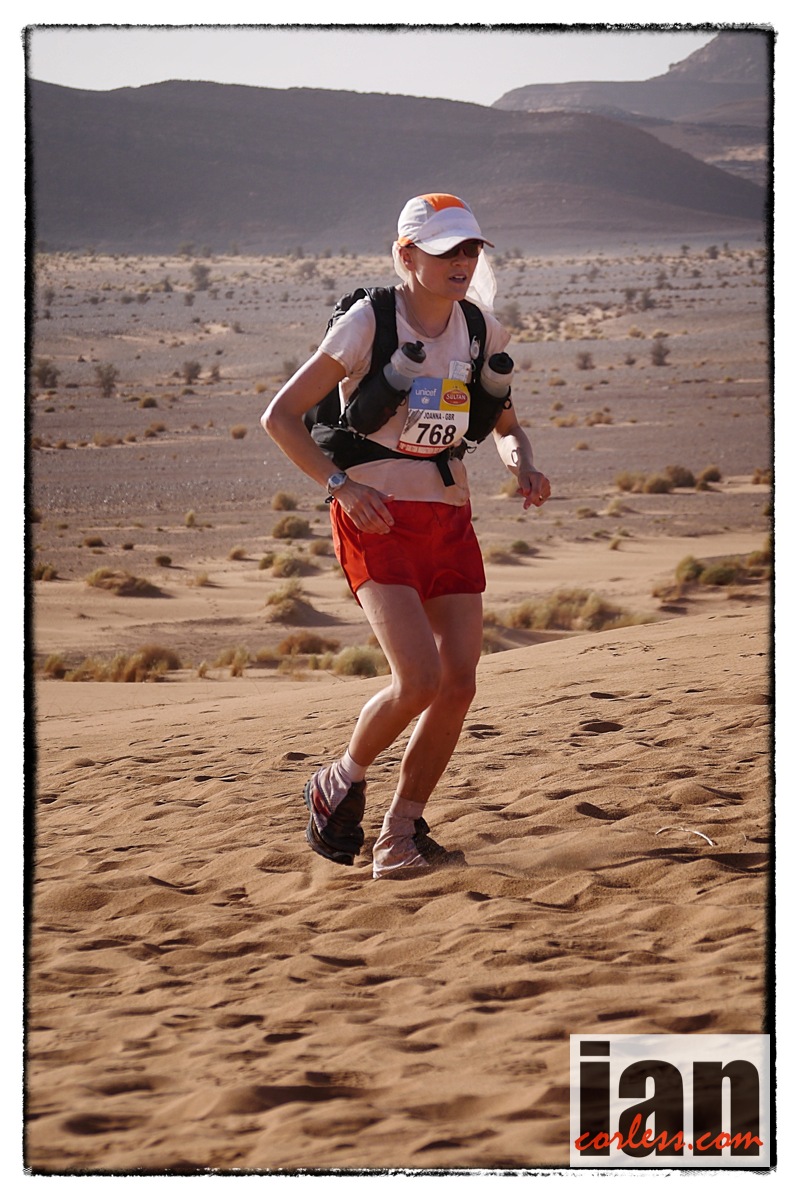
iancorless.com_1090372

JM I think the marathon pace and training was key in terms of the speed. I didn’t have the same endurance as Meghan over the ultra distance. Many of the days were shorter in terms of ultra distance so I knew I had that potential. In terms of tent life and conditions, maybe the army helped but that is me… I like that. The army helped with discipline; eating, drinking and so on… it was feet first, food and then wash. You need to look after yourself.

IC Give us an insight into your background, you are a roadrunner really?

JM Yes, but I do like cross-country. I came second in the Nationals. Essentially I have done road running. I started in my teens to loose weight and then just kept going. I wouldn’t say I have natural talent in terms of speed but I have something that works, particularly over distance.
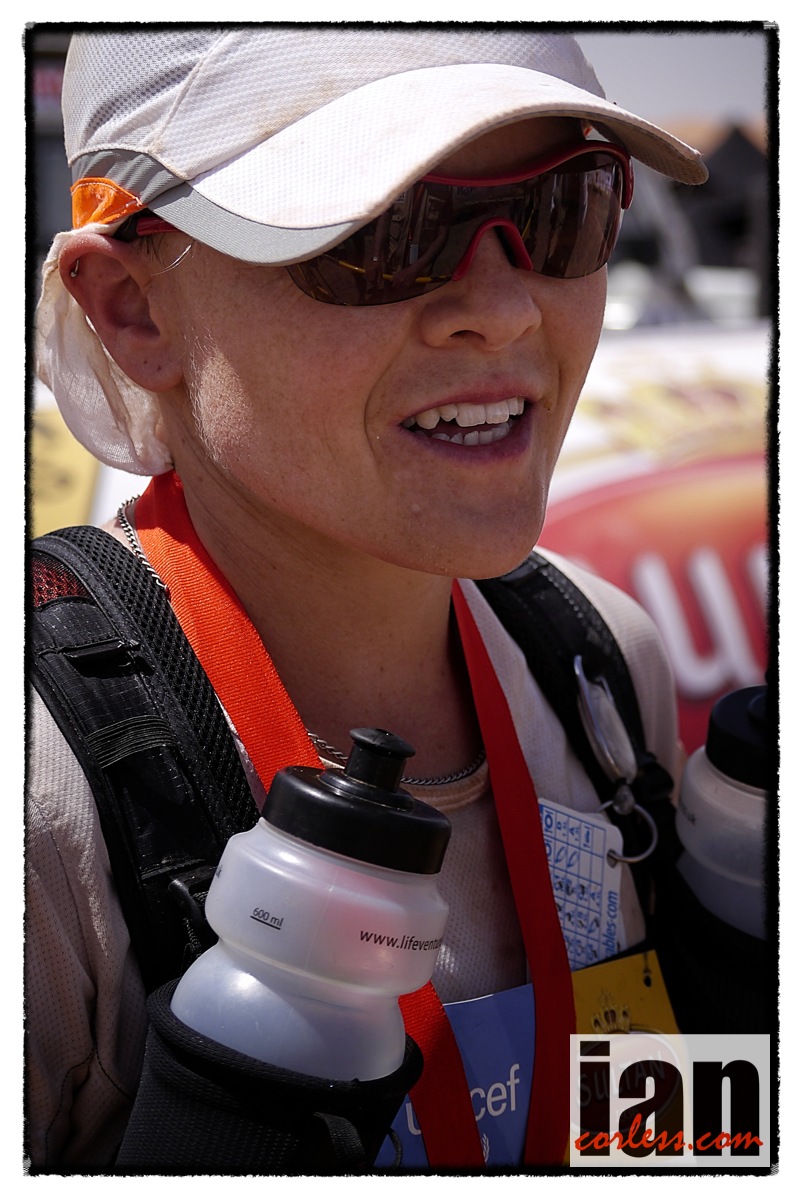
iancorless.com_1090900

IC How long have you been running?

JM 18 years, maybe 20!

IC So you have a great base of running and plenty of experience?

JM Yes. I always thought that maybe I should do ultra earlier and I thought, no rush! Particularly with how you develop with age and aerobic capacity. It seemed like the correct time for MDS. As you know, you don’t just enter MDS you have to enter years in advance.

IC Post MDS you really wanted to improve your marathon time. You put yourself on that path and recently you run a half marathon but you were disappointed with the performance. Many factors can affect a race, a conclusion you have arrived at is that you are now going to pursue trail and ultra running. So, you are going to another multi stage in early 2014 but this time you are going to a Rainforest. It’s a race that I was at earlier in 2013, The Coastal Challenge in Costa Rica. Also known as the Rainforest Run. What’s the attraction?

Costa Rica

Costa Rica

JM I am always very attracted to a country that is hotter than the UK. That is a no brainer! It’s the challenge, the opportunity to compete in something so different. This race I don’t need to carry all my kit, so, unlike the MDS I will be able to just run but admittedly for repeated days. It will be interesting and it should mean I can go faster.

IC The race is very different to MDS. Some things carry over such as the multi day. As you say, you don’t need to carry all your kit but you do need safety kit, food, water and just essentials. But you are correct, all your clothing, tent etc is moved for you and then food is provided. It’s a hot and very humid environment and even when it rains it is not a problem, it is so warm. All the daily campsites are in beautiful idyllic places. It’s such a wonderful environment. It’s a great combination of providing daily challenging runs but with just a touch of comfort. It’s perfect for those who may want an introduction to multi day racing.

Costa Rice, The Coastal Challenge ©iancorless.com

JM In some ways it will feel easier but in an evening you will be able to eat as much as you like and so will the competition, in theory you are all the same come the following day. But at MDS it is about survival and balance. It is more about balancing and economy and how you ration your food and water.

IC The race has so much more elevation than MDS and in particular, the terrain is much more varied. You have single track, double track, rocky sections, forest, dense forest, beautiful beaches and then some tough climbs and descents. The next edition of the TCC celebrates its tenth year so it may have a little more climbing than normal, we shall see? The variety is amazing. If you are lucky, you’ll see wildlife. You hear it but don’t always get to see it.

Costa Rica, The Coastal Challenge ©iancorless.com

JM I’m so excited. I can’t wait. I have some road races to do in the coming months and then I will start my TCC training three months out. I will use a heat chamber again. The heat chamber I used for MDS prep was stuck on 80% humidity so I have an idea of what conditions will feel like and I know what my sweat rate is like.

IC Costa Rica is very humid. It is almost 100% but it is not unpleasant. You really do sweat all the time, particularly when running. You need to be on the ball and balance your hydration.

JM I like it harsh and hard conditions. In some ways, the harder the better.

Costa Rica, The Coastal Challenge ©iancorless.com

IC How do you prepare for a multi day race? In some ways you had to guess for MDS and that worked! So, what do you take away from that experience and what will you do in preparation for TCC. The longest stage is around 50k and not 80k so that will make a difference. As we have said humidity and terrain are the key differences and you won’t need to carry a heavy pack.

JM I will do far hillier off road training. For MDS I had to train with the weight too, however for TCC I will just use essential kit and I will do plenty of back-to-back training at a faster pace. I will try to replicate the race really. In some respects it won’t be too different from my marathon training. The key will be the back-to-back runs..

IC We have so many different ways to look at training. Some runner’s just head out of the door and run on feel. No time set, no distance set. It all goes on feel. Are you like this or do you have a plan that has everything planned out?

JM I work full time so I must have a plan. I don’t have the luxury to say go out and run for three hours when I feel like it. I have commitments. I get up at 05:30 and I do what I can and then I add to this at lunchtime or the evening if required. I make every session count so I fit in threshold running, speed work and so on. I need to be very specific. At weekends I have more time and if I need three days consecutive I take a day off work.

IC Do you do core stability, stretching, strength and core.

JM Oh yes, I am a proper geek when it comes to this. I am a physio too so I have no excuse. I stretch everyday, I do two strength sessions and I do two core sessions per week.
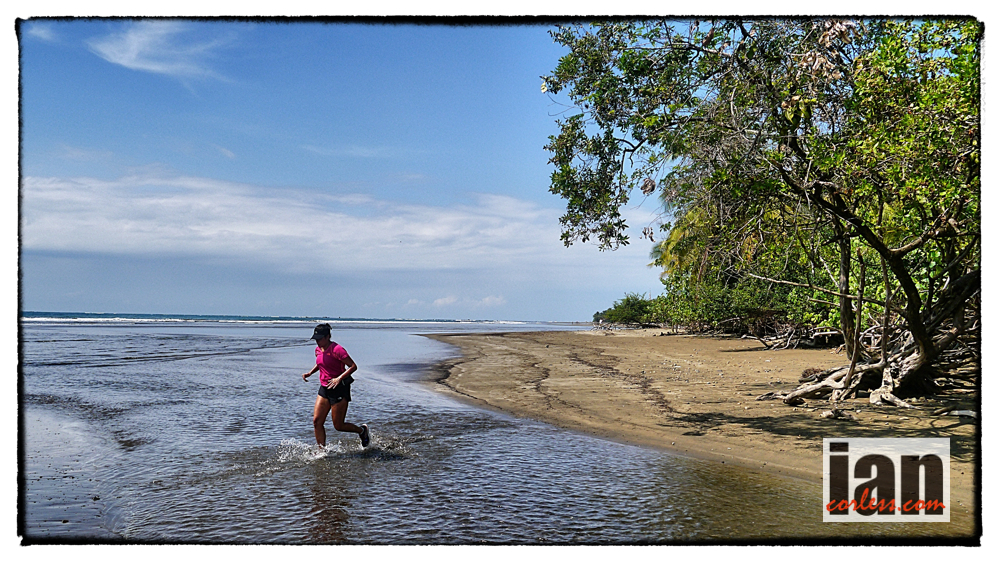
Costa Rica, The Coastal Challenge ©iancorless.com

IC Wow, you are the perfect example for all of us. So often I ask this question and I get a blank answer. We all know we should do it but few of us apply it!

JM I am disciplined and I see the benefits. You have to be disciplined but it still doesn’t stop me getting injuries.

IC Ah well, injury can be caused with so many factors.

JM For me it is usually over doing it or being tired.

IC Yes, distance and speed increase injury risk. Slower and longer has more impact but you don’t overstretch muscles or tendons. Listen to your body and all will be good.

JM I never listen to my own advice… I am lucky, we have a gym at work so it makes strength work easy. If I didn’t have that available it would maybe be harder. I have been strict with this for four to five months and I can feel the difference.

IC TCC is still months away, are you planning on doing any trail races for late season in the build up?

Costa Rica, The Coastal Challenge ©iancorless.com

JM Yes, I love to race. I will enter races, from experience, if I enter races too far in advance I get injured, so I have entered a couple of marathons on the road for training and speed. In December and January I will look for options. Of course, options are reduced and conditions will be a little different to Costa Rica.

IC Late and early season events do crop up specifically designed to help people get ready for MDS so you will have some choice. Final question, many may be reading this and they are going to MDS or they may be tempted by TCC. What advice would you give to these people?

JM It very much depends on what you want to get out of it? I shared a tent at MDS with people who wanted to just complete, they wanted to enjoy the race and that is what they did. Set an objective and train accordingly. Ultimately it is all about fun and enjoyment.

IC If you had to give three tips. Three lessons you learnt at MDS that you would take to any race.

JM Good question. I learnt specifics like running in the sand but I guess the need to watch and keep on top of nutrition. Start eating early and don’t wait. Also, keep any eye on hydration and drink to thirst and then finally enjoyment is key! You must enjoy it.

IC I am sure you’re going to really enjoy TCC and Costa Rica. Many thanks for the time and insight into your progression and have fun in the Rainforest.

JM Thanks, as you say, really looking forward to it. It will be a real adventure.

 Links and information:

  • Marathon Des Sables images available HERE
  • The Coastal Challenge images HERE
  • Entry for the Marathon des Sables is available through the UK agent HERE
  • The Coastal Challenge website HERE

WANT TO RUN THE 2014 COASTAL CHALLENGE?

5% discount available using the form below for followers of iancorless.com

← Back

Thank you for your response. ✨

*Please note I will be at the 2014 TCC reporting on the race and capturing images at the invite of the race organisation.
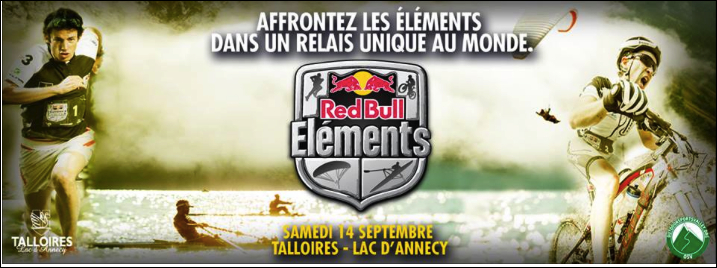
Red Bull Extreme, Lake Annecy 2013 w/ Kilian Jornet

screenshot_345

Extreme by name, extreme by nature, the names of Red Bull and Kilian Jornet are almost a match made in heaven, equally renowned for pursuing the extreme.

Red Bull pursue the extreme in everything that they do… skateboarding with Ryan Scheckler, Ryan Doyle with Parkour, Travis Rice on a snowboard and so on, irrespective of the athlete or the sport, Red Bull push the boundaries.

View a video of the 2012 Red Bull Extreme

HERE

It seems appropriate that the third edition of the Red Bull Elements, located at Talloires on the shores of Lake Annecy should once again have the presence of Salomon sponsored athlete, Kilian Jornet.

It’s not the first time for Kilian to experience a Red Bull Extreme event. He is a two-time winner after participating in Red Bull Elements with his Font Romeu Team. However, he can’t win single-handed. Red Bull Elements is a one-day multi-sport adventure race. Competing as a team relay, the race celebrates three elements – air, earth and water – through four sports,

Rowers, runners, paragliders and mountain bikers join forces to compete in the same outdoor world! The race is a pure concentration of endurance sports. Uniting all those involved. It creates a dramatic and extreme event.

©copyright .iancorless.com.iancorless.orgP1050995trofeokima

On Saturday, September 14th, 216 athletes grouped together in 56 teams will start an adventure with rowers covering 14km in Talloires bay.

Image from redbull.fr ©redbull

Image from redbull.fr ©redbull

Handing over to the trail runners, Kilian Jornet and his adversaries (such as Salomon teammate, Michel Lanne) will then climb eleven kilometers covering a vertical gain of 1914m with only 25m of negative gain!

Image from redbull.fr ©redbull

Image from redbull.fr ©redbull

Image from redbull.fr ©redbull

Image from redbull.fr ©redbull

At the summit, paragliders take over and they descend to a rendezvous with the final discipline; mountain biking. A final breakneck descent to Talloires village culminates the event.

Image from redbull.fr ©redbull

Image from redbull.fr ©redbull

Of course, this event is not about Kilian Jornet. On the contrary, he is very much just one cog in a very important four-person team. However, my emphasis and sport is running and in particular mountain and trail running, so, the question remains; can Kilian improve on his extraordinary performance from 2012? Last year, Kilian Jornet completed the 11 km of ascent in less than 1h: 20m. For sure, Michel Lanne will push him all the way to the summit. I just wish I was in Annecy to watch the action unfold… it really looks quite an incredible event!

Links:

Race Website HERE

Race Information HERE

 For more information and inspiration, take a look at:

The Toughest Team Race in the World – Red Bull Dolomitenmann 2013

THE BUFFALO STAMPEDE brings Skyrunning to Australia

iancorless.com

“The purest form of mountain running … getting to the top of a mountain and back down again as quickly as possible. It’s the athlete versus the mountain. It’s not for the faint‐hearted. It’s definitely a significant challenge and the athlete needs to know what they are doing.’ Marcus Warner

For the very first time, Australia has a new trail running event which is part of the internationally prestigious Skyrunning brand that attracts top athletes to the top of the world, where earth and sky meet.

Officially launched today, the Buffalo Stampede in the Victorian alpine country is expected to attract a bumper field of talented local and overseas runners as it forms the foundation stone of a planned Australia‐New Zealand Skyrunning series.

©buffalostampede

©buffalostampede

To be staged on April 5 and 6 next year (2014), it is hoped that ultimately the Buffalo Stampede will join the elite list of Skyrunning World Series events like the Mont Blanc Marathon in France, Speedgoat 50 in the USA and the Mount Elbrus Vertical Kilometre in Russia.

Skyrunning as a recognised discipline traces its roots back to Italian mountaineer Marino Giacometti and fellow enthusiasts who started pioneering races and records on famous European peaks like Mont Blanc in the 1990s.

Today the sport is managed by the International Skyrunning Federation and features superstars like Spanish alpine master Kilian Jornet.

Kilian Jornet, Matterhorn ©iancorless.com

Kilian Jornet, Matterhorn ©iancorless.com

Marcus Warner, the president of Skyrunning Australia and New Zealand, says the Buffalo Stampede embodies what Skyrunning is all about: “The purest form of mountain running … getting to the top of a mountain and back down again as quickly as possible. It’s the athlete versus the mountain. It’s not for the faint‐hearted. It’s definitely a significant challenge and the athlete needs to know what they are doing.’

The Buffalo Stampede, Warner says, will finally “put Australia on the map’’ of Skyrunning because it will finally convince overseas runners that Australia possesses the terrain to stage a serious mountain running challenge. “Elevation is really what drives the difficulty of it. [The organisers] have really sought out the most extreme mountain in Australia that really embodies Skyrunning because of how steep it is. Nearly 5000m [of elevation gain] over 75km is up there with some of the best races in the world. [Elite overseas runners] are going to go away pretty sore and pretty beat up from this race.’’

Lauri Van Houten, Executive Director of the ISF had this to say, “Of course we’re very excited about the launch of ANZ skyrunning in the capable hands of Marcus Warner and his associates and with the support of an ambassador like Anna Frost.  In global terms Skyrunning has been active in Malaysia and the Philippines for many years and more recently,  South Africa and China. Australia and New Zealand was included as an ISF member at our last General Assembly and, as the home of many great runners, they can’t help but make their mark on the sport!”

Mick Donges - ©buffalostampede

Mick Donges – ©buffalostampede

The Buffalo Stampede has been organised by Sean Greenhill from the respected outdoor adventure company Mountain Sports.

A passionate trail runner himself, Greenhill already stages popular trail running events like the Glow Worm Tunnel Marathon and the Sydney Trailrunning Series.

He chose Mount Buffalo National Park in Victoria as the venue for the Buffalo Stampede Ultra SkyMarathon (75km) and Buffalo Stampede SkyMarathon (41.4km) because it is one of the few areas in Australia where he could satisfy the exacting Skyrunning rules about vertical gain.

No other runs in Australia over similar distances will have as much climbing as the Buffalo Stampede Ultra SkyMarathon (4545m) and the Buffalo Stampede SkyMarathon (2924m).

“I can’t think of a marathon in Australia that comes within 500m of gain of the Mount Buffalo SkyMarathon,’’ Greenhill says. “They are, in terms of elevation gain over distance, the most difficult events of their kind in Australia.’’

And because it is the eroded magma chamber of an extinct volcano, Mount Buffalo boasts a spectacular granite terrain like no other peak in the Snowy Mountains.

Greenhill also chose Mount Buffalo because it allows him to start the Buffalo Stampede events in the beautiful town of Bright, which he loves for its alpine scenery, fine food, local produce, boutique beer and outdoor sports culture.

Trail to Cathedral ©buffalostampede

Trail to Cathedral ©buffalostampede

Clayton Neil, the manager for economic development with Bright’s Alpine Shire Council, said: “We see the Buffalo Stampede as a really strong addition to our events calendar that really aligns with where we are heading. It embraces being active in nature and living life outside. Bright has always been a popular place for people who love the outdoors and this event takes that to another level.’’

Although the Buffalo Stampede races will be among Australia’s toughest, they are open to entry from anyone, with no qualifying needed.

Up for grabs in the Buffalo Stampede are tickets to the 2014 Skyrunning World Championships to be held next June in the famed French alpine resort of Chamonix, at the foot of Mont Blanc

A three‐day Buffalo Stampede training camp based in Bright will be hosted by top Australian trail runners Brendan Davies and Hanny Allston from January 17 to 19.

Brendan Davies  inov-8 ©iancorless.com

Brendan Davies inov-8 ©iancorless.com

Davies raced in the Skyrunning Mont Blanc Marathon this year and will be competing in the Buffalo Stampede Ultra SkyMarathon in April in the hope of winning a ticket back to the slopes of Mont Blanc for the Skyrunning World Championships.

Davies, a Mountain Sports ambassador for the Buffalo Stampede, said: “The Skyrunning label brings with it a lot of credibility. It puts [Australia] on the world map as a destination for the world’s elite trail runners. For Australian runners, it gives us the capacity to dip our feet into the Skyrunning series without having to travel overseas. It’s just a plus for the sport. I see it as a real positive for everyone. I’m going to be going all out for that race.’’

Race Stats:

Ultra Stampede

  • 75.5km
  • Elevation gain 4545m
  • Elevation loss 4545m
  • Max altitude 1380m
  • 8 aid stations
  • 15 hour cut off

Stampede Marathon

  • 41.4km
  • Elevation gain 2924m
  • Elevation loss 1941m
  • Max altitude 1380m
  • 4 aid stations
  • 10 hour cut off

Go to www.buffalostampede.com.au for more details about the Buffalo Stampede.
Sean Greenhill is available for interviews on 0409 047 714 or via sean@mountainsports.com.au

LINKS

  • More information on Skyrunning available HERE
  • Buffalo Stampede on Facebook HERE
  • Buffalo Stampede on Twitter HERE
  • Race Website HERE
  • Skyrunning ANZ website HERE
  • Skyrunning ANZ on Facebook HERE
  • Skyrunning ANZ on Twitter HERE

Ultra Trail World Tour (UTWT) response from FPerrin

Hi Ian,

I will try to answer as clearly as possible. I understand that you want the progression of the sport. Be assured that I feel the same. I am open to any discussion if it can make the project better.

1. It’s an ultra world tour over multiple distances and terrains. Therefore, does a runner need to do different distance and different terrain to be the world champion?

Maybe was I not clear enough during the presentation, sorry for that. The runner who will
have the best results at the end of the Ultra-Trail World Tour will
be the “UTWT 2014 Champion”, NOT the “Trail Running 2014 Champion”!
For me, it is a completely different vision.

2. Your criteria stipulates a minimum two editions, min 500 entrants and
open to ALL! What will happen with races like Western States? It’s
a lottery with only 20 guaranteed places and an entry limit under
500. More like 397 entries.


There was a precision of “around min 500 entrants” :-)… the first objective of the project was to bring together the most emblematic races of the world, the races of all our dreams… well… we could not imagine it without the Western States… “Open to all” means for us that elite athletes and average runners are running together, that the races are not reserved for elites. The UTWT will change nothing to the entry rules of the different races. The WS100 has its specific rules, the UTMB too, and the UTMF… each race will keep complete control over its organization.
3. How will a multi stage race such as MDS fit into this series? And
are you planning to add more multi day events?

Well, some of us ran it, and are completely sure that the MDS has all its place in the UTWT, that it shows all the diversity of trail running. The race directors all agreed on this initial list which will soon be completed with other races.

4. It would appear, at least to me that the UTWT may almost be perceived as a travel agent to a series of races over the world. What are the benefits that
UTWT will bring to elite and non-elite runners? Why would we join the UTWT?

For non-elite runners, but also for elite runners, the main reason is -for me- the “challenge” over the years, and the promise to discover different races, terrains, people, countries. The project was born at the UTMF this year: we were discussing how enriching it was for us to discover this country, the runners from Japan and from other countries, the specific trails of Mt. Fuji… We started to list the races that we had already finished, and our “wish-list” races… and it all started. This project is about culture, passion, traveling, and common values. For elite runners, I hope that they will have the same motivation than non-elite, but I think that an other reason should be -for me again-be part of a circuit which story will be told all over the year.

5. Do the runners need to purchase ‘The Passport’?

The first idea was to make it free.We will decide it with the race directors, but maybe the runners will have to pay a small participation if we send it through postal mail.

6. Does it cost each runner any extra to be part of the UTWT?

No.

7. What are the races paying to be part of the UTWT and what does that bring what are the benefits?

They pay a contribution of 15’000 EUR, which will be 100% used for the promotion of the Ultra-Trail World Tour, and the travel fares of the athletes.

8. Who is the UTWT? Who are the people involved, for example WAA, UTMB all seem involved. Can we have clarification?

The 2 main partners (and operationals) are Jean-Charles Perrin (eco-trail de
Paris race director), and myself, Fabrice Perrin. We are not relatives. Cyril Gauthier from WAA is also involved (no operational role), and we asked Catherine and Michel Polett (from UTMB) to be part of it too, but they have no operational role.

9. What are the elite packages. It was mentioned that they will get travel and hotels for Elite1. Is this open ended, will all eligible elites get this package?

We will try to help the athletes at the maximum (travel and lodging), with the money that we will be able to raise. We will discuss this fall the rules with the race organizers.

10. What prize money will be available at each race and will prizes be split. Elite and non elite?


Each race will keep its rules. Some have prizes, some not. The UTWT will not change this.

11. A world champion is awarded each year, make and female. What do they get, what remuneration will the world champion receive and in addition, will you have non elite world champions too?

No “remuneration” is planned so far for 2014. Again, I would like to precise that it will not be a “world champion”, but an “UTWT Champion”. The non-elite will be in the same ranking than the elite runners.

I would like to thank the UTWT and Fabrice for the answers to the above questions. It really does clarify some initial questions. I am sure more questions will arise and I feel confident that the UTWT will provide responses as and when required.

Tor des Geants 2013 – Race Preview

tordesgeant-_logo_net

Today is the day. The Tor des Geants begins and 757 brave souls will depart to tackle 330km’s in an individual way. Sounds funny doesn’t it, an individual way, but you see, the organization do not impose any compulsory stages. You start and it is the first to the finish. The runner who completes the race in the shortest time is the outright winner and therefore, this race is not only about putting one foot infront of the other, it is also about when you stop and for how long. It is a tactical race.

Map

The race is the first of its kind to cover an entire region. Taking place in the Gran Paradiso National Park and the Mont Ayic Regional Park, the route takes in the spectacular paths at the foot of the highest ‘Four Thousanders’ in the Alps.

It is a unique race. It is survival!

Young American, Nickademus Hollon, the youngest ever runner ever to complete the infamous ‘Barkley’ has been specifically training in the area for months and just yesterday he said:

“Tomorrow I embark on probably one of my greatest ultra-running adventures to date. The Tor des Geants. 330km (205miles) and 24,000m (79,000ft) of elevation gain. I’ll be honest with you all, my minimum goal is 72hrs, that’s 4hrs beneath the previous years course record. To do this I’ll need my mind, body and spirit all aligned. Quite like the magic that possessed me during the fifth loop of the Barkley Marathons this year. I’ll be calling on that again shortly. I ask that you all be the wind at my back and help propel me forward : ) This will hopefully be a great leap forward for the United States in the Spain dominant European running world. Thank you all for your past and continued support!”

The Tor des Geants will start on the 8th September at 1000am and the imposed deadline of 1600 hrs September 14th is in place. A maximum allotted time of 150 hours.

Participants must have the following mandatory equipment:

◦       A backpack

◦       A supply of water (1 liter minimum)

◦       ACup

◦       Food supply/reserve

◦       Two torches in good working condition with replacement batteries

◦       Survival blanket

◦       Whistle

◦       Adhesive elastic tape for making bandages or a strapping (mini 80cm x 3 cm)

◦       Water-proof gear for protection against bad weather conditions in the mountains

◦       Running trousers or leggings covering at least the knees

◦       Hat or bandana

◦       gloves

◦       phone

◦       altimeter

◦       warm clothing

The Route

The race starts and finishes in Courmayeur. The route takes place through the two High Aosta Valley roads. Participants, can choose their speed and must complete the race in less than 150 hours. Runners are partially independent and more than 40 supply points are available throughout the route

Measuring 330 km long with 24,000 vertical meters, the route takes the High Road No. 2 to the lower valley. The return is the Haute Route No. 1 to Valdigne and Courmayeur. It crosses in particular the natural park of Mont Avic National Park Gran Paradiso. During the race the runners will pass 25 passes at over 2000 meters, 30 lakes and reach a high point of 3300 meters.

Winning times from 2012:

Oscar Perez 75h 56m 31s

Francesca Canepa 85h 33m 56s

Who should you watch?

First things first. 330km is a long way and anything can happen. 757 runners are listed on the start sheet and of course I don’t know all of them or even pretend to. I have selected several people that I know and who do well over this type of terrain and distance. Without doubt I will miss several names, so, if you know a ‘one to watch’ let us know on the reply form below.

The Men

Last year’s winner, Oscar Perez is back and gets no1 billing. He knows the route, the course and knows how to manage the race, come out the other side and win.

Gregoire Millet, 2nd in 2012 is back and will be looking to go one place higher and top the podium. He was only three hours behind Oscar last year and I am sure he will have been looking at his stretgy and thinking, how can I make up three hours? Less sleep maybe…

Christophe Le Saux at MDS 2013 ©iancorless.com

Christophe Le Saux at MDS 2013 ©iancorless.com

Christophe Le Saux is also back. Like Oscar, he knows the course like the back of his hand and he knows how to manage his effort. He placed 2nd in 2011 in a time of 84:09:46 and 3rd in 2012 in 80:14:14.

Pablo Criado Toca at Ronda dels Cims ©iancorless.com

Pablo Criado Toca placed 3rd in 2011 and returns this year. His time of 89:43:07 is a long way from Oscar’s 75:56:31 but as I keep saying, anything can happen and experience is paramount in a race like this.

Iker Karrera ©iancorless.com

Iker Karrera ©iancorless.com

Iker Karrera is the big name joining the fold and as many of you will know, this Salomon athlete is meticulous in his planning. Iker however isn’t coming to this race fresh. He recently raced and won the Grand Raid des Pyrenees (160km and 10,000m+) in 24:54:56 which was just on the 24th August. For sure, great prep but that must leave you tired? Iker is one to watch and potentially win at Tor.

We have mentioned Nickademus Hollon, he hasn’t raced here before and he has been very open about the challenge ahead. However, he has been in the mountains for weeks and been all over the course. He knows what he is doing! Without doubt, Tor des Geants is as much about the brain as the legs and Nickademus is a master of this. He has proven it with a finish at Barkley. I think we will see Nickademus create a surprise in the Aosta valley.

Arnau Julia Bonmata ©iancorless.com

Arnau Julia Bonmata ©iancorless.com

Arnau Julia Bonmata won TDS last weekend and like Francesca Canepa, he attempts the double! It’s a tough ask, particularly when you look at the competition at the front. He’s a great guy and if anyone can pull something out of the bag, it is Arnau but he is going to feel his TDS efforts for sure.

Of course I have to mention Bruno Brunod. I don’t think Bruno will contest the win but a legend of Skyrunning deserves a tip of the hat. I wonder; what can he do…? I also wonder if we may well see Kilian Jornet pop up on route to offer some support and encouragement.

Stuart Air leading Terry Conway at Ronda dels Cims ©iancorless.com

Stuart Air leading Terry Conway at Ronda dels Cims ©iancorless.com

Finally, a surprise package may very will come from Brit, Stuart Air. Stuart placed in the top 20 at Ronda dels Cims and then Ice Trail Tarentaise. He will be pretty much unknown to all the others in the race but he has grit, determination and he comes to this race prepared. A surprise package for sure!

Other names to watch: Franco Collè, Mario Gazzola and Patrick Bohard.

The Ladies

Francesca Canepa ©iancorless.com

Francesca Canepa ©iancorless.com

Francesca Canepa pulled off the remarkable double in 2012. She placed 2nd behind Lizzy Hawker at the shortened TNFUTMB and then just 7 days later, turned up at Tor des Geants and won in 85:33:56. Francesca has had a great year and her win at the tough Ronda dels Cims is surely a great sign for Tor. However, she dropped from last weeks TNFUTMB. Francesca is odds on favorite.

Patricia Penza placed 2nd in 2011 in a time of 102:25:42 and placed 3rd last year in 97:06:15. It’s all about experience and being able to put one foot infront of the other. Patricia may not be the fastest but she can last the distance and time and sometimes that is all it can take to win!

Giuliana Arrigoni placed 3rd in 2011 and was just a minute slower that Patricia Penza. Pretty sure she will be back to move up the podium and be one place higher than Patricia in 2013.

Sonia Glarey is back after a strong 2nd place in 2012, her time of 96:59:54 was nearly twelve hours slower than Francesca, but if Francesca is not 100% we may see that gap close and a real battle unfold.

Nerea Martinez  ©iancorless.com

Nerea Martinez ©iancorless.com

Nerea Martinez is also on the start list but I had heard rumours of injury. This has not ben confirmed. If she is in good shape and fresh I predict a podium place.

Australian, Samantha Gash is also on the start sheet. This will very much a departure for Samantha. However, she is used to long days and repetitive days on the trails. The Tor course though is something very different to what she has experienced in the past. It may well just be a big learning curve but she does have the grit to push, survive and make it to the front of the race. It’s an exciting prospect and one the Europeans won’t be expecting.

Other names to watch: Moses Lovstad, Giuliana Arrigoni, Cecile Bertin, Fedrica Bifana, Patrizia Cantore and Janet Ng.

Live Tracking:

?…. won’t stop me running an ultra!

©copyright .iancorless.com.P1140619


So I asked the question, “?… wouldn’t stop me running an ultra!”

Cassandra Cisneros Chemo
…

Andre Blumberg Noise about UTWT and TMs
…

Carla Murphy Arthritis and tin-man (girl) knees, ouch…

Mick Wren Hallucinating my very own alternative reality…

Matt Burton Averaging 12 miles a week in training…

Holly Rush Work…

Rob Pinnington The shits
…

James Harris My little legs…

Richard Ashton Being savaged by a massive dog…

Richard Hill the word “massive” is so subjective…

Emily Willemin My asthma! It knows not to mess with me on race day or I’ll just go further next time…

Richard Hill The wife…

Cameron Adamson Not paying 80$ for the grand slam…

Matt Dooley Failure…

Peter G Smith Age…

Dan Park Apocalypse…

John Hitchen *I*…

Kristen Moegling My head…

Sean Sweetman Glandular fever…

Colin Stables Peoples perception of me…

Sarah Haworth A broken toe…

Hermie Roque Saludes Colds and a slight fever…

Dennis Both Mørk Nielsen a sprained big toe…

Russell Thomas Going base over apex 10hrs into TDS, and having to hobble the next 40 miles…

David E. Jackson Injury…

Chris Valenti Self doubts. No, actually, it probably would…

Craig Eccleston The pain I endured running a marathon…

Chris Tack Spending the winter training season in Afghanistan…

James Stewart Not having an available episode of Talk Ultra to listen to…

Ed Kumar Parkinsonism
…

Carolyn Mankiewicz-Shreck Fear…

Graham Millington Achilles Tendonitis even though it really should if I were sensible. . But then I wouldn’t be running an Ultra…

Jane Benson Arthritis in the lumbar spine. My very overweight consultant said I should quit. I went onto win 2 events and have learnt to train effectively without the junk miles and get off road more…

Lior Sion Wild boars at night. As of this morning…

Simon Pavel T Miranda an upset stomach…

Michael Feehan An ileostomy due to crohn’s disease…

©copyright .iancorless.com.P1140766

Thanks for the great input and thoughts… add your thoughts below.

UTWT – Ultra Trail World Tour analysis

“We could make runners stash their own gatorade bottles (glass) and run with the horses, but it’s not 1974.” Craig Thornley, Western States race director.

It’s a good place to start. The world of trail, mountain, road ultra running is changing. In recent years we have seen rapid growth. Runners, elite and non elite want to test themselves on ever demanding courses and ultimately test themselves against each other and see who comes out on top.

However, ultra running is not quite like any other sport. It places extreme demands on the body. Pushed too hard and the body breaks… ask Geoff Roes what he thinks.

So, although an Ultra Trail World Tour sounds attractive caution is needed. But before we worry about those aspects, we first need to look at what this UTWT entails.

The UTWT was launched on September 1st amidst the Ultra-Tour du Mont-Blanc. The fact that the race was not over and that many runners were still trying to get to the finish line may well have been a touch of bad timing. Admittedly though, many press leave immediately after the event so this may very well have been a logistical issue.

One by one, the initial races were announced and with them a representative from each race came to the stage.

2014 confirmed races are as follows:

  • January 18th Vibram Hing Kong 100
  • March 1st The North Face Transgrancanaria
  • March 15th Vibram Tarawera 100km
  • April 4th to 14th Marathon des Sables
  • April 25th Ultra Trail Mt Fuji
  • June 27th The North Face Lavaredo Trail
  • June 29th Western States
  • August 29th The North Face Ultra-Trail du Mont-Blanc

So, this takes us up to August and apparently other races have been asked to participate and we can expect confirmation of these, on or before September 15th.

Of course, alarm bells initially ring at the presence of Western States. Secondary alarm bells ring at the presence on Marathon des Sables but I will come onto that later.

How does it work?

The UTWT will propose an international competitive circuit in partnership with the International Trail Running Association. The events should already be open to the widest public and will offer ‘everyone’ a unique chance, throughout each year, to participate. Question: How does that relate to Western States with limited capacity and demand far outweighing places available? Also, Marathon des Sables… UK entrants for example are on a three year waiting list.

In each race points are awarded to every runner and therefore at the end of the year, a male and female UTWT world champion will be announced. To attract elite athletes, certain events will have Ultra Trail Series status and these will offer more important weighting in the ranking. (I assume this will be for races like Western States?)

Runners will be presented with a Passport. This can be ordered online before the end of the year, it was not made clear if these passports need to be paid for? When you complete a race, you are awarded a visa, this is added to your passport and shows your completion.
The minimum race distance will be 100km, races must have had two previous editions to qualify and already have 500 minimum participants (again, Western States has less than 400). A minimum of twenty countries will be represented and be emblematic venues.

So, how do you become World Champ?

All finishers in every race will be awarded points according to his performance. These points will be added to the International ranking and updated after each race. This ranking will be available on line at the UTWT website. The circuit will be an International competitive circuit in partnership with the ITRA (International Trail Running Association).

As mentioned, a limited number of races will be called Ultra Trail Series and you may only use two best performances from these races in building up points for the world title. In total, three races score, so, you could have two UTS races and one other.

A world champion lady and male will be announced each year.

ANALYSIS

Okay, first and foremost, we don’t have the complete picture, so, you will need to be patient.

The press conference was slick, enticing and all was going well until a call for questions came. I jumped in and asked about Western States…

It’s not just ‘any’ race, it has a limited field, it’s a desirable race, what is the impact and so on a and so on.
The answer was vague and very unconvincing. In actual fact it was embarrassing. One comment that came from the stage was, “it’s early days and we haven’t worked these things out yet”. Not a good start.

One journalist asked several questions:

Will you have doping control? YES

Will you have prize money? EACH INDIVIDUAL RACE CAN HAVE PRIZE MONEY, IT’S UP TO THE RACE. We did not have clarification though if the world title had a prize, other than the ‘title’ of world champ.

What will the elites get? ELITE 1 RUNNERS WILL GET TRAVEL AND HOTELS PAID FOR. But they never clarified if that is open to all elite 1. Lets say 50 want to do Western States, will they all get hotels and travel?

The series very much seems like the Skyrunning concept, is this competition or are you offering something different?. THE RACES WILL BE 100km OR MORE AND ON VARIED TERRAIN, SKYRUNNING WORK TO A SPECIFIC FORMAT AND WITH THE ODD EXCEPTION, ALL RACES ARE UNDER 100k. I agree, the UTWT is very different to Skyrunning, it is taking some principles from the Skyrunning ethos, for example, a series of races, three qualify out of five and the winner is world Skyrunner champion but the terrain is varied. Skyrunning look at altitude and technical.

At this point, the stage participants could feel more and more questions were coming and the conference was drawn to a close quite quickly.

Overall, it started well and ended badly. It certainly appears that the UTWT team wanted to maximise the UTMB as a platform to launch but they had far too many question marks and lack of answers to leave me feeling reassured or convinced.

POINTS TO CONSIDER

I have to say, I like a championship that includes mixed terrains and distances. That will provide a true rounded athlete. However, the UTWT never specified how runners enter, so, for example, to qualify, do you have to do one 100k, one 100m and one stage race? Do you have to do one on sand, one in the mountains and one jungle for example? Without this specified, I could maybe do three 100k races on fast trail and get maximum points if that is what I was best at? We need clarification.
World destinations, iconic races are great. I can see the beauty and excitement of going to New Zealand, Hong Kong and so on, BUT these races already exist and to be honest, if I went to one it would be highly unlikely I would go to another. Far too expensive for the average pocket.
Travel and hotels for elites are all well and good but who is paying? Surely that is what sponsorship from a team is about. I am we’ll aware that places are offered and expenses paid already exists but this is very much in conjunction with a race, the RD and the athlete. Blanket travel and hotels need to be paid for and by someone and that will come down to the everyday runners and the races themselves who I am assuming are paying a yearly fee to be part of the UTWT. Transparency is needed here. Many figures have been mentioned that ravces are paying 15,000 to 30,000 euro to be part of UTWT. I believe this to be speculation.

The UTWT title needs additional incentives. Prize money! However, that has no bearing on all the other runners. I can’t help but think that only a small few (who are rich enough) will travel to several continents to experience the world tour.

What will the races get out of it? Well, recognition and exposure for one. But, I know I go back to Western States, does that race need more exposure… Does it need more entries, does it need more PR? Same applies for UTMB, you already have to get points and enter a lottery, so, if you get a ‘Passport’ does it mean you get automatic entry in a UTWT event? Confusing!

MDS is a completely different race to all the others, to have just one stage race and no others would be long term problematic. In addition, I am not even sure it should be in this series. A great race but is a unique race.

We also need to think about the runners, all the runners. The calendar is increasingly becoming larger with more and more choice. Do we really need to insist that participants run three races over 100k to be a world champion? In addition, for this to be a true championship, one of those three races would need to be a 100-miles.

Ultra is not always better when longer. I wonder if some races under 100k should be allowed?

Why not have an Ultra World Tour and include road? Comrades is an iconic race for example and surely a true ultra world champ should be able to run road too?

Are we seeing the creation of an ‘Ironman’ for trail or is this ‘just’ a series of races with quite simply a world title?

I’d like to know who is beyond this with clear transparency. I have experienced many things in the last twelve months that I have questioned and now suddenly they all add up. For example, late 2012 WAA (What an Adventure) became the official pack for MDS. At the 2013 MDS, Catherine Poletti was present at the finish in the Sahara and then WAA became the official supplier of the blue UTMB bag. Also, I believe that Catherine Poletti visited Western States to view the event… So, is the UTWT an extension of the UTMB organisation and what does it mean? Is this good or bad? I merely ask the question.

At this stage we do not have any answers. Paul Charteris from Tarawera ultra was prepared on Sunday at the press conference, although he did not attend he was online and responded to my tweets. He also had a press release ready and he has been open and transparent. Equally, Transgrancaria have been proactive and the team at Lavaredo I spoke with personally. They all want the races to be valued, increase in size and stature and be part of something bigger. I think Craig Thornley and team are having a harder time. Western States is the holy grail and change here will be difficult and in many cases not welcome. The sport must move on and grow and that means all the sport, Craig in many ways is correct when he tweeted, “We could make runners stash their own gatorade bottles (glass) and run with the horses, but it’s not 1974.”

So what do YOU think?

I don’t have the answers and I will have missed many points. Please provide some input.

*Please note, for reasons of clarity, I do work alongside the ISF Skyrunning Federation and my thoughts and comments in this posting are impartial and with the pure objective of what is the best for our sport.

Ultra Trail World Tour announcement (UTWT)

Ultra-Trail® World Tour: bringing together the most emblematic trails (of 100km or more) in the World.

Chamonix, 1st September 2013
The organizers of:

– The Western States 100 Mile Endurance Run
– Marathon des Sables
– The North Face® Ultra-Trail du Mont-Blanc®
– The North Face® Transgrancanaria
– The North Face® Lavaredo Ultra-Trail
– Vibram® Tarawera 100km Ultramarathon
– Vibram® Hong Kong 100
– Ultra-Trail® Mont. Fuji

have today announced at Chamonix their participation in the 2014 Ultra-Trail® World Tour.

International circuit, shared values
The races in the Ultra-Trail® World Tour, in their specific natures, illustrate all the diversity of trail: steep paths of the Alps, California trails, hills and beaches of Hong Kong, Moroccan desert…
The races’ many different formats will present participants with a real adaptation challenge .

Between The North Face® Lavaredo Ultra-Trail and the Vibram® Tarawera 100km Ultramarathon, between the Ultra-Trail Mont Fuji and The North Face® Transgrancanaria, participants will need very different qualities to win, or simply to become a finisher.

While being fundamentally different, the Ultra-Trail® World Tour races will have common values, which they are proud to share and to promote. Ethics, equality in sports, self-respect, respect for others, for the Environment…
Taking part in the Ultra-Trail® World Tour will be the opportunity, throughout the years, to discover cultural and sporting differences. Every continent will be visited: Africa, America, Asia, Europe, Oceania… providing opportunities to enhance their sporting culture, create new friendships, and to feed on emotions in order, one day perhaps, to be a “finisher” in all the events!

Simple criteria of eligibility

Long distance trail running races of at least 100km.
Emblematic venues.
Popular races (around 500 runners minimum).
International events (a minimum of 20 countries represented).
Minimum 2 realized editions
An annual ranking for the award of the title of champion of the Ultra-Trail® World Tour
Any “Finisher”, according to his performance, will be assigned a number of points and be integrated into the international ranking , updated for each race, and available online at http://www.ultratrailworldtour.com site.
The Ultra-Trail® World Tour will propose an international competitive circuit, in partnership with the International Trail Running Association (http://www.i-tra.org).

With the goal of bringing together top athletes, a limited number of races will be labelled «Ultra-Trail® Series». Only the 3 best results should be taken in consideration, with a maximum of 2 “Ultra-Trail® Series”.

At the end of the year, after the last race, the titles of “Ultra-Trail® World Tour 2014” champion, male and female, will be awarded.
Who will win? Encourage your favorites!

A passport for all races
By the end of 2013, all runners planning to participate in one or more stages of the Ultra-Trail® World Tour can order their “Ultra-Trail® World Tour” passport on the http://www.ultratrailworldtour.com site.
Whenever they are “finishers” in a racing circuit, they receive a visa to stick in this passport.
Participation in one of these circuit races will automatically imply integration in the rankings for the Ultra-Trail® World Tour of the given year .

2014, a year full of promise
For its very first year, the Ultra-Trail® World Tour will be present on all the continents, with a dozen venues spaced out throughout the year.
The following have already been confirmed:
– January 18th: Vibram® Hong Kong 100 (Hong Kong, China)
– March 1st: The North Face® Transgrancanaria (Spain)
– March 15th: Vibram® Tarawera 100km Ultramarathon (New Zealand)
– April 4th to 14th: Marathon des Sables (Morocco)
– April 25th to 26th : Ultra-Trail Mt.Fuji® (Japan)
– June 27th to 29th : The North Face® Lavaredo Ultra Trail (Italy)
– June 29th: The Western States 100 Mile Endurance Run (USA)
– August 29th: The North Face® Ultra-Trail du Mont-Blanc® (France, Italy, Switzerland)

Other emblematic races will soon be confirming their participation.

Many questions were left unanswered at the press conference. It felt as though the organisation wanted to monopolise on the media presence available for the UTMB and spread the UTWT news.

Importantly, when I asked questions directly about Western States the answer was less than reassuring. I can’t help but think all those who love WSER will be asking serious questions.

I will update more on this but please respond? Make your points here.

For in depth live coverage from the press conference go to @talkultra twitter feed and follow by blow-by-blow comments from 0930 French time. Or use #UTWT and follow the thread.

More to follow

photo 5

Kilian Jornet – The Matterhorn Summit Interview

Kilian Jornet ©iancorless.com

Kilian Jornet ©iancorless.com

Kilian Jornet – The Matterhorn Interview

August 25th, Zermatt, Switzerland.

©copyright .iancorless.com.P1080830

Translations

Czech HERE, Italian HERE, Spanish HERE, French HERE

It’s the day after the Matterhorn Ultraks and just four days after Kilian Jornet’s successful attempt on the Matterhorn Summit record attempt from Cervinia. It has been quite a few days for this iconic mountain and although Kilian has excelled on both occasions, we all know, the mountain is still the boss.

Kilian arrives with Emelie Forsberg looking relaxed and fresh after a late breakfast. I congratulate him (and Emelie) once again on topping the podium at the Skyrunning Matterhorn Ultraks race and ask him how he feels, ‘I am a little tired but feel good. I was certainly tired in the race but I didn’t push too hard. I just did what I needed to do to win the race’.

Our conversation turns the TNF UTMB and we discuss how the race will unfold for the men and women. Kilian and Emelie are animated at the prospect of Julien Chorier, Miguel Heras, Anton Krupicka and the other contenders going head-to-head. Emelie gets excited at the thought of Nuria Picas in the ladies race, it’s her first 100-mile race and of course Emelie knows the Catalan well. We could talk all day but eventually I settle down with Kilian in a quiet corner and we discuss the Matterhorn.

IC: It’s the day after the Matterhorn Ultraks, firstly Kilian, congratulations on your win! Another great race with Luis Alberto Hernando but maybe what is more impressive is that it comes just a couple of days after your Matterhorn Summits. How are you feeling?

KJ: I feel good. It was a super good race with a great atmosphere. To run with Luis Alberto Hernando was super nice. I was very tired before the race, particularly the day before. I used a strategy for the race to take it easy and take the win in the last kilometers. Yes, I think I was much more tired than in other races this year.

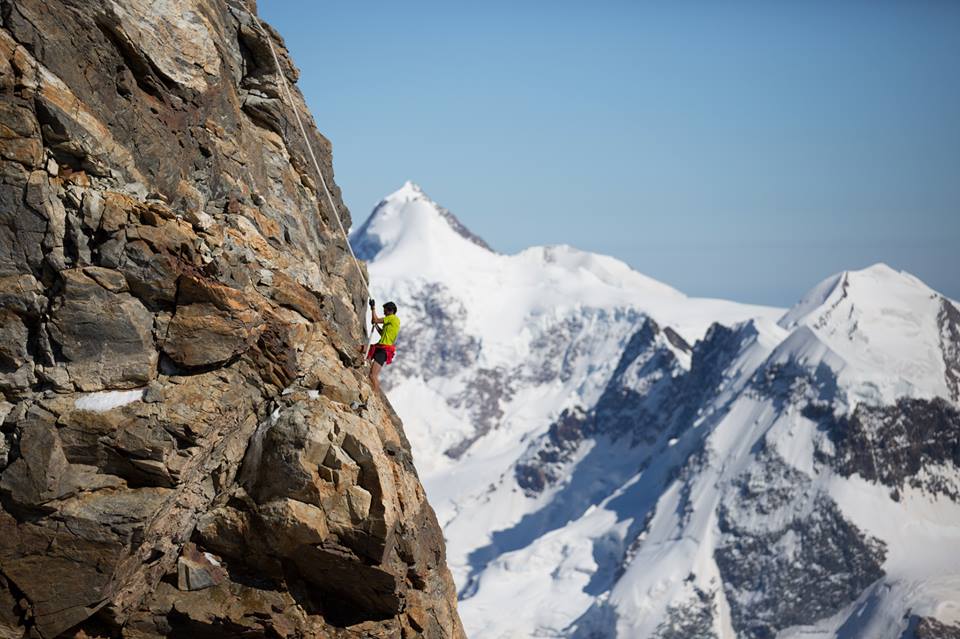
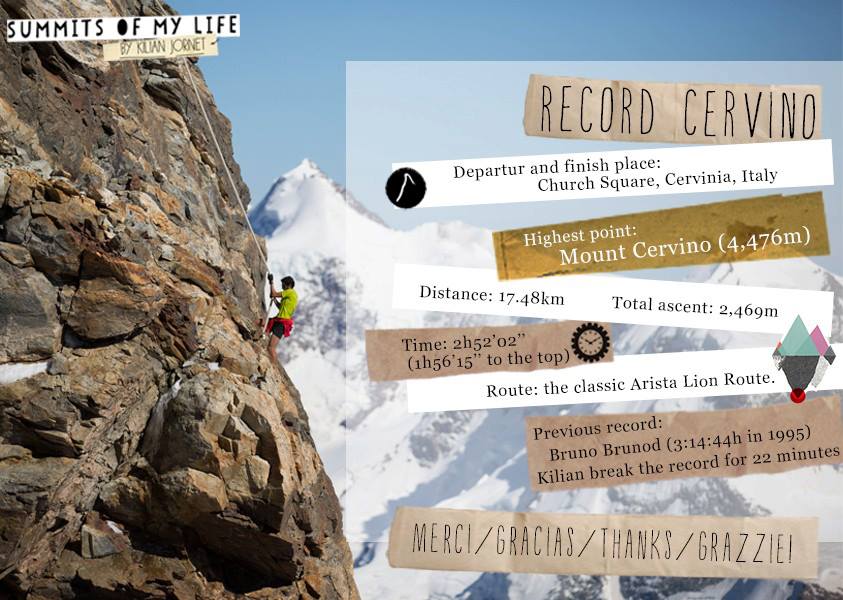
IC: We spoke in the Dolomites and we discussed then that your next Summit would be the Matterhorn. You travelled to Cervinia and you lived here for weeks to train. You had the utmost respect for Bruno’s record of 3:14:44. The Matterhorn is a dangerous mountain. You said you needed to learn the mountain, to understand every step. I think in that time you went up and down the mountain multiple times. Just before your attempt you said that the record was in your grasp… what is it like to look at something that is perceived as being an iconic record, a record from 1995, you said in a quote that it was a record you had dreamt of. Something from childhood that you wished you could achieve. It is a massive undertaking. For you it is more than a record, it’s your life.

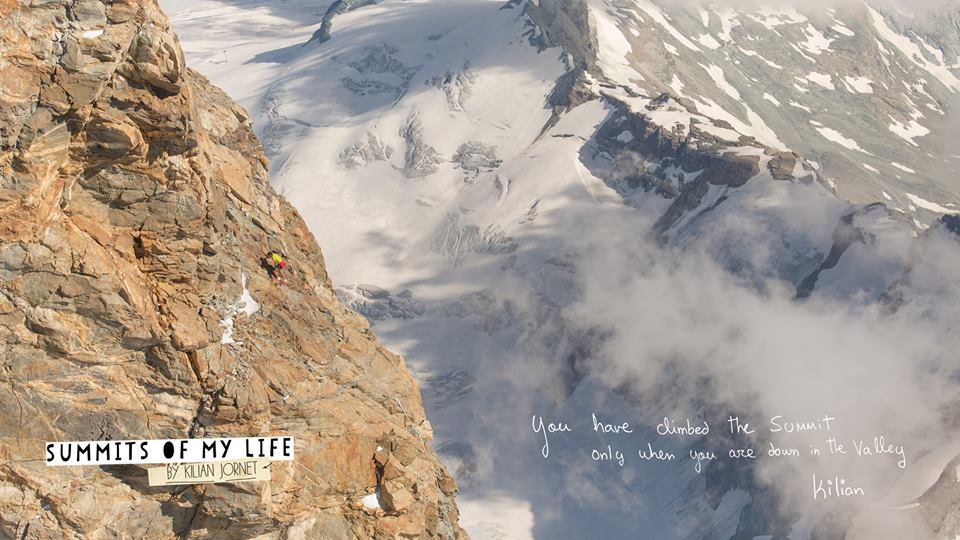
KJ: I remember it well; I was 13 years old. I entered into a mountaineering center; I was talking to Jordi, the trainer. I said at the time that the record was impossible. I spoke to Jordi recently and he reminded me that I was dreaming about the Matterhorn all those years back and about the record. I thought it was the ultimate expression of our sport. It’s a beautiful summit. It has a logical line. It is a hard record, it is push running and climbing, so, it was in mind for many years… more than Mont Blanc and all the other records. About five years ago when I started to think about Summits of my Life, the Matterhorn was my goal. The other summits were really preparation for the Matterhorn and Bruno’s record. For me, it was the most difficult record in Skyrunning and mountain running. For example, Pikes Peak is not Skyrunning. I was really afraid, not of the mountain as I was climbing a lot but of the time. I summited the Matterhorn nine times before the ascent. The first time you climb you become aware of what is possible. You go up and down and say, wow, this is the time I need to beat. After going up and down nine times I think okay, I know the mountain, I am not going to fall, I know this mountain well. I was aware of where I could go hard and where I needed to go easy. However, the morning of the attempt I was nervous. I thought to myself, will I do this record or will I do four hours?

IC: A few people asked why you made the attempt at 3pm; it seems quite logical that the Matterhorn is a busy mountain so I assume the mountain would have been less busy?

KJ: Yes for sure. It is a busy mountain when conditions are good. When I climbed nine times I saw hardly anyone, just two or three teams. I was alone. The week of the attempt we had good days with warm and dry conditions and everyone was on the mountain. Over one hundred teams! So, I was talking with all the guides and the helpers. We asked the question, what do we do? So many people on the mountain and it would have been impossible. My first idea was to start between 7-8am but it would have been crazy to pass people. We decided to start later. It was the perfect decision. It was warm at the summit and I wore just a t-shirt and nobody was in the way. Everyone was going down or in the hut. I just had the safety guides to help. It was perfect!

Kilian Jornet-iancorless.com ©sebmontaz all rights reserved

Kilian Jornet-iancorless.com ©sebmontaz all rights reserved

IC: In the build up to the record, you actually met up with Bruno Brunod. Did he go on the mountain with you or did you just talk about your attempt?

KJ: Bruno said he never climbed the Matterhorn after his attempt. We met in Cervinia and discussed his record. What conditions he had, how he prepared, how he was mentally and then we discussed the rope, the short cuts and how he made time. It is funny, Bruno stopped running in 2003 but last year he started running again and he is now preparing Tor des Geants. He never ran long distances; he was afraid. I said, c’mon man, you are strong, and you can do well in these races.

IC: So, Bruno has gone from no running to doing one of the longest races on the calendar, I guess when you are Bruno Brunod you don’t do things by half. When you go on the mountain to learn and understand, what process does that involve? Do you have several options to attempt the summit and therefore you try them or do you have a defined route and then you put that route in your mind so that you know every step. You know you can push in one place and you won’t slip in another place?

KJ: It’s one route. The Lion Ridge is the classic route and the fastest. It is the historical route and the same as Bruno used and those before him. You work out the differences but it is a thin ridge, you have several places that you can pass but yes, it is about planning. It is about knowing where to put your feet, knowing where to push and when not. I think you need to understand the mountain. You have parts in the west and north face and they are thin in the ridge and you can have ice. If you go in the morning you will have ice. If you go after 10am then this will be water so you can go there. You need to spend time to understand how it works, to understand the mountain and its life. Always in the north face it was icy, so I was aware I needed more care. On the west side I could push harder as the rock was warm and the rubber of my shoes would have better grip. It is important to spend time and understand that exactly. For example, if it is cold or windy, my shoes don’t grip the same as a warm day. I need to know this so I know exactly where to go. It is super important to understand the mountain and how the weather conditions are.

IC: On the face of it, people look at you and think you are very relaxed and casual. I know, I have seen you work and I have seen you study a mountain, you know the history, you go into in depth research to make sure these attempts are correct and that you know what you are doing. It is obviously very important. You have mentioned a simple thing like shoe rubber. Did you have special shoes?

KJ: Yes I tried different rubbers. I always used the Salomon Sense but I had different soles, different grades of rubber. For the attempt I used a softer rubber for grip. In the snow any shoe glides. You just need the technique of a flat foot and the ability to push.

IC: What is great about these attempts in comparison to Bruno, for example, in 1995 I guess Bruno stood in the square in Cervinia and just a few people were around probably having a beer, but Marino Giacometti and Lauri Van Houten were instrumental in Bruno’s attempt. They helped finance it, they arranged the safety, they arranged a helicopter and of course they got involved in your attempt. Fortunately for us we had the opportunity to have Seb Montaz follow the process, for those who know Seb, he is like your self a master of his craft. We have had some great glimpses of your summit; short videos are already on YouTube. Clips of you running a ridge jumping a crevice, or sliding down snow. It brings what you do into perspective. We can talk about you going up and down the Matterhorn but it’s easy to think, ok! But we may not have an idea of the difficulty or danger. These videos convey this. It is an important aspect. Is it a way to record you achievement but is it also a way to attract people to the mountains and also let people understand the beauty and danger?

KJ: It is the second for sure. It is not about my achievement. When I stop it will be in my mind. It is more a learning process. It enables the people to join us in the mountain and it enables everyone to understand. It’s beautiful, it is nice but it is also very difficult. It takes preparation, we do take some risks but the videos help motivate and inform. The way I go the mountain is possible but you need to learn. For me, my summit was the Matterhorn; I understood my capacity, my ability and my technical skill. I accept the risk. For everyone else it may be here or close to the home. We want to show and share that you can be light in the mountains and hopefully more people will understand. I go naked to the mountain.

Kilian Jornet ©laurivanhouten_ISF

Kilian Jornet ©laurivanhouten_ISF

IC: The actual record. You started 3pm from Cervinia. You are in Salomon Sense, shorts, T-shirt and a jacket around your waist. You look like you are going for a run… of course that is what you are doing! You start and in the early stages it is easy and then it becomes tricky, technical, you have ropes, ridges, faces to ascend and so on, how do you process the attempt in your mind. Did you have specific targets, so, did you know what time you wanted to be at a certain place or do you go on feel? I know in the early stages you only had about 3 minutes on Bruno’s record, it was maybe a little too hot but once past a certain point you really opened up time. Of course on the descent you came down super quick. You did 2:52:02 instead of 3:14:44. I believe Bruno predicted 2:52! Were you surprised?

KJ: I was really surprised. When Bruno said 2:52 I said, no way.  I was thinking, I might break the record by 2-3 minutes maximum. Maybe 3:10 would be a good time? During my practice runs I never ran fast because in the hard parts you don’t want to go hard. It’s like a lottery and taking numbers… you leave taking numbers for race day! The only time I went faster was the second day when I trained. I thought, wow, maybe I can beat Bruno’s time. If I am close to Bruno’s time then I can go faster. I spoke to Seb Montaz on the morning of the attempt, he said if you are at the summit within 2 hours it will be so good, you will have time for the downhill. I said, yeah I will be so very happy. When I started the summit attempt it was the afternoon so this was good at the top because it was warm, however, it was warm in the valley too. I don’t like warm. I started with a good pace but it was hard to find the strength. I saw lots of people and friends. Bruno was shouting at me, ski friends shouted, guides from Cervinia, Nuria Picas was there and so on… they gave me energy. I said to myself, I must keep going, I must push. I had Bruno’s time in my mind but I had no prediction of what I could do.

Kilian Jornet-iancorless.com ©sebmontaz all rights reserved

Kilian Jornet-iancorless.com ©sebmontaz all rights reserved

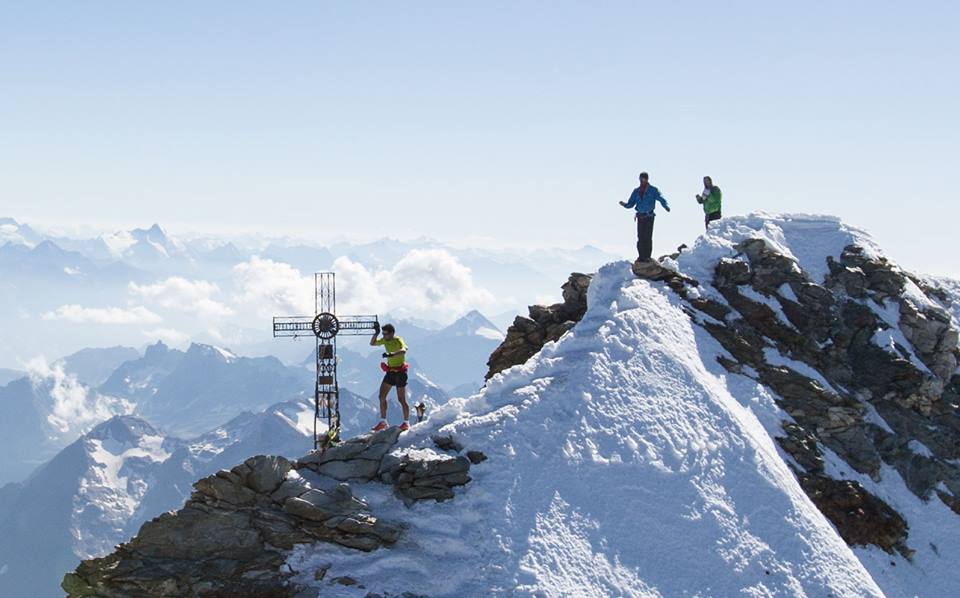
I was close to Bruno’s time until the Leone Col then the ridge starts and then I came into my own. It is where I love to run. It’s technical, you need to climb and you need to push. It is exposed. I love to be exposed on the mountain. From here I was not moving fast but fluid. This is the way to move in this terrain, if you go fast and you go more than you can you will have an accident. Moving fluid allows me to move quickly. I started to gain time all the way up to the summit. I looked at my watch and I saw I was almost 12 minutes in front of Bruno’s time, I said to myself, wow, this is incredible. It is possible! Okay, I said, I can do it. I was happy but I could not disconnect. It is a long down hill to Cervinia; I needed to be sure of every step. The boss of the guides in Cervinia said to me at the summit, you can do it! I started down in deep concentration. I was enjoying it so much; I love to run the technical sections. You don’t push with your legs; you push with your mind. Where to put your feet, where to put your hands, when to glide, when to go faster, when to stop, this is what I love, I was enjoying it so much. When the most technical part stopped, I realized I was almost 20 minutes in front of Bruno; so, the last part was just pushing to the finish.

Kilian Jornet-iancorless.com ©sebmontaz all rights reserved

Kilian Jornet-iancorless.com ©sebmontaz all rights reserved

IC: Myself and many other people were very worried about the Matterhorn. We respected the mountain and we anticipated that you would push; pushing brings danger, so when you got to the summit and you knew you were ahead of Bruno’s time did that mean that the descent was easier, you took less risks than if the time had been very close.

KJ: Yes of course. If I had been at the summit in 2:10 I wouldn’t have come down at the speed I did. I would have taken more risks. I also think that this doesn’t work! Many people who saw me said that I was going down very fast, they said I looked really fluid and that I wasn’t taking risks yet I was very fast. I think this is the way to go down the mountain. If you take risks the body position is different, you can’t glide as well and so on. You lean back and this slows you. If you feel confident, you can go fast. I think maybe I could have gained 6-7 seconds by taking risks. It’s nothing! These 6 or 7 seconds may have been my life… I knew the route very well and I had no need to take additional risks. I just wanted to be confident. My mother was on the mountain and she had bad memories of when she climbed the Matterhorn for the first time but if you climb again and again, you know it’s risky but it isn’t necessary to take risks, it is about being confident.

Kilian Jornet ©laurivanhouten_ISF

Kilian Jornet ©laurivanhouten_ISF

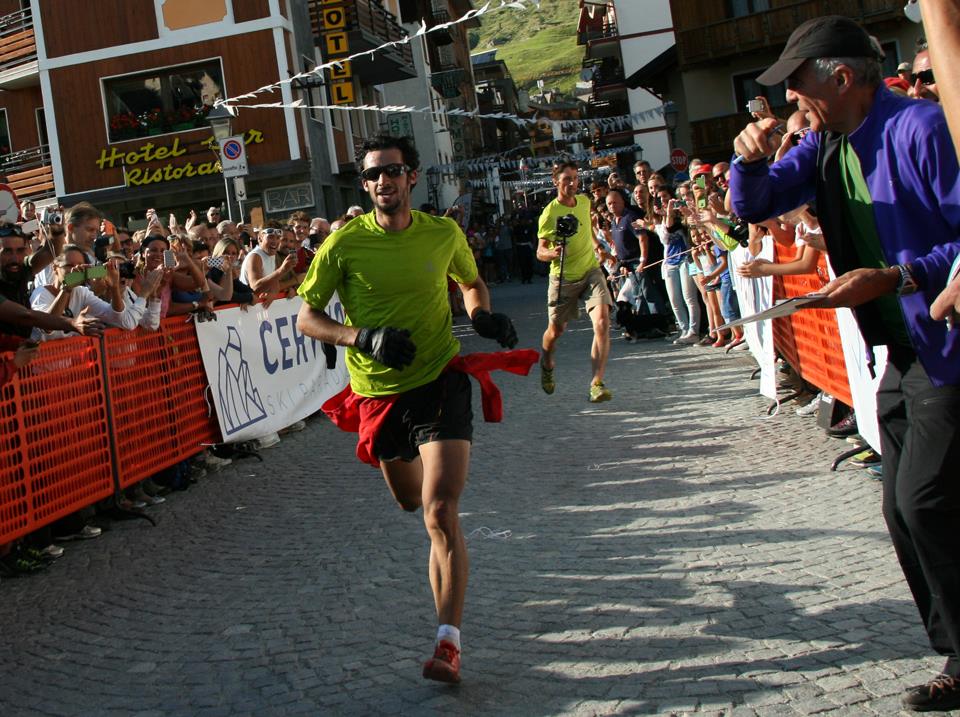
IC: When you arrived in Cervinia, it was like the end of a race. It was incredible. The barriers were out. It was almost like the race finish here in Zermatt. Did this surprise you?

KJ: Yes, I was completely surprised. I was in Cervinia for three weeks sleeping in my van in preparation for the attempt. I was surprised by the reception by everyone. For example, the first day I climbed the Matterhorn I was with Emelie. We climbed with running shoes and when we reached the top, the mountain guides said, ‘wow, you are going with run shoes. Congratulations. Do you want to try the Matterhorn record, can we help you? Tell us the day, we want to help you’. There is not another place that is like this, we usually get the response of, ‘What are you doing here in run shoes, this is ridiculous’. Not in Cervinia, they wanted to help us right from the start. Every time I climbed it was so open, the support was great. I was always asked, ‘tell us what day you go and we will help. We want to be on the mountain to help and support you’. It was the same for the hotels in Cervinia, they offered me showers or they said if I needed anything such as Internet that I could use the Wi-Fi. It was an incredible ambience. People were happy that I was in Cervinia to do the record and they got behind me. I think this was the most beautiful part of the record. I went just with my van, I was alone to climb but everyone was supporting the team and myself. It was so easy then to do the record. The day before my attempt, I made a call to the mountain rescue and said, ‘Tomorrow I go’. He replied, ‘Okay, how many people do you need? We will put people in the mountains for safety in case you have a mistake’. He called the mountain guides and they said, okay, we will put people here and here. The guides had finished work at midday on Wednesday and then they returned to the mountain to support me. It is unique. The reception was so fantastic.

Great video here on YouTube ©Martin Mikloš

IC: It was incredible the level of support you got. Knowing you, you would have quite happily got out of your van, started in the square and returned with no fuss. Marino Giacometti made a very good point, these record attempts do need to be verified, it does need an element of proof that you do go to the top and do come back down. Of course we are not questioning your honesty. But for future records a structure needs to be in place. I guess if we set a standard for the future it can only be a good thing. Does that mean for future attempts such as Elbrus in Russia, will you start to incorporate this system.

KJ: Yes, I know I need someone to do the chrono and I am aware I need someone at the summit. For Mont Blanc, I had people from the Tourist Office to confirm my attempt and I had guides at the summit. I also have the gps files on my Suunto. At the Matterhorn it wasn’t an issue, we had everyone in place and it was almost taken out of my hands. For example, Marino Giacometti did the chrono in Cervinia but the guides etc. were fully behind the attempt and they verified the route. My chrono was radioed to all the guides on the mountain so my progress could be monitored. It is important to be true. It is just like doping control… it is about integrity, my intentions are 100%, it is important to do a record in the correct way. I am aware that many ‘FKT’s have no control, I personally believe in the people but when you see the world and see the problems, I am aware of the issues of how people can not be honest.

IC: What was great about this attempt, because you had a team of people up the mountain, we had time checks back that meant that we could Tweet and Facebook times to the world. This was so exciting. Social media became alive following you. I think we stopped so many people from working. They wanted to follow. It is interesting from my perspective because it is what I do, but I guess the concept of someone running up and down a mountain and that message being sent around the world, some may think, why is that interesting? But it is so exciting; the updates had people glued to your progress. Can you relate to it or do you just think about the mountain?

Video courtesy of Seb Montaz ©sebmontaz

KJ: When I am on the mountain. I am 100% focused. I need to be in my moment and think about where I put my feet, how fast do I go. If my mind wanders I will loose time or maybe my life, so I was super focused on moving as quickly as possible. It is just the mountain and I. The social media and the photography I leave to others. For example, Seb was in the helicopter but I never saw or heard it even though he was so close. This is because I needed to be 100% committed. I think this is nice. In racing I think for the last three years I have managed my effort and therefore I don’t need to focus as much but this was completely different. It was like the first time I raced ten years ago when I was super focused. It is a super nice feeling.

IC: Certainly social media has made what you are doing so accessible which is great for us but it is also great for you and everyone else involved. I guess now your energy focuses on Russia and Mt Elbrus?

KJ: Yes, I need to relax a little first…

IC: You said that to me last time, when I interviewed you in the Dolomites. You told me you wouldn’t race for a month and then you went to Sierre-Zinal.

KJ: Ah yes, I was close to Sierre-Zinal, it was just the other side of the Matterhorn, so it was good training. Plus it was the 40th edition. Now I take a couple of weeks with no racing but I will train a lot, I love that; I need to do it to be alive. I will train but not race until UROC in the US. I will focus on Elbrus for the next few weeks; I want to go to Russia before UROC, maybe the 15th September. I will plan around that date and train at altitude.

IC: So does that mean you will do the Elbrus summit before UROC?

KJ: Yes, I think so. After UROC I have Skyrunner World Series, Limone Extreme and the then Diagonale des Fous, so, after this I want a break.

IC: You say a break, does that mean ski mountaineering?

KJ: It means one week of no training and then I will be in the mountains for November and December but I won’t race.

IC: Okay, we will follow you and see if you do race… Kilian it has been fantastic for you to give me so much time to talk about the Matterhorn. It’s great to get such an insight. Finally, when are we going to see the full edited Seb Montaz movie of this year or the recent summit?

KJ: We are working on it and of course we will work more after Elbrus. November and December will see much of the work being done in edit, so we hope before the end of the year. Maybe late December?

IC: Perfect. Thank you so much for your time.

Kilian Jornet-iancorless.com ©sebmontaz all rights reserved

Kilian Jornet-iancorless.com ©sebmontaz all rights reserved

The Matterhorn – A history and perspective

“It is a technical mountain. Bruno Brunod has a record of 3:14:44. It is a technical route that is not difficult BUT if I fall, I will die! I need to know the route very well, I need to spend time on the mountain, and I need to learn every step.” Kilian Jornet, July 2013.

Monte Cervino (Italian) or Mont Cervin (French) or Just the Matterhorn is a mountain on the border between Switzerland and Italy. At 4,478 meters (14,690 ft) high, it one of the highest peaks in the Alps. It consists of four steep faces, striking above the glaciers that surround it. Overlooking the town of Zermatt it is an iconic mountain and possibly ‘the’ most photographed mountain in the world. It is a mountain that dreams are mad of. Kilian Jornet is no different, “I have been dreaming about this record since I was 15”.

Ironically, the Matterhorn was one of the last great Alpine peaks to be climbed and the first ascent by Edward Whymper in 1865 brought an end to the ‘Golden age of alpinism (The period between Alfred Wills ascent of the Wetterhorn in 1854 and Whymper’s ascent of the Matterhorn in 1865, this period saw many peaks in the Alps have first ascents)

Since 1865 to 1995 it has been described as one of the deadliest peaks in the Alps, over five hundred lives have been lost in this 130yr period. I guess the first ascent in 1865 showed us the danger potential when four climbers fell to their deaths on the descent.

The Matterhorn has two distinct summit, both situated on a 100-metre-long rocky ridge: the Swiss summit with a height of 4,477.5 meters (14,690 ft) on the east and the Italian summit with a height of 4,476.4 meters (14,686 ft) on the west. Their names originated from the first ascents, not for geographic reasons, as both are located on the border. Each summer a large number of mountaineers try to climb the Matterhorn via the northeast Hörnli ridge, the most popular route to the summit.

Small patches of snow and ice cling to the faces of the Matterhorn, but the faces are steep and regular avalanches occur. Snow hurtles down the four sides and accumulates on the glaciers at the base of each face.

Four main ridges separate the four faces of the Matterhorn and therefore it offers four distinct routes.  The least difficult technical climb and by far the most popular is the Hörnli Ridge, which lies between the east, and north faces and it faces the town of Zermatt. The Zmutt Ridge (west), between the north and west faces is, according to Collomb, “the classic route up the mountain, it’s the longest ridge and also the most disjointed.

The Lion Ridge, lying between the south and west face is the Italian normal route.  It is the shortest route on the mountain and has fixed ropes in place but many think it to be a far superior climb, particularly when compared to Hörnli Ridge. Furggen Ridge is the final offering, it is the hardest offering and in good conditions is not too difficult, and it does however have a reputation.

©copyright .iancorless.com.P1000082J.J and J.P Maquignaz made the first ascent of the Italian ridge as it is climbed today in 1867 but Kilian Jornet had his eyes on Bruno Brunod’s record set in 1995 when he did Breuil-Cervinia to the Matterhorn summit and back in an astonishing time of 3:14:44. In addition, Bruno also has the record for climbing the Matterhorn, again from Breuil-Cervinia just to the summit in a time of 2:10.

Back in 1995, Skyrunning president, Marino Giacometti and Executive Director, Lauri Van Houten were not only present but also helped finance Bruno’s attempt. Lauri still says how the thought of it, “brings shivers down my back”.  Lauri and Marino both acknowledge the danger and undertaking that Kilian had given himself. “I remember standing in the square in Cervinia and about 3 hours 10 min had elapsed. There was a real buzz and noise and then somebody shouted, he’s coming! We all ignored it; we thought it couldn’t be possible… but minutes later Bruno appeared. It was a magical moment, one I will never forget”, says Lauri.

Bruno is very much considered the father of Skyrunning. His exploits, to this day seem to go beyond human limit. Without doubt, Kilian Jornet is in the same mold and in real terms, Bruno has lead the way for what Kilian now wants to achieve with his Summits project. Kilian’s final Summit will be Everest. Bruno himself attempted Everest; he however gave up when at a height of 8.200mt (26,900 feet) due to very hard weather conditions.

Bruno’s passion and time is now focused on his construction company, however, just recently he joined Kilian on the Matterhorn as he prepared for his Matterhorn attempt. Two masters together discussing the mountain. Without doubt, Bruno played a big part in the successful attempt by Kilian and ironically he predicted a time of 2:52:00. Maybe Bruno knows Kilian better than Kilian?

Bruno’s records:

  • Matterhorn uphill and downhill from Cervinia in 3:14
  • Monte Rosa uphill and downhill from Gressoney in 4:45
  • Aconcagua uphill and downhill in 5:57
  • Kilimanjaro uphill on the Marangu Route in 5:38
  • Mount Elbert uphill in 1:54
  • Three times winner of the Becca di Nona SkyRace (2002 – 2003 – 2004)

See ISF recognised records at skyrunning.com

The Matterhorn ©iancorless.com all rights reserved

The Matterhorn ©iancorless.com all rights reserved

READ THE KILIAN JORNET INTERVIEW, pre MATTERHORN HERE

CREDITS:

Firstly, a big thank you to Kilian Jornet, for his time, his patience and his inspiration.

Interview conducted by Ian Corless ©iancorless.com no reproduction or quoting without prior permission, all rights reserved.

Images provided by: iancorless.com, Lauri van Houten (ISF) or Seb Montaz – all protected under © copyright. No reproduction without permission.

Video ©sebmontaz

https://www.facebook.com/photo.php?v=10200896714474535

The North Face Ultra-Trail du Mont-Blanc 2013 – Men’s Preview

UTMB logo. iancorless.com ©ultratraildumontblanc

UTMB logo. iancorless.com ©ultratraildumontblanc

What an exciting prospect the 2013 TNF UTMB is going to be! Just a few months ago it looked as though the 2013 edition was lacking some really strong top competition, but a surge of confirmed US entries has brought this race to life and to be absolutely honest, if a US runner doesn’t take top slot this year, then maybe they never will…

It’s a quality field and the list of top men has incredible depth. For the purposes of a preview I am going to highlight who I consider to be the contenders for the top three slots and then give notable mentions to those who most certainly stand a chance to make the top ten and if on a great day, they may make the podium.

So, who is going to win? Or should I say, whom do I think stand a chance of the podium? In no particular order, here are my contenders:

Favorites:

Jonas Buud, Anton Krupicka, Julien Chorier, Miguel Heras, Timothy Olson, Jez Bragg, Sebastien Chaigneau, Mike Foote, Mike Wolfe, Carlos Sa, Dylan Bowman, Gary Robbins, Yoshikazu Hara, Francois Faivre, Tsuyoshi Kaburaki, Jean-Yves Rey and Arnaud Lejeune.

Preview:

Jonas Buud - UTMB 2012

Jonas Buud – UTMB 2012

Jonas Buud placed second last year over the shortened UTMB route behind Francois D’Haene. It was a great run and a superb confidence boost for this year’s race. His recent run at Comrades when he moved up through the field from around 40th to the podium was not only an incredible lesson in pacing but also how to execute a great race strategy. I am pretty sure that this will be something he will bring to Chamonix. Without doubt he has speed but the full UTMB is a very different race to the shortened version and in this field a podium place will be a great result.

Anton Krupicka, Cavalls del Vent, 2012 ©iancorless.com

Anton Krupicka, Cavalls del Vent, 2012 ©iancorless.com

What can we say about Anton Krupicka? With a long time out of the sport due to injury, his return seemed guaranteed at the end of 2012 when he placed 2nd behind Kilian Jornet at Cavalls del Vent. We had hoped to see Anton run at Tarawera but just a week or so before the race he pulled out due to a niggle. Racing Ronda dels Cims was on the cards but he decided an attempt at Nolans-14 was a better option; it didn’t go well leaving him in pieces on the trail. One thing that is guaranteed is that Anton is fit and can climb. His recent 2nd placing at Speedgoat is going to be a great boost and he has been in and around Chamonix for several weeks now training with Joe Grant who will be his support during the race. It may be Anton’s year?

Julien Chorier, Ronda dels Cims, 2013 ©iancorless.com

Julien Chorier, Ronda dels Cims, 2013 ©iancorless.com

Julien Chorier is meticulous in planning, knows the UTMB route very well and after watching him run and dominate the 2013 Ronda dels Cims, if he brings ‘that’ form to Chamonix, then he will win! He was consistent, strong and a machine. Julien has been on the podium at UTMB before, 2007 and 2008 but this was relatively early on in his run career (a former cyclist). Since then he has won Hardrock, UTMF, Raid de la Reunion and so on. He will bring his ‘A’ game to UTMB with just one position in mind. A hot favorite!

Miguel Heras, La Templiers 2013 ©iancorless.com

Miguel Heras, La Templiers 2013 ©iancorless.com

Miguel Heras has had a tough time recently with injury. Running UTMB was a big question mark, however, I heard just the other day that he has confirmed he will run. His training has been hampered for sure and it is impossible to say at this stage, how that will affect his race. His most recent notable performances came in 2012 with La Templiers and San Fran 50. Like Julien Chorier, he is meticulous in planning and outside of Kilian Jornet; I would have said that an in form Miguel Heras would be the stand out favorite for this race along with Julien.

Timothy Olson, Transvulcania La Palma 2013 ©iancorless.com

Timothy Olson, Transvulcania La Palma 2013 ©iancorless.com

A little like Julien Chorier, Timothy Olson picks his races, plans, trains, turns up and wins. Anyone who can win Western States two years on the run knows how to bring the ‘A’ game to the right race. Timothy placed well at Tarawera and Transvulcania but his notable words to me at the end of Transvulcania were, ‘it just needed to be longer, I was getting warmed up’. Racing at Speedgoat recently he placed in the top ten but that doesn’t reflect a lack of form, in fact the opposite, it shows focus; focus on the big target, which is now UTMB. He has been in Chamonix and getting out on the course and so will now fully understand what he needs to do come this Friday. Along with Anton, he is a key favorite for the outright win, the only thing I can see going against him is the lack of experience in a European 100-mile race particularly in the Mountains.

I am going to stick my neck out and say that in the 2013 UTMB we will see a new Jez Bragg. He will run UTMB in a way that he has never run it before. We all know he was the 2010 winner of the race but quite frankly, and no disrespect to Jez, it wasn’t the full race and that makes a big difference. In recent years things have not gone well for him and post 2012 UTMB we discussed certain health issues that may have affected his performance. With those issues under control and then his incredible run in New Zealand on the Te Araroa Trail, Jez will mentally and physically be in a different place when on the start line this year and in the famous Speedgoat Karl words he will be thinking, ‘a 100-miles is not that far’.  Jez will have his best UTMB ever! Listen to Jez Bragg talk about UTMB kit HERE

Sebastien Chaigneau, UTMB 2012 ©iancorless.com

Sebastien Chaigneau, UTMB 2012 ©iancorless.com

Sebastien Chaigneau has already had an incredible year. His win at the recent Hardrock 100 in a course record time (counter clockwise) is a dream come true for Seb. He actually only got the go ahead for that race just a couple of weeks before as he was a reserve, so, I can’t help but think his long term training was for UTMB but also meticulously preparing for the hope to participate at Hardrock. His early season win at Transgrancanaria and then 3rd place at UTMF will no doubt all take its toll. Seb has all the abilities and experience to win this 2013 edition, however, he may very well be just a touch jaded.

Mike Foote, UTMB 2012 ©iancorless.com

Mike Foote, UTMB 2012 ©iancorless.com

Mike Foote placed third last year on the shortened course and by all accounts is in great shape and has been training really hard. However, he has been plagued by injury. His second place at Hardrock 100 in 2012 most certainly means that if he his 100% fit, he will mix it up at the front of the race and be in contention for the podium.

Teammate and great friend of Mike Foote is Mike Wolfe. Mike had a year to forget in 2012 after an incredible 2011. He has loads of skill, great fitness and can run like the wind when he needs to. After some time away to recoup, Mike has now found some form and fitness in 2013. He had a win at Pocatello 50 and recently raced to a podium slot at Lavaredo Trail in Italy. Most recently he set a ‘FKT’ on the John Muir Trail with teammate, Hal Koerner. Now no doubt this was great training and great preparation for a 100-miles in the mountains, but, and this is a big but, was it too close to UTMB?

Carlos Sa placed 4th at UTMB in 2012 and earlier this year won Badwater 135. I witnessed him run at close quarters at the Marathon des Sables where he consistently performed well and eventually finished 7th overall. UTMB is a very different race and with strong competition from ‘mountain men’, Carlos will need a great day to make the top three.

Another American joining the mix is Dylan Bowman. Dylan may well be the dark horse of the US contingent. For sure, European eyes will focus on Krupicka, Olson, Wolfe and Foote and therefore allowing Dylan a little more freedom and a little less pressure. They should take note; Dylan has had consistent top performances at Leadville and Western States. What Dylan’s resume of results lacks is experience on tough mountain courses and that will be the crux of how well he performs. Will he be able to take the ups and downs that the UTMB throws at him?  *update 26th August, pulled out due to injury

Finally, my last contender is Gary Robbins from Canada. He had time away from the sport after having some horrendous injuries that almost stopped his career. With patience and rehabilitation he came back to his nemesis, Hurt 100 and not only won, but also set a course record. He has experience of UTMB and finished outside the top fifty last year, so why pick him as a possible contender? He knows what it is about now and to be honest, a full course is probably much more preferable than a short course for Gary. Also, he placed 4th at UTMF earlier this year behind Hara, Chorier and Chaigneau… that’s good company to be running with!

Yoshikazu Hara was the surprise winner of the 2013 UTMF putting Julien Chorier and Sebastien Chaigneau in 2nd and 3rd respectively. He is coming to this years race prepared and may well cause a few shocks!

Francois Faivre trainer of the French cross-country ski team from the Jura region, was recovering from some health issues at the start of the season. After signing up for the cancelled Maxi Race and after withdrawing from the Lavaredo Ultra Trail, François felt he lost some form. He finished 9th in 2011 and 7th in 2012! UTMB without doubt is his main goal for the season.

D'Haene, Kaburaki (middle) Chaigneau UTMB 2012 ©iancorless.com

D’Haene, Kaburaki (middle) Chaigneau UTMB 2012 ©iancorless.com

Tsuyoshi Kaburaki is extremely experienced at UTMB and has placed from 3rd to 11th in five outings. This year he won Bighorn 100 with some incredible running in the latter stages of the race. The jury is out on 2013 and I will update with more info as and when I have it on Thursday.

Jean-Yves Rey was 6th last year and is very much a dark horse. In his early 40’s he has had some impressive results over the years, 3rd at the iconic Sierre-Zinal in 2000, winner of the CCC in 2009 but recently he started the Eiger Trail and did not finish, so, his form is unknown.

Finally, Arnaud Lejeune is in his early 30’s placed 8th at UTMB and 3rd at Raid de la Reunion in 2012. He also had a string of top results with wins in; Faverges Trail, Trail de Savoyards, Trail Glieres, Quecha Trail Fiz, Verdon canyon Challenge and the Guyan Trail at 186km long. A resident of Annecy, he has access to the UTMB terrain on a regular basis and this is a distinct advantage. However, 2013 seems to have been very quiet. He may be a surprise!

As mentioned, the race has no shortage of possible winners, for example:

Sebastien Buffard 10th at UTMB and then of course we have Marco Olmo won UTMB at the age of 59yrs and in doing so became a legend. He most certainly won’t win this year but he deserves a mention.

Marco Olmo, MDS 2013 ©iancorless.com

Marco Olmo, MDS 2013 ©iancorless.com

Other names to watch out for:

Vincent Delabarre, Siu-Keung Tsang, Jason Loutitt, Gustavo Reyes, Armando Jorge Teixeira, Zigor Iturrieta, Giuliano Cavallo, Minehiro Yokoyama, Vajin Armstrong, Paul Giblin, Adam Perry and Terry Conway.

The TNF UTMB has gained a reputation as being one of the most iconic 100-mile races in the world. With over 2,000 participants, I will have missed several contenders who will create a stir and surprise us. Do you know who they may be?

Get involved:

  1. Who is your prediction for the race?
  2. Who will have the greatest improvement?
  3. Who will shock us?

Links:

The North Face HERE

TNF Ultra-Trail du Mont-Blanc website HERE