MDS THE ULTIMATE GUIDE

The MARATHON DES SABLES is a unique adventure of 250km’s spread over 6-stages of self-sufficiency, shared by thousands of enthusiasts, in 2026 it celebrates 40-years. In 2017, another format, HMDS was born with 70 to 120km distances, spread over 3-stages and 4-days.

Since 2024 there has been a significant changes for the MDS brand. The ‘HMDS’ format while still following the same protocols and format has now dropped the ‘half’ title and moving forward, events will be called MDS 120 Jordan, MDS 120 Morocco, MDS 120 Cappadocia and so on.

To differentiate the full distance race of 250km’s, Marathon des Sables will now be known at MDS Legendary, reflecting the legendary status of this iconic event and its long history as a pioneer of the stage racing and multi-day format.
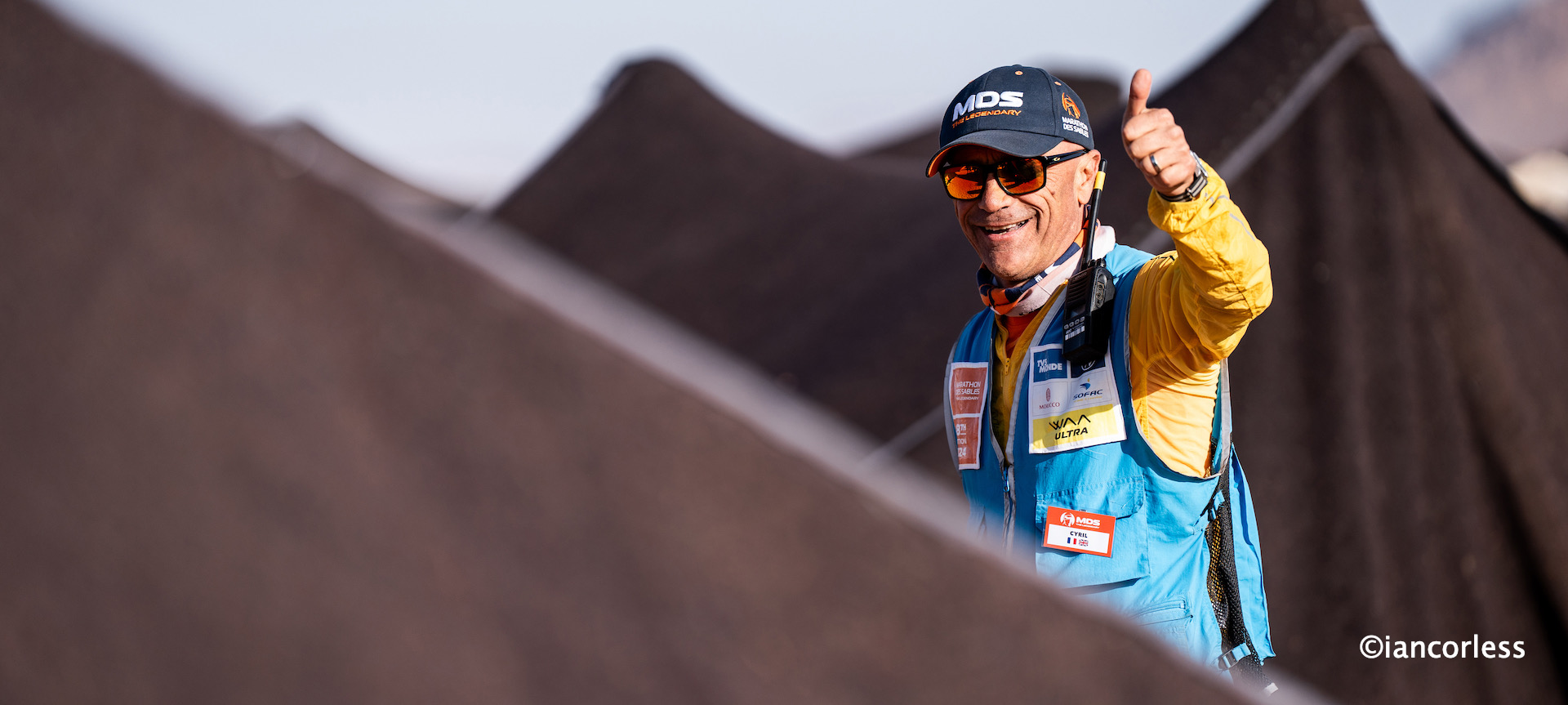
Cyril Gauthier, a new era for the race ©iancorless

All the races are now owned by the same team and while many may be familiar with the format and protocols for the shorter distance races, MDS Legendary since 2024 has had some significant changes. 
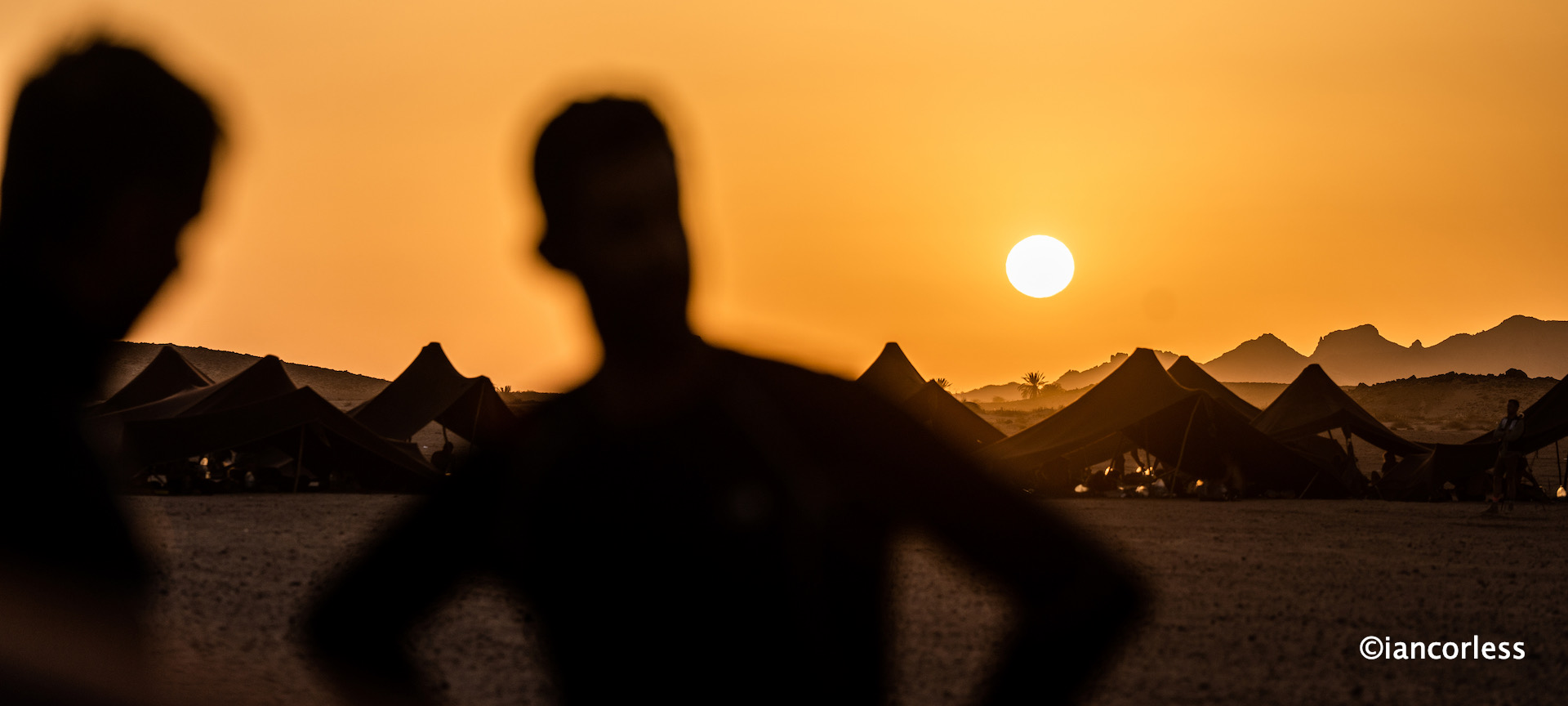
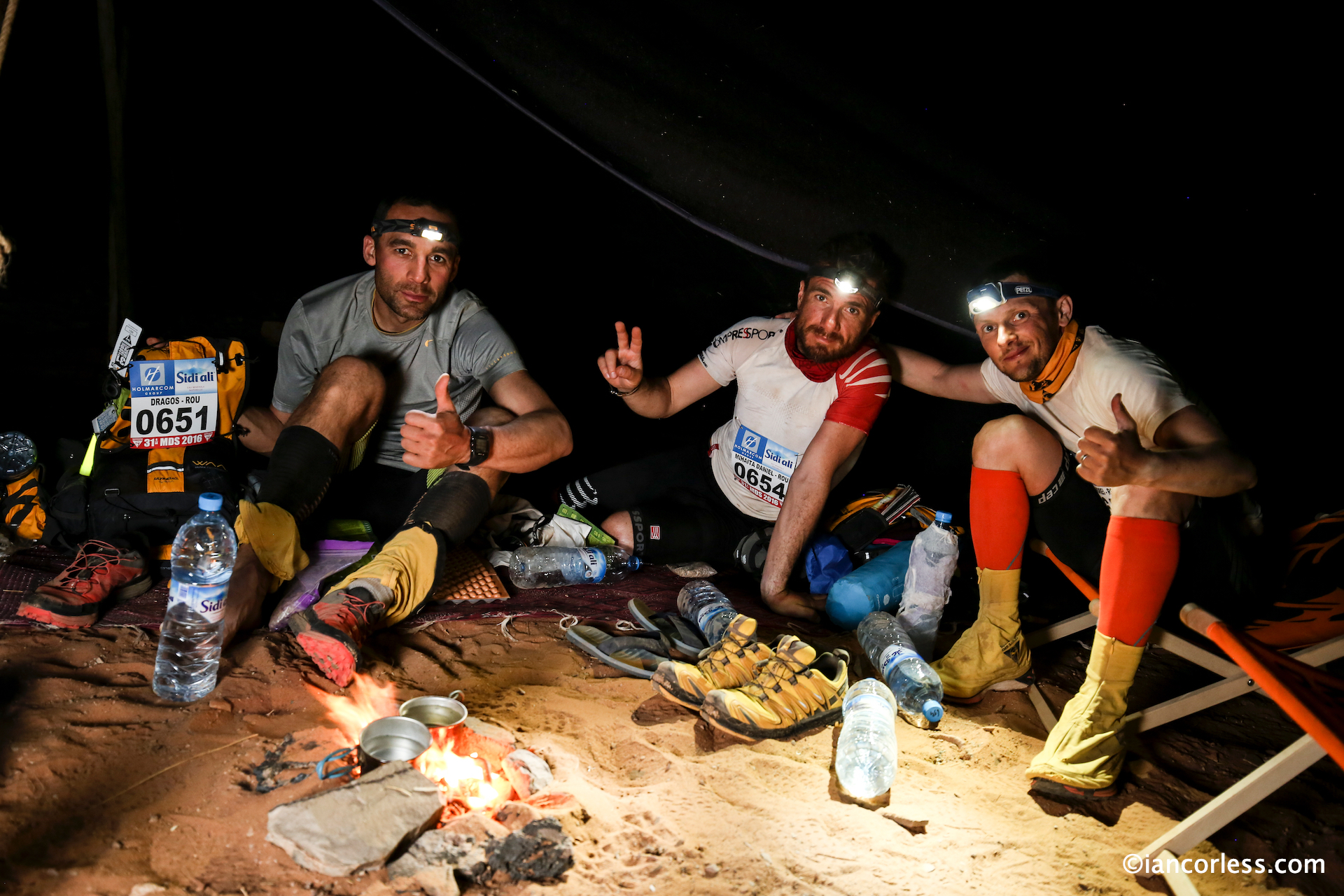
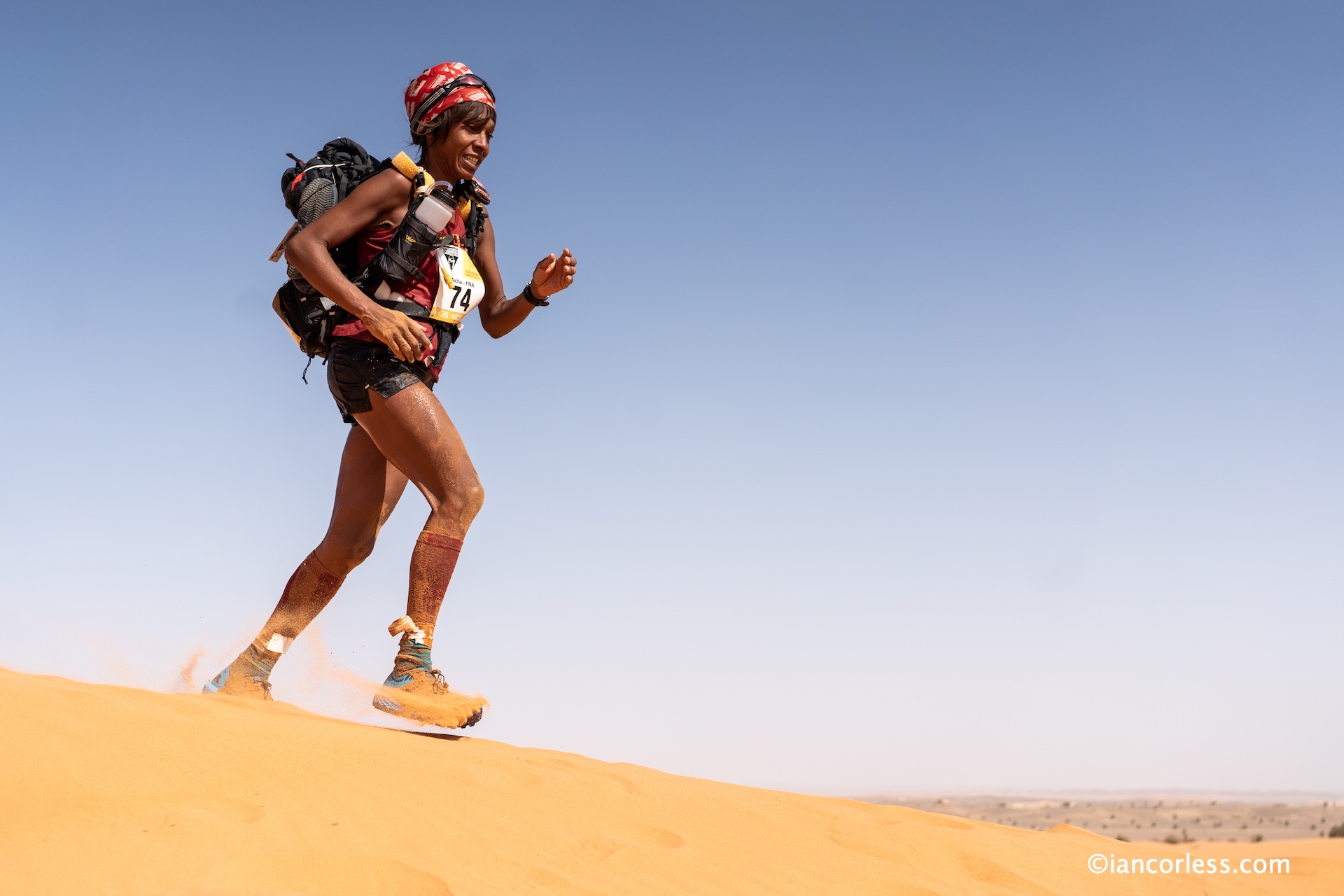
Camp life and the desert, it is special. ©iancorless
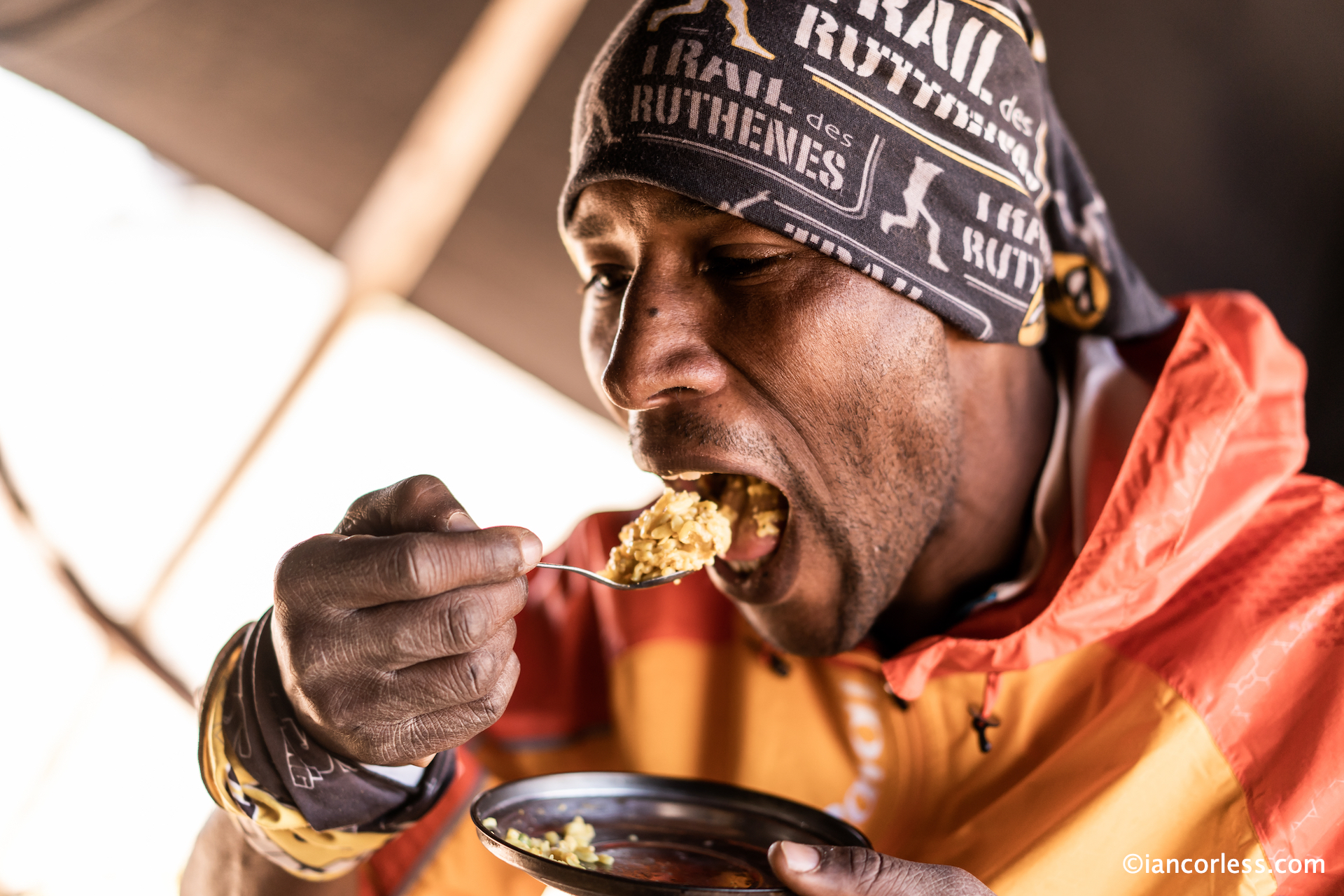
A 360 experience ©iancorless

Since 2024, MDS has expanded beyond its roots with MDS 120, the exploratory MDS TREK, the demanding MDS RAID, the mind-bending MDS Crazy Loops. and MDS ULTRA – Morocco. And the inspiring, MDS HANDI. Each one a new take on the same promise, to push the limits of what a runner can handle.

MDS EVENTS

  • MDS The Legendary
  • MDS 120 Atlantic Coast Morocco
  • MDS RAID Namibia
  • MDS 120 Cappadocia
  • MDS Crazy Loops – currently 2 locations in France.
  • MDS 120 Fuerteventura
  • MDS 120 Morocco
  • MDS Trek Morocco
  • MDS Handi Morocco
  • MDS 120 Jordan
  • MDS 120 Peru*
  • MDS ULTRA – Morocco

* Every 3-years.

WHAT IS MDS?

MDS is a self-sufficient race taking place over 3 to 6-stages. 
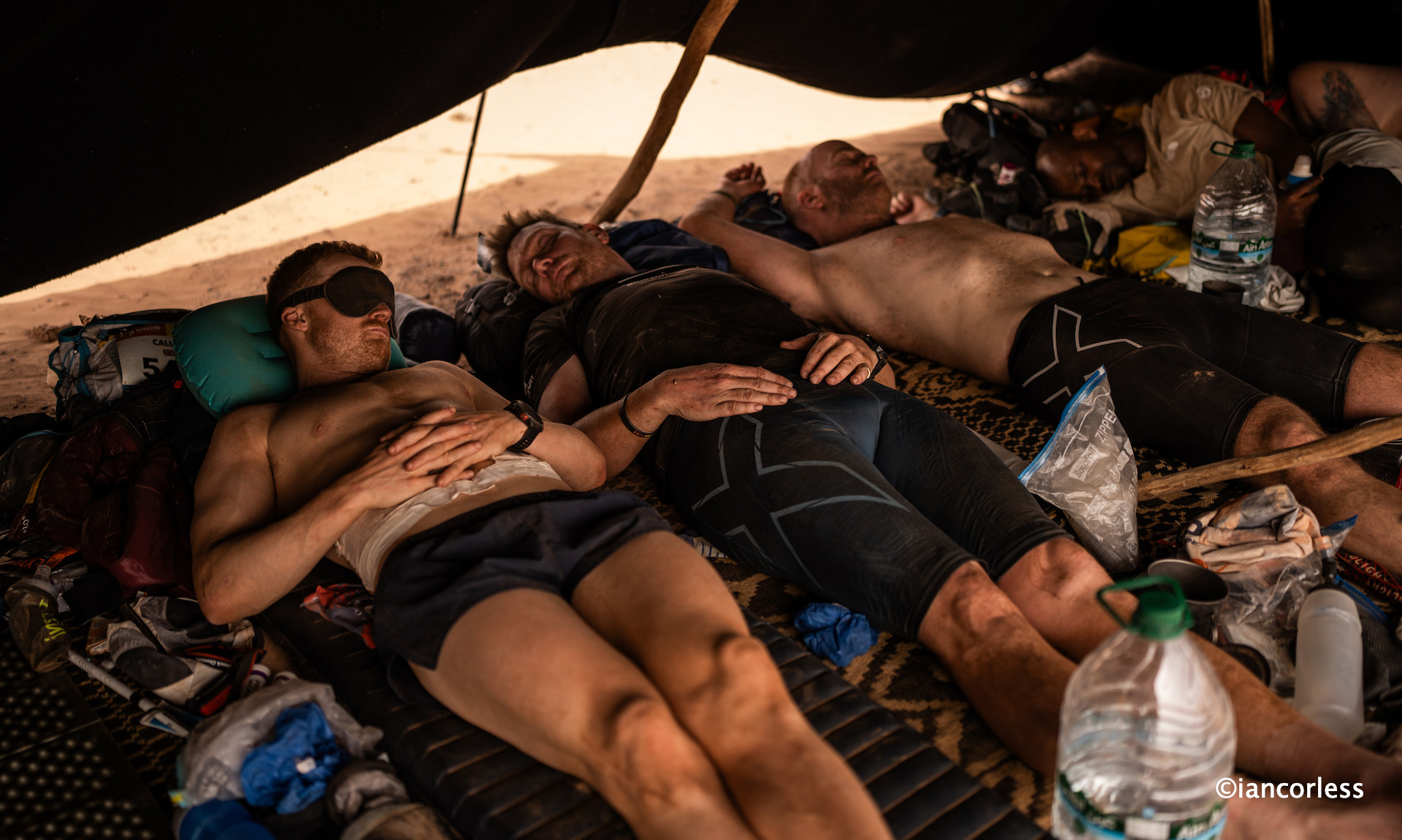
Bivouac life.

MDS Legendary is the iconic 6-stage race (over 7-days) with a distance of 250km (+/-) based on the route, terrain and difficulty. There are no options available on distance and participants are self-sufficient for the entire race, the only exception is the provision of water and a shared tent (bivouac) with 7 other participants. An example of 2024 distances:

  • Stage 1 : 31.1 km
  • Stage 2 : 40.8 km
  • Stage 3 : 85.3 km (over 2 days)
  • Stage 4 : 43.1 km
  • Stage 5 : 31.4 km
  • Stage 6 : 21.1 km

MDS 120 events start at 70, 100 and 120km for the shorter race format, depending on the race destination, there are 2 or 3 distances available. To clarify, this is not 2 or 3 different races, but the same race with the option to choose what distance you run or walk. As an example, the route is divided into 3 stages (4-days), to be completed at your own pace: walking or running. 

  • –    70 km
  • –    100 km
  • –    120 km

Here is a breakdown of each stage:

  • –    Stage 1: 25km – 30km
  • –    Stage 2: 20, 40 or 60km
  • –    Stage 3: 25km – 30km

The choice of the format is made at the registration. However, you can adjust it until the time of MDS.

MDS RAID follows a similar format to MDS 120.

MDS TREK is not self-sufficient and while similar to other MDS events, the format is much more a holiday experience, ideal for first timers or those who are looking for an active travel/ relax experience. Read more HERE.

THE MDS FORMAT

MDS The Legendary and MDS 120 events follow a similar format, however, there are key differences:

MDS The Legendary is a 10-day experience

MDS 120 a 7-day experience

In both scenarios you arrange travel to the relevant destination, arriving with adequate time to meet the MDS team at a designated meeting point and time. This may mean you need to arrive one day in advance to ensure you are able to meet the schedule as stipulated. From here, the MDS team then transport you to the start of the race. 

For MDS Legendary this will be a flight to Marrakech and free transport is offered to Ouarzazate.

For MDS 120 / TREK / RAID and ULTRA events, the meeting point will be a specific airport for transfer to hotel. 

MDS The Legendary use classic Nomad tents that hold 8-participants. By contrast, MDS 120 events use individual tents organised in cells of 6. TREK has upgraded tents, RAID combines solo tents and a star night, MDS ULTRA will be hotels except when racing.

Post-race you will be transported to a hotel and an awards ceremony and gala dinner will take place.

EVENTS

MDS LEGENDARY the iconic 6-stage, 250km race celebrating 40-years in 2026.

MDS 120 (used to be HMDS) this is 3-stages over 4-days with distance options of 70/ 100 or 120km.

MDS TREK this is similar to the MDS 120 format, however, there is no self-sufficiency, more comfortable accommodation and additional facilities, an excellent introduction to the MDS.

MDS RAID an event for more experienced athletes that is undertaken in teams of two, over approximately 90-120km’s, typically, two distance options are provided. The format is similar to MDS 120 with 3-stages over 4-days. One night will be undertaken under the stars with no bivouac.

MDS ULTRA new for 2025, a 100-mile or 100km single stage race with a 40-hour cut off.

MDS CRAZY LOOPS three new events for 2025 undertaken in ski resorts, the format is to run as many loops as possible in 24-hours. The loops will be typically, 3-5km’s in length.

MDS HANDI an inspiring inclusive event to provide wheel chair athletes an opportunity to participate with team members.

THE RACE CONCEPT
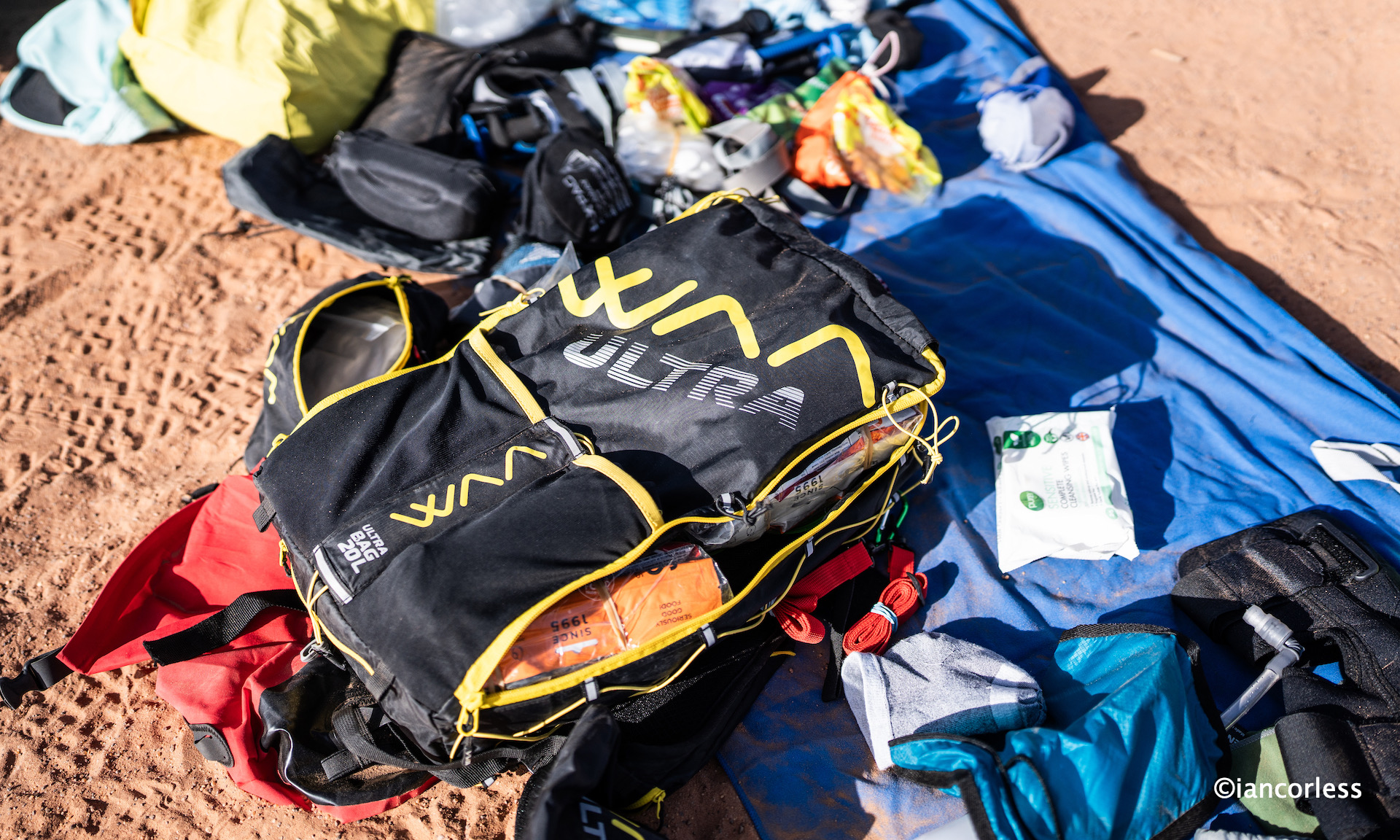
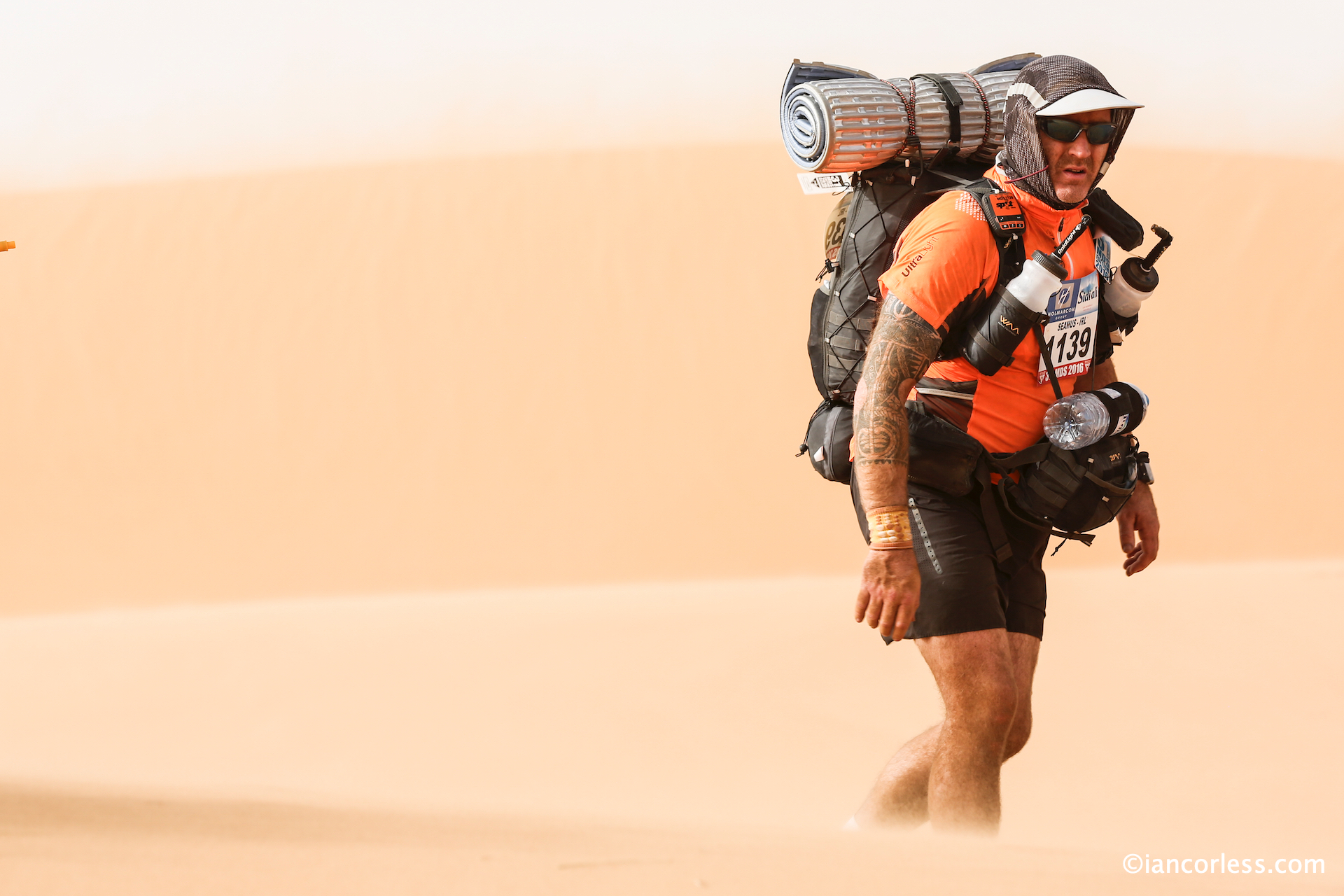
You carry all you need for the race. ©iancorless

Both race formats, MDS Legendary, MDS 120, MDS RAID and MDS ULTRA require participants to be self-sufficient for the whole race.

What does this mean?

Quite simply, you must wear and carry all you need for your race experience with the exception of the tent / bivouac. MDS ULTRA will not require a bivouac or same kit requirements as MDS Legendary, Raid or 120.

It may sound daunting but it is not, it’s actually quite simple. You need to address the following points:

  • What you wear.
  • Equipment you need to participate.
  • Sleeping.
  • Food.
  • Cooking equipment. (You can purchase fuel blocks in bivouac)
  • Water.

WHAT TO WEAR

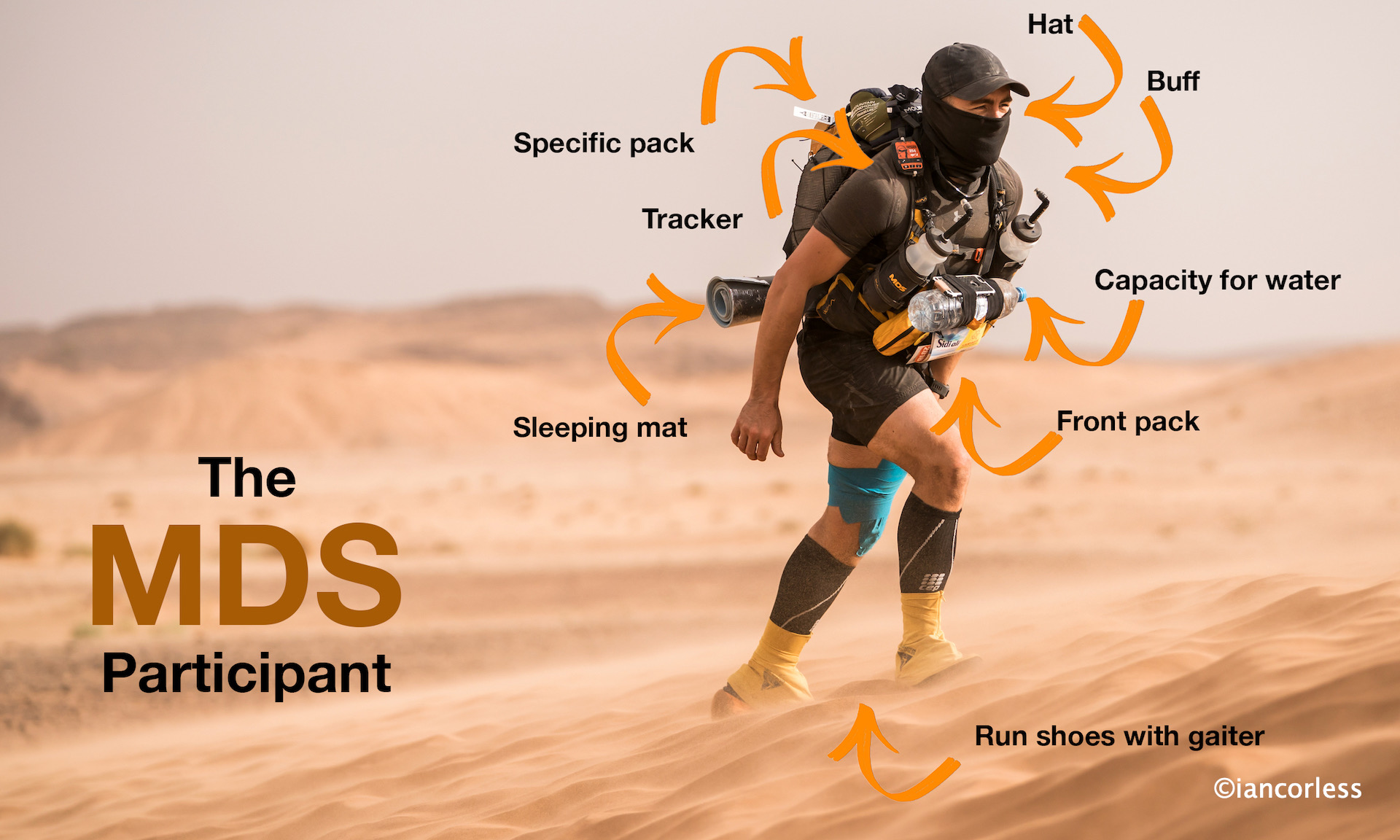
  • Hat to protect from the sun with optional neck protection.
  • Shirt (short or long sleeve) with adequate protection from the sun.
  • Shorts, skort or similar.
  • Socks.
  • Shoes with appropriate protection and durability for a desert environment with a gaiter (typically sewn on) to keep sand out of the shoe.

WAA is a partner for MDS have specific equipment for desert/ stage-racing.

Because you have entered a MDS event, there is no need to buy new apparel and shoes. Quite simply, if you have items that work, are comfortable, cause no problems or irritation, there is no need to change them. If it aint broke, don’t break it. Shoes always create a huge debate and please find what works for you. If you ask on any forum, you will get countless recommendations but none of those recommendations are specific to you and your needs. Read an article HERE and HERE.

EQUIPMENT

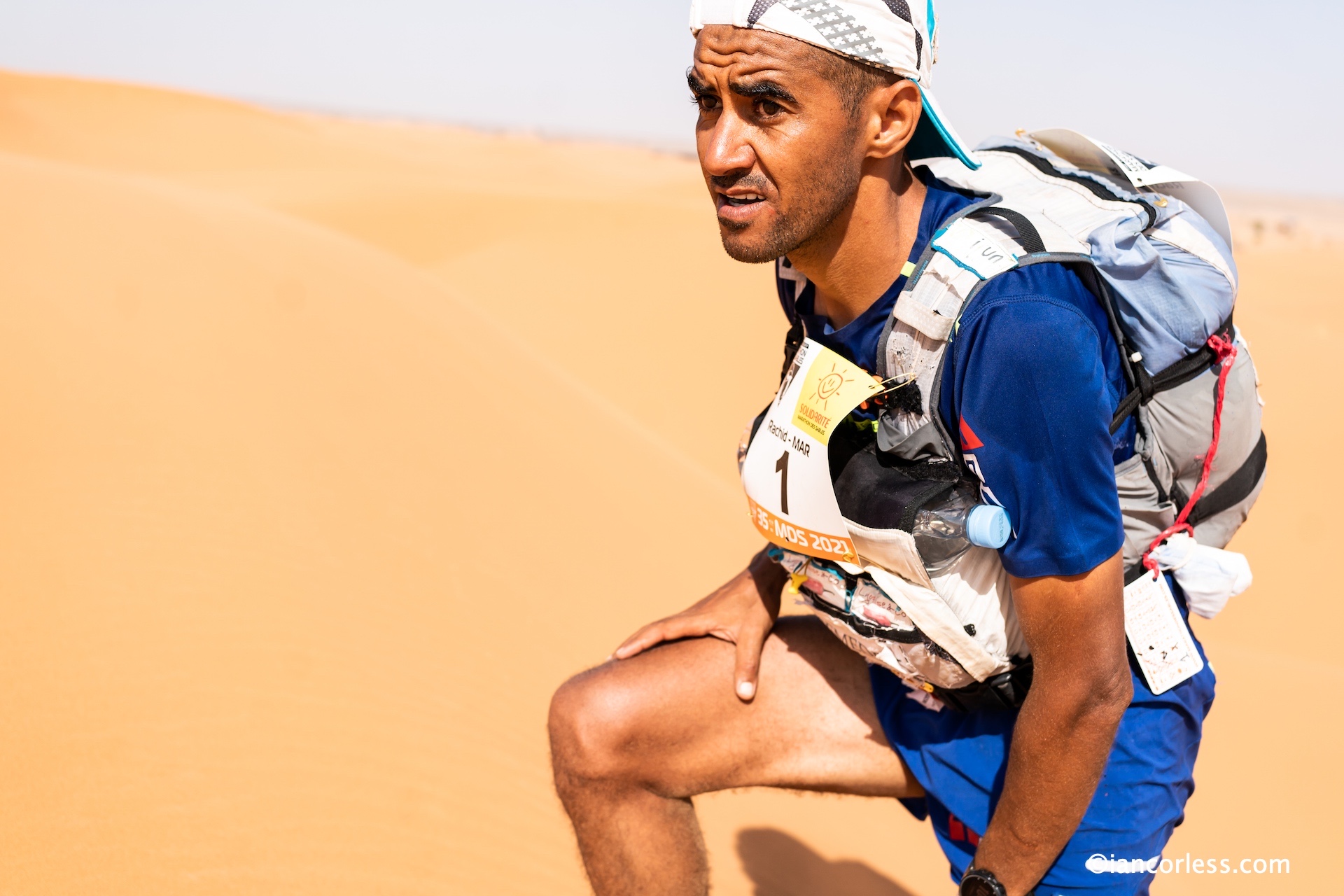
MDS runner ©iancorless

Always remember that with MDS events you are either wearing or carrying everything you need for the race duration. Therefore, it is imperative that you purchase the lightest options available (based on budget) and you keep luxuries to a minimum. 

Keep it simple!

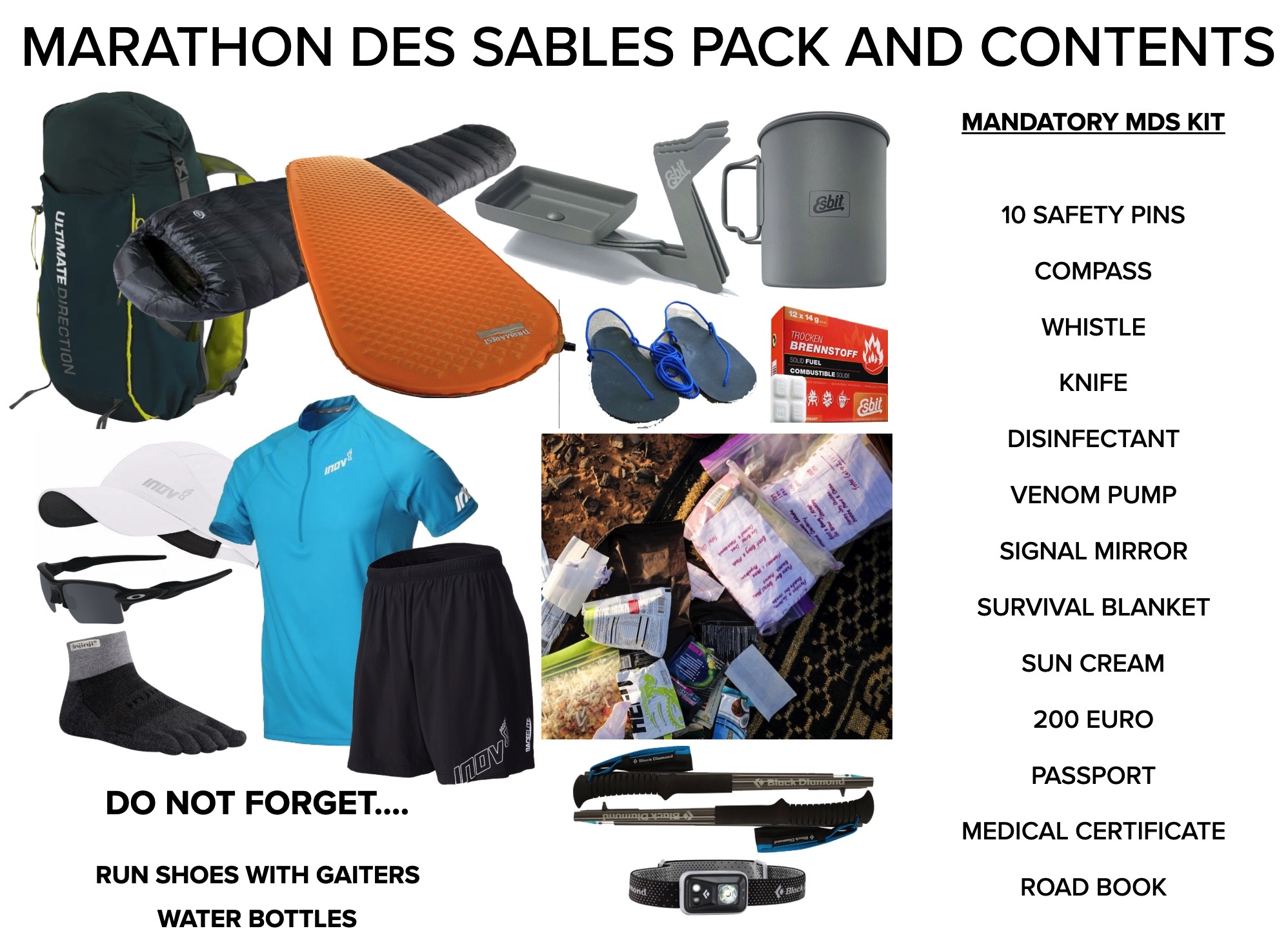
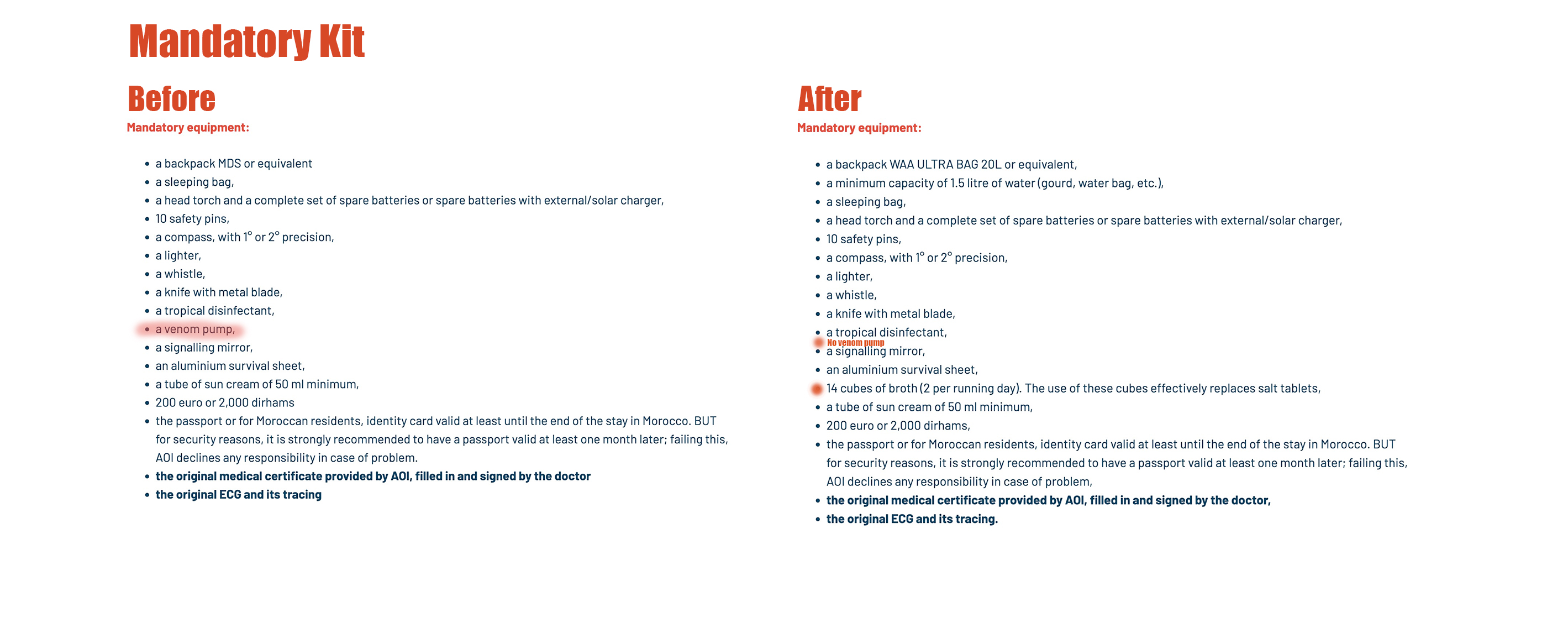
MDS specify ‘mandatory’ equipment for participation as specified below:
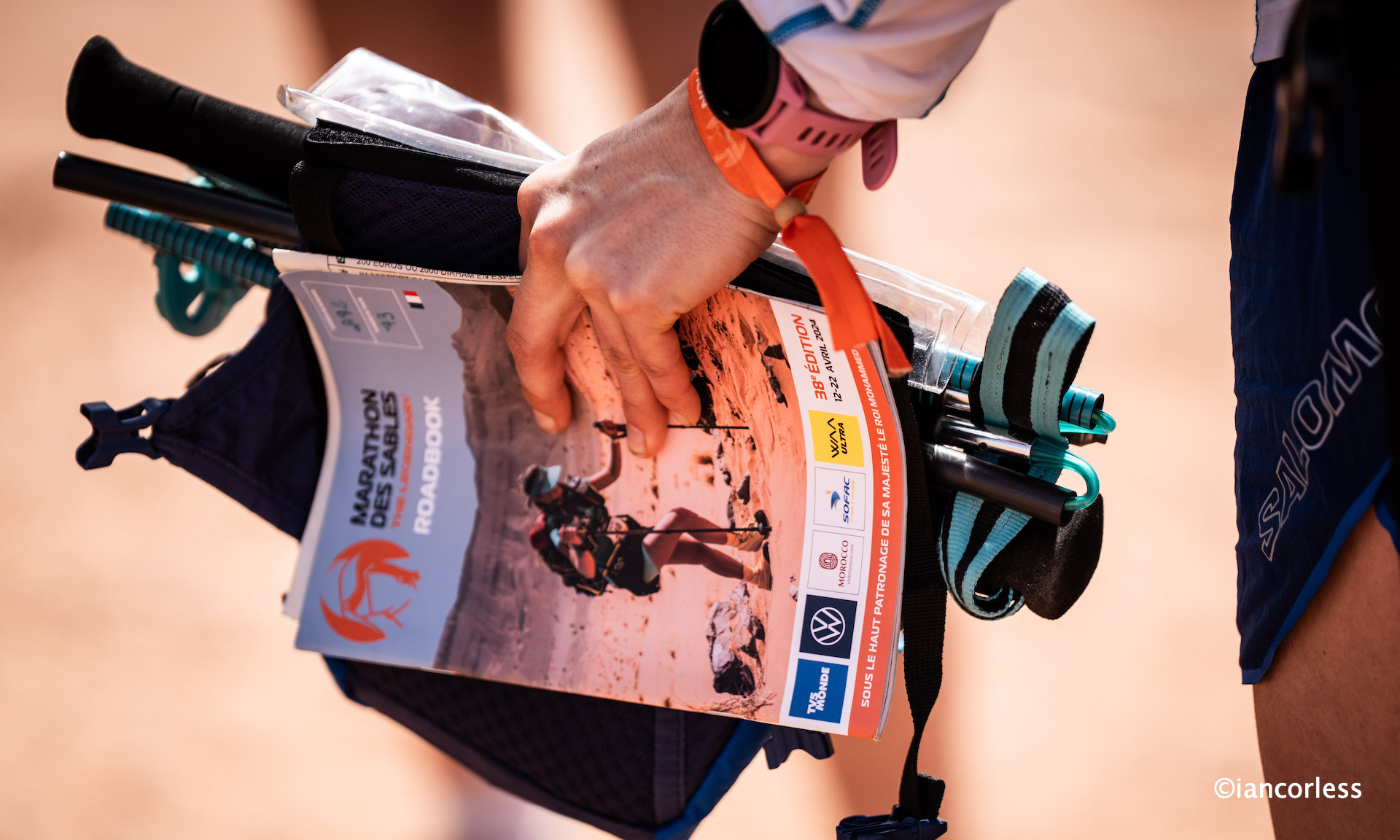
The Road Book provides all the info about the race and route ©iancorless
  • A pack with enough capacity to carry all your equipment, food and water – eg: WAA Ultra Bag 20L
  • Water carrying capacity of 1.5L minimum.
  • Sleeping bag read HERE
  • Headlamp (which must be turned on after dark) + 1 complete set of spare batteries or battery. Make sure it has a ‘red’ mode for night.
  • 10 safety pins
  • Lighter
  • A whistle
  • Metal blade knife
  • Skin antiseptic
  • Signaling mirror
  • Survival blanket
  • Soup cubes (2 per day) to help the rehydration
  • Tube of sunscreen 
  • 100 / 200 euros in cash 
  • Passport or identity card (depending of the destination) 
  • Official MDS medical certificate completed by a doctor (form available 3 months before the race).
  • Road book
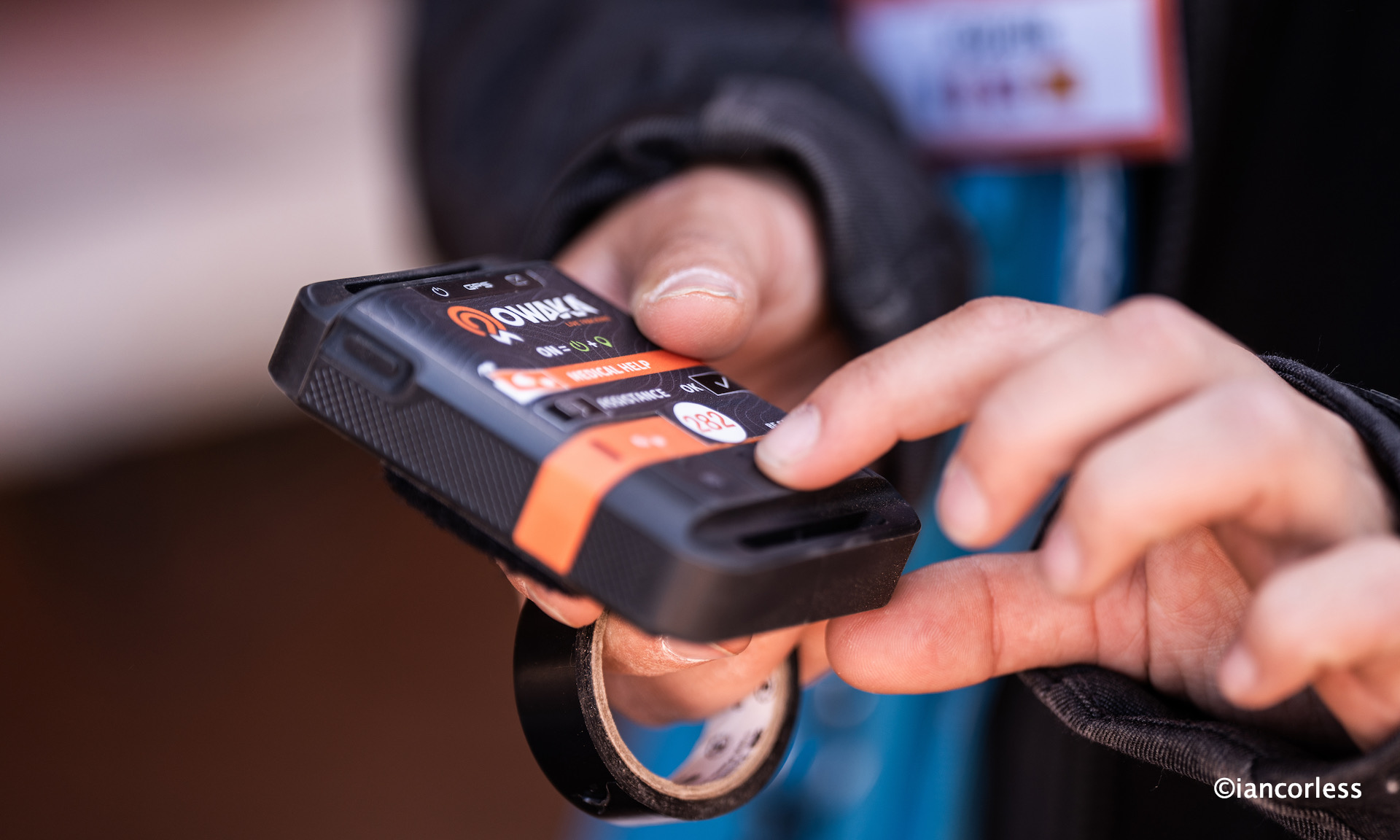
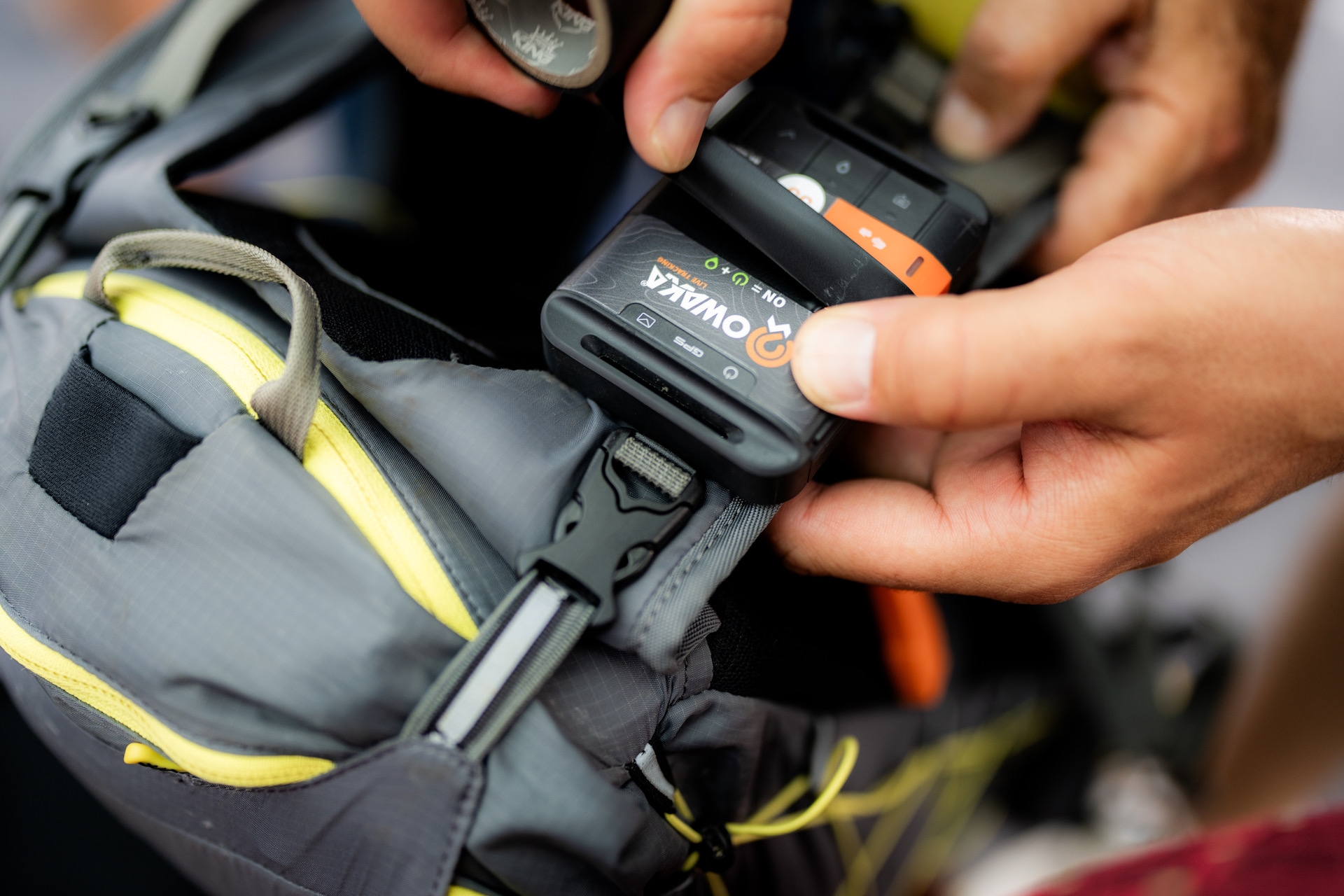
Each runner has a tracker for safety ©iancorless

What else do you need?

  • A sleeping mat is highly recommended to protect from the ground, insulate and provide comfort.
  • A jacket is highly recommended (lightweight down) for cold morning and chilly nights. Many products exist. An excellent combination item is offered by PHD but it does come at a price – HERE.
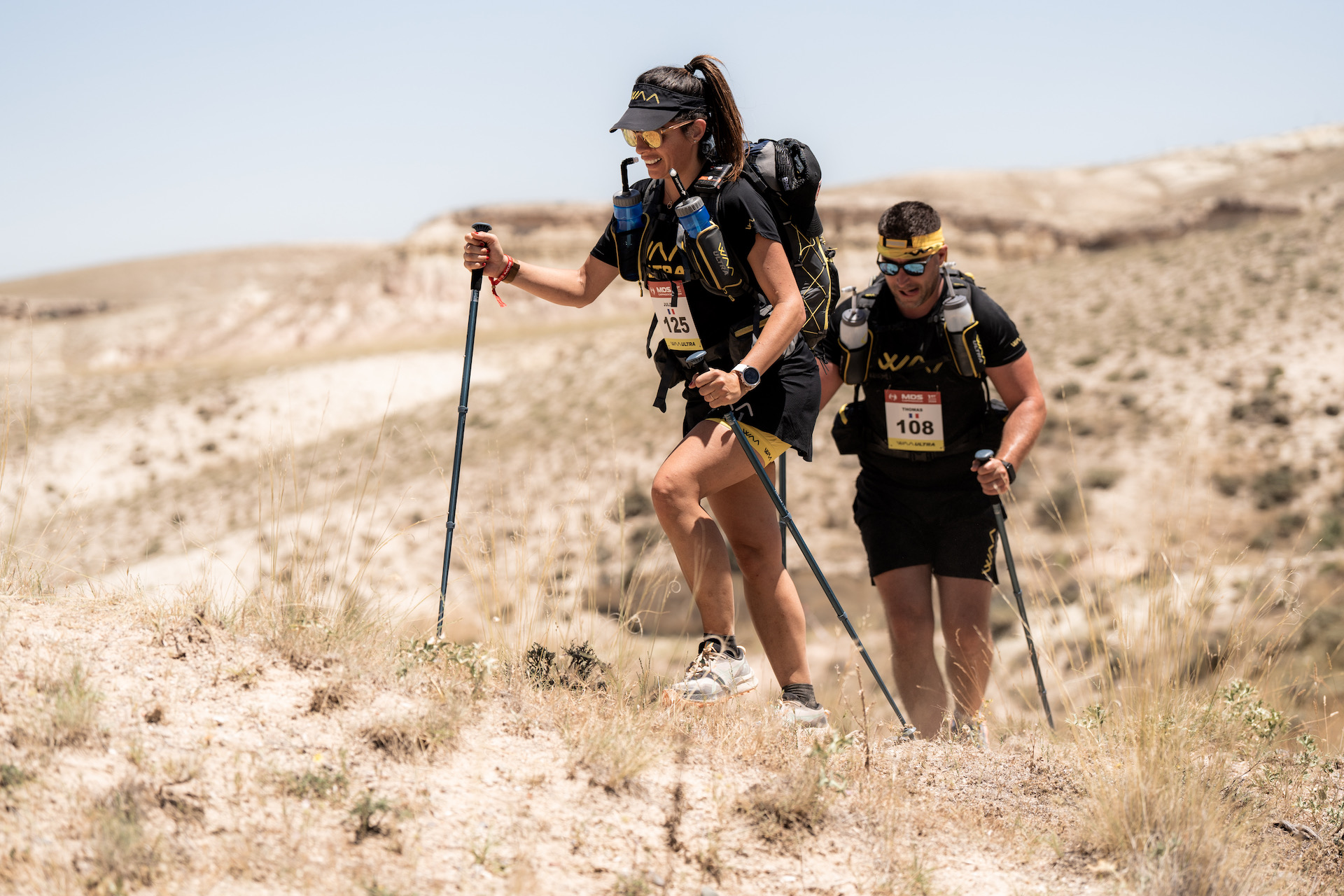
  • Poles are for many 4-wheel drive in stage races, Leki are highly recommended.
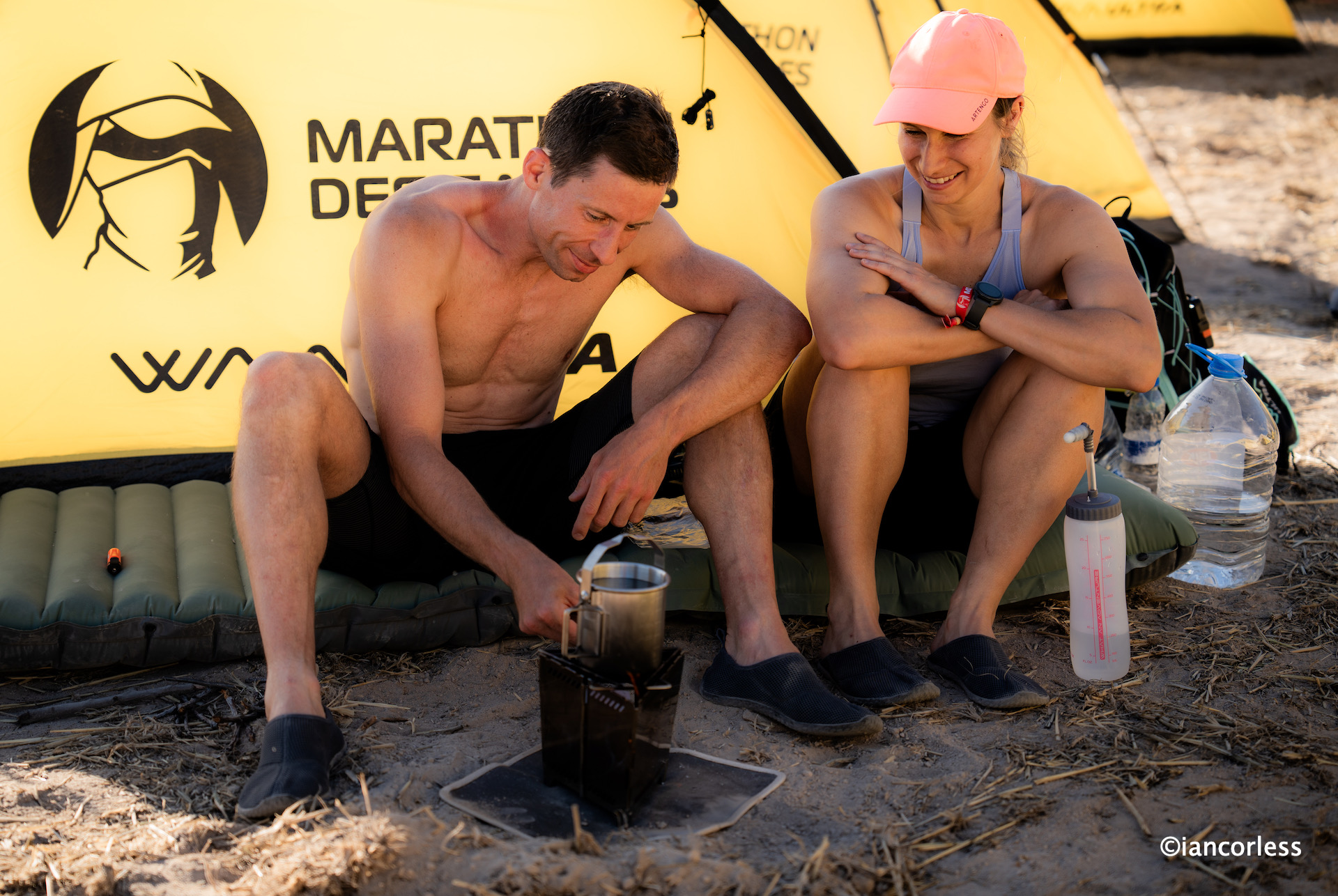
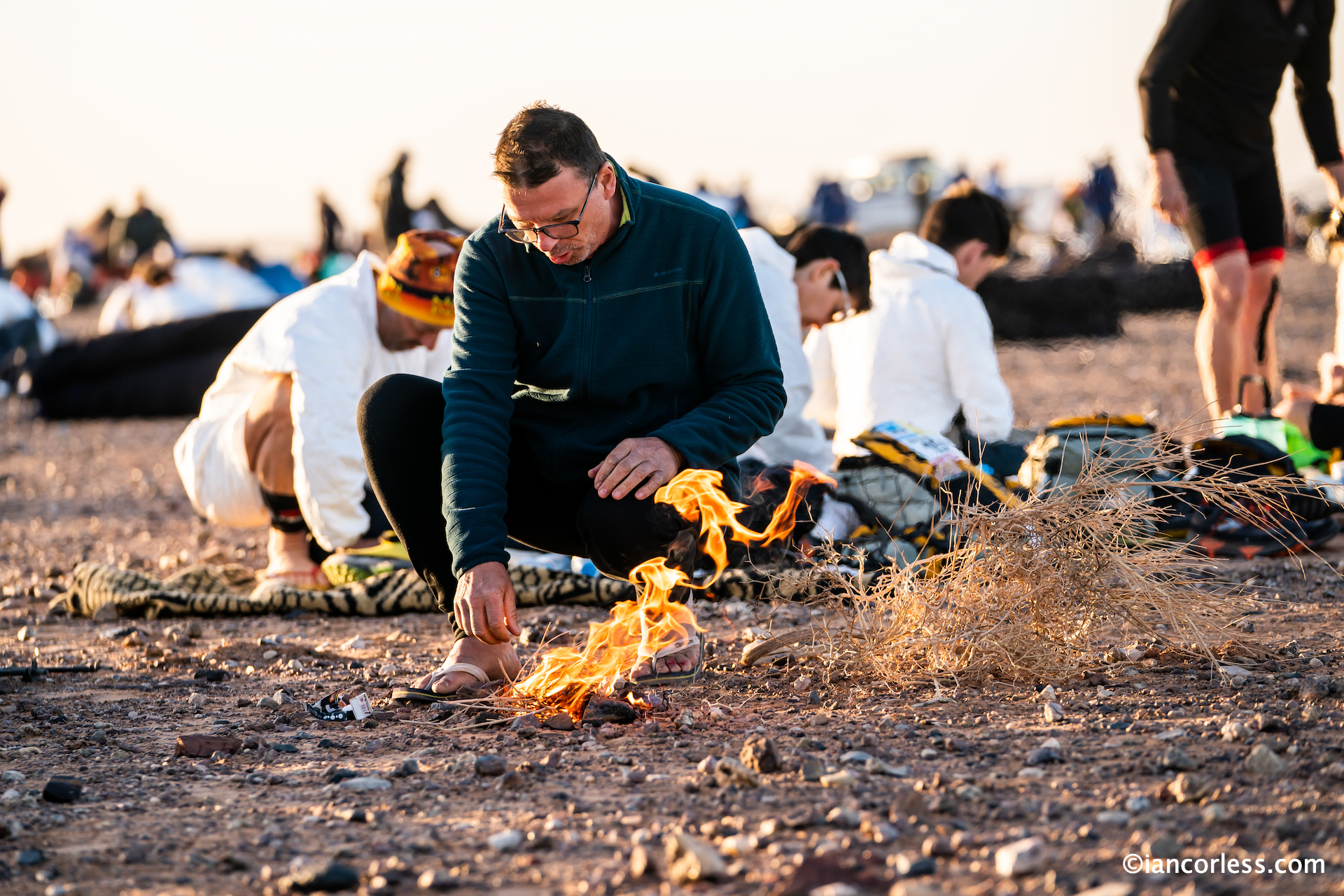
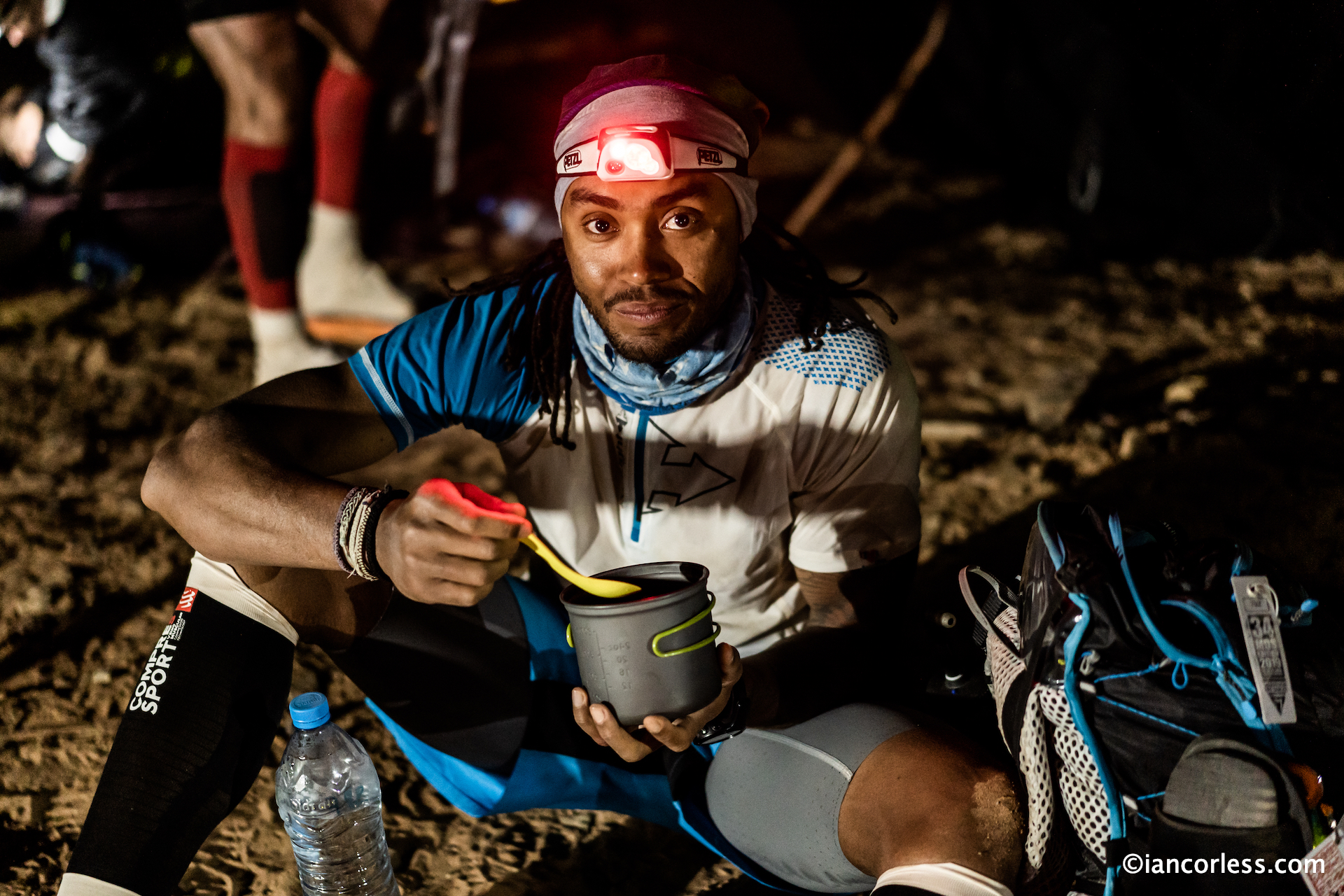
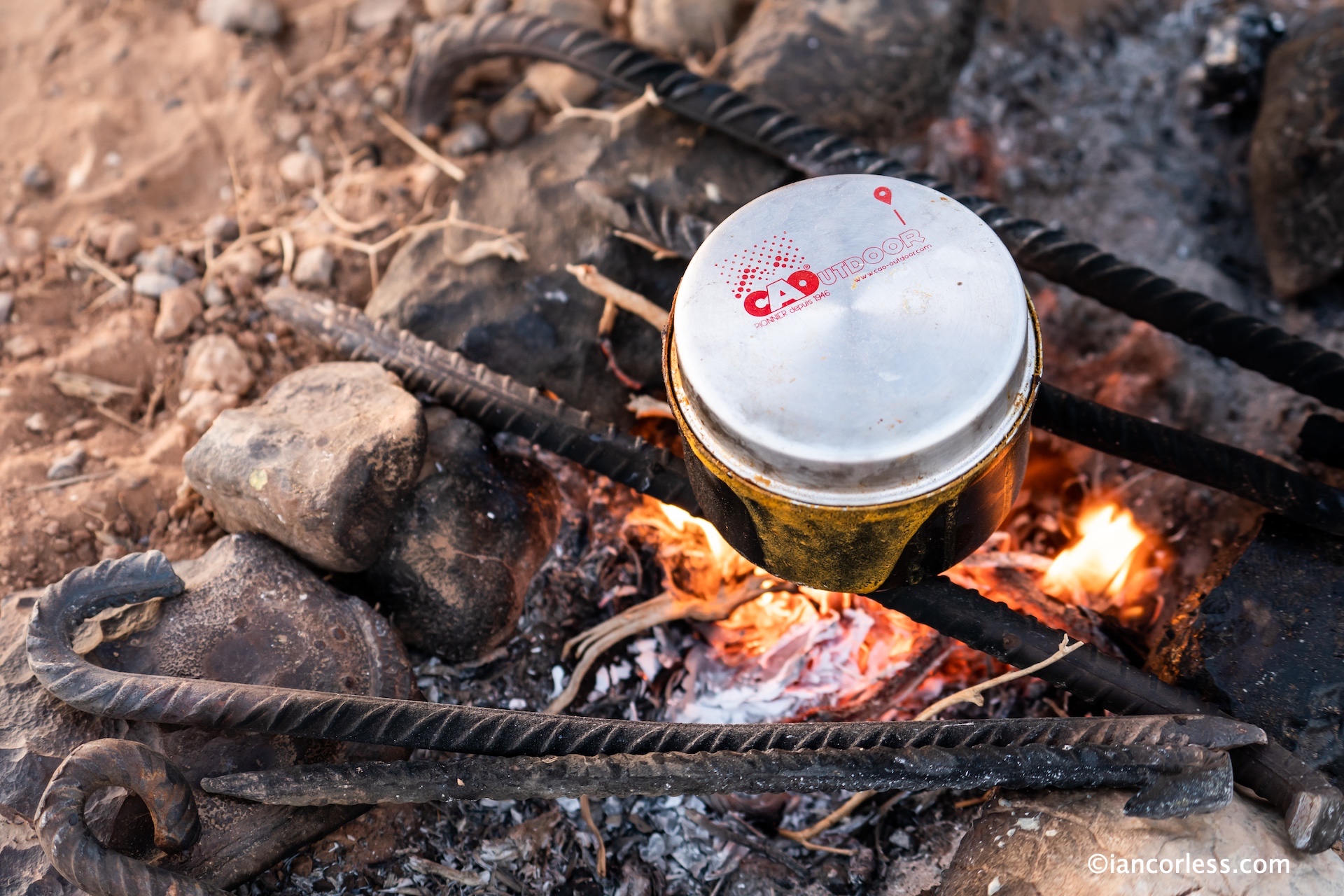
  • Stove – if you plan to have hot water, you will need a cooking system like those provided by Esbit. Please note, you cannot use any gas stoves in the desert, you must use fire bricks which you can purchase at bivouac.
  • Pot – if you are using a stove, you will need a pot/ mug
  • Spoon with long handle for eating. Such as a Spork.
  • Buff or neck roll.
  • Sunglasses are essential and think about protection in sand storms, goggles may be required.
  • Spare socks and Injinji are highly recommended.
  • Flip flops or similar. Many use the weight free slippers from hotels, however, they rarely withstand the desert.
  • Watch / GPX
  • Personal items: Tooth brush, toothpaste, hand gel, wipes, toilet paper, ear plugs, blind fold etc.
  • Emergency – Things can happen during a race, so, be prepared with some essential items such as needle and thread, superglue, zip ties, monkey tape etc. If something rips or breaks, you need to repair it.

Luxuries

MDS is and should be simple in format. Remember, you must carry everything, so, keep luxuries to a minimum. Many consider a small MP3 player, look for something small, light and with great battery.

Phones are an essential part of our daily lives, do yourself a favour and leave it at home. The liberation is extremely rewarding. Please note, phones are allowed, however, it is prohibited to telephone on the bivouac or on the course. If you want to make a phone call, you will have to move away from these places so as not to disturb anyone.

SLEEPING

A sleeping bag is mandatory, so, there is no discussion here. The combined weight of your food is the heaviest and bulkiest item, however, a sleeping bag is next. These days there are many options available and quite simply you want the lightest possible, with the smallest packing size with required warmth at a price that you can afford. Not all sleeping bags are the same, so, consider this. Down is the best filling as it is the lightest, warmest and packs small. However, ‘fill power’ is a key element of down, fill power tells you how much volume a 30-gram, or one-ounce, sample of down will take up. So, the higher the fill power, the warmer the bag will be for less weight, because that one ounce of down has larger down clusters that provide more loft and have the ability to trap more heat. These bags will be more expensive.

Brands to look at: Nordisk, Seat to Summit, Rab, PHD, Western Mountaineering, Wilsa, Lightwave and so on.

Note here, that you will also probably be taking a down jacket for warmth. This can be used as extra warmth and insulation in a sleeping bag. So, it is possible to think about getting a lighter, less warm bag and supplementing warmth with a jacket.

UK brand PHD has come up with the perfect solution with an Ultra Jacket and Desert Race Half Bag but is does come at a price. However, it is comparable with the costs of jacket and bag by Nordisk.

Sleeping mat is highly recommended. When you are not running or walking, you are sitting or lying down, comfort is key. Two options exist, inflatable or not. Inflatable provides the greatest comfort but with poor admin does have the risk of puncture. Sea to Summit provide excellent inflatable options with low weight and pack size. Exped have excellent closed-cell foam.

FOOD

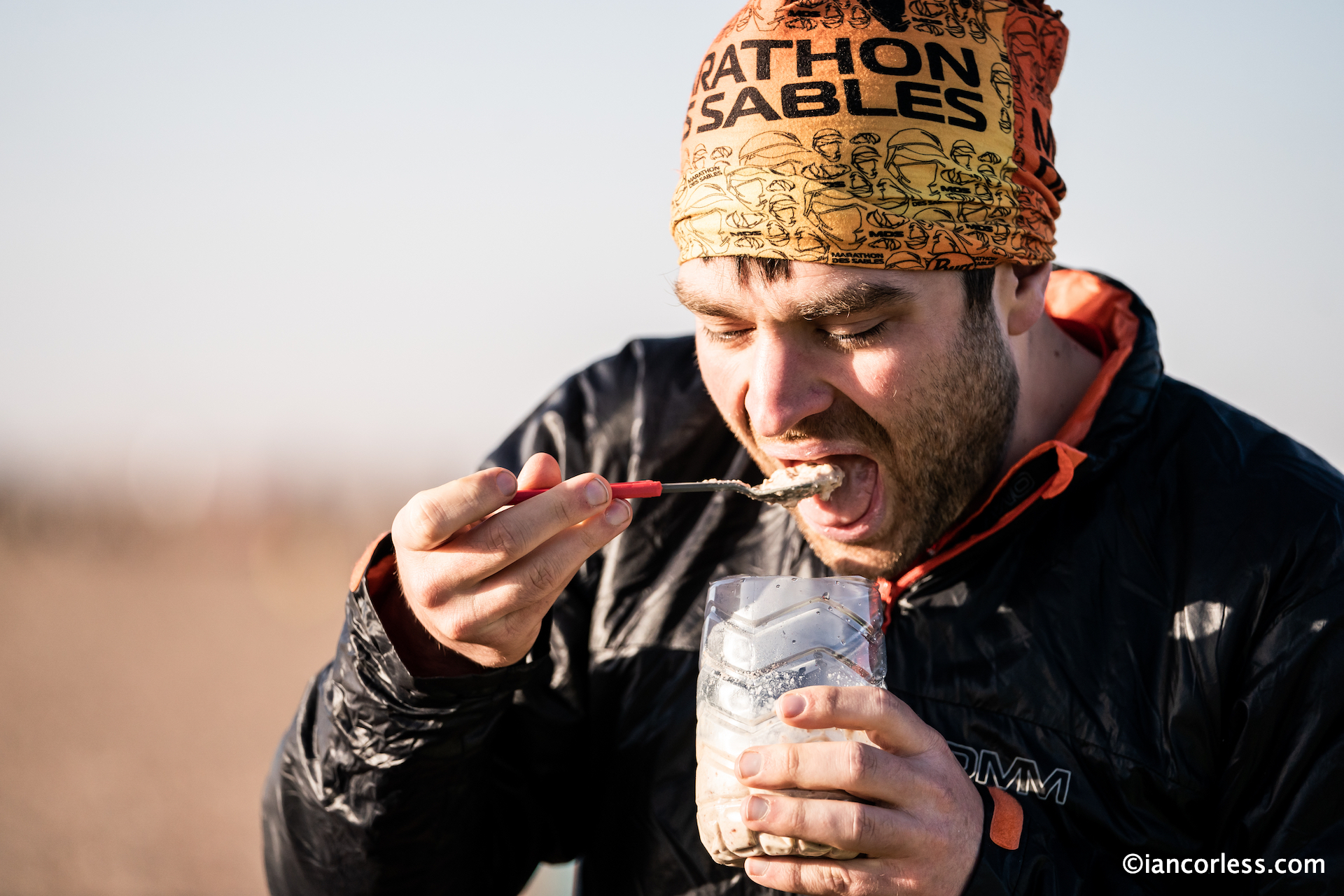
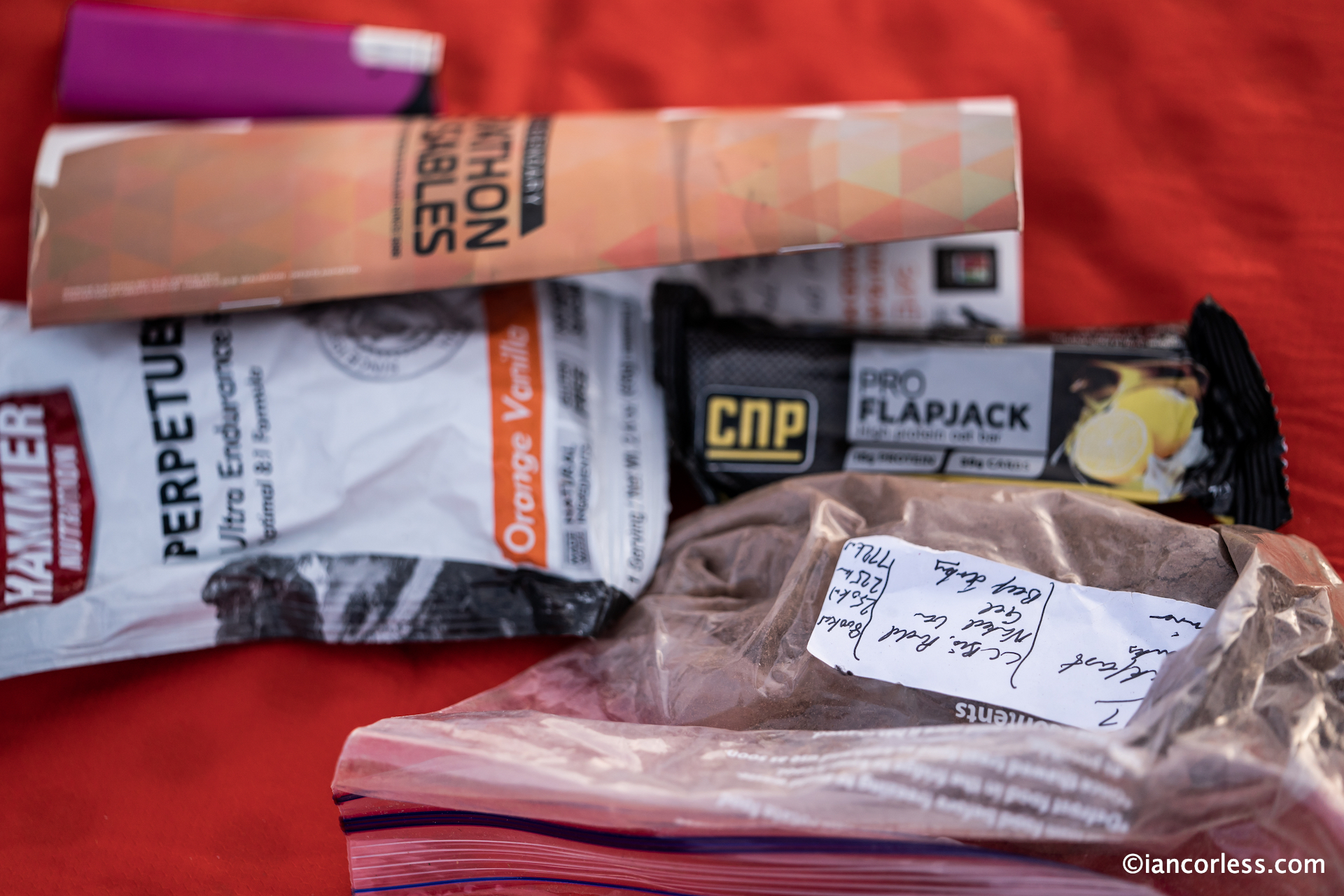
Plan food in day bags ©iancorless

The MDS 120 events (TREK not included) are self-sufficient adventures. You  need to bring your own food and carry it in your bag for the duration of the race.There is a requirement that you must have 2000 calories minimum per day. Please remember that from 2024, catering is not provided at MDS The Legendary and therefore you must have enough food and calories before the race starts.

Food is the heaviest item you will carry and is essential. Don’t skimp on food. Lay food out per day addressing key items:

  • Breakfast (be careful they are not too sweet)
  • Snacks while running (bars, nuts, dried meat etc)
  • Post-run recovery (usually liquid form is ideal)
  • Lunch if applicable (this could be another meal such as cous cous)
  • Dinner (dehydrated meal)
  • Evening snack (a bar)

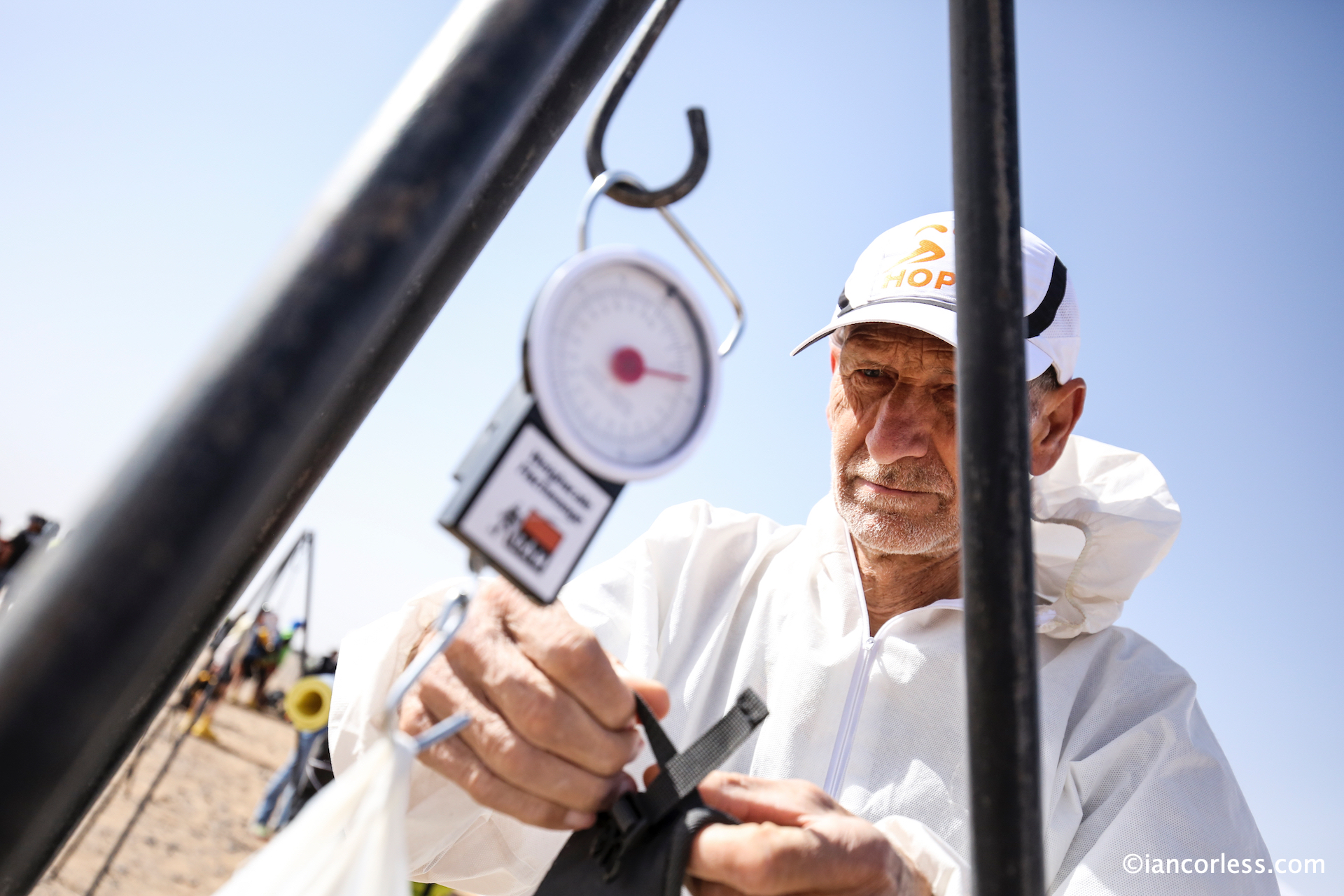
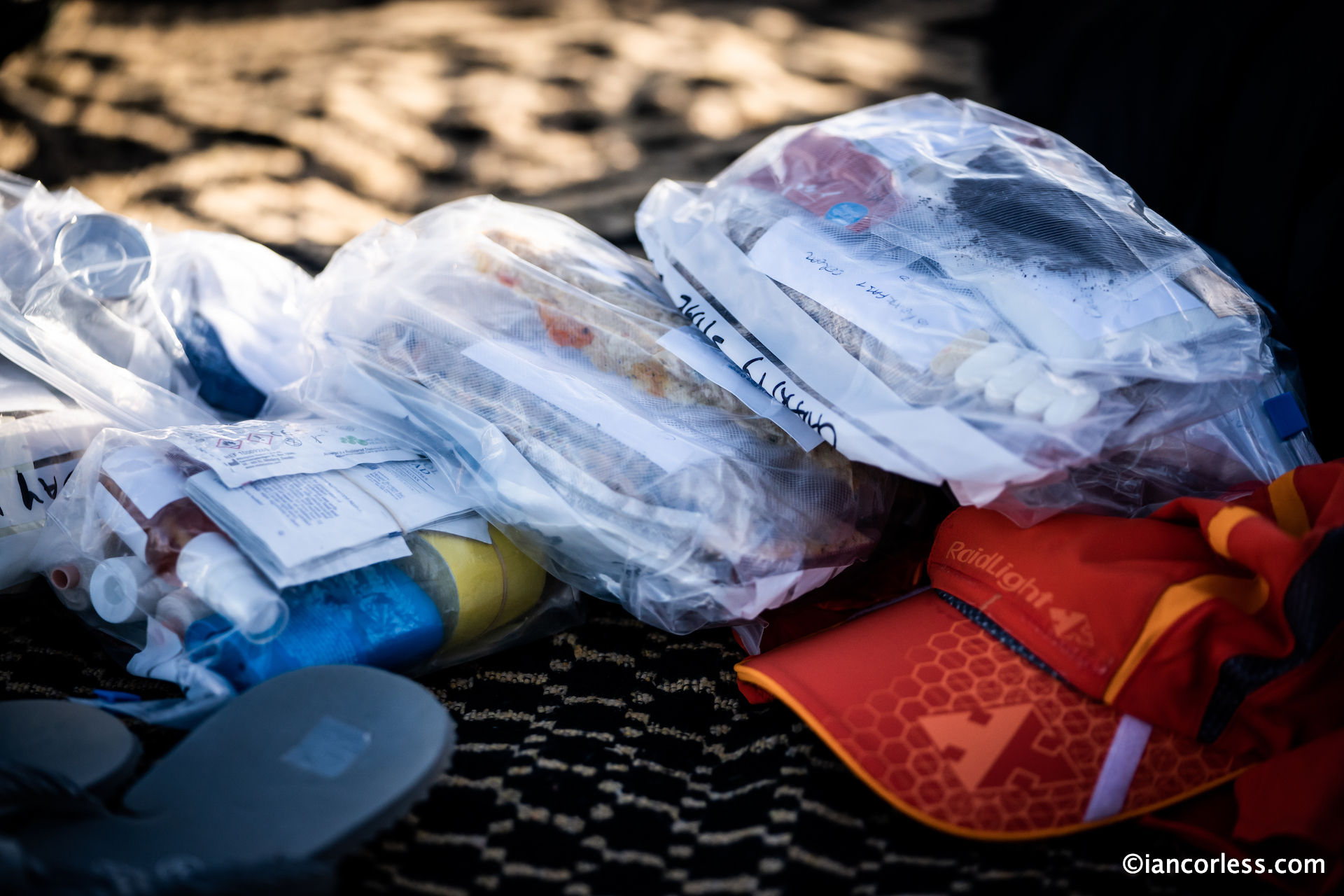
Where possible, repackage food to make them smaller and lighter. However, make sure you keep nutritional information for the admin day. Pack food in day bags, that way it is easy to know what you have and importantly, you don’t take food you need for the next days. Keep doing this and you will be short of food at the end of the week.
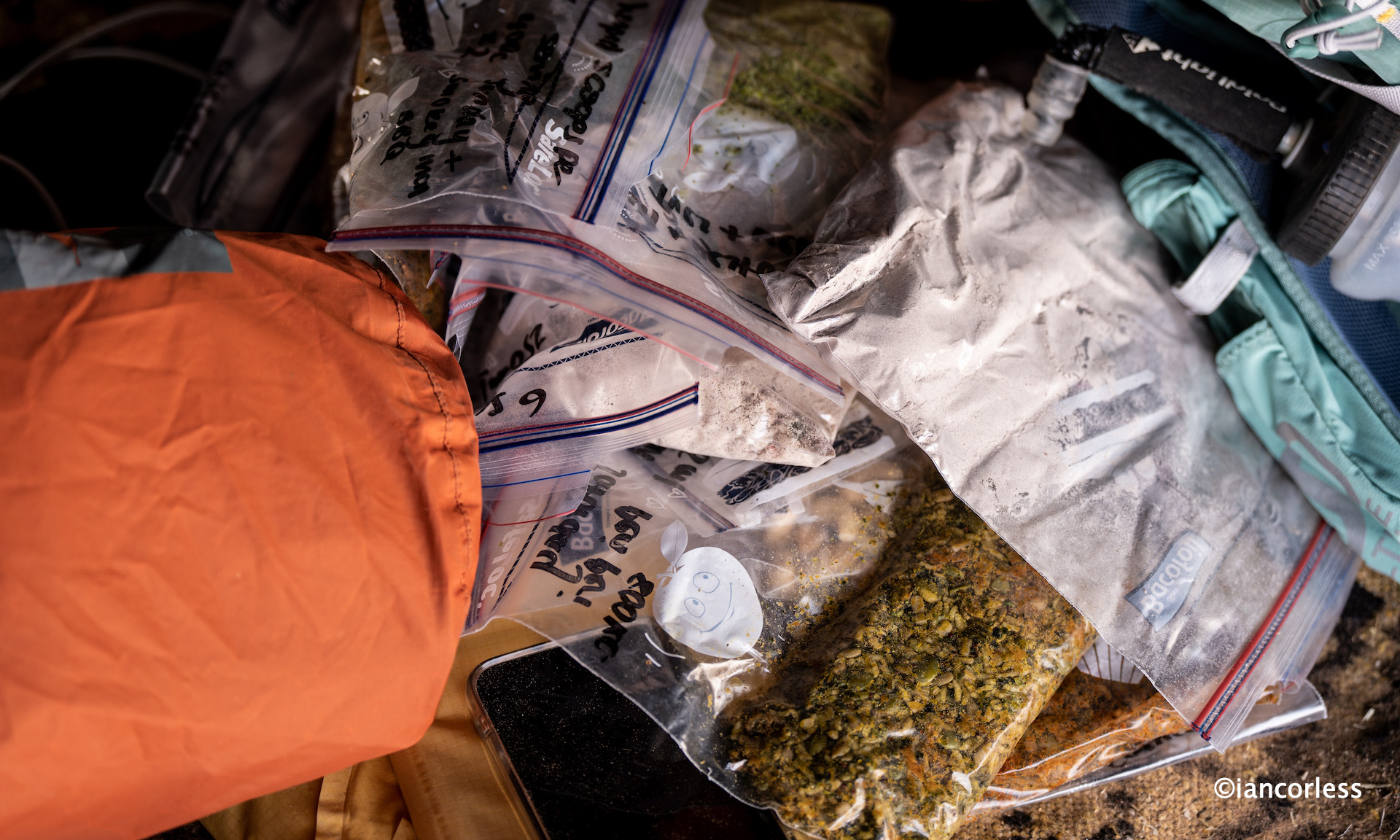
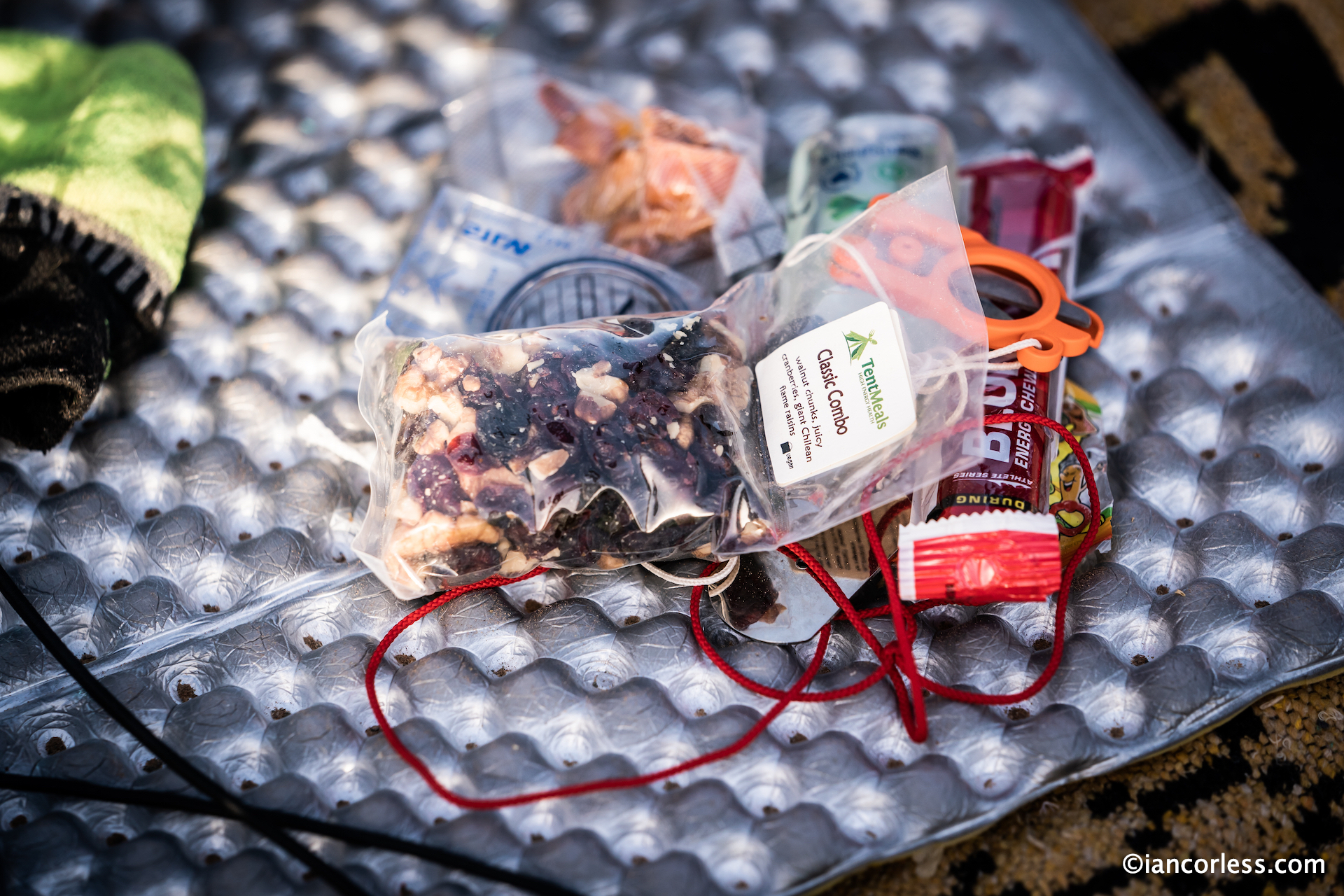
Be organised with all your items ©iancorless

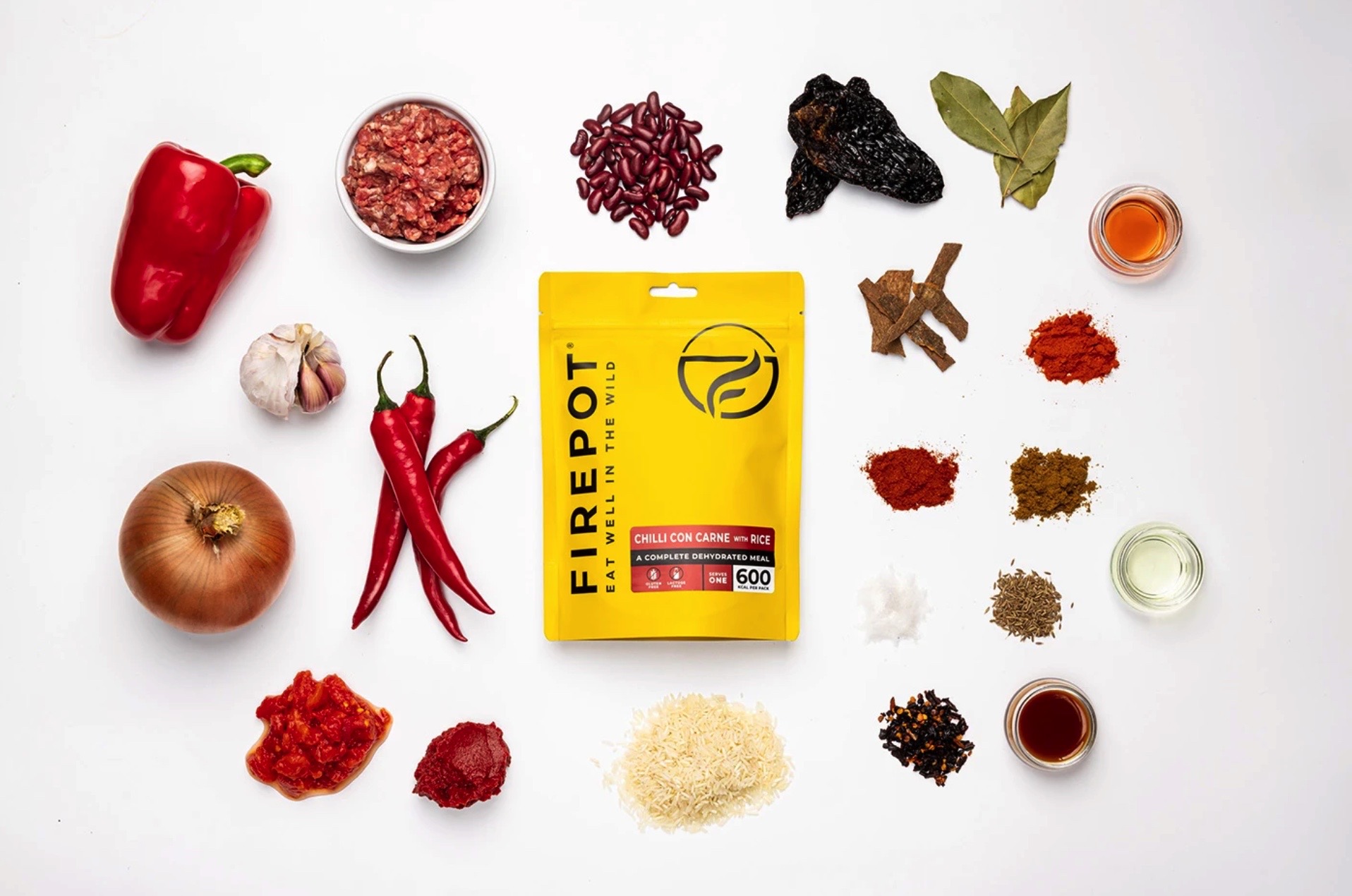
Food is personal and you must find out what works for you. Remember taste chances when fatigued and in hot environments, often, sweet becomes less palatable with a preference for savoury. Dehydrated meals will often be used for key meals such as breakfast and dinner, some hydrate well with just warm water, others need hot water. So, if you are not taking a stove, test this. Basecamp food is a good website that shows what options exist. After many tests, highly recommended products are Firepot, Lyo, Tentmeals and Adventure Menu. Personally speaking, Firepot produce the tastiest meals I have tried.

Make sure you add some treats to spice up your palette.

A food list for MDS The Legendary could look like this:

  • Dehydrated Meals x6 672g
  • Dried Mango 93g x 4 372g
  • Porridge 59g x 7 413g
  • Coffee 1g x 10 10g
  • Peanut Butter 33g x 5 165g
  • Honey 21g x 8 168g
  • Mini Salami 10g x 10 100g
  • Tropical Mix Bag 194g
  • Sesame Bites 27g x 6 162g
  • Dried Banana Block 270g
  • Mixed Nuts 200g x 2 400g
  • Macademia Nuts Bag 153g
  • Cranberries Bag 175g
  • Pitta Wraps 296g

Total Weight 3550g

WATER
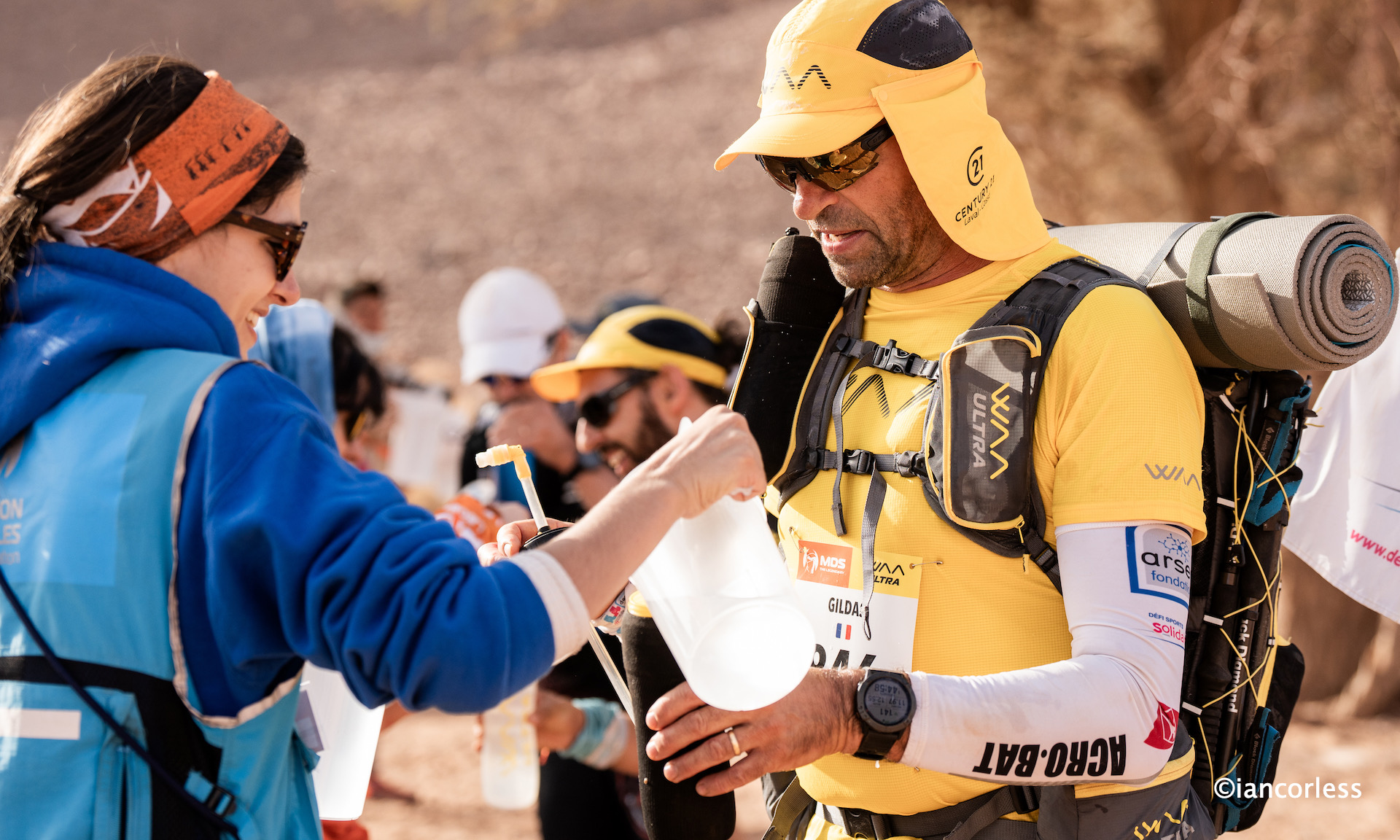
Water is provided at checkpoints by MDS staff ©iancorless

Water provision, particularly at MDS The Legendary and MDS 120 has changed. In past editions, water was rationed and provided at key checkpoints in bottles, typically, 10km’s apart. 

In 2024, the new organisation changed this and arguably, water is now available, as required whilst racing. It is poured from jugs by MDS staff.

 In addition, intermediate water stations are added when deemed necessary to ensure competitor safety. 

Iced water – amazing. ©iancorless

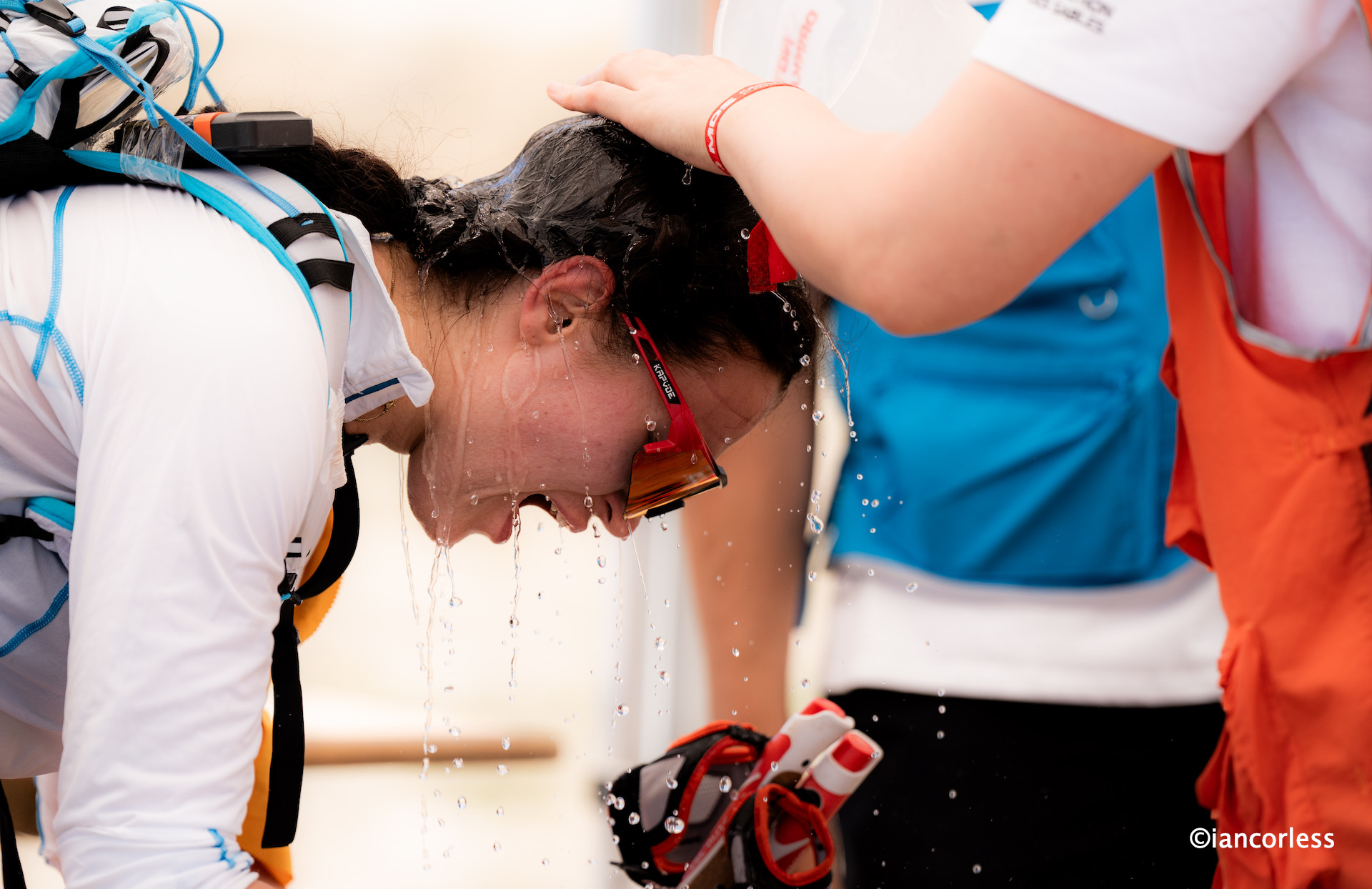
At key checkpoints, iced water is supplied and poured by MDS staff on the heads and neck to aid cooling.

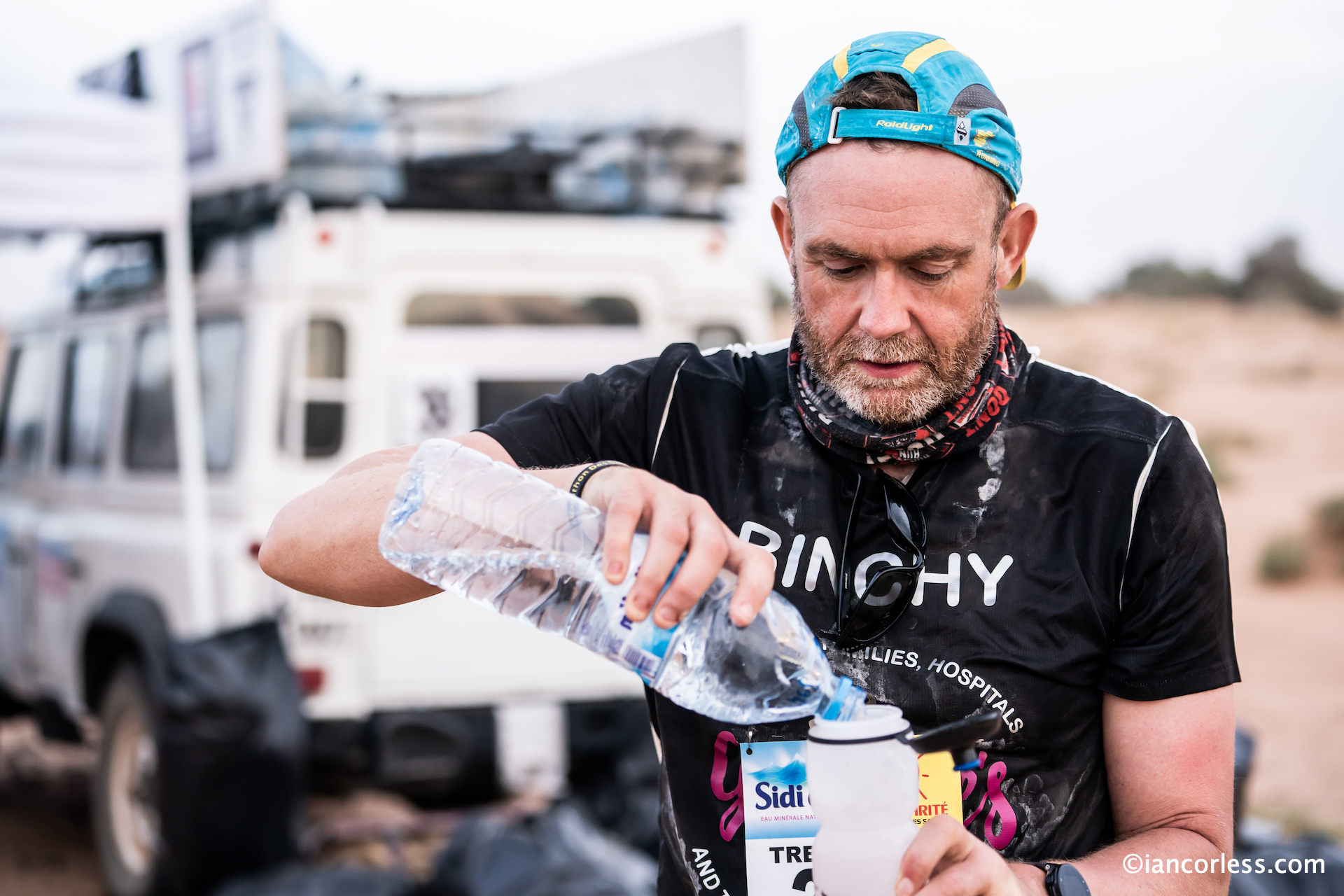
Post-race, each runner is provided with a 5L bottle of water, this is used for evening cooking, breakfast and up to CP1 the next day. If you wish to wash or freshen up, this comes from the same water ration. So, prioritise food and drinking before washing.

THOUGHTS AND CONSIDERATION

MDS is available for all, be that racing snake or someone who is looking for the adventure of a lifetime. So, keep that in mind. A top runner will have his or her pack at the absolute minimum weight and will look to survive the week racing as fast as possible. They will spend the week hungry. You, for example, may wish to carry a little more weight and have some comfort during the week. Just don’t carry to much extra weight!

The pack you wear is a crucial item that not only must fit everything you need, but it must also be comfortable and allow easy access to drink. There is no one-stop solution here. We are all different sizes and have different body shapes, so, make sure you try options.Also remember, at the beginning of the race, your pack can be around 8kg, this adds extra pressure on the shoulders, so, make sure you have enough padding and comfort. Many packs now come with waist belts and this, for many, is a great solution not only for extra storage but weight distribution. WAA have the ultra bag which has been specifically designed for the job. Osprey have recently released the Talon Velocity 20 which in testing has been superb. Don’t be tempted to get a bag that is too large, remember, the more space you have, the more you may take.

Bottles are the obvious way to carry water, typically 2x 750ml on the chest straps. I personally really dislike this format, I find it uncomfortable and unpleasant. So, find your own solution. Bladders have always been considered a NO for MDS but I personally find the solution ideal for my multi-day adventures. If you are a ‘racer’ this is not the best solution, but for most, it is ideal. As always, bladders can puncture, so, think about this.

Correct shoes and gaiters are essential. ©iancorless

Shoes will always be a debate and point of discussion. Shoes are personal and must be suited to you, the individual. Consider your gait (neutral, supinate or pronate), consider time on feet, consider your weight, consider how much you will walk (and then double it) also consider shoe drop and how much cushioning you need. It’s impossible to recommend any one shoe because of these variables. You will see top runners using a lighter shoe, remember, these shoes only need to last 20-30 hours. However, you may well need a shoe for 40, 50 or 60-hours. Do you need a trail shoe? No, you don’t need a trail shoe but I would say that many trail shoes are more durable as they are designed for the rough and tumble of variable terrain. Do you need an aggressive outsole? No, you don’t, but I do think some grip is better than none and therefore I would use a trail shoe over road. Protection? Toe box protection is a good idea as deserts include lots or rocks, far more than you may think. Do I need a size bigger? Shoe sizing does depend on what is ‘normal’ for you. I always recommend a thumb nail of space above the big toe, you don’t need any more than this. Recommendations of going a size is bigger is bad advice in my opinion. A shoe that is too large allows your foot to move, a moving foot causes friction, friction causes blisters and the rest is the same old story that I see at desert races all over the world. However, I would recommend a shoe with a little more width in the toe box, this will allow for some comfort as the days progress. If you are prone to feet swelling, discomfort, blisters and so on, get a strategy sorted before you head out to your chosen race. You will need a gaiter and while not always the case, sewing velcro on a shoe can change its shape, so, consider this. There are specific desert racing shoes now available by Salomon and Raidlight.

Poles are a godsend, buy some and learn how to use them. They are 4-wheel drive.
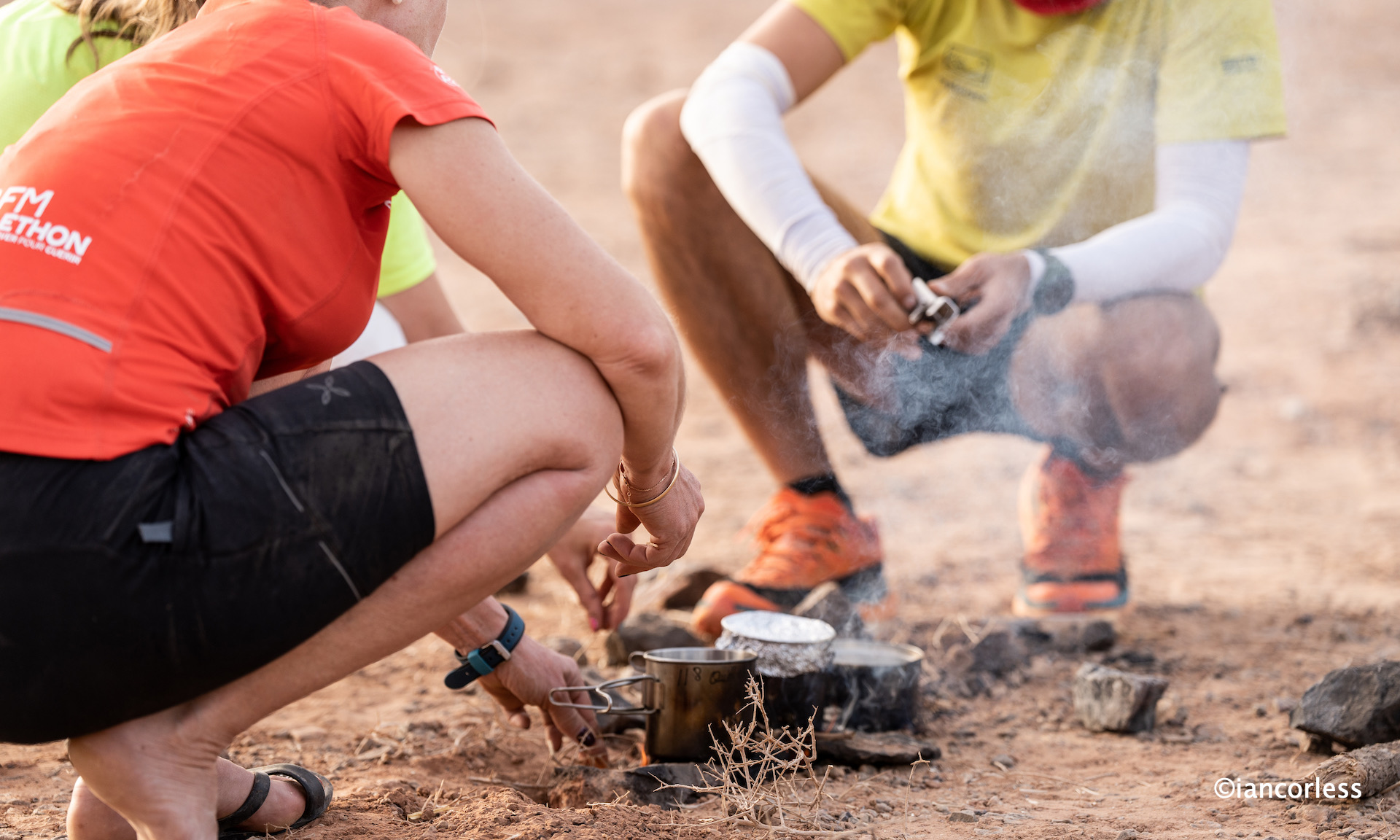
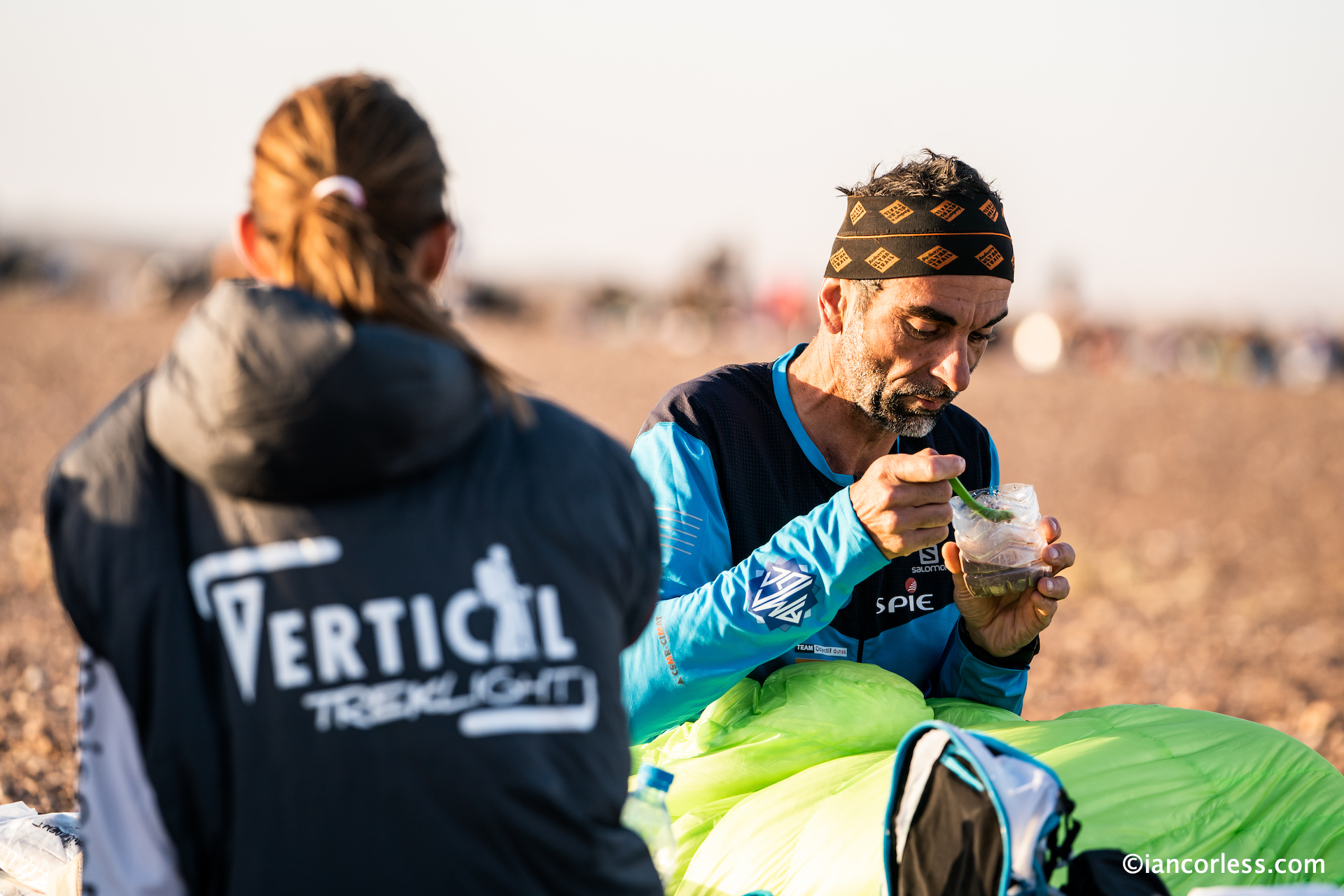
You can be creative with food prep ©iancorless

Food is essential, make sure it works. Hot or cold water is a consideration and make sure if using meals that need rehydrating that they work with water at desert temperature. Never assume that water will always be warm because you are in the desert, just as we get hot years, we also get cool years.

Salt is needed to keep you in balance. Many foods contain salt so look to supplement that with the mandatory food cubes. Be careful here, for example, OXO works considerably better than Knorr. Do you need alt tablets? Do your research,, find out what you personally need and come up with a plan. Listen to a podcast HERE.

Avoid this! ©iancorless

Feet – make sure you look after them. With the correct socks and correct shoes, there is no reason to get blisters and despite what some people say, the majority of people do not get blisters. Read Healthy for Running and Walking.

Heat is difficult and without doubt, it’s better to adapt to heat before the race. Read about Heat Acclimation by Dr Jodie Moss.

Hygiene is crucial and difficult when self-sufficient. But set up a protocol not only for your benefit but for those around you.

Luxuries keep them to a minimum.

Toilet paper is essential, make sure you have enough and compressed towels are brilliant to freshen up when you add a little water.

Take essentials on the plane and wear your run apparel and shoes. That way, should a baggage disaster happen your chances of racing improves.

Have additional items such as a base layer, sleeping bag liner and other items that may be on a ‘question’ list for the race. On night 1 and before you go to admin, you can make final decisions of what to and what not to take. Particularly important if you think you may be cold at night.

What a journey ©iancorless

FINALLY

The medal! ©iancorless

You signed up for the challenge, you wanted to be on the start line and therefore you are responsible for the outcome. Believe me, the ‘you’ that leaves the Sahara is not the same you that entered. Arguably, you change the moment you pay the deposit, the transformation process begins. Embrace the journey and apply yourself. Keep perspective, the MDS journey is an enhancement of you as a person. It’s easy to become obsessed, ultimately the majority of runners at MDS are enthusiasts, if you keep that in mind the journey will be a complete one.

Plan ahead, formulate a long term plan and don’t rush. The sooner you start this process, the greater your chance of success and the less chance of injury. Plan stepping stone races and don’t be fooled into thinking that you need to run marathons day-in and day-out. You don’t! Training is about ALL the training you do and not about anyone run.

Commitment, training and dedication. ©iancorless

If we exclude the top 50-100 runners (who will also walk sometimes) the majority of the MDS field spend a huge amount of time walking. Learn to walk! Believe me, it’s a huge tick in the MDS box and rest assured that if you are able to walk at a good consistent pace (barring injury or dehydration) you will finish MDS.

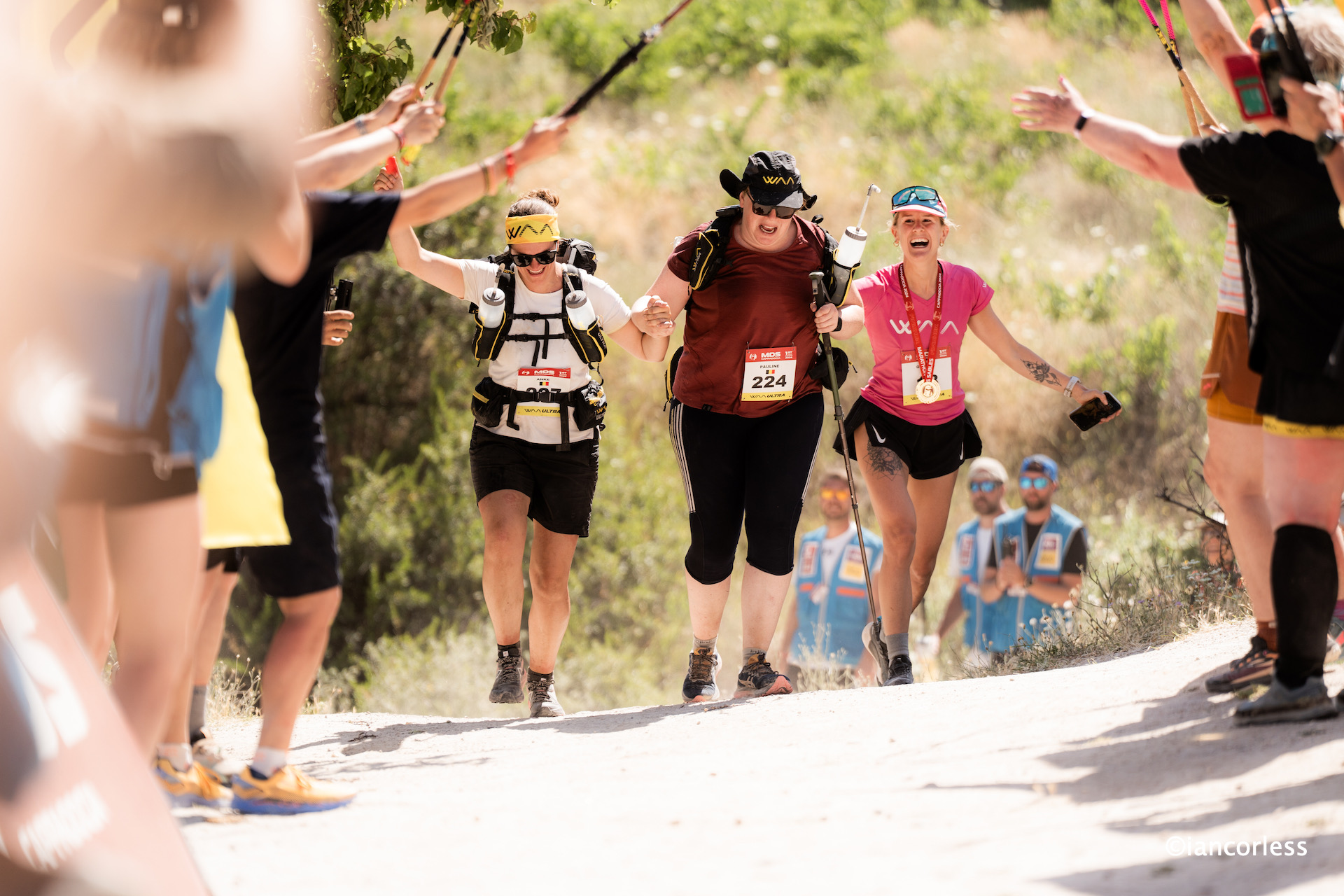
MDS is an inclusive experience ©iancorless

You are going to share bivouac with other people and you are going to have some serious highs and lows. These tent mates will pull you through and motivate you. They will become friends for life.

Legs, lungs, heart and feet will only get you so far. The mind is what will get you to the finish. Despite the hardships and pain, embrace the journey and mentally prepare for the challenge.
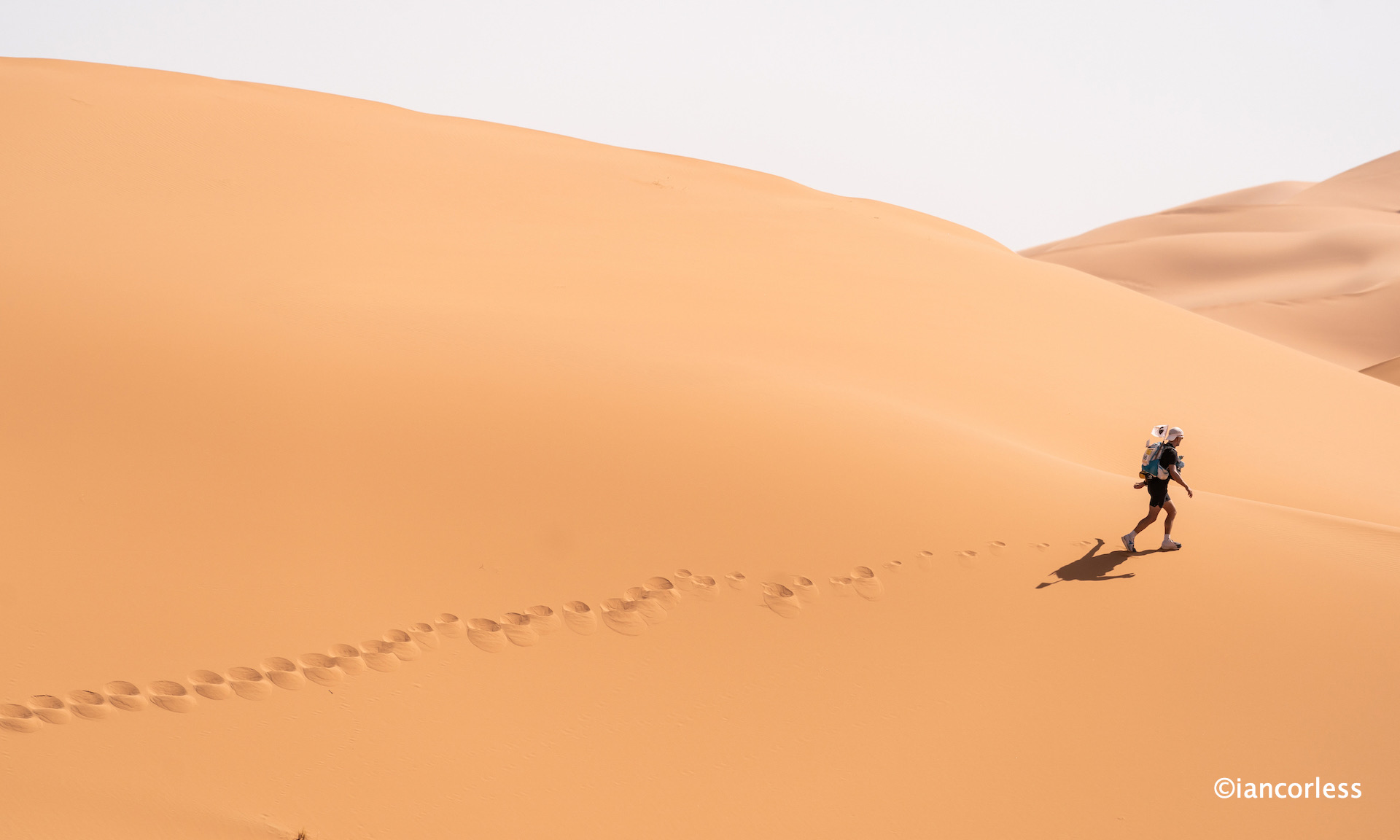
You. A pack. The desert. ©iancorless

MDS is a magical and life changing journey, it really is a true challenge of mind and body to race over many days, irrespective if you complete or compete. It’s a hark back to a more primitive time, a time without clutter and modern technology. Embrace this. Embrace the silence of the surroundings and the simplicity of placing one foot in front of the other, eating, resting and sleeping and then doing it all again.

You can read a SUMMARY of the 2024 MDS The Legendary HERE

MDS 120 events HERE

MDS The Legendary HERE

Further reading:

How to choose a Sleeping Bag HERE

Fastpacking Guide HERE

Winter Fastpacking HERE

Walking with poles HERE

Walking efficiency when climbing HERE

Long Term Goal Setting HERE

This article was updated, July 17th 2025.

Follow on:

Instagram – @iancorlessphotography

Twitter – @talkultra

facebook.com/iancorlessphotography

Web – www.iancorless.com

Web – www.iancorlessphotography.com

Image sales –www.iancorless.photoshelter.com
Home of the Giants 2024 Summary

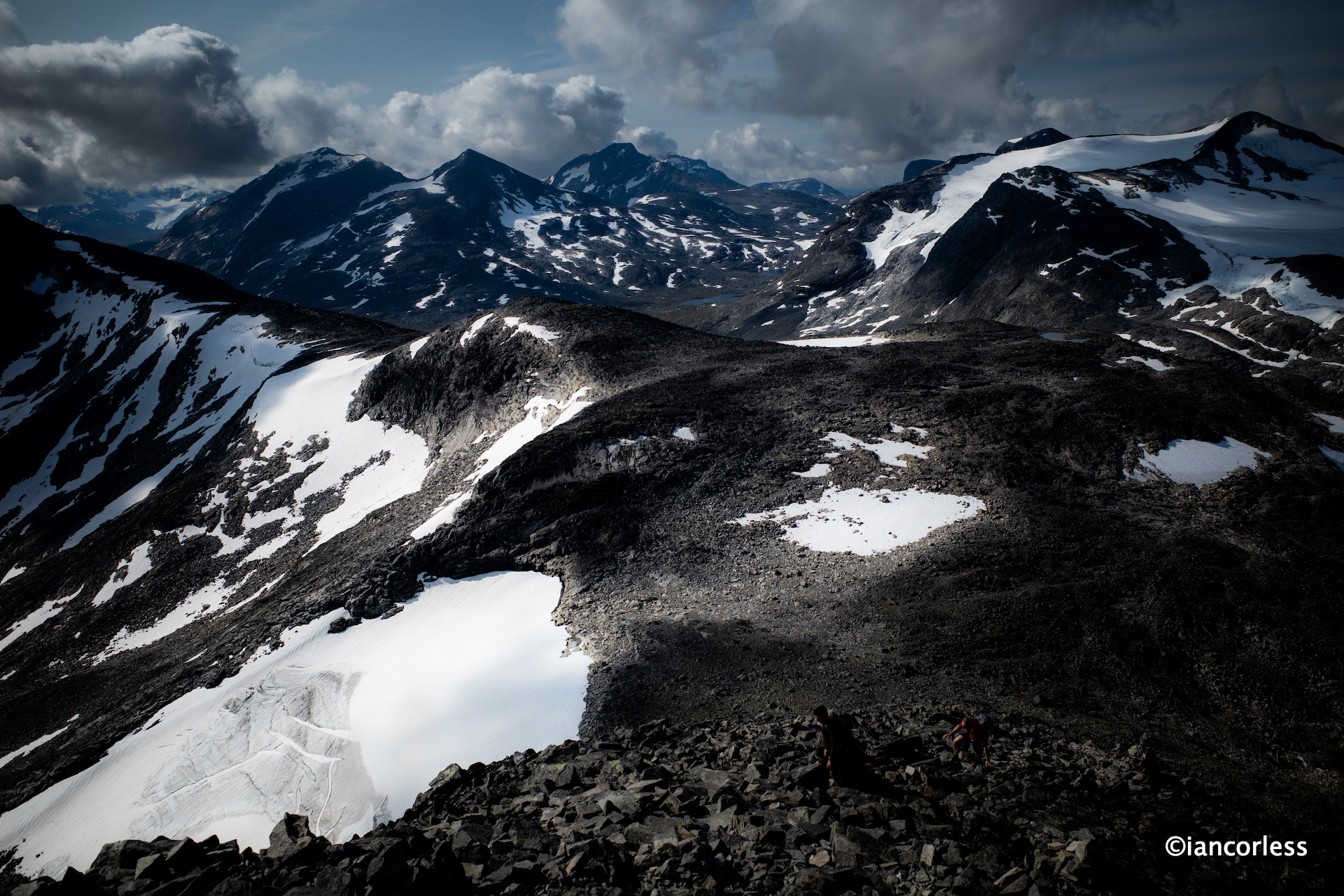
The view from Kyrkja

Home of the Giants 2024 has just come to a conclusion. And what a week it has been.

This trip came about through personal adventure in the Jotunheimen mountains of Norway and the desire to share and showcase this magical playground.

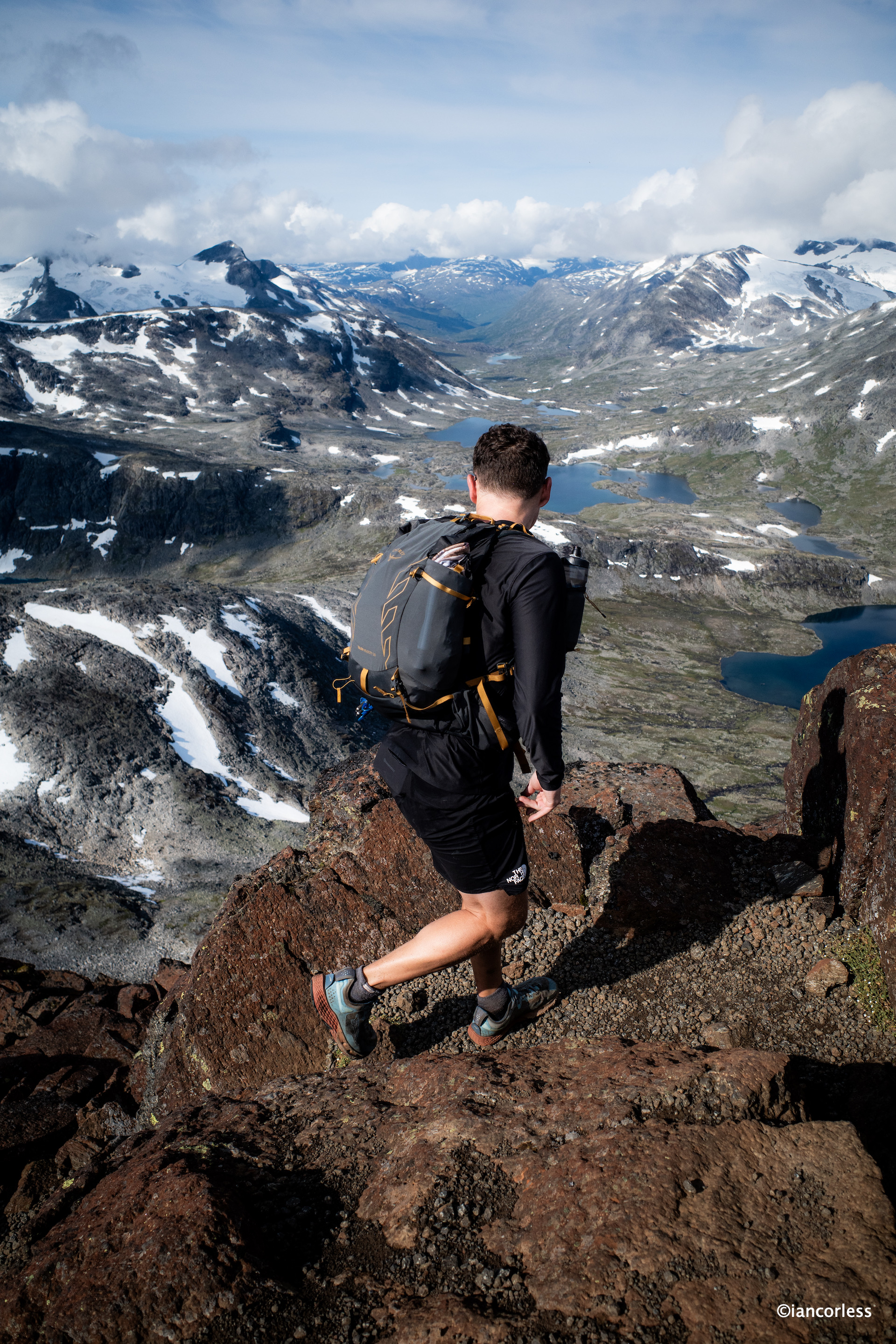
Baz at the summit of Kyrkja

What is Home of the Giants?

A multi-day adventure, 6-days in total, through a magical and challenging landscape. Unlike a race, this journey was created as a finely balanced exclusive trip for up to just 12 participants. A challenge at a more relaxed pace, taking in an amazing route whilst moving light in a semi self-sufficient mode using DNT cabins for overnight accommodation.

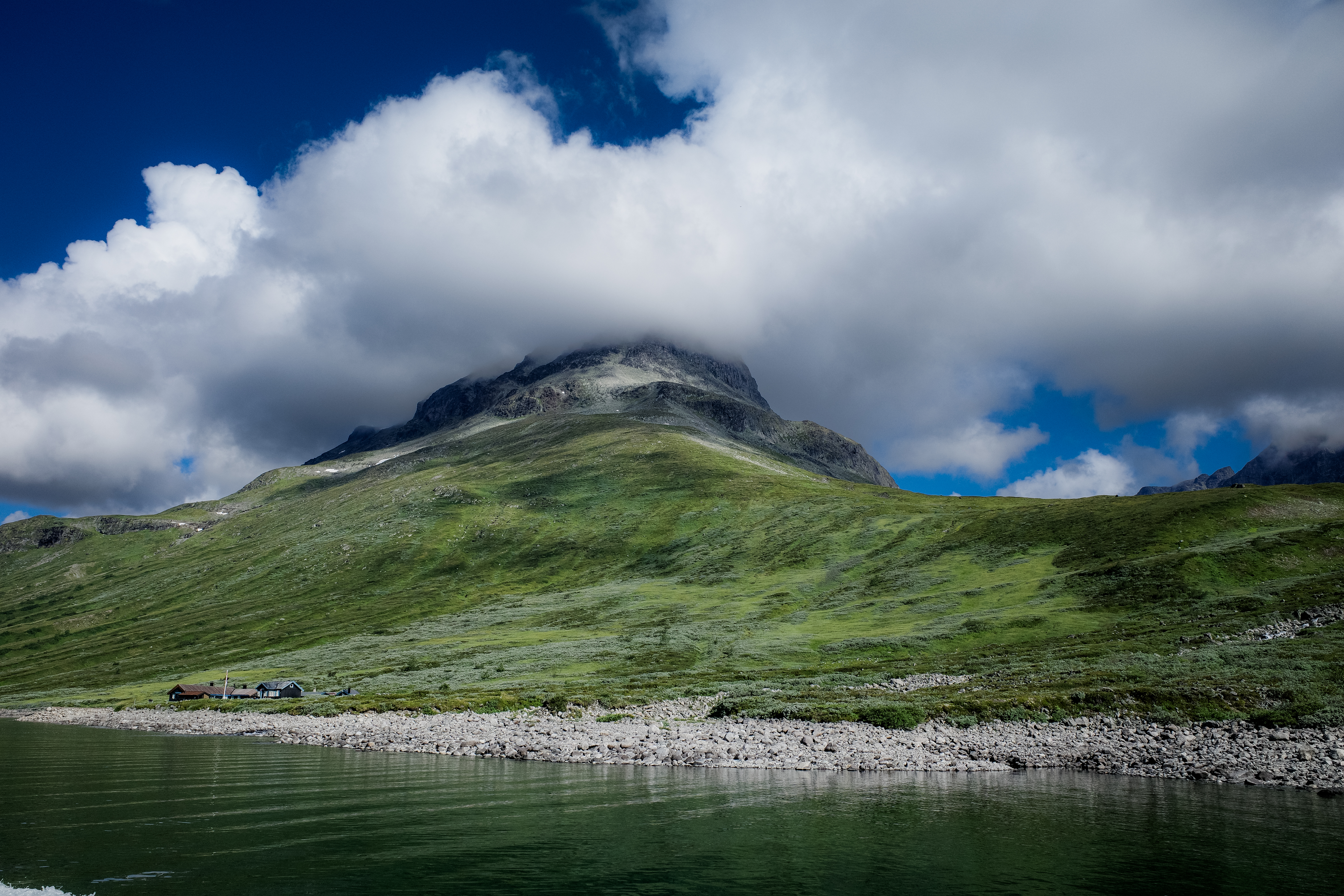
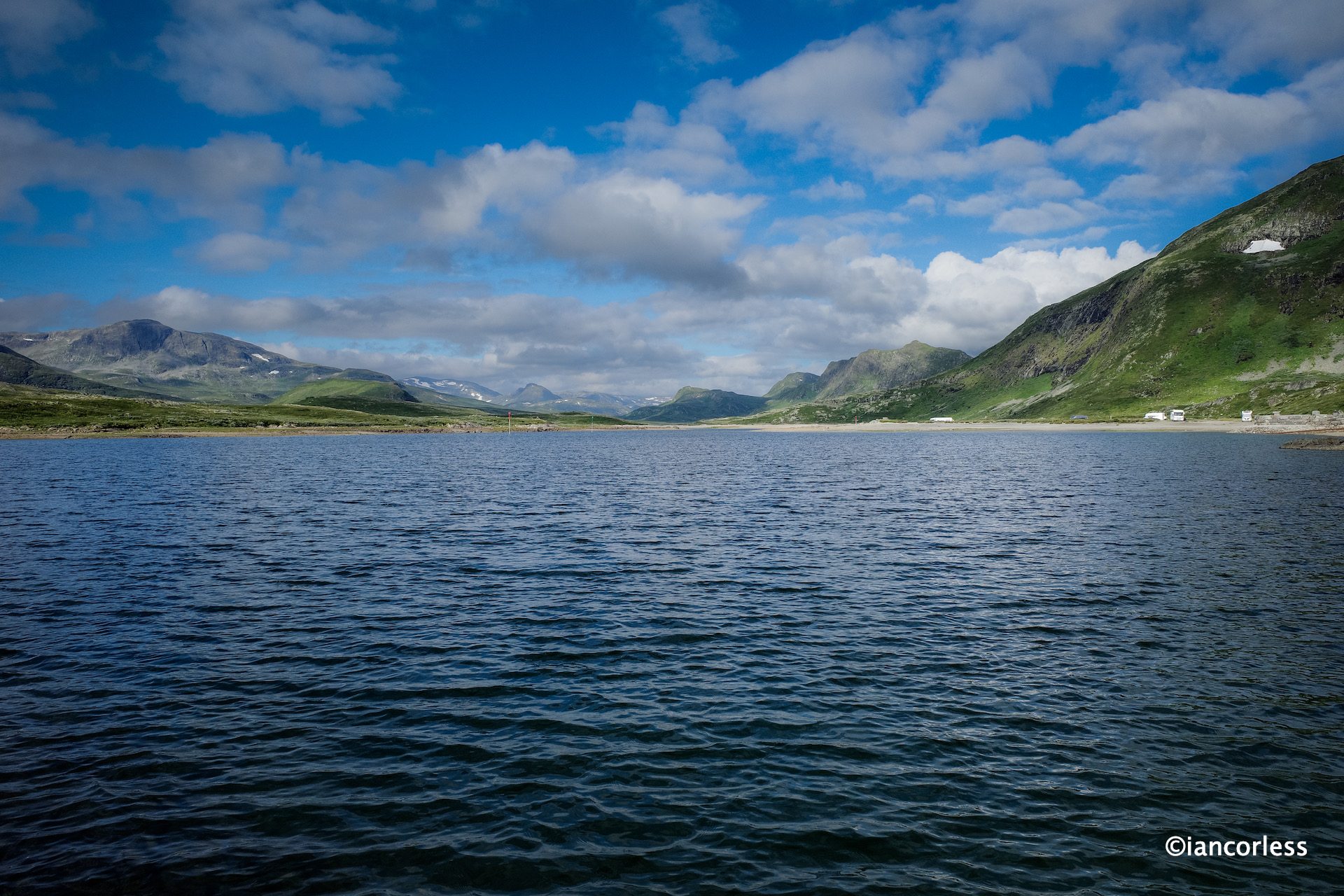
Lake Bygdin

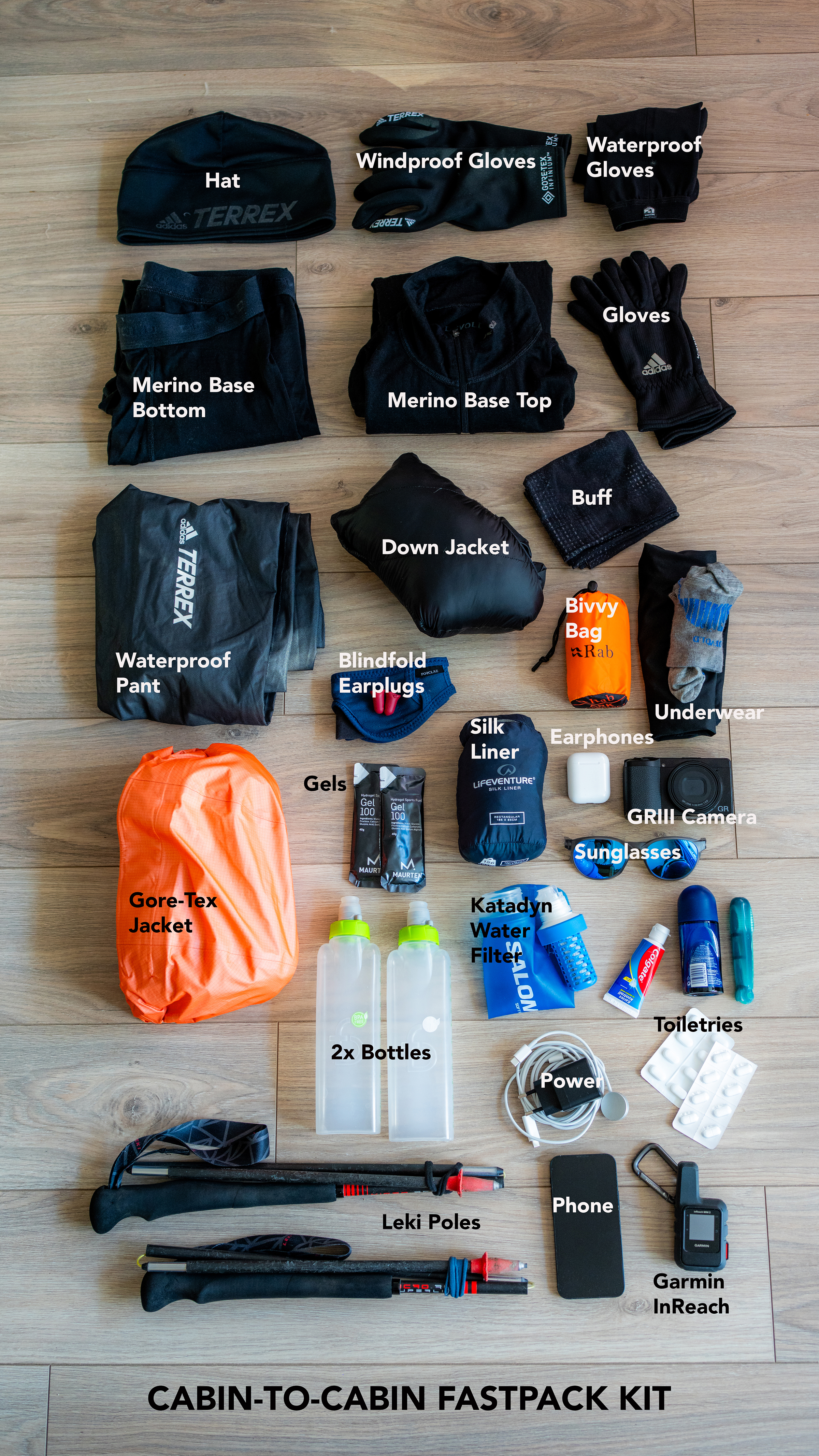
Based around the concept of stage races, Home of the Giants is about moving lighter and therefore faster with a minimum amount of equipment without compromising safety. All we needed could be carried in a small pack weighing approximately 3kg (plus liquid).

It is important to emphasize that Norway can have spring, summer and winter in one day. Never underestimate the challenge of the environment. It is all well and good being light IF you can move fast. You also need to consider the ‘what if’ scenario and should you become slow or a worst case scenario, injured and waiting help/ rescue. At a minimum you MUST have merino top and bottom, warm insulating layer (down or PrimaLoft) waterproof jacket and pants, hat, gloves and a bivy bag. I also strongly recommend a product such as Garmin InReach. Much of Jotunheimen has no phone connection, an InReach with emergency SOS button, for me, should be mandatory.

You can see an example of my pack below and the details are as follows:

  • Camelbak Octane Pack 600g
  • adidas hat 32g
  • adidas gloves Infinitum 52g
  • Hestra waterproof gloves 53g
  • adidas gloves 41g
  • Devold merino base top 193g
  • Devold merino base bottom 166g
  • Buff 43g
  • Haglofs down jacket 163g
  • adidas waterproof pant 125g
  • adidas Gore-Tex jacket 272g
  • Rab bivvy bag 110g
  • Underwear 98g
  • Gels 81g (for emergency)
  • Silk liner 126g
  • Blindfold/ earplugs 22g
  • Earphones 44g
  • Ricoh GRIII camera 251g (a luxury)
  • Sunglasses 18g
  • Bottles x2 90g
  • Katadyn water filter 52g
  • Toiletries 196g
  • Power supply 138g
  • Phone 136g
  • Garmin InReach 108g
  • Leki poles 250g

3379g 

Staying at DNT staffed cabins provides the best of both worlds, they provide a bed for the night, dinner, breakfast, a packed lunch and they have additional facilities such as relaxation areas, showers and a bar. It’s the ultimate way to travel light in the mountains. Beds are in dorms or private rooms that depending on the cabin can be solo, double, triple, quadruple or five plus. Most DNT’s have a rule that irrespective of if you arrive and there are no beds, you will not be turned away, so, rest assured, a safe haven is always available.

OUR JOURNEY

Day 1 – Oslo to Bygdin

We departed Oslo bus terminal at 0830 Monday for a direct trip to Bygdin Fjellhotel. The journey taking 4-hours with a 15-minute break ideal for a midday arrival. The weather was grim with torrential rain for most of the way. It was an ominous start and constant glancing at weather apps confirmed that our week ahead would have mixed weather. It’s Norway after all!

Synshorn summit

Arrival at Bygdin was seamless and after a break at 1500 we departed in the rain to take in the summit of Synshorn (1464m) which is a great introduction to Norwegian mountain terrain. The plan was initially to just summit and return, a 75-minute journey at a steady pace. However, the weather, although still wet, was not cold and after long travel, we all decided to continue for a back-up and planned 12km route. We followed the ridge north to Heimre Fagerdalshøe (1510 m above sea level) with a great view over Bygdin to Falketind. We then continued in the direction of Synsbekk and connected to the ’T’ marked trail that would bring us back to Bygdisheim and the lake for a short gravel road section back to the hotel.

Day 1 loop

It was a great intro to the week and then we could enjoy the benefits of Bygdin Fjellhotel – a warm shower, sauna and a lovely traditional Norwegian dinner.

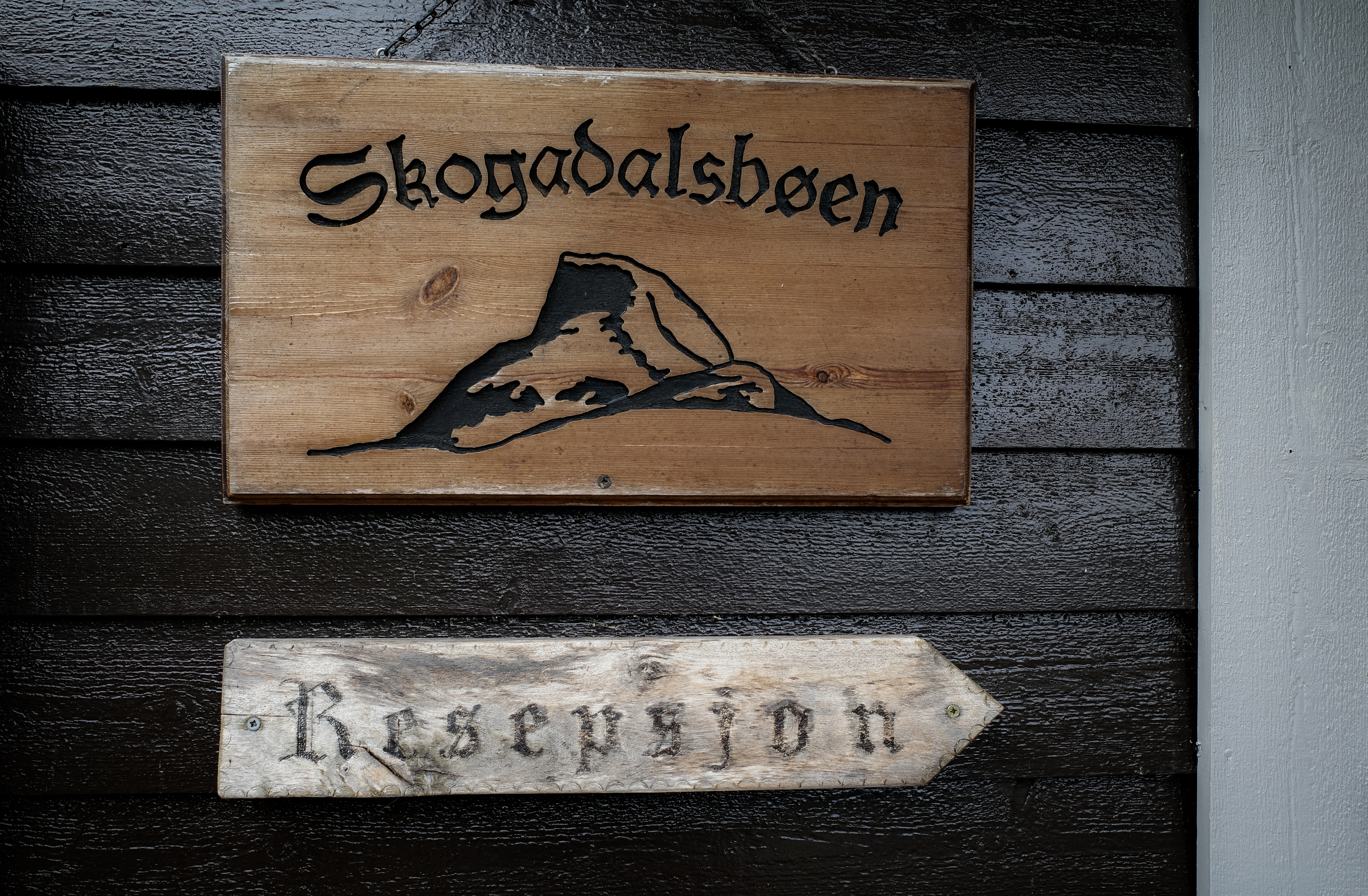
Day 2 – Bygdin – Eisbugarden – Skogadalbøen

M/B Bitihorn

It was a casual start to the day with a hearty breakfast and then meeting the M/B Bitihorn boat at 0900 for a transfer the length of Bygdin lake (stopping at Torfinnsbu) and then continuing to Eidsbugarden.

Lake Gjende
Torfinsbu self-service DNT

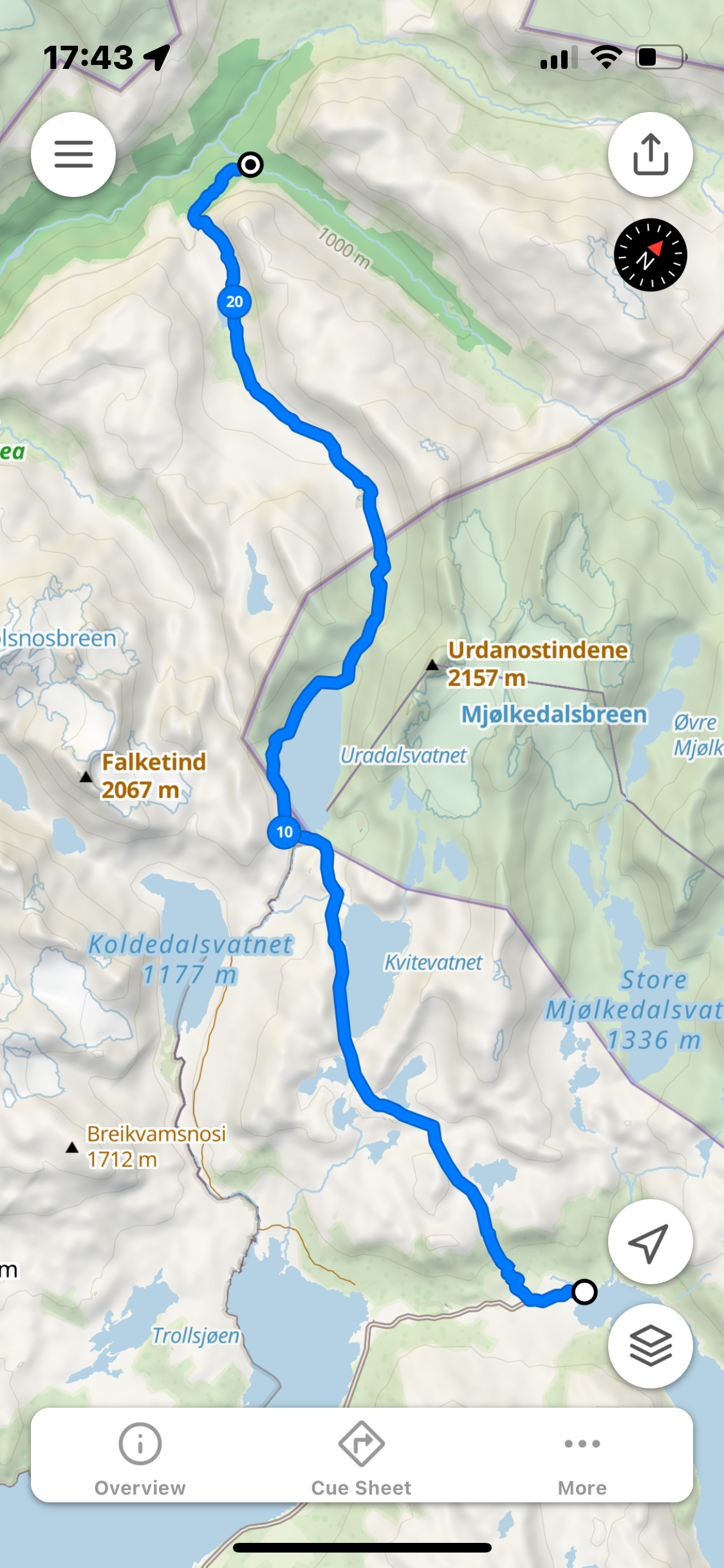
By 1100 we were ready for our first full day, Eidsbugarden to the remote Skogadalbøen DNT cabin. The route is considered very demanding due to the nature of the terrain. It’s very important when looking at routes in Norway that you never focus too much on the distance but more the time it will take to cover the distance. Depending on the time of year, this route can have a great deal of snow, so, be careful and do research in advance. For us, we had several snow fields to cross and all were in good condition.

Eisbugarden to Skogadalbøen
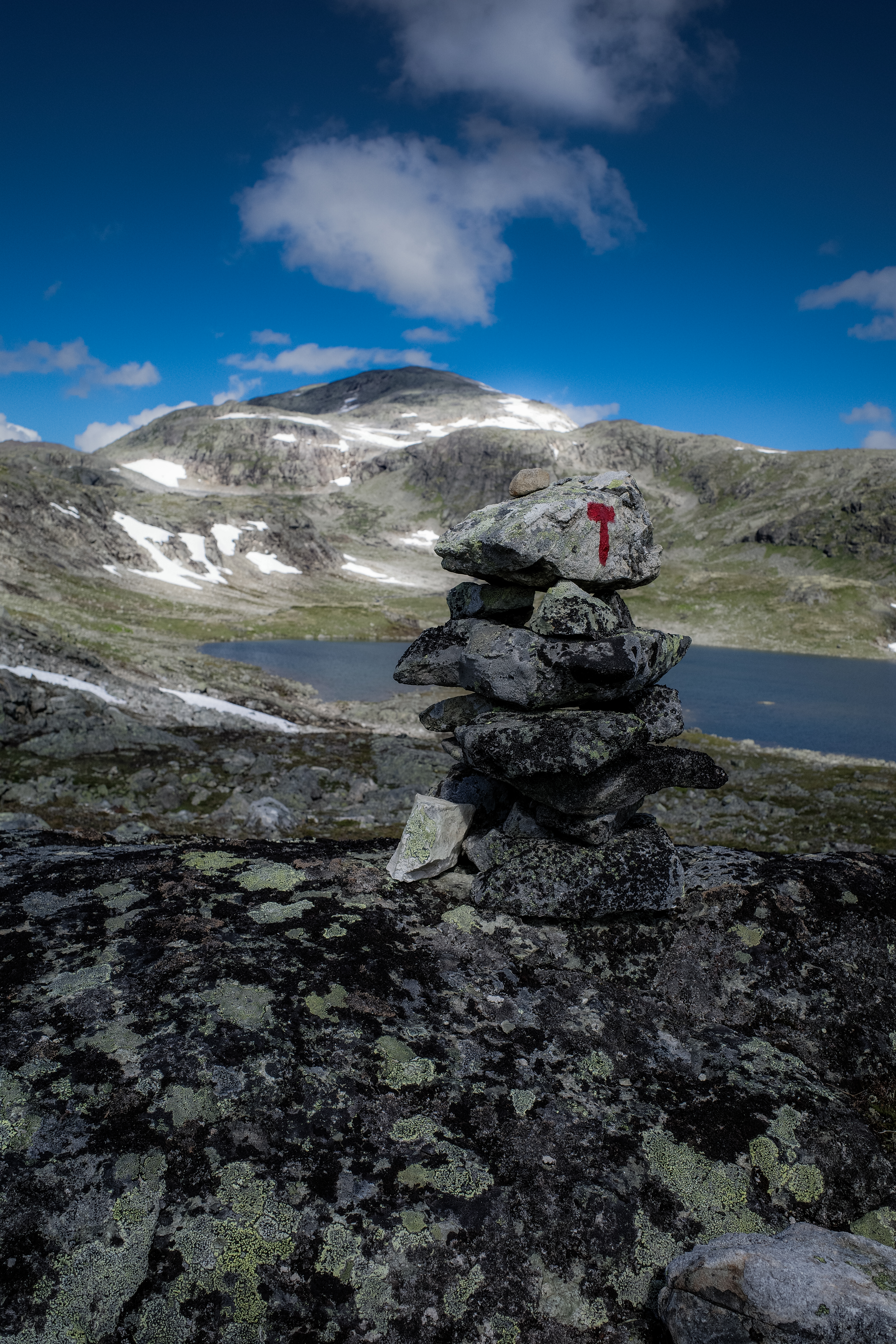
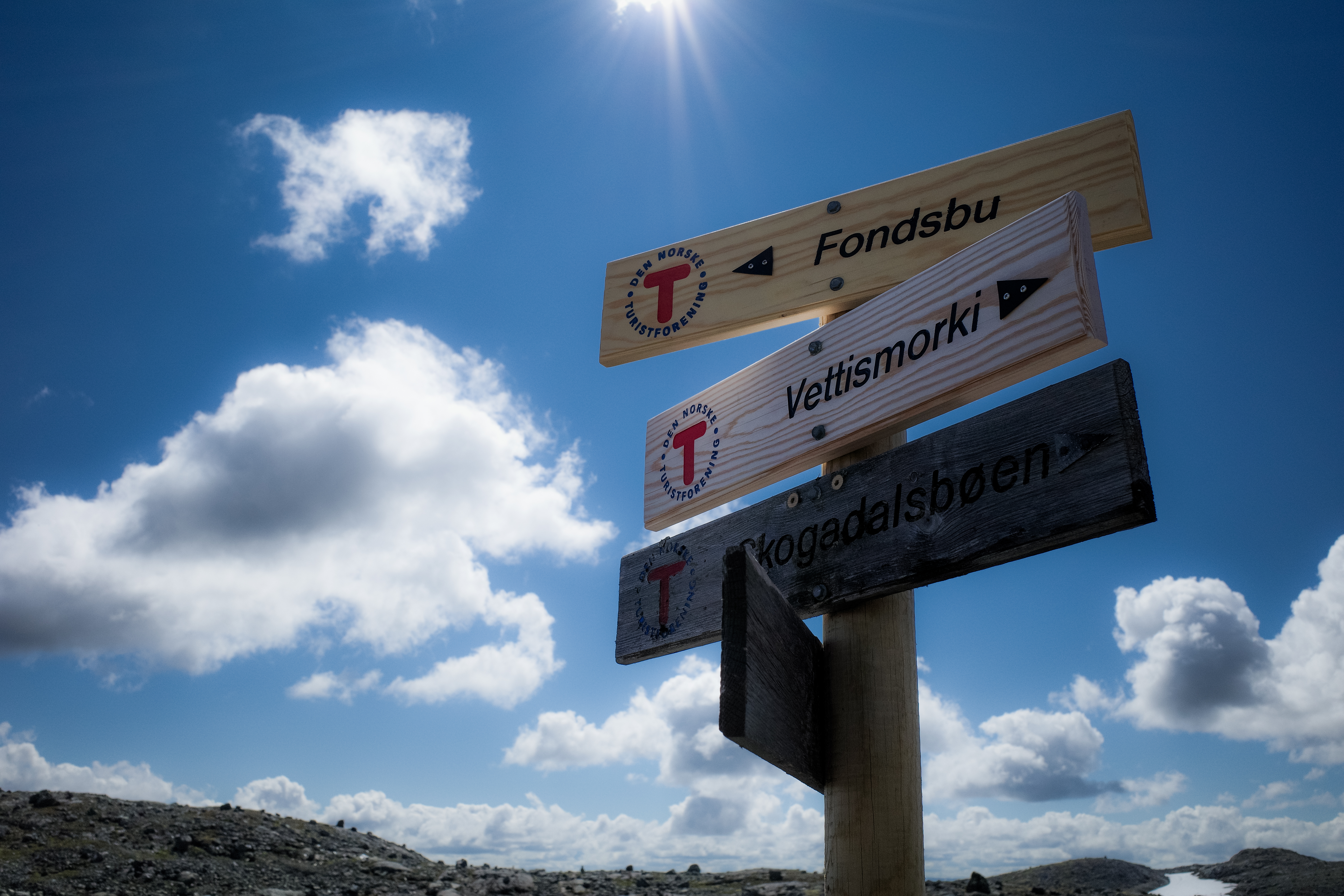
DNT mark the routes with red Ts

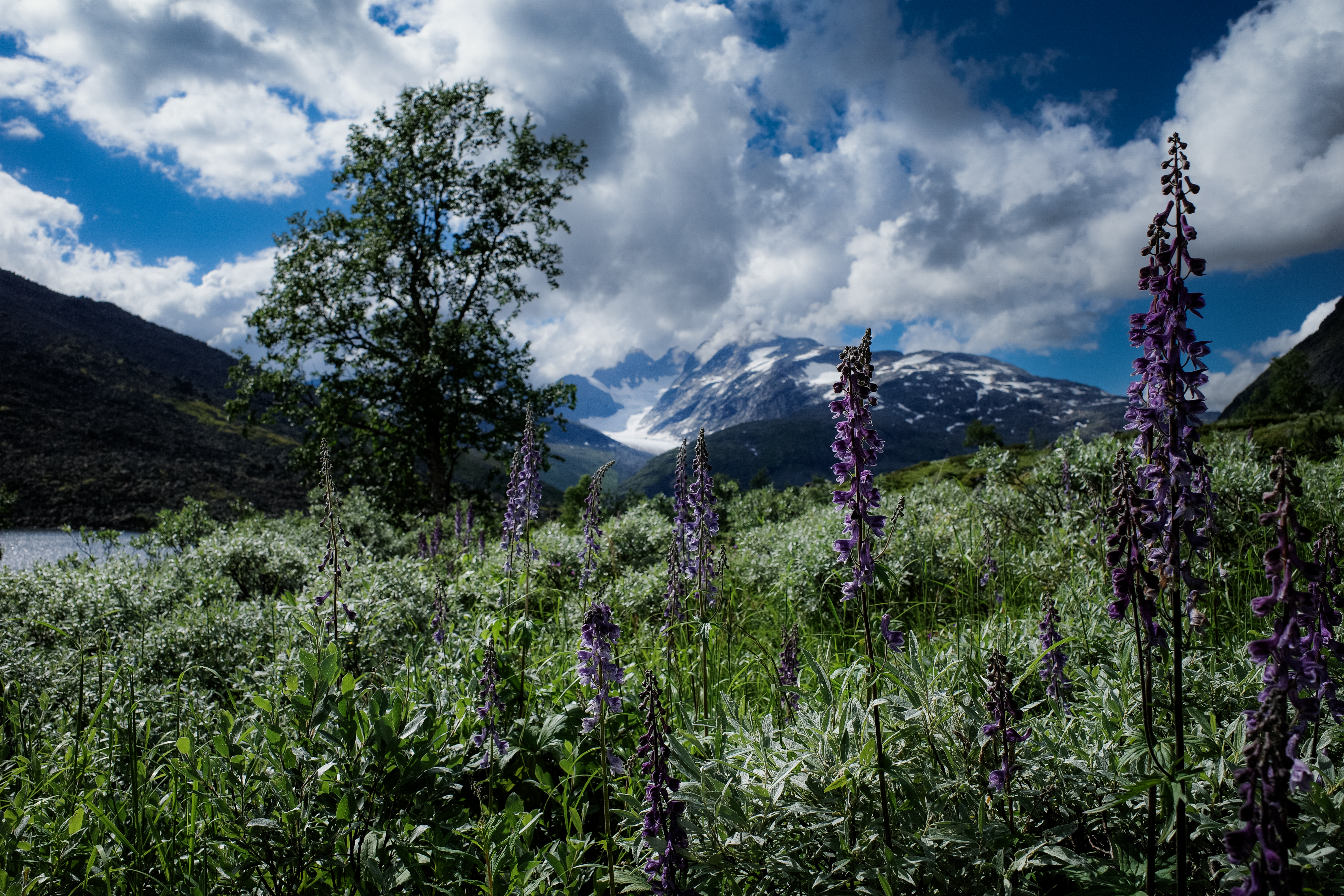
Our weather was glorious, blue skies, white fluffy clouds and amazing views.

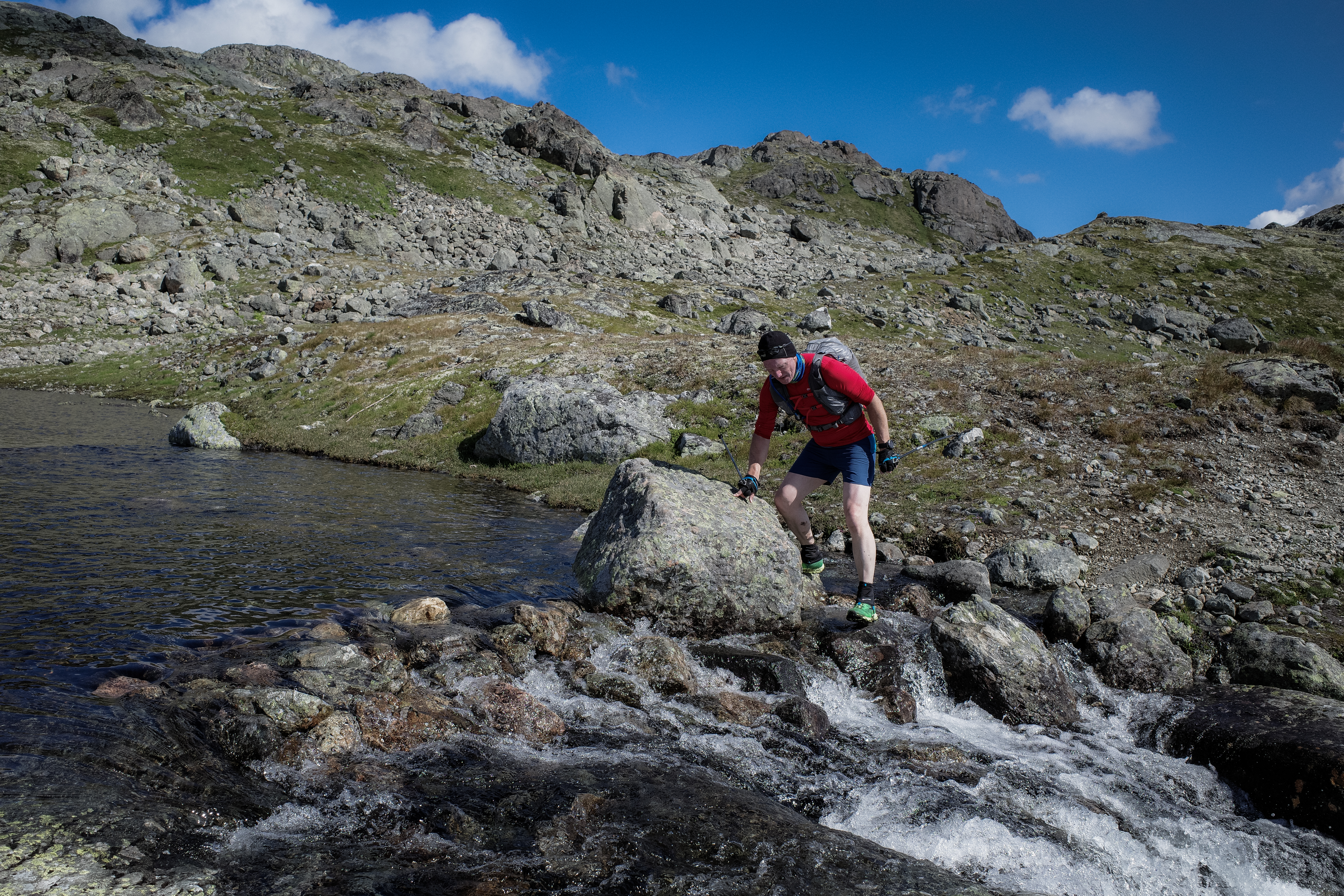
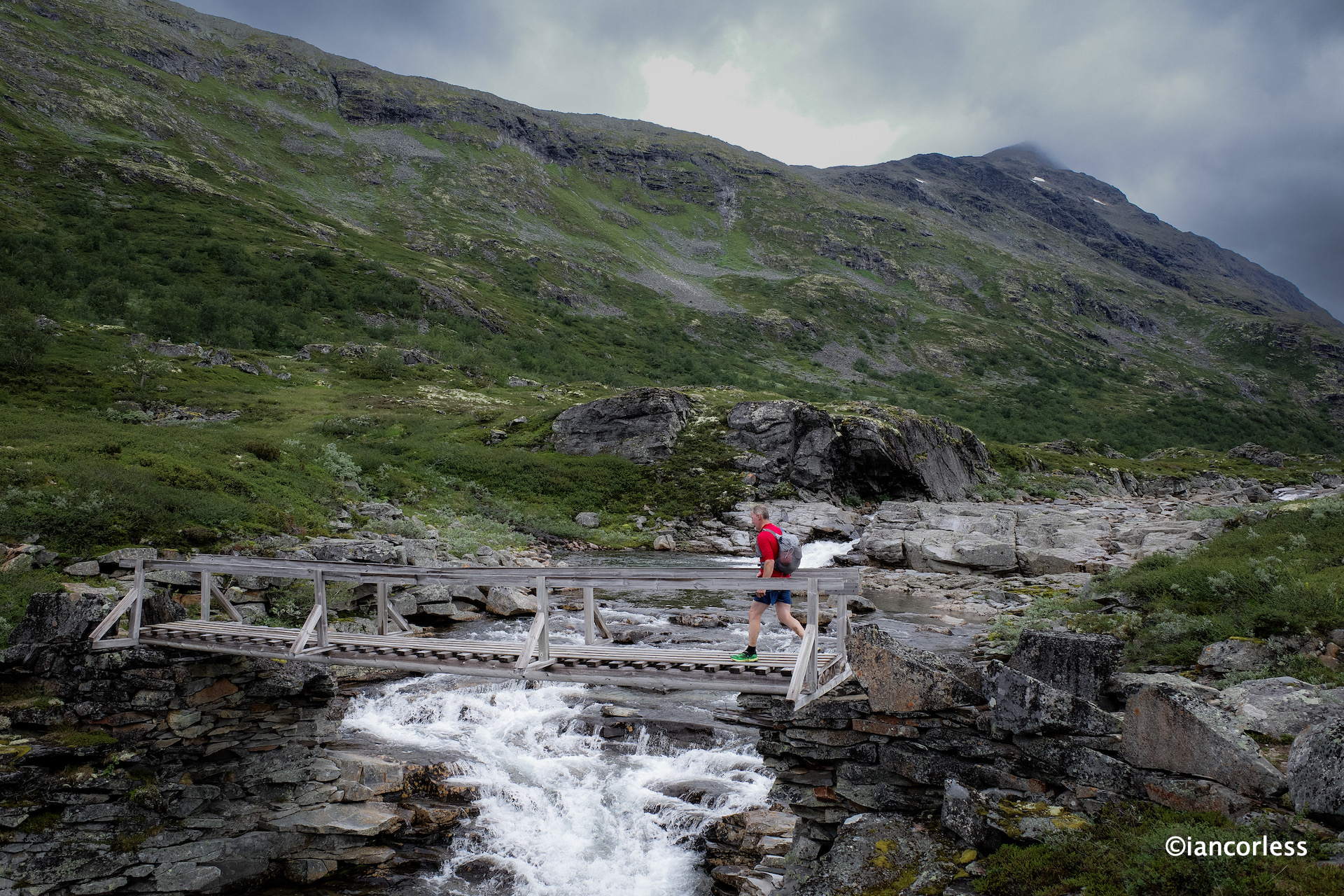
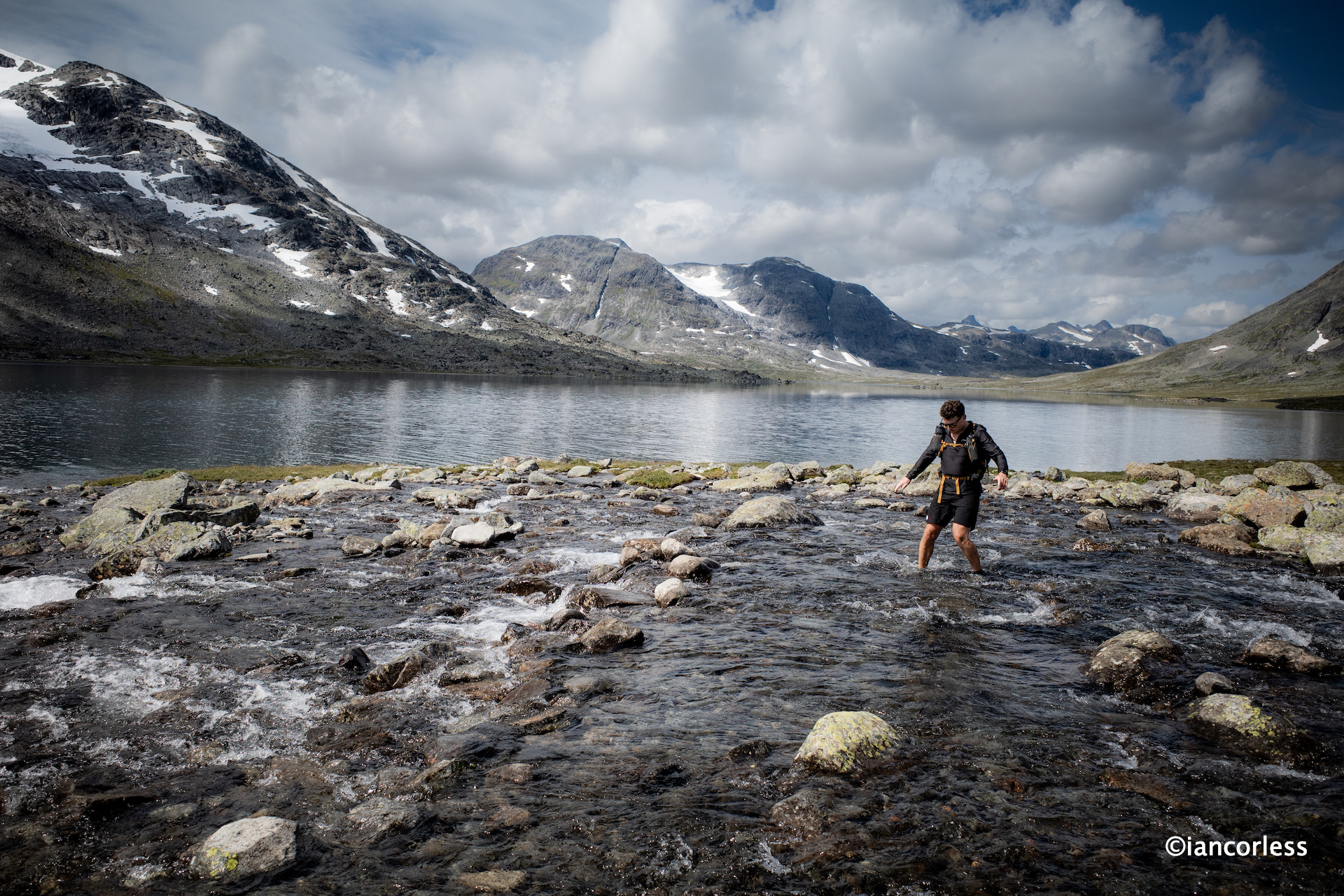
Plenty of water crossings

A short road section and a right turn and we were already climbing through saturated and boggy ground to Sløtafjellet. Then the rocks and boulders started.

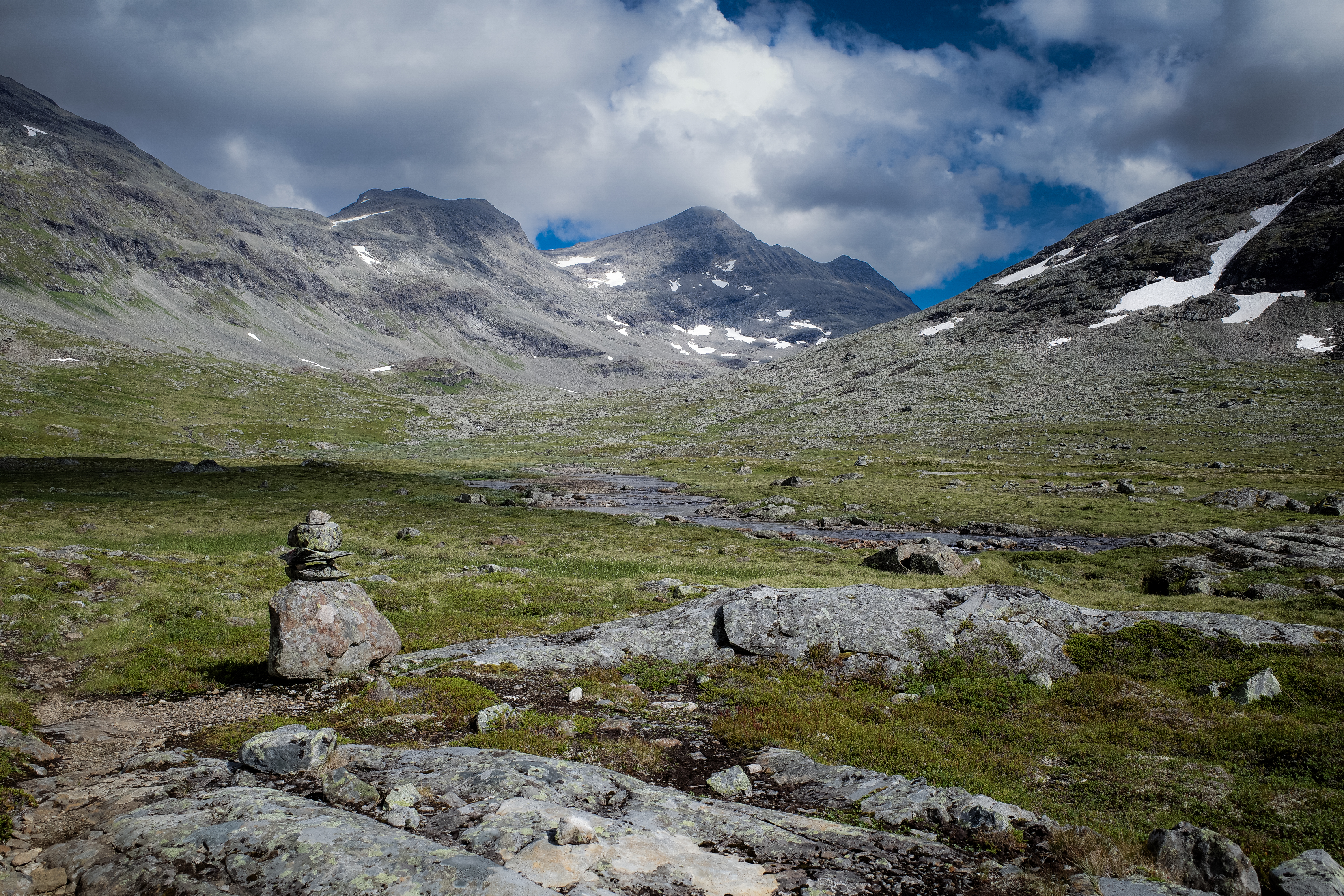
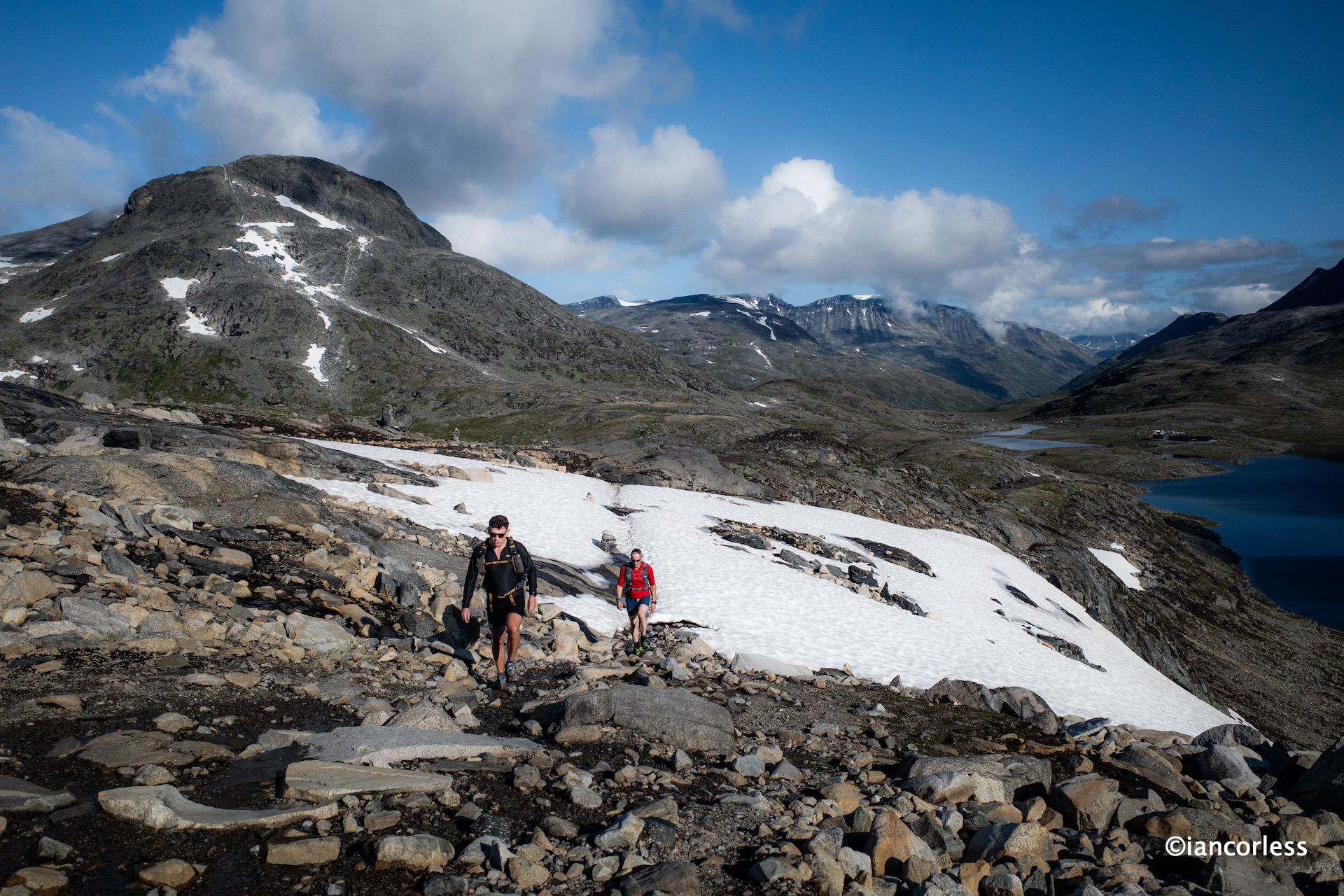
Beautiful but hard terrain

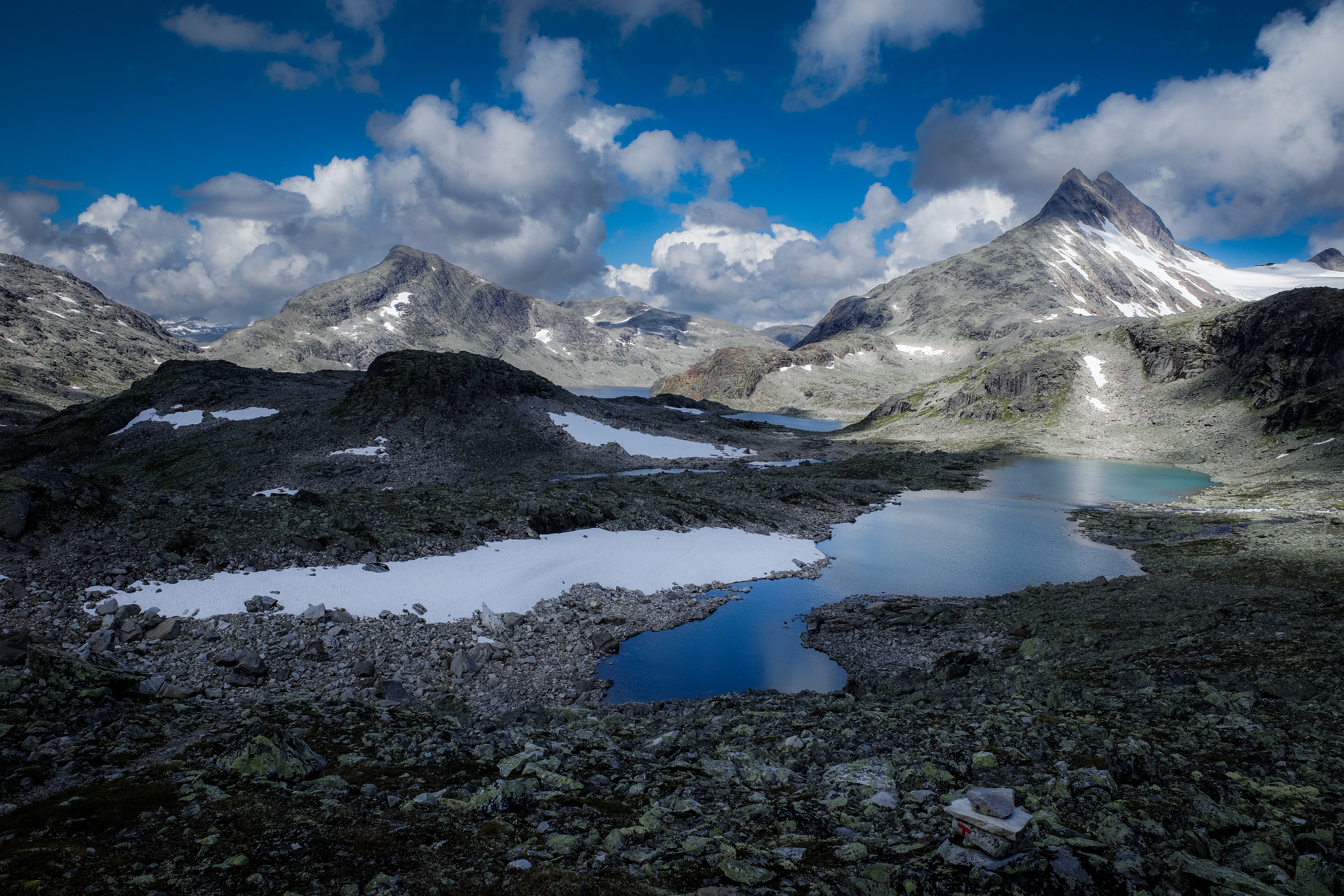
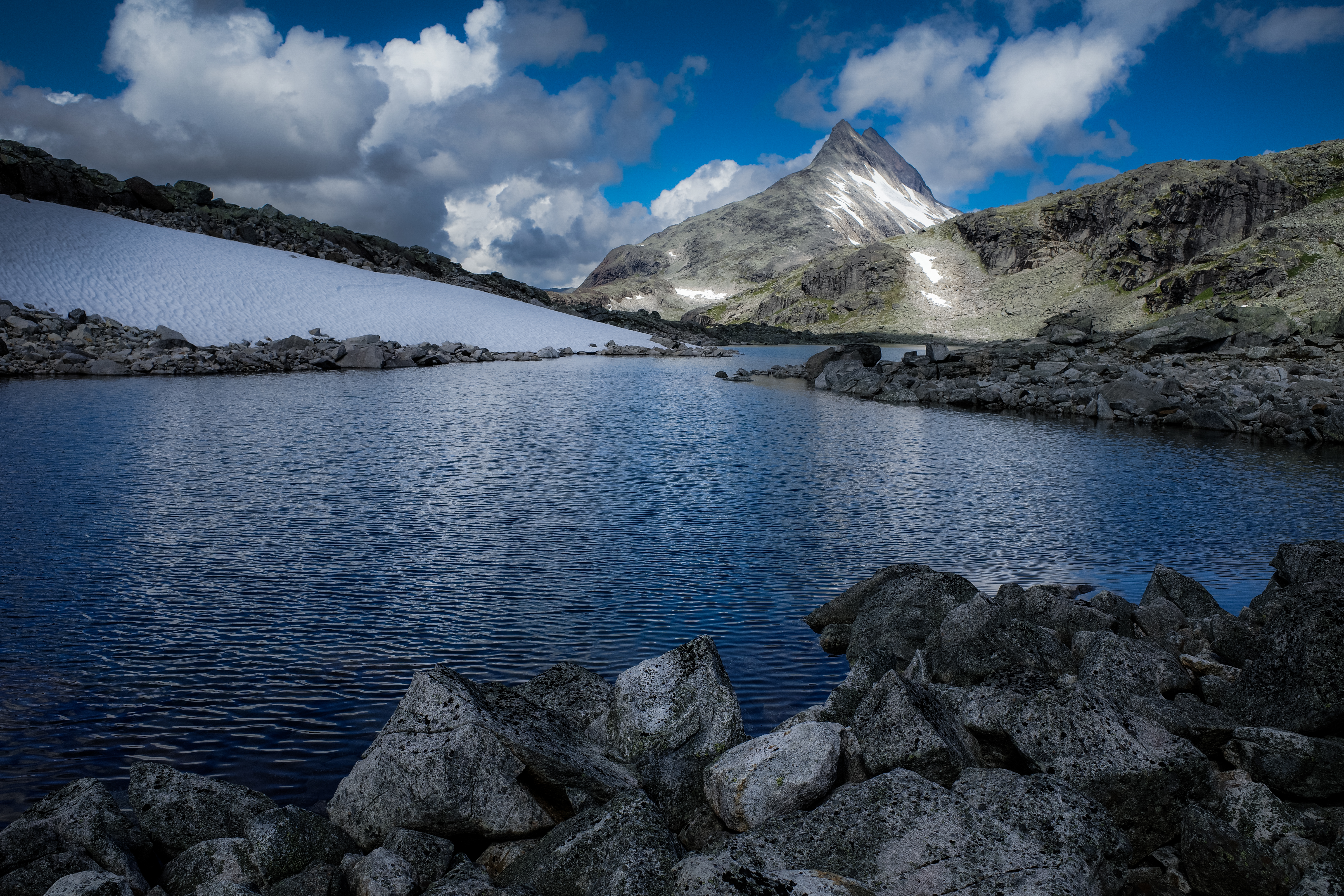
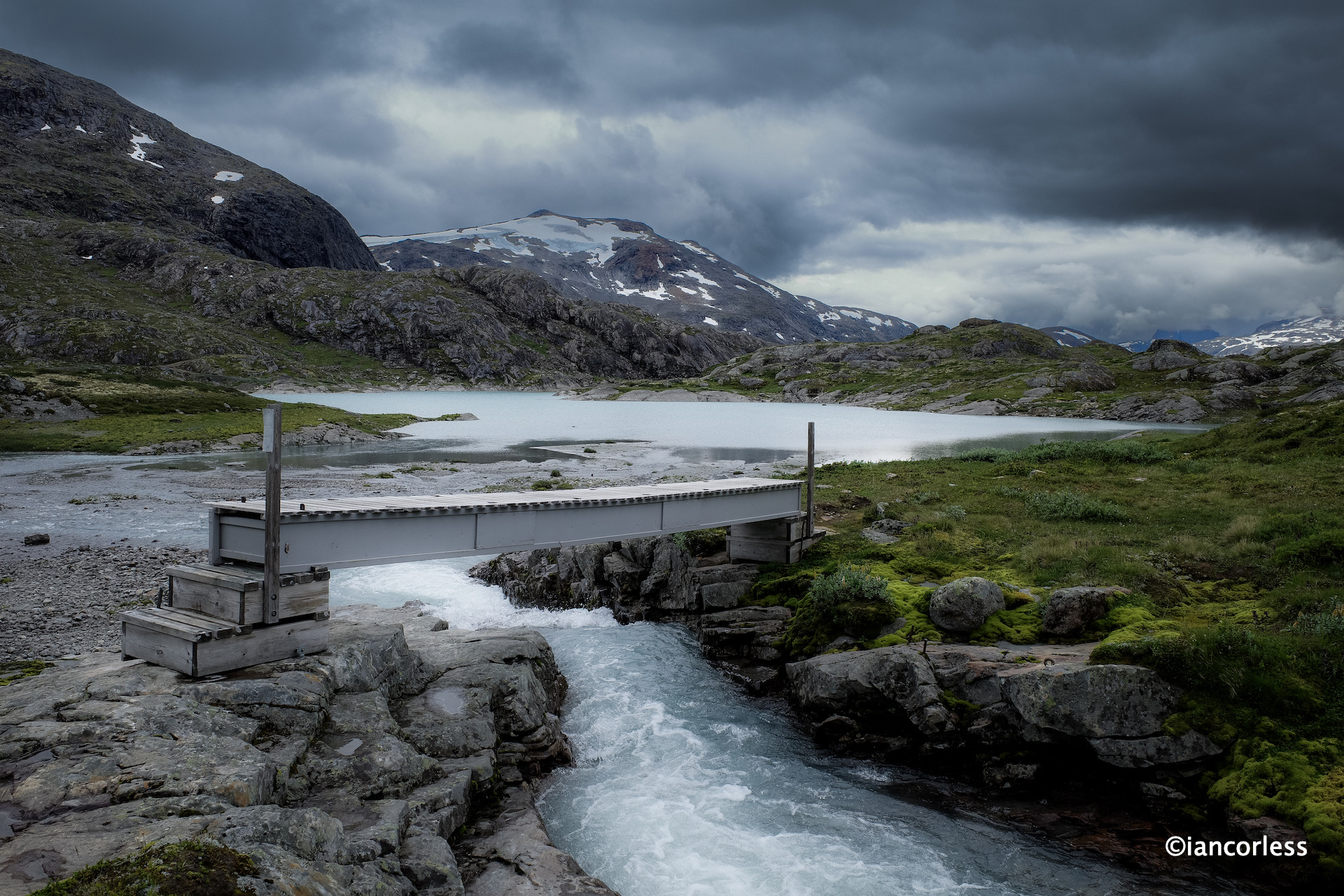
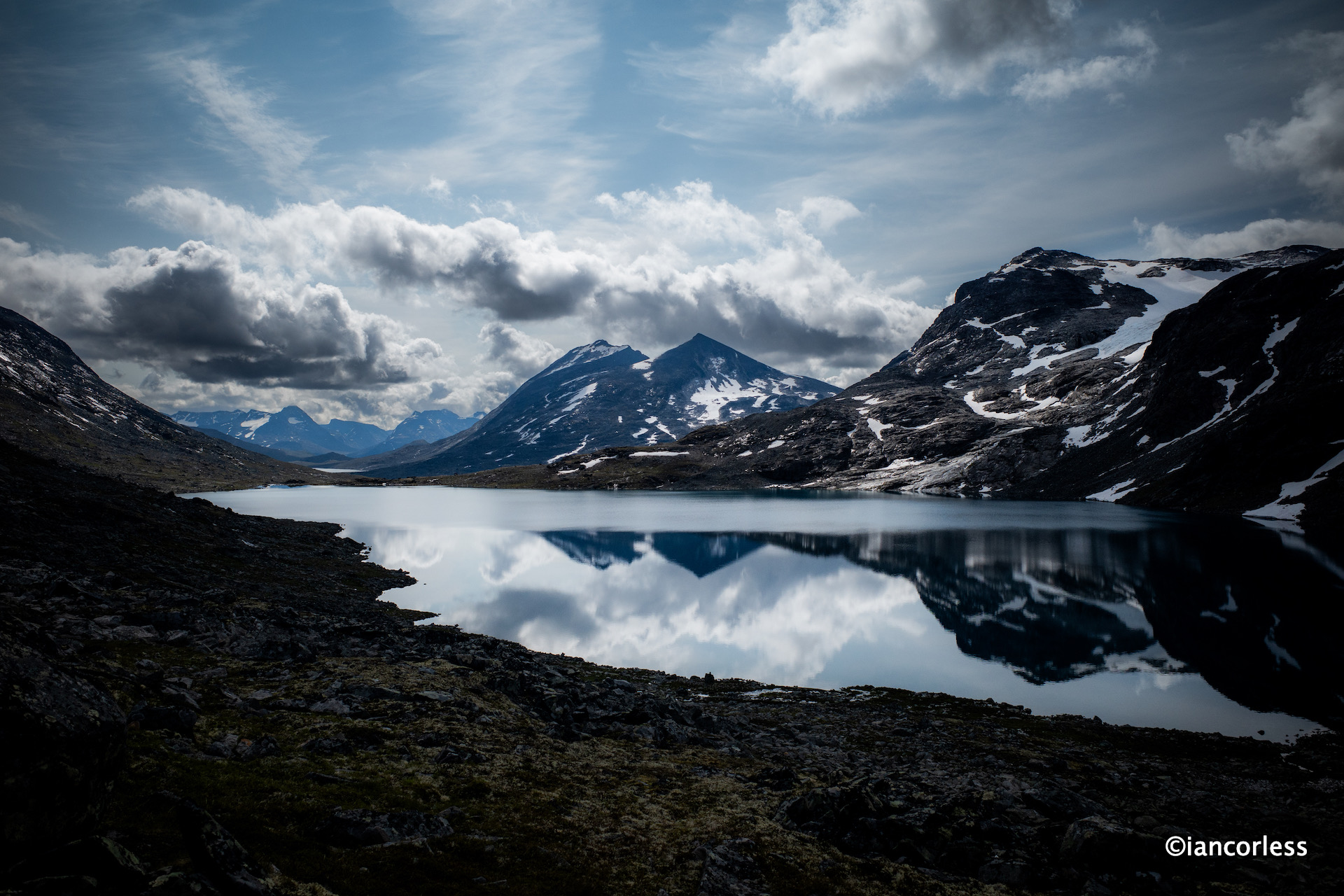
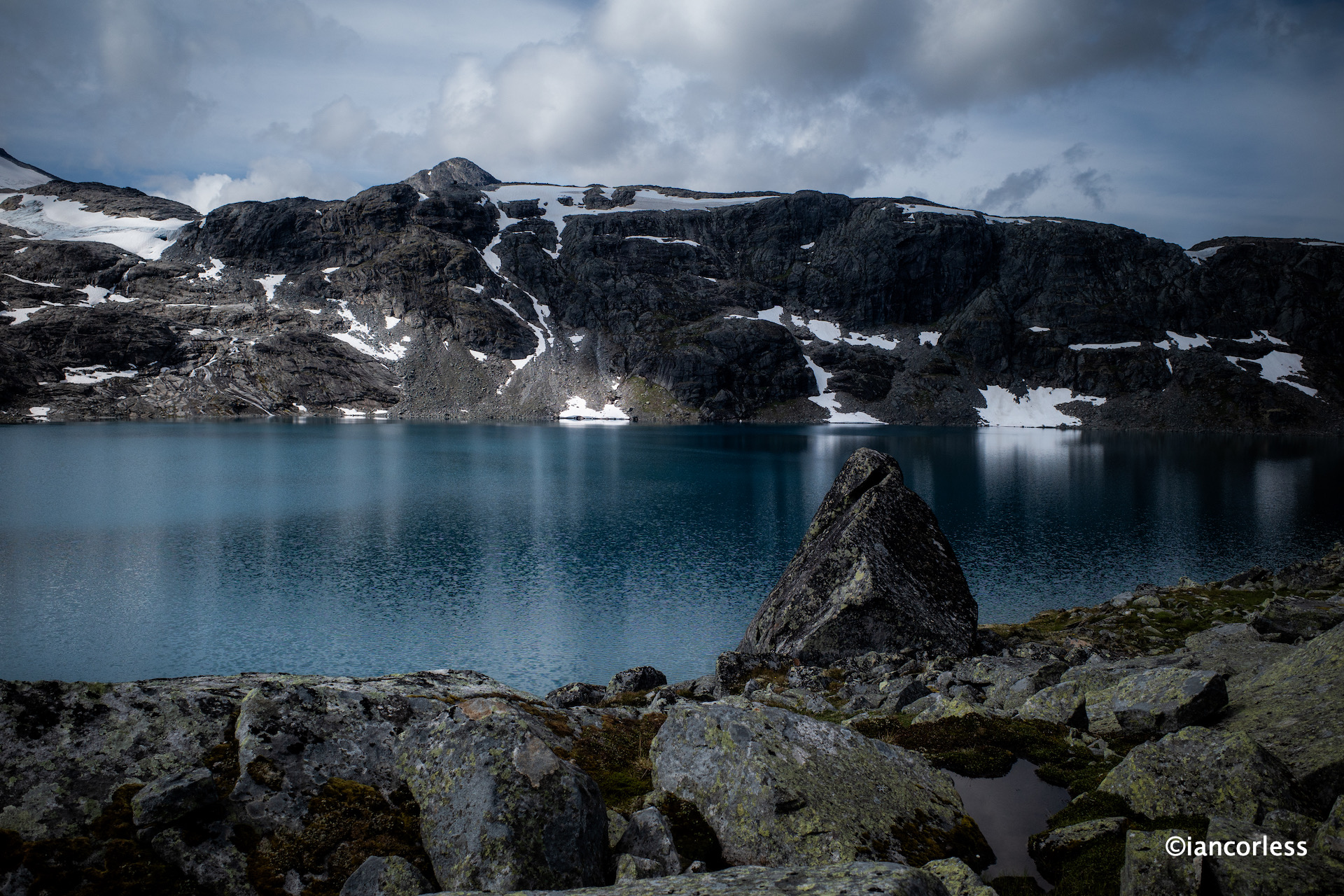
This route has a ‘reputation’ for the rocky terrain and hence the difficulty rating. It’s hard to move fast! The route climbs up passing lakes and at all times you are surrounded by stunning snow-covered peaks – magical.

sign posts help keep you on track

Arriving at Kvitevatnet lake you keep to the left and at the end climb up towards Uradalsvatnet lake, againkeepin to the left.

Lakes, rocks, snow and mountains. Perfect!

Passing through Uradalen the route eventually reaches its high point and then the descent starts through more ‘runnable’ terrain towards Skogadalsbøen.

The terrain became ‘easier’ towards the end of the day.
And more vegetation.

Of course, there is a kick in the tail with more rocks and very closed in and dense single-track with lots of mud. We covered 24.5km, 670m+ in 4h 55m. Geoff and Baz were pretty tired at the end, and I think it’s fair to say that Baz had seen and experienced enough rocks and boulders to last a lifetime. My reply was always, 1this is Norway, this is Jotunheimen!’

A nice sight after a long day

My girlfriend, Abelone, had initially planned to join Home of the Giants. Our intention, two groups of 4/5-people. However, in the buildup to the event we had 6-people cancel – not ideal. These cancellations caused many logistical problems and of course, there was never any risk of cancelling, but it did mean that Abelone was not needed to guide a group. However, she was on holiday with her son Håkon (10) and after summiting Fannaråki they joined us at Skogadalbøen DNT.

As usual, we had an amazing three course dinner, a lovely evening of banter and then a good night’s sleep.

Day 3 – Skogadalbøen to Leirvassbu

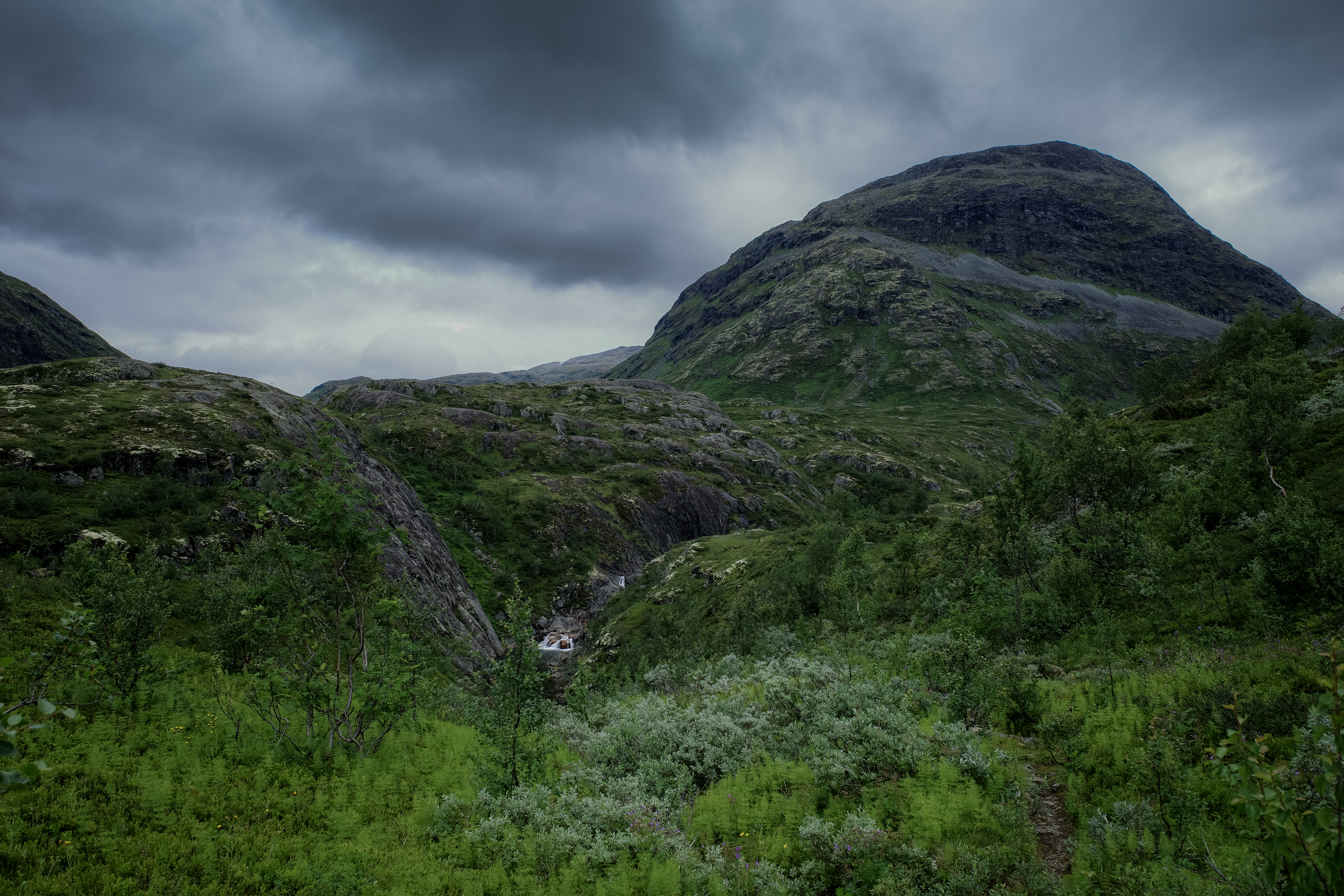
Day 3 with a moody start.
Skogadalbøen to Leirvassbu

Skogadalbøen to Leirvassbu is in comparison to the previous day, an easy route. Even though UT.NO describe it as a ‘very demanding summer route.’ Håkon had decided he enjoyed the group dynamic so much he wanted to also do the 19km route. He and Abelone got underway and some 30-minutes later we started.

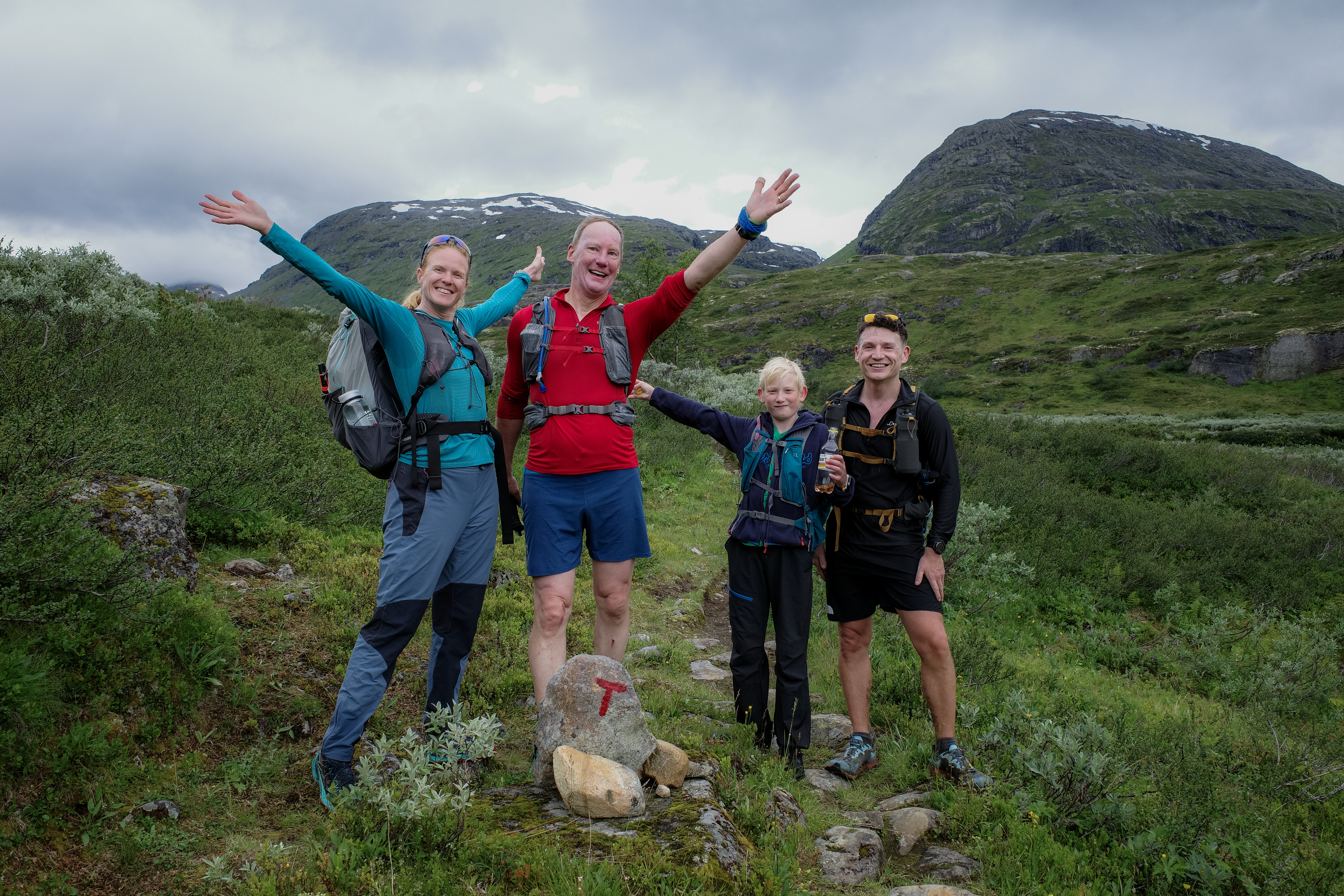
Passing them early in the trail we had a group photo and pushed on. Today was a running day, albeit steady and relaxed. Geoff and Baz had big smiles; I think they almost considered it a rest day after what had been experienced the day before.

Green valleys surrounded by mountains

The ground constantly wet and boggy, the weather was overcast and cloudy with occasional light drizzle.

Many water crossings

Passing through Storutladlen and onwards to Gravdalen it was a great feeling day. The views and landscape ever changing. After passing Gravdalsdammen, we soon joined an undulating gravel road that took us to Leirvassbu DNT.

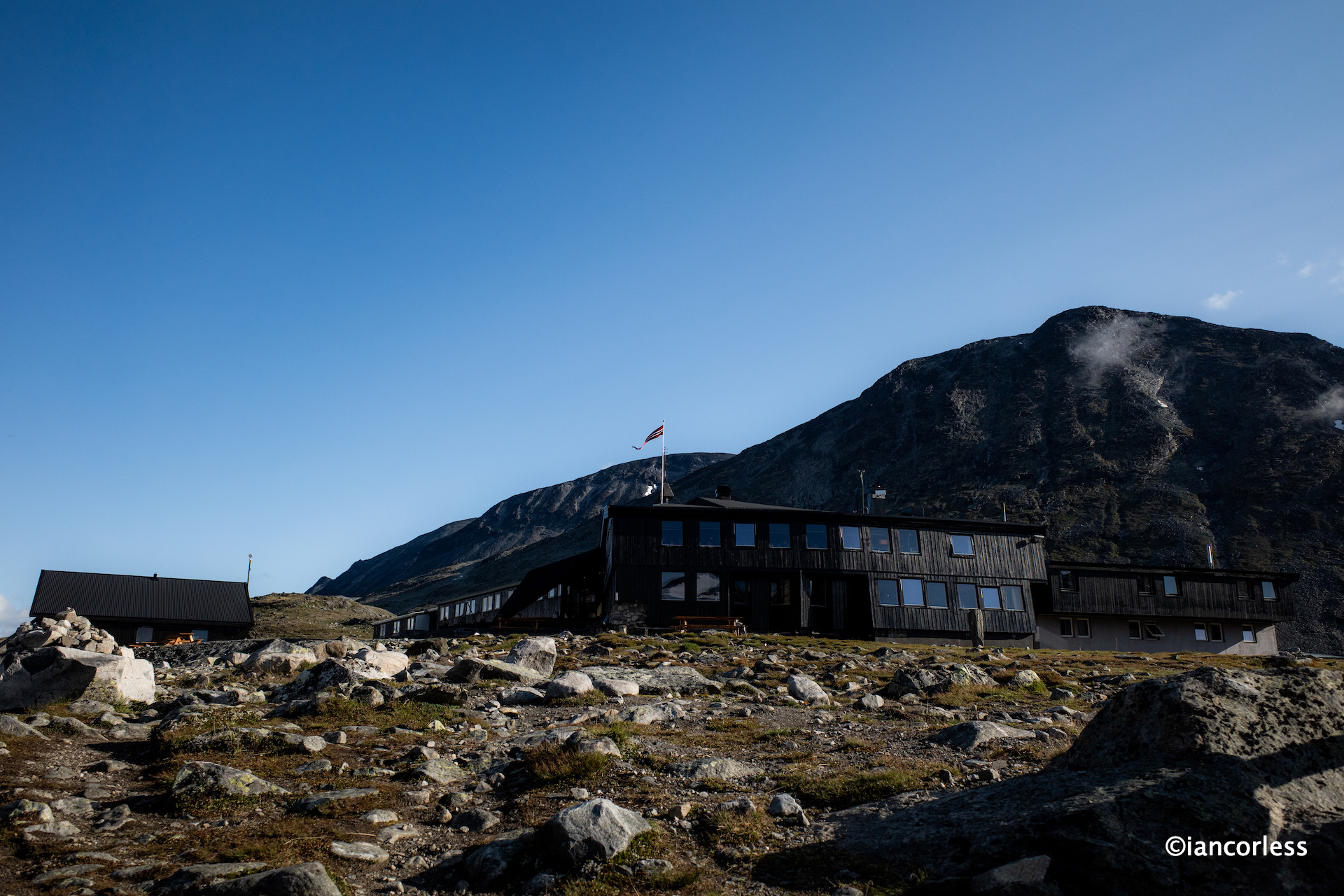
Leirvassbu DNT

On the approach, Kyrkja (2032m) was to our right, shrouded in mist and clag. Today was not the day to attempt the summit. After 19.68km, 811m of vert we finished in 3h 34m. Abelone and Håkon arrived a couple of hours later, Håkon sprinting ahead with a smile. What a joy to see. Geoff and Baz were blown away by Håkon’s speed, enthusiasm and commitment. 

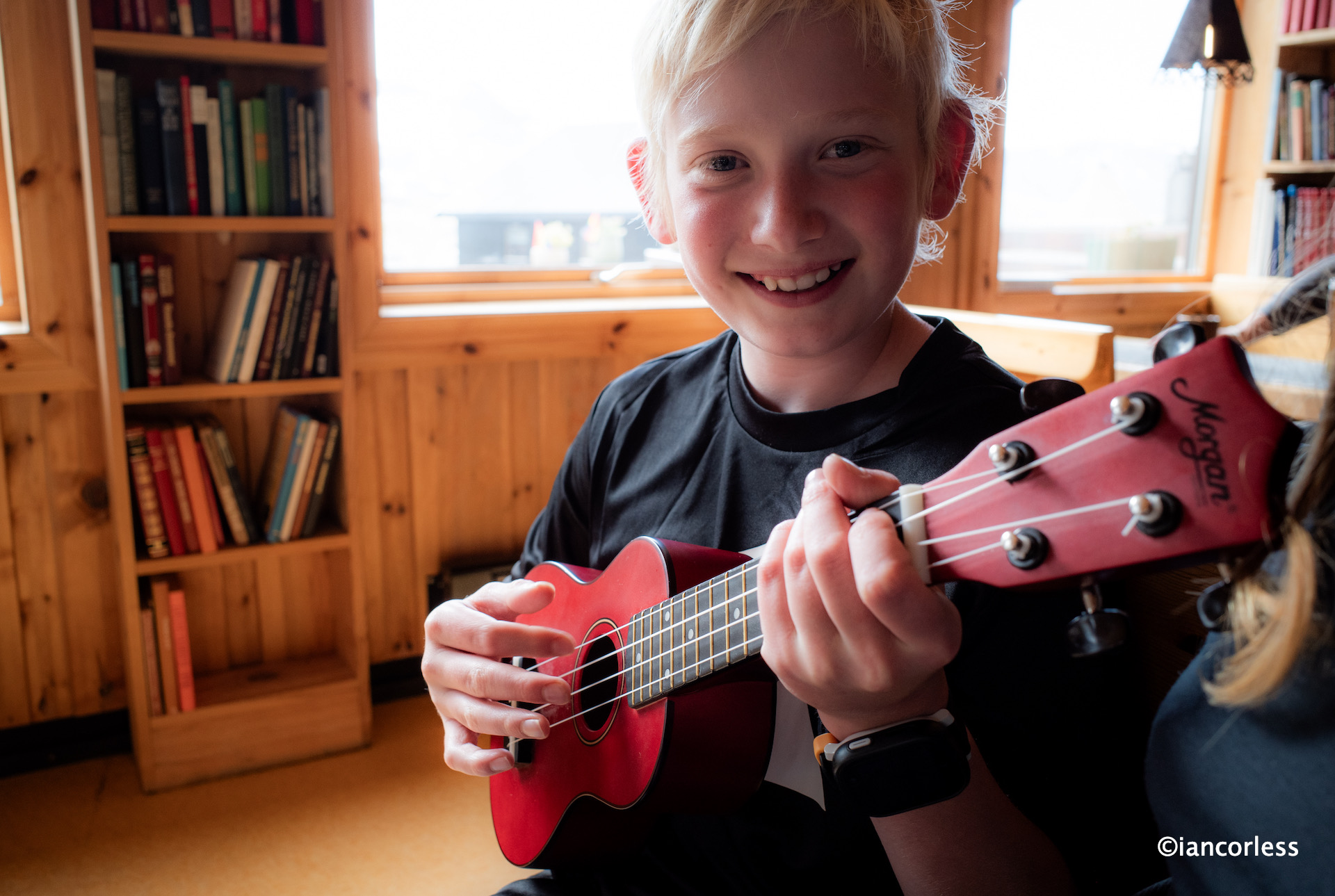
Entertainment by Håkon

Early finish and we could then rest, relax, enjoy the Leirvassbu DNT and prepare for the following day. Leirvassbu DNT is a large and modern cabin with no dorms, a large bar area and an excellent restaurant. A stunning location surrounded by mountains, a great place for staying more than one night as there is lots to explore. It has road access, so, it can be accessed by private car or bus, worth knowing just in case you need a contingency escape option.

DNT dinner always a highlight

The weather forecast for the following was good and it was therefore decided we would summit Kyrkja first and then continue to Gjendebu. Abelone and Håkon would miss the summit go straight to Gjendebu and therefore miss out on the 2 to 3h detour.

Day 4 – Leirvassbu to Gjendebu via Kyrkja

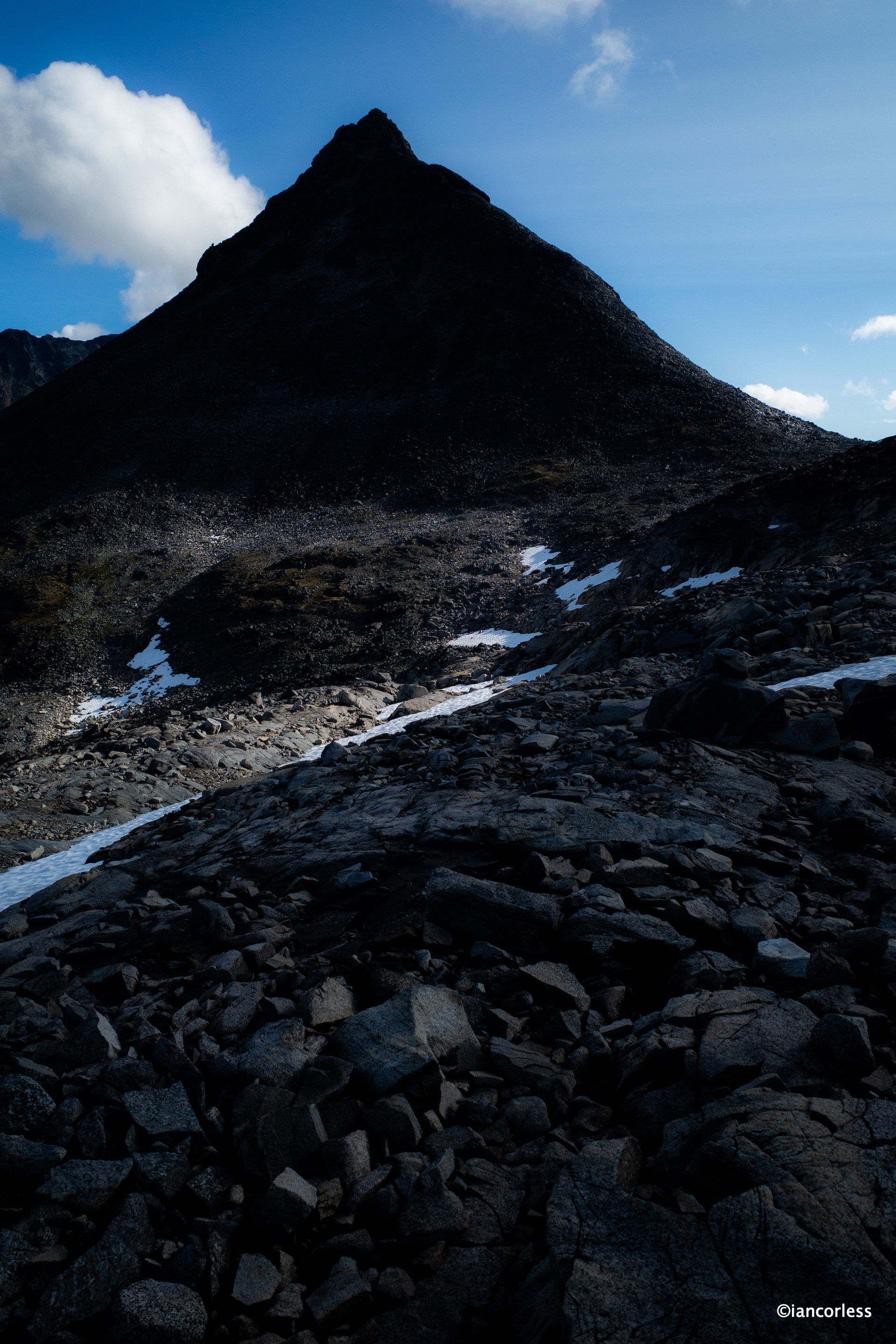
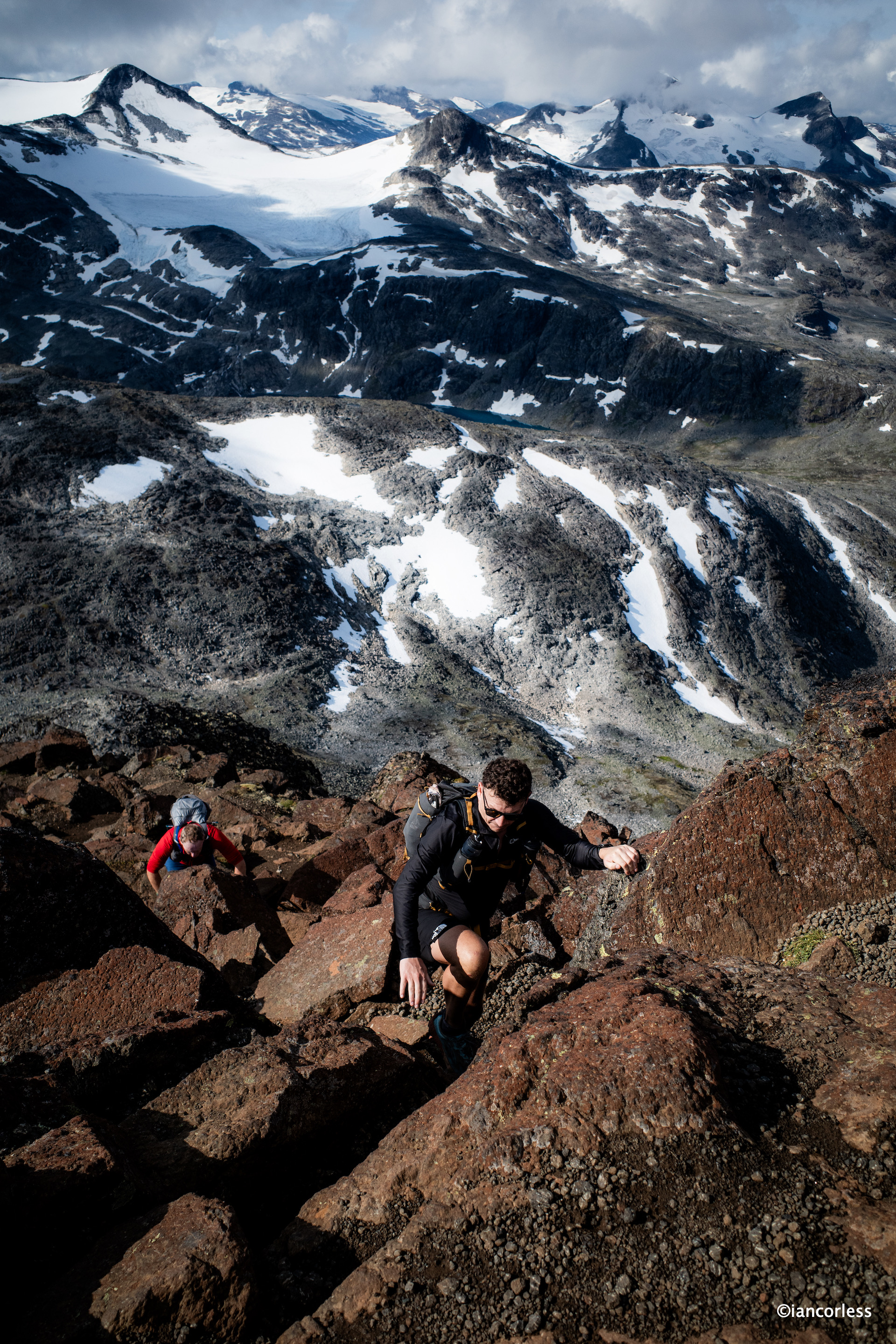
Kyrkja

The weather gods did not disappoint. It was a stunning day and a perfect morning to climb Kyrkja.

Leirvassbu to Gjendebu via Kyrkja
The early slopes to Kyrkja, Leirvassbu on the right

Abelone and Håkon left just before us they made their way to Gjendebu, we soon caught them, passed and then we started the climb to the summit. The early slopes mix trail, rock and snow crossing with boulders everywhere.

And up we go

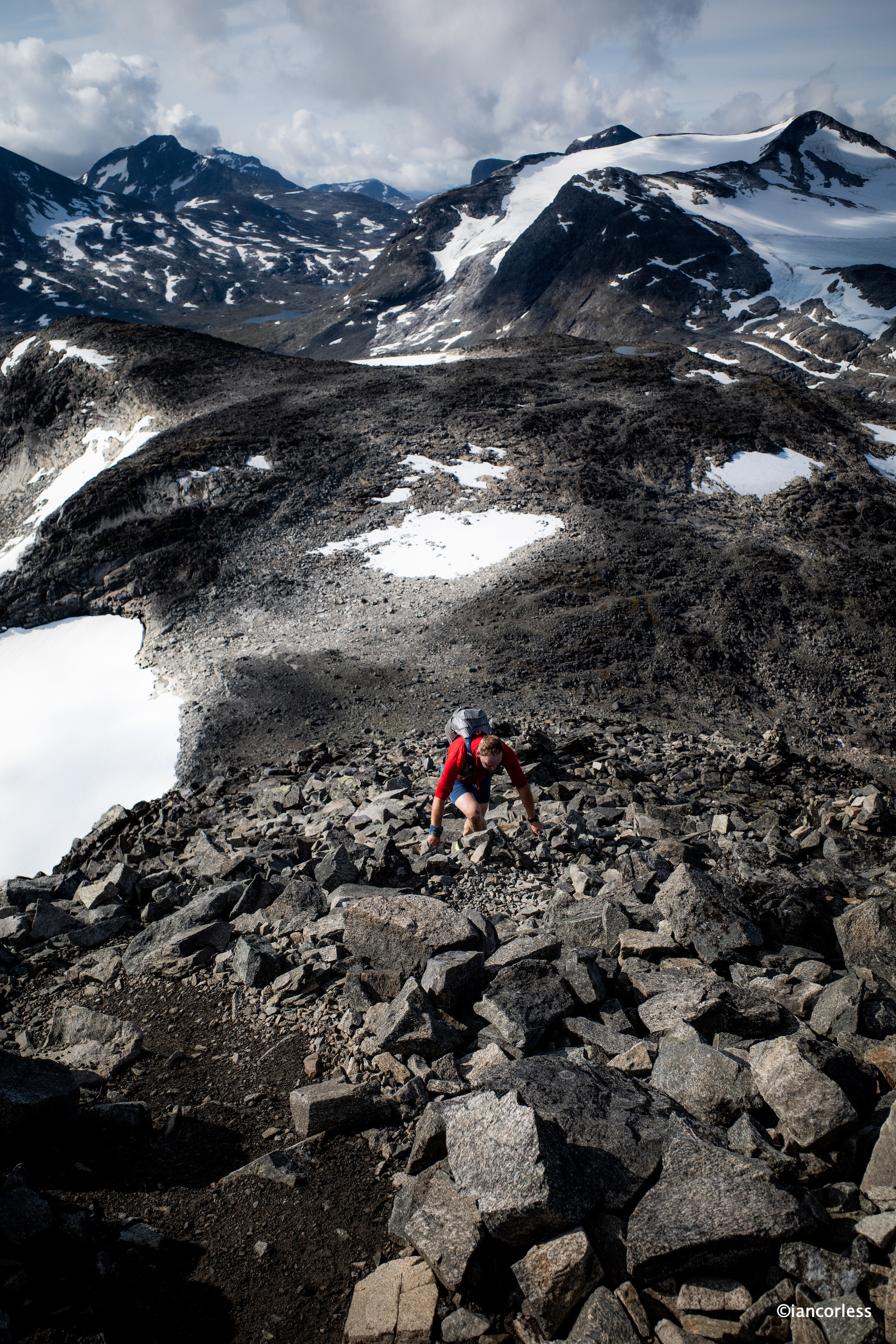
Once at the base of Kyrkja, the climb really starts and it’s a hands-on scramble to the summit. Cairns are placed regularly and at times the route is obvious. Other times, the route is vaguer.

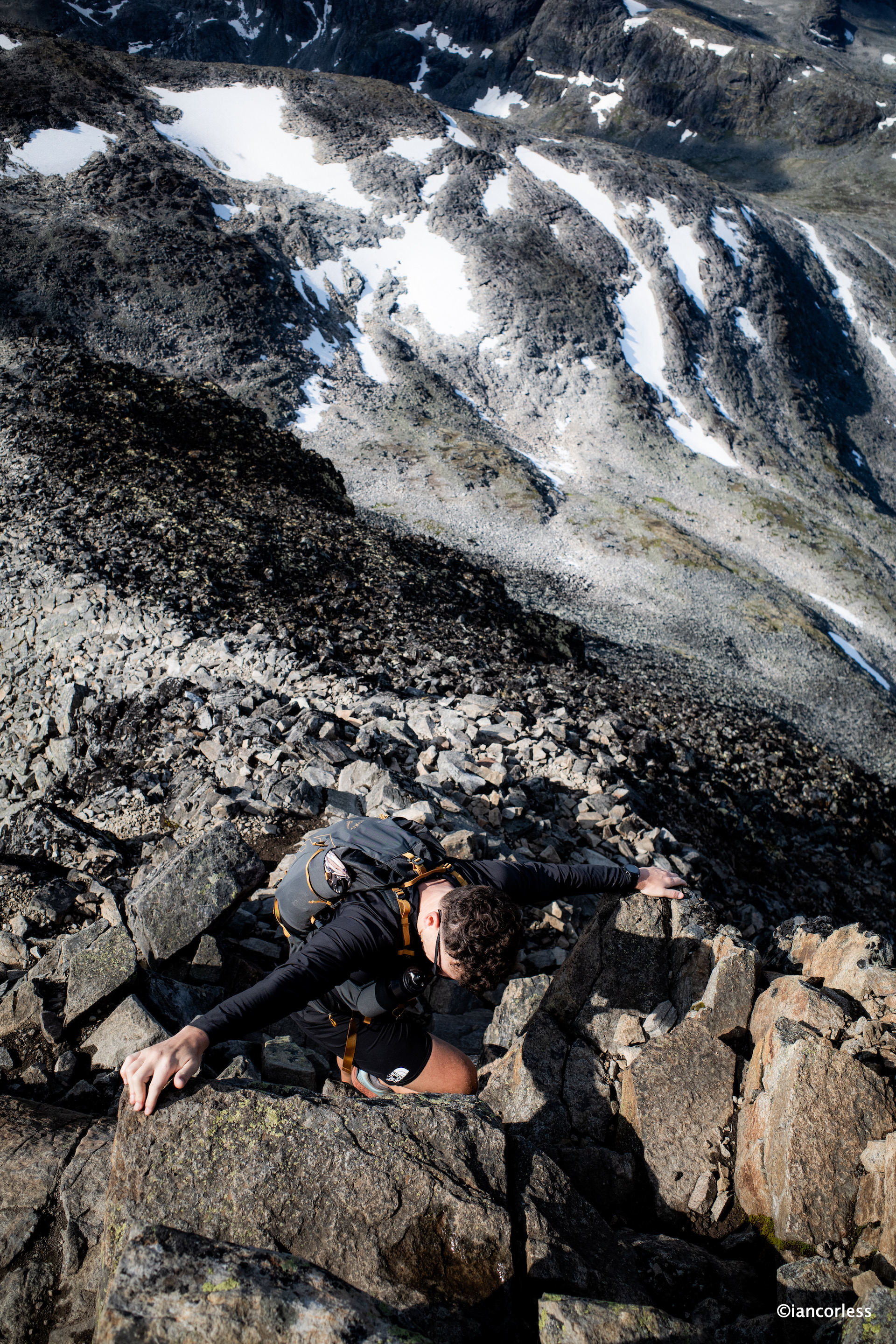
Good hand and feet placement important.

There are several sections with more exposure when sound had-holds, and secure foot-placing is essential. It’s not a difficult scramble but as with all these things, going at a calm and steady pace reaps rewards.

Slow and steady

Geoff certainly felt pushed here. He is not too happy at heights, but he pushed on, listened to to best route options and before he knew it, he was with Baz at the summit.

Job done!

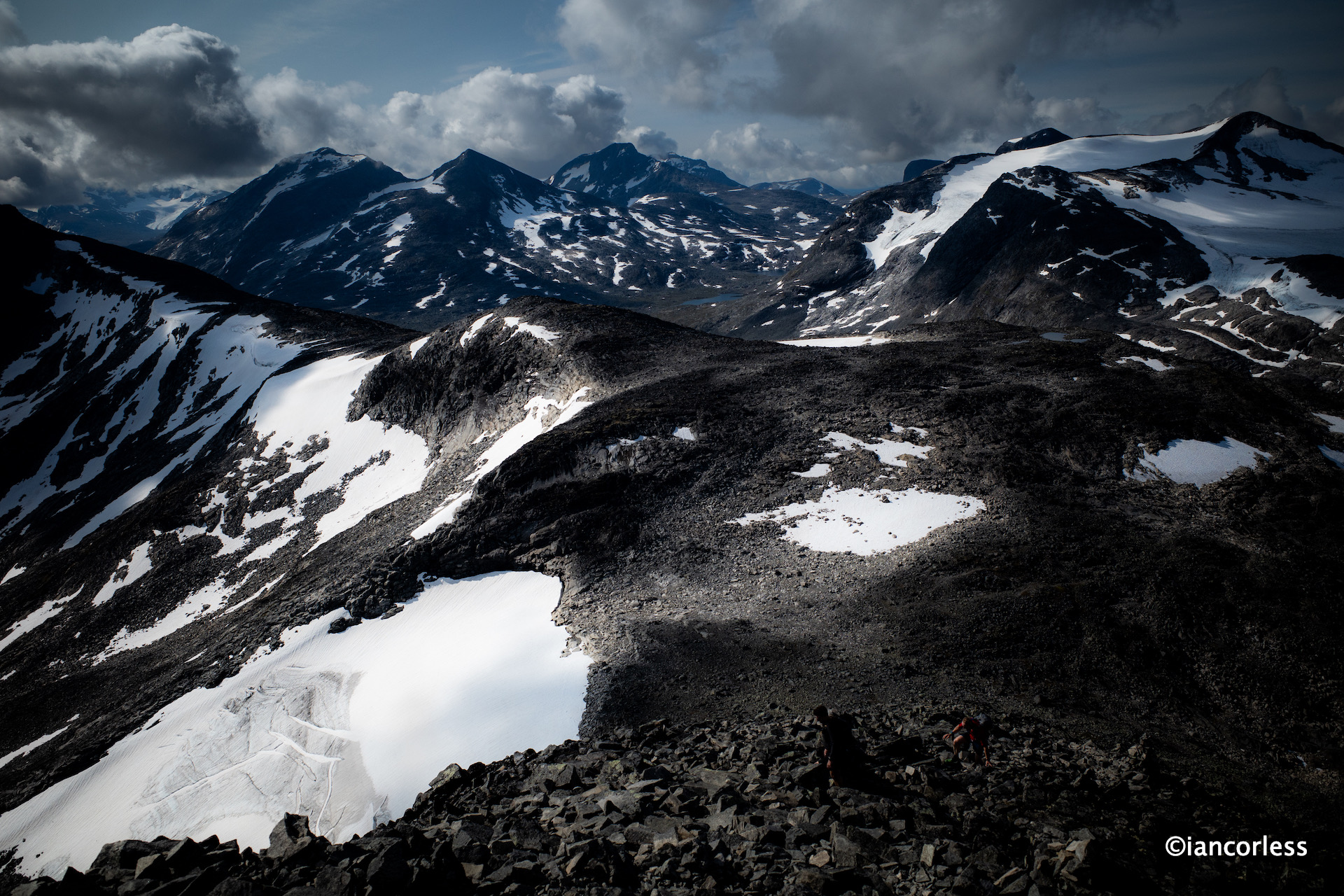
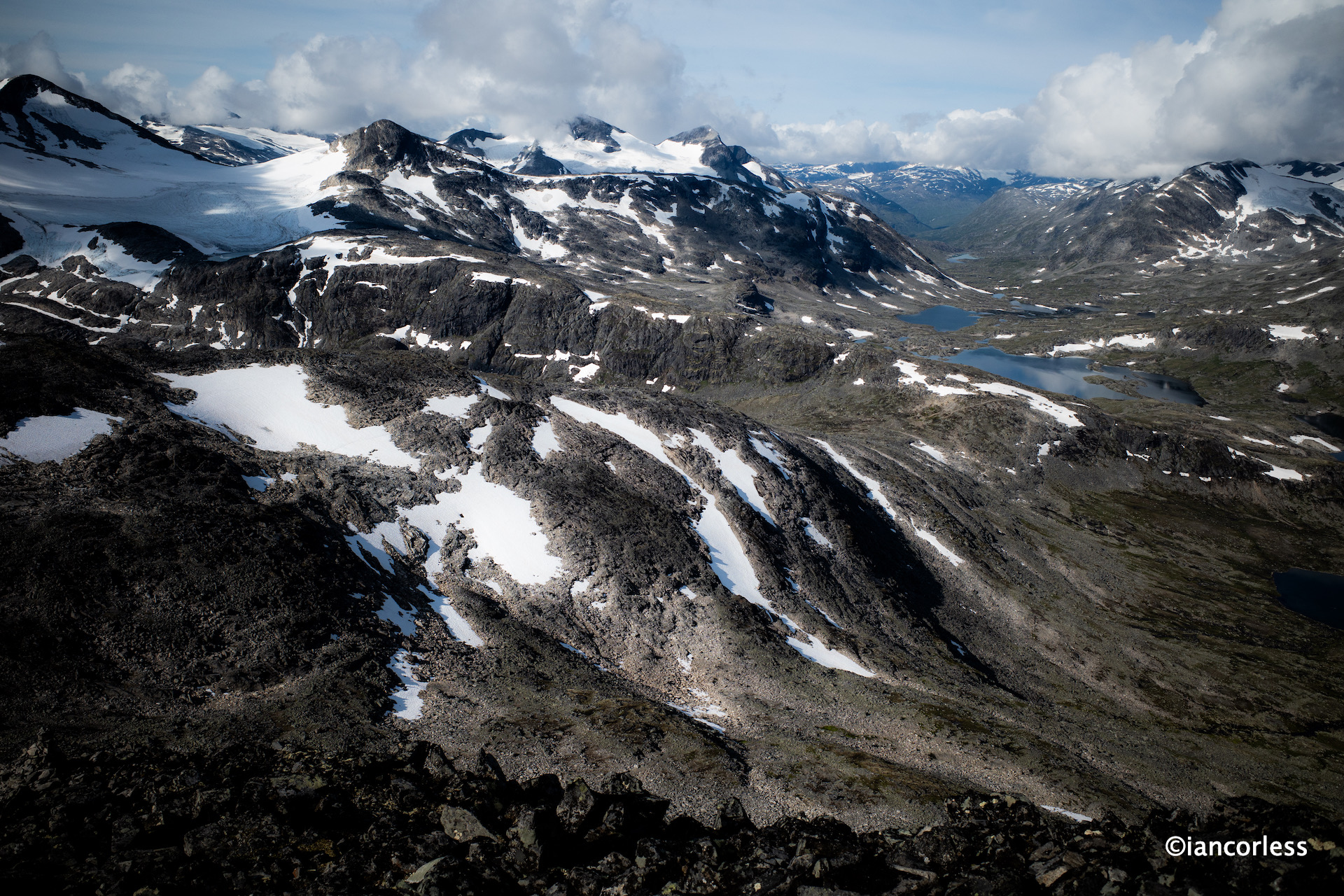
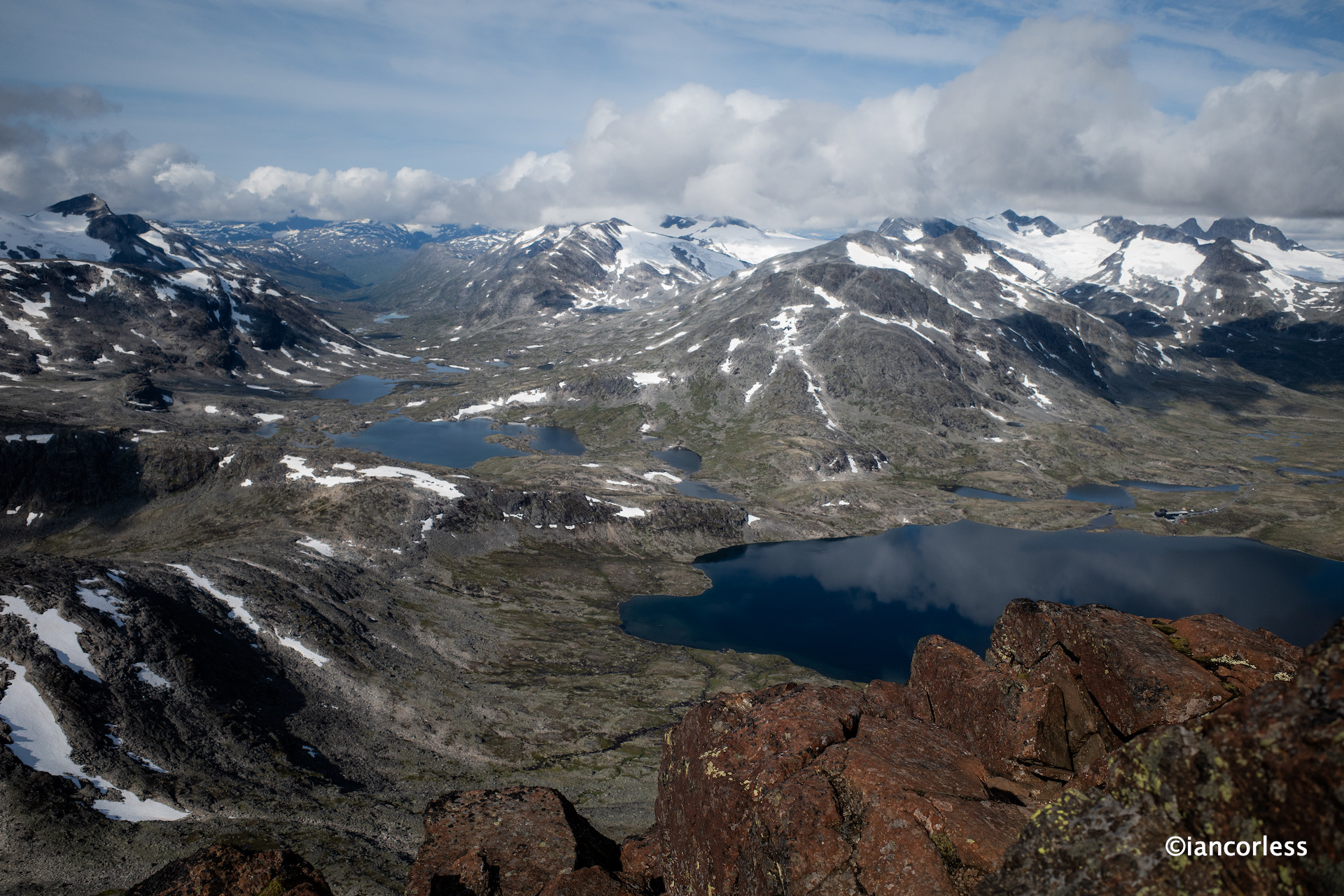
The 360 views here are quite magnificent. What goes up must come down and depending on your ability, head for heights and skill level, the downward route can be harder than the climb.

Coming down easier than going up?

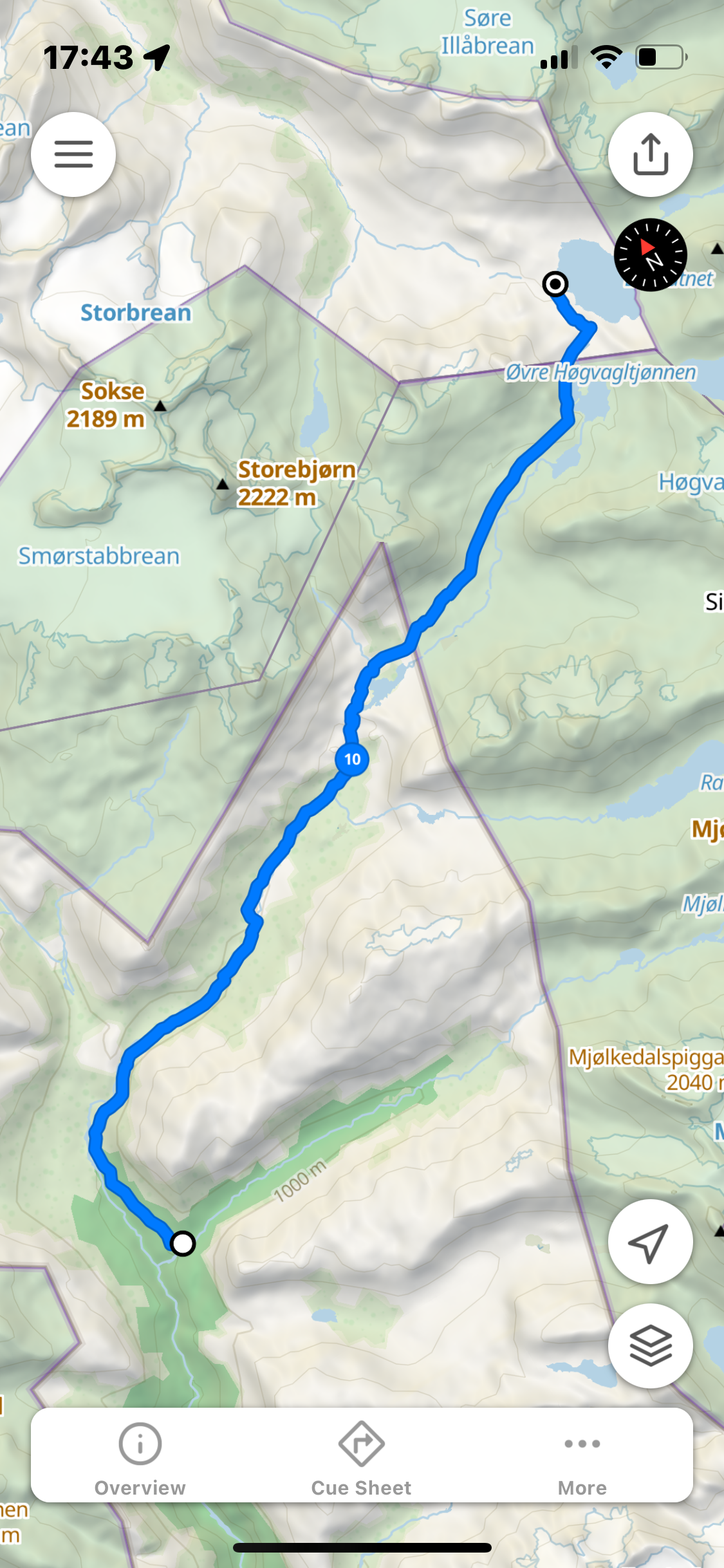
All three of us were soon at the bottom and re-tracing back on the trail to Leirvassbu and then at Høgvaglen we turned left and started to follow the red Ts on the route to Gjendebu.

Øvre Høgvagltjønnen

The route now is more runnable mixing rocky terrain, water crossing, fjell, single-track and of course mud.

Passing three key lakes, Øvre Høgvagltjønnen, Nedre Høgvagltjønnen and Langvatnet we were soon descending next to Hellerfossen waterfall and then passing through Storåddalen.

Make sure you follow the correct Ts

The trails now were saturated and muddy and considerably greener than what we had experienced earlier in the day. There was also plenty of cows.

You never have dry feet!

Before we knew it, we were running into Gjendebu after a stunning day of 25.69km, 741m of vert and 4h 42m on the clock. Baz and Geoff jumped in the lake, I got the beer in.

Day done.

Sitting in the sun, I wondered where Abelone and Håkon where? I had absolutely expected them to be here before us BUT there had been a chance that we may, have caught them in the last km or so… Apparently, Håkon was on a mission to beat us, and he ran the final 3km! What an effort by him, incredible. We had expected them to take 6-hours, and they had taken 5, bravo!

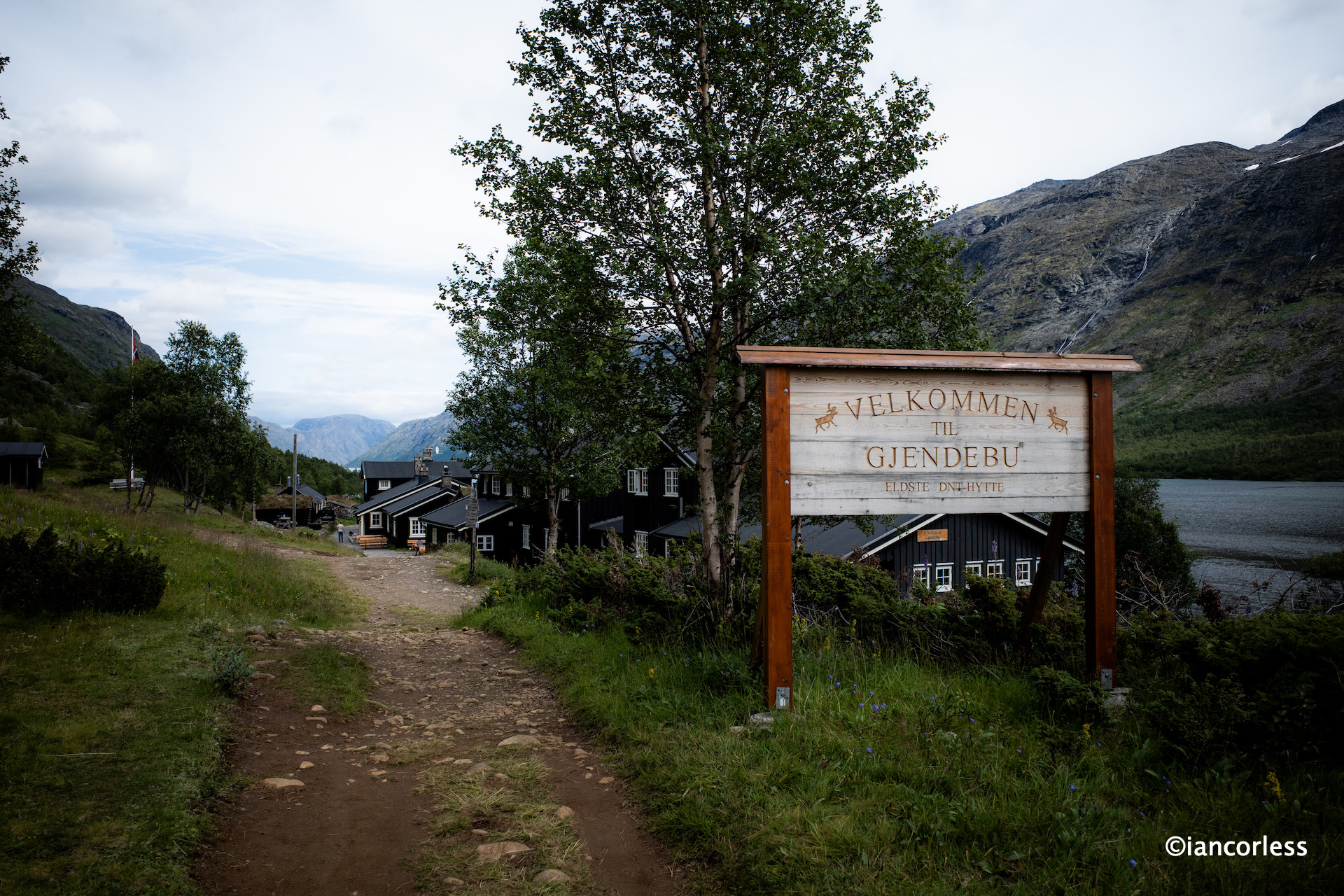
Gjendebu is a wonderful DNT and the oldest. It’s wonderfully traditional and recently refurbished. Comfort level is high, service superb and food excellent.

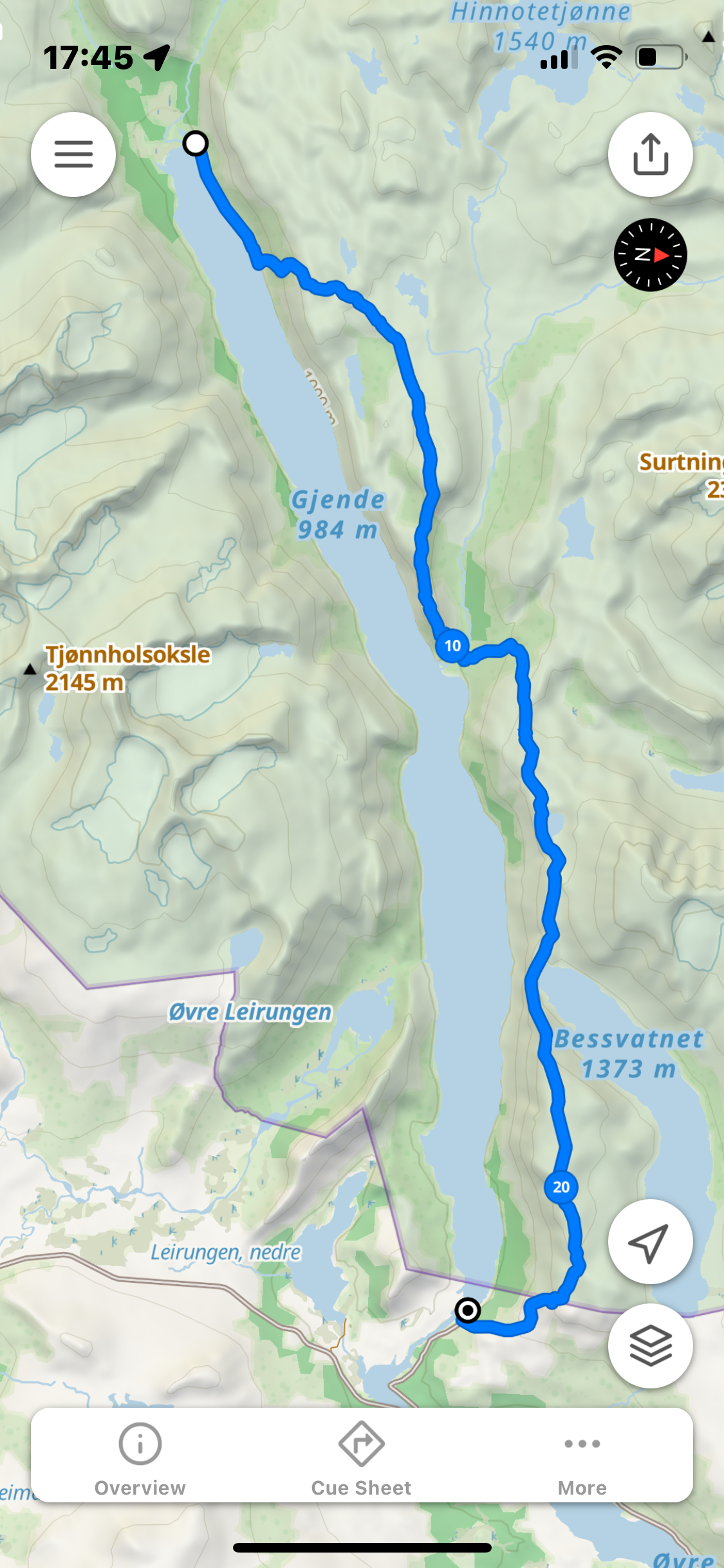
Day 5 – Gjendebu to Gjendesheim via Bukkelægret, Memurubu and Besseggen

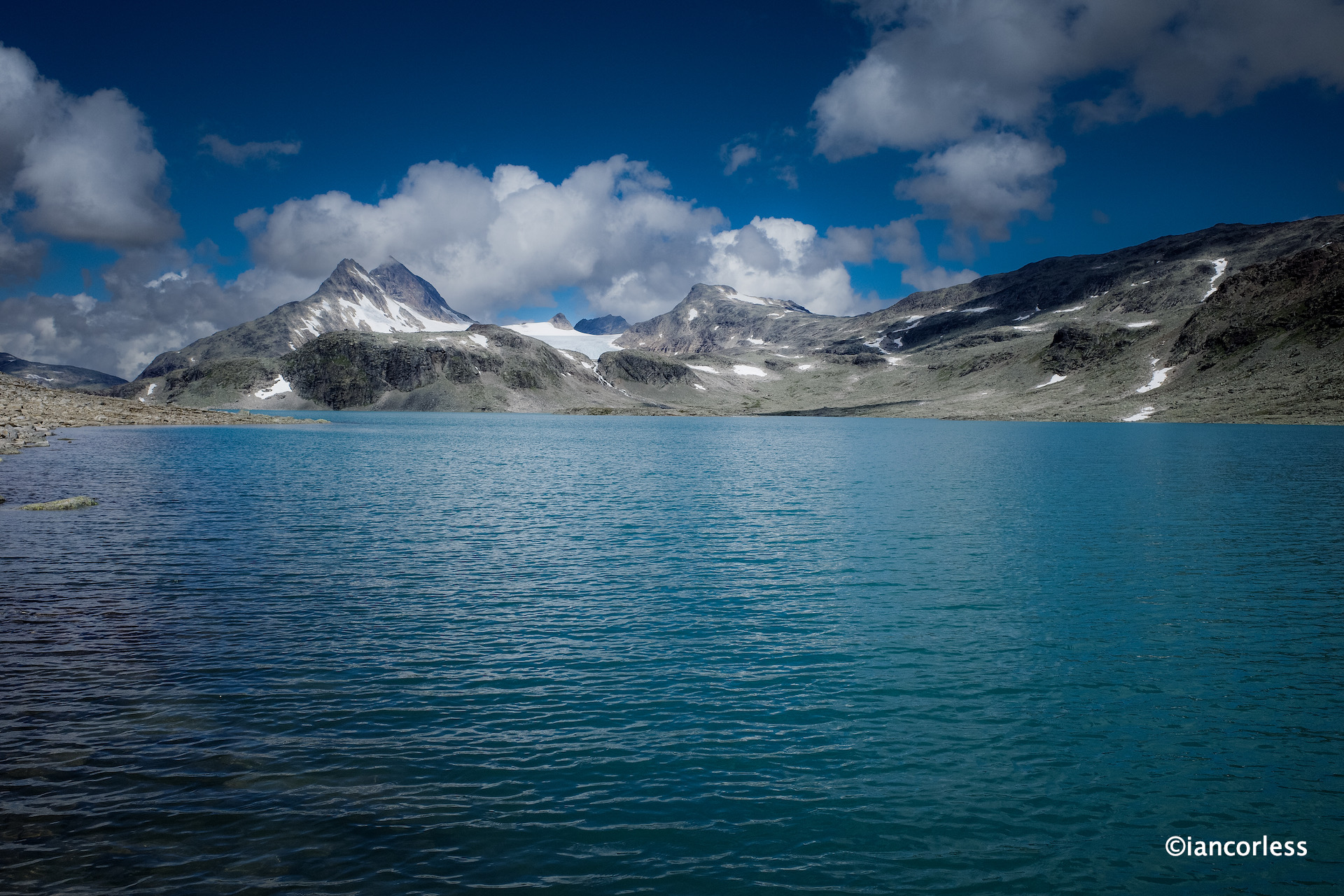
The view from the iconic Besseggen Ridge

Leg 1 Gjendebu to Memurubu

Gjendebu to Gjendesheim

I took no photos for this day, the weather was too bad, so, enjoy the image above of a considerably better day with Abelone.

Our longest day ahead and the weather forecast was rain all day. We were committed with our route BUT as always, sense and forward thinking was key. Our route was a two-day route, Gjendebu to Memurubu one day and then Memurubu to Gjendesheim day two. To do the whole lot in one day does require a fast and light approach.

The first leg is 11km and at Memurubu we had the option to pick up the boat to our finish, should conditions deteriorate.

The early km’s follow a single-track rocky and muddy trail next to Gjende lake. After 4km you turn left and then steeply climb. This section, Bukkelægret, is renowned as being difficult, especially in bad weather due to the gradient, slippery rock and the multiple chain sections. UT.NO say, ‘Chains and railings in exposed places. NB: Do not go outside the marked path! It is the only possible decrease. It is better to walk in the opposite direction if you are afraid of heights or choose the longer route around Storådalen.’

The route up was fine and although the rain was constant, we were all warm and enjoying the climb.

Once at the top I made a silly navigation error. I turned right following a trail that leads towards Kjuklingen. Within less than a km I knew I was wrong. I stopped, took a moment and then Baz, Geoff and I backtracked. While running I looked to the right and could see the trail up the other side of the mountain and eventually, we picked back up the red T’s and we were back on track. A frustrating mistake but these things happen!

Travelling northeast into Lågtunga, between Grunnevatnet and Sjugurdtinntjønne and down over Sjugurdtinden. We had a stunning moment when we were confronted by a large male Reindeer. We dropped to a walk and approached slowly. At the time I expressed how unusual it was to see one alone. But, as we crested the summit, a herd of maybe 20-30 reindeer were visible, what a sight!

The final descent to Memurubu is steep, rocky and slippery – care is needed, especially in torrential rain.

At Memurubu we entered the cabin and took an ‘aid station’ break of warm coffee and buns. I changed base-layer to a dry merino top and prepared for the next section.

We had had rain all day so far, but it had been pleasant in type 2 kind of way. Baz and Geoff decided to wear tights, I stayed in shorts. The option to pull out and take the ferry was not really an option, we were committed to the task.

Leg 2 Memurubu to Gjendesheim

The climb out of Gjendebu is steep and I soon removed my jacket, there was a hint of better weather coming and I loudly said, ‘it is clearing up!’ Famous last words…

The jacket soon came back on, and the rain increased. I was now on my second set of gloves, good old Raynauds in the hands brutal in bad weather.

This route is one of the most popular in Norway. Many take the early boat to Memurubu from Gjendesheim and then return via Besseggen, an average time taking 7-hours. On a good day there are many, many people. Today, hardly anyone.

The terrain is hilly and rocky as we headed to the foot of Besshøe and then on to Bjørnbøltjønne, the highest point on the route before heading down to the southern end of Bessvatnet.

Now we were at Besseggen, the steep climb ahead of us and Geoff loudly saying, ‘Are we going up there…!’

I reassured him it was not as bad as it looked. However, the steep rock face has an extra challenge in the rain. We stared the climb and soon came across a group of teenagers frozen on the mountain unable to proceed. They were questioning the decision to come this way, and they asked Geoff what time the last boat was at Memurubu! Unfortunately, they would not make the last boat if they backtracked, however, the cabin would look after them.

Ahead I heard screaming and crying. It got louder as I climbed only to find a mother trying to climb with a young girl who was beyond terrified. I offered help but it was refused. ‘We will be fine; she is just very anxious and scared.’ No shit I thought to myself. As I climbed up, I saw her husband and another child. They had back-up help but I stopped multiple times to make sure that I was not leaving a potentially disastrous situation.

Geoff and Baz were making good headway, every 5 to 10m I would stop and make sure their line was good.

The 350 meter climb up to the top cairn on Veslfjellet 1743m soon passed and now the weather was wild.

Wind was raging in from the right, the rain was torrential and the visibility poor.

We regrouped and I clearly expressed that we NEEDED to move. It was no stopping and all running now down the, at times, steep and rocky descent to Gjendesheim.

This was without doubt the hardest hour of the whole week and clearly demonstrated how Norway, as beautiful as it is, can turn wild and violent.

Soon we were on the final stone steps that lead to the DNT and lake Gjende.

We were absolutely soaked and exhilarated with the day. It was true Norwegian mountain day, and we had completed the whole 26.1km with 1800m vertical in 6h 30m on what was a very tough and slow day.

All three of showered for a good 15-minutes. A cold beer followed quickly and before we knew it, we had another wonderful 3-course meal with Reindeer as the main course.

The evening was chilled and relaxed. We had a short concert of traditional music, and we discussed the completed adventure.

My offer for a following morning run was very quickly turned down.

A good sleep and the following day we departed at 1400 for a direct bus to Oslo and onward travel.

What a stunning week!

Thoughts and Summary

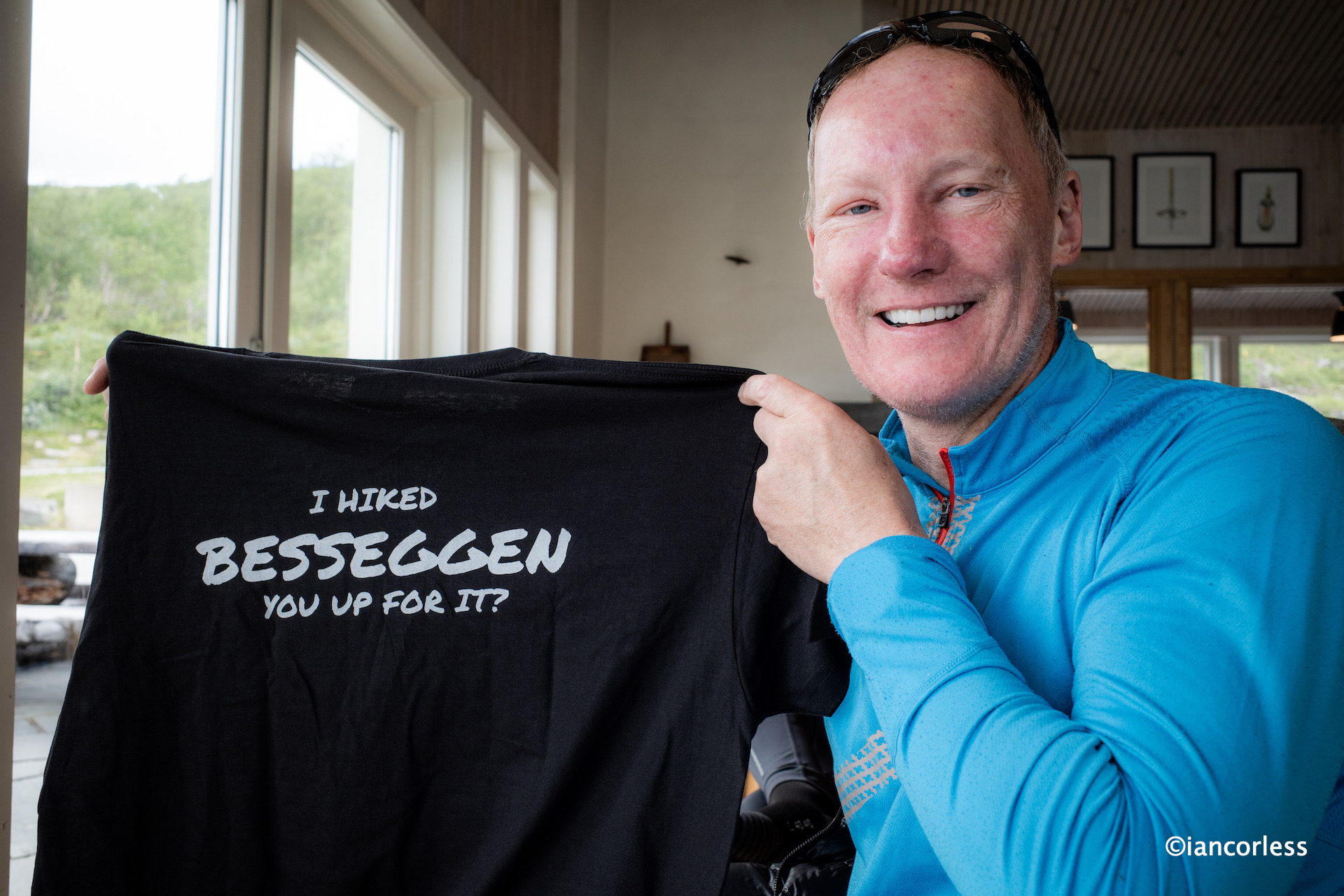
He got the T shirt 🙂

For me, there is no better way to travel through the mountains of Norway than by cabin-to-cabin. What the DNT offer is a five-star service and it really is a privilege to have this available. A shower, a bed, hot meals and a drying room for apparel and shoes is stunning.

Few people travel fast and light, they prefer to move at a slower pace with loads of equipment and take long stops and plenty of sight-seeing.

However, fast and light allows for a faster pace, the option to cover more distance and ultimately, more relaxation times in the cabins.

You do need to be experienced and prepared to move in this way.

Magical

In sunny and beautiful weather, fast and light is easy. In bad weather you need to be prepared, constantly making judgement calls and adjusting speed so as to ensure you are safe. Our final day a prime example.

We were well prepared and all three of us had the right and correct equipment for the planned adventure. The option to change a base layer at Memurubu for me was spot on, as was the decision for Baz and Geoff to move out of shorts and into tights. Despite the torrential rain, wind and colder temperatures, all three of us still had emergency layers of insulated jacket, waterproof pants and a bivvy bag available in our packs.

We all brought poles and on day 1 we used them a great deal, less so after. Geoff broke a pole on day 1 which was frustrating. However, when finished, Geoff said he would not bring poles next time. I understand his thought process, but, the additional weight of just over 200g is an excellent security blanket if moving slower or picking up an injury. Just learn how to use pols before.

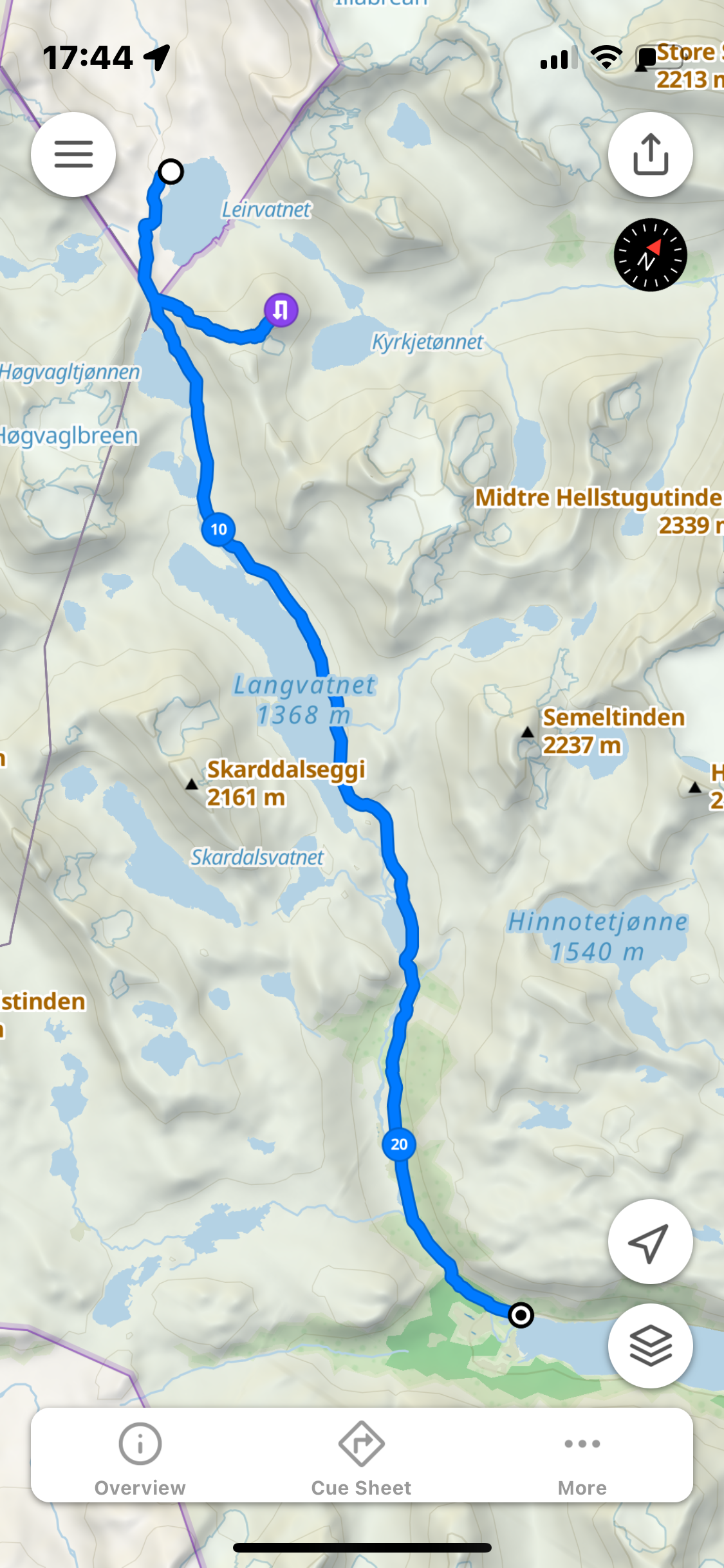
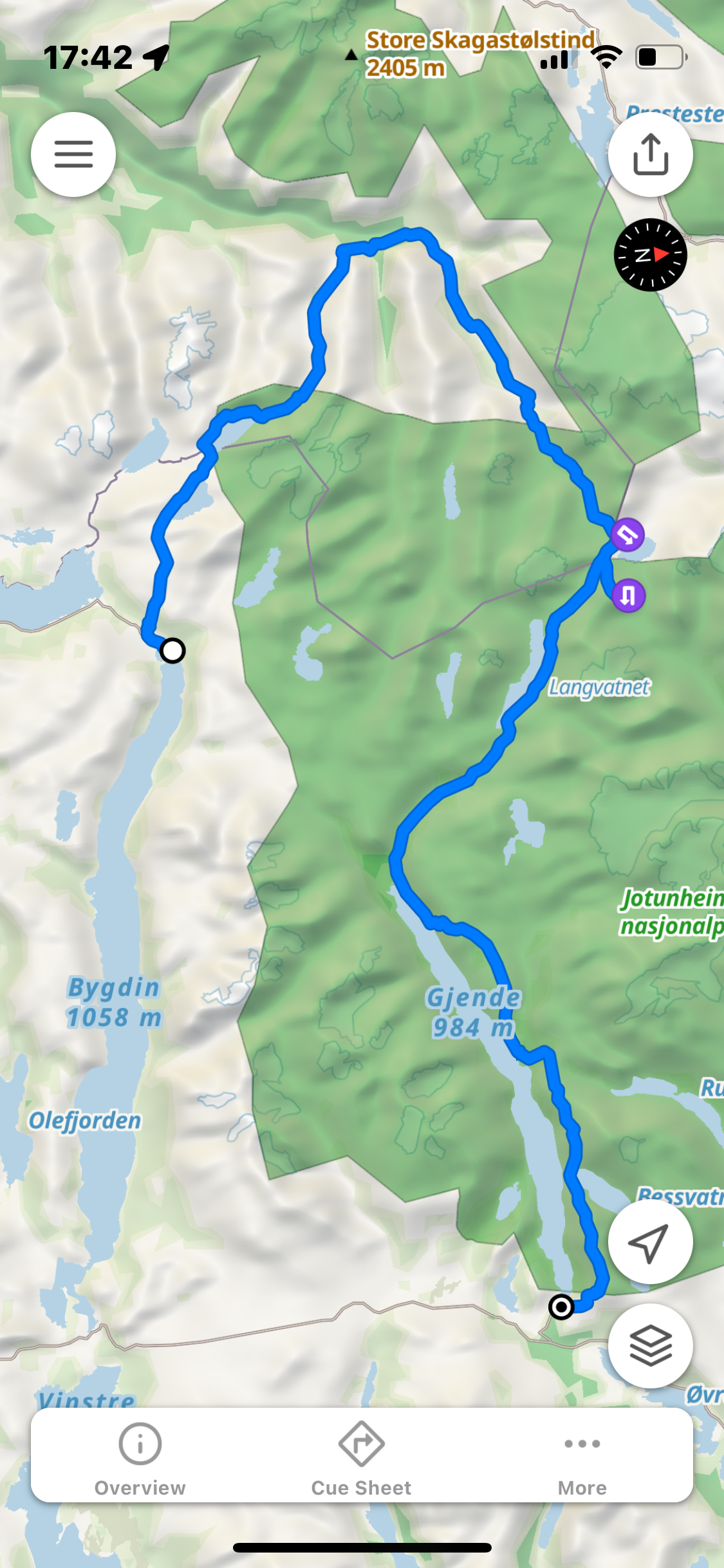
The full route

Due to the nature of the DNT layout, sometimes we were not in the main building, and we all wished we had brought some very light flip-flops. I am now searching the internet for the lightest and most practical.

Good shoes are essential and normally I would never say YOU MUST get these shoes, but VJ Sport shoes and the amazing Butyl outsole are the only run shoes that can be relied on for Norwegian rock, especially when wet. Geoff and I wore VJ, me in the MAXx2 and Geoff in the Ultra. Gaz wore Altra and he had no grip – it compromised his enjoyment.

Norwegians have a saying, there is no bad weather, just bad equipment. It’s very true. We had mixed weather for our trip and in all honesty, it made the trip better. I never took my camera out on the last day as the weather was so bad, but I absolutely loved the challenge of making that route in bad conditions. Just a shame Geoff and Baz did not get to see those iconic Besseggen views down the lake and the surrounding area.

Finally, if you are interested in joining us in July 2025 for a similar journey, please get in touch. We will have 8-places available.

Jotunheimen, one of the best places in the world.

Follow on:

Instagram – @iancorlessphotography

Twitter – @talkultra

facebook.com/iancorlessphotography

Web – www.iancorless.com

Web – www.iancorlessphotography.com

Image sales –www.iancorless.photoshelter.com
MDS CAPPADOCIA 2024 Summary

Stage 2 start

The 2024 inaugural MDS CAPPADOCIA has concluded on a high, quite literally, as all participants and staff were treated to a surprise early morning balloon flight by the organisation to celebrate a pioneering moment for the MDS brand.

The Love Valley

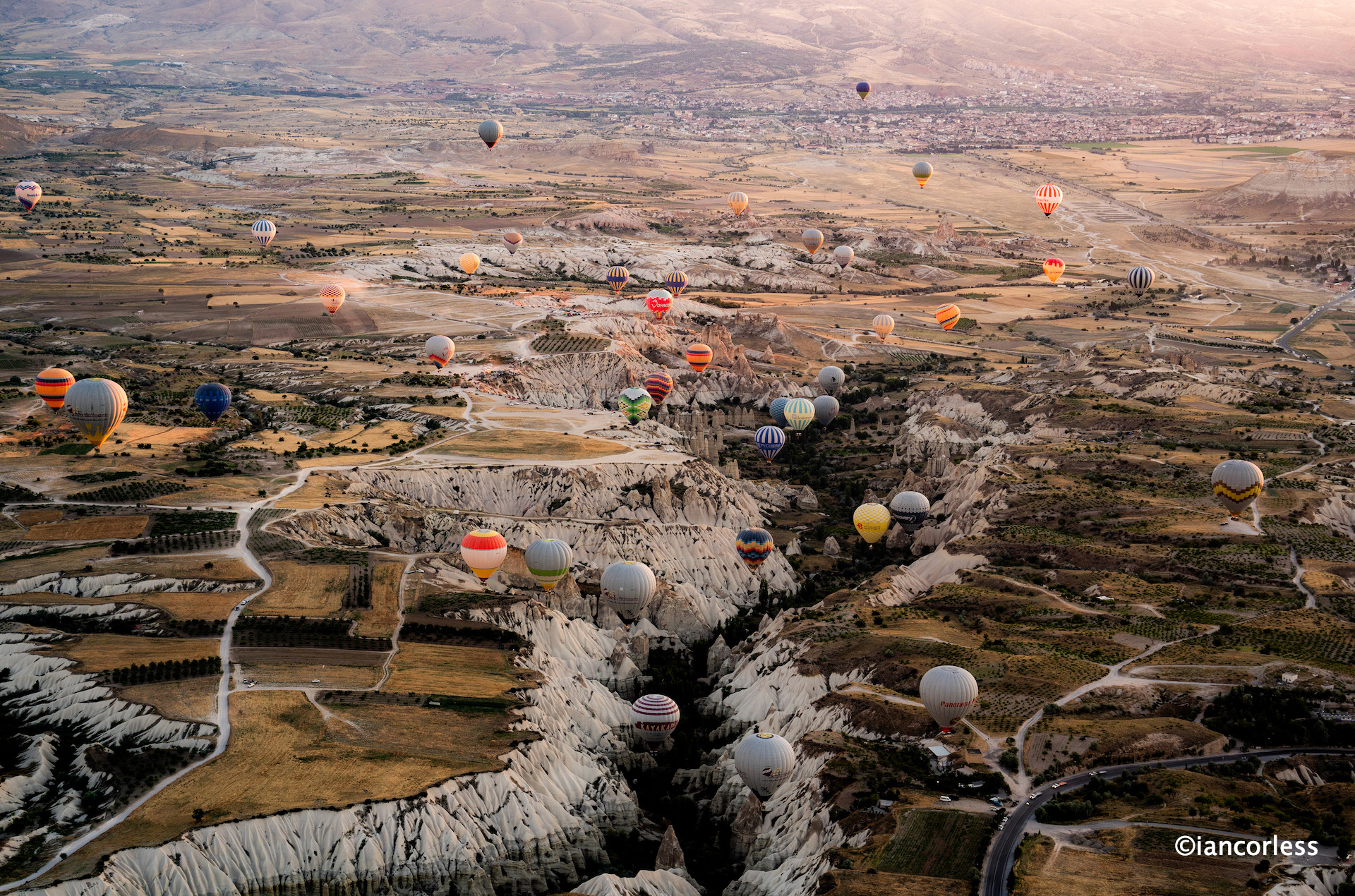
For many, the early morning sky filled with 100’s of balloons is one of those lifetime memory moments, to be given the option to fly, was a dream come true. From the airy heights, the full MDS Cappadocia route was able to be viewed providing a new perspective of the incredible journey that was only completed the day before.

Memory for a lifetime

And what a journey this MDS experience was.

As Cyril Gauthier mentioned in his opening briefing before the race, ‘Welcome to first edition of Marathon des Sables Cappadocia, but ironically, the sables element is missing here…’

Cyril before stage 1

It of course came as no surprise, however, Cappadocia is very much a desert-like landscape, correctly though, the element of soft sand and dunes is completely missing.

Unique and special

One may question, ‘Is this a bad thing?’ The simple answer here is no, each and every participant could not speak highly enough about this unique MDS experience and actually, many were very vocal and happy that MDS Cappadocia was a very new and different.

OVERVIEW

MDS Cappadocia is a 7-day experience following the same format of other MDS events that have gone before, Fuerteventura, Jordan and so on as perfect examples.

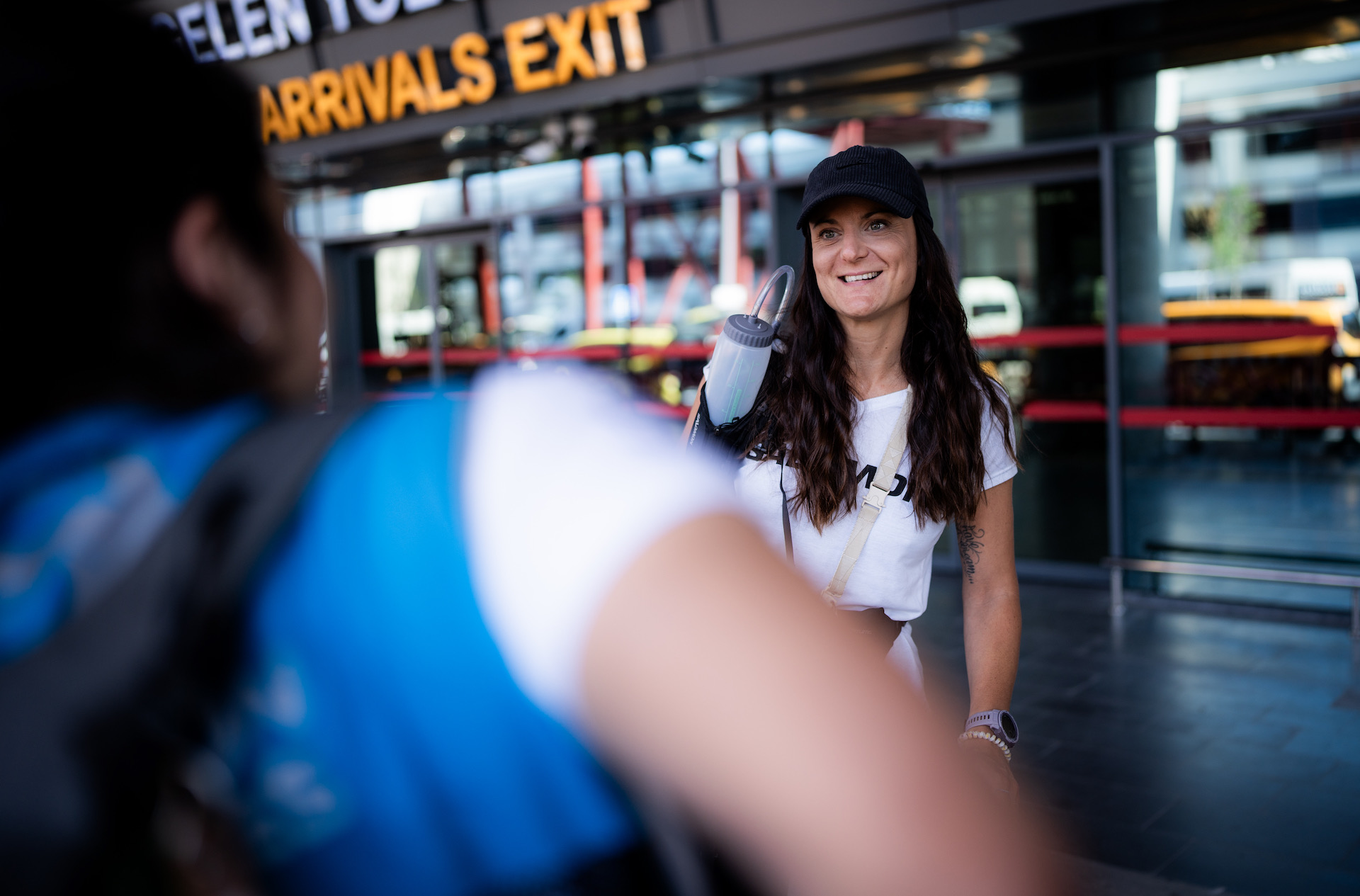
MDS team meet and greet before transfer to hotel

Day 1 – Runner’s are required to travel to Kayseri airport and arrive on a certain day so that they are able to take a transfer, provided by the organisation to the race hotel. At the hotel, technical checks and admin take place. In the evening dinner is provided.

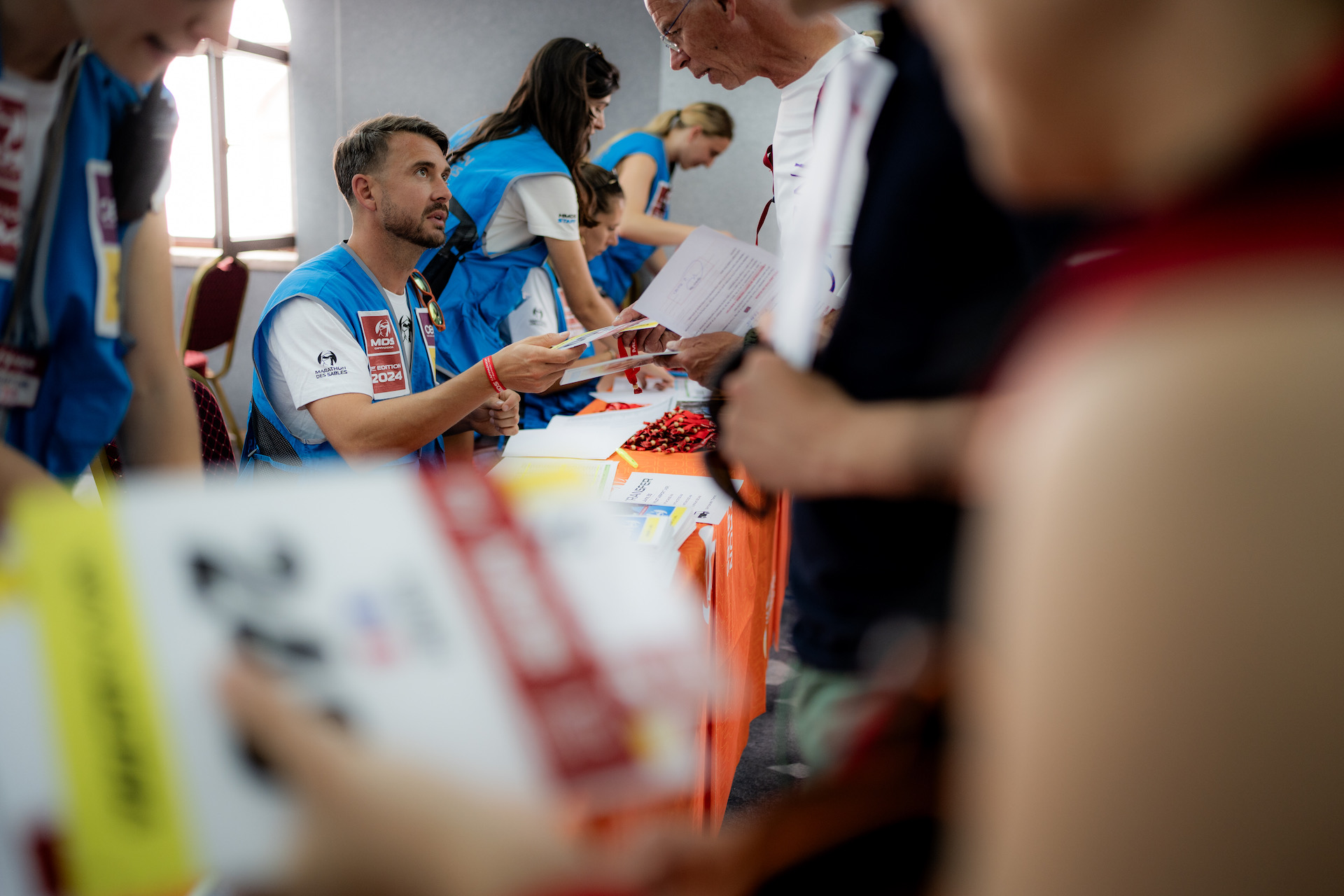
admin and technical checks

Day 2 – Runner’s depart the hotel via transfer to the start. Now self-sufficiency begins and stage 1 starts. Runner’s run/walk 25km to the bivouac and conclusion of stage 1.

Stage 1

Day 3 – Stage 2 starts at bivouac and runner’s return to the bivouac choosing the option to run/ walk 20km, 40km or 60km.

Stage 2

Day 4 – A rest and recovery day.

Bivouac

Day 5 – Stage 3 26km which concludes in the Love Valley. A short transfer to the race hotel is provide. The evening is free.

Stage 3

Day 6* – A relaxing day at the hotel or sightseeing followed by awards, gala dinner and party.

The balloon flight

Day 7 – Onward travel.

*Runner’s were surprised with a hot air balloon flight, this required a 04:00 departure from the hotel to experience the magic of Cappadocia from the sky. They returned between 0700-0800 for breakfast.

THE RACE

Travel, admin and the race hotel was slick providing a relatively easy and relaxed start to the MDS Cappadocia experience.

Stage 1 had a bus departure of 0800, race briefing at 0900 and race start of 0930. I think everyone welcomed a relaxed start, however, the challenge of stage 1 was very real.

There are several key factors that must be considered for MDS Cappadocia.

It was hot
  • The heat for the duration of the race week was very high, temperatures were consistently between 33 to 36-degrees with a ‘feel’ on the skin of high 40’s. It was hot!
  • The Göreme Valley where much of the race takes place has an altitude of 1100m. This of course is not high altitude, but, the impact on breathing and physical effort was significant.
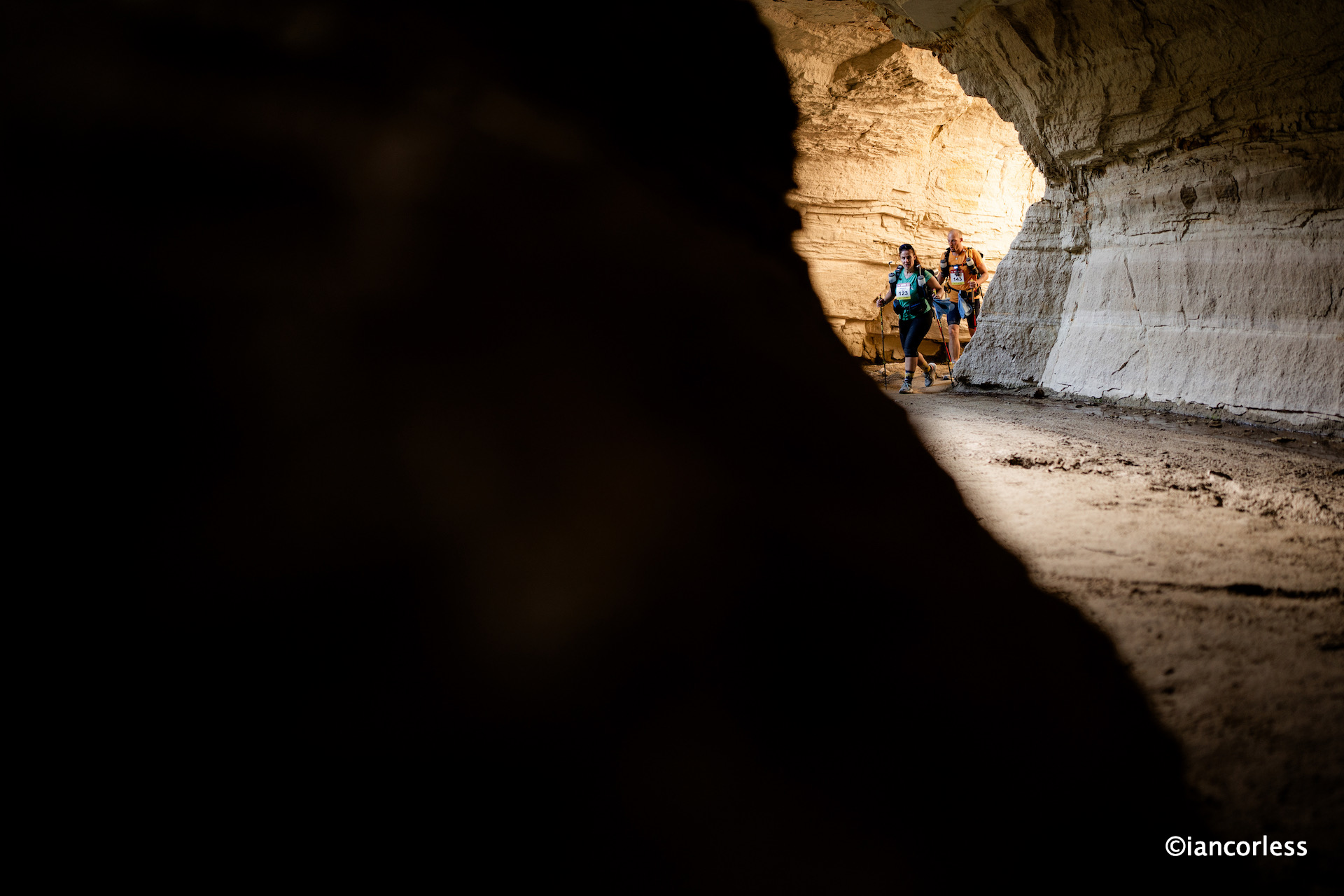
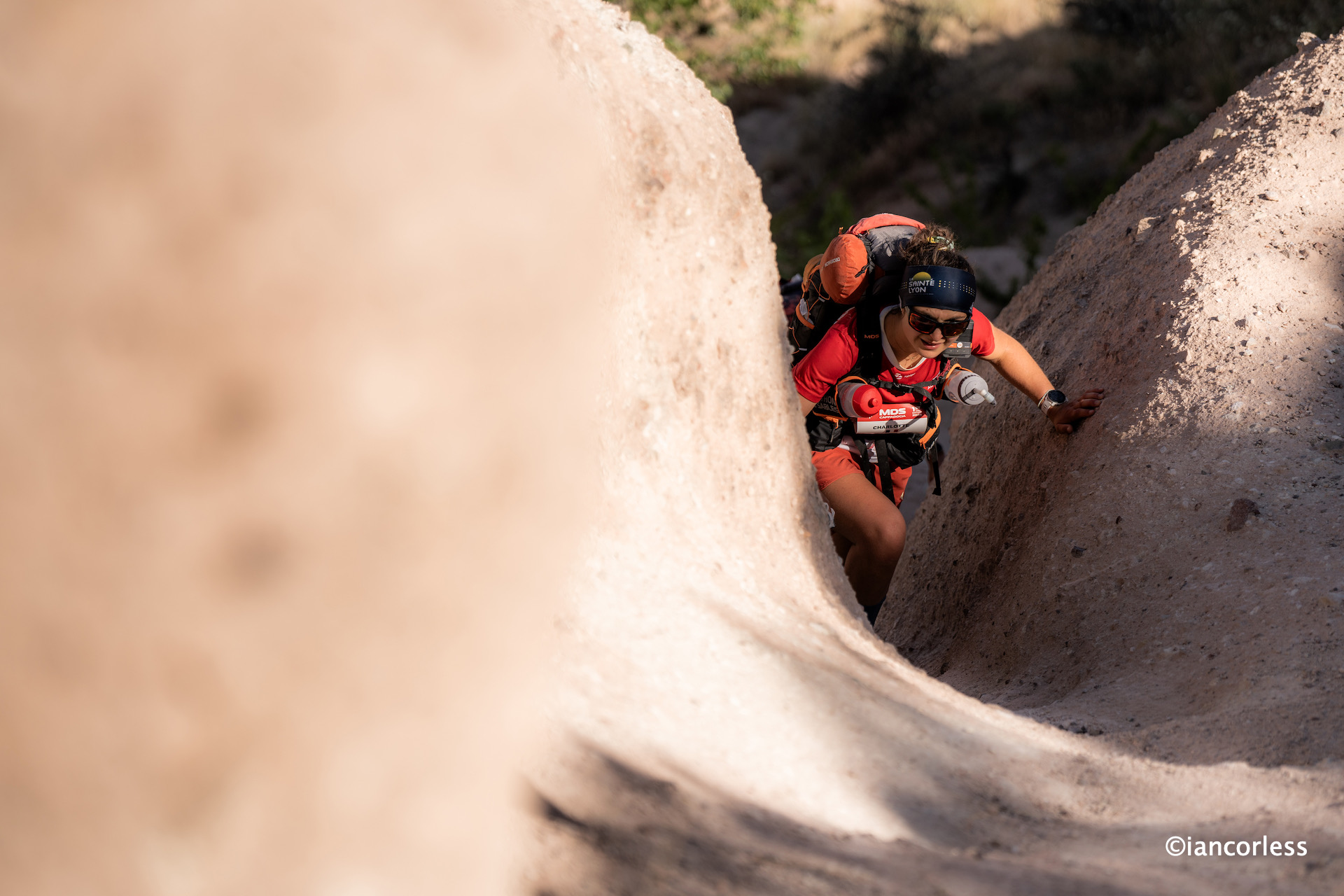
  • The route is considerably more challenging than other MDS events. Much of the route is single-track trails, mountain passes, gorges, tunnels, forest, technical trail, loose ground and it is undulating.
  • The vertical gain for each stage is significant, for the 72km it is 1767m, for the 91km it is 2243m and for the 111km it is 2576m.
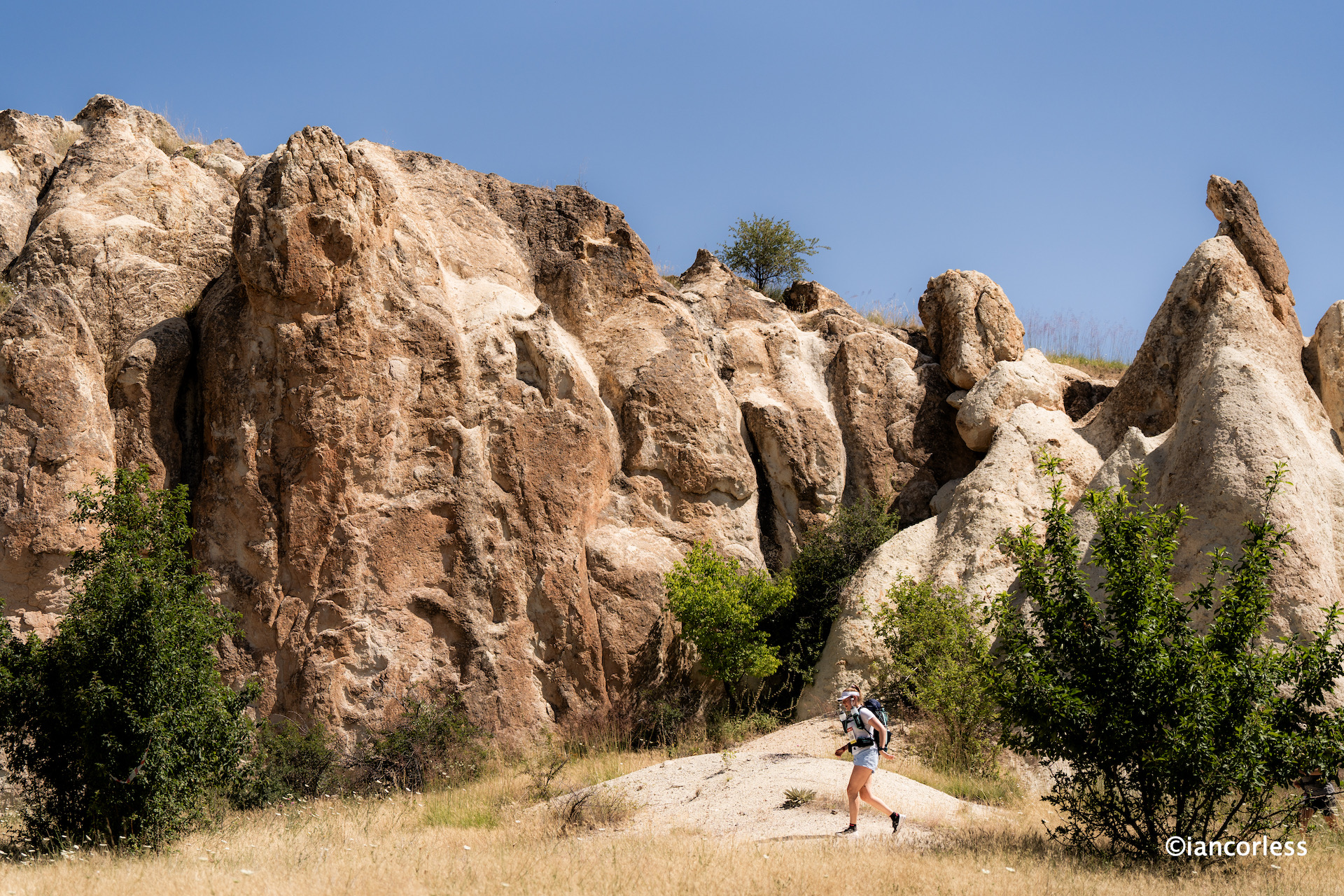
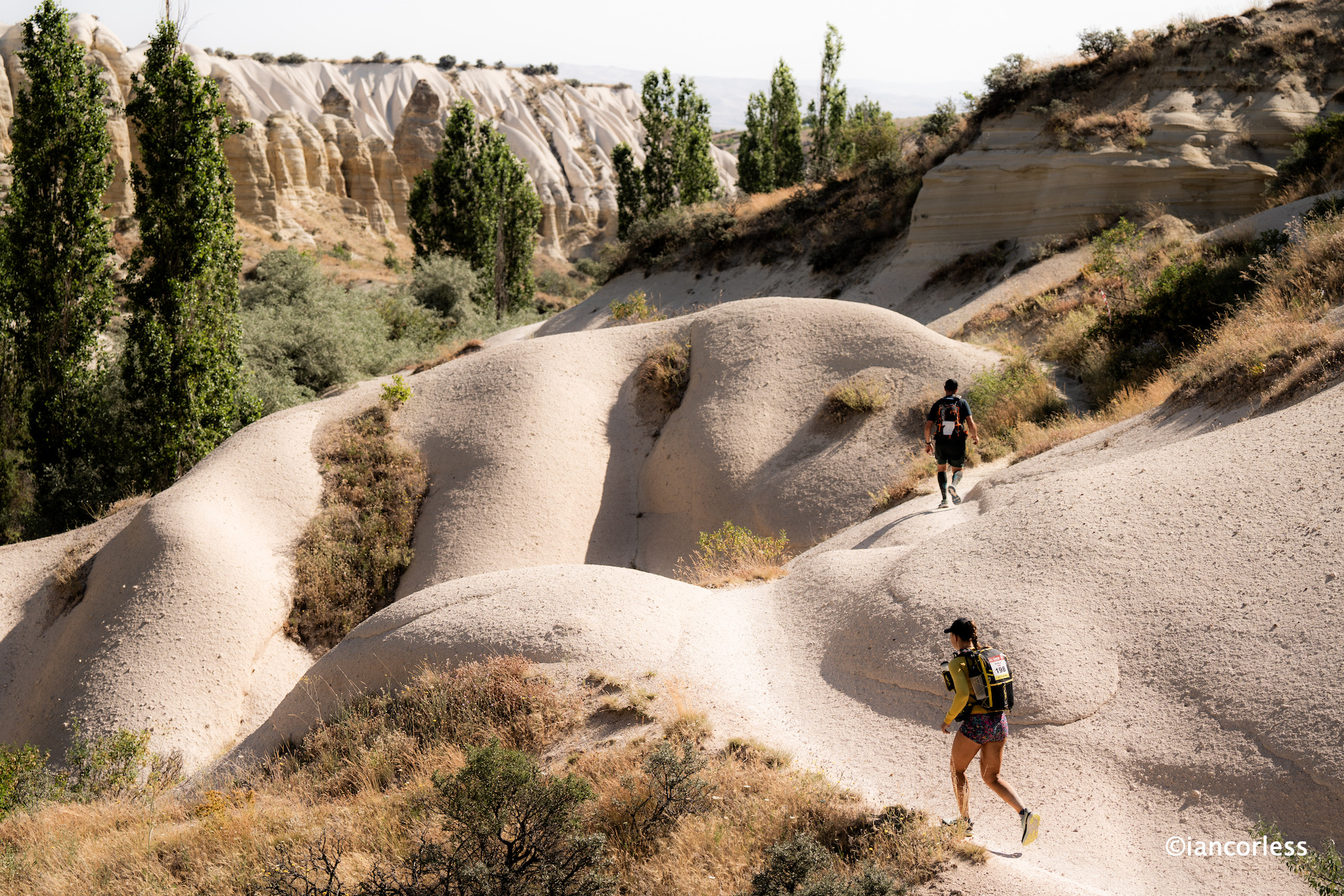
Unique terrain

The combination of elements above made MDS Cappadocia, km for km, more challenging and difficult than any other MDS race, The Legendary included. If MDS Cappadocia was an equivalent 250km distance of The Legendary, it would be a very hard race.

This is no ordinary race.

After stage 1, it was very clear to the organisation that start times were needed to be adjusted to allow for cooler temperatures. Stage 2 moved from a 0600 start to 0500, and stage 3 was moved from a 0700 start to a 0500 start. This quite simply was an excellent decision and it is fair to assume that future MDS Cappadocia will have earlier start times, especially on stage 1.

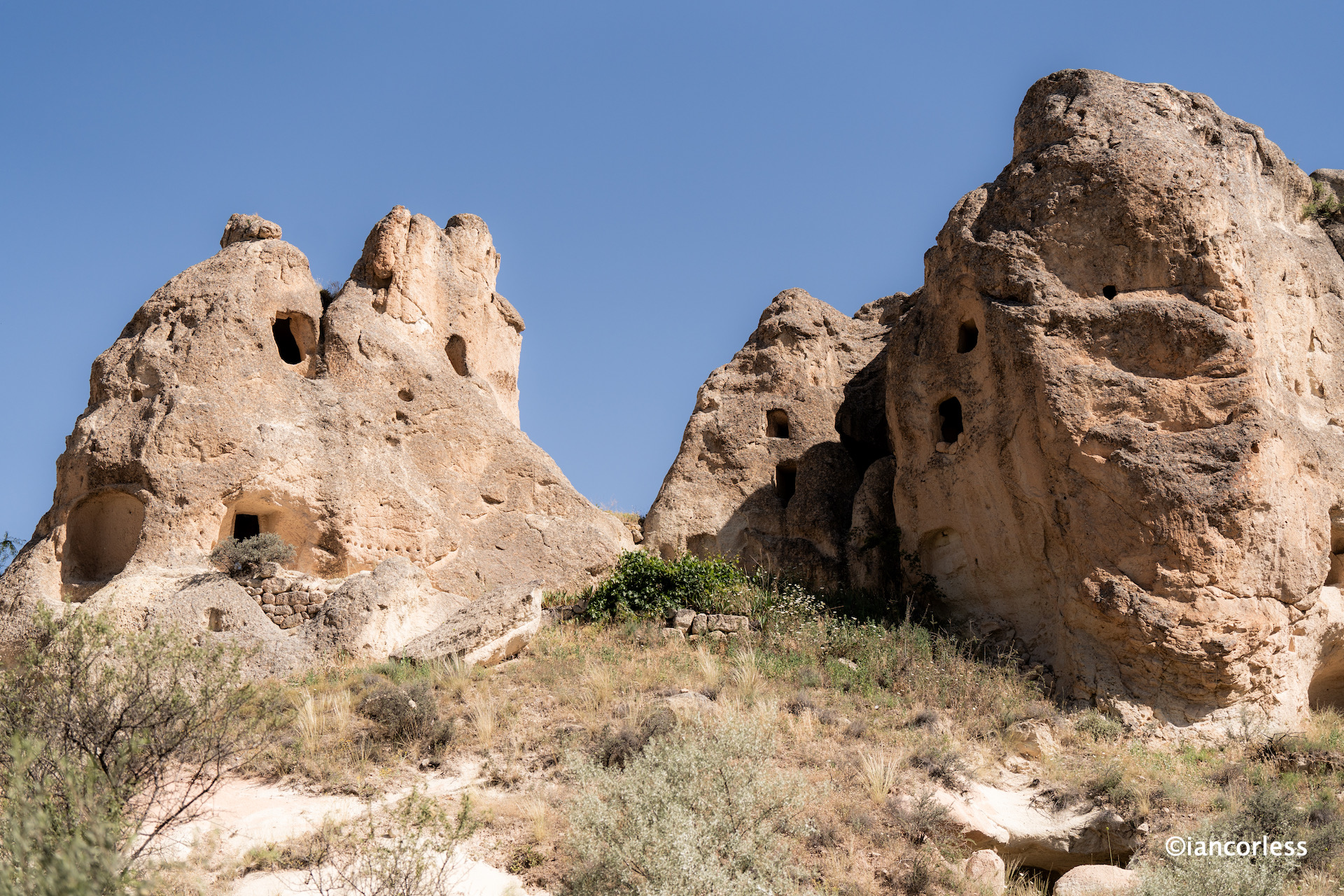
Bivouac was in a stunning location surrounded by iconic Cappadocia landscape such as fairy towers and Troglodyte caves. A very special place.

Camp life

Participants sleep in individual MDS tents in cells of 6. There is a communal shaded area with matts so that everyone can relax post-race.

Camp life is like all other MDS events, The Legendary excluded, as here the bivouac tents hold 8-people. Priority is to relax, hydrate, eat and sleep. It’s a simple life. Participants are self-sufficient and therefore they must have all they need for the duration of the event. The exception is water, at the end of each stage, participants are provided a 5L bottle of water which must last to CP1 the next day (rest day excluded.)

In camp, there is medical/ foot care to ensure competitor safety.

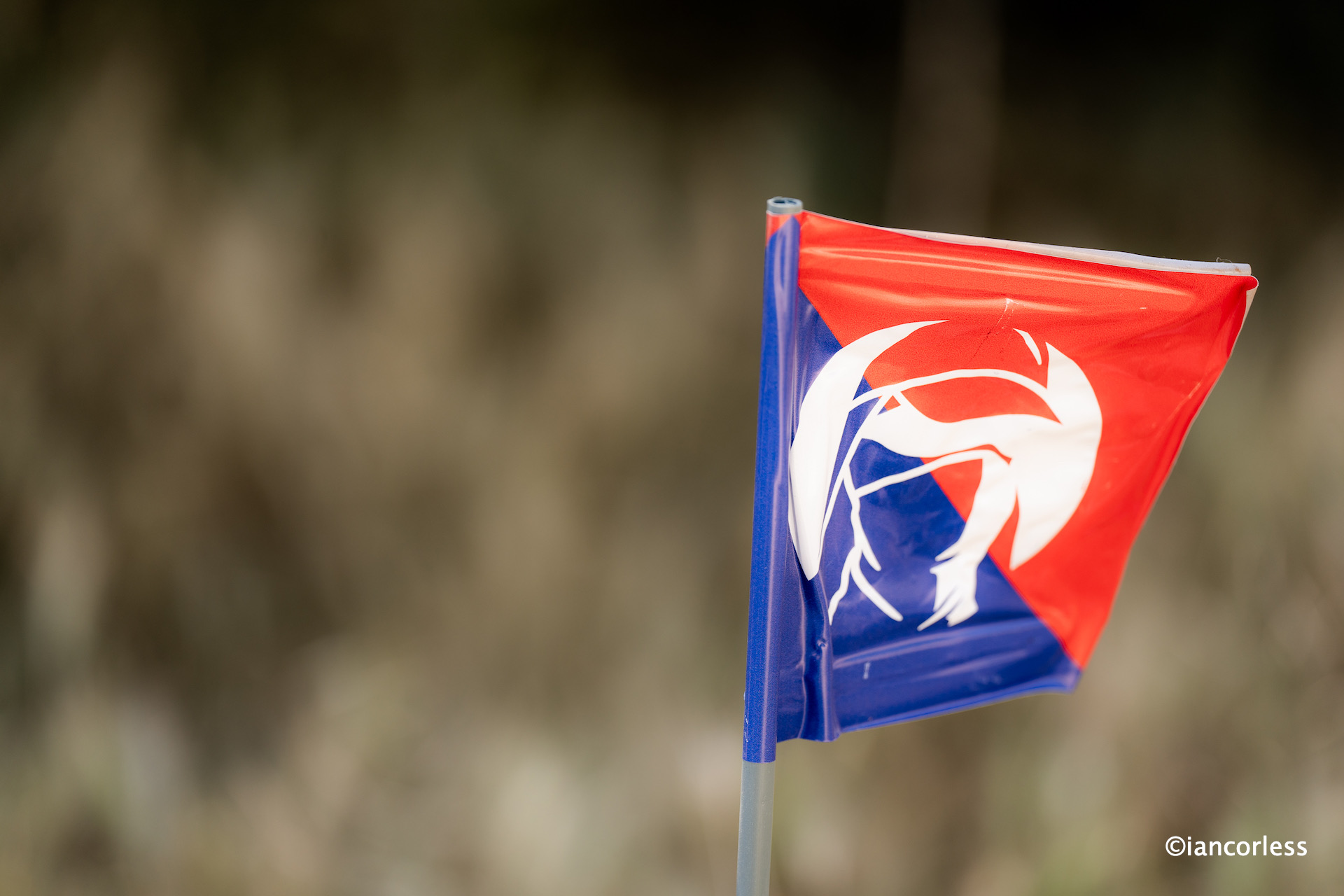
Flag markers

The race route is considerably more complex than other MDS events and as such, route marking is crucial. Marking consisted of red/ white tape and flags, and the route was very well marked. However, I do feel that the provision of GPX files would be a great addition.

Aid stations with medical teams

Aid stations were superb offering a shaded area, an abundance of water and importantly, iced water which the medical team pour on heads and necks to enable cooling. Medical provision is at each CP. For stage 1 there was two CP, stage 2 depending on the chosen distance had up to five CP’s and stage 3 had two CP. If required, the organisation added impromptu water stations to ensure competitor safety.

A tracker for each participant

Competitors each have a tracker so they they can be monitored and in addition, there is a SOS button in the event of an emergency.

All about the finish

The event has cut-off times, however, the goal of MDS events is that each participant finishes, therefore, the organisation do all they can to facilitate runner’s crossing the line. Should someone DNF, they are given a free entry for the following year!

THE ROUTE

Troglodyte homes

MDS Cappadocia brings something very unique to the MDS line-up. This is not a desert race, it is much more a trail race.

Underfoot, there are considerably more challenges with an ever changing terrain.

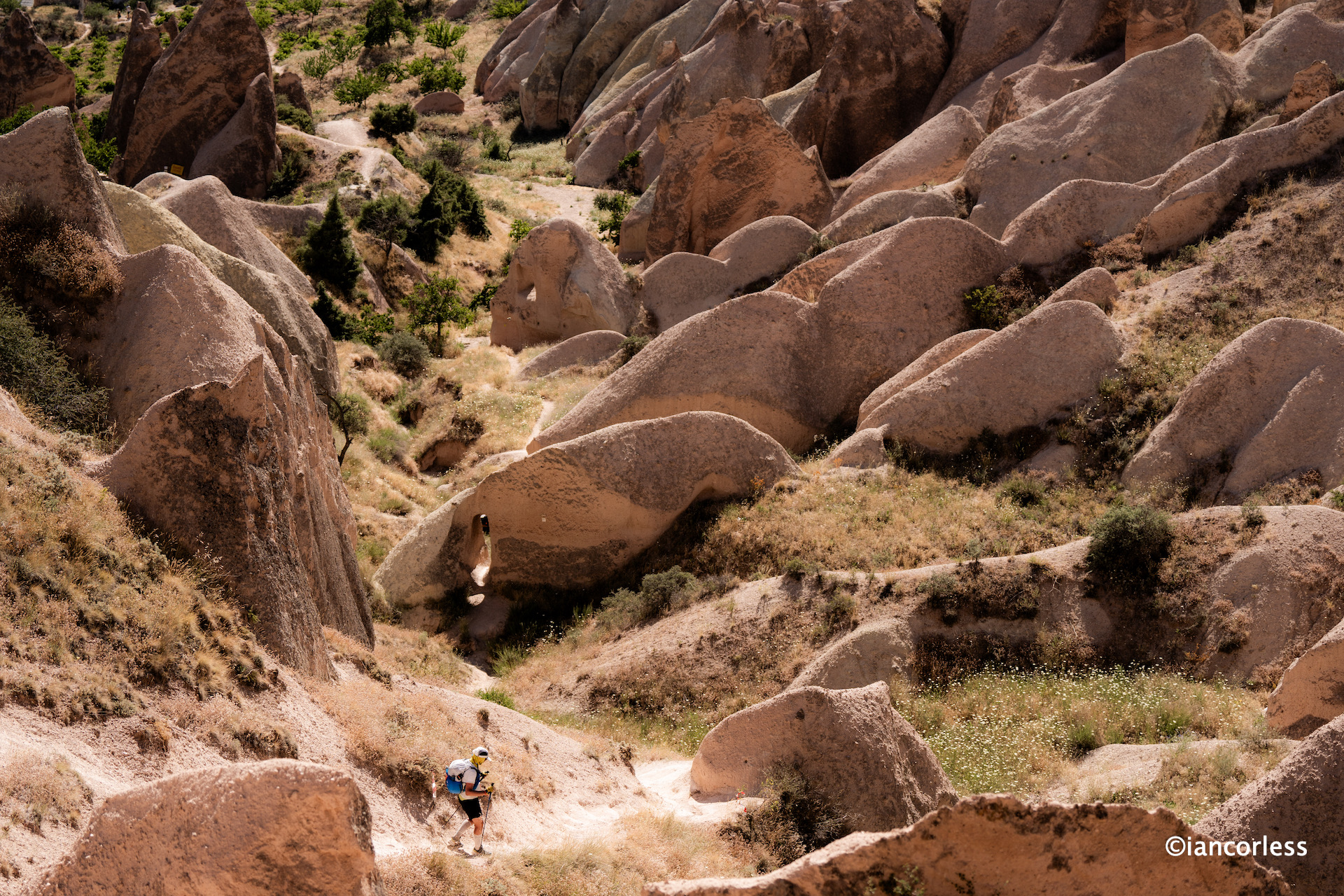
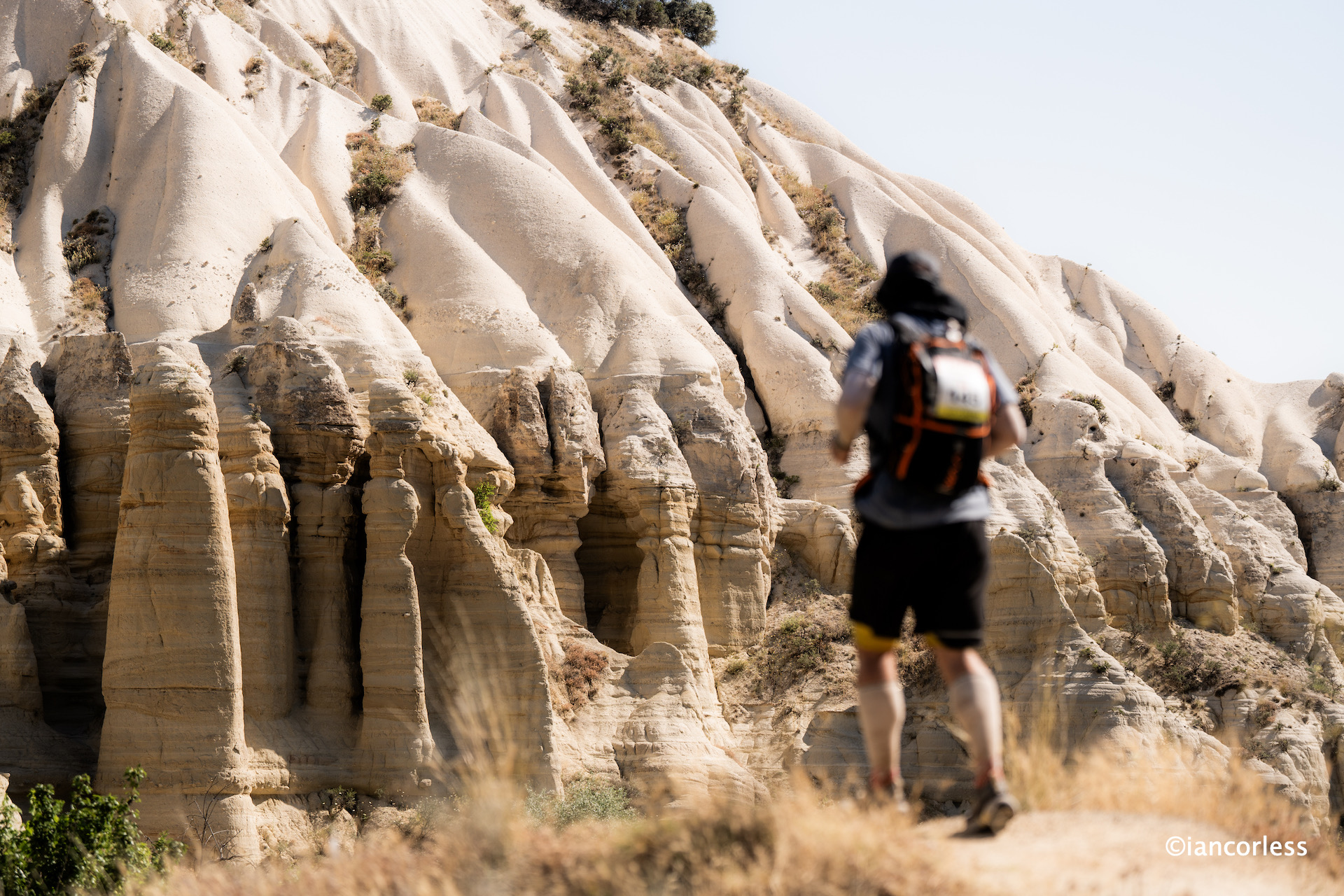
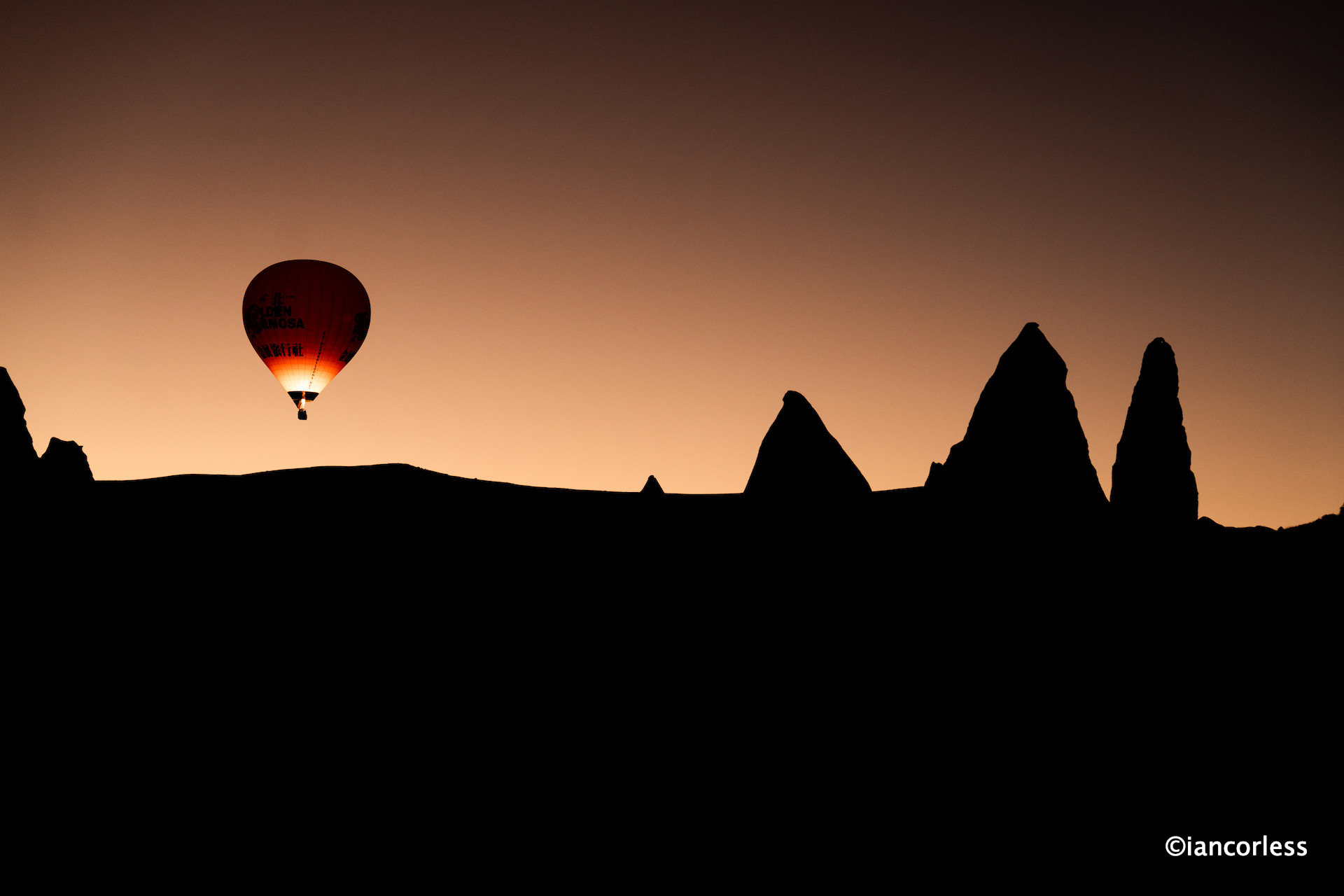
Just look at the photos, the route is a visual splendour of a very unique landscape. Taking in key areas of the Göreme Valley such as the Red Valley and Love Valley, the experience is special. A volcanic landscape, that has been shaped by wind, rain, lava, ice and erosion. Add the early morning spectacle of the hot air balloons and I firmly believe that Cappadocia needs to be experienced at least once. What better way to do this running or walking?

As mentioned above, the route is much more of a physical challenge, km for km, this is a harder race, however, as all the 2024 competitors confirmed, it is an achievable one… If it was easy, anyone could do it!

THE EXPERIENCE

Quite simply, the feedback from participants was a wow. From the moment stage 1 started, the visual splendour begins and that is consistent throughout the whole race experience.

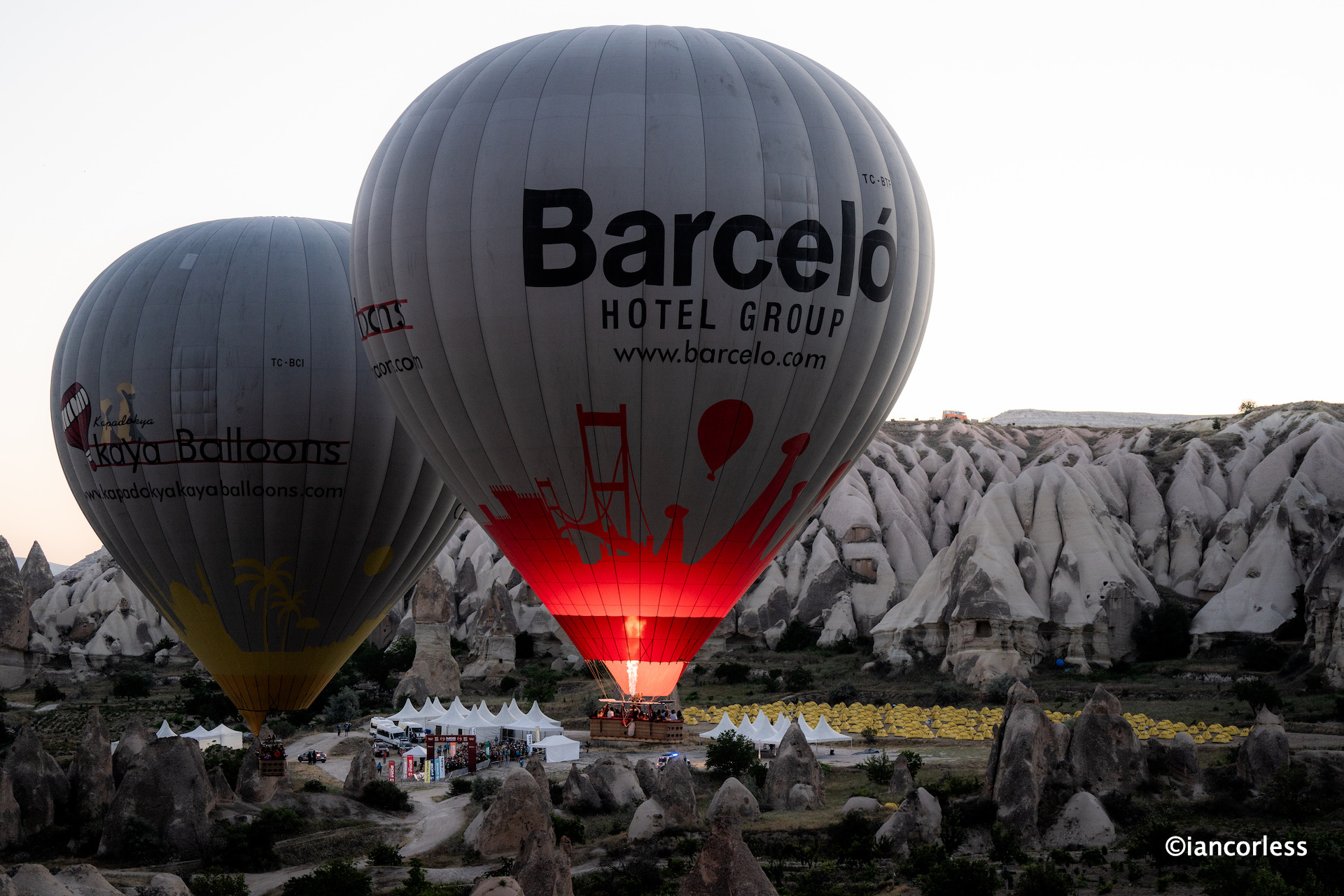
Balloons at bivouac

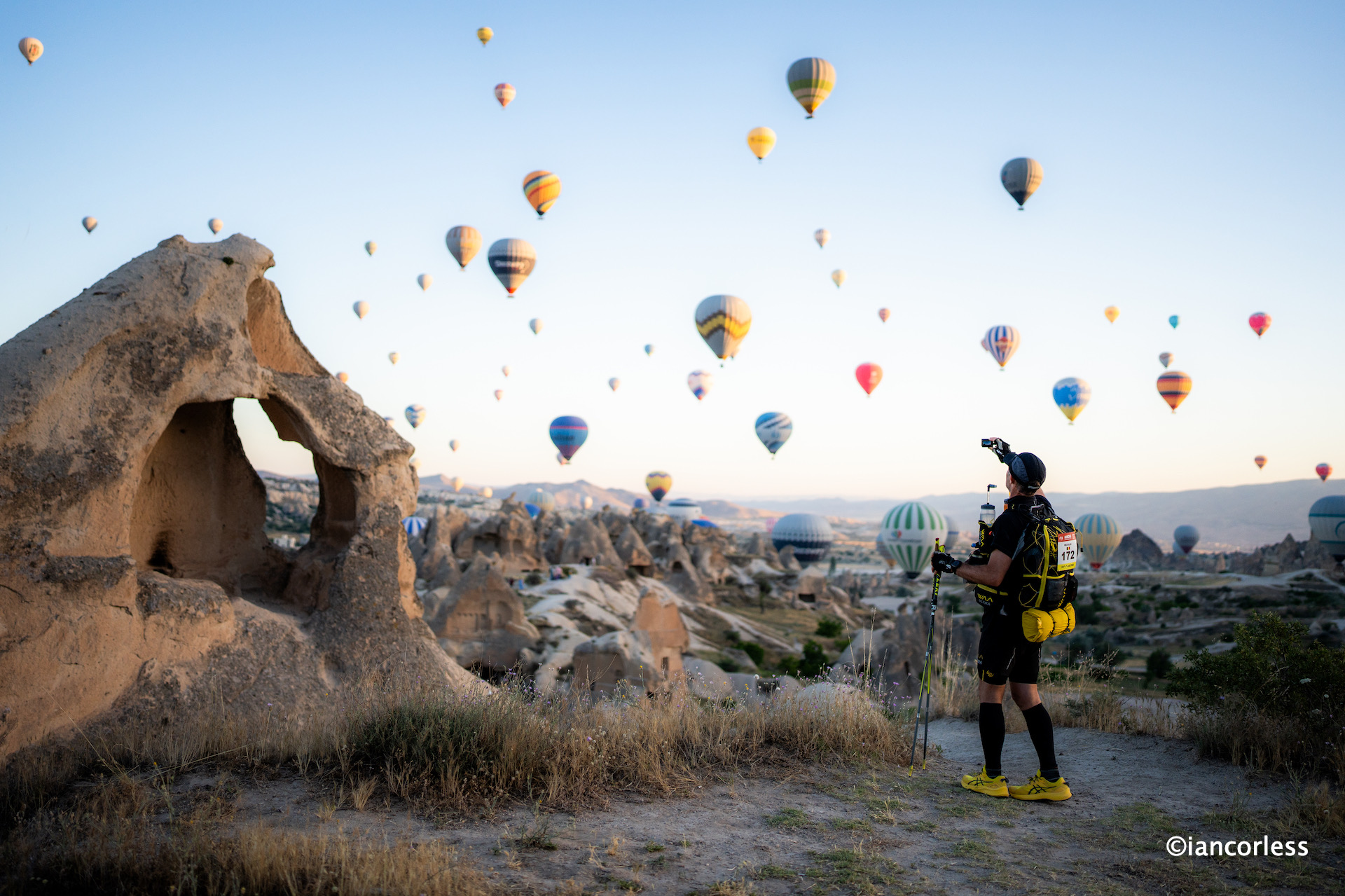
A highlight was the early start for stage 2 when the whole bivouac area was surrounded hot air balloons. I personally have experienced start lines all over the world and this was a highlight. It was completely mind-blowing and one that will last with everyone for their lifetime. It was a privilege and honour to experience it.

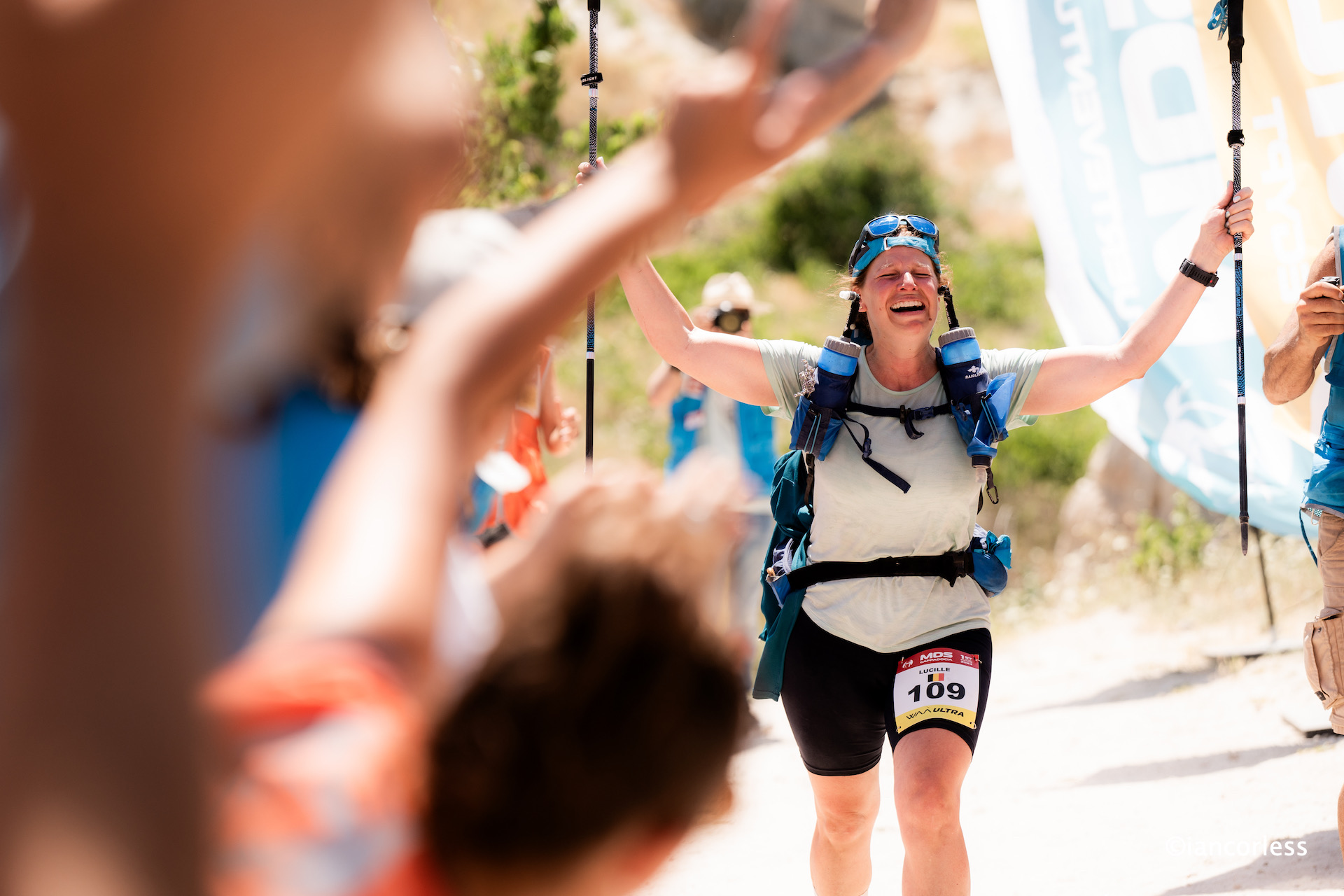
The last finisher emotions

The race was hard, especially with the intense heat. However, the MDS option to provide three distances for stage 2 is inspired and it gives everyone an opportunity to challenge themself in their own way.

In terms of runner’s needs, this is just like any other MDS event, however, there are some key considerations: 1. You need good trail shoes with excellent grip and toe protection. 2. Sand gaiters are not required but small ankle gaiters are a good idea to stop stones etc entering the shoe at the ankle. 3. Poles (and knowing how to use them) are a very good idea for the majority of the participants.

Teamwork

The MDS team have these events dialled and with a dedicated team they ensure competitor happiness and safety. Of course, first editions are always difficult, they are an opportunity to learn what does and what does not work. The general consensus post-race was one of huge success, however, it wasn’t perfect and the team look for this, so, tweaks.

The surprise of a hot air balloon flight was an incredible gesture by the MDS organisation, I think this almost certainly will be ‘option’ to add to the race experience in future editions.

The post-race awards, film, gala dinner and party was a great success.

CONCLUSION

Read the daily summaries – Stage 1 Here, Stage 2 Here, Stage 3 Here.

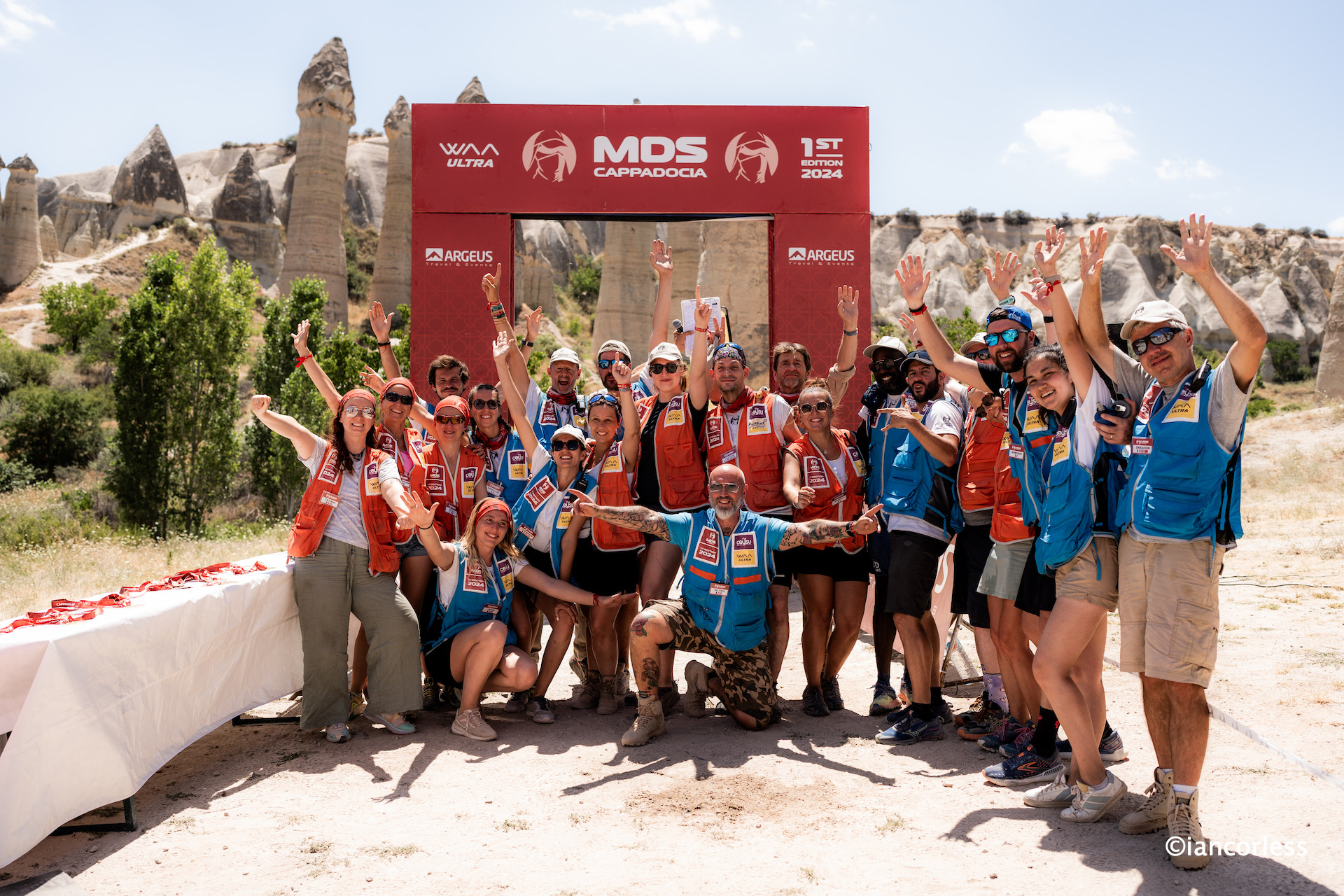
It takes a dedicated team to make an event happen and it’s important to acknowledge Argeus Travel and in particular, Koray and Hayden for their on ground experience in facilitating the first edition of MDS Cappadocia.

The event brings something new and different to the MDS line-up and that should be applauded. There is something special here in Turkey that needs to be experienced just once.

The challenge is real, respect this environment. The combination of altitude, heat, challenging terrain, self-sufficiency and camp life is something special.

And finally, this landscape is very, very special it needs to be experienced to be believed.

Love Valley

Follow on:

Instagram – @iancorlessphotography

Twitter – @talkultra

facebook.com/iancorlessphotography

Web – www.iancorless.com

Web – www.iancorlessphotography.com

Image sales –www.iancorless.photoshelter.com
Marathon des Sables – The Legendary : NEWS SIX – Mar 2024

It’s countdown time. 

Countdown to Marathon des Sables – The Legendary.

Now is the time to make all the final preparations for a goal that you have been building towards for 6-months, 1-year or maybe even years.

DON’T PANIC.

If you have got this far, you are in a great place.

There is time for one last key week of training, adding the final touches to make sure you are in the best shape possible, BUT, after this week you need to start easing things back, looking after yourself and allowing your body to recover, rest and get ready for what may be one of the biggest weeks of your life?

MEDICAL

Make sure you have all the medical requirements fulfilled and an up to date ECG as specified in MDS rules and regulations.

The organization’s medical certificate (to download from your online account from March 11th 2024) and the resting electrocardiogram (ECG) report plus graph, dated less than 30 days before the start of the race, i.e. from March 12th 2024, are to be presented during the administrative, technical and medical checks on 13th of April 2024. Only the original documents, dated and signed, will be accepted (unvalid photocopy). Failure to present these documents will incur penalties (see ART.27 et 28). The signature and the stamp of the doctor must be applied on them.

The electrocardiogram of effort is advised for participants over 40 years. It is not compulsory and does not replace the ECG at rest and its plan. This can be joined to the medical certificate and presented in Morocco.

TRAINING

From a training perspective, what may the next weeks looks like? Well, we are all individuals, we all have different abilities, we all have different goals, we all have different free time and the list could go on. However, I have found over the years that using a ‘percentage’ taper works across the board, irrespective of the person.

Race date: 14th April 2024

Taper schedule:

  • Week 4: 17th March 
  • Week 3: 24th March
  • Week 2: 31st March
  • Week 1: 7th April

If we look at the weeks above, a taper to Marathon des Sables could look like as follows:

  • Week 4: 80%
  • Week 3: 60%
  • Week 2: 40%
  • Week 1: 20%

The percentages are based as a percentage of what would be week 5, starting 10th March. For simplicity, let’s assume that week 5 is your last big training week and it was 100km or 12-hours.

The Taper:

  • Week 4: 80km or 9.6 hours
  • Week 3: 60km or 7.2 hours
  • Week 2: 40km or 4.8 hours
  • Week 1: 20km or 2.4 hours

Importantly, keep the balance of training days the same. If you typically run 5-days a week, maintain those 5-days and reduce the volume/ intensity.

Your body needs to keep alert and active. So make sure you add some stimulus in this taper period, short periods of faster running and/ or hill work are ideal. However, do all this with the priority not to get injured. Now is not the time to get a niggle, a sprain or a problem.

ACCLIMATE

In the final two weeks of taper you need to hone in on acclimation to heat and prepare the body.

Read HERE on the best protocols.

Don’t leave this to the last minute, plan ahead, especially if using a heat chamber. Heat chambers are limited and obviously, time slots are limited. 

If you do not have access to a heat chamber think of other options: sauna, hot baths, bikram yoga, adding layers when running, or if you are lucky with time, arrive in Morocco early and taper in a real situation.

EQUIPMENT

You will have been mulling over equipment for months and you may well have tweaked and changed your choices. Now, with 4-weeks to go, this is the time to make sure you have everything you need and also understand what it all weighs. 

  • Clothes must be comfortable and not rub.
  • Shoes fit perfectly, give no hot spots and are suitable for the desert environment and have gaiters.
  • Socks work for you.
  • Sleeping bag is light and warm.
  • Sleeping mat
  • Food
  • Mandatory kit

Top Tip

Use Lighterpack HERE to list all your equipment. You can see an example HERE that I used for a trip climbing in the Atlas Mountains. This is a great way to look at everything and make sure you have nothing missing.

Keep luxuries to an absolute minimum, they only add weight.

Pack and re-pack your pack to make sure you have the most comfortable solution and importantly, you have immediate access to essential items.

Read my Top 20 Tips HERE which provides a great overview of all the things you need to consider now in this final phase.

FOOD

You need a minimum of 2000 calories per day. Lay food out for each day and have a spreadsheet that itemises everything and shows the weight and calories.

Where possible, re-package food in smaller and lighter packaging. Particularly important with dehydrated meals. Read HERE

TRAVEL

Travel in your run clothing including your run shoes with the gaiters. Yes, you are going to look somewhat ‘special’ at the airport but trust me, luggage goes missing and you do not want to be the person standing in the Sahara watching your dream slip away because of lost luggage. Equally, take your run pack with all contents for the race as carry-on. You can take pretty much take everything: food, sleeping bag, essentials etc. However, check with your airline what can and cannot go on the plane.

Put your main luggage in the hold and here you can take spares, extras and options. MDS varies considerably in temperature, we get hot and cold years. Never assume it will be hot, it may not be. Before admin day you can fine tune your ‘race kit’ with more or less layers.

Purchase food and drinks at the airport to take on the plane. Also consider when you land in Morocco, you will have an approximate 6-hour bus journey to bivouac 1, take food and drink with you for this trip.

Have cash with you, depending on which airline you use, card payments are not always possible, also, in Morocco, cash is king.

ARRIVAL

You will arrive in Morocco from London or Paris on one of the arranged flights on Friday 12th April. If you are not on one of these flights, you need to be at Ouarzazate airport (typically for 0900) on the same day.

Runners will then fill buses, road books will be given and then you transfer to the desert. Expect 6-hours.

At bivouac you will find your tent and settle in.

REMEMBER food is now NOT provided and you therefore need to feed yourself on arrival day and admin day. There are no restrictions on weight or calories here, so, take as much as you want and plenty of variety, this includes drinks. Only water will be in camp.

As mentioned above, until admin, you have your luggage with you, so, you can have more layers, a more comfortable inflatable bed and some luxuries – consider what will make these days more pleasurable and comfortable.

ADMIN DAY

On admin day, prepare all your kit and make sure you have everything prepared and ready. Also make sure you have all mandatory and essential kit. Once you have passed through admin, your luggage is taken away and you will not see it again until after the race.

Race self-sufficiency actually only starts the following day with stage 1.

Admin can take a while, so make sure you take liquid and snacks and my top-tip is take an umbrella to protect from standing in the direct heat.

RACE

Good luck….!

Start slow, ease in to the race.


Follow on:

Instagram – @iancorlessphotography

Twitter – @talkultra

facebook.com/iancorlessphotography

Web – www.iancorless.com

Web – www.iancorlessphotography.com

Image sales –www.iancorless.photoshelter.com
ace and have the time of your life.

Marathon des Sables – The Legendary : NEWS FIVE – Mar 2024

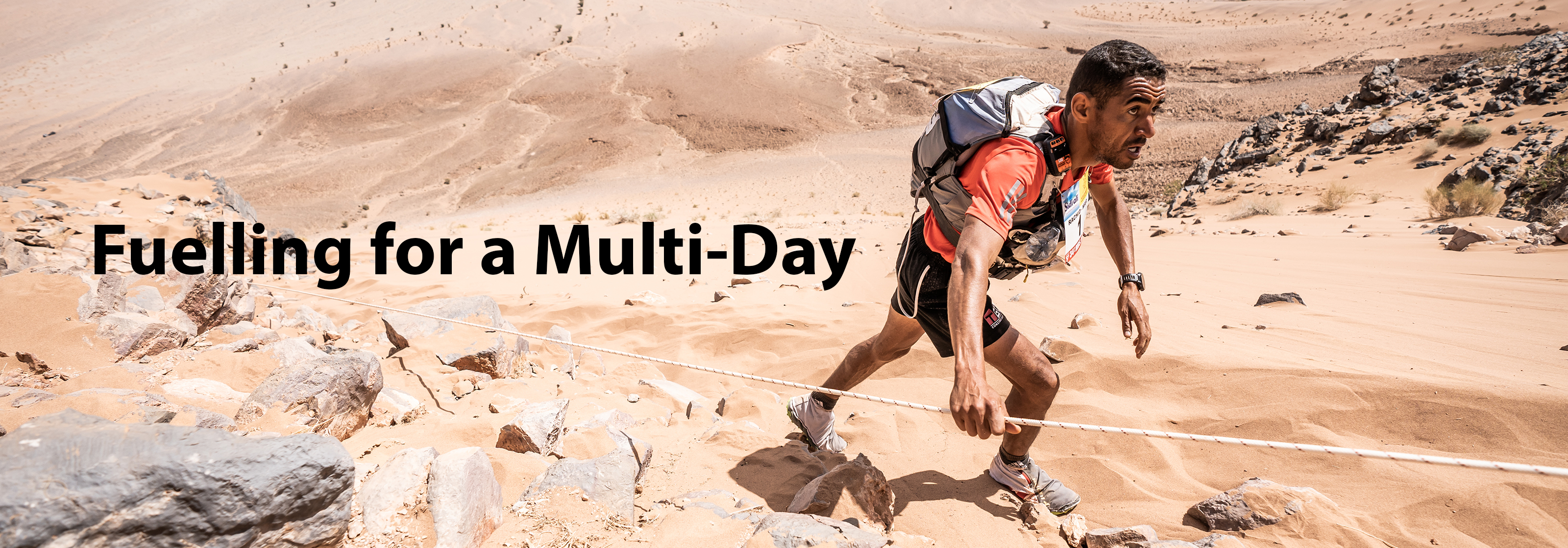
Fuelling for a Multi-DayMarathon des SablesThe Legendary

Marathon des Sables pioneered the multi-day racing format and as such is often a key starting point when discussing a fuelling strategy for an adventure that lasts a week or longer.

Multi-day adventures require fuelling and how one obtains food can vary greatly. In principle, there are several keyways:

  • Self-sufficient
  • Semi-supported
  • Supported

For many, self-sufficiency poses the greater question marks and worries as there are multiple factors to consider:

  • How many days?
  • Weight?
  • Balance of nutrients and calories?
  • Hot or cold food (or both)?
  • Access to water?
  • Environment?
Loaded up for a week in the Sahara.

Runners are required to carry all they need to survive in a multi-day like MDS. Fuelling is essential to survive and the balance of calories v weight is a prime concern. The only things that are provided are a shelter (bivouac) which is shared with 7 other runners and water which is rationed. Since its creation in the mid 80’s, the MDS format has been copied and used as a template for other races all over the world.

Get your pack as close to 6.5kg (plus water) as possible.

Weight is the enemy of a multi-day runner or fastpacker and therefore balancing equipment, food and water is an art form in itself. Read an article HERE about the equipment required for a race like MDS.

Food will take up most of the weight on any adventure when being self-sufficient. MDS, for example, has a minimum food requirement of 2000 calories per day, a minimum pack weight of 6.5kg and then one must add water, typically a minimum 1.5 litres (1.5kg) which makes the starting pack weight a minimum 8kg.

Food for multiple days will typically be around 4 to 5kg.

*****

Quite simply, running or walking, covering 250km over 7-days will leave the runner in a calorie deficit. Therefore, it is essential to optimise the food one takes.

FACTORS TO CONSIDER

How fast one goes does greatly impact on food choice and how calories are not only consumed but chosen. The macronutrient choices will change based on the balance of carbohydrate, protein and fat. In simple terms, a runner will burn more carbohydrates and a walker will burn more fat. Humans store enough fat to survive many days and even weeks. However, carbohydrate stores deplete quickly and need to be replenished.

Body weight, age, individual needs are important for all and males may well require more calories than a woman due size and muscle mass.

Main meals will usually come either freeze dried or dehydrated. Both processes involve removing the water from food to preserve it. Freeze-drying involves freezing the food to a very low temperature and drying it in a vacuum to remove moisture. Dehydration involves passing warm air over the surface of the food to remove moisture. Dehydration creates food that tastes like it should, with plenty of texture and flavour. It is an altogether slower and gentler process than freeze-drying. Please note though, that hydration times take considerably longer with cold water and taste can change. Test meals in advance using hot or cold water.

Firepot are a UK brand who create tasty meal by hand, using fresh ingredients and then dry each meal.

Carbohydrate, Fat and Protein are essential for balance and foods for an expedition are usually balanced specifically for the needs of an active individual. Typically, 55% carbs, 30% fats and 15% protein are considered balanced. As an indicator in regard to calories, carbohydrates have 4 calories for 1 gram, fat has 9 calories for 1 gram and protein 4 calories for 1 gram.

Remember, we are all individual and although any recommendations here provide a guide and a template, you the individual need to answer very specific questions and ultimately, you may need to seek the advice of a nutrition expert to fine tune a fuelling plan for a multi-day adventure.

As a rough guide, BMR is the number of calories a person burns in normal day-to-day activity.

Example for a 37-year-old, 6ft tall, 170-pound man.

(66+(6.2 x 170) + (12.7 x 72) – (6.76 x 37) x 1.55 = 2663 calories

How to use the equation: (66+(6.2 x weight) + (12.7 x height) – (6.76 x age) x 1.55 = 2663 calories

The ‘Harris-Benedict‘ formula takes into consideration daily activity.

Fat adapted athletes will have specific requirements and the nutritional plan will be different.

Answer the following questions:

  • Age?
  • Male or female?
  • Body weight?
  • Walker?
  • Walk/ runner?
  • Runner?
  • Vegetarian/ Vegan?
  • Am I typically a hungry person?
  • Am I more hungry or less hungry with exercise?
  • Food allergies?
  • Will I use hot water or cold water?

A TYPICAL DAY

Breakfast – Ideally slow-release carbohydrate, some fat and quality protein.

Starting the day with breakfast.

Running Food – This will vary on the length of the stage, up to 6-hours and you may prefer easily absorbed carbohydrates, bars and or energy in drink form. For longer stages, the addition of real food, savoury and some protein would be wise. For a very long day, for example, the long day at MDS, you may even need a meal?

Post run food (immediate) – A shake is a great way to start the recovery period as it is easily absorbed, and this should have carbohydrate and protein.

Dinner – A meal will form the basis for dinner and think about some small treats for each day, these will give you something to look forward to and help keep your palette fresh.

FOOD PLANNING AND IDEAS

Breakfast:

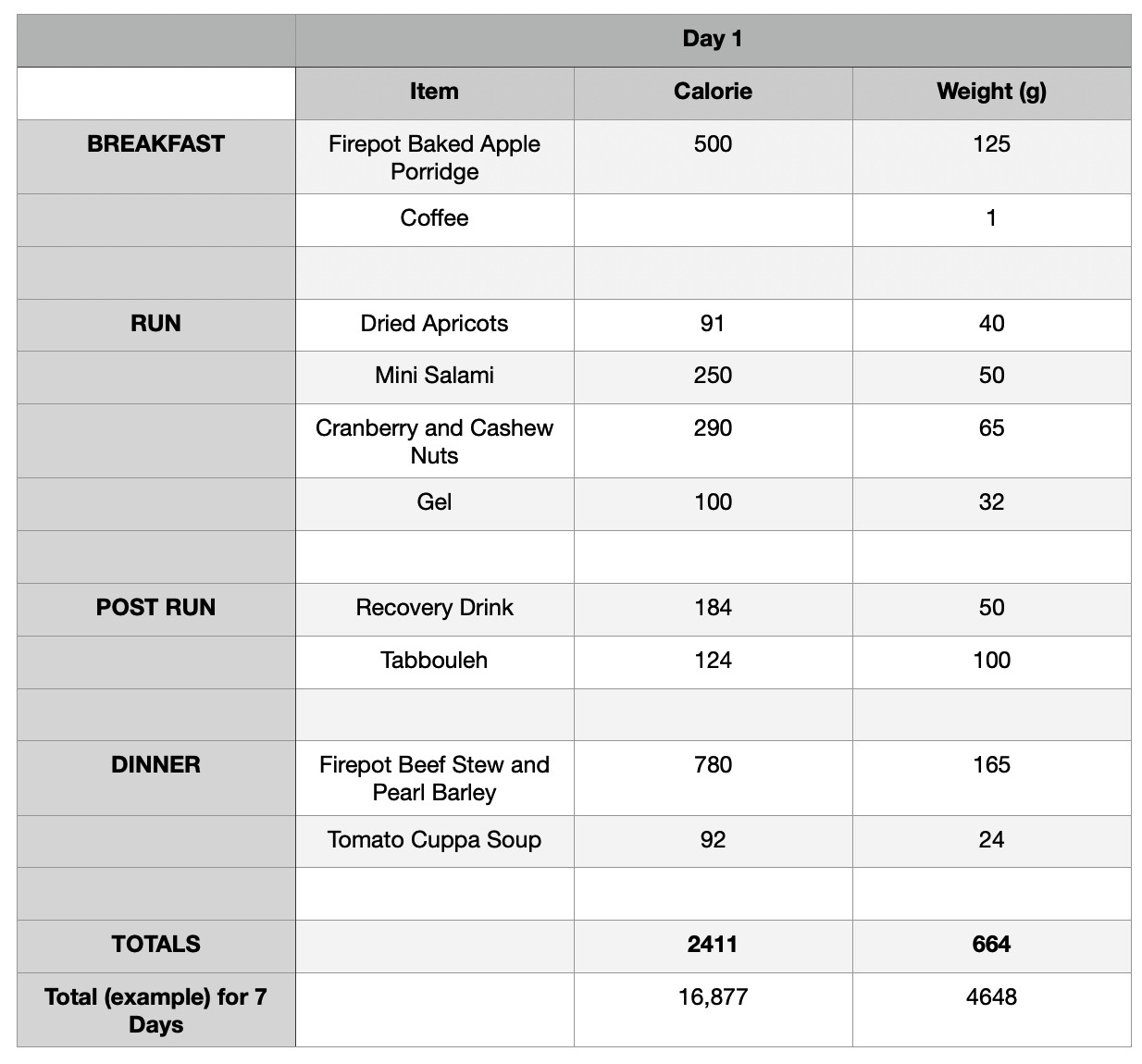
A freeze-dried breakfast is a good way to start the day. Top tip: Add the water to your breakfast at sleep time (especially if using cold water) as it will rehydrate during the night and be ready for eating in the morning. Of course, make sure it can’t be knocked over, get contaminated or damaged – that would be a disaster! Using a re-sealable plastic bag is a good idea. Example: Firepot Baked Apple Porridge is 125g with 500 calories.

Breakfast is essential to fuel the day ahead.

Muesli is popular and provides energy and fibre, it can easily be combined with a freeze-dried dairy product.

An energy bar for some works, but they often are heavy in proportion to the calories provided. However, for some, they are a perfect start to the day.

Top tip: Consider an evening meal as an alternative to breakfast. Sweet tasting food can become boring and sickly, the option to have something savoury with some spice can be a life saver.

During the run:

Runners will need typically more carbohydrate in an easy form so that they can maintain pace. By contrast, walkers will move slower, have more time to eat and easier time digesting, therefore real foods are possible. The balance is always weight v energy.  Don’t rely completely on liquids, some solid food and chewing is good for the body and mind.

Some ‘typical’ run snacks.

Example: Gels are around 32g each. Let’s say you took 1 gel per hour. Rachid El Morabity won the 2019 MDS in 18:31. So, 19 gels would weigh 608 grams. By contrast, if the race takes you 60-hours, 60 gels would be 1920g! Not only is the weight not feasible but also the volume size would just not work.

  • Powders (energy drinks) that one can add to water are an easy way to get calories and nutrients. They are also considerably lighter.
  • Energy bars.
  • Beefy jerky.
  • Dried fruit.
  • Nuts such as almonds are rich in fat and calories.
  • Trail mix.
  • Dried meat.

Post run:

Back in bivouac, first priority is drink and food.

A recovery drink is the quickest way to get balanced calories immediately in the body to start replenishing the body. Have this shake as soon as possible. Then do personal admin such as feet, clothes, bed, etc. One hour post the run, consider a snack like tabbouleh as this is easily hydrated with cold water and add some protein to it – dried meat a good option.

Dinner:

A dehydrated meal will make up the main calories. Depending on the person, the need for more or less calories will vary. Some companies, Firepot a good example, provide meals in two sizes: 135g with 485 calories or 200g with 730 calories for Vegan Chilli Non Carne and Rice.

A post-dinner treat is a good idea, this could be another freeze-dried option or a low-weight and high calorie option. A sweet such as a Lemon Sherbet is a simple way to add some freshness to your mouth and palette and although has little calories, it can be a nice treat.

Top tips:

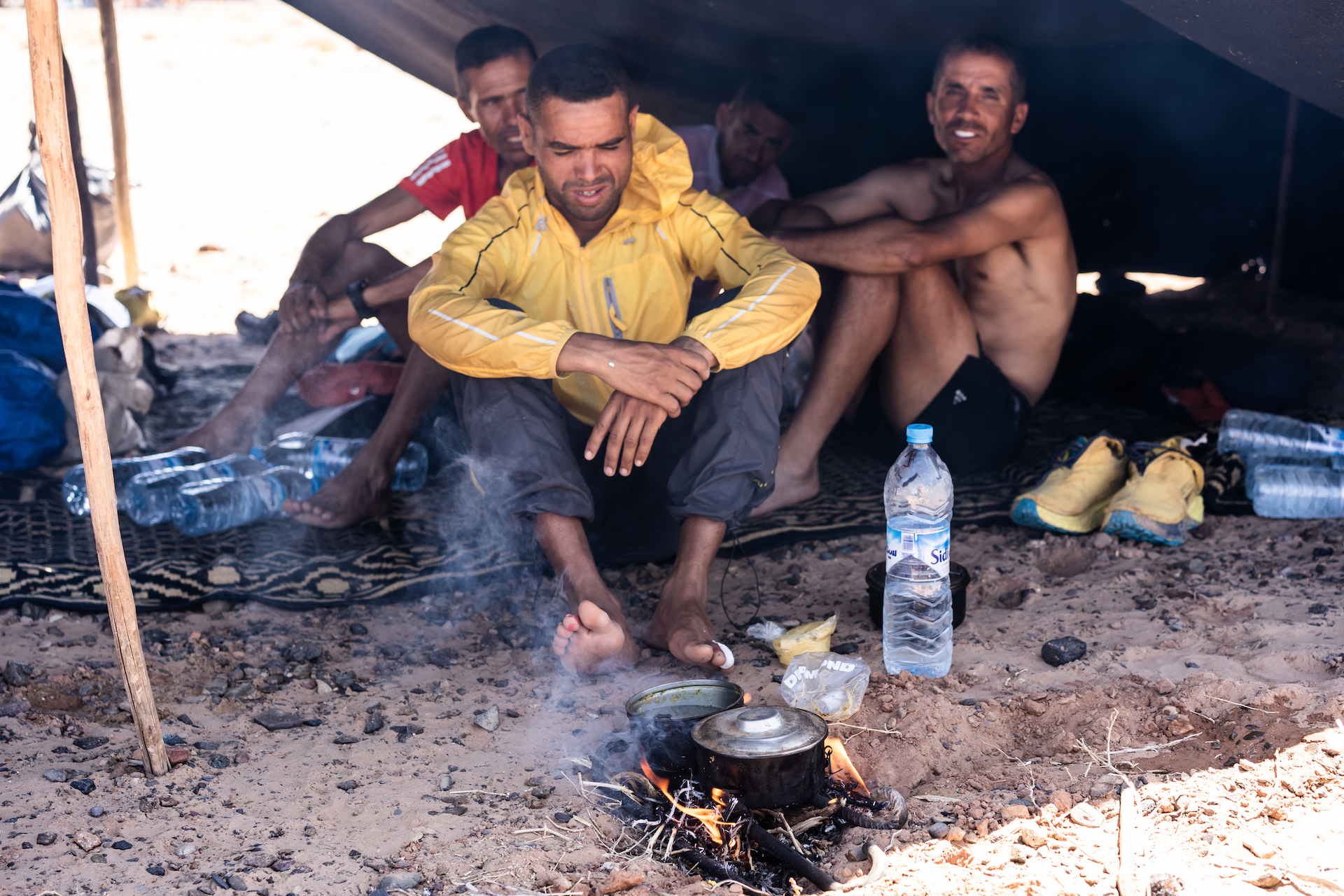
Experienced runners make a real fire to boil water.
  • Try everything out before any race or event. You need to know what works for you when tired and fatigued. Try to simulate race situations so you have a good understanding of your palette and your body. Test for taste, stomach and brain.
  • Just because you love Spaghetti Bolognese, don’t be tempted to take 7 for a 7-day race. You and your palette become bored quickly.
  • Be careful with spices and anything that may irritate or aggravate a digestive system that will already be under stress.
  • The choice of having hot water can be a deal breaker. For some, a hot coffee or tea is just essential! In addition, food is typically more pleasurable when hot and hydrates quicker with hot water. You cannot use any gas stoves at MDS so you must use fuel tablets and a small stove. However, here are some alternative ideas: 1. If you finish early in the day, leave a bottle in the sun and let it warm naturally. 2. Often, there are lots of shrubs, twigs and branches around bivouac, it is possible to make a fire, but you will still need a pot.
  • Water at the race is provided in 5Ltr bottle at the end of the stage this needs to last till Cp1 of the following day, so, plan water use.
  • Consider repackaging all your food to make the volume and weight less, if you do this, be sure to include the nutrition label in your new packaging.
  • Take extra food and options. When in the Sahara, you can make some final food choices.
  • The ‘Long day’ and following ‘Rest Day’ will require different fuelling strategies, take this into consideration.
  • Rules – Race rules dictate you have a minimum 2000 calories per day, that you have nutrition labels for the food that you take and that on the morning of the last day that you have 2000 calories remaining.
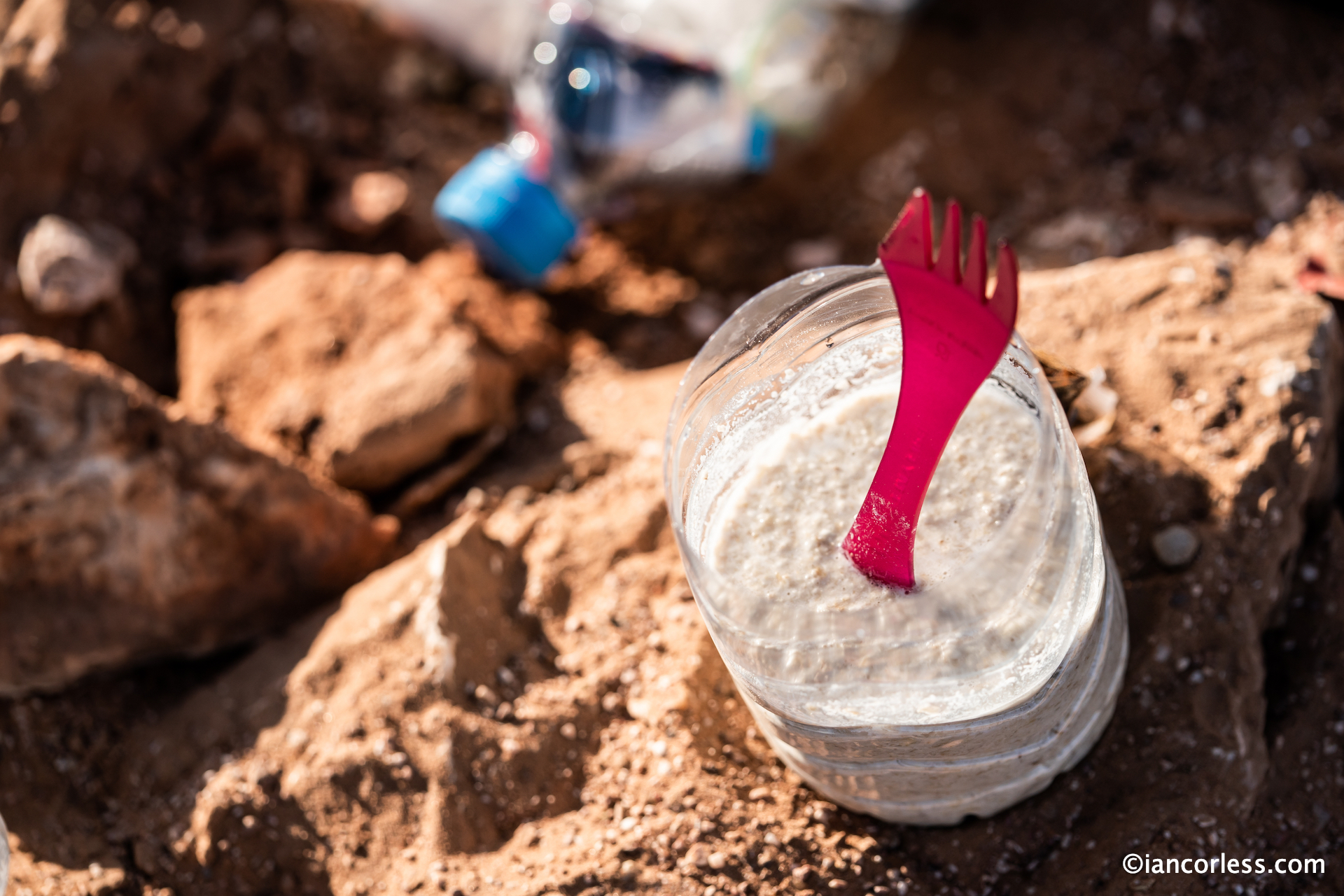
A cut down water bottle is a great food bowl.

WATER

Water is the only item provided at a race such as MDS and this is rationed. You are provided water for ‘in’ camp and then this is replenished while running at Cps which are typically 10 to 12km apart. When you finish the stage, you are then allocated water to last through the night and the following morning. NOTE: This water will need to last till CP1 on the next day’s stage, so make sure you leave enough to run with.

Water is rationed and supplied at every checkpoint on the route, typically every 10km.

Water is obviously used to hydrate but you also need it for your food and if you wish to wash.

Remember you need to replace salts that are lost through sweating. Have a strategy in place. The two main reasons for a DNF are feet and dehydration.

SPREADSHEET

Create a spreadsheet so that you can see daily food items, how many calories and what the weight is. Not only is this invaluable for personal admin, but it is also a requirement for the race when at admin check.

Top Tip: Lay a day’s food out on the floor and look at it and analyse (visually) does this look enough for 1-day.

An example of fuelling for one day.
Use a sealed bag for each day and then add a label showing contents and calories.

CONCLUSIONS

Getting fuelling right for any multi-day is really important, so, do the research and test everything. Have a contingency plan and anticipate the need for sweet v savoury will change.

If possible, repackage food to save weight and use clear packaging and relabel adding the name of the food, what day it is for and how many calories are inside.

Make sure you have some treats and something to look forward to.

Real food is good for the brain and the chewing motion helps satisfy our natural human desire to eat and be happy.

Remember, multi-days are only about three things: running/ walking, eating and sleeping, so, make sure you are prepared for each element accordingly.

The long day, many stop and cook a meal during the night to fuel the journey.

SUMMARY

In this article, we have looked at food for a typical desert race like Marathon des Sables that lasts for 7-days. many races follow the same format. However, different race conditions may well dictate food choices, for example, a race in snow/ ice with sub-zero temperatures will require a different strategy and the balance of carbohydrate, protein and fat can be different.

The top Moroccan runners boil water and eat hot food. Here Mohammed El Morabity.

Some races or multi-day are semi-supported, some are supported. In these scenarios, your own food may be carried for you or, it may even be provided for you? Think ahead and plan for what you may need so that you can perform as you wish with the calories you need. Especially important for vegan, vegetarian or those on specific diets. The big advantages of semi or fully supported is the not needing to carry additional weight and in most scenarios, there will be no restriction on quantity or calories. Everest Trail Race and The Coastal Challenge are two perfect examples of semi and fully-supported races,

Follow on:
Instagram – @iancorlessphotography
Twitter – @talkultra
facebook.com/iancorlessphotography
Web – www.iancorless.com
Web – www.iancorlessphotography.com
Image sales –www.iancorless.photoshelter.co

The Coastal Challenge #TCC2024 Preview

The Coastal Challenge 2024 is upon us. An event 20-years in the making, this will be a special year! A gruelling multi-stage race, participants will cover 240km’s with 10,000m+ of vertical over 6-stages. The ‘Adventure Run’ covers 145km’s.

An adventure for all, TCC is the ultimate experience and an incredible way to explore Costa Rica. Starting in Quepos, the journey follows the Pacific Coast backed by the Talamanca mountains as participants weave in and out of rainforest, navigate gravel roads, endure long stretches of beach with no shade and of course, climb, descend and scramble rocks, riverbeds and waterfalls. The journey concludes in the Unesco Heritage Site of Drake Bay, a truly remarkable location even for the well travelled.

What can the runners expect?

Stage 1 

Runners depart San Jose early morning (around 0500) for a 3-hour drive to Playa Del Rey, Quepos. Arguably the toughest day of the race, not because of the terrain or distance, but because of the start time! It’s a day for caution! The 34.6km is very runnable with little vertical and technicality, it welcomes the runners to Costa Rica.

Stage 2 

An early breakfast, around 0400, the race starts with the arrival of the sun! The only way is up from the start with a tough and challenging climb. It’s a tough day with an abundance of climbing and descending and a final tough flat stretch on the beach, just as the heat takes hold.

Stage 3

Tough with 25km of climbing topping out at 800m followed by a drop to sea and a final kick in the tail before the arrival at camp. For many, this is a key day and maybe one of the most spectacular.

Stage 4

A tough and steep climb to start, but once at 900m the route is a roller coaster of relentless small climbs and descents, often littered with technical sections, rain forest, river crossings and boulders. At 30km, it’s a short drop to the line and the finish at 37.1km.

Stage 5

The long day but what a beauty! Tweaked a couple of years ago and now has become iconic with tough trails, plenty of climbing, sandy beaches and yes, even a boat trip. The finish just before Drake Bay offers a calm relaxation with a stunning backdrop and amazing sunset.

Stage 6

The victory lap! For many, this stage is the most beautiful and memorable. It is now a longer day due to the start and finish not being in Drake Bay. However, the experience is not diminished. The loop manages to contain a little of all that has gone before.

“TCC is a unique race and one that we are passionate about. We celebrate 20-years in 2024 and that alone is an incredible achievement and one that we are proud of. The race travels via dense forest trails, river crossings, waterfalls, long stretches of golden beaches backed by palm trees, dusty access roads, high ridges and open expansive plains, we created this race to show of Costa Rica and this beautiful coastline.”

TCC is proud of the elite line-up that has experienced this magical multi-day journey.

Here is the past 10-years winners:

  • 2023: Didrik Hermansen – Katie Schide
  • 2022: Hayden Hawks – Giuditta Turini
  • 2021: Timothy Olson – Felicitas Charpin
  • 2020: Cody Lind – Kaytlyn Gerbin
  • 2019: Pere Aurell Bove – Ida Nilsson*
  • 2018: Tom Evans* – Ragna Debats
  • 2017: Tom Owens – Anna Frost
  • 2016: Iain Don-Wauchope – Ester Alvez
  • 2015: Iain Don-Wauchope – Veronica Bravo
  • 2014: Michael Wardian – Jo Meek
  • 2013: Dave James – Gemma Slaughter

Course records: Tom Evans 21:44:12 and Ida Nilsson 23:36:04

Ones to watch in 2024

2020 champion, Cody Lind returns to celebrate 20-years of TCC. With past experience, he know what to expect from Costa Rica. His ability as skyrunner work well on the demanding and technical trails, in addition, his speed for pure running grounded at Western States (2021, 2022 and 2023) transfers well to the gravel roads and beaches that this route brings.

Cristofer Clemente, an experienced skyrunner and trail runner, he won the 2016 Syrunner World Series for the ultra distance and in 2017 he took a silver medal at the IAU Trail World Champs. He has recently won Tenerife Blue Trail, Ultramaraton Guatemala and Puerta Vallarta Mexico by UTMB. He is without doubt a hot contender for overall victory.

Pierre Meslet placed 6th and 9th at Marathon des Sables, so, is no stranger to multi-day running. TCC will provide a different challenge, while the racing is still over 6-days, this time there is no self-sufficiency, no carrying a pack, just intense heat and humidity.

From Costa Rica, we have Erick Aguero and Carlos Calvo. Erick is arguably one of the most experienced TCC competitors with countless participations and podium places.

Lina and Sanna El Kott Helander (the El Kott twins) are grounded in adventure racing, skyrunning and mountain running. They are an adventure duo that push boundaries. In 2023, they both undertook the PTL; a 300km journey during the UTMB week. The duo are perfectly matched for Costa Rica and the terrain and challenges on offer.

Ester Alves won TCC in 2016 and return this year with a contingent of runners from Portugal. I am sure Ester will say that she is in Costa Rica for the journey and experience in 2024. However, Experience, skill and ability is never lost.

Katie Young will be an unknown name to many, however, in 2023 she was my hot tip for Marathon des Sables and she proved me correct placing 6th. TCC will be a new experience for Katie but watch this space…

Lindsey McElroy Ulrich from the USA joins the TCC party with a long list of ultra results that date back to 2014 on Ultrasignup. In 2022, Lindsey tackled the Marathon des Sables, so, she comes to Costa Rica with multi-day experience. No stranger to long distance, she was also 20th at UTMB.

In addition to the above, we have a wealth of Costa Rican talent who will toe the line

Schedule:

  • February: Saturday 10th to Saturday 17th, 2024
  • Official registration & poolside reception for competitors in San José: February, Saturday 10th
  • Race start: February, Sunday 11th
  • Race finish: February, Friday 16th
  • Race length: 6 days
  • Distance: Expedition Run 240km | Adventure Run 145km
  • Event finish: February, Saturday 17th

Follow on:

Instagram – @iancorlessphotography

Twitter – @talkultra

facebook.com/iancorlessphotography

Web – www.iancorless.com

Web – www.iancorlessphotography.com

Image sales –www.iancorless.photoshelter.com
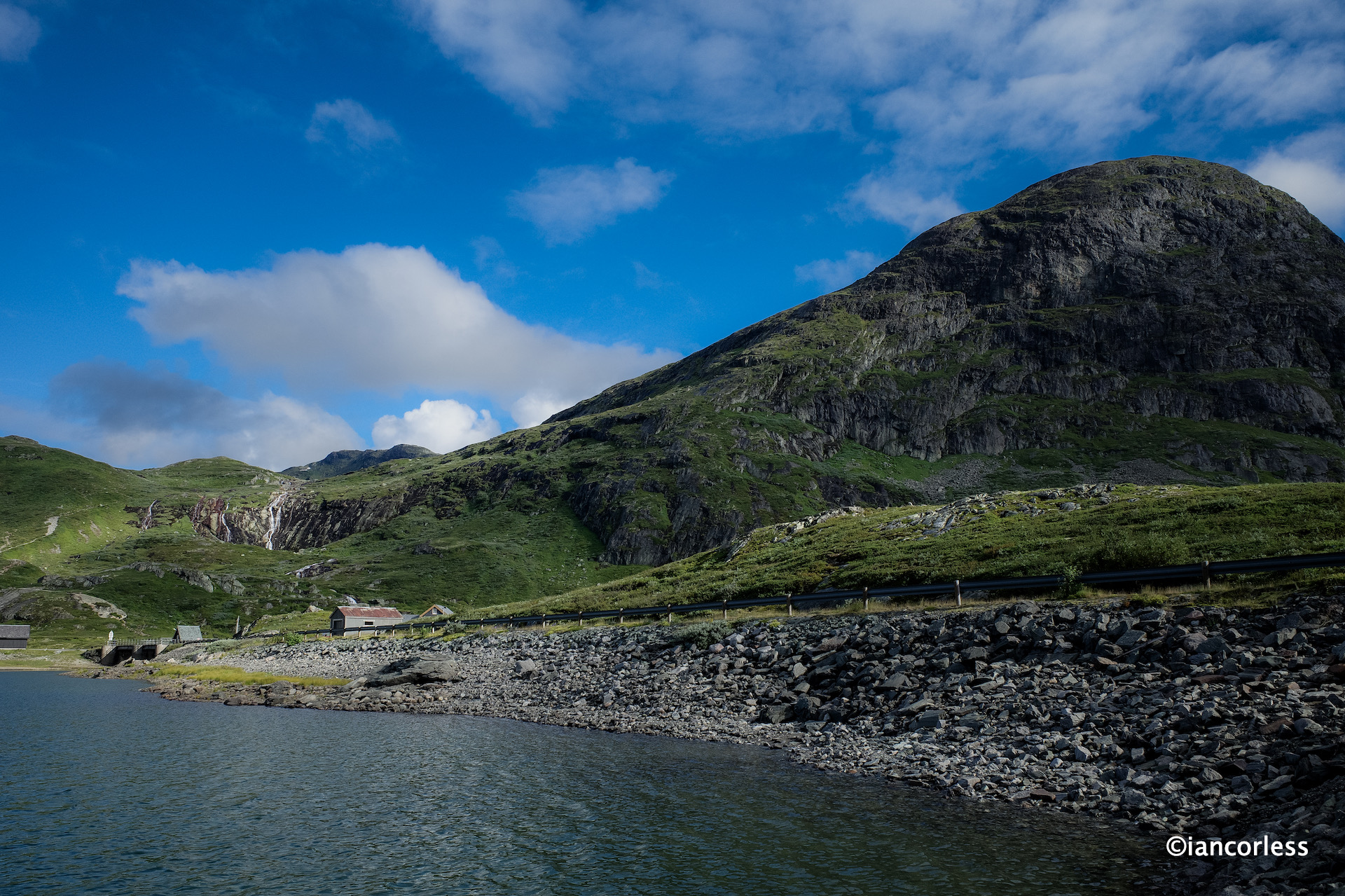
Marathon des Sables – The Legendary : NEWS ONE – Feb 2024

©iancorless

As we countdown to the 2024 edition of the Marathon des Sables – The Legendary, we will be providing a series of monthly updates, articles, interviews and podcasts.

The 2024 Marathon des Sables – The Legendary will be the longest edition in the 37-year history of the race. At 252km, the event will now take place over 6-stages/ 7-days and not 5-stages/ 6-days as announced in late 2023.

It was clear initially that the 6th stage charity stage would disappear, however, on reflection, the new organisation have decided to continue with 6-stages but this time, all stages will be timed. The charity stage in previous editions was not timed.

The infamous long day which typically took place on stage 4 will now move to stage 3 for 2024, this will be day 3 and day 4 of the race as it has an extended time allowance due to the distance.

What does the above mean for the runner?

252km’s is a long way, but the race has always been advertised as 250km’s, so, although the race has fluctuated in distance over the years, the 252km should not come as any great surprise.

The timed stages now numbering 6 and not 5 will make a big difference, especially with the long day coming on stage 3. This will mean that stage 4, stage 5 and stage 6 will need to approximately cover 100km. This makes for a tough end to the week. In past editions, the long day was feared but on completion, many had the mindset, ‘It is just a marathon to go!’ Now it will be significantly more.

The daily distances are typically never disclosed before the race and the jury is out if the distances will be announced pre arrival in Morocco, watch this space! However, it is pretty easy to guess on approximate distances.

Historically, distances for the stages are listed as follows:

  • Stage 1 from 28 to 35 km
  • Stage 2 from 28 to 39 km
  • Stage 3 from 28 to 39 km
  • Stage 4 (The Long One) from 75 to 85 km (over 2 days)
  • Stage 5 (Marathon Stage) of 42.195 km
  • Stage 6 Charity

We know the 2024 edition will be 252km, so, as a guess and guide the following will provide a good estimation, the daily figures are +/-, for example, stage 1 could be 30km and stage 2 40km.

  • Stage 1: 32km (day 1) running total: 32km
  • Stage 2: 38km  (day 2) running total: 70km
  • Stage 3: 83km (day 3 and 4) running total: 153
  • Stage 4: 42km (day 5) running total: 195km
  • Stage 5: 36km (day 6) running total: 23km
  • Stage 6: 21km (day 7) running total: 252km

Total: 252km 

With the above information, you now have at least a template and guide for which to plan around.

OTHER KEY CHANGES

Salt Tablets

As I announced in 2023, it was my expectation that salt tablets would not be provided for the 2024 race. The new revised mandatory requirement for the race requires 14 broth cubes – these cubes are known to be salty. You have no choice here, you must have them. However, it will be your decision if you use them? My advice is to plan a strategy that works for you. Listen to my podcast with Andy Blow from Precision Hydration HERE. Remember, this is a self-sufficient race, so, be prepared to be self-sufficient and have a plan/ strategy that works for you.

Water Capacity

Another key change was the requirement for ‘A minimum capacity of 3 litres of water’ in the form of bottles, bladder etc. This has now been revised and we go back to 1.5 ltr capacity. This is a good move. Cp’s will be increased so that runner’s will only need to carry 1.5 liters. However, on the long day, an additional 1.5 ltr bottle of water will be provided either at the start or at cp1 (making 3 ltr to carry) therefore the capacity to carry 3 litres on the long day between cp’s is recommend. It is important that you think HOW you will carry this extra 1.5 ltr. Maybe you will have a bladder in or on your pack, maybe two additional 750ml bottles at the rear or if you have the front pack, you can slide the 1.5 bottle on top. It’s not recommended to run with a 1.5 ltr bottle in you hand, so, be prepared…

Water

Water during the stage will not be provided via 1.5 ltr bottles as in past editions. Water will be provided from a series of tables and manned staff with jugs to decant water to your empty bottles. Importantly, there had been concerns about where the water will come from, to clarify: 5L Bottles on CP -> Served in 2L jugs -> Served by staff in the runners’ bottles.

The exception being on the long day as mentioned above when a 1.5 ltr bottle will be provided at the start or cp1 and at the end of each stage when a 5 ltr bottle per participant is provided. This 5 ltr bottle will cover the evening after the stage, the morning of the next day and the required 1.5 ltr capacity starting the next stage to cp1. So, if you had planned to cut down a 1.5 ltr bottle to use as a bowl for dinner and breakfast, this will not be possible. You will now need a suitable pot or similar.

Checkpoints

Will be typically 2 to 7 per stage. On the long day, it is therefore a good assumption that checkpoints will be +/- 12km’s apart and hence the need to require 3 ltrs.

Mandatory Equipment

I will list here the mandatory equipment to avoid any confusion:

  • Pack such as WAA Ultra Bag 20L
  • Minimum capacity of 1.5 liters of water*
  • Sleeping bag
  • Head torch and spare batteries (you can have a charger/ solar charger)
  • 10 safety pins
  • Compass with 1 or 2 deg precision
  • Lighter
  • Whistle
  • Knife
  • Topical disinfectant
  • Venom pump *has now been removed
  • Signal mirror
  • Survival blanket
  • 14 cubes of broth***
  • Sun cream
  • 200 euro or 2000 dirhams
  • Passport or ID card
  • ECG and medical

* new change but consider the long day when you will have 3 ltr.

** new change

*** to replace salt tablets

Food Requirement

You need 14,000 calories of food as a minimum, 2000 calories per day. You can of course carry more than this, but 14,000 is the minimum. You must be able to prove the calories, so, if you decant food into lighter or different packaging, make sure you keep the nutritional information.

You

In addition to the above you personally will need:

  • Run top
  • Neck roll/ Buff
  • Run shorts
  • Socks
  • Shoes with gaiters
  • Hat
  • Sunglasses
  • Watch
  • Spare socks
  • Warm layer
  • Foot care
  • Hygiene products
  • Toilet roll/ wipes
  • Lip balm
  • Blind fold
  • Ear plugs
  • Spoon
  • Pot/ bowl
  • Stove
  • Esbit cubes
  • Sleeping mat
©iancorless

Recommended

  • Zip ties
  • Gorilla tape
  • Super glue
  • Sewing kit
  • Cord/ thin rope

Top Tips

Keep the pack weight as close to the minimum 6.5kg as possible, additional weight is additional stress that you do not need.

Keep luxuries to a minimum, they only add weight. A super light Mp3 player (with good battery) and earphones is the only luxury I would consider.

Accept that this is a tough challenge, you will be stripped back to a survival mode. You will not wash, you will get dirty, you will get smelly. Accept it.

Start slow and ease into the race.

Poles can be a lifesaver and I recommend them but you must learn to use them. Those at the front do not need poles, they can run.

Learn to walk, walk and walk. Many go to the desert with the expectation of running 80% and walking 20%. The reality is it will be the other way around.

Look after your feet and start with the correct shoes for you.

Take a sleeping mat or pad. You only need to do three things: run, eat and sleep. Sleep and comfort is important for recovery.

Follow on:

Instagram – @iancorlessphotography

Twitter – @talkultra

facebook.com/iancorlessphotography

Web – www.iancorless.com

Web – www.iancorlessphotography.com

Image sales –www.iancorless.photoshelter.com
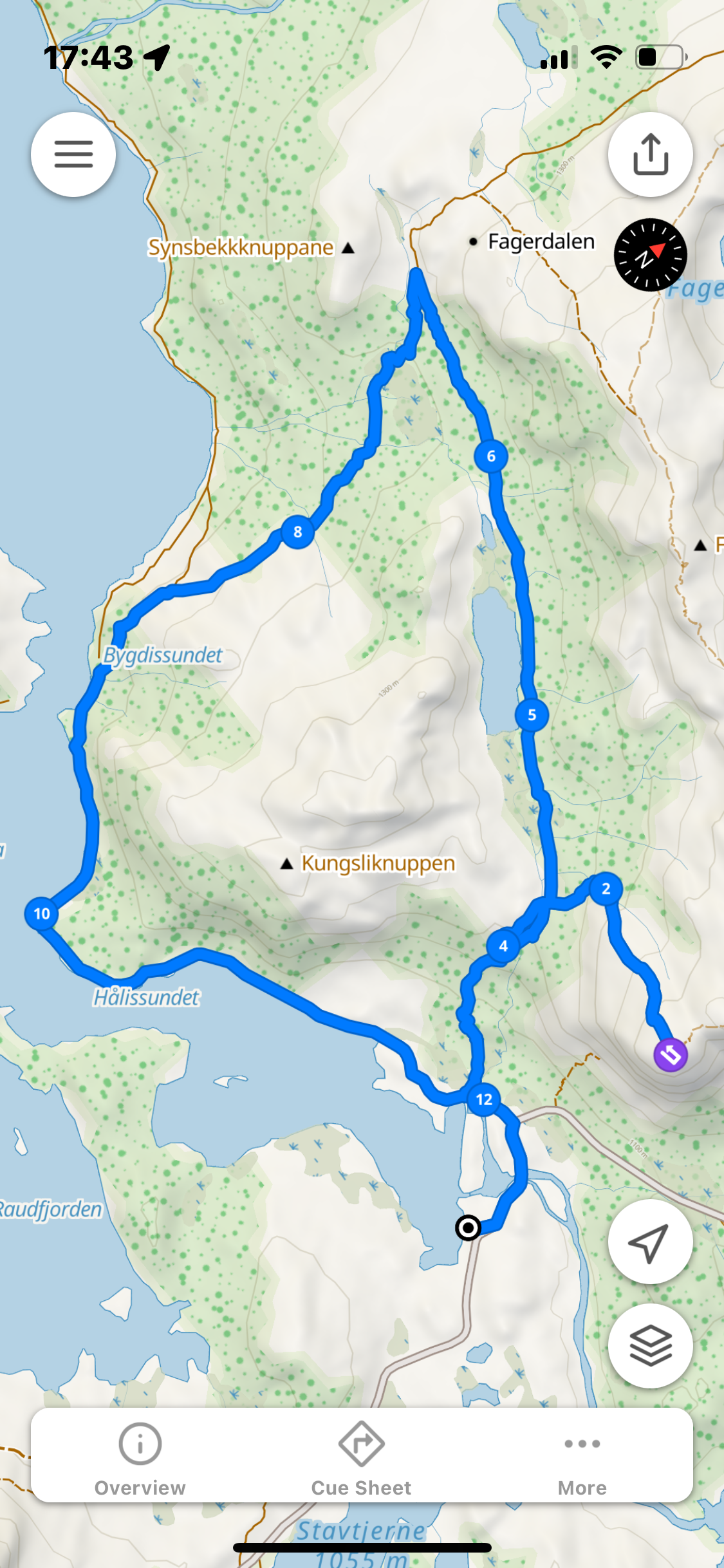
The Ultimate Guide to Marathon des Sables – 2023 Edition

The iconic Marathon des Sables is entering a new phase, the past 37 editions have been under the aegis of Patrick Bauer, who, back in 1984, filled up a pack with food and water and trekked off alone into the Algerian Sahara to cover 350km’s on foot in a self-sufficient manner. Little did he know at the time, but this journey was the start of something incredible, the Marathon des Sables, or MDS as it is affectionately known.

Now under new ownership, the 38th edition taking place in April 2024 will see some significant changes while sticking to the main format and principles of the past 37-editions.

It is therefore timely, to update my Ultimate Guide to Marathon des Sables and acknowledge these key changes.

A recent podcast with one of the new co-owners, Cyril Gauthier, can be heard HERE.

Cyril ran the Marathon des Sables in 2009, created the brand WAA and is instrumental in the growth of the HMDS (Half Marathon des Sables) format. Moving forward, the HMDS format will no longer have the ‘half’ title, for example, HMDS Morocco will become MDS Morocco, HMDS Jordan will be MDS Jordan and the key, full distance race of the past 37-years will be called ‘LEGENDARY‘ – The Legendary Marathon des Sables.

Marathon des Sables offers more than just running, it offers a challenge, it offers something quite unique – the Sahara and the MDS strips the runner back to basics and deprives them of all luxuries so that they are stripped raw. Runners find themselves in the desert.

However, this challenge can often daunt a new participant with the challenge that is ahead and therefore, my Ultimate Guide to the Marathon des Sables is provided to settle nerves, provide initial information and provide a level of knowledge that you can use as a base from which to build your own plan and decide on what equipment to purchase and use.

DOWNLOAD THE PDF

THE ULTIMATE GUIDE TO MARATHON DES SABLES

HERE via WeTransfer or Dropbox HERE

©iancorless

Follow on:

Instagram – @iancorlessphotography

Twitter – @talkultra

facebook.com/iancorlessphotography

Web – www.iancorless.com

Web – www.iancorlessphotography.com

Image sales –www.iancorless.photoshelter.com
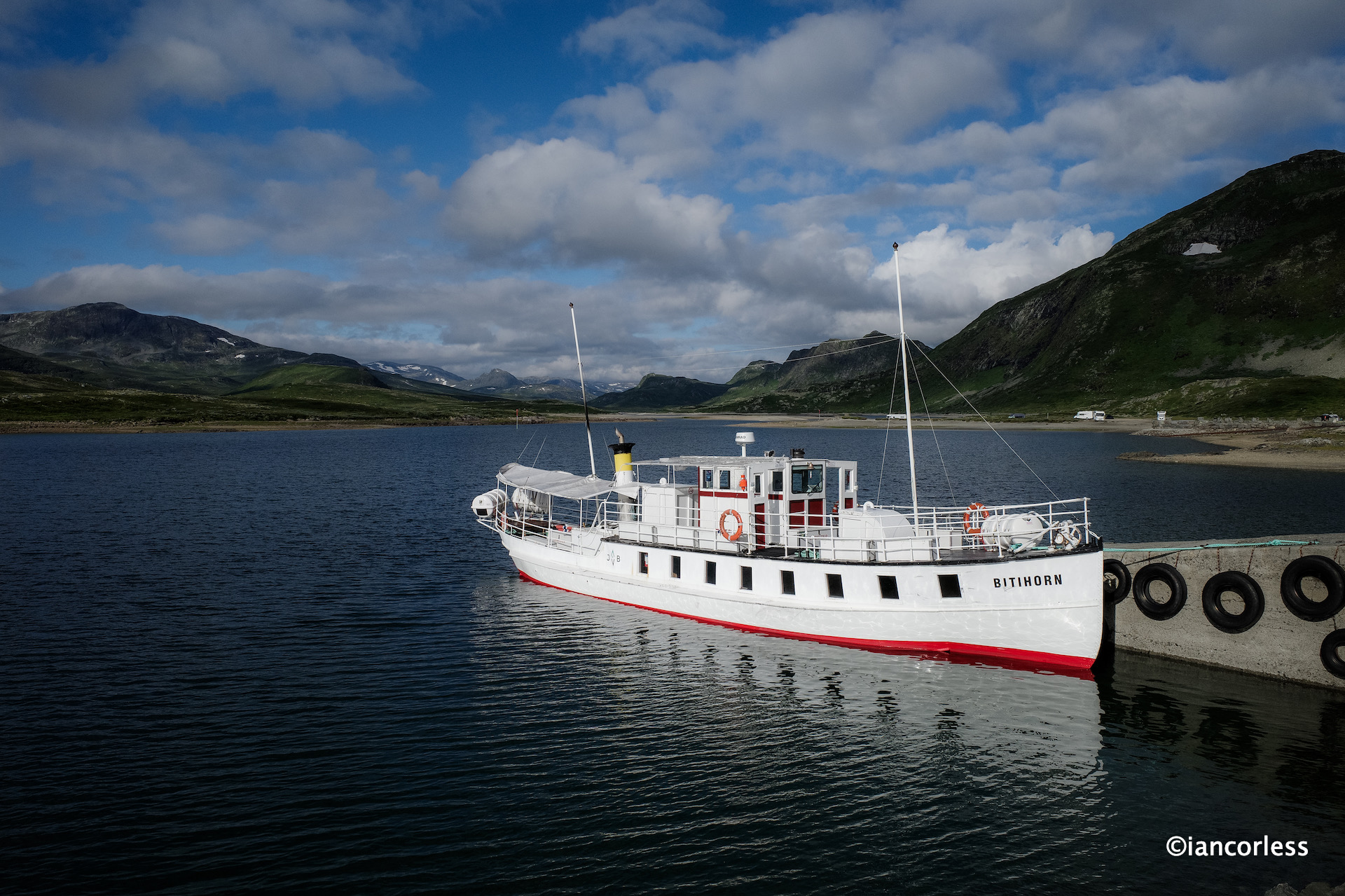
LOFOTEN STAGE RUN – NEW FOR 2024

©iancorless

New for 2024, Norway’s first multi-day trail running event, the LOFOTEN STAGE RUN brought to you by the team behind The Arctic Triple taking place Week 22 2024 (w/c 27th May)

Download the info PDF HERE

Image sheets HERE

Located in the stunning and world-renowned Archipelago of Lofoten, The Arctic Triple team will offer two stunning races, the 175km Expedition Run and the 120km Adventure Run, both starting in the iconic, beautiful, and picturesque Reine and concluding in Svolvær.

©iancorless

Travel point-to-point, on foot, experiencing the majesty of Norway. Stunning trails, majestic mountains, resplendent views, and all during the endless daytime of the midnight sun. A fully supported journey over 4-days (6-days in total) and remembered for a lifetime.

The Lofoten Stage Run will bring the best of what Norway has to offer – fjords, fishing villages, beaches, mountains, ridges and of course the world-renowned Hytte experience.

Kristian Nashoug at Reine

“Lofoten Stage Run came about after the 2021 Arctic Triple and the realisation that only the 100-mile runners were getting a full 360 Lofoten experience. Not everyone wants or can run 100-miles in one go, especially here in Lofoten. So, we have created the Lofoten Stage Run which effectively breaks down our 100-mile race in 4-stages and therefore offers a more manageable way to experience all that Lofoten has to offer.” – Kristian Nashoug

The Lofoten Stage Run, either the 175km or 120km versions offer a full day to cover the respective stages and the opportunity to really experience all that this area has to offer. In the evening, runners will meet local hosts, experience local food, have comfortable lodging, and create new bonds and friendships with like-minded people. Lofoten is one of the most ‘desired’ places to visit in the world, what better way to experience it?

This is no ordinary multi-day race!

Stages will consist of 4-days, 39km, 60k, 31km and 45km for the 175km Expedition Run and 39km, 29km, 31km and 21km for the 120km Adventure Run, it’s The Arctic Triple’s aim to make this experience available to all.

©iancorless

Day 1 will conclude in one of the best-preserved fishing villages in Lofoten, Nusfjord.

Day 2 at Unstad Arctic Surf.

©iancorless

Day 3 at Brustranda Fjordcamping in Rolvsfjord, a real gem on the inside of the Lofoten archipelago.

And finally, all races conclude in Svolavær.

Experience Lofoten.

Experience the Arctic Circle.

Experience the midnight sun.

Experience the majesty and beauty of Norway under your own power.

PRICE NOK 32.900 (ca €2950)

What is included?
Accomodation 5 nights (one night before and after is also included)
Race registration
Luggage transport from basecamp to basecamp
All meals from when we meet in Svolvær day 1 until breakfast day 6
Start kit
The Arctic Triple buff
Service stations
First Aid
Evacuation transport
Timing
Tracking
Warm meal after finish
Boat ride to the starting line in Kjerkfjorden
Quality Finisher shirt

Use the contact form below

or ENTER NOW HERE

Go back

Your message has been sent

Warning
Warning

LOFOTEN STAGE RUN 2024 – iancorless.com

Warning
Warning.

THIS IS THE LOFOTEN STAGE RUN.

For more information and full detailed itinerary, schedule, and costs.

Please go HERE

Week 22 2024.

©iancorless

Follow on:

Instagram – @iancorlessphotography

Twitter – @talkultra

facebook.com/iancorlessphotography

Web – www.iancorless.com

Web – www.iancorlessphotography.com

Image sales –www.iancorless.photoshelter.com
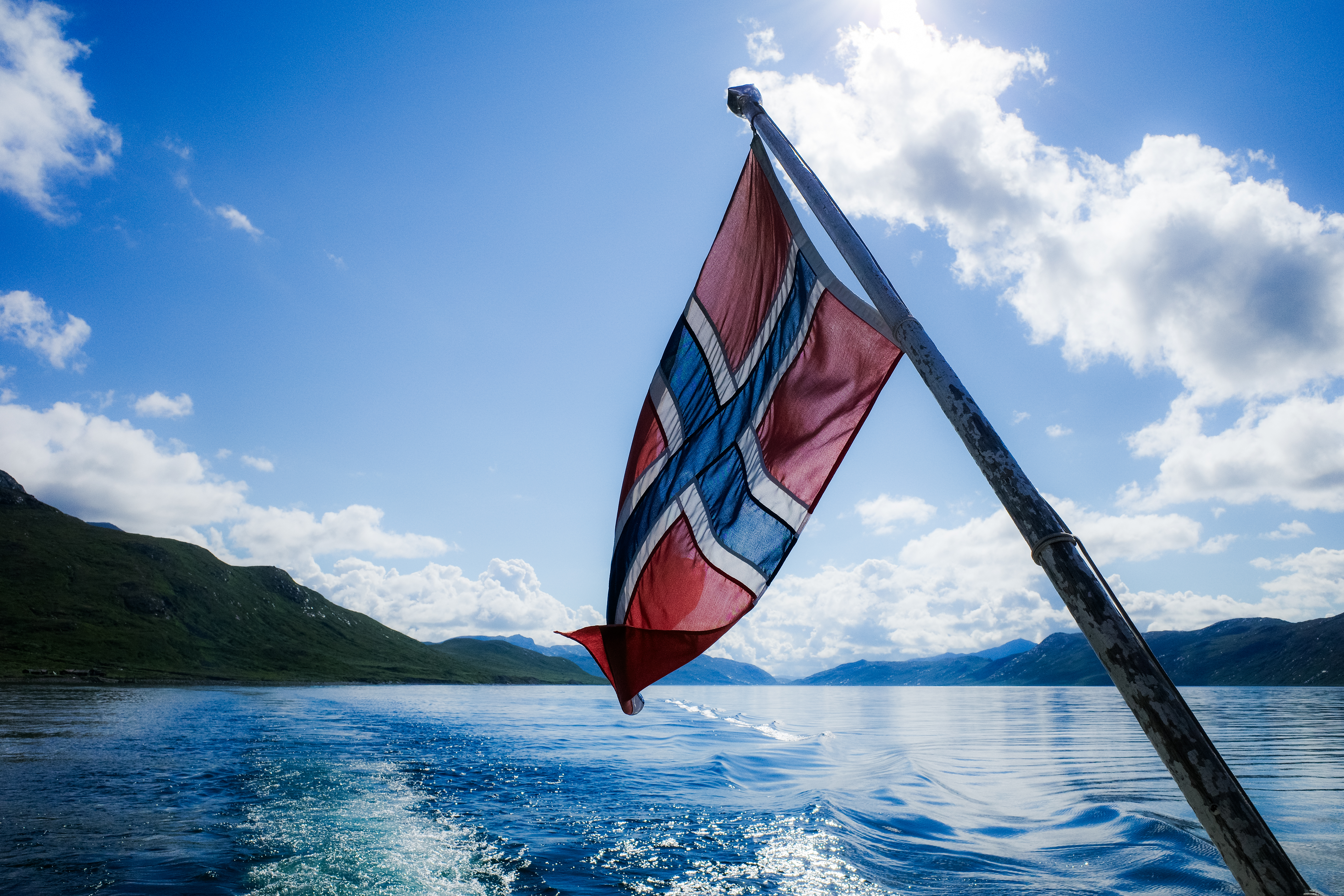
HOME of the GIANTS 2024

Are you up for an adventure in an incredible part of the world? 

If the answer is yes, Home Of The Giants is for you! 

JULY 21ST TO JULY 28TH 2024

A multi-day adventure through the magical and amazing playground that is Jotunheimen, Norway. Unlike a race, this journey is a finely balanced exclusive trip for just 12 participants. A challenge at a more relaxed pace, taking in an amazing route whilst moving light in a semi self-sufficient mode.

The iconic ‘The Church’ we go to the summit on day 2

Spread over 5-days, our journey starts from Bygdin Fjellhotel with an overnight stay, the following morning we depart via the iconic M/B Bitihorn boat covering the length of Bitihorn lake to our start point at Eidsbugarden. A magical journey, on foot, covering 100km and 4774m+ 

Snow fields, water crossings and morraine

You will encounter snow, water crossings, airy and exposed sections, plenty of climbing and descending and full days on the trail. Each day will conclude at a DNT cabin where you will have a bed, shower facilities, 3-course dinner and breakfast included.

Rock and snow transitions to lush green and single-track

WANT TO JOIN US?

Only 12 places are available for what will be a journey of a lifetime.

MORE INFORMATION HERE

Relentless rock and boulder sections that sap the strength

Follow on:

Instagram – @iancorlessphotography

Twitter – @talkultra

facebook.com/iancorlessphotography

Web – www.iancorless.com
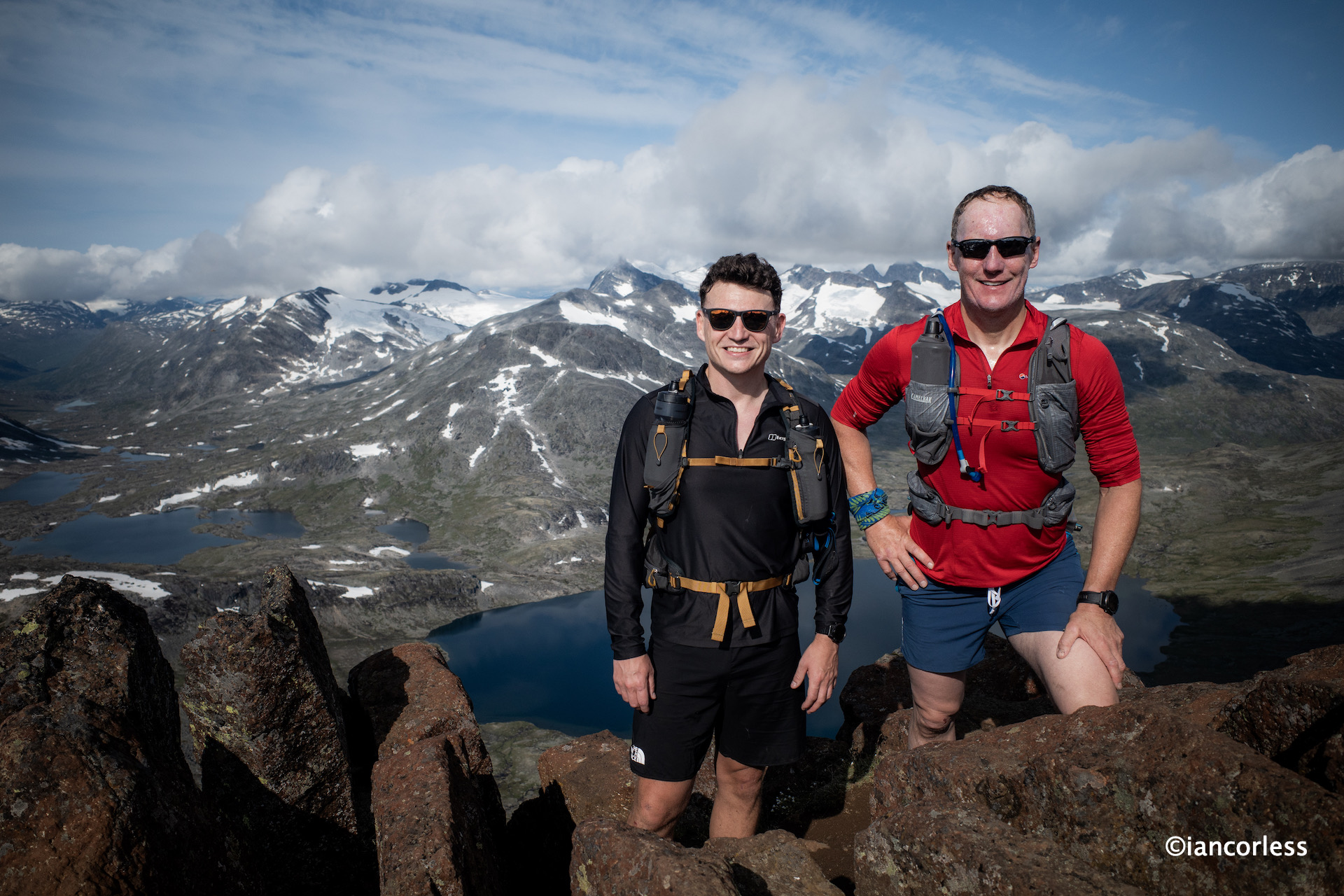
Web – www.iancorlessphotography.com

Image sales –www.iancorless.photoshelter.com