FASTPACKING – A Guide.

Runner’s and particularly ultra-runners have this wonderful ability to cover distance under their own power with very little needs or requirements. Some water, some food, a warm jacket and waterproofs and adventure awaits.

However, you can only go so far without the eventual need to return home.

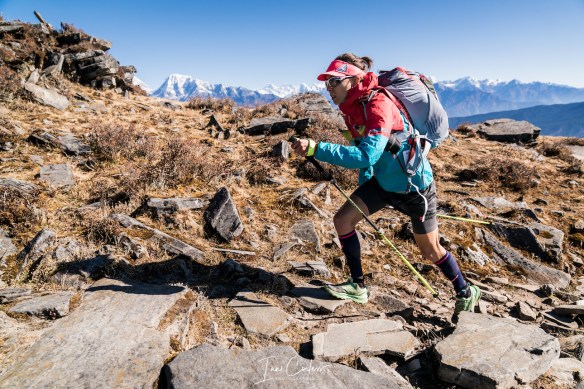
Fastpacking manages to encompass the world of backpacking and running to create a different adventure, fast and light! Backpackers tend to carry a plethora of equipment and move at a slower pace, happy to adventure for days and weeks at a leisurely pace.

Fastpackers, arguably are runners or hikers looking for the need to travel for multiple day’s but still cover good distances and not be excessively slowed down by weight and excess equipment. The crux though is often the balance of weight and one’s ability to still run/ fast hike.

“Fastpacking isn’t for every outing though. Sometimes you want to take it easy, set up camp, and enjoy a particular area. That’s when backpacking shines. Sometimes you just want to crush through a workout. That’s when you want to go for a really fast run.” Says Simoni, adding that he opts for Fastpacking, “when I want to tag multiple mountain summits in an area at one time, without needing to take multiple trips. If you’re squeezed for time, Fastpacking can really help maximize an adventure. I find it very rewarding to cover so much distance with minimal gear.” – Justin Simioni via La Sportiva

One could arguably say that races like Marathon des Sables, which is 35-years old in 2020, have paved the way for Fastpacking bringing a ‘fast and light’ scenario to a race format allowing participants to cover 250km’s in a self-sufficient manner.

However, Fastpacking has been around for many, many years. Long before MDS, and long before the term Fastpacking. But in recent years, the sport has developed into something else, no doubt boosted by the growth and popularities of FKT’s and lighter, more functional equipment.

It’s important to clarify, that Fastpacking is what you make it. Personally, I enjoy a lighter pack, moving fast (but not running) and being self-sufficient. This allows me to carry a little more weight, travel for longer, enjoy the process and still cover over a marathon per day. You though may prefer to be more minimalist, look at micro/ mini adventures of 2-4 days and aim to run for much of the way. There are no rules to the speed or distance you go.

It’s also important to consider many other factors that come into place:

  • Location and environment – There is a big difference to Fastpacking in Nepal to say the Alps.
  • Time of year – Winter conditions require more equipment and more specific equipment.
  • Weather conditions – Check weather and be prepared.
  • Access to water – Streams, rivers and lakes
  • Access to external help – If you are going remote, be responsible and plan accordingly.

It’s easy to see from the above, there is no one definitive kit list, but there are crossovers that apply to both.
Route Plan
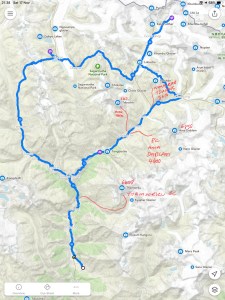
Plan the route in advance, understand the terrain and understand what possibilities exist to obtain water. Importantly, carry a system that will ensure that you can drink water that is available from any source.  Work out how long a planned route will take and then plan for contingency should something go wrong. Note that vertical ascent, descent and technical terrain will require moving slower. It’s not unusual to sometimes only cover 2km’s in 1-hour. Make sure you inform family or a friend of your planned trip, start day and end day. That way you have a backup and someone checking out for you. It may sound alarmist, but should something happen, you may well not be able to call for help. Contact and research with local authorities and ascertain current conditions on the trails and be aware of any restrictions.

Do you need a 12-week and/ or 24-week Multi-Day Training Plan perfect for a multi-day adventure or a race like Marathon des Sables? They are designed to provide you with a structured weekly plan culminating in a target event.

View a sample week HERE from the 12-week planPurchase HERE. (£14.50 pw)

View a sample week HERE from the 24-week planPurchase HERE. (£12 pw)

The Pack

Typically, a Fastpacker will look for something between 20 and 40 liters. For summer and short adventures, it is possible to go lighter and smaller. In winter, one will need more equipment that is often heavier and bulkier. Quite simply, the heavier the pack, the harder it is to run. So, if the plan is to run as much as possible, you need to go as minimal as possible whilst keeping safe. Make sure when testing and trying a pack that you add weight and understand how it feels when moving. Many brands are now producing packs specifically for Fastpacking. Personally, I like my pack to have a waist belt as this helps distribute the load and make the pack more secure. I would say that a minimum pack weight will be 6.5kg (14.3lbs) with water. Where possible, you would not want a pack to exceed 10kg (22lbs).

Packs with considering:

  • Montane Trailblazer 30ltr HERE
  • Ultimate Direction Fastpack 25 HERE
  • OMM Phantom 25 HERE
  • Six Moon Designs Flight 30 HERE
  • UltrAspire Epic XT HERE (this is a smaller pack)

Tent / Tarp/ Hammock
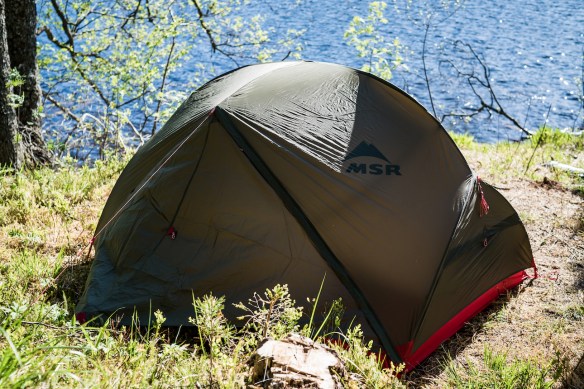
On a personal level, I would always go with a tent as I personally feel that it will offer more flexibility, especially if one shops in a clever way. My go to tent is an MSR Hubba Hubba NX (1/ 2 and 3 person versions available).

Things to look for in a tent:

  • Weight
  • Flexibility
  • How many season use?
  • Space

For example, the above MSR is a free-standing tent, so, it can be pitched inner only. If you know you are Fastpacking in ‘guaranteed’ good warm weather, you could travel without the fly sheet and basically sleep in a lightweight and bug proof shelter. Equally, if you know that you are fast packing in a bug free (mosquito) environment, you could leave the inner at home and just travel with the flysheet. This then provides a secure waterproof shelter, and, in this scenario, it acts just like a tarp but with more protection.

Tents to consider (2 person):

  • Big Agnes Fly Creek HV2 here
  • MSR Carbon Reflex 2 here
  • Nemo Hornet here
  • Nordisk Lofoten 2 ULW here
  • Terra Nova Solar Photon here
  • Marmot superalloy 2P here

Tarps offer a light solution that can be used with trekking poles and if one is going very minimal and fast, they provide a very simple answer for overnight protection. It all comes down to comfort and what one is prepared to accept as ‘comfort’ whilst Fastpacking. Big Agnes make the Onyx which comes in at under 200g. A Tarp is a compromise if you will have bugs such as mosquitos whilst on your adventure.
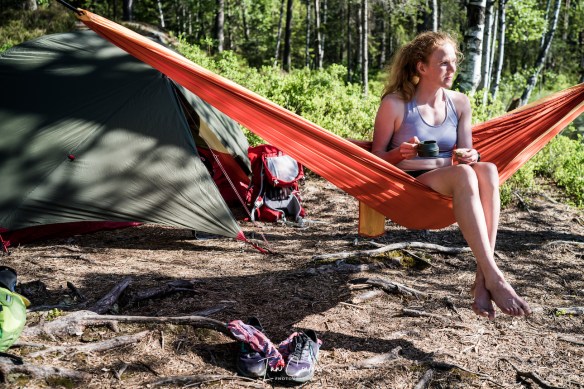
Hammocks are also an option providing one has trees to secure against. But if you add a bug net and tarp, in my opinion, a tent is a much better option. But a hammock can be a great addition to any Fastpacking kit, I use an Amazonas (here)

Sleeping Bag
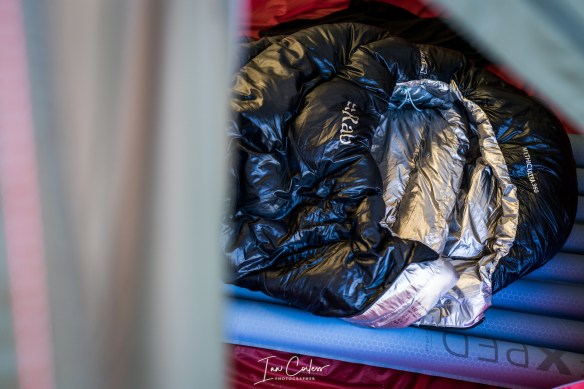
A sleeping bag is essential for any adventure but firstly you need to ask some very specific questions before purchasing. I would say that ideally, one potentially could need several sleeping bags based on time of year and weather conditions. Remember, that any sleeping bag can be made warmer with layers. Add a hat, gloves and down jacket, suddenly the sleeping bag is considerably warmer.

Read an in-depth article HERE.

Down is by far the lightest and smallest packing size, however, down cannot get wet! So, if you think you will encounter damp and wet conditions, you should consider a bag with a synthetic filling. Weight and pack size are important and with sleeping bags, the more you pay, usually, the lighter and smaller it will be.

Be careful on the ‘comfort’ rating of the sleeping bag.

  • Upper limit – the highest temperature the average male can expect to have a comfortable night’s sleep at without too much sweating.
  • *Comfort – the temperature at which the average adult woman can expect to have a comfortable sleep. *This is the ideal for most people choosing
  • Lower limit – the temperature at which the average adult male can expect to have a good night’s sleep in a curled position.
  • Extreme – the lowest temperature at which the average adult woman can survive. This rating comes with caution and additional consideration should be given if you plan to sleep in temperatures this low.

Recommendations:

  • PHD – Make sleeping bags and jackets to order, I am a long time fan here
  • Yeti – Passion One and Passion Three are a good start point here
  • Rab – The new Mythic Ultra is a personal favourite, available in 180 and 360 here
  • OMM -The Mountain Raid 160 is a great bag if you need synthetic filling here
  • Sea to Summit – The ‘Spark’ range have been getting rave reviews here
  • Western Mountaineering – here

Sleeping Matt

The minimalist Fastpacker will go with no matt or a very simple and small pad that provides just enough coverage for one’s hip if sleeping on one’s side. Personally, a good night’s sleep is essential, and a good/ light matt is an essential element to a fast and light kit.

Also, one should consider that in winter/ snow conditions, a matt will be essential for insulation.

Another consideration is potential problems from a puncture. Many inflatable matts become super light by using extremely light material. Be careful when using and make sure any potential sharp objects are removed before sitting or sleeping!

Matts very considerably but a personal favourite is the Klymit V Ultralite slim which offers full length body comfort all for 316g. It also packs very small. There are lighter matts and I list them below:

  • Thermarest NeoAir Uberlite 158g
  • Klymit Inertia X 258g
  • Nemo Insulated Short 278g
  • Sea to Summit Ultralight 294g
  • Exped AirMat HL 304g

Ultimately, the matt you choose may come down to a tradeoff between price/ packing size and weight. Be careful, some matts can be noisy when you move. Ok of going solo but really irritating if you are in close proximity of someone else.

Cooking System
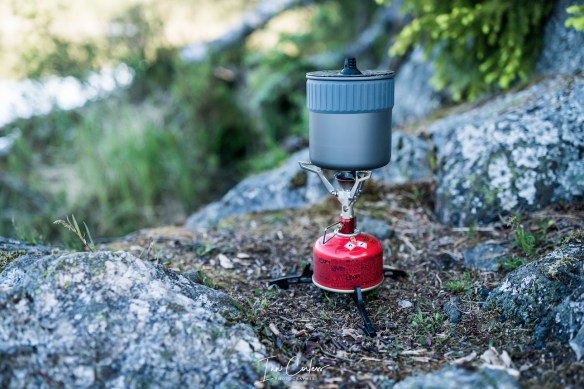
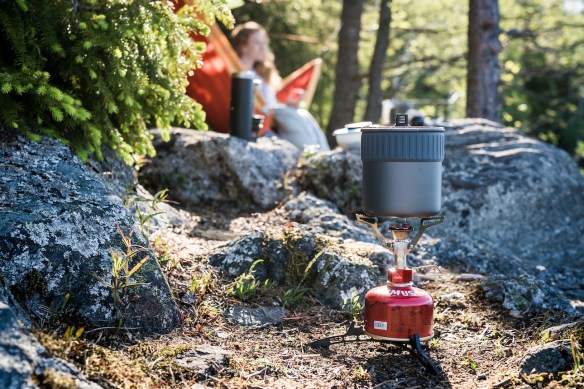
For me, the MSR PocketRocket Deluxe (here) or 2 (here) kit is perfect. It has all one needs in a very small pack size and weight. I use the PocketRocket 2 kit that allows me to place a gas canister inside the 278g kit + a 4oz canister.
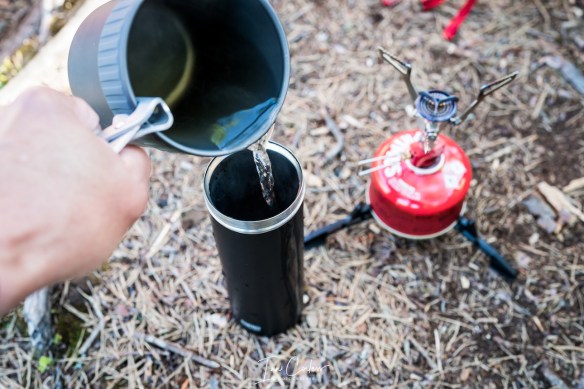
Another consideration would be JETBOIL Micromo Cooking System (here) which is the lightest system they do and if you just need to boil water, this is perfect!

Food
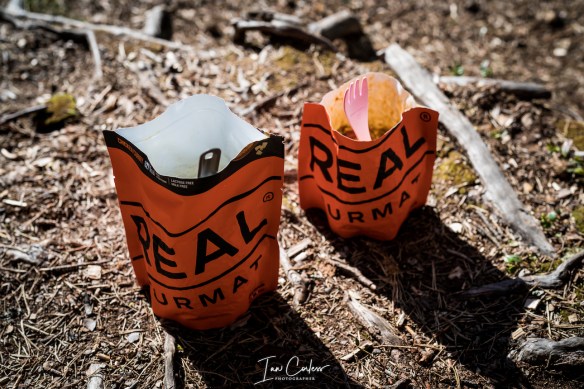
Dehydrated food is probably the most obvious option here and there are many varieties on the market. They are a one-stop option that requires water to hydrate and if you wish to be extremely minimal, some options exist that do not require hot or boiling water. A personal favourite is Lyo (here) and Real Turmat (here) – It may sound crazy but they both make foods that I would consider eating when not fast packing. They also do Vegan and Vegetarian options.

Check out Chicken Tikka Masala, Nettle Curry, Penne alla Bolognese and if Vegan, Organic Chilli and Barley Risotto. Breakfasts such as Mexican Scrambled Eggs and Organic Millet Porridge.

For any adventure, I work on a breakfast and a dinner and then carry snacks for during the day, this can be energy bars or if on a long Fastpack, I will even consider carrying another main dehydrated meal. Typical weights are 132g with approx 600 cals.

Other options to look at for dehydrated food are:

Coffee

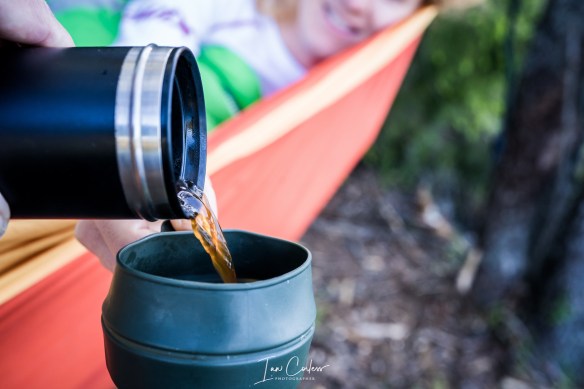
For me, Fastpacking is fun and adventure. I am not looking for FKT’s and therefore I do allow myself one or two luxuries. Coffee for me is an essential part of any trip and I mean good coffee. I could just take some coffee sachets and have a combined weight of grams.

No! For me, I take fresh ground coffee in a sealed tub and I use one of two coffee presses.

Aeropress here or Espro here

The Espro is my favourite as it acts as a flask/ drinking canister too. But it does come at a weight and size cost.

I fully appreciate that if going fast and light, the above is a complete no, no! But for me, that smell of fresh coffee each morning is worth it.

Water
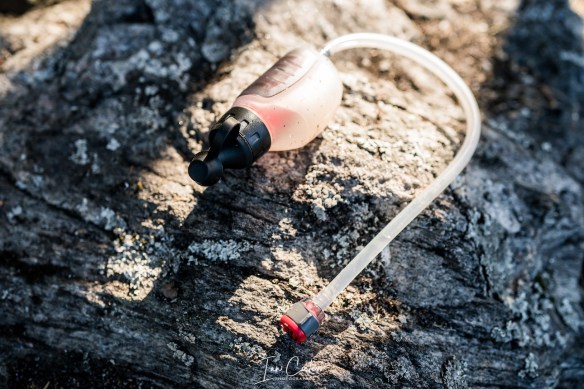
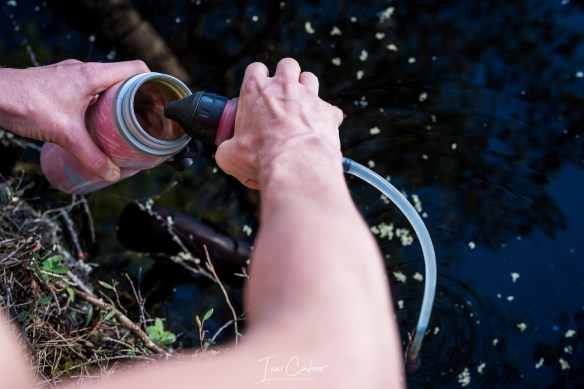
You are going to be self-sufficient for multiple days, so, you need to find water and plan to obtain water from the route you will take. You can use purification tablets, I take the MSR TrailShot pocket sized filter (here) which meets U.S. EPA drinking water standards* and NSF protocol P231 for removal of bacteria (99.9999%), protozoa (99.9%), and particulates.
Clothing

Clothing requirements depend on the time of the year, the weather you will encounter and the duration of the Fastpack. Needless to say, one has to accept that changing clothes, taking a shower and feeling wonderfully fresh daily is not what Fastpacking is about. Layering clothing is essential to allow for fluctuations in temperature. Do your research, check weather forecasts and plan accordingly. The above photo is my equipment for a Fastpack in Nepal. Make sure you have a ‘Drybag’ to make sure all contents of the pack are protected from the weather, Sea to Summit (here) for example.

A good start point is as follows:

  • Short sleeve T
  • Long sleeve shirt
  • Shorts
  • Underwear x2?
  • Socks x2?
  • Hat with peak
  • Warm hat
  • Gloves
  • Merino base layer, top and bottom – I use Icebreaker here
  • Lightweight waterproof jacket – I use RAB Charge here
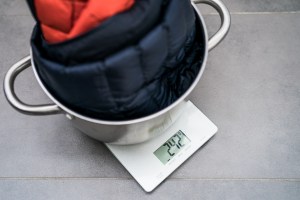
  • Lightweight down/ Primaloft jacket – I use RAB Kaon here
  • Buff
  • Bivvy bag

The above, for most, would be a start point and based on where and when Fastpacking, you could maybe add or takeaway certain items.

If going to more extreme and cold environments, the demand on clothing and what one takes will increase. I wrote an article on Fastpacking in Nepal (here) and this is a worthwhile read. Please note in Nepal, one can use tea rooms, so, one saves on tent/ tarp weight immediately if required.

Tracker/ Beacon

I use a Garmin InReach Mini (here) and it is superb. Small, light, has SOS button and allows for 2-way messaging anywhere in the world. I do not go on any adventure without it now. In conjunction with a mobile phone and associated App, functions become easier to use. Subscription services can be changed monthly and therefore one can add or takeaway facilities as required.

Another option to consider is a SPOT device.

Essential Extras:

  • Water purification
  • Toilet paper/ wet wipes
  • Hand sanitizer
  • First-aid kit
  • Sunscreen
  • Bug repellent
  • Headlamp and batteries
  • Lighter/ matches
  • Whistle
  • Map
  • Compass
  • Earphones

Optional Extras:

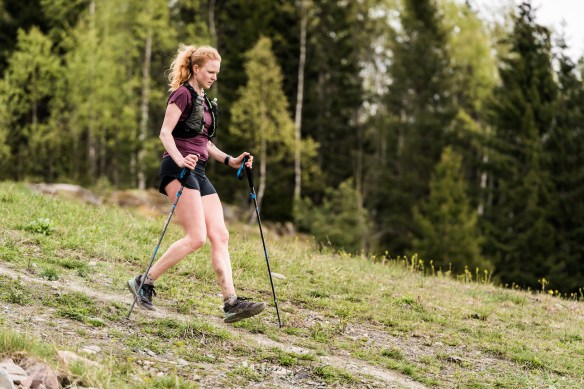
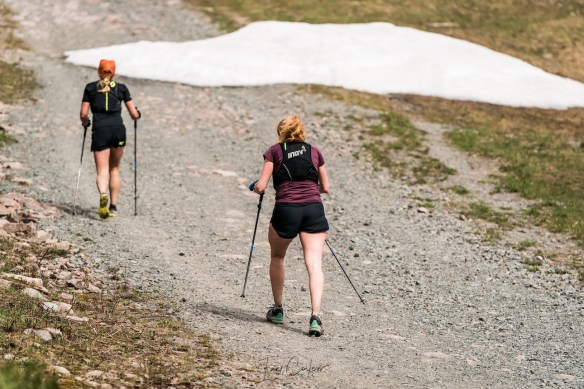
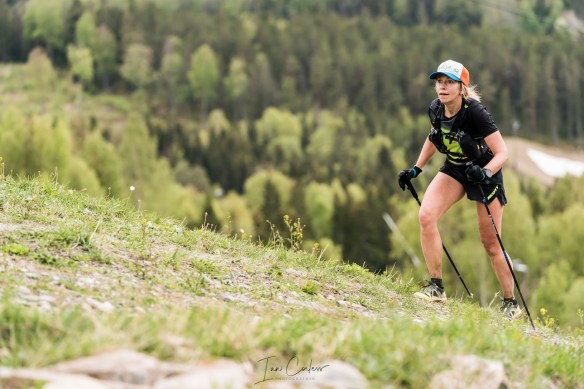
Trekking poles – to be honest, for most of my Fastpacks, poles are an essential and especially if one is using a Tarp or similar.

Battery pack for recharging.

Conclusion

Fastpacking for me, is one of the most pleasurable ways to travel by foot. The ability to cover distance, usually in a point-to-point way under ones own power and being self-sufficient is extremely rewarding. You can move as fast or as slow as you like, take as long as you wish and fully immerse yourself in the surroundings and environment.
Please support this website. I believe everyone deserves to read quality, independent and factual articles – that’s why this website is open to all. Free press has never been so vital. I hope I can keep providing independent articles with your help. Any contribution, however big or small, is so valuable to help finance regular content. Please support me on Patreon HERE.

Follow on:

Instagram – @iancorlessphotography

Twitter – @talkultra

facebook.com/iancorlessphotography

Web – www.iancorless.com

Web – www.iancorlessphotography.com

Image sales –www.iancorless.photoshelter.com
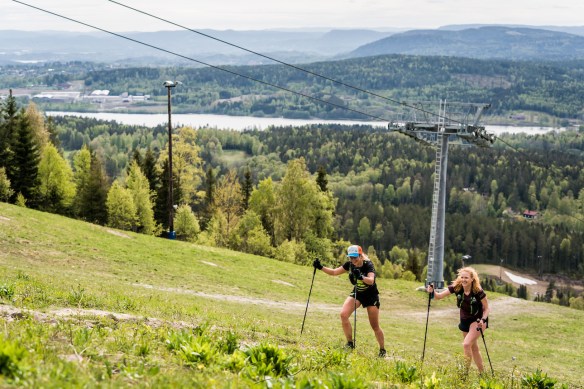
Getting High In Norway – Borgersen and Lyng achieve Everest and Mt. Kilimanjaro.

Covid-19, lockdown, social distancing and so on has resulted in so many crazy and inventive ideas. Virtual running and racing have never been so popular as it has provided an opportunity to daily focus on a larger goal that one can undertake with others.

Race directors, runners, shops, stores, magazines and so on have created opportunities.

In Norway, Runners World NO have a series of events, ‘Trail Challenge,’ ‘100 Minutter,’ 5 Sommernattsløpet 5k,’ ‘Soomer Maraton,’ and ’Til Himmels Race.’ The latter translates, ‘To the Skies’ or ‘Sky is the Limit!’

Fueled by the challenge of gaining as much vertical meters as possible in one month, Elisabeth Borgersen and Abelone Lyng, both decided to set themselves a challenge within a challenge. How many meters could they gain in just one day! 

Initial plans were to use a ski slope and gain permission/ access to use the chairlift down, therefore concentrating on vertical meters without the impact of running down. However, due to Covid-19 this was not possible. 

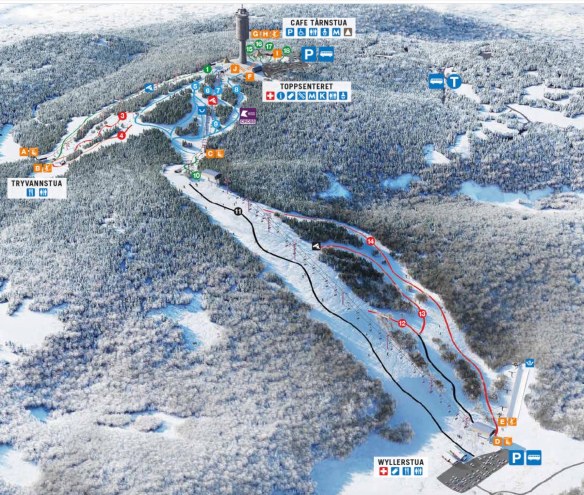
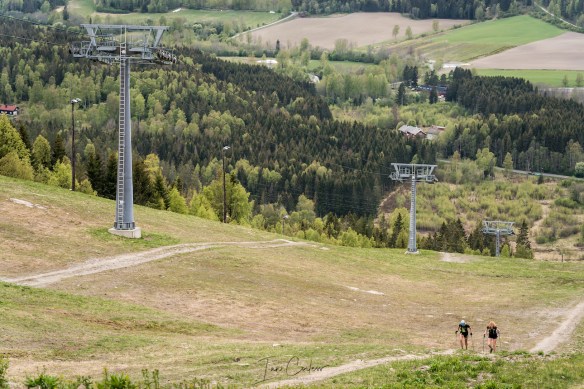
“If we were going to do it, then we would have to run down too,” Lyng said in advance of the challenge. With a little research, they found a ski slope, pretty much void of snow, the ‘Wyllerløpa’ part of the ‘Wyller Express’ series of slopes. 

‘The Wyllerstua’ has a car park and we have immediate access to the slope,’ said Lyng. ‘We plan to set up our own aid station and then we can go up and down as many times as we wish.’


On the map below, Lyng and Borgersen would use the route marked 11. With 300m vertical gain for each ascent, the distance would be approximately 1.3km up and 1.3km down.

 May 21st had been set aside by Runners World as ‘the day’ to see who could gain the most vertical meters.

‘At 8848m, Everest is a logical and mind-blowing target to aim for, so, that is the dream goal. However, for me, I think Mont Blanc at 4810m or Mount Kilimanjaro at 5895m is more realistic,’ Lyng explained. ‘Elisabeth on the other hand has the potential to climb to the top of the world, albeit virtually!’

THE DAY

It was an early start to the day with the duo waking at 0300 and meeting at the Wyllerstua at 0400. Gladly, the day was already starting and the need for a head-torch was not required. One of the advantages of being in Norway.

At 0430 they were off, starting steady, the plan was to spend as much time together as possible, each pushing the other.

 Calculations allowed for 2000m every 4 hours and therefore, a projected Tim for 9000m+ could be estimated at 18-hours.

It’s easy to get pre-occupied by the vertical gain and the lofty, albeit virtual, summit of Everest at 8848m. But what goes up, must come down, and the impact and stress of descending a 300m slope would almost certainly have a far greater physical impact than the vertical meters.

 The early hours passed and soon they were taking the first of many breaks. Nothing too lengthy. Just an opportunity to consume calories, hydrate and then push on.

3300m+ was accumulated with relative ease in well under 8-hours and the challenge was starting to fall into place. Borgersen looked solid, powering up the climb but maybe more impressively, still running down the 300m/ 1.3km slope with what appeared to be relative ease.

Lyng was holding the pace but openly admitted, ‘Everything is fine, it just hurts everywhere in my body, but thats part of the game.’

 The height of Mont Blanc was achieved, and that milestone was rewarded with a smile. The duo continued to motivate each other, almost metronomic in the ascent but Borgersen always looking more at ease on the descent.

With 10-hours elapsed, Borgersen was resolute that today was the day to achieve Everest. She was hurting but it was easier to push on. The thought of coming back and trying again was too daunting. No stranger to long-distances and vertical gain, Borgersen has pedigree, she has completed TDS and the 90km Mont-Blanc placing 6thin both. She also placed 8th at MIUT.

For Lyng, she was in new territory, far exceeding any previous vertical gain for one day. A lover of the mountains, Lyng’s recent successes have come with multi-day racing, placing 4th at The Coastal Challenge in Costa Rica and winning, The Ice Ultra.

‘I was getting very tired and I was well aware that the ability to continue on for many more hours would result in injury. I therefore set the target of Mount Kilimanjaro at 5895m. But I also had a desire for 6000m.’

Lyng achieved Mount Kilimanjaro in 12 hours and then the 6000m mark in 12-hours 37-minutes with a total distance of 54km. Her day was done.

Borgersen once again arrived at the car park. It was close to 6pm. But there was no hesitation, just a brief chat and then an about turn to once again head upwards.

‘I have some work left to do, but if all goes well, I think I can be finished before 10pm.’

The evening passed and gladly, Borgersen’s husband arrived with pizza offering a welcome break, refuel and then the final push. Darkness was slowly starting to arrive as the goal was achieved after 77km’s.

‘I love to challenge myself to see what I am actually capable of. Going up and down the same 300m slope close to 18-hours (17h 40m) was for sure a big challenge. But to finally reach Everest, 8880m to be exact, I am pretty darn proud of that!’

2020 will be remembered by us all as an Annus horribilis due to the Covid-19 pandemic.

Amidst the gloom, the isolation, quarantine, the changes of routine, the loss of work, the disruption to life and the horrendous death toll, it is possible to still find reward and growth. It may come in the strangest of ways, one just needs to be creative.

Please support this website. I believe everyone deserves to read quality, independent and factual articles – that’s why this website is open to all. Free press has never been so vital. I hope I can keep providing independent articles with your help. Any contribution, however big or small, is so valuable to help finance regular content. Please support me on Patreon HERE.


Follow on:

Instagram – @iancorlessphotography

Twitter – @talkultra

facebook.com/iancorlessphotography

Web – www.iancorless.com

Web – www.iancorlessphotography.com

Image sales –www.iancorless.photoshelter.com
International Skyrunning Federation (ISF) announce #MYSKYRACE

Imagine you could predict your finishing time, calories required and hydration strategy for a  race route, well in advance of toeing the line?

For many, it could prove to be a useful tool that would allow one to specifically prepare.

Now, the ISF have launched #MYSKRACE with the intention of providing essential information. Maybe just plain old curiosity to measure potential? to plan training? To train on the actual course? Or, to set race-day goals? #MYSKYRACE is a new tool with an exclusive algorithm designed to assist skyrunners.

Using the accredited CC list from the ISF, the first 20 races have been chosen.

  • Barr Trail Mountain Race – USA
  • Buff Epic Trail 42K – ESP
  • Buffalo Stampede 42K – AUS
  • Gorbeia Suzien SkyMarathon – ESP
  • Gran Sasso SkyRace® – ITA
  • Gran Sasso Vertical – ITA
  • Grèste de la Mughera VK – ITA
  • Hochkönig SkyRace® – AUT
  • Kilomètre Vertical® Face de Bellevarde – FRA
  • Kilometro Vertical de Canfranc – ESP
  • La Veia SkyRace® – ITA
  • Limone Extreme – ITA
  • Minotaur SkyRace® – CAN
  • Mt Awa Vertical Kilometer® – JPN
  • Ring of Steall SkyRace® – GBR
  • SkyRace® Comapedrosa – AND
  • Vertical Terme di Bognanco – ITA
  • ZacUP SkyRace® del Grignone – ITA
  • Zegama-Aizkorri – ESP
  • Zegama-Aizkorri Vertical Kilometer® – ESP

The iconic Zegama-Aizkorri, which should have taken place on the weekend of May 23rd, provides a perfect example of how the algorithm works. (You can get a free trial here #MYSKYRACE free trial)

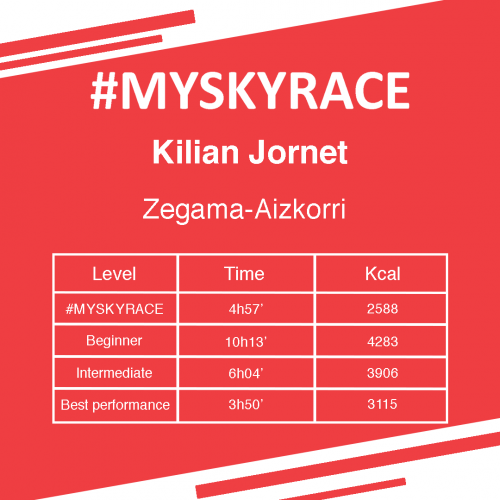
Using Kilian Jornet as an example, it comes as no surprise to anyone that he has gone beyond the “Best Performance” category in the #MYSKYRACE plan based on his Zegama-Aizkorri record.

In 2014, he set his 3h48’38” record, which, according to the #MYSKYRACE analysis, is almost 2 minutes faster than the “Best Performance” category! Check out his results on the table below

Based on the race GPX files, which, together with the runner’s biometrics and the addition of an exclusive algorithm, #MYSKYRACE calculates the personalised projected finishing time and the calories required of the individual. Designed for mid-pack and entry-category runners in mind, the new #MYSKYRACE plan by the International Skyrunning Federation provides a unique preview of a runner’s potential on a given race course.

As little or no training has been possible in many countries under lockdown, the initial course selection are all under four hours for the winning time with less than 2,500m vertical climb. As the race season progresses, more races will be added.

#MYSKYRACE brings benefits to race organisers too. Knowing the level of their participants is an important safety feature and can be useful to organise staged starts and finish time limits.

For peace of mind, insurance cover for both racing and training has been integrated to back up the scheme (at the present time only available in Europe).

To kick off the #MYSKYRACE project, try out our free trial first. The personalised plan can be bought with a choice of three races on the list for €10.

This is just the first step of the #MYSKYRACE plan which will be further developed throughout the season to benefit both runners and race organisers.

Discover #MYSKYRACE here

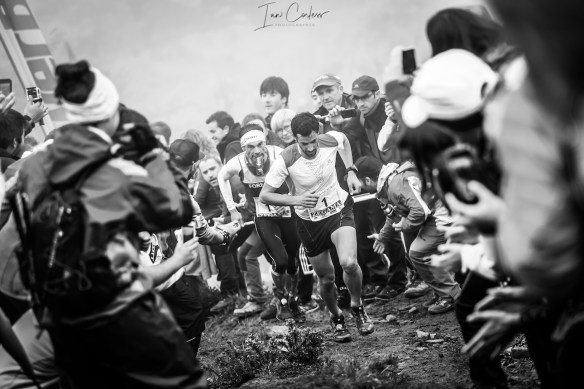
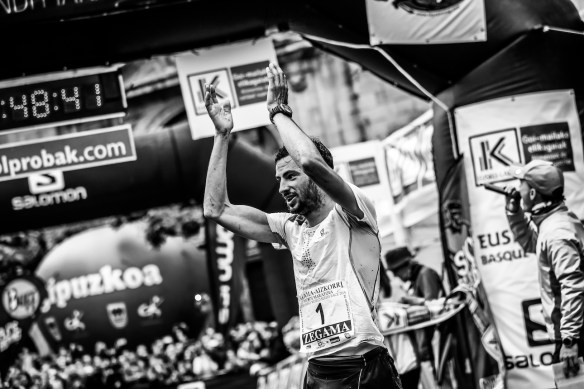
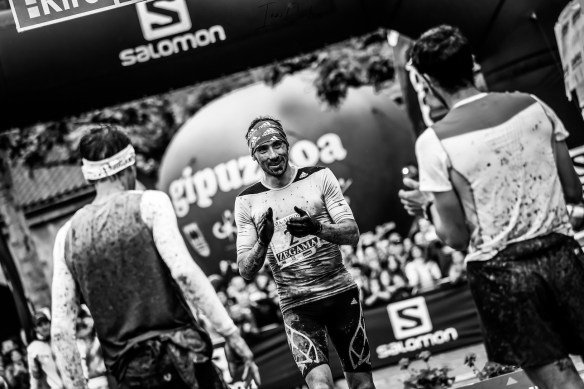
All images taken from the 2014 Zegama-Aizkorri when Kilian Jornet beat Marco DeGasperi and Luis Alberto hernando with a course record time.

Please support this website. I believe everyone deserves to read quality, independent and factual articles – that’s why this website is open to all. Free press has never been so vital. I hope I can keep providing independent articles with your help. Any contribution, however big or small, is so valuable to help finance regular content. Please support me on Patreon HERE.

Follow on:

Instagram – @iancorlessphotography

Twitter – @talkultra

facebook.com/iancorlessphotography

Web – www.iancorless.com

Web – www.iancorlessphotography.com

Image sales –www.iancorless.photoshelter.com
Episode 188 – Zach Bitter 100-mile Treadmill WR Special

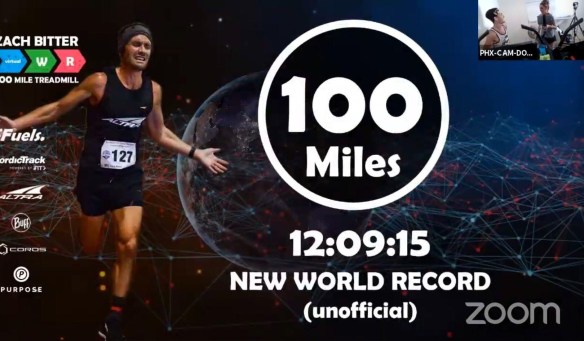
Episode 188 – A Zach Bitter special all about his 100-mile treadmill world record (tbc) established on May 16 2020.
*****
Talk Ultra needs your help! 
We have set up a Patreon page and we are offering some great benefits for Patrons… you can even join us on the show! This is the easiest way to support Talk Ultra and help us continue to create! 
Many thanks to our Patrons who have helped via PATREON
Donate HERE
*****

ZACH BITTER SPECIAL

*****
Please listen to the INTERVIEWS – please follow the show
Hosted on ANCHOR (HERE) the INTERVIEWS will also be available to listen on many other players, including SPOTIFY (HERE).
ANCHOR app on Apple HERE and Google HERE
Download links will be added in due course.
Apple Podcasts HERE
Breaker HERE
Castbox
Google Podcasts HERE
Overcast HERE
Pocket Casts  HERE
RadioPublic HERE
Spotify HERE
Stitcher
*****
Share us on Facebook – Talk Ultra FB https://www.facebook.com/talkultra/
Tweet us on Twitter – Talk Ultra on Twitter https://twitter.com/Talkultra
Importantly, go to iTunes and subscribe so that you automatically get our show when it’s released we are also available on Stitcher for iOS, Android and Web Player and now Tunein. We are also on Spotify too.
Our web page at www.iancorless.com has all our links and back catalogue.
Please support Talk Ultra by becoming a Patron at www.patreon.com/talkultra and THANKS to all our Patrons who support us. Rand Haley and Simon Darmody get a mention on the show here for ‘Becoming 100k Runners’ with a high-tier Patronage.
*****

ZACH BITTER 100 Mile World Record Attempt, May 16

Zach Bitter is no stranger to tough endurance challenges. He currently is the World Record holder for 100-miles on a track, setting an incredible time of 11-hours, 19-minutes and 13-seconds.

On May 16th starting at 0700 (PST) he will take on the challenge of setting a new treadmill world record, the time to beat 12-hours 32-minutes set by Dave Proctor.

The whole event will be streamed live via YouTube broken down in 2-hour slots. I (ian Corless) will host the first slot followed by Jamil Coury, Dean Karnazes and Dave Scott, Fight for the Forgotten, Erik Schranz and finally, Zach’s wife, Nicole Bitter.

Throughout the day, the hosts will be joined by a plethora of guests as the whole world record attempt will be discussed live.

GO HERE FOR THE LIVE FEED

Zach Pre-Event Q&A

What was your A-Race plans in 2020?

I had planned on peaking for a track 100-mile race in London in April, called the Centurion 100. World 100km Championships was slated for September in Winschoten Netherlands, which was likely going to be a focal part of my early Fall. Beyond that, I had planned on doing some local events near Phoenix through Aravaipa who puts on over 30 events per year and are a blast to jump into. 

Why do you like running 100milers on track?

I really like the comparability. If I do a 100-mile race on a track, it is easier to tease out improvements, mistakes, etc… from one event to the next. I also really like the process of finding out how fast I can run 100 miles when there as few hurdles in the way. I love the trails too, but they just tend to be more varied.

What is it that you like or intrigues you about running on a treadmill – and going after treadmill 100mile WR?

I big part is simply that with all events being cancelled, it gives me the opportunity to test my fitness and my most recent training cycle. I have been running ultra-marathons for almost ten years now, so hoping on a treadmill for a significantly longer time than I have spent on one (30 miles is the furthest I have gone to date) has enough uncertainty that it makes it exciting, but is close enough to my strengths that I feel I can put together a solid performance if things go well.

What’s your approach to mentally handling 12hours running – on a track, and now on a treadmill? 

I usually focus on three main things. First, I like to pick small benchmarks to focus on throughout the day, so you do not burn too much mental energy thinking about running 100 miles or 12 hours all day long. Second, I like to visualize in my race specific long sessions where I would be on race/event day, so for my longer sessions on the treadmill I pretend I am that far from finishing and visualize what it will be like on race/event day. Third, I like to rotate distractions like listening to music, or picking a short distance to target and visualize where I would be on one of my favorite running routes at home. 

What been your mileage – to build up a base into this WR attempt?

I have been consistently hitting up to 120 miles per week the last month. A lot of it being at aerobic threshold or just below, with a few bouts of lactic threshold work, and few long runs at goal 12-hour intensity.

What has your taper been like for this WR attempt?

Pretty typical to what I normally do. I usually taper for about two weeks. I drop volume and intensity a bit and give myself more time between any key sessions.

Can you tell us about your fueling philosophy in training/living and racing – in terms of carbs/fats etc.? 

I follow a HFLC diet. It is not a strict keto diet or zero carb approach, although I will tease those ranges during offseason or recovery blocks. The races I do are quite long, so be default lower in intensity. The fueling variable and potential digestion issues that come with it makes it easier for me to follow a lower carb approach. On race day, I will switch from using SFuels Train/Life to SFuels Race+. Essentially, my fueling goal on race day is designed to defend muscle glycogen with exogenous carbs just enough to have gas in the tank at the end.

What are the big learnings in performance, recovery, training consistency with a low-carb high fat approach to training and racing?

For me personally, I find it to be more consistent. I find it easier to count on quality sleep, and even levels of energy. This no doubt adds to consistency in training. I couldn’t explain why, but I also notice that I have better range of motion following big efforts in training and racing.

At what points in the year would you go Ketogenic, vs. lower-carb/higher fat?

Usually, it is most common during the less structured portions of my year. When I finish a big race and have carved out a couple weeks to focus primarily on recovery and do not have any specific workouts on the schedule is a common spot for me. Off season time as well. When I do my biggest training blocks, I almost always have de-load weeks built into the program, which sometimes reduce volume and intensity by as much as 50 percent. These weeks are another spot where I am usually more inclined to steer closer to strict keto.

Tell us about your race fueling in terms of calories you will be taking on each hour?

For races that I am targeting my training around, I will typically aim for approximately 40 grams of carbohydrate per hour. My experience has been that 40 grams an hour provides me enough exogenous carbohydrate to defend glycogen, but not so much that it results in stomach/digestive issues.

What will a good day look like on May 16 – for you?  in terms of feeling in the first 30miles, the middle of the race and the last 30 miles?

There will be a lot of uncertainty for this event. It is a bit harder to predict things that I have not done before, and I try to respect the unknown. Since I have not run past 30 miles on a treadmill, there will likely be some on the fly adjustments being made, but this is what makes this adventure exciting to me. Ultimately, my number one goal is to give folks a sense of community during these isolated times and bring awareness to Fight For The Forgotten. Normally, for a 100-mile event, I would describe a good day as consistent with a strong finish, so likely tight splits with not too much variance from one mile to the next. For this event, I think there may be some benefit from skewing my pacing throughout the event to change up mechanics and give myself more of a variety of targets throughout the day. This type of strategy might be helpful in breaking up the day into smaller segments. With that said, I would like to get to 100 miles before the clock hits 12-hours, however that plays out. Regardless of the pacing strategy, a good day will likely have me feel fresh at 30-miles, a bit worn but focused at 60-70 miles, similar to how I would feel for a long run at the back end of a big training week, and driven to push on tired legs for the final 30 miles.

What is your sense on what it will take to set a new World Record – in terms of race pace through the race?

Dave Proctor’s current 100-mile treadmill world record is approximately 7:30 per mile, so it will take at least that. I am relatively fresh from a racing standpoint and my fitness is on par with similar build ups I have done in the past when running under 12-hours for 100 miles. You never know with 100 miles though. Anything can happen and some hurdles will likely happen, so all you can really do is show up ready, trust the process, and see what the day provides.

The event is sponsored by:

SFUELS, NORDICTRACK, ALTRA, BUFF, COROS and PURPOSE.

TUNE IN ON MAY 16 HERE

Please support this website. I believe everyone deserves to read quality, independent and factual articles – that’s why this website is open to all. Free press has never been so vital. I hope I can keep providing independent articles with your help. Any contribution, however big or small, is so valuable to help finance regular content. Please support me on Patreon HERE.

Follow on:

Instagram – @iancorlessphotography

Twitter – @talkultra

facebook.com/iancorlessphotography

Web – www.iancorless.com

Web – www.iancorlessphotography.com

Image sales –www.iancorless.photoshelter.com
Episode 187 – Ben Bardsley, Bob Crowley and Stephen Goldstein PHD

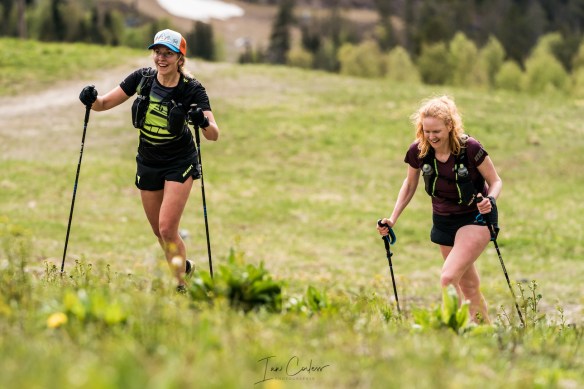
Episode 187Ben Bardsley talks about his 2500km journey on the Norge Pa Langs, Norway. We speak with new ITRA President, Bob Crowley and Stephen Goldstein PHD updates us on Covid-19.
*****
Talk Ultra needs your help! 
We have set up a Patreon page and we are offering some great benefits for Patrons… you can even join us on the show! This is the easiest way to support Talk Ultra and help us continue to create! 
Many thanks to our Patrons who have helped via PATREON
Donate HERE
*****
00:10:54 BEN BARDSLEY 
*****
00:56:04 BOB CROWLEY – ITRA here
*****
01:39:00 STEPHEN GOLDSTEIN PHD
*****
Please listen to the INTERVIEWS – please follow the show
Hosted on ANCHOR (HERE) the INTERVIEWS will also be available to listen on many other players, including SPOTIFY (HERE).
ANCHOR app on Apple HERE and Google HERE
Download links will be added in due course.
Apple Podcasts HERE
Breaker HERE
Castbox
Google Podcasts HERE
Overcast HERE
Pocket Casts  HERE
RadioPublic HERE
Spotify HERE
Stitcher
*****
TALK ULTRA podcast will be released as normal providing you long shows as it has always done with ideally two shows per month. The back catalogue will be released randomly via the INTERVIEWS and not chronologically.
*****
Share us on Facebook – Talk Ultra FB https://www.facebook.com/talkultra/
Tweet us on Twitter – Talk Ultra on Twitter https://twitter.com/Talkultra
Please support Talk Ultra by becoming a Patron at www.patreon.com/talkultra and THANKS to all our Patrons who support us. Rand Haley and Simon Darmody get a mention on the show here for ‘Becoming 100k Runners’ with a high-tier Patronage.
I’m Ian Corless and she is Speedgoat Karl
Keep running
Stitcher You can listen on iOS HERE, Android HERE or via a web player HERE
Website – talkultra.com

the INTERVIEWS Season 1 – Episode 14 : Hal Koerner

Hal Koerner is a legend in the world of ultra-running who was one of the early pioneers of the sport. He has victories at Kettle Morraine 100, The Bear 100, Angeles Crest, Western States hardrock 100 and so many more…  He is the owner of a specialty running store, Rogue Valley Runners, located in the mountainous Southern Oregon town of Ashland. Hal featured in JB Benna’s feature-length documentary “Unbreakable: The Western States 100”. In 2014, he published  “Hal Koerner’s Field Guide to Ultrarunning” and was released by VeloPress. The book details training for an ultra marathon; from 50k to 100 miles.
.
Recorded in 2012.
Episode 0h 39m 59s
Talk Ultra back catalogue HERE
*****
Hosted on ANCHOR (HERE) the INTERVIEWS will also be available to listen on many other players, including SPOTIFY (HERE).
ANCHOR app on Apple HERE and Google HERE
Download links will be added in due course.
Apple Podcasts HERE
Breaker HERE
Castbox
Google Podcasts HERE
Overcast HERE
Pocket Casts  HERE
RadioPublic HERE
Spotify HERE
Stitcher
*****
TALK ULTRA podcast will be released as normal providing you long shows as it has always done with ideally two shows per month. The back catalogue will be released randomly via the INTERVIEWS and not chronologically.
*****

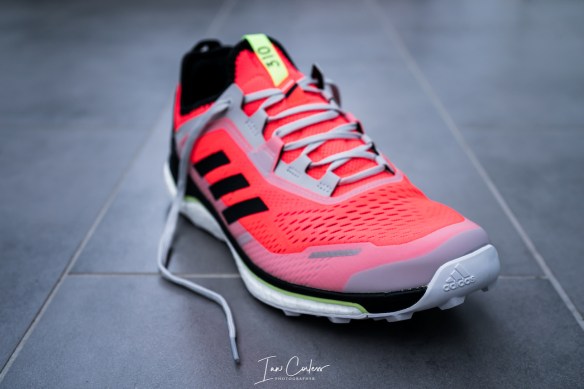
adidas Terrex Agravic Flow

The development and progress of the adidas brand in the trail running world has for many years been spearheaded by Luis Alberto Hernando, and what an ambassador he is!

Now, ‘TERREX’ is changing at an alarming rate and in the past 12 to 18-months there has been significant growth and development in shoes, apparel and athletes. Without doubt, adidas are now pushing hard in the trail and mountain world.

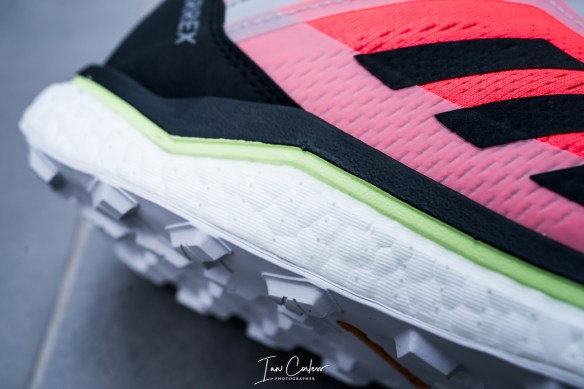
The TERREX AGRAVIC FLOW is a shoe that encompasses the road history of the brand and welcomes the development of the trail brand. The shoe clearly transitions from road to trail and back again all packaged in a really good-looking shoe. 

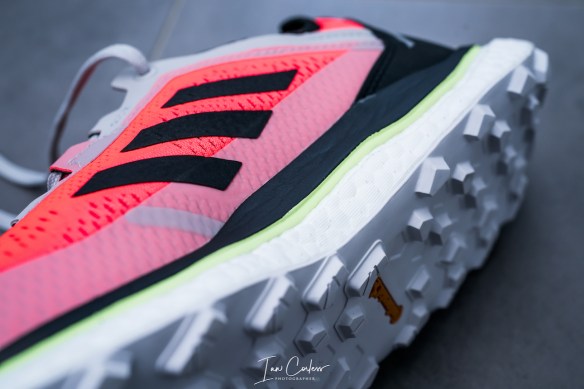
My pair are solar red/ core black and grey two. There is no hiding in these shoes, they are colorful!

For clarity, Adidas use three descriptive names for their shoes: SPEED, AGRAVIC and TWO.

  • SPEED offers a narrower fit and is arguably a more performance orientated shoe.
  • AGRAVIC offers a standard fit and is arguably more of an ‘everyday’ shoe.
  • TWO offers a wider fit and more cushioning for longer trail days. 

The TERREX AGRAVIC FLOW falls into the everyday category and adidas confirm, Pavement to trail and back, your feet stay cool and the transitions are seamless with a smooth roll-off and fresh energy in every stride. Foot-hugging support and sure-footed grip let you move across rocky, rooted terrain, wet or dry. I often do not like the way a brand tries to sell a shoe in a sentence or two, but I have to say, adidas sum up the Agravic Flow well in this description. 

THE SHOE

Billed as a regular fit shoe, I have to say, to me, it feels a little wider in the toe box than many other regular fit shoes. So, keep that in mind when looking at them and trying them on. I also personally feel that they size a little larger. I always use a UK9.5 but have found a Uk9 to be far more preferable with the Agravic Flow.

With 15mm cushioning at the front and 22mm at the rear, the shoe is a cushioned ride without compromising feel for the ground and the 7mm drop fits perfectly for an everyday shoe ensuring that a day on the trail will be relaxed and comfortable.

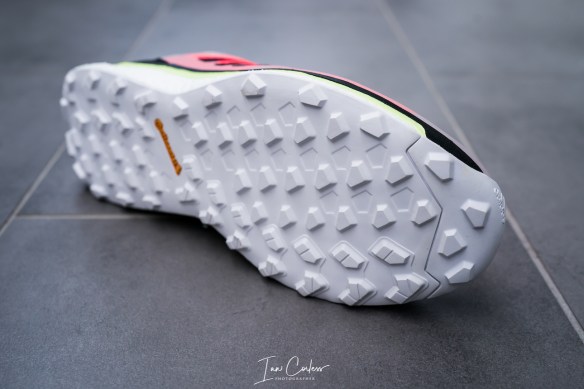
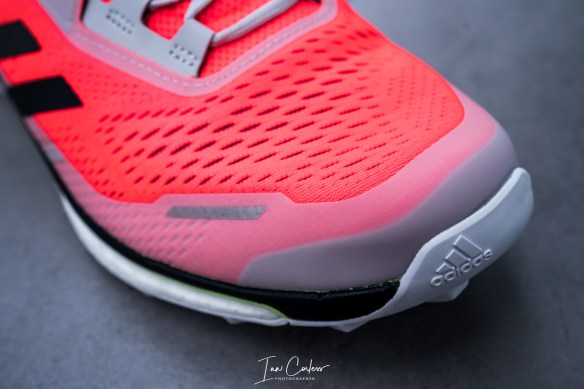
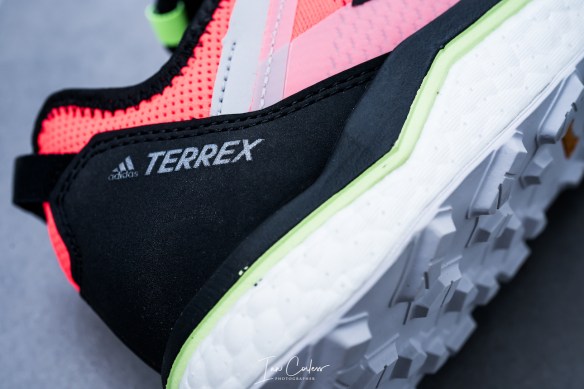
The outsole is by Continental and the German brand really do know how to make a grippy outsole. With 3mm lugs, the Agravic Flow is never going to cut it when the trail gets sloppy and/ or muddy. However, on hard pack trail the grip is superb. On rock, wet or dry, grip also excellent and importantly it gives a real feeling of confidence which allows you to run without hindrance. The transition to road is seamless and comfortable, no doubt contributed too with the BOOST cushioning.

 Cushioning comes from BOOST technology and you really feel the comfort as soon as you put the shoes on. There is also EVA in the frame to reduce weight and this in turn, provides some stability. If you have not used a BOOST shoe before, give them a go, the energy return and comfort levels are excellent.

The upper is one the stars of the Agravic Flow, it is mesh with abrasion resistant welding. It is seamless and uses a sock-like construction. If you have read my shoe reviews before, you will know I love sock-like construction and the same applies here for the Agravic Flow. You slide your foot in and immediately it feels snug. You could, if you should wish too, use the shoe without socks?

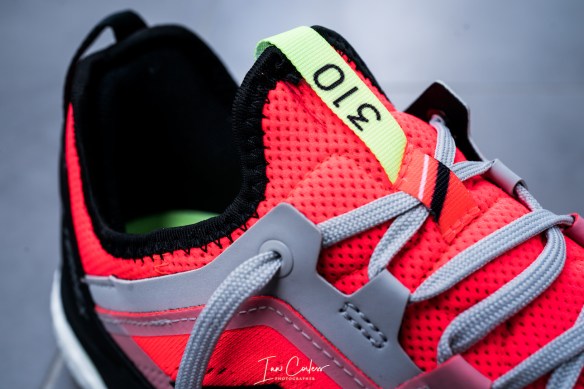
The laces sit on top of the upper and are sewn in offering 5 eyelets on either side, the middle eyelet set back allowing on option to loosen or add more tightness to the upper when fastening. There is no option lock-lace as there is only one eyelet.

The toe box, as mentioned previously, feels wider than standard and at the front there is an overlay to add a little protection and the outsole curls up to add some reinforcement. But toe protection is minimal. At the rear of the shoe, the heel box is plush and comfortable, and it held my foot well both when going up and down trails.

There is no tongue as the shoe is a sock-like, so, comfort levels are high. You see the number ‘310’ this refers to the weight in grams of a UK8.5 shoe.

Built on a neutral last, the EVA on the medial side wraps up to offer some arch support. It’s subtle, but noticeable. I wouldn’t call the Agravic Flow a support/ pronation control shoe. Equally, I could not call it neutral. It sits somewhere between but being a runner who uses neutral shoes, I find the Agravic Flow very comfortable.

IN USE

 The Agravic Flow is a great everyday shoe when the trails are hard packed, and you want comfort, support and reassurance. They are not for muddy days! The transition from road to trail is superb and seamless, you can feel adidas’ road heritage in the shoe. 

The BOOST technology is really noticeable and gives a real bounce, especially on rock, gravel, tree roots and so on. This is not at the compromise for feel for the ground though. So, when the trail becomes more technical, I was never worried about foot placement and confidence. The toe box is wider though, so, when running on very technical trail, I would prefer a firmer hold at the front. You can’t have it all and the Agravic Flow does a great job of allowing toe splay. So, it’s a great shoe for longer trail days when comfort is needed. The outsole is excellent in the wet and dry on non-muddy trail. 

The sock-like upper is just plush and comfortable. There is nothing to criticize here, I wish all shoes could be this comfortable. Quite simply, you could remove the laces and they would make a great pair of slippers – yes, they are that comfy. 

The laces work well, it would be nice to have that extra eyelet to allow lock-lacing, but that is a minor niggle. For me, the shoe does have a wider feel than standard, and I therefore found that I could compensate by adjusting the laces to hold my foot securely. 

I do feel that the shoe sizes larger by a half size, so, if purchasing online, keep that in mind. Ultimately, you need to try the shoe on.

CONCLUSION

The Agravic Flow is a great shoe that manages to mix road running and trail running seamlessly. It’s a shoe that you can pretty much put on every day and enjoy its ability to feel like a road shoe and then when on the trail, enjoy the cushioning and grip of the best out and-out-trail shoes. There is little not to like in this package from adidas.

If you are looking for one shoe that covers many options, the Agravic Flow is a great place to start. If you want a road shoe, look elsewhere. If you want a trail shoe with comfort and grip for dry/ wet trails, then this shoe ticks the boxes.

Please support this website. I believe everyone deserves to read quality, independent and factual articles – that’s why this website is open to all. Free press has never been so vital. I hope I can keep providing independent articles with your help. Any contribution, however big or small, is so valuable to help finance regular content. Please support me on Patreon HERE.

Follow on:

Instagram – @iancorlessphotography

Twitter – @talkultra

facebook.com/iancorlessphotography

Web – www.iancorless.com

Web – www.iancorlessphotography.com

Image sales –www.iancorless.photoshelter.com
Is VIRTUAL here to stay?

Virtual running is not new.  

Virtual sport is not new.

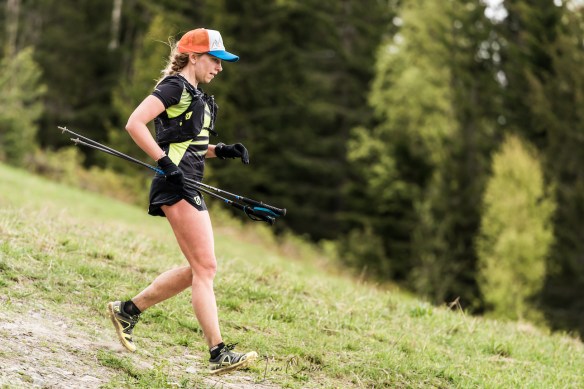
But today, as the world is gripped in lockdown, virtual running is taking off like never before. 

Runner’s World, way back in 2015 asked the question, ‘Are Virtual Runs the Future of Racing?’ In an article by Alison Wade.

‘Virtual Racing is not a new concept. Postal races—in which competitors mail in their times to be compared with others—began decades ago. But advances in technology have improved runnersexperience of events from their own treadmills, and as the sport has grown, so has interest in this alternate way of racing.’

The joy of virtual is quite simple, you participate wherever you can, when you can and in many scenarios, in any capacity. It shows us that our need to belong, to be part of something is very strong, even if we are doing the sport alone and virtually.

‘Remote entrants received a downloadable bib, finishers certificate, and the races official swag…’

Some races reach capacity, London Marathon would be a good example. Virtual can allow someone to run a route at the same time as an official race on a virtual course using an app that simulates the course.

To be honest, many of us now have some form of tracking device, be that a watch, phone or additional gadget. Many subscribe to an app on their phone, be that on Android or Mac that allows us daily to update a training session. Strava being an obvious one but so many others exist.

Technology used to be something that was feared, but now it is embraced. 

Regina Jackson of ‘Will Run for Bling’ created in 2013, said to Alison Wade, ‘Many of those who run our races have busy lives and are attracted to the fact that they have nine days to complete each race. Others are drawn in by the fact that they can break up the run into shorter segments and still get credit for completing the race.’

But times are changing…

As races throughout the world are being cancelled or postponed, race directors have been looking for opportunities to retain their market, inspire the audience and still provide engagement. Equally, runners or sports people who desire an event and community have pursued alternatives. Interaction, that sense of belonging and the need to participate a driving force.

So, the transition has been seamless, and, in some scenarios, it has exploded to a level that one would have struggled to comprehend just 4-months ago.

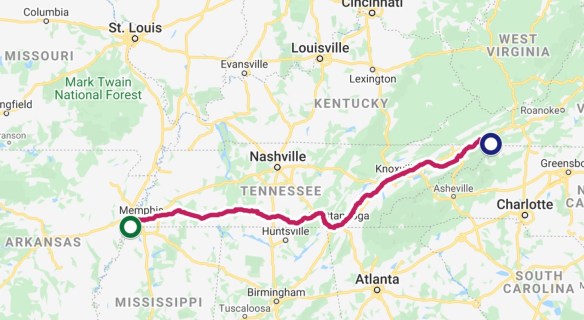
A prime example being the recently started (May 1st) ‘The Great Virtual Race Across Tennessee 1000km’which allows participants to travel across Tennessee (virtually) from may 1st to August 31st. Quite simply, you have 4-months to cover the distance by any means and daily you upload your distance (even if it is a zero) and via an interactive map, your dot is moved along the route.

The above is brought to us by Gary Cantrell aka Lazarus Lake of the famous Barkley Marathons and Bigs Backyard Ultra. Now, Laz is like the Pied Piper, people love him and love his crazy ideas. However, I don’t think even he could have anticipated that a 1000km virtual run would explode like it has. As they say on the sign-up page, ‘To complete, the race will require only a hair over 5 miles per day…  and those who want a little extra on their plate, you can do the out and back version – 2,000 kilometers!

The numbers are phenomenal, $60 entry fee and currently over 17,569 participants. There is a charity element too for ‘Feeding America/ Tennessee’ – the donation page is showing a current revenue of $96,533. And now, there is even a ‘Doggie Run Across TN for Animal Shelters’ with a sign up of $30.

Depending on viewpoint, for now, virtual races and challenges are filling a gap that many of us are missing as we are forced to social distance and lockdown. As restrictions ease, and life starts to return to some normality, I can’t help but think an element of virtual will exist at a greater level than before January 2020.

As one runner has told me, ‘I race for the atmosphere, being around hundreds with a similar passion and then testing myself at the same time and on the same course as everyone else. I like the meet up before and the post-run gathering. It’s more than running, it is community. So, racing is really important for me and many others. However, the virtual world has opened my eyes to a new way of training. I love the fact that maybe I can run across Tennessee in 4-months and the great thing is, should I get an opportunity to race, I can use that mileage too for the virtual challenge.’

One thing is for sure, in the ultra-running world, a challenge is a challenge, be that real or virtual. Recent months and weeks have shown us that imagination is the only limiting factor.

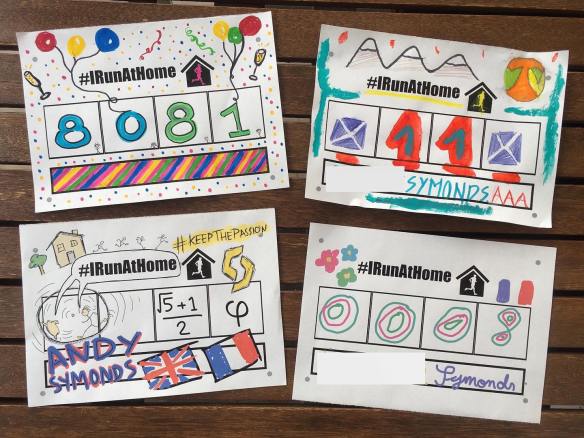
In Spain, friends Kilian Jornet, Pau Capell and Tofol Castanyer created an indoor challenge. Fueled by the lockdown that did not allow them to run outside, with the help of Albert Jorquera, Jordi Saragossa and Maria Fainé, they created ‘YoCorroEnCasa’ translated to IRunAtHome. With just a week of planning, they brought over 7400 people together, all running ‘in the home’ and in the process they raised €82,940 for charity – they did not take a euro. I followed their example and did the same in the UK on April 18th with IRunAtHome raising £20,000 for charity.

Taking inspiration from Lazarus Lake, Dave Proctor (who holds the 100-mile treadmill world record) took the ‘Backyard Ultra’ format and made it into a virtual event using technology such as Zoom and YouTube to bring runners together, from all over the world, to run 4.1667 miles every hour, on the hour. Over 2000 signed up. The challenge was to see who would be, the last man or woman standing in the ‘Quarantine Backyard Ultra.’ After 2+ days, ultra-running legend, Michael Wardian emerged victorious with 262.5-miles beating Radek Brunner. Notably, Michael ran outdoors using a loop of road around his house, whereas Radek ran on a treadmill. 

Listen to a podcast interview with Michael Wardian HERE

 Salomon runner, Ryan Sandes was locked down in South Africa, but that did not stop him. Taking on a personal challenge, he ran 100-miles in and around his house is 26-hours and 27-minutes. Article here.

And on May 16th, 100-mile world record holder, Zach Bitter, will look to set the 100-mile WR on a treadmill with a virtual run that will be streamed live for the full duration of approximately 12-hours. He encourages people to join him on their own treadmills and experience the journey.

 Racing will return. The trails (and even roads), the scenery, the landscape, the mountains and fresh air will bring us back to start lines. The need to share a journey and experience, to test one’s self in real time is something that is primal. The need for physical interaction, before, during and after a race is something, we all need. 

It’s unclear when virtual racing made the leap online to a mass audience. Some race directors say it evolved from runners requests many years ago to participate in physical races from afar. Regardless of the original origin, this year, virtual racing has exploded in popularity.

Virtual is here to stay and no doubt, at a far greater level than when this year began.

Please support this website. I believe everyone deserves to read quality, independent and factual articles – that’s why this website is open to all. Free press has never been so vital. I hope I can keep providing independent articles with your help. Any contribution, however big or small, is so valuable to help finance regular content. Please support me on Patreon HERE.

Follow on:

Instagram – @iancorlessphotography

Twitter – @talkultra

facebook.com/iancorlessphotography

Web – www.iancorless.com

Web – www.iancorlessphotography.com

Image sales –www.iancorless.photoshelter.com
References: Active.com here Runners World here New York Times here The Washington Post here
RAB KAON Jacket Review

When it comes to mountains and outdoor terrain, UK brand RAB have been a ‘go-to’ for any outdoor enthusiast, whether that be for the Himalayas, mountaineering, trekking, climbing or a leisurely walk in the outdoors.

2020 will see RAB launch a series of new products under the heading of SKYLINE a range of products made up of ultra-lightweight clothing that does not compromise on protection. Intended for ‘fast and light’ days that blur the line between running and technical scrambling.

It’s a significant movement for the brand and as a firm RAB fan, the SKYLINE range has already gained my attention and no doubt, it will grab the attention of anyone who likes to move faster in the mountains.

I will be introducing element of the new SKYLINE range over the coming weeks, notably, the SONIC SHORT SLEEVE TEE, PACER JACKET, CHARGE JACKET and PHANTOM PULL ON.

Image ©RAB

But first, the KAON jacket. 

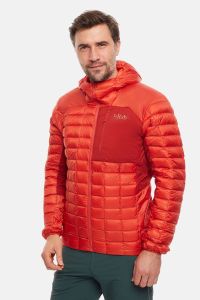
The new KAON jacket personifies and sets out the stall of the new direction and although it does not come under the SKYLINE banner, it certainly ticks all the boxes offering minimal insulation with low-weight and packing size. Balancing lightweight, warmth and protection, the KAON uses a combination of 800 fill Goose Down and Synthetic Status insulation. Concentrating on the core, the Kaon retains warmth where it is needed, while ‘Pertex Quantum Air’ allows complete freedom of movement under the arms.

The Kaon offers zoned insulation allowing a balance between warmth without compromising movement. It mixes down for the core and ‘Stratus’ synthetic fill on the shoulders, hood and cuffs. 

The down in the core is 800FP hydrophobic down (70g in the men’s and 65g for the women.) This is significant as down, while warmer and lighter, cannot get wet – it loses warmth! However, hydrophobic down is treated with a durable water repellent that allows for quicker drying and the ability to resist water for longer. In a nutshell, it makes the Kaon far more usable in a variety of situations.

The Stratus synthetic fill is significant as it allows the jacket to be more breathable, dry out faster and is 20% less absorbent to other rival insulation. Synthetic is effective at keeping one warm, even when wet, so, it is ideal for damp/ wet conditions. RAB have added this to key areas of stress, either from the weather or equipment or a combination of the two. For example, on the shoulders, synthetic insulation will be far more durable with pressure from rucksack straps. Also, when compressed, it retains warmth, unlike down which requires loft.

The Atmos outer shell will still allow for loft while reducing down leakage making a perfect combination of warmth v weight.

Under the arms and down the side of the torso, Pertex Quantum Air is used which allows heat to escape and therefore allowing for body temperature regulation, always a difficult balance when moving fast and light.

IN USE 

The KAON is a wonderful crossover jacket for mountain runs and alpinists who want to move fast and light but be prepared for any potential inclement conditions that the mountains can throw at you. 

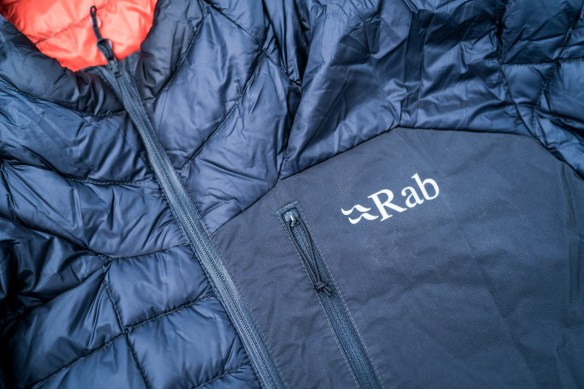
On first look, it is a simple jacket with a full-length zip, hood (that will allow for a helmet), high collar for warmth, one chest pocket, no side pockets and the sides and under arms use a different more flexible and breathable fabric. It has stitch through construction that provides a small square look to the jacket which ensure the insulation stays put.

The fit is slightly tailored, RAB say ‘slim’ but it is not super tight. Movement is not compromised. The arms are a normal length with a simple elasticated cuff. The jacket length sits just below the waist and for me, covers my backside. When zipped up, the neck goes nice and high and sits just below the chin keeping out drafts. The hood fits perfectly and has no adjustment – as mentioned, you can wear a helmet if required.

Image ©RAB

Needless to say, it is very light (240g +/-) and packs small and comes with its own stuff sack.

It is available in 3 colours, ebony (blue), firecracker (red) and dark sulphur (yellow).

I normally wear medium and medium is perfect in the KAON, size options are XXS to XXL.

 Having used the jacket as we transitioned from Winter to Spring, I have found it perfect or everyday use. On chilly days I start with it on and then remove when my core is warm. It packs away small and fits in the side pocket of my Osprey Talon 11 pack (to provide an example.) On warmer days, I have added the KAON to my pack in the assurance that should the weather change, I have an excellent light layer that will work. In conjunction with a lightweight jacket, such as the PACER (here) – I have warmth and waterproof for well under 500g.

SUMMARY

The KAON is one of those essential kit items when going to the mountains. It’s size and weight make it a ‘mandatory’ item for me – there is no reason not to take it! Warm, lightweight and packs small = perfect.

RAB HERE

Please support this website. I believe everyone deserves to read quality, independent and factual articles – that’s why this website is open to all. Free press has never been so vital. I hope I can keep providing independent articles with your help. Any contribution, however big or small, is so valuable to help finance regular content. Please support me on Patreon HERE.

Follow on:

Instagram – @iancorlessphotography

Twitter – @talkultra

facebook.com/iancorlessphotography

Web – www.iancorless.com

Web – www.iancorlessphotography.com
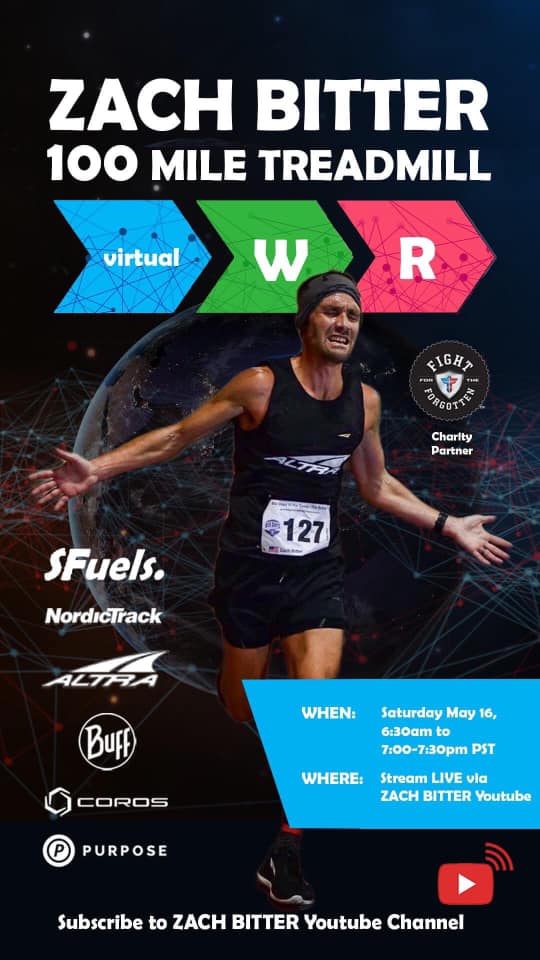
Image sales –www.iancorless.photoshelter.com